
TR-098 Internet Gateway Device Data Model for TR-069
|
|
|
- Arabella Owen
- 10 years ago
- Views:
Transcription
1 TECHNICAL EPOT T-098 Internet Gateway Device Data Model for T-069 Issue: 1 Amendment 2 Issue Date: September 2008 The Broadband Forum. All rights reserved.
2 Internet Gateway Device Data Model for T-069 T-098 Amendment 2 Notice The Broadband Forum is a non-profit corporation organized to create guidelines for broadband network system development and deployment. This Broadband Forum Technical eport has been approved by members of the Forum. This Broadband Forum Technical eport is not binding on the Broadband Forum, any of its members, or any developer or service provider. This Broadband Forum Technical eport is subject to change, but only with approval of members of the Forum. This Broadband Forum Technical eport is provided "as is," with all faults. Any person holding a copyright in this Broadband Forum Technical eport, or any portion thereof, disclaims to the fullest extent permitted by law any representation or warranty, express or implied, including, but not limited to (a) any warranty of merchantability, fitness for a particular purpose, non-infringement, or title; (b) any warranty that the contents of this Broadband Forum Technical eport are suitable for any purpose, even if that purpose is known to the copyright holder; (c) any warranty that the implementation of the contents of the documentation will not infringe any third party patents, copyrights, trademarks or other rights. This Broadband Forum publication may incorporate intellectual property. The Broadband Forum encourages but does not require declaration of such intellectual property. For a list of declarations made by Broadband Forum member companies, please see Broadband Forum Technical eports may be copied, downloaded, stored on a server or otherwise redistributed in their entirety only. The text of this notice must be included in all copies. September 2008 The Broadband Forum. All rights reserved. 2

3 Internet Gateway Device Data Model for T-069 T-098 Amendment 2 Issue History Issue Number Issue Date Issue Editor Changes Issue 1 September 2005 Jeff Bernstein, 2ire Issue 1 Barbara Stark, BellSouth Issue 1 Amendment 1 November 2006 Jeff Bernstein, 2ire John Blackford, 2ire Mike Digdon, SupportSoft Heather Kirksey, Motive illiam Lupton, 2ire Anton Okmianski, Cisco Clarification of original document Issue 1 Amendment 2 September 2008 Christele Bouchat, Alcatel illiam Lupton, 2ire Technical comments or questions about this Technical eport should be directed to: Clarification of Amendment 1; Data model extensions (v1.4); See section 1 for further details Editors illiam Lupton 2ire [email protected] Christele Bouchat Alcatel-Lucent [email protected] DSLHome Technical orking Group Chairs Greg Bathrick PMC-Sierra [email protected] Heather Kirksey Motive [email protected] September 2008 The Broadband Forum. All rights reserved. 3

4 Internet Gateway Device Data Model for T-069 T-098 Amendment 2 Table of Contents 1 Introduction Terminology Document Conventions Data Model Definition General Notation Data Types Vendor-Specific Parameters InternetGatewayDevice Data Model Inform and Notification equirements Version 1.0 Data Model equirements Profile Definitions Notation Baseline Profile EthernetLAN Profile USBLAN Profile ifilan Profile ifimm Profile ifips Profile ADSLAN Profile ADSL2AN Profile VDSL2AN Profile PTMAN Profile EthernetAN Profile POTSAN Profile QoS Profile QoSDynamicFlow Profile QoSStats Profile Bridging Profile BridgingPortVLAN Profile Time Profile CaptivePortal Profile IPPing Profile Traceoute Profile Download Profile DownloadTCP Profile Upload Profile UploadTCP Profile UDPEcho Profile UDPEchoPlus Profile ATMLoopback Profile DSLDiagnostics Profile ADSL2DSLDiagnostics Profile VDSL2DSLDiagnostics Profile DeviceAssociation Profile UDPConneq Profile DHCPCondServing Profile DHCPOption Profile Normative eferences Annex A. Queuing and Bridging A.1 Queuing and Bridging Model A.1.1 Packet Classification A.1.2 Policing A.1.3 Queuing and Scheduling A.1.4 Bridging A.2 Default Layer 2/3 QoS Mapping A.3 UN Definitions for App and Flow Tables A.3.1 ProtocolIdentifier A.3.2 FlowType September 2008 The Broadband Forum. All rights reserved. 4

5 Internet Gateway Device Data Model for T-069 T-098 Amendment 2 A.3.3 FlowTypeParameters A.4 Example Queuing Architecture for G (from T-059) A.5 Layer2Bridging Use Case: Interface Based Bridging A.6 elationship between Layer2Bridging and LANDevice / AN**Connection A.6.1 Populating the Data Model on eboot A.6.2 Updating the Data Model on Configuration Changes A.6.3 Bridging Behavior when Layer2Bridging is not Implemented A.6.4 Case Studies Annex B. LinkType and ConnectionType Interdependencies Appendix I. Managed bridge configuration in a multi-pvc scenario I.1 Description of scenario I.1.1 Network Traffic Classes and Priorities I.1.2 Mapping to PVCs I.2 Example Configuration I.2.1 IGD AN Connection Device Definitions I.2.2 IGD Default Queue Definitions I.2.3 IGD Upstream Classification definitions I.2.4 IGD Upstream Queue definitions I.2.5 IGD DHCP Server I.2.6 IGD DHCP Conditional Serving Pool Appendix II. Use of the Bridging Objects for VLAN Tagging II.1 Tagged LAN to tagged AN traffic (VLAN bridging) II.2 Tagged LAN to tagged AN traffic (special case with VLAN ID translation) II.3 Untagged LAN to tagged AN traffic II.4 Internally generated to tagged AN traffic II.5 Other issues II.5.1 More than one LAN interface in a bridge II D (re-)marking II.5.3 More than one VLAN ID tag admitted on the same LAN interface September 2008 The Broadband Forum. All rights reserved. 5
6 Internet Gateway Device Data Model for T-069 T-098 Amendment 2 List of Figures Figure 1 Positioning in the End-to-End Architecture Figure 2 Queuing model of an Internet Gateway Device Figure 3 Queuing and Scheduling Example for G Figure 4 Example of interface-based bridging Figure 5 AN / LAN bridged example Figure 6 AN / LAN routed example Figure 7 Triple Play Service Figure 8 Triple Play Upstream Priorities Figure 9 IGD Physical Ingress/Egress Interfaces Block Diagram Figure 10 IGD Upstream Data Model Diagram Figure 11 Examples of VLAN configuration based on Layer2Bridging Figure 12 Example of VLAN configuration in a 2 box scenario September 2008 The Broadband Forum. All rights reserved. 6
7 Internet Gateway Device Data Model for T-069 T-098 Amendment 2 List of Tables Table 1 Data types Table 2 Definition of InternetGatewayDevice: Table 3 Forced Inform parameters for an Internet Gateway Device Table 4 Forced Active Notification parameters for an Internet Gateway Device Table 5 - Default Active Notification parameters for an Internet Gateway Device Table 6 Parameters for which Active Notification MAY be denied by the CPE Table 7 Baseline profile definition for InternetGatewayDevice: Table 8 EthernetLAN profile definition for InternetGatewayDevice: Table 9 USBLAN profile definition for InternetGatewayDevice: Table 10 ifilan profile definition for InternetGatewayDevice: Table 11 ifimm:1 profile definition for InternetGatewayDevice: Table 12 ifips:1 profile definition for InternetGatewayDevice: Table 13 ADSLAN:1 profile definition for InternetGatewayDevice: Table 14 ADSL2AN:1 profile definition for InternetGatewayDevice: Table 15 VDSL2AN:1 profile definition for InternetGatewayDevice: Table 16 PTMAN:1 profile definition for InternetGatewayDevice: Table 17 EthernetAN:1 profile definition for InternetGatewayDevice: Table 18 POTSAN:1 profile definition for InternetGatewayDevice: Table 19 QoS profile definition for InternetGatewayDevice: Table 20 QoSDynamicFlow profile definition for InternetGatewayDevice: Table 21 QoSStats:1 profile definition for InternetGatewayDevice: Table 22 Bridging profile definition for InternetGatewayDevice: Table 23 BridgingPortVLAN:1 profile definition for InternetGatewayDevice: Table 24 Time profile definition for InternetGatewayDevice: Table 25 CaptivePortal:1 profile definition for InternetGatewayDevice: Table 26 IPPing:1 profile definition for InternetGatewayDevice: Table 27 Traceoute:1 profile definition for InternetGatewayDevice: Table 28 Download:1 profile definition for InternetGatewayDevice: Table 29 DownloadTCP:1 profile definition for InternetGatewayDevice: Table 30 Upload:1 profile definition for InternetGatewayDevice: Table 31 UploadTCP:1 profile definition for InternetGatewayDevice: Table 32 UDPEcho:1 profile definition for InternetGatewayDevice: Table 33 UDPEchoPlus:1 profile definition for InternetGatewayDevice: Table 34 ATMLoopback:1 profile definition for InternetGatewayDevice: Table 35 DSLDiagnostics:1 profile definition for InternetGatewayDevice: Table 36 ADSL2DSLDiagnostics:1 profile definition for InternetGatewayDevice: Table 37 VDSL2DSLDiagnostics:1 profile definition for InternetGatewayDevice: Table 38 DeviceAssociation Profile definition for InternetGatewayDevice: Table 39 UDPConneq:1 Profile definition for InternetGatewayDevice: Table 40 DHCPCondServing:1 profile definition for InternetGatewayDevice: Table 41 DHCPOption:1 profile definition for InternetGatewayDevice: Table 42 Default Layer 2/3 QoS Mapping Table 43 ProtocolIdentifer UNs Table 44 FlowTypeParameter values for FlowType urn:dslforum-org:pppoe Table 45 LinkType and ConnectionType Interdependencies for a ANPPPConnection Table 46 LinkType and ConnectionType Interdependencies for a ANIPConnection Table 47 Tagged LAN to tagged AN configuration Table 48 Tagged LAN to tagged AN configuration (VLAN ID translation; LAN-to-AN) Table 49 Tagged LAN to tagged AN configuration (VLAN ID translation; AN-to-LAN) Table 50 Untagged LAN to tagged AN configuration Table 51 Internally generated to tagged AN configuration Table 52 Changes to configuration from Table 48 (LAN-to-AN) Table 53 Changes to configuration from Table 49 (AN-to-LAN) Table 54 Changes to configuration from Table September 2008 The Broadband Forum. All rights reserved. 7

8 Internet Gateway Device Data Model for T-069 T-098 Amendment 2 Table 55 More than one VLAN ID tag admitted on the same LAN interface September 2008 The Broadband Forum. All rights reserved. 8

9 Internet Gateway Device Data Model for T-069 T-098 Amendment 2 Summary Defines the Internet Gateway Device data model for the CPE AN Management Protocol (T-069). September 2008 The Broadband Forum. All rights reserved. 9
10 Internet Gateway Device Data Model for T-069 T-098 Amendment 2 1 Introduction This document describes the Internet Gateway Device data model for the CPE AN Management Protocol (CMP). T-069 defines the generic requirements of the management protocol methods which can be applied to any T-069 CPE. It is intended to support a variety of different functionalities to manage a collection of CPE, including the following primary capabilities: Auto-configuration and dynamic service provisioning Software/firmware image management Status and performance monitoring Diagnostics The ability to manage the home network remotely has a number of benefits including reducing the costs associated with activation and support of broadband services, improving time-to-market for new products and services, and improving the user experience. If T-069 defines the generic methods for any device, other documents (such as this one) specify the managed objects, or data models, which are collections of objects and parameters on which the generic methods act to configure, diagnose, and monitor the state of specific devices and services. The following figure places T-069 and this document in the end-to-end management architecture: OSS/BSS Policy Scope of CPE AN Management Protocol (CMP): ACS Southbound Interface Managed LAN Device Call Center Auto-Configuration Server (ACS) ACS Northbound Interface Managed Internet Gateway Device T:098 Internet Gateway Device Data Model Managed LAN Device Managed LAN Device Figure 1 Positioning in the End-to-End Architecture The ACS is a server that resides in the network and manages devices in the subscriber premises. It uses the methods, or PCs, defined to T-069 to get and set the state of the device, initiate diagnostic tests, download and upload files, and manage events. This document defines those objects applicable to management of an Internet Gateway Device delivering broadband service. The Internet Gateway Device data model follows the conventions defined in [3] for versioning of data models and the use of profiles. This document, T-098 Amendment 2, defines version 1.4 of the IGD data model. It updates and enhances T-098 Amendment 1 in a number of ways, including: September 2008 The Broadband Forum. All rights reserved. 10
11 Internet Gateway Device Data Model for T-069 T-098 Amendment 2 Enhanced management of LAN hosts, and addition of DHCP conditional serving capabilities, Improvements to management or QoS, routing, and bridging, Significant ifi improvements, including configuration of MM and U-APSD, and various fixes to the existing ifi data model, PPPoE and NAT management enhancements, Enhancements to DSL and Ethernet statistics, including support for VDSL Terminology The following terminology is used throughout the series of documents defining the CPE AN Management Protocol. ACS Auto-Configuration Server. This is a component in the broadband network responsible for auto-configuration of the CPE for advanced services. ATM B-NT CB CPE CMP Data Model Device Event ICMP IGD Internet Gateway Device IPTV ISP Parameter PVC QoS G PC Asynchronous Transfer Mode. Broadband-Network Termination. A specific type of Broadband CPE used in DSL networks. Constant Bitrate. Customer Premises Equipment; refers to any T-069-compliant device and therefore covers both Internet Gateway Devices and LAN-side end devices. CPE AN Management Protocol. Defined in [2], CMP is a communication protocol between an ACS and CPE that defines a mechanism for secure auto-configuration of a CPE and other CPE management functions in a common framework. A hierarchical set of Parameters that define the managed objects accessible via T-069 for a particular device or service. Used interchangeably with CPE. An indication that something of interest has happened that requires the CPE to notify the ACS. Internet Control Message Protocol. Used interchangeably with Internet Gateway Device. A CPE device, typically a broadband router, that acts as a gateway between the AN and the LAN. Internet Protocol Television. Internet Service Provider. A name-value pair representing a manageable CPE parameter made accessible to an ACS for reading and/or writing. Permanent Virtual Circuit. Quality of Service. esidential Gateway. emote Procedure Call. TP eal-time Transport Protocol; FC 3550 [46]. SA Segmentation and eassembly. September 2008 The Broadband Forum. All rights reserved. 11
12 Internet Gateway Device Data Model for T-069 T-098 Amendment 2 VB VoIP Variable Bitrate. An -rt suffix indicates real time. Voice over Internet Protocol. 1.2 Document Conventions The key words "MUST", "MUST NOT", "EQUIED", "SHALL", "SHALL NOT", "SHOULD", "SHOULD NOT", "ECOMMENDED", "MAY", and "OPTIONAL" in this document are to be interpreted as described in [1]. The key words DEPECATED and OBSOLETED in this document are to be interpreted as defined in [3]. 2 Data Model Definition 2.1 General Notation Parameter names use a hierarchical form similar to a directory tree. The name of a particular Parameter is represented by the concatenation of each successive node in the hierarchy separated with a. (dot), starting at the trunk of the hierarchy and leading to the leaves. hen specifying a partial path, indicating an intermediate node in the hierarchy, the trailing. (dot) is always used as the last character. Parameter names MUST be treated as case sensitive. In some cases, where multiple instances of an object can occur, the placeholder node name {i} is shown. In actual use, this placeholder is to be replaced by an instance number, which MUST be a positive integer ( 1). Because in some cases object instances can be deleted, instance numbers will in general not be contiguous. 2.2 Data Types The parameters defined in this specification make use of a limited subset of the default SOAP data types [4]. The complete set of parameter data types along with the notation used to represent these types is listed in Table 1. Table 1 Data types Type object string int Description A container for parameters and/or other objects. The full path name of a parameter is given by the parameter name appended to the full path name of the object it is contained within. For strings listed in this specification, a maximum allowed length can be listed using the form string(n), where N is the maximum string length in characters. A k or K suffix is interpreted as a 1024 (not 1000) multiplier, e.g. 32k means For all strings a maximum length is either explicitly indicated or implied by the size of the elements composing the string. For strings in which the content is an enumeration, the longest enumerated value determines the maximum length. If a string does not have an explicitly indicated maximum length or is not an enumeration, the default maximum is 16 characters. hen transporting a string value within an XML document, any characters which are special to XML MUST be escaped as specified by the XML specification [12]. Additionally, any characters other than printable ASCII characters, i.e. any characters whose decimal ASCII representations are outside the (inclusive) range , SHOULD be escaped as specified by the XML specification. Integer in the range to , inclusive. For some int types listed, a value range is given using the form int[min:max], where the Min and Max values are inclusive. If either Min or Max are missing, this indicates no limit. A k or K suffix is interpreted as a 1024 (not 1000) multiplier, e.g. 32k means September 2008 The Broadband Forum. All rights reserved. 12
![described in [1]. The key words DEPECATED and OBSOLETED in this document are to be interpreted as defined in [3]. 2 Data Model Definition 2.](/docs-images/40/4029119/images/page_12.jpg "1 General Notation Parameter names use a hierarchical form similar to a directory tree.")
13 Internet Gateway Device Data Model for T-069 T-098 Amendment 2 Type unsignedint boolean datetime base64 Description Unsigned integer in the range 0 to , inclusive. For some unsignedint types listed, a value range is given using the form unsignedint[min:max], where the Min and Max values are inclusive. If either Min or Max are missing, this indicates no limit. A k or K suffix is interpreted as a 1024 (not 1000) multiplier, e.g. 32k means Boolean, where the allowed values are 0, 1, true, and false. The values 1 and true are considered interchangeable, where both equivalently represent the logical value true. Similarly, the values 0 and false are considered interchangeable, where both equivalently represent the logical value false. The subset of the ISO 8601 date-time format defined by the SOAP datetime type. All times MUST be expressed in UTC (Universal Coordinated Time) unless explicitly stated otherwise in the definition of a parameter of this type. If absolute time is not available to the CPE, it SHOULD instead indicate the relative time since boot, where the boot time is assumed to be the beginning of the first day of January of year 1, or T00:00:00. For example, 2 days, 3 hours, 4 minutes and 5 seconds since boot would be expressed as T03:04:05. elative time since boot MUST be expressed using an untimezoned representation. Any untimezoned value with a year value less than 1000 MUST be interpreted as a relative time since boot. If the time is unknown or not applicable, the following value representing Unknown Time MUST be used: T00:00:00Z. Any datetime value other than one expressing relative time since boot (as described above) MUST use timezoned representation (that is, it MUST include a timezone suffix). Base64 encoded binary (no line-length limitation). A maximum allowed length can be listed using the form base64(n), where N is the maximum length in characters after Base64 encoding. A k or K suffix is interpreted as a 1024 (not 1000) multiplier, e.g. 32k means All IPv4 addresses and subnet masks are represented as strings in IPv4 dotted-decimal notation. All IPv6 addresses and subnet masks MUST be represented using any of the 3 standard textual representations as defined in FC 3513 [45], sections 2.2.1, and Both lower-case and upper-case letters can be used. Use of the lower-case letters is ECOMMENDED. Examples of valid IPv6 address textual representations: 1080:0:0:800:ba98:3210:11aa:12dd 1080::800:ba98:3210:11aa:12dd 0:0:0:0:0:0: Unspecified or inapplicable IP addresses and subnet masks MUST be represented as empty strings unless otherwise specified by the parameter definition. All MAC addresses are represented as strings of 12 hexadecimal digits (digits 0-9, letters A-F or a-f) displayed as six pairs of digits separated by colons. Unspecified or inapplicable MAC addresses MUST be represented as empty strings unless otherwise specified by the parameter definition. For unsignedint parameters that are used for statistics, e.g. for byte counters, the actual value of the statistic might be greater than the maximum value that can be represented as an unsignedint. Such values SHOULD wrap around through zero. The term packet is to be interpreted as the transmission unit appropriate to the protocol layer in question, e.g. an IP packet or an Ethernet frame. For strings that are defined to contain comma-separated lists, the format is defined as follows. Between every pair of successive items in a comma-separated list there MUST be a separator. The separator MUST include exactly one comma character, and MAY also include one or more space characters before or after the comma. The entire separator, including any space characters, MUST NOT be considered part of the list items it separates. The last item in a comma-separated list MUST NOT be followed with a separator. Individual items in a comma-separated list MUST NOT include a space or comma character within them. If an item definition requires the use of spaces or commas, that definition MUST specify the use of an escape mechanism that prevents the use of these characters. September 2008 The Broadband Forum. All rights reserved. 13

14 Internet Gateway Device Data Model for T-069 T-098 Amendment 2 For string parameters whose value is defined to contain the full hierarchical name of an object, the representation of the object name MUST NOT include a trailing dot. An example of a parameter of this kind in the InternetGatewayDevice data model is InternetGatewayDevice.Layer3Forwarding.Default- ConnectionService. For this parameter, the following is an example of a properly formed value: InternetGatewayDevice.ANDevice.1.ANConnectionDevice.2.ANPPPConnection Vendor-Specific Parameters A vendor MAY extend the standardized parameter list with vendor-specific parameters and objects. Vendor-specific parameters and objects MAY be defined either in a separate naming hierarchy or within the standardized naming hierarchy. The name of a vendor-specific parameter or object not contained within another vendor-specific object MUST have the form: X_<VENDO>_VendorSpecificName In this definition <VENDO> is a unique vendor identifier, which MAY be either an OUI or a domain name. The OUI or domain name used for a given vendor-specific parameter MUST be one that is assigned to the organization that defined this parameter (which is not necessarily the same as the vendor of the CPE or ACS). An OUI is an organizationally unique identifier as defined in [5], which MUST formatted as a six-hexadecimal-digit string using all upper-case letters and including any leading zeros. A domain name MUST be upper case with each dot (. ) replaced with a hyphen or underscore. The VendorSpecificName MUST be a valid string as defined in 2.2, and MUST NOT contain a. (period) or a space character. Note the use of the string X_ to indicate a vendor-specific parameter implies that no standardized parameter can begin with X_. The name of a vendor-specific parameter or object that is contained within another vendor-specific object which itself begins with the prefix described above need not itself include the prefix. The full path name of a vendor-specific parameter or object MUST NOT exceed 256 characters in length. Below are some example vendor-specific parameter and object names: InternetGatewayDevice.UserInterface.X_012345_AdBanner InternetGatewayDevice.LANDevice.1.X_012345_LANInfraredInterfaceConfig.2.Status X_GAMECO-COM_GameDevice.Info.Type hen appropriate, a vendor MAY also extend the set of values of an enumeration. If this is done, the vendor-specified values MUST be in the form X_<VENDO>_VendorSpecificValue. The total length of such a string MUST NOT exceed 31 characters. September 2008 The Broadband Forum. All rights reserved. 14
15 Internet Gateway Device Data Model for T-069 T-098 Amendment InternetGatewayDevice Data Model Table 2 defines version 1.4 of the InternetGatewayDevice data model. This definition is a superset of previously defined versions, 1.3, 1.2, 1.1 and 1.0. The table lists the objects defined for an Internet Gateway Device, and the corresponding parameters within those objects. For a given implementation of this data model, the CPE MUST indicate support for the highest version number of any object or parameter that it supports. For example, even if the CPE supports only a single parameter that was introduced in version 1.4, then it would have to indicate support for version 1.4. The version number associated with each object and parameter is shown in the Version column of Table 2. Table 2 Definition of InternetGatewayDevice:1 4 Name 1 Type rite 2 Description Object Default 3 Version InternetGatewayDevice. object - The top-level object for an Internet Gateway Device. DeviceSummary string(1024) - As defined in [3] LANDeviceNumberOfEntries unsignedint - Number of instances of LANDevice. ANDeviceNumberOfEntries unsignedint - Number of instances of ANDevice. InternetGatewayDevice.Capabilities. object - The capabilities of the device. This is a constant read-only object, meaning that only a firmware upgrade will cause these values to be altered InternetGatewayDevice.Capabilities.- PerformanceDiagnostic. object - The capabilities of the Performance Diagnostics (DownloadDiagnostics and UploadDiagnostics) for the device DownloadTransports string - Comma-separated list of supported Download Diagnostics transport protocols for a CPE device. Each item in the list is an enumeration of: HTTP FTP (OPTIONAL) UploadTransports string - Comma-separated list of supported Upload Diagnostics transport protocols for a CPE device. Each item in the list is an enumeration of: HTTP FTP (OPTIONAL) InternetGatewayDevice.DeviceInfo. object - This object contains general device information. Manufacturer string(64) - The manufacturer of the CPE (human readable string). 1 The full name of a Parameter is the concatenation of the object name shown in the yellow header with the individual Parameter name. 2 indicates the parameter MAY be writable (if is not present, the parameter is defined as readonly). For an object, indicates object instances can be Added or Deleted. 3 The default value of the parameter on creation of an object instance via T-069. If the default value is an empty string, this is represented by the symbol <Empty>. A hyphen indicates that no default value is specified. For a parameter in which no default value is specified, on creation of a parent object instance, the CPE MUST set the parameter to a value that is valid according to the definition of that parameter. 4 The Version column indicates the minimum data model version EQUIED to support the associated Parameter or Object. September 2008 The Broadband Forum. All rights reserved. 15

16 1 Name Internet Gateway Device Data Model for T-069 T-098 Amendment 2 Type 2 rite Description Object Default 3 4 Version ManufacturerOUI string(6) - Organizationally unique identifier of the device manufacturer. epresented as a six hexadecimaldigit value using all upper-case letters and including any leading zeros. The value MUST be a valid OUI as defined in [5]. This value MUST remain fixed over the lifetime of the device, including across firmware updates. ModelName string(64) - Model name of the CPE (human readable string). Description string(256) - A full description of the CPE device (human readable string). ProductClass string(64) - Identifier of the class of product for which the serial number applies. That is, for a given manufacturer, this parameter is used to identify the product or class of product over which the SerialNumber parameter is unique. This value MUST remain fixed over the lifetime of the device, including across firmware updates. SerialNumber string(64) - Serial number of the CPE. This value MUST remain fixed over the lifetime of the device, including across firmware updates. HardwareVersion string(64) - A string identifying the particular CPE model and version. SoftwareVersion string(64) - A string identifying the software version currently installed in the CPE. To allow version comparisons, this element SHOULD be in the form of dot-delimited integers, where each successive integer represents a more minor category of variation. For example, where the components mean: Major.Minor.Build. ModemFirmwareVersion string(64) - A string identifying the version of the modem firmware currently installed in the CPE. This is applicable only when the modem firmware is separable from the overall CPE software. EnabledOptions string(1024) - Comma-separated list of the OptionName of each Option that is currently enabled in the CPE. The OptionName of each is identical to the OptionName element of the OptionStruct described in [2]. Only those options are listed whose State indicates the option is enabled. AdditionalHardwareVersion string(64) - A comma-separated list of any additional versions. epresents any additional hardware version information the vendor might wish to supply. AdditionalSoftwareVersion string(64) - A comma-separated list of any additional versions. epresents any additional software version information the vendor might wish to supply. SpecVersion string(16) - epresents the version of the specification implemented by the device. Currently 1.0 is the only available version. The value of this parameter MUST equal 1.0. This parameter is DEPECATED because its value is fixed and it therefore serves no purpose. However, it is a Forced Inform parameter and therefore cannot be OBSOLETED. September 2008 The Broadband Forum. All rights reserved. 16
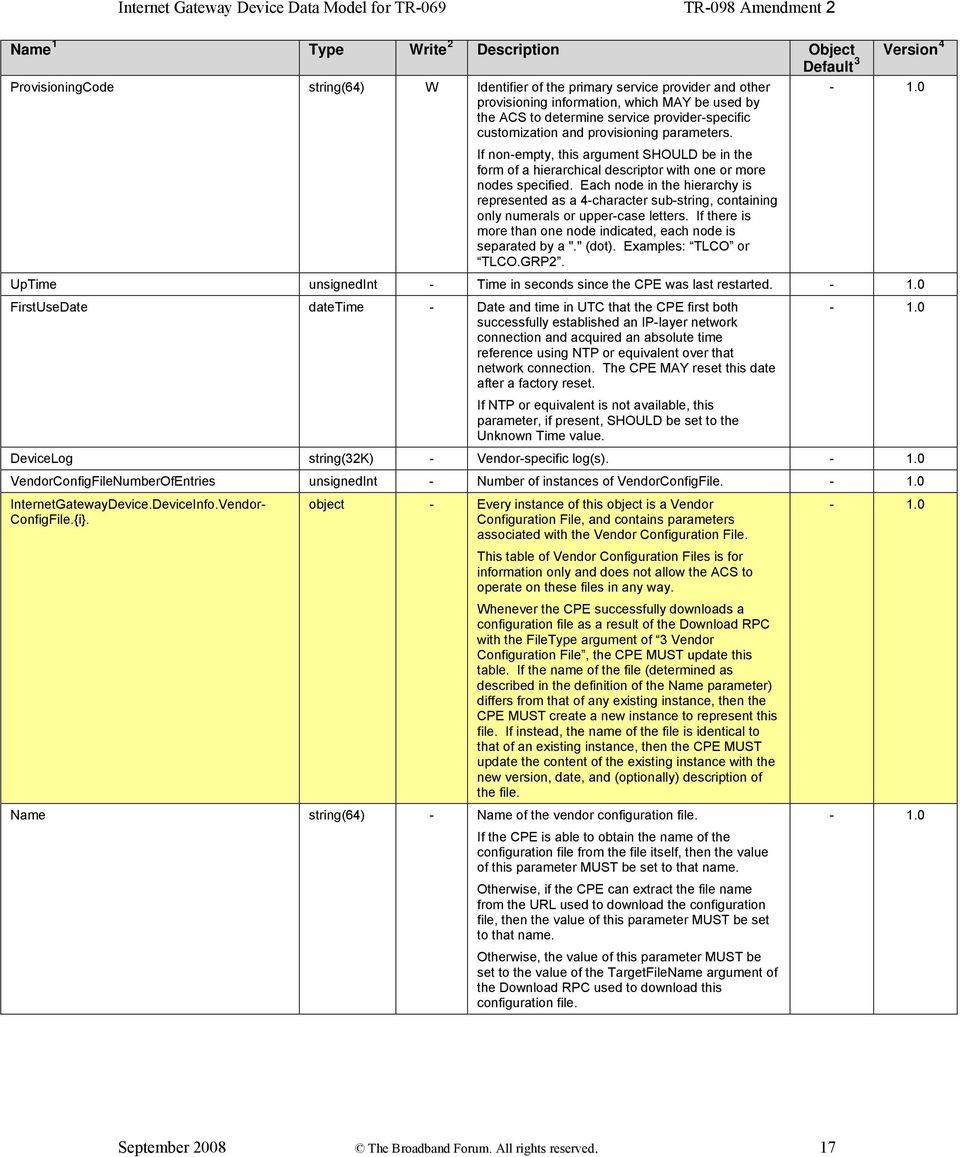
17 1 Name Internet Gateway Device Data Model for T-069 T-098 Amendment 2 Type 2 rite Description Object Default 3 4 Version ProvisioningCode string(64) Identifier of the primary service provider and other provisioning information, which MAY be used by the ACS to determine service provider-specific customization and provisioning parameters. If non-empty, this argument SHOULD be in the form of a hierarchical descriptor with one or more nodes specified. Each node in the hierarchy is represented as a 4-character sub-string, containing only numerals or upper-case letters. If there is more than one node indicated, each node is separated by a "." (dot). Examples: TLCO or TLCO.GP2. UpTime unsignedint - Time in seconds since the CPE was last restarted. FirstUseDate datetime - Date and time in UTC that the CPE first both successfully established an IP-layer network connection and acquired an absolute time reference using NTP or equivalent over that network connection. The CPE MAY reset this date after a factory reset. If NTP or equivalent is not available, this parameter, if present, SHOULD be set to the Unknown Time value. DeviceLog string(32k) - Vendor-specific log(s). VendorConfigFileNumberOfEntries unsignedint - Number of instances of VendorConfigFile. InternetGatewayDevice.DeviceInfo.Vendor- ConfigFile.{i}. object - Every instance of this object is a Vendor Configuration File, and contains parameters associated with the Vendor Configuration File. This table of Vendor Configuration Files is for information only and does not allow the ACS to operate on these files in any way. henever the CPE successfully downloads a configuration file as a result of the Download PC with the FileType argument of 3 Vendor Configuration File, the CPE MUST update this table. If the name of the file (determined as described in the definition of the Name parameter) differs from that of any existing instance, then the CPE MUST create a new instance to represent this file. If instead, the name of the file is identical to that of an existing instance, then the CPE MUST update the content of the existing instance with the new version, date, and (optionally) description of the file. Name string(64) - Name of the vendor configuration file. If the CPE is able to obtain the name of the configuration file from the file itself, then the value of this parameter MUST be set to that name. Otherwise, if the CPE can extract the file name from the UL used to download the configuration file, then the value of this parameter MUST be set to that name. Otherwise, the value of this parameter MUST be set to the value of the TargetFileName argument of the Download PC used to download this configuration file. September 2008 The Broadband Forum. All rights reserved. 17
18 1 Name Internet Gateway Device Data Model for T-069 T-098 Amendment 2 Type 2 rite Description Object Default 3 Version string(16) - A string identifying the configuration file version currently used in the CPE. If the CPE is able to obtain the version of the configuration file from the file itself, then the value of this parameter MUST be set to the obtained value. Otherwise, the value of this parameter MUST be empty. Date datetime - Date and time when the content of the current version of this vendor configuration file was first applied by the CPE. Description string(256) - A description of the vendor configuration file (human-readable string). InternetGatewayDevice.DeviceConfig. object - This object contains general configuration parameters. PersistentData string(256) Arbitrary user data that MUST persist across CPE reboots. ConfigFile string(32k) A dump of the currently running configuration on the CPE. This parameter enables the ability to backup and restore the last known good state of the CPE. It returns a vendor-specific document that defines the state of the CPE. The document MUST be capable of restoring the CPE s state when written back to the CPE using SetParameterValues. An alternative to this parameter, e.g. when the configuration file is larger than the parameter size limit, is to use the Upload and Download PCs with a FileType of 1 Vendor Configuration File. InternetGatewayDevice.ManagementServer. object - This object contains parameters relating to the CPE s association with an ACS. EnableCMP boolean Enables and disables the CPE s support for CMP. False means that CMP support in the CPE is disabled, in which case the device MUST NOT send any Inform messages to the ACS or accept any Connection equest notifications from the ACS. True means that CMP support on the CPE is enabled. The factory default value MUST be True. The subscriber can re-enable the CPE s CMP support either by performing a factory reset or by using a LAN-side protocol to change the value of this parameter back to True. UL string(256) UL, as defined in [8], for the CPE to connect to the ACS using the CPE AN Management Protocol. This parameter MUST be in the form of a valid HTTP or HTTPS UL [6]. The host portion of this UL is used by the CPE for validating the ACS certificate when using SSL or TLS. Note that on a factory reset of the CPE, the value of this parameter might be reset to its factory value. If an ACS modifies the value of this parameter, it SHOULD be prepared to accommodate the situation that the original value is restored as the result of a factory reset. 4 Version September 2008 The Broadband Forum. All rights reserved. 18

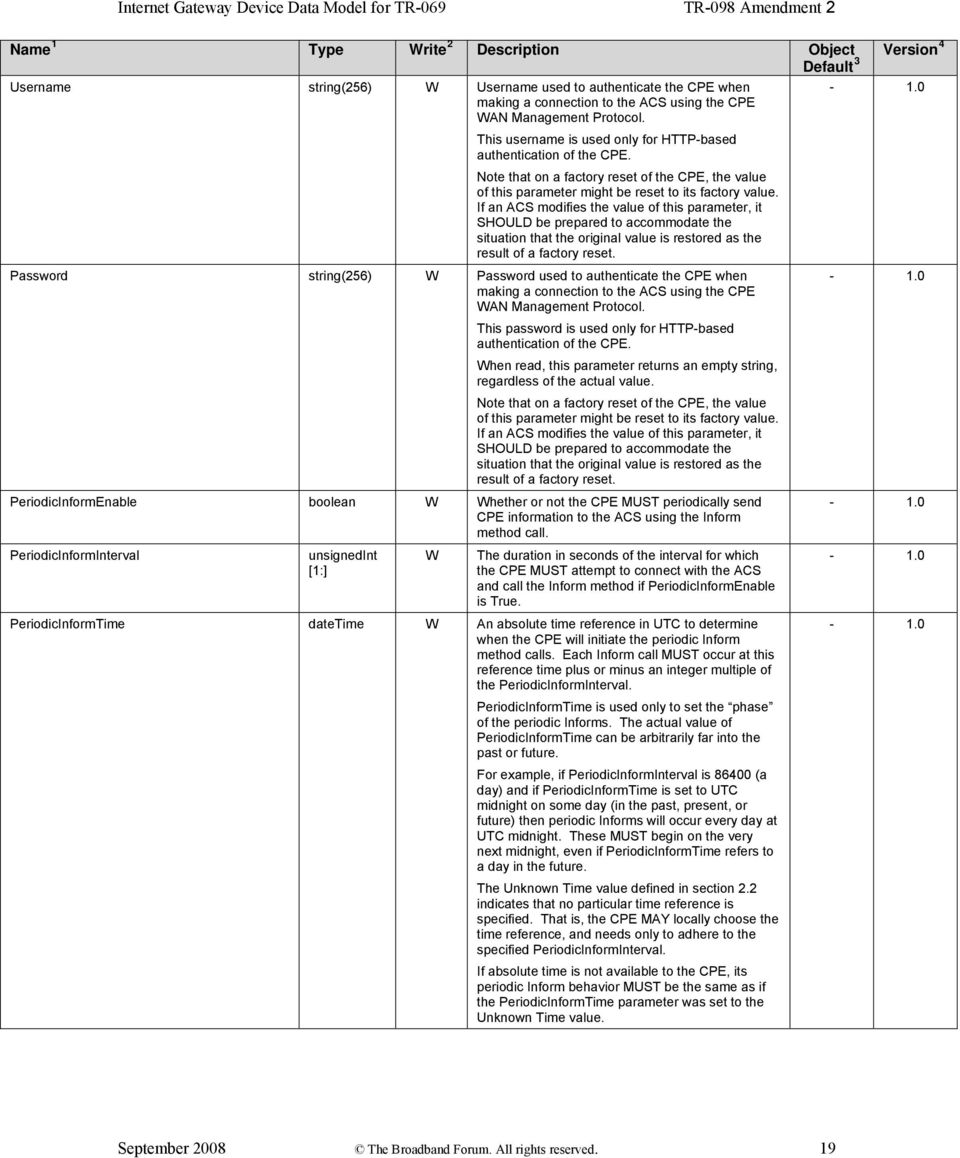
19 1 Name Internet Gateway Device Data Model for T-069 T-098 Amendment 2 Type 2 rite Description Object Default 3 Username string(256) Username used to authenticate the CPE when making a connection to the ACS using the CPE AN Management Protocol. This username is used only for HTTP-based authentication of the CPE. Note that on a factory reset of the CPE, the value of this parameter might be reset to its factory value. If an ACS modifies the value of this parameter, it SHOULD be prepared to accommodate the situation that the original value is restored as the result of a factory reset. Password string(256) Password used to authenticate the CPE when making a connection to the ACS using the CPE AN Management Protocol. This password is used only for HTTP-based authentication of the CPE. hen read, this parameter returns an empty string, regardless of the actual value. Note that on a factory reset of the CPE, the value of this parameter might be reset to its factory value. If an ACS modifies the value of this parameter, it SHOULD be prepared to accommodate the situation that the original value is restored as the result of a factory reset. PeriodicInformEnable boolean hether or not the CPE MUST periodically send CPE information to the ACS using the Inform method call. PeriodicInformInterval unsignedint [1:] The duration in seconds of the interval for which the CPE MUST attempt to connect with the ACS and call the Inform method if PeriodicInformEnable is True. PeriodicInformTime datetime An absolute time reference in UTC to determine when the CPE will initiate the periodic Inform method calls. Each Inform call MUST occur at this reference time plus or minus an integer multiple of the PeriodicInformInterval. PeriodicInformTime is used only to set the phase of the periodic Informs. The actual value of PeriodicInformTime can be arbitrarily far into the past or future. For example, if PeriodicInformInterval is (a day) and if PeriodicInformTime is set to UTC midnight on some day (in the past, present, or future) then periodic Informs will occur every day at UTC midnight. These MUST begin on the very next midnight, even if PeriodicInformTime refers to a day in the future. The Unknown Time value defined in section 2.2 indicates that no particular time reference is specified. That is, the CPE MAY locally choose the time reference, and needs only to adhere to the specified PeriodicInformInterval. If absolute time is not available to the CPE, its periodic Inform behavior MUST be the same as if the PeriodicInformTime parameter was set to the Unknown Time value. 4 Version September 2008 The Broadband Forum. All rights reserved. 19
20 1 Name Internet Gateway Device Data Model for T-069 T-098 Amendment 2 Type 2 rite Description Object Default 3 ParameterKey string(32) - ParameterKey provides the ACS a reliable and extensible means to track changes made by the ACS. The value of ParameterKey MUST be equal to the value of the ParameterKey argument from the most recent successful SetParameterValues, AddObject, or DeleteObject method call from the ACS. The CPE MUST set ParameterKey to the value specified in the corresponding method arguments if and only if the method completes successfully and no fault response is generated. If a method call does not complete successfully (implying that the changes requested in the method did not take effect), the value of ParameterKey MUST NOT be modified. The CPE MUST only modify the value of ParameterKey as a result of SetParameterValues, AddObject, DeleteObject, or due to a factory reset. On factory reset, the value of ParameterKey MUST be set to empty. ConnectionequestUL string(256) - HTTP UL, as defined in [8], for an ACS to make a Connection equest notification to the CPE. In the form: The host portion of the UL MAY be the IP address for the management interface of the CPE in lieu of a host name. ConnectionequestUsername string(256) Username used to authenticate an ACS making a Connection equest to the CPE. ConnectionequestPassword string(256) Password used to authenticate an ACS making a Connection equest to the CPE. hen read, this parameter returns an empty string, regardless of the actual value. UpgradesManaged boolean Indicates whether or not the ACS will manage upgrades for the CPE. If True, the CPE SHOULD NOT use other means other than the ACS to seek out available upgrades. If False, the CPE MAY use other means for this purpose. Note that an autonomous upgrade (reported via an "10 AUTONOMOUS TANSFE COMPLETE Inform Event code) SHOULD be regarded as a managed upgade if it is performed according to ACS-specified policy. KickUL string(256) - Present only for a CPE that supports the Kicked PC method. LAN-accessible UL, as defined in [8], from which the CPE can be kicked to initiate the Kicked PC method call. MUST be an absolute UL including a host name or IP address as would be used on the LAN side of the CPE. DownloadProgressUL string(256) - Present only for a CPE that provides a LAN-side web page to show progress during a file download. LAN-accessible UL, as defined in [8], to which a web-server associated with the ACS MAY redirect a user s browser on initiation of a file download to observer the status of the download. 4 Version September 2008 The Broadband Forum. All rights reserved. 20

21 Internet Gateway Device Data Model for T-069 T-098 Amendment 2 1 Name Type 2 rite Description Object Default 3 DefaultActiveNotificationThrottle unsignedint This parameter is used to control throttling of active notifications sent by the CPE to the ACS. It defines the minimum number of seconds that the CPE MUST wait since the end of the last session with the ACS before establishing a new session for the purpose of delivering an active notification. In other words, if CPE needs to establish a new session with the ACS for the sole purpose of delivering an active notification, it MUST delay establishing such a session as needed to ensure that the minimum time since the last session completion has been met. The time is counted since the last successfully completed session, regardless of whether or not it was used for active notifications or other purposes. However, if connection to the ACS is established for purposes other than just delivering active notifications, including for the purpose of retrying a failed session, such connection MUST NOT be delayed based on this parameter value, and the pending active notifications MUST be communicated during that connection. The time of the last session completion does not need to be tracked across reboots. UDPConnectionequestAddress string(256) - Address and port to which an ACS MAY send a UDP Connection equest to the CPE (see Annex G of [2]). This parameter is represented in the form of an Authority element as defined in [8]. The value MUST be in one of the following two forms: host:port host hen STUNEnable is True, the host and port portions of this parameter MUST represent the public address and port corresponding to the NAT binding through which the ACS can send UDP Connection equest messages (once this information is learned by the CPE through the use of STUN). hen STUNEnable is False, the host and port portions of the UL MUST represent the local IP address and port on which the CPE is listening for UDP Connection equest messages. The second form of this parameter MAY be used only if the port value is equal to 80. UDPConnectionequestAddressNotification- Limit unsignedint The minimum time, in seconds, between Active Notifications resulting from changes to the UDP- ConnectionequestAddress (if Active Notification is enabled). STUNEnable boolean Enables or disables the use of STUN by the CPE. This applies only to the use of STUN in association with the ACS to allow UDP Connection equests. STUNServerAddress string(256) Host name or IP address of the STUN server for the CPE to send Binding equests if STUN is enabled via STUNEnable. If empty and STUNEnable is True, the CPE MUST use the address of the ACS extracted from the host portion of the ACS UL. 4 Version September 2008 The Broadband Forum. All rights reserved. 21
22 1 Name STUNServerPort Internet Gateway Device Data Model for T-069 T-098 Amendment 2 Type unsignedint [0:65535] 2 rite Description Object Default 3 Port number of the STUN server for the CPE to send Binding equests if STUN is enabled via STUNEnable. By default, this SHOULD be the equal to the default STUN port, Version STUNUsername string(256) If non-empty, the value of the STUN USENAME attribute to be used in Binding equests (only if message integrity has been requested by the STUN server). If empty, the CPE MUST NOT send STUN Binding equests with message integrity. STUNPassword string(256) The value of the STUN Password to be used in computing the MESSAGE-INTEGITY attribute to be used in Binding equests (only if message integrity has been requested by the STUN server). hen read, this parameter returns an empty string, regardless of the actual value. STUNMaximumKeepAlivePeriod int[-1:] If STUN Is enabled, the maximum period, in seconds, that STUN Binding equests MUST be sent by the CPE for the purpose of maintaining the binding in the Gateway. This applies specifically to Binding equests sent from the UDP Connection equest address and port. A value of -1 indicates that no maximum period is specified. STUNMinimumKeepAlivePeriod unsignedint If STUN Is enabled, the minimum period, in seconds, that STUN Binding equests can be sent by the CPE for the purpose of maintaining the binding in the Gateway. This limit applies only to Binding equests sent from the UDP Connection equest address and port, and only those that do not contain the BINDING-CHANGE attribute. This limit does not apply to retransmissions following the procedures defined in [9]. NATDetected boolean - hen STUN is enabled, this parameter indicates whether or not the CPE has detected address and/or port mapping in use. A True value indicates that the received MAPPED- ADDESS in the most recent Binding esponse differs from the CPE s source address and port. hen STUNEnable is False, this value MUST be False. ManageableDeviceNumberOfEntries unsignedint - Number of entries in the ManageableDevice table ManageableDeviceNotificationLimit unsignedint The minimum time, in seconds, between Active Notifications resulting from changes to the ManageableDeviceNumberOfEntries (if Active Notification is enabled) InternetGatewayDevice.ManagementServer.- ManageableDevice.{i}. object - Each entry in this table corresponds to a distinct LAN Device that supports Device-Gateway Association according to Annex F of [2] as indicated by the presence of the DHCP option specified in that Annex. ManufacturerOUI string(6) - Organizationally unique identifier of the Device manufacturer as provided to the Gateway by the Device. epresented as a six hexadecimal-digit value using all upper-case letters and including any leading zeros. The value MUST be a valid OUI as defined in [5]. SerialNumber string(64) - Serial number of the Device as provided to the Gateway by the Device September 2008 The Broadband Forum. All rights reserved. 22
23 1 Name Internet Gateway Device Data Model for T-069 T-098 Amendment 2 Type 2 rite Description Object Default 3 4 Version ProductClass string(64) - Identifier of the class of product for which the Device s serial number applies as provided to the Gateway by the Device. If the Device does not provide a Product Class, then this parameter MUST be left empty. Host string(1024) - Comma-separated list of the full path names of all Host table entries, whether active or inactive, that correspond to this physical LAN Device. As such entries are added to or removed from the Host tables, the value of this parameter MUST be updated accordingly. For example: InternetGatewayDevice.LANDevice.1.Hosts. Host.1,InternetGatewayDevice.LANDevice.1. Hosts.Host.5 InternetGatewayDevice.Time. object - This object contains parameters relating an NTP or SNTP time client in the CPE. Enable boolean Enables or disables the NTP or SNTP time client. Status string - Status of Time support on the CPE. Enumeration of: Disabled Unsynchronized Synchronized Error_FailedToSynchronize Error (OPTIONAL) The Unsynchronized value indicates that the CPE s absolute time has not yet been set. The Synchronized value indicates that the CPE has acquired accurate absolute time; its current time is accurate. The Error_FailedToSynchronize value indicates that the CPE failed to acquire accurate absolute time; its current time is not accurate. The Error value MAY be used by the CPE to indicate a locally defined error condition. NTPServer1 string(64) First NTP timeserver. Either a host name or IP address. NTPServer2 string(64) Second NTP timeserver. Either a host name or IP address. NTPServer3 string(64) Third NTP timeserver. Either a host name or IP address. NTPServer4 string(64) Fourth NTP timeserver. Either a host name or IP address. NTPServer5 string(64) Fifth NTP timeserver. Either a host name or IP address. CurrentLocalTime datetime - The current date and time in the CPE s local time zone. September 2008 The Broadband Forum. All rights reserved. 23
24 1 Name Internet Gateway Device Data Model for T-069 T-098 Amendment 2 Type 2 rite Description Object Default 3 LocalTimeZone string(6) The local time zone offset from UTC, ignoring daylight savings time adjustments, in the form: +hh:mm -hh:mm For example, this will always be -08:00 for California, +00:00 or -00:00 for the United Kingdom, and +01:00 for France. This parameter is OBSOLETED because the information that it represents is fully covered by LocalTimeZoneName. LocalTimeZoneName string(64) Name of the local time zone (human readable string). The name SHOULD be encoded according to IEEE (POSIX). The following is an example value: EST+5EDT,M4.1.0/2,M10.5.0/2 DaylightSavingsUsed boolean hether or not daylight savings time is in use in the CPE s local time zone. This parameter is OBSOLETED because the information that it represents is fully covered by LocalTimeZoneName. DaylightSavingsStart datetime Current local date and time at which the switch to daylight savings time occurs. If daylight savings time is not used, this value is ignored. This parameter is OBSOLETED because the information that it represents is fully covered by LocalTimeZoneName. DaylightSavingsEnd datetime Current local date and time at which the switch from daylight savings time will occur. If daylight savings time is not used, this value is ignored. This parameter is OBSOLETED because the information that it represents is fully covered by LocalTimeZoneName. InternetGatewayDevice.UserInterface. object - This object contains parameters relating to the user interface of the CPE. UserDatabaseSupported boolean - Present only if the CPE provides a passwordprotected LAN-side user interface. Indicates whether or not the CPE supports a user database that provides per-user passwords that can be used for accessing the local user interface. SharedPassword boolean Present only if the CPE provides a passwordprotected LAN-side user interface. Indicates whether or not a single shared password MUST protect the local user interface, or whether per-user passwords can be used. If either UserDatabaseSupported or Password- UserSelectable is False, the CPE MUST ignore the value of this parameter. Passwordequired boolean Present only if the CPE provides a passwordprotected LAN-side user interface. Indicates whether or not the local user interface MUST require a password to be chosen by the user. If False, the choice of whether or not a password is used is left to the user. 4 Version September 2008 The Broadband Forum. All rights reserved. 24
25 1 Name Internet Gateway Device Data Model for T-069 T-098 Amendment 2 Type 2 rite Description Object Default 3 4 Version PasswordUserSelectable boolean Present only if the CPE provides a passwordprotected LAN-side user interface and supports LAN-side Auto-Configuration. Indicates whether or not a password to protect the local user interface of the CPE MAY be selected by the user directly, or MUST be equal to the password used by the LAN-side Auto-Configuration protocol. UpgradeAvailable boolean Indicates that a CPE upgrade is available, allowing the CPE to display this information to the user. arrantydate datetime Indicates the date and time in UTC that the warranty associated with the CPE is to expire. ISPName string(64) The name of the customer s ISP. ISPHelpDesk string(32) The help desk phone number of the ISP. ISPHomePage string(256) The UL of the ISP s home page. ISPHelpPage string(256) The UL of the ISP s on-line support page. ISPLogo ISPLogoSize base64 (5460) unsignedint [0:4095] Base64 encoded GIF or JPEG image. The binary image is constrained to 4095 bytes or less. Un-encoded binary image size in bytes. If ISPLogoSize input value is 0 then the ISPLogo is cleared. ISPLogoSize can also be used as a check to verify correct transfer and conversion of Base64 string to image size. ISPMailServer string(256) The UL of the ISP s mail server. ISPNewsServer string(256) The UL of the ISP s news server. TextColor string(6) The color of text on the GUI screens in GB hexidecimal notation (e.g., FF0088). BackgroundColor string(6) The color of the GUI screen backgrounds in GB hexidecimal notation (e.g., FF0088). ButtonColor string(6) The color of buttons on the GUI screens in GB hexidecimal notation (e.g., FF0088). ButtonTextColor string(6) The color of text on buttons on the GUI screens in GB hexidecimal notation (e.g., FF0088). AutoUpdateServer string(256) The server the CPE can check to see if an update is available for direct download to it. This MUST NOT be used by the CPE if the InternetGateway- Device.ManagementServer.UpgradesManaged parameter is True. UserUpdateServer string(256) The server where a user can check via a web browser if an update is available for download to a PC. This MUST NOT be used by the CPE if the InternetGatewayDevice.ManagementServer.- UpgradesManaged parameter is True. ExampleLogin string(40) An example of a correct login, according to ISPspecific rules. ExamplePassword string(30) An example of a correct password, according to ISP-specific rules. AvailableLanguages string(256) - Comma-separated list of user-interface languages that are available, where each language is specified according to FC 3066 [40]. CurrentLanguage string(16) Current user-interface language, specified according to FC 3066 [40]. September 2008 The Broadband Forum. All rights reserved. 25
26 1 Name Internet Gateway Device Data Model for T-069 T-098 Amendment 2 Type 2 rite Description Object Default 3 InternetGatewayDevice.CaptivePortal. object - This object contains parameters relating to the captive portal configuration on the CPE. The captive portal configuration defines the CPE s AN-destined HTTP (port 80) traffic redirect behavior. hen the captive portal is disabled, AN-destined HTTP (port 80) traffic MUST be permitted to all destinations. hen the captive portal is enabled, AN-destined HTTP (port 80) traffic MUST be permitted only to destinations listed in the AllowedList; traffic to all other destinations MUST be redirected to the CaptivePortalUL. 4 Version Enable boolean Enables or disables the captive portal. Status string - Indicates the status of the captive portal. Enumeration of: AllowedList string (10000) Disabled Enabled Error_ULEmpty (CaptivePortalUL is empty) Error (OPTIONAL) The Error value MAY be used by the CPE to indicate a locally defined error condition. Comma-separated list of IP addresses to which HTTP (port 80) traffic MUST always be permitted, regardless of whether the captive portal is enabled. Each entry in the list MUST be either an IP address or an IP subnet specified using variable length subnet mask (VLSM) syntax. An IP subnet is specified as an IP address followed (with no intervening white space) by /n, where n is an integer in the range 0-32; this is equivalent to a subnet mask consisting of n 1s followed by 32 minus n 0s. For example, specifies a single IP address, and /24 specifies a class C subnet with subnet mask The maximum length of a single entry (plus comma) is 19 characters so bytes is sufficient for more than 500 IP addresses and/or IP subnets. CaptivePortalUL string(2000) Captive portal UL to which AN-destined HTTP (port 80) traffic to destinations not listed in the AllowedList will be redirected. The captive portal UL MUST be an HTTP (not HTTPS) UL. The CPE MUST permit the captive portal UL to be set to an empty string, which has the effect of disabling the captive portal (if Enable is True and the captive portal UL is an empty string, Status MUST be Error_ULEmpty ). InternetGatewayDevice.Layer3Forwarding. object - This object allows the handling of the routing and forwarding configuration of the device. DefaultConnectionService string(256) Specifies the default AN interface. The content is the full hierarchical parameter name of the default layer 3 connection object. Example: InternetGatewayDevice.ANDevice.1.AN- ConnectionDevice.2.ANPPPConnection.1. September 2008 The Broadband Forum. All rights reserved. 26
27 1 Name Internet Gateway Device Data Model for T-069 T-098 Amendment 2 Type 2 rite Description Object Default 3 ForwardNumberOfEntries unsignedint - Number of forwarding instances. InternetGatewayDevice.Layer3Forwarding.- Forwarding.{i}. object Layer 3 forwarding table. In addition to statically configured routes, this table MUST include dynamic routes learned through layer 3 routing protocols, including IP, OSPF, DHCP, and IPCP. The CPE MAY reject attempts to delete or modify a dynamic route entry. For each incoming packet, the layer 3 forwarding decision is conceptually made as follows: Only table entries with a matching ForwardingPolicy are considered, i.e. those that either do not specify a ForwardingPolicy, or else specify a ForwardingPolicy that matches that of the incoming packet. For the remaining table entries, those for which the source address/mask matches are sorted by longest prefix, i.e. with the most specific networks first (an unspecified source address is a wild-card and always matches, with a prefix length of zero). For the remaining table entries, those for which the destination address/mask matches are sorted by longest prefix, i.e. with the most specific networks first (an unspecified destination address is a wildcard and always matches, with a prefix length of zero). The first of the remaining table entries is applied to the packet. 4 Version Enable boolean Enables or disables the forwarding entry. On creation, an entry is disabled by default. Status string - Indicates the status of the forwarding entry. Enumeration of: False 1.0 Disabled 1.0 Disabled Enabled Error (OPTIONAL) The Error value MAY be used by the CPE to indicate a locally defined error condition. Staticoute boolean - If True, this route is a Static route. True 1.4 Type string Indicates the type of route. Enumeration of: Host 1.0 Default Network Host This parameter is DEPECATED because its value could conflict with DestIPAddress and/or DestSubnetMask. DestIPAddress string Destination address. An empty string or a value of <Empty> indicates no destination address is specified. A Forwarding table entry for which DestIPAddress and DestSubnetMask are both empty or is a default route. September 2008 The Broadband Forum. All rights reserved. 27
28 1 Name Internet Gateway Device Data Model for T-069 T-098 Amendment 2 Type 2 rite Description Object Default 3 DestSubnetMask string Destination subnet mask. An empty string or a value of indicates no destination subnet mask is specified. If a destination subnet mask is specified, the DestSubnetMask is ANDed with the destination address before comparing with the DestIPAddress. Otherwise, the full destination address is used as is. A Forwarding table entry for which DestIPAddress and DestSubnetMask are both empty or is a default route. SourceIPAddress string Source address. An empty string or a value of indicates no source address is specified. SourceSubnetMask string Source subnet mask. An empty string or a value of indicates no source subnet mask is specified. If a source subnet mask is specified, the SourceSubnetMask is ANDed with the source address before comparing with the SourceIPAddress. Otherwise, the full source address is used as is. ForwardingPolicy int[-1:] Identifier of a set of classes or flows that have the corresponding ForwardingPolicy value as defined in the QueueManagement object. A value of -1 indicates no ForwardingPolicy is specified. If specified, this forwarding entry is to apply only to traffic associated with the specified classes and flows. GatewayIPAddress string IP address of the gateway. Only one of GatewayIPAddress and Interface SHOULD be configured for a route. If both are configured, GatewayIPAddress and Interface MUST be consistent with each other. Interface string(256) Specifies the egress interface associated with this entry. The content is the full hierarchical parameter name of the layer 3 connection object. Example: InternetGatewayDevice.ANDevice.1.AN- ConnectionDevice.2.ANPPPConnection.1. Only one of GatewayIPAddress and Interface SHOULD be configured for a route. If both are configured, GatewayIPAddress and Interface MUST be consistent with each other. For a route that was configured by setting GatewayIPAddress but not Interface, read access to Interface MUST return the full hierarchical parameter name for the route s egress interface. ForwardingMetric int[-1:] Forwarding metric. A value of -1 indicates this metric is not used. MTU unsignedint [1:1540] The maximum allowed size of an Ethernet frame for this route. 4 Version <Empty> 1.0 <Empty> 1.0 <Empty> <Empty> September 2008 The Broadband Forum. All rights reserved. 28
29 1 Name Internet Gateway Device Data Model for T-069 T-098 Amendment 2 Type 2 rite Description Object Default 3 InternetGatewayDevice.Layer2Bridging. object - Layer 2 bridging configuration. Specifies bridges between layer 2 LAN and/or AN interfaces. Bridges can be defined to include layer 2 filter criteria to selectively bridge traffic between interfaces. This object can be used to configure both 802.1D [13] and 802.1Q [14] bridges. Not all 802.1D and 802.1Q features are modeled, and some additional features not present in either 802.1D or 802.1Q are modeled. If the Layer2Bridging object is implemented, the view that it provides of the CPE s underlying bridging configuration MUST be consistent with the view provided by any LANDevice and AN**Connection objects. The implications of this are explained in Annex A.6. MaxBridgeEntries unsignedint - The maximum number of entries available in the Bridge table. 4 Version MaxDBridgeEntries unsignedint - The maximum number of 802.1D [13] entries available in the Bridge table. A positive value for this parameter implies support for 802.1D. There is no guarantee that this many 802.1D Bridges can be configured. For example, the CPE might not be able simultaneously to support both 802.1D and 802.1Q Bridges. MaxQBridgeEntries unsignedint - The maximum number of 802.1Q [14] entries available in the Bridge table. A positive value for this parameter implies support for 802.1Q. There is no guarantee that this many 802.1Q Bridges can be configured. For example, the CPE might not be able simultaneously to support both 802.1D and 802.1Q Bridges. MaxVLANEntries unsignedint - The maximum number of 802.1Q [14] VLANs supported per Bridge table entry. MaxFilterEntries unsignedint - The maximum number of entries available in the Filter table. MaxMarkingEntries unsignedint - The maximum number of entries available in the Marking table. BridgeNumberOfEntries unsignedint - Number of entries in the Bridge table FilterNumberOfEntries unsignedint - Number of entries in the Filter table MarkingNumberOfEntries unsignedint - Number of entries in the Marking table AvailableInterfaceNumberOfEntries unsignedint - Number of entries in the AvailableInterface table InternetGatewayDevice.Layer2Bridging.- Bridge.{i}. object Bridge table. Each entry in this table represents a single physical 802.1D [13] or 802.1Q [14] bridge. If the Bridge Port table is supported, it explicitly defines the Bridge s interfaces. Otherwise, they are implicitly defined via the union of the Filter- Interface / MarkingInterface parameters for all the Filter and Marking table entries that are associated with the Bridge BridgeKey unsignedint - Unique key for each Bridge table entry BridgeStandard boolean Selects the standard supported by this Bridge table 802.1D 1.4 entry. Enumeration of: 802.1D ([13]) 802.1Q ([14]) BridgeEnable boolean Enables or disables this Bridge table entry. False 1.1 September 2008 The Broadband Forum. All rights reserved. 29
30 1 Name Internet Gateway Device Data Model for T-069 T-098 Amendment 2 Type 2 rite Description Object Default 3 4 Version BridgeStatus string - The status of this Bridge table entry. Enumeration Disabled 1.1 of: Disabled Enabled Error (OPTIONAL) The Error value MAY be used by the CPE to indicate a locally defined error condition. BridgeName string(64) Human-readable name for this Bridge table entry. <Empty> 1.1 VLANID unsignedint For an 802.1D [13] Bridge, which has no concept of [0:4094] VLANs, the value of this parameter MUST be 0. For an 802.1Q [14] Bridge, this is the Bridge s default VLAN ID, i.e. the VLAN ID that applies to Filter table entries with VLANIDFilter=-1. For an 802.1Q Bridge, the value of this parameter MUST NOT be 0. PortNumberOfEntries unsignedint - Number of entries in the Bridge Port table VLANNumberOfEntries unsignedint - Number of entries in the Bridge VLAN table InternetGatewayDevice.Layer2Bridging.- Bridge.{i}.Port.{i}. object Bridge Port table. If this table is supported, it MUST contain an entry for each Bridge Port. PortEnable boolean Enables or disables this Bridge Port table entry. False 1.4 PortInterface string(16) The interface associated with this Bridge Port table <Empty> 1.4 entry. epresents a bridge port as defined in 802.1D [13] and 802.1Q [14]. To associate this Bridge Port with an interface listed in the AvailableInterface table, the Port- Interface value is set to the value of the corresponding AvailableInterfaceKey. PortState string - Bridge Port state as defined in 802.1D [13] and Disabled Q [14]. Enumeration of: Disabled Blocking Listening Learning Forwarding Broken PVID int[1:4094] Default Port VLAN ID as defined in 802.1Q [14] For an 802.1D [13] Bridge, this parameter MUST be ignored. AcceptableFrameTypes string Bridge Port acceptable frame types as defined in AdmitAll Q [14]. Enumeration of: AdmitAll AdmitOnlyVLANTagged (OPTIONAL) "AdmitOnlyPrioUntagged" (OPTIONAL) For an 802.1D [13] Bridge, the value of this parameter MUST be AdmitAll. IngressFiltering boolean Enables or disables Ingress Filtering as defined in False Q [14]. For an 802.1D [13] Bridge, the value of this parameter MUST be False. InternetGatewayDevice.Layer2Bridging.- Bridge.{i}.VLAN.{i}. object Bridge VLAN table. If this table is supported, if MUST contain an entry for each VLAN known to the Bridge. This table only applies to an 802.1Q [14] Bridge. September 2008 The Broadband Forum. All rights reserved. 30
31 1 Name Internet Gateway Device Data Model for T-069 T-098 Amendment 2 Type 2 rite Description Object Default 3 VLANEnable boolean Enables or disables this VLAN table entry. False 1.4 VLANName string(64) Human-readable name for this VLAN table entry. <Empty> 1.4 VLANID int[1:4094] VLAN ID of the entry, InternetGatewayDevice.Layer2Bridging.Filter.- {i}. object Filter table containing filter entries each of which is associated with one Bridge as specified by a Bridge table entry. For both 802.1D [13] and 802.1Q [14] Bridges, this table is used for the following: 1. If the Bridge Port table is not supported, it implicitly specifies the Bridge interfaces (in collaboration with the Marking table). 2. It specifies destination MAC address classification rules. For an 802.1Q Bridge, this table is also used for the following: 1. For each VLAN ID, it specifies the interfaces that are in the VLAN s Member Set. 2. If the Bridge Port table is not supported, it specifies the Port VLAN ID (PVID) for each interface. This table also supports several concepts that are not covered by either 802.1D or 802.1Q: 1. It allows a given packet to be admitted to multiple Bridges. 2. It supports Ethertype and source MAC address classification rules. 4 Version FilterKey unsignedint - Unique key for each Filter table entry FilterEnable boolean Enables or disables this Filter table entry. False 1.1 FilterStatus string - The status of this Filter table entry. Enumeration Disabled 1.1 of: Disabled Enabled Error (OPTIONAL) The Error value MAY be used by the CPE to indicate a locally defined error condition. If the Bridge Port table is supported, but none of its entries correspond to FilterInterface, or if such an entry exists but is disabled, FilterStatus MUST NOT indicate Enabled. If the Bridge VLAN table is supported, but none of its entries correspond to VLANIDFilter, or if such an entry exists but is disabled, FilterStatus MUST NOT indicate Enabled. FilterBridgeeference int[-1:] The BridgeKey value of the Bridge table entry associated with this Filter. A value of -1 indicates the Filter table entry is not associated with a Bridge (and has no effect) September 2008 The Broadband Forum. All rights reserved. 31
32 1 Name Internet Gateway Device Data Model for T-069 T-098 Amendment 2 Type 2 rite Description Object Default 3 ExclusivityOrder unsignedint hether or not the Filter definition is exclusive of all others. And if the entry is exclusive, order of precedence. A value of 1 or greater indicates an Exclusive Filter, where the value 1 indicates the first entry to be considered (highest precedence). A value of 0 indicates a Non-Exclusive Filter (OPTIONAL). For each packet, if the packet matches any Exclusive Filters, the packet is assigned to the Bridge associated with the highest precedence Exclusive Filter to which it matches (lowest ExclusivityOrder value). If and only if the packet does not match any Exclusive Filters, the packet is assigned to all Bridges associated with each Non-Exclusive Filter for which it matches the defining criteria. If a packet matches no Filter, it is discarded. hen the ExclusivityOrder is set to match that of an existing Exclusive Filter (1 or greater), the value for the existing entry and all higher numbered entries is incremented (lowered in precedence) to ensure uniqueness of this value. A deletion or change in ExclusivityOrder of an Exclusive Filter causes ExclusivityOrder values of other Exclusive Filters (values 1 or greater) to be compacted. Note that the use of Exclusive Filters to associate a layer 3 router interface with LAN and/or AN interfaces via a Bridge entry overrides and updates the association between layer 3 and layer 2 objects implied by the InternetGatewayDevice object hierarchy. Support for Non-Exclusive Filter entries, i.e. entries with an ExclusivityOrder value of 0, is OPTIONAL because 802.1D [13] and 802.1Q [14] do not consider the case of a packet potentially being admitted to more than one bridge. 4 Version September 2008 The Broadband Forum. All rights reserved. 32
33 1 Name Internet Gateway Device Data Model for T-069 T-098 Amendment 2 Type 2 rite Description Object Default 3 FilterInterface string(16) The interface or interfaces associated with this Filter table entry. The bridge corresponding to this Filter table entry is defined to admit packets on ingress to the bridge from the specified interfaces that meet all of the criteria specified in the Filter table entry. The following values are defined. To associate this Filter with a single interface listed in the AvailableInterface table, the FilterInterface value is set to the value of the corresponding AvailableInterfaceKey. AllInterfaces indicates that this Filter is associated with all LAN and AN interfaces listed in the AvailableInterface table (all entries of InterfaceType LANInterface or ANInterface). This value is DEPECATED because of the configuration complexity it requires. LANInterfaces indicates that this Filter is associated with all LAN interfaces listed in the AvailableInterface table (all entries of InterfaceType LANInterface). This value is DEPECATED because of the configuration complexity it requires. ANInterfaces indicates that this Filter is associated with all AN interfaces listed in the AvailableInterface table (all entries of InterfaceType ANInterface). This value is DEPECATED because of the configuration complexity it requires. An empty string indicates the Filter table entry is not associated with any interface (and has no effect) VLANIDFilter int[-1:4094] The 802.1Q [14] VLAN ID associated with this Filter table entry. A value of -1 indicates that the default VLAN ID for the Bridge MUST be used instead (as specified by InternetGatewayDevice.Layer2Bridging.Bridge.{i}.- VLANID for the Bridge table entry associated with this Filter table entry). For an 802.1Q bridge, the value of this parameter MUST NOT be 0, and it is interpreted as follows (more than one condition can apply, e.g. a single Filter table entry might both add an interface to a VLAN s Member Set, and define a classification rule). 1. If the Bridge Port table is not supported, it is a candidate to be the 802.1Q Port VLAN ID (PVID) for the interface associated with this Filter. here there is more than one such candidate for a given interface, the PVID MUST be selected according to the ExclusivityOrder precedence rules. 2. The interface associated with this Filter is added to the VLAN s 802.1Q Member Set. 3. If a classification parameter, e.g. DestMACAddressFilterList, is specified, a classification rule for this VLAN ID is added. For an 802.1D [13] Bridge, which has no concept of VLANs, the VLAN ID MUST be 0. This is most easily achieved by allowing this parameter to retain its default value of -1 and relying on the fact that the default VLAN ID for an 802.1D bridge will always be 0. 4 Version <Empty> September 2008 The Broadband Forum. All rights reserved. 33
34 1 Name Internet Gateway Device Data Model for T-069 T-098 Amendment 2 Type 2 rite Description Object Default 3 AdmitOnlyVLANTagged boolean 802.1Q [14] Acceptable Frame Types criterion. This parameter is DEPECATED, because it only partly models 802.1Q Acceptable Frame Types (and Ingress Filtering). The Bridge Port table SHOULD be used instead and, if supported, MUST take precedence over this parameter. If True, the Bridge admits only packets tagged with VLAN IDs that include the ingress interface in their 802.1Q Member Sets. If False, the Bridge admits both packets tagged with VLAN IDs that include the ingress interface in their 802.1Q Member Sets, and any Untagged or PriorityOnly packets. All Untagged or PriorityOnly packets are associated on ingress with the interface s Port VLAN ID (PVID). See the description of VLANIDFilter for an explanation of how the Member Set and PVID are determined. If more than one Filter table entry is associated with a given interface, the value of AdmitOnly- VLANTagged MUST be the same for all such entries. For an 802.1D [13] Bridge, which has no concept of VLANs, the value of this parameter MUST be False. EthertypeFilterList string(256) Classification criterion. Comma-separated list of unsigned integers, each representing an Ethertype value. Note that neither 802.1D [13] nor 802.1Q [14] support classification based on Ethertype. EthertypeFilterExclude boolean If False, on ingress to the interfaces associated with this Filter, the Bridge is defined to admit only those packets that match one of the Ethertype- FilterList entries (in either the Ethernet or SNAP Type header). If the EthertypeFilterList is empty, no packets are admitted. If True, on ingress to the interfaces associated with this Filter, the Bridge is defined to admit all packets except those packets that match one of the EthertypeFilterList entries (in either the Ethernet or SNAP Type header). If the EthertypeFilterList is empty, packets are admitted regardless of Ethertype. Note that neither 802.1D [13] nor 802.1Q [14] support classification based on Ethertype. SourceMACAddressFilterList string(512) Classification criterion. Comma-separated list of MAC Addresses. Each list entry MAY optionally specify a bit-mask, where matching of a packet s MAC address is only to be done for bit positions set to one in the mask. If no mask is specified, all bits of the MAC Address are to be used for matching. For example, the list might be: 01:02:03:04:05:06, 1:22:33:00:00:00/FF:FF:FF:00:00:00, 88:77:66:55:44:33 Note that neither 802.1D [13] nor 802.1Q [14] support classification based on source MAC address. 4 Version False 1.1 <Empty> 1.1 True 1.1 <Empty> 1.1 September 2008 The Broadband Forum. All rights reserved. 34
35 1 Name Internet Gateway Device Data Model for T-069 T-098 Amendment 2 Type 2 rite Description Object Default 3 SourceMACAddressFilterExclude boolean If False, on ingress to the interfaces associated with this Filter, the Bridge admits only those packets whose source MAC Address matches one of the SourceMACAddressFilterList entries. If the SourceMACAddressFilterList is empty, no packets are admitted. If True, on ingress to the interfaces associated with this Filter, the Bridge admits all packets except those packets whose source MAC Address matches one of the SourceMACAddressFilterList entries. If the SourceMACAddressFilterList is empty, packets are admitted regardless of MAC address. Note that neither 802.1D [13] nor 802.1Q [14] support classification based on source MAC address. DestMACAddressFilterList string(512) Classification criterion. Comma-separated list of MAC Addresses. Each list entry MAY optionally specify a bit-mask, where matching of a packet s MAC address is only to be done for bit positions set to one in the mask. If no mask is specified, all bits of the MAC Address are to be used for matching. For example, the list might be: 01:02:03:04:05:06, 1:22:33:00:00:00/FF:FF:FF:00:00:00, 88:77:66:55:44:33 DestMACAddressFilterExclude boolean If False, on ingress to the interfaces associated with this Filter, the Bridge admits only those packets whose destination MAC Address matches one of the DestMACAddressFilterList entries. If the DestMACAddressFilterList is empty, no packets are admitted. If True, on ingress to the interfaces associated with this Filter, the Bridge admits all packets except those packets whose destination MAC Address matches one of the DestMACAddressFilterList entries. If the ANSourceMACAddressFilterList is empty, packets are admitted regardless of MAC address. SourceMACFromVendorClassIDFilter string(256) Classification criterion. A string used to identify one or more devices via DHCP for which MAC address filtering would subsequently apply. A device is considered matching if its DHCP Vendor Class Identifier (Option 60 as defined in FC 2132 [28]) in the most recent DHCP lease acquisition or renewal matches the specified value according to the match criterion in SourceMACFromVendorClassIDMode. Case sensitive. Note that neither 802.1D [13] nor 802.1Q [14] support classification based on source MAC address. 4 Version True 1.1 <Empty> 1.1 True 1.1 <Empty> 1.1 September 2008 The Broadband Forum. All rights reserved. 35
36 1 Name Internet Gateway Device Data Model for T-069 T-098 Amendment 2 Type 2 rite Description Object Default 3 SourceMACFromVendorClassIDFilterExclude boolean If False, on ingress to the interfaces associated with this Filter, the Bridge admits only those packets whose source MAC Address matches that of a LAN device previously identified as described in SourceMACFromVendorClassIDFilter. If SourceMACFromVendorClassIDFilter is empty, no packets are admitted. If True, on ingress to the interfaces associated with this Filter, the Bridge admits all packets except those packets whose source MAC Address matches that of a LAN device previously identified as described in SourceMACFromVendorClassID- Filter. If the SourceMACFromVendorClassIDFilter is empty, packets are admitted regardless of MAC address. Note that neither 802.1D [13] nor 802.1Q [14] support classification based on source MAC address. SourceMACFromVendorClassIDMode string SourceMACFromVendorClassIDFilter pattern match criterion. Enumeration of: Exact Prefix Suffix Substring For example, if SourceMACFromVendorClassID- Filter is Example then an Option 60 value of Example device will match with SourceMACFrom- VendorClassIDMode values of Prefix or Substring, but not with Exact or Suffix. Note that neither 802.1D [13] nor 802.1Q [14] support classification based on source MAC address. DestMACFromVendorClassIDFilter string(256) Classification criterion. A string used to identify one or more devices via DHCP for which MAC address filtering would subsequently apply. A device is considered matching if its DHCP Vendor Class Identifier (Option 60 as defined in FC 2132 [28]) in the most recent DHCP lease acquisition or renewal matches the specified value according to the match criterion in DestMACFromVendorClassIDMode. Case sensitive. DestMACFromVendorClassIDFilterExclude boolean If False, on ingress to the interfaces associated with this Filter, the Bridge admits only those packets whose destination MAC Address matches that of a LAN device previously identified as described in DestMACFromVendorClassIDFilter. If DestMACFromVendorClassIDFilter is empty, no packets are admitted. If True, on ingress to the interfaces associated with this Filter, the Bridge admits all packets except those packets whose destination MAC Address matches that of a LAN device previously identified as described in DestMACFromVendorClassID- Filter. If the DestMACFromVendorClassIDFilter is empty, packets are admitted regardless of MAC address. 4 Version True 1.1 Exact 1.4 <Empty> 1.1 True 1.1 September 2008 The Broadband Forum. All rights reserved. 36
37 1 Name Internet Gateway Device Data Model for T-069 T-098 Amendment 2 Type 2 rite Description Object Default 3 DestMACFromVendorClassIDMode string DestMACFromVendorClassIDFilter pattern match criterion. Enumeration of: Exact Prefix Suffix Substring For example, if DestMACFromVendorClassIDFilter is Example then an Option 60 value of Example device will match with DestMACFromVendor- ClassIDMode values of Prefix or Substring, but not with Exact or Suffix. SourceMACFromClientIDFilter string(256) Classification criterion. A string used to identify one or more devices via DHCP for which MAC address filtering would subsequently apply. A device is considered matching if its DHCP Client Identifier (Option 61 as defined in FC 2132 [28]) in the most recent DHCP lease acquisition or renewal was equal to the specified value. The option value is binary, so an exact match is EQUIED. Note that neither 802.1D [13] nor 802.1Q [14] support classification based on source MAC address. SourceMACFromClientIDFilterExclude boolean If False, on ingress to the interfaces associated with this Filter, the Bridge admits only those packets whose source MAC Address matches that of a LAN device previously identified as described in SourceMACFromClientIDFilter. If SourceMAC- FromClientIDFilter is empty, no packets are admitted. If True, on ingress to the interfaces associated with this Filter, the Bridge admits all packets except those packets whose source MAC Address matches that of a LAN device previously identified as described in SourceMACFromClientIDFilter. If the SourceMACFromClientIDFilter is empty, packets are admitted regardless of MAC address. Note that neither 802.1D [13] nor 802.1Q [14] support classification based on source MAC address. DestMACFromClientIDFilter string(256) Classification criterion. A string used to identify one or more devices via DHCP for which MAC address filtering would subsequently apply. A device is considered matching if its DHCP Client Identifier (Option 61 as defined in FC 2132 [28]) in the most recent DHCP lease acquisition or renewal was equal to the specified value. The option value is binary, so an exact match is EQUIED. 4 Version Exact 1.4 <Empty> 1.1 True 1.1 <Empty> 1.1 September 2008 The Broadband Forum. All rights reserved. 37
38 1 Name Internet Gateway Device Data Model for T-069 T-098 Amendment 2 Type 2 rite Description Object Default 3 DestMACFromClientIDFilterExclude boolean If False, on ingress to the interfaces associated with this Filter, the Bridge admits only those packets whose destination MAC Address matches that of a LAN device previously identified as described in DestMACFromClientIDFilter. If Dest- MACFromClientIDFilter is empty, no packets are admitted. If True, on ingress to the interfaces associated with this Filter, the Bridge admits all packets except those packets whose destination MAC Address matches that of a LAN device previously identified as described in DestMACFromClientIDFilter. If the DestMACFromClientIDFilter is empty, packets are admitted regardless of MAC address. SourceMACFromUserClassIDFilter string(256) Classification criterion. A string used to identify one or more devices via DHCP for which MAC address filtering would subsequently apply. A device is considered matching if its DHCP User Class Identifier (Option 77 as defined in FC 3004 [39]) in the most recent DHCP lease acquisition or renewal was equal to the specified value. Note that neither 802.1D [13] nor 802.1Q [14] support classification based on source MAC address. SourceMACFromUserClassIDFilterExclude boolean If False, on ingress to the interfaces associated with this Filter, the Bridge admits only those packets whose source MAC Address matches that of a LAN device previously identified as described in SourceMACFromUserClassIDFilter. If Source- MACFromUserClassIDFilter is empty, no packets are admitted. If True, on ingress to the interfaces associated with this Filter, the Bridge admits all packets except those packets whose source MAC Address matches that of a LAN device previously identified as described in SourceMACFromUserClassID- Filter. If the SourceMACFromUserClassIDFilter is empty, packets are admitted regardless of MAC address. Note that neither 802.1D [13] nor 802.1Q [14] support classification based on source MAC address. DestMACFromUserClassIDFilter string(256) Classification criterion. A string used to identify one or more devices via DHCP for which MAC address filtering would subsequently apply. A device is considered matching if its DHCP User Class Identifier (Option 77 as defined in FC 3004 [39]) in the most recent DHCP lease acquisition or renewal was equal to the specified value. 4 Version True 1.1 <Empty> 1.1 True 1.1 <Empty> 1.1 September 2008 The Broadband Forum. All rights reserved. 38
39 1 Name Internet Gateway Device Data Model for T-069 T-098 Amendment 2 Type 2 rite Description Object Default 3 DestMACFromUserClassIDFilterExclude boolean If False, on ingress to the interfaces associated with this Filter, the Bridge admits only those packets whose destination MAC Address matches that of a LAN device previously identified as described in DestMACFromUserClassIDFilter. If DestMACFromUserClassIDFilter is empty, no packets are admitted. If True, on ingress to the interfaces associated with this Filter, the Bridge admits all packets except those packets whose destination MAC Address matches that of a LAN device previously identified as described in DestMACFromUserClassIDFilter. If the DestMACFromUserClassIDFilter is empty, packets are admitted regardless of MAC address. InternetGatewayDevice.Layer2Bridging.- Marking.{i}. object Marking table identifying non-default layer 2 marking behavior for packets on egress from the specified interfaces. This table is not relevant to 802.1D [13] Bridges, which are not VLAN-aware. For 802.1Q [14] Bridges, this table is used for the following: 1. It specifies whether VLAN tags are to be removed on egress. This table also supports several concepts that are not covered by 802.1Q: 1. It allows the VLAN ID to be changed on egress. 2. It allows the Ethernet Priority to be changed on egress. 4 Version True MarkingKey unsignedint - Unique key for each Marking table entry MarkingEnable boolean Enables or disables this Marking table entry. False 1.1 MarkingStatus string - The status of this Marking table entry. Disabled 1.1 Enumeration of: Disabled Enabled Error (OPTIONAL) The Error value MAY be used by the CPE to indicate a locally defined error condition. If the Bridge Port table is supported, but none of its entries correspond to MarkingInterface, or if such an entry exists but is disabled, MarkingStatus MUST NOT indicate Enabled. MarkingBridgeeference int[-1:] The BridgeKey value of the Bridge table entry associated with this Marking table entry. A value of -1 indicates the Marking table entry is not associated with a Bridge (and has no effect). The effect of a Marking table entry applies only to packets that have been admitted to the specified bridge (regardless of the ingress interface) September 2008 The Broadband Forum. All rights reserved. 39
40 1 Name Internet Gateway Device Data Model for T-069 T-098 Amendment 2 Type 2 rite Description Object Default 3 MarkingInterface string(16) The interface or interfaces associated with this Marking table entry for which the specified marking behavior is to apply on egress from the associated bridge. The following values are defined. To associate this Marking table entry with a single interface listed in the AvailableInterface table, the MarkingInterface value is set to the value of the corresponding AvailableInterfaceKey. AllInterfaces indicates that this Marking table entry is associated with all LAN and AN interfaces listed in the AvailableInterface table (all entries of InterfaceType LANInterface or ANInterface). This value is DEPECATED because of the configuration complexity it requires. LANInterfaces indicates that this Marking table entry is associated with all LAN interfaces listed in the AvailableInterface table (all entries of InterfaceType LANInterface). This value is DEPECATED because of the configuration complexity it requires. ANInterfaces indicates that this Marking table entry is associated with all AN interfaces listed in the AvailableInterface table (all entries of InterfaceType ANInterface). This value is DEPECATED because of the configuration complexity it requires. An empty string indicates the Marking table entry table entry is not associated with any interface (and has no effect) If there is more than one enabled Marking table entry that specifies one or more of the same interfaces for the same bridge (identical values of MarkingBridgeeference), then for packets on egress from the specified bridge to those interfaces, the applied marking MUST be that specified in the Marking table entry among those in conflict with the lowest MarkingKey value. If an interface in a given bridge does not have a corresponding Marking table entry, the marking is left unchanged on egress. VLANIDUntag boolean If True, on egress to the interfaces associated with this Marking table entry, all packets are sent Untagged. If False, on egress to the interfaces associated with this Marking table entry, all packets are sent Tagged with the VLAN ID of the VLAN in which the packet is being bridged. VLANIDMark int[-1:4094] The 802.1Q [14] VLAN ID to be used on egress to the interfaces associated with this Marking table entry. A value of -1 indicates that the VLAN ID of the VLAN in which the packet is being bridged is to be used, i.e. no change. The value of this parameter MUST NOT be 0. If VLANIDUntag is True, then no VLAN marking is done since the tag containing the VLAN ID is removed. Note that 802.1Q does not support re-marking on egress. 4 Version <Empty> 1.1 False September 2008 The Broadband Forum. All rights reserved. 40
41 1 Name Internet Gateway Device Data Model for T-069 T-098 Amendment 2 Type 2 rite Description Object Default 3 VLANIDMarkOverride boolean If False, on egress to the interfaces associated with this Marking table entry, the VLANIDMark, if specified, is applied only to PriorityOnly packets. If True, on egress to the interfaces associated with this Marking table entry, the VLANIDMark, if specified, is to be applied to all packets on this Bridge. If VLANIDUntag is True, then no VLAN marking is done since the tag containing the VLAN ID is removed. Note that 802.1Q [14] does not support re-marking on egress. EthernetPriorityMark int[-1:7] Ethernet priority code (as defined in 802.1D [13]) to mark traffic with that falls into this Bridge on egress to the interfaces associated with this Marking table entry. A value of -1 indicates no change from the incoming packet or the mark assigned by the classifier. Note that 802.1Q [14] does not support re-marking on egress. EthernetPriorityOverride boolean If False, on egress to the interfaces associated with this Marking table entry, the EthernetPriorityMark, if specified, is applied only to packets of priority 0. If True, on egress to the interfaces associated with this Marking table entry, the EthernetPriorityMark, if specified, is to be applied to all packets on this Bridge. Note that 802.1Q [14] does not support re-marking on egress. InternetGatewayDevice.Layer2- Bridging.AvailableInterface.{i}. object - Table containing all LAN and AN interfaces that are available to be referenced by the Bridge table. Only interfaces that can carry layer 2 bridged traffic are included. 4 Version False False AvailableInterfaceKey unsignedint - Unique key for each Interface entry InterfaceType string - hether the interface is a LAN-side or AN-side interface, or a LAN-side or AN-side connection to the Gateway s IP router. Enumeration of: LANInterface ANInterface LANouterConnection ANouterConnection September 2008 The Broadband Forum. All rights reserved. 41
42 1 Name Internet Gateway Device Data Model for T-069 T-098 Amendment 2 Type 2 rite Description Object Default 3 Interfaceeference string(256) - This table SHOULD contain a single entry for each available LAN and AN interface. 4 Version hen such an interface is modeled in more than one place within the data model, the value of this parameter MUST be a comma-separated list of the full hierarchical parameter names of all of the corresponding objects. For example, if a given Ethernet interface is present within two LANDevice instances, the value of this parameter might be: InternetGatewayDevice.LANDevice.1.- LANEthernetInterfaceConfig.1,Internet- GatewayDevice.LANDevice.2.LANEthernet- InterfaceConfig.1 Note that the remainder of the parameter description does not refer to the possibility that the parameter value is a comma-separated list. Nevertheless, the above requirement does apply. For a AN interface, this parameter is the full hierarchical parameter name of a particular AN- ConnectionDevice. A ANConnectionDevice is considered available (included in this table) only if it supports layer 2 bridged traffic. That is, this table MUST include only ANConnectionDevices that contain either a ANEthernetLinkConfig object, or that contain a ANDSLLinkConfig object for which the LinkType is EoA. For example: InternetGatewayDevice.ANDevice.1.AN- ConnectionDevice.2 For a LAN interface, this parameter is the full hierarchical parameter name of a particular LAN**- InterfaceConfig object, or a LANConfiguration object. This table SHOULD include one entry for each such object. For example: InternetGatewayDevice.LANDevice.1.LAN- EthernetInterfaceConfig.2 For a AN-side connection to the Gateway s IP router, this parameter is the full hierarchical parameter name of a particular AN**Connection service. This table SHOULD include an entry for each layer 3 AN connection. For example: InternetGatewayDevice.ANDevice.1.AN- ConnectionDevice.2.ANPPPConnection.1 For a LAN-side connection to the Gateway s IP router, this parameter is the full hierarchical parameter name of a particular LANDevice. This table SHOULD include an entry for each LANDevice, each of which is associated with a LAN-side layer 3 connection to the Gateway s IP router. For example: InternetGatewayDevice.LANDevice.2 InternetGatewayDevice.QueueManagement. object - Queue management configuration object Enable boolean Enables or disables all queuing operation MaxQueues unsignedint - The maximum number of queues supported by the CPE. Calculated as the sum of the number of different queues pointed to by Classification table. For each entry in the Classification table, the count includes a queue for each egress interface to which the corresponding classified traffic could reach. MaxClassificationEntries unsignedint - The maximum number of entries available in the Classification table. September 2008 The Broadband Forum. All rights reserved. 42
43 1 Name Internet Gateway Device Data Model for T-069 T-098 Amendment 2 Type 2 rite Description Object Default 3 ClassificationNumberOfEntries unsignedint - The number of entries in the Classification table MaxAppEntries unsignedint - The maximum number of entries available in the App table. 4 Version AppNumberOfEntries unsignedint - The number of entries in the App table MaxFlowEntries unsignedint - The maximum number of entries available in the Flow table FlowNumberOfEntries unsignedint - The number of entries in the Flow table MaxPolicerEntries unsignedint - The maximum number of entries available in the Policer table PolicerNumberOfEntries unsignedint - The number of entries in the Policer table MaxQueueEntries unsignedint - The maximum number of entries available in the Queue table QueueNumberOfEntries unsignedint - The number of entries in the Queue table QueueStatsNumberOfEntries unsignedint - The number of entries in the QueueStats table. DefaultForwardingPolicy unsignedint Identifier of the forwarding policy associated with traffic not associated with any specified classifier DefaultTrafficClass int[-1:] Identifier of the traffic class associated with traffic not associated with any specified classifier. A value of -1 indicates a null traffic class. DefaultPolicer int[-1:] Instance number of the Policer table entry for traffic not associated with any specified classifier. A value of -1 indicates a null policer. DefaultQueue unsignedint Instance number of the Queue table entry for traffic not associated with any specified classifier. A value of 0xffffffff (-1) indicates a null queue (permitted in data model versions 1.4 and later). DefaultDSCPMark int[-2:] DSCP to mark traffic not associated with any specified classifier. A value of -1 indicates no change from the incoming packet. A value of -2 indicates automatic marking of DSCP based upon the EthernetPriority value of the incoming packet as defined in Annex A. DefaultEthernetPriorityMark int[-2:] Ethernet priority code (as defined in 802.1D) to mark traffic not associated with any specified classifier. A value of -1 indicates no change from the incoming packet. A value of -2 indicates automatic marking of EthernetPriority based upon the DSCP value of the incoming packet as defined in Annex A. AvailableAppList string(1024) - Comma-separated list of UNs, each indicating a protocol supported for use as a ProtocolIdentifier in the App table. This list MAY include any of the UNs defined in Annex A as well as other UNs defined elsewhere. InternetGatewayDevice.QueueManagement.- object Classification table Classification.{i}. ClassificationKey unsignedint - Unique key for each classification entry This parameter is OBSOLETED because it serves no purpose (no other parameter references it). ClassificationEnable boolean Enables or disables this classifier. False 1.1 September 2008 The Broadband Forum. All rights reserved. 43
44 1 Name Internet Gateway Device Data Model for T-069 T-098 Amendment 2 Type 2 rite Description Object Default 3 ClassificationStatus string - The status of this classifier. Enumeration of: Disabled Enabled Error (OPTIONAL) The Error value MAY be used by the CPE to indicate a locally defined error condition. ClassificationOrder unsignedint Position of the classification entry in the order of [1:] precedence. A value of 1 indicates the first entry considered. For each packet, the highest ordered entry that matches the classification criteria is applied. All lower order entries are ignored. hen this value is modified, if the value matches that of an existing entry, the Order value for the existing entry and all lower Order entries is incremented (lowered in precedence) to ensure uniqueness of this value. A deletion causes Order values to be compacted. hen a value is changed, incrementing occurs before compaction. The value on creation of a Classification table entry MUST be one greater than the largest current value. ClassInterface string(256) Classification criterion. Specifies the LAN or AN ingress interface associated with this entry. The content is the full hierarchical parameter name of the particular ANDevice, ANConnectionDevice, AN**- Connection, LANDevice, LAN**InterfaceConfig, or LANConfiguration object. The following are AN interface examples: InternetGatewayDevice.ANDevice.2 InternetGatewayDevice.ANDevice.1.AN- ConnectionDevice.2.ANPPPConnection.1 The following are LAN interface examples: InternetGatewayDevice.LANDevice.3 InternetGatewayDevice.LANDevice.1.LAN- EthernetInterfaceConfig.2 InternetGatewayDevice.LANDevice.1.LAN- Configuration.3 The string AN indicates this entry is to apply to traffic entering from any AN interface. The string LAN indicates this entry is to apply to traffic entering from any LAN interface. The string Local indicates this entry is to apply to IP-layer traffic entering from a local source within the Internet Gateway Device. An empty value indicates this classification entry is to apply to all sources. DestIP string Classification criterion. Destination IP address. An empty value indicates this criterion is not used for classification. DestMask string Destination IP address mask. If non-empty, only the indicated network portion of the DestIP address is to be used for classification. An empty value indicates that the full DestIP address is to be used for classification. 4 Version Disabled <Empty> 1.1 <Empty> 1.1 <Empty> 1.1 September 2008 The Broadband Forum. All rights reserved. 44
45 1 Name Internet Gateway Device Data Model for T-069 T-098 Amendment 2 Type 2 rite Description Object Default 3 DestIPExclude boolean If False, the class includes only those packets that match the (masked) DestIP entry, if specified. If True, the class includes all packets except those that match the (masked) DestIP entry, if specified. SourceIP string Classification criterion. Source IP address. An empty value indicates this criterion is not used for classification. SourceMask string Source IP address mask. If non-empty, only the indicated network portion of the SourceIP address is to be used for classification. An empty value indicates that the full SourceIP address is to be used for classification. SourceIPExclude boolean If False, the class includes only those packets that match the (masked) SourceIP entry, if specified. If True, the class includes all packets except those that match the (masked) SourceIP entry, if specified. Protocol int[-1:] Classification criterion. Protocol number. A value of -1 indicates this criterion is not used for classification. ProtocolExclude boolean If False, the class includes only those packets that match the Protocol entry, if specified. If True, the class includes all packets except those that match the Protocol entry, if specified. DestPort int[-1:] Classification criterion. Destination port number. A value of -1 indicates this criterion is not used for classification. DestPortangeMax int[-1:] Classification criterion. If specified, indicates the classification criterion is to include the port range from DestPort through DestPortangeMax (inclusive). If specified, Dest- PortangeMax MUST be greater than or equal to DestPort. A value of -1 indicates that no port range is specified. DestPortExclude boolean If False, the class includes only those packets that match the DestPort entry (or port range), if specified. If True, the class includes all packets except those that match the DestPort entry (or port range), if specified. SourcePort int[-1:] Classification criterion. Source port number. A value of -1 indicates this criterion is not used for classification. SourcePortangeMax int[-1:] Classification criterion. If specified, indicates the classification criterion is to include the port range from SourcePort through SourcePortangeMax (inclusive). If specified, SourcePortangeMax MUST be greater than or equal to SourcePort. A value of -1 indicates that no port range is specified. 4 Version False 1.1 <Empty> 1.1 <Empty> 1.1 False False False September 2008 The Broadband Forum. All rights reserved. 45
46 Internet Gateway Device Data Model for T-069 T-098 Amendment 2 Name 1 Type rite 2 Description Object Default 3 Version 4 SourcePortExclude boolean If False, the class includes only those packets that match the SourcePort entry (or port range), if specified. If True, the class includes all packets except those that match the SourcePort entry (or port range), if specified. SourceMACAddress string Classification criterion. Source MAC Address. An empty value indicates this criterion is not used for classification. SourceMACMask string Bit-mask for the MAC address, where matching of a packet s MAC address with the SourceMAC- Address is only to be done for bit positions set to one in the mask. A mask of FF:FF:FF:FF:FF:FF or an empty string indicates all bits of the Source- MACAdress are to be used for classification. SourceMACExclude boolean If False, the class includes only those packets that match the (masked) SourceMACAddress entry, if specified. If True, the class includes all packets except those that match the (masked) SourceMACAddress entry, if specified. DestMACAddress string Classification criterion. Destination MAC Address. An empty value indicates this criterion is not used for classification. The use of destination MAC address as a classification criterion is primarily useful only for bridged traffic. DestMACMask string Bit-mask for the MAC address, where matching of a packet s MAC address with the DestMACAddress is only to be done for bit positions set to one in the mask. A mask of FF:FF:FF:FF:FF:FF or an empty string indicates all bits of the DestMACAdress are to be used for classification. DestMACExclude boolean If False, the class includes only those packets that match the (masked) DestMACAddress entry, if specified. If True, the class includes all packets except those that match the (masked) DestMACAddress entry, if specified. Ethertype int[-1:] Classification criterion. Ethertype as indicated in either the Ethernet or SNAP Type header. A value of -1 indicates this criterion is not used for classification. EthertypeExclude boolean If False, the class includes only those packets that match the Ethertype entry, if specified. If True, the class includes all packets except those that match the Ethertype entry, if specified. SSAP int[-1:] Classification criterion. SSAP element in the LLC header. A value of -1 indicates this criterion is not used for classification. SSAPExclude boolean If False, the class includes only those packets that match the SSAP entry, if specified. If True, the class includes all packets except those that match the SSAP entry, if specified. DSAP int[-1:] Classification criterion. DSAP element in the LLC header. A value of -1 indicates this criterion is not used for classification. False 1.1 <Empty> 1.1 <Empty> 1.1 False 1.1 <Empty> 1.1 <Empty> 1.1 False False False September 2008 The Broadband Forum. All rights reserved. 46
47 Internet Gateway Device Data Model for T-069 T-098 Amendment 2 Name 1 Type rite 2 Description Object Default 3 Version 4 DSAPExclude boolean If False, the class includes only those packets that match the DSAP entry, if specified. If True, the class includes all packets except those that match the DSAP entry, if specified. LLCControl int[-1:] Classification criterion. Control element in the LLC header. A value of -1 indicates this criterion is not used for classification. LLCControlExclude boolean If False, the class includes only those packets that match the LLCControl entry, if specified. If True, the class includes all packets except those that match the LLCControl entry, if specified. SNAPOUI int[-1:] Classification criterion. OUI element in the SNAP header. A value of -1 indicates this criterion is not used for classification. SNAPOUIExclude boolean If False, the class includes only those packets that match the SNAPOUI entry, if specified. If True, the class includes all packets except those that match the SNAPOUI entry, if specified. SourceVendorClassID string(256) Classification criterion. Used to identify one or more LAN devices, value of the DHCP Vendor Class Identifier (Option 60) as defined in FC 2132 [28], matched according to the criterion in SourceVendorClassIDMode. Case sensitive. An empty value indicates this criterion is not used for classification. SourceVendorClassIDExclude boolean If False, the class includes only those packets sourced from LAN devices that match the SourceVendorClassID entry, if specified. If True, the class includes all packets except those sourced from LAN devices that match the SourceVendorClassID entry, if specified. SourceVendorClassIDMode string SourceVendorClassID pattern match criterion. Enumeration of: Exact Prefix Suffix Substring For example, if SourceVendorClassID is Example then an Option 60 value of Example device will match with SourceVendorClassID values of Prefix or Substring, but not with Exact or Suffix. DestVendorClassID string(256) Classification criterion. Used to identify one or more LAN devices, value of the DHCP Vendor Class Identifier (Option 60) as defined in FC 2132 [28], matched according to the criterion in DestVendorClassIDMode. Case sensitive. An empty value indicates this criterion is not used for classification. DestVendorClassIDExclude boolean If False, the class includes only those packets destined for LAN devices that match the DestVendorClassID entry, if specified. If True, the class includes all packets except those destined for LAN devices that match the DestVendorClassID entry, if specified. False False False 1.1 <Empty> 1.1 False 1.1 Exact 1.4 <Empty> 1.1 False 1.1 September 2008 The Broadband Forum. All rights reserved. 47
48 Internet Gateway Device Data Model for T-069 T-098 Amendment 2 Name 1 Type rite 2 Description Object Default 3 Version 4 DestVendorClassIDMode string DestVendorClassID pattern match criterion. Enumeration of: Exact Prefix Suffix Substring For example, if DestVendorClassID is Example then an Option 60 value of Example device will match with DestVendorClassID values of Prefix or Substring, but not with Exact or Suffix. SourceClientID string(256) Classification criterion. Used to identify one or more LAN devices, value of the DHCP Client Identifier (Option 61) as defined in FC 2132 [28]. The option value is binary, so an exact match is EQUIED. An empty value indicates this criterion is not used for classification. SourceClientIDExclude boolean If False, the class includes only those packets sourced from LAN devices that match the SourceClientID entry, if specified. If True, the class includes all packets except those sourced from LAN devices that match the SourceClientID entry, if specified. DestClientID string(256) Classification criterion. Used to identify one or more LAN devices, value of the DHCP Client Identifier (Option 61) as defined in FC 2132 [28]. The option value is binary, so an exact match is EQUIED. An empty value indicates this criterion is not used for classification. DestClientIDExclude boolean If False, the class includes only those packets destined for LAN devices that match the DestClientID entry, if specified. If True, the class includes all packets except those destined for LAN devices that match the DestClientID entry, if specified. SourceUserClassID string(256) Classification criterion. Used to identify one or more LAN devices, value of the DHCP User Class Identifier (Option 77) as defined in FC 3004 [39]. An empty value indicates this criterion is not used for classification. SourceUserClassIDExclude boolean If False, the class includes only those packets sourced from LAN devices that match the SourceUserClassID entry, if specified. If True, the class includes all packets except those sourced from LAN devices that match the SourceUserClassID entry, if specified. DestUserClassID string(256) Classification criterion. Used to identify one or more LAN devices, value of the DHCP User Class Identifier (Option 77) as defined in FC 3004 [39]. An empty value indicates this criterion is not used for classification. Exact 1.4 <Empty> 1.1 False 1.1 <Empty> 1.1 False 1.1 <Empty> 1.1 False 1.1 <Empty> 1.1 September 2008 The Broadband Forum. All rights reserved. 48
49 Internet Gateway Device Data Model for T-069 T-098 Amendment 2 Name 1 Type rite 2 Description Object Default 3 Version 4 DestUserClassIDExclude boolean If False, the class includes only those packets destined for LAN devices that match the DestUserClassID entry, if specified. If True, the class includes all packets except those destined for LAN devices that match the DestUserClassID entry, if specified. SourceVendorSpecificInfo string(256) Classification criterion. Used to identify one or more LAN devices, value of the DHCP Vendor-specific Information (Option 125) as defined in FC 3925 [47], matched according to the criteria in SourceVendorSpecificInfoEnterprise, SourceVendorSpecificInfoSubOption and SourceVendorSpecificInfoMode. Case sensitive. An empty value indicates this criterion is not used for classification. SourceVendorSpecificInfoExclude boolean If False, the class includes only those packets sourced from LAN devices that match the SourceVendorSpecificInfo entry, if specified. If True, the class includes all packets except those sourced from LAN devices that match the SourceVendorSpecificInfo entry, if specified. SourceVendorSpecificInfoEnterprise unsignedint SourceVendorSpecificInfo Enterprise Number as defined in FC 3925 [47]. The default value (0) is assigned to IANA and will probably need to be replaced with an appropriate enterprise number. SourceVendorSpecificInfoSubOption int[0:255] SourceVendorSpecificInfo Sub Option Code as defined in FC 3925 [47]. SourceVendorSpecificInfoMode string SourceVendorSpecificInfo pattern match criterion. Enumeration of: Exact Prefix Suffix Substring DestVendorSpecificInfo string(256) Classification criterion. Used to identify one or more LAN devices, value of the DHCP Vendor-specific Information (Option 125) as defined in FC 3925 [47], matched according to the criteria in DestVendorSpecificInfoEnterprise, DestVendorSpecificInfoSubOption and DestVendorSpecificInfoMode. An empty value indicates this criterion is not used for classification. DestVendorSpecificInfoExclude boolean If False, the class includes only those packets destined for LAN devices that match the DestVendorSpecificInfo entry, if specified. If True, the class includes all packets except those destined for LAN devices that match the DestVendorSpecificInfo entry, if specified. DestVendorSpecificInfoEnterprise unsignedint DestVendorSpecificInfo Enterprise Number as defined in FC 3925 [47]. The default value (0) is assigned to IANA and will probably need to be replaced with an appropriate enterprise number. DestVendorSpecificInfoSubOption int[0:255] DestVendorSpecificInfo Sub Option Code as defined in FC 3925 [47]. False 1.1 <Empty> 1.4 False Exact 1.4 <Empty> 1.4 False September 2008 The Broadband Forum. All rights reserved. 49
50 Internet Gateway Device Data Model for T-069 T-098 Amendment 2 Name 1 Type rite 2 Description Object Default 3 Version 4 DestVendorSpecificInfoMode string DestVendorSpecificInfo pattern match criterion. Enumeration of: Exact Prefix Suffix Substring TCPACK boolean Classification criterion. If False, this criterion is not used for classification. If True, this criterion matches with all TCP segments that have the ACK control bit set. TCPACKExclude boolean If False, the class includes only those packets that match the TCPACK entry, if specified. If True, the class includes all packets except those that match the TCPACK entry, if specified. IPLengthMin unsignedint Classification criterion. Minimum IP Packet Length (including header) in bytes. IPLengthMax unsignedint Classification criterion. Maximum IP Packet Length (including header) in bytes. A value of zero indicates that no maximum is specified (an umlimited maximum length). IPLengthExclude boolean If False, the class includes only those packets whose length (including header) falls within the inclusive range IPLengthMin through IPLengthMax. A value of zero for both IPLengthMin and IPLengthMax allows any length packet. An equal non-zero value of IPLengthMin and IPLengthMax allows only a packet with the exact length specified. If True, the class includes all packets except those whose length (including header) falls within the inclusive range IPLengthMin through IPLengthMax. DSCPCheck int[-1:] Classification criterion. DiffServ codepoint (defined in FC 2474 [30]). If set to a Class Selector Codepoint (defined in FC 2474), all DSCP values that match the first 3 bits will be considered a valid match. A value of -1 indicates this criterion is not used for classification. DSCPExclude boolean If False, the class includes only those packets that match the DSCPCheck entry, if specified. If True, the class includes all packets except those that match the DSCPCheck entry, if specified. DSCPMark int[-2:] Classification result. DSCP to mark traffic with that falls into this classification entry. A value of -1 indicates no change from the incoming packet. A value of -2 indicates automatic marking of DSCP based upon the EthernetPriority value of the incoming packet as defined in Annex A. Exact 1.4 False 1.1 False False False September 2008 The Broadband Forum. All rights reserved. 50
51 Internet Gateway Device Data Model for T-069 T-098 Amendment 2 Name 1 Type rite 2 Description Object Default 3 Version 4 EthernetPriorityCheck int[-1:] Classification criterion. Current Ethernet priority as defined in 802.1D. A value of -1 indicates this criterion is not used for classification. EthernetPriorityExclude boolean If False, the class includes only those packets that match the EthernetPriorityCheck entry, if specified. If True, the class includes all packets except those that match the EthernetPriorityCheck entry, if specified. EthernetPriorityMark int[-2:] Classification result. Ethernet priority code (as defined in 802.1D) to mark traffic with that falls into this classification entry. A value of -1 indicates no change from the incoming packet. A value of -2 indicates automatic marking of EthernetPriority based upon the DSCP value of the incoming packet as defined in Annex A. VLANIDCheck int[-1:] Classification criterion. Current Ethernet VLAN ID as defined in 802.1Q. A value of -1 indicates this criterion is not used for classification. VLANIDExclude boolean If False, the class includes only those packets that match the VLANIDCheck entry, if specified. If True, the class includes all packets except those that match the VLANIDCheck entry, if specified. OutOfBandInfo int[-1:] Classification criterion. Allows traffic to be distinguished based on out-ofband information such as physical port or application ID. Primarily intended for, but not restricted to, locally sourced traffic. If specified, this entry applies to traffic with matching out-of-band information. A value of -1 indicates this criterion is not used for classification. ForwardingPolicy unsignedint Classification result. Identifier of the forwarding policy associated with traffic that falls in this classification. TrafficClass int[-1:] Classification result. Identifier of the traffic class associated with traffic that falls in this classification. If specified, at least one Queue table entry MUST include this traffic class in its TrafficClass parameter (which is a comma-separated list). A value of -1 indicates a null traffic class. TrafficClass, ClassQueue and ClassApp are mutually exclusive and one of the three MUST be specified. If TrafficClass and ClassQueue are null, ClassApp MUST be specified, and vice versa. ClassPolicer int[-1:] Classification result. Instance number of the Policer table entry for traffic that falls in this classification. A value of -1 indicates a null policer False False September 2008 The Broadband Forum. All rights reserved. 51
52 Internet Gateway Device Data Model for T-069 T-098 Amendment 2 Name 1 Type rite 2 Description Object Default 3 Version 4 ClassQueue int[-1:] Classification result Instance number of the Queue table entry for traffic that falls in this classification. A value of -1 indicates a null queue. TrafficClass, ClassQueue and ClassApp are mutually exclusive and one of the three MUST be specified. If TrafficClass and ClassQueue are null, ClassApp MUST be specified, and vice versa. ClassApp int[-1:] Classification result Instance number of the App table entry for traffic that falls in this classification. A value of -1 indicates a null App table entry. TrafficClass, ClassQueue and ClassApp are mutually exclusive and one of the three MUST be specified. If TrafficClass and ClassQueue are null, ClassApp MUST be specified, and vice versa. InternetGatewayDevice.QueueManagement.- object Application table App.{i}. AppKey unsignedint - Unique key for each App table entry This parameter is OBSOLETED because it serves no purpose (no other parameter references it). AppEnable boolean Enables or disables this App table entry. False 1.1 AppStatus string - The status of this App table entry. Enumeration of: Disabled 1.1 Disabled Enabled Error (OPTIONAL) The Error value MAY be used by the CPE to indicate a locally defined error condition. ProtocolIdentifier string(256) UN identifying the protocol associated with the <Empty> 1.1 given application. A set of defined UNs is given in Annex A. AppName string(64) Human-readable name associated with this entry in <Empty> 1.1 the App table. AppDefaultForwardingPolicy unsignedint Identifier of the forwarding policy associated with traffic associated with this App table entry, but not associated with any specified flow. AppDefaultTrafficClass int[-1:] Identifier of the traffic class associated with traffic associated with this App table entry, but not associated with any specified flow. A value of -1 indicates a null traffic class. AppDefaultTrafficClass and AppDefaultQueue MUST NOT both be specified. AppDefaultPolicer int[-1:] Instance number of the Policer table entry for traffic associated with this App table entry, but not associated with any specified flow. A value of -1 indicates a null policer. AppDefaultQueue int[-1:] Instance number of the Queue table entry for traffic associated with this App table entry, but not associated with any specified flow. A value of -1 indicates a null queue. AppDefaultTrafficClass and AppDefaultQueue MUST NOT both be specified. September 2008 The Broadband Forum. All rights reserved. 52
53 Internet Gateway Device Data Model for T-069 T-098 Amendment 2 Name 1 Type rite 2 Description Object Default 3 Version 4 AppDefaultDSCPMark int[-2:] DSCP to mark traffic associated with this App table entry, but not associated with any specified flow. A value of -1 indicates no change from the incoming packet. A value of -2 indicates automatic marking of DSCP based upon the EthernetPriority value of the incoming packet as defined in Annex A. AppDefaultEthernetPriorityMark int[-2:] Ethernet priority code (as defined in 802.1D) to mark traffic associated with this App table entry, but not associated with any specified flow. A value of -1 indicates no change from the incoming packet. A value of -2 indicates automatic marking of EthernetPriority based upon the DSCP value of the incoming packet as defined in Annex A. InternetGatewayDevice.QueueManagement.- object Flow table Flow.{i}. FlowKey unsignedint - Unique key for each Flow table entry This parameter is OBSOLETED because it serves no purpose (no other parameter references it). FlowEnable boolean Enables or disables this Flow table entry. False 1.1 FlowStatus string - The status of this Flow table entry. Enumeration Disabled 1.1 of: Disabled Enabled Error (OPTIONAL) The Error value MAY be used by the CPE to indicate a locally defined error condition. FlowType string(256) UN identifying the type of flow to be associated <Empty> 1.1 with the specified queue and policer. A set of defined UNs is given in Annex A. FlowTypeParameters string(256) List of name-value pairs representing additional <Empty> 1.1 criteria to identify the flow type. The use and interpretation is specific to the particular FlowType UN.Encoded using the x-www-form-urlencoded content type defined in [7]. FlowName string(64) Human-readable name associated with this entry in <Empty> 1.1 the Flow table. AppIdentifier int[-1:] Instance number of the App table entry associated with this flow. A value of -1 indicates the flow table is not associated with any App table entry. FlowForwardingPolicy unsignedint Identifier of the forwarding policy associated with this flow. FlowTrafficClass int[-1:] Identifier of the traffic class associated with this flow. A value of -1 indicates a null traffic class. FlowTrafficClass and FlowQueue MUST NOT both be specified. FlowPolicer int[-1:] Instance number of the Policer table entry for traffic that falls in this flow. A value of -1 indicates a null policer September 2008 The Broadband Forum. All rights reserved. 53
54 Internet Gateway Device Data Model for T-069 T-098 Amendment 2 Name 1 Type rite 2 Description Object Default 3 Version 4 FlowQueue int[-1:] Instance number of the Queue table entry for traffic that falls in this flow. A value of -1 indicates a null queue. FlowTrafficClass and FlowQueue MUST NOT both be specified. FlowDSCPMark int[-2:] DSCP to mark traffic with that falls into this flow A value of -1 indicates no change from the incoming packet. A value of -2 indicates automatic marking of DSCP based upon the EthernetPriority value of the incoming packet as defined in Annex A. FlowEthernetPriorityMark int[-2:] Ethernet priority code (as defined in 802.1D) to mark traffic with that falls into this flow. A value of -1 indicates no change from the incoming packet. A value of -2 indicates automatic marking of EthernetPriority based upon the DSCP value of the incoming packet as defined in Annex A. InternetGatewayDevice.QueueManagement.- object Policer table Policer.{i}. PolicerKey unsignedint - Unique key for each policer entry This parameter is OBSOLETED because it serves no purpose (no other parameter references it). PolicerEnable boolean Enables or disables this policer. False 1.1 PolicerStatus string - The status of this policer. Enumeration of: Disabled 1.1 Disabled Enabled Error (OPTIONAL) The Error value MAY be used by the CPE to indicate a locally defined error condition. Committedate unsignedint Committed rate allowed for this policer in bits-persecond CommittedBurstSize unsignedint Committed Burstsize in bytes ExcessBurstSize unsignedint Excess Burstsize in bytes Applied for a SingleateThreeColor meter. Peakate unsignedint Peak rate allowed for this Meter in bits-per-second Applied for TwoateThreeColor meters. PeakBurstSize unsignedint Peak Burstsize in bytes. Applied for TwoateThreeColor meters MeterType string Identifies the method of traffic measurement to be used for this policer. Enumeration of: SimpleTokenBucket SingleateThreeColor TwoateThreeColor SimpleTokenBucket makes use of Committedate and CommittedBurstSize. SingleateThreeColor makes use of Committedate, CommittedBurstSize, and ExcessBurstSize as defined in FC 2697 [36]. TwoateThreeColor makes use of Committedate, CommittedBurstSize, Peakate, and PeakBurstSize as defined in FC 2698 [37]. Simple- Token- Bucket 1.1 September 2008 The Broadband Forum. All rights reserved. 54
55 Internet Gateway Device Data Model for T-069 T-098 Amendment 2 Name 1 Type rite 2 Description Object Default 3 Version 4 PossibleMeterTypes string - Comma-separated list of supported meter types. Each item is an enumeration of: SimpleTokenBucket SingleateThreeColor TwoateThreeColor ConformingAction string Instructions for how to handle traffic that is conforming. Enumeration of: Null Drop Count (DEPECATED) <DSCP Value> <:Ethernet Priority> <DSCP Value:EthernetPriority> Null corresponds with no action. A Count action (and only the Count action) increases the meter instance count statistics in the CountedPackets and CountedBytes parameters. Count actions are DEPECATED because they can not be combined with other actions, e.g. marking actions. <DSCP Value> is an unsigned integer that corresponds with a mark action overwriting the traffic s DSCP with the configured DSCP. <:EthernetPriority> is a colon ( : ) followed by an unsigned integer (no white space). It corresponds with a mark action overwriting the traffic s Ethernet Priority with the configured Ethernet Priority. <DSCP Value:Ethernet Priority> is an unsigned integer followed by a colon ( : ) and a second unsigned integer (no white space). It corresponds with a mark action overwriting the traffic s DSCP and Ethernet Priority with the configured values. For example, 24 specifies a DSCP value of 24, :3 specifies an Ethernet Priority of 3, and 24:3 specifies both Null 1.1 September 2008 The Broadband Forum. All rights reserved. 55
56 Internet Gateway Device Data Model for T-069 T-098 Amendment 2 Name 1 Type rite 2 Description Object Default 3 Version 4 PartialConformingAction string Instructions for how to handle traffic that is partially conforming (colored yellow). Enumeration of: Null Drop Count (DEPECATED) <DSCP Value> <:Ethernet Priority> <DSCP Value:EthernetPriority> Null corresponds with no action. A Count action (and only the Count action) increases the meter instance count statistics in the CountedPackets and CountedBytes parameters. Count actions are DEPECATED because they can not be combined with other actions, e.g. marking actions. <DSCP Value> is an unsigned integer that corresponds with a mark action overwriting the traffic s DSCP with the configured DSCP.Only applies for three-color meters. <:EthernetPriority> is a colon ( : ) followed by an unsigned integer (no white space). It corresponds with a mark action overwriting the traffic s Ethernet Priority with the configured Ethernet Priority. <DSCP Value:Ethernet Priority> is an unsigned integer followed by a colon ( : ) and a second unsigned integer (no white space). It corresponds with a mark action overwriting the traffic s DSCP and Ethernet Priority with the configured values. For example, 24 specifies a DSCP value of 24, :3 specifies an Ethernet Priority of 3, and 24:3 specifies both. Drop 1.1 September 2008 The Broadband Forum. All rights reserved. 56
57 Internet Gateway Device Data Model for T-069 T-098 Amendment 2 Name 1 Type rite 2 Description Object Default 3 Version 4 NonConformingAction string Instructions for how to handle traffic that is nonconforming. Enumeration of: Null Drop Count (DEPECATED) <DSCP Value> <:Ethernet Priority> <DSCP Value:EthernetPriority> Null corresponds with no action. A Count action (and only the Count action) increases the meter instance count statistics in the CountedPackets and CountedBytes parameters. Count actions are DEPECATED because they can not be combined with other actions, e.g. marking actions. <DSCP Value> is an unsigned integer that corresponds with a mark action overwriting the traffic s DSCP with the configured DSCP. <:EthernetPriority> is a colon ( : ) followed by an unsigned integer (no white space). It corresponds with a mark action overwriting the traffic s Ethernet Priority with the configured Ethernet Priority. <DSCP Value:Ethernet Priority> is an unsigned integer followed by a colon ( : ) and a second unsigned integer (no white space). It corresponds with a mark action overwriting the traffic s DSCP and Ethernet Priority with the configured values. For example, 24 specifies a DSCP value of 24, :3 specifies an Ethernet Priority of 3, and 24:3 specifies both. CountedPackets unsignedint - Number of Packets counted as result of a Count meter action. This parameter is DEPECATED because the Count meter action is DEPECATED. CountedBytes unsignedint - Number of Bytes counted as result of a Count meter action. This parameter is DEPECATED because the Count meter action is DEPECATED. TotalCountedPackets unsignedint - Total number of Packets counted by this policer, regardless of meter action. TotalCountedBytes unsignedint - Total number of Bytes counted by this policer, regardless of meter action. ConformingCountedPackets unsignedint - Number of conforming Packets counted by this policer, regardless of meter action. ConformingCountedBytes unsignedint - Number of conforming Bytes counted by this policer, regardless of meter action. PartiallyConformingCountedPackets unsignedint - Number of partially conforming Packets counted by this policer, regardless of meter action. PartiallyConformingCountedBytes unsignedint - Number of partially conforming Bytes counted by this policer, regardless of meter action. NonConformingCountedPackets unsignedint - Number of non-conforming Packets counted by this policer, regardless of meter action. NonConformingCountedBytes unsignedint - Number of non-conforming Bytes counted by this policer, regardless of meter action. Drop September 2008 The Broadband Forum. All rights reserved. 57
58 Internet Gateway Device Data Model for T-069 T-098 Amendment 2 Name 1 Type rite 2 Description Object Default 3 Version 4 InternetGatewayDevice.QueueManagement.- Queue.{i}. object Queue table. This table can contain hardware queues. The CPE MAY refuse to allow hardware queues to be deleted. QueueKey unsignedint - Unique key for each queue entry This parameter is OBSOLETED because it serves no purpose (no other parameter references it). QueueEnable boolean Enables or disables this queue. False 1.1 QueueStatus string - The status of this queue. Enumeration of: Disabled 1.1 Disabled Enabled Error (OPTIONAL) The Error value MAY be used by the CPE to indicate a locally defined error condition. TrafficClasses string(256) Comma-separated list of unsigned integers, <Empty> 1.4 identifying the set of traffic classes associated with this queue. If this list is empty then traffic can be sent to this queue only as a result of a direct reference from a Classification, App or Flow table entry, e.g. via the Classification table s ClassQueue parameter. If this list is non-empty then traffic can additionally be sent to this queue if a Classification, App or Flow table entry specifies a traffic class, e.g. via the Classification table s TrafficClass parameter. If more than one queue on a given egress interface is associated with a given traffic class, the implementation will choose which queue to send traffic of this class to. QueueInterface string(256) Egress interfaces for which the specified queue <Empty> 1.1 MUST exist. This parameter MUST be in one of the following forms: The full hierarchical parameter name of the particular ANDevice, ANConnection- Device, AN**Connection, LANDevice, LAN**InterfaceConfig, or LANConfiguration object. The string AN, which indicates this entry applies to all AN interfaces. The string LAN, which indicates this entry applies to all LAN interfaces. An empty value, which indicates this classification entry is to apply to all interfaces. Packets classified into this queue that exit through any other interface MUST instead use the default queuing behavior specified in the Queue table entry referenced by InternetGatewayDevice.- QueueManagement.DefaultQueue. For the default queue itself (the Queue table entry referenced by InternetGatewayDevice.Queue- Management.DefaultQueue), the value of the QueueInterface parameter MUST be ignored. That is, the default queue MUST exist on all egress interfaces. September 2008 The Broadband Forum. All rights reserved. 58
59 Internet Gateway Device Data Model for T-069 T-098 Amendment 2 Name 1 Type rite 2 Description Object Default 3 Version 4 QueueBufferLength unsignedint - Number of bytes in the buffer. Queue buffer size for all egress interfaces for which this queue exists. If the buffer size is not the same for all such egress interfaces, this parameter MUST be 0. Queueeight unsignedint eight of this queue in case of FQ or, but only used for queues of equal precedence. QueuePrecedence EDThreshold EDPercentage unsignedint [1:] unsignedint [0:100] unsignedint [0:100] Precedence of this queue relative to others. Lower numbers imply greater precedence. andom Early Detection threshold, used only when DropAlgorithm is ED. This is the minimum threshold (min_th) and is measured as a percentage of the queue size. If the value is set to zero, the CPE MUST choose a sensible value, e.g. 5 (but the value MUST still read back as zero). In this version of the data model, there is no way to set the maximum threshold (max_th). The CPE MUST choose a sensible value, e.g. three times the minimum threshold. In this version of the data model, there is no way to set the ED weight (w_q). The CPE MUST choose a sensible value, e.g andom Early Detection percentage, used only when DropAlgorithm is ED. This is the maximum value of the packet marking probability (max_p). If the value is set to zero, the CPE MUST choose a sensible value, e.g. 10 (but the value MUST still read back as zero). In this version of the data model, there is no way to set the ED weight (w_q). The CPE MUST choose a sensible value, e.g DropAlgorithm string Dropping algorithm used for this queue if congested. Enumeration of: ED (andom Early Detection [10]) DT (Drop Tail) ED (eighted ED) BLUE ([11]) SchedulerAlgorithm string Scheduling Algorithm used by scheduler. Enumeration of: FQ (eighted Fair Queueing) (eighted ound obin) SP (Strict Priority) DT 1.1 SP 1.1 September 2008 The Broadband Forum. All rights reserved. 59
60 Internet Gateway Device Data Model for T-069 T-098 Amendment 2 Name 1 Type rite 2 Description Object Default 3 Version 4 Shapingate int[-1:] ate to shape this queue s traffic to. For leaky bucket (constant rate shaping), this is the constant rate. For token bucket (variable rate shaping), this is the average rate. If <= 100, in percent of the rate of the highest rateconstrained layer over which the packet will travel on egress. If > 100, in bits per second. A value of -1 indicates no shaping. For example, for packets destined for a AN DSL interface, if the egress will be on a PPP or IP link with a specified Shapingate, the percentage is calculated relative to this rate. Otherwise, if the ATM layer is rate-constrained, then the rate is calculated relative to this rate. Otherwise, the rate is calculated relative to the physical-layer DSL rate. ShapingBurstSize unsignedint Burst size in bytes. For both leaky bucket (constant rate shaping) and token bucket (variable rate shaping) this is the bucket size and is therefore the maximum burst size. InternetGatewayDevice.QueueManagement.- QueueStats.{i}. object Queue statistics table. This table is managed by the ACS, which will create entries only for those {Queue, Interface} combinations for which statistics are to be collected Enable boolean Enables or disables this object. False 1.4 Status string - The status of this object. Enumeration of: Disabled 1.4 "Disabled" "Enabled" (Enabled and {Queue,Interface} is valid) "Error" (Enabled but {Queue,Interface} is invalid) Queue unsignedint Instance number of the Queue table entry with which this object is associated. Interface unsignedint Egress interface for which this object contains <Empty> 1.4 statistics. This parameter MUST be the full hierarchical parameter name of the particular ANDevice, ANConnectionDevice, AN**- Connection, LANDevice, LAN**InterfaceConfig, or LANConfiguration object. OutputPackets unsignedint - Number of packets output through the queue OutputBytes unsignedint - Number of bytes output through the queue DroppedPackets unsignedint - Number of packets dropped by the queue DroppedBytes unsignedint - Number of bytes dropped by the queue QueueOccupancyPackets unsignedint - Queue occupancy in packets (gives a measure of queue latency). QueueOccupancyPercentage unsignedint [0:100] - Queue occupancy as a percentage, i.e. 100 * queue occupancy in bytes / queue size in bytes (gives a measure of queue usage) September 2008 The Broadband Forum. All rights reserved. 60
61 Internet Gateway Device Data Model for T-069 T-098 Amendment 2 Name 1 Type rite 2 Description Object Default 3 Version 4 InternetGatewayDevice.LANConfigSecurity. object - This object contains generic device configuration information. ConfigPassword string(64) A password to allow LAN access to protected autoconfiguration services. If the CPE supports T-064 (LAN-side DSL CPE Configuration Protocol), this parameter is to be used as the dslf-config password (as defined in T-064). If the CPE has a user interface with password protection enabled, this parameter is also to be used as the user password for password-protected operations. However, this parameter MUST NOT be used to set the user password if the parameter InternetGatewayDevice.UserInterface.Password- UserSelectable is True. hen read, this parameter returns an empty string, regardless of the actual value. September 2008 The Broadband Forum. All rights reserved. 61
62 Internet Gateway Device Data Model for T-069 T-098 Amendment 2 Name 1 Type rite 2 Description Object Default 3 Version 4 InternetGatewayDevice.IPPingDiagnostics. object - This object provides access to an IP-layer ping test. DiagnosticsState string Indicates availability of diagnostic data. One of: None equested Complete Error_CannotesolveHostName Error_Internal Error_Other If the ACS sets the value of this parameter to equested, the CPE MUST initiate the corresponding diagnostic test. hen writing, the only allowed value is equested. To ensure the use of the proper test parameters (the writable parameters in this object), the test parameters MUST be set either prior to or at the same time as (in the same SetParameterValues) setting the DiagnosticsState to equested. hen requested, the CPE SHOULD wait until after completion of the communication session with the ACS before starting the diagnostic. hen the test is completed, the value of this parameter MUST be either Complete (if the test completed successfully), or one of the Error values listed above. If the value of this parameter is anything other than Complete, the values of the results parameters for this test are indeterminate. hen the diagnostic initiated by the ACS is completed (successfully or not), the CPE MUST establish a new connection to the ACS to allow the ACS to view the results, indicating the Event code "8 DIAGNOSTICS COMPLETE" in the Inform message. After the diagnostic is complete, the value of all result parameters (all read-only parameters in this object) MUST be retained by the CPE until either this diagnostic is run again, or the CPE reboots. After a reboot, if the CPE has not retained the result parameters from the most recent test, it MUST set the value of this parameter to None. Modifying any of the writable parameters in this object except for this one MUST result in the value of this parameter being set to None. hile the test is in progress, modifying any of the writable parameters in this object except for this one MUST result in the test being terminated and the value of this parameter being set to None. hile the test is in progress, setting this parameter to equested (and possibly modifying other writable parameters in this object) MUST result in the test being terminated and then restarted using the current values of the test parameters. September 2008 The Broadband Forum. All rights reserved. 62
63 Internet Gateway Device Data Model for T-069 T-098 Amendment 2 Name 1 Type rite 2 Description Object Default 3 Version 4 Interface string(256) Specifies the AN or LAN IP-layer interface over which the test is to be performed. This identifies the source IP address to use when performing the test. The content is the full hierarchical parameter name of the interface. The following is a AN interface example: InternetGatewayDevice.ANDevice.1.AN- ConnectionDevice.2.ANPPPConnection.1 The following is a LAN interface example: InternetGatewayDevice.LANDevice.1.LAN- HostConfigManagement.IPInterface.1 The value of this parameter MUST be either a valid interface or an empty string. An attempt to set this parameter to a different value MUST be rejected as an invalid parameter value. If an empty string is specified, the CPE MUST use the interface as directed by its routing policy (Forwarding table entries) to determine the appropriate interface. Host string(256) Host name or address of the host to ping. NumberOfepetitions Timeout DataBlockSize DSCP unsignedint[ 1:] unsignedint[ 1:] unsignedint[ 1:65535] unsignedint [0:63] Number of repetitions of the ping test to perform before reporting the results. Timeout in milliseconds for the ping test. Size of the data block in bytes to be sent for each ping. DiffServ codepoint to be used for the test packets. By default the CPE SHOULD set this value to zero. SuccessCount unsignedint - esult parameter indicating the number of successful pings (those in which a successful response was received prior to the timeout) in the most recent ping test. FailureCount unsignedint - esult parameter indicating the number of failed pings in the most recent ping test. AverageesponseTime unsignedint - esult parameter indicating the average response time in milliseconds over all repetitions with successful responses of the most recent ping test. If there were no successful responses, this value MUST be zero. MinimumesponseTime unsignedint - esult parameter indicating the minimum response time in milliseconds over all repetitions with successful responses of the most recent ping test. If there were no successful responses, this value MUST be zero. MaximumesponseTime unsignedint - esult parameter indicating the maximum response time in milliseconds over all repetitions with successful responses of the most recent ping test. If there were no successful responses, this value MUST be zero. InternetGatewayDevice.TraceouteDiagnostics. object - This object is defines access to an IP-layer traceroute test for the specified IP interface. September 2008 The Broadband Forum. All rights reserved. 63
64 Internet Gateway Device Data Model for T-069 T-098 Amendment 2 4 Name 1 Type rite 2 Description Object Default 3 Version DiagnosticsState string Indicates availability of diagnostic data. One of: None equested Complete Error_CannotesolveHostName Error_MaxHopCountExceeded If the ACS sets the value of this parameter to equested, the CPE MUST initiate the corresponding diagnostic test. hen writing, the only allowed value is equested. To ensure the use of the proper test parameters (the writable parameters in this object), the test parameters MUST be set either prior to or at the same time as (in the same SetParameterValues) setting the DiagnosticsState to equested. hen requested, the CPE SHOULD wait until after completion of the communication session with the ACS before starting the diagnostic. hen the diagnostic initiated by the ACS is completed (successfully or not), the CPE MUST establish a new connection to the ACS to allow the ACS to view the results, indicating the Event code "8 DIAGNOSTICS COMPLETE" in the Inform message. Interface string(256) Specifies the AN or LAN IP-layer interface over which the test is to be performed. This identifies the source IP address to use when performing the test. The content is the full hierarchical parameter name of the interface. The following is a AN interface example: InternetGatewayDevice.ANDevice.1.AN- ConnectionDevice.2.ANPPPConnection.1 The following is a LAN interface example: InternetGatewayDevice.LANDevice.1.LAN- HostConfigManagement.IPInterface.1 Host string(256) Host name or address of the host to find a route to NumberOfTries unsignedint [1:3] Number of tries per hop. Set prior to running Diagnostic. By default, the CPE SHOULD set this value to 3. Timeout DataBlockSize DSCP MaxHopCount unsignedint [1:] unsignedint [1:65535] unsignedint [0:63] unsignedint [1:64] Timeout in milliseconds for the trace route test. By default the CPE SHOULD set this value to Size of the data block in bytes to be sent for each trace route. By default, the CPE SHOULD set this value to 38. DiffServ codepoint to be used for the test packets. By default the CPE SHOULD set this value to 0. The maximum number of hop used in outgoing probe packets (max TTL). By default the CPE SHOULD set this value to 30. esponsetime unsignedint - esult parameter indicating the response time in milliseconds the most recent trace route test. If a route could not be determined, this value MUST be zero. outehopsnumberofentries unsignedint - Number of entries in the outehops table. InternetGateway- Device.TraceouteDiagnostics.outeHops.{i}. object - Contains the array of results returned. If a route could not be determined, this array will be empty September 2008 The Broadband Forum. All rights reserved. 64
65 Internet Gateway Device Data Model for T-069 T-098 Amendment 2 Name 1 Type rite 2 Description Object Default 3 Version 4 HopHost string(256) - esult parameter indicating the Host Name if DNS is able to resolve or IP Address of a hop along the discovered route. HopHostAddress string - If this parameter is non empty it will contain the last IP address of the host returned for this hop and the HopHost will contain the Host Name returned from the reverse DNS query. HopErrorCode unsignedint - Contains the error code returned for this hop This code is directly from the ICMP CODE field. HopTTimes string(16) - Contains the comma separated list of one or more round trip times in milliseconds (one for each repetition) for this hop. InternetGatewayDevice.DownloadDiagnostics. object - This object defines the diagnostics configuration for a HTTP and FTP DownloadDiagnostics Test. Files received in the DownloadDiagnostics do not require file storage on the CPE device September 2008 The Broadband Forum. All rights reserved. 65
66 Internet Gateway Device Data Model for T-069 T-098 Amendment 2 4 Name 1 Type rite 2 Description Object Default 3 Version DiagnosticsState string Indicate the availability of diagnostic data. One of: None equested Completed Error_InitConnectionFailed Error_Noesponse Error_TransferFailed Error_PasswordequestFailed Error_LoginFailed Error_NoTransferMode Error_NoPASV Error_IncorrectSize Error_Timeout If the ACS sets the value of this parameter to equested, the CPE MUST initiate the corresponding diagnostic test. hen writing, the only allowed value is equested. To ensure the use of the proper test parameters (the writable parameters in this object), the test parameters MUST be set either prior to or at the same time as (in the same SetParameterValues) setting the DiagnosticsState to equested. hen requested, the CPE SHOULD wait until after completion of the communication session with the ACS before starting the diagnostic. hen the test is completed, the value of this parameter MUST be either Completed (if the test completed successfully), or one of the Error values listed above. If the value of this parameter is anything other than Completed, the values of the results parameters for this test are indeterminate. hen the diagnostic initiated by the ACS is completed (successfully or not), the CPE MUST establish a new connection to the ACS to allow the ACS to view the results, indicating the Event code "8 DIAGNOSTICS COMPLETE" in the Inform message. After the diagnostic is complete, the value of all result parameters (all read-only parameters in this object) MUST be retained by the CPE until either this diagnostic is run again, or the CPE reboots. After a reboot, if the CPE has not retained the result parameters from the most recent test, it MUST set the value of this parameter to None. Modifying any of the writable parameters in this object except for this one MUST result in the value of this parameter being set to None. hile the test is in progress, modifying any of the writable parameters in this object except for this one MUST result in the test being terminated and the value of this parameter being set to None. hile the test is in progress, setting this parameter to equested (and possibly modifying other writable parameters in this object) MUST result in the test being terminated and then restarted using the current values of the test parameters. September 2008 The Broadband Forum. All rights reserved. 66
67 Internet Gateway Device Data Model for T-069 T-098 Amendment 2 4 Name 1 Type rite 2 Description Object Default 3 Version Interface string(256) Specifies the IP-layer interface over which the test is to be performed. The content is the full hierarchical parameter name of the interface. The value of this parameter MUST be either a valid interface or an empty string. An attempt to set this parameter to a different value MUST be rejected as an invalid parameter value. If an empty string is specified, the CPE MUST use the default routing interface. DownloadUL string(256) The UL, as defined in [8], for the CPE to perform the download on. This parameter MUST be in the form of a valid HTTP [6] or FTP [25] UL. hen using FTP transport, FTP binary transfer MUST be used. hen using HTTP transport, persistent connections MUST be used and pipelining MUST NOT be used. hen using HTTP transport the HTTP Authentication MUST NOT be used DSCP EthernetPriority unsignedint[ 0:63] unsignedint[ 0:7] The DiffServ code point for marking packets transmitted in the test. The default value SHOULD be zero. Ethernet priority code for marking packets transmitted in the test (if applicable). The default value SHOULD be zero. OMTime datetime - equest time in UTC, which MUST be specified to microsecond precision. For example: T15:01: For HTTP this is the time at which the client sends the GET command. For FTP this is the time at which the client sends the TV command. BOMTime datetime - Begin of transmission time in UTC, which MUST be specified to microsecond precision For example: T15:01: For HTTP this is the time at which the first data packet is received. For FTP this is the time at which the client receives the first data packet on the data connection. EOMTime datetime - End of transmission in UTC, which MUST be specified to microsecond precision. For example: T15:01: For HTTP this is the time at which the last data packet is received. For FTP this is the time at which the client receives the last packet on the data connection. TestByteseceived unsignedint - The test traffic received in bytes during the FTP/HTTP transaction including FTP/HTTP headers, between BOMTime and EOMTime, TotalByteseceived unsignedint - The total number of bytes received on the Interface between BOMTime and EOMTime September 2008 The Broadband Forum. All rights reserved. 67
68 Internet Gateway Device Data Model for T-069 T-098 Amendment 2 4 Name 1 Type rite 2 Description Object Default 3 Version TCPOpenequestTime datetime - equest time in UTC, which MUST be specified to microsecond precision. For example: T15:01: For HTTP this is the time at which the TCP socket open (SYN) was sent for the HTTP connection. For FTP this is the time at which the TCP socket open (SYN) was sent for the data connection. Note: Interval of 1 microsecond SHOULD be supported. TCPOpenesponseTime datetime - esponse time in UTC, which MUST be specified to microsecond precision. For example: T15:01: For HTTP this is the time at which the TCP ACK to the socket opening the HTTP connection was received. For FTP this is the time at which the TCP ACK to the socket opening the data connection was received. Note: Interval of 1 microsecond SHOULD be supported. InternetGatewayDevice.UploadDiagnostics. object - This object defines the diagnostics configuration for a HTTP or FTP UploadDiagnostics test. Files sent by the UploadDiagnostics do not require file storage on the CPE device, and MAY be an arbitrary stream of bytes September 2008 The Broadband Forum. All rights reserved. 68
69 Internet Gateway Device Data Model for T-069 T-098 Amendment 2 4 Name 1 Type rite 2 Description Object Default 3 Version DiagnosticsState string Indicate the availability of diagnostic data. One of: None equested Completed Error_InitConnectionFailed Error_Noesponse Error_PasswordequestFailed Error_LoginFailed Error_NoTransferMode Error_NoPASV Error_NoCD Error_NoSTO Error_NoTransferComplete If the ACS sets the value of this parameter to equested, the CPE MUST initiate the corresponding diagnostic test. hen writing, the only allowed value is equested. To ensure the use of the proper test parameters (the writable parameters in this object), the test parameters MUST be set either prior to or at the same time as (in the same SetParameterValues) setting the DiagnosticsState to equested. hen requested, the CPE SHOULD wait until after completion of the communication session with the ACS before starting the diagnostic. hen the test is completed, the value of this parameter MUST be either Completed (if the test completed successfully), or one of the Error values listed above. If the value of this parameter is anything other than Completed, the values of the results parameters for this test are indeterminate. hen the diagnostic initiated by the ACS is completed (successfully or not), the CPE MUST establish a new connection to the ACS to allow the ACS to view the results, indicating the Event code "8 DIAGNOSTICS COMPLETE" in the Inform message. After the diagnostic is complete, the value of all result parameters (all read-only parameters in this object) MUST be retained by the CPE until either this diagnostic is run again, or the CPE reboots. After a reboot, if the CPE has not retained the result parameters from the most recent test, it MUST set the value of this parameter to None. Modifying any of the writable parameters in this object except for this one MUST result in the value of this parameter being set to None. hile the test is in progress, modifying any of the writable parameters in this object except for this one MUST result in the test being terminated and the value of this parameter being set to None. hile the test is in progress, setting this parameter to equested (and possibly modifying other writable parameters in this object) MUST result in the test being terminated and then restarted using the current values of the test parameters. September 2008 The Broadband Forum. All rights reserved. 69
70 Internet Gateway Device Data Model for T-069 T-098 Amendment 2 4 Name 1 Type rite 2 Description Object Default 3 Version Interface string(256) IP-layer interface over which the test is to be performed. The content is the full hierarchical parameter name of the interface. The value of this parameter MUST be either a valid interface or an empty string. An attempt to set this parameter to a different value MUST be rejected as an invalid parameter value. If an empty string is specified, the CPE MUST use the default routing interface. UploadUL string(256) The UL, as defined in [8], for the CPE to Upload to. This parameter MUST be in the form of a valid HTTP [6] or FTP [25] UL. hen using FTP transport, FTP binary transfer MUST be used. hen using HTTP transport, persistent connections MUST be used and pipelining MUST NOT be used. hen using HTTP transport the HTTP Authentication MUST NOT be used DSCP EthernetPriority unsignedint[ 0:63] unsignedint[ 0:7] DiffServ code point for marking packets transmitted in the test. The default value SHOULD be zero. Ethernet priority code for marking packets transmitted in the test (if applicable). The default value SHOULD be zero. TestFileLength unsignedint The size of the file (in bytes) to be uploaded to the server. The CPE MUST insure the appropriate number of bytes are sent. OMTime datetime - equest time in UTC, which MUST be specified to microsecond precision. For example: T15:01: For HTTP this is the time at which the client sends the PUT command For FTP this is the time at which the STO command is sent. BOMTime datetime - Begin of transmission time in UTC, which MUST be specified to microsecond precision. For example: T15:01: For HTTP this is the time at which the first data packet is sent. For FTP this is the time at which the client receives the ready for transfer notification. EOMTime datetime - End of transmission in UTC, which MUST be specified to microsecond precision. For example: T15:01: For HTTP this is the time when the HTTP successful response code is received. For FTP this is the time when the client receives a transfer complete. TotalBytesSent unsignedint - The total number of bytes sent on the Interface between BOMTime and EOMTime September 2008 The Broadband Forum. All rights reserved. 70
71 Internet Gateway Device Data Model for T-069 T-098 Amendment 2 4 Name 1 Type rite 2 Description Object Default 3 Version TCPOpenequestTime datetime - equest time in UTC, which MUST be specified to microsecond precision. For example: T15:01: For HTTP this is the time at which the TCP socket open (SYN) was sent for the HTTP connection. For FTP this is the time at which the TCP socket open (SYN) was sent for the data connection Note: Interval of 1 microsecond SHOULD be supported. TCPOpenesponseTime datetime - esponse time in UTC, which MUST be specified to microsecond precision. For example: T15:01: For HTTP this is the Time at which the TCP ACK to the socket opening the HTTP connection was received. For FTP this is the Time at which the TCP ACK to the socket opening the Data connection was received. Note: Interval of 1 microsecond SHOULD be supported. InternetGatewayDevice.UDPEchoConfig. object - This object allows the CPE to be configured to perform the UDP Echo Service defined in [25] and UDP Echo Plus Service defined in Appendix A.1 of [50]. Enable boolean MUST be enabled to receive UDP echo. hen enabled from a disabled state all related timestamps, statistics and UDP Echo Plus counters are cleared. Interface string(256) IP-layer interface over which the CPE MUST listen and receive UDP echo requests on. The content is the full hierarchical parameter name of the interface. The value of this parameter MUST be either a valid interface or an empty string. An attempt to set this parameter to a different value MUST be rejected as an invalid parameter value. If an empty string is specified, the CPE MUST listen and receive UDP echo requests on all interfaces. Note: Interfaces behind a NAT MAY require port forwarding rules configured in the Gateway to enable receiving the UDP packets. SourceIPAddress string The Source IP address of the UDP echo packet The CPE MUST only respond to a UDP echo from this source IP address. UDPPort unsignedint The UDP port on which the UDP server MUST listen and respond to UDP echo requests. EchoPlusEnabled boolean If True the CPE will perform necessary packet processing for UDP Echo Plus packets. EchoPlusSupported boolean - True if UDP Echo Plus is supported Packetseceived unsignedint - Incremented upon each valid UDP echo packet received. Packetsesponded unsignedint - Incremented for each UDP echo response sent Byteseceived unsignedint - The number of UDP received bytes including payload and UDP header after the UDPEchoConfig is enabled September 2008 The Broadband Forum. All rights reserved. 71
72 Internet Gateway Device Data Model for T-069 T-098 Amendment 2 4 Name 1 Type rite 2 Description Object Default 3 Version Bytesesponded unsignedint - The number of UDP responded bytes, including payload and UDP header sent after the UDPEchoConfig is enabled. TimeFirstPacketeceived datetime - Time in UTC, which MUST be specified to microsecond precision. For example: T15:01: , The time that the server receives the first UDP echo packet after the UDPEchoConfig is enabled. TimeLastPacketeceived datetime - Time in UTC, which MUST be specified to microsecond precision. For example: T15:01: The time that the server receives the most recent UDP echo packet. InternetGatewayDevice.LANDevice.{i}. object Each instance models a LAN side layer 3 IP interface. Each instance has children that correspond to the layer 2 interfaces that are connected to the Gateway s IP router via the modeled IP interface. If a LANDevice instance is deleted, the objects modeling those layer 2 interfaces that are as a result no longer connected to the Gateway s IP router will move to the InternetGateway- Device.LANInterfaces object. If the Layer2Bridging object is implemented, the view that it provides of the CPE s underlying bridging configuration MUST be consistent with the view provided by any LANDevice and AN**Connection objects. The implications of this are explained in Annex A.6. LANEthernetInterfaceNumberOfEntries unsignedint - Number of instances of LANEthernetInterface Config in this LANDevice. LANUSBInterfaceNumberOfEntries unsignedint - Number of instances of LANUSBInterfaceConfig in this LANDevice. LANLANConfigurationNumberOfEntries unsignedint - Number of instances of LANConfiguration in this LANDevice InternetGatewayDevice.LANDevice.{i}.LAN- HostConfigManagement. object - This object enables reporting of LAN-related device information and setting and configuring LAN IP addressing. The DHCP parameters in this object define the behavior of the default DHCP server, i.e. the behavior for DHCP requests that do not match any of the DHCP conditional serving pool entries. MACAddress string - The MAC address associated with the IP interface modeled by this LANDevice instance. This is the MAC address that is returned in response to an AP request for any of the IP interface s IP addresses. It is also the source MAC address in all IP traffic sent over the IP interface. If no single MAC address meets the above criteria, the value of this parameter MUST be the all-zero MAC address 00:00:00:00:00:00. DHCPServerConfigurable boolean Enables the configuration of the DHCP server on the LAN interface. If this variable is set to False, the CPE SHOULD restore its default DHCP server settings. DHCPServerEnable boolean Enables or disables the DHCP server on the LAN interface. True 1.0 False 1.0 September 2008 The Broadband Forum. All rights reserved. 72
73 Internet Gateway Device Data Model for T-069 T-098 Amendment 2 Name 1 Type rite 2 Description Object Default 3 Version 4 DHCPelay boolean - Indicates if the DHCP server performs the role of a server (False) or a relay (True) on the LAN interface. This parameter is DEPECATED because the functionality that it describes is not well-defined. The CPE MAY set it to the value that it thinks most appropriate, based on its configuration. MinAddress string Specifies first address in the pool to be assigned by the DHCP server on the LAN interface. This parameter MUST have a valid value before the DHCP server can be enabled. MaxAddress string Specifies last address in the pool to be assigned by the DHCP server on the LAN interface. This parameter MUST have a valid value before the DHCP server can be enabled. eservedaddresses string(256) Comma-separated list of addresses marked reserved from the address allocation pool. SubnetMask string Specifies the client s network subnet mask. This parameter MUST have a valid value before the DHCP server can be enabled. DNSServers string(64) Comma-separated list of DNS servers offered to DHCP clients. Support for more than three DNS Servers is OPTIONAL. DomainName string(64) Sets the domain name to provide to clients on the LAN interface. IPouters string(64) Comma-separated list of IP addresses of routers on this subnet. Also known as default gateway. Support for more than one outer address is OPTIONAL. DHCPLeaseTime int[-1:] Specifies the lease time in seconds of client assigned addresses. A value of -1 indicates an infinite lease. <Empty> September 2008 The Broadband Forum. All rights reserved. 73
74 Internet Gateway Device Data Model for T-069 T-098 Amendment 2 Name 1 Type rite 2 Description Object Default 3 Version 4 UseAllocatedAN string Controls use of addresses from the associated AN connection. Enumeration of: Normal 1.0 Normal UseAllocatedSubnet (DEPECATED) Passthrough If Normal, the address pool is directly configured by the ACS. If UseAllocatedSubnet, behavior is the same as for Passthrough with an empty PassthroughMACAddress. For this reason, UseAllocatedSubnet is DEPECATED. If Passthrough, and PassthroughMACAddress is empty, the configured values of the MinAddress, MaxAddress, SubnetMask and DNSServers parameters are ignored. The corresponding address pool values are instead taken from the AN connection specified by AssociatedConnection. If Passthrough, and PassthroughMACAddress is non-empty, the LAN Host identified by PassthroughMACAddress is given a AN IP address from the AN connection specified by AssociatedConnection. Other LAN Hosts are treated as for Normal. Use of PassthroughMACAddress does not cover the case where more than one LAN Host is to be given a AN IP address. This can be achieved by using a DHCP conditional serving pool. AssociatedConnection string(256) Specifies the connection instance to be used for address allocation if UseAllocatedAN is set to UseAllocatedSubnet or Passthrough. The content is the full hierarchical parameter name of a ANside layer 3 connection object. Example: InternetGatewayDevice.ANDevice.1.- ANConnectionDevice.2.ANPPPConnection.1. If UseAllocatedAN is UseAllocatedSubnet or Passthrough, this parameter MUST have a valid value before the DHCP server can be enabled. PassthroughLease unsignedint DHCP lease time in seconds given to the LAN Host that is used to passthrough a AN IP address if UseAllocatedAN is Passthrough. Note: A temporary private IP address with short lease (for example, 1 min) might be given to the passthrough LAN Host before the AN IP address is acquired. PassthroughMACAddress string Hardware address of the LAN Host that is used to passthrough a AN IP address if UseAllocated- AN is Passthrough. Note: An empty address indicates that no specific LAN Host is designated, and results in the same behavior as the (DEPECATED) UseAllocated- Subnet. AllowedMACAddresses string(512) epresents a comma-separated list of hardware addresses that are allowed to connect to this connection if MACAddressControlEnabled is 1 for a given interface. IPInterfaceNumberOfEntries unsignedint - The number of entries in the IPInterface table DHCPStaticAddressNumberOfEntries unsignedint - The number of entries in the DHCPStaticAddress table. September 2008 The Broadband Forum. All rights reserved. 74
75 Internet Gateway Device Data Model for T-069 T-098 Amendment 2 Name 1 Type rite 2 Description Object Default 3 Version 4 DHCPOptionNumberOfEntries unsignedint - The number of entries in the DHCPOption table DHCPConditionalPoolNumberOfEntries unsignedint - The number of entries in the DHCPConditional- Pool table. InternetGatewayDevice.LANDevice.{i}.LAN- HostConfigManagement.IPInterface.{i}. object IP address table with each object representing an IP address on the LANDevice IP interface Support for more than one interface instance is OPTIONAL. Enable boolean Enables or disables this entry. On creation, an False 1.0 entry is disabled by default. IPInterfaceIPAddress string IP address of the LAN-side interface of the CPE. <Empty> 1.0 IPInterfaceSubnetMask string Subnet mask of the LAN-side interface of the IGD. <Empty> 1.0 IPInterfaceAddressingType string epresents the addressing method used to assign DHCP 1.0 the LAN-side IP address of the CPE on this interface. Enumeration of: DHCP Static AutoIP InternetGatewayDevice.LANDevice.{i}.LAN- object DHCP static address table. HostConfigManagement.DHCPStaticAddress.- Entries in this table correspond to what FC 2131 {i}. [27] calls manual allocation, where a client's IP address is assigned by the network administrator, and DHCP is used simply to convey the assigned address to the client. Each instance of this object specifies a hardware address (MAC address) and an IP address within the pool. hen serving from this pool, this IP address MUST, if available, be assigned to the DHCP client with this hardware address, and MUST NOT be assigned to any other client. Note that it is possible that an IP address in this table is present in one or more of the conditional serving pools, in which case it is possible that such an address will be assigned to a different client. Enable boolean Enables or disables the DHCPStaticAddress table False 1.4 entry. Disabling an entry does not return the IP address to the pool. Chaddr string Hardware address (MAC address) of the physical <Empty> 1.4 interface of the DHCP client. This parameter MUST have a valid value before the table entry can be enabled. Yiaddr string IP address to be assigned by the DHCP server to <Empty> 1.4 the DHCP client with the specified hardware address (MAC address). This parameter MUST have a valid value before the table entry can be enabled. InternetGatewayDevice.LANDevice.{i}.LAN- HostConfigManagement.DHCPOption.{i}. object This object specifies the DHCP options that MUST, if enabled, be returned to clients whose DHCP requests do not match any of the DHCP conditional serving pool entries. Enable boolean Enables or disables this DHCPOption table entry. False 1.4 Tag unsignedint Option tag as defined in FC 2132 [28]. [1:254] Value base64(340) Base64 encoded option value. <Empty> 1.4 September 2008 The Broadband Forum. All rights reserved. 75
76 Internet Gateway Device Data Model for T-069 T-098 Amendment 2 Name 1 Type rite 2 Description Object Default 3 Version 4 InternetGatewayDevice.LANDevice.{i}.LAN- HostConfigManagement.DHCPConditional- ServingPool.{i}. object DHCP conditional serving pool table. Each instance of this object defines a DHCP conditional serving pool. Client requests are associated with pools based on criteria such as source interface, supplied DHCP options, and MAC address. If a DHCP request does not match any of the DHCP conditional serving pool entries, the handling of the request is determined by the default DHCP server behavior that is defined by the LANHostConfigManagement object. Overlapping pool ranges MUST be supported. Enable boolean Enables or disables the DHCPConditionalServingPool entry. PoolOrder unsignedint [1:] Position of the pool entry in the order of precedence. A value of 1 indicates the first entry considered. For each DHCP request, the highest ordered entry that matches the association criteria is applied. All lower order entries are ignored. hen this value is modified, if the value matches that of an existing entry, the Order value for the existing entry and all lower Order entries is incremented (lowered in precedence) to ensure uniqueness of this value. A deletion causes Order values to be compacted. hen a value is changed, incrementing occurs before compaction. The value on creation of a DHCPConditionalServingPool table entry MUST be one greater than the largest current value. SourceInterface string(1024) Pool association criterion. Specifies the layer 2 ingress interfaces associated with this entry. The content is a comma-separated list of the full hierarchical parameter names of the corresponding LAN**InterfaceConfig or LANConfiguration objects. For example: InternetGatewayDevice.LANDevice.1.LAN- EthernetInterfaceConfig.2,InternetGatewayDevice.- LANDevice.1.LANConfiguration.3 An empty value indicates this entry is to apply to all layer 2 interface objects under this LANDevice instance. VendorClassID string(256) Pool association criterion. Used to identify one or more LAN devices, value of the DHCP Vendor Class Identifier (Option 60) as defined in FC 2132 [28], matched according to the criterion in VendorClassIDMode. Case sensitive. An empty value indicates this criterion is not used for conditional serving. VendorClassIDExclude boolean If False, matching packets are those that match the VendorClassID entry, if specified. If True, matching packets are those that do not match the VendorClassID entry, if specified. False 1.4 <Empty> 1.4 <Empty> 1.4 False 1.4 September 2008 The Broadband Forum. All rights reserved. 76
77 Internet Gateway Device Data Model for T-069 T-098 Amendment 2 Name 1 Type rite 2 Description Object Default 3 Version 4 VendorClassIDMode string VendorClassID pattern match criterion. Enumeration of: Exact Prefix Suffix Substring For example, if VendorClassID is Example then an Option 60 value of Example device will match with VendorClassID values of Prefix or Substring, but not with Exact or Suffix. ClientID string(256) Pool association criterion. Used to identify one or more LAN devices, value of the DHCP Client Identifier (Option 61) as defined in FC 2132 [28]. The option value is binary, so an exact match is EQUIED. An empty value indicates this criterion is not used for conditional serving. ClientIDExclude boolean If False, matching packets are those that match the ClientID entry, if specified. If True, matching packets are those that do not match the ClientID entry, if specified. UserClassID string(256) Pool association criterion. Used to identify one or more LAN devices, value of the DHCP User Class Identifier (Option 77) as defined in FC 3004 [39]. An empty value indicates this criterion is not used for conditional serving. UserClassIDExclude boolean If False, matching packets are those that match the UserClassID entry, if specified. If True, matching packets are those that do not match the UserClassID entry, if specified. Chaddr string Pool association criterion. Hardware address (MAC address.) of the physical interface of the DHCP client. An empty value indicates this criterion is not used for conditional serving. ChaddrMask string Bit-mask for the MAC address, where matching of a packet s MAC address with the Chaddr is only to be done for bit positions set to one in the mask. A mask of FF:FF:FF:FF:FF:FF or an empty string indicates all bits of the Chaddr are to be used for conditional serving classification. ChaddrExclude boolean If False, matching packets are those that match the (masked) Chaddr entry, if specified. If True, matching packets are those that do not match the (masked) Chaddr entry, if specified. LocallyServed boolean If True, then the local DHCP server will assign an IP address from the specific address pool specified in this object. If False, the DHCP server will send the request to the DHCPServerIPAddress configured for this pool. Exact 1.4 <Empty> 1.4 False 1.4 <Empty> 1.4 False 1.4 <Empty> 1.4 <Empty> 1.4 False 1.4 True 1.4 September 2008 The Broadband Forum. All rights reserved. 77
78 Internet Gateway Device Data Model for T-069 T-098 Amendment 2 Name 1 Type rite 2 Description Object Default 3 Version 4 MinAddress string Specifies first address in the pool to be assigned by the DHCP server on the LAN interface. This parameter is configurable only if UseAllocated AN is Normal. This parameter MUST have a valid value before this pool can be enabled. MaxAddress string Specifies last address in the pool to be assigned by the DHCP server on the LAN interface. This parameter is configurable only if UseAllocated AN is Normal. This parameter MUST have a valid value before this pool can be enabled. eservedaddresses string(512) Comma-separated list of IP addresses marked reserved from the address allocation pool. SubnetMask string Specifies the client s network subnet mask. This parameter is configurable only if UseAllocated AN is Normal. This parameter MUST have a valid value before this pool can be enabled. DNSServers string(64) Comma-separated list of DNS servers offered to DHCP clients. Support for more than three DNS Servers is OPTIONAL. This parameter is configurable only if UseAllocated AN is Normal. DomainName string(64) Sets the domain name to provide to clients on the LAN interface. IPouters string(64) Comma-separated list of IP addresses of routers on this subnet. Also known as default gateway. Support for more than one outer address is OPTIONAL. DHCPLeaseTime int[-1:] Specifies the lease time in seconds of client assigned addresses. A value of -1 indicates an infinite lease. UseAllocatedAN string Controls whether the MinAddress, MaxAddress, SubnetMask and DNSServers parameters are configurable or are taken from the associated AN connection. Enumeration of: Normal Passthrough If Normal, the above-mentioned pool parameters are directly configured by the ACS. If Passthrough, the above-mentioned pool parameters cannot be configured by the ACS. Their values are instead taken from the AN connection specified by AssociatedConnection. AssociatedConnection string(256) Specifies the connection instance to be used for address allocation if UseAllocatedAN is set to Passthrough. The content is the full hierarchical parameter name of a AN-side layer 3 connection object. Example: InternetGatewayDevice.ANDevice.1.- ANConnectionDevice.2.ANPPPConnection.1. If UseAllocatedAN is Passthrough, this parameter MUST have a valid value before this pool can be enabled. <Empty> Normal 1.4 September 2008 The Broadband Forum. All rights reserved. 78
79 Internet Gateway Device Data Model for T-069 T-098 Amendment 2 Name 1 Type rite 2 Description Object Default 3 Version 4 DHCPServerIPAddress string IP address of the DHCP server, where the request has to be sent to when there is a conditional match with this pool and LocallyServed is False. If this parameter is not configured, then the DHCP request is dropped. DHCPStaticAddressNumberOfEntries unsignedint - The number of entries in the DHCPStaticAddress table. DHCPOptionNumberOfEntries unsignedint - The number of entries in the DHCPOption table InternetGatewayDevice.LANDevice.{i}.LAN- HostConfigManagement.DHCPConditional- ServingPool.{i}.DHCPStaticAddress.{i}. object DHCP static address table. Entries in this table correspond to what FC 2131 [27] calls manual allocation, where a client's IP address is assigned by the network administrator, and DHCP is used simply to convey the assigned address to the client. Each instance of this object specifies a hardware address (MAC address) and an IP address within the pool. hen serving from this pool, this IP address MUST, if available, be assigned to the DHCP client with this hardware address, and MUST NOT be assigned to any other client. Note that it is possible that an IP address in this table is present in the main pool and/or one or more of the other conditional serving pools, in which case it is possible that such an address will be assigned to a different client. Enable boolean Enables or disables the DHCPStaticAddress table entry. Disabling an entry does not return the IP address to the pool. Chaddr string Hardware address (MAC address) of the physical interface of the DHCP client. This parameter MUST have a valid value before the table entry can be enabled. Yiaddr string IP address to be assigned by the DHCP server to the DHCP client with the specified hardware address (MAC address). This parameter MUST have a valid value before the table entry can be enabled. InternetGatewayDevice.LANDevice.{i}.LAN- HostConfigManagement.DHCPConditional- ServingPool.{i}.DHCPOption.{i}. object This object specifies the DHCP options that MUST, if enabled, be returned to clients whose DHCP requests are associated with this pool. False 1.4 <Empty> 1.4 <Empty> 1.4 Enable boolean Enables or disables this DHCPOption table entry. False 1.4 Tag unsignedint Option tag as defined in FC 2132 [28]. [1:254] Value base64(340) Base64 encoded option value. <Empty> 1.4 InternetGatewayDevice.LANDevice.{i}.LAN- object - This object models an Ethernet LAN connection on EthernetInterfaceConfig.{i}. a CPE device. This object MUST be implemented for CPE that contain an Ethernet interface on the LAN side. Enable boolean Enables or disables this interface. September 2008 The Broadband Forum. All rights reserved. 79
80 Internet Gateway Device Data Model for T-069 T-098 Amendment 2 4 Name 1 Type rite 2 Description Object Default 3 Version Status string - Indicates the status of this interface. Enumeration of: Up NoLink Error (OPTIONAL) Disabled The Error value MAY be used by the CPE to indicate a locally defined error condition. Name string(16) - The name of this layer 2 interface, chosen by the vendor, e.g. eth0 or eth0:1. MACAddress string - The physical address of the interface. MACAddressControlEnabled boolean Indicates whether MAC Address Control is enabled or not on this interface. MAC Address Control limits the clients that connect to those that match a list of allowed MAC addresses specified in Internet- GatewayDevice.LANDevice.{i}.LANHostConfig- Management.AllowedMACAddresses. MaxBitate string The maximum upstream and downstream bit rate available to this connection. Enumeration of: Auto DuplexMode string The duplex mode available to this connection. Enumeration of: Half Full Auto InternetGatewayDevice.LANDevice.{i}.LAN- object - This object contains statistics for an Ethernet LAN EthernetInterfaceConfig.{i}.Stats. interface on a CPE device. Note that these statistics refer to the link layer, not to the physical layer. BytesSent unsignedint - The total number of bytes transmitted out of the interface, including framing characters. The value of this counter MAY be reset to zero when the CPE is rebooted. Byteseceived unsignedint - The total number of bytes received on the interface, including framing characters. The value of this counter MAY be reset to zero when the CPE is rebooted. PacketsSent unsignedint - The total number of packets transmitted out of the interface. The value of this counter MAY be reset to zero when the CPE is rebooted. Packetseceived unsignedint - The total number of packets which were received on this interface. The value of this counter MAY be reset to zero when the CPE is rebooted. ErrorsSent unsignedint - The total number of outbound packets that could not be transmitted because of errors. The value of this counter MAY be reset to zero when the CPE is rebooted. September 2008 The Broadband Forum. All rights reserved. 80
81 Internet Gateway Device Data Model for T-069 T-098 Amendment 2 Name 1 Type rite 2 Description Object Default 3 Version 4 Errorseceived unsignedint - The total number of inbound packets that contained errors preventing them from being deliverable. The value of this counter MAY be reset to zero when the CPE is rebooted. UnicastPacketsSent unsignedint - The total number of packets requested for transmission which were not addressed to a multicast or broadcast address, including those that were discarded or not sent. The value of this counter MAY be reset to zero when the CPE is rebooted. UnicastPacketseceived unsignedint - The total number of received packets which were not addressed to a multicast or broadcast address. The value of this counter MAY be reset to zero when the CPE is rebooted. DiscardPacketsSent unsignedint - The total number of outbound packets which were chosen to be discarded even though no errors had been detected to prevent their being transmitted. One possible reason for discarding such a packet could be to free up buffer space. The value of this counter MAY be reset to zero when the CPE is rebooted. DiscardPacketseceived unsignedint - The total number of inbound packets which were chosen to be discarded even though no errors had been detected to prevent their being deliverable. One possible reason for discarding such a packet could be to free up buffer space. The value of this counter MAY be reset to zero when the CPE is rebooted. MulticastPacketsSent unsignedint - The total number of packets requested for transmission which were addressed to a multicast address, including those that were discarded or not sent. The value of this counter MAY be reset to zero when the CPE is rebooted. MulticastPacketseceived unsignedint - The total number of received packets which were addressed to a multicast address. The value of this counter MAY be reset to zero when the CPE is rebooted. BroadcastPacketsSent unsignedint - The total number of packets requested for transmission which were addressed to a broadcast address, including those that were discarded or not sent. The value of this counter MAY be reset to zero when the CPE is rebooted. BroadcastPacketseceived unsignedint - The total number of received packets which were addressed to a broadcast address. The value of this counter MAY be reset to zero when the CPE is rebooted. UnknownProtoPacketseceived unsignedint - The total number of packets received via the interface which were discarded because of an unknown or unsupported protocol. The value of this counter MAY be reset to zero when the CPE is rebooted. September 2008 The Broadband Forum. All rights reserved. 81
82 Internet Gateway Device Data Model for T-069 T-098 Amendment 2 Name 1 Type rite 2 Description Object Default 3 Version 4 InternetGatewayDevice.LANDevice.{i}.LAN- USBInterfaceConfig.{i}. object - This object models a USB LAN connection on a CPE device. This object MUST be implemented for CPE that contain a USB interface on the LAN side. Enable boolean Enables or disables this interface. Status string - Indicates the status of this interface. Enumeration of: Up NoLink Error (OPTIONAL) Disabled The Error value MAY be used by the CPE to indicate a locally defined error condition. Name string(16) - The name of this layer 2 interface, chosen by the vendor, e.g. usb0. MACAddress string - The physical address of the interface. MACAddressControlEnabled boolean Indicates whether MAC Address Control is enabled or not on this interface. MAC Address Control limits the clients that connect to those that match a list of allowed MAC addresses specified in Internet- GatewayDevice.LANDevice.{i}.LANHostConfig- Management.AllowedMACAddresses. Standard string(6) - USB version supported by the device. Type string - Type of the USB interface. Enumeration of: Host Hub Device ate string - Speed of the USB interface. Enumeration of: Low Full High (USB 2.0) Power string - Power configuration of the USB interface. Enumeration of: Self Bus Unknown InternetGatewayDevice.LANDevice.{i}.LAN- object - This object contains statistics for a USB LAN USBInterfaceConfig.{i}.Stats. interface on a CPE device. Note that these statistics refer to the link layer, not to the physical layer. BytesSent unsignedint - The total number of bytes transmitted out of the interface, including framing characters. The value of this counter MAY be reset to zero when the CPE is rebooted. Byteseceived unsignedint - The total number of bytes received on the interface, including framing characters. The value of this counter MAY be reset to zero when the CPE is rebooted. CellsSent unsignedint - The total number of packets (cells) transmitted out of the interface. The value of this counter MAY be reset to zero when the CPE is rebooted. September 2008 The Broadband Forum. All rights reserved. 82
83 Internet Gateway Device Data Model for T-069 T-098 Amendment 2 Name 1 Type rite 2 Description Object Default 3 Version 4 Cellseceived unsignedint - The total number of packets (cells) which were received on this interface. The value of this counter MAY be reset to zero when the CPE is rebooted. ErrorsSent unsignedint - The total number of outbound packets that could not be transmitted because of errors. The value of this counter MAY be reset to zero when the CPE is rebooted. Errorseceived unsignedint - The total number of inbound packets that contained errors preventing them from being deliverable. The value of this counter MAY be reset to zero when the CPE is rebooted. UnicastPacketsSent unsignedint - The total number of packets requested for transmission which were not addressed to a multicast or broadcast address, including those that were discarded or not sent. The value of this counter MAY be reset to zero when the CPE is rebooted. UnicastPacketseceived unsignedint - The total number of received packets which were not addressed to a multicast or broadcast address. The value of this counter MAY be reset to zero when the CPE is rebooted. DiscardPacketsSent unsignedint - The total number of outbound packets which were chosen to be discarded even though no errors had been detected to prevent their being transmitted. One possible reason for discarding such a packet could be to free up buffer space. The value of this counter MAY be reset to zero when the CPE is rebooted. DiscardPacketseceived unsignedint - The total number of inbound packets which were chosen to be discarded even though no errors had been detected to prevent their being deliverable. One possible reason for discarding such a packet could be to free up buffer space. The value of this counter MAY be reset to zero when the CPE is rebooted. MulticastPacketsSent unsignedint - The total number of packets requested for transmission which were addressed to a multicast address, including those that were discarded or not sent. The value of this counter MAY be reset to zero when the CPE is rebooted. MulticastPacketseceived unsignedint - The total number of received packets which were addressed to a multicast address. The value of this counter MAY be reset to zero when the CPE is rebooted. BroadcastPacketsSent unsignedint - The total number of packets requested for transmission which were addressed to a broadcast address, including those that were discarded or not sent. The value of this counter MAY be reset to zero when the CPE is rebooted. BroadcastPacketseceived unsignedint - The total number of received packets which were addressed to a broadcast address. The value of this counter MAY be reset to zero when the CPE is rebooted. September 2008 The Broadband Forum. All rights reserved. 83
84 Internet Gateway Device Data Model for T-069 T-098 Amendment 2 Name 1 Type rite 2 Description Object Default 3 Version 4 UnknownProtoPacketseceived unsignedint - The total number of packets received via the interface which were discarded because of an unknown or unsupported protocol. The value of this counter MAY be reset to zero when the CPE is rebooted. InternetGatewayDevice.LANDevice.{i}.LAN- Configuration.{i}. object - This object models an LAN connection on a CPE device. This object MUST be implemented for CPE that contain an interface on the LAN side. Enable boolean Enables or disables this interface. hen there are multiple LANConfiguration instances, e.g. each instance supports a different standard or has a different security configuration, this parameter can be used to control which of the instances are currently enabled. Status string - Indicates the status of this interface. Enumeration of: Up Error (OPTIONAL) Disabled The Error value MAY be used by the CPE to indicate a locally defined error condition. Name string(16) - The name of this layer 2 interface, chosen by the vendor, e.g. wlan0. BSSID string - The MAC address of the interface. MaxBitate string(4) The maximum upstream and downstream bit rate available to this connection in Mbps. Either Auto, or the largest of the OperationalDataTransmitates values. Channel unsignedint The current radio channel used by the connection. [0:255] To request automatic channel selection, set AutoChannelEnable to True. henever AutoChannelEnable is True, the value of the Channel parameter MUST be the channel selected by the automatic channel selection procedure. AutoChannelEnable boolean Enable or disable automatic channel selection. Set to False to disable the automatic channel selection procedure, in which case the currently selected channel remains selected. Set to True to enable the automatic channel selection procedure. This procedure MUST automatically select the channel, and MAY also change it subsequently. AutoChannelEnable MUST automatically change to False whenever the channel is manually selected, i.e. whenever the Channel parameter is written. henever AutoChannelEnable is True, the value of the Channel parameter MUST be the channel selected by the automatic channel selection procedure. September 2008 The Broadband Forum. All rights reserved. 84
85 Internet Gateway Device Data Model for T-069 T-098 Amendment 2 Name 1 Type rite 2 Description Object Default 3 Version 4 SSID string(32) The current service set identifier in use by the connection. The SSID is an identifier that is attached to packets sent over the wireless LAN that functions as a password for joining a particular radio network (BSS). Note: If an access point wishes to be known by more than one SSID, it MUST provide a LANConfiguration instance for each SSID. BeaconType string The capabilities that are currently enabled on the access point (and that are announced via beacons if BeaconAdvertisementEnabled is True). rite access to this parameter enables and disables such capabilities. An attempt to set this parameter to one of the EQUIED (mandatory) values MAY be rejected if (and only if) the requested capability is not available on this LANConfiguration instance but is available on another LANConfiguration instance within this Internet Gateway Device. For example, only basic might be supported by one virtual AP, and only PA might be supported by another virtual AP. A value of None means that no capabilities are currently enabled on the access point and that no stations will be able to associate with it. Enumeration of: None Basic PA 11i (OPTIONAL) BasicandPA (OPTIONAL, OBSOLETED) Basicand11i (OPTIONAL, OBSOLETED) PAand11i (OPTIONAL) BasicandPAand11i (OPTIONAL, OBSOLETED) 11i SHOULD be taken to refer to both the i specification and to the PA2 specification (any PA2-certified device will implement all mandatory parts of the i standard). The OBSOLETED values are those for Basic + PA/PA2 mixed modes, which are not permitted by the PA specifications. MACAddressControlEnabled boolean Indicates whether MAC Address Control is enabled or not on this interface. MAC Address Control limits the clients that connect to those that match a list of allowed MAC addresses specified in Internet- GatewayDevice.LANDevice.{i}.LANHostConfig- Management.AllowedMACAddresses. September 2008 The Broadband Forum. All rights reserved. 85
86 Internet Gateway Device Data Model for T-069 T-098 Amendment 2 Name 1 Type rite 2 Description Object Default 3 Version 4 Standard string - Indicates which IEEE standard this LANConfiguration instance is configured for. Enumeration of: a b g (b and g clients supported) g-only (only g clients supported) n here each value indicates support for only the indicated standard. If the device is configured simultaneously for more than one standard, a separate LANConfiguration instance MUST be used for each supported standard. EPKeyIndex unsignedint The index of the default EP key. [1:4] KeyPassphrase string(63) A passphrase from which the EP keys are to be generated. This parameter is the same as the parameter InternetGatewayDevice.LANDevice.{i}.LAN- Configuration.{i}.PreSharedKey.1.KeyPassphrase for the same instance of LANConfiguration. hen either parameter is changed, the value of the other is changed as well. If KeyPassphrase is written, all four EP keys are immediately generated. The ACS SHOULD NOT set the passphrase and also set the EP keys directly (the result of doing this is undefined). This MUST either be a valid key length divided by 8, in which case each byte contributes 8 bits to the key, or else MUST consist of Hex digits and be a valid key length divided by 4, in which case each byte contributes 4 bits to the key. Note: If a passphrase is used, all four EP keys will be the same. hen read, this parameter returns an empty string, regardless of the actual value. EPEncryptionLevel string(64) - Comma-separated list of the supported key lengths. Each entry in the list is an enumeration of: Disabled 40-bit 104-bit Any additional vendor-specific values MUST start with the key length in bits. This parameter does not enforce a given encryption level but only indicates capabilities. The EP encryption level for a given key is inferred from the key length. September 2008 The Broadband Forum. All rights reserved. 86
87 Internet Gateway Device Data Model for T-069 T-098 Amendment 2 Name 1 Type rite 2 Description Object Default 3 Version 4 BasicEncryptionModes string Encryption modes that are available when basic is enabled. EPEncryption implies that all wireless clients can use EP for data encryption. Enumeration of: None EPEncryption If this LANConfiguration instance does not support basic then this parameter MUST NOT be present in this instance of the LANConfiguration object. BasicAuthenticationMode string Authentication modes that are available when basic is enabled. Enumeration of: None (Open authentication) EAPAuthentication (OPTIONAL) SharedAuthentication (OPTIONAL) If this LANConfiguration instance does not support basic then this parameter MUST NOT be present in this instance of the LANConfiguration object. PAEncryptionModes string Encryption modes that are available when PA is enabled. Enumeration of: EPEncryption (DEPECATED) TKIPEncryption EPandTKIPEncryption (DEPECATED) AESEncryption (OPTIONAL) EPandAESEncryption (OPTIONAL, DEPECATED) TKIPandAESEncryption (OPTIONAL) EPandTKIPandAESEncryption (OPTIONAL, DEPECATED) If this LANConfiguration instance does not support PA then this parameter MUST NOT be present in this instance of the LANConfiguration object. The DEPECATED values are those that combine EP with TKIP and/or AES, which is not permitted by the PA specifications. PAAuthenticationMode string Authentication modes that are available when PA is enabled. Enumeration of: PSKAuthentication EAPAuthentication (OPTIONAL) If this LANConfiguration instance does not support PA then this parameter MUST NOT be present in this instance of the LANConfiguration object. September 2008 The Broadband Forum. All rights reserved. 87
88 Internet Gateway Device Data Model for T-069 T-098 Amendment 2 4 Name 1 Type rite 2 Description Object Default 3 Version IEEE11iEncryptionModes string Encryption modes that are available when i is enabled. Enumeration of: EPEncryption (DEPECATED) TKIPEncryption (OPTIONAL) EPandTKIPEncryption (DEPECATED) AESEncryption EPandAESEncryption (OPTIONAL, DEPECATED) TKIPandAESEncryption (OPTIONAL) EPandTKIPandAESEncryption (OPTIONAL, DEPECATED) If this LANConfiguration instance does not support i then this parameter MUST NOT be present in this instance of the LANConfiguration object. IEEE11i SHOULD be taken to refer to both the i specification and to the PA2 specification (any PA2-certified device will implement all mandatory parts of the i standard). The DEPECATED values are those that combine EP with TKIP and/or AES, which is not permitted by the PA2 specifications. IEEE11iAuthenticationMode string Authentication modes that are available when i is enabled. Enumeration of: PSKAuthentication EAPAuthentication (OPTIONAL) EAPandPSKAuthentication (OPTIONAL) If this LANConfiguration instance does not support i then this parameter MUST NOT be present in this instance of the LANConfiguration object. IEEE11i SHOULD be taken to refer to both the i specification and to the PA2 specification (any PA2-certified device will implement all mandatory parts of the i standard). PossibleChannels string - The possible radio channels for the wireless (1024) standard (a, b or g) and the regulatory domain. Comma-separated list. anges in the form n-m are permitted. For example, for b and North America, would be BasicDataTransmitates string(256) Comma-separated list of the maximum access point data transmit rates in Mbps for unicast, multicast and broadcast frames. For example, a value of 1,2, indicates that unicast, multicast and broadcast frames can be transmitted at 1 Mbps and 2 Mbps. OperationalDataTransmitates string(256) Comma-separated list of the maximum access point data transmit rates in Mbps for unicast frames (a superset of BasicDataTransmitates). Given the value of BasicDataTransmitates from the example above, OperationalDataTransmitates might be 1,2,5.5,11, indicating that unicast frames can additionally be transmitted at 5.5 Mbps and 11 Mbps. September 2008 The Broadband Forum. All rights reserved. 88
89 Internet Gateway Device Data Model for T-069 T-098 Amendment 2 Name 1 Type rite 2 Description Object Default 3 Version 4 PossibleDataTransmitates string(256) - Comma-separated list of the data transmit rates for unicast frames at which the access point will permit a station to connect (a subset of OperationalData- Transmitates). Given the values of BasicDataTransmitates and OperationalDataTransmitates from the examples above, PossibleDataTransmitates might be 1,2,5.5, indicating that the AP will only permit connections at 1 Mbps, 2 Mbps and 5.5 Mbps, even though it could theoretically accept connections at 11 Mbps. InsecureOOBAccessEnabled boolean Indicates whether insecure write access via mechanisms other than the CPE AN Management Protocol is permitted to the parameters in this object. BeaconAdvertisementEnabled boolean Indicates whether or not the access point is sending out beacons. SSIDAdvertisementEnabled boolean Indicates whether or not beacons include the SSID name. This parameter has an effect only if BeaconAdvertisementEnabled is True. adioenabled boolean Indicates whether or not the access point radio is enabled. TransmitPowerSupported string(64) - Comma-separated list of the supported transmit power levels as percentages of full power. Each value MUST be an integer in the range 0 to 100 inclusive. For example, 0,25,50,75,100. TransmitPower unsignedint Indicates the current transmit power level as a percentage of full power. The value MUST be one of the values reported by the TransmitPowerSupported parameter. AutoateFallBackEnabled boolean Indicates whether the access point can automatically reduce the data rate in the event of undue noise or contention. LocationDescription string (4096) An XML description of information used to identify the access point by name and physical location. The CPE is not expected to parse this string, but simply to treat it as an opaque string. An empty string indicates no location has been set. egulatorydomain string(3) d egulatory Domain String. First two octets are ISO/IEC two-character country code. The third octet is either (all environments), O (outside) or I (inside). TotalPSKFailures unsignedint - The number of times pre-shared key (PSK) authentication has failed (relevant only to PA and i). TotalIntegrityFailures unsignedint - The number of times the MICHAEL integrity check has failed (relevant only to PA and i) ChannelsInUse string (1024) - The channels that the access point determines to be currently in use (including any that it is using itself). Comma-separated list. anges in the form n-m are permitted. September 2008 The Broadband Forum. All rights reserved. 89
90 Internet Gateway Device Data Model for T-069 T-098 Amendment 2 Name 1 Type rite 2 Description Object Default 3 Version 4 DeviceOperationMode string The current access-point operating mode. The OPTIONAL modes permit the AP to be configured as a wireless bridge (to bridge two wired networks), repeater (a bridge that also serves wireless clients), or wireless station. Ad hoc stations are not supported. Enumeration of: InfrastructureAccessPoint irelessbridge (OPTIONAL) irelessepeater (OPTIONAL) irelessstation (OPTIONAL) DistanceFromoot unsignedint The number of hops from the root access point to the wireless repeater or bridge. PeerBSSID string The MAC address of the peer in wireless repeater or bridge mode. AuthenticationServiceMode string Indicates whether another service is involved in client authentication (LinkAuthentication for a colocated authentication server; adiusclient for an external ADIUS server). Enumeration of: None LinkAuthentication (OPTIONAL) adiusclient (OPTIONAL) MMSupported boolean - Indicates whether this interface supports ifi Multimedia (MM) Access Categories (AC). UAPSDSupported boolean - Indicates whether this interface supports MM Unscheduled Automatic Power Save Delivery (U- APSD). Note: U-APSD support implies MM support. MMEnable boolean hether MM support is currently enabled. hen enabled, this is indicated in beacon frames UAPSDEnable boolean hether U-APSD support is currently enabled. hen enabled, this is indicated in beacon frames. Note: U-APSD can only be enabled if MM is also enabled. TotalBytesSent unsignedint - The total number of bytes transmitted out of the interface, including framing characters. The value of this counter MAY be reset to zero when the CPE is rebooted. TotalByteseceived unsignedint - The total number of bytes received on the interface, including framing characters. The value of this counter MAY be reset to zero when the CPE is rebooted. TotalPacketsSent unsignedint - The total number of packets transmitted out of the interface. The value of this counter MAY be reset to zero when the CPE is rebooted. TotalPacketseceived unsignedint - The total number of packets which were received on this interface. The value of this counter MAY be reset to zero when the CPE is rebooted. TotalAssociations unsignedint - The number of devices currently associated with the access point. This corresponds to the number of entries in the AssociatedDevice table. September 2008 The Broadband Forum. All rights reserved. 90
91 Internet Gateway Device Data Model for T-069 T-098 Amendment 2 Name 1 Type rite 2 Description Object Default 3 Version 4 InternetGatewayDevice.LANDevice.{i}.LAN- Configuration.{i}.Stats. object - This object contains statistics for an LAN interface on a CPE device. Note that these statistics refer to the link layer, not to the physical layer. Note that this object does not include the total byte and packet statistics, which are, for historical reasons, in the parent object. ErrorsSent unsignedint - The total number of outbound packets that could not be transmitted because of errors. The value of this counter MAY be reset to zero when the CPE is rebooted. Errorseceived unsignedint - The total number of inbound packets that contained errors preventing them from being deliverable. The value of this counter MAY be reset to zero when the CPE is rebooted. UnicastPacketsSent unsignedint - The total number of packets requested for transmission which were not addressed to a multicast or broadcast address, including those that were discarded or not sent. The value of this counter MAY be reset to zero when the CPE is rebooted. UnicastPacketseceived unsignedint - The total number of received packets which were not addressed to a multicast or broadcast address. The value of this counter MAY be reset to zero when the CPE is rebooted. DiscardPacketsSent unsignedint - The total number of outbound packets which were chosen to be discarded even though no errors had been detected to prevent their being transmitted. One possible reason for discarding such a packet could be to free up buffer space. The value of this counter MAY be reset to zero when the CPE is rebooted. DiscardPacketseceived unsignedint - The total number of inbound packets which were chosen to be discarded even though no errors had been detected to prevent their being deliverable. One possible reason for discarding such a packet could be to free up buffer space. The value of this counter MAY be reset to zero when the CPE is rebooted. MulticastPacketsSent unsignedint - The total number of packets requested for transmission which were addressed to a multicast address, including those that were discarded or not sent. The value of this counter MAY be reset to zero when the CPE is rebooted. MulticastPacketseceived unsignedint - The total number of received packets which were addressed to a multicast address. The value of this counter MAY be reset to zero when the CPE is rebooted. BroadcastPacketsSent unsignedint - The total number of packets requested for transmission which were addressed to a broadcast address, including those that were discarded or not sent. The value of this counter MAY be reset to zero when the CPE is rebooted. September 2008 The Broadband Forum. All rights reserved. 91
92 Internet Gateway Device Data Model for T-069 T-098 Amendment 2 Name 1 Type rite 2 Description Object Default 3 Version 4 BroadcastPacketseceived unsignedint - The total number of received packets which were addressed to a broadcast address. The value of this counter MAY be reset to zero when the CPE is rebooted. UnknownProtoPacketseceived unsignedint - The total number of packets received via the interface which were discarded because of an unknown or unsupported protocol. The value of this counter MAY be reset to zero when the CPE is rebooted. InternetGatewayDevice.LANDevice.{i}.LAN- Configuration.{i}.PS. object - This object contains parameters related to PS (i-fi Protected Setup) [51] that apply to a CPE acting as an Access Point. Enable boolean Enables or disables PS functionality for this interface. DeviceName string(32) - User-friendly description of the device. This parameter corresponds directly to the Device Name attribute of the PS specification [51]. DevicePassword unsignedint epresents the DevicePassword used (commonly known as PIN). hen read, this parameter returns an empty string, regardless of the actual value. This parameter corresponds directly to the Device Password attribute of the PS specification [51]. UUID string(36) - UUID of the device. This is represented as specified in FC 4122 [48] but omitting the leading urn:uuid:, e.g. f81d4fae-7dec-11d0-a765-00a0c91e6bf6. This parameter corresponds directly to the UUID- E (enrollee) and UUID- (registrar) attributes of the PS specification [51]. Note that if the Access Point can act both as an enrollee and as a registrar then UUID-E and UUID- will be the same as each other. Version unsignedint - The i-fi Protected Setup version supported by the device. This parameter corresponds directly to the Version attribute of the PS specification [51]. ConfigMethodsSupported string - Comma-separated list of the PS configuration methods supported by the device. Each entry in the list is an enumeration of: USBFlashDrive Ethernet Label Display ExternalNFCToken IntegratedNFCToken NFCInterface PushButton Keypad This parameter corresponds directly to the Config Methods attribute of the PS specification [51]. September 2008 The Broadband Forum. All rights reserved. 92
93 Internet Gateway Device Data Model for T-069 T-098 Amendment 2 Name 1 Type rite 2 Description Object Default 3 Version 4 ConfigMethodsEnabled string Comma-separated list of the PS configuration methods enabled on the device. Each entry in the list MUST be a member of the list reported by the ConfigMethodsSupported parameter. This parameter corresponds directly to the Permitted Config Methods attribute of the PS specification [51]. SetupLockedState string - Indicates if the AP Setup mode is enabled for configuration of the AP through an external registrar. The AP Setup mode can be disabled by the user, by the remote management or in case of a brute force attack against the AP s PIN (rong PIN provided to AP multiple times). Enumeration of: Unlocked LockedByLocalManagement LockedByemoteManagement PINetryLimiteached This parameter corresponds directly to the AP Setup Locked attribute of the PS specification [51]. The factory default setting is Unlocked SetupLock boolean hen set to True, the Access Point will refuse to accept new external registrars; already established registrars will continue to be able to add new enrollees (the SetupLockedState becomes LockedByemoteManagement ). hen set to False, the Access Point is enabled for configuration through an external registrar (the SetupLockedState becomes Unlocked ). The factory default setting is False. ConfigurationState string - Description of the PS status on the ireless Access Point side. Enumeration of: Not configured (LAN interface is unconfigured: out-of-the box configuration) Configured (LAN interface is configured) This parameter corresponds directly to the i-fi Protected Setup State attribute of the PS specification [51]. September 2008 The Broadband Forum. All rights reserved. 93
94 Internet Gateway Device Data Model for T-069 T-098 Amendment 2 Name 1 Type rite 2 Description Object Default 3 Version 4 LastConfigurationError string - Shows the result of the last external registrar attempt to configure the Access Point. Enumeration of: NoError DecryptionCCFailure SignalTooeak CouldntConnectToegistrar ogueactivitysuspected DeviceBusy SetupLocked MessageTimeout egistrationsessiontimeout DevicePasswordAuthFailure If no external registrar has yet attempted to configure the Access Point, this parameter MUST have the value No Error. The value of this parameter MUST persist across CPE reboots. This parameter corresponds directly to the Configuration Error attribute of the PS specification [51]. egistrarnumberofentries unsignedint - Number of entries in the egistrar table: number of egistrars that currently have an association with the Access Point. This parameter corresponds directly to the egistrar Current attribute of the PS specification [51]. egistrarestablished boolean - True if the Access Point has ever previously created an association with a egistrar. This parameter corresponds directly to the egistrar Established attribute of the PS specification [51]. The factory default setting is False. InternetGatewayDevice.LANDevice.{i}.LAN- Configuration.{i}.PS.egistrar.{i}. object - This table lists the egistrars associated with the Access Point. This table MUST persist across CPE reboots. The registrar UUID is the unique key. This object corresponds directly to the egistrar List attribute of the PS specification [51]. Enable boolean If True, the registrar can be used by the Access Point for PS procedures. UUID string(36) - UUID of the registrar. This is represented as specified in FC 4122 [48] but omitting the leading urn:uuid:, e.g. f81d4fae-7dec-11d0-a765-00a0c91e6bf6. This parameter corresponds directly to the UUID- attribute of the PS specification [51]. DeviceName string(32) - Device Name of the registrar. This parameter corresponds directly to the Device Name attribute of the PS specification [51]. September 2008 The Broadband Forum. All rights reserved. 94
95 Internet Gateway Device Data Model for T-069 T-098 Amendment 2 Name 1 Type rite 2 Description Object Default 3 Version 4 InternetGatewayDevice.LANDevice.{i}.LAN- Configuration.{i}.AssociatedDevice.{i}. object - A table of the devices currently associated with the access point. The size of this table is given by InternetGatewayDevice.LANDevice.{i}.LAN- Configuration.{i}.TotalAssociations. This object MUST be implemented for CPE that contain an interface on the LAN side. AssociatedDeviceMACAddress string - The MAC address of an associated device. AssociatedDeviceIPAddress string(64) - The IP address or DNS name of an associated device. AssociatedDeviceAuthenticationState boolean - hether an associated device has authenticated (True) or not (False). LastequestedUnicastCipher string(256) - The unicast cipher that was most recently used for a station with a specified MAC address (802.11i only). LastequestedMulticastCipher string(256) - The multicast cipher that was most recently used for a station with a specified MAC address (802.11i only). LastPMKId string(256) - The pairwise master key (PMK) that was most recently used for a station with a specified MAC address (802.11i only). LastDataTransmitate string(4) - The data transmit rate that was most recently used for a station with a specified MAC address. InternetGatewayDevice.LANDevice.{i}.LAN- Configuration.{i}.EPKey.{i}. object - This is a table of EP keys. The size of this table is fixed with exactly 4 entries (with instance numbers 1 through 4). This object MUST be implemented for CPE that contain an interface on the LAN side. EPKey string(128) A EP key expressed as a hexadecimal string. The EP encryption level for a given key is inferred from the key length, e.g. 10 characters for 40-bit encryption, or 26 characters for 104-bit encryption (keys do not all have to be of the same length, although they will be if the CPE uses KeyPassphrase to generate them). If KeyPassphrase is written, all four EP keys are immediately generated. The ACS SHOULD NOT set the passphrase and also set the EP keys directly (the result of doing this is undefined). hen read, this parameter returns an empty string, regardless of the actual value. InternetGatewayDevice.LANDevice.{i}.LAN- Configuration.{i}.PreSharedKey.{i}. object - This is a table of preshared keys. The size of this table is fixed with exactly 10 entries (with instance numbers 1 through 10). This object MUST be implemented for CPE that contain an interface on the LAN side. PreSharedKey string(64) A literal PA PSK expressed as a hexadecimal string. The first table entry contains the default PreSharedKey (InternetGatewayDevice.LAN- Device.{i}.LANConfiguration.{i}.PreSharedKey.1.- PreSharedKey). If KeyPassphrase is written, the PSK is immediately generated. The ACS SHOULD NOT set the passphrase and also set the PSK directly (the result of doing this is undefined). hen read, this parameter returns an empty string, regardless of the actual value. September 2008 The Broadband Forum. All rights reserved. 95
96 Internet Gateway Device Data Model for T-069 T-098 Amendment 2 Name 1 Type rite 2 Description Object Default 3 Version 4 KeyPassphrase string(63) A passphrase from which the PSK is to be generated. The first table entry is the same as the parameter InternetGatewayDevice.LANDevice.{i}.LAN- Configuration.{i}.KeyPassphrase for the same instance of LANConfiguration. hen either parameter is changed, the value of the other is changed as well. If KeyPassphrase is written, the PSK is immediately generated. The ACS SHOULD NOT set the passphrase and also set the PSK directly (the result of doing this is undefined). The key is generated as specified by PA, which uses PBKDF2 from PKCS #5: Password-based Cryptography Specification Version 2.0 (FC 2898 [38]). hen read, this parameter returns an empty string, regardless of the actual value. AssociatedDeviceMACAddress string The MAC address associated with a preshared key, or an empty string if no MAC address is associated with the key. InternetGatewayDevice.LANDevice.{i}.LAN- Configuration.{i}.APMMParameter.{i}. AIFSN ECMin ECMax TXOP object - This is a table of MM parameters for traffic that originates at the wireless access point, i.e. for outgoing traffic. The size of this table is fixed, with 4 entries (with instance numbers 1 through 4). Instance numbers MUST be assigned as follows: 1: BE AC (Best Effort) 2: BK AC (Background) 3: VI AC (Video) 4: VO AC (Voice) unsignedint [2:15] unsignedint [0:15] unsignedint [0:15] unsignedint [0:255] Arbitration Inter Frame Spacing (Number). This is the number of time slots in the arbitration interframe space. Exponent of Contention indow (Minimum). This encodes the Values of CMin as an exponent: CMin = 2^ECMin 1. For example, if ECMin is 8, then CMin is 2^8 1, or 255, Exponent of Contention indow (Maximum). This encodes the Values of CMax as an exponent: CMax = 2^ECMax 1. For example, if ECMax is 8, then CMax is 2^8 1, or 255, Transmit Opportunity, in multiples of 32 microseconds. AckPolicy boolean Ack Policy, where False= Do Not Acknowledge and True= Acknowledge. September 2008 The Broadband Forum. All rights reserved. 96
97 Internet Gateway Device Data Model for T-069 T-098 Amendment 2 Name 1 Type rite 2 Description Object Default 3 Version 4 InternetGatewayDevice.LANDevice.{i}.LAN- Configuration.{i}.STAMMParameter.{i}. AIFSN ECMin ECMax TXOP object - This is a table of MM parameters for traffic that originates at the wireless station, i.e. for incoming traffic. The size of this table is fixed, with 4 entries (with instance numbers 1 through 4). Instance numbers MUST be assigned as follows: unsignedint [2:15] unsignedint [0:15] unsignedint [0:15] unsignedint [0:255] 1: BE AC (Best Effort) 2: BK AC (Background) 3: VI AC (Video) 4: VO AC (Voice) Arbitration Inter Frame Spacing (Number). This is the number of time slots in the arbitration interframe space. Exponent of Contention indow (Minimum). This encodes the Values of CMin as an exponent: CMin = 2^ECMin 1. For example, if ECMin is 8, then CMin is 2^8 1, or 255, Exponent of Contention indow (Maximum). This encodes the Values of CMax as an exponent: CMax = 2^ECMax 1. For example, if ECMax is 8, then CMax is 2^8 1, or 255, Transmit Opportunity, in multiples of 32 microseconds. AckPolicy boolean Ack Policy, where False= Do Not Acknowledge and True= Acknowledge. InternetGatewayDevice.LANDevice.{i}.Hosts. object - This object provides information about each of the hosts on the LAN, including those whose IP address was allocated by the CPE using DHCP as well as hosts with statically allocated IP addresses. HostNumberOfEntries unsignedint - Number of entries in the Host table. InternetGatewayDevice.LANDevice.{i}.Hosts.- object - Host table. Host.{i}. IPAddress string - Current IP Address of the host. AddressSource string - Indicates whether the IP address of the host was allocated by the CPE using DHCP, was assigned to the host statically, or was assigned using automatic IP address allocation. Enumeration of: DHCP Static AutoIP LeaseTimeemaining int[-1:] - DHCP lease time remaining in seconds. A value of -1 indicates an infinite lease. The value MUST be 0 (zero) if the AddressSource is not DHCP. MACAddress string - MAC address of the host. September 2008 The Broadband Forum. All rights reserved. 97
98 Internet Gateway Device Data Model for T-069 T-098 Amendment 2 Name 1 Type rite 2 Description Object Default 3 Version 4 Layer2Interface string(256) - This parameter is the full hierarchical parameter name of a particular LAN**InterfaceConfig object or a LANConfiguration object. For example: InternetGatewayDevice.LANDevice.- 1.LANEthernetInterfaceConfig.2. In the case of an embedded Ethernet switch, the Layer2Interface parameter references the LANEthernetInterfaceConfig object that corresponds to the switch port the device is connected to (a LANEthernetInterfaceConfig instance for each switch port). In the case of an embedded LAN access point, the Layer2Interface parameter references the LANConfiguration object that corresponds to the SSID the device is connected to (if the access point supports multiple SSIDs, then each SSID is a separate instance). VendorClassID string(256) - Vendor Class Identifier DHCP option (Option 60) of the host. It MAY be defined when AddressSource is DHCP. An empty value indicates this option is not used. ClientID string(256) - Client Identifier DHCP option (Option 61) for the specific IP connection of the client. The option value is binary, so an exact match is EQUIED. It MAY be defined when AddressSource is DHCP. An empty value indicates this option is not used. UserClassID string(256) - User Class Identifier DHCP option (Option 77) of the host. It MAY be defined when AddressSource is DHCP. An empty value indicates this option is not used. HostName string(64) - The device s host name or empty string if unknown. InterfaceType string - Type of physical interface through which this host is connected to the CPE. Enumeration of: Ethernet USB HomePNA HomePlug MoCA Other Active boolean - hether or not the host is currently present on the LAN. The method of presence detection is a local matter to the CPE. The ability to list inactive hosts is OPTIONAL. If the CPE includes inactive hosts in this table, this variable MUST be set to False for each inactive host. The length of time an inactive host remains listed in this table is a local matter to the CPE. InternetGatewayDevice.LANInterfaces. object - This object contains LAN-side layer 1/2 interfaces that are not currently connected to the Gateway s IP router and which therefore do not currently reside within a LANDevice instance. LANEthernetInterfaceNumberOfEntries unsignedint - Number of instances of LANEthernetInterface- Config in this object. September 2008 The Broadband Forum. All rights reserved. 98
99 Internet Gateway Device Data Model for T-069 T-098 Amendment 2 Name 1 Type rite 2 Description Object Default 3 Version 4 LANUSBInterfaceNumberOfEntries unsignedint - Number of instances of LANUSBInterfaceConfig in this object. LANLANConfigurationNumberOfEntries unsignedint - Number of instances of LANConfiguration in this object object. InternetGatewayDevice.LANInterfaces.LAN- EthernetInterfaceConfig.{i}. The object definition is identical to that for Internet- GatewayDevice.LANDevice.{i}.LANEthernetInterfaceConfig.{i}. InternetGatewayDevice.LANInterfaces.LAN- USBInterfaceConfig.{i}. InternetGatewayDevice.LANInterfaces.LAN- Configuration.{i}. object - This object models an Ethernet LAN connection on a CPE device. object - This object models a USB LAN connection on a CPE device. The object definition is identical to that for Internet- GatewayDevice.LANDevice.{i}.LANUSBInterface- Config.{i}. object - This object models an LAN connection on a CPE device. InternetGatewayDevice.ANDevice.{i}. object - Each instance contains all objects associated with a particular physical AN interface. ANConnectionNumberOfEntries unsignedint - Number of instances of ANConnectionDevice in this ANDevice. The object definition is identical to that for Internet- GatewayDevice.LANDevice{i}.LANConfiguration.{i}. InternetGatewayDevice.ANDevice.{i}.AN- CommonInterfaceConfig. object - This object models AN interface properties common across all connection instances. EnabledForInternet boolean Used to enable or disable access to and from the Internet across all connection instances. ANAccessType string - Specifies the AN access (modem) type. Enumeration of: DSL Ethernet POTS Layer1UpstreamMaxBitate unsignedint - Specifies the maximum upstream theoretical bit rate for the AN device in bits per second. This describes the maximum possible rate given the type of interface assuming the best-case operating environment, regardless of the current operating rate. For example, if the physical interface is 100BaseT, this value would be , regardless of the current operating rate. Layer1DownstreamMaxBitate unsignedint - Specifies the maximum downstream theoretical bit rate for the AN device in bits per second. This describes the maximum possible rate given the type of interface assuming the best-case operating environment, regardless of the current operating rate. For example, if the physical interface is 100BaseT, this value would be , regardless of the current operating rate. September 2008 The Broadband Forum. All rights reserved. 99
100 Internet Gateway Device Data Model for T-069 T-098 Amendment 2 Name 1 Type rite 2 Description Object Default 3 Version 4 PhysicalLinkStatus string - Indicates the state of the physical connection (link) from ANDevice to a connected entity. Enumeration of: Up Down Initializing Unavailable ANAccessProvider string(256) - Name of the Service Provider providing link connectivity on the AN. TotalBytesSent unsignedint - The cumulative counter for total number of bytes sent upstream across all connection service instances on the AN device. TotalByteseceived unsignedint - The cumulative counter for total number of bytes received downstream across all connection service instances on the AN device. TotalPacketsSent unsignedint - The cumulative counter for total number of packets (IP or PPP) sent upstream across all connection service instances on the AN device. TotalPacketseceived unsignedint - The cumulative counter for total number of packets (IP or PPP) received downstream across all connection service instances on the AN device. MaximumActiveConnections unsignedint - Indicates the maximum number of active connections the CPE can simultaneously support. NumberOfActiveConnections unsignedint - Number of AN connection service instances currently active on this AN interface. InternetGatewayDevice.ANDevice.{i}.AN- object - Active connection table. CommonInterfaceConfig.Connection.{i}. ActiveConnectionDeviceContainer string(256) - Specifies a AN connection device object associated with this connection instance. The content is the full hierarchical parameter name of the AN connection device. Example: Internet- GatewayDevice.ANDevice.1.ANConnection- Device.2. ActiveConnectionServiceID string(256) - Specifies a AN connection object associated with this connection instance. The content is the full hierarchical parameter name of the layer 3 connection object. Example: InternetGateway- Device.ANDevice.1.ANConnectionDevice.2.- ANPPPConnection.1. InternetGatewayDevice.ANDevice.{i}.AN- DSLInterfaceConfig. object - This object models physical layer properties specific to a single physical connection of a DSL modem used for Internet access on a CPE. This object is intended for a CPE with a DSL modem AN interface, and is exclusive of any other AN*InterfaceConfig object within a given AN- Device instance. Enable boolean Enables or disables the link. Status string - Status of the DSL physical link. Enumeration of: Up Initializing EstablishingLink NoSignal Error (OPTIONAL) Disabled The Error value MAY be used by the CPE to indicate a locally defined error condition. September 2008 The Broadband Forum. All rights reserved. 100
101 Internet Gateway Device Data Model for T-069 T-098 Amendment 2 Name 1 Type rite 2 Description Object Default 3 Version 4 LinkEncapsulationSupported string - Indicates which link encapsulation standards and recommendations are supported by the B-NT. Comma-separated list of strings. Each element in the list is one of: G.992.3_Annex_K_ATM G.992.3_Annex_K_PTM G.993.2_Annex_K_ATM G.993.2_Annex_K_PTM G (Auto) LinkEncapsulationequested string Indicates the link encapsulation standard requested by the B-NT. The value MUST be one of the standards reported by the LinkEncapsulation- Supported parameter. LinkEncapsulationUsed string - Indicates the link encapsulation standard that the B-NT is using for the connection. Enumeration of: G.992.3_Annex_K_ATM G.992.3_Annex_K_PTM G.993.2_Annex_K_ATM G.993.2_Annex_K_PTM hen the standard identifies ATM encapsulation then the InternetGatewayDevice.ANDevice.{i}.- ANConnectionDevice.{i}. ANDSLLinkConfig object MUST be used. hen the standard identifies PTM encapsulation then the InternetGatewayDevice.ANDevice.{i}.- ANConnectionDevice.{i}. ANPTMLinkConfig object MUST be used. ModulationType string - Indicates the type of modulation used on the connection. Enumeration of: ADSL_G.dmt ADSL_G.lite ADSL_G.dmt.bis ADSL_re-adsl ADSL_2plus ADLS_four ADSL_ANSI_T1.413 G.shdsl IDSL HDSL SDSL VDSL This parameter, which was inherited from ANDSLLinkConfig, is DEPECATED because it is in general not clear which standards correspond to which of the the above enumerated values. It is ECOMMENDED that the StandardUsed parameter be used to indicate which standard is in use. September 2008 The Broadband Forum. All rights reserved. 101
102 Internet Gateway Device Data Model for T-069 T-098 Amendment 2 Name 1 Type rite 2 Description Object Default 3 Version 4 StandardsSupported string - Indicates which DSL standards and recommendations are supported by the B-NT. Commaseparated list of strings. Each element in the list is one of: G.992.1_Annex_A G.992.1_Annex_B G.992.1_Annex_C T1.413 T1.413i2 ETSI_101_388 G G.992.3_Annex_A G.992.3_Annex_B G.992.3_Annex_C G.992.3_Annex_I G.992.3_Annex_J G.992.3_Annex_L G.992.3_Annex_M G G.992.5_Annex_A G.992.5_Annex_B G.992.5_Annex_C G.992.5_Annex_I G.992.5_Annex_J G.992.5_Annex_M G G.993.1_Annex_A G.993.2_Annex_A G.993.2_Annex_B G.993.2_Annex_C StandardUsed string - Indicates the standard that the B-NT is using for the connection. The value MUST be a member of the list reported by the StandardsSupported parameter. LineEncoding string - The line encoding method used in establishing the Layer 1 DSL connection between the CPE and the DSLAM. Note: Generally speaking, this variable does not change after provisioning. Enumeration of: DMT CAP 2B1Q 43BT PAM QAM September 2008 The Broadband Forum. All rights reserved. 102
103 Internet Gateway Device Data Model for T-069 T-098 Amendment 2 Name 1 Type rite 2 Description Object Default 3 Version 4 AllowedProfiles string - Indicates which VDSL2 profiles are allowed on the line. Comma-separated list of strings. Each element in the list is one of: 8a 8b 8c 8d 12a 12b 17a 17b 30a Note: In G.997.1, this parameter is called POFILES. See ITU-T ecommendation G Note: This parameter is OPTIONAL at the G and S/T interfaces in G Amendment 1. If the parameter is implemented but no value is available, its value MUST be an empty string. CurrentProfile string - Indicates which VDSL2 profile is currently in use on the line. The value MUST be a member of the list reported by the AllowedProfiles parameter, or an empty string as noted below. Note: This parameter is OPTIONAL at the G and S/T interfaces in G Amendment 1. If the parameter is implemented but no value is available, its value MUST be an empty string. PowerManagementState string - The power management state of the line. Enumeration of: L0 L1 L3 L4 September 2008 The Broadband Forum. All rights reserved. 103
104 Internet Gateway Device Data Model for T-069 T-098 Amendment 2 4 Name 1 Type rite 2 Description Object Default 3 Version SuccessFailureCause unsignedint - The success failure cause of the initialization. An enumeration of the following integer values: 0: Successful 1: Configuration error. This error occurs with inconsistencies in configuration parameters, e.g. when the line is initialized in an xdsl Transmission system where an xtu does not support the configured Maximum Delay or the configured Minimum or Maximum Data ate for one or more bearer channels. 2: Configuration not feasible on the line. This error occurs if the Minimum Data ate cannot be reached on the line with the Minimum Noise Margin, Maximum PSD level, Maximum Delay and Maximum Bit Error atio for one or more bearer channels. 3: Communication problem. This error occurs, for example, due to corrupted messages or bad syntax messages or if no common mode can be selected in the G handshaking procedure or due to a timeout.. 4: No peer xtu detected. This error occurs if the peer xtu is not powered or not connected or if the line is too long to allow detection of a peer xtu. 5: Any other or unknown Initialization Failure cause. LastStateTransmittedDownstream unsignedint - This parameter represents the last successful transmitted initialization state in the downstream direction in the last full initialization performed on the line. Initialization states are defined in the individual xdsl ecommendations and are counted from 0 (if G is used) or 1 (if G is not used) up to Showtime. This parameter needs to be interpreted along with the xdsl Transmission System. This parameter is available only when, after a failed full initialization, the line diagnostics procedures are activated on the line. LastStateTransmittedUpstream unsignedint - This parameter represents the last successful transmitted initialization state in the upstream direction in the last full initialization performed on the line. Initialization states are defined in the individual xdsl ecommendations and are counted from 0 (if G is used) or 1 (if G is not used) up to Showtime. This parameter needs to be interpreted along with the xdsl Transmission System. This parameter is available only when, after a failed full initialization, the line diagnostics procedures are activated on the line. UPBOKLE unsignedint [0:1280] - This parameter contains the estimated electrical loop length expressed in db at 1MHz, kl e (see O- UPDATE in /G.993.2). The value SHALL be coded as an unsigned 16 bit number in the range 0 (coded as 0) to 128 db (coded as 1280) in steps of 0.1 db. September 2008 The Broadband Forum. All rights reserved. 104
105 Internet Gateway Device Data Model for T-069 T-098 Amendment 2 Name 1 Type rite 2 Description Object Default 3 Version 4 MEFPSDds base64(196) - This parameter SHALL contain the set of breakpoints exchanged in the MEFPSDds fields of the O-PM message of G Base64 encoded of the binary representation defined in Table 12-19/G (maximum length is 145 octets, which requires 196 bytes for Base64 encoding). MEFPSDus base64(196) - This parameter SHALL contain the set of breakpoints exchanged in the MEFPSDus fields of the -PM message of G Base64 encoded of the binary representation defined in Table 12-19/G (maximum length is 145 octets, which requires 196 bytes for Base64 encoding). LIMITMASK unsignedint - Indicates the enabled VDSL2 Limit PSD mask of the selected PSD mask class. Bit mask as specified in ITU-T ecommendation G Note: For a VDSL2-capable multimode device operating in a mode other than VDSL2, the value of this parameter SHOULD be set to 0. US0MASK unsignedint - Indicates the allowed VDSL2 US0 PSD masks for Annex A operation. Bit mask as specified in see ITU-T ecommendation G Note: For a VDSL2-capable multimode device operating in a mode other than VDSL2, the value of this parameter SHOULD be set to 0. DataPath string - Indicates whether the data path is fast (lower latency) or interleaved (lower error rate). Enumeration of: Interleaved Fast None Note1: This parameter is only applicable to G Note2: For an ADSL1-capable multimode device operating in a mode other than ADSL1, the value of this parameter SHOULD be set to None. InterleaveDepth unsignedint - ADSL1 Interleaved depth. This variable is only applicable to ADSL1 and only if DataPath = Interleaved. Otherwise, the value of this parameter MUST be zero. LPATH unsignedint - eports the index of the latency path supporting the bearer channel. For single-latency connections, LPATH = 0. Note: See ITU-T ecommendation G INTLVDEPTH int - eports the interleaver depth D for the latency path indicated in LPATH. Note: See ITU-T ecommendation G For a multimode device operating in a mode in which this parameter does not apply, the value of this parameter SHOULD be set to -1. INTLVBLOCK int - eports the interleaver block length in use on the latency path indicated in LPATH. Note: See ITU-T ecommendation G For a multimode device operating in a mode in which this parameter does not apply, the value of this parameter SHOULD be set to -1. September 2008 The Broadband Forum. All rights reserved. 105
106 Internet Gateway Device Data Model for T-069 T-098 Amendment 2 Name 1 Type rite 2 Description Object Default 3 Version 4 ActualInterleavingDelay unsignedint - eports the actual delay, in milliseconds, of the latency path due to interleaving. Note: In G.997.1, this parameter is called Actual Interleaving Delay. See ITU-T ecommendation G ACTINP int - eports the actual impulse noise protection (INP) provided by the latency path indicated in LPATH. The value is the actual INP in the L0 (i.e., Showtime) state. Note: See ITU-T ecommendation G For a multimode device operating in a mode in which this parameter does not apply, the value of this parameter SHOULD be set to -1. INPEPOT boolean - eports whether the value reported in ACTINP was computed assuming the receiver does not use erasure decoding. Valid values are 0 (computed per the formula assuming no erasure decoding) and 1 (computed by taking into account erasure decoding capabilities of receiver). Note: See ITU-T ecommendation G For a multimode device operating in a mode in which this parameter does not apply, the value of this parameter SHOULD be set to False. NFEC int - eports the size, in octets, of the eed-solomon codeword in use on the latency path indicated in LPATH. Note: See ITU-T ecommendation G For a multimode device operating in a mode in which this parameter does not apply, the value of this parameter SHOULD be set to -1. FEC int - eports the number of redundancy bytes per eed-solomon codeword on the latency path indicated in LPATH. Note: See ITU-T ecommendation G For a multimode device operating in a mode in which this parameter does not apply, the value of this parameter SHOULD be set to -1. LSYMB int - eports the number of bits per symbol assigned to the latency path indicated in LPATH. This value does not include overhead due to trellis coding. Note: See ITU-T ecommendation G For a multimode device operating in a mode in which this parameter does not apply, the value of this parameter SHOULD be set to -1. TELLISds int - eports whether trellis coding is enabled in the downstream direction. A value of 1 indicates that trellis coding is in use, and a value of 0 indicates that the trellis is disabled. Note: See ITU-T ecommendation G For a multimode device operating in a mode in which this parameter does not apply, the value of this parameter SHOULD be set to -1. TELLISus int - eports whether trellis coding is enabled in the upstream direction. A value of 1 indicates that trellis coding is in use, and a value of 0 indicates that the trellis is disabled. Note: See ITU-T ecommendation G For a multimode device operating in a mode in which this parameter does not apply, the value of this parameter SHOULD be set to -1. September 2008 The Broadband Forum. All rights reserved. 106
107 Internet Gateway Device Data Model for T-069 T-098 Amendment 2 Name 1 Type rite 2 Description Object Default 3 Version 4 ACTSNMODEds unsignedint - eports whether the OPTIONAL virtual noise mechanism is in use in the downstream direction. A value of 1 indicates the virtual noise mechanism is not in use, and a value of 2 indicates the virtual noise mechanism is in use. Note: See ITU-T ecommendation G For a multimode device operating in a mode in which this parameter does not apply, the value of this parameter SHOULD be set to 0. ACTSNMODEus unsignedint - eports whether the OPTIONAL virtual noise mechanism is in use in the upstream direction. A value of 1 indicates the virtual noise mechanism is not in use, and a value of 2 indicates the virtual noise mechanism is in use. Note: See ITU-T ecommendation G For a multimode device operating in a mode in which this parameter does not apply, the value of this parameter SHOULD be set to 0. VirtualNoisePSDds base64(132) - eports the virtual noise PSD for the downstream direction. Base64 encoded of the binary representation defined in G by the parameter called TXEFVNds (maximum length is 97 octets, which requires 132 bytes for Base64 encoding). See ITU-T ecommendation G For a multimode device operating in a mode in which this parameter does not apply, the value of this parameter SHOULD be set to an empty string. VirtualNoisePSDus base64(68) - eports the virtual noise PSD for the upstream direction. Base64 encoded of the binary representation defined in G.997.1by the parameter called TXEFVNus (maximum length is 49 octets, which requires 68 bytes for Base64 encoding). See ITU-T ecommendation G For a multimode device operating in a mode in which this parameter does not apply, the value of this parameter SHOULD be set an empty string. ACTUALCE unsignedint - eports the actual cyclic extension, as the value of m, in use for the connection. Note: See ITU-T ecommendation G For a multimode device operating in a mode in which this parameter does not apply, the value of this parameter SHOULD be set to 99. LineNumber int[1:] - Signifies the line pair that the modem is using to connection. LineNumber = 1 is the innermost pair. UpstreamCurrate unsignedint - The current physical layer aggregate data rate (expressed in Kbps) of the upstream DSL connection. Note: This parameter is OPTIONAL at the G and S/T interfaces in G Amendment 1. If the parameter is implemented but no value is available, it MUST have the value (the maximum for its data type). DownstreamCurrate unsignedint - The current physical layer aggregate data rate (expressed in Kbps) of the downstream DSL connection. Note: This parameter is OPTIONAL at the G and S/T interfaces in G Amendment 1. If the parameter is implemented but no value is available, it MUST have the value (the maximum for its data type). 1.4 September 2008 The Broadband Forum. All rights reserved. 107
108 Internet Gateway Device Data Model for T-069 T-098 Amendment 2 Name 1 Type rite 2 Description Object Default 3 Version 4 UpstreamMaxate unsignedint - The current attainable rate (expressed in Kbps) of the upstream DSL channel. Note: This parameter is related to the G parameter ATTNDus, which is measured in bits/s. See ITU-T ecommendation G DownstreamMaxate unsignedint - The current attainable rate (expressed in Kbps) of the downstream DSL channel. Note: This parameter is related to the G parameter ATTNDds, which is measured in bits/s. See ITU-T ecommendation G UpstreamNoiseMargin int - The current signal-to-noise ratio margin (expressed in 0.1 db) in the upstream direction. Note: In G.997.1, this parameter is called SNMus. See ITU-T ecommendation G DownstreamNoiseMargin int - The current signal-to-noise ratio margin (expressed in 0.1 db) in the downstream direction. Note: In G.997.1, this parameter is called SNMds. See ITU-T ecommendation G SNMpbus string(24) - The current signal-to-noise ratio margin of each upstream band. Comma-separated list of values. Interpretation of the values is as defined in ITU-T ec. G Note: See ITU-T ecommendation G SNMpbds string(24) - The current signal-to-noise ratio margin of each band. Comma-separated list of values. Interpretation of the values is as defined in ITU-T ec. G Note: See ITU-T ecommendation G INMIATOds INMIATSds INMCCds INMINPEQMODEds unsignedint [3:511] unsignedint [0:7] unsignedint [0:64] unsignedint [0:3] - The Impulse Noise Monitoring (INM) Inter Arrival Time (IAT) Offset, measured in DMT symbols, that the xtu receiver uses to determine in which bin of the IAT histogram the IAT is reported. Note: In G.997.1, this parameter is called INMIATO. See ITU-T ecommendation G The Impulse Noise Monitoring (INM) Inter Arrival Time (IAT) Step that the xtu receiver uses to determine in which bin of the IAT histogram the IAT is reported. Note: In G.997.1, this parameter is called INMIATS. See ITU-T ecommendation G The Impulse Noise Monitoring (INM) Cluster Continuation value, measured in DMT symbols, that the xtu receiver uses in the cluster indication process. Note: In G.997.1, this parameter is called INMCC. See ITU-T ecommendation G The Impulse Noise Monitoring (INM) Equivalent Impulse Noise Protection (INP) Mode that the xtu receiver uses in the computation of the Equivalent INP. Note: In G.997.1, this parameter is called INM_INPEQ_MODE. See ITU-T ecommendation G UpstreamAttenuation int - The current upstream signal loss (expressed in 0.1 db). DownstreamAttenuation int - The current downstream signal loss (expressed in 0.1 db). September 2008 The Broadband Forum. All rights reserved. 108
109 Internet Gateway Device Data Model for T-069 T-098 Amendment 2 Name 1 Type rite 2 Description Object Default 3 Version 4 UpstreamPower int - The current output power at the CPE's DSL interface (expressed in 0.1 dbmv). DownstreamPower int - The current received power at the CPE's DSL interface (expressed in 0.1 dbmv). ATUVendor string(8) - ATU- vendor identifier as defined in G and T In the case of G this corresponds to the four-octet provider code, which MUST be represented as eight hexadecimal digits. Note: This parameter is OPTIONAL at the G and S/T interfaces in G Amendment 1. If the parameter is implemented but no value is available, it MUST have the value ATUCountry string(4) - T.35 country code of the ATU- vendor as defined in G.994.1, where the two-octet value defined in G MUST be represented as four hexadecimal digits. Note: This parameter is OPTIONAL at the G and S/T interfaces in G Amendment 1. If the parameter is implemented but no value is available, it MUST have the value ATUANSIStd unsignedint - ATU- T1.413 evision Number as defined in T1.413 Issue 2. hen T1.413 modulation is not in use, the parameter value SHOULD be 0. ATUANSIev unsignedint - ATU- Vendor evision Number as defined in T1.413 Issue 2. hen T1.413 modulation is not in use, the parameter value SHOULD be 0. ATUCVendor string(8) - ATU-C vendor identifier as defined in G and T In the case of G this corresponds to the four-octet provider code, which MUST be represented as eight hexadecimal digits. Note: This parameter is OPTIONAL at the G and S/T interfaces in G Amendment 1. If the parameter is implemented but no value is available, it MUST have the value ATUCCountry string(4) - T.35 country code of the ATU-C vendor as defined in G.994.1, where the two-octet value defined in G MUST be represented as four hexadecimal digits. Note: This parameter is OPTIONAL at the G and S/T interfaces in G Amendment 1. If the parameter is implemented but no value is available, it MUST have the value ATUCANSIStd unsignedint - ATU-C T1.413 evision Number as defined in T1.413 Issue 2. hen T1.413 modulation is not in use, the parameter value SHOULD be 0. ATUCANSIev unsignedint - ATU-C Vendor evision Number as defined in T1.413 Issue 2. hen T1.413 modulation is not in use, the parameter value SHOULD be 0. TotalStart unsignedint - Number of seconds since the beginning of the period used for collection of Total statistics. Statistics SHOULD continue to be accumulated across CPE reboots, though this might not always be possible. September 2008 The Broadband Forum. All rights reserved. 109
110 Internet Gateway Device Data Model for T-069 T-098 Amendment 2 Name 1 Type rite 2 Description Object Default 3 Version 4 ShowtimeStart unsignedint - Number of seconds since the most recent DSL Showtime the beginning of the period used for collection of Showtime statistics. Showtime is defined as successful completion of the DSL link establishment process. The Showtime statistics are those collected since the most recent establishment of the DSL link. LastShowtimeStart unsignedint - Number of seconds since the second most recent DSL Showtime the beginning of the period used for collection of LastShowtime statistics. If the CPE has not retained information about the second most recent Showtime (e.g., on reboot), the start of LastShowtime statistics MAY temporarily coincide with the start of Showtime statistics. CurrentDayStart unsignedint - Number of seconds since the beginning of the period used for collection of CurrentDay statistics. The CPE MAY align the beginning of each CurrentDay interval with days in the UTC time zone, but does not have to do so. Statistics SHOULD continue to be accumulated across CPE reboots, though this might not always be possible. QuarterHourStart unsignedint - Number of seconds since the beginning of the period used for collection of QuarterHour statistics. The CPE MAY align the beginning of each QuarterHour interval with real-time quarter-hour intervals, but does not have to do so. Statistics SHOULD continue to be accumulated across CPE reboots, though this might not always be possible. InternetGatewayDevice.ANDevice.{i}.AN- DSLInterfaceConfig.TestParams. object - This object contains the DSL test parameters that are available during the L0 (i.e., Showtime) state. HLOGGds unsignedint - Number of sub-carriers per sub-carrier group in the downstream direction for HLOGpsds. Valid values are 1, 2, 4, and 8. Note: See ITU-T ecommendation G For a multimode device operating in a mode in which this parameter does not apply, the value of this parameter SHOULD be set to 1. HLOGGus unsignedint - Number of sub-carriers per sub-carrier group in the upstream direction for HLOGpsus. Valid values are 1, 2, 4, and 8. Note: See ITU-T ecommendation G For a multimode device operating in a mode in which this parameter does not apply, the value of this parameter SHOULD be set to 1. HLOGpsds string(2559) - Downstream logarithmic channel characteristics per sub-carrier group. Comma-separated list of values. The maximum number of elements is 256 for G.992.3, and 512 for G For G.993.2, the number of elements will depend on the value of HLOGGds but will not exceed 512. Interpretation of the values is as defined in ITU-T ec. G Note: See ITU-T ecommendation G For a multimode device operating in a mode in which this parameter does not apply, the value of this parameter SHOULD be set to None. Note: HLOGpsds is measured during initialization and is not updated during Showtime. September 2008 The Broadband Forum. All rights reserved. 110
111 Internet Gateway Device Data Model for T-069 T-098 Amendment 2 Name 1 Type rite 2 Description Object Default 3 Version 4 HLOGpsus string(2559) - Upstream logarithmic channel characteristics per sub-carrier group. Comma-separated list of values. The maximum number of elements is 64 for G and G For G.993.2, the number of elements will depend on the value of HLOGGus but will not exceed 512. Interpretation of the values is as defined in ITU-T ec. G Note: See ITU-T ecommendation G For a multimode device operating in a mode in which this parameter does not apply, the value of this parameter SHOULD be set to None. Note: HLOGpsus is measured during initialization and is not updated during Showtime. HLOGMTds unsignedint - Indicates the number of symbols over which HLOGpsds was measured. Note: See ITU-T ecommendation G For a multimode device operating in a mode in which this parameter does not apply, the value of this parameter SHOULD be set to 0. HLOGMTus unsignedint - Indicates the number of symbols over which HLOGpsus was measured. Note: See ITU-T ecommendation G For a multimode device operating in a mode in which this parameter does not apply, the value of this parameter SHOULD be set to 0. QLNGds unsignedint - Number of sub-carriers per sub-carrier group in the downstream direction for QLNpsds. Valid values are 1, 2, 4, and 8. Note: See ITU-T ecommendation G For a multimode device operating in a mode in which this parameter does not apply, the value of this parameter SHOULD be set to 1. QLNGus unsignedint - Number of sub-carriers per sub-carrier group in the upstream direction for QLNpsus. Valid values are 1, 2, 4, and 8. Note: See ITU-T ecommendation G For a multimode device operating in a mode in which this parameter does not apply, the value of this parameter SHOULD be set to 1. QLNpsds string(2047) - Downstream quiet line noise per subcarrier group. Comma-separated list of values. The maximum number of elements is 256 for G and G For G.993.2, the number of elements will depend on the value of QLNGds but will not exceed 512. Interpretation of the values is as defined in ITU-T ec. G Note: See ITU-T ecommendation G For a multimode device operating in a mode in which this parameter does not apply, the value of this parameter SHOULD be set to None. Note: QLNpsds is measured during initialization and is not updated during Showtime. September 2008 The Broadband Forum. All rights reserved. 111
112 Internet Gateway Device Data Model for T-069 T-098 Amendment 2 Name 1 Type rite 2 Description Object Default 3 Version 4 QLNpsus string(2047) - Upstream quiet line noise per subcarrier group. Comma-separated list of values. The maximum number of elements is 64 for G and G For G.993.2, the number of elements will depend on the value of QLNGus but will not exceed 512. Interpretation of the values is as defined in ITU-T ec. G Note: See ITU-T ecommendation G For a multimode device operating in a mode in which this parameter does not apply, the value of this parameter SHOULD be set to None. Note: QLNpsus is measured during initialization and is not updated during Showtime. QLNMTds unsignedint - Indicates the number of symbols over which QLNpsds was measured. Note: See ITU-T ecommendation G For a multimode device operating in a mode in which this parameter does not apply, the value of this parameter SHOULD be set to 0. QLNMTus unsignedint - Indicates the number of symbols over which QLNpsus was measured. Note: See ITU-T ecommendation G For a multimode device operating in a mode in which this parameter does not apply, the value of this parameter SHOULD be set to 0. SNGds unsignedint - Number of sub-carriers per sub-carrier group in the downstream direction for SNpsds. Valid values are 1, 2, 4, and 8. Note: See ITU-T ecommendation G For a multimode device operating in a mode in which this parameter does not apply, the value of this parameter SHOULD be set to 1. SNGus unsignedint - Number of sub-carriers per sub-carrier group in the upstream direction for SNpsus. Valid values are 1, 2, 4, and 8. Note: See ITU-T ecommendation G For a multimode device operating in a mode in which this parameter does not apply, the value of this parameter SHOULD be set to 1. SNpsds string(2047) - Downstream SN per subcarrier group. Commaseparated list of values. The maximum number of elements is 256 for G.992.3, and 512 for G For G.993.2, the number of elements will depend on the value of SNGds but will not exceed 512. Interpretation of the values is as defined in ITU-T ec. G Note: See ITU-T ecommendation G For a multimode device operating in a mode in which this parameter does not apply, the value of this parameter SHOULD be set to None. Note: SNpsds is first measured during initialization and is updated during Showtime. September 2008 The Broadband Forum. All rights reserved. 112
113 Internet Gateway Device Data Model for T-069 T-098 Amendment 2 Name 1 Type rite 2 Description Object Default 3 Version 4 SNpsus string(2047) - Upstream SN per subcarrier group. Commaseparated list of values. The maximum number of elements is 64 for G and G For G.993.2, the number of elements will depend on the value of SNGus but will not exceed 512. Interpretation of the values is as defined in ITU-T ec. G Note: See ITU-T ecommendation G For a multimode device operating in a mode in which this parameter does not apply, the value of this parameter SHOULD be set to None. Note: SNpsus is first measured during initialization and is updated during Showtime. SNMTds unsignedint - Indicates the number of symbols over which SNpsds was measured. Note: See ITU-T ecommendation G For a multimode device operating in a mode in which this parameter does not apply, the value of this parameter SHOULD be set to 0. SNMTus unsignedint - Indicates the number of symbols over which SNpsus was measured. Note: See ITU-T ecommendation G For a multimode device operating in a mode in which this parameter does not apply, the value of this parameter SHOULD be set to 0. LATNds string(24) - Downstream line attenuation per usable band, as computed during initialization. Comma-separated list of values. Number of elements is dependent on the number of downstream bands but will exceed one only for G Interpretation of LATNpbds is as defined in ITU-T ec. G Note: See ITU-T ecommendation G LATNus string(24) - Upstream line attenuation per usable band, as computed during initialization. Comma-separated list of values. Number of elements is dependent on the number of upstream bands but will exceed one only for G Interpretation of LATNpbus is as defined in ITU-T ec. G Note: See ITU-T ecommendation G SATNds string(24) - Downstream signal attenuation per usable band, as computed during the L0 (i.e., Showtime) state. Comma-separated list of values. Number of elements is dependent on the number of downstream bands but will exceed one only for G Interpretation of SATNpbds is as defined in ITU-T ec. G Note: See ITU-T ecommendation G SATNus string(24) - Upstream signal attenuation per usable band, as computed during the L0 (i.e., Showtime) state. Comma-separated list of values. Number of elements is dependent on the number of downstream bands but will exceed one only for G Interpretation of SATNpbus is as defined in ITU-T ec. G Note: See ITU-T ecommendation G September 2008 The Broadband Forum. All rights reserved. 113
114 Internet Gateway Device Data Model for T-069 T-098 Amendment 2 Name 1 Type rite 2 Description Object Default 3 Version 4 InternetGatewayDevice.ANDevice.{i}.AN- DSLInterfaceConfig.Stats. InternetGatewayDevice.ANDevice.{i}.AN- DSLInterfaceConfig.Stats.Total. object - This object contains statistics for a AN DSL physical interface. object - This object contains DSL total statistics. eceiveblocks unsignedint - Total number of successfully received blocks, where a block is as defined in FC 2662 [34]. This parameter is DEPECATED because it is not available at either the G or the S/T interface. TransmitBlocks unsignedint - Total number of successfully transmitted blocks, where a block is as defined in FC 2662 [34]. This parameter is DEPECATED because it is not available at either the G or the S/T interface. CellDelin unsignedint - Total number of cell-delineation errors (total seconds with NCD or LCD failures as defined in ITU-T ec. G.997.1). This parameter is DEPECATED because it is not available at either the G or the S/T interface. Linketrain unsignedint - Total number of link-retrain errors (Full Initialization Count as defined in ITU-T ec. G.997.1). This parameter is DEPECATED because it is not available at either the G or the S/T interface. InitErrors unsignedint - Total number of initialization errors (LINIT failures as defined in ITU-T ec. G.997.1). This parameter is DEPECATED because it is not defined in G LInit boolean - LInit is a flag to signal that a failure occurred as defined in G InitTimeouts unsignedint - Total number of initialization timeout errors. LossOfFraming unsignedint - Total number of loss-of-framing errors (LOF failures as defined in ITU-T ec. G.997.1). This parameter is DEPECATED because it is not defined in G LOF boolean This parameter corresponds to LOF as defined in ITU-T ec. G LOF is a flag to signal that a failure occurred. ErroredSecs unsignedint - Total number of errored seconds (ES-L as defined in ITU-T ec. G.997.1). Note: This parameter is OPTIONAL at the G and S/T interfaces in G Amendment 1. If the parameter is implemented but no value is available, its value MUST be (the maximum for its data type). ATUCErroredSecs unsignedint - Total number of errored seconds detected by the ATU-C (ES-L as defined in ITU-T ec. G.997.1). Note: This parameter is OPTIONAL at the G and S/T interfaces in G Amendment 1. If the parameter is implemented but no value is available, its value MUST be (the maximum for its data type). SeverelyErroredSecs unsignedint - Total number of severely errored seconds (SES-L as defined in ITU-T ec. G.997.1). Note: This parameter is OPTIONAL at the G and S/T interfaces in G Amendment 1. If the parameter is implemented but no value is available, its value MUST be (the maximum for its data type). September 2008 The Broadband Forum. All rights reserved. 114
115 Internet Gateway Device Data Model for T-069 T-098 Amendment 2 Name 1 Type rite 2 Description Object Default 3 Version 4 ATUCSeverelyErroredSecs unsignedint - Total number of severely errored seconds detected by the ATU-C (SES-L as defined in ITU-T ec. G.997.1). Note: This parameter is OPTIONAL at the G and S/T interfaces in G Amendment 1. If the parameter is implemented but no value is available, its value MUST be (the maximum for its data type). FECErrors unsignedint - Total number of FEC errors detected (FEC-C as defined in ITU-T ec. G.997.1). Note: This parameter is OPTIONAL at the G and S/T interfaces in G Amendment 1. If the parameter is implemented but no value is available, its value MUST be (the maximum for its data type). ATUCFECErrors unsignedint - Total number of FEC errors detected by the ATU-C (FEC-CFE as defined in ITU-T ec. G.997.1). Note: This parameter is OPTIONAL at the G and S/T interfaces in G Amendment 1. If the parameter is implemented but no value is available, its value MUST be (the maximum for its data type). HECErrors unsignedint - Total number of HEC errors detected (HEC-P as defined in ITU-T ec. G.997.1). Note: This parameter is OPTIONAL at the G and S/T interfaces in G Amendment 1. If the parameter is implemented but no value is available, its value MUST be (the maximum for its data type). ATUCHECErrors unsignedint - Total number of HEC errors detected by the ATU-C (HEC-PFE as defined in ITU-T ec. G.997.1). Note: This parameter is OPTIONAL at the G and S/T interfaces in G Amendment 1. If the parameter is implemented but no value is available, its value MUST be (the maximum for its data type). CCErrors unsignedint - Total number of CC errors detected (CV-C as defined in ITU-T ec. G.997.1). Note: This parameter is OPTIONAL at the G and S/T interfaces in G Amendment 1. If the parameter is implemented but no value is available, its value MUST be (the maximum for its data type). ATUCCCErrors unsignedint - Total number of CC errors detected by the ATU-C (CV-CFE as defined in ITU-T ec. G.997.1). Note: This parameter is OPTIONAL at the G and S/T interfaces in G Amendment 1. If the parameter is implemented but no value is available, its value MUST be (the maximum for its data type). InternetGatewayDevice.ANDevice.{i}.AN- DSLInterfaceConfig.Stats.Showtime. object - This object contains DSL statistics accumulated since the most recent DSL Showtime. eceiveblocks unsignedint - Number of successfully received blocks since the most recent DSL Showtime, where a block is as defined in FC 2662 [34]. This parameter is DEPECATED because it is not available at either the G or the S/T interface. September 2008 The Broadband Forum. All rights reserved. 115
116 Internet Gateway Device Data Model for T-069 T-098 Amendment 2 Name 1 Type rite 2 Description Object Default 3 Version 4 TransmitBlocks unsignedint - Number of successfully transmitted blocks since the most recent DSL Showtime, where a block is as defined in FC 2662 [34]. This parameter is DEPECATED because it is not available at either the G or the S/T interface. CellDelin unsignedint - Number of cell-delineation errors since the most recent DSL Showtime (total seconds with NCD or LCD failures as defined in ITU-T ec. G.997.1). This parameter is DEPECATED because it is not available at either the G or the S/T interface. Linketrain unsignedint - Number of link-retrain errors since the most recent DSL Showtime (Full Initialization Count as defined in ITU-T ec. G.997.1). This parameter is DEPECATED because it is not available at either the G or the S/T interface. InitErrors unsignedint - Number of initialization errors since the most recent DSL Showtime (LINIT failures as defined in ITU-T ec. G.997.1). This parameter is DEPECATED because it is not defined in G LInit boolean - LInit is a flag to signal that a failure occurred as defined in G InitTimeouts unsignedint - Number of initialization timeout errors since the most recent DSL Showtime. LossOfFraming unsignedint - Number of loss-of-framing errors since the most recent DSL Showtime (LOF failures as defined in ITU-T ec. G.997.1). This parameter is DEPECATED because it is not defined in G LOF boolean This parameter corresponds to LOF as defined in ITU-T ec. G LOF is a flag to signal that a failure occurred. ErroredSecs unsignedint - Number of errored seconds since the most recent DSL Showtime (ES-L as defined in ITU-T ec. G.997.1). Note: This parameter is OPTIONAL at the G and S/T interfaces in G Amendment 1. If the parameter is implemented but no value is available, its value MUST be (the maximum for its data type). ATUCErroredSecs unsignedint - Number of errored seconds since the most recent DSL Showtime detected by the ATU-C (ES-L as defined in ITU-T ec. G.997.1). Note: This parameter is OPTIONAL at the G and S/T interfaces in G Amendment 1. If the parameter is implemented but no value is available, its value MUST be (the maximum for its data type). SeverelyErroredSecs unsignedint - Number of severely errored seconds since the most recent DSL Showtime (SES-L as defined in ITU-T ec. G.997.1). Note: This parameter is OPTIONAL at the G and S/T interfaces in G Amendment 1. If the parameter is implemented but no value is available, its value MUST be (the maximum for its data type). September 2008 The Broadband Forum. All rights reserved. 116
117 Internet Gateway Device Data Model for T-069 T-098 Amendment 2 Name 1 Type rite 2 Description Object Default 3 Version 4 ATUCSeverelyErroredSecs unsignedint - Number of severely errored seconds since the most recent DSL Showtime detected by the ATU-C (SES-L as defined in ITU-T ec. G.997.1). Note: This parameter is OPTIONAL at the G and S/T interfaces in G Amendment 1. If the parameter is implemented but no value is available, its value MUST be (the maximum for its data type). FECErrors unsignedint - Number of FEC errors detected since the most recent DSL Showtime (FEC-C as defined in ITU-T ec. G.997.1). Note: This parameter is OPTIONAL at the G and S/T interfaces in G Amendment 1. If the parameter is implemented but no value is available, its value MUST be (the maximum for its data type). ATUCFECErrors unsignedint - Number of FEC errors detected by the ATU-C since the most recent DSL Showtime (FEC-CFE as defined in ITU-T ec. G.997.1). Note: This parameter is OPTIONAL at the G and S/T interfaces in G Amendment 1. If the parameter is implemented but no value is available, its value MUST be (the maximum for its data type). HECErrors unsignedint - Number of HEC errors detected since the most recent DSL Showtime (HEC-P as defined in ITU-T ec. G.997.1). Note: This parameter is OPTIONAL at the G and S/T interfaces in G Amendment 1. If the parameter is implemented but no value is available, its value MUST be (the maximum for its data type). ATUCHECErrors unsignedint - Number of HEC errors detected by the ATU-C since the most recent DSL Showtime (HEC-PFE as defined in ITU-T ec. G.997.1). Note: This parameter is OPTIONAL at the G and S/T interfaces in G Amendment 1. If the parameter is implemented but no value is available, its value MUST be (the maximum for its data type). CCErrors unsignedint - Number of CC errors detected since the most recent DSL Showtime (CV-C as defined in ITU-T ec. G.997.1). Note: This parameter is OPTIONAL at the G and S/T interfaces in G Amendment 1. If the parameter is implemented but no value is available, its value MUST be (the maximum for its data type). ATUCCCErrors unsignedint - Number of CC errors detected by the ATU-C since the most recent DSL Showtime (CV-CFE as defined in ITU-T ec. G.997.1). Note: This parameter is OPTIONAL at the G and S/T interfaces in G Amendment 1. If the parameter is implemented but no value is available, its value MUST be (the maximum for its data type). September 2008 The Broadband Forum. All rights reserved. 117
118 Internet Gateway Device Data Model for T-069 T-098 Amendment 2 Name 1 Type rite 2 Description Object Default 3 Version 4 InternetGatewayDevice.ANDevice.{i}.AN- DSLInterfaceConfig.Stats.LastShowtime. object - This object contains DSL statistics accumulated since the second most recent DSL Showtime. eceiveblocks unsignedint - Number of successfully received blocks since the second most recent DSL Showtime, where a block is as defined in FC 2662 [34]. This parameter is DEPECATED because it is not available at either the G or the S/T interface. TransmitBlocks unsignedint - Number of successfully transmitted blocks since the second most recent DSL Showtime, where a block is as defined in FC 2662 [34]. This parameter is DEPECATED because it is not available at either the G or the S/T interface. CellDelin unsignedint - Number of cell-delineation errors since the second most recent DSL Showtime (total seconds with NCD or LCD failures as defined in ITU-T ec. G.997.1). This parameter is DEPECATED because it is not available at either the G or the S/T interface. Linketrain unsignedint - Number of link-retrain errors since the second most recent DSL Showtime (Full Initialization Count as defined in ITU-T ec. G.997.1). This parameter is DEPECATED because it is not available at either the G or the S/T interface. InitErrors unsignedint - Number of initialization errors since the second most recent DSL Showtime (LINIT failures as defined in ITU-T ec. G.997.1). This parameter is DEPECATED because it is not defined in G LInit boolean - LInit is a flag to signal that a failure occurred as defined in G InitTimeouts unsignedint - Number of initialization timeout errors since the second most recent DSL Showtime. LossOfFraming unsignedint - Number of loss-of-framing errors since the second most recent DSL Showtime (LOF failures as defined in ITU-T ec. G.997.1). This parameter is DEPECATED because it is not defined in G LOF boolean This parameter corresponds to LOF as defined in ITU-T ec. G LOF is a flag to signal that a failure occurred. ErroredSecs unsignedint - Number of errored seconds since the second most recent DSL Showtime (ES-L as defined in ITU-T ec. G.997.1). Note: This parameter is OPTIONAL at the G and S/T interfaces in G Amendment 1. If the parameter is implemented but no value is available, its value MUST be (the maximum for its data type). ATUCErroredSecs unsignedint - Number of errored seconds since the second most recent DSL Showtime detected by the ATU-C (ES-L as defined in ITU-T ec. G.997.1). Note: This parameter is OPTIONAL at the G and S/T interfaces in G Amendment 1. If the parameter is implemented but no value is available, its value MUST be (the maximum for its data type). September 2008 The Broadband Forum. All rights reserved. 118
119 Internet Gateway Device Data Model for T-069 T-098 Amendment 2 Name 1 Type rite 2 Description Object Default 3 Version 4 SeverelyErroredSecs unsignedint - Number of severely errored seconds since the second most recent DSL Showtime (SES-L as defined in ITU-T ec. G.997.1). Note: This parameter is OPTIONAL at the G and S/T interfaces in G Amendment 1. If the parameter is implemented but no value is available, its value MUST be (the maximum for its data type). ATUCSeverelyErroredSecs unsignedint - Number of severely errored seconds since the second most recent DSL Showtime detected by the ATU-C (SES-L as defined in ITU-T ec. G.997.1). Note: This parameter is OPTIONAL at the G and S/T interfaces in G Amendment 1. If the parameter is implemented but no value is available, its value MUST be (the maximum for its data type). FECErrors unsignedint - Number of FEC errors detected since the second most recent DSL Showtime (FEC-C as defined in ITU-T ec. G.997.1). Note: This parameter is OPTIONAL at the G and S/T interfaces in G Amendment 1. If the parameter is implemented but no value is available, its value MUST be (the maximum for its data type). ATUCFECErrors unsignedint - Number of FEC errors detected by the ATU-C since the second most recent DSL Showtime (FEC-CFE as defined in ITU-T ec. G.997.1). Note: This parameter is OPTIONAL at the G and S/T interfaces in G Amendment 1. If the parameter is implemented but no value is available, its value MUST be (the maximum for its data type). HECErrors unsignedint - Number of HEC errors detected since the second most recent DSL Showtime (HEC-P as defined in ITU-T ec. G.997.1). Note: This parameter is OPTIONAL at the G and S/T interfaces in G Amendment 1. If the parameter is implemented but no value is available, its value MUST be (the maximum for its data type). ATUCHECErrors unsignedint - Number of HEC errors detected by the ATU-C since the second most recent DSL Showtime (HEC-PFE as defined in ITU-T ec. G.997.1). Note: This parameter is OPTIONAL at the G and S/T interfaces in G Amendment 1. If the parameter is implemented but no value is available, its value MUST be (the maximum for its data type). CCErrors unsignedint - Number of CC errors detected since the second most recent DSL Showtime (CV-C as defined in ITU-T ec. G.997.1). Note: This parameter is OPTIONAL at the G and S/T interfaces in G Amendment 1. If the parameter is implemented but no value is available, its value MUST be (the maximum for its data type). September 2008 The Broadband Forum. All rights reserved. 119
120 Internet Gateway Device Data Model for T-069 T-098 Amendment 2 Name 1 Type rite 2 Description Object Default 3 Version 4 ATUCCCErrors unsignedint - Number of CC errors detected by the ATU-C since the second most recent DSL Showtime (CV-CFE as defined in ITU-T ec. G.997.1). Note: This parameter is OPTIONAL at the G and S/T interfaces in G Amendment 1. If the parameter is implemented but no value is available, its value MUST be (the maximum for its data type). InternetGatewayDevice.ANDevice.{i}.AN- DSLInterfaceConfig.Stats.CurrentDay. object - This object contains DSL statistics accumulated during the current day. eceiveblocks unsignedint - Number of successfully received blocks during the current day, where a block is as defined in FC 2662 [34]. This parameter is DEPECATED because it is not available at either the G or the S/T interface. TransmitBlocks unsignedint - Number of successfully transmitted blocks during the current day, where a block is as defined in FC 2662 [34]. This parameter is DEPECATED because it is not available at either the G or the S/T interface. CellDelin unsignedint - Number of cell-delineation errors during the current day (total seconds with NCD or LCD failures as defined in ITU-T ec. G.997.1). This parameter is DEPECATED because it is not available at either the G or the S/T interface. Linketrain unsignedint - Number of link-retrain errors during the current day (Full Initialization Count as defined in ITU-T ec. G.997.1). This parameter is DEPECATED because it is not available at either the G or the S/T interface. InitErrors unsignedint - Number of initialization errors during the current day (LINIT failures as defined in ITU-T ec. G.997.1). This parameter is DEPECATED because it is not defined in G LInit boolean - LInit is a flag to signal that a failure occurred as defined in G InitTimeouts unsignedint - Number of initialization timeout errors during the current day. LossOfFraming unsignedint - Number of loss-of-framing errors during the current day (LOF failures as defined in ITU-T ec. G.997.1). This parameter is DEPECATED because it is not defined in G LOF boolean This parameter corresponds to LOF as defined in ITU-T ec. G LOF is a flag to signal that a failure occurred. ErroredSecs unsignedint - Number of errored seconds during the current day (ES-L as defined in ITU-T ec. G.997.1). Note: This parameter is OPTIONAL at the G and S/T interfaces in G Amendment 1. If the parameter is implemented but no value is available, its value MUST be (the maximum for its data type). September 2008 The Broadband Forum. All rights reserved. 120
121 Internet Gateway Device Data Model for T-069 T-098 Amendment 2 Name 1 Type rite 2 Description Object Default 3 Version 4 ATUCErroredSecs unsignedint - Number of errored seconds during the current day detected by the ATU-C (ES-L as defined in ITU-T ec. G.997.1). Note: This parameter is OPTIONAL at the G and S/T interfaces in G Amendment 1. If the parameter is implemented but no value is available, its value MUST be (the maximum for its data type). SeverelyErroredSecs unsignedint - Number of severely errored seconds during the current day (SES-L as defined in ITU-T ec. G.997.1). Note: This parameter is OPTIONAL at the G and S/T interfaces in G Amendment 1. If the parameter is implemented but no value is available, its value MUST be (the maximum for its data type). ATUCSeverelyErroredSecs unsignedint - Number of severely errored seconds during the current day detected by the ATU-C (SES-L as defined in ITU-T ec. G.997.1). Note: This parameter is OPTIONAL at the G and S/T interfaces in G Amendment 1. If the parameter is implemented but no value is available, its value MUST be (the maximum for its data type). FECErrors unsignedint - Number of FEC errors detected during the current day (FEC-C as defined in ITU-T ec. G.997.1). Note: This parameter is OPTIONAL at the G and S/T interfaces in G Amendment 1. If the parameter is implemented but no value is available, its value MUST be (the maximum for its data type). ATUCFECErrors unsignedint - Number of FEC errors detected by the ATU-C during the current day (FEC-CFE as defined in ITU-T ec. G.997.1). Note: This parameter is OPTIONAL at the G and S/T interfaces in G Amendment 1. If the parameter is implemented but no value is available, its value MUST be (the maximum for its data type). HECErrors unsignedint - Number of HEC errors detected during the current day (HEC-P as defined in ITU-T ec. G.997.1). Note: This parameter is OPTIONAL at the G and S/T interfaces in G Amendment 1. If the parameter is implemented but no value is available, its value MUST be (the maximum for its data type). ATUCHECErrors unsignedint - Number of HEC errors detected by the ATU-C during the current day (HEC-PFE as defined in ITU-T ec. G.997.1). Note: This parameter is OPTIONAL at the G and S/T interfaces in G Amendment 1. If the parameter is implemented but no value is available, its value MUST be (the maximum for its data type). September 2008 The Broadband Forum. All rights reserved. 121
122 Internet Gateway Device Data Model for T-069 T-098 Amendment 2 Name 1 Type rite 2 Description Object Default 3 Version 4 CCErrors unsignedint - Number of CC errors detected during the current day (CV-C as defined in ITU-T ec. G.997.1). Note: This parameter is OPTIONAL at the G and S/T interfaces in G Amendment 1. If the parameter is implemented but no value is available, its value MUST be (the maximum for its data type). ATUCCCErrors unsignedint - Number of CC errors detected by the ATU-C during the current day (CV-CFE as defined in ITU-T ec. G.997.1). Note: This parameter is OPTIONAL at the G and S/T interfaces in G Amendment 1. If the parameter is implemented but no value is available, its value MUST be (the maximum for its data type). InternetGatewayDevice.ANDevice.{i}.AN- DSLInterfaceConfig.Stats.QuarterHour. object - This object contains DSL statistics accumulated during the current quarter hour. eceiveblocks unsignedint - Number of successfully received blocks during the current quarter hour, where a block is as defined in FC 2662 [34]. This parameter is DEPECATED because it is not available at either the G or the S/T interface. TransmitBlocks unsignedint - Number of successfully transmitted blocks during the current quarter hour, where a block is as defined in FC 2662 [34]. This parameter is DEPECATED because it is not available at either the G or the S/T interface. CellDelin unsignedint - Number of cell-delineation errors during the current quarter hour (total seconds with NCD or LCD failures as defined in ITU-T ec. G.997.1). This parameter is DEPECATED because it is not available at either the G or the S/T interface. Linketrain unsignedint - Number of link-retrain errors during the current quarter hour (Full Initialization Count as defined in ITU-T ec. G.997.1). This parameter is DEPECATED because it is not available at either the G or the S/T interface. InitErrors unsignedint - Number of initialization errors during the current quarter hour (LINIT failures as defined in ITU-T ec. G.997.1). This parameter is DEPECATED because it is not defined in G LInit boolean - LInit is a flag to signal that a failure occurred as defined in G InitTimeouts unsignedint - Number of initialization timeout errors during the current quarter hour. LossOfFraming unsignedint - Number of loss-of-framing errors during the current quarter hour (LOF failures as defined in ITU-T ec. G.997.1). This parameter is DEPECATED because it is not defined in G LOF boolean This parameter corresponds to LOF as defined in ITU-T ec. G LOF is a flag to signal that a failure occurred. September 2008 The Broadband Forum. All rights reserved. 122
123 Internet Gateway Device Data Model for T-069 T-098 Amendment 2 Name 1 Type rite 2 Description Object Default 3 Version 4 ErroredSecs unsignedint - Number of errored seconds during the current quarter hour (ES-L as defined in ITU-T ec. G.997.1). Note: This parameter is OPTIONAL at the G and S/T interfaces in G Amendment 1. If the parameter is implemented but no value is available, its value MUST be (the maximum for its data type). ATUCErroredSecs unsignedint - Number of errored seconds during the current quarter hour detected by the ATU-C (ES-L as defined in ITU-T ec. G.997.1). Note: This parameter is OPTIONAL at the G and S/T interfaces in G Amendment 1. If the parameter is implemented but no value is available, its value MUST be (the maximum for its data type). SeverelyErroredSecs unsignedint - Number of severely errored seconds during the current quarter hour (SES-L as defined in ITU-T ec. G.997.1). Note: This parameter is OPTIONAL at the G and S/T interfaces in G Amendment 1. If the parameter is implemented but no value is available, its value MUST be (the maximum for its data type). ATUCSeverelyErroredSecs unsignedint - Number of severely errored seconds during the current quarter hour detected by the ATU-C (SES-L as defined in ITU-T ec. G.997.1). Note: This parameter is OPTIONAL at the G and S/T interfaces in G Amendment 1. If the parameter is implemented but no value is available, its value MUST be (the maximum for its data type). FECErrors unsignedint - Number of FEC errors detected during the current quarter hour (FEC-C as defined in ITU-T ec. G.997.1). Note: This parameter is OPTIONAL at the G and S/T interfaces in G Amendment 1. If the parameter is implemented but no value is available, its value MUST be (the maximum for its data type). ATUCFECErrors unsignedint - Number of FEC errors detected by the ATU-C during the current quarter hour (FEC-CFE as defined in ITU-T ec. G.997.1). Note: This parameter is OPTIONAL at the G and S/T interfaces in G Amendment 1. If the parameter is implemented but no value is available, its value MUST be (the maximum for its data type). HECErrors unsignedint - Number of HEC errors detected during the current quarter hour (HEC-P as defined in ITU-T ec. G.997.1). Note: This parameter is OPTIONAL at the G and S/T interfaces in G Amendment 1. If the parameter is implemented but no value is available, its value MUST be (the maximum for its data type). September 2008 The Broadband Forum. All rights reserved. 123
124 Internet Gateway Device Data Model for T-069 T-098 Amendment 2 Name 1 Type rite 2 Description Object Default 3 Version 4 ATUCHECErrors unsignedint - Number of HEC errors detected by the ATU-C during the current quarter hour (HEC-PFE as defined in ITU-T ec. G.997.1). Note: This parameter is OPTIONAL at the G and S/T interfaces in G Amendment 1. If the parameter is implemented but no value is available, its value MUST be (the maximum for its data type). CCErrors unsignedint - Number of CC errors detected during the current quarter hour (CV-C as defined in ITU-T ec. G.997.1). Note: This parameter is OPTIONAL at the G and S/T interfaces in G Amendment 1. If the parameter is implemented but no value is available, its value MUST be (the maximum for its data type). ATUCCCErrors unsignedint - Number of CC errors detected by the ATU-C during the current quarter hour (CV-CFE as defined in ITU-T ec. G.997.1). Note: This parameter is OPTIONAL at the G and S/T interfaces in G Amendment 1. If the parameter is implemented but no value is available, its value MUST be (the maximum for its data type). InternetGatewayDevice.ANDevice.{i}.AN- EthernetInterfaceConfig. object - This object models physical layer properties specific to a single Ethernet physical connection used for Internet access on a CPE. This object is intended for a CPE with an Ethernet AN interface, and is exclusive of any other AN*InterfaceConfig object within a given AN- Device instance. Note that this object is not related to the Ethernet protocol layer sometimes used in associated with a DSL connection. Enable boolean Enables or disables this interface. Status string - Indicates the status of this interface. Enumeration of: Up NoLink Error (OPTIONAL) Disabled The Error value MAY be used by the CPE to indicate a locally defined error condition. MACAddress string - The physical address of the interface. MaxBitate string The maximum upstream and downstream bit rate available to this connection. Enumeration of: Auto DuplexMode string The duplex mode available to this connection. Enumeration of: Half Full Auto September 2008 The Broadband Forum. All rights reserved. 124
125 Internet Gateway Device Data Model for T-069 T-098 Amendment 2 Name 1 Type rite 2 Description Object Default 3 Version 4 Shapingate int[-1:] ate to shape this connection s egress traffic to. For leaky bucket (constant rate shaping), this is the constant rate. For token bucket (variable rate shaping), this is the average rate. If <= 100, in percent of the rate of the highest rateconstrained layer over which the packet will travel on egress. If > 100, in bits per second. A value of -1 indicates no shaping. For example, for packets destined for a AN DSL interface, if the ATM layer is rate-constrained, then the rate is calculated relative to this rate. Otherwise, the rate is calculated relative to the physical-layer DSL rate. ShapingBurstSize unsignedint Burst size in bytes. For both leaky bucket (constant rate shaping) and token bucket (variable rate shaping) this is the bucket size and is therefore the maximum burst size. InternetGatewayDevice.ANDevice.{i}.AN- EthernetInterfaceConfig.Stats. object - This object contains statistics for an Ethernet AN interface on a CPE device. BytesSent unsignedint - Total number of bytes sent over the interface since the CPE was last reset. Byteseceived unsignedint - Total number of bytes received over the interface since the CPE was last reset. PacketsSent unsignedint - Total number of packets sent over the interface since the CPE was last reset. Packetseceived unsignedint - Total number of packets received over the interface since the CPE was last reset. InternetGatewayDevice.ANDevice.{i}.AN- DSLConnectionManagement. object - This object is intended for a CPE with a DSL modem AN interface. Note This object was originally created to allow ANConnection devices and services to be added dynamically in the IGD object model in T-064 because UPnP Device Architecture 1.0 did not contain this capability natively. Because in T-069 objects can be created and removed using the AddObject and DeleteObject PCs, ANConnection interfaces can be managed using these T-069 mechanisms directly. Therefore, unlike the T-064 equivalent, the ConnectionService table within this object is ead- Only in the T-069 InternetGatewayDevice data model context. This object is OBSOLETED because it serves no purpose. ConnectionServiceNumberOfEntries unsignedint - Number of table entries in the ConnectionService table. This parameter is OBSOLETED because it is within an OBSOLETED object. The CPE MAY return a value of 0 for this parameter, regardless of the number of connection services, in which case no ConnectionService instances will exist. September 2008 The Broadband Forum. All rights reserved. 125
126 Internet Gateway Device Data Model for T-069 T-098 Amendment 2 Name 1 Type rite 2 Description Object Default 3 Version 4 InternetGatewayDevice.ANDevice.{i}.AN- DSLConnectionManagement.Connection- Service.{i}. object - This table contains an entry for each connection service. This object is OBSOLETED because it is within an OBSOLETED object. ANConnectionDevice string(256) - Specifies a AN connection device object associated with this connection instance. The content is the full hierarchical parameter name of the AN connection device. Example: Internet- GatewayDevice.ANDevice.1.ANConnection- Device.2. This parameter is OBSOLETED because it is within an OBSOLETED object. ANConnectionService string(256) - Specifies a AN connection object associated with this connection instance. The content is the full hierarchical parameter name of the layer 3 connection object. Example: InternetGateway- Device.ANDevice.1.ANConnectionDevice.2.- ANPPPConnection.1. This parameter is OBSOLETED because it is within an OBSOLETED object. DestinationAddress string(256) - Destination address of the ANConnectionDevice entry. One of: PVC: VPI/VCI SVC: ATM connection name SVC: ATM address The PVC: or SVC: prefix is part of the parameter value and MUST be followed by 0 or 1 space characters. For example, possible values for this parameter are PVC:8/23 or PVC: 0/35. This parameter is OBSOLETED because it is within an OBSOLETED object. LinkType string(16) - Link Type of the ANConnectionDevice entry. One of Link Types as described in ANDSLLinkConfig. This parameter is OBSOLETED because it is within an OBSOLETED object. ConnectionType string(16) - Connection Type of the ANPPPConnection or ANIPConnection entry. One of PossibleConnectionTypes as described in AN**Connection service. This parameter is OBSOLETED because it is within an OBSOLETED object. Name string(32) - User-readable name of the connection. This parameter is OBSOLETED because it is within an OBSOLETED object. September 2008 The Broadband Forum. All rights reserved. 126
127 Internet Gateway Device Data Model for T-069 T-098 Amendment 2 Name 1 Type rite 2 Description Object Default 3 Version 4 InternetGatewayDevice.ANDevice.{i}.AN- DSLDiagnostics. object - This object is to provide diagnostic information for a CPE with an ADSL2 or ADSL2+ modem AN interface, but MAY also be used for ADSL. LoopDiagnosticsState string Indicates availability of diagnostic data. One of: None equested Complete Error_Internal Error_Other If the ACS sets the value of this parameter to equested, the CPE MUST initiate the corresponding diagnostic test, which brings down the DSL connection while the test is operating. hen writing, the only allowed value is equested. hen requested, the CPE SHOULD wait until after completion of the communication session with the ACS before starting the diagnostic. hen the test is completed, the value of this parameter MUST be either Complete (if the test completed successfully), or one of the Error values listed above. If the value of this parameter is anything other than Complete, the values of the results parameters for this test are indeterminate. hen the diagnostic initiated by the ACS is completed, the CPE MUST establish a new connection to the ACS to allow the ACS to view the results, indicating the corresponding reason in the Inform message. After the diagnostic is complete, the value of all result parameters (all read-only parameters in this object instance) MUST be retained by the CPE until either this diagnostic is run again, or the CPE reboots. After a reboot, if the CPE has not retained the result parameters from the most recent test, it MUST set the value of this parameter to None. ACTPSDds int - Downstream actual power spectral density. Interpretation of the value is as defined in ITU-T ec. G Note: See ITU-T ecommendation G ACTPSDus int - Upstream actual power spectral density. Interpretation of the value is as defined in ITU-T ec. G Note: See ITU-T ecommendation G ACTATPds int - Downstream actual aggregate transmitter power. Interpretation of the value is as defined in ITU-T ec. G Note: See ITU-T ecommendation G ACTATPus int - Upstream actual aggregate transmitter power. Interpretation of the value is as defined in ITU-T ec. G Note: See ITU-T ecommendation G September 2008 The Broadband Forum. All rights reserved. 127
128 Internet Gateway Device Data Model for T-069 T-098 Amendment 2 Name 1 Type rite 2 Description Object Default 3 Version 4 HLINSCds int - Downstream linear representation scale. Interpretation of the value is as defined in ITU-T ec. G Note: See ITU-T ecommendation G For a multimode device operating in a mode in which this parameter does not apply, the value of this parameter SHOULD be set to 0. HLINSCus int - Scaling used to represent the upstream linear channel characteristics. Interpretation of the value is as defined in ITU-T ec. G Note: See ITU-T ecommendation G For a multimode device operating in a mode in which this parameter does not apply, the value of this parameter SHOULD be set to 0. HLINGds unsignedint - Number of sub-carriers per sub-carrier group in the downstream direction for HLINpsds. Valid values are 1, 2, 4, and 8. Note: See ITU-T ecommendation G For a multimode device operating in a mode in which this parameter does not apply, the value of this parameter SHOULD be set to 1. HLINGus unsignedint - Number of sub-carriers per sub-carrier group in the downstream direction for HLINpsus. Valid values are 1, 2, 4, and 8. Note: See ITU-T ecommendation G For a multimode device operating in a mode in which this parameter does not apply, the value of this parameter SHOULD be set to 1. HLOGGds unsignedint - Number of sub-carriers per sub-carrier group in the downstream direction for HLOGpsds. Valid values are 1, 2, 4, and 8. Note: See ITU-T ecommendation G For a multimode device operating in a mode in which this parameter does not apply, the value of this parameter SHOULD be set to 1. HLOGGus unsignedint - Number of sub-carriers per sub-carrier group in the upstream direction for HLOGpsus. Valid values are 1, 2, 4, and 8. Note: See ITU-T ecommendation G For a multimode device operating in a mode in which this parameter does not apply, the value of this parameter SHOULD be set to 1. HLOGpsds string(2559) - Downstream logarithmic channel characteristics per sub-carrier group. Comma-separated list of values. The maximum number of elements is 256 for G.992.3, and 512 for G For G.993.2, the number of elements will depend on the value of HLOGGds but will not exceed 512. Interpretation of the values is as defined in ITU-T ec. G Note: See ITU-T ecommendation G For a multimode device operating in a mode in which this parameter does not apply, the value of this parameter SHOULD be set to None. Note: HLOGpsds is measured during initialization and is not updated during Showtime. September 2008 The Broadband Forum. All rights reserved. 128
129 Internet Gateway Device Data Model for T-069 T-098 Amendment 2 Name 1 Type rite 2 Description Object Default 3 Version 4 HLOGpsus string(2559) - Upstream logarithmic channel characteristics per sub-carrier group. Comma-separated list of values. The maximum number of elements is 64 for G and G For G.993.2, the number of elements will depend on the value of HLOGGus but will not exceed 512. Interpretation of the values is as defined in ITU-T ec. G Note: See ITU-T ecommendation G For a multimode device operating in a mode in which this parameter does not apply, the value of this parameter SHOULD be set to None. Note: HLOGpsus is measured during initialization and is not updated during Showtime. HLOGMTds unsignedint - Indicates the number of symbols over which HLOGpsds was measured. Note: See ITU-T ecommendation G For a multimode device operating in a mode in which this parameter does not apply, the value of this parameter SHOULD be set to 0. HLOGMTus unsignedint - Indicates the number of symbols over which HLOGpsus was measured. Note: See ITU-T ecommendation G For a multimode device operating in a mode in which this parameter does not apply, the value of this parameter SHOULD be set to 0. LATNpbds string(24) - Downstream line attenuation per usable band, as computed during initialization. Comma-separated list of values. Number of elements is dependent on the number of downstream bands but will exceed one only for G Interpretation of LATNpbds is as defined in ITU-T ec. G Note: See ITU-T ecommendation G LATNpbus string(24) - Upstream line attenuation per usable band, as computed during initialization. Comma-separated list of values. Number of elements is dependent on the number of upstream bands but will exceed one only for G Interpretation of LATNpbus is as defined in ITU-T ec. G Note: See ITU-T ecommendation G SATNds string(24) - Downstream signal attenuation per usable band, as computed during the L0 (i.e., Showtime) state. Comma-separated list of values. Number of elements is dependent on the number of downstream bands but will exceed one only for G Interpretation of SATNpbds is as defined in ITU-T ec. G Note: See ITU-T ecommendation G SATNus string(24) - Upstream signal attenuation per usable band, as computed during the L0 (i.e., Showtime) state. Comma-separated list of values. Number of elements is dependent on the number of downstream bands but will exceed one only for G Interpretation of SATNpbus is as defined in ITU-T ec. G Note: See ITU-T ecommendation G September 2008 The Broadband Forum. All rights reserved. 129
130 Internet Gateway Device Data Model for T-069 T-098 Amendment 2 Name 1 Type rite 2 Description Object Default 3 Version 4 HLINpsds HLINpsus string (61430) string (61430) - Downstream linear channel characteristics per subcarrier group. Comma-separated list of values. Maximum number of complex pairs is 256 for G.992.3, and 512 for G For G.993.2, the number of pairs will depend on the value of HLINGds but will not exceed 512. Interpretation of the value is as defined in ITU-T ec. G Note: HLIN is not applicable in PLOAM for G or G Note: See ITU-T ecommendation G For a multimode device operating in a mode in which this parameter does not apply, the value of this parameter SHOULD be set to None. - Upstream linear channel characteristics per subcarrier group. Comma-separated list of values. Maximum number of complex pairs is 64 for G.992.3, and G For G.993.2, the number of pairs will depend on the value of HLINGus but will not exceed 512. Interpretation of the values is as defined in ITU-T ec. G Note: HLIN is not applicable in PLOAM for G or G Note: See ITU-T ecommendation G For a multimode device operating in a mode in which this parameter does not apply, the value of this parameter SHOULD be set to None. QLNGds unsignedint - Number of sub-carriers per sub-carrier group in the downstream direction for QLNpsds. Valid values are 1, 2, 4, and 8. Note: See ITU-T ecommendation G For a multimode device operating in a mode in which this parameter does not apply, the value of this parameter SHOULD be set to 1. QLNGus unsignedint - Number of sub-carriers per sub-carrier group in the upstream direction for QLNpsus. Valid values are 1, 2, 4, and 8. Note: See ITU-T ecommendation G For a multimode device operating in a mode in which this parameter does not apply, the value of this parameter SHOULD be set to 1. QLNpsds string (61430) - Downstream quiet line noise per subcarrier group. Comma-separated list of values. Maximum number of elements is 256 for G.992.3, 512 for G For G.993.2, the number of elements will depend on the value of QLNGds but will not exceed 512. Interpretation of the value is as defined in ITU-T ec. G Note: QLN is not applicable in PLOAM for G or G Note: See ITU-T ecommendation G For a multimode device operating in a mode in which this parameter does not apply, the value of this parameter SHOULD be set to None. September 2008 The Broadband Forum. All rights reserved. 130
131 Internet Gateway Device Data Model for T-069 T-098 Amendment 2 Name 1 Type rite 2 Description Object Default 3 Version 4 QLNpsus string (61430) - Upstream quiet line noise per subcarrier group. Comma-separated list of values. The maximum number of elements is 64 for G.992.3, and G For G.993.2, the number of elements will depend on the value of QLNGus but will not exceed 512. Interpretation of the values is as defined in ITU-T ec. G Note: QLN is not applicable in PLOAM for G or G Note: See ITU-T ecommendation G For a multimode device operating in a mode in which this parameter does not apply, the value of this parameter SHOULD be set to None. QLNMTds unsignedint - Indicates the number of symbols over which QLNpsds was measured. Note: See ITU-T ecommendation G For a multimode device operating in a mode in which this parameter does not apply, the value of this parameter SHOULD be set to 0. QLNMTus unsignedint - Indicates the number of symbols over which QLNpsus was measured. Note: See ITU-T ecommendation G For a multimode device operating in a mode in which this parameter does not apply, the value of this parameter SHOULD be set to 0. SNGds unsignedint - Number of sub-carriers per sub-carrier group in the downstream direction for SNpsds. Valid values are 1, 2, 4, and 8. Note: See ITU-T ecommendation G For a multimode device operating in a mode in which this parameter does not apply, the value of this parameter SHOULD be set to 1. SNGus unsignedint - Number of sub-carriers per sub-carrier group in the upstream direction for SNpsus. Valid values are 1, 2, 4, and 8. Note: See ITU-T ecommendation G For a multimode device operating in a mode in which this parameter does not apply, the value of this parameter SHOULD be set to 1. SNpsds string (61430) - Downstream SN per subcarrier group. Commaseparated list of values. Maximum number of elements is 256 for G.992.3, 512 for G For G.993.2, the number of elements will depend on the value of SNGds but will not exceed 512. Interpretation of the value is as defined in ITU-T ec. G Interpretation of the value is as defined in ITU-T ec. G Note: SNps is not applicable in PLOAM for G or G Note: See ITU-T ecommendation G For a multimode device operating in a mode in which this parameter does not apply, the value of this parameter SHOULD be set to None. September 2008 The Broadband Forum. All rights reserved. 131
132 Internet Gateway Device Data Model for T-069 T-098 Amendment 2 Name 1 Type rite 2 Description Object Default 3 Version 4 SNpsus string (61430) - Upstream SN per subcarrier group. Commaseparated list of values. The maximum number of elements is 64 for G.992.3, and G For G.993.2, the number of elements will depend on the value of SNGus but will not exceed 512. Interpretation of the values is as defined in ITU-T ec. G Note: SNps is not applicable in PLOAM for G or G Note: See ITU-T ecommendation G For a multimode device operating in a mode in which this parameter does not apply, the value of this parameter SHOULD be set to None. SNMTds unsignedint - Indicates the number of symbols over which SNpsds was measured. Note: See ITU-T ecommendation G For a multimode device operating in a mode in which this parameter does not apply, the value of this parameter SHOULD be set to 0. SNMTus unsignedint - Indicates the number of symbols over which SNpsus was measured. Note: See ITU-T ecommendation G For a multimode device operating in a mode in which this parameter does not apply, the value of this parameter SHOULD be set to 0. BITSpsds BITSpsus GAINSpsds InternetGatewayDevice.ANDevice.{i}.AN- ConnectionDevice.{i}. string (61430) string (61430) string (61430) - Downstream bit allocation per subcarrier group. Comma-separated list of values. Maximum number of elements is 256 for G.992.3, 512 for G Interpretation of the value is as defined in ITU-T ec. G Upstream bit allocation per subcarrier group. Comma-separated list of values. Maximum number of elements is 256 for G.992.3, 512 for G Interpretation of the value is as defined in ITU-T ec. G Downstream gain allocation per subcarrier group. Comma-separated list of integers. Maximum number of elements is 256 for G.992.3, 512 for G Interpretation of the value is as defined in ITU-T ec. G This parameter is DEPECATED. object Each instance contains objects associated with a given AN link. In the case of DSL, each instance corresponds to either a single ATM VC or a PTM Ethernet link. On creation of a ANConnection- Device instance, there are initially no connection objects contained within. In the case of Ethernet (interface or link), only one ANConnectionDevice instance is supported. ANIPConnectionNumberOfEntries unsignedint - Number of instances of ANIPConnection in this ANConnectionDevice. ANPPPConnectionNumberOfEntries unsignedint - Number of instances of ANPPPConnection in this ANConnectionDevice. September 2008 The Broadband Forum. All rights reserved. 132
133 Internet Gateway Device Data Model for T-069 T-098 Amendment 2 Name 1 Type rite 2 Description Object Default 3 Version 4 InternetGatewayDevice.ANDevice.{i}.AN- ConnectionDevice.{i}.ANDSLLinkConfig. object - This object models the ATM layer properties specific to a single physical connection of a DSL modem used for Internet access on a CPE. This object is intended for a CPE with a DSL modem AN interface, and is exclusive of any other AN*LinkConfig object within a given AN- ConnectionDevice instance. Enable boolean Enables or disables the link. On creation of a ANConnectionDevice, this object is disabled by default. LinkStatus string - Status of the link. Enumeration of: Up Down Initializing Unavailable LinkType string Indicates the type of DSL connection and refers to the complete stack of protocol used for this connection. Enumeration of: EoA (FC 2684 [35] bridged Ethernet over ATM) IPoA (FC 2684 [35] routed IP over ATM) PPPoA (FC 2364 [33] PPP over ATM) PPPoE (FC 2516 [31] PPP over Ethernet on FC 2684 [35] bridged Ethernet over ATM, DEPECATED) CIP (FC 2225 [29] Classical IP over ATM) Unconfigured The value PPPoE has always been DEPECATED and EoA SHOULD be used instead (see Annex B). The ACS MUST NOT set this parameter to PPPoE and the CPE MUST reject attempts to do so. AutoConfig boolean - Indicates if the CPE is currently using some auto configuration mechanisms for this connection. If this variable is True, all writable variables in this connection instance become read-only. Any attempt to change one of these variables SHOULD fail and an error SHOULD be returned. ModulationType string - Indicates the type of DSL modulation used on the interface associated with this connection (duplication from ANDSLInterfaceConfig). Enumeration of: ADSL_G.dmt ADSL_G.lite ADSL_G.dmt.bis ADSL_re-adsl ADSL_2plus ADLS_four ADSL_ANSI_T1.413 G.shdsl IDSL HDSL SDSL VDSL False 1.0 Unconfigured 1.0 September 2008 The Broadband Forum. All rights reserved. 133
134 Internet Gateway Device Data Model for T-069 T-098 Amendment 2 Name 1 Type rite 2 Description Object Default 3 Version 4 DestinationAddress string(256) Destination address of this link. One of: PVC: VPI/VCI SVC: ATM connection name SVC: ATM address The PVC: or SVC: prefix is part of the parameter value and MUST be followed by 0 or 1 space characters. For example, possible values for this parameter are PVC:8/23 or PVC: 0/35. ATMEncapsulation string Identifies the connection encapsulation that will be used. Enumeration of: LLC VCMUX FCSPreserved boolean This flag tells if a checksum SHOULD be added in the ATM payload. It does not refer to the checksum of one of the ATM cells or AALX packets. In case of LLC or VCMUX encapsulation, this ATM checksum is the FCS field described in FC 2684 [35]. It is only applicable in the upstream direction. VCSearchList string(256) Comma-separated ordered list of VPI/VCI pairs to search if a link using the DestinationAddress cannot be established. In the form: VPI1/VCI1, VPI2/VCI2, Example: 0/35, 8/35, 1/35 ATMAAL string - Describes the ATM Adaptation Layer (AAL) currently in use on the PVC. Enumeration of: AAL1 AAL2 AAL3 AAL4 AAL5 ATMTransmittedBlocks unsignedint - The current count of successfully transmitted cells. ATMeceivedBlocks unsignedint - The current count of successfully received cells. ATMQoS string Describes the ATM Quality Of Service (QoS) being used on the VC. Enumeration of: UB CB GF VB-nrt VB-rt UB+ AB ATMPeakCellate unsignedint Specifies the upstream peak cell rate in cells per second. ATMMaximumBurstSize unsignedint Specifies the upstream maximum burst size in cells. ATMSustainableCellate unsignedint Specifies the upstream sustainable cell rate, in cells per second, used for traffic shaping. September 2008 The Broadband Forum. All rights reserved. 134
135 Internet Gateway Device Data Model for T-069 T-098 Amendment 2 Name 1 Type rite 2 Description Object Default 3 Version 4 AAL5CCErrors unsignedint - Count of the AAL5 layer cyclic redundancy check errors. This parameter is DEPECATED because it overlaps with the ATMCCErrors parameter. If present, it MUST have the same value as the ATMCCErrors parameter if AAL5 is in use, or 0 if AAL5 is not in use. ATMCCErrors unsignedint - Count of the ATM layer cyclic redundancy check (CC) errors. This refers to CC errors at the ATM adaptation layer (AAL). The AAL in use is indicated by the ATMAAL parameter. The value of the ATMCCErrors parameter MUST be 0 for AAL types that have no CCs. ATMHECErrors unsignedint - Count of the number of Header Error Check related errors at the ATM layer. September 2008 The Broadband Forum. All rights reserved. 135
136 Internet Gateway Device Data Model for T-069 T-098 Amendment 2 Name 1 Type rite 2 Description Object Default 3 Version 4 InternetGatewayDevice.ANDevice.{i}.AN- ConnectionDevice.{i}.ANATMF5Loopback- Diagnostics. object - This object is provides access to an ATM-layer F5 OAM loopback test. DiagnosticsState string Indicates availability of diagnostic data. One of: NumberOfepetitions Timeout unsignedint [1:] unsignedint [1:] None 1.0 None equested Complete Error_Internal Error_Other If the ACS sets the value of this parameter to equested, the CPE MUST initiate the corresponding diagnostic test. hen writing, the only allowed value is equested. To ensure the use of the proper test parameters (the writable parameters in this object), the test parameters MUST be set either prior to or at the same time as (in the same SetParameterValues) setting the DiagnosticsState to equested. hen requested, the CPE SHOULD wait until after completion of the communication session with the ACS before starting the diagnostic. hen the test is completed, the value of this parameter MUST be either Complete (if the test completed successfully), or one of the Error values listed above. If the value of this parameter is anything other than Complete, the values of the results parameters for this test are indeterminate. hen the diagnostic initiated by the ACS is completed (successfully or not), the CPE MUST establish a new connection to the ACS to allow the ACS to view the results, indicating the Event code "8 DIAGNOSTICS COMPLETE" in the Inform message. After the diagnostic is complete, the value of all result parameters (all read-only parameters in this object instance) MUST be retained by the CPE until either this diagnostic is run again, or the CPE reboots. After a reboot, if the CPE has not retained the result parameters from the most recent test, it MUST set the value of this parameter to None. Modifying any of the writable parameters in this object except for this one MUST result in the value of this parameter being set to None. hile the test is in progress, modifying any of the writable parameters in this object except for this one MUST result in the test being terminated and the value of this parameter being set to None. hile the test is in progress, setting this parameter to equested (and possibly modifying other writable parameters in this object) MUST result in the test being terminated and then restarted using the current values of the test parameters. Number of repetitions of the ping test to perform before reporting the results. Timeout in milliseconds for the ping test. September 2008 The Broadband Forum. All rights reserved. 136
137 Internet Gateway Device Data Model for T-069 T-098 Amendment 2 Name 1 Type rite 2 Description Object Default 3 Version 4 SuccessCount unsignedint - esult parameter indicating the number of successful pings (those in which a successful response was received prior to the timeout) in the most recent ping test. FailureCount unsignedint - esult parameter indicating the number of failed pings in the most recent ping test. AverageesponseTime unsignedint - esult parameter indicating the average response time in milliseconds over all repetitions with successful responses of the most recent ping test. If there were no successful responses, this value MUST be zero. MinimumesponseTime unsignedint - esult parameter indicating the minimum response time in milliseconds over all repetitions with successful responses of the most recent ping test. If there were no successful responses, this value MUST be zero. MaximumesponseTime unsignedint - esult parameter indicating the maximum response time in milliseconds over all repetitions with successful responses of the most recent ping test. If there were no successful responses, this value MUST be zero. InternetGatewayDevice.ANDevice.{i}.AN- ConnectionDevice.{i}.ANPTMLinkConfig. object - This object models the PTM layer properties specific to a layer 2 interface of a DSL modem used for Internet access on a CPE. This object is intended for a CPE with a DSL modem AN interface, and is exclusive of any other AN*Link- Config object within a given ANConnection- Device instance. The PTM Link Layer object exists when the ANDSLInterfaceConfig LinkEncapsulation- Supported parameter includes any of: G.992.3_Annex_K_PTM G.993.2_Annex_K_PTM G Enable boolean Enables or disables the link. On creation of a False 1.4 ANConnectionDevice, this object is disabled by default. LinkStatus string - Status of the link. Enumeration of: Up Down Initializing Unavailable MACAddress string - The physical address of the interface. InternetGatewayDevice.ANDevice.{i}.AN- ConnectionDevice.{i}.ANPTMLinkConfig.- Stats. object - This object represents the statistics collected and returned over a PTM link. BytesSent unsignedint - The total number of bytes transmitted out of the interface, including framing characters. The value of this counter MAY be reset to zero when the CPE is rebooted. Byteseceived unsignedint - The total number of bytes received on the interface, including framing characters. The value of this counter MAY be reset to zero when the CPE is rebooted. September 2008 The Broadband Forum. All rights reserved. 137
138 Internet Gateway Device Data Model for T-069 T-098 Amendment 2 Name 1 Type rite 2 Description Object Default 3 Version 4 FramesSent unsignedint - The total number of packets (frames) transmitted out of the interface. The value of this counter MAY be reset to zero when the CPE is rebooted. Frameseceived unsignedint - The total number of packets (frames) which were received on this interface. The value of this counter MAY be reset to zero when the CPE is rebooted. OOSNearEnd boolean - Indication that the CPE has detected the link is Out of Synchronization since the CPE rebooted or the interface was last enabled. OOSFarEnd boolean - Indication that the remote device has detected the link is Out of Synchronization since the CPE rebooted or the interface was last enabled. ErrorsSent unsignedint - The total number of outbound packets that could not be transmitted because of errors. The value of this counter MAY be reset to zero when the CPE is rebooted. Errorseceived unsignedint - The total number of inbound packets that contained errors preventing them from being deliverable. The value of this counter MAY be reset to zero when the CPE is rebooted. UnicastPacketsSent unsignedint - The total number of packets requested for transmission which were not addressed to a multicast or broadcast address, including those that were discarded or not sent. The value of this counter MAY be reset to zero when the CPE is rebooted. UnicastPacketseceived unsignedint - The total number of received packets which were not addressed to a multicast or broadcast address. The value of this counter MAY be reset to zero when the CPE is rebooted. DiscardPacketsSent unsignedint - The total number of outbound packets which were chosen to be discarded even though no errors had been detected to prevent their being transmitted. One possible reason for discarding such a packet could be to free up buffer space. The value of this counter MAY be reset to zero when the CPE is rebooted. DiscardPacketseceived unsignedint - The total number of inbound packets which were chosen to be discarded even though no errors had been detected to prevent their being deliverable. One possible reason for discarding such a packet could be to free up buffer space. The value of this counter MAY be reset to zero when the CPE is rebooted. MulticastPacketsSent unsignedint - The total number of packets requested for transmission which were addressed to a multicast address, including those that were discarded or not sent. The value of this counter MAY be reset to zero when the CPE is rebooted. MulticastPacketseceived unsignedint - The total number of received packets which were addressed to a multicast address. The value of this counter MAY be reset to zero when the CPE is rebooted. September 2008 The Broadband Forum. All rights reserved. 138
139 Internet Gateway Device Data Model for T-069 T-098 Amendment 2 Name 1 Type rite 2 Description Object Default 3 Version 4 BroadcastPacketsSent unsignedint - The total number of packets requested for transmission which were addressed to a broadcast address, including those that were discarded or not sent. The value of this counter MAY be reset to zero when the CPE is rebooted. BroadcastPacketseceived unsignedint - The total number of received packets which were addressed to a broadcast address. The value of this counter MAY be reset to zero when the CPE is rebooted. UnknownProtoPacketseceived unsignedint - The total number of packets received via the interface which were discarded because of an unknown or unsupported protocol. The value of this counter MAY be reset to zero when the CPE is rebooted. InternetGatewayDevice.ANDevice.{i}.AN- ConnectionDevice.{i}.ANEthernetLinkConfig. object - This object models the Ethernet link layer properties specific to a single physical connection used for Internet access on a CPE. This object is intended for a CPE with an Ethernet AN interface, and is exclusive of any other AN*Link- Config object within a given ANConnection- Device instance. Note that this object is not related to the Ethernet protocol layer sometimes used in associated with a DSL connection. EthernetLinkStatus string - Status of the Ethernet link. Enumeration of: Up Down Unavailable InternetGatewayDevice.ANDevice.{i}.AN- ConnectionDevice.{i}.ANPOTSLinkConfig. object - This object models the POTS link layer properties specific to a single physical connection used for Internet access on a CPE. This object is intended for a CPE with a POTS AN interface, and is exclusive of any other AN*LinkConfig object within a given ANConnectionDevice instance. Enable boolean Enables or disables the link. On creation of a ANConnectionDevice, this object is disabled by default. LinkStatus string - Status of the link. Enumeration of: Up Down Dialing Connecting Unavailable ISPPhoneNumber string(64) Specifies a list of strings separated by semicolon (;), each string representing a phone number to connect to a particular ISP. The digits of the phone number follow the semantics of the ITU-T E.164 specification. Delimiters such as brackets or hyphens between the digits of a phone number are to be ignored by the CPE. ISPInfo string(64) Information identifying the Internet Service Provider. The format of the string is vendor specific. LinkType string This variable indicates the type of POTS link used for the dialup connection. Enumeration of: PPP_Dialup False 1.0 <Empty> 1.0 <Empty> 1.0 PPP- _Dialup 1.0 September 2008 The Broadband Forum. All rights reserved. 139
140 Internet Gateway Device Data Model for T-069 T-098 Amendment 2 Name 1 Type rite 2 Description Object Default 3 Version 4 NumberOfetries unsignedint The number of times the CPE SHOULD attempt an Internet connection setup before returning error. DelayBetweenetries unsignedint The number of seconds the CPE SHOULD wait between attempts to setup an Internet connection. Fclass string - Specifies capabilities of the POTS modem i.e., if it handles data (0), fax (1,2,2.0), voice (8), DSVD (80). Comma-separated list of the following enumeration: DataModulationSupported string - The modulation standard currently being used for data. Enumeration of: V92 V90 V34 V32bis V32 DataProtocol string - The protocol standard currently being used for data transfers. Enumeration of: V42_LAPM V42_MNP4 V14 V80 DataCompression string - The compression technology implemented on the modem. Enumeration of: V42bis MNP5 PlusVTCommandSupported boolean - Capability for full duplex operation with data and voice. InternetGatewayDevice.ANDevice.{i}.AN- ConnectionDevice.{i}.ANIPConnection.{i}. object This object enables configuration of IP connections on the AN interface of a CPE. If the Layer2Bridging object is implemented, the view that it provides of the CPE s underlying bridging configuration MUST be consistent with the view provided by any LANDevice and AN**Connection objects. The implications of this are explained in Annex A.6. Enable boolean Enables or disables the connection instance. On creation of a ANIPConnection instance, it is initially disabled. eset boolean hen set to True, the device MUST tear down the existing IP connection represented by this object and establish a new one. The device MUST initiate the reset after completion of the current CMP session. The device MAY delay resetting the connection in order to avoid interruption of a user service such as an ongoing voice call. hen read, this parameter always returns False. False 1.0 False 1.4 September 2008 The Broadband Forum. All rights reserved. 140
141 Internet Gateway Device Data Model for T-069 T-098 Amendment 2 4 Name 1 Type rite 2 Description Object Default 3 Version ConnectionStatus string - Current status of the connection. Enumeration of: Unconfigured Connecting Connected PendingDisconnect Disconneting (DEPECATED) Disconnecting Disconnected The value Disconneting is DEPECATED because it is a typo. The ACS MUST treat Disconneting and Disconnecting the same. PossibleConnectionTypes string - A comma-separated list indicating the types of connections possible for this connection instance. Each element of the list is an enumeration of: Unconfigured IP_outed IP_Bridged ConnectionType string Specifies the connection type of the connection instance. Enumeration of: Unconfigured IP_outed IP_Bridged Name string(256) User-readable name of this connection. Uptime unsignedint - The time in seconds that this connection has been up. LastConnectionError string - The cause of failure for the last connection setup EO attempt. Enumeration of: EO_NONE EO_COMMAND_ABOTED EO_NOT_ENABLED_FO_INTENET EO_USE_DISCONNECT EO_ISP_DISCONNECT EO_IDLE_DISCONNECT EO_FOCED_DISCONNECT EO_NO_CAIE EO_IP_CONFIGUATION EO_UNKNON _NONE AutoDisconnectTime unsignedint The time in seconds since the establishment of the connection after which connection termination is automatically initiated by the CPE. This occurs irrespective of whether the connection is being used or not. A value of 0 (zero) indicates that the connection is not to be shut down automatically. IdleDisconnectTime unsignedint The time in seconds that if the connection remains idle, the CPE automatically terminates the connection. A value of 0 (zero) indicates that the connection is not to be shut down automatically. arndisconnectdelay unsignedint Time in seconds the Status remains in the pending disconnect state before transitioning to disconnecting state to drop the connection. SIPAvailable boolean - Indicates if ealm-specific IP (SIP) is available as a feature on the CPE. September 2008 The Broadband Forum. All rights reserved. 141
142 Internet Gateway Device Data Model for T-069 T-098 Amendment 2 Name 1 Type rite 2 Description Object Default 3 Version 4 NATEnabled boolean Indicates if Network Address Translation (NAT) is enabled for this connection. AddressingType string The method used to assign an address to the AN side interface of the CPE for this connection. Enumeration of: DHCP Static ExternalIPAddress string This is the external IP address used by NAT for this connection. This parameter is configurable only if the AddressingType is Static. SubnetMask string Subnet mask of the AN interface. This parameter is configurable only if the AddressingType is Static. DefaultGateway string The IP address of the default gateway for this connection. This parameter is configurable only if the AddressingType is Static. DNSEnabled boolean hether or not the device SHOULD attempt to query a DNS server across this connection. DNSOverrideAllowed boolean hether or not a manually set, non-empty DNS address can be overridden by a DNS entry received from the AN. DNSServers string(64) Comma-separated list of DNS server IP addresses for this connection. Support for more than three DNS Servers is OPTIONAL. MaxMTUSize unsignedint [1:1540] The maximum allowed size of an Ethernet frame from LAN-side devices. MACAddress string The physical address of the ANIPConnection if applicable. Configurable only if MACAddressOverride is present and True. MACAddressOverride boolean hether the value of MACAddress parameter can be overridden. If False, the CPE s default value is used (or restored if it had previously been overridden). True 1.0 False 1.0 September 2008 The Broadband Forum. All rights reserved. 142
143 Internet Gateway Device Data Model for T-069 T-098 Amendment 2 Name 1 Type rite 2 Description Object Default 3 Version 4 ConnectionTrigger string Trigger used to establish the IP connection. Enumeration of: OnDemand AlwaysOn Manual The above values are defined as follows: OnDemand: If this IP connection is disconnected for any reason, it is to remain disconnected until the CPE has one or more packets to communicate over this connection, at which time the CPE automatically attempts to reestablish the connection. AlwaysOn: If this IP connection is disconnected for any reason, the CPE automatically attempts to reestablish the connection (and continues to attempt to reestablish the connection as long it remains disconnected). Manual: If this IP connection is disconnected for any reason, it is to remain disconnected until the user of the CPE explicitly instructs the CPE to reestablish the connection. Note that the reason for an IP connection becoming disconnected to begin with might be either external to the CPE, such as non-renewal of a DHCP lease or momentary disconnection of the physical interface, or internal to the CPE, such as use of the IdleDisconnectTime and/or Auto- DisconnectTime parameters in this object. Note also that the means by which a CPE would keep an IP connection disconnected (while waiting for the designated trigger) if it is otherwise physically connected and has an IP address is a local matter specific to the implementation of the CPE. outeprotocolx string Defines the x protocol to be used. Enumeration of: Off IPv1 (OPTIONAL) IPv2 (OPTIONAL) OSPF (OPTIONAL) Shapingate int[-1:] ate to shape this connection s egress traffic to. For leaky bucket (constant rate shaping), this is the constant rate. For token bucket (variable rate shaping), this is the average rate. If <= 100, in percent of the rate of the highest rateconstrained layer over which the packet will travel on egress. If > 100, in bits per second. A value of -1 indicates no shaping. For example, for packets destined for a AN DSL interface, if the ATM layer is rate-constrained, then the rate is calculated relative to this rate. Otherwise, the rate is calculated relative to the physical-layer DSL rate. On- Demand 1.0 Off September 2008 The Broadband Forum. All rights reserved. 143
144 Internet Gateway Device Data Model for T-069 T-098 Amendment 2 Name 1 Type rite 2 Description Object Default 3 Version 4 ShapingBurstSize unsignedint Burst size in bytes. For both leaky bucket (constant rate shaping) and token bucket (variable rate shaping) this is the bucket size and is therefore the maximum burst size. PortMappingNumberOfEntries unsignedint - Total number of port mapping entries. InternetGatewayDevice.ANDevice.{i}.AN- ConnectionDevice.{i}.ANIPConnection.{i}.- DHCPClient. object - This object contains DHCP client configuration parameters. SentDHCPOptionNumberOfEntries unsignedint - The number of entries in the SentDHCPOption table. eqdhcpoptionnumberofentries unsignedint - The number of entries in the eqdhcpoption table. InternetGatewayDevice.ANDevice.{i}.AN- ConnectionDevice.{i}.ANIPConnection-.{i}.DHCPClient.SentDHCPOption.{i}. object Each instance of this object represents a DHCP option that MUST, if enabled, be sent in DHCP client requests. All sent DHCP options MUST be listed. Enable boolean Enables or disables this SentDHCPOption table False 1.4 entry. Tag unsignedint Option tag as defined in FC 2132 [28]. [1:254] Value base64(340) Base64 encoded option value. <Empty> 1.4 InternetGatewayDevice.ANDevice.{i}.AN- ConnectionDevice.{i}.ANIPConnection-.{i}.DHCPClient.eqDHCPOption.{i}. object Each instance of this object represents a DHCP option that MUST, if enabled, be requested in DHCP client requests. All requested DHCP options MUST be listed. Enable boolean Enables or disables this eqdhcpoption table entry. Order Tag unsignedint [1:] unsignedint [1:254] False 1.4 Position of the option in the DHCP client request. A value of 1 indicates the first entry. hen this value is modified, if the value matches that of an existing entry, the Order value for the existing entry and all lower Order entries is incremented to ensure uniqueness of this value. A deletion causes Order values to be compacted. hen a value is changed, incrementing occurs before compaction. The value on creation of a eqdhcpoption table entry MUST be one greater than the largest current value. Option tag as defined in FC 2132 [28]. Value base64(340) - Base64 encoded most recently received DHCP option value. If no option value has been received, then the value MUST represent an empty string. eceived DHCP option values MAY, but need not, persist across CPE reboots. <Empty> 1.4 September 2008 The Broadband Forum. All rights reserved. 144
145 Internet Gateway Device Data Model for T-069 T-098 Amendment 2 Name 1 Type rite 2 Description Object Default 3 Version 4 InternetGatewayDevice.ANDevice.{i}.AN- ConnectionDevice.{i}.ANIPConnection.{i}.- PortMapping.{i}. object Port mapping table. This table MUST contain all NAT port mappings associated with this connection, including static and dynamic port mappings programmatically created via local control protocol, such as UPnP. This table MUST NOT contain dynamic NAT binding entries associated with the normal operation of NAT. At most one entry in an instance of this table can exist with all of the same values for emotehost, ExternalPort, and PortMappingProtocol. If the ACS attempts to set the parameters of an existing entry such that this requirement would be violated, the CPE MUST reject the request. In this case, the SetParameterValues response MUST include a SetParameterValuesFault element for each parameter in the corresponding request whose modification would have resulted in such a violation. On creation of a new table entry, the CPE MUST choose default values for ExternalPort and PortMappingProtocol such that the new entry does not conflict with any existing entry. PortMappingEnabled boolean Enables or disables the port mapping instance. On creation, an entry is disabled by default. PortMappingLeaseDuration unsignedint Determines the time to live, in seconds, of a portmapping lease, where time to live means the number of seconds before the port mapping expires. A value of 0 means the port mapping is static. Support for dynamic (non-static) port mappings is OPTIONAL. That is, the only value for PortMappingLeaseDuration that MUST be supported is 0. For a dynamic (non-static) port mapping, when this parameter is read, the value represents the time remaining on the port-mapping lease. That is, for a dynamic port mapping, the value counts down toward 0. hen a dynamic port-mapping lease expires, the CPE MUST automatically terminate that port mapping, and MUST automatically delete the corresponding PortMapping table entry. False 1.0 September 2008 The Broadband Forum. All rights reserved. 145
146 Internet Gateway Device Data Model for T-069 T-098 Amendment 2 Name 1 Type rite 2 Description Object Default 3 Version 4 emotehost string This parameter is the IP address of the source of inbound packets. An empty string indicates a wildcard (this will be a wildcard in most cases). CPE are EQUIED only to support wildcards. hen emotehost is a wildcard, all traffic sent to the ExternalPort on the AN interface of the gateway is forwarded to the InternalClient on the InternalPort. hen emotehost is specified as one external IP address, the NAT will only forward inbound packets from this emotehost to the InternalClient, all other packets will be dropped. If a CPE supports non-wildcard values for emotehost, it MAY additionally support the ability to have more than one port mapping with the same ExternalPort and PortMappingProtocol, but with differing values of emotehost. hen wildcard values are used for emotehost and/or ExternalPort, the following precedence order applies (with the highest precedence listed first): 1. Explicit emotehost, explicit ExternalPort 2. Explicit emotehost, wildcard ExternalPort 3. ildcard emotehost, explicit ExternalPort 4. ildcard emotehost, wildcard ExternalPort If an incoming packet matches the criteria associated with more than one entry in this table, the CPE MUST apply the port mapping associated with the highest precedence entry. At most one entry in this table can exist with all of the same values for emotehost, ExternalPort, and PortMappingProtocol. ExternalPort unsignedint The external port (or the first port of a range of external ports) that the NAT gateway would listen on for connection requests to a corresponding InternalPort. Inbound packets to this external port on the AN interface SHOULD be forwarded to InternalClient on the InternalPort. A value of zero (0) represents a wildcard. If this value is a wildcard, connection requests on all external ports (that are not otherwise mapped) will be forwarded to InternalClient. In the wildcard case, the value(s) of InternalPort on InternalClient are ignored. hen wildcard values are used for emotehost and/or ExternalPort, the following precedence order applies (with the highest precedence listed first): 1. Explicit emotehost, explicit ExternalPort 2. Explicit emotehost, wildcard ExternalPort 3. ildcard emotehost, explicit ExternalPort 4. ildcard emotehost, wildcard ExternalPort If an incoming packet matches the criteria associated with more than one entry in this table, the CPE MUST apply the port mapping associated with the highest precedence entry. At most one entry in this table can exist with all of the same values for emotehost, ExternalPort, and PortMappingProtocol. <Empty> 1.0 September 2008 The Broadband Forum. All rights reserved. 146
147 Internet Gateway Device Data Model for T-069 T-098 Amendment 2 Name 1 Type rite 2 Description Object Default 3 Version 4 ExternalPortEndange unsignedint Indicates the last port of the external port range that starts with ExternalPort. If an external port range is specified, then the behavior described for ExternalPort applies to all ports within the range. A value of zero (0) indicates that no external port range is specified, i.e. that the range consists only of ExternalPort. If ExternalPort is zero (wildcard), the value of this parameter MUST be ignored. If specified, the value of this parameter MUST be greater than or equal to the value of ExternalPort. InternalPort unsignedint The port on InternalClient that the gateway SHOULD forward connection requests to. A value of zero (0) is not allowed. PortMappingProtocol string The protocol of the port mapping. Enumeration of: TCP UDP At most one entry in this table can exist with all of the same values for emotehost, ExternalPort, and PortMappingProtocol. InternalClient string(256) The IP address or DNS host name of an internal <Empty> 1.0 client (on the LAN). Support for an IP address is mandatory. If InternalClient is specified as an IP address and the LAN device s IP address subsequently changes, the port mapping MUST remain associated with the original IP address. Support for DNS host names is OPTIONAL. If InternalClient is specified as a DNS host name and the LAN device s IP address subsequently changes, the port mapping MUST remain associated with this LAN device. In this case, it is the responsibility of the CPE to maintain the nameto-address mapping in the event of IP address changes. This can be accomplished, for example, by assigning the DNS host name via use of DHCP option 12 (Host Name) or option 81 (FQDN). Note that the ACS can learn the host name associated with a given LAN device via the Hosts table (InternetGatewayDevice.LANDevice.{i}.Hosts.). ead access to this parameter MUST always return the exact value that was last set by the ACS. For example, if the internal client is set to a DNS host name, it MUST read back as a DNS host name and not as an IP address. An empty string indicates an unconfigured InternalClient. If this parameter is unconfigured, this port mapping MUST NOT be operational. It MUST be possible to set the InternalClient to the broadcast IP address for UDP mappings. This is to enable multiple NAT clients to use the same well-known port simultaneously. PortMappingDescription string(256) User-readable description of this port mapping. <Empty> 1.0 September 2008 The Broadband Forum. All rights reserved. 147
148 Internet Gateway Device Data Model for T-069 T-098 Amendment 2 Name 1 Type rite 2 Description Object Default 3 Version 4 InternetGatewayDevice.ANDevice.{i}.AN- ConnectionDevice.{i}.ANIPConnection.{i}.- Stats. object - This object contains statistics for all connections within the same ANConnectionDevice that share a common MAC address. The contents of this object SHOULD be identical for each such connection. This object is intended only for ANConnection- Devices that can support an Ethernet-layer on this interface (e.g., PPPoE, IPoE). EthernetBytesSent unsignedint - The total number of bytes transmitted, including framing characters, over all connections within the same ANConnectionDevice that share a common MAC address. The value of this counter MAY be reset to zero when the CPE is rebooted. EthernetByteseceived unsignedint - The total number of bytes received, including framing characters, over all connections within the same ANConnectionDevice that share a common MAC address. The value of this counter MAY be reset to zero when the CPE is rebooted. EthernetPacketsSent unsignedint - The total number of packets transmitted over all connections within the same ANConnection- Device that share a common MAC address. The value of this counter MAY be reset to zero when the CPE is rebooted. EthernetPacketseceived unsignedint - The total number of packets which were received over all connections within the same AN- ConnectionDevice that share a common MAC address. The value of this counter MAY be reset to zero when the CPE is rebooted. EthernetErrorsSent unsignedint - The total number of outbound packets that could not be transmitted because of errors, over all connections within the same ANConnection- Device that share a common MAC address. The value of this counter MAY be reset to zero when the CPE is rebooted. EthernetErrorseceived unsignedint - The total number of inbound packets that contained errors preventing them from being deliverable, over all connections within the same ANConnection- Device that share a common MAC address. The value of this counter MAY be reset to zero when the CPE is rebooted. EthernetUnicastPacketsSent unsignedint - The total number of packets requested for transmission which were not addressed to a multicast or broadcast address, including those that were discarded or not sent, over all connections within the same ANConnectionDevice that share a common MAC address. The value of this counter MAY be reset to zero when the CPE is rebooted. EthernetUnicastPacketseceived unsignedint - The total number of received packets which were not addressed to a multicast or broadcast address, over all connections within the same AN- ConnectionDevice that share a common MAC address. The value of this counter MAY be reset to zero when the CPE is rebooted. September 2008 The Broadband Forum. All rights reserved. 148
149 Internet Gateway Device Data Model for T-069 T-098 Amendment 2 Name 1 Type rite 2 Description Object Default 3 Version 4 EthernetDiscardPacketsSent unsignedint - The total number of outbound packets which were chosen to be discarded even though no errors had been detected to prevent their being transmitted, over all connections within the same AN- ConnectionDevice that share a common MAC address. One possible reason for discarding such a packet could be to free up buffer space. The value of this counter MAY be reset to zero when the CPE is rebooted. EthernetDiscardPacketseceived unsignedint - The total number of inbound packets which were chosen to be discarded even though no errors had been detected to prevent their being deliverable, over all connections within the same AN- ConnectionDevice that share a common MAC address. One possible reason for discarding such a packet could be to free up buffer space. The value of this counter MAY be reset to zero when the CPE is rebooted. EthernetMulticastPacketsSent unsignedint - The total number of packets requested for transmission, including those that were discarded or not sent, which were addressed to a multicast address, over all connections within the same ANConnectionDevice that share a common MAC address. The value of this counter MAY be reset to zero when the CPE is rebooted. EthernetMulticastPacketseceived unsignedint - The total number of received packets which were addressed to a multicast address, over all connections within the same ANConnection- Device that share a common MAC address. The value of this counter MAY be reset to zero when the CPE is rebooted. EthernetBroadcastPacketsSent unsignedint - The total number of packets requested for transmission, including those that were discarded or not sent, which were addressed to a broadcast address, over all connections within the same ANConnectionDevice that share a common MAC address. The value of this counter MAY be reset to zero when the CPE is rebooted. EthernetBroadcastPacketseceived unsignedint - The total number of received packets which were addressed to a broadcast address, over all connections within the same ANConnection- Device that share a common MAC address. The value of this counter MAY be reset to zero when the CPE is rebooted. EthernetUnknownProtoPacketseceived unsignedint - The total number of packets which were discarded because of an unknown or unsupported protocol, received over all connections within the same ANConnectionDevice that share a common MAC address. The value of this counter MAY be reset to zero when the CPE is rebooted. September 2008 The Broadband Forum. All rights reserved. 149
150 Internet Gateway Device Data Model for T-069 T-098 Amendment 2 Name 1 Type rite 2 Description Object Default 3 Version 4 InternetGatewayDevice.ANDevice.{i}.AN- ConnectionDevice.{i}.ANPPPConnection.{i}. object This object enables configuration of PPP connections on the AN interface of a CPE. If the Layer2Bridging object is implemented, the view that it provides of the CPE s underlying bridging configuration MUST be consistent with the view provided by any LANDevice and AN**Connection objects. The implications of this are explained in Annex A.6. Enable boolean Enables or disables the connection instance. On creation of a ANPPPConnection instance, it is initially disabled. eset boolean hen set to True, the device MUST tear down the existing PPP connection represented by this object and establish a new one. The device MUST initiate the reset after completion of the current CMP session. The device MAY delay resetting the connection in order to avoid interruption of a user service such as an ongoing voice call. False 1.0 False 1.4 hen read, this parameter always returns False. ConnectionStatus string - Current status of the connection. Enumeration of: Unconfigured Connecting Authenticating Connected PendingDisconnect Disconnecting Disconnected PossibleConnectionTypes string - A comma-separated list indicating the types of connections possible for this connection instance. Each element of the list is an enumeration of: Unconfigured IP_outed DHCP_Spoofed PPPoE_Bridged PPPoE_elay PPTP_elay L2TP_elay ConnectionType string Specifies the connection type of the connection instance. Enumeration of: Unconfigured IP_outed DHCP_Spoofed PPPoE_Bridged PPPoE_elay PPTP_elay L2TP_elay PPPoESessionID unsignedint - epresents the PPPoE Session ID. [1:] DefaultGateway string - epresents the IP Address of the remote end Default Gateway established through PPPoE. Name string(256) User-readable name of this connection. September 2008 The Broadband Forum. All rights reserved. 150
151 Internet Gateway Device Data Model for T-069 T-098 Amendment 2 Name 1 Type rite 2 Description Object Default 3 Version 4 Uptime unsignedint - The time in seconds that this connection has been up. LastConnectionError string - The cause of failure for the last connection setup attempt. Enumeration of: EO- _NONE EO_NONE EO_ISP_TIME_OUT EO_COMMAND_ABOTED EO_NOT_ENABLED_FO_INTENET EO_BAD_PHONE_NUMBE EO_USE_DISCONNECT EO_ISP_DISCONNECT EO_IDLE_DISCONNECT EO_FOCED_DISCONNECT EO_SEVE_OUT_OF_ESOUCES EO_ESTICTED_LOGON_HOUS EO_ACCOUNT_DISABLED EO_ACCOUNT_EXPIED EO_PASSOD_EXPIED EO_AUTHENTICATION_FAILUE EO_NO_DIALTONE EO_NO_CAIE EO_NO_ANSE EO_LINE_BUSY EO_UNSUPPOTED_BITSPESECON D EO_TOO_MANY_LINE_EOS EO_IP_CONFIGUATION EO_UNKNON AutoDisconnectTime unsignedint The time in seconds since the establishment of the connection after which connection termination is automatically initiated by the CPE. This occurs irrespective of whether the connection is being used or not. A value of 0 (zero) indicates that the connection is not to be shut down automatically. IdleDisconnectTime unsignedint The time in seconds that if the connection remains idle, the CPE automatically terminates the connection. A value of 0 (zero) indicates that the connection is not to be shut down automatically. arndisconnectdelay unsignedint Time in seconds the Status remains in the pending disconnect state before transitioning to disconnecting state to drop the connection. SIPAvailable boolean - Indicates if ealm-specific IP (SIP) is available as a feature on the CPE. NATEnabled boolean Indicates if Network Address Translation (NAT) is enabled for this connection. Username string(64) Username to be used for authentication. <Empty> 1.0 Password string(64) Password to be usef for authentication. <Empty> 1.0 hen read, this parameter returns an empty string, regardless of the actual value. 1.0 September 2008 The Broadband Forum. All rights reserved. 151
152 Internet Gateway Device Data Model for T-069 T-098 Amendment 2 Name 1 Type rite 2 Description Object Default 3 Version 4 PPPEncryptionProtocol string - Describes the PPP encryption protocol used between the AN device and the ISP POP. Enumeration of: None MPPE PPPCompressionProtocol string - Describes the PPP compression protocol used between the AN device and the ISP POP. Enumeration of: None Van Jacobsen STAC LZS PPPAuthenticationProtocol string - Describes the PPP authentication protocol used between the AN device and the ISP POP. Enumeration of: PAP CHAP MS-CHAP ExternalIPAddress string - This is the external IP address used by NAT for this connection. emoteipaddress string - The remote IP address for this connection. MaxMUSize CurrentMUSize unsignedint [1:1540] unsignedint [1:1540] The maximum allowed size of frames sent from the remote peer. - The current MU in use over this connection. DNSEnabled boolean hether or not the device SHOULD attempt to True 1.0 query a DNS server across this connection. DNSOverrideAllowed boolean hether or not a manually set, non-empty DNS False 1.0 address can be overridden by a DNS entry received from the AN. DNSServers string(64) Comma-separated list of DNS server IP addresses for this connection. Support for more than three DNS Servers is OPTIONAL. MACAddress string The physical address of the ANPPPConnection if applicable. Configurable only if MACAddressOverride is present and True. If TransportType is PPPoA, the value of this parameter is irrelevant and MUST be an empty string. MACAddressOverride boolean hether the value of MACAddress parameter can be overridden. If False, the CPE s default value is used (or restored if it had previously been overridden). If TransportType is PPPoA, the value of this parameter is irrelevant and MUST be False. TransportType string - PPP transport type of the connection. Enumeration of: PPPoA PPPoE L2TP (for future use) PPTP (for future use) PPPoEACName string(256) PPPoE Access Concentrator. <Empty> 1.0 PPPoEServiceName string(256) PPPoE Service Name. <Empty> 1.0 September 2008 The Broadband Forum. All rights reserved. 152
153 Internet Gateway Device Data Model for T-069 T-098 Amendment 2 Name 1 Type rite 2 Description Object Default 3 Version 4 ConnectionTrigger string Trigger used to establish the PPP connection. Enumeration of: On- Demand OnDemand AlwaysOn Manual The above values are defined as follows: OnDemand: If this PPP connection is disconnected for any reason, it is to remain disconnected until the CPE has one or more packets to communicate over this connection, at which time the CPE automatically attempts to reestablish the connection. AlwaysOn: If this PPP connection is disconnected for any reason, the CPE automatically attempts to reestablish the connection (and continues to attempt to reestablish the connection as long it remains disconnected). Manual: If this PPP connection is disconnected for any reason, it is to remain disconnected until the user of the CPE explicitly instructs the CPE to reestablish the connection. Note that the reason for a PPP connection becoming disconnected to begin with might be either external to the CPE, such as termination by the BAS or momentary disconnection of the physical interface, or internal to the CPE, such as use of the IdleDisconnectTime and/or Auto- DisconnectTime parameters in this object. outeprotocolx string Defines the x protocol to be used. Enumeration Off 1.0 of: Off IPv1 (OPTIONAL) IPv2 (OPTIONAL) OSPF (OPTIONAL) PPPLCPEcho unsignedint - PPP LCP Echo period in seconds. PPPLCPEchoetry unsignedint - Number of PPP LCP Echo retries within an echo period. Shapingate int[-1:] ate to shape this connection s egress traffic to For leaky bucket (constant rate shaping), this is the constant rate. For token bucket (variable rate shaping), this is the average rate. If <= 100, in percent of the rate of the highest rateconstrained layer over which the packet will travel on egress. If > 100, in bits per second. A value of -1 indicates no shaping. For example, for packets destined for a AN DSL interface, if the ATM layer is rate-constrained, then the rate is calculated relative to this rate. Otherwise, the rate is calculated relative to the physical-layer DSL rate. ShapingBurstSize unsignedint Burst size in bytes. For both leaky bucket (constant rate shaping) and token bucket (variable rate shaping) this is the bucket size and is therefore the maximum burst size. 1.0 September 2008 The Broadband Forum. All rights reserved. 153
154 Internet Gateway Device Data Model for T-069 T-098 Amendment 2 Name 1 Type rite 2 Description Object Default 3 Version 4 PortMappingNumberOfEntries unsignedint - Total number of port mapping entries. InternetGatewayDevice.ANDevice.{i}.AN- ConnectionDevice.{i}.ANPPPConnection.{i}.- PortMapping.{i}. object Port mapping table. This table MUST contain all NAT port mappings associated with this connection, including static and dynamic port mappings programmatically created via local control protocol, such as UPnP. This table MUST NOT contain dynamic NAT binding entries associated with the normal operation of NAT. At most one entry in an instance of this table can exist with all of the same values for emotehost, ExternalPort, and PortMappingProtocol. If the ACS attempts to set the parameters of an existing entry such that this requirement would be violated, the CPE MUST reject the request. In this case, the SetParameterValues response MUST include a SetParameterValuesFault element for each parameter in the corresponding request whose modification would have resulted in such a violation. On creation of a new table entry, the CPE MUST choose default values for ExternalPort and PortMappingProtocol such that the new entry does not conflict with any existing entry. PortMappingEnabled boolean Enables or disables the port mapping instance. On creation, an entry is disabled by default. PortMappingLeaseDuration unsignedint Determines the time to live, in seconds, of a portmapping lease, where time to live means the number of seconds before the port mapping expires. A value of 0 means the port mapping is static. Support for dynamic (non-static) port mappings is OPTIONAL. That is, the only value for PortMappingLeaseDuration that MUST be supported is 0. For a dynamic (non-static) port mapping, when this parameter is read, the value represents the time remaining on the port-mapping lease. That is, for a dynamic port mapping, the value counts down toward 0. hen a dynamic port-mapping lease expires, the CPE MUST automatically terminate that port mapping, and MUST automatically delete the corresponding PortMapping table entry. False 1.0 September 2008 The Broadband Forum. All rights reserved. 154
155 Internet Gateway Device Data Model for T-069 T-098 Amendment 2 Name 1 Type rite 2 Description Object Default 3 Version 4 emotehost string This parameter is the IP address of the source of inbound packets. An empty string indicates a wildcard (this will be a wildcard in most cases). CPE are EQUIED only to support wildcards. hen emotehost is a wildcard, all traffic sent to the ExternalPort on the AN interface of the gateway is forwarded to the InternalClient on the InternalPort. hen emotehost is specified as one external IP address, the NAT will only forward inbound packets from this emotehost to the InternalClient, all other packets will be dropped. If a CPE supports non-wildcard values for emotehost, it MAY additionally support the ability to have more than one port mapping with the same ExternalPort and PortMappingProtocol, but with differing values of emotehost. hen wildcard values are used for emotehost and/or ExternalPort, the following precedence order applies (with the highest precedence listed first): 1. Explicit emotehost, explicit ExternalPort 2. Explicit emotehost, wildcard ExternalPort 3. ildcard emotehost, explicit ExternalPort 4. ildcard emotehost, wildcard ExternalPort If an incoming packet matches the criteria associated with more than one entry in this table, the CPE MUST apply the port mapping associated with the highest precedence entry. At most one entry in this table can exist with all of the same values for emotehost, ExternalPort, and PortMappingProtocol. ExternalPort unsignedint The external port (or the first port of a range of external ports) that the NAT gateway would listen on for connection requests to a corresponding InternalPort. Inbound packets to this external port on the AN interface SHOULD be forwarded to InternalClient on the InternalPort. A value of zero (0) represents a wildcard. If this value is a wildcard, connection request on all external ports (that are not otherwise mapped) will be forwarded to InternalClient. In the wildcard case, the value(s) of InternalPort on InternalClient are ignored. hen wildcard values are used for emotehost and/or ExternalPort, the following precedence order applies (with the highest precedence listed first): 1. Explicit emotehost, explicit ExternalPort 2. Explicit emotehost, wildcard ExternalPort 3. ildcard emotehost, explicit ExternalPort 4. ildcard emotehost, wildcard ExternalPort If an incoming packet matches the criteria associated with more than one entry in this table, the CPE MUST apply the port mapping associated with the highest precedence entry. At most one entry in this table can exist with all of the same values for emotehost, ExternalPort, and PortMappingProtocol. <Empty> 1.0 September 2008 The Broadband Forum. All rights reserved. 155
156 Internet Gateway Device Data Model for T-069 T-098 Amendment 2 Name 1 Type rite 2 Description Object Default 3 Version 4 ExternalPortEndange unsignedint Indicates the last port of the external port range that starts with ExternalPort. If an external port range is specified, then the behavior described for ExternalPort applies to all ports within the range. A value of zero (0) indicates that no external port range is specified, i.e. that the range consists only of ExternalPort. If ExternalPort is zero (wildcard), the value of this parameter MUST be ignored. If specified, the value of this parameter MUST be greater than or equal to the value of ExternalPort. InternalPort unsignedint The port on InternalClient that the gateway SHOULD forward connection requests to. A value of zero (0) is not allowed. PortMappingProtocol string The protocol of the port mapping. Enumeration of: TCP UDP At most one entry in this table can exist with all of the same values for emotehost, ExternalPort, and PortMappingProtocol. InternalClient string(256) The IP address or DNS host name of an internal <Empty> 1.0 client (on the LAN). Support for an IP address is mandatory. If InternalClient is specified as an IP address and the LAN device s IP address subsequently changes, the port mapping MUST remain associated with the original IP address. Support for DNS host names is OPTIONAL. If InternalClient is specified as a DNS host name and the LAN device s IP address subsequently changes, the port mapping MUST remain associated with this LAN device. In this case, it is the responsibility of the CPE to maintain the nameto-address mapping in the event of IP address changes. This can be accomplished, for example, by assigning the DNS host name via use of DHCP option 12 (Host Name) or option 81 (FQDN). Note that the ACS can learn the host name associated with a given LAN device via the Hosts table (InternetGatewayDevice.LANDevice.{i}.Hosts.). ead access to this parameter MUST always return the exact value that was last set by the ACS. For example, if the internal client is set to a DNS host name, it MUST read back as a DNS host name and not as an IP address. An empty string indicates an unconfigured InternalClient. If this parameter is unconfigured, this port mapping MUST NOT be operational. It MUST be possible to set the InternalClient to the broadcast IP address for UDP mappings. This is to enable multiple NAT clients to use the same well-known port simultaneously. PortMappingDescription string(256) User-readable description of this port mapping. <Empty> 1.0 September 2008 The Broadband Forum. All rights reserved. 156
157 Internet Gateway Device Data Model for T-069 T-098 Amendment 2 Name 1 Type rite 2 Description Object Default 3 Version 4 InternetGatewayDevice.ANDevice.{i}.AN- ConnectionDevice.{i}.ANPPPConnection.{i}.- Stats. object - This object contains statistics for all connections within the same ANConnectionDevice that share a common MAC address. The contents of this object SHOULD be identical for each such connection. This object is intended only for ANConnection- Devices that can support an Ethernet-layer on this interface (e.g., PPPoE, IPoE). EthernetBytesSent unsignedint - The total number of bytes transmitted, including framing characters, over all connections within the same ANConnectionDevice that share a common MAC address. The value of this counter MAY be reset to zero when the CPE is rebooted. EthernetByteseceived unsignedint - The total number of bytes received, including framing characters, over all connections within the same ANConnectionDevice that share a common MAC address. The value of this counter MAY be reset to zero when the CPE is rebooted. EthernetPacketsSent unsignedint - The total number of packets transmitted over all connections within the same ANConnection- Device that share a common MAC address. The value of this counter MAY be reset to zero when the CPE is rebooted. EthernetPacketseceived unsignedint - The total number of packets which were received over all connections within the same AN- ConnectionDevice that share a common MAC address. The value of this counter MAY be reset to zero when the CPE is rebooted. EthernetErrorsSent unsignedint - The total number of outbound packets that could not be transmitted because of errors, over all connections within the same ANConnection- Device that share a common MAC address. The value of this counter MAY be reset to zero when the CPE is rebooted. EthernetErrorseceived unsignedint - The total number of inbound packets that contained errors preventing them from being deliverable, over all connections within the same ANConnection- Device that share a common MAC address. The value of this counter MAY be reset to zero when the CPE is rebooted. EthernetUnicastPacketsSent unsignedint - The total number of packets requested for transmission which were not addressed to a multicast or broadcast address, including those that were discarded or not sent, over all connections within the same ANConnectionDevice that share a common MAC address. The value of this counter MAY be reset to zero when the CPE is rebooted. EthernetUnicastPacketseceived unsignedint - The total number of received packets which were not addressed to a multicast or broadcast address, over all connections within the same AN- ConnectionDevice that share a common MAC address. The value of this counter MAY be reset to zero when the CPE is rebooted. September 2008 The Broadband Forum. All rights reserved. 157
158 Internet Gateway Device Data Model for T-069 T-098 Amendment 2 Name 1 Type rite 2 Description Object Default 3 Version 4 EthernetDiscardPacketsSent unsignedint - The total number of outbound packets which were chosen to be discarded even though no errors had been detected to prevent their being transmitted, over all connections within the same AN- ConnectionDevice that share a common MAC address. One possible reason for discarding such a packet could be to free up buffer space. The value of this counter MAY be reset to zero when the CPE is rebooted. EthernetDiscardPacketseceived unsignedint - The total number of inbound packets which were chosen to be discarded even though no errors had been detected to prevent their being deliverable, over all connections within the same AN- ConnectionDevice that share a common MAC address. One possible reason for discarding such a packet could be to free up buffer space. The value of this counter MAY be reset to zero when the CPE is rebooted. EthernetMulticastPacketsSent unsignedint - The total number of packets requested for transmission, including those that were discarded or not sent, which were addressed to a multicast address, over all connections within the same ANConnectionDevice that share a common MAC address. The value of this counter MAY be reset to zero when the CPE is rebooted. EthernetMulticastPacketseceived unsignedint - The total number of received packets which were addressed to a multicast address, over all connections within the same ANConnection- Device that share a common MAC address. The value of this counter MAY be reset to zero when the CPE is rebooted. EthernetBroadcastPacketsSent unsignedint - The total number of packets requested for transmission, including those that were discarded or not sent, which were addressed to a broadcast address, over all connections within the same ANConnectionDevice that share a common MAC address. The value of this counter MAY be reset to zero when the CPE is rebooted. EthernetBroadcastPacketseceived unsignedint - The total number of received packets which were addressed to a broadcast address, over all connections within the same ANConnection- Device that share a common MAC address. The value of this counter MAY be reset to zero when the CPE is rebooted. EthernetUnknownProtoPacketseceived unsignedint - The total number of packets which were discarded because of an unknown or unsupported protocol, received over all connections within the same ANConnectionDevice that share a common MAC address. The value of this counter MAY be reset to zero when the CPE is rebooted Inform and Notification equirements For an Internet Gateway Device, all of the parameters listed in Table 3 that are present in the data model implementation are EQUIED on every Inform. September 2008 The Broadband Forum. All rights reserved. 158
159 Internet Gateway Device Data Model for T-069 T-098 Amendment 2 Table 3 Forced Inform parameters for an Internet Gateway Device Parameter InternetGatewayDevice.DeviceSummary InternetGatewayDevice.DeviceInfo.SpecVersion InternetGatewayDevice.DeviceInfo.HardwareVersion InternetGatewayDevice.DeviceInfo.SoftwareVersion InternetGatewayDevice.DeviceInfo.ProvisioningCode InternetGatewayDevice.ManagementServer.ConnectionequestUL InternetGatewayDevice.ManagementServer.ParameterKey InternetGatewayDevice.ANDevice.{i}.ANConnectionDevice.{j}.AN{***}Connection.{k}.ExternalIPAddress 5 Active Notification MUST be enabled for all of the parameters listed in Table 4 that are present in the data model implementation, regardless of the value of the Notification Attribute for these parameters. As a result, any change in the value of these parameters due to an entity other than the ACS MUST result in the CPE initiating a connection to the ACS to issue the Inform method call. Table 4 Forced Active Notification parameters for an Internet Gateway Device Parameter InternetGatewayDevice.DeviceInfo.SoftwareVersion InternetGatewayDevice.DeviceInfo.ProvisioningCode 5 here {i}, {j}, and {k} refer to the default AN connection, and {***} is either IP or PPP depending on the type of connection. September 2008 The Broadband Forum. All rights reserved. 159
160 Internet Gateway Device Data Model for T-069 T-098 Amendment 2 Active Notification MUST be enabled by default for all of the parameters listed in Table 5 that are present in the data model implementation. The Notification attribute for each of these parameters MUST be reset to this default state whenever the CPE sends an Inform message indicating the "0 BOOTSTAP" Event code. Table 5 - Default Active Notification parameters for an Internet Gateway Device Parameter InternetGatewayDevice.ManagementServer.ConnectionequestUL InternetGatewayDevice.ANDevice.{i}.ANConnectionDevice.{j}.AN{***}Connection.{k}.- ExternalIPAddress 6 CPE MUST support Active Notification (see [2]) for all parameters defined in the InternetGatewayDevice data model with the exception of those parameters listed in Table 6. For only those parameters listed in Table 6, the CPE MAY reject a request by an ACS to enable Active Notification via the SetParameterAttributes PC by responding with fault code 9009 as defined in [2] (Notification request rejected). CPE MUST support Passive Notification (see [2]) for all parameters defined in the InternetGatewayDevice data model, with no exceptions. Table 6 Parameters for which Active Notification MAY be denied by the CPE Parameter 7 InternetGatewayDevice.DeviceInfo. UpTime DeviceLog InternetGatewayDevice.ManagementServer. ParameterKey InternetGatewayDevice.ManagementServer.ManageableDevice.{i}. ManufacturerOUI SerialNumber ProductClass InternetGatewayDevice.Time. CurrentLocalTime InternetGatewayDevice.Layer2Bridging. MaxBridgeEntries MaxFilterEntries MaxMarkingEntries InternetGatewayDevice.Layer2Bridging.AvailableInterface.{i}. AvailableInterfaceKey InterfaceType Interfaceeference 6 The CPE MUST initiate an Inform whenever either the value of this parameter changes or the default AN connection changes to a different connection. 7 The name of a Parameter referenced in this table is the concatenation of the object name shown in the yellow header, and the individual Parameter name. September 2008 The Broadband Forum. All rights reserved. 160
161 Internet Gateway Device Data Model for T-069 T-098 Amendment 2 Parameter 7 InternetGatewayDevice.QueueManagement. MaxQueues MaxClassificationEntries MaxAppEntries MaxFlowEntries MaxPolicerEntries MaxQueueEntries InternetGatewayDevice.QueueManagement.Policer.{i}. PossibleMeterTypes CountedPackets CountedBytes TotalCountedPackets TotalCountedBytes ConformingCountedPackets ConformingCountedBytes PartiallyConformingCountedPackets PartiallyConformingCountedBytes NonConformingCountedPackets NonConformingCountedBytes InternetGatewayDevice.QueueManagement.QueueStats.{i}. OutputPackets OutputBytes DroppedPackets DroppedBytes QueueOccupancyPackets QueueOccupancyPercentage InternetGatewayDevice.IPPingDiagnostics. DiagnosticsState SuccessCount FailureCount AverageesponseTime MinimumesponseTime MaximumesponseTime InternetGatewayDevice.TraceouteDiagnostics. DiagnosticsState esponsetime outehopsnumberofentries InternetGatewayDevice.TraceouteDiagnostics.outeHops.{i}. HopHost HopHostAddress HopErrorCode HopTTimes InternetGatewayDevice.DownloadDiagnostics. DiagnosticsState OMTime BOMTime September 2008 The Broadband Forum. All rights reserved. 161
162 Internet Gateway Device Data Model for T-069 T-098 Amendment 2 Parameter 7 EOMTime TestByteseceived TotalByteseceived TCPOpenequestTime TCPOpenesponseTime InternetGatewayDevice.UploadDiagnostics. DiagnosticsState OMTime BOMTime EOMTime TotalBytesSent TCPOpenequestTime TCPOpenesponseTime InternetGatewayDevice.UDPEchoConfig. Packetseceived Packetsesponded Byteseceived Bytesesponded TimeFirstPacketeceived TimeLastPacketeceived InternetGatewayDevice.LANDevice.{i}.LANEthernetInterfaceConfig.{i}.Stats. BytesSent Byteseceived PacketsSent Packetseceived ErrorsSent Errorseceived UnicastPacketsSent UnicastPacketseceived DiscardPacketsSent DiscardPacketseceived MulticastPacketsSent MulticastPacketseceived BroadcastPacketsSent BroadcastPacketseceived UnknownProtoPacketseceived InternetGatewayDevice.LANDevice.{i}.LANUSBInterfaceConfig.{i}.Stats. BytesSent Byteseceived CellsSent Cellseceived ErrorsSent Errorseceived UnicastPacketsSent UnicastPacketseceived DiscardPacketsSent September 2008 The Broadband Forum. All rights reserved. 162
163 Internet Gateway Device Data Model for T-069 T-098 Amendment 2 Parameter 7 DiscardPacketseceived MulticastPacketsSent MulticastPacketseceived BroadcastPacketsSent BroadcastPacketseceived UnknownProtoPacketseceived InternetGatewayDevice.LANDevice.{i}.LANConfiguration.{i}. TotalPSKFailures TotalIntegrityFailures ChannelsInUse TotalBytesSent TotalByteseceived TotalPacketsSent TotalPacketseceived TotalAssociations InternetGatewayDevice.LANDevice.{i}.LANConfiguration.{i}.Stats. ErrorsSent Errorseceived UnicastPacketsSent UnicastPacketseceived DiscardPacketsSent DiscardPacketseceived MulticastPacketsSent MulticastPacketseceived BroadcastPacketsSent BroadcastPacketseceived UnknownProtoPacketseceived InternetGatewayDevice.LANDevice.{i}.LANConfiguration.{i}.AssociatedDevice.{i}. AssociatedDeviceMACAddress AssociatedDeviceIPAddress AssociatedDeviceAuthenticationState LastequestedUnicastCipher LastequestedMulticastCipher LastPMKId LastDataTransmitate InternetGatewayDevice.LANDevice.{i}.Hosts.Host.{i}. LeaseTimeemaining InternetGatewayDevice.ANDevice.{i}.ANCommonInterfaceConfig. TotalBytesSent TotalByteseceived TotalPacketsSent TotalPacketseceived MaximumActiveConnections InternetGatewayDevice.ANDevice.{i}.ANDSLInterfaceConfig. UpstreamCurrate DownstreamCurrate September 2008 The Broadband Forum. All rights reserved. 163
164 Internet Gateway Device Data Model for T-069 T-098 Amendment 2 Parameter 7 UpstreamMaxate DownstreamMaxate UpstreamNoiseMargin DownstreamNoiseMargin UpstreamAttenuation DownstreamAttenuation UpstreamPower DownstreamPower TotalStart ShowtimeStart LastShowtimeStart CurrentDayStart QuarterHourStart InternetGatewayDevice.ANDevice.{i}.ANDSLInterfaceConfig.Stats.Total. eceiveblocks TransmitBlocks CellDelin Linketrain InitErrors LInit InitTimeouts LossOfFraming LOF ErroredSecs ATUCErroredSecs SeverelyErroredSecs ATUCSeverelyErroredSecs FECErrors ATUCFECErrors HECErrors ATUCHECErrors CCErrors ATUCCCErrors InternetGatewayDevice.ANDevice.{i}.ANDSLInterfaceConfig.Stats.Showtime. eceiveblocks TransmitBlocks CellDelin Linketrain InitErrors LInit InitTimeouts LossOfFraming LOF ErroredSecs ATUCErroredSecs SeverelyErroredSecs September 2008 The Broadband Forum. All rights reserved. 164
165 Internet Gateway Device Data Model for T-069 T-098 Amendment 2 Parameter 7 ATUCSeverelyErroredSecs FECErrors ATUCFECErrors HECErrors ATUCHECErrors CCErrors ATUCCCErrors InternetGatewayDevice.ANDevice.{i}.ANDSLInterfaceConfig.Stats.LastShowtime. eceiveblocks TransmitBlocks CellDelin Linketrain InitErrors LInit InitTimeouts LossOfFraming LOF ErroredSecs ATUCErroredSecs SeverelyErroredSecs ATUCSeverelyErroredSecs FECErrors ATUCFECErrors HECErrors ATUCHECErrors CCErrors ATUCCCErrors InternetGatewayDevice.ANDevice.{i}.ANDSLInterfaceConfig.Stats.CurrentDay. eceiveblocks TransmitBlocks CellDelin Linketrain InitErrors LInit InitTimeouts LossOfFraming LOF ErroredSecs ATUCErroredSecs SeverelyErroredSecs ATUCSeverelyErroredSecs FECErrors ATUCFECErrors HECErrors ATUCHECErrors CCErrors September 2008 The Broadband Forum. All rights reserved. 165
166 Internet Gateway Device Data Model for T-069 T-098 Amendment 2 Parameter 7 ATUCCCErrors InternetGatewayDevice.ANDevice.{i}.ANDSLInterfaceConfig.Stats.QuarterHour. eceiveblocks TransmitBlocks CellDelin Linketrain InitErrors LInit InitTimeouts LossOfFraming LOF ErroredSecs ATUCErroredSecs SeverelyErroredSecs ATUCSeverelyErroredSecs FECErrors ATUCFECErrors HECErrors ATUCHECErrors CCErrors ATUCCCErrors InternetGatewayDevice.ANDevice.{i}.ANDSLInterfaceConfig.TestParams. HLOGGds HLOGGus HLOGpsds HLOGpsus HLOGMTds HLOGMTus QLNGds QLNGus QLNpsds QLNpsus QLNMTds QLNMTus SNGds SNGus SNpsds SNpsus SNMTds SNMTus LATNds LATNus SATNds SATNus InternetGatewayDevice.ANDevice.{i}.ANEthernetInterfaceConfig.Stats. BytesSent September 2008 The Broadband Forum. All rights reserved. 166
167 Internet Gateway Device Data Model for T-069 T-098 Amendment 2 Parameter 7 Byteseceived PacketsSent Packetseceived InternetGatewayDevice.ANDevice.{i}.ANDSLDiagnostics. LoopDiagnosticsState ACTPSDds ACTPSDus ACTATPds ACTATPus HLINSCds HLINSCus HLINGds HLINGus HLOGGds HLOGGus HLOGpsds HLOGpsus HLOGMTds HLOGMTus LATNpbds LATNpbus SATNds SATNus HLINpsds HLINpsus QLNGds QLNGus QLNpsds QLNpsus QLNMTds QLNMTus SNGds SNGus SNpsds SNpsus SNMTds SNMTus BITSpsds BITSpsus GAINSpsds InternetGatewayDevice.ANDevice.{i}.ANConnectionDevice.{i}.ANDSLLinkConfig. ATMTransmittedBlocks ATMeceivedBlocks AAL5CCErrors ATMCCErrors ATMHECErrors September 2008 The Broadband Forum. All rights reserved. 167
168 Internet Gateway Device Data Model for T-069 T-098 Amendment 2 Parameter 7 InternetGatewayDevice.ANDevice.{i}.ANConnectionDevice.{i}.ANATMF5LoopbackDiagnostics. DiagnosticsState SuccessCount FailureCount AverageesponseTime MinimumesponseTime MaximumesponseTime InternetGatewayDevice.ANDevice.{i}.ANConnectionDevice.{i}.ANPTMLinkConfig.Stats. BytesSent Byteseceived FramesSent Frameseceived ErrorsSent Errorseceived UnicastPacketsSent UnicastPacketseceived DiscardPacketsSent DiscardPacketseceived MulticastPacketsSent MulticastPacketseceived BroadcastPacketsSent BroadcastPacketseceived UnknownProtoPacketseceived InternetGatewayDevice.ANDevice.{i}.ANConnectionDevice.{i}.ANIPConnection.{i}. Uptime InternetGatewayDevice.ANDevice.{i}.ANConnectionDevice.{i}.ANIPConnection.{i}.PortMapping.{i}. PortMappingLeaseDuration InternetGatewayDevice.ANDevice.{i}.ANConnectionDevice.{i}.ANIPConnection.{i}.Stats. EthernetBytesSent EthernetByteseceived EthernetPacketsSent EthernetPacketseceived EthernetErrorsSent EthernetErrorseceived EthernetUnicastPacketsSent EthernetUnicastPacketseceived EthernetDiscardPacketsSent EthernetDiscardPacketseceived EthernetMulticastPacketsSent EthernetMulticastPacketseceived EthernetBroadcastPacketsSent EthernetBroadcastPacketseceived EthernetUnknownProtoPacketseceived InternetGatewayDevice.ANDevice.{i}.ANConnectionDevice.{i}.ANPPPConnection.{i}. Uptime CurrentMUSize September 2008 The Broadband Forum. All rights reserved. 168
169 Internet Gateway Device Data Model for T-069 T-098 Amendment 2 Parameter 7 InternetGatewayDevice.ANDevice.{i}.ANConnectionDevice.{i}.ANPPPConnection.{i}.PortMapping.{i}. PortMappingLeaseDuration InternetGatewayDevice.ANDevice.{i}.ANConnectionDevice.{i}.ANPPPConnection.{i}.Stats. EthernetBytesSent EthernetByteseceived EthernetPacketsSent EthernetPacketseceived EthernetErrorsSent EthernetErrorseceived EthernetUnicastPacketsSent EthernetUnicastPacketseceived EthernetDiscardPacketsSent EthernetDiscardPacketseceived EthernetMulticastPacketsSent EthernetMulticastPacketseceived EthernetBroadcastPacketsSent EthernetBroadcastPacketseceived EthernetUnknownProtoPacketseceived Version 1.0 Data Model equirements For version 1.0 of the Internet Gateway Device data model no profiles are defined because the profile mechanism was not supported by that version. However, the requirements for version 1.0 of the data model can easily be mapped to the profiles defined in section 3. Specifically: An implementation of version 1.0 of the InternetGatewayDevice data model MUST implement all of the objects and parameters in the Baseline:1 profile with the exception of the DeviceSummary parameter, which was not part of the version 1.0 data model. Each of the following profiles indicate objects and parameters that are conditionally EQUIED in the version 1.0 data model: o EthernetLAN:1 (EQUIED if CPE has a LAN-side Ethernet interface) o USBLAN:1 (EQUIED if CPE has a LAN-side USB interface) o ifilan:1 (EQUIED if CPE has a LAN-side interface) o ADSLAN:1 (EQUIED if CPE has a AN-side ADSL interface) o EthernetAN:1 (EQUIED if CPE has a AN-side Ethernet interface) o POTSAN:1 (EQUIED if CPE has a AN-side POTS interface) Each of the following profiles indicate objects and parameters for which there are no specific requirements in the version 1.0 data model: o Time:1 o IPPing:1 o ATMLoopback:1 o DSLDiagnostics:1 All other objects and parameters associated with version 1.0 of the data model are considered OPTIONAL. September 2008 The Broadband Forum. All rights reserved. 169
170 Internet Gateway Device Data Model for T-069 T-098 Amendment 2 3 Profile Definitions This section specifies the profiles defined for the Internet Gateway Device data model. The use of profiles for this data model follows the definition and usage conventions described in [3]. 3.1 Notation The following abbreviations are used to specify profile requirements: Abbreviation P C A D Description ead support is EQUIED. Both ead and rite support is EQUIED. This MUST NOT be specified for a parameter that is defined as read-only. The object is EQUIED to be present. Creation and deletion of instances of the object via AddObject and DeleteObject is EQUIED. Creation of instances of the object via AddObject is EQUIED, but deletion is not EQUIED. Deletion of instances of the object via DeleteObject is EQUIED, but creation is not EQUIED. 3.2 Baseline Profile Table 7 defines the Baseline profile for the InternetGatewayDevice:1 object. The minimum EQUIED versions for this profile are as follows: Baseline:1: InternetGatewayDevice:1.1 Baseline:2: InternetGatewayDevice:1.4 Table 7 Baseline profile definition for InternetGatewayDevice:1 Name equirement (v1) equirement (v2) InternetGatewayDevice. P P DeviceSummary LANDeviceNumberOfEntries ANDeviceNumberOfEntries InternetGatewayDevice.DeviceInfo. P P Manufacturer ManufacturerOUI ModelName Description SerialNumber HardwareVersion SoftwareVersion SpecVersion ProvisioningCode UpTime DeviceLog InternetGatewayDevice.ManagementServer. P P UL Username Password PeriodicInformEnable PeriodicInformInterval September 2008 The Broadband Forum. All rights reserved. 170
171 Internet Gateway Device Data Model for T-069 T-098 Amendment 2 Name equirement equirement (v1) (v2) PeriodicInformTime ParameterKey ConnectionequestUL ConnectionequestUsername ConnectionequestPassword UpgradesManaged InternetGatewayDevice.Layer3Forwarding. P P DefaultConnectionService ForwardNumberOfEntries InternetGatewayDevice.Layer3Forwarding.Forwarding.{i}. PC PC Enable Status Staticoute - Type DestIPAddress DestSubnetMask SourceIPAddress SourceSubnetMask GatewayIPAddress Interface ForwardingMetric InternetGatewayDevice.LANConfigSecurity. P P ConfigPassword InternetGatewayDevice.LANDevice.{i}. P P LANEthernetInterfaceNumberOfEntries LANUSBInterfaceNumberOfEntries LANLANConfigurationNumberOfEntries InternetGatewayDevice.LANDevice.{i}.LANHostConfigManagement. P P MACAddress - DHCPServerConfigurable DHCPServerEnable DHCPelay MinAddress MaxAddress eservedaddresses SubnetMask DNSServers DomainName IPouters IPInterfaceNumberOfEntries InternetGatewayDevice.LANDevice.{i}.LANHostConfigManagement.IP- Interface.{i}. Enable IPInterfaceIPAddress IPInterfaceSubnetMask IPInterfaceAddressingType P P September 2008 The Broadband Forum. All rights reserved. 171
172 Internet Gateway Device Data Model for T-069 T-098 Amendment 2 Name equirement equirement (v1) (v2) InternetGatewayDevice.LANDevice.{i}.Hosts. P P HostNumberOfEntries InternetGatewayDevice.LANDevice.{i}.Hosts.Host.{i}. P P IPAddress AddressSource LeaseTimeemaining MACAddress Layer2Interface - HostName InterfaceType Active InternetGatewayDevice.LANInterfaces. - P LANEthernetInterfaceNumberOfEntries - LANUSBInterfaceNumberOfEntries - LANLANConfigurationNumberOfEntries - InternetGatewayDevice.ANDevice.{i}. P P ANConnectionNumberOfEntries InternetGatewayDevice.ANDevice.{i}.ANCommonInterfaceConfig. P P EnabledForInternet ANAccessType Layer1UpstreamMaxBitate Layer1DownstreamMaxBitate PhysicalLinkStatus TotalBytesSent TotalByteseceived TotalPacketsSent TotalPacketseceived InternetGatewayDevice.ANDevice.{i}.ANConnectionDevice.{i}. P P ANIPConnectionNumberOfEntries ANPPPConnectionNumberOfEntries InternetGatewayDevice.ANDevice.{i}.ANConnectionDevice.{i}.ANIP- Connection.{i}. Enable eset - ConnectionStatus PossibleConnectionTypes ConnectionType 8 8 Name Uptime LastConnectionError SIPAvailable PC PC 8 For writing, CPE are EQUIED only to support the values that are listed in the corresponding PossibleConnectionTypes parameter. September 2008 The Broadband Forum. All rights reserved. 172
173 Internet Gateway Device Data Model for T-069 T-098 Amendment 2 Name equirement equirement (v1) (v2) NATEnabled 9 9 AddressingType ExternalIPAddress SubnetMask DefaultGateway DNSEnabled DNSOverrideAllowed DNSServers MACAddress ConnectionTrigger outeprotocolx PortMappingNumberOfEntries InternetGatewayDevice.ANDevice.{i}.ANConnectionDevice.{i}.ANIP- Connection.{i}.PortMapping.{i}. PortMappingEnabled PortMappingLeaseDuration emotehost ExternalPort InternalPort PortMappingProtocol InternalClient PortMappingDescription InternetGatewayDevice.ANDevice.{i}.ANConnectionDevice.{i}.ANIP- Connection.{i}.Stats. EthernetBytesSent EthernetByteseceived EthernetPacketsSent EthernetPacketseceived EthernetErrorsSent - 10 EthernetErrorseceived - 10 EthernetUnicastPacketsSent - 10 EthernetUnicastPacketseceived - 10 EthernetDiscardPacketsSent - 10 EthernetDiscardPacketseceived - 10 EthernetMulticastPacketsSent - 10 EthernetMulticastPacketseceived - 10 EthernetBroadcastPacketsSent - 10 EthernetBroadcastPacketseceived - 10 EthernetUnknownProtoPacketseceived - 10 InternetGatewayDevice.ANDevice.{i}.ANConnectionDevice.{i}.ANPPP- Connection.{i}. Enable PC P 10 PC PC P PC 9 rite support for this parameter is EQUIED only if NAT is supported by the CPE. 10 equired only for ANConnectionDevice instances that are configured to support an Ethernet layer. September 2008 The Broadband Forum. All rights reserved. 173
174 Internet Gateway Device Data Model for T-069 T-098 Amendment 2 Name equirement equirement (v1) (v2) eset - ConnectionStatus PossibleConnectionTypes ConnectionType 8 8 PPPoESessionID - DefaultGateway - Name Uptime LastConnectionError SIPAvailable NATEnabled 9 9 Username Password ExternalIPAddress DNSEnabled DNSOverrideAllowed DNSServers MACAddress TransportType PPPoEACName PPPoEServiceName ConnectionTrigger outeprotocolx PortMappingNumberOfEntries InternetGatewayDevice.ANDevice.{i}.ANConnectionDevice.{i}.ANPPP- Connection.{i}.PortMapping.{i}. PortMappingEnabled PortMappingLeaseDuration emotehost ExternalPort InternalPort PortMappingProtocol InternalClient PortMappingDescription InternetGatewayDevice.ANDevice.{i}.ANConnectionDevice.{i}.ANPPP- Connection.{i}.Stats. PC PC P 10 P 9 EthernetBytesSent 10 9 EthernetByteseceived 10 9 EthernetPacketsSent 10 9 EthernetPacketseceived 10 9 EthernetErrorsSent - 10 EthernetErrorseceived - 10 EthernetUnicastPacketsSent - 10 EthernetUnicastPacketseceived - 10 EthernetDiscardPacketsSent - 10 EthernetDiscardPacketseceived - 10 September 2008 The Broadband Forum. All rights reserved. 174
175 Internet Gateway Device Data Model for T-069 T-098 Amendment 2 Name equirement equirement (v1) (v2) EthernetMulticastPacketsSent - 10 EthernetMulticastPacketseceived - 10 EthernetBroadcastPacketsSent - 10 EthernetBroadcastPacketseceived - 10 EthernetUnknownProtoPacketseceived EthernetLAN Profile Table 8 defines the EthernetLAN profile for the InternetGatewayDevice:1 object. The minimum EQUIED versions for this profile are as follows: EthernetLAN:1: InternetGatewayDevice:1.1 EthernetLAN:2: InternetGatewayDevice:1.4 Table 8 EthernetLAN profile definition for InternetGatewayDevice:1 Name equirement (v1) equirement (v2) InternetGatewayDevice.LANDevice.{i}.LANEthernetInterfaceConfig.{i}. P P Enable Status Name - MACAddress MACAddressControlEnabled MaxBitate DuplexMode InternetGatewayDevice.LANDevice.{i}.LANEthernetInterfaceConfig.{i}.Stats. P P BytesSent Byteseceived PacketsSent Packetseceived ErrorsSent - Errorseceived - UnicastPacketsSent - UnicastPacketseceived - DiscardPacketsSent - DiscardPacketseceived - MulticastPacketsSent - MulticastPacketseceived - BroadcastPacketsSent - BroadcastPacketseceived - UnknownProtoPacketseceived - 11 Support for this parameter is EQUIED only if the parameter InternetGatewayDevice.LANDevice.- {i}.lanhostconfigmanagement.allowedmacaddresses is present. September 2008 The Broadband Forum. All rights reserved. 175
176 Internet Gateway Device Data Model for T-069 T-098 Amendment USBLAN Profile Table 9 defines the USBLAN profile for the InternetGatewayDevice:1 object. The minimum EQUIED versions for this profile are as follows: USBLAN:1: InternetGatewayDevice:1.1 USBLAN:2: InternetGatewayDevice:1.4 Table 9 USBLAN profile definition for InternetGatewayDevice:1 Name equirement (v1) equirement (v2) InternetGatewayDevice.LANDevice.{i}.LANUSBInterfaceConfig.{i}. P P Enable Status Name - MACAddress MACAddressControlEnabled Standard Type ate Power InternetGatewayDevice.LANDevice.{i}.LANUSBInterfaceConfig.{i}.Stats. P P BytesSent Byteseceived CellsSent Cellseceived ErrorsSent - Errorseceived - UnicastPacketsSent - UnicastPacketseceived - DiscardPacketsSent - DiscardPacketseceived - MulticastPacketsSent - MulticastPacketseceived - BroadcastPacketsSent - BroadcastPacketseceived - UnknownProtoPacketseceived - September 2008 The Broadband Forum. All rights reserved. 176
177 Internet Gateway Device Data Model for T-069 T-098 Amendment ifilan Profile Table 10 defines the ifilan profile for the InternetGatewayDevice:1 object. The minimum EQUIED versions for this profile are as follows: ifilan:1: InternetGatewayDevice:1.1 ifilan:2: InternetGatewayDevice:1.4 Table 10 ifilan profile definition for InternetGatewayDevice:1 Name equirement (v1) equirement (v2) InternetGatewayDevice.LANDevice.{i}.LANConfiguration.{i}. P P Enable Status Name - BSSID MaxBitate Channel AutoChannelEnable - SSID BeaconType MACAddressControlEnabled Standard EPKeyIndex KeyPassphrase EPEncryptionLevel BasicEncryptionModes BasicAuthenticationMode PAEncryptionModes PAAuthenticationMode PossibleChannels BasicDataTransmitates OperationalDataTransmitates PossibleDataTransmitates SSIDAdvertisementEnabled - adioenabled TransmitPowerSupported - TransmitPower - AutoateFallBackEnabled TotalBytesSent TotalByteseceived TotalPacketsSent TotalPacketseceived TotalAssociations InternetGatewayDevice.LANDevice.{i}.LANConfiguration.{i}.Stats. - P ErrorsSent - Errorseceived - UnicastPacketsSent - UnicastPacketseceived - September 2008 The Broadband Forum. All rights reserved. 177
178 Internet Gateway Device Data Model for T-069 T-098 Amendment 2 Name equirement equirement (v1) (v2) DiscardPacketsSent - DiscardPacketseceived - MulticastPacketsSent - MulticastPacketseceived - BroadcastPacketsSent - BroadcastPacketseceived - UnknownProtoPacketseceived - InternetGatewayDevice.LANDevice.{i}.LANConfiguration.{i}.- AssociatedDevice.{i}. AssociatedDeviceMACAddress AssociatedDeviceIPAddress AssociatedDeviceAuthenticationState InternetGatewayDevice.LANDevice.{i}.LANConfiguration.{i}.EPKey.{i}. P P EPKey InternetGatewayDevice.LANDevice.{i}.LANConfiguration.{i}.PreSharedKey.- {i}. PreSharedKey KeyPassphrase P P P P 3.6 ifimm Profile Table 11 defines the ifimm:1 profile for the InternetGatewayDevice:1 object. The minimum EQUIED version for this profile is InternetGatewayDevice:1.4. Table 11 ifimm:1 profile definition for InternetGatewayDevice:1 Name InternetGatewayDevice.LANDevice.{i}.LANConfiguration.{i}. MMSupported UAPSDSupported MMEnable UAPSDEnable InternetGatewayDevice.LANDevice.{i}.LANConfiguration.{i}.APMMParameter.{i}. AIFSN ECMin ECMax TXOP AckPolicy InternetGatewayDevice.LANDevice.{i}.LANConfiguration.{i}.STAMMParameter.{i}. AIFSN ECMin ECMax TXOP AckPolicy equirement P P P September 2008 The Broadband Forum. All rights reserved. 178
179 Internet Gateway Device Data Model for T-069 T-098 Amendment ifips Profile Table 12 defines the ifips:1 profile for the InternetGatewayDevice:1 object. The minimum EQUIED version for this profile is InternetGatewayDevice:1.4. Table 12 ifips:1 profile definition for InternetGatewayDevice:1 Name InternetGatewayDevice.LANDevice.{i}.LANConfiguration.{i}.PS. Enable DeviceName DevicePassword UUID Version ConfigMethodsSupported ConfigMethodsEnabled SetupLockedState SetupLock ConfigurationState LastConfigurationError egistrarnumberofentries egistrarestablished InternetGatewayDevice.LANDevice.{i}.LANConfiguration.{i}.PS.egistrar.{i}. Enable UUID DeviceName equirement P P 3.8 ADSLAN Profile Table 13 defines the ADSLAN:1 profile for the InternetGatewayDevice:1 object. The minimum EQUIED version for this profile is InternetGatewayDevice:1.1. Note: This profile is valid for G modems. Table 13 ADSLAN:1 profile definition for InternetGatewayDevice:1 Name InternetGatewayDevice.ANDevice.{i}.ANDSLInterfaceConfig. Enable Status UpstreamCurrate DownstreamCurrate UpstreamMaxate DownstreamMaxate UpstreamNoiseMargin DownstreamNoiseMargin UpstreamAttenuation DownstreamAttenuation UpstreamPower DownstreamPower ATUVendor equirement P September 2008 The Broadband Forum. All rights reserved. 179
180 Internet Gateway Device Data Model for T-069 T-098 Amendment 2 Name ATUCountry ATUCVendor ATUCCountry TotalStart ShowtimeStart InternetGatewayDevice.ANDevice.{i}.ANDSLInterfaceConfig.Stats. InternetGatewayDevice.ANDevice.{i}.ANDSLInterfaceConfig.Stats.Total. eceiveblocks TransmitBlocks CellDelin Linketrain InitErrors InitTimeouts LossOfFraming ErroredSecs SeverelyErroredSecs FECErrors ATUCFECErrors HECErrors ATUCHECErrors CCErrors ATUCCCErrors InternetGatewayDevice.ANDevice.{i}.ANDSLInterfaceConfig.Stats.Showtime. eceiveblocks TransmitBlocks CellDelin Linketrain InitErrors InitTimeouts LossOfFraming ErroredSecs SeverelyErroredSecs FECErrors ATUCFECErrors HECErrors ATUCHECErrors CCErrors ATUCCCErrors InternetGatewayDevice.ANDevice.{i}.ANDSLConnectionManagement. ConnectionServiceNumberOfEntries InternetGatewayDevice.ANDevice.{i}.ANDSLConnectionManagement.ConnectionService.{i}. ANConnectionDevice ANConnectionService DestinationAddress LinkType ConnectionType equirement P P P P P September 2008 The Broadband Forum. All rights reserved. 180
181 Internet Gateway Device Data Model for T-069 T-098 Amendment 2 Name equirement Name InternetGatewayDevice.ANDevice.{i}.ANConnectionDevice.{i}. PC InternetGatewayDevice.ANDevice.{i}.ANConnectionDevice.{i}.ANDSLLinkConfig. P Enable LinkStatus LinkType 12 AutoConfig DestinationAddress ATMTransmittedBlocks ATMeceivedBlocks AAL5CCErrors ATMCCErrors 3.9 ADSL2AN Profile Table 14 defines the ADSL2AN:1 profile for the InternetGatewayDevice:1 object. The minimum EQUIED version for this profile is InternetGatewayDevice:1.4 Note: This profile is valid for G and G modems. Table 14 ADSL2AN:1 profile definition for InternetGatewayDevice:1 Name InternetGatewayDevice.ANDevice.{i}.ANDSLInterfaceConfig. Enable Status LinkEncapsulationSupported LinkEncapsulationequested LinkEncapsulationUsed StandardsSupported StandardUsed UpstreamMaxate DownstreamMaxate UpstreamNoiseMargin DownstreamNoiseMargin UpstreamPower DownstreamPower TotalStart ShowtimeStart InternetGatewayDevice.ANDevice.{i}.ANDSLInterfaceConfig.TestParams. HLOGpsds HLOGpsus HLOGMTds HLOGMTus equirement P P 12 For writing, CPE need not to support values for this parameter that correspond to modes of operation that are not supported by the CPE. September 2008 The Broadband Forum. All rights reserved. 181
182 Internet Gateway Device Data Model for T-069 T-098 Amendment 2 Name equirement QLNpsds QLNpsus QLNMTds QLNMTus SNpsds SNpsus SNMTds SNMTus LATNds LATNus SATNds SATNus InternetGatewayDevice.ANDevice.{i}.ANConnectionDevice.{i}. PC InternetGatewayDevice.ANDevice.{i}.ANConnectionDevice.{i}.ANDSLLinkConfig. P Enable LinkStatus LinkType 13 AutoConfig DestinationAddress ATMTransmittedBlocks ATMeceivedBlocks ATMCCErrors 3.10 VDSL2AN Profile Table 15 defines the VDSL2AN:1 profile for the InternetGatewayDevice:1 object. The minimum EQUIED version for this profile is InternetGatewayDevice:1.4 Table 15 VDSL2AN:1 profile definition for InternetGatewayDevice:1 Name InternetGatewayDevice.ANDevice.{i}.ANDSLInterfaceConfig. Enable Status LinkEncapsulationSupported LinkEncapsulationequested LinkEncapsulationUsed StandardsSupported StandardUsed AllowedProfiles CurrentProfile UPBOKLE UpstreamMaxate equirement P 13 For writing, CPE need not to support values for this parameter that correspond to modes of operation that are not supported by the CPE. September 2008 The Broadband Forum. All rights reserved. 182
183 Internet Gateway Device Data Model for T-069 T-098 Amendment 2 Name DownstreamMaxate UpstreamNoiseMargin DownstreamNoiseMargin UpstreamAttenuation DownstreamAttenuation UpstreamPower DownstreamPower TELLISds TELLISus ACTSNMODEds ACTSNMODEus ACTUALCE SNMpbds SNMpbus TotalStart ShowtimeStart InternetGatewayDevice.ANDevice.{i}.ANDSLInterfaceConfig.TestParams. HLOGGds HLOGGus HLOGpsds HLOGpsus HLOGMTds HLOGMTus QLNGds QLNGus QLNpsds QLNpsus QLNMTds QLNMTus SNGds SNGus SNpsds SNpsus SNMTds SNMTus LATNds LATNus SATNds SATNus InternetGatewayDevice.ANDevice.{i}.ANConnectionDevice.{i}. InternetGatewayDevice.ANDevice.{i}.ANConnectionDevice.{i}.ANDSLLinkConfig. Enable equirement P PC P September 2008 The Broadband Forum. All rights reserved. 183
184 Internet Gateway Device Data Model for T-069 T-098 Amendment 2 Name equirement LinkStatus LinkType 14 AutoConfig DestinationAddress ATMTransmittedBlocks ATMeceivedBlocks ATMCCErrors 3.11 PTMAN Profile Table 16 defines the PTMAN:1 profile for the InternetGatewayDevice:1 object. The minimum EQUIED version for this profile is InternetGatewayDevice:1.4. Table 16 PTMAN:1 profile definition for InternetGatewayDevice:1 Name InternetGatewayDevice.ANDevice.{i}.ANConnectionDevice.{i}.ANPTMLinkConfig. Enable LinkStatus MACAddress InternetGatewayDevice.ANDevice.{i}.ANConnectionDevice.{i}.ANPTMLinkConfig.Stats. BytesSent Byteseceived FramesSent Frameseceived OOSNearEnd OOSFarEnd ErrorsSent Errorseceived UnicastPacketsSent UnicastPacketseceived DiscardPacketsSent DiscardPacketseceived MulticastPacketsSent MulticastPacketseceived BroadcastPacketsSent BroadcastPacketseceived UnknownProtoPacketseceived equirement P P 14 For writing, CPE need not to support values for this parameter that correspond to modes of operation that are not supported by the CPE. September 2008 The Broadband Forum. All rights reserved. 184
185 Internet Gateway Device Data Model for T-069 T-098 Amendment EthernetAN Profile Table 17 defines the EthernetAN:1 profile for the InternetGatewayDevice:1 object. The minimum EQUIED version for this profile is InternetGatewayDevice:1.1. Table 17 EthernetAN:1 profile definition for InternetGatewayDevice:1 Name InternetGatewayDevice.ANDevice.{i}.ANEthernetInterfaceConfig. Enable Status MACAddress MaxBitate DuplexMode InternetGatewayDevice.ANDevice.{i}.ANEthernetInterfaceConfig.Stats. BytesSent Byteseceived PacketsSent Packetseceived InternetGatewayDevice.ANDevice.{i}.ANConnectionDevice.{i}.ANEthernetLinkConfig. EthernetLinkStatus equirement P P P 3.13 POTSAN Profile Table 18 defines the POTSAN:1 profile for the InternetGatewayDevice:1 object. The minimum EQUIED version for this profile is InternetGatewayDevice:1.1. Table 18 POTSAN:1 profile definition for InternetGatewayDevice:1 Name InternetGatewayDevice.ANDevice.{i}.ANConnectionDevice.{i}.ANPOTSLinkConfig. Enable LinkStatus ISPPhoneNumber ISPInfo LinkType NumberOfetries DelayBetweenetries equirement P September 2008 The Broadband Forum. All rights reserved. 185
186 Internet Gateway Device Data Model for T-069 T-098 Amendment QoS Profile Table 19 defines the QoS profile for the InternetGatewayDevice:1 object. The minimum EQUIED versions for this profile are: QoS:1: InternetGatewayDevice:1.1 QoS:2: InternetGatewayDevice:1.4 Table 19 QoS profile definition for InternetGatewayDevice:1 Name equirement (v1) equirement (v2) InternetGatewayDevice.QueueManagement. P P Enable MaxQueues MaxClassificationEntries ClassificationNumberOfEntries MaxAppEntries AppNumberOfEntries MaxFlowEntries FlowNumberOfEntries MaxPolicerEntries PolicerNumberOfEntries MaxQueueEntries QueueNumberOfEntries DefaultForwardingPolicy DefaultTrafficClass - DefaultPolicer DefaultQueue DefaultDSCPMark DefaultEthernetPriorityMark AvailableAppList InternetGatewayDevice.QueueManagement.Classification.{i}. PC PC ClassificationKey - 15 ClassificationEnable ClassificationStatus ClassificationOrder ClassInterface DestIP DestMask DestIPExclude SourceIP SourceMask SourceIPExclude Protocol ProtocolExclude 15 This parameter is OBSOLETED. September 2008 The Broadband Forum. All rights reserved. 186
187 Internet Gateway Device Data Model for T-069 T-098 Amendment 2 Name equirement equirement (v1) (v2) DestPort DestPortangeMax DestPortExclude SourcePort SourcePortangeMax SourcePortExclude SourceMACAddress SourceMACExclude DestMACAddress DestMACExclude DSCPCheck DSCPExclude DSCPMark EthernetPriorityCheck EthernetPriorityExclude EthernetPriorityMark VLANIDCheck VLANIDExclude ForwardingPolicy TrafficClass - ClassPolicer ClassQueue InternetGatewayDevice.QueueManagement.Policer.{i}. PC PC PolicerKey - 15 PolicerEnable PolicerStatus Committedate CommittedBurstSize ExcessBurstSize - Peakate - PeakBurstSize - MeterType PossibleMeterTypes ConformingAction PartialConformingAction - NonConformingAction CountedPackets CountedBytes InternetGatewayDevice.QueueManagement.Queue.{i}. PC PC QueueKey - 15 QueueEnable QueueStatus TrafficClasses - QueueInterface QueueBufferLength September 2008 The Broadband Forum. All rights reserved. 187
188 Internet Gateway Device Data Model for T-069 T-098 Amendment 2 Name equirement equirement (v1) (v2) Queueeight QueuePrecedence EDThreshold EDPercentage DropAlgorithm SchedulerAlgorithm Shapingate ShapingBurstSize InternetGatewayDevice.Layer3Forwarding.Forwarding.{i}. - - ForwardingPolicy InternetGatewayDevice.ANDevice.{i}.ANEthernetInterfaceConfig. - - Shapingate - ShapingBurstSize - InternetGatewayDevice.ANDevice.{i}.ANConnectionDevice.{i}.ANIP- Connection.{i}. - - Shapingate ShapingBurstSize InternetGatewayDevice.ANDevice.{i}.ANConnectionDevice.{i}.ANPPP- Connection.{i}. - - Shapingate ShapingBurstSize 3.15 QoSDynamicFlow Profile Table 20 defines the QoSDynamicFlow:1 profile for the InternetGatewayDevice:1 object. The minimum EQUIED versions for this profile are: QoSDynamicFlow:1: InternetGatewayDevice:1.1 QoSDynamicFlow:2: InternetGatewayDevice:1.4 Table 20 QoSDynamicFlow profile definition for InternetGatewayDevice:1 Name equirement (v1) equirement (v2) InternetGatewayDevice.QueueManagement.App.{i}. PC PC AppKey - 15 AppEnable AppStatus ProtocolIdentifier AppName AppDefaultForwardingPolicy AppDefaultTrafficClass - AppDefaultPolicer AppDefaultQueue AppDefaultDSCPMark AppDefaultEthernetPriorityMark InternetGatewayDevice.QueueManagement.Flow.{i}. PC PC FlowKey - 15 September 2008 The Broadband Forum. All rights reserved. 188
189 Internet Gateway Device Data Model for T-069 T-098 Amendment 2 Name equirement equirement (v1) (v2) FlowEnable FlowStatus FlowType FlowTypeParameters FlowName AppIdentifier FlowForwardingPolicy FlowTrafficClass - FlowPolicer FlowQueue FlowDSCPMark FlowEthernetPriorityMark InternetGatewayDevice.QueueManagement.Classification.{i}. - - ClassApp 3.16 QoSStats Profile Table 21 defines the QoSStats:1 profile for the InternetGatewayDevice:1 object. The minimum EQUIED version for this profile is InternetGatewayDevice:1.4. Table 21 QoSStats:1 profile definition for InternetGatewayDevice:1 Name equirement InternetGatewayDevice.QueueManagement. P QueueStatsNumberOfEntries InternetGatewayDevice.QueueManagement.Policer.{i}. - TotalCountedPackets TotalCountedBytes ConformingCountedPackets ConformingCountedBytes NonConformingCountedPackets NonConformingCountedBytes InternetGatewayDevice.QueueManagement.QueueStats.{i}. PC Enable Status Queue Interface OutputPackets OutputBytes DroppedPackets DroppedBytes QueueOccupancyPackets QueueOccupancyPercentage September 2008 The Broadband Forum. All rights reserved. 189
190 Internet Gateway Device Data Model for T-069 T-098 Amendment Bridging Profile Table 22 defines the Bridging profile for the InternetGatewayDevice:1 object. The minimum EQUIED versions for this profile are: Bridging:1: InternetGatewayDevice:1.1 Bridging:2: InternetGatewayDevice:1.4 Table 22 Bridging profile definition for InternetGatewayDevice:1 Name equirement (v1) equirement (v2) InternetGatewayDevice.Layer2Bridging. P P MaxBridgeEntries MaxDBridgeEntries - MaxQBridgeEntries - MaxFilterEntries MaxMarkingEntries BridgeNumberOfEntries FilterNumberOfEntries MarkingNumberOfEntries AvailableInterfaceNumberOfEntries InternetGatewayDevice.Layer2Bridging.Bridge.{i}. PC PC BridgeKey BridgeStandard - BridgeEnable BridgeStatus BridgeName VLANID InternetGatewayDevice.Layer2Bridging.Filter.{i}. PC PC FilterKey FilterEnable FilterStatus FilterBridgeeference ExclusivityOrder FilterInterface VLANIDFilter AdmitOnlyVLANTagged EthertypeFilterList EthertypeFilterExclude SourceMACAddressFilterList SourceMACAddressFilterExclude DestMACAddressFilterList DestMACAddressFilterExclude InternetGatewayDevice.Layer2Bridging.Marking.{i}. PC PC MarkingKey MarkingEnable MarkingStatus MarkingBridgeeference MarkingInterface September 2008 The Broadband Forum. All rights reserved. 190
191 Internet Gateway Device Data Model for T-069 T-098 Amendment 2 Name equirement equirement (v1) (v2) VLANIDUntag VLANIDMark VLANIDMarkOverride - EthernetPriorityMark EthernetPriorityOverride InternetGatewayDevice.Layer2Bridging.AvailableInterface.{i}. P P AvailableInterfaceKey InterfaceType Interfaceeference 3.18 BridgingPortVLAN Profile Table 23 defines the BridgingPortVLAN:1 profile for the InternetGatewayDevice:1 object. The minimum EQUIED version for this profile is InternetGatewayDevice:1.4. Table 23 BridgingPortVLAN:1 profile definition for InternetGatewayDevice:1 Name InternetGatewayDevice.Layer2Bridging. MaxVLANEntries InternetGatewayDevice.Layer2Bridging.Bridge.{i}. PortNumberOfEntries VLANNumberOfEntries InternetGatewayDevice.Layer2Bridging.Bridge.{i}.Port.{i}. PortEnable PortInterface PortState PVID AcceptableFrameTypes IngressFiltering InternetGatewayDevice.Layer2Bridging.Bridge.{i}.VLAN.{i}. VLANEnable VLANName VLANID equirement P P PC PC 3.19 Time Profile Table 24 defines the Time profile for the InternetGatewayDevice:1 object. The minimum EQUIED versions for this profile are: Time:1: InternetGatewayDevice:1.1 Time:2: InternetGatewayDevice:1.4 Table 24 Time profile definition for InternetGatewayDevice:1 Name equirement (v1) equirement (v2) InternetGatewayDevice.Time. P P Enable - September 2008 The Broadband Forum. All rights reserved. 191
192 Internet Gateway Device Data Model for T-069 T-098 Amendment 2 Name equirement equirement (v1) (v2) Status - NTPServer1 NTPServer2 CurrentLocalTime LocalTimeZone - 16 LocalTimeZoneName DaylightSavingsUsed - 16 DaylightSavingsStart - 16 DaylightSavingsEnd CaptivePortal Profile Table 25 defines the CaptivePortal:1 profile for the InternetGatewayDevice:1 object. The minimum EQUIED version for this profile is InternetGatewayDevice:1.4. Table 25 CaptivePortal:1 profile definition for InternetGatewayDevice:1 Name InternetGatewayDevice.CaptivePortal. Enable Status AllowedList CaptivePortalUL equirement P 3.21 IPPing Profile Table 26 defines the IPPing:1 profile for the InternetGatewayDevice:1 object. The minimum EQUIED version for this profile is InternetGatewayDevice:1.1. Table 26 IPPing:1 profile definition for InternetGatewayDevice:1 Name InternetGatewayDevice.IPPingDiagnostics. DiagnosticsState Interface Host NumberOfepetitions Timeout DataBlockSize DSCP SuccessCount FailureCount AverageesponseTime MinimumesponseTime MaximumesponseTime equirement P 16 This parameter is OBSOLETED. September 2008 The Broadband Forum. All rights reserved. 192
193 Internet Gateway Device Data Model for T-069 T-098 Amendment Traceoute Profile Table 27 defines the Traceoute:1 profile for the InternetGatewayDevice:1 object. The minimum EQUIED version for this profile is InternetGatewayDevice:1.4. Table 27 Traceoute:1 profile definition for InternetGatewayDevice:1 Name InternetGatewayDevice.TraceouteDiagnostics. DiagnosticsState Interface Host NumberOfTries Timeout DataBlockSize DSCP MaxHopCount esponsetime outehopsnumberofentries InternetGatewayDevice.TraceouteDiagnostics.outeHops.{i}. HopHost HopHostAddress HopErrorCode HopTTimes equirement P P 3.23 Download Profile Table 28 defines the Download:1 profile for the InternetGatewayDevice:1 object. The minimum EQUIED version for this profile is InternetGatewayDevice:1.3. Table 28 Download:1 profile definition for InternetGatewayDevice:1 Name InternetGatewayDevice.Capabilities. PerformanceDiagnostic. DownloadTransports InternetGatewayDevice.DownloadDiagnostics. DiagnosticsState Interface DownloadUL DSCP EthernetPriority OMTime BOMTime EOMTime TestByteseceived TotalByteseceived equirement P P September 2008 The Broadband Forum. All rights reserved. 193
194 Internet Gateway Device Data Model for T-069 T-098 Amendment DownloadTCP Profile Table 29 defines the DownloadTCP:1 profile for the InternetGatewayDevice:1 object. The minimum EQUIED version for this profile is InternetGatewayDevice:1.3. Table 29 DownloadTCP:1 profile definition for InternetGatewayDevice:1 Name InternetGatewayDevice.DownloadDiagnostics. TCPOpenequestTime TCPOpenesponseTime equirement P 3.25 Upload Profile Table 30 defines the Upload:1 profile for the InternetGatewayDevice:1 object. The minimum EQUIED version for this profile is InternetGatewayDevice:1.3. Table 30 Upload:1 profile definition for InternetGatewayDevice:1 Name InternetGatewayDevice.Capabilities. PerformanceDiagnostic. UploadTransports InternetGatewayDevice.UploadDiagnostics. DiagnosticsState Interface UploadUL DSCP EthernetPriority OMTime BOMTime EOMTime TestFileLength TotalBytesSent equirement P P September 2008 The Broadband Forum. All rights reserved. 194
195 Internet Gateway Device Data Model for T-069 T-098 Amendment UploadTCP Profile Table 31 defines the UploadTCP:1 profile for the InternetGatewayDevice:1 object. The minimum EQUIED version for this profile is InternetGatewayDevice:1.3. Table 31 UploadTCP:1 profile definition for InternetGatewayDevice:1 Name InternetGatewayDevice.UploadDiagnostics. TCPOpenequestTime TCPOpenesponseTime equirement P 3.27 UDPEcho Profile Table 32 defines the UDPEcho:1 profile for the InternetGatewayDevice:1 object. The minimum EQUIED version for this profile is InternetGatewayDevice:1.3. Table 32 UDPEcho:1 profile definition for InternetGatewayDevice:1 Name InternetGatewayDevice.UDPEchoConfig. Enable Interface SourceIPAddress UDPPort Packetseceived Packetsesponded Byteseceived Bytesesponded TimeFirstPacketeceived TimeLastPacketeceived EchoPlusSupported equirement P 3.28 UDPEchoPlus Profile Table 33 defines the UDPEchoPlus:1 profile for the InternetGatewayDevice:1 object. The minimum EQUIED version for this profile is InternetGatewayDevice:1.3. Table 33 UDPEchoPlus:1 profile definition for InternetGatewayDevice:1 Name InternetGatewayDevice.UDPEchoConfig. EchoPlusEnabled equirement P 3.29 ATMLoopback Profile Table 34 defines the ATMLoopback:1 profile for the InternetGatewayDevice:1 object. The minimum EQUIED version for this profile is InternetGatewayDevice:1.1. Table 34 ATMLoopback:1 profile definition for InternetGatewayDevice:1 Name InternetGatewayDevice.ANDevice.{i}.ANConnectionDevice.{i}.ANATMF5Loopback- Diagnostics. DiagnosticsState NumberOfepetitions equirement P September 2008 The Broadband Forum. All rights reserved. 195
196 Internet Gateway Device Data Model for T-069 T-098 Amendment 2 Name Timeout SuccessCount FailureCount AverageesponseTime MinimumesponseTime MaximumesponseTime equirement 3.30 DSLDiagnostics Profile Table 35 defines the DSLDiagnostics:1 profile for the InternetGatewayDevice:1 object. The minimum EQUIED version for this profile is InternetGatewayDevice:1.1. Note: This profile is valid for G modems. Table 35 DSLDiagnostics:1 profile definition for InternetGatewayDevice:1 Name InternetGatewayDevice.ANDevice.{i}.ANDSLDiagnostics. LoopDiagnosticsState ACTPSDds ACTPSDus ACTATPds ACTATPus HLINSCds HLINpsds QLNpsds SNpsds BITSpsds GAINSpsds equirement P 3.31 ADSL2DSLDiagnostics Profile Table 36 defines the ADSL2DSLDiagnostics:1 profile for the InternetGatewayDevice:1 object. The minimum EQUIED version for this profile is InternetGatewayDevice:1.4 Note: This profile is valid for G and G modems. Table 36 ADSL2DSLDiagnostics:1 profile definition for InternetGatewayDevice:1 Name InternetGatewayDevice.ANDevice.{i}.ANDSLDiagnostics. LoopDiagnosticsState ACTPSDds ACTPSDus ACTATPds ACTATPus HLINSCds HLINSCus HLINpsds HLINpsus equirement P September 2008 The Broadband Forum. All rights reserved. 196
197 Internet Gateway Device Data Model for T-069 T-098 Amendment 2 Name HLOGpsds HLOGpsus HLOGMTds HLOGMTus QLNpsds QLNpsus QLNMTds QLNMTus SNpsds SNpsus SNMTds SNMTus LATNpbds LATNpbus SATNds SATNus equirement 3.32 VDSL2DSLDiagnostics Profile Table 37 defines the VDSL2DSLDiagnostics:1 profile for the InternetGatewayDevice:1 object. The minimum EQUIED version for this profile is InternetGatewayDevice:1.4 Note: This profile is valid for G modems. Table 37 VDSL2DSLDiagnostics:1 profile definition for InternetGatewayDevice:1 Name InternetGatewayDevice.ANDevice.{i}.ANDSLDiagnostics. LoopDiagnosticsState ACTPSDds ACTPSDus ACTATPds ACTATPus HLINSCds HLINSCus HLINGds HLINGus HLINpsds HLINpsus HLOGGds HLOGGus HLOGpsds HLOGpsus HLOGMTds HLOGMTus QLNGds QLNGus QLNpsds equirement P September 2008 The Broadband Forum. All rights reserved. 197
198 Internet Gateway Device Data Model for T-069 T-098 Amendment 2 Name QLNpsus QLNMTds QLNMTus SNGds SNGus SNpsds SNpsus SNMTds SNMTus LATNpbds LATNpbus SATNds SATNus equirement 3.33 DeviceAssociation Profile The DeviceAssociation profile implies support for all of the Gateway requirements defined in Annex F of [2], including the support for the data model parameters as shown in Table 38. The minimum EQUIED versions for this profile are as follows: DeviceAssociation:1: InternetGatewayDevice:1.2 DeviceAssociation:2: InternetGatewayDevice:1.4 Table 38 DeviceAssociation Profile definition for InternetGatewayDevice:1 Name equirement (v1) equirement (v2) InternetGatewayDevice.ManagementServer. - - ManageableDeviceNumberOfEntries InternetGatewayDevice.ManagementServer.ManageableDevice.{i}. P P ManufacturerOUI SerialNumber ProductClass Host UDPConneq Profile The UDPConneq:1 profile for an Internet Gateway Device implies support for all of the CPE requirements defined in Annex G of [2], including support for the data model parameters as shown in Table 39. The minimum EQUIED version for this profile is InternetGatewayDevice:1.2. This profile only applies to Internet Gateway Devices that are acting as CPE behind a NAT gateway as described in Annex G of [2]. Table 39 UDPConneq:1 Profile definition for InternetGatewayDevice:1 Name equirement InternetGatewayDevice.ManagementServer. - UDPConnectionequestAddress UDPConnectionequestAddressNotificationLimit STUNEnable September 2008 The Broadband Forum. All rights reserved. 198
199 Internet Gateway Device Data Model for T-069 T-098 Amendment 2 Name STUNServerAddress STUNServerPort STUNUsername STUNPassword STUNMaximumKeepAlivePeriod STUNMinimumKeepAlivePeriod NATDetected equirement 3.35 DHCPCondServing Profile Table 40 defines the DHCPCondServing:1 profile for the InternetGatewayDevice:1 object. The minimum EQUIED version for this profile is InternetGatewayDevice:1.4. Table 40 DHCPCondServing:1 profile definition for InternetGatewayDevice:1 Name InternetGatewayDevice.LANDevice.{i}.LANHostConfigManagement. DHCPConditionalPoolNumberOfEntries InternetGatewayDevice.LANDevice.{i}.LANHostConfigManagement.DHCPConditionalServing- Pool.{i}. Enable PoolOrder SourceInterface VendorClassID ClientID UserClassID Chaddr ChaddrMask LocallyServed MinAddress MaxAddress eservedaddresses SubnetMask DNSServers DomainName IPouters DHCPLeaseTime DHCPServerIPAddress equirement P PC 3.36 DHCPOption Profile Table 41 defines the DHCPOption:1 profile for the InternetGatewayDevice:1 object. The minimum EQUIED version for this profile is InternetGatewayDevice:1.4. Table 41 DHCPOption:1 profile definition for InternetGatewayDevice:1 Name InternetGatewayDevice.LANDevice.{i}.LANHostConfigManagement. DHCPOptionNumberOfEntries equirement P September 2008 The Broadband Forum. All rights reserved. 199
200 Internet Gateway Device Data Model for T-069 T-098 Amendment 2 Name InternetGatewayDevice.LANDevice.{i}.LANHostConfigManagement.DHCPOption.{i}. Enable Tag Value InternetGatewayDevice.LANDevice.{i}.LANHostConfigManagement.DHCPConditionalServing- Pool.{i}. DHCPOptionNumberOfEntries InternetGatewayDevice.LANDevice.{i}.LANHostConfigManagement.DHCPConditionalServing- Pool.{i}.DHCPOption.{i}. Enable Tag Value InternetGatewayDevice.ANDevice.{i}.ANConnectionDevice.{i}.ANIPConnection.{i}.DHCP- Client. SentDHCPOptionNumberOfEntries eqdhcpoptionnumberofentries InternetGatewayDevice.ANDevice.{i}.ANConnectionDevice.{i}.ANIPConnection.{i}.DHCP- Client.SentDHCPOption.{i}. Enable Tag Value InternetGatewayDevice.ANDevice.{i}.ANConnectionDevice.{i}.ANIPConnection.{i}.DHCP- Client.eqDHCPOption.{i}. Enable Tag Value equirement PC PC PC P PC 17 PC This table is EQUIED to support sending of option 60 (Vendor Class Identifier) and option 77 (User Class Identifier) values. 18 This table is EQUIED to support requesting of option 60 (Vendor Class Identifier), option 61 (Client Identifier) and option 77 (User Class Identifier) values. September 2008 The Broadband Forum. All rights reserved. 200
201 Internet Gateway Device Data Model for T-069 T-098 Amendment 2 Normative eferences The following documents are referenced by this specification. A list of currently valid Broadband Forum Technical eports is published at [1] FC 2119, Key words for use in FCs to Indicate equirement Levels, [2] T-069 Amendment 2, CPE AN Management Protocol, DSL Forum Technical eport [3] T-106 Amendment 1, Data Model Template for T-069-Enabled Devices, DSL Forum Technical eport [4] Simple Object Access Protocol (SOAP) 1.1, [5] Organizationally Unique Identifiers (OUIs), [6] FC 2616, Hypertext Transfer Protocol -- HTTP/1.1, [7] HTML 4.01 Specification, [8] FC 3986, Uniform esource Identifier (UI): Generic Syntax, [9] FC 3489, STUN - Simple Traversal of User Datagram Protocol (UDP) Through Network Address Translators (NATs), [10] eferences on ED (andom Early Detection) Queue Management, [11] Blue: A New Class of Active Queue Management Algorithms, [12] Extensible Markup Language (XML) 1.0 (Fourth Edition), [13] IEEE Std 802.1D-2004, Media Access Control (MAC) Bridges, June 9, 2004, available from [14] IEEE Std 802.1Q-2005, Virtual Bridged Local Area Networks, May 19, 2006, available from [15] ITU-T ecommendation G.997.1, Physical Layer Management for digital subscriber line (DSL) transceivers, revision 3, to be published in 2006, earlier version available at EC-G S/E [16] ITU-T ecommendation G.991.1, High bit rate Digital Subscriber Line (DSL) transceivers, Oct 1998, available at [17] ITU-T ecommendation G.991.2, Single-pair high-speed digital subscriber line (SHDSL) transceivers, Dec 2003, available at [18] ITU-T ecommendation G.992.1, Asymmetric digital subscriber line (ADSL) transceivers, Jul 1999, available at [19] ITU-T ecommendation G.992.2, Splitterless asymmetric digital subscriber line (ADSL) transceivers, Jul 1999, available at [20] ITU-T ecommendation G.992.3, Asymmetric digital subscriber line transceivers 2 (ADSL2), Jan 2005, available at [21] ITU-T ecommendation G.992.4, Splitterless asymmetric digital subscriber line transceivers 2 (splitterless ADSL2), July 2002, available at [22] ITU-T ecommendation G.992.5, Asymmetric Digital Subscriber Line (ADSL) transceivers Extended bandwidth ADSL2 (ADSL2plus), Jan 2005, available at G.992.5/en September 2008 The Broadband Forum. All rights reserved. 201
202 Internet Gateway Device Data Model for T-069 T-098 Amendment 2 [23] ITU-T ecommendation G.993.1, Very high speed digital subscriber line transceivers, Jun 2004, available at [24] ITU-T ecommendation G.993.2, Very high speed digital subscriber line transceivers 2 (VDSL2), Feb 2006, available at [25] FC 862, Echo Protocol, [26] FC 959, File Transfer Protocol, [27] FC 2131, Dynamic Host Configuration Protocol, [28] FC 2132, DHCP Options and BOOTP Vendor Extensions, [29] FC 2225, Classical IP and AP over ATM, [30] FC 2474, Definition of the Differentiated Services Field (DS Field) in the IPv4 and IPv6 Headers, [31] FC 2516, A Method for Transmitting PPP Over Ethernet (PPPoE), [32] FC 2597, Assured Forwarding PHB Group, [33] FC 2634, Enhanced Security Services for S/MIME, [34] FC 2662, Definitions of Managed Objects for the ADSL Lines, [35] FC 2684, Multiprotocol Encapsulation over ATM Adaptation Layer 5, [36] FC 2697, A Single ate Three Color Marker, [37] FC 2698, A Two ate Three Color Marker, [38] FC 2898, PKCS #5: Password-Based Cryptography Specification Version 2.0, [39] FC 3004, The User Class Option for DHCP, [40] FC 3066, Tags for the Identification of Languages, [41] FC 3246, An Expedited Forwarding PHB (Per-Hop Behavior), [42] FC 3261, SIP: Session Initiation Protocol, [43] FC 3376, Internet Group Management Protocol, Version 3, [44] FC 3435, Media Gateway Control Protocol (MGCP) Version 1.0, [45] FC 3513, Internet Protocol Version 6 (IPv6) Addressing Architecture, [46] FC 3550, TP: A Transport Protocol for eal-time Applications, [47] FC 3925, Vendor-Identifying Vendor Options for Dynamic Host Configuration Protocol version 4 (DHCPv4), [48] FC 4122, A Universally Unique IDentifier (UUID) UN Namespace, [49] FC 4566, SDP: Session Description Protocol, [50] T-143. Enabling Network Throughput Performance Tests and Statistical Monitoring, DSL Forum Technical eport, [51] i-fi Protected Setup Specification, Version 1.0h, i-fi Alliance, December 2006 September 2008 The Broadband Forum. All rights reserved. 202
203 Internet Gateway Device Data Model for T-069 T-098 Amendment 2 Annex A. Queuing and Bridging A.1 Queuing and Bridging Model Figure 2 shows the queuing and bridging model for an Internet Gateway Device. This model relates to the QueueManagement object as well as the Layer2Bridging and Layer3Forwarding objects. The elements of this model are described in the following sections. Note the queuing model described in this Annex is meant strictly as a model to clarify the intended behavior of the related data objects. There is no implication intended that an implementation has to be structured to conform to this model. Other Ingress Interfaces Other Egress Interfaces Default Class 1 Queue 1 for connection 1 EF Ingress Interface/ Connection Classification Class 2 Class 3 Class 4... Class N Policer 1 Policer 2 App protocol handler 1 Flow Type 1 Class X Layer2Bridging outing (Layer3Forwarding) Layer2Bridging Queue 2 for connection 1 AF Queue 3 for connection 1 BE Scheduler /Shaper Egress Interface/ Connection Flow Type 2 Class Y Policer 1 Default Flow Class Z Other Non-bridgeable Ingress Interfaces Other Non-bridgeable Egress Interfaces Figure 2 Queuing model of an Internet Gateway Device A.1.1 Packet Classification The Classification table within the QueueManagement object specifies the assignment of each packet arriving at an ingress interface to a specific internal class. This classification can be based on a number of matching criteria, such as destination and source IP address, destination and source port, and protocol. Each entry in the Classification table includes a series of elements, each indicated to be a Classification Criterion. Each classification criterion can be set to a specified value, or can be set to a value that indicates that criterion is not to be used. A packet is defined to match the classification criteria for that table entry September 2008 The Broadband Forum. All rights reserved. 203
204 Internet Gateway Device Data Model for T-069 T-098 Amendment 2 only if the packet matches all of the specified criteria. That is, a logical AND operation is applied across all classification criteria within a given Classification table entry. Note to apply a logical O to sets of classification criteria, multiple entries in the Classification table can be created that specify the same resulting queuing behavior. For each classification criterion, the Classification table also includes a corresponding exclude flag. This flag can be used to invert the sense of the associated classification criterion. That is, if this flag is False for a given criterion, the classifier is to include only packets that meet the specified criterion (as well as all others). If this flag is True for a given criterion, the classifier is to include all packets except those that meet the associated criterion (in addition to meeting all other criteria). For a given entry in the Classification table, the classification is to apply only to those interfaces specified by the ClassInterface element. This element can specify a particular ingress interface, all LAN-side interfaces, all AN-side interfaces, a local IP-layer source within the Internet Gateway Device, or all sources. Depending on the particular interface, not all classification criteria will be applicable. For example, Ethernet layer classification criteria would not apply to packets arriving on a non-bridged ATM VC. Packet classification is modeled to include all ingress packets regardless of whether they ultimately will be bridged or routed through the Internet Gateway Device. The packet classifier is not modeled to apply to packets that are embedded in a tunnelled connection (such as, PPPoE, L2TP, or tunnelled IPsec). In such cases, classification would apply only to the outer tunnel packets, but not the embedded packets contained within. An exception is for tunnels that terminate in the Internet Gateway Device itself. That is, for connections that terminate in the Internet Gateway Device, such as a PPP connection, the classification is applied to the IP packets contained within. A Classification Order The class assigned to a given packet corresponds to the first entry in the Classification table (given the specified order of the entries in the table) whose matching criteria match the packet. If there is no entry that matches the packet, the packet is assigned to a default class. Classification rules are sensitive to the order in which they are applied because certain traffic might meet the criteria of more than one Classification table entry. The ClassificationOrder parameter is responsible for identifying the order in which the Classification entries are to be applied. The following rules apply to the use and setting of the ClassificationOrder parameter: ClassificationOrder goes in order from 1 to n, where n is equal to the number of entries in the Classification table. 1 is the highest precedence, and n the lowest. For example, if entries with ClassificationOrder of 4 and 7 both have rules that match some particular traffic, the traffic will be classified according to the entry with the 4. The CPE is responsible for ensuring that all ClassificationOrder values are unique and sequential. o o o o If an entry is added (number of entries becomes n+1), and the value specified for ClassificationOrder is greater than n+1, then the CPE will set ClassificationOrder to n+1. If an entry is added (number of entries becomes n+1), and the value specified for ClassificationOrder is less than n+1, then the CPE will create the entry with that specified value, and increment the ClassificationOrder value of all existing entries with ClassificationOrder equal to or greater than the specified value. If an entry is deleted, the CPE will decrement the ClassificationOrder value of all remaining entries with ClassificationOrder greater than the value of the deleted entry. If the ClassificationOrder value of an entry is changed, then the value will also be changed for other entries greater than or equal to the lower of the old and new values, and less than the larger of the old and new values. If the new value is less than the old, then these other entries will all have ClassificationOrder incremented. If the new value is greater than the old, then the other entries will have ClassificationOrder decremented and the changed entry will be given a September 2008 The Broadband Forum. All rights reserved. 204
205 Internet Gateway Device Data Model for T-069 T-098 Amendment 2 value of <new value>-1. For example, an entry is changed from 8 to 5. The existing 5 goes to 6, 6 to 7, and 7 to 8. If the entry goes from 5 to 8, then 6 goes to 5, 7 to 6, and the changed entry is 7. This is consistent with the behavior that would occur if the change were considered to be an Add of a new entry with the new value, followed by a Delete of the entry with the old value. A Dynamic Application Specific Classification In some situations, traffic to be classified cannot be identified by a static set of classification criteria. Instead, identification of traffic flows might require explicit application awareness. The model accommodates such situations via the App and Flow tables in the QueueManagement object. Each entry in the App table is associated with an application-specific protocol handler, identified by the ProtocolIdentifier, which contains a UN. For a particular CPE, the AvailableAppList parameter indicates which protocol handlers that CPE is capable of supporting, if any. A list of standard protocol handlers and their associated UNs is specified in section A.3, though a CPE can also support vendor-specific protocol handlers as well. Multiple App table entries can refer to the same ProtocolIdentifier. The role of the protocol handler is to identify and classify flows based on application awareness. For example, a SIP protocol handler might identify a call-control flow, an audio flow, and a video flow. The App and Flow tables are used to specify the classification outcome associated with each such flow. For each App table entry there can be one or more associated Flow table entries. Each flow table identifies a type of flow associated with the protocol handler. The FlowType element is used to identify the specific type of flow associated with each entry. For example, a Flow table entry for a SIP protocol handler might refer only to the audio flows associated with that protocol handler. A list of standard FlowType values is given in section A.3, though a CPE can also support vendor-specific flow types. A protocol handler can be defined as being fed from the output of a Classification table entry. That is, a Classification entry can be used to single out control traffic to be passed to the protocol handler, which then subsequently identifies associated flows. Doing so allows more than one instance of a protocol handler associated with distinct traffic. For example, one could define two App table entries associated with SIP protocol handlers. If the classifier distinguished control traffic to feed into each handler based on the destination IP address of the SIP server, this could be used to separately classify traffic for different SIP service providers. In this case, each instance of the protocol handler would identify only those flows associated with a given service. Note that the Classification table entry that feeds each protocol handler wouldn t encompass all of the flows; only the traffic needed by the protocol handler to determine the flows typically only the control traffic. A Classification Outcome Each Classification entry specifies a tuple composed of either: A Queue and (optionally) a Policer, or An App table entry Each entry also specifies: Outgoing DiffServ and Ethernet priority marking behavior A ForwardingPolicy tag that can be referenced in the Layer3Forwarding table to affect packet routing (note that the ForwardingPolicy tag affects only routed traffic) Note that the information associated with the classification outcome is modeled as being carried along with each packet as it flows through the system. If a packet does not match any Classification table entry, the DefaultQueue, DefaultPolicer, default markings, and default ForwardingPolicy are used. If a Queue/Policer tuple is specified, classification is complete. If, however, an App is specified, the packet is passed to the protocol handler specified by the ProtocolIdentifier in the specified App table entry September 2008 The Broadband Forum. All rights reserved. 205
206 Internet Gateway Device Data Model for T-069 T-098 Amendment 2 for additional classification (see section A.1.1.2). If any of the identified flows match the FlowType specified in any Flow table entry corresponding to the given App table entry (this correspondence is indicated by the App identifier), the specified tuple and markings for that Flow table entry is used for packets in that flow. Other flows associated with the application, but not explicitly identified, use the default tuple and markings specified for that App table entry. A.1.2 Policing The Policer table defines the policing parameters for ingress packets identified by either a Classification table entry (or the default classification) or a dynamic flow identified by a protocol handler identified in the App table. Each Policer table entry specifies the packet handling characteristics, including the rate requirements and behavior when these requirements are exceeded. A.1.3 Queuing and Scheduling The Queue table specifies the number and types of queues, queue parameters, shaping behavior, and scheduling algorithm to use. Each Queue table entry specifies a set of egress interfaces for which a queue with the corresponding characteristics needs to exist. Note If the CPE can determine that among the interfaces specified for a queue to exist, packets classified into that queue cannot egress to a subset of those interfaces (from knowledge of the current routing and bridging configuration), the CPE can choose not to instantiate the queue on those interfaces. Note Packets classified into a queue that exit through an interface for which the queue is not specified to exist, will instead use the default queuing behavior. The default queue itself will exist on all egress interfaces. The model defined here is not intended to restrict where the queuing is implemented in an actual implementation. In particular, it is up to the particular implementation to determine at what protocol layer it is most appropriate to implement the queuing behavior (IP layer, Ethernet MAC layer, ATM layer, etc.). In some cases, however, the QueueManagement configuration would restrict the choice of layer where queueing can be implemented. For example, if a queue is specified to carry traffic that is bridged, then it could not be implemented as an IP-layer queue. Note care needs to be taken to avoid having multiple priority queues multiplexed onto a single connection that is rate shaped. In such cases, the possibility exists that high priority traffic can be held back due to rate limits of the overall connection exceeded by lower priority traffic. here possible, each priority queue will be shaped independently using the shaping parameters in the Queue table. The scheduling parameters defined in the Queue table apply to the first level of what might be a more general scheduling hierarchy. This specification does not specify the rules that an implementation needs to apply to determine the most appropriate scheduling hierarchy given the scheduling parameters defined in the Queue table. As an example, take a situation where the output of four distinct queues is to be multiplexed into a single connection, and two entries share one set of scheduling parameters while the other two entries share a different set of scheduling parameters. In this case, it might be appropriate to implement this as a scheduling hierarchy with the first two queues multiplexed with a scheduler defined by the first pair, and the second two queues being multiplexed with a scheduler defined by the second pair. The lower layers of this scheduling hieararchy cannot be directly determined from the content of the Queue table. September 2008 The Broadband Forum. All rights reserved. 206
207 Internet Gateway Device Data Model for T-069 T-098 Amendment 2 A.1.4 Bridging For each interface, the output of the classifier is modeled to feed a set of layer 2 bridges as specified by the Layer2Bridging object. Each bridge specifies layer 2 connectivity between one or more layer 2 LAN and/or AN interfaces, and optionally one or more layer 3 connections to the local router. Each bridge corresponds to a single entry in the Bridge table of the Layer2Bridging object. Each entry contains (by reference) one or more Filter table entries. Each Filter table entry specifies an interface or set of interfaces to include in the bridge, and can also specify layer 2 filter criteria to selectively bridge traffic among the specified interfaces. Note each Bridge table entry can contain a Bridge Port table (as a sub-object). If this table is supported, it explicitly defines which interfaces are to be included in the bridge, and also defines various bridge port parameters. Each Filter table entry selects one or more interfaces among those listed in the AvailableInterface table. This table would normally include all layer 2 interfaces that include an Ethernet MAC layer. This would exclude, for example, a non-bridged ATM VC carrying IPoA or PPPoA. Each entry in the Filter table refers to a specific layer 2 interface. A Filter table entry can also include LAN-side or AN-side layer 3 connections to the local router, such as PPP or IP connections. hen using Layer2Bridging to include a layer 3 connection in a bridge, this overrides the default association of that connection with a layer 2 object as indicated by the IGD data model connection object hierarchy, and results in an update of the IGD data model hierarchy. The implications of this are explained in Annex A.6. Note from the point of view of a bridge, packets arriving into the bridge from the local router (either LAN-side or AN-side) are treated as ingress packets, even though the same packets, which just left the router, are treated as egress from the point of view of the router. For example, a Filter table entry might admit packets on ingress to the bridge from a particular ANIPConnection, which means that it admits packets on their way out of the router over this layer 3 connection. A Filtering Traffic from a given interface (or set of interfaces) can be selectively admitted to a given Bridge, rather than bridging all traffic from that interface. Each entry in the Filter table includes a series of classification criteria. Each classification criterion can be set to a specified value, or can be set to a value that indicates that criterion is not to be used. A packet is admitted to the Bridge only if the packet matches all of the specified criteria. That is, a logical AND operation is applied across all classification criteria within a given Filter table entry. Note to apply a logical O to sets of classification criteria, multiple entries in the Filter table can be created that refer to the same interfaces and the same Bridge table entry. Note a consequence of the above rule is that, if a packet does not match the criteria of any of the enabled Filter table entries, then it will not be admitted to any bridges, i.e. it will be dropped. As a specific example of this, if none of the enabled Filter table entries reference a given interface, then all packets arriving on that interface will be dropped. For each classification criterion, the Filter table also includes a corresponding exclude flag. This flag can be used to invert the sense of the associated classification criterion. That is, if this flag is False for a given criterion, the Bridge will admit only packets that meet the specified criterion (as well as all other criteria). If this flag is True for a given criterion, the Bridge will admit all packets except those that meet the associated criterion (in addition to meeting all other criteria). Note that because the classification criteria are based on layer 2 packet information, if the selected interface for a given Filter table entry is a layer 3 connection from the local router, the layer 2 classification criteria do not apply. September 2008 The Broadband Forum. All rights reserved. 207
208 Internet Gateway Device Data Model for T-069 T-098 Amendment 2 A Exclusivity Order Each Filter table entry is defined as either exclusive or non-exclusive. Any packet that matches the filter criteria of one or more exclusive filters is admitted to the Bridge associated with the first exclusive entry in the Filter table (relative to the specified ExclusivityOrder). If there is no exclusive filter that matches a packet, then the packet is admitted to all Bridges associated with non-exclusive filters that match the packet. The following rules apply to the use and setting of the ExclusivityOrder parameter: If the ExclusivityOrder is zero, the filter is defined to be non-exclusive. If the ExclusivityOrder is one or greater, the filter is defined to be exclusive. Among exclusive filters, the ExclusivityOrder goes in order from 1 to n, where n is equal to the number of exclusive filters. 1 is the highest precedence, and n the lowest. The CPE is responsible for ensuring that all ExclusivityOrder values among exclusive filters are unique and sequential. o If an exclusive filter is added (number of exclusive filters becomes n+1) or a non-exclusive filter is changed to be exclusive, and the value specified for ExclusivityOrder is greater than n+1, then the CPE will set ExclusivityOrder to n+1. o o o If an exclusive filter is added (number of entries becomes n+1) or a non-exclusive filter is changed to be exclusive, and the value specified for ExclusivityOrder is less than n+1, then the CPE will create the entry with that specified value, and increment the ExclusivityOrder value of all existing exclusive filters with ExclusivityOrder equal to or greater than the specified value. If an exclusive filter is deleted or an exclusive filter is changed to non-exclusive, the CPE will decrement the ExclusivityOrder value of all remaining exclusive filter with ExclusivityOrder greater than the value of the deleted entry. If the ExclusivityOrder value of an exclusive filter is changed, then the value will also be changed for other exclusive filters greater than or equal to the lower of the old and new values, and less than the larger of the old and new values. If the new value is less than the old, then these other entries will all have ExclusivityOrder incremented. If the new value is greater than the old, then the other entries will have ExclusivityOrder decremented and the changed entry will be given a value of <new value>-1. For example, an entry is changed from 8 to 5. The existing 5 goes to 6, 6 to 7, and 7 to 8. If the entry goes from 5 to 8, then 6 goes to 5, 7 to 6, and the changed entry is 7. This is consistent with the behavior that would occur if the change were considered to be an Add of a new exclusive filter with the new value, followed by a Delete of the exclusive filter with the old value. A Egress from a Bridge Packets admitted to a bridge from any interface are bridged across all of the interfaces considered part of that bridge. An interface is considered part of a bridge if it is specified by any of the Filter table or Marking table entries that are associated with the bridge. That is, the union of all interfaces specified either for potential admission into the bridge or for special marking treatment on egress are considered part of the bridge. This can include both layer 2 interfaces as well as layer 3 connections to the local router. Note if the Bridge Port table is supported, it explicitly defines which interfaces are considered part of the bridge. This overrides the implicit definition that is provided by the Filter and Marking tables. Note a consequence of the above rukes is that, if no layer 3 interfaces are part of a given bridge, then no packets that are admitted to that bridge can be passed to the IP layer. For a given bridge, packets on egress can optionally be marked distinctly for specific interfaces. The Marking table allows the CPE to be configured to selectively either remove all VLANID/priority marking September 2008 The Broadband Forum. All rights reserved. 208
209 Internet Gateway Device Data Model for T-069 T-098 Amendment 2 from a packet on egress, or modify the VLANID and/or Ethernet priority marking on egress. This can be done selectively per interface. A.2 Default Layer 2/3 QoS Mapping Table 42 presents a default mapping between layer 2 and layer 3 QoS. In practice, it is a guideline for automatic marking of DSCP (layer 3) based upon Ethernet Priority (layer 2) and the other way around. Please refer to the QueueManagement object DSCPMark and EthernetPriorityMark parameters (and related parameters) for configuration of a default automatic DSCP / Ethernet Priority mapping. Automatic marking of DSCP or Ethernet Priority is likely only in the following cases: AN LAN: to map DSCP (layer 3) to Ethernet Priority (layer 2) LAN AN: to map Ethernet Priority (layer 2) to DSCP (layer 3) Automatic marking in the LAN LAN case is unlikely, since LAN QoS is likely to be supported only at layer 2, and LAN DSCP values, if used, will probably be a direct representation of Ethernet Priority, e.g. Ethernet Priority shifted left by three bits. In the table, grayed and bolded items are added to allow two-way mapping between layer 2 and layer 3 QoS (where the mapping is ambiguous, the grayed values SHOULD be ignored and the bolded values SHOULD be used). If, when mapping from layer 3 to layer 2 QoS, the DSCP value is not present in the table, the mapping SHOULD be based only on the first three bits of the DSCP value, i.e. on DSCP & Table 42 Default Layer 2/3 QoS Mapping Layer 2 Layer 3 Ethernet Priority Designation DSCP Per Hop Behavior 001 (1) BK (0x00) Default 010 (2) spare (0x00) 000 (0) BE 011 (3) EE 100 (4) CL 101 (5) VI 110 (6) VO 110 (6) VO 111 (7) NC (0x00) (0x00) (0x0e) (0x0c) (0x0a) (0x08) (0x16) (0x14) (0x12) (0x10) (0x1e) (0x1c) (0x1a) (0x18) (0x26) (0x24) (0x22) (0x20) (0x2e) (0x28) (0x30) (0x38) Default CS0 AF13 AF12 AF11 CS1 AF23 AF22 AF21 CS2 AF33 AF32 AF31 CS3 AF43 AF42 AF41 CS4 EF CS5 CS6 CS7 September 2008 The Broadband Forum. All rights reserved. 209
210 Internet Gateway Device Data Model for T-069 T-098 Amendment 2 A.3 UN Definitions for App and Flow Tables A.3.1 ProtocolIdentifier Table 43 lists the UNs defined for the ProtocolIdentifier parameter in the App table of the QueueManagement service. Additional standard or vendor-specific UNs can be defined following the standard synax for forming UNs. Table 43 ProtocolIdentifer UNs UN Description urn:dslforum-org:sip Session Initiaion Protocol (SIP) as defined by FC 3261 [42] urn:dslforum-org:h.323 ITU-T ecommendation H.323 urn:dslforum-org:h.248 ITU-T ecommendation H.248 (MEGACO) urn:dslforum-org:mgcp Media Gateway Control Protocol (MGCP) as defined by FC 3435 [44] urn:dslforum-org:pppoe Bridged sessions of PPPoE A.3.2 FlowType A syntax for forming UNs for the FlowType parameter in the Flow table of the QueueManagement service are defined for the Session Description Protocol (SDP) as defined by FC 4566 [49]. Additional standard or vendor-specific UNs can be defined following the standard synax for forming UNs. A UN to specify an SDP flow is formed as follows: urn:dslforum-org:sdp-[mediatype]-[transport] [MediaType] corresponds to the media sub-field of the m field of an SDP session description. [Transport] corresponds to the transport sub-field of the m field of an SDP session description. Non-alphanumeric characters in either field are removed (e.g., rtp/avp becomes rtpavp ). For example, the following would be valid UNs referring to SDP flows: urn:dslforum-org:sdp-audio-rtpavp urn:dslforum-org:sdp-video-rtpavp urn:dslforum-org:sdp-data-udp For FlowType UNs following this convention, there is no defined use for FlowTypeParameters, which SHOULD be left empty. For the ProtocolIdentifier urn:dslforum-org:pppoe, a single flow type is defined referring to the entire PPPoE session. The UL for this FlowType is: urn:dslforum-org:pppoe September 2008 The Broadband Forum. All rights reserved. 210
211 Internet Gateway Device Data Model for T-069 T-098 Amendment 2 A.3.3 FlowTypeParameters For the FlowType urn:dslforum-org:pppoe, Table 44 specifies the defined FlowTypeParameter values. Table 44 FlowTypeParameter values for FlowType urn:dslforum-org:pppoe Name ServiceName ACName PPPDomain Description of Value The PPPoE service name. If specified, only bridged PPPoE sessions designated for the named service would be considered part of this flow. If this parameter is not specified, or is empty, bridged PPPoE associated with any service considered part of this flow. The PPPoE access concentrator name. If specified, only bridged PPPoE sessions designated for the named access concentrator would be considered part of this flow. If this parameter is not specified, or is empty, bridged PPPoE associated with any access concentrator considered part of this flow. The domain part of the PPP username. If specified, only bridged PPPoE sessions in which the domain portion of the PPP username matches this value are considered part of this flow. If this parameter is not specified, or is empty, all bridged PPPoE sessions are considered part of this flow. A.4 Example Queuing Architecture for G (from T-059) The queuing and scheduling discipline envisioned upstream for the G is shown in Figure 3. There are multiple access sessions supported in this model, however, all traffic is classified and scheduled in a monolithic system. So, while it might appear at first that the Diffserv queuing and scheduling might apply only to IP-aware access in fact all access, IP, Ethernet, or PPP is managed by the same system that adheres to the Diffserv model. For example, at the bottom of the figure, BE treatment is given to the non-ip-aware access sessions (PPPoE started behind the G or delivered to an L2TP tunnel delivery model). This queue might be repeated several times in order to support fairness among multiple PPPoE accesses or it can be a monolithic queue with separate rate limiters applied to the various access sessions. The PTA access is a single block of queues. This is done because NSP access typically works with a single default route to the NSP, and managing more than one simultaneously at the G would be perilous. The rate limiter would limit the overall access traffic for a service provider. ate limiters are also shown within the EF and AF service classes because the definition of those Diffserv types is based on treating the traffic differently when it falls into various rates. Finally, at the top of the diagram is the ASP access block of queues. In phase 1A, these queues are provisioned and provide aggregate treatment of traffic mapped to them. In phase 1B, it will become possible to assign AF queues to applications to give them specific treatment instead of aggregate treatment. The EF service class can also require a high degree of coordination among the applications that make use of it so that its maximum value is not exceeded. Notable in this architecture is that all the outputs of the EF, AF, and BE queues are sent to a scheduler (S) that pulls traffic from them in a strict priority fashion. In this configuration EF traffic is, obviously, given highest precedence and BE is given the lowest. The AF service classes fall in-between. September 2008 The Broadband Forum. All rights reserved. 211
212 Internet Gateway Device Data Model for T-069 T-098 Amendment 2 Note that there is significant interest in being able to provide a service arrangement that would allow general Internet access to have priority over other (bulk rate) services. 19 Such an arrangement would be accomplished by assigning the bulk rate service class to BE and by assigning the default service class (Internet access) as AF with little or no committed information rate. Given this arrangement, the precedence of traffic shown in the figure is arranged as: 1. EF red dotted line 2. AF blue dashed line (with various precedence among AF classes as described in FC 2597 [32]) 3. BE black solid line EF L as per FC 2598 AF 1 ASP Access AF 2 AF 3 L as per FC 2597 AF 4 BE Data In Classifier EF L PTA Access (es) AF 1 AF 2 AF 3 L L S Data Out AF 4 BE PPP Access (BE or AF) L Figure 3 Queuing and Scheduling Example for G In Figure 3 the following abbreviations apply: ASP Application Service Provider PTA PPP Terminated Aggregation PPP Point-to-Point Protocol EF Expedited Forwarding as defined in FC 3246 [41] AF Assured Forwarding as defined in FC 2597 [32] BE Best Effort forwarding 19 This bulk rate service class would typically be used for background downloads and potentially for peer-to-peer applications as an alternative to blocking them entirely. September 2008 The Broadband Forum. All rights reserved. 212
213 Internet Gateway Device Data Model for T-069 T-098 Amendment 2 L ate Limiter L Summing ate Limiter (limits multiple flows) S Scheduler A.5 Layer2Bridging Use Case: Interface Based Bridging In an ITU-H.610 architecture using multi-vc and multi-edges to offer multi-services (high speed Internet, TVoDSL, etc.), one VC or a group of VCs are associated with each service. egarding the CPE, some services can be layer 2 based if the service provider needs to have a layer 2 view of the home devices (for example, set-top boxes). If the services are offered by different service providers, and shared Internet access is also provided via the Internet Gateway, conflict between the local DHCP server and remote DHCP servers can occur. If there is no QoS on the home network there might also be issues regarding the priority of different streams. One solution is to associate one or more physical ports of the Internet Gateway with a specific service associated with one or more VCs. As an example, Ethernet port 1 might be dedicated to a TVoDSL service and this port would be included in the same bridge with the VCs supporting the TVoDSL service. In this case, the other home network ports would be associated with the shared Internet access service. To achieve this, an interface-based bridge would be created using the Layer2Bridging object. A Bridge table entry would be created along with associated Filter table entries for Ethernet port 1, and each VC associated with the TVoDSL service. In this case no filter criteria would be used in each Filter table entry. If the subscriber s services are modified, the Layer2Bridging configuration might need to be modified accordingly. ACS PC PC Modem outer- DSLA IF US NAT/PA DHC ADS Internet VC (PPP session) BAS Internet oute Local DHCP Eth Video SN TVoDSL VC Switch TVoDSL A/V IP T DHCP Server Figure 4 Example of interface-based bridging A.6 elationship between Layer2Bridging and LANDevice / AN**Connection The Layer2Bridging, LANDevice and AN**Connection objects are all relevant to the CPE s bridging configuration. Specifically: Layer2Bridging describes and configures all the bridges in the device. September 2008 The Broadband Forum. All rights reserved. 213
214 Internet Gateway Device Data Model for T-069 T-098 Amendment 2 LANDevice describes an implicit bridge in which some or all traffic is bridged between the IP interface represented by LANDevice, and its child layer 2 interface objects (LAN**Interface- Config, LANConfiguration). ANPPPConnection with ConnectionType = PPPoE_Bridged describes a bridge. ANIPConnection with ConnectionType = IP_Bridged describes a bridge. Only Layer2Bridging provides a complete description of the device s bridging configuration. The definitions of the above-mentioned objects and parameters make it clear that they must all be consistent with each other. This consistency requirement is perhaps best understood by realizing that, below the InternetGateway- Device data model, there is an underlying device and configuration. The T-069 objects are just a way of representing and configuring items that are aspects of the device and its configuration, and which are nothing to do with T-069 per se. Such items could also be configured independently of T-069, e.g. via a vendor configuration file or a user interface. A.6.1 Populating the Data Model on eboot Imagine what happens when the device reboots. The bridges are all present in the device configuration, so the question is how they show up the InternetGatewayDevice data model. The data model population logic will be similar to that shown in the following pseudocode: # LANDevice and ANDevice For each physical AN interface (DSL, Ethernet etc) Add a ANDevice instance, and populate ANCommonInterfaceConfig and AN**InterfaceConfig For each AN-side layer 2 interface (ATM PVC, Ethernet link etc) Add a ANConnectionDevice instance within the correct ANDevice, and populate AN**LinkConfig For each AN-side layer 3 interface (IP, PPP) Add a AN**Connection instance within the correct ANConnectionDevice If the layer 3 interface is attached to a AN / LAN bridge Set ConnectionType to IP_Bridged / PPPoE_Bridged For each LAN IP interface Add a LANDevice instance, and populate LANHostConfigManagement with DHCP server settings etc For each IP address on the IP interface Add and populate an IPInterface child of the LANDevice For each LAN-side layer 2 interface If interface traffic can be delivered to (or come from) a LAN IP interface (whether or not this involves bridging) Place the layer 2 interface under the relevant LANDevice instance(s) Else Place the layer 2 interface under the LANInterfaces object # Layer2Bridging (if implemented) For each valid bridge interface or router connection (as described in the definition of AvailableInterface.{i}.Interfaceeference) Add and populate an AvailableInterface instance For each bridge: Add and populate a Bridge instance For each bridge filter rule Add and populate a Filter instance For each bridge marking rule Add and populate a Marking instance September 2008 The Broadband Forum. All rights reserved. 214
215 Internet Gateway Device Data Model for T-069 T-098 Amendment 2 Please note the following: The criterion for setting the AN**Connection ConnectionType to IP_Bridged or PPPoE_- Bridged is layer 3 interface is attached to a AN / LAN bridge. This is the only way in which AN**Connection can indicate the existence of such a bridge. The criterion for including a layer 2 interface under a LANDevice is traffic can be delivered to (or come from). This just means that there is at least one (enabled) bridge filter that can allow traffic to flow between the LANDevice s IP interface and the layer 2 interface. LANDevice is unable to represent the details of the filter rules. The pseudocode does not mention whether objects are enabled or disabled. Consider disabling a bridge (not the T-069 object an actual bridge). This would be expected to disable the corresponding Layer2Bridging Bridge object. The bridge is not explicitly modeled on the LANDevice side, but the LANDevice s IP interface is layered on top of the bridge, and can be up only if the bridge is up. A.6.2 Updating the Data Model on Configuration Changes Now imagine what happens when the device configuration changes in a way that affects any of the objects mentioned in the pseudocode. Conceptually, all of the objects are deleted and then re-populated by the pseudocode logic. In practice, of course, the implementation would probably make only the minimal changes in moving from the old to the new state. A.6.3 Bridging Behavior when Layer2Bridging is not Implemented If Layer2Bridging is not implemented, then bridging cannot be configured using the InternetGateway- Device data model. The only possible bridge-related configuration parameter is AN**Connection s ConnectionType. This makes sense only if there is a single (or at least a default) LANDevice, because there is no way to select which LANDevice to attach to the bridge. Therefore, on devices that don t implement Layer2Bridging, any non-trivial bridging configuration will have to use vendor-specific configuration files, and the remarks in the previous sections will still apply. A.6.4 Case Studies This section considers two case studies, each of which illustrates a different aspect of the relationship between Layer2Bridging and AN**Connection. Both case studies refer to the example configurations of Figure 5and Figure 6. September 2008 The Broadband Forum. All rights reserved. 215
216 Internet Gateway Device Data Model for T-069 T-098 Amendment 2 In object names: B = Bridge L2B = Layer2Bridging IP = ANIPConnection LD = LANDevice LI = LANInterfaces CD = ANConnectionDevice D = ANDevice LAN = LANConfiguration Internal IP (D.1.CD.1.IP.1) Bridge (L2B.B.1) PVC (D.1.CD.1) DSL (D.1) Eth (LI.Eth.1) LAN (LI.LAN.1) AN LAN Figure 5 AN / LAN bridged example outer Internal IP (D.1.CD.1.IP.1) IP (LD.1) Bridge (L2B.B.1) PVC (D.1.CD.1) DSL (D.1) Eth (LD.1.Eth.1) LAN (LD.1.LAN.1) AN LAN Figure 6 AN / LAN routed example A Creating a ANIPConnection Instance September 2008 The Broadband Forum. All rights reserved. 216
217 Internet Gateway Device Data Model for T-069 T-098 Amendment 2 In the bridged configuration of Figure 5, suppose that InternetGatewayDevice.ANDevice.1.AN- ConnectionDevice.1.ANIPConnection.1 has just been created. There is a bridge between it and its parent ANConnectionDevice, but this is indicated in the ANDevice object hierarchy only via ANIP- Connection s ConnectionType value of IP_Bridged. If Layer2Bridging is implemented, this bridge will of course be modeled there. In the routed configuration of Figure 6, similarly suppose that InternetGatewayDevice.ANDevice.1.- ANConnectionDevice.1.ANIPConnection.1 has just been created. In this case, there is no AN-side bridge, which will be indicated by ANIPConnection s ConnectionType value of IP_outed. A Attaching a ANConnectionDevice Instance to a Bridge The routed configuration of of Figure 6 can be converted to the bridged configuration of Figure 5 by using Layer2Bridging to re-configure the bridge as follows: Detach the LAN IP interface InternetGatewayDevice.LANDevice.1 Attach the PVC InternetGatewayDevice.ANDevice.1.ANConnectionDevice.1 The AN IP interface InternetGatewayDevice.ANConnectionDevice.1.ANIPConnection.1, which was previously attached to the PVC InternetGatewayDevice.ANDevice.1.ANConnectionDevice.1 will automatically be attached to the bridge. As in the previous use case, the bridge is between it and its parent ANConnectionDevice. The only visible change in the ANDevice object hierarchy will be that ANIPConnection s Connection- Type value will change from IP_outed to IP_Bridged. In fact the bridge has been inserted between the ANIPConnection and its parent ANConnectionDevice. In the LANDevice object hierarchy, as indicated in the Figures, the LANEthernetInterfaceConfig and LANConfiguration objects will move from LANDevice.1 to LANInterfaces. September 2008 The Broadband Forum. All rights reserved. 217
218 Internet Gateway Device Data Model for T-069 T-098 Amendment 2 Annex B. LinkType and ConnectionType Interdependencies For DSL CPE, the parameters LinkType in the ANDSLLinkConfig object and ConnectionType in the ANPPPConnection and ANIPConnection objects are interdependent. The LinkType parameter describes the ATM-layer encapsulation to be used for the corresponding ATM VC (in conjunction with the ATMEncapsulation parameter). The value of LinkType determines the possible types of connections that can be carried over the corresponding VC. Specifically, the LinkType determines: hether the associated ANConnectionDevice object can contain ANPPPConnection objects, ANIPConnection objects, or both. The allowed values for the ConnectionType parameter within a ANPPPConnection object or ANIPConnection contained within the corresponding ANConnectionDevice. Table 45 summarizes these interdependencies for a ANPPPConnection. For each value of LinkType listed across the top of the table, the table indicates allowed values of the ConnectionType for a ANPPPConnection. Entries with a check mark are allowed values, while entries marked Forbidden are not allowed. For the columns that are marked ANPPPConnection Forbidden, it is invalid to create a ANPPPConnection object in a ANConnectionDevice for which the LinkType is so configured. Table 45 LinkType and ConnectionType Interdependencies for a ANPPPConnection LinkType PPPoA EoA IPoA CIP PPPoE Unconfigured ConnectionType IP_outed DHCP_Spoofed PPPoE_Bridged Forbidden PPTP_elay L2TP_elay PPPoE_elay Forbidden Unconfigured ANPPP- Connection Forbidden ANPPP- Connection Forbidden ANPPP- Connection Forbidden ANPPP- Connection Forbidden Table 46 summarizes these interdependencies for a ANIPConnection. For each value of LinkType listed across the top of the table, the table indicates allowed values of the ConnectionType for a ANIPConnection. Entries with a check mark are allowed values, while entries marked Forbidden are not allowed. For the columns that are marked ANIPConnection Forbidden, it is invalid to create a ANIPConnection object in a ANConnectionDevice for which the LinkType is so configured. September 2008 The Broadband Forum. All rights reserved. 218
219 Internet Gateway Device Data Model for T-069 T-098 Amendment 2 Table 46 LinkType and ConnectionType Interdependencies for a ANIPConnection LinkType PPPoA EoA IPoA CIP PPPoE Unconfigured ConnectionType IP_outed ANIP- IP_Bridged Connection Forbidden Forbidden Unconfigured Forbidden ANIP- Connection Forbidden ANIP- Connection Forbidden Note that the LinkType value of PPPoE is DEPECATED since creation of either type of AN connection object is forbidden when this value is set. This is due to the service-provider requirement to allow both PPPoE and IP simultaneously on the same ATM VC. To support PPPoE, the LinkType EoA MUST be used, since this LinkType also allows IP connections. Note also that while the value Unconfigured is an allowed value for the LinkType and ConnectionType, a AN connection can only be operational if both the corresponding LinkType and ConnectionType are set to values other than Unconfigured. September 2008 The Broadband Forum. All rights reserved. 219
220 Internet Gateway Device Data Model for T-069 T-098 Amendment 2 Appendix I. Managed bridge configuration in a multi-pvc scenario This Appendix describes issues to be addressed in configuring a managed bridge in a multi-pvc scenario, and gives an example configuration. I.1 Description of scenario I.1.1 Network Traffic Classes and Priorities The IGD has to support a Triple Play service, Figure 7, which means that network traffic needs to be prioritized in order to meet the different service requirements. Figure 7 Triple Play Service September 2008 The Broadband Forum. All rights reserved. 220
221 Internet Gateway Device Data Model for T-069 T-098 Amendment 2 Figure 8 illustrates the different upstream priorities. They are explained below. DATA IGD ICMP IPTV IGD VoIP Management lowest Priority Figure 8 Triple Play Upstream Priorities highest Both the VoIP control and TP protocols need to avoid, at any cost, congestion, delay, jitter, packet loss, etc. IGD Management traffic also needs to have a high priority. Otherwise a network intensive subscriber application could prevent IGD configuration, management and inventory activities. This network traffic has to be handled by a strict priority data queue. Having given the highest priority to the VoIP and Management traffic, the second most critical traffic type is IPTV. This network traffic has to be handled by a premium data queue. The next one, in requested priority order, is the IGD s ICMP traffic (e.g. ping and echo). This traffic is rather important for the first level of IP troubleshooting, but it cannot interfere with VoIP, management and IPTV traffic. This network traffic has to be handled by a high priority best effort data queue. Finally, with the lowest priority, there is the default data traffic. This is usually the traffic generated by subscriber PCs. In the case of congestion, delay or packet loss, it s up to the TCP/UDP protocol endpoints to fix the problem. In such cases, retransmission is not likely to be an issue. This network traffic has to be handled by the lowest priority best effort data queue. I.1.2 Mapping to PVCs In Figure 9, the network traffic belonging to the IGD itself, i.e. VoIP and Management (T-069, Telnet, SNMP, ICMP, etc.) is sent and received on PVC vpi1/vci1. Its ATM QoS is CB. IPTV network traffic uses PVC vpi2/vci2 (both upstream and downstream), with an ATM VB-rt. PVC vpi3/vci3 is used for all generic network traffic (both upstream and downstream). September 2008 The Broadband Forum. All rights reserved. 221
222 Internet Gateway Device Data Model for T-069 T-098 Amendment 2 Figure 9 IGD Physical Ingress/Egress Interfaces Block Diagram I.2 Example Configuration This section gives an example configuration for the scenario described in the previous section. September 2008 The Broadband Forum. All rights reserved. 222
223 Internet Gateway Device Data Model for T-069 T-098 Amendment 2 Figure 10 IGD Upstream Data Model Diagram Note on the IGD Local interface and the LAN interface bridge: Even though it is not explicitly defined in the IGD configuration, there needs to be, at least, a layer 2 bridge between the IGD local interface and the LAN interfaces, in order to perform the lp address lease negotiations between the IGD onboard DHCP server and the DHCP client connected to the IGD LAN interfaces. This bridge needs to have some smart features, since some of its actions are controlled by objects other than Layer2Bridging and QueueManagement. For example, transmission of DHCP messages to the AN is controlled by InternetGatewayDevice.LANDevice.{i}.LANHostConfig- Management s parameters such as DHCPServerEnable, DHCPelay and LocallyServed. I.2.1 IGD AN Connection Device Definitions # AN Connection Device definitions # InternetGatewayDevice.ANDevice.1. = # PVC 1 - VoIP and Management # ANConnectionDevice.1. = ANDSLLinkConfig. = Enable: True LinkType: EoA DestinationAddress: PVC: vpi1/vci1 September 2008 The Broadband Forum. All rights reserved. 223
224 Internet Gateway Device Data Model for T-069 T-098 Amendment 2 ATMEncapsulation: LLC ATMQoS: CB ATMPeakCellate: 1000 # PVC 2 - IPTV # ANConnectionDevice.2. = ANDSLLinkConfig. = Enable: True LinkType: EoA DestinationAddress: PVC: vpi2/vci2 ATMQoS: VB.rt ATMPeakCellate: TBD ATMMaximumBurstSize: TBD ATMSustainableCellate: TBD # PVC 3 - DATA # ANConnectionDevice.3. = ANDSLLinkConfig. = Enable: True LinkType: EoA DestinationAddress: PVC: vpi3/vci3 ATMQoS: UB I.2.2 IGD Default Queue Definitions # Queue Management Upstream Queue Definitions # InternetGatewayDevice.QueueManagement. = Enable: True Note that, since all the queue definitions (see section I.2.4) have their own QueueInterface parameters set to a specific egress interface, which in turn identifies a PVC, it s impossible to have a single default value. Therefore the only meaningful default parameter is InternetGatewayDevice.QueueManagement.Enable; the remaining parameters are not applicable. I.2.3 IGD Upstream Classification definitions # Queue Management - Upstream Classification Definitions # InternetGatewayDevice.QueueManagement. = # Classification IGD VoIP and Management (without ICMP protocol) # Classification.1. = ClassificationEnable: True ClassificationOrder: 1 ClassInterface: Local ClassQueue: 1 Protocol: 1 ProtocolExclude: 1 # Classification IGD ICMP protocol only # Classification.2. = ClassificationEnable: True ClassificationOrder: 2 ClassInterface: Local September 2008 The Broadband Forum. All rights reserved. 224
225 Internet Gateway Device Data Model for T-069 T-098 Amendment 2 ClassQueue: 2 # IPTV # Classification.3. = ClassificationEnable: True ClassificationOrder: 3 ClassInterface: LAN ClassQueue: 3 SourceVendorClassID: "TBD" SourceMACAddress: "" SourceMACMask: "" # IPTV placeholder, to be used for quick implementation of future IPTV STB # Classification.4. = ClassificationEnable: False ClassificationOrder: 4 ClassInterface: LAN ClassQueue: 3 SourceVendorClassID: "TBD" SourceMACAddress: "" SourceMACMask: "" # DATA # Classification.5. = ClassificationEnable: True ClassificationOrder: 5 ClassInterface: LAN ClassQueue: 4 Note on IPTV placeholder: As in the previous example, some structures in the configuration can be defined and kept disabled in order to ease the pre-configuration process. To add a new definition, in such cases, it is necessary only to set the placeholder parameter values and enable the object. This process is faster and does not require deleting all the objects and reinserting them in the new order. Such a process, although not difficult in itself, would require significant regression test time in order to cope with all the possible field configurations. I.2.4 IGD Upstream Queue definitions # Queue Management Upstream Queue Definitions # InternetGatewayDevice.QueueManagement. = # Queue VoIP and Management (without ICMP protocol) # Queue.1. = QueueEnable: True QueueInterface: InternetGatewayDevice.ANDevice.1.ANConnectionDevice.1 QueuePrecedence: 1 SchedulerAlgorithm: SP (Strict Priority) # Queue VoIP and Management (ICMP protocol only) # Queue.2. = QueueEnable: True QueueInterface: InternetGatewayDevice.ANDevice.1.ANConnectionDevice.1 September 2008 The Broadband Forum. All rights reserved. 225
226 Internet Gateway Device Data Model for T-069 T-098 Amendment 2 QueuePrecedence: 3 SchedulerAlgorithm: FQ (eighted Fair Queuing) # Queue IPTV # Queue.3. = QueueEnable: True QueueInterface: InternetGatewayDevice.ANDevice.1.ANConnectionDevice.2 QueuePrecedence: 2 Queueeight: 2 SchedulerAlgorithm: FQ (eighted Fair Queuing) # Queue Data Default # Queue.4. = QueueEnable: True QueueInterface: InternetGatewayDevice.ANDevice.1.ANConnectionDevice.3 QueuePrecedence: 4 SchedulerAlgorithm: FQ (eighted Fair Queuing) I.2.5 IGD DHCP Server # DHCP Server Pool Generic for customer PCs # InternetGatewayDevice.LANDevice.1.LANHostConfigManagement. = DHCPServerEnable: True MinAddress: MaxAddress: eservedaddresses: SubnetMask: DNSServers: , DomainName: "tbd.xx" IPouters: DHCPLeaseTime: 1800 Note that IP addresses, as well as other parameter values, are just dummies for the example and would be replaced with appropriate values in a real implementation I.2.6 IGD DHCP Conditional Serving Pool # DHCP Server Conditional Serving Pool # InternetGatewayDevice.LANDevice.1.LANHostConfigManagement. = # IPTV # DHCPConditionalServingPool.1. = Enable: True PoolOrder: 1 VendorClass: "TBD" Chaddr: "" ChaddrMask: "" LocallyServed: 1 MinAddress: MaxAddress: SubnetMask: DNSServers: , DomainName: "tbd.xx" IPouters: DHCPLeaseTime: 1800 # IPTV placeholder, to be used for quick implementation of future IPTV STB September 2008 The Broadband Forum. All rights reserved. 226
227 Internet Gateway Device Data Model for T-069 T-098 Amendment 2 # DHCPConditionalServingPool.2. = Enable: False PoolOrder: 2 VendorClass: "TBD" Chaddr: "" ChaddrMask: "" LocallyServed: 1 MinAddress: MaxAddress: SubnetMask: DNSServers: , DomainName: "tbd.xx" IPouters: DHCPLeaseTime: 1800 September 2008 The Broadband Forum. All rights reserved. 227
228 Internet Gateway Device Data Model for T-069 T-098 Amendment 2 Appendix II. Use of the Bridging Objects for VLAN Tagging In the case of an Ethernet AN Interface or a VDSL2 AN Interface based on PTM-EFM, 802.1Q Tagging can be used to tag egress traffic on the AN interface. This choice enables a multi-vlan architecture in order to deploy a multi-service configuration (high speed Internet, VoIP, Video Phone, IPTV, etc.), where one VLAN or a group of VLANs are associated with each service. If 802.1Q tagging on the AN interface is used, it is necessary to have a way to associate LAN incoming 802.1Q tagged or untagged traffic or internally generated traffic (PPPoE, IPoE connections) to the egress (and vice-versa). The solution is to apply coherent bridging rules. egarding different traffic bridging rules, the possible cases characterized are the following: Tagged LAN to tagged AN traffic (pure VLAN bridging), with VLAN ID translation as a special case Untagged LAN to tagged AN traffic Internally generated to tagged AN traffic To better understand the different cases, refer to Figure 11 and to the following examples. September 2008 The Broadband Forum. All rights reserved. 228
229 Internet Gateway Device Data Model for T-069 T-098 Amendment 2 AN LAN VLANID = x Bridge #1 Eth #1 VLANID = x VoIP Phone VLANID = z Bridge #2/3 Eth #2 VLANID = y Video Phone VLANID = k Bridge #4 Eth #3 No VLANID STB VLANID = j Bridge #5 PPPoE Figure 11 Examples of VLAN configuration based on Layer2Bridging September 2008 The Broadband Forum. All rights reserved. 229
230 Internet Gateway Device Data Model for T-069 T-098 Amendment 2 II.1 Tagged LAN to tagged AN traffic (VLAN bridging) Ethernet port 1 (instance InternetGatewayDevice.LANDevice.1.LANEthernetInterfaceConfig.1) might be dedicated to VoIP service, receiving VLAN ID x tagged traffic from a VoIP phone, and this port would be included in the same bridge dedicated to VoIP service on the AN interface (instance InternetGateway- Device.ANDevice.1.ANConnectionDevice.1), identified with the same VLAN ID x. To achieve this, an interface-based bridge would be created using the Layer2Bridging object. A Bridge table entry would be created along with two associated Filter objects with entries for Ethernet port 1 and the AN interface, for the VLAN ID x associated with VoIP. The Layer2Bridging configuration rules for this situation are summarized in Table 47. Note that, although FilterInterface is shown as a full path name, it would in fact be the value of the corresponding Available- InterfaceKey parameter. Table 47 Tagged LAN to tagged AN configuration Description Layer2Bridging T-069 Configuration BIDGE (VLANID=x) InternetGatewayDevice.Layer2- - Bridging.Bridge.{i}. BridgeKey 1 BridgeEnable True BridgeName Bridge_1 VLANID x FILTE #1: with AN interface Bridge between AN and Eth-1 interfaces with VLANID=x InternetGatewayDevice.Layer2- - Bridging.Filter.{i}. FilterEnable True FilterBridgeeference 1 FilterInterface InternetGatewayDevice.ANDevice.1.- ANConnectionDevice.1 VLANIDFilter -1 AdmitOnlyVLANTagged True FILTE#2 has the same parameters of FILTE#1 but is applied to Ethernet-1 interface. InternetGatewayDevice.Layer2- Bridging.Filter.{i}. FilterInterface - InternetGatewayDevice.LANDevice.1.- LANEthernetInterfaceConfig.1 September 2008 The Broadband Forum. All rights reserved. 230
231 Internet Gateway Device Data Model for T-069 T-098 Amendment 2 II.2 Tagged LAN to tagged AN traffic (special case with VLAN ID translation) Ethernet port 2 (instance InternetGatewayDevice.LANDevice.1.LANEthernetInterfaceConfig.2) might be dedicated to Video Phone service, receiving VLAN ID y tagged traffic from a Video phone, and this port would be included in the same bridge dedicated to Video Phone service on the AN interface (instance InternetGatewayDevice.ANDevice.1.ANConnectionDevice.1), identified by a different VLAN ID (VLAN ID z). In this case a VLAN translation needs to be performed. To achieve this, a pair of unidirectional interface-based bridges would be created using the Layer2Bridging object, one for LAN-to-AN traffic and the other for AN-to-LAN traffic. For each bridge, a Bridge table entry would be created along with two associated Filter object entries for {Ethernet port 2/VLAN ID y} and {AN interface/vlan ID z}, to identify ingress frames. After that, in order to re-mark the egress frames appropriately, a Marking object would also be created for each bridge, with Marking table entries for the egress interfaces: {Ethernet port 2/VLAN ID y} and {AN interface/vlan ID z}. Note if a single bi-directional bridge had been used, then in order to define the VLAN Member Sets correctly Filter entries for both VLAN ID y and VLAN ID z would be needed for each of the bridge interfaces. This would permit ingress of VLAN ID z packets to the LAN interface, and of VLAN ID y packets to the AN interface, which would be incorrect behavior. ith the twobridge approach, the LAN-to-AN bridge bridges only VLAN ID y packets (marked z on egress), and the AN-to-LAN bridge bridges only VLAN ID z packets (marked y on egress). The Layer2Bridging configuration rules for this situation are summarized in Table 48 (LAN-to-AN) and Table 49 (AN-to-LAN). Note that, although FilterInterface and MarkingInterface are shown as full path names, they would in fact be the values of the corresponding AvailableInterfaceKey parameters. September 2008 The Broadband Forum. All rights reserved. 231
232 Internet Gateway Device Data Model for T-069 T-098 Amendment 2 Table 48 Tagged LAN to tagged AN configuration (VLAN ID translation; LAN-to-AN) Description Layer2Bridging T-069 Configuration BIDGE (VLANID=y) InternetGatewayDevice.Layer2- - Bridging.Bridge.{i}. BridgeKey 2 BridgeEnable True BridgeName Bridge_2 VLANID y Unidirectional bridge with VLAN translation between Eth-2 (VLANID=y) and AN (VLANID=z) FILTE#1: AN interface (no ingress; excludes all Ethertypes) InternetGatewayDevice.Layer2- - Bridging.Filter.{i}. FilterEnable True FilterBridgeeference 2 FilterInterface InternetGateway- Device.- ANDevice.1.- ANConnection- Device.1 VLANIDFilter y AdmitOnlyVLANTagged False EthertypeFilterList <Empty> EthertypeFilterExclude False MAKING #1: AN interface and VLANIDMark=z (Override=True) InternetGatewayDevice.- - Layer2Bridging.Marking.{i}. MarkingEnable True MarkingBridgeeference 2 MarkingInterface InternetGateway- Device.ANDevice.1.- ANConnection- Device.1 VLANIDUntag False VLANIDMark z VLANIDMarkOverride True FILTE#2: Eth-2 interface and VLANIDFilter=y InternetGatewayDevice.Layer2- - Bridging.Filter.{i}. FilterEnable True FilterBridgeeference 2 FilterInterface InternetGateway- Device.LANDevice.1.- LANEthernetInterface- Config.2. VLANIDFilter y AdmitOnlyVLANTagged True EthertypeFilterList <Empty> EthertypeFilterExclude True MAKING #2: not needed (no LAN egress for this bridge) September 2008 The Broadband Forum. All rights reserved. 232
233 Internet Gateway Device Data Model for T-069 T-098 Amendment 2 Table 49 Tagged LAN to tagged AN configuration (VLAN ID translation; AN-to-LAN) Description Layer2Bridging T-069 Configuration BIDGE (VLANID=z) InternetGatewayDevice.Layer2- - Bridging.Bridge.{i}. BridgeKey 3 BridgeEnable True BridgeName Bridge_3 VLANID z Unidirectional bridge with VLAN translation between AN (VLANID=z) and Eth-2 (VLANID=y) FILTE#1: AN interface and VLANIDFilter=z InternetGatewayDevice.Layer2- - Bridging.Filter.{i}. FilterEnable True FilterBridgeeference 3 FilterInterface InternetGateway- Device.- ANDevice.1.- ANConnection- Device.1 VLANIDFilter z AdmitOnlyVLANTagged True EthertypeFilterList <Empty> EthertypeFilterExclude True MAKING #1: not needed (no AN egress for this bridge) FILTE#2: Eth-2 interface (no ingress; excludes all Ethertypes) InternetGatewayDevice.Layer2- - Bridging.Filter.{i}. FilterEnable True FilterBridgeeference 3 FilterInterface InternetGateway- Device.LANDevice.1.- LANEthernetInterface- Config.2. VLANIDFilter z AdmitOnlyVLANTagged False EthertypeFilterList <Empty> EthertypeFilterExclude False MAKING #2: Eth-2 interface and VLANIDMark=y (Override=True) InternetGatewayDevice.- - Layer2Bridging.- Marking.{i}. MarkingEnable True MarkingBridgeeference 3 MarkingInterface InternetGatewayDevice.- LANDevice.1.- LANEthernetInterface- Config.2. VLANIDUntag False VLANIDMark y VLANIDMarkOverride True II.3 Untagged LAN to tagged AN traffic Ethernet port 3 (instance InternetGatewayDevice.LANDevice.1.LANEthernetInterfaceConfig.3) might be dedicated to IPTV service, receiving untagged traffic from a STB, and this port would be included in the same bridge dedicated to IPTV service on the AN interface (instance InternetGatewayDevice.AN- Device.1.ANConnectionDevice.1), identified with the VLAN ID k. September 2008 The Broadband Forum. All rights reserved. 233
234 Internet Gateway Device Data Model for T-069 T-098 Amendment 2 To achieve this, an interface-based bridge would be created using the Layer2Bridging object. A Bridge table entry would be created along with two associated Filter objects entries for {Ethernet port 3/No VLAN ID Tag} and {AN interface/vlan ID k}, to identify ingress frames. After that, in order to re-mark the egress frames appropriately, two Marking objects would also be created, with Marking table entries for {Ethernet port 3/No VLAN ID Tag} and {AN interface/vlan ID k}. Note the second Marking object is not in fact necessary, because untagged frames arriving on Ethernet port 3will be associated with the port VLAN ID (PVID) k on ingress. However, it does no harm. The Layer2Bridging configuration rules for this situation are summarized in Table 50. Note that, although FilterInterface and MarkingInterface are shown as full path names, they would in fact be the values of the corresponding AvailableInterfaceKey parameters. Table 50 Untagged LAN to tagged AN configuration Description Layer2Bridging T-069 Configuration BIDGE (VLANID=k) InternetGatewayDevice.Layer2- - Bridging.Bridge.{i}. BridgeKey 4 BridgeEnable True BridgeName Bridge_4 VLANID k Bridge between AN (VLANID=k) and Eth-3 untagged FILTE #1: AN interface and VLANIDFilter=k InternetGatewayDevice.Layer2- - Bridging.Filter.{i}. FilterEnable True FilterBridgeeference 4 FilterInterface InternetGateway- Device-.ANDevice.1.- ANConnection- Device.1 VLANIDFilter -1 AdmitOnlyVLANTagged True MAKING #1: AN interface and VLANIDMark=k (Override=True) InternetGatewayDevice.- - Layer2Bridging.Marking.{i}. MarkingEnable True MarkingBridgeeference 4 MarkingInterface InternetGateway- Device-.ANDevice.1.- ANConnection- Device.1 VLANIDUntag False VLANIDMark k VLANIDMarkOverride True FILTE #2: Eth-3 interface and VLANIDFilter=-1 (AdmitOnlyVLANTagged=False) MAKING #2: Eth-3 interface and VLANIDUntag=True InternetGatewayDevice.- - Layer2Bridging.Marking.{i}. MarkingEnable True MarkingBridgeeference 4 MarkingInterface Internet- Gateway- Device.- LANDevice.1.- LANEthernet- Interface- Config.3. September 2008 The Broadband Forum. All rights reserved. 234
235 Internet Gateway Device Data Model for T-069 T-098 Amendment 2 InternetGatewayDevice.Layer2- Bridging.Filter.{i}. FilterEnable - True FilterBridgeeference 4 FilterInterface Internet- Gateway- Device.- LANDevice.1.- LANEthernet- Interface- Config.3. VLANIDFilter -1 AdmitOnlyVLANTagged False VLANIDUntag True VLANIDMark -1 VLANIDMarkOverride False September 2008 The Broadband Forum. All rights reserved. 235
236 Internet Gateway Device Data Model for T-069 T-098 Amendment 2 II.4 Internally generated to tagged AN traffic A CPE PPPoE internal session (instance InternetGatewayDevice.ANDevice.1.ANConnectionDevice.- 1.ANPPPConnection.1) might be dedicated to Management service and this logical interface would be included in the same bridge with the VLAN ID j dedicated to Management service on the AN interface (instance InternetGatewayDevice.ANDevice.1.ANConnectionDevice.1). To achieve this, an interface-based bridge would be created using the Layer2Bridging object. A Bridge table entry would be created along with the two associated Filter table entries for the PPP and AN interfaces, to identify ingress frames. After that, in order appropriately to re-mark the egress frames, one Marking object would also be created for the AN interface and VLAN ID j. Note the Marking object is not in fact necessary, because untagged frames arriving on the PPP interface will be associated with the port VLAN ID (PVID) j on ingress. However, it does no harm. The Layer2Bridging configuration rules for this situation are summarized in Table 51. Note that, although FilterInterface and MarkingInterface are shown as full path names, they would in fact be the values of the corresponding AvailableInterfaceKey parameters. Table 51 Internally generated to tagged AN configuration Description Layer2Bridging T-069 Configuration BIDGE (VLANID=j) InternetGatewayDevice.Layer2- - Bridging.Bridge.{i}. BridgeKey 5 BridgeEnable True BridgeName Bridge_5 VLANID j Management traffic with PPP and AN interface with VLAN ID=j FILTE #1: with AN interface InternetGatewayDevice.- - Layer2Bridging.Filter.{i}. FilterEnable True FilterBridgeeference 5 FilterInterface InternetGateway- Device.ANDevice.1.- ANConnection- Device.1 VLANIDFilter -1 AdmitOnlyVLANTagged False FILTE#2 has the same parameters of FILTE#1 but is applied to the PPP interface InternetGatewayDevice.- Layer2Bridging.Filter.{i}. FilterInterface - InternetGateway- Device.ANDevice.1.- ANConnection- Device.1.- ANPPPConnection.1 MAKING #1: AN interface and VLANIDMark=j (Override=True) InternetGatewayDevice.- - Layer2Bridging.Marking.{i}. MarkingEnable True MarkingBridgeeference 5 MarkingInterface Internet- Gateway- Device.- ANDevice.1. ANConnecti ondevice.1 VLANIDUntag False VLANIDMark j VLANIDMarkOverride True September 2008 The Broadband Forum. All rights reserved. 236
237 Internet Gateway Device Data Model for T-069 T-098 Amendment 2 II.5 Other issues The previous rules can be applied to allow all combinations of traffic. If the subscriber s services are modified, the Layer2Bridging configuration might need to be modified accordingly. It can be interesting to detail the configuration of three special cases: More than one LAN interface in a bridge 802.1D (re-)marking More than one VLAN ID tag for the same LAN interface II.5.1 More than one LAN interface in a bridge eferring to the example in section II.2, Tagged LAN to tagged AN traffic (special case with VLAN ID translation), consider adding another Ethernet interface (e.g. Ethernet port 4 = instance InternetGateway- Device.LANDevice.1.LANEthernetInterfaceConfig.4) to the Video Phone service. The behaviour is the same as for the existing Ethernet port 2 (instance InternetGatewayDevice.LANDevice.1.LANEthernetInterfaceConfig.2). To achieve this, new Filter and Marking entries #3 need to be added for interface Eth-4. The Layer2Bridging configuration rules for this situation are summarized in Table 52 and Table 53. Table 52 Changes to configuration from Table 48 (LAN-to-AN) Description Bridge with VLAN translation between Eth- 2/Eth-4 (VLANID=y) and AN (VLANID=z) Layer2Bridging T-069 Configuration See Table 48 for detailed parameters BIDGE (VLANID=y) FILTE#1: AN interface and VLANIDFilter=y (no ingress) FILTE#2: Eth-2 interface and VLANIDFilter=y FILTE#3: Eth-4 interface and VLANIDFilter=y MAKING #1: AN interface and VLANIDMark=z (Override=True) Table 53 Changes to configuration from Table 49 (AN-to-LAN) Description Bridge with VLAN translation between AN (VLANID=z) and Eth-2/Eth- 4 (VLANID=y) Layer2Bridging T-069 Configuration See Table 49 for detailed parameters BIDGE (VLANID=z) FILTE#1: AN interface and VLANIDFilter=z FILTE#2: Eth-2 interface and VLANIDFilter=z (no ingress) FILTE#3: Eth-4 interface and VLANIDFilter=z (no ingress) MAKING #2: Eth-2 interface and VLANIDMark=y (Override=True) MAKING #3: Eth-4 interface and VLANIDMark=y (Override=True) II D (re-)marking The 802.1Q Tag includes the 802.1D user priority bits field. All the previous cases can also be extended to mark (or re-mark) this 802.1D field. To achieve this, in the Marking object defined (or added, if not already present), the EthernetPriorityMark and EthernetPriorityOverride parameters need to be configured with the desired values. The Layer2Bridging configuration rules for the case of management traffic are summarized in Table 54. Compare it with Table 51. Table 54 Changes to configuration from Table 51 Description Management traffic with PPP and AN interface with VLANID=j Layer2Bridging T-069 Configuration See Table 51 for detailed parameters BIDGE (VLANID=j) September 2008 The Broadband Forum. All rights reserved. 237
238 Internet Gateway Device Data Model for T-069 T-098 Amendment 2 MAKING #1: AN interface and VLANIDMark=j (Override=True) FILTE #1: with AN interface FILTE #2: with PPP interface InternetGatewayDevice.- Layer2Bridging.Marking.{i}. EthernetPriorityMark EthernetPriorityOverride - p True II.5.3 More than one VLAN ID tag admitted on the same LAN interface Another scenario that can be further detailed is the case of more than one VLAN ID tag admitted on the same LAN interface. A practical example would be a 2 box scenario, with a User Device generating traffic segregated in multiple VLANs (e.g. a router offering services to the customer), and an Internet Gateway Device, providing AN connectivity to the Access Network, with the connection between the two pieces of equipment using an Ethernet interface. In this case, we assume the User Device is able to tag the different traffic flows, segregating the different services (Voice, Video, ) into different VLANs. The IGD needs, on the same LAN interface, to be able to receive different VLAN ID and correctly forward or translate to the AN interface (and vice versa). To achieve this, appropriate Layer2Bridging objects need to be configured. AN LAN VLANID = x Bridge #1 VLANID = x VLANID = y Bridge #2 Eth #1 VLANID = y User Device VLANID = k Bridge #3/4 VLANID = z Figure 12 Example of VLAN configuration in a 2 box scenario eferring to Figure 12 as an example, assume the case of three VLANs (VLAN ID=x,y,z) offered by a User Device to the IGD on the same LAN interface (Eth-1). The IGD bridges two of them (VLAN ID=x,y) and translates the other one (VLAN ID=z) to the AN interface (VLAN ID=k). On the IGD, this can be achieved using a combination of the Layer2Bridging objects detailed in the preceding sections, with 3 bridge entries and their related Filter and Marking entries. efer to Table 55 for the global configuration. Table 55 More than one VLAN ID tag admitted on the same LAN interface Description Bridge between AN and Eth-1 interfaces with VLANID=x Layer2Bridging T-069 Configuration See Table 47 for detailed parameters BIDGE #1 (VLANID=x) September 2008 The Broadband Forum. All rights reserved. 238
239 Internet Gateway Device Data Model for T-069 T-098 Amendment 2 Bridge between AN and Eth-1 interfaces with VLANID=y Unidirectional bridge with VLAN translation between Eth-1 (VLANID=z) and AN (VLANID=k) Unidirectional bridge with VLAN translation between AN (VLANID=k) and Eth-1 (VLANID=z) FILTE #1: with AN interface FILTE #2: with Eth-1 interface See Table 47 for detailed parameters BIDGE #2 (VLANID=y) FILTE #1: with AN interface FILTE #2: with Eth-1 interface See Table 48 for detailed parameters BIDGE #3 (VLANID=z) FILTE#1: AN interface (no ingress) FILTE#2: Eth-1 interface See Table 49 for detailed parameters BIDGE #4 (VLANID=k) FILTE#1: AN interface FILTE#2: Eth-1 interface (no ingress) MAKING #1: AN interface and VLANIDMark=k (Override=True) MAKING #2: not needed (no egress) MAKING #1: not needed (no egress) MAKING #2: Eth-1 interface and VLANIDMark=z (Override=True) September 2008 The Broadband Forum. All rights reserved. 239
TECHNICAL REPORT TR-98. Internet Gateway Device Data Model for TR-069. Issue: 1.1 Issue Date: November 2006. The Broadband Forum. All rights reserved.
 TECHNICAL EPOT T-98 Internet Gateway Device Data Model for T-069 Issue: 1.1 Issue Date: November 2006 The Broadband Forum. All rights reserved. Internet Gateway Device Data Model for T-069 T-098 Amendment
TECHNICAL REPORT. DSL Forum TR-111. Applying TR-069 to Remote Management of Home Networking Devices. December 2005
 TECHNICAL REPORT DSL Forum Applying TR069 to Remote Management of Home Networking Devices December 2005 Produced by: DSLHomeTechnical orking Group Editors: Jeff Bernstein, 2ire Tim Spets, estell Christele
TR-069 CPE WAN Management Protocol v1.1
 TECHNICAL REPORT TR-069 CPE WAN Management Protocol v1.1 Version: Issue 1 Amendment 2 Version Date: December 2007 2007 The Broadband Forum. All rights reserved. Notice The Broadband Forum is a non-profit
TR-143. Enabling Network Throughput Performance Tests and Statistical Monitoring TECHNICAL REPORT. Issue: 1 Corrigendum 1 Issue Date: December 2008
 TECHNICAL REPORT TR143 Enabling Network Throughput Performance Tests and Statistical Monitoring Issue: 1 Corrigendum 1 Issue Date: December 2008 The Broadband Forum. All rights reserved. Notice The Broadband
W52P IP DECT Phones (with firmware version 30 or later)
 This technote mainly provides a general introduction of TR-069 (Technical Report 069) and the way of enabling the TR-069 on the Yealink IP phones. It also provides the supported RPC methods and the information
Broadband Phone Gateway BPG510 Technical Users Guide
 Broadband Phone Gateway BPG510 Technical Users Guide (Firmware version 0.14.1 and later) Revision 1.0 2006, 8x8 Inc. Table of Contents About your Broadband Phone Gateway (BPG510)... 4 Opening the BPG510's
TR-68. Base Requirements for an ADSL Modem with Routing TECHNICAL REPORT. Issue: 3.0 Issue Date: December 2006
 TECHNICAL REPORT TR-68 Base Requirements for an ADSL Modem with Routing Issue: 3.0 Issue Date: December 2006 Notice The Broadband Forum is a non-profit corporation organized to create guidelines for broadband
UIP1868P User Interface Guide
 UIP1868P User Interface Guide (Firmware version 0.13.4 and later) V1.1 Monday, July 8, 2005 Table of Contents Opening the UIP1868P's Configuration Utility... 3 Connecting to Your Broadband Modem... 4 Setting
V310 Support Note Version 1.0 November, 2011
 1 V310 Support Note Version 1.0 November, 2011 2 Index How to Register V310 to Your SIP server... 3 Register Your V310 through Auto-Provision... 4 Phone Book and Firmware Upgrade... 5 Auto Upgrade... 6
Management Software. Web Browser User s Guide AT-S106. For the AT-GS950/48 Gigabit Ethernet Smart Switch. Version 1.0.0. 613-001339 Rev.
 Management Software AT-S106 Web Browser User s Guide For the AT-GS950/48 Gigabit Ethernet Smart Switch Version 1.0.0 613-001339 Rev. A Copyright 2010 Allied Telesis, Inc. All rights reserved. No part of
TR-069 CPE WAN Management Protocol
 TECHNICAL REPORT TR-069 CPE WAN Management Protocol Issue: 1 Amendment 5 Issue Date: November 2013 CWMP Version: 1.4 The Broadband Forum. All rights reserved. Notice The Broadband Forum is a non-profit
Transport and Network Layer
 Transport and Network Layer 1 Introduction Responsible for moving messages from end-to-end in a network Closely tied together TCP/IP: most commonly used protocol o Used in Internet o Compatible with a
Chapter 6 Using Network Monitoring Tools
 Chapter 6 Using Network Monitoring Tools This chapter describes how to use the maintenance features of your Wireless-G Router Model WGR614v9. You can access these features by selecting the items under
SmartRG Residential Gateways. April 30, 2012 Version 2.0
 April 30, 2012 Version 2.0 Table of Contents Introduction... 6 Who Should Read This User s Manual... 6 Additional Information... 6 Contacting SmartRG Inc.... 6 SmartRG Residential Gateways... 7 Advanced
Chapter 8 Router and Network Management
 Chapter 8 Router and Network Management This chapter describes how to use the network management features of your ProSafe Dual WAN Gigabit Firewall with SSL & IPsec VPN. These features can be found by
CPE Management Overview
 CHAPTER 4 This chapter describes the management of customer premises equipment (CPE) by using the CPE WAN Management Protocol for Cisco Broadband Access Center (BAC). It features: Overview, page 4-1 BAC
Barracuda Link Balancer
 Barracuda Networks Technical Documentation Barracuda Link Balancer Administrator s Guide Version 2.2 RECLAIM YOUR NETWORK Copyright Notice Copyright 2004-2011, Barracuda Networks www.barracuda.com v2.2-110503-01-0503
Configuring Switch Ports and VLAN Interfaces for the Cisco ASA 5505 Adaptive Security Appliance
 CHAPTER 4 Configuring Switch Ports and VLAN Interfaces for the Cisco ASA 5505 Adaptive Security Appliance This chapter describes how to configure the switch ports and VLAN interfaces of the ASA 5505 adaptive
SOYO G668 VOIP IP PHONE USER MANUAL
 SOYO G668 VOIP IP PHONE USER MANUAL Inglos Networks Industrial Global Solutions Teléfono: +1 (585) 217-9864, Fax: + 1 (585) 872-9627, Email: [email protected] Table of Content SAFETY INFORMATION... 1 INTRODUCTION...
Chapter 6 Using Network Monitoring Tools
 Chapter 6 Using Network Monitoring Tools This chapter describes how to use the maintenance features of your RangeMax Wireless-N Gigabit Router WNR3500. You can access these features by selecting the items
Barracuda Link Balancer Administrator s Guide
 Barracuda Link Balancer Administrator s Guide Version 1.0 Barracuda Networks Inc. 3175 S. Winchester Blvd. Campbell, CA 95008 http://www.barracuda.com Copyright Notice Copyright 2008, Barracuda Networks
TR-181 Device Data Model for TR-069
 TECHNICAL REPORT TR-181 Device Data Model for TR-069 Issue: 2 Amendment 2 Issue Date: February 2011 The Broadband Forum. All rights reserved. Notice The Broadband Forum is a non-profit corporation organized
P160S SIP Phone Quick User Guide
 P160S SIP Phone Quick User Guide Version 2.2 TABLE OF CONTENTS 1.0 INTRODUCTION... 1 2.0 PACKAGE CONTENT... 1 3.0 LIST OF FIGURES... 2 4.0 SUMMARY OF KEY FUNCTIONS... 3 5.0 CONNECTING THE IP PHONE... 4
Deploying F5 with Microsoft Active Directory Federation Services
 F5 Deployment Guide Deploying F5 with Microsoft Active Directory Federation Services This F5 deployment guide provides detailed information on how to deploy Microsoft Active Directory Federation Services
Provisioning and configuring the SIP Spider
 Provisioning and configuring the SIP Spider Administrator Guide Table of Contents 1. Introduction... 3 2. Manual Provisioning... 4 3. Automatic Provisioning... 5 3.1 Concept... 5 3.2 Preparing the configuration
V101 SIP VoIP Telephone Adaptor User Manual V1.1m
 V101 SIP VoIP Telephone Adaptor User Manual V1.1m Quick Guide Step 1: Broadband (ADSL/Cable Modem) Connections for V101 A. Connect V101 LAN port to ADSL NAT Router as the following connection. B. Connect
MINIMUM NETWORK REQUIREMENTS 1. REQUIREMENTS SUMMARY... 1
 Table of Contents 1. REQUIREMENTS SUMMARY... 1 2. REQUIREMENTS DETAIL... 2 2.1 DHCP SERVER... 2 2.2 DNS SERVER... 2 2.3 FIREWALLS... 3 2.4 NETWORK ADDRESS TRANSLATION... 4 2.5 APPLICATION LAYER GATEWAY...
VOIP-211RS/210RS/220RS/440S. SIP VoIP Router. User s Guide
 VOIP-211RS/210RS/220RS/440S SIP VoIP Router User s Guide Trademarks Contents are subject to revise without prior notice. All trademarks belong to their respective owners. FCC Warning This equipment has
Chapter 4 Managing Your Network
 Chapter 4 Managing Your Network This chapter describes how to perform network management tasks with your ADSL2+ Modem Wireless Router. Backing Up, Restoring, or Erasing Your Settings The configuration
Broadband Forum - Remote Management Work
 Broadband Forum - Remote Management Work Why Standardize Management Protocols? 2 BroadbandHome Remote Management Framework OSS/BSS Policy Call Center WT-131, WT-132: ACS Northbound Interface Auto-Configuration
Installation of the On Site Server (OSS)
 Installation of the On Site Server (OSS) rev 1.1 Step #1 - Initial Connection to the OSS Having plugged in power and an ethernet cable in the eth0 interface (see diagram below) you can connect to the unit
Com.X Router/Firewall Module. Use Cases. White Paper. Version 1.0, 21 May 2014. 2014 Far South Networks
 Com.X Router/Firewall Module Use Cases White Paper Version 1.0, 21 May 2014 2014 Far South Networks Document History Version Date Description of Changes 1.0 2014/05/21 Preliminary 2014 Far South Networks
Chapter 2 Connecting the FVX538 to the Internet
 Chapter 2 Connecting the FVX538 to the Internet Typically, six steps are required to complete the basic connection of your firewall. Setting up VPN tunnels are covered in Chapter 5, Virtual Private Networking.
Part Number: 203285. HG253s V2 Home Gateway Product Description V100R001_01. Issue HUAWEI TECHNOLOGIES CO., LTD.
 Part Number: 203285 HG253s V2 Home Gateway Issue V100R001_01 HUAWEI TECHNOLOGIES CO., LTD. 2013. All rights reserved. No part of this document may be reproduced or transmitted in any form or by any means
Easy Smart Configuration Utility
 Easy Smart Configuration Utility REV1.1.0 1910010977 CONTENTS Chapter 1 About this Guide...1 1.1 Intended Readers... 1 1.2 Conventions... 1 1.3 Overview of This Guide... 1 Chapter 2 Getting Started...4
emerge 50P emerge 5000P
 emerge 50P emerge 5000P Initial Software Setup Guide May 2013 Linear LLC 1950 Camino Vida Roble Suite 150 Carlsbad, CA 92008 www.linearcorp.com Copyright Linear LLC. All rights reserved. This guide is
Manual. IP Sensor and Watchdog IPSW2210. I P S W 2 2 1 0 M a n u a l P a g e 1. Relay Output. Power input. 12VDC adapter LED Indicators. 2 Dry.
 IP Sensor and Watchdog IPSW2210 Manual Relay Output Power input 12VDC adapter LED Indicators 1 wire 2 Dry Output Green : Power Yellow: Link temperature & humidity contact inputs LED indicator sensor input
How To Check If Your Router Is Working Properly
 Chapter 6 Using Network Monitoring Tools This chapter describes how to use the maintenance features of your RangeMax Dual Band Wireless-N Router WNDR3300. You can access these features by selecting the
DPH-140S SIP Phone Quick User Guide
 DPH-140S SIP Phone Quick User Guide Version 1.0 TABLE OF CONTENTS 1.0 INTRODUCTION... 1 2.0 PACKAGE CONTENT... 1 3.0 LIST OF FIGURES... 2 4.0 SUMMARY OF KEY FUNCTIONS... 3 5.0 CONNECTING THE IP PHONE...
VLAN and QinQ Technology White Paper
 VLAN and QinQ Technology White Paper Issue 1.01 Date 2012-10-30 HUAWEI TECHNOLOGIES CO., LTD. 2012. All rights reserved. No part of this document may be reproduced or transmitted in any form or by any
ProSafe Plus Switch Utility
 ProSafe Plus Switch Utility User Guide 350 East Plumeria Drive San Jose, CA 95134 USA September 2010 202-10524-03 v1.0 ProSafe Plus Switch Utility User Guide 2010 NETGEAR, Inc. All rights reserved. No
3.1 RS-232/422/485 Pinout:PORT1-4(RJ-45) RJ-45 RS-232 RS-422 RS-485 PIN1 TXD PIN2 RXD PIN3 GND PIN4 PIN5 T+ 485+ PIN6 T- 485- PIN7 R+ PIN8 R-
 MODEL ATC-2004 TCP/IP TO RS-232/422/485 CONVERTER User s Manual 1.1 Introduction The ATC-2004 is a 4 Port RS232/RS485 to TCP/IP converter integrated with a robust system and network management features
Edgewater Routers User Guide
 Edgewater Routers User Guide For use with 8x8 Service May 2012 Table of Contents EdgeMarc 250w Router Overview.... 3 EdgeMarc 4550-15 Router Overview... 4 Basic Setup of the 250w, 200AE1 and 4550... 5
BroadCloud PBX Customer Minimum Requirements
 BroadCloud PBX Customer Minimum Requirements Service Guide Version 2.0 1009 Pruitt Road The Woodlands, TX 77380 Tel +1 281.465.3320 WWW.BROADSOFT.COM BroadCloud PBX Customer Minimum Requirements Service
MN-700 Base Station Configuration Guide
 MN-700 Base Station Configuration Guide Contents pen the Base Station Management Tool...3 Log ff the Base Station Management Tool...3 Navigate the Base Station Management Tool...4 Current Base Station
LifeSize Video Communications Systems Administrator Guide
 LifeSize Video Communications Systems Administrator Guide November 2009 Copyright Notice 2005-2009 LifeSize Communications Inc, and its licensors. All rights reserved. LifeSize Communications has made
User Manual. Page 2 of 38
 DSL1215FUN(L) Page 2 of 38 Contents About the Device...4 Minimum System Requirements...5 Package Contents...5 Device Overview...6 Front Panel...6 Side Panel...6 Back Panel...7 Hardware Setup Diagram...8
Broadband Router ESG-103. User s Guide
 Broadband Router ESG-103 User s Guide FCC Warning This equipment has been tested and found to comply with the limits for Class A & Class B digital device, pursuant to Part 15 of the FCC rules. These limits
IPMI Coniguration Guide
 IPMI Coniguration Guide 1. Introduction of Megarac SP... 2 2. Megarac SP GUI Overview... 3 1 1. Introduction of Megarac SP Megarac SP allows remote access of computers with BMC (Baseboard Management Controllers)
Cisco TelePresence TelePresence Server 8710 and 7010 Version 3.0
 Cisco TelePresence TelePresence Server 8710 and 7010 Version 3.0 Remotely Managed Mode Printable Online Help D15006 December 2012 Cisco TelePresence Server (RM mode) Printable Online Help Page 1 of 84
PePWave Surf Series PePWave Surf Indoor Series: Surf 200, AP 200, AP 400
 PePWave Surf Series PePWave Surf Indoor Series: Surf 200, AP 200, AP 400 PePWave Surf Outdoor Series: Surf AP 200/400-X, PolePoint 400-X, Surf 400-DX User Manual Document Rev. 1.2 July 07 COPYRIGHT & TRADEMARKS
Voice Gateway with Router
 Voice User Guide Model No. SPA3102 Copyright and Trademarks Specifications are subject to change without notice. Linksys is a registered trademark or trademark of Cisco Systems, Inc. and/or its affiliates
6.40A AudioCodes Mediant 800 MSBG
 AudioCodes Mediant 800 MSBG Page 1 of 66 6.40A AudioCodes Mediant 800 MSBG 1. Important Notes Check the SIP 3 rd Party Validation Website for current validation status. The SIP 3 rd party Validation Website
Note: these functions are available if service provider supports them.
 Key Feature New Feature Remote Maintenance: phone can be diagnosed and configured by remote. Zero Config: automated provisioning and software upgrading even through firewall/nat. Centralized Management:
TL-R402M Cable/DSL Router
 Cable/DSL Router Rev: 3.0.2 1910010053 COPYRIGHT & TRADEMARKS Specifications are subject to change without notice. is a registered trademark of TP-LINK TECHNOLOGIES CO., LTD. Other brands and product names
This page displays the device information, such as Product type, Device ID, Hardware version, and Software version.
 Huawei HG622 -- HUAWEI Home Gateway STATUS Device Device xtm WAN LAN WLAN This page displays the device information, such as Product type, Device ID, Hardware version, and Software version. XTM This page
Configuring Switch Ports and VLAN Interfaces for the Cisco ASA 5505 Adaptive Security Appliance
 CHAPTER 5 Configuring Switch Ports and VLAN Interfaces for the Cisco ASA 5505 Adaptive Security Appliance This chapter describes how to configure the switch ports and VLAN interfaces of the ASA 5505 adaptive
Prestige 310. Cable/xDSL Modem Sharing Router. User's Guide Supplement
 Prestige 310 Cable/xDSL Modem Sharing Router User's Guide Supplement Domain Name Support Enhanced WAN Setup Remote Node Support PPPoE Support Enhanced Unix Syslog Setup Firmware and Configuration Files
Azatel Communications Inc. 2-Port Multi-Protocol VOIP Gateway Device Administrator Guide
 Azatel Communications Inc. 2-Port Multi-Protocol VOIP Gateway Device Administrator Guide Version 1.5.6 Administrator Guide Azatel VOIP Gateway Copyright Notice All rights reserved, Azatel Communications
NetComm V90 VoIP Phone Quick Start Guide Draft Release 0.1
 NetComm V90 VoIP Phone Quick Start Guide Draft Release 0.1 Copyright NetComm Ltd Overview NetComm V90 SIP VoIP Phone User Guide Table of Contents Overview... 3 V90 VoIP Phone Specification...4 Shipping
Chapter 5. Data Communication And Internet Technology
 Chapter 5 Data Communication And Internet Technology Purpose Understand the fundamental networking concepts Agenda Network Concepts Communication Protocol TCP/IP-OSI Architecture Network Types LAN WAN
Savvius Insight Initial Configuration
 The configuration utility on Savvius Insight lets you configure device, network, and time settings. Additionally, if you are forwarding your data from Savvius Insight to a Splunk server, You can configure
NETWORK ADMINISTRATION
 NETWORK ADMINISTRATION INTRODUCTION The PressureMAP software provides users who have access to an Ethernet network supporting TCP/IP with the ability to remotely log into the MAP System via a network connection,
How To Check If Your Router Is Working Properly On A Nr854T Router (Wnr854) On A Pc Or Mac) On Your Computer Or Ipad (Netbook) On An Ipad Or Ipa (Networking
 Chapter 7 Using Network Monitoring Tools This chapter describes how to use the maintenance features of your RangeMax NEXT Wireless Router WNR854T. These features can be found by clicking on the Maintenance
Internetworking and IP Address
 Lecture 8 Internetworking and IP Address Motivation of Internetworking Internet Architecture and Router Internet TCP/IP Reference Model and Protocols IP Addresses - Binary and Dotted Decimal IP Address
"Charting the Course...
 Description "Charting the Course... Course Summary Interconnecting Cisco Networking Devices: Accelerated (CCNAX), is a course consisting of ICND1 and ICND2 content in its entirety, but with the content
ADSL2+ Service Gateway
 ADSL2+ Service Gateway HM410dp User Guide ADSL2+ Service Gateway HM410dp. User Guide Copyright Ericsson AB - 2004 All Rights Reserved Disclaimer No part of this document may be reproduced in any form without
User s Manual TCP/IP TO RS-232/422/485 CONVERTER. 1.1 Introduction. 1.2 Main features. Dynamic DNS
 MODEL ATC-2000 TCP/IP TO RS-232/422/485 CONVERTER User s Manual 1.1 Introduction The ATC-2000 is a RS232/RS485 to TCP/IP converter integrated with a robust system and network management features designed
IP Power Stone 4000 User Manual
 IP Power Stone 4000 User Manual Two Outlet Remote AC Power Controller Multi Link, Inc. 122 Dewey Drive Nicholasville, KY 40356 USA Sales and Tech Support 800.535.4651 FAX 859.885.6619 techsupport@multi
Innominate mguard Version 6
 Innominate mguard Version 6 Configuration Examples mguard smart mguard PCI mguard blade mguard industrial RS EAGLE mguard mguard delta Innominate Security Technologies AG Albert-Einstein-Str. 14 12489
ETSI ES 203 069 V1.2.1 (2011-09)
 ES 203 069 V1.2.1 (2011-09) Standard Access, Terminals, Transmission and Multiplexing (ATTM); Remote management of CPE over broadband networks; CPE WAN Management Protocol (CWMP) 2 ES 203 069 V1.2.1 (2011-09)
Protecting the Home Network (Firewall)
 Protecting the Home Network (Firewall) Basic Tab Setup Tab DHCP Tab Advanced Tab Options Tab Port Forwarding Tab Port Triggers Tab DMZ Host Tab Firewall Tab Event Log Tab Status Tab Software Tab Connection
SonicOS Enhanced 5.7.0.2 Release Notes
 SonicOS Contents Platform Compatibility... 1 Key Features... 2 Known Issues... 3 Resolved Issues... 4 Upgrading SonicOS Enhanced Image Procedures... 6 Related Technical Documentation... 11 Platform Compatibility
DSL-2600U. User Manual V 1.0
 DSL-2600U User Manual V 1.0 CONTENTS 1. OVERVIEW...3 1.1 ABOUT ADSL...3 1.2 ABOUT ADSL2/2+...3 1.3 FEATURES...3 2 SPECIFICATION...4 2.1 INDICATOR AND INTERFACE...4 2.2 HARDWARE CONNECTION...4 2.3 LED STATUS
Management Software. User s Guide AT-S84. For the AT-9000/24 Layer 2 Gigabit Ethernet Switch. Version 1.1. 613-000368 Rev. B
 Management Software AT-S84 User s Guide For the AT-9000/24 Layer 2 Gigabit Ethernet Switch Version 1.1 613-000368 Rev. B Copyright 2006 Allied Telesyn, Inc. All rights reserved. No part of this publication
ADSL MODEM. User Manual V1.0
 ADSL MODEM User Manual V1.0 CONTENTS 1.OVERVIEW... 3 1.1 ABOUT ADSL... 3 1.2 ABOUT ADSL2/2+... 3 1.3 FEATURES... 3 2 SPECIFICATION... 4 2.1 INTERFACE INTRODUCTION... 4 2.1.1 INDICATOR AND INTERFACE...
Gigaset IP and IP-PRO Phones Provisioning / Remote Management. last modifications by J. Stahl, Bocholt, January the 18 th 2011
 Gigaset IP and IP-PRO Phones Provisioning / Remote Management last modifications by J. Stahl, Bocholt, January the 18 th 2011 Agenda Provisioning / Remote Management for Gigaset IP phones Introduction
Chapter 3 Management. Remote Management
 Chapter 3 Management This chapter describes how to use the management features of your ProSafe 802.11a/g Dual Band Wireless Access Point WAG102. To access these features, connect to the WAG102 as described
CISCO SPA3102 PHONE ADAPTER WITH ROUTER
 CISCO SMALL BUSINESS VOICE GATEWAYS AND ATAS Intelligent Call-Routing Gateway for VoIP HIGHLIGHTS Enables high-quality, feature-rich voice-over-ip service through your broadband Internet connection Two
HP A-IMC Firewall Manager
 HP A-IMC Firewall Manager Configuration Guide Part number: 5998-2267 Document version: 6PW101-20110805 Legal and notice information Copyright 2011 Hewlett-Packard Development Company, L.P. No part of this
HP IMC Firewall Manager
 HP IMC Firewall Manager Configuration Guide Part number: 5998-2267 Document version: 6PW102-20120420 Legal and notice information Copyright 2012 Hewlett-Packard Development Company, L.P. No part of this
Firmware Release Notes
 NF4V VDSL/ADSL WiFi Gigabit Modem Router Firmware Release Notes Copyright Copyright 2015 NetComm Wireless Limited. All rights reserved. The information contained herein is proprietary to NetComm Wireless.
CE363 Data Communications & Networking. Chapter 6 Network Layer: Logical Addressing
 CE363 Data Communications & Networking Chapter 6 Network Layer: Logical Addressing TCP/IP and OSI model APPLICATION APPLICATION PRESENTATION SESSION TRANSPORT NETWORK Host-Network TRANSPORT NETWORK DATA
Using Cisco UC320W with Windows Small Business Server
 Using Cisco UC320W with Windows Small Business Server This application note explains how to deploy the Cisco UC320W in a Windows Small Business Server environment. Contents This document includes the following
Web Browser Interface User s Guide
 Management Software AT-S62 Web Browser Interface User s Guide AT-8516F/SC, AT-8524M, AT-8524POE, AT-8550GB and AT-8550SP LAYER 2+ FAST ETHERNET SWITCHES VERSION 1.3.0 PN 613-000127 Rev A Copyright 2005
SSL-VPN 200 Getting Started Guide
 Secure Remote Access Solutions APPLIANCES SonicWALL SSL-VPN Series SSL-VPN 200 Getting Started Guide SonicWALL SSL-VPN 200 Appliance Getting Started Guide Thank you for your purchase of the SonicWALL SSL-VPN
Chapter 3 LAN Configuration
 Chapter 3 LAN Configuration This chapter describes how to configure the advanced LAN features of your ProSafe Dual WAN Gigabit Firewall with SSL & IPsec VPN. This chapter contains the following sections
Steps for Basic Configuration
 1. This guide describes how to use the Unified Threat Management appliance (UTM) Basic Setup Wizard to configure the UTM for connection to your network. It also describes how to register the UTM with NETGEAR.
7750 SR OS System Management Guide
 7750 SR OS System Management Guide Software Version: 7750 SR OS 10.0 R4 July 2012 Document Part Number: 93-0071-09-02 *93-0071-09-02* This document is protected by copyright. Except as specifically permitted
SmartRG Residential Gateways. November 15th, 2012 Version 2.4
 November 15th, 2012 Version 2.4 Table of Contents Introduction... 6 Who Should Read This User s Manual... 6 Additional Information... 6 Contacting SmartRG Inc.... 6 SmartRG Residential Gateways... 7 Advanced
Chapter 9 Monitoring System Performance
 Chapter 9 Monitoring System Performance This chapter describes the full set of system monitoring features of your ProSafe Dual WAN Gigabit Firewall with SSL & IPsec VPN. You can be alerted to important
Edgewater Routers User Guide
 Edgewater Routers User Guide For use with 8x8 Service Version 1.0, March 2011 Table of Contents EdgeMarc 200AE1-10 Router Overview...3 EdgeMarc 4550-15 Router Overview...4 Basic Setup of the 200AE1 and
How To Configure Voice Vlan On An Ip Phone
 1 VLAN (Virtual Local Area Network) is used to logically divide a physical network into several broadcast domains. VLAN membership can be configured through software instead of physically relocating devices
LifeSize Passport TM User and Administrator Guide
 LifeSize Passport TM User and Administrator Guide February 2011 LifeSize Passport User and Administrator Guide 2 LifeSize Passport This guide explains how to use and configure LifeSize Passport. For information
TCP/IP Basis. OSI Model
 TCP/IP Basis 高 雄 大 學 資 訊 工 程 學 系 嚴 力 行 Source OSI Model Destination Application Presentation Session Transport Network Data-Link Physical ENCAPSULATION DATA SEGMENT PACKET FRAME BITS 0101010101010101010
Ethernet Port Quick Start Manual
 Ethernet Port Quick Start Manual THIS MANUAL CONTAINS TECHNICAL INFORMATION FOR THE ETHERNET PORT OF EDI SIGNAL MONITORS with Ethernet Version 1.5 firmware. DETAILS OF THE ECCOM OPERATION ARE DESCRIBED
Testing and Restoring the Nasuni Filer in a Disaster Recovery Scenario
 Testing and Restoring the Nasuni Filer in a Disaster Recovery Scenario Version 7.2 November 2015 Last modified: November 3, 2015 2015 Nasuni Corporation All Rights Reserved Document Information Testing
Multi-Homing Security Gateway
 Multi-Homing Security Gateway MH-5000 Quick Installation Guide 1 Before You Begin It s best to use a computer with an Ethernet adapter for configuring the MH-5000. The default IP address for the MH-5000
LifeSize Networker Installation Guide
 LifeSize Networker Installation Guide November 2008 Copyright Notice 2006-2008 LifeSize Communications Inc, and its licensors. All rights reserved. LifeSize Communications has made every effort to ensure
Testing and Restoring the Nasuni Filer in a Disaster Recovery Scenario
 Testing and Restoring the Nasuni Filer in a Disaster Recovery Scenario Version 7.0 July 2015 2015 Nasuni Corporation All Rights Reserved Document Information Testing Disaster Recovery Version 7.0 July