
Module Descriptions. International Degree Course Tourism Management (ISTM)
|
|
|
- Conrad Lynch
- 10 years ago
- Views:
Transcription
1 School of International Business Module Descriptions International Degree Course Tourism Management (ISTM) Seven Semesters
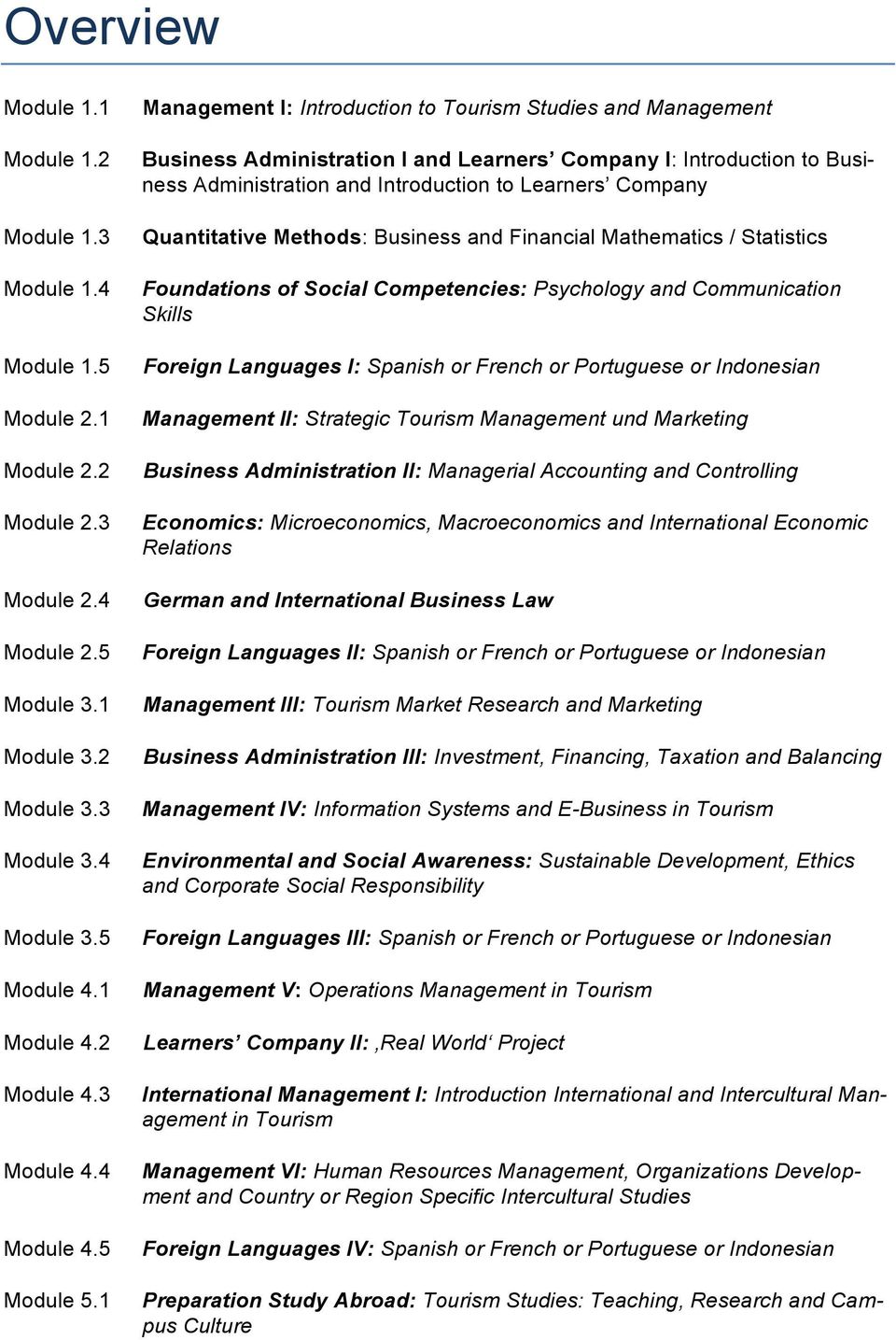
2 Overview Module 1.1 Module 1.2 Module 1.3 Module 1.4 Module 1.5 Module 2.1 Module 2.2 Module 2.3 Module 2.4 Module 2.5 Module 3.1 Module 3.2 Module 3.3 Module 3.4 Module 3.5 Module 4.1 Module 4.2 Module 4.3 Module 4.4 Module 4.5 Module 5.1 Management I: Introduction to Tourism Studies and Management Business Administration I and Learners Company I: Introduction to Business Administration and Introduction to Learners Company Quantitative Methods: Business and Financial Mathematics / Statistics Foundations of Social Competencies: Psychology and Communication Skills Foreign Languages I: Spanish or French or Portuguese or Indonesian Management II: Strategic Tourism Management und Marketing Business Administration II: Managerial Accounting and Controlling Economics: Microeconomics, Macroeconomics and International Economic Relations German and International Business Law Foreign Languages II: Spanish or French or Portuguese or Indonesian Management III: Tourism Market Research and Marketing Business Administration III: Investment, Financing, Taxation and Balancing Management IV: Information Systems and E-Business in Tourism Environmental and Social Awareness: Sustainable Development, Ethics and Corporate Social Responsibility Foreign Languages III: Spanish or French or Portuguese or Indonesian Management V: Operations Management in Tourism Learners Company II: Real World Project International Management I: Introduction International and Intercultural Management in Tourism Management VI: Human Resources Management, Organizations Development and Country or Region Specific Intercultural Studies Foreign Languages IV: Spanish or French or Portuguese or Indonesian Preparation Study Abroad: Tourism Studies: Teaching, Research and Campus Culture
3 Modules Study Abroad I-IV Module 6.1 Preparation Internship Abroad: Tourism Economics and Corporate Culture Modules Internship Abroad Module 6.5 Module 7.1 Module 7.2 International Management II: Reflection of International and Intercultural Aspects of Study and Internship Abroad International Management III: Advanced International and Intercultural Management in Tourism Electives: Subject Area I Module City Marketing and Destinations Management Module Eventmanagement Module Airport and Airline Management Module Sports and Health Management Module Hotel Management and Resort Planning Module Cultural and Educational Policy and Management Module Contemporary Issues Module Elective of other programmes Module 7.3 Electives: Subject Area I Module Experience Focused Pedagogy and Staging of Experiential Spaces Module Public Relations and Journalism Module Economic and Tourism Geography Module International Cooperation and Tourism in Emerging / Developing Nations Module Quality of Life and Sustainable Consumption Module Elective of other programmes Module 7.4 Module 7.5 Bachelor Project Bachelor Thesis

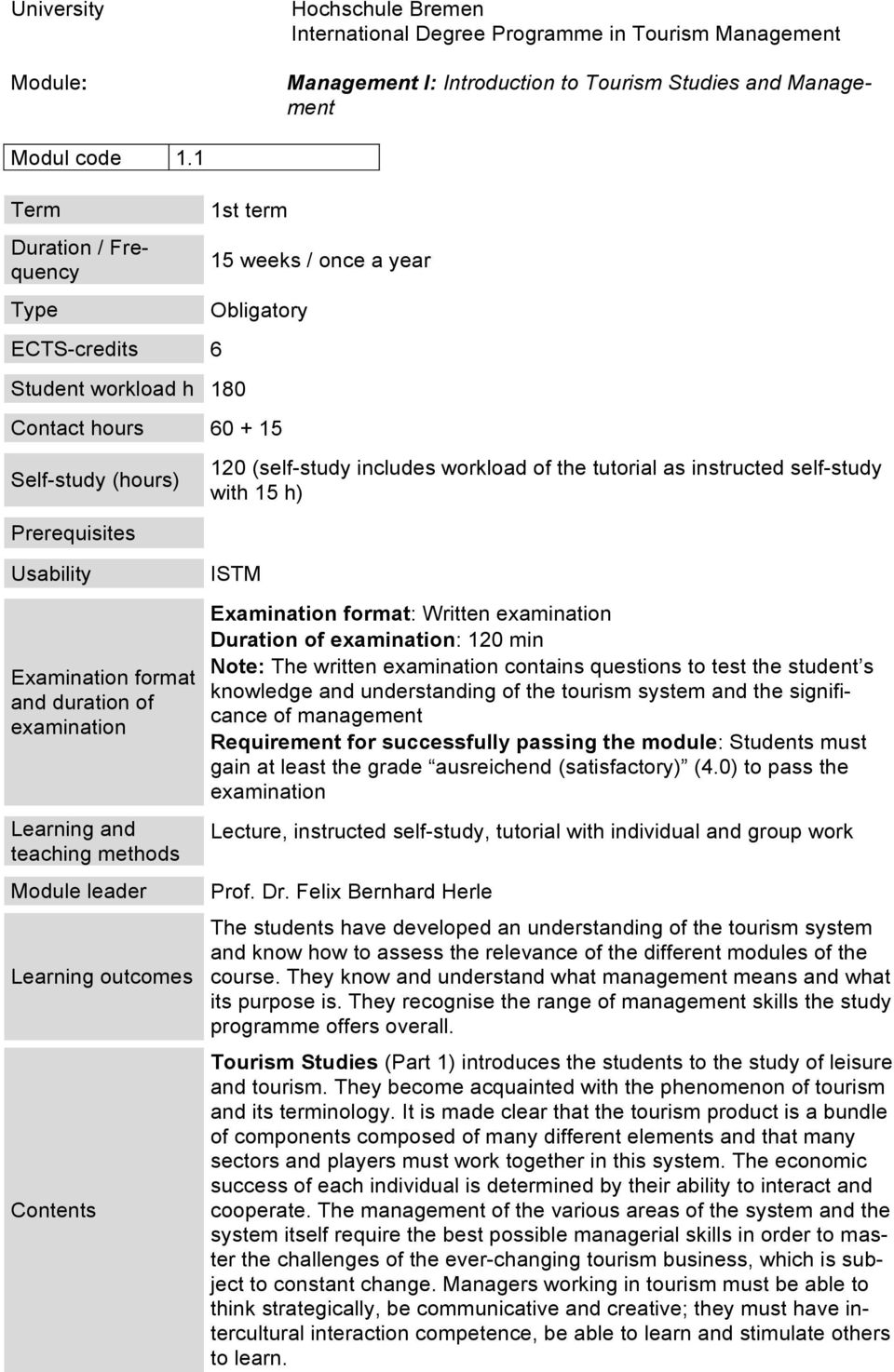
4 University Module: Hochschule Bremen International Degree Programme in Tourism Management Management I: Introduction to Tourism Studies and Management Modul code 1.1 Term Duration / Frequency Type ECTS-credits 6 Student workload h 180 1st term 15 weeks / once a year Obligatory Contact hours Self-study (hours) Prerequisites 120 (self-study includes workload of the tutorial as instructed self-study with 15 h) Usability Examination format and duration of examination Learning and teaching methods Module leader Learning outcomes Contents ISTM Examination format: Written examination Duration of examination: 120 min Note: The written examination contains questions to test the student s knowledge and understanding of the tourism system and the significance of management Requirement for successfully passing the module: Students must gain at least the grade ausreichend (satisfactory) (4.0) to pass the examination Lecture, instructed self-study, tutorial with individual and group work Prof. Dr. Felix Bernhard Herle The students have developed an understanding of the tourism system and know how to assess the relevance of the different modules of the course. They know and understand what management means and what its purpose is. They recognise the range of management skills the study programme offers overall. Tourism Studies (Part 1) introduces the students to the study of leisure and tourism. They become acquainted with the phenomenon of tourism and its terminology. It is made clear that the tourism product is a bundle of components composed of many different elements and that many sectors and players must work together in this system. The economic success of each individual is determined by their ability to interact and cooperate. The management of the various areas of the system and the system itself require the best possible managerial skills in order to master the challenges of the ever-changing tourism business, which is subject to constant change. Managers working in tourism must be able to think strategically, be communicative and creative; they must have intercultural interaction competence, be able to learn and stimulate others to learn.
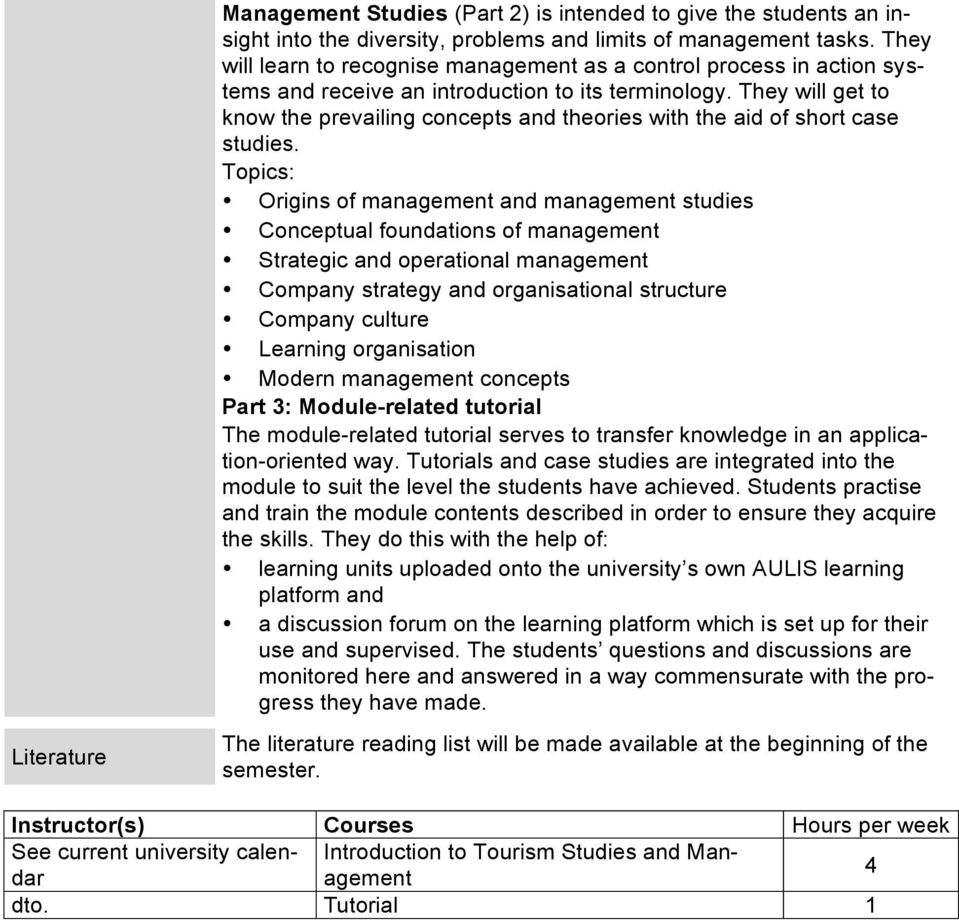
5 Management Studies (Part 2) is intended to give the students an insight into the diversity, problems and limits of management tasks. They will learn to recognise management as a control process in action systems and receive an introduction to its terminology. They will get to know the prevailing concepts and theories with the aid of short case studies. Topics: Origins of management and management studies Conceptual foundations of management Strategic and operational management Company strategy and organisational structure Company culture Learning organisation Modern management concepts Part 3: Module-related tutorial The module-related tutorial serves to transfer knowledge in an application-oriented way. Tutorials and case studies are integrated into the module to suit the level the students have achieved. Students practise and train the module contents described in order to ensure they acquire the skills. They do this with the help of: learning units uploaded onto the university s own AULIS learning platform and a discussion forum on the learning platform which is set up for their use and supervised. The students questions and discussions are monitored here and answered in a way commensurate with the progress they have made. Literature The literature reading list will be made available at the beginning of the semester. Instructor(s) Courses Hours per week See current university calendaagement Introduction to Tourism Studies and Man- 4 dto. Tutorial 1
6 University Studiengang Hochschule Bremen International Degree Programme in Tourism Management Module: Business Administration I and Learners Company I: Introduction to Business Administration and Introduction to Learners Company Modul code 1.2 Term Duration / Frequency Type ECTS-credits 6 Student workload h 1st term 15 weeks / once a year Obligatory 180 Contact hours Self-study (hours) Prerequisites 120 (self-study includes workload of the tutorial as instructed self-study with 15 h) Usability Examination format and duration of examination Learning and teaching methods Module leader Learning outcomes ISTM Examination format: In part 1 (Business Administration I) written examination; in part 2 (Learners Company I) written report/paper to prove that students have developed a basic understanding in order to be able to undertake academic work in the group. The overall scope of both examinations should correspond with the scope of one examination for a module and not exceed it. Duration of examination: Written examination: 60 minutes Requirement for successfully passing the module: Students must gain at least the grade ausreichend (satisfactory) (4.0) to pass the examination Lecture, instructed self-study, tutorial with individual and group work, case studies Prof. Dr. Felix Bernhard Herle After completing the module, the students are able to explain the basic knowledge of business administration and the tools of tourism management they have acquired and can apply their methodological knowledge of managerial economics to issues of the tourism business and tourism management have the skills to get their bearings in real problems of a company, to identify the relevant business approaches and compare proposals for solving the problem are able to understand the principle of interdisciplinary thought and action, to apply the basic principles of academic work (i.e. they master techniques for searching for, assessing and using sources), to apply the basic principles of project management in their own work and to orally present and write down academic facts
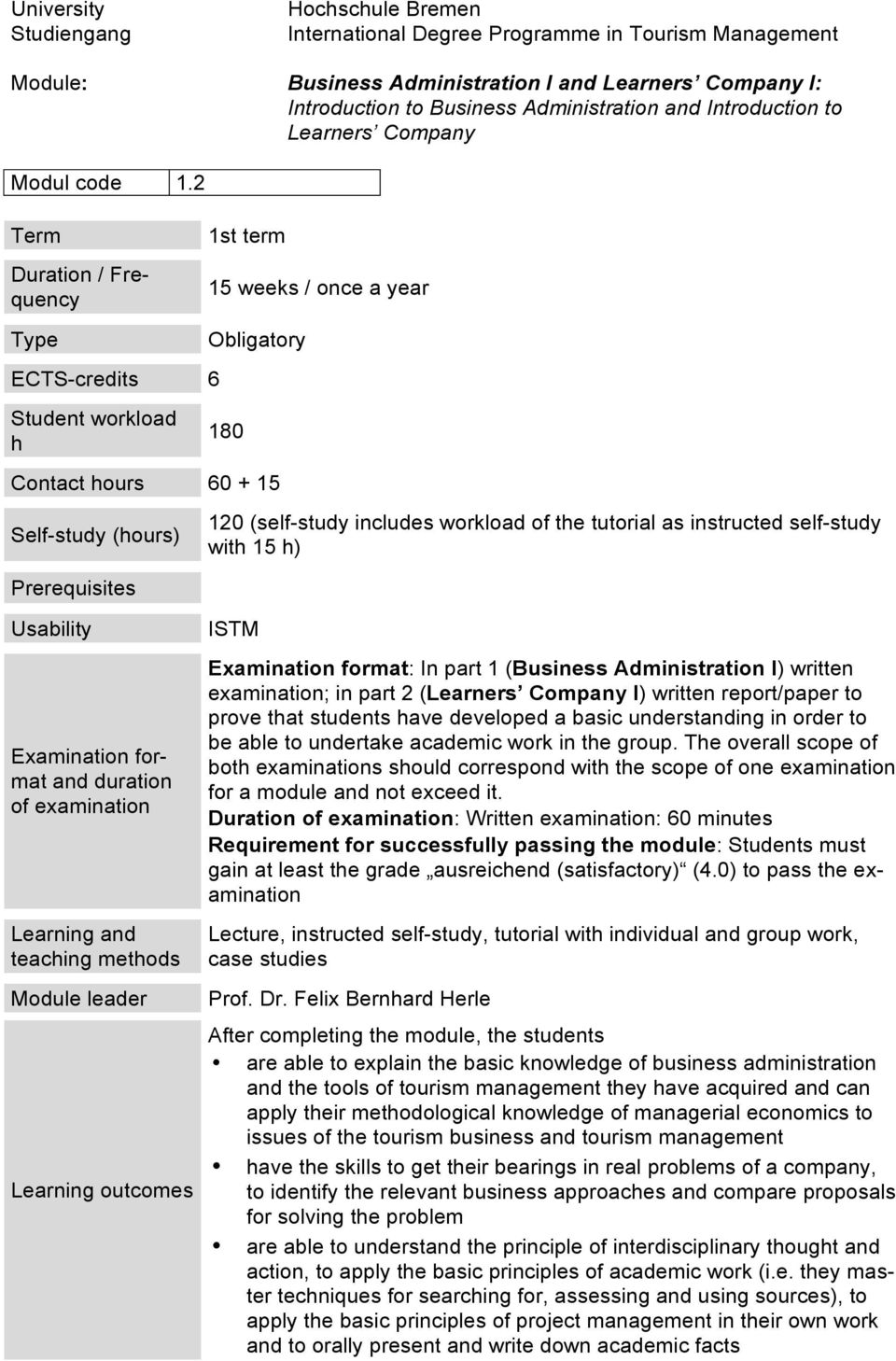
7 In Foundations of Managerial Economics the students will get to know and understand the fundamental relationships in managerial economics and gain the skill to implement the principles of economic activity to suit the situation and the function. The individual disciplines of managerial economics and constitutive decisions in the founding phase of a company, basic questions of production and procurement and approaches of innovation management are also taught. Contents Literature This module is part of the Learners Company, a joint venture between the ISTM course and the Applied Leisure Studies (ISAF) course and focusses on generating a link between theory and practice. Students learn the basic principles of academic work and project management in Part 1 of this joint venture and also apply them by way of example to actual topics or projects, preferably those where the findings are of interest in both the field of economics and also in the social sciences: (e.g. City of Bremen and tourism in Bremen, university system and the study of tourism, student life and professional life). The module-related tutorial serves to transfer knowledge in an application-oriented way. Tutorials and case studies are integrated into the module to suit the level the students have achieved. Students practise and train the module contents described in order to ensure they acquire the skills. They do this with the help of: learning units uploaded onto the university s own AULIS learning platform and a discussion forum on the learning platform which is set up for their use and supervised. The students questions and discussions are monitored here and answered in a way commensurate with the progress they have made. The literature reading list will be made available at the beginning of the semester. Instructor(s) Courses Hours per week See current university calendar Introduction to Business Administration 2 dto. Introduction to Learners Company 2 dto. Tutorial 2 x 0.5

8 University Studiengang Hochschule Bremen International Degree Programme in Tourism Management Module: Quantitative Methods: Business and Financial Mathematics / Statistics Modul code 1.3 Term 1st term Duration / Frequency 15 weeks / once a year Type ECTS-credits 6 Student workload h Obligatory 180 Contact hours Self-study (hours) Prerequisites 120 (self-study includes workload of the tutorial as instructed self-study with 15 h) Usability Examination format and duration of examination Learning and teaching methods Module leader Learning outcomes ISTM Examination format: Written examination Duration of examination: 120 min Note: The written examination serves to prove the student has a sure command of selecting a method and applying it to specific cases and tasks as they can occur in practice. In addition the written examination demonstrates the student has understood the nature of the tasks. Requirement for successfully passing the module: Students must gain at least the grade ausreichend (satisfactory) (4.0) to pass the examination Lecture, instructed self-study, tutorial with individual and group work Prof. Dr. Tim Thomas Goydke After completing the course, the students are able to translate quantifiable economic problems into simple mathematical models analyse which method(s) should be applied to solving the problem taking into account the facts and the accuracy to be expected apply a variety of mathematical methods in order to resolve an economic issue interpret the results of their calculation from an economic point of view take decisions on the basis of this (these) solution(s) and make recommendations understand statistics as a necessary tool for organisation, planning, administration and decision making explain the aim of statistical investigations and recognise the limits of their informative value recognise simple manipulative representations of statistical surveys
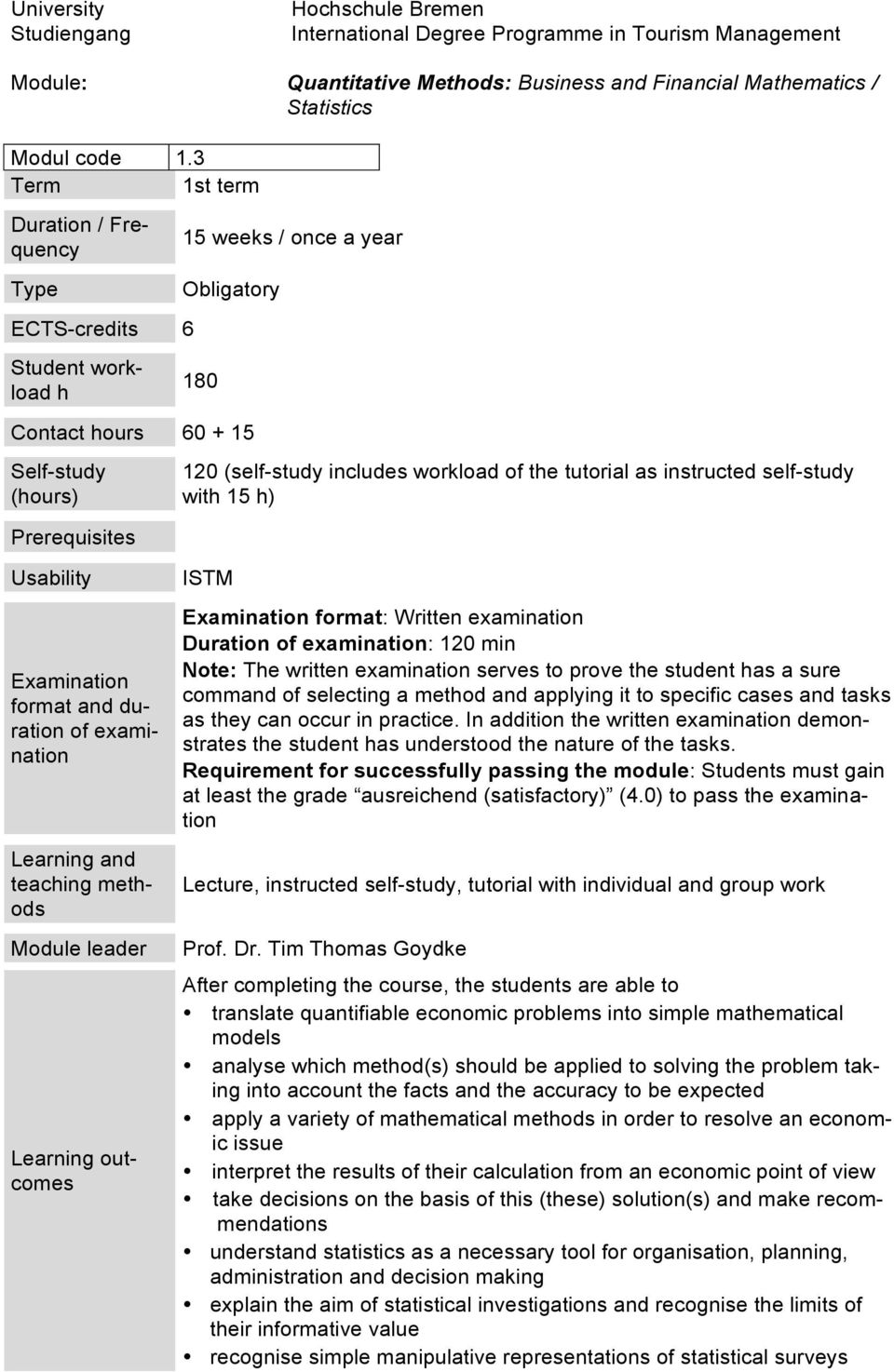
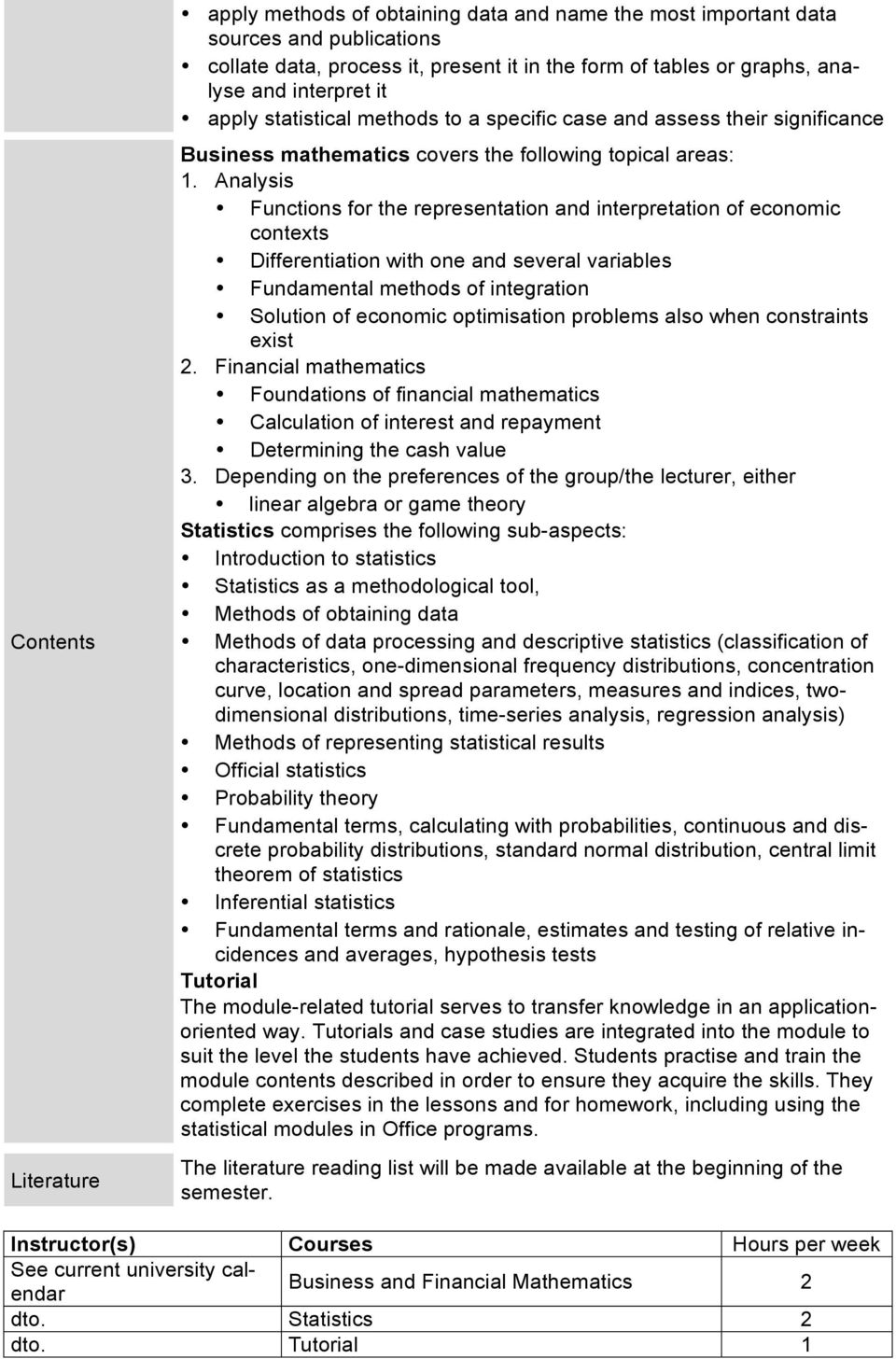
9 Contents Literature apply methods of obtaining data and name the most important data sources and publications collate data, process it, present it in the form of tables or graphs, analyse and interpret it apply statistical methods to a specific case and assess their significance Business mathematics covers the following topical areas: 1. Analysis Functions for the representation and interpretation of economic contexts Differentiation with one and several variables Fundamental methods of integration Solution of economic optimisation problems also when constraints exist 2. Financial mathematics Foundations of financial mathematics Calculation of interest and repayment Determining the cash value 3. Depending on the preferences of the group/the lecturer, either linear algebra or game theory Statistics comprises the following sub-aspects: Introduction to statistics Statistics as a methodological tool, Methods of obtaining data Methods of data processing and descriptive statistics (classification of characteristics, one-dimensional frequency distributions, concentration curve, location and spread parameters, measures and indices, twodimensional distributions, time-series analysis, regression analysis) Methods of representing statistical results Official statistics Probability theory Fundamental terms, calculating with probabilities, continuous and discrete probability distributions, standard normal distribution, central limit theorem of statistics Inferential statistics Fundamental terms and rationale, estimates and testing of relative incidences and averages, hypothesis tests Tutorial The module-related tutorial serves to transfer knowledge in an applicationoriented way. Tutorials and case studies are integrated into the module to suit the level the students have achieved. Students practise and train the module contents described in order to ensure they acquire the skills. They complete exercises in the lessons and for homework, including using the statistical modules in Office programs. The literature reading list will be made available at the beginning of the semester. Instructor(s) Courses Hours per week See current university calendar Business and Financial Mathematics 2 dto. Statistics 2 dto. Tutorial 1
10 University Studiengang Module: Hochschule Bremen International Degree Programme in Tourism Management Foundations of Social Competencies: Psychology and Communication Skills Modul code 1.4 Term Duration / Frequency Type ECTS-credits 6 Student workload h 180 1st term 15 weeks / once a year Obligatory Contact hours Self-study (hours) Prerequisites 120 (self-study includes workload of the tutorial as instructed self-study with 15 h) Usability Examination format and duration of examination Learning and teaching methods Module leader Learning outcomes Contents ISTM Examination format: One examination to test specialist and transfer knowledge in each of the two modules: Psychology: written examination or report/paper or case study Rhetoric and communication: presentation(s) as ungraded examination Duration of examination: Varies; depends on the type of examination Requirement for successfully passing the module: Students must gain at least the grade ausreichend (satisfactory) (4.0) to pass the psychology examinations Lecture, instructed self-study, tutorial with individual and group work, roleplay, videofeedback, reflection Prof. Dr. Felix Bernhard Herle In the Psychology unit the students develop a basic understanding of psychology which enables them to recognise their own needs, attitudes and intentions as well as those of others at an early stage and to be able to suitably react to them. They learn to consider the possible effects of their own behaviour and learn to behave with greater awareness. They become sensitive to cultural influences on perception and behaviour. In the Rhetoric and Communication unit students improve their individual communication skills, self-assurance and effectiveness. The students are able to use presentation, discussion leading and visualisation techniques with confidence. At the same time they become aware that the impression they give through their own communicative behaviour is culturally dependent. In Psychology they learn about the psychology of travel and the traveller, as well as special aspects of social psychology:
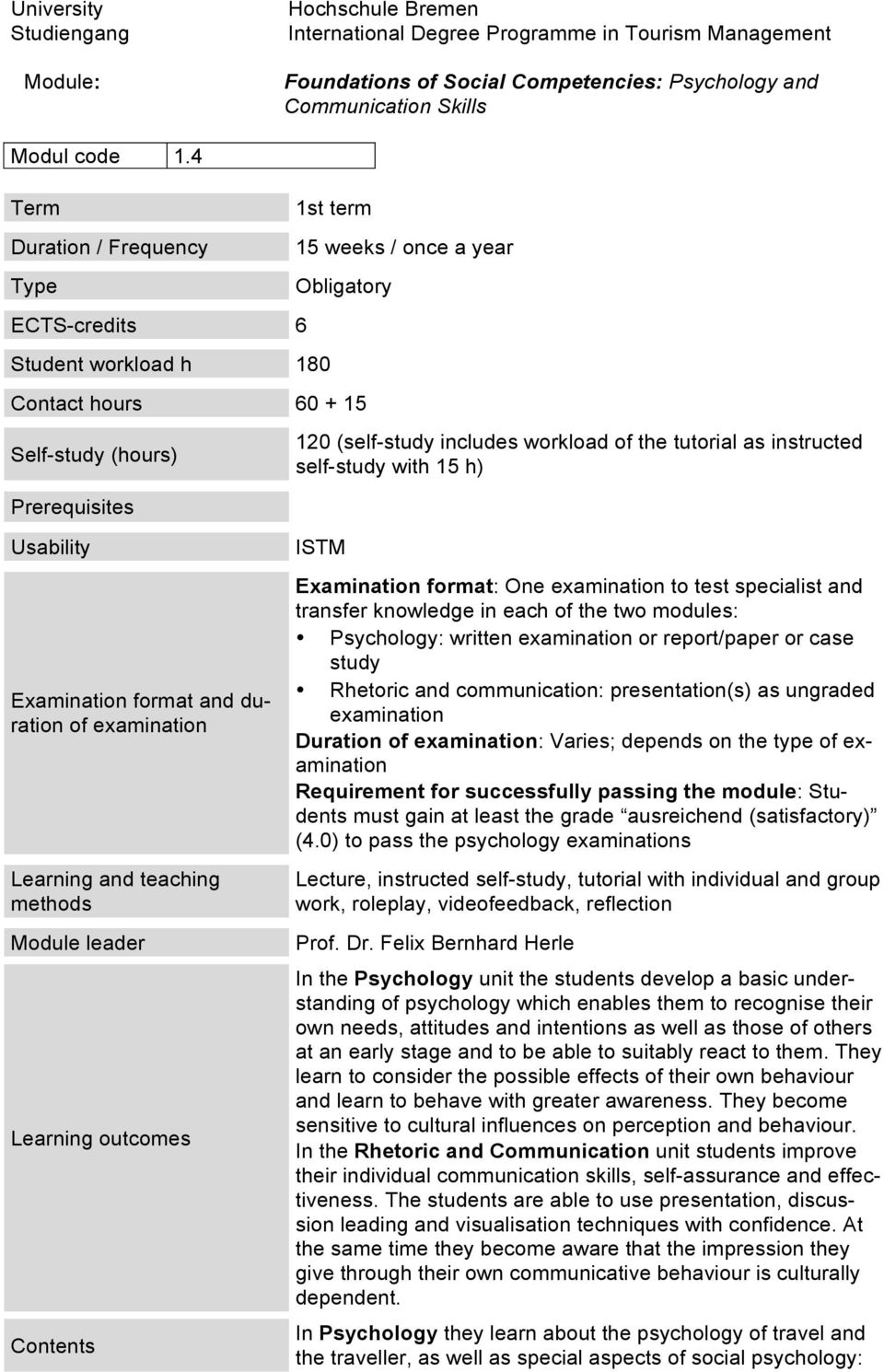
11 social aspects of perception and attribution attitudes, stereotype and discrimination perception of oneself and others by individuals and groups (causes of systematic distortion of perception) groups, group behaviour and social roles expectations, needs and satisfaction when travelling social interaction in foreign contexts (between tourists and locals) Possible cultural differences or influences are explicitly stated and taken into consideration for all the aspects stated. In Rhetoric and Communication the following topic areas are taught: body language communication psychology and communication models Presentation Leading discussions Conducting discussions and discussion techniques Coaching Mediation Students will acquire basic knowledge and will also practice transferring this basic knowledge into the ability to act. The impression created as a result of the knowledge and skills acquired is always considered within its cultural context, and any necessary adaptations to other cultural contexts are taken into consideration Tutorial The module-related tutorial serves to transfer knowledge in an application-oriented way. Tutorials and case studies are integrated into the module to suit the level the students have achieved. Students practise and train the module contents described in order to ensure they acquire the skills. They do this with the help of: learning units uploaded onto the university s own AULIS learning platform and a discussion forum on the learning platform which is set up for their use and supervised. The students questions and discussions are monitored here and answered in a way commensurate with the progress they have made. Literature The literature reading list will be made available at the beginning of the semester. Instructor(s) Courses Hours per week See current university calendar Psychology 2 dto. Rhetoric und Communication 2 dto. Tutorial 1

12 University Studiengang Module: Hochschule Bremen International Degree Programme in Tourism Management Foreign Languages I: Spanish or French or Portuguese or Indonesian Modul code 1.5 Term Duration / Frequency Type ECTS-credits 6 Student workload h 1 Term 15 weeks / once a year Compulsory 180 Contact hours 60 Self-study (hours) 120 Prerequisites Usability Examination format and duration of examination Learning and teaching methods Module leader Learning outcomes Contents none ISTM / ISGM Examination format: Written examination (120 min) or portfolio Requirement for successfully passing the module: Students must pass ungraded examination Note: Students who already have language skills relevant to their destination region at level B1.1 and higher can have this certified by the language teachers and take an alternative language module offered in this course of study. Language course, self-study, group work Erwin Silaban Target level: A1 Reading: The students are able to understand familiar names, words or very simple sentences, e. g. on signs, posters or in catalogues. Listening: They can understand familiar words and very simple sentences which refer to themselves, their family or specific things around them, provided the speech is slow and clear. Speaking: They can ask simple questions and answer them if they concern direct needs and very familiar topics. Writing: They are able to write a brief, simple postcard, e.g. holiday greetings. They are able to enter name, address, nationality etc. in forms, e.g. in hotels. Interaction: They can make themselves understood in a simple way, but the communication is completely dependent on their partner being prepared to repeat more slowly, rephrase or correct them. They can ask simple questions and answer them, make simple statements or react to them if they concern direct needs and very familiar topics. Communicative Learning Outcomes: Spelling; communicative tools to ensure understanding; provide and request information on people: age, profession, nationality, marital status. Assess characteristics of people;
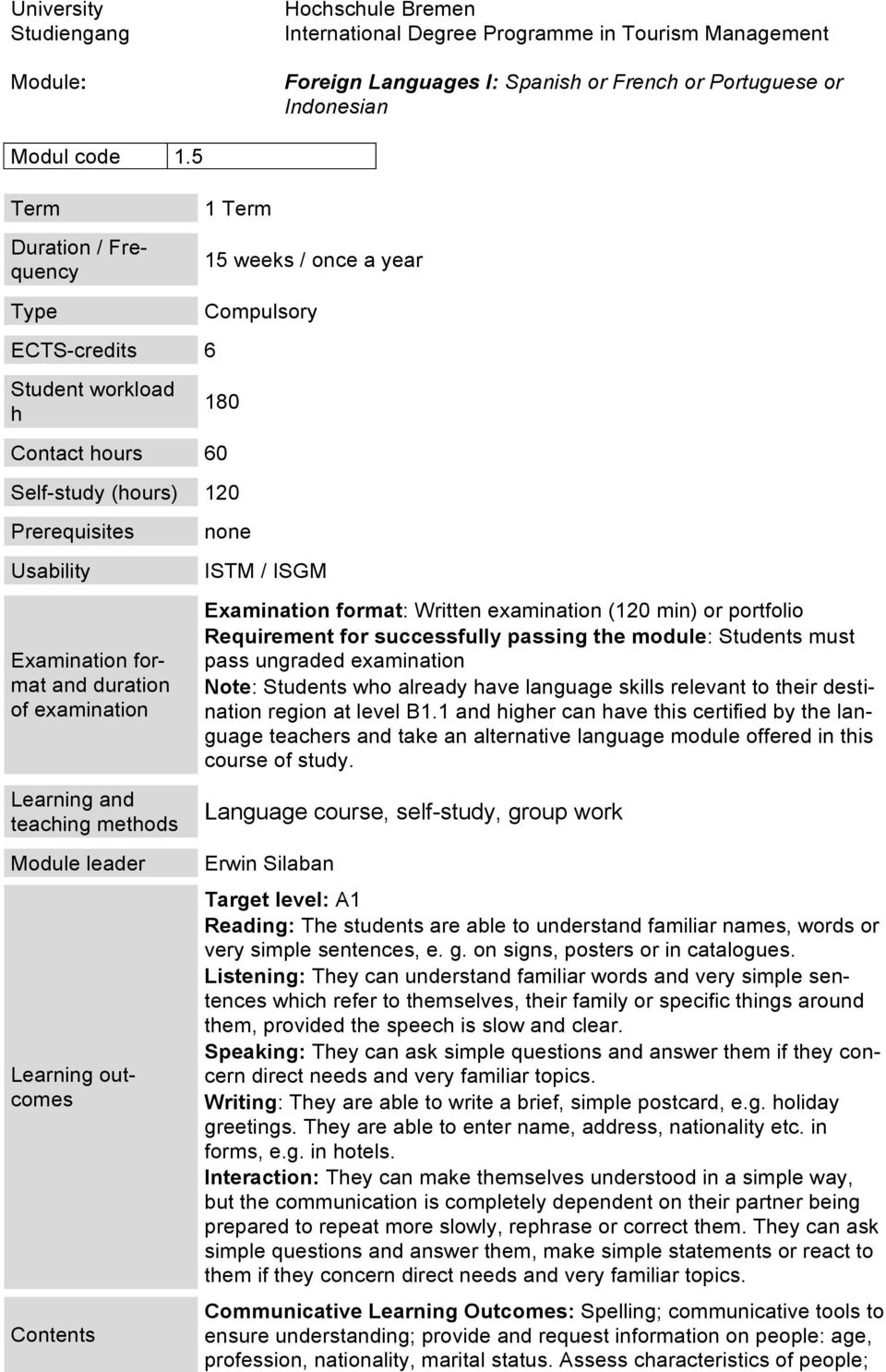
13 understand opinions and judgements on people; understand and give phone numbers; describe holiday habits; state the existence and location of something; express inclinations and preferences; ask whether a product is available, what its costs and how to pay for it; understand the description of postures and refer to them; talk about habits; provide advice and recommendations; purchase food; cope with a visit to a restaurant; describe and assess eating habits. Grammatical Learning Outcomes: Numbers; definite article; demonstrative pronouns; affirmation/negation; present indicative of verbs. Reflexive verbs (position of the pronoun); impersonal constructions; adjectives. Stating frequencies; quantitative adverbs; sequencing; justifications; question words. Vocabulary: names of selected countries, language-specific alphabet, age, nationality, marital status, education, profession, characteristics. Family members. Nationalities. Holidays and tourism, forms of transport, the seasons, the town: buildings, institutions and services, accommodation. The names of the months, holiday activities, shops and products, currencies, items of clothing, items of personal use and colours. Presents, parts of the body, physical activities, the days of the week, food and packaging, recipes and beverages. Texts: Notes and messages. Signs in supermarkets, shops and market stalls. Short newspaper advertisements. Internet pages. Brief and simple interpersonal dialogues and conversations. Postcards. Forms and questionnaires. Literature The literature reading list will be made available at the beginning of the semester. Instructor(s) Courses Hours per week See current university calendar Indonesian and Portuguese 4 each Instituto Cervantes Spanish 4 Institut Français French 4

14 University Studiengang Module: Hochschule Bremen International Degree Programme in Tourism Management Management II: Strategic Tourism Management und Marketing Modul code 2.1 Term Duration / Frequency Type ECTS-credits 6 Student workload h 180 2nd term 15 weeks / once a year Obligatory Contact hours Self-study (hours) Prerequisites 120 (self-study includes workload of the tutorial as instructed self-study with 15 h) Usability Examination format and duration of examination Learning and teaching methods Module leader Learning outcomes Contents ISTM Examination format: Written examination Duration of examination: 120 min Note: The written examination contains general questions to prove the student has consolidated knowledge and understanding and requires a discussion of cases to prove the student s ability to discuss strategies. Requirement for successfully passing the module: Students must gain at least the grade ausreichend (satisfactory) (4.0) to pass the examination Lecture, case studies, instructed self-study, tutorial with individual and group work Prof. Dr. Felix Bernhard Herle The students have extended their knowledge of the most important approaches to strategic management and marketing and can describe this on the fundamental and strategic instrumental level; they have understood the differences in the concepts, can assess and evaluate them and are able to discuss alternatives in the choice of strategy; they can properly analyse, assess and evaluate exemplary basic strategic policies and derived marketing strategies of tourism companies. The focus is on the process of management and marketing planning: Methods for analysing the markets, the competition, the company and society at the strategic starting situation Forecasting methods and early strategic planning Derivation of basic strategies (strategic alternatives, brand policy/branding) Instrumental strategies / marketing tools Supervision and control 2. Tutorial The module-related tutorial serves to transfer knowledge in an applica-
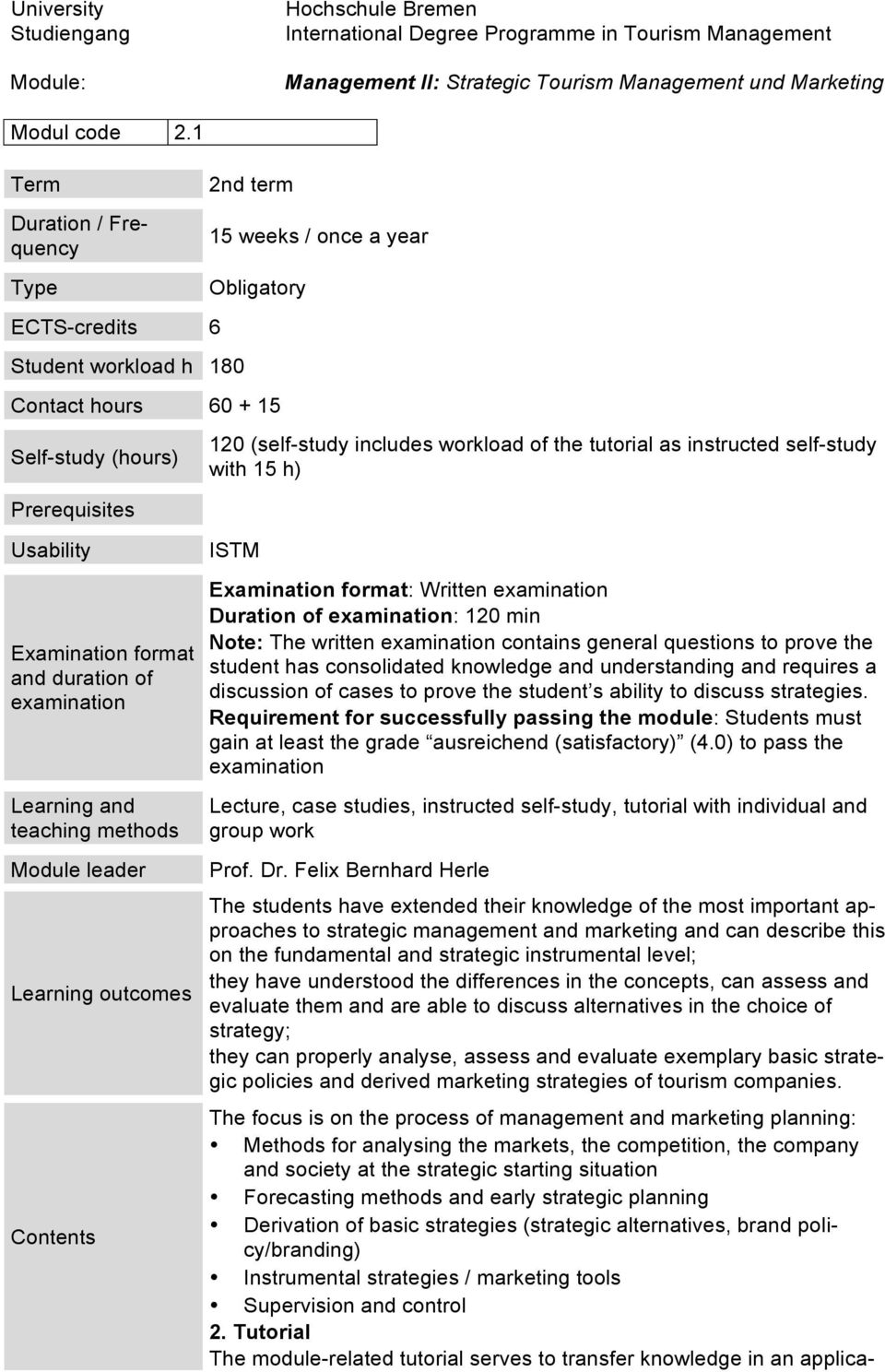
15 tion-oriented way. Tutorials and case studies are integrated into the module to suit the level the students have achieved. Students practise and train the module contents described in order to ensure they acquire the skills. They do this with the help of: learning units uploaded onto the university s own AULIS learning platform and a discussion forum on the learning platform which is set up for their use and supervised. The students questions and discussions are monitored here and answered in a way commensurate with the progress they have made. Literature The literature reading list will be made available at the beginning of the semester. Instructor(s) Courses Hours per week See current university calendaketing Strategic Tourism Management and Mar- 4 dto. Tutorial 1

16 University Studiengang Module: Hochschule Bremen International Degree Programme in Tourism Management Business Administration II: Managerial Accounting and Controlling Modul code 2.2 Term Duration / Frequency Type ECTS-credits 6 Student workload h 180 2nd term 15 weeks / once a year Obligatory Contact hours Self-study (hours) Prerequisites 120 (self-study includes workload of the tutorial as instructed self-study with 15 h) Usability Examination format and duration of examination Learning and teaching methods Module leader Learning outcomes ISTM Examination format: Written examination (120 min) and presentation Note: Approx. 60 minutes is dedicated to real cases and serve to prove the student has a sure mastery of the conventional calculation methods; approx. 40 minutes is dedicated to general questions to prove the student has consolidated knowledge and understanding; approx. 20 minutes is dedicated to the processing of cases to prove the student has the ability to discuss strategies and to make decisions based on factual reasons, where applicable. In Managerial Accounting, students must give a presentation on a topic covered in the module as an ungraded examination. This serves to prove that the students have understood a sub-aspect of managerial accounting in depth, have reflected on it, are able to present it visually in a limited time and in an appealing way and can deal appropriately with questions and comments in a subsequent discussion. Requirement for successfully passing the module: Students must gain at least the grade ausreichend (satisfactory) (4.0) to pass the examination; students must pass the ungraded examination Lecture, instructed self-study, tutorial with individual and group work Prof. Dr. Günther Dey After successfully completing the module, the students are able to present the fundamental tasks and methods of cost and activity accounting and understand their relationship to real situations apply the methods to simple analytical and decision-making situations in a practical way and assess them in standard situations rate alternative calculation concepts in terms of information content and reliability apply conventional work and learning techniques to abstract content and obtain more in-depth knowledge independently from specialist
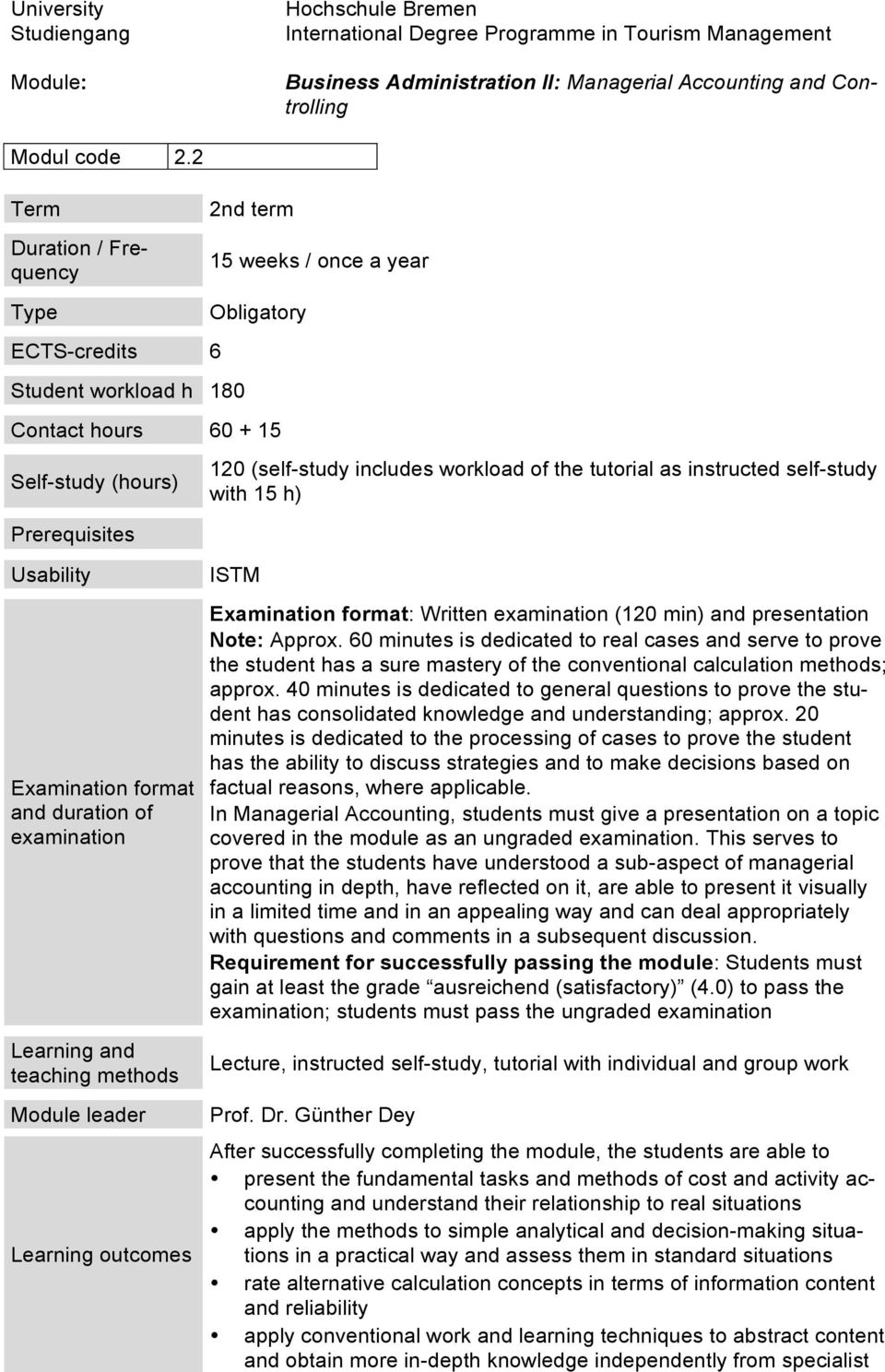
17 Contents academic sources In Managerial Accounting: The students... know the fundamental managerial accounting concepts and the significance of managerial accounting for business procedures know different accounting theories are particularly able to reflect critically on the fundamentals of the behavioural science principles of managerial accounting know the most important terminology and the historical development of managerial accounting are able to set managerial accounting into the context of the company s accounting system and can relate it to the internal and external accounting know the significance of obtaining, providing and processing information for managerial accounting know the most important indicators and indicator systems and can calculate them themselves know the problems of transfer prices and methods to determine them know the problems of planning and control are able to differentiate between strategic, tactical and operational planning and control and know the most important tools in each case. The students have mastered the fundamental application of individual tools They can critically analyse the principles of their role as potential subject and object of managerial accounting in the company. After a general introduction to company accounting, the course covers profitability control and decision-making support as the fundamental tasks of cost and activity accounting. This involves looking at the sub-areas of cost types, cost centres and cost-unit accounting with their special purposes, possibilities and limits and students practise dealing with them with the aid of numerical examples. The accounting concepts of actual cost accounting and variable cost accounting as actual and planned cost calculations are taken into account as well as an overview of the modern approaches to process and target cost accounting. Students are shown the historical development of managerial accounting and discuss how it developed from company practice The lack of a uniform theory is explained as well as the existence of different current managerial accounting concepts. Students are taught about the behavioural science principles of managerial accounting incl. the human problems of the acquisition and processing of information and human planning and controlling behaviour, and different accounting theories. Links are established to internal and external accountancy. Fundamental indicators and indicator systems are presented and students practise applying them. The transfer price problem is analysed. The course looks at the various time dimensions (strategic, tactical, and operational) of the basic issues and instruments of planning and control and their use is demonstrated by way of example. The different possibilities for using information technology in managerial accounting are discussed. The course attempts to explain to the students their potential role as subject and/or object of managerial accounting and to encourage them to reflect critically on these possible roles. It incorporates research results relating to motivation enhancing and inhibiting factors. 2. Tutorial The module-related tutorial serves to teach knowledge and its applica-
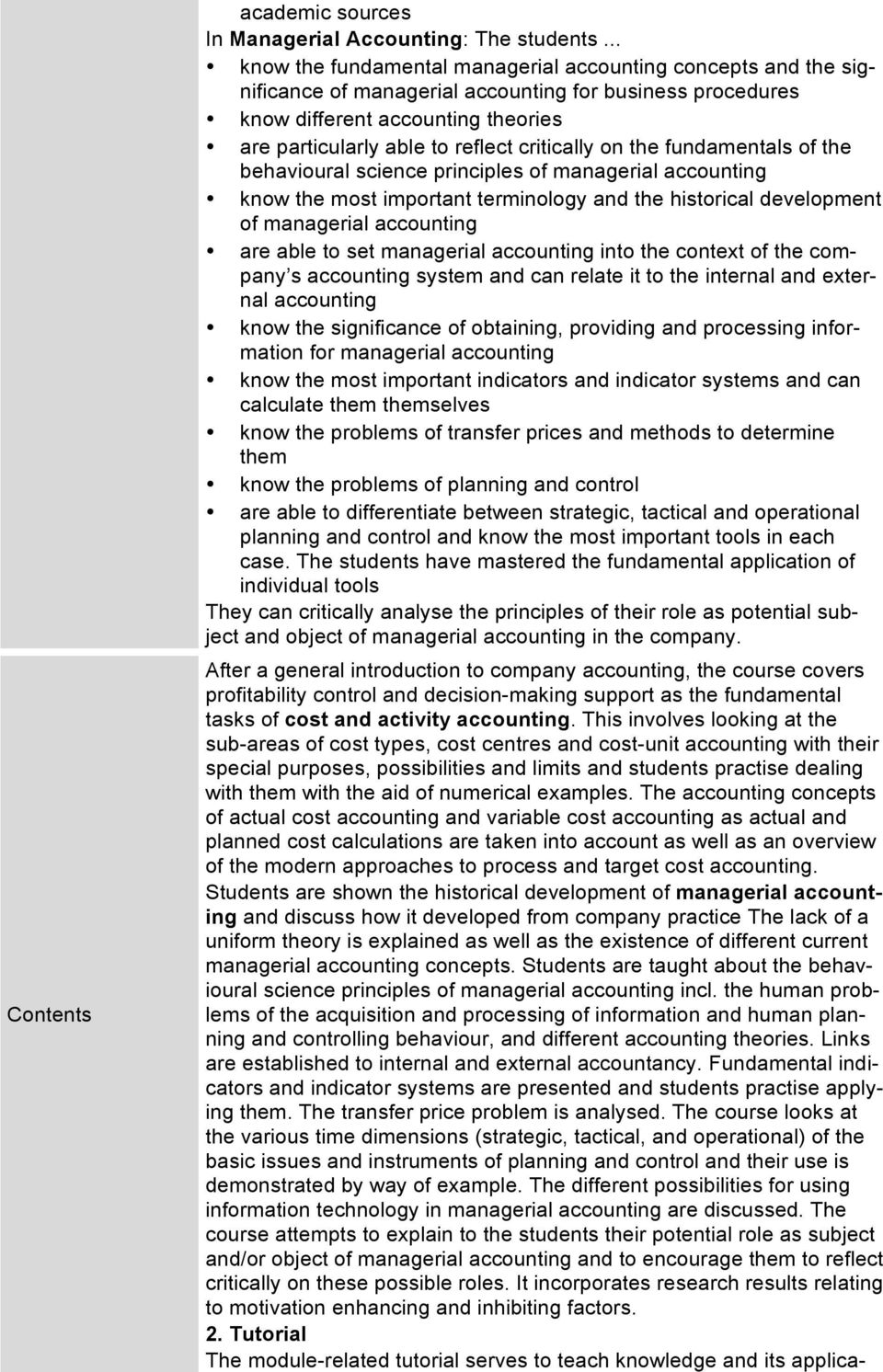
18 tions Tutorials and case studies are integrated into the module in accordance with the learning progress of the students. Students practise and train the module contents described in order to ensure they acquire the skills Case studies adapted to the progress they have made are used here. Literature The literature reading list will be made available at the beginning of the semester. Instructor(s) Courses Hours per week See current university calendar Managerial Accounting and Controlling 4 dto. Tutorial 1

19 University Studiengang Module: Hochschule Bremen International Degree Programme in Tourism Management Economics: Microeconomics, Macroeconomics and International Economic Relations Modul code 2.3 Term Duration / Frequency Type ECTS-credits 6 Student workload h 2nd term 15 weeks / once a year Obligatory 180 Contact hours Self-study (hours) Prerequisites 120 (self-study includes workload of the tutorial as instructed self-study with 15 h) Usability Examination format and duration of examination Learning and teaching methods Module leader Learning outcomes Contents ISTM Examination format: Written examination Duration of examination: 120 min Requirement for successfully passing the module: Students must gain at least the grade ausreichend (satisfactory) (4.0) to pass the examination Lecture, instructed self-study, tutorial with individual and group work Prof. Dr. Ernst Mönnich After completing the module, the participants know the most important economic terms and are able to use them in an economic context. They have gained an overview of alternative explanatory models from the microeconomic and macroeconomic perspectives and can apply these to actual problems and discuss their significance. They have gained basic knowledge of the important problem areas of international and European economic policy and can put the courses of action open to the various players into context. Microeconomics Fundamental terms of economics, principles of consumption, production and cost theory, introduction to selected models for price theory and their significance for the price policy in markets, forms and effects of state interventions in a market. Macroeconomics Introduction to the foundations of macroeconomic theory, presentation and discussion of alternative explanations of how goods, money and employment markets operate. Introduction to economic policy with the focus on economic growth and monetary policy; additionally there is a short overview of problem areas of employment policy and public fi-

20 nances. 3. Tutorial The module-related tutorial provides the students with transfer knowledge and prepares them for the written examination. Tutorials and case studies accompany the module to suit the level the students have achieved. Students achieve the learning outcome by practising and training the module contents described. This is done via: Exercises where model answers are available in the script so students can monitor their own progress. Exercises with solutions uploaded to the university s AULIS learning platform and the establishment and supervision of a discussion forum on the learning platform. Literature The literature reading list will be made available at the beginning of the semester. Instructor(s) Courses Hours per week Economics: Microeconomics, Macroeconomics and International Economic Rela- 4 See current university calendations dto. Tutorial 1

21 University Studiengang Module: Hochschule Bremen International Degree Programme in Tourism Management German and International Business Law Modul code 2.4 Term Duration / Frequency Type ECTS-credits 6 Student workload h 180 2nd term 15 weeks / once a year Obligatory Contact hours Self-study (hours) Prerequisites 120 (self-study includes workload of the tutorial as instructed self-study with 15 h) Usability Examination format and duration of examination Learning and teaching methods Module leader Learning outcomes Contents ISTM Examination format: Written examination Duration of examination: 120 min Requirement for successfully passing the module: Students must gain at least the grade ausreichend (satisfactory) (4.0) to pass the examination Lecture, case studies, instructed self-study, tutorial with individual and group work Prof. Dr. Ulrich Krüger After completing the course, the students should have the following skills: Basic specialist competence in commercial law for the code of practice for contracts and the solution of conflicts Methodological competence: the ability to recognize pertinent legal problems of economic practice early and include them in the planning of possible economic action; The ability to make decisions to answer the question as to whether simple legal problems can be solved without involving professional legal assistance or whether their assistance is required The ability to communicate with lawyers or legal departments and hence the social competence to be able to argue in interdisciplinary groups and contexts By learning the techniques for handling cases, the individuals themselves will acquire skills which enable them to arrange their own work processes in a defined and considered way German Business Law Introduction to civil law and the legal approach General legal transactions including General Business Terms and Conditions Contract and property
22 Default in performance in the law of obligations Fundamentals of International Business Law International trade organisations and their regulations using the example of the WTO European law International private law and harmonisation of law (CISG) INCO terms and practice in the law on international contracts All content is referenced to tourism and travel law. By using the example of tourism contract law the international European dimension of legal development can be easily understood The module-related tutorial serves to transfer knowledge in an application-oriented way. Tutorials and case studies are integrated into the module to suit the progress the students have made. Students practise and train the module contents described in order to ensure they acquire the skills. Literature The literature reading list will be made available at the beginning of the semester. Instructor(s) Courses Hours per week See current university calendar German Business Law 2 dto. International Business Law 2 dto. Tutorial 2 x 0.5
23 University Studiengang Module: Hochschule Bremen International Degree Programme in Tourism Management Foreign Languages II: Spanish or French or Portuguese or Indonesian Modul code 2.5 Term Duration / Frequency Type ECTS-credits 6 Student workload h 2nd term 15 weeks / once a year Compulsory 180 Contact hours 60 Self-study (hours) 120 Prerequisites Usability Examination format and duration of examination Learning and teaching methods Module leader Learning outcomes Level A1 ISTM / ISGM Examination format: Written examination (120 min) or portfolio Requirement for successfully passing the module: students must pass the ungraded examination Note: Students who already have language skills relevant to their destination region at level B1.1 and higher can have this certified by the language teachers and take an alternative language module offered in this course of study. Language course, self-study, group work Erwin Silaban Target level: A2.1 Reading: The students are able to read very short, simple texts. They can find specific, predictable information in simple everyday texts (e. g. advertisements, leaflets, menus or timetables). Listening: They can understand individual sentences and the most common words (e. g. very simple information regarding people and family, shopping, work and their immediate surroundings). They understand the main points in brief, clear and simple messages and announcements. Speaking: They can describe people, living or working conditions, everyday routines, likes and dislikes etc. in short, list-like sequences of simple phrases and sentences. Writing: They are able to write a number of simple phrases and sentences and connect with connectors such as and, but or because. They are able to write simple sentences about their own family, their living conditions, educational background or their present or past professional activity. Interaction: They are able to communicate in simple, routine situations where there is an uncomplicated and direct exchange of information
24 Contents (By way of example using Spanish) Literature about familiar routine issues in connection with work and leisure time. They can conduct brief conversations, but can hardly understand enough in order to be able to keep the conversation flowing. Communicative Learning Outcomes: Understand information about personal history and job advertisements. State advantages and disadvantages of different professions. Provide job profiles and understand them. Buy food. Weights and measures. Ask for details of a dish. Write down and explain a recipe. Understand how to refer to the locations on a travel itinerary and future activities. Important phrases for the hotel. Description of a town. Social contacts during a visit: Greeting, introductions, saying good-bye, social rituals. Understand descriptions of residential accommodation. Describe the way to somebody. Request permission and grant it. Important telephone phrases. Grammatical Learning Outcomes: The perfect of the regular verbs, irregular participles, further frequency information, weights and measures, specific statements of amounts/numbers, forms of transport, information referring to the future, comparisons, imperative. Vocabulary: Jobs, personal information and professional experience. Inclinations and skills. Professional history: education, languages, professional experience, personal characteristics and skills. Food and packaging. Means of transport, opening hours, buildings and institutions. Hotel accommodation. Abbreviations for addresses. Their flat/ house, the town: addresses and means of transport. Texts: Newspaper advertisements, discussions, radio broadcasts, recipes, restaurant menu, shopping list, newspaper interview, information texts on two towns, questionnaires. The literature reading list will be made available at the beginning of the semester. Instructor(s) Courses Hours per week See current university calendar Indonesian and Portuguese 4 each Instituto Cervantes Spanish 4 Institut Français French 4
25 University Studiengang Module: Hochschule Bremen International Degree Programme in Tourism Management Management III: Tourism Market Research and Marketing Modul code 3.1 Term Duration / Frequency Type ECTS-credits 6 Student workload h 180 3rd term 15 weeks / once a year Obligatory Contact hours Self-study (hours) Prerequisites Usability Examination format and duration of examination Learning and teaching methods Module leader Learning outcomes Contents 120 (self-study includes workload of the tutorial as instructed self-study with 15 h) Module 2.1 passed ISTM Examination format: Portfolio: The written presentation of the research process (case study with their own empirical contribution) and the research results including clear representations of selected materials; or term/seminar paper or project work (report) Requirement for successfully passing the module: Students must gain at least the grade ausreichend (satisfactory) (4.0) to pass the examination Lecture, case studies, instructed self-study, tutorial with individual and group work Prof. Dr. Felix Bernhard Herle The students have gained fundamental knowledge regarding the most important strategic analysis tools which are used for the selection and development of market segments, and can apply some of them themselves. Using examples they can discuss market entry chances and risks, expertly derive positioning goals and take marketing decisions on instrumental strategy. The students understand the significance of information systems in strategic management and marketing, and are able to apply basic functions of these systems. Research methodology and methods Process of market research (data collection, data survey, forecasting methods) Development of marketing strategies based on the results of market research Information system-based processing and presentation of research results and strategic objectives Tutorial The module-related tutorial serves to transfer knowledge in an applica-
26 tion-oriented way. Tutorials and case studies are integrated into the module to suit the level the students have achieved. Students practise and train the module contents described in order to ensure they acquire the skills. They do this with the help of: learning units uploaded onto the university s own AULIS learning platform and a discussion forum on the learning platform which is set up for their use and supervised. The students questions and discussions are monitored here and answered in a way commensurate with the progress they have made. Literature The literature reading list will be made available at the beginning of the semester. Instructor(s) Courses Hours per week See current university calendar Tourism Market Research and Marketing 4 dto. Tutorial 1
27 University Studiengang Module: Hochschule Bremen International Degree Programme in Tourism Management Business Administration III: Investment, Financing, Taxation and Balancing Modul code 3.2 Term Duration / Frequency Type ECTS-credits 6 Student workload h 180 3rd term 15 weeks / once a year Obligatory Contact hours Self-study (hours) Prerequisites 120 (self-study includes workload of the tutorial as instructed self-study with 15 h) Usability Examination format and duration of examination Learning and teaching methods Module leader Learning outcomes Contents ISTM Examination format: Written examination Duration of examination: 120 min Requirement for successfully passing the module: Students must gain at least the grade ausreichend (satisfactory) (4.0) to pass the examination Lecture, instructed self-study, tutorial with individual and group work Prof. Dr. Günther Dey After completing the module, the participants are able to... name the fundamental methods of statistical and dynamic investment accounting, apply them to investment decisions and assess them in standard situations - also taking into account uncertainty and taxes. draw up a capital demand plan and evaluate it. Using this the participants can optimise the capital structure as well as the costs of capital assess and select suitable funding sources appropriate to the situation from the variety of financing instruments on the financial market draw up annual accounts in accordance with trade and tax law and carry out an indicator-based balance sheet analysis The Finance section teaches students about... the static and dynamic methods of investment accounting during times of certainty and uncertainty the effect of tax on investment decisions the financing forms (external, internal, third-party, self-financing and selected special forms) of the tools of financial planning and analysis. The course mainly emphasises the interdependencies between investment and financing decisions
28 The accounting section teaches the foundations of annual accounts policy and balance sheet analysis. Students are given an insight into the consolidated financial statement and international accounting rules. The module-related tutorial serves to transfer knowledge in an application-oriented way. Tutorials and case studies are integrated into the module to suit the level the students have achieved. Students practise and train the module contents described in order to ensure they acquire the skills. They do this with the help of: learning units uploaded onto the university s own AULIS learning platform and a discussion forum on the learning platform which is set up for their use and supervised. The students questions and discussions are monitored here and answered in a way commensurate with the progress they have made. Literature The literature reading list will be made available at the beginning of the semester. Instructor(s) Courses Hours per week See current university calendar Investment, Financing 2 dto. Taxation and Balancing 2 dto. Tutorial 1
29 University Studiengang Module: Hochschule Bremen International Degree Programme in Tourism Management Management IV: Information Systems and E-Business in Tourism Modul code 3.3 Term Duration / Frequency Type ECTS-credits 6 Student workload h 180 3rd term 15 weeks / once a year Obligatory Contact hours Self-study (hours) Prerequisites Usability Examination format and duration of examination Learning and teaching methods Module leader Learning outcomes Contents Literature 120 (self-study includes workload of the tutorial as instructed self-study with 15 h) ISTM Examination format: Term/seminar paper or project work (report) or portfolio. Requirement for successfully passing the module: Students must gain at least the grade ausreichend (satisfactory) (4.0) to pass the examination Lecture, instructed self-study, tutorial with individual and group work Prof. Dr. Felix Bernhard Herle After completing the module, the students have gained wider knowledge of the most important functions and possible uses of information and communications technology in the tourism industry; they have developed an understanding for the possibilities and limits of e-commerce, e- business and e-procurement and are able to design technology-based solutions for business problems in tourism. The topics of the module are the development and constraints of information and communications technology, and the possibilities and limits of e-commerce, e-business and e-procurement. The participants are familiarised with the opportunities for using suitable technologies in tourism, up to the development and practical implementation of e-solutions for tourism companies and tourism destinations. The literature reading list will be made available at the beginning of the semester. Instructor(s) Courses Hours per week See current university calendar Tourism Information Systems and E-Business in 4 dto. Tutorial 1 University Hochschule Bremen
30 Studiengang Module: International Degree Programme in Tourism Management Environmental and Social Awareness: Sustainable Development, Ethics and Corporate Social Responsibility Modul code 3.4 Term Duration / Frequency Type ECTS-credits 6 Student workload h 180 3rd term 15 weeks / once a year Obligatory Contact hours Self-study (hours) Prerequisites 120 (self-study includes workload of the tutorial as instructed self-study with 15 h) Usability Examination format and duration of examination Learning and teaching methods Module leader Learning outcomes ISTM Examination format: One examination to test specialist and transfer knowledge in each of the two modules: Oral examination or report/paper or presentation or term/seminar paper or written examination Note: The two types of examination in the two modules must be different from each other. The overall scope of both examinations should correspond to the scope of one examination for a module and not exceed it. Duration of examination: Varies; depends on the examination format Requirement for successfully passing the module: Students must gain at least the grade ausreichend (satisfactory) (4.0) to pass the examination Lecture, instructed self-study, tutorial with individual and group work, case studies, role play, simulations, videos Prof. Dr. Rupert Holzapfel The teaching and learning outcomes of this module are the teaching and acquisition of the following specialist, methodological and key skills. The students should... know, understand, be able to analyse and discuss different points of view in the two problem areas and topic areas of sustainability and business ethics be familiar with different paradigms, dimensions, theories, concepts, models, strategies, discussion approaches, applications, implementation and guidelines in the two areas have developed and trained their awareness, intercultural knowledge and their communication skills in relation to the two topic areas sustainability and business ethics Furthermore the students should have further improved their presentation and discussion skills further developed their analytical, critical, creative and innovative
31 abilities Contents Literature The module may be offered in two self-contained courses, one focusing on sustainability and the other on ethics, or as a combined teaching unit. The content focuses on paradigms, dimensions, theories, concepts, models, strategies, discussion approaches, applications, implementation and guidelines in the areas of sustainability, sustainable (tourism) development and management Corporate sustainability; corporate social responsibility (CSR) Environmental ethics; business ethics and the global issues evolving from this Moral argumentation, moral monism vs. pluralism Sustainability, ethics and law The literature reading list will be made available at the beginning of the semester. Instructor(s) Courses Hours per week See current university calendar Corporate Social Responsibility Sustainable Development, Ethics and 4 dto. Tutorial 1
32 University Studiengang Module: Hochschule Bremen International Degree Programme in Tourism Management Foreign Languages III: Spanish or French or Portuguese or Indonesian Modul code 3.5 Term Duration / Frequency Type ECTS-credits 6 Student workload h 180 Contact hours 60 Self-study (hours) 120 3rd term 15 weeks / once a year Compulsory Prerequisites Level A 2.1 Usability Examination format and duration of examination Learning and teaching methods Module leader Learning outcomes ISTM / ISGM Examination format: Written examination (120 min)or portfolio Language course, self-study, group work Requirement for successfully passing the module: students must pass the ungraded examination Note: Students who already have language skills relevant to their destination region at level B1.1 and higher can have this certified by the language teachers and take an alternative language module offered in this course of study. Erwin Silaban Target level: A2.2 Reading: The students are able to understand short, simple texts on familiar, specific topics where conventional everyday or business-related language is used. They are able to understand brief, simple business letters. They are able to understand basic types of standard and routine letters as well as faxes on familiar topics (such as enquiries, orders, order acknowledgements etc.). Listening: They understand enough to be able to satisfy specific needs, if speech is clear and slow. They can understand individual sentences and the most common words (e. g. very simple information regarding work, town and immediate surroundings). They understand the essentials of brief, clear and simple messages and announcements. Speaking: They are able to describe their accommodation, their education and current or past professional activity in a series of sentences and using simple means. They can describe plans and agreements,
33 Contents (Exemplarisch am Beispiel Spanisch) Literature habits and everyday activities and report on past activities and personal experiences. Writing: They are able to write connected sentences about everyday aspects of their own environment, such as people, places, a job or student experiences. They are able to write a very simple personal letter, e.g. to report on their holiday or student experiences. Interaction: They are able to communicate relatively easily in structured situations and brief conversations if the partner helps where necessary. They are able to manage without great effort in simple routine conversations; they are able to ask and answer questions and exchange thoughts and information on familiar topics in predictable everyday situations. Communicative Learning Outcomes: Comment on information from their own life. Describe circumstances of someone s life in the past. Narrate the daily schedule of a person in the past. Structure a biographical text. Refer to historical conditions and circumstances. Provide and request information on people. Describe differences and similarities between people, express feelings. Request information on preferences, personality and experience. Describe learning experiences, recommend events, give invitations and decline them. Provide information on health matters, offer advice on health problems and their avoidance. Ask questions and provide answers about their general well-being and state of health. Grammatical learning outcomes: The past, signal words of the past. Conditional. Questions relating to the lessons, paraphrasing of commands, conditional sentences Vocabulary: Daily schedule and routine, stages in someone s biography: age, education and training, professional and family life. Historic, political and social events.adjectives and nouns to describe someone s character. Human communication. Leisure time: places and activities. Illnesses and accidents. Texts: Biography, interview, test, conversation, note with personal data, radio interview, film reviews, health file card, prevention campaigns, etc. The literature reading list will be made available at the beginning of the semester. Instructor(s) Courses Hours per week See current university calendar Indonesian and Portuguese 4 each Instituto Cervantes Spanish 4 Institut Français French 4
34 University Studiengang Module: Hochschule Bremen International Degree Programme in Tourism Management Management V: Operations Management in Tourism Modul code 4.1 Term Duration / Frequency Type ECTS-credits 6 Student workload h 180 4th term 15 weeks / once a year Obligatory Contact hours Self-study (hours) Prerequisites 120 (self-study includes workload of the tutorial as instructed self-study with 15 h) Usability Examination format and duration of examination Learning and teaching methods Module leader Learning outcomes Contents ISTM Examination format: Report or case study or term/seminar paper or oral examination or portfolio or presentation or project work or report/paper Duration of examination: Varies; depends on the examination type Requirement for successfully passing the module: Students must gain at least the grade ausreichend (satisfactory) (4.0) to pass the examination Lecture, instructed self-study, tutorial with individual and group work, case studies Prof. Dr. Felix Bernhard Herle The students have gained wider knowledge of the most important tools of operations management and know their significance in companywide strategic planning related to the company overall and the overall system which links it together. They have understood the differences in the tools and are able to assess and evaluate operational management decisions. They are able to discuss alternatives in the choice of strategy. The module introduces the most important spheres of activity and systemic networked process cycles of operations management in tourism wherein especially the dynamics and interactions of the classical elements within the tourism value chain are treated and discussed. Exemplary particularly sales and customer loyalty processes at tour operators and travel agencies, travel implementing processes as well as customer loyalty processes and other supporting processes are taken into account. Examples from the transport sector and destination management are also used. Particular emphasis is put on the management requirements for the overall system which connects the spheres of activity; these are presented by name with reference to transverse topics. The module deals specifically with the application of management tools
35 on the operational level such as product, price, quality, procurement, sales, yield and process management in the context of the basic strategic objectives of the organisation. Literature The literature reading list will be made available at the beginning of the semester. Instructor(s) Courses Hours per week See current university calendar Operations Management in Tourism 4 dto. Tutorial 1
36 University Studiengang Module: Hochschule Bremen International Degree Programme in Tourism Management Learners Company II: Real World Project Modul code 4.2 Term Duration / Frequency Type ECTS-credits 6 Student workload h 4th term 15 weeks / once a year Compulsory 180 Contact hours Self-study (hours) Prerequisites Usability Examination format and duration of examination Learning and teaching methods Module leader Learning outcomes Contents Literature 120 (self-study includes workload of the tutorial as instructed self-study with 15 h) Modules 1.1 / 1.2 / 1.4 and 2.1 passed ISTM and ISAF Examination format: Project work (report) Requirement for successfully passing the module: Students must gain at least the grade ausreichend (satisfactory) (4.0) to pass the examination Project course Prof. Dr. Renate Freericks (ISAF), Prof. Dr. Felix Bernhard Herle (ISTM) The students have developed an understanding of the tourism system and know how to assess the relevance of the different modules of the course. They know and understand what management means and what its purpose is. They recognise which range of management skills the overall study programme offers. The objective of the module is to implement the specialist skills acquired in an interdisciplinary way of working. Students work on practiceoriented projects under interdisciplinary instruction, where the content is linked with the tourism management course offered by Faculty 1. The topics of the module vary in each academic year depending on the particular projects being undertaken in the leisure and tourism industry. The projects should be related to the areas of leisure / tourism education, leisure / tourism planning or management. The projects available for selection will be announced at the end of the preceding winter term. The literature reading list will be made available at the beginning of the semester. Instructor(s) Courses Hours per week See current university calendar Learners Company II: Real World Project 4 dto. Tutorial 1
37
38 University Studiengang Module: Hochschule Bremen International Degree Programme in Tourism Management International Management I: Introduction to International and Intercultural Management in Tourism Modul code 4.3 Term Duration / Frequency Type ECTS-credits 6 Student workload h Contact hours in Hours per week Self-study (hours) Prerequisites 4th term 15 weeks / once a year Obligatory (self-study includes workload of the tutorial as instructed self-study with 15 h) Usability Examination format and duration of examination Learning and teaching methods Module leader Learning outcomes ISTM Examination format: One examination to test specialist and transfer knowledge in each of the two modules: Term/seminar paper or oral examination or portfolio or presentation or report/paper Note: In the Intercultural Management and Activity Training module the examination is not to be a presentation, because this type of examination would limit the scope for interactive training elements. The two types of examination in the two modules must be different from each other. The overall scope of both examinations should correspond to the scope of one examination for a module and not exceed it. Duration of examination: Varies; depends on the examination type Requirement for successfully passing the module: Students must gain at least the grade ausreichend (satisfactory) (4.0) to pass the examination Lecture, instructed self-study, tutorial with individual and group work, case studies, other interactive methods, e.g. roleplay, simulations Prof. Dr. Rupert Holzapfel Intercultural communication Learn to understand culture as something open and dynamic, and are able to term the multi-facetted nature of everyone resulting from different cultural influences Recognise that their own cultural character is relative, are able to state the mechanisms whereby prejudices and stereotypes arise and are more aware when dealing with prejudices Are able to explain the different cultural dimensions and to appropriately interpret different intercultural conflicts in business and everyday life with the aid of the cultural dimensions Are able to name different cultural rules, are able to name verbal and
39 Contents non-verbal communication patterns and match them to different cultural norms and rules Are able to apply strategies to improve how they deal with misunderstandings - such as meta-communication and active listening They are prepared for the possibility of culture shock and can list possible solutions to overcome culture shock They are able to differentiate between different stages of intercultural competence; are familiar with ways of overcoming intercultural conflicts Intercultural management Are able to describe the cultural context of their home country and that of their destination country and the different demands these therefore place on management, and position themselves in it International tourism management Knowledge and understanding of the theoretical foundations and dimensions of international tourism management Skill to analyse and evaluate aspects of company management Further learning outcomes Furthermore the students shall have further improved their presentation and discussion skills further developed their analytical, critical, creative and innovative abilities Intercultural communication Culture and cultural identity World models to explain intercultural conflicts, different approaches to the interpretation of cultural differences ( e.g. Hall, Hofstede, Trompenaars, Lewis, Globe, Alexander Thomas, Sylvia Schroll- Machl) Pitfalls of one s own perception and communicative misunderstandings Critical analysis of prejudice and stereotypes Origin and course of culture shock Phases of intercultural competence Training of skills and strategies to overcome conflict Intercultural management Methods of avoiding intercultural conflict in day-to-day business Dimensions of international tourism management International tourism management as a complex, open and adaptive system Influence and role of international tourism organisations Influence and role of the state Aspects of economic policy International tourism strategies International tourism trends Crises, global trends and changes International tourist patterns and tourism markets Transport sector Market segmentation Marketing strategies Visitor management Socio-cultural effects
40 Aspects of business management Concepts of strategic orientation Strategies for the development of the international company Forms of market entry strategies Cooperation and ownership strategies Competition strategies Functional area strategies Strategies for managing the political environment Measures to coordinate international activities Literature The literature reading list will be made available at the beginning of the semester. Instructor(s) Courses Hours per week See current university calendar Intercultural Management in Tourism 2 dto. International Management in Tourism 2 dto. Tutorial 1
41 University Studiengang Module: Hochschule Bremen International Degree Programme in Tourism Management Management VI: Human Resources Management, Organisations Development and Country or Region-Specific Intercultural Studies Modul code 4.4 Term Duration / Frequency Type ECTS-credits 6 Student workload h 4th term 15 weeks / once a year Obligatory 180 Contact hours Self-study (hours) Prerequisites 120 (self-study includes workload of the tutorial as instructed self-study with 15 h) Usability Examination format and duration of examination Learning and teaching methods Module leader Learning outcomes Contents ISTM Examination format: One examination to test specialist and transfer knowledge in each of the two modules: Oral examination or portfolio or presentation or report/paper Note: The two types of examination in the two modules must be different from each other. The overall scope of both examinations should correspond to the scope of one examination for a module and not exceed it. Duration of examination: Varies; depends on the examination type Requirement for successfully passing the module: Students must gain at least the grade ausreichend (satisfactory) (4.0) to pass the examination Lecture, instructed self-study, tutorial with individual and group work Prof. Dr. Rupert Holzapfel In Human Resource Management and Organisations Development the students acquire the ability to participate in the most important decisions of Human Resource Management. They recognise the significance of organisational structures for the effectiveness and efficiency of the company. After successfully completing Special Cultural Studies the students have acquired a sound knowledge of the politics, economy, culture and history of their host country, are prepared for specific problems of everyday life in the host culture and know what to expect. Important aspects of personnel management are explained in Human Resource Management and Organisations Development. The module focuses on staff behaviour, employment/attitude and performance in relation to strategic procedures, practical implementation and appropriate management systems. The students learn about planning options,
42 employment procedures, selection procedures, training and further education systems, salary variants and incentive systems as well as groupdynamic processes in theory and practical case studies. The module also includes aspects of organisation theory. The interplay of human resource management and organisational structure and design is reflected in the effectiveness and ultimately in the success of the organisation. The students will be able to recognise and explain these influences within theoretical frameworks with the aid of different case studies and apply them in a structured way. Special Cultural Studies specifically prepares the students for their one-year stay abroad. The module provides them with sound knowledge of the politics, economy, culture and history of the foreign country they will visit. In addition, the students should acquire practical everyday knowledge about the host country. They will encounter the literature, music and cuisine customary in the host country and learn from video sequences. Tutorial The module-related tutorial serves to transfer knowledge in an application-oriented way. Tutorials and case studies are integrated into the module to suit the level the students have achieved. Students practise and train the module contents described in order to ensure they acquire the skills. They do this with the help of: learning units uploaded onto the university s own AULIS learning platform and a discussion forum on the learning platform which is set up for their use and supervised. The students questions and discussions are monitored here and answered in a way commensurate with the progress they have made. Literature The literature reading list will be made available at the beginning of the semester. Instructor(s) Courses Hours per week See current university calendations Development Human Resources Management, Organisa- 2 Country or Region-Specific Intercultural dto. Studies 2 dto. Tutorial 1
43 University Studiengang Module: Hochschule Bremen International Degree Programme in Tourism Management Foreign Languages IV: Spanish or French or Portuguese or Indonesian Modul code 4.5 Term Duration / Frequency Type ECTS-credits 6 Student workload h 180 Contact hours 60 Self-study (hours) 120 4th term 15 weeks / once a year Compulsory Prerequisites Level A 2.2 Usability Examination format and duration of examination Learning and teaching methods Module leader Learning outcomes ISTM / ISGM Examination format: Oral examination Requirement for successfully passing the module: students must pass the ungraded examination Note: Students who already have language skills relevant to their destination region at level B1.1 and higher can have this certified by the language teachers and take an alternative language module offered in this course of study. Language course, group work, self-study Erwin Silaban Target level: B1.1 Reading: The students are able to satisfactorily understand uncomplicated factual texts which relate to their own interests and specialist subjects. They can understand the essential points about familiar subjects in uncomplicated newspaper articles. Listening: They are able to understand the main points if the conversation is in clearly articulated standard language and about familiar things which are normally encountered at work, during their vocational training or during their leisure time; they can also understand short stories Speaking: They can relatively fluently provide an uncomplicated, but coherent description of topics from their areas of interest, where the individual points are in a linear sequence. They can relate uncomplicated stories or descriptions relatively fluently. They can report on their own experiences in detail and describe their own feelings and reactions. Writing: They are able to write very short reports in a conventional standard format, where factual information is passed on and reasons for actions are given. They are able write uncomplicated, detailed descriptions on a number of different topics from their area of interest. They are able to write reports on experiences where feelings and reactions are described in a short, coherent test.
44 Contents Literature Interaction: They are able to use a broad spectrum of simple linguistic means in order to cope in most situations which typically occur when travelling. They are able to participate in conversations on familiar topics without preparation, express personal opinions and exchange information on topics which are familiar, of personal interest or refer to everyday life (e. g. family, hobbies, work, travel and current events). Communicative Learning Outcomes: Describe objects and devices: usefulness, operation, form, design, parts, components. Talk about household problems; descriptions of past actions; requesting and providing information on things past; assess probabilities; obtain information on services. Evaluate companies and services. Talk about the future and draw up hypotheses. Express and defend opinions on texts; bases of discussions: lead and conduct negotiations, contradict, etc. Grammatical learning outcomes: Use tenses appropriately, differences in the use of past perfect and simple past; differences in the past forms, future of regular and irregular verbs; pronouns. Vocabulary: Objects and devices of daily use; equipment, products and services: companies, eating and drinking; household appliances, etc. Texts: Webpages, conversations, newspaper articles, advertisements: radio broadcasts, newspapers, extracts from novels, information on events, interviews, travel and event brochures. The literature reading list will be made available at the beginning of the semester. Instructor(s) Courses Hours per week See current university calendar Indonesian and Portuguese 4 each Instituto Cervantes Spanish 4 Institut Français French 4
45 University Studiengang Module: Hochschule Bremen International Degree Programme in Tourism Management Preparation for Study Abroad: Tourism Studies: Teaching, Research and Campus Culture Modul code 5.1 Term Duration / Frequency Type ECTS-credits 6 Student workload h 5th term (offered in 4th term) 15 weeks / once a year Obligatory 180 Contact hours Self-study (hours) Prerequisites 120 (self-study includes workload of the tutorial as instructed self-study with 15 h) Usability Examination format and duration of examination Learning and teaching methods Module leader Learning outcomes Contents ISTM Both specialist and transfer knowledge should be tested: Examination format: Oral examination or report/paper or presentation or term/seminar paper Duration of examination: varies, depending on the examination format Requirement for successfully passing the module: Students must gain at least the grade ausreichend (satisfactory) (4.0) to pass the examination Lecture, instructed self-study, tutorial with individual and group work Prof. Dr. Rupert Holzapfel The teaching and learning outcomes of this module are the teaching and acquisition of the following specialist, methodological and key skills. The students should have... carried out the organisational planning for their study abroad and planned what it will encompass gained knowledge of the destination country and the foreign institution gained sufficient knowledge and skills to be able to successfully undertake the planned course of study in a foreign academic culture Furthermore, the students should have further improved their presentation and discussion skills further developed their analytical, critical, creative and innovative abilities The preparation for the study abroad involves planning all organisational aspects and the content of the course at the institution abroad. The students work autonomously to a large extent under supervision and communicate their issues and solutions to problems to the group. This also
46 includes involving the students who have already completed their study at the respective destinations. The module-related tutorial discusses the typical study conditions at the relevant institution abroad. Here as well, the experience of students who have already completed their study abroad is used. Where possible, foreign students and lecturers from the universities concerned are also included. The content of the whole module can basically be divided into two areas: 1. Special Cultural Studies The topics dealt with here include the politics, economy, culture and history, way of life, art, milieu, business culture, job application culture, rules and taboos applying to everyday life in the respective countries and regions. 2. Tourism studies: teaching, research and campus culture Range of topics: general education and university systems, teaching and research, and special preparation for living and studying at the foreign university, e.g. relationship lecturer / students, university profile, selection of courses, accommodation, tourism geography and leisure opportunities, etc. Literature The literature reading list will be made available at the beginning of the semester. Instructor(s) Courses Hours per week See current university calendar Campus Culture Tourism Studies: Teaching, Research and 4 dto. Tutorial 1
47 University Studiengang Module: Hochschule Bremen International Degree Programme in Tourism Management Study Abroad I-IV Modul codes Term Duration / Frequency Type ECTS-credits Student workload h Contact hours Self-study (hours) Prerequisites Usability Examination format and duration of examination Learning and teaching methods Module leader Learning outcomes 5th term 4 x circa 15 weeks depending on the rules of the partner university abroad 4 Obligatory 4 x 6 (For foreign institutions outside the Bologna region the ECTS recognition is done by conversion according to the load in hours per week taking into account specific local circumstances, i.e. internal rules at the particular institution abroad.) 4 x approx.180; the exact (time frame) workload depends on the particular institution abroad 4 x approx. 60; the exact time frame depends on the particular institution abroad 4 x approx. 120; the exact time frame depends on the particular institution abroad Successful conclusion of modules amounting to at least 96 ECTS, including those from module 4.3, from all foreign language modules of the first four semesters and from the modules 4.4, 5.1 and 6.1. ISTM Performance and examination criteria are specified by the relevant institution abroad. In order to balance out differences in the assessment and assessment scales at foreign institutions, a grade obtained for the examination abroad or a possibly ungraded examination is not included on the certificate as a grade, but simply as the ungraded bestanden (passed) and therefore does not affect the average grade of the degree course overall. Where a student fails a module, they must repeat it abroad by retaking the examinations or repeating the module. Students must pass one module in each of the four areas and a total of 24 ETCS must be gained in the courses abroad. Module-specific learning and teaching methods and the language of instruction are specified by the particular institution abroad. Academic assistance: Prof. Dr. Rupert Holzapfel Organisational assistance: International Coordinator Team in the Office of International Relations and Business Contacts (ZIBP) (Stefanie Gösling, Claudia Iliana Kuhlmann) Success in the academic culture of the partner university abroad by studying in the relevant language; Module-specific learning outcomes are specified by the particular institution abroad.
48 Contents Module-specific contents are specified by the particular institution abroad. Students select four modules from the areas below, whereby the content of three fits in with the obligatory electives of the ISTM curriculum, 1. Module 5.2 Tourism Management 2. Module 5.3 Cultural Studies 3. Module 5.4 Tourism Geography 4. Module 5.5 Compulsory, but Free Elective The fourth module may thus be selected as desired and is intended to promote transfer knowledge, the pursuit of personal interests and flexibility in the employment market and for the students to develop their career. In the context of community involvement this module may also involve, by arrangement, voluntary work at a charitable organisation, a social institution or e.g. as part of the overseas development service. As with all other modules abroad the time spent should amount to 180 hours. Ungraded examination (HS Bremen): During their stay abroad, students record intercultural analyses and case studies of events in their day-to-day life, study and leisure time which deviate from their own culture or the content of the preparatory training in the form of brief reports, so-called cases. Alternative action or possible solutions must be given or discussed. These cases form part of the examinations for Module 6.5, which are not graded, but must be successfully completed. The ungraded examination Report on the stay abroad for Module 6.5 should also be prepared during the stay abroad. This preparation can be in the form of a logbook or informally as a diary, as the actual examination takes place after students have completed their stay abroad. Literature The literature reading list will be made available at the beginning of the semester by the partner university. Instructor(s) Lecturers at the relevant institution abroad Courses Four modules in accordance with the obligatory electives selected Hours per week 4 x approx. 4-5
49 University Studiengang Module: Hochschule Bremen International Degree Programme in Tourism Management Preparation for Internship Abroad: Tourism Economics and Corporate Culture Modul code 6.1 Term Duration / Frequency Type ECTS-credits 6 Student workload h 180 6th term (offered in 4th term) 15 weeks / once a year Obligatory Contact hours Self-study (hours) Prerequisites 120 (self-study includes workload of the tutorial as instructed self-study with 15 h) Usability Examination format and duration of examination Learning and teaching methods Module leader Learning outcomes Contents Literature ISTM Examination format: Presentation or or report/paper or oral examination Requirement for successfully passing the module: Students must gain at least the grade ausreichend (satisfactory) (4.0) to pass the examination Lecture, instructed self-study, tutorial with individual and group work Prof. Dr. Felix Bernhard Herle After completing the module, the students have the skills to make strategic and operational decisions relating to the selection of their internship abroad. They have developed an understanding of the general situation relating to of the tourism business in the country where they will do their internship, are able to analyse the range of potential internship positions and can draw up an action plan to look for an internship. The preparation for the internship abroad requires students to plan all organisational aspects and the content. The students work autonomously to a large extent under supervision and communicate their issues and solutions to problems to the group. This also includes involving older students who have already completed their internship at the respective destinations. The module-related tutorial discusses the typical problems of internships in the particular foreign region. The experience of students who have already completed their internship abroad is used here. If possible, foreign students and lecturers from the region concerned are also included. The literature reading list will be made available at the beginning of the semester.
50 Instructor(s) Courses Hours per week Tourism Economics and Corporate Culture See current university calendar 4 dto. Tutorial 1
51 University Studiengang Module: Hochschule Bremen International Degree Programme in Tourism Management Internship Abroad Modul code Term 6 Duration / Frequency 20 weeks Type Obligatory ECTS-credits 18 Student workload h 20 weeks, normally 8 hours 5 days Contact hours 20 weeks, normally 8 hours 5 days Self-study (hours) Prerequisites Usability Examination format and duration of examination Learning and teaching methods Module leader Learning outcomes Contents Successful conclusion of modules amounting to at least 96 ECTS, including those from module 4.3, from all foreign language modules of the first four semesters and from modules 4.4, 5.1 and 6.1. ISTM The internship undertaken is recognised as an ungraded examination. Internship Prof. Dr. Felix Bernhard Herle Students are able to take on tasks in companies and organisations in their future professional field to a large extent autonomously. In addition to business-related spheres of activity, they can communicate in companies in the relevant foreign language and reflect and evaluate the economic, cultural and social circumstances of the particular country. The specific contents depend on the company where the internship is undertaken. As a matter of principle the content of the internship must correspond to the job profile of the degree course. It must contain demanding activities, from the management sector as well, where possible. In addition to business-related spheres of activity, the students should be utilised in working areas which require them to communicate in the relevant foreign language and deal with the economic, cultural and social circumstances of the relevant country, where possible. Companies where students may do internships are companies whose work permanently requires the use of staff with business and tourismrelated training or comparable qualifications. Sectors suitable for students to undertake their internship are travel companies and travel agents, airport and convention management, local tourism management, for example. Literature
52 Instructor(s) See current university calendar Courses Internship abroad Hours per week
53 University Studiengang Module: Hochschule Bremen International Degree Programme in Tourism Management International Management II: Reflection of International and Intercultural Aspects of Study and Internship Abroad Modul code 6.5 Term Duration / Frequency Type ECTS-credits 6 Student workload h 180 6th term 15 weeks / once a year Obligatory Contact hours Self-study (hours) Prerequisites 120 (self-study includes workload of the tutorial as instructed self-study with 15 h) Usability Examination format and duration of examination Learning and teaching methods Module leader Learning outcomes ISTM Three ungraded examinations, which must be taken and passed: 1. Report on stay abroad The report on the stay abroad summarises the experiences and learning progress made during the study abroad and the internship abroad. 2. Cases While students are abroad they should also record and present intercultural analyses and case studies of events in normal life, university life, their internship and leisure time which deviate from their own culture or the contents of the preparation training, the management theories taught in Bremen or practical experiences in Germany as so-called cases in the form of brief reports or with the aid of other media. Alternative action or possible solutions are to be given and discussed. 3. Presentation of the experiences abroad (including preparation and review) at International Day. Lecture, instructed self-study, tutorial with individual and group work Prof. Dr. Felix Bernhard Herle Prof. Dr. Rupert Holzapfel The individual significance of the stay abroad becomes clear when the student summarises, evaluates and presents the experiences they have had and their learning progress in the report on the stay abroad and during International Day and also when they record, evaluate and present their cases. After completing the module, the participants should be able to assess the significance of the stay abroad for their personal development and to draw conclusions from it. Further learning outcomes Furthermore the students should have
54 Contents Literature further improved their presentation and discussion skills further developed their analytical, critical, creative and innovative abilities. The review of their stay abroad encompasses the supervised writing of their report on their stay abroad, the supervised recording, evaluation and presentation of the cases and the preparation of the presentation of their experiences abroad (including preparation and revision) at International Day. The literature reading list will be made available at the beginning of the semester. Instructor(s) Courses Hours per week See current university calendar Aspects of Study and Internship Reflection of International and Intercultural 1 Abroad dto. International Day 3 dto. Tutorial (guided preparation of the report on stay abroad) 1
55 University Studiengang Module: Hochschule Bremen International Degree Programme in Tourism Management International Management III: Advanced International and Intercultural Management in Tourism Modul code 7.1 Term Duration / Frequency Type ECTS-credits 6 Student workload h Contact hours in Hours per week Self-study (hours) Prerequisites 7th term 15 weeks / once a year Obligatory (self-study includes workload of the tutorial as instructed self-study with 15 h) Usability Examination format and duration of examination Learning and teaching methods Module leader Learning outcomes ISTM Examination format: Specialist as well as transfer knowledge should be tested: Oral examination or report/paper or presentation or term/seminar paper Note: If this module is offered in two parts (International Management in Tourism / Intercultural Management in Tourism), one examination to test specialist and transfer knowledge is expected in each of the two modules. The two types of examination in the two parts must be different from each other. The overall scope of both examinations should correspond to the scope of one examination for a module and not exceed it. Duration of examination: Varies; depends on the examination type Requirement for successfully passing the module: Students must gain at least the grade ausreichend (satisfactory) (4.0) in the (both) examination(s) to pass overall Lecture, instructed self-study, tutorial with individual and group work, case studies, evaluation and reflection Prof. Dr. Rupert Holzapfel The learning outcomes in intercultural management are an integral part of the reintegration process and are structured in three layers: 1. the layer of awareness 2. the knowledge layer 3. and the layer of interaction skills The teaching and learning outcomes of awareness and knowledge development and the acquisition of interaction skills are taught and achieved with the aid of the following specialist, methodological and key skills. Intercultural management The Intercultural Management sub-area is a consolidation of the Inter-
56 Contents cultural Communication sub-area (Module 4.3). The focus is on culturally specific differences in management. The students... learn to analyse and appropriately interpret different culturally determined strategies and approaches in different management areas (corporate culture, personnel management, negotiation, marketing, team building, project management, etc.) in case studies and by relating to their own experiences are able to apply communication techniques and reconciliatory action strategies to overcome intercultural conflicts in business initiations, company mergers, negotiations, personnel management, project management and during the development of marketing strategies in international work environments Reintegration An optimum deployment process does not end with the preparation for the stay abroad, but also comprises the reintegration after the year abroad. The students... have processed and overcome a possible contra-culture shock which is to be expected after a longer stay abroad. have analysed and theoretically assessed their experiences abroad are able to include specialist and transfer knowledge gained abroad and further skills gained in their working and living environment in a positive way are able to pass on relevant knowledge about the year abroad to students in lower semesters in the form of presentations and panel discussions (this learning outcome mainly takes place on International Day which takes place as part of Module 6.5). Further learning outcomes Furthermore, the students should have further improved their presentation and discussion skills further developed their analytical, critical, creative and innovative cogitative abilities This module takes (theoretical) skills as the basis and the theoretical basic knowledge the students have acquired and their practical experiences abroad and follows on with the transfer to more detailed theoretical skills. Main topics of the course: Intercultural management More detailed discussion and reflection on intercultural aspects of tourism management Culture-specific effects on corporate cultures and structures in the international context Methods and strategies for avoiding intercultural conflicts in day-today business Managing negotiations in an intercultural context Intercultural aspects of personnel management Intercultural marketing Intercultural project management Multicultural teams Culture-specific conflicts between men and women Characteristics and skills required for the road to intercultural competence Reintegration
57 A returnee workshop is part of the reintegration. The module-related tutorial is intended to help students to carry out critical self-evaluation and self-reflection. The returnee workshop is an integral part of the reintegration and involves... the evaluation of the experiences gained, incl. the cases (cf. ungraded examination in Module 6.5) processing of the contra-culture shock transfer of experiences to the degree course or to their future professional life positive presentation of intercultural experiences in job interviews exchange of knowledge and experiences with lecturers and students Literature The literature reading list will be made available at the beginning of the semester. Instructor(s) Courses Hours per week See current university calendar Tourism Advanced International Management in 2 dto. Advanced Intercultural Management in Tourism 2 dto. Tutorial 1
58 University Studiengang Module: Hochschule Bremen International Degree Programme in Tourism Management Electives: Subject Area I Modul code 7.2 Term Duration / Frequency Type ECTS-credits 6 Student workload h 7th term 15 weeks / once a year Compulsory 180 Contact hours Self-study (hours) Prerequisites 120 (self-study includes workload of the tutorial as instructed self-study with 15 h) Usability Examination format and duration of examination Learning and teaching methods Module leader ISTM, ISAF; possibly other Examination format: Written examination (90 min) or report/paper or oral examination or presentation or case study Requirement for successfully passing the module: Students must gain at least the grade ausreichend (satisfactory) (4.0) to pass the examination Lecture, instructed self-study, tutorial with individual and group work, work shadowing Prof. Dr. Renate Freericks (ISAF) / Prof. Dr. Rainer Hartmann (ISAF) / Prof. Dr. Felix Bernhard Herle (ISTM) / Prof. Dr. Rupert Holzapfel (ISTM) / Prof. Dr. Bernd Stecker (ISAF) Learning outcomes See below Contents The students should gain more detailed and supplementary knowledge of the management of individual attraction segments and special vocational fields in the leisure and tourism sector. The students select a four-hour course from the compulsory elective modules. It is also possible, after Examination Board approval has been obtained, to select a management module from a different degree course at the university. The following compulsory electives are available: City Marketing and Destinations Management Eventmanagement Airport and Airline Management Sports and Health Management Hotel Management and Resort Planning Cultural and Educational Policy and Management Contemporary Issues Elective of other programmes Descriptions of these modules see pages below.
59 Literature The literature reading list will be made available at the beginning of the semester. Instructor(s) Courses Hours per week See current university calendar Electives: Subject Area I 4 each dto. Tutorial 1 each
60 University Studiengang Module: Hochschule Bremen International Degree Programme in Tourism Management Electives: Subject Area I: City Marketing and Destination Management Modul code Term Duration / Frequency Type ECTS-credits 6 Student workload h 7th term 15 weeks / once a year Compulsory 180 Contact hours Self-study (hours) Prerequisites 120 (self-study includes workload of the tutorial as instructed self-study with 15 h) Usability Examination format and duration of examination Learning and teaching methods Module leader Learning outcomes ISTM, ISAF; possibly others Examination format: Report/paper Requirement for successfully passing the module: Students must gain at least the grade ausreichend (satisfactory) (4.0) to pass the examination Lecture, instructed self-study, tutorial with individual and group work, work shadowing Prof. Dr. Rainer Hartmann After completing the module, the students have the following specialist and methodological skills: 1. City marketing Knowledge of the foundations of city marketing / management and the practice-oriented knowledge connected with this; the ability to analyse and assess the creation, objectives and progress of a city marketing process; the ability to see the general conditions and the context of city marketing as a holistic approach, and thus also the ability to assess possible success and failure factors for city marketing; the ability to apply the strategic and operational range of skills gained in the course to city marketing. 2. Destination management The students should be able to define the three management levels and the tasks of the individual phases (stages) in the marketing cycle. They should know and be able to apply the most important tools and work techniques, but always keep an eye on the limits of interpretation and applicability. They should furthermore recognise the special tasks of destination management which go beyond general management tasks.
61 Contents Literature 1. City marketing The course takes the most important theoretical foundations as its basis and goes through a complete city marketing process by way of a case study. Starting with the analytical phase (incl. methods), then the development of (city) models through to the implementation of measures and the institutionalisation of city marketing in the city. Real examples are always used to study all phases. In addition, students will briefly examine special topics such as city marketing in the international comparison (incl. Business Improvement Districts), branding and not least managerial accounting in city marketing. 2. Destination management After the introductory clarification of the term destination the three management levels (normative, strategic, operational) must be differentiated and their respective functions dealt with. Subsequently, the general model of the marketing cycle with its phases must be transferred to tourism. The breadth of management and marketing techniques is reviewed systematically, assigned to the individual phases: Review situation (destination, market and environment analysis with the appropriate tools) and strategic diagnosis (strengths/weaknesses and life cycle analysis) Strategic planning functions and strategies (SWOT analysis; business segment strategies; portfolio analysis), definition of objectives and development of a model Design phase (planning) with the aid of marketing tools (marketing mix = 3P, 4P and more recent versions) Realisation phase and managerial accounting When dealing with each of the individual analytical techniques... the particular difficulties arising from the transfer of general marketing techniques to specific destinations must be emphasised the state of the information sources or the problems of obtaining data and the range of the possible interpretations will be identified and assessed The literature reading list will be made available at the beginning of the semester. Instructor(s) Courses Hours per week See current university calendar City Marketing and Destination Management 4 dto. Tutorial 1
62 University Studiengang Module: Hochschule Bremen International Degree Programme in Tourism Management Electives: Subject Area I: Event Management Modul code Term Duration / Frequency Type ECTS-credits 6 Student workload h 180 7th term 15 weeks / once a year Compulsory Contact hours Self-study (hours) Prerequisites 120 (self-study includes workload of the tutorial as instructed selfstudy with 15 h) Usability Examination format and duration of examination Learning and teaching methods Module leader Learning outcomes Contents ISTM, ISAF; possibly others Examination format: Report/paper or presentation or case study or project work (report) or oral examination Requirement for successfully passing the module: Students must gain at least the grade ausreichend (satisfactory) (4.0) to pass the examination Lecture, instructed self-study, tutorial with individual and group work, work shadowing Prof. Dr. Rainer Hartmann After completing the module, the students have the following specialist and methodological skills: the ability to familiarise themselves with the project and process management of events such as trade fairs and conferences, and to understand them with the aid of practical examples the ability to analyse the situation of events, fairs and conventions with their diverse forms and development processes the ability to recognise the events phenomenon in its international dimension the ability to consider the market for events, trade fairs and conventions in relation to current developments in international tourism the ability to understand the importance of events such as trade fairs and conventions in particular for the modern communication and information society the ability to discuss innovative topics which could lead to topical changes in the events market The events segment (incl. conventions) has an important position within the modern communication and information society. Trade fair and conference travel is assigned to business travel or often also taken to
63 be a phenomenon of city tourism. From an economic point of view convention tourism has a special significance: the convention sector alone has a turnover of billion euro in Germany per year, and convention participants have the highest expenditure-per-day of all target groups in tourism. The events management module teaches not only the foundations but also deals with innovative topics. The detailed module content is as follows: introduction to the planning and management tasks of events, conference and trade fair tourism (incl. the analysis of special visitor structures; planning and development of special marketing measures): Events, trade fairs, conferences and conventions as forms of tourism /in tourism research Dimensions of the national and international events, trade fair and convention market Convention centres and conference hotels as communication spaces: Trade fair, convention and conference locations: location factors and types Convention and conference locations: volume and structure, types Development of location factors Information and interaction processes in the events sector: PR management Conference technology Supporting events Logistics and staging an event Event, trade fair, conference and convention marketing Event psychology Convention service: planning, organisation, execution Sponsoring Working on case studies on a destination level: synergies and successes of large providers in events, trade fair and conference management in Germany Literature The literature reading list will be made available at the beginning of the semester. Instructor(s) Courses Hours per week See current university calendar Event Management 4 dto. Tutorial 1
64 University Studiengang Module: Hochschule Bremen International Degree Programme in Tourism Management Electives: Subject Area I: Airport and Airline Management Modul code Term Duration / Frequency Type ECTS-credits 6 Student workload h 180 7th term 15 weeks / once a year Compulsory Contact hours Self-study (hours) Prerequisites 120 (self-study includes workload of the tutorial as instructed self-study with 15 h) Usability Examination format and duration of examination Learning and teaching methods Module leader Learning outcomes Contents ISTM, ISAF: possibly others Examination format: Report/paper or case study or presentation or portfolio. Requirement for successfully passing the module: Students must gain at least the grade ausreichend (satisfactory) (4.0) to pass the examination Lecture, instructed self-study, tutorial with individual and group work Prof. Dr. Felix Bernhard Herle The students are able to categorise airports and airlines into the system of international air travel and have developed an understanding of the legal framework and stakeholders. They know the different strategic business segments of airports and airlines and are able to categorise their economic significance. They understand business processes and working methods as well as marketing tasks, are able to analyse case studies and discuss alternative solutions for specific issues. In this module the students receive an introduction to the system of air travel. The terminology, the legal framework conditions and the stakeholders of international air travel are explained. It is made clear which role or tasks the airports and airlines have in this system, and which relationship exists between the sub-systems and stakeholders. This is demonstrated with the aid of real organisational and logistic work processes. Students are also taught business and marketing-specific content. The diversity, problems and limits of airport and airline management are analysed and evaluated with the aid of case studies. The module-related tutorial serves to transfer knowledge in an application-oriented way. Tutorials and case studies are integrated into the module to suit the level the students have achieved. Students practise and train the module contents described in order to ensure they acquire the skills. They do this with the help of:
65 learning units uploaded onto the university s own AULIS learning platform and a discussion forum on the learning platform which is set up for their use and supervised. The students questions and discussions are monitored here and answered in a way commensurate with the progress they have made. Literature The literature reading list will be made available at the beginning of the semester. Instructor(s) Courses Hours per week See current university calendar Airport and Airline Management 4 dto. Tutorial 1
66 University Studiengang Module: Hochschule Bremen International Degree Programme in Tourism Management Electives: Subject Area I: Sports and Health Management Modul code Term Duration / Frequency Art ECTS-credits 6 Student workload h 7th term 15 weeks / once a year Compulsory 180 Contact hours Self-study (hours) Prerequisites 120 (self-study includes workload of the tutorial as instructed self-study with 15 h) Usability Examination format and duration of examination Learning and teaching methods Module leader Learning outcomes Contents ISTM, ISAF; possibly others, esp. ISP Examination format: Report/paper Requirement for successfully passing the module: Students must gain at least the grade ausreichend (satisfactory) (4.0) to pass the examination Lecture, instructed self-study, tutorial with individual and group work, work shadowing Prof. Dr. Rainer Hartmann, Prof. Dr. Heinz Janßen 1. Sports management The students should gain the skills... to systematically learn the foundations of sports marketing /management and acquire the necessary, practice-oriented knowledge to get to know the different sport sub-markets and to differentiate between them to understand the interdisciplinary nature of the sports business and thus recognise areas which overlap with other sectors such as tourism, events management, the health sector and other regional economies 2. Health management In this module the students are acquainted with the importance of health management in the context of leisure, sport and tourism and apply it case by case They are taught about management methods and the fundamentals of the industry, and the specifics of health management are demonstrated. Health is not only an abstract commodity, but also a personal and individual achievement. The students are taught this spectrum of health management,case studies on management methods consolidate their learning and make up the self-study component. 1. Sports management
67 Sport has meanwhile become an important economic commodity in Germany as well. Sport now represents the most important leisure consumption sector outside the home apart from tourism. Anyone at any age now has the opportunity to do sport and also to watch sport passively - mainly on television. In addition to the individual segments and sub-markets of sport this duality of the sports market will play an important role during the seminar. The professionalisation of sport is also a topic. The old sport structures are increasingly opening up to new developments which concern the management and marketing of this industry. The structure of the sports management sub-module is as follows: Fundamentals: Management and economics of sport Foundations of management Basic problems of sports economics Introduction to sports marketing Dual structure of the sports market Marketing management methods in sport Forms of sports marketing Sports events Cost/benefit analysis of large sports events Regional creation of value through sports events Sponsoring and event marketing in sport Sports markets Management in professional leagues Sport and tourism Commercial sports providers Types of trend sports Business cases in sports management and marketing 2. Health management Health management draws on different levels of social and cultural life. Health is a significant economic factor and factor for the future. At the same time, the health aspect is becoming increasingly important in the leisure industry. This course teaches fundamental contents of health management, which include: defining health management, social change and health, health as an economic factor (secondary healthcare market), promotion of health, public health, management methods and social skills such as stress management, conflict management, communication and self-management. This content is consolidated with case studies. Literature The literature reading list will be made available at the beginning of the semester. Instructor(s) Courses Hours per week See current university calendar Sports and Health Management 4 dto. Tutorial 1
68 University Studiengang Module: Hochschule Bremen International Degree Programme in Tourism Management Electives: Subject Area I: Hotel Management and Resort Planning Modul code Term Duration / Frequency Type ECTS-credits 6 Student workload h 180 7th term 15 weeks / once a year Compulsory Contact hours Self-study (hours) Prerequisites 120 (self-study includes workload of the tutorial as instructed self-study with 15 h) Usability Examination format and duration of examination Learning and teaching methods Module leader Learning outcomes ISTM, ISAF Examination format: Oral examination or report/paper or presentation or term/seminar paper Requirement for successfully passing the module: Students must gain at least the grade ausreichend (satisfactory) (4.0) to pass the examination Lecture, instructed self-study, tutorial with individual and group work Prof. Dr. Rupert Holzapfel The teaching and learning outcomes of this module are the teaching and acquisition of the following specialist, methodological and key skills. The students should... gain an understanding of the key structural and operational units of hotel management these include basic management structures in different types of accommodation organisational aspects of hotel management the functions of the different operational departments within a hotel the role of the General Manager develop the skill to transfer concepts from the marketing field, consumer behaviour, personnel management and business management to the hotel management sector and apply them develop an understanding for aspects of project development, design, planning and implementation of resort projects have the opportunity to practise their presentation and discussion skills and to improve them to further develop their analytical, critical, creative and innovative cogitative abilities
69 Contents Literature This module provides an insight into the complex issues and dynamic processes of modern hotel management, on the one hand, and resort planning on the other. The analysis of organisational structures and operational divisions in the hotel industry focuses on service, marketing and sales as well as aspects of personnel management. The planning component of this module focuses on project development, design, planning and implementation of resort projects. In the courses the students will critically analyse different management theories and their application to the hotel industry, and current challenges and trends in resort planning, with the aid of online searches, by working on case studies, in talks and discussions as well as in smaller projects and team work. The literature reading list will be made available at the beginning of the semester. Instructor(s) Courses Hours per week See current university calendar Hotel Management and Resort Planning 4 dto. Tutorial 1
70 University Studiengang Module: Hochschule Bremen International Degree Programme in Tourism Management Electives: Subject Area I: Cultural and Educational Policy and Management Modul code Term Duration / Frequency Type ECTS-credits 6 Student workload h 180 7th term 15 weeks / once a year Compulsory Contact hours Self-study (hours) Prerequisites 120 (self-study includes workload of the tutorial as instructed self-study with 15 h) Usability Examination format and duration of examination Learning and teaching methods Module leader Learning outcomes Contents ISTM, ISAF; possibly others Examination format: Presentation or report/paper or case study, which tests not only knowledge and understanding but also analytical and action-oriented learning outcomes Requirement for successfully passing the module: Students must gain at least the grade ausreichend (satisfactory) (4.0) to pass the examination Lecture, instructed self-study, tutorial with individual and group work Prof. Dr. Felix Bernard Herle After completing the module, students have the following specialist and methodological skills: Using their knowledge of political, economic, social and cultural conditions in Germany, students are able to assess, design and implement strategies for the design, production and marketing of cultural attractions in public and private cultural enterprises. Students are able to reflect on the assessment criteria and objectives of the partners which are relevant for the management of culture and to plan to cooperate with them. Students know the quality criteria of cultural management and are able to apply them in projects. The following aspects of cultural policy are dealt with in depth: Functions of culture for modern societies History of cultural policy in Germany Cultural policy in Germany as a cultural state in comparison with other countries (USA, France, Sweden) Responsibility for cultural policy in the German federal system Concept of responsibility partnership for culture in the context of cultural policy governance
71 Principles and tools of cultural promotion Objectives of cultural promotion by Federal Government, Federal State and local authorities Current political challenges for the public funding of culture In addition, the following aspects of cultural management are dealt with: Tasks of cultural management Specifying functions in cultural management, in particular in the areas of marketing, network management, managerial accounting and evaluation Multidimensional funding of culture Culture industry and new culture businesses Cultural tourism and cultural events Management of creativity and creativity in management Cultural trends and sustainability in cultural management Literature The literature reading list will be made available at the beginning of the semester. Instructor(s) Courses Hours per week See current university calendaagement Cultural and Educational Policy and Man- 4 dto. Tutorial 1
72 University Studiengang Module: Hochschule Bremen International Degree Programme in Tourism Management Electives: Subject Area I: Contemporary Issues Modul code Term Duration / Frequency Type ECTS-credits 6 Student workload h 7th term 15 weeks / once a year Compulsory 180 Contact hours Self-study (hours) Prerequisites 120 (self-study includes workload of the tutorial as instructed self-study with 15 h) Usability Examination format and duration of examination Learning and teaching methods Module leader Learning outcomes Contents ISTM, ISAF Specialist as well as transfer knowledge should be tested: Examination format: Oral examination or report/paper or presentation or term/seminar paper Duration of examination: Varies; depends on examination type Requirement for successfully passing the module: Students must gain at least the grade ausreichend (satisfactory) (4.0) to pass the examination Lecture, instructed self-study, tutorial with individual and group work Prof. Dr. Rupert Holzapfel The teaching and learning outcomes of this module are the teaching and acquisition of the following specialist, methodological and key skills. The students should... be able to recognise the significance of topical events, trends and innovation for tourism and leisure behaviour and learn to assess it be able to evaluate and assess the consequences of topical events and the repercussions, adaptations and reactions be able to plan appropriate consequences and adaptive measures where applicable learn to research, analyse and interpret the details of a topical subject both independently and in a team and then process the results and present them have the opportunity to train their presentation and discussion skills and to improve them further develop their analytical, critical, creative and innovative cogitative abilities In this module topical subjects which have or could have direct or indirect effects on tourism and on travel and leisure behaviour are dis-
73 cussed and analysed using case studies from different regions of the world. Topical areas may comprise new ideas, findings, trends and innovations as well as new niche markets; it may also be highly topical events, however, which have a direct or indirect relation to tourism and leisure. The effects and reactions as well as possible adaptations and their possible consequences are analysed and interpreted or planned, if applicable; a range of tasks which requires flexible and creative thinking. This module deals with the effects of new trends and technologies as well as the interactions of topical positive and negative socio-cultural, political and natural events and dynamics on tourism and leisure behaviour. The content and sequence of the topical content of this module are therefore co-determined by the situational adaptability of the teaching and learning content. The topics can result from suddenly occurring natural disasters, for example, and also from scientific or technological progress. In the courses the students critically analyse topical events with the aid of online searches, by working on case studies, in talks and discussions as well as in smaller projects and team work. Literature The literature reading list will be made available at the beginning of the semester. Hours per Instructor(s) Courses week See current university calendar Contemporary Issues 4 dto. Tutorial 1
74 University Studiengang Module: Hochschule Bremen International Degree Programme in Tourism Management Electives: Subject Area II Modul code 7.3 Term Duration / Frequency Type ECTS-credits 6 Student workload h 7th term 15 weeks / once a year Compulsory 180 Contact hours Self-study (hours) Prerequisites 120 (self-study includes workload of the tutorial as instructed self-study with 15 h) Usability Examination format and duration of examination Learning and teaching methods Module leader ISTM, ISAF; possibly others Examination format: Written examination (90 min) or report/paper or term/seminar paper or oral examination or presentation or case study Requirement for successfully passing the module: Students must gain at least the grade ausreichend (satisfactory) (4.0) to pass the examination Lecture, instructed self-study, tutorial with individual and group work, work shadowing Prof. Dr. Renate Freericks (ISAF) / Prof. Dr. Rainer Hartmann (ISAF) / Prof. Dr. Felix Bernhard Herle (ISTM) / Prof. Dr. Rupert Holzapfel (ISTM) / Prof. Dr. Bernd Stecker (ISAF) Learning outcomes See below Contents Literature The students should gain more detailed and supplementary knowledge in social science disciplines and their application in national and international vocational fields. The students select a four-hour course from the compulsory elective disciplines. It is also possible, after Examination Board approval has been obtained, to select a social science module from a different degree course at the university. The following compulsory electives are available: Experiential Education and Staging of Experiential Spaces Public Relations and Journalism Economic and Tourism Geography International Cooperation and Tourism in Emerging / Developing Nations Quality of Life and Sustainable Consumption Elective of other programmes For Descriptions of these modules see pages below. The literature reading list will be made available at the beginning of the
75 semester. Instructor(s) Courses Hours per week See current university calendar Subject Area II 4 each dto. Tutorial 1 each
76 University Studiengang Module: Hochschule Bremen International Degree Programme in Tourism Management Electives: Subject Area II: Experience Focused Pedagogy and Staging of Experiential Spaces Modul code Term Duration / Frequency Type ECTS-credits 6 Student workload h 7th term 15 weeks / once a year Compulsory 180 Contact hours Self-study (hours) Prerequisites 120 (self-study includes workload of the tutorial as instructed self-study with 15 h) Usability Examination format and duration of examination Learning and teaching methods Module leader Learning outcomes ISTM, ISAF; possibly others Examination format: Presentation Requirement for successfully passing the module: Students must gain at least the grade ausreichend (satisfactory) (4.0) to pass the examination Lecture, instructed self-study, tutorial with individual and group work, work shadowing Prof. Dr. Renate Freericks Antonia Kiel After completing the module the participants have the following specialist and methodological skills: 1. Experiential education The participants are familiar with the basic terms, concepts and practical fields of classical experiential education, museum education and experiential teaching. They can use this knowledge to include experiential educational approaches in a broad sense in leisure and tourism programmes and the management of leisure institutions (such as museums, theme worlds or wellness complexes). They are able to critically assess opportunities for experiential education and their possible effects. They are also able to describe educational roles in staged experiential spaces and integrate them into a concept. 2. Staging of experiential spaces The participants are familiar with the range of staging options for experiential spaces in leisure and tourism. They are able to develop teaching concepts for stagings, independently plan staging processes and implement them together with other specialists (architects, designers, media designers) in actual interior designs for theme worlds, museums, theme hotels or wellness complexes. They can critically assess the quality of stagings and are familiar with analytical tools for their assess-
77 Contents Literature ment. The forms of learning used in the module especially promote key skills such as presentation skills, team skills, conceptual and creative thinking. 1. Experiential education The module deals with theoretical concepts, models and practical fields of experiential education: Classical experiential education: experience and learning in nature, therapy and integration Museum education: acquisition of knowledge about the world and aesthetic, subject-based learning in the museum Experiential learning: development of the senses and self-regulated learning A second area comprises the fundamental processes within experiential education opportunities: subjective experience, emotions, social dynamics, overcoming problems, reflection and transfer possibilities. Thirdly, the conditions and forms of educational practice (outdoor sports, play and adventure education in urban spaces, educational activities in museums, and design of experiential fields for the senses) are critically assessed. Fourthly, the module also deals with the integration of experiential educational approaches in various areas of leisure and tourism, in cultural work in city districts and in youth and family travel. 2. Staging of experiential spaces The sub-module deals with the increasing importance of managed spaces in local and mobile leisure in the context of experience and education. The following topics are dealt with in particular: the staging of knowledge in theme worlds, museums, exhibitions and in the public arena the staging of gastronomy and the hotel business as emotional and aesthetic experiential spaces the staging of relaxation and recuperation spaces in the area of wellness and health the use of staging techniques as part of cultural and theatre work versatile staging techniques the compilation of staging concepts in cooperation with further specialists During the module examination the participants develop their own concept for an experiential education attraction in the leisure and tourism sector including staging it and presenting it with the aid of suitable media in a presentation. The literature reading list will be made available at the beginning of the semester. Instructor(s) Courses Hours per week See current university calendar of Experiential Experience Focused Pedagogy and Staging 4 Spaces dto. Tutorial 1
78 University Studiengang Module: Hochschule Bremen International Degree Programme in Tourism Management Electives: Subject Area II: Public Relations and Journalism Modul code Term Duration / Frequency Type ECTS-credits 6 Student workload h 7th term 15 weeks / once a year Compulsory 180 Contact hours Self-study (hours) Prerequisites 120 (self-study includes workload of the tutorial as instructed self-study with 15 h) Usability Examination format and duration of examination Learning and teaching methods Module leader Learning outcomes Contents ISTM, ISAF; possibly other programmes Examination format: Report/paper Requirement for successfully passing the module: Students must gain at least the grade ausreichend (satisfactory) (4.0) to pass the examination Lecture, instructed self-study, tutorial with individual and group work Prof. Dr. Renate Freericks Prof. Dr. Felix Bernhard Herle The module provides the students with an insight into the practical side of journalism and public relations (PR). Both job profiles are presented as they are closely affiliated in everyday life, but at the same time require clear separation. The students gain specialist and methodological skills. The students gain an overview of the German media system and learn some basic tools of the journalist s trade (e.g. types of writing). The students develop this and get to know the tools and organisation of PR work. Practical exercises (writing news reports, writing press releases, conducting and giving interviews) and the analysis of practical examples consolidate what they have learned. At the end of the course, the students are able to describe both job profiles and their tasks, are familiar with the important work processes and have learned some basic skills. Introduction to practical journalism and PR. Presentation of both vocational fields, their interest groups and the ethical/legal bases Journalistic tools: brief overview (news, report, commentary, sketch, portrait) Practical part: write/evaluate a piece of news Tools of press relations work: brief overview (press release, press conference, press tour, press distribution list, etc.)
79 Strategic press relations work and the PR concept Practical part:wwrite/evaluate a press release The interview: structure/preparation/message, authorisation of interviews, interview training in front of the camera, evaluation of the interviews PR in social web applications, opportunities/risks The relationship between journalism and PR: who influences whom? Literature The literature reading list will be made available at the beginning of the semester. Instructor(s) Courses Hours per week See current university calendar Public Relations and Journalism 4 dto. Tutorial 1
80 University Studiengang Module: Hochschule Bremen International Degree Programme in Tourism Management Electives: Subject Area II: Economic and Tourism Geography Modul code Term Duration / Frequency Type ECTS-credits 6 Student workload h 7th term 15 weeks / once a year Compulsory 180 Contact hours Self-study (hours) Prerequisites 120 (self-study includes workload of the tutorial as instructed self-study with 15 h) Usability Examination format and duration of examination Learning and teaching methods Module leader Learning outcomes Contents ISTM, ISAF Examination format: Oral examination or report/paper or presentation or term/seminar paper Duration of examination: Varies; depends on examination type Requirement for successfully passing the module: Students must gain at least the grade ausreichend (satisfactory) (4.0) to pass the examination Lecture, instructed self-study, tutorial with individual and group work Prof. Dr. Rupert Holzapfel The teaching and learning outcomes of this module are the teaching and acquisition of the following specialist, methodological and key skills. The students should... be able to recognise and analyse in particular the significance of the unequal general conditions of economic geography, i.e. the discrepancies and the mutual dependencies and the consequences resulting from this for tourism in different destinations be able to evaluate and assess global networking with the resulting competitive situations and interdependencies, and also spin-off effects of tourist destinations learn to research, analyse and interpret the details of a destination both independently and in a team and then process the results and present them have the opportunity to practise their presentation and discussion skills and to improve them to further develop their analytical, critical, creative and innovative cogitative abilities This module focuses on the spheres of activity of social science and in particular on the issues of tourism geography and the tourism industry.
81 It primarily investigates structures, processes, relationships, interactions and patterns of economic geography, on which the open, dynamic and adaptive system of tourism is based in the global context, as well as their integration with or dependence on the conditions and changes in natural regions. Using a wide range of different case studies from all regions of the world this module presents and analyses the variety of tourist destinations which are available in many countries. It also examines global networking, interdependencies and competitive situations, as well as spin-off and butterfly effects in relation to historical, socio-cultural, ecological, economic and political conditions and their historical developments and current trends. In the courses the students will critically analyse the different circumstances and their consequences with the aid of online searches, by working on case studies, in talks and discussions as well as in smaller projects and team work. Literature The literature reading list will be made available at the beginning of the semester. Instructor(s) Courses Hours per week See current university calendar Economic and Tourism Geography 4 dto. Tutorial 1
82 University Studiengang Module: Hochschule Bremen International Degree Programme in Tourism Management Electives: Subject Area II: International Cooperation and Tourism in Emerging / Developing Nations Modul code Term Duration / Frequency Type ECTS-credits 6 Student workload h 180 7th term 15 weeks / once a year Compulsory Contact hours Self-study (hours) Prerequisites 120 (self-study includes workload of the tutorial as instructed selfstudy with 15 h) Usability Examination format and duration of examination Learning and teaching methods Module leader Learning outcomes Contents ISTM, ISAF; possibly others Examination format: Report/paper or term/seminar paper or oral examination or presentation Requirement for successfully passing the module: Students must gain at least the grade ausreichend (satisfactory) (4.0) to pass the examination Lecture, instructed self-study, tutorial with individual and group work, excursions Prof. Dr. Bernd Stecker After completing the course, students have the following basic and specialist skills: the ability to be able to place tourism in the context of development aid policy the specifics of tourism, and tourism planning and evaluation in developing countries an understanding of planning approaches for sustainable tourism knowledge of examples from developing countries in different regions of the world an understanding of tourism policy on an international level The students should be able to critically analyse the opportunities and risks of tourism in southern countries and name and assess unresolved conflicts. The course covers: the economic significance of tourism in developing countries the role of tourism in the politics of development cooperation and international funding organisations the role of the international tourism industry and European travel companies players in the politics of international tourism: UNEP, UN-WTO, UNDP), tourism industry (WTTC, IATA, IFTO), NGOs
83 Political processes on an international level: CSD, CBD, GATS Principles of community-based tourism, ecotourism, mass tourism Tourism and democratisation, fighting poverty, access to education and training, and gender fairness Case studies from South America, Africa, Asia and East/South Eastern Europe Tourism in undemocratic countries, social hotspots Literature The literature reading list will be made available at the beginning of the semester. Instructor(s) Courses Hours per week International Cooperation and Tourism See current university calendar 4 in Emerging / Developing Nations dto. Tutorial 1
84 University Studiengang Module: Hochschule Bremen International Degree Programme in Tourism Management Electives: Subject Area II: Quality of Life and Sustainable Consumption Modul code Term Duration / Frequency Type ECTS-credits 6 Student workload h 7th term 15 weeks / once a year Compulsory 180 Contact hours Self-study (hours) Prerequisites 120 (self-study includes workload of the tutorial as instructed self-study with 15 h) Usability Examination format and duration of examination Learning and teaching methods Module leader Learning outcomes ISTM, ISAF Examination format: Oral examination or report/paper or presentation or term/seminar paper Requirement for successfully passing the module: Students must gain at least the grade ausreichend (satisfactory) (4.0) to pass the examination Lecture, instructed self-study, tutorial with individual and group work Prof. Dr. Bernd Stecker (ISAF) Prof. Dr. Rupert Holzapfel (ISTM) The teaching and learning outcomes of this module are the teaching and acquisition of the following specialist, methodological and key skills. The students should... know and recognise sustainable consumption options for daily life and leisure and be able to develop and critically assess them be able to reflect critically on their lifestyle in terms of its sustainability know the determinants of quality of life and how they relate to old and new models of prosperity be able to evaluate the sustainability of tourist attractions be familiar with and able to deal with strategies, concepts and tools of sustainable consumption be able to reflect their role as potential multiplicators and encourage others to consume sustainably have the opportunity to practise and improve their presentation and discussion skills to further develop their analytical, critical, creative and innovative cogitative abilities
85 Contents In this module topical subjects which have or could have direct or indirect effects on tourism and on travel and leisure behaviour are discussed and analysed using case studies from different regions of the world. Topical areas may comprise new ideas, findings, trends and innovations as well as new niche markets; they may also be highly topical events, however, which have a direct or indirect connection to tourism and leisure. Students will analyse, interpret or plan, where appropriate, the effects and reactions as well as possible adaptations and their possible consequences; ranges of tasks which require flexible and creative thinking. In some private and also public businesses and organisations flexible working is already coupled to regulations and measures which attempt a balance between work and leisure time. These approaches are sometimes the result of, and the response to, changed attitudes, values and efforts of important, key members of staff. They are also increasingly intended to help improve creativity and loyalty to the company and to reduce operating costs incurred due to illness. Despite this, many employees and members of staff still experience long working hours, an increasing workload and a working environment and working practices which are changing for the worse and increasing job insecurity, factors which can lead to problematic stress loads and a reduced quality of life. This module aims to offer an up-to-date and balanced overview of the examination of important questions relating to work and life in practice and research. The module represents a valuable source of knowledge, where students are taught about the topics from psychology, sociology, social policy, business, leisure, tourism and environmental sciences which are relevant to decision makers in public and private companies and organisations. In addition, the students will critically analyse the connection between the quality of life and sustainable consumption in general, as well as during leisure time and in tourism, in particular in order to be able to recognise, practise and promote lifestyles with a future. Topical areas include: Quality of life: determinants, indicators, comparisons Old and new prosperity concepts, standard of living, green luxury / simple life Consumption patterns: specifics of age, sustainable options (areas: mobility, nutrition, energy, investment, clothing, cleaning), ethics, etc. Types of life style: LOHAS, LOVOS, etc. Problematic developments (climate change, hunger, poverty, demographic change); economic, ecological and social consequences of non-sustainable development, pressure for action Responsibility: collective (politics/state) vs. individual, north vs. south, old vs. young, manufacturers vs. consumers, etc. Tools and methods: carbon credits and CO 2 footprint, CO 2 balance /ecological balance, ecological footprint, food miles, life cycle assessment (LCA) / social LCA, carbon legacy, emission trading, personal CO 2 account, etc. Time: time prosperity, leisure, deceleration /downshifting vs. acceleration (simultaneousness) Wellness, health, living more consciously, pleasure environmental awareness and environmental behaviour (discrepan-
86 cies), change in values. Concepts: fair trade, sustainable shopping basket; ecolabel Institutions, players, protagonists (Rat für nachhaltige Entwicklung (German Council for Sustainable Development), Otium, Deutsche Gesellschaft für Zeitpolitik (German Association for Time Policy), Verein zur Verzögerung der Zeit (Society for the Deceleration of Time); competition/prices; CSR and greenwashing; strategies (sustainability strategy for Germany, progress report and peer review); best practice for sustainable consumption Sustainability communication: labels, new media Sustainability and politics (regulations), sustainability and philosophy (normative), sustainability and science (discipline, research), sustainability and business (problem of collective goods), sustainability and culture Education for sustainable development: environmental education, design competence Literature The literature reading list will be made available at the beginning of the semester. Instructor(s) Courses Hours per week See current university calendar Quality of Life and Sustainable Consumption 4 dto. Tutorial 1
87 University Studiengang Module: Hochschule Bremen International Degree Programme in Tourism Management Bachelor Project Modul code 7.4 Term Duration / Frequency Type ECTS-credits 6 7th term 15 Weeks Obligatory Student workload h 180 h Contact hours Self-study (hours) Prerequisites 60 h + 15 h 120 (self-study includes workload of the tutorial as instructed self-study with 15 h) Usability Examination format and duration of examination Learning and teaching methods Module leader Learning outcomes Contents All programmes Examination format: Term/seminar paper or oral examination or presentation or project work (report) Requirement for successfully passing the module: Students must pass ungraded examination Project, instructed self-study, tutorial with individual and group work Programme leader The students are able to prepare their Bachelor thesis. In particular they are able to... identify a suitable topic and define it, taking into account their experience from the practical phase of the course establish suitable business contacts or activate them, where necessary, in particular to agree on a topic and to organise the basic framework check the viability (data availability, resources) analyse academic research methods which are particularly relevant to the topic of the thesis draft a short report which provides information on the issue, the course of the investigation, outline structure, methods used and desired results of the thesis The Bachelor project serves to consolidate the skills students have gained during their earlier years of study in dealing with academic work and compiling their own academic papers and presentations. The module is particularly intended to prepare the Bachelor thesis. During the Bachelor project, the process of working out the planned Bachelor thesis is to be structured and presented. (The subject can be related to the internship, i.e. deal with a topical issue from business practice, or be a subject selected at will). In the module-related tutorial, the course content is consolidated in
88 Literature guided self-study - for example with the aid of best practice or examples of failed academic work and by an intense discussion of academic investigative methods. Depends on subject. Guides for scientific methods Instructor(s) Courses Hours per week 1st and 2nd examiner Bachelor Project 4 dto. Tutorial 1
89 University Studiengang Module: Hochschule Bremen International Degree Programme in Tourism Management Bachelor Thesis Modul code 7.5 Term Duration / Frequency Type ECTS-credits 6 7th term 9 weeks Obligatory Student workload h 180 h Contact hours Self-study (hours) Prerequisites Usability Examination format and duration of examination Learning and teaching methods Module leader Learning outcomes Contents Literature 60 h 120 h 150 ECTS-credits All programmes Examination format: Bachelor thesis and oral examination (Bachelor thesis defence) Requirement for successfully passing the module: Students must gain at least the grade ausreichend (satisfactory) (4.0) to pass the examination Bachelor Thesis Seminar, self-study Programme leader The student is independently able to academically and methodologically work out a problem within a set deadline and to place it in a crossdisciplinary context. On the basis of a given problem the student will independently structure the chosen topic in a meaningful way and deal with it from an academic point of view. In addition to self-study this is also carried out in tutorials with the examiner and in a Bachelor thesis seminar, where each student presents and comments on their chosen methodology and the stage they have reached. The Bachelor Thesis Seminar serves to facilitate the systematic processing and specific supervision of the thesis Depending on subject of the thesis Instructor(s) Courses Hours per week First and second instructor of the thesis Bachelor Thesis Seminar 4
Conditions of Studies Economics - Business Administration (B.A.) for the bachelor study programme of Business Administration (B.A.
 Study Regulations* for the bachelor study programme of Business Administration (B.A.) at SRH Hochschule Berlin according to the decision of the senate 17 of the basic statutes 27. May 2010 1 * Whenever
COURSE OBJECTIVES SPAN 100/101 ELEMENTARY SPANISH LISTENING. SPEAKING/FUNCTIONAl KNOWLEDGE
 SPAN 100/101 ELEMENTARY SPANISH COURSE OBJECTIVES This Spanish course pays equal attention to developing all four language skills (listening, speaking, reading, and writing), with a special emphasis on
Master of Arts Program in English for Careers Language Institute Thammasat University Revised 2008
 Academic Program Degree Offered Master of Arts Program in English for Careers Language Institute Thammasat University Revised 2008 Master of Arts Program in English for Careers Master of Arts (English
Module Handbook for the Master Degree Programme "Intercultural Communication and European Studies (ICEUS)
 Module Handbook for the Master Degree Programme "Intercultural Communication and European Studies (ICEUS) M 1 Communication, Intercultural Communication and Understanding the Cultural Other Learning Objectives:
M.Sc. Health Economics and Health Care Management
 List of Courses M.Sc. Health Economics and Health Care Management METHODS... 2 QUANTITATIVE METHODS... 2 ADVANCED ECONOMETRICS... 3 MICROECONOMICS... 4 DECISION THEORY... 5 INTRODUCTION TO CSR: FUNDAMENTALS
LONDON SCHOOL OF COMMERCE. Programme Specifications for the. Cardiff Metropolitan University. MSc in International Hospitality Management
 LONDON SCHOOL OF COMMERCE Programme Specifications for the Cardiff Metropolitan University MSc in International Hospitality Management 1 Contents Programme Aims and Objectives 3 Programme Learning Outcomes
Bachelor s Degree Programme in International Sales and Marketing Professionsbachelor i international handel og markedsføring
 Joint curriculum August 2014 Bachelor s Degree Programme in International Sales and Marketing Professionsbachelor i international handel og markedsføring Part 1: Common Part 1. PROGRAMME CONTENT... 2 1.1.
SUBJECT-SPECIFIC CRITERIA
 SUBJECT-SPECIFIC CRITERIA Relating to the accreditation of Bachelor s and Master s degree programmes in the field of mathematics (09 December 2011) The following specifications complement the ASIIN General
COURSE CATALOGUE 2013-2014
 COURSE CATALOGUE 2013-2014 Field: BUSINESS ADMINISTRATION Programme: Bachelor s Degree Programme in BUSINESS ADMINISTRATION Length of studies: 3 years (6 semesters) Number of ECTS Credits: 180 +20 for
2011-2013. Academy Profession degree (AP) in Service, Hospitality, and Tourism Management
 Academy Profession degree (AP) in Service, Hospitality, and Tourism Management 2011-2013 Erhvervsakademiuddannelsen, Serviceøkonom AP Degree in Service, Hospitality and Tourism Management AP Degree in
Victoria University Delaware, USA
 FOR INTERNATIONAL STUDENTS STUDENT HANDBOOK FOR SCHOOL OF BUSINESS Victoria University 1102N Market Street Suite 801 Wilmington, Phone: 1 302 421 5737 Fax: 1 302 421 5737 Email: [email protected] Web-site:
CHARTES D'ANGLAIS SOMMAIRE. CHARTE NIVEAU A1 Pages 2-4. CHARTE NIVEAU A2 Pages 5-7. CHARTE NIVEAU B1 Pages 8-10. CHARTE NIVEAU B2 Pages 11-14
 CHARTES D'ANGLAIS SOMMAIRE CHARTE NIVEAU A1 Pages 2-4 CHARTE NIVEAU A2 Pages 5-7 CHARTE NIVEAU B1 Pages 8-10 CHARTE NIVEAU B2 Pages 11-14 CHARTE NIVEAU C1 Pages 15-17 MAJ, le 11 juin 2014 A1 Skills-based
Common European Framework of Reference for Languages: learning, teaching, assessment. Table 1. Common Reference Levels: global scale
 Common European Framework of Reference for Languages: learning, teaching, assessment Table 1. Common Reference Levels: global scale C2 Can understand with ease virtually everything heard or read. Can summarise
CHITTAGONG INDEPENDENT UNIVERSITY (CIU) MBA Program COURSE CURRICULUM
 CHITTAGONG INDEPENDENT UNIVERSITY (CIU) MBA Program COURSE CURRICULUM Requirements for the MBA Major in Human Resources Management Program a) In the School of Business graduate courses are grouped into
Tourism and Hotel Management
 Study it a better way Tourism and Hotel Management Business Administration with Industry Focus (Bachelor of Arts - B.A.) Have your job, family, sports activities and free-time well arranged www.fham.de
Academic regulations for the Master of Science in Engineering (Technology Based Business Development)
 Aarhus University School of Business and Social Sciences AU Herning Academic regulations for the Master of Science in Engineering (Technology Based Business Development) September 2014 Table of contents
Master's Degree Program in Marketing (English Language)
 Master's Degree Program in Marketing (English Language) 1) Name of Curriculum: Master's Degree Program in Marketing (English Language) 2) Name of Degree: Master of Science in Marketing or M.S. (Marketing)
International Business Bachelor of Science Degree (B.S.)
 Berkeley College Overview Academic Programs International Business Bachelor of Science Degree (B.S.) Admissions and Finances Administration, Faculty, and Staff Contact Us Get a PDF of this page. Course
PUBLIC HEALTH NUTRITION Master of Science (M.Sc.)
 MODULE HANDBOOK PUBLIC HEALTH NUTRITION Master of Science (M.Sc.) Module Nutritional and Health Politics Credit Points: 10 Degree Programme: MSc Public Health Nutrition ID: OE-MS-GEE Faculty: Nursing and
Study Plan. Bachelor s in. Faculty of Foreign Languages University of Jordan
 Study Plan Bachelor s in Spanish and English Faculty of Foreign Languages University of Jordan 2009/2010 Department of European Languages Faculty of Foreign Languages University of Jordan Degree: B.A.
MASTER OF PHILOSOPHY IN RISK PSYCHOLOGY, ENVIRONMENT AND SAFETY
 MPHIL IN RISK PSYCHOLOGY, ENVIRONMENT AND SAFETY SIDE 575 MASTER OF PHILOSOPHY IN RISK PSYCHOLOGY, ENVIRONMENT AND SAFETY Approved by the Board of NTNU 01.10.2008, with changes made by the Faculty of Social
Curriculum for the Master's Programme in Economics
 Curriculum for the Master's Programme in Economics At its meeting on 20 June 2013 the Senate approved the version of the Curriculum for the master's programme in Economics, which was resolved on 27 May
Business Subject Matter Requirements. Part I: Content Domains for Subject Matter Understanding and Skill in Business
 Business Subject Matter Requirements Part I: Content Domains for Subject Matter Understanding and Skill in Business Domain 1. Business Management Candidates demonstrate an understanding of the purpose
Professionsbachelor i Innovation og Entrepreneurship Bachelor of Innovation and Entrepreneurship
 Bachelor of Innovation and Entrepreneurship 2012-2014 Professionsbachelor i Innovation og Entrepreneurship Bachelor of Innovation and Entrepreneurship August 2012 Bachelor of Innovation and Entrepreneurship
1st semester Common Core subjects taught to all classes
 Course Description Purchasing Management/AP Degree in Business, Design and Technology Common Core projects done by all students from all lines in the 1 st, 2 nd and 3 rd semesters TEKO project (1 st semester)
Curriculum for Business Economics and Information Technology
 Curriculum for Business Economics and Information Technology Copenhagen School of Design and Technology August 2012 1 General regulations for all institutions providing the programme Curriculum Applicable
Curriculum Multimedia Designer
 Curriculum Multimedia Design and Communication programme Local part Curriculum Multimedia Designer Academy Profession Programme (AP) in Multimedia Design and Communication National Curriculum issued by
Major Level Year of studies Polish for exchange students 30 3 all majors Bachelor and Master all years Fall
 REGULAR COURSES OFFER FOR INCOMING EXCHANGE STUDENTS IN 2015/2016 The number of spots on each course is limited. The courses will be selected by the student in the Kozminski Virtual University 2 weeks
Bachelor of International Sales and Marketing Management Professionsbachelor i international handel og markedsføring
 August 2009 Curriculum Bachelor of International Sales and Marketing Management Professionsbachelor i international handel og markedsføring Contents Contents... 1 Section 1: General... 3 1 The Course...
Foundation Degree (Arts) International Hospitality Management
 Foundation Degree (Arts) International Programme Specification Programme Code: 2C44 Programme valid from September 2014 Valid for delivery at: University of Derby Derby College (from September 2015) CONTENTS
Elementary (A1) Group Course
 COURSE DETAILS Elementary (A1) Group Course 45 hours Two 90-minute lessons per week Study Centre/homework 2 hours per week (recommended minimum) A1(Elementary) min 6 max 8 people Price per person 650,00
Business Administration - Information Systems Management Bachelor of Business Administration Degree (B.B.A.)
 Berkeley College Overview Academic Programs Admissions and Finances Business Administration - Information Systems Management Bachelor of Business Administration Degree (B.B.A.) Administration, Faculty,
EUSA UNIVERSITY CENTRE DEGREE IN ADVERTISING AND PUBLIC RELATIONS SUBJECT DESCRIPTIONS
 EUSA UNIVERSITY CENTRE DEGREE IN ADVERTISING AND PUBLIC RELATIONS SUBJECT DESCRIPTIONS FIRST YEAR 1.1 ECONOMICS APPLIED TO ADVERTISING (FB) Introduction to economic analysis. Factors that affect demand
FACULTY OF ECONOMICS AND BUSINESS SCIENCE Elviña Campus, A Coruña Updated: october 2005 GRADUATE IN BUSINESS ADMINISTRATION AND MANAGEMENT
 FACULTY OF ECONOMICS AND BUSINESS SCIENCE Elviña Campus, A Coruña Updated: october 2005 Address Campus de Elviña 15071 A Coruña Tel.: +34.981.167000 (Ext.: 2409) Fax.: +34. 981.167070 Webpage: www.udc.es
MASTER S DEGREE IN EUROPEAN STUDIES
 Academic regulations for MASTER S DEGREE IN EUROPEAN STUDIES THE FACULTY OF HUMANITIES THE UNIVERSITY OF AARHUS 2007 1. Framework provisions Title Prepared by Effective date Prescribed points Master s
The 2016 Monash University Handbook will be available from October 2015. This document contains interim 2016 course requirements information.
 Bachelor of Business Detailed Course Requirements The 2016 Monash University Handbook will be available from October 2015. This document contains interim 2016 course requirements information. Course outcomes
School of Domestic and International Business, Banking and Finance
 ROMANIAN-AMERICAN UNIVERSITY School of Domestic and International Business, Banking and Finance Bachelor in International Business TAUGHT IN ENGLISH The primary task undertaken by the International Business
Meeting the degree requirements is the student s responsibility.
 ACADEMIC REQUIREMENTS Please note that these requirements apply to students entering Vesalius College during the academic year 2014/15. Students who entered in previous years are bound by the requirements
THE MASTER'S DEGREE IN ENGLISH
 Academic regulations for THE MASTER'S DEGREE IN ENGLISH THE FACULTY OF HUMANITIES THE UNIVERSITY OF AARHUS 2007 1 Framework conditions Title Prepared by Effective date Prescribed points Master s degree
Tourism and Hospitality Studies
 Tourism and Studies Introduction 1. Tourism and Studies (THS) is an elective subject of PSHE. This subject focuses on tourism and hospitality education with the primary aim of broadening students knowledge
Course Details for the Study Abroad Program Students. Academic Year 2015
 Course Details for the Study Abroad Program Students Academic Year 2015 Faculty of Hospitality and Tourism Prince of Songkla University, Phuket Campus Phuket, Thailand The Faculty of Hospitality and Tourism
MBA with specialisation in Marketing - LM501
 MBA with specialisation in Marketing - LM501 1. Objectives The objectives of the MBA Programme are as follows: (i) (ii) (iii) (iv) to impart professional education and training in Modern Management Techniques
THE BACHELOR S DEGREE IN SPANISH
 Academic regulations for THE BACHELOR S DEGREE IN SPANISH THE FACULTY OF HUMANITIES THE UNIVERSITY OF AARHUS 2007 1 Framework conditions Heading Title Prepared by Effective date Prescribed points Text
Study program Master of Business Administration - MBA (120 ECTS)
 Study program Master of Business Administration - MBA (120 ECTS) Faculty Cycle Business and Economics Postgraduate ECTS 120 Offered in Tetovo Description of the program The SEEU MBA program is envisioned
Marketing Communications Bachelor of Science Degree (B.S.)
 Berkeley College Overview Academic Programs Marketing Communications Bachelor of Science Degree (B.S.) Admissions and Finances Administration, Faculty, and Staff Contact Us Course Requirements MAJOR COURSES
Fashion Marketing and Management Bachelor of Business Administration Degree (B.B.A.)
 Berkeley College Overview Academic Programs Admissions and Finances Administration, Faculty, and Staff Contact Us Fashion Marketing and Management Bachelor of Business Administration Degree (B.B.A.) Course
Touchstone Level 2. Common European Framework of Reference for Languages (CEFR)
 Touchstone Level 2 Common European Framework of Reference for Languages (CEFR) Contents Introduction to CEFR 2 CEFR level 3 CEFR goals realized in this level of Touchstone 4 How each unit relates to the
Programme Specification
 Programme Specification Title: Finance Final Award: Master of Business Administration (MBA) With Exit Awards at: Master of Business Administration (MBA) Postgraduate Diploma (PG Dip) Postgraduate Certificate
Arts, Humanities and Social Science Faculty
 MA in Public Policy (full-time) For students entering in 2014/5 Awarding Institution: Teaching Institution: Relevant QAA subject Benchmarking group(s): Faculty: Programme length: Date of specification:
First: University Requirements (27 credit-hours)
 BACHEROL DEGREE COURSE DESCRIPTION 2009/2010DEPARTMENT OF BUSINESS MANAGEMENT First: University Requirements (27 credithours) a) Compulsory Courses: 12 credithours Course Credit Prerequisite Course name
Bachelor of Business Specialist
 Bachelor of Business Specialist Detailed Course Requirements The 2016 Monash University Handbook will be available from October 2015. This document contains interim 2016 course requirements information.
Below are the module descriptions for all modules currently taught on our BA (Hons) Accounting and Finance course.
 BA (Hons) Accounting and Finance module descriptions Below are the module descriptions for all modules currently taught on our BA (Hons) Accounting and Finance course. Year One Core Modules Economics for
Accounting Bachelor of Business Administration Degree (B.B.A.)
 Berkeley College Overview Academic Programs Admissions and Finances Administration, Faculty, and Staff Contact Us Accounting Bachelor of Business Administration Degree (B.B.A.) Course Requirements MAJOR
PROGRAMME SPECIFICATION
 PROGRAMME SPECIFICATION Bachelor of Arts with Honours in Journalism Awarding institution Teaching institution UCAS Code JACS Code Programme Duration Language of Programme Subject benchmark statement Programme
MBA with specialisation in Human Resource Management - LM503
 MBA with specialisation in Human Resource Management - LM503 1. Objectives The objectives of this MBA Programme are as follows: (i) (ii) (iii) (iv) to impart professional education and training in Modern
Hospitality and Tourism Management Courses
 Hospitality and Tourism Management Courses Core HTM; Core Elective HTM 100. INTRODUCTION TO THE HOSPITALITY AND TOURISM INDUSTRY Class 1-3, Cr. 1-3 An overview of supervisory careers, opportunities, and
International Business Programme, Bachelor Course Descriptions 2015-2016
 International Business Programme, Bachelor Course Descriptions 2015-2016 The following course descriptions briefly describe the course contents, how many credits the course is worth, if the course is given
FDU-Vancouver Bachelor of Science in Business Administration - International Business concentration Course Descriptions
 FDU-Vancouver Bachelor of Science in Business Administration - International Business concentration Course Descriptions ACCT 2021 Intro Financial Accounting An introduction to the concepts underlying an
Occupational Therapy International. ECTS files 2015-2016
 Occupational Therapy International ECTS Files 2015-2016 Programme Course unit code Course Unit Autumn Sept - Jan ECTS credits 23ERG1070 Integration OT Competences: Outplacement 1 12 23ERA9129 Elective
PhD Programmes. PROGRAMMES OF STUDY Faculty of Business Administration AREAS OF STUDY. Business Administration
 PROGRAMMES OF STUDY Faculty of Business Administration PhD Programmes AREAS OF STUDY Business Administration We offer the following majors for our PhD Program: - Accounting - Business Economics - Decision
How To Study Engineering In Global And Manufacturing
 1 Academic Regulations 2014, Bachelor of Engineering in Global and Manufacturing (GMM) Applicable to students enrolled in September 2014 and onwards Contents 1. Framework provisions of the Academic Regulations...
Master s degree programme in Architecture
 Study plan Master s degree programme in Architecture (Master of Science in Architecture MSc Arch) 2014 16. May 2014 Curriculum Master of Science in Architecture 2014 1 The Study concept was developed by
Business Administration - Marketing Bachelor of Business Administration Degree (B.B.A.)
 Berkeley College Overview Academic Programs Admissions and Finances Administration, Faculty, and Staff Contact Us Get a PDF of this page. Business Administration - Marketing Bachelor of Business Administration
FDU-Vancouver Bachelor of Science in Business Administration International Business Concentration Course Descriptions
 FDU-Vancouver Bachelor of Science in Business Administration International Business Concentration Course Descriptions Business Foundational Courses General Education DSCI 1234 Mathematics for Business
Economics and Business Management. BA Programme Handbook 2015 2016
 Economics and Business Management BA Programme Handbook 2015 2016 Contents The Degree Programme: Aims, Objectives and Outcomes The Degree Programme Structure The Degree Programme Regulations Strategies
UNIVERSIDAD ABIERTA PARA ADULTOS UAPA VICERRECTORIA ACADEMICA SCHOOL OF LANGUAGES
 UNIVERSIDAD ABIERTA PARA ADULTOS UAPA VICERRECTORIA ACADEMICA SCHOOL OF LANGUAGES SUBJECT S PROGRAM ENGLISH I CAREERS IN WHICH THIS SUBJECT IS TAUGHT PSYCHOLOGY ACCOUNTING MARKETING BUSINESS MANAGEMENT
LOUGHBOROUGH UNIVERSITY
 LOUGHBOROUGH UNIVERSITY Programme Specification Computer Science Please note: This specification provides a concise summary of the main features of the programme and the learning outcomes that a typical
Appendix 2: Intended learning outcomes of the Bachelor IBA
 Appendix 2: Intended learning outcomes of the Bachelor IBA Intended international & intercultural learning outcomes are presented in bold. Content related aspects Have knowledge of business administrative
Global Pre-intermediate CEF descriptors
 Global Pre-intermediate Listening A2 Unit Page I can understand what is said clearly, slowly and directly to me in simple everyday conversation; it is possible to make me understand, if the speaker can
Degree programme Bachelor of educational science and pedagogy
 Institut für Erziehungswissenschaft des Fachbereichs Erziehungswissenschaften (FB 21) Degree programme Bachelor of educational science and pedagogy Summarised information for international partner universities
2013-2015. Curriculum for Bachelor of International Sales and Marketing Management
 Curriculum for Bachelor of International Sales and Marketing Management 2013-2015 Professionsbacheloruddannelse i International Handel & Markedsføring Bachelor of International Sales & Marketing Management
Management - Nonprofit Management Bachelor of Science Degree (B.S.)
 An introduction to the theory and practice of management within various nonprofit organizations. Berkeley College Overview Academic Programs Management - Nonprofit Management Bachelor of Science Degree
FINNISH AS A FOREIGN LANGUAGE
 University of Tampere Language Centre FINNISH AS A FOREIGN LANGUAGE 2015 2016 University of Tampere Language Centre FINNISH AS A FOREIGN LANGUAGE 2015 2016 TAMPEREEN YLIOPISTO Tampereen yliopistopaino
M.A. Programme in Mass Communication Improved Programme for 2007
 M.A. Programme in Mass Communication Improved Programme for 2007 1. Programme Title Master of Arts Programme in Mass Communication 2. Degree Full Title: Abbreviated Title: Master of Arts (Mass Communication)
London School of Commerce. Programme Specification for the. Cardiff Metropolitan University. Bachelor of Arts (Hons) in Business Studies
 London School of Commerce Programme Specification for the Cardiff Metropolitan University Bachelor of Arts (Hons) in Business Studies 1 Contents Page 1. Aims and Objectives 3 2. Programme Learning Outcomes
REGULATIONS FOR THE DEGREE OF BACHELOR OF ACCOUNTING (BAcc)
 342 REGULATIONS FOR THE DEGREE OF BACHELOR OF ACCOUNTING (BAcc) (See also General Regulations and Regulations for First Degree Curricula) Definition BAC 1 For the purpose of these regulations and the syllabuses
Health Services Management Bachelor of Business Administration Degree (B.B.A.)
 Berkeley College Overview Academic Programs Admissions and Finances Administration, Faculty, and Staff Contact Us Health Services Management Bachelor of Business Administration Degree (B.B.A.) Course Requirements
B.S. in Tourism & Hospitality Management Curriculum
 B.S. in Tourism & Hospitality Management Curriculum School of Tourism & Hospitality Management Curriculum 64 Credits Foundation Requirements 25 Credits STHM 1113 STHM 2114 STHM 3185 STHM 4112 STHM 4185
Management - Human Resources Management Bachelor of Science Degree (B.S.)
 Berkeley College Overview Academic Programs Admissions and Finances Administration, Faculty, and Staff Contact Us Management - Human Resources Management Bachelor of Science Degree (B.S.) Course Requirements
CURRICULUM for Diploma of Technology in Project Management
 CURRICULUM for Diploma of Technology in Project Management Revised 1 April 2011 Table of contents 1. Introduction 2. The purpose of the programme 3. Programme duration 4. Programme title 5. Admission requirements
Zurich Universities of Applied Sciences and Arts. Master of Science in Facility Management
 Zurich Universities of Applied Sciences and Arts Master of Science in Facility Management The Master of Science in Facility Management is modular, and each semester has a specific focus. In the first semester,
UNIVERSITY OF ULSTER: COLERAINE PROGRAMME SPECIFICATION. COURSE TITLE: B.Sc. (HONS) SOCIAL PSYCHOLOGY/ B.Sc. (HONS) SOCIAL PSYCHOLOGY with DPP
 25 UNIVERSITY OF ULSTER: COLERAINE PROGRAMME SPECIFICATION COURSE TITLE: B.Sc. (HONS) SOCIAL PSYCHOLOGY/ B.Sc. (HONS) SOCIAL PSYCHOLOGY with DPP PLEASE NOTE: This specification provides a concise summary
MBA INTERNATIONAL BUSINESS (2 YEARS PART-TIME)
 MBA INTERNATIONAL BUSINESS (2 YEARS PART-TIME) 1. INTRODUCTION The rise of globalisation means that the call for specialised skills and knowledge in this area has never been greater. Multinational businesses
CONTENT / ACTIVITY CAN DO PAGE LEVEL GRAMMAR
 Speakout Starter Speakout CEF ALTE UCLES IELTS TOEIC TOEFL ibt PTE Starter - - 0-245 9-18 Elementary /A2 1 KET 3.0 246-500 19-29 1 Pre-intermediate A2/B1 2 PET 4.0 500-650 30-52 2 Intermediate B1+/B2 3
Undergraduate Degree in Graphic Design
 Biada 11, 08012 Barcelona in Graphic Design IED Barcelona is offering a 4 year official s in Design (240 ECTS). Its objective is to transform passion, talent and creativity into knowledge and abilities
Overview... 2. Accounting for Business (MCD1010)... 3. Introductory Mathematics for Business (MCD1550)... 4. Introductory Economics (MCD1690)...
 Unit Guide Diploma of Business Contents Overview... 2 Accounting for Business (MCD1010)... 3 Introductory Mathematics for Business (MCD1550)... 4 Introductory Economics (MCD1690)... 5 Introduction to Management
DoQuP project. WP.1 - Definition and implementation of an on-line documentation system for quality assurance of study programmes in partner countries
 DoQuP project WP.1 - Definition and implementation of an on-line documentation system for quality assurance of study programmes in partner countries Deliverable 1.3 - Methodologies and procedures of definition,
MAP for Language & International Communication Spanish Language Learning Outcomes by Level
 Novice Abroad I This course is designed for students with little or no prior knowledge of the language. By the end of the course, the successful student will develop a basic foundation in the five skills:
The 2016 Monash University Handbook will be available from October 2015. This document contains interim 2016 course requirements information.
 Bachelor of Commerce Detailed Course Requirements The 2016 Monash University Handbook will be available from October 2015. This document contains interim 2016 course requirements information. Course outcomes
ASSOCIATE DEGREE OF BUSINESS COURSE OUTLINE 2015. Information correct as of August 2014. Provider CRICOS Code 00020G Higher Education Provider
 GOVERNMENT OF WESTERN AUSTRALIA ASSOCIATE DEGREE OF BUSINESS COURSE OUTLINE 2015 Information correct as of August 2014. Provider CRICOS Code 00020G Higher Education Provider The Administrative Information
Brief Course Descriptions for Academic English Cluster
 Brief Course Descriptions for Academic English Cluster Unless otherwise stated, every course offers 3 ECTS credits and is graded. P/F stands for pass/ fail. Locations are: M for Munich City Campus, G for
SEMESTER- SYLLABUS 4TH SEMESTER INTERNSHIP AND FINAL PROJECT. AP Graduate of Construction Technology. VIA University College Aarhus
 Get updated VIA University College SEMESTER- SYLLABUS 4TH SEMESTER INTERNSHIP AND FINAL PROJECT AP Graduate of Construction Technology VIA University College Aarhus Spring 2016 Get updated VIA University
University of Kentucky 2004-2005 Undergraduate Bulletin 1
 317 INTRODUCTION TO INSTRUCTIONAL MEDIA. (1) An introductory instructional media experience including basic production and utilization techniques for media materials and operation of commonly used educational
REGULATIONS AND CURRICULUM FOR THE MASTER S PROGRAMME IN INFORMATION ARCHITECTURE FACULTY OF HUMANITIES AALBORG UNIVERSITY
 REGULATIONS AND CURRICULUM FOR THE MASTER S PROGRAMME IN INFORMATION ARCHITECTURE FACULTY OF HUMANITIES AALBORG UNIVERSITY SEPTEMBER 2015 Indhold PART 1... 4 PRELIMINARY REGULATIONS... 4 Section 1 Legal