
EU budget 2007 Financial Report
|
|
|
- Brendan Camron Baker
- 10 years ago
- Views:
Transcription
1 EU budget 2007 Financial Report EUROPEAN COMMISSION
2

3 EU budget 2007 Financial Report EUROPEAN COMMISSION

4 This report is published under the responsibility of the Directorate-General for the Budget. Questions related to the report can be addressed to Aleksander Wolowiec Anja Tewes Gilles Revelin Europe Direct is a service to help you find answers to your questions about the European Union Freephone number (*): (*) Certain mobile telephone operators do not allow access to numbers or these calls may be billed. A great deal of additional information on the European Union is available on the Internet. It can be accessed through the Europa server ( Photo credit: Corbis Cataloguing data can be found at the end of this publication. Luxembourg: Office for Official Publications of the European Communities, 2008 ISBN European Communities, 2008 Reproduction is authorised provided the source is acknowledged. Printed in Italy Printed on whitechlorine-free paper
5 Contents 5 Foreword 7 Introduction 2007: A year of major changes 7 11 Section I Expenditure 1.1. Expenditure by heading Expenditure by Member State Section II Revenue 45 Section III Implementation of the budget Annexes 47 ANNEX 1 Financial framework...49 ANNEX 2 Expenditure by heading...51 ANNEX 3 Revenue by type of...59 ANNEX 4 Revenue and expenditure by Member State...65 ANNEX 5 Operating budgetary balances Methodology and calculation...79 ANNEX 6 Evaluation activities...81 ANNEX 7 Borrowing and lending activities...83 ANNEX 8 Glossary...85

6

7 Foreword In an enlarged Europe of 27, the budget now serves almost 500 people. It does so under a new set of priorities as fixed by the new financial framework, including economic progress, protecting the environment, reducing the prosperity gap between Europe s regions and securing its external borders. As Budget Commissioner, my main concern is to make sure that the funds made available to meet the needs of EU citizens are well spent. The year 2007 was the first year of the new programming period where new rules have been a catalyst in getting a fresh generation of programmes off the ground. Thanks to this, as well as our active budget management, we were able to improve our budget execution rate 99 of 2007 budget payment appropriations were spent. These achievements, however, are not a reason to be complacent in the months and years to come. The massive EU financial support to countries, regions and localities across Europe must continue to reach beneficiaries effectively. Maintaining quality spending remains our focus. Dr Dalia Grybauskaitė Commissioner for Financial Programming and Budget 5
8

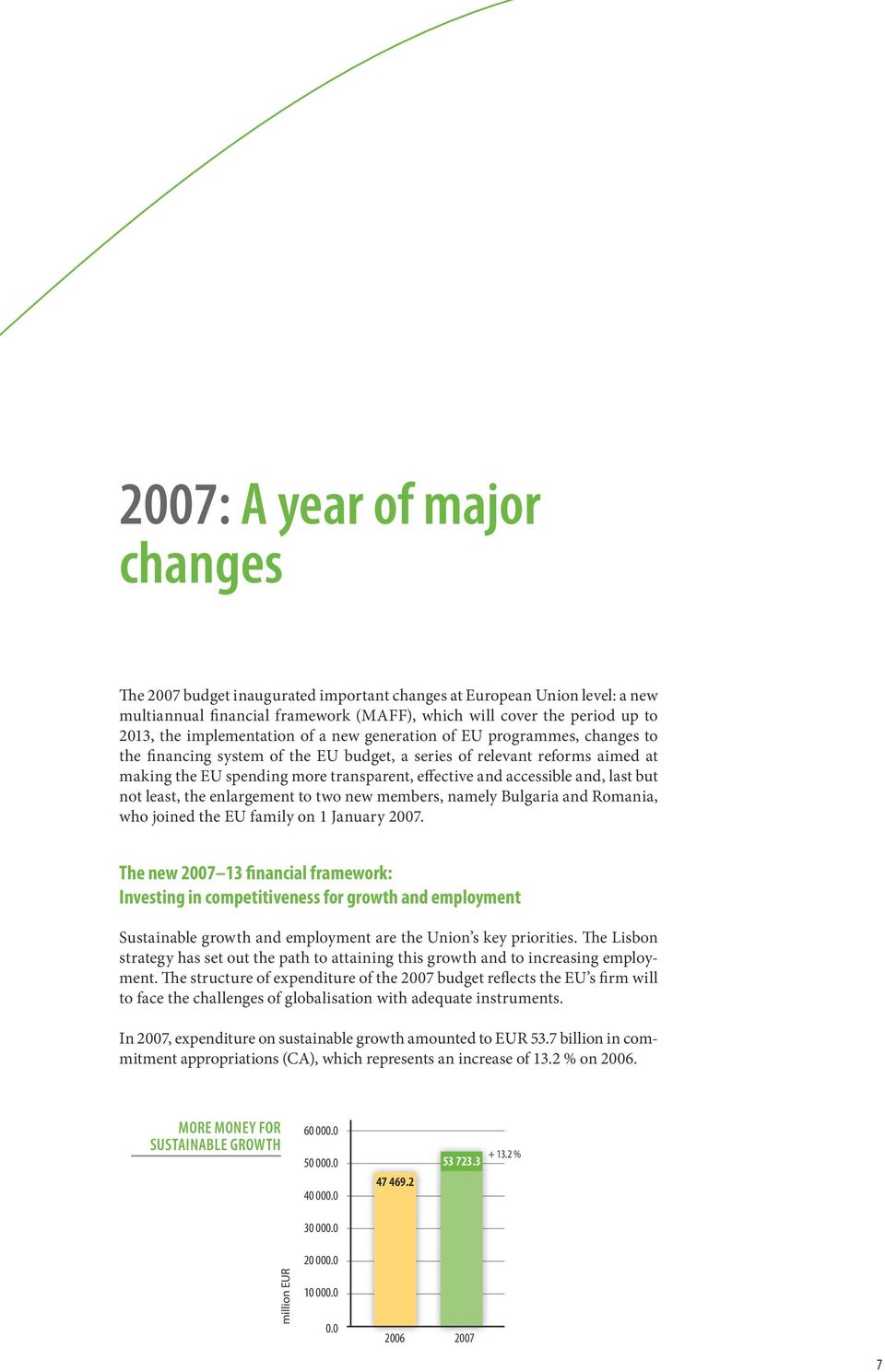
9 2007: A year of major changes The 2007 budget inaugurated important changes at European Union level: a new multiannual financial framework (MAFF), which will cover the period up to 2013, the implementation of a new generation of EU programmes, changes to the financing system of the EU budget, a series of relevant reforms aimed at making the EU spending more transparent, effective and accessible and, last but not least, the enlargement to two new members, namely Bulgaria and Romania, who joined the EU family on 1 January The new financial framework: Investing in competitiveness for growth and employment Sustainable growth and employment are the Union s key priorities. The Lisbon strategy has set out the path to attaining this growth and to increasing employment. The structure of expenditure of the 2007 budget reflects the EU s firm will to face the challenges of globalisation with adequate instruments. In 2007, expenditure on sustainable growth amounted to EUR 53.7 billion in commitment appropriations (CA), which represents an increase of 13.2 on more money for sustainable growth EUR
10 Key programmes such as competitiveness and innovation (CIP), trans- European networks (TENs) for transport and energy, lifelong learning, and the framework programme for research and technological development implemented the goals of the Lisbon strategy with increased financial s. Internal flexibility of the EU financial framework enabled an adaptation and shift in funds between policy headings, which helped secure the future of the European satellite navigation system (Galileo) and the brand new European Institute of Technology (EIT). Alongside the normal programmes in the financial framework, a number of tools have been foreseen to reinforce the leverage effect of the EU budget. The European Globalisation Adjustment Fund (EGF) with a total budget of up to EUR (and an annual ceiling of up to EUR 500 ) supports workers affected by the changes in world trade patterns, assisting them with retraining and job searches. The European Union Solidarity Fund offers rapid financial assistance in the event of major disasters in a Member State or a candidate country with an annual ceiling of up to EUR The Flexibility Instrument, with a budget of up to EUR (and an annual ceiling of up to EUR 200 ), finances special undertakings under one or more spending categories. For its part, the European Investment Bank has increased the capacity for loans and guarantees concerning research and development, trans-european networks and small and medium-sized enterprises (SMEs). Adapting the financing of the EU budget On 7 June 2007, the Council adopted an s decision (which shall enter into force after ratification by all Member States) adapting the financing of the EU budget, following the agreement reached on the financial framework. Key elements were, on the one side, the changes to the correction of budgetary imbalances in favour of the United Kingdom to ensure that it paid its fair share of expenditure in the new Member States, and, on the other side, the introduction of certain corrections in favour of Germany, the Netherlands, Austria and Sweden. The s decision adopted by the Council on 7 June 2007 shall enter into force after ratification by all Member States, with retroactive effect back to 1 January New funds, better rules: Enhancing flexibility, transparency and efficiency New funds require better rules to measure up to real life situations. The new provisions of the financial regulation, which entered into force in May 2007, aim at simplifying procedures and reducing red tape. EU grants have become easier to access, in particular for beneficiaries with limited s such as small non-governmental organisations (NGOs) and SMEs. For the first time ever, EU research grants have become available for individual researchers. Better accountability and increased transparency are key elements to ensure that EU funds are used properly at all levels. Thanks to the new rules, Member States for the first time submitted in February 2008 summaries of the audits of EU funds undertaken by them in The publication of the list of beneficiaries who received EU money became compulsory. Member States must exchange information with the Commission on proven fraud cases. 8 Such measures have increased the effectiveness of EU policies and helped protect taxpayers interests.
11 Sections

12

13 SECTION I Expenditure 1.1. Expenditure by heading Focusing European Union spending on new challenges Three main priorities have been identified for the multiannual financial framework (MAFF): integrating the single market into the broader objective of sustainable growth, mobilising economic, social and environmental policies to that end; the goals for this priority are competitiveness, cohesion, and the preservation and management of natural s; giving more substance to the concept of European citizenship by joining up the area of freedom, justice and security with access to basic public goods and services; establishing a coherent role for Europe as a global player inspired by its core values in assuming its regional responsibilities, promoting sustainable development, and contributing to civilian and strategic security. The budget implemented in 2007 has been structured around six headings, thus reflecting these new priorities: Sustainable growth with EUR 53.7 billion, representing the biggest share of implemented commitment appropriations (CA) in 2007; Preservation and management of natural s with EUR 52.6 billion in CA; Citizenship, freedom, security and justice with EUR 1.4 billion; The European Union as a global player with EUR 6.5 billion; and Administration with EUR 6.7 billion; and finally Compensation with EUR 0.4 billion in CA. Thus the total executed CA amounted to EUR billion. EU BUDGET Administration Compensation 0.4 EUR billion 4. The European Union as a global player Citizenship, freedom, security and justice Sustainable growth Preservation and management of natural s 43.3 (commitment appropriations) 11

14 Expenditure SECTION I Expenditure by heading 1.1. Heading 1: Sustainable growth 1a. Competitiveness for growth and employment Implemented commitment appropriations (CA): EUR 8.8 billion ( on 2006) Research and innovation for new jobs and a better future Competitiveness is the key strategic objective of the renewed Lisbon strategy on growth and jobs. The main expenditure area is research and development (R & D), followed by transport and energy networks (TENs), lifelong learning, and competitiveness and innovation (CIP). Framework programme for research and technological development The framework programme for research and technological development inaugurated its seventh edition (FP7) in It finances projects related to health, nanotechnologies, energy, environment and transport. An important objective is to support research for the benefit of SMEs. The European Research Council (ERC) plays a central role by selecting and attracting outstanding scholars from all over the world. CA amounted to EUR 5.4 billion in Lifelong learning The development of an advanced knowledge society is instrumental to sustainable economic growth, more and better jobs and greater social cohesion. The lifelong learning programme encompasses four actions on school education (Comenius), higher education (Erasmus), vocational training (Leonardo da Vinci) and adult education (Grundtvig), offering opportunities for learners, teachers and trainers to study or teach in another Member State. CA amounted to EUR The trans-european networks programme and Marco Polo The trans-european networks programme (TEN) supports the linking of regions and national transport and energy networks through modern and efficient infrastructure. Marco Polo finances environmentally friendly forms of transport such as shipping, rail and inland waterways. These programmes totalled EUR and EUR 55.1 in CA. Competitiveness and innovation framework programme The largest expenditure areas of the competitiveness and innovation framework programme (CIP) are represented by the entrepreneurship and innovation programme (EIP) supporting innovative enterprises through the European Investment Bank (EIB) and by the information and communication technology (ICT) policy support programme, which finances actions related to energy efficiency, renewable energy s, diversification of fuels, and energy efficiency in transport. CA amounted to EUR Other activities ( EUR) Commitment appropriations Nuclear decommissioning Decentralised agencies Social policy agenda Customs 2013 and Fiscalis Decommissioning (direct research policy) 26.9 European Globalisation Adjustment Fund 18.6 Miscellaneous expenditure

15 EUR 8.8 billion Other activities 11.7 Lifelong learning 10.3 Competitiveness and innovation 4.4 Marco Polo 0.6 Framework programme for research and technological development 62.1 Trans-European networks 10.8 (commitment appropriations) Multiannual Financial framework EGF Flexibility Instrument EUR voted budget ( * ) ceiling flexibility instrument EXECUTED European Globalisation Adjustment fund ( * ) Up to and including the third amending budget. (commitment appropriations) The European Globalisation Adjustment Fund (EGF) already described in the introduction (see p. 8) can be entered under the relevant heading, if necessary, over and above the ceilings. In 2007, it helped workers of the car manufacturing sector in France and workers of the mobile phone manufacturing sector in Germany and Finland. The Flexibility Instrument has been mobilised for the 2008 budget year, in order to secure the start of Galileo and of the European Institute of Technology. 13

16 Expenditure SECTION I Expenditure by heading 1.1. Heading 1: Sustainable growth 1b. Cohesion for growth and employment Implemented commitment appropriations (CA): EUR 44.9 billion ( on 2006) Stimulating growth potential in the least developed regions Cohesion policy aims at strengthening economic, social and territorial cohesion by reducing disparities in the level of development among regions and Member States. This means investing in regions potential to promote competitiveness and improve convergence to the best standard. This heading is structured around three main objectives and supported by three funds. 1. Convergence objective This is the priority objective replacing Objective 1 of the period , with CA representing 77.7 of total cohesion expenditure in It invests in longterm competitiveness, job creation and sustainable development in the less-developed regions and Member States. In the period , 70.5 of the s available for this objective are allocated to regions with a GDP per capita less than 75 of the EU-25 GDP and around 5 is allocated to transitional support to regions that lost eligibility due to the statistical effect of enlargement. The remaining 24.5 of the available s are allocated via the Cohesion Fund (see below) to Member States whose GNI per capita is less than 90 of the EU-25 average. Eligibility criteria are: population (structure, density, etc.), regional and national prosperity, surface area, and unemployment rates. CA amounted to EUR 34.9 billion, of which 7.1 were spent by the Cohesion Fund (see below). Technical assistance This expenditure area amounted to EUR 59.3 in CA. 2. Regional competitiveness and employment objective This objective funds regions not covered by the convergence objective and aims at strengthening regions competitiveness and attractiveness, as well as employment. In 2007, 20.2 of CA of overall cohesion expenditure were dedicated to this objective. In the period , 79 of the funding is allocated among Member States according to the eligible population, regional prosperity, (un)employment, and population density of the regions covered. The remaining 21 are allocated as transitional support to regions that were eligible for Objective 1 support in the period but whose GDP per capita increased above 75 of the average GDP of EU-15. The latter regions lost eligibility under the convergence objective due to growth. CA amounted to EUR 9.0 billion in European territorial cooperation objective This objective promotes cooperation at cross-border, transnational and interregional levels. It represented 2.0 (CA) of total cohesion expenditure in It funds also peace and reconciliation actions in Northern Ireland. CA amounted to EUR 0.9 billion in Cohesion Fund Member States whose GNI per capita is less than 90 of the average GNI of the EU-25 are eligible for funding from the Cohesion Fund, which is part of the convergence objective in the new programming period It finances trans-european transport networks, notably priority projects of European interest, other transport activities and environmental activities. Cohesion policy: Objectives and funds Objectives Convergence ERDF ESF Regional competitiveness and employment European territorial cooperation ERDF ERDF ESF Funds Cohesion Fund 14 Other funds The European Regional Development Fund (ERDF) co-finances infrastructure, productive investment, and regional and local development. The European Social Fund (ESF) supports employment opportunities by focusing on mobility of workers and their adaptation to industrial changes.
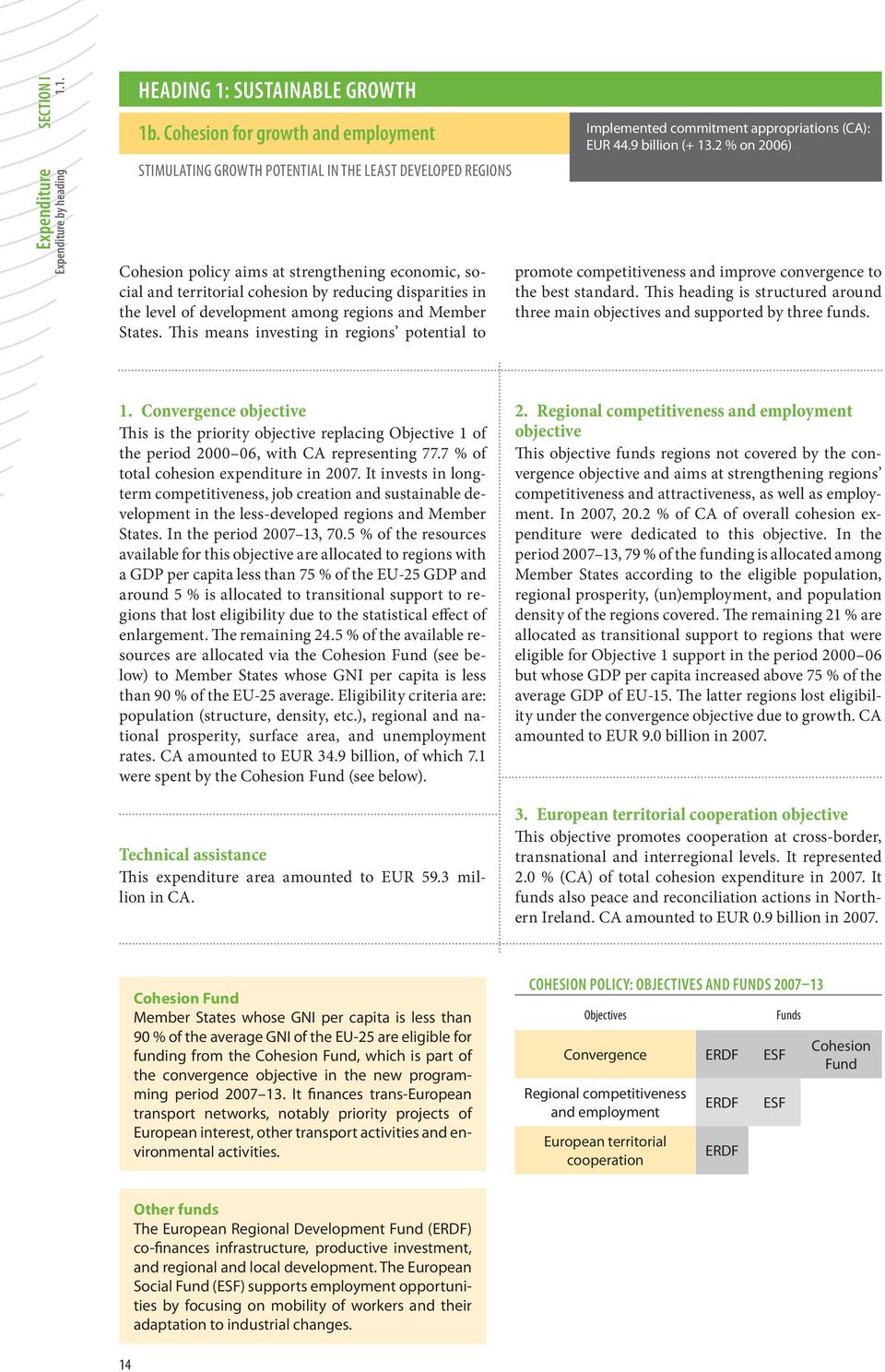
17 EUR 44.9 billion Regional competitiveness and employment objective 20.2 European territorial cooperation objective 2.0 Convergence objective including the Cohesion Fund 77.7 Technical assistance 0.1 (commitment appropriations) Refocusing of cohesion support towards new Member States Phasing-in Cohesion and Structural Funds billion EUR ( 1 ) 2007 ( 1 ) 2008 EU-15 EU 12 ( 1 ) Data for EU 10 in 2006 and partially in (commitment appropriations) EU 10: States who joined the EU in 2004 EU 12: EU 10 + RO and BU EU-15: Member States before 2004 Evolution of commitments between 2006 and 2007 in CA Convergence Regional competitiveness and employment European territorial cooperation
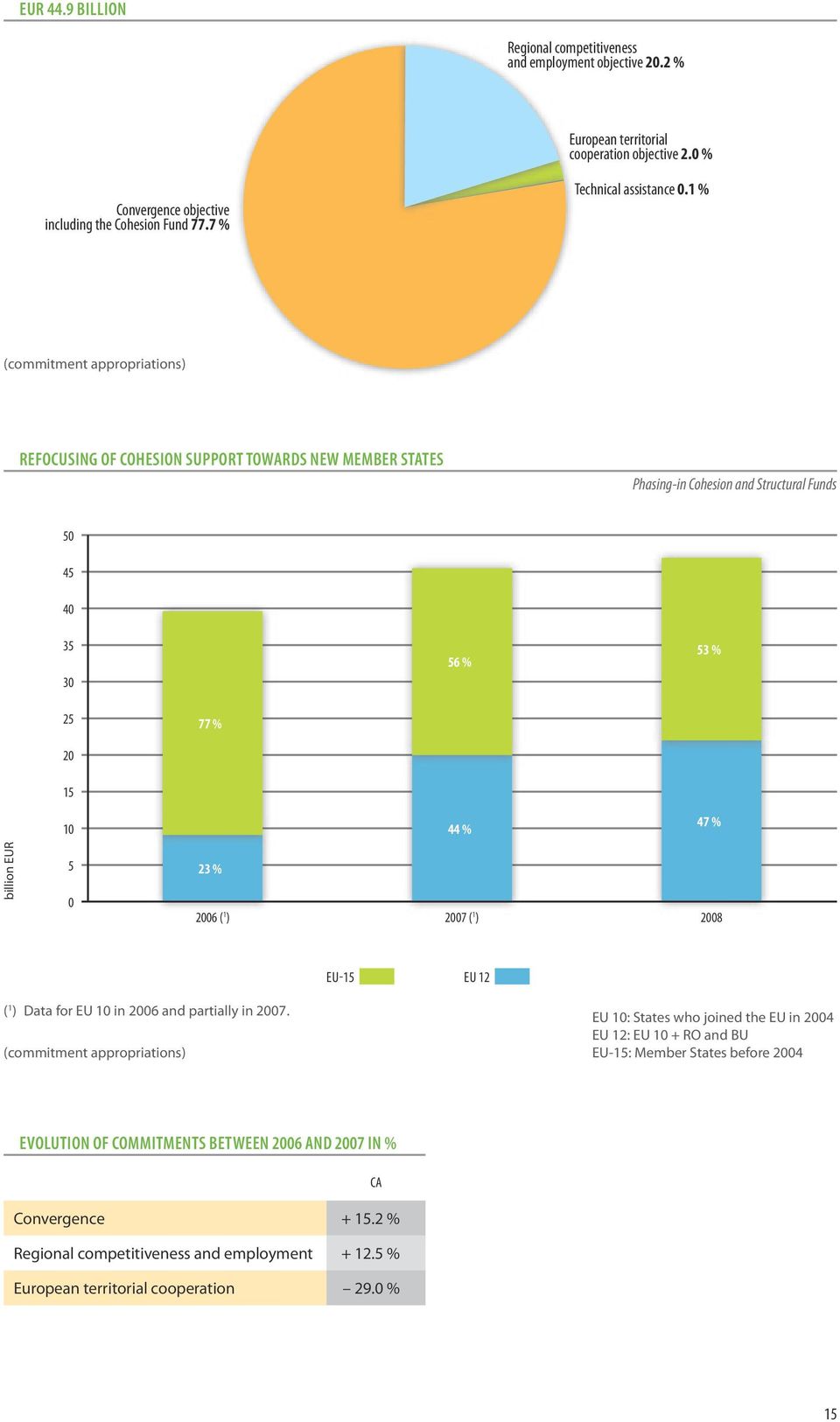
18 Expenditure SECTION I Expenditure by heading 1.1. Heading 2: Preservation and management of natural s Improving competitiveness, environment and quality of life Implemented commitment appropriations (CA): EUR 52.6 billion ( 5.0 on 2006) Managing natural s is one of the EU s most important tasks. Europe s common agricultural policy obviously plays a central role, but so do the support to the EU s fishermen and efforts to preserve the environment. Agriculture Market policy is the first pillar of the common agricultural policy (CAP). Its current structure is the result of major reforms adopted by the EU farm ministers on 26 June Their key aim was to make the agricultural sector more competitive by severing the link between subsidies and production, while providing the necessary income stability to farmers. The new single farm payments have been linked to the respect of environmental, food safety and animal welfare standards. A mechanism for financial discipline has been set up to ensure that the farm budget fixed until 2013 is not overshot. Direct payments to new Member States increased gradually following the 10-year phasing-in rates scheme. The rates in 2007 amounted to 40 for the Member States of the fifth enlargement and to 25 for Romania and Bulgaria. A new instrument called modulation allows transfer of funds from the first to the second pillar, rural development. CA amounted to EUR 41.9 billion. Rural development The second pillar of the CAP focuses on three thematic axes: improving competitiveness for farming and forestry; enhancing the environment and the countryside through support for land management; improving the quality of life in rural areas thanks to diversification of the rural economy. Axis 1 aims at creating a strong and dynamic European agri-food sector by focusing on the priorities of knowledge transfer, modernisation, innovation and quality of the food chain. Axis 2 improves biodiversity and the preservation and development of high nature value farming and forestry systems and traditional agricultural landscapes, water and climate change. Axis 3 focuses on the creation of employment opportunities and promotes capacity-building, skills acquisition and organisation for local strategy development in order to ensure that rural areas remain attractive for future generations. CA amounted to EUR 9.5 billion. European Fisheries Fund The European Fisheries Fund (EFF) aims at developing fisheries in the EU and contributes to the economic diversification of regions affected by a reduction in fishing activity. It is subdivided around different priority axes: (1) measures for the adaptation of the Community fishing fleet; (2) aquaculture, inland fishing, processing and marketing of fishery and aquaculture products; (3) measures of common interest; (4) sustainable development of fisheries areas; (5) technical assistance. Each Member State sets up an operational programme (OP) for the whole programming period , describing its choice among priority axes and the related targets. CA in 2007 amounted to EUR Other activities ( EUR) Commitment appropriations Animal and plant health Fisheries governance and international agreements Decentralised agencies 33.1 Fisheries market 25.1 Miscellaneous expenditure 3.0 LIFE+ LIFE+ supports the development and implementation of Community environmental policy and legislation, in particular the objectives of the sixth environment action programme of the European Community (sixth EAP). It is implemented on the basis of three thematic fields. (1) LIFE+ Nature and LIFE+ Biodiversity cofinance best practice or demonstration projects that contribute to the implementation of the birds and habitats directives, as well as innovative or demonstration projects promoting the implementation of the objectives of the Commission communication Halting the loss of biodiversity by 2010 and beyond. (2) LIFE+ Environment policy and governance supports projects contributing to the implementation of Community environmental policy, the development of innovative policy approaches, technologies, methods and instruments, the knowledge base as regards environment policy and legislation, and the monitoring of the environment (including forest monitoring). (3) LIFE+ Information and communication promotes the implementation of communication and awareness-raising campaigns on environmental, nature protection or biodiversity conservation issues, as well as projects related to forest fire prevention. CA amounted to EUR

19 EUR 52.6 billion Rural development 18.1 European Fisheries Fund 0.8 LIFE+ 0.5 Other activities 1.0 Agriculture 79.6 (commitment appropriations) Multiannual Financial framework EUR (commitment appropriations) ceiling EXECUTED Voted budget Further integration of New Member States into Agricultural Policy ( 1 ) EU-15 EU billion EUR (commitment appropriations) ( 1 ) EU 12: States who joined the EU in RO and BG EU-15: Member States before
20 Expenditure SECTION I Expenditure by heading 1.1. Heading 3: Citizenship, freedom, security and justice 3a. Freedom, security and justice Implemented commitment appropriations (CA): EUR (+ 6.9 on 2006) Protecting life, freedom and property of citizens The development of a common asylum area, cooperation between law enforcement agencies and judicial authorities to prevent and fight terrorism and crime, respect for fundamental rights, and a global approach to drug issues are the main policies of this expenditure area focusing on the protection of life, freedom and property of citizens. Solidarity and management of migration flows This framework programme is structured around several funds. Implementation of the common integrated border management system and cooperation by consular services, as well as development and application of surveillance systems together with the setting-up of strategic and operational coordination between authorities, are supported by the European External Borders Fund. Aid to Member States concerning the consequences of receiving refugees and displaced persons is managed through the European Refugee Fund, which co-finances actions linked to asylum conditions and procedures, such as accommodation infrastructure, medical or legal assistance and integration measures. The European Fund for the Integration of Third- Country Nationals provides support for integration enabling third-country nationals to settle. The main measures aim at conveying basic knowledge about the host society s language, institutions and fundamental values. CA in 2007 amounted to EUR Security and safeguarding liberties Two main programmes characterise this expenditure area. The first one is designed to manage the consequences of terrorism and to protect citizens against acts that may threaten individual liberties, democratic society and the rule of law. The second one is a security programme promoting coordination, cooperation and best practices in the fields of law enforcement, crime prevention and criminology. CA amounted to EUR Fundamental rights and justice The framework programme on fundamental rights and justice finances actions combating violence, providing information on and preventing the use of drugs and actively promoting fundamental rights. It supports also judicial cooperation in criminal and civil matters and aims at promoting mutual recognition of judicial decisions. CA amounted to EUR Decentralised agencies Decentralised agencies, such as the Agency for Fundamental Rights in Vienna, the Agency for the Management of Operational Cooperation at the External Borders (Frontex) in Warsaw, the European Monitoring Centre for Drugs and Drug Addiction in Lisbon, play a growing role in the implementation of this area. The decentralised agencies of heading 3a include also the European Police College in Bramshill and the judicial cooperation network Eurojust in The Hague. CA in 2007 amounted to EUR Other actions Further specific instruments have been designed for the development and implementation of large-scale IT systems, such as the Schengen information system II, the visa information system or the Eurodac system for comparing the fingerprints of asylum-seekers to determine the Member States responsible for an asylum application. CA amounted to EUR

21 EUR Million Decentralised agencies 14.7 Other actions and programmes 8.9 Solidarity and management of migration flows 53.5 Fundamental rights and justice 12.8 (commitment appropriations) Security and safeguarding liberties 10.1 Multiannual Financial framework EUR EXECUTED Voted budget ceiling (commitment appropriations) 19
22 Expenditure SECTION I Expenditure by heading 1.1. Heading 3: Citizenship, freedom, security and justice 3b. Citizenship Implemented commitment appropriations (CA): EUR (+ 2.1 on 2006) Enhancing European identity, civil protection and health Improving active citizenship, fostering European culture, identity and diversity, as well as promoting health, consumer and civil protection are the EU s objectives implemented in this expenditure area. Public health and consumer protection This expenditure area encompasses two main policies. The public health policy finances identification of health threats posed by diseases or physical and chemical agents and development of vaccination policies and emergency plans. The consumer policy monitors market developments, provides scientific advice and risk evaluation, and supports European consumer organisations. CA amounted in 2007 to EUR Citizens for Europe Citizens for Europe aims at forging a European identity, based on recognised common values, history and culture. It gives citizens the opportunity to interact and participate in constructing an ever closer Europe, united in and enriched through its cultural diversity. Typical actions are the development of exchanges, such as t-twinning and local transnational citizens projects. CA amounted to EUR 23. Decentralised agencies The EU budget finances two decentralised agencies implementing the policies of health and consumer protection: the European Centre for Disease Prevention and Control, in Stockholm and the European Food Safety Authority, in Parma. CA in 2007 amounted to EUR 75. Civil protection and the European Union Solidarity Fund The civil protection financial instrument for major emergencies is a programme designed to aid Member States to protect people, the environment and property in the event of natural and man-made disasters. Main actions are studies, scenarios, exercises, staff exchanges and information provision, as well as the development of detection and early-warning systems. CA in 2007 corresponded to EUR 7.7. The European Union Solidarity Fund has been mobilised for an amount of EUR in CA in 2007 following natural disasters in Member States. MEDIA 2007 MEDIA 2007 promotes European cultural values, such as cultural and linguistic diversity, by supporting the creation of highly skilled jobs in the audiovisual sector. Examples of co-financing are: training for audiovisual professionals, development of European projects, financing plans, dubbing and subtitling. CA amounted to EUR 86. Communication actions In recent years, the need and the importance of reinforcing communication with European citizens has resulted in initiatives centred on the three main objectives of listening, communicating and going local, providing full and comprehensive information on the EU and involving people in a permanent dialogue. These activities engage in debate and discussion with citizens in national, regional and local contexts, thus promoting active European citizenship and contributing to the development of a European public sphere. CA amounted to EUR Culture This programme promotes cultural exchange and cooperation by supporting the mobility of cultural players. It finances inter alia festivals, master classes, international exhibitions, workshops and conferences. CA amounted to EUR Youth in action This expenditure area promotes youth exchanges, encourages active participation of young people in the democratic life and supports their voluntary participation in non-profit activities. CA totalled EUR Other activities Miscellaneous expenditure amounted to EUR in CA. 20
23 EUR Million Other actions 12.9 Public health and consumer protection 7.9 Decentralised agencies 9.4 Youth in action 14.6 Civil protection financial instrument 1.0 Culture 5.5 European Union Solidarity Fund 24.5 Communication actions 10.6 Citizens for Europe 2.9 MEDIA (commitment appropriations) breaching the ceilings for important reasons EUSF EUR executed budget voted budget ceiling (commitment appropriations) In the case of a catastrophe in Europe, the EU can mobilise the European Union Solidarity Fund (EUSF), even if this means breaching the ceiling of the relevant heading. In 2007, this happened in the case of storm damages in Germany (EUR ) and Réunion (EUR 5.3 ), as well as in the case of floods in Greece (EUR 9.3 ) and in Hungary (EUR 15.1 ). In 2008, the UK (162.4 ), Greece and Slovenia (EUR 98 ) will receive appropriations for events which took place in
24 Expenditure SECTION I Expenditure by heading 1.1. Heading 4: The European Union as a global player Promoting prosperity and supporting democratic values around the world The EU s paramount objectives in foreign policy are stability, security and neighbourhood s prosperity. The EU is the world s biggest provider of aid to developing countries. It has created a more pro-active foreign and Implemented commitment appropriations (CA): EUR 6.5 billion ( 21.5 ( 1 ) on 2006) security policy with the capacity to carry out crisismanagement and peace-keeping missions within Europe and far beyond. Integration of new countries strengthens its role on the international scene. Instrument for Pre-Accession Assistance (IPA) The IPA offers rationalised support to countries aspiring to join the EU, such as Croatia, the former Yugoslav Republic of Macedonia and Turkey. Support aims at preparing them for full implementation of EU law. Potential candidate countries in the western Balkans also receive support for transition, institution-building and cross-border cooperation. CA in 2007 amounted to EUR 1.18 billion. Development Cooperation Instrument (DCI) The DCI works on poverty reduction, sustainable economic and social development, and the smooth and gradual integration of developing countries into the world economy. Support covers five regions: Latin America, Asia, central Asia, the Middle East and South Africa. Reinforcement of the role of the EU in Asia, and in particular in China and India, has recently become a main priority. CA amounted to EUR 2.17 billion. European Neighbourhood and Partnership Instrument (ENPI) The ENPI operates in the framework of the European neighbourhood policy, which aims at building close relations with neighbouring countries and at fostering prosperity, stability and security along Europe s borders. Addressed are countries of the south and eastern Mediterranean, together with countries in eastern Europe and the southern Caucasus. This instrument also covers support for the strategic partnership with Russia. Typical actions are people-to-people exchanges aimed at education, scientific research and business improvement with particular attention to SMEs. CA amounted to EUR 1.65 billion. Humanitarian Aid Instrument (HAI) The HAI helps countries which are victims of natural catastrophes and man-made crises (wars, conflicts, etc.). In 2007, support went to victims of the earthquake in Peru, of flooding in Africa, India and Bangladesh, of the Cyclone Felix in Nicaragua and of the Hurricane Dean in the Caribbean. Since 2007, food aid activities are directly managed through the EU budget and additional funds have been allocated in response to food crises. CA amounted to EUR Common foreign and security policy The common foreign and security policy (CFSP) operates to safeguard the EU s fundamental interests and security. It encompasses the following components: (1) monitoring and implementation of peace and security processes, mainly through the European Union Monitoring Mission (EUMM) operating in the Balkan area; (2) non-proliferation and disarmament, mainly in Russia; (3) conflict resolution and support for peace processes; (4) European Union Special Representatives (EUSRs) appointed to represent the EU in troubled regions and countries. CA amounted to EUR Other activities ( EUR) The European Instrument for Democracy and Human Rights Commitment appropriations Instrument for Stability Instrument for Nuclear Safety Cooperation 69.8 Macroeconomic assistance 57.9 Industrialised Countries Instrument 24.5 Decentralised agencies 19.7 Miscellaneous expenditure ( 1 ) This negative difference concerns the expenditure area of the Instrument for Pre-Accession Assistance and is due to the accession of Bulgaria and Romania in
25 EUR 6.5 billion Common foreign and security policy 2.4 Other activities 9.1 Instrument for Pre-Accession 18.2 Humanitarian aid 11.3 European Neighbourhood and Partnership Instrument 25.5 Development Cooperation Instrument 33.5 (commitment appropriations) Multiannual Financial framework Flexibility Instrument EAR EUR voted budget ceiling EXECUTED emergency aid reserve flexibility instrument (commitment appropriations) The Flexibility Instrument has been mobilised to secure actions in the CFSP. The Emergency Aid Reserve is designed to face unforeseen crises. 23
26 Expenditure SECTION I Expenditure by heading 1.1. Administration and compensation Running the Union Administration covers the expenditure of all EU institutions, such as salaries and pensions of the staff, buildings and infrastructure, information technology activities and security. In 2007, CA amounted to EUR 6.7 billion, representing 5.6 of total CA. Despite recent enlargements and the related increases in human s, the share of administrative expenditure has remained and will remain stable at around this level. Administrative expenditure by EU Institution (Million eur) Commitment appropriations Helping new members with their first payments to the EU budget Compensation is a temporary measure ensuring that new Member States retain a positive budgetary balance during the first years of accession. New EU countries start paying into the EU budget from the beginning of their accession but due to the fact that the programmes are implemented over a long timeframe they do not receive substantial amounts from the EU budget until much later. Therefore they need a compensation to counterbalance the temporary time gap. Whereas in 2006 compensations were paid to the 10 countries that had joined in 2004, in 2007 they only concerned Bulgaria (EUR 129 ) and Romania (EUR 315 ). Parliament Council 508 Commission ( 1 ) Court of Justice 265 Court of Auditors 109 European Economic and Social Committee 104 Committee of the Regions 65 European Ombudsman 7 European Data Protection Supervisor 4 Pensions 963 European Schools 129 EUR 444 Million Romania 71 Bulgaria 29 ( 1 ) Excluding pensions and European Schools. (commitment appropriations) 24
27 SECTION I Expenditure 1.2. Expenditure by Member State Scope and limits of the allocation exercise Allocating expenditure to Member States is merely an accounting exercise that gives a very limited view of the benefits that each Member State derives from the Union. The Commission has stressed this point on many occasions ( 1 ). This accounting allocation, among other drawbacks, is non-exhaustive and gives no indication of many of the other benefits gained from EU policies such as those relating to the internal market and economic integration, not to mention political stability and security. See notes in tables annexed for further details on the methodology used for the allocation of expenditure. Allocation of expenditure In 2007, total executed EU expenditure amounted to EUR ( 2 ), of which EUR (i.e ) was allocated to Member States, EUR to third countries and EUR was not allocated. The corresponding 2006 figures were EUR , EUR (i.e ), EUR and EUR In 2007, EU expenditure allocated to third countries (i.e. EUR ) concerned mainly part of: The EU as a global player (EUR ), research (EUR ), fisheries (EUR ) and other (EUR ). The 2007 EU expenditure which was not allocated (i.e. EUR ) falls into the following categories: expenditure financed from earmarked revenue (which mainly benefits third countries): EUR ; part of expenditure under The EU as a global player (EUR ); expenditure which, by its nature, cannot be attributed to specific Member States: EUR ; this concerns part of administration (EUR ), research (EUR ), competitiveness and innovation (EUR ) and other (EUR ). Methodology Year of reference Executed and allocated expenditure are actual payments made during a financial year, pursuant to that year s appropriations or to carry-overs of non-utilised appropriations from the previous year. Expenditure financed from earmarked revenue is presented separately, except for the payments made under EFTA appropriations, which cannot be isolated in the central accounting system of the Commission (ABAC). Allocation of expenditure This is based on the criteria used for the UK correction, i.e. all expenditure must possibly be allocated, except for external actions, pre-accession strategy (if paid to the EU-15), guarantees, reserves and expenditure under earmarked revenue. Allocation by Member State Expenditure is allocated to the country in which the principal recipient resides, on the basis of the information available in ABAC. Some expenditure is not (or is improperly) allocated in ABAC, due to conceptual difficulties. In this case, whenever obtained from the corresponding services, additional information is used (e.g. for Galileo, research and administration). ( 1 ) A full statement on this policy and its rationale has been made in Chapter 2 of the 1998 Commission report Financing of the European Union (as available on: and in Budget contributions, EU expenditure, budgetary balances and relative prosperity of the Member States, paper presented by the Commission to the Ecofin Council of 13 October The Presidency Conclusions of the Berlin European Council of 24 and 25 March 1999 endorse this principle: [...] it is recognised that the full benefits of Union membership cannot be measured solely in budgetary terms (point 68 of the Presidency Conclusions). ( 2 ) Payments made from EUR of payments appropriations (i.e. from the sum of: EUR on year s appropriations, EUR on carry-overs and EUR on earmarked revenue). 25
28 Expenditure SECTION I Expenditure by Member State 1.2. Allocation by Member State In absolute terms, France is in 2007 as in 2006 the largest recipient of EU expenditure ahead of Spain, which was first in 2003, 2004 and Germany is in third position as in 2004, 2005 and Italy is in fourth position, followed by Greece. Figure EU expenditure by heading and by Member State Poland, which now receives substantial EU cohesion and agricultural expenditure, is in sixth position (up from the eighth position in 2005 and 2006), ahead of the United Kingdom and Belgium (when including administrative expenditure). See Figure 1 below and tables in annex for further details. ( EUR, ranked by size) FR ES DE IT EL PL UK BE PT HU IE NL CZ SE RO AT DK FI LU SK LT LV BG SI EE CY MT EU NB: The UK correction amounted to EUR in Compensation 5. Administration 4. The EU as a global player 3b. Citizenship 3a. Freedom, security, justice 2. Natural s 1b. Cohesion 1a. Competitiveness 26
29 In 2007, the ratio of EU allocated expenditure on GNI: increased to 3.88 for Lithuania (now ahead of Greece, 3.77 ) and to 3.52 for Latvia, since both countries now receive substantial EU cohesion and agricultural expenditure; reached 2.65 for Poland, now in fifth position, up from the ninth position in 2006, and 2.60 for Hungary, now in sixth position, up from the eighth position in 2006; was 2.57 for Estonia, 2.49 for Portugal, 2.07 for Bulgaria and 2.04 for Slovakia; was between 1.71 and 1.19 for Malta, the Czech Republic, Romania, Ireland, Spain and Slovenia; was between 0.84 and 0.34 for Cyprus, Finland, Italy, France, Denmark, Austria, Germany, Sweden, the United Kingdom and the Netherlands. For Belgium and Luxembourg, the ratio was respectively 1.70 and 4.42 when including administrative expenditure, and 0.59 and 0.62 when excluding administrative expenditure. See Figure 2 below for further details. Figure EU expenditure by heading and by Member State ( GNI, ranked by size) LU LT EL LV PL HU EE PT BG SK MT BE CZ RO IE ES SI CY FI IT FR DK AT DE SE UK NL 6. Compensation 5. Administration 4. The EU as a global player 3b. Citizenship 3a. Freedom, security, justice 2. Natural s 1b. Cohesion 1a. Competitiveness Additional information on the evolution of the allocation of EU expenditure in each Member State for the period is included in tables available on the Internet ( reports_en.htm). For each heading of the financial framework, a summary view of the allocation of 2007 EU expenditure by Member State is given in the charts hereafter. 27
30 Expenditure SECTION I Expenditure by Member State a. Competitiveness for growth and employment As far as competitiveness for growth and employment is concerned, Germany is the largest recipient in 2007, ahead of France, Belgium, the United Kingdom and Italy. Then come the Netherlands and Spain. A third group includes Sweden, Austria, Greece, Poland, Portugal, Luxembourg, Denmark, Finland and Ireland. Pie Chart 1a Competitiveness for growth and employment 2007 EU expenditure by Member State ( EU, ranked by size) SI: EUR 0.03 billion; 0.5 RO: EUR 0.03 billion; 0.5 SK: EUR 0.03 billion; 0.6 CZ: EUR 0.04 billion; 0.7 LT: EUR 0.04 billion; 0.8 HU: EUR 0.05 billion; 1 BG: EUR 0.02 billion; 0.3 LV: EUR 0.01 billion; 0.2 EE: EUR 0.01 billion; 0.2 CY: EUR 0.01 billion; 0.2 MT: EUR 0.01 billion; 0.1 IE: EUR 0.09 billion; 1.7 FI: EUR 0.09 billion; 1.7 DK: EUR 0.10 billion; 1.7 LU: EUR 0.10 billion; 1.8 PT: EUR 0.11 billion; 1.9 PL: EUR 0.11 billion; 2.1 DE: EUR 0.87 billion; 15.6 EL: EUR 0.15 billion; 2.6 AT: EUR 0.16 billion; 2.9 FR: EUR 0.72 billion; 13 SE: EUR 0.18 billion; 3.3 ES: EUR 0.30 billion; 5.4 BE: EUR 0.67 billion; 12.1 NL: EUR 0.34 billion; 6.1 UK: EUR 0.64 billion; 11.5 IT: EUR 0.64 billion;
31 In relative terms, Luxembourg received the largest share of EU competitiveness expenditure (0.34 of GNI) followed by Belgium. Expenditure allocated to Belgium and Luxembourg might be inflated due to the large number of multinational consultancies or ad hoc companies based in these two Member States. Lithuania is third (0.16 of GNI, of which 0.09 for the decommissioning of the Ignalina nuclear plant). Another group comprises Malta, Estonia and Slovenia. Bar Chart 1a Competitiveness for growth and employment 2007 EU expenditure by Member State ( GNI, ranked by size) LU BE LT MT EE SI LV PT EL SK BG CY NL AT IE HU SE FI IT DK PL FR DE CZ UK ES RO 29
32 Expenditure SECTION I Expenditure by Member State b. Cohesion for growth and employment As in , Spain is by far the largest recipient of EU Cohesion and Structural Funds in 2007, but at a much lower level than in recent years. Then follow Greece, Italy and Germany. Greece, now in second position, was in fourth position (behind Italy and Germany) in Poland is now in fifth position, up from the eighth position in 2006, ahead of Portugal, France and the United Kingdom. Then come Hungary, now in ninth position, as in 2006, followed by the Czech Republic, now in 10th position, up from the 12th position in The following group comprises Slovakia, Lithuania, Latvia and Romania. Pie Chart 1b Cohesion for growth and employment 2007 EU expenditure by Member State ( EU, ranked by size) NL: EUR 0.25 billion; 0.7 IE: EUR 0.26 billion; 0.7 AT: EUR 0.26 billion; 0.7 SE: EUR 0.30 billion; 0.8 FI: EUR 0.32 billion; 0.9 BE: EUR 0.35 billion; 0.9 RO: EUR 0.42 billion; 1.1 LV: EUR 0.44 billion; 1.2 LT: EUR 0.47 billion; 1.3 EE: EUR 0.22 billion; 0.6 SI: EUR 0.16 billion; 0.4 BG: EUR 0.14 billion; 0.4 DK: EUR 0.13 billion; 0.3 MT: EUR 0.05 billion; 0.1 CY: EUR 0.03 billion; 0.1 LU: EUR 0.01 billion; 0.04 SK: EUR 0.64 billion; 1.7 CZ: EUR 0.92 billion; 2.5 ES: EUR 5.43 billion; 14.7 HU: EUR 1.30 billion; 3.5 UK: EUR 2.36 billion; 6.4 EL: EUR 4.59 billion; 12.4 FR: EUR 2.45 billion; 6.6 PT: EUR 2.46 billion; 6.6 IT: EUR 4.45 billion; 12.1 PL: EUR 4.22 billion; 11.4 DE: EUR 4.31 billion;
33 In relative terms, Latvia received the largest share of EU cohesion expenditure (2.28 of GNI) followed by Greece. A second group comprises Lithuania, Portugal, Estonia, Poland, Hungary and Slovakia. Then come Malta and the Czech Republic, followed by Spain (first in nominal terms, but only in 11th position in relative terms), Bulgaria, Slovenia and Romania. Bar Chart 1b Cohesion for growth and employment 2007 EU expenditure by Member State ( GNI, ranked by size) LV EL LT PT EE PL HU SK MT CZ ES BG SI RO IT CY FI DE IE FR UK BE AT SE DK LU NL 31
34 Expenditure SECTION I Expenditure by Member State Preservation and management of natural s As in , France is in 2007 the largest recipient of EU agricultural expenditure, ahead of Spain and Germany (as in 2006). Then follow, as in 2006, Italy, the United Kingdom, Greece and Poland, yet with a much higher share and amounts for Poland. Pie Chart 2 Preservation and management of natural s 2007 EU expenditure by Member State ( EU, ranked by size) LV: EUR 0.19 billion; 0.3 SK: EUR 0.38 billion; 0.7 LT: EUR 0.48 billion; 0.9 CZ: EUR 0.72 billion; 1.3 BE: EUR 0.88 billion; 1.6 HU: EUR 0.96 billion; 1.8 FI: EUR 0.97 billion; 1.8 SE: EUR 1.10 billion; 2.1 SI: EUR 0.18 billion; 0.3 EE: EUR 0.12 billion; 0.2 CY: EUR 0.06 billion; 0.1 LU: EUR 0.06 billion; 0.1 RO: EUR 0.02 billion; 0.04 MT: EUR 0.01 billion; 0.02 BG: EUR 0.01 billion; 0.01 AT: EUR 1.13 billion; 2.1 FR: EUR billion; 19.2 DK: EUR 1.17 billion; 2.2 NL: EUR 1.21 billion; 2.2 PT: EUR 1.30 billion; 2.4 IE: EUR 1.76 billion; 3.3 PL: EUR 3.11 billion; 5.8 ES: EUR 6.97 billion; 12.9 EL: EUR 3.64 billion; 6.8 DE: EUR 6.91 billion; 12.8 UK: EUR 4.23 billion; 7.9 IT: EUR 5.91 billion;
35 In relative terms, Lithuania received the largest share of EU expenditure under the heading Natural s (1.80 of GNI) ahead of Greece. Then follow Ireland, Poland and Hungary. A third group comprises Latvia, Portugal, Estonia, Slovakia, Spain and the Czech Republic. Lithuania, Poland, Hungary, Latvia, Estonia, Slovakia and the Czech Republic are already among the largest recipients in relative terms. Yet EU payments under the heading Natural s for these Member States are still in a phasing-in process. Full payments (comparable to the EU-15) will be reached only from 2013 onwards. France, which is in first position in nominal terms, then comes in 12th position in relative terms. Bar Chart 2 Preservation and management of natural s 2007 EU expenditure by Member State ( GNI, ranked by size) LT EL IE PL HU LV PT EE SK ES CZ FR SI FI DK AT CY IT SE DE BE NL UK LU MT BG RO 33
36 Expenditure SECTION I Expenditure by Member State Citizenship, freedom, security and justice In 2007, Germany is by far the largest recipient of this new heading, ahead of France and Belgium. Poland is in fourth position, followed by Italy. A third group comprises Sweden, the United Kingdom, Hungary and the Netherlands. Payments made under the EU Solidarity Fund, which may vary considerably from one year to the other, are included under this heading. In 2007, this concerns notably Germany (flooding) for a total of EUR 167. From the past may also be mentioned: in 2002 Germany and Austria (flooding) and, to a lesser extent, in 2003 Portugal (drought and forest fires), in 2004 Spain, France and Italy (forest fires and/or flooding), and in 2006 Austria (flooding). Pie Chart 3 Citizenship, freedom, security and justice 2007 EU expenditure by Member State ( EU, ranked by size) CY: EUR 0.01 billion; 0.9 SI: EUR 0.01 billion; 0.9 EE: EUR 0.01 billion; 0.9 LV: EUR 0.01 billion; 1.0 LU: EUR 0.01 billion; 1.1 FI: EUR 0.01 billion; 1.1 DK: EUR 0.01 billion; 0.9 IE: EUR 0.01 billion; 0.7 RO: EUR billion; 0.4 BG: EUR billion; 0.3 MT: EUR 0.01 billion; 1.2 SK: EUR 0.01 billion; 1.4 LT: EUR 0.02 billion; 1.6 PT: EUR 0.02 billion; 1.7 CZ: EUR 0.02 billion; 1.8 EL: EUR 0.02 billion; 1.9 DE: EUR 0.23 billion; 23.8 AT: EUR 0.03 billion; 2.6 ES: EUR 0.03 billion; 2.7 NL: EUR 0.04 billion; 3.7 HU: EUR 0.04 billion; 3.8 FR: EUR 0.10 billion; 10.0 UK: EUR 0.04 billion; 4.3 SE: EUR 0.04 billion; 4.5 BE: EUR 0.09 billion; 9.2 IT: EUR 0.08 billion; 8.5 PL: EUR 0.09 billion;
37 In relative terms, the biggest amounts of the new heading went to Malta (0.22 of GNI), notably on account of a payment of EUR 9.2 related to the enlargement transition facility for new Member States. A second group comprises Estonia, Cyprus, Lithuania and Latvia. Then follow Hungary, Luxembourg, Poland, Slovenia, Belgium and Slovakia. Bar Chart 3 Citizenship, freedom, security and justice 2007 EU expenditure by Member State ( GNI, ranked by size) MT EE CY LT LV HU LU PL SI BE SK CZ SE BG PT DE AT EL NL FI IT FR IE DK RO ES UK 35
38 Expenditure SECTION I Expenditure by Member State and 6. Pre-accession and compensations In 2007, a total of EUR residual payments corresponding to pre-accession programmes were paid to the 10 Member States which joined the EU in 2004, as well as to Bulgaria and Romania. Pie Chart 4 Pre-accession and compensations 2007 EU expenditure by Member State SK: EUR 0.01 billion; 0.5 CZ: EUR 0.02 billion; 0.8 LV: EUR 0.02 billion; 1.1 LT: EUR 0.03 billion; 1.3 HU: EUR 0.06 billion; 3.2 Besides, compensations of respectively EUR and EUR were paid to Bulgaria and Romania in EE: EUR 0.01 billion; 0.4 CY: EUR 0.01 billion; 0.4 SI: EUR 0.01 billion; 0.4 MT: EUR billion; 0.1 ( EU, ranked by size) RO (pre-accession): EUR 0.79 billion; 41.6 PL: EUR 0.23 billion; 12.0 BG (compensation): EUR 0.13 billion; 6.8 BG (pre-accession): EUR 0.28 billion; 14.7 RO (compensation): EUR 0.32 billion; 16.6 Bar Chart 4 Pre-accession and compensations 2007 EU expenditure by Member State ( GNI, ranked by size) Compensation 4. The EU as a global player BG RO LV LT PL HU EE CY MT SI SK CZ 36
39 5. Administration As in , Belgium and Luxembourg were respectively allocated in 2007 around 60 and 20 of EU administrative expenditure. Belgium and Luxembourg were the main recipients in both nominal and relative terms. Pie Chart 5 Administration 2007 EU expenditure by Member State ES: EUR 0.07 billion; other MS: EUR 0.32 billion; 6.0 NL: EUR 0.08 billion; 1.3 UK: EUR 0.14 billion; 2.3 DE: EUR 0.17 billion; 2.7 ( EU, ranked by size) IT: EUR 0.23 billion; 3.8 FR: EUR 0.27 billion; 4.4 BE: EUR 3.69 billion; 60.4 LU: EUR 1.10 billion; 18.0 Bar Chart 5 Administration 2007 EU expenditure by Member State ( GNI, ranked by size) LU BE MT EE BG LT LV CY IE SI DK SK HU RO PT IT FR NL EL FI CZ PL AT SE UK DE ES 37
40 Expenditure SECTION I Expenditure by Member State 1.2. Allocation of 2007 EU expenditure by heading and by Member State 1a. Competitiveness 1b. Cohesion 2. Natural s 3a. Freedom, security, justice EUR 3b. Citizenship 4. The EU as a global player BE BG CZ DK DE EE IE EL ES FR IT CY LV LT LU HU MT NL AT PL PT RO SI SK FI SE UK EU Non-EU other earmarked Administration 6. Compensation expenditure >>> 38
41 Allocation of 2007 EU expenditure by heading and by Member State (continued) by Member State 1a. Competitiveness 1b. Cohesion 2. Natural s 3a. Freedom, security, justice 3b. Citizenship 5. Administration Pre-accession and compensation expenditure BE BG CZ DK DE EE IE EL ES FR IT CY LV LT LU HU MT NL AT PL PT RO SI SK FI SE UK EU >>> 39
42 Expenditure SECTION I Expenditure by Member State 1.2. Allocation of 2007 EU expenditure by heading and by Member State (continued) 1a. Competitiveness 1b. Cohesion 2. Natural s 3a. Freedom, security, justice GNI 3b. Citizenship 5. Administration Pre-accession and compensation BE BG CZ DK DE EE IE EL ES FR IT CY LV LT LU HU MT NL AT PL PT RO SI SK FI SE UK EU Non-EU other earmarked expenditure 40
43 SECTION II Revenue EU budget revenue in 2007 The budget of the European Union is financed by s and other revenue. In 2007, s amounted to EUR and other revenue to EUR (of which EUR 1.8 billion corresponded to the surplus carried over from the previous year). When the Council and the Parliament approve the annual budget, total revenue must equal total expenditure. The total amount needed to finance the budget follows automatically from the level of total expenditure. However, since outturns of revenue and expenditure usually differ from the budgeted estimates, there is a balance of the exercise resulting from the implementation. Normally, there has been a surplus, which reduces Member States s payments in the subsequent year. Own s The basic rules on the system of s are laid d in a Council decision adopted by unanimity in the Council and ratified by all Member States (Council Decision 2000/597/EC, Euratom, until replaced, once ratified, by Council Decision 2007/436/EC, Euratom, with retroactive effect back to 1 January 2007). Own s can be defined as revenue accruing automatically to the EU in order to finance its budget without the need for any subsequent decision by national authorities. The overall amount of s needed to finance the budget is determined by total expenditure less other revenue. The total amount of s cannot exceed 1.24 of the EU gross national income (GNI). Own s can be divided into the following categories: traditional s (TOR); the VAT-based ; the GNI-based ( the additional fourth ), which plays the role of residual. Finally, a specific mechanism for correcting budgetary imbalances in favour of the United Kingdom (UK correction) is also part of the s system. Furthermore, some Member States may choose not to participate in certain justice and home affairs (JHA) policies. Corresponding adjustments are introduced to s payments (since 2003 for Denmark and since 2006 for Ireland and the United Kingdom). Traditional s (i.e. customs, agricultural and sugar levies) Traditional s (TOR) are levied on economic operators and collected by Member States on behalf of the EU. TOR payments accrue directly to the EU budget, after deduction of a 25 amount retained by Member States as collection costs. Agricultural and customs are levied on imports of agricultural and non-agricultural products from third countries, at rates based on the Common Customs Tariff. In 2007, these s corresponded to 1.2 (EUR ) and 12.9 (EUR ) of total revenue, respectively. Sugar levies are paid by sugar producers to finance the export refunds for sugar. Revenue from this was unusually negative and amounted to 0.03 (EUR 30.7 ) of total revenue in This originates in the reform of the sugar market implemented notably by Council Regulation (EC) No 318/2006. For the implementation of this reform, the balance of 2005/06 levies was estimated in 2006 and a corresponding instalment was paid by Member States concerned in June Yet, this estimation was too high and, when the exact out-turn of this balance was eventually kn in 2007, a regularisation negative payment (i.e. a reimbursement) was made to the Member States concerned in April The based on value added tax (VAT) The VAT-based is levied on Member States VAT bases, which are harmonised for this purpose in accordance with Community rules. The same percentage is levied on the harmonised base of each Member State. However, the VAT base to take into account is capped at 50 of each Member State s GNI. This rule is intended to avoid the less-prosperous Member States paying out of proportion to their contributive capacity, since consumption and hence VAT tend to account for a higher percentage of a country s national income at relatively lower levels of prosperity. In 2007, the 50 capping was applied to 13 Member States (Bulgaria, the Czech Republic, Estonia, Ireland, Greece, Spain, Cyprus, Latvia, Luxembourg, Malta, Poland, Portugal and Slovenia). The maximum percentage rate of the VAT base that could be called is fixed at 0.50 in However, for historical reasons, this rate must be decreased to take 41
44 Revenue SECTION II EU budget revenue in 2007 account of the financing of the UK correction. The 2007 rate of call of VAT amounted to (rounded figure). The total amount of the VAT-based (including balances for previous years) levied in 2007 reached EUR or 16.5 of total revenue. The based on gross national income (GNI) The GNI-based was introduced in 1988 to balance budget revenue and expenditure, i.e. to finance the part of the budget not covered by other revenue. The same percentage is levied on each Member States GNI, established in accordance with Community rules. The rate is fixed during the budgetary procedure. The amount of the GNI needed depends on the difference between total expenditure and the sum of all other revenue. The 2007 rate of call of GNI amounted to (rounded figure). The total amount of the GNI-based (including balances for previous years) levied in 2007 reached EUR or 62.9 of total revenue. The correction of budgetary imbalances in favour of the United Kingdom (UK correction) The current UK correction mechanism was introduced in 1985 to correct the imbalance between the United Kingdom s share in payments to the Community budget and its share in Community expenditure. This mechanism has been modified on several occasions to compensate for changes in the system of EU budget financing, but the basic principles remain the same. The imbalance is calculated as the difference between the UK share in EU expenditure allocated to the Member States and in total VAT-based and GNI-based s payments. The difference in percentage points is multiplied by the total amount of EU expenditure allocated to the Member States. The UK is reimbursed by 66 of this budgetary imbalance. The cost of the correction is borne by the other 26 Member States. The distribution of the financing is first calculated on the basis of each country s share in total EU GNI. The financing share of Germany, the Netherlands, Austria and Sweden is, however, restricted to one quarter of its normal value. This cost is redistributed across the remaining 22 Member States. The total amount of the UK correction paid in 2007 amounted to EUR Other revenue Revenue other than s includes: tax and other deductions from EU staff remunerations, bank interest, contributions from non-member States to certain EU programmes (e.g. in the research area), repayments of unused EU financial assistance, interest on late payments as well as the balance from the previous exercise. This balance is mainly derived from the difference between the out-turn of s payments and expenditure in the previous year. In 2007, other revenue amounted to EUR , of which EUR corresponded to the surplus carried over from the year Figure 1 EU revenue 2007 VAT-based 16.5 Traditional s (TOR), net (75 ) 14.1 GNI-based 62.9 Surplus from previous year 1.6 Other revenue
45 National contribution by Member State and traditional s collected on behalf of the EU in 2007 ( EUR) VATbased GNIbased UK correction national contribution (1) (2) ( 1 ) (3) ( 2 ) (4) = (1)+(2)+(3) Traditional s (TOR), net (75 ) s GNI (5) (6) = (4)+(5) GNI BE BG CZ DK DE EE IE EL ES FR IT CY LV LT LU HU MT NL AT PL PT RO SI SK FI SE UK EU Surplus from previous year Surplus from EAGGF Guarantee 0.0 Surplus external aid guarantee fund Other revenue revenue ( 1 ) For simplicity of the presentation, the GNI-based includes the JHA adjustment. ( 2 ) UK correction payments are not equal to zero on account of exchange rate differences. 43
46 Revenue SECTION II EU budget revenue in 2007 Figure 2 EU revenue ( EUR) Surplus from previous year Other revenue GNI-based VAT-based Traditional s (TOR), net (75 ) Figure 3 National contribution per Member State and TOR collected on behalf of the EU in 2007 ( EUR) UK correction (EUR ) UK payments (after correction): EUR BE BG CZ DK DE EE IE EL ES FR IT CY LV LT LU HU MT NL AT PL PT RO SI SK FI SE UK 44 UK correction GNI-based VAT-based Traditional s (TOR), net (75 )
47 SECTION III Implementation of the budget High level of budget execution in 2007 The overall implementation rate of voted appropriations, which make up the vast majority of spending in 2007, has been very positive, despite the fact that the first year of a MAFF is often marred by long lead-times in adopting the expenditure programmes. As a general rule, reaching a high level of commitment appropriations in any given year is a pre-requisite for ensuring high execution rates in payments in the following years. The 2007 execution rates are considerably higher than those of the year 2000, first year of the previous MAFF. This is true both for CA, where as the following graphs show execution before carry-overs and reprogramming of appropriations to subsequent years is 12 percentage points higher than in 2000, and for payment appropriations (PA), where the increase corresponds to 8 percentage points. Therefore, the level of PA that lapsed at the end of the year has dropped significantly from 9 in 2000 to 1 in Compared with 2006 (the last year of the previous MAFF), execution rates have remained broadly similar, both for CA and PA. These comparisons with 2000 and 2006 show that the Commission has successfully overcome the hurdles represented by the switch to a new MAFF. BUDGET implementation performances commitment appropriations (CA) EXECUTED CA CARRY-OVER AND REPROGRAMMING Implementation rate Budget year 2007 BUDGET implementation performances PAYMENT appropriations (PA) EXECUTED PA CARRY-OVER Implementation rate Budget year
48 Implementation of the budget SECTION III Budget out-turn In general terms, the budget out-turn is the difference between all revenue and expenditure, the positive difference being a surplus. Thanks to active budget management on the part of the Commission, Budget surplus 2007 ( EUR) the end-of-year surplus amounted to only EUR 1 529, by far the smallest of any budget in recent years. The out-turn, as sh below, is d from EUR in 2006 and EUR in 2000, the first year of the financial framework. Revenue for the financial year Payments against appropriations for the financial year Payment appropriations carried over to year n Cancellation of unused payment appropriations carried over from the previous year 246 Exchange differences for the year 124 Budget surplus for the year Trend of budget surplus from 2000 to EUR BUDGET SURPLUS 46
49 Annexes
50
51 Annex 1 Financial framework Since 1988, the EU budget has been defined within the multiannual financial frameworks in order to ensure tighter budgetary discipline and to improve the functioning of the budgetary procedure and interinstitutional cooperation. The financial framework which ended in 2006 was agreed for a period of seven years ( ) by the Interinstitutional Agreement (IIA) of 6 May 1999 on Budgetary discipline and improvement of the budgetary procedure. It was the third financial programming period after those of and The current financial framework was agreed for another period of seven years ( ) by the IIA of 17 May 2006 on Budgetary discipline and sound financial management. Structure Financial frameworks consist of headings (some of them broken d into subheadings) with an annual ceiling for commitment appropriations set for each heading/subheading. The sum of the ceilings of all headings gives the total ceiling of commitment appropriations. A corresponding estimate is then established for the annual ceiling of payment appropriations. annual ceilings are expressed in EUR and in percentage of the gross national income of the EU (EU GNI). The total annual ceiling of payment appropriations in percentage of EU GNI is compared with the reference s ceiling (1.24 of EU GNI). The corresponding margin for unforeseen expenditure performs a dual role. First, it leaves a safety margin to ensure that (within the limit of the s ceiling) the s available to the EU would not be reduced as a consequence of a lower than forecast economic growth rate. Second, it allows the various ceilings of the financial framework to be revised so as to cover any unforeseen expenditure which arises. Technical adjustment Under the terms of the IIA, at the beginning of each budgetary procedure the Commission carries out the technical adjustment of the financial framework in order to take into account inflation and the trend in EU GNI growth. As financial frameworks are originally expressed in constant prices, they have to be adjusted to the most recent economic environment before the preliminary draft budget for the following year is established. In the financial framework, calculations in constant prices were made using a fixed rate of 2 per year as a deflator, so that amounts in current prices could be deducted automatically. Consequently technical adjustments now no longer amend prices, but only amounts expressed in percentage of EU GNI. The last technical adjustment was made for 2009, in April 2008 (see Table 2). The financial framework is no longer modified by technical adjustments. Revision and adjustment Following the agreement on financing required for the European global navigation satellite system (GNSS programmes EGNOS-Galileo), the financial framework was revised in December 2007 ( 1 ). An adjustment, in order to take account of implementation (pursuant to point 48 of the IIA), also occurred together with the technical adjustment made for 2009 ( 2 ). ( 1 ) Decision 2008/29/EC of the European Parliament and of the Council of 18 December ( 2 ) Decision 2008/371/EC of the European Parliament and of the Council of 29 April
52 Table 1 Financial framework ( ) adjusted for 2006 ( EUR current prices) Commitment appropriations Agriculture a. Common agricultural policy b. Rural development Structural actions Structural Funds Cohesion Fund Internal policies External actions Administration ( 1 ) Reserves Monetary reserve Emergency aid reserve Guarantee reserve Pre-accession aid Compensation commitment appropriations payment appropriations of GNI Margin Own s ceiling ( 1 ) The expenditure on pensions included under the ceiling for this heading is calculated net of staff contributions to the pension scheme, up to a maximum of EUR at 1999 prices for the period Financial framework Annex 1 Table 2 Financial framework ( ) adjusted for 2009 ( EUR current prices) Commitment appropriations Sustainable growth a. Competitiveness for growth and employment b. Cohesion for growth and employment Preservation and management of natural s of which: market-related expenditure and direct payments Citizenship, freedom, security and justice a. Freedom, security and justice b. Citizenship EU as a global player Administration ( 1 ) Compensations commitment appropriations of GNI payment appropriations of GNI Margin Own s ceiling ( 1 ) The expenditure on pensions included under the ceiling for this heading is calculated net of the staff contributions to the relevant scheme, within the limit of EUR 500 at 2004 prices for the period
53 Annex 2 Expenditure by heading Community expenditure (out-turn in payments) Heading General budget UA EU UA UA UA EAGGF Guarantee Section Structural Funds, of which: EAGGF Guidance Section ERDF ESF UA UA UA UA Research External action Administration Other payments In of Member State general government expenditure In Community GNI EDF ECSC Euratom ( 1 ) Grand total ( 1 ) The Euratom budget was incorporated in the general budget in EAGGF European Agricultural Guidance and Guarantee Fund ERDF European Regional Development Fund ESF European Social Fund EDF European Development Fund ECSC European Coal and Steel Community Euratom European Atomic Energy Community FIFG Financial Instrument for Fisheries Guidance >>> 51
54 Expenditure by heading Annex 2 Community expenditure (continued) (out-turn in payments) Heading UA EU-6 EU UA UA UA UA General budget EAGGF Guarantee Section Structural Funds, of which: EAGGF Guidance Section ERDF ESF UA UA UA UA UA Research External action Administration Other payments In of Member State general government expenditure In Community GNI EDF ECSC Euratom ( 1 ) Grand total ( 1 ) The Euratom budget was incorporated in the general budget in >>> 52
55 Community expenditure (continued) (out-turn in payments) Heading UA EU-9 EU UA ECU ECU ECU General budget EAGGF Guarantee Section Structural Funds, of which: EAGGF Guidance Section ERDF ESF ECU ECU ECU ECU ECU Research External action Administration Other payments In of Member State general government expenditure In Community GNI EDF ECSC Grand total >>> 53
56 Expenditure by heading Annex 2 Community expenditure (continued) (out-turn in payments) Heading ECU Delors I Package ( ) Delors II Package ( ) EU-12 EU-12 (including former East German Länder as of 1991) ECU ECU ECU General budget EAGGF Guarantee Section Structural Funds, of which: EAGGF Guidance Section ERDF ESF Cohesion Fund FIFG ECU ECU ECU ECU ECU Research External action Administration Other payments In of Member State general government expenditure In Community GNI EDF ECSC Grand total >>> 54
57 Community expenditure (continued) (out-turn in payments) Heading ECU Delors II Package ( ) EU ECU General budget EAGGF Guarantee Section Structural Funds, of which: EAGGF Guidance Section ERDF ESF Cohesion Fund FIFG ECU ECU EUR Research External action Administration Other payments In of Member State general government expenditure In Community GNI EDF ECSC Grand total >>> 55
58 Expenditure by heading Annex 2 Community expenditure (continued) (out-turn in payments) Heading EUR Agenda 2000 ( ) EU-15 EU EUR EUR General budget EAGGF Guarantee Section Structural Funds, of which: EAGGF Guidance Section ERDF ESF Cohesion Fund FIFG Completion of earlier programmes EUR EUR EUR EUR Research External action Administration Pre-accession Other (internal policies without research, reserves, etc.) payments In of Member State general government expenditure In Community GNI EDF ECSC Grand total >>> 56
59 Community expenditure (continued) (out-turn in payments) Heading EUR Expenditure broken d by heading of the MAFF ( 1 ) MAFF EU-15 EU-25 EU EUR EUR General budget 1. Sustainable growth a. Competitiveness for growth and employment b. Cohesion for growth and employment EUR EUR EUR EUR EUR 2. Preservation and management of natural s of which: market-related expenditure and direct payments Citizenship, freedom, security and justice a. Freedom, security and justice b. Citizenship The EU as a global player Administration Compensation payments In of Member State general government expenditure In Community GNI EDF ECSC Grand total ( 1 ) This table provides a distribution of spending over the period based on the headings of the MAFF , so as to provide an overview on the evolution of EU policies. Due to the major changes which have occurred during this timeframe the information is only indicative and has no legal value. 57
60 58
61 Annex 3 Revenue by type of EU-6 EU-9 Type of revenue UA UA UA UA UA UA UA UA (1) VAT-based (including balance from previous years) (4) Other payments from/ to Member States ( 2 ) (5) national contributions = (1) + (4) (6) Traditional s Agricultural Sugar levies Customs Amounts retained, collection ( 3 ) (7) s = (5) + (6) GNI (8) Surplus from previous year ( 4 ) (9) Other revenue (excluding surplus) (10) revenue = (7) + (8) + (9) GNI p.m. EU GNI >>> 59
62 Revenue by type of Annex 3 EU-9 EU-10 EU-12 Type of revenue ECU ECU ECU ECU ECU ECU ECU ECU ECU ECU (1) VAT-based (including balance from previous years) (2) GNP-based (including balance from previous years) (3) UK correction ( 1 ) (4) Other payments from/ to Member States ( 2 ) (5) national contributions = (1) + (2) + (3) + (4) (6) Traditional s Agricultural Sugar levies Customs Amounts retained, collection ( 3 ) (7) s = (5) + (6) GNI (8) Surplus from previous year ( 4 ) 47 1 deficit recorded in deficit deficit (9) Other revenue (excluding surplus) (10) revenue = (7) + (8) + (9) GNI p.m. EU GNI >>> 60
63 EU-12 EU-12 (including former East-German Länder as of 1991) EU-15 Type of revenue ECU ECU ECU ECU ECU ECU ECU ECU ECU ECU (1) VAT-based (including balance from previous years) (2) GNP-based (including balance from previous years) (3) UK correction ( 1 ) (4) Other payments from/ to Member States ( 2 ) (5) national contributions = (1) + (2) + (3) + (4) (6) Traditional s Agricultural Sugar levies Customs Amounts retained, collection ( 3 ) (7) s = (5) + (6) GNI (8) Surplus from previous year ( 4 ) (9) Other revenue (excluding surplus) (10) revenue = (7) + (8) + (9) GNI p.m. EU GNI >>> 61
64 Revenue by type of Annex 3 EU-15 EU-25 EU-27 Type of revenue ECU EUR EUR EUR EUR EUR EUR EUR EUR EUR (1) VAT-based (including balance from previous years) (2) GNP/GNI-based ( 5 ) (including balance from previous years) (3) UK correction ( 1 ) (4) Other payments from/ to Member States ( 2 ) (5) national contributions = (1) + (2) + (3) + (4) (6) Traditional s Agricultural Sugar levies Customs Amounts retained, collection ( 3 ) (7) s = (5) + (6) GNI (8) Surplus from previous year ( 4 ) (9) Other revenue (excluding surplus) (10) revenue = (7) + (8) + (9) GNI p.m. EU GNI
65 ( 1 ) The fact that payments for the UK correction do not add up to zero is due to exchange rate differences. ( 2 ) The category Other payments from/to Member States includes: financial contributions (pre- res. system); reimbursable and non-reimbursable advances; restitutions to Greece, Spain and Portugal; recalculation of the SAB 1/95 budgeted in 1996; since 2003, the JHA adjustment (which does not add up to zero, on account of exchange rate differences). ( 3 ) From 1971 to 1987, and partly in 1988, amounts retained as TOR collection costs (10 ) where recorded on the expenditure side. Afterwards, these amounts (10 and, since 2001, 25 ) have been recorded as negative revenue. 15 of the 2001 amounts were recorded in ( 4 ) The 1977 deficit (ECU 47.1 ) was included in the 1978 surplus. The 1981 surplus (ECU ) was recorded in 1983 together with the 1982 surplus (825.2 ). The 1984 deficit (ECU ) was partly (172.5 ) recorded as expenditure in 1985 and the rest (654.8 ) was deducted from the calculation of the 1985 surplus. The 1986 deficit (ECU ) was recorded as expenditure in ( 5 ) ESA95 GNI replaces ESA79 GNP as of
66 64
67 Annex 4 Revenue and expenditure by Member State ( in UA; in ECU and since 1999 in EUR) 1970 National contribution TOR collected on behalf of the EU revenue BE DE FR IT LU NL TOR collected on behalf of the EU revenue National contribution Agricultural p.m. breakd of TOR Sugar levies Customs Amounts (10 ) retained as TOR collection costs, recorded as expenditure BE DE FR IT LU NL EU EU Other revenue 11.2 Other revenue TOR collected on behalf of the EU revenue National contribution Agricultural p.m. breakd of TOR Sugar levies Customs Amounts (10 ) retained as TOR collection costs, recorded as expenditure BE DE FR IT LU NL EU Other revenue TOR collected on behalf of the EU revenue National contribution Agricultural p.m. breakd of TOR Sugar levies Customs Amounts (10 ) retained as TOR collection costs, recorded as expenditure BE DK DE FR IE IT LU NL UK EU Other revenue TOR collected on behalf of the EU revenue National contribution Agricultural p.m. breakd of TOR Sugar levies Customs Amounts (10 ) retained as TOR collection costs, recorded as expenditure BE DK DE FR IE IT LU NL UK TOR collected on behalf of the EU revenue National contribution Agricultural p.m. breakd of TOR Sugar levies Customs Amounts (10 ) retained as TOR collection costs, recorded as expenditure BE DK DE FR IE IT LU NL UK EU EU Other revenue 37.5 Other revenue
68 Revenue and expenditure by Member State Annex 4 NOTES TOR = Traditional s. Revenue by Member State and expenditure by category, as published in annual accounts. Data for 2007 is provisional. Expenditure by Member State, as published by the European Court of Auditors (ECA). Revenue by Member State Other revenue (earmarked revenue, interest on late payments, fines, taxes on salaries of the employees of EU institutions, proceeds from borrowing, lending operations, etc.) is not allocable by Member State. The 10 States (resp. Bulgaria and Romania), which joined the EU on 1 May 2004 (resp. 1 January 2007), made s payments only from this date onwards, and even only from July 2004 (resp. March 2007) for TOR, which are paid with a two-month delay. They paid no sugar levies in 2004 (in 2007 for Bulgaria and Romania). Expenditure by Member State Year of reference: executed and allocated expenditure are actual payments made during a financial year, pursuant either to that year s appropriations or to carry-overs of non-utilised appropriations from the previous year. Expenditure financed from earmarked revenue is presented separately, except for the payments made under EFTA appropriations, which cannot be isolated in the central accounting system of the Commission (ABAC). Allocation of expenditure: based on the criteria used for the UK correction, i.e. all expenditure must possibly be allocated, except for external actions, pre-accession strategy (if paid to the EU-15), guarantees, reserves and earmarked. Over , expenditure by Member State for heading 4. External actions includes the pre-accession strategy for Malta and Cyprus. Over , expenditure by Member State for heading 7. Pre-accession strategy includes, for non-eu-15 Member States, the Sapard, ISPA and Phare programmes. Since 2007, expenditure by Member State for heading 4. The EU as a global player includes, for non-eu-15 Member States, the Instrument for Pre-Accession (IPA). Allocation by Member State: expenditure is allocated to the country in which the principal recipient resides, on the basis of the information available in ABAC. Some expenditure is not (or improperly) allocated in ABAC, due to conceptual difficulties. In this case, whenever obtained from the corresponding services, additional information is used (e.g. for Galileo, research and administration). UK correction UK correction amounts for the years 1984 to 2004 are final, amounts for the years 2005 and 2006 are provisional. UK correction payments recorded under the VAT-based and under the GNP-based in the annual accounts are included under UK correction in the tables. In year n are budgeted: the provisional amount of the UK correction of year n 1, the final amount of the UK correction of year n 4 and possibly updated amounts of the UK correction of years n 2 and n 3. Besides, corresponding budgeted payments to the UK and from other Member States differ from these amounts because of exchange rate differences. Consequently, the final amount of the UK correction of a year n 1 is not equal to the payment budgeted for the United Kingdom in year n. Up to the year 2001, only Germany had a reduction (to two thirds of its normal share) in the financing of the UK correction. As from the year 2002, the financing share of Austria, Germany, the Netherlands and Sweden is reduced to one fourth. The unusually high amount of the UK correction in 2001 is due to the combined effect of the simultaneous increase of the corrections relative to several years but all budgeted in
69 1976 EAGGF Guarantee EAGGF Guidance Fisheries Regional Fund Social Fund Specific measures Amounts (10 ) retained as TOR collection costs expenditure Financial contribution VATbased TOR collected on behalf of the EU revenue p.m. breakd of TOR BE DK DE FR IE IT LU NL UK National contribution Agricultural Sugar levies Customs EU Other Other revenue ECA external actions administration Other annual accounts EAGGF Guarantee EAGGF Guidance Fisheries Regional Fund Social Fund Specific measures Amounts (10 ) retained as TOR collection costs expenditure Financial contribution VATbased TOR collected on behalf of the EU revenue p.m. breakd of TOR BE DK DE FR IE IT LU NL UK National contribution Agricultural Sugar levies Customs EU Other Surplus from previous year 40.5 ECA Other revenue external actions administration Other annual accounts EAGGF Guarantee EAGGF Guidance Fisheries Regional Fund Social Fund Specific measures Amounts (10 ) retained as TOR collection costs expenditure Financial contribution VATbased TOR collected on behalf of the EU revenue p.m. breakd of TOR BE DK DE FR IE IT LU NL UK National contribution Agricultural Sugar levies Customs EU Other Other revenue ECA external actions administration Other annual accounts
70 Revenue and expenditure by Member State Annex EAGGF Guarantee EAGGF Guidance Fisheries Regional Fund Social Fund Specific measures Amounts (10 ) retained as TOR collection costs expenditure Financial contribution VATbased TOR collected on behalf of the EU revenue p.m. breakd of TOR BE DK DE FR IE IT LU NL UK EU Other Surplus from previous year 41.6 ECA Other revenue EAGGF Guarantee EAGGF Guidance Fisheries Regional Fund Social Fund external actions administration Other annual accounts Specific measures Amounts (10 ) retained as TOR collection costs expenditure Financial contribution VATbased TOR collected on behalf of the EU revenue National contribution Agricultural Sugar levies p.m. breakd of TOR BE DK DE FR IE IT LU NL UK National contribution Agricultural Sugar levies Customs Customs EU Other Surplus from previous year ECA Other revenue external actions administration Other annual accounts EAGGF Guarantee EAGGF Guidance Fisheries Regional Fund Social Fund Specific measures Amounts (10 ) retained as TOR collection costs expenditure Financial contribution VATbased TOR collected on behalf of the EU revenue p.m. breakd of TOR BE DK DE EL FR IE IT LU NL UK National contribution Agricultural Sugar levies Customs EU Other Surplus from previous year ECA Other revenue external actions administration Other annual accounts
71 1982 EAGGF Guarantee EAGGF Guidance Fisheries Regional Fund Social Fund Specific measures Amounts (10 ) retained as TOR collection costs expenditure Financial contribution VATbased TOR collected on behalf of the EU revenue p.m. breakd of TOR BE DK DE EL FR IE IT LU NL UK National contribution Agricultural Sugar levies Customs EU Other Other revenue ECA external actions administration Other annual accounts EAGGF Guarantee EAGGF Guidance Fisheries Regional Fund Social Fund Specific measures Amounts (10 ) retained as TOR collection costs expenditure Financial contribution VATbased TOR collected on behalf of the EU revenue National contribution Agricultural p.m. breakd of TOR BE DK DE EL FR IE IT LU NL UK Sugar levies Customs EU Other Surplus from previous year ECA Other revenue external actions administration Other annual accounts EAGGF Guarantee EAGGF Guidance Fisheries Regional Fund Social Fund Specific measures Amounts (10 ) retained as TOR collection costs expenditure VATbased UK correction Reimbursable advances TOR collected on behalf of the EU revenue p.m. breakd of TOR BE DK DE EL FR IE IT LU NL UK National contribution Agricultural Sugar levies Customs EU Other Surplus from previous year ECA Other revenue external actions administration Other annual accounts
72 Revenue and expenditure by Member State Annex EAGGF Guarantee EAGGF Guidance Fisheries Regional Fund Social Fund Specific measures Amounts (10 ) retained as TOR collection costs expenditure VATbased UK correction Reimbursable and nonreimbursable advances TOR collected on behalf of the EU revenue p.m. breakd of TOR BE DK DE EL FR IE IT LU NL UK EU Other Other revenue ECA EAGGF Guarantee EAGGF Guidance Fisheries Regional Fund Social Fund external actions administration p.m. amount of the 1984 UK correction: Part of 1984 deficit Other annual accounts Specific measures Amounts (10 ) retained as TOR collection costs expenditure VATbased UK correction Advances TOR collected on behalf of the EU revenue National contribution Agricultural Sugar levies p.m. breakd of TOR BE DK DE EL ES FR IE IT LU NL PT UK National contribution Agricultural Sugar levies Customs Customs EU Other Surplus from previous year 53.9 ECA Other revenue external actions administration Other p.m. amount of the 1985 UK correction: annual accounts EAGGF Guarantee EAGGF Guidance Fisheries Regional Fund Social Fund Specific measures Part of 1987 amounts (10 ) retained as TOR collection costs expenditure VATbased UK correction Advances TOR collected on behalf of the EU revenue National contribution Agricultural p.m. breakd of TOR BE DK DE EL ES FR IE IT LU NL PT UK EU Sugar levies Customs Other Other revenue ECA external actions administration p.m. amount of the 1986 UK correction: deficit Other annual accounts
73 1988 EAGGF Guarantee EAGGF Guidance Fisheries Regional Fund Social Fund Residual 1987 amounts (10 ) retained as TOR collection costs Compensation expenditure VATbased GNPbased UK correction National contribution TOR collected on behalf of the EU (net, 90 ) revenue Agricultural p.m. breakd of TOR Sugar levies Customs Amounts (10 ) retained as TOR collection costs BE DK DE EL ES FR IE IT LU NL PT UK EU Other Surplus from previous year ECA Other revenue external actions administration Other p.m. amount of the 1987 UK correction: annual accounts EAGGF Guarantee EAGGF Guidance Fisheries Regional Fund Social Fund Other Compensation expenditure VATbased GNPbased UK correction National contribution TOR collected on behalf of the EU (net, 90 ) revenue Agricultural p.m. breakd of TOR Sugar levies Customs Amounts (10 ) retained as TOR collection costs BE DK DE EL ES FR IE IT LU NL PT UK EU Other Surplus from previous year ECA Other revenue external actions administration Other p.m. amount of the 1988 UK correction: annual accounts EAGGF Guarantee EAGGF Guidance Fisheries Regional Fund Social Fund Other Compensation expenditure VATbased GNPbased UK correction National contribution TOR collected on behalf of the EU (net, 90 ) revenue Agricultural p.m. breakd of TOR Sugar levies Customs Amounts (10 ) retained as TOR collection costs BE DK DE EL ES FR IE IT LU NL PT UK EU Other Surplus from previous year ECA Other revenue external actions administration Other p.m. amount of the 1989 UK correction: annual accounts
74 Revenue and expenditure by Member State Annex EAGGF Guarantee EAGGF Guidance Fisheries Regional Fund Social Fund Other (incl. administration) Compensation expenditure VATbased GNPbased UK correction National contribution TOR collected on behalf of the EU (net, 90 ) revenue p.m. breakd of TOR BE DK DE EL ES FR IE IT LU NL PT UK EU Other Surplus from previous year ECA Other revenue Agriculture 2. Structural actions 3. Internal policies 4. External actions 5. Administration Other annual accounts p.m. amount of the 1990 UK correction: Reserves 7. Compensation expenditure VATbased GNPbased UK correction Restitutions EL, ES and PT National contribution TOR collected on behalf of the EU (net, 90 ) Agricultural Sugar levies Customs p.m. breakd of TOR BE DK DE EL ES FR IE IT LU NL PT UK revenue Agricultural Sugar levies Customs Amounts (10 ) retained as TOR collection costs Amounts (10 ) retained as TOR collection costs EU Other Surplus from previous year Other revenue p.m. amount of the 1991 UK correction: Agriculture 2. Structural actions 3. Internal policies 4. External actions 5. Administration 6. Reserves 7. Compensation expenditure VATbased GNPbased UK correction Restitutions EL, ES and PT National contribution TOR collected on behalf of the EU (net, 90 ) p.m. breakd of TOR BE DK DE EL ES FR IE IT LU NL PT UK revenue Agricultural Sugar levies Customs Amounts (10 ) retained as TOR collection costs EU Other Surplus from previous year Other revenue p.m. amount of the 1992 UK correction:
75 Agriculture 2. Structural actions 3. Internal policies 4. External actions 5. Administration 6. Reserves 7. Compensation expenditure VATbased GNPbased UK correction Restitutions EL, ES and PT National contribution TOR collected on behalf of the EU (net, 90 ) p.m. breakd of TOR BE DK DE EL ES FR IE IT LU NL PT UK revenue Agricultural Sugar levies Customs Amounts (10 ) retained as TOR collection costs EU Other Surplus from previous year Other revenue p.m. amount of the 1993 UK correction: Agriculture 2. Structural actions 3. Internal policies 4. External actions 5. Administration 6. Reserves 7. Compensation expenditure VATbased GNPbased UK correction Restitutions EL, ES and PT National contribution TOR collected on behalf of the EU (net, 90 ) revenue Agricultural p.m. breakd of TOR BE DK DE EL ES FR IE IT LU NL AT PT FI SE UK Sugar levies Customs Amounts (10 ) retained as TOR collection costs EU Other Surplus from previous year Other revenue p.m. amount of the 1994 UK correction: Agriculture 2. Structural actions 3. Internal policies 4. External actions 5. Administration 6. Reserves 7. Compensation expenditure VATbased GNPbased UK correction Restitutions EL, ES and PT Recalculation of SAB 1/95 National contribution TOR collected on behalf of the EU (net, 90 ) p.m. breakd of TOR BE DK DE EL ES FR IE IT LU NL AT PT FI SE UK revenue Agricultural Sugar levies Customs Amounts (10 ) retained as TOR collection costs EU Other Surplus from previous year Other revenue p.m. amount of the 1995 UK correction:
76 Revenue and expenditure by Member State Annex Agriculture 2. Structural actions 3. Internal policies 4. External actions 5. Administration 6. Reserves 7. Compensation expenditure VATbased GNPbased UK correction Restitutions EL, ES and PT Other National contribution TOR collected on behalf of the EU (net, 90 ) revenue Agricultural p.m. breakd of TOR Sugar levies Amounts Customs (10 ) retained as TOR collection costs BE DK DE EL ES FR IE IT LU NL AT PT FI SE UK EU Non-EU Surplus from previous year Other included Other revenue Earmarked above Agriculture 2. Structural actions 3. Internal policies 4. External actions 5. Administration 6. Reserves 7. Compensation expenditure VATbased GNPbased p.m. amount of the 1996 UK correction: UK correction Restitutions EL, ES and PT Other National contribution TOR collected on behalf of the EU (net, 90 ) revenue Agricultural p.m. breakd of TOR Sugar levies Amounts Customs (10 ) retained as TOR collection costs BE DK DE EL ES FR IE IT LU NL AT PT FI SE UK EU Non-EU Surplus from previous year Other included Surplus from EAGGF Guarantee 44.0 Earmarked above Other revenue p.m. amount of the 1997 UK correction: Agriculture 2. Structural actions 3. Internal policies 4. External actions 5. Administration 6. Reserves 7. Compensation expenditure VATbased GNPbased UK correction Restitutions EL, ES and PT Other National contribution TOR collected on behalf of the EU (net, 90 ) revenue Agricultural p.m. breakd of TOR Sugar levies Amounts Customs (10 ) retained as TOR collection costs BE DK DE EL ES FR IE IT LU NL AT PT FI SE UK EU Non-EU Surplus from previous year Other included Surplus from EAGGF Guarantee 78.0 Earmarked above Other revenue p.m. amount of the 1998 UK correction:
77 Agriculture 2. Structural actions 3. Internal policies 4. External actions 5. Administration 6. Reserves 7. Preaccession strategy expenditure VATbased GNPbased UK correction Restitutions EL, ES and PT National contribution TOR collected on behalf of the EU (net, 90 ) revenue Agricultural p.m. breakd of TOR BE DK DE EL ES FR IE IT LU NL AT PT FI SE UK Sugar levies Customs Amounts (10 ) retained as TOR collection costs EU CZ Surplus from previous year EE Surplus from EAGGF Guarantee 0.0 CY Other revenue LV LT HU MT p.m. amount of the 1999 UK correction: PL SI SK BG RO Third countries Other Earmarked Agriculture 2. Structural actions 3. Internal policies 4. External actions 5. Administration 6. Reserves 7. Preaccession strategy expenditure VATbased GNIbased UK correction Restitutions EL, ES and PT National contribution TOR collected on behalf of the EU (net, 90 ) revenue Agricultural p.m. breakd of TOR BE DK DE EL ES FR IE IT LU NL AT PT FI SE UK Sugar levies Customs Amounts (10 ) retained as TOR collection costs EU CZ Surplus from previous year EE Surplus from EAGGF Guarantee 0.0 CY Other revenue LV LT HU MT p.m. amount of the 2000 UK correction: PL SI SK BG RO Third countries Other Earmarked
78 Revenue and expenditure by Member State Annex Agriculture 2. Structural actions 3. Internal policies 4. External actions 5. Administration 6. Reserves 7. Preaccession strategy expenditure VATbased GNIbased Other UK correction National contribution TOR collected on behalf of the EU (net, ) revenue Agricultural p.m. breakd of TOR BE DK DE EL ES FR IE IT LU NL AT PT FI SE UK EU CZ Surplus from previous year EE Surplus from EAGGF Guarantee CY Other revenue LV LT HU MT p.m. amount of the 2001 UK correction: PL SI SK BG RO Third countries Other Earmarked Sugar levies Customs Amounts (25 ) retained as TOR collection costs 15 of 2001 amounts retained as TOR collection costs Agriculture 2. Structural actions 3. Internal policies 4. External actions 5. Administration 6. Reserves 7. Preaccession strategy 8. Compensation expenditure VATbased GNIbased UK correction JHA adjustment for Denmark National contribution TOR collected on behalf of the EU (net, 75 ) revenue Agricultural p.m. breakd of TOR Sugar levies Amounts Customs (25 ) retained as TOR collection costs BE DK DE EL ES FR IE IT LU NL AT PT FI SE UK EU CZ Surplus from previous year EE Surplus from EAGGF Guarantee CY Other revenue LV LT HU MT p.m. amount of the 2002 UK correction: PL SI SK BG RO Third countries Other Earmarked
79 Agriculture 2. Structural actions 3. Internal policies 4. External actions 5. Administration 6. Reserves 7. Preaccession strategy 8. Compensation expenditure VATbased GNIbased UK correction JHA adjustment for Denmark National contribution TOR collected on behalf of the EU (net, 75 ) revenue Agricultural p.m. breakd of TOR Sugar levies Amounts Customs (25 ) retained as TOR collection costs BE CZ DK DE EE EL ES FR IE IT CY LV LT LU HU MT NL AT PL PT SI SK FI SE UK EU BG RO Third Surplus from previous year countries Other Surplus from EAGGF Guarantee Earmarked Other revenue p.m. amount of the 2003 UK correction: Agriculture 2. Structural actions 3. Internal policies 4. External actions 5. Administration 6. Reserves 7. Preaccession strategy 8. Compensation expenditure VATbased GNIbased UK correction JHA adjustment for Denmark National contribution TOR collected on behalf of the EU (net, 75 ) revenue Agricultural p.m. breakd of TOR Sugar levies Amounts Customs (25 ) retained as TOR collection costs BE CZ DK DE EE EL ES FR IE IT CY LV LT LU HU MT NL AT PL PT SI SK FI SE UK EU BG RO Third Surplus from previous year countries Other Surplus from EAGGF Guarantee 0.0 Earmarked Surplus external aid guarantee fund Other revenue p.m. amount of the 2004 UK correction:
80 Revenue and expenditure by Member State Annex Agriculture 2. Structural actions 3. Internal policies 4. External actions 5. Administration 6. Reserves 7. Preaccession strategy 8. Compensation expenditure VATbased GNIbased UK correction JHA adjustment for DK, IE and UK National contribution TOR collected on behalf of the EU (net, 75 ) revenue Agricultural p.m. breakd of TOR Sugar levies Amounts Customs (25 ) retained as TOR collection costs BE CZ DK DE EE EL ES FR IE IT CY LV LT LU HU MT NL AT PL PT SI SK FI SE UK EU BG RO Third Surplus from previous year countries Other Surplus from EAGGF Guarantee 0.0 Earmarked Surplus external aid guarantee fund 92.7 Other revenue p.m. amount of UK correction 2005 (prov.): a. Competitiveness 1b. Cohesion 2. Natural s 3a. Freedom, security, justice 3b. Citizenship 4. The EU as a global player 5. Administration 6. Compensation expenditure VATbased GNIbased UK correction JHA adjustment for DK, IE and UK National contribution TOR collected on behalf of the EU (net, 75 ) revenue Agricultural p.m. breakd of TOR Sugar levies Amounts Customs (25 ) retained as TOR collection costs BE BG CZ DK DE EE IE EL ES FR IT CY LV LT LU HU MT NL AT PL PT RO SI SK FI SE UK EU Third Surplus from previous year countries Other Surplus from EAGGF Guarantee 0.0 Earmarked Surplus external aid guarantee fund Other revenue p.m. amount of UK correction 2006 (prov.):
81 Annex 5 Operating budgetary balances Methodology and calculation Data on EU expenditure allocated by Member State and Member States payments to the EU budget allow the calculation of Member States operating budgetary balances. In this context it is, however, important to point out that constructing estimates of operating budgetary balances is merely an accounting exercise of certain financial costs and benefits that each Member State derives from the Union. This accounting allocation, among other drawbacks, is non-exhaustive and gives no indication of many of the other benefits gained from EU policies such as those relating to the internal market and economic integration, not to mention political stability and security. The operating budgetary balance of each Member State is established by calculating the difference between: the operating expenditure ( 1 ) (i.e. excluding administration) allocated to each Member State, and the adjusted ( 2 ) national contribution ( 3 ) of each Member State. For the sake of clarity, a numerical example, presenting the calculation of the 2007 operating budgetary balance of Belgium, is included hereafter. Operating budgetary balances hereafter detailed show the relation between the share of a Member State in total allocated EU operating expenditure and its share in national contributions. Numerical example For Belgium, the method detailed above can be illustrated as follows using the data for the year Operating expenditure (i.e. excluding administration) amounts to EUR (= ) for Belgium and to EUR (= ) for the EU as a whole. National contribution (i.e. excluding TOR) amounts to EUR (= ) for Belgium and EUR (= ) for the EU as a whole. Belgium s share in EU national contribution is thus: 2.9 (= / ). Belgium s adjusted national contribution is thus: 2.9 EUR = EUR The operating budgetary balance is established as follows: EUR EUR = EUR (rounded) ( 1 ) In accordance with point 75 of the conclusions of the 1999 European Council in Berlin, When referring to budgetary imbalances, the Commission, for presentational purposes, will base itself on operating expenditure. ( 2 ) As for the calculation of the UK correction, it is not the actual national contribution of Member States (i.e. s payments, excluding TOR) but the related allocation key, i.e. each Member State s share in total national contributions, which is used for the calculation of operating budgetary balances. national contributions are adjusted to equal total EU operating allocated expenditure, so that operating budgetary balances sum up to zero. ( 3 ) As for the calculation of the UK correction, traditional s (TOR, i.e. customs, agricultural and sugar levies) are not included in the calculation of net balances. Since TOR result directly from the application of common policies, such as the common agricultural policy and the Customs Union, TOR are not considered as national contribution but as pure EU revenue. Furthermore, the economic agent bearing the burden of the customs duty imposed is not always a resident of the Member States collecting the duty. 79
82 Operating budgetary balances Methodology and calculation Annex Operating budgetary balances (i.e. excluding administrative expenditure and TOR, and including UK correction) ECU GNI ECU GNI EUR GNI EUR GNI EUR GNI BE BG CZ DK DE EE IE EL ES FR IT CY LV LT LU HU MT NL AT PL PT RO SI SK FI SE UK EUR GNI EUR GNI EUR GNI EUR GNI EUR GNI EU NOTES Operating budgetary balances are calculated, for a given Member State, as the difference between allocated operating expenditure (i.e. exluding administration) and s payments (excluding TOR). These payments are adjusted to sum up to total allocated operating expenditure (as for calculating the UK correction), so that operating budgetary balances add up to zero. Please refer to the numerical example for details on the above calculations. Series as a percentage of GNI are calculated on the basis of GNI data, as published by the Economic and Financial Affairs DG in its spring 2008 economic forecasts. The positive operating budgetary balance of the United Kingdom in 2001 is due to the particularly high amount of the UK corrections budgeted in this year. 80
83 Annex 6 Evaluation activities The Commission services completed 203 evaluations in Most were outsourced to independent contractors, the others were carried out by the Commission s services. A total of 120 of the evaluations were retrospective, focusing on what has been achieved with EU activities. Many of these (69) also included prospective elements as they had both a backward- and forward-looking scope, providing information in support of modifications or improvements to follow-on interventions. In total, 83 were prospective in nature, primarily impact assessments of regulatory or other proposals with an economic, social and/or environmental impact. A number of ex-ante evaluations were also carried out in support of proposals for new or renewed EU interventions evaluations by theme Prospective ( rounded) Retrospective ( rounded) Expenditure programmes Communication, information and coordination activities 6 22 Regulatory activities Policies and services internal to the EU institutions 3 3 Agencies 3 3 Pilot projects and preparatory actions 0 3 Other 0 2 Analysis of the retrospective evaluations completed in 2007 allows a number of horizontal messages to be identified. As in 2006, most evaluations affirm the relevance of the Community interventions concerned (i.e. the extent to which an intervention s objectives are pertinent to the needs, problems and issues to be addressed) as well as their added value (the benefit obtained by action at Community level). Many of the evaluations confirm the utility of the Community interventions (the extent to which the actual effects correspond with the needs, problems and issues to be addressed). A majority also explicitly acknowledge the effectiveness of Community interventions (the extent to which objectives set are achieved), but it should be stressed here that the overall objectives of some Community activities (e.g. legislation) are so far-reaching that, realistically, the impacts cannot be seen or measured too soon after implementation. In the context of efficiency (the relationship between s employed and results achieved), the situation reported seems, overall, satisfactory, but as in 2006, on management and delivery systems, a number of cases identify administrative burden as an issue. It should be noted here that efficiency may be affected by factors not under the control of the Commission, including differences due to: country or geographically related factors; differences in the design of interventions or programme components; and the application of experience acquired and applied during the implementation of the interventions themselves. The sustainability of the interventions (the extent to which positive effects are likely to last after an intervention has ended) is frequently noted, although, as in 2006, in some cases doubts remain. In terms of coherence between national and Community aid, as well as between other donors and partners, the picture painted is generally a positive one, but improvement is required in a number of programmes. 81
84 82
85 Annex 7 Borrowing and lending activities 1. Borrowing A number of Community operations are carried out using borrowed funds. The European Communities (EC, Euratom) have access to the capital markets to fund various categories of loans. Borrowing transactions in 2007 For Euratom: EUR 39 The funds borrowed by the Communities would be repaid from the general budget in case of default by the recipient of a loan granted by the Communities. In case of default on a loan outside the EU which is granted or guaranteed by the Communities, the Guarantee Fund is activated to provide a liquidity cushion. 2. Lending in third countries 2.1. Macrofinancial assistance As part of its external aid, the EU may help restore the macroeconomic equilibrium in a particular country, generally through loans (macrofinancial ( 1 ) or balanceof-payments support). The Commission administers such support in accordance with the relevant Council decisions. Grants and loans Two decisions were adopted by the Council in On 16 April, the Council decided (2007/259/EC) to provide macrofinancial assistance to the Republic of Moldova of up to EUR 45 in the form of grants. On 10 December, the Council decided (2007/860/EC) to provide macrofinancial assistance to Lebanon of up EUR 80 (EUR 50 in the form of loans and EUR 30 in the form of grants). Grants and loans disbursements Grant disbursements under macrofinancial assistance (MFA) in 2007 amounted to EUR 20 for the Republic of Moldova. There were no loan disbursements under MFA in Euratom loans Euratom loans for non-member States aim at improving the level of safety and efficiency of nuclear power stations and installations in the nuclear fuel cycle which are in service or under construction. They may also relate to the decommissioning of installations. In 2007, one tranche of EUR 39 was disbursed for a project in Ukraine for which a euro equivalent of USD 83 Euratom loan was approved in European Investment Bank loans The European Investment Bank (EIB) traditionally undertakes operations outside the EU in support of EU external policies based on Council decisions which grant a Community guarantee to the EIB against losses for projects carried out in certain third countries. The Community guarantee covers outstanding EIB loans under successive Council mandates. Three Council decisions were in force in Council Decision 2000/24/EC, as amended, foresees an overall ceiling of EUR , with 65 coverage by the Community budget, with the following regional ceilings: south-eastern neighbours: EUR ; Mediterranean countries: EUR ; Latin America and Asia: EUR ; Republic of South Africa: EUR 825 ; Turkey (Customs Union): EUR 450. The decision calls on the EIB to pursue increased risksharing by seeking other sources of (commercial) guarantee from its financial intermediaries where possible and sets a target rate of 30 of the ceiling. In these cases, the Community guarantee only covers defined types of political risk, the remaining risk being covered by the EIB. Council Decision 2005/48/EC of 22 December 2004 grants a 100 guarantee for a maximum amount of EUR 500 to the EIB for losses on loans for certain projects in Belarus, in the Republic of Moldova, in Russia and Ukraine. ( 1 ) For more information on macrofinancial assistance, see Glossary, Annex 8. 83
86 Borrowing and lending activities Annex 7 The expiry date of these guarantee mandates was 31 January As the loan ceilings had not been reached at this date, the automatic extension by six months has been applied until 31 July During these seven months of 2007, the EIB signed loan agreements for a total of EUR under the two above mandates. The total amount of loans made available minus cancellations under these two mandates is EUR , corresponding to 96 of the combined ceilings. EU-guaranteed mandates expired on 31 July 2007 ( EUR) Mandate Lending ceiling Loans made available minus cancellations South-eastern neighbours Mediterranean countries (MED) Latin America and Asia (ALA) Republic of South Africa Turkey SAP ( 1 ) Council Decision 2006/1016/EC grants a Community guarantee to the EIB against losses under loans and loan guarantees for projects outside the Community. This new external EIB mandate will cover the period beginning on 1 February 2007 and ending on 31 December The guarantee will cover a maximum ceiling of EUR , of which EUR 2 billion could be potentially allocated by the Council in 2010, depending on the outcome of a mid term review, with 65 coverage by the Community budget, with the following regional ceilings: pre-accession countries: EUR ; neighbourhood and partnership countries: EUR ; Asia and Latin America: EUR ; Republic of South Africa: EUR 900. EU-guaranteed financing under current mandate on 31 December 2007 ( EUR) Mandate Financing ceiling Financing made available minus cancellations Pre-accession countries Guaranteed at Belarus, Republic of Moldova, Russia and Ukraine Guaranteed at Neighbourhood and partnership countries: Mediterranean eastern Europe, southern Caucasus and Russia Asia and Latin America Asia Latin America Republic of South Africa 900 Guaranteed at ( 1 ) Special action programme, supporting the consolidation and the intensification of the EC Turkey Customs Union. 84
87 Annex 8 Glossary TERM DEFINITION ABAC accounting agencies annuality appropriations budget budgetary authority cancellation of appropriations capping (of the VAT ) carry-over of appropriations Accrual based accounting. In 2006, the Commission produced the first set of accrual based accounts which recognise revenue when earned, rather than when collected. Expenses are recognised when incurred rather than when paid. This is contrasted with cash basis accounting that recognises transactions and other events only when cash is received or paid. The act of recording and reporting financial transactions, including the origination of the transaction, its recognition, processing and summarisation in the financial statements. EU bodies having a distinct legal personality, and to whom budget implementing powers may be delegated under strict conditions. They are subject to a distinct discharge from the discharge authority. Executive agencies are created by a Commission decision to implement all or part of a Community programme directly from the EC budget. Traditional agencies have been created by the Council or the Council and the European Parliament. They receive a grant from the EC budget to perform specific budget implementation tasks. National agencies receive a grant from the EC budget to perform specific budget implementation tasks. The budgetary principle according to which expenditure and revenue is programmed and authorised for one year, starting on 1 January and ending on 31 December. Budget funding. The budget forecasts both commitments (legal pledges to provide finance, provided that certain conditions are fulfilled) and payments (cash or bank transfers to the beneficiaries). Appropriations for commitments and payments often differ differentiated appropriations because multiannual programmes and projects are usually committed in the year they are decided and are paid over the years as the implementation of the programme and project progresses. Thus, if the EU budget increases, due for example to enlargement, commitments will increase before payments do. Not all projects and programmes are concluded, and appropriations for payments are therefore lower than for commitments. Non-differentiated appropriations apply for administrative expenditure, for agricultural market support and direct payments. Annual financial plan, drawn up according to budgetary principles, that provides forecasts and authorises, for each financial year, an estimate of future costs and revenue and expenditures and their detailed description and justification, the latter included in budgetary remarks. Amending budget: an instrument adopted during the budget year to amend aspects of the adopted budget of that year. Institutions with decisional powers on budgetary matters (the European Parliament and the Council of Ministers). Appropriations cancelled may no longer be used in a given budget year. The maximum VAT base to be taken into account in calculating the rate of call is set at 50 of each Member State s GNI ( capping of the VAT ). For the period the rate of call of the VAT is set at for Austria, 0.15 for Germany and 0.10 for the Netherlands and Sweden. Exception to the principle of annuality in so far as appropriations that could not be used in a given budget year may, under very strict conditions, be exceptionally carried over for use during the following year. >>> 85
88 Glossary Annex 8 TERM ceiling Common Customs Tariff earmarked revenue DEFINITION Limits of expenditure or revenue fixed by law or by agreement, such as in the s decision or in the multiannual financial framework. The latter defines an annual ceiling for each expenditure heading in commitment appropriations and an annual global ceiling for payment appropriations. The external tariff applied to products imported into the Union. Revenue earmarked for a specific purpose, such as income from foundations, subsidies, gifts and bequests, including the earmarked revenue specific to each institution (Article 18 of the financial regulation). Ecofin ECU EU-6, EU-9, EU-12, EU-15, EU-25, EU-27 evaluations exchange difference expenditure allocated financial regulation grants gross domestic product (GDP) at market prices The Economic and Financial Affairs Council is, together with the Agriculture Council and the General Affairs Council, one of the oldest configurations of the Council. It is commonly kn as the Ecofin Council, or simply Ecofin and is composed of the economics and finance ministers of the Member States, as well as budget ministers when budgetary issues are discussed. It meets once a month. European currency unit, a currency medium and unit of account created to act as the reserve asset and accounting unit of the European Monetary System, replaced by the euro. The value of the ECU was calculated as a weighted average of a basket of specified amounts of European Union (EU) currencies. EU-27 means the EU as constituted in 2007: Belgium (BE), Bulgaria (BG), Czech Republic (CZ), Denmark (DK), Germany (DE), Estonia (EE), Ireland (IE), Greece (EL), Spain (ES), France (FR), Italy (IT), Cyprus (CY), Latvia (LV), Lithuania (LT), Luxembourg (LU), Hungary (HU), Malta (MT), Netherlands (NL), Austria (AT), Poland (PL), Portugal (PT), Romania (RO), Slovenia (SI), Slovakia (SK), Finland (FI), Sweden (SE), United Kingdom (UK). EU-25 means the EU as constituted in 2004: BE, CZ, DK, DE, EE, EL, ES, FR, IE, IT, CY, LV, LT, LU, HU, MT, NL, AT, PL, PT, SI, SK, FI, SE, UK. EU-15 means the EU as constituted in 1995: BE, DK, DE, EL, ES, FR, IE, IT, LU, NL, AT, PT, FI, SE, UK. EU-12 means the EU as constituted in 1986: BE, DK, DE, EL, ES, FR, IE, IT, LU, NL, PT, UK. EU-10 means the EU as constituted in 1981: BE, DK, DE, EL, FR, IE, IT, LU, NL, UK. EU-9 means the EU as constituted in 1973: BE, DK, DE, FR, IE, IT, LU, NL, UK. EU-6 means the EU as constituted in 1957: BE, DE, FR, IT, LU, NL. Tools to provide a reliable and objective assessment of how efficient and effective interventions have been or are expected to be (in the case of ex ante evaluation). Commission services assess to what extent they have reached their policy objectives, and how they could improve their performance in the future. The difference resulting from the exchange rates applied to the transactions concerning countries outside the euro area (euro-area countries in 2008: BE, DE, EL, ES, FR, IE, IT, CY, LU, MT, NL, AT, PT, SI, FI). EU expenditure that it is possible to allocate to individual Member States. Non-allocated expenditure concerns notably expenditure paid to beneficiaries in third countries. Allocation of expenditure by country is necessary in order to calculate budgetary balances. Adopted by unanimity in Council after obtaining the opinion of the European Parliament and the Court of Auditors, this regulation lays d the rules for the establishment and implementation of the general budget of the European Communities. Direct financial contributions, by way of donation, from the budget in order to finance either an action intended to help achieve an objective part of an EU policy or the functioning of a body which pursues an aim of general European interest or has an objective forming part of an EU policy. Final result of the production activity of resident producer units. It corresponds to the economy s total output of goods and services, less intermediate consumption, plus taxes less subsidies on products. >>> 86
89 TERM gross national income (GNI) headings impact assessment implementing rules Interinstitutional Agreement legal base macroeconomic equilibrium macrofinancial assistance operating balances out-turn s DEFINITION At market prices, GNI represents total primary income receivable by resident institutional units: compensation of employees, taxes on production and imports less subsidies, property income (receivable less payable), operating surplus and mixed income. GNI equals gross domestic product (GDP) (see above) minus primary income payable by resident units to non-resident units plus primary income receivable by resident units from the rest of the world. GNI has widely replaced gross national product (GNP) as an indicator of income. In the area of the EU budget this change took effect as from the year In order to maintain unchanged the cash value of the ceiling of EU revenue, referred to as the s ceiling, the ceiling had to be recalculated in percentage terms. It is now established at 1.24 of GNI instead of the previous 1.27 of EU GNP. In the financial framework or financial perspective, headings are groups of EU activities in broad categories of expenditure. Tool to analyse the potential benefits and costs of different policy options to tackle a particular problem. These lay d detailed rules for the implementation of the financial regulation. They are set out in a Commission regulation adopted after consulting all institutions and cannot alter the financial regulation upon which they depend. The Interinstitutional Agreement (IIA) on budgetary discipline and sound financial management: the IIA is adopted by common agreement of the European Parliament, the Council and the Commission and contains the table of the financial framework, as well as the rules to implement it. As Treaty rules concerning the EU budget haven t been modified since 1975, the IIA has allowed for the necessary changes and improvements of the cooperation between institutions on budgetary matters (OJ C 139, ). The legal base or basis is, as a general rule, a law based on an article in the Treaty giving competence to the Community for a specific policy area and setting out the conditions for fulfilling that competence including budget implementation. Certain Treaty articles authorise the Commission to undertake certain actions, which imply spending, without there being a further legal act (see Annex V to the IIA of 6 May 1999). The situation where there is no tendency for change. The economy can be in equilibrium at any level of economic activity. Form of financial support to neighbouring regions, which is mobilised on a case-by-case basis with a view to helping the beneficiary countries in dealing with serious but generally short-term balance-of-payments or budget difficulties. It takes the form of medium-/long-term loans or grants (or an appropriate combination thereof) and generally complements financing provided in the context of an International Monetary Fund s reform programme. The difference between what a country receives from and pays into the EU budget. There are many possible methods of calculating budgetary balances. In its annual report on allocated expenditure, the Commission uses a method based on the same principles as the calculation of the correction of budgetary imbalances granted to the United Kingdom (the UK rebate). It is, however, important to point out that constructing estimates of budgetary balances is merely an accounting exercise of the purely financial costs and benefits that each Member State derives from the Union and it gives no indication of many of the other benefits gained from EU policies such as those relating to the internal market and economic integration, not to mention political stability and security. Any of the three possible outcomes of the budget resulting from the difference between revenue and expenditure: a positive difference (surplus), a negative difference (deficit) and no difference (i.e. zero, or perfect balance between revenue and expenditure). The revenue flowing automatically to the European Union budget, pursuant to the treaties and implementing legislation, without the need for any subsequent decision by national authorities. >>> 87
90 Glossary Annex 8 TERM reprogramming revenue surplus UA DEFINITION In this financial report the term reprogramming has the following meaning: when the State of implementation in the expenditure areas of Structural Funds, Cohesion Fund, European Agricultural Fund for Rural Development and the European Fund for Fisheries suggests the need for reprogramming, the European Parliament and the Council will take decisions on Commission proposals concerning the transfer of part of unused allocations during the first year of the MAFF on to following years (see point 48 of the IIA). Term used to describe income from all sources that finances the budget. Almost all revenue into the EU budget is in the form of s, of three kinds: traditional s that are charged on imports of products originating from a non-eu state; the based on value added tax (VAT); and the based on gross national income (GNI). The budget also receives other revenue, such as income from third countries for participating in EU programmes, the unused balance from the previous year, taxes paid by EU staff, competition fines, interest on late payments, and so on. Positive difference between revenue and expenditure (see out-turn) which has to be returned to the Member States. Unit of account, also kn as European unit of account (EUA), a book-keeping device for recording the relative value of payments into and from EC accounts, replaced by the European currency unit (ECU) which has been replaced by the euro. UK correction At the Fontainebleau European Council in France on 25 and 26 June 1984, the then 10 Member States (Belgium, Denmark, Germany, Greece, France, Ireland, Italy, Luxembourg, the Netherlands and the UK) agreed on the rebate to be granted to the UK to reduce its contribution to the Community budget. VAT (value added tax) An indirect tax, expressed as a percentage applied to the selling price of most goods and services. At each stage of the commercial chain, the seller charges VAT on sales but owes the administration this amount of tax minus the VAT paid on purchases made in the course of business. This process continues until the final consumer, who pays VAT on the whole value of what is purchased. VAT is broadly harmonised in the European Union but Member States may fix their rates of tax, within parameters set at Community level, and also enjoy a limited option to tax or not to tax certain goods and services. 88
91
92
93 European Commission EU budget 2007 Financial Report Luxembourg: Office for Official Publications of the European Communities pp cm ISBN
94
95 How to obtain EU publications Our priced publications are available from EU Bookshop ( where you can place an order with the sales agent of your choice. The Publications Office has a worldwide network of sales agents. You can obtain their contact details by sending a fax to (352)
96 KV-AI EN-C ISSN For more information on the EU budget and financial programming EU budget: (available in English, French and German) European Commission Directorate-General for the Budget: Dalia Grybauskaitė, Commissionner for Financial Programming and Budget: For feedback on the brochure: ISBN
European judicial training 2014. Justice
 European judicial training 2014 Justice Europe Direct is a service to help you find answers to your questions about the European Union. Freephone number (*): 00 800 6 7 8 9 10 11 (*) Certain mobile telephone
Let's talk about rural development money!
 EU Agricultural Economics Briefs No 10 October 2013 Let's talk about rural development money! Financial planning and implementation of rural development programmes in the 2007-13 programming period Contents
INNOBAROMETER 2015 - THE INNOVATION TRENDS AT EU ENTERPRISES
 Eurobarometer INNOBAROMETER 2015 - THE INNOVATION TRENDS AT EU ENTERPRISES REPORT Fieldwork: February 2015 Publication: September 2015 This survey has been requested by the European Commission, Directorate-General
I have asked for asylum in the EU which country will handle my claim?
 EN I have asked for asylum in the EU which country will handle my claim? A Information about the Dublin Regulation for applicants for international protection pursuant to article 4 of Regulation (EU) No
EUROPEAN AREA OF SKILLS AND QUALIFICATIONS
 EUROPEAN AREA OF SKILLS AND QUALIFICATIONS REPORT Fieldwork: April - May 2014 Publication: June 2014 This survey has been requested by the European Commission, Directorate-General for Education and Culture
SURVEY ON THE TRAINING OF GENERAL CARE NURSES IN THE EUROPEAN UNION. The current minimum training requirements for general care nurses
 SURVEY ON THE TRAINING OF GENERAL CARE NURSES IN THE EUROPEAN UNION This survey serves as a background document for the discussion of the Commission's legislative proposal to modernize the minimum requirements
ENTERING THE EU BORDERS & VISAS THE SCHENGEN AREA OF FREE MOVEMENT. EU Schengen States. Non-Schengen EU States. Non-EU Schengen States.
 ENTERING THE EU BORDERS & VISAS THE SCHENGEN AREA OF FREE MOVEMENT An area without internal borders where EU citizens and non-eu nationals may move freely EU Schengen States Non-Schengen EU States IS Azores
EU budget. Financial Report EUROPEAN COMMISSION
 For more information on the EU budget and financial programming EU budget: http://ec.europa.eu/budget/index.htm (available in English, French and German) European Commission Directorate-General for the
EUROPEAN YOUTH: PARTICIPATION IN DEMOCRATIC LIFE
 Flash Eurobarometer EUROPEAN YOUTH: PARTICIPATION IN DEMOCRATIC LIFE REPORT Fieldwork: April 2013 Publication: May 2013 This survey has been requested by the European Commission, Directorate-General for
EUROPE 2020 TARGET: EARLY LEAVERS FROM EDUCATION AND TRAINING
 EUROPE 2020 TARGET: EARLY LEAVERS FROM EDUCATION AND TRAINING By 2020, the share of early leavers from education and training (aged 18-24) should be less than 10% Early school leaving 1 is an obstacle
BUSINESS-TO-BUSINESS ALTERNATIVE DISPUTE RESOLUTION IN THE EU
 Flash Eurobarometer BUSINESS-TO-BUSINESS ALTERNATIVE DISPUTE RESOLUTION IN THE EU REPORT Fieldwork: March-April 22 Publication: November 22 This survey has been requested by Directorate-General for Justice
Dublin, March 2013. EPSO Network of Experts in the field of Personnel Selection 14th March 2013
 Dublin, March 2013 EPSO Network of Experts in the field of Personnel Selection 14th March 2013 On-going and upcoming competitions AD2012 by Citizenship AD2012 Citizenship %EU Population validated application
ERMInE Database. Presentation by Nils Flatabø SINTEF Energy Research. ERMInE Workshop 2 - Northern Europe Oslo, 1. November 2006
 ERMInE Database Presentation by Nils Flatabø SINTEF Energy Research ERMInE Workshop 2 - Northern Europe Oslo, 1. November 26 Overview Content of the Ermine Database Electronic Questionnaire RTD&D Data
ANALYSIS OF THE STAKEHOLDER CONSULTATION ON
 ANALYSIS OF THE STAKEHOLDER CONSULTATION ON Science and Technology, the key to Europe s future: guidelines for future European policy to support research COM(353)2004 DG Research, European Commission,
THE ROLE OF PUBLIC SUPPORT IN THE COMMERCIALISATION OF INNOVATIONS
 Flash Eurobarometer THE ROLE OF PUBLIC SUPPORT IN THE COMMERCIALISATION OF INNOVATIONS REPORT Fieldwork: January February 2014 Publication: May 2014 This survey has been requested by the European Commission,
OVERVIEW OF RESEARCH PROJECTS IN THE ICT DOMAIN 2012. ICT statistical report for annual monitoring (StReAM)
 OVERVIEW OF RESEARCH PROJECTS IN THE ICT DOMAIN 2012 ICT statistical report for annual monitoring (StReAM) 12 June 2013 ACRONYMS AAL: ACC: ARTEMIS: ASS: BPN: CA: CIP: CP: CSA: EEA: EPO: FP: FET: GBAORD:
EUROPE 2020 TARGETS: RESEARCH AND DEVELOPMENT
 EUROPE 2020 TARGETS: RESEARCH AND DEVELOPMENT Research, development and innovation are key policy components of the EU strategy for economic growth: Europe 2020. By fostering market take-up of new, innovative
European Research Council
 ERC Starting Grant Outcome: Indicative statistics Reproduction is authorised provided the source ERC is acknowledged ERCEA/JH. ERC Starting Grant: call Submitted and selected proposals by domain Submitted
Monitoring the social impact of the crisis: public perceptions in the European Union (wave 6) REPORT
 Eurobarometer Monitoring the social impact of the crisis: public perceptions in the European Union (wave 6) REPORT Fieldwork: December 2011 Publication: April 2012 This survey has been requested by Directorate-General
Family Law. Fieldwork: June 2006 Report: October 2006
 The Gallup Organization Flash EB N o 188 Consular Protection and Family Law Flash Eurobarometer European Commission Family Law Summary Fieldwork: June 06 Report: October 06 Flash Eurobarometer 188 The
European Research Council
 ERC Advanced Grants 2011 Outcome: Indicative Statistics Reproduction is authorised provided that the source ERC is acknowledged NB: In these graphs grantee refers to a candidate selected for ERC funding
Study on comparison tools and third-party verification schemes
 Justice and Consumers Study on comparison tools and third-party verification schemes ECCG 25/03/2015 Julien Brugerolle JUST E6 Introduction Study objectives Explore consumer behavioural patterns in the
Public Debt and Contingent Liabilities: A Cross-Country Comparison
 Public Debt and Contingent Liabilities: A Cross-Country Comparison Melchior Vella and Gevit Duca * 1. Contingent Liabilities 1.1 What are contingent liabilities? Contingent liabilities are obligations
RETAIL FINANCIAL SERVICES
 Special Eurobarometer 373 RETAIL FINANCIAL SERVICES REPORT Fieldwork: September 211 Publication: April 212 This survey has been requested by the European Commission, Directorate-General Internal Market
Erasmus+ International Cooperation
 International Cooperation Work together with European higher education institutions ? The EU's programme to support education, training youth & sport Funding for programmes, projects & scholarships Fosters
INNOVATION IN THE PUBLIC SECTOR: ITS PERCEPTION IN AND IMPACT ON BUSINESS
 Flash Eurobarometer INNOVATION IN THE PUBLIC SECTOR: ITS PERCEPTION IN AND IMPACT ON BUSINESS REPORT Fieldwork: February-March 22 Publication: June 22 This survey has been requested by the European Commission,
Special Eurobarometer 431 DATA PROTECTION REPORT
 Special Eurobarometer 431 DATA PROTECTION REPORT Fieldwork: March 2015 Publication: June 2015 This survey has been requested by the European Commission, Directorate-General for Justice and Consumers and
Implementing the cooperation mechanisms of the RES directive current status and open questions
 Implementing the cooperation mechanisms of the RES directive current status and open questions Corinna Klessmann, Ecofys Germany RE-SHAPING Workshop, Vilnius, 16.05.2011 Supported by Intelligent Energy
RETAIL FINANCIAL SERVICES
 Special Eurobarometer 373 RETAIL FINANCIAL SERVICES REPORT Fieldwork: September 211 Publication: March 212 This survey has been requested by Directorate-General Internal Market and Services and co-ordinated
The coverage rate of social benefits. Research note 9/2013
 Research note 9/2013 SOCIAL SITUATION OBSERVATORY INCOME DISTRIBUTION AND LIVING CONDITIONS APPLICA (BE), EUROPEAN CENTRE FOR THE EUROPEAN CENTRE FOR SOCIAL WELFARE POLICY AND RESEARCH (AT), ISER UNIVERSITY
A Statistical Overview of the Erasmus Programme in 2012-13
 On the way to Erasmus+ A Statistical Overview of the Erasmus Programme in 2012-13 Education and Training TABLE OF CONTENTS 3 Table of contents Acronyms used in this report...14 Disclaimer...14 Preface...15
YOUNG PEOPLE AND DRUGS
 Eurobarometer YOUNG PEOPLE AND DRUGS REPORT Fieldwork: June 2014 Publication: August 2014 This survey has been requested by the European Commission, Directorate-General for Justice and co-ordinated by
GDP per capita, consumption per capita and comparative price levels in Europe
 Economy and finance Author: Lars SVENNEBYE Statistics in focus 2008 GDP per capita, consumption per capita and comparative price levels in Europe Final results for 2005 and preliminary results for 2006
User language preferences online. Analytical report
 Flash Eurobarometer 313 The Gallup Organization Flash Eurobarometer European Commission User language preferences online Analytical report Fieldwork: January 2011 Publication: May 2011 This survey was
Finnish foreign trade 2014 Figures and diagrams. 27.2.2015 FINNISH CUSTOMS Statistics 1
 Finnish foreign trade 214 Figures and diagrams 27.2.215 FINNISH CUSTOMS Statistics 1 IMPORTS, EXPORTS AND TRADE BALANCE 199-214 7 billion e 6 5 4 3 2 1-1 9 91 92 93 94 95 96 97 98 99 1 2 3 4 5 6 7 8 9
I have asked for asylum in the EU which country will handle my claim?
 EN I have asked for asylum in the EU which country will handle my claim? A Information about the Dublin Regulation for applicants for international protection pursuant to article 4 of Regulation (EU) No
72/2015-21 April 2015
 72/2015-21 April 2015 Provision of deficit and debt data for 2014 - first notification Euro area and EU28 government deficit at 2.4% and 2.9% of GDP respectively Government debt at 91.9% and 86.8% In 2014,
Global Leaders' Meeting on Gender Equality and Women's Empowerment: A Commitment to Action 27 September 2015, New York
 Global Leaders' Meeting on Gender Equality and Women's Empowerment: A Commitment to Action 27 September 2015, New York EU and its Member States' Commitments to the full, effective and accelerated implementation
Comparison of annuity markets (OECD National Annuity Markets: Features and Implications, Rusconi 2008) Mercer
 May 2009 Retirement Income/Annuities Around the World What US Policy Makers Might Learn Barbara Marder, Baltimore Global Defined Contribution Consulting Leader www.mercer.com 1 Comparison of annuity markets
CO-FINANCING SALARIES, BONUSES, TOP-UPS FROM STRUCTURAL FUNDS DURING THE 2007-2013 PERIOD
 CO-FINANCING SALARIES, BONUSES, TOP-UPS FROM STRUCTURAL FUNDS DURING THE 2007-2013 PERIOD FINAL REPORT Regional and Urban Policy Europe Direct is a service to help you find answers to your questions about
How To Study The Small Ruminant Population In The European Land Animals
 1 Joint Research Centre (JRC) Economic Analysis of Electronic Identification (EID) of Small Ruminants in Member States IPSC - Institute for the Protection and Security of the Citizen Ispra - Italy http://ipsc.jrc.ec.europa.eu/
Computing our Future Computer programming and coding in schools in Europe. Anja Balanskat, Senior Manager European Schoolnet
 Computing our Future Computer programming and coding in schools in Europe Anja Balanskat, Senior Manager European Schoolnet ABOUT THE SURVEY What do Ministries currently think about the topic? Curricula
HOW COMPANIES INFLUENCE OUR SOCIETY: CITIZENS VIEW
 Flash Eurobarometer HOW COMPANIES INFLUENCE OUR SOCIETY: CITIZENS VIEW REPORT Fieldwork: October-November 2012 Publication: April 2013 This survey has been requested by the European Commission, Directorate-General
Our patent and trade mark attorneys are here to help you protect and profit from your ideas, making sure they re working every bit as hard as you do.
 Our patent and trade mark attorneys are here to help you protect and profit from your ideas, making sure they re working every bit as hard as you do. Our people work with everyone from multi-nationals
DRAFT AMENDING BUDGET N 6 TO THE GENERAL BUDGET 2014 GENERAL STATEMENT OF REVENUE
 EUROPEAN COMMISSION Brussels, 17.10.2014 COM(2014) 649 final DRAFT AMENDING BUDGET N 6 TO THE GENERAL BUDGET 2014 GENERAL STATEMENT OF REVENUE STATEMENT OF EXPENDITURE BY SECTION Section III Commission
SURVEY OF SCHOOLS: ICT IN EDUCATION COUNTRY PROFILE: CZECH REPUBLIC
 SURVEY OF SCHOOLS: ICT IN EDUCATION COUNTRY PROFILE: CZECH REPUBLIC November 2012 This report was prepared by the Contractor: European Schoolnet and University of Liège under contract SMART 2010/0039.
Minimum Wage Protection Current German and European Debates
 Årskonferanse i Fafo Østforum Fire år etter EU-utvidelsen: Status og framtidsperspektiver Oslo, 3 June 2008 Minimum Wage Protection Current German and European Debates Thorsten Schulten Wirtschafts- und
IMMIGRATION TO AND EMIGRATION FROM GERMANY IN THE LAST FEW YEARS
 IMMIGRATION TO AND EMIGRATION FROM GERMANY IN THE LAST FEW YEARS Bernd Geiss* Germany, Destination for Migrants Germany is in the middle of Europe and has common borders with nine countries. Therefore,
EUROPEAN CITIZENS DIGITAL HEALTH LITERACY
 Flash Eurobarometer EUROPEAN CITIZENS DIGITAL HEALTH LITERACY REPORT Fieldwork: September 2014 Publication: November 2014 This survey has been requested by the European Commission, Directorate-General
EUROPEAN SEMESTER THEMATIC FICHE ACCESS TO FINANCE
 EUROPEAN SEMESTER THEMATIC FICHE ACCESS TO FINANCE Access to finance is key to business development. Investment and innovation are not possible without adequate financing. A difficulty in getting finance
Voluntary health insurance and health care reforms
 Voluntary health insurance and health care reforms Sarah Thomson Senior Research Fellow, European Observatory Deputy Director, LSE Health IMF conference, Paris, 21 st June 2011 Health financing policy
Family Law. Analytical Report
 Flash Eurobarometer European Commission Family Law Analytical Report Fieldwork: June 2006 Report: October 2006 Flash Eurobarometer 188 The Gallup Organization This survey was requested by Directorate-General
Poverty and Social Exclusion in Central, Eastern and South-Eastern European Member States. Michael Knogler
 Department of Economics Policy Issues No. May 1 Institut für Ost- und Südosteuropaforschung Landshuter Straße, D-937 Regensburg Telefon: ++9 (9 1) 93 5-1 E-Mail: [email protected] Internet: www.ios-regensburg.de
INVESTING IN INTANGIBLES: ECONOMIC ASSETS AND INNOVATION DRIVERS FOR GROWTH
 Flash Eurobarometer INVESTING IN INTANGIBLES: ECONOMIC ASSETS AND INNOVATION DRIVERS FOR GROWTH REPORT Fieldwork: January February 213 Publication: May 213 This survey has been requested by the European
OVERVIEW OF PURCHASE AND TAX INCENTIVES FOR ELECTRIC VEHICLES IN THE EU
 01.04.2014 OVERVIEW OF PURCHASE AND TAX INCENTIVES FOR ELECTRIC VEHICLES IN THE EU This table provides an overview of the incentives that are granted in the Member States of the European Union for the
E-COMMUNICATIONS AND TELECOM SINGLE MARKET HOUSEHOLD SURVEY
 Special Eurobarometer 414 E-COMMUNICATIONS AND TELECOM SINGLE MARKET HOUSEHOLD SURVEY REPORT Fieldwork: January 2014 Publication: March 2014 This survey has been requested by the European Commission, Directorate-General
Broadband Coverage in Europe Final Report 2009 Survey Data as of 31 December 2008. DG INFSO 80106 December 2009 IDATE 1
 Broadband Coverage in Europe Final Report 2009 Survey Data as of 31 December 2008 DG INFSO 80106 December 2009 IDATE 1 Table of contents 1. Methodological notes...5 2. Executive summary...7 3. European
Flash Eurobarometer 355 SPACE ACTIVITIES REPORT
 Flash Eurobarometer SPACE ACTIVITIES REPORT Fieldwork: July 2012 Publication: September 2012 This survey has been requested by the European Commission, Directorate-General Enterprise and Industry and co-ordinated
DOCTORAL (Ph.D) THESIS
 DOCTORAL (Ph.D) THESIS UNIVERSITY OF KAPOSVÁR FACULTY OF ECONOMIC SCIENCE Department of Finance and Economics Head of Doctors School: DR. GÁBOR UDOVECZ Doctor of the Hungarian Academy of Sciences Supervisor:
Attitudes towards vocational education and training
 Special Eurobarometer 369 European Commission Attitudes towards vocational education and training SUMMARY Special Eurobarometer 369 / Wave EB75.4 TNS opinion & social Fieldwork: June 2011 Publication:
Taxation of tobacco products in the European Union. Frank Van Driessche DG Taxation and Customs Union May 2006
 1 Taxation of tobacco products in the European Union Frank Van Driessche DG Taxation and Customs Union May 2006 2 Legislation on taxation Directive 92/79/EEC (Approximation of taxes on cigarettes) Directive
Declaration of the Ministerial Conference of the Khartoum Process
 Declaration of the Ministerial Conference of the Khartoum Process (EU-Horn of Africa Migration Route Initiative) Rome, 28 th November 2014 We, Ministers of the following countries: Austria, Belgium, Bulgaria,
ERASMUS+ MASTER LOANS
 Ref. Ares(2015)660570-17/02/2015 ERASMUS+ MASTER LOANS Erasmus+ Master Loan: opening up access to more affordable lending for cross-border studies The Erasmus+ programme makes it possible for students
Higher education in "Erasmus for all : Hopes and fears. Dr. Siegbert Wuttig, DAAD Brussels, 27 March 2012
 Higher education in "Erasmus for all : Hopes and fears Dr. Siegbert Wuttig, DAAD Brussels, 27 March 2012 What I am going to talk about? 1. Current European policy agendas and EU programmes: main achievements
COMMISSION STAFF WORKING DOCUMENT. Progress towards the common European objectives in education and training (2010/2011) Indicators and benchmarks
 EUROPEAN COMMISSION Brussels, xxx SEC(2011) xxx COMMISSION STAFF WORKING DOCUMENT Progress towards the common European objectives in education and training (2010/2011) Indicators and benchmarks EN EN Preface
ERASMUS+ MASTER LOANS
 ERASMUS+ MASTER LOANS Erasmus+ Master Loan: opening up access to more affordable lending for cross-border studies The Erasmus+ programme makes it possible for students who want to take a full Masters level
Special Eurobarometer 397 CORRUPTION REPORT
 Special Eurobarometer 397 CORRUPTION REPORT Fieldwork: February - March 213 Publication: February 214 This survey has been requested by the European Commission, Directorate-General for Home Affairs and
PREFERENCES OF EUROPEANS TOWARDS TOURISM
 Flash Eurobarometer 414 PREFERENCES OF EUROPEANS TOWARDS TOURISM SUMMARY Fieldwork: January 2015 Publication: March 2015 This survey has been requested by the European Commission, Directorate-General for
Statistical Data on Women Entrepreneurs in Europe
 Statistical Data on Women Entrepreneurs in Europe September 2014 Enterprise and Industry EUROPEAN COMMISSION Directorate-General for Enterprise and Industry Directorate D SMEs and Entrepreneurship Unit
Special Eurobarometer 379 FUTURE OF EUROPE REPORT. This survey has been requested by the European Commission, Directorate-General for Communication.
 Special Eurobarometer 379 FUTURE OF EUROPE REPORT Fieldwork: December 2011 Publication: April 2012 This survey has been requested by the European Commission, Directorate-General for Communication. http://ec.europa.eu/public_opinion/index_en.htm
Program Proposal: European Network of Young Entrepreneurs Ambassadors
 Program Proposal: European Network of Young Entrepreneurs Ambassadors 1. CONTEXT This is a pilot project which aims to ensure that experiences, good practices and learnt lessons are exchanged and reinforced
RETAILERS ATTITUDES TOWARDS CROSS- BORDER TRADE AND CONSUMER PROTECTION
 Eurobarometer RETAILERS ATTITUDES TOWARDS CROSS- BORDER TRADE AND CONSUMER PROTECTION REPORT Fieldwork: September - October 2012 Publication: June 2013 This survey has been requested by the European Commission,
Special Eurobarometer 390 CYBER SECURITY REPORT
 Special Eurobarometer 390 CYBER SECURITY REPORT Fieldwork: March 2012 Publication: July 2012 This survey has been requested by the European Commission, Directorate-General Home Affairs and co-ordinated
EU Cohesion Policy 2014 2020
 EU Cohesion Policy 2014 2020 Proposals from the European Commission Johannes Hahn, Commissioner for Regional Policy László Andor, Commissioner for Employment, Social Affairs and Inclusion Cohesion Policy
Special Eurobarometer 423 CYBER SECURITY REPORT
 Special Eurobarometer 423 CYBER SECURITY REPORT Fieldwork: October 2014 Publication: February 2015 This survey has been requested by the European Commission, Directorate-General for Home Affairs and co-ordinated
Factsheet Swiss European Mobility Programme (SEMP/ex-Erasmus)
 Factsheet Swiss European Mobility Programme (SEMP/ex-Erasmus) Academic year 2016-2017 1. Institutional Information 1.1. Institutional details Name of the institution Code Institution website Online course
CO2 BASED MOTOR VEHICLE TAXES IN THE EU IN 2015
 CO2 BASED MOTOR VEHICLE TAXES IN THE EU IN 2015 COUNTRY AT (AUSTRIA) BE (BELGIUM) BG (BULGARIA) CO2/FUEL CONSUMPTION TAXES A fuel consumption tax (Normverbrauchsabgabe or NoVA) is levied upon the first
Towards a safer use of the Internet for children in the EU a parents perspective. Analytical report
 Flash Eurobarometer 248 The Gallup Organisation Analytical Report Flash EB N o 251 Public attitudes and perceptions in the euro area Flash Eurobarometer European Commission Towards a safer use of the Internet
The energy industry and energy price issues in Slovakia during recent years 1
 The energy industry and energy price issues in Slovakia during recent years 1 Ing. Mikulá Cár, PhD. National Bank of Slovakia The energy industry and energy prices are becoming a subject of political decisions
Special Eurobarometer 423 CYBER SECURITY SUMMARY
 Special Eurobarometer 423 CYBER SECURITY SUMMARY Fieldwork: October 2014 Publication: February 2015 This survey has been requested by the European Commission, Directorate-General for Home Affairs and co-ordinated
Attitudes towards vocational education and training
 Special Eurobarometer 369 European Commission Attitudes towards vocational education and training REPORT Special Eurobarometer 369 / Wave TNS opinion & social Fieldwork: June Publication: September This
SMES, RESOURCE EFFICIENCY AND GREEN MARKETS
 Eurobarometer SMES, RESOURCE EFFICIENCY AND GREEN MARKETS REPORT Fieldwork: September 2013 Publication: December 2013 This survey has been requested by the European Commission, Directorate-General for
Responsible Research and Innovation (RRI), Science and Technology
 Special Eurobarometer 401 Responsible Research and Innovation (RRI), Science and Technology REPORT Fieldwork: April - May 2013 Publication: November 2013 This survey has been requested by the European
Digital Agenda Targets Progress report. Digital Agenda Scoreboard 2014
 Digital Agenda Targets Progress report Digital Agenda Scoreboard 2014 1 NGA coverage: Fast broadband technologies capable of providing at least 30 Mbps are available to 64%, up from 54% a year ago Among
SESAR. Luftfahrttechnologie - Auftaktveranstaltung zum 7. EU-Forschungsrahmenprogramm Wien, 4 Dezember 2006
 Luftfahrttechnologie - Auftaktveranstaltung zum 7. EU-Forschungsrahmenprogramm Wien, 4 Dezember 2006 SESAR Christian Pusch EUROCONTROL Experimental Centre European page 1Organisation of 22 for the Safety
Report on equality between women and men
 ISSN 1680-2381 Report on equality between women and men 2008 European Commission Report on equality between women and men 2008 European Commission Directorate-General for Employment, Social Affairs and
SURVEY OF SCHOOLS: ICT IN EDUCATION COUNTRY PROFILE: SPAIN
 SURVEY OF SCHOOLS: ICT IN EDUCATION COUNTRY PROFILE: SPAIN November 2012 This report was prepared by the Contractor: European Schoolnet and University of Liège under contract SMART 2010/0039. The views
ERASMUS+ MASTER LOANS
 ERASMUS+ MASTER LOANS Erasmus+ Master Loan: opening up access to more affordable lending for cross-border studies The Erasmus+ programme makes it possible for students who want to take a full Master's-level
Europeans and mobility: first results of an EU-wide survey
 Europeans and mobility: first results of an EU-wide survey Are Europeans ready to seize the opportunities that mobility offers in today's labour markets? Are EU citizens aware of their rights and opportunities?
the EU framework programme for research and innovation
 the EU framework programme for research and innovation The Multiannual Financial Framework 2014-2020: Commission s proposals of 29 June 2011 1. Smart & inclusive growth ( 491bn) Education, Youth, Sport
PREFERENCES OF EUROPEANS TOWARDS TOURISM
 Eurobarometer PREFERENCES OF EUROPEANS TOWARDS TOURISM REPORT Fieldwork: January 2014 Publication: February 2014 This survey has been requested by the European Commission, Directorate-General for Enterprise
Private Sector Debt Dívida do Sector Privado. dossiers. Economic Outlook Conjuntura Económica. Conjuntura Económica.
 dossiers Economic Outlook Private Sector Debt Dívida do Sector Privado Last Update Última Actualização:12/08/2015 Portugal Economy Probe (PE Probe) Prepared by PE Probe Preparado por PE Probe Copyright
WOMEN IN DECISION-MAKING POSITIONS
 Special Eurobarometer 376 WOMEN IN DECISION-MAKING POSITIONS REPORT Fieldwork: September 2011 Publication: March 2012 This survey has been requested by Directorate-General Justice and co-ordinated by Directorate-
ATTITUDES OF EUROPEANS TOWARDS BUILDING THE SINGLE MARKET FOR GREEN PRODUCTS
 Flash Eurobarometer 367 ATTITUDES OF EUROPEANS TOWARDS BUILDING THE SINGLE MARKET FOR GREEN PRODUCTS SUMMARY Fieldwork: December 2012 Publication: July 2013 This survey has been requested by the European
Quality of Drinking Water in the EU
 Quality of Drinking Water in the EU Public Consultation Questionnaire Quality of Drinking Water in the EU Introduction In its Communication on the European Citizens' Initiative "Right2Water", COM(2014)177