
Health and Well-being Touchstone Survey results
|
|
|
- Bennett Kelly
- 10 years ago
- Views:
Transcription
1 Health and Well-being Touchstone Survey results June 2014 Launch
2 Table of contents Section 1: Key trends 3 Section 2: Summary of findings 5 Section 3: Medical plan costs 13 Section 4: Medical plan 19 Section 5: Dental plan 52 Section 6: Wellness and 55 Section 7: Welfare benefits 67 Section 8: Retiree medical 72 Section 9: Retirement plans 77 Section 10: Health reform 86 Section 11: Future solutions 92 Section 12: Summary of survey participants 94 PwC contacts 97

3 Section 1: Key trends S1: Key trends S2: Summary of findings 3

4 S1: Key trends S2: Summary of findings Click to return to Section 1: Key trends 2014 Health and Well-being Touchstone Survey highlights 8.0% 7.8% The average reported increase in healthcare costs before plan changes in 2013 was 7.8% and 8.0% in 2014 The average reported annual increase after plan changes was 4.5% for 2013, which is lower than the 5.4% forecast in the 2013 survey and lower than the 5.3% being expected for 2014 Employers are continuing to shift health plan costs to 38% of employers have increased medical plan employee cost sharing through plan design changes, up from 31% last year 24% have increased prescription drug cost sharing through plan design changes, up from 18% last year 33% of employers have already increased employee contributions compared to 25% last year High deductible plans (HDHPs) continue to grow in popularity 67% offer HDHPs (up from 62% last year) with Health Savings Account (HSA) compatible plans growing the fastest (47% up from 39% last year) HDHPs are now the highest enrolled plan for 26% of employers (up from 17% in 2012) The in-network deductible in the highest enrolled plan is $1,000 or more for 40% of employers (up from 22% in 2012) Full replacement high deductible plans are being considered by 44% of employers, while 18% have already implemented them Wellness continues to be a major investment of employers 49% of employers expect to implement or expand wellness initiatives with another 39% already having done so Approximately 25%-30% are expanding their focus to broader definitions of well-being (financial, emotional, social, community, career) Other than traditional cost savings efforts geared towards cost shifting, employers are considering private exchange more often than other new/ emerging strategies 32% of employers are considering moving their active to a private exchange in the next 3 years For those who offer retiree medical coverage, 39% are considering a private exchange for their post-65 retirees and 43% are considering for their pre-65 retirees Newer strategies related to performance based networks and value based designs are growing in interest 34% of employers are considering performance based networks and 41% are considering value based plan designs 4

5 Section 2: Summary of findings S1: Key trends S2: Summary of findings 5

6 S1: Key trends S2: Summary of findings Section 2: Summary of findings 2014 Health and Well-being Touchstone Survey summary The survey was completed in the first quarter of 2014 The survey data contains detailed benefits information provided by approximately 1,200 participating employers in 35 different industries across the nation There was a larger percentage of employers participating this year who have more than 5,000 as compared to <1,000 51% 52% 36% 1,000 5,000 26% 33% 30% 5, % 15% 34% The 2014 survey provides summary data on medical, prescription drug, and dental plan design, costs, COBRA rates, wellness and programs, work-life programs, fringe benefits, future healthcare strategies, retirement benefits, and health reform Medical costs continue to increase faster than inflation The average reported increase in medical plan costs before plan changes was 7.8% for 2013 over 2012; which was slightly more than the 7.5% predicted in the 2013 Touchstone Survey The average reported annual increase after plan changes was 4.5% for 2013, which is lower than the 5.4% predicted in the 2013 survey, and 5.3% expected for 2014 The average 2014 gross spend per active employee is $12,442 The Services industry was the most costly with an average of $13,460 The average 2014 net spend per active employee is $8,496 The Manufacturing and Retail & consumer industries contributing the least amount towards employee medical coverage The most common trend rates used in the 2014 renewal for medical, prescription drug, and dental plans were 9.6%, 8.6%, and 5.5%, respectively Customized reports are available upon request based on industry, size, and/or geographic location Premium and contribution structure: 4-tier rate structures remain the most popular among employers (63% in 2014) On average, contribute 27% of single coverage premiums and 32% of family coverage premiums 14% of employers have salary based contributions 20% of employers have a smoking surcharge for (9% for dependents) 6

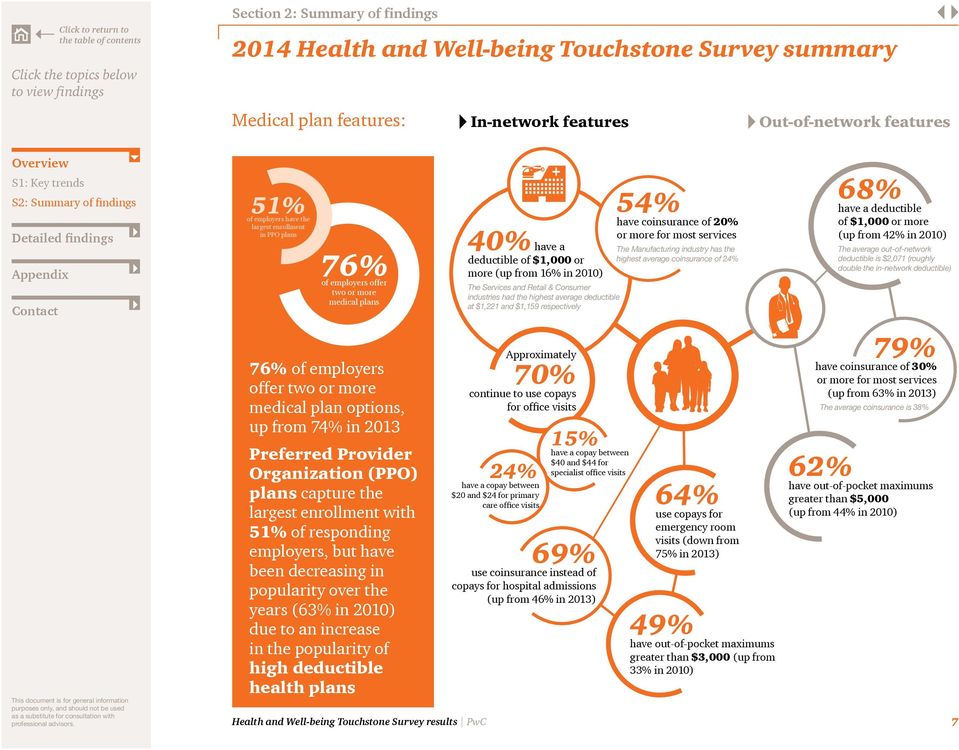
7 Section 2: Summary of findings 2014 Health and Well-being Touchstone Survey summary Medical plan features: In-network features Out-of-network features S1: Key trends S2: Summary of findings 51% of employers have the largest enrollment in PPO plans 76% of employers offer two or more medical plans 76% of employers offer two or more medical plan options, up from 74% in 2013 Preferred Provider Organization (PPO) plans capture the largest enrollment with 51% of responding employers, but have been decreasing in popularity over the years (63% in 2010) due to an increase in the popularity of high deductible health plans 40% have a deductible of $1,000 or more (up from 16% in 2010) The Services and Retail & Consumer industries had the highest average deductible at $1,221 and $1,159 respectively Approximately 70% continue to use copays for office visits 24% have a copay between $20 and $24 for primary care office visits 15% have a copay between $40 and $44 for specialist office visits 69% use coinsurance instead of copays for hospital admissions (up from 46% in 2013) 54% have coinsurance of 20% or more for most services The Manufacturing industry has the highest average coinsurance of 24% 64% use copays for emergency room visits (down from 75% in 2013) 49% have out-of-pocket maximums greater than $3,000 (up from 33% in 2010) 68% have a deductible of $1,000 or more (up from 42% in 2010) The average out-of-network deductible is $2,071 (roughly double the in-network deductible) 79% have coinsurance of 30% or more for most services (up from 63% in 2013) The average coinsurance is 38% 62% have out-of-pocket maximums greater than $5,000 (up from 44% in 2010) 7
8 Section 2: Summary of findings 2014 Health and Well-being Touchstone Survey summary High Deductible Health Plans (HDHPs) S1: Key trends S2: Summary of findings High deductible plans are offered by twothirds of employers 47% offer HDHP with HSA (up from 39% last year) For those that offer an HDHP with an HSA: The average enrollment increased from 20.5% in 2010 to 39.2% in % of employers contribute over $1,000 for single coverage 15% offer an HDHP with Health Reimbursement Account (HRA) (down from 20% last year) 5% offer HDHP without HSA or HRA (up from 3% last year) 34% of employers fund over $1,000 a year for single coverage For those that offer an HDHP with an HRA: The average enrollment has steadily increased from 34.2% in 2010 to 54.0% in 2014 % offering HSA HRA <1,000 39% 35% 28% 11% 18% 12% 1,000 5,000 52% 40% 42% 15% 20% 14% 5, % 46% 52% 25% 25% 26% Year total 47% 39% 40% 15% 20% 17% 8

9 S1: Key trends S2: Summary of findings Click to return to Section 2: Summary of findings 2014 Health and Well-being Touchstone Survey summary Prescription drug benefits The percentage of employers using a combined medical/pharmacy deductible has increased from last year 24% apply a combined medical/pharmacy deductible (up from 15% in 2013) 66% do not apply a deductible on pharmacy claims (down from 74% in 2013) 10% have a separate prescription drug deductible Copays remained the most common cost sharing method (the balance use coinsurance) Use copays for retail: Generics 83% 81% Brand formulary 70% 70% Brand non-formulary 69% 69% Specialty 58% 55% Use copays for mail order: Where copays apply, the average copays for prescription drug benefits are: Retail: $11 generic/$32 brand formulary/$51 brand non formulary/$59 specialty Mail order: $19 generic/$60 brand formulary/$100 brand non formulary/$91 specialty Where coinsurance applies, the average coinsurance for prescription drug benefits is: Retail: 25% generic, 30% brand formulary, 35% brand nonformulary and 30% specialty Mail order: 26% generic, 30% brand formulary, 38% brand non-formulary and 34% specialty Dental benefits The majority of employers (98%) offer dental benefits to their with dental PPO plans being most common (88%) 66% of dental plans have between a $50 and $59 deductible with an average deductible of $64 44% of dental plans have between a $1,500 and $1,999 annual benefit maximum with an average maximum of $1,519 The most common dental plan design for diagnostic & preventives/basic/major is 100%/80%/50% with an average of 92%/76%/53% On average, contribute 39% for single dental coverage and 45% for family dental coverage 16% of employers offer a dental plan on a voluntary basis (employee pays the full cost of coverage) 9

10 S1: Key trends S2: Summary of findings Click to return to Section 2: Summary of findings 2014 Health and Well-being Touchstone Survey summary Wellness programs 71% of employers offer wellness programs (up from 68% in 2013) The most common wellness programs were Employee Assistance Program (EAP) (85%), followed by biometric screening (78%), health risk questionnaire (76%), tobacco cessation (63%), and physical activity program/fitness discount (58%) Health risk questionnaire had the largest participation rate of 57% followed by body mass index and biometric screening with 54% Biometric screening was indicated as the most valuable wellness program by 52% of employers 63% of employers currently offer one-on-one coaching through their wellness programs 93% of employers currently target physical dimensions with their wellness programs and 73% of employers currently target mental dimensions Approximately 25 30% of employers are interested in targeting additional dimensions of well-being including financial, career, social and emotional 90% of employers do not have sufficient data to calculate or do not measure their return on investment for their wellness programs Disease management programs 53% offer programs (up from 49% in 2013) Most common programs were diabetes (72%), asthma (57%), cardiac (56%), and chronic obstructive pulmonary disease (53%) 52% of employers consider their diabetes program as the most valuable program 87% of employers do not have sufficient data to calculate or do not measure their return on investment of their disease management programs Self insurance and stop loss Self insurance is most prevalent for large employers and becoming more popular with small employers 59% of employers with 500 1,000 are self insured, (up from 55% in 2013) 57% of those self insured employers do not have aggregate stop loss coverage while only 25% do not have specific stop loss The most common specific/individual stop loss coverage is between $100,000 and $199,999 for self insured employers who elect to have coverage Employers with 5,000 or more are less likely to have stop loss coverage Specific/individual coverage <1,000 1,000 5,000 5,000+ <$50,000 8% 1% 0% $50,000 $99,999 21% 1% 0% $100,000 $199,999 40% 22% 3% $200,000 $299,999 12% 28% 7% $300,000 $499,999 5% 23% 15% $500,000 $999,999 2% 4% 17% $1,000,000+ 3% 4% 8% N/A 9% 17% 50% 10

11 S1: Key trends S2: Summary of findings Click to return to Section 2: Summary of findings 2014 Health and Well-being Touchstone Survey summary Retiree medical programs 38% of employers provide pre-65 retiree medical programs, while 31% provide post-65, relatively consistent with 2013 (36% and 31% respectively) The average pre-65 subsidy amount is 53% and the post-65 subsidy amount is 61% Of those who provide retiree medical plans, new hires are often excluded: 42% do not offer pre-65 coverage and 48% do not offer post-65 coverage to new hires, up from 2013 (40% and 45% respectively) 43% of employers are considering moving their pre-65 retirees to a private exchange with a company subsidy 401(k) plans are still the most prevalent form of retirement program 92% of employers offer 401(k) or 403(b) plans 35% vest employer 401(k) contributions immediately 87% provide an employer match and 55% provide an employee default contribution 25% of employers offer a defined benefit plan with 39% of those plans closed to new accruals or closed to new Paid Time Off (PTO) banks are less common than traditional vacation/sick day programs 42% of employers offer a PTO bank, which averages to be 16 days annually for new hires and 21 days annually for full time with 5 or more years tenure For employers who offer separate sick and vacation days: On average, new hires receive 8 sick days a year which is the same as with 5 or more years tenure On average, new hires receive 10 vacation days a year and with 5 or more years tenure receive 16 vacation days a year Employees receive an average of 10 holidays a year 69% of employers allow carryover of unused PTO or vacation days 11

12 Section 2: Summary of findings 2014 Health and Well-being Touchstone Survey summary S1: Key trends S2: Summary of findings Work-life programs remain common for many employers The most common work-life programs included: 49% Flexible work schedule 45% Telecommuting Future solutions for mitigating healthcare cost increases over the next three years Employees expect continued cost shifting to 47% of employers are considering further increasing employee cost sharing in medical plan design 52% are considering further increasing employee cost sharing in pharmacy plan design 56% of employers are considering increasing employee contributions 21% Community service time 28% Parental leave 21% Reduced hours 44% of employers are considering offering a high deductible plan as a full replacement to their current plans 18% have already implemented HDHPs as the only medical plan option Other leading future strategies to mitigate healthcare cost increases: 49% of employers are considering implementing or expanding their workplace wellness program 41% are considering value based design 34% are considering performance based networks Health reform About half of employers are very likely to re-evaluate their overall benefits strategy in light of health reform 60% of employers expect the excise tax in 2018 to have a financial impact on their company with 31% expecting that impact to be significant Private exchanges are also being considered as a major strategy moving forward 32% are considering moving active to a private exchange (2% have already done so) 22% are considering moving retirees to a private exchange (4% have already done so) 12

13 Section 3: Medical plan costs 13

14 Section 3: Medical plan costs Company s annual medical gross spend per active employee Gross spend per active employee Education & nonprofit Financial services Health industries Manufacturing Retail & consumer Services Technology 2014 total <$5,000 6% 4% 3% 6% 10% 4% 7% 6% $5,000 $6,999 12% 15% 15% 19% 17% 17% 19% 16% $7,000 $8,999 13% 10% 13% 9% 10% 9% 6% 10% $9,000 $9,999 6% 4% 3% 5% 6% 4% 2% 5% $10,000 $11,999 6% 13% 11% 15% 10% 10% 16% 12% $12,000 $13,999 16% 14% 14% 14% 16% 12% 16% 14% $14,000 $15,999 9% 11% 11% 10% 10% 8% 11% 11% $16,000 $17,999 8% 8% 12% 9% 9% 14% 8% 9% $18,000 $19,999 10% 7% 5% 7% 4% 8% 7% 7% $20, % 14% 13% 6% 8% 14% 8% 10% Average $13,310 $12,985 $12,926 $12,040 $11,315 $13,460 $11,958 $12,442 gross spend The Services industry offers the most expensive benefits versus the Retail & consumer industry which tends to offer less rich benefits 14

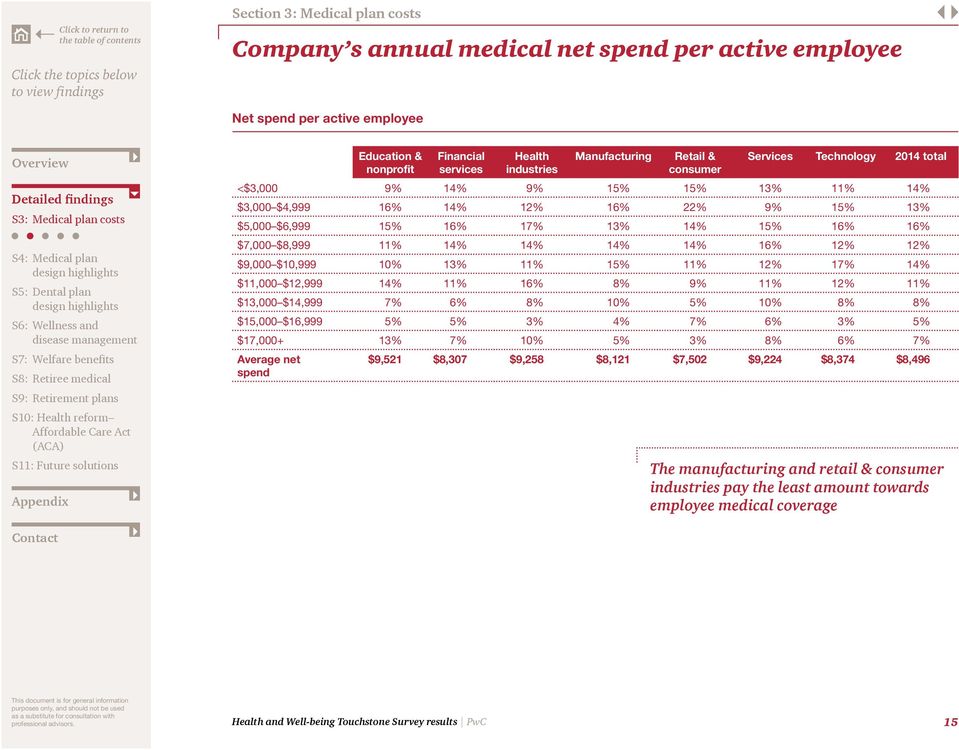
15 Section 3: Medical plan costs Company s annual medical net spend per active employee Net spend per active employee Education & nonprofit Financial services Health industries Manufacturing Retail & consumer Services Technology 2014 total <$3,000 9% 14% 9% 15% 15% 13% 11% 14% $3,000 $4,999 16% 14% 12% 16% 22% 9% 15% 13% $5,000 $6,999 15% 16% 17% 13% 14% 15% 16% 16% $7,000 $8,999 11% 14% 14% 14% 14% 16% 12% 12% $9,000 $10,999 10% 13% 11% 15% 11% 12% 17% 14% $11,000 $12,999 14% 11% 16% 8% 9% 11% 12% 11% $13,000 $14,999 7% 6% 8% 10% 5% 10% 8% 8% $15,000 $16,999 5% 5% 3% 4% 7% 6% 3% 5% $17, % 7% 10% 5% 3% 8% 6% 7% Average net $9,521 $8,307 $9,258 $8,121 $7,502 $9,224 $8,374 $8,496 spend The manufacturing and retail & consumer industries pay the least amount towards employee medical coverage 15
16 Click to return to Section 3: Medical plan costs Medical plan costs before/after plan change Healthcare costs continue to rise at rates in excess of Consumer Price Index (CPI) and employers are expecting them to increase slightly more this year than last year Before plan changes Expected calendar year 2014 over 2013 Calendar year 2013 over 2012 Decrease 4% 6% Unchanged 13% 12% 1% 4% increase 12% 14% 5% 9% increase 38% 32% 10% 14% increase 20% 22% 15% 19% increase 7% 7% 20%+ increase 6% 7% Average 8.0% increase 7.8% increase After plan changes Expected calendar year 2014 over 2013 Calendar year 2013 over 2012 Decrease 7% 9% Unchanged 22% 23% 1% 4% increase 16% 21% 5% 9% increase 35% 29% 10% 14% increase 12% 13% 15% 19% increase 5% 3% 20%+ increase 3% 2% Average 5.3% increase 4.5% increase The 7.8% increase from 2012 to 2013 is slightly higher than the 7.5% expected as indicated in the 2013 Touchstone Survey The 4.5% increase from 2012 to 2013 was less than the expected increase of 5.4% from the 2013 Touchstone Survey 16

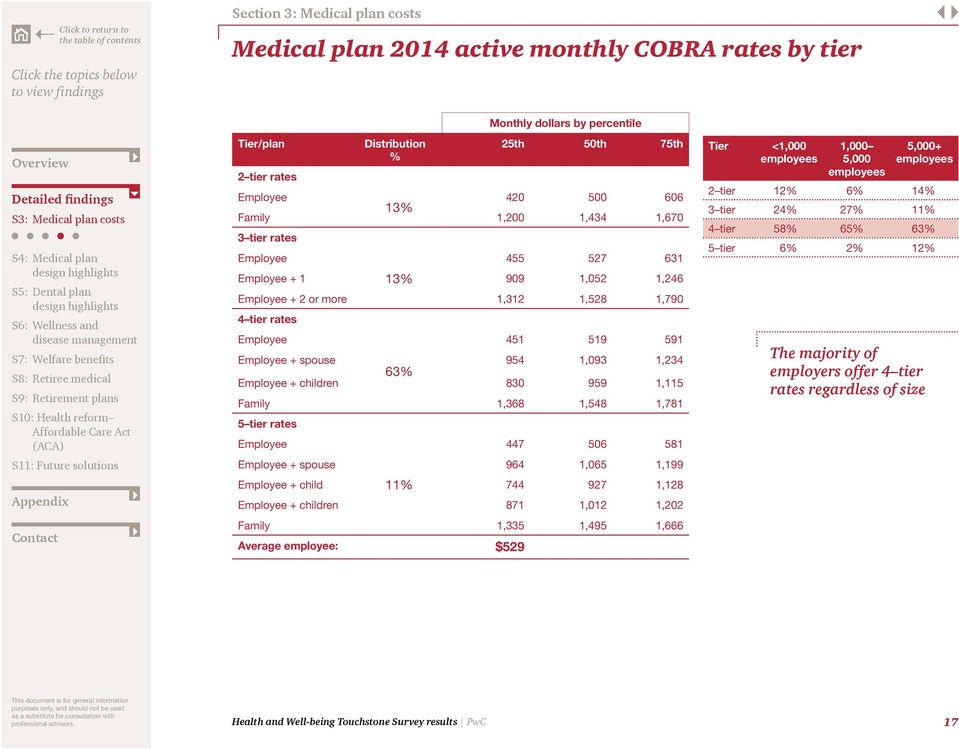
17 Section 3: Medical plan costs Medical plan 2014 active monthly COBRA rates by tier Tier/plan Distribution % Monthly dollars by percentile 25th 50th 75th 2 tier rates Employee % Family 1,200 1,434 1,670 3 tier rates Employee Employee % 909 1,052 1,246 Employee + 2 or more 1,312 1,528 1,790 4 tier rates Employee Employee + spouse 954 1,093 1,234 63% Employee + children ,115 Family 1,368 1,548 1,781 5 tier rates Employee Employee + spouse 964 1,065 1,199 Employee + child 11% ,128 Employee + children 871 1,012 1,202 Family 1,335 1,495 1,666 Average employee: $529 Tier <1,000 1,000 5,000 5, tier 12% 6% 14% 3 tier 24% 27% 11% 4 tier 58% 65% 63% 5 tier 6% 2% 12% The majority of employers offer 4 tier rates regardless of size 17
18 Click to return to Section 3: Medical plan costs Medical plan 2014 pre-65 and post-65 retiree monthly rates Monthly dollars by percentile Tier 25th 50th 75th Pre-65 retiree Post-65 retiree Average pre-65 retiree: $714 Average post-65 retiree: $ renewal trend rates Actual trend rates used by administrators for the 2014 renewal Medical Prescription drug Dental Decrease 0% 1% 1% 0% 3% 7% 21% 1% 5% 15% 19% 40% 6% 10% 63% 56% 33% 11% 15% 14% 13% 2% 16% 19% 0% 1% 0% 20%+ 5% 3% 3% Average 9.6% 8.6% 5.5% For medical and prescription drug, the majority of employers faced a 6% 10% increase in rates for their highest enrolled plan in 2014 For dental, most employers faced a 1% 5% increase in their renewal rates 18

19 Section 4: Medical plan 19

20 Section 4: Medical plan Medical plans with the largest enrollment Survey participants selected the following plans as those with the largest enrollment: PPO plan 51% 54% 57% 57% 63% High deductible plan 26% 21% 17% 17% 13% HMO plan 10% 9% 13% 12% 9% POS plan 7% 8% 8% 7% 10% EPO 4% 6% 4% 6% 4% Indemnity 1% 1% 1% 1% 1% All other plans (mini med, 1% 1% 0% 0% 0% Open Access, etc.) The average enrollment of the plans that attract the most is 82%. On average, 16% of decide to opt out of medical coverage. <1,000 1,000 5,000 5,000+ PPO plan 48% 58% 53% High deductible plan 27% 19% 28% HMO plan 13% 7% 6% POS plan 7% 7% 6% EPO 3% 6% 5% Indemnity 1% 1% 1% All other plans 1% 2% 1% High deductible plans are gaining more popularity with small and large employers 20

21 Click to return to Section 4: Medical plan Medical plan options Number of medical plan options <1,000 1,000 5,000 5, total 2013 total 0 2% 0% 0% 1% 1% 1 35% 12% 11% 23% 25% 2 31% 33% 27% 31% 33% 3 23% 31% 32% 27% 24% 4 5% 13% 13% 9% 8% 5 2% 5% 6% 4% 3% 6 1% 1% 1% 1% 2% 7 0% 2% 3% 1% 1% 8 0% 0% 1% 1% 1% 9 0% 1% 0% 0% 0% 10+ 1% 2% 6% 2% 2% Average 2.5 plans 3.1 plans 3.6 plans 2.9 plans 2.6 plans Large employers tend to offer more medical plan options to their than small employers 81% of employers offer 1 to 3 medical plan options to their and 9% of employers offer 5 or more medical plan options The average number of plans offered has increased from 2.6 plans in 2013 to 2.9 plans in
22 Section 4: Medical plan Medical plan in-network features (single deductible) For the medical plan selected as having the largest enrollment, the historical and industry breakdown of the medical in-network deductible feature follows: $0 16% 18% 21% 22% 24% $1 $199 3% 4% 8% 8% 8% $200 $299 9% 10% 11% 14% 16% $300 $399 6% 7% 9% 9% 9% $400 $499 4% 5% 5% 5% 7% $500 $749 16% 17% 19% 16% 14% $750 $999 6% 7% 5% 4% 6% $1,000 $1,999 22% 17% 13% 11% 11% $2,000 $2,999 9% 9% 6% 7% 3% $3,000+ 9% 6% 3% 4% 2% Education & nonprofit Financial services Health industries Manufacturing Retail & consumer The average deductible is $1,046 The Services industry has the highest average deductible of $1,221 Services Technology $0 24% 14% 18% 13% 13% 19% 13% $1 $199 0% 1% 7% 2% 1% 5% 1% $200 $299 13% 9% 8% 9% 5% 7% 17% $300 $399 8% 3% 8% 7% 4% 1% 8% $400 $499 0% 3% 2% 7% 5% 2% 5% $500 $749 11% 14% 16% 17% 21% 20% 12% $750 $999 2% 8% 2% 4% 13% 5% 7% $1,000 $1,999 16% 25% 18% 28% 22% 15% 15% $2,000 $2,999 15% 14% 11% 6% 7% 14% 15% $3, % 9% 10% 7% 9% 12% 7% Average $1,094 $1,132 $944 $989 $1,159 $1,221 $1,069 22
23 Section 4: Medical plan Medical plan in-network features (out-of-pocket maximum) The average out-of-pocket maximum is $3,046 Retail & consumer has the highest average out-of-pocket maximum at $3,484 For the medical plan selected as having the largest enrollment, the historical and industry breakdown of the medical out-of-pocket maximum feature follows: <$1,000 9% 6% 13% 10% 10% $1,000 $1,999 16% 19% 27% 27% 28% $2,000 $2,999 26% 26% 27% 27% 29% $3,000 $4,999 32% 24% 16% 20% 17% $5,000 $9,999 15% 11% 6% 6% 5% $10,000+ 2% 1% 1% 1% 0% Unlimited 0% 13% 10% 9% 11% In 2014, out-of-pocket maximums are capped at $6,350 for employee only coverage for non-grandfathered plans Education & nonprofit Financial services Health industries Manufacturing Retail & consumer Services Technology <$1,000 12% 9% 12% 8% 1% 13% 6% $1,000 $1,999 20% 15% 17% 14% 12% 19% 20% $2,000 $2,999 24% 25% 24% 34% 26% 18% 24% $3,000 $4,999 25% 34% 34% 31% 39% 28% 37% $5,000 $9,999 17% 15% 11% 12% 21% 21% 12% $10,000+ 2% 2% 2% 1% 1% 1% 1% Unlimited 0% 0% 0% 0% 0% 0% 0% Average $2,971 $3,100 $2,810 $2,891 $3,484 $3,025 $2,934 23
24 Section 4: Medical plan Medical plan in-network features (employee coinsurance) For the medical plan selected as having the largest enrollment, the historical and industry breakdown of the medical employee coinsurance for most services feature follows: % 20% 1% 9% 1% 10% 12% 8% 6% 10% 19% 25% 36% 39% 41% 41% 20% 24% 38% 25% 29% 1% 47% 41% 46% 49% 30% 39% 4% 40% 49% 0% 2% 3% 1% 2% 50%+ 11% 5% 5% 4% 2% The average in-network coinsurance is 21% Manufacturing has the highest average coinsurance of 24% Education & nonprofit Financial services Health industries Manufacturing Retail & consumer Services Technology 0% 30% 19% 28% 12% 13% 28% 18% 1% 9% 0% 0% 2% 1% 1% 0% 0% 10% 19% 14% 29% 26% 25% 14% 30% 38% 20% 24% 41% 32% 31% 43% 59% 25% 34% 25% 29% 5% 1% 1% 3% 0% 0% 0% 30% 39% 5% 7% 3% 3% 4% 3% 1% 40% 49% 0% 0% 0% 0% 0% 0% 0% 50%+ 5% 12% 9% 13% 9% 14% 9% Average 17% 22% 18% 24% 22% 21% 19% 24
25 Section 4: Medical plan Medical plan in-network features (office visits) For the medical plan selected as having the largest enrollment, the following is the breakdown of the in-network primary care office visit medical feature: Primary care office visit $0 copay 2% 8% 6% 7% 6% $1 $9 copay 0% 1% 1% 1% 1% $10 $19 copay 9% 12% 16% 17% 20% $20 $24 copay 24% 24% 26% 29% 30% $25 $29 copay 18% 20% 19% 16% 17% $30 $34 copay 13% 11% 10% 8% 6% $35 $39 copay 4% $40+ copay 1% 4% 3% 4% 2% 0% coinsurance 3% 1% 19% coinsurance 7% 20% 24% coinsurance 14% 25% 29% coinsurance 1% 20% 19% 18% 18% 30% 39% coinsurance 1% 40%+ coinsurance 3% The average copay for primary care office visits is $23 and the average coinsurance is 23% 71% of employers utilize copays for primary care visits which is a decrease from 80% in
26 Section 4: Medical plan Medical plan in-network features (office visits) For the medical plan selected as having the largest enrollment, the following is the breakdown of the in-network specialist office visit medical feature: Specialist office visit $0 copay 2% 5% 4% 5% 3% $1 $9 copay 0% 0% 1% 1% 0% $10 $19 copay 4% 6% 6% 9% 10% $20 $24 copay 7% 9% 10% 11% 15% $25 $29 copay 7% 10% 12% 9% 11% $30 $34 copay 12% 13% 12% 14% 17% $35 $39 copay 6% $40 $44 copay 15% $45 $49 copay 4% 34% 33% 29% 21% $50 $59 copay 9% $60+ copay 3% 0% coinsurance 3% 1% 19% coinsurance 8% 20% 24% coinsurance 15% 25% 29% coinsurance 1% 23% 22% 22% 23% 30% 39% coinsurance 1% 40%+ coinsurance 3% The average copay for specialist office visits is $35 and the average coinsurance is 24% 69% of employers utilize copays for specialist office visits which is a decrease from 77% in
27 Section 4: Medical plan Medical plan in-network features (hospital) For the medical plan selected as having the largest enrollment, the following is the breakdown of the in-network hospital medical feature: Inpatient hospital cost per admission $0 copay 7% 18% 20% 16% 0% $1 $199 copay 8% 9% 11% 13% 12% $200 $299 copay 8% $300 $399 copay 3% 14% 16% 17% 24% $400 $599 copay 4% 9% 7% 7% 7% $600+ copay 1% 4% 5% 5% 4% 0% coinsurance 6% 1% 19% coinsurance 21% 20% 24% coinsurance 31% 25% 29% coinsurance 1% 46% 41% 42% 53% 30% 39% coinsurance 2% 40%+ coinsurance 8% The average copay for inpatient hospital visits is $201 and the average coinsurance is 24% 31% of employers utilize copays which is a decrease from 54% in
28 Section 4: Medical plan Medical plan in-network features Emergency Room (ER) For the medical plan selected as having the largest enrollment, the following is the breakdown of the in-network ER medical feature: ER cost per visit $0 copay 2% $1 $49 copay 2% 4% 7% 8% 2% $50 $99 copay 11% 15% 17% 21% 26% $100 $124 copay 20% 27% 26% 30% 28% $125 $149 copay 1% 3% 4% 2% $150 $199 copay 14% 14% 13% $200+ copay 14% 14% 12% 19% 17% 0% coinsurance 3% 1% 19% coinsurance 9% 20% 24% coinsurance 16% 25% 29% coinsurance 1% 25% 21% 22% 23% 30% 39% coinsurance 2% 40%+ coinsurance 5% The average ER copay is $131 and the average coinsurance is 26% The percentage of employers utilizing copays has decreased from 75% in 2013 to 64% in
29 Section 4: Medical plan Medical plan out-of-network features For the medical plan selected as having the largest enrollment: Deductible <$200 5% 1% 4% 2% 1% $200 $299 3% $300 $399 2% 10% 14% 16% 23% $400 $499 2% $500 $749 13% 17% 20% 21% 23% $750 $999 7% 8% 10% 7% 11% $1,000 $1,999 27% 29% 29% 28% 25% $2,000 $2,999 15% 11% 11% 10% 7% $3,000 $3,999 12% $4, % 23% 12% 16% 10% The average out-ofnetwork deductible is $2,071 which is almost double the average in-network deductible 68% of employers have an outof-network deductible of $1,000 or more in 2014 which has increased over the past few years (63% in 2013 and 52% in 2012) 29
30 Section 4: Medical plan Medical plan out-of-network features For the medical plan selected as having the largest enrollment: Out-of-pocket maximum $0 3% $1 $999 1% 3% 4% 5% 5% $1,000 $1,999 3% 6% 10% 9% 9% $2,000 $2,999 8% 11% 16% 12% 16% $3,000 $4,999 23% 27% 27% 29% 26% $5,000 $9,999 40% 32% 22% 25% 24% $10, % 11% 7% 8% 9% Unlimited 4% 10% 14% 12% 11% Employee coinsurance % 6% 1% 9% 0% 5% 7% 9% 6% 10% 19% 1% 20% 24% 13% 25% 29% 1% 20% 21% 19% 19% 30% 39% 22% 27% 29% 28% 58% 40% 49% 30% 28% 29% 29% 50%+ 27% 17% 17% 14% 18% Average out-of-pocket maximum is $6,045 Employers have an average 38% out-of-network employee coinsurance, consistent with prior years Similarly, the average coinsurance for out-ofnetwork primary and specialist office visits is 40% 30
31 Section 4: Medical plan Medical plan out-of-network features (hospital and ER) For the medical plan selected as having the largest enrollment, the following is the breakdown of the out-of-network hospital and ER medical features: Inpatient hospital cost per admission 2014 $0 copay 2% $1 $199 copay 4% $200 $299 copay 3% $300 $399 copay 1% $400 $599 copay 2% $600+ copay 1% 0% coinsurance 1% 1% 19% coinsurance 1% 20% 24% coinsurance 10% 25% 29% coinsurance 1% 30% 39% coinsurance 22% 40%+ coinsurance 52% ER cost per visit 2014 $0 copay 1% $1 $49 copay 1% $50 $99 copay 8% $100 $149 copay 16% $150 $199 copay 12% $200+ copay 11% 0% coinsurance 1% 1% 19% coinsurance 1% 20% 24% coinsurance 7% 25% 29% coinsurance 0% 30% 39% coinsurance 11% 40%+ coinsurance 31% The average out-of-network hospital copay is $224 and the average emergency room copay is $134 The average coinsurance for out-of-network hospital and emergency room is 41% and 40%, respectively 13% of employers utilize copays for inpatient hospital visits and 49% utilize copays for emergency room visits 31
32 Click to return to Section 4: Medical plan High deductible plans There is an increase in employers offering high deductible plans with an HSA, from 39% last year to 47% this year. In contrast, there is a decrease in employers offering high deductible plans with an HRA, from 20% last year to 15% this year. % offering HSA HRA <1,000 39% 11% 1,000 5,000 52% 15% 5, % 25% 2014 total 47% 15% Average enrollment HSA HRA % 54.0% % 54.2% % 43.2% % 37.9% % 34.2% % who fund through their payroll deductions HSA <10% 27% 10% 19% 10% 20% 29% 7% 30% 39% 5% 40% 49% 4% 50% 59% 9% 60% 69% 10% 70% 79% 9% 80% 89% 7% 90%+ 12% Large employers tend to offer HSA and HRA plans more than small employers Enrollment in both HSA and HRA plans has been steadily increasing the last few years 47% of employers have 50%+ of their funding their HSA through payroll deductions with 12% of employers having more than 90% of their funding 32
33 Section 4: Medical plan High deductible plans (single) Employer account subsidy <1,000 1,000 5,000 HSA 5, total <1,000 1,000 5,000 HRA 5, total $0 1% 0% 0% 0% 0% 0% 0% 0% $1 $499 17% 17% 28% 21% 7% 7% 27% 17% $500 $749 22% 52% 52% 40% 19% 50% 39% 34% $750 $999 19% 17% 13% 17% 11% 29% 12% 15% $1,000 $1,499 28% 13% 5% 16% 15% 14% 22% 18% $1,500 $1,999 7% 1% 2% 4% 26% 0% 0% 9% $2,000 $2,999 4% 0% 0% 1% 7% 0% 0% 2% $3,000+ 2% 0% 0% 1% 15% 0% 0% 5% Average $877 $620 $533 $696 $1,602 $654 $587 $933 Small employers tend to contribute more to their HSA or HRA accounts than large employers 40% of employers contribute $500 $749 into their HSA accounts 33
34 Section 4: Medical plan High deductible plans (family) Employer subsidy <1,000 1,000 5,000 HSA 5, total The average HSA or HRA contribution for family coverage is approximately double that of employee only coverage The most common HSA contribution is $1,000 $1,499 29% of small employers contribute more than $3,000 into the HRA account <1,000 1,000 5,000 HRA 5, total $0 1% 0% 0% 1% 4% 0% 0% 1% $1 $499 4% 2% 8% 5% 7% 0% 7% 6% $500 $749 9% 13% 13% 11% 7% 0% 12% 8% $750 $999 7% 6% 8% 7% 0% 14% 15% 10% $1,000 $1,499 24% 45% 52% 39% 14% 43% 37% 30% $1,500 $1,999 24% 20% 13% 19% 21% 29% 12% 18% $2,000 $2,999 18% 11% 6% 12% 18% 14% 17% 17% $3, % 3% 0% 6% 29% 0% 0% 10% Average $1,659 $1,286 $1,041 $1,358 $3,003 $1,291 $1,122 $1,785 34
35 Section 4: Medical plan Financing of medical plans with the largest enrollment < Self insured 26% 31% 22% 20% 29% Fully insured 69% 65% 65% 67% 68% Minimum premium arrangement 5% 4% 13% 13% 3% 500 1, Self insured 59% 55% 49% 54% 69% Fully insured 38% 43% 47% 39% 26% Minimum premium arrangement 3% 2% 4% 7% 5% 1, Self insured 87% 85% 86% 87% 87% Fully insured 12% 13% 12% 12% 11% Minimum premium arrangement 1% 2% 2% 1% 2% 60% of employers are self-insured in % of employers with 500 1,000 are self-insured which is an increase from 55% in
36 Click to return to Section 4: Medical plan In-network prescription drug plan Percentage of medical & prescription claim cost that is related to prescription drug claims In-network prescription drug deductible 1% 1% 2014 <7% 6% 7% 2% 8% 2% 9% 4% 10% 9% 11% 1% 12% 4% 13% 3% 14% 4% 15% 12% 16% 5% 17% 4% 18% 8% 19% 5% 20% 12% 21%+ 19% Average 16% 53% of employers find that prescription drug costs are more than 15% of total health (medical and prescription drug claims) costs 19% stated that prescription drug claims are more than 21% of health care costs 24% 4% 4% 66% N/A Applies to medical deductible <$100 $100 $199 $200 $299 $300+ While 66% of the plans do not apply a deductible on pharmacy claims, the most common deductible continues to be an integrated deductible with medical claims rather than a standalone prescription deductible which represents only 10% of the plans 36
37 Section 4: Medical plan In-network prescription drug plan features For the medical plan selected as having the largest enrollment, the following is the breakdown of the prescription drug retail generic plan feature: Generic Not covered 1% 1% 2% 2% 1% <$5 copay 3% $5 $9 copay 19% 30% 21% 21% 22% $10 $11 copay 41% $12 $14 copay 1% 51% 42% 43% 43% $15 $19 copay 14% 12% 10% 11% $20+ copay 4% 4% 7% 5% 4% <10% coinsurance 2% 10% 14% coinsurance 5% 5% 6% 6% 6% 15% 19% coinsurance 1% 20% 24% coinsurance 5% 6% 8% 8% 9% 25%+ coinsurance 4% 3% 2% 5% 4% 83% of employers have a copay plan for retail generics The average copay for retail generics is $11 and the average coinsurance is 24% The most common member cost share for retail generics over the past five years continues to be in the $10 $14 copay range 37
38 Section 4: Medical plan In-network prescription drug plan features For the medical plan selected as having the largest enrollment, the following is the breakdown of the prescription drug retail brand formulary plan feature: Brand formulary Not covered 1% 2% 2% 3% 1% <$10 copay 0% $10 $19 copay 4% 7% 6% 6% 5% $20 $24 copay 6% $25 $29 copay 13% 27% 28% 32% 36% $30 $34 copay 21% 23% 20% 17% 16% $35 $49 copay 21% $50+ copay 5% 25% 18% 13% 9% <15% coinsurance 3% 2% 2% 2% 2% 15% 19% coinsurance 1% 20% 24% coinsurance 10% 25% 29% coinsurance 4% 11% 21% 22% 27% 30% 34% coinsurance 6% 35%+ coinsurance 5% 3% 3% 5% 4% 70% of employers have a copay plan for retail brand formulary The average copay for retail brand formulary is $32 and the average coinsurance is 28% The most common member cost share for retail brand formulary has shifted from the $20-$29 copay range to the $30-$49 copay range 38
39 Section 4: Medical plan In-network prescription drug plan features For the medical plan selected as having the largest enrollment, the following is the breakdown of the prescription drug retail brand non-formulary plan feature: Brand non formulary Not covered 2% 3% 4% 6% 4% <$30 copay 5% 7% 8% 9% 4% $30 $49 copay 19% 25% 24% 26% 32% $50 $59 copay 22% 22% 23% 18% 20% $60 $64 copay 12% $65 $74 copay 4% 18% 13% 10% 8% $75+ copay 6% <14% coinsurance 3% 15% 19% coinsurance 0% 2% 2% 3% 2% 20% 24% coinsurance 4% 25% 29% coinsurance 2% 6% 6% 6% 9% 30% 34% coinsurance 4% 35% 39% coinsurance 2% 6% 7% 8% 5% 40% 49% coinsurance 6% 50% 59% coinsurance 6% 11% 13% 14% 16% 60%+ coinsurance 3% 69% of employers have a copay plan for retail brand non-formulary The average copay for retail brand non-formulary is $51 and the average coinsurance is 37% The most common member cost share for retail brand non-formulary has shifted from the $30 $49 copay range to the $50 $59 copay range 39
40 Section 4: Medical plan In-network prescription drug plan features For the medical plan selected as having the largest enrollment, the following is the breakdown of the prescription drug retail specialty plan feature: Specialty Not covered 11% 13% 9% 11% 6% <$20 copay 4% $20 $29 copay 3% 3% 8% 5% 22% $30 $39 copay 6% $40 $49 copay 6% 15% 20% 21% 20% $50 $59 copay 15% 18% 19% 17% 13% $60 $74 copay 9% $75 $99 copay 4% 20% 16% 13% 7% $100+ copay 10% <14% coinsurance 5% 15% 19% coinsurance 0% 4% 3% 3% 3% 20% 24% coinsurance 9% 8% 7% 7% 10% 25% 29% coinsurance 3% 30% 34% coinsurance 4% 10% 8% 18% 10% 35% 39% coinsurance 1% The average copay for retail specialty is $59 and the average coinsurance is 32% 58% of employers use a copay plan for retail specialty drug 40% 49% coinsurance 3% 50%+ coinsurance 7% 9% 10% 11% 9% 40
41 Section 4: Medical plan In-network prescription drug plan features For the medical plan selected as having the largest enrollment, the following is the summary of the prescription drug plan average copay amounts: Retail copays Generic $11 $13 $14 $13 $13 Brand formulary $32 $33 $32 $30 $29 Brand non formulary $51 $51 $49 $46 $47 Specialty $59 $60 $56 $44 $39 Mail order 2014 Copay Coinsurance Generic $19 26% Brand formulary $60 30% Brand non formulary $100 38% Specialty $91 34% Retail copays for non- 60% formulary are approximately higher than formulary The average retail copay for specialty drugs has increased since 2010, going from a $39 copay to a $59 copay Average retail copays have remained stable over the past year Mail order average copays are typically 2x retail average copays 41
42 Section 4: Medical plan In-network prescription drug plan features For the medical plan selected as having the largest enrollment, the following is the breakdown of the prescription drug plan features for mail order: Mail order copay Generic Brand formulary The majority of employers use copays for mail order prescription drugs as opposed to coinsurance Brand non formulary Specialty Not covered 4% 4% 5% 20% <$10 copay 8% 1% 1% 1% $10 $19 copay 24% 2% 1% 1% $20 $29 copay 33% 5% 1% 2% $30 $39 copay 10% 6% 3% 2% $40 $49 copay 2% 6% 3% 2% $50 $59 copay 1% 9% 4% 4% $60 $64 copay 0% 12% 4% 3% $65 $79 copay 0% 12% 2% 2% $80+ copay 0% 15% 47% 27% <14% coinsurance 6% 3% 3% 6% 15% 19% coinsurance 1% 1% 0% 1% 20% 29% coinsurance 6% 13% 5% 11% 30% 39% coinsurance 1% 6% 6% 5% 40% 49% coinsurance 1% 1% 6% 4% 50%+ coinsurance 3% 4% 9% 9% Average copay $19 $60 $100 $91 Average coinsurance 26% 30% 38% 34% 42
43 Section 4: Medical plan Medical contribution strategies Medical contribution strategies Non contributory pay 0% of the premium Defined benefit pay a percent of premium Defined benefit employer determines employee contribution amount Defined contribution employer pays a fixed amount Defined contribution employer pays a fixed amount Single Family Single Family 12% 8% 14% 8% 64% 67% 64% 68% 16% 17% 16% 17% 8% 8% 6% 7% Single Family Single Family <$100 14% 12% 16% 13% $100 $199 9% 2% 13% 2% $200 $299 15% 2% 20% 5% $300 $399 27% 9% 20% 11% $400 $749 20% 23% 15% 14% $750 $999 0% 12% 0% 23% $1,000 $1,999 3% 26% 3% 18% $2, % 14% 13% 14% Average contribution $817 $1,892 $860 $2,001 From 2013 to 2014, there was not a noticeable change in medical contribution strategies, however there is an uptick in the use of defined contribution From 2013 to 2014, there was a decrease in the average employer contribution of approximately 5% 6% 43
44 Section 4: Medical plan Contribution strategies Defined benefit- pay a percentage of the premium Single Family Single Family <10% 4% 3% 4% 3% 10% 14% 9% 6% 10% 5% 15% 19% 17% 11% 17% 10% 20% 24% 25% 25% 26% 24% 25% 29% 17% 15% 16% 16% 30% 39% 15% 20% 14% 22% 40% 49% 2% 4% 2% 4% 50%+ 11% 16% 11% 16% Average contribution 27% 32% 27% 32% Defined benefit employer determines employee contribution amount Single Family Single Family <$50 29% 13% 31% 14% $50 $99 24% 6% 26% 6% $100 $199 17% 14% 15% 16% $200 $299 2% 12% 1% 10% $300 $399 3% 9% 2% 11% $400 $749 4% 16% 7% 15% $750 $1,999 18% 7% 17% 7% $2,000+ 3% 23% 1% 21% Average contribution $395 $1,271 $356 $1,134 From 2013 to 2014, the defined benefit percentage contribution did not change From 2013 to 2014, there was an increase in the average employee contribution of approximately 11% 12% 44
45 Section 4: Medical plan Employee contribution percentages vary by company size Employee only coverage Contribution Family coverage Contribution <1,000 <1,000 1,000 5,000 1,000 5,000 5,000+ <10% 19% 16% 7% 10% 14% 17% 12% 18% 15% 19% 15% 26% 23% 20% 24% 11% 16% 20% 25% 29% 8% 10% 8% 30% 39% 8% 5% 14% 40%+ 22% 15% 10% Average 33% 28% 26% 5,000+ <10% 12% 9% 4% 10% 14% 13% 10% 11% 15% 19% 10% 20% 23% 20% 24% 13% 19% 21% 25% 29% 11% 14% 12% 30% 34% 7% 10% 10% 35% 39% 5% 2% 8% 40% 49% 4% 3% 3% 50% 74% 7% 2% 2% 75%+ 18% 11% 6% Average 38% 31% 28% The average employee contribution for family coverage is 2% 5% higher than employee only coverage Small employers tend to have higher employee contribution levels than large employers 45
46 Section 4: Medical plan Salary based contributions and smoking surcharges Number of salary tiers <1,000 Monthly smoking surcharges 1,000 5,000 5, total Yes 9% 17% 24% 14% No 91% 83% 76% 86% Average # of tiers The popularity of salary based contribution tiers increases as employer size increases <1,000 1,000 5,000 5, total No 89% 76% 65% 80% Yes, for 11% 24% 34% 20% Yes, for dependents 6% 10% 15% 9% Average for $53 $39 $60 $51 Average for dependents $62 $41 $68 $59 More than one option was allowed to be chosen Large employers are more likely to impose smoking surcharges with the average monthly amount being more than small employers 46
47 Section 4: Medical plan Spouse/dependent coverage Are spouses excluded from receiving coverage if they are offered coverage elsewhere? <1,000 Are dependents excluded from receiving coverage if they are offered coverage elsewhere? <1,000 1,000 5,000 1,000 5,000 5,000+ 5, total Yes 13% 15% 6% 12% No, but they pay a surcharge 9% 14% 27% 14% No, they pay no surcharge 74% 70% 64% 71% Do not offer coverage for spouses 4% 1% 3% 3% 2014 total Yes 6% 8% 3% 6% No, but they pay a surcharge 4% 1% 1% 3% No, they pay no surcharge 87% 90% 95% 89% Do not offer coverage for dependents 3% 1% 1% 2% Large employers are more likely to include spouses, but have them pay a surcharge, whereas small employers are more likely to include spouses without a surcharge Employers are more likely to include dependents with no surcharge than spouses with no surcharge 47
48 Click to return to Section 4: Medical plan Stop loss coverage For the medical plan(s) selected as self insured, the following is the breakdown of stop loss coverage: Aggregate coverage 22% 6% 4% 4% 7% 57% None <115% 115% 120% 125% Other 57% of self insured plans do not have aggregate stop loss coverage and 25% do not have specific/individual coverage, slightly more than 2013 Specific/individual coverage None < $50,000 $50,000 $99,999 $100,000 $199,999 $200,000 $299,999 $300,000 $499,999 $500,000 $999,999 $1,000,000+ 0% 10% 20% 30% Stop loss coverage by company size Large employers tend to purchase less aggregate stop loss coverage than small employers Aggregate coverage <1,000 The majority of self insured small employers obtain specific/ individual stop loss coverage whereas half of large employers do not obtain specific/individual stop loss coverage Specific/individual coverage 1,000 5,000 5,000+ <115% 10% 2% 1% 115% 6% 1% 3% 120% 9% 7% 1% 125% 37% 24% 8% Other 10% 7% 4% None 28% 59% 83% <1,000 1,000 5,000 5,000+ <$50,000 8% 1% 0% $50,000 $99,999 21% 1% 0% $100,000 $199,999 40% 22% 3% $200,000 $299,999 12% 28% 7% $300,000 $499,999 5% 23% 15% $500,000 $999,999 2% 4% 17% $1,000,000+ 3% 4% 8% None 9% 17% 50% 48
49 Section 4: Medical plan Medical plan providers Survey participants use the following administrators for their medical plans: Medical plan with the highest enrollment All other medical plans offered <1,000 <1,000 1,000 5,000 1,000 5,000 5,000+ Aetna, including Coventry 6% 11% 14% BCBS Wellpoint/Anthem 13% 10% 13% BCBS Other than Wellpoint/Anthem 30% 31% 21% CIGNA 11% 14% 11% Kaiser 2% 0% 1% UnitedHealthcare 13% 18% 21% Other Health Plan 18% 9% 13% Other Third Party Administrator (TPA) 7% 7% 6% 5,000+ Aetna, including Coventry 4% 8% 10% BCBS Wellpoint/Anthem 11% 6% 8% BCBS Other than Wellpoint/Anthem 24% 25% 19% CIGNA 18% 7% 10% Humana 12% 21% 20% Kaiser 8% 16% 12% UnitedHealthcare 1% 0% 4% Other Health Plan 15% 12% 14% Other Third Party Administrator (TPA) 7% 5% 3% 49
50 Section 4: Medical plan Vendor satisfaction Very satisfied Satisfied Not satisfied Very satisfied Satisfied Not satisfied Very satisfied Satisfied Not satisfied Claim administration 37% 58% 5% 38% 58% 4% 44% 52% 4% Consumer/decision support 20% 66% 14% 18% 68% 14% 22% 66% 12% Member services 27% 65% 8% 27% 65% 8% 34% 59% 7% Medical management 26% 65% 9% 23% 70% 7% 27% 66% 7% Network discounts 40% 56% 4% 36% 59% 5% 44% 53% 3% Pharmacy benefit administration* 25% 65% 10% 25% 69% 6% Wellness 20% 62% 18% 19% 63% 18% 23% 62% 15% * Not a survey response option in prior years Satisfaction with vendors has been fairly stable over the last few years with a slight movement from satisfied to very satisfied 95% indicated they were very satisfied or satisfied with claim administration in 2014 versus 96% in % indicated they were very satisfied or satisfied with member services in 2014 versus 93% in % indicated they were very satisfied or satisfied with network discounts in 2014 versus 97% in
51 Click to return to Section 4: Medical plan The benefit administration of medical plans by company size <1,000 1,000 5,000 5,000+ Total Insourced 36% 38% 33% 32% 31% 28% 31% 21% 21% 34% 32% 27% Outsourced 23% 24% 44% 24% 25% 41% 32% 39% 55% 25% 28% 47% Co sourced 41% 38% 23% 44% 44% 31% 37% 40% 24% 41% 40% 26% Small employers are trending towards more co sourcing and moving away from outsourcing and large employers are trending towards more insourcing and co sourcing Fewer employers are outsourcing in 2014 moving from 47% in 2012 to 25% in % 25%
52 Section 5: Dental plan 52
53 Section 5: Dental plan Dental plan features Dental plan types Deductible (single coverage) Annual benefit maximum 2% 2% 1% 88% 7% Indemnity PPO DHMO Other Do not provide 2014 $0 10% $1 $49 11% $50 $59 66% $60 $74 0% $75 $99 5% $100 $149 5% $150+ 3% Average $64 98% of employers offer dental coverage to their with the PPO being the most common plan type On average, dental plan designs have a $64 deductible and a $1,519 annual benefit maximum The most common deductible is $50 $59 and the most common annual benefit maximum is $1,500 $1, $0 1% $1 $999 3% $1,000 $1,499 25% $1,500 $1,999 44% $2,000 $2,499 21% $2,500 $2,999 4% $3,000+ 2% Average $1,519 53
54 Section 5: Dental plan Dental plan features Coinsurance Monthly Contribution Diagnostic & preventive Basic Major <50% 7% 6% 6% 50% 69% 1% 4% 55% 0% 60% 14% 0% 1% 65% 0% 70% 1% 2% 0% 75% 1% 1% 80% 72% 7% 2% 85% 1% 0% 90% 1% 9% 1% 100% 89% 5% 0% Average 92% 76% 53% Orthodontic coverage 16% Yes No Single Family 0% 13% 10% 1% 9% 4% 2% 10% 19% 11% 6% 20% 29% 21% 18% 30% 39% 11% 14% 40% 49% 7% 8% 50% 59% 13% 15% 60% 69% 2% 4% 70% 79% 2% 4% 80% 89% 2% 3% 90% 99% 0% 1% 100% 14% 15% Average 39% 45% An average dental plan design is 92%/76%/53% The most common dental plan design is 100%/80%/50% Employees, on average, pay 39% for single coverage and 45% for family coverage 84% 54
55 Section 6: Wellness and 55
56 Section 6: Wellness and Wellness and programs Employers offering wellness and programs: Wellness programs Disease management programs <1,000 57% 57% 56% 52% 65% 31% 31% 28% 40% 41% 1,000 5,000 81% 71% 76% 81% 73% 64% 60% 65% 74% 68% 5, % 85% 85% 88% 85% 79% 75% 81% 86% 83% Total 71% 68% 72% 73% 76% 53% 49% 58% 66% 68% As company size increases, the percentage of employers offering wellness and programs increases Since 2013, the prevalence of both wellness and programs stayed the same for small employers, increased for mid size employers, and increased as an aggregate Wellness programs 71% of all survey participants and 83% of large employers offer wellness programs to eligible individuals 71% of employers with 20,000+ and 45% of employers with <500 spend more than 1.0% of total medical costs on wellness programs which is a slight decrease from % of employers use their medical vendor for their wellness program, 28% manage the program in-house, and 37% utilize an external vendor Disease management programs 53% of all survey participants and 79% of large employers offer programs to eligible individuals although participation rates are typically low 86% of employers use their medical vendor for their program, 4% manage the program in house, and 10% utilize an external vendor 56
57 Section 6: Wellness and Wellness and programs: Incentives Incentives Wellness Disease management Cash/gift card <$100 16% 17% Cash/gift card $100 $199 7% 4% Cash/gift card $200+ 8% 3% Annual premium surcharge for not participating 6% Annual premium incentive <$100 1% 1% Annual premium incentive $100 $199 3% 0% Annual premium incentive $200 $299 3% 0% Annual premium incentive $300 $499 5% 3% Annual premium incentive $ % 4% Additional employer contribution into HSA/HRA/FSA <$100 0% 0% Additional employer contribution into HSA/HRA/FSA $100 $199 1% 10% Additional employer contribution into HSA/HRA/FSA $200 $299 2% 3% Additional employer contribution into HSA/HRA/FSA $300 $499 1% 0% Additional employer contribution into HSA/HRA/FSA $500+ 4% 3% Small gifts 13% 4% Raffles for large gifts 12% 3% Charitable donations 2% 3% Other 6% 42% 87% of employers offer incentives/disincentives for their wellness programs and 31% offer incentives for their programs A greater percentage of employers are offering incentives/disincentives for wellness programs and programs in 2014 as compared to 2013 (87% for wellness and 31% for disease management in 2014 compared to 82% and 19% in 2013, respectively) 57
58 Section 6: Wellness and Wellness programs: Incentives For those employers who offer incentives, participation rates are positively impacted by incentives: 60% 50% 40% 30% 20% 10% 0% Body mass index Executive health exam Health risk questionnaire Physical activity programs/fitness discounts Stress management Weight management No incentive Incentive Programs where incentives did not significantly impact participation: Employee assistance program Ergonomics Health coach Nutrition Onsite fitness Onsite health clinic Tobacco cessation 58
59 Section 6: Wellness and Wellness program Wellness program targeting dimensions Currently targeting Currently offering Interested in targeting Interested in offering Not interested in targeting Career 26% 26% 48% Community 34% 23% 43% Emotional 64% 26% 10% Financial 55% 30% 15% Mental 73% 21% 6% Physical 93% 5% 2% Social 38% 27% 35% Spiritual 15% 20% 65% Wellness program features Not interested in offering Incentives 81% 12% 7% One on one coaching 63% 20% 17% Competition/gamification 51% 35% 14% Activity tracking devices 47% 40% 13% Feedback loops 35% 42% 23% Mobile apps or user interface 32% 52% 16% Social sharing 25% 36% 39% User profiling and/or personalization 24% 50% 26% Most employers are currently targeting mental and physical dimensions through their wellness programs yet the interest lies in targeting financial, social, career, and emotional dimensions The majority of employers are interested in offering mobile apps or user interface and user profiling and/or personalization 59
60 Click to return to Section 6: Wellness and Wellness and program Wellness program More than one option was allowed to be chosen Disease management program Employee assistance program (EAP) 85% 86% Biometric screening 78% Health risk questionnaire 76% 80% Tobacco cessation 63% 61% Physical activity program/fitness 58% discounts Body mass index 56% 58% Health coach 53% Weight management 53% 52% Nutrition 46% 41% Onsite fitness 42% 38% Stress management 41% 35% Ergonomics 30% 25% Executive health exam 24% 23% Onsite health clinic 14% 15% Diabetes 72% 70% Asthma 57% 59% Cardiac 56% 57% Chronic obstructive pulmonary disease 53% 54% Hypertension 48% Cancer 42% 46% Lower back pain 39% 35% Depression 34% 35% 85% of employers offer an employee assistance program (EAP) and 28% of utilize EAP when offered 14% of employers offer an onsite health clinic with 48% average participation 79% of large employers vs. 59% of small employers offer diabetes programs More than one option was allowed to be chosen 60
61 Click to return to Section 6: Wellness and Wellness and program Wellness program Responses of Other are not shown above Disease management program Responses of Other are not shown above Most valuable Most valuable 2nd most valuable 2nd most valuable 3rd most valuable Biometric screening 52% 13% 8% Body mass index (BMI) 0% 6% 4% Employee assistance program (EAP) 9% 9% 18% Ergonomics 2% 2% 2% Executive health exam 1% 1% 1% Health coach 4% 9% 8% Health risk questionnaire 8% 25% 14% Nutrition 1% 3% 4% Onsite fitness 6% 7% 8% Onsite health clinic 6% 2% 2% Physical activity program/fitness discounts 6% 11% 11% Stress management 0% 1% 1% Tobacco cessation 2% 5% 9% Weight management 2% 5% 10% 3rd most valuable Asthma 7% 11% 13% Cancer 11% 9% 6% Cardiac 12% 20% 21% Chronic obstructive pulmonary disease 2% 10% 11% Depression 1% 6% 7% Diabetes 52% 24% 13% Hypertension 7% 15% 12% Lower back pain 5% 2% 12% 52% of employers consider the biometric screening to be the most valuable wellness program they offer followed by the health risk questionnaire and the employee assistance program (EAP) 76% of employers ranked their diabetes program as being the most and second most valuable program offered 61
62 Click to return to Section 6: Wellness and Wellness programs Effectiveness of wellness program at: Very effective Somewhat effective Not effective Mitigating healthcare costs 12% 68% 20% Improving performance and productivity 6% 70% 24% Enhancing employee engagement, attraction and loyalty 17% 66% 17% Reinforcing corporate responsibility and image 20% 60% 20% Gauging the effectiveness of wellness program at: Subjective judgment Quantitative metrics Of employers who consider their wellness programs to not be as effective at mitigating healthcare costs, 64% use subjective judgment Overall, employers view wellness programs to be somewhat effective Both Neither Mitigating healthcare costs 25% 32% 31% 12% Improving performance and productivity 7% 54% 18% 21% Enhancing employee engagement, attraction and loyalty 7% 55% 19% 19% Reinforcing corporate responsibility and image 3% 60% 16% 21% 62
63 Click to return to Section 6: Wellness and Disease management programs Effectiveness of program at: Very effective Gauging the effectiveness of program at: Somewhat effective Not effective Mitigating healthcare costs 10% 72% 18% Improving performance and productivity 5% 64% 31% Enhancing employee engagement, attraction and loyalty 6% 51% 43% Reinforcing corporate responsibility and image 7% 52% 41% Subjective judgment Quantitative metrics Both Neither Mitigating healthcare costs 32% 28% 23% 17% Improving performance and productivity 9% 45% 13% 33% Enhancing employee engagement, attraction and loyalty 7% 46% 12% 35% Reinforcing corporate responsibility and image 6% 46% 13% 35% The majority of employers who consider their disease management programs not effective, do not use any method to gauge the effectiveness Overall, employers mainly use quantitative metrics to gauge the effectiveness of their disease management program 63
64 Section 6: Wellness and ROI from wellness and programs Return on investment (ROI) Wellness Disease management Do not measure 45% 51% Insufficient information provided to calculate ROI 45% 36% Below 1 to 1 1% 2% 1 to 1 1% 2% 2 to 1 4% 5% 3 to 1 2% 2% 4 to 1 or more 2% 2% Of those that measure ROI for wellness and disease management programs, 80% and 69% respectively have a positive impact Employers measuring ROI by company size 20% 18% 16% 14% 12% 10% 8% 6% 4% 2% 0% 6% 4% <1,000 14% 13% 1,000 5,000 18% 14% 5,000+ Wellness Disease management 64
65 Section 6: Wellness and Work-life programs Employers sponsor the following work-life programs: Flexible work schedule 49% 36% 46% 46% 41% Telecommuting 45% 43% 55% 51% 47% Parental leave 28% 25% 36% 35% 34% Reduced hours 21% 23% 31% 30% 30% Community service time 21% 19% 26% 25% 20% Adult leave/care* 17% 17% 16% Childcare 14% 13% 25% 22% 20% Job share 9% 8% 14% 14% 16% Concierge service 9% 5% 8% 9% 8% Other 1% 2% 4% 4% 3% * Not a survey response option in prior years More than one option was allowed to be chosen In 2014, employers sponsor flexible work schedules more frequently than telecommuting or other work-life programs 65
66 Click to return to Section 6: Wellness and Work-life programs by company size Availability of work-life programs increases as company size increases More than one option was allowed to be chosen <1,000 57% of large employers sponsor flexible work schedules as compared to 41% of small employers. This is an increase over 2013 (47% of large employers vs. 28% of small employers) ,000 5,000 5,000+ <1,000 1,000 5,000 5,000+ Flexible work schedule 41% 54% 57% 28% 39% 47% Telecommuting 37% 49% 54% 35% 45% 56% Parental leave 21% 35% 32% 18% 30% 34% Reduced hours 19% 21% 23% 18% 27% 28% Community service time 15% 23% 28% 15% 23% 24% Adult leave/care 11% 19% 24% 12% 20% 23% Childcare 5% 16% 28% 6% 12% 29% Job share 5% 7% 17% 5% 7% 16% Concierge service 6% 9% 12% 3% 8% 7% Other 2% 1% 1% 2% 1% 3% 66
67 Section 7: Welfare benefits 67
68 Section 7: Welfare benefits Welfare benefit programs For employers offering the following welfare benefit programs: Employer subsidized Voluntary Employer subsidized AD&D* 78% 22% Voluntary Auto insurance 7% 93% 3% 97% Basic life insurance 97% 3% 96% 4% Business travel accident* 96% 4% Cancer/specified disease insurance 7% 93% 6% 94% Dental 84% 16% 86% 14% Dependent life 20% 80% 17% 83% Homeowners insurance 3% 97% 2% 98% Identity theft* 32% 68% Legal insurance 8% 92% 8% 92% Long term care insurance 19% 81% 18% 82% Long term disability 83% 17% 83% 17% Personal excess liability insurance 14% 86% 19% 81% Pet insurance 2% 98% 0% 100% Short term disability 85% 15% 85% 15% Supplement/optional life 9% 91% 9% 91% Vision 51% 49% 51% 49% *Not an option in prior years Over 90% of employers offer AD&D, basic life insurance, dental, long- & short-term disability, and vision with the majority of those programs being employer subsidized 68
69 Section 7: Welfare benefits Paid Time Off (PTO) policies Do you offer a PTO bank rather than a traditional vacation & sick day allotment? Number of PTO days 58% 42% Yes No 45% 40% 35% 30% 25% 20% 15% 10% 5% 0% < years tenure New hire 30+ Average 5+ years tenure New hire PTO days 21 days 16 days When do accrue PTO days? 2014 Date of hire 81% 3 months 9% 6 months 3% Other 7% Fewer employers are offering PTO banks, a decrease from 49% in 2013 to 42% in 2014 Large employers, on average, offer 18 days to a new hire vs. small employers that offer 14 days 11% of employers permit or require conversion of PTO days into other benefits 69
70 Click to return to Section 7: Welfare benefits Paid time off by company size Do you offer paid time off that can use to address family needs in addition to family medical leave of absence? More than one option was allowed to be chosen <1,000 Only 9% of employers are not offering additional time off to address family needs/other personal needs as compared to 16% last year Volunteering and community service were other common PTO offerings 1,000 5,000 5, total Bereavement 81% 83% 77% 81% Jury duty 79% 82% 76% 79% Military leave 33% 48% 55% 44% Maternity leave (birth of a child) 33% 41% 43% 38% Personal days 30% 35% 24% 30% Paternity leave (birth of a child) 23% 29% 23% 25% Adoption leave (placement of a child) 19% 26% 27% 23% Family illness, including care of extended family 16% 17% 15% 16% Not available/not offering 10% 7% 8% 9% Sabbatical leave 3% 9% 5% 6% Other 4% 5% 6% 5% Study days/exam days 3% 7% 1% 4% 70
71 Section 7: Welfare benefits Paid time off policies Paid holidays Number of vacation days 3% 1% 5% 6% 4% 9% 13% 26% 7% 9% 17% < % 60% 50% 40% 30% 20% 10% 0% < years tenure New hire % of employers provide vacation days to starting on date of hire Number of sick days 50% 45% 40% 35% 30% 25% 20% 15% 10% 5% 0% < years tenure New hire 25+ Unlimited Average 5+ years tenure New hire Holidays 10 days Vacation days 16 days 10 days Sick days 8 days 8 days Sick/vacation policies vary by: Vacation Sick Tenure 91% 40% Level 43% 22% Hours worked (full time vs. part time) 73% 63% More than one option was allowed to be chosen 71
72 Section 8: Retiree medical 72
73 Section 8: Retiree medical Retiree medical programs for current retirees Employers offering pre-65 retiree medical programs to current retirees Do not offer any pre-65 retiree medical 62% 64% 52% Pre-65 retiree medical, access only 14% 12% 18% Pre-65 retiree medical, company subsidized 14% 13% 16% Pre-65 retiree medical to grandfathered groups only, company subsidized 10% 11% 14% Employers offering post-65 retiree medical programs to current retirees Do not offer any post-65 retiree medical 69% 69% 59% Post-65 retiree medical, access only 10% 10% 14% Post-65 retiree medical, company subsidized 10% 9% 13% Post-65 retiree medical to grandfathered groups only, company subsidized 11% 12% 14% The percentage of employers offering pre- and post-65 retiree medical programs to current retirees has decreased since 2012 Pre-65 From 48% in 2012 Post-65 From 41% in 2012 to 38% in 2014 to 31% in
74 Section 8: Retiree medical Retiree medical programs for new hires Of employers offering retiree medical programs to current retirees, the following are the percentages of employers offering retiree medical programs to new hires as well: <1,000 1,000 5,000 5,000+ Pre-65 retiree medical programs for new hires 2014 total Do not offer any pre-65 retiree medical 47% 44% 38% 42% Pre-65 retiree medical, access only 28% 41% 39% 37% Pre-65 retiree medical, company subsidized 28% 18% 23% 23% <1,000 1,000 5,000 5,000+ Post-65 retiree medical programs for new hires 2014 total Do not offer any post-65 retiree medical 54% 34% 54% 48% Post-65 retiree medical, access only 21% 45% 29% 32% Post-65 retiree medical, company subsidized 27% 23% 18% 22% More than one option was allowed to be chosen As size increases, more employers offer pre-65 retiree medical programs to new hires 38% of employers currently offer pre-65 plans to their current retirees; of the 38% that offer to retirees, 58% offer these plans to new hires as well 31% of employers currently offer post-65 plans to their current retirees; of the 31% that offer to retirees, 52% offer these plans to new hires as well 74
75 Section 8: Retiree medical Retiree medical programs Percent company subsidy, for retiree medical coverage that is subsidized: % of employers subsidizing 35% 30% 25% 20% 15% 10% 5% 0% <20% 20% 39% 40% 59% 60% 79% 80%+ Pre-65 Post-65 Likelihood that your company will consider changing or eliminating retiree medical benefits: 100% 90% 80% 41% 47% 49% 70% 60% 50% 40% 36% 30% 35% 28% 20% 10% 23% 18% 23% 0% 2014: Pre : Pre : Post-65 On average, employers subsidize 53% for pre-65 and 61% for post-65 coverage 51% 30% 19% 2013: Post-65 Very likely Somewhat likely Unlikely 59% of employers in 2014 are likely to change or eliminate pre-65 retiree medical benefits vs. 53% in % of employers in 2014 are likely to change or eliminate post-65 retiree medical benefits vs. 49% in
76 Section 8: Retiree medical Retiree medical What employers are considering over the next three years regarding their retiree medical plans: Pre-65 retiree Already implemented Under consideration Not under consideration Implement dollar caps for company subsidies for some/all retirees 34% 12% 54% Keep current benefits and contribution rates 21% 37% 42% Continue to sponsor coverage but increase retiree cost sharing 16% 41% 43% or contributions Move retirees to a private exchange with a company subsidy 2% 43% 55% Terminate coverage 2% 23% 75% Move retirees to a private exchange without a company subsidy 1% 32% 67% Move retirees to a public exchange with a company subsidy 0% 31% 69% Move retirees to a public exchange without a company subsidy 0% 29% 71% Post-65 retiree Already implemented Under consideration Implement dollar caps for company subsidies for some/all retirees 32% 13% 55% Keep current benefits and contribution rates 25% 35% 40% 14% 37% 49% Continue to sponsor coverage but increase retiree cost sharing or contributions Not under consideration Implement employer group waiver plan (EGWP) 11% 13% 76% Move retirees to a private exchange with a company subsidy 10% 39% 51% Implement employer group waiver plan + wrap (EGWP + WRAP) 8% 14% 78% Terminate coverage 3% 19% 78% Move retirees to a private exchange without a company subsidy 1% 30% 69% 10% (up from 6% in 2013) of employers have already moved their post-65 retirees to a private exchange with a company subsidy with 39% considering the change 76
77 Section 9: Retirement plans 77
78 Section 9: Retirement plans Employer provided retirement programs 401(k) and 403(b) plans are typically the most common retirement programs sponsored by employers Type of employer provided retirement programs (k) (or 403(b)) defined contribution plan 92% 96% 95% 86% 457 plan* 11% Defined benefit 25% 26% 33% 32% ESOP (Employee Stock Ownership Plan)* 8% Profit sharing plan* 19% Other 7% 13% 12% 11% None* 2% 2% * Not a survey response option in prior years More than one option was allowed to be chosen 24% of small employers offer a profit sharing plan as compared to only 10% of large employers 12%of small employers offer a defined benefit plan vs. 42% of large employers 78
79 Section 9: Retirement plans Employer provided retirement programs by industry Type of employer provided retirement programs sponsored Education & other nonprofit Financial services Health industries Manufacturing Retail & consumer Services Technology 401(k) (or 403(b)) defined 86% 91% 92% 97% 92% 94% 98% contribution plan 457 plan 35% 3% 37% 1% 1% 0% 0% Defined benefit 27% 24% 28% 27% 16% 14% 18% ESOP (Employee Stock 0% 8% 3% 7% 11% 8% 21% Ownership Plan) Profit sharing plan 6% 18% 7% 25% 15% 38% 15% Other 8% 6% 7% 5% 4% 5% 2% None 4% 2% 3% 0% 5% 3% 2% More than one option was allowed to be chosen 401(k) plans are the most popular retirement plan sponsored in each industry, with very few employers offering no retirement programs; the prevalence of profit sharing plans differs greatly between industries from services with 38% to education & other nonprofit with 6% 79
80 Section 9: Retirement plans Defined benefit plans If offered, defined benefit plans are Open to all 61% 52% 53% 55% Open to hired before a certain date 18% 28% 30% 31% Frozen to all accruals 21% 20% 17% 14% If offered, defined benefit plan s funded status percentage <70% 12% 5% 10% 70% 79.9% 8% 11% 9% 80% 89.9% 25% 38% 39% 90% 99.9% 23% 16% 18% 100%+ 32% 30% 24% Defined benefit plans frozen to all accruals have been increasing gradually over the last 4 years 55% of employers in 2014 maintain a funded status percentage of 90% or above, up from 46% in
81 Section 9: Retirement plans Defined benefit plans Of those employers sponsoring defined benefit plans, the following types are offered with their respective accrual rate: Hybrid/cash balance (% comp) % offering 25% 31% 31% 29% <1.0% 3% 3% 0% 2% 1.0% 1.9% 0% 0% 0% 5% 2.0% 2.9% 8% 8% 10% 7% 3.0% 3.9% 18% 13% 18% 16% 4.0% 4.9% 13% 15% 16% 16% 5.0% 5.9% 16% 20% 20% 19% 6.0%+ 42% 41% 36% 35% Final average earning (% per year of service) % offering 35% 52% 64% 60% <1.0% 2% 3% 7% 1% 1.0% 1.9% 44% 59% 44% 56% 2.0% 2.9% 22% 15% 19% 20% 3.0% 3.9% 3% 3% 11% 9% 4.0% 4.9% 8% 5% 3% 2% 5.0% 5.9% 5% 3% 8% 2% 6.0%+ 16% 12% 8% 10% Dollar times service (per month) % offering 18% 7% 10% 8% $0 $19 18% 22% 6% 8% $20 $39 55% 45% 69% 67% $40 $59 18% 11% 19% 25% $60+ 9% 22% 6% 0% Career average earning (% per year of service) % offering 22% 20% 23% 17% <1.0% 0% 0% 8% 0% 1.0% 1.9% 54% 56% 42% 52% 2.0% 2.9% 11% 12% 23% 16% 3.0% 3.9% 7% 12% 11% 8% 4.0% 4.9% 3% 4% 0% 8% 5.0% 5.9% 14% 8% 11% 4% 6.0%+ 11% 8% 5% 12% 81
82 Section 9: Retirement plans 401(k) plans For employers offering 401(k) plans, vesting in the employer contribution occurs as follows: 5 years 1 3 years Immediately 31% 34% 35% 0% 10% 20% 30% 40% For employers offering 401(k) plans, 35% vest employer contributions immediately 74% of employers have a participation rate in their 401(k) plans of over 70% Current 401(k) company contribution match (percentage of employee contribution) Percentage of employee contribution <1,000 1,000 5,000 5, total 2013 total No match 18% 12% 4% 13% 16% 25% 9% 7% 7% 8% 8% 50% 24% 30% 26% 26% 22% 100% 26% 33% 39% 32% 19% Other* 23% 18% 24% 21% 35% * Common other responses: 75% employee contribution 100% for the first 3%, then 50% for the next 2% (safe harbor design) 82
83 Section 9: Retirement plans Click to return to 401(k) plans 401(k) maximum employee contribution match (percentage of compensation) 30% 20% 10% 0% None 1% 2% 3% 4% 5% <1,000 1,000 5,000 5, total 6% 7% 8% 9% 10% 10%+ 401(k) default employee contribution (if no employee election is made) 60% 50% 40% 30% 20% 10% 0% None 1% 2% 3% <1,000 1,000 5,000 5, total 4% 5% 6% 7%+ 83
84 Section 9: Retirement plans 401(k) plans Non-elective employer contribution 5.0%+ 11% 4.0% 4.9% 4% 3.0% 3.9% 6% 2.0% 2.9% 4% 1.0% 1.9% 3% <1.0% 1% None 71% 0% 10% 20% 30% 40% 50% 60% 70% 80% 401(k) estimated administrative fee charged per participant (percentage of account balance) 50% 40% 30% 47% 20% 10% 0% Do not know 18% None 9% 10% <0.10% 0.10% 0.19% 5% 0.20% 0.29% 3% 2% 2% 2% 1% 1% 0.30% 0.39% 0.40% 0.49% 0.50% 0.59% 0.60% 0.69% 0.70% 0.79% 0.80%+ 84
85 Click to return to Section 9: Retirement plans 401(k) plans Average overall deferral rate 2014 <3% 3% 3% 7% 4% 10% 5% 15% 6% 23% 7% 12% 8% 15% 9% 10% 12% 11%+ 3% Average match 2014 <3% 5% 3% 10% 4% 20% 5% 16% 6% 39% 7% 8% 5% 9% 10% 2% 11%+ 3% % of that contribute to receive the maximum 2014 employer contribution 0% 1% 1% 9% 7% 10% 19% 8% 20% 29% 8% 30% 39% 6% 40% 49% 8% 50% 59% 9% 60% 69% 13% 70% 79% 11% 80% 89% 13% 90% 99% 10% 100% 6% Components of compensation that are included in the definition of pay 2014 Base 34% Base + bonus 44% Base + bonus + other 22% On average, 56% of contribute at the threshold to receive the maximum employer contribution 85
86 Section 10: Health reform ACA 86
87 Section 10: Health reform ACA Financial impact Additional fees and taxes (PCORI and reinsurance) Reporting on W-2 the value of benefits Excise tax on high cost plans Limit of 90 days on eligibility waiting period Free rider $3,000 penalty per FTE Free rider $2,000 penalty per FTE 0% 10% 20% 30% 40% 50% 60% 70% 80% 90% 100% 82% of employers in 2014 indicated that reporting on W-2s will have a financial impact as compared to 55% in 2013 As ACA continues to be implemented, fewer employers consider the free rider penalties as having a financial impact as compared to 2013 Significant impact Slight impact No impact 87
88 Section 10: Health reform ACA Compliance/administrative impact To what degree has health reform created or is expected to create additional compliance/administrative burdens for the HR/Benefits function at your company? 70% 60% 50% 40% 30% 20% 10% 0% Significant increase Moderate increase No effect 87% of employers have seen or expect additional compliance/administrative burdens Moderate decrease Significant decrease Do not know 88
89 Section 10: Health reform ACA Part-time On average, employers currently require 33 hours/week to be considered full-time with 40% of employers requiring 30 hours/week Part-time employee definition based on Work force that is part-time 4% 3% 40% 35% 32% 61% Hours worked Hours scheduled Seasonal or temp /contractors Other 30% 25% 20% Are part-time eligible for medical benefits? % 10% 5% 0% None 1% 2% 3% 5% 6% 9% 10% 19% 20% 29% 30%+ No 53% Yes, but for different medical benefits than full-time 2% Yes, for the same medical benefits as full-time and contribute the same as full-time 23% Yes, for the same medical benefits as full-time but contribute less than full-time 1% Yes, for the same medical benefits as full-time but contribute more than full-time 21% 89
90 Section 10: Health reform ACA Reactions to ACA provisions Increase your company s efforts related to wellness & health management Re-evaluate your overall benefits strategy Make changes to your company s benefits to offset costs associated with ACA Move to a defined contribution approach to healthcare Evaluate covering through the use of private exchange Drop spousal coverage if the spouse is eligible for coverage elsewhere Significantly change/eliminate company subsidies for dependent medical coverage Provide coverage to part-time Evaluate direct contracting with providers or ACOs Significantly change/eliminate company subsidies for employee medical coverage Evaluate covering through state-run health insurance exchange(s) Change workforce characteristics to control the use of full-time, or move to more part-time Drop coverage for part-time 0% 10% 20% 30% 40% 50% 60% 70% 80% 90% 100% Very likely Somewhat likely Unlikely ACA reporting requirements For new ACA reporting requirements, have you: Administrative functions Compliance functions Already implemented a solution in-house 57% 43% Already implemented an outsourced solution 50% 50% Currently considering solution 53% 47% Have not yet considered a solution 68% 32% Do not know 54% 46% 87% of employers are likely to increase their efforts related to wellness & health management More than one option was allowed to be chosen 90
91 Click to return to Section 10: Health reform ACA Employers consideration of exchanges When access is granted in the public exchange for active full-time, employers are considering: <1,000 1,000 5,000 5, total Moving to public exchange as individuals without a subsidy 1% 1% 1% 1% Moving to public exchange as individuals with a subsidy 3% 2% 3% 3% Moving group to public exchange when available 2% 2% 2% 2% Continuing to offer traditional employer plans 68% 68% 82% 72% Do not know 29% 30% 16% 26% More than one option was allowed to be chosen 72% of employers plan to continue offering traditional benefit plans, while almost a quarter (26%) will take the wait and see approach 82% of large employers plan to offer traditional benefit plans, while 6% are considering moving active to the public exchange 91
92 Section 11: Future solutions 92
93 Click to return to Section 11: Future solutions Future solutions under consideration by respondents: Already implemented Under consideration Not under consideration Increase medical plan employee cost sharing through plan design changes 38% 47% 15% Decrease medical plan employee cost sharing through plan design changes 3% 14% 83% Increase prescription drug plan cost sharing through plan design changes 24% 52% 24% Decrease prescription drug plan cost sharing through plan design changes 2% 12% 86% Increase employee contributions 33% 56% 11% Decrease employee contributions 2% 11% 87% Terminate benefits and push out to the exchanges 0% 11% 89% Move active to a private exchange 2% 32% 66% Move retirees to a private exchange 4% 22% 74% Implement a performance based network 3% 34% 63% Implement a value based plan design 8% 41% 51% Implement a defined contribution plan for retiree health 6% 17% 77% Implement a high deductible plan as a full replacement option for medical benefits 18% 44% 38% Implement an HSA qualified high deductible plan as an additional medical plan option 44% 32% 24% Offer a health savings account 49% 31% 20% Offer a health reimbursement account 24% 21% 55% Expand and improve wellness outside the United States 7% 16% 77% Implement/expand workplace wellness 39% 49% 12% Reduce/consolidate wellness programs 4% 14% 82% Implement/offer flexible work arrangements 27% 23% 50% Consolidate vendors 15% 28% 57% Medical home 4% 16% 80% On-site clinics 13% 17% 70% Direct contracting 5% 21% 74% Tuition assistance 69% 8% 23% Transit reimbursement program 41% 7% 52% More than one option was allowed to be chosen Employers continue to consider cost shifting through plan design changes and increased employee contributions 32% of employers are considering moving their active to a private exchange in the next three years 93
94 Section 12: Summary of survey participants S12: Summary of survey participants 94
95 Click to return to S12: Summary of survey participants Section 12: Summary of survey participants All participating industries Agribusiness* 1% 1% Education & Nonprofit 8% 8% 5% 4% 3% Energy, Utilities & Mining 4% 3% 6% 5% 5% Engineering & Construction Financial Services 3% 3% 3% 4% 2% Asset Management* 1% 1% <1% Banking & Capital Markets 2% 2% 2% 2% 3% Financial Services 6% 7% 7% 8% 8% Insurance 7% 6% 7% 7% 7% Investment Management (Alternative Investments) 1% <1% 1% 1% 1% Private Equity* <1% <1% 0% Real Estate 2% 1% <1% 1% 1% Government/ Public Services 2% 2% 3% 2% 3% Health Industries Healthcare Providers 8% 9% 8% 8% 12% Health Plans 2% 2% 1% 2% 1% Life Sciences 1% 1% 1% 2% 1% Other 3% 2% 2% 1% 2% Pharmaceuticals 1% 1% 3% 2% 3% *Not a survey response option in prior years Manufacturing Aerospace & Defense 1% 2% 3% 1% 2% Automotive 1% 1% 1% 1% 2% Chemicals 1% 1% 1% 1% 3% Forest, Paper & Packaging <1% <1% 0% <1% 0% Manufacturing 13% 16% 11% 12% 11% Metals <1% <1% 0% <1% 0% Retail & Consumer Consumer Products 1% 1% 0% <1% 0% Food & Beverage 2% 2% 1% 1% 1% Hospitality & Leisure 1% 2% 1% 1% 1% Retail & Consumer 4% 4% 3% 4% 4% Wholesale & Distribution 2% 3% 3% 3% 1% Services Law Firms 2% 2% 2% 2% 2% Professional Services* 5% Services 3% 7% 4% 6% 4% Technology Communications 1% 1% 2% 1% 2% Entertainment & Media 1% 2% 2% 1% 2% Technology 5% 5% 8% 7% 7% Transportation & Logistics 3% 2% 2% 2% 1% 95
96 Section 12: Summary of survey participants Survey participants: location and company size Survey participants by location S12: Summary of survey participants 2014 National 32% New England 5% Mid-Atlantic 14% Mid-West 21% Southeast 4% Southwest 5% South Atlantic 10% Mountain 3% Pacific 6% Survey participants by company size (i.e., active ) <500 39% 38% 25% 24% 14% % 13% 11% 11% 13% 1,000 1,999 11% 2,000 2,499 4% 2,500 2,999 3% 15% 12% 14% 14% 8% 8% 9% 10% 3,000 3,999 4% 4% 5% 5% 4,000 4,999 4% 6% 5% 6% 5,000 9,999 9% 9% 11% 11% 13% 10,000 19,999 6% 6% 10% 10% 11% 20,000+ 8% 9% 13% 12% 15% 96
97 Click to return to To have a deeper discussion on the findings, please contact the following. (Please note that customized, industry specific results are only available to participants of the survey.) If you wish to participate in the next Touchstone survey please contact any of the individuals listed below: Barbara Gniewek (646) [email protected] Michael Thompson (646) [email protected] Kimberly Antonelli (646) [email protected] Gee Pak (646) [email protected] 2014 PricewaterhouseCoopers LLP. All rights reserved. PwC refers to the United States member firm, and may sometimes refer to the PwC network. Each member firm is a separate legal entity. Please see for further details.
PricewaterhouseCoopers Health and Well-Being Touchstone Survey Executive Summary June 2010. PwC
 Health and Well-Being Touchstone Survey Executive Summary June 2010 PwC Table of Contents Pages Survey background 3 Key findings 4-12 Summary of survey participants 13-14 Contact information 15 Survey
The Saratoga Review. Saratoga Human resource services. Newsletter Issue: September 2009. In this issue. What s happening at PwC Saratoga 1
 Saratoga Human resource services The Saratoga Review Newsletter Issue: September 2009 In this issue What s happening at PwC Saratoga 1 2009 PwC Health & Well-Being Touchstone survey results 2 Behind the
CHI Mercy Medical Center revised as of 1/1/15 CHI. Benefits at a Glance. Healthy CHI SPIRIT. Physical and financial health and wellness
 CHI Mercy Medical Center revised as of 1/1/15 CHI Benefits at a Glance CHI Healthy SPIRIT Physical and financial health and wellness SM Our mission to create healthier communities extends to our own workplace.
Employee Benefits Summary
 2015 Employee Benefits Summary 1 The benefits of work worth doing Quintiles cares about its employees and invests in them with resources and incentives that allow them to establish and maintain comfortable
MERCER S NATIONAL SURVEY OF EMPLOYER-SPONSORED HEALTH PLANS. MTEBC, February, 2013
 MERCER S NATIONAL SURVEY OF EMPLOYER-SPONSORED HEALTH PLANS MTEBC, February, 2013 Agenda Top Stories Market developments (influence of Health Reform) Details on cost and design CDHP - H.S.A - H.R.A PPO
2014 BENEFITS HIGHLIGHTS
 2014 BENEFITS HIGHLIGHTS Your Life. Live Well. At Allergan, benefits are designed to support your health and your retirement goals, and to protect your income and the welfare of your family. In combination,
CHI Franciscan Health revised as of 1/1/15 CHI. Benefits at a Glance. Healthy CHI SPIRIT. Physical and financial health and wellness
 CHI Franciscan Health revised as of 1/1/15 CHI Benefits at a Glance CHI Healthy SPIRIT Physical and financial health and wellness SM Our mission to create healthier communities extends to our own workplace.
Health care reform at-a-glance. December 2013
 December 2013 Employer mandate Play or pay penalty for failing to offer coverage to at least 95% of all full-time employees (FTE) and children if any FTE gets subsidy in exchange $2,000 (indexed) times
OVERVIEW OF 2015 TEAMMATE BENEFITS PACKAGE
 Page 1 CHS LiveWELL Health Plan OVERVIEW OF 2015 TEAMMATE BENEFITS PACKAGE CHOICE 30 with HEALTH SAVINGS ACCOUNT Eligibility: 24 or more standard hours per week The Choice 30 health plan offers you control
2015 Summary of Healthcare Plan Changes
 2015 Summary of Healthcare Plan Changes Change Plan names the OA POS plan becomes the Comprehensive Care Plan and the HSA OA POS plan becomes the Consumer Choice HSA plan Comprehensive Care Plan Increase
Benefit Program Summary
 Benefit Program Summary The Cleveland Clinic is comprised of ten of Northeast Ohio s most prestigious hospitals and offers its employees career opportunities in state-of-the-art facilities that cover the
BENEFITS OPEN ENROLLMENT 2016 YOUR HEALTH & WELLNESS STARTS WITH YOU
 zz BENEFITS OPEN ENROLLMENT 2016 YOUR HEALTH & WELLNESS STARTS WITH YOU MESSAGE FROM THE PRESIDENT/CEO NABIL EL SANADI, MD, MBA, FACEP, FACHE LET S INVEST, HEALTH IS YOUR FIRST WEALTH! We are excited to
The Benefits of Working at Great-West Financial and Empower Retirement
 The Benefits of Working at Great-West Financial and Empower Retirement From health and well-being to income protection, long-term financial planning and work-life balance, Great-West Financial and Empower
This summary contains an overview of the benefits provided to eligible employees of ASME. HEALTH CARE OPTIONS PICK WHAT S BEST FOR YOU!
 This summary contains an overview of the benefits provided to eligible employees of ASME. Eligibility: HEALTH CARE OPTIONS PICK WHAT S BEST FOR YOU! Full-time employees and part-time employees who work
Westinghouse Electric Company Benefits Summary
 Electric Company Benefits Summary Health and Well Being Financial Protection Retirement Benefits Vacation and Holidays Other Company-Provided Benefits Revised April 2015 MEDICAL BENEFITS Carriers: HEALTH
Health care reform at-a-glance. August 2014
 Health care reform at-a-glance August 2014 Employer mandate Shared responsibility payment for failing to offer coverage to at least 95%* of all fulltime employees (FTE) and children if any FTE gets subsidy
St. Louis Community College Summary of Insurance Benefits Effective June 1, 2013
 St. Louis Community College Summary of Insurance Benefits Effective June 1, 2013 Employees are eligible to enroll on the first day of employment and coverage becomes effective on the date the enrollment
TIAA 2015 Benefits AT A GLANCE
 TIAA 2015 Benefits AT A GLANCE TIAA is committed to making financial well-being possible for its clients, and the company is equally committed to the well-being of its employees. That s why we offer a
$6,025 $16,834 THE KAISER FAMILY FOUNDATION - AND - HEALTH RESEARCH & EDUCATIONAL TRUST. Employer Health Benefits. -and- Annual Survey
 55% $16,834 THE KAISER FAMILY FOUNDATION - AND - HEALTH RESEARCH & EDUCATIONAL TRUST Employer Health Benefits 2014 Annual Survey $6,025 2014 -and- Primary Authors: KAISER FAMILY FOUNDATION Gary Claxton
Saint Luke s. 2015 benefits at a glance. ELLNESS matters WELLNESS. matters. Saint Luke s Health System. emotional physical spiritual financial
 Saint Luke s 2015 benefits at a glance Saint Luke s Health System y ELLNESS emotional physical spiritual financial The Best Place to Get Care. The Best Place to Give Care. Saint Luke s Health System (SLHS)
CHI. at a glance. Healthy CHI SPIRIT. St. Anthony Hospital. Physical and financial health and wellness
 CHI BENEFITS at a glance St. Anthony Hospital CHI Healthy SPIRIT Physical and financial health and wellness SM Our mission to create healthier communities extends to our own workplace. Not only do we want
Caring for those who Care. A Look at the 2015 Benefits and Rewards of Being an HCR ManorCare Employee
 Caring for those who Care A Look at the 2015 Benefits and Rewards of Being an HCR ManorCare Employee BENEFITS Your Wellness Matters HCR ManorCare s benefits are a shared investment in your health and well-being.
Benefits Summary. For Regular Employees 20 or more hours per week.
 2013 Benefits Summary Argonne National Laboratory is a U.S. Department of Energy laboratory managed by UChicago Argonne, LLC For Regular Employees 20 or more hours per week. TABLE OF CONTENTS Benefit Eligibility
THE MOUNT SINAI MEDICAL CENTER BENEFITS AT-A-GLANCE 2013
 THE MOUNT SINAI MEDICAL CENTER BENEFITS AT-A-GLANCE 2013 BENEFLEX Medical Prescription Drug Dental Vision Employee Life Insurance Dependent Life Insurance Accidental Death & Dismemberment Disability Plans
We recognize that employees are our greatest asset and take pride in offering a highly competitive, comprehensive & affordable benefits plan.
 It s About You All We recognize that employees are our greatest asset and take pride in offering a highly competitive, comprehensive & affordable benefits plan. We recognize that employees are our greatest
ACE Advantage at a Glance ACE Center & ACE Club. Achieve
 ACE Advantage at a Glance ACE Center & ACE Club Achieve ACE Advantage at a Glance ACE Center & ACE Club At ACE, we boast a strong, talented workforce featuring individuals who are among the best and brightest
Working at Schwab has its rewards. Benefits and beyond what it means for you.
 Working at Schwab has its rewards. Benefits and beyond what it means for you. We ll help you build your career and a healthier, more secure future. Schwab s comprehensive benefits package gives you the
RUSH BENEFITS GUIDE. grow WEALTH. choose HEALTH. develop CAREER
 2014 RUSH BENEFITS GUIDE choose HEALTH grow WEALTH develop CAREER CHANGES TO RUSH EMPLOYEE BENEFITS FOR 2014 Rush provides you with a full range of affordable employee benefits to enhance your health,
Employee Benefits. from. I felt rewarded for my efforts. Take Advantage of Competitive Benefits WEALTH ACCUMULATION. 401(k) Plan
 day from one I felt rewarded for my efforts. Employee Benefits Take Advantage of Competitive Benefits At Fifth Third Bank, we want to create an environment where you will want to stay and build your career.
2015 BRIEF BENEFITS SUMMARY FOR FULL-TIME EMPLOYEES
 2015 BRIEF BENEFITS SUMMARY FOR FULL-TIME EMPLOYEES Health Insurance, Rx, and Vision We offer two choices for medical insurance. All plans include prescription drug and vision benefits. Dependent children
Copayment: The amount you must pay for each medical visit to a participating doctor or other healthcare provider, usually at this time service.
 Basic Terms How to calculate Out of Pocket Costs on a Hospital Stay: If you have a $2000 deductible and 30% coinsurance health insurance plan. If you have a $10,000 emergency room or hospital stay your
U.S. Employees. Supporting You and Your Family Employee Benefits. Overview 2015
 U.S. Employees Supporting You and Your Family Employee Benefits Overview 2015 Welcome to AECOM where you ll have the opportunity to work with some of the best and brightest minds in our industry. Your
HEALTH INSURANCE CHALLENGES FACING NON-PROFITS
 HEALTH INSURANCE CHALLENGES FACING NON-PROFITS Presented by: Diane Goldman, New Agency Partners Warren Cooperstein, Benefit Mall Rob Schlossberg, Benefit Mall December 12, 2012 THE PROBLEM Steadily Increasing
November 11, 2013 through November 22, 2013
 Dear Georgia Tech Retiree, Open enrollment is the one opportunity provided each year to make changes to your existing benefit coverage. The 2014 benefit open enrollment period will be held November 11,
2015 Benefits at a Glance PART-TIME EMPLOYEES
 2015 Benefits at a Glance Important Note CNA Benefits at a Glance provides highlights of the employee benefit programs available to you as a CNA employee. Neither this document nor Company policies and
NYU HOSPITALS CENTER. Retirement Plan. Your Health & Welfare Plan Benefits
 NYU HOSPITALS CENTER Retirement Plan Your Health & Welfare Plan Benefits 1 What s Inside Welcome to the NYU Hospitals Center Retiree Health & Welfare Program Retiree Health & Welfare Benefits At-A-Glance...
2010 Mercer National Survey of Employer-Sponsored Health Plans
 City and County of San Francisco - Health Service System Benchmark Report 2010 Mercer National Survey of Employer-Sponsored Health Plans A special report A special report from the 2010 Mercer National
EMPLOYEE BENEFITS OVERVIEW
 EMPLOYEE BENEFITS OVERVIEW 2 0 15 You are eligible to participate on the date you become an employee regularly scheduled to work at least 30 hours per week. If any of the information in this summary differs
Health Care Plans at a Glance. Welcome to Our Benefit Overview. Medical BlueCross BlueShield of SC: All Employees (except Joplin)
 Benefit Overview Health Care Plans at a Glance At Schaeffler the health of our employees and their families are a priority to us. Our benefits are designed to help them manage their physical and financial
Employee Benefits. from. I felt rewarded for my efforts. Take Advantage of Competitive Benefits WEALTH ACCUMULATION. Profit Sharing Plan.
 day from one I felt rewarded for my efforts. Employee Benefits Take Advantage of Competitive Benefits At Fifth Third Bank, we want to create an environment where you will want to stay and build your career.
Employee Benefits 2014. An Overview of Your Benefits Program
 Employee Benefits 2014 An Overview of Your Benefits Program Medical 1 Pharmacy 4 Dental 4 Flexible Spending Accounts 6 Life Insurance 7 Disability 8 Additional Benefits 9 Vacation, Personal, Holiday and
The 2015 Nonprofit Employee Benefits Survey
 AN ANNUAL RESEARCH REPORT BY PPI BENEFIT SOLUTIONS (PPI) The 2015 Nonprofit Employee Benefits Survey COMPREHENSIVE ANALYSIS TABLE OF CONTENTS 03 Executive Summary RESULTS 04 09 11 12 14 20 23 25 Prevalence
Welcome to HealthcareSource!
 Employee Benefits Summary 2015 Welcome to HealthcareSource! Beyond building great talent management software for the healthcare industry, we know our employees are our most valuable assets. We ve created
HEALTH INSURANCE CONSULTING FEBRUARY 21, 2013
 1 HEALTH INSURANCE CONSULTING FEBRUARY 21, 2013 2 INSURANCE BROKER TOOLKIT Medical Dental Life Disability Vision Employee Assistance Program (EAP) Supplemental (AFLAC) Flexible Spending Account (FSA) Health
2016 Benefits at a Glance FULL-TIME EMPLOYEES
 2016 Benefits at a Glance Important Note CNA Benefits at a Glance provides highlights of the employee benefit programs available to you as a CNA employee. Neither this document nor Company policies and
2015-2016 Medical & Prescription Drug Program Employee Informational Meetings
 2015-2016 Medical & Prescription Drug Program Employee Informational Meetings Today s Discussion Review 2015 2016 Medical Plan Design Options: Preferred Provider Organization (PPO) Plan Qualified High
2015 Benefits Summary
 2015 Benefits Summary visionary science, game changing innovation unmatched scientific facilities, programs and talent vibrant a, diverse and inclusive community contents 3 4 4 4 5 6 6 7 8 8 8 9 9 9 10
RUSH BENEFITS GUIDE. grow WEALTH. choose HEALTH. develop CAREER
 2015 RUSH BENEFITS GUIDE choose HEALTH grow WEALTH develop CAREER PUTTING RUSH BENEFITS TO WORK FOR YOU Rush is committed to having the best people, the best quality and the highest value. Your employee
Total Rewards for Employees
 Total Rewards for Employees Xcel Energy provides Total Rewards to employees: Pay for Time Off 9 % Other Cash Compensation 4 % Health and Welfare Benefits 17 % 60 % Base Compensation Retirement Benefits
The Benefits of Bb BE @ BLACKBOARD
 The Benefits of Bb www.blackboard.com/careers BE @ BLACKBOARD The passion for education and the drive to make a difference are at the core of what makes Blackboard a great place to work. Blackboard fosters
Tier II: Providers and HPN/Geisinger. After Deductible 80% - Ancillary Services (x-rays, labs) (of Professional Allowance) After Deductible
 Health Insurance Third-Party Administrator: Geisinger Health Plan Coverage: *Begins the first month after benefit eligibility Deductibles *Dependent children covered to age 26 Annual, calendar year deductibles
IEEE BENEFITS SUMMARY
 IEEE BENEFITS SUMMARY January 2009 DEFINED CONTRIBUTION RETIREMENT PLAN ELIGIBILITY All regular full-time and part-time employees are eligible on their date of hire. CONTRIBUTIONS All contributions are
ARCHDIOCESE OF ST. LOUIS. Employee Benefit Plan 2015 2016. Employee Benefits Guide
 ARCHDIOCESE OF ST. LOUIS Employee Benefit Plan 2015 2016 Employee Benefits Guide Office of Human Resources Cardinal Rigali Center 20 Archbishop May Drive St. Louis, MO 63119-5004 314.792.7546 314.792.7548
PPI Benefit Solutions. 2009 NONPROFIT Employee Benefit Survey
 PPI Benefit Solutions 2009 NONPROFIT Employee Benefit Survey 2009 NONPROFIT EMPLOYEE BENEFIT SURVEY Page 1 Dedicated to the nonprofit sector for over 40 years, PPI Benefit Solutions is a leading provider
Qualcomm United States Benefits
 Qualcomm United States Benefits Our benefits package is deep and comprehensive, providing you and your family extensive protection and security, along with quality, life-enhancing programs. When we day
State Retiree Medicare Advantage Plans
 State Retiree Medicare Advantage Plans October/November 2015 Copyright 2013 by The Segal Group, Inc. All rights reserved. Your 2016 Retiree Benefits www.cms.illinois.gov/thetrail 2 Eligibility Who is Required
RxFlex. Mission:Health. Retirement Savings Plan 403(b)/ 401(k) Paid Time Off. Tuition Assistance. WorkPerks. Facility Discounts. Short Term Disability
 2011 System Full time and Part time Information provided in this document is an overview of benefits provided by Sentara Healthcare. Benefits eligibility is determined by employment status and division
Benefits Highlights. Health Care Disability Benefits Retirement Life & Other Insurance Programs Work & Family and Other GE Benefits
 Benefits Highlights Health Care Disability Benefits Retirement Life & Other Insurance Programs Work & Family and Other GE Benefits GE Benefits: Adding value beyond your paycheck The Company offers a wide
Highlights of our more popular offerings include:
 Highlights of our more popular offerings include: Wealth Accumulation positions you for a better tomorrow through Profit Sharing, Company match on 401(k) contributions, plus a match on the Employee Stock
Your 2015 Annual Enrollment Guide. Annual Enrollment is Oct. 27 to Nov. 14, 2014
 Your 2015 Annual Enrollment Guide Annual Enrollment is Oct. 27 to Nov. 14, 2014 2 YOUR 2015 ANNUAL ENROLLMENT Intel goes green for Annual Enrollment This PDF is interactive. Download to your local system
Retirement: - NC Local Government Retirement System - All benefits eligible employees make a mandatory 6% contribution every pay period.
 General Employee Benefits are offered to employees working at least 30 hours per week. Health Insurance - Coverage becomes effective the first day of the month following 60 days of employment. Both you
Health Pool Comparison Matrix NLC-RISC Trustees Conference, Newport, Rhode Island
 Pool Size - Member groups - Covered lives - Annual premium - Current surplus 590 covered entities 56,655 covered lives $404.5 million annual contributions $88.7 million current surplus 265 member groups
Health Care Reform Checklist: Provisions, Obstacles and Solutions
 Health Care Reform Checklist: Provisions, Obstacles and Solutions HEALTH CARE REFORM PROVISION: COVERAGE FOR CHILDREN UNTIL AGE 26 Summary of Benefit: Benefits are the same as those for other dependent
CAPITAL ONE BENEFITS SUMMA-
 Capital One CAPITAL ONE BENEFITS SUMMA- Benefits Summa- Benefits Summary Health and Wellness Insurance For Candidates Time Health Off and Wellness Financial Insurance Additional Time OffBenefits Financial
Legislative Brief: HEALTH SAVINGS ACCOUNT (HSA) ELIGIBILITY
 EmPowerHR Legislative Brief: HEALTH SAVINGS ACCOUNT (HSA) ELIGIBILITY Many employers offer high deductible health plans (HDHPs) to control premium costs, and pair this coverage with health savings accounts
Hari Arora [email protected] (813) 962-8395. Jim Hughes [email protected] (727) 937-2429
 IBM Retiree Medicare Coverage 2015 Medicare Eligible Retiree Single Medicare Eligible Retiree with Medicare Eligible or Non-Medicare Eligible Spouse November 11 & 12, 2014 Hari Arora [email protected]
Defined Contribution Approach to Benefit Planning
 Defined Contribution Approach to Benefit Planning 1 Sue Sieger, ACFCI, CAS Senior Compliance Consultant Employee Benefits Corporation [email protected] The material provided in this webinar is by
TIAA 2016 Benefits AT A GLANCE
 TIAA 2016 Benefits AT A GLANCE TIAA is committed to making financial well-being possible for its clients, and the company is equally committed to the well-being of its employees. That s why we offer a
Take the Wheel Benefits for the Road Ahead
 Take the Wheel Benefits for the Road Ahead Ithaca Hourly Benefis Highlights 2015 Welcome Center. It s time again to Take the Wheel as you head out on your benefits enrollment journey. BorgWarner s annual
Summary of Benefits 2015
 Summary of Benefits 2015 Total Rewards at Idaho Power! At Idaho Power, we strive to provide a total rewards package that is balanced, competitive and sustainable. Our goal is to attract and retain high-quality
THE PATIENT PROTECTION AND AFFORDABLE CARE ACT (PPACA/ACA/ OBAMACARE ) & ITS IMPACT ON MUHLENBERG. 2015: What s changing and what s not!
 THE PATIENT PROTECTION AND AFFORDABLE CARE ACT (PPACA/ACA/ OBAMACARE ) & ITS IMPACT ON MUHLENBERG 2015: What s changing and what s not! Affordable Care Act (ACA)- Continued Impact in 2015 In 2011, ACA
Your Career. Benefits-at-a-Glance FOR U.S. EMPLOYEES ONLY. Benefits-at-a-Glance, U.S. Standard Salaried, 10/15
 THE FOLLOWING INFORMATION IS FOR U.S. EMPLOYEES ONLY Your Career At Incyte, our most valuable asset is our employees. To help support our employees throughout their careers, we strive to offer a complete
The 2015 open enrollment period for Georgia Perimeter College s benefits plans will be held from November 2 - November 13, 2015.
 To: Full-time Employees From: Patrice Masterson Director of Human Resources Date: October 12, 2015 Re: Open Enrollment and Benefits Information The 2015 open enrollment period for Georgia Perimeter College
NJ State Health Benefits Program 2015 Open Enrollment LOCAL GOVERNMENT Employers
 NJ State Health Benefits Program 2015 Open Enrollment LOCAL GOVERNMENT Employers Presented by Roseann Whypp Pensions Benefits Specialist www.state.nj.us/treasury/pensions 2015 Open Enrollment Overview
UNIVERSITY POLICE BENEFITS SUMMARY
 UNIVERSITY POLICE BENEFITS SUMMARY Medical Insurance Bradley University offers an Exclusive Provider Organization (EPO) and a Qualified High Deductible Health Plan (QHDHP) with two network options. The
GEHA 2014. Health Savings AdvantageSM High-deductible health plan with a health savings account (HSA) (800) 821-6136 geha.com
 GEHA 2014 Health Savings AdvantageSM High-deductible health plan with a health savings account (HSA) (800) 821-6136 geha.com CODE Self Only 341 Self + Family 342 Enrollment checklist 1. Research health
Employer Health Benefits
 61% $5,615 2012 T H E K A I S E R F A M I L Y F O U N D A T I O N - A N D - H E A L T H R E S E A R C H & E D U C A T I O N A L T R U S T Employer Health Benefits Employer-sponsored insurance is the leading
Annual Enrollment 2013. Plan Design and Rates
 Annual Enrollment 2013 Plan Design and Rates Today s Meeting Enrollment Dates and Assistance What s New for 2013? Medical Plans Flexible Spending Accounts Dental Plans Vision Plan Disability Life Insurance
Benefits Highlights. Health Care Disability Benefits Retirement Plans Life & Other Insurance Programs Work & Family and Other GE Benefits.
 Benefits Highlights Health Care Disability Benefits Retirement Plans Life & Other Insurance Programs Work & Family and Other GE Benefits HC Option 5 GE Benefits: Adding value beyond your paycheck The Company
The Affordable Care Act: What Public Employers Need to be Doing Now
 The Affordable Care Act: What Public Employers Need to be Doing Now April 30, 2014 J. Richard Johnson IPMA-HR Webinar Copyright 2014 by The Segal Group, Inc. All rights reserved. 1 ACA Update Discussion
2014 Benefits At-A-Glance
 2014 Benefits At-A-Glance This brochure explains some of the features of the Mount Sinai benefit plans. Complete details of each of the plans are contained in the official plan documents or insurance contracts.
Graduate Student Insurance Comparison Summary Student Insurance Plan vs. Employer Group Insurance Program
 Graduate Student Insurance Comparison Summary Student Insurance Plan vs. Employer Group Insurance Program Revised 08/20/2015 Graduate Student employees may choose between the Student Insurance Plan administered