
BEST PRACTICES FOR WORKPLACE CHARGING
|
|
|
- Brandon Anderson
- 10 years ago
- Views:
Transcription
1 BEST PRACTICES FOR WORKPLACE CHARGING Employer EV Initiative Supporting solutions for workplace charging

2

3 Best Practices for Workplace Charging

4 Acknowledgments Funding support for the work that lead to this report was generously provided in part by the South Coast Air Quality Management District (SCAQMD), the Bay Area Air Quality Management District (BAAQMD), and the California Plug-in Electric Vehicle Collaborative (CAPEVC). We thank our reviewers who provided insightful comments; Damian Breen, Alex Keros, Joshua Boone, and Rolf Schreiber. Last but not least, we thank our numerous participants, companies that shared experiences and engaged in discussions during the monthly Employer EV Initiative meetings. Preface This report was developed to promote adoption of Plug-in Electric Vehicles and specifically focuses on solutions for charging infrastructure at the workplace. In parallel to this work and in collaboration with the California Plug-in Electric Vehicle Collaborative, other documents were developed that are recommended to the interested reader. Those documents include: Case Studies for Workplace Charging and Decision Making Guides for Employers and Employees. All are available for download at and For questions or comments on the content presented here, please contact Dr. Jasna Tomic, Senior Program Manager or Whitney Pitkanen, Senior Project Manager For questions regarding CALSTART s role in accelerating the transition toward cleaner, more efficient vehicle technologies, please contact the report authors or visit our website at CALSTART CALSTART is a non-profit organization that works with the public and private sectors to develop advanced transportation technologies and foster companies that will help clean the air, lessen our dependence on foreign oil, reduce global warming, and create jobs. Published: September 2013

5 TABLE OF CONTENTS 1. INTRODUCTION IMPORTANCE OF WORKPLACE CHARGING BACKGROUND WORK CALSTART S EMPLOYER EV INITIATIVE (EEVI) PROJECT CALIFORNIA PLUG-IN ELECTRIC VEHICLE (PEV) COLLABORATIVE, WORKPLACE CHARGING PROGRAM KEY TERMINOLOGY HOW TO INSTALL AND IMPLEMENT WORKPLACE CHARGING GAIN INTERNAL SUPPORT TAKE AN EMPLOYEE INTEREST SURVEY CHOOSE THE APPROPRIATE SYSTEM CHARGING EQUIPMENT, OPTIONS AND COSTS INSTALLATION COSTS OPERATIONAL COSTS COST OF ELECTRICITY DEMAND CHARGES NETWORK ACCESS FEES INSTALLING THE SYSTEM ESTABLISH INTERNAL PROCEDURES PAYMENT POLICY LEVEL OF ACCESS SYSTEM OPTIMIZATION PROGRAM EVALUATION EMPLOYER CASE STUDIES AND POLICIES SUPPORTIVE OF PEV S COST RECOVERY AND TAXES ASSESSING AND RECOVERING COSTS THE ROLE OF INCENTIVES IRS REPORTING REQUIREMENTS SUMMARY AND RECOMMENDATIONS APPENDIX
6 1. INTRODUCTION 1.1. THE BENEFITS OF WORKPLACE CHARGING Adoption and use of plug-in electric vehicles (PEV s) can be encouraged by ensuring the development of appropriate workplace charging scenarios and uses. Workplace charging has often been considered in third place in terms of priority behind home and public charging infrastructure, and has not been given broad attention historically. However in recent months, many, including electric car manufacturers, have begun emphasizing workplace charging as the most important secondary charge point after residential charging, especially in the early years when public infrastructure can be costly to install or upgrade, and slow to roll out. Employees receive the most obvious benefit from workplace charging in that they can conveniently fuel their vehicle while at the office. But advocates of workplace charging suggest that it benefits everyone involved, including the employer, the community, and the PEV market in the following ways: 1. Employee Benefits: Builds range confidence: Range anxiety is a term used to describe consumers fear that their electric car battery will run out mid-route. Workplace charging can minimize this fear and potentially double the daily driving range of an average PEV by allowing the driver to travel to a further destination after charging at the workplace. It also extends the all-electric range of plug-in hybrid electric vehicles (PHEV s), such as the Chevrolet Volt, giving the driver more all-electric miles. Allows a broader range of employees to purchase PEV s: Workplace charging enables employees with long commutes or without access to home charging to purchase plug-in electric vehicles. 2. Employer Benefits: Employee recruitment and retention: Workplace charging can act as a relatively low cost employee benefit that helps an employer achieve business goals while helping their employees with transportation needs. Attracting and retaining a talented workforce is always a challenge. Employers of all sizes are looking for creative approaches to recruiting and retaining high-quality employees. Employee turnover can be very expensive the equivalent of a significant portion of the departing employee's salary, not to mention negative effect on the remaining employees productivity and morale. Corporate branding: Workplace charging also contributes to a green corporate image and enhances the company brand as socially and environmentally responsible. Many companies have active sustainability programs which include overall reduction of energy and materials. Workplace charging fits directly in such programs and PEV charging is a required component for buildings with LEED standard. Cost savings: Further, a company can realize cost savings by converting its own 1
7 fleet of company cars to PEV s. Operating costs for PEV s are lower than for conventional vehicles. Attractive lease or long-term rental programs for PEV s can provide significant cost savings for a company fleet in some cases. Employee productivity: PEV drivers are eligible for high occupancy vehicle (HOV) lane privileges, where they qualify, which can result in shorter commute times, and increased employee productivity. Regulatory compliance: In some metro areas, employers have an extra incentive to encourage electric commuting due to regulations from the local Air Districts which mandates that employers take meaningful steps to reduce smog from their employees commutes. 3. Community Benefits: Pollution control: Workplace charging can significantly improve the quality of life of a community by reducing local air pollution. An overwhelming majority of commuters today drive alone to the office in internal combustion vehicles, which contributes significantly to harmful emissions in the air. Greenhouse Gas reduction: Cities and counties have started monitoring their GHGs and vehicles are a large contributor to overall GHG emissions. Increased use of PEV s will be required as one of the actions to reduce local and regional GHGs. 4. PEV Market Benefit: Attracts new EV drivers: Having a variety of PEV s at a workplace parking lot accelerates the market for PEV s by becoming a natural showroom for these vehicles, which can encourage adoption of PEV s among greater number of employees. Presently, the number of companies that have installed charging infrastructure is small but growing. Exact numbers are not available. The Alternative Fuels Data Center, hosted by the U.S. Department of Energy, reports about 6000 private locations for charging which could be approximated as workplace. 1 CALSTART has surveyed California companies and has confirmed approximately 800 charging stations (Level 1, Level 2, and fast chargers) at 27 companies in the state in 2012, and the numbers continue to climb. According to data from Navigant Research, the investment in charging infrastructure equipment was around $92 million in Expenditures on commercial and residential EVSE are expected to exceed $172 million in North America and more than $713 million globally during Alternative Fuels Data Center, U.S. Department of Energy. 2 John Gartner. Slowly, EV Ecosystem Takes Root. May 7,

8 Figure 1: Total Installed Commercial EVSE Stations by Accessibility and State, Top 10 U.S. States: 2012 (Source: Navigant Consulting: BACKGROUND WORK CALSTART S EMPLOYER EV INITIATIVE (EEVI) PROJECT Generally speaking, employers still lack the information on the benefits of installing charging infrastructure or the process involved. CALSTART has heard a clear need from employers of all sizes for the development of best practices relative to the installation and use of PEV infrastructure and charging equipment at workplaces. To that end, CALSTART began the Employer EV Initiative (EEVI) ( to accelerate the pace of learning on a nationwide basis by helping businesses learn from the practices of their pioneering colleagues with regard to workplace charging of both employee and fleet vehicles. The employers who participated in the Initiative pledged to support a pro-pev set of principles, to: Develop solutions for providing PEV charging opportunities for employees; Share non-proprietary information with other employers; Provide resources and information to employees about PEV solutions; Evaluate adding PEV s to their company fleet mix. In the development of this document, the Initiative accomplished the following steps: Survey outreach to companies to develop an initial understanding of programs in place and the issues and barriers for workplace charging (provided in the Appendix); Creation of a Workplace charging Forum that consisted of web-based monthly meetings to develop a consensus on best practices; Development of this Best Practices for Workplace charging document to enable employers to install charging infrastructure and encourage the purchase of PEV s among their employees. 3

9 This document is designed to support the deployment of charging infrastructure nationwide. It was developed based on the information and input collected from employers mainly during the monthly web meetings, as well through individual conversations with participating or interested employers. The guided meetings included a case study overview and discussion on topics related to workplace charging. The meeting notes and presentations from each of the meetings can be found on the website ( This document also builds on materials developed and published in the industry. As an Ambassador to the Department of Energy s Workplace Charging Challenge, CALSTART is supportive of the goals that DOE has set forward and we expect this document will contribute to reaching and surpassing those goals. 3 Figure 2: Workplace Charging and solar array at CALSTART s Pasadena Headquarters CALIFORNIA PLUG-IN ELECTRIC VEHICLE (PEV) COLLABORATIVE, WORKPLACE CHARGING PROGRAM The California Plug-In Electric Vehicle (PEV) Collaborative is also working on encouraging workplace charging. 4 The PEV Collaborative is a multi-stakeholder public-private partnership that is working together to ensure a strong and enduring transition to a plug-in electric vehicle market in California. The Collaborative embodies all key California PEV stakeholders including elected and appointed officials, automakers, utilities, infrastructure providers, environmental organizations, research institutions and others. The Collaborative, through this member-driven process, is developing workplace charging case studies, best practices and decision-making guides to help employers determine how best to install chargers. In addition, they are working to organize a Governor s CEO Roundtable to charge CEO s to make new commitments to charging infrastructure and PEV purchases KEY TERMINOLOGY The following terminology will be used throughout this document: BEV s (battery electric vehicles) are powered only by one or more electric motors. They receive electricity by plugging into the grid and store it in batteries. They consume no petroleum-based fuel while driving and produce no tailpipe emissions. 3 U.S. Department of Energy, Energy Efficiency and Renewable Energy, Vehicle Technologies Office, EV Everywhere Workplace Charging Challenge. 4 California Plug-In Electric Vehicle Collaborative: 4

10 PHEV s (plug-in hybrid electric vehicles) use batteries to power an electric motor, plug into the electric grid to charge, and use a petroleum-based or an alternative fuel to power an ICE or other propulsion source. PEV s (plug-in electric vehicles) derive all or part of their power from electricity supplied by the electric grid. They include BEVs and Plug-in Hybrid Vehicles (PHEV s). EVSE (electric vehicle supply equipment) delivers electrical energy from an electricity source to charge a PPEV s batteries. It communicates with the PEV to ensure that an appropriate and safe flow of electricity is supplied. EVSE units are commonly referred to as charging stations or chargers. The actual chargers are on the vehicles themselves. Level 1 EVSE (120V - AC) use a typical 120-volt, single-phase outlet for a three-prong grounded plug for the U.S. Depending on the vehicle being charged, it typically takes between 8 to 14 hours to fully charge a vehicle. The charging current is about the same as a standard blow dryer. Most, if not all, PEV s will come with a Level 1 standard 115V cordset so that no additional charging equipment is required. On one end of the cord is a standard, three-prong household plug. On the other end is a SAE J-1772 standard connector which plugs into the vehicle (see below for definition). Level 2 EVSE ( V AC) increase the charge power up to 5 times over Level 1 and decrease the typical full charge time down to 4-8 hours, depending on the vehicle being charged. Level 2 provides charging through 240 V (typical in residential applications) or 208 V (typical in commercial applications) electrical service, and requires special installation of equipment and a dedicated circuit of 20 to 80 amps. DC Fast Charger (Input: 3 phase 480VAC Output: VDC) is an off board charger that connects directly to a vehicle's high-voltage battery. It allows for high power transfer and can charge a battery to 80% state of charge in minutes instead of hours. SAE J-1772: J-1772 is the standard physical, electrical, communication protocol and performance requirement for the charging system and coupler for AC charging in the United States. The latest revision was published in October of HOW TO INSTALL AND IMPLEMENT WORKPLACE CHARGING Companies choose to provide workplace charging for a number of reasons briefly detailed in Section 1, believing it can provide benefits to the company and its employees. The following sections describe the steps that a company should follow in order to install a workplace charging solution that will fit its needs, regardless of whether it is a large or small business GAIN INTERNAL SUPPORT The interest for workplace charging may initiate from the company management (such as the sustainability manager, facility managers, or the CEO) or from enthusiastic employees. In the case where it s the employee who wants to begin a workplace charging program, he or she needs to get buy-in from senior management. Generally, as with any work-related issue, finding 5

11 a colleague who is an ally is crucial, especially with larger firms. If the employee can develop a base of internal support then convincing higher level management may become easier. In this way, employees essentially create local PEV showrooms for information sharing on the vehicles. If the initiative is from the management side, getting input and engagement from employees is equally important to ensure that a successful and useful program is developed. No matter who initiates the program, it will be important to illustrate the benefit to the company overall, estimate the options and costs, and provide examples of companies, preferably in the same industry, that have adopted workplace charging TAKE AN EMPLOYEE INTEREST SURVEY As a first step, determine the current and future interest level of your employees in charging PEV s at work by taking an Employee Interest Survey. Knowing the number and types of vehicles (BEV s or PHEV s) that may be charged will be the foundation for developing your charging station installation plans. When choosing among infrastructure options, the first question employers must tackle is what charging rate or charging level is best suited for their company. Most often this comes down to whether to offer Level 1 or Level 2 infrastructure. The answer will largely depend on several factors: (1) the commute distance of the employees who drive PEV s - which can be determined through an Employee Interest Survey, and (2) the cost of the system. Potential survey questions could include 5 : Do you own a PEV? If so, how often do you drive it to work? If so, what is the typical time required to charge your PEV to 90%? If you drive to work, approximately how far is your trip (one-way)? Are you considering a purchase or lease of a PEV in the future? Would you consider purchasing a PEV if workplace charging were available? How soon do you plan on buying or leasing your next vehicle (any type)? Would the option to charge your car at work be desirable? If workplace charging were an option, would you be willing to pay for the service? If the interested employees work full time and commute approximately 25 miles or less oneway, then Level 1 charging may be adequate. If there are employees who work part-time, or often travel in and out of the office, then Level 2 charging may be required for their needs. According to a household transportation survey administered by the US Department of Transportation, a Level 1 system charges a 32 mile trip in 8 hours, and a Level 2 system charges the same trip in 2 hours. 6 To determine what system you need, you must survey your employee base, but survey data generally indicates that 75% of all nationwide commuters drive to work is less than 20 miles one way (see Figure 3 below). 5 Electric Vehicle Interest Survey by Anaheim Public Utilities, Available at: 6 US DOT, Bureau of Transportation Statistics, Omnibus Household Survey. Research and Innovative Technology Administration. (See Figure 3 below). 6
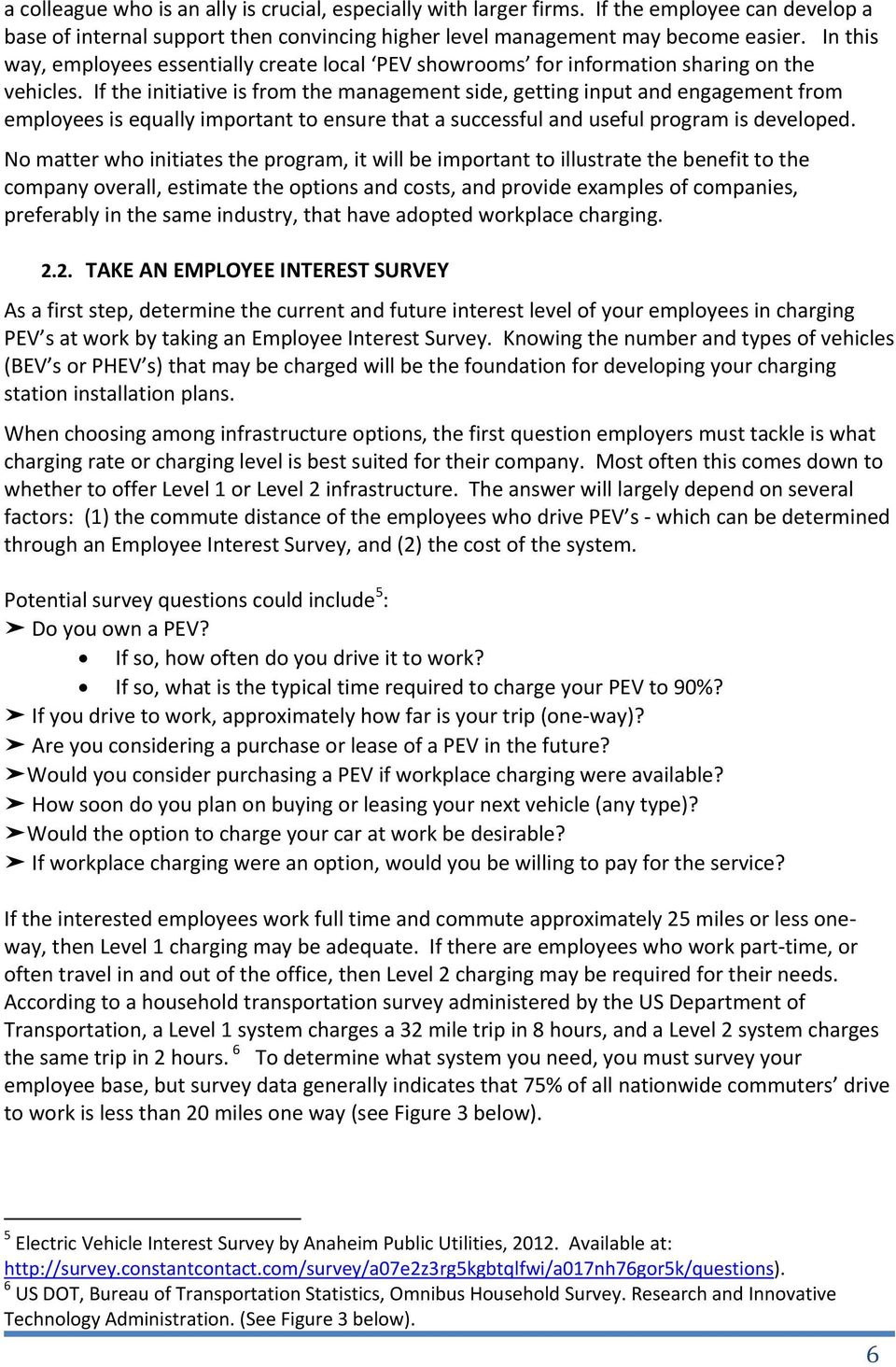
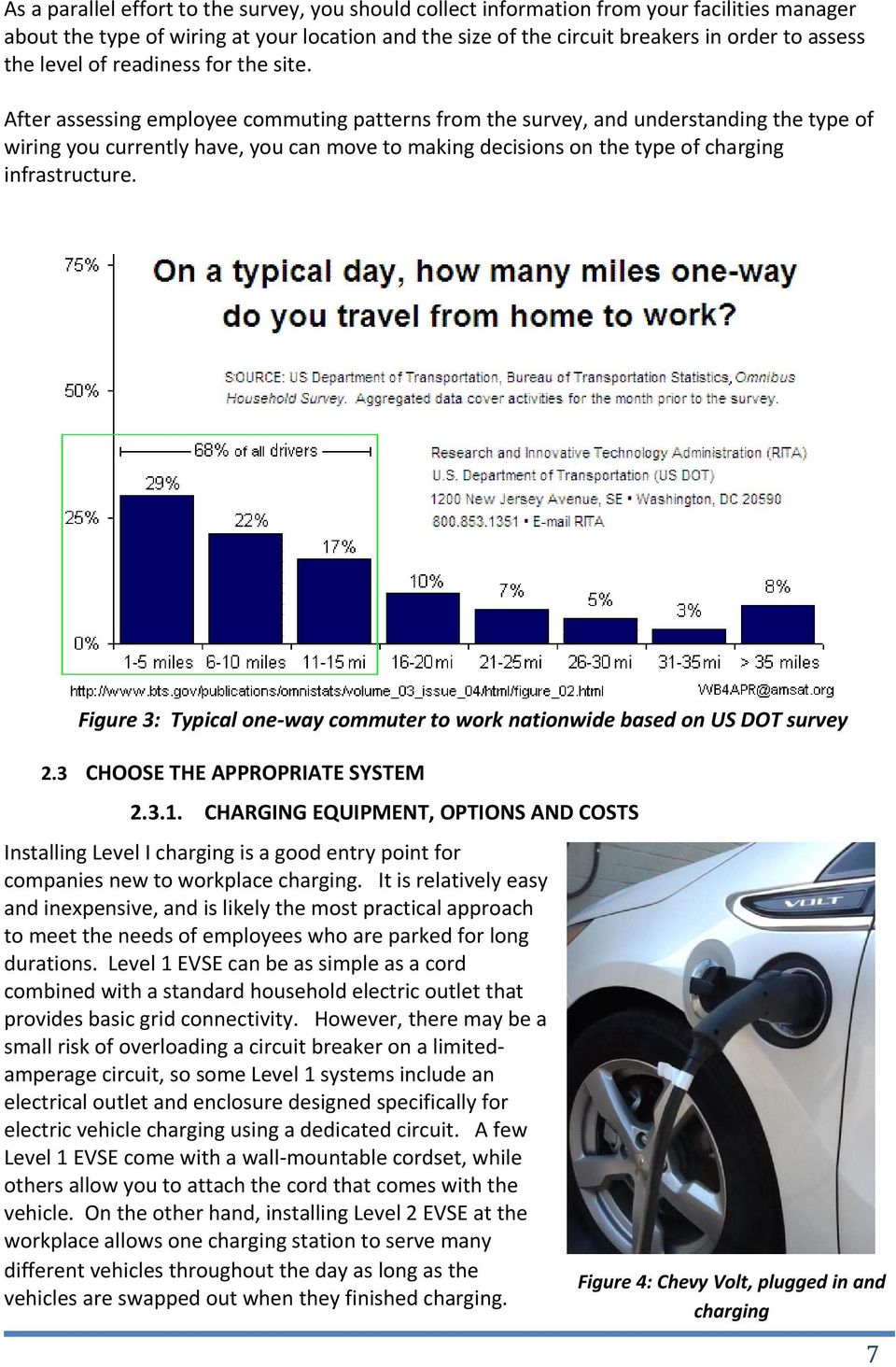
12 As a parallel effort to the survey, you should collect information from your facilities manager about the type of wiring at your location and the size of the circuit breakers in order to assess the level of readiness for the site. After assessing employee commuting patterns from the survey, and understanding the type of wiring you currently have, you can move to making decisions on the type of charging infrastructure. Figure 3: Typical one-way commuter to work nationwide based on US DOT survey 2.3 CHOOSE THE APPROPRIATE SYSTEM CHARGING EQUIPMENT, OPTIONS AND COSTS Installing Level I charging is a good entry point for companies new to workplace charging. It is relatively easy and inexpensive, and is likely the most practical approach to meet the needs of employees who are parked for long durations. Level 1 EVSE can be as simple as a cord combined with a standard household electric outlet that provides basic grid connectivity. However, there may be a small risk of overloading a circuit breaker on a limitedamperage circuit, so some Level 1 systems include an electrical outlet and enclosure designed specifically for electric vehicle charging using a dedicated circuit. A few Level 1 EVSE come with a wall-mountable cordset, while others allow you to attach the cord that comes with the vehicle. On the other hand, installing Level 2 EVSE at the workplace allows one charging station to serve many different vehicles throughout the day as long as the vehicles are swapped out when they finished charging. Figure 4: Chevy Volt, plugged in and charging 7

13 Level 2 is also ideal for employees and visitors who need a faster charge than what Level 1 provides. In general, Level 1 charging solutions range from little cost to no cost at all, for example when a cordset is used to plug into a regular outlet. (The outlet must be properly grounded). Commercial Level 1 EVSEs are not available in a wider range yet, but according to a study titled Ready, Set, Charge, California, Level 1 hardware generally ranges in cost from $300 to $ According the same study, Level 2 hardware has a wider range of costs, from $500 to $6,000, while fast-charging hardware is likely to be cost-prohibitive for the majority of workplaces since costs can be as much as $55,000 per unit. Several companies have considered a hybrid approach with Level 1 serving the needs of most employees, and one or two pay-per-use Level-2 charging stations available for visitors and those that need a quicker charge. EVSE s can now be ordered "online or at retail locations from a variety of suppliers. For a good list of suppliers of EVSEs, refer to the Other Resources at the end of this section. Comparison of different charging levels is shown in the table below including AC and DC charging. Figure 5: Comparison of Common Charging Levels The actual charging time will depend on the on-board type of charger, type and level of EVSE, and the state of charge of the vehicle battery. For an approximation of charging times please review the vehicle manual. A guide table is also available at the California Plug-on Vehicle website. 8 7 Ready, Set, Charge, California! A Guide to EV-Ready Communities. Developed by the Association of Bay Area Governments, the Bay Area Climate Collaborative, EV Communities Alliance, Clean Fuel Connection and LightMoves Consulting. November How long does it take to charge, California Plug-in Vehicle Collaborative, visit Or Fast Charging 8
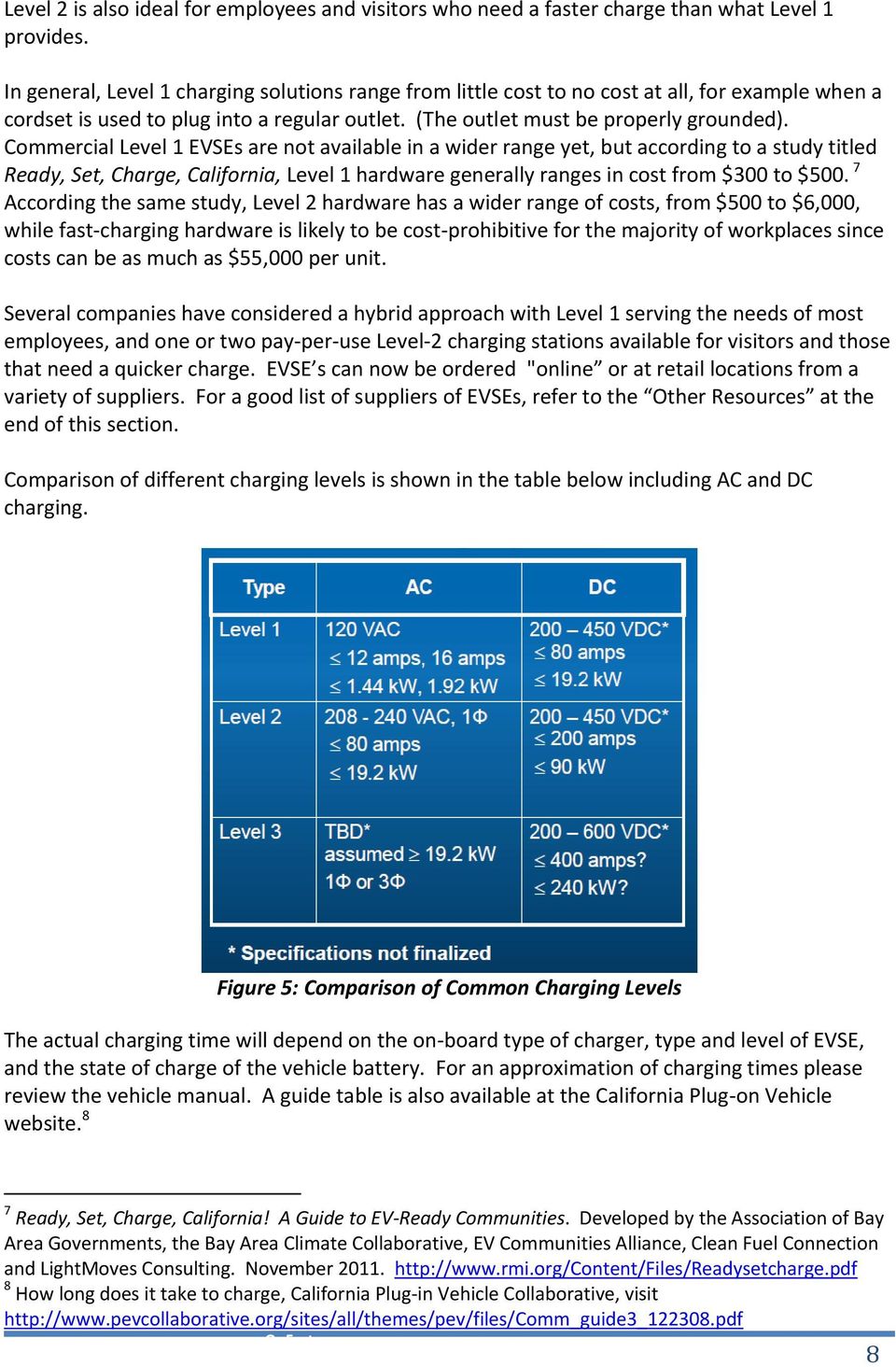
14 Electric vehicles are equipped with on-board chargers that convert AC power from the grid to DC power needed by the battery. DC fast chargers bypass a vehicle s on-board charger and deliver electricity directly to the battery at a higher rate than the on-board chargers would allow. The list of EVSE manufacturers is extensive. A good source for a listing of EVSE companies can be found on the Plug In America website as well as a few others listed at the end of this section. For a reference on costs of some of the systems, visit the AQMD website that has a list of quotes provide as part of the So Cal EV program. 9 Figure 6: Level 1 Charging Examples Figure 7: Level 2 Charging Examples Other Resources: California Plug-in Vehicles Collaborative: Plug In America: Plug-In Recharge: Drive Clean: INSTALLATION COSTS At the outset, employers should be realistic yet foresighted when determining the number of EVSE to install. Planning estimates should include the anticipated number of employee vehicles to be added over the next three to five years, based the Employee Interest Survey. If expansion is anticipated, the initial installation work should include basic infrastructure (e.g. conduit and trenching if needed, pull wire, available circuit breaker location in supply panel) for the future charger installations. Employers should also consider planned flexibility that allows the site to grow with developing technologies or changes in charging requirements. Employers should also 9 For a listing of EVSE pricing from various manufacturers, visit 9

15 consider installing extra circuits and additional electrical capacity during initial construction to minimize overall costs. Installation costs can be significant and sometimes more costly than the hardware. There are several options that can increase or decrease installation costs. These include power requirements, siting considerations, and the choice of EVSE equipment, as discussed below. Power Requirements: In some instances, a new or second electrical panel and circuit breakers might be necessary to support the new EVSE load. A sub-panel upgrade (200A, 120/240 VAC single phase) can amount to approximately $2,000. In the unlikelihood that there is inadequate capacity to support the desired number of EVSE s, a utility transformer upgrade may be necessary. Your local utility will determine whether or not the transformers serving the site need to be upgraded. If a service upgrade is required, the utility will work with the property owners to determine allowances and expenses based on utility policy (Rule 16) as regulated by the California Public Utilities Commission for IOU s or Publically Owned Utilities rules. Siting Considerations: Avoid costs for trenching and conduits by locating the EVSE close to the existing electrical supply. Adding new circuitry can increase capital costs significantly, since the costs rise per linear foot A branch circuit: $10-$11/linear ft 200A feeder circuit: $17 28/linear ft Concrete patch: $14 - $15/square ft Asphalt patch: $10-$11/square ft Choice of EVSE Equipment: As discussed above, EVSE equipment can range from simple 120V outlet cord sets to fully networked systems, and with this range so does pricing. Some units with network billing capability may require licensing fees and/or monthly network access fees (for a more detailed discussion of metering and networks, see Section below). Typically, there are relatively few EVSE maintenance requirements. In general, the charging cord should be stored securely so it is not damaged or vandalized, the accessible EVSE parts should be checked periodically for wear, and the system should be kept clean. Periodic inspection, testing, and preventive maintenance by a qualified electrical contractor may be recommended. One estimate of annual maintenance costs ranges from $25 to $50 per EVSE unit Data provided in 2011 by Jason Greenblatt, Sempra Utilities, for Best Fleet Uses, Key Challenges, and the Early Business Case for E-Trucks: Findings and Recommendations of the E-Truck Task Force, CALSTART, Rocky Mountain Institute, Plugging In: A Stakeholder Investment Guide for Public Electric-Vehicle Charging Infrastructure. 10

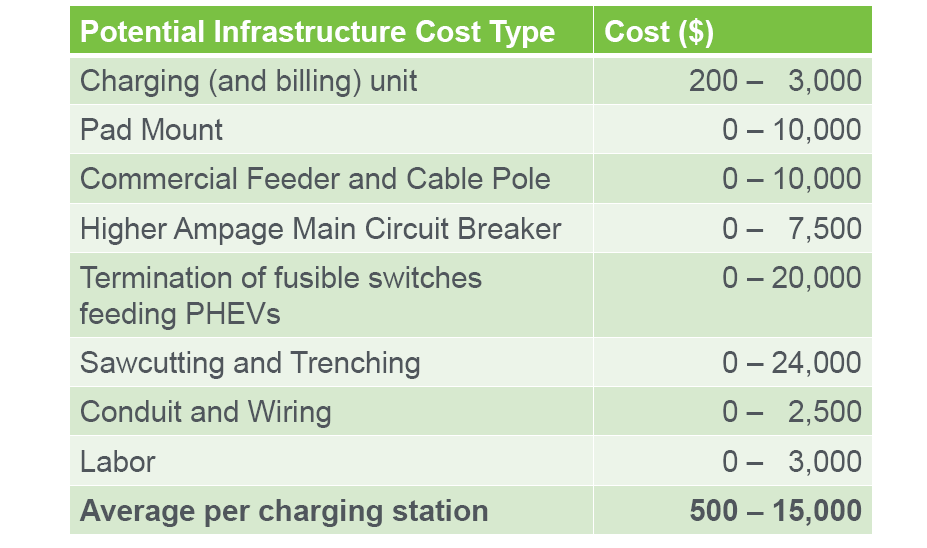
16 Below is a table provided by the Federal Energy Management Program that gathers potential cost ranges for the various infrastructure expenses. A value of zero assumes that the given option was not pursued. Figure 8: Table of Potential Infrastructure Costs (Source: Federal Energy Management Program (FEMP) First Thursday Seminars 2.0 ) OPERATIONAL COSTS The operational costs of an EV charging system include: (1) the cost of electricity ($/kwh), (2) the effect of demand charges, (3) charging network costs, and (4) maintenance costs COST OF ELECTRICITY The cost of electricity can vary depending on your location and utility. The commercial rates are different than residential rates, and the electricity can be priced depending on the size of the customer. For larger consumers of electricity, often the per kwh rate is lower. The average rates of electricity for commercial customers in the continental US range $ /kWh 12. Several utilities have established special rates for electricity supplied for EV fueling. These rates take many forms, and may include time-of-use (TOU) rates. TOU rates typically offer lower electricity cost during off-peak hours. Some utilities require a separate meter installation in order to take advantage of special EV rates while others may allow a sub-meter. This information is available from your local utility representative who can explain the different options available as well as their impact on your cost DEMAND CHARGES It is especially important to note that the additional electrical demand for EV charging may add to an overall higher demand at the commercial site, and thus will impact the cost by higher 12 US Energy Information Administration, Table 5.6A Retail Price of Electricity to Ultimate Customers by End-Use Sector, Accessed June,

17 demand charges. These so-called demand charges are determined by a customer s peak use in a given month vs. its peak throughout the entire year. They are less well known because they are not applied to residential customers but only to commercial users. Consideration of demand charges may be important for smaller locations and businesses where the addition of charging may impact the total load, and for those that do not have a huge variation of electricity use. For large sites and employers with a significant existing load, the addition of EV charging will not create a measurable change to the load and/or demand charges. Each utility invoices somewhat differently for demand charges. These charges are a means for the utility to bill for ensuring that the demand of the customer, which may vary greatly, will be met with ready capacity. Demand charges, which can amount to as much as $25/new kilowatt 13, can be avoided. Employers can manage the PEV charging so that it occurs well below the day peak use. This can be determined by examining the historical load of the building or by contacting your utility representative who should provide this information. Employers could also consider load management systems to charge PEV s off peak. Load management systems automatically sequence multiple EVSE without human intervention, but it is estimated that costs for a complete system could range from $5,000 to $13,000 depending on the number of chargers NETWORK ACCESS FEES Network access fees apply to charges that allow tracking of billing and usage via a software system connected to the EVSEs. Not all EVSEs are connected to networks and some come in a bundle package (hardware and software), while others can be purchased separately and the network system added later. Generally speaking the network costs consists of one or more of the following parts: 1) Monthly or yearly costs per EVSE for the host site (e.g. employer) 2) Installation cost for software 3) Membership fee annual for the driver/user 4) Other transaction costs Depending on what type of EVSE provider you choose, you may or may not need to pay a monthly fee for the service. Some network providers charge a monthly fee to handle the management and administration of the EVSE, such as Chargepoint and the Blink Network. Both companies provide integrated solutions of hardware and network system software that are proprietary to the company. Networked systems generally allow ease of access by enabling drivers to locate charging stations on a map, find directions, and see if those charging stations are available. They also have special features such as fee collection service, reservations, display advertising, and reporting. For semi-public parking areas shared by employees and the public, networked systems could be a big benefit in attracting potential customers. But where parking lots are private and only available to employees, employers may not be interested in being found on a map of available networked charging stations. 13 For example, seasonal average demand charges for the majority of commercial and industrial customers in San Diego are $22 per kw of demand. 12
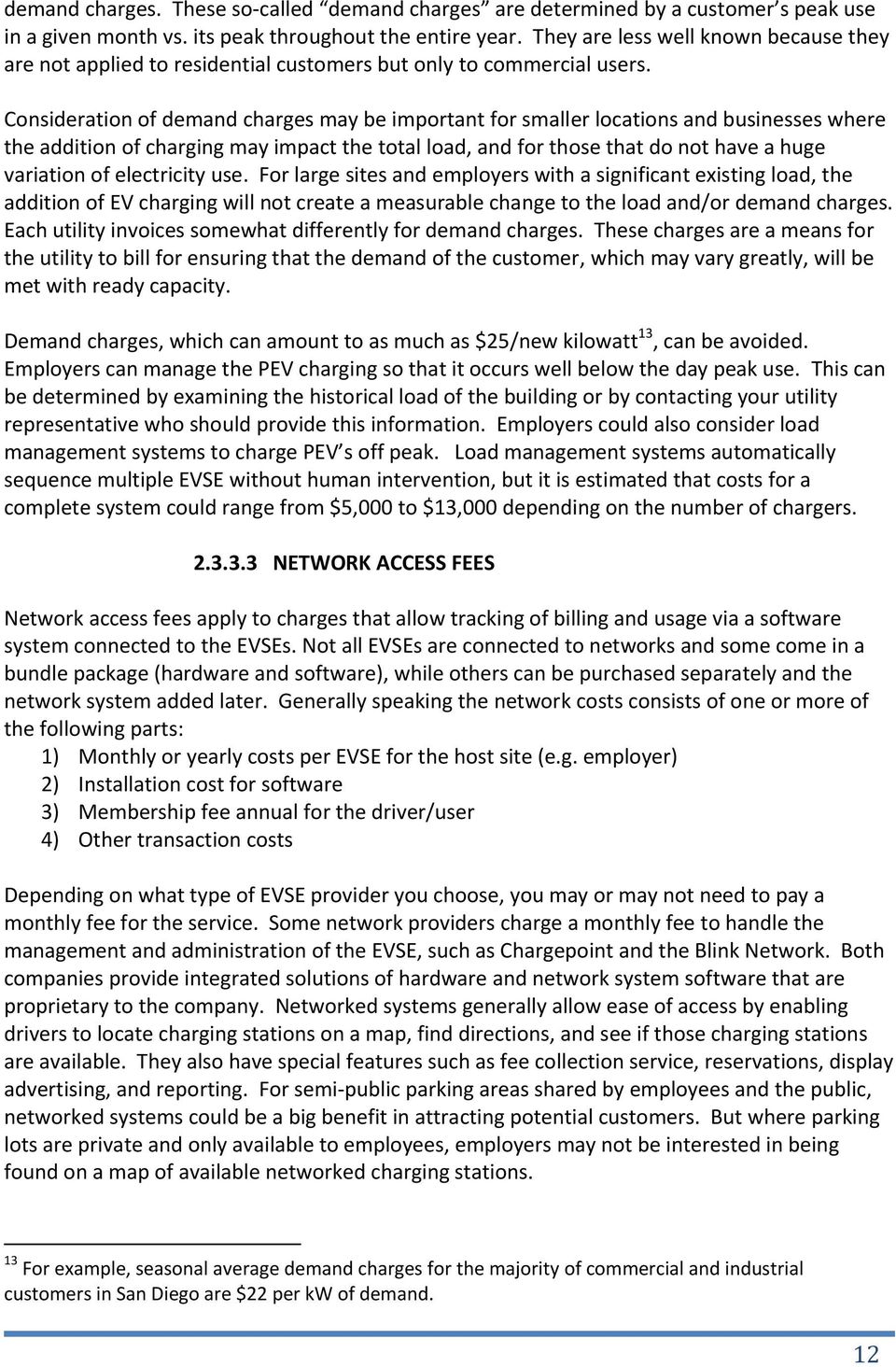
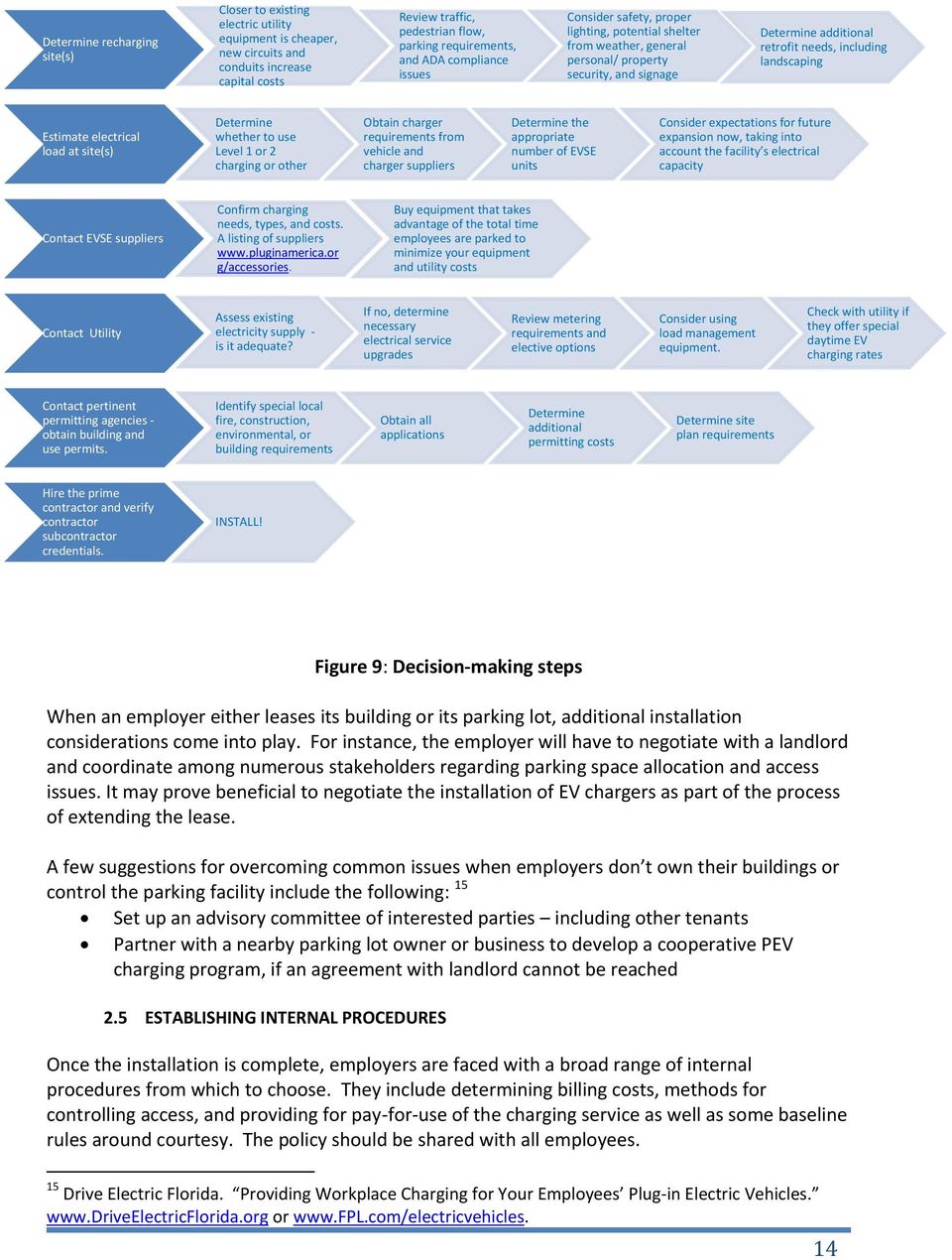
18 The network provider will generally charge a cost per EVSE installed, which is on the order of $20-30/ per month. The end user will see a cost for annual membership plus a cost for charging in dollars per hour of charging. Some networks have a transaction cost associated with each transaction, similar to credit card transactions, equal to 7% of total fees paid by the driver. These are general numbers, but depending on the specific agreements and the number of chargers, the costs can vary. If the employer is not interested in networking options such as usage data or access control, and doesn t want or need the convenience of a technician servicing the system, there are also EVSE solution providers that will integrate with existing billing systems, like Liberty Access Technologies and Control Module. Both companies will build systems that piggyback on a parking garage s existing assets. For example, when someone drives into the garage, they receive a ticket at the gate. They can use that ticket to turn on a charger (via a magnetic swipe or a code system). When they drive out, they pay for parking and charging. If employees use an RFID badge to enter the garage and open doors, that same badge can activate the charger. Other manufacturer offerings provide four stages of charging intelligence. There is a standard charger for free access and free charging; a controlled-access, no-fee charger; a controlledaccess, paid charger; and a build-your-own-network solution. The standard charger can be modified if you want to upgrade the features in the future. Chargers with a variety of billing and access control options are available. 14 Low feature (standard) charging stations cost usually less than $1,000 for equipment alone. Medium feature (smart) charging stations can amount to approximately $2,000 for equipment. High feature (networked) stations can cost up to $5,000 or $6,000 for equipment. Finally, there is also the option of leasing the entire system- a model offered by several third party service providers. Please note that many other service fee models exist from different vendors so please check with vendor specific versions. 2.4 INSTALLING THE SYSTEM Once you have completed the above pre-planning considerations, you are ready to move on to the installation process. Below is a step-by-step checklist for installing the system: 14 Michael Kent. Workplace charging: employers face a maze of issues when considering EV charging. Charged, 13
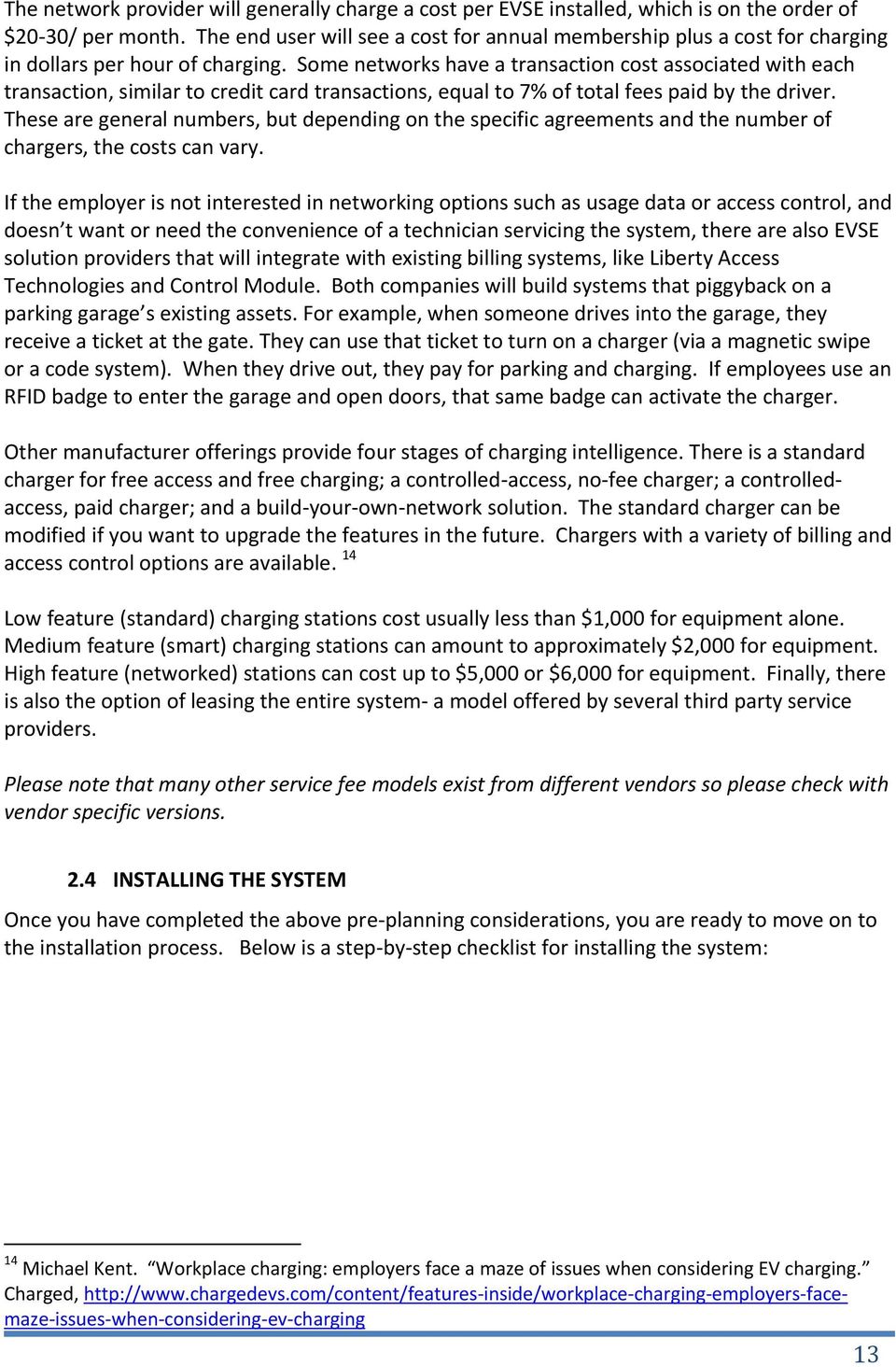
19 Determine recharging site(s) Closer to existing electric utility equipment is cheaper, new circuits and conduits increase capital costs Review traffic, pedestrian flow, parking requirements, and ADA compliance issues Consider safety, proper lighting, potential shelter from weather, general personal/ property security, and signage Determine additional retrofit needs, including landscaping Estimate electrical load at site(s) Determine whether to use Level 1 or 2 charging or other Obtain charger requirements from vehicle and charger suppliers Determine the appropriate number of EVSE units Consider expectations for future expansion now, taking into account the facility s electrical capacity Contact EVSE suppliers Confirm charging needs, types, and costs. A listing of suppliers g/accessories. Buy equipment that takes advantage of the total time employees are parked to minimize your equipment and utility costs Contact Utility Assess existing electricity supply - is it adequate? If no, determine necessary electrical service upgrades Review metering requirements and elective options Consider using load management equipment. Check with utility if they offer special daytime EV charging rates Contact pertinent permitting agencies - obtain building and use permits. Identify special local fire, construction, environmental, or building requirements Obtain all applications Determine additional permitting costs Determine site plan requirements Hire the prime contractor and verify contractor subcontractor credentials. INSTALL! Figure 9: Decision-making steps When an employer either leases its building or its parking lot, additional installation considerations come into play. For instance, the employer will have to negotiate with a landlord and coordinate among numerous stakeholders regarding parking space allocation and access issues. It may prove beneficial to negotiate the installation of EV chargers as part of the process of extending the lease. A few suggestions for overcoming common issues when employers don t own their buildings or control the parking facility include the following: 15 Set up an advisory committee of interested parties including other tenants Partner with a nearby parking lot owner or business to develop a cooperative PEV charging program, if an agreement with landlord cannot be reached 2.5 ESTABLISHING INTERNAL PROCEDURES Once the installation is complete, employers are faced with a broad range of internal procedures from which to choose. They include determining billing costs, methods for controlling access, and providing for pay-for-use of the charging service as well as some baseline rules around courtesy. The policy should be shared with all employees. 15 Drive Electric Florida. Providing Workplace Charging for Your Employees Plug-in Electric Vehicles. or 14
20 Start by defining a policy and implementation plan that supports your company s objectives, while serving EV drivers needs at the lowest cost. It is important to keep the costs of charging as close to that of home charging in order to encourage use broader user of PEV s for commuting. Below are some issues to consider: Payment policy Determine whether to require payment from employees for usage of company charging equipment, to or offer it as an employment benefit (See Section 4.3, IRS Reporting Requirements, for tax implications of this choice) o If you choose to charge a fee, you will need a payment system and access control. o It is generally wise to keep installation costs low, so that high fees don t have to be charged to recover costs, which could discourage use of the system. o Employees can either pay with a pre-paid balance system, you can bill them directly, or you can pay a third-party electric vehicle service provider that handles billing, installation, and maintenance. Determine how to structure the payment, if required o Determine whether to charge on a flat fee of dollars per hour, or dollars per actual electricity charged ($/h vs. $/kwh) Charging a flat monthly fee to users will be based on estimated usage Billing for exact usage by kwh may require pricier metering equipment Level of Access Determine whether charging stations are required to be open for public or fleet use Prioritize charging of fleet vehicles vs. employee vehicles vs. public vehicles System Optimization Manage usage among multiple employees, and determine the maximum charging time per vehicle o Some companies have created distribution lists so that employees who are EV drivers can communicate with each other to share helpful tips and let the group know when a charging station is available. (See the Evernote Case Study in Section 3 below.) Establish timing schedules to avoid demand charges from the utility during peak load periods consider time of use rates and demand charges. Some companies have established a daily schedule in which each employee charges for a specific window of time each day (e.g. 2 hours). Consider connecting chargers with clean distributed generation (DG) such as solar or wind resources Consider entire system load integrating with the building load and managing the peak load of building or site. Managing the peak load can be important in order to keep the peak from increasing with addition of vehicle charging. Most important is that the load from vehicle charging and the building load should be considered as one system. Contacting your utility for assistance is advised, in addition to an energy management company that can provide more details on best management practices including combination of energy storage devices and distributed generation. Consider in the future possibilities of V2B or V2G via implementation of bi-directional power flow from the grid (or building) to vehicle and vice-versa from the vehicle back to 15

21 the building and grid. In this scenario the batteries on the vehicles can be used as energy storage that can play in demand response program or ancillary services markets directly with ISOs (Independent System Operators) and RTOs (Regional Transmission Operators) Program Evaluation While a number of employers have adopted workplace charging programs, the vast majority have not. The slow penetration may be due to the lack of data on the how this benefit can affect recruitment and retention. Data still needs to be collected on the bottom-line impact of workplace charging: has there been on turnover as a result of implementing workplace charging? Recruitment? Workforce stability? Developing hard data to quantify the value proposition is essential, but few standards currently exist to help employers determine what data to collect. Below are some suggestions: o Launch your workplace charging program with an eye towards program evaluation. It is much easier determine return on investment when your program is designed and implemented an evaluation component already in place. o Determine the metrics for your program. Select data points that will be meaningful your organization and ensure they are collected on an ongoing basis. o Make program evaluation a priority. Determine early on who in the organization will be responsible for data collection and analysis of your charging program. Build this task into the regular work program to ensure that this task is given adequate time and does not have to compete with other priorities. Other optimization tactics could include a more comprehensive evaluation of PEV charging as a part of the entire electrical system, which includes the building and other potential sources of electricity, such as solar or wind resources adding to the mix. Other Resources: San Diego Gas and Electric, Key points to know when considering workplace charging. Southern California Edison, Workplace: Employee Electric Vehicle Charging. 2c3e9fea1193/PEV_Business_EmployeeVehicleCharging.pdf?MOD=AJPERES US Department of Energy, Workplace Charging Challenge Resources: 16
22 3. EMPLOYER CASE STUDIES AND POLICIES SUPPORTIVE OF PEV Employer Case Studies Below is a brief inventory of some of the strategies and policies that specific employers have established, and problems they have overcome, in the process of installing workplace charging. Some of these case studies were reviewed as part of the monthly web meeting of the EEVI. A more detailed review of case studies will be published shortly by the California Plug-in Electric Vehicle Collaborative reviewing 20 or more case studies of workplace charging. California Department of General Services: The California Department of General Services was awarded funding by a grant from the California Energy Commission and the US Department of Energy for the purchase and installation of 24 Level 2 charging stations. In this case, the parking spots used for charging are required to be available to public and to state employees. There will be 9 additional charging spots installed in the future and they will also be funded by a grant. A big motivation for installing charging infrastructure was to address greenhouse gas emissions and the government s interest in electric vehicles. SAP Labs, Palo Alto, CA: At the inception of the workplace charging program at SAP Labs, there were more interested users than available charging spots, so there were some initial challenges with regard to determining protocols for sharing the plugs among employees. Coulomb s reservation software was helpful in overcoming this issue. The 2010 Nissan Leaf program was what created the initial demand for workplace charging at SAP. Each of the SAP chargers has a Level 1 and a Level 2 socket, but few drivers are currently using Level 1. The charging stations have up to 7.2 kw output delivering Level II (208/ A) charging via the standard SAE J1772 connector and fixed 18 foot cable, and a 2 kw output delivering Level I ( A) charging via a standard NEMA 5 20 receptacle protected behind a locking door. The largest costs SAP has encountered during installation were for paving and wiring, and the most unexpected cost was the municipal requirement for emergency power off switches. University of California, Davis: UC Davis is a unique case study since the campus is 8 square miles and is more like a small municipality than an office park. There are 20,000 employees including staff and faculty and 30,000 students. The campus also has a fairly large fleet: 1,200 licensed road vehicles including 300 to 400 sedans. They are gradually moving towards PEV s and alternative fleet vehicles. The campus is not under the jurisdiction of the y so there are fewer permitting requirements than many employers will encounter. Currently, the charging stations are well-dispersed across campus, but were simply deployed where it was cheaper to do so, such as in locations where wall mounts already existed, or where there was not a lot of trenching required, or where construction was already in progress. There are 25 Level 2 chargers and 5 Level 1 chargers available. Certain locations are more heavily 17
23 subscribed than others. There is currently no cost for charging but the campus will soon be determining how to charge the users going forward. Users do pay for parking, but at the moment, the electricity is paid by the campus. The campus is responsible for handling and maintenance of chargers. 20 th Century Fox, Los Angeles, CA: 20 th Century Fox Studios currently has 20 Level 2 chargers 17 are Blink and 3 are Clipper Creek. Most are distributed in parking structures, a few are located in a parking lot, and one is in the transportation services department. There were approximately EV and PEV drivers using the system at the time of publication. The drivers can schedule their usage online. The main reason for initially installing chargers at the studio was employee interest. Users are charged a fee of $1 per hour for using the chargers. Collaborating and engaging the employees in decision making from early on is highly recommended. The average charging time per vehicle is 3-4 hours. The company also provides an incentive to employees that purchase or lease an EV or plug-in hybrid vehicle. The incentive is up to $4,000 and is hugely popular. Rutgers University, New Jersey: The University has three Level 2 chargers now and four more in the planning stages. They are in the vicinity of a solar parking canopy. Visitors as well as employees use the charging. The average length of time that vehicles are charging is between ½ - 2 h. The program was funded by ARRA stimulus funding and required matching location funds for installation. The University agreed to provide charging for free and support the studies of usage. Future plans include installing charging in parking garage structure. Both students and faculty have parking passes to the structure and use it. The installation of the two units still was high (~$11,000) mostly due to conduit installation to parking lot and adding circuits to the panels. Boeing Company, Arizona Boeing is currently implementing a workplace charging pilot study at their facility in Mesa, Arizona. The company has 4 EVSE available to its employees two dual stations: 1) the first with two 240V stations and 2) the second with one 120V and one 240V station. Boeing requires employees to pay for the service at the rate of $1 per hour with a maximum of 4 hours. It is a flat rate with no difference between morning and afternoon. The 4 hour time limitation is enforced by parking security who will give a violation notice if the limitation is exceeded. It is a turnkey system that accepts major credit cards. When employees cars are fully charged, they receive an to notify them to move their vehicles out of the charging space. The public demand for use of the chargers from the event center across the street was most challenging issue encountered. The Mesa facility does now offer access to public. The company implements the charging program as part of it regulatory trip reduction requirements. Final data on the program is not yet available. Employer Policies Several employers today are offering special incentives to their employees to use, purchase, or 18
24 lease PEV s, aside from installing charging infrastructure for workplace charging. The incentives, in most part, come in the form of monetary incentives for purchasing or leasing a PEV or hybrid by the employee. In some cases, the company owns a fleet of PEV s and encourages the employees to use them and experience them prior to purchasing a vehicle. Other examples include a car-share program operated on the campus that consists of PEV s vehicles that the employees can use on an hourly or daily basis. Evernote, Redwood City, California According to its company profile, Evernote is a web company providing full-featured desktop and mobile apps designed to allow users to easily capture and find information, memories, and content in any environment. The company is located in Northern California. Evernote has launched a first-of-its-kind workplace charging program that is designed to Figure 10: Workplace charging using the Blink Network at Evernote enhance employee productivity. The company has installed 10 Level 2 charging stations and one DC fast charger, but also offers each employee a monthly $250 allowance to lease or buy any vehicle that qualifies them to get a California carpool lane sticker. Before the monthly subsidy is provided, the company requires proof of the employee s HOV sticker. The program is based on the theory that access to the carpool lane will allow employees to spend less time in traffic and get to and from work in sometimes half the time, thereby increasing their productivity. If an employee purchases a Nissan LEAF, the allowance completely covers the cost of the lease since Evernote negotiated a special deal with Nissan. Evernote also covers the cost of the charging. Employees are each given a Blink card (connected to one corporate account) when they get purchase their EV. The charging stations are open to the public as well, since the EV Project partially funded the installation and the grant requires public access. For managing usage of the charging stations among the employees, the company has created a charging calendar for all employees. The length of time they have on a charger correlates with the distance they commute. They all have access to the calendar and communicate with one another via a Google group. When someone is going to be out of the office or on vacation, they the group in case someone else needs extra time on a charger. Evernote reports that the system has been working well and 44 employees currently take advantage of the HOV subsidy program. This is about 20% of the employees at the Redwood City location. Additionally, they hope to add 10 more Level 2 stations in the coming years. 19
25 Google, Mountain View, CA Figure 11: Workplace charging at Google s Mountain View campus Google is one of the pioneers in installing workplace charging and is deeply committed to sustainable business practices, including its transportation initiatives. To encourage its employees to drive zero emissions vehicles, Google provides free workplace charging at its Mountain View headquarters and more than 10 other locations in the US. This has been a significant enabler for employees who wish to drive a plug-in vehicle, but have long commutes or do not have easy access to charging facilities at their place of residence. Google's goal for the Mountain View campus is to provide charging capability at 5% of its regular parking spaces, and currently there are over 450 Level 2 and 180 Level 1 charging ports deployed there. Workplace charging at Google also supports a fleet of 50+ vehicles in a carsharing program called GFleet. GFleet cars are available for employees who commute using alternative transportation methods such as the commuter shuttle bus service, carpooling/vanpooling, biking and public transportation. The fleet is comprised exclusively of plug-in vehicles (save for one minivan) to help minimize its environmental impact, e.g. air quality and GHG emissions, as well as to reduce Google's spend on fuel & maintenance costs STMicroelectronics STMicroelectronics, one of the world s largest semiconductor companies, augments the company s monthly automobile allowance to North America-based employees who drive fuelefficient vehicles. (ST s corporate headquarters are in Geneva, and their U.S. Headquarters are near Dallas, Texas.) Vehicles with fuel consumption ratings of 39.2 mpg to 46.9 mpg receive an additional $83.34 in the monthly allowance. Vehicles with 47 mpg or higher receive an additional $ per month. Patagonia Patagonia, an outdoor apparel company, provides up to $2,000 to workers who buy hybrids or alternative fuel cars. 20
26 Los Angeles y Board of Supervisors On February 12, 2008, the Los Angeles y Board of Supervisors established a Vehicle Purchasing Services Program (VPSP) for alternative fuel vehicles. The Program provides an incentive for Los Angeles y employees, retirees, family members, and contractors/subcontractors to purchase green vehicles to help lessen the environmental impact when commuting to and from work. Other Resources: Corporate Incentives for Hybrids and Alternative Cars. May 11, COST RECOVERY AND TAXES 4.1 ASSESSING AND RECOVERING COSTS To date, many existing PEV workplace charging programs are free for employees to use. This approach is designed to incentivize employees to make clean transportation choices and to allow the organization to evaluate the best use of the workplace charging. However, a reasonable fee for using the charging stations equipment can make sense for some employers. But what is a reasonable fee? The California Center for Sustainable Energy (CCSE) and the California Air Resources Board (ARB) found that California EV owners are willing to pay 40% 70% more for public and workplace charging compared to standard residential electricity rates. 16 The Energy Information Administration reports an average retail price of electricity for residential customers in California at $0.15/kWh in March If California EV owners are willing to pay 40 70% more, it means they are willing to pay $ /kWh. 17 We would caution that these results may be biased by early adopter views and willingness to pay. It does remain of interest to understand the impact of charging fees for employees and how to best arrive at a reasonable fee that will encourage adoption of PEVs. Other reasons 16 California Plug-in Electric Vehicle Owner Survey, California Center for Sustainable Energy (CCSE) and the California Air Resources Board, July Online at 17 For a detailed discussion on how to maximize the return on investment of your EV project, please refer to ELECTRIFY YOUR BUSINESS, Moving Forward with Electric Vehicles, A BAY AREA BUSINESS GUIDE, prepared by Business Council on Climate Change (BC3) and the Bay Area Council (BAC). For a detailed discussion on cost and revenue drivers that impact cost recovery specifically for commercial site owners, please refer to Financial Viability Of Non-Residential Electric Vehicle Charging Stations, prepared by UCLA Luskin Center for Innovation. 21
27 beside cost recovery may justify fees. Researchers at UC Davis, for example, point out that a fee is desirable in order to support charger management. 18 While the workplace charging market is still nascent, many employers will choose not to collect direct revenue generated from EV charging fees since the costs are relatively modest. If employers are concerned about their charging stations becoming the primary source of charging for EV owners, they can implement time restrictions to ensure that no one monopolizes a parking spot or charging station 4.2. THE ROLE OF INCENTIVES Employers considering EV charging installations should always check with their local and regional governments, and the local electric utility to see if they have established any incentive programs. Twenty-seven states and D.C. have EV incentives for individuals. Thirteen states currently have pending legislation relating to incentives. These incentives include highoccupancy vehicle lane exemptions for PEV s as well as monetary incentives, such as tax exemptions or credits and registration fee reductions, emission test exemptions and parking incentives. 19 As an example of local incentives, the Bay Area Air Quality Management District (BAAQMD) in Northern California is providing $1.5 million to support EVSE installations at workplaces and multi-family units. The program is expected to launch at the end of There are a few incentives offered by the Federal government. If you own a business and purchase and install an EV charging station before December 31, 2013, you can deduct up to 30% of the cost of the equipment and installation, up to $30,000, under the Alternative Fuel Vehicle Refueling Property Credit Act. 21 This provision extends a tax credit of up to 30 percent the cost of refueling infrastructure, subject to a cap of $1,000 for personal use property and $30,000 for businesses/ investment use property. The extension applies retroactively to cover all alternative fuel infrastructure put into service in 2012, and includes the installation of fueling equipment for plug-in electric vehicles. Additionally, PEV s purchased in or after 2010 may be eligible for a federal income tax credit of up to $7,500. The credit amount will vary based on the capacity of the battery used to fuel the vehicle. 22 Businesses can also earn credits for installing EV charging stations, under the U.S. Green Building Council s Leadership in Energy and Environmental Design (LEED) building certification program. Up to three LEED points are available under the New Construction Sustainable Sites Credit #4.3 Alternative Transportation, Low-Emitting, and Fuel-Efficient Vehicles Nicholas, Michael, and Gil Tal. 2013, July. Charging for Charging at Work: The Paradox of Free Charging and its Detrimental Effect on the Use of Electric Vehicles Davis, CA: University of California, Davis. Institute of Transportation Studies, UCD-ITS-WP National Conference of State Legislatures BAAQMD, Strategic Incentives Division Apply for the Alternative Fuel Infrastructure Tax Credit at 22 For a list of electric vehicles that are eligible for a federal tax credit, visit the Energy Department's fuel economy tax center site at 23 More details on the LEED program are available at 22
28 Large employers in the Los Angeles metro area have an extra incentive to encourage electric commuters via Rule 2202 of the South Coast Air Quality Management District (AQMD): the On- Road Motor Vehicle Mitigation Options, Employee Commute Reduction Program. The regulation is intended to provide employers with a menu of options to reduce mobile source emissions generated from employee commutes, and mandates that employers with a staff of 250 or more at a single site take meaningful steps to reduce smog from their employees commutes. These steps include encouraging the use of public transit, carpooling, shuttles, augmented work schedules, and EV driving, as of a revision on October 7, Check with your local Air District to see if it has a similar commute reduction regulation that may be applicable to your business. As mentioned previously, many electric utilities around the country offer special rates, including time-of-use (TOU) rates, to reduce the cost of powering an electric car or plug-in hybrid. As an example of a different kind of utility incentive, Anaheim Public Utilities is offering a Plug-in Electric Vehicle Charger Rebate to customers who install a Level 2 (240-Volt) plug-in electric vehicle (EV) charger. Through this program, Anaheim Public Utilities will reimburse customers for out-of-pocket expenses up to $1,500 per charger. Eligible expenses include the charger purchase price, and installation costs. In addition to the $1,500 rebate, we will waive the City s permit application fees related to the installation of the EV charger. 25 Check with your local utility company for exact rates and other details. The American Recovery and Reinvestment Act (ARRA) of 2009 had a large impact on the rollout of ESVE infrastructure across the nation. Numerous PEV and EVSE projects were made possible by ARRA funding via the Transportation Electrification Initiative administered by the Department of Energy. ChargePoint America and ECOtality North America both received ARRA funding to deploy EVSE throughout the U.S. ChargePoint installed 4,600 Charge-Point Networked Charging Stations at residential and public sites across the nation. ECOtality installed roughly 14,000 Level 2 EVSE across the U.S. and 300 DC Quick Charge stations in 16 major cities. Currently, ECOtality is offering free Blink Level 2 hardware as well as an installation credit up to $1,000 to interested commercial host sites in the markets of Atlanta, Chicago, and Philadelphia for a limited time. Commercial host sites may also receive a free Blink DC Fast charger as well as a subsidized installation cost. 26 EV incentives are being tracked by various organizations that are listed immediately below. 24 Rule 2202, Employee Commute Reduction strategies, provides 18. Other Strategies include electric vehicle infrastructure; 8. Employee Clean Vehicle Purchase incentive For more information on the Anaheim PEV Charger rebate, visit 26 To find out if you are eligible as a commercial host site in the EV Project, visit 23
29 Other Resources: California Plug-In Electric Vehicle Collaborative: Plug In America: DOE s Alternative Fuels Data Center: National Conference of State Legislatures: IRS REPORTING REQUIREMENTS There may be legal, regulatory and other requirements that are involved when setting up workplace charging. For instance, if you decide to offer charging at no cost, many organizations have wondered if this may be considered as a reportable employee benefit. We should point out that no specific ruling is in place currently that addresses the treatment of electricity for charging EV s at place of work. For the most reliable advice on this topic, companies are strongly encouraged to check with their legal counsel. However in order to provide some information on this topic, we offer some examples that should be only used as a guide. One example has been the use of the de minimis definition which provides taxpayers the opportunity to exclude from gross income any fringe benefit that qualifies as a de minimis fringe benefit (section 132(a)(4) of the Code). A de minimis fringe benefit is any property or service whose value is (after taking into account the frequency with which the employer provides similar fringes to his or her employees) so small that accounting for it is unreasonable or administratively impracticable. According to IRS 2012 Employer s Tax Guide to Fringe Benefits, - (page 20 for information on Transportation (Commuter) Benefits) - workplace charging is not specifically identified, and it remains to be verified if it is a Transportation/Commuting benefit that falls under a de minimis threshold. In addition, Section 132 (f)(2)(b) of the Internal Revenue Code, Commuter Tax Benefits, allows for a fringe benefit exclusion for qualified parking. In 2013 this value was $245 per month. As of the publication date of this document, the IRS has not made a conclusion specific to whether EV charging is a taxable benefit. Always consult your tax advisor about possible tax implications. 24
30 Other Resources: Benefits "...a de minimis benefit is one for which, considering its value and the frequency with which it is provided, is so small as to make accounting for it unreasonable or impractical." "A de minimis transportation benefit is any local transportation benefit you provide to an employee if it has so little value (taking into account how frequently you provide transportation to your employees) that accounting for it would be unreasonable or administratively impracticable. For example, it applies to occasional transportation fare you give an employee because the employee is working overtime if the benefit is reasonable and is not based on hours worked." 5. SUMMARY AND RECOMMENDATIONS The purpose of this document is to provide a resource for employers and employees who are interested in launching a workplace charging program at their place of business. It includes logistical details for implementing and installing a workplace charging program, and includes a practical checklist for deploying EV charging infrastructure. It also provides references to key suppliers and support companies, and identifies potential funding opportunities. We have also incorporated financial and implementation analyses to streamline the decision, justification, and installation process of implementing a workplace charging program at your business. Businesses play a critical role in the adoption and expansion of electric vehicles and EV charging infrastructure. In order to lead the transition to electric vehicles, we recommend that businesses implement their best individual options, while understanding that there is no one solution that fits all. It is crucial, however, to keep the process as inexpensive and simple as possible, both for the employer and the for the end-user employees. Workplace charging programs don t have to be costly or complicated, yet they can provide a valuable benefit to employees who own EVs, and create an increasingly effective marketing tool for a business to attract and retain employees. Finally, they can encourage adoption of electric vehicles by providing a reliable and easy place for EV drivers to plug-in and charge their vehicles. 25
31 APPENDIX EMPLOYER EV INITIATIVE: SURVEY RESULTS CALSTART began the Employer EV Initiative in 2012 ( to accelerate the pace of learning on a nationwide basis by helping businesses learn from the practices of their pioneering colleagues with regard to workplace charging of both employee and fleet vehicles. The first order of work of the Employer EV Initiative was barrier-identification survey of firstmover companies that have already installed or that are investigating workplace charging in order share their experiences to date and understand the primary barriers and needs that would speed up adoption of workplace charging. The survey was designed to identify key opportunities, barriers and actions that are needed to speed the effective deployment PPEV s and associated charging infrastructure. It was not intended to serve as a comprehensive examination of all possible users, but rather was a targeted compilation of the valuable knowledge and experience of those who have first entered the market to use workplace charging. s were received from 60 public/private employers across the California. Fifty-three percent (32 out of 60) of respondents had workplace charging installed at the time of the survey. Below is a summary of the primary barriers that were cited by the respondents. ADDITIONAL BARRIERS IDENTIFIED VIA WEB FORUM The EEVI participants identified additional barriers that were not included in the survey during the course of the web meetings. These barriers include the following: Determining protocols for plug sharing among employees. Understanding IRS rules regarding employee benefits as it relates to workplace charging. Evaluating future infrastructure needs during the initial installation. Assessing installation costs (including permitting and other municipal requirements). 26
32 Assessing future operational costs (such as electricity rate structures and charging software costs). Pricing of electricity provided at worksite to employees. Understanding the federal grant process for the purchase and installation of EV charging stations how to apply, what terminology to use? Apportioning charging spaces between employees and the public, and understanding the conditions when public access is required. Who within the company owns and operates the program? (Facility managers, parking managers, sustainability director, transportation demand manager, ) SURVEY QUESTIONS SUMMARY ANSWERS Provided below. 27
33 Workplace Charging Readiness Survey for Employers 1. Name 75 answered question 75 skipped question 0 2. Title 75 answered question 75 skipped question 0 3. Company Name 75 answered question 75 skipped question 0 1 of 12
34 4. Company Address 75 answered question 75 skipped question 0 5. Phone 59 answered question 59 skipped question Address 75 answered question 75 skipped question 0 7. Approximate Number of Employees 75 answered question 75 skipped question 0 2 of 12
35 8. Do you currently have any Electric Vehicle Charging Stations available and operational at your workplace? Percent Yes 53.3% 40 No 46.7% 35 Other (please specify) 8 answered question 75 skipped question 0 9. HOW MANY Charging Stations do you currently have of EACH TYPE listed below? Average Total Level 1 (120 v) Level 2 (240 v) Fast Chargers (480 v) answered question 34 skipped question 41 3 of 12
36 10. WHO can use the Charging Stations? Percent Employees 50.0% 18 Public 19.4% 7 Company Fleet 38.9% 14 All of the above 41.7% 15 Other (please specify) 16.7% 6 answered question 36 skipped question Do you require a fee for use of the Charging Stations? Percent Yes 25.0% 9 No 75.0% 27 If YES, please describe how the fee is assessed: 7 answered question 36 skipped question 39 4 of 12
37 12. How many employees are currently charging at work? Percent % % % % 1 More than % 7 Other (please specify) 8 answered question 28 skipped question Do you have an internal company policy regarding workplace charging (i.e., who can charge and when)? Percent Yes 33.3% 12 No 66.7% 24 Other (please specify) 0.0% 0 answered question 36 skipped question 39 5 of 12
38 14. Who monitors the program? Percent Human Resources Manager 2.9% 1 Facilities Manager 35.3% 12 Fleet Manager 8.8% 3 Employees/Users 20.6% 7 No one 17.6% 6 Other (please specify) 41.2% 14 answered question 34 skipped question Are you using any renewable energy options in connection with your Charging Stations (i.e., use of solar or wind generated electricity)? Percent Yes 42.9% 15 No 57.1% 20 If YES, please specify which option: 13 answered question 35 skipped question 40 6 of 12
39 16. Do you have a plan to avoid on-peak charging during the day (i.e,. from 2pm to 5pm)? Percent Yes 23.5% 8 No 76.5% 26 If YES, please describe the plan: 7 answered question 34 skipped question In the next year, please indicate the number of Charging Stations of each type that are planned for installation, if any. Average Total Level 1 (120 v) Level 2 (240 v) Fast Chargers (480 v) answered question 50 skipped question 25 7 of 12
40 18. Does your company own or lease its building? Percent Own 61.2% 41 Lease 26.9% 18 Other (please specify) 11.9% 8 answered question 67 skipped question Does your company own its parking lot or rent? Percent Own 64.2% 43 Rent 10.4% 7 Lease spaces 10.4% 7 None of the above 1.5% 1 Other (please specify) 13.4% 9 answered question 67 skipped question 8 8 of 12
41 20. Does your company own a fleet of vehicles? Percent Yes 81.8% 54 No 18.2% 12 If YES, how many and what type? 27 answered question 66 skipped question If yes to Question 20, are any of the vehicles in your fleet plug-in electric vehicles? Percent Yes 47.4% 27 No 52.6% 30 Other (please specify) 6 answered question 57 skipped question 18 9 of 12
42 22. How many plug-in electric vehicles does your company plan to acquire for its fleet in the next year, if any? Percent None 56.4% % % % % 1 More that % 3 Other (please specify) 11 answered question 55 skipped question If you want (or already have) charging stations at your workplace, what are your motivations for acquiring EV infrastructure? Percent Reducing overhead energy costs 19.0% 11 Employee benefit for recruitment/retention 62.1% 36 Green corporate image 72.4% 42 Other (please specify) 32.8% 19 answered question 58 skipped question of 12
43 24. If you have already installed charging stations, which of the following barriers did you encounter during the process? If you have NOT installed charging stations but are interested in doing so, which anticipated barriers concern you the most? Please rate the following possible barriers in order of significance: Not Significant Somewhat Significant Very Significant Rating Average Rating Buy-in from senior management 51.0% (26) 33.3% (17) 15.7% (8) Getting employees interested and using the system 63.5% (33) 25.0% (13) 11.5% (6) Obtaining approval from property/garage owners 71.2% (37) 17.3% (9) 11.5% (6) Choosing a vendor and electrical contractor 57.4% (31) 31.5% (17) 11.1% (6) Choosing the appropriate system 52.9% (27) 27.5% (14) 19.6% (10) Cost (installation, maintenance, operation, etc.) 13.0% (7) 25.9% (14) 61.1% (33) Developing an internal policy regarding charging vehicles 36.5% (19) 40.4% (21) 23.1% (12) Compliance with the Americans with Disabilities Act 43.4% (23) 34.0% (18) 22.6% (12) Liability Issues 38.5% (20) 42.3% (22) 19.2% (10) Other (please specify) 8 answered question 56 skipped question of 12
44 25. Please provide any additional comments, questions, or feedback. Thank you for your participation! 11 answered question 11 skipped question of 12
45
46 Copyright 2013 CALSTART
ELECTRIC VEHICLE CHARGING SOLUTIONS FOR FLEETS
 ELECTRIC VEHICLE CHARGING SOLUTIONS FOR FLEETS Plug-in electric vehicles or EVs are ideal for fleet managers for numerous reasons: they are more energy efficient; they are less costly to operate and require
Infrastructure Overview. Joseph Thompson Principal Engineer Zero Emission Technology Planning Nissan Technical Center North America
 Infrastructure Overview Joseph Thompson Principal Engineer Zero Emission Technology Planning Nissan Technical Center North America Nissan LEAF Charge Ports Level 1 & 2 DC Fast Charge Charging Levels Type
ECCN Exclusive Product Webinar Electric Vehicle Supply Equipment. Agenda. Presenter Introduction
 This is a photographic template your photograph should fit precisely within this rectangle. ECCN Exclusive Product Webinar Electric Vehicle Supply Equipment 2008 Eaton Corporation. All rights reserved.
Electric Vehicle Charging Station Installation Guidelines: Residential and Commercial Locations
 Electric Vehicle Charging Station Installation Guidelines: Residential and Commercial Locations Streamlining Permitting and Inspection of Residential and Commercial Electric Vehicle Charging Station Installations
Electric Vehicles in Oregon Plug-in Electric Vehicle Adoption. John Gartner Research Director
 Electric Vehicles in Oregon Plug-in Electric Vehicle Adoption John Gartner Research Director Introduction Pike Research is a market research and consulting firm that provides in-depth analysis of global
ELECTRIC VEHICLES: THE PORTLAND WAY
 ELECTRIC VEHICLES: THE PORTLAND WAY THE PORTLAND STRATEGY AT A GLANCE 1. Adopt and update policies to facilitate the transition to the use of electric vehicles (EVs) in Portland: a. Streamline electrical
PV Meets EV. David Katz AEE SOLAR FOUNDER AND CTO
 David Katz AEE SOLAR FOUNDER AND CTO TYPES OF ELECTRIC VEHICLES Hybrid Electric Vehicles HEV s HEV s have been on the market for over 10 years. They have a battery powered electric motor coupled with a
What is the Impact of Utility Demand Charges on a DCFC Host?
 What is the Impact of Utility Demand Charges on a DCFC Host? June 2015 Key Conclusions Demand charges associated with 50 to 60-kW high power charging of a direct current (DC) fast charger (DCFC) can have
Southern California Plug-in Electric Vehicle Readiness Plan. Prepared for the Southern California Association of Governments
 Southern California Plug-in Electric Vehicle Readiness Plan Prepared for the Southern California Association of Governments December 2012 14 Utility Policies 14.1 Introduction Electrical utilities currently
Incentives for Plug-in Electric Vehicle Users or Consumers
 National Programs VEHICLES Qualified Plug-In Electric Drive Motor Vehicle Tax Credit - Internal Revenue Service Tax credits range from $2,500 to $7,500 For qualified electric drive vehicles acquired after
Business Electric Vehicle Charger Program. Driving Electric Across Georgia
 Business Electric Vehicle Charger Program Driving Electric Across Georgia Did You Know Driving Electric Across Georgia Electric vehicle (EV) ownership is on the rise. Whether consumers are inspired by
Plug-In Electric Vehicle Handbook. for Electrical Contractors
 Plug-In Electric Vehicle Handbook for Electrical Contractors 2 Plug-In Electric Vehicle Handbook for Electrical Contractors Photo from George Beard, Portland State University, NREL/PIX 18564 Clean Cities
Drive Electric Northern Colorado. Creating a Model Deployment Community
 Drive Electric Northern Colorado Creating a Model Deployment Community The Deployment Community Concept: To facilitate nationwide commercialization of plug-in electric vehicle (PEV) technology, the engagement
Electric Vehicle Supply Infrastructure (EVSE) Electric Vehicles will be in Central Florida in 7 months here s how to prepare for them
 Electric Vehicle Supply Infrastructure (EVSE) Electric Vehicles will be in Central Florida in 7 months here s how to prepare for them Mark Thomason Business Development Director - EVSE, EE, Solar [email protected]
Plugging In: A Consumer s Guide to the Electric Vehicle
 Plugging In: A Consumer s Guide to the Electric Vehicle Today s Choices in Cars Late in 2010 the first mass-produced electric vehicles hit dealer showrooms, bringing car buyers a new, electric option.
Results of Electric Vehicle Market Research Study City of Guelph February 2011
 Results of Electric Vehicle Market Research Study City of Guelph February 2011 Sandy Manners Director, Corporate Communications Guelph Hydro Electric Systems Inc. Email: [email protected] Tel: 519-837-4703
Electric Vehicle Charging Stations for Commercial Properties
 Electric Vehicle Charging Stations for Commercial Properties Eric Smith NorthWest/Hawaii/BC Regional Manager (425)-429-3343 [email protected] www.semaconnect.com Eric Smith NorthWest/Hawaii/BC
We drive electric. You can, too. Tom Saxton, Director ( Copyright 2011 Plug In America. All rights reserved.
 We drive electric. You can, too. Tom Saxton, Director ( Copyright 2011 Plug In America. All rights reserved. Level 1 Charging When Slow but Cheap is the best choice. NEMA 5-15 The standard household outlet
MENU OF PLUG-IN ELECTRIC VEHICLE INCENTIVES. Funded by the U.S. Department of Energy
 MENU OF PLUG-IN ELECTRIC VEHICLE INCENTIVES Funded by the U.S. Department of Energy May 2013 Notice This material is based upon work supported by the Department of Energy under Award Number #DE- EE0005586.
SmartSacramento. Green Summit 2011. Jim Parks Program Manager SmartSacramento Team. April 19, 2011
 SmartSacramento Green Summit 2011 April 19, 2011 Jim Parks Program Manager SmartSacramento Team The Current State of the Grid Current grid tends toward dumb We typically learn about outages via phone Many
California Plug-in Electric Vehicle Owner Survey
 California Plug-in Electric Vehicle Owner Survey 9325 Sky Park Court, Suite 100 San Diego, CA 92123 (866) 733-6374 www.energycenter.org TABLE OF CONTENTS OVERVIEW... 3 PLUG-IN ELECTRIC VEHICLE (PEV) OWNER
The Rollout of Charging Infrastructure for EVs Plugging into Europe
 The Rollout of Charging Infrastructure for EVs Plugging into Europe Mark Daly Demonstration Projects Manager ESB ecars Electricity Supply Board ESB founded in 1927 Ardnacrusha expected to provide Irelands
Connection method for charging systems a key element for electric vehicles
 Connection method for charging systems a key element for electric vehicles By Claude Ricaud and Philippe Vollet > Abstract At the heart of the energy and environmental challenges, the electric vehicle
How do Residential Level 2 Charging Installation Costs Vary by Geographic Location?
 How do Residential Level 2 Charging Installation Costs Vary by Geographic Location? April 2015 Key Conclusions During the EV Project, the average (mean) cost for installation of a residential Level 2 charging
Plug-In Electric Vehicle Handbook. for Public Charging Station Hosts
 Plug-In Electric Vehicle Handbook for Public Charging Station Hosts 2 Plug-In Electric Vehicle Handbook for Public Charging Station Hosts Photo from George Beard, Portland State University, NREL/PIX 18564
SDG&E s - Sustainable Communities Program
 SDG&E s - Sustainable Communities Program February 21, 2014 Pete Pavao 2013 San Diego Gas & Electric Company. All copyright and trademark rights reserved. Overview SDG&E Sustainable Communities Program
Thinking of switching to an electric vehicle?
 What is Travel SMART? Travel SMART is an initiative from Surrey County Council that aims to help Surrey residents and businesses reduce carbon, calories and cost. The Travel SMART team want to encourage
Frequently Asked Questions
 Frequently Asked Questions About us... 2 Why is ZCW donating charging stations?... 2 How are you funded?... 2 What marketing will you do to help promote my business?... 2 What is OCM?... 2 What is ZeroNet?...
Electric Vehicles: Driving EVolution
 Electric Vehicles: Driving EVolution November 2014 Executive Summary Electric Vehicles (EVs) have the potential to provide a significant benefit to consumers and utilities, however as demonstrated in Ergon
Electric Vehicle Charging Station Products EVoReel Charge Cable Management Solutions
 Self-Retracts 30 ft. Charge Cable Length Electric Vehicle Charging Station Products EVoReel Charge Cable Management Solutions Safe, Convenient & Clean EV Charging The EVoReel cable management solutions
EV CASE STUDY The City of Houston Forward Thinking on Electrification. The City of Houston on Integrating Electric Vehicles into Fleet Operations
 EV CASE STUDY The City of Houston Forward Thinking on Electrification The City of Houston on Integrating Electric Vehicles into Fleet Operations Introduction To most people in the energy space, Houston
Thank you for joining today s webinar: Electric Vehicles and Automated Demand Response
 Welcome! Thank you for joining today s webinar: Electric Vehicles and Automated Demand Response If you have a question please use the question box located on the right side of your screen. Questions for
How To Value Vehicle Power
 i Vehicle-to-Grid Power: Battery, Hybrid, and Fuel Cell Vehicles as Resources for Distributed Electric Power in California by Willett Kempton (Principal Investigator) and Jasna Tomić, University of Delaware
Vehicle to Grid Power
 Vehicle to Grid Power Workshop at IEEE Conference Plug-In Hybrids: Accelerating Progress Washington, DC, September 19, 2007 Willett Kempton College of Marine and Earth Studies University of Delaware Four
What is EVSE and Why it Matters to You
 breathe easy What is EVSE and Why it Matters to You An electric vehicle charge station primer for corporate, government, hotel, shopping and multifamily/commercial property managers. By Jordan Ramer, CEO,
The Smart Grid: Utility Master Energy & Sustainability Planning
 The Smart Grid: Utility Master Energy & Sustainability Planning Gene Rodrigues Director, Customer Energy Efficiency & Solar Southern California Edison CMAA Long Beach, CA May 5, 2011 About Southern California
Solar Power Frequently Asked Questions
 General information about solar power 1. How do I get solar power? Solar Power Frequently Asked Questions Many companies install solar power systems including some electricity retailers. It is worth comparing
Ministry of National Infrastructures. Charging of Electric Vehicles. Policy Principles
 Ministry of National Infrastructures Charging of Electric Vehicles Policy Principles Contents Contents 1. Status and future prospects Overview 1.1 The electric vehicle (EV) market in Israel 1.2 Actions
Integration of Electric Vehicles National Town Meeting on Demand Response + Smart Grid May 28, 2015
 Integration of Electric Vehicles National Town Meeting on Demand Response + Smart Grid May 28, 2015 DCFC Network: Greenlots North American Footprint Q2 15 Hawaii Total Public DCFC Greenlots DCFC Greenlots
Renewable and Alternative Energy Outlook
 Renewable and Alternative Energy Outlook Mary Doswell Senior Vice President Alternative Energy Solutions Governor s Conference on Energy October 13, 2010 Dominion: One of America s Leading Energy Companies
WHITEPAPER. The Dollars and Sense of EV Smart Charging. Thinking Through the Options for Utility Integration of Electric Vehicles
 WHITEPAPER The Dollars and Sense of EV Smart Charging Thinking Through the Options for Utility Integration of Electric Vehicles Executive Summary Significant public and private investment has been flowing
San Joaquin Valley Plug In Electric Vehicle Coordinating Council
 California Energy Commission San Joaquin Valley Air Pollution Control District San Joaquin Valley Plug In Electric Vehicle Coordinating Council Date: Thursday, May 2, 2013 Time: 10:00 a.m. 12:00 p.m. Location:
Monterey Bay Plugin Electric Vehicle (PEV) Fleet Plan
 Monterey Bay Plugin Electric Vehicle (PEV) Fleet Plan To accelerate adoption of PEVs into local fleets Project Leads: Monterey Bay Plug- in Electric Vehicle Coordinating Council (MB- PEVCC) in partnership
Management of electric vehicle fleet charging
 Management of electric vehicle fleet charging March 2011 / White paper by Maël Cazals and Gilles Vidalenche Make the most of your energy Table of contents Introduction... p 2 What is an electric vehicle?...
Costs Associated With Non-Residential Electric Vehicle Supply Equipment
 Costs Associated With Non-Residential Electric Vehicle Supply Equipment Factors to consider in the implementation of electric vehicle charging stations November 2015 Prepared by New West Technologies,
State of the States Plug-in Electric Vehicle Policies
 State of the States Plug-in Electric Vehicle Policies J.R. DeShazo CC Song Michael Sin Thomas Gariffo March 2015 State of the States Plug-in Electric Vehicle Policies ABSTRACT Plug-in electric vehicles
A fleet manager s guide to plug-in vehicles. learn how plug-in vehicles can work for you
 learn how plug-in vehicles can work for you Contents Types of plug-in vehicles 02 The business case for plug-in vehicles 03 Charging modes and types 04 Practicalities of running plug-in vehicles 05 Plugged-in
Plug-in Electric Vehicles: An Economic and Business View
 September 29, 2014 Plug-in Electric Vehicles: An Economic and Business View Nick Nigro and Dan Welch Quarterly Webinar for the U.S. Department of Energy Clean Cities Program About Center for Climate and
Management of electric vehicle fleet charging
 Management of electric vehicle fleet charging March 2011 / White paper by Maël Cazals and Gilles Vidalenche Make the most of your energy SM Revision #1 Contents Introduction... p 3 What is an electric
Charging what can be more simple? SAE J1772
 Charging what can be more simple? SAE J1772 Charging What Can Be More Simple? We charge our electronic devices everyday Laptops Cell phones PDAs Bluetooth devices Power tools MP3 players Toys Other Why
A New Car, a New Grid. The Electric Car Is Back (with Help from New Batteries, a Smarter Grid, and Uncle Sam) By Larry Dickerman and Jessica Harrison
 The Electric Car Is Back (with Help from New Batteries, a Smarter Grid, and Uncle Sam) By Larry Dickerman and Jessica Harrison VEHICLE IMAGE DIGITAL VISION, UNCLE SAM IMAGE WIKIMEDIA PUBLIC DOMAIN A New
Charging Plug- in Electric Vehicles at Mul4- unit Dwellings
 Charging Plug- in Electric Vehicles at Mul4- unit Dwellings Josh D. Boone Sr. Manager, Business Development and Programs EV Roadmap 7 Drive Oregon Portland, Oregon July 25, 2014 Mission The California
City of Toronto Electric Vehicle Working Group
 City of Toronto Electric Vehicle Working Group Mobilizing Internally to Develop EV Friendly Policies and Programs for City of Toronto Residents and Businesses By: Cecilia Fernandez, Research Analyst Toronto
Clean State Energy Actions 2011 Update. colorado
 Energy Efficiency Building Energy Codes Utility Demand-Side-Management Energy Savings Targets/Energy Efficiency Resource Standards Residential: 2003 IECC, required in jurisdictions with a building code
A Funny Thing Happened On The Way To My Electric Car
 The Green Miner A Funny Thing Happened On The Way To My Electric Car August 12, 2013 I finally purchased an electric car. Well, leased it, actually. I got a Nissan Leaf. When I picked it up last week,
Ozone Precursor and GHG Emissions from Light Duty Vehicles Comparing Electricity and Natural Gas as Transportation Fuels
 Ozone Precursor and GHG Emissions from Light Duty s Comparing Electricity and Natural Gas as Transportation Fuels Robert E. Yuhnke Director, Transportation Program and Mike Salisbury Energy Analyst and
Clean State Energy Actions 2011 Update. north carolina. Energy efficiency included in North Carolina s REPS
 Energy Efficiency Building Energy Codes Utility Demand-Side-Management Utility Rate Realignment Energy Savings Targets/Energy Efficiency Resource Standards 2009 North Carolina Energy Conservation Code
REGIONAL STUDY OF SUSTAINABLE MOBILITY. THEMATIC: ELECTRIC MOBILITY REGION: Skane (Sweden)
 REGIONAL STUDY OF SUSTAINABLE MOBILITY THEMATIC: ELECTRIC MOBILITY REGION: Skane (Sweden) BEST PRACTICE 1 E-MOBILITY MALMÖ Identifying data of the practice: E-Mobility Malmö DATA COMPILATION TEMPLATE Knowledge
Energy Efficiency and Automated Demand Response Program Integration: Time for a Paradigm Shift
 Energy Efficiency and Automated Demand Response Program Integration: Time for a Paradigm Shift Christine Riker and Kitty Wang, Energy Solutions Fred Yoo, Pacific Gas and Electric Company ABSTRACT The practice
Background. The San Diego Clean Tech Economy. 718 Clean Tech Companies and Counting. demonstration sites. multiple market connectivity organizations
 CleanTECH San Diego The San Diego Clean Tech Economy Background CleanTECH San Diego was created in 2007 to: 718 Clean Tech Companies and Counting Support Job Creation. Advance and diversify the San Diego
Clean State Energy Actions 2011 Update. nevada
 Energy Efficiency Appliance/Equipment Efficiency Standards Building Energy Codes Utility Demand-Side-Management Utility Rate Realignment Energy Savings Targets/Energy Efficiency Resource Standards Requires
DC Fast Charging Best Practices
 DC Fast Charging Best Practices Greenlots. Intelligent Charging Networks Accelerate EV Adoption. Open Standards Communication Network Management Easy Driver Access OCPP communication between charger and
Electric Vehicle Charging in the Workplace
 Electric Vehicle Charging in the Workplace Whitepaper Industry Background What s all the fuss with electric cars? In 1902, the automobile industry in its infancy grew by 142%, the largest recorded growth
European Distribution System Operators for Smart Grids. Position paper on Electric Vehicles Charging Infrastructure
 European Distribution System Operators for Smart Grids Position paper on Electric Vehicles Charging Infrastructure European Distribution System Operators for Smart Grids Position paper on ELECTRIC VEHICLES
Plugged In: How Americans Charge Their Electric Vehicles
 Plugged In: How Americans Charge Their Electric Vehicles Findings from the largest plug-in electric vehicle infrastructure demonstration in the world Building the Laboratory Widespread adoption of plug-in
Brevard Clean Energy Strategy for Economic Development
 Brevard Clean Energy Strategy for Economic Development February 26, 2014 The following Strategy statement has been developed as part of the Brevard Innovation initiative. Its purpose is to foster clean
Electric Vehicle Community Readiness Seminar Agenda
 Electric Vehicle Community Readiness Seminar Agenda EV Codes EV Standards Site Assessment Load Calculations Permits and EVSE Installation SDG&E Presentation SD PEV Readiness Assessment City PEV Projects
Electric Vehicle Charging Solutions
 GE Energy Industrial Solutions Electric Vehicle Charging Solutions GE imagination at work The Electric Vehicle Picks up Speed Moving Power from the Grid to the Road Over the next five years, virtually
A Guide to Electric Vehicles
 A Guide to Electric Vehicles For commercial fleets, electric and hybrid electric vehicles offer reduced fuel, emission and operating costs. This guide provides a summary for Fleet Owners and Operators
Customer Energy Solutions
 Customer Energy Solutions Program Progress Report 2013-2014 1 Customer Energy Solutions The Customer Energy Solutions team is committed to providing the best service to our customers and our community.
Today s Topic. Plano Solar Advocates. www.planosolar.org Non-profit grassroots volunteer group. North Texas Renewable Energy Group
 Today s Topic Rooftop Solar in Texas Right Place, Right Time! Plano Solar Advocates www.planosolar.org Non-profit grassroots volunteer group North Texas Renewable Energy Group www.ntreg.org Non-profit
San Diego Regional PLUG-IN ELECTRIC VEHICLE (PEV) READINESS PLAN
 San Diego Regional PLUG-IN ELECTRIC VEHICLE (PEV) READINESS PLAN Phase One Regional PEV Assessment California Center for Sustainable Energy Acknowledgements The California Center for Sustainable Energy
EVlink Electric Car Charging Stations Powering the Future of Sustainable Mobility
 EVlink Electric Car Charging Stations Powering the Future of Sustainable Mobility Catalog 2800CT1001 R09/15 2015 Class 2800 CONTENTS Description............................................ Page 2 Home
ELECTRIC VEHICLES WITH V2G
 ELECTRIC VEHICLES WITH V2G Willett Kempton University of Delaware and Mid-Atlantic Grid Interactive Cars Consortium Presented at DE Economic Development Workgroup 30 July 2008 OLD SCHOOL EVS NiMH or (gasp!)
dpd Seattle Permits Tip Installation of Electric Vehicle (EV) Charger for Commercial Properties www.seattle.gov/dpd Things to Consider
 dpd Department of Planning and Development Tip 133 Seattle Permits part of a multi-departmental City of Seattle series on getting a permit Installation of Electric Vehicle (EV) Charger for Commercial Properties
Plug-in Hybrid Electric Vehicle Charging Infrastructure Review
 INL/EXT-08-15058 U.S. Department of Energy Vehicle Technologies Program Advanced Vehicle Testing Activity Plug-in Hybrid Electric Vehicle Charging Infrastructure Review Final Report Battelle Energy Alliance
Fuel Infrastructure Costs: electricity vs. hydrogen
 Electricity outlet fuel infrastructure. Type I 120 V conventional home outlets would not be sufficient to charge most BEVs or PHEVs. As summarized in Table 1, it will take between 10 to 28 hours 1 to charge
Multiple sources of energy will be available, giving the consumer choices. A Higher Percentage of Energy will come from renewable energy sources
 Editor s comments: Numbers in parentheses indicate the number of duplicate or extremely similar comments made. The headings are editor s best attempt to draft vision statements reflecting the participants
Cleantech in China The road to increasing electric vehicle adoption
 www.pwc.com/cleantech Cleantech in China The road to increasing electric vehicle adoption March 2013 China has held the title of world s largest auto market since 2009, when it surpassed the U.S. with
DRIVE THE DREAM 2015 CEO ROUNDTABLE ON WORKPLACE CHARGING AND PLUG-IN ELECTRIC VEHICLES
 DRIVE THE DREAM 2015 CEO ROUNDTABLE ON WORKPLACE CHARGING AND PLUG-IN ELECTRIC VEHICLES Request for Proposal September 26, 2014 1. PEV COLLABORATIVE BACKGROUND The California Plug-In Electric Vehicle Collaborative
GREEN FLEET STRATEGY AND PURE ELECTRIC VEHICLE FEASIBILITY PROGRAM
 COMMITTEE OF THE WHOLE OCTOBER 25, 2011 GREEN FLEET STRATEGY AND PURE ELECTRIC VEHICLE FEASIBILITY PROGRAM Recommendation The Manager of Environmental Sustainability and the Commissioner of Community Services,