
NOTICE FROM LADCOMM CORPORATION
|
|
|
- Elinor Ross
- 10 years ago
- Views:
Transcription
1 U N I V E R S A L S E RV I C E F U N D S T U DY C O N D U C T E D O N B E H A L F O F T H E G S M A S S O C I AT I O N APRIL 2013 report prepared for gsma by ladcomm corporation
2 NOTICE FROM LADCOMM CORPORATION The report is provided exclusively for the GSMA s use under the terms of the Contract. No party other than the GSMA is entitled to rely on the report for any purpose whatsoever and LADCOMM accepts no responsibility or liability to any party in respect of the report or any of its contents. The information contained in the report has been obtained from a number of third party sources that are clearly referenced in the appropriate sections. In some instances, figures provided have been clearly identified as estimates. Although LADCOMM has done its best to verify and corroborate the information contained in this report, the information or circumstances may have changed since the report material was gathered. Further, any results from the analysis contained in the report are reliant on the information available at the time of writing the report and should not be relied upon in subsequent periods. Accordingly, no representation or warranty, express or implied, is given and no responsibility or liability is or will be accepted by or on behalf of LADCOMM or by any of its partners, employees or agents or any other person as to the accuracy, completeness or correctness of the information contained in this document or any oral information made available and any such liability is expressly disclaimed.

3 TABLE OF CONTENTS EXECUTIVE SUMMARY... 7 INTRODUCTION AND GENERAL OVERVIEW What Is a Universal Service Fund (USF) Study Objective Scope of Work Introduction Deliverables Study Methodology OVERVIEW OF USF S Introduction USF Overview Tables Africa Asia Pacific Europe Latin America Middle East North America Recap of Fund Information Tables Comments and Observations regarding the USF Overview Summary of USF Financial Activity Putting the Lack of Disbursements in Perspective DEEP DIVE ANALYSES Africa ECOWAS Universal Service/Access Legal Framework and Scope Funding Mechanism What has the ECOWAS Act achieved so far AUSAFA Morocco Country overview Current status of telecom market Fund background Current status of the fund What the fund has achieved to date Other elements of interest STRICTLY PRIVATE AND CONFIDENTIAL

4 4.1.4 Mozambique Country overview Current status of telecom market Fund background Current status of the fund What the fund has achieved to date Other elements of interest Nigeria Country overview Current status of telecom market Fund background Current status of the fund What the fund has achieved to date Other elements of interest RSA Country overview Current status of telecom market Fund background Current status of the fund What the fund has achieved to date Other elements of interest Uganda Country overview Current status of telecom market Fund background Current status of the fund What the fund has achieved to date Other elements of interest Asia Pacific Australia Country overview Current status of telecom market Fund background Current status of the fund What the USF has achieved to date Other elements of interest India Country overview Current status of telecom market Fund background Current status of the fund What the USF has achieved to date Other elements of interest STRICTLY PRIVATE AND CONFIDENTIAL

5 4.2.3 Indonesia Country overview Current status of telecom market Fund background Current status of the fund What the USF has achieved to date Other elements of interest Malaysia Country overview Current status of telecom market Fund background Current status of the fund What the USF has achieved to date Other elements of interest Pakistan Country overview Current status of telecom market Fund background Current status of the fund What the USF has achieved to date Other elements of interest Europe EU Universal Service Directive Overview Summary of Directive Appendix Czech Republic Country overview Current status of telecom market Fund background Current status of the fund What the USF has achieved to date Other elements of interest Italy Country overview Current status of telecom market Fund background Current status of the fund What the USF has achieved to date Other elements of interest Latin America Argentina Country overview Current status of telecom market STRICTLY PRIVATE AND CONFIDENTIAL

6 Fund background Current status of the fund What the USF has achieved to date Other elements of interest Brazil Country overview Current status of telecom market Fund background Current status of the fund What the USF has achieved to date Other elements of interest Chile Country overview Current status of telecom market Fund background Current status of the fund What the USF has achieved to date Other elements of interest Colombia Country overview Current status of telecom market Fund background Current status of the fund What the USF has achieved to date Other elements of interest Dominican Republic Country overview Current status of telecom market Fund background Current status of the fund What the USF has achieved to date Other elements of interest Peru Country overview Current status of telecom market Fund background Current status of the fund What the USF has achieved to date Other elements of interest Middle East KSA Country overview Current status of telecom market Fund background STRICTLY PRIVATE AND CONFIDENTIAL
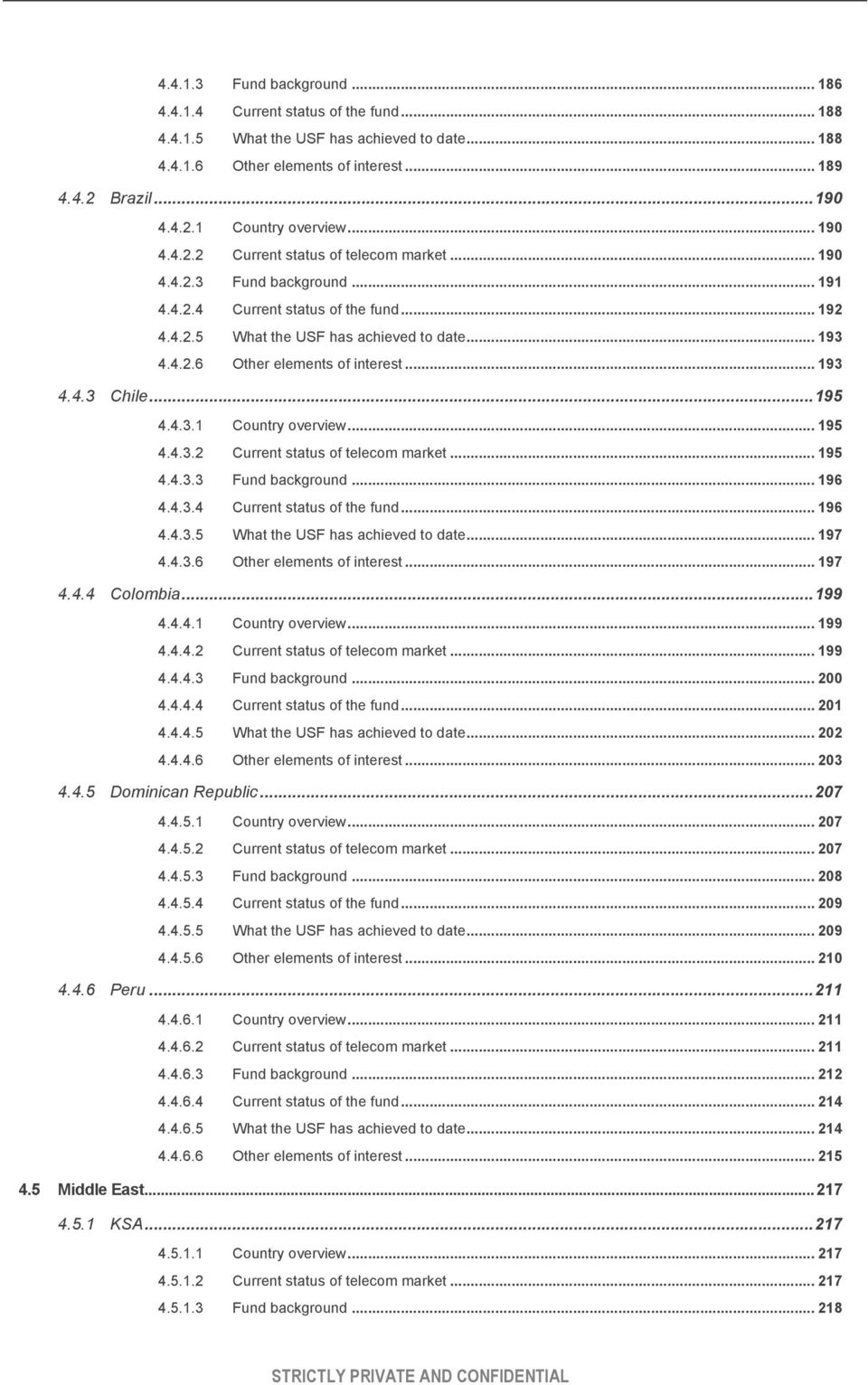
7 Current status of the fund What the USF has achieved to date Other elements of interest Oman Country overview Current status of telecom market Fund background Current status of the fund What the USF has achieved to date Other elements of interest North America Canada Country overview Current status of telecom market Fund background Current status of the fund What the fund has achieved to date Other elements of interest United States Country overview Current status of telecom market Fund background Current status of the fund What the USF has achieved to date Other elements of interest BEST PRACTICES IN THE MANAGEMENT OF THE USF Introduction Basic Elements and Characteristics of a Successful USF Examples of Best Practices COMMON CHALLENGES IN THE ADMINISTRATION OF THE USF Overview Examples of Common Challenges and Pitfalls in USF Administration DOES THE USF APPROACH ACHIEVE COVERAGE TARGETS? Overview Are There USF Coverage Objectives and Have They Been Achieved? ALTERNATIVE APPROACHES TO ADDRESSING THE UNIVERSAL COVERAGE CHALLENGE Overview Bangladesh Introduction STRICTLY PRIVATE AND CONFIDENTIAL
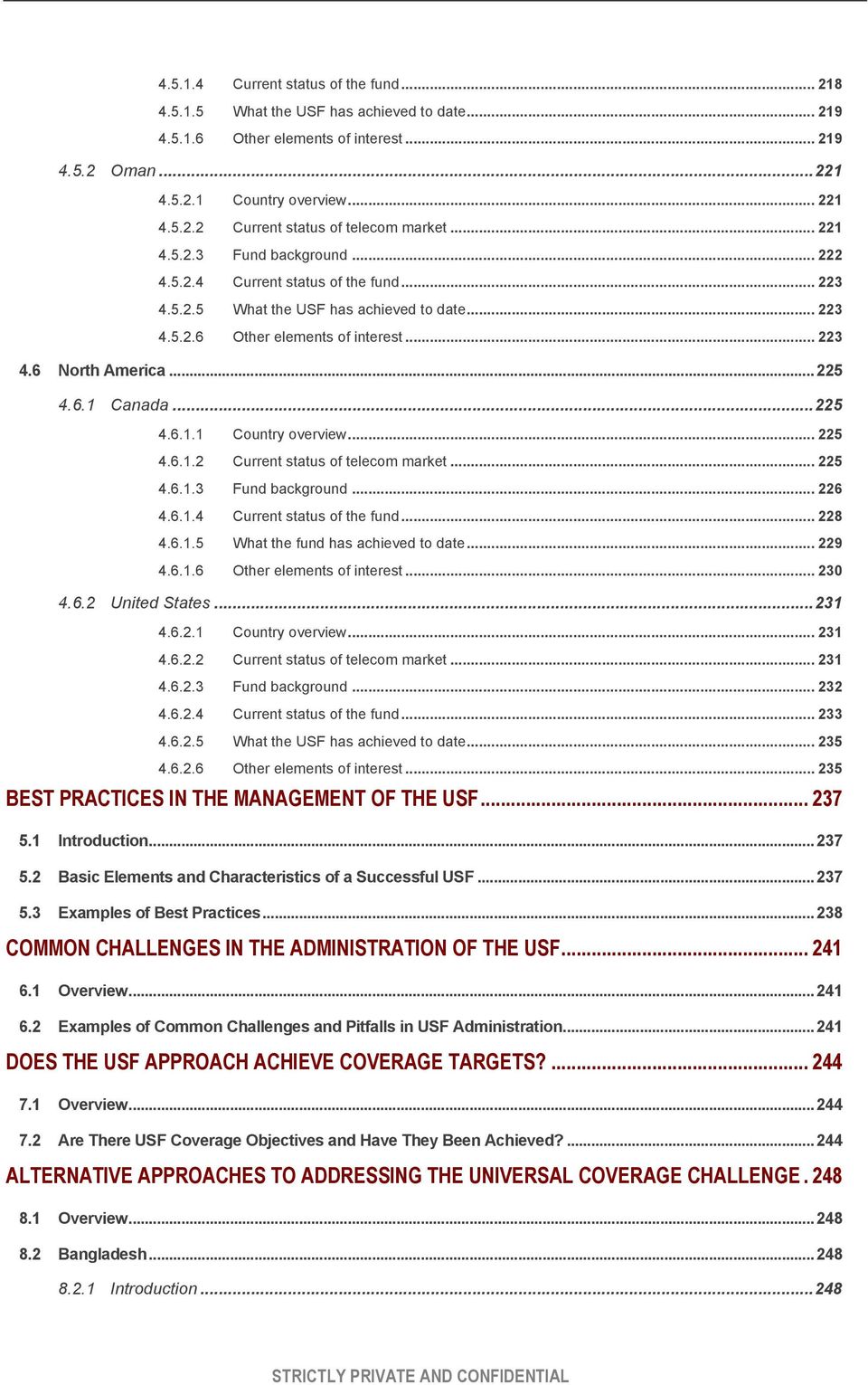
8 8.2.2 Alternative Approach Adopted Brazil Introduction Alternative Approach Adopted Cooperatives Argentina Introduction Alternative Approach Adopted Finland Introduction Alternative Approach Adopted GENERAL FINDINGS AND CONCLUSIONS Overview Problems Persist and Impediments Linger Some Good News Conclusions APPENDICES Introduction Africa Arab States Asia Pacific CIS and Europe The Americas STRICTLY PRIVATE AND CONFIDENTIAL

9 EXECUTIVE SUMMARY Most universal service funds (USF) remain inefficient and ineffective. Together, the 64 USFs covered in this report contain more than USD 11 billion waiting to be disbursed. Of those funds studied, many have not disbursed any money. In fact, of those USFs where levies are currently being applied and collected, it is estimated that only 64% of these same USFs have carried out some level of disbursement or reported that some disbursements have been made. In other words, more than one third of the USFs in this study have yet to disburse any of the levies collected and very few funds, if any, would appear to disburse all that they collect. There are many cases in which USF levies and taxes have been established without any substantive analysis regarding the actual service funding/subsidy levels needed. Many funds receive contributions that appear to be far in excess of the actual USF needs or capabilities (e.g., Brazil, which has USD 4.7 billion waiting to be disbursed), while other funds seem unable to develop enough projects to adequately utilize the levies collected (e.g., India, which has accumulated USD 3.9 billion in unused funds). The underlying legal frameworks for many funds were not well conceived from the outset (e.g., not technology-neutral or service-flexible, excessively bureaucratic, insufficient oversight, inadequate or ambiguous authorization to manage the Fund) and this has resulted in a number of ineffective or severely constrained and/or legally challenged funds (e.g., Brazil, Czech Republic, Ecuador, France, Italy, etc.). Poorly-conceived legal frameworks also pose a major obstacle to the introduction of non-commercially viable broadband through the USF mechanism. Even in funds where there is a degree of autonomy and independence, there are many cases where political intervention or interference from other government agencies affect the fund s performance (e.g., Brazil, India, Indonesia, Pakistan, Philippines). For example, in Indonesia, the Ministry of Finance is insisting that the USF may be used only for the acquisitions of goods and and not for the provision of subsidies (a typical application of USFs). In Pakistan, in the absence of a full-time Minister of IT, the Prime Minister has been head of the USF Co board, resulting in extensive delays in decision making, further impacted by the recent dismissal of the Fund CEO. At the same time, many USFs suffer from, or have been accused of, poor or inefficient administration/use of funds (e.g., Afghanistan, Bolivia, South Africa and the U.S.). In many instances, the programmes and targets established for the deployment of tele-centres and community information centres, for example, have failed to take into account issues related to training and education, maintenance, power sources and other sustainability concerns (e.g., Afghanistan, Indonesia, and India). Overall, project and financial reporting (transparency) for most funds is extremely inadequate: only half of the 64 USFs studied have set some form of targets. Of these 32 USFs, only eight are achieving most of their targets a success rate of only 25%. Out of all the funds surveyed globally, Colombia appears to be the country that currently epitomizes best practice in the development and administration of USFs. Colombia s USF has been structured to be financially autonomous, while fund projects are awarded in a highly transparent manner via a public bidding process open to all interested parties and implemented in a timely and transparent manner but it too has challenges. Some of the telecommunications funds financed directly out of the government s budget and not from operator levies also seem to be performing relatively well and achieving targets (e.g., Chile, Paraguay) with the added benefit that any unused funds are rolled directly back into the Treasury. STRICTLY PRIVATE AND CONFIDENTIAL 7

10 Still, alternative approaches to achieving universal service goals are often more effective than USFs. In fact, increased availability of telecommunications has generally been accomplished through alternate solutions, such as the imposition of licence conditions on operators, the establishment of new plans or funds that are separate from the existing USF, or private/public partnerships (e.g., Bangladesh, Brazil, and Finland). In summary, based on the general USF approach and performance to date, USFs do not appear to be the most appropriate mechanism for providing universal access and service and furthering social and economic improvement. Serious consideration should be given to more pro-actively exploring alternative coverage and service solutions. INTRODUCTION AND GENERAL OVERVIEW 1.1 What Is a Universal Service Fund (USF) One of the goals of telecommunications regulators and ministries is to make telecommunications accessible to the widest number of people at affordable prices. Liberalization of telecommunication markets and promotion of competition have delivered telecommunication to the vast majority of the world s population. The concept of Universal Service i.e., providing each individual with telecommunications at affordable prices tends to be underpinned by the three following principles: Availability: the level of service is the same for all users in their place of work or residence, at all times and without geographical discrimination Affordability: for all users, the price of the service should not be a factor that limits service access Accessibility: all telephone subscribers should be treated in a non-discriminatory manner with respect to the price, service and quality of the service, in all places, without distinction of race, sex, religion, etc. It is important to note that Universal Service (US) and Universal Access (UA) are frequently considered to be the same concept. However, Universal Service is generally regarded as being oriented towards providing service to individuals or households whereas Universal Access is considered to be oriented towards providing service to communities. Universal service costs vary substantially between countries and are influenced by many factors, including the following: the definition of universal as well as the universal goal as applied in a particular jurisdiction the demographic and geographical characteristics of a country e.g., o income distribution (affordability levels) o population density o rural and urban population ratios o literacy and education rates of the population o geography (terrain, distances, etc.) efficiency and presence of existing operators existing legal and regulatory framework (e.g., monopoly, liberalized) STRICTLY PRIVATE AND CONFIDENTIAL 8

11 There are varying approaches to address universal service requirements. These include 1 : Market based reforms Mandatory service obligations Cross subsidies Access deficit charges Universal funds Over the last two decades, out of the approaches listed above, in addition to market based reforms and mandatory service obligations, the increasingly common approach to help achieve the universal service goal has been the creation of a funding mechanism - Universal Service Funds (USF), also known as Universal Access and Service Funds (UASF). These funds are intended to serve as a financial incentive for operators to provide universal service. Such funds are often used in competitive markets to supplement market-based policies and in order to address access gaps and possible market failures in remote and under-served locations. For the purpose of this report, these funds will be referred to as USFs. Typically, a USF is financed through some sort of contribution mechanism from telecommunications service providers and the USF contribution methodology is addressed in several different ways. In some cases, the contributions are fixed monthly, quarterly or annual fees whereas, in others, the fees are calculated as a percentage of gross revenues (often with some defined exclusions in the calculation of the revenues). As in the case of revenue sharing schemes, there may be a requirement for the service providers to pay estimated amounts based on revenue projections, with retroactive adjustments made once the year end audited annual financial results are made available. In some countries, the USF fee is not a separate fee but rather, a portion of an overall regulatory or licensing fee. In such cases, the portion of the fee to be directed to the USF may be fixed, but in other cases, it could be subject to annual review. The fees may go directly to the USF or USF administrator or may be collected by the NRA and then subsequently transferred to the Fund manager/administrator. In addition to a service provider s direct or indirect contribution mechanism, there may be other sources of funds including, but not limited to: full or partial proceeds from spectrum auctions, licensing fees, direct government contributions, private industry contributions, etc. The manner in which these USF funds may be subsequently accessed and utilized is one of the major topics of discussion within this document and will be explored in the sections that follow. 1.2 Study Objective Irrespective of the laudable intentions and objectives associated with the creation of USFs, there is considerable industry dialogue and debate regarding the practicality and efficacy of using USFs to achieve universal service. Part of this dialogue has been generated by the understanding that there are countries in which USFs have been created and monies collected, yet in many cases, these funds have either not been disbursed at all or the level of disbursements is substantially less than the contributions collected. In addition, there is also considerable doubt as to whether the current structures of many USFs are flexible enough to permit a timely and practical response to rapid technological change and societal requirements. There are also questions regarding the ability of various funds to 1 ICT Regulation Toolkit Chapter 5 Universal Access STRICTLY PRIVATE AND CONFIDENTIAL 9

12 evolve from providing pure technical solutions to addressing the ancillary support that is often needed to complement and ensure the effectiveness of the universal service solutions. Furthermore, although numerous regional reports have been generated over the last several years regarding USF performance, other than the 2010 ITU regulator survey that incorporated questions regarding USFs 2, there does not appear to have been a comprehensive global report prepared in the last several years despite many developments in the area of USFs. With these issues, concerns and developments in mind, the GSMA initiated the global overview and analysis contained in this document. 1.3 Scope of Work Introduction The scope of work in this report has been formulated based on the following considerations: the need for an updated overview of the global status and performance of USFs observations regarding areas of potential interest that have not been addressed in the more recent USF studies the need for an assessment regarding significant developments and trends in the design and administration of USFs Deliverables The report covers some 64 countries in which the following elements are addressed: Description of individual country USFs: o Historical details (e.g., when the Fund was established). o Underlying legal/ regulatory framework and related governance o Structure and manner in which the Fund is operated o Process for allocation of the funds o The that can be provided using the USF e.g., fixed, mobile, broadband, etc. o Non telecom uses for the funds, if any o The degree of industry participation (if any) in determining structure or use of the USF. o Sources and structure of the USF funding o Estimate (where possible) as to amount currently held in the Fund o Assessment of how the Fund has performed so far Examples of best practices in USF with emphasis on the processes to use and allocate the funds accompanied by supporting information as to how and why the USF has been successful An examination of the challenges and pitfalls of administering a USF Examination and highlighting of selected examples of alternative approaches to achieving universal coverage objectives (or close to universal coverage) 2 Data is presented in ITU ICT Eye 2010 and is discussed in Section 9 of this report. STRICTLY PRIVATE AND CONFIDENTIAL 10

13 1.4 Study Methodology In order to undertake the tasks required to prepare this report, LADCOMM assembled a small team of multi-lingual telecommunications experts with a broad scope of telecommunications regulatory and operational experience acquired in Africa, Asia Pacific, Europe, Latin America, the Middle East and North America. All team members have been personally involved in some aspect of USF development, operation or use so as to ensure that the examination and presentation of the information contained in this report have been carried out by personnel who have a firsthand understanding, involvement and experience with and exposure to USFs. The specific phases and activities of the study were as follows: Data gathering and collection o o o o o The project team collected data using a variety of approaches including, but not limited to, internet searches, entry into specific regulator and USF/USAF web sites and databases and access to published articles and reports. The team also exchanged correspondence and conducted interviews and conference calls with regulators, Fund administrators and Fund associations (with varying degrees of success in terms of response rates from the entities and individuals contacted). In addition, the team also relied on its network of contacts amongst regulators, operators and industry analysts to seek out additional information that is not readily available publicly. Wherever possible, the authors have attempted to use the same database to present the same information elements; however many databases do not include data for all countries and in such cases, every attempt was made to limit the number of different databases utilized for the specific information element (e.g., GSMA Wireless Intelligence and Global Wireless Matrix for wireless penetration levels). Data gathering with respect to financial performance of many of the funds was especially challenging given the frequent lack of reliable, published information or unwillingness to provide information in this regard. Review and analysis of the data collected o o The information gathered was verified and confirmed to the extent possible by checking it against multiple sources and further interviews/exchanges of correspondence as needed; one of the challenges in this regard is the degree of variance between official published reports versus the often conflicting reports that challenge or dispute the contents of the official reports. In addition to the challenges of dealing with conflicting information, as referenced above, an even more difficult aspect of the report was the dearth of accurate, credible information with respect to the USF funds collected, the USF funds disbursed and the money still residing in the individual funds given that less than half the funds appear to have any regular, formal reporting with respect to the financial management of the Fund; in order to arrive at estimates in this regard, in addition to using and citing Fund financial reports where available, the authors also used the following approaches: STRICTLY PRIVATE AND CONFIDENTIAL 11

14 Compilation of individual, confidential reports submitted by operators in which their annual USF contributions were identified; using market share data, annual reports (or similar), estimated other operators contributions on a conservative pro rata basis Off the record discussions with regulators and Fund managers Searches of newspaper and magazine articles that referenced USF amounts In cases where the Fund levies are a defined percentage of operating revenues, a derivation of contributions based on publicly reported operator revenues if and when no other official source was available When the afore-mentioned approaches all failed to yield results, where feasible, the authors cited previously published estimates where the estimates appeared to be from reliable/official reporting sources (e.g., ITU) OVERVIEW OF USF S 1.5 Introduction As alluded to in the explanation in the previous section regarding the study methodology utilized in the preparation of this report, the ability to arrive at an accurate understanding of USFs is frequently hampered by the availability and reliability of information. On the one hand, there is a multitude of information, often conflicting or contradictory, regarding the administration and performance of some funds whereas, on the other, there is an almost complete lack of easily accessible information for other funds, especially in countries where published information is available only in the national language. Further compounding these challenges is that many of the officially published reports regarding USFs reflect the understandably human reaction of wanting to present achievements in the best possible light while perhaps understating some of the less successful aspects of the USF in question. This situation is further exacerbated by the tendency noted in a number of USF reports to merely reiterate data contained in other publications without any additional analysis. Therefore, in the sections which follow, the authors have attempted to present the information as consistently and as objectively as possible using multiple information sources with the aim of presenting a balanced assessment of the overall state of USFs as of late 2011 / early STRICTLY PRIVATE AND CONFIDENTIAL 12

15 1.6 USF Overview Tables Africa Underlying Framework for Fund (Note 1) Overall Fund Structure and Operation (Note 2) Governance (Note 3) Contribution Type and Frequency (Note 4) Services that Can be Provided via the Fund (Note 5) Fund Allocation Process (Note 6) Degree of Industry Participation in Fund Allocation (Note 7) Estimated Fund Amount as of YE 2010 (Note 8) Fund Performance to Date (Note 9) 1. Burkina Faso Year Fund Established: 2000 legal and administrative establishment collection. Law 051/98/AN of 04 December 1998 defined universal service. Decree no /PRES/MC/MCI A of 13 September 2000 related to the implementation of access to universal service for telecommunication s created the USF and defined universal service obligations National Strategy to Develop Universal Service. The July 2004 Poverty Reduction Fond d Acces au Service Universel: Fund is managed by ARCE (Autorité de régulation des communications éléctroniques), previously called Agence de Régulation des Télécommunications (ARTEL). ARCE is responsible for collecting funds while the resources of the Fund are managed by a Council composed of representatives of the relevant Ministries and presided by the Supervision is done by the Council. Funds are audited annually by the Inspection Générale des Finances, and ARTEL must submit certified financial accounts to the Ministry of Finance at the latest six months after the end of each financial year. In addition, ARCE must publish an annual activity report by March 30 th of each year. 2% of annual revenue net of interconnection payments from all operators having an individual licence, paid on a monthly basis and calculated on the previous month s revenues. The Government and local authorities can also contribute to the fund. The law provides for allocation of some of the new or renewal licence fees for the benefit of the fund. Fixed line private residential service Fixed line public payphone service Individual mobile cellular service Public mobile payphone service Broadband Tele-centres Schools (primary, secondary postsecondary) Health centres Emergency Special for persons with disabilities and Operators and other telecom service providers are eligible, except for operators who do not contribute to the Fund (these become eligible only if no contributing candidate is selected). Originally, for each region, localities not covered by the incumbent s licence were identified with the intention of granting licences to rural operators through a tender process. Only the Operators are not members of the governance structure. Estimated contributions by operators for : approx. USD 5.3M. Latest confirmed figures on contribution to the fund: USD 5.1M 4 in Estimated approximately USD 32.7 M 5 in fund as of YE Inactive has not started disbursements strategies issued but not carried out. The 2000 Decree provides that licences shall be granted for the extension of geographic zones where the government seeks to expand universal access, with funding being made available as required to operators applying for such licences under the terms defined by the decree National Strategy identifies zones to be covered by the universal service project and mandates 3 Estimated based on operator response to confidential GSMA 2012 survey 4 Amount provided by regulator as part of ITU survey in Report on Universal Access and Service Funds in the Sub-Saharan African Region, ITU, Edgardo Sepulveda, April 2010; excludes any grants 5 ITU ICT Regulatory Database 2012 STRICTLY PRIVATE AND CONFIDENTIAL 13

16 Underlying Framework for Fund (Note 1) Overall Fund Structure and Operation (Note 2) Governance (Note 3) Contribution Type and Frequency (Note 4) Services that Can be Provided via the Fund (Note 5) Fund Allocation Process (Note 6) Degree of Industry Participation in Fund Allocation (Note 7) Estimated Fund Amount as of YE 2010 (Note 8) Fund Performance to Date (Note 9) Strategy Paper of the Ministry of Economy. Joint Order No /MPT/MFB on the composition and functioning of the Management Committee of the Universal Service Fund (CGFSU). Law no /AN of 27 Nov (transposing the additional act of ECOWAS and UEMOA Directive). Decree no of 28 Feb /PRES/PM/MP TIC/MEF Decree of 20 May 2010 fixing the rates and methods of collection of fees, levies and charges imposed for the benefit of the Electronic Communications Regulatory Authority. Minister of Communications elder persons Directory, and other defined by the regulator. incumbent, Office National des Télécommunications (ONATEL), and existing mobile operators can apply for such licences. In a first stage, a pilot area was defined, working with the incumbent for the provision of service to this area. Under the 2011 Decree, the allocation mechanism is the following: - The Regulator sets up a list of villages which are in need of universal service, - The interested villages send a letter to the Telecoms Minister explaining their requirements, - The Regulator prepares a comparative study of the projects and invites operators to subscribe for a project, - Only projects which are not the Ministry, through the regulator, to carry out the strategy. The Strategy also divided the country into 13 regions, each representing a project area (each area is equivalent to an administrative region). The 2005 Universal Service Strategy identifies a number of targets: - Provide public voice telephony service to an average of 70% of selected rural localities in a given region; - 95% of selected localities must be within 5km of one public access point - Private service must be available in rural areas with prices no more than 25% above published fixed and mobile tariffs; and - Internet POPs in each provincial capital in each tendered region. The aim of the universal service strategy is complete coverage of the national territory, including coverage of 5,200 villages by STRICTLY PRIVATE AND CONFIDENTIAL 14
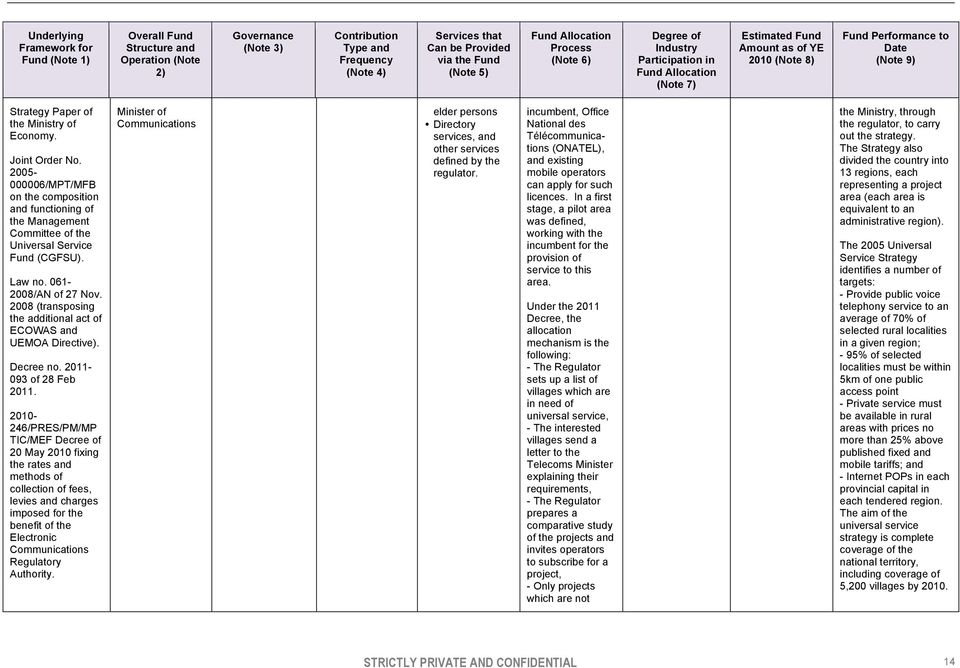
17 Underlying Framework for Fund (Note 1) Overall Fund Structure and Operation (Note 2) Governance (Note 3) Contribution Type and Frequency (Note 4) Services that Can be Provided via the Fund (Note 5) Fund Allocation Process (Note 6) Degree of Industry Participation in Fund Allocation (Note 7) Estimated Fund Amount as of YE 2010 (Note 8) Fund Performance to Date (Note 9) profitable can be financed through the Fund, - The funds are disbursed after complete execution of the project. ICT strategy for included goals for the Universal Service Fund, including broadening the areas covered by the fund to include the production of multimedia content in national languages, the introduction of ICT in health and education, universal postal service, training and promotion of e-jobs. 2. Cote d Ivoire Year Fund Established: legal establishment; administration and collection National Telecommunication s Fund (FNT was established by Decree No of 11 November 1998 inside the National Treasury Fund (Caisse Autonome d Amortissement). National Telecommunications Fund is an Account of the Regulator: Cote d'ivoire Telecommunicatio ns Authority (CITA). Account created at National Investment Bank (BNI). Managed by a Management Economic and Financial supervision is done by the Ministry of Finance & Economy; technical one by the Ministry of Economic Infrastructure. 2% of Gross Annual Revenues from mobile operators only. Sector Contributions (100%) by the end of According to 1998 Decree, other sources can be used such as: - loans by the Fund, - revenues from According to the 1998 Decree, rural infrastructure projects. Universal service is defined: Fixed line private residential service Fixed line public payphone service Dial-up Internet access Based on competitive bids. N/A Not publicly available. Estimated operator contributions : USD 30.0M Reported contributions were approx. USD 29.0M and amount in fund as at end of 2008 was USD 97.3M 7. However, a more Operational. Limited activity. 6 Estimated based on operator response to confidential GSMA 2012 survey 7 Amount provided by regulator as part of ITU survey in Report on Universal Access and Service Funds in the Sub-Saharan African Region, ITU, Edgardo Sepulveda, April 2010; excludes any grants STRICTLY PRIVATE AND CONFIDENTIAL 15
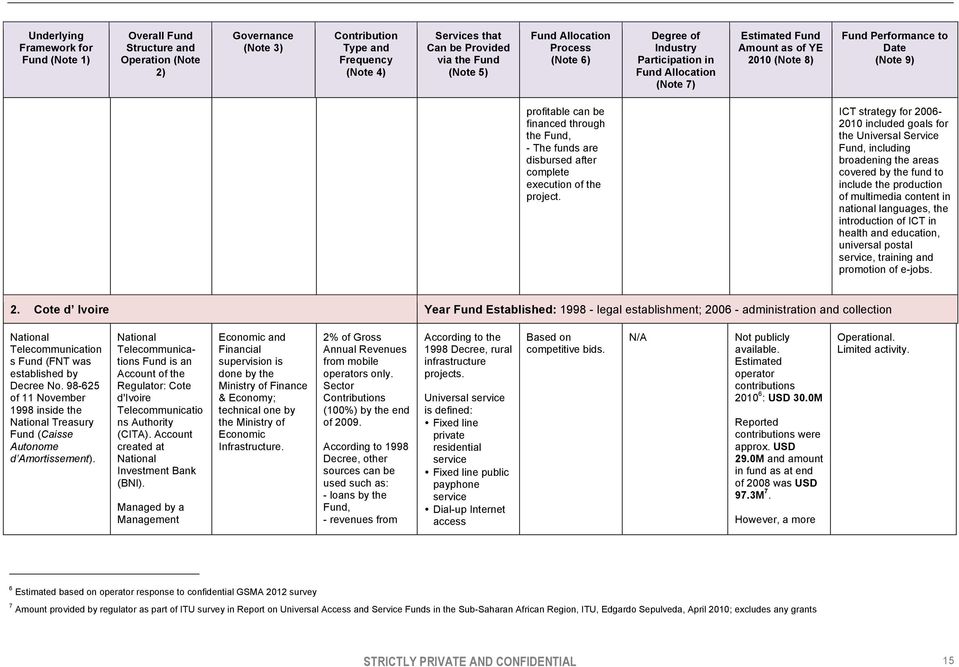
18 Underlying Framework for Fund (Note 1) Overall Fund Structure and Operation (Note 2) Governance (Note 3) Contribution Type and Frequency (Note 4) Services that Can be Provided via the Fund (Note 5) Fund Allocation Process (Note 6) Degree of Industry Participation in Fund Allocation (Note 7) Estimated Fund Amount as of YE 2010 (Note 8) Fund Performance to Date (Note 9) Committee, nominated by the various Ministries - 10 members: Ministry of Economic Infrastructure, Planning and Development, National Treasury, CITA and chaired by Ministry of Finance & Economy who can be replaced by the Ministry of Telecoms. Management Committee is assisted by a Technical Committee composed of: - Ministry of Finance & Economy, - Ministry of Economic Development - National Office for Technical and Developmental Studies, - CITA - Cote d Ivoire Telecom and - one representative of Fund s investments, - contributions from State budget, - gifts, - other taxes on telecommunicatio n, - any other source. Emergency Directory. recent official report 8 indicates that a total of only USD 28.1M had been collected as of YE 2010 with total disbursements of USD 15.6M. 8 ITU Regulatory Database 2012 STRICTLY PRIVATE AND CONFIDENTIAL 16
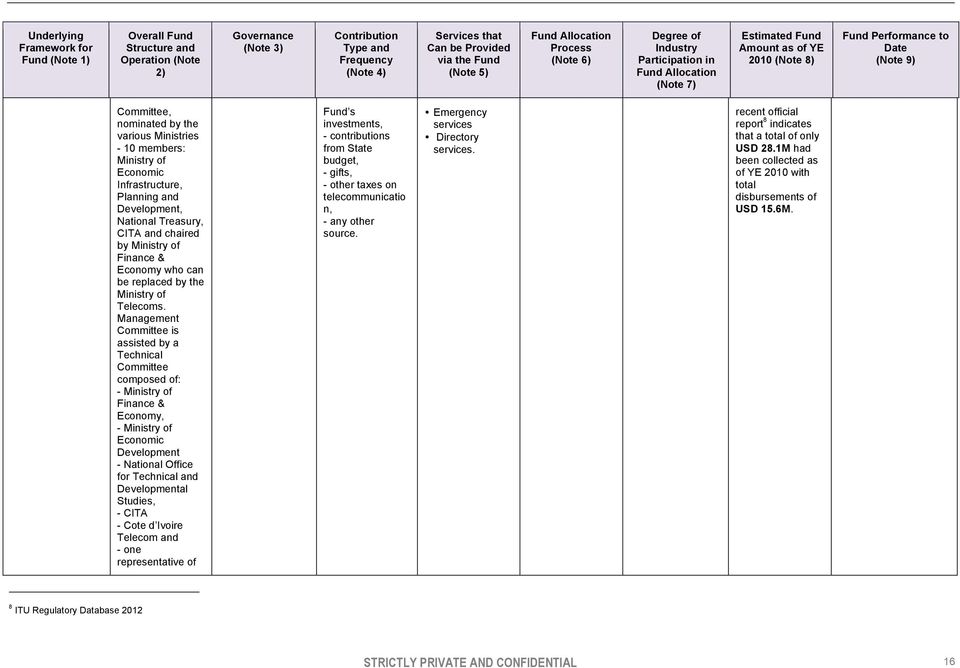
19 Underlying Framework for Fund (Note 1) Overall Fund Structure and Operation (Note 2) Governance (Note 3) Contribution Type and Frequency (Note 4) Services that Can be Provided via the Fund (Note 5) Fund Allocation Process (Note 6) Degree of Industry Participation in Fund Allocation (Note 7) Estimated Fund Amount as of YE 2010 (Note 8) Fund Performance to Date (Note 9) another operator. 3. Democratic Republic of Congo Year Fund Established: 2002 legally created, not yet functional. Framework Act No. 013/2002 of 16 October 2002 on Telecommunication s (2002). Telecommunication Law plans the creation of the Fund (Art.39): Ministerial decree should govern its organization, its functioning and the conditions according to which should projects be carried out. Such Ministerial decree has not yet been made. Account of Regulator. The 2002 Telecommunications Act provides that the Fund is to be managed by the regulator, but does not mention any periodic reviews of the fund or universal service obligations. Sector Contributions, in form of a licence fee, go directly to Public Treasury. Not known yet. The 2002 Telecoms Act stated intention to finance the provision of covered through a fund constituted of contributions assessed against all operators, providers of, and manufacturers or importers of telecommunications materials. Some licences provide that 2 % of Gross Annual Revenues will also contribute to the USF, those amounts are, in fact, paid only as licence fees. Universal service is defined in the DRC 2002 Telecommunications Act as the right of every Congolese to benefit from voice telephone, telex, and public telephone service, in rural, urban and isolated areas. N/A N/A Estimated amount collected as of YE 2008 approx. USD 19.0M and reported amount in fund: Inactive. 9 Amount provided by regulator as part of ITU survey in Report on Universal Access and Service Funds in the Sub-Saharan African Region, ITU, Edgardo Sepulveda, April 2010; excludes grants STRICTLY PRIVATE AND CONFIDENTIAL 17

20 Underlying Framework for Fund (Note 1) Overall Fund Structure and Operation (Note 2) Governance (Note 3) Contribution Type and Frequency (Note 4) Services that Can be Provided via the Fund (Note 5) Fund Allocation Process (Note 6) Degree of Industry Participation in Fund Allocation (Note 7) Estimated Fund Amount as of YE 2010 (Note 8) Fund Performance to Date (Note 9) 4. Gabon Year Fund Established: Legally on 2001: not yet set-up administratively. Law no. 005/2001 enacted June 27, 2001 related to Telecommunication s Regulation established provisions for the financing of universal service obligations through the creation of a special universal service fund. The 2005 Decree No /PR/MPT Fixing the Modalities of Implementation, Financing and Management of Special Universal Service Fund revised the financing resources for the Fund. Fonds Spécial du Service Universel (Special Fund for Universal Service) is administered by the regulator, Agence de Régulation des Télécommunicatio ns (ARTEL). Separate account from ARTEL s account at the Public Treasury. The Director General of ARTEL will be responsible for the Fund s receipts and disbursements under the supervision of the President of ARTEL s Regulation Board. Financial accounts of the Fund must be reported to the Ministry of Telecommunicatio ns no later than the April 30 of each year, together with a management and administration report. A copy shall also be sent to the Minister of Finance. The Fund s accounts are audited by ARTEL s Chief Accountant and subsequently submitted to the Accounting Court for revision. 2% of net revenue per year from fixed and mobile operators. The fund can also be financed by other financial sources such as aid from public or private financial organizations and territorial groups. The 2001 Law establishes that universal service has to be provided to every person who requests basic telecommunicatio ns. Basic telecommunicatio ns include international, national and local fixed telecommunicatio ns for telephone, fax, telex, and telegraph, provision of emergency call service, a universal directory, information service and service in the national territory through the installation of public telephone booths along public roads. All telecoms operators are eligible. ARTEL is responsible for implementing the universal service programme, which will allocate Fund resources to operators through a competitive bidding process. ARTEL determines which communities are in need of service and the level of subsidies necessary to achieve coverage, and submits a plan to the Ministry for approval. N/A It is estimated that operators contributed over USD 2.5M in Since 2009 (or even before in some cases, operators stopped paying universal service contribution based on a licence condition that specifies that the contribution to the Fund will be payable only after the determination of the operating procedures and effective implementation of the Fund by the Regulator, which has not happened to date. Inactive. 5. Ghana Year Fund Established: Launched in 2004, started in 2005 and distributed since Replaced 10 Estimated based on operator response to confidential GSMA 2012 survey STRICTLY PRIVATE AND CONFIDENTIAL 18

21 Underlying Framework for Fund (Note 1) Overall Fund Structure and Operation (Note 2) Governance (Note 3) Contribution Type and Frequency (Note 4) Services that Can be Provided via the Fund (Note 5) Fund Allocation Process (Note 6) Degree of Industry Participation in Fund Allocation (Note 7) Estimated Fund Amount as of YE 2010 (Note 8) Fund Performance to Date (Note 9) in GIFTEL was established under the 2001 Ghana ICT Policy for Accelerated Development. GIFEC was established by the Electronic Communications Act 775 of GIFTEL was set up as an agency of the Ministry of Communications. GIFEC was established as an independent agency that manages the Fund. GIFEC funds are to be paid into specific bank accounts. GIFEC is serviced by a Secretariat under the direction of the Administrator of the fund (Chief Executive) and it oversees the implementation of the Fund s projects. Board of Trustees of GIFEC: ten trustees that include representatives from the National Communications Authority (NCA), the Ministry of Communications, the parliamentary select committee on communications, a representative from each licensed telecom operator and the administrator of the fund. The Minister may direct the Trustees of the GIFEC on matters of. Licensed operators (fixed/mobile operators, and recently licensed MNP CRDB service provider) contribute 1% of their annual revenue (Net revenue means Gross Revenue less VAT, National Health Insurance Levy, Communications Service Tax and Interconnect Charges). Other legal sources of GIFEC funding: - Monies provided by Parliament, - Monies that may accrue to the Fund from investment made by the Trustees of the Fund, - Donations, grants and gifts, and GIFTEL was set up to facilitate the provision of universal access to basic telephony by the unserved and underserved communities. Projects that are subsidized through GIFEC are prioritized using the following criteria. Provision of basic telephony service to rural areas, Support for the establishment of access to valueadded including introduction of Internet Pointsof-Presence (PoPs) in every district. GIFEC widened the scope of its mandate to include the provision of Disbursement mainly takes the form of noncommercial but competitive grants: - for public telephony projects, Internet Point-of-Presence and training contracts by open tender - to applications in rural areas, which do not have, or seeking support for rural packages to enhance access to for public telephony kiosks or telecentres but are seeking amounts less than a certain US$ threshold, shall be by direct disbursement based on a business plan demonstrating A representative from each licensed telecom operator sits on the board of trustees. Last reported contributions in 2008 were approx. USD 7.8M with estimated USD 21.0M in Fund 11 About USD 10.5M is estimated to be in the fund as at December 2011 with estimated operator contributions in the neighbourhood of USD 8.1M 12. Operational Active The fund has been distributed since Under its Universal Access to Electronic Communications Programme, GIFEC oversaw the following initiatives: Common Telecommunication Facility Project: since 2006, construction of towers for co-location by telecom operators to extend telecom to underserved areas; 41 towers constructed. Last Mile Initiative Project: since 2006, in collaboration with USAID/Ghana and possibly UNDP, pineapple and citrus producing areas are targeted and provided with access to telecommunications /ICT. One pilot project has been completed at Nsaakye 11 Amount provided by regulator as part of ITU survey in Report on Universal Access and Service Funds in the Sub-Saharan African Region, ITU, Edgardo Sepulveda, April 2010; excludes grants 12 Estimated based on operator response to confidential GSMA 2012 survey STRICTLY PRIVATE AND CONFIDENTIAL 19
22 Underlying Framework for Fund (Note 1) Overall Fund Structure and Operation (Note 2) Governance (Note 3) Contribution Type and Frequency (Note 4) Services that Can be Provided via the Fund (Note 5) Fund Allocation Process (Note 6) Degree of Industry Participation in Fund Allocation (Note 7) Estimated Fund Amount as of YE 2010 (Note 8) Fund Performance to Date (Note 9) - Any other monies that may become lawfully payable to the Fund. access to electronic including ICT, broadcasting, internet, multimedia service and basic telephony, by the unserved and underserved communities. financial viability or selfsustainability. By end of 2009, projects d been allocated based on a competitive process: least cost subsidy requested from qualified bidders. Infrastructure subsidies are typically provided to the first entrant in an area and then new entrants share the mast. The board evaluates proposals for their technical and financial viability. Criteria for selecting towns and villages for the project depends on location, population and socio-economic characteristics e.g., number of schools, health, economic activities, telecommunicain the Eastern Region. A second project is constructed at Georgefields near Kasoa in the Central Region. This is to be extended to cotton, mango, and rice producing areas. Community Information Centres Project: project, which GIFEC has been implementing on behalf of the Ministry of Communications with funding from the HIPC Initiative: establishing hybrid for-profit telecentre and non-profit community resource centres targeting the general community members, school children, youth out of school, women and women s groups, private businesses, non-governmental organisations and local government authorities. By 2010, 120 CICs are at various stages of completion in 100 districts/municipalities. Under a cost-sharing agreement between the Ministry of Communication and the United Nations Development STRICTLY PRIVATE AND CONFIDENTIAL 20
23 Underlying Framework for Fund (Note 1) Overall Fund Structure and Operation (Note 2) Governance (Note 3) Contribution Type and Frequency (Note 4) Services that Can be Provided via the Fund (Note 5) Fund Allocation Process (Note 6) Degree of Industry Participation in Fund Allocation (Note 7) Estimated Fund Amount as of YE 2010 (Note 8) Fund Performance to Date (Note 9) tions signal availability and geographical obstacles. Tendering is conducted through the National Competitive Tendering procedures specified in the Public Procurement Act of the Republic of Ghana. Any company which implements projects to provide ICT facilities to underserved areas is eligible. Programme, 79 CICs have been equipped with ICT equipment, network infrastructure and trained Centre Managers, making them operational. The remaining 70 districts/municipalities will each have at least one CIC as envisioned in GIFEC s strategic plan for Library Connectivity Project: establishment of ICT-based Mobile Digital-cottages (MD- Cs) and Regional Digital Library Information Centres (RDLICs) in order to promote and facilitate access to. Rural Pay Phone Project: GIFEC intends to provide twelve thousand rural payphones to underserved communities during the three year period (the EQUATEL project). Easy Business Connectivity Project: to enhance availability of seed financing on flexible and reasonable terms for entrepreneurs seeking to operate e- powered e-business STRICTLY PRIVATE AND CONFIDENTIAL 21
24 Underlying Framework for Fund (Note 1) Overall Fund Structure and Operation (Note 2) Governance (Note 3) Contribution Type and Frequency (Note 4) Services that Can be Provided via the Fund (Note 5) Fund Allocation Process (Note 6) Degree of Industry Participation in Fund Allocation (Note 7) Estimated Fund Amount as of YE 2010 (Note 8) Fund Performance to Date (Note 9) centres. Post Office Connectivity Project: to select ten Post Offices with the requisite physical infrastructure to enable the delivery of basic Information Technology and telecommunication in the pilot phase, then seventy Post Offices for Second Phase ( ). Disability Employment Project: implemented by GIFEC and NCPD is the Easy Business Centres for Persons with Disability. Security Connectivity Project: to establish state of the art ICT Training Centre at the Prisons Training School School Connectivity Project: providing educational institutions with high speed computers, printers, scanners, projectors and servers and linking them with internet access. The project started on a pilot basis in In 2009, GIFEC provided support to fifty schools. By 2010, GIFEC had supported two hundred and sixty-three (263) STRICTLY PRIVATE AND CONFIDENTIAL 22
25 Underlying Framework for Fund (Note 1) Overall Fund Structure and Operation (Note 2) Governance (Note 3) Contribution Type and Frequency (Note 4) Services that Can be Provided via the Fund (Note 5) Fund Allocation Process (Note 6) Degree of Industry Participation in Fund Allocation (Note 7) Estimated Fund Amount as of YE 2010 (Note 8) Fund Performance to Date (Note 9) educational and training institutions. The plan was to provide ICT equipment and connectivity to two hundred (200) educational, vocational and training institutions between Community Initiative Project: To establish state of the art ICT Training Centre for Rural Communities across the country and provide training in computer skills and literacy. - Fishing Project: in collaboration with the Fisheries Commission and the National Canoe Fishermen Council, to introduce enhanced fishing techniques using state-of-the-art technology to address the fishing needs of the artisan fishermen to be rolled out in ICT Capacity Building: , GIFEC intends to fund the provision of basic ICT training to over 12,000 people in the underserved and unserved communities using the CIC facility. GIFEC is collaborating STRICTLY PRIVATE AND CONFIDENTIAL 23
26 Underlying Framework for Fund (Note 1) Overall Fund Structure and Operation (Note 2) Governance (Note 3) Contribution Type and Frequency (Note 4) Services that Can be Provided via the Fund (Note 5) Fund Allocation Process (Note 6) Degree of Industry Participation in Fund Allocation (Note 7) Estimated Fund Amount as of YE 2010 (Note 8) Fund Performance to Date (Note 9) with all the major telecommunications operators in the provision of common telecommunications site facilities in selected areas across the country under the Universal Access to Telecommunications Programme (UATP). The collaboration involves the award of subsidies to willing and eligible Telecommunications Operators for the provision of common telecommunications site facilities. To date, only MTN has successfully deployed approximately 1200 phones. 6. Lesotho Year Fund Established: 2009 Lesotho Telecommunication s Authority Act, The Universal Access/Service Strategy of 2007 created by the Lesotho Lesotho Communications Authority (LCA) Universal Access Fund is operated by the Regulator. The Secretariat, a non-voting member of the There is an independently constituted oversight committee of the Board (representatives of the Ministries of Communication, local government 1% of Net Operating Income on an annual basis. 25% of NRA operating Surplus. Fund received USD1.25M seed Under the US/UA Policy and Regulation, the primary objective is basic access for everyone through universal network coverage, although the Strategy 2007 Competitive Bid. Universal Service Fund Committee decides on funds allocation. Fund recipient is responsible for providing performance reports. Only through general legislative consultation process. Estimated contributions for 2011: USD 1.0M. 13 The balance in the USF for the year ended 31 March 2011 was approximately LSL Operational. Limited activity. In 2010, money had been disbursed to 2 operators for Infrastructure for GSM coverage in Malefiloane Area (USD 990,000), Tebellong Area (USD 13 Estimated based on operator response to confidential GSMA survey STRICTLY PRIVATE AND CONFIDENTIAL 24
27 Underlying Framework for Fund (Note 1) Overall Fund Structure and Operation (Note 2) Governance (Note 3) Contribution Type and Frequency (Note 4) Services that Can be Provided via the Fund (Note 5) Fund Allocation Process (Note 6) Degree of Industry Participation in Fund Allocation (Note 7) Estimated Fund Amount as of YE 2010 (Note 8) Fund Performance to Date (Note 9) Communications Authority. Lesotho Communications Authority Universal Access Fund Rules, Lesotho Communications Act oversight committee, executes the decisions of the committee and is responsible for the day to day running of the Fund. LCA serves as the treasurer of the committee. and Finance) which is responsible for strategic and level management of the fund and functions. The USF accounts are audited by the Auditor General and published in the LCA s Annual Report. capital from the Regulator in Fund can also receive Government contributions and grants. Universal Service Fund Committee is responsible for designating licensees required to make contribution and determines the amount. also recognizes the concerns of the people with disabilities or disadvantaged groups. All villages with at least 150 households must have network coverage and communications service access point and all people must have a communications service point within a 4 kilometre radius. The Communications Act 2012 delegates authority to the Fund to ensure access to basic domestic and international telephony and internet, diverse range of radio & television broadcasting, basic postal. USFC may also decide to use the fund towards infrastructure for LCA identifies USF sites and then issue RFPs. All licensed operators participate in the RFP process. Other entities, such as broadcasters, service providers, content developers, public access ICT telecentres, schools, hospitals, rural clinics and others will be eligible to receive funds from the USF depending upon the programmes and initiatives selected each year by the Fund Advisory Committee in conjunction with the MCST M (USD 0.6M). 720,000), Makhaleng Valley area (USD 506,000) and Hloahloeng (USD 1.4M). The focus of the USF is on network coverage although the funds have been used for establishment of a local internet exchange, for which purpose the Fund Committee had set aside about LSL 1.8 M (USD 211,000). Initial groundwork has been started with stakeholders of the Lesotho Internet community to enlist their buy-in into the project. For 2012/13, the Fund will continue to focus on coverage, although it has been indicated that there are plans to roll out internet access centres. STRICTLY PRIVATE AND CONFIDENTIAL 25
28 Underlying Framework for Fund (Note 1) Overall Fund Structure and Operation (Note 2) Governance (Note 3) Contribution Type and Frequency (Note 4) Services that Can be Provided via the Fund (Note 5) Fund Allocation Process (Note 6) Degree of Industry Participation in Fund Allocation (Note 7) Estimated Fund Amount as of YE 2010 (Note 8) Fund Performance to Date (Note 9) unserved / underserved areas, telecentres, internet exchange points, acquisition of satellite capacity for broadcasting, public broadcasting, electrification of post offices, universal postal. 7. Madagascar Year Fund Established: 1999 legal and administrative establishment: 2002 collection and disbursement. Act no of 27 January Decree No relating to Modalities for Implementation and Funding of Access to Telecommunication s Services (March 10, 1999) established the Fund. Decree No on Extending Fonds de Développement de Télécommunications et TIC (Telecommunications and ICT Development Fund) administered by the regulator Office Malagasy d'etudes et de Régulation des Télécommunicatio n (OMERT) as a separate Overseen by the Telecommunicatio ns Ministry. Fund accounts must be verified by an independent accountant. The Fund is to be funded from: - Annual operators contributions which are equal to 2% of their gross revenues earned from operating public telecommunicatio ns networks and the provision of public telecommunicatio ns ; - The government s Included in universal service are: - Providing access to a public telephony networks located no more than 10km from the centre of a rural community of 500 or more persons; - Providing a public access point in an urban area that is within 2 km of all The funds are distributed on a community-bycommunity basis, with the specific projects being defined by OMERT who determines which communities are in need of service and the level of subsidies necessary to achieve coverage, and submits a plan to the None. Estimated contributions 2011: USD 4.2M 14 Reported fund balance as of YE : USD 10.M Moderately active. By the end of 2009, the USF had financed: - 1 VSAT for Underserved Communities, - Public access and Private service to voice - the incumbent fixed operator is eligible, - 1 Access Regions, Districts and Communes, - Public access and Private service to voice and Internet. 14 Estimated based on operator response to confidential GSMA survey plus derivation of 2011 operator revenues posted on OMERT web site 15 Amount provided by regulator as part of ITU survey in Report on Universal Access and Service Funds in the Sub-Saharan African Region, ITU, Edgardo Sepulveda, April 2010; excludes grants STRICTLY PRIVATE AND CONFIDENTIAL 26
29 Underlying Framework for Fund (Note 1) Overall Fund Structure and Operation (Note 2) Governance (Note 3) Contribution Type and Frequency (Note 4) Services that Can be Provided via the Fund (Note 5) Fund Allocation Process (Note 6) Degree of Industry Participation in Fund Allocation (Note 7) Estimated Fund Amount as of YE 2010 (Note 8) Fund Performance to Date (Note 9) the Objectives of the Telecommunication s Development Fund (Nov. 4, 2003) and Decree No Amending the Provisions of Article I of Decree No (March 16, 2004). Act No of 17 October 2005 on the Revision of Law no of 27 January 1997 on the Institutional Reform of the Telecommunication s Sector identifies universal access and the lowering of costs as a principle goal, and directs the minister in charge of telecommunication s and ICTs to establish a fund dedicated to the development of telecommunication s and ICT, and support areas that are otherwise unserved. account. general budget; - Public or private contributions to the fund; and - Local communities seeking to improve telecommunicatio ns in their areas. inhabited dwellings; - Ensuring the free routing of emergency calls; - Dial-up Internet access and directory. The 2003 and 2004 Decrees extend the use to which the telecommunicatio ns development funds may be used to study the possibility of international connectivity to undersea fibre and a national backbone. Ministry for approval. The list of projects is then submitted to the national fixed operators to enquire whether any of them will serve the areas. If none of the operators accept taking on the project without funding, the projects are to be allocated via a transparent and competitive selection process among interested operators. OMERT first runs a restricted tender process. Projects for which no qualified applicants were found are subject to an open competitive process. All telecom operators are eligible. Part of the USO is used to partly fund PICOM project (a specific entity handling Telecommunications Ministry infrastructure project, also funded by the World Bank). It is estimated that a major part of the Fund has been distributed to Telma (incumbent fixed line) under the subsidies process. Other example includes the Village Phone Project, where based on an agreement between Airtel and the Telecommunications Ministry, the Malagasy Government is supposed to contribute about 40% of the Village Phone equipment through the Fund. 8. Mauritius Year Fund Established: 2008 STRICTLY PRIVATE AND CONFIDENTIAL 27
30 Underlying Framework for Fund (Note 1) Overall Fund Structure and Operation (Note 2) Governance (Note 3) Contribution Type and Frequency (Note 4) Services that Can be Provided via the Fund (Note 5) Fund Allocation Process (Note 6) Degree of Industry Participation in Fund Allocation (Note 7) Estimated Fund Amount as of YE 2010 (Note 8) Fund Performance to Date (Note 9) Information and Communication Technologies Act Fund formed under the Information and Communication Technologies Authority, ICTA, (Universal Service Fund) Regulations 2008 (as amended) (GN 206/2008). Administrative unit and account managed by the Executive Director of NRA (ICTA). The Fund Administrator oversees Fund activities. The Project Manager is responsible for analysing market conditions, developing proposed project plans and acting as liaison with USF funding recipients in the implementation and evaluation of approved projects. Liaison officers: within the Authority (Engineers, attorneys, accountant, economist, etc.) are responsible for extending professional support and resources in their fields of Board of NRA, upon recommendation of UASF Advisory Committee. Either a percentage of turnover or a percentage of the price of every incoming call on each operator's network: 1. annual contribution to be paid in monthly instalments by operator - 5% of gross revenue generated by operators from the provision of international roaming service for that month and 2. USD on every minute of international calls terminated by operator in that month. From all operators, both fixed and mobile. In addition, ICTA has given grants to the Fund (29% of the overall value by the end of 2009). Public access to voice and Internet. Increased broadband penetration; Competitive bidding process open to all operators. Bidding process open to all licensed ISPs to provide universal service and access to Internetto install, provide and maintain WiFi access. The bidding exercise is overseen by ICTA. N/A Estimated contributions for 2011: USD 1.7M 16 Fund had an estimated USD 1.5M as at end No financial details announced publicly at this stage due to delays in the audit process resulting from refusal of some operators to pay their levies. Moderately active. By end of 2009, funds had been invested for 4 Community Public Access Points. Ongoing Project: Deployment of WiFi Network to include workstations with free internet access for citizens without the necessary terminal equipment across 10 WiFi zones in five municipal councils and four district councils in Mauritius and an administrative building in Rodrigues. 16 Estimated based on operator response to confidential GSMA survey 17 Amount provided by regulator as part of ITU survey in Report on Universal Access and Service Funds in the Sub-Saharan African Region, ITU, Edgardo Sepulveda, April 2010; excludes grants STRICTLY PRIVATE AND CONFIDENTIAL 28
31 Underlying Framework for Fund (Note 1) Overall Fund Structure and Operation (Note 2) Governance (Note 3) Contribution Type and Frequency (Note 4) Services that Can be Provided via the Fund (Note 5) Fund Allocation Process (Note 6) Degree of Industry Participation in Fund Allocation (Note 7) Estimated Fund Amount as of YE 2010 (Note 8) Fund Performance to Date (Note 9) responsibility to the management. ICTA is currently involved in legal proceedings with operators who have failed to pay their required contributions. 9. Morocco Year Fund Established : 2005 Universal Service is governed by Law No of 7 August 1997, as amended and supplemented by Law No of 8 November This was complemented by the adoption of Decree No of 25 February 1998, as amended and supplemented by Decree No of 13 July Fonds du Service Universel des Télécommunicatio ns (FSUT) (Universal Service Fund) is administered by Comité de Gestion du Service Universel (CGSUT) (Universal Telecommunicatio ns Service Mangement Committee) under the Regulator, Agence Nationale de Réglementation des Télécommunicatio ns (ANRT). Chaired by the Prime Minister, the Management The Committee prepares an annual report on its activities and the progress of the programmes implementation. Levy of 2% of annual revenue net of interconnection costs for licensed on all operators (unless they opt for play or pay option). The fund may also receive any other contribution in the form of donations and bequests allocated under the development programs of the Universal Service. The general telecommunications law also requires operators to pay annual contributions for training and Law No has extended the scope of universal service to include the provision of value added (esp. access to the internet): - basic telephone service of specified quality at an affordable price; - delivery of emergency calls; - information service and directory; - related to land use planning, including payphones and other communications devices; Moroccan legislators deployed the "pay or play" regime in 2004: operators can either pay their financial contributions to the Fund, or they implement projects approved by the Management Committee. Operators may submit their proposals to the Management Committee. Once validated, the conditions of the project are specified. The Management Committee also designs projects as part of a Operators can suggest universal service projects and can choose between pay or play options. Not publicly available. Estimated 2011 contributions USD 31.0M 18 The ANRT reported a total of USD 151M on hand for 2007/2008 with disbursements of USD 12.0M. Active. From 2004 till 2008, under the new framework, only Maroc Telecom and Meditel had chosen to fulfil their universal service obligations through the play option. Nine universal service projects were suggested by the operators and approved, included providing 1,556 rural villages with telecommunications (voice and Internet access). These received MAD 600 M (USD 68M) from the FSU T in subsidies. CGSUT had implemented four universal service 18 Estimated based on operator response to confidential 2012 GSMA survey STRICTLY PRIVATE AND CONFIDENTIAL 29
32 Underlying Framework for Fund (Note 1) Overall Fund Structure and Operation (Note 2) Governance (Note 3) Contribution Type and Frequency (Note 4) Services that Can be Provided via the Fund (Note 5) Fund Allocation Process (Note 6) Degree of Industry Participation in Fund Allocation (Note 7) Estimated Fund Amount as of YE 2010 (Note 8) Fund Performance to Date (Note 9) Committee is an interdepartmental committee composed of the Ministries of Interior, Planning, Finance, Telecommunications, National Defence, and of the Chairman of the Management Committee of the ANRT, and the Director General of ANRT. The Management Committee is responsible for determining the programmes for the implementation of universal service; proposing the content of a tender; reviewing the programmes offered by the operators; and approving the specifications for tenders submitted by the ANRT. standardization of 0.75% and for research of 0.25% of operators annual revenues net of interconnection costs for licensed. - value-added including allowing access to the Internet. The Fund has three priority areas: - Rural public telephony; - Installation of community centres; and - Expansion of broadband capacity. government strategy of development of universal service, for which it announces competitive bidding to determine which operator will be responsible for the implementation. projects by 2009: - roll-out of Internet via ADSL in 159 rural locations; - GSM service to 126 new rural locations without coverage; - Development of 42 public access centres (teleboutiques) in the largest shopping areas; and - the strengthening of GSM in 40 rural areas without coverage. The PACT programme, with a budget of MAD 1.44 B, was adopted by the Management Committee (CGSUT) on November 20, The objective of the PACT programme is to provide access to telephony and the Internet at 9263 rural areas not covered by the telecommunications networks. The GENIE Programme, received a MAD 1B (USD 114M) subsidy. ANRT issued a consultation with all operators for equipping 939 schools with 629 internet connections. Universal Service STRICTLY PRIVATE AND CONFIDENTIAL 30
33 Underlying Framework for Fund (Note 1) Overall Fund Structure and Operation (Note 2) Governance (Note 3) Contribution Type and Frequency (Note 4) Services that Can be Provided via the Fund (Note 5) Fund Allocation Process (Note 6) Degree of Industry Participation in Fund Allocation (Note 7) Estimated Fund Amount as of YE 2010 (Note 8) Fund Performance to Date (Note 9) agreements have been signed with five operators and deployment began in October 2010 and was completed in May In 2010, operators had provided computers pre-installed with digital resources to schools. 10. Mozambique Year Fund Established: 2004/2006 legal establishment collection. Telecommunication Law No. 8 of 21 July Decree No. 69 of 26 December 2006 approved the regulation of Universal access and Service Fund. Telecommunication Policy Ministerial Diploma 79/2007 dated 4 July 2007, on the annual contribution to be paid to the Universal Service Access Fund by the telecom operators. The Universal Access Fund, Fundo do Serviço de Acesso Universal (FSAU, UASF) is an internal unit and account under the regulator Instituto Nacional das Comunicações de Moçambique, regulatory agency (INCM) managed by Executive Secretary of UASF. The manager of the Fund reports to the Board of Board of INCM oversees the activities and decisions of USAF. All licensed and registered entities rendering telecommunications public must contribute to UASF 1% of net operating income of the previous year. Operators who are operating Internet Cafes are exempt from contributions to the UASF. Government. Development Services covered: - Telephony and Internet. - Public and Private Internet access and service. - Infrastructure deployment and service provision. Hospitals and schools located in rural areas can benefit from the fund. The Fund s objectives are to promote rural areas at a fair and affordable price. Competitive Bid least-subsidy requested. Not according to the law. Contributions in 2008 totalled approx. USD 2.0M 19 Estimated USD 3.0M in fund as of YE 2009 Limited activity. Mozambique undertook an Internet service pilot project to provide four District Centres in the provinces of Zambézia and Nampula with Internet POPs. The internet tender was won by Mozambican broadband wireless operator INTRA Lda. A similar telephony pilot tender did not receive any bids and was therefore unsuccessful. USD 200,000 was disbursed in 2008 for transmission via 19 Amount provided by regulator as part of ITU survey in Report on Universal Access and Service Funds in the Sub-Saharan African Region, ITU, Edgardo Sepulveda, April 2010 STRICTLY PRIVATE AND CONFIDENTIAL 31
34 Underlying Framework for Fund (Note 1) Overall Fund Structure and Operation (Note 2) Governance (Note 3) Contribution Type and Frequency (Note 4) Services that Can be Provided via the Fund (Note 5) Fund Allocation Process (Note 6) Degree of Industry Participation in Fund Allocation (Note 7) Estimated Fund Amount as of YE 2010 (Note 8) Fund Performance to Date (Note 9) Directors of INCM. Partner (international donors) grants. (publicly accessible telephones within all locales with more than 1,000 inhabitants as well as within 5 km of every rural inhabitant and Internet points of presence and public access to the Internet through telecentres in all District Centres). satellite project of mobile telephony covering 5 km from the centre of a district of Matchedje on the border with Tanzania. The World Bank financed certain telecentres pilot projects and a Community Public Internet Access Points project. Mcel won a tender in June 2011 to build BTS sites in 14 localities, in a project of approx. USD 4 M. 11. Nigeria Year Fund Established: 2003 legal establishment collection administrative establishment disbursement. The Nigerian Communications Act of 2003 addresses the concept of universal access and universal service and provides guidance to the Nigerian Communications Nigerian Universal Service Provision Fund (USPF) is a separate entity since 2007 managed by the Secretary of USPF. USPF Board (chaired by the Minister with representation from NCC) supervises and provides broad direction for the management of the USPF. It appoints and Operators do not contribute directly to the USPF. Operators are required by a licence condition to pay 2.5% of net operating revenue, (Annual Operating Levy, AOL) to the NCC on a The objective of the 2003 Coms Act is to encourage the installation of network facilities and the provision of network and applications to institutions in The USP Secretariat is required to undertake an analysis to formally determine where fund money should be directed and specifically the service scope to be applied. Operators do not participate but can influence the decision making through public consultations. Not publicly available. Estimated amount deposited to fund in 2008, USD 44.2M Estimated USD 266.7M in Fund 20 as at year end Active. Approximately $140 million per annum in disbursements from collections. USPS Activities and Projects in 2009: - Community Communications 20 Amount provided by regulator as part of ITU survey in Report on Universal Access and Service Funds in the Sub-Saharan African Region, ITU, Edgardo Sepulveda, April 2010 STRICTLY PRIVATE AND CONFIDENTIAL 32
35 Underlying Framework for Fund (Note 1) Overall Fund Structure and Operation (Note 2) Governance (Note 3) Contribution Type and Frequency (Note 4) Services that Can be Provided via the Fund (Note 5) Fund Allocation Process (Note 6) Degree of Industry Participation in Fund Allocation (Note 7) Estimated Fund Amount as of YE 2010 (Note 8) Fund Performance to Date (Note 9) Commission (NCC) on the development of universal access/service policies and directs the establishment of a Universal Service Provision Fund. The 2007 Universal Service and Universal Access Regulations established a USP Fund (USPF). removes the USP Fund managers and auditors in consultation with the NCC. The USP Fund managers report on a quarterly basis to the USP Board and the USP Secretariat on the status of the fund including a report detailing the financial situation and performance of the fund. quarterly basis. The NCC, in turn, contributes 40% of the AOL to the USPF for its activities. According to the 2007 Regulation, the USP fund is to be financed based on 1% of net revenues (net of interconnection payments) of the licensees. NCC has the discretion to increase or decrease contribution to the USPF upon consideration of the USPF operating expenses and based on recommendation made by USPF. The USPF may be funded from other sources: - Monies appropriated to the USPF by the National Assembly. - Gifts, loans aids and other such assets. unserved and underserved areas or for underserved groups. Universal service covers the following : Individual mobile cellular service; Public mobile payphone service; o Broadband Tele-centres Schools (primary, secondary postsecondary); Health centres Emergency ; Special for persons with disabilities and elder persons; Community Centres; Government offices Currently, the Fund has four programmes: - Universal Access Programme, - Universal Coverage Programme, - Universal Projects are allocated through a competitive bidding using different methods: - Competitive, Combination quality and cost selection; - Competitive, least subsidy requested from qualified bidders; or - Proposal by eligible candidates and evaluation by the USPF with an estimated USD 106.7M disbursed in Centre Project Accelerated Mobile Phone Expansion Programmes; - Co-location Infrastructure Project; - Base Transceiver Station Project; - Solar-Powered GSM for Rural Network Project; - Rural Broadband Initiative Project; - Backbone Transmission Infrastructure Project; - Schools Access Project; - Tertiary Institution Access Project; - GIS mapping of ICTs Infrastructure, Gap Analysis and Subsidy Estimates in Nigeria. STRICTLY PRIVATE AND CONFIDENTIAL 33
36 Underlying Framework for Fund (Note 1) Overall Fund Structure and Operation (Note 2) Governance (Note 3) Contribution Type and Frequency (Note 4) Services that Can be Provided via the Fund (Note 5) Fund Allocation Process (Note 6) Degree of Industry Participation in Fund Allocation (Note 7) Estimated Fund Amount as of YE 2010 (Note 8) Fund Performance to Date (Note 9) Service Programme and - ICT for Development Programme. 12. Niger Year Fund Establishment: 1999 STRICTLY PRIVATE AND CONFIDENTIAL 34
37 Underlying Framework for Fund (Note 1) Overall Fund Structure and Operation (Note 2) Governance (Note 3) Contribution Type and Frequency (Note 4) Services that Can be Provided via the Fund (Note 5) Fund Allocation Process (Note 6) Degree of Industry Participation in Fund Allocation (Note 7) Estimated Fund Amount as of YE 2010 (Note 8) Fund Performance to Date (Note 9) Decree no issued 26 October 1999, amended by Ordinance no of 16 December 2010 created a Universal Access to Service Fund (The Telecommunicatio ns Development Fund). Originally an account of the Regulator - l Autorité de Régulation Multisectorielle (ARM). An autonomous entity has been recently established to manage the fund but is not functioning yet. Ministry of Communications. After 2003: 4% of annual net (gross) revenue from all licensed operators (some have failed to contribute). In the first two years of the licence, mobile operators were required to make contributions of 35 million CFA for the year 2002 and 70 million CFA for the year In addition, a joint funding system has been established by the ITU, the World Bank, the United Nations Development Programme (UNDP), the Organisation Internationale de la Francophonie (OIF), the Government of Niger and several non-governmental organizations. Telecommunications infrastructure and applications in rural areas. There is no visibility on the fund allocation rules. All contributors are eligible. According to Decree no , the regulatory authority lays down optimum standards for the selection of operators that will provide universal access to. By public tender, the regulatory authority allocates the tasks of implementing universal to selected operators, who are paid from the Fund. N/A Estimated operator contributions in 2011: USD 8.7M. 21 Estimated USD 28 M in fund as of YE Inactive. 13. Republic of South Africa Year Fund Established: Estimated based on operator response to confidential GSMA survey STRICTLY PRIVATE AND CONFIDENTIAL 35
38 Underlying Framework for Fund (Note 1) Overall Fund Structure and Operation (Note 2) Governance (Note 3) Contribution Type and Frequency (Note 4) Services that Can be Provided via the Fund (Note 5) Fund Allocation Process (Note 6) Degree of Industry Participation in Fund Allocation (Note 7) Estimated Fund Amount as of YE 2010 (Note 8) Fund Performance to Date (Note 9) Telecommunicatio ns Act, Telecoms Amendment Act of Associated Universal Service and Access Fund ( USAF ) Regulations of Electronic Communications Act, USAF Contributions Regulation of 10 February Draft Broadband Policy, USAF is administered by the Universal Service and Access Agency of South Africa ( USAASA ), a separate legal entity responsible for promoting universal service and access in the country. Minister of Communications appoints the USAASA Board. The Board retains full and effective control and monitors the executive management and decisions of the Agency. USAASA is funded by contributions from licensed operators of electronic communication and networks and broadcasters (the latter may offset their contribution against a contribution to a broadcasting sector Media Development and Diversity Fund). ICASA determines the basis of operators contributions, which may not exceed 1% of their annual turnover. Currently, the contribution is set at 0.2% of annual turnover (total revenue from licensed activity, less service provider discounts, agency fees, interconnection, ECA stipulates that the Fund should be used exclusively for payment of subsidies to: - assist the needy persons towards the cost of broadcasting and electronic communications ; - public schools and public Further Education and Training Institutions for the procurement of broadcasting and electronic communication and access to electronic communication networks; - establish and operate broadcasting and operations, including training and the payment of allowances to personnel, of centres where access to Competitive Bid. USAASA manages the funds and identifies projects. Any area with less than 5 % penetration is deemed underserved and is eligible for USAL providers. N/A 2011: Information not publically available. In 2009, the estimate re Fund was USD 90M. Estimated operator contributions in 2011: USD 28.8M 22 Estimated 2010 amount in Fund was approximately (USD 27.4M 30.4M). Moderately active although most activities have been suspended since Nov Projects have consisted of telecentres, cyber labs, multi-purpose community centres/thusong service centres and under-serviced area licences (USALs). There were 27 underserved areas and USAL projects in 7 of these areas by the end of USAASA issued licences to bidders winning USAF subsidies. Some programmes focus on people with disabilities, for example, the access centre in Tembisa. The following projects were earmarked for funding from the 2010 allocation: - Implementation of handover strategy for Community ICT Access Centres and E- School Cyber labs; 22 Amount budgeted for the 2011 fiscal year as published in the USAASA Annual Report STRICTLY PRIVATE AND CONFIDENTIAL 36
39 Underlying Framework for Fund (Note 1) Overall Fund Structure and Operation (Note 2) Governance (Note 3) Contribution Type and Frequency (Note 4) Services that Can be Provided via the Fund (Note 5) Fund Allocation Process (Note 6) Degree of Industry Participation in Fund Allocation (Note 7) Estimated Fund Amount as of YE 2010 (Note 8) Fund Performance to Date (Note 9) facilities leasing charges, government grants and subsidies). ICASA collects the contributions and sends them to the National Treasury. electronic communication networks can be obtained; - any broadcasting service licensee and electronic communications network service licensee for the financing of the construction or extension of electronic communications networks in under-serviced areas. - Facilitation of Internet connectivity to schools and Access Centres; - Implementation of Rapid Deployment of new Access Centres strategy; - Development of a Universal Service and Access Fund Manual. - Subsidise internet connectivity at the FET colleges. 14. Rwanda Year Fund Established: 2004 The Universal Access Presidential Order 05/01 of 13/03/2004 established the UAF (Universal Access Fund). Universal Service Fund is an administrative entity and account administered by the regulator, the Rwanda Utilities Regulatory Agency. Board of the NRA. 2% of gross annual revenues, net of interconnection payments from all operators. The Fund has received numerous grants from international Public voice access and Private voice service. Public access to Internet, Private Internet service focus was on lowering bandwidth costs Competitive bidding process based on least subsidy requested from qualified bidders (operators and ISPs). Funds also allocated through the N/A. Not publicly available. The estimated Fund amount as at end 2010 was USD 6.6. Estimated contribution to fund in 2008 USD 2.4M 23 Limited activity. By the end of 2010, the Universal Access Fund had disbursed USD 3.7M. By the end of 2009: - Rural Telephony Project; - Low prices for Internet 23 Amount provided by regulator as part of ITU survey in Report on Universal Access and Service Funds in the Sub-Saharan African Region, ITU, Edgardo Sepulveda, April 2010 STRICTLY PRIVATE AND CONFIDENTIAL 37
40 Underlying Framework for Fund (Note 1) Overall Fund Structure and Operation (Note 2) Governance (Note 3) Contribution Type and Frequency (Note 4) Services that Can be Provided via the Fund (Note 5) Fund Allocation Process (Note 6) Degree of Industry Participation in Fund Allocation (Note 7) Estimated Fund Amount as of YE 2010 (Note 8) Fund Performance to Date (Note 9) donors, mainly the World Bank. Their contributions formed 68% of the total funding by the end of and the extension of ICTs in rural and poor urban areas. Network extension is being accomplished through connecting key Rwandan institutions. Ministry of Education (to PC providers for the One Laptop per Child Programme). connectivity and Public access to Internet; - One Laptop per Child Programme. 15. Sudan Year Fund Established: 2001 The ICT Fund was established as part of the 2001 National Strategy for Building the Information Society in Sudan. Information Support Fund is administered by the regulator, the National Telecommunicatio ns Corporation (NTC). The ICT Fund is supervised by the Director General of the NTC and a board of directors, as well as by Sudan s Minister of Telecommunicatio n. 2 % of total gross revenues. The Fund was financed by a fixed fee per voice/minute and a percentage fee on data imposed on all licensed telephone operators. The Fund is also financed by external support and contributions approved by the Council of Ministers. Universal service includes: - Fixed line private residential service - Individual mobile cellular service - Dial-up Internet access Broadband Tele-centres - Schools (primary, secondary postsecondary) - Health centres - Emergency. ITC Fund s main objectives are to support universal service and information society policies. Bridging the digital Competitive bidding process. The IT Fund Council may use funds from the IT Fund to deploy universal service community centres throughout the country. N/A Not publicly available. Active. Projects executed by the Fund for the year 2010: - Projects of National information centre: SD 5,055,323 (USD 1.9M) - Projects of Nile for Technical Research: SD 4,597,837 (USD 1.7M) - E-government projects: SD 15,624,113 (USD 5.85M) - Computers for schools and universities and relevant aspects: SD 6,612,500 (USD 2.5M) - Schools labs: SD 6,631,496 (USD2.48M) - Comprehensive service centres: SD STRICTLY PRIVATE AND CONFIDENTIAL 38
41 Underlying Framework for Fund (Note 1) Overall Fund Structure and Operation (Note 2) Governance (Note 3) Contribution Type and Frequency (Note 4) Services that Can be Provided via the Fund (Note 5) Fund Allocation Process (Note 6) Degree of Industry Participation in Fund Allocation (Note 7) Estimated Fund Amount as of YE 2010 (Note 8) Fund Performance to Date (Note 9) divide and enhancing capacity building. The key focus areas for the IT Fund are: - Expand fixed and mobile phone service networks; - Provide advanced (such as Internet and ); - Support economic development taking advantage of communications infrastructure in different economic and commercial areas; - Support basic in education, health, Government via information and communications network. 1,837,549 (USD 0.7M) - Universities: SD 608,214 (USD 228,000) - Health project: SD 1,522,041 (USD 570,000) - Project of Switchboard of National Internet: SD 1,793,295 (USD 672,000) - Studies and research external participation: SD 205,780 (USD 77,000). By 2009: - 5 year plan to build 2,500 knowledge centres; - 5 year plan to build a computer lab in all 5,000 schools, and; - 5 year plan to distribute two million computers to every home and to academics. By 2008: - Computer for Every Home project; - School computer project; - Electronic Government Support Project; - University Information Network Project; and - Nationwide deployment of universal service community STRICTLY PRIVATE AND CONFIDENTIAL 39
42 Underlying Framework for Fund (Note 1) Overall Fund Structure and Operation (Note 2) Governance (Note 3) Contribution Type and Frequency (Note 4) Services that Can be Provided via the Fund (Note 5) Fund Allocation Process (Note 6) Degree of Industry Participation in Fund Allocation (Note 7) Estimated Fund Amount as of YE 2010 (Note 8) Fund Performance to Date (Note 9) centres established in the roll-out and deployment plans of licensed operators. 16. Swaziland Year Fund Established: 1990 legal establishment operational. The Government established a Universal Service Obligation Fund under the licence awarded to Swazi MTN. The Universal Service Obligation Fund is to be established by Electronic Communications Bill No in place. The Universal Service Obligation Fund is administered by the Universal Service Obligation (USO) Committee under the Regulator, Swaziland Posts & Telecommunicatio ns Corporation (SPTC) / the Swaziland Communications Commission (SCC) as an independent regulatory authority. According to the Electronic Communication Bill 2009, the committee is referred to as the Commission, responsible for developing the USF implementation strategy in consultation with the Minister. Ministry of Information, Communications, and Technology. Contributions from a general levy on all operators revenue. According to the Electronic Communications Bill 2009, the Commission shall contribute all remaining unused funds or revenue to the Universal Service/Access Programme. According to the Electronic Communication Bill 2009, the fund is to provide affordable telecom to the public, telephone directory, public pay phones based on geographical end user needs, and specific measure for disabled users and low income users. The proceeds of the original Fund were to be utilized by Swazi MTN for - installation and maintenance of payphones; - implementing handset subsidies; and - installation of base stations in four remote locations in the country. According to the Electronic Communication Bill 2009, the Commission shall determine the most efficient and appropriate approach for ensuring the implementation of universal service. N/A For 2008, SPTC reported licence fees and universal service obligation fees of USD 2.45 M. Inactive. USD 6M had been disbursed by Since then, the Fund has been inactive. STRICTLY PRIVATE AND CONFIDENTIAL 40
43 Underlying Framework for Fund (Note 1) Overall Fund Structure and Operation (Note 2) Governance (Note 3) Contribution Type and Frequency (Note 4) Services that Can be Provided via the Fund (Note 5) Fund Allocation Process (Note 6) Degree of Industry Participation in Fund Allocation (Note 7) Estimated Fund Amount as of YE 2010 (Note 8) Fund Performance to Date (Note 9) 17. Tanzania Year Fund Established: 2009 legal establishment operational. Policies envisaging a universal service fund: - National Telecommunicatio ns Policy of Tanzania Development Vision 2025 and Rural Development Strategy National ICT Policy of Universal Communications Service Access Act 2006 established the guidelines for the creation of the Universal Communications Service Access Fund. Universal Communications Service Access Fund Regulations, None. 0.3% of yearly gross operating revenue from all communications service operators (including ISPs, post and courier companies). So far, not successful in collections from operators. Other sources: - Government and the regulator. - Parliamentary Allocation - Development Partner grants: Current funds include a World Bank loan. The mandate under the law is to identify the rural and urban underserved areas and designate universal service areas. Competitive tendering and reverse auction. All network facility operators are eligible. Approved projects need to satisfy that they will adequately deal with: - People with disabilities, - People with special needs, - Delivery of quality communications, - Pricing of in terms of affordability, - Making available and accessible communications to all people. The estimated Fund amount as at 2010 was USD 3M. Limited activity. The Government of Tanzania received a credit from the International Development Association towards the cost of Tanzania Communications Infrastructure and e- Government Project to cover eligible payments under the Contract for Rural Telecommunications Service Pilot Project 2011: 1. Enabling Environment (USD 14 M) policies. 2. Connectivity (USD 60 M) - extension of coverage and access to ICT in rural. 3. e-government Applications (USD 22 M) 4. Project Management Support (USD 4 M). The Fund is working on pilot projects financed by the World Bank funds: it is collecting and verifying coverage information and the operators two year projections in order to STRICTLY PRIVATE AND CONFIDENTIAL 41
44 Underlying Framework for Fund (Note 1) Overall Fund Structure and Operation (Note 2) Governance (Note 3) Contribution Type and Frequency (Note 4) Services that Can be Provided via the Fund (Note 5) Fund Allocation Process (Note 6) Degree of Industry Participation in Fund Allocation (Note 7) Estimated Fund Amount as of YE 2010 (Note 8) Fund Performance to Date (Note 9) identify underserved areas that will be used for the pilot project (2012). In January 2012, UCAF announced a bid to cover certain remote areas. The tender fell through as bidders deemed the maximum subsidy of USD 820,000 inadequate (in additional to a lack of geo-marketing and technical survey) in view of the Capex and Opex required to maintain sites that may not be economically viable, given the low number of POPs in these areas and lack of access roads. 18. Togo Year Fund Established: 2001 legal establishment operational. Decree No /PR of September 16, 2001 describes the mechanisms for using a special account for the universal service. Decree Operators are allowed to submit their bids as part of programmes selected by the Ministry and can negotiate agreements regarding the realization of the Overseen by the Ministry for Telecommunicatio ns. 2% of annual gross revenues net of interconnection payments from all operators (which corresponds to 66.66% of the annual charges levied on all The sums allocated to the Universal Service should be used: - for development of rural telephony (a minimum grant is awarded by the Regulatory Authority to the Togo employs a pay or play regime. The Regulator runs an annual survey in order to determine unserved areas. Estimated 2011 contributions: USD 1.2M 24 As at 30 May 2012: USD 5.1M in the fund. This amount does not include the outstanding Moderately active. As part of the 2008 Programme, Togocel signed an Agreement with the Regulator to provide service in several unserved zones for Public and Private voice and Internet 24 Estimated based on operator response to confidential 2012GSMA survey STRICTLY PRIVATE AND CONFIDENTIAL 42
45 Underlying Framework for Fund (Note 1) Overall Fund Structure and Operation (Note 2) Governance (Note 3) Contribution Type and Frequency (Note 4) Services that Can be Provided via the Fund (Note 5) Fund Allocation Process (Note 6) Degree of Industry Participation in Fund Allocation (Note 7) Estimated Fund Amount as of YE 2010 (Note 8) Fund Performance to Date (Note 9) 007/PR of 07 February 2001 on fees payable by operators and providers of telecommunication s. Replaced by: Decree No /PR on fees payable by operators and providers of telecommunication s. US. The new vision set by the Government in its statement in May 2011 intends to involve stakeholders in management processes. operators, which are 3% of their revenues). In the sectorial declaration adopted by the Government on 18 May 2011, it is expected to rely on other funding sources to accelerate the achievement of universal service. bidder following a tender); - to cover losses related to the implementation of service to communities not yet served by an operator (communities with low density); - for the installation of public telephones in areas considered to be disadvantaged by the Minister after consulting the Regulatory Authority. Projects are awarded following a proposal by eligible candidates and evaluation by NRA based on the least cost subsidy. Operators providing Universal Service can be compensated for: - net cost of the routing of calls between telephone subscribers; - net cost of providing pay phones nationwide. The free routing of emergency calls is not eligible for compensation. Only the costs incurred for the implementation of an emergency call centre, if asked to do so by the State, is charged to the US account. The Minister for Telecommunicaions after consulting with the Regulatory amounts owed from the operators. The Universal Service Fund is financed only virtually by contributions of the three main operators that provide the universal service instead of paying their contributions. Since 2002, compensation of 13.8bn FCFA (USD 26M) has been made to the 3 operators. access and service. Three programmes serving rural communities have been published by the Ministry of Telecommunications. The compensation was awarded to operators agreed to carry out these programs. Spontaneous investments made by operators for projects eligible under the universal service between 2002 and 2005 were compensated. About 190 rural communities were already covered under spontaneous investments by the operators between 2002 and 2005 and under the 2008 and programmes. 183 other locations are planned to be covered based on 3 agreements signed between the Ministry and the operators on 3 May 2012 under the programme. STRICTLY PRIVATE AND CONFIDENTIAL 43
46 Underlying Framework for Fund (Note 1) Overall Fund Structure and Operation (Note 2) Governance (Note 3) Contribution Type and Frequency (Note 4) Services that Can be Provided via the Fund (Note 5) Fund Allocation Process (Note 6) Degree of Industry Participation in Fund Allocation (Note 7) Estimated Fund Amount as of YE 2010 (Note 8) Fund Performance to Date (Note 9) Authority, can decide to compensate for other special US obligations. The 2013 programme will be published at the end of 2012, taking into account the areas remaining uncovered after the achievements of Uganda Year Fund Established: legal establishment operational. The 1997 Uganda Communications Act. Rural Communications Development Fund (RCDF) established under the Communications (Establishment and Management of the Rural Communications Development Fund) Instrument, The 2005 Communications (Universal Service) Regulations outline a comprehensive universal service for Uganda. Rural Communications Development Fund is an internal unit of UCC managed by the Manager of the RCDF, appointed by the UCC. A Board appointed by and reporting to the UCC is responsible for the execution of the strategy for RCDF. Board of the RCDF: consists of representatives of the UCC, the Uganda Postal sector, Uganda Consumer Protection Association, Uganda Institution of Professional Engineers, the Uganda Institute of Bankers, and the Ministry of ICT. 1% of gross annual revenue, net of interconnection payments, from all operators, including the postal service couriers and ISPs. The RCDF may also receive financing from the Uganda Parliament, as well as donations and grants from development partners, and gifts and loans. According to 2005 Regulations, UCC ought to establish a mechanism for sharing the net costs of Rural Communications Coverage and Internet Services. Funds are available for areas where service provision is not feasible or unlikely to be provided by the operators in the next 1-2 years without a subsidy. The universal service obligations include: - emergency and free ; - operator assistance and directory enquiry ; - for people with disabilities; Operators can access the fund through competitive public open bidding when a request for a bid is issued usually based on least cost subsidy requested. UCC also enters into Public/Private Partnerships to implement selected projects. Operators are not included in the Governance Structure. However, in practice the project selection is shared with operators, e.g. for roll out requirement operators can indicate areas that are already covered. Estimated operator contribution for 2011: USD 3.5M 25 The actual Fund s expenditure on RCDF projects for the period 2002/3 to 2010/11 has been approximately USD 40 M, which represents approximately 85% of the total Fund s revenue. Active. Funds have been available for areas where service provision is not feasible or unlikely to be provided by the operators in the next 1-2 years without subsidy. 154 underserved sub counties of Uganda have been identified and divided into 3 universal access areas. Between 2003 and 2009, the focus of RCDF projects was on ensuring access to ICT for the underserved areas. Subsequently, the RCDF project focus shifted to ensuring usage of ICT. Approximately 5, Estimated based on operator response to confidential 2012 GSMA survey STRICTLY PRIVATE AND CONFIDENTIAL 44
47 Underlying Framework for Fund (Note 1) Overall Fund Structure and Operation (Note 2) Governance (Note 3) Contribution Type and Frequency (Note 4) Services that Can be Provided via the Fund (Note 5) Fund Allocation Process (Note 6) Degree of Industry Participation in Fund Allocation (Note 7) Estimated Fund Amount as of YE 2010 (Note 8) Fund Performance to Date (Note 9) In 2002, the UCC adopted a RCDF Manual of Operating Procedures to guide how the Board should manage and administer the fund. supporting the universal service obligation (i.e. difference between the net cost for an operator of operating with the universal service obligation and operating without the universal service obligation) such that the universal service obligation does not represent an unfair burden. - basic postal ; reasonable levels of access to payphones for all in Uganda on an equitable basis. projects have been accomplished by the end of 2010/11: Internet cafes Health ICT facilities - 78 ICT training centres - 76 Internet POP - 13 Multi- Purpose Community Telecentres (MCTs) - 45 Postal Telecentres School ICT Labs - 78 Web portals - 4,099 Public pay phones - 90 GSM sites - 6 Content development - 2 Local governance - 6 unique projects. 20. Zambia Year Fund Established: establishment operational. ICT Act 2009, Section 70. No secondary legislation enacted yet. Draft Universal Access Policy Previously, the Telecommunicatio ns Act of 1994 addressed the Originally under the Regulator Communications Authority of Zambia (CAZ), now called the Zambia Information and Communications Technology Authority (ZICTA). ICT Act 2009 establishes an Independent The Minister shall cause an annual statement of the income and expenditure of the Fund to be prepared and laid before the National Assembly. Prior to 2009, CAZ was raising money for the Fund (Board Resolution) through annual licence fees remittance from all operators (holders of Individual Network and Service Licences and holders of Class Network Main objectives of universal access: - Promote accessibility to ICT facilities and service to all residents in Zambian; - Promote affordability of ICT to all citizens in terms of pricing; - Promote availability of ICT Allocation process not yet determined. Tender bid and Fund direct financing through purchase of ICT equipment for projects. None. Not publicly available. The estimated Fund amount as at the end of 2009 was USD 12M. Inactive Fund not active yet, though a number of projects have been implemented by CAZ and ZICTA under the guise of universal access. Funds have been allocated in the past at ZICTA's discretion. First disbursement to LinkNet done by the Regulator. USD 65,000 STRICTLY PRIVATE AND CONFIDENTIAL 45
48 Underlying Framework for Fund (Note 1) Overall Fund Structure and Operation (Note 2) Governance (Note 3) Contribution Type and Frequency (Note 4) Services that Can be Provided via the Fund (Note 5) Fund Allocation Process (Note 6) Degree of Industry Participation in Fund Allocation (Note 7) Estimated Fund Amount as of YE 2010 (Note 8) Fund Performance to Date (Note 9) concept of universal access to telecommunication s by mandating the Communications Authority to take all reasonable steps to extend the provision of telecommunication s throughout all rural and urban areas of Zambia, including emergency service, public call box, and directory information. However, no secondary legislation has been enacted to support management and administration of the Fund. Agency for USF. The Fund shall be managed and administered by a Fund Manager appointed by ZICTA. The Fund Manager shall each year publish details of the activities, the contributions to, and allocations from the Fund within three months of the end of the financial year. and Service Licences). Operators would pay Regulatory Fees: Individual Network Licence [2%] and Individual Service Licence [3%] on Annual Gross Turnover (less interconnect and VAT). Since 1998, CAZ has been retaining 10% of its revenue from annual licensing fee as part of the Universal Service Development Fund. In February 2009, ZICTA created a separate Bank Account for the universal access funds. Once in place, and regulations will determine breakdown from Regulatory fees to be allocated to universal access fund pool. Current pool of facilities and nationwide. The overall objective of the 2009 ICT Act is to promote the widespread availability and usage of electronic communications networks and through funding to be provided for basic to unserved or underserved population segments. 1. Rural connectivity 2. Road accessibility 3. Renewable energy / Solar projects 4. Rural electrification 5. Payphone rollouts has been disbursed in K1Bn was given to finance three rural multipurpose telecentres. Projects implemented by ZICTA has included; - The planned construction of over 200 Communication Towers in rural and unserved areas of Zambia. (This has not been done and the tender was cancelled in preference for a collaborative approach with operators. For example, Airtel has since deployed 174 rural sites. ZICTA has supported this through lease acquisitions and payment of rates and rent as applicable.) - Establishment of Multi-purpose Community Telecentres in over fifteen selected areas in the country. - Providing last mile Optic Fibre connection to the Copperbelt University, University of Zambia and Mulungushi University under the Zambia Research and STRICTLY PRIVATE AND CONFIDENTIAL 46
49 Underlying Framework for Fund (Note 1) Overall Fund Structure and Operation (Note 2) Governance (Note 3) Contribution Type and Frequency (Note 4) Services that Can be Provided via the Fund (Note 5) Fund Allocation Process (Note 6) Degree of Industry Participation in Fund Allocation (Note 7) Estimated Fund Amount as of YE 2010 (Note 8) Fund Performance to Date (Note 9) universal access funds are allocated from regulatory fees by decree of the ZICTA Board. Other sources: - Any monies appropriated by Act of Parliament for the purposes of the Fund. - Any other monies to which the Fund may be lawfully entitled may also be used. Education Network (ZAMREN). ZICTA is currently focusing on the following projects: - Multi-purpose Community Telecentres (MCTs) to provide access to basic ICTs and telecommunications service in various rural outposts in Zambia. - GSM including funding network expansion to identified rural areas of each operator. The Authority is expected to fund sharable infrastructure such as towers and site energy. (This has not yet occurred). - PoPs to extend Internet service provision in rural areas. (This has not yet occurred). - Computer labs in schools. In 2011, ZICTA set aside ZMK 59 billion (over USD 10 M) from the Universal Access Funds for the installation of communication towers throughout Zambia that STRICTLY PRIVATE AND CONFIDENTIAL 47
50 Underlying Framework for Fund (Note 1) Overall Fund Structure and Operation (Note 2) Governance (Note 3) Contribution Type and Frequency (Note 4) Services that Can be Provided via the Fund (Note 5) Fund Allocation Process (Note 6) Degree of Industry Participation in Fund Allocation (Note 7) Estimated Fund Amount as of YE 2010 (Note 8) Fund Performance to Date (Note 9) will also be used to connect schools. ZICTA has not invited submissions after March However, Airtel, for example, is currently accessing funds through an ad hoc arrangement - the 350 Universal Access rollout project. 21. Zimbabwe Year Fund Established: 2001 Postal and Telecommunications Act of 2000 provided for the setting up of the Universal Service Fund. Policy on Universal Service Regulations of 2001, required operators to make contributions towards the Universal Service Universal Service Fund (USF) as an internal unit and account at the Regulator, the Postal and Telecommunicatio ns Regulatory Authority of Zimbabwe (Potraz), is managed by a Board of Trustees of Fund as part of the Regulator and Deputy Director General of NRA. Board of NRA. 2% of Gross Annual Revenues from all operators. Potraz can contribute through money appropriated by an act of Parliament and surplus funds at the end of the regulator s financial year. In 2001, Universal Service Obligations were imposed on each operator: - Roll out targets in under-serviced areas, - Provision of public payphones, - Provision of access to public emergency call service and directory information service, - Operators to provide throughout the Public bidding process. N/A Publicly not available. Estimated contributions for 2009 were USD 3.2M 26 The estimated amount as at 2010 was USD 20M; however, it is believed that hyper-inflation has since eroded any remaining reserves. Limited activity. Targets not achieved due to economic and political situation. Ministry of Finance decided in 2010 to use unutilized funds for: - fibre optic backbone (USD 10 M); - extension of cellular telecommunication in rural areas (USD 5 M); - improving access to ICT in under-serviced areas and communities 26 Amount provided by regulator as part of ITU survey in Report on Universal Access and Service Funds in the Sub-Saharan African Region, ITU, Edgardo Sepulveda, April 2010 STRICTLY PRIVATE AND CONFIDENTIAL 48
51 Underlying Framework for Fund (Note 1) Overall Fund Structure and Operation (Note 2) Governance (Note 3) Contribution Type and Frequency (Note 4) Services that Can be Provided via the Fund (Note 5) Fund Allocation Process (Note 6) Degree of Industry Participation in Fund Allocation (Note 7) Estimated Fund Amount as of YE 2010 (Note 8) Fund Performance to Date (Note 9) Fund, as a percentage of their Gross Turnover. Postal and Telecommunications (Universal Service Fund) Regulations, Country including rural areas and at Community Centres in underserviced areas. Fund to finance provision of in remote areas. as well as schools in both rural and urban areas (USD 2 M); - E-Government (USD 1 M). In 2011, Potraz issued a bid to install passive telecommunications infrastructure in designated rural areas. First investments in 8 provincial cities for the remote network coverage started in Notes: 1. Indicates the legal/regulatory mechanism used to establish the Fund (e.g., embedded in telecom law/ict bill, separate regulatory framework, etc.) 2. Specific structure for the fund (e.g., trust, escrow account) and how the Fund is operated (e.g., by regulator, separate USF body, regional regulatory body, etc.) 3. The oversight process, if any, for this Fund (e.g., steering committee, board, etc.) 4. a). Mechanism for collecting the funds (e.g., operator contribution, proceeds from licence payments, etc.) and b) the amount of the contribution (e.g., fixed amount, percentage of revenues, etc.); whether the funds collected on a monthly, quarterly, bi-annual, annual basis. 5. a) The that can be provided using the USF e.g., fixed, mobile, broadband, etc.; b) whether the USF may be used for anything other than telecom (e.g., purchase of computers, tele-medicine, schools, etc.). 6. The following elements are addressed: a) How the funds are allocated; b) entities having access to the funds (e.g., direct distribution or competitive process); c) party responsible for defining what projects will be carried out; d) parties responsible for developing and/or presenting project proposals; e) project implementation procedures. 7. Indicates the degree (if any) to which industry is allowed to determine the use and application of the funds (e.g., consultative process) 8. Estimated or reported amounts in the Fund as of YE 2010; where not available, most recent year is stated 9. Fund activity to date is categorized as follows: a) inactive: no known activity to date; b) limited activity (less than 5 applications of the Fund); c) moderate activity (6 to 15 applications of the Fund); d) active (more than 15 applications of the Fund) STRICTLY PRIVATE AND CONFIDENTIAL 49
52 1.6.2 Asia Pacific Underlying Framework for Fund (Note 1) Overall Fund Structure and Operation (Note 2) Governance (Note 3) Contribution Type and Frequency (Note 4) Services that Can be Provided via the Fund (Note 5) Fund Allocation Process (Note 6) Degree of Industry Participation in Fund Allocation (Note 7) Estimated Fund Amount as of YE 2010 (Note 8) Fund Performanc e to Date (Note 9) 1. Afghanistan Year Fund Established: 2003 In 2002, Afghanistan began its telecommunications reconstruction programme. The Afghan Telecommunication s Law stated that the Afghan Telecommunication s Regulatory Authority (ATRA) must establish access to telecommunications and ensure their availability. In 2003, ATRA established the Telecommunication s Development Fund (TDF) as a means to achieve universal access and as a tool to remedy the inadequacy of rural telecommunications facilities. The Telecommunication s Development Fund (TDF) constitutes a financial mechanism that creates economic incentives for private investment in network expansion and service delivery while maintaining market conditions under the management and supervision of the ATRA Board. The Universal Access Department (UAD,) a separate unit within the ATRA s organization, carries out the activities related to the TDF and reports to the ATRA Board via the Secretary General. UAD consists of a Director and six employees with skill sets that include ATRA is an independent agency reporting to the Minister of Communications and IT and its administrative costs are funded by monies collected through the application of its regulatory dues. ATRA defines all administrative, procedural and substantive rules. ATRA works in consultation not only with the Ministry of Communications and Information Technology, but with the Ministry of Rural Rehabilitation and Development, the Ministry of Public Health, the Ministry of Education, the Ministry of Agriculture and all telecom and 2.5% of net revenues of all licensed service providers. Other sources of funding are also available to the TDF, such as funds from USAID and the World Bank two major donors to the funds ITU, UNDP, JICA, and the governments of China, India, Iran and Korea have offered support to many of the projects proposed by the TDF regarding the main cellular operators. Increase penetration in rural and un-served areas through installation of wireless base stations. Telecom coverage will be a priority for: Small and large villages Clusters of villages; clusters of scattered houses Schools and universities (affordable telecom and internet access) Rural health clinics (telecom and internet discounted rates, passed on to programme participants) Groups of nomads on the move Specific deliverables are: TDF subsidies are distributed through competitive awards. Applicants will be invited through public tenders to bid for the provision of the required in the designated rural areas. Private sector participation is encouraged as the geographic features of the country are considered to be the most prominent limitations of market deployment of, so the input from industry is critical in each project that the Fund proposes to undertake. At the end of 2007, the TDF had approx. USD 20M, comprised of USD 10M received in 2007 and another USD 10M collected previously. Contributions for 2008 are estimated to have reached USD 14.5M 27 As per the MCIT report, by the end of 2010, the ATRA s budget was approx. USD 100M. Active. Difficult geography, climate conditions and security concerns have resulted in ongoing delays but of the first 3 project rounds, 61 out of 62 sires are now on air. Of the second round out of 76 sites, only 3 have been completed STRICTLY PRIVATE AND CONFIDENTIAL 50
53 Underlying Framework for Fund (Note 1) Overall Fund Structure and Operation (Note 2) Governance (Note 3) Contribution Type and Frequency (Note 4) Services that Can be Provided via the Fund (Note 5) Fund Allocation Process (Note 6) Degree of Industry Participation in Fund Allocation (Note 7) Estimated Fund Amount as of YE 2010 (Note 8) Fund Performanc e to Date (Note 9) contract/legal/financ ial/regulation knowledge as well as engineering and managerial/team building skills. Internet service providers It should be noted that the entire senior fund admin team was being replaced as of May (1) A Public Calling Office (PCO) for every village with a population of between 100 and 1,000 and clusters of more than 100 houses (2) A Telecentre I (Voice telephony, internet, fax) for every village with 1,000-2,000 population (3) A Tele-centre II (Voice telephony, internet, fax, computer training facility) for every district in rural areas (4) A mobile phone or mobile Internet kiosk for major nomadic groups ( population) (5) At least one telephone line and at least one Internet access line for every rural school (6) At least one telephone line and at least one Internet access line for every village health clinic STRICTLY PRIVATE AND CONFIDENTIAL 51
54 Underlying Framework for Fund (Note 1) Overall Fund Structure and Operation (Note 2) Governance (Note 3) Contribution Type and Frequency (Note 4) Services that Can be Provided via the Fund (Note 5) Fund Allocation Process (Note 6) Degree of Industry Participation in Fund Allocation (Note 7) Estimated Fund Amount as of YE 2010 (Note 8) Fund Performanc e to Date (Note 9) 2. Australia Year Fund Established: 1999 The Universal Service Obligation (USO) was incorporated in the Telecommunication s Act of 1999 to ensure all people in Australia, no matter where they live, have reasonable access to standard telephone, payphones and prescribed carriage. The Minister for Communications, Information Technology and the Arts determined that Telstra is the primary universal service provider for the whole country in respect of the service obligations. Australian Communications and Media Authority (ACMA) is the Regulatory Agency ACMA Board of Directors. Levy on licensed operators depending on market share of eligible revenue. ACMA uses the eligible revenue to determine each carrier s contribution to the USO subsidies. In June 2011, ACMA made a written assessment of each carrier s eligible revenue for the period. This was used to determine the amounts each operator must contribute as the USO levy for the period in September / October Under the Telecommunications Act, Telstra must achieve the following goals: Standard telephone accessible to all; payphones reasonably accessible to all people on an equitable basis The government determines the level of subsidy paid to the USO provider. Previously, a USO model was used but subsidy amounts are now administratively determined based on previous modelled amounts. On March 2012, Parliament passed universal service reform legislation, aimed at ensuring the ongoing delivery of key telecommunications consumer safeguard during and after the rollout of the National Broadband Network (NBN). A new agency, Telecommunication s Universal Service Management Agency (TUSMA) will be in charge of the Programme from July (See Universal Service Policy in the NBN). As per ACMA s USO Assessment, for the period , the USO collected AUD 145.M equivalent to USD 146.0M Active Amount paid for the period to TELSTRA the service provider: AUD 57.7M equivalent to USD 58.2M 3. Bangladesh Year Fund Established: N/A Bangladesh s mobile coverage has made available to over 99% of the population. The government indicated in 2010 there is no need per se of a USO Not yet known Not yet known Operators will be required to contribute 1% of audited gross revenues Not yet known N/A Fund not yet active. Please refer to Section 8 for additional details STRICTLY PRIVATE AND CONFIDENTIAL 52
55 Underlying Framework for Fund (Note 1) Overall Fund Structure and Operation (Note 2) Governance (Note 3) Contribution Type and Frequency (Note 4) Services that Can be Provided via the Fund (Note 5) Fund Allocation Process (Note 6) Degree of Industry Participation in Fund Allocation (Note 7) Estimated Fund Amount as of YE 2010 (Note 8) Fund Performanc e to Date (Note 9) programme for mobile telephony. However, on Nov.10, 2011, the creation of a USOF was announced. 4. China Fund year Established: 2002; not operational Telecom Law on July 2002 has yet to be fully enacted. Village to Village Programme Ministry for Information Industry unveiled the blueprint in July 2002 The Ministry for Information Industry is the manager, supervisor and Regulator for the programme. The unconnected rural areas across the country were grouped into regions and assigned to one of the major telecom operators (China Telecom, China Netcom, China Mobile, China Unicom, China Railcom, and China Satcom) in accordance with the company s size and financial capacity. Main objective is provision of voice telephone service to all villages. Universal telecom service is intended to be via the New Three Fs Policy (meaning concerns for the village, peasants, agriculture), continuing the projects of the telephone installation in every village and the model projects of the ICT in all villages and townships. N/A Gov t provides subsidies to encourage construction and maintenance of nationwide networks and to increase service in midwestern China. N/A N/A Inactive Universal Service Organization still in the planning stage. 5. India Year Fund Established: 1999 In 1999, the Union Cabinet approved the New Telecom Policy (NTP 99) establishing the Universal Service The Administrator has full powers of implementation within the overall approved budget and in accordance In November 2002, the Government through the Department of Telecommunication s created the Office Funds are raised by a Universal Access Levy (UAL) as a percentage of the revenue earned by all operators under various As per NTP 99, USOF goals were:. Provision of voice and low speed data Funds are awarded by least subsidy auction As members invited to be part of the Office of the Administrator, the industry has an active participation Funds collected in 2011: USD 596.4M The total amount collected by the Fund as of Active but spending not keeping pace with contributions. STRICTLY PRIVATE AND CONFIDENTIAL 53
56 Underlying Framework for Fund (Note 1) Overall Fund Structure and Operation (Note 2) Governance (Note 3) Contribution Type and Frequency (Note 4) Services that Can be Provided via the Fund (Note 5) Fund Allocation Process (Note 6) Degree of Industry Participation in Fund Allocation (Note 7) Estimated Fund Amount as of YE 2010 (Note 8) Fund Performanc e to Date (Note 9) Obligation Fund (USOF) and its goals. Subsequent Acts and Amendments have been updating the provisions for the USOF as to incorporate mobile and broadband connectivity. with contracts/agreemen ts signed with successful bidders. However for operational, technical and financial matters, the Administrator may consult with the Department of Telecom. of the Universal Service Fund Administrator (OUSFA)which functions as an Attached Office to the Department of Telecom. The OUSFA has and Administrator, deputy administrator/ directors as needed and support personnel. The Administrator chairs an Inter- Ministerial Advisory Committee, consisting of officers from the Ministry of Finance, Planning Commission, Ministry of Law, Department of Telecommunication s, the Telecom Regulatory Authority of India and professionals/expert s in the areas of telecommunications, finance, economics and management as required by the Administrator. licences, and decided in consultation with the Telecom Regulatory Authority of India (TRAI). The percentage has been fixed at 5% of the Adjusted Gross Revenue of all telecom service providers. In addition, the Central Government may also give grants and loans. service to uncovered villages by Achieve internet access to all district headquarters by Achieve telephone on demand in urban and rural areas by As per the ITR Amendment in 2004 and subsequent amends in 2006 and 2008, the following are supported by the Fund: Stream I: Operation and maintenance of Village Public Telephones (VTP) and installation of VPTs in additional revenue villages as per Census Provision of a second public phone in villages where the population is more than 2000 and no public call office exists. Replacement of Multi Access in the planning and allocation of funds. Also, USOF interacts with the ITU and other US funds in other nations. December 2011 is Indian Rupees Crore. Approx. USD 7.8B with approximately half that amount still unspent. STRICTLY PRIVATE AND CONFIDENTIAL 54
57 Underlying Framework for Fund (Note 1) Overall Fund Structure and Operation (Note 2) Governance (Note 3) Contribution Type and Frequency (Note 4) Services that Can be Provided via the Fund (Note 5) Fund Allocation Process (Note 6) Degree of Industry Participation in Fund Allocation (Note 7) Estimated Fund Amount as of YE 2010 (Note 8) Fund Performanc e to Date (Note 9) Radio Relay Technology (MARR) VPTs installed before Stream II: Provision of household telephones in rural and remote areas Stream III: Creation of infrastructure for provision of Mobile Services in rural and remote areas. Stream IV: Provision of Broadband connectivity to villages in a phased manner Stream V: Creation of general infrastructure in rural areas for development of telecommunicatio ns facilities. Stream VI: Induction of new technological developments in the telecom sector in rural areas. Pilot projects to establish new developments in the telecom sector. STRICTLY PRIVATE AND CONFIDENTIAL 55
58 Underlying Framework for Fund (Note 1) Overall Fund Structure and Operation (Note 2) Governance (Note 3) Contribution Type and Frequency (Note 4) Services that Can be Provided via the Fund (Note 5) Fund Allocation Process (Note 6) Degree of Industry Participation in Fund Allocation (Note 7) Estimated Fund Amount as of YE 2010 (Note 8) Fund Performanc e to Date (Note 9) 6. Indonesia Year Fund Established: 1999 In 1999 the Telecommunications Law No.36 established that every telecom provider has to contribute to the universal service obligation, to provide infrastructure and service or other compensation. Government Regulation No.52 in 2000 created the USO to provide access to telecommunications. In 2007, the USO service was expanded to information technology through Ministerial Regulation No. 11. BTIP (Balai Telekomukasi dan Informatika Perdesaan) the Authority for Rural Telecommunication s and Information Technology, a nonprofit public service institution has been established to manage the USO Fund. Directorate General of Posts and Telecommunication s is the Regulatory Agency In 2009, Government Regulation No.7 established that the contribution to the USO would increase from 0.75% to 1.25% of gross profit, charged to all telecom providers. Provision of telecommunications and information technology. Public phone service 24 hours a day. Independent technology. Local content priority internet and broadband also USO Fund is distributed through BTIP under the State Budget Mechanism. Subsidy goes to villages through the operator to provide Access and Services. All contracts are performance based and with multi-year budget allocations. The Government through the Directorate General of Post and Telecommunication s makes all decisions regarding goals of the USO. Contribution to the USO as per Budget Year 2011 amounted to USD 135.0M Active. See deep dive for detailed account of project activities STRICTLY PRIVATE AND CONFIDENTIAL 56
59 Underlying Framework for Fund (Note 1) Overall Fund Structure and Operation (Note 2) Governance (Note 3) Contribution Type and Frequency (Note 4) Services that Can be Provided via the Fund (Note 5) Fund Allocation Process (Note 6) Degree of Industry Participation in Fund Allocation (Note 7) Estimated Fund Amount as of YE 2010 (Note 8) Fund Performanc e to Date (Note 9) 7. Japan Year Fund Established: 2002 Under the Telecom Business Law of 2002 and up until 2007, universal service obligations were imposed solely on NTT with NTT required to bear the costs; in 2007, in response to the increasing competition in the Japanese market, a new scheme was introduced whereby each operator connected to NTT s network is required to share the cost of such obligations. MIC (Ministry of Internal Affairs and Communication) Contribution calculated annually; the amount to be contributed by each operator earning over JPY 1B annually, is a pro rata allocation of NTT s cost of providing US in certain geographic locations, determined in accordance with their per cent market share The costs incurred by the operators are passed on to the subscriber in the form of a monthly charge on their bills. Service deemed indispensable to daily Japanese life: analogue fixed line phones, payphones and emergency calls There are plans underway to designate optical IP telephony as part of US in conjunction with the new broadband super highway initiative All compensation allocated to NTT None N/A Active 8. Korea (South) Year Fund Established: 2008 Under Article 3-2 of the Framework Act on Development of Broadcasting and Telecommunication s (TBA), all operators are responsible for the provision of US or for compensation for losses due to a lack of US. Compensation for losses if needed / requested / approved Administered by the Korean Communications Commission (KCC) All operators are obliged to provide US and accept any loss arising from the service provision. Operators making less than KRW 30B per annum may be exempted by the KCC Universal are fixed line including emergency calls and public phones plus discounted for the disabled or low income classes. None N/A Active STRICTLY PRIVATE AND CONFIDENTIAL 57
60 Underlying Framework for Fund (Note 1) Overall Fund Structure and Operation (Note 2) Governance (Note 3) Contribution Type and Frequency (Note 4) Services that Can be Provided via the Fund (Note 5) Fund Allocation Process (Note 6) Degree of Industry Participation in Fund Allocation (Note 7) Estimated Fund Amount as of YE 2010 (Note 8) Fund Performanc e to Date (Note 9) 9. Malaysia Year Fund Established: 1998 The Universal Service Policy was established in 1998 to regulate the country s telecommunications, and to provide communication access to underserved areas. The was later updated to prioritize providing collective access, not only to basic phone service but also to internet and broadband. The Fund is controlled and operated by the regulator, the Malaysian Communications and Multimedia Commission (MCMC) The Malaysian Communications and Multimedia Commission (MCMC) is the Regulatory Agency Fixed and mobile network operators contribute 6% or their weighted revenues from designated to the Fund. The contributions for the Fund began in Basic telephony and internet access; public payphones in rural areas. Subsequently updated to include broadband. In addition, the US has not been confined to the telecom industry, but extended to broadcasting and information technology. Malaysia telecom authorities plan, manage and invest the funds as per the Government s plans. No input from the industry has been requested. From 1999 to 2002, Telekom Malaysia was the only operator with access to the Fund. Starting in July 2002, other operators were invited to submit proposals for financing through a competitive process. All now have the possibility to compete for projects and funding. Estimated operator contributions for 2010 were USD M As of February 2010, the USF had collected MYR 5 B equivalent to USD 1.5 B. Active. See deep dive in Section Mongolia Year Fund Established: 2006 A Universal Access Strategy was developed by the Government in 2005, creating the USOF in The programme has been progressively updated and was substantially implemented by late 2009 ICTPA was formed by Decrees Nr.64 (2008) and Nr. 05 ( ICTPA is responsible for formulation, planning, implementation and coordination. USOF is one of the Offices of the newly formed ICTPA. Control of USOF was transferred from the CRC to Information, Communications Technology and Post Authority (ICTPA) but CRC remains as the Regulatory Agency 2% of net taxable income from all operators The fund was created to finance the delivery of essential communications to unserved inhabitants and remote areas, and to construct, expand and renovate communications networks. USOF is a publicly operated fund. Currently under discussion is the need for telecom operators to rejuvenate the USOF, as it appears to have slowed down, through the creation of a Public- Private partnership with an effective management board The World Bank provided seed finance of over USD 5.4 M to support the pilot projects: - To install VSAT in 32 baghs (nomadic rural communities) and mobile and internet POPs in two areas. - Roll out of voice in the form of mobile service in Over the last 4 years ( ), a total of 10.6B MNT has been collected equivalent to USD 7.85M; the majority is seed money from aid agencies and approximately 85% has been disbursed. Active. Between 2005 and 2010, number of soums with wireless access more than quintupled from 60 to almost 340 STRICTLY PRIVATE AND CONFIDENTIAL 58
61 Underlying Framework for Fund (Note 1) Overall Fund Structure and Operation (Note 2) Governance (Note 3) Contribution Type and Frequency (Note 4) Services that Can be Provided via the Fund (Note 5) Fund Allocation Process (Note 6) Degree of Industry Participation in Fund Allocation (Note 7) Estimated Fund Amount as of YE 2010 (Note 8) Fund Performanc e to Date (Note 9) constituted with a majority by the operators. 90 soums (districts) and VSAT in 152 baghs. - Broadband wireless internet points of presence in 27 rural soum centres and 7 almag (provincial) centres. 11. Nepal Year Fund Established: 2000 The Rural Telecommunication s Special Programme was created by His Majesty s Government in Later, Policy Nr established the Universal Access to Telecommunication s Service to provide to the areas where were not provided. It also established the Universal Service Obligation as a way to ensure the provision of such. Rural Telecommunication s Development Fund (RTDF) Nepal Telecom Authority (NTA) is the Regulatory Agency 2% levy on the revenues of the incumbent operator, ISPs and mobile operators The main goal of the programme is to provide public access telephones. Not less than of 90% of funds are to be used for universal telephone access and not more than 10% for other relevant such as internet. Subsidies are distributed through competitive bidding. On 2004, Telecommunication Policy Nr established in Chapter 5 that the private sector s participation must be encouraged and the private sector informed of all matters relevant to the sector. According to The Himalayan Times on Jan. 27, 2012, Purushottan Khanal, Director of NTA the Fund had collected USD 54.1 M in the first half of the fiscal year Operational but inactive. Due to unresolved issues between the NTA and the Ministry of Telecom, the Fund has not been awarding any new projects. STRICTLY PRIVATE AND CONFIDENTIAL 59
62 Underlying Framework for Fund (Note 1) Overall Fund Structure and Operation (Note 2) Governance (Note 3) Contribution Type and Frequency (Note 4) Services that Can be Provided via the Fund (Note 5) Fund Allocation Process (Note 6) Degree of Industry Participation in Fund Allocation (Note 7) Estimated Fund Amount as of YE 2010 (Note 8) Fund Performanc e to Date (Note 9) 12. New Zealand Year Fund Established: 2001 The Telecommunication s Act of 2001 established the Telecommunication s Service Obligations (TSO). The Telecommunication s Act requires that a review of local service TSO arrangements be commenced at the start of New TSO with Telecom Corporation and Telecom New Zealand was signed on November 2011 under the New Telecommunication s Act approved in Telecom is the TSO provider for the local residential telephone. Sprint International is the TSO Provider for the relay service for deaf, hearing impaired and speech impaired people A separate TSO requires Chorus to provide input to Telecom to enable it to meet its TSO obligations. A TSO is established through an agreement under the Telecom Act between the Crown and a TSO provider. Costs for subsidizing telecommunications supplied under TSO are funded through the Telecommunications Development Levy (TDL) collected from the telecom industry. The Commerce Commission determines the TSO charge to be paid to a TSO provider and the proportion of the TDL borne by each liable telecommunications service provider. The Telecommunications Development Levy was established in 2011 to: Pay TSO Charges for Telecommunication s Service Obligations (that subsidize the provision of certain telecommunications in the public interest) Pay charges for developing nonurban telecommunications In 2010, the Ministry of Communications and Information Technology introduced a bill to provide a framework for the government s broadband policies and to reform the TSO framework. The Ministry decided to introduce the Bill in consultation with the telecom industry to ensure universal access to faster and better quality. The Bill sets out regulatory changes to enable the Government to implement the Ultra - Fast Broadband Initiative and the Rural Broadband Initiative (RBI). The Bill has been subject to considerable debate and amendment Prior to introduction of the new levy in 2011, annual levies 28 were in the neighbourhood of NZ 70M (approx. USD 55.7M). The rural broadband initiative is expected to cost around NZ 300M, and it is being funded by a NZ 48M direct government grant, plus NZ 252M from a new Telecommunica -tions Development Levy being set up as part of the accompanying TSO reforms (estimated collection of NZ 50M or USD 39.8M) per annum. In the 6 years following its Active 28 STRICTLY PRIVATE AND CONFIDENTIAL 60
63 Underlying Framework for Fund (Note 1) Overall Fund Structure and Operation (Note 2) Governance (Note 3) Contribution Type and Frequency (Note 4) Services that Can be Provided via the Fund (Note 5) Fund Allocation Process (Note 6) Degree of Industry Participation in Fund Allocation (Note 7) Estimated Fund Amount as of YE 2010 (Note 8) Fund Performanc e to Date (Note 9) infrastructure Pay charges for upgrades to the emergency calling system; and Other purposes (case by case) For fiscal years 2010 through to 2016, the levy has been set at NZ 50M per annum for each eligible service provider introduction, the new TSO levy is expected to raise: NZ 48M for payments for delivery of TSO and upgrades to the emergency calling system and NZ 252M for the Rural Broadband Initiative. 13. Pakistan Year Fund Established: 2006 Universal Service Fund Company Limited (USF) was created by the Government of Pakistan under Section 42 of the Companies Ordinance 1984, at the end of The Ministry of Information Technology was in compliance with the Telecommunication s Law issued in July 2003, the Mobile Cellular Policy issued in January 2004 and the Broadband Policy from December USF will be controlled and monitored by the MoIT, and administered by an independent but wholly state-owned company. Universal Service Fund Company is a Corporation with an independent Board of Directors equally balanced between four members from the Government and four members from the private sector. The CEO is the 9 th Director of the Board. The four members from the Government are from the Ministry of Information Technology, including the Minister, and the four members of the private sector are nominees from fixed 1.5% levy on the revenues of all operators. All licensed operators that contribute to USF are eligible to apply for all USF Contracts, including Special Projects. The fund is targeting rural penetration as well as universal access. The targets are country-wide, financing projects to provide basic telephony, broadband, fibre optic backbone network to rural and underserviced urban areas. Universal Service Contracts will be awarded using a negative auction. The bid for the lowest amount of subsidy for the performance of each pre-defined contract will win the contract. Obligations and Rights of USF contractors will be clearly specified in the Contract. As members of the Board, the participation of the industry is an integral part of the USF. The USF also permits and encourages participation by local communities and voluntary bodies where relevant. Operators with innovative and cost effective solutions are encouraged. Estimated contributions for 2011 in the neighbourhood of USD 90M. Estimated amount in the Fund as of May 2012: USD 500M Active. See deep dive in Section 4. STRICTLY PRIVATE AND CONFIDENTIAL 61
64 Underlying Framework for Fund (Note 1) Overall Fund Structure and Operation (Note 2) Governance (Note 3) Contribution Type and Frequency (Note 4) Services that Can be Provided via the Fund (Note 5) Fund Allocation Process (Note 6) Degree of Industry Participation in Fund Allocation (Note 7) Estimated Fund Amount as of YE 2010 (Note 8) Fund Performanc e to Date (Note 9) line licensees, mobile cellular licensees, data licensees and a representative of the consumer groups. The Chief Executive Officer is selected by the Government. 14. Philippines Year Fund Established: 1995 Telecommunication Law Republic Act Nr in created the Universal Access Funds. Executive Order Nr. 264 in 2004 created the Commission on Information and Communications Technology (CICT) which issues the Strategic Roadmaps outlining the government s Agenda regarding telecommunications, infrastructure and. All this changed on June 23, 2011, when President Aquino dissolved the CITC and abolished the positions of the CICT commissioners with Executive Order 47. The new ICTO is under the Department of Science and Technology (DOST). ICTO has an Executive Director with the rank of undersecretary. National Communications Commission (NCC) is the regulatory agency. No information has been made public since June The goal is connectivity in all villages by 2015 which is achieved by: 1)Service Area Scheme (Basic Telephone Service) 2) Teleponosa Barangaytelephones made accessible in all rural areas. 3) Community e- Centres to Provide the general public with internet, , fax, etc. All programmes and contracts have been stopped. The private sector contributed greatly at the beginning of the fund in terms of facilitating reach via mobile phones, particularly to areas previously underserved or not served, but the greater need to access internet has not been met by them. EO 47 was a surprise to the industry, as there was never any consultation nor was anyone informed before the Order was made public. Not available Inactive. Not operational since EO 47 dissolved the CITC and stop all the plans developed by the Commission. STRICTLY PRIVATE AND CONFIDENTIAL 62
65 Underlying Framework for Fund (Note 1) Overall Fund Structure and Operation (Note 2) Governance (Note 3) Contribution Type and Frequency (Note 4) Services that Can be Provided via the Fund (Note 5) Fund Allocation Process (Note 6) Degree of Industry Participation in Fund Allocation (Note 7) Estimated Fund Amount as of YE 2010 (Note 8) Fund Performanc e to Date (Note 9) The same EO created the Information and Communication Technology Office (ICTO). 15. Thailand Year Fund Established: 2001 In 2001, Thailand approved the Telecommunication s Business Act which, in Section 17, created the National Telecommunication s Commission (NTC). In 2010, the New Act on Organization of Telecommunication s on its Chapter IV established the Broadcasting and Telecommunication s Research and Development Fund for the Public Interest (BTRDF) under the newly created National Broadcasting and Telecommunication s Commission (NBTC) NBTC is an independent government agency directed by eleven Commissioners with expertise in the broadcasting, telecom, financial and consumer protection fields appointed by the Senate for a 6 year term in charge of administering the Universal Service Obligation and the management of the BTRDF. The Law established that the Fund will have a Fund Management Committee consisting of the Chairperson of the NBTC, the permanent Secretary of the Office of the Prime Minister, Secretary General of the Office of the National Economic The Office of the NBTC is the regulatory agency. As the NBTC has not yet been configured as per the new Law and guidelines, the NTC is still in charge of all the telecom activities as before. By law, all networking licensees are obligated to provide and the designated USO providers have to be responsible for all costs incurred from their investment. Nondesignated licensees have to contribute 4.0% of their revenue to the USF. Basic telecommunications : Services in rural areas and low rate of return areas; Services for educational, religious, medical and social institutions; Services for disabled, seniors and underprivileged people. Funds are disbursed through competitive bidding. Operators have a universal service obligation to extend service to unserved areas. Members of the different operators are appointed to the Fund Management Committee as the expert members required by Law. The names are submitted by the operators. The money collected for the USO under the NTC will be given to the newly created NBTC. Information regarding the amount is not publicly available. However, it is estimated that approximately USD 100M was in the Fund as of YE 2011 with only USD 5M having been disbursed. Active STRICTLY PRIVATE AND CONFIDENTIAL 63
66 Underlying Framework for Fund (Note 1) Overall Fund Structure and Operation (Note 2) Governance (Note 3) Contribution Type and Frequency (Note 4) Services that Can be Provided via the Fund (Note 5) Fund Allocation Process (Note 6) Degree of Industry Participation in Fund Allocation (Note 7) Estimated Fund Amount as of YE 2010 (Note 8) Fund Performanc e to Date (Note 9) and Social Development Board, Director General of the Comptroller Department, and Director of the National Electronics and Computer Technology Centre; one expert with knowledge and experience in human resources, four more members will have expertise in human resources, consumer rights, telecommunications and promotion. 16. Vietnam Year Fund Established: 2006 The Vietnam Public Utility Telecommunication s Service Fund (VTF) is the agency responsible for administering the fund and is under supervision and regulation of the Ministry of Post and Telematics. Ministry of Post and Telematics is the Regulatory Agency VTF is a State Financial Organization directly under the MPT, operating for non profit goals; it is exempt from income tax and VAT. The Fund s managerial and executive structure consists of the: 1) Management Board, formed by 5 3% of fixed line operators revenues; 4% of the revenue for international telephone service and international lease-line subscription service; and 5% of mobile operators revenues. The VTF was established to subsidize end user charges and installations costs for new fixed lines and internet accounts, to develop new public telecom service sites. 90% of Contracts assigned by the Fund contain all the details of the work to be done, the payments and all other conditions. This is a state run and administered Fund. As per VTF, as of 2010, the capital for carrying the program was USD 325M. Active. Specific objectives of the VTF were to ensure that, by 2010: 1. teledensity in the areas provided with public-utility telecommuni cations STRICTLY PRIVATE AND CONFIDENTIAL 64
67 Underlying Framework for Fund (Note 1) Overall Fund Structure and Operation (Note 2) Governance (Note 3) Contribution Type and Frequency (Note 4) Services that Can be Provided via the Fund (Note 5) Fund Allocation Process (Note 6) Degree of Industry Participation in Fund Allocation (Note 7) Estimated Fund Amount as of YE 2010 (Note 8) Fund Performanc e to Date (Note 9) members appointed and dismissed by the MPT. The Chairman of the Board is the Ministry of Post and Telematics. 2)Control Board is composed of between 3 and 5 members, also appointed by the MPT, and 3) Executive Board formed by the Fund s director and the deputy directors. communes are to have public telephones and 30% of communes are to have internet access. reached 5 tel. sets per 100 people; % of communes throughout the country had public tel. service access points; 3. 70% have public Internet service access points; and 4. all citizens have the right to free access to compulsory telecom. According to VTF, these targets were achieved in 2009, with 10.7 out of 100 people now using public telephones in remote areas, and 4873 public telecoms access areas already established STRICTLY PRIVATE AND CONFIDENTIAL 65
68 Notes: 1. Indicates the legal/regulatory mechanism used to establish the Fund (e.g., embedded in telecom law/ict bill, separate regulatory framework, etc.) 2. Specific structure for the Fund (e.g., trust, escrow account) and how the Fund is operated (e.g., by regulator, separate USF body, regional regulatory body, etc.) 3. The oversight process, if any, for this Fund (e.g., steering committee, board, etc.) 4. a). Mechanism for collecting the funds (e.g., operator contribution, proceeds from licence payments, etc.) and b) the amount of the contribution (e.g., fixed amount, percentage of revenues, etc.); whether the funds collected on a monthly, quarterly, bi-annual, annual basis. 5. a) The that can be provided using the USF e.g., fixed, mobile, broadband, etc.; b) whether the USF may be used for anything other than telecom (e.g., purchase of computers, tele-medicine, schools, etc.). 6. The following elements are addressed: a) How the funds are allocated; b) entities having access to the funds (e.g., direct distribution or competitive process); c) party responsible for defining what projects will be carried out; d) parties responsible for developing and/or presenting project proposals; e) project implementation procedures. 7. Indicates the degree (if any) to which industry is allowed to determine the use and application of the funds (e.g., consultative process) 8. Estimated or reported amounts in the Fund as of YE 2010; where not available, most recent year is stated 9. Fund activity to date is categorized as follows: a) inactive: no known activity to date; b) limited activity (less than 5 applications of the Fund); c) moderate activity (6 to 15 applications of the Fund); d) active (more than 15 applications of the Fund) STRICTLY PRIVATE AND CONFIDENTIAL 66
69 1.6.3 Europe Underlying Framework for Fund (Note 1) Overall Fund Structure and Operation (Note 2) Governance (Note 3) Contribution Type and Frequency (Note 4) Services that Can be Provided via the Fund (Note 5) Fund Allocation Process (Note 6) Degree of Industry Participation in Fund Allocation (Note 7) Estimated Fund Amount as of YE 2010 (Note 8) Fund Performance to Date (Note 9) 1. Bulgaria Year Fund Established: 2005 Law of Telecommunication sprom. SG. 88/7 Oct 2003, as amended SG. 19/1 Mar Amended in 2010, with provisions on compensation rules for universal service. Universal Service Compensation Fund is administered by the Communications Regulation Commission (CRC), Fund is managed by a Managing Board consisting of 5 members: Chairman appointed by CRC, Deputy chairman by Commission for Protection of the Competition, and members from the Bulgarian National Bank, Ministry of Labour and Social Policy and Ministry of Finance. The Managing Board of the Fund accounts for its activity by reporting to the Minister of Transport and Communications, the Minister of Finance, the Minister of Labour and Social Policy, the Governor of the BNB and the Commission for the Protection of Competition. The Audit Office exercises control over the Fund s activity 0.8% of voice revenues minus certain interconnection and special access costs from all operators on an annual basis. Universal service obligations include: - Initial connection to a public fixed telephone network and access to fixed voice telephone ; - Access to fixed voice telephone service through public telephone sets; - Telephone directory; - Unbundled access to emergency calls; - Access to fixed voice telephone under special conditions and/or providing terminals for the disabled or underprivileged. Operators may apply annually for compensation for losses from the provision of universal service. Large public operators required to provide universal. Smaller operators can opt to participate in a tender competition. N/A Not publicly available. Operational. Active Aims to achieve 100% broadband coverage by Czech Republic Year Fund Established: 2002 Act No. 151/2000 Coll., Telecommunication Act. Act No. 127/2005 Coll. on Electronic Universal Service Fund was set up as a dedicated (escrow) bank account administered by the NRA has an obligation to provide explanations and to publish every year a Statement of Account Under the first USF, ( ) funds were supposed to be collected from all holders of a telecommunication The following were included in the US in : - Public telephone service provided via The NRA determines which obligations fall under universal service and appoints the US Operators participate in a consultation on whether a particular service is already being provided on In 2008, net cost calculations were finalized for The decisions Operational. Moderate activity. Compensation for demonstrable STRICTLY PRIVATE AND CONFIDENTIAL 67
70 Underlying Framework for Fund (Note 1) Overall Fund Structure and Operation (Note 2) Governance (Note 3) Contribution Type and Frequency (Note 4) Services that Can be Provided via the Fund (Note 5) Fund Allocation Process (Note 6) Degree of Industry Participation in Fund Allocation (Note 7) Estimated Fund Amount as of YE 2010 (Note 8) Fund Performance to Date (Note 9) Communications. Decisions of NRA with respect to individual US obligations and providers. regulator, the Czech Telecommunication Office (CTU). As of 2010, providers of universal service are reimbursed directly from the state budget. Management in a Telecommunication s Journal or the Annual Report decisions of the CTU have been subject to judicial review. licence. The amount the contributors were to pay was a share to cover the demonstrable loss of the provision of the US by the US provider, which was established based on their profit from the applicable year (revenues of the contributor minus some costs such as interconnection costs). Under the second regulation ( ), all operators contribute to the Net costs of other. Any contributor whose income for the applicable year is below CZK 10 million (EUR 40,000 or USD 50,000) does not have the obligation to contribute. In case the contribution should exceed 1% of revenues of the contributor, the rest (above the 1%) was to be paid from the state budget. public telephone network; - Operator ; - Free of charge, uninterrupted access to emergency calls; - Information service about telephone numbers; - Obligation to periodically issue phone books and to ensure access to those books; - Obligation to offer public pay phone (phone booths); - Discounts to the disabled. Since 2006, the NRA had the mandate to order the USO provider to offer the following : - Connection in a fixed location to a public communication network; - Access in a fixed location to a publicly available telephone service; - Obligation to periodically issue phone books and to ensure access to those books; - Information service provider through a tender process. The US provider is to be reimbursed: For , a demonstrable loss (i.e., how much was spent on provision of the US by the provider) was confirmed by the NRA. Then, the NRA calculated the share of each contributor on the overall profit and applied the same ratio to determine what part of the demonstrable loss should be covered by each operator. Under the second regulation ( ), the cost of US has been financed from two sources. The cost of US provided to people with special social needs in the form of special prices is reimbursed directly from the state budget. Net costs of other are paid from the US account, where the NRA initially commercial basis in the market or whether such service is not provided in sufficient amount and quality and should therefore be provided as a US. have been appealed in court by the operators. No money is deposited in the USF. For the years , the Fund also still exists as the NRA is still in the process of settling the contributions to the Fund. In 2008, the costs were approximately CZK 115M (USD 5.8M). The net US costs in 2010, financed from the state budget, were approximately CZK 47 M (USD 2.4M). losses for is subject to legal delays. There is a declining applivcation to the scope of US as well as US costs. STRICTLY PRIVATE AND CONFIDENTIAL 68
71 Underlying Framework for Fund (Note 1) Overall Fund Structure and Operation (Note 2) Governance (Note 3) Contribution Type and Frequency (Note 4) Services that Can be Provided via the Fund (Note 5) Fund Allocation Process (Note 6) Degree of Industry Participation in Fund Allocation (Note 7) Estimated Fund Amount as of YE 2010 (Note 8) Fund Performance to Date (Note 9) As of 2010, there was no USF for the future years and universal costs are to be reimbursed directly from the state budget. about telephone numbers; - Obligation to offer public pay phone (phone booths) - Access to telephone service for disabled; - Special tariffs for disabled. The following are currently imposed: - Obligation to offer public pay phone (phone booths); - Access to telephone service for the disabled; - Special tariffs for the disabled. calculates the net costs. It then decides whether the net costs of provision of the US represent an unbearable burden for the provider. If so, the NRA sets a percentage of profit of individual contributors and based on this, it determines the contribution amount that is proportionate to the share of all profits of all contributors. 3. France Year Fund Established: 1997 The European Commission s concept of Universal Service is laid out in two Directives: the Voice Telephony Directive (1996) and the Interconnection Directive (1997). In accordance with these directives, France s Ministry of The Universal Service Fund is managed and administered by Caisse des Depots et Consignations, an independent financial institution with oversight by the Ministry of Economy. France Telecom is the public provider of universal ; however the law allows other operators to be designated as universal service providers if they are able to provide the range of required nationally. Up until 2003, the regulator was the All operators offering voice telephony are required to contribute to the fund; Operators are required to contribute two types of payments: 1. An explicit surcharge paid in addition to interconnection charges, and 2. A payment to the According to the Telecom Act, the USF obligations include the provision of basic telephony at an affordable price, the free forwarding of emergency calls, the provision of information, the establishment of Allocation of funds is done by the Caisse as per ARCEP s instructions. As of 2011, all payments were to France Telecom. None Contributions to the Fund for 2011 were approx. EUR 22.7M (Approx. USD 28.9M). Operational Active The Fund has been under fire by critics following complaints from the associations of French new telecommunication infrastructure and service STRICTLY PRIVATE AND CONFIDENTIAL 69
72 Underlying Framework for Fund (Note 1) Overall Fund Structure and Operation (Note 2) Governance (Note 3) Contribution Type and Frequency (Note 4) Services that Can be Provided via the Fund (Note 5) Fund Allocation Process (Note 6) Degree of Industry Participation in Fund Allocation (Note 7) Estimated Fund Amount as of YE 2010 (Note 8) Fund Performance to Date (Note 9) Communications issued a Universal Service Decree implementing the Telecommunication s Act in The Act stipulates that geographically averaged tariffs and reduced-rate social tariffs (for specific categories of the population such as the disabled or less privileged) are required to ensure all consumers have access to universal. All operators are entitled to participate in programmes to provide discounted to qualifying low income users. Operators providing social tariffs will have the cost of the service deducted from the contribution they are obliged to make to the fund Autorité de Régulation des Télécommunication s (ART) but the Regulatory Package of 2003 created the Autorité de Régulation des Communications Électroniques et des Postes (ARCEP). Fund that is a proportionate share of FT s net universal service costs calculated on a pro rata basis system linked to a carrier s traffic volume. Operators pay into the USF three times a year. public payphones over the French territory. providers, the European Commission took France to the Court of Justice of the European Communities regarding the financing of universal service and the method of calculating the costs to be paid to the fund by new entrants. The ruling, favouring the plaintiff, caused a setback when France had to repay amounts charged and allowed for other companies to justify no payments during the four years 4. Hungary Year Fund Established: 2004 STRICTLY PRIVATE AND CONFIDENTIAL 70
73 Underlying Framework for Fund (Note 1) Overall Fund Structure and Operation (Note 2) Governance (Note 3) Contribution Type and Frequency (Note 4) Services that Can be Provided via the Fund (Note 5) Fund Allocation Process (Note 6) Degree of Industry Participation in Fund Allocation (Note 7) Estimated Fund Amount as of YE 2010 (Note 8) Fund Performance to Date (Note 9) Section 122 of the Act 100 of the Electronic Communications Act of 2003, as amended by Act 174 of The Fund was established in October 2004 as a successor to the previous Universal Communications Compensation Fund by the Decree of Government No 134 of Decree No. 7/2004 of the Ministry of Informatics and Communications re the principles of calculating the net avoidable costs of universal electronic communications service and the method of establishing such costs. Universal Electronic Communications Support Fund administered by the National Communications Authority (National Media and Infocommunications Authority) and has a separate legal personality. The Minister appoints the Director of the Fund as well as the members of its Oversight Board, and approves the Rules of Organisation and Operation of the Fund, the Rules of Operation of the Oversight Board, the annual budget and the annual report of the Fund, which the Minister has the obligation to publish based on data supplied by the NRA. Finances and accounting of the fund are audited by the State Audit Office. Until April 2010, a Decree of the Minister. (Decree No 18 of 2004 of the Minister of Informatics and Communications) mandated service providers to submit audited reports and other data in order for the NRA to calculate providers contributions to the Fund and their compensation. After 2007, there were no contributions paid by service providers to the Fund. In 2010, a new funding system was introduced: the State took the place of the contributing service providers. Universal service obligations include: - Operation of one public pay phone per 1,000 inhabitants or in settlements with a population of less than 1, National directory enquiry. - Private connection to a telephone network at a designated place. The Minister designates the universal service providers to ensure the coverage of the entire territory of the country with universal, and the least distortion to competition, so that the universal service to be provided by the service provider able to do so the most efficiently and at the least net avoidable cost. Universal service providers (USPs) need to prove that they suffer an unfair burden and that they incur net avoidable costs related to the provision of universal before they can receive compensation. The Minister decides whether the net avoidable costs claimed by the operators are legitimate and the NRA then decides on the amount of compensation due N/A Not publicly available. Based on the last 2011 annual report of the Fund, the sources of the Fund amounted to HUF 58,095,323 (USD 260,000). Operational. Low activity. From 2004 to 2007, USPs applied for compensation but their requests were refused, as net avoidable costs were not substantiated. In 2010, the State took the place of the contributing service providers STRICTLY PRIVATE AND CONFIDENTIAL 71
74 Underlying Framework for Fund (Note 1) Overall Fund Structure and Operation (Note 2) Governance (Note 3) Contribution Type and Frequency (Note 4) Services that Can be Provided via the Fund (Note 5) Fund Allocation Process (Note 6) Degree of Industry Participation in Fund Allocation (Note 7) Estimated Fund Amount as of YE 2010 (Note 8) Fund Performance to Date (Note 9) to the providers of universal. After 2007, the operation of the Fund was aimed primarily at the settlement of legal disputes in progress. Compensations have been paid based on the judgments passed in these disputes only. Under the new 2010 system, the additional costs of the universal service providers are reimbursed based on the unit costs submitted by the service providers and approved by the NRA. Compensations are paid for the present year on a quarterly basis. 5. Italy Year Fund Established: 1999, 2003 STRICTLY PRIVATE AND CONFIDENTIAL 72
75 Underlying Framework for Fund (Note 1) Overall Fund Structure and Operation (Note 2) Governance (Note 3) Contribution Type and Frequency (Note 4) Services that Can be Provided via the Fund (Note 5) Fund Allocation Process (Note 6) Degree of Industry Participation in Fund Allocation (Note 7) Estimated Fund Amount as of YE 2010 (Note 8) Fund Performance to Date (Note 9) The Universal Service Fund was established by the Decree of the President of the Republic no. 317/98 and by the Electronic Communications Code (ECC Legislative Decree 259 of August 1, 2003). The details of calculation of the net cost of the provision of the US are contained in the EC Code (Annex 11) and in the relevant decisions taken by the NRA, namely, Decision no. 1/2008. The fund is managed by the Ministry of Communication. The Communications Regulatory Authority, AGCOM, controls the amount of the net cost of universal service and defines contributions to universal service supply. Decisions subject to judicial review. Contribution of 1% of revenue by all fixed and mobile operators (Telecom Italia, TIM, Sparkle, Vodafone, Wind) collected on an annual basis. Providers of value added, data transmission, Internet providers, providers of private networks and providers of to closed user groups are excluded from contribution to the fund. Universal service obligations include: - Access to a fixed location (unprofitable areas); - Payphones (unprofitable payphones); - Directories and information service; - Free routing of emergency calls; - Special provisions for disabled users; - Special rates for low income users. Provision of a quality telephone service to everyone at an affordable price. The Ministry for Economic Development is responsible for the allocation of funds. Operators submit the amount of their net cost of the provision of USO (revenues foregone minus certain avoidable costs less the indirect benefits) on an annual basis. N/A Based on a court decision, amounts to be contributed between will be released once amounts for are audited by independent external auditor. Available information for year 2003: EUR 41 M Operational Low Activity - subject to legal delays. There have been long lasting litigations between Telecom Italia and the other contributors regarding the financing of the USF who all appealed against decisions of AGCOM at the Administrative Court. 6. Poland Year Fund Established: 2006 Telecommunication s Act of Universal Service Fund administered by the regulator, Office of Electronic Communications (UKE). Certain decisions of UKE subject to judicial review. Levy not greater than 1% of operator s net annual revenues for operators earning over EUR 2 M. The President of the NRA determines, by means of an administrative decision, the amount of the subsidy, the Universal service obligations between 2006 and 2011 included: - Connection of single network termination point at a subscriber's main location (excluding ISDN); - Maintaining the subscriber line with Funds are paid to operators who are required to meet universal service requirements. Subsidy is paid based on the net cost of service provision as specified by an ordinance of the N/A : total amount of subsidy awarded to TP was PLN 66,994,345 (USD 19.5M), 2010: PLN (USD 16.1M) Amounts for 2011 have not Operational Low activity; subject to legal delays. Under the decisions of the President of UKE, Telekomunikacj a Polska SA (TP) provided STRICTLY PRIVATE AND CONFIDENTIAL 73
76 Underlying Framework for Fund (Note 1) Overall Fund Structure and Operation (Note 2) Governance (Note 3) Contribution Type and Frequency (Note 4) Services that Can be Provided via the Fund (Note 5) Fund Allocation Process (Note 6) Degree of Industry Participation in Fund Allocation (Note 7) Estimated Fund Amount as of YE 2010 (Note 8) Fund Performance to Date (Note 9) telecommunications undertakings obliged to finance the subsidy and the proportion of their contribution to the subsidy (proportionally to the amount of this undertaking s revenue from telecommunications activities in a given calendar year). Telecommunications undertakings, which have revenue from telecommunications activities higher than PLN 4M (USD 1.2M) in the calendar year for which the universal service subsidy is due shall contribute to the subsidy. a network termination point; - National and international calls including to mobile networks and the internet as well as fax and data transmission; - Provision of directory enquiries and directories; - Provision of facilities for the disabled; - Provision of phone via public pay phones The scope of the USO is stipulated by law. The Minister for Communications shall specify, by an ordinance, detailed requirements concerning the provision of universal service. Minister for Communications. A designated undertaking may submit a request for the subsidy within 6 months of the end of a calendar. The President of NRA, within 60 days of the request, shall verify the net cost and shall grant a specified amount of the subsidy or refuse to grant it in case it is established that the net cost is not a justified burden for the designated undertaking. been applied for by TP yet. universal service in Poland between 8 May May After 8 May 2011, TP is no longer obliged to provide universal service, pending the adoption of amendments to the Telecommunica -tions Act proposed by the President of the UKE. The Provincial Administrative Court refused that TP to be granted compensation in 2009 on procedural grounds. UKE in 2011 reached the conclusion that the existing model of Universal Service provision is ineffective and recommended a new set of guidelines. 7. Romania Year Fund Established: USO funding mechanism in place since STRICTLY PRIVATE AND CONFIDENTIAL 74
77 Underlying Framework for Fund (Note 1) Overall Fund Structure and Operation (Note 2) Governance (Note 3) Contribution Type and Frequency (Note 4) Services that Can be Provided via the Fund (Note 5) Fund Allocation Process (Note 6) Degree of Industry Participation in Fund Allocation (Note 7) Estimated Fund Amount as of YE 2010 (Note 8) Fund Performance to Date (Note 9) Government Emergency Ordinance no. 79/2002 on the general regulatory framework for communications, approved, with amendments and completions, by Law no. 591/2002. Decision on the Implementation of Universal Service in the Field of Electronic Communications 1074/EN/2004 issued July 6, National Strategy on the Universal Service implementation in the electronic communications sector, approved by Order of MCSI no.461/2009. The decisions were replaced by Decision no.7/2011 on the Universal Service implementation in the electronic communications sector. Universal Service Fund administered by the regulator National Authority for Management and Regulation in Communications of Romania (ANCOM). Decisions subject to judicial review % of annual revenue from all providers of public electronic communications networks with revenue of at least EUR 3M (2006). The annual amount paid by each operator was not to exceed EUR 2M for 2005 and EUR 3M for In 2007 and 2008, the Romanian NRA, ANCOM, decided not to collect the contributions. Universal service obligations include: - Provision of access to the public telephone network, at a fixed location; - Directory enquiry and making available of directories of subscribers; - Access to public pay telephones. The fund finances the national telecentres programme. The minimum duration for the functioning of the tele-centres is three years. Universal service providers are designated for each village by a public tender procedure to install tele-centres with phone, fax and Internet. The tender starts from a level of subsidy estimated as being sufficient to cover the net cost. Any provider of public electronic communications networks is allowed to bid, irrespective of the technology used. The provider submitting the lowest bid for a subsidy wins the tender. ANCOM makes a decision, upon request of the universal service provider concerned, to grant subsidies. N/A No contributions were collected in 2007 or Operational. Low activity. By the end of 2008, 633 telecentres had been established. The resources of the Universal Service Fund have been allocated on the following basis: 45% of funds for financing telecentres, 35% of funds for subsidizing low income families to enable access to the fixed network and 20% of funds for financing public phones and providing accessible directory. Short term objective: increasing availability of community access to public telephone network at a fixed location. STRICTLY PRIVATE AND CONFIDENTIAL 75
78 Underlying Framework for Fund (Note 1) Overall Fund Structure and Operation (Note 2) Governance (Note 3) Contribution Type and Frequency (Note 4) Services that Can be Provided via the Fund (Note 5) Fund Allocation Process (Note 6) Degree of Industry Participation in Fund Allocation (Note 7) Estimated Fund Amount as of YE 2010 (Note 8) Fund Performance to Date (Note 9) Long term objective: countrywide availability of individual access to PTN at a fixed location. Aim: inclusion of broadband Internet connection in USO and 100% coverage by Russian Federation Year Fund Established: 2005 The 2003 Law on Communication introduced rules relating to universal service. Universal service is also regulated by five Government Resolutions adopted in April 2005: - On the measures for organizing universal network communications service provision; - On establishing the rules for state regulation of tariffs for universal communication Universal Service Fund administered by the regulator, the Federal Communication Agency (FCA). The Government 1.2% of annual revenue from all fixed and mobile operators (not including revenue from interconnection and routing). Universal Service includes: Telephone communications, including the use of public phone booths; Data transfer ; and Internet access through public access points. Initially, payphones in unserved regions. The procedure, tariffs and the starting time for provision of universal Funds distributed through competitive tender process conducted on a municipal or regional basis under the authority of the Ministry for Communications and Informatisation. Fund reimburses the losses incurred by universal service providers. The prices charged for universal service are regulated. N/A In June 2009, the FCA announced its projected 2009 fund contributions to be USD 335M. Active. The FCA expected 150,000 payphones and 20,000 public internet access points to be installed under the universal service programme by the end of Regional Svyazinvest companies were among the winners for telephony. The Russian Postal STRICTLY PRIVATE AND CONFIDENTIAL 76
79 Underlying Framework for Fund (Note 1) Overall Fund Structure and Operation (Note 2) Governance (Note 3) Contribution Type and Frequency (Note 4) Services that Can be Provided via the Fund (Note 5) Fund Allocation Process (Note 6) Degree of Industry Participation in Fund Allocation (Note 7) Estimated Fund Amount as of YE 2010 (Note 8) Fund Performance to Date (Note 9) ; - On establishing the rules for reimbursing the losses incurred by universal service providers; - On establishing the rules for the tendering process for the right to provide universal ; - On establishing the rules for accumulating and spending the resources of the universal service fund. Order on Cost Accounting covers costs related to the provision of universal communications. are determined by the Government based on a report from the RosSvyazNadzor considering: - The time it takes for a user to access a phone booth, without using any means of transportation, should not exceed one hour; - Each settlement should have at least one phone booth for free emergency ; - All settlements with over five hundred people should have at least one public access point providing access to the Internet. Service has won a significant number of PIAP tenders. Others were won by local and interregional ISPs. 9. Ukraine Year Fund Established: Discussion on establishing it still in progress. No legislation in place. No name yet. No dedicated staff as yet. N/A Planned 3% levy on all operators revenues. Planned focus appears to be on Broadband at this stage. N/A N/A N/A Predevelopment, exploratory stage. STRICTLY PRIVATE AND CONFIDENTIAL 77
80 Notes: 1. Indicates the legal/regulatory mechanism used to establish the Fund (e.g., embedded in telecom law/ict bill, separate regulatory framework, etc.) 2. Specific structure for the Fund (e.g., trust, escrow account) and how the Fund is operated (e.g., by regulator, separate USF body, regional regulatory body, etc.) 3. The oversight process, if any, for this Fund (e.g., steering committee, board, etc.) 4. a). Mechanism for collecting the funds (e.g., operator contribution, proceeds from licence payments, etc.) and b) the amount of the contribution (e.g., fixed amount, percentage of revenues, etc.); whether the funds collected on a monthly, quarterly, bi-annual, annual basis. 5. a) The that can be provided using the USF e.g., fixed, mobile, broadband, etc.; b) whether the USF may be used for anything other than telecom (e.g., purchase of computers, tele-medicine, schools, etc.). 6. The following elements are addressed: a) How the funds are allocated; b) entities having access to the funds (e.g., direct distribution or competitive process); c) party responsible for defining what projects will be carried out; d) parties responsible for developing and/or presenting project proposals; e) project implementation procedures. 7. Indicates the degree (if any) to which industry is allowed to determine the use and application of the funds (e.g., consultative process) 8. Estimated or reported amounts in the Fund as of YE 2010; where not available, most recent year in which information was available is stated 9. Fund activity to date is categorized as follows: a) inactive: no known activity to date; b) limited activity (less than 5 applications of the Fund); c) moderate activity (6 to 15 applications of the Fund); d) active (more than 15 applications of the Fund) STRICTLY PRIVATE AND CONFIDENTIAL 78
81 1.6.4 Latin America Underlying Framework for Fund (Note 1) Overall Fund Structure and Operation (Note 2) Governance (Note 3) Contribution Type and Frequency (Note 4) Services that Can be Provided via the Fund (Note 5) Fund Allocation Process (Note 6) Degree of Industry Participation in Fund Allocation (Note 7) Estimated Fund Amount as of YE 2010 (Note 8) Fund Performance to Date (Note 9) 1. Argentina Year Fund Established: On 2000 the Fund was legally established but it did not become operative till 2009 Resolution : in July 1999 the Ministry of Communications approved the creation of the General Regulations of Universal Service, to govern the administrative, economic and legal body implementing the USF, which is aimed at promoting equal opportunity of access to telecommunication s to all inhabitants of Argentina. The 11 th Article of the RGSU established the Consejo de Administración, whose President was appointed by the Ministry and had representation from all sectors involved in the provision of. The law also established the way the Fondo Trust Fund administered by SeCom. Until 2008, Fund was directed by Administrative Board (Consejo de Administración) whose President was appointed by the Ministry of Economy. Under Decree 558/08, a new system is created with SeCom (Secretaria de Comunicaciones) taking charge under the Ministry of Federal Planning, Public Investments and Services. The 10 SeComm members are selected by various levels of government, operators and consumers 1% of all operators gross revenues Argentine operators can contribute either by paying 1% of revenues to the fund or by proving that they are installing service in underserved areas Until 2008, the objective of the funds was to provide basic (long distance access in the many areas without it, public telephone access to everyone, programmes to help education, health (integration of disadvantaged population) and cultural developments. Since Decree 558/08, the focal point is to expand the telecommunication s to all underserviced areas. Public open bidding process. Telecommunicatio ns law and subsequent regulations and decrees do not legislate regarding industry participation in the fund allocation. SeCom can invite as much participation at any level of the programme as it considers pertinent for the successful achievement of its goals. Total funds as of 2011 are calculated to be around USD 220M. Estimated fund contributions in 2011 totalling approx. USD 60M. Limited activity due to bureaucratic and political issues. STRICTLY PRIVATE AND CONFIDENTIAL 79
82 Underlying Framework for Fund (Note 1) Overall Fund Structure and Operation (Note 2) Governance (Note 3) Contribution Type and Frequency (Note 4) Services that Can be Provided via the Fund (Note 5) Fund Allocation Process (Note 6) Degree of Industry Participation in Fund Allocation (Note 7) Estimated Fund Amount as of YE 2010 (Note 8) Fund Performance to Date (Note 9) Fiduciario del Servicio Universal will obtain its funds. Decree 558 of April 2008 modifications were introduced to the RGSU: a) definition of Universal Services; b) management of the Fund; c) subsidized by the Fund and d) programmes to be implemented. 2. Bolivia Year Fund Established: Began in 1996, but changed completely when the new Constitution was approved in 2009 Telecommunicatio n Law Nr approved in July 1996 was replaced by Law Nr. 164 of August 2011, which followed the new constitutional precepts established in 2009 PRONTIS (Programa Nacional de Telecomunicacione s de Inclusion Social) is the new programme developing the policies and procedures of universal access funds. The Unidad de Ejecución de Proyectos will manage the programme and will be created by a new regulation. PRONTIS is under the supervision and control of the Vice Minister of Telecommunicatio ns, a division of the Ministry of Public Work, Services and Housing. PRONTIS will receive 2% of all gross income of operators and industry suppliers (telephone cooperatives, private companies, owners of private networks, and others) from January 2012 on. Other sources of USF funding are from licences, payment of penalties, frequency fees, etc. External aid and international cooperation are PRONTIS will be used for investment projects in telecommunication s (infrastructure and networks) and information & communication technologies; the development of content and applications intended for e- government, teleeducation, telehealth & productive development for the achievement Funds will be allocated by the Vice Minister of Telecommunicatio ns; who will sign contracts for telecommunication s projects and ICT projects (social inclusion) with telecommunication s companies with majority state participation. If these companies cannot implement such projects, the Vice Minister will conduct a public bidding process Funding should be allocated in rural areas and areas of social interest for investment in telecommunication s (infrastructure and networks) and ICT projects. Amounts previously collected by SITTEL and not spent at 2009 were folded in the 2010 federal budget to be applied to social accounts. The new funds will be collected for the first time in December Inactive. STRICTLY PRIVATE AND CONFIDENTIAL 80
83 Underlying Framework for Fund (Note 1) Overall Fund Structure and Operation (Note 2) Governance (Note 3) Contribution Type and Frequency (Note 4) Services that Can be Provided via the Fund (Note 5) Fund Allocation Process (Note 6) Degree of Industry Participation in Fund Allocation (Note 7) Estimated Fund Amount as of YE 2010 (Note 8) Fund Performance to Date (Note 9) other sources of funding. of universal access in rural and social interest areas. amongst incumbent operators in Bolivia. 3. Brazil Year Fund Established: 2000 Telecommunicatio ns Law Nr on July 1997 opened the telecomm market in Brazil. Universal Access obligations are defined by Presidential Decree on May 1998, but it is Law Nr in August 2000 which established Fundo de Universalizacao do Servico de Telecomunicacoes (FUST) and ANATEL, as the Agency in charge of administering FUST. The agency is independent and financially autonomous, not hierarchically subordinate to any government agency, and its decisions can be contested only through the Justice system. ANATEL is governed by a Board of Directors formed by 5 members selected by the President of Brazil and approved by the Federal Senate. The Board reaches all decision by majority. All members must be Brazilian citizens and possess a University degree, and berecognized as experts in the telecommunications sector. Members have a five year mandate, with sequential changes so as not to lose the integrity and coherence of the Agency. Ministry of Communications defines, direction and priorities of the Fund. Anatel (Agencia Nacional de Telecomunicacoes ) implements projects and proposes programmes to the Ministry. 1% of service providers gross operational revenues earned from the provision of telecom. Fixed line only. Efforts have been underway since 2010 to modify the legislation to permit deployment of broadband but, to date, this legislation has not been approved. So far, FUST has collected a substantial amount of money but due to conflicting legal interpretations regarding the use of the fund s resources, very limited funds have been disbursed There is no provision in the law regarding participation of the industry regarding funds allocations, but the Ministry of Communications has expressed its interest in establishing consultation regarding each of the projects the FUST will undertake. Reported contributions for 2010 are: USD 485M Reported amount in the Fund as of 2010: USD 4.7B Inactive due to ongoing legal disputes and inability to allocate project funds. STRICTLY PRIVATE AND CONFIDENTIAL 81
84 Underlying Framework for Fund (Note 1) Overall Fund Structure and Operation (Note 2) Governance (Note 3) Contribution Type and Frequency (Note 4) Services that Can be Provided via the Fund (Note 5) Fund Allocation Process (Note 6) Degree of Industry Participation in Fund Allocation (Note 7) Estimated Fund Amount as of YE 2010 (Note 8) Fund Performance to Date (Note 9) 4. Chile Year Fund Established: 1982 Telecommunicatio ns Law Nr of October 1982 and subsequent modifications by Decrees in 1987 and 1994, established the Fondo de Desarrollo de las Telecomunicacion es (FDT) The FDT is administered by a Council appointed by the President of the Republic. The Council decides on the annual programme, prioritizes projects eligible for subsidy, award the funds through competitive tender and publishes an annual report. Members of the Council: Minister of Transportation and Telecommunication s, who presides over it; Minister of Economy or a delegate, Minister of Planning or delegate, and three professionals in the telecommunications area directly assigned by the President of the Republic. Fondo de Desarrollo de las Telecomunicacion es (FDT) with the Subsecretaria de Telecomunicacion es as the regulatory agency. Government budget Original goal was to provide public telephone service to about 6,000 underserved locales. This target was achieved in Funds were then directed to support tele-centre projects, backbone broadband and mobile network expansion. In 2009, the fund began supporting rural broadband expansion, Inverca Telecom won the contract to extend broadband to an additional 3 million rural residents valued at USD 57 M. Entel was granted USD 1.4 M to extend mobile to underserved, remote areas. The subsidy provided by the Fund is paid out in two instalments, the first when the project is ready for service and the second one year later. In the meantime operators must finance the whole cost of their projects plus guarantees (2% or 3% of the overall value) out of their own resources. Telecom industries have no input in suggesting projects, but can provide input regarding best practices 2011 FDT budget of approximately USD 18.5M. (9.3B Chilean pesos) Amount is given in the national budget and must be spent in the year it is allocated. If not spent in full, the money must be returned to the federal government. Active See deep dive Section 4. STRICTLY PRIVATE AND CONFIDENTIAL 82
85 Underlying Framework for Fund (Note 1) Overall Fund Structure and Operation (Note 2) Governance (Note 3) Contribution Type and Frequency (Note 4) Services that Can be Provided via the Fund (Note 5) Fund Allocation Process (Note 6) Degree of Industry Participation in Fund Allocation (Note 7) Estimated Fund Amount as of YE 2010 (Note 8) Fund Performance to Date (Note 9) 5. Colombia Year Fund Established: First established on 1994 as Fondo de Telecomunicaciones. Replaced in 2009 by Fondo de las Tecnologías de la Información y las Comunicaciones - FTIC Telecommunicatio ns Law Nr.72 on 1989 opened the market in Colombia. Law Nr. 142 established the Fondo de Comunicaciones (FCM) in 1994 with the specific goal of investing in social telephone programmes in low income urban and rural areas. Law Nr in 2009 expanded the goals and established the governance of the Fund. The Fund is represented, managed and administered by the Minister of Communications, who is the Director of the Fund. The General Secretary of the Ministry is also the Secretary of the Fund. The Treasurer at the Ministry is also Treasurer for the Fund. The director can assign other members at his sole discretion. Law 1341 approved in 2009, created the Unidad Administrativa Especial, a legal entity directed to administer the FTIC under the direction of the Ministry of Communications. All fixed and mobile operators contribute 5% of gross revenues of national and international long distance and mobile, and a percentage of net revenues from fixed telephony, VAS and trunking. The first goals were related to access to telephony and internet in rural areas. in accordance with Law 1341, the funds are to be directed to support all programmes and projects allowing universal access to all information technologies and communications for all residents of the country. Competitive bidding scheme for private operators, in which local entrepreneurs in each community will operate the tele-centres. The Ministry manages all aspects of the planning, bidding and adjudication of the projects. There have been very few cases where the Unit has required industry input. Approx. USD 384.2M was received in contributions in Active See deep dive in Section Dominican Republic Year Fund Established: 1998 General Telecommunicatio ns Law Nr.153 in May 1998 created an independent, administratively decentralized regulator, Instituto Dominicano de las Telecomunicacion Independent unit created by the Telecommunication s law and subsequently regulated. Fondo de Desarrollo de las Telecomunicacione s (FDT) with INDOTEL as the regulatory agency. INDOTEL is headed by a five member Executive Council appointed Each operator of public telecommunications contributes 2% of its gross income. 40% of the Fund is used to finance regulatory activities of INDOTEL and 60% Objectives of the Fund: Provide access to broadband for all Dominicans. Achieve an internet penetration of 40% of the In the Dominican Republic, there is a two year planning cycle for UAF financed projects. Once projects are approved by INDOTEL, the execution can begin, the first step Consultations with operators are conducted regularly by INDOTEL. Approx. USD 18.5M in the Fund as per INDOTEL audited financial report for Operator contributions in 2010 totalled RD $ 1.1B (approx. USD 30.1M) and RD$ Active See deep dive in Section 4. STRICTLY PRIVATE AND CONFIDENTIAL 83
86 Underlying Framework for Fund (Note 1) Overall Fund Structure and Operation (Note 2) Governance (Note 3) Contribution Type and Frequency (Note 4) Services that Can be Provided via the Fund (Note 5) Fund Allocation Process (Note 6) Degree of Industry Participation in Fund Allocation (Note 7) Estimated Fund Amount as of YE 2010 (Note 8) Fund Performance to Date (Note 9) es (INDOTEL) which has the setting and regulatory responsibilities for the sector. The same law established the Fondo de Desarrollo de las Telecomunicacion es every four years by the Executive Branch of the government; The President of the Executive Council has the rank of Secretary of State. to finance development projects which are eligible for funding. population Achieve a penetration rate of personal computer users of at least 50% of the population. Rural Broadband Connectivity Project. being the preparation of a bidding document explaining the purpose, objectives and characteristics, as well as its technical specifications and terms of reference of the bidding process. Subsidies are paid as follows: 20% at contract signing; 40% on completion of installations; and 40% in six month instalments over a period of five years. 1.2B (approx. USD 29.9M) in The remaining Fund balance as of YE2010 was RD$ 460.5M or approximately USD 12.3 M. 7. Ecuador Year Fund Established: 2001 Special Telecommunicatio ns Law Nr and Executive Decree Nr.1790 on August 2001, fully liberalized the market and placed universal access obligations on fixed lines and mobile operators for all operators through Fondo para el Desarrollo de las Telecomunicacion The Board of Directors of FODETEL is formed by the President of CONATEL, who presides over the Board, the Secretary of the Ministry of Telecommunication s, and the Director of Planning of the Presidency of the Republic. Ministry of Telecommunicatio ns through Dirección de Acceso Universal 1% operator levy on fixed line operators. Funds can also be provided by the Ministry of Telecommunications and the Ministry of Finance. Also, the Fund may receive from time to time allocations from the government for projects considered top priorities. The projects focus on the creation of community telecentre and educational centres. The newest priority is internet infrastructure and systems. Disbursement of the funds will be consider as part of the agreement signed by the selected bidder and depending of the project and total value of the service/equipment required. Allows input and requests for funds from the telecom industries working in the country to provide the the Fund covers. From September 2000 until May 2008, FODETEL had received USD 2.5M, but there are some unpaid levies from operators for an amount close to USD 36M. Estimates of contributions vary, with CEPAL indicating that funding amount available as of YE 2009 was USD 3.6M Active. All projects are part of the National Investment Plan of the government (PIA) and of the Annual Operative Plan (POA), and they are geared to the provision of internet connection to schools. The goal is to achieve 100% connectivity in urban schools, and 50% in rural schools. The cost STRICTLY PRIVATE AND CONFIDENTIAL 84
87 Underlying Framework for Fund (Note 1) Overall Fund Structure and Operation (Note 2) Governance (Note 3) Contribution Type and Frequency (Note 4) Services that Can be Provided via the Fund (Note 5) Fund Allocation Process (Note 6) Degree of Industry Participation in Fund Allocation (Note 7) Estimated Fund Amount as of YE 2010 (Note 8) Fund Performance to Date (Note 9) es en Areas Rurales y Urbanos Marginales (FODETEL). However, operator reports indicate contributions in 2011 at more than USD 4.4M 29. The government is in the process of regulating the way the money has been levied. of this project is estimated at USD 4.6M. 8. Guatemala Year Fund Established: 1996 General Telecommunicatio ns Law in 1996 opened the market and established the guidelines for the establishment of Fondo para el Desarrollo de la Telefonía (FONDETEL) FONDETEL Guatemala was created as an autonomous agency by the General Telecommunication s Law and the Ministerial Decree 214 in Ministry of Communications operating through the Consejo de Administración, formed by four members: two selected by the President of Guatemala and the other two by the Ministry of Communications, from among a group of public employees working in the telecommunication s sector. Transfers from government and 70% of the amount collected through spectrum auction plus World Bank funding Funds to finance telephony projects awarded through auction were the main goal till 2006 but presently it has moved towards the development of community internet access Funds are giving to winning bidder when the work has been completed for capital projects and biannually for operational type projects. Laws and subsequent regulations do not consider input from the industry as necessary, but since 2006, Fondetel has been including more private input into the projects funded. As per the budget assignment to FONDETEL for the year 2012, the Fund was to receive USD 7.2 M in quarterly instalments. The government s 2010 financial report indicated that the Fund had been allocated almost GTQ 7.0 (approx. USD 8.7M) with disbursement in that year of GTQ 6.7 (approximately USD 8.3M) Active 29 Estimated based on operator response to confidential 2012 GSMA survey STRICTLY PRIVATE AND CONFIDENTIAL 85
88 Underlying Framework for Fund (Note 1) Overall Fund Structure and Operation (Note 2) Governance (Note 3) Contribution Type and Frequency (Note 4) Services that Can be Provided via the Fund (Note 5) Fund Allocation Process (Note 6) Degree of Industry Participation in Fund Allocation (Note 7) Estimated Fund Amount as of YE 2010 (Note 8) Fund Performance to Date (Note 9) 9. Nicaragua Year Fund Established: 2003 Executive Decree on March 2003 established Fondo de Inversion de Telecomunicacion es (FITEL) The FITEL was reestablished, this time under the umbrella of TELCOR by Executive Decree Nr.5 on January 2006 FITEL is a financial mechanism embedded in TELCOR to help to expand and better the telecommunications system in Nicaragua, making is accessible to all. TELCOR - Instituto Nicaragüense de Telecomunicacione s y Correos - is the regulatory agency with Fund oversight repsonsibility.. 2% operator levy Public telephones in rural areas. Internet access for public schools. Funds are awarded through public tender. One of the functions given to FITEL is to work with the private sector in Nicaragua to achieve the goals proposed from the Government to make telephony and internet accessible to all citizens N.A Limited activity 10. Paraguay Year Fund Established: 1998 Telecommunicatio ns Law Nr. 642 from December 1995 established CONATEL, the legal entity in charge of all telecom projects and programmes in Paraguay. The universal access fund is managed by CONATEL CONATEL - Comisión Nacional de Telecomunicacione s- is the regulatory agency carrying out administrative, technical, planning, programming, control, oversight and verification operations in compliance with all applicable rules, regulations and government policies. 20% of operators corporate taxes. Projects supported include payphones, internet access for schools and nation-wide 911 emergency calling systems. The government launched the National Telecommunicatio ns Plan (PNT) for the period Through PNT, CONATEL aims to reach 50% of homes with broadband by Public bidding. The first part of the subsidy is paid within 30 days of signing the contract with the Fund. The rest is paid once it has been confirmed by the Fund administrator, CONATEL, that all installations are operating and are being provided. Operators have been invited to provide plans to accomplish the goals of Paraguay conectado. Most of the funds raised have already been awarded. Investment will be around USD 150M per year. CONATEL has been investing approx. USD 100M since 2006 in telecom expansion. Active. Plan Paraguay Conectado is being supported by the fund at this time. From Mar until Aug. 2013, operators will provide access to telephone and internet to all municipalities in the country. Conatel has granted mobile operator Tigo the licence for universal service provision. Tigo will receive subsidies STRICTLY PRIVATE AND CONFIDENTIAL 86
89 Underlying Framework for Fund (Note 1) Overall Fund Structure and Operation (Note 2) Governance (Note 3) Contribution Type and Frequency (Note 4) Services that Can be Provided via the Fund (Note 5) Fund Allocation Process (Note 6) Degree of Industry Participation in Fund Allocation (Note 7) Estimated Fund Amount as of YE 2010 (Note 8) Fund Performance to Date (Note 9) 2015 and deploy 1,000 km of urban fibre optic cable per year. of PYG 5B from the USF to deploy mobile telephony in areas currently not covered by the network of Paraguay's stateowned operator incumbent Copaco. Over the next 6 months, Tigo will have to deploy mobile phone in the dept. of San Pedro. Overall subsidies for this area are PYG 1.15B. Additionally, subsidies for the department of Concepcion exceed PYG 2.3B, while the Amambay region has been allocated PYG 1.12B and the Canindeyu area will receive up to PYG 377M in universal subsidies. 11. Peru Year Fund Established: 1993 Telecommunicatio ns Law of 1993 and subsequent Decrees and Since 2007, FITEL Peru is an independent agency, managing Organismo Supervisor de Inversión Privada en 1% of all telecom and CATV operators gross revenues; Funds are allocated towards as telephone, fax and After MTC approval, FITEL allocates funds in three ways: Projects presented by the different levels of government are 2010 operator contributions plus other sources: USD 50M Active 2010 expenditures were USD 27M or STRICTLY PRIVATE AND CONFIDENTIAL 87
90 Underlying Framework for Fund (Note 1) Overall Fund Structure and Operation (Note 2) Governance (Note 3) Contribution Type and Frequency (Note 4) Services that Can be Provided via the Fund (Note 5) Fund Allocation Process (Note 6) Degree of Industry Participation in Fund Allocation (Note 7) Estimated Fund Amount as of YE 2010 (Note 8) Fund Performance to Date (Note 9) Regulations from 1998, 1999, 2002 and 2004 opened the market, set the rules for all operators and established the Fondo de Inversion de Telecomunicacion es (FITEL) its own funds. FITEL is defined as a Technical Secretariat and is formed by the Technical Secretary appointed by the Council of Ministries and a group of six professional appointed by the Ministry of Transportation and Communications. Telecomunicacione s was the regulatory agency until Law in 2007 transformed FITEL into an independent legal entity under the supervision of the Ministry of Transportation and Communications. percentage of all amounts collected by the Ministry for usage of the radio electric spectrum of the telecommunications public and will be determined every fiscal year by the Ministry, but may never be less than 20%.; funds given to FITEL through the federal budget and all amounts FITEL itself can generate as a result of its functions. data, and free emergency calls in priority locations as determined by the government: rural towns with more than 400 inhabitants, district capitals and towns in high social interest areas. Public bidding Auction by invitation Direct award. The payout scheme depends on the particular project and contract. Generally subsidies are paid out over a 4-5 year period for projects costing more than USD 1M. For lesser amounts, the payout is agreed in the contract signed with the Fund. approved by FITEL and a competitive bidding process is open. Since 2007, third party projects presented in accordance with FITEL s plan can be also considered for funding, if they have community or municipality s endorsement. Estimated total contributions from : USD 360M. However, from 1998 to 2010 FITEL committed only USD 158M On November 2011, the Ministry of Economy and Finance reported the amount received by FITEL for all contributions was nuevos soles $ M (approx. USD 287.2M) and the amount spent in the same period was nuevos soles $ 117,314, (approx. USD 43.0M) The Ministry s report is not consistent with other amounts reported by FITEL. USD 54M from 2007 through See deep dive in Section 4. STRICTLY PRIVATE AND CONFIDENTIAL 88
91 Underlying Framework for Fund (Note 1) Overall Fund Structure and Operation (Note 2) Governance (Note 3) Contribution Type and Frequency (Note 4) Services that Can be Provided via the Fund (Note 5) Fund Allocation Process (Note 6) Degree of Industry Participation in Fund Allocation (Note 7) Estimated Fund Amount as of YE 2010 (Note 8) Fund Performance to Date (Note 9) 12. Venezuela Year Fund Established: 2000 Telecommunicatio n Law Nr on July 2000 established CONATEL which is mandated to establish the Fondo de Servicio Universal (FSU) FSU is a dependent Unit with separate assets from CONATEL. A Board consisting of the head of the telecom regulator, representatives from three ministries and a representative of contributing operators. 1% levy on all operators revenues. Installation of telecentres and connecting agricultural estates and government offices. Public bidding is the main way of granting subsidies. The Fund operator defines the payout schedule as part of its bid offer. One of the members of the FSU Board is chosen from the operators in the country, allowing then to have a voice in the planning and executions of the Funds. CONATEL s Annual Report 2010 established that the FSU received the amount of Bs M from levies plus Bs M from other grants. Total: Bs M (Approx. USD 92.6M) Active. In 2010, the FSU spent Bs M (approx. USD 68.2M). Projects covered: TELCEL, expansion of Broadband, extension of internet access in rural areas, and other expenses for furnishing and equipment for telecentres in rural areas. Notes: 1. Indicates the legal/regulatory mechanism used to establish the Fund (e.g., embedded in telecom law/ict bill, separate regulatory framework, etc.) 2. Specific structure for the Fund (e.g., trust, escrow account) and how the Fund is operated (e.g., by regulator, separate USF body, regional regulatory body, etc.) 3. The oversight process, if any, for this Fund (e.g., steering committee, board, etc.) 4. a). Mechanism for collecting the funds (e.g., operator contribution, proceeds from licence payments, etc.) and b) the amount of the contribution (e.g., fixed amount, percentage of revenues, etc.); whether the funds collected on a monthly, quarterly, bi-annual, annual basis. 5. a) The that can be provided using the USF e.g., fixed, mobile, broadband, etc.; b) whether the USF may be used for anything other than telecom (e.g., purchase of computers, tele-medicine, schools, etc.). 6. The following elements are addressed: a) How the funds are allocated; b) entities having access to the funds (e.g., direct distribution or competitive process); c) party responsible for defining what projects will be carried out; d) parties responsible for developing and/or presenting project proposals; e) project implementation procedures. 7. Indicates the degree (if any) to which industry is allowed to determine the use and application of the funds (e.g., consultative process) 8. Estimated or reported amounts in the Fund as of YE 2010; where not available, most recent year is stated 9. Fund activity to date is categorized as follows: a) inactive: no known activity to date; b) limited activity (less than 5 applications of the fund); c) moderate activity (6 to 15 applications of the Fund); d) active (more than 15 applications of the fund) STRICTLY PRIVATE AND CONFIDENTIAL 89
92 1.6.5 Middle East Underlying Framework for Fund (Note 1) Overall Fund Structure and Operation (Note 2) Governance (Note 3) Contribution Type and Frequency (Note 4) Services that Can be Provided via the Fund (Note 5) Fund Allocation Process (Note 6) Degree of Industry Participation in Fund Allocation (Note 7) Estimated Fund Amount as of YE 2010 (Note 8) Fund Performance to Date (Note 9) 1. Egypt Year Fund Established: 2003 Telecom Law of 2002 places the responsibility of establishing and managing a Universal Service Fund on TRA; replaced by NTRA in Compensation to those operators that are awarded US projects The NTRA sets regulations for provision of telecom in remote areas or areas where service provision is not economically feasible. The NTRA monitors the implementation of US projects to ensure their compatibility with timeframes as well as with technical and economic specifications. Derived from surpluses from the NTRA budget. First stage: basic telecoms to low-income areas that are not economically - feasible. Priority to the more populated of such areas with a minimum of 300 inhabitants. Second Stage: Increase average penetration rate in each governorate to 20% Third Stage: Narrow the digital divide between people accessing tele- on one hand and people deprived of these, by means of gradual provision of Internet and data to each region according to the administrative division of governorate. Fourth Stage: Reaching a teledensity of 100% NTRA administers Technical studies : data collection and classification RFP Tender for every pre-selected area Supervision of the projects Periodic evaluation None N/A Inactive No published reports of any activity. STRICTLY PRIVATE AND CONFIDENTIAL 90
93 Underlying Framework for Fund (Note 1) Overall Fund Structure and Operation (Note 2) Governance (Note 3) Contribution Type and Frequency (Note 4) Services that Can be Provided via the Fund (Note 5) Fund Allocation Process (Note 6) Degree of Industry Participation in Fund Allocation (Note 7) Estimated Fund Amount as of YE 2010 (Note 8) Fund Performance to Date (Note 9) when measured by the number of fixed phone lines per family 2. Oman Year Fund Established: 2009 The provision of universal service is enshrined in the Telecommunicatio ns Regulatory Act issued by Royal Decree No. 30/2002. In accordance with Article 38 of the Act, the Minister of Transport and Communications is required to consult with the Council of Ministers in order to: Compensation / subsidies to operators providing universal service TRA A series of public consultations was carried out with the proposed structure and administration but the fund has yet to be formally established Derived from annual licence royalty payments Basic telephony via fixed or wireless Public phones Emergency call Dial up internet Tele-centres Broadband Maritime TRA was to fund based on application or joint funding but No formal fund or participation but the TRA consults with operators re potential projects. N/A No formal activity Recent rural broadband initiative announced 1.Expand the telecom and networks in defined areas according to their geographical location, or number of inhabitants; and to establish public telecommunication s centres including the installation of public payphones STRICTLY PRIVATE AND CONFIDENTIAL 91
94 Underlying Framework for Fund (Note 1) Overall Fund Structure and Operation (Note 2) Governance (Note 3) Contribution Type and Frequency (Note 4) Services that Can be Provided via the Fund (Note 5) Fund Allocation Process (Note 6) Degree of Industry Participation in Fund Allocation (Note 7) Estimated Fund Amount as of YE 2010 (Note 8) Fund Performance to Date (Note 9) in these areas 2. Specify the basic public telecoms which the licensee is obliged to provide to any requesting beneficiary at a reasonable price as decided by the Authority in the service areas 3. Provide maritime telecommunication s 4.Provide telecommunication s to persons with special needs TRA issued implementation in 2009 but has not yet been formally adopted. 3. Saudi Arabia Established: Policy established 2006 ; Launched 2010 The Universal Access and Universal Service Policy was approved on June 17, 2006 by the Ministry of The USF is formed by three bodies: the Board of the Commission; the Executive Committee and the Administration. The Communication and Information Technology Commission (CITC) is the Regulatory Agency. The USF is financed primarily by the monies collected through the USF fee, 1% of the net revenues of the service The USF is focused on financing new networks and/or to provide universal access or universal Financial support from the USF is given as a onetime subsidy. The amount is determined by the USF as part of the USF projects to be included in the Operating Plan can be designed by the Administration or can be proposed Information not available as the funds is still in the process of establishing itself Estimated Moderate activity Note: Because the fund is extremely new, it has not yet reached the level of 6 15 projects; however, the STRICTLY PRIVATE AND CONFIDENTIAL 92
95 Underlying Framework for Fund (Note 1) Overall Fund Structure and Operation (Note 2) Governance (Note 3) Contribution Type and Frequency (Note 4) Services that Can be Provided via the Fund (Note 5) Fund Allocation Process (Note 6) Degree of Industry Participation in Fund Allocation (Note 7) Estimated Fund Amount as of YE 2010 (Note 8) Fund Performance to Date (Note 9) Communication and Information Technology. Decision Nr. 165/1428 established the Universal Service Fund (USF) The fund became operational in The Board is the governing body and supervises and provides direction to the Administration. The Executive Committee is responsible for following up on the USF activities and issuance of all USF decisions necessary to manage and execute its duties The Administration is responsible for the day to day operation and administration of the funds. providers designated by the Ministry. The fund also receives significant amounts from the national budget. to geographic areas that are in the commercially unprofitable underserved zones of the Kingdom. The USF is required to prepare Programmes and Projects in accordance with the following: Programmes: Macro scale USF initiatives aimed at achieving one or more of the objectives given to the USF, typically over the course of several years and to be implemented in stages based on funding availability. Projects: Specific micro scale implementation activities related to each USF Programme. One or more projects can be implemented at the same time, as they may cover different areas, population and or service. The main goals: competitive selection process. The amount is proposed by the Administration and included in the Operational Plan to be approved by the Board. The USF uses a competitive selection process to select USF providers. Payments may be disbursed in a lump sum or according to milestones established in the agreement signed with the provider. The USF may request a bid and/or performance guarantee from the parties participating in the competitive selection process. by any other party interested in achieving the goals of the Funds. (Art.8 Operating Plans of Decision 165/1428) amounts collected in 2011 USD 131M 30 number of projects undertaken in the first two years indicates that the activity level will soon meet the 6 project level, hence the moderate activity designation. Fund reports that USD 131M was disbursed on projects in ITU Regulatory Indicator Database 2012 STRICTLY PRIVATE AND CONFIDENTIAL 93
96 Underlying Framework for Fund (Note 1) Overall Fund Structure and Operation (Note 2) Governance (Note 3) Contribution Type and Frequency (Note 4) Services that Can be Provided via the Fund (Note 5) Fund Allocation Process (Note 6) Degree of Industry Participation in Fund Allocation (Note 7) Estimated Fund Amount as of YE 2010 (Note 8) Fund Performance to Date (Note 9) provision of fixed or mobile telephony as well as internet to all locations with more than 100 inhabitants. Notes: 1. Indicates the legal/regulatory mechanism used to establish the Fund (e.g., embedded in telecom law/ict bill, separate regulatory framework, etc.) 2. Specific structure for the Fund (e.g., trust, escrow account) and how the Fund is operated (e.g., by regulator, separate USF body, regional regulatory body, etc.) 3. The oversight process, if any, for this Fund (e.g., steering committee, board, etc.) 4. a). Mechanism for collecting the funds (e.g., operator contribution, proceeds from licence payments, etc.) and b) the amount of the contribution (e.g., fixed amount, percentage of revenues, etc.); whether the funds collected on a monthly, quarterly, bi-annual, annual basis. 5. a) The that can be provided using the USF e.g., fixed, mobile, broadband, etc.; b) whether the USF may be used for anything other than telecom (e.g., purchase of computers, tele-medicine, schools, etc.). 6. The following elements are addressed: a) How the funds are allocated; b) entities having access to the funds (e.g., direct distribution or competitive process); c) party responsible for defining what projects will be carried out; d) parties responsible for developing and/or presenting project proposals; e) project implementation procedures. 7. Indicates the degree (if any) to which industry is allowed to determine the use and application of the funds (e.g., consultative process) 8. Estimated or reported amounts in the Fund as of YE 2010; where not available, most recent year is stated 9. Fund activity to date is categorized as follows: a) inactive: no known activity to date; b) limited activity (less than 5 applications of the Fund); c) moderate activity (6 to 15 applications of the fund); d) active (more than 15 applications of the Fund) STRICTLY PRIVATE AND CONFIDENTIAL 94
97 1.6.6 North America Underlying Framework for Fund (Note 1) Overall Fund Structure and Operation (Note 2) Governance (Note 3) Contribution Type and Frequency (Note 4) Services that Can be Provided via the Fund (Note 5) Fund Allocation Process (Note 6) Degree of Industry Participation in Fund Allocation (Note 7) Estimated Fund Amount as of YE 2010 (Note 8) Fund Performance to Date (Note 9) 1. Canada Year Fund Established: 2001 In June 1992, the CRTC issued Telecom Decision which removed the federally regulated telephone companies monopoly, as per the objectives of the Telecommunication s Act introduced by the government earlier that year. In October 1999, the CRTC issued Telecom Decision regarding the provision of telephone service to high-cost serving areas. In January 2001, the National Contribution Fund (NCF) was established. The Canadian Portable Contribution Consortium Inc. (CPCC) is a telecommunication s industry consortium incorporated for the purpose of establishing and supervising the mechanisms to implement the portable contribution regime established by the CTRC. CCPC has designated Welch Fund Administration Services Inc. as the Administrator of the NCF until January CRTC is the Regulatory Agency. As per Decision 99-16, long distance service providers alone paid into the subsidy fund. On November 2000, the CRTC issued Decision changing the way the subsidy was to be provided. The new levy, initially set at 4.5% of net revenues of the previous year for 2001, was reduced to 1.4% on an interim basis in 2002, and adjusted annually thereafter. At the present time, phone companies pay 0.84% of their revenues to the National Contribution Fund. Decision set three goals to be achieved: 1) extend service to unserved areas; 2) upgrade service levels in underserved areas; and 3) ensure that existing levels of service do not erode under competition. The CRTC identified a basic level of service that all Canadians should have access to and took steps to ensure that, over time, this service would be available to all. Basic service includes: single line touch tone access, capability to access the internet at low speed without paying long distance charges; access to 911; voice relay for the hearing impaired, directory assistance ; long distance ; and a copy of the local telephone directory. Contributions received in 2011: CDN 154.9M approx. USD 154.9M. Active. Funds basically fully disbursed on an annual basis. STRICTLY PRIVATE AND CONFIDENTIAL 95
98 2. Mexico Year Fund Established: 2002 Federal Telecommunications Law in 1995 created the Fondo de Cobertura Social de Telecomunicacion es (FCST) as a temporary Fund Although the possibility of creating a fund for universal service in telecommunication s is contained in Article 50 of the Federal Telecommunicatio ns Act (1994), it was not until 2002 that FCST was created by the Federal Budget Decree on 2002 (Transitory Article 19), this Decree is issued by the legislative branch and states the federal budget for this year. FCST (Fondo de cobertura social) is a trust fund which receives funds from the national budget. So far, the only funding that FCST has received is from the Federal Government, although the two trust agreements that are referred to list the possibility of receiving funds from private sources. The FCST is managed by a technical committee through the Secretary of Transport and Communications. The Technical Committee is formed by 3 members of the Ministry of Transportation and Communications and two members selected from the operators in the telecom market. The Technical Committee of the FCST consists of representatives of 6 Secretaries of State (SCT, SHCP, SE, SEDESOL, SEP and SSA), chaired by the Secretary of Communications and Transport SCT and with the participation of two representatives owners and their respective alternates, Private Sector Telecommunication s "proposed unanimously by all the chambers and industry associations." To date, the two private sector Government s budget allocation. Programmes to be funded: rural area telephone, digital community centres (CCDs) as per needs referred by all levels of government units and public foundations. FCST can provide telephone and Internet to rural or underserved areas. There is another project of the Mexican Federal Government made directly through the Ministry of Communications and Transportation was called "e-mexico" and now "Unit for Information and Knowledge Society" the Digital Community Centres dependent on this. Funds are awarded via public tender. The last two projects awarded in 2007 to Telmex are still unfinished. Unfortunately, the lack of both political will and new programmes has resulted in a lack of activity by the Mexican authorities. Two members of the Technical Committee which manages the FCST are appointed by the operators, giving the private sector a voice into the way the projects are selected and funded. A 2012 OECD report states that Mexico has spent USD 98M on projects between 2002 and 2010 but no substantiating details are provided. Approximately USD 25.3M every 5 years must be spent in the time allowed or returned to the federal government. Once the 2007 Telmex projects are finished, it is expected that the rest of the money will be returned to the state. Inactive There is some recent discussion of an SCT programme set up to subsidize up to a one thousand pesos (around USD 70) purchase of computers, there is no information at this time on the origin of the funds for this grant. STRICTLY PRIVATE AND CONFIDENTIAL 96
99 representatives are appointed by the National Chamber of Industry of Information Technologies by other associations like the Chamber of Industry of Radio and Television and National Association of Telecommunication s. 3. United States of America Year Fund Established: 1997 In 1996, US Congress passed the Telecommunicatio ns Act, which mandated the creation of a Universal Service Fund. In 1997, the United States Federal Communications Commission (FCC) created the Universal Service Fund (USF). USAC has a 19 member Board of Directors representing the different interest groups affected and interested in universal (e.g., regulatory and business sectors). Members are nominated by their respective interest group and approved by the Chairman of the FCC. Also has an Executive Team which manages the day to day operations, formed by experienced professionals with expertise in business, administration, accounting, and legal matters. FCC designated the Universal Service Administrative Company (USAC) to manage the contribution of revenues and the distribution of funds from the USF. FCC is the regulatory agency. All companies providing interstate and international telephone and VoIP must contribute to the USF. Contributions are based on projected quarterly earnings reported to the USAC. Exemption: a company where reported revenues are such that the calculated contribution to the USF is less than USD 10,000. As mandated by the Telecom Act: promote the availability of at affordable rates. Increase access to advanced telecom To make accessible to all, including those in low income, rural, insular and high cost areas at a rate comparable to those charged in urban areas. USF funds the High Cost, Lifeline, Rural Health Care and Schools and Libraries Programmes. Entities eligible for support from these programmes submit information to USAC for processing and evaluation, leading to disbursement of support to those approved for funding. The industry is represented in the USAC. USD 8.4B was contributed to the Fund in 2011 of which 8.1B was disbursed. Active See deep dive in Section 4 STRICTLY PRIVATE AND CONFIDENTIAL 97
100 USAC functions and responsibilities include: administration of each of the programmes; billing contributors, collecting and disbursing universal service support; reporting quarterly to the FCC on disbursements. Notes: 1. Indicates the legal/regulatory mechanism used to establish the Fund (e.g., embedded in telecom law/ict bill, separate regulatory framework, etc.) 2. Specific structure for the fund (e.g., trust, escrow account) and how the fund is operated (e.g., by regulator, separate USF body, regional regulatory body, etc.) 3. The oversight process, if any, for this Fund (e.g., steering committee, board, etc. ) 4. a). Mechanism for collecting the funds (e.g., operator contribution, proceeds from licence payments, etc.) and b) the amount of the contribution (e.g., fixed amount, percentage of revenues, etc.); whether the funds collected on a monthly, quarterly, bi-annual, annual basis. 5. a) The that can be provided using the USF e.g., fixed, mobile, broadband, etc.; b) whether the USF may be used for anything other than telecom (e.g., purchase of computers, tele-medicine, schools, etc.). 6. The following elements are addressed: a) How the funds are allocated; b) entities having access to the funds (e.g., direct distribution or competitive process); c) party responsible for defining what projects will be carried out; d) parties responsible for developing and/or presenting project proposals; e) project implementation procedures. 7. Indicates the degree (if any) to which industry is allowed to determine the use and application of the funds (e.g., consultative process) 8. Estimated or reported amounts in the Fund as of YE 2010; where not available, most recent year in which information was available is stated 9. Fund activity to date is categorized as follows: a) inactive: no known activity to date; b) limited activity (less than 5 applications of the Fund); c) moderate activity (6 to 15 applications of the Fund); d) active (more than 15 applications of the Fund) STRICTLY PRIVATE AND CONFIDENTIAL 98
101 1.7 Recap of Fund Information Tables Comments and Observations regarding the USF Overview Based on the information gathered about the 64 funds addressed in this study (as just presented in the previous section), the following graphic and table summarize USF activity levels and general characteristics on a regional level. Total 26% 55% 19% Inac,ve Limited Ac,vity Moderate Ac,vity or Ac,ve Region # Funds Surveyed Inactive Limited Activity Moderate Activity or Active Fund covers fixed line Fund covers wireless Fund covers broadband Fund covers dial up Internet Fund covers other Africa Asia Pacific Europe Latin America Middle East North America Total Based on the results displayed in the table above, the following conclusions may be drawn: 31 No info available on Bangladesh other than that Fund has been created 32 No info available on Ukraine other than Fund is being created STRICTLY PRIVATE AND CONFIDENTIAL 99
102 Of the 64 Funds in this study 33, 17 or 26 % can be classified as inactive 34 An additional 12 Funds or 19% are classified as having limited activity o Africa has the highest preponderance of Funds with limited or no activity, followed by Latin America Only 21 Funds of those surveyed (approximately one third), currently allow use of funds for broadband deployment o The permitted use of USFs to fund broadband is the most prevalent in the Middle East (small sample size) followed by Latin America (42%) and Asia Pacific (40%) Funds are still heavily skewed towards fixed line solutions and less than half of those surveyed currently permit wireless solutions 100.0% Fund Scope 80.0% 60.0% 40.0% 20.0% 0.0% Fixed Wireless Broadband Dial- up Other 33 For the purposes of calculations, a total of 62 funds is utilized due to the lack of information for the other two i.e., Bangladesh and Ukraine 34 limited activity (less than 5 applications of the fund); moderate activity (6 to 15 applications of the fund); active (more than 15 applications of the fund) STRICTLY PRIVATE AND CONFIDENTIAL 100
103 1.7.2 Summary of USF Financial Activity The figures below show the estimated amount of unused funds and the annual contribution collected/estimated for the latest reporting period. There are several points that need to be noted: Only those countries for which some data has been reported are included in the figure; countries for which there was no published data have been excluded. Contributions/levies collected as of the latest date for which information has been published or for which estimates can be made. Due to the lack of detailed financial reporting (or the absence of any financial reporting whatsoever) from the majority of USFs, many of the contributions were estimated and every attempt was made to be as realistic and accurate as possible. Funds disbursed or estimated as having been disbursed; it is important to note that this information is not released for most funds, hence the lack of complete information in this area; in many cases, reports on individual USF projects indicate that funds have been disbursed, but the total funds disbursed is not clear. Even where figures are officially reported, it is not always possible to arrive at a direct calculation in which total funds collected = total fund amount; total fund amount minus funds disbursed = balance remaining in fund; this is due to the fact that very few USF financial reports present all three of these elements. Even when allowing for the limitations regarding the overall precision of the numbers presented, it is clear that there is an enormous gap between the levies and contributions gathered versus the funds actually subsequently disbursed, i.e., on a global basis, slightly less than 50 per cent of the estimated funds collected have been disbursed. Brazil and India, two of the countries for which official financial reports are released, account for USD 8.6 billion of undisbursed funds or approximately 73 per cent of the estimated fund balances associated with the countries presented in this report. STRICTLY PRIVATE AND CONFIDENTIAL 101
104 STRICTLY PRIVATE AND CONFIDENTIAL 102
105 STRICTLY PRIVATE AND CONFIDENTIAL 103
106 1.7.3 Putting the Lack of Disbursements in Perspective Although there is no doubt that the level of unused funds in many countries is of great concern, it is also useful to analyze this situation from a different perspective by examining the undisbursed/unused funds as a percentage of GDP. Whereas it is true that countries such as Brazil and India have a huge surplus, there are other countries where the funds, when viewed as a percentage of GDP, would appear to be in even worse condition. The following graph underscores this point demonstrating that Cote d Ivoire, Niger, Afghanistan and Paraguay are amongst the worst offenders. World Bank Nominal GDP STRICTLY PRIVATE AND CONFIDENTIAL 104
107 DEEP DIVE ANALYSES 1.8 Africa ECOWAS In its efforts to provide Member States with guidelines for the successful implementation of universal access/service policies, the Economic Community for West African States (ECOWAS) adopted the Supplementary Act on Universal Access/Service in The 15 ECOWAS member states are: Benin, Burkina Faso, Cape Verde, Gambia, Ghana, Guinea, Guinea Bissau, Ivory Coast, Liberia, Mali, Niger, Nigeria, Senegal, Sierra Leone and Togo. The Act provides guidelines on the following: creation of an appropriate regulatory and environment that fosters universal access/service measures that can be taken to develop a national with realistic universal access/service objectives role to be played by national regulators, makers and operators telecommunications to be included in universal service obligations funding mechanisms co-operation in the area of universal access/service Universal Service/Access Legal Framework and Scope The ECOWAS Supplementary Act A/SA.6/01/07 on Universal Access/Service ( The Act ) was adopted by ECOWAS Heads of State in January, The Act defines universal service as all citizens within the territory of the ECOWAS Member States having access to a basic group of at affordable rates, regardless of their geographic location. 35 The Act calls upon Member States to take all necessary measures in order to: Formulate a national that identifies appropriate and realistic universal access/service objectives and considers the differences between universal access (public access to ICTs) and universal service (private or household access to ICTs) As frequently as possible, conduct public consultations with stakeholders to identify their needs and modify universal access/service policies, regulations and practices accordingly Design universal access/service policies, regulations and practices to create incentives for the private sector to extend universal access to communications Use a multi-pronged approach to addressing universal access/service challenges and opportunities, relying on complementary strategies to meet the targets that have been set Establish a fair and transparent telecommunications regulatory framework that promotes universal access to ICTs, while allowing the market to address universal access/service to the greatest extent possible, intervening only where the market has failed or seems likely to do so 35 ECOWAS Supplementary Act A/SA.6/01/07 on Universal Access/Service at Art. 1 (2) STRICTLY PRIVATE AND CONFIDENTIAL 105
108 Creating the appropriate regulatory framework entails: Promoting technology-neutral licensing practices that enable service providers to use the most costeffective technology in providing for end users Adopting a transparent and non-discriminatory interconnection framework in which interconnection rates are linked to costs Reducing regulatory burdens to lower the costs of providing to end users Promoting competition in the provision of a full range of ICT to increase access, affordability, availability and use of ICTs. 36 In addition, the Act determines that where it is necessary for regulators and makers to intervene to facilitate the delivery of universal access/service, the following should be addressed: Public access strategies should be explored in addition to private universal service strategies Both pay and play strategies should be employed, but where possible, operators should be encouraged to invest in rural, remote and low-income populations and areas Countries may use regulatory reform as the first step in achieving universal access, recognizing that further steps may be necessary to achieve ubiquitous access to ICTs, e.g., in rural areas or for users with special needs Appropriate licensing schemes for rural service providers could be set up to meet the needs of unserved and underserved areas. Furthermore, the Act establishes that national regulatory authorities must ensure that universal service is provided to everyone at affordable rates. They may, at the request of the minister in charge of the sector, require designated companies to make available to low-income or special-needs users prices, options or schemes that differ from those normally prevailing in a commercial operation, particularly with a view to ensuring universal service. The conditions under which such facilities are granted must be proportional, transparent, non-discriminatory and publicly promulgated. 37 According to the Act, Member States should also aim to establish innovative regulatory policies to promote universal service, including: Promoting access to low-cost broadband interconnectivity from the local level to the international level, involving government authorities, companies and non-governmental organizations Adopting regulatory frameworks that support applications such as e-education and e-government Adopting policies aimed at increasing access to the Internet and broadband, based on their own market structure, such that the policies reflect diversity in culture, language and social interests Ensuring that national regulatory authorities work with stakeholders to expand broadband coverage and use through multi-stakeholder partnerships, in conjunction with government initiatives that promote financially sustainable programmes, particularly with a view to bridging the market gap that may exist in some countries 36 ECOWAS Supplementary Act A/SA.6/01/07 on Universal Access/Service at Art. 1 (2) 37 Id. STRICTLY PRIVATE AND CONFIDENTIAL 106
109 Adopting regulatory regimes that facilitate the use of all transport media, whether wire line, power line, cable, wireless or any other new technology Ensuring that national regulatory authorities put forward initiatives for encouraging public access to broadband and Internet in schools, libraries and other community centres Ensuring that national regulatory authorities implement harmonized spectrum allocations consistent with the ITU radio communication conference process and each country's national interest. 38 The Act also provides that cooperation in the area of universal service/access must be explored on several levels: Between the private sector and communities, so that where possible the market can deliver universal access/service Between communities, government and the private sector, to ensure that the access gap is dealt with in a manner that is relevant to communities Within government, where the full benefits of ICTs may be reaped when it extends beyond infrastructure and technology, to include ICT access in health, education, agriculture and other sectors. 39 In terms of enforcement, the Act provides that Member States shall ensure that the companies entrusted with the task of providing users with under the universal service regime provide the national regulatory authority with a regular account of their activities and results achieved. National regulatory authorities shall also establish performance objectives for companies assuming universal service obligations. 40 Pursuant to the ECOWAS Supplementary Act, individual licences may specify results to be achieved for the provision of universal access/service. 41 A licensee s persistent failure to achieve the specified performance objectives and quality levels may entail the application of sanctions by the national regulatory authority. National regulatory authorities are also entitled to require independent verification of an operator's performance of the obligations imposed on it. 42 Mandatory include directory and information, emergency, public payphones and to people with disabilities or special needs. However, the Act states that within their respective national territories, Member States may decide to make additional accessible to the public beyond those already defined in the Act as universal service obligations. 43 In terms of emergency, the Act provides that Member States shall ensure that emergency calls can be made free of charge from any fixed or mobile telephone, including telephone booths. 44 The Act also states that in order to enable those who do not subscribe to a telephone service to have access to telephone, Member States must ensure that public payphones are installed, under reasonable conditions, in terms of quantity and geographic distribution. Without prejudice to more generous domestic legislation that may 38 ECOWAS Supplementary Act A/SA.6/01/07 on Universal Access/Service at Art. 1 (2) 39 Id. 40 Id. 41 ECOWAS Supplementary Act A/SA.3/01/07 on the Legal Regime Applicable to Network Operators and Service Providers 42 ECOWAS Supplementary Act A/SA.6/01/07 on Universal Access/Service at Art. 17(3) 43 Id. 44 Id. STRICTLY PRIVATE AND CONFIDENTIAL 107
110 exist, Member States were required to ensure that national regulatory authorities are in a position to impose schedules for the deployment of public payphones, with the aim of having at least one public payphone in each locality numbering 500 inhabitants or more by December 31, ECOWAS will monitor the implementation of this measure on an annual basis. 45 In addition, the Act provides that where the need exists, Member States shall take specific measures to ensure that users with disabilities or special social needs have equivalent and affordable access to publicly available telephone, including emergency and directory at an affordable price. 46 The Act mandates that in monitoring and reviewing policies, Member States must, on one hand, adopt measurable targets for improving connectivity and access to ICT use, which can be based on distance, population density or length of time needed to have access to ICTs. On the other hand, Member States must hold periodic reviews of universal access/service policies, regulations and practices in order to adapt to the evolving nature of ICT and end-user needs. Member States are required to periodically review the scope of the universal service, focusing on proposals for its modification or redefinition. The first such review is to be held no later than two years following the date of the Act s entry into force, and thereafter a review shall be held every three years. The review shall consider social, economic and technological developments, and shall have particular regard to data mobility and transfer rates for the technologies most widely used by the majority of subscribers. Member States are required inform the Executive Secretariat of ECOWAS of any changes Funding Mechanism To assist national regulatory authorities in determining whether provision of universal service places an unjustified burden on the companies designated as providers, the Act establishes that Member States shall commit to provide for the adoption of a method for calculating the costs of the universal service, based on net costs. The net cost corresponds to the difference between the investment and operational costs associated with provision of the universal service and the relevant revenues. Relevant revenues are the direct and indirect revenues generated by the universal service. The net cost of any special price-scheme offers made by an operator to certain categories of subscribers to ensure their access to the universal service are to be deducted from that operator's contribution to the USF. The calculation of the net cost of the universal service obligations must be submitted for auditing by an entity that is not connected with the body responsible for managing the Fund. The result of the net cost calculation and the audit conclusions are to be made publicly available. Funding and subsidies must be targeted, and these are to be determined and delivered in a manner that is transparent, non-discriminatory, inexpensive and competitively neutral. Subsidies can be provided using several means, including: A universal service fund, which should be developed as a mechanism within a broader market-oriented approach to achieving universal access USF may be financed by a broad range of market players, managed by neutral bodies such as regulators 45 ECOWAS Supplementary Act A/SA.6/01/07 on Universal Access/Service at Art Id. 47 ECOWAS Supplementary Act A/SA.6/01/07 on Universal Access/Service at Art. 13. STRICTLY PRIVATE AND CONFIDENTIAL 108
111 and may also be used to kick-start public access projects that meet the needs of the local community Governments may also consider a full range of other financing mechanisms. Competitive minimum subsidy auctions are one option that may be used to reduce the amount of financing necessary for public access projects financed by a universal service fund. Public access projects can be designed to achieve long-term financial self-sustainability, especially where consideration is given to innovative low-cost technologies What has the ECOWAS Act achieved so far Despite the many solid guidelines for effective creation and management of USFs/UASFs that are contained within the Act, there is little evidence that the Member States have made any noticeable progress in adopting and carrying out these guidelines AUSAFA The African Universal Service and Access Fund Association (AUSAFA) was formed on August 26, 2008, in Lilongwe, Malawi, where representatives of 12 Universal Service and Access Funds issued a Declaration, adopted the Constitution of AUSAFA and elected the office bearers: the Chairman, First Vice Chairman, and Second Vice Chairman. AUSAFA s inaugural meeting was held on December 10, 2008, in London, where delegates agreed on an annual work programme 49. AUSAFA s aim is to help African Universal Service and Access Funds fulfil their collective mission to improve rural ICT access and to: act as a common voice for African USAFs; sharing and disseminating information; leveraging internal capacities and strengthening African USAFs bargaining position; developing common standards and protocols where possible; and the development of synergistic working relationships. As the secretariat for AUSAFA, the Commonwealth Telecommunications Organisation coordinates the work of the Association and allows its members to leverage its institutional knowledge, its reach within the Global ICT sector and its relationships with numerous ICT stakeholders. The London meeting provided an opportunity for participants to listen to high-quality presentations, exchange views, network and discuss both global and Africa-specific USAF best practices. Participants concluded with discussion of the association s annual work programme, which ought to focus on improving USF agencies ability to implement projects, procure expertise and build capacity. Members then developed two subcommittees, or working groups, to address specific areas (institutionalization, financial strategy, project development and communication). Budget requirements were also discussed 50. Since the initial meetings, progress has been slow and one of the main focuses at present is to share best practices through a web portal and to look at the most effective means of providing mutual support amongst members. 48 Id. at Art Commonwealth Telecommunications Organisation, 50 Official Event Report, The Inaugural Meeting of the African Universal Service and Access Fund (AUSAFA), Inmarsat Conference Centre, London UK, 10 December 2008 STRICTLY PRIVATE AND CONFIDENTIAL 109
112 AUSAFA established a new committee in August 2011, at the CRC Africa meeting in Tanzania and they are progressing things slowly in terms of framework, structure and funding of the Association. Thus, so far, the AUSAFA initiative has not crystalized into any tangible deliverables Morocco Country overview Morocco has a land mass of around 446,000 sq. km. and is characterized by a mountainous northern coast and interior. Its 32.3 M inhabitants are 58% urban with many residing in the five major cities: Casablanca 3.2 M; Rabat (capital) 1.8M; Fes 1.0M; Marrakech 0.9M; and Tangier 0.8M. Morocco s GDP per capita (PPP) is USD 5100 (2011 estimate) Current status of telecom market General assessment 52 : good system composed of open-wire lines, cables, and microwave radio relay links; principal switching centres are Casablanca and Rabat; national network is nearly 100% digital using fibre-optic links; improved rural service employs microwave radio relay; Internet available but expensive Domestic telecommunications: fixed-line teledensity is roughly 10 per 100 persons Approximately 3.7M fixed lines (2010) 53 Wireline market penetration 54 (YE 2011): 3.6% Mobile (cellular) communications: 36.6M subscribers 55 (YE2011) Wireless market penetration YE 2011: 113.6% 56 3 Main Operators 57 : o Maroc Telecom, with approximately 47% market share o Medi Telecom, with approximately 33 % market share 51 CIA World Factbook CIA World Factbook Id. 54 Global Wireless Matrix 1Q Id. 56 Id. 57 Global Wireless Matrix 1Q2012 STRICTLY PRIVATE AND CONFIDENTIAL 110
113 o Wana Corporate, with approximately 20% market share Internet 58 : Hosts: 278,075 (2011) Users: 13.2M (2009) Morocco started to liberalize its telecommunications market following the enactment of the telecommunications law of The previous state monopoly Post Office and Telecommunications Board was restructured and split into two entities in 1998: Itissalat Al Maghrib or Maroc Telecom S.A. for telecommunications and Barid Al Maghrib for postal ; and the National Telecommunications Regulation Agency (ANRT) was set up. A second GSM licence was granted in August 1999 to Medi Telecom, originally owned by a consortium of Telefónica and Portugal Telecom in addition to Moroccan institutional and financial investors led by the BMCE Bank and CDG6, but is now owned by Finance Com and Telefónica. The third licence, initially only a 3G licence, was awarded to Wana (Maroc Connect), formerly owned by France Telecom (Wanadoo), now jointly owned by Ona and Zain (minority participation). Wana started as an Internet service provider in 1999 and began to provide mobile telecommunications in February Fund background Achieving the goal of universal service was one of the cornerstones of the reform of the telecommunications sector in Today, universal service in Morocco is governed by Law No of 7 August 1997, as amended and supplemented by Law No of 8 November This was complemented by the adoption of Decree No of 25 February 1998, as amended and supplemented by Decree No of 13 July 2005, on the specifications of operation of public telecommunications networks. The Universal Service Fund in Morocco, Fonds du Service Universel des Télécommunications (FSUT), hereinafter referred to as FSUT or the Fund, is administered by the Universal Telecommunications Service Management Committee, Comité de Gestion du Service Universel (CGSUT), under the auspices of the Regulator, Agence Nationale de Réglementation des Télécommunications (ANRT). Chaired by the Prime Minister, the CGSUT is an interdepartmental committee established under the Head of Government, and is composed of representatives from: Ministry of the Interior Ministry of Planning Ministry of Finance Ministry of Telecommunications Ministry of National Defence Chairman of the Management Committee of the ANRT Director General of ANRT. The CGSUT is responsible for: 58 CIA World Factbook 2012 STRICTLY PRIVATE AND CONFIDENTIAL 111
114 Determining the programmes for the implementation of universal service within the national territory Proposing universal service projects for public tenders Reviewing the programmes offered by the operators Approving the draft specifications for tender projects not proposed by operators but submitted by the ANRT The CGSUT is required to prepare an annual report of its activities and the progress achieved in programme implementation. A levy of two per cent (2%) of revenues before tax is imposed on all operators (unless they opt for the play or pay option). The Fund may also receive any other contribution in the form of donations and bequests allocated under the development programmes of the Universal Service. The general telecommunications law also requires operators of public networks to pay annual contributions for training, standardization and research. The fee for training and standardization is 0.75% of the operator s annual revenues, net of interconnection costs for licensed, and the research fees are 0.25% of the same revenues. The Fund has three priority areas: Rural public telephony; Installation of community centres Expansion of broadband capacity Law No has extended the scope of universal service to include the provision of value added, especially those allowing access to the Internet: At a minimum, a basic telephone service of specified quality at an affordable price Mandatory, consisting of the delivery of emergency calls, providing an information service and directory in print or electronic form Services related to land use planning, including serving the country in telephone booths and / or service by means of telecommunications devices in urban areas, industrial areas and rural areas Value-added including allowing access to the Internet Until December 2002, Ittisalat Al Maghrib (Maroc Telecom) had exclusivity on fixed and international and had to make a financial contribution to the amenagement du territoire of up to two per cent (2%) of its net revenues as well as a universal service contribution of up to four per cent (4%) of its net revenues. After that, its exclusivity was terminated and Maroc Telecom became subject to the same universal service terms and conditions as other licensees Current status of the fund Since 2004, when the revised law was introduced, Morocco has entertained a "pay or play" regime: operators can either pay their financial contributions to the Fund, or they may implement projects approved by the CGSUT. Operators are required to submit their proposals to the CGSUT. Once validated, the conditions of the project are specified by the CGSUT and then the operator moves forward with the implementation. The CGSUT also designs STRICTLY PRIVATE AND CONFIDENTIAL 112
115 projects as part of a government strategy of development of universal service, for which it announces competitive bidding to determine which operator will be responsible for the implementation. Although financial information on the Fund is not publicly available, it is estimated that operators contributed in the neighbourhood of USD 31.0M in Other unofficial figures available indicate that of the USD 151.0M in the Fund in 2008, only USD 12.0M was disbursed What the fund has achieved to date In 2004, Morocco s original universal service was redefined to focus on telecommunications in addition to telephone. From 2004 till 2008, under the new framework, only Maroc Telecom and Meditel chose to fulfil their universal service obligations through the play option. The ANRT claims that the approach has been successful. In terms of projects chosen, there have been the National Initiative of Human Development (INDH), public rural telephony, the creation of community ICT centres and the expansion of broadband networks. Since 2005, several universal service projects were suggested by the existing operators and approved. These projects included providing 1,556 rural villages with telecommunications (voice and Internet access) and had received MAD 600M (USD 68M) from the FSUT in subsidies by By 2009, the CGSUT implemented four universal service projects, which were proposed by the operators and approved by the CGSUT (outside of the PACT and GENIE Programmes described below): Roll-out of Internet via ADSL in 159 rural locations Mobile service to 126 new rural locations without coverage Developing 42 public access centres (teleboutiques) in the largest shopping areas Strengthening of mobile service in 40 rural areas without coverage Despite the wide distribution of the GSM network, numerous villages were still considered to be insufficiently covered. This prompted the government to establish the "PACT" programme to provide these villages with telecommunications service. The PACT programme, with a budget of MAD 1.44 B (USD 164M), was adopted by the CGSUT in December The objective of the PACT programme was to provide access to telephony and the Internet in 9,263 rural locations (i.e. a population of about 2 million inhabitants), described as white areas (areas not covered by the telecommunications network). It was to be carried out during the period but the completion date of the programme was postponed to June 2012, following the resolution of the Board in July Four operators: Itissalat AL Maghrib, Médi Telecom, CimeCom and SpaceCom have agreed to cover a certain number of white areas based on agreements signed with the Director General of the ANRT. The two VSAT operators, CimeCom and SpaceCom, pulled out of the Programme in 2011 due to delays in the coverage of the areas. By the end of 2011, 77% of the areas were covered and an additional 9% was in the process of being covered. Out of the uncovered areas: 2% have difficult terrain, 11% have problems with power supply and 1% is inaccessible, unachievable or unidentified. The GENIE Programme also received a MAD 1B (USD 114M) subsidy. The ANRT took part in the GENIE implementation programme of the national strategy for Generalization of Information Technologies and Communications in Education (infrastructure, teacher training, development of digital resources and uses). ANRT issued a consultation with all public telecommunications network operators regarding the provision of 939 schools with 629 internet connections. Universal Service agreements were signed with five operators (Cimecom, Ittisalat al- STRICTLY PRIVATE AND CONFIDENTIAL 113
116 Maghrib, Medi Telecom, Spacecom et Wana Corporate) and deployment began in October 2010 and was completed in May Morocco s other universal service Fund projects have largely focused on the educational system, such as: Bringing Digital Devices and Broadband to Teachers Project, where nearly half the teachers in Morocco now have access to laptops and broadband Internet access thanks to the NAFID Programme. Funded by the country s USF, the programme seeks to enhance teachers ICT-related skills. As a result, more than 150,000 teachers have subscribed to a subsidized broadband Internet connection and have purchased 50,000 laptop computers at a subsidized price, with localized, built-in content. Helping Students get Connected Project, where since 2009, the INJAZ programme has provided substantial subsidies to lower the cost of digital devices and the first year of broadband Internet access for engineering and science students. As a result, more than 40,000 science and engineering students now have their own laptops and broadband Internet connections Other elements of interest Liberalization and market-based policies in Morocco have led to a booming telecommunications market. Overall, its universal service policies have been targeted at areas of market failure and permit operators to become involved in the selection process by suggesting universal service projects in addition to providing them with pay or play options. Supplementing its formal universal service policies, Morocco s increasingly competitive telecommunications sector has led to the expansion of through market forces. The partial liberalization of the market has resulted in high levels of private investment, rapid network rollout and increased access to. STRICTLY PRIVATE AND CONFIDENTIAL 114
117 1.8.4 Mozambique Country overview Mozambique is located in South East Africa and is bordered by Malawi, South Africa, Swaziland, Tanzania, Zambia and Zimbabwe. Its terrain is predominately coastal lowland with uplands in the centre, high plateaus in the northwest and mountains in the west. Mozambique spans almost 800,000 sq. km. and has a population of over 23 M with the urban population making up only about 38% of the total population. There are over 1.5 M people living in the capital city of Maputo and over 700,000 in Matola. Mozambique s GDP per capita (PPP) is USD 1100 (2011 estimate) Current status of telecom market General Assessment 60 : a fair telecommunications system that is shackled with a heavy state presence, lack of competition and high operating costs and charges Domestic Telecommunications 61 :is characterized by: stagnation in the fixed-line network contrasts with rapid growth in the mobile-cellular network; mobile-cellular coverage now includes all the main cities and key roads, including those from Maputo to the South African and Swaziland borders, the national highway through Gaza and Inhambane provinces, the Beira corridor, and from Nampula to Nacala; extremely low fixed-line teledensity; despite significant growth in mobilecellular, teledensity remains low at about 35 per 100 persons. Approximately 88,000 fixed lines (2009) 62 State-owned TDM continues to be the sole provider of fixed line Mobile (cellular) communications: 7.2M subscribers 63 (YE2009) 59 CIA World Factbook Id 61 Id. 62 Id. STRICTLY PRIVATE AND CONFIDENTIAL 115
118 Wireless market penetration YE 2011: 35% 64 3 Main Operators: o MCel, the state-owned first provider of mobile in the country, had approximately 62% market share in 2010 o Vodacom, 85% owned by Vodacom South Africa and operating since 2002, had approximately 38% market share in 2010 o Movitel, owned by a consortium made up of Viettel Telecom (Vietnam) and Mozambique's SPI, was awarded a licence in November 2010 Internet 65 : Hosts: 82,804 (2011) Users: 613,600 (2009) Prior to the liberalization of the telecommunications industry, Mozambique was under Portuguese rule and the Portuguese state owned monopoly, Correios, Telegrafos e Telefones (CTT) was the sole provider of telecommunications in the country. In June 1981, the CTT was dissolved and Telecomunicações de Moçambique E.E. (TDM) was created, becoming the sole provider of in the country. In 1992, the independent regulator, Instituto Nacional das Communicacoes de Mozambique (INCM), was created and TDM also became a public company. The second mobile licence was awarded to Vodacom in The Telecommunications Law of 2004 attempted further liberalization by introducing a competitive regulatory regime. Although Mozambique is one of the highest growth potential telecom markets in Africa, penetration rates remain relatively low and the main reason for this is that proper infrastructure has not been put in place. Furthermore, the majority of population is low income and close to 50% of the population are illiterate Fund background The Telecommunication Law No. 8 of 21 July 2004, which was based on the 2004 Telecommunications Policy, laid ground for the regulation of universal service and the establishment of a universal service fund. The Fund was administratively established by Decree No. 69 of December 26, 2006, which set out details of the regulation of the Universal Access and Service Fund. The collection of funds did not commence until a Ministerial Diploma 79/2007 of July 4, 2007 fixed the annual contribution to be paid by the telecom operators to the Universal Service Access Fund. The Fund started to collect contributions in The Universal Access Service Fund, Fundo do Serviço de Acesso Universal (FSAU, UASF) is a separate internal unit and account under the national regulator, Instituto Nacional das Comunicações de Moçambique (INCM) and is managed by the Executive Secretary of the UASF Internal Unit. The Executive Secretary of the UASF reports directly to the Board of Directors of INCM and works in coordination with other departments within the Regulator. The Board of INCM oversees the activities and decisions of the USAF. 63 Id. 64 : GSMA Wireless Intelligence 65 CIA World Factbook 2012 STRICTLY PRIVATE AND CONFIDENTIAL 116
119 All licensed and registered entities providing public telecommunications must contribute one per cent (1%) of their previous year s net operating income to the UASF. Operators who operate Internet Cafes are exempt from contribution to the UASF. Other sources of financing can include government contributions and grants from development partners (international donors). The Fund s objectives are to promote investment in the provision of service in rural areas at a fair and affordable price. The short-term targets for telephony are to enable the establishment of a publicly accessible telephone within all locales with more than 1,000 inhabitants as well as within five kilometres of every rural inhabitant. The short-term targets for Internet are to extend Internet points of presence and public access to the Internet through telecentres to all District Centres. The in focus are: Providing telephony and Internet Public and Private Internet access and service Infrastructure deployment and service provision Hospitals and schools located in rural areas can also benefit from the Fund. Tenders are awarded through a competitive bid based on the least subsidy requested from qualified bidders. Projects are selected and specified by the USAF / INCM. Operators do not participate in the decision-making process nor do they have any significant influence over the specifications of the projects Current status of the fund The Fund is moderately active. It began its operation only relatively recently, in 2008, and has had slow take up. So far, it has not been able to achieve operations of scale in extending voice and Internet coverage, which is partly due to the reality of the limited competition in the telecommunications market, with only two active large players up to The estimated amount held in the account was USD 3M in What the fund has achieved to date The Universal Access programme began with two pilot projects: A telephony pilot project to extend transmission, access networks and UA to one zone of the country, covering five districts in the province of Zambézia and three districts in the province of Nampula An Internet service pilot project to provide an advanced level of service to four District Centres in the provinces of Zambézia and Nampula through the provision of Internet POPs, with a minimum service radius of 5 km. from the District Centre A bidding process for the UA pilot projects was launched in February The telephony tender did not receive any bids and was therefore unsuccessful. The Internet tender was won by the Mozambican broadband wireless operator INTRA Lda. USD 200,000 was disbursed in 2008 for a project entailing the transmission of mobile telephony via satellite, covering STRICTLY PRIVATE AND CONFIDENTIAL 117
120 5 km. from the centre of the Matchedje district in the north of the country on the Tanzanian border. By the end of 2009, grants from the World Bank constituted 13% of the overall financing of the Fund. The World Bank has financed certain tele-centres pilot projects and one Community Public Internet Access Points project (Public and Private Internet access and service). MCel won a tender in June 2011 to build BTS sites in 14 locales, in a project worth approximately USD 4 M. MCel had nine months to build the sites Other elements of interest The lack of dynamic competition in the country s telecommunications market, which is still dominated by the state owned TDM and its subsidiary, MCel, combined with Mozambique s challenging geography with 62% of its population situated in rural, and often remote, poor areas, is not conducive to a rapid increase in voice telephony or Internet coverage, despite the subsidies offered through the Universal Access Service Fund. STRICTLY PRIVATE AND CONFIDENTIAL 118
121 1.8.5 Nigeria Country overview Nigeria has one of the largest populations in Africa. It is located in Western Africa, bordering Benin, Cameron, Chad and Niger with 853 kilometres of coastline on the Gulf of Guinea. Nigeria consists of a varied terrain with southern lowlands, central hills and plateaus, mountains in the southeast and plains in the north. The population of Nigeria is estimated to be more than 170M, making it the seventh most populous country in the world. Approximately 50% of the population is urban, with the 50% rural population often situated in remote areas. Nigeria s most populated cities are: Lagos M; Kano M, Ibadan M; Abuja, the capital M; and Kaduna M. Nigeria s GDP per capita (PPP) is USD 2600 (2011 estimate) Current status of telecom market General Assessment: further expansion and modernization of the fixed-line telephone network is needed; network quality remains a problem Domestic telecommunications is as follows 67 :: the addition of a second fixed-line provider in 2002 resulted in faster growth but subscribership remains only about 1 per 100 persons; mobile-cellular are growing rapidly, in part responding to the shortcomings of the fixed-line network; multiple cellular providers operate nationally with subscribership approaching 60 per 100 persons in Approximately 1.05 M fixed lines (2010) 68 Wireline market penetration 69 (YE 2011): 1.2% Main fixed line operators: Nitel and Globacom Mobile (cellular) communications: 59.3M subscribers 70 (YE 2011) Wireless market penetration YE 2011: 59.3% CIA World Factbook Id. 68 Id 69 Global Wireless Matrix 1Q Id. 71 Id. STRICTLY PRIVATE AND CONFIDENTIAL 119
122 4 Main Operators and 4 smaller operators 72 : o MTN with approximately 44% market share o Glo Mobile, owned by Globacom, with approximately 21% market share o Airtel, owned by Bharti Airtel, with approximately 19% market share o Etisalat, owned by Etisalat and Mubadala, with approximately 11% market share o Others total market share 5% Internet 73 : Hosts: 936 (2011) Users: 44.0 M (2009) In the past ten years, there has been a surge in Internet usage and where in 2000, usage was at 0.1%; by 2011, this was estimated to be at least 44% 74. Nigeria started liberalization of its telecommunications market in 1992 and is today one of the most open telecommunications markets in Africa. The Nigerian Communications Commission (NCC) was established in 1992 as the independent regulatory body for the Nigerian telecommunications industry. The telecommunications was put into play in 2000, accelerating a sweeping liberalization that has led to hundreds of companies providing virtually all kinds of telecom and value-added. Nigeria has been dominated by the incumbent state owned operator Nitel, which has not yet been privatized in spite of three attempts in the past (likely due to its perilous financial state). The addition of a second fixed-line provider, Globacom, in 2002 resulted in faster fixed line growth but subscribership remains at only about one per cent (1%). Today, there are approximately 80 other fixed licensees providing, mainly through fixed wireless connections. Further expansion and modernization of the fixed-line telephone network is needed as network quality remains a significant problem. Although mobile-cellular have been growing rapidly, the relatively high penetration is as a result of multiple SIM ownership. The growth has slowed down somewhat following the mandatory SIM card registration in Fund background The Nigerian Communications Act of 2003 addresses the concept of universal access and universal service; provides guidance to the Nigerian Communications Commission (NCC) on the development of universal access/service policies; and directs the establishment of a Universal Service Provision Fund. The Nigerian Universal Service Provision Fund (USPF) was established in 2007 as a separate entity in accordance with the 2007 Universal Service and Universal Access Regulations. The Fund is managed by the Secretary of the USPF. The 2007 Regulations also established a USP Board (Chaired by the Minister with representation from the NCC) to 72 Id 73 CIA World Factbook Insights to the African Telecom Market 2011: Analysis, Forecasts and Commentary, by TelecomsMarketResearch.com, in association with Buddecomm, August 2011 STRICTLY PRIVATE AND CONFIDENTIAL 120
123 supervise and provide broad direction for the management of the USPF as well as to aid the USP Fund managers. It has the authority to appoint and remove the USP Fund managers and auditors in consultation with the NCC. The Board is entrusted with approving standing orders to establish and regulate activities of the USP Fund managers, as well as approve all processes, procedures, guidelines and decisions necessary to implement the regulations. The USP Fund managers report on a quarterly basis to the USP Board and the USP Secretariat on the status of the Fund, including a report detailing the financial situation and performance of the Fund. The NCC plays the following roles in relation to the USPF: considers, designs and determines a system which shall promote the widespread availability and usage of network and to unserved and underserved parts of the country is represented on the USPF Board (the USPF Secretariat is located within the premises of the NCC Head Office in Abuja) and is consulted on the appointment of USPF managers supports the Fund on staffing ensures that the USPF is at all times totally separated from the Commission`s Fund and transparently maintained develops regulations regarding contributions by licensees, under the NCA, 2003, to the USPF and any other matters related or incidental to the Universal Service Provision and the establishment and operation of the USPF Both the Act and the Regulations provide that the USP Fund shall be audited each financial year. The Act provides that independent auditors shall be appointed by the Board and that the auditor s report shall be presented to the National Assembly and published. The USP Board is required to prepare and submit an annual report to the National Assembly, through the President, no later than six months after the end of each financial year. In addition, the USP Fund must maintain a website and include posting of the Fund s quarterly reports, the USP Board annual reports and projects underway. Before the creation of the USPF in 2007, an Annual Operating Levy (AOL), required by licence conditions, had been collected by the NCC. Based on the 2007 Regulation, the NCC makes financial contributions to the USPF based on a portion of the AOL paid to the Commission by licensees. Operators continue to submit an AOL of 2.5% of net operating revenues to the NCC on a quarterly basis. The NCC, in turn, contributes 40% of the AOL to the USPF for its activities. The 2007 Regulations provide that the initial amount of the USP Contributions shall be equal to one per cent of net revenues of the licensees from which the NCC collects annual levies (this is currently the 40% of the 2.5% AOL). NCC has the discretion to increase or decrease the contribution to the USPF upon consideration of the USPF operating expenses and based on recommendations made by USPF. The USPF is also supposed to be funded from other sources: Such monies as may be specifically appropriated to the USPF from time to time by the National Assembly Gifts, loans aids and such other assets that may from time to time specifically accrue to the USPF However, sector contributions have made up most of the Fund s contributions. The objective of the 2003 Communications Act is to encourage the installation of network facilities and the provision STRICTLY PRIVATE AND CONFIDENTIAL 121
124 of network and applications to institutions in unserved and underserved areas or for underserved groups. The Secretariat determines if the USP Fund is to be used to finance the maintenance of existing and network facilities for areas or only for the provision of new networks and. According to the 2007 Regulations, the priorities of the Fund are to provide financial support for ensuring universal access and universal service to specific areas defined as follows: unserved areas, which are geographic areas where there is no level of access currently available underserved areas, which are geographic areas where some level of access may currently be available, but not across the entire regional segment underserved groups within a community, which refers to a designated population segment that shares a common set of characteristics and, unlike the rest of the community, does not have universal access. Universal service covers the following : Individual mobile cellular service Public mobile payphone service Broadband Tele-centres Schools (primary, secondary post-secondary) Health centres Emergency Special for persons with disabilities and elder persons Community centres Government offices The USP Secretariat is required to undertake an analysis to formally determine where Fund money should be directed and, specifically, the service scope to be applied. In the allocation process, the USPF shall use competitive selection processes, which may include minimum subsidy auctions or such other processes designed by the USP Secretariat in accordance with the Regulations. The USPF has used the following methods: Competitive, combination quality and cost selection Competitive, least subsidy requested from qualified bidders Proposal by eligible candidates and evaluation by the USPF The industry is invited to participate in the consultation process on the RFI/RFP but the final decision on projects is made by the USPF board on the advice of the NCC Current status of the fund The USPF is operational and active. Currently, the Fund has four programmes, namely, the Universal Access Programme, Universal Coverage Programme, Universal Service Programme and ICT for Development Programme. The latter includes issues such as applications, content, software and training, unlike the Universal Access and Service Programmes, which deal primarily with funding of and networks. STRICTLY PRIVATE AND CONFIDENTIAL 122
125 To date, the main focus of the Fund has been on BTS projects covering unserved and under-served areas, providing up to 25% subsidies for tower building. The latest published bids (published on the USPF website on September 26, 2011) included: Provision of Backbone Transmission Infrastructure (BTRAIN) Project Construction of Passive Telecommunications Infrastructure for Purpose of Co-Location of Telecommunication Companies in Rural/Un-served Communities Establishment of Base Transceiver Stations (BTS) in (Rural) Un-Served/Under-Served Areas of the Federation 75 The current amount in the USPF account is not publicly available. The reported balance in 2009, to be carried forward to 2010, was Naira NGN 23.6 B 76 (USD 145M) What the fund has achieved to date The USPF Strategic Plan cites these types of projects eligible for USPF financing: large scale ICT projects community communications centres (CCC) projects ICTs for all Nigerians project accelerated mobile phone expansion project backbone infrastructure project enabling environment projects school and university access projects for digital lifestyle institutional development projects The Fund claims that approximately UAD 140M per annum has been disbursed to various projects. The USPF s activities and projects in 2009 included 77 : Community Communications Centres: 18 bidders were to construct 109 CCCs in 36 states Co-location Infrastructure Projects (CIP): Secretariat oversaw the initiation of the construction of 54 CIPs Base Transceiver Station Project: construction of 51 BTS sites Plan for a Solar-powered GSM for Rural Network Project Rural Broadband Initiative Project: to provide wholesale Internet bandwidth to Community Communication Centres, Cybercafés, Rural Internet Service Providers, School Access Project, Tertiary Institution Access Project and similar institutions in rural communities; will be rolled out in 109 local government areas Backbone Transmission Infrastructure Project: to commence in the year 2011, to address the dearth and inadequacies of fibre optic backbone networks and transmission links in rural Nigeria Annual Report last annual report that has been published on the USPF web site Annual Report STRICTLY PRIVATE AND CONFIDENTIAL 123
126 School Access project: to facilitate digital lifestyle in the schools successful execution of the first phase Tertiary Institution Access Project: facilitating connectivity to broadband Internet with speed of up to 1Mbps to tertiary institutions implemented in 73 institutions in 2009 GIS mapping of ICTs Infrastructure, Gap Analysis and Subsidy Estimates in Nigeria Despite having a well-articulated and conceptualized five year Strategic Plan ( ) in place, the USPF Secretariat was not able to fully implement all the respective programmes in the Plan for 2009 for the reasons outlined below: There were delays in approval of the USPF 2010 budget 78 by the National Assembly Some USPF projects require existing network infrastructures such as national transmission backbone, Points of Interconnection or Internet Exchange Points for successful project implementation and deployment; for instance, the backbone transmission infrastructure project of the USPF is designed to connect rural areas from the national transmission backbone infrastructure, which is difficult to implement without a national transmission backbone in place The lack of suitable buildings to house network infrastructure and the unavailability of adequate public infrastructure such as accessible roads in rural areas are a challenge, as well as difficulties in acquiring land for projects due to the prevalence of family and communal feuds over land ownership Unavailability or inadequate public power supply, including power outages and security concerns. Between 2009 and 2012, the Fund focused on: USPF BTS Support Project Community Communications Centre Computer for the Girl Child Large Scale ICT Projects ICT for All Nigerians Project Accelerated Mobile Phone Expansion Project Backbone Infrastructure Project School and University Access Projects to Digital Lifestyles As mentioned previously, the main focus of the Fund has been the BTS Support Project for unserved and underserved areas. This particular focus has been quite successful, as operators have leveraged on the initiative to extend to locations considered to be commercially disadvantageous. Major mobile operators participated in the BTS projects, receiving a subsidy of 25% of the cost of building a base station (approximately N 8, 897, USD 54,300). The other projects that delivered some results have been the School and University Access to Digital Lifestyle Project, which brought internet connections, expected to improve learning and research by the teachers and students, to Federal Universities; and the Computer for the Girl Child project facilitating access to ICT by pupils in secondary schools across the country. 78 Authors assumption is that delay in 2010 budget impacted 2009 projects requiring additional funding STRICTLY PRIVATE AND CONFIDENTIAL 124
127 Other elements of interest The highly competitive telecommunications market is the main reason behind the achievement of the country s current coverage levels rather than the Fund initiatives. Much of the remaining addressable market is in the country s rural areas where network rollouts and operations are expensive mainly due to the poor infrastructure in place, lack of reliable electricity, security risks and unreliability of the incumbent s fixed network. Given that rural penetration in Nigeria is still low, with over 40 M inhabitants still residing in rural areas, there is a need to develop more complex incentives that will address the above factors and help to decrease operators capital and operating expenses. To their credit, the Fund administrators, as well as the new Minister of Communications, appear to recognize that the Fund is not performing as it should and that some major adjustments are required. To that end, they are currently (as of May 2012) 79 in the process of redefining how the Fund should operate. It is hoped that with this initiative, some major changes and improvements to the Fund will be implemented STRICTLY PRIVATE AND CONFIDENTIAL 125
128 1.8.6 RSA Country overview The Republic of South Africa, generally referred to as South Africa, covers a massive land area of over 1 million sq. km. The country is situated at the southern tip of the African continent and borders Botswana, Lesotho, Mozambique, Namibia, Swaziland and Zimbabwe. South Africa s population is estimated to be over 48 M. Urban population accounts for over 60% of the population. Population in the major cities is: 3.6 M in Johannesburg; 3.3 M in Cape Town; 3.1 M in Ekurhuleni; 2.8 M in Durban; and 1.4 M in Pretoria, the capital city 80. South Africa s GDP per capita (PPP) is USD 11,000 (2011 estimate) Current status of telecom market General Assessment 82 : the system is the best developed and most modern in Africa. Domestic Telecommunications: combined fixed-line and mobile-cellular teledensity is roughly 110 telephones per 100 persons; consists of carrier-equipped open-wire lines, coaxial cables, microwave radio relay links, fiber-optic cable, radiotelephone communication stations, and wireless local loops; Approximately 4.2 M fixed lines (2010) 83 Wireline market penetration 84 (YE2011): 9.0% 1 main fixed line operator: Telkom South Africa Mobile (cellular) communications: 63.3M subscribers 85 (YE2011) Wireless market penetration YE 2011: 125.1% 86 3 Main Operators 87 : o Vodacom with approximately 50% market share 80 CIA World Factbook Id. 82 Id. 83 CIA World Factbook Global Wireless Matrix 1Q Id. 86 : Id. 87 Id STRICTLY PRIVATE AND CONFIDENTIAL 126
129 o o o o MTN, with approximately 35% market share Cell-C, owned by Oger Telecom, with approximately 13% market share the most recent entrant 8ta, owned by Telkom Virgin Mobile, the MVNO using Cell-C network Internet 88 : Hosts: 4.8 M (2011) Users: 4.4 M (2009) The South African telecommunications market is one of the most modern and best developed markets in Africa. In 1996, the Telecommunications Act was amended and formed the basis of the market liberalization and privatization of the state owned fixed line provider Telkom. The Independent Communications Authority of South Africa (ICASA) was set up in 2000 and has been tasked with the administration of government, issuing licences, frequency management and the implementation of the Telecommunications Act. The Electronic Communications Act of 2005 introduced a converged unified licensing regime and witnessed the surge of hundreds of alternative service providers. Today, there are fixed lines provided mainly by Telkom, the state owned operator who had a monopoly through to The second fixed line operator, Neotel, majority-owned by India's Tata Communications, has only recently started to pick up and currently boosts with a market share below 15%. Despite government efforts to enhance the broadband offering through the newly created Broadband InfraCo 89, a national infrastructure company, which is to provide cheap backbone network capacity to service providers, fibre to the home is yet to become a reality. However, hopes are put into 3G mobile broadband which is slowly surging ahead of DSL Fund background The original Universal Service Access Fund (USAF) was originally set up in 1997 in accordance with the 1996 Telecommunications Act, as amended in 2001, and the associated USAF Regulations of The Electronic Communications Act of 2005 (ECA) established the Universal Service and Access Agency of South Africa (USAASA), a separate legal entity responsible for promoting universal service and access in the country, to administer the USAF. The Universal Service and Access Fund Contributions Regulation (Government Gazette No of 10 February 2011) prescribe the annual contributions to be paid to the USAF. The Minister of Communications appoints the USAASA Board, who retains the full and effective control and monitors the executive management and decisions of the Agency. USAASA is funded by contributions from licensed operators of electronic communication and networks. Broadcasting licensees also contribute to the Fund or offset the contribution against a contribution to a broadcasting sector Media Development and Diversity Fund ( MDDA ). The NRA, ICASA collects the contributions from licensees and sends them to the National Treasury. 88 CIA World Factbook Broadband InfraCo is still in search of an appropriate structure for funding the required investmenst STRICTLY PRIVATE AND CONFIDENTIAL 127
130 ICASA determines the basis of operators contributions, which may not exceed one per cent of their annual turnover. Currently, based on the 2011 USAF Contributions Regulation, the contribution is set at 0.2% of annual turnover, paid on an annual basis, which is defined as total revenue from licensed activity, less service provider discounts, agency fees, interconnection, facilities leasing charges, government grants and subsidies. Section 88 of the ECA stipulates that the Fund should be used exclusively for payment of subsidies in the following manner: To assist needy persons towards the cost of provision to, or the use by, them of broadcasting and electronic communications To public schools and public Further Education and Training (FET) Institutions for the procurement of broadcasting and electronic communication and access to electronic communication networks For the establishment and operation of broadcasting and for the establishment and operation, including training of and the payment of allowances to personnel, of centres where access to electronic communication networks can be obtained To any broadcasting service licensee and electronic communications network service licensee for the purpose of financing the construction or extension of electronic communications networks in underserviced areas Projects are awarded through a competitive bid. USAASA manages the funds and identifies suitable projects in terms of the requirements of ECA that are eligible for a subsidy. One of the main areas has been to provide incentives to electronic communications network service licensees to construct operate and maintain electronic communications networks in underserved areas through the award of project grants. For the disbursement of universal service funds under this approach, USAASA applies a range of criteria including: the scope of the electronic communications network service licensee s proposal, including the electronic communications network proposed for construction in the underserved area and the specific technologies proposed any electronic communications the electronic communications network service licensee proposes to offer in terms of its electronic communications service licence or other licence held by the electronic communications network service licensee terms and conditions relating to any proposed, including wholesale and retail pricing, considering the lack of competitive electronic communications networks and in the targeted under-serviced area Current status of the fund The USAF was relatively active until late 2011, at which time the Board was dismissed in its entirety and interim executive caretakers appointed. The Minister responsible for the USAF, the Honourable Dina Deliwe Pule, stated the STRICTLY PRIVATE AND CONFIDENTIAL 128
131 following in the Annual Report 90 : To this end, the 2011/2012 was a difficult year for USAASA, marked with suspension of the Executive leadership of the agency due to maladministration and corruption. Owing to this status, the USAASA board was dissolved on the 23rd November A forensic audit is underway along with a review of actions, compliance and skill sets within the USAASA. However, the fund is currently involved in the following projects that were initiated prior to the dissolution of the board 91 : 1. Handover Project for unsustainable access centres that are not self-efficient (Tele-centres and School Cyber labs), including rehabilitation, training and skills development, governance and operational structures, and deployment of more access centres 2. Rapid Deployment Project designed to, via public bids, rapidly deploy sustainable public access technologies, ensure the deployment of innovative technologies and stimulate entrepreneurship in underserviced areas 3. Set-Top Box Subsidy project seeking to ensure an efficient process of providing subsidies to poor TVowning households (there are over 810,000 concessionary TV licence holders) to facilitate the Broadcasting Digital Migration Policy of South Africa The amount currently held in the USAF is not publically available and various estimates exist. According to the USAASA 2009/2010 Annual Report, the latest published surplus for the year 2010 was R15.4M (USD 1.8M). Estimated operator contributions in 2010 from other sources are in the neighbourhood of R 225.0M (USD 27.1M). The most recent report for 2011 to indicated that the budgeted amount for 2011 was R 260.9M (USD 28.8M) with virtually the whole amount: R 256 M (USD 28.2M) remaining unspent. This is largely due to the dismissal of the Board as referenced above and the suspension of additional projects until the forensic review has been conducted. It is important to note that the amounts displayed in the annual reports (when published) refer to budgeted amounts as opposed to total amount collected. It cannot be determined at this stage whether budgeted and collected amounts are the same. Due to the overall lack of transparency in the reporting, there have been many estimates made regarding the amount of money sitting in the fund. A number of sources believe that there is somewhere in the neighbourhood of R 1.7B 2.2B (USD M M) remaining in the fund, with estimated contributions by the mobile operators alone totalling approximately R 1.45 B (USD M). The following graph shows one assessment of the relationship between the level of operator contributions received versus the level of disbursements achieved by the Fund 93. This translates into an estimated amount of between USD 27.4M and 30.4M. Irrespective of whether this graph reflects the correct amounts, 90 USAASA Annual Report USAASA s website 92 USAASA Annual Report The relevance of public access and universal service obligations in light of increased mobile market penetration Dr. Kammy Naidoo Lirneasia November 2011 STRICTLY PRIVATE AND CONFIDENTIAL 129
132 Source: Lirneasia The overall Governmental Policy on Universal Service and Access Obligation has been under review and subject to a consultation process published by ICASA on August 17, At the heart of the debate is whether South Africa should retain a system of imposing Universal Service and Access Obligations on licensees or whether it should adopt a purely competitive process using funds from the USAF and letting operators voluntarily assume obligations through selected subsidized projects. However, based on the additional reviews announced after the Board dissolution, the outcome of the consultation is likely to take longer What the fund has achieved to date The USAF has been active with mixed results. It started its activity, including funds disbursement in Historically, USAASA has been seen as a Tele-centre Agency and involved only in small initiatives such as Tele-centre and Cyber lab projects and the funding of Under-Serviced Area licensees. These did not achieve the penetration levels expected. 94 Under-serviced Area Licences In November 2001, amendments to the Telecommunications Act created a new licence category, the under-serviced area licence (USAL). The goal was to stir the growth of telecommunications in under-served areas, which were defined as areas with less than five per cent teledensity during a period of three years. Under the scheme, certain small and medium-sized enterprises were allowed to apply for licences to provide telecommunications in these under-served areas. The USAL allowed them to offer such as VoIP, fixed mobile service and public pay telephones. USAL licensees were nevertheless required to transport their long distance traffic through the trunk networks of any of the national fixed and mobile operators and, internationally, through three designated international gateway licensees. A fixed subsidy of R15 M (approximately USD 2.0M) was given to each of the seven winning bidders for the Under- Serviced Area Licence (USAL), to be used on infrastructure development for a period of three years 95. However, 94 USAASA 2009/2010 Annual Report 95 USAASA 2009/2010 Annual Report STRICTLY PRIVATE AND CONFIDENTIAL 130
133 USALs have not proven to be financially viable. After in-depth review, it was decided that funding be suspended until a sustainable model on the business case, regulatory, financial support and was developed and in 2007, the government directed ICASA to merge USALs and issue one Provincial Under-Serviced Area Network Operator (PUSANO) licence in provinces where there is more than one licence. The ECA obliged the USALs to convert their licences into one of the new categories established under the Act. Of the seven originally USALS that were licensed, only one was still providing retail by the end of Tele-centres and Cyber-labs: Tele-centres are intended to provide communities with a wide range of including computer, telephones, fax, Internet access, , typing, printing and photocopying and use of video facilities such as video recorders and DVD players. School Cyber labs are expected to provide ICT and computer literacy training to the school community. The school owns the Cyber lab and is responsible for all maintenance costs except Internet connectivity for the first 12 months. The intention is that, thereafter, the school becomes completely responsible for the Cyber lab. The USAASA is responsible for the installation of network points, air-conditioners and provides security for the facility. The USAF was intended to provide support for the development of a Community Digital Hub. This is a concept of community centres deployed in rural areas and is an advanced ICT facility to provide technical support to remote Tele-centres and Cyber labs. The support provided by the hub includes content development and delivery of various applications (such as e-government, e-education, e-health, e-business development, e-agriculture, etc.). However, projects have been delayed, roll-out has been inefficient and tele-centres and cyber labs have not been conceptualized to remain sustainable and self-efficient. In its 2008/2009 Annual Report, USAASA reported that it had spent more than R150 million (USD 17.9M) over the previous few years in the rehabilitation and maintenance of these facilities. The assessment showed that access centres face various challenges including lack of technical and management skills, poor sustainability, shortage of resources, governance, public awareness and poor uptake and usage of the facility. In 2009, USAASA initiated a strategy for the handover of community ICT Access Centres and school Cyber labs to the relevant groups and the Department of Education. The handover was delayed as a result of longer procurement processes. By the end of 2010, only the priority projects had been completed (audit of 154 Access Centres, rehabilitation of obsolete equipment and handover of 100 schools and 38 Access Centres). During the course of 2010, the USAF engaged in the following: Disbursement of Internet access subsidies to facilitate the provision of Internet connectivity to school Cyber labs and Community Access Centres at e-rated 96 or (50% discounted) prices. Tenders for the rapid deployment of new community Access Centres in rural and under-serviced areas (with a target of 100 centres) have been put on hold and delayed. The USAF also undertook a project to develop a Universal Service and Access Fund Manual setting down procedures and to provide guidelines to beneficiaries on how to access the Fund 96 Special discounted prices for Internet connectivity offered to certain public institutions STRICTLY PRIVATE AND CONFIDENTIAL 131
134 Subsidies via USAF were provided to 18 Further Education and Training (FET) colleges in to facilitate connectivity Overall, tenders have been designed for and subsidies allocated to medium and small size licensees (companies such as Brentlana Technologies, Wi-Link Technologies, Annix Telecomms or Solaria Technologies). For example, by 2009, the USAF had provided R38.4 M (USD 4.6M) 97 to small and medium black economic empowerment enterprises of which R7 M was spent on women-owned enterprises. The four major operators (MTN, Vodacom, Cell- C and Telkom) do not appear to have benefited from financing by the USAF. South Africa s success in achieving high population coverage and penetration is due to factors such as a liberalized and competitive mobile telecommunications market since 1996, original roll-out and public access obligations in the mobile licences and high density population concentrations with mid-level per capita income. It cannot be attributed at this stage to the actions of the USAF. Major operators were obliged to provision a high number of Community Service Telephones in Under-Serviced Areas under their original Mobile Cellular Telephone Service ( MCTS ) licences issued under the Telecommunications Act, 1996 (subsequently substituted or converted into EC Act licences). In exchange for the 3G spectrum, obligations were imposed to provide Internet access to institutions of persons with disabilities, plus terminal equipment to facilitate such access, and Internet connectivity to thousands of public schools located in rural, under-served and non-serviced areas, plus terminal equipment to facilitate such access. In exchange for the right to the 1800 MHz spectrum, operators were mandated to provide and distribute millions of SIM card connection packages in underserviced areas Other elements of interest USAASA stated in 2009 that it was supposed to be allocated R400 M (USD 47.8M) by the National Treasury over the following three years to manage the subsidization of set top boxes for needy communities. Government has recently announced that it will use the USAF to subsidize acquisition of set top boxes by needy households in order to facilitate the process for digital migration. However, to date, the Digital Broadcasting Migration programme (along with other planned projects) has not been launched and no detailed information is available on the implementation of this plan likely due to the current frozen state of the USAF USAASA 2009/2010 Annual Report 98 Digital Migration Policy, General Notice No. 97 Government Gazette No of 7 February 2012 STRICTLY PRIVATE AND CONFIDENTIAL 132
135 1.8.7 Uganda Country overview A landlocked country in East-Central Africa, Uganda borders the Democratic Republic of the Congo, Kenya, Rwanda, South Sudan and Tanzania. Its area of is made up of mainly plateaus with a rim of mountains and many lakes and rivers. Uganda s estimated 35.9 M population is mainly rural with only 13% living in cities, out of which Kampala, the capital, has 1.5 M inhabitants. Uganda s GDP per capita (PPP) is USD 1300 (2011 estimate) Current status of telecom market General Assessment 100 : mobile cellular service is increasing rapidly, but the number of main lines is still deficient; work underway on a national backbone information and communications technology infrastructure; international phone networks and Internet connectivity provided through satellite and VSAT applications Domestic Telecommunications 101 : intercity traffic by wire, microwave radio relay, and radiotelephone communication stations, fixed and mobile-cellular systems for short-range traffic; mobile-cellular teledensity about 40 per 100 persons in Approximately 327,100 fixed lines (2010) 2 main fixed line operators: UTL and MTN Mobile (cellular) communications: 12.8M subscribers 102 (YE2010) Market Penetration YE 2011: 34% Main Operators o MTN Uganda, with slightly more than 60% market share o Zain, with just under 20% market share o the balance is divided between Warid, UTL and Orange respectively Other entrants include: Hits Telecom, i-telecom and Smile Telecom CIA World Factbook Id 101 Id. 102 CIA World Factbook : GSMA Wireless Intelligence STRICTLY PRIVATE AND CONFIDENTIAL 133
136 Internet 105 : Hosts: 33,082 (2011) Users: 3.2 M (2009) Although Uganda is one of the smallest markets in the region, it is also one of the fastest growing markets in Africa. It started to liberalize its telecommunications market in the early 1990 s when Celtel (now Airtel), as the first mobile company in Uganda, obtained a Cellular Telecommunications Operator licence in 1993 and launched service in The Uganda Communications Commission (UCC) was established in 1998 by the Uganda Communications Act (Cap 106 Laws of Uganda) to facilitate and enable the development of a modern communications sector and infrastructure in the country. MTN entered the market in 1998, followed by Uganda Telecom (UTL) in 2001, Warid Telecom in 2008 and HiTS Telecom, in which France Telecom s mobile unit Orange bought a majority stake in Despite the intensified competition leading to price wars, which have accelerated subscriber growth, the market penetration is still well below the African average Fund background The 1997 Uganda Communications Act outlined the principles of universal service and envisaged financing through a universal service fund. These principles were then incorporated in the first Rural Communications Development Fund Policy of The current Rural Communications Development Fund (RCDF) was established under the Communications (Establishment and Management of the Rural Communications Development Fund) Instrument, 2002, and has been fully operational since The 2005 Communications (Universal Service) Regulations outline a comprehensive universal service for Uganda. 107 The regulations noted that the Uganda Communications Commission (UCC) was to support the provision of universal service obligations by the operators, and that the UCC shall implement the universal service obligations through the RCDF. The Rural Communications Development Fund is an internal unit and account managed by the Manager of the RCDF under the UCC who is responsible for the establishment and overall administration of the Fund. The UCC appoints a Board that consists of representatives of the UCC, including the Chairman of the Board and the Executive Director, the Uganda Postal sector, Uganda Consumer Protection Association, Uganda Institution of Professional Engineers, the Uganda Institute of Bankers and the Ministry of ICT. The Board is responsible for the execution of the strategy for the RCDF. The Board reports to the UCC and manages the Fund in accordance with UCC s approved policies and procedures. UCC also appoints a RCDF manager and allocates its staff. The key role of the RCDF manager and his unit is to manage the RCDF programme and activities, to implement and administer the programme and the related activities and to manage the finances of the RCDF. 104 Ratio Magazine, Market.html 105 CIA World Factbook Insights to the African telecom market 2011: Analysis, forecasts and commentary, by TelecomsMarketResearch.com, in association with Buddecomm, August The Communications (Universal Service) Regulations of 2005 STRICTLY PRIVATE AND CONFIDENTIAL 134
137 One of the main objectives of UCC is the enabling of Universal Access (UA) to communications in Uganda. Prior to liberalization of the communications sector, Universal Service Obligations were included in licences of operators and service providers for areas and that were not economically viable. Under the liberalized environment, operators are generally free to choose areas that they operate in. These areas are mainly determined by their economic viability, while those areas that they chose not to operate in become underserved or unserved. 108 The universal service obligation is defined in the 2005 Regulations as a minimum set of of specified quality, which is available to all users independent of their geographical location at an affordable price, in particular: Connection to a fixed communications network able to support voice telephony, fax and data transmission Reasonable geographic access to public call boxes throughout Uganda Ability of consumers to access emergency and free, operator assistance and directory enquiry Ability to meet the needs of people with disabilities Delivery of affordable basic communication to all customers upon reasonable request Provide customers with disabilities with the same or equivalent as all other customers so as to have access to the same level of universal service Reasonable geographic access to basic postal across the country; as well as reasonable levels of access to payphones for all in Uganda on an equitable basis Currently, all operators, including the postal service couriers and ISPs, contribute one per cent (1%) 109 of their Gross Annual Revenue, net of interconnection payments, to the RCDF. The RCDF may also receive financing appropriated by the Ugandan Parliament through the national budget, as well as donations and grants from development partners, and gifts and loans deemed acceptable to the Minister of ICT and the Finance Minister. The World Bank has provided about 30% of the financing through its grants 110. According to the 2005 Regulations, the UCC can designate an operator as a universal service provider who would then have an obligation to provide universal on a nation-wide basis or in a specified universal service area and ought to establish a mechanism for sharing the net costs of supporting the universal service obligation (i.e., difference between the net cost of operating for an operator with the universal service obligation and operating without the universal service obligation) such that the universal service obligation does not represent an unfair burden. UCC determines subsidies for each universal service area with respect to each service obligation. The RCDF develops appropriate ICT projects for the underserved and un-served areas. RCDF then forms Public and/or Private Partnerships to implement those projects. Normally, the RCDF contributes technical support and a subsidy into the partnership. The partner contributes ownership and financial support amongst other things. The partners are selected on a competitive basis in accordance with provisions of the Public Procurement and Disposal Act of 2003 and the projects are normally operated for a period of five years. 111 Operators can access the funds 108 RCDF Statement UCC Determination based on the 2005 Communications (Universal Service) Regulations outline a comprehensive universal service for Uganda 110 ICT Regulation Toolkit, RCDF Statement 2011 STRICTLY PRIVATE AND CONFIDENTIAL 135
138 through a competitive public open bidding process when a request for a bid is issued by the RCDF. The bids are awarded mainly based on the least subsidy requested from qualified bidders. Although operators are not included in the governance structure of the RCDF, in practice, the project selection is shared with operators, e.g., for roll out requirements, operators can indicate areas that are already covered or that they plan to cover Current status of the fund The Fund has been very active and is often cited as an example of a well-functioning Fund in the emerging markets. Building on the success realized in Phase I of the RCDF Policy ( ), Phase II of the RCDF Policy ( ) is now underway and aims to increase the scope of projects implemented under RCDF Policy I: enhance internet connectivity across the country and the delivery of content using ICT throughout the country. This includes programmes such as ICT training centres and the internet cafes programme. The actual Fund s expenditure on RCDF projects for the period 2002/3 to 2010/11 has been approximately USD 40M (including the provision for 2010/2011). 112 This represents approximately 85% of the total Fund s revenue. As previously stated, the World Bank financing comprises about 30% of the total financing What the fund has achieved to date The RCDF has financed projects to provide telephony, Internet access, Internet POPs, and Internet exchange points and content development. Funds have been available for areas where service provision is not feasible or unlikely to be provided by the operators in the next one to two years without a subsidy. In fact, 154 underserved sub counties of Uganda have been identified and divided into three universal access areas. Between 2003 and 2009, the focus of RCDF projects was on ensuring access to ICT for the underserved areas. Subsequently, the RCDF project focus shifted to ensuring usage of ICT. Approximately 5,482 projects have been accomplished by the end of 2010/ : 106 Internet cafes 175 health ICT facilities 78 ICT training centres 76 Internet POPs 13 multi-purpose community tele-centres (MCTs) 45 postal tele-centres 708 school ICT labs 78 web portals 4,099 public pay phones 90 GSM sites 6 content development initiatives 2 local governance (provision of ICT to resident District Commissioners and constituency Members of Parliament) 112 RCDF Annual Report 2009/ RCDF Annual Report 2009/2010 STRICTLY PRIVATE AND CONFIDENTIAL 136
139 6 unique projects (establishment of ICT labs in universities and tertiary Institutions of learning in Uganda) In the educational sector, there were 823 ICT laboratories completed, with 76 more laboratories under way; 335 Internet connections completed, with 488 more under way and 665 teachers re-trained, with 135 under way by March By March 2012, there were 252 completed solar powered ICT laboratories for schools and 195 under installation; and 252 completed grid powered ICT laboratories and 72 under installation. Funds have been distributed to UTL, MTN, some Internet Service Providers and independent companies through competitive bidding. For example: since 2003 to 2011, some 174 Internet connectivity facilities have been established by UCC/RCDF in partnership with MTN throughout the country. MTN had increased the value-added of such facilities by adding mobile-money, dealership and foreign exchange bureau to the provision of Internet and ICT training. 114 In 2011, UCC contributed USD 12,000 towards the establishment of the Mpondwe ICT Training Centre plus a facility worth USD 24,000 that aims to extend the use of internet in rural Uganda. MTN won the bid to establish these cafes through a competitive bidding process. Also, MTN has led the MTN Village Phone project, built on the foundation of microcredit and synergies of different partners including the Grameen Foundation, MFIs and Village Phone Operators. 9,000 of these cafes were installed between 2003 and 2007, which was 3,000 above the plan and these are now fully profitable and self-sustaining businesses. Overall, the RCDF has contributed to bringing communications facilities and within the reach of the local communities by enlisting private sector players to invest in the underserved areas. Some of the local population has been able to receive ICT training, leading to both direct and indirect employment opportunities for the local population. According to the UCC Annual Report 2009/2010, the direct impact of the RCDF projects has been the following: Extension of the wireless voice network for Uganda from 85% to 100% at the sub county level Provision of a wireless Internet network (broadband) in all 80 district towns of Uganda that were in existence as of 2008 Providing the required ICT infrastructure for ICT integration into the secondary school curriculum of Uganda Enabling Tele-medicine usage in all district health facilities of Uganda through the provision of the required ICT infrastructure Due to the low energy requirements and the reduced amount of hardware per user, most RCDF projects also provide an exemplification of the more environmentally efficient applications of ICT Nonetheless, the Fund has been facing numerous challenges: Very low incomes of the majority of the rural population Lack of or insufficient power supplies Illiteracy and ignorance of the benefits presented by ICTs High connectivity costs and lack of local content for the Internet 114 RCDF Statement 2011 STRICTLY PRIVATE AND CONFIDENTIAL 137
140 The impact of the Fund s projects is regularly evaluated and attempts have been made to address these challenges by using low energy (solar-powered) computers, sharing technologies or RCDF-supported Internet Points of Presence. RCDF has also been recognized among all other USFs in the world for being the only USF that has been able to absorb all funds at its disposal and to attract the biggest amount of development partner funds (USD 15M) Other elements of interest Although highly successful in collection and disbursement with its least cost subsidy auction strategy stimulating extensive national network rollout, there is a lack of evidence of a systematic impact of its activities, as rural penetration remains very low and most people in rural areas still do not have access to basic communications. Also, despite the introduction of competition through the unified licensing regime, the Ugandan telecommunications market remains highly concentrated with MTN Uganda having over 60% of the mobile voice market share and Telekom Uganda Limited the majority of the fixed voice market, thereby leaving these two operators as the only main contenders in the universal service project bids. 115 UCC Annual Report 2009/2010 STRICTLY PRIVATE AND CONFIDENTIAL 138
141 1.9 Asia Pacific Australia Country overview The Commonwealth of Australia is the sixth largest country in the world with a total land mass of 7,741,220 sq.km. It is comprised of six states and two territories. The total population is estimated to be 22.0M of which 89% is urbanized (2010). Principal cities include: Sydney 4.4 M; Melbourne 3.9 M; Brisbane 2.0 M; Perth 1.6 M; and Canberra (capital) 0.4 M (2009) 116. Australia s GDP per capita (PPP) is USD 40,800 (2011 estimate) Current status of telecom market General Assessment: Excellent domestic and international service Domestic Telecommunications: Domestic satellite system; significant use of radiotelephone in areas of low population density; rapid growth of mobile telephones 118. Approximately 8.7 M fixed lines (2010) Wireline penetration as of YE 2011: 48.6% 119 Main fixed line operator: Telstra Mobile (cellular) communications 29.6 M subscribers (YE2011) 120 Wireless market penetration (YE2011): 131.6% Main Mobile Operators: o Telstra approximately 45% market share o Optus approximately 32% market share o Vodafone approximately 23% market share 116 CIA World Factbook Id. 118 Id Q2012 Global Wireless Matrix 120 Id. 121 Id. STRICTLY PRIVATE AND CONFIDENTIAL 139
142 Internet 122 Hosts: 17.0 M (2011) Users: 15.8 M (2009) The Telecommunications Act of 1997 regulates telecommunications carriage and content whereas television and radio industry content and structure is regulated under the Broadcasting Act of The Radiocommunications Act of 1992 regulates spectrum. In 2005, the telecommunications regulator, the Australian Communications Authority (ACA) and the broadcasting regulator, the Australian Broadcasting Authority (ABA) were merged into a converged regulator now known as the Australian Communications and Media Authority (ACMA) Fund background The original Universal Service Obligation (USO) and associated legislative arrangements were incorporated in the Telecommunications (Consumer Protection and Service Standards) Act of 1999 to ensure that all Australians, no matter where they live within the country, would have reasonable access on an equitable basis, wherever they reside or carry on business, to standard telephone, payphones and prescribed carriage. The Minister for Communications, Information Technology and the Arts determined that Telstra would be the primary universal service provider for the entire country with regards to these service obligations. As of the July 1, 2005, merger of the Australian Broadcasting Authority and the Australian Communications Authority, the new regulatory authority, the ACMA (Australian Communications and Media Authority) assumed responsibility for overseeing compliance and enforcement of the USO. Under the same previously referenced Consumer Protection Act, the telecommunications industry contributes funding towards the delivery of the USO through levy arrangements. The USO levy is applied to licensed carriers depending on their market share of eligible revenue. For instance, in June 2011, ACMA issued a written assessment of each carrier s eligible revenue for the period. This was then used to determine the amounts each carrier had to contribute in the form of the USO levy for the period. It is important to note that these USO regulatory arrangements as envisaged in the 1999 Telecommunications Act were designed for a market where there was a vertically integrated operator of a national telecommunications network. Given the dynamic changes to the Australian telecommunications environment after the Act was established, namely, the transition from a regulatory regime focused on voice telephony to one covering a wide range of, including text, images, video and VoIP, these changes resulted in a number of key and regulatory issues related to the USO as well as many other matters. These issues were discussed in regional consultations around the country and the input received seemed to reflect that the existing regime often confused consumers and frustrated industry. In particular, it was found that the 1999 USO scheme was not working well. Nearly all stakeholders were dissatisfied with the USO framework as it was viewed as neither practical nor functional for modern telecommunications CIA World Factbook Regional Telecommunications Independent Review September 2008 Dr. William J. Glasson and others STRICTLY PRIVATE AND CONFIDENTIAL 140
143 Current status of the fund Based on the regional consultations and other considerations, the Australian government launched a series of changes to the USO scheme as well as many other aspects of the existing regulatory framework. One of the key elements of the revised framework was the announcement of the creation of the National Broadband Network (NBN) - a new high-speed broadband network comprised of fibre-optics, fixed wireless and next-generation satellite all intended to provide faster, more reliable broadband access to all Australian premises. It should be noted that the concept of a national broadband network remains controversial and there have been several previous failed attempts to introduce a broadband network prior to the introduction of the NBN. The NBN will be Australia s first national wholesale-only, open access, high-speed broadband network. NBN Co Limited is the company established by the government to design, build and operate the NBN (it is estimated that the will take ten years in total). It will roll out the network and sell wholesale at a uniform price to service providers, who will, in turn, offer retail to the consumer 124. The construction of the network will be funded primarily by the government with some private sector participation. According to the Australian government, this is a significant structural change to Australia s telecommunications industry, aimed at encouraging competition in the market. Under the NBN framework: 93 per cent of premises will have access to the NBN through fibre-optic to the premises, capable of providing broadband speeds of up to one gigabit per second seven per cent of premises will have access to the NBN through next-generation, high-speed fixed wireless and satellite technologies, providing peak speeds of 12 megabits per second In addition to the creation of the NBN, the Telecommunications Universal Service Management Agency Bill 2011 forms part of a package of legislation to achieve continuity of key telecommunications safeguards in the transition to the NBN. The other bills in the package are the Telecommunications Legislation Amendment (Universal Service Reform) Bill 2011 and the Telecommunications (Industry Levy Bill) 2011 (the Levy Bill). This legislation includes the following: Provides for the establishment of the Telecommunications Universal Service Management Agency (TUSMA) as the statutory agency that will have the responsibility for the effective implementation and administration of service agreements or grants that deliver universal service and other public telecommunications outcomes Establishes TUSMA s corporate governance structure and reporting and accountability requirements Provides for the Minister, subject to the scrutiny of Parliament, to set the standards, rules and minimum benchmarks for TUSMA s contracts and grants Sets out arrangements for consolidating the two current Universal Service Obligation (USO) and National Relay STRICTLY PRIVATE AND CONFIDENTIAL 141
144 Service (NRS) 125 industry levy regimes into a single regime to contribute funding towards TUSMA s costs. The principal functions of TUSMA will be conferred on the Chair and members of TUSMA, who will be appointed on a part-time basis. The Chair and members will be able to delegate responsibilities to the CEO and to the staff of TUSMA. The CEO will be the person responsible for the day to day administration of the agency. TUSMA s staff will be appointed under the Public Service Act of It was expected that TUSMA would commence operations by July 1, 2012, and from this date, it will have responsibility for delivering, through contracts or grants, universal service outcomes, the emergency call service, the NRS, migration of voice-only customers and the development of any necessary technological solutions for continuity of public interest. The legislated responsibility for providing standard telephone to premises within the NBN fibre coverage areas will remain with Telstra until the NBN has been rolled out in the relevant area. Once the NBN fibre network has been rolled out in an area, responsibility for ensuring the delivery of standard telephone will fall to TUSMA. The Universal Service Reform Bill also introduces a framework under which, after an initial commencement period for the new regime, the Minister may permit USO regulatory obligations to be progressively lifted from Telstra, subject to a number of preconditions being met in relation to Telstra s contractual and regulatory compliance and performance. Lifting of the regulated USO is linked to the rollout of the NBN and the progressive structural separation of Telstra. The Universal Service Reform Bill also includes a number of related amendments to phase out the USO and NRS levies and to ensure that the Australian Communications and Media Authority (ACMA) can effectively enforce the industry levy arrangements in the Bill 126. In this regard, the service delivery arrangements for the USO will transition to a model that is similar to the current arrangements for the provision of the NRS, in that the Government will contract with service providers for the supply of these important. The new Bill also includes the determination of the subsidy amount (USO levy) and the determination of each carrier s contribution, which will be made three years in advance. In June 2011, the Government announced it would contribute budget funding to the costs of universal service. It committed AUD 50M (approximately USD 50.7M) for the 2012/2013 period and AUD 100M (approximately USD 101.4M) per annum for subsequent years. In 2011, the contributions collected in the fiscal year was a total USD 146.0M What the USF has achieved to date Telstra, the only provider of the USO prior to the introduction of the new law, achieved its goal of providing basic telephone to all Australians irrespective of where they live or the economic resources available. The provision of a basic telephone service in a monopoly environment was not difficult to achieve, but by 2002, technological advances had already made this single goal outdated. The ongoing changes in the telecommunications market made the USO less relevant in its current form as it could not necessarily provide all of the competitive new options that were arising with a wider range of products and diverse demands. It is also noted that although mobile penetration in Australia achieved a 98% level, other, such as internet connections, for example, were accessible to only 45% of the population in remote indigenous communities. 125 The NRS is an Australian Government initiative to provide telecommunications and relay for the hearing impaired. Like the USO, it is funded by a levy on eligible telecommunications carriers; Explanatory Memorandum for TUSMA aph.gov.au, ACCAM TUSMA Comments sent to Senate STRICTLY PRIVATE AND CONFIDENTIAL 142
145 Other elements of interest The rollout of the NBN will result in a fundamental change to the structure of the Australian telecommunications market with Telstra s national copper fixed line network being progressively decommissioned as NBN Co. rolls out its next generation fibre network nationally. It is not yet clear as to the role that the USO will play in light of the NBN initiative. Presumably, this will be one of the major issues to be addressed by TUSMA. However, it is expected that Telstra (as the Primary Universal Service Provider) will generally continue to have an obligation to provide standard telephone and payphone. STRICTLY PRIVATE AND CONFIDENTIAL 143
146 1.9.2 India Country overview The Republic of India, commonly referred to as India, is located in southern Asia, bordering the Arabian Sea and the Bay of Bengal, between Burma and Pakistan. With an area of 3,287,263 sq. km., India is slightly more than one-third the size of the United States. The total population of 1.2 billion lives primarily in rural areas, with only approximately 30% living in urban areas. India s urban population is concentrated primarily in the cities of New Delhi (the capital) with 21.7 M inhabitants; Mumbai, 19.7 M; Kolkata, 15.3 M; Chennai 7.4 M; and Bangalore with 7.1 M. India s GDP per capita (PPP) is USD 3700 (2011 estimate) Current status of telecom market General Assessment 128 : Supported by recent deregulation and liberalization of telecommunications laws and policies, India has emerged as one of the fastest growing telecom markets in the world; total telephone subscribership base approached 800 million in 2010, an overall teledensity exceeding 65%, and subscribership is currently growing more than 20 million per month; urban teledensity now exceeds 100% and rural teledensity is about 30% and steadily growing Domestic Telecommunications 129 : Mobile cellular service was introduced in 1994 and organized nationwide into four metropolitan areas and 19 telecom circles, each with multiple private service providers and one or more stateowned service providers; in recent years significant trunk capacity added in the form of fibre-optic cable and one of the world's largest domestic satellite systems, the Indian National Satellite system (INSAT), with six satellites supporting 33,000 very small aperture terminals (VSAT). Approximately 35.1 M fixed lines (2010) 130 Wireline market penetration (YE2011): 3% 131 Fixed line operators: o BSNL o MTNL o Bharti o HFCL (now Quadrant Televentures Ltd.) o Sistema 127 CIA World Factbook CIA World Factbook Id. 130 Id. 131 Global Wireless Matrix 1Q2012 STRICTLY PRIVATE AND CONFIDENTIAL 144
147 o o Tata Reliance Mobile (cellular) communications: 893.8M subscribers (YE2011) 132 Wireless market penetration (YE2011): 74.0% 133 Main Mobile Operators: o Bharti Airtel 20% market share o RComm (Reliance) 17% market share o Idea/Spice 12% market share o BSNL 11% market share o Others 40% market share Internet 134 : Hosts: 6.7 M (2011) Users: 6.3 M (2009) The Indian telecommunications market is governed by a number of statutes, rules and regulations that include: Indian Telegraph Act 1885 Prasar Bharti Act of 1990 National Telecom Policy of 1994, amended in 1999 (NTP) Cable Networks Act 1995 Telecom Regulatory Authority of India (TRAI) Act of 1997 Broadband Policy (2004) The Department of Telecommunications, Ministry of Communications and IT (DoT) is responsible for the granting of licences for telecommunications whereas the TRAI acts as the regulator for both the telecommunications and broadcasting industries Fund background In 1999, the Union Cabinet approved the New Telecom Policy (NTP 99), establishing the Universal Service Obligation Fund (USOF) and setting out the goals to be achieved. The Universal Service Support Policy came into effect on April The Indian Telegraph Amendment Act ITR Amendment) 2003, gave legal status to the USOF on December The NTP 99 indicated that the USOF was established for the sole purpose of meeting the Universal Service Obligation by providing access to basic telephone by: Provision of telephony and low speed data to uncovered villages by Id. 133 Id. 134 CIA World Factbook 2012 STRICTLY PRIVATE AND CONFIDENTIAL 145
148 Achieve internet access in all district headquarters by 2002 Achieve telephone on demand in urban and rural areas by 2002 As per the Indian Telegraph (ITR) Amendment in , and subsequent Amendments in and 2008, the following are supported by the USOF: Stream I: Operation and maintenance of Village Public Telephones (VTP) and installation of VTP in additional revenue villages as per the 2001 Census. Provision of a second public telephone in villages where the population is more than 2000 and where no Public Call Office exists. Replacement of Multi Access Radio Relay Technology (MARR) VPTs installed before Stream II: Provision of household telephones in rural and remote areas as determined by the Central Government of India from time to time Stream III: Creation of infrastructure for provision of Mobile Services in rural and remote areas Stream IV: Provision of Broadband connectivity to villages in a phased manner Stream V: Creation of general infrastructure in rural areas for development of telecommunications facilities Stream VI: Introduction of new technological developments in the telecom sector in rural areas; pilot projects to establish new developments in the telecom sector On November 2002, the Government of India, through the Department of Telecommunications, created the Office of the Universal Service Fund Administrator (OUSFA) which functions as an Attached Office to the Department of Telecommunications. The OUSFA has an administrator; a deputy administrator; directors as needed and support personnel. The Administrator chairs an Inter-Ministerial Advisory Committee formed by officers from the Ministry of Finance, Planning Commission, Ministry of Law, Department of Telecommunications, the Telecom Regulatory Authority of India and professionals/experts in the area of telecommunications, finance, economics and managers as required by the Administrator. The Administrator has full powers of implementation within the overall approved budget and in accordance with contracts/agreements signed with the successful bidders. However, for operation, technical and financial matters, the Administrator may consult with the Department of Telecommunications. The USOF raises contributions through a Universal Service Levy (USL) which is fixed currently at five per cent (5%) of the Adjusted Gross Revenue of all telecom service providers, with the exception of operators providing pure value added. In addition, the Central Government may contribute from time to time, giving grants and/or loans. The functions of the USOF administration are as follows: Formulate USOF projects provided for in the ITR s in consultation with the telecom service providers and various stakeholders Design and carry out bidding process Enter into implementation agreements with Universal Service providers (USP s) Monitor implementation of USOF projects and distribute subsidies in accordance with the USOF agreements Design the format of various records and returns to be maintained by the USP s 135 Prior to 2004, the USOF was limited to basic telephone 136 This amendment permitted the addition of support of mobile and broadband connectivity STRICTLY PRIVATE AND CONFIDENTIAL 146
149 Carry out post implementation review of USOF schemes Budgeting and auditing of USOF activities Interface with international organizations (e.g., ITU) and other USF s Subsidy disbursement and monitoring is carried out by 22 field offices located throughout India Current status of the fund The Indian USOF is fully active. The table below outlines the Collection of Universal Access Levies vis-à-vis the Allocation and Disbursement of the Fund in Crores Rupees (converted into USD in the bottom row). As per the Ministry of Finance, the reimbursement of license fees and spectrum charges, for a total amount of Rs , is taken into account in arriving at the total available balance. The total available Fund balance for the beginning of the Financial Year is Rs (approximately USD 3.9B). The USF amount collected for the fiscal year is estimated to be Rs (approximately USD 594.6M). Financial Year Funds Collected as UAL Funds Allocated Funds Disbursed Reimbursement of LF and Spectrum Charges to BSLN Balance (946.39) (356.78) Total Total In USD 7,877,150,000 2,717,170,000 2,717,170,000 1,245,470,0000 3,914,500,000 Source: USOF As it has been from the outset, people in rural and remote areas of the country where ICT are not available due to lack of commercial viability for a variety of reasons (e.g., sparse population, low income, difficult terrain, etc.) are the beneficiaries of the USOF. STRICTLY PRIVATE AND CONFIDENTIAL 147
150 On May 2010, the Telecommunication Regulatory Agency of India (TRAI) noted that the USOF s achievements regarding coverage obligations were falling behind and remained too urban centric. The TRAI attributed this to the roll out obligations prescribed in the USP licences which did not stipulate any conditions regarding rural coverage since the USP s were only mandated to provide coverage in the district headquarters or major towns. As a result, 15 years after the introduction of mobile in the country, the rural teledensity in 2010 was still below 25, as operators licensed for more than five years had yet to cover a large number of villages. The TRAI recommended a two-fold approach to addressing this challenge. One suggestion was to impose a full service obligation on the USP s for coverage of villages of more than 2000 people in a phased implementation. In order to facilitate the coverage, TRAI recommended that those licensees that had covered 50% of the villages with a population of 500 to 2000 were to be given a reduction of 0.5% in their annual licence fee and those who had covered 90% or more of the villages, should be given a two per cent (2%) discount in the annual licence fee. Other TRAI recommendations regarding the USOF were as follows: To use the money in the Fund to provide broadband to all villages having a population of more than 1000 to begin with and, later, to begin serving villages of 500 To use funds to lay optical fibre cable from Block Headquarters to villages so as to fulfil the backhaul bandwidth requirement for provision of broadband in the rural areas Any other service use, if a commitment has already been agreed upon. Applications such as e-health, e-banking, e-commerce, e-education, e-governance are required to be developed and customized for local needs Installation of towers and related equipment in rural areas All these recommendations have been incorporated in the USOF Plan for the upcoming years What the USF has achieved to date Village Public Telephones: Agreements were signed on March 2003 regarding public telephone access in the identified villages 593,601 villages with more than 2000 inhabitants as per the Census. As of March 2012, 580,556 villages have access to. Providers: BSNL, Reliance, Tata Tele, Bharti, HFCL, and Shyan Telecom. Replacement of MARR based VPTs: village public telephones installed before April 2002 on MARR were to be replaced by reliable technology equipment as most of them no longer functioned. This number was later reduced to 185,121. As of March 2012, this total number of public telephones has been replaced. Provision of Rural Community Phones: Agreement to provide community phones to rural centres with more than 2000 people were signed in September 2004, in a period of three years. 100% provision was achieved. Individual Access o Rural Household Direct Exchange Lines (RDELs): Agreements were signed for installation during the period April 2005 to March These RDELs were to be installed in 1685 areas, where the cost of telephone connections were more than the revenue earned. The date to fulfil the agreements was later changed to March 2010, at which time the achievement was 100%. o Mobile Infrastructure: Under this initiative, 7387 mobile sites are being rolled out across 500 STRICTLY PRIVATE AND CONFIDENTIAL 148
151 districts and 27 states, bringing mobile to approximately 200,000 villages which had been devoid of service until then. It is a unique initiative as it is based on sharing of subsidized passive infrastructure (tower, boundary walls, electric connections, power backup, security cabin) by three telecom service providers that will put up their own active infrastructure (BTS, antenna, backhaul) and roll out wireless. As of March 2012, 7306 towers had been commissioned. A second phase of this programme has been planned to be launched to cover even more sparsely populated uncovered areas 137. As a result of these initiatives, the telecom providers have acquired better knowledge of the rural areas in India, and have been improving the quality of service and customer service, but there is still a long way to go. In the period from 2002 to 2010, 86.6 per cent of the total projects awarded were allocated to BSNL, with Reliance coming in second at six per cent of projects awarded Other elements of interest Based on this proliferation of information and presentations emanating from the USOF, the Fund appears to be active with many planned ambitious undertakings. In its various presentations 139 the USOF lists many potential projects in the pipeline (e.g., rural office connectivity, improved ICT access for the disabled, renewable energy to sustain delivery of rural telecom networks, gender specific initiatives, etc.), but many of the initiatives appear to be either frozen at the conceptual stage or still in a pilot trial mode. In addition, the reported collection, allocation and disbursement of funds would seem to indicate that the Fund is actually using only about 50% of the monies collected to date. In addition, while it would appear that some specific USOF programmes are being completed (as indicated in the previous section), the completion dates seem to be long after the initial target date and, in some cases, the service coverage and completion targets have been reduced. In some presentations, the USOF alludes to the need for better coordination amongst the many state agencies involved and these same presentations seem to imply that the pure technical solution is not always the answer and that a more holistic approach including training and support, content development, etc., are also critical. There is no doubt that India presents many unique and daunting challenges from a USOF perspective so it is understandable to some extent that full realization of objectives may be difficult. Nonetheless, there is room for improvement in the speed of allocation and execution of projects See, for example, USOF of India A Brief Overview:; ITU Asia Pacific Centre of Excellence Workshop on Structuring PPP Partnership to Fund Rural Broadband Infrastructure, November 2011; Archana.G.Gulati - Joint Administrator (Finance) USOF STRICTLY PRIVATE AND CONFIDENTIAL 149
152 1.9.3 Indonesia Country overview The Republic of Indonesia, commonly referred to as Indonesia, is situated in the southeastern part of Asia, and is an archipelago between the Indian Ocean and the Pacific Ocean. Indonesia extends over a vast 1,904,569 sq.km. The country consists of 17,508 islands and 30 provinces. Of the M inhabitants, 44% live in urban areas; Jakarta, the capital, has a population of 9.1 M; Surabaya 2.5 M; Bandung 2.4M; Medan 2.1M; and Semarang 1.3M. Indonesia s GDP per capita (PPP) is USD 4700 (2011 estimate) Current status of telecom market General assessment 141 : Domestic service includes an inter-island microwave system, an HF radio police net, and a domestic satellite communications system; international service is good Domestic: Coverage provided by the existing network has been expanded by use of over 200,000 telephone kiosks, many of which are located in remote areas; mobile-cellular subscribership is growing rapidly Approximately 38.0M fixed lines (2010) 142 Wireline market penetration 143 (YE 2011): 3.4% Mobile (cellular) communications: M subscribers 144 (YE2011) Wireless market penetration YE 2011: 93.4% Mobile Operators of which the following four are the main operators 146 : o Telkomsel approximately 47% market share o Indosat approximately 23% market share o KL Axiata - approximately 21% market share o Telkom Flexi- approximately 9 % market share (currently does not have 3G licence) 140 CIA World Factbook Id. 142 Id. 143 Global Wireless Matrix 1Q Id. 145 Id. 146 Id. STRICTLY PRIVATE AND CONFIDENTIAL 150
153 Internet 147 : Hosts: 1.3 M (2011) Users: 20.0 M (2009) Separate laws are in place to regulate the telecommunications (Law No. 36 of 1999) and media/broadcasting (Law No, 32 of 2002) sectors. Both telecom and media are under the general jurisdiction of both the Directorate General of Resources and Equipment of Post and Informatics and the Directorate General of Post and Informatics Operation divisions of the Ministry of Communications and Informatics. The Indonesian Telecommunications Regulatory Agency (BRTI) is responsible for regulating, supervising and controlling the implementation of telecommunications networks and. The provision of telecommunications in Indonesia is faced with many challenges given the number of islands, size of the territory to cover, the numerous remote and difficult to reach areas and the number of impoverished and uneducated inhabitants Fund background One of the principal challenges in the development of the telecommunications industry in Indonesia is the limited funding capability of both the government and the private sector. As a result, infrastructure development cannot fully meet the demand, and isolated and impoverished parts of the country (both rural and urban) suffer the most. Through the establishment of the USO, the government has been able to direct the funds received from all operators in the rich city niches to provide to the rural and impoverished areas. In 1999, the Telecommunications Law No.36 established that every telecom provider has to contribute to universal service obligations to provide infrastructure and service or other compensation to unserved or underserviced areas of the country mostly rural and remote areas as well as low income urban areas. Under the monopoly system that was in place until 1999, the fixed line provider, Telkomsel, was required to use 20% of its revenues to build infrastructure in remote areas. After the market was opened, all providers were required to pay 0.75% of their gross revenues to the Fund. However, in 2009, Government Regulation Nr 7 increased the percentage to 1.25% of all gross revenues. The contribution is paid every three months to the Balai Telekomunikasi dan Informatika Perdesaan (BTIP) 148, the Authority for Rural Tele-communications and Information Technology, a non-profit public service institution which was established to manage the USO Fund. In 2007, Ministerial Regulation No. 11 expanded the covered by the USO to include information technology and broadband. Given that most of the people of Indonesia live in the rural areas and can be described as low income earners living in impoverished settlements with poor access to technology and telecommunications, most projects in the Fund are geared towards the provision of and education to the rural area, and some low income urban areas. The illustration below demonstrates the major challenges facing Indonesia with respect to providing adequate access to telecommunications for all of its inhabitants CIA World Factbook Subsequently renamed BPT3I 149 Implementation of USO Program in Indonesia from Regulatory Conformance toward development performance; Beriantho Herlambang; BPT3I - March 24, 2011 STRICTLY PRIVATE AND CONFIDENTIAL 151
154 Source: BPT3I Current status of the fund The Fund is active and the schedule of contributions received over the last three years 150 is as follows: 2011:IDR 1.34 Trillion - approximately USD 135.0M 2010:IDR 1.37 Trillion - approximately USD 140.0M 2009 IDR 1.1 Trillion - approximately USD 110.0M The Fund has an ambitious set of goals for service delivery throughout Indonesia. The illustration below outlines the roadmap as envisaged by the BPT3I Source: BPT3I 151 Implementation of USO Program in Indonesia from Regulatory Conformance toward development performance; Beriantho Herlambang; BPT3I - March 24, 2011 STRICTLY PRIVATE AND CONFIDENTIAL 152
155 The initial goals of the Fund were to provide basic to the rural areas through two Programmes: Ringing Village Plan - telephone for the rural villages; and Smart Village Plan - access to public internet for the same villages. These two plans are to provide access to and service of basic telephony, short message (SMS/Texting) and internet access with a minimum data transfer rate of 56 kbps. The USO Operators are chosen by the BTIP through auction processes. The main factors to win an auction are: USO implementation cost and quality of operation and maintenance of the network and service. The licence for the auction winner is awarded by the Ministry of Telecommunications and Informatics. The USO Operators i.e., any Telecom Service Operator licensed by the Government and awarded a contract for their by BTIP, has the freedom to choose any telecommunications technology based on its compatibility to the demand, target and characteristics of the area. There is a significant divide in telecommunications infrastructure between the western and eastern parts of Indonesia, mainly due to the availability of fibre-optic based backbone which connects Indonesia s main islands. There is also a lack of extension of the main backbone network to many of the districts all over the country. The Government tried to close this infrastructure gap through the PALAPA RING development. This programme was awarded to a consortium of service providers, but the consortium failed to achieve the targets required by the government. Consequently, the Ministry of Communication and Information Technology started examining the possibility of applying USO funds to the development of the PALAPA RING but this has been bogged down by differences between the Ministry of Finance and the regulator regarding the use and distribution of funds. STRICTLY PRIVATE AND CONFIDENTIAL 153
156 What the USF has achieved to date Some of the achievements of the USO in Indonesia as of YE 2011 are addressed below. Providing basic in rural areas: In the first year of operation, the USO programme targeted 3,010 rural villages for the installation of telephony. It achieved the goal by the end of In 2003, the USO programme selected another 2,341 villages to receive telephony and this target was achieved by the end of Most of the used portable fixed satellite technology because of its practicality, wide coverage and lower costs compared to other technologies. Other areas were covered using VSAT technology. Later, in 2008, in order to provide better, the USO divided the country into 11 Blocks as shown below 152 : Source: BPT3I These 11 Blocks, with a total of 31,824 rural villages, were divided into seven different work packages and in 2008, two companies were selected to provide the : Telkomsel was awarded packages 1,2,3,6 and 7, to provide rural phone networks for 24,051 villages under the auspices of the Ringing Villages Plan as well as 69 internet connections for 69 villages under the 100 Smart Villages Plan. Icon+, the winner of packages 4 and 5, was required 152 Implementation of USO Program in Indonesia from Regulatory Conformance toward development performance; Beriantho Herlambang; BPT3I - March 24, 2011 STRICTLY PRIVATE AND CONFIDENTIAL 154
157 to provide rural phone networks for 7,773 villages as well as internet connections for 31 villages under the same plans. Later that same year, Telkomsel was awarded an additional contract that increased the total number of villages to be served to 25,412. By December 31, 2010, the total achievements for both companies were as shown in the table below: PT.Telkomsel PT. Icon+ Villages awarded Work done Work to be done Villages awarded Work done Work to be done 25,412 (100%) 25,405 (99.97%) 7 (0.03%) 7,772 (100 %) 1,348 (17.34%) 6,424 (82.55%) Source: Dijten Postel Annual Report 2010 Providing a national internet exchange to provincial capital cities: This Nusantara Internet Exchange programme was one of the priority programmes established in compliance with Presidential Instruction N0.1 of The national traffic distribution exchanges are concentrated in Jakarta; there are few exchanges outside the capital, resulting in higher costs outside the capital. The tender process for the Internet Exchange Service was carried out pursuant to Regulation No.21 of the Ministry of Communication and Information Technology. Based on the result of the tender, on December 22 and 23, 2010, the bid winners signed a contract to provide the service in eight provincial capital cities as follows: Package 1 for Medan and Palembang Package 2 for Surabaya and Denpasar Package 3 for Balikpapam and Makassar Package 4 for Temate and Jayapura As per information contained in the 2011 Annual Report, these four projects were successfully completed. Other ongoing programmes have achieved the following milestones: Internet service centres at Sub-Districts: 5706 centres out of 5748 completed District Mobile Internet service centres:1073 out of 1907 completed Monitoring and Management System for the Internet Service Centre installed at BPT3I office Other elements of interest The USO in Indonesia has been beset by numerous challenges throughout its history. One of the biggest issues that the Indonesian USO has encountered is the lack of human resources at the local level to maintain, support and educate inhabitants given that the maintenance contract with the government covers only the first year of deployment. The need for multiple year fund allocations for continuous maintenance is being debated at this time. However, as can be noted, there is a need for a more targeted use of funds in order to ensure that specific, realistic goals can be achieved given the enormity and complexity of the territory to cover. There are many underlying issues STRICTLY PRIVATE AND CONFIDENTIAL 155
158 (e.g., scope and scale, resource availability) that need to be addressed by the government before many of these projects can be undertaken by the Fund (as illustrated in the chart below). Yet another significant issue are the apparent ongoing differences between different government ministries regarding how the monies in the Fund can be allocated/utilized. The current position of the Ministry of Finance is that the funds may be used only for the acquisition of goods and and not for the provision of subsidies as is much more the typical application of USFs. This is resulting in some insistence by the Ministry that the government must have ownership in the facilities using a PPP approach. In addition to such an approach being of potentially less interest to potential project bidders, this raises the spectre of re-involving government in the implementation and operation of telecommunications facilities when the regulatory to date has been to lessen government involvement. Medium Term Target for USO 153 Source: Deputy Assistant for ICT and Utility Coordinating Ministry for Economic Affairs 153 National Policy on Intersectoral Approach for Rural ICT Development; Eddy Satriya Coordinating Ministry for Economic Affairs; ITU Workshop; March 23, 2011 STRICTLY PRIVATE AND CONFIDENTIAL 156
159 1.9.4 Malaysia Country overview Malaysia is a constitutional monarchy situated in southeastern Asia, and is made up of 13 states and one federal territory. It has a total land area of 329,847 sq. km. in which 72% of the population of 29.2M lives in urban centres. Kuala Lumpur (the capital) has 1.5 M inhabitants, followed by Klang with 1.1 M and Johor Bahru with just under 1.0 M inhabitants. Malaysia s GDP per capita (PPP) is USD 15,600 (2011 estimate) Current status of telecom market General assessment 155 : Modern system featuring good intercity service on Peninsular Malaysia provided mainly by microwave radio relay and an adequate intercity microwave radio relay network between Sabah and Sarawak via Brunei; international service excellent Domestic: Domestic satellite system with two earth stations; combined fixed-line and mobile-cellular teledensity 150 per 100 persons. Approximately 4.6 M fixed lines in use (2010) 156 Wireline market penetration as of YE 2011: 14.3% 157 Telekom Malaysia is the fixed line monopoly service provider Mobile (cellular) communications Mobile subscribers as of YE 2011: 34.6 M 158 Wireless market penetration (YE2011): 120.5% Main Mobile Operators 160 o Maxis approximately 37% market share o Celcom approximately 35% market share o DiGi approximately 28% market share 154 CIA World Factbook CIA World Factbook Id. 157 Global Wireless Matrix 1Q Id. 159 Id. 160 Id. STRICTLY PRIVATE AND CONFIDENTIAL 157
160 Internet 161 : Hosts: 363,007 (2011) Users: 15.4 M (2009) Both the telecommunications and media sectors are regulated by the Communications and Multimedia Act of 1998 (CMA) which establishes a converged regulatory framework for telecoms, information, multimedia, broadcasting and online activities. The Malaysian Communications and Multimedia Commission (MCMC 162 ) is the regulatory body designated to oversee, implement and promote the government s policies for the communications and media industries. The policies and priorities in the legislation are set by the Minister of Energy, Water and Communications who also issues subordinate instructions to the MCMC Fund background The Universal Service Provision Fund (USP) is a programme created in accordance with the guidelines established in the Communications and Multimedia Act in 1998, which, under Section 204, envisioned the universal service mechanism to provide collective and individual access to basic telephony and internet throughout Malaysia. The USP is designed to bridge the digital divide that most nations experience when telecom are not accessible for people living in rural and remote areas, as well as in low income urban zones. The designated service providers are to incur no loss nor make any profit when implementing the programme, as the USP only reimburses the expenses incurred at cost, and as carefully detailed in the template provided by the Malaysian Communications and Multimedia Commission (MCMC). USP targets are divided into underserved areas and underserved groups within the community. Underserved Areas: Broadband access service provided to any area where the penetration rate for broadband subscribers is below the national penetration rate, or where the are not sufficiently available as may be determined by the MCMC Public cellular service provided to any area with a population density of 80 persons per square kilometre or less, or where public cellular are not sufficiently available as may be determined by the MCMC Public switched telephone network (PSTN) service provided to any area where the PSTN subscriber penetration rate is 20 per cent below the national rate, or where they are not sufficiently available as may be determined by the MCMC Underserved Group within the Community: Definition: A group of people linked by similar characteristics from a socio-cultural or economic perspective within a served area which does not have collective and/or individual access to. Category: Persons with disabilities, children under protection, women under rehabilitation, low income urban areas. 161 CIA World Factbook SKMM in Bahasa STRICTLY PRIVATE AND CONFIDENTIAL 158
161 Current status of the fund The initiatives implemented under the USP programmes aim to address the digital divide disparity of the rakyat living in the rural areas from being further marginalized from the nation s development and ICT progress. The USP programme began in 2002 with the pilot basic telephony projects. Since then, the MCMC has identified a total of 462 underserved areas in the country for the purpose of implementing telephony, broadband and cellular access projects. Prior to 2008, the main focus of the USP programme and utilization of the USP Fund had been to build out the communications infrastructure, but due to progress in technology and consumer demands, the shift changed towards addressing content, access and application use as well as affordability of communications and multimedia. The USF is active, and since 2008, has been developing a layered approach to implementation to ensure maximum reach to the universal service targets as illustrated in the table below: TARGET DESCRIPTION UNIVERSAL SERVICE Layer 1: Suburban/Sub-rural Population > than 50,000 people Distance from nearest city/town is up to 15 km radius Power/electricity available Infrastructure & basic facilities available Public Cellular + Broadband Community applications + Collective Telephony access Layer 2: Rural Population between 5,000 to 50,000 people Distance from nearest city/town is between 15 to 50 km radius Power/electricity partial Accessibility: via dirt roads/timber tracks Semi-forest Public Cellular + Broadband Community applications + Collective Telephony access Layer 3: Remote Population < 5,000 people Distance from nearest city/town/exchange more than 50 km radius Power/electricity non grid Greenfield: no backhaul available Accessibility: difficult-jungle tracks, river Terrain: hilly Public Cellular + Collective Telephony access STRICTLY PRIVATE AND CONFIDENTIAL 159
162 There are four principal stages involved in the award of USP projects: Identification and notification of USP target areas and groups Registration of interest and USP draft plan submission Award contract to Universal Service Provider (USP) Implementation and monitoring The USF is supported by the contributions from the designated of all licensees (excluding content providers), currently six per cent (6%) of their weighted net revenue. The contribution is calculated through the submission of return of net revenues from the designated from all licensees, which is submitted annually on June 30 th each year. The formula is calculated as follows: Contribution amount = Weighted net revenue x Contribution rate. Operators with annual revenues of less than MYR 2.0 M are not required to contribute to the Fund. As of March 2010, the USP Fund disbursements had totalled MYR 4.5 B or approximately USD 1.5B. It is estimated that total contributions to the Fund in 2011 were approximately USD 341.9M of which approximately USD 82.0M had been disbursed What the USF has achieved to date The following is an overview of the Fund s achievements to date as reported by the MCMC. USP PROJECT Basic Telephony: The provision of basic telephone infrastructure and to USP designated areas STATUS OF PROJECT Pilot project began in 2002 and since then, around 57,500 households have benefited from the telephony project COMMITTED/ BUDGETED AMOUNT (MYR AND USD APPROX.) MYR M Approx. USD 198.5M Telecommunications towers for expansion of cellular coverage: The building of telecommunications towers and facilities across the country including the East-West Highway and Time 3 projects in USP designated areas. Construction of 873 telecommunications towers across the country including Sabah and Sarawak Cellular coverage to popular areas of the country is expected to increase from 71% in 2004 to 97% by MYR 1.87 B Approx. USD 589.0M Community Broadband Centres (CBC) and Community Broadband Libraries (CBL) Communities in underserved areas have access to broadband and ICT MYR M Approx. USD 180.7M STRICTLY PRIVATE AND CONFIDENTIAL 160
163 facilities Basic ICT and content development training provided free at these centres by supervisors appointed from the local communities. 1Malaysia Netbook: Distribution of 1Malaysia netbooks to qualified Malaysians For Phase 1, recipients of the netbooks are secondary students whose household income is less than MYR 3,000 and the recipients reside in a district where MCMC had established CBCs. It is expected that the project will contribute to an increase of 9% to the 50% broadband penetration target by the end of Distribution in phases 1, 2 and 3: Phase 1: units of 1Malaysia Netbook allocated for distribution Phase 2: Request for Proposal issued by MCMC on August 2010 and currently undergoing evaluation for award of project. Phase 3: Will be implemented after impact study conducted on Phase 1 and Phase 2 implementation MYR 1.00 B Approx. USD 315.4M Mini CBC/ Pusat Internet Rakyat (PIR) Transformation of 121 Information Department regional offices around the country into mini community broadband centres or Pusat Internet Rakyat (PIR) Phase 1 of the project has already been completed whilst phase 2 work is in progress and phase 3 was to be commenced by year end 2010 involving 121 sites. MYR M Approx. USD 3.2M CBC-to-Home Expansion of broadband network coverage areas surrounding CBCs and CBLs to the communities surrounding CBCs and CBLs. Implementation of project involving 246 CBC areas was to begin by end 2010 MYR M Approx. USD 47.3M Collective Broadband Network/ Kg. WiFi: Provision of broadband network to identified rural communities. 400 villages identified across the country including Sabah and Sarawak. Pilot project began in July 2010 and 400 sites were to commence implementation nationwide by year end Kg Wi-Fi have been established including 4 in Sabah and Sarawak MYR Approx. USD 164,014 Other committed projects Other collective broadband network projects MYR M Approx. USD 12.6 M Total Committed/Budgeted Projects MYR 4.79 B Approx. USD 1.5 B STRICTLY PRIVATE AND CONFIDENTIAL 161
164 In its 2010 Annual Report, the MCMC further indicated: With basic internet and telecommunication already established in the underserved areas, the MCMC will then embark to implement Next Generation Telecentres (NGT), where small business can harness the knowledge based technologies and infrastructure to create more wealth opportunities Other elements of interest As part of its National Broadband Initiative (NBI), Malaysia was committed to achieving a broadband penetration level of 50% by the end of High Speed Broadband (HSBB) will be implemented in specific areas to spur business and economic growth and Broadband to the General Population (BBGP) shall be deployed elsewhere. The Plan segments the nation into three zones. 1. Zone 1 comprises of high economic impact areas such as the Klang Valley and Iskandar Development Region in Johor: Telekom Malaysia will offer high-speed broadband (HSBB) access of up to 10Mbps. Residents in the zone will also have access to competitive broadband solutions provided by other service providers; the four initial areas to be covered by HSBB TM service include Shah Alam, Subang Jaya, Taman Tun Dr Ismail, and Bangsar 2. Zone 2 includes towns and suburban areas: service providers will be involved in broadband provisioning 3. Zone 3 includes rural areas: will be spearheaded by SKMM using Universal Service Provision (USP) funds Broadband access in these areas will also include Basic Telephony Access (via fixed and mobile networks), broadband connected Community Broadband Libraries (CBLs) and Community Broadband Centres (CBCs) and it is expected that some MYR2.8 B (USD M) of the USP Fund will be spent on a number of the NBI programmes that are currently being prepared. It is the view of the MCMC that the enhanced USF and targets will yield the following results 163 : Increase rural education levels Increase rural ICT literacy. Support rural economic growth especially in agriculture and small enterprises Extensive communications network coverage nationwide. Increase national broadband and cellular penetration rate Increase national household computer ownership and mobile phones 163 Thailand Seminar on Broadband and Universal Service Obligation (USO) November MCMC STRICTLY PRIVATE AND CONFIDENTIAL 162
165 1.9.5 Pakistan Country overview The Islamic Republic of Pakistan (Pakistan) is located in Southern Asia, bordering the Arabian Sea, between India on the east and Iran and Afghanistan on the west and China in the north. It covers a land mass of 796,095 sq. km. The estimated total population of Pakistan is M of which only 36%b is urbanized. Principal cities are: Karachi 13.1 M; Lahore 7.1 M; Faisalabad 2.8 M; Rawalpindi 2.0 M; and the capital city Islamabad 0.8M (2009) 164. Pakistan s GDP per capita (PPP) is USD 2800 (2011 estimate) Current status of telecom market General Assessment 166 : the telecommunications infrastructure is improving dramatically with foreign and domestic investments in fixed-line and mobile-cellular networks; system consists of microwave radio relay, coaxial cable, fibreoptic cable, cellular and satellite networks. Domestic telecommunications is as follows: mobile-cellular subscribership that has skyrocketed, exceeding 110 million by the end of 2011, up from about only 300,000 in 2000; more than 90 per cent of Pakistanis live within areas that have mobile phone coverage and more than half of all Pakistanis have access to a mobile phone; fibre systems are being constructed throughout the country to aid in network growth; fixed line availability has risen only marginally over the same period and there are still difficulties getting fixed-line service to rural areas. Approximately 3.4 M fixed lines (2010) 167 Wireline market penetration YE2011: 3.6% 168 Mobile (cellular) communications M subscribers (YE2011) 169 Wireless market penetration (YE2011) 64.4% 170 Five Major Mobile Operators: 164 CIA World Factbook Id. 166 Id. 167 Id. 168 Global Wireless Matrix 1Q Id. 170 Id. STRICTLY PRIVATE AND CONFIDENTIAL 163
166 o o o o o Mobilink approximately 30% market share Telenor - approximately 25% market share Ufone - approximately 19% market share Paktel - approximately 12% market share Warid - approximately 14% market share Internet 171 Hosts: 340,834 (2011) Users: 20.4 M (2009) On July 13, 1994, the Pakistani government liberalized the telecommunications market and opened it to competition via the Presidential Ordinance Telecommunication Ordinance, 1994 (Ordinance LI of 1994) 172. In order to promote and maintain fair competition and regulate the telecom industry and telecom, the Ordinance established the independent regulator, the Pakistan Telecommunication Authority (PTA). The Ordinance also directed the federal government to incorporate the Pakistan Telecommunication Company Limited (PTCL). The PTCL was given the exclusivity to provide the basic telephone in Pakistan for a period of seven years. Subsequent to the 1994 Ordinance, a number of other acts were issued and repealed until, finally the Pakistan Telecommunication (Reorganization) Act, 1996 (XVII of 1996) was passed on October 17, Under the 1996 Act, the following elements were addressed: Creation of telecommunications regulator Regulation of the telecommunications industry Transfer of telecommunications regime to the private sector Power of Federal Government to issue directives Licensing Re-affirmation of PTCL as a company under the Companies Ordinance, 1984 Creation of the National Telecommunication Corporation (NTC) to provide telecom to armed forces, defence projects, federal government, provincial governments and local authorities etc. Formation of Frequency Allocation Board (FAB) with the responsibility for allocation and management of spectrum. Further enhancements were subsequently made to the regulatory environment as discussed in the next section Fund background The Universal Service Fund Company Limited (USF) was created by the Government of Pakistan at the end of 2006, under Section 42 of the Companies Act This was established in compliance with the Telecommunications Rules issued on July 2003, the Mobile Cellular Policy issued on January 2004, the Broadband Policy of December 2004, and finally. the Telecommunication (Re-organization) (Amendment) Act, 2006, that provided for the legal establishment of the USF (Universal Service Fund), its administration and utilization making it obligatory also on the part of the Licensees to contribute to Fund. USF Rules 2006 determined that the USF would be controlled and 171 CIA World Factbook STRICTLY PRIVATE AND CONFIDENTIAL 164
167 monitored by the MoIT&T (Ministry of IT and Telecom) and administered by an independent but wholly state-owned Company The Government s universal service was designed to ensure that unserved or underserved designated populations and geographic areas would gradually receive defined adequate (including e-) in a sustainable manner as resources permitted. The stated priorities were to make telecommunications service available to the Pakistani people and businesses country-wide, increase teledensity and kick-start broadband penetration. As part of this, the MoITT was required to set specific targets for rural teledensity and access. The USF Company has an independent Board of Directors equally balanced between four members from the Government and four members from the private sector. The CEO is the ninth Board director. Three members from the Government are from the Ministry of Information Technology, including the Minister, and the fourth is the Regulator. Members of the private sector are nominees from fixed line licensees, mobile cellular licensees, Internet licensees and a representative of the Consumer Groups. The Chief Executive Officer is selected by the Board. The contributions for the Fund could be derived from five sources, but are mainly derived from two primary sources: a 1.5% levy on the gross operating revenues of all telcos monies obtained from the APC (Access Promotion Charge) The APC is an amount added to/collected from international incoming calls terminating on mobile subscribers. The amount charged has varied up to 12.5 cents per minute but is currently around one cent per minute. Of the international incoming calls, approximately 20% to 25% are terminated on the fixed line (mostly the incumbent) and the fixed line operators are permitted to keep the proceeds from the APC. The remaining 75% to 80% terminating on mobile numbers is directed to the Fund Current status of the fund All projects to be carried out using the Fund s resources are awarded via a transparent USF bidding process as follows. All USF auctions are advertised in at least two national newspapers and are also advertised on the Public Procurement Regulatory Authority (PPRA) and USF websites All USF bidding documents are placed on the USF website All bid submissions and bid openings are public and held in the presence of bidders representatives. All contracts are awarded without exception to the bidder with the lowest demanded subsidies. All bidding results and evaluation summaries are also placed on the website. At present (as of May 2012), it is estimated that the Fund has around 60B rupees or approximately USD 650M in its coffers, having collected approximately USD 750M since inception with estimated disbursements of USD 100M. An additional USD 150M+ has already been contracted for ongoing projects. This would indicate that the Fund still has 173 Universal Service Fund Policy, IT and Telecommunication Division, Ministry of Information Technology Government of Pakistan August 2006 STRICTLY PRIVATE AND CONFIDENTIAL 165
168 available resources in the neighbourhood of USD 500M. Operator contributions to the Fund via the operator levy and APC for 2011 are estimated to be in the neighbourhood of USD 90M What the USF has achieved to date Although USF efforts have slowed down of late, significant progress has still been made with respect to the four principal types of projects already awarded as well as some special projects. The following provides an overview of their current status. 1. Rural telecommunications and e- (basic telephony) This programme targets some 10,000 unserved villages (representing approximately 50 per cent of the country s total area). These unserved villages have been divided into 26 lots (see diagram below) and, to date, ten lots having more than 6,000 villages have.been contracted. Out of these, 3,500 villages have been served so far. 2. Fibre-optic cables This programme aims to provide fibre connectivity to all the 115 sub-districts that currently have no connectivity. To date, 58 sub-districts have been connected (see diagram below) by subsidizing the installation of 4,000 km. of fibre-optic cables. STRICTLY PRIVATE AND CONFIDENTIAL 166
169 Fibre optics for every tehsil Broadband To date, 284 towns (representing 350,000 additional connections) have received broadband connectivity. An overview of the broadband plan is provided below. That shows how the USF subsidized broadband projects are being rolled out telecom-region by telecom-region. 174 A tehsil is a local government entity that is the second lowest tier of local government; the tehsil is part of a larger district and sub-divided into a number of union councils STRICTLY PRIVATE AND CONFIDENTIAL 167
170 4. Tele-centres in villages In a pilot project, it is proposed that tele-centres are to be set up by the BSPs (Broadband Service Providers) and then run on a sustainable basis by a variety of organizations such as NGO s, corporate entities, local community organizations, Rural Development Organizations, etc. The referenced sustainability includes almost free electricity using solar power or other alternative means, payment of the monthly broadband tariff by the USF and three year extended warranties on the ICT equipment delivered As part of the broadband programme, the subsidy winning BSP must also establish Educational Broadband Centres (EBC s) 175 in every higher secondary school, college and library in that area. The progress to date is as follows: o operational 1,042 o in progress Similarly, the subsidy winners are also required to establish Community Broadband Centres, for those who cannot afford their own computers. So far: o operational o in progress - 54 Special projects for the disabled o Low vision labs in designated hospitals o Equipment to assist in reading and listening for special needs individuals o Telemedicine connecting three hospitals via broadband with 12 remote sites 175 EBC s are provided for every higher secondary institution, college or library in the area and include free provision and installation, no charges for a year, five PC s and two trainers for every centre STRICTLY PRIVATE AND CONFIDENTIAL 168
171 Other elements of interest After its initial significant successes, the activities of the Fund have been somewhat curtailed of late, presumably for the following reasons: Attention has been diverted from the Fund likely due to the forthcoming elections The remaining unserved areas are in western Pakistan an area of considerable turmoil; this has significantly dampened operator enthusiasm for and willingness to commit to USF projects there, even if the projects are financially attractive In absence of a full-time Minister of IT, having the PM as head of the USF Co board has caused extensive delays in decision making; although the existing governance rules allow the USF Co. Board to move ahead without participation of its full-time Chairman, in reality, having the PM as chairman is likely to cause some hesitation amongst members to take such steps The most recent CEO has been fired for alleged incompetence and his dismissal was followed by the departure of the CFO. In general, at the outset, Pakistan served as an excellent best practice model regarding the initial establishment and administration of a transparent USF that has appropriate guidelines for setting well-defined goals and implementing good governance. Nonetheless, no system is fully ironclad or impervious to political turmoil or volatility and it would seem that the current political, social and economic conditions within the country are significantly impeding the overall effectiveness of the Fund, particularly as it relates to funding versus disbursement mechanisms. In addition, the combination of political interference and apparent selection of unsuitable or improperly qualified executives has curtailed its performance, Therefore, the funding and disbursement activities should be revisited with a view to improving the processes. STRICTLY PRIVATE AND CONFIDENTIAL 169
172 1.10 Europe EU Universal Service Directive Overview Summary of Directive The European Union introduced rules on universal service through the Electronic Communications Framework of 2002, which replaced previous directives related to the subject (EU Directives 90/388/EEC and 97/33/EC). The EU Universal Service Directive 2002/22/EC 176, as amended by Directive 2009/136/EC 177, defines universal service as the minimum set of of specified quality to which all end-users have access, at an affordable price in the light of specific national conditions, without distorting competition. Member States must ensure that the electronic communications detailed in the Directive are made available to all users in their territory, regardless of their geographical location, at a specified quality level and an affordable price. The following have been included in the scope of the universal service: Provision of access on request with a connection to the public telephone network at a fixed location and at an affordable price, which will allow for voice, facsimile and data communications, at data rates that are sufficient to permit functional Internet access Provision of directory enquiry and publishing of directories Provision of public pay telephones and other access points to publicly available telephone to meet the needs in terms of geographical coverage, the number, accessibility to disabled users or the quality of Provision of for disabled users which meets their needs and is of an equivalent standard to those enjoyed by other users Based on the Directive, Member States designate one or more undertakings to guarantee the provision of universal service or they may also designate different undertakings to provide different elements of universal service and/or to cover different parts of the national territory. In practice, given the principle of least cost of the provision of universal service, the designated undertakings have mainly been the formal incumbent operators. The Directive has also allowed national regulatory authorities (NRAs) to compensate designated operators for the provision of the universal service in cases where they deem the provision of the universal service to represent an unfair burden on undertakings. In such cases, they calculate the net costs of the universal service provision, taking into account any market benefit which accrues to the designated undertaking. In order to compensate for the net costs, the NRA may decide to introduce a mechanism to compensate from public funds and/or a mechanism to share costs between providers of electronic communications networks and. Member States may choose not to require contributions from undertakings whose national turnover is less than a set limit. Although the accounts for the calculation of the net cost of universal service obligations is supposed to be audited or 176 Directive 2002/22/EC of the European Parliament and of the Council of 7 March 2002 on universal service and users' rights relating to electronic communications networks and. 177 Directive 2002/22/EC on universal service and users rights relating to electronic communications networks and, Directive 2002/58/EC concerning the processing of personal data and the protection of privacy in the electronic communications sector and Regulation (EC) No 2006/2004 on cooperation between national authorities responsible for the enforcement of consumer protection laws. STRICTLY PRIVATE AND CONFIDENTIAL 170
173 verified by the national regulatory authority (or other independent body), the compensation mechanism has been subject to continuous court disputes in several countries. The 2002 EU Universal Service Directive employs a two prong test for a service to be included in the scope of a universal service : a) the service has the ability to become essential for social inclusion; and b) commercial forces are unable to provide the service to all. So, traditionally, both mobile and broadband have not satisfied both of the tests. Recently, the extension of the definition of Universal Access to include broadband and mobile has been discussed in relation to the EU Digital Agenda and some countries have considered expanding their to include broadband. For example, proposals have been made for the government to develop a social tariff for broadband Internet access for low income households in France. 178 In the EU, the State Aid rules cover any form of public funding, including subsidies, tax rebates and, in some cases, the public ownership of firms. To guide broadband investment, which tends to be an investment ahead of the market, the EU has published State Aid Guidelines that follow a colour-coded map of areas that should be awarded funds: 179 White areas: no broadband infrastructure exists and none is likely to be developed in the near future. Support measures for broadband deployment in these areas are most likely to be considered compatible with state aid rules. Grey areas: only one broadband operator exists. Measures may be compatible if no affordable or adequate are offered or are likely to be offered to satisfy the needs of citizens or business users and if no less distortive measure is available. The Commission accepts that state aid may be the only alternative where the area is underserved and the inherent profitability of investment is low. Black areas: at least two or more broadband network providers are present and broadband are provided under competitive conditions. Any state intervention in these areas will be viewed negatively as there is in principle no need for intervention, unless the member state is able to establish a clear market failure. 180 In 2010, the European Commission adopted 20 decisions covering aid for broadband development, authorizing the use of over 1.8 B (USD 2.55B) of public funds for broadband development. 181 In 2011, after a public consultation as a part of its third periodic review of the scope of this service, the European Commission concluded there was no need to change the basic concept, principles or scope of the EU rules on Universal Service to include mobile telecommunications and broadband connections at the EU level. However, Member States retain the flexibility to include broadband connections in their national USO in justified cases. This may be when broadband take-up is already sufficiently high like, for example, in Finland, Malta and Spain where national laws provide for a minimum broadband speed. 178 Trends in Telecommunication Reform 2012 Smart Regulation for a BroadBand World, ITU Communication from the Commission: Community Guidelines for the application of State Aid Rules in Relation to Raid Deployment of Broadband Networks, 2009/C235/04, Community Guidelines for the application of State aid rules in relation to rapid deployment of broadband networks ( 181 EC decisions at STRICTLY PRIVATE AND CONFIDENTIAL 171
174 Appendix The Universal Service Directive 182 is part of the "Telecoms Package" which, together with four other directives ("framework", "access and interconnection", "authorization" and "private life and electronic communications"), aims to recast the existing regulatory framework for telecommunications and to make the electronic communications sector more competitive. Universal service obligations The Directive defines universal service as the minimum set of of specified quality to which all end-users have access, at an affordable price in the light of specific national conditions, without distorting competition. Availability of the universal service Member States must ensure that the electronic communications detailed in the Directive are made available to all users in their territory, regardless of their geographical location, at a specified quality level and an affordable price. Provision of access at a fixed location and telephone A fundamental requirement of universal service is to provide users on request with a connection to the public telephone network at a fixed location and at an affordable price. The connection provided shall enable end-users to take charge of voice communications, facsimile communications and data communications, at data rates that are sufficient to permit functional Internet access, the provision of which may be restricted by Member States to the enduser's primary residence. There should be no constraints on the technical means by which the connection is provided. Directory enquiry and directories At least one comprehensive directory which is updated at least once a year must be available to end-users. Similarly, at least one directory enquiry service must be available to end-users, including users of public pay telephones. Public pay telephones and other access points to publicly available telephone The NRAs must be able to impose obligations on undertakings to ensure that public pay telephones or other access points to publicly available telephone are provided to meet the needs of end-users, whether in terms of geographical coverage, the number of telephones or other access points, the accessibility of such telephones to disabled users or the quality of. Special measures for disabled users The term "universal" means that the Member States must ensure that disabled users enjoy a service which meets their needs and is of an equivalent standard to those enjoyed by other users. In order to achieve this, access must be the same at a functional level, such that disabled end-users can use the same as other end-users, but through different means. Member States may require the NRAs to assess the general need and specific requirements of the type of measures particularly for disabled end-users STRICTLY PRIVATE AND CONFIDENTIAL 172
175 Designation of undertakings The Member States may designate one or more undertakings to guarantee the provision of universal service. The Member States may also designate different undertakings to provide different elements of universal service and/or to cover different parts of the national territory. Affordability of tariffs The Member States shall ensure that consumers with low incomes have access to special tariff arrangements or are given special assistance to enable them to have access to the network and to use it. The special tariffs must either be provided by the designated undertaking, or already be available on the market. Furthermore, the Member States may require undertakings which have universal service obligations to comply with price caps or to apply common tariffs, including geographical averaging, throughout the national territory. Quality of service The national regulatory authorities must set performance targets for undertakings with universal service obligations and monitor compliance with these targets by designated undertakings. Financing of universal service obligations In order to compensate for the net costs to which the provision of universal service might give rise, compensation mechanisms for operators with universal service obligations may be provided for. This may involve the introduction of a mechanism to compensate from public funds and/or a mechanism to share costs between providers of electronic communications networks and. Regulatory control of undertakings with significant retail market power The aim is to strike a balance between promoting the interests of European citizens and ensuring effective competition, while providing for a minimum of regulatory intervention in order to establish a common level of rights throughout the European Community. The national regulatory authorities must impose obligations with regard to retail identified as not being effectively competitive, including in particular the requirement that undertakings do not charge excessive prices, inhibit market entry or restrict competition by setting predatory prices. Users' interests and rights The users of electronic telecommunications enjoy a number of rights, including in particular: the right to have a contract concluded with one or more undertakings where consumers subscribe to providing connection to the telephone network. The contract must contain a minimum set of information: the identity and address of the supplier, the types of provided (including, in particular, if access to the emergency is provided or not, information on all other conditions limiting access to and applications and/or their use, and the minimum quality levels of offered, etc.), the duration of the contract and renewal conditions, the arrangements for procedures for settling disputes, etc.; the provision by operators of transparent, up-to-date information on applicable prices and tariffs; the setting of minimum requirements in terms of quality of service in order to prevent the deterioration of the service and the obstruction or slowing down of traffic on the networks; the publication by undertakings which offer publicly accessible electronic communications of STRICTLY PRIVATE AND CONFIDENTIAL 173
176 comparable, adequate and up-to-date information on the quality of their ; the guarantee that, in the event of catastrophic network breakdown or in cases of force majeure, access to the public telephone network remains available to users; the provision of operator assistance and directory enquiry. The single European emergency call number (112) must remain free of charge, even from public pay telephones. The undertakings involved must make caller location information available free-of-charge to the authority handling emergency calls as soon as the call reaches the aforementioned authority. The Directive also makes it easier to change providers through the ability for users to retain their telephone number (fixed or mobile) when they change operator. Subscribers who have concluded an agreement regarding the porting of a number to a new operator must have this number activated within one working day. However, the pricing between operators and providers should not dissuade a subscriber from a changing provider. Member States shall promote specific harmonized "116" numbers for with a social purpose, including the emergency number for Missing children". Member States may impose reasonable "must carry" obligations for the broadcast of radio and television channels, in particular, accessibility aimed at ensuring suitable access for disabled end-users, on undertakings under their jurisdiction which provide electronic communications networks. General and final provisions Consultation with interested parties With regard to end-users' rights, the national regulatory authorities are required to take account of the views of endusers, consumers, manufacturers and undertakings that provide electronic communications networks and/or. Member States shall specifically ensure that the NRAs establish a consultation mechanism which ensures that the interests of consumers, in terms of electronic communications, are duly taken into account. Out-of-court resolution of disputes Simple, transparent, non-discriminatory and inexpensive out-of-court procedures must be made available to users for dealing with unresolved disputes relating to universal service obligations. Where appropriate and warranted, the Member States may adopt a system of reimbursement and/or compensation. STRICTLY PRIVATE AND CONFIDENTIAL 174
177 Czech Republic Country overview The Czech Republic is a medium-sized European country with an area of 79,000 sq. km. It has a population of over 10 M inhabitants, with more than 1.5 M of them living in the capital city of Prague and with 74% of the total population living in urban areas 183. The country is landlocked and bordered by Austria, Germany, Poland and Slovakia. The Czech Republic became a member of the European Union in The Czech Republic s GDP per capita (PPP) is USD 25,900 (2011 estimate) Current status of telecom market General Assessment 185 : privatization and modernization of the Czech telecommunication system got off to a late start but is advancing steadily; virtually all exchanges are now digital; existing copper subscriber systems enhanced with Asymmetric Digital Subscriber Line (ADSL) equipment to accommodate Internet and other digital signals; trunk systems include fibre-optic cable and microwave radio relay Domestic Telecommunications: access to the fixed-line telephone network expanded throughout the 1990s but the number of fixed line connections has been dropping since then; mobile telephone usage increased sharply beginning in the mid-1990s and the number of cellular telephone subscriptions now greatly exceeds the population Approximately 2.2M fixed lines (2010) 186 Wireline market penetration (YE 2011): 17.4% 187 Czech Telecom is the main fixed line provider Mobile (cellular) communications 13.6 M subscribers YE Wireless market penetration (YE 2011): 129.4% 189 Three Main Mobile Operators: 183 CIA World Factbook Id. 185 Id. 186 Id. 187 Global Wireless Matrix 1Q Global Wireless Matrix 1Q Id. STRICTLY PRIVATE AND CONFIDENTIAL 175
178 o O2 (formerly Eurotel, a mobile subsidiary of the fixed line former state owned monopoly provider Czech Telecom) owned by Telefonica approximately 36% market share o o o T-mobile owned by Deutsche Telekom approximately 40% market share Vodafone - approximately 24% market share The fourth mobile operator U:fon, owned by Mobilkom, has less than 1% of market share Internet 190 Hosts 4.14 M (2010) Users: 6.7M (2009) Although the country started the process of privatization and liberalization of the telecommunications industry in 1990, due to a variety of circumstances, the government was unable to issue laws or find the right partners to move ahead at that time. The 2000 Telecommunications Act established the Czech Telecom Office as the regulatory entity, set up the basis for the overall liberalization of the market and established milestones for the privatization of the state owned Český Telekom (Czech Telecom), the only service provider in the country at that stage. The market fully liberalized after 2004 when the Czech Republic joined the European Union and implemented the EU Electronic Communications Framework Directives Fund background The Universal Service Fund (the Fund ) in the Czech Republic has undergone different stages of development broadly in line with the EU framework legislation. It has been maintained as a dedicated (escrow) bank account with the NRA having control over the account. The balance from one year is transferred at the end of that year to the following year. Account management fees are reimbursed from the state budget and interest represents an income of the state budget. Contributors have the right to receive information about the account and how their contribution was deposited to the account. Based on its own assessment, the NRA sets out what from the scope of possible (pursuant to the applicable law) will be provided as mandatory universal service and, based on this analysis, appoints its providers. 191 Operators are allowed to take part in a consultation in which it is discussed whether the particular service is already being provided on a commercial basis to a sufficient extent and quality in the market or whether such service is not provided in sufficient amount and quality and should therefore be provided as a universal service ( US ). The NRA needs to substantiate its decision as well as address all objections arising from the consultation. After the NRA determines whether the service should fall within the scope of the US, it issues a tender for a provider of the service. If there are no applications, the NRA chooses an SMP provider to provide the service. First USF ( ) The first USF ( ) was established in 2002 based on Section 32 of Act No. 151/2000 Coll., Telecommunication Act. This Act implemented EU Directives 90/388/EEC (Article 4c (a) of the directive) and 190 CIA World Factbook Section 32 of Act No. 151/2000 Coll., Telecommunication Act; Section 49 of Act No. 127/2005 Coll. on Electronic Communications; Decisions of NRA with respect to individual US obligations; 2011 Annual Report of CTO, p STRICTLY PRIVATE AND CONFIDENTIAL 176
179 97/33/EC (Article 5). The intent was to provide a limited scope of in the whole territory of the Czech Republic for regulated fees as a service to the public that a fully liberalized telecommunication market by itself was not be able to offer. The following were included in the US in : Public telephone service provided via public telephone network Operator Free of charge uninterrupted access to emergency calls Information service about telephone numbers Obligation to periodically issue phone books and to ensure access to those books Obligation to offer public pay phone (phone booths) Discounts to the disabled Under the first USF, funds were supposed to be collected from all holders of a telecommunication licence. The amount the contributors were to pay was established based on their profit from the applicable year (revenues of the contributor minus some costs such as interconnection costs). At first, a demonstrable loss (i.e., how much was spent on provision of the US by the provider) was confirmed by the NRA and then, the NRA calculated the share of each contributor on the overall profit or income and applied the same ratio to determine what part of the demonstrable loss should be covered by each operator. As far as the first USF is concerned, the NRA had an obligation to provide explanations to providers that had a reasonable doubt that their contribution was not properly deposited to the account. The NRA also had the obligation to publish a Statement of Account Management in a Telecommunications Journal every year. In the event that any contributor disagreed with the amount it was assigned to pay, it could file an appeal to the head of the NRA, or, subsequently, a judicial review would be possible if the contributor wished to challenge the decision of the second instance. All contributors took advantage of these provisions and have been involved in legal proceedings concerning the universal service provided during As a result, operators have not been reimbursed yet for the demonstrable losses. Currently, there are no funds in the USF. Contributors will pay their shares after respective decisions of the NRA become enforceable and this was expected to happen by the end of Second USF ( ) The second USF (for years ) was established based on Section 49 of the Act No. 127/2005 Coll. on Electronic Communications with similar intentions. This Fund was used for payments for the universal service provided from 2006 (part of the year) until Since 2006, the NRA has had the mandate to order the USO provider to offer the following : Connection in a fixed location to a public communication network Access in a fixed location to a publically available telephone service Obligation to periodically issue phone books and to ensure access to those books Information service about telephone numbers Obligation to offer public pay phone (phone booths) Access to telephone service for disabled STRICTLY PRIVATE AND CONFIDENTIAL 177
180 Special tariffs for disabled. Under the second regulation ( ), the cost of US has been financed from two sources. The cost of US provided to people with special social needs (i.e., disabled) pursuant to Section 38(4) of Act No. 127/2005 Coll. in the form of special (i.e., lower) prices is reimbursed directly from the state budget. Net costs of other are paid from the US account, where all operators, including the provider of the US, contribute. Any contributor whose income for the applicable year is below CZK 10 million (EUR 40,000 or USD 50,000) does not have the obligation to contribute. In the event that the contribution should exceed one per cent (1%) of the contributor s revenues, the rest (above the 1%) was to be paid from the state budget. The NRA initially calculates the net costs. Then it decides whether the net costs of provision of the US represent an unbearable burden for the provider. If so, the NRA sets a percentage of profit of individual contributors (from an overall profit of all contributors) and, based on this, it determines a contribution amount that is proportionate to the share of all profits of all contributors. 192 An important procedural modification is that the NRA issues a decision where shares of individual contributors are determined in the form of a general measure, which means that the decision is not issued in an administrative proceeding carried out with every contributor individually, but rather, in a single proceeding. As a result, the contributors have fewer opportunities to contest the decisions. Based on this, all of the net costs from 2006 to 2009 have already been reimbursed. As to the second USF ( ), the NRA has an obligation to publish a Universal Service Annual Report every year that contains, in addition to other information, a Statement of Management of the account. As of 2010, there was no USF allocated for future years and universal costs are to be reimbursed directly from the state budget Current status of the fund For , the USF still existed but as of today there is no money deposited in the USF (other than about CZK 40,000 that was deposited by mistake by one company). For , the Fund also exists given that the NRA is still in the process of settling contributions to the Fund from certain operators who became insolvent. Until 2009, the regulator had been managing the Fund. Once accounts for both Funds are settled, the intention is to cancel the Funds. Currently, the US costs are reimbursed directly from the state budget based on a decision on the net costs for the year. The net US costs in 2010 were approximately CZK 47 million (USD 2.4M). 193 There is a pattern of decline as to the scope of US as well as US costs: for comparison in 2008, the costs were approximately CZK 115 million (USD 5.8M). 192 Section 32 of Act No. 151/2000 Coll., Telecommunication Act; Section 49 of Act No. 127/2005 Coll. on Electronic Communications; Decree No. 235/2001 Coll. on Calculation and Reimbursement of Demonstrable Loss; Decree No. 388/2006 Coll. on Net Costs of Universal Service in Electronic Communications Annual Report of CTO, p. 97 STRICTLY PRIVATE AND CONFIDENTIAL 178
181 What the USF has achieved to date The first USF focused on the following : Public telephone service provided via public telephone network Operator Free of charge uninterrupted access to emergency calls Information service about telephone numbers Obligation to periodically issue phone books and to ensure access to those books Obligation to offer public pay phone (phone booths) Discounts to disabled In 2006, the NRA lifted the imposition of two obligations: 1) to provide connections in a fixed location to a public communications network and 2) to provide access in a fixed location to a publically available telephone service, as these were available on the market and no further regulation was necessary. Since 2006, when the NRA was given the right to choose any of the listed as US, only the following have been found necessary to be provided as US: Obligation to offer public pay phone (phone booths) Access to telephone service for disabled Special tariffs for the disabled Since it was the only applicant, Telefónica was chosen by the NRA for the obligation to offer public pay phone (phone booths) and access to telephone service for the disabled. Telefónica also provided special tariffs for the disabled alongside with Vodafone who provided this service in addition to Telefónica from 2008 until However, as of today, the US costs have still not been reimbursed for the years , as the decisions of the NRA ordering contributors to pay were cancelled by the administrative courts during a judicial review initiated by some contributors. Decisions of the NRA were challenged for various reasons, partly for the extent of costs that the contributors were allowed to offset when calculating net profit (e.g., MVNOs were not allowed to offset interconnection fees as they did not own their own network which they claimed was unjust), partly for the costs the NRA included in the US demonstrable costs and partly for procedural reasons (the NRA did not consider the US proceedings to be an administrative proceedings where the contributors have the status and rights of a participant of the proceedings). Eventually, the NRA s decisions for USO from years were cancelled by the administrative courts and there are still no enforceable US decisions based on which the US costs could be reimbursed. It is expected that the NRA will issue new decisions and the already issued but challenged decisions will become enforceable in In 2008, the NRA excluded from the US scope the obligation to periodically issue phone books and the obligation to provide information about telephone numbers as these are provided on commercial bases. The obligation to offer public pay phone was imposed in 2006 and it is valid until today. However, in 2009, the number of Annual Report of CTO, p ; Sections of Act No. 151/2000 Coll., Telecommunication Act; Explanatory Report to Act No. 151/2000 Coll.; Section of Act No. 127/2005 Coll. on Electronic Communications; Explanatory Report to Act No. 127/2005 Coll. STRICTLY PRIVATE AND CONFIDENTIAL 179
182 phone booths decreased and this was followed by further decreases in 2010 and In mid-2011, the NRA examined the necessity of this obligation and established that phone booths still represent an important access point to the publicly available telephone service. In 2009, the NRA also examined the obligation to provide access to telephone service for the disabled. The NRA concluded that this service should remain included in the scope of the US. The same applies to the obligation to provide special tariffs for the disabled - this obligation was established in 2008 and was confirmed for another three years in Other elements of interest In view of the protracted legal disputes, the universal service fund scheme in the Czech Republic has not been able to provide the right incentives to the telecommunications operators, leading to the decision of the NRA to abolish the Universal Service Fund and to continue funding any remaining obligations through the state budget. At the same time, market conditions have evolved and telecommunications operators have extended universal service through competitive offerings to the extent that only limited universal service obligations remain today Annual Report of CTO Annual Report of CTO, p. 59; 2008 Annual Report of CTO, p. 61; 2011 Annual Report of CTO, p ; Section 29 of Act No. 151/2000 Coll., Telecommunication Act; Section 38 and 130 of Act No. 127/2005 Coll. on Electronic Communications STRICTLY PRIVATE AND CONFIDENTIAL 180
183 Italy Country overview Italy is strategically located in the central Mediterranean region, bordered by Austria, France, Slovenia and Switzerland, as well as Vatican City and San Marino. With a relatively small land mass of 294,140 sq. km., Italy is home to some 60 M inhabitants. The urban population is 68% of the total and is spread across major cities such as Rome (the capital) with a population of 3.4 M; Milan with 3.0M, Naples with 2.3 M; Turin with 1.7 M and Palermo with almost 0.9M. Thousands of small, mainly agricultural, communities are located in remote mountainous areas 197. Italy s GDP per capita (PPP) is USD 30,100 (2011 estimate) Current status of telecom market General Assessment: modern, well developed, fast; fully automated telephone, telex, and data Domestic Telecommunications: high-capacity cable and microwave radio relay trunks Approximately 21.6M fixed lines (2010) 199 Wireline market penetration; (YE 2011) 29.5% 200 Telecom Italia is still main fixed line provider Mobile (cellular) communications Approximately 92.4M (YE 2011) subscribers 201 Wireless market penetration (YE 2011): 152.4% 202 Four Main Mobile Operators: o Telecom Italia (TIM) with approximately 35% market share; o Vodafone with approximately 32.0% market share; o Wind Telecomunicazioni with approximately 23.0 % market share o 3 (Hutchison Whampoa) with approximately 10.0% market share. 197 CIA World Factbook CIA World Factbook Id. 200 Global Wireless Matrix 1Q Global Wireless Matrix 1Q Id. STRICTLY PRIVATE AND CONFIDENTIAL 181
184 Internet 203 Hosts 25.5 M (2011) Users 29.2 (2001) Italy s telecommunications market experienced many years of a monopoly by the state owned incumbent Telecom Italia before a need for privatization and liberalization was recognized and acted upon. Telecom Italia was formed in 1994 as a merger of five companies: SIP (domestic telephones), Iritel (domestic and long distance telephones), Italcable (inter-continental long distance), Telespazio (satellite communications) and SIPM (maritime communications). Before the privatization and liberalization, Telecom Italia had 25M subscribers and 96.3% of the market share and was a monopoly. In 1995, the mobile communications arm of the sector was set up as Telecom Italia Mobile (TIM) and held 90% of the market. TIM s privatization began in 1997 when the National Regulatory Authority for the industry and for monitoring competition, called Autorità per le Garanzie nelle Comunicazioni (AGCOM), was also set up. Today, subscribers increasingly access the Internet via mobile devices (15% of all subscribers). Rural penetration remains unequal with 57% of households in the North having Internet access while 48% have access in the South Fund background The Universal Service Fund was established by the Decree of the President of the Republic No. 317/98 and, subsequently, by the Electronic Communications Code (ECC Legislative Decree 259 of August 1, 2003), which transformed the EU Electronic Communications Framework into national law. The Code (Annex 11) and the relevant decisions taken by the NRA, namely decision No. 1/08 specifying several methodological aspects, contain the details regarding the calculation of the net cost of the provision of universal service. The Fund is managed by the Ministry of Communication. AGCOM controls the amount of the net cost of universal service and, if positive, defines contributions for the supply of universal service. The Ministry for Economic Development (Ministero per lo Sviluppo Economico) is responsible for the allocation of the funds. All owners of individual licences for fixed and mobile public networks are obliged to contribute up to one per cent (1%) of their annual revenues. Funds are to be collected annually. Contributors participate on a pro rata basis based on their market share up to the level of the Net Cost of the provision of universal service established by AGCOM. Providers of value added, data transmission, Internet providers, providers of private networks and providers of to Closed User Groups are excluded from contribution to the Fund. The amount due is calculated as the Net Cost (revenues foregone minus avoidable costs) of the provision of Universal Services less the indirect benefits which accrue to the provider of universal service. The amount of the net cost of the USO submitted is usually certified by an independent external auditor who calculates the amount of the indirect benefits (the auditor chooses the methodology for this evaluation). The indirect benefits take into account: Brand recognition 203 CIA World Factbook 2012 STRICTLY PRIVATE AND CONFIDENTIAL 182
185 Lifecycle effects of the customers Availability of a customer Database Directories Ubiquitous presence AGCOM evaluates and confirms that the Net Cost of the Universal Service constitutes an unfair burden for the universal service provider and establishes a mechanism to share the costs. Universal service has been defined as including the following obligations to be provided by a service provider designated by ACOM as the most efficient in terms of cost of provision of the universal service: Provision of a quality telephone service to everyone at an affordable price Free routing of emergency calls Provision of directories of all subscribers Provision of public payphones throughout the country Technical and tariff conditions for people who have difficulty accessing the telephone service as a result of physical handicap or a low income Current status of the fund The amounts of the Net Cost and of the contributions of all contributing operators have been subject to legal disputes. Based on a court decision, amounts to be contributed between 1999 and 2003, will be released once the amounts for 2004 to 2010 are audited by an independent external auditor. In 1998, the provision of universal service was not considered as an unfair burden to Telecom Italia. For the following years, Telecom Italia claimed the following amounts as the Net Cost minus the Indirect Benefits: for 1999 EUR 62.4M, for EUR 58.M, for 2001 EUR 40M, for 2002 EUR 37M and for year EUR 41M. The amounts claimed for 2004 to 2010 have not been released. The current status of the USF is under a general review. Amongst other things, the extent of not already provided through competitive markets and a possible financing from public funds (instead of sector contributions) are being discussed What the USF has achieved to date Telecom Italia has been the operator charged with the obligation of providing the universal service throughout Italy as the most efficient operator in terms of cost for the designated universal. Telecom Italia had the following universal service obligations: Access to a fixed location (unprofitable areas) Payphones (unprofitable payphones) Directories and information service Special provisions for disabled users Special rates for low income users STRICTLY PRIVATE AND CONFIDENTIAL 183
186 There have been long lasting litigations between Telecom Italia and the other contributors regarding the financing of the USF as all contributors have appealed against AGCOM s decisions at the Administrative Court Other elements of interest Whilst the Universal Service Fund has not managed to stimulate the provision of universal service through the incentive of compensation, Telecom Italia and other major operators have managed to extend universal to the majority of the population. Today, only a few areas may not have been stimulated / developed by the play of market forces, such as the access in very remote areas, public payphones in certain areas or locations and specific measures for disabled users with low incomes. In view of the EU Digital Agenda, the possible imposition of Universal Service Obligations for broadband Internet has been discussed but not concluded. Replicating the surge in competitive offerings and the wide spread of voice, the telecommunications operators might actually pre-empt any such imposition by extending broadband / Internet on a commercial basis, especially through mobile broadband. As an example, Vodafone s 1,000 Comuni (1,000 Municipalities) initiative is an indication of this phenomenon. Since January 2011, Vodafone has committed to cover at least one city per day up to a total of 1,000 municipalities, contributing effectively to the resolution of the problem of Digital Divide in Italy in areas where citizens do not have Internet access or have limited access (i.e., less than 1 Mbps), which is today 7.1% of the population (around 4.3 M inhabitants) Vodafone Italy website: STRICTLY PRIVATE AND CONFIDENTIAL 184
187 1.11 Latin America Argentina Country overview Argentina s official name is República Argentina. It is South America's second largest country by land area after Brazil. Argentina is a federation of 23 provinces and an autonomous city, Buenos Aires. It is the eighth-largest country in the world in land area and the largest amongst Spanish-speaking nations: 2,780,400 sq. km. The population is estimated to be 42.2M with an average density of 15 inhabitants / sq. km. The country is highly urbanized, with the ten largest metropolitan areas accounting for approximately half of the population, and with fewer than one in ten inhabitants living in rural areas. About three million people live in the capital, Buenos Aires, and the Greater Buenos Aires metropolitan area totals around 13 million (around one third of the total population), making it one of the largest urban areas in the world Current status of telecom market General Assessment 206 In 1998, Argentina commenced liberalization of the telecommunications sector and opened its telecommunications market to competition and foreign investment, thereby encouraging the growth of modern telecommunications technology. Fibre-optic cable trunk lines are being installed between all major cities; major networks are entirely digital and the availability of telephone service is generally good or improving. Domestic Telecommunications consist of 207 : a trunk network consisting of microwave radio relay, fibre-optic cable and a domestic satellite system with 40 earth stations; fixed-line tele-density is increasing gradually and mobilecellular subscribership is increasing rapidly; broadband Internet are gaining ground. Approximately 10 million fixed lines 2 main fixed line operators: Telefónica and Telecom 205 CIA World Factbook CIA World Factbook Id. STRICTLY PRIVATE AND CONFIDENTIAL 185
188 Wireline market penetration 208 (YE2011): 21.7% Mobile (cellular) communications: 55.4M subscribers 209 (YE2011) Wireless market penetration YE 2011: 135.4% Main Operators 211 : o Movistar (Telefónica) approximately 30% market share o Personal (Telecom) approximately 33% market share o Claro (América Móvil) - approximately 34% market share o Nextel - approximately 3 % market share (currently does not have 3G licence) o 1 Mobile Virtual Network Operator (MVNO): MovilSur/Nuestro, commercially operated by Southern Telephone Cooperatives using Personal s network and spectrum band. Internet 212 : Hosts: 10.9 M (2011) Users: 13.7 M (2009) Nationwide, 41% of homes have a PC; Buenos Aires City % and in the Greater Buenos Aires area, 53.8%) 213 Liberalization of the Argentine telecommunications market commenced in 1990 with the privatization on ENTel, the state-owned fixed line operator, which was split into north and south operating entities. This was followed by the award of mobile licences initially allocated on a regional basis. Telecoms is regulated by the federal government through the laws of Congress which are communicated via Executive Orders issued by the Administration. A new law, the Audiovisual Communications Services Act #26,522 (ACSA), was issued in October 2009 and the related regulation Decree 1225/2010 was issued in the first half of The Comision Nacional de Comunicaciones (CNC) is the telecommunications regulator charged with managing service provider compliance Fund background In August 2000, Annex III, one of the four Annexes of Telecom Market Liberalization Decree 764/2000, established Universal Service Obligations for the first time since ENTel s privatization in Article 10 of this Annex, established the creation of a Fund (FFSU = Fondo Fiduciario del Servicio Universal) to be effective January 1, For a variety of reasons, including but not limited to, financial crises, changes of government and a general reluctance to participate on the part of some operators, operators did not contribute to the Fund from 2001 through 208 Global Wireless Matrix 1Q Id. 210 Id. 211 Id. 212 CIA World Factbook Argentine Census 214 Telecoms and Media 2011 Law Business Research Ltd. STRICTLY PRIVATE AND CONFIDENTIAL 186
189 2007. In April 2008, Decree Nr. 558 replaced the Universal Service Fund regime that had been created on August 2000 via Decree Nr.764. The new Decree established the new administration, supervision and management of the Fondo Fiduciario del Servicio Universal (FFSU) and provided guidelines regarding the way in which the different telecommunications companies would contribute to the Fund. This was apparently intended to avoid the issues generated by the previous Decree from However, no supporting regulation was ever issued for Decree 764 and, thus, the guidelines were not enforceable. In defining Universal Service, the new regulation established the requirement as those areas with uncovered or unsatisfied needs, and where access must be provided to all inhabitants regardless of where they live or their financial situation. It also determined that the Secretary of Communication (SeCom) would have exclusive responsibility for the issuance of general and specific resolutions regarding the new regulation, as well as for its interpretation and application, and would guarantee the continuity of Universal Service programmes already in progress and implementation of the ones that had been under review. However, it would seem that up until 2009/2010, there were no actual programmes in progress. The Decree also required Telecom Argentina and Telefónica to extend the coverage of their fixed line networks within their original region of activity to cover the underserved pockets in their areas. However, this was contested by both operators given that such a Decree cannot legally modify existing licence terms and conditions. The level of financing of ongoing universal service programmes established under the previous regulation was to be determined by the SeCom, whereas telecom providers appointed to participate in future programmes were to be selected via a competitive bidding process. The Decree requires telecommunications service providers to contribute 1% of their revenues (from telecommunications, net of taxes) to the Fund and keeps the pay or play mechanism for compliance with the mandatory monthly contribution to the Fund or, to claim the corresponding receivable, as the case may be. Telecommunications providers are to act in their capacity as trustees for this Fund and are to rely on the assistance of a Technical Committee made up of seven members: two members appointed by the SeCom one member appointed by the Comisión Nacional de Comunicaciones (CNC) three members appointed by the telecommunication providers with one each being appointed by Telecom Argentina and Telefónica and one by the rest of the telecommunications service providers one member appointed by independent local operators This Technical Committee is to be informed by the SeCom of the programmes that will be financed and is responsible for managing and controlling the Fund, carrying out technical-economic evaluations of existing projects and supervising the process of competitive bidding as well as the adjudication of new programmes, with prior approval by the SeCom. STRICTLY PRIVATE AND CONFIDENTIAL 187
190 Current status of the fund One of the major objectives assigned to the FFSU was to promote digital inclusion for groups of people who are deprived of access for geographical, social or economic reasons. However, the FFSU in Argentina has encountered many political and private interest obstacles, not to mention bureaucratic hurdles, since its inception. Even though the Technical Committee considers the Fund to have a key role to play in achieving Argentina s communication goals, it would appear that the Fund has had limited activity and indeed, success, to date. The single project launched prior to the issuance of Decree 1552 in 2010, was in 2009, when operators were invited to respond to a universal service bid (Res 88/2009) to provide VoIP and Internet (originally, up to 250 kbps) to some 15,000 homes located in 397 small communities. The bids were expected to be awarded at some stage in 2012 (some three years after submission) for implementation by Other than the afore-mentioned bid, it was only in 2010 (two years after the issuance of Decree 558/08 and nine years after the introduction of 764/00), that the Technical Committee called for two bids for ISP. One bid was to provide internet service to 4900 schools and the other for 790 public libraries (respectively, Res.147 and Res. 148/2010). Also, in order to address the issue of the lack of operator contributions from 2001 to 2007, a resolution issued in 2011 (Res ), called for infrastructure and equipment projects. The three main mobile operators duly submitted their project proposals and are still awaiting the outcome of their submissions for Res as well as Res 148/2010. This means that, in total, since the initial establishment of the Fund, only four projects has been announced What the USF has achieved to date The Fund is intended to build local infrastructure to provide to specific population groups and to institutions such as schools and public libraries but, as indicated in the previous section, there are few tangible results to date other than the issuance of several bids, the associated bidder responses and one project award as outlined below. Provision of wideband IP for homes in 397 remote towns (Res 88/2009) was derived from a list of 1497 towns without telephone service. After two years of field survey analyses, selection of towns and bid paperwork, this project would appear to be reaching the bidder selection phase and was to have been awarded in the last quarter of The project for Internet provision for 4,900 schools project is an ISP programme (Res.147/2010), as mentioned in the previous section. Bidders offered their best price for the installation charge and a monthly fee to be paid by the Fund for five years in order to provide 3 Mbps Internet service to each school. Because of access problems, the programme was reduced to less than 4,200 schools and 80% of them (3,400) are already receiving service from the winning bidders. The average monthly fee is USD 58 (250 pesos) and it includes USD 20 (85 pesos) for the mandatory content control software. Almost all technologies were accepted e.g., ADSL, WiFi, WiMax, fibre optic cable, VSAT and other satellite links. Installation charges in USD were from USD 75 for ADSL up to USD 750 for satellite links. The project also permitted speeds other than 3 Mbps, ranging from 1 to 50 Mbps. The following table shows the corresponding monthly fees: Speed Mbps Monthly fee USD STRICTLY PRIVATE AND CONFIDENTIAL 188
191 The project for service to 790 public libraries project is also an ISP programme (Res. 148/2010). Bidders offered their best price for the installation charge and monthly fee to be paid during a five year period by the FFSU in order to provide a 3 Mbps Internet service to each library (originally envisaged at 1024 kbps). This is still not awarded. The Infrastructure and Equipment project (Res ) is also without any noticeable progress since 2010 when the three main cellular operators submitted their proposals. Each one offered to cover remote areas at USD 250,000 for each new base station near the community to be served. The bids submitted were as follows: Personal (USD 30M), Movistar (USD 28M) and Claro (USD 22M). The Fund would appear to be receiving monthly contributions of around USD 5M - 6M from the different telecommunications operators. Even though the Fund has not yet received full payment for the period (the two fixed line operators are said not to have submitted their payments), knowledgeable sources estimated the amount collected by the Fund at this time to be approximately USD 220M Other elements of interest Given the current political and economic situation in Argentina, it would seem unlikely that there will be significant progress in expanding the use of the Fund. Recently introduced government regulations regarding imports, banking and numerous other matters are unlikely to encourage participation in USF projects. In addition, irrespective of the amounts being collected from the operators, there are questions regarding how the government may choose to utilize these funds going forward. STRICTLY PRIVATE AND CONFIDENTIAL 189
192 Brazil Country overview The Federal Republic of Brazil (in Portuguese, República Federativa de Brasil) is the largest country in South America - some, 8,514,877 sq. km. Brazil shares a common boundary with every South American country except Chile and Ecuador. Brazil s total population is estimated to be 205.7M with a density of 24 inhabitants/km. 2 As of 2010, Brazil s urban population is approximately 87% of the total population. Sao Paulo is Brazil s largest city with a population of 19.6M; followed by Rio de Janeiro (11.8 M); Belo Horizonte (5.7 M); Porto Alegre (4.0 M); and Brasilia (capital) 3.8 M 215. Brazil s GDP per capita (PPP) is USD 11,600 (2011 estimate) Current status of telecom market General assessment: In general, Brazil has a well-functioning telecommunications system including an extensive microwave radio relay system and a domestic satellite system with 64 earth stations; mobile-cellular usage has more than tripled in the past five years. Domestic telecommunications 217 : Fixed-line connections have remained relatively stable in recent years and number about 20 per 100 persons; less Capex expensive mobile-cellular technology has been a major driver in expanding telephone service to the lower-income segments of the population with mobile-cellular tele-density reaching 100 per 100 persons in Approximately 42.1 M fixed lines (2010) Wireline market penetration 218 (YE 2011): 23.7% Mobile (cellular) communications M subscribers 219 (YE2011) Wireless market penetration YE 2011: % CIA World Factbook CIA World Factbook Id. 218 Global Wireless Matrix 1Q Id. STRICTLY PRIVATE AND CONFIDENTIAL 190
193 4 Main Operators with 99.0 % market share 221 : o Vivo - 29% market share o TIM 26% market share o Claro 25% market share o Oi 19% market share o Remaining operators with less than 2% market share Internet 222 Hosts: 23.8 M (2011) Users: 76.0M (2009) The underlying law for the Brazilian telecom sector is the General Telecommunications Law 9472 of July 16, The law addresses two main objectives: competition and universalization. This law establishes that the Executive Branch is responsible for establishing telecom whereas the National Telecommunications Agency, ANATEL, is responsible for implementation of the law through regulations and oversight. Privatization of the state owned telecommunications companies took place in the late 1990 s and the government no longer holds relevant stakes or management control in any of the telecom companies. However, in 2010, the government recreated Telebras (the former holding company for all of the state-owned telecom companies prior to their privatization) via Decree 7.175/10 for the purpose of providing broadband access to public institutions Fund background Brazil was one of the last of the larger Latin American countries to open its telecom market when, in July 1997, via Telecommunications Law 9472, it mandated the privatization of the two main government owned telecom monopolies: Telebras and Embratel. With the USF experiences from other Latin American markets in mind (e.g., Argentina, Peru and Chile), Brazil elected to insert the Universal Service obligations as part of the potential Licensees mandatory development requirements. Network deployment obligations in low density areas were used as a licensing condition in order to fulfil Universal Service goals. Given that the Telecommunications Law mandated that the government issue a Universal Service Plan, Decree 2592 was duly published in May 1998 and defined universal access obligations by imposing such obligations on fixed line licensees through target plans regulated by ANATEL, the financially autonomous national telecommunications regulatory agency. As an autonomous organization, ANATEL s decisions can be challenged only through the courts. In Decree No of 2003 (Public Policy Decree), the Brazilian legal framework for universal was outlined, establishing universal service as one of the primary objectives of the telecommunications. This original Universal Services Plan Decree was amended on April 4, 2008, and provided that all fixed service licensees (excluding national and long distance licensees), must install backhaul infrastructure in municipalities and localities that had not yet been covered, as well as in their respective concession areas, in accordance with the predetermined targets as listed below. 220 Id. 221 Id. 222 CIA World Factbook Telecoms and Media 2011 Law Business Research Ltd STRICTLY PRIVATE AND CONFIDENTIAL 191
194 Coverage Plan Target Coverage (by municipality in which have concession) Coverage Timeframe First target 40 % by 12/31/2008 Second target 80 % by 12/31/2009 Third target 100 % by 12/31/2010 Source: Universal Services Plan Decree No as amended by Decree No (Apr. 4, 2008 at Article 13, I-III). In accordance with this amended Universal Service Plan Decree, the scope of universal service was to increase access to telecommunications to individuals and public institutions, as well as providing access to public telephones; availability of for people with disabilities; access for rural, remote and frontier urban areas; and access to emergency. Two weeks after, on April 22, 2008, and separate from the Universal Service Plan Decree, the Ministry of Communications issued a directive with a new public instruction mandating that ANATEL adopt policies for broadband in order to increase Internet access to all citizens in the country, including rural areas 224. ANATEL supported ICT projects consistent with these development objectives but, instead of FUST, it legally bound new licensees to also deploy their networks in rural and low density areas, providing internet-enabled PCs and broadband connection to schools, health centres, municipalities and community centres Current status of the fund FUST relies on contributions levied on subscribers to cover the one per cent (1%) of gross revenues collected from all telecommunications service operators (fixed service, mobile service, multimedia, etc.), and also from percentages collected from concessions, licences, authorizations and other sources. In addition, Telecommunications Law allows the telecommunications providers to fulfil their universal service obligations through subsidies and additional revenues from interconnection payments. As previously indicated, the only operators that could utilize FUST funds were the fixed line operators. The funds, however, cannot be used to cover the costs of build-out requirements of fixed service providers in their concession agreement, but rather, can be used only to cover the portion of costs incurred by licensees to provide service to areas which are not served because they are unprofitable. Having collected one per cent of service providers gross operational revenues earned from the provision of telecom, FUST has collected a very large amount of money, but due to conflicting legal interpretations regarding the use of the Fund s resources, particularly for other non-telecom agencies plans, very limited funds have been disbursed to date, at least to telecommunications projects (please see further discussion in sub-sections and ). Some of the major stumbling blocks were (and continue to be) the antiquated definition of fixed line telephony restricting speeds to 64 kps and the provision that the Fund can be used only for fixed line in rural, non-commercial areas. The FUST collected RS$ M (approximately USD 485 M) 225 in Since 2001, the Fund has accumulated 224 Diretrizes para Implementação das Políticas Públicas em Telecomunicações, Portaria No. 178 (Apr. 22, 2008) at Art. 1). 225 ANATEL Brazil Relatorio Annual 2010 p STRICTLY PRIVATE AND CONFIDENTIAL 192
195 more than RS$ 9.6 B (approximately USD 4.7B) What the USF has achieved to date In July 2001, Anatel called for its first FUST bid, called FUST Educacao, to provide Internet and 290,000 computers to schools (almost all in urban areas). However, the bid raised so many legal issues (some of which is discussed above) that it was cancelled until 2008, FUST resources were directed towards a single project. This project, called the Universal Service Plan of Switched Fixed Services for People with Disabilities ( Plan for People with Disabilities ) was established by Decree 6039 on February 7, This was implemented by the Ministry of Communications and operated in partnership between ANATEL and the National Coordinator for Integration of People with Disabilities ( Corde ). The Plan s objective was to provide the use of fixed line phone in institutions for the deaf. Communication between deaf people is possible by text messages exchanged through a device called the Telecommunications Terminal for Deaf People ( TTDP ). Operators had to provide TTDPs to Corde member institutions within their concession areas that were selected to benefit from the plan in accordance with a three stage timeframe to install the TTDP s within nine months in 100% of the selected institutes for the deaf Other elements of interest Brazil is an example of a country which has repeatedly struggled with its Fund. Although established in August 2000, to date, the FUST has been unable to achieve its stated goals. Although FUST was established with the purpose of creating a financial resource that could complement the deployment of universal obligations of the fixed line operators, in reality, the cost of expanding has been borne directly by the operators even while they continue to contribute to the Fund. One of FUST s most critical limitations is that it favours fixed service operators over other telecommunications providers and thus, the funds can be applied only towards fixed service projects. However, all telecommunications service providers are required to contribute, thus resulting in the inability of many contributing operators to subsequently access the funds. As far back as 2008, acknowledging that this is not the best approach for a funding mechanism, the Ministry of Communications highlighted this fact in its public consultation on Reforming the Brazilian Telecommunications Framework and proposed that the FUST should be, at the very least, technologically neutral in its funding distribution mechanism 227. In addition, the Ministry started considering a variety of other ways to distribute funds and to determine appropriate projects. However, no additional changes have been made to the structure of the FUST. Given that operators have continued to build out their networks in accordance with their licence roll-out obligations and without compensation for the most part, this would seem to indicate that the government should have a very substantial coffer of FUST funds available and various publications have either estimated the funds remaining or ways in which the funds have allegedly been misappropriated 228. One of the best examples of how the FUST goals are not achieved nor the funds utilized is the PGMU (Plano General 226 Id. 227 Atualizações das Políticas Públicas em Telecomunicações, Consulta Pública No. 179 (Apr. 22, 2008) at p It was stated in the June 2005, edition of Brazil The Technology Magazine that there was more than USD 1B in unused funds in the FUST;I It was alleged in 2008 that the Brazilian government used more than USD 1B to pay off the public debt; Fabiana Monte, - COMPUTERWORLD July 3, h08) STRICTLY PRIVATE AND CONFIDENTIAL 193
196 de Metas para a Universalização do Serviço Telefônico Fixo Comutado Prestado no Regime Público) or Master Plan for Universal Service Goals. This plan articulates the universal service obligations for the wireline operators primarily in terms of how many payphones per 1000 pops must be installed in low density areas. The last and third decree, Decree 7562 (June 30, 2011), repeals the second one (4769/2003) and all of them ignore the use of ANATEL funds. Instead of the FUST, they clearly state that the costs of installing and operating the payphones are part of the capex and opex of the licence winners. Further complicating the whole matter are the understandable legal disputes arising from the various plan anomalies as perceived by the telecom operators as well as the ongoing debates between the Ministry of Communication, the Ministry of Education and the Ministry of Finance regarding how the Fund should be utilized. Brazil is one of the noticeable examples of a country that has not used its planned funding mechanism effectively but which has instead almost always achieved its universal objectives through the coverage obligations imposed on its licensees. In fact, one could argue that Brazilian licensees coverage obligations have been more effective at achieving universal service goals than any of the projects envisaged by FUST. (Please refer to further discussion in Section 8.3). In brief, Brazil is one of the best examples of the legitimate and understandable concerns regarding USFs, fuelled mostly by its unfortunate examples of bureaucratic hindrances and allegedly questionable management of the funds. Government control agencies delay and hinder an unnecessarily complex system of establishing and managing a USF. Under such conditions, negotiating fair USF contributions for all operators, which are equitable between all and accepted as fair, definitely it is not an easy task. As mobile penetration rates are higher than fixed line penetration rates, Brazil is also an example of the mobile technology as the dominant and preferred method for providing universal service/access. Furthermore, as advances in mobile technology have also benefited public access to broadband communications, Anatel s demonstrates the possibility of successfully extending universal service and access to remote rural villages by means other than a universal service fund. STRICTLY PRIVATE AND CONFIDENTIAL 194
197 Chile Country overview The Republic of Chile extends southerly along the west coast of South America bordering the Andes and is the longest north-south extending country of the world, covering an area of 756,102 sq. km. The country is divided into 15 administrative divisions known as regiones (regions). Chile has an estimated population of 17.1M with a density of 22.6 persons per sq. km. Approximately 89% of the population is urban. The principal cities are: Santiago (capital) 5.9M and Valparaiso 0.9M 229. Chile s GDP per capita (PPP) is USD 16,100 (2011 estimate) Current status of telecom market General Assessment: 231 Privatization in Chile began in 1988 one of the first such initiatives world-wide; it has the most advanced telecommunications infrastructure in South America. Domestic Telecommunications 232 consist of: a modern system based on extensive fibre optic cable and microwave radio relay facilities; the domestic satellite system has three earth stations. The number of fixed-line connections has stagnated in recent years as mobile-cellular usage continues to increase. Approximately 3.5M fixed lines million (2010) Wireline market penetration:20.5% 233 (YE2011) Mobile (cellular) communications 19.9M subscribers (2010) Wireless market penetration (2011): main operators (as of YE 2011) 235 : o Entel - approximately 38% market share o Movistar - approximately 39% market share o Claro - approximately 23% market penetration 229 CIA World Factbook Id. 231 Id. 232 Id. 233 Global Wireless Matrix Q Id. 235 Id STRICTLY PRIVATE AND CONFIDENTIAL 195
198 Internet 236 : Hosts: 1.8M (2011) Users: 7.0M (2009) In October 1982, through the publication of Telecommunications Law Nr , the General Telecommunications Law (GTL), Chile became the first country in Latin America (and one of the very first in the world) to privatize the state owned telephone companies and to open the long distance market to competition. Although the process in Chile started earlier than in many other countries, the liberalization process took more than ten years to complete, due, in part to stalling tactics of the incumbent monopoly operators. The Law was subsequently modified by decrees in 1987 and Fund background The GTL did not establish a Universal Service Fund, but rather, it created a Telecommunications Development Fund (Fondo de Desarrollo de las Telecomunicaciones) referred to henceforth as the FDT. Instead of adopting what could be referred to as the traditional USF fundraising approach whereby telecom operating companies were expected to contribute to the Fund, Chile s solution was to provide special government subsidies to commercial operators for installing and operating telecom in rural areas i.e., a Universal Access programme. As a result, the FDT is the oldest fund of its kind in Latin America. It is managed by the Sub Secretary of Telecommunications. In 1994, Law and Decree 470 modified the original FDT goals stated in Telecom Law and mandated the Fund to promote the increase of public telephone service in low income rural and urban areas. In 2001, Law and Decree 353/01 created the second subsidy system: FDT II (the first subsidies now being referred to as FDT I). This new Fund, in addition to the former objectives of FDT I, allowed the subsidization of tele-centres. In all cases, the subsidies are awarded through a competitive tender process. The FDT pays the subsidy in two instalments. The first instalment is paid when the project is ready for service and the second is paid one year later. In the interim, operators must finance the entire cost of their project plus the guarantees (two per cent or three per cent of the overall value) until the full subsidies are paid Current status of the fund Each year, the subsidy amounts are allocated in the national budget and must be spent in the year allocated. Any money not spent during the fiscal year must be returned to the federal government. Telecom operators have no input in suggesting projects but they are permitted to provide input regarding new technologies and practices. Unofficial estimates indicate that up until 2010, the FDT programmes used around 54% of the budgeted subsidies in its main rural telecom projects. It is difficult to calculate precisely because, officially, in the national budget, the amount of the subsidy of a cancelled tender is calculated as allocated. The allocated budgetary amount for the Fund in the CIA World Factbook STRICTLY PRIVATE AND CONFIDENTIAL 196
199 Ministry of Transportation and Communications budget was 9.3B Chilean pesos or USD 18.5M What the USF has achieved to date The original goal of the FDT was to provide public telephone service to about 7,400 underserved localities. This target was achieved in 2001 (6,000 towns having been covered by 1999). Funds were then directed to support the tele-centre projects, a broadband backbone and mobile network expansion. In 2009, the Fund began supporting rural broadband expansion. Inverca Telecom won the USD 57M contract to extend broadband to an additional 3 M rural residents. At the same time, the FDT was also supporting telecom for schools, libraries and health centres. In 2010, Telefónica agreed with the Ministry of Education to provide connectivity to 7,000 schools. As Chile has more than 10,000 schools, the schools remaining will be connected via FDT subsidies. Because the FDT programmes were implemented primarily during the second half of the 1990 s, when mobile were still in the development and expansion stage, the FDT did not really take into consideration or target wireless. However, the FDT is now addressing to mobile solutions in the relatively few underserved mobile coverage areas. In 2009, Entel, the largest mobile operator, was granted USD 1.4 M to extend mobile to underserved, remote areas Other elements of interest In May 2011, the that could be addressed by the FDT were re-defined by the government, allowing it to provide the following as evidenced by the development plans: Broadband: o Improve covered households from 40% to 70% o 100% Schools connected at 10Mbps with 98% to be completed by March 2012 o From 10% to 22% of population connected to broadband Mobile Internet: o Mobile Internet 3G reaching 1474 rural communities in the Magallanes Region, ensuring redundancy and sustainable service and quality 238 Ley de presupuesto 2011 STRICTLY PRIVATE AND CONFIDENTIAL 197
200 In addition, the FDT announced the following regional initiatives 239 : Project Objective Subsidy $ MM Arica Parinacota Quebrada de Acha (Arica) Guatanave Guañacagua Chitita (Camarones) Ruta Internacional 11Ch (Chile - Bolivia) Provide mobile telephony and internet access Aysén Localidades Mobile telephony and internet access 1952 Maule Ruta Pehuenche Talca- Ramal* (+1) Mobile telephony and internet access Coquimbo Valle de Hurtado Cuenca del Choapa Oeste Cuenca del Choapa Este Los Vilos Higueras Data transmission service and mobile telephony Los Lagos 679 Islas Desertores Mobile telephony and internet access 679 During the almost 20 years of operation, the government subsidy system adopted by Chile s FDT has demonstrated some advantages. Because the FDT is not dependent on operator contributions and outside intervention (or management), there are no disputes regarding the allocation and use of funds. One of the main advantages is that there is no need for telecom operators (or their users) to pay for funds that they may not necessarily have access to. In addition, this system gives the FDT the flexibility to switch to new technologies or change the prioritization of the subsidies as may be identified by the various ministries from time to time. Nonetheless it is worthwhile to point out, however, that such an approach would not work successfully in all countries. It requires a country that is fiscally stable enough so as to permit a budget allocation for telecom subsidies and it also requires a transparent internal process for deciding what telecommunications require bolstering and then deciding how the budget should be allocated. 239 Informe Subtel October 2011 STRICTLY PRIVATE AND CONFIDENTIAL 198
201 Colombia Country overview The Republic of Colombia is situated in northern South America, bordering the Caribbean Sea, between Panama and Venezuela, and bordering the North Pacific Ocean, between Ecuador and Panama. Colombia s total land mass is 1,138,910 sq. km. The population is estimated to be approximately 45.2 M and approximately 75% of total population is urbanized. Colombia s major cities in order of population size are: Bogota (capital) 8.3 M; Medellin 3.5M; Cali 2.4 M; Barranquilla 1.8M; and Bucaramanga 1.1 M. Colombia s GDP per capita (PPP) is USD 10,100 (2011 estimate) Current status of telecom market General Assessment 241 : The Colombian government commenced liberalization in the 1990 s and the current telecommunications system is modern in many respects with a nationwide microwave radio relay system, a domestic satellite system with 41 earth stations, and a fibre-optic network linking 50 cities. Domestic Telecommunications: fixed-line connections stand at about 15 per 100 persons; mobile cellular telephone subscribership is 100 per 100 persons; competition among cellular service providers is resulting in falling local and international calling rates and contributing to the steep decline in the market share of fixed line Approximately 6.8 M fixed lines as of 2010 Wireline market penetration: 19.5% 242 (YE 2011) Colombia s fixed local market is still controlled by three key operators: Telefónica Telecom, ETB and UNE-EPM; together, they accounted for 73.9% of all fixed line customers in the country at the end of March 2010 Mobile (cellular) communications 45.1 M as of YE CIA World Factbook Id. 242 Global Wireless Matrix 1Q Global Wireless Matrix 1Q2012 STRICTLY PRIVATE AND CONFIDENTIAL 199
202 Wireless market penetration 95.7% 244 (YE 2011) 3 Main Operators: o Comcel (América Móvil) approximately 64% market share o Telefónica (Movistar) approximately 25% market share o Tigo (Millicom) approximately 11% market share Internet 245 Hosts: 4.3 M (2011) Users: 22.5 M (2009) The Colombian telecommunications market, initially liberalized in 1991, is growing rapidly, based on strong foundations and bolstered by good and strong economic growth. The government s Plan Vive Digital is expected to increase broadband penetration rapidly. In 2012, the Ministry received the Digital Leadership award in recognition of its forward looking ICT. Colombia was one of the first countries in the region to launch LTE, and the first to auction the 2.6GHz spectrum. It was also one of the first countries globally to auction 700MHz spectrum and is planning to double the amount of assigned spectrum in the next three years Fund background An initial Fund concept was established by Decree Nr. 129 in 1976 but, in reality, it was simply an accounting system. The concept was that this Fund would the depository for proceeds from operators to the Ministry with respect to payments of concession fees and other collections as well as fines. However, in 1994, Colombia established the Communications Fund (FCM) for the purpose of covering the cost of stations/equipment providing telecommunications as well as the costs of participation in international organizations and technical consultancy for the Ministry of Communications. In 1999, the objective of the Communications Fund was defined as that of financing plans, programmes and projects to facilitate access for the entire population of Colombia to telecommunications and postal, as well as supporting the activities of the Ministry of Communications and enhancing its administrative, technical and operating capacity for the fulfilment of the Ministry s functions. One of the main targets of the Fund was the promotion of Social Telephony Programmes, for which the Fund submitted annual plans for approval by the National Council on Economic and Social Policies within the framework of the National Development Plan. The programme was aimed at guaranteeing the provision of community telecommunications to all unserved or underserved locales, particularly those in rural areas. In 2009, Law Nr significantly expanded the telecommunications goals and also established the Fondo de las Tecnologías de la Información y las Telecomunicaciones (FTIC). The objective of the FTIC is to support all programmes and projects which would allow all residents of Colombia to have universal access to information and communications technologies. 244 Id. 245 CIA World Factbook 2012 STRICTLY PRIVATE AND CONFIDENTIAL 200
203 Current status of the fund The FONTIC is an independent agency working under the auspices of Ministerio de Tecnologías de la Información y las Comunicaciones (MINTIC). Although the Ministry provides the staff and operates and manages the Fund, the Fund has full financial and legal autonomy. The Fund does not receive any monies from the national budget, but rather, it is a self- financed organism receiving contributions from all telecommunications operators. Under Law Nr , the required contribution is 2.2% of operating revenues derived from the provision of telecommunications networks or (excluding terminals); however, operators could opt to stay with the contributions as provided for under the previous regulation i.e., 3%, 4% or 5%, but eventually all providers will migrate to the 2.2% regime. In addition to the afore-mentioned contribution based on a percentage of gross operating revenues, the Fund currently collects additional funds each year from the use of scarce resources such as spectrum. The Fund also receives financial contributions from any successful bids for any new including value added. It is estimated that in 2012, the Fund was expected to receive about USD 55M from these new service awards. The annual amounts collected for the Fund since are as follows: 2011: COL 695,263,688,96 - approximately USD M 2010: COL 571,531,728,716 - approximately USD M 2009: COL 577,573,882,727 - approximately USD M 2008: COL 517,400,877,897 - approximately USD M 2007: COL 468,997,304,122 - approximately USD M It is also important to note that all projects to be financed by the Fund are awarded in a public bidding process open to all interested participants. The bidding and award process generally takes about two and a half months to complete. Planning for the Fund generally encompasses a four year period. The Fund basically has three main components: COMPARTEL - the telecommunications arm of the Fund Government on Line (Gobierno en linea) MiPyme Digital - programme to improve competitiveness and productivity of SME s 248 In its 2010 report covering 2009 achievements and results, Compartel demonstrated that it had expended 82 per cent of its 2009 budget allocation 249. In the case of 2011 (fiscal year 2010), expenditures versus budget allocation are in the neighbourhood of 94 per cent Source: FONTIC 248 Small and medium enterprises 249 Rendición de cuentas 2010 Compartel 250 Información presupuestal de ejecución de gastos FONTIC 2011 STRICTLY PRIVATE AND CONFIDENTIAL 201
204 What the USF has achieved to date The accomplishments of the revamped Fund in just less than three years are nothing short of impressive. Through its Compartel arm, the FONTIC has developed many initiatives designed to significantly improve the access of Colombian citizens to telecommunications, especially with respect to telephony and the internet. For example, Compartel has installed 12,797 rural community telephony lines/access points using 9,745 sites situated in these rural locations. With this infrastructure, all of the country s municipalities are covered, including low population areas, police headquarters and villages with more than 100 inhabitants that did not have any form of communications prior to introduction of the programme. In the same vein, the programme promotes the provision of internet through 1,440 tele-centres located in all of the country s cities and in locales with a population of more than 1,700 people. The programme also facilitates access to the internet via dial-up to forty cities of more than 30,000 inhabitants who pay only the local telephone rates for the service. As a result, Compartel has been addressing and resolving the challenges of providing telecommunications, including internet, to around 5.2 million hard to serve inhabitants. The programme also considers that the provision of infrastructure alone is not enough given that, in most of these regions, this is the first time that inhabitants have access to advanced telecommunications. As a result, the internet programme includes a training component which focuses on a basic introduction of: (1) the use of computers, faxes, scanners, web cameras, etc., (2) use of computer tools such as spreadsheets, word processors, etc., and (3) the use of and internet navigation. In addition, content generation is promoted as well as the access to such content through websites with links to newspapers, institutional magazines, local cultural events, museums and libraries, search engines, links with consumer complaint entities, etc. Depending on the size of the population and its needs, the tele-centres offer between two to 12 computers with internet access and two to 12 telephone lines. At the same time, most of the centres also offer fax, scanner, printers and web cameras. Additionally, 500 of these tele-centres have a training room with capacity for 20 people with a television, VHS, and a computer with internet access. With the Compartel Programme, these marginalized zones have adequate access to telephony and internet, thereby encouraging citizens participation in the decision making process at the local, municipal and national level (e.g., referenda, town hall meetings, etc.). In addition to these remote telecommunications links and tele-centres, there are other achievements, all of which are highlighted in the figure below. One of the accomplishments that has received considerable (and well-earned) attention is the computadoras para educar computers to educate initiative in which there is one computer for every 15 students in the schools. The government target is to increase the number of computers to reach a ratio of one computer for every ten students. A budget of USD 45M has been allocated to this project. STRICTLY PRIVATE AND CONFIDENTIAL 202
205 Achievements Amount COP$ 1 2 Rural Public Phones Tele- centres Access units Units $122.5 Thousand of millions $178.5 Phase units $209.0 Phase units $ Connectivity Units Phase units NTLCs units $139.4 $160.0 Tele- centres in Schools units $250.0 Inter - administrative agreements $ Broadband Access $ Submarine cable (1) $ a r Source: Compartel Other elements of interest In 2012, Compartel commenced an ambitious major national connectivity project that encompasses four major elements. National Fibre-optic Project - PNFO (approximate budget USD 226.8M) o Coverage for the 39M Colombians who belong to the three lowest socio-economic strata o Coverage for the SME s constituting 96% of all companies in the country o Quadruple the number of internet connections o Triple the number of connected municipalities Complementary High Speed Connectivity Project o To address some 44 communities totalling approximately 359,000 inhabitants that will not be covered by PNFO above o Connectivity to be provided by microwave, satellite, etc. o Free access to the internet in educational institutions and tele-centres for a three year period Puntos Vive Digital (approximate budget USD 60M) o 800 mega-centres serving the two lowest socio-economic strata; the centres will be dedicated to training individuals in the use and application of new technologies and connectivity to increase the development of telecommunications and information Community Access in Population Centres o Ensure that 100% of the DANE 251 population centres have a community access point by El Departamento Administrativo Nacional de Estadística (National Administrative Department of Statistics) is the entity responsible for the planning, STRICTLY PRIVATE AND CONFIDENTIAL 203
206 The map below illustrates the planned PNFO: Key National Fibre-optic network with Fibre-optic no Fibre-optic departments no Fibre-optic municipalities Source: Compartel collection, processing, analysis, and dissemination of Colombia s official statistics STRICTLY PRIVATE AND CONFIDENTIAL 204
207 The current status of funds earmarked for the 2012 programme is as follows: Activity Budget Amount (COP) Per cent Funding Committed SOCIAL TELECOMMUNICATIONS PROGRAMME Compartel Broadband Connectivity Programme Public School Connectivity 54,308,298, % Extending access to digital households 11,889,131,233 50% Inventory and monitoring systems 20,000,000,000 10% Infrastructure Projects National Fibre-optic 106,000,000, % Complementary microwave network 18,600,000,000 0% Internet Community Access Centres Telephone and Internet access points 19,922,500, % Community Access Points - populated centres 45,000,000,000 0% Tele-centre operations 14,000,000, % Techno-centres 92,000,000,000 10% TOTAL 381,719,929, Source: Compartel 252 Approximately USD 211.3M STRICTLY PRIVATE AND CONFIDENTIAL 205
208 In summary, Colombia serves as a commendable model for best practice in the re-engineering and updating of existing funds due to the following Fund characteristics as summarized below: The Fund has been structured to be financially autonomous Projects to be addressed by the Fund are identified and clearly spelled out in a four year planning cycle in which a project budget is also allocated The Fund not only finances telecommunications delivery media (e.g., fibre-optics, internet access) but also finances complementary including, but not limited to, tele-centres, training, etc., that help to ensure that the previously unserved are able to suitably use and benefit from the provided The source and use of the monies in the Fund are clearly identified All Fund projects are awarded in a highly transparent manner via a public bidding process open to all interested parties Projects are implemented in a timely and transparent manner STRICTLY PRIVATE AND CONFIDENTIAL 206
209 Dominican Republic Country overview The Dominican Republic, with an area of 48,670 sq. km. is situated in the Caribbean and comprises the eastern two-thirds of the island of Hispaniola. It consists of 31 provinces and one district. The country has a total population of 10.1M with 69% of that population living in urban areas. Santo Domingo, the capital, has a population of 2.3 M. The Dominican Republic s GDP per capita (PPP) is USD 9300 (2011 estimate) Current status of telecom market General Assessment 254 : relatively efficient system based on island-wide microwave radio relay network Domestic Telecommunications: fixed-line teledensity is about 10 per 100 persons; multiple providers of mobilecellular service with a subscribership of roughly 90 per 100 persons Approximately 1 M fixed lines (2010) main fixed line operators: Claro Codetel, Tricom and Wind Telecom Mobile (cellular) communications: 8.9M subscribers 256 (2010) Wireless market penetration YE % Main Operators 258 : o Claro Codetel (América Móvil) o Orange (France Télécom) o Tricom o Centennial Dominicana (Centennial Communications) 253 CIA World Factbook Id. 255 Id. 256 Id. 257 GSMA Wireless Intelligence 258 Global Wireless Matrix 1Q2012 STRICTLY PRIVATE AND CONFIDENTIAL 207
210 Internet 259 : Hosts: 404,057 (2011) Users: 2.7 M (2009) The General Telecommunications Law (GTL) Nr. 153 of May 1998, established an independent, administratively decentralized regulator, Instituto Dominicano de las Telecomunicaciones (INDOTEL). INDOTEL is charged with regulating and promoting the delivery of to benefit Dominican society in a framework that allows free, fair and effective competition. The regulator is also required to adopt a minimum regulation approach in the development of the regulatory framework. There is considerable competition in the telecommunications market and mobile teledensity has skyrocketed, being somewhere in the neighbourhood of ten times more than the fixed line teledensity Fund background Under the GTL of 1998, INDOTEL was given the mandate to regulate and administer the Fondo de Desarrollo de las Telecomunicaciones (FDT), the USF established under the same Law. INDOTEL is overseen by an Executive Council the highest authority of the Agency - and by the managers of the different departments. The Executive Council is composed of five members appointed by the President of the Republic: 1. The President with the rank of Secretary of State 2. The Technical Secretary of the Presidency 3. One member selected from three candidates proposed by the telecommunication service providers 4. One member selected from three candidates proposed by broadcasters; the proposed candidates must include two candidates nominated by the television companies with nationwide reach and the third nominated by the radio stations and cable television companies 5. One member is to be a qualified professional with expertise in the telecommunications field but not affiliated with any of the telecom service providers All the members of the Executive Council serve for four years, with the exception of the Technical Secretary of the Presidency. Financial resources for the FDT resources are derived primarily from the Contribution to the Development of Telecommunications (CDT) which is currently two per cent (2%) billed to users in their public telecommunications bills (both telephone and cable companies). The FDT s strategy is established by the Bi-annual Project Plan, which includes the identification of telecommunications development projects that INDOTEL awards via a fair tender process within the two year plan time period after a fair tender process to the company offering the highest service quality levels and requiring the least subsidy amount. A development project is any project targeting communities in the rural and urban low-income areas and allowing access to with high social returns (benefits). It also includes market development and expansion of at more affordable pricing using technological innovations required by INDOTEL. FDT also covers Special Projects i.e., projects promoting universal but not considered in the Bi-annual Project Plan. 259 CIA World Factbook 2012 STRICTLY PRIVATE AND CONFIDENTIAL 208
211 Current status of the fund FDT is an active Fund, dedicated to providing with the best connectivity possible at a reasonable cost, fostering the expansion and upgrading of the infrastructure and technological innovation. The Fund has been and is a tool to promote education, development of e-government programmes and ICT penetration in rural and marginal urban areas, primarily through the use of broadband technologies. Public rural telephony projects, community telecentres, tele-education, telemedicine and private initiatives such as the Dominican Network of Computer Laboratories (LEC) and the Virtual Classrooms for Teaching (AVE) are some examples of the areas where efforts have been and are conducted to bridge the digital divide as declared by INDOTEL. Subsidies to provide the are paid to the service providers as follows: 20% at contract signing 40% upon completion of installation the remaining 40% over a period of five years paid in six month instalments In 2007, the last financial audited report available via the internet, INDOTEL reported that contributions to the Fund were USD 18.5M. However, since then, Indotel has reported to the authors that operator contributions in 2010 totalled RD$1,128,194, (approximately USD 30.1M) and RD$1,167,643, (approximately USD 29.9M) in The remaining Fund balance as of YE2010 was RD$460,521, or approximately USD 12.3 M. A balance as of YE 2011 has not yet been released What the USF has achieved to date In 2007, there were 357 CAC (Community Tele-centres) operating in all 31 provinces and the national district. These centres were used for the LEC Project (24%), the AVE project (16%) these give access preference to students, teachers and professionals - and the rest were open to all. In 2008, 635 CACs were added and another 135 by the end of Each of these centres allows access to an average of ten PCs, depending on the area in which they are located, and in accordance with the number of inhabitants served. Another programme, Digital Libraries, installs computers with internet access and other media resources which include digital education content, in public school and high school libraries in the underserved areas of the country with a total of 109 virtual libraries having been selected and implemented. FDT has also expanded this project to include the provision of broadband to the schools involved. The provision of this upgrade will be tested in 100 schools, and is considered a pilot project. Depending on the results, INDOTEL plans to expand the service to other schools. The pilot project will take 12 months to complete at a cost of RD$ 1,258, approx. USD 33, In 2005, INDOTEL launched the first version of the E-Dominican Strategy. The development of this initiative is still a current project of the FDT. For the period , FDT spent more than USD 6.1M in the second phase of the provision of broadband to improve rural connectivity as well as in providing to the hearing impaired. In 2007, only 56 communities had access to broadband whereas by September 2011, INDOTEL reported more than 500 communities as STRICTLY PRIVATE AND CONFIDENTIAL 209
212 having received broadband access Other elements of interest Based on the published information, the Fund would appear to have achieved some improvements in the service provided to the underserved and disadvantaged sectors of the country with a particular focus on access to education and ancillary such as training. It is also important to note that unlike many USFs, the funds can be used for the deployment of broadband. STRICTLY PRIVATE AND CONFIDENTIAL 210
213 Peru Country overview The Republic of Peru is situated in western South America, bordering the South Pacific Ocean, between Chile and Ecuador. The country covers a surface of 1,285,216 sq. km. and is comprised of 25 departments and one province Lima. Peru has an estimated population of 29.5M with a population density of 23 inhabitants per sq. km. The population is 77% urban. Major cities are: Lima the capital (9.3M); Trujillo 0.9 M; Arequipa 0.8M; and Iquitos 0.6M. Peru s GDP per capita (PPP) is USD 10,000 (2011 estimate) Current status of telecom market General Assessment 261 : Peru s overall telecommunications system is regarded as adequate for most requirements; nationwide fibre optic cables and microwave radio relay networks and a domestic satellite system with 12 earth stations. Domestic Telecommunications characteristics 262 : fixed-line tele-density is only about 10 per 100 persons; mobilecellular tele-density, spurred by competition amongst multiple providers, is exceeding 100 telephones per 100 persons. Approximately: 3.16 M fixed lines (2010) 263 Incumbent operator - Telefónica de Perú Mobile (cellular) communications: 26.7M subscribers (YE2011) 264 Wireless market penetration: (as of YE 2011) 88.9% 3 Main Mobile Operators 265 : o Movistar (Telefonica Moviles) 53.0% market share o Claro (America Movil) % market share 260 CIA World Factbook Id. 262 Id. 263 CIA World Factbook Global Wireless Matrix 1Q Id. STRICTLY PRIVATE AND CONFIDENTIAL 211
214 o Nextel 5% market share Internet 266 Hosts: 232,515 (2011) Users: 9.2 M (2009) The Peruvian Regulatory Agency, OSIPTEL (Organismo Supervisor de la Inversión Privada en Telecomunicaciones - Supervisory Agency for Private Investment in Telecommunications) was created in November 1991, by Legislative Decree (LD) This LD 702 was the legal framework for the full privatization of the state owned telephone in The market was fully liberalized in 1998, but fixed line are provided by what is still an almost virtual monopoly, Telefónica de Perú, and the penetration rate continues to stagnate. Impediments to fixedline growth include widespread poverty, fixed-to-mobile substitution, the cost of service and geographical inaccessibility in the Andean mountains and lowland Amazon jungles. An additional problem is in the theft of copper cables, which often leaves hundreds of subscribers without telephone service. 267 Peru is a world leader in terms of people who access the Internet in public places. About 56% of users 268 still access the Internet from the cabinas públicas, but the number is decreasing in favour of home access. The country s mobile penetration is higher than average for Latin America, but there are significant geographical disparities between the extremely high penetration on the southern coast versus the much lower penetration in the Andean and Amazonian regions Fund background The afore-mentioned Legislative Decree 702 was the basis of a Decree called the Telecommunications Law (DS Nº TCC) which, in its Articles 12 and 77, creates the Telecommunications Investment Fund, FITEL (Fondo de Inversion de Telecomunicaciones). FITEL s stated main goal was to finance telecommunications in rural areas and in places considered to be of high social interest. Article 12 also established FITEL funds as being derived from one per cent (1%) of the gross revenues of all companies providing public telecommunications and Item 11 of Article 77 mandated that OSIPTEL administer FITEL. Based on this mandate, OSIPTEL assigned a director to manage the Fund and to initiate the research to fund potential projects. As a result of this initial research, in 1995, it was estimated that more than 70,000 rural locales lacked telephone service, with most of the inhabitants living in poverty. It was anticipated that their communication needs were unlikely to be met by private companies without subsidies. In 1996, after due analysis, OSIPTEL/FITEL decided on a lowest subsidy auction mechanism for allocating the funds. Another important decision was that the FITEL projects would be valid for any technology available. The bidder, as the potentially final user, was free to choose the technology (e.g., fixed, wireless, satellite, etc.). Through this system, FITEL/OSIPTEL staff devised projects designed to maximize the social profitability of the allocated funds. These then had to be approved by the Ministry of Transportation and Communications, as it was 266 CIA World Factbook Id. STRICTLY PRIVATE AND CONFIDENTIAL 212
215 responsible for granting concessions for the operation of telecom. Once such projects were approved, OSIPTEL conducted a bidding process to turn over implementation of the final projects to the private bidders with the contracts being awarded to the company requesting the lowest subsidy for installing and operating the project in the towns to be served. The subsidy payout schemes varied according to the nature of the project but generally were as follows: 30% at contract signature 20% when the installation is finished and approved by FITEL the remaining 50% in ten bi-annual instalments if the service is correctly provided. In August 1998, the Peruvian government issued the Guidelines for Opening the Telecommunications Market (SD TCC), which called for the installation of telecommunications in 5,000 unserved rural villages, as well as an Internet access in certain rural areas, by These goals were far surpassed with approximately 6,500 payphones and more than 500 narrowband Internet centres installed in rural village facilities by 1998 as part of Telefonica s licence obligations.. Until 2001, OSIPTEL was responsible for administering FITEL and for selecting the projects to fund. Subsequently, FITEL underwent a significant change when its administration was transferred from OSIPTEL to the Ministry of Transportation and Communications (MTC). Finally, in April 2007, Law No and its complementary Decree (DS Nº MTC) converted FITEL into an independent agency that manages its own funds. Since then, FITEL has been classified as a Technical Secretariat at the MTC run by a Board of three Directors: the Ministry of Transport and Communications as Chairperson, OSIPTEL s President and the Ministry of Economy and Finances (MEF) 269. Below the Board of Directors, there is a Technical Secretary appointed by the Council of Ministries and a group of six telecom experts appointed by the Ministry of Transportation and Communications. In addition to these administrative changes and to some new rural definitions, one of the major changes associated with Decree DS 10/2007 is that in addition to the one per cent of the licensees gross revenues, the Fund must also receive a part of the telecom public radio electric spectrum usage fee administered by the MTC. The amount is determined by the MTC every fiscal year and cannot be less than the 20%. As a result, in 2010, FITEL received an additional USD 14 M over and above the USD 26 M received from the one percent levy, resulting in total contributions of USD 40M in that year. Since 2007, FITEL also manages projects presented by the different levels of government. Furthermore, third party projects presented in accordance with FITEL s requirements can also be considered for funding if the community or municipality endorses them. However, it would seem that the major changes to the administration of FITEL as a result of DS have led to increased bureaucracy and delays in carrying out projects due to the extensive reviews and approvals required regarding project feasibility prior to calling for the bid. 269 The composition of the FITEL Board of Directors is a tenuous compromise between the 3 government agencies that lobby to handle FITEL s funds: MEF, MTC and OSIPTEL. It is likely that these internal disagreements are one of the main causes of FITEL projects delays. STRICTLY PRIVATE AND CONFIDENTIAL 213
216 Current status of the fund According to FITEL s Financial Reports 270, from 2007 to 2010, FITEL s balances had a yearly surplus ranging from USD 100M to 120M and almost the same amounts in the trust funds. 271 FITEL s cash and money assets and the trust funds had an average yearly increase of USD 11M. Using the 2010 balance sheet figures (in USD) as an example, the following results are derived: FITEL had USD 295 M in the cash account of which USD 140M was committed to the operational trust funds, resulting in a surplus of USD 155M. Total income was USD 50M: (26M from the operators 1% + 14M from MTC spectrum fees + 8M interest + 2M in guarantees) FITEL s 2010 subsidy expenditures were USD 27M During the 15 year period from 1996 to 2010, FITEL received approximately USD 360M, yet from 1998 to 2010 FITEL committed only USD 158M 272 to 11 different projects (USD 54M in the last four years from ) a total Fund utilization in the neighbourhood of only 44% What the USF has achieved to date At the beginning of FITEL s activities, between 1998 and 2001, after a pilot project, there were three lowest-subsidy auctions which resulted in the first public telephone coverage to 6500 rural localities 273 that had previously not been connected to the telephone network. In the served areas, these projects reduced tenfold the average distance to reach a payphone which, before the FITEL programme, ranged from 25 to 90 km. After the FITEL payphones programmes, the average distance was less than 5 km. In all cases, the technical solution achieved was having payphones connected to VSATs at an average cost of USD 8500 per town. In 2001, FITEL started with projects oriented to provide Internet : the first one, also with a VSAT solution, was basically a pilot project covering district capitals at an average cost of USD 16,800 per town. Following this initiative, projects were more ambitious in terms of the number of locales to serve and the requirement that tele-centres must be installed to provide an effective use of the internet access. These projects for expanding internet access included an additional allocation of resources (training subsidy) for teaching multimedia usage to local residents, creating local content and fostering the development of micro enterprises responsible for the management and operation of the tele-centres. After 2004, all Internet service auctions requested broadband and included the training subsidy. As rural residents successively gained access to mobile, resulting in basic telephony service and low speed Internet, some operators considered the build-out of rural or nationwide WiMax/WiFi networks to provide wireless broadband Internet as a basic service and with VoIP as an added benefit oviembre_2011.pdf 1 USD = 2.78 Soles 271 Most USF in Latin America that use a subsidy mechanism, place the allocated subsidy amounts in a bank as a trust fund (Fideicomiso), after the contract is awarded and until it is finished. 272 Including USD 20 M it was compelled to divert for non FITEL government projects. 273 The goal of the Guidelines of Decree SD TCC was 5000 rural villages. STRICTLY PRIVATE AND CONFIDENTIAL 214
217 When FITEL issued its main tenders ( ) to provide payphones in rural and remote locations, only the incumbent operator, Telefonica, and VSAT providers responded because mobile were not yet widespread and were not financially attractive from either a subsidy or consumer perspective. However, around 2005, FITEL started a review of how mobile operators could be involved in future tenders without biasing the technology of the proposals. In 2010 FITEL issued some mobile projects called Rural areas integration to the mobile service network. These projects were awarded in December 2010, at the same time as two broadband projects: one delivered via VSAT and the other via mobile. The following table shows the number of towns served by each of the 11 FITEL programmes from 1998 to 2011 for rural town coverage. Programme I II III IV V VI VII VIII IX X XI Year Towns 213 2,231 2,526 1, ,050 3,878 3, The towns listed above total 17,263 but, in fact, they number only slightly more than 13,000 because some towns have been in more than one FITEL programme and thus are double or triple counted. For example, some towns were included in the initial payphones programme and then subsequently in the telephone service programme as well as the Broadband Internet programme. Be that as it may, although it does not have precise numbers, FITEL estimates that coverage of some sort based on additional towns served is likely in the area of 3.0 M inhabitants Other elements of interest Although FITEL has had some success in improving to specific segments of the population, it has also been able to recognize that coverage obligations imposed on the licensees are often more effective at achieving universal service goals than the USF funds created to subsidize telecommunications. Some examples of FITEL imposing Universal Access/Service Obligations coverage obligations are illustrated in the following operator licences: In 1994, when Peru privatized the government owned National Enterprise of Telecommunications (ENTEL) which provided long distance and with the exception of Lima, the local in the rest of the country and offered the Peruvian Telephony Company (CPT) for sale, Telefonica of Spain won the tender to purchase and then merge both entities. One of the conditions of the tender was that Telefonica install public payphones in 1,525 rural villages 274 by 1999, a task it accomplished by 1998 when the telecommunications market was finally opened to competition. In 2004, the Telefonica Group acquired Bell South Latin America. Peruvian authorities conditioned merger approval on the obligation to install mobile in 2,000 unserved or underserved areas by 2008 and to return to the Peruvian Government the spectrum formerly licensed to Bell South in the 800 MHz frequency band. (Addendum to Telefonica s Mobile Services Licensing Contract). In 2006, Telefonica Móviles and América Móviles accepted the obligation to expand mobile during a five-year period to 236 districts that were without residential telephony in exchange for a reduction in their spectrum fees. 274 Selected villages of more than 500 inhabitants STRICTLY PRIVATE AND CONFIDENTIAL 215
218 In Latin America, FITEL was the first successful example of a USF administration adopting innovative approaches, now widely respected, to achieve access in rural areas i.e., lowest-subsidy and technology neutral auctions. Despite the shortcomings elaborated above, FITEL s pioneering programmes resulted in a number of social benefits and activities that have since been expanded from public telephony to include broadband internet access and many of these concepts have been used as models in other jurisdictions. Until around 2005, when mobile started to become recognized as a potentially better approach to deliver to rural and other hard to serve areas, the original FITEL model was highlighted by the ITU, World Bank, APEC and other international agencies as an outstanding solution and a good example to be followed by other developing countries. Perhaps when the Peruvian Congress is able to effect some meaningful changes to the current problematic structure and cumbersome governance framework, FITEL will be able to once more position itself as one of the few best practice models in USF design and implementation. STRICTLY PRIVATE AND CONFIDENTIAL 216
219 1.12 Middle East KSA Country overview Saudi Arabia s official name is Kingdom of Saudi Arabia (KSA). It is located in the Middle East, bordering the Persian Gulf and the Red Sea, with a total area 2,149,690 sq. km. Saudi Arabia is formed by 13 provinces, and its capital is Riyadh. A harsh, mostly uninhabited dry desert with only 1.67% of arable land, the country has 82% of its 26.5 M inhabitants living in urban areas. Major cities: Riyadh with a population of 4.7 M; Jeddah 3.2 M; Mecca 1.5 M; Medina 1.1 M; Ad Dammam 0.9 M. Saudi Arabia s GDP per capita (PPP) is USD 23,000 (2011 estimate) Current status of telecom market cables, and fibre-optic cables General assessment 276 : Modern system including a combination of extensive microwave radio relays, coaxial Domestic telecommunications: Mobile-cellular subscribership has been increasing rapidly Approximately 4.2M fixed lines (2010) 277 Wireline penetration (YE 2011): 14.5% 278 Saudi Telecommunications Company (STC) is the main fixed line provider Mobile (cellular) communications 51.6 M subscribers (2010) 279 Wireless market penetration (YE 2011): 192.2% Main Mobile Operators: o STC approximately 45% market share o Mobily (Etisalat) approximately 41% market share 275 CIA World Factbook Id. 277 Id. 278 Arab Advisors Group Saudi Arabia Indicators July CIA World Factbook GSMA Wireless Intelligence STRICTLY PRIVATE AND CONFIDENTIAL 217
220 o Zain approximately 14% market share Internet 281 : Hosts: 147,202 (2011) Users: 9.7M (2009) Fund background The Universal Access and Service Policy approved in June 2006, by the Ministry of Communications and Information Technology, set out the basis, principles and conditions related to the provision of universal and universal access in the Kingdom of Saudi Arabia. The vision was to promote greater social equity and inclusion, to contribute to national economic, social and cultural development through access and use of the new information technologies and to achieve improved overall communications throughout the country. The main objectives established in the Policy were: 1. Achieving universal access to voice within a period of no more than three years 2. Achieving universal service for voice within a period of no more than five years 3. Achieving universal access to internet service within a period of no more than five years 4. Achieving universal service for internet within a period of no more than seven years Ministerial Decision Nr. 165/1428 on June 2007, created the Universal Service (USF) as an independent administrative unit within the Communications and Information Technology Commission (CITC) with the primary goal of implementing and achieving the objectives set forth by the Policy. The Ministerial Decision also established the financial independence of the Fund. Contributions to the Fund come from a fee of one per cent (1%) of the net revenues of the designated service providers as well as from funds received from the national budget. The Executive Rules and Administrative Rules were issued in January, Current status of the fund The Fund is still very new. At present, a seven year programme is envisaged with a total estimated cost of USD 1.3B. The Fund programme is divided into two segments Universal service to all locales with greater than 100 inhabitants voice and broadband Internet with a target 512 Kb Universal access to locales with fewer than 100 inhabitants for Internet - data access within a maximum distance of 10 km The initial, exploratory pilot project of the USF was aimed at assessing alternative methods for the provision of such as voice and broadband ; evaluating technical, financial and administrative options; and 281 Id. STRICTLY PRIVATE AND CONFIDENTIAL 218
221 measuring quality of service challenges, economic feasibility, market response, service models and technical specifications 282. The first project of the Fund was launched in the last quarter of It also served as the starting date of the Universal Service Fund s programmes for universal access to voice and broadband internet as required by the Policy. The are intended to cover all underserved population settlements in the Al-Mahd municipality in the Madinah province, and the municipalities of Kholais and Al-Kamil in the Makkash district. Proposals were received and evaluated; the project awarded; and the agreement signed with the winning bidder, Etihad Etisalat Company (Mobily). The total value of the project is approximately USD 13 M 283 and work commenced in the year of award. A second project aimed at providing mobile telephony and broadband to more than 500 housing compounds in the Al Jawf and Jizan Districts and all municipalities of the Northern Border district of the country, with a value of approximately USD 10.7 M was awarded to Zain KSA 284. The third such project entailed providing broadband voice and internet to all the municipalities of Al-Baha district (Al-Aqiq, Al-Baha, Al-Mandag, Al-Mukhwah, Al-Qurah, Belgorashi, Qolwah), municipalities of Asir district (Al- Nammas, Belgarn, Bisha), and Qonfothz municipality in Makkah district. This project, with an approximate value of USD 7.9 M, was awarded to STC. A fourth project with respect to providing broadband voice and internet to the municipalities of Riyadh Province (Al-Majma ah, Rammah), in addition to the municipalities of Eastern Province (Al-Khafji, Hafr Al-Batin, Olayah village) with an approximate value of USD 4M, was awarded to Zain KSA. It is estimated that more than 890,400 people in 3,415 locales belonging to 25 administrative areas will benefit from these projects. The Fund has reported collections and corresponding disbursements of USD 131M in The USF intended to tender its Projects 5 and 6 in the Third Operational Plan (1433/1434H corresponding to 2012G) during the first half of What the USF has achieved to date The first two projects mentioned above have been completed and the CITC is proceeding to evaluate and test the offered Other elements of interest In an effort to supplement the USF projects, the Ministry of Communications and Information Technology has been undertaking some initiatives to increase knowledge and awareness for the populations that will be served under the 282 CITC Universal Service Fund Annual Report Id. 284 CITC web site news January 10, CITC Universal Service Fund Annual Report 2010 and CITC web site STRICTLY PRIVATE AND CONFIDENTIAL 219
222 USF scheme. One such example is the use of E-training caravans. These caravans travelled to various Saudi villages to provide much-needed computer literacy and Internet courses for both young and old 286. The caravans are intended to help the elderly overcome their fear of using modern technology and to assist children who want to learn how to use the Internet. The elderly have had an opportunity to use the Internet and benefit from the wealth of information available online, in sciences, culture, business and entertainment. They have also been trained how to sign up for s, how to use chat and video programmes to contact and see their children studying abroad, how to set up accounts for business purposes and how to access cultural, social and marketing sites. Assistance to high school students has included learning how to register on various sites, including universities, Ministry of Higher Education, language learning centres, and how to chat with their friends and exchange photos and video files. Being the first initiative of its kind in the Kingdom, the E-training caravans initiative focused primarily on eradicating computer illiteracy in Saudi villages using a modern approach to education and training. The caravans stopped for a week at each village to give residents ten hour training sessions. Each caravan has specialized trainers and classes with a capacity for 16 students, young and old. To date, the caravans have been to six regions, 12 governorates, 34 rural complexes and have conducted 100 courses which have benefited 1,550 students over a period of three months. Given the fact that the Saudi USF programme is still quite new, the conclusions presented are quite preliminary. However, the Fund would appear to be functioning well so far given the consultation process being utilized with bidders, the transparent nature of the operator bidding processes, its technology and service neutral approach and its concentration on broadband solutions. 286 As reported by Saudi Press Agency and MITC STRICTLY PRIVATE AND CONFIDENTIAL 220
223 Oman Country overview The Sultanate of Oman is situated in the Middle East, bordering the Arabian Sea, the Gulf of Oman and the Persian Gulf between Yemen and the UAE. Oman has over 2000 km. of coastline and covers a land mass of 309,500 sq. km. The total population of the country is 3.1M of which approximately 73% is urban. There is only one major city, Muscat, with a population of just over 0.6M. Oman s GDP per capita (PPP) is USD 26,200 (2011 estimate) Current status of telecom market General assessment 288 : modern system consisting of open-wire, microwave, and radiotelephone communication stations; limited coaxial cable; domestic satellite system with 8 earth stations. Domestic telecommunications consist of: fixed-line and mobile-cellular subscribership both increasing with fixedline phone service gradually being introduced to remote villages using wireless local loop systems. Approximately 283,900 fixed lines (2009) 289 Fixed line penetration (YE 2011): 9.5% 290 Two wireline operators: Omantel and Nawras (Nawras launched service 2010) Mobile (cellular) Communications 4.6M subscribers (2009) Wireless market penetration YE 2011: 165.3% Mobile operators (YE 2011) 292 : o Omantel approximately 47.0% market share o Nawras approximately 42.0% market share o 5 MVNOs approximately 11% market share 287 CIA World Factbook Id. 289 Id. 290 Arab Advisors Group Oman Indicators July GSMA Wireless Intelligence STRICTLY PRIVATE AND CONFIDENTIAL 221
224 Internet 293 : Hosts: 13,488 (2010) Users: 1.5M (2009) Fund background The provision of universal service is enshrined in the Telecommunications Regulatory Act issued by Royal Decree No. 30/2002. In accordance with Article 38 of the Act, the Minister of Transport and Communications is required to consult with the Council of Ministers in order to: 1. Expand the telecommunications and networks in defined areas according to their geographical location, or number of inhabitants; and to establish public telecommunications centers including the installation of public payphones in these areas 2. Specify the basic public telecommunications which the licensee is obliged to provide to any requesting beneficiary at a reasonable price as decided by the Authority in the service areas 3. Provide maritime telecommunications 4. Provide telecommunications to persons with special needs The act further states that the Authority 294 shall be notified of the requirements of the universal service specified in this clause, which shall be funded by the Public Treasury pursuant to the provisions of the last paragraph of Article (39) of this Act. Based on a public consultation conducted with all stakeholders, the TRA issued an implementation in in which it defined the following with respect to what constituted universal service and the markets/population elements to be covered in unserved and under-served areas. This was viewed as being a reflection of the Digital Oman strategy: Basic Telephony (voice) should be provided on reasonable request (either through the fixed or mobile telephony networks) Dial-up internet access should be provided at minimum dial-up speeds of at least 28 Kbit/s at the beginning, where practicable (FIA) and the speed should reach minimum 512 Kbit/s within three years of the USO licence effective date Broadband to be provided to institutions (for schools, hospitals, Wali offices, government offices, post offices and police) in a phased approach, by region or area Operator (directory and fault reporting) should be made available. Fault reporting should be free of charge and directory enquiries should incur an affordable, ideally cost based, charge; in addition, an online directory should be provided to consumers free of charge Emergency Service Access; Police, Fire, Ambulance & Coastguard should be available free of charge Public Call Boxes should be provided in hospitals, health centres, police stations and other locations where use of mobile telephones is prohibited. 293 CIA World Factbook The Authority is the Telecommunications Regulatory Authority of Oman (TRA) 295 Universal Policy and its Implementation Strategy June 2009 STRICTLY PRIVATE AND CONFIDENTIAL 222
225 Tele-centres staffed centres where voice, fax and broadband internet are available to members of the public. Maritime : should be provided along the Omani coast line; implementation through separate tender for the provision of maritime The intent was to target specific segments/areas (using a pre-defined set of selection criteria) as follows: The presence of institutions such as schools, hospitals, government offices, police stations and post offices Potential welfare increases through demand (consumer surplus) and economic development potential Current lack of provision of USO (unserved and under-served areas) High cost areas Low likelihood of commercial viability Current status of the fund In identifying the proposed new USO framework, the TRA identified three principal methods in which the USO coverage would be achieved: Issuance of USO tenders and then, subsequently, licences to the successful bidders Modifications to licence conditions to add or change the parameters relative to USO Introduction of additional market competition (e.g., broadband) In addition, the TRA identified the need to establish a USF in lieu of the existing requirements to have USO funded from the national Treasury (although the Treasury would make use of contributions from the licensed operators that are submitted as part of the existing licence royalty fee payment requirement). However, the approach and changes to US recommended by the TRA have, for all intents and purposes, not been carried out to date other than the introduction of additional fixed line competition in the form of a second fixed line licence) What the USF has achieved to date After the issuance of the USO in 2009, there was little activity of note with respect to either USO in general or with respect to specific USO projects. However, over the last year, the TRA has issued a number of RFTs, working closely with exiting operators to ensure USO objectives are met. The TRA is also introducing a satellite to schools initiative and working on specific remote projects in remote communities such as the Mussanadam Other elements of interest Based on recent announcements, it would seem that the government intends to stick to the original USO approach as outlined in the Telecommunications Law rather than adopting a USF approach. On June 9, 2012, the Ministry of Transport and Communications announced plans to increase the Internet broadband access service (National Broadband Plan) over the next five years to cover more than 60 per cent of the Omani population at affordable prices. The ministry s plan is to provide government departments, universities, industrial estates and commercial complexes with a broadband download speed of 1GB/second, while 80 per cent of urban areas will get speeds of STRICTLY PRIVATE AND CONFIDENTIAL 223
226 between 20MB/sec to 100MB/sec. Other areas are slated to receive between 5MB/sec and 20MB/sec download speeds, while the target for remote areas is to deliver Internet access speeds of 3MB/sec to 5MB/sec. The announcement by the Ministry was followed by a statement on June 13, 2012, in which the TRA announced that it is working with both Omantel and Nawras to provide to more than 150 outlying villages in rural and remote areas of the sultanate. The project was expected to begin in the third quarter of 2012, and be completed by the end of This project is expected to bring telecom to some of the most remote areas in Oman. As part of the initiative, Omantel and Nawras have agreed to build a total of 120 mobile sites in rural areas. During an interview, Dr. Hamed Al Rawahi, chief executive of TRA, said: "Telecommunication companies usually target areas with high population density that have economic returns in order to develop their networks and provide various. However, TRA appreciates the response of telecom operators to this social initiative which aims to provide telecommunications to citizens and residents in the rural areas. He also said the new mobile sites would cover more than 150 villages that are currently deprived of telecom Arabian Busines.com - June 15, 2012 STRICTLY PRIVATE AND CONFIDENTIAL 224
227 1.13 North America Canada Country overview Canada is the second largest country in the world, strategically located between Russia and the United States. It is a federation formed by ten provinces and three territories. Approximately 90% of the population is concentrated within 160 km. of the US border. Canada is also highly urbanized, with 81% of its total population of 34.3M living in cities. The principal cities are: Toronto (5.4 M); Montreal (3.8 M); Vancouver (2.2 M); Ottawa, the national capital (1.1.M) and Calgary (1.2 M) 297. Canada s GDP per capita (PPP) is USD 40,300 (2011 estimate) Current status of telecom market General assessment: Excellent service provided by modern technology Domestic telecommunications 299 : Domestic satellite system with about 300 earth stations Approximately 17.0 M fixed lines (2010) Wireline market penetration 300 (YE 2011): 55.2% Six principal fixed line operators operating in designated provinces: o Bell Canada o Bell Aliant o Telus o SaskTel o MTS Allstream o Northwestel Mobile (cellular) communications: 26.6M subscribers 301 (YE2011) Wireless market penetration YE 2011: 77.3% CIA World Factbook CIA World Factbook Id 300 Global Wireless Matrix 1Q Id. 302 Id STRICTLY PRIVATE AND CONFIDENTIAL 225
228 3 Main Operators 303 : o Rogers Wireless 35% market share o Bell Wireless 29% market share o Telus Mobility 28% market share o MTS Mobility and other Bell affiliates 4% market share o New entrants 4% market share Internet 304 Hosts: 8.5 M (2011) Users: 27.0 M (2009) Telecommunications in Canada is governed by three main statutes: Telecommunications Act telecommunications Radiocommunications Act licensing of radio spectrum and certification on associated wireless equipment Broadcasting Act broadcasting and broadcasting distribution The Canadian Radio-television and Telecommunications Commission (CRTC) has oversight of both the Broadcasting and Telecommunications Act and has considerable authority to establish detailed initiatives and regulatory frameworks to carry out the objectives of the afore-mentioned Acts. Industry Canada is the organization responsible for policies related to and the oversight of the Radiocommunications Act. Most Canadian telecommunications companies were privately owned and publicly traded long before the market was liberalized. The CRTC gradually deregulated the market from 1992 (long distance competition) through 1997, when local telephone markets were opened to competition. The only telecommunications carrier that is not privately owned is Sasktel the carrier in the province of Saskatchewan. Canada has one of the most sophisticated and accessible telecommunications infrastructures in the world and one of the highest (if not the highest) fixed line penetration levels in the world. Although high, the mobile penetration level is lower than in many other countries, primarily due to the historical absence of any need for fixed to mobile substitution Fund background Many Canadians live in rural and remote areas where it is more expensive to provide basic residential telephone service. When the Canadian telecommunications market was basically de-regulated, it was determined that companies operating in these remote and rural areas would receive a subsidy. These smaller telephone companies operated (and continue to operate) in rural and remote areas in the provinces of Ontario, Quebec and British Columbia. They have traditionally held a monopoly in their home markets for the provision of home telephone service. 303 Id 304 CIA World Factbook 2012 STRICTLY PRIVATE AND CONFIDENTIAL 226
229 Telecom Decision entitled Competition in the provision of public long distance voice telephone and related resale and sharing issues, dated June 1992, established a mechanism for long distance competitors to contribute towards subsidizing primary exchange (fixed) residential, creating a per-minute contribution mechanism. Subsequently, in 1997, based on Telecom Decision CRTC 97-8, a telecom industry consortium, Canadian Portable Contribution Consortium Inc. (CPCC), was formed for the purpose of establishing and supervising the mechanisms to implement the contribution Fund. In 1999, the CRTC established a basic service objective that reflected the level of telecommunications service available to Canadians at that time. The objective applied to the large telephone companies that had built extensive networks to reach the majority of the population, namely: Bell Aliant, Bell Canada, MTS Allstream, SaskTel, Telebec and Telus. It also applied to Northwestel 305 and the smaller telephone companies that operate mostly in rural and remote areas. In March 1999, the Commission issued Telecom Public Notice 99-6 entitled Review of contribution collection mechanism and related issues establishing a national revenue-based contribution regime and stated that it would retain a central independent administrator for the collection of contribution and distribution of subsidies under a national Fund. Pursuant to subsection 46.5(2) of the Telecommunications Act, the Commission was required to designate a person to administer the Fund. The CRTC is responsible for determining total subsidy requirements (TSR) on an annual basis. This is calculated using a formula that calculates the costs 306 to the local exchange carriers of providing residential Network Access Service (NAS) in high cost areas. The National Central Fund Administration agreement of January 2001, established the operation and administration of the National Contribution Fund (NCF). Canadian telecommunications companies with annual revenues over CDN 10M (approximately USD 10M) are required to contribute to the Fund. The Fund has three primary objectives: Basic extended to unserved areas; Upgraded provided to all underserviced areas Ensure that the level of would not erode under competition. The receiving subsidy from the Fund are: Telephone access in high cost service areas (HCSA), and voice relay to the hearing impaired, with access to 9-1-1, directory assistance, long distance and a copy of the local telephone directory Internet access in high cost service areas Fixed line telecommunications operator serving the vast geographically but sparsely populated Northwest Territories 306 Calculated using forward looking costs plus a moderate mark-up of 15%; this is adjusted annually based on filings from the local exchange carriers 307 High speed service was not included originally and was only considered (but not implemented) in STRICTLY PRIVATE AND CONFIDENTIAL 227
230 Current status of the fund Over the last decade, competition in the provision of home telephone service in Canada grew steadily, with the CRTC deregulating 80% of home telephone lines in markets where consumers have access to competing providers. As a result, the former monopoly companies operating in those markets no longer needed to obtain the CRTC s approval to set local telephone rates or introduce new and packages. Given these developments, via Telecom Notice of Consultation CRTC , the CRTC reviewed three measures related to the basic that the large companies must offer to Canadians in regulated and unregulated markets. They were: 1. The requirement to serve existing customers as well as new customers requesting telephone service, referred to as the obligation to serve. 2. The basic service objective, which is a minimum target for residential service that includes the following features: local service on an individual telephone line access to low-speed Internet at local rates operator and directory assistance access to the long-distance network enhanced calling features a copy of the current local telephone directory. 3. The regulatory regime that provides subsidies to companies providing local telephone service to residential customers in rural and remote areas. In addition, the CRTC reviewed the local competition framework in the markets served by smaller telephone companies. As a result of that consultation, the CRTC issued Telecom Regulatory Policy CRTC last year in which it determined that competition was flourishing in 80% of residential telephone markets and, as a result, lifted the requirement to meet the basic service objective in these deregulated areas. The CRTC determined, however, that large telephone companies must continue to offer residential subscribers a basic telephone line at a reasonable rate. Companies will have the flexibility to gradually increase rates for this service over the next three years, to a maximum of $30 CDN (approximately USD 30) per month. In regulated areas, the CRTC maintained the obligation to provide basic residential telephone service and to meet the basic service objective. Most incumbent telephone companies will continue to receive a subsidy to ensure basic telephone service is offered to all consumers in rural and remote areas and to help offset higher costs. The CRTC intends to phase-in a new subsidy formula, which will reduce subsidies available to companies in regulated areas. In most instances, the new formula will be based on the difference between the costs to provide basic residential telephone service and a rate ceiling that will be phased-in over the next three years. To offset lost subsidies, companies will have the option of gradually raising rates to a maximum of $30 per month by STRICTLY PRIVATE AND CONFIDENTIAL 228
231 However, to ensure that the smaller companies are able to provide reasonable access to residential telephone service, the CRTC introduced the following measures: Smaller telephone companies will continue to receive subsidies for their subscribers until competitors can offer service to 75 per cent of the market Smaller telephone companies will be able to claim half of the subsidy they would normally receive for subscribers that switch to a competitor during the first three years of competition New entrants will be required to pay the start-up costs in markets where the smaller telephone company has fewer than 3,000 subscribers. Start-up costs can include those associated with ensuring that consumers are entitled to number portability or connecting the competitor s network with that of the smaller telephone company. In the same decision, the CRTC set a target for broadband Internet access across Canada whereby it expects that by the end of 2015, all Canadians must have access to broadband speeds of at least 5 megabits per second (Mbps) for downloads and 1 Mbps for uploads. It also indicated that it expected this target would be reached through a combination of private investments, targeted government funding and public-private partnerships. Furthermore, the CRTC s view was that the launch of new satellites and advances in wireless technologies will make it possible to provide Canadians in rural and remote regions with reliable broadband connections at reasonable rates and higher speeds than those available today. The CRTC stated that it would closely monitor the industry s progress in reaching the target. In announcing the decision, CRTC Chairman, Konrad von Finckenstein, Q.C stated: A well-developed broadband infrastructure will serve as a gateway for Canadians to participate in the digital economy. The target we have established is the minimum speed we believe consumers in rural and remote areas should be able to receive. The industry is actively responding to market demands and we have every confidence in its ability to meet the target What the fund has achieved to date The Fund is fully operational and has been administered by Welch Fund Administration Services since The administrator is responsible for issuing quarterly and annual reports. The report below reflects year end 2011 results with basically a full allocation (USD 42.7M to Northwestel and small local operating companies and USD 111.3M in network access subsidies) with the exception of a CDN 5M surplus on contributions of CDN 154.9M (approximately USD 154.9M). 308 Acting Chairman of CRTC until January 24, The administrator is awarded a three year mandate and requests for renewal are submitted to the CRTC, with the most recent renewal taking place in January 2012; the details of the renewal request are not publicly released STRICTLY PRIVATE AND CONFIDENTIAL 229
232 Source: Welch - Central Funds Administration Other elements of interest Despite Canada s unique and often challenging geography, 95% of households currently have access to Internet download speeds of at least 1.5 Mbps through telephone, cable or fixed-wireless networks. Over 80% of households already have access to download speeds of 5 Mbps or higher. For all intents and purposes, the National Contribution Fund is merely an independently administered subsidy fund providing direct compensation in the form of subsidies to telecommunications service providers that are obligated to provide basic service below cost. As indicated above, Canada already has a highly sophisticated and widespread telecommunications system available to most inhabitants and thus, there has been no need to introduce other universal service mechanisms. STRICTLY PRIVATE AND CONFIDENTIAL 230
233 United States Country overview The US GDP per capita (PPP) is USD 48,100 (2011 estimate). 310 The United States of America (US) is the second largest country in North America with a land area of 9,826,675 sq. km. (based solely on the 50 states and the District of Columbia). The population is estimated to be 313.8M with the urban population representing 82% of the total (2010). Major US cities are as follows: New York-Newark 19.3 M; Los Angeles-Long Beach- Santa Ana 12.7 M; Chicago 9.1 M; Miami 5.7 M; and Washington, D.C. (capital) 4.4 M (2009) Current status of telecom market General Assessment 311 : A large, technologically advanced, multipurpose communications system Domestic telecommunications: A large system of fibre-optic cable, microwave radio relay, coaxial cable, and domestic satellites carries every form of telephone traffic; a rapidly growing cellular system carries mobile telephone traffic throughout the country. Approximately 151 M fixed lines (2010) Wireline penetration as of YE2011: 37.3% 312 Mobile Cellular 332.7M subscribers (YE2011) 313 Market penetration (YE2011): 106.3% 314 There 6 main mobile operators: o Verizon Wireless 33% market share o AT&T 31& market share o Sprint 17% market share o T-Mobile USA 10% market share o Leap 2% market share o MetroPCS 3% market share 310 CIA World Factbook Id. 312 Global Wireless Matrix 1Q Id. 314 Id. STRICTLY PRIVATE AND CONFIDENTIAL 231
234 o Others 5% market share Internet 315 Hosts: 498 M (2011) Users: 245 M (2009) the US Internet total host count includes the following top level domain host addresses:.us,.com,.edu,.gov,.mil,.net, and.org The Communications Act of 1934 (subsequently amended many times) gives the Federal Communications Commission (FCC) the authority to implement and oversee the Communications Act across a broad spectrum of communications industries including telecoms, wireless communications, broadcast television, cable television, satellites and equipment manufacturers. Another organization, the National Telecommunications and Information Agency (NTIA), which is part of the US Department of Commerce, has a role in spectrum management. The telecommunications market in the US is highly competitive Fund background The Universal Service Fund (USF) was created by the United States Federal Communications Commission (FCC) in 1997 to meet Congressional universal service goals as mandated by the Telecommunications Act of The 1996 Act states that all providers of telecommunications should contribute to federal universal service in some equitable and non-discriminatory manner; there should be specific, predictable, and sufficient Federal and State mechanisms to preserve and advance universal service; all schools, classrooms, health care providers, and libraries should, generally, have access to advanced telecommunications ; and finally, that the Federal-State Joint Board and the FCC should determine those other principles that, consistent with the 1996 Act, are necessary to protect the public interest. Following the Telecommunications Act of 1996 and the subsequent creation of the Universal Service Fund, the FCC designated the Universal Service Administrative Company ( USAC ) to manage the contribution of revenue to and distribution of funding from the Universal Service Fund. USAC is an independent corporation whose purpose is to impartially distribute funds from the USF in a manner that will best meet the goals of Universal Service as set by the Telecommunications Act. The major goals of Universal Service as mandated by the 1996 Act are as follows: To promote the availability of quality at just, reasonable and affordable rates To increase access to advanced telecommunications throughout the Nation To advance the availability of such to all consumers, including those in low income, rural, insular, and high cost areas at rates that are reasonably comparable to those charged in urban areas To increase access to telecommunications and advanced in schools, libraries and rural health care facilities To provide equitable and non-discriminatory contributions from all providers of telecommunications to the fund supporting universal service programmes 315 CIA World Factbook 2012 STRICTLY PRIVATE AND CONFIDENTIAL 232
235 The Telecommunications Act of 1996 states that all providers of telecommunications should contribute to the federal universal service in a fair and non-discriminatory manner; there should be specific, predictable, and sufficient Federal and State mechanisms to preserve and advance universal service; all schools, classrooms, health care providers, and libraries should have access to advanced telecommunications ; and lastly, that the Federal- State Joint Board and the Commission should determine those other principles that, consistent with the 1996 Act, are necessary to protect the public interest. The USAC receives contributions from all companies providing interstate and international telephone and Voice over Internet Protocol (VoIP) service. Contributors report their revenue data to USAC, which collects the data and reports them to the Commission. The Commission reviews the programme requirements (e.g., demand for distributions from recipients of USF support) and the revenue data and determines the appropriate contribution factor (e.g., the percentage of a contributor s revenues that must be assessed to meet distribution demand). The Commission s Office of Managing Director releases a public notice stating the proposed contribution factor for the upcoming quarter. If, after 14 days, the Commission takes no action regarding the proposed contribution factor, the factor becomes final. The contributors then send payments based on projected quarterly earnings. This revenue is deposited into a central Fund, from which the USAC distributes money to eligible USF recipients through the four central USF programmes: High Cost Low Income Schools and Libraries Rural Health Care Current status of the fund As mentioned in the preceding section, there are four major elements that are addressed by the Fund. 1. The Universal Service High-Cost programme This programme is designed to ensure that consumers in rural, insular and high-cost areas have access to telecommunications at rates that are affordable and reasonably comparable to those in urban areas. The programme fulfills this universal service goal by allowing eligible carriers who serve these areas to recover some of their capital and operating costs from the federal Universal Service Fund. 2. Lifeline This programme provides a discount on phone service for qualifying low-income consumers. Lifeline is available to eligible low-income consumers in every state, territory, commonwealth and on tribal lands. Consumers with proper proof of eligibility may be qualified to enroll. To participate in the programme, consumers must have an income that is at or below 135% of the federal Poverty Guidelines or must participate in a qualifying state, federal or Tribal assistance programme such as those listed below. Medicaid Supplemental Nutrition Assistance Programme (Food Stamps or SNAP) Supplemental Security Income (SSI) Federal Public House Assistance (Section 8) STRICTLY PRIVATE AND CONFIDENTIAL 233
236 Low-Income Home Energy Assistance Programme (LIHEAP) Temporary Assistance to Needy Families (TANF) National School Lunch Programme's Free Lunch Programme Bureau of Indian Affairs General Assistance Tribally-Administered Temporary Assistance for Needy Families (TTANF) Food Distribution Programme on Indian Reservations (FDPIR) Head Start (if income eligibility criteria are met) State assistance programmes (if applicable) Federal rules prohibit eligible low-income consumers from receiving more than one Lifeline discount per household. An eligible consumer may receive a discount on either a landline or wireless service, but not on both. Consumers violating this rule may also be subject to criminal and/or civil penalties. 3. The Schools and Libraries Universal Service This programme provides affordable telecommunications, including broadband, to all eligible schools and libraries, especially those in rural and economically disadvantaged areas. Funding is subject to a cap that is adjusted annually to account for inflation. The cap in 2011 was USD 2.23B. 4. Rural Health Care Programme This provides funding to eligible health care providers for telecommunications, including broadband, that are necessary for the provision of health care. The goal of the programme is to improve the quality of health care available to patients in rural communities by ensuring that eligible health care providers have access to affordable telecommunications. It provides discounts on the purchase of telecommunications by eligible rural health care providers. These discounts result in rates for service that are nearly the same as those in urban areas, where telecommunications rates typically are lower. Funding is capped at USD 400M annually. To provide broadband networks in rural areas where service is lacking, the Commission launched the Rural Health Care Pilot Programme, which provides funding for up to 85 per cent of the costs associated with: (1) the construction of a state or regional broadband network and the advanced telecommunications and information provided over that network; (2) connection to Internet 2 or National LambdaRail (NLR); and (3) connection to the public Internet. 316 On July 15, 2010, the FCC issued a Notice of Proposed Rulemaking regarding reforms to the Rural Health Care support mechanism. 316 References for section above: Federal Communications Commission. "Universal Service Fund Contribution Factor & Quarterly Filings"; "Connect America Fund & Intercarrier Compensation Reform Order and FNPRM Executive Summary". Federal Communications Commission; Aufderheide, P., & United States. (1999). Communications and the public interest. New York: Guilford Press; Jayakar, K. (2009). Universal Service. In Schejter, A. (2009); And communications for all: A agenda for a new administration. Lanham, MD: Lexington Books; Universal Service Administrative Company. Federal Universal Service Support Mechanisms Quarterly Contribution Base for the First Quarter STRICTLY PRIVATE AND CONFIDENTIAL 234
237 What the USF has achieved to date According to the USAC, the Fund received total contributions of USD 8.4B 317. In its Annual Report for the Year , the USAC mentions that USD 8.1B was disbursed in the following manner: 1. High Cost Programme: over 1,900 eligible telecommunication carriers received support in the amount of USD 4.03 B. 2. Low Income Programme: over 13.7 million low-income households received assistance through total disbursements of USD 1.75 B. 3. Rural Health Care Programme: more than 3,000 health care providers received support totalling USD 81.5 M. 4. School and Libraries Programme: more than 21,000 eligible applicants benefited with total disbursements of USD 2.23 B Other elements of interest Although the component of the Fund that supports telecommunications service in high-cost areas has grown from USD 2.6B in 2001 to USD 4.3B in 2010, until reforms effected to the programme in late 2011, the programme had primarily supported voice, including, in some instances, broadband-capable infrastructure that delivers voice. In effect, the USF programmes were previously directed at legacy type telephone service and did not take broadband into consideration. The USF has long been a controversial subject and federal legislation to reform the USF has been proposed every year since However, to date, none of these bills have passed. The primary reasons cited for requiring USF reform include: increasing costs to consumers lack of consumer say in the rate of USF fee increases alleged wasteful spending in the High Cost programme changing technological landscape The most visible reason to consumers regarding the need for reform is the significant increase in the USF fee. The USF Contribution Rate was 5.7% in Q and it reached a high of 15.5% in Q1 2011, representing a 272% increase during that time period. Major reasons cited for reform of the High Cost programme are: outdated programme not directly supporting broadband; wasteful/duplicative spending not targeted to areas that need it most; unsustainable growth in the size of the Fund. This programme, which represented 54% of the total USF expenditures in 2010, is viewed as being inefficient. FCC Chairman Genachowski has provided examples in which the Fund pays almost $2,000 a month, or more than $20,000 a year, for some households to have phone service. There are also numerous allegations that the High Cost programme encourages the development of redundant infrastructure and encourages traditional telephony solutions when other solutions could be substantially more cost effective. 317 Testimony of D. Scott Barash - Acting Chief Executive Officer, Universal Service Administrative Company Before the Energy and Commerce Committee Subcommittee on Communications and Technology United States House of Representatives on February 16, USAC 2010 Annual Report June 11, 2011 STRICTLY PRIVATE AND CONFIDENTIAL 235
238 On October 27, 2011, after lengthy public consultations and deliberations, the FCC approved a six-year process that would transition money from the legacy Universal Service Fund High-Cost Programme to a new USD 4.5B a year Connect America Fund for the expansion of fixed and mobile broadband-capable networks ( voice telephony remains the supported service, but recipients of support must deploy networks that can deliver voice and broadband service meeting minimum requirements established by the FCC). Although the National Broadband Plan proposes alterations to all four USF programmes, the reforms to the High Cost Programme and Low Income Programme are the most significant. The High Cost Programme would evolve into several new support mechanisms that would increasingly use market-based mechanisms to subsidize the development of terrestrial and mobile broadband infrastructure. Unlike the legacy system, USF support will only be provided to one provider per geographic area and support will no longer be available in areas that are already served by an unsubsidized provider. In the case of reforms to the Low Income Programme, the Commission has announced a USD 25M Lifeline Broadband Adoption Pilot Programme to explore options for enabling poorer families who subscribe to a broadband to have a portion of their monthly broadband fees subsidized using money from the USF. The Lifeline Reform Order also allows the current subsidy for voice service to be applied to bundled packages (combining voice and Internet ) for low-income consumers. STRICTLY PRIVATE AND CONFIDENTIAL 236
239 BEST PRACTICES IN THE MANAGEMENT OF THE USF 1.14 Introduction At the outset of the introduction of USFs, there was much fanfare regarding this new and innovative approach to addressing universal service requirements, especially in light of various concerns regarding the practicality of USO frameworks in an increasingly liberalized global telecommunications environment. Indeed, in the ICT Regulation Toolkit, the following description was applied to the USF concept: Where UAS Funds are used, they have proved effective when disbursement is coupled with competitive bidding or auctions for these financial incentives, requiring operators to compete for the minimum subsidies needed to fulfill the UAS target. 319 Unfortunately, the examples of best practices with respect to USF management are less than abundant and even those that can be cited as being best practice examples have their individual drawbacks and shortcomings. Based on the analysis conducted as part of this USF study, the authors have concluded that although there are examples of well-conceived and well implemented Funds, it is extremely difficult to point to many Funds that embody all of the positive elements that would contribute to a highly successful Fund, further calling into question the overall effectiveness of the current USF regimes Basic Elements and Characteristics of a Successful USF An effective and successful USF should have the following characteristics: Based on a legal/regulatory framework that is: o highly flexible with respect to effecting, structural and operational changes o technology and service flexible (neutral) o allows use of funds for targeted ancillary/complementary ICT related activities understanding that a government digital agenda should be the priority o ability to easily adjust levies (in consultation with stakeholders) to match the funding mechanism to assessed need Autonomous/independent Fund structure 320 along with a Fund administrator who: o is accountable to an impartial, credible party/authority o not subject to political interference o has clearly defined governance and governance structure Clearly articulated with respect to how US will be achieved and organized Clearly specified and measurable objectives including coverage and service delivery targets: o prepared in consultation with industry and stakeholders o presented in one or more easily accessible information sites/media o clearly articulated measurement parameters that will allow milestones and achievements (or lack thereof) to be clearly demonstrated o measurements and results reporting should be in a format so as to facilitate independent verification Even perhaps in the form of a separate company STRICTLY PRIVATE AND CONFIDENTIAL 237
240 o subject to annual review and adjustment in consultation with the stakeholders Highly transparent o minimum of annual reporting on performance of Fund (quarterly would be preferable) recap of any USF tenders held and results of same overview of approved USF projects in progress (project description, coverage goals and timelines) performance of Fund projects against targets with respect to coverage targets, project budget, timelines, etc. statistics and status on funds collected statistics on funds collected versus funds disbursed as well as tabulation of remaining balance held in Fund explanation of any roadblocks/impediments/challenges encountered in disbursement of funds o annual public audit independent of government with results publicly reported and published Guidelines and procedures for working with other funding sources (e.g., IFC, World Bank, NGO s, etc.) Clear definition and delineation of responsibilities between the USF and other government agencies/departments Focus on ongoing sustainability of USF funded projects (e.g., power supplies, backbone networks, education for users, etc.) Fair process to allocate subsidy technology-neutral tenders to give all interested parties an equal chance to win (as opposed to mandating US) Instead of direct and immediate reimbursement, provide incentives for efficient deployment and/or innovation and cost-minimization where feasible Pay or play where operators can choose if they want to participate 1.16 Examples of Best Practices Building on the discussion in the previous section regarding the key criteria for defining a successful USF scheme, the following table reiterates the characteristics of a successful Fund and provides examples countries that currently seem to adhere to best practice at least in the specific area identified. As already previously indicated in this report, it is difficult in the extreme to cite examples of USF which fully embody best practice. Best Practice Country Comments Autonomous/independent Fund Pakistan Separate company - USF Co; structure BOD comprised of representatives of both private and public sector Nigeria Separate entity USPF; BOD comprised of representatives of both private and public sectors STRICTLY PRIVATE AND CONFIDENTIAL 238
241 Consultation with stakeholders Morocco Canada Ghana Successful implementation of play or pay plus practice of consulting with operators Operators have representation on and input into the Fund oversight committee Conducted detailed public consultation Board of trustees for Fund includes a representative from each major telecom operator Clearly specified and measurable Pakistan Publication of projects and objectives including coverage and related coverage targets; ongoing service delivery targets: status reports Colombia Produces 4 year plan with detailed project descriptions. Targets and associated cost; Peru Annual report on fund performance with respect to project allocation and project performance versus target Highly transparent from a financial Colombia Detailed annual reports (in a 4 yr. reporting perspective planning cycle) showing budget allocation, funds committed and funds used including per cent utilization India Posts details on Fund s financial performance on Fund s web site listing levies collected, amount contributed to Fund and balance not yet disbursed Guidelines and procedures for Mongolia Demonstrated in recent projects working with other funding sources in collaboration with World Bank (e.g., IFC, World Bank, NGO s, etc.) to increase mobile coverage in the soums Afghanistan Operating manual Clear definition and delineation of responsibilities between the USF and other government agencies/departments Peru Other government departments may identify possible projects and request funding with understanding that FITEL is the administrator STRICTLY PRIVATE AND CONFIDENTIAL 239
242 Focus on ongoing sustainability with Colombia Tele-centres and internet access particular emphasis on training projects include technical training and/or power sources and training in use of applications; build-out of fibre backbone, connectivity Dominican Republic Heavy focus on education and e- strategies to accompany deployment of tele-centres and community access centres Pakistan Base stations funded by USF must have renewable energy; free electricity via solar power provided to tele-centres Uganda Addition of supplementary to stimulate use of telecentres and village phones, content, etc. Fair project allocation process Nigeria Least cost subsidy; successful competitive bidding bidders posted on web site Colombia Least cost subsidy; successful bidders posted on web site Pakistan Least cost subsidy; successful bidders posted on web site and in publications Instead of direct and immediate Chile Subsidies paid in instalments reimbursement, provide incentives based on project for efficient deployment and/or milestones/completed phases innovation and cost-minimization Dominican Republic Instalments for project where feasible deployment paid in instalments over 5 years after initial payments made Flexible regulatory framework to Peru Able to change FITEL to permit Fund adjustments where incorporate rural broadband required Chile Government can adjust Fund parameters to respond to input regarding new technologies and practices Colombia Broad definition basically underscoring access to all ICT STRICTLY PRIVATE AND CONFIDENTIAL 240
243 COMMON CHALLENGES IN THE ADMINISTRATION OF THE USF 1.17 Overview It should come as little surprise that there are numerous challenges and impediments associated with administering USFs. Some may be directly attributable to the flaws or shortcomings in the underlying legal and regulatory framework but others may simply be a reflection of the conditions prevalent in the country in which the Fund is operating or may also result from the fundamental economic unviability of the Fund design. The following is a list of some of the most commonly encountered challenges, pitfalls and deficiencies, with specific examples being provided in the subsequent section. USF underlying framework and rules do not support or permit use of the funds for the required (e.g., wireless, broadband) Inadequate or misguided articulation of Fund strategy and objectives impeding effective administration Local conditions that impede or endanger full deployment of approved projects Absence of adequate primary infrastructure and facilities which will impede or preclude project deployment (e.g., accessible transmission backbone) Inefficient or excessively complex decision making, approval and governance processes Inadequate skill levels available for rural rollout and ongoing maintenance, sustainability Structural flaws in setting up Fund and its relationship with the various other institutional bodies involved in oversight or making Lack of sufficient power/authority to effectively carry out Fund management (e.g., lack of enforcement with operators) Lack of qualified and/or interested vendors to bid on USF projects and/or flawed design of economic incentives for vendors to bid General managerial, operational and capacity issues 1.18 Examples of Common Challenges and Pitfalls in USF Administration The previous section explored some of the most commonly experienced pitfalls encountered in the management and administration of a USF. The following table provides examples of countries that are faced with these kinds of impediments and provides a brief description of the impediment. The list of examples should not be considered as exhaustive. Common Pitfall Country Comments USF underlying framework and rules do not support or permit use of the funds for the required Brazil Philippines Fund permits only specific elements of fixed line deployment Government simply closed down the Fund through decree issuance and with no advance warning STRICTLY PRIVATE AND CONFIDENTIAL 241
244 Inadequate or misguided articulation of USF objectives and strategy Unfavourable local conditions that impede or endanger full project deployment Absence of adequate primary infrastructure and facilities which will impede or preclude project deployment Inadequate skill levels available for rural rollout and sustainability Inefficient or excessively complex decision making, approval and governance processes Structural flaws in setting up Fund and its relationship with the various other institutional bodies involved in oversight or making RSA Czech Republic India Afghanistan Pakistan Afghanistan Colombia Uganda RSA Nigeria Peru Indonesia Nepal Insistence on USAL licence scheme 321 Unable to properly set targets and level of levies for previous years Funds; subject of multiple legal disputes Guidelines encouraged urban rather than rural network rollout Hostile terrain, climactic conditions and ongoing threats by Taliban Civil unrest and insurgents in western Pakistan Lack of roads or alternate access for some of remote service areas Lack of suitable access roads resulted in cancellation of a major satellite project Illiteracy and general ignorance amongst many segments of poor rural population Failure to take training and education into account when rolling out tele-centres and school cyber-labs Delays in budget approval by National Assembly affects Fund s capacity to operate; carry out projects Before funds can be deployed, require multiple approvals from different committees and government organizations Ongoing conflict between telecom regulator and Treasury Ministry regarding how funds can be allocated and utilized Unresolved issues between the NTA and the Ministry of Telecom 321 Underserved Area Licence STRICTLY PRIVATE AND CONFIDENTIAL 242
245 Lack of sufficient power/authority to effectively carry out Fund management (e.g., lack of enforcement with operators) Lack of qualified and/or interested vendors to bid on projects or flawed design of economic incentives for vendors to bid General managerial, operational and capacity issues Argentina Togo Ecuador Mozambique Tanzania Afghanistan France India Indonesia Limited recourse to force payment from operators refusing to contribute to Fund Unable to collect all contributions owed by operators Currently attempting to define how the Fund can collect monies owed by various operators Market domination by limited number of operators mean they feel no pressure to bid/be more competitive Failed tender due to inadequately set maximum subsidy and lack of technical and infrastructure support rendering incentives economically unviable Senior Fund management in the process of being replaced Calculation methods and application of requirements successfully challenged in court Significantly delayed execution of many project; frozen or suspended projects Lack of human resources at local level to maintain, support and educate inhabitants because maintenance contract with the government covers only the first year of deployment General lack of transparency Multiple countries Of the countries included in this study, over 50% have no formal public reporting process in place regarding the use and management of funds or have failed to adhere to the prescribed process. STRICTLY PRIVATE AND CONFIDENTIAL 243
246 DOES THE USF APPROACH ACHIEVE COVERAGE TARGETS? 2.1 Overview One of the principal difficulties in answering the question as to whether the USFs achieve their coverage targets is the absence in many cases of specific and well-articulated targets. Very few funds have set detailed goals regarding overall population coverage but a number have defined coverage using parameters such as, but not limited to: total number of villages/localities, municipalities, provincial capitals 322, etc. number of districts, provinces or states served number of tele-centres number of schools, libraries, health centres number of payphones installed number of base stations constructed km. of fibre installed Even if a population coverage goal has been established as part of the USF targets, this presents other hurdles in that there are present day complexities associated with defining population coverage and market penetration, particularly with respect to the expansion of mobile coverage under the auspices of a USF scheme. In earlier days, before the proliferation of multiple SIM cards, actual mobile penetration as measured against total population was easier to determine. However, over the last several years, market penetration estimates have become increasingly less meaningful given the tendency of the more affluent mobile users in many countries to purchase two or more SIM cards from different providers. Therefore, it is challenging to arrive at meaningful estimates in terms of increases in the level of mobile population coverage. Fixed line market penetration may be easier to define and track, but these coverage statistics are growing increasingly irrelevant as wireless continues to grow and flourish as the telecommunications connection of choice and as operators increasingly select wireless solutions wherever and whenever practical. 2.2 Are There USF Coverage Objectives and Have They Been Achieved? Of the Funds reviewed in this report, achievement of coverage targets can be grouped into the following categories as displayed in the table below. Specific details regarding USF programme/coverage targets versus the results have already been presented in the country overview tables contained in Section 3 and the deep dive analyses presented in Section 4. However, the following table is intended to provide a snapshot of overall Fund performance where targets and objectives were identified in some form. Although the table headers are basically self-explanatory, the last column entitled unknown/not applicable refers to: Funds which are basically direct subsidies to operators for providing US (e.g., Canada, Australia) Funds where no information is available other than that designated incumbent or designate USO provider is reimbursed directly by state (e.g. China) Cases where the creation of a Fund has been announced but no details provided (e.g., Bangladesh) 322 This may include population estimates for the villages, towns, municipalities, etc. STRICTLY PRIVATE AND CONFIDENTIAL 244
247 Country No targets are defined so accurate assessment is not possible Very few targets are being achieved Some targets, but not all, are being achieved Most targets are being achieved Unknown/ Not applicable AFRICA Burkina Faso Cote d Ivoire DRC Gabon Ghana Lesotho Madagascar Mauritius Morocco Mozambique Nigeria Niger RSA Rwanda Sudan Swaziland Tanzania Togo Uganda Zambia Zimbabwe ASIA PACIFIC Afghanistan Australia Bangladesh China India Indonesia Japan Korea (South) STRICTLY PRIVATE AND CONFIDENTIAL 245
248 Country No targets are defined so accurate assessment is not possible Very few targets are being achieved Some targets, but not all, are being achieved Most targets are being achieved Unknown/ Not applicable Malaysia Mongolia Nepal New Zealand Pakistan Philippines Thailand Vietnam EUROPE Bulgaria Czech Republic France Italy Hungary Poland Romania Russian Federation Ukraine LATIN AMERICA Argentina Bolivia Brazil Chile Colombia Dominican Republic Ecuador Guatemala Nicaragua Paraguay STRICTLY PRIVATE AND CONFIDENTIAL 246
249 Country No targets are defined so accurate assessment is not possible Very few targets are being achieved Some targets, but not all, are being achieved Most targets are being achieved Unknown/ Not applicable Peru Venezuela MIDDLE EAST Egypt Oman Saudi Arabia 323 NORTH AMERICA Canada Mexico USA In summary, of the 64 Funds addressed in this report, the following can be noted: 22 Funds do not currently have any established coverage or delivery targets In the case of an additional two funds, they are not yet fully defined and thus, targets cannot yet be set There are eight additional funds that do not lend themselves to the setting of targets since they are basically refund mechanisms Of the remaining 50% (32) that have some form of target setting, only 20 have precisely quantified targets and goals 323 Fund is still new with only pilot trials but these are being completed and targets achieved STRICTLY PRIVATE AND CONFIDENTIAL 247
250 ALTERNATIVE APPROACHES TO ADDRESSING THE UNIVERSAL COVERAGE CHALLENGE 2.3 Overview Although there is data available to show that USFs are having some degree of success in extending access to telecommunications in some of the countries in which they operate, there is also solid anecdotal and statistical evidence to show that improved accessibility, coverage and service quality can often be accomplished by alternative solutions rather than just the use of the USF approach. For the purpose of this analysis, we have deliberately excluded countries such as Canada and the United States which are rather unique in that universal access and service coverage have basically been achieved in vast territories even without the introduction of the USFs that are currently in place in these two countries. 2.4 Bangladesh Introduction Grameenphone continues to shine as one of the more innovative examples of how universal coverage can be achieved via mechanisms other than Universal Service Funds. It also is an example of how the use of mobile cellular networks can play a fundamental role in accelerating universal service. In fact, although it was not designed as a USF, many of its approaches and principles have since been incorporated into rural coverage schemes financed by various USFs Alternative Approach Adopted The Village Phone (VP) Programme, initiated in 1997, was the initiative of the Grameen Bank, an NGO with an extensive rural banking network and an expert in microfinance programmes that assist poor villagers in rural areas by providing loans to them under a micro-credit programme for rural income generating activities. To implement the VP Programme, the Grameen Bank created an independent, not-for-profit subsidiary called Grameen Telecom (GT), which then established a for-profit company, Grameenphone, to fund the VP Programme in Bangladesh with the profits it would earn as a nationwide mobile telecommunications provider. GT 324 administered the VP Programme with the help of Grameen Bank, trained the operators, supplied them with handsets and handled all service-related issues. 325 The VP Programme was able to provide modern digital wireless service to rural areas through Grameenphone s GSM network in Bangladesh. The programme provided loans to Grameen Bank members, who are most often female, to purchase a mobile phone under the lease-financing programme of Grameen Bank. These villagers then became VP operators and earned money by offering telephone service to other people in their village. Each VP operator was responsible for providing telephone (sending and receiving calls), collecting call charges according to prescribed rates, remitting payments to Grameen Bank, and ensuring proper maintenance of the telephone. The VP operator s income resulted from the difference between charges paid by customers and the airtime charges billed to 324 Telenor holds 55.8 % of Grameenphone, with Grameen Telecom Corporation owning the remaining 34.2 %. The rest (10%) of the shares belong to general retail and institutional investors. 325 Grameenphone website/about Grameenphone/Shareholders/Grameen Telecom Overview, at STRICTLY PRIVATE AND CONFIDENTIAL 248
251 the operator by GT as well as a flat charge for incoming calls. Grameen Telecom bought airtime in bulk at a discounted rate from Grameenphone, which enabled GT to pass on savings to the village operators. 326 The manner in which the VP Programme was implemented is as follows. GT would first gather information on villages that had cellular coverage from Grameenphone s existing network. GTC Unit Officers would then visit the Grameen Bank branches in that area and prepare a list of villages where network coverage was suitable for providing VP service. The GB branch manager would then select women from among Grameen Bank members in those villages to act as VP operators. The initial goal of the Village Phone Programme was to install 40,000 village phones by year end According to Grameenphone s 2006 Annual Report, there were over 280,000 village phone operators by year end 2006 and 300,000 operators as of May By 2007, GT s total mobile subscribers had reached 16 M. In fact, by 2007, the VP programme had become so successful that the need for the programme in its initial form had lessened considerably and although the programme continues to exist, the VP operators appear to be earning lower incomes than in the initial stages of the programme. Nonetheless, the impact of the VP programme in Bangladesh is nothing short of enormous. 326 Grameen Telecom s Village Phone Programme in Rural Bangladesh: A Multi-Media Case Study, Final Report (Mar. 17, 2000), available at villagephone/finalreport.pdf. See also Grameen Telecom information at Grameen Foundation, Village Phone Direct Manual: Enabling Microfinance Institutions to bring Affordable Communications to the Poor (2007). STRICTLY PRIVATE AND CONFIDENTIAL 249
252 According to data from the International Telecommunication Union (ITU) ICT Eye Survey of 2010, the total fixed line phones per 100 inhabitants in 2010 in Bangladesh was 1.04, having increased only marginally from a rate of 0.76 in This indicates that the majority of villages across Bangladesh still do not have access to a landline. However, if one examines the mobile phone landscape, the story is entirely different: the mobile phones per 100 inhabitants in 2005 was 6.4 and as of 2010, had increased to The chart below illustrates the rapid development of mobile telephony in the Bangladeshi market as compared to fixed lines Source BTRC ITU ICT Eye 2010 STRICTLY PRIVATE AND CONFIDENTIAL 250
253 By way of additional background, Grameenphone obtained a national mobile operator licence in November 1996, and commenced operation on March 26, 1997, with the VP Programme starting shortly thereafter. It is currently the largest telecommunications provider in Bangladesh, with a subscriber base of 36.5M, which represents a total market share of approximately 44 per cent. Since it began operations in 1997, Grameenphone has also built the largest cellular network in Bangladesh: as of December 2011, Grameenphone s network covered 99% of Bangladesh s population and 90% of the total land area. The network infrastructure included more than 13,000 base stations located in more than 7,200 sites in operation around the country. 329 Current mobile coverage in Bangladesh as provided by Grameenphone is illustrated in the map below: Source: GSMA After introducing the internationally acclaimed VP Programme, Grameenphone expanded its service and coverage initiatives through the creation of the Community Information Centre (CIC). The CIC is a shared premises where rural people may access a wide-range of advanced such as Internet, voice communications, video conferencing and other information. This initiative responds to the company's objective to serve local community needs by: Bridging the "digital divide" by providing information access to rural people - alleviating poverty Educating the underserved and underprivileged on information-based o building local entrepreneurships and improving capacity o creating employment opportunities for unemployed youth STRICTLY PRIVATE AND CONFIDENTIAL 251
254 The pilot project started in February 2006, with 16 CICs; today the project has become a large operation with over 500 CICs operational in nearly 450 Upazillas. The short-term plan of this initiative is to establish at least one CIC in each of the 462 Upazillas. In the long-run, Grameenphone plans to increase the number of CICs substantially so that every CIC can support the information needs of four adjacent villages. Recently, Grameenphone announced the creation of an additional 102 CIC s. The GPCICs are designed to be run independently as small businesses by local entrepreneurs. The entrepreneurs are trained and are provided with continuous support by Grameenphone. To help the entrepreneurs to earn more, CIC s also provide local inhabitants with other Grameenphone, such as mobile payphones and electronic recharges for prepaid and postpaid mobile accounts. The available in the GPCICs include but are not limited to: Internet surfing and ing Content on health, agriculture etc. Chatting with voice, picture Video conferencing Computer composing Scanning, printing Commercial Mobile Call E-governance Telemedicine Multimedia education for children 2.5 Brazil Introduction Section above addressed the numerous shortcomings of Brazils USF. However, the Brazilian regulator, ANATEL, hampered by the major limitations of the Fund, was pro-active in seeking other means not only in which to achieve coverage for hard to serve areas but also to encourage and stimulate the provision of advanced such as broadband Alternative Approach Adopted Building on the coverage and service achieved by the already licensed operators without the use of the FUST (Universal Service Fund), the government took advantage of the new licences being issued for third generation (3G) mobile in and imposed more expansive coverage obligations on those new 3G licensees than the obligations previously imposed on the first mobile licensees. In so doing, ANATEL would appear to have recognized 330 Edital de Licitação ( Bidding Terms ) No. 002/2007. The tender was concluded in Dec. 31, 2007, and the 3G licences were signed and published on the Brazilian Official Gazette in Apr. 29, STRICTLY PRIVATE AND CONFIDENTIAL 252
255 that imposing coverage obligations through licences could bring more immediate benefits to the population than via other funding mechanisms. To this end, during the afore-mentioned tender for 3G mobile licences, areas of low demand were not licensed in their own right, but were included as coverage obligations along with licences covering the more populous areas. For example, winners of the São Paulo metropolitan profitable licences (in the southeast of the country) were required to provide service with specific coverage obligations in the unprofitable areas of the northern states of Amazonas, Amapá, Pará, Maranhão and Roraima. In addition, specific coverage obligations were also detailed in the licences, in accordance with the following table: Target Threshold population Coverage Obligations I. No cellular service Licensees will have the first two years to provide mobile to 25% of the municipalities of each area acquired that still does not have cellular service. II. Municipalities with less than 30,000 inhabitants Licensees must provide 3G coverage to 15% of all municipalities within five years and achieve 60% coverage in all municipalities within eight years. III. Municipalities with 30, ,000 inhabitants Licensees must provide 3G coverage to 50% of all municipalities within five years. IV. Municipalities with more than 100,000 inhabitants Within one year, licensees must cover 50% of state capitals and municipalities with more than 500,000 inhabitants Within two years, licensees must cover 100% of state capitals and municipalities with more than 500,000 inhabitants Within three years, licensees must cover 50% of municipalities with more than 200,000 inhabitants Within four years, licensees must cover 100% of municipalities with more than 200,000 inhabitants Within five years, licensees must cover 100% of municipalities with more than 100,000 inhabitants. Source: Anatel. STRICTLY PRIVATE AND CONFIDENTIAL 253
256 Based on data provided by Anatel, as of May 2012, mobile operators had achieved coverage of 5564 municipalities with only one municipality (only one municipality of 8000 inhabitants - Nazária-PI remained unserved by any mobile operator) and population coverage of 99.9%, all without benefit of access to the FUST 331. Current nationwide mobile cellular coverage of Brazil based on operators who have provided coverage data to the GSMA appears as follows: In addition to the focus on imposing mobile service coverage requirements in the 2007 licence auctions, ANATEL has sought other ways to achieve the service and coverage levels that are not and cannot be addressed by FUST. PMU I, created by Decree 6039/2007 in order to provide wireline phone to 91 hearing impaired organizations (2010). During 2011, Anatel and the Ministry of Health were trying to include other impaired persons organizations as well as hospitals and health centres. PMU II, a plan to provide payphone to communities with less than 100 inhabitants. Although it was approved by Anatel s Board in 2009, it was sent back to Anatel in 2010 by the Ministry of Communication, asking that Anatel revise the plan because there were some overlaps with the PGMU plan 332 approved by Decree 4769/2003 and modified in 2008 by Decree 6424/2008. Anatel s position was that PMU II complements the PGMU plan: if towns with 50 pops or more are not served by the licensees via PGMU 333, then PMU II would provide the fixed line phone service. As a result of Anatel s analysis, PMU II is supposed to provide fixed phone to 8,760 communities using FUST but there PGMU= Plano Geral de Metas para a Universalização do Serviço Telefônico Fixo Comutado Prestado no Regime Público The difference between PMU and PGMU acronyms is the G of Geral (General). with the main difference being that PMUs are FUST funds usage plans and PGMU are non FUST Universal Service obligations originally included in the licences. 333 In fact, PGMU was the third revision of the fixed line service providers contracts since being established in STRICTLY PRIVATE AND CONFIDENTIAL 254
257 is no guarantee that this can move forward any time soon. PGMU III took note of the previous failures to comply with the obligation to install and operate tele-centres in urban areas. Instead, the licensees agreed with Anatel, amongst other Universal Service obligations, to include: o Aice (low rates for low income subscribers pre or postpaid) o contract revisions in 2011, 2015 and 2020 o Rural Telecommunications National Programme o change to payphone goals from six for each thousand pops in the Concession areas to four for each thousand pops in each county o more than 110,000 payphones, if requested, in airports, highway patrol sites, rural community centres, rural public schools and rural health posts, etc. o PNBL, the country s national fixed broadband plan (Plano Nacional de Banda Larga), published in May 2010 Furthermore, related to the PNBL plan, the licensees are required to provide enough capacity to generate good quality broadband in the backbones and feeder links. The minimum requirements for the counties are as follows: 5,000 pops or less - 2 Mbps 20,000 pops - 8 Mbps 40,000 pops - 16 Mbps pops - 32 Mbps The number of Brazilian municipalities covered by the country s national fixed broadband plan (Plano Nacional de Banda Larga, or PNBL), now stands at 692. A total of 471 municipalities were covered in 2011, but the footprint has increased significantly through the addition of 221 new cities in January, The goal is to reach a total of 4,424 cities by Not only mobile operators have to fulfill USOs. In exchange for amending the Universal Services Decree that provides targets for backhaul installation, the fixed line operators and the Ministry of Communications entered into an agreement, known as Broadband in Schools, (see table below) in which the fixed operators installed broadband connections of 1 Mbps downstream in each of the 70,000 public schools in the urban areas at no cost to the government and provided free of charge until The installation was gradual: 30 per cent of the schools in 2008, 30 per cent in 2009 and the remaining 40 per cent in As of April 30, 2012, almost 61,000 schools had achieved broadband connection, all without subsidies from FUST. STRICTLY PRIVATE AND CONFIDENTIAL 255
258 Source: Anatel STRICTLY PRIVATE AND CONFIDENTIAL 256
259 In summary, whilst the FUST continues to collect money and languish in the midst of almost zero activity, the mobile and fixed line operators have been able to address universal service obligations and achieve extremely high coverage levels, all without use of the universal service funds. 2.6 Cooperatives Argentina Introduction Long before the USF concept was introduced in the country, Argentina adopted the Cooperative approach in order to provide service in many rural areas. Argentine Telephone Cooperatives ( the Cooperatives ) were born as non-profit community organizations and businesses that are owned and managed by the subscribers of the telephone provided (a consumer cooperative). As in the US, Cooperatives are organized as non-capital stock corporations under Government specific cooperative laws. In other words, member s dividends are not proportional to their capital. All members investment into the cooperative is for the same amount i.e., the cost of the telephone line. Profits, if any, must be divided amongst the members according to their use of the provided. Given that 80 per cent of the traffic income is produced by a mere 20 per cent of the subscribers, the members typically vote to reinvest the profit into infrastructure Alternative Approach Adopted The Cooperatives first milestone was April 5, 1960, when Decree 3556 compelled ENTel to connect private networks to the national network. Although ENTel was a state owned monopoly with a legal stranglehold over the supply of local and long distance telephony, before that date, many utility cooperatives had tried to start providing telephone service in their towns. Thus, one year before the introduction of Decree 3556, one small Cooperative, San Genaro, was created with 120 members/subscribers without an interconnection link. They managed to capture the attention of the authorities, demonstrating that in many rural areas near the main cities, local residents preferred to travel tens of kilometres rather than waiting more than six hours to make a long distance call. Thanks to the above mentioned Decree 3556/1960, in May 14, 1961, San Genaro finally obtained interconnection with ENTel and started its telephone service operations. By 1965, there were 19 operating Cooperatives and by 1966, this had grown 110. In addition to the installation charge (i.e., the membership fee), the Cooperatives monthly income was derived from the monthly subscription fee, local call traffic and up until 1968, 20 per cent of the total outgoing long distance traffic. In its expansion plan, ENTel, as a result of its chronic budget shortages, failed to include small cities. In response to the resulting complaints of both mayors and governors, ENTel proposed (via Resolution 68/1968), that the potential subscribers of each excluded town create a Cooperative to operate their own telephone company, investing in the necessary capex for the land, building, outside plant and telephone equipment (local switching and long distance links). ENTel s tasks under this approach were the project engineering, technical support and supervision of civil works construction and equipment installation, including the final approvals and the interconnection obligations. Small private companies were compelled, without subsidies or financial assistance, to provide telephone service without profit in low density areas where ENTel was unable to fulfil the provision of Universal Service. However, in STRICTLY PRIVATE AND CONFIDENTIAL 257
260 the same Resolution 68/68, instead of the 20 per cent they were collecting on outgoing long distance, Cooperatives were authorized to increase this to 40 per cent. By the time ENTel was privatized in 1990, there were some 295 Cooperatives operating with more than 350,000 lines (at that time, about ten per cent of the total wireline connections). Approximately ten Cooperatives (3%) had more than 5,000 lines; 45 (15%) had between 1000 and 5000 lines; 50 (17%) had between 500 and 1000 lines; 160 (55%) had between 100 and 500; and 30 (10%) had less than 100 lines. Five years after privatization, in 1995, the telecom regulatory authority, CNT, raised the Cooperatives access to income from 40% to 78% of the outgoing long distance traffic. The Privatization Decree (62/1990) states that Cooperatives and privates enterprises are not allowed to build or operate private telephone networks that are less than 50 km. from an incumbent primary centre. Distances beyond 50 km. are also restricted if one of the two main operators, Telefónica or Telecom, are able to demonstrate that the proposed new service area has already been included in the expansion plan for following year. As a result of this condition, from 1990 to 2011, only three new Cooperatives were authorized. However, the existing ones expanded their networks, increased their subscriber counts and now provide new multimedia, such as VoIP and ADSL or WiMax and broadband Internet. Today, altogether, they have more than 450,000 wireline subscribers (approximately five per cent of the country total fixed lines). Despite the fact that they are not authorized to provide TV, under the guise of triple play field trials, some Cooperatives have already started to provide IPTV. It is also important to note that although the Cooperatives are licensed operators, they are not required to contribute to the Universal Service Fund (FFSU) unless they operate in profitable areas. 2.7 Finland Introduction Unlike many other countries in Europe, the development of telecommunications in Finland was carried out primarily on a regional basis using municipal telephone companies and cooperative style approaches. Prior to liberalization in the 1990s, there were three large operators with similar market shares, and a number of small regional operators that dominated their local markets both for cable television and fixed line telephony. As a result of this initial structure, today - Finland is divided into numerous geographic areas each of which has a designated universal service provider. Similar to the framework utilized in many European countries (plus countries such as South Korea), the Finnish Communications Regulatory Authority (FICORA) can impose the obligation on one or more operators in specific geographic areas to provide universal service. Where the provision of universal service constitutes an unreasonable financial encumbrance to the operator, it can request that FICORA calculate the net cost of universal service, thereby allowing the operator to claim compensation for those costs from the Ministry of Transport and Communications. This strategy appears to have been successful and as can be seen from the GSMA coverage map below, mobile coverage is virtually ubiquitous despite some remote and climatically hostile regions (e.g., Arctic Circle). STRICTLY PRIVATE AND CONFIDENTIAL 258
261 Source GSMA However, at the beginning of the 21st century, Finland starting setting the stage for a major transformation of universal service. A pioneer in the promotion of broadband, the country published its National Broadband Strategy (NBS) in At a time when less than ten per cent of the Finnish population subscribed to broadband service 334, the overarching objective of the NBS was for Finland to become a leader in the availability and use of high-speed communications, and to provide broadband geographical coverage for all Finnish inhabitants. The NBS was intended to be both market oriented and technologically neutral but also had clear goals to encourage the provision of service and content, to increase demand for broadband and to support the development of broadband infrastructure in areas where investment was not commercially viable. To implement these objectives, the NBS contained 50 specific actions which were to be implemented between 2004 and At the outset of this initiative, broadband was considered to be an umbrella of covering a number of different transmission technologies that were capable of delivering speeds of 256 Kbps or more Alternative Approach Adopted Throughout the implementation of the NBS, the broadband remained outside the scope of universal service provisions but this changed after the Finnish government approved a Plan of Action that raised the bar of broadband infrastructure and service provision in December The plan aimed to provide a wired or wireless broadband connection delivering average download speeds of at least 1 Mbps to every permanent residence, firm or public administration body by In addition, by the end of 2015, the plan expected practically all (more than 99% of the population) permanent residences, firms and public administration bodies to be within two kilometres of an fibre optic or cable network permitting connections of 100 Mbps. Under this plan, the Finnish government expects 95% of the population will be served through commercial 334 According to the ECTA broadband scorecard Q3 2004, broadband penetration in Finland stood at 11.0% 335 Eskelinen et al (2008). Telecommunications Policy 32 (2008) Eskelinen et al (2008). Telecommunications Policy 32 (2008) STRICTLY PRIVATE AND CONFIDENTIAL 259
262 investment. The remaining four per cent (4%) needed to achieve the stated goal of 99% (approximately 130,000 connections, required primarily in sparsely populated rural areas) will be served through a combination of private and public investment. These subsidized projects will be assigned via a competitive tender to a telecom operator that will become responsible for project execution and for funding at least 34% of the total project costs. The remaining investment will consist of a combination of state, municipality and EU funds. There are approximately 800 of these subsidized projects for an expected total value of USD 512M). Effective 2009, subscribers can also contribute to the installation of communications connections to their main residences. Each individual taxpayer can claim a credit tax deduction of USD 4,170 for labour costs through a vehicle called the domestic help credit. This major transformation in the communications infrastructure commenced under the 2008 plan subsequently prompted significant changes to universal service arrangements. In July 2010, FICORA announced a further change to the Communications Market Act (already amended in July 2009) in which both residential and business users are entitled to a broadband subscription operating at a downstream rate of at least 1Mbps as part of the country s revised Universal Service Obligations (USO) by July, 2010 (moved forward from the initial target date of December, 2010). To comply with the USO, FICORA designated 26 operators to provide universal service to predetermined geographical areas. Within these areas, carriers can choose to fulfil their obligations through a fixed or wireless communications network. Although the price of an Internet connection must be reasonable, prices may vary depending on service costs for the operator. FICORA also suggested that a monthly charge of between EUR30 and EUR40 (USD 36.7 and USD 48.9) per month would be reasonable in most cases 336. The regulator, however, has noted that it does not have the power to determine a price cap for a universal service subscription in advance. The announced changes also included a provision that by the end of 2015, practically all (more than 99 percent of the population) permanent residences, permanent offices of business or public administration bodies must be no more than within two kilometres reach of an fibre optic or cable network permitting 100 Mbit/s connections. The government also expressed its strong support for joint construction of a network with a requirement that all future transport infrastructures will be pre-installed with tubes into which optical fibre may later be installed. One of the main reasons that the Finnish government was able to impose such requirements for broadband deployment is that Finland's MNOs had all, of their own volition, invested in HSPA technology which currently covers most of the country: TeliaSonera's entire 3G network had been upgraded to HSPA by late By June 2009, all base stations in DNA's network were able to support HSPA+ (providing up to 21Mb/s download), while since July 2009, Elisa has rolled out HSPA+ in the 900MHz band 337. As of April 2012, both TeliaSonera and Elisa had already launched LTE. The addition of broadband to the country s USOs makes it the first country globally to mandate high speed internet access as a basic right. Although the government is obviously the entity that issued the USO edict, it was basically able to piggyback on what the operators had already initiated on their own volition even prior to the imposition of a USO requirement STRICTLY PRIVATE AND CONFIDENTIAL 260
263 GENERAL FINDINGS AND CONCLUSIONS 2.8 Overview The fourth chapter of the ITU publication 2012 Trends in Telecommunication Reform is entitled The More Things Change, the More They Stay the Same. This very same title could be used to describe the current state of many, (if not most), USFs. Despite the plethora of reports, both global and regional, indicating most funds are not performing up to expectations. In general, there has been little noticeable progress in rectifying deficiencies or shortcomings that have been previously identified (often on multiple occasions) in many of the funds. Whereas few people would question the necessity of providing universal access and service as a means of furthering social and economic improvement, based on the general USF approach and performance to date, there are likely many who would question whether USFs are indeed the most appropriate mechanism for ensuring that these goals are actually achieved. In fact, one could say that where there have been changes in orientation in terms of access and to be provided, these have generally been accomplished through work-around or alternate solutions (e.g., licence conditions imposed on operators, establishment of separate plans or funds, private/public partnerships, etc.). Furthermore, with the WSIS objective in mind wherein participating countries agreed on the extremely ambitious goal of connecting all villages of the world to ICTs by 2015, including the establishment of community access points, as well as connecting universities, schools, libraries, post offices, health centres and local governments, it seems unlikely that these goals will be achievable solely through the accelerated use of USFs 338 in their current form. The following section outlines some of the major findings that serve to underscore these conclusions. 2.9 Problems Persist and Impediments Linger 1. There are significant deficiencies in Fund structure, management and operation as illustrated by the following examples in Africa: there are funds that have been legally established with levies being collected, yet the Fund has never been officially activated (e.g., Burkina Faso, DRC, Gabon and Niger); of the 21 African countries surveyed in this report, there were seven inactive Funds plus another five which have very little activity); in other cases, legislation calls for the establishment of the fund but the fund has not been established obtaining accurate reports (or any reports at all) regarding funds collected and funds disbursed is possible in only a very few countries (e.g., Ghana, Uganda); even in countries such as Nigeria where the telecommunications regulatory environment is advanced and the Fund guidelines are clear, the reports simply do not get issued; in South Africa although reports are published, the total undisbursed funds cannot be ascertained and at this stage, all numbers are questionable in general, transparency levels are low to extremely low (e.g., Mauritius, Sudan, Zimbabwe) with only a few exceptions (e.g., Ghana, Uganda) the creation of AUSAFA was supposed to address many of these challenges but it appears to have languished since inception with no tangible results to date and no promise of any significant activity materializing in the near future 2. The underlying legal frameworks for many Funds were not well thought out or conceived from the outset 338 In those countries where USFs exist STRICTLY PRIVATE AND CONFIDENTIAL 261
264 (e.g., not technology neutral or service flexible, excessively bureaucratic, insufficient oversight, etc.) and this has resulted in a number of ineffective or severely constrained and/or legally challenged funds (e.g., Brazil, Czech Republic, Ecuador, France, Italy) 3. These same issues with respect to underlying legal frameworks also pose a major obstacle to the introduction of rural and non-commercially viable broadband through the USF funding mechanism because the frameworks must be changed in many cases in order to include the provision of broadband and there seems to be little or no political will to effect the changes. 4. The levies and taxes established for most USF contributions appear to have been established without any substantive analysis regarding the actual service funding/subsidy levels needed and, as a result, many funds receive contributions that appear to be far in excess of the actual universal service funding needs or capabilities (e.g., Argentina, Pakistan, India). 5. In other cases, the Funds seem unable to develop enough projects to adequately utilize the levies collected (e.g., India, Peru). In many instances, this is due to a lack of access gap evaluations as well as meaningful demographic surveys. 6. Even in Funds where there is a degree of autonomy and independence, there are many cases where political intervention or interference from other government agencies affect the Fund s performance (e.g., India, Indonesia, Pakistan, Philippines) 7. In addition to the specific problems caused by ineffectively conceived funds (as pointed out in points 4 and 5 above), many Funds suffer from or have been accused of poor or inefficient administration/use of funds (e.g., Afghanistan, Bolivia, Brazil, RSA, United States); 8. Overall project and financial reporting (transparency) for most Funds is extremely inadequate: frequently difficult to ascertain status of projects in progress unclear, contradictory or non-existent relationships presented between funds collected, funds disbursed and remaining balance (e.g., Peru, RSA, Indonesia) allegations (not necessarily proven) of financial mismanagement associated with a number of funds (e.g., Brazil, Bolivia, RSA) Although many of the active Funds appear to have transparent project allocation processes, the ball starts to drop in terms of project monitoring, tracking and reporting (e.g., Afghanistan, India) 10. In many instances, the programmes and targets established for the deployment of tele-centres and community information centres have failed to take into account issues related to training and education, maintenance, power sources and other sustainability concerns (e.g., Afghanistan, Indonesia, India, Uganda) 11. Training and education requirements are not confined to recipients of USF projects. The successful execution of many USF projects has been hampered not only by the lack of suitable training for the targeted users but also by the lack of adequately trained staff. 12. Not everything can be blamed on poor design or poor governance: by the very nature of the remote and often difficult areas to be covered by USFs, there are bound to be situations which arise that impede or 339 Although in the case of RSA, the Minister has publicly acknowledged that there were irregular activities STRICTLY PRIVATE AND CONFIDENTIAL 262
265 totally prevent USF projects from moving forward (e.g., avalanches, political unrest, civil unrest, terrorist or insurgent activity, etc.) 2.10 Some Good News 1. Currently, out of all the funds surveyed globally, Colombia appears to be the country that epitomizes best practice in the development and administration of USFs 2. The structure and design of some funds were sufficiently flexible so as to permit the subsequent addition of broadband as a universal service category (e.g., India, Indonesia, Peru, Malaysia) 3. Although many countries have espoused broadband as part of their overall telecommunications strategy or, this has not necessarily translated into modifications to the USFs; instead alternate solutions have been created (e.g., Australia, Brazil, Canada, New Zealand) in order to accelerate development 4. Mongolia has demonstrated that positive results can be achieved in joint projects (when properly structured) and close coordination and cooperation between a USF and external aid agencies (e.g., World Bank, NGOs) Although in theory, they may not be as independent as a stand-alone Fund financed via levies and operator contributions, some of the telecommunications Funds financed directly out of the government s budget seem to be performing well and achieving targets (e.g., Chile, Paraguay) with the added benefit that any unused funds are rolled directly back in to the Treasury. The added advantage is that these funds are subject to published budget processes and are subject to public audits Conclusions Given the complexity of the tasks and projects that a USF is expected to support in countries that are often beset with social, political and economic challenges, it is unreasonable to expect that any USF will be a model of perfection with boundless flexibility to respond to changing technologies and varying requirements of a financially and geographically challenged population. Nonetheless, it is fair to say that overall, the performance (or lack thereof) of most USFs since their inception cannot be construed as a ringing endorsement for blanket adoption of the current USF approaches and administrative practices. Indeed, success stories are very much in the minority. There is no doubt that in order for a USF to achieve some degree of success, it is necessary to arrive at a balanced (and no doubt complex) combination of innovation, flexibility, autonomy and solid governance in order for the USF concept to achieve a greater level of global success than it currently enjoys. As a growing body of reports as well as many government announcements make clear, one of the fundamental changes required for most USFs is to incorporate the provision of broadband in the UA and US requirements. It is also important to acknowledge that irrespective of the amount of thought given to every potential scenario that a USF scheme may need to address, the possibility of unanticipated developments or unforeseen challenges will always exist. In addition, however, while understanding that many of the underperforming (or non-performing) USFs cannot be improved or changed overnight 340 Although it should be noted that in the case of Mongolia, once external aid agencies ceased participation, fund performance declined STRICTLY PRIVATE AND CONFIDENTIAL 263
266 due to the amount of effort and time to modify and/or replace the underlying laws or regulatory frameworks, one must still seriously question why so many administrators and governments do not seem to have made any effort whatsoever to address these issues with any degree of urgency when these issues and deficiencies have been highlighted on numerous occasions. It also seems incomprehensible and calls into question why these same governments seem willing to let USF financial contributions pile up and remain untapped when so many inhabitants in their respective countries could benefit enormously from deployment of these funds to provide much needed ICT and related. Furthermore, most of the countries examined in this study are signatories to the WTO s Fourth Protocol on Basic Telecommunications and they appear to be disregarding the requirement not to impose an undue burden on operators with levies that are not proportional. Indeed, if the various jurisdictions continue to demonstrate the inability and lack of will to effect significant and timely changes and improvements to the overall USF framework, serious consideration should be given to a completely new blueprint and approach to address and concretely respond to universal service requirements in order to achieve some measurable degree of universal service success. STRICTLY PRIVATE AND CONFIDENTIAL 264
267 APPENDICES 2.12 Introduction The following tables are derived from the ITU ICT Eye Database 2010, which is compiled based on responses from the ITU members (i.e., self-reporting). We have included these tables in order to illustrate the complexity of obtaining accurate information as it pertains to USFs and related UAS policies. In reviewing the information compiled, we noted the following: The ITU survey failed to specifically query as to whether broadband was one of the included in Universal Service (US) The survey also did not address the manner in which US is funded (e.g., USF, government contributions, etc.) Not all respondents provided answers to the UAS/US related questions Some respondents indicated that they had a universal service when they did not Some respondents indicated that they did not have a universal when they did Many respondents provided incorrect information regarding the year in which the US went into effect Based on the foregoing, the information presented in these tables below has not been utilized in the preparation of this report. The tables as presented below are organized in a manner which is slightly different than the regional groupings utilized in the rest of this report as the ITU database uses the following categories: Africa Arab States Asia Pacific CIS Europe The Americas 2.13 Africa Country Category Value Year Angola Telecentres as part of universal service definition Emergency as part of universal 2008 Services for impaired/ elderly STRICTLY PRIVATE AND CONFIDENTIAL 265
268 UAS definition: voice Fixed line private residential service as Fixed line public payphone service as 2008 Universal access/service Yes 2008 Benin Emergency as part of universal Directory as part of universal 2011 UAS definition: voice Fixed line public payphone service as 2011 Universal access/service Yes 2011 Botswana Telecentres as part of universal service definition Emergency as part of universal Services for impaired/ elderly 2003 Directory as part of universal Fixed line private residential service as UAS definition: voice Fixed line public payphone service as Individual mobile cellular service as 2010 Public mobile payphone service as part of universal STRICTLY PRIVATE AND CONFIDENTIAL 266
269 Universal access/service No 2010 Burkina Faso Telecentres as part of universal service definition Schools (primary, secondary postsecondary) Health centres Emergency as part of universal 2010 Services for impaired/ elderly Directory as part of universal Fixed line private residential service as UAS definition: voice Fixed line public payphone service as Individual mobile cellular service as 2010 Public mobile payphone service as part of universal Universal access/service Yes 2010 Burundi Telecentres as part of universal service definition Explain: Service télégraphique, 1998 Universal access/service No 2011 Cameroon Emergency as part of universal 2004 STRICTLY PRIVATE AND CONFIDENTIAL 267
270 Directory as part of universal Fixed line private residential service as UAS definition: voice Fixed line public payphone service as Individual mobile cellular service as 2004 Public mobile payphone service as part of universal Universal access/service Yes 2010 Cape Verde Emergency as part of universal 2006 UAS definition: voice Fixed line private residential service as Fixed line public payphone service as 2010 Universal access/service No 2010 Central African Rep Universal access/service 2011 Chad Telecentres as part of universal service definition Directory as part of universal 2004 UAS definition: voice Fixed line public payphone service as 2004 STRICTLY PRIVATE AND CONFIDENTIAL 268
271 Individual mobile cellular service as Universal access/service 2011 Congo 2010 UAS definition: voice Fixed line public payphone service as Public mobile payphone service as part of universal 2010 Universal access/service Yes 2010 Congo (Dem. Rep.) Telecentres as part of universal service definition 2010 UAS definition: voice Fixed line private residential service as Public mobile payphone service as part of universal 2010 Universal access/service No 2010 Côte d'ivoire Emergency as part of universal Directory as part of universal 2011 UAS definition: voice Fixed line private residential service as Fixed line public payphone service as 2011 Universal access/service Yes 2011 STRICTLY PRIVATE AND CONFIDENTIAL 269
272 Equatorial Guinea 2011 UAS definition: voice 2011 Universal access/service No 2010 Eritrea 2011 Universal access/service 2011 Ethiopia Schools (primary, secondary post secondary) :, Health centres :, Emergency as part of universal 2011 Telecentres as part of universal service definition Explain: Fixed Line Rural Telecom, UAS definition: voice Fixed line public payphone service as 2011 Universal access/service No 2010 Gabon Emergency as part of universal Directory as part of universal 2005 UAS definition: voice Fixed line public payphone service as Individual mobile cellular service as 2005 STRICTLY PRIVATE AND CONFIDENTIAL 270
273 Public mobile payphone service as part of universal Universal access/service 2011 Gambia Telecentres as part of universal service definition Emergency as part of universal Services for impaired/ elderly 2004 Directory as part of universal Telecentres as part of universal service definition Explain: Radio & TV, Fixed line private residential service as UAS definition: voice Fixed line public payphone service as Individual mobile cellular service as 2004 Public mobile payphone service as part of universal Universal access/service No 2010 Ghana Telecentres as part of universal service definition Schools (primary, secondary postsecondary) 2011 Health centres STRICTLY PRIVATE AND CONFIDENTIAL 271
274 Emergency as part of universal Services for impaired/ elderly Directory as part of universal UAS definition: voice Individual mobile cellular service as Public mobile payphone service as part of universal 2011 Universal access/service Yes 2011 Guinea Telecentres as part of universal service definition Schools (primary, secondary post - secondary) 2010 Emergency as part of universal Fixed line private residential service as UAS definition: voice Fixed line public payphone service as Individual mobile cellular service as 2010 Public mobile payphone service as part of universal Universal access/service Yes 2010 Guinea-Bissau Telecentres as part of universal service definition Explain: Autres qui peuvent être déclarés par le gouvernement, 2004 STRICTLY PRIVATE AND CONFIDENTIAL 272
275 UAS definition: voice Fixed line public payphone service as 2004 Universal access/service 2011 Kenya Telecentres as part of universal service definition Schools (primary, secondary post secondary) :, Emergency as part of universal 2010 Directory as part of universal Fixed line public payphone service as UAS definition: voice Individual mobile cellular service as 2010 Public mobile payphone service as part of universal Universal access/service Yes 2010 Lesotho Telecentres as part of universal service definition Telecentres as part of universal service definition Explain: Telebureau, 2010 UAS definition: voice Fixed line public payphone service as Public mobile payphone service as part of universal 2010 Universal access/service Yes 2010 STRICTLY PRIVATE AND CONFIDENTIAL 273
276 Liberia Emergency as part of universal 2007 UAS definition: voice Individual mobile cellular service as 2007 Universal access/service No 2007 Madagascar Directory as part of universal 2009 UAS definition: voice Fixed line public payphone service as 2009 Universal access/service Yes 2009 Malawi Telecentres as part of universal service definition Emergency as part of universal 2007 Directory as part of universal Fixed line private residential service as UAS definition: voice Fixed line public payphone service as Individual mobile cellular service as 2010 Public mobile payphone service as part of universal Universal access/service No 2010 Mali Telecentres as part of universal service definition 2010 STRICTLY PRIVATE AND CONFIDENTIAL 274
277 Schools (primary, secondary postsecondary) Health centres Emergency as part of universal Directory as part of universal Fixed line private residential service as UAS definition: voice Fixed line public payphone service as Individual mobile cellular service as 2010 Public mobile payphone service as part of universal Universal access/service Yes 2010 Mauritius Telecentres as part of universal service definition Explain: Although the ICT Act 2001 defines 'universal service', it has not yet been determined which ICT service would be classified under US at this time, 2011 UAS definition: voice Fixed line private residential service as Fixed line public payphone service as 2011 Universal access/service Yes 2011 Mozambique 2011 Universal access/service 2011 STRICTLY PRIVATE AND CONFIDENTIAL 275
278 Namibia Telecentres as part of universal service definition Emergency as part of universal Services for impaired/ elderly 2008 Directory as part of universal UAS definition: voice Fixed line public payphone service as Public mobile payphone service as part of universal 2008 Universal access/service No 2011 Niger Telecentres as part of universal service definition Emergency as part of universal 2003 Services for impaired/ elderly Directory as part of universal UAS definition: voice Fixed line private residential service as Fixed line public payphone service as 2003 Universal access/service 2011 Nigeria Telecentres as part of universal service definition 2010 STRICTLY PRIVATE AND CONFIDENTIAL 276
279 Schools (primary, secondary postsecondary) Health centres Emergency as part of universal Services for impaired/ elderly Telecentres as part of universal service definition Explain: Community Centres, Government offices UAS definition: voice Individual mobile cellular service as Public mobile payphone service as part of universal 2010 Universal access/service Yes 2010 Rwanda Telecentres as part of universal service definition Schools (primary, secondary postsecondary) Health centres 2010 Emergency as part of universal UAS definition: voice Fixed line public payphone service as Public mobile payphone service as part of universal 2010 Universal access/service Yes 2010 STRICTLY PRIVATE AND CONFIDENTIAL 277
280 S. Tomé & Principe Telecentres as part of universal service definition Emergency as part of universal 2008 Fixed line private residential service as UAS definition: voice Fixed line public payphone service as Individual mobile cellular service as 2008 Public mobile payphone service as part of universal Universal access/service Yes 2008 Senegal Telecentres as part of universal service definition Emergency as part of universal 2010 Directory as part of universal Fixed line private residential service as UAS definition: voice Fixed line public payphone service as 2010 Individual mobile cellular service as Universal access/service Yes 2010 Seychelles Emergency as part of universal 2011 STRICTLY PRIVATE AND CONFIDENTIAL 278
281 Directory as part of universal UAS definition: voice Fixed line private residential service as Fixed line public payphone service as 2011 Universal access/service Yes 2011 Sierra Leone Telecentres as part of universal service definition Emergency as part of universal 2009 Directory as part of universal Fixed line private residential service as UAS definition: voice Fixed line public payphone service as Individual mobile cellular service as 2009 Public mobile payphone service as part of universal Universal access/service No 2009 South Africa 2011 UAS definition: voice Fixed line public payphone service as 1999 Universal access/service 2011 STRICTLY PRIVATE AND CONFIDENTIAL 279
282 Swaziland 2011 UAS definition: voice Fixed line public payphone service as 1998 Universal access/service No 2011 Tanzania Emergency as part of universal 2001 Services for impaired/ elderly UAS definition: voice Fixed line public payphone service as 2004 Universal access/service 2011 Togo Telecentres as part of universal service definition Emergency as part of universal 2010 Directory as part of universal Fixed line private residential service as UAS definition: voice Fixed line public payphone service as Individual mobile cellular service as 2010 Public mobile payphone service as part of universal Universal access/service Yes 2010 STRICTLY PRIVATE AND CONFIDENTIAL 280
283 Uganda Telecentres as part of universal service definition Emergency as part of universal 2009 Fixed line private residential service as UAS definition: voice Fixed line public payphone service as 2009 Public mobile payphone service as part of universal Universal access/service Yes 2009 Zambia Emergency as part of universal 2002 Universal access/service No 2011 Zimbabwe Telecentres as part of universal service definition Emergency as part of universal 2011 Fixed line private residential service as UAS definition: voice Fixed line public payphone service as 2011 Individual mobile cellular service as Universal access/service Yes 2011 STRICTLY PRIVATE AND CONFIDENTIAL 281
284 2.14 Arab States Country Category Value Year Emergency as part of universal Directory as part of universal 2005 Algeria UAS definition: voice Fixed line public payphone service as 2005 Universal access/service 2011 Telecentres as part of universal service definition Explain: The Telecommunications Law defines Universal Service as the basic public telephone described in Article 64(c) of this Law of specified quality and at suitable prices (as determined by the Authority) which are available to all Users independent of their geographical location., 2010 Fixed line private residential service as Bahrain UAS definition: voice Fixed line public payphone service as Individual mobile cellular service as part of universal 2010 Public mobile payphone service as part of universal Universal access/service No 2010 Emergency as part of universal Comoros Telecentres as part of universal service definition Explain: Implantation des cabines téléphoniques publiques dans les zones rurales., 2002 STRICTLY PRIVATE AND CONFIDENTIAL 282
285 UAS definition: voice Fixed line private residential service as 2010 Universal access/service No Djibouti UAS definition: voice Fixed line public payphone service as 1999 Universal access/service 2011 Telecentres as part of universal service definition Emergency as part of universal 2010 Services for impaired/ elderly Egypt Directory as part of universal UAS definition: voice Fixed line public payphone service as 2010 Universal access/service Yes Iraq UAS definition: voice 2011 Universal access/service No 2010 Jordan Telecentres as part of universal service definition 2009 STRICTLY PRIVATE AND CONFIDENTIAL 283
286 Emergency as part of universal Services for impaired/ elderly Directory as part of universal UAS definition: voice Fixed line private residential service as Fixed line public payphone service as 2009 Universal access/service Yes 2009 Telecentres as part of universal service definition Emergency as part of universal 2007 Directory as part of universal Kuwait UAS definition: voice Fixed line private residential service as Fixed line public payphone service as Individual mobile cellular service as part of universal 2007 Public mobile payphone service as part of universal Universal access/service 2011 Lebanon 2011 STRICTLY PRIVATE AND CONFIDENTIAL 284
287 UAS definition: voice 2011 Universal access/service No 2010 Telecentres as part of universal service definition Emergency as part of universal Services for impaired/ elderly 2006 Mauritania Directory as part of universal UAS definition: voice Fixed line private residential service as Fixed line public payphone service as 2010 Universal access/service Yes 2010 Telecentres as part of universal service definition Emergency as part of universal 2011 Morocco UAS definition: voice Fixed line private residential service as Fixed line public payphone service as Individual mobile cellular service as part of universal 2011 Public mobile payphone service as part of universal STRICTLY PRIVATE AND CONFIDENTIAL 285
288 Universal access/service Yes 2011 Telecentres as part of universal service definition Schools (primary, secondary post secondary) : government schools, Health centres :, Emergency as part of universal 2011 Oman Directory as part of universal Telecentres as part of universal service definition Explain: all governement transactions, UAS definition: voice Fixed line private residential service as Fixed line public payphone service as 2011 Universal access/service Yes 2011 Emergency as part of universal Directory as part of universal 2011 Qatar UAS definition: voice Fixed line private residential service as 2011 Universal access/service No 2011 Saudi Arabia Telecentres as part of universal service definition 2010 STRICTLY PRIVATE AND CONFIDENTIAL 286
289 Schools (primary, secondary post secondary) :, Health centres :, Emergency as part of universal Services for impaired/ elderly Directory as part of universal Telecentres as part of universal service definition Explain: The USF applies the technology and service neutrality concept, Fixed line private residential service as UAS definition: voice Fixed line public payphone service as Individual mobile cellular service as part of universal 2010 Public mobile payphone service as part of universal Universal access/service Yes 2010 Telecentres as part of universal service definition Sudan Schools (primary, secondary postsecondary) 2011 Health centres Emergency as part of universal STRICTLY PRIVATE AND CONFIDENTIAL 287
290 UAS definition: voice Fixed line private residential service as Individual mobile cellular service as part of universal 2011 Universal access/service Yes 2011 Syria Telecentres as part of universal service definition Emergency as part of universal 2005 Universal access/service 2011 Emergency as part of universal Directory as part of universal 2011 Tunisia UAS definition: voice Fixed line private residential service as 2011 Universal access/service Yes United Arab Emirates UAS definition: voice Fixed line public payphone service as 1999 Universal access/service No 2007 Yemen Telecentres as part of universal service definition Explain: It is the responsibility of Ministry of Communications to provide Basic Telephony to the remote and rural areas, 2002 UAS definition: voice 2011 STRICTLY PRIVATE AND CONFIDENTIAL 288
291 Universal access/service Asia Pacific Country Category Value Year Telecentres as part of universal service definition Emergency as part of universal Directory as part of universal 2004 Afghanistan Telecentres as part of universal service definition Explain: Beside the above mentioned we have defined the GMPCS to provide voice and data in the remote areas of Afghanistan., Fixed line private residential service as UAS definition: voice Individual mobile cellular service as part of universal 2004 Public mobile payphone service as part of universal Universal access/service 2011 Emergency as part of universal Services for impaired/ elderly Australia Directory as part of universal 2010 Telecentres as part of universal service definition Explain: Itemised billing, operator-assisted, unique telephone number with directory listing (unless requested otherwise), fixed line small business service (5 or fewer lines), Digital Data Service Obligation (DDSO), STRICTLY PRIVATE AND CONFIDENTIAL 289
292 UAS definition: voice Fixed line private residential service as Fixed line public payphone service as 2010 Universal access/service Yes 2010 Telecentres as part of universal service definition 2004 Bangladesh UAS definition: voice Fixed line private residential service as Individual mobile cellular service as part of universal 2005 Universal access/service 2011 Telecentres as part of universal service definition Emergency as part of universal 2007 Bhutan Directory as part of universal UAS definition: voice Fixed line public payphone service as 2007 Universal access/service Yes 2007 Telecentres as part of universal service definition Brunei Darussalam Emergency as part of universal 2004 Directory as part of universal STRICTLY PRIVATE AND CONFIDENTIAL 290
293 Fixed line private residential service as UAS definition: voice Fixed line public payphone service as Individual mobile cellular service as part of universal 2004 Public mobile payphone service as part of universal Universal access/service 2011 Cambodia Universal access/service 2011 No 2011 Telecentres as part of universal service definition 2011 Fixed line private residential service as China UAS definition: voice Fixed line public payphone service as Individual mobile cellular service as part of universal 2011 Public mobile payphone service as part of universal Universal access/service Yes 2011 Fiji Universal access/service 2011 No 2011 STRICTLY PRIVATE AND CONFIDENTIAL 291
294 Telecentres as part of universal service definition Emergency as part of universal India Telecentres as part of universal service definition Explain: i. Creation of Infrastructure for provision of Mobile Services in rural and remote areas ii. Provision of Broadband connectivity to villages in a phased manner iii. Creation of general infrastructure in rural and remote areas for development of telecommunication facilities iv. Introduction of new technological developments in the telecom sector in rural and remote areas., 2011 Fixed line private residential service as UAS definition: voice Fixed line public payphone service as Individual mobile cellular service as part of universal 2011 Public mobile payphone service as part of universal Universal access/service Yes 2011 Telecentres as part of universal service definition 2001 Indonesia UAS definition: voice Fixed line public payphone service as 2004 Universal access/service 2011 Iran (I.R.) Telecentres as part of universal service definition Emergency as part of universal 2010 STRICTLY PRIVATE AND CONFIDENTIAL 292
295 UAS definition: voice Fixed line private residential service as Fixed line public payphone service as 2010 Universal access/service Yes 2010 Emergency as part of universal 2011 Japan UAS definition: voice Fixed line private residential service as Fixed line public payphone service as 2011 Universal access/service Yes Kiribati UAS definition: voice 2011 Universal access/service Yes 2007 Emergency as part of universal Telecentres as part of universal service definition Explain: maritime communications, 2010 Korea (Rep.) UAS definition: voice Fixed line private residential service as Fixed line public payphone service as 2010 Universal access/service Yes 2010 STRICTLY PRIVATE AND CONFIDENTIAL 293
296 Telecentres as part of universal service definition 2005 Lao P.D.R. UAS definition: voice Fixed line private residential service as Fixed line public payphone service as 2005 Universal access/service 2011 Telecentres as part of universal service definition 2011 Services for impaired/ elderly Fixed line private residential service as Malaysia UAS definition: voice Fixed line public payphone service as 2011 Individual mobile cellular service as part of universal Universal access/service Yes 2011 Telecentres as part of universal service definition Explain: Technology Neutral. Basic telecom package including 90 mins of national call, 250MB of Internet access at minimum 56Kbps to all by end 2008, 2007 Maldives UAS definition: voice Individual mobile cellular service as part of universal 2010 Universal access/service No Micronesia UAS definition: voice Fixed line public payphone service as 1998 STRICTLY PRIVATE AND CONFIDENTIAL 294
297 Universal access/service No 2010 Telecentres as part of universal service definition Explain: Rural and remote areas, 2011 Mongolia UAS definition: voice Fixed line private residential service as Individual mobile cellular service as part of universal 2011 Universal access/service Yes 2011 Telecentres as part of universal service definition 2011 Myanmar UAS definition: voice Fixed line private residential service as 2011 Universal access/service No 2011 Telecentres as part of universal service definition Directory as part of universal 2009 Nepal UAS definition: voice Fixed line public payphone service as Public mobile payphone service as part of universal 2009 Universal access/service Yes 2009 New Zealand Emergency as part of universal 2009 Services for impaired/ elderly STRICTLY PRIVATE AND CONFIDENTIAL 295
298 Directory as part of universal UAS definition: voice Fixed line private residential service as 2009 Universal access/service Yes 2009 Telecentres as part of universal service definition Schools (primary, secondary postsecondary) Health centres Emergency as part of universal 2011 Services for impaired/ elderly Pakistan Directory as part of universal Fixed line private residential service as UAS definition: voice Fixed line public payphone service as Individual mobile cellular service as part of universal 2011 Public mobile payphone service as part of universal Universal access/service Yes 2011 Papua New Guinea Emergency as part of universal 2001 STRICTLY PRIVATE AND CONFIDENTIAL 296
299 Universal access/service 2011 Emergency as part of universal 2001 Philippines Universal access/service 2011 Telecentres as part of universal service definition 2011 Samoa UAS definition: voice Fixed line private residential service as Individual mobile cellular service as part of universal 2011 Universal access/service Yes 2011 Emergency as part of universal Singapore Directory as part of universal Telecentres as part of universal service definition Explain: As part of IDA's Next Generation Nationwide Broadband Network (Next Gen NBN) initiative, IDA has required the appointed Next Gen NBN operators to roll-out an ultra high-speed, all-fibre network to all homes and offices in Singapore by 1 Jan 2013., 2011 UAS definition: voice Fixed line private residential service as Fixed line public payphone service as 2011 Universal access/service Yes 2011 Sri Lanka Telecentres as part of universal service definition 2009 STRICTLY PRIVATE AND CONFIDENTIAL 297
300 Emergency as part of universal Services for impaired/ elderly Directory as part of universal Fixed line private residential service as UAS definition: voice Fixed line public payphone service as 2009 Individual mobile cellular service as part of universal Universal access/service Yes 2009 Telecentres as part of universal service definition Schools (primary, secondary post secondary) :, 2011 Thailand UAS definition: voice Services for impaired/ elderly Fixed line public payphone service as Public mobile payphone service as part of universal 2011 Universal access/service Yes 2011 Tonga UAS definition: voice Telecentres as part of universal service definition Fixed line public payphone service as STRICTLY PRIVATE AND CONFIDENTIAL 298
301 Universal access/service No 2008 Telecentres as part of universal service definition Schools (primary, secondary postsecondary) :, Health centres 2011 Vanuatu Emergency as part of universal Directory as part of universal UAS definition: voice Individual mobile cellular service as part of universal 2011 Universal access/service Yes 2011 Telecentres as part of universal service definition Emergency as part of universal 2011 Viet Nam UAS definition: voice Directory as part of universal Fixed line private residential service as Fixed line public payphone service as 2011 Universal access/service Yes 2011 STRICTLY PRIVATE AND CONFIDENTIAL 299
302 2.16 CIS and Europe CIS Country Category Value Year Telecentres as part of universal service definition Schools (primary, secondary postsecondary), Emergency as part of universal 2010 Azerbaijan Services for impaired/ elderly UAS definition: voice Fixed line private residential service as Fixed line public payphone service as 2010 Universal access/service 2011 Telecentres as part of universal service definition 2007 Belarus UAS definition: voice Fixed line private residential service as Fixed line public payphone service as 2007 Universal access/service Yes 2007 Georgia Emergency as part of universal Directory as part of universal 2005 UAS definition: voice Fixed line private residential service as 2005 STRICTLY PRIVATE AND CONFIDENTIAL 300
303 Fixed line public payphone service as Public mobile payphone service as part of universal Universal access/service No 2011 Telecentres as part of universal service definition Schools (primary, secondary postsecondary) Health centres Emergency as part of universal 2010 Services for impaired/ elderly Kazakhstan Directory as part of universal Fixed line private residential service as UAS definition: voice Fixed line public payphone service as Individual mobile cellular service as part of universal 2010 Public mobile payphone service as part of universal Universal access/service No 2010 Kyrgyzstan Emergency as part of universal 2002 STRICTLY PRIVATE AND CONFIDENTIAL 301
304 Services for impaired/ elderly Universal access/service No 2007 Emergency as part of universal Services for impaired/ elderly 2011 Directory as part of universal Moldova UAS definition: voice Fixed line private residential service as Fixed line public payphone service as 2011 Universal access/service No 2011 Emergency as part of universal Directory as part of universal 2011 Ukraine UAS definition: voice Fixed line private residential service as Fixed line public payphone service as 2011 Universal access/service Yes 2011 Europe Country Category Value Year Albania Emergency as part of universal 2006 STRICTLY PRIVATE AND CONFIDENTIAL 302
305 Services for impaired/ elderly Directory as part of universal Fixed line private residential service as UAS definition: voice Fixed line public payphone service as 2006 Individual mobile cellular service as part of universal Universal access/service 2011 Schools (primary, secondary postsecondary) Health centres Emergency as part of universal 2011 Directory as part of universal Andorra Telecentres as part of universal service definition Explain: Todos los servicios de telecomunicaciones, Fixed line private residential service as UAS definition: voice Fixed line public payphone service as Individual mobile cellular service as part of universal 2011 Public mobile payphone service as part of universal STRICTLY PRIVATE AND CONFIDENTIAL 303
306 Universal access/service Yes 2011 Directory as part of universal Telecentres as part of universal service definition Explain: fixed line service is not restricted to residential customers - US definition also includes business customers, 2010 Austria UAS definition: voice Fixed line private residential service as Fixed line public payphone service as 2010 Universal access/service Yes 2010 Emergency as part of universal Directory as part of universal 2010 Belgium UAS definition: voice Fixed line private residential service as Fixed line public payphone service as 2010 Universal access/service Yes 2010 Bosnia and Herzegovina UAS definition: voice Emergency as part of universal Directory as part of universal Fixed line private residential service as Fixed line public payphone service as STRICTLY PRIVATE AND CONFIDENTIAL 304
307 Universal access/service Yes 2011 Emergency as part of universal Services for impaired/ elderly 2010 Directory as part of universal Bulgaria Fixed line private residential service as UAS definition: voice Fixed line public payphone service as 2010 Public mobile payphone service as part of universal Universal access/service Yes 2010 Emergency as part of universal Directory as part of universal 2011 Croatia UAS definition: voice Fixed line private residential service as Fixed line public payphone service as 2011 Universal access/service Yes 2011 Cyprus Emergency as part of universal 2011 Services for impaired/ elderly STRICTLY PRIVATE AND CONFIDENTIAL 305
308 Directory as part of universal Telecentres as part of universal service definition Explain: Special retail packages for disabled and low income groups, UAS definition: voice Fixed line private residential service as Fixed line public payphone service as 2011 Universal access/service Yes 2011 Services for impaired/ elderly 2011 Fixed line private residential service as Czech Republic UAS definition: voice Fixed line public payphone service as 2011 Individual mobile cellular service as part of universal Universal access/service Yes 2011 Emergency as part of universal Services for impaired/ elderly Denmark Directory as part of universal 2010 Telecentres as part of universal service definition Explain: Radio based maritime distress and safety communications, UAS definition: voice Fixed line private residential service as 2010 STRICTLY PRIVATE AND CONFIDENTIAL 306
309 Universal access/service Yes 2010 Emergency as part of universal 2008 Estonia UAS definition: voice Fixed line private residential service as 2008 Universal access/service Yes 2008 Directory as part of universal 2010 Finland UAS definition: voice Fixed line private residential service as Individual mobile cellular service as part of universal 2010 Universal access/service Yes 2010 Emergency as part of universal 2011 Services for impaired/ elderly France UAS definition: voice Fixed line private residential service as Fixed line public payphone service as 2011 Universal access/service Yes 2011 Germany Emergency as part of universal Directory as part of universal 2011 STRICTLY PRIVATE AND CONFIDENTIAL 307
310 UAS definition: voice Telecentres as part of universal service definition Explain: Printed public directory of subscribers (availability of at least one printed public directory of subscribers approved by the Federal Network Agency, which satisfies general requirements and is updated on a regular basis, once a year at least)., Fixed line private residential service as Fixed line public payphone service as 2011 Universal access/service Yes 2011 Emergency as part of universal Services for impaired/ elderly 2011 Directory as part of universal Greece UAS definition: voice Fixed line private residential service as Fixed line public payphone service as 2011 Universal access/service Yes 2011 Telecentres as part of universal service definition Hungary Emergency as part of universal Directory as part of universal 2010 Telecentres as part of universal service definition Explain: Directory enquiry service, STRICTLY PRIVATE AND CONFIDENTIAL 308
311 UAS definition: voice Fixed line private residential service as Fixed line public payphone service as 2010 Universal access/service Yes 2010 Emergency as part of universal Services for impaired/ elderly 2011 Iceland UAS definition: voice Directory as part of universal Fixed line private residential service as Fixed line public payphone service as 2011 Universal access/service Yes 2011 Services for impaired/ elderly Directory as part of universal 2010 Ireland UAS definition: voice Telecentres as part of universal service definition Explain: Affordability, Fixed line private residential service as Fixed line public payphone service as 2010 Universal access/service Yes 2010 STRICTLY PRIVATE AND CONFIDENTIAL 309
312 Emergency as part of universal 2003 Fixed line private residential service as Israel UAS definition: voice Fixed line public payphone service as 2003 Individual mobile cellular service as part of universal Universal access/service 2011 Emergency as part of universal Italy UAS definition: voice Telecentres as part of universal service definition Explain: special measures for disable and low income users: fifty per cent reduction of monthly access fee for low-income or disable customers, totally free access for deaf-mute users who need special communications devices., Fixed line private residential service as Fixed line public payphone service as Universal access/service Yes 2010 Emergency as part of universal Services for impaired/ elderly 2011 Latvia Directory as part of universal UAS definition: voice Fixed line private residential service as Fixed line public payphone service as 2011 STRICTLY PRIVATE AND CONFIDENTIAL 310
313 Universal access/service Yes 2011 Emergency as part of universal Services for impaired/ elderly 2011 Directory as part of universal Liechtenstein UAS definition: voice Fixed line private residential service as Fixed line public payphone service as 2011 Universal access/service Yes 2011 Emergency as part of universal Services for impaired/ elderly 2010 Directory as part of universal Lithuania UAS definition: voice Fixed line private residential service as Fixed line public payphone service as 2010 Universal access/service Yes 2010 Luxembourg Emergency as part of universal Directory as part of universal 2010 STRICTLY PRIVATE AND CONFIDENTIAL 311
314 Telecentres as part of universal service definition Explain: Fourniture de renseignements téléphoniques, UAS definition: voice Fixed line private residential service as 2010 Universal access/service 2011 Emergency as part of universal Services for impaired/ elderly 2011 Directory as part of universal Malta UAS definition: voice Fixed line private residential service as Fixed line public payphone service as 2011 Universal access/service Yes 2011 Monaco Emergency as part of universal Telecentres as part of universal service definition Explain: radiotéléphonie, VSAT, annuaire, 2002 Universal access/service No 2010 Montenegro Emergency as part of universal Directory as part of universal 2007 UAS definition: voice Fixed line private residential service as 2007 STRICTLY PRIVATE AND CONFIDENTIAL 312
315 Individual mobile cellular service as part of universal Public mobile payphone service as part of universal Universal access/service No 2007 Emergency as part of universal Directory as part of universal 2007 Netherlands UAS definition: voice Fixed line private residential service as Fixed line public payphone service as 2007 Universal access/service No 2007 Services for impaired/ elderly 2009 Norway UAS definition: voice Fixed line private residential service as Fixed line public payphone service as 2009 Universal access/service Yes 2009 Emergency as part of universal Poland Services for impaired/ elderly 2010 Directory as part of universal STRICTLY PRIVATE AND CONFIDENTIAL 313
316 UAS definition: voice Fixed line private residential service as Fixed line public payphone service as 2010 Universal access/service Yes 2010 Emergency as part of universal Services for impaired/ elderly 2011 Portugal UAS definition: voice Directory as part of universal Fixed line private residential service as Fixed line public payphone service as 2011 Universal access/service Yes 2011 Telecentres as part of universal service definition Emergency as part of universal Services for impaired/ elderly 2009 Romania Directory as part of universal UAS definition: voice Fixed line private residential service as Fixed line public payphone service as 2009 STRICTLY PRIVATE AND CONFIDENTIAL 314
317 Universal access/service Yes 2009 Emergency as part of universal Services for impaired/ elderly 2010 Directory as part of universal Serbia UAS definition: voice Fixed line private residential service as Fixed line public payphone service as 2010 Universal access/service Yes 2010 Emergency as part of universal Services for impaired/ elderly Directory as part of universal 2011 Slovak Republic Telecentres as part of universal service definition Explain: public pay phones, UAS definition: voice Fixed line private residential service as Fixed line public payphone service as 2011 Universal access/service Yes 2011 Slovenia Emergency as part of universal 2010 STRICTLY PRIVATE AND CONFIDENTIAL 315
318 Services for impaired/ elderly Directory as part of universal UAS definition: voice Fixed line private residential service as Fixed line public payphone service as 2010 Universal access/service Yes 2010 Emergency as part of universal Services for impaired/ elderly Directory as part of universal 2010 Spain Telecentres as part of universal service definition Explain: El alcance del servicio universal está actualmente en proceso de revisión en España. Especialmente se está valorando la posibilidad de incluir acceso a Internet de banda ancha dentro de las obligaciones de servicio universal., UAS definition: voice Fixed line private residential service as Fixed line public payphone service as 2010 Universal access/service Yes 2010 Sweden Emergency as part of universal Telecentres as part of universal service definition Explain: Public payphones, directory and directory enquiry., 2003 UAS definition: voice Fixed line private residential service as 2005 STRICTLY PRIVATE AND CONFIDENTIAL 316
319 Universal access/service 2011 Emergency as part of universal 2011 Services for impaired/ elderly Switzerland UAS definition: voice Fixed line private residential service as Fixed line public payphone service as 2011 Universal access/service Yes 2011 Emergency as part of universal Services for impaired/ elderly 2005 TFYR Macedonia UAS definition: voice Directory as part of universal Fixed line private residential service as Fixed line public payphone service as 2005 Universal access/service 2011 Telecentres as part of universal service definition Turkey Emergency as part of universal 2007 Services for impaired/ elderly STRICTLY PRIVATE AND CONFIDENTIAL 317
320 Directory as part of universal UAS definition: voice Fixed line private residential service as Fixed line public payphone service as 2007 Universal access/service 2011 Emergency as part of universal Services for impaired/ elderly Directory as part of universal 2010 United Kingdom Telecentres as part of universal service definition Explain: Public payphone and a requirement to provide functional internet access, UAS definition: voice Fixed line private residential service as Fixed line public payphone service as 2010 Universal access/service Yes The Americas Country Category Value Year Antigua & Barbuda Universal access/service 2011 No 2011 STRICTLY PRIVATE AND CONFIDENTIAL 318
321 Emergency as part of universal Argentina Services for impaired/ elderly Telecentres as part of universal service definition Explain: Telefonía Pública de Larga Distancia en áreas sin servicio, Telefonía Local, Telefonía Pública Social, Clientes de bajos ingresos., 2010 UAS definition: voice Fixed line private residential service as Fixed line public payphone service as 2010 Universal access/service Yes 2010 Schools (primary, secondary postsecondary) Health centres Emergency as part of universal 2011 Services for impaired/ elderly Bahamas Directory as part of universal UAS definition: voice Fixed line private residential service as Fixed line public payphone service as 2011 Universal access/service Yes 2011 STRICTLY PRIVATE AND CONFIDENTIAL 319
322 Emergency as part of universal Directory as part of universal 2010 Barbados UAS definition: voice Fixed line private residential service as Fixed line public payphone service as 2010 Universal access/service Yes 2010 Telecentres as part of universal service definition Emergency as part of universal 2008 Directory as part of universal Belize Fixed line private residential service as UAS definition: voice Fixed line public payphone service as 2008 Individual mobile cellular service as part of universal Universal access/service No 2010 Emergency as part of universal 2001 Bolivia Universal access/service 2011 Brazil Telecentres as part of universal service definition 2010 STRICTLY PRIVATE AND CONFIDENTIAL 320
323 UAS definition: voice Emergency as part of universal Telecentres as part of universal service definition Explain: Explain: Decree number 6.424/2008 recently changed the Universal Service plan, to include among the universal service targets the construction of the internet backhaul (i.e. the infrastructure that allows broadband connection, connecting incumbent operators' backbones ). According to the new target, until 31 December 2010 the backhaul must reach all Brazilian municipalities. Furthermore, the public service concessionaires have recently entered an agreement committing themselves to connect with internet access 55 thousand urban public schools, Fixed line private residential service as Fixed line public payphone service as 2010 Universal access/service Yes 2010 Emergency as part of universal Services for impaired/ elderly Directory as part of universal 2011 Canada Telecentres as part of universal service definition Explain: htm, UAS definition: voice Fixed line private residential service as 2011 Universal access/service Yes 2011 Chile Telecentres as part of universal service definition Explain: La definición de servicio universal en Chile no se trata como una obligación para todas las empresas, sino que la adquieren las empresas que participan en los concursos públicos que se realizan a través del Fondo de 2005 STRICTLY PRIVATE AND CONFIDENTIAL 321
324 UAS definition: voice Desarrollo de las Telecomunicaciones. Este fondo puede financiar la provisión de cualquier tipo de servicio de telecomunicaciones en zonas aisladas y pobres., Fixed line public payphone service as 1998 Universal access/service Yes 2010 Telecentres as part of universal service definition Schools (primary, secondary postsecondary) Health centres 2010 Colombia Emergency as part of universal UAS definition: voice Individual mobile cellular service as part of universal 2010 Universal access/service Yes 2010 Telecentres as part of universal service definition Schools (primary, secondary post - secondary) : PRIMARIA Y SECUNDARIA, Health centres 2011 Costa Rica Services for impaired/ elderly UAS definition: voice Fixed line private residential service as Fixed line public payphone service as 2011 STRICTLY PRIVATE AND CONFIDENTIAL 322
325 Individual mobile cellular service as part of universal Public mobile payphone service as part of universal Universal access/service Yes 2011 Telecentres as part of universal service definition Emergency as part of universal Services for impaired/ elderly 2011 Directory as part of universal Cuba Fixed line private residential service as UAS definition: voice Fixed line public payphone service as Individual mobile cellular service as part of universal 2011 Public mobile payphone service as part of universal Universal access/service Yes 2011 Telecentres as part of universal service definition Dominica Schools (primary, secondary postsecondary), 2011 Health centres STRICTLY PRIVATE AND CONFIDENTIAL 323
326 Emergency as part of universal Services for impaired/ elderly Fixed line private residential service as UAS definition: voice Fixed line public payphone service as 2011 Individual mobile cellular service as part of universal Universal access/service Yes 2011 Telecentres as part of universal service definition Emergency as part of universal 2011 Services for impaired/ elderly Dominican Rep. UAS definition: voice Fixed line private residential service as Fixed line public payphone service as 2011 Universal access/service Yes 2011 Ecuador Telecentres as part of universal service definition Emergency as part of universal 2009 UAS definition: voice Fixed line public payphone service as 2009 STRICTLY PRIVATE AND CONFIDENTIAL 324
327 Public mobile payphone service as part of universal Universal access/service Yes 2009 El Salvador Universal access/service Emergency as part of universal 2002 No 2007 Telecentres as part of universal service definition Schools (primary, secondary postsecondary) Health centres 2011 Emergency as part of universal Services for impaired/ elderly Grenada Fixed line private residential service as UAS definition: voice Fixed line public payphone service as Individual mobile cellular service as part of universal 2011 Public mobile payphone service as part of universal Universal access/service Yes 2011 Guatemala 2011 STRICTLY PRIVATE AND CONFIDENTIAL 325
328 Universal access/service 2011 Services for impaired/ elderly Directory as part of universal 2007 Guyana UAS definition: voice Fixed line private residential service as 2007 Universal access/service Yes 2007 Telecentres as part of universal service definition Schools (primary, secondary post secondary) :, 2011 Emergency as part of universal Haiti UAS definition: voice Fixed line private residential service as Individual mobile cellular service as part of universal 2011 Universal access/service Yes 2011 Telecentres as part of universal service definition Honduras Schools (primary, secondary postsecondary) 2010 Health centres Emergency as part of universal STRICTLY PRIVATE AND CONFIDENTIAL 326
329 Telecentres as part of universal service definition Explain:, Fixed line private residential service as UAS definition: voice Fixed line public payphone service as Individual mobile cellular service as part of universal 2010 Public mobile payphone service as part of universal Universal access/service No 2010 Schools (primary, secondary post secondary) : e-learning Project, Telecentres as part of universal service definition Explain: Public access to be provided through public libraries, post offices and other agencies and institutions., 2010 Jamaica Fixed line private residential service as UAS definition: voice Fixed line public payphone service as 2008 Individual mobile cellular service as part of universal Universal access/service Yes 2010 Telecentres as part of universal service definition 2005 Mexico UAS definition: voice Fixed line private residential service as Fixed line public payphone service as 2005 STRICTLY PRIVATE AND CONFIDENTIAL 327
330 Public mobile payphone service as part of universal Universal access/service Yes 2008 Telecentres as part of universal service definition Emergency as part of universal 2009 Nicaragua UAS definition: voice Fixed line public payphone service as Public mobile payphone service as part of universal 2009 Panama Universal access/service Universal access/service Yes 2009 Telecentres as part of universal service definition Explain: La Ley de Servicio Universal está Pendiente en la Asamblea legislativa, 2004 Yes 2008 Emergency as part of universal 2011 Fixed line private residential service as Paraguay UAS definition: voice Fixed line public payphone service as Individual mobile cellular service as part of universal 2011 Public mobile payphone service as part of universal Universal access/service Yes 2011 STRICTLY PRIVATE AND CONFIDENTIAL 328
331 Telecentres as part of universal service definition Telecentres as part of universal service definition Explain: Capacitación en uso de TICS, 2005 Peru UAS definition: voice Fixed line public payphone service as Public mobile payphone service as part of universal 2011 Universal access/service Yes 2011 Schools (primary, secondary postsecondary) Health centres St. Lucia Emergency as part of universal 2011 Services for impaired/ elderly Universal access/service Yes 2011 Emergency as part of universal 2010 Services for impaired/ elderly St. Vincent and the Grenadines UAS definition: voice Fixed line public payphone service as 2010 Universal access/service Yes 2010 Suriname Telecentres as part of universal service definition 2011 STRICTLY PRIVATE AND CONFIDENTIAL 329
332 Emergency as part of universal Directory as part of universal UAS definition: voice Fixed line public payphone service as 2011 Universal access/service No 2011 Schools (primary, secondary post secondary) :, Emergency as part of universal Services for impaired/ elderly 2011 Directory as part of universal Trinidad & Tobago Fixed line private residential service as UAS definition: voice Fixed line public payphone service as Individual mobile cellular service as part of universal 2011 Public mobile payphone service as part of universal Universal access/service Yes 2011 United States Telecentres as part of universal service definition Explain: Section 254 of the Communications Act of 1934, as amended by the Telecommunications Act of 1996 (the Act), states that universal service is an evolving level of telecommunications that the Commission shall establish periodically, taking into account advances in telecommunications and information technologies and. Programme 2011 STRICTLY PRIVATE AND CONFIDENTIAL 330
333 UAS definition: voice principles, obligations and rules can be found in Sections 214 and 254 of the Act, and Parts 36 and 54 of the Commission's rules. See 47 U.S.C. 214, 254, 47 C.F.R , et seq. and 54.1, et seq, Fixed line private residential service as 2004 Universal access/service Yes Uruguay UAS definition: voice 2011 Universal access/service No 2010 Venezuela UAS definition: voice Telecentres as part of universal service definition Services for impaired/ elderly Fixed line private residential service as Universal access/service Yes 2008 STRICTLY PRIVATE AND CONFIDENTIAL 331
334 For more information, please contact: Mani Manimohan Public Policy Director, GSMA GSMA Head Office Seventh Floor, 5 New Street Square, New Fetter Lane, London, EC4A 3BF, United Kingdom Tel: +44 (0) GSMA 2013
Sub-Saharan Africa Universal Service Fund study
 Sub-Saharan Africa Universal Service Fund study Executive Summary September 2014 Report prepared for GSMA by Ladcomm Corporation Important Notice The report is provided exclusively for the GSMA s use under
Sub-Saharan Africa Universal Service Fund study
 Sub-Saharan Africa Universal Service Fund study September 2014 Report prepared for GSMA by Ladcomm Corporation Important Notice The report is provided exclusively for the GSMA s use under the terms of
The Benefits of Applying Universal Service Funds to Support ICT/Broadband Programs
 WHITE PAPER Intel USF The Benefits of Applying Universal Service Funds to Support ICT/Broadband Programs Broadband can help generate jobs, growth, productivity, and long-term economic competitiveness.
TELECOMMUNICATION IN ETHIOPIA
 MULTI-YEAR EXPERT MEETING ON SERVICES, DEVELOPMENT AND TRADE: THE REGULATORY AND INSTITUTIONAL DIMENSION Geneva, 17-19 March 2010 TELECOMMUNICATION IN ETHIOPIA By Taye Estifanos DUBALE Chief Telecommunication
Ghana Investment Fund for Electronic Communications (GIFEC)
 Ghana Investment Fund for Electronic Communications (GIFEC) Philip Prempeh, Business Development Manager, Ghana Investment Fund For Electronic Communications GHANA INVESTMENT FUND FOR ELECTRONIC COMMUNICATIONS
An Overview of the Nigerian Telecommunications Environment. Chief Executive/Vice Chairman Nigerian Communications Commission ITU Telecom Africa 2004
 An Overview of the Nigerian Telecommunications Environment Chief Executive/Vice Chairman Nigerian Communications Commission ITU Telecom Africa 2004 An Overview of the Nigerian Telecommunications.. Introduction
Unlocking Broadband for All:
 Unlocking Broadband for All: Infrastructure Sharing for Better Connectivity SADC/CRASA Stakeholder Validation Workshop May 20-21st 2015 Infrastructure Sharing - A Key Strategy for Meeting Universal Access
The magnitude of the implications of the Submarine Cable s contribution to Vanuatu s economic and social development cannot be underestimated.
 Prime Minister Sato Kilman has sat down with Vanuatu s International Development Partners to source funding for the realisation of what is likely the most important infrastructure investment Vanuatu will
Telecommunications Regulation. SOUTH AFRICA Bowman Gilfillan
 Telecommunications Regulation SOUTH AFRICA Bowman Gilfillan CONTACT INFORMATION Daniel Pretorius Bowman Gilfillan 165 West Street, Sandton P.O. Box 785812 Johannesburg, 2146 +27116699381 [email protected]
Contribution by. Ghana Investment Fund for Electronic Communications. Overview of USF in Ghana. Mr. Kofi Attor CEO
 THE UNITED NATIONS COMMISSION ON SCIENCE AND TECHNOLOGY FOR DEVELOPMENT 15 TH SESSION 21 25 May 2012 Geneva Contribution by Ghana Investment Fund for Electronic Communications Overview of USF in Ghana
BROADBAND ROLLOUT AND THE REGULATORY AND INFRASTRUCTURAL CHALLENGES
 DEPARTMENT OF COMMUNICATIONS REPUBLIC OF SOUTH AFRICA WORKSHOP ON ELECTRONIC COMMERCE GENEVA, 17-18 JUNE 2013 Organised under the auspices of the WTO Council for Trade in Services BROADBAND ROLLOUT AND
Kelly Cameron +1(301) 768-7263 [email protected] +216 95 320 650. 26 janvier 2015
 TUNISIA BUSINESS REFORM AND COMPETITIVENESS PROJECT Workshop sur le Service Universel L Expérience Américaine Kelly Cameron +1(301) 768-7263 [email protected] +216 95 320 650 26 janvier 2015
Telecommunications Regulation. PAKISTAN Rizvi, Isa, Afridi & Angell
 Telecommunications Regulation PAKISTAN Rizvi, Isa, Afridi & Angell CONTACT INFORMATION Ahsan Zahir Rizvi Rizvi, Isa, Afridi & Angell D-67 Block 4, Clifton Karachi Pakistan 009221-5865198 [email protected]
UNCITRAL legislative standards on electronic communications and electronic signatures: an introduction
 legislative standards on electronic communications and electronic signatures: an introduction Luca Castellani Legal Officer secretariat International harmonization of e-commerce law Model Law on Electronic
WATRA/ECOWAS 1 ST MOBILE ROAMING CONFERENCE AND EXHIBITION
 KEYNOTE ADDRESS By ENGR ERNEST C. A. NDUKWE, OFR Executive Vice Chairman/CEO Nigerian Communications Commission On ELIMINATING REGULATORY BARRIERS TO REGIONAL INTEGRATION AND DEVELOPMENT At the Occasion
Extension of Rural & Renewable Energy Fund (No.37)
 Extension of Rural & Renewable Energy Fund (No.37) EXECUTIVE ORDER N 37 CONTINUATION OF THE LIBERIA RURAL AND RENEWABLE ENERGY AGENCY AND THE RURAL ENERGY FUND Whereas, under Executive Order #23 dated
Draft WGIG Issue paper on Affordable and Universal Access
 Draft WGIG Issue paper on Affordable and Universal Access This paper is a 'draft working paper' reflecting the preliminary findings of the drafting team. It has been subject to review by all WGIG members,
Designation of Universal Service Provider
 Designation of Universal Service Provider Public Consultation C07/15 9 th September 2015 Gibraltar Regulatory Authority Communications Division 2 nd floor Eurotowers 4 1 Europort Road Gibraltar Telephone
opinion piece Eight Simple Steps to Effective Software Asset Management
 opinion piece Eight Simple Steps to Effective Software Asset Management Contents Step 1: Collate your licence agreements 01 Step 2: Determine your actual licence position 01 Step 3: Understand your existing
INTERNATIONAL CONFERENCE ON GOOD GOVERNANCE FOR NATIONAL DEVELOPMENT
 INTERNATIONAL CONFERENCE ON GOOD GOVERNANCE FOR NATIONAL DEVELOPMENT WORKSHOPS ON E GOVERNMENT FOR ACHIEVING THE MDGS AND E CITIES NETWORK IN ASIA AND THE PACIFIC: LOCAL E GOVERNMENT FOR THE MDGS AND SERVICE
I N T E R C A I M O N D I A L E
 I N T E R C A I M O N D I A L E INTERCAI MONDIALE WORKING FOR LOCAL AUTHORITIES IN BROADBAND Does your authority wish to promote broadband in your county or district? Are there community groups and possible
DEMOGRAPHIC AND SOCIOECONOMIC DETERMINANTS OF SCHOOL ATTENDANCE: AN ANALYSIS OF HOUSEHOLD SURVEY DATA
 BACKGROUND PAPER FOR FIXING THE BROKEN PROMISE OF EDUCATION FOR ALL DEMOGRAPHIC AND SOCIOECONOMIC DETERMINANTS OF SCHOOL ATTENDANCE: AN ANALYSIS OF HOUSEHOLD SURVEY DATA By Hiroyuki Hattori, UNICEF This
Hybrid Wide-Area Network Application-centric, agile and end-to-end
 Hybrid Wide-Area Network Application-centric, agile and end-to-end How do you close the gap between the demands on your network and your capabilities? Wide-area networks, by their nature, connect geographically
Facilitating Remittances to Help Families and Small Businesses
 G8 ACTION PLAN: APPLYING THE POWER OF ENTREPRENEURSHIP TO THE ERADICATION OF POVERTY The UN Commission on the Private Sector and Development has stressed that poverty alleviation requires a strong private
Gender and ICT issues in Africa
 + Gender and ICT issues in Africa + Trends in ICTs in Africa 2010 Big growth in Internet, HUGE growth in mobile (cellular subscribers) ICT use 2000 2008 increase Internet users 3 M. 32M 10 times Cellular
THE PRIVATE INFRASTRUCTURE DEVELOPMENT GROUP TECHNICAL ASSISTANCE FACILITY STATEMENT OF POLICIES AND PROCEDURES. Amended July 2008
 THE PRIVATE INFRASTRUCTURE DEVELOPMENT GROUP TECHNICAL ASSISTANCE FACILITY STATEMENT OF POLICIES AND PROCEDURES Amended July 2008 1. Introduction 1.1 By an exchange of letters dated December 2001 and January
KEY PERFORMANCE INFORMATION CONCEPTS
 Chapter 3 KEY PERFORMANCE INFORMATION CONCEPTS Performance information needs to be structured to demonstrate clearly how government uses available resources to deliver on its mandate. 3.1 Inputs, activities,
Licensing Options for Internet Service Providers June 23, 2001 Updated September 25, 2002
 Licensing Options for Internet Service Providers June 23, 2001 Updated September 25, 2002 Some countries require Internet Service Providers ( ISPs ) to obtain government- issued licenses before commencing
BAY OF PLENTY COUNCILS BROADBAND BUSINESS CASE STUDY SPECTRUM AUCTION REVIEW. April 2007
 BAY OF PLENTY COUNCILS BROADBAND BUSINESS CASE STUDY SPECTRUM AUCTION REVIEW April 2007 GDI Ground Floor, 201 Wickham Terrace PO Box 782 Spring Hill, Qld 4004. Telephone: +61(7) 3832 1222 Facsimile: +61(7)
best practice guide 7 Best Practices to Make Telecom Expense Management Work for Your Business
 best practice guide 7 Best Practices to Make Telecom Expense Management Work for Your Business With a global economy that remains under pressure, organisations around the world are looking for reliable
THE UNITED REPUBLIC OF TANZANIA THE VOCATIONAL EDUCATION AND TRAINING ACT CHAPTER 82 REVISED EDITION 2006
 THE UNITED REPUBLIC OF TANZANIA THE VOCATIONAL EDUCATION AND TRAINING ACT CHAPTER 82 REVISED EDITION 2006 This edition of The Vocational Education And Training Act, Cap. 82 incorporates all amendments
Connecting Northumberland Rural Broadband Expansion Project Frequently Asked Questions (FAQ s)
 Connecting Northumberland Rural Broadband Expansion Project Frequently Asked Questions (FAQ s) PROJECT BACKGROUND 1) What is the objective of the project? In March 2008, the Government of Ontario announced
Management Initiatives in Ontario School Boards: Supporting Student Achievement by Minimizing Distractors
 Management Initiatives in Ontario School Boards: Supporting Student Achievement by Minimizing Distractors Nancy Naylor Assistant Deputy Minister Business and Finance Division Ontario Ministry of Education
Wireless Broadband Access
 Wireless Broadband Access Fueling Growth in Latin America, Today and Tomorrow Tony Sarallo Director of Distribution, Latin America Motorola Canopy Products Telephony/IT Connectivity Workshop Santiago,
Ministry of Communications, Science and Technology
 Ministry of Communications, Science and Technology Lesotho Communications Policy 2008 Contents 1 Preface 1 2 Background 2 3 The Communications Policy 3 3.1 Institutional Framework 4 3.1.1 The Role of the
Social Security in Latin America
 139 Social Security Leonardo Rangel Social Security in Latin America Technical Officer on Planning and Research at IPEA; Ph.D. student in Public Policy at PPED-UFRJ. 141 Social Security in Latin America
How To Help The Republic Of The Maldives
 Technical Assistance Report Project Number: 47150 Capacity Development Technical Assistance (CDTA) December 2013 Republic of the Maldives: Enhancing Tax Administration Capacity (Financed by the Japan Fund
Excerpt Sudan Fixed Telecommunications: Low Penetration Rates Get a Boost from Broadband Internet and VoIP Services
 Excerpt Sudan Fixed Telecommunications: Low Penetration Rates Get a Boost from Broadband Internet and VoIP Services This report is part of Pyramid Research s series of Africa & Middle East Country Intelligence
Ministry of Information and Broadcasting Services
 Republic of Zambia Ministry of Information and Broadcasting Services Digital Migration National Task Force Digital Terrestrial Television (DTT) Guide and Notes Introduction HAVE YOU HEARD OF DIGITAL TERRESTRIAL
A Guide to Corporate Governance for QFC Authorised Firms
 A Guide to Corporate Governance for QFC Authorised Firms January 2012 Disclaimer The goal of the Qatar Financial Centre Regulatory Authority ( Regulatory Authority ) in producing this document is to provide
UNIVERSAL ACCESS AND SERVICE FUNDS IN THE BROADBAND ERA:
 1110 Vermont Avenue, Suite 500 Washington, DC 20005 USA www.a4ai.org UNIVERSAL ACCESS AND SERVICE FUNDS IN THE BROADBAND ERA: THE COLLECTIVE INVESTMENT IMPERATIVE The OLPC laptop being introduced to children
Government of the People s Republic of Bangladesh National Telecommunications Policy (Draft) August 2015
 Government of the People s Republic of Bangladesh National Telecommunications Policy (Draft) August 2015 Posts and Telecommunications Division Ministry of Posts, Telecommunications and Information Technology
Developing Credit Reporting in Africa: Opportunities and Challenges
 African Finance for the 21 st Century High-Level Seminar organized by the IMF Institute in collaboration with the Joint Africa Institute Tunis, Tunisia, March 4 5, 2008 Session VI: Designing Context-Specific
Four steps to improving cloud security and compliance
 white paper Four steps to improving cloud security and compliance Despite the widespread proliferation of cloud computing, IT decision makers still express major concerns about security, compliance, and
Antigua and Barbuda Information and Communication Technologies (ICTs) Draft Policy
 Antigua and Barbuda Information and Communication Technologies (ICTs) Draft Policy Ministry of Information, Broadcasting and Telecommunications Office of the Prime Minister Queen Elizabeth Highway St.
opinion piece IT Security and Compliance: They can Live Happily Ever After
 opinion piece IT Security and Compliance: They can Live Happily Ever After Contents Pitfalls, misconceptions and mistakes 01 It s not all doom and gloom 01 Take the right steps towards compliance and IT
Managed Service for Visual Communications
 Managed Service for Visual Communications Managed Service for Visual Communications Videoconferencing can have multiple benefits in your organisation. It can help your employees be more productive and
![:?8GK<I K?I<< K_\ @e]fidxk`fe Xe[ :fddle`zxk`fej. DXib\k](/thumbs/20/639358.jpg ":?8GK<I K?I<< K_\ @e]fidxk`fe Xe[ :fddle`zxk`fej. DXib\k") :?8GK
:?8GK CHAPTER 13 TELECOMMUNICATIONS. commercial mobile services means public telecommunications services supplied through mobile wireless means;
 CHAPTER 13 TELECOMMUNICATIONS Article 13.1: Definitions For the purposes of this Chapter: commercial mobile services means public telecommunications services supplied through mobile wireless means; cost-oriented
PPIAF Assistance in Afghanistan
 August 2012 PPIAF Assistance in Afghanistan Emerging from a decade of war, massive support from various development partners has been pouring in over the last few years to help rebuild Afghanistan. PPIAF
ARRANGEMENT OF SECTIONS. Section Establishment of the Fund
 Students Students Loan Loan Trust Fund Act, Act, 2011 2011 Act 820 ARRANGEMENT OF SECTIONS Section Establishment of the Fund 1. Establishment of the Trust Fund 2. Object and functions of the Fund 3. Sources
annex c: Regulation for telecommunications
 Liberalization, privatization and competition The industrialized countries are currently going through, or in many cases have completed, the process of a number of changes which completely revolutionize
Progress and prospects
 Ending CHILD MARRIAGE Progress and prospects UNICEF/BANA213-182/Kiron The current situation Worldwide, more than 7 million women alive today were married before their 18th birthday. More than one in three
august09 tpp 09-05 Internal Audit and Risk Management Policy for the NSW Public Sector OFFICE OF FINANCIAL MANAGEMENT Policy & Guidelines Paper
 august09 09-05 Internal Audit and Risk Management Policy for the NSW Public Sector OFFICE OF FINANCIAL MANAGEMENT Policy & Guidelines Paper Preface Corporate governance - which refers broadly to the processes
Governance, Risk and Compliance Assessment
 Governance, Risk and Compliance Assessment Information security is a pervasive business requirement and one that no organisation can afford to get wrong. If it s not handled properly, your business could
How to Design and Update School Feeding Programs
 CHAPTER 7 How to Design and Update School Feeding Programs Previous chapters highlight the need to improve the design of new school feeding programs and to revisit existing programs with a view toward
Cloud Services for Microsoft
 The success of your business depends on your ability to adapt to a dynamic market environment, where globalisation and economic pressures are reshaping the landscape. To remain competitive, your organisation
AGREEMENT AS AMENDED ON 06 DECEMBER 2002
 INFORMATION & COMMUNICATION TECHNOLOGIES SECTOR SUMMIT AGREEMENT AS AMENDED ON 06 DECEMBER 2002 1. INTRODUCTION 1.1 At the Presidential Jobs Summit in 1998 Nedlac constituencies Government, organised Labour,
Corporate Overview Creating Business Advantage
 Corporate Overview Creating Business Advantage 14 April 2013 Agenda The power of the group Our achievements Quick facts African regulatory environment Portfolio of offerings Creating value in Africa African
&RPSHWLWLRQDQGGHUHJXODWLRQLQ )LQODQGDQGLQ(8
 &RPSHWLWLRQDQGGHUHJXODWLRQLQ )LQODQGDQGLQ(8 The liberalization of European telecom markets The Finnish market situation New regulatory demands in promoting competition 7KH(87HOHFRPPXQLFDWLRQV PDUNHW 150
A NEW BROADBAND UNIVERSAL SERVICE OBLIGATION CONSULTATION
 A NEW BROADBAND UNIVERSAL SERVICE OBLIGATION CONSULTATION 23 March 2016 Table of Contents Ministerial foreword... 2 Consultation scope and how to respond... 3 Section 1: What is the issue and why does
CONTRACT MANAGEMENT FRAMEWORK
 CONTRACT MANAGEMENT FRAMEWORK August 2010 Page 1 of 20 Table of contents 1 Introduction to the CMF... 3 1.1 Purpose and scope of the CMF... 3 1.2 Importance of contract management... 4 1.3 Managing contracts...
How To Connect The Next 1 Billion People With Cheap Internet Service
 Making Rural Broadband a Reality the business case for low affordability markets Eric Wilson SOLAR-POWERED INTERNET FOR AFFORDABLE ACCESS.Helping to connect the next 1 billion people OUR MISSION To enable
LSB Procurement Framework
 LSB Procurement Framework Introduction Procurement covers the typical purchase of services, supplies and works required to enable project delivery and to manage the infrastructure. The Services Board (LSB)
Dimension Data s Uptime Maintenance Service
 Dimension Data s Uptime Maintenance Service The pace of business today simply doesn t allow for downtime. When systems go off-line, productivity drops, time and money go to waste and opportunities are
Empowerment through decent work and social protection floors
 Empowerment through decent work and social protection floors Vinicius Pinheiro Deputy Director, ILO Office for the UN in New York EGM on Policies and Strategies to Promote the Empowerment of People in
A TEACHER FOR EVERY CHILD: Projecting Global Teacher Needs from 2015 to 2030
 A TEACHER FOR EVERY CHILD: Projecting Global Teacher Needs from 2015 to 2030 UIS FACT SHEET OCTOBER 2013, No.27 According to new global projections from the UNESCO Institute for Statistics, chronic shortages
Official Journal of the European Union
 L 132/32 COMMISSION IMPLEMTING REGULATION (EU) No 447/2014 of 2 May 2014 on the specific rules for implementing Regulation (EU) No 231/2014 of the European Parliament and of the Council establishing an
Item: 16 Page: 5. 1. Purpose
 Item: 16 Page: 5 1. Purpose 1.1 Improving Choice in Verification of Building Standards. A Scottish Government consultation on the introduction of the National House Building Council (NHBC) for the verification
Screening report Turkey
 13 February 2006 Screening report Turkey Chapter 26 Education and Culture Date of screening meetings: Explanatory meeting: 26 October 2005 Bilateral meeting: 16 November 2005 1 I. CHAPTER CONTENT The areas
Etisalat Group. Aspire Forward. Q1 2014 Results Presentation 28 April 2014
 Etisalat Group Aspire Forward Q1 2014 Results Presentation 28 April 2014 Disclaimer Emirates Telecommunications Corporation and its subsidiaries ( Etisalat or the Company ) have prepared this presentation
Contact Centre Integration Assessment
 Contact Centre Integration Assessment How well are your business objectives aligned with the right contact centre technologies? Knowing how the technology in your contact centre supports service delivery
Burning Dollars Top Five Trends in US Telecom Spend
 white paper Burning Dollars Top Five Trends in US Telecom Spend Telecom costs are among the largest operating expenses for organizations worldwide. Yet, they re often the most inconsistently managed. So
UNITED NATIONS COMMISSION ON SCIENCE AND TECHNOLOGY FOR DEVELOPMENT (CSTD)
 UNITED NATIONS COMMISSION ON SCIENCE AND TECHNOLOGY FOR DEVELOPMENT (CSTD) Contribution to the CSTD ten-year review of the implementation of WSIS outcomes Submitted by INTEL DISCLAIMER: The views presented
Etisalat Group. Q4 2014 Results Presentation
 Etisalat Group Q4 2014 Results Presentation 26 th February 2015 Disclaimer Emirates Telecommunications Corporation and its subsidiaries ( Etisalat or the Company ) have prepared this presentation ( Presentation
Developing a Public-Private Partnership Framework: Policies and PPP Units
 Note 4 May 2012 Developing a Public-Private Partnership Framework: Policies and PPP Units This note is the fourth in a series of notes on developing a comprehensive policy, legal, and institution framework
AID FOR TRADE: CASE STORY
 AID FOR TRADE: CASE STORY THE INTERNATIONAL TRADE CENTRE Modular learning system Supply chain management 1 AID FOR TRADE CASE STORY: ITC MODULAR LEARNING SYSTEM SUPPLY CHAIN MANAGEMENT 2011 AID FOR TRADE
The Future of Unified Communications & Collaboration South Africa. Key findings from a major global Dimension Data and Ovum study
 The Future of Unified Communications & Collaboration South Africa Key findings from a major global Dimension Data and Ovum study highlights UCC uptake in South Africa is ahead of the global curve, with