
PRINCIPLES OF ACCOUNTING REVISION
|
|
|
- Abigayle Norris
- 10 years ago
- Views:
Transcription
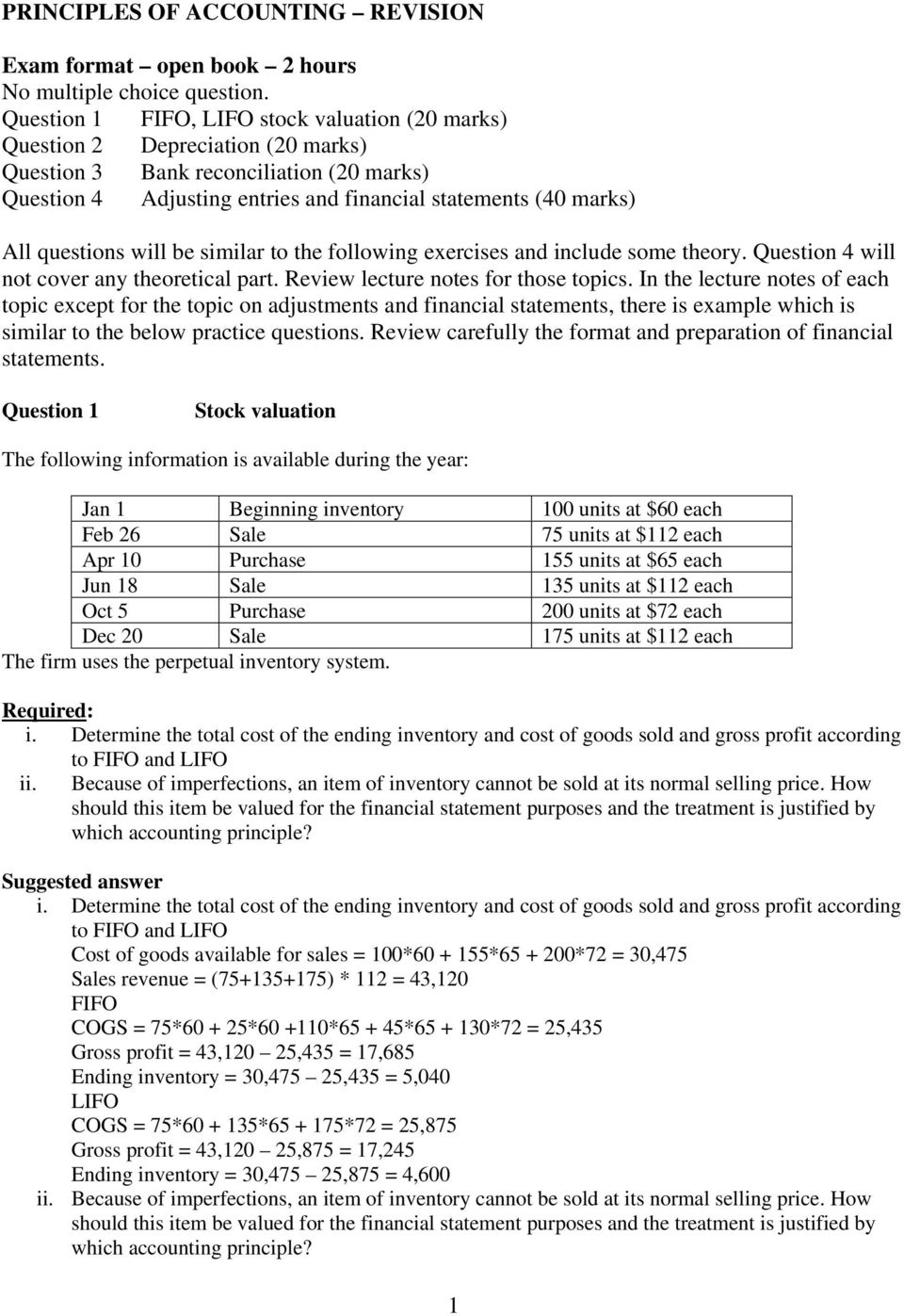
1 PRINCIPLES OF ACCOUNTING REVISION Exam format open book 2 hours No multiple choice question. Question 1 FIFO, LIFO stock valuation (20 marks) Question 2 Depreciation (20 marks) Question 3 Bank reconciliation (20 marks) Question 4 Adjusting entries and financial statements (40 marks) All questions will be similar to the following exercises and include some theory. Question 4 will not cover any theoretical part. Review lecture notes for those topics. In the lecture notes of each topic except for the topic on adjustments and financial statements, there is example which is similar to the below practice questions. Review carefully the format and preparation of financial statements. Question 1 Stock valuation The following information is available during the year: Jan 1 Beginning inventory 100 units at $60 each Feb 26 Sale 75 units at $112 each Apr 10 Purchase 155 units at $65 each Jun 18 Sale 135 units at $112 each Oct 5 Purchase 200 units at $72 each Dec 20 Sale 175 units at $112 each The firm uses the perpetual inventory system. Required: i. Determine the total cost of the ending inventory and cost of goods sold and gross profit according to FIFO and LIFO ii. Because of imperfections, an item of inventory cannot be sold at its normal selling price. How should this item be valued for the financial statement purposes and the treatment is justified by which accounting principle? Suggested answer i. Determine the total cost of the ending inventory and cost of goods sold and gross profit according to FIFO and LIFO Cost of goods available for sales = 100* * *72 = 30,475 Sales revenue = ( ) * 112 = 43,120 FIFO COGS = 75* * * * *72 = 25,435 Gross profit = 43,120 25,435 = 17,685 Ending inventory = 30,475 25,435 = 5,040 LIFO COGS = 75* * *72 = 25,875 Gross profit = 43,120 25,875 = 17,245 Ending inventory = 30,475 25,875 = 4,600 ii. Because of imperfections, an item of inventory cannot be sold at its normal selling price. How should this item be valued for the financial statement purposes and the treatment is justified by which accounting principle? 1
2 Inventory should be valued at lower of cost or market. The treatment is justified by conservatism principle. Question 2 Depreciation Tory Ltd purchased a new machine on 1 October 2007 at a cost of $95,000. The company paid also $1,000 to the supplier for transportation and installation costs. The company estimated that the machine has a residual value of $12,000. The machine is expected to be used for 70,000 working hours during its 5-year life. Each year $500 is spent on the maintenance of the machine. Assume a 31 December year end. Required: i. Calculate the depreciation expense, accumulated depreciation and net book value for the year 2007 and 2008 under a. straight line method b. reducing balance method using double the straight line rate c. the units of production method assuming the machine usage was 1,700 and 6,800 hours for the year 2007 and 2008 respectively ii. On 31 December 2008, the company sold the machine for $80,000 cash. Journalise the entry to record the disposal of the machine assuming the company uses straight line method for depreciation. iii. Distinguish between the accounting for capital expenditures and revenue expenditures Suggested answer i. Calculate the depreciation expense, accumulated depreciation and net book value for the year 2007 and 2008 under a. straight line method Depreciation exp = (95,000+1,000-12,000)/5 = 16, Depreciation exp = 16,800*3/12 = 4,200 Accumulated depreciation = 4,200 Net book value = 96,000 4,200 = 91, Depreciation exp = 16,800 Accumulated depreciation = 4, ,800 = 21,000 Net book value = 96,000 21,000 = 75,000 b. reducing balance method using double the straight line rate Depreciation rate = 1*2/5 = 40% 2007 Depreciation exp = 96,000*40% *3/12 = 9,600 Accumulated depreciation = 9,600 Net book value = 96,000 9,600 = 86, Depreciation exp = 86,400*40% = 34,560 Accumulated depreciation = 9, ,560 = 44,160 Net book value = 96,000 44,160 = 51,840 c. the units of production method assuming the machine usage was 1,700 and 6,800 hours for the year 2007 and 2008 respectively Depreciation expense per hour = (96,000-12,000)/70,000 = $1.2 per hour 2007 Depreciation exp = 1.2* 1,700 = 2,040 Accumulated depreciation = 2,040 Net book value = 96,000 2,040 = 93, Depreciation exp = 1.2 * 6,800 = 8,160 Accumulated depreciation = 2, ,160 = 10,200 Net book value = 96,000 10,200 = 85,800 ii. On 31 December 2008, the company sold the machine for $80,000 cash. Journalise the entry to record the disposal of the machine assuming the company uses straight line method for depreciation. 2

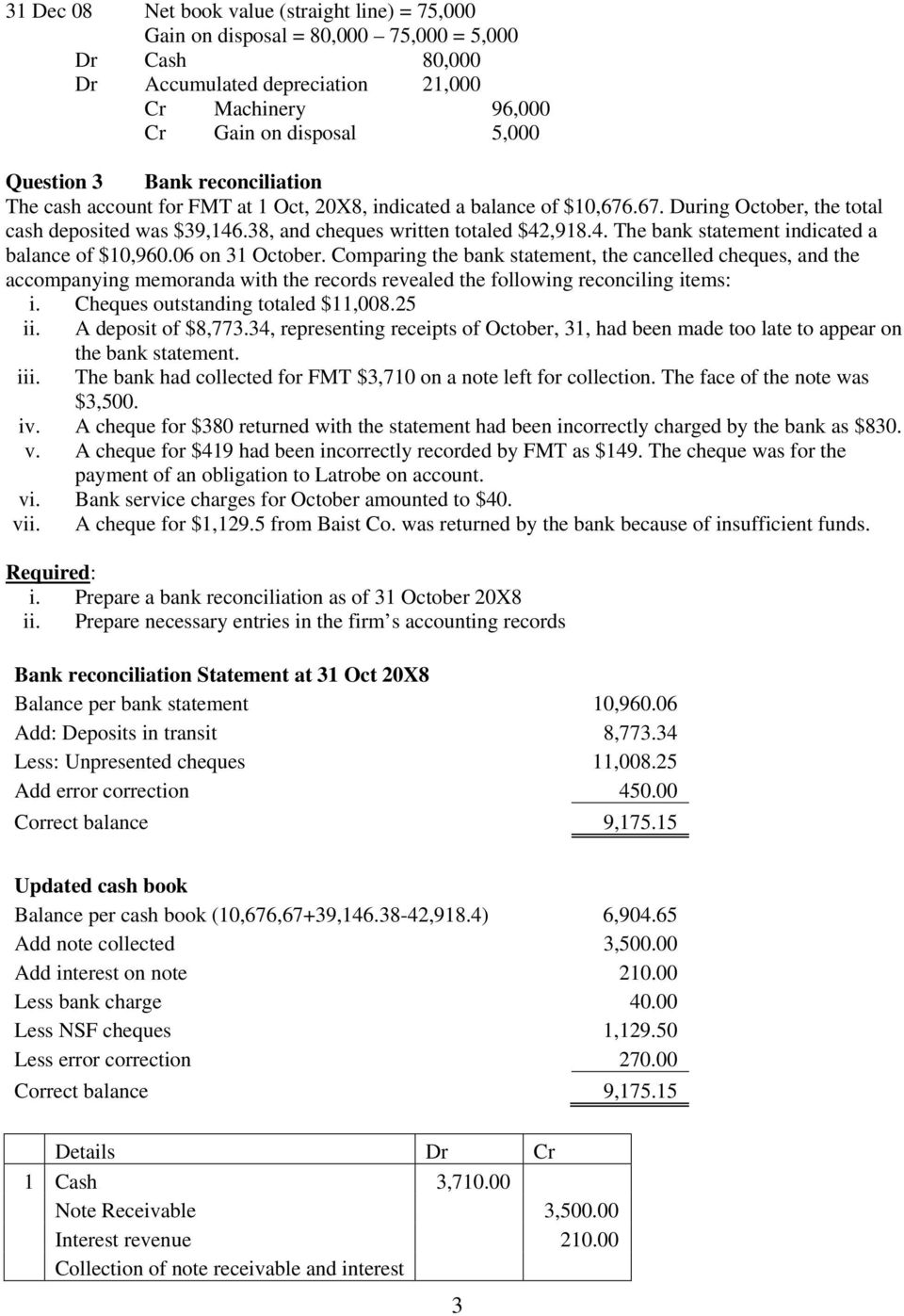
3 31 Dec 08 Net book value (straight line) = 75,000 Gain on disposal = 80,000 75,000 = 5,000 Dr Cash 80,000 Dr Accumulated depreciation 21,000 Cr Machinery 96,000 Cr Gain on disposal 5,000 Question 3 Bank reconciliation The cash account for FMT at 1 Oct, 20X8, indicated a balance of $10, During October, the total cash deposited was $39,146.38, and cheques written totaled $42, The bank statement indicated a balance of $10, on 31 October. Comparing the bank statement, the cancelled cheques, and the accompanying memoranda with the records revealed the following reconciling items: i. Cheques outstanding totaled $11, ii. A deposit of $8,773.34, representing receipts of October, 31, had been made too late to appear on the bank statement. iii. The bank had collected for FMT $3,710 on a note left for collection. The face of the note was $3,500. iv. A cheque for $380 returned with the statement had been incorrectly charged by the bank as $830. v. A cheque for $419 had been incorrectly recorded by FMT as $149. The cheque was for the payment of an obligation to Latrobe on account. vi. Bank service charges for October amounted to $40. vii. A cheque for $1,129.5 from Baist Co. was returned by the bank because of insufficient funds. Required: i. Prepare a bank reconciliation as of 31 October 20X8 ii. Prepare necessary entries in the firm s accounting records Bank reconciliation Statement at 31 Oct 20X8 Balance per bank statement 10, Add: Deposits in transit 8, Less: Unpresented cheques 11, Add error correction Correct balance 9, Updated cash book Balance per cash book (10,676,67+39, ,918.4) 6, Add note collected 3, Add interest on note Less bank charge Less NSF cheques 1, Less error correction Correct balance 9, Details Dr Cr 1 Cash 3, Note Receivable 3, Interest revenue Collection of note receivable and interest 3
4 2 Miscalleneous expense Cash Payment for bank charge 3 Account Receivable 1, Cash 1, Recovered A/R due to returned cheque 4 Account Payable Cash Error correction Question 4 Adjusting entries and financial statements HANOI LTD Trial balance as of 31 December 20X8 Debit Credit Cash 6,035 Accounts receivable 80,230 Accounts payable 40,710 Advertising expense 7,875 Office expense 3,585 Share capital (100,000 shares issued, $1 par) 225,000 Delivery vehicle (at cost) 40,000 Accumulated depreciation - delivery vehicle 10,000 Rent expense 12,500 Prepaid insurance 2,625 Interest expense 3,120 Land 35,000 Building 100,000 Accumulated depreciation - building 4,550 Utility expense 5,075 Unearned revenue 3,980 Allowance for doubtful accounts (1 January 20X8) 975 Inventory 94,250 Cost of goods sold 115,370 Salary expense 35,260 Sales 215,500 Retained earnings (1 January 20X8) 28,585 Maintenance expense 3,375 Loan 15,000 Total 544, ,300 4

5 Additional information 1. Interest expense accrued $ Depreciation for the current year to be 20% p.a on cost for delivery vehicle and 5% p.a. on cost for building 3. Unexpired insurance $ Aging analysis of accounts receivable at 31 December 20X8 revealed that the Allowance for doubtful accounts should have balance of $4, The balance of Unearned revenue includes $980 received in December for goods to be delivered in February 20X9 6. Declare a dividend to shareholders of $10,000 for the current year. Required: i. Prepare necessary journal entries given the above additional information ii. Prepare Income Statement and Statement of Owner s equity for the year ended 31 December 20X8 as well as Balance Sheet as of 31 December 20X8. Suggested answer Adjusting entries Details Dr Cr 1 Interest expense 325 Interest payable 325 Adjust for accrued interest expense 2 Depreciation expense 5,000 Accumulated depreciation-building 5,000 Depreciation exp = 100,000*5% Depreciation of building Depreciation expense 8,000 Accumulated depreciation-vehicle 8,000 Depreciation exp = 40,000*20% Depreciation of vehicle 3 Insurance expense 2,195 Prepaid insurance 2,195 Adjust for insurance expired ( ) 4 Bad debt expense 3,150 Allowance for doubtful debts 3,150 Adjust for bad debt exp (4, ) 5 Unearned revenue 3,000 Sales revenue 3,000 Adjust for revenue earned (3, ) 6 Retained earnings 10,000 Dividends payable 10,000 Dividends declared 5

6 HANOI LTD Income Statement for the year ended 31 December 20X8 Sales revenue (215,500+3,000) 218,500 less Cost of sales 115,370 Gross profit 103,130 less Operating expenses Advertising expense 7,875 Office expense 3,585 Rent expense 12,500 Interest expense (3, ) 3,445 Utility expense 5,075 Salary expense 35,260 Maintenance expense 3,375 Depreciation expense (5,000+8,000) 13,000 Insurance expense 2,195 Bad debt expense 3,150 89,460 Net profit 13,670 HANOI LTD Statement of Shareholders' equity for the year ended 31 December 20X8 Shareholders' equity Share capital (100,000 shares issued, $1 par) 225,000 Retained earnings Retained earnings (1 January 20X8) 28,585 Net income for the year 20X8 13,670 Dividends (10,000) Retained earnings (31 December 20X8) 32,255 Shareholders' equity as at 31 December 20X8 257,255 6

7 HANOI LTD Balance Sheet as of 31 December 20X8 Current assets Cash 6,035 Accounts receivable 80,230 less Allowance for doubtful accounts (4,125) 76,105 Prepaid insurance 430 Inventory 94,250 Total current assets 176,820 Non-current assets Land 35,000 Building 100,000 Accumulated depreciation - building (9,550) 90,450 Delivery vehicle (at cost) 40,000 Accumulated depreciation - delivery vehicle (18,000) 22,000 Total non-current assets 147,450 Total assets 324,270 Current liabilities Accounts payable 40,710 Unearned revenue (3,980-3,000) 980 Interest payable 325 Dividends payable 10,000 Total current liabilities 52,015 Non-current liabilities Loan 15,000 Shareholders' equity Share capital 225,000 Retained Earnings 32, ,255 Total liabilities & shareholders' equity 324,270 7

8 Question 5 Adjusting entries and financial statements (One more question on this topic) Presented below are the unadjusted trial balance as of 31 December 2005 of Grant Advertising Agency Ltd Grant Advertising Agency Ltd Unadjusted Trial Balance as at 31 December 2005 Debit ($) Credit ($) Cash 11,000 Accounts Receivable 20,000 Supplies 8,400 Prepaid insurance 3,350 Printing Equipment 60,000 Accumulated depreciation 28,000 Accounts Payable 5,000 Note payable (due in 6 months) 5,000 Advertising Revenue Received in advance 7,000 Share capital 20,000 Retained Earnings 5,500 Dividends 12,000 Advertising revenue 58,600 Salaries expense 10,000 Interest expense 350 Rent expense 4,000 Total 129, ,100 Other data: 1. Insurance expired during the year $ Unused supplies on hand as at 31 December $5, Printing equipment is depreciated for 8 years with residual value of $4, The interest rate on notes payable is 12%, (The note was signed on 1 Oct 05) 5. $1,400 of the Advertising Revenue Received in Advance was earned during the year ended 31 Dec Salaries of $1,300 are unpaid at 31 Dec 2005 Required: (a) Journalise the annual adjusting entries on 31 December 2005 (b) Prepare the Income Statement for the month ended 31 December 2005 and the classified Balance Sheet as at 31 December Suggested answer (a) Adjusting entries No Accounts Dr Cr 1 Insurance exp 850 Prepaid insurance 850 Adjusted for insurance expired 2 Supplies exp 3,400 Supplies (8,400-5,000) 3,400 8
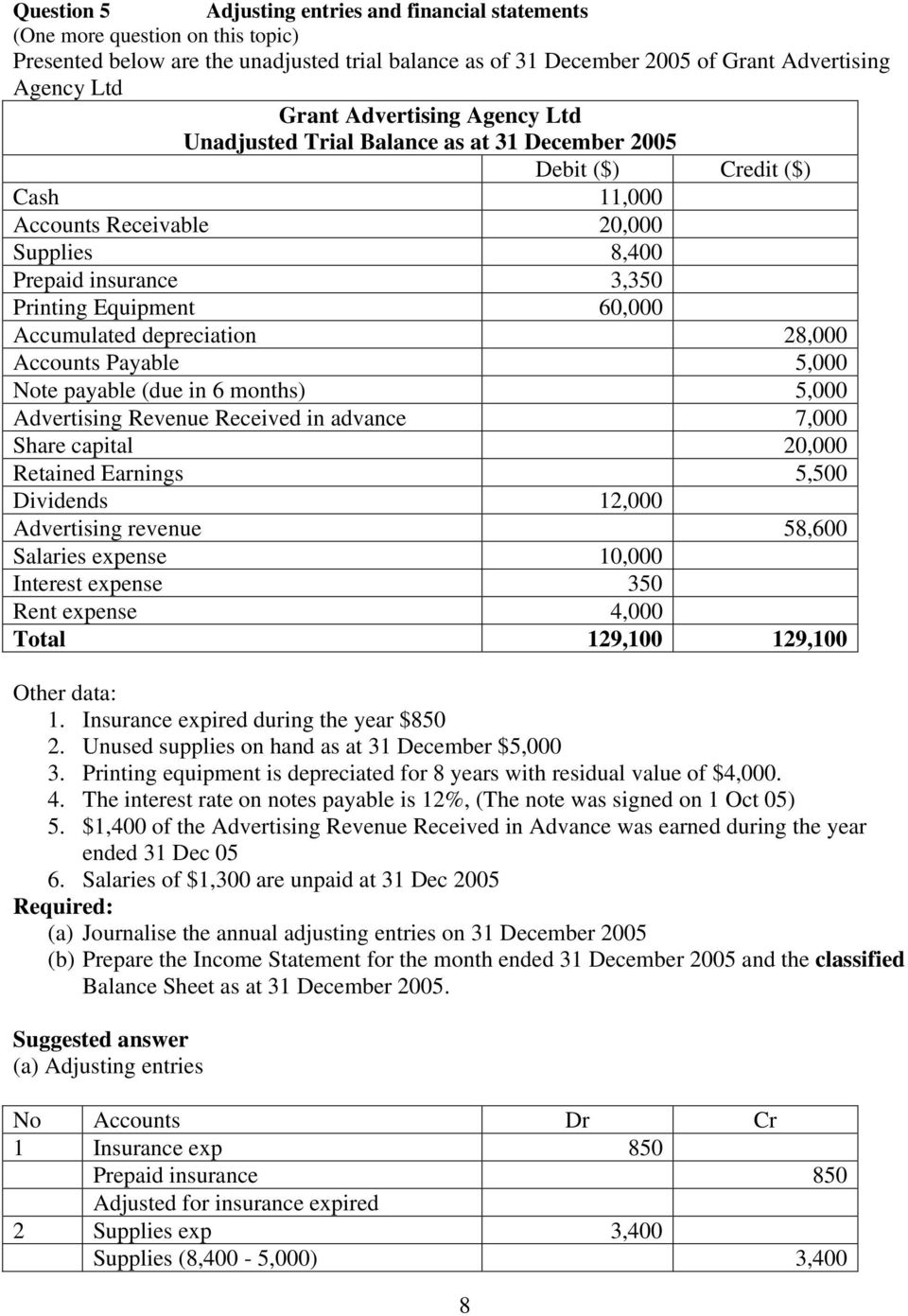
9 Adjusted for supplies used 3 Depreciation exp 7,000 Accumulated depreciation 7,000 Adjusted for depreciation of printing equipment (60,000-4,000)/8 4 Interest exp 150 Interest payable 150 Adjusted for interest 5,000*0.12*3/12 5 Advertising Rev received in advance 1,400 Advertising revenue 1,400 Adjusted for revenue earned 6 Salary exp 1,300 Salary payable 1,300 Adjusted for unpaid salary (b) Financial Statements Grant Advertising Agency Ltd Income Statement for the year ended 31 December 2005 Advertising revenue (58, ,400) 60,000 Less operating expense Salary expense (10, ,300) 11,300 Interest expense ( ) 500 Depreciation expense 7,000 Insurance expense 850 Supplies expense 3,400 Rent expense 4,000 Utility expense 6,500 33,550 Net income 26,450 RE = Beginning RE + Net income - Dividends = 5, ,450-12,000 = 19,950 9

10 Grant Advertising Agency Ltd Classified Balance Sheet as of 31 December 2005 Current assets Cash 8,000 Account receivable 16,500 Supplies 5,000 Prepaid insurance 2,500 32,000 Non-current assets Printing equipment 60,000 Less accumulated depreciation (35,000) 25,000 Total assets 57,000 Current liabilities Account Payable 5,000 Advertising revenue received in advance 5,600 Salary payable 1,300 Interest payable 150 Note payable 5,000 Total current liabilities 17,050 Owners' equity Capital 20,000 Retained earnings 19,950 39,950 Total liabilities and owners' equity 57,000 10

11 PRINCIPLES OF ACCOUNTING Lecture 1 Introduction to Accounting 1 Lecture Outline Objective of Accounting The users of accounting information Financial accounting vs management accounting Regulating accounting Types of business organisations Accounting concepts and principles The financial statements Accounting equation 2 Accounting for business transaction Objective of Accounting Users of accounting information Providing information about the financial performance and status of organisations Accounting is the process of identifying, measuring and communicating economic information to various users Key product of accounting: Financial statements Accounting information is of interest to people who have some stake in the organization Owners/Managers Investors Lenders/Creditors dit Government Employees Customers 3 4 Financial vs management accounting Financial accounting focuses on information for people outside the firm Management accounting focuses on information for internal decision makers of a business GAAP (Decision 15) Accounting standards IAS VAS Regulating accounting 5 6

12 Types of Business Accounting concepts & principles Sole Proprietorships Small businesses owned by one person. Legally, the business is not separate from its owner Partnerships Unincorporated business owned by one or more persons. The partners agree on how much capital each will contribute and how much each may withdraw as salaries, interest or as a share of profit. Companies Incorporated under the laws. Ownership is represented by shares. Stockholders enjoy limited liability 7 Entity concept Reliability principle Cost principle Going concern concept Monetary unit concept 8 The four basic financial statements The Balance Sheet The Balance Sheet Income Statement Statement of Owner s Equity Statement of Cash Flows The Balance Sheet is the report of financial position of an accounting entity at a particular point in time List the company assets (in order of liquidity) and liabilities ( in order of maturity) and stockholders equities To prove the accounting equation 9 10 Elements of Balance Sheet Basic Accounting Equation Assets are economic resources owned by the entity Liabilities and stockholders equities are source of financing or claims against the company s economic resources Liabilities: claims to business assets by creditors Shareholders equities: claims to business assets by owners/shareholders 11 ASSETS = LIABILITIES + SHs EQUITIES Cash Bank loans Share capital Inventory Accounts payable Retained Earning 12

13 Income Statement Accountant s primary measure of performance of a business or Revenue less Expenses during the accounting gperiod. NET INCOME = REVENUES - EXPENSES REVENUES AND EXPENSES Revenues are amounts earned by delivering goods or services to customers. Revenues increase owner s equity. Expenses decrease owner s equity that occurs from using assets or increasing liabilities in the course of delivering goods or services to customers Statement of Owner s Equity Summary of the changes in an entity s owner s equity during a specific period. Statement of Cash flows Receipts and Payments of cash during the accounting period 3 primary categories: Cash flows from operating activities Cash flows from investing activities Cash flows from financing activities Transaction 1: Starting the business Luikhart invested $60,000 in the business ASSETS = LIABILITIES + OWNER S EQUITY Cash Capital + 60,000 = + 60,000 Transaction 2: Purchase of land Paid $55,000 cash for land ASSETS = LIABILITIES + OWNER S EQUITY Cash + Land Capital +60, ,000-55, ,
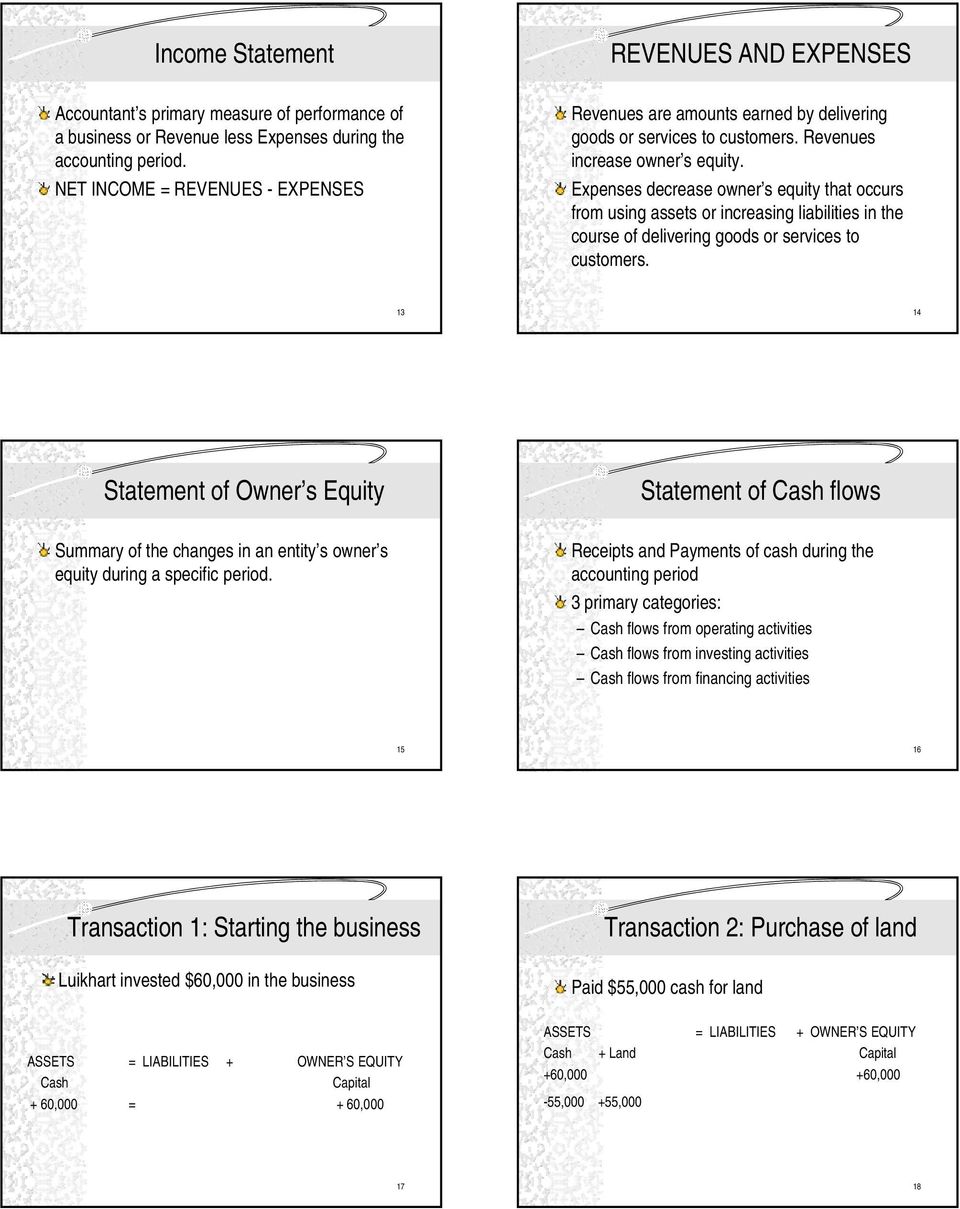
14 Transaction 3: Purchase of supplies Purchased supplies for $2,000 on account ASSETS = LIABILITIES + OWNER S EQUITY Cash + Land+ Supplies = A/P Capital +60,000 = +60,000-55, ,000 +2,000 = +2,000 Transaction 4: Earning service revenue Earned service revenue of 7,000, receiving cash ASSETS = LIABILITIES + OWNER S EQUITY Cash + Land+ Supplies = A/P Capital +60,000 = +60,000-55, ,000 +2,000 = +2,000 +7,000 +7, Transaction 5: Paid for expenses Paid cash expenses totalled 2,700 including salaries 1,400; rent 1,000; utilities 300 ASSETS = LIABILITIES + OWNER S EQUITY Cash + Land+ Supplies = A/P Capital +60,000 = +60,000-55, ,000 +2,000 = +2,000 +7,000 +7,000-2,700-2, Transaction 6: Payment on account Paid 1,500 on account ASSETS = LIABILITIES + OWNER S EQUITY Cash + Land+ Supplies = A/P Capital +60,000 = +60,000-55, ,000 +2,000 = +2,000 +7,000 = +7,000-2,700 = -2,700-1,500 = -1,500 7,800 55,000 2,000 = , Ken Luikhart MD Income Statement For the month ended Jul Service revenue 7,000 Less expenses Salaries 1,400 Rent 1,000 Utitlies 300 2,700 Net income 4, Ken Luikhart MD Balance Sheet as of 31 Jul Assets Liabilities Cash 7,800 A/P 500 Land 55,000 Owner s equity Supplies 2,000 Capital 64,300 Total assets 64,800 Total L&OE 64,800 24

15 Tutorial S1-3 S1-4 E1-4 E1-8 E1-10 P1-1A P1-2A 25
16 Outline Principles of Accounting Lecture 3 Financial Statements and Adjusting entries Accrual versus cash-basis accounting Accounting period principle Revenue recognition Matching principle Prepaids Accruals 1 2 Accrual vs cash-basis accounting Cash basis accounting Revenue and expenses recognised when the cash is received or paid Accrual accounting Revenue recognised when goods/services are provided (revenue is earned) Expenses recognised when assets consumed or liabilities incurred (expense is incurred) Accrual vs cash-basis illustrated Illustration for painting business 3 4 Accounting period assumption Economic life of a business is divided into artificial time periods for reporting purpose The basic accounting period is one year. 5 Revenue recognition Revenue recognition criteria: It is probable that the inflow or enhancement has occurred; The inflow or enhancement can be reliably measured Tests used to determine revenue recognition: Agreement to provide goods or services; Cash must be received or claim to cash must exist Goods must be delivered or services rendered; It must be possible to estimate the collectability of debts or returns of the goods sold 6 1

17 Expense recognition Adjusting entries Expense recognition criteria: The consumption or loss of future economic benefits Is probable Can be reliably measured. Recognition technique: matching principle Association of revenue of a period with all the expenses necessary to generate that revenue 7 Adjusting entries are the journal entries made at the end of a period for a company to reflect the accrual basis of accounting. Adjusting entries assign revenues to the period when they are earned and expenses to the period when they are incurred. Adjusting entries also update asset and liability accounts. 8 Prepayments Prepayments Amounts paid in cash recorded as assets until used (prepaid expense) Revenue received from customers and recorded as a liability until services performed/ goods delivered (unearned revenue or revenue received in advance) 9 10 Prepaid expense Example: Insurance paid for 1 year in advance $600 Insurance for October $600/12 = $50 Unearned revenue Eg: $1,200 received 2 October for advertising services to be completed 31 December Services worth $400 were performed during the month of Oct

18 Depreciation Depreciation Allocation of the cost of the asset to expense over its useful life Example: Office equipment is purchased for $5,000. Estimated useful life of 10 years Estimated residual value of $200 Depreciation of office equipment = (5, )/10 $480 p.a. or $40 monthly Journal entry Ledger account Accruals Accruals Amounts not yet received and recorded for which goods/services have been provided (accrued revenue) Amounts not yet paid or recorded for goods/services already received (accrued expense) Accrued expense Accrued expense Accrued Salaries Example: Salaries outstanding for October $1,200 (3 days x $400) Journal Ledger

19 Accrued revenue Example: Commission revenue earned, not yet received or recorded $ Summary of adjusting entries Type Situation Entry during period Entry at end of period Prepaid Cash paid before exp is Asset Expense expense incurred. Cash Asset Unearned revenue Accrued expense Accrued revenue Cash received before revenue earned Expense incurred before cash is paid Revenue earned before cash is received Cash Liability No entry No entry Liability Revenue Expense Liability Asset Revenue 20 Adjusted trial balance Tutorial Prepared after all adjusting entries have been journalised and posted Used to prove the equity of total debit balances and total credit balances after the adjusting entries have been made Provides the basis for the preparation of financial Statements S3-5 S3-6 S3-7 S3-8 S3-9 E3-7 E3-8 E3-15 P3-5A

20 Outline PRINCIPLES OF ACCOUNTING Lecture 6 Inventory Inventory valuation and income measurement Inventory costing method under perpetual inventory Specific identification Weighted average First-in, First-out (FIFO) Last-in, First-out (LIFO) Accounting principles and inventories Other inventory issues 1 2 Inventory valuation and income measurement Valuation is the major problem in accounting for inventories. The amount recorded as the cost of inventory determines the amount recognised as cost of goods sold on the income statement Errors in inventory valuation will result in misstatements in the cost of goods sold and as a result the net income shown in the income statement. 3 Inventory costing methods under perpetual inventory system 4 costing methods can be used for inventory: Specific identification First in First out (FIFO) Last in First out (LIFO) Weighted average. 4 Specific identification Specific identification: assumes that the business is able to identify the specific units and their costs in the inventory at the end of the period. Used for high-unit-cost inventory items that can be identified clearly from the time of purchase to the time of sale. FIFO First-in, First-out (FIFO) Cost of the first item purchased is assigned to the first items sold., ending inventory cost is determined from the prices of the most recent purchases So,, inventory is valued at the most recent purchase prices 5 6 1
21 Average cost Last-in, First-out (LIFO) The last items purchased are assigned to the cost of the first items sold, the ending inventory cost is determined from the prices of the earliest purchases So, ending inventory is valued at oldest purchase prices Average cost is determined by dividing the cost of goods available for sale by the number of units available. With this method, a new average cost per unit after each purchase is computed. 7 8 Example for inventory costing FIFO Purchases Sales Balances Date Details Qty Unit cost Total cost Qty Unit cost Total cost Qty Unit cost Total cost 1 JanBalance , AprPurchase , , AugPurchase , ,800 Units sold on Sep 10 Ending Inventory Cost of goods sold 550 units 10 SepSale , NovPurchase , , LIFO Average cost Purchases Sales Balances Date Details Unit Total Unit Total Unit Total Qty Qty Qty cost cost cost cost cost cost 1 JanBalance , AprPurchase , , AugPurchase , , SepSale , NovPurchase , , Purchases Sales Balances Date Details Unit Total Unit Total Unit Total Qty Qty Qty cost cost cost cost cost cost 1 JanBalance , AprPurchase , , AugPurchase , , SepSale , NovPurchase , ,
22 Financial statement effects Dubbo Electronics Income Statement FIFO LIFO Average cost Sales revenue 11,500 11,500 11,500 Cost of goods sold 6,200 6,300 6,233 Gross profit 5,300 5,200 5,267 Operating expenses 2,000 2,000 2,000 Profit before tax 3,300 3,200 3,267 Income tax (30%) Profit after tax 2,310 2,240 2, Selecting an inventory costing method Most managers choose accounting methods based on two factors: Net income effects: managers prefer to report higher earnings for their companies Income tax effects: managers prefer to pay the least amount of taxes allowed by law as late as possible-the least-latest rule Managers can have both objectives by choosing one accounting method for external financial statements and a different method for preparing its tax return 14 Financial Statement Effects of Inventory Methods Normal Financial Statement Effects of Increasing Costs FIFO LIFO Cost of goods sold on income statement Lower Higher Net Income Higher Lower Income Taxes Higher Lower Inventory on balance sheet Higher Lower Normal Financial Statement Effects of Decreasing Costs FIFO LIFO Cost of goods sold on income statement Higher Lower Net Income Lower Higher Income Taxes Lower Higher Inventory on balance sheet Lower Higher 15 Accounting principles & Inventories Consistency principle Disclosure principle Materiality concept Conservatism principle 16 Other inventory issues Lower of cost or market The lower of cost or market rule (LCM) Effects of inventory errors Estimating inventory amounts 17 Why LCM? Because inventory can become economically obsolete and can no longer be sold at regular price. LCM is applied regardless of which inventory valuation method is used to determine cost. At the end of each accounting period, the original cost, as determined using one of the costing methods, is compared with the market price of the inventory. 18 3
23 Lower of cost or market If Cost < Market: ending inventory stays at Cost. If Cost > Market: ending inventory is reduced to Market price Eg: Holding loss: the cost of Pentium chips hold by Dell is $250,000 and replacement value is $200,000, the accountant would make the following entry: Dec 31 Dr Cost of goods sold $50,000 Cr Inventory $50,000 Assets = Liabilities + Owner s equity - 50,000-50, Lower of cost or market The departure from the cost basis is normally justified on the basis of conservatism. Conservatism s is a prudent reaction to uncertainties to try to insure that uncertainties and risks inherent in business are adequately considered. LCM could be applied and reported for the entire inventory, or individual item of inventory or groups of inventory. 20 Effects of inventory errors Estimating inventory Period 1 Period 2 Cost of Gross profit & goods sold net income Cost of goods sold Gross profit & net income Inventory error Period 1 Ending inventory overstated Understated Overstated Overstated Understated Period 1 Ending inventory understated Overstated Understated Understated Overstated The gross profit method provides a way to estimate inventory. Beginning inventory + Purchases = Cost of goods available for sale - Ending inventory = Cost of goods sold Practice problem Practice problem Steward Distributing company uses a periodic inventory system. The following data are available for the year: Date Transaction No of units Unit cost Total 1/1 Beginning g inventory 500 $1.00 $500 2/5 Purchase 350 $1.10 $385 4/12 Sale 550 7/17 Sale 200 9/23 Purchase 400 $1.30 $520 11/5 Sale 300 $1,405 a/ Compute the cost of goods sold, assuming using the average costing method b/ Compute the dollar amount of ending inventory, assuming the FIFO costing method c/ Compute the dollar amount of ending inventory, assuming the LIFO costing method
24 Tutorial E6-1 E6-3 E6-4 E6-5 E6-11 P6-1A P6-2A P6-3A P6-6A 25 5
25 Lecture Outline PRINCIPLES OF ACCOUNTING Lecture 9 Internal controls and Bank reconciliation Internal control Principles of internal control Limitations of internal control Bank statements Bank reconciliation Internal control over cash Cash and cash equivalents 1 2 Internal control Processes used to provide effective and efficient operations, and compliance with laws, regulations and internal policies Why? Safeguard assets Enhance accuracy and reliability of accounting records Encourage compliance with prescribed managerial policies and government regulations Promote operational efficiency 3 Principles of internal control Assignment of responsibility to individuals for a given task ensure staff are appropriately qualified Segregation of duties 2 elements Separation of operations from accounting Separation of the custody of assets from accounting Documentation procedures Pre-numbered documents so that they can all be accounted for 4 Principles of internal control Physical, mechanical and electronic controls To ensure the assets are safeguarded Independent verification Internal and external audit Other controls Mandatory vacations Job rotation Limitations of internal control Cost/benefit analysis Cost must be outweighed by the benefits to be derived Human element Errors because of carelessness or fatigue Collusion Two or more people actively collude Size of business Difficult to apply principles of internal control in a small business 5 6 1
26 Reading a bank statement Bank statement: a detailed list, provided by the bank, of all the activity for a particular account during the month Bank statement shows deposits recorded, check cleared, other debits and credit and a running balance Bank reconciliation Bank reconciliation: a form used by the accountant to reconcile the balance shown on the bank statement for a particular account with the balance shown in the accounting records. Prepared for each individual account as soon as the bank statement is received. Reviewed by a person independent of custody, record-keeping and authorisation responsibilities relating to cash. Differences between the balance on the bank statement and the balance in the records should be investigated and if necessary adjustments are made. 7 8 Timing differences Outstanding check: a check written by the company but not yet presented to the bank for payment Deposits in transit: A deposit recorded on the books but not yet reflected on the bank statement. Permanent differences NSF check: (not sufficient funds) occurs when one of the firm s customers has paid by cheque, by has insufficient funds in the cheque account to cover the payment Service charge: Bank charge for various services such as monthly activity fees, fees charged for new cheques Customer note and interest: customer pays directly to bank Interest revenue 9 10 Steps in preparing a bank reconciliation Timing differences are updated into cash balance as per bank statement. Permanent differences are updated into cash balance as per cash book. Correct any errors made by the bank or by the company in recording the various cash transactions. Make necessary adjustments to cash book. 11 Bank Reconciliation End. cash bal. per books $XXX End. cash bal. per bank statement $XXX Add Interest paid by bank XX Add deposits in transit XX Less NSF checks/service charges XX Less Outstanding checks XX Add (less) Company errors XX Add (less) Bank errors) XX Ending correct cash balance $XXX Ending correct cash balance $XXX 12 2
27 Bank reconciliation an example Ending bank balance per bank statement: $8,822 Ending book balance per cash book: $9,040 Outstanding checks: $145 (Chq 101), $815 (Chq 123), $117 (Chq 131). Deposits in transit: $1,800 Interest received from the bank: $20 Customer note collected: $500 NSF check of R. Smith: $18 Bank service charges: $6 Error: Chq No 99 written for $100 was wrongly recorded as $ Company s book Bank reconciliation an example Bank statement Ending balance per books 9,040 Ending balance per bank statement 8,822 Add: customer note collected 500 Add: deposit in transit 1,800 Add: interest earned 20 Less: outstanding checks Add: error in recording 9 No.101 $145 Less: NSF check 18 No.123 $815 Bank service charge 6 No.131 $117 1,077 Ending correct cash balance 9,545 Ending correct cash 9, balance Adjustments to cash book Adjustments to cash book Recognise the bank s collection of customer s note: Dr Cash 500 Cr Notes Receivable 500 Record interest earned on the bank balance: Dr Cash 20 Cr Interest revenue 20 Record correction of error Dr Cash 9 Cr Account payable 9 15 To record customer s NSF check Dr Account receivable 18 Cr Cash 18 To record bank service charge Dr Bank charge 6 Cr Cash 6 16 Cash management Control over cash is critical to smooth functioning of any business Effective management of cash includes controls to protect cash from fraud, theft or loss through carelessness. Other cash management responsibilities include: Accurate accounting so that reports of cash flows and balances may be prepared. Controls to ensure that sufficient cash on hand is maintained to meet current operating needs, maturing liabilities and unexpected emergencies. Prevention of the accumulation of excess amounts of idle cash (investing excess cash). 17 Internal control over cash (Adopted from Kimmel, 2003) 18 3
28 Internal control over cash (Adopted from Kimmel, 2003) Cash and cash equivalents 19 Cash takes many different forms: coin, currency on hand, cheques, cash at bank (checking, savings and money market accounts). Cash equivalents: are short term investments with original maturities of three months or less that are readily convertible to a known amount of cash. Eg: treasury bills, bank certificates of deposits 20 Practice exercise The following information is available to assist you in preparing a bank reconciliation for Calico Corners on May 31, 2001: a/ The balance on May 31, 2001, bank statement is $ 8, b/ Not included on the bank statement is a $1,250 deposit made by Calico Corners late on May 31 c/ The following checks are outstanding at May 31: No.123 $23.40 No No No d/ The cash account on the company s books shows a balance of $9, Practice exercise e/ The bank acts as a collection agency for interest earned on some municipal bonds held by Calico Corners. The May bank statement indicates interest of $465 earned during the month f/ Interest received from the bank was $ Bank service charges amounted to $50 g/ A customer s NSF check in the amount of $166 was returned with the May bank statement h/ A customer s check of $ was recorded on the books during May but was never added to the company s account. The bank erroneously added the check to account of Calico Closet. i/ Customer s check No.99 in the amount of $ was wrongly recorded as $1,011 by the company s accountant Required: Prepare a bank reconciliation in good form 22 Tutorial E8-1 E8-2 E8-5 E8-6 E8-7 P8-3A P8-4A 23 4
29 Lecture Outline PRINCIPLES OF ACCOUNTING Lecture 12 Reporting non-current assets Classification of Long lived assets Tangible assets Intangible assets Property, Plant and Equipment (PPE) Acquisition cost Depreciation Disposal 1 2 Classification of long lived assets Tangible assets: have physical substance. Land Buildings, fixtures, and equipment Natural Resources Intangible assets are long lived assets without physical substance that confer specific rights on their owner Acquisition of PPE Plant assets are initially recorded at acquisition cost. Acquisition cost should include all of the costs that are normal and necessary to acquire the asset and prepare it for its intended d use. Items included in acquisition cost would generally include purchase price, taxes paid at time of purchase, incidental costs, renovation and repairs costs incurred prior to the asset s use, transportation charges, installation costs. 3 4 Which costs to be included? A firm purchased a photocopier for $5,000 and incurred the following additional costs: Freight on photocopier $100 Insurance in transit $20 Cost of installation & testing $100 Cost of carpet shampoo in photocopier room prior to install $50 Acquisition cost Eg., Delta purchased a new 737 aircraft from Boeing for list price of $63m; was offered a discount of $4m, paid $0.2m delivery cost and $0.8m preparation costs
30 Recording acquisition for cash Assuming Delta paid cash for the aircraft and related cost. The transaction is recorded as follows: Dr. Flight Equipment $60m Cr. Cash $60m Recording acquisition for debt Assuming Delta signed a note payable for the new aircraft and paid cash for the transportation and preparation p cost. The transaction is recorded as follows: Dr. Flight Equipment $60m Cr. Cash $1m Cr. Note payable $59m 7 8 Recording acquisition for Equity Assuming Delta gave Boeing 400,000 shares of its $3 par value common stock with market value of $85 per share and paid the balance in cash. Dr. Flight Equipment $60m Cr. Common stock $1.2m Cr. Additional paid in capital $32.8m Cr. Cash $26m 9 Recording acquisition by construction A company may construct an asset for its own use instead of buying from a producer The acquisition cost of that asset includes all the necessary costs associated with construction such as labor cost, materials and capitalised interest. Capitalised interest represents interest expenditures included in the cost of a selfconstructed asset 10 A lump-sum purchase of asset A lump-sum purchase: the purchase price should be allocated to different items on the basis of the proportion p of the fair market value. 1 Jan, Payton purchased building and land for $100,000 Estimated market value for land is $30,000 and for building is $90,000. Total is $120,000 Allocation of purchase price : Land: $100,000 * (30,000/120,000) = $25,000 Building: $100,000 * (90,000/120,000) = $75, Capital versus revenue expenditure A capital expenditure is a cost that improves the asset and is added to the cost of the asset. A revenue expenditure is a cost that keeps an asset in its normal operating condition and is treated as an expense. If an expenditure increases the life of the asset or its productivity, it should be treated as a capital expenditure and added to the asset account. If an expenditure simply maintains the productive capacity of the asset during the current accounting period only, it should be treated as an expense. 12 2
31 Depreciation Depreciation The allocation of the cost of the asset over its useful life Expense Non-cash item Process of allocation not valuation Depreciation Factors contributing to decline in value of a noncurrent asset Wear and tear through physical use of asset Technical obsolescence Commercial obsolescence Depreciation is made to ensure matching principle Depreciation 3 factors in calculating depreciation Accumulated depreciation The amount of depreciation that has accumulated since the purchase of the asset. Contra asset account Increase by a credit Decrease by a debit Normal balance is credit balance Net book value or carrying value This is the value of the asset after subtracting depreciation from the original cost of the asset. That is, cost less accumulated depreciation Represents the value of the asset in the accounting records. Straight-line method Reducing-balance Units of production Depreciation methods
32 Lecture example Truck Purchase(cost): $100,000 Estimated Useful Life: 5 years Residual Value: $ 10,000 Useful life in kilometres 90,000 Year 1 20,000 kilometres Year 2 30,000 kilometres Year 3 10,000 kilometres Year 4 20,000 kilometres Year 5 10,000 kilometres Straight line method Depreciation expense the same amount every year over the useful life of the asset. Formula Depreciation = Cost Residual Value exp p.a Estimated Useful Life Year 1 Straight line method Depreciation Accumulated depreciation Book value , Reducing balance method Applied at a particular rate Double declining method: applied at double of the straight line rate. Calculated on last periods book value Accelerated method Why? Because more of the depreciation cost is allocated to the earlier years of an asset s life and less depreciation to the latter years. 22 Reducing balance method Reducing balance rate = double the straight-line rate. What is the depreciation rate? What is the depreciation expense in each of the five years? What is the book value at the end of the fifth year? 23 Year 1 Reducing balance method Depreciation Accumulated depreciation Book value ,
33 Units of production Units of production This method assumes that depreciation is solely through the usage of the asset Allocates depreciation based on the units of output or use during each period of an assets useful life 25 Year 1 Depreciation Accumulated depreciation Book value , Comparison of depreciation method Choice of depreciation method The choice of depreciation method can have a significant impact on firms financial statements. The method to be selected should be chosen on the basis of best satisfying the matching principle. The choice of depreciation method should be linked to the nature of asset being considered. A business may use both methods for different assets that have different revenue-earning patterns. 27 Factor Simplicity Reporting to stockholders Comparability Management bonus plan Technological competitiveness Reporting for tax purpose Likely choice Straight line method Straight line method Same method with others in the same industry or line of business Straight line method Accelerated method Accelerated method 28 Disposal of PPE Disposal of PPE When an asset is disposed, all accounts related to it must be removed. The asset account and accumulated depreciation should be eliminated from the balance sheet. The gain or loss on sale of asset is recorded as Other income/ expense in the income statement. Example: 1 Jan 20X7, a machine is purchased for $20,000 Estimated residual value: $2,000, estimated useful life:5 years Assume it is sold on 1 Jul 20X9. Accumulated depreciation up to 1 Jul 20X9 (2.5 years) = {(20,000 2,000)/5} * 2.5 = 9,
34 Disposal of PPE Proceeds from sale of the machine is $12,400 Book value = Cost Accumulated depreciation = 20,000 9,000 = 11,000 Gain on sale = 12,400 11,000 = 1,400 1 Jul 20X9 Dr Accumulated depreciation 9,000 Dr Cash 12,400 Cr Machine 20,000 Cr Gain on sale of asset 1,400 Disposal of PPE Proceeds from sale of the machine is $10,000 Book value = Cost Accumulated depreciation = 20,000 9,000 = 11,000 Loss on sale = 11,000 10,000 = 1,000 1 Jul 20X9 Dr Accumulated depreciation 9,000 Dr Cash 10,000 Dr Loss on sale of asset 1,000 Cr Machine 20, Intangibles Tutorial Patents Copyrights Trademarks, brand names Franchises, licenses Goodwill S10-5 E10-1 E10-3 E10-4 E10-9 E10-10 P10-2A P10-4A
RAPID REVIEW Chapter Content
 RAPID REVIEW BASIC ACCOUNTING EQUATION (Chapter 2) INVENTORY (Chapters 5 and 6) Basic Equation Assets Owner s Equity Expanded Owner s Owner s Assets Equation = Liabilities Capital Drawing Revenues Debit
Glossary of Accounting Terms Peter Baskerville
 Glossary of Accounting Terms Peter Baskerville Account for or 'bring to account': An accounting phrase used to describe the recording of a financial transaction that is required under the generally accepted
Equity The remainder is the shareholders claim on the assets-equity. It is often referred to as residual equity.
 ACT 1600 Fundamental of Financial Accounting Chapter 1 The Basic Accounting Equation Asset = Liabilities + Equity Asset Assets are resources a business owns. The common characteristic possessed by all
ACCOUNTING 105 CONCEPTS REVIEW
 ACCOUNTING 105 CONCEPTS REVIEW A note from the tutors: This handout is designed to help you review important information as you study for your cumulative final exam. While it does cover many important
Accounting Skills Assessment Practice Exam Page 1 of 10
 NAU ACCOUNTING SKILLS ASSESSMENT PRACTICE EXAM & KEY 1. A company received cash and issued common stock. What was the effect on the accounting equation? Assets Liabilities Stockholders Equity A. + NE +
a. $ 65,000. b. $ 80,000. c. $130,000. d. $145,000.
 注 意 1. 本 試 題 卷 共 50 題, 總 分 100 分 第 01-15 題, 每 題 1.75 分, 合 計 26.25 分 ; 第 16-35 題, 每 題 2 分, 合 計 40 分 ; 第 36-50 題, 每 題 2.25 分, 合 計 33.75 答 錯 不 倒 扣 2. 請 將 答 案 按 試 題 題 號, 依 序 填 入 答 案 卡 1.FastForward had cash
(a) (i) Marking Scheme: 1 mark for definition and 1 mark for example.
 T A S M A N I A N Accounting C E R T I F I C A T E Subject Code ACC5C O F E D U C A T I O N Question 1 T A S M A N I A N Q U A L I F I C A T I O N S A U T H O R I T Y (a) (i) Marking Scheme: 1 mark for
MIDTERM EXAMINATION. [email protected]. Fall 2009
 MIDTERM EXAMINATION [email protected] Fall 2009 FIN621- Financial Statement Analysis Asslam O Alikum FIN621- Financial Statement Analysis (Session 3) solved by Afaaq n Shani Bhai with reference n numerical
CHAPTER 3: PREPARING FINANCIAL STATEMENTS
 CHAPTER 3: PREPARING FINANCIAL STATEMENTS I. TIMING AND REPORTING A. The Accounting Period Time period assumption an organization s activities can be divided into specific time periods. Examples: a month,
Mustafa Khuwaja - CAT Finalist
 1 Run through the Flashcards as often as you can during your final revision period. The day before the exam, try to go through the Flashcards again. You will be well on your way to passing your exams.
TOPIC LEARNING OBJECTIVE
 Topic Mapping 1 Transaction Analysis Understand the effect of various types of transactions on the accounting equation, accounting journal and accounting ledger. Concepts and Skills Accounting Equation
Chapter 4. Completing the accounting cycle
 1 Chapter 4 Completing the accounting cycle 2 Learning objectives 1. Prepare an accounting worksheet and describe its purpose 2. Prepare a classified balance sheet and explain the major headings 3. Explain
Accounting 201 Comprehensive Practice Exam 2C Page 1
 Accounting 201 Comprehensive Practice Exam 2C Page 1 1. A business organized as a corporation a. is not a separate legal entity in most states. b. requires that stockholders be personally liable for the
SETTING UP YOUR BUSINESS ACCOUNTING SYSTEM
 100 Arbor Drive, Suite 108 Christiansburg, VA 24073 Voice: 540-381-9333 FAX: 540-381-8319 www.becpas.com Providing Professional Business Advisory & Consulting Services Douglas L. Johnston, II [email protected]
Principles of Financial Accounting ACC-101-TE. TECEP Test Description
 Principles of Financial Accounting ACC-101-TE TECEP Test Description This TECEP is an introduction to the field of financial accounting. It covers the accounting cycle, merchandising concerns, and financial
Chapter 1. Introduction to Accounting and Business
 1 Chapter 1 Introduction to Accounting and Business Learning Objective 1 Describe the nature of a business, the role of accounting, and ethics in business. Nature of Business and Accounting A business
STATEMENT OF CASH FLOWS AND WORKING CAPITAL ANALYSIS
 C H A P T E R 1 0 STATEMENT OF CASH FLOWS AND WORKING CAPITAL ANALYSIS I N T R O D U C T I O N Historically, profit-oriented businesses have used the accrual basis of accounting in which the income statement,
INTERNATIONAL ACCOUNTING STANDARDS. CIE Guidance for teachers of. 7110 Principles of Accounts and. 0452 Accounting
 www.xtremepapers.com INTERNATIONAL ACCOUNTING STANDARDS CIE Guidance for teachers of 7110 Principles of Accounts and 0452 Accounting 1 CONTENTS Introduction...3 Use of this document... 3 Users of financial
Accounting II Second Semester Final
 Name: Class: Date: Accounting II Second Semester Final Multiple Choice Identify the letter of the choice that best completes the statement or answers the question. 1. Profit is the difference between:
Large Company Limited. Report and Accounts. 31 December 2009
 Registered number 123456 Large Company Limited Report and Accounts 31 December 2009 Report and accounts Contents Page Company information 1 Directors' report 2 Statement of directors' responsibilities
Module 3: Adjusting the accounts, preparing the statements, and completing the accounting cycle
 Page 1 of 27 Module 3: Adjusting the accounts, preparing the statements, and completing the accounting cycle Overview In Module 2 you studied the fundamental steps in recording accounting information by
ACC 120 PRINCIPLES OF FINANCIAL ACCOUNTING
 ACC 120 PRINCIPLES OF FINANCIAL ACCOUNTING COURSE DESCRIPTION: Prerequisites ENG 090, and RED 090 or DRE 098; MAT 070 or DMA 010, 020, 030, 040, or satisfactory score on placement test Corequisites: None
Paper F3. Financial Accounting. Specimen Exam applicable from June 2014. Fundamentals Level Knowledge Module
 Fundamentals Level Knowledge Module Financial Accounting Specimen Exam applicable from June 2014 Time allowed: 2 hours This paper is divided into two sections: Section A ALL 35 questions are compulsory
University of Waterloo Final Examination. Term: Fall Year: 2005. Core Concepts of Accounting Information
 University of Waterloo Final Examination Term: Fall Year: 2005 Student Name Solution UW Student ID Number Course Abbreviation and Number AFM 101 Course Title Core Concepts of Accounting Information Section(s)
Exam 1 chapters 1-4 Needles 10ed
 Exam 1 chapters 1-4 Needles 10ed Multiple Choice Identify the choice that best completes the statement or answers the question. 1. Which of the following is the most appropriate definition of accounting?
PART 1. BASIC CONCEPTS AND ACCOUNTING MODEL
 CHAPTER 1 PART 1. BASIC CONCEPTS AND ACCOUNTING MODEL OBJECTIVES The objectives of this part are: To introduce a definition of accounting, the need for accounting information, and the various accounting
FINANCIAL ACCOUNTING
 FINANCIAL ACCOUNTING FORMATION 2 EXAMINATION - AUGUST 2012 NOTES: You are required to answer Question 1. You are also required to answer any three out of Questions 2 to 5. (If you provide answers to all
Chapter 8 Accounting for Receivables
 Chapter 8 Accounting for Receivables Accounts Receivable Accounts Receivables are current assets. They are usually expected to be collected within 30 days. Allowance Method and Bad Debt Expense 2 methods:
Financial Statements Tutorial
 Financial Statement Review: Financial Statements Tutorial There are four major financial statements used to communicate information to external users (creditors, investors, suppliers, etc.) - 1. Balance
How To Balance Sheet
 Page 1 of 6 Balance Sheet Accounts The Chart of Accounts is normally arranged or grouped by the Major Types of Accounts. The Balance Sheet Accounts (Assets, Liabilities, & Equity) are presented first,
Fundamentals of Financial Accounting
 Fundamentals of Financial Accounting CHAPTER I Accounting in action. What is accounting? Accounting is the recording of financial transactions plus storing, sorting, retrieving, summarizing, and presenting
CHAPTER 23. Statement of Cash Flows 1, 2, 7, 8, 12 3, 4, 5, 6, 16, 17, 19 9, 20 4, 5, 9, 10, 11 10, 13, 15, 16. 7. Worksheet adjustments.
 CHAPTER 23 Statement of Cash Flows ASSIGNMENT CLASSIFICATION TABLE (BY TOPIC) Topics Questions Brief Exercises Exercises Problems Concepts for Analysis 1. Format, objectives purpose, and source of statement.
Basic Accounting. Supplement for Using Simply Accounting Version 8.0 for Windows by. M. Purbhoo and D. Purbhoo
 Basic Accounting Supplement for Using Simply Accounting Version 8.0 for Windows by M. Purbhoo and D. Purbhoo Basic Accounting Contents: Accounting Theory 3 Basic Accounting 3 Balance Sheet 3 Income Statement
Chapter 3 the balance sheet and the statement of changes in stockholder. equity
 Full Picture for Intermediate Accounting (I) Chapter 3 the balance sheet ASSET LIABILITY Current Chapter 6 cash and receivables Chapter 7/8 inventories Chapter 12 current liabilities and contingencies
Accounts Payable are the total amounts your business owes its suppliers for goods and services purchased.
 Accounts Payable are the total amounts your business owes its suppliers for goods and services purchased. Accounts Receivable are the total amounts customers owe your business for goods or services sold
B Exercises 4-1. (d) Intangible assets. (i) Paid-in capital in excess of par.
 B Exercises E4-1B (Balance Sheet Classifications) Presented below are a number of balance sheet accounts of Castillo Inc. (a) Trading Securities. (h) Warehouse in Process of Construction. (b) Work in Process.
Chapter 9. Plant Assets. Determining the Cost of Plant Assets
 Chapter 9 Plant Assets Plant Assets are also called fixed assets; property, plant and equipment; plant and equipment; long-term assets; operational assets; and long-lived assets. They are characterized
How To Read The Financial Results Of 20Xx And 200X
 Name SAMPLE Financial Statements December 31, 20XX CPA Accounting Firm Name Table of Contents Page Accountant s Review Report 1 Financial Statements Balance Sheet 2 Income Statement 3 Schedule of General
* * * Chapter 15 Accounting & Financial Statements. Copyright 2013 Pearson Education, Inc. publishing as Prentice Hall
 Chapter 15 Accounting & Financial Statements Copyright 2013 Pearson Education, Inc. publishing as Prentice Hall Bookkeeping vs. Accounting Bookkeeping Accounting The recording of business transactions.
CASH FLOW STATEMENT. MODULE - 6A Analysis of Financial Statements. Cash Flow Statement. Notes
 MODULE - 6A Cash Flow Statement 30 CASH FLOW STATEMENT In the previous lesson, you have learnt various types of analysis of financial statements and its tools such as comparative statements, common size
6. Depreciation is a process of a. asset devaluation. b. cost accumulation. c. cost allocation. d. asset valuation.
 1. A company purchased land for $72,000 cash. Real estate brokers' commission was $5,000 and $7,000 was spent for demolishing an old building on the land before construction of a new building could start.
Glossary of Accounting Terms
 Glossary of Accounting Terms Account: A record that holds the results of financial transactions. Accountant's Equation: The equation that is the basis of the Balance Sheet: Assets = Liabilities + Owners'
C02-Fundamentals of financial accounting
 Sample Exam Paper Question 1 The difference between an income statement and an income and expenditure account is that: A. An income and expenditure account is an international term for an Income statement.
Accrual accounting ACCRUAL VERSUS CASH BASIS OF ACCOUNTING. ACCRUAL VERSUS CASH BASIS OF ACCOUNTING continued. Chapter 3
 Chapter 3 Accrual accounting concepts PowerPoint presentation by Anne Abraham University of Wollongong 2009 John Wiley & Sons Australia, Ltd ACCRUAL VERSUS CASH BASIS OF ACCOUNTING Accrual-based accounting
中 原 大 學 95 學 年 度 轉 學 考 招 生 入 學 考 試
 中 原 大 學 95 學 年 度 轉 學 考 招 生 入 學 考 試 7 月 12 日 14:00~15:30 商 學 群 組 二 年 級 科 目 : 會 計 學 ( 共 七 頁 第 一 頁 ) 可 使 用 計 算 機, 惟 僅 限 不 具 可 程 式 及 多 重 記 憶 者 一 MULTIPLE CHOICE QUESTIONS: (50%) 誠 實 是 我 們 珍 視 的 美 德, 我 們 喜
Time Period Assumption
 ILLUSTRATION 3-1 GUIDELINES TO REPORT REVENUE AND EXPENSES Time Period Assumption Economic life of business can be divided into artificial time periods Revenue Recognition Principle Revenue recognized
WIPRO DOHA LLC FINANCIAL STATEMENTS AS AT AND FOR THE YEAR ENDED MARCH 31, 2016
 WIPRO DOHA LLC FINANCIAL STATEMENTS AS AT AND FOR THE YEAR ENDED MARCH 31, 2016 WIPRO DOHA LLC BALANCE SHEET (Amount in ` except share and per share data, unless otherwise stated) As at March 31, 2016
Consolidated Financial Statements
 Consolidated Financial Statements For the year ended February 20, 2016 Nitori Holdings Co., Ltd. Consolidated Balance Sheet Nitori Holdings Co., Ltd. and consolidated subsidiaries As at February 20, 2016
ACCOUNTING ENTRANCE EXAMINATION PRACTICE QUESTION SET J.M. TULL SCHOOL OF ACCOUNTING ENTRANCE EXAMINATION PRACTICE QUESTION SET
 ACCOUNTING ENTRANCE EXAMINATION PRACTICE QUESTION SET J.M. TULL SCHOOL OF ACCOUNTING ENTRANCE EXAMINATION PRACTICE QUESTION SET Important: PRINT your response (A,B,C,D or E) that best completes the statement
INDICE Preface Part 1 the accounting cycle 1 Accounting, the language of business What is accounting?
 INDICE Preface XV Part 1 the accounting cycle 1 Accounting, the language of business 2 What is accounting? The purpose and nature and accounting information, creating accounting information. Communicating
COMPONENTS OF THE STATEMENT OF CASH FLOWS
 ILLUSTRATION 24-1 OPERATING, INVESTING, AND FINANCING ACTIVITIES COMPONENTS OF THE STATEMENT OF CASH FLOWS CASH FLOWS FROM OPERATING ACTIVITIES + Sales and Service Revenue Received Cost of Sales Paid Selling
306-103 Accounting 1A Summary Notes
 Vinzkorner Contact Details: Vincent W.H. Chan Email: [email protected] ICQ: 2044 3681 The University of Melbourne 306-103 Accounting 1A Summary Notes These summary notes are produced to aid others in
CHAPTER 4 COMPLETING THE ACCOUNTING CYCLE SUMMARY OF QUESTIONS BY STUDY OBJECTIVES AND BLOOM S TAXONOMY. True-False Statements
 CHAPTER 4 COMPLETING THE ACCOUNTING CYCLE SUMMARY OF QUESTIONS BY STUDY OBJECTIVES AND BLOOM S TAXONOMY Item SO BT Item SO BT Item SO BT Item SO BT Item SO BT True-False Statements 1. 1 K 9. 2 K 17. 4
ACCOUNTING 1 (ACN101- M)
 1 ACCOUNTING 1 (ACN101- M) STUDY UNIT 1: THE NATURE AND FUNCTION OF ACCOUNTING DEFINITION: Accounting can be defined as the orderly & systematic recording of the monetary values of financial transactions
ACCT 652 Accounting. Review of last week. Review of last time (2) 1/25/16. Week 3 Merchandisers and special journals
 ACCT 652 Accounting Week 3 Merchandisers and special journals Some slides Times Mirror Higher Education Division, Inc. Used by permission Michael D. Kinsman, Ph.D. Review of last week Some highlights of
In this chapter, we build on the basic knowledge of how businesses
 03-Seidman.qxd 5/15/04 11:52 AM Page 41 3 An Introduction to Business Financial Statements In this chapter, we build on the basic knowledge of how businesses are financed by looking at how firms organize
Chapter 21 The Statement of Cash Flows Revisited
 Chapter 21 The Statement of Cash Flows Revisited AACSB assurance of learning standards in accounting and business education require documentation of outcomes assessment. Although schools, departments,
Accounting. Charles T. Horngren. Stanford University. Walter Harrison Jr. Baylor University. IVL Suzanne Oliver. Northwest Florida State College
 Accounting EIGHTH EDITION Charles T. Horngren Stanford University Walter Harrison Jr. Baylor University IVL Suzanne Oliver Northwest Florida State College Pearson Education International Contents CHAPTER
Periodicity Assumption... Time Period Assumption... Chapter 4 Accrual Accounting Concepts
 Financial Accounting: Tools for Business Decision Making, 4th Ed. CHAPTER 4 Kimmel, Weygandt, Kieso Chapter 4 Accrual Accounting Concepts KEY THINGS WE LL DO: Refresh and expand Ch.3 concepts. Differentiate
ACCT1115. Review Package - Midterm SOLUTION Fall 2013
 ACCT1115 Review Package - Midterm SOLUTION Fall 2013 Part I Multiple Choice 1) How should you record the purchase of an expensive automobile? a) Decrease cash, increase assets b) Decrease cash, increase
CH 23 STATEMENT OF CASH FLOWS SELF-STUDY QUESTIONS
 C H 2 3, P a g e 1 CH 23 STATEMENT OF CASH FLOWS SELF-STUDY QUESTIONS (note from Dr. N: I have deleted questions for you to omit, but did not renumber the remaining questions) 1. The primary purpose of
Century 21 Accounting, 8e General Journal Chapter Outlines
 Century 21 Accounting, 8e General Journal Chapter Outlines PART 1 Chapter 1 ACCOUNTING FOR A SERVICE BUSINESS ORGANIZED AS A PROPRIETORSHIP Starting A Proprietorship: Changes that Affect the Accounting
Reporting and Analyzing Cash Flows QUESTIONS
 Chapter 12 Reporting and Analyzing Cash Flows QUESTIONS 1. The purpose of the cash flow statement is to report all major cash receipts (inflows) and cash payments (outflows) during a period. It helps users
SAMPLE CONSTRUCTION FINANCIAL STATEMENT
 SAMPLE CONSTRUCTION FINANCIAL STATEMENT Construction Contacts: Tim Klimchock, CPA, CCIFP Manager, AEC Industry Group M. Scott Hursh, CPA, CCIFP Principal, AEC Industry Group 1.800.745.8233 Web Site: www.stambaugh-ness.com
ACC 255 FINAL EXAM REVIEW PACKET (NEW MATERIAL)
 Page 1 ACC 255 FINAL EXAM REVIEW PACKET (NEW MATERIAL) Complete these sample exam problems/objective questions and check your answers with the solutions at the end of the review file and identify where
THE ACCOUNTING INFORMATION SYSTEM
 CHAPTER 3 THE ACCOUNTING INFORMATION SYSTEM OVERVIEW Accounting information must be accumulated and summarized before it can be communicated and analysed. In this chapter, we will discuss the steps involved
Midterm Fall 2012 Solution
 Midterm Fall 2012 Solution Instructions: 1) Answers for the multiple-choice questions must be recorded on the UW answer card. All other questions must be answered in the space provided on the examination
CHAPTER 2 REVIEW OF THE ACCOUNTING PROCESS. Lecture Outline
 CHAPTER 2 REVIEW OF THE ACCOUNTING PROCESS Overview Chapter 1 explained that the primary means of conveying financial information to investors, creditors, and other external users is through financial
國 立 體 育 大 學 100 學 年 度 學 士 班 轉 學 考 試 試 題 休 閒 產 業 經 營 學 系 二 年 級 會 計 學 ( 本 試 題 共 8 頁 )
 國 立 體 育 大 學 100 學 年 度 學 士 班 轉 學 考 試 試 題 休 閒 產 業 經 營 學 系 二 年 級 會 計 學 ( 本 試 題 共 8 頁 ) 注 意 : 1. 答 案 一 律 寫 在 答 案 卷 上, 否 則 不 予 計 分 2. 請 核 對 試 卷 准 考 證 號 碼 與 座 位 號 碼 三 者 是 否 相 符 3. 試 卷 彌 封 處 不 得 汚 損 破 壞 4. 行
Accounting 500 4A Balance Sheet Page 1
 Accounting 500 4A Balance Sheet Page 1 I. PURPOSE A. The Balance Sheet shows the financial position of the company at a specific point in time (a date) 1. This differs from the Income Statement which measures
Understanding Cash Flow Statements
 Understanding Cash Flow Statements 2014 Level I Financial Reporting and Analysis IFT Notes for the CFA exam Contents 1. Introduction... 3 2. Components and Format of the Cash Flow Statement... 3 3. The
Cash budget Predict the movements of cash received and paid for over a period of time. Financial statements
 Achievement Standard 90976 Demonstrate understanding of accounting concepts for small entities ACCOUNTING. Externally assessed 3 credits Accounting 90976 (Accounting.) involves the recognition, definition
PROFESSOR S NAME ACC 255 FALL 2011 COVER SHEET FOR COMPREHENSIVE PROBLEM 2 (CHAPTERS 2, 5-8)
 COMPREHENSIVE PROBLEM 2 (CHAPTERS 2, 5-8) Page 137 NAME ANSWER KEY PROFESSOR S NAME SECTION SCORE ACC 255 FALL 2011 COVER SHEET FOR COMPREHENSIVE PROBLEM 2 (CHAPTERS 2, 5-8) INSTRUCTIONS: COMPLETE ALL
Statement of Cash Flows
 THE CONTENT AND VALUE OF THE STATEMENT OF CASH FLOWS The cash flow statement reconciles beginning and ending cash by presenting the cash receipts and cash disbursements of an enterprise for an accounting
Chapter 6 Statement of Cash Flows
 Chapter 6 Statement of Cash Flows The Statement of Cash Flows describes the cash inflows and outflows for the firm based upon three categories of activities. Operating Activities: Generally include transactions
GBA 521 Midterm Review Dr. Markelevich
 GBA 521 Midterm Review Dr. Markelevich Multiple Choice (3 points for each question) Identify the letter of the choice that best completes the statement or answers the question. Wynn Corp. Wynn Corp. reported
Accounting Cycle. Matching Principle
 CHAPTER 3 Accounting Cycle Analyze and record the transactions Post the transactions and prepare trial balance Adjust the accounts and prepare trial balance Prepare the financial statements Close the accounts
2. The balance in a deferred revenue account represents an amount that is Earned Collected a. Yes Yes b. Yes No c. No Yes d. No No.
 Multiple choice (36%, 2%each): 1. Failure to record the expired amount of prepaid rent expense would not a. understate expense. b. overstate net income. c. overstate owners' equity. d. understate liabilities.
Accrual Accounting and the Financial Statements
 Accrual Accounting and the Financial Statements 3 LEARNING OBJECTIVES SPOTLIGHT Le Château has been selling fashion apparel, footwear, and accessories in Canada for over 50 years. What started as a single,
Cash is King. cash flow is less likely to be affected
 Reading 27: Understanding Cash Flow Statements Relevance of Cash Flow The primary purpose of the statement of cash flows (SCF) is to provide: Info about a firm s cash receipts & cash payments during an
ACCOUNTING COMPETENCY EXAM SAMPLE EXAM. 2. The financial statement or statements that pertain to a stated period of time is (are) the:
 ACCOUNTING COMPETENCY EXAM SAMPLE EXAM 1. The accounting process does not include: a. interpreting d. observing b. reporting e. classifying c. purchasing 2. The financial statement or statements that pertain
Vol. 1, Chapter 3 - Accounting Adjustments
 Vol. 1, Chapter 3 - Accounting Adjustments Problem 1 1. ($20,000 2,000) 48 = $375 per month 2. Jan. 31 Depreciation Expense $375 Accumulated Depreciation Van $375 To record depreciation expense for January
Accounting Is a Language. Financial Accounting: The Balance Sheet BALANCE SHEET. Accounting Information. Assets. Balance Sheet: Layout
 Accounting Is a Language Financial Accounting: The Balance Sheet Richard S. Barr Purpose: providing information Financial Statements Summarize accounting information Examples We need to know what the numbers
Dr. M.D. Chase Accounting Principles Examination 2J Page 1
 Accounting Principles Examination 2J Page 1 Code 1 1. The term "net sales" refers to gross sales revenue reduced by sales discounts and transportation-in. 2. The cost of goods available for sale in a given
Accounting 1010 Sample Exam 3 Chapters 7, 8, and 9
 Accounting 1010 Sample Exam 3 Chapters 7, 8, and 9 Name Multiple Choice: Circle the letter corresponding to the best answer for each question. Only circle one answer per question. Problems: Show ALL work
UNIVERSITY OF WATERLOO School of Accounting and Finance
 UNIVERSITY OF WATERLOO School of Accounting and Finance AFM 101 Professor Duane Kennedy Mid-Term Examination Fall 2008 Date and Time: October 16, 2008, 7:15 8:45pm Pages: 16, including cover Name: Student
How To Calculate A Trial Balance For A Company
 THE BASIC MODEL The accounting information system is designed to collect and organize data into information that is useful for stakeholders. The Accounting Equation The basic accounting equation is what
IV. Test Questions and Solutions. Chapter 1. Multiple Choice
 IV. Test Questions and Solutions Chapter 1 Multiple Choice 1. What basic financial statements can be found in a corporate annual report? a. Balance sheet, auditor's report and income statement. b. Balance
Assuming office supplies are charged to the Office Supplies inventory account when purchased:
 Adjusting Entries Prepaid Expenses Second Bullet Example - Assuming office supplies are charged to the Office Supplies inventory account when purchased: Office supplies expense 7,800 Office supplies 7,800
Preparing a Successful Financial Plan
 Topic 9 Preparing a Successful Financial Plan LEARNING OUTCOMES By the end of this topic, you should be able to: 1. Describe the overview of accounting methods; 2. Prepare the three major financial statements
Learning Objectives: Quick answer key: Question # Multiple Choice True/False. 14.1 Describe the important of accounting and financial information.
 0 Learning Objectives: 14.1 Describe the important of accounting and financial information. 14.2 Differentiate between managerial and financial accounting. 14.3 Identify the six steps of the accounting
Indian Accounting Standard (Ind AS) 7 Statement of Cash Flows
 Contents Indian Accounting Standard (Ind AS) 7 Statement of Cash Flows Paragraphs OBJECTIVE SCOPE 1 3 BENEFITS OF CASH FLOW INFORMATION 4 5 DEFINITIONS 6 9 Cash and cash equivalents 7 9 PRESENTATION OF
Understanding Financial Statements. For Your Business
 Understanding Financial Statements For Your Business Disclaimer The information provided is for informational purposes only, does not constitute legal advice or create an attorney-client relationship,
CHAPTER 3 ADJUSTING THE ACCOUNTS
 CHAPTER 3 ADJUSTING THE ACCOUNTS TIME PERIOD ASSUMPTION The time period (or periodicity) assumption assumes that the economic life of a business can be divided into artificial time periods generally a
Accumulated Depreciation Equipment
 Chapter 4 Completing the Accounting Cycle > DO IT! Worksheet Balance sheet: Extend assets to debit column. Extend liabilities to credit column. Extend contra assets to credit column. Extend drawings account
Sri Lanka Accounting Standard-LKAS 7. Statement of Cash Flows
 Sri Lanka Accounting Standard-LKAS 7 Statement of Cash Flows CONTENTS SRI LANKA ACCOUNTING STANDARD-LKAS 7 STATEMENT OF CASH FLOWS paragraphs OBJECTIVE SCOPE 1 3 BENEFITS OF CASH FLOW INFORMATION 4 5 DEFINITIONS