
Reporting and Analyzing Cash Flows QUESTIONS
|
|
|
- Lester O’Neal’
- 9 years ago
- Views:
Transcription
1 Chapter 12 Reporting and Analyzing Cash Flows QUESTIONS 1. The purpose of the cash flow statement is to report all major cash receipts (inflows) and cash payments (outflows) during a period. It helps users to answer questions such as: How does a company obtain its cash? Where does a company spend its cash? What explains the change in the cash balance? 2. On a statement of cash flows, investing activities include cash outflows from purchases of long-term investments such as stocks and bonds, from purchases of plant assets such as land, buildings, and machinery, and from purchases of other noncurrent assets such as natural resources and intangible assets. When these types of assets are sold, the cash inflows from the sales are also reported as investing activities. 3. On a statement of cash flows, financing activities include cash inflows such as those that result from issuing preferred or common stock, and from borrowing by issuing bonds or signing long-term or short-term notes payable. Financing activities also include cash outflows such as dividend payments to stockholders, purchases of treasury stock, and repayments of debt. 4. The direct method of reporting cash flows from operating activities itemizes the major classes of cash receipts such as sales to customers, and also itemizes the major classes of cash payments such as for merchandise, interest, taxes, and other operating expenses. 5. On a statement of cash flows prepared according to the direct method, operating activities generally include cash receipts from the sale of goods and services, cash dividends received from stock investments in other entities, and interest on loans to others. Operating activities also include cash outflows such as payments for merchandise, salaries, rent, income taxes, utilities, and other operating expense items. 6. The indirect method of reporting cash flows from operating activities begins with net income and then adjusts it for items that are necessary to reconcile net income to the net cash provided or used by operating activities. 7. Payments of cash dividends should be reported on the statement of cash flows as financing activities. 8. The amount of the land purchase that was paid for in cash ($400,000) should be reported on the statement of cash flows as an investing activity. Also, a schedule of noncash investing and financing activities or the notes to the statement should show the $1,000,000 land investment, the $600,000 financing in the form of a long-term note payable, and the net $400,000 cash outflow. Solutions Manual, Chapter

2 9. Since this cash inflow results from borrowing money, it is reported on the statement of cash flows as a financing activity. 10. Yes; even though a company reports positive net income for the year, it may still show a net cash outflow from operating activities. When net income is reconciled to the net cash flow from operating activities, the net effect of all the adjustment items may be a subtraction from net income (examples of such adjustments are accrued revenues, prepaid expenses, and other gains). If the amount of this net subtraction is larger than the net income, the result is net cash used by operating activities. 11. Depreciation is not a source or a use of cash, even though it must be added to net income when the net cash flow from operating activities is calculated by the indirect method. (Note: When depreciation is deducted on the tax return of a corporation, the effect is to reduce taxable income and reduce the cash outflow for income taxes.) 12. (a) Indirect method. (b) The increase in accounts (trade) receivable represents an amount by which the company had cash tied up in accounts (trade) receivable versus being held in cash. More cash was tied up in accounts (trade) receivable since the prior year. If accounts (trade) receivable had decreased, less cash would have been tied up in accounts (trade) receivable and cash would have increased. 13. Arctic Cat s statement of cash flows shows several major financing activities for the year ended March 31, 2011 ($ thousands): Proceeds from short-term borrowings... $1,012,000 Payments on short-term borrowings... (1,012,000) Proceeds from issuance of common stock ,000 Tax benefit from stock option exercise ,000 Repurchase of common stock... (2,419,000) Net cash provided by (used in) financing activities... $ (946,000) 14. KTM s net cash (all is Euro thousands) from operating activities is 70,348; its net cash used in investing activities is (37,271), and its net cash used in financing activities is (27,060). 15. Piaggio s investing activities yielding cash outflows and inflows for the year ended December 31, 2011, follow. Its cash outflows are listed in parentheses ( in thousands): Investment in property, plant and equipment... (61,790) Sale price, or repayment value, of property, plant and equipment... 6,542 Investment in intangible assets... (64,300) Sale price, or repayment value, of intangible assets Sale price of financial assets... 23,051 Collected interests... 11, Financial & Managerial Accounting, 5th Edition

3 Quick Study 12-1 (20 minutes) QUICK STUDIES 1. The statement of cash flows reports the cash (and cash equivalent) activities of a business for a specific accounting period. The cash flows are classified into operating, investing, and financing activities. The net change in cash as well as the beginning and ending cash balances are also reported on the statement. 2. Examples of transactions classified as investing activities Plant asset purchases Plant asset sales Investment in debt and equity securities (except trading securities) Intangible asset acquisitions and disposals Purchases and sales of natural resources 3. Examples of transactions classified as financing activities Bond retirement and issuance Issuance and settlement of notes payable Common stock issuance Cash paid for dividends Treasury stock acquisitions Owner contributions and withdrawals 4. Examples of significant noncash financing and investing activities Exchange of stock or debt securities for noncash assets Conversion of bonds into stock Purchase of long-term assets by issuing notes payable to seller Settle debt with noncash assets (such as giving equipment to pay off loan) Quick Study 12-2 (10 minutes) 1. Investing 6. Financing 2. Operating 7. Operating 3. Operating 8. Operating 4. Operating 9. Investing* 5. Financing 10. Operating * For the indirect method, the loss is reported as an adjustment (addback) to net income in the operating section. Solutions Manual, Chapter

4 Quick Study 12-3 (10 minutes) Net income... $18,200 Adjustments to reconcile net income to operating cash flow Depreciation... $36,000 Accounts receivable decrease... 7,000 Inventory increase... (5,900) Accounts payable increase... 4,700 Income taxes payable decrease... (150) 41,650 Net cash provided from operating activities... $59,850 Quick Study 12-4 (10 minutes) Computation of cash inflow from sale of furniture Cost of furniture sold (given)... $52,500 Accumulated depreciation at beginning of year (given)... $110,700 Increase from depreciation expense (given)... 18,000 Total expected accumulated depreciation ,700 Actual accumulated depreciation at end of year (given)... (88,700) Accumulated depreciation on sold furniture... 40,000 Cash received from sale of furniture at book value... $12,500 Quick Study 12-5 (10 minutes) Part 1 Computation of cash received from the sale of common stock Increase in Common stock ($105,000 - $100,000)... $ 5,000 Increase in Paid-in capital in excess of par ($567,000-$342,000) ,000 Cash received from the sale of common stock... $230,000 Part 2 Computation of cash paid for dividends Beginning retained earnings... $287,500 Net income... 48,000 Total expected retained earnings ,500 Actual ending retained earnings... (313,500) Cash paid for dividends... $ 22, Financial & Managerial Accounting, 5th Edition

5 Quick Study 12-6 (10 minutes) Net income... $30,000 Adjustments to reconcile net income to operating cash flow Depreciation... $37,600 Accounts receivable decrease... 10,000 Inventory decrease... 10,000 Prepaid expense increase... (1,200) Accounts payable decrease... (6,000) Wages payable increase... 4,000 Income taxes payable decrease... (1,200) 53,200 Net cash provided from operating activities... $83,200 Quick Study 12-7 (15 minutes) Computation of cash inflow from sale of furniture Cost of furniture sold (given)... $55,000 Accumulated depreciation at beginning of year (given)... $ 9,000 Increase from depreciation expense (given)... 37,600 Total expected accumulated depreciation... 46,600 Actual accumulated depreciation at end of year (given)... (17,000) Accumulated depreciation on sold furniture... 29,600 Cash received from sale of furniture at book value... $25,400 Quick Study 12-8 (15 minutes) 1. Computation of cash paid for dividends Beginning retained earnings... $ 8,400 Net income... 30,000 Total expected retained earnings... 38,400 Actual ending retained earnings... (35,600) Decrease from (cash paid for) dividends... $ 2, Computation of cash payments for notes Beginning notes payable... $69,000 Increases to notes (given)... 0 Total expected notes payable... 69,000 Actual ending notes payable... (29,000) Decrease from (cash) payments toward notes... $40,000 Solutions Manual, Chapter

6 Quick Study 12-9 B (10 minutes) 1. Cash received from customers = Sales + Accounts receivable decrease = $488,000 + ($51,000 - $41,000) = $498, Net increase in cash = $94,800 - $24,000 = $70,800 Quick Study B (10 minutes) 1. Cash paid for merchandise = Cost of goods sold - Inventory decrease + Accounts payable decrease = $314,000 - ($95,800 - $85,800) + ($21,000 - $15,000) = $310, Cash paid for operating expenses = Operating expenses (excluding depreciation) + Prepaid expenses increase - Wages payable increase = $89,100 + ($5,400 - $4,200) - ($9,000 - $5,000) = $86,300 Quick Study B (10 minutes) Receipts from sales to customers a... $ 498,000 Payments for merchandise inventory b... (310,000) Payments for other expenses c... (86,300) Payments for taxes d... (18,500) Net cash provided by operating activities... $ 83,200 a From QS 12-9 B b From QS B c From QS B d $17,300 (income tax expense) + $1,200 (decrease in income taxes payable) 672 Financial & Managerial Accounting, 5th Edition

7 Quick Study (10 minutes) 1. Moore is probably in the strongest position of the three competing companies on the basis of the statement of cash flows. Moore s cash flows from operations are able to finance reinvestment in operating assets as well as help in paying down some debt. Sykes is in the second strongest position as it is able to reinvest 57% of its operating cash flows into new productive assets. Kritch is the weakest as it experienced negative cash flows from operations and generates cash by selling productive assets and by taking on new debt. 2. Sykes s cash flow on total assets ratio is slightly stronger than that for Moore. Sykes has a 9.6% ratio ($60,000/$625,000) compared to Moore s 8.9% ratio ($70,000/$790,000). Quick Study A (10 minutes) The balance sheet equation can be arranged so that the algebraic total of all noncash items is equal to cash (see Exhibit 12.8 or similar). It follows that when all changes in noncash balance sheet items are explained, the corresponding change in cash is also explained. On the spreadsheet, when the changes in all noncash balance sheet items have been accounted for, we can be confident that the change in cash also has been fully accounted for. Quick Study (20 minutes) Cash Flows from Operations (Indirect) Case X Case Y Case Z Net Income... $ 4,000 $100,000 $72,000 Adjustments to reconcile net income to net cash provided by operations Depreciation... 30,000 8,000 24,000 Changes in assets and liabilities Accounts receivable... (40,000) (20,000) 4,000 Inventories... 20,000 10,000 (10,000) Accounts payable... 24,000 (22,000) 14,000 Accrued liabilities... (44,000) 12,000 (8,000) Cash provided by (used for) operations... $ (6,000) $ 88,000 $96,000 Quick Study (15 minutes) Investing Activities Purchase of used equipment... $(5,000) Sale of short-term investments... 6,000 Cash provided by investing activities... $ 1,000 Solutions Manual, Chapter

8 Quick Study (15 minutes) Financing Activities Additional short-term borrowings... $20,000 Cash dividends paid... (16,000) Cash provided by financing activities... $ 4,000 Quick Study (25 minutes) Part 1 MONTGOMERY, INC. Statement of Cash Flows (Indirect Method) For Year Ended December 31, 2014 Net income... $ 10,500 Adjustments to reconcile net income to net cash provided by operating activities Decrease in accounts receivable... 2,100 Increase in inventory... (19,950) Decrease in accounts payable... (1,500) Decrease in salaries payable... (100) Depreciation expense... 7,200 Net cash used in operating activities... $ (1,750) Cash flows from investing activities Cash paid for equipment (Note 1)... (8,400) Net cash used in investing activities... (8,400) Cash flows from financing activities Cash received from stock issuance... 10,000 Net cash used in financing activities... 10,000 Net decrease in cash... $ (150) Cash balance at beginning of year... 30,550 Cash balance at end of year... $ 30,400 Note 1 Equipment Bal., 12/31/ ,500 Purchase plug Sale 0 plug = $8,400 Bal., 12/31/ , Financial & Managerial Accounting, 5th Edition

9 Quick Study (Concluded) Part 2 The company s operating cash flows are negative, $(1,750). This is not a good omen. However, much of this is attributed to a huge increase in inventory. Thus, an assessment of the saleable nature of that inventory, and why it is being built up, is crucially important. Also, the level of cash has only marginally declined, from $30,550 to $30,400. Thus, there seems to be sufficient cash. However, one should question why so much of its assets is in the form of cash (more than 19%) as this is not a productive use of assets. Quick Study (15 minutes) 1. Under IFRS (as with U.S. GAAP), both the indirect method and direct method of reporting operating cash flows are acceptable. 2. IFRS and US GAAP differ on the classification of the following cash flows as operating, investing or financing: Cash flow source U.S. GAAP IFRS _ a. Interest paid Operating Financing or Operating b. Dividends paid Financing Financing or Operating c. Interest received Operating Operating or Investing d. Dividends received Operating Operating or Investing Solutions Manual, Chapter

10 EXERCISES Exercise 12-1 (25 minutes) Statement of Cash Flows Operating Activities Investing Activities Financing Activities Noncash Investing & Financing Activities Not Reported on Statement or in Notes a. Declared and paid a cash dividend X b. Recorded depreciation expense X c. Paid cash to settle long-term note payable X d. Prepaid expenses increased in the year X e. Accounts receivable decreased in the year X f. Purchased land by issuing common stock X g. Paid cash to purchase inventory X h. Sold equipment for cash, yielding a loss X X i. Accounts payable decreased in the year X j. Income taxes payable increased in the year X 676 Financial & Managerial Accounting, 5th Edition

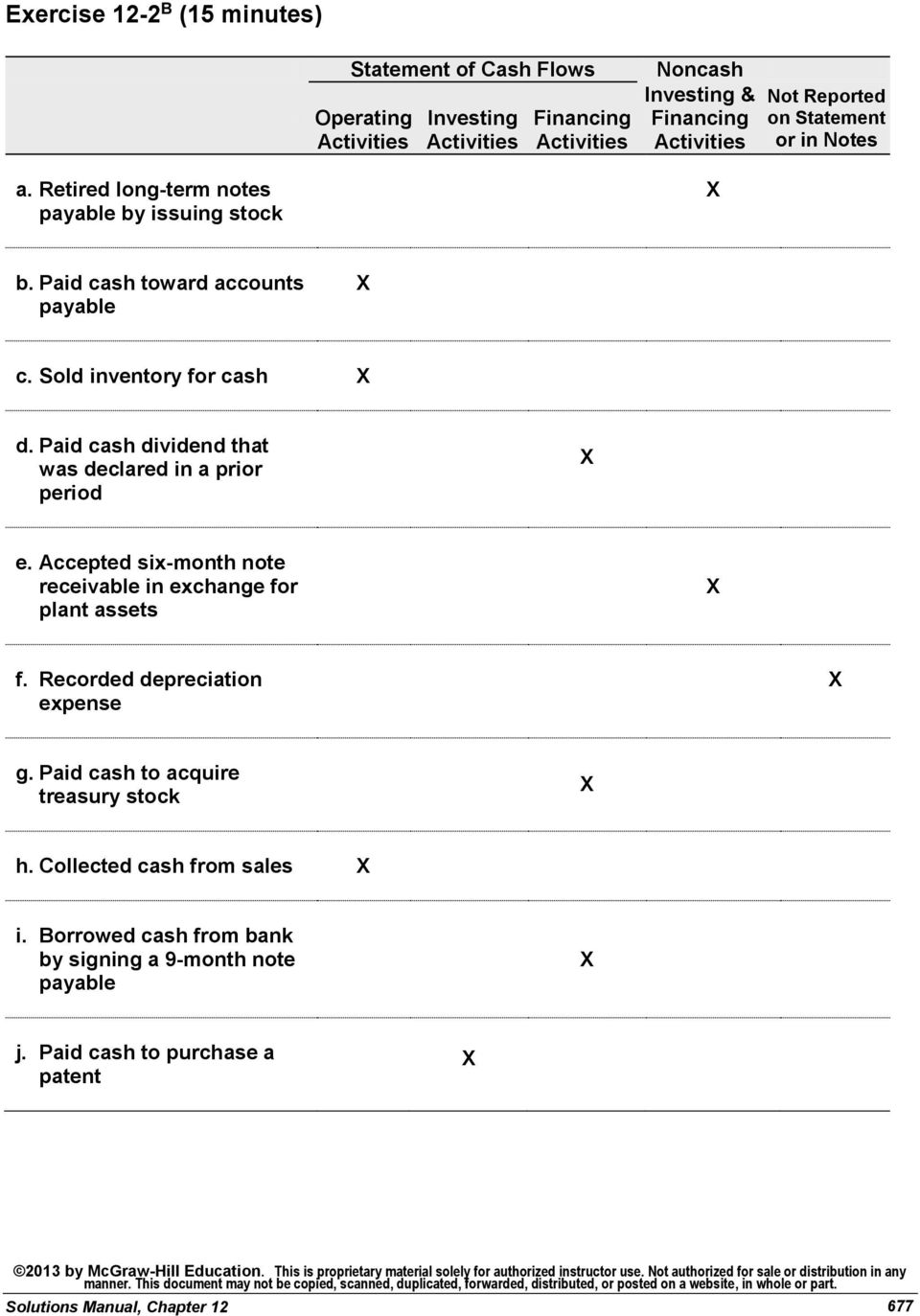
11 Exercise 12-2 B (15 minutes) a. Retired long-term notes payable by issuing stock Statement of Cash Flows Operating Activities Investing Activities Financing Activities Noncash Investing & Financing Activities X Not Reported on Statement or in Notes b. Paid cash toward accounts payable X c. Sold inventory for cash X d. Paid cash dividend that was declared in a prior period X e. Accepted six-month note receivable in exchange for plant assets X f. Recorded depreciation expense X g. Paid cash to acquire treasury stock X h. Collected cash from sales X i. Borrowed cash from bank by signing a 9-month note payable X j. Paid cash to purchase a patent X Solutions Manual, Chapter
12 Exercise 12-3 (20 minutes) Net income... $374,000 Adjustments to reconcile net income to net cash provided by operating activities Decrease in accounts receivable... 17,100 Decrease in merchandise inventory... 42,000 Increase in prepaid expenses... (4,700) Decrease in accounts payable... (8,200) Increase in other payables... 1,200 Depreciation expense... 44,000 Amortization expense... 7,200 Gain on sale of plant assets... (6,000) Net cash provided by operating activities... $466,600 Exercise 12-4 (10 minutes) Net income... $400,000 Adjustments to reconcile net income to operating cash flow Depreciation... $80,000 Accounts receivable increase... (40,000) Prepaid expense decrease... 12,000 Accounts payable increase... 6,000 Wages payable decrease... (2,000) Gain on sale of machinery... (20,000) 36,000 Net cash provided from operating activities... $436, Financial & Managerial Accounting, 5th Edition

13 Exercise 12-5 B (15 minutes) Case X: Sales revenue... $515,000 Accounts receivable, Dec. 31, $ 27,200 Accounts receivable, Dec. 31, (33,600) Less increase in accounts receivable... (6,400) Cash received from customers... $508,600 Case Y: Rent expense... $139,800 Rent payable, Dec. 31, $ 7,800 Rent payable, Dec. 31, (6,200) Plus decrease in rent payable... 1,600 Cash paid for rent... $141,400 Case Z: Cost of goods sold... $525,000 Merchandise inventory, Dec. 31, $130,400 Merchandise inventory, Dec. 31, (158,600) Less decrease in merch. inventory... (28,200) Cost of goods purchased ,800 Accounts payable, Dec. 31, ,000 Accounts payable, Dec. 31, (66,700) Less increase in accounts payable... (15,300) Cash paid for merchandise... $481,500 Exercise 12-6 (30 minutes) Net income... $ 481,540 Adjustments to reconcile net income to net cash provided by operating activities Increase in accounts receivable... (30,500) Increase in merchandise inventory... (25,000) Decrease in accounts payable... (12,500) Decrease in salaries payable... (3,500) Depreciation expense... 44,200 Amortization expense Patents... 4,200 Gain on sale of equipment... (6,200) Net cash provided by operating activities... $ 452,240 Solutions Manual, Chapter

14 Exercise 12-7 B (20 minutes) Receipts from customers (see note a)... $1,797,500 Payments for merchandise (see note b)... (1,028,500) Payments for salaries (see note c)... (249,035) Payments for rent... (49,600) Payments for utilities... (18,125) Net cash provided by operating activities... $ 452,240 Note a: Note b: Note c: Sales Increase in receivables $1,828,000 - $30,500 = $1,797,500 Cost of goods sold + Increase in inventory + Decrease in accounts payable $991,000 + $25,000 + $12,500 = $1,028,500 Salaries expense + Decrease in salaries payable $245,535 + $3,500 = $249,035 Exercise 12-8 (10 minutes) Cash flows from investing activities Cash received from the sale of equipment*... $ 51,300 Cash paid for new truck... (89,000) Cash received from the sale of land ,000 Cash received from the sale of long-term investments... 60,800 Net cash provided by investing activities... $221,100 * Cash received from sale of equipment = Book value - loss = $65,300 - $14,000 = $51,300 Exercise 12-9 (10 minutes) Cash flows from financing activities Sale of common stock... $ 64,000 Paid cash dividend... (14,600) Repaid note payable... (50,000) Purchased treasury stock... (12,000) Net cash used by financing activities... $(12,600) 680 Financial & Managerial Accounting, 5th Edition

15 Exercise (40 minutes) Part 1 IKIBAN, INC. Statement of Cash Flows (Indirect Method) For Year Ended June 30, 2013 Net income... $ 99,510 Adjustments to reconcile net income to net cash provided by operating activities Increase in accounts receivable... (14,000) Decrease in merchandise inventory... 22,700 Decrease in prepaid expenses... 1,000 Decrease in accounts payable... (5,000) Decrease in wages payable... (9,000) Decrease in income taxes payables... (400) Depreciation expense... 58,600 Gain on sale of plant assets... (2,000) Net cash provided by operating activities... $151,410 Cash flows from investing activities Cash received from sale of equip. (Note 1)... 10,000 Cash paid for equipment (Note 1 given)... (57,600) Net cash used in investing activities... (47,600) Cash flows from financing activities Cash received from stock issuance... 60,000 Cash paid to retire notes (Note 2 given)... (30,000) Cash paid for dividends (Note 3)... (90,310) Net cash used in financing activities... (60,310) Net increase in cash... $ 43,500 Cash balance at prior year-end... 44,000 Cash balance at current year-end... $ 87,500 (Notes 1, 2, and 3 on next page.) Solutions Manual, Chapter

16 Exercise (Part 1 continued) (1) Cost of equipment sold (Given)... $ 48,600 Accumulated depreciation of equipment sold*... (40,600) Book value of equipment sold... 8,000 Gain on sale of equipment (Given)... 2,000 Cash receipt from sale of equipment... $ 10,000 Cost of equipment sold... $ 48,600 Plus net increase in the equipment account balance... 9,000 Cash paid for new equipment (given)... $ 57,600 Equipment Accumulated Depreciation, Equipment Bal., 6/30/ ,000 Bal., 6/30/2012 9,000 Purchase 57,600 Sale 48,600 Sale (plug) *40,600 Depr. Expense 58,600 Bal., 6/30/ ,000 Bal., 6/30/ ,000 (2) Carrying value of notes retired... $ 30,000 Cash payment to retire notes... $ 30,000 (3) Retained Earnings Bal., 6/30/ ,100 Dividends (plug) 90,310 Net income 99,510 Bal., 6/30/ ,300 Part 2 Cash flow on total assets ratio = Operating cash flows / Average total assets = $151,410 / [($317,700 + $292,900)/2] = $151,410 / $305,300 = 49.6% Interpretation: A 49.6% result on the cash flow on total assets ratio is indicative of very good performance. Also, this favorably compares to its return on assets figure of 32.6% (high-quality earnings). 682 Financial & Managerial Accounting, 5th Edition

17 Exercise B (40 minutes) Part 1 IKIBAN, INC. Statement of Cash Flows (Direct Method) For Year Ended June 30, 2013 Cash received from customers (Note 1)... $664,000 Cash paid for merchandise (Note 2)... (393,300) Cash paid for operating expenses (Note 3)... (75,000) Cash paid for income taxes (Note 4)... (44,290) Net cash provided by operating activities... $151,410 Cash flows from investing activities Cash received from sale of equip. (Note 5)... 10,000 Cash paid for equipment (Note 5 given)... (57,600) Net cash used in investing activities... (47,600) Cash flows from financing activities Cash received from stock issuance... 60,000 Cash paid to retire notes (Note 6)... (30,000) Cash paid for dividends (Note 7)... (90,310) Net cash used in financing activities... (60,310) Net increase in cash... $ 43,500 Cash balance at prior year-end... 44,000 Cash balance at current year-end... $ 87,500 (See notes on next page) Solutions Manual, Chapter

18 Exercise B (continued) Notes (1) Sales... $678,000 Less increase in accounts receivable... (14,000) Cash received from customers... $664,000 (2) Cost of goods sold... $411,000 Less decrease in merchandise inventory... (22,700) Purchases ,300 Plus decrease in accounts payable... 5,000 Cash paid for merchandise... $393,300 (3) Other operating expenses... $ 67,000 Plus decrease in wages payable... 9,000 Less decrease in prepaid expenses... (1,000) Cash paid for other operating expenses... $ 75,000 (4) Income taxes expense... $ 43,890 Plus decrease in income taxes payable Cash paid for income taxes... $ 44,290 (5) Cost of equipment sold (Given)... $ 48,600 Accumulated depreciation of equipment sold*... (40,600) Book value of equipment sold... 8,000 Gain on sale of equipment... 2,000 Cash receipt from sale of equipment... $ 10,000 Cost of equipment sold... $ 48,600 Plus net increase in the equipment account balance... 9,000 Cash paid for new equipment (given)... $ 57,600 Equipment Accumulated Depreciation, Equipment Bal., 6/30/ ,000 Bal., 6/30/2012 9,000 Purchase 57,600 Sale 48,600 Sale *40,600 Depr. Expense 58,600 Bal., 6/30/ ,000 Bal., 6/30/ ,000 (6) Carrying value of notes retired... $ 30,000 Cash payment to retire notes... $ 30,000 (7) Retained Earnings Bal., 6/30/ ,100 Dividends (plug) 90,310 Net income 99,510 Bal., 6/30/ , Financial & Managerial Accounting, 5th Edition

19 Exercise (20 minutes) indirect method Net income... $ 24,000 Depreciation expense... 12,000 Accounts receivable increase...(10,000) Inventory decrease... 16,000 Salaries payable increase... 1,000 Net cash provided by operating activities... $ 43,000 Exercise (30 minutes) 1. indirect method Net income (loss)... $ (16,000) Depreciation expense... 14,600 Accounts receivable decrease... 24,000 Salaries payable increase... 18,000 Accrued liabilities decrease... (8,000) Net cash provided by operating activities... $ 32, One reason for the net loss was depreciation expense. Depreciation expense is added to net income to adjust for the effects of a noncash expense that was deducted in determining net income. It does not involve an inflow of cash. Depreciation expense, along with a decrease in accounts receivable and an increase in salaries payable, turned the net loss into positive operating cash flow. 3. Differences between cash flow from operations and net income can be caused by various items. The most important causes for investors are differences arising from: (1) changes in management of operating activities and (2) changes in revenue and expense recognition. Solutions Manual, Chapter

20 Exercise A (30 minutes) Balance sheet debit bal. accounts SCORETECK CORPORATION Spreadsheet for Statement of Cash Flows For Year Ended December 31, 2013 December 31, 2012 Analysis of Changes Debit Credit December 31, 2013 Cash... $ 80,000 $ 60,000 Accounts receivable ,000 (f) $ 70, ,000 Merchandise inventory ,000 (g) $ 20, ,000 Plant assets ,000 (d) 70, ,000 Balance sheet credit bal. accounts $1,050,000 $1,150,000 Accum. depreciation Plant assets... $ 100,000 (c) 70,000 $ 170,000 Accounts payable ,000 (h) 10, ,000 Notes payable ,000 (e) 20, ,000 Common stock , ,000 Retained earnings ,000 (b) 80,000 (a) 100, ,000 $1,050,000 $1,150,000 Statement of cash flows Operating activities Net income... (a) 100,000 Increase in accounts receivable... (f) 70,000 Decrease in merch. inventory... (g) 20,000 Decrease in accounts payable... (h) 10,000 Depreciation expense... (c) 70,000 Investing activities Payment for plant assets... (d) 70,000 Financing activities Paid cash dividends... (b) 80,000 Issued note payable... (e) 20,000 $440,000 $440, Financial & Managerial Accounting, 5th Edition

21 Exercise B (20 minutes) FERRON COMPANY Statement of Cash Flows For Year Ended December 31, 2013 Receipts from customers... $ 495,000 Receipts of interest... 3,500 Payments for merchandise... (254,500) Payments for salaries... (76,500) Payments for other expenses... (20,000) Net cash provided by operating activities... $147,500 Cash flows from investing activities Receipt from sale of equipment... 60,250 Payment for store equipment... (24,750) Net cash provided by investing activities... 35,500 Cash flows from financing activities Payment to retire long-term notes payable... (100,000) Receipt from borrowing on six-month note... 35,000 Payment of cash dividends... (10,000) Net cash used in financing activities... (75,000) Net increase in cash and cash equivalents... $108,000 Cash and cash equivalents at prior year-end... 40,000 Cash and cash equivalents at current year-end... $148,000 Note No. Noncash investing and financing activities (1) Issued common stock to retire $185,500 of bonds payable. (2) Purchased land financed with a $105,250 long-term note payable. Solutions Manual, Chapter
22 Exercise B (40 minutes) 1. THOMAS CORPORATION Statement of Cash Flows For Year Ended December 31, 2013 Cash received from customers... $5,000,000 Cash received from dividends ,400 Cash paid for merchandise... (2,590,000) Cash paid for wages... (550,000) Cash paid for rent... (320,000) Cash paid for interest... (218,000) Cash paid for taxes... (450,000) Net cash provided by operating activities... $1,080,400 Cash flows from investing activities Cash paid for purchases of machinery... (2,236,000) Cash paid for purchases of long-term investments... (1,260,000) Cash received from sale of land ,000 Cash received from sale of machinery ,000 Net cash used in investing activities... (2,566,000) Cash flows from financing activities Cash received from issuing stock... 1,540,000 Cash received from borrowing... 3,600,000 Cash paid for note payable... (386,000) Cash paid for dividends... (500,000) Cash paid for treasury stock purchases.... (218,000) Net cash provided by financing activities... 4,036,000 Net increase in cash... $2,550,400 Beginning balance of cash ,000 Ending balance of cash... $2,883, a. (i) Financing section reported the largest cash inflow of $4,036,000. (ii) Investing section reported the largest cash outflow of $2,566,000. b. The largest individual item among the investing cash outflows is the purchase of machinery at $2,236,000. c. Proceeds for issuing notes are larger at $3,600,000 than for issuing stock equity at $1,540,000 (see financing section). d. The company has a net cash inflow from borrowing. This is computed from the borrowing proceeds of $3,600,000 less the note payment of $386,000 (see financing section). 688 Financial & Managerial Accounting, 5th Edition
23 Exercise (15 minutes) 2012: $102,920 / $1,240,000 = 8.3% 2013: $138,920 / $1,510,000 = 9.2% Interpretation: Both years ratios are good in that they are positive and at reasonable levels (that is, most businesses can survive with annual returns at ~10%). Further, the ratio improved from 8.3% to 9.2%, which is a good increase. Exercise (20 minutes) PEUGEOT S.A. Statement of Cash Flows (Indirect Method) For Year Ended December 31, 2011 Net income Adjustments to reconcile net income to net cash provided by operating activities Net change (decrease) in working capital... (1,183) Depreciation and amortization... 3,037 Gains on disposals and other... (883) Net cash from operating activities... 1,755 Cash flows from investing activities Cash from disposal of plant assets & intangibles Cash paid for plant assets and intangibles... (3,921) Net cash used in investing activities... (3,732) Cash flows from financing activities Cash from purchases of treasury stock... (199) Cash paid for dividends... (290) Cash paid for other financing activities... (2,282) Net cash from financing activities... (2,771) Net decrease in cash... (4,748) Cash and cash equivalents, Dec 31, ,442 Cash and cash equivalents, Dec 31, ,694 Solutions Manual, Chapter
24 Problem 12-1A (50 minutes) Part 1 PROBLEM SET A FORTEN COMPANY Statement of Cash Flows For Year Ended December 31, 2013 Net income... $114,975 Adjustments to reconcile net income to net cash provided by operating activities: Increase in accounts receivable ($65,810 - $50,625)...(15,185) Increase in inventory ($275,656 - $251,800)...(23,856) Decrease in prepaid expenses ($1,875 - $1,250) Decrease in accounts payable ($114,675 - $53,141)...(61,534) Depreciation expense... 20,750 Loss on disposal of equipment... 5,125 Net cash provided by operating activities... $ 40,900 Cash flows from investing activities Cash received from sale of equipment... 11,625 Cash paid for equipment... (30,000) Net cash used in investing activities... (18,375) Cash flows from financing activities Cash borrowed on short-term note... 4,000 Cash paid on long-term note...(50,125) Cash received from issuing stock (2,500 x $20)... 50,000 Cash paid for dividends...(50,100) Net cash used in financing activities... (46,225) Net decrease in cash... $(23,700) Cash balance at December 31, ,500 Cash balance at December 31, $ 49,800 Noncash investing and financing activities Purchased equipment for $96,375 by signing a $66,375 long-term note payable and paying $30,000 in cash. 690 Financial & Managerial Accounting, 5th Edition
25 Problem 12-1A (Concluded) Part 2 Forten Company's operations provide a positive net cash inflow of $40,900 a good result. At the same time, the cash balance decreased by $23,700 (32%) during the year. Two major cash outflows are the retirement of debt ($50,125) and the dividend payment ($50,100), which together represent 87% of net income. Also, the $30,000 cash investment in equipment is presumably necessary to replace the older equipment sold. Helping fund these cash outflows is $50,000 cash from issuance of stock. Moreover, the company took on additional debt (more than 30% increase in indebtedness); namely, $66,375 in long-term notes. The company must recognize that that the debt must eventually be repaid with interest. In summary, perhaps the company should review the wisdom of paying cash dividends that are considerably larger than cash provided from operations, especially when the payment also results in a deteriorating cash position and when the company is taking on additional debt. Solutions Manual, Chapter
26 Problem 12-2A A (60 minutes) FORTEN COMPANY Spreadsheet for Statement of Cash Flows For Year Ended December 31, 2013 December Analysis of Changes 31, 2012 Debit December 31, 2013 Credit Balance sheet debits Cash... $ 73,500 $ 49,800 Accounts receivable... 50,625 (b) $15,185 65,810 Merchandise inventory ,800 (c) 23, ,656 Prepaid expenses... 1,875 (d) $ 625 1,250 Equipment ,000 (h) 96,375 (g) 46, ,500 $485,800 $550,016 Balance sheet--credits Accum. depreciation Equip.... $ 46,000 (g) 30,125 (f) 20,750 $ 36,625 Accounts payable ,675 (e) 61,534 53,141 Short-term notes payable... 6,000 (j) 4,000 10,000 Long-term notes payable... 48,750 (k) 50,125 (i) 66,375 65,000 Common stock, $5 par value ,250 (l) 12, ,750 Paid-in capital in excess of par value, common stock... 0 (l) 37,500 37,500 Retained earnings ,125 (m) 50,100 (a) 114, ,000 $485,800 $550,016 Statement of cash flows Operating activities Net income... (a) 114,975 Increase in accts. receivable... (b) 15,185 Increase in merch. inventory... (c) 23,856 Decrease in prepaid expenses... (d) 625 Decrease in accounts payable... (e) 61,534 Depreciation expense... (f) 20,750 Loss on sale of equipment... (g) 5,125 Investing activities Receipt from sale of equipment... (g) 11,625 Payment to purchase equipment... (h) 30,000 Financing activities Borrowed on short-term note... (j) 4,000 Payment on long-term note... (k) 50,125 Issued common stock for cash... (l) 50,000 Payments of cash dividends... (m) 50,100 Noncash investing and financing activities Purchase of equip. financed by long-term note payable... (i) 66,375 (h) 66,375 $600,775 $600, Financial & Managerial Accounting, 5th Edition
27 Problem 12-2A A (Concluded) FORTEN COMPANY Statement of Cash Flows For Year Ended December 31, 2013 Net income... $114,975 Adjustments to reconcile net income to net cash provided by operating activities: Increase in accounts receivable ($65,810 - $50,625)...(15,185) Increase in inventory ($275,656 - $251,800)...(23,856) Decrease in prepaid expenses ($1,875 - $1,250 ) Decrease in accounts payable ($114,675 - $53,141)...(61,534) Depreciation expense... 20,750 Loss on disposal of equipment... 5,125 Net cash provided by operating activities... $ 40,900 Cash flows from investing activities Cash received from sale of equipment... 11,625 Cash paid for equipment... (30,000) Net cash used in investing activities... (18,375) Cash flows from financing activities Cash borrowed on short-term note... 4,000 Cash paid on long-term note...(50,125) Cash received from issuing stock (2,500 x $20)... 50,000 Cash paid for dividends...(50,100) Net cash used in financing activities... (46,225) Net decrease in cash... $(23,700) Cash balance at beginning of ,500 Cash balance at end of $ 49,800 Noncash investing and financing activities Purchased equipment for $96,375 by signing a $66,375 long-term note payable and paying $30,000 in cash. Solutions Manual, Chapter
28 Problem 12-3A B (40 minutes) FORTEN COMPANY Statement of Cash Flows For Year Ended December 31, 2013 Cash received from customers (Note 1)... $567,315 Cash paid for merchandise (Note 2)... (370,390) Cash paid for other expenses (Note 3)... (131,775) Cash paid for income taxes... (24,250) Net cash provided by operating activities... $ 40,900 Cash flows from investing activities Cash received from sale of equipment... 11,625 Cash paid for equipment... (30,000) Net cash used in investing activities... (18,375) Cash flows from financing activities Cash borrowed on short-term note... 4,000 Cash paid on long-term note... (50,125) Cash received from issuing stock (2,500 x $20)... 50,000 Cash paid for dividends... (50,100) Net cash used in financing activities... (46,225) Net decrease in cash... $(23,700) Cash balance at December 31, ,500 Cash balance at December 31, $ 49,800 Noncash investing and financing activities Purchased equipment for $96,375 by signing a $66,375 long-term note payable and paying $30,000 in cash. Supporting calculations (1) Sales - Increase in receivables = $582,500 - ($65,810 - $50,625) = $567,315 (2) Cost of Increase in Decrease in + goods sold inventory + payables = $285,000 + ($275,656 - $251,800) + ($114,675 - $53,141) = $370,390 (3) Other expenses - Decrease in prepaid expenses = $132,400 - ($1,875 - $1,250) = $131, Financial & Managerial Accounting, 5th Edition
29 Problem 12-4A (35 minutes) GOLDEN CORPORATION Statement of Cash Flows For Year Ended December 31, 2013 Net income... $136,000 Adjustments to reconcile net income to net cash provided by operating activities Increase in accounts receivable ($83,000 - $71,000)... (12,000) Increase in inventory ($601,000 - $526,000)... (75,000) Increase in accounts payable ($87,000 - $71,000)... 16,000 Increase in taxes payable ($28,000 - $25,000)... 3,000 Depreciation expense... 54,000 Net cash provided by operating activities... $122,000 Cash flows from investing activities Cash paid for equipment... (36,000) Cash flows from financing activities Cash received from issuing stock (12,000 x $5)... 60,000 Cash paid for cash dividends... (89,000) Net cash used in financing activities... (29,000) Net increase in cash... $ 57,000 Cash balance at December 31, ,000 Cash balance at December 31, $164,000 Solutions Manual, Chapter
30 Problem 12-5A A (50 minutes) GOLDEN CORPORATION Spreadsheet for Statement of Cash Flows For Year Ended December 31, 2013 December 31, 2012 Analysis of Changes Debit Credit December 31, 2013 Balance sheet--debits Cash... $ 107,000 $ 164,000 Accounts receivable... 71,000 (b) $ 12,000 83,000 Merchandise inventory ,000 (c) 75, ,000 Equipment ,000 (g) 36, ,000 $1,003,000 $1,183,000 Balance sheet--credits Accum. depreciation Equip.... $ 104,000 (f) $ 54,000 $ 158,000 Accounts payable... 71,000 (d) 16,000 87,000 Income taxes payable... 25,000 (e) 3,000 28,000 Common stock, $2 par value ,000 (h) 24, ,000 Paid-in capital in excess of par value, common stock ,000 (h) 36, ,000 Retained earnings... 75,000 (i) 89,000 (a) 136, ,000 $1,003,000 $1,183,000 Statement of cash flows Operating activities Net income... (a) 136,000 Increase in accounts receivable... (b) 12,000 Increase in merch. inventory... (c) 75,000 Increase in accounts payable... (d) 16,000 Increase in income tax payable... (e) 3,000 Depreciation expense... (f) 54,000 Investing activities Payment for equipment... (g) 36,000 Financing activities Issued common stock for cash... (h) 60,000 Paid cash dividends... (i) 89,000 $481,000 $481, Financial & Managerial Accounting, 5th Edition
31 Problem 12-5A A (Concluded) GOLDEN CORPORATION Statement of Cash Flows For Year Ended December 31, 2013 Net income... $136,000 Adjustments to reconcile net income to net cash provided by operating activities Increase in accounts receivable ($83,000 - $71,000)... (12,000) Increase in inventory ($601,000 - $526,000)... (75,000) Increase in accounts payable ($87,000 - $71,000)... 16,000 Increase in taxes payable ($28,000 - $25,000)... 3,000 Depreciation expense... 54,000 Net cash provided by operating activities... $122,000 Cash flows from investing activities Cash paid for equipment... (36,000) Cash flows from financing activities Cash received from issuing stock (12,000 x $5)... 60,000 Cash paid for cash dividends... (89,000) Net cash used in financing activities... (29,000) Net increase in cash... $ 57,000 Cash balance at beginning of ,000 Cash balance at end of $164,000 Solutions Manual, Chapter
32 Problem 12-6A B (35 minutes) GOLDEN CORPORATION Statement of Cash Flows For Year Ended December 31, 2013 Cash received from customers (Note 1)... $1,780,000 Cash paid for merchandise (Note 2)... (1,145,000) Cash paid for other operating expenses... (494,000) Cash paid for income taxes (Note 3)... (19,000) Net cash provided by operating activities... $122,000 Cash flows from investing activities Cash paid for equipment... (36,000) Cash flows from financing activities Cash from issuing stock (12,000 x $5)... 60,000 Cash paid for cash dividends... (89,000) Net cash used in financing activities... (29,000) Net increase in cash... $ 57,000 Cash balance at December 31, ,000 Cash balance at December 31, $164,000 Supporting calculations (1) Sales - Increase in receivables = $1,792,000 - ($83,000 - $71,000) = $1,780,000 (2) Cost of Increase in Increase in goods sold + - inventory accounts payable = $1,086,000 + ($601,000 - $526,000) - ($87,000 - $71,000) = $1,145,000 (3) Income taxes expense - Increase in income taxes payable = $22,000 - ($28,000 - $25,000) = $19, Financial & Managerial Accounting, 5th Edition
33 Problem 12-7A (35 minutes) LANSING COMPANY Cash Flows from Operating Activities Indirect Method For Year Ended December 31, 2013 Net income... $ 6,000 Adjustments to reconcile net income to net cash provided by operating activities Depreciation expense... $12,000 Decrease in accounts receivable Increase in merchandise inventory... (440 ) Decrease in accounts payable... (200 ) Increase in salaries payable Increase in utilities payable Increase in prepaid rent... (40 ) Decrease in prepaid insurance ,780 Net cash provided by operating activities... $17,780 Solutions Manual, Chapter
34 Problem 12-8A B (35 minutes) LANSING COMPANY Cash Flows from Operating Activities Direct Method For Year Ended December 31, 2013 Cash receipts from customers (1)... $ 97,400 Cash payments to suppliers (2)... (42,640) ) Cash payments for salaries (3)... (17,820) ) Cash payments for rent (4)... (9,040) ) Cash payments for insurance (5)... (3,780) ) Cash payments for utilities (6)... (2,740) ) Cash payments for interest... (3,600) ) Net cash provided by operating activities... $ 17,780 Supporting calculations (1) Sales + Decrease in receivables = $97,200 + ($5,800 - $5,600) = $97,400 (2) Cost of + Increase in + Decrease in goods sold inventory accts payable = $42,000 + ($1,980 - $1,540) + ($4,600 - $4,400) = $42,640 (3) Salaries expense - Increase in salaries payable = $18,000 - ($880 - $700) = $17,820 (4) Rent expense + Increase in prepaid rent = $9,000 + ($220 - $180) = $9,040 (5) Insurance expense - Decrease in prepaid insurance = $3,800 - ($280 - $260) = $3,780 (6) Utilities expense - Increase in utilities payable = $2,800 - ($220 - $160) = $2, Financial & Managerial Accounting, 5th Edition
35 Problem 12-1B (40 minutes) Part 1 PROBLEM SET B GAZELLE CORPORATION Statement of Cash Flows For Year Ended December 31, 2013 Net income... $158,100 Adjustments to reconcile net income to net cash provided by operating activities Decrease in accounts receivable ($80,750 - $77,100)... 3,650 Decrease in inventory ($250,700 - $240,600)... 10,100 Decrease in prepaid expenses ($17,000 - $15,100)... 1,900 Decrease in accounts payable ($102,000 - $17,750)... (84,250) Depreciation expense... 38,600 Loss on disposal of equipment... 2,100 Net cash provided by operating activities... $130,200 Cash flows from investing activities Cash received from sale of equipment... 26,050 Cash paid for equipment... (43,250) Net cash used in investing activities... (17,200) Cash flows from financing activities Cash borrowed on short-term note... 5,000 Cash paid on long-term note... (47,500) Cash received from issuing stock (3,000 x $15)... 45,000 Cash paid for dividends... (53,600) Net cash used in financing activities... (51,100) ) Net increase in cash... $ 61,900 Cash balance at December 31, ,550 Cash balance at December 31, $123,450 Noncash investing and financing activities Purchased equipment for $113,250 by signing a $70,000 long-term note payable and paying $43,250 in cash. Solutions Manual, Chapter
36 Problem 12-1B (Continued) Part 2 Gazelle Corporation's dividend payments of $53,600 represent 34% of the $158,100 net income for the year, and 41% of cash inflow provided by operations of $130,200. Further analysis reveals that investing activities used a modest $17,200 and, including the dividends, financing activities used $51,100. This resulted in a $61,900 increase in the company's cash balance for the year, a 101% increase. Companies usually pay dividends that are substantially less than net income. The analysis of cash flows for this company indicates no reason to question the amount of the current dividend. Indeed, the liquidity position of the company did not deteriorate as a result of its cash dividend. 702 Financial & Managerial Accounting, 5th Edition
37 Problem 12-2B A (60 minutes) GAZELLE CORPORATION Spreadsheet for Statement of Cash Flows For Year Ended December 31, 2013 December Analysis of Changes December 31, 2012 Debit Credit 31, 2013 Balance sheet--debits Cash... $ 61,550 $123,450 Accounts receivable... 80,750 (b) $ 3,650 77,100 Merchandise inventory ,700 (c) 10, ,600 Prepaid expenses... 17,000 (d) 1,900 15,100 Equipment ,000 (h) $113,250 (g) 51, ,250 $610,000 $718,500 Balance sheet--credits Accum. depreciation Equip.... $ 95,000 (g) 22,850 (f) 38,600 $110,750 Accounts payable ,000 (e) 84,250 17,750 Short-term notes payable... 10,000 (j) 5,000 15,000 Long-term notes payable... 77,500 (k) 47,500 (i) 70, ,000 Common stock, $5 par value ,000 (l) 15, ,000 Paid-in capital in excess of par value, common stock... 0 (l) 30,000 30,000 Retained earnings ,500 (m) 53,600 (a) 158, ,000 $610,000 $718,500 Statement of cash flows Operating activities Net income... (a) 158,100 Decrease in accounts receivable... (b) 3,650 Decrease in merch. inventory... (c) 10,100 Decrease in prepaid expenses... (d) 1,900 Decrease in accounts payable... (e) 84,250 Depreciation expense... (f) 38,600 Loss on sale of equipment... (g) 2,100 Investing activities Receipt from sale of equipment... (g) 26,050 Payment to purchase equipment... (h) 43,250 Financing activities Borrowed on short-term note... (j) 5,000 Payment on long-term note... (k) 47,500 Issued common stock for cash... (l) 45,000 Payments of cash dividends... (m) 53,600 Noncash investing and financing activities Purchase of equip. financed by long-term note payable... (i) 70,000 (h) 70,000 $681,950 $681,950 Solutions Manual, Chapter
38 Problem 12-2B A (Concluded) GAZELLE CORPORATION Statement of Cash Flows For Year Ended December 31, 2013 Net income... $158,100 Adjustments to reconcile net income to net cash provided by operating activities Decrease in accounts receivable ($80,750 - $77,100)... 3,650 Decrease in inventory ($250,700 - $240,600)... 10,100 Decrease in prepaid expenses ($17,000 - $15,100)... 1,900 Decrease in accounts payable ($102,000 - $17,750)... (84,250) Depreciation expense... 38,600 Loss on disposal of equipment... 2,100 Net cash provided by operating activities... $130,200 Cash flows from investing activities Cash received from sale of equipment... 26,050 Cash paid for equipment... (43,250) Net cash used in investing activities... (17,200) Cash flows from financing activities Cash borrowed on short-term note... 5,000 Cash paid on long-term note... (47,500) Cash received from issuing stock (3,000 x $15)... 45,000 Cash paid for dividends... (53,600) Net cash used in financing activities... (51,100) Net increase in cash... $ 61,900 ) Cash balance at beginning of year ,550 Cash balance at end of year $123,450 Noncash investing and financing activities Purchased equipment for $113,250 by signing a $70,000 long-term note payable and paying $43,250 in cash. 704 Financial & Managerial Accounting, 5th Edition
39 Problem 12-3B B (40 minutes) GAZELLE CORPORATION Statement of Cash Flows For Year Ended December 31, 2013 Cash received from customers (Note 1)... $1,188,650 Cash paid for merchandise (Note 2)... (669,150) Cash paid for other expenses (Note 3)... (360,950) Cash paid for income taxes... (28,350) Net cash provided by operating activities... $130,200 Cash flows from investing activities Cash received from sale of equipment... 26,050 Cash paid for equipment... (43,250) Net cash used in investing activities... (17,200) Cash flows from financing activities Cash borrowed on short-term note... 5,000 Cash paid on long-term note... (47,500) Cash received from issuing stock (3,000 x $15)... 45,000 Cash paid for dividends... (53,600) Net cash used in financing activities... (51,100) Net increase in cash... $ 61,900 Cash balance at December 31, ,550 Cash balance at December 31, $123,450 Noncash investing and financing activities Purchased equipment for $113,250 by signing a $70,000 long-term note payable and paying $43,250 in cash. Supporting calculations (1) Sales + Decrease in receivables = $1,185,000 + ($80,750 - $77,100) = $1,188,650 (2) Cost of Decrease in Decrease in - goods sold inventory + payables = $595,000 - ($250,700 $240,600) + ($102,000 - $17,750) = $669,150 (3) Other expenses - Decrease in prepaid expenses = $362,850 - ($17,000 - $15,100) = $360,950 Solutions Manual, Chapter
40 Problem 12-4B (35 minutes) SATU COMPANY Statement of Cash Flows For Year Ended December 31, 2013 Net income... $202,767 Adjustments to reconcile net income to net cash provided by operating activities Decrease in accounts receivable ($25,860 - $20,222)... 5,638 Increase in inventory ($165,667 - $140,320)... (25,347) Decrease in accounts payable ($157,530 - $20,372)... (137,158) Decrease in taxes payable ($6,100 - $2,100)... (4,000) Depreciation expense... 15,700 Net cash provided by operating activities... $ 57,600 Cash flows from investing activities Cash paid for equipment... (30,250) Cash flows from financing activities Cash received from issuing stock (3,000 x $21)... 63,000 Cash paid for dividends... (60,000) Net cash provided by financing activities... 3,000 Net increase in cash... $ 30,350 Cash balance at December 31, ,400 Cash balance at December 31, $ 58, Financial & Managerial Accounting, 5th Edition
41 Problem 12-5B A (50 minutes) SATU COMPANY Spreadsheet for Statement of Cash Flows For Year Ended December 31, 2013 December Analysis of Changes December 31, 2012 Debit Credit 31, 2013 Balance sheet--debits Cash... $ 28,400 $ 58,750 Accounts receivable... 25,860 (b) $ 5,638 20,222 Merchandise inventory ,320 (c) $ 25, ,667 Equipment... 77,500 (g) 30, ,750 $272,080 $352,389 Balance sheet--credits Accum. depreciation Equip.... $ 31,000 (f) 15,700 $ 46,700 Accounts payable ,530 (d) 137,158 20,372 Income taxes payable... 6,100 (e) 4,000 2,100 Common stock, $5 par value... 25,000 (h) 15,000 40,000 Paid-in capital in excess of par value, common stock... 20,000 (h) 48,000 68,000 Retained earnings... 32,450 (i) 60,000 (a) 202, ,217 $272,080 $352,389 Statement of cash flows Operating activities Net income... (a) 202,767 Decrease in accounts receivable... (b) 5,638 Increase in merch. inventory... (c) 25,347 Decrease in accounts payable... (d) 137,158 Decrease in income taxes payable... (e) 4,000 Depreciation expense... (f) 15,700 Investing activities Payment for equipment... (g) 30,250 Financing activities Issued common stock for cash... (h) 63,000 Paid cash dividends... (i) 60,000 $543,860 $543,860 Solutions Manual, Chapter
42 Problem 12-5B A (concluded) SATU COMPANY Statement of Cash Flows For Year Ended December 31, 2013 Net income... $202,767 Adjustments to reconcile net income to net cash provided by operating activities Decrease in accounts receivable ($25,860 - $20,222)... 5,638 Increase in inventory ($165,667 - $140,320)... (25,347) Decrease in accounts payable ($157,530 - $20,372)... (137,158) Decrease in taxes payable ($6,100 - $2,100)... (4,000) Depreciation expense... 15,700 Net cash provided by operating activities... $ 57,600 Cash flows from investing activities Cash paid for equipment... (30,250) Cash flows from financing activities Cash received from issuing stock (3,000 x $21)... 63,000 Cash paid for dividends... (60,000) Net cash provided by financing activities... 3,000 Net increase in cash... $ 30,350 Cash balance at beginning of ,400 Cash balance at end of $ 58, Financial & Managerial Accounting, 5th Edition
43 Problem 12-6B B (35 minutes) SATU COMPANY Statement of Cash Flows For Year Ended December 31, 2013 Cash received from customers (Note 1)... $756,438 Cash paid for merchandise (Note 2)... (431,705) Cash paid for other operating expenses... (173,933) Cash paid for income taxes (Note 3)... (93,200) Net cash provided by operating activities... $57,600 Cash flows from investing activities Cash paid for equipment... (30,250) Cash flows from financing activities Cash received from issuing stock (3,000 x $21)... 63,000 Cash paid for cash dividends... (60,000) Net cash provided by financing activities... 3,000 Net increase in cash... $30,350 Cash balance at December 31, ,400 Cash balance at December 31, $58,750 Supporting calculations (1) Sales + Decrease in receivables = $750,800 + ($25,860 - $20,222) = $756,438 (2) Cost of + Increase in Decrease in goods sold inventory + accounts payable = $269,200 + ($165,667 - $140,320) + ($157,530 - $20,372) = $431,705 (3) Income taxes expense + Decrease in income taxes payable = $89,200 + ($6,100 - $2,100) = $93,200 Solutions Manual, Chapter
44 Problem 12-7B (35 minutes) SALT LAKE COMPANY Cash Flows from Operating Activities Indirect Method For Year Ended December 31, 2013 Net income... $ 20,000 Adjustments to reconcile net income to net cash provided by operating activities Depreciation expense... $32,000 Increase in accounts receivable... (600 ) Decrease in merchandise inventory Decrease in accounts payable... (200 ) Increase in salaries payable Increase in utilities payable Decrease in prepaid insurance Decrease in prepaid rent ,960 Net cash provided by operating activities... $ 51, Financial & Managerial Accounting, 5th Edition
45 Problem 12-8B B (35 minutes) SALT LAKE COMPANY Cash Flows from Operating Activities Direct Method For Year Ended December 31, 2013 Cash receipts from customers (1)... $ 155,400 Cash payments to suppliers (2)... (72,080) Cash payments for salaries (3)... (19,700) Cash payments for rent (4)... (4,900 ) Cash payments for insurance (5)... (2,560 ) Cash payments for utilities (6)... (1,800 ) Cash payments for interest... (2,400 ) Net cash provided by operating activities... $ 51,960 Supporting calculations (1) Sales - Increase in receivables = $156,000 - ($3,600 - $3,000) = $155,400 (2) Cost of Decrease in Decrease in goods sold - inventory + accounts payable = $72,000 - ($980 - $860) + ($2,600 - $2,400) = $72,080 (3) Salaries expense - Increase in salaries payable = $20,000 - ($900- $600) = $19,700 (4) Rent expense - Decrease in prepaid rent = $5,000 - ($200- $100) = $4,900 (5) Insurance expense - Decrease in prepaid insurance = $2,600 - ($180- $140) = $2,560 (6) Utilities expense - Increase in utilities payable = $2,000 - ($200- $0) = $1,800 Solutions Manual, Chapter
46 SERIAL PROBLEM SP 12 Serial Problem SP 12, Success Systems (45 minutes) SUCCESS SYSTEMS Statement of Cash Flows (Indirect) For Quarter Ended March 31, 2014 Net income... $ 18,686 Adjustments to reconcile net income to net cash provided by operating activities Increase in accounts receivable ($22,720 - $5,668)... (17,052) Increase in inventory ($704 - $0)... (704) Increase in computer supplies ($2,005 - $580)... (1,425) Decrease in prepaid insurance ($1,665 - $1,110) Decrease in accounts payable ($1,100 - $0)... (1,100) Increase in wages payable ($875 - $500) Decrease in unearned computer service revenue... (1,500) Depreciation expense Office Equipment Depreciation expense Computer Equipment... 1,250 Net cash used by operating activities... $ (515) Cash flows from investing activities Net cash used in investing activities... 0 Cash flows from financing activities Cash received from stock issuance... 25,000 Cash paid for dividends... (4,800) Net cash provided by financing activities... 20,200 Net increase in cash... $ 19,685 Cash balance at December 31, ,160 Cash balance at March 31, $ 77, Financial & Managerial Accounting, 5th Edition
47 Reporting in Action BTN Polaris uses the indirect method of reporting operating cash flows. We readily know this because the operating activity section of the cash flow statement starts with net income, and makes adjustments for items such as depreciation and changes in working capital. 2. In all three years, Polaris s cash flows from operating activities markedly exceed the cash dividends paid, as can be seen from the table below: ($ thousands) Cash provided by operating activities... $302,530 $297,619 $193,201 Cash dividends paid...(61,585) (53,043) (50,177) 3. In 2011, the largest item in reconciling the difference between net income and cash flow from operations was the change (increase) in accrued expenses of $80,668 thousand. In 2010, the largest item in reconciling the difference between net income and cash flow from operations was the change (increase) in accrued expenses of $107,363 thousand. In 2009, the largest item in reconciling the difference between net income and cash flow from operations was depreciation and amortization of $64,593 thousand. 4. In 2011, the largest cash inflow from investing activities was $11,950 thousand from distributions from financing affiliate. The largest cash outflow from investing activities was for acquisitions of property and equipment, in the amount of $84,484 thousand. In 2011, the largest cash inflow from financing activities was $100,000 thousand from borrowings under credit agreement/senior notes. The largest cash outflow from financing activities was $202,333 thousand repayments under credit agreement. In 2010, the largest cash inflow from investing activities was $17,910 thousand from distributions from financing affiliate. The largest cash outflow from investing activities was for acquisition of property and equipment, in the amount of $55,718 thousand. In 2010, the largest cash inflow from financing activities was $68,105 thousand from proceeds from stock issuances under employee plans. The largest cash outflow from financing activities was $53,043 thousand for cash dividends to shareholders. 5. Answer depends on the financial statement information obtained. Solutions Manual, Chapter
48 Comparative Analysis BTN Polaris s cash flow on total assets ratio ($ thousands) Current Year Prior Year = Operating cash flows/average total assets = $302,530 / [($1,228,024 + $1,061,647)/2] = $302,530 / $1,144,836 = 26.4% = Operating cash flows/average total assets = $297,619 / [($1,061,647 + $763,653)/2] = $297,619 / $912,650 = 32.6% Arctic Cat s cash flow on total assets ratio ($ thousands) Current Year Prior Year = Operating cash flows/average total assets = $(5,123) / [($272,906 + $246,084)/2] = $(5,123) / $259,495 = (2.0%) = Operating cash flows/average total assets = $29,315 / ($246,084+ $251,165)/2] = $29,315 / $248,624.5 = 11.8% 2. The cash flow on total assets ratio reflects the return on average assets by using actual operating cash flows instead of net income. This return calculation is not affected by the accounting constraints of recognition and measurement of revenues and expenses. Instead, it is based solely on operating cash flows (which has its own strengths and weaknesses). 3. For both years, Polaris has a higher cash flow on total assets ratio than Arctic Cat. 4. Many business decision makers (such as analysts) feel that the cash flow on total assets ratio is one indicator of earnings quality in that it is a measure of the ability of the company to realize its net income in the form of cash for the period under analysis. 714 Financial & Managerial Accounting, 5th Edition
49 Ethics Challenge BTN The business actions available include a. Encourage early collection of receivables to reduce the accounts receivable balance. b. Defer payments to vendors due as of year-end to increase the accounts payable balance. c. Defer any other payments of operating expenses due near the year-end to improve the level of cash flow from operations. Many other business actions are possible that would accelerate cash receipts and/or delay cash payments. 2. As a business owner, Katie Murphy certainly can exercise discretion over business actions. However, the underlying economic realities should support any proposed actions. It is not ethical to pursue actions that purposely mislead users of financial statements. In addition, Katie Murphy s actions may be transparent to the banker when s/he reviews the financial records of the business. If so, her reputation may suffer in the eyes of her banker and she may jeopardize her ability to obtain bank financing in the future or increase the cost of that financing. Solutions Manual, Chapter
50 Communicating in Practice BTN 12-4 Here is a sample of what the body of the memorandum might include: TO: Diana Wood FROM: (Your Name) SUBJECT: Statement of Cash Flows DATE: I am pleased to hear your business is more profitable this year than last. However, I have been thinking about what you said regarding the statement of cash flows and have some thoughts as to why you found it confusing. The statement of cash flows (operating section) can be prepared using either of two methods the direct or the indirect method. From what you describe, your statement is probably prepared using the indirect method. This method shows a determination of net cash flows in the operating (first) section by listing the net income number and applying a series of accounting adjustments. These adjustments often do not make sense to those that do not have an accounting or finance background. I recommend that you request your accountant to provide you with a statement of cash flows that is prepared using the direct method. This will identify exactly how much cash came in from operating activities like sales. It will also identify exactly how much cash went out for operating expenses like merchandise, wages, interest, and taxes. It will determine your net operating cash flow by directly subtracting the total of these operating outflows from the inflows. You should find this format more understandable. Note that good cash management is essential to business success and growth. The statement of cash flows will provide you with a lot more information regarding your cash than a balance sheet can offer. It will allow you to see exactly where your cash came from, where it went, and how much it changed. It organizes these amounts into categories of operating, financing, and investing. This organization of cash information will allow you to better project and plan for the future. Please reconsider the value of the statement of cash flows for your business decisions. If you wish to discuss this further, please call me. 716 Financial & Managerial Accounting, 5th Edition
51 Taking It to the Net BTN Mendocino Brewing Company uses the indirect method to construct the consolidated statement of cash flows. 2. The largest reconciling item is for depreciation and amortization totaling $1,488, The following table shows the net income (or net loss) and the cash flows from operations for Mendocino Brewing for 2010 and Over this twoyear period, Mendocino has generated more positive cash flows from operations (relative to its net income); indeed, its operating cash flows have been consistently positive and markedly larger than net income over this period Net income (loss)... $ 49,400 $(1,078,500) Cash flows from operations... 1,412,600 1,011, For the recent period, the largest cash outflow for investing was $1,025,900 for purchases of property, equipment and leasehold improvements. For the recent period, the largest cash outflow for financing was $3,694,200 for repayment on long-term notes. 5. In the recent period, for supplementary cash flow information, the company reports cash flows related to: Interest paid, and Income taxes paid. 6. Yes, the company reports non-cash financing information related to Common stock issued to satisfy liabilities. Solutions Manual, Chapter
52 * Teamwork in Action BTN 12-6 Part 1 a. The reporting objective of the statement of cash flows is to provide information about important cash inflows and outflows for business decision makers. It answers specific questions such as: How does a company obtain its cash? Where does a company spend its cash? What is the change in the cash balance? b. The statement can be prepared using the direct method or the indirect method for reporting cash flows from operating activities. Similarities Both methods report the same net cash flow from operating activities. Both methods classify cash flows into operating, financing, and investing categories. Both methods provide exactly the same information in the financing and investing categories. Both identify the change in cash, beginning cash, and ending cash. Both are acceptable methods for financial reporting. Differences Cash flow from operating activities is determined differently. The direct method determines all operating cash inflows and outflows, and then subtracts total operating outflows from inflows. The indirect method starts with net income and applies a series of adjustments to reconcile this accrual basis number to a cash basis number. The direct method requires an extra section reconciling net income to cash flows from operating activities. The direct method is recommended by the FASB. The indirect method is more widely used. 718 Financial & Managerial Accounting, 5th Edition
53 Teamwork in Action (Continued) c. Steps to prepare the statement of cash flows: (i) Compute the net increase or decrease in cash using comparative balance sheet data. This is the target number or the number the statement will explain and prove. (ii) Compute net cash flow in operating activities using the direct or indirect method. (iii) Compute net cash flows from investing activities. (iv) Compute net cash flows from financing activities. (v) Prove that the net cash flow from the three categories combined equals the net change in cash. List the beginning and ending cash balances to prove this. Also, identify and list noncash financing and investing activities in a separate schedule or note. d. Common analyses made from information in the statement of cash flows include assessing a company s: Ability to generate future cash flows. Ability to pay dividends. Ability to meet obligations. Ability to expand operations. Ability to obtain financing. Cash flow on total assets ratio. Sources and uses of cash flows. Part 2 Adjusting Net Income to Cash Flow from Operating Activities Items to Add Items to Subtract a. Noncash expenses Noncash revenues b. Losses Gains c. Decreases in current assets Increases in current assets d. Increases in current liabilities Decreases in current liabilities Solutions Manual, Chapter
54 Teamwork in Action (Concluded) Part 3 a. Cash receipts from customers = Sales - Increase in Accounts Receivable, or, + Decrease in Accounts Receivable. Explanation: Sales reflects what is earned during the period. If Accounts Receivable increases, that increase represents earnings not yet collected, so we subtract it. If Accounts Receivable decreases, the entity collected that much more than the period s sales, so we add it. b. Cash paid for merchandise requires a two-step computation. (1) Purchases = Cost of goods sold + Increase in inventory, or, Decrease in inventory. (2) Cash paid for merchandise = Purchases + Decrease in Accounts Payable, or, Increase in Accounts Payable. Explanation for (1): If inventory increases, the entity bought more than was sold, so we add it. If inventory decreases, the entity bought less than was sold, so we subtract it. Explanation for (2): If Accounts Payable decreases, the entity paid for more than the period s purchases, so we add it. If Accounts Payable increases, the entity paid for less than the period s purchases, so we subtract it. c. Cash paid for wages and operating expenses = Wages and other operating expenses [+ Increase in prepaid expenses, or, Decrease in prepaid expenses] and [+ Decrease in accrued liabilities, or, Increase in accrued liabilities]. Explanation: If prepaid expenses increase, the entity paid for more than was incurred, so we add it. If prepaid expenses decrease, the entity paid for less than was incurred, so we subtract it. Also, if the accrued liabilities increase, the expense includes an amount not yet paid for, so we subtract it. If the accrued liabilities decrease, the entity paid for more than the period s expenses, so we add it. d. Cash paid for interest and taxes = Interest and tax expense + Decrease in related payable, or, Increase in related payable. Explanation: If the related payable decreases, the entity paid for more than was incurred, so we add it. If the related payable increases, the entity paid for less than was incurred, so we subtract it. 720 Financial & Managerial Accounting, 5th Edition
55 Entrepreneurial Decision BTN It is common that small businesses must pay cash in advance for items such as rent, advertising, supplies, and facilities expansion. Consequently, those costs are usually recorded before revenues are earned, and before those revenues are ultimately collected in cash. If the business does not carefully plan, it is possible that it could show a positive net income, but not be able to effectively operate because it has little or no cash to pay its suppliers, creditors, and others to whom it owes money. 2. As a privately held corporation, TOMS can potentially raise cash financing for expansion by selling shares in the company or by borrowing the monies. TOMS is not a publicly traded company, so the potential to raise capital by selling stock is somewhat restricted. Moreover, potential lenders will want to evaluate the future profitability, cash flows, and solvency of the company before lending money. Entrepreneurial Decision BTN 12-8 Memorandum To: Jenna and Matt Wilder From: Your name Subject: Performance evaluation of Mountain High Date: Current Date I have completed my evaluation of your company, Mountain High. My conclusion is that Mountain High is performing well. This is in spite of its reported net loss and its negative net cash flow, which I explain in this memorandum. First, with respect to the net loss, please note that it includes an $85,000 extraordinary loss. Absent this extraordinary loss, Mountain High would report a $75,000 net income. Using year-end total assets, Mountain High s return on assets would be roughly 9.4% (computed as $75,000 divided by $800,000). This return is reasonable for a company in its second year of operations. Second, with respect to its net cash outflow of $(5,000), please note that this is mainly due to Mountain High s renovation and expansion activities. This is reflected in its summarized statement of cash flows. Specifically, its cash flows provided by operating activities are an impressive $295,000. Again, using yearend total assets of $800,000, Mountain High s operating cash flow on total assets ratio is roughly 36.9%. This return is especially good for a company s second year of operations. Consequently, my evaluation is positive. Operating cash flows are very good and attention should be directed at maintaining or increasing these amounts. Also, income from continuing operations is a reasonable $75,000. Still, given the high operating cash flows relative to income from continuing operations, special scrutiny should be directed at identifying and assessing differences between cash flow and accrual amounts for important individual operating activities. Solutions Manual, Chapter
56 Hitting the Road BTN The Motley Fool s Website defines cash flow as earnings before interest, taxes, depreciation, and amortization (EBITDA). The school s justification for this definition includes: Interest income and expense, as well as taxes, are all tossed aside because cash flow is designed to focus on the operating business and not secondary costs or profits As for depreciation and amortization, these are called non-cash charges, as the company is not actually spending any money on them. Rather, depreciation is an accounting convention for tax purposes that allows companies to get a break on capital expenditures as plant and equipment ages and becomes less useful. Amortization normally comes in when a company acquires another company at a premium to its shareholder's equity -- a number that it accounts for on its balance sheet as goodwill and is forced to amortize over a set period of time, according to generally accepted accounting principles (GAAP). When looking at a company's operating cash flow, it makes sense to toss aside accounting conventions that might mask cash strength. 2. Some analysts tend to focus on this particular earnings definition (earnings before interest and taxes or EBIT) as it purportedly allows a focus on a company s real operating situation. For example, taxes can depend on laws and can fluctuate from year to year. By using the earnings before interest and taxes, the noise caused by such fluctuations is minimized. 3. Answer depends on the links visited and chosen for the report. Global Decision BTN Piaggio s cash flow on total assets ratio follows (in Euro thousands): Current Year = Operating cash flows / Average total assets = 155,624 / [( 1,520, ,545,722)/2] = 155,624 / 1,532,593 = 10.2% Prior Year = Operating cash flows / Average total assets = 122,541 / [( 1,545, ,564,820)/2] = 122,541 / 1,555,271 = 7.9% 2. For the current year, Piaggio s ratio (10.2%) is lower than Polaris s (26.4%) and higher than Arctic Cat s (-2.0%) ratio. In the prior year, Piaggio s ratio (7.9%) was also lower than Polaris s (32.6%) and Arctic Cat s (11.8%) ratio. 722 Financial & Managerial Accounting, 5th Edition
COMPONENTS OF THE STATEMENT OF CASH FLOWS
 ILLUSTRATION 24-1 OPERATING, INVESTING, AND FINANCING ACTIVITIES COMPONENTS OF THE STATEMENT OF CASH FLOWS CASH FLOWS FROM OPERATING ACTIVITIES + Sales and Service Revenue Received Cost of Sales Paid Selling
ACC 255 FINAL EXAM REVIEW PACKET (NEW MATERIAL)
 Page 1 ACC 255 FINAL EXAM REVIEW PACKET (NEW MATERIAL) Complete these sample exam problems/objective questions and check your answers with the solutions at the end of the review file and identify where
Statement of Cash Flows
 THE CONTENT AND VALUE OF THE STATEMENT OF CASH FLOWS The cash flow statement reconciles beginning and ending cash by presenting the cash receipts and cash disbursements of an enterprise for an accounting
CHAPTER 23. Statement of Cash Flows 1, 2, 7, 8, 12 3, 4, 5, 6, 16, 17, 19 9, 20 4, 5, 9, 10, 11 10, 13, 15, 16. 7. Worksheet adjustments.
 CHAPTER 23 Statement of Cash Flows ASSIGNMENT CLASSIFICATION TABLE (BY TOPIC) Topics Questions Brief Exercises Exercises Problems Concepts for Analysis 1. Format, objectives purpose, and source of statement.
Chapter 21 The Statement of Cash Flows Revisited
 Chapter 21 The Statement of Cash Flows Revisited AACSB assurance of learning standards in accounting and business education require documentation of outcomes assessment. Although schools, departments,
CH 23 STATEMENT OF CASH FLOWS SELF-STUDY QUESTIONS
 C H 2 3, P a g e 1 CH 23 STATEMENT OF CASH FLOWS SELF-STUDY QUESTIONS (note from Dr. N: I have deleted questions for you to omit, but did not renumber the remaining questions) 1. The primary purpose of
Chapter 6 Statement of Cash Flows
 Chapter 6 Statement of Cash Flows The Statement of Cash Flows describes the cash inflows and outflows for the firm based upon three categories of activities. Operating Activities: Generally include transactions
STATEMENT OF CASH FLOWS AND WORKING CAPITAL ANALYSIS
 C H A P T E R 1 0 STATEMENT OF CASH FLOWS AND WORKING CAPITAL ANALYSIS I N T R O D U C T I O N Historically, profit-oriented businesses have used the accrual basis of accounting in which the income statement,
The Statement of Cash Flows
 CHAPTER The Statement of Cash Flows OBJECTIVES After careful study of this chapter, you will be able to: 1. Define operating, investing, and financing activities. 2. Know the categories of inflows and
> DO IT! Chapter 13. Classification of Cash Flows. Cash from Operating Activities D-1. Solution. Action Plan
 Chapter 13 > DO IT! Classification of Cash Flows Identify the three types of activities used to report all cash inflows and outflows. Report as operating activities the cash effects of transactions that
Cash is King. cash flow is less likely to be affected
 Reading 27: Understanding Cash Flow Statements Relevance of Cash Flow The primary purpose of the statement of cash flows (SCF) is to provide: Info about a firm s cash receipts & cash payments during an
Section A: Questions On Fill In The Blanks
 Section A : 26 FILL IN THE BLANK Section B : 10 TRUE OR FALSE QUESTIONS Section C : 11 Multiple Choice Questions Section A: Questions Fill In The Blanks the right column please insert the items from which
SOLUTIONS. Learning Goal 15
 Learning Goal 15: Prepare a Classified S1 Learning Goal 15 Multiple Choice 1. b 2. c 3. a 4. b 5. d 6. a 7. c Their importance in paying current liabilities is the main reason current assets are shown
Statement of Cash Flows
 PREPARING THE STATEMENT OF CASH FLOWS: THE INDIRECT METHOD OF REPORTING CASH FLOWS FROM OPERATING ACTIVITIES The work sheet method described in the text book is not the recommended approach. We will provide
In this chapter, we build on the basic knowledge of how businesses
 03-Seidman.qxd 5/15/04 11:52 AM Page 41 3 An Introduction to Business Financial Statements In this chapter, we build on the basic knowledge of how businesses are financed by looking at how firms organize
Chapter 14. 1 Copyright 2012 Pearson Education, Inc. Publishing as Prentice Hall.
 Chapter 14 1 Identify the purposes of the statement of cash flows Distinguish among operating, investing, and financing cash flows Prepare the statement of cash flows by the indirect method Identify noncash
Statement of Cash Flow
 Management Accounting 337 Statement of Cash Flow Cash is obviously an important asset to all, both individually and in business. A shortage or lack of cash may mean an inability to purchase needed inventory
EXERCISES. The cash from operating activities detail is provided as follows for class discussion:
 EXERCISES Ex. 14 1 There were net additions, such as depreciation and amortization of intangible assets of $389 million, to the net loss reported on the income statement to convert the net loss from the
This week its Accounting and Beyond
 This week its Accounting and Beyond Monday Morning Session Introduction/Accounting Cycle Afternoon Session Tuesday The Balance Sheet Wednesday The Income Statement The Cash Flow Statement Thursday Tools
2-8. Identify whether each of the following items increases or decreases cash flow:
 Problems 2-8. Identify whether each of the following items increases or decreases cash flow: Increase in accounts receivable Increase in notes payable Depreciation expense Increase in investments Decrease
CASH FLOW STATEMENT (AND FINANCIAL STATEMENT)
 CASH FLOW STATEMENT (AND FINANCIAL STATEMENT) - At the most fundamental level, firms do two different things: (i) They generate cash (ii) They spend it. Cash is generated by selling a product, an asset
Understanding Cash Flow Statements
 Understanding Cash Flow Statements 2014 Level I Financial Reporting and Analysis IFT Notes for the CFA exam Contents 1. Introduction... 3 2. Components and Format of the Cash Flow Statement... 3 3. The
how to prepare a cash flow statement
 business builder 4 how to prepare a cash flow statement zions business resource center zions business resource center 2 how to prepare a cash flow statement A cash flow statement is important to your business
Cash Flow Analysis. 15.511 Corporate Accounting Summer 2004. Professor SP Kothari. Sloan School of Management Massachusetts Institute of Technology
 Cash Flow Analysis 15.511 Corporate Accounting Summer 2004 Professor SP Kothari Sloan School of Management Massachusetts Institute of Technology June 16, 2004 1 Statement of Cash Flows Reports operating
Understanding A Firm s Financial Statements
 CHAPTER OUTLINE Spotlight: J&S Construction Company (http://www.jsconstruction.com) 1 The Lemonade Kids Financial statement (accounting statements) reports of a firm s financial performance and resources,
CASH FLOW STATEMENT. MODULE - 6A Analysis of Financial Statements. Cash Flow Statement. Notes
 MODULE - 6A Cash Flow Statement 30 CASH FLOW STATEMENT In the previous lesson, you have learnt various types of analysis of financial statements and its tools such as comparative statements, common size
Consolidated Balance Sheets
 Consolidated Balance Sheets March 31 2015 2014 2015 Assets: Current assets Cash and cash equivalents 726,888 604,571 $ 6,057,400 Marketable securities 19,033 16,635 158,608 Notes and accounts receivable:
Chapter 1. Introduction to Accounting and Business
 1 Chapter 1 Introduction to Accounting and Business Learning Objective 1 Describe the nature of a business, the role of accounting, and ethics in business. Nature of Business and Accounting A business
Course pack Accounting 202 Chapter 13: Cash Flow Statement
 Course pack Accounting 202 Chapter 13: Cash Flow Statement Value Chapter Included 13 Purpose of Cash Flow Understand Operating, Investing, Financing activities Prepare a Cash Flow Statement indirect only
T-Account Approach to Preparing a Statement of Cash Flows Indirect Method
 266 Part 1 E M Foundations of Financial Accounting With these adjustments to the income statement, we can now present the operating activities section of the statement of cash flows using either the direct
Statement of Cash Flows: Reporting and Analysis
 Statement of Cash Flows: Reporting and Analysis Statement of Cash Flows: Reporting and Analysis Copyright 2014 by DELTACPE LLC All rights reserved. No part of this course may be reproduced in any form
TOPIC LEARNING OBJECTIVE
 Topic Mapping 1 Transaction Analysis Understand the effect of various types of transactions on the accounting equation, accounting journal and accounting ledger. Concepts and Skills Accounting Equation
Guide to Financial Statements Study Guide
 Guide to Financial Statements Study Guide Overview (Topic 1) Three major financial statements: The Income Statement The Balance Sheet The Cash Flow Statement Objectives: Explain the underlying equation
Financial Statements
 Financial Statements The financial information forms the basis of financial planning, analysis & decision making for an organization or an individual. Financial information is needed to predict, compare
Cash Flow Analysis. 15.501/516 Accounting Spring 2004. Professor S. Roychowdhury. Sloan School of Management Massachusetts Institute of Technology
 Cash Flow Analysis 15.501/516 Accounting Spring 2004 Professor S. Roychowdhury Sloan School of Management Massachusetts Institute of Technology Mar 1/3, 2004 1 About The Exam March 10 th a week from today.
The Statement of Cash Flows Direct Method
 23 The Statement of Cash Flows Direct Method DEMONSTRATION PROBLEM The financial statements of Bolero Corporation follow. Copyright Houghton Mifflin Company. All rights reserved. 1 Bolero Corporation Income
Financial Statements Tutorial
 Financial Statement Review: Financial Statements Tutorial There are four major financial statements used to communicate information to external users (creditors, investors, suppliers, etc.) - 1. Balance
E2-2: Identifying Financing, Investing and Operating Transactions?
 E2-2: Identifying Financing, Investing and Operating Transactions? Listed below are eight transactions. In each case, identify whether the transaction is an example of financing, investing or operating
Midterm Fall 2012 Solution
 Midterm Fall 2012 Solution Instructions: 1) Answers for the multiple-choice questions must be recorded on the UW answer card. All other questions must be answered in the space provided on the examination
CHAPTER 5. Examining the Balance Sheet and Statement of Cash Flows 2 4, 5 1, 2, 3, 4, 5, 6, 7, 8, 9, 10, 11 12, 13, 14, 15, 16
 CHAPTER 5 Examining the Balance Sheet and Statement of Cash Flows ASSIGNMENT CLASSIFICATION TABLE (BY TOPIC) Topics Questions Brief Exercises Exercises Problems Concepts for Analysis 1. Disclosure principles,
Statement of Change in Working Capital & Inflows/Outflows of Working Capital
 HOSP 2110 (Management Acct) Learning Centre Statement of Change in Working Capital & Inflows/Outflows of Working Capital The statement of changes in working capital shows the net change in working capital
1. A set of procedures for controlling cash payments by preparing and approving vouchers before payments are made is known as a voucher system.
 Accounting II True/False Indicate whether the sentence or statement is true or false. 1. A set of procedures for controlling cash payments by preparing and approving vouchers before payments are made is
UNIVERSITY OF WATERLOO School of Accounting and Finance
 UNIVERSITY OF WATERLOO School of Accounting and Finance AFM 101 Professor Duane Kennedy Mid-Term Examination Fall 2008 Date and Time: October 16, 2008, 7:15 8:45pm Pages: 16, including cover Name: Student
Financial Reporting & Analysis Chapter 17 Solutions Statement of Cash Flows Exercises
 Financial Reporting & Analysis Chapter 17 Solutions Statement of Cash Flows Exercises Exercises E17-1. Determining cash flows from operations Using the indirect method, cash flow from operations is computed
B Exercises 4-1. (d) Intangible assets. (i) Paid-in capital in excess of par.
 B Exercises E4-1B (Balance Sheet Classifications) Presented below are a number of balance sheet accounts of Castillo Inc. (a) Trading Securities. (h) Warehouse in Process of Construction. (b) Work in Process.
CASH FLOW STATEMENT. On the statement, cash flows are segregated based on source:
 CASH FLOW STATEMENT On the statement, cash flows are segregated based on source: Operating activities: involve the cash effects of transactions that enter into the determination of net income. Investing
Analyzing the Statement of Cash Flows
 Analyzing the Statement of Cash Flows Operating Activities NACM Upstate New York Credit Conference 2015 By Ron Sereika, CCE,CEW NACM 1 Objectives of this Educational Session u Show how the statement of
Statement of Cash Flows. Study Objectives
 Statement of Cash Flows Study Objectives Indicate the primary purpose of the statement of cash flows. Distinguish among operating, investing, and financing activities. Explain the impact of the product
Module 2: Preparing for Capital Venture Financing Financial Forecasting Methods TABLE OF CONTENTS
 Module 2: Preparing for Capital Venture Financing Financial Forecasting Methods Module 2: Preparing for Capital Venture Financing Financial Forecasting Methods 1.0 FINANCIAL FORECASTING METHODS 1.01 Introduction
a. $ 65,000. b. $ 80,000. c. $130,000. d. $145,000.
 注 意 1. 本 試 題 卷 共 50 題, 總 分 100 分 第 01-15 題, 每 題 1.75 分, 合 計 26.25 分 ; 第 16-35 題, 每 題 2 分, 合 計 40 分 ; 第 36-50 題, 每 題 2.25 分, 合 計 33.75 答 錯 不 倒 扣 2. 請 將 答 案 按 試 題 題 號, 依 序 填 入 答 案 卡 1.FastForward had cash
THE STATEMENT OF CASH FLOWS
 THE STATEMENT OF CASH FLOWS Associate Professor PhD Cernusca Lucian University Aurel Vlaicu of Arad, [email protected] Professor PhD Mates Dorel, West University of Timisoara Abstract: In today
CHAPTER 2 ACCOUNTING STATEMENTS, TAXES, AND CASH FLOW
 CHAPTER 2 ACCOUNTING STATEMENTS, TAXES, AND CASH FLOW Answers to Concepts Review and Critical Thinking Questions 1. True. Every asset can be converted to cash at some price. However, when we are referring
ČEZ, a. s. BALANCE SHEET in accordance with IFRS as of June 30, 2014 in CZK Millions
 BALANCE SHEET Assets Property, plant and equipment: 30. 6. 2014 31. 12. 2013 Plant in service 319 440 319 081 Less accumulated provision for depreciation (188 197) (182 282) Net plant in service 131 243
Authored for ENMU Tutoring Services. By Jessica Huff
 By Jessica Huff The standard accounting equation is Assets=Liabilities + Stockholders Equity. Depending on which item someone is looking at will determine what the normal balance is. The normal balance
UNDERSTANDING FINANCIAL STATEMENTS
 UNDERSTANDING FINANCIAL STATEMENTS ITEM 8 It is important that the directors of any business, cooperative or otherwise, understand the financial statements of the business. Without a basic understanding
ACCOUNTING 105 CONCEPTS REVIEW
 ACCOUNTING 105 CONCEPTS REVIEW A note from the tutors: This handout is designed to help you review important information as you study for your cumulative final exam. While it does cover many important
Chapter 4. Completing the accounting cycle
 1 Chapter 4 Completing the accounting cycle 2 Learning objectives 1. Prepare an accounting worksheet and describe its purpose 2. Prepare a classified balance sheet and explain the major headings 3. Explain
Chapter 10 Statement of Cash Flows
 Chapter 10 Statement of Cash Flows TO THE NET 1. a. Item 1 Business History Northrop Grumman Corporation ( Northrop Grumman or the company ) is an integrated enterprise consisting of businesses that cover
中 原 大 學 95 學 年 度 轉 學 考 招 生 入 學 考 試
 中 原 大 學 95 學 年 度 轉 學 考 招 生 入 學 考 試 7 月 12 日 14:00~15:30 商 學 群 組 二 年 級 科 目 : 會 計 學 ( 共 七 頁 第 一 頁 ) 可 使 用 計 算 機, 惟 僅 限 不 具 可 程 式 及 多 重 記 憶 者 一 MULTIPLE CHOICE QUESTIONS: (50%) 誠 實 是 我 們 珍 視 的 美 德, 我 們 喜
APPENDIX 1 The Statement of Financial Position
 APPENDIX 1 The Statement of Financial Position 1. Assets: the resources of the organization which are used to provide service and generate value 2. Current assets: assets which can be converted to cash
6. Depreciation is a process of a. asset devaluation. b. cost accumulation. c. cost allocation. d. asset valuation.
 1. A company purchased land for $72,000 cash. Real estate brokers' commission was $5,000 and $7,000 was spent for demolishing an old building on the land before construction of a new building could start.
ČEZ, a. s. BALANCE SHEET in accordance with IFRS as of March 31, 2015 in CZK Millions
 BALANCE SHEET Assets Property, plant and equipment: 31. 03. 2015 31. 12. 2014 Plant in service 345,012 344,246 Less accumulated provision for depreciation (199,841) (196,333) Net plant in service 145,171
Chapter 002 Financial Statements, Taxes and Cash Flow
 Multiple Choice Questions 1. The financial statement summarizing the value of a firm's equity on a particular date is the: a. income statement. B. balance sheet. c. statement of cash flows. d. cash flow
Principles of Financial Accounting ACC-101-TE. TECEP Test Description
 Principles of Financial Accounting ACC-101-TE TECEP Test Description This TECEP is an introduction to the field of financial accounting. It covers the accounting cycle, merchandising concerns, and financial
1. Operating, Investment and Financial Cash Flows
 1. Operating, Investment and Financial Cash Flows Solutions Problem 1 During 2005, Myears Oil Co. had gross sales of $1 000,000, cost of goods sold of $400,000, and general and selling expenses of $300,000.
FINANCIAL MANAGEMENT
 100 Arbor Drive, Suite 108 Christiansburg, VA 24073 Voice: 540-381-9333 FAX: 540-381-8319 www.becpas.com Providing Professional Business Advisory & Consulting Services Douglas L. Johnston, II [email protected]
Vol. 1, Chapter 7 The Statement of Cash Flows
 Vol. 1, Chapter 7 The Statement of Cash Flows Problem 1: Solution Transaction # Identification 1 Operating 2 Investing 3 Noncash transaction 4 Financing 5 Noncash transaction 6 Operating 7 Investing 8
Statement of Cash Flows
 HOSP 2110 (Management Acct) Learning Centre Statement of Cash Flows The Statement of Cash Flows (or cash flow statement) is one of the main financial statements used by investors. It shows the cash generated
PROFESSOR S NAME ACC 255 FALL 2011 COVER SHEET FOR COMPREHENSIVE PROBLEM 2 (CHAPTERS 2, 5-8)
 COMPREHENSIVE PROBLEM 2 (CHAPTERS 2, 5-8) Page 137 NAME ANSWER KEY PROFESSOR S NAME SECTION SCORE ACC 255 FALL 2011 COVER SHEET FOR COMPREHENSIVE PROBLEM 2 (CHAPTERS 2, 5-8) INSTRUCTIONS: COMPLETE ALL
ACCOUNTING COMPETENCY EXAM SAMPLE EXAM. 2. The financial statement or statements that pertain to a stated period of time is (are) the:
 ACCOUNTING COMPETENCY EXAM SAMPLE EXAM 1. The accounting process does not include: a. interpreting d. observing b. reporting e. classifying c. purchasing 2. The financial statement or statements that pertain
RAPID REVIEW Chapter Content
 RAPID REVIEW BASIC ACCOUNTING EQUATION (Chapter 2) INVENTORY (Chapters 5 and 6) Basic Equation Assets Owner s Equity Expanded Owner s Owner s Assets Equation = Liabilities Capital Drawing Revenues Debit
UNIVERSITY OF WATERLOO School of Accounting and Finance
 UNIVERSITY OF WATERLOO School of Accounting and Finance AFM 101 Professor Shari Mann Professor Donna Psutka Professor Mindy Wolfe Mid-Term Examination Fall 2010 Date and Time: October 21, 2010, 6:30 8:00pm
Accounting 500 4A Balance Sheet Page 1
 Accounting 500 4A Balance Sheet Page 1 I. PURPOSE A. The Balance Sheet shows the financial position of the company at a specific point in time (a date) 1. This differs from the Income Statement which measures
CHAE Review. Capital Leases & Forms of Business
 CHAE Review Financial Statements, Capital Leases & Forms of Business This is a complete review of the two volume text book, Certified Hospitality Accountant Executive Study Guide, as published by The Educational
MIDTERM EXAMINATION. [email protected]. Fall 2009
 MIDTERM EXAMINATION [email protected] Fall 2009 FIN621- Financial Statement Analysis Asslam O Alikum FIN621- Financial Statement Analysis (Session 3) solved by Afaaq n Shani Bhai with reference n numerical
Balance Sheet. 15.501/516 Accounting Spring 2004. Professor S.Roychowdhury. Sloan School of Management Massachusetts Institute of Technology
 Balance Sheet 15.501/516 Accounting Spring 2004 Professor S.Roychowdhury Sloan School of Management Massachusetts Institute of Technology Feb 09, 2003 1 Some residual administrative matters Access web
Understanding Financial Statements. For Your Business
 Understanding Financial Statements For Your Business Disclaimer The information provided is for informational purposes only, does not constitute legal advice or create an attorney-client relationship,
國 立 體 育 學 院 九 十 六 學 年 度 學 士 班 轉 學 考 試 試 題
 國 立 體 育 學 院 九 十 六 學 年 度 學 士 班 轉 學 考 試 試 題 會 計 學 ( 本 試 題 共 8 頁 ) 注 意 :1 答 案 一 律 寫 在 答 案 卷 上, 否 則 不 予 計 分 2 請 核 對 試 卷 准 考 證 號 碼 與 座 位 號 碼 三 者 是 否 相 符 3 試 卷 彌 封 處 不 得 汚 損 破 壞 4 行 動 電 話 或 呼 叫 器 等 通 訊 器 材 不
3,000 3,000 2,910 2,910 3,000 3,000 2,940 2,940
 1. David Company uses the gross method to record its credit purchases, and it uses the periodic inventory system. On July 21, 20D, the company purchased goods that had an invoice price of $ with terms
BRIEF EXERCISES. CHAPTER 11 Statement of Cash Flows. Determine proper classification (LO1) Determine proper classification (LO1)
 BRIEF EXERCISES BE11 1 Classify each of the following items as an operating, investing, or financing activity. 1. Dividends paid. 2. Repayment of notes payable. 3. Payment for inventory. 4. Purchase of
Consolidated Financial Results for Fiscal Year 2013 (April 1, 2013 March 31, 2014)
 Consolidated Financial Results for Fiscal Year 2013 (April 1, 2013 March 31, 2014) 28/4/2014 Name of registrant: ShinMaywa Industries, Ltd. Stock Exchange Listed: Tokyo Code number: 7224 (URL: http://www.shinmaywa.co.jp
As of December 31, 2014. As of December 31, 2015. Assets Current assets:
 Assets Current assets: Alphabet Inc. CONSOLIDATED BALANCE SHEETS (In millions, except share and par value amounts which are reflected in thousands, and par value per share amounts) As of December 31, 2014
Vol. 1, Chapter 5 The Balance Sheet
 Vol. 1, Chapter 5 The Balance Sheet Problem 1: Solution Assets Construction in progress Cash advance to affiliated co. Petty cash Trade receivables Building Cash surrender value of life insurance Notes
Preparing a Successful Financial Plan
 Topic 9 Preparing a Successful Financial Plan LEARNING OUTCOMES By the end of this topic, you should be able to: 1. Describe the overview of accounting methods; 2. Prepare the three major financial statements
Accounts Payable are the total amounts your business owes its suppliers for goods and services purchased.
 Accounts Payable are the total amounts your business owes its suppliers for goods and services purchased. Accounts Receivable are the total amounts customers owe your business for goods or services sold
CHAPTER 2 REVIEW OF THE ACCOUNTING PROCESS. Lecture Outline
 CHAPTER 2 REVIEW OF THE ACCOUNTING PROCESS Overview Chapter 1 explained that the primary means of conveying financial information to investors, creditors, and other external users is through financial
Income Measurement and Profitability Analysis
 PROFITABILITY ANALYSIS The following financial statements for Spencer Company will be used to demonstrate the calculation of the various ratios in profitability analysis. Spencer Company Comparative Balance
Learning Objectives: Quick answer key: Question # Multiple Choice True/False. 14.1 Describe the important of accounting and financial information.
 0 Learning Objectives: 14.1 Describe the important of accounting and financial information. 14.2 Differentiate between managerial and financial accounting. 14.3 Identify the six steps of the accounting
Oklahoma State University Spears School of Business. Financial Statements
 Oklahoma State University Spears School of Business Financial Statements Slide 2 Sources of Information Annual reports (10K) & Quarterly reports (10Q) SEC EDGAR Major databases COMPUSTAT(access through
How to Prepare a Cash Flow Statement
 How to Prepare a Cash Flow Statement Peoples Bank Business Resource Center Business Builder 4 peoplesbancorp.com 800.374.6123 Table of Contents What to Expect... 4 What You Should Know Before Getting
The Income Statement and Statement of Cash Flows
 THE STATEMENT OF CASH FLOWS Purpose of the Statement of Cash Flows The purpose of the statement of cash flows is to identify the sources and uses of cash and the change in cash from the beginning to the
Financial Statements for Manufacturing Businesses
 Management Accounting 31 Financial Statements for Manufacturing Businesses Importance of Financial Statements Accounting plays a critical role in decision-making. Accounting provides the financial framework
Total shares at the end of ten years is 100*(1+5%) 10 =162.9.
 FCS5510 Sample Homework Problems Unit04 CHAPTER 8 STOCK PROBLEMS 1. An investor buys 100 shares if a $40 stock that pays a annual cash dividend of $2 a share (a 5% dividend yield) and signs up for the
CHAPTER 4. FINANCIAL STATEMENTS
 CHAPTER 4. FINANCIAL STATEMENTS Accounting standards require statements that show the financial position, earnings, cash flows, and investment (distribution) by (to) owners. These measurements are reported,
ACER INCORPORATED AND SUBSIDIARIES. Consolidated Balance Sheets
 Consolidated Balance Sheets June 30, 2015, December 31, 2014, and (June 30, 2015 and 2014 are reviewed, not audited) Assets 2015.6.30 2014.12.31 2014.6.30 Current assets: Cash and cash equivalents $ 36,400,657
Accounting Self Study Guide for Staff of Micro Finance Institutions
 Accounting Self Study Guide for Staff of Micro Finance Institutions LESSON 2 The Balance Sheet OBJECTIVES The purpose of this lesson is to introduce the Balance Sheet and explain its components: Assets,