
Simon XTi Installation Manual
|
|
|
- Jane Sutton
- 10 years ago
- Views:
Transcription
1 Simon XTi Installation Manual P/N REV A 15MAR12

2 Copyright Trademarks and patents Manufacturer FCC compliance Contact information Customer support 2012 UTC Fire & Security. All rights reserved. The Simon XTi name and logo are trademarks of UTC Fire & Security. GE and the GE monogram are trademarks of the General Electric Company and are under license to UTC Fire & Security, 9 Farm Springs Road, Farmington, CT , USA Other trade names used in this document may be trademarks or registered trademarks of the manufacturers or vendors of the respective products. UTC Fire & Security Americas Corporation, Inc Red Fox Rd., Arden Hills, MN , USA This equipment has been tested and found to comply with the limits for a Class B digital device, pursuant to Part 15 of the FCC rules. These limits are designed to provide reasonable protection against harmful interference when the equipment is operated in a residential environment. This equipment generates, uses, and can radiate radio frequency energy and, if not installed and used in accordance with the instruction manual, may cause harmful interference to radio communications. FCC Part 15 registration number: B4Z-910C-SIMON IC: 1175C-910CSIMO Part 68. This equipment complies with Part 68 of the FCC rules and the requirements adopted by the ACTA. FCC registration number: US: B4ZAK02B55910 Canada: 1175C-910SIXT Ringer Equivalence 0.2B Load Number or

3 Content Product overview...1 System components...2 Standard panel...3 Planning the installation...4 Planning sensor types and locations...4 Cross-zoning...8 System configuration...9 Installation Mounting...14 Connecting hardwired devices Wiring a phone line to the panel Wiring the power transformer...19 Resetting memory to factory defaults...21 Applying AC power Designer template System configuration Status & Settings menu navigation Programming Access codes Security...36 Phone numbers Phone options Sensors...41 Reporting...45 Timers...49 Touchpad options System options Siren options...53 Audio verification options...55 System tests...56 Testing Sensor test...58 System download Offsite phone operation...62 Two-way voice operation Simon XTi Installation Manual i

4 Voice event notification Cleaning the touch screen Disposal...64 Troubleshooting Specifications Sensor names Simon XTi system quick reference...71 ii Simon XTi Installation Manual
5 Product overview This security system can be used as a fire warning system, an intrusion alarm system, an emergency notification system, or any combination of the three. The system has three types of components: Self-contained control panel Devices that report to the panel Devices that respond to commands from the panel Figure 1: Simon XTi system PIR motion sensor Door/window sensor Smoke detector Key fob Simon XT talking touch screen Simon XTi The self-contained panel provides the main processing unit for all system functions. It receives and responds to signals from wireless sensors and wireless touchpads throughout the premises. For monitored systems, the panel can be connected to the premises phone line for central monitoring station reporting. You can program the panel onsite from the keypad or remotely using Enterprise Downloader software. See Programming on page 35 for complete onsite programming instructions. Simon XTi Installation Manual 1

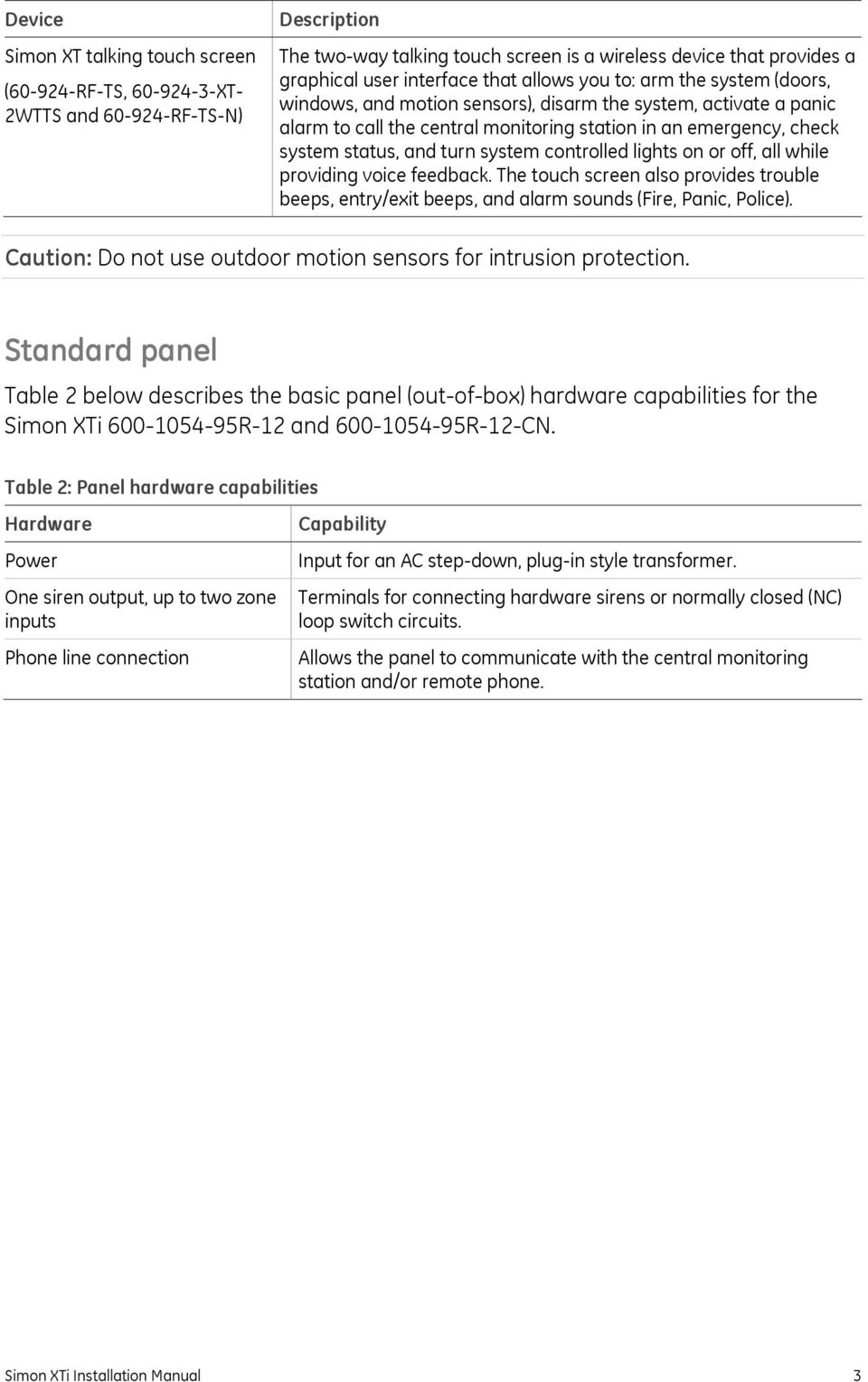
6 System components The system can monitor up to 40 sensors and may use any of the devices listed in Table 1 below. Table 1: Supported devices Device Max Life Door/window sensor (60-362N ) Indoor motion sensor ( & ) Smoke sensor (TX ) Glassbreak sensor ( ) Carbon monoxide (CO) alarm (TX / ) 4-Button Key fob ( R) Simon XT Talking Touchpad ( XT) Description For intrusion protection, install door/window sensors on all groundfloor doors and windows. At a minimum, install them in the following locations: All easily accessible exterior doors and windows. Interior doors leading into the garage. Doors to areas containing valuables. Indoor motion sensors are ideal whenever it is not practical to install door/window sensors on every opening. Identify areas where an intruder is likely to walk through. Large areas in an open floor plan, downstairs family rooms, and hallways are typical locations for indoor motion sensors. For installations with pets, use the SAW Pet Immune PIR ( ). Smoke sensors provide fire protection by causing an alarm to sound throughout the house. You can add smoke sensors near sleeping areas and on every floor of the house. Avoid areas that could have some smoke or exhaust such as attics, kitchens, above fireplaces, dusty locations, garages, and areas with temperature extremes. In these areas, you may want to install rate-of-rise sensors to detect extreme temperature changes. See the instructions packaged with the smoke sensor for complete placement information. Glassbreak sensors respond to shock waves of breaking glass. These sensors are designed to mount in the corner of windows or doors, either on the frame or on the glass itself. See the instructions packaged with the glassbreak sensor for complete placement information. The learn mode CO alarm alerts you to hazardous levels of carbon monoxide gas. If dangerous concentrations of gas are present, the red indicator light comes on, the internal siren goes off, and an alarm is transmitted to the panel. The panel sounds its own alarm and reports to the central station. The key fob (keychain touchpad) lets you turn the system on and off from right outside the home or activate a panic alarm if there is an emergency. If you have the appropriate light control modules, you can use key fobs to turn all system controlled lights on and off. The wall-mounted, two-way, talking touchpad combines a conventional learn mode touchpad with an RF receiver, speech chip, and voice amplification circuit. 2 Simon XTi Installation Manual

7 Device Simon XT talking touch screen ( RF-TS, XT- 2WTTS and RF-TS-N) Description The two-way talking touch screen is a wireless device that provides a graphical user interface that allows you to: arm the system (doors, windows, and motion sensors), disarm the system, activate a panic alarm to call the central monitoring station in an emergency, check system status, and turn system controlled lights on or off, all while providing voice feedback. The touch screen also provides trouble beeps, entry/exit beeps, and alarm sounds (Fire, Panic, Police). Caution: Do not use outdoor motion sensors for intrusion protection. Standard panel Table 2 below describes the basic panel (out-of-box) hardware capabilities for the Simon XTi R-12 and R-12-CN. Table 2: Panel hardware capabilities Hardware Power One siren output, up to two zone inputs Phone line connection Capability Input for an AC step-down, plug-in style transformer. Terminals for connecting hardware sirens or normally closed (NC) loop switch circuits. Allows the panel to communicate with the central monitoring station and/or remote phone. Simon XTi Installation Manual 3
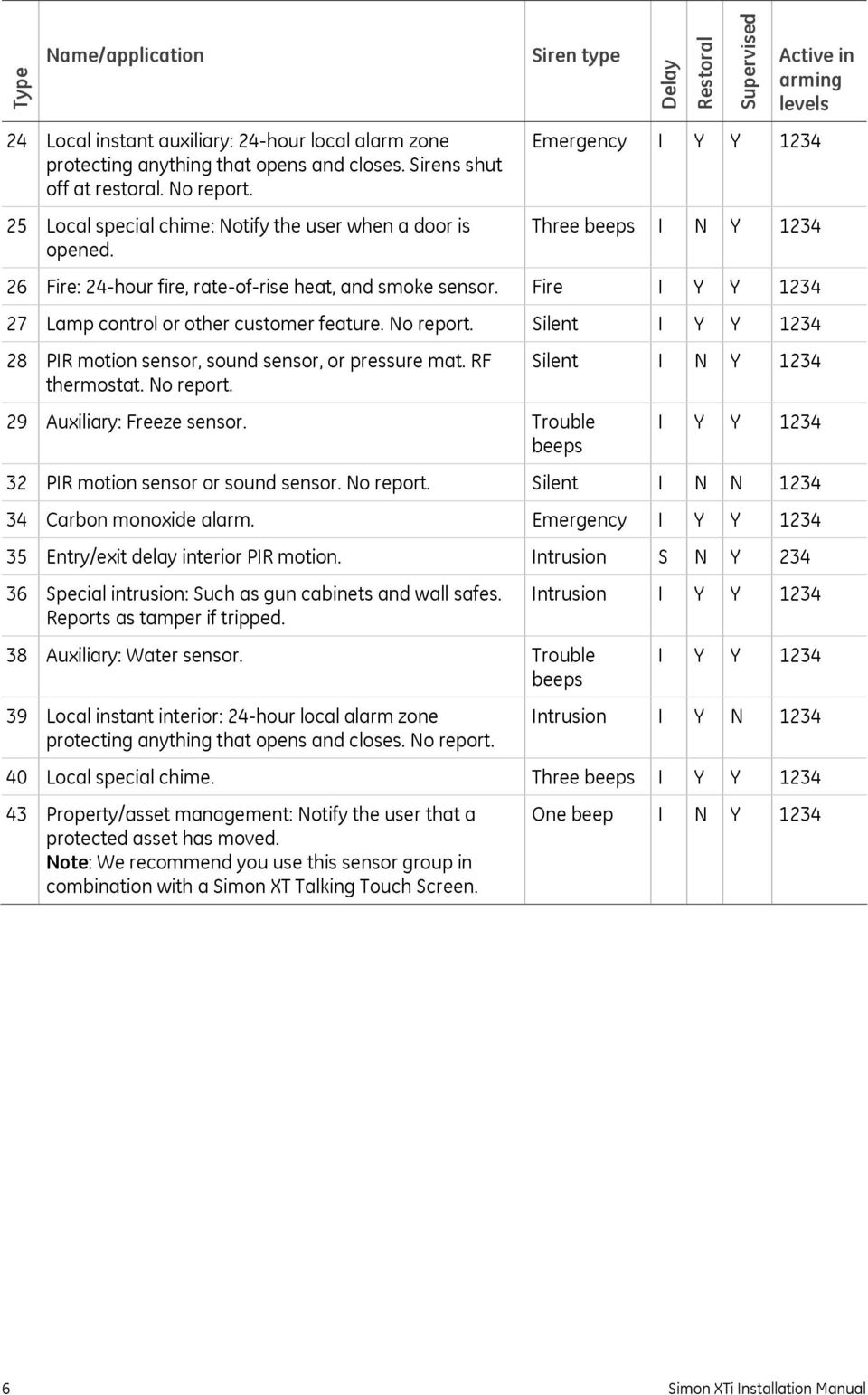
8 Planning the installation This section describes system capabilities to help you get familiar with your system. The planning sheets contain tables that let you record the hardware and programming configuration of your system. Complete all of the information ahead of time to help prepare for system installation. See Sensor names on page 67 for sensor name segments listed alphabetically and by index number. Locate the panel where alarm sounds can be heard and where the panel will be easily accessible for operation. Do not install the panel near a window or door where it can be reached easily by an intruder. Planning sensor types and locations The first step to an easy and successful installation is to decide what areas or items to protect, which lights to operate, and the best location for the panel, touchpad, sensors, and sirens. Metal objects, mirrors, and metallic wallpaper can block signals sent by the wireless sensors. Make sure there are no metal objects in the way when installing the system. Use Table 3 below and Table 4 on page 5 to determine the appropriate sensor type for the sensors you will be adding, and Table 5 on page 7 to document the planned sensor information. You will need to understand the application for each sensor. Table 3: Recommended sensor groups Device Indoor motion sensor Outdoor motion sensor Entry/exit door 10 Interior door 14 Window sensor 13 Smoke sensor Recommended sensor group 15, 17 (intrusion) 18, 20, 25 (chime), 28, or 32 a 25 (chime only group) b 26 c Glassbreak sensor 13 Key fob 01 b, 03, 06, 07 Simon XT talking touchpad 01 b, 04, 05, 06, 07 Simon XT talking touch screen 00, 01 b & d, 04, 05, 06, 07 CO alarm 34 b a. Not certified as a primary protection circuit for UL-listed systems and is for supplementary use only. b. Has not been investigated by UL. c. Required for UL-listed residential fire alarm applications. d. Additional devices employing UTCFS 80 Bit Enhanced Protocol have not been investigated for use in a UL Listed installation. 4 Simon XTi Installation Manual

9 Table 4: Sensor group characteristics Type Name/application Siren type Delay Restoral Supervised Active in arming levels 00 Fixed panic: 24-hour audible fixed emergency button. Intrusion I N Y Portable panic: 24-hour audible portable emergency button. 02 Fixed panic: 24-hour silent fixed emergency button. Status light will not blink. 03 Portable panic: 24-hour silent portable emergency buttons. Status light will not blink. Intrusion I N N 1234 Silent I N N 1234 Silent I N N Fixed auxiliary: 24-hour auxiliary sensor. Emergency I N Y Fixed auxiliary: 24-hour emergency button. Siren shut off confirms CS report. 06 Portable auxiliary: 24-hour portable auxiliary alert button. 07 Portable auxiliary: 24-hour portable auxiliary button. Siren shut off confirms CS report. Emergency I N Y 1234 Emergency I N N 1234 Emergency I N N Special intrusion: Such as gun cabinets and wall safes. Intrusion I Y Y Special intrusion: Such as gun cabinets and wall safes. Intrusion S Y Y Entry/exit delay: A delay that requires a standard delay time. Chime. Intrusion S Y Y Instant perimeter: Exterior doors and windows. Chime. Intrusion I Y Y Instant interior: Interior door. Intrusion F Y Y Instant interior: Interior PIR motion sensor. Intrusion F N Y Instant interior: Interior door. Intrusion F Y Y Instant interior: PIR motion sensor and sound sensor. Intrusion F N Y Instant interior: Cross-zone PIR motion sensor. Intrusion F N Y Delayed interior: Interior doors that initiate a delay before going into alarm. 20 Delayed interior: PIR motion sensor that initiates a delay before going into alarm. 21 Local instant interior: 24-hour local alarm zone protecting anything that opens and closes. No report. 22 Local delayed interior: Same as group 21, plus activation initiates a delay before going into alarm. No report. 23 Local instant auxiliary: 24-hour local alarm zone protecting anything that opens and closes. No report. Intrusion S Y Y 34 Intrusion S N Y 34 Intrusion I Y Y 1234 Intrusion S Y Y 1234 Emergency I Y Y 1234 Simon XTi Installation Manual 5

10 Type Name/application 24 Local instant auxiliary: 24-hour local alarm zone protecting anything that opens and closes. Sirens shut off at restoral. No report. 25 Local special chime: Notify the user when a door is opened. Siren type Delay Restoral Supervised Active in arming levels Emergency I Y Y 1234 Three beeps I N Y Fire: 24-hour fire, rate-of-rise heat, and smoke sensor. Fire I Y Y Lamp control or other customer feature. No report. Silent I Y Y PIR motion sensor, sound sensor, or pressure mat. RF thermostat. No report. 29 Auxiliary: Freeze sensor. Trouble beeps Silent I N Y 1234 I Y Y PIR motion sensor or sound sensor. No report. Silent I N N Carbon monoxide alarm. Emergency I Y Y Entry/exit delay interior PIR motion. Intrusion S N Y Special intrusion: Such as gun cabinets and wall safes. Reports as tamper if tripped. 38 Auxiliary: Water sensor. Trouble beeps 39 Local instant interior: 24-hour local alarm zone protecting anything that opens and closes. No report. Intrusion I Y Y 1234 I Y Y 1234 Intrusion I Y N Local special chime. Three beeps I Y Y Property/asset management: Notify the user that a protected asset has moved. Note: We recommend you use this sensor group in combination with a Simon XT Talking Touch Screen. One beep I N Y Simon XTi Installation Manual
11 Table 5: Sensor assignments/locations Sensor # Device Sensor group Sensor name/location Notes Simon XTi Installation Manual 7

12 Sensor # Device Sensor group Sensor name/location Notes Cross-zoning Cross zoning (two-trip) refers to two different group 18 sensors that must be tripped within two minutes of each other to report an alarm to the central station. Figure 2 below shows the path of a person walking from the kitchen to the living room. When the person is detected walking through the kitchen, the motion sensor in the kitchen is tripped, sounding a local alarm. If motion is detected by the living room motion sensor within two minutes, an alarm report will be sent to the central station. Figure 2: Cross-zone diagram Motion sensor Path of person walking Motion sensor Note: We do not recommend cross zoning for exit/entry zones. Each zone can individually protect the intended area. 8 Simon XTi Installation Manual

13 System configuration Table 6 below is a worksheet for you to record the desired values for each programming option. For each option, the default value, effect of deletion (pressing Disarm while editing), range, and programming privilege are listed. Each option is described in more detail in Programming on page 35. In the table, the Access code column indicates what type of access code is allowed to make changes: D = dealer code, I = installer code, M = master code. Table 6: Programming menu options Function Default Delete Range Access code Access codes menu Dealer code , 54321, 4321, or 321 Installer code , 54321, 4321, or 321 Master code , 12345, 1234, or 123 None 3 to 6 digits D None 3 to 6 digits D, I None 3 to 6 digits D, I, M User code 1 None None 3 to 6 digits D, I, M User code 2 None None 3 to 6 digits D, I, M User code 3 None None 3 to 6 digits D, I, M User code 4 None None 3 to 6 digits D, I, M User code 5 None None 3 to 6 digits D, I, M User code 6 None None 3 to 6 digits D, I, M User code 7 None None 3 to 6 digits D, I, M User code 8 None None 3 to 6 digits D, I, M Duress code None None 3 to 6 digits D, I, M Code length 4 3 to 6 digits D Security menu Account number to FFFFFFFFFF D, I Downloader code to D Phone lock Off On/Off D Auto arm On On/Off D, I Exit extension On On/Off D, I Secure arming Off On/Off D, I No arm on panel low battery Off On/Off D, I Quick exit Off On/Off D, I Installer settings Simon XTi Installation Manual 9
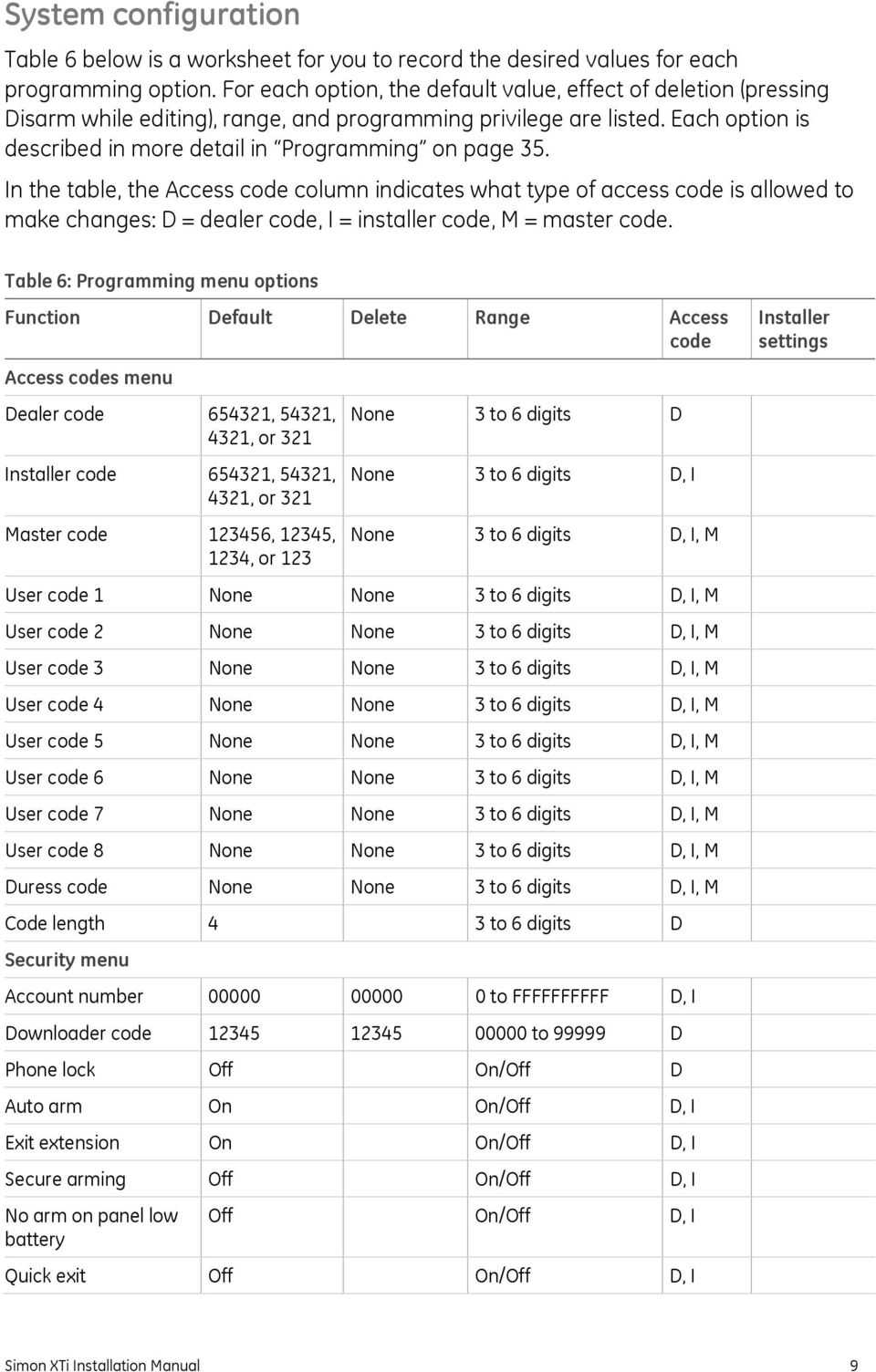
14 Function Default Delete Range Access code Downloader enable On On/Off D, I, M Phone # menu Phone #1 None None 26 digits D Phone #2 None None 26 digits D Phone #3 None None 26 digits D, I Phone #4 None None 26 digits D, I, M Downloader # None None 26 digits D, I Phone options menu Manual phone test On On/Off D, I Fail to communicate On On/Off D, I DTMF dialing On (touchtone) On/Off D, I 300 bps baud rate On (300 bps) On/Off D, I Ring/hang/ring RHR or 10 Ring RHR or 10 Rings D, I RHR(2) or 10 Rings RHR(3) or 10 Rings 10 Rings RHR RHR(2) RHR(3) Off Dial delay 30 seconds 15 seconds 15 to 45 seconds D, I Call waiting code None None 26 digits D, I Sensors menu Learn sensors Delete sensors Edit sensors Reporting menu Report options Opening reports Off On/Off D, I Closing reports Off On/Off D, I Forced armed Off On/Off D, I AC power failure report Panel Low battery report D, I D, I D, I Off Off 5 to 254 minutes/off D, I On On/Off D, I Installer settings 10 Simon XTi Installation Manual

15 Function Default Delete Range Access code Sensor alarm restoral report 24-hour sensor tamper report Supervisory/ tamper report Off Sensor Close D, I Siren Timeout System Disarmed Off Off On/Off D, I Off On/Off D, I No usage report Off Off 2 to 254 days/off D, I Swinger shutdown On On/Off D, I Programming report Off On/Off D, I Fire alarm verification Off On/Off D, I Communication modes Phone 1 report mode Off All SIA, All CID, Alarms D Phone 2 report mode Off SIA, Alarms CID, Nonalarm SIA, D Phone 3 report mode Off Nonalarm CID, D, I Phone 4 report mode Off Backup SIA, Backup CID, Voice dialer, or Off D, I Timers menu Entry delay 30 seconds to 240 seconds D, I Exit delay 60 seconds 45 seconds 45 to 254 seconds D, I No activity timeout Off Off 2 to 24 hours/off D, I Auto phone test Off Off 1 to 254 days/off D, I Supervisory time 12:00 AM None 12:00 AM (midnight) to 11:59 PM, None Alarm cancel window 6 minutes Off 6 to 255 minutes, Off D, I RF timeout 12 hours 12 hours 2 to 36 hours D, I Fail to open time Off Off 12:00 midnight to 11:59 PM, Off Fail to close time Off Off 12:00 midnight to 11:59 PM, Off Siren timeout 5 minutes Off 2 to 254 minutes, Off D, I Unvacated premises On On/Off D, I Smoke supervision Off On/Off D, I Touchpad options menu Key fob no delay Off On/Off D, I Panic alarms On On/Off D, I D, I D, I D, I Installer settings Simon XTi Installation Manual 11

16 Function Default Delete Range Access code Remote touchpad arming System options menu Off On/Off D, I RF jam detect Off Off On/Off D, I Demo mode Off Off On/Off D, I HW1 function Interior siren Interior Siren- D Interior siren output Armed-Output activated when armed Disarmed-Output activated when disarmed FTC-FTC output (FTC must be on) Alarm-Output activated for alarm Exterior Siren Exterior siren output Off-No output 24-hour clock Off On/Off D, I Siren options menu Panel piezo beeps On On/Off D, I, M Panel voice On On/Off D, I, M Panel piezo alarms On On/Off D, I, M Trouble beeps On On/Off D, I Voice chime Off Voice chime D, I, (sensor name) Chime bell Soft chime bell Off-No voice chime Hardwired siren supervision Off On/Off D, I Panel silent police panic Alarm report verification Off On (silent), Off (audible) D, I Off On/Off D, I Installer settings 12 Simon XTi Installation Manual

17 Function Default Delete Range Access code Installer settings Audio verification menu Audio mode Off Instant mode D, I Callback mode Off Fire shutdown Off On/Off D, I Fire enabled AVM On On/Off D, I Panic talk Off On/Off D, I Vox receiver gain to 32 D, I Vox microphone gain to 64 D, I Vox microphone gain range Manual microphone gain to 64 D, I to 64 D, I System test menu Sensor test Communication test System download D, I, M D, I, M D, I, M Simon XTi Installation Manual 13

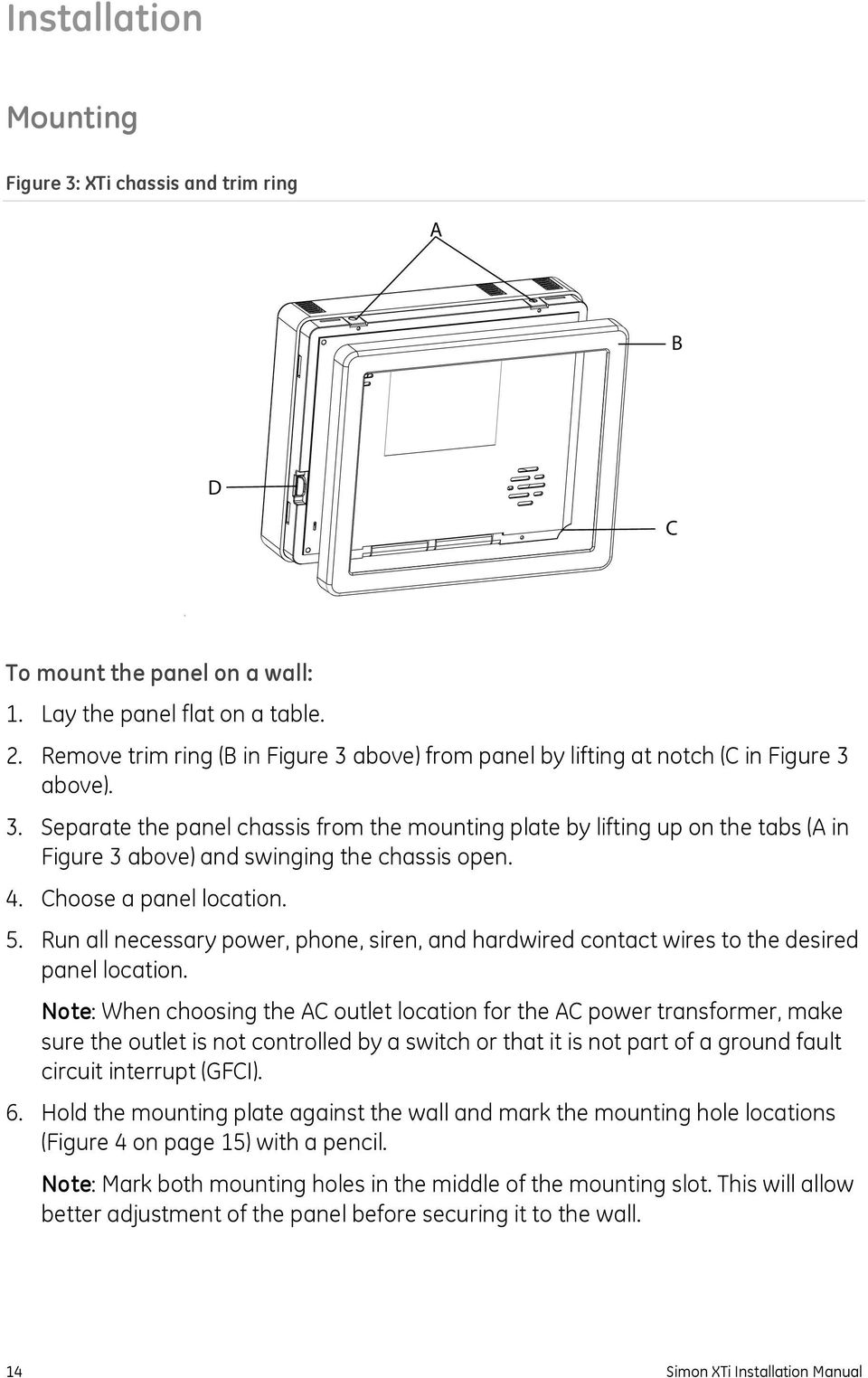
18 Installation Mounting Figure 3: XTi chassis and trim ring A B D C To mount the panel on a wall: 1. Lay the panel flat on a table. 2. Remove trim ring (B in Figure 3 above) from panel by lifting at notch (C in Figure 3 above). 3. Separate the panel chassis from the mounting plate by lifting up on the tabs (A in Figure 3 above) and swinging the chassis open. 4. Choose a panel location. 5. Run all necessary power, phone, siren, and hardwired contact wires to the desired panel location. Note: When choosing the AC outlet location for the AC power transformer, make sure the outlet is not controlled by a switch or that it is not part of a ground fault circuit interrupt (GFCI). 6. Hold the mounting plate against the wall and mark the mounting hole locations (Figure 4 on page 15) with a pencil. Note: Mark both mounting holes in the middle of the mounting slot. This will allow better adjustment of the panel before securing it to the wall. 14 Simon XTi Installation Manual
19 Figure 4: Mounting holes Mounting hole Wiring knockout Mounting hole 7. Secure the mounting screws (provided) to the locations on the wall marked in step 6. Do not tighten the screws. Leave enough clearance to mount the mounting plate. Note: Use wall anchors if no studs are present. 8. Mount the mounting plate to the wall. Insert the top mounting hole first, then the bottom hole. Adjust the fit to make sure the mounting plate is level. Hold the mounting plate in place and tighten the screws. 9. Hang the panel chassis on the mounting plate at the plastic hinges, swing the chassis up to the mounting plate and engage at the tabs (A in Figure 3 on page 14). 10. Reattach the trim ring. Connecting hardwired devices The panel has five screw terminals, two battery terminals, and two telephone connections. The screw terminals connect the AC power, sirens, and/or hardwired detectors. Figure 5: Wiring terminals HW1 I/O HW1&2 DC Out HW2 In 9VAC in 9VAC in Simon XTi Installation Manual 15

20 Program sensors and devices before you install them. Follow the instructions in Sensors on page 41 to add the sensors to panel memory. The HW1 I/O terminal is dual purpose and can be used for either siren or hardwired contact connections. The HW2 in terminal is an input only. Interior sirens From the factory, the HW1 I/O input is set up for interior siren operation (status and alarm sounds). The HW1&2 DC out terminal provides the positive (+) voltage. Note: The total current available from the HW1&2 DC out terminal is 250 ma at up to 120ºF (49ºC). A 24-hour battery standby will be met with a maximum load of 250 ma. With hardwired siren supervision turned on, sirens connected to HW1 I/O are supervised and require a 4.7-kohm resistor in the circuit. If this terminal is not used, turn hardwired siren supervision off. Hardwired interior siren Interior sirens must always be wired with a resistor in the circuit. For circuit supervision, which allows the panel to detect if the siren wire is cut (open), the hardwired siren supervision option must be turned on. Note: Do not install the resistor at the panel terminals. This does not provide supervision of the wire. Connect the hardwired interior siren (13-374) to the panel using a 4.7 kohm resistor (included with the siren) as shown in Figure 6 below. The resistor must be connected across the siren wires as close to the siren as possible. Figure 6: Hardwired interior siren with supervision 4.7 kohm resistor (located at siren) Black Red HW1 I/O 2 HW1&2 DC out Exterior sirens For an exterior siren, reprogram HW1 to Exterior Siren on Option 6. See Wiring diagram. 16 Simon XTi Installation Manual

21 Hardwired contacts To set up HW1 I/O and/or HW2 for hardwired contacts, make the required connections described below, and then proceed to Programming on page 35 to add (learn) them into panel memory. You can connect hardwired reed switches (normally closed loop only) to HW1 I/O (if not being used for a hardwired siren) and/or HW2 in. Note: Connect only normally closed (NC) reed switches to HW1 I/O and/or HW2 in. Other types of hardwired detectors should not be used. The total resistance of the wired loop must not exceed 3 ohms. This allows you to use up to 200 ft. (61 m) of two-conductor, 22-gauge stranded wire. Connect hardwired reed switches to the panel using a 47-kohm resistor (not a 4.7- kohm resistor) as shown in Figure 7 below. The resistor must be connected at the last switch in the circuit. Figure 7: Normally closed hardwired reed switches 47 kohm resistors HW1 I/O 2 HW1&2 DC Out 3 HW2 In Note: Do not install the resistor at the panel terminals. This does not provide supervision of the wire. Wiring a phone line to the panel You can connect a phone line to the panel for systems monitored by a central monitoring station or systems that notify users by a voice event notification. DSL (digital subscriber line) allows the use of multiple devices on a single phone line simultaneously. For DSL environments, connect the panel line-in jack to an available phone jack on the premises. You may also need an inline filter to ensure panel reporting is successful. Note: Avoid connecting the panel to a standard phone (voice) line as other devices on the line can prevent reports from going through. Simon XTi Installation Manual 17
22 Figure 8: Phone connectors RJ45 connector (LINE) RJ11 connector (PHONE) Full line seizure Full line seizure allows the panel to take over (seize) the phone line, even if another device on the line is in use. This method requires that the panel be wired before all other phones, answering machines, computers, or other devices on the phone line. Use the RJ31X (CA-38A) jack when wiring for full line seizure. You can then quickly and easily disconnect the panel from the phone line in case the panel disables the phone line due to a malfunction. To wire full line seizure with an RJ31X: 1. Run a four-conductor cable from the premises Telco block to the RJ31X (see Figure 9 on page 19). 2. Connect the four-conductor cable wire to the RJ31X. 3. Disconnect the green and red premises phone jack wires from the Telco block and splice them to the four-conductor cable black and white (or yellow) wires. Use weatherproof wire connectors for these splices. 4. Connect the four-conductor cable green and red wires to the Telco block TIP (+) and red to RING (-) posts. 5. Connect the phone cord included with the panel to the RJ31X and the panel LINE jack. 18 Simon XTi Installation Manual
23 Figure 9: Full line seizure wiring with RJ31X To RJ45 connector (LINE) Phonecord BRN GRY RJ31X GRN RED Black Green Red White (or Yellow) Telco block TIP RING (+) (-) Four-conductor cable Green Black Green Red White (or Yellow) Red Full line seizure wiring with one premises phone If a single phone is all that exists on the premises, full line seizure can be accomplished without an RJ31X. 1. Disconnect the phone from the premises phone jack and plug it into the panel PHONE jack. This jack is disconnected automatically whenever the panel reports. 2. Connect the included phone cord to the panel LINE jack and the premises phone jack. Note: If customers add phones or other phone devices to another phone jack, full line seizure no longer exists. Inform them to contact you if they want to add a phone or other device so that you can rewire for full line seizure by adding an RJ31X. Wiring the power transformer Connect the power transformer to the two 9 VAC in terminals on the panel. Note: System can only be powered up using AC power, not battery power. The red battery icon may appear when system first powers up and will disappear after some time. Simon XTi Installation Manual 19
24 Figure 10: Transformer connections VAC In 5 9 VAC In Do not plug in the transformer at this time. When applying power to the panel connect the battery first, and then plug in the AC power transformer. This sequence prevents a battery fault condition. Note: Maximum battery charge current is 120 ma. It may take up to 36 hours for a new battery to fully change. To remove and install the backup battery (6 VDC, 2.1 Ah): Figure 11: Battery installation B A D C Note: It is recommended that the backup battery be replaced every 3-5 years. 1. Remove AC power from the panel. 2. Disconnect the existing battery (A in Figure 11 above) from the battery connector (B in Figure 11 above). 20 Simon XTi Installation Manual
25 3. Remove the existing battery by reaching under the battery, next to the plastic latch (D in Figure 11 on page 20), with a finger and pulling up. Note: Do not try to push the plastic latch back to remove the battery. 4. Insert the new battery into the battery compartment and snap into place. 5. Plug the battery connector into the panel. Caution: Do not connect the battery until you are ready to power up the panel. Resetting memory to factory defaults If you need to reset memory to factory defaults, follow the steps below. To reset the panel to factory defaults: 1. Remove the trim ring. 2. Open the panel cover. 3. Unplug the transformer and disconnect the battery. 4. Press and hold the reset button (D in Figure 3 on page 14) on the left side of the panel. 5. Plug in the transformer to the panel while holding the reset button and keeping the panel cover open. 6. Release the button. 7. Plug in the battery and close the panel cover. 8. Replace the trim ring. Applying AC power The panel will not power up on battery power only. AC power is required to power up the panel. Make sure the outlet is not controlled by a switch or that it is not part of a ground fault circuit interrupt (GFCI). Note: For Canadian installations, plug the transformer into the wall outlet. 1. Remove the center screw from the outlet cover plate and hold the cover plate in place. WARNING: Use extreme caution when securing the transformer to a metal outlet cover. You could receive a serious shock if a metal outlet cover drops down onto the prongs of the plug. Simon XTi Installation Manual 21
26 2. Plug the transformer into the lower receptacle of the outlet so that the hole in the transformer tab lines up with the outlet cover screw hole. 3. Insert the cover plate screw through the transformer tab and the outlet cover plate. Tighten the screw. Note: Upon initial installation, the battery may not be fully charged for as long as 36 hours. A low battery icon will be present and trouble beeps will sound until the battery is sufficiently charged. After the initial charge, should the panel lose AC Power and experience a low battery condition, the icon will appear and trouble beeps will sound unless silenced. You can silence trouble beeps by: Arming or disarming the system. or Pressing the STATUS & SETTINGS icon and pressing LISTEN next to Panel Status. This will disable the sounder for 4 hours but the trouble indication will remain until the battery is recharged. Designer template The designer template is the adhesive-backed plastic template that covers the front of the Simon XTi panel. Caution: The authorized designer template and its installation are integral parts to the reliability of the system. Replacement of the authorized designer template should be done by the security system installer. Removing the designer template 1. Remove all power (both battery and AC). Use proper ESD protection practices when replacing the designer template. 2. Remove trim ring from the panel by lifting at notch (D in Figure 13 on page 23). 3. Lift a corner of the template and peel back until it is removed from the front of the panel. 22 Simon XTi Installation Manual
27 Installing the designer template Figure 12: Designer template front B A Simon XTi Figure 13: Panel cover C 1. Before installing a designer template, ensure that both the display screen and cover surface are free of any lint. Wipe the surface down with a lint-free cloth. 2. Turn over the template to the back side (paper-backed adhesive side). 3. Position the template so the two alignment holes (A in Figure 12 above) are vertically located on your left side. 4. Starting at one of the left hand corners, partially peel back the paper backing about 2-3 inches to the right (F in Figure 14 on page 24) exposing both of the two alignment holes (E in Figure 14 on page 24). Crease and flatten the partially removed paper backing against the back of the template. D Simon XTi Installation Manual 23
28 Figure 14: Designer template back F E 5. Turn over the template to the front (cosmetic) side. 6. Position the two alignment holes in the template (A in Figure 12 on page 23) over the two pins (C in Figure 13 on page 23) located on the cover of the panel. 7. Lightly press down on the left side of the template. Once located, reach under the template and remove the remainder of the paper backing (F in Figure 14 above). 8. Press down with your thumb on the template from left to right, removing any air bubbles and ensuring proper adhesion. 9. After the template is adhered to the front of the panel, remove protective film from front of template by pulling on tab (B in Figure 12 on page 23) in upper right hand corner. 10. Replace the plastic trim ring on panel. 24 Simon XTi Installation Manual
29 System configuration The control panel provides the main processing unit for all system functions. The programming of system options and features is menu-driven. All installer options are set in the Programming menu, except for setting the system time and date. Figure 15 below shows the Simon XTi front panel. Figure 15: Simon XTi front panel Simon XTi Note: The touch screen in Figure 15 above is an example. The touch screen and system being installed may be configured differently. Table 7 below explains the panel keys and features. Table 7: Simon XTi panel keys and features Item Piezo siren Touch screen Microphone Speaker Time Description Provides alarm beeps and status beeps. Fire and intrusion alarm beeps are always played at high volume, while the volume of status beeps is programmable. Provides a graphical user interface for programming and system operation. Used to communicate with the central monitoring station after an alarm. Provides voice output and sounds key beeps. The panel speaks arming level change, system status, and voice chime sensor trips. The panel voice is also used for voice reporting and remote phone control. To access the emergency screen and select the appropriate icon (Panic, Police, or Fire), press EMERGENCY in the top left corner of the touch screen. The current system time. Simon XTi Installation Manual 25
30 Item Description Depicts the status of the AC and battery. A green power cord icon represents AC power to the system. A red battery icon represents low battery power to the system. A green battery icon represents full battery power to the system. This will appear on the home screen in the event of an alarm. Messages will also display on this icon describing what caused the alarm. Press this icon to cancel the alarm. These four icons depict the status of the sensors installed in your system. A green check indicates sensors are closed or no recent activity detected. A red exclamation indicates sensors are open or recent activity has been detected. If the icon shows N/A, your system is not configured to support that type of sensor. Pressing these icons will open a new screen to provide more detail. Press this icon to access the Arming Screen. One of these icons will display depending on your arming level. Press to turn off intrusion/burglary protection for your system. Only intrusion/burglary sensors are disarmed. Environmental sensors, such as smoke and carbon monoxide detectors, stay active at all times Enter your code in the keypad screen that appears. If you enter an incorrect code, press the Clear icon and enter the correct code. Note: In certain configurations with third party modems, the Motion Only Arming icon may not be shown. Press to access the Status & Settings screen. To enter the Status & Settings screen, press the the touch screen. icon in the bottom right corner of Press the Close icon to exit a menu or option edit mode and navigate up one level. Pressing the Close icon while in the top menu level exits the system menu level. The panel automatically exits the system menu after a few seconds of inactivity if no access code has been entered yet. After an access code has been entered to access a code-protected area of the system menu, the timeout is four minutes. Status & Settings menu navigation Each menu contains a list of options and/or submenus. Press the icons to navigate up and down the list of options and submenus in that menu. Pressing Close exits a menu and goes to the next higher level. Programming options are arranged in a menu structure as outlined in Table 8 on page 27. The top menu contains several features, as well as the Programming menu. 26 Simon XTi Installation Manual
31 When accessing the Direct Bypass, Programming, or System Tests menu, the panel prompts you to enter an access code. To continue, enter the dealer, installer or master code, and then press OK. A gold icon indicates an option is selected. A blue icon indicates an option is not selected. Table 8: Status & Settings menu structure Event history Direct bypass Panel status Chime Note: This option may or may not appear depending on panel programming. Special Chime Note: This option may or may not appear depending on panel programming. Lights Note: Has not been investigated by UL. Door lock Note: Has not been investigated by UL Voice volume Beep volume Brightness Default screen Calibration Help Set date/time System tests Sensor test Comm test System download Programming Access codes Dealer code, Installer code, Master code, User code 1, User code 2, User code 3, User code 4, User code 5, User code 6, User code 7, User code 8, Duress code, Code length Simon XTi Installation Manual 27
32 Version Security Phone numbers Phone options Sensors Reporting Timers Touchpad options Account number, Downloader code, Phone lock, Auto arm, Exit extension, Secure arming, No arm on panel low battery, Quick exit, Downloader enable, supervisory protest Phone #1, Phone #2, Phone #3, Phone #4 Manual phone test, Fail to communicate, DTMF dialing, 300 bps baud rate, Ring/hang/ring, Dialer delay, Call waiting code, Line cut detect (not available) Learn sensor, Delete sensor, Edit sensor Report options: Opening report, Closing report, Force armed report, AC power failure report, Panel low battery report, Sensor alarm restoral report, 24-hour sensor tamper, Supervisory/tamper report, No usage report, Swinger shutdown, Programming report, Fire alarm verification Communication modes: Phone 1 reports, Phone 2 reports, Phone 3 reports, Phone 4 reports Entry delay, Exit delay, No activity timeout, Auto phone test, Supervisory time, Alarm cancel window, RF timeout, Fail to open time, Fail to close time, Siren timeout, Unvacated premises, Smoke sensor supervision Keyfob no delay, Panel panic alarms, Remote touchpad arming System options RF jam detect, Demo mode, HW1 I/O, 24-hour clock format Siren options Auto verification System tests Piezo beeps, Panel voice, Panel piezo alarm, Trouble beeps, Voice chime, Status beeps vol, HW siren sup, Speaker volume, Silent police panic, Alarm report verify Audio mode, Fire shutdown, Panic talk, VOX receiver gain, VOX microphone gain, VOX gain range, Manual microphone gain Sensor test, Communication test, Initiate download call Event history To view event history: From the Status & Settings screen, press SHOW next to Event History. The Event History screen displays a history of all events recorded by the XTi system. 28 Simon XTi Installation Manual
33 Note: If a # appears in the Event History list, the event was not sent to the central station. Direct bypass To direct bypass a sensor: 1. From the Status & Settings screen, press SELECT next to Direct Bypass. 2. Enter the master code (see Table 10 on page 36). 3. Next to the sensor name, select Bypass to bypass the selected sensor, or Not bypassed to not bypass the selected sensor. Panel status To listen to the panel status: From the Status & Settings screen, press LISTEN next to Panel Status. The panel will announce the current status. To clear the panel status: From the Status & Settings screen, press CLEAR next to Panel Status. Lights To control lights programmed into the system: 1. From the Status & Settings screen, press CONTROL next to Lights. Note: If no lights are programmed into the system, the following screen will appear: 2. From the Lights screen, choose the following options: Press ALL ON to turn on all system programmed lights. Simon XTi Installation Manual 29
34 Press ALL OFF to turn off all system programmed lights. Press ON next to a designated light to turn that specific light on. Press OFF next to a designated light to turn that specific light off. 3. Press CLOSE to exit Lights screen. Door lock To control door locks programmed into the system: 1. From the Status & Settings screen, press CONTROL next to Door Lock. Note: If no door locks are programmed into the system, the following screen will appear. 2. From the Door Locks screen, choose the following options: Press LOCK ALL to lock all system programmed door. Press UNLOCK ALL to unlock all system programmed lights. Press LOCK next to a designated door to lock that specific door. Press UNLOCK next to a designated door to unlock that specific door. Note: Open doors appear in red text. 30 Simon XTi Installation Manual
35 3. Press CLOSE to exit Door Locks screen. Voice volume To adjust voice volume: From the Status & Settings screen, next to Voice Volume, press the left arrow to lower the voice volume and the right arrow to raise the voice volume. The bars between the arrows register the volume level. No bars is off. Four bars is loudest. Beep volume To adjust beep volume: From the Status & Settings screen, next to Beep Volume, press the left arrow to lower the beep volume and the right arrow to raise the beep volume. The bars between the arrows register the volume level. One bar is softest. Four bars is loudest. Brightness To adjust brightness: From the Status & Settings screen, next to Brightness, press the left arrow to make the screen less bright and the right arrow to make the screen more bright. The bars between the arrows register the brightness level. One bar is least bright. Four bars is brightest. Simon XTi Installation Manual 31
36 Default screen To change the default screen: From the Status & Settings screen, press MAIN or BLANK next to Default Screen. To make options visible on a blank screen, touch anywhere on the screen. The screen will stay visible for two minutes before returning to blank mode, if untouched. Calibration Normally you will not need to calibrate the touch screen, but if the touch screen icons do not respond correctly, follow the instructions below. To calibrate the screen: 1. From the Status & Settings screen, press SHOW next to Calibration. 2. Touch the center of the cross using a soft, fine point as it appears in each corner of the screen. After the cross in the fourth corner (bottom right) is pressed, the user will be returned to the Status & Settings screen. If you cannot access the calibration using the above procedure, use the following steps: 1. Remove the trim ring from the front of the panel. 2. Press and hold the Reset button (D in Figure 3 on page 14). 3. Press and hold anywhere on the screen. 4. While you are pressing the screen, release the Reset button. 5. Follow the calibration prompts. 32 Simon XTi Installation Manual
37 Help To access the Help screens: 1. From the Status & Setting screen, press the HELP icon. 2. From the SYSTEM HELP screen, choose the help topic to search. 3. Press and to scroll through help topics. 4. Press CLOSE to return to the previous screen. Set time and date If the panel loses both AC and battery power, upon power restoral the system time will reset to midnight and the date will reset to , indicating it has not been set correctly. Time format is: hour/minute/a.m. or p.m. Date format is: month/day/year: To set the time 1. From the Status & Settings screen, select Set Date/Time. 2. Enter access code. 3. From the Set Date/Time screen press the first box to set the hour and press SAVE. 4. Press the second box to set the minutes and press SAVE. 5. Press a.m/p.m. box to toggle a.m/p.m. setting. Simon XTi Installation Manual 33
38 To set the date 1. From the Set Date/Time screen press the first box in the second row to set the month and press SAVE. 2. Press the second box to set the day and press SAVE. 3. Press the third box and enter the year and press SAVE. 4. Press CLOSE repeatedly to exit. Version To display the system s firmware version, touch screen version, and copyright information, scroll until the display shows Version on the bottom of the screen. 34 Simon XTi Installation Manual
39 Programming To enter programming: 1. From the Status & Settings screen, press to scroll to the Programming option. 2. Press Enter. 3. Enter the dealer or installer code (see Table 9 below) and press OK. Note: You have four seconds between number presses to enter the code or you will be returned to the home screen. Note: Do not remove the panel power within 30 seconds of exiting program mode. Table 9: Simon XTi programming codes Code Dealer code Installer code Description You can use the dealer code to program all system functions, including high-security options that are not accessible with the installer code if it is different from the dealer code. Depending on how the access code is set, the default dealer access code is , 54321, 4321 (factory default), or 321. This code can be used for all programming. Depending on how the access code is set, the default installer code is , 54321, 4321 (factory default), or 321. This code is limited to changing all but the following: Dealer code, code length, downloader code, phone lock, phone #1, phone #2, phone 1 report mode, phone 2 report mode, HW1 function. The following sections describe the programming options in the Programming submenus. Access codes To add/edit access codes: 1. From the Programming screen, press ACCESS CODES. 2. To add or edit an access code, press the white field next to the access code. Simon XTi Installation Manual 35
40 3. Enter the new/edited code on the numbered keypad and press SAVE. 4. Press CLOSE repeatedly to exit menus Table 10: Access Codes menu Function Default Description Dealer code 4321 You can use the dealer code to program all system options, including high-security options that are not accessible with the installer code if it is different from the dealer code. Changing the dealer code to differ from the installer code will prevent the installer from viewing certain fields. If you change the dealer code and enter program mode with the installer code, the installer will no longer be able to see the following: code length, downloader code, phone lock, phone #1, phone #2, phone 1 report mode, phone 2 report mode, HW1 function. Installer code 4321 You can use the installer code to program most installer options, except for high-security dealer options. Master code 1234 You can use the master to arm/disarm, enter user programming, and bypass sensors. User codes 1 to 8 Blank You can use the user codes to arm/disarm the system. Duress code Blank Use the duress code in place of the master or user code to cause a silent alarm. Code length Four digits Codes can be three to six digits long. Security To add/edit account number or downloader code: 1. From the Programming screen, press SECURITY. 2. To add or edit an account number or downloader code, press the white field next to account number or downloader code. 36 Simon XTi Installation Manual
41 3. Enter the new/edited code on the numbered keypad and press SAVE. Note: The account number can be alphanumeric. To enter letters, press the ABC icon. To enter numbers press the 123 icon. To edit phone lock, auto arm, exit extension, secure arming, no arm on low battery, quick exit, and downloader enable options: 1. From the Programming screen, press SECURITY. 2. To turn on an option, press. To turn off an option, press. Note: indicates the option is turned on. 3. Press CLOSE repeatedly to exit menus. Table 11: Security menu Function Default Description Account number Downloader code Lets you program up to a 10-character alphanumeric account number or delete an existing account number by pressing Disarm. You can enter numerical digits sequentially. Account numbers with letters A through F, or numbers 0 through 9 (or a combination of those letters and numbers) are only supported Lets you set a unique five-digit code that is required for initiating Enterprise Downloader sessions. The code must be five digits long and can range from to The downloader code must match the downloader access code in the Enterprise account to perform Enterprise sessions. Simon XTi Installation Manual 37
42 Function Default Description Phone lock Off Prevents resetting of phone/reporting related options when a memory clear is preformed (on) or resets these options to their default values when a memory clear is performed (off). The following are not reset when on: account number, dealer code, code length, call wait cancel, phone numbers 1 and 2, phone report modes 1 to 4, phone lock, downloader phone number and downloader code. Auto arm On Determines how long the system protests (announces open/failed sensors) when attempting to arm with open/failed sensors, before bypassing these sensors and automatically arming the rest of the system. The panel protests an arming attempt when it has not received a restore (close) signal from sensors learned into restore-specific sensor groups. Sensors learned into group 26 (fire) cannot be bypassed. When this option is on, the panel announces all open/failed sensors repeatedly for four minutes, then automatically bypasses the open sensors and arms the rest of the system. If a sensor is opened during the exit delay and then left open, the panel will go into alarm after the exit delay has expired. This option must be on for unvacated premises and exit extension to work correctly. When the option is off, the panel displays all open/failed sensors once, then automatically bypasses the open sensors and arms the rest of the system after the exit delay has expired. If other sensors are opened during the exit delay, they will also be bypassed if left open. If group 13 (instant perimeter) sensors are opened during the exit delay, the panel goes into immediate alarm. Exit extend On Determines whether the panel restarts the exit delay time if you enter the armed premises during the initial exit delay period (on), or not (off). Turning on this feature allows you to reenter during the exit delay period, without disarming and then rearming the system. Turning off this feature requires you to disarm and rearm the system. Note: Auto arm must be on for this option to work. Secure arming No arm on low battery Off Off Determines whether an access code is required when arming the system (on), or not (off). This option does not affect key fob arm/disarm operation. Determines whether the system protests arming if a low CPU battery condition exists (on), or not (off). Quick exit Off Determines whether pressing Disarm when the system is armed activates the exit delay time to allow exit and reentry without disarming the system (on), or not (off). This feature is useful if you want to step outside briefly and return. If the system is armed and you press Disarm, the panel announces Exit Time is On, and sounds exit delay beeps. This allows a designated entry/exit door to open for up to two minutes without causing alarm. When the door is closed, the beeps stop and the door is armed again. Downloader enable On Enables programming of system options with downloader software. 38 Simon XTi Installation Manual
43 Phone numbers To add/edit phone numbers: 1. From the Programming screen, press PHONE NUMBERS. 2. To add or edit a phone number, press the white field next to the phone number. 3. Enter the new/edited phone number on the numbered keypad and press SAVE. 4. Press CLOSE repeatedly to exit menus. Table 12: Phone Numbers menu Function Default Description Phone #1 Phone #2 Phone #3 Phone #4 Blank Blank Blank Blank Lets you program up to a 26-digit central monitoring station receiver/ voice event notification phone number for monitored systems. Phone digits can be 0 to 9, *, #, or a pause (P). To delete the phone number, press Delete on the keypad while editing a phone digit. To add a pause to the phone number, press Pause on the keypad. Downloader # Blank Lets you program up to a 26-digit phone number for the Enterprise Downloader. Phone options To edit manual phone test, fail to communicate, DTMF dialing, and 300 BPS enabled options: 1. From the Programming screen, press PHONE OPTIONS. Simon XTi Installation Manual 39
44 2. To turn on an option, press. To turn off an option, press. Note: indicates the option is turned on. 3. Press CLOSE repeatedly to exit menus. To edit ring hang ring option: 1. From the Phone Options screen, press the white field next to Ring Hang Ring. 2. To turn on an option, press. To turn off an option, press. Note: indicates the option is turned on. 3. Press CLOSE repeatedly to exit menus. To edit dialer delay option: 1. From the Phone Options screen, press the white field next to Dialer Delay. 2. Enter the new/edited dialer delay time on the numbered keypad and press SAVE. 3. Press CLOSE repeatedly to exit menus. To edit the call waiting # option: 1. From the Phone Options screen, press the white field next to Call Waiting #. 2. Enter the new/edited call waiting # on the numbered keypad and press SAVE. 3. Press CLOSE repeatedly to exit menus. Table 13: Phone Options menu Function Default Description Man phone test On Determines whether you can perform a manual communication test to verify communication to a central station/voice dial (on), or not (off). If you have all four phone numbers programmed, it should send a test report to all four before showing that the test is okay. FTC On Determines whether the panel and interior sirens sound trouble beeps if it is unable to successfully send a report to a central station (on), or not (off). DTMF dial On Determines whether the panel uses DTMF (on) or pulse (off) for dialing programmed phone numbers. 300 bps enabled On Determines whether the baud rate used by the panel for central station communication is 300 bps (on), or 110 bps (off). 40 Simon XTi Installation Manual
45 Function Default Description Ring hang ring RHR or 10 Rings Determines when the panel answers a remote phone access or Enterprise call. Depending on whether an answering machine exists at the panel location, offsite access to the panel can be done with a series of phone calls or just one. For offsite access where an answering machine does not exist, the user or Enterprise operator simply calls the panel location once and listens for 10 rings. The panel should answer after the tenth ring. For offsite access where an answering machine exists, the user or Enterprise operator must call the panel location, and then let the phone ring once and hang up. Wait at least 10 seconds but not more than 40, and then call the panel location again. The panel should answer on the first ring. Ring/hang/ring setting number and sequence of rings after which the panel answers: Dial delay 30 seconds RHR or 10 Rings = Ring/hang/ring or ten rings RHR(2) or 10 Rings = Ring/hang/ring/hang/ring or ten rings RHR(3) or 10 Rings = Ring/hang/ring/hang/ring/hang/ring or ten rings 10 Rings = Ten rings RHR = Ring/hang/ring RHR(2) = Ring/hang/ring/hang/ring RHR(3) = Ring/hang/ring/hang/ring/hang/ring Off = Disabled, no remote (offsite) access Determines whether the panel delays dialing programmed phone numbers before sending report (on). If opening (disarming) reports is on, the panel does not delay dialing if the system is disarmed before the delay time expires. The panel dials immediately for both the alarm and opening report. Regardless of this option setting, the panel always dials immediately for fire alarms, AC power failure, and low battery reports. Call waiting # Off The call waiting number is dialed by the panel before a phone number to disable call waiting. If the end-user has call waiting, we recommend you change this option from its default. CAUTION: Changing this option from its default without call waiting will prohibit the panel from calling the central station. The call waiting code is programmed the same way as a dialer number. Sensors Table 14: Sensors menu Function Learn sensors Delete sensors Edit sensors Description Adds (learns) sensors to panel memory. Deletes sensors from panel memory. Edits sensor information in panel memory. Simon XTi Installation Manual 41
46 The following instructions tell how to add (learn) sensors, touchpads, and other system devices into panel memory. The panel recognizes a sensor when you press a sensor program button, press and release a tamper switch, press a sensor test button, or put a sensor into alarm. Table 15 on page 44 below describes the programming method for each device. To learn (program) and edit a sensor: 1. From the Programming screen, press SENSORS. 2. From the Sensors screen, press LEARN SENSORS. 3. Press the sensor program button or release the sensor tamper switch. The Edit Sensor screen will appear. 4. To change the sensor number, press EDIT next to Sensor Number, enter the new sensor number, and press SAVE. Note: The sensor number can only be edited during sensor learning. 5. To change the sensor group, press EDIT next to Sensor Group, enter the new sensor group, and press SAVE. 6. To change the sensor name, press EDIT next to Sensor Name, press EDIT next to the item number to be changed, scroll through and press the correct name from the list, and press SAVE. Note: Default the screen to List and not Keypad. This gives the user the list of stored sensor names. 42 Simon XTi Installation Manual
47 7. Press SAVE to save the changes. 8. Press CLOSE to return to the Sensors screen. To delete a sensor: 1. From the Programming screen, press SENSORS. 2. From the Sensors screen, press DELETE SENSORS. 3. Press DELETE next to the sensor to be deleted. 4. Press CLOSE to return to the Sensors screen. Mounting Recommendations: Where possible, install sensors within 100 feet (30 m) of the receiver. While a transmitter and receiver combination may have an open-air range of 500 feet (152 m) or more, the environment at the installation site may have a significant effect on operational range. Changing a sensor or receiver location can improve wireless communication. Avoid mounting sensors or receivers in areas where they will be exposed to moisture or where the operating temperature range will exceed the specified range (10 to 120 F). Avoid mounting the sensor or receiver in areas with a large quantity of metal or electrical wiring. For example: within 1 meter of AC distribution panel (fuse box), HVAC duct work. Avoid mounting the sensor or receiver directly on metal. The Simon XTi system should not be mounted within 3 meters of any other RF equipment (RF music system transmitter, wireless router/modem, etc.). Simon XTi Installation Manual 43
48 Note: Refer to specific sensor installation instructions for complete operation and testing details. Table 15: Device programming Device Door/window sensor Motion sensor Smoke detector Hardwired sensor Glassbreak sensor CO alarm Simon XT talking touch screen Simon XT talking touchpad Key fob To program Press the button on the top of the sensor (cover removed) or trip the tamper. Press the button on the back of the sensor (mounting plate removed) or trip the tamper. Trip the tamper, press the test button, remove the detector from its base, or put the smoke detector into alarm. Separate the sensor from its magnet. Trip the tamper switch on the sensor. Trip the wall tamper by removing the sensor body from the mounting plate. 1. Press the Settings icon. 2. Press the Down arrow until the Clear and Enroll icon appears. 3. Press the Clear and Enroll icon. The touch screen should indicate it is waiting for enrollment. Press the Lights off button on the touchpad six times in rapid succession. On the sixth press, the touchpad makes a longer beep. Press the Lock and Unlock buttons at the same time. Note: If you are installing a sensor on a gun case, jewelry box, or a similar case, and the sensor is active in level one, you must bypass the sensor to avoid putting the panel into alarm when the sensor and the magnet are separated. Sensor association with the graphical interface icons Figure 16: At a glance icons Door Window Motions Property The at-a-glance icons (see Figure 16 above) Door, Window, Motions, and Property, found on the Simon XTi (and remotely connected Talking Two-Way Touch Screens) are associated with sensors, given a set of rules. The default state for an disassociated at-a-glance icon is N/A. Any learned-in sensor (regardless of type or group) with a sensor name that includes the word window or door from the text library will automatically associate respectively with the at-a-glance Doors and Window icons. Example, a 44 Simon XTi Installation Manual
49 door-window sensor learned in, and physically attached to a door, with Front Door as its name, group 10 as its type will be associated with the Doors icon on the graphical interface. In contrast, a door-window sensor learned in, and physically attached to a door, with Utility Room as its name, group 10 as its type will NOT be associated with the Doors icon. It would be associated with the property icon on the graphical interface. Any learned-in sensor (regardless of type or name) with a group type of 17, 18, 20, or 28, will associate with the at-a-glance Motions icon. Depending on the location of the screen, a typical use for this feature would be to identify motion before entering the building (if placed in a garage), or alerting to motion downstairs from the master bedroom, if the system wasn't armed. The Motion icon will clear after 10 minutes of inactivity. Any sensor that is not associated with the Doors, Window, or Motions icons based on the preceding rules is automatically associated to a Property icon. The Property Icon supports two different sensor group types restoral, and nonrestoral. Restoral based sensors, provide clear indication of event start and stop. An example is a flood sensor. The flood sensor will associate with the Property icon and continue to report as "Changed" when water is detected and remains detected by the sensor. When the water condition clears, the Property icon Open will clear. Non-restoral based sensors, provide indication of event start, but not stop. An example is tilt switch/garage door sensor that determines if something that it is attached to the sensor, like a boat trailer has moved. The tilt sensor will associate with the Property icon and will report as "Changed" when movement is detected the first time. Upon user acknowledgement of the event by pressing the Property icon, the Changed state is returned to No Change. Common associations of icons and sensors Exteriors motions for use in driveways for non-reporting, informational purposes can be associated with the Property icon using group types 40 or 43. Water sensors learned group 29 will alarm immediately upon activation; if informational detection is desired without reporting, use group 40. Freeze sensors learned group 38 will alarm immediately upon activation; if informational detection is desired without reporting, use group 40. Tilt sensors can be used as a means to provide asset monitoring associated with the Property icons with the use of group type 43. Reporting To turn on/off reporting options: 1. From the Programming screen, press REPORTING. Simon XTi Installation Manual 45
50 2. From the Reporting screen, select REPORTING OPTIONS. 3. To turn on an option, press. To turn off an option, press. Note: indicates the option is turned on. 4. Press CLOSE to return to the Reporting screen. Table 16: Reporting menu Option Default Description Opening reports Off Determines whether the panel sends opening reports to a central station whenever the system is disarmed (on), or not (off). The User number will be reported as zone number. Key fobs learned into zones 1 to 40 will report as that zone. Dealer code = 44, Installer code = 45, Master code = 46, User code 1 = 47, User code 2 = 48, User code 3 = 49, User code 4 = 50, User code 5 = 51, User code 6 = 52, User code 7 = 53, User code 8 = 54, Duress code = 55 Closing reports Off Determines whether the panel sends closing reports to a central station whenever the system is armed (on), or not (off). The User number will be reported as the zone number. Key fobs learned into zones 1 to 40 will report as that zone. Dealer code = 44, Installer code = 45, Master code = 46, User code 1 = 47, User code 2 = 48, User code 3 = 49, User code 4 = 50, User code 5 = 51, User code 6 = 52, User code 7 = 53, User code 8 = 54, Duress code = 55 Force armed Off Determines whether the panel sends by force armed report to a central station if the user bypasses protesting sensors (indirect bypass) when arming the system (on), or not (off). 46 Simon XTi Installation Manual
51 Option Default Description AC Power failure Report Panel Low Battery Report Off On Determines whether the panel sends AC power failure reports to a central station after the programmed time expires. The time can be set from 005 to 254 minutes. When the panel is without AC power for 30 seconds, the panel screen turns off. When the panel is without AC power for the programmed time, an AC power failure is reported. The panel reports an AC power restoral when AC power returns to the panel. Determines whether the panel sends a low CPU battery report to the central station when the panel backup battery voltage drops. Sen alarm restore Off Determines whether the panel reports sensor alarm restoral (on), or not (off). Setting when restoral is reported: 24-hour sensor tamper Off Sensor Close - Immediately after sensor is closed or restored after dial delay Siren Timeout - After siren timeout expires if sensor is restored System Disarm - When system is disarmed if sensor is restored. Off Determines whether the system (armed or disarmed) goes into and reports an alarm anytime a sensor tamper switch is tripped (on), or only when the system is armed and a tamper switch of an armed sensor is tripped (off). Supervisory/tamper Off Determines whether the panel sends supervisory reports to a central station as a tamper (on), or a supervisory (off). Note: This option is typically used only in Europe where a supervisory condition is required to report as a tamper. No usage Off Determines whether the panel sends a No Usage report to the central station if the user has not operated the system before the programmed time expires (on), or not (off). The timer starts each time the system is disarmed. Note: This is a customer service feature that alerts the central station if a customer is not using their security system. The service provider can then contact the customer to find out why the system is not being used, and help correct any problems for the customer. Swinger shutdown On This setting determines if a sensor or zone will go into alarm only once during an arming period (an active arming level) and will not be active again until the alarm is canceled (swinger Shutdown is enabled) or the sensor or zone will always be active and will go into alarm multiple times during an arming period (an active arming level) without canceling the alarm (Swinger Shutdown is disabled). On = 1 trip Off = unlimited trips Note: Swinger shutdown does not affect Smoke, Fire, Carbon Monoxide, and Environmental sensors learned into groups 26 (Fire/Smoke), 29 (Freeze), 34 (CO), and 38 (Water). Simon XTi Installation Manual 47
52 Option Default Description Programming report Off Fire Alarm Verification Off Determines whether the panel sends a report to the central station anytime the programming mode is entered/exited (on), or not at all (off). The panel sends a report whenever the dealer (Utility 1) or installer (Utility 2) code is used to enter programming mode and another report is sent when the programming session ends. If this option is off, the panel immediately reports to the central station when a smoke detector goes into alarm. With this option on, if a single smoke detector goes into alarm, the panel will not report for 60 seconds unless another smoke detector goes into alarm. If the first smoke detector is cleared of alarm within the first 60 seconds, no report will be sent to the central station unless it or a second smoke detector goes into alarm within the panel siren timeout period (5 minutes). To edit communication modes options: 1. From the Programming screen, press REPORTING. 2. From the Reporting screen, select COMM MODES. 3. From the Communication Modes screen, press the white field next to the correct Phone Report Mode to edit. 4. Select, by pressing next to the correct option. Note: indicates the option is turned on. Table 17: Communication modes Option Default Description Phone 1 report mode Phone 2 report mode Off Off Determines how the panel sends a report to the central station for each of the phone numbers programmed. 48 Simon XTi Installation Manual
53 Option Default Description Phone 3 report mode Phone 4 report mode Off Off The options are: All SIA, All CID, Alarm SIA, Alarm CID, Nonalarm SIA, Nonalarm CID, backup SIA (phone failure backup), Backup CID (phone failure backup), Voice dialer, Off Alarms include: Fire, Intrusion, Emergency, Silent, and Alarm Cancels. Nonalarms include: No Activity, Openings, Closings, Fail-to-Open, Fail-to-Close, Force Armed, AC Power Failure, CPU Low Battery, and Trouble Restoral. Timers To edit timer options: 1. From the Programming screen, press TIMERS. 2. From the Timers screen, press the white field next to the Timer option to edit. 3. Enter the value on the numbered keypad. OR To turn an option on, press. To turn an option off, press. Note: indicates the option is turned on. 4. Press SAVE to save the changes. 5. Press CLOSE to return to the Programming screen. Table 18: Timers menu Function Default Description Entry delay 030 seconds Determines how much time you have to disarm the system after entering the armed premises through a designated delay door, before an alarm occurs. Beeps sound during the entire delay time to remind you to disarm the system. When turned on, the entry delay can be set from 030 to 240 seconds. Simon XTi Installation Manual 49
54 Function Default Description Exit delay 060 seconds Determines how much time you have to leave the premises through a designated delay door after arming the system. Beeps sound after arming the system to remind you to leave the armed premises. If a delay door is opened after the exit delay expires, the entry delay begins. If you arm the system with no delay and open a delay door after the exit delay expires, an alarm occurs. No activity tm Off Determines whether the panel sends a no activity report to a central station when the programmed time elapses (on), or if the feature is disabled (off). No activity means the control panel, remote handheld, and key-chain touchpad buttons have not been pressed and sensors have not been tripped within a specified time (except sensors in group 25 and 43). The timeout can be set from 02 to 24 hours. Auto phone test Off Determines whether the panel automatically performs a periodic phone test (on), or not (off). The test interval can be from 001 to 254 days. The time of day the panel performs the test is determined by the supervisory time, which must be turned on for this feature to work. Supervisory time 12:00am Determines when the panel reports supervisory conditions (sensor failures) and automatic phone tests to the central station. The panel clock must be set to the correct time for this option and the automatic phone test to work correctly. Alarm cancel 006 minutes Sets the time frame that determines whether the panel reports an alarm cancel message to the central station. If the system is disarmed from an alarm state within the programmed time, the panel sends an alarm cancel message to the central station. An alarm cancel message is not reported if the system is disarmed after the programmed time expires. The time can be set from 006 to 255 minutes. When set to 255, the panel always reports alarm cancel messages. Turning off this option disables alarm cancel reporting. RF time-out 12 hours Determines the period during which the panel must receive at least one supervisory signal from learned sensors before identifying a sensor failure and sounding trouble beeps. Any sensor failure is reported immediately and again at the supervisory time. The timeout can be set from 02 to 36 hours. Entries must be two digits. Fail-to-open time Off Determines whether the panel sends a fail-to-open report to a central station if the system has not been disarmed by the programmed time (on), or not (off). System time must be set correctly for this feature to work. Fail-to-close time Off Determines whether the panel sends a fail-to-close report to a central station if the system has not been armed by the programmed time (on), or not (off). System time must be set correctly for this feature to work. 50 Simon XTi Installation Manual
55 Function Default Description Siren time-out 005 minutes Determines how long sirens sound alarms if no one is present to disarm the system. The time can be set from 002 to 254 minutes. When this feature is turned off, sirens sound alarms until the alarm is canceled (system disarmed). Unvacated premises On Unvacated premises is a feature that determines whether the system automatically arms down to level 2 (doors and windows) if you arm the system to level 4 (doors, windows, and motion sensors) without opening or closing a perimeter door (on), or remains at the armed level chosen (off). This feature does not work from a key fob. Autoarm must be on for this feature to work. Smoke supervision Off Determines how often the panel must receive supervisory signals from the smoke sensors. If this option is on, the panel must receive at least one supervisory signal from smoke sensors every four hours or it will identify a sensor failure and sound trouble beeps. If this option is off, the time for receiving supervisory signals is determined by RF timeout. Touchpad options To edit touchpad options: 1. From the Programming screen, press TOUCHPAD OPTIONS. 2. To turn an option on, press. To turn an option off, press. Note: indicates the option is turned on. 3. Press CLOSE to return to the Programming screen. Table 19: Touchpad Options menu Function Default Description Keyfob no delay Off Determines whether a key fob arms the system with no delay (on), or not (off). When this feature is on, you must disarm the system before entering the premises, since it is disabling the entry delay. If the remote touchpad arming option is on, key fobs cannot disarm the system and will cause an alarm upon entering. Panic alarms On Determines whether the panel panic icons (police, panic, and fire) activate alarms when pressed (on), or not (off). Simon XTi Installation Manual 51
56 Function Default Description Remote TP arm Off Determines whether key fobs and remote touchpads can disarm the system only during exit and entry delays (on), or arm and disarm the system anytime (off). If this option and the key fob no delay option are on, you cannot enter and/or disarm using remote touchpads without causing an alarm. System options To edit system options: 1. From the Programming screen, press SYSTEM OPTIONS. 2. For RF jam detect, demo mode, and 24 hour clock; to turn an option on, press. To turn an option off, press. Go to Step 5. OR Press the white field next to the HW1 function option to edit. 3. Select an option on the HW1 function screen by pressing next to the correct option. Note: indicates the option is turned on. 4. Press SAVE. 5. Press CLOSE to return to Programming screen. 52 Simon XTi Installation Manual
57 Table 20: System Options menu Function Default Description RF jam detect Off Determines whether the panel checks for and reports RF interference/jam to the central station (on), or not (off). If this option is on and the panel receives a constant MHz signal, the panel reports the condition to the central station. If this option is off, the panel does not detect an RF jam. Demo mode Off Determines whether the panel operates as a demonstration model (on) or a standard panel (off). Turning on this feature disables low battery supervision. With this option on, the panel is not testing battery supervision. HW1 function Interior Siren 24-hour clock Off Determines how the HW1 I/O output will function: Off = no output Interior Siren = interior siren output Armed = output activated when armed Disarmed = output activated when disarmed FTC = fail to communicate output, activates when fail to communicate condition occurs (the fail to communicate option must be on) Alarm = alarm output activated when panel is in alarm Extior Siren = Extior Siren output Determines whether the panel uses a 24-hour clock (on), or a 12-hour clock (off). Siren options To edit siren options: 1. From the Programming screen, press SIREN OPTIONS. 2. To turn on an option, press. To turn off an option, press. Go to Step 5. OR Press the white field next to the Voice Chime option to edit. 3. From the Voice chime screen, press to turn an option on and press to turn an option off. Note: indicates the option is turned on. Simon XTi Installation Manual 53
58 4. Press SAVE. 5. Press CLOSE to return to the Programming screen. Table 21: Siren Options menu Function Default Description Panel Piezo beeps On Determines whether the panel piezo produces beeps based on system activity (on), or is silent (off). Panel voice On Determines whether the panel announces arming level changes (on), or not (off). Panel piezo alarm On Determines whether the panel piezo emits alarm sounds (on), or not (off). Trouble beeps On Determines whether the panel and hardwired interior sirens sound six beeps every minute when a trouble condition occurs (on), or not (off). The following conditions cause trouble beeps: AC power failure (when AC power failure report is on), low CPU battery, sensor failure (supervisory), sensor trouble (low battery, tamper, etc.), fail to communicate, restoration of power, no activity timer has timed out (trouble beeps continue for 5 minutes and if the panel does not see activity, trouble beeps stop and the panel reports no activity to the central station). You can silence trouble beeps by arming or disarming the system or by pressing the STATUS icon. Trouble beeps resume later if the trouble condition is not cleared. Voice chime Off Determines whether the panel announces the sensor name. Voice Chime = sensor name Chime Bell = loud ding-dong bell Soft Chime Bell = soft ding-dong bell Off = no sound HW siren sup Off Determines whether the panel monitors hardwired sirens for open conditions (on), or not (off). If this option is turned on, sirens connected to the panel terminals require an EOL resistor in the wire circuit. If this option is turned off, EOL resistors are not required whether sirens are connected or not. Silent police panic Alarm report verify Off Off Determines whether pressing the panel police icon causes an audible (off) or silent (on) alarm. Determines whether the panel verifies successful alarm reports to the central station by displaying Phone comm OK (on), or not (off). 54 Simon XTi Installation Manual
59 Audio verification options To edit audio verification options: From the Programming screen, press AUDIO VERIFICATION. To edit fire shutdown, fire enabled AVM, and panic talk options: 1. From the Audio Verification screen, press to turn an option on. Press to turn an option off. Note: indicates the option is turned on. 2. Press CLOSE to return to the Programming screen. To edit VOX and manual microphone gain options: 1. From the Audio Verification screen, press the white field next to the option. 2. On the keypad, enter the value and press SAVE. 3. Press CLOSE to return to the Programming screen. To edit audio mode option: 1. From the Audio Verification screen, press the white field next to audio mode. 2. From the Audio Mode screen, press to turn an option on and press to turn an option off. Note: indicates the option is turned on. 3. Press SAVE. 4. Press CLOSE to return to the Programming screen. Simon XTi Installation Manual 55
60 Table 22: Audio Verification Options menu Function Default Description Audio mode Fire shutdown Fire enabled AVM Off Off On Determines the audio mode. 1 (Instant)= Panel stays online with central station for an instant audio session. 2 (Callback) = Panel hangs up and waits for a callback from the central station operator before starting an audio session. Off = No audio verification. Determines whether system fire sirens are silenced during a two-way audio session (on), or not (off). Beeps sound every 10 seconds while sirens are silenced. Turning this option on will enable an AVM session to be initiated following a fire or CO alarm. Turning this option off inhibits the initiation of an AVM session following a fire or CO alarm. Panic talk Off Determines whether the central station operator can talk to the user during a silent alarm (off), or just listen in on the premises (on). Silent alarms occur when sensors in groups 02 or 03 are tripped, when a duress code is entered, or when the panel Police icon is pressed and the silent panel police panic option is turned on. VOX RX gain VOX mic gain VOX mic gain rng Manual mic gain 06 Determines the receiver gain level during two-way audio sessions. If the VOX is switching the speaker on when the central station operator is not talking, lower this setting and the VOX mic gain setting. If the VOX is not switching the speaker on when the central station operator is talking, raise this setting and lower the VOX mic gain setting. Changing this setting does not affect speaker volume. 24 Determines the mic gain (sensitivity) that triggers the voice-activated switching (VOX). Room size, acoustics, and furnishings where the panel is located will influence the setting. Gain range is 01 (lowest) to 64 (highest). 64 Determines the gain range for voice-activated switching (VOX). Range is 01 (lowest) to 64 (highest). For best results, this option should be set equal to or greater than VOX mic gain. This option works in conjunction with VOX mic gain. It is important to follow the setting recommendations as described to achieve acceptable operation. 64 Determines the gain level (sensitivity) during two-way audio sessions when audio mode is set to 0 or 1 (speak). Room size, acoustics, and furnishings when the panel is located will influence the setting. Gain range is 01 (lowest) to 64 (highest). System tests For more information on system tests see Testing on page 57. Table 23: System Tests menu Function Default Description Sensor test Comm test System download The sensor test is used to check proper sensor operation. The comm test, or communication test, is used to check proper communication. If Comm Test is not finished it will continue to run even if you exit program mode. This feature initiates a phone call from the panel to the Enterprise Downloader. 56 Simon XTi Installation Manual
61 Testing This section describes how to test the system. Before testing the system by generating alarms, contact the central station. Test the system by pressing the icons as described in Table 24. Table 25 provides a list of the arming levels. Note: An access code is required when arming if the secure arming option is on. Table 24: System test sequence Icon Function tested Test Correct result The panel arms door and window sensors. Press the DOORS & WINDOWS ONLY (STAY) icon. Door and window sensors will be armed and the following icon will appear on the home screen: The panel will arm motion sensors. Press the MOTION SENSORS ONLY (AWAY) icon. Motion sensors will be armed and the following icon will appear on the home screen: The panel will prompt you to enter an access code. Enter the appropriate code. Press the appropriate PRESS TO DISARM icon. The panel will disarm. Depending on the arming state of the system, one of the three icons will appear on the screen. Panic Police Fire Press the EMERGENCY icon on the home screen to access these icons. Press the appropriate icon to activate a police, fire, or panic emergency alarm. The panel will sound an alarm and the following alarm icon will appear with the alarm message: Simon XTi Installation Manual 57
62 Note: Forty icon presses for invalid codes (ten invalid 4-digit codes, for example) will cause a system access alarm. The alarm locks all touchpads, except key fobs, for 90 seconds. Table 25: Arming levels Arming level Description Indication 1 Disarm the system. One beep indicates the system is disarmed. The panel displays and speaks Disarmed. The Press to Arm icon appears on the screen (see Table 7 on page 25). 2 Arm doors and windows. Two beeps verify that door/window sensors are armed. The panel speaks Doors and Windows On. The Press to Disarm Stay icon appears (see Table 7 on page 25). 3 Arm motion sensors. Three beeps verify that motion sensors are armed. The panel speaks Motions On. The Press to Disarm Away Motions Only icon appears on the screen (see Table 7 on page 25). 4 Arm doors, windows, and motion sensors. Four beeps verify that door/window and motion sensors are armed. The panel speaks Doors and Windows On, Motion On. The Press to Disarm Away icon appears on the screen (see Table 7 on page 25). Arming errors If you select an arming option on the Arm screen, and there is an arming problem, an arming error message will appear at the bottom of the screen, indicating what the problem is and how to correct it. For example, you might see a message that indicates that you need to close the front door. Correct the problem as indicated or press Bypass. You will see the arming countdown message at the bottom of the screen. You can press Cancel and enter your code to stop the arming process. Sensor test The sensor test is used to check proper sensor operation. To test the sensors: 1. Place all sensors in their secured (non alarm) state. 2. Access the System Tests screen through the Status & Settings screen by pressing ENTER next to System Tests. 3. Enter the dealer, installer or master code and press OK. 4. Press SENSOR TEST. 5. All learned in sensors will be displayed on this screen. Press to scroll through the pages. 58 Simon XTi Installation Manual
63 Test your sensors by tripping them one at a time. The panel will display the number of transmissions received from sensors you trip. See Table 23 on page 56 for specific instructions on how to trip each sensor type. The panel sounds beeps, and the display identifies the tripped sensor and the number of RF packets received. Each beep represents one RF packet. Count the number of beeps and refer to Table 26 below for minimum requirements. The panel displays Sn (sensor number) Name, and Rounds Detected (# Packets). Scroll through to make sure all sensor have been tested. Table 26: Sensor tripping instructions Sensor Instructions Minimum packets required Hardwire contact Open the hardwire contact. 1 Door/window Open the secured door or window. 6 of 8 Freeze Water Carbon monoxide alarm Remove the sensor cover. Apply ice in a plastic bag to the sensor (for 10 to 15 minutes). Do not allow the sensor to get wet. Press a wet rag or wet finger over both of the round, goldplated terminals on the underside of the sensor. Press and hold the Test/Hush button (approximately 5 seconds) until the unit beeps two times, and then release the button. 6 of 8 6 of 8 6 of 8 Glassbreak Test with an appropriate glass break sensor tester. 6 of 8 Motion sensor Rate-of-rise heat detector Avoid the motion sensor field of view for 5 minutes, and then enter its view. Rub your hands together until warm, and then place one hand on the detector for 30 seconds. Shock Tap the glass twice, away from the sensor. Wait at least 10 seconds before testing again. Smoke Personal help button Key fob Press and hold the test button until the system sounds transmission beeps. Press and hold the appropriate help button until the light blinks and the panel sounds for at least seven beeps. Press and hold the Lock and Unlock buttons simultaneously for 3 seconds. 6 of 8 6 of 8 6 of 8 6 of 8 6 of 8 6 of 8 Simon XTi Installation Manual 59
64 Sensor Instructions Minimum packets required Simon XT talking touch screen For sensor testing a 1.0. touch screen, press and hold the Emergency icon for 5 seconds. For sensor testing a 1.1 or greater touch screen, press the Settings (gear) icon, scroll down, and then press the RF Test icon. Remote touchpad Press and hold the two Emergency buttons simultaneously for 3 seconds. 6 of 8 6 of 8 6. Press Close repeatedly to exit. Sensor Test Failure If sirens do not beep when a sensor is tripped, use an RF Sniffer (60-401) test tool to verify that the sensor is transmitting. Constant beeps from the RF Sniffer indicate a faulty sensor. Replace the sensor. If possible, locate sensors within 100 ft. (30 m) of the panel. While a sensor may have a range of 500 ft. (152 m) or more out in the open, the environment at the installation site can have a significant effect on transmitter range. A change in sensor location may help overcome adverse wireless conditions and can potentially be accomplished by the following: Reposition the sensor Relocate the sensor If necessary, replace the sensor To reposition a sensor: 1. Rotate the sensor and test for improved sensor communications at 90 and 180 degrees from original position. 2. If poor communication persists, relocate the sensor. To relocate a sensor: 1. Test the sensor a few inches from the original position. 2. Increase the distance from the original position and retest until an acceptable location is found. 3. Mount the sensor in the new location. 4. If no location is acceptable, replace the sensor. To replace a sensor: 1. Test a known good sensor at the same location. 2. If the transmission beeps remain below the minimum level, avoid mounting a sensor at that location. 60 Simon XTi Installation Manual
65 3. If the known good sensor functions, contact UTC Fire & Security for repair or replacement of the problem sensor. Sensor Testing Notes: Conduct sensor test in all possible environmental conditions (For example: interior doors open and closed, HVAC system on and off, wireless music system turned on and off). Conduct sensor test whenever changes are made to the installation environment that may impact RF performance (For example: mirrors installed, metal backed wallpaper, addition of other RF equipment). Sensor testing should be done before and after permanent mounting. Comm Testing If Comm Test is not finished it will continue to run even if you exit program mode. Note: Complete panel programming before performing comm testing. To perform a comm test: 1. Enter the Status & Settings menu. 2. Scroll until System Tests is listed, Press Enter. 3. Enter the dealer, installer or master code and press OK. 4. Press Comm Test. The panel displays if the comm test was successful or not. Central station communication After performing sensor tests, check that the system is reporting alarms successfully to the central station. To verify alarm reporting: Note: The communication with the central station test must be done while NOT in programming mode. 1. Call the central station and tell the operator that you will be testing the system. 2. Arm the system. 3. Test an emergency panic icon and trip at least one sensor of each type (fire, intrusion, etc.) to verify that the appropriate alarms are working correctly. There is a 30 second delay. 4. When you finish testing the system, call the central station to verify that the alarms were received. Simon XTi Installation Manual 61
66 System download The system download is used to connect the system with the Enterprise Downloader software and complete any tasks programmed into Enterprise Downloader. To initiate a system download: 1. Access the System Tests screen through the Status & Settings screen by pressing ENTER next to System Tests. 2. Enter the access code and press OK. 3. Press System Download. The system will signal when the download is complete. Offsite phone operation Test the system from a remote phone by calling the panel and using the commands in Table 27 below. When the panel answers the phone call: 1. Press * on the phone. 2. Enter master access or user code. Table 27: Phone commands System function Phone command Disarm 1 Arm doors/windows 2 Arm motion sensors 3 Arm doors/windows with no entry delay 2 2 Arm doors/windows and motion sensors 2 3 Listen in to house 5 to listen in to the house Once in listen in to house the following options are available: 0 or 1 to speak 3 or 6 to listen 7 to extend call Note: When in this mode, the user cannot re-enter the previous menu. You must hang up and call back in to the panel to perform additional functions. Specific light on Specific light off *, <unit number> #, <unit number> All lights on * * 62 Simon XTi Installation Manual
67 System function Phone command All lights off # # System status 0 Audio verification 5 plus X (X= a command from Audio Verification Set) Terminate session 9 Two-way voice operation For the central station operator to initiate an audio session: 1. After the panel has completed reporting the alarm, pick up the CS phone and press the * button to start the audio session. 2. Press 1 or 0 to speak, 2 for VOX operation, and 3 or 6 to listen. 3. Press 99 to terminate the session. Note: Panel voice announcements are silenced during AVM sessions. If the operator does not terminate the session correctly, panel announcements may not occur for up to 90 seconds after the operator hangs up. Table 28: Audio verification set Phone button Function 0 or 1 Speak 2 VOX operation 3 or 6 Listen 7 Extend session for 90 more seconds 88 Terminates session with call back (the panel answers on the first ring if called within 5 minutes) 99 Terminates session with no call back Voice event notification Testing this feature requires two people; one at the alarm site and the other at the location the panel is programmed to call. To test voice event notification: 1. Contact the central monitoring station (if the system is monitored) to inform them you are testing the system and not to dispatch authorities. 2. At the system site, put the system into an alarm condition. 3. At the calling location, pick up the phone after it starts ringing. You should hear the panel voice announce Press Star for Alarm. Simon XTi Installation Manual 63
68 4. Press * and the panel voice identifies the alarm. If there is more than one alarm in progress, you must press * for the panel voice to identify them. After all alarms have been identified, the panel announces Press # to Exit. 5. Press # to terminate the call. You must terminate the call by pressing #. Otherwise, the panel may not disconnect from the phone line for up to 2 minutes. Cleaning the touch screen If necessary, use a soft lint-free cloth to clear smudges on the touch screen; do not use glass cleaner on the touch screen. Disposal Dispose of all equipment is accordance with local requirements. 64 Simon XTi Installation Manual
69 Troubleshooting This section provides information to help you diagnose and solve various problems that may arise while configuring or using your Simon XTi. System status To clear Status (alarm memory), from a disarmed state press CLEAR from the Status & Settings screen. If the panel displays and announces Siren 1 Failure: Turn the hardwired siren supervision option off if a hardwired siren or sensor is not connected. Check for the correct end-of-line resistor in the HW1 I/O circuit. If the panel displays and announces Low Battery: Check that the panel backup battery is connected. Check the panel backup battery voltage. If less than 5.4 volts, replace the battery and clear the system status message. Run a sensor test. If the panel displays and announces RF Jam, the control panel has detected RF interference. If the panel displays and announces that a sensor is open, see Sensors on page 41. If the display shows Set Time and announces System Time is Not Set, set the system time. Control panel If the panel displays and announces Invalid, the sensor is already programmed. Delete the sensor if not programmed correctly. If the panel does not beep, turn on the piezo beeps option. If your screen is not displaying properly, you may need to conduct a screen refresh. Remove the trim ring (B in Figure 3 on page 14) and depress the reset key (D in Figure 3 on page 14) on the left side of the XTi. Re-install the trim ring. Sensors If a sensor does not work: Make sure the battery is good and installed correctly. Check for interference from metal objects. Move or rotate the sensor. Move the sensor to a new location. If a door or window is closed, but the panel announces it is open: Simon XTi Installation Manual 65
70 Be certain the arrow on the magnet and the guide line on the transmitter are aligned and within ¼ inch of each other. The sensor tamper switch may be open (cover off). If a motion sensor goes off continuously, be sure the sensor is mounted on a solid surface and the viewing field is free from sources of changing temperature. If a motion sensor does not respond to motion: Make sure the sensor battery is good and installed correctly. Wait 2 minutes after installing a new battery to test the sensor. Adjust the sensor mounting. Leave the area for 3 minutes, then retest. The environment may be too hot or too cold. Outdoor sensors operate between 32 and 120ºF (0 and 49ºC). Dirt or dust may be causing the problem. Wipe the sensor with a clean, damp cloth. Specifications Power Radio frequency Storage temperature Operating temperature Maximum humidity Auxiliary power 9 VAC, 60 Hz, 25 VA transformer minimum Rechargeable battery: 6.0 VDC, 2.1 Ah NIMH. Maximum battery charging current is 120 ma. Once the battery reaches a low battery condition, a trouble signal will be annunciated, indicating that the battery may no longer support a full alarm load. When fully charged, the battery will operate the panel without AC power for 24 hours with the panel in a normal, standby condition, followed by 5 minutes in full alarm condition (including the maximum specified auxiliary load of 250 ma) MHz -29 to 140ºF (-34 to 60ºC) without battery 14 to 86ºF (-10 to 30ºC) with battery one year shelf life 32 to 120ºF (0 to 49ºC) 85% relative humidity, noncondensing Unregulated 4.0 to 12.3 VDC, with a maximum of 250 ma 66 Simon XTi Installation Manual
71 Sensor names The following tables provide alphabetical and numerically sequential lists of the sensor name segments. Table 29: Alphabetical list of sensor name segments 190 1st 192 2nd 193 3rd 194 4th 171 Alarm 175 Alert 039 Attic 137 Baby 186 Back 004 Back door 005 Back window 030 Basement 031 Basement window 144 Bathroom 010 Bedroom 011 Bedroom window 140 Boy s 161 Carbon monoxide 014 Child s room 015 Child s room window 038 Closet 160 Delay door 026 Den 027 Den window 168 Detector 129 Dining room 136 Door 034 Downstairs 035 Downstairs window 148 Driveway 183 East 172 Emergency 158 Entry 130 Family room 142 Fire 189 First 196 First floor 195 Floor 166 Freeze sensor 185 Front 002 Front door 003 Front window 028 Garage 006 Garage door 007 Garage window 141 Girl s 164 Glass break 012 Guest room 013 Guest room window 155 Gun 156 Hall 036 Hallway 157 Inside 000 Keychain 159 Keyfob 019 Kitchen 020 Kitchen window 131 Laundry 152 Library 017 Living room 018 Living room window 179 Main 180 Master 008 Master bedroom 009 Master bedroom window 167 Medical 037 Medicine cabinet 041 Module 174 Motion 162 Motion detector 150 Mud room 181 North 151 Nursery 024 Office 025 Office window 147 Outside 173 Panic 133 Patio 023 Patio door 146 Pendant 042 Phone module 176 Police 134 Pool 021 Porch 022 Porch window 187 Rear 139 Room 191 Second 197 Second floor 170 Sensor Simon XTi Installation Manual 67
72 153 Shed 149 Shop 188 Side 145 Side door 177 Silent police 132 Sliding door 169 Smoke 163 Smoke detector 182 South 029 Special chime 143 Sun room 040 System panic 198 Third floor 001 Touchpad 138 Toy room 178 Transmitter 032 Upstairs 033 Upstairs window 016 Utility room 165 Water sensor 184 West 135 Window 154 Yard Table 30: Sensor name segments by index number 000 Keychain 001 Touchpad 002 Front door 003 Front window 004 Back door 005 Back window 006 Garage door 007 Garage window 008 Master bedroom 009 Master bedroom window 010 Bedroom 011 Bedroom window 012 Guest room 013 Guest room window 014 Child s room 015 Child s room window 016 Utility room 017 Living room 018 Living room window 019 Kitchen 020 Kitchen window 021 Porch 022 Porch window 023 Patio door 024 Office 025 Office window 026 Den 027 Den window 028 Garage 029 Special chime 030 Basement 031 Basement window 032 Upstairs 033 Upstairs window 034 Downstairs 035 Downstairs window 036 Hallway 037 Medicine cabinet 038 Closet 039 Attic 040 System panic 041 Module 042 Phone module 043 A 044 B 045 C 046 D 047 E 048 F 049 G 050 H 051 I 052 J 053 K 054 L 055 M 056 N 057 O 058 P 059 Q 060 R 061 S 062 T 063 U 064 V 065 W 066 X 067 Y 068 Z Simon XTi Installation Manual
73 / 080 \ 081! 083 # 084 $ 085 % 086 & 087 * 088 ( 089 ) _ = 095 { 096 } < 100 > 101? 102 (space) 103 a 104 b 105 c 106 d 107 e 108 f 109 g 110 h 111 i 112 j 113 k 114 l 115 m 116 n 117 o 118 p 119 q 120 r 121 s 122 t 123 u 124 v 125 w 126 x 127 y 128 z 129 Dining room 130 Family room 131 Laundry 132 Sliding door 133 Patio 134 Pool 135 Window 136 Door 137 Baby 138 Toy room 139 Room 140 Boy s 141 Girl s 142 Fire 143 Sun room 144 Bathroom 145 Side door 146 Pendant 147 Outside 148 Driveway 149 Shop 150 Mud room 151 Nursery 152 Library 153 Shed 154 Yard 155 Gun 156 Hall 157 Inside 158 Entry 159 Keyfob 160 Delay door 161 Carbon monoxide 162 Motion detector 163 Smoke detector 164 Glass break 165 Water sensor 166 Freeze sensor 167 Medical 168 Detector 169 Smoke 170 Sensor 171 Alarm 172 Emergency 173 Panic 174 Motion 175 Alert 176 Police 177 Silent police 178 Transmitter 179 Main Simon XTi Installation Manual 69
74 180 Master 181 North 182 South 183 East 184 West 185 Front 186 Back 187 Rear 188 Side 189 First 190 1st 191 Second 192 2nd 193 3rd 194 4th 195 Floor 196 First floor 197 Second floor 198 Third floor 70 Simon XTi Installation Manual
75 Simon XTi system quick reference Task Level 1: Disarm the system Level 2: Arm doors and windows Level 3: Arm motion sensors Level 4: Arm doors, windows, and motions Activate no delay Activate panic alarm Check system status Chime on or off Specific light on or off All lights on or off Bypass a sensor Instructions Control panel: Press Disarm and enter your access code. Key fob: Press Unlock. Telephone: Press 1. Control panel: Press to Arm, Press Doors & Windows Only and enter your access code (if required). Key fob: Press Lock. Telephone: Press 2. Control panel: Press to Arm, Press Motions Sensors Only and enter your access code (if required). Telephone: Press 3. Control Panel: Press to Arm, Press Arm All, enter your access code (if required). Key fob: Press Lock twice. Telephone: Press 2 3. Control panel: Press to Arm, Press Off next to Entry delay. Key fob: Press Lock. Telephone: Press 2 3. Control panel: Press Emergency, Press Panic, Police, or Fire. Key fob: Press and hold Lock and Unlock for 3 seconds. Control panel: From the Status & Settings screen, press Listen next to Panel Status. Telephone: Press 0. Control panel: From the Status & Settings screen, press On or Off next to Chime. Control panel: From the Status & Settings screen, press Control next to Lights. From the Lights screen, press on/off next to designated light. Key fob: Press * Telephone: Press * <unit num> Control panel: From the Status & Settings screen, press Control next to Lights. From the Lights screen, press All On/All Off. Key fob: Press Lights On. Telephone: Press * twice. Control panel: From the Status & Settings screen, press Select next to Direct Bypass, enter Access Code, press Bypass next to designated sensor. Simon XTi Installation Manual 71
Simon XTi Quick Operation Guide
 Simon XTi Quick Operation Guide This is the Quick Operation Guide for the Simon XTi system (models 600-1054-95R-12 & 600-1054-95R-12-CN). The Simon XTi provides a graphical user interface for programming
Simon XTi User Manual
 Simon XTi User Manual Simon XTi P/N 466-2452 REV A 15MAR12 Copyright Trademarks and patents Manufacturer FCC compliance Contact information Customer support 2012 UTC Fire & Security. All rights reserved.
Simon XT V2 Installation Manual
 GE Security Simon XT V2 Installation Manual P/N 466-2265-01 REV A ISS 24FEB10 Copyright Disclaimer Trademarks and patents 2010 GE Security, Inc. This document may not be copied in whole or in part or otherwise
Simon XTi Installation Guide
 Simon XTi Installation Guide Content Contact information... 1 Description... 1 Installation... 1 Connecting hardwired devices... 2 Wiring phone lines... 3 Wiring the power transformer... 4 Resetting memory
Simon XTi Installation Guide
 Simon XTi Installation Guide Content Contact information... 1 Description... 1 Installation... 1 Connecting hardwired devices... 2 Wiring phone lines... 3 Wiring the power transformer... 4 Resetting memory
Simon XT Installation Guide
 Simon XT Installation Guide This is the Installation Guide for the Simon XT control panel (models 600-1054-95R-11 and 600-1054-95R-11-CN). The system can monitor up to 40 sensors including: Door/Window
Simon XT User Manual. 600-1054-95R-11 and 600-1054-95R-11-CN P/N 466-2266-02 REV B ISS 13JAN11
 Simon XT User Manual 600-1054-95R-11 and 600-1054-95R-11-CN P/N 466-2266-02 REV B ISS 13JAN11 Copyright Trademarks and patents Manufacturer FCC compliance Contact information 2011 UTC Fire & Security.
Simon Security System Installation Instructions
 Simon Security System Installation Instructions Document No. 466-1574 Rev F Dated February 2003 Table of Contents Simon Basic : 2 Programming Overview 26 Special Installation Requirements 3 Programming
466-1936 Rev E October 2004 ZZZ*(6HFXULW\FRP. Part No: 60-883-95R. CareGard. User Guide
 ) *(6HFXULW\ 466-1936 Rev E October 2004 ZZZ*(6HFXULW\FRP Part No: 60-883-95R CareGard User Guide FCC Notices FCC Part 15 Information to the User Changes or modifications not expressly approved by GE Security
Simon XT V2 User Manual
 GE Security Simon XT V2 User Manual P/N 466-2266-01 REV A ISS 24FEB10 Copyright Disclaimer Trademarks and patents 2010 GE Security, Inc. This document may not be copied in whole or in part or otherwise
Simon XT Installation Manual
 Simon XT Installation Manual P/N 466-2265 REV G OCT12 Copyright Disclaimer 2012 UTC Fire & Security Americas Corporation, Inc. Interlogix is part of UTC Climate Controls & Security, a unit of United Technologies
tattletale User Guide Consumer unit version 2.48 1 P a g e
 tattletale User Guide Consumer unit version 2.48 1 P a g e Contents Basic 1... 4 Base Unit Features... 4 Initial Setup... 4 Arming... 5 Disarming... 5 Quiet Button... 5 Settings... 5 Settings 2... 6 Quick
Simon XT. Installation Manual
 Simon XT Installation Manual Pb g Copyright Disclaimer Trademarks and patents Software license agreement Copyright 2007 GE Security. All rights reserved. This document may not be copied in whole or in
Dialog Telephone Interface Module Installation Sheet
 Dialog Telephone Interface Module Installation Sheet Description The Dialog Telephone Module (DTIM), model number 60-879- 95R, is a battery operated communication link between the security system control
GC2 Panel User Guide
 GC2 Panel User Guide ENGLISH (International) WIRELESS SECURITY SYSTEM WARNING: OWNER S I NSTRUCTION NOTICE Not to be removed by anyone except occupant THIS PAGE INTENTIONALLY LEFT BLANK CONTENTS System
Security System Owner s Manual
 Security System Owner s Manual Interactive Technologies Inc. 2266 North 2nd Street North St. Paul, MN 55109 FCC Notices FCC Part 15 Information to the User Changes or modifications not expressly approved
Euro Simon Security System
 ) *(,QWHUORJL[ 466-1873-EUR Rev B August 2002 ZZZ*(,QWHUORJL[6HFXULW\FRP Part No: 60-911 Doors & Motion Windows Sensors System Status HOME SECURITY Arm Disarm 1/2 3/4 5/6 7/8 9/0 CODE Chime Doors Motion
Simon Security System
 Simon Security System Installation Instructions Document No. 466-1303 Revision B, June 3, 1997 Table of Contents Special Installation Requirements 3 Requirements for UL-Listed Installations 3 Canada Listings
GE Concord 4 Quick User Guide
 GE Concord 4 Quick User Guide GE Concord 4 Quick User Guide Page 1 Before Calling Is the keypad beeping? Press *. This will silence the beeping and let you know where the trouble is. Is there a flashing
LYNX Touch Security System
 LYNX Touch Security System User Guide 800-10615V1 12/12 Rev. A LYNX Touch L5100 Series Your Honeywell security system is designed for use with devices manufactured or approved by Honeywell for use with
Changes or modifications not expressly approved by Interactive Technologies, Inc. can void the user s authority to operate the equipment.
 0 FCC Notices FCC Part 15 Information to the User Changes or modifications not expressly approved by Interactive Technologies, Inc. can void the user s authority to operate the equipment. FCC Part 15 Class
Using your LED Plus keypad
 Using your LED Plus keypad System 238 System 2316 System 238i System 2316i Part Number 5-051-372-00 Rev B Thank you for purchasing this C&K alarm system Your system is one of the most powerful and advanced
LYNX Touch Security System
 LYNX Touch Security System User Guide 1:35 2 PM October 26, 2011 72 Mostly Sunny 68 F F Feels Like 71 Security Messages Automation 5-Day Forecast News Traffic 800-10615 1/12 Rev. A LYNX Touch L5100 Series
LYNX Touch L5210 Series Security System
 LYNX Touch L5210 Series Security System User Guide 800-19975 12/14 Rev. A LYNX Touch L5210 Series Your Honeywell security system is designed for use with devices manufactured or approved by Honeywell for
Simon Security System. User Guide. 466-1871-01-EUR Rev A August 2004. Part No: 60-911 ZZZJHVHFXULW\FRP. Motion. Doors & Windows
 ) *(6HFXULW\ 466-1871-01-EUR Rev A August 2004 ZZZJHVHFXULW\FRP Part No: 60-911 Doors & Windows Motion Sensors System Status HOME SECURITY Arm Disarm 1/2 3/4 5/6 7/8 9/0 CODE Chime Doors Motion Time Sensor
LYNX Touch L5200 Series Security System
 LYNX Touch L5200 Series Security System User Guide 800-16083V1 12/14 Rev. A LYNX Touch L5200 Series Your Honeywell security system is designed for use with devices manufactured or approved by Honeywell
LYNX Touch L7000 Series Security System
 LYNX Touch L7000 Series Security System User Guide 800-16084 12/13 Rev. A LYNX Touch L7000 Series Your Honeywell security system is designed for use with devices manufactured or approved by Honeywell for
Control/Communicator Installation Manual
 DAS NETWORX NX-8 Control/Communicator Installation Manual Page General Description... 2 Ordering Information... 2 Option Definitions... 2 Programming the LED Code Pads... 4 Programming the NX-8... 8 Types
Destiny 4100. Destiny 4100. Owners Manual
 Destiny 4100 Destiny 4100 Owners Manual TABLE OF CONTENTS INTRODUCTION Control Panel...3 Detection Devices...3 Telephone Keypads...3 GLOSSARY... 4-5 LOCAL PHONE ACCESS Using Your Telephones As Keypads...6
Concord 4 User Manual
 Concord 4 User Manual P/N 466-2183 REV NOV12 Copyright Disclaimer 2012 UTC Fire & Security Americas Corporation, Inc. Interlogix is part of UTC Climate Controls & Security, a unit of United Technologies
ADEMCO LYNXR-I Security Systems
 K14117 3/06 Rev. A ADEMCO LYNXR-I Security Systems Quick Start Guide UL LYNXR-I is not intended for UL985 Household Fire applications unless a 24-hour backup battery (P/N LYNXRCHKIT-HC or LYNXRCHKIT-SHA)
SECURITY SYSTEM NOTES
 SECURITY SYSTEM NOTES Installing/Service Company For Service Call Central Station Duress Code FUNCTION CODES Function Code Controls Function EMERGENCY ACTIVATION KEYS (check if enabled) Fire Auxiliary
Customer Care (800) 948-7133. Index. Arming Your System...page 1. Chime Feature...page 4. Access Codes...page 4. Setting the Time and Date...
 Index Arming Your System...page 1 Chime Feature...page 4 Access Codes...page 4 Setting the Time and Date...page 5 Adjusting the Keypad Display/Volume...page 6 Panic Alarms...page 7 Testing Your System...page
Changes or modifications not expressly approved by Interlogix, Inc. can void the user s authority to operate the equipment.
 9-4 5 ) 7 ) 8 A HI E = @ = JA H 6 D A 2 A =? A A A F A H 1 FCC Notices FCC Part 15 Information to the User Changes or modifications not expressly approved by Interlogix, Inc. can void the user s authority
466-1821 Rev D March 2004 ZZZ*(6HFXULW\FRP. Part No: 60-874-95R. Allegro. Installation Instructions
 ) (6HFXULW\ 466-1821 Rev D March 2004 ZZZ(6HFXULW\FRP Part No: 60-874-95R Allegro Installation Instructions Notices FCC Part 15 Information to the User Changes or modifications not expressly approved by
SECURITY SYSTEM NOTES
 SECURITY SYSTEM NOTES Installing/Service Company For Service Call Central Station Duress Code FUNCTION CODES Function Code Controls Function This system is is not partitioned. EMERGENCY ACTIVATION KEYS
CAD-05 Kit GSM Auto Dialer. Owner s Manual
 CAD-05 Kit GSM Auto Dialer Owner s Manual CAD-05 Kit Manual.indd 1 Warnings: This device complies with Part 15 of the FCC rules, Operation of this device is subject to the following conditions: 1. This
FA701 Series. User s Guide. K6249-2V2 5/09 Rev. A
 FA701 Series TouchCenter Keypads User s Guide K6249-2V2 5/09 Rev. A Table of Contents ABOUT THE TOUCHCENTER... 5 Introduction... 5 2 The TouchCenter Interface... 5 Navigating through the TouchCenter...
SECTION 13850 DETECTION AND ALARM
 SECTION 13850 DETECTION AND ALARM PART 1 GENERAL 1.01 SUMMARY A. Section Includes 1. Control Panel 2 Associated Equipment B. Products Installed But Not Supplied Under This Section 1. Section 16140 - Wiring
NetworX NX-6V2. LED Keypad User Manual
 NetworX NX-6V2 LED Keypad User Manual POWER Light is on when AC power is present; flashes to indicate a low battery condition. ARMED Light is on when armed; off when disarmed; flashes to indicate a previous
HILLS Series LED Code Pad User Manual
 HILLS Series LED Code Pad User Manual Not all features may be available on your system Check with your installer to find out which features are programmed Page 2 TABLE OF CONTENTS Code Pad Diagrams...2
CS848E Receiver for 868GEN2 Devices Installation Sheet
 CS848E Receiver for 868GEN2 Devices Installation Sheet EN 1 2 1 3 4 2 3 EN: Installation Sheet Description The CS848E Receiver adds wireless capabilities to the CS line of control panels. The CS848E allows
FIRST ALERT INSTRUCTION MANUAL FOR FA 270 KEYPADS SECURITY SYSTEM
 FIRST ALERT INSTRUCTION MANUAL FOR FA 270 KEYPADS SECURITY SYSTEM Page 0 Table of Contents Introduction 1 System Basics.. 1 Burglary Protection.. 1 Fire Protection.. 1 Security Codes. 1 Zones and Partitions
Auto Dialer. Manual E-921APQ E-921GPQ
 Troubleshooting: Auto dialer will not arm/disarm Auto dialer will not dial out Unit doesn t respond to a call-back Difficulty in activating room monitor by telephone remote control Make sure that you have
SPECIAL CODES AUXILIARY CODES SYSTEM NOTES
 Installing/Service Company Monitoring Center SPECIAL CODES Master Code Duress Code AUXILIARY CODES "Quick Arm" " Chime" 08 02 09 03 10 04 11 05 12 06 13 07 14 SYSTEM NOTES Exit Delay Time Entry Delay Time
D1260/D1260B. Keypad. National Security Systems Inc (800)457-1999. Owner's Manual
 D1260/D1260B EN Owner's Manual Keypad National Security Systems Inc (800)457-1999 D1260/D1260B Owner's Manual This system includes a telephone line seizure feature. The system may be programmed to communicate
FTP-1000 Touchpad/Display. Installation Manual. Stay. Away. Disarm. Quick Exit
 FTP-1000 Touchpad/Display Installation Manual A B 1 2 3 4 5 6 7 8 9 0 * # Stay Away Disarm Quick Exit C D Copyright Disclaimer Trademarks and patents Intended use FCC compliance Copyright 2005, GE Security
Ademco Vista-20P/First Alert FA-168C Basic Commands
 Zones 64 total Ademco Vista-20P/First Alert FA-168C Basic Commands Wireless Yes, Zones 09 to 48 + 16 Keyfob Zones (Zones 49 to 64) Batteries Downloadable Partitions 2 12 volt Rechargable inside main Panel,
Security System. User's Guide. Keypad
 Security System EN User's Guide Keypad Security System User's Guide This system includes a telephone line seizure feature. The system can be programmed to communicate with a central monitoring station
AC-115 Compact Networked Single Door Controller. Installation and User Manual
 AC-115 Compact Networked Single Controller Installation and User Manual December 2007 Table of Contents Table of Contents 1. Introduction...5 1.1 Key Features... 6 1.2 Technical Specifications... 7 2.
Emergency Dialer DIAL-ALERT MODEL: AD-105. www.skylinkhome.com
 www.skylinkhome.com Emergency Dialer TM DIAL-ALERT MODEL: AD-105 If you would like to order Skylink s products or have difficulty getting them to work or download information and user manual, please :
NetworX Series. NX- 4/8 Code Pad. User Manual (Australian Version)
 NetworX Series NX- 4/8 Code Pad User Manual (Australian Version) Table Of Contents Code Pad Diagram... Inside Front Glossary of Terms...2 Understanding the Code Pad lights...3 Code Pad Tones...4 Fully
Lynx Plus Series Security System
 Lynx Plus Series Security System User Guide ARMED READY ESCAPE ADD OFF AWAY RECORD LIGHTS ON 1 2 3 VOLUME TEST PLAY 4 5 6 BYPASS 7 8 9 STAY DELETE AUX SELECT LIGHTS OFF 0 CODE CHIME STATUS NO DELAY FUNCTION
SECURITY SYSTEM NOTES. EMERGENCY ACTIVATION KEYS (check if enabled) PROGRAMMED FUNCTIONS
 SECURITY SYSTEM NOTES Installing/Service Company For Service Call Installation Date / / Central Station Duress Code EMERGENCY ACTIVATION KEYS (check if enabled) Fire Auxiliary Emergency Police PROGRAMMED
www.ealarm.com.my P/N 5-051-371-00 Rev D
 System 236 System 236i P/N 5-051-371-00 Rev D Thank you for purchasing this C&K alarm system Your system is one of the most powerful and advanced alarm systems on the market today, designed to provide
466-1822 Rev C February 2003. GE Interlogix. www.ge-interlogix.com. Part No: 60-874-95R. Allegro. User Guide
 g 466-1822 Rev C February 2003 GE Interlogix www.ge-interlogix.com Part No: 60-874-95R Allegro User Guide FCC Notices FCC Part 15 Information to the User Changes or modifications not expressly approved
Wireless Security System
 Wireless Security System 2GIG-CNTRL2 (2GIG-CP2) User s Guide WARNING: Owner s Instruction Notice Not to be removed by anyone except occupant The Go!Control Security System Congratulations on your ownership
DESTINY OWNER S MANUAL
 DESTINY OWNER S MANUAL DESTINY You have made a wise decision to protect your family and property with the DESTINY Security System. The DESTINY has been designed to provide you with a maximum level of security
SECURITY SYSTEM NOTES. Security System Configuration
 Installing / Service Company: For Service Call: SECURITY SYSTEM NOTES Security System Configuration Master Code: Auxiliary Code(s) 2 3 4 5 6 "Quick Arm" Digit: Exit Delay Time Auxiliary Exit Delay Time
User Guide. Model: MAS-WA-SYS
 User Guide Model: MAS-WA-SYS CONTENTS Section : Getting started... 4. General system overview. Introduction to the system.3 Items included with the system.4 Introduction to the Wireless Alarm Panel.5 Introduction
HILLS Series LED Code Pad User Manual
 HILLS Series LED Code Pad User Manual Not all features may be available on your system Check with your installer to find out which features are programmed Page 2 TABLE OF CONTENTS Code Pad Diagrams...2
IDS. Users Guide to Keypad Functions S E C U R I T Y MANUAL NO. 700-171-01B ISSUED AUG 2002 VERSION 1.18
 INHEP DIGITAL IDS S E C U R I T Y Users Guide to Keypad Functions MANUAL NO. 700-171-01B ISSUED AUG 2002 VERSION 1.18 Summary of Operation A rm/ disarm [#] + [USER CODE] Quick Quick Quick Away Arm Stay
SECURITY SYSTEM NOTES SPECIAL CODES. Security System Configuration
 Installing / Service Company: SECURITY SYSTEM NOTES For Service Call: Master Code SPECIAL CODES Duress Code Security System Configuration Auxiliary Code(s) Quick Arm" Digit: 2 9 3 10 4 11 5 12 6 13 7 14
Simon XT User Manual P/N 466-2266 REV E OCT12
 Simon XT User Manual P/N 466-2266 REV E OCT12 Copyright Disclaimer 2012 UTC Fire & Security Americas Corporation, Inc. Interlogix is part of UTC Climate Controls & Security, a unit of United Technologies
Solution-16 Operators Manual ISSUE 1.60
 Solution-16 Operators Manual ISSUE 1.60 !"#$%&"'()*+ Operators Manual Copyright 2002 by, SYDNEY, AUSTRALIA Document Part Number MA880O DOCUMENT ISSUE 1.60 Printed 22 March 2002 This documentation is provided
SECURITY & MONITORING QUICK GUIDE
 SECURITY & MONITORING QUICK GUIDE Now that you have your security system installed, use it regularly. Regular usage will increase your comfort with operating the system and reduce the likelihood of false
GE Simon XT Quick User Guide
 GE Simon XT Quick User Guide GE Simon XT Quick User Guide Page 1 Before Calling Is the keypad beeping? Press STATUS. This will silence the beeping and let you know where the trouble is. Is there a flashing
National Security Systems Inc (800)457-1999. Security System User's Guide
 National Security Systems Inc (800)457-1999 Security System User's Guide Security System Glossary As security system technology has evolved, a special jargon has developed. Some terms widely used within
Using Your. Security System With Icon Keypad S5020, S5021, S5022
 Using Your Security System With Icon Keypad S5020, S5021, S5022 Contents 1 Overview Your Security System... 1 How Your Security System Works... 2 Your System's Programming... 3 Getting Used to Your System...
GUIDE GETTING STARTED IMPORTANT SUPPORT RESOURCES
 IMPORTANT SUPPORT RESOURCES Subscriber Portal Go to https://portal.coxhomelife.com to log in to your account and manage your system features online. Online Support Go to www.cox.com/homelifesupport to
IDS X-Series User Manual 700-398-01D Issued July 2012
 1 2 Contents 1. Introduction to the IDS X-Series Panels... 7 2. Before Operating Your Alarm System... 7 3. Understanding the Keypad LEDs... 8 3.1 Viewing Data on an LED Keypad... 12 3.1.1 LED Status Indicators...
Understanding the Code Pad lights...4. Code Pad tones...5. Fully arming the system On MODE...6. Fully arming the system - Quick Arm MODE...
 TABLE OF CONTENTS...Glossary of terms...2...code Pad Diagram...3 Understanding the Code Pad lights...4 Code Pad tones...5 Fully arming the system On MODE...6 Fully arming the system - Quick Arm MODE...6
Document No. 466-1763 Rev. D
 i 1 6-4 ) 6 1 ) + + 4, 7 IA HI/ K E@ A 6 Document No. 466-1763 Rev. D ii Commands at a Glance Disarm the system. Cancel an accidental alarm. Arm to Level 2 HOME. Arm to Level 3 AWAY. Send a police alarm.
SECURITY SYSTEM NOTES SPECIAL CODES ENTRY / EXIT DELAY TIMES ARM / DISARM CODES
 SECURITY SYSTEM NOTES Installing/Service Company For Service Call SPECIAL CODES "Chime" Digit 1 "Partial Arm" Digit 2 "Quick Arm" Digit 3 ENTRY / EXIT DELAY TIMES Exit Delay Time Entry Delay Time Secondary
TouchScreen User Guide
 TouchScreen User Guide Technicolor TCA203 Android Release 5.1 Hawaii SU1 December 19, 2012 TouchScreen User Guide 2006, 2007, 2008, 2009, 2010, 2011, 2012, 2013 icontrol Networks, Inc., the icontrol logo,
Welcome to a whole new level of interactive home security
 Welcome to a whole new level of interactive home security User Manual TouchScreen Key Fob Keychain Remote Web Access Mobile Access ReadyHome User Manual Introducing a whole new level of security for the
WIRELESS ALARM SYSTEM WITH TELEPHONE AUTO DIALER
 BAT.LOW AC WIRELESS ALARM SYSTEM WITH TELEPHONE AUTO DIALER THE SYSTEM THAT CALLS YOU! Our WIRELESS ALARM SYSTEM WITH TELEPHONE AUTO DIALER is designed to allow you to create your own security system.
Users Guide to Keypad Functions
 Users Guide to Keypad Functions MANUAL NO. 700-175-01J ISSUED JAN 2002 VERSION 1.41 Summary of Operation A rm/ disarm [#] + [USER CODE] Quick Quick Quick Panic Fire Medical Away Arm Stay Arm Stay Arm &
TABLE OF CONTENTS HOW TO AVOID FALSE ALARMS... 2
 TABLE OF CONTENTS HOW TO AVOID FALSE ALARMS... 2 THE BRINK S HOME SECURITY SYSTEM Equipment in the Standard Systems... 3 Optional Equipment... 4 Optional Features... 5 Description of the Keypad... 6 OPERATING
PowerWave-8. Users Operating and Programming Guide Version 8.64. 8 zone Control panel Communicator
 ELECTRONIC ENGINEERING LTD. PowerWave-8 8 zone Control panel Communicator Users Operating and Programming Guide Version 8.64 P/N 7101261 Rev. C N.A July 2002 2 Contents Introduction...5 Meet the Crow Alarm
ICP-CC488. Installation Guide ICP-CC488 Control Panel
 ICP-CC488 EN Installation Guide ICP-CC488 Control Panel ICP-CC488 Installation Guide Notices EN 2 Copyright Notice Unless otherwise indicated, this publication is the copyright of Bosch Security Systems,
Wireless Security System
 Wireless Security System 2GIG-CNTRL2 Operation & User s Guide WARNING: Owner s Instruction Notice Not to be removed by anyone except occupant Technical Support 866-670-1591 www.2gig.com The GO!control
Go!Control Panel Installation & Programming Guide
 Go!Control Panel Installation & Programming Guide Firmware Version 1.12 ENGLISH WARNING: OWNER S INSTRUCTION NOTICE Not to be removed by anyone except occupant THIS PAGE INTENTIONALLY LEFT BLANK CONTENTS
GSM ALARM SYSTEM USER MANUAL
 GSM ALARM SYSTEM USER MANUAL 1. Instruction The alarm system is based on GSM network. With a GSM SIM card, it can be used wherever you want and no need to connect any wire, which is convenient and easy
User Guide for the DS7060 Control/Communicator
 DS7060 User Guide Copyright 1996-97 Detection Systems, Inc. User Guide for the DS7060 Control/Communicator Copyright 1996-97 Detection Systems, Inc. Detection Systems, Inc., 130 Perinton Parkway, Fairport,
Personal Assistance System Owner's Guide
 Owner's Guide PSC07 READ THIS FIRST This equipment generates and uses radio frequency energy, and if not installed and used properly, that is, in strict accordance with the manufacturers instructions,
HUNTER-PRO 32 Ver. 3.8 Intruder Alarm System RXN-9/416 User Guide
 HUNTER-PRO 32 Ver. 3.8 Intruder Alarm System RXN-9/416 User Guide PIMA Electronic Systems Ltd. 5 Hatzoref Street, Holon 58856, Israel +972-3-5587722 +972-3-5500442 [email protected] http://www.pima-alarms.com
Allegro Control Panel User Manual
 GE Security Allegro Control Panel User Manual P/N 466-1822 REV F ISS 09OCT09 Copyright Disclaimer Trademarks and patents Intended use FCC compliance Contact information 2009 GE Security, Inc. This document
Simon XT. User Manual
 Simon XT User Manual g Copyright Disclaimer Trademarks and patents Software license agreement Copyright 2007 GE Security. All rights reserved. This document may not be copied in whole or in part or otherwise
ICP-CC488 ICP-CC488 EN. Control Panel. User s Guide
 ICP-CC488 EN User s Guide ICP-CC488 Control Panel ICP-CC488 User's Guide Notices EN 2 Copyright Notice Unless otherwise indicated, this publication is the copyright of Bosch Security Systems, Inc. ( Bosch
HWS100 Wireless Home Security System
 4902000 HWS100 Wireless Home Security System Owner s Manual WARNING: Security system devices cannot compensate for loss of life or property. Company is not responsible for any loss or intrusion. CONTENTS
WIRELESS ALARM SYSTEM WITH TELEPHONE AUTO DIALER
 BAT.LOW AC WIRELESS ALARM SYSTEM WITH TELEPHONE AUTO DIALER THE SYSTEM THAT CALLS YOU! Our WIRELESS ALARM SYSTEM WITH TELEPHONE AUTO DIALER is designed to allow you to create your own security system.
CONTENTS QUICK SETUP & INSTALLATION USER MANUAL. SUPA8 Quick Setup & User Manual
 SUPA8 Quick Setup & User Manual QUICK SETUP & INSTALLATION CONTENTS FACTORY DEFAULTS... 1 INSTALLATION OF THE SECURITY SYSTEM... 2 COMMISSIONING THE DIALLER PANEL... 5 ZONE INPUT CONNECTIONS... 7 PANEL
TABLE OF CONTENTS HOW TO AVOID FALSE ALARMS... 1
 TABLE OF CONTENTS HOW TO AVOID FALSE ALARMS... 1 THE BRINK S HOME SECURITY SYSTEM Equipment in the Standard Systems... 2 Optional Equipment... 3 Description of the Keypad... 5 OPERATING THE BRINK S SYSTEM
Simon XT/XTi CDMA Module V4 Installation Instructions
 Simon XT/XTi CDMA Module V4 Installation Instructions Content Contact information... 1 Introduction... 1 Compatibility... 1 Account Creation... 1 Installation... 1 Power Up... 3 CDMA Phone Test (Module
Solution 16 plus. User Guide Security System
 Solution 16 plus EN Security System Copyright Notice Unless otherwise indicated, this publication is the copyright of Bosch Security Systems Pty Ltd ( Bosch ). All rights are reserved.you may download
NX-591NE-GSM NetworX GSM 3G HSPA+ Module Installation Sheet
 NX-591NE-GSM NetworX GSM 3G HSPA+ Module Installation Sheet The NX-591NE-GSM is a microprocessor-controlled GSM interface module used to connect the NetworX series of control panels to GSM cellular networks
NX-8V2 Control Panel Installation Manual
 NX-8V2 Control Panel Installation Manual P/N I-NX8V2-IM REV H ISS NOV12 Copyright Disclaimer Trademarks and patents Intended use Contact information Customer support 2012 UTC Fire & Security Americas Corporation,
Welcome to Bell Aliant NextGen Home Security
 Quick Start Guide Welcome to Bell Aliant NextGen Home Security Congratulations! Your home is now protected by the most advanced security technology available. This guide is intended to familiarize you