
Simon XT. User Manual
|
|
|
- Branden Bond
- 10 years ago
- Views:
Transcription
1 Simon XT User Manual g
2 Copyright Disclaimer Trademarks and patents Software license agreement Copyright 2007 GE Security. All rights reserved. This document may not be copied in whole or in part or otherwise reproduced without prior written consent from GE Security except where specifically permitted under US and international copyright law. Document number/ B (March 2007). The information in this document is subject to change without notice. GE Security, Inc. ( GE Security ) assumes no responsibility for inaccuracies or omissions and specifically disclaims any liabilities, losses, or risks, personal or otherwise, incurred as a consequence, directly or indirectly, of the use or application of any of the contents of this document. For the latest documentation, contact your local supplier or visit us online at This publication may contain examples of screen captures and reports used in daily operations. Examples may include fictitious names of individuals and companies. Any similarity to names and addresses of actual businesses or persons is entirely coincidental. GE and the GE monogram are registered trademarks of General Electric Company. Simon XT product and logo are registered trademarks of GE Security. Other trade names used in this document may be trademarks or registered trademarks of the manufacturers or vendors of the respective products. This product and the use of this product may be covered by one or more of the following patents: 5,805,063, 5,872,512, 5,942,981, 5,686,896, 5,686,885, 4,855,713. Except expressly provided herein, the purchase of this product shall not constitute a license or otherwise provide a right to practice a method covered by any of the identified patents. GE Security hereby grants the purchaser of this product a limited, nonexclusive license to practice the methods patented in the identified patents solely with products manufactured, sold or licensed by GE Security. This license grant does not extend to the use of unlicensed, third party products with this product. Important: This end-user license agreement ( Agreement ) is a legal agreement between GE SECURITY and You. Read the following terms and conditions carefully before installing or using this Software. This agreement provides a license from GE SECURITY to use the Software. It also contains warranty information, disclaimers, and liability limitations. Installing and/or using the Software confirms Your agreement to be bound by these terms and conditions. If You do not agree with these terms and conditions, do not install or use the Software or, if already installed, immediately cease all use of the Software and promptly uninstall all components of the Software. 1. Definitions. The following definitions apply to this document: a. GE SECURITY, with respect to title to or warranty of the Software, means GE Security Inc., a Delaware corporation. b. Software means the executable software or firmware programs and accompanying documentation installed on the GE SECURITY products, plus any upgrades, modified versions, updates, additions, and copies of the software furnished to Customer during the term of the license granted herein. c. Documentation means all associated media, printed materials, and electronic documentation accompanying the Software. d. Licensed Product means the Software and Documentation. e. Customer means the person or organization, or parent or subsidiary thereof, who uses the Software for its intended purposes, and excludes distributors, authorized resellers, value-added resellers and original equipment manufacturers. Customer may be referred to as You or Your, whether an individual or a business entity of any kind. f. Machine means the computer, workstation, terminal, or other hardware product on which the Software is installed.

3 iii 2. License. All rights to and in the Licensed Product, including, but not limited to, copyrights, patents, trademarks, and trade secrets, belong to GE SECURITY, and GE SECURITY retains title to each copy of the Software. You agree that GE SECURITY at any time, upon reasonable notice, may audit Your use of the Software for compliance with the terms and conditions of this Agreement. Subject to the terms and conditions of this Agreement, GE SECURITY grants You a nonexclusive license to use the Software, but only in the country where acquired, provided that You agree to the following: You may: a. install and use the Software on a single Machine at one time, unless You have purchased additional copies of the Software, in which case You may install the software on the number of Machines for which You have purchased copies of the Software; b. use the original copy of the Software provided to You for backup purposes. You may not: a. transfer or distribute the Licensed Product to others, in electronic format or otherwise, and this Agreement shall automatically terminate in the event of such a transfer or distribution; b. use the Software over a computer network; c. sell, rent, lease, or sublicense the Software; d. copy or modify the Licensed Product for any purpose, including for backup purposes. 3. Term. This Agreement is effective until terminated. You may terminate this Agreement by uninstalling all components of the Software from all Machines and returning the Software to GE SECURITY. GE SECURITY may terminate this Agreement if You breach any of these terms and conditions. Upon termination of this Agreement for any reason, You agree to uninstall all components of the Software and return the Licensed Product to GE SECURITY. All provisions of this Agreement relating to (i) disclaimer of warranties; (ii) limitations on liability, remedies, and damages; and (iii) GE SECURITY s proprietary rights, shall survive termination of this Agreement. 4. Object code. The Software is delivered in object code only. You may not alter, merge, modify, adapt, or translate the Software, nor decompile, disassemble, reverse-engineer, or otherwise reduce the Software to a human-perceivable form, nor create derivative works or programs based on the Software. 5. Limited warranty. GE SECURITY warrants that for one (1) year from the date of delivery of the Licensed Product (Software Warranty Period), the functions contained in the Software will be fit for their intended purpose as described in the applicable Documentation from GE SECURITY, and will conform in all material respects to the specifications stated in such Documentation. GE SECURITY does not warrant that the operation of the Software will be uninterrupted or error-free. GE SECURITY does warrant that the media on which the Software is furnished will be free from defects in materials and workmanship under normal use for a period of thirty (30) days from the date of delivery (Media Warranty Period). Except as specifically provided therein, any other software and any hardware furnished with or accompanying the Software is not warranted by GE SECURITY. Your exclusive remedy under this limited warranty for nonconforming Software shall be repair or replacement of the Software, at the sole discretion of GE SECURITY. To obtain a repair or replacement of nonconforming Software, contact GE SECURITY Customer Service toll-free at 888-GESECURity or online at during the Software Warranty Period. Except as expressly provided above, the licensed product is provided as is without warranty of any kind, either expressed or implied, including, but not limited to, implied warranties of merchantability or fitness for a particular purpose and, except as expressly provided above, You assume the entire risk as to the quality and performance of the licensed product.

4 iv Simon XT User Manual 6. Limitation of liability. GE SECURITY s sole obligation or liability under this agreement is the repair or replacement of nonconforming software and/or defective media according to the limited warranty above. In no event will GE SECURITY be liable for damages, whether consequential, incidental, or indirect, nor for loss of data, loss of profits, or lost savings, arising from use or inability to use the software or documentation (or any hardware furnished with the software), even if GE SECURITY has been advised of the possibility of such damages, nor for any claim by any third party. 7. General. Any materials provided to You by GE SECURITY shall not be exported or reexported in violation of any export provisions of the USA or any other applicable jurisdiction. Any attempt to sublicense, assign, or transfer any of the rights, duties, or obligations hereunder shall be void. This Agreement shall be governed by and interpreted under the laws of the State of New York, United States of America, without regard to conflicts of law provisions. You hereby consent to the exclusive jurisdiction of the state and federal courts located in Multnomah County, Oregon, to resolve any disputes arising under or in connection with this Agreement, with venue in Portland, Oregon. 8. Restricted rights legend. The Licensed Product is provided with RESTRICTED RIGHTS. In the event the United States Government or an agency thereof is granted a license, the following additional terms apply: Restricted Computer Software, as defined in the Commercial Computer Software Restricted Rights clause at Federal Acquisition Regulations , and the restrictions as provided in subparagraphs (c)(1) and (c)(2) thereof; and as applicable, the Government s rights to use, modify, reproduce, release, perform, display, or disclose the Software also are restricted as provided by paragraphs (b)(2) and (b)(3) of the Rights in Noncommercial Technical Data and Computer Software Small Business Innovative Research (SBIR) Program clause at DFARS Acknowledgment. You acknowledge that You have read and understand this agreement and agree to be bound by its terms. You further agree that this agreement is the complete and exclusive statement of the agreement between You and GE SECURITY, and supersedes any proposal or prior agreement, oral or written, and any other communication relating to the subject matter of this agreement. Intended use FCC compliance Use this product only for the purpose it was designed for; refer to the data sheet and user documentation. For the latest product information, contact your local supplier or visit us online at Changes or modifications not expressly approved by GE Security can void the user s authority to operate the equipment. FCC Part 15 Class B This equipment has been tested and found to comply with the limits for a Class B digital device, pursuant to part 15 of the FCC Rules. These limits are designed to provide reasonable protection against interference in a residential installation. This equipment generates, uses, and can radiate radio frequency energy and, if not installed and used in accordance with the instructions, may cause harmful interference to radio communications. However, there is no guarantee that interference will not occur in a particular installation. If this equipment does cause harmful interference to radio or television reception, which can be determined by turning the equipment off and on, the user is encouraged to try to correct the interference by one or more of the following measures: Reorient or relocate the receiving antenna. Increase the separation between the equipment and receiver. Connect the affected equipment and the panel receiver to separate outlets, on different branch circuits. Consult the dealer or an experienced radio/tv technician for help.

5 v ACTA Part 68 This equipment complies with Part 68 of the FCC Rules. Located on this equipment is a label that contains, among other information, the FCC registration number and the ringer equivalence number (REN) for this equipment. If requested, this information must be provided to the telephone company. FCC Part 68 Registration No. US:B4ZAL02B55910 The REN is used to determine the maximum number of devices that may be connected to your telephone line. Excessive RENs on a telephone line may result in devices not ringing in response to an incoming call. In most areas, the sum of all device RENs should not exceed five (5.0). To be certain of the number of devices that may be connected to a line, as determined by the total RENs, contact the local telephone company. For products approved after July 23, 2001, the REN for this product is part of the product identifier that has the format US:AAAEQ##TXXXX. The digits represented by ## are the REN without a decimal point (e.g., 03 is a REN of 0.3). For earlier products, the REN is separately shown on the label. A plug and jack used to connect this equipment to the premises wiring and telephone network must comply with the applicable FCC Part 68 rules and requirements as adopted by ACTA. A compliant telephone cord and modular plug is provided with this product. It is designed to be connected to a compliant modular jack that is also compliant. See the Installation Instructions for details. Alarm dialing equipment must be able to seize the telephone line and place a call in an emergency situation. It must be able to do this even if other equipment (telephone, answering system, computer modem, etc.) already has the telephone line in use. To do so, alarm dialing equipment must be connected to a properly installed RJ31X jack that is electrically in series and ahead of all other equipment attached to the same telephone line. If you have any questions concerning these instructions, consult your local telephone company or a qualified installer about installing an RJ31X jack and alarm dialing equipment for you. If this equipment causes harm to the telephone network, the telephone company may temporarily disconnect your service. If possible, you will be notified in advance. When advance notice is not practical, you will be notified as soon as possible. You will also be advised of your right to file a complaint with the FCC. The telephone company may make changes in its facilities, equipment, operations, or procedures that could affect the operation of the equipment. You will be given advance notice in order to maintain uninterrupted service. If you experience trouble with this equipment, please contact the company that installed the equipment for service and/or repair information. The telephone company may ask you to disconnect this equipment from the network until the problem has been corrected or you are sure that the equipment is not malfunctioning. This equipment may not be used on coin service provided by the telephone company. Connection to party lines is subject to state tariffs.

6 vi Simon XT User Manual

7 vii Contents Preface ix Conventions used in this document ix Safety terms and symbols ix Chapter 1. Introduction Security system components Communicating with your system Chapter 2. Using the control panel Panel controls Standard text display Simon XT features Things you can do Home security Exit/entry delay Bypassing sensors Alarms Light control (optional) Chimes Latchkey System status Using an offsite phone Using touchpads Remote handheld touchpad Keyfob Chapter 3. How your system communicates Status beeps Alarm sirens and lamp modules Panel indicator lights Trouble beeps Chapter 4. Programming System menu Entering and exiting the system menu Code options Menu navigation Set clock Light schedules Sensor lights Chime Special chime

8 viii Simon XT User Manual System tests System programming Revision Contrast Chapter 5. Testing Testing sensors Testing communication Appendix A. Reference information Alarm system limitations Emergency planning Smoke and heat detector locations Your floorplan Sensor and module locations Access codes Delays Index

9 ix Preface This is the GE Simon XT User Manual. This document includes an overview of the product and detailed instructions on how to operate the system. Read these instructions and all ancillary documentation entirely before operating this product. The most current versions of this and related documentation may be found on our online publication library. To access the library, go to our website at the following location: In the Customer Support menu, select the Resource Library link. After you register and log on, you may search through our online library for the documentation you need. 1 Conventions used in this document The following conventions are used in this document: Bold Italic Menu items and buttons. Emphasis of an instruction or point; special terms. File names, path names, windows, panes, tabs, fields, variables, and other GUI elements. Titles of books and various documents. Blue italic Monospace (Electronic version.) Hyperlinks to cross-references, related topics, and URL addresses. Text that displays on the computer screen. Programming or coding sequences. Safety terms and symbols These terms may appear in this manual: CAUTION: Cautions identify conditions or practices that may result in damage to the equipment or other property. WARNING: Warnings identify conditions or practices that could result in equipment damage or serious personal injury. 1. Many GE documents are provided as PDFs (portable document format). To read these documents, you will need Adobe Reader, which can be downloaded free from Adobe s website at

10 x Simon XT User Manual

11 Chapter 1 Introduction This chapter describes the Simon XT s features. In this chapter: Security system components Communicating with your system

12 2 Simon XT User Manual Security system components The Simon XT uses wireless technology to warn your family about intrusion, carbon monoxide, and fire. It may also be used to control lights and appliances within your home. The system communicates with a central monitoring station and sends voice messages to an offsite phone. Figure 1. Simon XT system Door/window sensor PIR motion sensor Keyfob Smoke detector Remote handheld touchpad Universal module Lamp module Appliance module Note: The universal, lamp, and appliance modules require a special transformer. The security system uses sensors that communicate alarms to the control panel using radio waves. The system is supervised, meaning that the panel checks the status of each sensor to detect problems. If the panel detects trouble, it will notify you with displayed and spoken messages, beeps, and indicator lights on the panel itself.
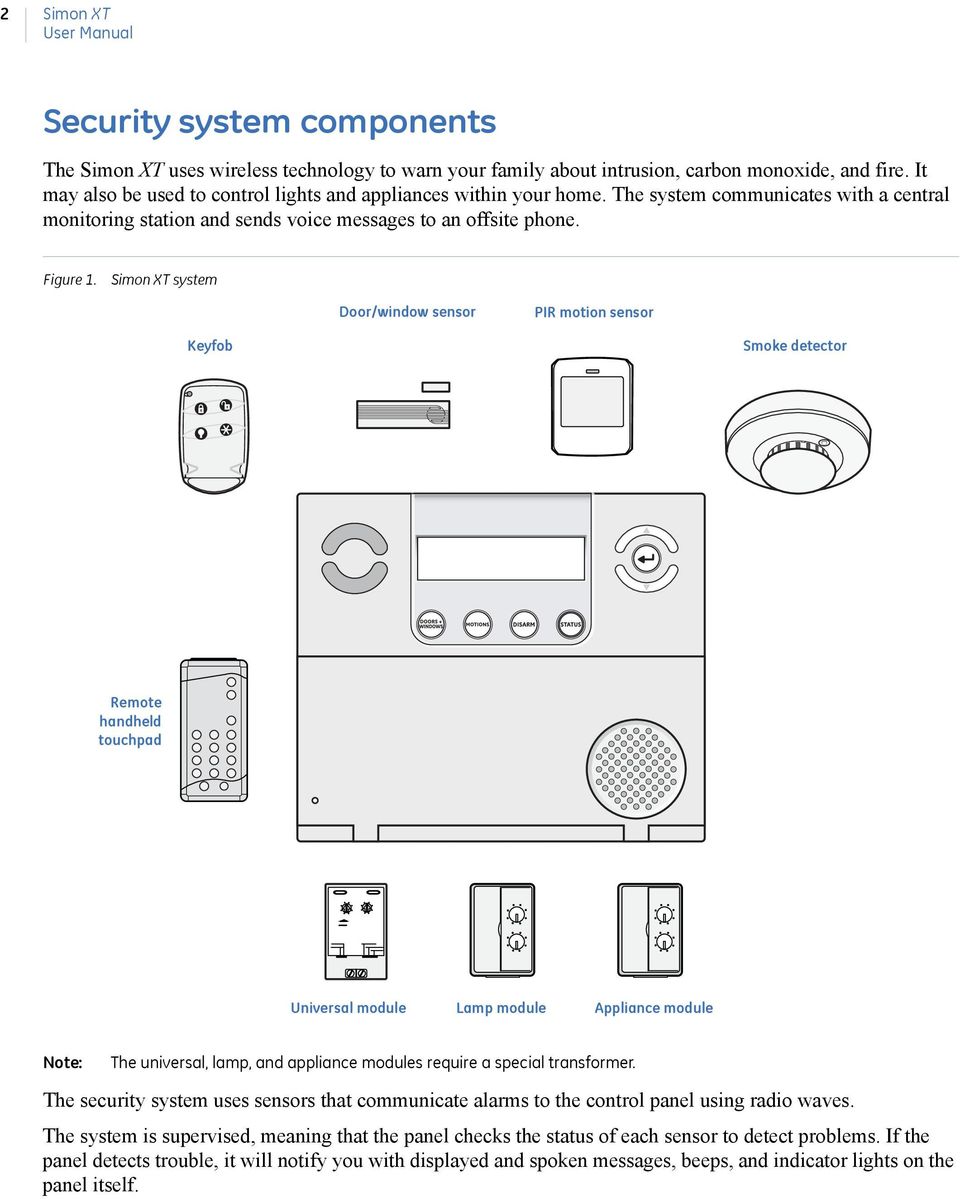
13 Chapter 1 Introduction 3 A Simon XT installation may include any of the devices listed in Table 1. Table 1. Simon XT system components Component Type Description Control panel Operates and programs your security system. It communicates to you through displayed and spoken messages. The panel can communicate to a central monitoring station and send voice messages to your off-site phone. Touchpads Remote handheld Controls the security system primarily from within the home. Keyfob This keychain touchpad controls the security system from within or near the outside of your home. Sensors Indoor motion Detects motion in a protected indoor area. When motion is detected, the panel may respond by sounding chimes or an alarm. Outdoor motion Door/window Smoke Detects motion in a protected outdoor area. When motion is detected, the system may respond by sounding chimes or turning on outside lights. These sensors are not used for intrusion detection. Detects the opening of a door or window. Detects smoke or a significant rise in temperature. They have a built-in siren that sounds when smoke or a significant rise in temperature is detected. Freeze Detects furnace failure. If the inside temperature drops below 41 F (5 C), the sensor will notify the panel. The sensor will send a restore signal to the panel when the temperature rises to 50 F (10 C). Carbon monoxide Water-resistant personal help button Detects carbon monoxide. They have a built-in siren that sounds when carbon monoxide is detected. A wireless device used for activating police, medical, or auxiliary alarms through your security system. Modules Appliance Can be programmed to turn appliances or fluorescent lights on and off. Lamp Universal Can be programmed to turn nonfluorescent lights on and off. Used for controlling devices other than appliances and lamps. Check with your installer for other applications.

14 4 Simon XT User Manual Communicating with your system Sending commands or instructing your security system is done through a series of key presses on the panel, touchpads, or a remote telephone. Table 2. Device System communication devices Description Control panel Remote handheld touchpad Keyfob Telephone You can enter commands for your security system through simple key presses on the panel. Depending on how your system is programmed, you may need to enter an access code for certain commands. An access code is a numeric code that allows authorization to operate your security system. This touchpad gives you the option to enter commands from any room in your house. You can enter commands through simple key presses on the touchpad. Keyfobs are handy for simple arming, disarming and light control functions. They are portable and can be carried off-site in a purse or pocket. Touchtone telephones can be used to communicate with your system while you are off-site. Ask your installer if you have this feature. Note: The default master code is when the security system is shipped from the factory. You should change your code after your system is installed. See Code options on page 24.
15 Chapter 2 Using the control panel This chapter provides instructions for operating your Simon XT Security System. In this chapter: Panel controls Standard text display LEDs Simon XT features Things you can do Home security Exit/entry delay Bypassing sensors Alarms Light control (optional) Chimes Latchkey System status Using an offsite phone Using touchpads Remote handheld touchpad Keyfob
16 6 Simon XT User Manual Panel controls You can operate the self-contained security system through several different methods: The front panel buttons provide a means of arming and disarming the system when you enter or exit your home. These buttons also provide a method for determining which sensors are active and determining system status. A set of three fast action keys provide immediate communication with the central monitoring station to report police, fire, or auxiliary alarms. The more complex operating functions are achieved using a combination of the panel buttons and a display menu. This method is used by your installer to establish your system configuration. You can use this method to program certain user features. See Menu navigation on page 25. The self-contained panel (Figure 2) provides the user interface for system operation and programming system functions. Table 3 on page 7 provides a description of the panel keys and display. Figure 2. Simon XT self-contained panel DOORS+WINDOWS MOTIONS DISARM STATUS Piezo siren Scroll up Enter LCD display Scroll down SILENT BYPASS Emergency Police Number keypad Speaker Microphone Fire Lights on Lights off Door

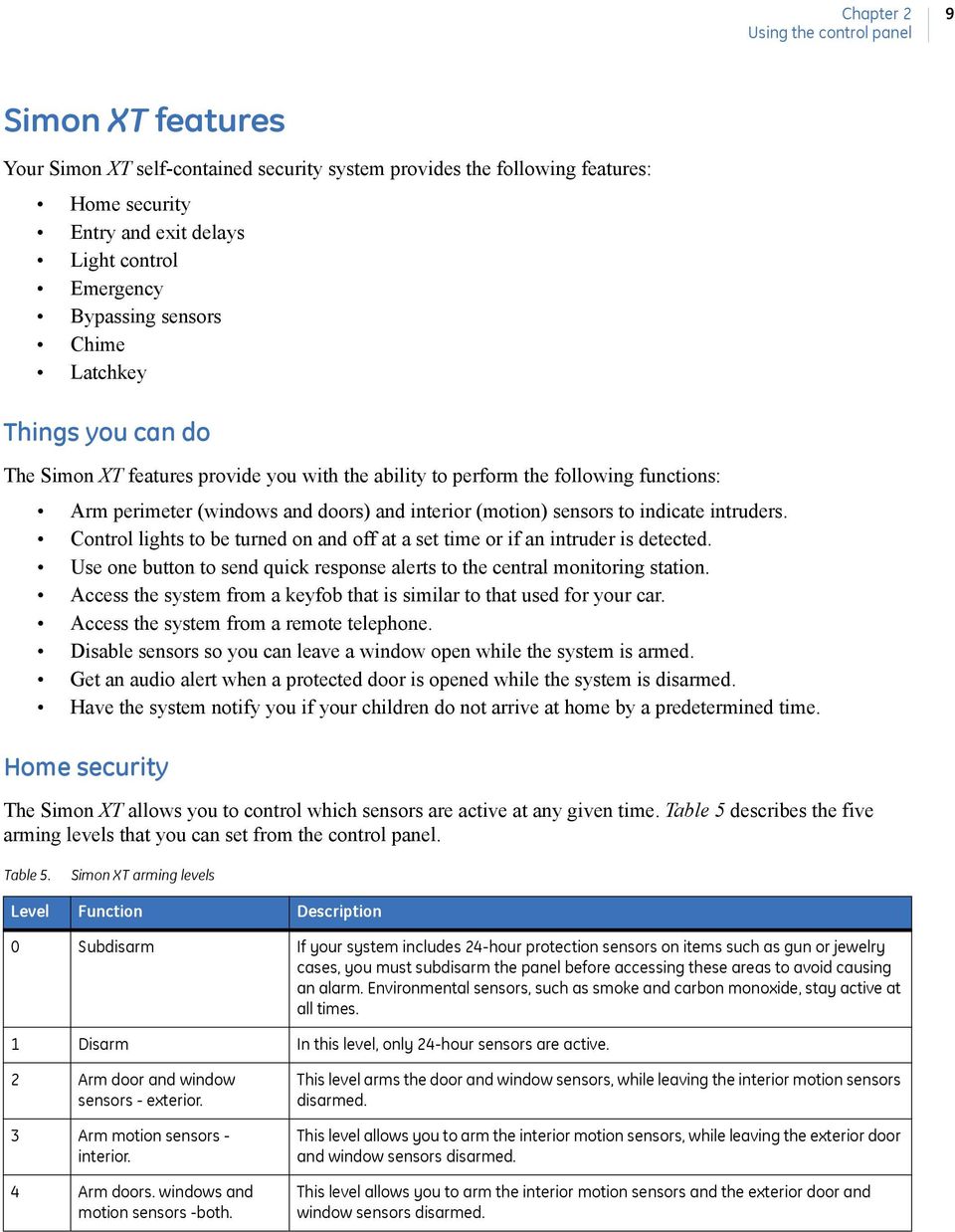
17 Chapter 2 Using the control panel 7 Table 3. Control Simon XT panel keys and features Description Piezo siren LCD display DOORS + WINDOWS MOTIONS DISARM STATUS SILENT BYPASS Police The piezo siren makes alarm beeps and status beeps. Fire and intrusion alarm beeps are always played at high volume, while the volume of status beeps (such as trouble or chime beeps, entry and exit delay beeps, or auxiliary alarm beeps) is programmable. The LCD module has a 2 x 16 character array that displays a variety of phrases and icons. Press to arm perimeter sensors. Press to arm interior sensors. Press to turn off intrusion/burglary protection for your system. Only intrusion/burglary sensors such as doors, windows, and motion sensors are disarmed. Environmental sensors, such as smoke and carbon monoxide, stay active at all times. Press to determine system status. Press to silence exit beeps when arming. Press to bypass a sensor. Press and hold the Police button for two seconds (or press twice quickly) to call the central monitoring station and notify them of a nonmedical call for help. Emergency Press and hold the Emergency button for two seconds (or press twice quickly) to call the central monitoring station and notify them of a nonmedical call for help. Fire Press and hold the Fire button for two seconds (or press twice quickly) to call the central monitoring station and notify them of a nonmedical call for help. Microphone Scroll up/scroll down Enter Numeric keypad Speaker Door Used to communicate with central monitoring station after an alarm. Press to scroll through lists of similar items. Press to select a particular menu item or commit to memory a menu item that has just been programmed. Twelve-key telephone-type keypad (0 through 9, *, #) for entering access codes or other numerical data. Provides voice output and sounds key beeps. The panel speaks arming level changes, system status, and voice chime sensor trips. The panel voice is also used for voice reporting and remote phone control. Covers the lower panel. * Lights on. # Lights off.
18 8 Simon XT User Manual Standard text display While the panel is idle, the following text displays: Display line 1 Display line 2 Arming level HH:MMx (Time) and status icons Arming level text could be one of the following: Subdisarmed Disarmed Doors + Windows Motions Doors + Windows & Motions The phrase - No Delay is appended to the arming level when no entry delay is active. Table 4 describes the possible status icons. Table 4. Status icons Status icon Description Clock Light schedules on Solid bell Chime on Outlined bell Special chime on Light bulb Sensor lights on Key Latchkey on LEDs Every key on the front keypad has an LED behind it, except for the scroll up and down keys. There are four status LEDs behind the row of keys below the LCD display. These status LEDs indicate the arming level. There is one status LED behind the Enter button. This status LED is lit when there are no open sensors in the system. All other LEDs are controlled as a group and provide backlighting for the keypad for 30 seconds after a key is pressed.

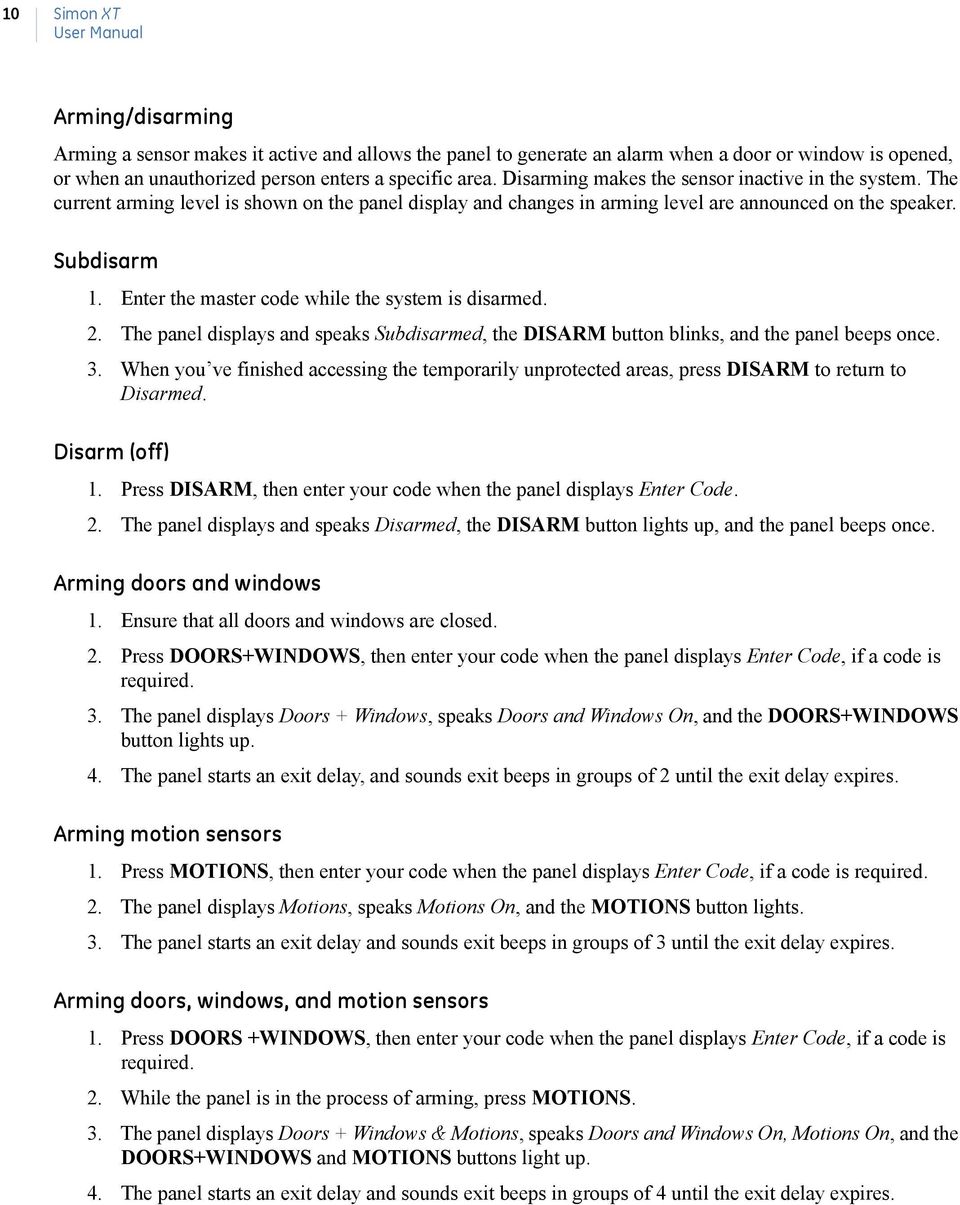
19 Chapter 2 Using the control panel 9 Simon XT features Your Simon XT self-contained security system provides the following features: Home security Entry and exit delays Light control Emergency Bypassing sensors Chime Latchkey Things you can do The Simon XT features provide you with the ability to perform the following functions: Arm perimeter (windows and doors) and interior (motion) sensors to indicate intruders. Control lights to be turned on and off at a set time or if an intruder is detected. Use one button to send quick response alerts to the central monitoring station. Access the system from a keyfob that is similar to that used for your car. Access the system from a remote telephone. Disable sensors so you can leave a window open while the system is armed. Get an audio alert when a protected door is opened while the system is disarmed. Have the system notify you if your children do not arrive at home by a predetermined time. Home security The Simon XT allows you to control which sensors are active at any given time. Table 5 describes the five arming levels that you can set from the control panel. Table 5. Simon XT arming levels Level Function Description 0 Subdisarm If your system includes 24-hour protection sensors on items such as gun or jewelry cases, you must subdisarm the panel before accessing these areas to avoid causing an alarm. Environmental sensors, such as smoke and carbon monoxide, stay active at all times. 1 Disarm In this level, only 24-hour sensors are active. 2 Arm door and window sensors - exterior. 3 Arm motion sensors - interior. 4 Arm doors. windows and motion sensors -both. This level arms the door and window sensors, while leaving the interior motion sensors disarmed. This level allows you to arm the interior motion sensors, while leaving the exterior door and window sensors disarmed. This level allows you to arm the interior motion sensors and the exterior door and window sensors disarmed.
20 10 Simon XT User Manual Arming/disarming Arming a sensor makes it active and allows the panel to generate an alarm when a door or window is opened, or when an unauthorized person enters a specific area. Disarming makes the sensor inactive in the system. The current arming level is shown on the panel display and changes in arming level are announced on the speaker. Subdisarm 1. Enter the master code while the system is disarmed. 2. The panel displays and speaks Subdisarmed, the DISARM button blinks, and the panel beeps once. 3. When you ve finished accessing the temporarily unprotected areas, press DISARM to return to Disarmed. Disarm (off) 1. Press DISARM, then enter your code when the panel displays Enter Code. 2. The panel displays and speaks Disarmed, the DISARM button lights up, and the panel beeps once. Arming doors and windows 1. Ensure that all doors and windows are closed. 2. Press DOORS+WINDOWS, then enter your code when the panel displays Enter Code, if a code is required. 3. The panel displays Doors + Windows, speaks Doors and Windows On, and the DOORS+WINDOWS button lights up. 4. The panel starts an exit delay, and sounds exit beeps in groups of 2 until the exit delay expires. Arming motion sensors 1. Press MOTIONS, then enter your code when the panel displays Enter Code, if a code is required. 2. The panel displays Motions, speaks Motions On, and the MOTIONS button lights. 3. The panel starts an exit delay and sounds exit beeps in groups of 3 until the exit delay expires. Arming doors, windows, and motion sensors 1. Press DOORS +WINDOWS, then enter your code when the panel displays Enter Code, if a code is required. 2. While the panel is in the process of arming, press MOTIONS. 3. The panel displays Doors + Windows & Motions, speaks Doors and Windows On, Motions On, and the DOORS+WINDOWS and MOTIONS buttons light up. 4. The panel starts an exit delay and sounds exit beeps in groups of 4 until the exit delay expires.
21 Chapter 2 Using the control panel 11 Exit/entry delay Your Simon XT provides a delay after entering or exiting your home before the system is alarmed. Table 6 provides details for the entry and exit delay features. Table 6. Entry and exit delay details Function Entry delay No delay Exit delay Protest during arming Description Some active sensors cause immediate alarms when tripped. Other sensors, if enrolled in a delayed response group, start an entry delay that lets you enter the premises and disarm the system. If the system has not been disarmed by the end of the entry delay, the alarm occurs. If the system was armed with the No Delay feature activated, there will be no entry delay and the alarm will occur immediately. When the user arms the system, an exit delay starts. During the delay the user can vacate the premises through a delayed response door without causing an alarm. The system may protest an arming level change if certain abnormal conditions exist. If a sensor that is active in the requested arming level is open, the system sounds protest beeps and automatically bypasses the open sensor (depending on system configuration). Exit delay The exit delay is the amount of time the system gives you to exit the home before the system is armed. This is programmed by the installer. After you arm the system you will hear beeps during the exit delay. See Status beeps on page 20. Silent exit The silent exit feature silences the status beeps that accompany the exit delay. See Status beeps on page 20. Press SILENT after you arm the system to silence status beeps. The panel will still beep at the beginning and end of the exit delay. Note: Enabling silent exit doubles the exit delay time. Entry delay The entry delay is the amount of time the system gives you to disarm the system after entering the home. This is programmed by the installer. When you enter your home, you will hear beeps during the entry delay. See Status beeps on page 20.
22 12 Simon XT User Manual No entry delay Use the No Delay feature when you are staying at home, for instance when you are asleep, or when you re away from home and will carry a wireless touchpad that will allow you to disarm the system before opening a protected door. Check with your installer to find out how this option is programmed. 1. Close all doors and windows. 2. Press DOORS +WINDOWS twice. If a code is required for arming, enter your code after the first press of the DOORS +WINDOWS button, then press the button again. 3. The panel displays Doors+ Windows - No Delay and speaks Doors and Windows On, No Entry Delay. The DOORS + WINDOWS light will blink and the exit delay will begin. Note: To avoid causing an alarm, you must disarm the system with a wireless touchpad before entering your home. Quick exit Use the quick exit feature when someone wants to briefly leave while the home is still armed (for instance to get the newspaper). This feature needs to be enabled by your installer. When you press the DISARM button, the display shows Exit Time Is On. This allows a designated exit door to be open for up to two minutes without triggering an alarm. Note: The designated door may be opened and closed only once. If you close the designated door behind you when you exit, you will have to disarm the system upon reentering. Leave the designated door open while using the quick exit feature. Exit delay extension If enabled by your installer, the Exit delay extension feature will recognize when you arm the system, leave your house and then quickly re-enter your house (such as you would if you forgot your car keys.) In such a case Simon XT will restart your exit delay to give you the full exit delay again. Bypassing sensors Bypassing a sensor allows you to open the sensor while the system is armed. For example, if your Doors & Windows are armed and you want to open your kitchen window but do not want to disarm the entire system, then you can bypass the kitchen window sensor and then open the kitchen window without causing an alarm. Bypassed sensors are automatically unbypassed when the arming level is changed to a level where the sensor is not active. Bypassing 1. Press BYPASS and enter the master code. 2. Scroll up/down until you reach the sensor to be bypassed. 3. The display shows, for example, Sn 1 Front Door on the first line. 4. Press Enter to bypass (deactivate) the sensor. 5. When a sensor is bypassed, the panel displays Bypassed on the second line.
23 Chapter 2 Using the control panel 13 Unbypassing 1. Press BYPASS and enter the master code. 2. Scroll up/down to the sensor to be unbypassed. The sensor must be currently bypassed. 3. Press Enter to unbypass (reactivate) the sensor. 4. The panel removes the word Bypassed from the second line of the display. Alarms The system provides a series of alarms that indicate an unusual occurrence. When an alarm is active, the panel displays: Alarm Alarm Alarm Press Status Alarms are canceled by entering a valid master or user code. After alarms are canceled, the system will be disarmed. Canceling and preventing accidental alarms One of the biggest concerns you might have regarding your security system is causing an accidental alarm. Most accidental alarms occur when leaving the residence after arming the system or before disarming the system upon your return. There is a communicator delay (dialer delay) of 30 seconds programmed into this panel. The panel will delay 30 seconds before dialing the central monitoring station remote phone to send reports. You can have your installer program this delay time between 0 and 254 seconds. To cancel an accidental alarm before the programmed dialer delay time expires, enter your access code. Guidelines for preventing accidental alarms Use the following guidelines to prevent accidental alarms. Close doors and windows before you leave your house. Gather your belongings, so you can exit immediately after arming the system. Always enter and exit within the programmed delay times. Make sure you leave through a door that has a delay time set for it. Disarm your system immediately upon returning home. Be aware of the devices in your security system and learn how each one operates. If you have pets, ask your installer if you need pet lenses in your motion detectors. Check the location of your smoke detectors. Smoke detectors near bathrooms and kitchens can be tripped by steam and smoke from cooking. Make a note of the display, system beeps, and indicator lights that indicate the current system status.
24 14 Simon XT User Manual Light control (optional) Simon XT lets you control lights and appliances using lamp, appliance, or universal modules. You can: Turn lights with unit numbers 1 to 8 on or off manually or at a specific time. Turn on lights when a sensor is tripped. You can program lockout times when sensor-activated lights won t be active. To turn on all of the lights that are controlled by lamp modules, press the * button twice. The panel display will show All Lights On. To turn off all lights that are controlled by lamp modules, press the # button twice. The panel display will show All Lights Off. To turn on or off individual lights: To turn on a light with unit number N (1 to 8), press the * button, then <N>. The panel displays and speaks Light <N> On. To turn off a light with unit number N (1 to 8), press the # button, then <N>. The panel displays and speaks Light <N> Off. Chimes Use the Chime feature to signal when a protected door is opened while the system is disarmed. The panel chimes twice when a chime sensor is tripped, if the chime mode is enabled. This feature allows you to be notified when family members are going in and out of your home. The Chime and Special Chime features are turned on or off in the system menu. See Chime on page 27 and Special chime on page 28. Note: If there are no chime sensors in your system, the Chime option will not be in the System menu. Voice chime Your installer may have programmed the system to speak the sensor name or make a custom chime sound when a chime sensor is tripped. The chime sound, if programmed, will be played in place of the standard chime beeps. Special chime Special chime allows you to install motion sensors in a patio or at the front door, and be notified when someone is approaching those areas. These motion sensors are not used for intrusion protection. The panel will chime three times, if the special chime mode is enabled. Note: If there are no special chime sensors in your system, the Special Chime option will not be shown in the System menu.
25 Chapter 2 Using the control panel 15 Latchkey Use the latchkey feature to notify you, via a remote phone, if a family member does not arrive home at a predetermined time and disarm the system. When this feature is active, a latchkey alarm is reported if the premises are not disarmed by the programmed latchkey time. For example, if you set the Latchkey time for 3:00 p.m. and the system is not disarmed by that time a message is sent to your remote phone. The latchkey feature can be activated during arming if a latchkey time is programmed. To activate the latchkey feature: 1. Press MOTIONS twice. If a code is required, enter your code after the first press of the MOTIONS button, then press MOTIONS a second time. 2. The panel MOTIONS light will blink and the exit delay will begin. System status Press STATUS (no code is required) to cause the system to display and speak the following types of information: Alarm conditions Alarm history Trouble conditions Open sensors Bypassed sensors The STATUS button blinks when an active alarm exists. The STATUS button is lit when an abnormal condition such as a trouble or open sensor exists in the system. You can clear certain status entries from the system (such as old alarm history) by pressing DISARM after checking the status.
26 16 Simon XT User Manual Using an offsite phone If enabled by the installer, you can control your Simon XT panel remotely from an offsite phone. The panel answers a phone call according to the dialing method programmed by your installer. After a certain combination of rings and pauses, the panel will answer the call with the voice prompt Enter your code. You must enter the correct code to gain access. If you are interacting with your panel and the panel hangs up on you, the system is calling in a report to the central monitoring station or remote phone due to an action by you or someone at the security system site. The actions listed in Table 7 may be performed from an offsite phone. Table 7. Phone controls Action Phone key presses Comments Disarm 1 System not already disarmed Subdisarm 1 Must have used the master code to gain access; system was disarmed Arm doors and windows 2 Press 2 again to activate No Delay feature Arm motion sensors 3 Press 3 again to activate Latchkey feature Arm doors, windows, and motion sensors 2 3 Check status 0 Turn light on * <unit_num>. N = 1-8, unit number Turn light off # <unit_num>. N = 1-8, unit number Turn all lights on * * Turn all lights off # # Hang up 9
27 Chapter 2 Using the control panel 17 Using touchpads Touchpads are used to control the security system from any location within or near your home. Remote handheld touchpad Interfacing with the system using a remote handheld touchpad is similar to using the panel. Figure 3. Remote handheld touchpad
28 18 Simon XT User Manual Keyfob If your installer programmed the keyfob with no entry delay, and you armed the system with the keyfob, you must disarm your system before entering the home to avoid causing an alarm. CAUTION: To avoid causing false alarms, check with your installer on how your touchpad options are programmed. Figure 4. Keyfob (keychain touchpad) Note: For any key press on the keyfob, hold the button until the indicator light blinks If your installer programmed your system for remote touchpad arming, you must enter your home to start the entry delay before you can use your keyfob to disarm the system. Note: Panic alarms need to be silenced from the panel, a remote handheld touchpad, or another keyfob. They cannot be silenced from the same keyfob that activated the alarm. Lock Press once to arm doors and windows. Lock Press twice to arm doors, windows, and motion sensors. Lock Press three times to arm doors, windows, motion sensors, and to activate the latchkey option. + Hold both Lock and for 3 sec. unlock Unlock Press both buttons simultaneously for three seconds to send a panic (intrusion, silent, or nonmedical emergency) alarm to the central monitoring station. Check with the installer to find out how the keyfob panic buttons will operate. Press to disarm your security system. Star Can be programmed to control a device connected to a universal module. Light Can be programmed to control a device connected to a lamp module. Press once to turn on all lights on lamp module. Press again to turn off all lights on lamp module turn off.
29 Chapter 3 How your system communicates Your system responds to you through the use of display and voice messages, status beeps, alarms, and panel indicator lights. In this chapter: Status beeps Alarm sirens and lamp modules Panel indicator lights Trouble beeps AC power failure System battery failure Restoration of power Sensor failure Sensor low battery Fail-to-communicate Sensor open Sensor tampered RF jam detected Clearing status
30 20 Simon XT User Manual Status beeps The panel sounds status beeps to alert you to various system events and conditions. Note: Table 8. Activity You may receive a different number of status beeps if you press the buttons quickly. Status beeps Beep Response Doors + Windows Motions Doors + Windows and Motions Disarm Chime Special chime Trouble beeps No activity beeps Exit delay and Entry delay beeps sound two times every five seconds and two times per second during the last ten seconds. If silent exit is used, the exit delay beeps will only sound twice when you arm and twice when the exit delay expires. Exit delay and Entry delay beeps sound three times every five seconds and three times per second during the last ten seconds. If silent exit is used, the exit delay beeps will only sound three times when you arm and three times when the exit delay expires. Exit delay and Entry delay beeps sound four times every five seconds and four times per second during the last ten seconds. If silent exit is used, the exit delay beeps will only sound four times when you arm and four times when the exit delay expires. One beep. Two beeps. Three beeps. Six beeps every minute. Press STATUS to stop beeps for four hours. Twenty beeps every minute for five minutes. Feature must be programmed by the installer. Alarm sirens and lamp modules Exterior and interior sirens make three different alarm sounds on the premises, each indicating a different type of alarm. Sirens are programmed by the installer to time out and stop sounding after a specified time. Use Table 9 to understand the siren sounds used by the security system. Table 9. Alarm Siren and X10 Light Information Function Fire Intrusion Emergency X10 Lights Steady Flashing Steady X10 Siren Steady Steady Alarm beeps Interior and panel siren Temporal 3 a Steady Fast on/off Exterior siren Temporal 3 a Steady a. Temporal 3 refers to a continuous pattern of three siren pulses, then off for 1.5 seconds, three siren pulses, then off for 1.5 seconds.
31 Chapter 3 How your system communicates 21 Panel indicator lights Use Table 10 to understand the panel indicator lights. Table 10. Panel indicator lights Button When button light is on When the button flashes DOORS+WINDOWS Doors + Windows armed Doors + Windows armed and no entry delay on MOTIONS Motions armed Motion sensors armed and latchkey on DISARM System disarmed System subdisarmed STATUS Enter Chime - Solid bell Special chime - Outlined bell Light schedules - Clock Sensor lights - Light bulb Latchkey on - Key System trouble, open sensor, or bypassed sensor There are no open sensors Door will cause chime Motion will cause chime Time-activated lights feature enabled Sensor-activated lights feature enabled Latchkey feature enabled System in alarm Trouble beeps Your security system is able to automatically test itself for: Power failures Low batteries Nonworking sensors Communication troubles with the central monitoring station When your security system detects one of the problems above, six rapid beeps sound every minute until the trouble condition is corrected. To stop the trouble beeps, press STATUS or arm/disarm the system while the trouble condition exists. Trouble beeps will resume four hours later unless the trouble condition is corrected. The following list explains the trouble beep conditions: AC power failure. This condition (if programmed by installer) occurs if your security system has been accidentally unplugged or if there has been an AC power outage. Any status lights go out immediately, and trouble beeps start after five minutes. If you press any button, the display will light and pressing STATUS will show the AC failure. If AC power is not restored within a programmed period of time (5 to 254 minutes) the system will call the central monitoring station. The backup battery, if fully charged, will last for 18 to 24 hours depending on the load applied to the panel with no AC power. System battery failure. This condition occurs if the emergency backup battery has failed. Trouble beeps will start. Press the STATUS button and the display will show System Low Battery. If your AC power is not working, your security system will shut down once the battery has failed. If the condition does not clear after AC power has been restored and 24 hours have passed, call your security system dealer.
32 22 Simon XT User Manual Restoration of power. This condition occurs after a complete loss of power (AC and battery). When power is restored, the panel will return to the arming state with the same zones bypassed it had prior to losing power. Sensor failure. This condition occurs if a sensor is not communicating with the panel. Trouble beeps will start and the STATUS button will light. Press the STATUS button and the display will show what sensors have failed. Perform sensor tests. You may need to call your security system dealer if the problem continues. Sensor low battery. This condition occurs if a system sensor has a low battery. The sensor may still be communicating with the panel. Trouble beeps will start and the STATUS button will light. Press the STATUS button and the display will show what sensors have a low battery. You may need to call your security system dealer to resolve this problem. Some sensor batteries can be replaced by the homeowner. Fail-to-communicate. This condition occurs if your security system cannot communicate to the central monitoring station. Your system will try to report to the central monitoring station eight times before it tells you there is a fail-to-communicate problem. Trouble beeps will start and the STATUS button will light. Press the STATUS button and the display will show Comm Test Fail or Comm Failure.You may need to call your security system dealer if the problem continues. Sensor open. This condition occurs if a door or window is open or a system sensor has been disturbed and not reset properly. For example, a door/window sensor magnet may have been removed from the sensor. Your system will indicate this condition to you by causing the STATUS button to light. When you press the STATUS button, the display shows, for example, Sn 1 Front Door Open. Correct the problem by resetting the sensor. If this condition continues, call your security system dealer. Sensor tampered. This condition occurs when a sensor is physically tampered with, for example, the cover is taken off of one of the sensors. If the system is armed an alarm will occur. Your system will indicate this condition to you by causing the STATUS button to light. Trouble beeps will start. Press the STATUS button and the display shows Sn # Name Tampered. Correct the problem by resetting the sensor. If this condition continues, call your security system dealer. RF jam detected. The panel receiver may be experiencing some interference. The system will call to notify the central monitoring station about this problem. Clearing status. Some types of status conditions, such as the alarm history, must be cleared manually. To clear system status, press the STATUS button, read and/or listen to the status messages, then press DISARM. If the trouble condition was a low system battery, perform a sensor test. The STATUS light should turn off if all trouble conditions have been corrected.
33 Chapter 4 Programming This chapter describes how to program your system. It will guide you through programming instructions for system features. System menu Entering and exiting the system menu Code options Menu navigation Set clock Light schedules Sensor lights Chime Special chime System tests System programming Revision Contrast
34 24 Simon XT User Manual System menu Your Simon XT self-contained security system security system allows you to program certain user options, such as access codes, time schedules, or the system time. These options are accessed through a system menu. Entering and exiting the system menu To enter the system menu, press the scroll up/down buttons or the Enter button in the upper right of the panel. Press STATUS to exit a menu or option edit mode and navigate up one level. Pressing STATUS while in the top menu level exits the system menu. The panel automatically exits the system menu after a few seconds of inactivity if no access code has been entered yet. After an access code has been entered to access a codeprotected area of the system menu, the timeout is 30 seconds (4 minutes while performing a sensor test). Code options The Simon XT security system provides a system of codes to be entered when a certain level of authority is required to perform an action. These codes allow you to activate system options, customize panel operations, and generate a silent alarm. The default code is based on the code length (3, 4, 5, or 6-digit code) determined at installation. The code types are listed in Table 11. Table 11. Simon XT system codes Code Description Master code The master code is the main code used for panel operations. The default code will be 123, 1234, 12345, or depending on the value set by the installer for code length. User codes 1 through 8 Duress code These eight codes are supplemental user codes. These codes can be used for panel operations such as disarming, but not programming. These codes can be any 3, 4, 5, or 6-digit code, depending on the code length. the duress code is used to generate a silent duress alarm while disarming. Note: Any combination of invalid codes in excess of 40 key presses (such as fourteen invalid three-digit codes) will cause a system access alarm. The alarm locks all touchpads, except keyfobs, for 90 seconds.
35 Chapter 4 Programming 25 Menu navigation Each menu contains a list of options and/or submenus. Press the scroll up/down buttons to navigate up and down the list of options and submenus in that menu. Pressing Enter after navigating to an option selects that option for editing and flashes the current value. Pressing Enter after navigating to a submenu enters that submenu, making a new list of options accessible. Pressing STATUS exits a menu and goes to the next higher level. Programming options are arranged in a menu structure as outlined in Table 12. The top menu contains several features, as well as the System Programming menu. When accessing the System Programming or System Tests menu, the panel prompts you to enter an access code. To continue, enter the master code, then press Enter. To program an option, first navigate to that option until it is displayed, then press Enter. The option value will start flashing, indicating that it is ready to be changed. Use the scroll keys or enter a numerical value to change the option, then press the Enter key to save the change. Table 12. Simon XT system menu structure Top menu entry First submenu level Second submenu level Set Clock Light Schedules Sensor Lights Chime Special Chime System Tests Sensor Test Comm Test System Download System Programming Access Codes Master Code User Code 1 to 8 Duress Code Security Download Enable Phone #s Phone #4 Timers Siren Options Light Control Latchkey Time Piezo Beeps Panel Voice Panel Piezo Alrm Status Beep Vol Speaker Volume Set Entry Lights Sensor Light Light Schedules Housecode Lock Interval
36 26 Simon XT User Manual Table 12. Simon XT system menu structure (continued) Top menu entry First submenu level Second submenu level System Tests Sensor Test Comm Test System Download Revision Contrast Set clock If the panel loses both AC and battery power, then upon restoring power the system time will default to midnight and blink, indicating it has not been set correctly. Your installer can set your system time to display in either 12-hour or 24-hour format. Time of day format is HH:MMx Where: HH = 01 to 12 (12-hour format) or (24-hour format) MM = 00 to 59 x = a or p (12-hour format) or none (24-hour format) To reset the clock: 1. Scroll up/down until the display shows Set Clock. 2. Press Enter. 3. The display shows Enter Code. 4. Enter your master code with numeric keys. Press Enter. 5. Press Enter again. The display now flashes the hours. 6. Scroll up/down to set the hours. 7. Press the Enter key to accept. The display now flashes the minutes. 8. Scroll up/down to set the minutes. 9. Press the Enter key to accept. The display is now flashing the AM/PM. 10. Scroll up/down to set the AM/PM. 11. Press Enter to accept. The display now shows the current time, and stops flashing. 12. Press STATUS twice to exit.
37 Chapter 4 Programming 27 Light schedules Simon XT will automatically turn certain lights on or off according to light schedules you can define in menu item System Programming / Light Control / Light Schedules. See Light control (optional) on page 14. To enable or disable scheduled lights: 1. Scroll up/down until the display reads Light Schedules. 2. Press Enter. The current setting will flash. 3. Scroll up/down to toggle scheduled lights On/Off. 4. Press Enter. The setting will stop flashing. 5. Press STATUS to exit. A clock icon appears in the display when scheduled lights are enabled. Note: This menu option will not appear if no light schedules are defined. Sensor lights Simon XT automatically turns certain lights on or off when certain sensors are tripped. For example, you can set a basement light to turn on when the door to the basement is opened. You can associate sensors with lights in menu item System Programming / Light Control / Sensor Light. See Light control (optional) on page 14. To enable or disable sensor-activated lights: 1. Scroll up/down until the display shows Sensor Lights. 2. Press Enter. The current setting will flash. 3. Scroll up/down to toggle the sensor-activated lights On/Off. 4. Press Enter. The setting will stop flashing. 5. Press STATUS to exit. A light-bulb icon will appear in the display when Sensor Lights are enabled. Note: This menu option will not appear if no sensor lights have been defined. Chime To enable or disable the Chime feature: 1. Scroll up/down until the display shows Chime. 2. Press Enter. The current setting will flash. 3. Scroll up/down to toggle Chime On/Off. 4. Press Enter. The setting will stop flashing. 5. Press STATUS to exit. A solid bell icon will appear in the display when Chime is enabled. Note: This menu option will not appear if no chime sensors are in your system
38 28 Simon XT User Manual Special chime To enable or disable the Special Chime feature: 1. Scroll up/down until the display shows Chime. 2. Press Enter. The current setting will flash. 3. Scroll up/down to toggle Special Chime On/Off. 4. Press Enter. The setting will stop flashing. 5. Press STATUS to exit. An outlined bell icon will appear in the display when Special Chime is enabled. Note: This menu will not appear if Special Chime sensors are not in your system. System tests The Simon XT system tests include: Sensor Test (see Testing sensors on page 38) Comm Test (see Testing communication on page 39) System download System download You can initiate a download call to program your system with the settings specified by your installer. To initiate a download: 1. Scroll up/down till the display shows System Tests. 2. Press Enter. The display shows Enter Code. 3. Enter your master code with numeric keys. 4. Press Enter. The display now shows Sensor Test. 5. Scroll up/down till the display shows System Download. 6. Press Enter. The display shows Download In Progress. 7. Wait while your system calls the download center. 8. Display will show the result of the download. If the display shows Download Fail, contact your dealer. 9. Press STATUS twice to exit. Note: Use this feature only when instructed by your installer or dealer.
39 Chapter 4 Programming 29 System programming To enter the System Programming menu: 1. Enter the system menu. 2. Scroll up/down to System Programming, then press Enter. 3. The panel displays Enter Code. 4. Enter your master code, then press Enter. At this point, you are in the System Programming submenu. At this level, the following items are accessible: Access Codes Security Phone #s Timers Siren Options Light Control System Tests The sections below describe the options that you can program in the System Programming menu. Access codes There are three types of access codes: master, user, and duress. The master code is your most powerful code and can be used for all user operations including programming There are eight user codes, which can be used for many user operations, but not subdisarming, programming, or bypassing sensors. The duress code, when used in place of another user code, generates a silent duress alarm which is reported to the central monitoring station. Master code To change the master code: 1. Enter the System Programming menu. 2. Scroll up/down to Access Codes, then press Enter. 3. Scroll up/down to Master Code, then press Enter. 4. The current value of the code now flashes. 5. Enter a new code (use correct length), then press Enter. 6. Press STATUS repeatedly to exit. The initial value of the master code is 123, 1234, 12345, or , depending on the installer-programmed access code length.
40 30 Simon XT User Manual User codes 1 to 8 To change a user code: 1. Enter the System Programming menu. 2. Scroll up/down to Access Codes, then press Enter. 3. Scroll up/down to the user code you want to change, then press Enter. 4. The current value of the code now flashes. 5. Enter a new code (use correct length), then press Enter. 6. Press STATUS repeatedly to exit. Initially, all user codes are blank. A user code can be deleted by pressing DISARM while the code is being changed. Duress code To change the duress code: 1. Enter the System Programming menu. 2. Scroll up/down to Access Codes, then press Enter. 3. Scroll up/down to Duress Code, then press Enter. 4. The current value of the code now flashes. 5. Enter a new code (use correct length), then press Enter. 6. Press STATUS repeatedly to exit. Initially, the duress code is blank. The duress code can be deleted by pressing DISARM while the code is being changed. Security The Security menu contains the Download Enable option. This option determines whether your dealer can access the system remotely. To program the Download Enable option: 1. Enter the System Programming menu. 2. Scroll up/down to Security, then press Enter. 3. Scroll up/down to Download Enable, then press Enter. 4. The current value of this option now flashes On/Off. 5. Scroll up/down to the desired value, then press Enter. 6. Press STATUS repeatedly to exit.
41 Chapter 4 Programming 31 Phone numbers Phone #4 is the only system phone number that you can change. Therefore, it is often used for voice reporting of alarms to your phone, if it was programmed for this purpose by the installer. To change Phone #4: 1. Enter the System Programming menu. 2. Scroll up/down to Phone #s, then press Enter. 3. Scroll up/down to Phone #4, then press Enter. 4. The first digit of the current value of this option now flashes (this may take up both lines on the display). 5. Change each digit of the phone number by scrolling or entering a numerical value, then move to the next digit by pressing Enter. 6. When done, press Enter again to save the new phone number. 7. Press STATUS repeatedly to exit. The phone number can be deleted by pressing the DISARM button while changing a digit. Timers The Latchkey Time option is the only timer setting available to you. The Latchkey Time is the time of day by which the panel must be disarmed to avoid triggering a latchkey alarm, if the Latchkey Time option is enabled during arming. To change the Latchkey Time: 1. Enter the System Programming menu. 2. Scroll up/down to Timers, then press Enter. 3. Scroll up/down to Latchkey Time, then press Enter. 4. The HH (hours) part of the time now flashes. 5. Program the hour value by scrolling or entering a numerical value, then press Enter. 6. The MM (minutes) part of the time now flashes. 7. Program the minute value by scrolling or entering a numerical value, then press Enter. 8. If you are using 12-hour clock format, the a or p (AM/PM) part of the time now flashes. 9. Select a or p by scrolling, then press Enter. 10. Press STATUS repeatedly to exit.
42 32 Simon XT User Manual Siren options The panel has two built-in sound sources, a piezo siren and a speaker. The piezo siren makes alarm beeps and status beeps. Fire and intrusion alarm beeps are always played at high volume, while the volume of status beeps (such as trouble or chime beeps, entry and exit delay beeps, or auxiliary alarm beeps) is programmable. The speaker emits the panel's voice and also sounds beeps when a key is pressed. Its volume is also programmable. The siren and built-in speaker options consist of the following: Panel piezo beeps (status beeps sounded on the siren) Panel voice (spoken phrases on the speaker) and key press sounds from the speaker heard while controlling the system) Panel piezo alarms (loud alarms on the siren) Status beep volume Speaker volume Piezo Beeps This option determines whether or not the panel sounds non-alarm beeps. To program Piezo Beeps: 1. Enter the System Programming menu. 2. Scroll up/down to Siren Options, then press Enter. 3. Scroll up/down to Piezo Beeps, then press Enter. 4. The current value of this option now flashes (On or Off). 5. Scroll up/down to the desired value, then press Enter. 6. Press STATUS repeatedly to exit. Panel Voice This option determines whether or not the panel speaks status messages and arming level changes. To program Panel Voice: 1. Enter the System Programming menu. 2. Scroll up/down to Siren Options, then press Enter. 3. Scroll up/down to Panel Voice, then press Enter. 4. The current value of this option now flashes (On or Off). 5. Scroll up/down to the desired value, then press Enter. 6. Press STATUS repeatedly to exit.
43 Chapter 4 Programming 33 Panel Piezo Alrm This option determines whether or not the panel sounds alarm beeps. To program Panel Piezo Alrm: 1. Enter the System Programming menu. 2. Scroll up/down to Siren Options, then press Enter. 3. Scroll up/down to Panel Piezo Alrm, then press Enter. 4. The current value of this option now flashes (On or Off). 5. Scroll up/down to the desired value, then press Enter. 6. Press STATUS repeatedly to exit. Status Beep Vol This option sets the sound volume of nonalarm beeps. The numerical range is 1 to 10. The default value is 7. To program Status Beep Vol: 1. Enter the System Programming menu. 2. Scroll up/down to Siren Options, then press Enter. 3. Scroll up/down to Status Beep Vol, then press Enter. 4. The current value of this option now flashes (1 to 10). 5. Scroll up/down to the desired value, then press Enter. 6. Press STATUS repeatedly to exit. Speaker Volume This option sets the sound volume of the panel speaker for key presses and alarm sounds. The numerical range is 1 to 8. The default value is 8. To program Speaker Volume: 1. Enter the System Programming menu. 2. Scroll up/down to Siren Options, then press Enter. 3. Scroll up/down to Speaker Volume, then press Enter. 4. The current value of this option now flashes (1 to 8). 5. Scroll up/down to the desired value, then press Enter. 6. Press STATUS repeatedly to exit.
44 34 Simon XT User Manual Light control (optional) You can control certain lights by using X-10 lamp, appliance, or universal modules. As set up by the installer, these modules have unit numbers from 1 to 8 and are set to the same housecode. These lights can be turned on for certain arming operations, when a sensor is tripped or based on a time schedule. Light Control includes: Set entry lights Sensor lights Light schedules Housecode Sensor-activated light lockout time Set Entry Lights In this menu, each unit number can be set up as an entry light. These lights flash the arming level when the system is armed. For example, an entry light flashes twice when the system is armed to Level 2 (Doors+Windows). To Set Entry Lights: 1. Enter the System Programming menu. 2. Scroll up/down to Light Control, then press Enter. 3. Scroll up/down to Set Entry Lights, then press Enter. 4. Scroll up/down to the unit number you want to set up, then press Enter. 5. The current option value flashes (On or Off). 6. Scroll up/down to the desired value, then press Enter. 7. Press STATUS repeatedly to exit. Sensor Light In this menu, each sensor can be tied to a unit number. For example, a light in a room can be set up to turn on when a motion sensor in that room is tripped. To set up Sensor Light: 1. Enter the System Programming menu. 2. Scroll up/down to Light Control, then press Enter. 3. Scroll up/down to Sensor Light, then press Enter. 4. The number and name of the first sensor are displayed, along with its associated unit number. 5. Scroll up/down to the sensor you want to set up, then press Enter. 6. The current option value now flashes (1 to 8 or Off). 7. Scroll up/down to the desired value or enter a numerical value, then press Enter. 8. Press STATUS repeatedly to exit.
45 Chapter 4 Programming 35 Light Schedules In this menu, a light schedule can be programmed for each unit number (1 to 8). To program Light Schedules: 1. Enter the System Programming menu. 2. Scroll up/down to Light Control, then press Enter. 3. Scroll up/down to Light Schedules, then press Enter. 4. Scroll up/down to the desired light schedule (as defined by the unit number), then press Enter. 5. The current option value now flashes. 6. Enter the desired start time by entering the hours, minutes, and AM/PM (press Enter after programming each part). 7. Enter the desired end time by entering the hours, minutes, and AM/PM (press Enter after programming each part). 8. Press STATUS repeatedly to exit. Housecode To change the Housecode: 1. Enter the System Programming menu. 2. Scroll up/down to Light Control, then press Enter. 3. Scroll up/down to Housecode, then press Enter. 4. The current option value (A to O) now flashes. 5. Scroll up/down to the desired value, then press Enter. 6. Press STATUS repeatedly to exit. Lock Interval Each light (unit numbers 1 to 8) that has been tied to a sensor can be programmed not to turn on during a certain time of day. To program the Lock Interval: 1. Enter the System Programming menu. 2. Scroll up/down to Light Control, then press Enter. 3. Scroll up/down to Lock Interval, then press Enter. 4. Scroll up/down to the unit number for which you want to program a lockout time, then press Enter. 5. The current option value now flashes. 6. Program the start and end times (see Light Schedules on page 35). 7. Press STATUS repeatedly to exit. System Tests This menu duplicates a higher-level menu. For more information, see System tests on page 28.
46 36 Simon XT User Manual Revision To display the firmware revision of the system: 1. Scroll up/down to Revision. 2. Press STATUS to exit. Contrast To adjust the Contrast of the display: 1. Scroll up/down to Contrast. 2. press Enter. 3. Scroll up/down to increase and decrease the contrast setting. 4. Press STATUS to save the setting and exit. Note: Changes in contrast are more noticeable when not looking at the display straight-on.
47 Chapter 5 Testing This chapter provides a set of tests to ensure proper operation of your Simon XT self-contained security system. We recommended you test your system weekly. Testing sensors Testing communication
48 38 Simon XT User Manual Testing sensors You can test sensors one at a time to make sure they are sending strong signals to the panel. You should test the security system at least once a week. To perform the Sensor Test: 1. Scroll to System Tests. 2. Press Enter. The display shows Enter Code. 3. Enter your master code with the numbered keys. 4. Press Enter to accept the master code. The display shows Sensor Test. 5. Press Enter. The display shows, for example, Trip Sn 1 Front Door and automatically displays the list of sensors to be tested. The panel sounds six beeps once a minute while in Sensor Test mode. See Table 13, How to trip devices for sensor test on page 38. When you trip a sensor the display shows, for example, Sn 1 Packets = 8 Front Door. You may trip the sensors in any order. As each sensor is heard from, it is removed from the list of sensors to be tested. After all sensors have been successfully tested, the display shows Sn Test Complete, Press Status. To terminate the sensor test: 1. Press STATUS. The display shows Sensor Test Ok. 2. After a few seconds the display shows Sensor Test. 3. Press STATUS repeatedly to exit. If any of the sensors did not test successfully and you want to terminate the test, press STATUS. The panel display will show Sensor Test Fail or Aborted. The display then shows Sensor Test. Press STATUS once to exit the system test. If a sensor test fails, call your security dealer. Table 13. Device How to trip devices for sensor test To trip device Door/window sensor Freeze sensor Water sensor Carbon monoxide sensor Glass guard sensor Motion sensor Shock sensor Smoke sensor Wireless panic button keyfob Remote handheld touchpad Open the secured door or window. Apply ice to the sensor. Do not allow the sensor to get wet. Press a wet rag or wet finger over both of the round, gold-plated terminals on the underside of the sensor. Unplug the CO alarm. Plug it back in and press the test/reset button until the unit beeps 8 times. Tap the glass 3 or 4 inches (6 to 8 cm) from the sensor. Avoid the motion sensor s view for five minutes, then enter its view. Tap the glass twice, away from the sensor. Wait at least 30 seconds before testing again. Press and hold the test button until the system sounds transmission beeps. Press and hold the appropriate panic button for three seconds. Press and hold lock and unlock simultaneously for three seconds. Press and hold the two emergency buttons simultaneously for three seconds.
49 Chapter 5 Testing 39 Testing communication Test communication between your system and the central monitoring station or a voice report destination at least once per week to make sure you have the proper telephone connection. To perform a communication test: 1. Scroll to System Tests. 2. Press Enter. The display shows Enter Code. 3. Enter the master code. 4. Press Enter to accept the master code. The display shows Comm Test. 5. Scroll to Comm Test. 6. Press Enter. The display shows Comm Test is On. 7. After the communication test is successful, the display shows Comm Test Ok. 8. Press STATUS repeatedly to exit. Note: If your system is not connected to a central monitoring station and you do not have a voice report destination programmed, you won t be able to perform the communication test. If the communication test is successful, the system displays Comm Test Ok. If the test is unsuccessful, the STATUS button will light and within ten minutes the panel will display Comm Failure. If a communication test fails, call your security system dealer.
50 40 Simon XT User Manual
51 Appendix A Reference information This appendix provides a list of system limitations, emergency planning, floorplan, and a quick reference command table. In this appendix: Alarm system limitations Emergency planning Smoke and heat detector locations Your floorplan Sensor and module locations Access codes Delays Simon XT system quick reference
52 42 Simon XT User Manual Alarm system limitations Not even the most advanced alarm system can guarantee protection against burglary, fire, or environmental problems. All alarm systems are subject to possible compromise or failure-to-warn for a variety of reasons. If sirens are not placed within hearing range of persons sleeping, in remote parts of the premises, or if they are placed behind doors or other obstacles. If intruders gain access through unprotected points of entry or areas where sensors have been bypassed. If intruders have the technical means of bypassing, jamming, or disconnecting all or part of the system. If power to sensors is inadequate or disconnected. If freeze or any environmental sensors are not located in areas where the appropriate condition can be detected. If smoke does not reach a smoke sensor. For example, smoke sensors cannot detect smoke in chimneys, walls, roofs, or areas blocked by a closed door. Sensors may not detect smoke in other levels of the building. Sensors may not warn in time when fires are caused by smoking in bed, explosions, improper storage of flammables, overloaded electrical circuits, or other hazardous conditions. If telephone lines are out of service. Inadequate maintenance is the most common cause of alarm failure. Therefore, test your system at least once per week to be sure sensors, sirens, and phone communication are all working correctly. Although having an alarm system may make you eligible for reduced insurance premiums, the system is no substitute for insurance. WARNING: Security system devices cannot compensate you for the loss of life or property. Emergency planning Since an emergency is always unexpected, you should develop plans to help prepare for a variety of emergency situations. Periodically discuss and rehearse emergency plans to include the following: Understand how to use your security system. Know the normal state of doors and windows: open, closed, or locked. Escape fast! (Do not stop to pack.) Use a different escape route if closed doors feel hot to the touch. Crawl and hold your breath as much as possible to help reduce smoke inhalation during your escape. Meet at a designated outdoor location. Emphasize that no one should return to the premises if there is a fire. Notify the fire department from a neighbor s phone. Emphasize that no one should enter the premises if they hear sirens in the house. If you arrive at the premises and hear sirens, do not enter. Call for emergency assistance from a neighbor s phone.
53 Appendix A Reference information 43 Smoke and heat detector locations Selecting a suitable location is critical to the operation of smoke alarms. Figure 5 shows some typical floorplans with recommended smoke and heat detector locations. Use these location guidelines to optimize performance and reduce the chance of false alarms: Before mounting alarms, program (learn) them into memory and do a sensor test from the alarm s intended location to ensure good RF communication to the panel. Locate the alarm in environmentally controlled areas where the temperature range is between 40 and 100 F (5 and 38 C) and the humidity is between 0 and 90% noncondensing. Locate alarms away from ventilation sources that can prevent smoke from reaching the alarm. Locate ceiling mounted alarms in the center of the room or hallway, at least 4 in. (10 cm) away from any walls or partitions. Locate wall mounted alarms so the top of the alarm is 4 to 12 in. (10 to 31 cm) below the ceiling. In rooms with sloped, peaked, or gabled ceilings, locate alarms 3 ft. (0.9 m) down or away from the highest point of the ceiling. When mounting to suspended ceiling tile, the tile must be secured with the appropriate fasteners to prevent tile removal. Note: Do not mount the alarm to the metal runners of suspended ceiling grids. The metal runners can draw the magnet s field away from the alarm s reed switch and cause a false tamper alarm. Figure 5. Smoke detector locations Required smoke detector Optional smoke detector Bedroom Hall Bedroom Bedroom Hall Bedroom Heat detector Living room Living room Dining room Recreation room Basement Basement Dining room Kitchen Bedroom Bedroom TV room Dining room Kitchen Bedroom Living room Bedroom Living room Bedroom Bedroom
54 44 Simon XT User Manual Your floorplan Use the following guidelines when drawing your floorplan: Show all building levels. Show exits from each room (two exits per room are recommended). Show the location of all security system components. Show the location of any fire extinguishers Sensor and module locations Use Table 14 and Table 15 on page 45 to list your sensor and module locations. Table 14. Sensor locations Sensor number Sensor name Sensor type Location Example Front door Door/window sensor Front door
55 Appendix A Reference information 45 Table 14. Sensor locations (continued) Sensor number Sensor name Sensor type Location Table 15. X10 module locations Unit # Location Unit # Location
56 46 Simon XT User Manual Access codes Table 16. Access codes Code description Code Master code User code 1 User code 2 User code 3 User code 4 User code 5 User code 6 User code 7 User code 8 Duress code Delays Table 17. Delays Delay Time Exit delay Entry delay
57 Appendix A Reference information 47 Table 18. Simon XT system quick reference a Control panel Remote touchpad Keyfob Telephone Level 0: Subdisarm the system Enter the master code while the system is disarmed. 1 Level 1: Disarm the system DISARM, <access_code>. 1 Disarm Level 2: Arm doors and windows DOORS+WINDOWS, <access_code> (if required). ARM Doors & Windows 2 Level 3: Arm motion sensors MOTIONS, <access_code> (if required). ARM 3 Motion Sensors Level 4: Arm doors, windows, motions DOORS+WINDOWS, <access_code> (if required), MOTIONS. ARM Doors & Windows ARM 2 3 Motion Sensors Activate no delay DOORS+WINDOWS, DOORS+WINDOWS. Appends No Delay to arming level text. ARM Doors & Windows ARM 2 2 Doors & Windows Activate latchkey MOTIONS, <access_code> (if required), MOTIONS. ARM Motion Sensors ARM 3 3 Motion Sensors Activate panic alarm Press Fire, Emergency, or Police twice within 3 sec. or hold it for 2 sec. + Hold both + for 3 sec. Hold both for 3 sec. Check system status STATUS 0 SYSTEM STATUS Toggle chime or special chime mode Scroll to Chime or Special Chime, Enter, toggle On/Off, Enter. Bypass a sensor Time-activated lights on/off Sensor-activated lights on/off BYPASS, <master_code>, scroll to the sensor, BYPASS. Scroll to Light Schedules, Enter, toggle On/Off, Enter. Scroll to Sensor Lights, Enter, toggle On/Off, Enter. Specific light on Press *, <unit_num>. <unit_num>. * <unit_num>. Specific light off Press #, <unit_num>. <unit_num>. # <unit_num>. All lights on All lights off To turn on all lights controlled by lamp modules, press * twice. The panel displays All Lights On. To turn off all lights controlled by lamp modules, press # twice. The panel displays All Lights Off. * * # # a. A minus sign ( ) between buttons means press one then the next; a plus sign (+) between buttons means press both simultaneously.
58 48 Simon XT User Manual
59 49 Index A AC power failure access codes... 29, 46 accidental alarms alarm sirens alarms appliance module... 2, 3 arm doors and windows arm motion sensors arming levels... 9 B battery failure bypass C carbon monoxide sensor... 3 chimes... 14, 27 clearing status clock code options components... 2 contrast conventions...ix D delays door/window sensor... 2 duress code... 24, 30 E emergency button... 7 emergency planning exit/entry delay F fail-to-communicate features... 9 fire button... 7 firmware revision floorplans H handheld touchpad... 2, 17 housecode K keychain touchpad...see keyfob keyfob... 2, 3, 18 L lamp module... 2, 3 lamp modules latchkey latchkey time LEDs... 8 light control... 14, 34 light schedules... 27, 35 lock button lock interval M master code... 24, 29 menu navigation menu structure module locations modules... 3 motion sensor... 2 P panel controls... 6 panel indicator lights panel keys... 7 panel piezo alarm panel voice phone numbers phones piezo beeps PIR motion sensor... 2 police button... 7 preface... ix
60 50 Simon XT User Manual programming Q quick exit quick reference chart R remote handheld touchpad restoration of power revision RF jam detected S safety terms and symbols...ix security menu sensor failure sensor lights sensor locations sensor low battery sensor open sensor tampered sensors... 3 set clock silent exit siren options smoke and heat detector locations smoke detector... 2, 3 speaker volume special chime status status beep volume status beeps status icons... 8 system battery failure system download system features... 9 system limitations system menu system programming system status system tests... 28, 35 T testing communication sensors timers touchpads... 3, 17 trouble beeps U unbypass universal module... 2, 3 unlock button user codes... 24, 30 V voice chime... 14
Simon XT User Manual
 600-1054-95R Simon XT User Manual g Copyright Disclaimer Trademarks and patents Software license agreement Copyright 2007 GE Security. All rights reserved. This document may not be copied in whole or in
Simon XT User Manual
 Simon XT User Manual 24/7 Alarm Monitoring as low as $ 22 00 /mo* Serving Orlando, Gainesville and Surrounding Areas www.cpss.net 1-844-692-2729 Simon XT User Manual g Copyright Disclaimer Trademarks and
Simon XT User Manual P/N 466-2266 REV E OCT12
 Simon XT User Manual P/N 466-2266 REV E OCT12 Copyright Disclaimer 2012 UTC Fire & Security Americas Corporation, Inc. Interlogix is part of UTC Climate Controls & Security, a unit of United Technologies
Simon XT V2 User Manual
 GE Security Simon XT V2 User Manual P/N 466-2266-01 REV A ISS 24FEB10 Copyright Disclaimer Trademarks and patents 2010 GE Security, Inc. This document may not be copied in whole or in part or otherwise
Simon XT User Manual. 600-1054-95R-11 and 600-1054-95R-11-CN P/N 466-2266-02 REV B ISS 13JAN11
 Simon XT User Manual 600-1054-95R-11 and 600-1054-95R-11-CN P/N 466-2266-02 REV B ISS 13JAN11 Copyright Trademarks and patents Manufacturer FCC compliance Contact information 2011 UTC Fire & Security.
466-1936 Rev E October 2004 ZZZ*(6HFXULW\FRP. Part No: 60-883-95R. CareGard. User Guide
 ) *(6HFXULW\ 466-1936 Rev E October 2004 ZZZ*(6HFXULW\FRP Part No: 60-883-95R CareGard User Guide FCC Notices FCC Part 15 Information to the User Changes or modifications not expressly approved by GE Security
Simon Security System. User Guide. 466-1871-01-EUR Rev A August 2004. Part No: 60-911 ZZZJHVHFXULW\FRP. Motion. Doors & Windows
 ) *(6HFXULW\ 466-1871-01-EUR Rev A August 2004 ZZZJHVHFXULW\FRP Part No: 60-911 Doors & Windows Motion Sensors System Status HOME SECURITY Arm Disarm 1/2 3/4 5/6 7/8 9/0 CODE Chime Doors Motion Time Sensor
Changes or modifications not expressly approved by Interactive Technologies, Inc. can void the user s authority to operate the equipment.
 0 FCC Notices FCC Part 15 Information to the User Changes or modifications not expressly approved by Interactive Technologies, Inc. can void the user s authority to operate the equipment. FCC Part 15 Class
Changes or modifications not expressly approved by Interlogix, Inc. can void the user s authority to operate the equipment.
 9-4 5 ) 7 ) 8 A HI E = @ = JA H 6 D A 2 A =? A A A F A H 1 FCC Notices FCC Part 15 Information to the User Changes or modifications not expressly approved by Interlogix, Inc. can void the user s authority
Simon XTi Quick Operation Guide
 Simon XTi Quick Operation Guide This is the Quick Operation Guide for the Simon XTi system (models 600-1054-95R-12 & 600-1054-95R-12-CN). The Simon XTi provides a graphical user interface for programming
Simon XTi User Manual
 Simon XTi User Manual Simon XTi P/N 466-2452 REV A 15MAR12 Copyright Trademarks and patents Manufacturer FCC compliance Contact information Customer support 2012 UTC Fire & Security. All rights reserved.
Security System Owner s Manual
 Security System Owner s Manual Interactive Technologies Inc. 2266 North 2nd Street North St. Paul, MN 55109 FCC Notices FCC Part 15 Information to the User Changes or modifications not expressly approved
Alliance System. User Manual
 Alliance System User Manual ii Alliance system User Manual Copyright Disclaimer Trademarks and patents Software license agreement Copyright 2006, GE Security Inc. All rights reserved. This document may
GE Concord 4 Quick User Guide
 GE Concord 4 Quick User Guide GE Concord 4 Quick User Guide Page 1 Before Calling Is the keypad beeping? Press *. This will silence the beeping and let you know where the trouble is. Is there a flashing
466-2183 Rev A March 2005. Security. www.gesecurity.com. Part Numbers: 600-1021-95R 600-1022-95R 600-1040. Concord 4 Series Security Systems
 g GE Security 466-2183 Rev A March 2005 www.gesecurity.com Part Numbers: 600-1021-95R 600-1022-95R 600-1040 Concord 4 Series Security Systems user guide Notices FCC Part 15 Information to the User Changes
FTP-1000 Touchpad/Display. Installation Manual. Stay. Away. Disarm. Quick Exit
 FTP-1000 Touchpad/Display Installation Manual A B 1 2 3 4 5 6 7 8 9 0 * # Stay Away Disarm Quick Exit C D Copyright Disclaimer Trademarks and patents Intended use FCC compliance Copyright 2005, GE Security
GC2 Panel User Guide
 GC2 Panel User Guide ENGLISH (International) WIRELESS SECURITY SYSTEM WARNING: OWNER S I NSTRUCTION NOTICE Not to be removed by anyone except occupant THIS PAGE INTENTIONALLY LEFT BLANK CONTENTS System
INSTRUCTION MANUAL PC5OO WITH PC5OORK KEYPAD
 INSTRUCTION MANUAL PC5OO WITH PC5OORK KEYPAD TABLE OF CONTENTS SYSTEM INFORMATION 2 INTRODUCTION 3 Test Your System Regularly...3 Important Notice...3 Glossary...3 BASIC OPERATION 4 Arming Your System...4
GE Simon XT Quick User Guide
 GE Simon XT Quick User Guide GE Simon XT Quick User Guide Page 1 Before Calling Is the keypad beeping? Press STATUS. This will silence the beeping and let you know where the trouble is. Is there a flashing
466-1822 Rev C February 2003. GE Interlogix. www.ge-interlogix.com. Part No: 60-874-95R. Allegro. User Guide
 g 466-1822 Rev C February 2003 GE Interlogix www.ge-interlogix.com Part No: 60-874-95R Allegro User Guide FCC Notices FCC Part 15 Information to the User Changes or modifications not expressly approved
Concord 4 User Manual
 Concord 4 User Manual P/N 466-2183 REV NOV12 Copyright Disclaimer 2012 UTC Fire & Security Americas Corporation, Inc. Interlogix is part of UTC Climate Controls & Security, a unit of United Technologies
INSTRUCTION MANUAL SOFTWARE VERSION 1.0R
 INSTRUCTION MANUAL SOFTWARE VERSION 1.0R FCC COMPLIANCE STATEMENT CAUTION: Changes or modifications not expressly approved by Digital Security Controls Ltd. could void your authority to use this equipment.
FIRST ALERT INSTRUCTION MANUAL FOR FA 270 KEYPADS SECURITY SYSTEM
 FIRST ALERT INSTRUCTION MANUAL FOR FA 270 KEYPADS SECURITY SYSTEM Page 0 Table of Contents Introduction 1 System Basics.. 1 Burglary Protection.. 1 Fire Protection.. 1 Security Codes. 1 Zones and Partitions
NetworX Series. NX- 4/8 Code Pad. User Manual (Australian Version)
 NetworX Series NX- 4/8 Code Pad User Manual (Australian Version) Table Of Contents Code Pad Diagram... Inside Front Glossary of Terms...2 Understanding the Code Pad lights...3 Code Pad Tones...4 Fully
IDS. Users Guide to Keypad Functions S E C U R I T Y MANUAL NO. 700-171-01B ISSUED AUG 2002 VERSION 1.18
 INHEP DIGITAL IDS S E C U R I T Y Users Guide to Keypad Functions MANUAL NO. 700-171-01B ISSUED AUG 2002 VERSION 1.18 Summary of Operation A rm/ disarm [#] + [USER CODE] Quick Quick Quick Away Arm Stay
Using your LED Plus keypad
 Using your LED Plus keypad System 238 System 2316 System 238i System 2316i Part Number 5-051-372-00 Rev B Thank you for purchasing this C&K alarm system Your system is one of the most powerful and advanced
Destiny 4100. Destiny 4100. Owners Manual
 Destiny 4100 Destiny 4100 Owners Manual TABLE OF CONTENTS INTRODUCTION Control Panel...3 Detection Devices...3 Telephone Keypads...3 GLOSSARY... 4-5 LOCAL PHONE ACCESS Using Your Telephones As Keypads...6
Simon XT V2 Installation Manual
 GE Security Simon XT V2 Installation Manual P/N 466-2265-01 REV A ISS 24FEB10 Copyright Disclaimer Trademarks and patents 2010 GE Security, Inc. This document may not be copied in whole or in part or otherwise
tattletale User Guide Consumer unit version 2.48 1 P a g e
 tattletale User Guide Consumer unit version 2.48 1 P a g e Contents Basic 1... 4 Base Unit Features... 4 Initial Setup... 4 Arming... 5 Disarming... 5 Quiet Button... 5 Settings... 5 Settings 2... 6 Quick
Using Your GEM-P400 Security System
 Using Your GEM-P400 Security System ARMED GEMINI STATUS 1 2 3 4 &20387(5,=(' 6(&85,7< 6
Wireless Security System
 Wireless Security System 2GIG-CNTRL2 (2GIG-CP2) User s Guide WARNING: Owner s Instruction Notice Not to be removed by anyone except occupant The Go!Control Security System Congratulations on your ownership
HILLS Series LED Code Pad User Manual
 HILLS Series LED Code Pad User Manual Not all features may be available on your system Check with your installer to find out which features are programmed Page 2 TABLE OF CONTENTS Code Pad Diagrams...2
PowerWave-8. Users Operating and Programming Guide Version 8.64. 8 zone Control panel Communicator
 ELECTRONIC ENGINEERING LTD. PowerWave-8 8 zone Control panel Communicator Users Operating and Programming Guide Version 8.64 P/N 7101261 Rev. C N.A July 2002 2 Contents Introduction...5 Meet the Crow Alarm
Simon Security System Installation Instructions
 Simon Security System Installation Instructions Document No. 466-1574 Rev F Dated February 2003 Table of Contents Simon Basic : 2 Programming Overview 26 Special Installation Requirements 3 Programming
Simon XT. Installation Manual
 Simon XT Installation Manual Pb g Copyright Disclaimer Trademarks and patents Software license agreement Copyright 2007 GE Security. All rights reserved. This document may not be copied in whole or in
User's Manual. For use with ProSYS 16, ProSYS 40, and ProSYS 128
 User's Manual For use with ProSYS 16, ProSYS 40, and ProSYS 128 Important Notice This manual is delivered subject to the following conditions and restrictions: This manual contains proprietary information
Solution-16 Operators Manual ISSUE 1.60
 Solution-16 Operators Manual ISSUE 1.60 !"#$%&"'()*+ Operators Manual Copyright 2002 by, SYDNEY, AUSTRALIA Document Part Number MA880O DOCUMENT ISSUE 1.60 Printed 22 March 2002 This documentation is provided
Document No. 466-1763 Rev. D
 i 1 6-4 ) 6 1 ) + + 4, 7 IA HI/ K E@ A 6 Document No. 466-1763 Rev. D ii Commands at a Glance Disarm the system. Cancel an accidental alarm. Arm to Level 2 HOME. Arm to Level 3 AWAY. Send a police alarm.
ADEMCO 4500 Thermostat
 ADEMCO 4500 Thermostat User Guide N7972V1 5/05 Rev. A TABLE OF CONTENTS About the 4500 Thermostat...1 Saving Money on Energy Bills...1 The 4500 Thermostat Provides Comfort and Convenience...1 How the 4500
CAPTAIN 6. USER GUIDE System ver. 6.0. 6 Zones Intruder Alarm System. PIMA Electronic Systems Ltd. www.pima-alarms.com
 CAPTAIN 6 6 Zones Intruder Alarm System USER GUIDE System ver. 6.0 PIMA Electronic Systems Ltd. www.pima-alarms.com P/N 4410049, G2 XX en, Jan. 2010 2 CAPTAIN 6 User Guide SAFETY INSTRUCTIONS Your CAPTAIN-i
Customer Care (800) 948-7133. Index. Arming Your System...page 1. Chime Feature...page 4. Access Codes...page 4. Setting the Time and Date...
 Index Arming Your System...page 1 Chime Feature...page 4 Access Codes...page 4 Setting the Time and Date...page 5 Adjusting the Keypad Display/Volume...page 6 Panic Alarms...page 7 Testing Your System...page
LYNX Touch Security System
 LYNX Touch Security System User Guide 800-10615V1 12/12 Rev. A LYNX Touch L5100 Series Your Honeywell security system is designed for use with devices manufactured or approved by Honeywell for use with
User's Manual 5120XM N8031 6/96
 Fire and Burglary System User's Manual 5120XM N8031 6/96 SYSTEM OVERVIEW...3 General...3 Zones...3 Fire & Emergency Protection...3 Burglary Protection...4 Alarms...4 Memory of Alarm...4 ABOUT THE KEYPADS...5
LYNX Touch Security System
 LYNX Touch Security System User Guide 1:35 2 PM October 26, 2011 72 Mostly Sunny 68 F F Feels Like 71 Security Messages Automation 5-Day Forecast News Traffic 800-10615 1/12 Rev. A LYNX Touch L5100 Series
DESTINY OWNER S MANUAL
 DESTINY OWNER S MANUAL DESTINY You have made a wise decision to protect your family and property with the DESTINY Security System. The DESTINY has been designed to provide you with a maximum level of security
Lynx Plus Series Security System
 Lynx Plus Series Security System User Guide ARMED READY ESCAPE ADD OFF AWAY RECORD LIGHTS ON 1 2 3 VOLUME TEST PLAY 4 5 6 BYPASS 7 8 9 STAY DELETE AUX SELECT LIGHTS OFF 0 CODE CHIME STATUS NO DELAY FUNCTION
Wireless Home Security System Product Manual (Model #80355)
 Wireless Home Security System Product Manual (Model #80355) Installation Instructions During set-up, if no key is pressed for 15 seconds it will come out of the setup mode and you will have to start over.
PC Tab Security System INSTRUCTION MANUAL
 PC Tab Security System INSTRUCTION MANUAL This manual is intended as a Quick Start manual covering the basic functions that have been enabled on the alarm panel. The alarm panel is capable of extensive
616, 626, 636 & 646 Keypads
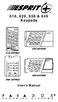 616, 626, 636 & 646 Keypads User s Manual TABLE OF CONTENTS 1.0 BASIC OPERATION...2 2.0 ACCESS CODES...4 3.0 ARMING & DISARMING...6 4.0 PANIC ZONES...13 5.0 KEY ACCESS PROGRAMMING.14 6.0 ADDITIONAL FEATURES...15
Understanding the Code Pad lights...4. Code Pad tones...5. Fully arming the system On MODE...6. Fully arming the system - Quick Arm MODE...
 TABLE OF CONTENTS...Glossary of terms...2...code Pad Diagram...3 Understanding the Code Pad lights...4 Code Pad tones...5 Fully arming the system On MODE...6 Fully arming the system - Quick Arm MODE...6
Using Your. Security System With Icon Keypad S5020, S5021, S5022
 Using Your Security System With Icon Keypad S5020, S5021, S5022 Contents 1 Overview Your Security System... 1 How Your Security System Works... 2 Your System's Programming... 3 Getting Used to Your System...
LYNX Touch L5210 Series Security System
 LYNX Touch L5210 Series Security System User Guide 800-19975 12/14 Rev. A LYNX Touch L5210 Series Your Honeywell security system is designed for use with devices manufactured or approved by Honeywell for
FA701 Series. User s Guide. K6249-2V2 5/09 Rev. A
 FA701 Series TouchCenter Keypads User s Guide K6249-2V2 5/09 Rev. A Table of Contents ABOUT THE TOUCHCENTER... 5 Introduction... 5 2 The TouchCenter Interface... 5 Navigating through the TouchCenter...
HILLS Series LED Code Pad User Manual
 HILLS Series LED Code Pad User Manual Not all features may be available on your system Check with your installer to find out which features are programmed Page 2 TABLE OF CONTENTS Code Pad Diagrams...2
Wireless Security System
 Wireless Security System 2GIG-CP2 User s Guide WARNING: Owner s Instruction Notice Not to be removed by anyone except occupant The Go!Control Security System Congratulations on your ownership of a Go!Control
Ademco Vista-20P/First Alert FA-168C Basic Commands
 Zones 64 total Ademco Vista-20P/First Alert FA-168C Basic Commands Wireless Yes, Zones 09 to 48 + 16 Keyfob Zones (Zones 49 to 64) Batteries Downloadable Partitions 2 12 volt Rechargable inside main Panel,
IDS X-Series User Manual 700-398-01D Issued July 2012
 1 2 Contents 1. Introduction to the IDS X-Series Panels... 7 2. Before Operating Your Alarm System... 7 3. Understanding the Keypad LEDs... 8 3.1 Viewing Data on an LED Keypad... 12 3.1.1 LED Status Indicators...
SECURITY AND HOME AUTOMATION OWNER S MANUAL. 466-1040-01-ITI Rev. F (Text)
 SECURITY AND HOME AUTOMATION OWNER S MANUAL 466-1040-01-ITI Rev. F (Text) Contents Welcome.......................... viii Section 1: Working with Your New Security System..................... 1 What You
Allegro Control Panel User Manual
 GE Security Allegro Control Panel User Manual P/N 466-1822 REV F ISS 09OCT09 Copyright Disclaimer Trademarks and patents Intended use FCC compliance Contact information 2009 GE Security, Inc. This document
Welcome to Bell Aliant NextGen Home Security
 Quick Start Guide Welcome to Bell Aliant NextGen Home Security Congratulations! Your home is now protected by the most advanced security technology available. This guide is intended to familiarize you
LYNX Touch L5200 Series Security System
 LYNX Touch L5200 Series Security System User Guide 800-16083V1 12/14 Rev. A LYNX Touch L5200 Series Your Honeywell security system is designed for use with devices manufactured or approved by Honeywell
Users Guide to Keypad Functions
 Users Guide to Keypad Functions MANUAL NO. 700-175-01J ISSUED JAN 2002 VERSION 1.41 Summary of Operation A rm/ disarm [#] + [USER CODE] Quick Quick Quick Panic Fire Medical Away Arm Stay Arm Stay Arm &
INSTRUCTION MANUAL DSC 1550
 INSTRUCTION MANUAL DSC 1550 A WORD ABOUT YOUR SYSTEM The PC1550 Security System has been designed to give you the greatest possible flexibility and convenience. Read this manual carefully and become familiar
INSTRUCTION MANUAL. DSC Security Products PC1500/PCI550
 INSTRUCTION MANUAL DSC Security Products PC1500/PCI550 ABOUT YOUR SECURITY SYSTEM Your DSC security equipment has been designed to give you the greatest possible flexibility and convenience. Read this
Owner s Manual. Two options for getting started:
 Owner s Manual Two options for getting started: 1 The Keychain Remote contains the SimpliSafe Easy Setup Wizard a software program that provides animated instructions and lets you customize your system
PC4020 v3.3 Instruction Manual
 PC4020 v3.3 Instruction Manual WARNING: This manual contains information on limitations regarding product use and function and information on the limitations as to liability of the manufacturer. The entire
User manual. Your best protection against theft and loss. (Android) Made for
 User manual Made for Your best protection against theft and loss (Android) Warranty SCOPE OF THE WARRANTY Subject to legal provisions, the responsibility of SECU4 under this warranty is limited to the
LYNX Touch L7000 Series Security System
 LYNX Touch L7000 Series Security System User Guide 800-16084 12/13 Rev. A LYNX Touch L7000 Series Your Honeywell security system is designed for use with devices manufactured or approved by Honeywell for
Maintenance Manual PC6010. WARNING This manual contains information on limitations regarding product use and function
 WARNING This manual contains information on limitations regarding product use and function and information on the limitations as to liability of the manufacturer. The entire manual should be carefully
Using Your. Security System. With LED Keypad S5030, S5031, S5032
 Using Your Security System With LED Keypad S5030, S5031, S5032 Contents 1 Overview Your Security System... 1 How Your Security System Works... 2 Your System's Programming... 3 Getting Used to Your System...
SECURITY SYSTEM NOTES. EMERGENCY ACTIVATION KEYS (check if enabled) PROGRAMMED FUNCTIONS
 SECURITY SYSTEM NOTES Installing/Service Company For Service Call Installation Date / / Central Station Duress Code EMERGENCY ACTIVATION KEYS (check if enabled) Fire Auxiliary Emergency Police PROGRAMMED
CONTENTS 4. HOW TO UNSET THE PANEL...7
 Pi-8 USER MANUAL CONTENTS 1. THE KEYPAD AND ITS OPERATION...3 1.1 DESCRIPTION OF THE KEYPAD LEDS... 3 1.1.1 READY LED (RED)...3 1.1.2 TAMPER LED (RED)...3 1.1.3 POWER LED (GREEN)...3 1.1.4 CIRCUIT LEDs
Owner s Guide. ca6554
 PROFESSIONAL SERIES Owner s Guide For Models: ca6554 Deluxe Vehicle Security and Remote Start System with 2 Way Confirming LCD Remote Control IMPORTANT NOTE: The operation of the Security and Convenience
PC1616/PC1832/PC1864 v4.3 User Manual
 WARNING: This manual contains information on limitations regarding product use and function and information on the limitations as to liability of the manufacturer. The entire manual should be carefully
Basic Alarm BD-5000. A. What You Will Need: 1. One 9-volt alkaline or lithium battery (not included). 2. Phillips screwdriver (not included) 2
 Basic Alarm BD-5000 1 Model BD-5000 Thank you for purchasing the Basic Alarm BD-5000. If you should ever have any questions or concerns about this product, feel free to contact us. Our phone number, web
QUICK INSTALLATION. 8-Port Telephony Gateway. Model: SPA8000
 QUICK INSTALLATION 8-Port Telephony Gateway Model: SPA8000 Table of Contents Connect................................................. 4 Regulatory Information....................................12 WEEE
Wireless Security System
 Wireless Security System 2GIG-CNTRL2 Operation & User s Guide WARNING: Owner s Instruction Notice Not to be removed by anyone except occupant Technical Support 866-670-1591 www.2gig.com The GO!control
VISTA-128FBP VISTA-250FBP Commercial Fire and Burglary Partitioned Security Systems with Scheduling
 VISTA-128FBP VISTA-250FBP Commercial Fire and Burglary Partitioned Security Systems with Scheduling User Guide K0377V2 7/09 Rev. C 2 TABLE OF CONTENTS SYSTEM OVERVIEW... 5 General... 5 A Partitioned System...
SECURITY SYSTEM NOTES
 SECURITY SYSTEM NOTES Installing/Service Company For Service Call Central Station Duress Code FUNCTION CODES Function Code Controls Function This system is is not partitioned. EMERGENCY ACTIVATION KEYS
Technical Manuals Online! - http://www.tech-man.com
 A DVENT 4 + - 4 + 1 ) 5 ; 5 6 - K I A H I C K E @ A Information at Your Fingertips Commands at a Glance To Press/Enter This... ACCESSE CODE 1, 2. 1, 2, 8 1, 3!" 1, 3, 9 #$ %& ' ( & & & ' )* +$$, & & &
astec Integrated Alarm System USER GUIDE
 astec Integrated Alarm System USER GUIDE 020008599 CONTENTS Full Set, Part Set and Disarm 3 Instant Full Set 3 Part Set with exit time 4 Bell Test 4 Bypassing zones 4 Switch Lights on/off 4 Bypass (24
Intelli-Time Alarm Clock model 13027
 Instruction Manual Intelli-Time Alarm Clock model 13027 CONTENTS Unpacking Instructions... 2 Package Contents... 2 Product Registration... 2 Features & Benefits... 3 Clock Setup... 4 Intelli-Time Clock...
Simon XT Installation Manual
 Simon XT Installation Manual P/N 466-2265 REV G OCT12 Copyright Disclaimer 2012 UTC Fire & Security Americas Corporation, Inc. Interlogix is part of UTC Climate Controls & Security, a unit of United Technologies
Security System. User's Guide. Keypad
 Security System EN User's Guide Keypad Security System User's Guide This system includes a telephone line seizure feature. The system can be programmed to communicate with a central monitoring station
NetworX NX-6V2. LED Keypad User Manual
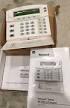 NetworX NX-6V2 LED Keypad User Manual POWER Light is on when AC power is present; flashes to indicate a low battery condition. ARMED Light is on when armed; off when disarmed; flashes to indicate a previous
SECURITY SYSTEM NOTES
 SECURITY SYSTEM NOTES Installing/Service Company For Service Call Central Station Duress Code FUNCTION CODES Function Code Controls Function EMERGENCY ACTIVATION KEYS (check if enabled) Fire Auxiliary
Simon XTi Installation Guide
 Simon XTi Installation Guide Content Contact information... 1 Description... 1 Installation... 1 Connecting hardwired devices... 2 Wiring phone lines... 3 Wiring the power transformer... 4 Resetting memory
ELECTRONIC ENGINEERING LTD. Runner Series WIRELESS AND WIRED CONTROL PANEL. User s Guide. Version 9.08.2
 ELECTRONIC ENGINEERING LTD. Runner Series WIRELESS AND WIRED CONTROL PANEL User s Guide Version 9.08.2 Crow Limited Warranty (Crow) warrants this product to be free from defects in materials and workmanship
CITRIX SYSTEMS, INC. SOFTWARE LICENSE AGREEMENT
 CITRIX SYSTEMS, INC. SOFTWARE LICENSE AGREEMENT PLEASE READ THIS SOFTWARE LICENSE AGREEMENT CAREFULLY BEFORE DOWNLOADING, INSTALLING OR USING CITRIX OR CITRIX-SUPPLIED SOFTWARE. BY DOWNLOADING OR INSTALLING
Personal Assistance System Owner's Guide
 Owner's Guide PSC07 READ THIS FIRST This equipment generates and uses radio frequency energy, and if not installed and used properly, that is, in strict accordance with the manufacturers instructions,
8VHU V*XLGH 6HFXULW\6\VWHPV (QWUHSUHQHXU(1 6HFXULW\0DQDJHU(1. Meets ADT Security Services Triple Standards Requirements:
 6DIHZDWFK3UR Š (1 (QWUHSUHQHXU(1 6HFXULW\0DQDJHU(1 6HFXULW\6\VWHPV 8VHU V*XLGH Meets ADT Security Services Triple Standards Requirements: C US LISTED Standards for Security and Fire Standard for False
Dialog Telephone Interface Module Installation Sheet
 Dialog Telephone Interface Module Installation Sheet Description The Dialog Telephone Module (DTIM), model number 60-879- 95R, is a battery operated communication link between the security system control
HUNTER-PRO 32 Ver. 3.8 Intruder Alarm System RXN-9/416 User Guide
 HUNTER-PRO 32 Ver. 3.8 Intruder Alarm System RXN-9/416 User Guide PIMA Electronic Systems Ltd. 5 Hatzoref Street, Holon 58856, Israel +972-3-5587722 +972-3-5500442 [email protected] http://www.pima-alarms.com
ADEMCO LYNXR-EN Security System
 ADEMCO LYNXR-EN Security System User Guide ARMED READY OFF ESCAPE AWAY ADD STAY RECORD LIGHTS ON 1 2 3 VOLUME 4 5 6 TEST 7 8 9 PLAY BYPASS DELETE AUX SELECT LIGHTS OFF CODE CHIME 0 # STATUS NO DELAY FUNCTION
Solution 16 plus. User Guide Security System
 Solution 16 plus EN Security System Copyright Notice Unless otherwise indicated, this publication is the copyright of Bosch Security Systems Pty Ltd ( Bosch ). All rights are reserved.you may download
Solution 880 Operators Manual ISSUE 1.10
 Solution 880 Operators Manual ISSUE 1.10 Solution 880 Operators Manual Copyright 2001 by, SYDNEY, AUSTRALIA Document Part Number MA408O DOCUMENT ISSUE 1.10 Printed 25 May 2001 This documentation is provided