
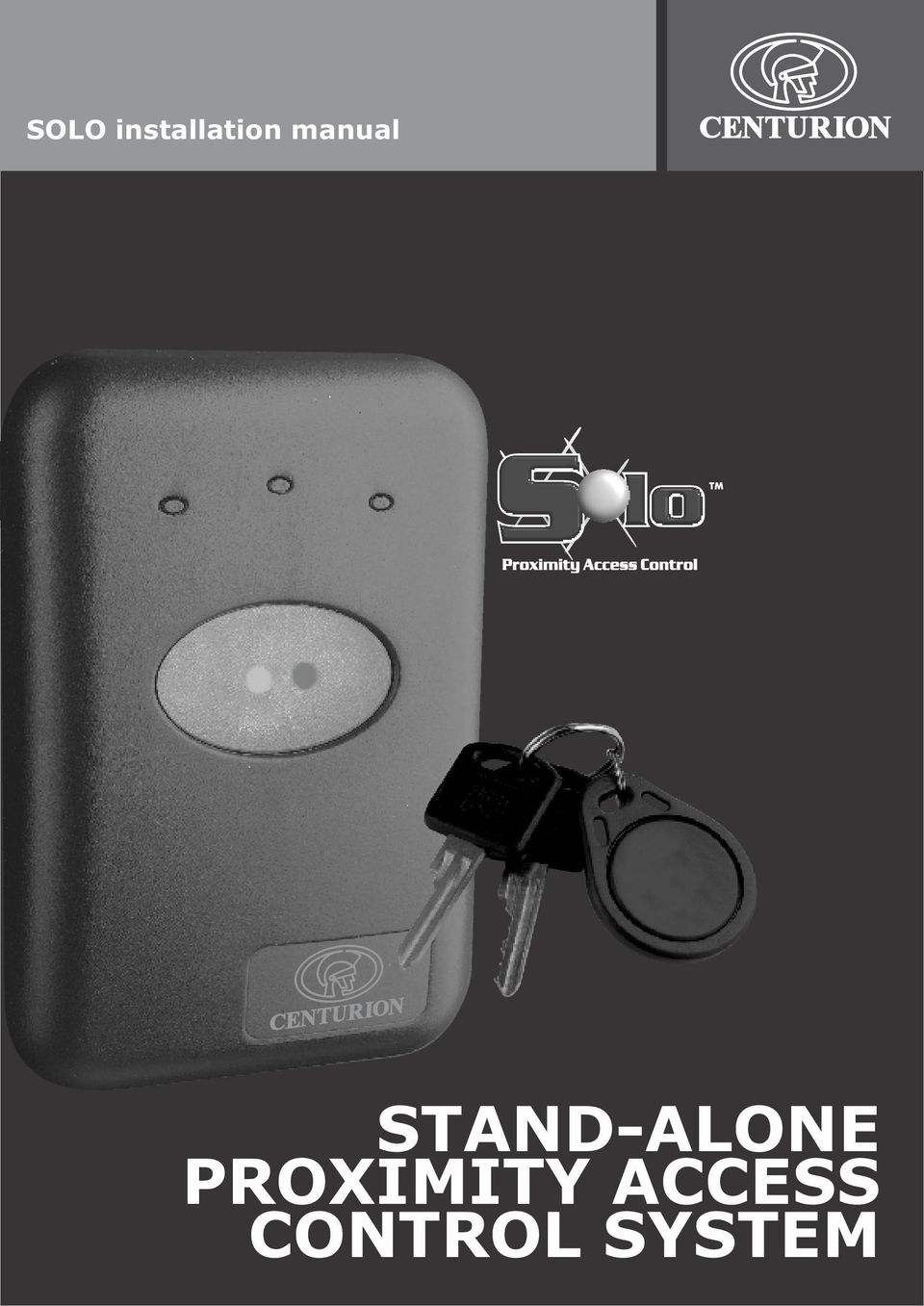
STAND-ALONE PROXIMITY ACCESS CONTROL SYSTEM
|
|
|
- Edmund Morrison
- 10 years ago
- Views:
Transcription
1 SOLO installation manual STAND-ALONE PROXIMITY ACCESS CONTROL SYSTEM
2 Company Profile CENTURION SYSTEMS has been manufacturing automatic gate systems since 1987, and is committed to providing reliable, cost-effective solutions in the field of access automation. CENTURION strives to give service and backup second to none. Our engineers are available to give sales support, installation training, and answers to technical or installation problems. The equipment is installed worldwide and is available through a network of distributors. CENTURION is an ISO 9001 registered company, continually looking at updating its products in line with world trends to ensure that its products will provide customer satisfaction. CENTURION SYSTEMS (PTY) LTD 2007 Centurion Systems (Pty) Ltd. reserves the right to make changes to the products described in this manual without notice and without obligation of Centurion Systems (Pty) Ltd. to notify any persons of any such revisions or changes. Additionally, Centurion Systems (Pty) Ltd. makes no representations or warranties with respect to this manual. No part of this document may be copied, stored in a retrieval system or transmitted in any form or by any means electronic, mechanical, optical or photographic, without the express prior written consent of Centurion Systems (Pty) Ltd. Page 2

3 Table of Contents Product Overview Specifications Tools and Equipment Required QUIK Installation QUIK WIRING DIAGRAM QUIK ADD: New Installation QUIK ADD: Existing Installation QUIK DELETE QUIK PARAMETER FACTORY DEFAULT Installation of SOLO Reader Wiring Diagrams Overview of User Interface Identification of Tags Find Master Tags Find User Tag Memory Location Example: How to find User Tag Memory Location HOW TO ADD A TAG Overview ADD Tag: SOLO Specified Memory Location Example: How to use the LEDs to select Memory Locations ADD Tag: User Specified Memory Location HOW TO DELETE A TAG Overview DELETE Tag: Tag not available Example: How to use the LEDs to select Memory Locations DELETE Tag: Tag available REPLACE a Secondary Master Tag (Tag in Memory Location 01) REPLACE a Primary Master Tag (Tag in Memory Location 00) COMPLETE DELETE: Restore Factory Defaults and Clear Memory Page 3
4 HOW TO CONFIGURE THE DIFFERENT OPERATING PARAMETERS Overview Turning the TAG BUZZER on or off Turning the FREE EXIT on or off Turning the DOOR FORCED ALARM OUTPUT on or off Turning the DOOR FORCED ALARM LOCAL BUZZER on or off Turning the DOOR OPEN ALARM OUTPUT on or off Turning the DOOR OPEN ALARM LOCAL BUZZER on or off Turning the SMARTSWITCH II on or off HOW TO SET VARIOUS TIMERS Overview Example: How to use the LEDs to set the various Timers Change Relay Time Change Door Open Time Change Door Open Pre-Warn Time Change Door Open Alarm Time Change Door Forced Alarm Time Change Hold Off Time SPECIAL FUNCTIONS Turbo Mode Auto-Learn Overview Auto-Learn: LIMITED TIME Auto-Learn: UNLIMITED TIME Auto-Learn: DISABLE MEMORY ALLOCATION AND PARAMETER SETTINGS FORM NOTES ADVANCED USER MAP can be found between 46 & 47 SURFACE MOUNT DRILLING TEMPLATE can be found between 46 & 47 Page 4
5 Product Overview The SOLO is a cost-effective entry level stand-alone proximity access control system for single access point applications. By presenting a valid CENTURION proximity tag to the SOLO Reader it will activate or release the access point door lock or operator and allow access. The SOLO Reader is a robust, weatherproof unit that is mounted adjacent to the door or access point. It is a fully integrated unit with the controller, read coil and output drives all contained inside the unit. The SOLO model 50 can store up to 51 unique proximity tags of which two are Master Tags. Tags are stored on the unit s non-volatile memory in separate Memory Locations. The use of Memory Locations allows for selective addition and deletion of tags as required. Programming of the system is done using either of the Master Tags and the indicator lights on the front of the Reader. To further simplify the installation of the SOLO Reader all parameters are pre-programmed according to most application requirements. Both audible and visual feedback is provided if a valid tag is presented. In addition, visual feedback is given if the presented tag is invalid. The SOLO's single output channel provides a potential-free Normally-Open or Normally-Closed contact and can be configured as latching or pulsed. The pulsed time is adjustable in one second increments from one second to four minutes. The output can also be configured to operate with a CENTURION SMARTSWITCH II. The SmartSwitch II is mounted directly at the door lock or gate motor to provide an even higher level of security by preventing a would-be intruder from tampering with the door lock/gate trigger lines to gain entry. The SOLO provides a free-exit facility. This is typically where a pushbutton mounted on the inside of the door or gate entrance is required to operate the access point. For added security, this feature can be inhibited if not being used. The SOLO provides an input for door/gate sensor that can be used to detect whether the access point has been forced open or left open. The unit in turn provides an open collector output with pulse or latching facility so that either or both of these alarm conditions can be relayed to a "third party" alarm system. In addition, an optional tamper alert switch is available that can be connected to a "third party" alarm to provide an early warning if the SOLO Reader is being forced open. The access point left open alarm will only activate after the pre-warn time (internal buzzer) followed by the access point left open time have expired. The pre-warn and access point left open times are programmable in one second increments from one second to four minutes. Mounting of the SOLO is very simple as it can be flush mounted into a 100mm x 50mm light switch box or surface mounted directly onto the wall. In addition, the unit can be purchased with an anti-knock shield, providing better protection when surface mounting the unit externally or to a gooseneck. Page 5
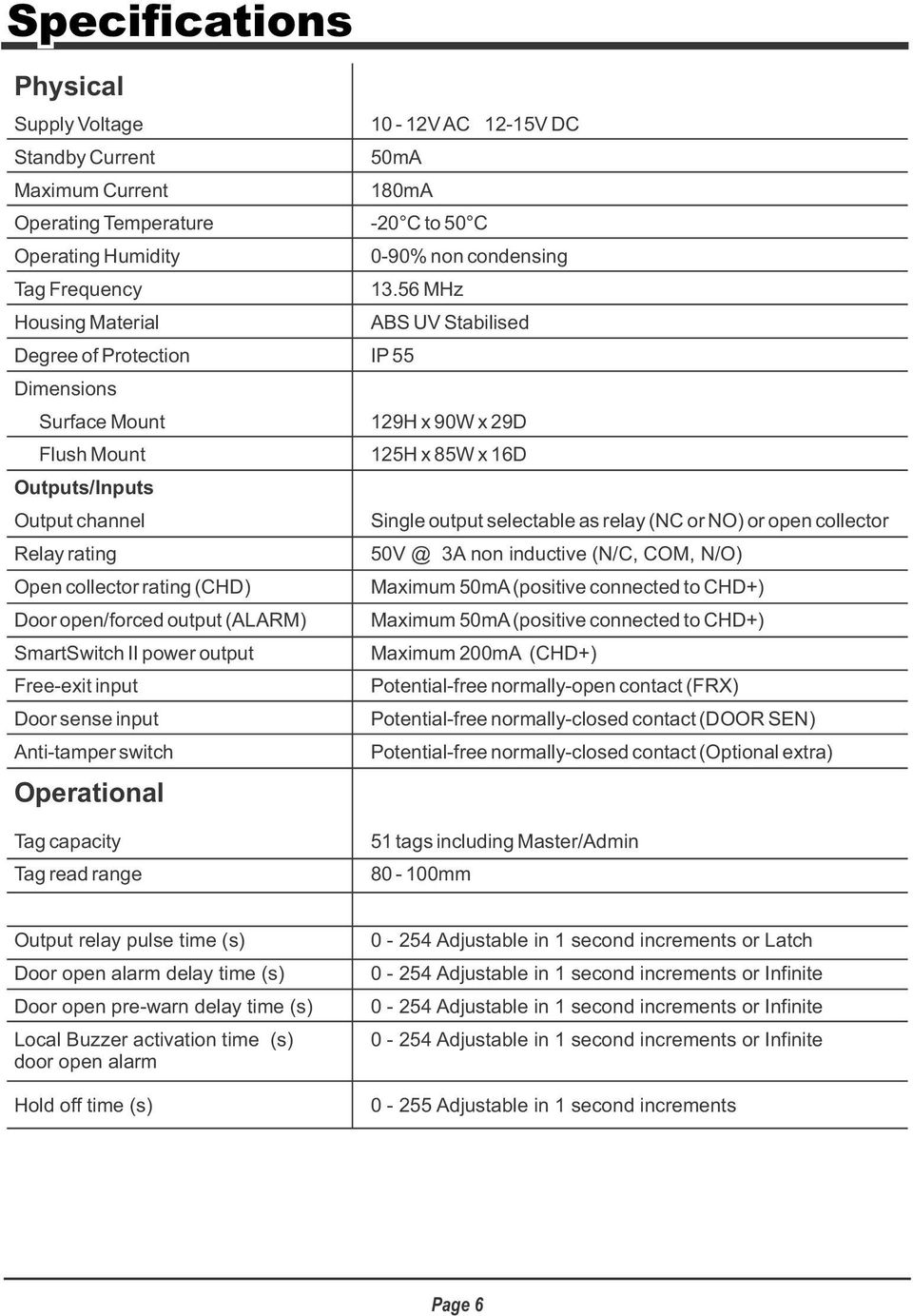
6 Specifications Physical Supply Voltage Standby Current Maximum Current Operating Temperature Operating Humidity Tag Frequency Housing Material Degree of Protection Dimensions Surface Mount Flush Mount Outputs/Inputs Output channel Relay rating Open collector rating (CHD) Door open/forced output (ALARM) SmartSwitch II power output Free-exit input Door sense input Anti-tamper switch Operational Tag capacity Tag read range 10-12V AC 12-15V DC 50mA 180mA -20 C to 50 C 0-90% non condensing MHz ABS UV Stabilised IP H x 90W x 29D 125H x 85W x 16D Single output selectable as relay (NC or NO) or open collector 3A non inductive (N/C, COM, N/O) Maximum 50mA (positive connected to CHD+) Maximum 50mA (positive connected to CHD+) Maximum 200mA (CHD+) Potential-free normally-open contact (FRX) Potential-free normally-closed contact (DOOR SEN) Potential-free normally-closed contact (Optional extra) 51 tags including Master/Admin mm Output relay pulse time (s) Door open alarm delay time (s) Door open pre-warn delay time (s) Local Buzzer activation time (s) door open alarm Hold off time (s) Adjustable in 1 second increments or Latch Adjustable in 1 second increments or Infinite Adjustable in 1 second increments or Infinite Adjustable in 1 second increments or Infinite Adjustable in 1 second increments Page 6
7 Tools and Equipment Required Star Screwdriver 0 and 1 point Long Nose Pliers Flat Screwdriver - 2.5mm point Jewellers Type Side Cutters Tape Measure Silicon Cable: 0.20mm² 0.50mm² 0.75mm² Level 5mm Masonry Bit Multi-Meter Drilling Machine (hammer action) Page 7

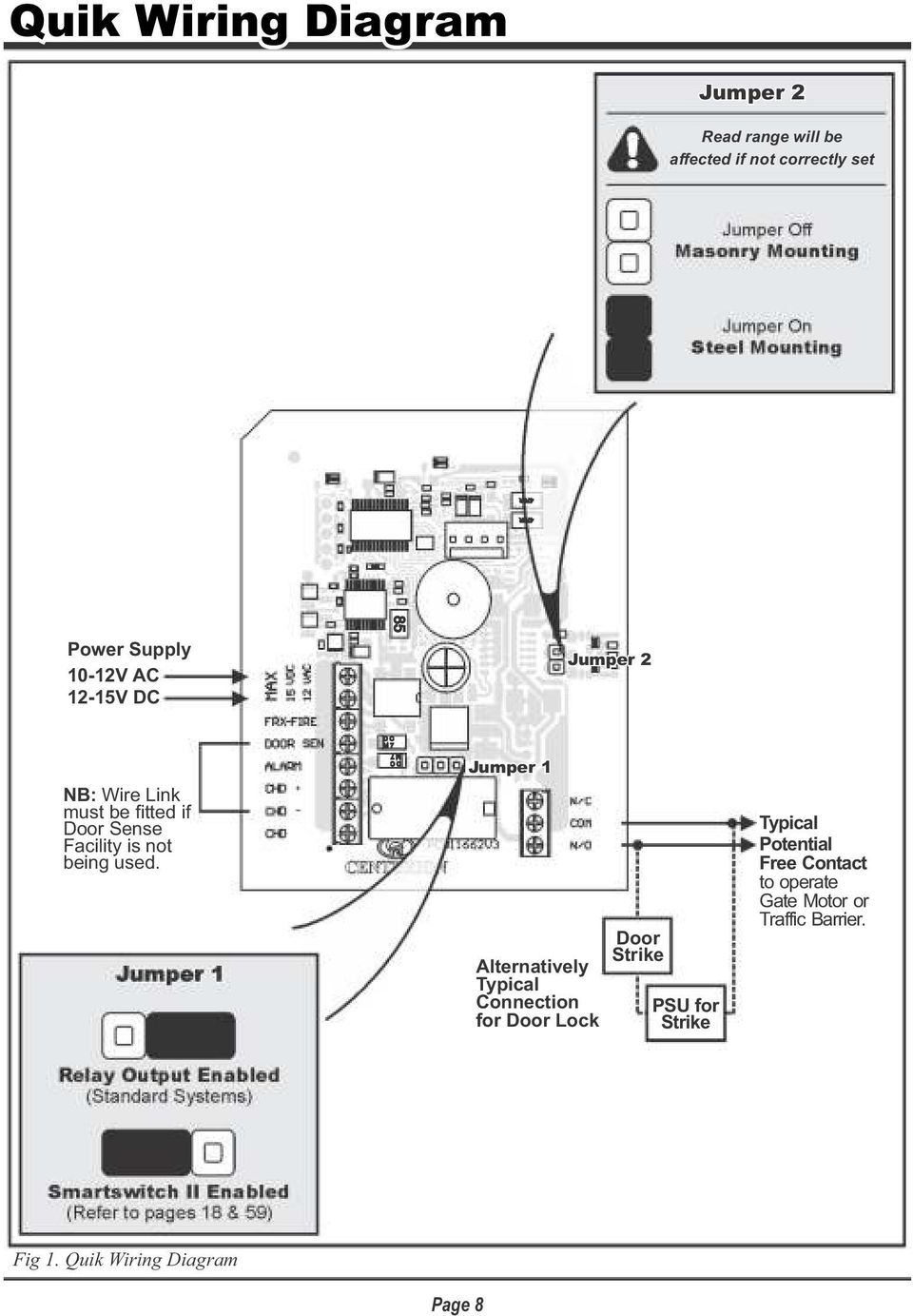
8 Quik Wiring Diagram Jumper 2 Read range will be affected if not correctly set R 470R 85 Power Supply 10-12V AC 12-15V DC Jumper 2 D C M 7 NB: Wire Link must be fitted if Door Sense Facility is not being used. D C M 7 Jumper 1 Alternatively Typical Connection for Door Lock Door Strike PSU for Strike Typical Potential Free Contact to operate Gate Motor or Traffic Barrier. Fig 1. Quik Wiring Diagram Page 8
9 Quik Add - New Installation Please Note: On power up the ROW LIGHTS appear to chase each other. This indicates a Blank Memory. Tags will be added to the SOLO Reader sequentially from Memory Locations 00 to 50. The first two Tags presented to the SOLO Reader will become the Master Tags in Memory Locations 00 and 01. It is recommended that the first Master Tag be kept in a safe and secure location. The Master Tags should only be issued to those responsible for maintaining the SOLO Reader. To ABORT wait for ± 60 seconds for the SOLO to RESET ORANGE Present & Remove New Tag Present & Remove Master Tag x x Tag added to Memory Location xx 1 Graphical Instructions Power On Written Instructions Connect power to Reader Top Max ROW LIGHTS flash in sequence Present and REMOVE each New Tag to the SOLO Reader LIGHT will flash BUZZER will sound to indicate a successful addition Repeat from step 3 as required 6 Present and REMOVE the Master Tag The SOLO Reader will enter normal RUN MODE It is recommended that the attached Memory Location allocation and Parameter settings form be updated. Page 9

10 Quik Add - Existing Installation Please Note: Tags will be added sequentially to the empty Memory Locations of the SOLO Reader. Previous Memory Locations will not be overwritten. To ABORT wait for ± 60 seconds for the SOLO to RESET ORANGE Present & Hold Master Tag Remove Master Tag Present & Remove Master Tag 1 Graphical Instructions Present & Remove New Tag x x Tag added to Memory Location xx Written Instructions Present and HOLD either Master Tag until all lights turn ON 2 Remove the Master Tag Top Max Top green light will remain on Present and remove each new Tag to the SOLO Reader LIGHT will flash and the BUZZER will sound to indicate a successful addition. Repeat from step 3 as required 7 Present and REMOVE the Master Tag The SOLO Reader will enter normal RUN MODE It is recommended that the attached Memory Location allocation and Parameter settings form be updated. Page 10

11 Quik Delete - All Tags Please Note: This option will remove all tags from the SOLO Reader's memory but will not change any of the Configuration Settings or Timer Values. To ABORT wait for ± 60 seconds for the SOLO to RESET 1 ORANGE Graphical Instructions Present & Hold Master Tag Remove Master Tag Written Instructions Present & Remove Master Tag Present and HOLD either Master Tag until all lights turn ON 2 Remove the Master Tag 3 4 Top Bottom Top green light will remain on 5 Top red light will turn on Only LIGHT ON Present and HOLD the Master Tag Continue HOLDING All the LIGHTS will begin to flash Continue HOLDING Continue HOLDING Wait for the buzzer to bleep three times 9 Remove the Master Tag 10 The ROW LIGHTS appear to chase each other; this indicates a Blank Memory. It is recommended that the attached Memory Location allocation and Parameter settings form be updated. Page 11

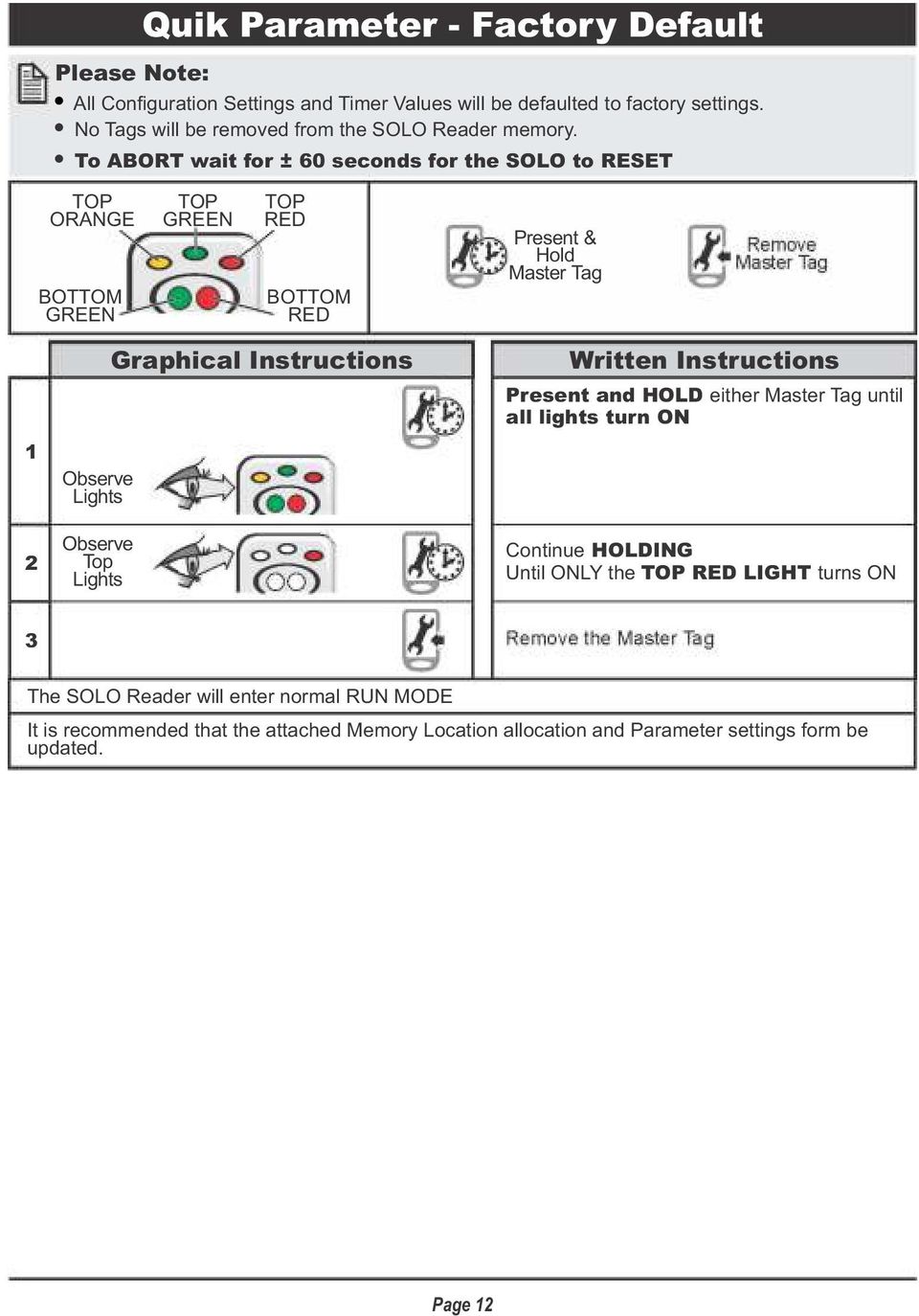
12 Quik Parameter - Factory Default Please Note: All Configuration Settings and Timer Values will be defaulted to factory settings. No Tags will be removed from the SOLO Reader memory. To ABORT wait for ± 60 seconds for the SOLO to RESET ORANGE Present & Hold Master Tag 1 2 Top Graphical Instructions Written Instructions Present and HOLD either Master Tag until all lights turn ON Continue HOLDING Until ONLY the LIGHT turns ON 3 The SOLO Reader will enter normal RUN MODE It is recommended that the attached Memory Location allocation and Parameter settings form be updated. Page 12
13 Positioning the Reader Installation of the Solo 1A 1B 1C 1300mm Position SOLO reader on wall adjacent to door. Mount at a height that allows for the comfortable presenting of access tags. A height of 1300mm is recommended. Mounting the Reader Flush Mount Alternatively mount the SOLO reader onto a gooseneck ensuring that: The reader does not protrude too far into the driveway The reader is not set too far back and cannot easily be accessed from a vehicle. The height allows for the presenting of the tag to be comfortable from a vehicle. An anti-knock shield is available from CENTURION to provide extra protection to the SOLO reader. The SOLO Prox reader is available in a flush mount kit and a surface mount kit. Position the SOLO reader on wall adjacent to entrance gate. Mount at a height that allows for the comfortable presentation of access tags. A height of 1300mm is recommended. When flush mounting, the reader adapts directly to a standard 100mm x 50mm (4" x 2") light switch backing box which allows the unit to sit flat against the wall. Alternatively, if no backing box has been provided the unit can be very simply surface mounted. When mounting the reader onto a gooseneck with, or without, an anti-knock shield, the surface mount kit will be used. 1F 2F Insert the reader mounting frame into position in the backing box and secure using the standard fixing screws provided with the backing box. It is recommended that the cabling to the reader extends at least 100mm through the frame. Page 13

14 Surface Mount 1S 2S 3S Clip the plastic spacers onto the back of the mounting frame ensuring that they are correctly orientated to align with the mounting holes. 4 5 Place the mounting template located in the centre of this document at the required height ensuring that it is vertical Using a 5mm masonry bit, drill holes into the wall for the rawlplugs provided in the kit. Screw the frame lightly into position. Using the slots provided in the mounting holes, adjust the reader base to be perfectly vertical. Screw the frame firmly into position. Installation of the Reader (Flush or Surface Mount) 6 A Slide apart the front and back of the reader controller housing. Make the necessary terminations onto the controller. Refer to wiring diagram on page 16. Route the cable over the cable entry bulkhead (A) in the housing. Additional slots can be cut out to accommodate further cables if necessary B Optional cable tie B Fit a cable tie around the cable as shown. When tightened this holds the cable in position and prevents it from being pulled out of the housing. Tighten cable tie. An additional cable-tie can be fitted to better secure the cable. Page 14

15 8B B Optional cable tie 8C 9 B If the additional cable tie was used, make certain that it is also tightened. Jumper 2 Jumper 1 Ensure Jumpers 1 and 2 are correctly positioned - refer to page 19. Slide the back cover onto the controller housing A 12 Ensure that it sits neatly against the cable entry bulkhead securing the cable. To prevent insect ingress use either a grommet or a dab of silicon to seal the cable entry point. B Clip the top of the controller front housing into the top lip of the mounting frame (A), and fold down into position ensuring the cable is not caught (B). Fasten controller housing into position using the 2 x M4 PT screws provided in the kit Clip the outer cover into position making sure that it seats correctly and is secure. To remove the outer cover, carefully insert a screwdriver between the cover and the wall from the underneath and unclip. Page 15

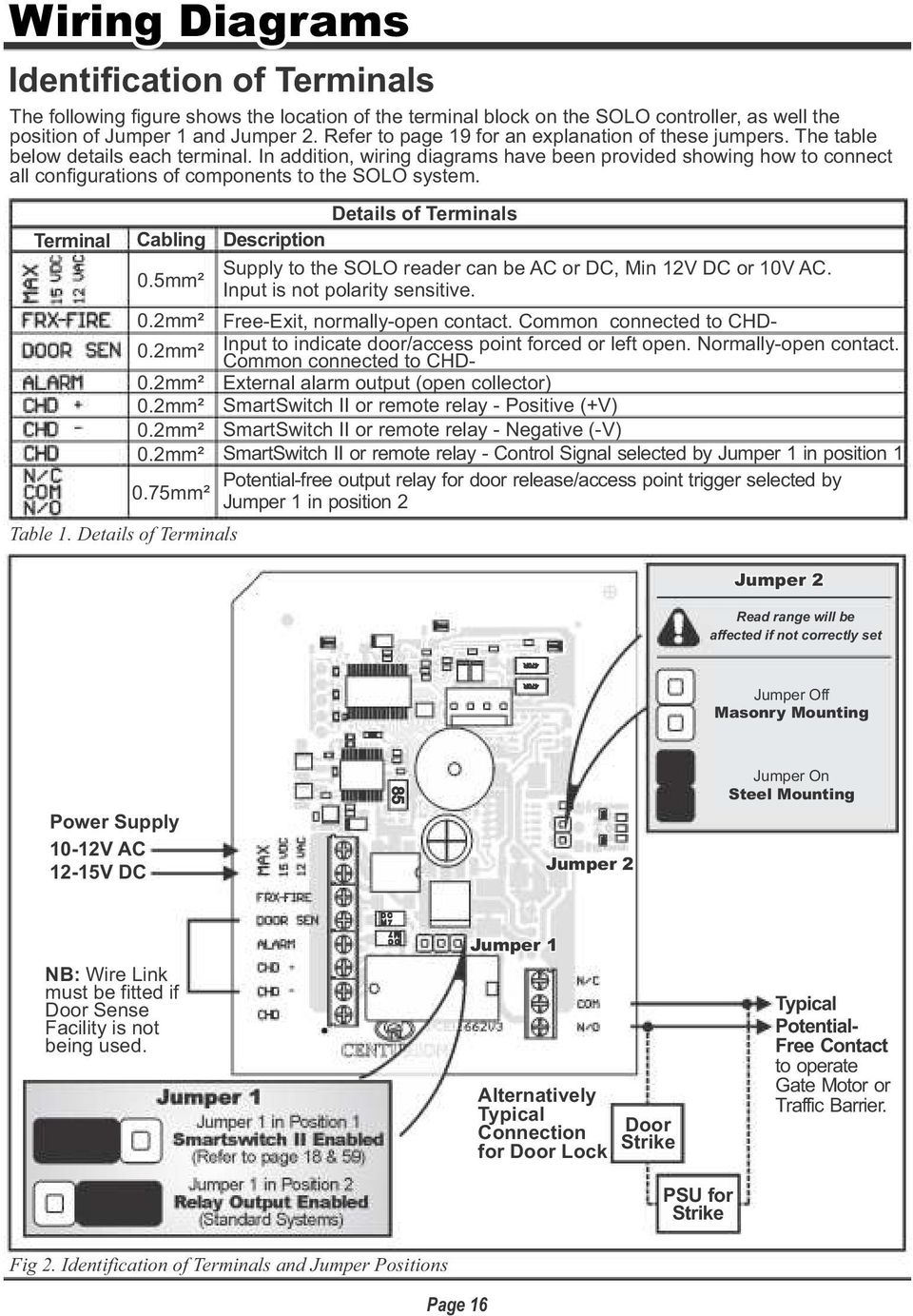
16 Wiring Diagrams Identification of Terminals The following figure shows the location of the terminal block on the SOLO controller, as well the position of Jumper 1 and Jumper 2. Refer to page 19 for an explanation of these jumpers. The table below details each terminal. In addition, wiring diagrams have been provided showing how to connect all configurations of components to the SOLO system. Terminal Cabling 0.5mm² Table 1. Details of Terminals Details of Terminals Description Supply to the SOLO reader can be AC or DC, Min 12V DC or 10V AC. Input is not polarity sensitive. 0.2mm² Free-Exit, normally-open contact. Common connected to CHD- 0.2mm² 0.2mm² Input to indicate door/access point forced or left open. Normally-open contact. Common connected to CHD- External alarm output (open collector) 0.2mm² SmartSwitch II or remote relay - Positive (+V) 0.2mm² SmartSwitch II or remote relay - Negative (-V) 0.2mm² SmartSwitch II or remote relay - Control Signal selected by Jumper 1 in position mm² Potential-free output relay for door release/access point trigger selected by Jumper 1 in position 2 Jumper 2 Read range will be affected if not correctly set R 470R Jumper Off Masonry Mounting Power Supply 10-12V AC 12-15V DC Jumper 2 Jumper On Steel Mounting D C M 7 NB: Wire Link must be fitted if Door Sense Facility is not being used. D C M 7 Jumper 1 Alternatively Typical Connection for Door Lock Door Strike Typical Potential- Free Contact to operate Gate Motor or Traffic Barrier. PSU for Strike Fig 2. Identification of Terminals and Jumper Positions Page 16
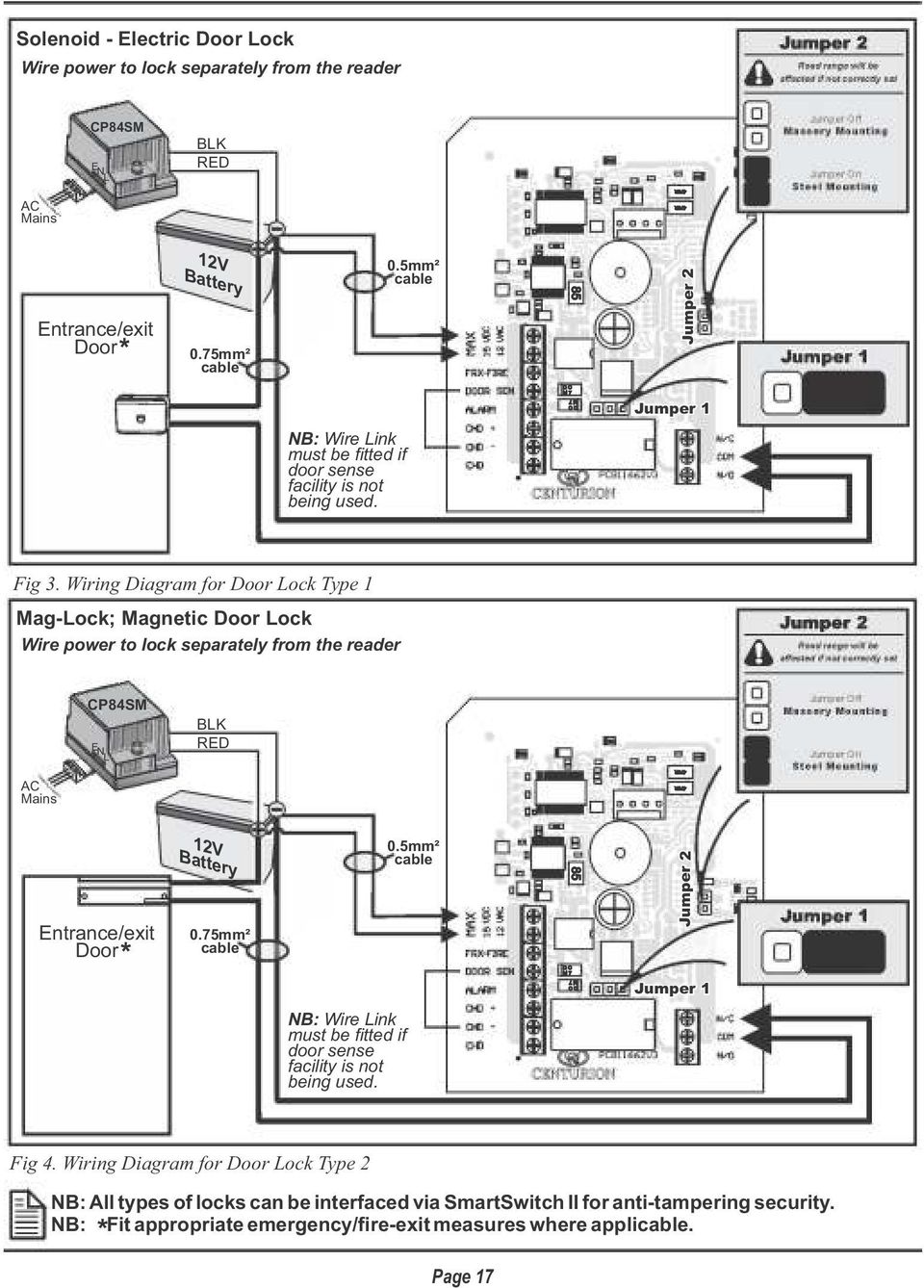
17 200 Mag-Lock; Magnetic Door Lock Wire power to lock separately from the reader CP84SM 200 Solenoid - Electric Door Lock Wire power to lock separately from the reader CP84SM E N L BLK AC Mains 470R 470R Entrance/exit Door* 12V Battery 0.75mm² cable 0.5mm² cable 85 Jumper 2 D C M 7 D C M 7 Jumper 1 NB: Wire Link must be fitted if door sense facility is not being used. Fig 3. Wiring Diagram for Door Lock Type 1 E N L BLK AC Mains 470R 470R Entrance/exit Door* 12V Battery 0.75mm² cable 0.5mm² cable D C M 7 85 D C M 7 Jumper 2 Jumper NB: Wire Link must be fitted if door sense facility is not being used. Fig 4. Wiring Diagram for Door Lock Type 2 NB: All types of locks can be interfaced via SmartSwitch II for anti-tampering security. NB: Fit appropriate emergency/fire-exit measures where applicable. * Page 17
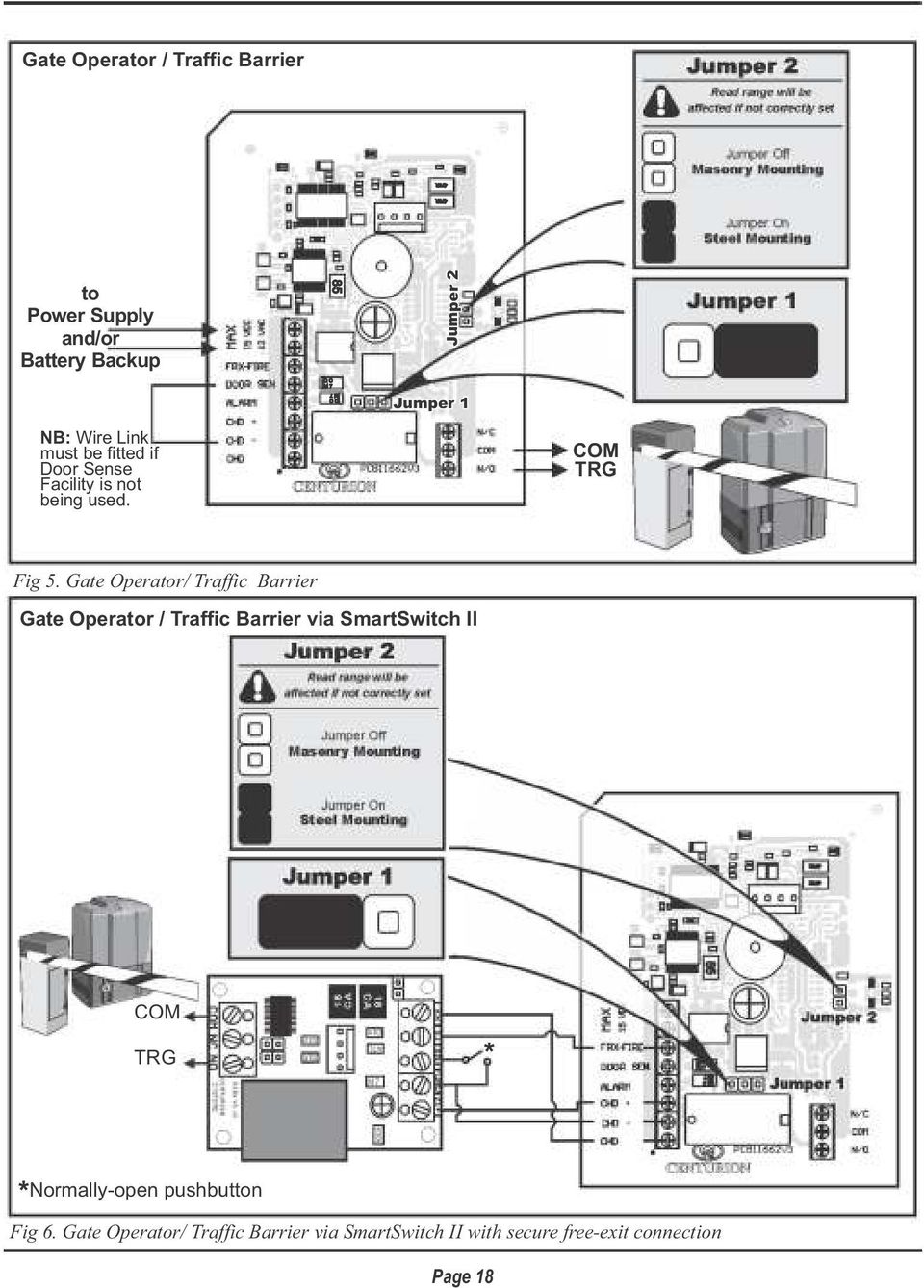
18 200 D C Gate Operator / Traffic Barrier 470R 470R to Power Supply and/or Battery Backup 85 Jumper M 7 D C M 7 Jumper 1 NB: Wire Link must be fitted if Door Sense Facility is not being used. COM TRG Fig 5. Gate Operator/ Traffic Barrier Gate Operator / Traffic Barrier via SmartSwitch II COM TRG * * Normally-open pushbutton Fig 6. Gate Operator/ Traffic Barrier via SmartSwitch II with secure free-exit connection Page 18
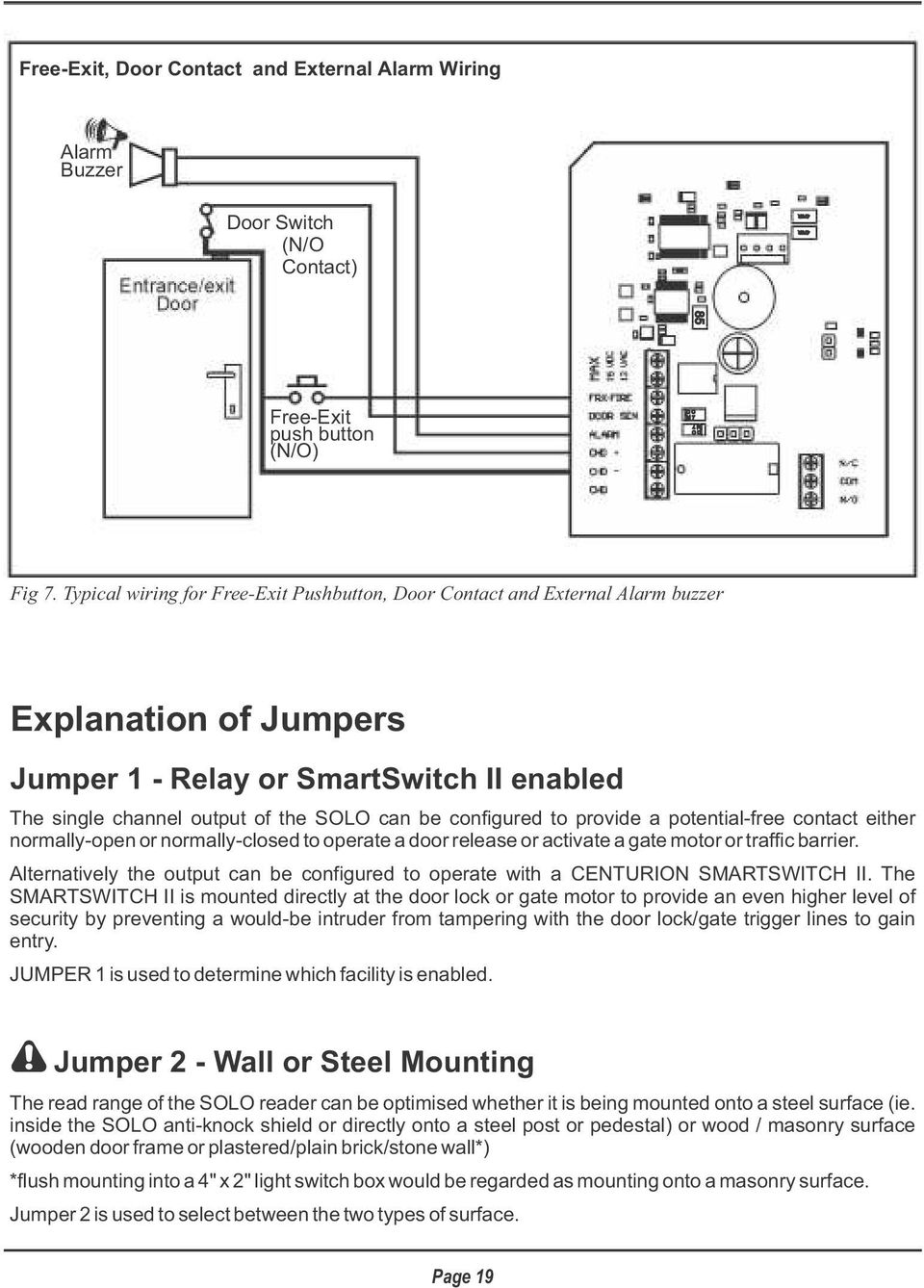
19 200 Free-Exit, Door Contact and External Alarm Wiring Alarm Buzzer Door Switch (N/O Contact) 470R 470R Free-Exit push button (N/O) D C M 7 D C M 7 Fig 7. Typical wiring for Free-Exit Pushbutton, Door Contact and External Alarm buzzer Explanation of Jumpers Jumper 1 - Relay or SmartSwitch II enabled The single channel output of the SOLO can be configured to provide a potential-free contact either normally-open or normally-closed to operate a door release or activate a gate motor or traffic barrier. Alternatively the output can be configured to operate with a CENTURION SMARTSWITCH II. The SMARTSWITCH II is mounted directly at the door lock or gate motor to provide an even higher level of security by preventing a would-be intruder from tampering with the door lock/gate trigger lines to gain entry. JUMPER 1 is used to determine which facility is enabled. Jumper 2 - Wall or Steel Mounting The read range of the SOLO reader can be optimised whether it is being mounted onto a steel surface (ie. inside the SOLO anti-knock shield or directly onto a steel post or pedestal) or wood / masonry surface (wooden door frame or plastered/plain brick/stone wall*) *flush mounting into a 4" x 2" light switch box would be regarded as mounting onto a masonry surface. Jumper 2 is used to select between the two types of surface. Page 19
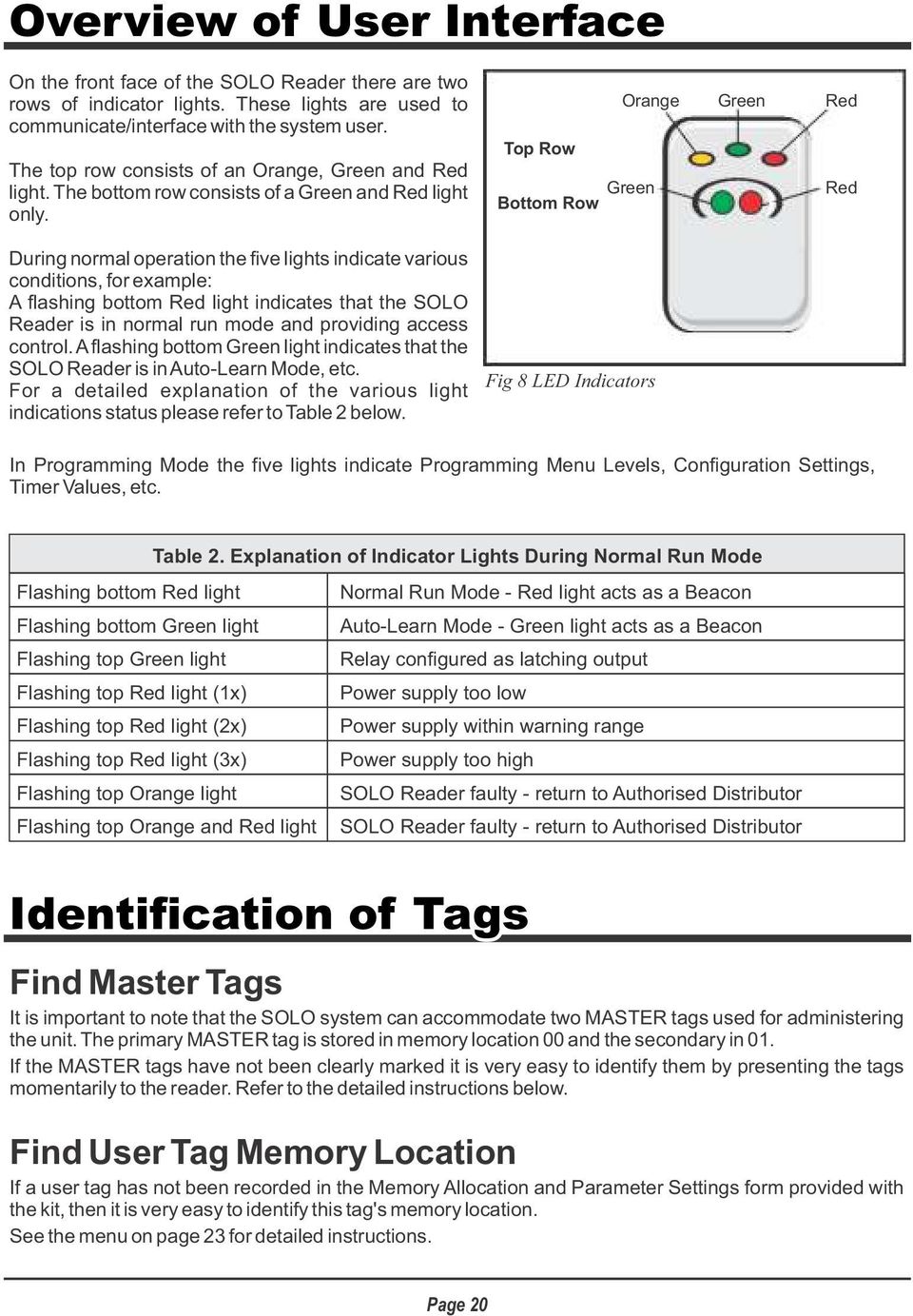
20 Overview of User Interface On the front face of the SOLO Reader there are two rows of indicator lights. These lights are used to communicate/interface with the system user. The top row consists of an Orange, Green and Red light. The bottom row consists of a Green and Red light only. Orange Top Row Green Bottom Row Green Red Red During normal operation the five lights indicate various conditions, for example: A flashing bottom Red light indicates that the SOLO Reader is in normal run mode and providing access control. A flashing bottom Green light indicates that the SOLO Reader is in Auto-Learn Mode, etc. For a detailed explanation of the various light indications status please refer to Table 2 below. Fig 8 LED Indicators In Programming Mode the five lights indicate Programming Menu Levels, Configuration Settings, Timer Values, etc. Table 2. Explanation of Indicator During Normal Run Mode Flashing bottom Red light Normal Run Mode - Red light acts as a Beacon Flashing bottom Green light Auto-Learn Mode - Green light acts as a Beacon Flashing top Green light Relay configured as latching output Flashing top Red light (1x) Power supply too low Flashing top Red light (2x) Power supply within warning range Flashing top Red light (3x) Power supply too high Flashing top Orange light SOLO Reader faulty - return to Authorised Distributor Flashing top Orange and Red light SOLO Reader faulty - return to Authorised Distributor Identification of Tags Find Master Tags It is important to note that the SOLO system can accommodate two MASTER tags used for administering the unit. The primary MASTER tag is stored in memory location 00 and the secondary in 01. If the MASTER tags have not been clearly marked it is very easy to identify them by presenting the tags momentarily to the reader. Refer to the detailed instructions below. Find User Tag Memory Location If a user tag has not been recorded in the Memory Allocation and Parameter Settings form provided with the kit, then it is very easy to identify this tag's memory location. See the menu on page 23 for detailed instructions. Page 20
21 Find Master Tags Please Note: SOLO Reader remains in Normal Run Mode. If either Master Tag is presented to the SOLO Reader for longer for than 5 seconds, PROGRAM MODE will be entered. ORANGE 0 0 Present & Remove Master Tag in Memory Location 00 Present & Remove Master Tag in Memory Location Bottom Graphical Instructions 0 0 Written Instructions Present and REMOVE the Master Tag in Memory Location 00 LIGHT and LIGHT will turn ON briefly 3 Present and REMOVE the Master Tag in Memory Location 01 4 LIGHT will turn ON briefly The SOLO Reader will remain in Normal RUN MODE if Master Tags are presented for less than 5 seconds. Page 21
22 Find User Tag Memory Location Please Note: This procedure is for checking Memory Location of User Tags only The SOLO Reader remains in Normal Run Mode The Memory Location will be repeatedly shown for as long as the User Tag is presented to the SOLO Reader. Ensure that the Master Tag is not presented to the SOLO Reader for longer than 5 seconds or Programme Mode will be entered. The LIGHT will flash momentarily if the presented Tag is not present in the SOLO ORANGE Present & Hold USER TAG Memory Location Graphical Instructions Written Instructions 1 2 Top Present and HOLD a User Tag to the SOLO Reader LIGHT and LIGHT will FLASH individually Note: Short Flash = 0 3 Short Flash = 0 Flash = x (TENS) x Count the number of flashes on the LIGHT to indicate TENS Note: Short Flash = 0 4 Short Flash = 0 Flash = x (TENS) x Count the number of flashes on the LIGHT to indicate UNITS 5 Repeat from step 3 above to confirm counts 6 Remove the User Tag x Repeat the process for the other User Tags The examples on page 22 refer specifically to how Step 3 and 4 above may be applied. Page 22
23 EXAMPLE How to find User Tag Memory Location Graphical Instructions Written Instructions Example: User Tag in Memory Location 03 1 Short Flash = 0 (TENS) 0 3 Flash x 3 (UNITS) LIGHT will SHORT FLASH to indicate 0 TENS LIGHT will FLASH 3 TIMES to indicate 3 UNITS Example: User Tag in Memory Location Flash x 3 (TENS) Flash x 3 (TENS) 3 Short Flash=0 (UNITS) Example: User Tag in Memory Location Flash x 6 (UNITS) LIGHT will FLASH 3 TIMES to indicate 30 LIGHT will SHORT FLASH to indicate 0 UNITS LIGHT will FLASH 3 TIMES to indicate 30 LIGHT will FLASH 6 TIMES to indicate 6 UNITS Example: User Tag in Memory Location 49 LIGHT will FLASH 4 TIMES to indicate 40 4 Flash x 4 (TENS) 4 9 Flash x 9 (UNITS) LIGHT will FLASH 9 TIMES to indicate 9 UNITS Page 23
24 Add Tag Menu Overview The SOLO Reader is capable of storing a total of 51 Zap Tags in Memory Locations 00 to 50. Memory Locations 00 and 01 are reserved for the two Master Tags, either of which is required for adding and deleting Tags, and configuring the SOLO Reader. It is important to note that the primary Master Tag (memory location 00) has greater access rights than the secondary Master Tag (memory location 01). Only the primary Master Tag is capable of clearing the entire memory back to factory defaults as well as clearing all memory locations. This is NOT possible with the secondary Master Tag. For this reason it is recommended that the primary MASTER Tag is kept in a safe and secure place, while the secondary Master Tag is used for day to day administration and operation of the system. The SOLO Reader allows tags to be added to the system in three ways: 1. Quik Add This option will add new tags to the available Memory Locations sequentially, without displaying the actual Memory Location. Refer to pages 9 and 10 for Quik Add Instructions. 2. Add Tag - SOLO Reader specified Memory Location This option will add tags to available Memory Locations sequentially, while displaying the actual Memory Location. 3. Add Tag - User Specified Memory Location This option will add tags to available Memory Locations selected by the user. To fully exploit the features of the SOLO system, it is necessary to keep an up-to-date record of each user, and the Memory Location in which his/her tag is stored. The Memory Allocation and Parameter Setting form included with this product, should be used to maintain this information. (Refer to the back of the QUIK Installation Manual - pg 16 or print out page 84 of the electronic manual when you need to update the form). Page 24
25 Add Tag - SOLO Specified Memory Locations Please Note: Tags will be added sequentially to the empty Memory Locations of the SOLO Reader. Previous Memory Locations will not be overwritten. To ABORT wait for ± 60 seconds for the SOLO to RESET ORANGE Present & Hold Master Tag Remove Master Tag Present & Remove Master Tag Present & Remove New Tag 1 Graphical Instructions Written Instructions Present and HOLD either Master Tag until all lights turn ON 2 Remove the Master Tag Top Bottom Top green light will remain on Only LIGHT ON LIGHT and LIGHT will FLASH individually to indicate next available memory location Note: Short Flash = 0 6 Short Flash = 0 Flash = x (TENS) x Count the number of flashes on the LIGHT to indicate TENS Note: Short Flash = 0 7 Short Flash = 0 Flash = x (TENS) x Count the number of flashes on the LIGHT to indicate UNITS 8 Present and Remove New Tag to the SOLO Reader Page 25
26 9 10 The buzzer will sound to indicate a successful addition Repeat from Step 5 above for further Tags The SOLO Reader will enter normal RUN MODE To Exit Both LIGHT ON and LIGHT ON Both LIGHT ON and LIGHT ON It is recommended that the attached Memory Location allocation and Parameter settings form be updated. Counting examples for Memory Locations may be found on page 25 Page 26
27 EXAMPLE How to use the LEDs to select Memory Locations Graphical Instructions Example: Value set to 03 Written Instructions LIGHT will SHORT FLASH to indicate 0 TENS 1 Short Flash = 0 (TENS) 0 3 Flash x 3 (UNITS) Example: Value set to 30 LIGHT will FLASH 3 TIMES to indicate 3 UNITS LIGHT will FLASH 3 TIMES to indicate 30 2 Flash x 3 (TENS) 3 0 Short Flash=0 (UNITS) Example: Value set to 36 LIGHT will SHORT FLASH to indicate 0 UNITS LIGHT will FLASH 3 TIMES to indicate 30 3 Flash x 3 (TENS) 3 6 Flash x 6 (UNITS) Example: Value set to 49 LIGHT will FLASH 6 TIMES to indicate 6 UNITS LIGHT will FLASH 4 TIMES to indicate 40 4 Flash x 4 (TENS) 4 9 Flash x 9 (UNITS) LIGHT will FLASH 9 TIMES to indicate 9 UNITS Page 27
28 Add Tag - USER Specified Memory Locations Please Note: Previous Memory Locations will not be overwritten. To ABORT wait for ± 60 seconds for the SOLO to RESET ORANGE Present & Hold Master Tag Remove Master Tag Present & Remove Master Tag Present & Remove New Tag 1 Graphical Instructions Written Instructions Present and HOLD either Master Tag until all lights turn ON 2 Remove the Master Tag Top Bottom Top green light will remain on Only LIGHT ON LIGHT and LIGHT will FLASH individually to indicate next available memory location Note: Short Flash = 0 6 Short Flash = 0 Flash = x (TENS) x Count the number of flashes on the LIGHT to indicate TENS Note: Short Flash = 0 7 Short Flash = 0 Flash = x (TENS) x Count the number of flashes on the LIGHT to indicate UNITS Page 28
29 To select Memory Location To move forward to next available Memory Location Present and HOLD the Master Tag Only LIGHT ON On LIGHT count number of flashes required for UNITS value. Short Flash=0 Remove Master Tag when required UNITS value reached. 8 Only LIGHT will remain ON Present and HOLD the Master Tag On LIGHT count number of flashes required for TENS value. Short Flash=0 Remove Master Tag when required TENS value reached. Page 29
30 Confirm the Memory Location you have selected is Correct 9 (TENS) To ACCEPT Memory Location (UNITS) To CHANGE Memory Location Repeat from step 8 above 10 Present and remove New Tag To add more tags repeat from step 8 above The SOLO Reader will enter normal RUN MODE To Exit Both LIGHT ON and LIGHT ON Both LIGHT ON and LIGHT ON It is recommended that the attached Memory Location allocation and Parameter settings form be updated. Counting examples for Memory Locations may be found on page 25 Page 30
31 Overview The SOLO Reader allows tags to be deleted from the system in four ways. Delete Tag Menu 1. Quik Delete This option erases all tags in memory. Please refer to QUIK Delete Menu on page 11 of this manual. 2. Delete Tag - via Memory Location A benefit of the SOLO Reader is the ability to selectively delete user tags from the system. Provided that a record has been kept of the memory location of the user whose tag is required to be deleted, by following this procedure, this tag can be deleted without affecting any of the other tags in the system. 3. Delete Tag - via Tag This option allows the user to remove specific tags from the system by presenting the tag itself. 4. Replacing a Master Tag It is possible to replace a Master Tag provided that the other MASTER Tag is available. The procedure that follows shows how to replace the secondary MASTER tag (memory location 01) if this is lost. Apply the same procedure to replace the primary MASTER Tag (memory location 00) except at STEP 11. Set the memory location to Complete Delete This option erases all tags in memory, and resets the SOLO Reader to factory defaults. Page 31
32 Delete Tag via Memory Location (Tag not available) Please Note: Memory Location of Tag is required for this process To ABORT wait for ± 60 seconds for the SOLO to RESET ORANGE Present & Hold Master Tag 1 Graphical Instructions Written Instructions Present and HOLD either Master Tag until all lights turn ON 2 Remove the Master Tag 3 4 Top Bottom Top green light will remain on 5 Top red light will turn on 6 Only LIGHT ON 7 Top red light will turn on 8 Present and HOLD the Master Tag 9 LIGHT will flash Count the required number of UNITS Short Flash = 0 Page 32
33 10 Remove the Master Tag 11 Present and HOLD the Master Tag 12 LIGHT will flash Count the required number of TENS Short Flash = 0 13 Remove the Master Tag 14 x x (TENS) (UNITS) Selected Memory Location indicated by LIGHT (TENS) and LIGHT (UNITS) To DELETE Memory Location To CHANGE Memory Location Repeat from Step 8 above for further Tags 15 Only LIGHT ON Repeat from Step 8 above for further Tags The SOLO Reader will enter normal RUN MODE To EXIT Both LIGHT ON and LIGHT ON Both LIGHT ON and LIGHT ON It is recommended that the attached Memory Location allocation and Parameter settings form be updated. Counting examples for Memory Locations may be found on page 32 Page 33
34 EXAMPLE How to use the LEDs to select Memory Locations Graphical Instructions Example: Value set to 03 Written Instructions LIGHT will SHORT FLASH to indicate 0 TENS 1 Short Flash = 0 (TENS) 0 3 Flash x 3 (UNITS) Example: Value set to 30 LIGHT will FLASH 3 TIMES to indicate 3 UNITS LIGHT will FLASH 3 TIMES to indicate 30 2 Flash x 3 (TENS) 3 0 Short Flash=0 (UNITS) Example: Value set to 36 LIGHT will SHORT FLASH to indicate 0 UNITS LIGHT will FLASH 3 TIMES to indicate 30 3 Flash x 3 (TENS) 3 6 Flash x 6 (UNITS) Example: Value set to 49 LIGHT will FLASH 6 TIMES to indicate 6 UNITS LIGHT will FLASH 4 TIMES to indicate 40 4 Flash x 4 (TENS) 4 9 Flash x 9 (UNITS) LIGHT will FLASH 9 TIMES to indicate 9 UNITS Page 34
35 Delete Tag (Tag available) Please Note: To ABORT wait for ± 60 seconds for the SOLO to RESET ORANGE Present & Hold Master Tag Present & Remove Existing User Tag 1 Graphical Instructions Written Instructions Present and HOLD either Master Tag until all lights turn ON 2 Remove the Master Tag 3 4 Top Bottom Top green light will remain on 5 Top red light will turn on 6 Only LIGHT ON 7 Top red light will turn on 8 Present and remove User Tag to be deleted. 9 (TENS) (UNITS) Memory Location of deleted USER Tag indicated by LIGHT (TENS) and LIGHT (UNITS) Page 35
36 10 Repeat from Step 8 above for other Tags as required 11 The SOLO Reader will enter normal RUN MODE It is recommended that the attached Memory Location allocation and Parameter settings form be updated. Counting examples for Memory Locations may be found on page 32 Page 36
37 Replacing Master Tag in Memory Location 01 (Secondary Master Tag) Please Note: Master Tag in Memory Location 00 must be used for this procedure. To ABORT wait for ± 60 seconds for the SOLO to RESET ORANGE Present & Hold Master Tag Remove Master Tag Present & Remove Master Tag Master Tag in Memory Location 00 (Primary) 1 Graphical Instructions 0 0 Written Instructions Present and HOLD Master Tag in Memory Location 00 until all lights turn ON Remove the Master Tag 3 Top Top green light will remain on 4 Bottom Top red light will turn on Only LIGHT ON 7 Top red light will turn on Present and HOLD the Master Tag 9 0 LIGHT will flash Count the required number of UNITS (1) Short Flash = Remove the Master Tag Page 37
38 Short Flash = 0 (TENS) 0 1 Flash = 1 (UNITS) Selected Memory Location 01 indicated by LIGHT Single Flash and LIGHT Short Flash Only LIGHT ON Both LIGHT ON and LIGHT ON Both LIGHT ON and LIGHT ON Present and HOLD Master Tag in Memory Location 00 until all lights turn ON Remove the Master Tag 18 Top green light will remain on 19 Present and remove the NEW Master Tag 20 LIGHT will flash and the BUZZER will sound to indicate a successful addition. 21 Present and REMOVE either Master Tag The SOLO Reader will enter normal RUN MODE It is recommended that the attached Memory Location allocation and Parameter settings form be updated. Please note that the primary Master Tag (memory location 00) has greater access rights than the secondary Master Tag (memory location 01). Only the primary Master Tag is capable of clearing the entire memory back to factory defaults as well as clearing all memory locations. This is NOT possible with the secondary Master Tag. Counting examples for Memory Locations may be found on page 32 Page 38
39 Replacing Master Tag in Memory Location 00 (Primary Master Tag) Please Note: Master Tag in Memory Location 01 must be used for this procedure. To ABORT wait for ± 60 seconds for the SOLO to RESET 1 2 ORANGE Graphical Instructions Present & Hold Master Tag Remove Master Tag Written Instructions Present and HOLD Master Tag in Memory Location 01 until all lights turn ON Remove the Master Tag Present & Remove Master Tag Master Tag in Memory Location 01 (Secondary) 3 4 Top Bottom Top green light will remain on 5 Top red light will turn on 6 Only LIGHT ON 7 Top red light will turn on 8 9 Top red light will remain on 10 Page 39
40 11 Short Flash = 0 (TENS) 0 0 Short Flash = 0 (UNITS) Selected Memory Location 00 indicated by LIGHT Short Flash and LIGHT Short Flash 12 Only LIGHT ON 13 Top lights will FLASH 14 Present and remove the NEW Master Tag The SOLO Reader will enter normal RUN MODE It is recommended that the attached Memory Location allocation and Parameter settings form be updated. Page 40
41 Complete Delete Please Note: Master Tag in Memory Location 00 must be used for this procedure. All Tags will be deleted from the SOLO Reader. All parameters will be restored to the Factory Default Settings. To ABORT wait for ± 60 seconds for the SOLO to RESET ORANGE Present & Hold Master Tag Remove Master Tag Present & Remove Master Tag 0 0 Master Tag in Memory Location 00 (Primary) 1 Graphical Instructions Written Instructions Present and HOLD Master Tag in Memory Location 00 until all lights turn ON 2 Remove the Master Tag Top green light will remain on 4 Bottom 5 Top red light will turn on 6 Only LIGHT ON 7 Top red light will turn on 8 9 Top red light will remain on Page 41
42 10 11 Short Flash = 0 (TENS) 0 0 Short Flash = 0 (UNITS) Selected Memory Location 00 indicated by LIGHT Short Flash and LIGHT Short Flash 12 Only LIGHT ON Present and HOLD the Master Tag 13 All the lights begin to Flash Continue to HOLD the Master Tag 14 WAIT for all the lights to turn OFF 15 Remove the Master Tag All Tags are deleted. Top row lights will chase each other. Page 42
43 Configuration Menu Overview The Configuration Menu of the SOLO Reader allows for seven configuration options to be turned ON or OFF individually as required for each installation. The Configuration Options have been Factory preset to the most common settings. CONFIGURATION FACTORY SETTINGS Tag Buzzer ON Free-Exit Input ON Door Forced Alarm Output OFF Door Forced Alarm Buzzer OFF Door Open Alarm Output OFF Door Open Alarm Buzzer OFF SmartSwitch II OFF Table 3. Configuration Factory Settings 1. Configuration Option 1 - TAG BUZZER (Factory Default ON) When a valid* Zap Tag is presented, the Tag Buzzer provides a brief audible indication that access has been granted. The Tag Buzzer can be turned OFF if no audible indication is required. 2. Configuration Option 2 - FREE-EXIT (FRX) (Factory Default ON) The FREE EXIT (FRX) input allows activation of the reader without using a valid* Zap Tag. With the FRX option turned ON, activating a "Push to Make" contact connected to the FRX input will cause the reader to activate as if a valid* Zap Tag has been presented. (Refer to Figure 7 on page 19 for connection method.) NOTE: In order to prevent unauthorised access, it is recommended that FRX be turned OFF if not required. 3. Configuration Option 3 - DOOR FORCED ALARM OUTPUT (Factory Default OFF) If turned ON, the DOOR FORCED ALARM OUTPUT option activates the ALARM output immediately when the access point being controlled by the SOLO Reader has been forced open. The ALARM terminal provides a common ground Open Collector output capable of sinking a MAXIMUM current of 50mA at 17 volt DC, and can be connected to a third party alarm system, external siren, etc. Please read the Timer Menu options relevant to Door Forced Alarm Time. *A working Zap Tag that has been previously added to a Memory Location of the SOLO Reader For the various alarm options to function correctly, the SOLO Reader must be powered, in proper working order and have a normally-open switch connected. Refer to Fig 7 on page 19 for the connection method. Page 43
44 4. Configuration Option 4 - DOOR FORCED ALARM BUZZER (Factory Default OFF) If turned ON, the DOOR FORCED ALARM BUZZER option activates the built-in buzzer when the access point being controlled by the SOLO Reader has been forced open. Please read the Timer Menu options relevant to Door Forced Alarm Time. 5. Configuration Option 5 - DOOR OPEN ALARM OUTPUT (Factory Default OFF) If turned ON, the Door Open Alarm Output option activates the ALARM output when the access point being controlled by the SOLO Reader has been left open longer than the configurable door open time. The ALARM terminal provides a common ground Open Collector output capable of sinking a MAXIMUM current of 50mA at 17V DC, and can be connected to a third party alarm system, external siren, etc. Please read the Timer Menu options relevant to Door Forced Open Alarm Time. 6. Configuration Option 6 - DOOR OPEN ALARM BUZZER (Factory Default OFF) If turned ON, the Door Open Alarm Buzzer option activates the built-in buzzer when the access point being controlled by the SOLO Reader has been left open for longer than the configurable door open time. Please read the Timer Menu options relevant to Door Open Time and Door Open Alarm Time. 7. Configuration Option 7 - SMARTSWITCH II (Factory Default OFF) Use of an optional SMARTWITCH II is recommended where extra security is needed to prevent unauthorized operation of the access point. The SMARTSWITCH II will only operate correctly if the SMARTSWITCH II option is turned on AND the relay selection jumper on the SOLO Reader is fitted to the correct pins. Refer to Figure 1 on page 8 for the connection method. Tips & Tricks To change multiple options in the Configuration Menu DO NOT perform the last 2 instructions in the various Configuration Menu Options. Once you have performed the first instruction after turning ON or OFF the various options, you may continue from step 9 for the next configurable option by matching up the light display. Page 44
45 Turning the TAG BUZZER ON or OFF Please Note: To ABORT wait for ± 60 seconds for the SOLO to RESET ORANGE Present & Hold Master Tag 1 Graphical Instructions Written Instructions Present and HOLD either Master Tag until all lights turn ON 2 Remove the Master Tag 3 4 Top Bottom Top green light will remain on 5 Top red light will turn on 6 7 Top orange light will turn on 8 Only LIGHT ON 9 Top red light will turn on 10 Only LIGHT ON 11 Top red light will remain on Page 45
46 To turn the BUZZER ON To turn the BUZZER OFF 12 Only LIGHT ON Bottom green light will flash to indicate the TAG BUZZER is ON Bottom red light will flash to indicate the TAG BUZZER is OFF The SOLO Reader will enter normal RUN MODE Tips and tricks for SOLO Configuration Menu on page 44 Both LIGHT ON and LIGHT ON Both LIGHT ON and LIGHT ON Both LIGHT ON and LIGHT ON It is recommended that the attached Memory Location allocation and Parameter settings form be updated. Page 46
47
48 NORMAL MODE For Tag Location, present & HOLD Tag for ± 3 seconds enter PROGRAMMING MODE NORMAL PROGRAMMING MODE TURBO PROGRAMMING MODE AUTO-LEARN LIMITED TIME AUTO-LEARN UNLIMITED TIME ADVANCED USER MENU MAP
49
50 DRILL 5mm CONDUIT LOCATION 3 3 NOT RECOMMENDED CONDUIT LOCATION NOT RECOMMENDED DO NOT ALLOW CABLE ACCESS THROUGH THIS AREA PREFER CONDUIT LOCATION 2 PREFER CONDUIT LOCATION 1 DRILL 5mm
51 This mounting template is to be used when performing a surface mount installation. (Remove template from book) When planning where to locate the unit, it is important to consider the cable entry position. Do not allow cables to enter the unit through the centre area as this will interfere with assembly of the unit after installation. Place the template in such a manner that conduit, where provided, will be behind one of the four preferred conduit locations shown alongside. If conduit is not provided, surface mounted cabling should be planned to enter the unit through one of the four preferred locations indicated. The conduit locations are indicated in order of preference. Location 1 being the most preferable cable entry location and location 3 being the least preferable cable entry location. MOUNTING TEMPLATE
52
53 QUIK ADD ADD TAG DELETE TAG CONFIG TAG BUZZER FRX EXTERNAL ALARM DOOR FORCED LOCAL ALARM DOOR FORCED EXTERNAL ALARM DOOR OPEN LOCAL ALARM DOOR OPEN SMARTSWITCH II ON or OFF TIMERS RELAY DOOR OPEN PRE-WARN DOOR OPEN ALARM DOOR FORCED ALARM HOLD OFF TIME
54
55 Turning the FREE-EXIT ON or OFF ORANGE Present & Hold Master Tag 1 Graphical Instructions Written Instructions Present and HOLD either Master Tag until all lights turn ON 2 Remove the Master Tag 3 4 Top Bottom Top green light will remain on 5 Top red light will turn on 6 7 Top orange light will turn on 8 Only LIGHT ON 9 Top red light will turn on Top green light will turn on Page 47
56 12 Only LIGHT ON 13 Top green light will remain on To turn FREE-EXIT (FRX) ON To turn FREE-EXIT (FRX) OFF 14 Only LIGHT ON Bottom green light will flash to indicate the FREE EXIT is ON Bottom red light will flash to indicate the FREE EXIT is OFF The SOLO Reader will enter normal RUN MODE Tips and tricks for SOLO Configuration Menu on page 44 Both LIGHT ON and LIGHT ON Both LIGHT ON and LIGHT ON Both LIGHT ON and LIGHT ON It is recommended that the attached Memory Location allocation and Parameter settings form be updated. Page 48
57 Turning DOOR FORCED ALARM OUTPUT ON or OFF Please Note: To ABORT wait for ± 60 seconds for the SOLO to RESET ORANGE Present & Hold Master Tag 1 Graphical Instructions Written Instructions Present and HOLD either Master Tag until all lights turn ON 2 Remove the Master Tag 3 4 Top Bottom Top green light will remain on 5 Top red light will turn on 6 7 Top orange light will turn on 8 Only LIGHT ON 9 Top red light will turn on Top green light will turn on Page 49
58 Top green and top red light will turn on Only LIGHT ON Top green and top red light will remain on To turn DOOR FORCED ALARM OUTPUT ON To turn DOOR FORCED ALARM OUTPUT OFF 16 Only LIGHT ON Bottom green light will flash to indicate DOOR FORCED ALARM OUTPUT is ON Bottom red light will flash to indicate DOOR FORCED ALARM OUTPUT is OFF The SOLO Reader will enter normal RUN MODE Tips and tricks for SOLO Configuration Menu on page 44 Both LIGHT ON and LIGHT ON Both LIGHT ON and LIGHT ON Both LIGHT ON and LIGHT ON It is recommended that the attached Memory Location allocation and Parameter settings form be updated. Page 50
59 Turning DOOR FORCED ALARM BUZZER ON or OFF ORANGE Present & Hold Master Tag 1 Graphical Instructions Written Instructions Present and HOLD either Master Tag until all lights turn ON 2 Remove the Master Tag 3 4 Top Bottom Top green light will remain on 5 Top red light will turn on 6 7 Top orange light will turn on 8 Only LIGHT ON 9 Top red light will turn on Top green light will turn on Page 51
60 Top green and top red light will turn on 15 Top orange light will turn on 16 Only LIGHT ON 17 Top orange light will remain on To turn DOOR FORCED ALARM BUZZER ON To turn DOOR FORCED ALARM BUZZER OFF 18 Only LIGHT ON Bottom green light will flash to indicate DOOR FORCED ALARM BUZZER is ON The SOLO Reader will enter normal RUN MODE Tips and tricks for SOLO Configuration Menu on page 44 Page 52 Bottom red light will flash to indicate DOOR FORCED ALARM BUZZER is OFF Both LIGHT ON and LIGHT ON Both LIGHT ON and LIGHT ON Both LIGHT ON and LIGHT ON It is recommended that the attached Memory Location allocation and Parameter settings form be updated.
61 Turning DOOR OPEN ALARM OUTPUT ON or OFF Please Note: To ABORT wait for ± 60 seconds for the SOLO to RESET ORANGE Present & Hold Master Tag 1 Graphical Instructions Written Instructions Present and HOLD either Master Tag until all lights turn ON 2 Remove the Master Tag 3 4 Top Bottom Top green light will remain on 5 Top red light will turn on 6 7 Top orange light will turn on 8 Only LIGHT ON 9 Top red light will turn on Top green light will turn on Page 53
62 Top green and top red light will turn on 15 Top orange light will turn on Top orange and top red light will turn on Only LIGHT ON Top orange and top red light will remain on To turn DOOR OPEN ALARM OUTPUT ON To turn DOOR OPEN ALARM OUTPUT OFF 20 Only LIGHT ON Bottom green light will flash to indicate DOOR OPEN ALARM OUTPUT is ON Bottom red light will flash to indicate DOOR OPEN ALARM OUTPUT is OFF Both LIGHT ON and LIGHT ON Both LIGHT ON and LIGHT ON Page 54
63 23 The SOLO Reader will enter normal RUN MODE Tips and tricks for SOLO Configuration Menu on page 44 LIGHT ON It is recommended that the attached Memory Location allocation and Parameter settings form be updated. Page 55
64 Turning DOOR OPEN ALARM BUZZER ON or OFF Please Note: To ABORT wait for ± 60 seconds for the SOLO to RESET ORANGE Present & Hold Master Tag 1 Graphical Instructions Written Instructions Present and HOLD either Master Tag until all lights turn ON 2 Remove the Master Tag 3 4 Top Bottom Top green light will remain on 5 Top red light will turn on 6 7 Top orange light will turn on 8 Only LIGHT ON 9 Top red light will turn on Top green light will turn on Page 56
65 Top green and top red light will turn on 15 Top orange light will turn on Top orange and top red light will turn on Top orange light and top green light will turn on Only LIGHT ON Top orange light and top green light will remain on To turn DOOR OPEN ALARM BUZZER ON To turn DOOR OPEN ALARM BUZZER OFF 22 Only LIGHT ON Only LIGHT OFF Bottom green light will flash to indicate DOOR OPEN ALARM BUZZER is ON Bottom red light will flash to indicate DOOR OPEN ALARM BUZZER is OFF Page 57
66 The SOLO Reader will enter normal RUN MODE Tips and tricks for SOLO Configuration Menu on page 44 Both LIGHT ON and LIGHT ON Both LIGHT ON and LIGHT ON Both LIGHT ON and LIGHT ON It is recommended that the attached Memory Location allocation and Parameter settings form be updated. Page 58
67 Turning SMARTSWITCH II ON or OFF Please Note: To ABORT wait for ± 60 seconds for the SOLO to RESET ORANGE Present & Hold Master Tag 1 Graphical Instructions Written Instructions Present and HOLD either Master Tag until all lights turn ON 2 Remove the Master Tag 3 4 Top Bottom Top green light will remain on 5 Top red light will turn on 6 7 Top orange light will turn on 8 Only LIGHT ON 9 Top red light will turn on Top green light will turn on Page 59
68 Top green and top red light will turn on 15 Top orange light will turn on Top orange and top red light will turn on Top orange and top green light will turn on Top orange, top green and top red light will turn on Only LIGHT ON Top orange, top green and top red light will remain on Page 60
69 To turn SMARTSWITCH II ON To turn SMARTSWITCH II OFF 24 Only LIGHT ON Bottom green light will flash to indicate SMARTSWITCH II is ON Bottom red light will flash to indicate SMARTSWITCH II is OFF The SOLO Reader will enter normal RUN MODE Tips and tricks for SOLO Configuration Menu on page 44 Both LIGHT ON and LIGHT ON Both LIGHT ON and LIGHT ON Both LIGHT ON and LIGHT ON It is recommended that the attached Memory Location allocation and Parameter settings form be updated. Page 61
70 Timers Menu Overview The Timers Menu of the SOLO Reader allows five timer values to be changed individually as required for each installation. The various Timer values have been factory preset to the most commonly used values. FACTORY DEFAULT TIMER VALUES Relay Time 1 Second Door Open Time Door Open Pre-warn Time Door Open Alarm Time Door Forced Alarm Time Hold Off Time Table 4. Factory Default Timer Values 1. Timer Option 1 - Relay Time (Factory Default - 1 Second ) This is the time for which the onboard Relay, remote relay or SmartSwitch II will activate when a valid tag is presented. The timer can be set to Pulsed, Latching or OFF, depending on its value. See Table 5 for various settings. 2. Timer Option 2 - Door Open Time (Factory Default - 5 Seconds) This is the length of time for which the door is allowed to stay open BEFORE any warnings or alarms occur. See Table 5 for various settings. 3. Timer Option 3 - Door Open Pre-Warn Time (Factory Default - 0 Seconds) This is the length of time for which a warning will be issued BEFORE the Door Open Alarm is activated. See Table 5 for various settings. 4. Timer Option 4 - Door Open Alarm (Factory Default - 30 Seconds) This is the length of time for which the Door Open Alarm will be active. See Table 5 for various settings. 5 Seconds 0 Seconds 30 Seconds Continuous/Latched 0 Seconds After a valid tag is presented and the door is opened, the Door Open Timer begins to count down. If the door remains open after the Door Open Time has expired, the buzzer will begin to sound a warning tone for the duration of the Door Open Pre-Warn Time. If the door still remains open after the Door Open Pre-Warn Time has expired, the Door Open Alarm will activate. The alarm condition will remain activated for the duration of the Door Open Alarm Time or reset if the door is closed. Page 62
71 5. Timer Option 5 - Door Forced Alarm (Factory Default - Latched) The Door Forced Alarm time controls the length of time for which the Door Forced Alarm activates. See Table 5 below for various settings. 6. Timer Option 6 - Hold Off Time (Factory Default - 0 Seconds) The Hold Off time is only used when door status monitoring is required in conjuction with a pre-impulse strike lock. The Hold Off time is the time during which the door can be opened without triggering a door forced alarm. Should the door be opened after the Hold off time expires then a door forced alarm will be generated. Due to the characteristics of pre-impulse strikers this allows for a measure of security to be maintained. TIMER VALUE SETTINGS Timer Range Timer 1 second increments Effect of 0 Effect of Effect of 255 Relay No relay action Pulse duration Latched Door Open Instantaneous progression to door open pre-warn Length of door open time Continuous door open no progression to door open pre-warn Door Open Pre-Warn Instantaneous progression to door open alarm Length of pre-warn time Continuous pre-warn no progression to door open alarm Door Open Alarm No alarm Pulse duration Door Forced Alarm No alarm Pulse duration Continuous alarm/ latched Continuous alarm/ latched Hold Off Time No hold off Hold off duration Hold off duration Table 5. Timer Value Settings Page 63
72 EXAMPLE How to use the LEDs to set the various Timers Graphical Instructions Written Instructions Example: Timer Value set to 5 Seconds Short Flash = 0 (HUNDS) Short Flash = 0 (HUNDS) Flash x 2 (HUNDS) Short Flash = 0 (HUNDS) Flash x 1 (HUNDS) Short Flash = 0 (TENS) Flash x5 (UNITS) Example: Timer Value set to 50 Seconds Flash x 5 (TENS) Short Flash = 0 (UNITS) Example: Timer Value set to 250 Seconds Flash x 5 (TENS) Example: Timer Value set to 18 Seconds Flash x 1 (TENS) Example: Timer Value set to 193 Seconds Flash x 9 (TENS) Short Flash = 0 (UNITS) Flash x 8 (UNITS) Flash X 3 (UNITS) ORANGE LIGHT will SHORT FLASH to indicate 0 HUNDS LIGHT will SHORT FLASH to indicate 0 TENS LIGHT will FLASH 5 TIMES to indicate 5 UNITS ORANGE LIGHT will SHORT FLASH to indicate 0 HUNDS LIGHT will FLASH 5 TIMES to indicate 5 TENS LIGHT will SHORT FLASH to indicate 0 UNITS ORANGE LIGHT will FLASH 2 TIMES to indicate 2 HUNDS LIGHT will FLASH 5 TIMES to indicate 5 TENS LIGHT will SHORT FLASH to indicate 0 UNITS ORANGE LIGHT will SHORT FLASH to indicate 0 HUNDS LIGHT will FLASH 1 TIME to indicate 1 TEN LIGHT will FLASH 8 TIMES to indicate 8 UNITS ORANGE LIGHT will FLASH 1 TIME to indicate 1 HUND LIGHT will FLASH 9 TIMES to indicate 9 TENS LIGHT will FLASH 3 TIMES to indicate 3 UNITS Page 64
73 Change Relay Time Please Note: Time selectable in 1 second increments from 1 to 255 seconds. For LATCHING RELAY select 255 To ABORT wait for ± 60 seconds for the SOLO to RESET ORANGE Present & Hold Master Tag 1 Graphical Instructions Written Instructions Present and HOLD either Master Tag until all lights turn ON 2 Remove the Master Tag 3 4 Top Bottom Top green light will remain on 5 Top red light will turn on 6 7 Top orange light will turn on Top orange and top red light will turn on Only LIGHT ON Page 65
74 11 Top red light will turn on 12 Only LIGHT ON 13 Hundreds 0 0 Tens Units ORANGE LIGHT will FLASH to indicate HUNDS LIGHT will FLASH to indicate TENS LIGHT will FLASH to indicate UNITS of CURRENT Relay Time 14 Present and HOLD the Master Tag 15 Units Short Flash=0 On LIGHT count number of flashes required for UNITS value. Short Flash=0 16 Remove Master Tag when required UNITS value reached 17 Only the LIGHT will remain ON 18 Present and HOLD Master Tag Tens Short Flash=0 On LIGHT count number of flashes required for TENS value. Short Flash=0 Remove Master Tag when required TENS value reached. 21 The LIGHT and LIGHT will remain ON 22 Present and HOLD Master Tag Hundreds Short Flash=0 On ORANGE LIGHT count number of flashes required for HUNDS value. Short Flash=0 Remove Master Tag when required HUNDS reached. Page 66
75 25 x x x (HUNDS) (TENS) (UNITS) Confirm time you have selected is correct. ORANGE LIGHT indicates HUNDS LIGHT indicates TENS LIGHT indicates UNITS To ACCEPT NEW TIME To CHANGE VALUE 26 Only LIGHT ON Repeat from step 14 above The SOLO Reader will enter normal RUN MODE Both LIGHT ON and LIGHT ON Both LIGHT ON and LIGHT ON It is recommended that the attached Memory Location allocation and Parameter settings form be updated. Examples for setting timer values may be found on page 64 Page 67
76 Change Door Open Time Please Note: Time selectable in 1 second increments from 1 to 255 seconds. For INFINITE DOOR OPEN TIME select 255 To ABORT wait for ± 60 seconds for the SOLO to RESET ORANGE Present & Hold Master Tag 1 Graphical Instructions Written Instructions Present and HOLD either Master Tag until all lights turn ON 2 Remove the Master Tag 3 4 Top Bottom Top green light will remain on 5 Top red light will turn on 6 7 Top orange light will turn on Top orange and top red light will turn on Only LIGHT ON Page 68
77 11 Top red light will turn on Top green light will turn on 14 Only LIGHT ON 15 Hundreds 0 0 Tens Units ORANGE LIGHT will FLASH to indicate HUNDS LIGHT will FLASH to indicate TENS LIGHT will FLASH to indicate UNITS of CURRENT Relay Time 16 Present and HOLD the Master Tag 17 Units Short Flash=0 On LIGHT count number of flashes required for UNITS value. Short Flash=0 18 Remove Master Tag when required UNITS value reached 19 Only the LIGHT will remain ON 20 Present and HOLD Master Tag Tens Short Flash=0 On LIGHT count number of flashes required for TENS value. Short Flash=0 Remove Master Tag when required TENS value reached. 23 The LIGHT and LIGHT will remain ON 24 Present and HOLD Master Tag Page 69
78 25 26 Hundreds Short Flash=0 On ORANGE LIGHT count number of flashes required for HUNDS value. Short Flash=0 Remove Master Tag when required HUNDS reached. 27 x x x (HUNDS) (TENS) (UNITS) Confirm time you have selected is correct. ORANGE LIGHT indicates HUNDS LIGHT indicates TENS LIGHT indicates UNITS To ACCEPT NEW TIME To CHANGE VALUE 28 Only LIGHT ON Repeat from step 16 above The SOLO Reader will enter normal RUN MODE Both LIGHT ON and LIGHT ON Both LIGHT ON and LIGHT ON It is recommended that the attached Memory Location allocation and Parameter settings form be updated. Examples for setting timer values may be found on page 64 Page 70
79 Change Door Open Pre-Warn Time Please Note: Time selectable in 1 second increments from 1 to 255 seconds. For INFINITE DOOR OPEN PRE-WARN TIME select 255 To ABORT wait for ± 60 seconds for the SOLO to RESET ORANGE Present & Hold Master Tag 1 Graphical Instructions Written Instructions Present and HOLD either Master Tag until all lights turn ON 2 Remove the Master Tag 3 4 Top Bottom Top green light will remain on 5 Top red light will turn on 6 7 Top orange light will turn on Top orange and top red light will turn on Only LIGHT ON Page 71
80 11 Top red light will turn on Top green light will turn on Top green and Top red light will turn on 16 Only LIGHT ON 17 Hundreds 0 0 Tens Units ORANGE LIGHT will FLASH to indicate HUNDS LIGHT will FLASH to indicate TENS LIGHT will FLASH to indicate UNITS of CURRENT Door Open Pre-Warn Time 18 Present and HOLD the Master Tag 19 Units Short Flash=0 On LIGHT count number of flashes required for UNITS value. Short Flash=0 20 Remove Master Tag when required UNITS value reached 21 Only the LIGHT will remain ON 22 Present and HOLD Master Tag 23 Tens Short Flash=0 On LIGHT count number of flashes required for TENS value. Short Flash=0 24 Remove Master Tag when required TENS value reached. Page 72
81 25 The LIGHT and LIGHT will remain ON 26 Present and HOLD Master Tag x x x Hundreds Short Flash=0 (HUNDS) (TENS) (UNITS) On ORANGE LIGHT count number of flashes required for HUNDS value. Short Flash=0 Remove Master Tag when required HUNDS reached. Confirm time you have selected is correct. ORANGE LIGHT indicates HUNDS LIGHT indicates TENS LIGHT indicates UNITS To ACCEPT NEW TIME To CHANGE VALUE 30 Only LIGHT ON Repeat from step 18 above The SOLO Reader will enter normal RUN MODE Both LIGHT ON and LIGHT ON Both LIGHT ON and LIGHT ON It is recommended that the attached Memory Location allocation and Parameter settings form be updated. Examples for setting timer values may be found on page 64 Page 73
82 Change Door Open Alarm Time Please Note: Time selectable in 1 second increments from 1 to 255 seconds. For LATCHED DOOR OPEN ALARM select 255 To ABORT wait for ± 60 seconds for the SOLO to RESET ORANGE Present & Hold Master Tag 1 Graphical Instructions Written Instructions Present and HOLD either Master Tag until all lights turn ON 2 Remove the Master Tag 3 4 Top Bottom Top green light will remain on 5 Top red light will turn on 6 7 Top orange light will turn on Top orange and top red light will turn on Only LIGHT ON Page 74
83 Top red light will turn on Top green light will turn on Top green and Top red light will turn on Top orange light will turn on Only LIGHT ON Hundreds 0 0 Tens Units ORANGE LIGHT will FLASH to indicate HUNDS LIGHT will FLASH to indicate TENS LIGHT will FLASH to indicate UNITS of CURRENT Door Open Alarm Time Present and HOLD the Master Tag Units Short Flash=0 On LIGHT count number of flashes required for UNITS value. Short Flash=0 Remove Master Tag when required UNITS value reached Only the LIGHT will remain ON Present and HOLD Master Tag Page 75
84 25 26 Tens Short Flash=0 On LIGHT count number of flashes required for TENS value. Short Flash=0 Remove Master Tag when required TENS value reached. 27 The LIGHT and LIGHT will remain ON 28 Present and HOLD Master Tag x x x Hundreds Short Flash=0 (HUNDS) (TENS) (UNITS) On ORANGE LIGHT count number of flashes required for HUNDS value. Short Flash=0 Remove Master Tag when required HUNDS reached. Confirm time you have selected is correct. ORANGE LIGHT indicates HUNDS LIGHT indicates TENS LIGHT indicates UNITS To ACCEPT NEW TIME To CHANGE VALUE 32 Only LIGHT ON Repeat from step 20 above The SOLO Reader will enter normal RUN MODE Both LIGHT ON and LIGHT ON Both LIGHT ON and LIGHT ON It is recommended that the attached Memory Location allocation and Parameter settings form be updated. Examples for setting Timer Values may be found on page 64 Page 76
85 Change Door Forced Alarm Time Please Note: Time selectable in 1 second increments from 1 to 255 seconds. For LATCHED DOOR FORCED ALARM select 255 ORANGE Present & Hold Master Tag 1 Graphical Instructions Written Instructions Present and HOLD either Master Tag until all lights turn ON 2 Remove the Master Tag 3 4 Top Bottom Top green light will remain on 5 Top red light will turn on 6 7 Top orange light will turn on Top orange and top red light will turn on Only LIGHT ON Page 77
86 11 Top red light will turn on Top green light will turn on Top green and Top red light will turn on Top orange light will turn on Top orange and top red light will turn on 20 Only LIGHT ON 21 Hundreds 0 0 Tens Units ORANGE LIGHT will FLASH to indicate HUNDS LIGHT will FLASH to indicate TENS LIGHT will FLASH to indicate UNITS of CURRENT Door Forced Alarm Time Units Short Flash=0 On LIGHT count number of flashes required for UNITS value. Short Flash=0 24 Remove Master Tag when required UNITS value reached Page 78
87 25 Only the LIGHT will remain ON 26 Present and HOLD Master Tag Tens Short Flash=0 On LIGHT count number of flashes required for TENS value. Short Flash=0 Remove Master Tag when required TENS value reached. 29 The LIGHT and LIGHT will remain ON 30 Present and HOLD Master Tag x x x Hundreds Short Flash=0 (HUNDS) (TENS) (UNITS) On ORANGE LIGHT count number of flashes required for HUNDS value. Short Flash=0 Remove Master Tag when required HUNDS reached. Confirm time you have selected is correct. ORANGE LIGHT indicates HUNDS LIGHT indicates TENS LIGHT indicates UNITS To ACCEPT NEW TIME To CHANGE VALUE 34 Only LIGHT ON Repeat from step 22 above Page 79
88
89 Change Hold Off Time Please Note: Time selectable in 1 second increments from 1 to 255 seconds. ORANGE Present & Hold Master Tag 1 Graphical Instructions Written Instructions Present and HOLD either Master Tag until all lights turn ON 2 Remove the Master Tag 3 4 Top Bottom Top green light will remain on 5 Top red light will turn on 6 7 Top orange light will turn on Top orange and top red light will turn on Only LIGHT ON Page 81
90 11 Top red light will turn on Top green light will turn on Top green and Top red light will turn on 17 Top orange light will turn on Top orange and top red light will turn on Top orange light and top green light will turn on Only LIGHT ON ORANGE LIGHT will FLASH to indicate HUNDS LIGHT will FLASH to indicate TENS LIGHT will FLASH to indicate UNITS of CURRENT Door Forced Alarm Time Present and HOLD the Master Tag Page 82
91 Remove Master Tag when required UNITS value reached Only the LIGHT will remain ON 28 Present and HOLD Master Tag Tens Short Flash=0 On LIGHT count number of flashes required for TENS value. Short Flash=0 Remove Master Tag when required TENS value reached. 31 The LIGHT and LIGHT will remain ON 32 Present and HOLD Master Tag x x x Hundreds Short Flash=0 (HUNDS) (TENS) (UNITS) On ORANGE LIGHT count number of flashes required for HUNDS value. Short Flash=0 Remove Master Tag when required HUNDS reached. Confirm time you have selected is correct. ORANGE LIGHT indicates HUNDS LIGHT indicates TENS LIGHT indicates UNITS To ACCEPT NEW TIME To CHANGE VALUE 36 Only LIGHT ON Repeat from step 24 above Page 83
92 37 38 The SOLO Reader will enter normal RUN MODE Both LIGHT ON and LIGHT ON Both LIGHT ON and LIGHT ON Page 84
93 TURBO MODE Overview The rate at which the system steps from one menu to the next while programming can be increased selecting TURBO MODE. This is recommended for the installers that are familiar with the system and would like to work more quickly through the programming process. When exiting from programme mode the TURBO MODE rate is reset back to the standard rate. TURBO MODE Please Note: To ABORT wait for ± 60 seconds for the SOLO to RESET Special Functions ORANGE Present & Hold Master Tag Top Graphical Instructions Written Instructions Present and HOLD either Master Tag until all lights turn ON Continue HOLDING Top red light will turn on Continue HOLDING Top green light will turn on 4 Remove the Master Tag The SOLO Reader is in Turbo Mode. Continue with Programming as required. Page 85
94 AUTO-LEARN Overview Should it be necessary to learn user tags, which are in circulation but not available in the system, the unit can be programmed for AUTO-LEARN. When an unlearned tag is presented to the Reader, it will be automatically learned into the next available memory location and simultaneously the associated door lock or gate motor etc. operated. For example if the memory has been erased, AUTO-LEARN is the simplest way of relearning all the tags in circulation without having to get the tags back from the users. The AUTO-LEARN function ensures that once a tag has been learned into the system it cannot be relearned, however the access point will be activated with the presentation of the tag. To check the memory location of any particular tag that has been learned into the system use the procedure explained on page 22 of this manual. There are two modes of AUTO-LEARN 1. Limited Time: The AUTO-LEARN will only remain in operation for a limited period of time (± 7 days) after which it will become automatically DISABLED. 2. Unlimited Time: The AUTO-LEARN function will remain in operation until disabled. WARNING: Please note that during Auto-Learn operation any Zap Tag presented to the SOLO Reader will be learned into memory. It is possible therefore that while in this mode, an unauthorized user could gain access. Page 86
95 Auto-Learn: LIMITED TIME (± 7 days) Please Note: THIS PROCESS MUST BE COMPLETED IN FULL. DO NOT ABORT THIS PROCEDURE. Both Master Tags must be present in the SOLO Reader Memory. ORANGE Present & Hold Master Tag Graphical Instructions Written Instructions Present and HOLD either Master Tag until all lights turn ON 1 2 Top Continue HOLDING Top Red Light will turn ON 3 4 Bottom Continue HOLDING Top Green Light will turn ON Continue HOLDING Top Green Light will remain ON Bottom Green Light will turn ON 5 Remove the Master Tag The LIGHT will flash to indicate that the SOLO Reader is in Auto-Learn Mode. Page 87
96 Auto-Learn: UNLIMITED TIME Please Note: THIS PROCESS MUST BE COMPLETED IN FULL. DO NOT ABORT THIS PROCEDURE. Both Master Tags must be present in the SOLO Reader Memory. ORANGE Present & Hold Master Tag Graphical Instructions Written Instructions Present and HOLD either Master Tag until all lights turn ON Top Continue HOLDING Top Red Light will turn ON Continue HOLDING Top Green Light will turn ON 3 Bottom Continue HOLDING Top Green Light will remain ON Bottom Green Light will turn ON 4 Continue HOLDING Top Green Light will remain ON Bottom Green Light will remain ON Bottom Red Light will turn ON 5 Remove the Master Tag The LIGHT will flash to indicate that the SOLO Reader is in Auto-Learn Mode. Page 88
97 Auto-Learn: DISABLE 1 2 Graphical Instructions Written Instructions Present and HOLD either Master Tag until all lights turn ON Remove the Master Tag The LIGHT will flash to indicate that the SOLO Reader is now in Normal Run Mode Page 89
98 Memory Allocation & Parameter Settings Form Memory Location Relevant Information: Name, etc. Page 90
99 Memory Location Relevant Information: Name, etc. Configuration Label Factory Defaults User Settings Tag Buzzer Free-Exit External Door Forced Alarm Local Door Forced Alarm External Door Open Alarm Local Door Forced Alarm SmartSwitch II ON ON OFF OFF OFF OFF OFF Timer Label Factory Defaults User Settings Relay Time Door Open Time Pre-Warn Time Door Open Alarm Time Door Forced Alarm Time Hold Off Time Latched 0 Page 91
100 Sharecall 0860-CENTURION ( ) Head Office: Sharecall Technical Support or from 07h00 to 18h00 (GMT+2) (Sharecall numbers applicable when dialed from within South Africa only) 0.07.A.0054_
AC-115 Compact Networked Single Door Controller. Installation and User Manual
 AC-115 Compact Networked Single Controller Installation and User Manual December 2007 Table of Contents Table of Contents 1. Introduction...5 1.1 Key Features... 6 1.2 Technical Specifications... 7 2.
www.sebury.com.cn Digital Keypad Use s Manual
 K3 K4 www.sebury.com.cn Digital Keypad Use s Manual Contents Introduction Introduction Specifications Intramural Interface Circuit 3 Mounting 3 Wiring 5 Power UP 7 Engineer Programming Mode 7 The K3/K4
Secure Keypads for access control
 torm Secure Keypads for access control Strike Master Read this manual carefully before attempting to install, program or operate the STORM AXS Strike Master Keypad. After installation the Command Summary
WIRELESS HOME ALARM SYSTEM (WHA1)
 WIRELESS HOME ALARM SYSTEM (WHA1) IMPORTANT : PLEASE READ THIS MANUAL CAREFULLY BEFORE ATTEMPTING TO INSTALL AND OPERATE THIS ALARM SYSTEM. SAFETY Please note: Before you start to install this alarm, we
ACTIVE 5 ENGINEERING MANUAL
 ACTIVE 5 ENGINEERING MANUAL C & K Systems Ltd C031-066 Issue 3 THE ACTIVE 5 INSTALLATION MANUAL. Date: Feb 1997 INTRODUCTION. The Active 5 is a microprocessor controlled intruder alarm panel. It features
How To Program An Autodialer
 GJD HYL005 GSM Autodialer Instruction Manual Please read these instructions before you start the installation Features: LCD display. Programmable 9 x 32 digit phone numbers for each trigger. 10 second
Alarm Security Kit - NVR
 Alarm Security Kit - NVR EN The alarm configuration menu (see above right screenshot) allows you to configure and change settings for the PIR movement sensors, window/door sensors, remote controls (key
How To Power A Power Control On An Ip40 (Ipl) With A Power Supply (Iplug) With An Ip20 Controller (Iphones) With Power Control (Power Control) With No Antenna) With The Ip20 (Power)
 MODEL NUMBER: ISC910-1-0-GB-XX ISC911-5-0-GB-XX IXP20 CONTROLLER SPECIFICATIONS Working Environment Plastic Housing... Power ImproX IXP20 Controller INSTALLATION MANUAL Designed to work in an indoor (dry)
INSTALLATION GUIDE. Card Reader & Controller with KIM Swipe Reader for Solitaire 850 / 950 / 850L Learnlok PK2930
 INSTALLATION GUIDE Card Reader & Controller with KIM Swipe Reader for Solitaire 850 / 950 / 850L Learnlok PK2930 Card Reader and Controller Model 3.5 with KIM Swipe Reader Table of Contents 1. Features..................................
GSM AD05 Slave GSM Auto Dialer- Instruction Manual
 GSM AD05 Slave GSM Auto Dialer- Instruction Manual Please read these instructions before you start the installation Features LCD display Programmable 9 x 32 digit phone numbers for each trigger. 10 second
INSTALLATION AND OPERATING INSTRUCTIONS For Model GL1 Gate Locks
 Securitron Magnalock Corp. www.securitron.com ASSA ABLOY, the global leader Tel 800.624.5625 [email protected] in door opening solutions INSTALLATION AND OPERATING INSTRUCTIONS For Model GL1 Gate
TS510 & TS500. Installation & User Guide. Compatible Equipment
 Installation & User Guide Compatible Equipment TS510 REM - Remote Keypad 9040 - Loudspeaker DC54/58 - Digital Communicator SD1+ - Speech Dialler 496525 Issue A 1 of 10 TS510 and TS500 Overview Introduction
KCIEN KCIENSBP. Heavy Duty Stainless Steel Illuminated Keypads INSTALLATION MANUAL. Range: DIGICODE (Stand-Alone Keypad)
 KCIENSBP KCIEN Heavy Duty Stainless Steel Illuminated Keypads Range: DIGICODE (Stand-Alone Keypad) INSTALLATION MANUAL Features: Input voltage: 12V to 24V AC or 12V to 48V DC Illuminated keys Heavy duty
9452/9453 Installation and User Guide
 9452/9453 Installation and User Guide Compatible Equipment 9425 Remote Keypad 9040 Internal Sounder 660 Speech Communicator 8440 4-Channel Minicom 496330 Issue 1 1 of 10 9452/3 Introduction The 9452 and
Conventional Fire Detection and Extinguishant Control System Specification
 Conventional Fire Detection and Extinguishant Control System Specification Page 1 of 9 Scope Furnish a complete 24VDC Conventional, electrically supervised, combined fire detection and extinguishant release
Auto Dialer. Manual E-921APQ E-921GPQ
 Troubleshooting: Auto dialer will not arm/disarm Auto dialer will not dial out Unit doesn t respond to a call-back Difficulty in activating room monitor by telephone remote control Make sure that you have
AUTODIALLER / QUICKDIALLER - SA132
 AUTODIALLER / QUICKDIALLER - SA132 INSTRUCTION LEAFLET ENGLISH www.thermomax-group.com CONTENTS 1 SETUP AT A GLANCE... 2 2 FOREWORD....... 3 3 INSTALLATION...... 4 4 KEYPAD AND INDICATORS...... 5 SETTING
FIREDEX 2200. Conventional Fire Panels
 68 Flexible, high specification system Choice of 1, 2, 4 or 8 zones Simple one-shot auto-reset user test facility Approved to EN54 Maintenance free poly switch circuit protection, with auto reset Class
WIRELESS ALARM KIT INSTRUCTION MANUAL COMPLETE ALARM SYSTEM FOR HOME OR BUSINESS. Model Number: IT214054
 WIRELESS ALARM KIT COMPLETE ALARM SYSTEM FOR HOME OR BUSINESS Model Number: IT214054 INSTRUCTION MANUAL Warranty Details/Support This product is warranted against defects for a period of One year if the
INSTALLATION/PROGRAMMING INSTRUCTIONS E4KP ENTRYCHECK
 Security Door Controls 3580 Willow Lane, Westlake Village, CA 91361-4921 (805) 494-0622 Fax: (805) 494-8861 www.sdcsecurity.com E-mail: [email protected] INSTALLATION/PROGRAMMING INSTRUCTIONS E4KP
AD-01 Slave Auto Dialer. Owner s Manual
 AD-01 Slave Auto Dialer Owner s Manual AD-01 Slave Manual.indd 1 10/15/2009 10:20:44 AM 2 AD-01 Slave Manual.indd 2 10/15/2009 10:20:44 AM Features: Programmable entry/exit delay time; select up to 9 (32
500r+ Installation and User Guide
 500r+ Installation and User Guide Compatible Equipment 502rUK-50 Watch/Pendant PA. 509rUK-50 Smoke Detector 515rUK-00 10 metre passive infra red movement detector. 525rUK-00 Remote Set/Unset (Full and
CONTENTS QUICK SETUP & INSTALLATION USER MANUAL. SUPA8 Quick Setup & User Manual
 SUPA8 Quick Setup & User Manual QUICK SETUP & INSTALLATION CONTENTS FACTORY DEFAULTS... 1 INSTALLATION OF THE SECURITY SYSTEM... 2 COMMISSIONING THE DIALLER PANEL... 5 ZONE INPUT CONNECTIONS... 7 PANEL
TS93 EMR T/PT/TDE. Surface applied door closer
 TS EMR T/PT/TDE Surface applied door closer Installation instructions: Pull side track mount door closer with smoke detector (EMR T) Push side track mount door closer with smoke detector (EMR PT) Double
PROFESSIONAL HOME ALARM SYSTEM. Important! Please read these instructions carefully.
 WIRELESS AUTODIAL HOME ALARM SYSTEM AM2000 Instructions for use Important! Please read these instructions carefully. IMPORTANT 1 IDENTIFICATION PLEASE CONTACT BEFORE RETURNING THIS PRODUCT TO THE RETAILER
Programming and Installation Instructions. Passed ISO9001-2000 international system ratification
 Programming and Installation Instructions TM Passed ISO9001-2000 international system ratification ACCESS CODE INSTRUCTIONS FEATURES Waterproof seals protecting electronic components Backlit keypad for
CAD-05 Kit GSM Auto Dialer. Owner s Manual
 CAD-05 Kit GSM Auto Dialer Owner s Manual CAD-05 Kit Manual.indd 1 Warnings: This device complies with Part 15 of the FCC rules, Operation of this device is subject to the following conditions: 1. This
CSP Combined Series. Telephone Door Entry. with. Proximity Keyfob Access
 CSP Combined Series Telephone Door Entry with Proximity Keyfob Access PD-094 Issue 3 General Description The CSP series systems are combined Door Entry Telephone and Proximity Access Systems. The entrance
User Manual. Before installation and use, please read the user manual carefully.
 Sebury Technology Co., Ltd. Address: 5/F, Building 8, Xinwu Industrial Park, Xili, Nanshan District, Shenzhen, China. Tel: +86-755-88856 Fax: +86-755-888565 P.C.: 58055 www.sebury.com.cn User Manual Before
USER MANUAL WARNING! CONTENTS MODEL 1 SPECIFICATIONS READ ALL INSTRUCTIONS BEFORE PROCEEDING. Non-Programmable Single Stage Heat/Cool Thermostat
 Builder MODEL 1010 Series Non-Programmable Single Stage Heat/Cool Thermostat USER MANUAL Compatible with low voltage single stage gas, oil or electric heating or cooling systems, including single stage
DORMA MODEL PS-406BB POWER SUPPLY INSTALLATION INSTRUCTIONS
 Features: INSTALLATION Install in accordance with NFPA 70. DORMA MODEL PS-406BB POWER SUPPLY INSTALLATION INSTRUCTIONS Up to 1.95 Amps Load Capacity Class 2 Rated Outputs Overload, Over Voltage, and Short
FSLIMRF05-10 - 15-20 - 25
 1. INTRODUCTION FSLIMRF is a fully wireless, battery-powered infrared beam barrier for the protection of doors and windows with alarm radio transmission. The barrier is made up of two aluminium sections
GSM AUTO DIALER. Remote Monitoring & Control using your mobile phone. www.gsm-activate.co.uk
 GSM AUTO DIALER Remote Monitoring & Control using your mobile phone www.gsm-activate.co.uk Product Information Our GSM Auto-Dialer is a versatile unit which can be attached to many of your electronic devices
How To Control A Car Alarm On A Car With A Remote Control System
 MODEL CA100 REMOTE CONTROL AUTO ALARM SYSTEM INSTALLATION & OPERATION INSTRUCTIONS WIRING DIAGRAM Black Antenna Wire 6 Pin 6 Pin Mini Connector Valet Switch Blue LED Indicator Blue Wire: (-) 200mA Unlock
LockerLock Schließgehäuse LockerLock lock case Boîtier de fermeture LockerLock Scatola di ciusura LockerLock Caja de cierre LockerLock
 LockerLock Schließgehäuse LockerLock lock case Boîtier de fermeture LockerLock Scatola di ciusura LockerLock Caja de cierre LockerLock Caution! Õ It is necessary to read the section "Commissioning" in
Installation and Operating Manual
 Installation and Operating Manual XL-660 Digital Access Control Station Your Partner in Access Control summitaccesscontrol.com Contents Two-Year Limited Warranty 3 PARTS CHECKLIST 4 INTRODUCTION 5 INSTALLATION
site monitoring Kit Site Monitoring Kit User Manual we prove it.
 site monitoring Kit 1 User Manual Site Monitoring Kit User Manual we prove it. 2 site monitoring Kit Content 1. Introduction 3 2. Content of the Site Monitoring Kit 4 3. Preparation 6 1. Positioning of
GSM Autodialer Professional GJD700 Speech & Text Autodialer
 Text Edit message GSM Autodialer Professional GJD700 Speech & Text Autodialer Introduction The GSM Autodialer Professional works in conjunction with standard alarm systems and makes use of your preferred
TX GSM SMS Auto-dial Alarm System. Installation and User Manual
 TX GSM SMS Auto-dial Alarm System Installation and User Manual Product Features: 1. 16 wireless zones, 3 wired zones alarm system, suitable for small to medium size offices and homes. 2. The system uses
GST301. (Single Protection Zone) Operation Manual
 GST301 Gas Extinguishing Control Panel (Single Protection Zone) Operation Manual 2 of 19 CONTENTS 1 OVERVIEW... 4 2 TECHNICAL DATA... 4 3 STRUCTURES... 5 3.1 FRONT SURFACE DESCRIPTION... 5 3.1.1 Indicators...
INSTALLATION MANUAL VEHICLE SECURITY SYSTEM CE-SS200
 INSTALLATION MANUAL VEHICLE SECURITY SYSTEM CE-SS200 FUSION CULTURE TABLE OF CONTENTS There s no point doing something if no one notices. We ve always believed the way to make things happen is by getting
Manual for Fire Suppression & Methane Detection System
 Manual for Fire Suppression & Methane Detection System Fogmaker North America Post address: 150 Gordon Dr Exton, PA 19341 Delivery address: 150 Gordon Dr Exton, PA 19341 Tel: 610-265-3610 Fax: 610-265-8327
AR-721U/721K/661U User s Guide
 AR-72U/72K/66U User s Guide Feb. 6, 2004 Table of Contents Page. Main Feature --------------------------------- 3 2. AR-72U Installation --------------------------------- 4 2. Steps ---------------------------------
User Guide. Model: MAS-WA-SYS
 User Guide Model: MAS-WA-SYS CONTENTS Section : Getting started... 4. General system overview. Introduction to the system.3 Items included with the system.4 Introduction to the Wireless Alarm Panel.5 Introduction
Passive Infrared Motion Detector 5420/90. Installation Instructions
 Passive Infrared Motion Detector Installation Instructions 5420/90 The 5420/90 Passive Infrared Motion Detector provides reliable, high performance detection at an affordable price. The Detector features
Business/Home GSM Alarm System. Installation and User Manual
 Business/Home GSM Alarm System Installation and User Manual Brief Introduction: GSM 900/1800/1900 bands, can be used in most parts of the world Full duplex communication with the host Monitor the scene
PAC1 Door Access Controller
 PAC1 Door Access Controller Series 2 IMPORTANT DIFFERENCES FROM SERIES 1 1. A PACDL data logger revision 4.0 or higher attached to the DLOG terminal is able to program all features (i.e. times, relay type,
RUST ELECTRONICS LTD. Remote Switching Unit RCU-O4
 RUST ELECTRONICS LTD Remote Switching Unit RCU-O4 MAINS REMOTE SWITCHING UNIT RCU-O4 The RCU-O4 is a radio remote controlled switching unit that will allow the remote operation of any appropriate electrical
Wireless Home Security System Product Manual (Model #80355)
 Wireless Home Security System Product Manual (Model #80355) Installation Instructions During set-up, if no key is pressed for 15 seconds it will come out of the setup mode and you will have to start over.
Operating Instructions. Keypad 2605..
 Operating Instructions Keypad 605.. Contents Device description...4 Device presentation...5 Areas of application...6 Operation...8 Acknowledgement signals... 10 Start-up sequence... 11 Connection terminals...1
Security System User Guide
 Security System User Guide Contents 1. Introduction... 1 Controls and Displays... 3 Displays... 3 Controls:... 4 2. Everyday Operation... 5 Access to the System... 5 Entering and Leaving the Protected
PhoneWatch Smart Security System User Manual - Domonial
 PW0002 10/13 Customer Support: 1850 753 753 PhoneWatch Ltd., Unit 3/4, Sandyford Park, Burton Hall Rd, Sandyford Industrial Estate, Dublin 18. Email: [email protected] PhoneWatch Smart Security System
Car Alarm Series 2 B 2 Buttons
 Car Alarm Series 2 B 2 Buttons G22 SE (External - Shock Sensor) Version 3 Software 67 Plus www.geniuscaralarm.com 21 CAR ALARM GENIUS Series 2B 2 Buttons - G22 Se (External Shock Sensor) Module controlled
HyperAccess Access Control System
 Control System We manufacture, an advanced PC based access control solution that will give you control over who has access to your building. With you can control access on hundreds of doors for up to 10,000
Multi Function, User Configurable Remote Vehicle Security System with 4 Button Replaceable Membrane Remote Transmitter
 MODEL PRO-9744 INSTALLATION MANUAL Multi Function, User Configurable Remote Vehicle Security System with 4 Button Replaceable Membrane Remote Transmitter This System Allows The Transmitter Buttons To Be
Firmware version: 1.10 Issue: 7 AUTODIALER GD30.2. Instruction Manual
 Firmware version: 1.10 Issue: 7 AUTODIALER GD30.2 Instruction Manual Firmware version: 2.0.1 Issue: 0.6 Version of the GPRS transmitters configurator: 1.3.6.3 Date of issue: 07.03.2012 TABLE OF CONTENTS
Automatic Telephone Dialer TD-101(W)
 Automatic Telephone Dialer TD-101(W) The TD-101 is an automatic dialing device which can transmit prerecorded information via the telephone line. The dialer can send two different 10 second voice messages
VARIO PROX CARD READER INSTALLATION MANUAL
 VARIO PROX CARD READER INSTALLATION MANUAL TABLE OF CONTENTS 1.0 INTRODUCTION...2 1.1 Legend...3 1.2 Terminology...4 2.0 MOUNTING...5 3.0 WIEGAND CONNECTION...6 4.0 AUX BUTTON INPUT...7 5.0 INSTALLER PROGRAMMING...8
Emergency Dialer DIAL-ALERT MODEL: AD-105. www.skylinkhome.com
 www.skylinkhome.com Emergency Dialer TM DIAL-ALERT MODEL: AD-105 If you would like to order Skylink s products or have difficulty getting them to work or download information and user manual, please :
PROXIMITY CARD READERS C-10, C-20, C60, C70
 Installation Manual PROXIMITY CARD READERS C-10, C-20, C60, C70 VERSION 1.0 CONTENTS 1. General information................................. 3 2. Technical data......................... 4 3. Connection
Water Leak Detection System
 Water Leak Detection System Installation and Operating Manual 505-334-5865 ph 505-334-5867 fax www.rodisystems.com email:[email protected] 936 Highway 516 Aztec, NM 87410-2828 Manual Revisions and Copyright
Autodialler. Installation & Programming Guide HYL004. Please read these instructions before you start the installation. Installation.
 Autodialler HYL004 Installation & Programming Guide Features Please read these instructions before you start the installation LCD Display Programmable 9 x 32 digit phone numbers for each trigger. 10 second
Adaptability to Enhanced Security
 Installer Guide Adaptability to Enhanced Security AdapTec Plus combines power supply and door access controller features in a compact casing for an encrypted and secure I/O function, enhancing door access
Advantium 2 Plus Alarm
 ADI 9510-B Advantium 2 Plus Alarm INSTALLATION AND OPERATING INSTRUCTIONS Carefully Read These Instructions Before Operating Carefully Read These Controls Corporation of America 1501 Harpers Road Virginia
WIRELESS ALARM SYSTEM WITH TELEPHONE AUTO DIALER
 BAT.LOW AC WIRELESS ALARM SYSTEM WITH TELEPHONE AUTO DIALER THE SYSTEM THAT CALLS YOU! Our WIRELESS ALARM SYSTEM WITH TELEPHONE AUTO DIALER is designed to allow you to create your own security system.
1R / 4-BUTTON SERIES
 Button 1 1R / 4-BUTTON SERIES VEHICLE SECURITY SYSTEM Standard Features: Two 4-Button Remote Transmitters Status indicator (LED) Valet / override switch Multi-tone siren Dual stage impact detector Remote
Microprocessor Home Security System
 numbers of sensor s activations in the zone and after which activations the zone will be discarded (ignored). On every system s arming the counter is cleared in self. 6.3.11. 2 - Triger Timer - enter a
INSTALLATION MANUAL 3RP / 5RP 4-BUTTON SERIES VEHICLE SECURITY SYSTEMS
 3RP / 5RP 4-BUTTON SERIES VEHICLE SECURITY SYSTEMS INSTALLATION MANUAL Before you begin the installation Read the INSTRUCTIONS! Always use a multi-meter when verifying vehicle wiring. Before mounting the
90 Degree PIR Wireless Security Sensor. Installation Instructions 5420/90F
 90 Degree PIR Wireless Security Sensor Installation Instructions 5420/90F Copyright Clipsal Australia P/L 2007. All rights reserved. Clipsal is a registered trademark of Clipsal Australia Pty Ltd. The
STATUS POWER MONITOR ALARM SOS DISARM
 STATUS POWER MONITOR ALARM SOS DISARM I. Features II. Preparation before use III. Host 1.LED status explanation 2. Host panel IV. System Settings 1. Coding of wireless sensors 2. Exit coding 3. Settings
Business/ Home GSM Alarm System
 Business/ Home GSM Alarm System BUSINESS/HOME GSM ALARM SYSTEM POWER STATUS RECORD SIGNAL User Manual Profile For a better understanding of this product, please read this user manual thoroughly before
SECURITY SYSTEM ADP-CAN
 INSTALLATION INSTRUCTION SECURITY SYSTEM ADP-CAN Introduction Motorcar security system ADP-CAN is for motorcars provided with CAN net. It is for the work with the motorcar factory security systems or remote
AUTOMATIC TRANSFER SWITCH CONTROL UNIT OPERATOR S MANUAL
 ATS-220 AUTOMATIC TRANSFER SWITCH CONTROL UNIT OPERATOR S MANUAL For Use in 208 to 240 Volts Single and 3 Phase ATS Systems With 110Volt AC or DC Control Motors and selenoids 4501 NW 27 ave Miami FL 33142
Solution 862 Operators Manual. Issue 1.00
 Solution 862 Operators Manual Issue 1.00 Solution 862 Operators Manual Copyright 1998 by Electronics Design and Manufacturing Pty Limited, SYDNEY, AUSTRALIA Document Part Number MA406O Document Issue
SECURITY ALARM CONTROL PANEL QUICK SETUP & USER MANUAL
 SECURITY ALARM CONTROL PANEL QUICK SETUP & USER MANUAL PINKERTON Quick Setup & User Manual QUICK SETUP & INSTALLATION CONTENTS FACTORY DEFAULTS...1 INSTALLATION OF THE SECURITY SYSTEM...2 COMMISSIONING
P10 - Standalone Access Controller and Reader
 www.quantek.co.uk T: 01246 417113 P10 - Standalone Access Controller and Reader 1 Description & Features: P10 is a waterproof standalone access control, reading EM&HID card, it uses advanced Microprocessor,
GSM HOME SECURITY SYSTEM
 Cell /Mobile phone home security system GSM HOME SECURITY SYSTEM Model : GSM-120 TABLE OF CONTENTS 1. FEATURES... 1 2. APPLICATION... 2 3. SPECIFICATIONS... 3 4. FRONT PANEL & LAYOUT DESCRIPTION...6 5.
Adaptability to Enhanced Security
 Installer Guide Adaptability to Enhanced Security AdapTec Plus combines power supply and door access controller features in a compact casing for an encrypted and secure I/O function, enhancing door access
Wireless Home Security Alarm System AM 500
 Wireless Home Security Alarm System AM 500 12 MONTH GUARANTEE Installation & Operating Instructions INTRODUCTION The AM500 is a simple self-contained alarm system. It protects the home by sounding a siren
MODELS 7007 Gorilla Cycle Alarm 7017 Gorilla Cycle Alarm with 2-way pager system 1017 2-way pager system
 MODELS 7007 Gorilla Cycle Alarm 7017 Gorilla Cycle Alarm with 2-way pager system 1017 2-way pager system Remote Control Motorcycle Alarm System Installation & Operation Instructions Sistema de Alarma de
IDS X-Series User Manual 700-398-01D Issued July 2012
 1 2 Contents 1. Introduction to the IDS X-Series Panels... 7 2. Before Operating Your Alarm System... 7 3. Understanding the Keypad LEDs... 8 3.1 Viewing Data on an LED Keypad... 12 3.1.1 LED Status Indicators...
PK5500 v1.1 Installation Instructions
 PK5500 v1.1 Installation Instructions 1 2 3 4 5 6 7 8 9 * 0 # WARNING: Please refer to the System Installation Manual for information on limitations regarding product use and function and information on
Speech Dialler Engineering Information
 Speech Dialler Engineering Information Description The Informa is a Speech Dialler for use with intruder alarm systems. When the control panel recognises an alarm it triggers the Informa. The Informa uses
HAM841K ALARM CONTROL PANEL FOR COMMERCIAL AND RESIDENTIAL SECURITY SYSTEMS
 ALARM CONTROL PANEL FOR COMMERCIAL AND RESIDENTIAL SECURITY SYSTEMS USER MANUAL USER MANUAL ALARM CONTROL PANEL FOR COMMERCIAL AND RESIDENTIAL SECURITY SYSTEMS INTRODUCTION The (HA-841K) is a complete
ELITE-L Series. ELITE - Low Voltage / Dry contact Remote Control System
 ELITE-L Series ELITE - Low Voltage / Dry contact Remote Control System Applications Garden Lighting Pond pumps Remote outdoor Switching Access control Industrial control Features 4 switched channels 1000W
2.0 Installation 1. Remove the cover using a small flat blade screwdriver. Figure 2: Cover Removal
 O N DS160/DS161 Installation Guide High Performance Request-to-Exit Sensors 1.0 Description The DS160/161 is a passive-infrared (PIR) detector designed for Request to Exit (REX) interior applications.
CM705B - Universal Expander Module CM707B - Plug On Zone Expander Security Systems
 CM705B - Universal Expander Module CM707B - Plug On Zone Expander Security Systems EN Security System CM705B CM705B - Universal Expander Module The CM705B universal expander provides a cost effective way
User s Information Guide R1A
 HSC505-R Home Security Controller - User Manual Release R1a Pi HSC505 and Pi HSC505R Home Security Controller User s Information Guide R1A Page 1 QD Dynamics (Pty) Ltd reserves the right to make changes
PCS300 Universal IP Reporting Module V1.0
 PCS300 Universal IP Reporting Module V1.0 Reference and Installation Manual Patents: One or more of the following US patents may apply: 7046142, 6215399, 6111256, 6104319, 5920259, 5886632, 5721542, 5287111,
PK-01. Standalone door control module. SATEL sp. z o.o. ul. Schuberta 79 80-172 Gdańsk POLAND tel. + 48 58 320 94 00
 Standalone door control module PK-01 Firmware version 1.00 pk-01_en 06/12 SATEL sp. z o.o. ul. Schuberta 79 80-172 Gdańsk POLAND tel. + 48 58 320 94 00 [email protected] www.satel.eu WARNINGS Read carefully
SPR-5 FOUR SECTOR COMPOS I TE CONTROL UN I T.
 SPR-5 FOUR SECTOR COMPOS I TE CONTROL UN I T. -SECTORS- EXIT 1 2 3 4 POWER OFF 4 SECTOR SPR-5 The SPR-5 is the culmination of many years experience in control module and power supply design and manufacture,
ICP-CC488. Installation Guide ICP-CC488 Control Panel
 ICP-CC488 EN Installation Guide ICP-CC488 Control Panel ICP-CC488 Installation Guide Notices EN 2 Copyright Notice Unless otherwise indicated, this publication is the copyright of Bosch Security Systems,
Home Security Alarm System
 Home Security Alarm System User Manual (ALM-S02) Read manual carefully before use. PiSector Inc., USA www.pisector.com Thank you for purchasing this home security alarm system. For your safety and better
NESS D16. 16 Zone Control Panel and Dialler OWNER S MANUAL
 NESS D16 16 Zone Control Panel and Dialler OWNER S MANUAL REVISION 2, JULY 2001 Ness Security Products Pty Ltd Quality Endorsed Company ISO9001 LIC.No. QEC2074 NSW Head Office only WWW.NESS.COM.AU Australia
Users Manual of GSM Home Alarm System with Photo-taken
 GSM-IV REMOTE CAMERA MANNAL The Excellent GSM + Camera alarm system bases on the GSM network, integrates the communication technology, can automatic screen a photo with the intruder or burglar, and send
Detector transparent with Color Inserts. FAA 500 TR P Trim Ring transparent with Color Inserts. FCA 500 / FCA 500 E Detector Bases
 Detector Color Detector transparent with Color Inserts FAA 500 TR W Trim Ring FAA 500 TR P Trim Ring transparent with Color Inserts FAA 500 BB Ceiling Mount Back Box FCA 500 / FCA 500 E Detector Bases
NELSON VOLTAGE MONITOR INSTALLATION & PROGRAMMING MANUAL
 NELSON VOLTAGE MONITOR INSTALLATION & PROGRAMMING MANUAL CONTENTS GENERAL INFORMATION...3 INSTALLATION...3 FIELD WIRING...4 PROGRAMMING...4 Circuit Monitor Options...5 Power Frequency...5 Alarm Silence
User manual DinaSys DTC/DTS and DTC/DTZ
 PiCommIT has developed the DinaSys DTC/DTS and DinaSys DTC/DTZ turntable controller for the Fleischmann / Marklin Turntables in scale H0, H0m, TT, N and Z. One of the most important starting point was
Drayton Digistat +2RF/+3RF
 /+3RF Programmable Room Thermostat Wireless Model: RF700/22090 Model: RF701/22092 Power Supply: Battery - Thermostat Mains - Digistat SCR Invensys Controls Europe Customer Service Tel: 0845 130 5522 Customer
ADA COMPLIANT BOX STYLE TELEPHONE INSTALLATION, PROGRAMMING AND OPERATING INSTRUCTIONS FOR MODEL PBX
 ADA COMPLIANT BOX STYLE TELEPHONE INSTALLATION, PROGRAMMING AND OPERATING INSTRUCTIONS FOR MODEL PBX INSTALLATION INSTRUCTIONS Step 1. Determine the position for the Hands-free phone in the elevator phone