
HOTWIRE M/SDSL STANDALONE TERMINATION UNITS
|
|
|
- Noel Stokes
- 10 years ago
- Views:
Transcription
1 HOTWIRE M/SDSL STANDALONE TERMINATION UNITS MODELS 7974-A2, 7975-A2, AND 7976-A2 USER S GUIDE Document No A2-GB21-00 August 2000
2 Copyright 2000 Paradyne Corporation. All rights reserved. Printed in U.S.A. Notice This publication is protected by federal copyright law. No part of this publication may be copied or distributed, transmitted, transcribed, stored in a retrieval system, or translated into any human or computer language in any form or by any means, electronic, mechanical, magnetic, manual or otherwise, or disclosed to third parties without the express written permission of Paradyne Corporation, th Ave. N., Largo, FL Paradyne Corporation makes no representation or warranties with respect to the contents hereof and specifically disclaims any implied warranties of merchantability or fitness for a particular purpose. Further, Paradyne Corporation reserves the right to revise this publication and to make changes from time to time in the contents hereof without obligation of Paradyne Corporation to notify any person of such revision or changes. Changes and enhancements to the product and to the information herein will be documented and issued as a new release to this manual. Warranty, Sales, Service, and Training Information Contact your local sales representative, service representative, or distributor directly for any help needed. For additional information concerning warranty, sales, service, repair, installation, documentation, training, distributor locations, or Paradyne worldwide office locations, use one of the following methods: Internet: Visit the Paradyne World Wide Web site at (Be sure to register your warranty at Telephone: Call our automated system to receive current information by fax or to speak with a company representative. Within the U.S.A., call Outside the U.S.A., call Document Feedback We welcome your comments and suggestions about this document. Please mail them to Technical Publications, Paradyne Corporation, th Ave. N., Largo, FL 33773, or send to [email protected]. Include the number and title of this document in your correspondence. Please include your name and phone number if you are willing to provide additional clarification. Trademarks ACCULINK, COMSPHERE, FrameSaver, Hotwire, and NextEDGE are registered trademarks of Paradyne Corporation. MVL, OpenLane, Performance Wizard, and TruePut are trademarks of Paradyne Corporation. All other products and services mentioned herein are the trademarks, service marks, registered trademarks, or registered service marks of their respective owners. Printed on recycled paper A August A2-GB21-00

3 Contents About This Guide Document Purpose and Intended Audience vii Document Summary vii Product-Related Documents viii 1 About the Hotwire Standalone Termination Unit M/SDSL Overview Hotwire Standalone Termination Unit Features Network Configuration Front Panel LED Status Indicators Rear Panel Interface Connections SNMP Management Capabilities Management Information Base (MIB) Support SNMP Trap Support Using the Asynchronous Terminal Interface User Interface Access Communication Port Settings Initiating an ATI Session Menu Tree Screen Work Areas Navigating the Screens Keyboard Keys Screen Function Keys Switching Between Screen Work Areas Ending an ATI Session A2-GB21-00 August 2000 i
4 Contents 3 Initial Startup and Configuration Overview Connecting Power Connecting to an Optional External DC Power Source Connecting to the Network Connecting to a DTE Connecting to a System Terminal Entering Identity Information Choosing a Configuration Method Configuring the Unit Using the Configuration Menus Accessing and Displaying Configuration Options Configuration Edit/Display Configuration Loader Saving Configuration Options Downloading Code Disabling AutoRate Resetting AutoRate Configuring the Unit Using the Internal Switches Overview Configuring the Unit Using the Internal Switches Switchpack Locations Switchpack Definitions for Model Switchpack Definitions for Model Switchpack Definitions for Model IP Addressing Selecting an IP Addressing Scheme Configurations Not Running IP Conservative Software All Configurations IP Addressing Example ii August A2-GB21-00
5 Contents 6 Security Overview ATI Access Levels Creating a Login Deleting a Login Resetting the Unit s COM Port or Factory Defaults Controlling SNMP Access Assigning SNMP Community Names and Access Types Limiting SNMP Access through the IP Addresses of the Managers Monitoring and Troubleshooting What to Monitor Viewing System and Test Status Health and Status Messages Self-Test Results Messages Test Status Messages Entry Response Messages Viewing Network Error Statistics Viewing Network Performance Statistics Viewing DSX-1 Performance Statistics (Model 7974) Viewing G.703 Performance Statistics (Model 7976) Using the Display LEDs Screen Hotwire Standalone Termination Unit LEDs Troubleshooting A2-GB21-00 August 2000 iii

6 Contents 8 Testing Accessing the Test Menu Running Network Tests Network Line Loopback Remote Network Send Line Loopback DSX-1 Tests (Model 7974) Network Repeater Loopback (DSX-1) DSX-1 DTE Loopback SYNC Data Port Tests (Model 7975) Data Terminal Loopback Data Channel Loopback Send Remote Data Channel Loopback G.703 Tests (Model 7976) Network Repeater Loopback (G.703) G.703 DTE Loopback Device Tests Lamp Test Ending an Active Test Telco-Initiated Tests (Model 7974) Telco-Initiated Line Loopback Telco-Initiated Payload Loopback Telco-Initiated Remote Line Loopback A Configuration Options Overview A-1 Network Interface Options Menu A-2 DSX-1 Interface Options for Model A-6 Synchronous Data Port Options for Model A-8 G.703 Interface Options for Model A-11 System Options Menu A-13 Communication Port A-15 Management and Communication Options Menu A-19 Telnet Session Options A-19 Communication Protocol Options A-21 General SNMP Management Options A-24 SNMP NMS Security Options A-26 SNMP Traps Options A-28 iv August A2-GB21-00

7 Contents B Standards Compliance for SNMP Traps SNMP Traps B-1 ifindex Variable Binding B-1 warmstart B-2 authenticationfailure B-2 linkup and linkdown B-3 Enterprise-Specific Traps B-5 C Cables and Pin Assignments Overview C-1 Power Input Connector C-2 COM Port Connector C-3 COM Port-to-PC Cable C-4 COM Port-to-LAN Adapter Cable C-5 DSX-1/G.703 Network Interface C-6 EIA-530-A Port C-7 EIA-530-A-to-X.21 Interface C-8 EIA-530-A-to-RS-449 Interface C-10 EIA-530-A-to-V.35 Interface C-12 DSL Network Interface Cable C-14 D Technical Specifications Glossary Index 7900-A2-GB21-00 August 2000 v
8 Contents This page intentionally left blank. vi August A2-GB21-00

9 About This Guide Document Purpose and Intended Audience This guide contains information needed to set up, configure, and operate the Hotwire Multirate Symmetric Digital Subscriber Line (M/SDSL) Standalone Termination Unit, Models 7974-A2, 7975-A2 and 7976-A2, and is intended for installers and operators. Document Summary Section Chapter 1 Chapter 2 Chapter 3 Chapter 4 Chapter 5 Chapter 6 Chapter 7 Chapter 8 Description About the Hotwire Standalone Termination Unit. Describes the unit s features and capabilities. Using the Asynchronous Terminal Interface. Provides instructions for accessing the user interface and navigating through the screens. Initial Startup and Configuration. Provides procedures for setting up the user interface and for configuring the unit using the asynchronous terminal interface. Configuring the Unit Using the Internal Switches. Provides procedures for configuring the unit using the internal switches instead of the asynchronous terminal interface. IP Addressing. Provides information and examples regarding IP addresses. Security. Presents procedures for creating a login, setting the effective access levels, and controlling SNMP access. Monitoring and Troubleshooting. Describes using the LEDs, status messages, and network statistics to monitor the unit and detect and correct problems. Testing. Provides information about available tests and test setup A2-GB21-00 August 2000 vii

10 About This Guide Section Appendix A Appendix B Appendix C Appendix D Glossary Index Description Configuration Options. Contains all configuration options, possible settings, and default settings. Standards Compliance for SNMP Traps. Contains SNMP trap compliance information. Cables and Pin Assignments. Contains connector and interface information. Technical Specifications. Contains physical and regulatory specifications, network and port interfaces, power consumption values, and accessory part numbers. Defines acronyms and terms used in this document. Lists key terms, acronyms, concepts, and sections in alphabetical order. Product-Related Documents Document Number 7900-A2-GN A2-GB A2-GB25 Document Title Hotwire M/SDSL Standalone Termination Units, Models 7974-A2, 7975-A2, and 7976-A2, Installation Instructions Hotwire M/SDSL and HDSL2 Termination Units, Models 8747, 8777, and 8779, User s Guide Hotwire M/SDSL and M/HDSL Termination Units, Models 8775 and 8785, User s Guide Contact your sales or service representative to order additional product documentation. Paradyne documents are also available on the World Wide Web at Select Library Technical Manuals. viii August A2-GB21-00
11 About the Hotwire Standalone Termination Unit 1 M/SDSL Overview Hotwire Multirate Symmetric Digital Subscriber Line (M/SDSL) products maximize customer service areas by varying the DSL line rate. This ensures symmetric DSL connectivity over a wide range of telephone line distances and transmission line qualities. Hotwire products support autorate. Units first synchronize to the highest line rate that the 2-wire loop supports, and then automatically configure to the highest multiple of 64 kbps supported by that line rate. Eight line rates are available. At all rates, a 16 kbps management channel is available, which enables functions such as firmware downloads to remote units. Units can also be configured manually to full or fractional T1 or E1 rates. Hotwire products transport data over a 2-wire (M/SDSL) full-duplex circuit over varying distances based on the conditions of the loop. Using 24 AWG cable, M/SDSL products have a loop reach greater than 14,000 feet (4.6 km) at Mbps A2-GB21-00 August

12 About the Hotwire Standalone Termination Unit Hotwire Standalone Termination Unit Features The Hotwire Standalone Termination Unit is an endpoint for the chassis-mounted Hotwire 877x Termination Unit housed in the Hotwire 8600 Series or 8800 Series Digital Subscriber Line Access Multiplexer (DSLAM). Two Hotwire Standalone Termination Units can also be configured to operate in a central office line termination unit (LTU) to customer premises network termination unit (NTU) environment. The termination unit offers these standard features: Embedded Operations Channel (EOC). Provides remote SNMP Traps, Telnet session capability over the M/SDSL link, and download capabilities. Asynchronous Terminal Interface (ATI). Provides a menu-driven VT100-compatible terminal interface for configuring and managing the termination unit locally or remotely by Telnet session. Local Management (standalone unit). Provides local management using a: Terminal or equivalent through the COM port of the unit Telnet through the COM port of the unit Remote Management (DSLAM card). Provides remote management using: VT100-compatible terminal or PC via the Management Serial port of the DSLAM NMS through the MCC port of the DSLAM Telnet over the EOC Alarm Indication. Provides front panel status LEDs. Diagnostic Testing. Provides the capability to diagnose device and network problems and perform digital loopbacks, pattern tests, and self-test. Device and Performance Monitoring. Provides the capability of tracking and evaluating the unit s operation, including health and status, and error-rate monitoring. SNMP (Simple Network Management Protocol) Management. Provides network management via an industry-standard SNMP management system. Automatic Configuration Capability. Simply connecting the units to the line automatically configures the customer for the maximum data rate supported by the local loop. Units can also be configured at fixed line speeds to achieve maximum distances. 1-2 August A2-GB21-00
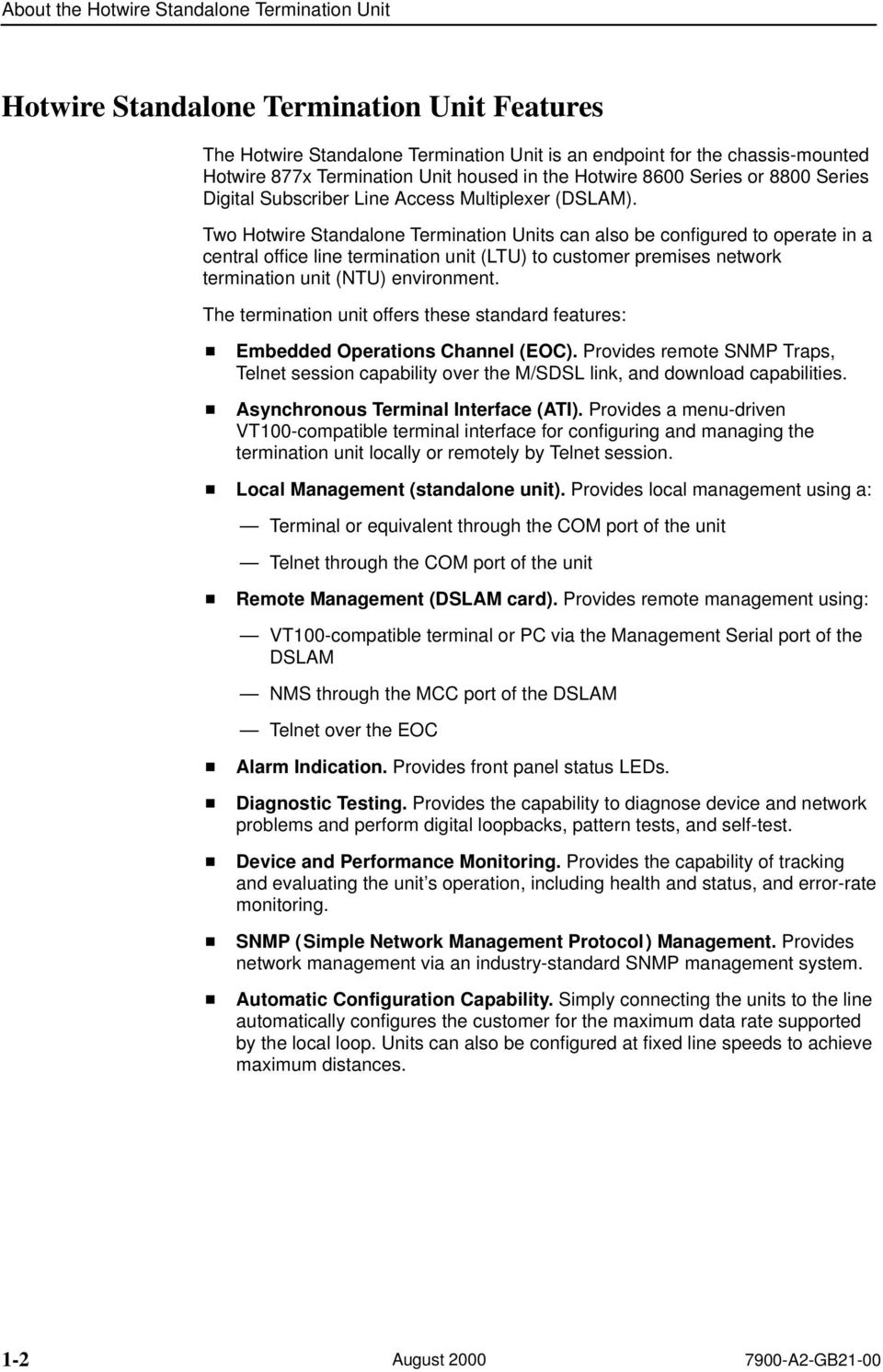
13 About the Hotwire Standalone Termination Unit Network Configuration Figure 1-1 shows a network application using a termination unit in a central office (CO). In this configuration, a frame relay switch and a router are connected through the termination unit to partner units supporting a host or router, and frame relay encapsulated or unframed data. The figure also shows a standalone-to-standalone configuration. Supported standalone-to-standalone configurations are shown in Table 1-1. Table 1-1. Supported Standalone NTU/LTU Combinations NTU (CP) LTU (CO): DSX-1 Synchronous G.703 Framed G.703 Unframed DSX-1 Not Supported Not Supported Synchronous Not Supported Not Supported G.703 Framed Not Supported Not Supported G.703 Unframed Not Supported Not Supported = Supported CO Site Customer Premises (CP) Frame Relay Switch G.703, DSX-1 or V.35 DSL 797x T1 Host (Frame Relay Encapsulated Data) Router DSL 797x Router (Frame Relay Encapsulated Data) DSL 797x Router 877x Termination Unit in DSLAM 797x CO Site LTU DSL CP NTU 797x Figure 1-1. Sample Configurations 7900-A2-GB21-00 August
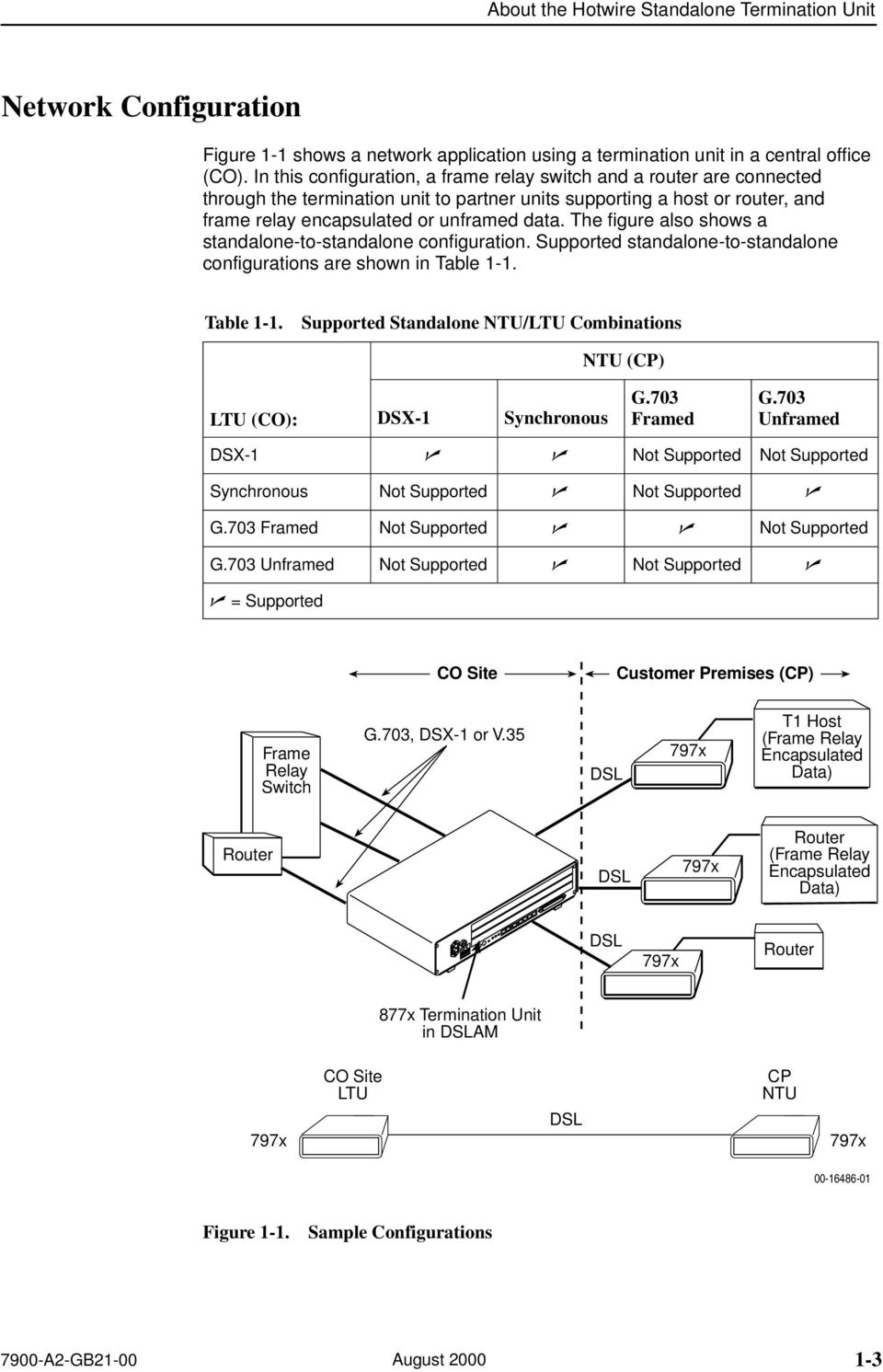
14 About the Hotwire Standalone Termination Unit Front Panel LED Status Indicators Figures 1-2 through 1-4 show the front panel of the Hotwire Standalone Termination Units. For more information on front panel LEDs, refer to Chapter 7, Monitoring and Troubleshooting. TM POWER ALARM TEST DSL DSX-1 TM 7974 M/SDSL Figure 1-2. Hotwire DSX-1 Interface Termination Unit Front Panel TM POWER ALARM TEST DSL DTE TM 7975 M/SDSL Figure 1-3. Hotwire Synchronous Interface Termination Unit Front Panel TM POWER ALARM TEST DSL G.703 TM 7976 M/SDSL Figure 1-4. Hotwire G.703 Interface Termination Unit Front Panel 1-4 August A2-GB21-00
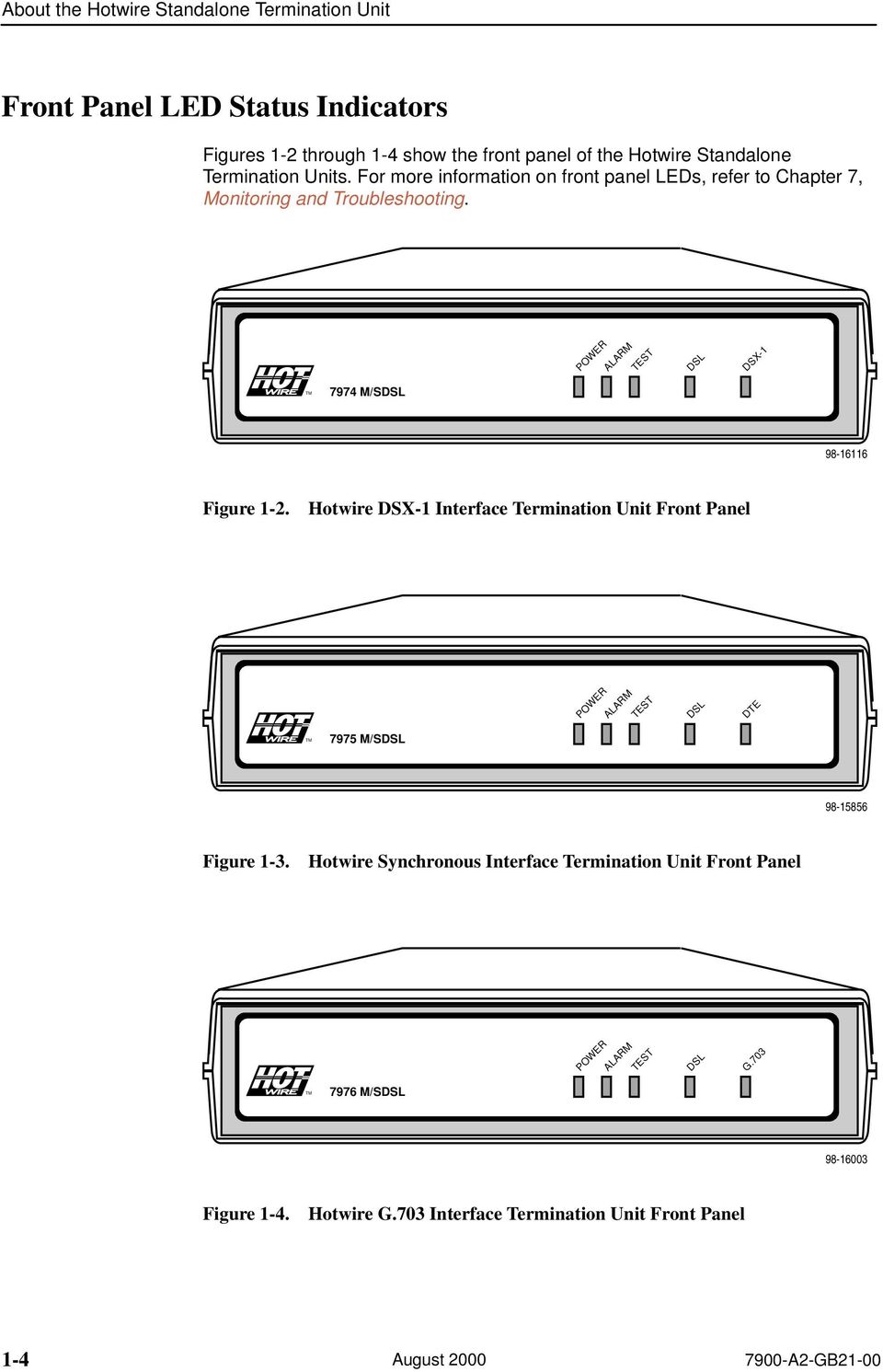
15 About the Hotwire Standalone Termination Unit Rear Panel Interface Connections Figures 1-5 through 1-7 show the physical interfaces of the termination units. I POWER COM DSX-1 DSL O Figure 1-5. Hotwire DSX-1 Interface Termination Unit Rear Panel I POWER COM PORT DSL O Figure 1-6. Hotwire Synchronous Interface Termination Unit Rear Panel I POWER COM G.703 TX RX DSL O 120Ω 75Ω Figure 1-7. Hotwire G.703 Interface Termination Unit Rear Panel 7900-A2-GB21-00 August

16 About the Hotwire Standalone Termination Unit SNMP Management Capabilities The Hotwire 797x Standalone Termination Units support SNMP Version 1, and can be managed by any industry-standard SNMP manager and accessed using SNMP by external SNMP managers. Management Information Base (MIB) Support For a detailed description of the supported MIBs, visit Paradyne s Web site at Select Technical Support MIBs. The following MIBs are supported: MIB II (RFC 1213 and RFC 1573) Defines the general objects for use with a network management protocol in TCP/IP internets and provides general information about the unit. MIB II is backward-compatible with MIB I. DS1/E1 MIB (RFC 1406) Models 7974 and Reports the performance status of the DSX-1 or G.703 interface and supports the features found on the DSX-1 or G.703 Performance Statistics screen. RS-232-Like MIB (RFC 1659) Defines objects for managing RS-232-type interfaces (e.g., V.35, RS-422, RS-423, etc.) and supports the synchronous data port on the DSU. Paradyne Enterprise MIB Supports configuration, status, statistics, and tests. 1-6 August A2-GB21-00
17 AC INPUT 48V AC T5A 250V RTN A B A B 48VDC CLASS 2 OR LIMITED PWR SOURCE OK Alrm Test OK Alrm Test 1 2 OK Alrm 3 Test DC FUSES T4A, MIN. 48V A B FAN ALM STACK POSITION DC PWR A B IN OUT SERIAL MCC SDSL About the Hotwire Standalone Termination Unit SNMP Trap Support Hotwire 797x Standalone Termination Units support traps as defined in RFC Figure 1-8 illustrates a typical DSL SNMP configuration. Figure 1-9 illustrates an DSL SNMP configuration connected directly to the Communications Port. Refer to Chapter 5, IP Addressing and Appendix B, Standards Compliance for SNMP Traps. Operation, Maintenance and Provisioning Center 877x Network DSL SNMP NMS Router 797x EOC SYSTEM SYSTEM SYSTEM G.703 ALRM G.703 ALRM G.703 ALRM DSLAM DSL PORT LINK-UP DSL PORT LINK-UP DSL PORT LINK-UP Ethernet Interface Data Ethernet LAN Figure 1-8. DSL SNMP Configuration Router 797x DSL EOC 797x COM Router SNMP NMS Figure 1-9. DSL Local SNMP Configuration 7900-A2-GB21-00 August

18 About the Hotwire Standalone Termination Unit This page intentionally left blank. 1-8 August A2-GB21-00

19 Using the Asynchronous Terminal Interface 2 User Interface Access You can communicate with the Hotwire Standalone Termination Unit with an asynchronous terminal interface (ATI) using one of the following methods: Direct connection through the COM port of the standalone unit or through the serial port of the DSLAM management card. Telnet session through the Embedded Operations Channel (EOC). NOTE: Only one terminal interface session can be active at a time, and another user s session cannot be forced to end. To automatically log out a user due to inactivity, enable the Inactivity Timeout option (see Table A-9, Telnet Session Options, in Appendix A, Configuration Options). Security can limit ATI access several ways. To limit user access or set up login IDs, refer to Chapter 6, Security. Communication Port Settings Ensure that the device you connect communicates using these settings: Data rate set to 9.6 kbps. Character length set to 8. Parity set to None. Stop Bits set to A2-GB21-00 August
20 Using the Asynchronous Terminal Interface Initiating an ATI Session The Main Menu screen is displayed on the screen unless a login ID and password is required or the ATI is already in use. If the ATI is already in use, you will see: A connection refused or connection failed message (if you are using a Telnet session), or The IP address of the other user (if you are using the Management Serial port). If security is enabled on the unit and you used Telnet to access it directly (you did not log in through the DSLAM management card), the system prompts you for a login ID and password. Login Hotwire Model: 797x Login ID: Enter Password: LOGIN Î Ctrl-a to access these functions Exit ÎÎ 2-2 August A2-GB21-00
21 Using the Asynchronous Terminal Interface After you enter a valid login ID and password, the Main Menu appears. If you enter an invalid login ID and password after three attempts, the Telnet session closes or the terminal connection returns to an idle state. Refer to Chapter 6, Security. Screen Area Screen Function Keys Area main Access Level: Administrator Hotwire Model 797x MAIN MENU Status Test Configuration Control Ctrl-a to access these functions Exit Entry to all of the Hotwire 797x Standalone Termination Unit s tasks begins at the Main Menu screen. The four branches of the Main Menu are as follows: Select... To... Status Test Configuration Control View system status, diagnostic test results, statistics, LEDs, and device identity information. Select and cancel tests for the termination unit s interfaces. Display and edit the configuration options. Change the device identity, administer logins, download new firmware, or initiate a power-on reset of the termination unit. After selecting an option, what appears on the screens depends on the: Current configuration How your unit is currently configured. Effective security access level An access level that is typically set by the system administrator for each interface and each user. Data selection criteria What you entered in previous screens A2-GB21-00 August
22 Using the Asynchronous Terminal Interface Menu Tree The following illustration shows the menu paths to the different ATI screens. Main Status Test Configuration Control System and Test Status Performance Statistics Display LEDs Network 7974: DSX-1 Statistics Error 7975: (Not Applicable) Statistics 7976: G.703 Statistics Network Performance Statistics 7974: Network and DSX-1 Tests 7975: Network Tests 7976: Network and G.703 Tests Identity 7974: (Not Applicable) 7975: Sync Data Port Tests 7976: (Not Applicable) Device Tests Change Identity Download Code Reset AutoRate Administer Logins Apply Download Reset Device Factory Current Configuration Config Edit/Display Configuration Loader Abort All Tests Network 7974: DSX : Sync Ports 7976: G.703 System Options Communication Port Management and Communication Telnet Session Communication Protocol General SNMP Management SNMP NMS Security SNMP Traps August A2-GB21-00
23 Using the Asynchronous Terminal Interface Screen Work Areas There are two user work areas: Screen area This is the area above the dotted line that provides the menu path, menus, and input fields. The menu path appears as the first line on the screen. In this manual, the menu path is presented as a menu selection sequence with the names of the screens: Main Menu Configuration Load Configuration From Network Interface Options Screen function key area This is the area below the dotted line that lists function keys specific to the screen, field value choices, and system messages. Menu Path Input Fields Screen Function Keys Field Value Choices main/config/network Hotwire Model: 797x NETWORK INTERFACE OPTIONS Margin Threshold: 3db Excessive Error Rate Threshold: 1E 5 AutoRate: Disable DSL Line Rate: 1552 kbps EIA-530 Payload Rate 1536 kbps Transmit Attenuation 0dB Peer IP Address: Clear Circuit Identifier: Clear Ctrl-a to access these functions, ESC for previous menu MainMenu Exit Save Select: 1E 4, 1E 5, 1E 6, 1E 7, 1E 8, 1E 9 LOS at Net, Pt 1 System Messages 7900-A2-GB21-00 August
24 Using the Asynchronous Terminal Interface Navigating the Screens You can navigate the screens by: Using keyboard keys Using screen function keys Switching between the two screen work areas Keyboard Keys Use the following keyboard keys to navigate within the screen. Press... To... Backspace Ctrl-a Ctrl-k Ctrl-l Delete (Del) Down Arrow or Ctrl-d Esc Left Arrow or Ctrl-b Return (Enter) Right Arrow or Ctrl-f Spacebar Tab Up Arrow or Ctrl-u Move cursor to the previous field on the screen. Move cursor between the screen area and the screen function keys area below the dotted line at the bottom of the screen. Tab backwards (move cursor one field to the left). Redraw the screen display, clearing information typed in but not yet entered. Delete character that the cursor is on. Move cursor down one field within a column on the same screen. Return to the previous screen. Move cursor one character to the left if in edit mode. Accept entry or display valid options on the last row of the screen when pressed before entering data or after entering invalid data. Move cursor one character to the right if in edit mode. Select the next valid value for the field. Move cursor to the next field on the screen. Move cursor up one field within a column on the same screen. 2-6 August A2-GB21-00
25 Using the Asynchronous Terminal Interface Procedure To make a menu or field selection: 1. Press the Tab key or the right arrow key to position the cursor on a menu or field selection. Each selection is highlighted as you press the key to move the cursor from position to position. 2. Press Enter. The selected menu or screen appears. 3. Continue Steps 1 and 2 until you reach the screen you want. The current setting or value appears to the right of the field name. You can enter information into a selected field by: Typing in the first letter(s) of a field value or command. Switching from the screen area to the screen function area below the dotted line and selecting or entering the designated screen function key. If a field is blank and the Field Values screen area displays valid selections, press the spacebar. The first valid value for the field will appear. Continue pressing the spacebar to scroll through other valid values. Screen Function Keys All screen function keys located below the dotted line operate the same way (upper- or lowercase) throughout the screens. For the screen function... Select... And press Enter to... ClrFar F or f Clear far-end network statistics and refresh the screen. ClrNear N or n Clear near-end network statistics and refresh the screen. ClrStats S or s Clear DSX-1 statistics and refresh the screen. Delete L or l Delete data. Exit E or e Terminate the asynchronous terminal session. MainMenu M or m Return to the Main Menu screen. New N or n Enter new data. PgDn D or d Display the next page or group of entries. PgUp U or u Display the previous page or group of entries. ResetMon R or r Reset an active Monitor 511 test counter to zero. Save S or s Save information A2-GB21-00 August
26 Using the Asynchronous Terminal Interface Switching Between Screen Work Areas Select Ctrl-a to switch between the two screen work areas to perform all screen functions. Procedure To access the screen function area below the dotted line: 1. Press Ctrl-a to switch from the screen area to the screen function key area below the dotted line. 2. Select either the function s designated (underlined) character or press the Tab key until you reach the desired function key. Example: To save the current screen, type s or S (Save). 3. Press Enter. 4. To return to the screen area above the dotted line, press Ctrl-a again. Î Î main/config/network Hotwire Model: 797x Circuit Identifier: NETWORK INTERFACE OPTIONS Margin Threshold: 3db Excessive Error Rate Threshold: 1E 5 AutoRate: Disable DSL Line Rate: 1552 kbps EIA-530 Payload Rate 1536 kbps Transmit Attenuation 0dB Peer IP Address: Clear Clear Ctrl-a to access these functions, ESC for previous menu MainMenu Exit Save ÎÎ ÎÎ Ending an ATI Session Use the Exit function key from any screen to terminate the session. Procedure To end a session with the asynchronous terminal interface: 1. Press Ctrl-a to go to the screen function key area below the dotted line. 2. Save changes if required. A confirmation message appears if you have made but not saved changes to your configuration. 3. Tab to Exit (or type e or E) and press Enter. 2-8 August A2-GB21-00
27 Initial Startup and Configuration 3 Overview This chapter provides instructions on how to access and configure your Hotwire 797x Standalone Termination Unit for the first time. This chapter includes procedures for: Connecting power to the unit. Connecting the unit to the network. Connecting the unit to a DTE. Connecting the unit to a system terminal. Providing initial unit identity information or changing existing identity information. Configuring your unit using the Configuration Edit menus or internal switches. Choosing the current or factory default configuration options. Modifying current configuration options using the Configuration Edit/Display menu. Downloading configuration options from a TFTP server. Saving your configuration options. Downloading unit firmware from a TFTP server. This chapter also explains how to disable and reset AutoRate A2-GB21-00 August
28 Initial Startup and Configuration Connecting Power If your package includes a power pack: Plug the power pack into an AC outlet having a nominal voltage rating between VAC. Connect the output cable of the power pack to the connector marked POWER on the rear panel. If your package includes a direct-connection DC power cable: Connect the unit to an external +24 or 48 VDC power source as described in Connecting the Unit to an Optional External DC Power Source. Connecting to an Optional External DC Power Source Using the DC power cable, the Hotwire 797x Standalone Termination Unit is capable of operating on a +24 or 48 VDC power supply. Procedure To use the DC power cable with +24 VDC: 1. Connect the green wire to a suitable ground. 2. Connect the orange wire to the +24 VDC source. 3. Connect the white wire to the return. 4. Cut the black, red, and blue wires off at the outer insulation. 5. Plug the power connector into the Power receptacle of the unit. Procedure To use the DC power cable with 48 VDC: 1. Connect the green wire to a suitable ground. 2. Connect the orange wire to the 48 VDC source. 3. Connect the black wire to the return. 4. Cut the red, white, and blue wires off at the outer insulation. 5. Plug the power connector into the Power receptacle of the unit. Power Input Connector Pin Number Wire Color Signal 1 Black 48 VDC Return 2 Red 48 VDC Return 3 Green Ground 4 White +24 VDC Return 5 Orange 48 VDC +24 VDC 6 Blue No Connection August A2-GB21-00
29 Initial Startup and Configuration Connecting to the Network Procedure Connecting to a DTE To connect your unit to the network: 1. Connect one end of the network cable into the rear panel DSL jack. 2. Connect the other end to your DSL network interface. NOTE: Do not use a flat VF network cable as this may severely degrade the performance of the unit. Use only Cat 5 twisted-pair network cable. As the following table shows, the DTE interface varies from model to model. Model DTE Connection 7974 The DSX-1 interface is an RJ48C, 8-position, unkeyed modular connector. An RJ48C-to-DB15 T1 network interface adapter cable is available from Paradyne The synchronous interface is a 25-pin EIA-530-A interface. Depending on the cable used, the interface can be adapted to an X.21, RS-449, or V.35 interface The G.703 interface is either two BNC connectors (Transmit and Receive) for a 75-ohm unbalanced interface or an RJ48C, 8-position, unkeyed modular connector for a 120-ohm balanced interface. See Appendix C, Cables and Pin Assignments, for more information A2-GB21-00 August
30 Initial Startup and Configuration Connecting to a System Terminal An optional system maintenance terminal may be attached to your Hotwire 797x Standalone Termination Unit through the modular jack on the rear panel. The system maintenance terminal allows you to view the status of the unit and change configuration options. The terminal must be a VT100-compatible terminal or a PC running terminal emulation software. Procedure To connect your unit to a system terminal: 1. Connect the 9-pin end of the terminal cable into a COM port on your PC. 2. Plug the other end into the modular jack on the rear panel. If your PC requires a 25-pin connector to the COM port, see Appendix C, Cables and Pin Assignments, for the correct cable pinouts. 3. Set the communication parameters on your PC or terminal to: 9600 baud 8 bit characters no parity 1 stop bit no flow control 3-4 August A2-GB21-00
31 Initial Startup and Configuration Entering Identity Information After accessing your unit for the first time, use the Change Identity screen to determine SNMP administrative system information that will be displayed on the Identity screen of the Status branch. To access the Identity screen, follow this menu selection sequence: Main Menu Control Change Identity main/control/change_identity Model: 797x IDENTITY System Name: Fess lllqj Clear System Location: Bldg. A412, 2nd Floor, Left cabinet Clear System Contact: R. Byrd pager Clear Î Î Ctrl-a to access these functions, ESC for previous menu MainMenu Exit Save ÎÎ ÎÎ The three System entry fields are alphanumeric and provide 128 characters for each field. The System entries appear on the Identity display as shown above. The SNMP System entry fields are: System Name: The general SNMP system name. System Location: The physical location of the SNMP-managed device. System Contact: Identification information, such as contact name, phone number, or mailing address. Valid entry values are any printable ASCII character. ASCII printable characters include: Numeric 0 9 Upper- or lowercase A Z Space All ASCII symbols except the caret (^) Select Clear to reset a field to a null value A2-GB21-00 August
32 Initial Startup and Configuration Procedure To enter Change Identity screen information: 1. Position the cursor in the System Name field. Enter a name unique in your network to identify the SNMP managed node (or unit). The maximum length of System Name is 128 characters. 2. Position the cursor in the System Location field. Enter the physical location of the unit. The maximum length of System Location is 128 characters. 3. Position the cursor in the System Contact field. Enter the name and contact information for the person responsible for the unit. The maximum length of System Contact is 128 characters. 4. Press Ctrl-a to switch to the screen function key area below the dotted line. 5. Select Save and press Enter. Select Clear to reset a field to a null value. 3-6 August A2-GB21-00
33 Initial Startup and Configuration Choosing a Configuration Method You can make configuration changes either through a VT100-compatible terminal and the unit s Configuration menus or by manually changing switches on the board. The unit is shipped with the switchpacks disabled to allow settings to be made through the Configuration menus. To use the switches, see Chapter 4, Configuring the Unit Using the Internal Switches. Configuring the Unit Using the Configuration Menus Use the Configuration menus to select, display, or change configuration option settings. NOTE: The Hotwire 797x Standalone Termination Unit is preconfigured as an NTU. If you are using this unit as an NTU, the configuration options may not need to be changed. The Hotwire 797x Standalone Termination Unit is shipped with factory settings in the Default Factory configuration area. You can find default information by: Referring to Appendix A, Configuration Options. Accessing the Configuration branch of the Hotwire 797x Standalone Termination Unit menu. The Hotwire 797x Standalone Termination Unit has two sets of configuration option settings. The Current Configuration matches the Default Factory Configuration until modified and saved by the user. Configuration Option Area Current Configuration Default Factory Configuration Configuration Option Set The unit s active set of configuration options. A read-only configuration area containing the factory default configuration options. If the factory default settings do not support your network s configuration, you can customize the configuration options for your application A2-GB21-00 August
34 Initial Startup and Configuration Accessing and Displaying Configuration Options To display configuration options, you must first load a configuration into the edit area. To load a configuration option set into the configuration edit area, follow this menu selection sequence: Main Menu Configuration (Load Configuration From) main/configuration Model: 797x LOAD CONFIGURATION FROM: Current Configuration Configuration Loader Default Factory Configuration Î Ctrl-a to access these functions, ESC for previous menu MainMenu Exit ÎÎ Make a selection by placing the cursor at your choice and pressing Enter. If you select... Then... Current Configuration Configuration Loader Default Factory Configuration The selected configuration option set is loaded and the Configuration Edit/Display menu screen appears. The Configuration Loader screen is displayed allowing you to upload or download configurations from a TFTP server. The selected configuration option set is loaded and the Configuration Edit/Display menu screen appears. 3-8 August A2-GB21-00
35 Initial Startup and Configuration Configuration Edit/Display The Configuration Edit/Display screen appears when the current or default configuration is loaded. To access the Configuration Edit/Display screen, follow this menu selection sequence: Main Menu Configuration Current Configuration or Main Menu Configuration Default Factory Configuration main/config/edit Model: 797x Î Î CONFIGURATION EDIT/DISPLAY Network DSX-1 SYNC Port G.703 System Options Communication Port Management and Communication Ctrl-a to access these functions, ESC for previous menu MainMenu Exit Save ÎÎ ÎÎ 7900-A2-GB21-00 August
36 Initial Startup and Configuration See Appendix A, Configuration Options, for a list and explanation of the configuration options available. Select... To Access the... To Configure the... Network Network Interface Options, Table A-1 DSL network interface on the unit. DSX-1 or SYNC Port or G.703 System Options Communication Port Management and Communication DSX-1 Interface Options, Table A-4 Synchronous Data Port Options, Table A-5 G.703 Interface Options, Table A-6 System Options, Table A-7 Communication Port Options, Table A-8 Telnet Session Options, Table A-9 Communication Protocol Options, Table A-10 General SNMP Management Options, Table A-11 SNMP NMS Security Options, Table A-12 SNMP Traps Options, Table A-13 DSX-1 interface (Model 7974) Synchronous DTE interface (Model 7975) G.703 interface (Model 7976) General system options of the unit. Unit s COM port options. Management support of the unit through SNMP and Telnet August A2-GB21-00
37 Initial Startup and Configuration Configuration Loader The Configuration Loader screen allows you to upload configurations to and download configurations from a TFTP server. To access the Configuration Loader screen, follow this menu selection sequence: Main Menu Configuration Configuration Loader main/configuration/config_loader Model: 797x CONFIGURATION LOADER Configuration File Name: Clear TFTP Server IP Address: Clear TFTP Transfer Direction: Download from Server Destination: DSL Start Transfer: Yes Packets Sent: Packets Received: Bytes Sent: Bytes Received: Transfer Status: Transfer Pending Activate new configuration? No Ctrl-a to access these functions, ESC for previous menu MainMenu Exit 7900-A2-GB21-00 August
38 Initial Startup and Configuration Procedure To upload or download a configuration: 1. Position the cursor in the Image File Name field. Type the name of the file to be downloaded, or the name to be used for the file to be uploaded. The filename may be a regular path name expression of directory names separated by a forward slash (/) ending with the filename. The total path name length can be up to 128 characters. DOS machine: If the TFTP server is hosted by a DOS machine, then directory and filenames must consist of eight or less characters with an optional suffix of up to three characters. The system will automatically upload the configuration file and create directories and filenames as needed. UNIX machine: If your server is hosted by a UNIX machine, the configuration file you name must already exist. It will not be created on the UNIX system by the TFTP server. It is critical that you work with your system administrator to plan the naming conventions for directories, filenames, and permissions so that anyone using the system has read and write permissions. 2. Position the cursor in the TFTP Server IP Address field. Enter the TFTP server IP address. 3. Position the cursor in the Destination field. Use the spacebar to select a network destination for the TFTP server. Select DSL if the TFTP server destination is the DSL link or COM if the TFTP destination is the COM port. 4. Position the cursor in the TFTP Transfer Direction field. Use the spacebar to select Download from Server or Upload to Server. 5. Position the cursor at the Start Transfer field. Use the spacebar to select Yes. Press Enter. When the data transfer is complete, the Transfer Status field changes to Completed successfully. 6. Position the cursor at the Activate new configuration? prompt and select Yes to activate a new downloaded configuration. Press Enter. NOTE: The configuration options DSL Mode and Telnet Session are not changed when a new configuration is loaded. You must change these settings with the appropriate configuration menus after the new configuration is activated. See Table A-7, System Options, and Table A-9, Telnet Session Options, in Appendix A, Configuration Options August A2-GB21-00
39 Initial Startup and Configuration Saving Configuration Options When changes are made to the configuration options through the Configuration Edit/Display branch, the changes must be saved to take effect. Use the Save key or Save Configuration screen. Procedure To save configuration options changes: 1. Press Ctrl-a to switch to the screen function key area below the dotted line. 2. Select Save and press Enter. NOTE: When Exit is selected before Save, or Save has been selected from any menu in the Configuration/Edit branch, a Save Configuration screen appears requiring a Yes or No response. main/config/saveprompt Model: 797x SAVE CONFIGURATION Save Changes? No Î Î Ctrl-a to access these functions, ESC for previous menu MainMenu Exit Command Complete ÎÎ ÎÎ If you select... Then... Yes No The configuration is saved. The Main Menu appears and changes are not saved. If the Telnet Session configuration option is changed, a message appears on the Save Configuration screen warning that an answer of Yes will cause the Telnet session to disconnect. Do not answer Yes unless you are prepared to disconnect. If the DSL Mode configuration option is changed, a message is appears on the Save Configuration screen warning that an answer of Yes will cause the system to be reset. Do not answer Yes unless you are prepared to reset the unit A2-GB21-00 August
40 Initial Startup and Configuration Downloading Code The Download Code screen allows you to download firmware from a TFTP server. To access the Download Code screen, follow this menu selection sequence: Main Menu Control Download Code main/control/download_code Model: 797x DOWNLOAD CODE Image File Name: Clear TFTP Server IP Address: Clear Destination: DSL Immediately Apply Download: Yes Start Transfer: No Packets Sent: Packets Received: Bytes Sent: Bytes Received: Transfer Status: Transfer Pending Ctrl-a to access these functions, ESC for previous menu MainMenu Exit 3-14 August A2-GB21-00
41 Initial Startup and Configuration Procedure To download firmware: 1. Position the cursor in the Image File Name field. Type the name of the file to be downloaded. The file name may be a regular path name expression of directory names separated by a forward slash (/) ending with the file name. The total path name length can be up to 128 characters. 2. Position the cursor in the TFTP Server IP Address field. Enter the TFTP server IP address. 3. Position the cursor in the Destination field. Use the spacebar to select a network destination for the TFTP server. Select DSL if the TFTP server destination is the DSL link or COM if the TFTP destination is the COM port. 4. Position the cursor in the Immediately Apply Download field. If you would like the download to be effective immediately, select Yes. 5. Position the cursor at the Start Transfer field. Use the spacebar to select Yes. Press Enter. When the data transfer is complete: If you selected Yes in Step 4, the unit is reset. If you selected No in Step 4, the Transfer Status field changes to Completed successfully. If you specified No (the default) in the Immediately Apply Download field in Step 4 above, you must now apply the download. Procedure To apply the downloaded firmware: 1. Press the Escape key to return to the Control menu. Select Apply Download. 2. On the Apply Download screen, type Yes to reset the card and activate the code A2-GB21-00 August
42 Initial Startup and Configuration Disabling AutoRate The M/SDSL AutoRate function is controlled from the Network Interface Options screen and allows you to enable or disable AutoRate. The AutoRate option is only available if the unit is configured as an LTU. To access the Network Interface screen, follow this menu selection sequence: Main Menu Configuration Network Î Î main/config/network Hotwire Model: 797x Circuit Identifier: NETWORK INTERFACE OPTIONS Port Status Enable Margin Threshold: 3db Excessive Error Rate Threshold: 1E 5 AutoRate: Disable DSL Line Rate: 1552 kbps EIA-530 Payload Rate 1536 kbps Transmit Attenuation 0dB Peer IP Address: Clear Clear Ctrl-a to access these functions, ESC for previous menu MainMenu Exit Save ÎÎ ÎÎ Procedure The AutoRate option defaults to Enable. To disable AutoRate: 1. Position the cursor in the AutoRate field and press the spacebar. The AutoRate field toggles to Disable and the DSL Line Rate field appears. 2. Enter a DSL Line Rate and press Enter. Resetting AutoRate The Reset AutoRate function of the Control branch causes the unit to repeat the AutoRate sequence. The unit attempts to establish the DSL link at the highest rate (or the value of DSL Line Rate, which represents the AutoRate ceiling when AutoRate is enabled). If the link fails, the next lower rate is tried until the link is established. To access the Reset AutoRate screen, follow this menu selection sequence: Main Menu Control Reset AutoRate 3-16 August A2-GB21-00
43 Configuring the Unit Using the Internal Switches 4 Overview You can make configuration changes either through a VT100-compatible terminal and the unit s Configuration menus or by manually changing switches on the board. The unit is shipped with the switchpacks disabled to allow settings to be made through the Configuration menus. To use the Configuration menus, see Chapter 3, Initial Startup and Configuration A2-GB21-00 August
44 Configuring the Unit Using the Internal Switches Configuring the Unit Using the Internal Switches Use internal Switchpacks S3 and S4 to manually configure the unit. Use Figure 4-1 to locate Switchpacks S3 and S4.! HANDLING PRECAUTIONS FOR STATIC-SENSITIVE DEVICES This product is designed to protect sensitive components from damage due to electrostatic discharge (ESD) during normal operation. When performing installation procedures, however, take proper static control precautions to prevent damage to equipment. If you are not sure of the proper static control precautions, contact your nearest sales or service representative. Procedure To configure the unit using internal Switchpacks S3 and S4: 1. Power off the unit. 2. Remove the enclosure cover: Use a Phillips screwdriver to remove the two screws from the top of the unit. Push a flat-blade screwdriver through the slots on both sides of the housing to free the four inner latches. 3. Locate Switchpack S4 on the circuit board using Figure Set Switch 1 on Switchpack S4 to ON to enable Switchpacks S3 and S4. 5. After you enable the switchpacks, you must set the switches to your desired configuration. Refer to Figure 4-1 and Tables 4-1 through Replace the cover and fasten it with the two screws. 7. Power on the board to reset and enable the new configuration. 4-2 August A2-GB21-00
45 Configuring the Unit Using the Internal Switches Switchpack Locations Use Figure 4-1 to locate Switchpacks S3 and S4. Rear Switchpack S3 & S4 ON ON S3 ON ON S Front Figure 4-1. Hotwire Standalone Termination Unit Switchpack Locations 7900-A2-GB21-00 August
46 Configuring the Unit Using the Internal Switches Switchpack Definitions for Model 7974 Table 4-1 lists Switchpack S4 definitions. Table 4-1. Switchpack S4 Definitions (Model 7974) Switch #... Allows you to... Default in Bold 1 Enable or disable Switchpacks S3 and S4. OFF = Switchpacks Disabled ON = Switchpacks Enabled 2 Not used 3 Select the unit s primary timing source. Valid only for a unit configured as the LTU. OFF = Internal Clock ON = DSX-1 Clock 4 Control the unit s T1 line coding. OFF = B8ZS ON = AMI 5 Control the unit s framing format OFF = ESF ON = D4 6, 7, 8 Control the unit s line equalization. Refer to Table 4-2. The three switches form a binary value used as an index to the table of equalization values. Off denotes 0 (zero) and On denotes 1 (one). 000 (all Off) = feet Use Table 4-2 to set the Line Equalization. Defaults are shown in bold. Table 4-2. Line Equalization, Switches 6 8 on Switchpack S4 (Model 7974) Switch Position Line Equalization OFF OFF OFF feet OFF OFF ON feet OFF ON OFF feet OFF ON ON feet ON OFF OFF feet ON OFF ON feet ON ON OFF feet ON ON ON feet 4-4 August A2-GB21-00
47 Configuring the Unit Using the Internal Switches Table 4-3 lists Switchpack S3 definitions. Table 4-3. Switchpack S3 Definitions (Model 7974) Switch #... Allows you to... Default in Bold 1 Control whether the unit is an LTU or an NTU. OFF = NTU ON = LTU 2 Control whether the unit automatically adjusts to the best line rate for conditions, or is fixed at the rate set by Switches S3-3 through S3-5. OFF = Fixed Rate ON = AutoRate Enabled 3, 4, 5 Control the DSL line rate of the unit. Refer to Table 4-4. If AutoRate is enabled, this switch represents the maximum DSL AutoRate value. 000 (all Off) = 1552 kbps 6 Control whether Telco loopbacks are supported. OFF = Enabled ON = Disabled 7 Control whether remote Telco loopbacks are supported. OFF = Disabled ON = Enabled 8 Emergency Use Only Switch between two versions of firmware. The unit has two banks of flash memory used to hold executable firmware. This switch allows you to change between the two versions of firmware. This switch is independent from the position of Switch 1 on Switchpack S4 (switchpack enable/disable). OFF = Current Firmware ON = Previous Firmware Use Table 4-4 to set the DSL Line Rate. Defaults are shown in bold. Table 4-4. DSL Line Rate, Switches 3 5 on Switchpack S3 (Model 7974) Switch Position DSL Line Rate OFF OFF OFF 1552 kbps OFF OFF ON 144 kbps OFF ON OFF 272 kbps OFF ON ON 400 kbps ON OFF OFF 528 kbps ON OFF ON 784 kbps ON ON OFF 1040 kbps ON ON ON 1552 kbps 7900-A2-GB21-00 August
48 Configuring the Unit Using the Internal Switches Switchpack Definitions for Model 7975 Table 4-5 lists Switchpack S4 definitions. Table 4-5. Switchpack S4 Definitions (Model 7975) Switch #... Allows you to... Default in Bold 1 Enable or disable Switchpacks S3 and S4. OFF = Switchpacks Disabled ON = Switchpacks Enabled 2 Control Sync Port Type. OFF = EIA-530, RS-449, or X.21 ON = V.35 3 Select the unit s timing source. Valid only for a unit configured as the LTU. OFF = Internal clock ON = External Clock 4, 5, 6, 7, 8 Control Sync Port Data Rate (refer to Table 4-6, Selectable Payload Rates) NOTE: Switches 4 through 8 are only used when the unit is configured as an LTU and AutoRate is disabled. All OFF = 2048 kbps (1024 kbps for 1 Mbps units) Use Table 4-6 to set the Sync Port Payload Rate. Defaults are shown in bold. NOTE: Sync Port and DSL Line Rates can only be selected from a unit configured as the LTU (Switchpack S3 #1) with AutoRate disabled (Switchpack S3 #2). 4-6 August A2-GB21-00
49 Configuring the Unit Using the Internal Switches Table 4-6. Selectable Payload Rates (Model 7975) Switchpack S4 Switch Number Associated DSL Line Sync Port Payload Rate Rate 2048 kbps (32 x 64) OFF OFF OFF OFF OFF 2064 kbps 1984 kbps (31 x 64) ON ON ON ON ON 2064 kbps 1920 kbps (30 x 64) ON ON ON ON OFF 2064 kbps 1856 kbps (29 x 64) ON ON ON OFF ON 2064 kbps 1792 kbps (28 x 64) ON ON ON OFF OFF 2064 kbps 1728 kbps (27 x 64) ON ON OFF ON ON 2064 kbps 1664 kbps (26 x 64) ON ON OFF ON OFF 2064 kbps 1600 kbps (25 x 64) ON ON OFF OFF ON 2064 kbps 1536 kbps (24 x 64) ON ON OFF OFF OFF 1552 kbps 1472 kbps (23 x 64) ON OFF ON ON ON 1552 kbps 1408 kbps (22 x 64) ON OFF ON ON OFF 1552 kbps 1344 kbps (21 x 64) ON OFF ON OFF ON 1552 kbps 1280 kbps (20 x 64) ON OFF ON OFF OFF 1552 kbps 1216 kbps (19 x 64) ON OFF OFF ON ON 1552 kbps 1152 kbps (18 x 64) ON OFF OFF ON OFF 1552 kbps 1088 kbps (17 x 64) ON OFF OFF OFF ON 1552 kbps 1024 kbps (16 x 64) ON OFF OFF OFF OFF 1040 kbps 960 kbps (15 x 64) OFF ON ON ON ON 1040 kbps 896 kbps (14 x 64) OFF ON ON ON OFF 1040 kbps 832 kbps (13 x 64) OFF ON ON OFF ON 1040 kbps 768 kbps (12 x 64) OFF ON ON OFF OFF 784 kbps 704 kbps (11 x 64) OFF ON OFF ON ON 784 kbps 640 kbps (10 x 64) OFF ON OFF ON OFF 784 kbps 576 kbps (9 x 64) OFF ON OFF OFF ON 784 kbps 512 kbps (8 x 64) OFF ON OFF OFF OFF 528 kbps 448 kbps (7 x 64) OFF OFF ON ON ON 528 kbps 384 kbps (6 x 64) OFF OFF ON ON OFF 400 kbps 320 kbps (5 x 64) OFF OFF ON OFF ON 400 kbps 256 kbps (4 x 64) OFF OFF ON OFF OFF 272 kbps 192 kbps (3 x 64) OFF OFF OFF ON ON 272 kbps 128 kbps (2 x 64) OFF OFF OFF ON OFF 144 kbps 64 kbps (1 x 64) OFF OFF OFF OFF ON 144 kbps NOTE: The 1 Mbps unit Payload Rate defaults to 1024 kbps (all OFF). 2 Mbps Units Only 7900-A2-GB21-00 August
50 Configuring the Unit Using the Internal Switches Table 4-7 lists Switchpack S3 definitions. Table 4-7. Switchpack S3 Definitions (Model 7975) Switch #... Allows you to... Default in Bold 1 Control whether the unit is an LTU or an NTU. OFF = NTU ON = LTU 2 Control enabling and disabling of the AutoRate capability. OFF = AutoRate Enabled ON = AutoRate Disabled 3, 4, 5 Select one of eight preset DSL line rates (refer to Table 4-8). If AutoRate is enabled, DSL Line Rate represents the AutoRate ceiling. All OFF = 2064 (1040 for 1 Mbps units ) 6 Control enabling and disabling of the Elastic Store feature. OFF = Elastic Store Enabled ON = Elastic Store Disabled 7 Not used 8 Emergency Use Only The unit has two banks of flash memory used to hold executable firmware. This switch allows you to change between the two versions of firmware. This switch is independent from the position of Switch 1 on Switchpack S4 (switchpack enable/disable). OFF = Current Firmware ON = Previous Firmware Use Table 4-8 to set the DSL Line Rate. Defaults are shown in bold. Table 4-8. DSL Line Rate, Switches 3 5 on Switchpack S3 (Model 7975) Switch Position DSL Line Rate OFF OFF OFF 2064 kbps (2 Mbps unit only) OFF OFF ON 144 kbps OFF ON OFF 272 kbps OFF ON ON 400 kbps ON OFF OFF 528 kbps ON OFF ON 784 kbps ON ON OFF 1040 kbps ON ON ON 1552 kbps (2 Mbps unit only) NOTE: On 1 Mbps units the DSL line rate defaults to 1040 kbps (all OFF). 4-8 August A2-GB21-00
51 Configuring the Unit Using the Internal Switches Switchpack Definitions for Model 7976 Table 4-9 lists Switchpack S4 definitions. Table 4-9. Switchpack S4 Definitions (Model 7976) Switch #... Allows you to... Default in Bold 1 Enable or disable Switchpacks S3 and S4. OFF = Switchpacks Disabled ON = Switchpacks Enabled 2 Control line termination. OFF = 120 Ohm ON = 75 Ohm 3 Select the unit s primary timing source. Valid only for a unit configured as the LTU. OFF = Internal Clock ON = External Clock 4 Control the unit s E1 line coding. OFF = HDB3 ON = AMI 5 Determine whether the unit will use G.704 framing. Unframed mode (ON) is valid only when switches 3 5 of Switchpack S3 are set to full rate (all Off). OFF = Framed ON = Unframed 6 Enable CRC-4 generation and monitoring. Valid only for a unit configured as the LTU. The NTU is automatically configured to match the LTU setting. OFF = Disable CRC-4 generation and monitoring ON = Enable CRC-4 generation and monitoring 7 Control whether Channel 16 contains signaling information or data. OFF = Channel 16 is used for signaling (voice mode) ON = Channel 16 is used for data (data mode) 8 Not used 7900-A2-GB21-00 August
52 Configuring the Unit Using the Internal Switches Table 4-10 lists Switchpack S3 definitions. Table Switchpack S3 Definitions (Model 7976) Switch #... Allows you to... Default in Bold 1 Control whether the unit is an LTU or an NTU. OFF = NTU ON = LTU 2 Control enabling and disabling of the AutoRate capability. Valid only for a unit configured as the LTU. OFF = Fixed Rate ON = AutoRate Enabled 3, 4, 5 Select one of eight preset DSL line rates. Refer to Table If AutoRate is enabled, DSL Line Rate represents the AutoRate ceiling. All OFF = , 7 Not used 8 Emergency Use Only The unit has two banks of flash memory used to hold executable firmware. This unit allows you to change between the two versions of firmware. This switch is independent from the position of Switch 1 on Switchpack S4 (switchpack enable/disable). OFF = Current Firmware ON = Previous Firmware Use Table 4-11 to set the DSL Line Rate. Defaults are shown in bold. Table DSL Line Rate, Switches 3 5 on Switchpack S3 (Model 7976) Switch Position DSL Line Rate OFF OFF OFF 2064 kbps OFF OFF ON 144 kbps OFF ON OFF 272 kbps OFF ON ON 400 kbps ON OFF OFF 528 kbps ON OFF ON 784 kbps ON ON OFF 1040 kbps ON ON ON 1552 kbps 4-10 August A2-GB21-00
53 IP Addressing 5 Selecting an IP Addressing Scheme Your IP addressing scheme depends in part whether the Hotwire 797x Standalone Termination Unit is running in IP Conservative mode. The unit runs in IP Conservative mode if it is connected to a DSLAM card running in IP Conservative mode. Configurations Not Running IP Conservative Software For a configuration not running IP Conservative software, the NTU s network interface IP address is assigned through the peer IP address of the LTU s Network Interface menu. A DSLAM-mounted termination unit is assigned an IP address and subnet through the DSLAM Configuration DSL Cards Set IP Address menu. Once the address is assigned, you can use the ATI to assign: Peer IP address. This address is used as the IP address of the remote unit. See Table A-1, Network Interface Options, in Appendix A, Configuration Options. An IP address for each NMS to act as a trap manager. See Table A-13, SNMP Traps Options, in Appendix A, Configuration Options. All Configurations The NTU obtains its IP address when the PPP link is established over the EOC. Use the ATI to assign: An IP address for each NMS. See Table A-12, SNMP NMS Security Options, in Appendix A, Configuration Options. An IP address for the TFTP server you wish to use to upload and download configurations. See Configuration Loader in Chapter 3, Initial Startup and Configuration, and the documentation for your TFTP server A2-GB21-00 August
54 IP Addressing The Peer IP Address refers to the EOC interface IP address of the unit configured as an NTU. When the LTU and NTU negotiate a connection, the NTU receives its address from the LTU. Review the following information in preparation for selecting an IP addressing scheme. Any legal host address is allowed for a given subnet. The address choice within the subnet is arbitrary. The Peer IP Address must be unique within the MCC backplane subnet. A single route to a subnet is all that is needed to reach every device on a subnet. The unit s routing table supports a maximum of 20 routes. IP Addressing Example DSLAM MCC LTU 877x Port 4 Peer IP Address = DSLAM MCC Backplane Address = MCC Backplane Mask = LTU Backplane Address = Port 1 Peer IP Address = Port 2 Peer IP Address = Port 3 Peer IP Address = MCC NTU 797x 797x 797x MCC Base Address = MCC Base Subnet Mask = NTU Backplane Address = Peer IP Address Assignments 5-2 August A2-GB21-00
55 Security 6 Overview Security on the Hotwire 797x Standalone Termination Unit is implemented by limiting user access to the ATI through option settings. You can: Enable the Telnet Login Required option. Enable the COM port Login Required option. Limit access by setting a Session Access Level option of Operator for the Telnet session. Limit access by setting a Session Access Level option of Operator for the COM port. Disable Telnet access with the Telnet Session option. See Table A-8, Communication Port Options, and Table A-9, Telnet Session Options, in Appendix A, Configuration Options A2-GB21-00 August
56 Security ATI Access Levels The Hotwire 797x Standalone Termination Unit has two access levels: Administrator and Operator. The access level determines what functions are accessible, as shown in Table 6-1. Table 6-1. Access Levels ATI Access to Menu Functions Administrator Operator Status Read-Only Read-Only Test Full Access No Access Configuration Full Access Read-Only Control Full Access No Access Access levels can be applied to Login IDs, the COM port, and Telnet sessions. The effective access level is always the most restrictive: When access is through the COM port and a login is required on the COM port, the effective access level is the more restrictive of the COM port access level or the login access level. (See Table A-8, Communication Port Options.) When access is through Telnet and a login is required for Telnet, the effective access level is the more restrictive of the Telnet session access level or the login access level. (See Table A-9, Telnet Session Options.) When an access level of Operator is applied to the COM port and to Telnet sessions, a Login ID with Administrator authority is effectively reduced to Operator. It is no longer possible to change configuration options, and full access can be restored only by reloading factory defaults. (See Resetting the Unit s COM Port or Factory Defaults on page 6-6.) 6-2 August A2-GB21-00
57 Security Creating a Login Logins apply to the terminal directory connected to the communication port or Telnet access directly to the ATI of the unit. Six login ID/password combinations are available. Each Login ID and Password must be unique and include an access level. Procedure 1. To create a login record, follow this menu selection sequence: Main Menu Control Administer Logins main/control/admin_logins Model: 797x ADMINISTER LOGINS Page 1 of x Login ID: Access Level: newuser Administrator Î Î ESC for previous menu MainMenu Exit Save New Delete ÎÎ ÎÎ 2. Select New and press Enter. The Login Entry screen appears. main/control/admin_loginss/entry Model: 797x LOGIN ENTRY Login ID: Password: Re-enter Password: Access Level: newuser2 es342 es342 Administrator Î Î WARNING New logins will not become permanent until saved through the ADMINISTER LOGINS screen! Ctrl-a to access these functions, ESC for previous menu MainMenu Exit Save ÎÎ ÎÎ 7900-A2-GB21-00 August
58 Security 3. Create the login by entering the following fields. Login IDs and passwords are case-sensitive. On the Login Entry screen, for the... Enter... Login ID Password Re-enter Password Access Level 1 to 10 ASCII printable characters (hex21 through 7E). Blanks are not allowed. 1 to 10 ASCII printable characters that can consist of 0 9, a z, A Z, # (pound),. (period), (dash), and / (slash). 1 to 10 ASCII printable characters that can consist of 0 9, a z, A Z, # (pound),. (period), (dash), and / (slash). Administrator, Operator NOTE: Assign at least one Administrator-level Login ID. Full access is necessary to make configuration option changes and administer logins. 4. Press Ctrl-a to switch to the screen function key area below the dotted line. Select Save and press Enter. 5. When Save is complete, Command Complete appears at the bottom of the screen. 6. If additional logins are required, repeat Steps 2 through When all logins are entered, press Esc to return to the Administer Logins screen. 8. Select Save and press Enter. 6-4 August A2-GB21-00
59 Security Deleting a Login Procedure 1. To delete a login record, follow this menu selection sequence: Main Menu Control Administer Logins 2. Select PgUp or PgDn and press Enter to page through login pages/records until you find the one to be deleted. 3. Once the correct record is displayed, select De lete and press Enter. 4. To complete the delete action, select Save and press Enter. When the deletion is complete, Command Complete appears at the bottom of the screen. The number of login pages/records reflects one less record, and the record following the deleted record appears A2-GB21-00 August
60 Security Resetting the Unit s COM Port or Factory Defaults The user interface can be rendered inaccessible with a faulty configuration. Two methods can be used to restore it: Reset COM Port Allows you to reset the configuration options related to COM port usage. This also causes a device reset, where the termination unit performs a Device Self-Test. No security-related configuration options are changed. Reload Factory Defaults Allows you to reload the Default Factory Configuration, resetting all of the configuration and control settings which causes the current configuration to be destroyed and a device reset. This method is also useful when the user s password(s) have been forgotten. Procedure To reset COM port settings: 1. At a terminal directly connected to the unit s COM port, configure the terminal to operate at 9.6 kbps, using character length of 8 bits, with one stop bit, and no parity. 2. Reset the unit, then immediately and repeatedly press Enter at a rate of at least once per second until the System Paused screen appears. 3. Tab to the desired method, and enter yes (or y) for the selected prompt. If entering yes to prompt... Then... Reset COM Port usage Reload Factory Defaults Port type is set to Terminal Data Rate (kbps) is set to 9.6 Character Length is set to 8 Stop Bits is set to 1 Parity is set to None Yes (or y) will restore all factory-loaded configuration and control settings contained in the Default Factory Configuration area are loaded. If no (or n) is entered, or if no selection is made within 30 seconds, the unit returns to the condition or operation it was in when the system reset was initiated, with the COM port rate returning to its configured rate. The termination unit resets itself, going through a self-test. Connectivity is restored and the Main Menu screen appears. 6-6 August A2-GB21-00
61 Security Controlling SNMP Access There are three methods for limiting SNMP access: Disable the SNMP management option. Refer to Table A-11, General SNMP Management Options. Assign SNMP community names and access types. Limit SNMP access through validation of the IP address of each allowed SNMP manager. Assigning SNMP Community Names and Access Types The unit can be managed by an SNMP manager supporting SNMP. The community name must be supplied by an external SNMP manager accessing an object in the MIB. To define SNMP community names, follow this menu selection sequence: Main Menu Configuration Load Configuration From Edit SNMP General SNMP Management Refer to Table A-11, General SNMP Management Options, to: Enable SNMP Management. Assign the SNMP community names of the SNMP Managers that are allowed to access the unit s Management Information Base (MIB). Specify Read or Read/Write access for each SNMP community name. Limiting SNMP Access through the IP Addresses of the Managers The unit provides an additional level of security through validation of the IP addresses. The SNMP Management option must be enabled. To control SNMP access with IP addresses, follow this menu selection sequence: Main Menu Configuration Management Security Menu Refer to Table A-12, SNMP NMS Security Options. The SNMP access can be limited by: Enabling NMS IP address checking. Add each IP address and access level. NOTES: Do not change or delete the IP address or access level of the NMS performing the sets or enable IP address checking prior to adding the NMS to the table. The SNMP NMS Security Options screen is not available if the unit is connected to a DSLAM card running in IP Conservative mode A2-GB21-00 August
62 Security This page intentionally left blank. 6-8 August A2-GB21-00
63 Monitoring and Troubleshooting 7 What to Monitor This chapter presents information on how to access and monitor Hotwire Standalone Termination Units. You can monitor a unit s operations by viewing the: System and Test Status screen Highest priority Health and Status message on the last line of the screen Entry response messages on the last line of the screen Network Error Statistics screen Network Performance Statistics screen DSX-1 or G.703 Statistics screen Display LEDs screen or front panel LEDs on the Hotwire 797x Standalone Termination Unit The message tables in this chapter and Table 7-6, Troubleshooting, contain suggested actions for correction and recovery A2-GB21-00 August
64 Monitoring and Troubleshooting Viewing System and Test Status To view System and Test Status information, follow this menu selection sequence: Main Menu Status System and Test Status main/status/system Model: 797x SYSTEM AND TEST STATUS Page 1 of 1 HEALTH AND STATUS SELF-TEST RESULTS TEST STATUS System Operational Passed No Test Active Î ESC for previous menu MainMenu Exit PgUp PgDn ÎÎ The System and Test Status screen has three sections: Health and Status Displays messages in priority order (highest to lowest). Refer to Table 7-1, Health and Status Messages. Self-Test Results Results of the Diagnostic test run on the device itself. Refer to Table 7-2, Self-Test Results Messages. Test Status Currently active tests. Refer to Table 7-3, Test Status Messages. 7-2 August A2-GB21-00
65 Monitoring and Troubleshooting Health and Status Messages The following messages can appear in the first column of the System and Test Status screen. The highest priority Health and Status message also appears on all ATI screens on the bottom right. Table 7-1. Health and Status Messages (1 of 2) Message What Message Indicates What To Do AIS at DSX-1 AIS at G.703 DeviceFailed yyyyyyyy Download Failed EER at DSX-1 EER at G.703 EER at Net Fallback Rate LOF at DSX-1 LOF at G.703 LOS at DSX-1 LOS at G.703 LOS at Net, Pt 1 An Alarm Indication Signal (AIS) is being received by the DSX-1 or G.703 interface. An internal error has been detected by the operating software. yyyyyyyy indicates the 8-digit hexadecimal failure code. A firmware download was interrupted. An EER (Excessive Error Rate) condition has been detected on the DSX-1 or G.703 interface. An EER (Excessive Error Rate) condition has been detected on the network interface at Port 1. The condition is cleared when the error rate falls below the threshold value currently configured. The LTU had a loss of signal, and when the line was restored it did not resynchronize to the last known rate, but to a lower rate. An LOF (Loss Of Frame) condition has been detected on the DSX-1 or G.703 interface. An LOS (Loss Of Signal) condition has been detected on the DSX-1 or G.703 interface. An LOS (Loss Of Signal) condition has been detected on the network interface. 1. Verify that the unit s line framing and line coding are compatible. 2. Contact network provider. 1. Provide the 8-digit failure code shown (yyyyyyyy ) to your service representative. 2. Reset the unit to clear the condition and message. Repeat the download. 1. Verify the attached equipment coding is compatible. 2. Verify your clock configuration. 3. Contact network provider. 1. Ignore condition if 511 test active. 2. Contact network provider. 1. Verify that the network cable is securely attached at both ends. 2. From the Control screen, select Reset AutoRate to see if the unit will retrain at a higher rate. 3. Contact network provider. 1. Verify that the network cable is securely attached at both ends. 2. Contact network provider. 1. Verify proper framing. 2. Contact network provider. 1. Verify that the network cable is securely attached at both ends. 2. Contact network provider A2-GB21-00 August
66 Monitoring and Troubleshooting Table 7-1. Health and Status Messages (2 of 2) Message Mismatch Rate Net Com Link Down Net Margin Threshold NTU/LTU Mismatch NTU TS16 Not Supported OOF at Net Primary Clock Failed RAI (Remote Alarm Indication) at G.703 interface, Pt 1 SYNC Pt Down System Operational Yellow Alarm at DSX-1 What Message Indicates The LTU, set to Fixed Rate mode, is attempting to operate at a DSL line speed faster than the NTU can handle. The Network communication link is down. Communications between the management system and the LTU/NTU is not possible. The signal-to-noise margin has exceeded the configured threshold. The NTU is not configured the same as the LTU. The LTU is configured for TS16 signaling and the NTU is not configured to support TS16 signaling. An OOF (Out Of Frame) condition has been detected at the network interface. A failure has occurred in the primary clock source configured from the Network, DSX, or from the card internal clock. A Remote Alarm Indication signal is being received by the G.703 interface. The interchange circuits for the DTE port are configured to monitor DTR and/or RTS, and a monitored lead is not asserted. There are no problems detected. A Yellow Alarm Indication signal is being received by the DSX-1 interface. What To Do Set the LTU to a DSL line speed available to the NTU. 1. Verify that the network cable is securely attached at both ends. 2. Verify the link protocol for the COM port is configured correctly. 3. Verify that no tests are active. 1. Reconfigure the unit to a higher Net Margin Threshold. 2. Contact network provider. Configure units to match. 1. Verify endpoint is a G.703 product. EIA-530-A products do not support signaling. 2. Replace endpoint or reconfigure TS16 to data. Contact network provider. 1. Verify that the network cable is securely attached at both ends. 2. Verify your clock configuration. 3. Contact network provider. 1. Verify that the units line framing and line coding are compatible. 2. Contact network provider. Verify that the DTE is providing the monitored signals. 1. Verify that the units line framing and line coding are compatible. 2. Contact network provider. 7-4 August A2-GB21-00
67 Monitoring and Troubleshooting Self-Test Results Messages The results of the last power-up or reset self-test appear in the middle column of the System and Test Status screen. Table 7-2. Self-Test Results Messages Message What Message Indicates What To Do CPU Failed The CPU failed internal testing. 1. Reset the unit and try again. 2. Call your service representative for assistance. DataPath Failed Device Failed DSX-1 Failed Sync Port Failed G.703 Failed Failure xxxxxxxx FPGA Download Failed PLD Failed The unit failed to loop data between the DSX-1 Port and the DSL loop. One or more of the unit s integrated circuit chips failed device-level testing. The unit failed to loop data on the DTE interface circuit. An internal failure occurred. (xxxxxxxx represents an 8-digit hexadecimal failure code for use by service personnel.) The download of a Field Programmable Gate Array (FPGA) failed. A failure in a Programmable Logic Device (PLD) was detected. 1. Reset the unit and try again. 2. Call your service representative for assistance. 1. Reset the unit and try again. 2. Call your service representative for assistance. Record the failure code and contact your service representative. 1. Reset the unit and try again. 2. Call your service representative for assistance. 1. Reset the unit and try again. 2. Call your service representative for assistance. Memory Failed The unit failed memory verification. 1. Reset the unit and try again. 2. Call your service representative for assistance. Passed No errors were detected A2-GB21-00 August
68 Monitoring and Troubleshooting Test Status Messages The Test Status messages in the following table appear in the right column of the System and Test Status screen. Table 7-3. Test Status Messages Test Status Message Meaning 511 Test Active A 511 Test and Monitor is active on the DSL network interface. DCLB Test Active DLB Test Active DTLB Test Active Lamp Test Active LLB Test Active No Test Active Remote LLB Dn Active Remote LLB Up Active Remote DCLB Dn Active Remote DCLB Up Active RLB Test Active Telco LLB Active Telco PLB Active A Data Channel Loopback test is active. A DTE Loopback test is active. A Data Terminal Loopback test is active. The Lamp Test is active, causing the LEDs on the front panel to light. A network Line Loopback test is active. No tests are currently running. A Remote Line Loopback Down command is being sent. A Remote Line Loopback Up command is being sent. A Remote Data Channel Loopback Down command is being sent. A Remote Data Channel Loopback Up command is being sent. A Repeater Loopback test is active. A Telco-initiated line loopback is active on the DSX-1 port. A Telco-initiated payload loopback is active on the DSX-1 port. For further information on testing, refer to Chapter 8, Testing. 7-6 August A2-GB21-00
69 Monitoring and Troubleshooting Entry Response Messages The messages in Table 7-4, listed in alphabetical order, can appear in the messages area at the bottom of ATI screens in response to commands or data entry. Table 7-4. Entry Response Messages (1 of 2) Device Message What Message Indicates What To Do is an invalid IP address Access level is Operator. Configuration is read-only. Cannot Save no Login IDs with Access Administrator Command Complete Invalid Character Invalid Data Terminal Initiated Loopback Active Invalid entry at cursor Invalid Password Invalid [Test] Already Active An IP address of all zeros was entered. The operator requested that configuration options be loaded, but does not have authority to edit them. All of the login IDs being saved have an access level below Administrator. Action requested has successfully completed. A nonprintable ASCII character has been entered. Network-initiated loopback was in progress when the selection was made. Invalid IP address for this function. Login is required and an incorrect password or Login ID was entered; access is denied. The described test was already in progress when the selection was made. Enter a valid, non-zero IP address. If configuration options are to be edited, use a Login ID that has Administrator authority. Change the access level of at least one Login ID to Administrator so that configuration changes can be made. (Operator-level users cannot make configuration changes.) Save the Login IDs. No action needed. Reenter information using valid characters. No action needed. Enter a valid IP address. See the appropriate table in Appendix A, Configuration Options, to determine the permitted address range for this field. Enter the correct Login ID and password combination. Contact your system administrator to verify your Login ID and password. Allow test to continue. Select another test. Stop the test A2-GB21-00 August
70 Monitoring and Troubleshooting Table 7-4. Entry Response Messages (2 of 2) Device Message Invalid Test Combination Limit of six Login IDs reached No Security Records to Delete Password Matching Error Re-enter Password Please Wait Test Active What Message Indicates A loopback or pattern test was in progress when Start was selected to start the test, or was active on the same interface when the test was selected. An attempt to enter a new login ID was made, and the limit of six login/password combinations has been reached. Delete was selected from the Administer Login screen, and no security records had been defined. Password entered in the Reenter Password field of the Administer Logins screen does not match what was entered in the Password field. Command takes longer than 5 seconds. A test is running and no higher priority health and status messages exist. What To Do Wait until other test ends. Abort all tests from the Test menu screen. Stop the test from the same screen the test was started from. 1. Delete another login/password combination. 2. Reenter the new login ID. No action needed. Enter a security record. Try again. Wait until message clears. Contact service provider if test initiated by the network. Wait until the other test ends and message clears. Cancel all tests from the Test screen. Stop the test from the same screen the test was started from. 7-8 August A2-GB21-00
71 Monitoring and Troubleshooting Viewing Network Error Statistics The Hotwire 797x Standalone Termination Unit maintains error statistics on the network DSL interface. Statistics are maintained for up to minute intervals (24 hours). To view the Network Error Statistics, follow this menu selection sequence: Main Menu Status Performance Network Error Statistics main/status/performance/net_error Model: 797x NETWORK ERROR STATISTICS Current Interval Timer: 002 Error Events Counter: 0034 ES SES FEBE Complete Near Far Near Far Near Far Near Far Current Int: Yes No Interval Yes Yes Interval Yes Yes Interval Yes Yes Interval Yes Yes Interval Yes Yes Interval Yes Yes Interval Yes Yes Worst Interval: Near Tot(valid): Far Tot(valid): Ctrl a to access these functions, ESC for previous menu MainMenu Exit PgUp PgDn ClrNear ClrFar Select PgUp or PgDn to view more statistics. Select ClrNear or ClrFar to clear the near- and far-end statistics to zero A2-GB21-00 August
72 Monitoring and Troubleshooting Network Error Statistics are collected for: ES (Errored Seconds): Seconds during which one or more CRC error events occurred. SES (Severely Errored Seconds): Seconds during which more than 320 cyclic redundancy check (CRC) error events or at least one Out of Frame (OOF) event occurred. FEBE (Far-End Block Errors): Errors reported by the remote equipment. Complete: Whether the interval register contains data for a complete 900-second interval. Use the virtual function keys to page through the intervals and clear statistics. This Field... Contains... Current Interval Timer Error Events Counter Current Int Interval xx Worst Interval Near and Far Tot The number of seconds which have elapsed in the current 15-minute interval. Maximum value is 900 seconds (15 minutes). This counter resets every 15 minutes. A running total of CRC errors. Range This counter resets when the near-end data is cleared. Performance data for the current 15-minute interval. Historical performance data for up to minute intervals (24 hours) where the value of xx is from 01 to 96. The number of the interval with the worst (highest) performance data for both the near- and far-end statistics. If two or more intervals are equal, the oldest interval is displayed. A 24-hour running total of the near- and far-end performance statistics August A2-GB21-00
73 Monitoring and Troubleshooting Viewing Network Performance Statistics Network performance statistics allow you to monitor the current status of the network DSL operations. Performance statistics can assist you in determining the duration of specific conditions and provide a historical context for problem detection and analysis. Statistics are maintained for up to minute intervals (24 hours). To view the Network Performance Statistics, follow this menu selection sequence: Main Menu Status Performance Network Performance Statistics main/status/performance/net_perf Model: 797x NETWORK PERFORMANCE STATISTICS Payload Rate: 1536 Kbps Current Interval Timer: 2 DSL Line Rate: 1552 Kbps Mrgn XmtPw RxGn Complete Near Far Near Far Near Far Near Far Current Int: Yes Yes Interval Yes No Interval Yes Yes Interval Yes Yes Interval Yes Yes Interval Yes Yes Interval Yes Yes Interval Yes Yes Ctrl a to access these functions, ESC for previous menu MainMenu Exit PgUp PgDn Select PgUp or PgDn to view more statistics A2-GB21-00 August
74 Monitoring and Troubleshooting Network Performance Statistics are collected for: Mrgn: Signal to Noise Ratio (SNR) Margin is the difference of the SNR, measured every 10 seconds, and a set SNR reference value. The acceptable range for SNR Margin is 0 and above. However, it may be practical to tolerate values below 0 on bad lines or longer reaches. XmtPw: The transmit power level. The maximum level is 15 dbm. RxGn: The receiver gain level. This is the amount the unit must boost the receive signal. It is not a receive level measurement. Complete: Whether the interval register contains data for a complete 900-second interval. This Field... Contains... Current Interval Timer Payload Rate DSL Line Rate Current Int Interval xx The number of seconds which have elapsed in the current 15-minute interval. Maximum value is 900 seconds (15 minutes). This counter resets every 15 minutes. The Payload Rate across the DSL interface. The rate of the DSL line (400 to 1552 kbps). Performance data for the current 15-minute interval. Historical performance data for up to minute intervals (24 hours) where the value of xx is from 01 to August A2-GB21-00
75 Monitoring and Troubleshooting Viewing DSX-1 Performance Statistics (Model 7974) DSX-1 performance statistics allow you to monitor the current status of the DSX-1 interface operations when ESF framing is selected. Performance statistics can assist you in determining the duration of specific conditions and provide a historical context for problem detection and analysis. Statistics are maintained for up to minute intervals (24 hours). To view the Network Performance Statistics, follow this menu selection sequence: Main Menu Status Performance DSX-1 Performance Statistics main/status/performance/dsx-1 Model: 7974 DSX-1 PERFORMANCE STATISTICS Current Interval Timer: 2 Error Events Counter: 0000 ES UAS SES BES CSS LOFC Status Current Int: Y Interval none Interval none Interval none Interval none Interval none Interval none Interval none Worst Interval: Tot (valid 96): Ctrl a to access these functions, ESC for previous menu MainMenu Exit PgUp PgDn ClrStats Select PgUp or PgDn to view the next or previous seven intervals. Select ClrStats to clear all statistics to zero A2-GB21-00 August
76 Monitoring and Troubleshooting DSX-1 Performance Statistics are collected for: ES (Errored Seconds): Seconds during which one or more error events occurred. UAS (Unavailable Seconds): Seconds during which service is unavailable. UAS is received at the start of 10 consecutive SES and cleared at the start of 10 seconds with no SES. SES (Severely Errored Seconds): Seconds during which 320 or more cyclic redundancy check (CRC) error events or at least one Out of Frame (OOF) event occurred. BES (Bursty Errored Seconds): Contains the number of bursty errored seconds for the current interval. A bursty errored second is any second with more than one but less than 320 CRC errors. CSS (Controlled Slip Seconds): Seconds during which one or more controlled slips (as defined in TR 54016) occurred. LOFC (Loss of Frame Count): Contains the number of times that an LOF is declared. Status: Contains the contents of the status events register. The status events register maintains a history of specific events that have occurred during an interval. Values include: Y: Remote alarm indication signal (yellow alarm) received at the DSX-1 interface L: Loss of signal detected at the DSX-1 interface E: Excessive error rate threshold exceeded F: Frame synchronization bit error detected V: Line code violation detected None: No significant events have occurred This Field... Contains... Current Interval Timer Error Events Counter Current Int Interval xx Worst Interval Tot The number of seconds which have elapsed in the current 15-minute interval. Maximum value is 900 seconds (15 minutes). This counter resets every 15 minutes. A running total of CRC and OOF events. Total range = Counter resets when the statistics are cleared. Performance data for the current 15-minute interval. Historical performance data for up to minute intervals (24 hours) where the value of xx is from 01 to 96. The number of the interval with the worst (highest) performance data. If two or more intervals are equal, the oldest interval is displayed. A 24-hour running total August A2-GB21-00
77 Monitoring and Troubleshooting Viewing G.703 Performance Statistics (Model 7976) G.703 performance statistics allow you to monitor the current status of the G.703 interface operations. Performance statistics can assist you in determining the duration of specific conditions and provide a historical context for problem detection and analysis. Statistics are maintained for up to minute intervals (24 hours). To view the Network Performance Statistics, follow this menu selection sequence: Main Menu Status Performance G.703 Performance Statistics main/status/performance/g.703 Model: 7976 G.703 PERFORMANCE STATISTICS Current Interval Timer: 004 Error Events Counter: 012 ES UAS SES BES CSS LOF Status Current Int: Y Interval none Interval none Interval none Interval none Interval none Interval none Interval none Worst Interval: Tot (valid 96): Ctrl a to access these functions, ESC for previous menu MainMenu Exit PgUp PgDn ClrStats Select PgUp or PgDn to view the next or previous seven intervals. Select ClrStats to clear all statistics to zero A2-GB21-00 August
78 Monitoring and Troubleshooting G.703 Performance Statistics are collected for: ES (Errored Seconds): Seconds during which one or more error events occurred. UAS (Unavailable Seconds): Seconds during which service is unavailable. UAS is received at the start of 10 consecutive SES and cleared at the start of 10 seconds with no SES. SES (Severely Errored Seconds): Seconds during which more than 805 cyclic redundancy check (CRC) error events, more than 16 FAS errors, or at least one Out of Frame (OOF) event occurred. BES (Bursty Errored Seconds): Contains the number of bursty errored seconds for the current interval. A bursty errored second is any second with more than one but less than 805 CRC errors (CRC Mode) or more than one but less than 16 FAS errors (non-crc mode). CSS (Controlled Slip Seconds): Seconds during which one or more controlled slips (as defined in TR 54016) occurred. LOF (Loss of Frame Seconds): Contains the number of seconds that contain one or more LOF events. Status: Contains the contents of the status events register. The status events register maintains a history of specific events that have occurred during an interval. Values include: Y: Remote alarm indication signal received at the G.703 interface L: Loss of signal detected at the G.703 interface E: Excessive error rate threshold exceeded F: Frame synchronization bit error detected V: Line code violation detected None: No significant events have occurred This Field... Contains... Current Interval Timer Error Events Counter Current Int Interval xx Worst Interval Tot The number of seconds which have elapsed in the current 15-minute interval. Maximum value is 900 seconds (15 minutes). This counter resets every 15 minutes. A running total of CRC and OOF events. Total range = Counter resets when the statistics are cleared. Performance data for the current 15-minute interval. Historical performance data for up to minute intervals (24 hours) where the value of xx is from 01 to 96. The number of the interval with the worst (highest) performance data. If two or more intervals are equal, the oldest interval is displayed. A 24-hour running total August A2-GB21-00
79 Monitoring and Troubleshooting Using the Display LEDs Screen The Hotwire 797x Standalone Termination Unit LEDs can be viewed on the Display LEDs status screen. This ATI status screen is available locally and remotely. There are three classes of LEDs: General LEDs display the status of the unit The DTE (DSX-1, Sync Port, or G.703) LED provides the status of the DTE interface The DSL Loop LED displays the activity on the DSL network To view the Display LEDs status screen, follow this menu selection sequence: Main Menu Status Display LEDs main/status/leds Model: 797x DISPLAY LEDs GENERAL [DTE Interface] DSL LOOP ALRM Link Up Link Up TEST Î Î ESC for previous menu MainMenu Exit ÎÎ ÎÎ The LED status display screen is updated every 5 seconds. For information about the meaning of the LEDs, see Hotwire Standalone Termination Unit LEDs on page A2-GB21-00 August
80 Monitoring and Troubleshooting Hotwire Standalone Termination Unit LEDs The Table 7-5 contains a description of the LEDs on the Hotwire 797x Standalone Termination Unit front panel. TM POWER ALARM TEST DSL DTE TM 7975 M/SDSL Table 7-5. Front Panel LEDs Label Color LED is...* Indicating... POWER Green On Off Slow Cycling Pulsing ALARM Red On Off TEST Yellow On Off Slow Cycling DSL Green On Off Slow Cycling Fast Cycling Unit failure. No power to the unit. Unit is in minimum mode and a download is required. Normal Operation. Device failure, or self-test has failed. Self-test passed. Loopback test or 511 test pattern in progress. No tests in progress. Self-test in progress. DSL link is up. The DSL link is down. DSL training in progress. An OOF condition. DSX-1 DTE G.703 Green On Off Slow Cycling DTE port is operational. No signal on DTE port. DSX-1: Yellow Alarm Indication received. Sync DTE: Not applicable. G.703: Remote Alarm Indication received. Fast Cycling DSX-1: Sync DTE: G.703: OOF, LOF, EER, or AIS condition. Not applicable. OOF, LOF, EER, or AIS condition. * Slow Cycling: LED turns off and on in equal duration once per second. Fast Cycling: LED turns off and on in equal duration 5 times per second. Pulsing: LED turns off momentarily once per second August A2-GB21-00
81 Monitoring and Troubleshooting Troubleshooting The Hotwire 797x Standalone Termination Unit is designed to provide you with many years of trouble-free service. If a problem occurs, however, refer to Table 7-6 for possible solutions. Table 7-6. Troubleshooting (1 of 2) Symptom Possible Cause Solutions ALARM LED is on. Cannot access the unit via the ATI. Device Fail appears on the System and Test Status screen under Self-Test results. No power, or the LEDs are not lit. An LED is not lit that should be lit. One of several alarm conditions exists. Health and Status displays the alarm condition. The terminal is not set up for the correct rate or data format, or the unit is configured so it prevents access. The unit detects an internal hardware failure. The power cord is not securely plugged into the wall receptacle or into the rear panel connection. The wall receptacle has no power. Power supply has failed. LED is burned out. Refer to Table 7-1, Health and Status Messages, for a recommended action. Check the cable and connections. Ensure the unit is configured properly. Verify IP address and communication port usage. Reset the unit. Reset the unit. Contact your service representative. Check that the power cord is securely attached at both ends. Check the wall receptacle power by plugging in some equipment that is known to be working. Check the power switch on the unit s rear panel. Check the circuit breaker. Verify that your site is not on an energy management program. Replace power supply. Use Table 7-5, Front Panel LEDs, to determine the correct behavior of the LEDs. Run the Lamp test. If the LED in question does not flash with the other LEDs, then contact your service representative A2-GB21-00 August
82 Monitoring and Troubleshooting Table 7-6. Troubleshooting (2 of 2) Symptom Not receiving data. Power-On Self-Test fails. Only POWER and ALARM LEDs are on after power-on. Possible Cause The network or data port cables are not connected (check front panel LEDs for more information). A test is being executed on the unit (check the TEST LED on the front panel). The far-end unit is offline. The far-end unit is running a test. An alarm condition exists in the far-end unit. The unit has detected an internal hardware failure. Solutions Check network and data port cables. Run loopback tests. Refer to Chapter 8, Testing. Stop the test or wait for the test to end. Make sure the far-end device is on. Stop the far-end test. Check the far-end Health and Status messages. Reset the unit and try again. Contact your service representative August A2-GB21-00
83 Testing 8 Accessing the Test Menu From the Test menu, you can run network tests, data port tests, and a front panel lamp test. To access the Test menu, follow this menu selection sequence: Main Menu Test main/test Model: 797x Î Î TEST Network & DSX-1 Tests (Model 7974) Network Tests (Model 7975) Network & G.703 Tests (Model 7976) SYNC Data Port Tests (Model 7975) Device Tests Abort All Tests Ctrl-a to access these functions, ESC for previous menu MainMenu Exit ÎÎ ÎÎ 7900-A2-GB21-00 August
84 Testing Select... On... To... Network and DSX-1 Tests Model 7974 Start and stop tests on the DSX-1 or network interface. Network Tests Model 7975 Start and stop tests on the network interface. Network and G.703 Tests SYNC Data Port Tests Model 7976 Model 7975 Start and stop tests on the G.703 or network interface. Start and stop tests on the SYNC Port interface. Device Tests All models Start and stop lamp test. Abort All Tests All models To abort all current tests excluding network-initiated loopback tests. An aborted test may continue to run for a few seconds as the abort command is sent to the remote end and processed. 8-2 August A2-GB21-00
85 Testing Running Network Tests Network tests require the participation of your network service provider. To access the Network Tests screen, follow this menu selection sequence: Model 7974 (sample screen in DSX-1 Tests on page 8-6): Main Menu Test Network & DSX-1 Tests Model 7975 (sample screen below): Main Menu Test Network Tests Model 7976 (sample screen in G.703 Tests on page 8-13): Main Menu Test Network & G.703 Tests main/test/data Model: 7975 SYNC DATA PORT TESTS Test Command Status Results Local Loopbacks Data Terminal Loopback: Start Inactive 00:00:00 Data Channel Loopback: Start Inactive 00:00:00 Remote Loopbacks Send Remote DCLB: Down Send Inactive 00:00:00 Network Pattern Tests Send and Monitor 511 Stop Active hh:mm:ss - Errors Ctrl-a to access these functions, ESC for previous menu MainMenu Exit ResetMon Use the Command column to start or stop a test. When the Status column shows that a test is Inactive, Start is displayed; when a test is Active, Stop is displayed. Position the cursor at the desired Start or Stop command and press Enter. The Results column displays the test duration. Send and Monitor 511 is displayed on the screens but is not available in this release. When Send and Monitor 511 is enabled, ResetMon will be available to reset the error counter to zero A2-GB21-00 August
86 Testing Network Line Loopback Network Line Loopback loops the received signal on the network interface back to the network without change. CAP CAP T1 DSL Port LIU AIS DSX-1 Port Transceiver Framer Framer Procedure To run a Network Line Loopback: 1. Position the cursor at the Start command next to Network Line Loopback on the Network & DSX-1, Network, or Network & G.703 Tests screen. 2. Press Enter. The Start command is changed to Stop. 3. To manually stop the test, verify that the cursor is positioned at the Stop command and press Enter. Network Line Loopback cannot be started when a Repeater Loopback, DTE Loopback, Remote DCLB, network-initiated Line Loopback, or Telco-initiated tests are in progress. 8-4 August A2-GB21-00
87 Testing Remote Network Send Line Loopback The local unit initiates this test by sending a line loopback Up or Down command to the remote unit for 10 seconds. When the remote unit detects the loopback Up command, it puts itself in line loopback and lights the front panel test LED. The remote unit remains in loopback until it receives a loopback Down command or the remote unit s test timeout value is exceeded. The send line loopback tests both units. External equipment can be used to verify the link. Local Remote T1 CAP CAP CAP CAP T1 LIU LIU AIS DSX-1 Port Framer Framer Transceiver Transceiver Framer Framer Procedure To run a Remote Network Send Line Loopback: 1. Position the cursor at the Up or Down selection next to Send Line Loopback on the Network & DSX-1, Network, or Network & G.703 Tests screen. 2. Press the spacebar to select either Up or Down. 3. Position the cursor at the Send command next to Up or Down selection. 4. Press Enter. The local unit stops sending the loopback command automatically after 10 seconds. You cannot stop the Send Line Loopback test manually. The Remote Network Send Line Loopback cannot be started when any other loopback test is active on the network interface A2-GB21-00 August
88 Testing DSX-1 Tests (Model 7974) To access the Network & DSX-1 Tests screen, follow this menu selection sequence: Main Menu Test Network & DSX-1 Tests main/test/network_dsx-1 Model: 7974 NETWORK & DSX-1 TESTS Test Command Status Results Local Loopbacks Network Line Loopback: Start Inactive 00:00:00 Network Repeater Loopback: Start Inactive 00:00:00 DSX-1 DTE Loopback: Start Inactive 00:00:00 Remote Network Loopbacks Send Line Loopback: Down Send Inactive 00:00:00 Network Pattern Tests Send and Monitor 511 Stop Active hh:mm:ss - Errors Ctrl-a to access these functions, ESC for previous menu MainMenu Exit ResetMon Use the Command column to start or stop a test. When the Status column shows that a test is Inactive, Start is displayed; when a test is Active, Stop is displayed. Position the cursor at the desired Start or Stop command and press Enter. The Results column displays the test duration. 8-6 August A2-GB21-00
89 Testing Network Repeater Loopback (DSX-1) Network Repeater Loopback loops the signal being sent from the data port back to the data port and to the network interface. Activating the Network Repeater Loopback test causes the Embedded Operations Channel (EOC), used for management, to be lost to the remote unit. CAP CAP T1 DSL Port LIU DSX-1 Port Transceiver Framer Framer Procedure To run a DSX-1 Network Repeater Loopback: 1. Position the cursor at the Start command next to Network Repeater Loopback on the Network & DSX-1 Tests screen. 2. Press Enter. The Start command is changed to Stop. 3. To manually stop the test, verify that the cursor is positioned at the Stop command and press Enter. A DSX-1 Network Repeater Loopback cannot be started when any other Loopback test is in progress A2-GB21-00 August
90 Testing DSX-1 DTE Loopback DSX-1 DTE Loopback loops the DSX-1 signal back to itself before the signal is sent to the Framer. CAP CAP T1 DSL Port All Ones LIU DSX-1 Port Transceiver Framer Framer Procedure To run a DSX-1 DTE Loopback: 1. Position the cursor at the Start command next to DSX-1 DTE Loopback on the Network & DSX-1 Tests screen. 2. Press Enter. The Start command is changed to Stop. 3. To manually stop the test, verify that the cursor is positioned at the Stop command and press Enter. A DSX-1 DTE Loopback cannot be started when any other loopback test is in progress. 8-8 August A2-GB21-00
91 Testing SYNC Data Port Tests (Model 7975) To access the SYNC Data Port Tests screen, follow this menu selection sequence: Main Menu Test SYNC Data Port Tests main/test/data Model: 7975 SYNC DATA PORT TESTS Test Command Status Results Local Loopbacks Data Terminal Loopback: Start Inactive 00:00:00 Data Channel Loopback: Start Inactive 00:00:00 Remote Loopbacks Send Remote DCLB: Down Send Inactive 00:00:00 Network Pattern Tests Send and Monitor 511 Stop Active hh:mm:ss - Errors Ctrl-a to access these functions, ESC for previous menu MainMenu Exit Use the Command column to start or stop a test. When the Status column shows that a test is Inactive, Start is displayed; when a test is Active, Stop is displayed. Position the cursor at the desired Start or Stop command and press Enter. The Results column displays the test duration A2-GB21-00 August
92 Testing Data Terminal Loopback Data Terminal Loopback (DTLB) loops the user data back to the DTE. This loopback is located as closely as possible to the user data port (DTE) interface. NTU/LTU DSL Port All Ones CAP Framer Port Interface EIA-530 Port Procedure To run a Data Terminal Loopback: 1. Position the cursor at the Start command next to Data Terminal Loopback on the SYNC Data Port Tests screen. 2. Press Enter. The Start command is changed to Stop. 3. To manually stop the test, verify that the cursor is positioned at the Stop command and press Enter. Data Terminal Loopback cannot be started when a Repeater Loopback, DCLB, or Remote DCLB is already active on the data port August A2-GB21-00
93 Testing Data Channel Loopback Data Channel Loopback (DCLB) loops the data from the network interface back to the network. This loopback is located as closely as possible to the user data port (DTE) interface. NTU/LTU DSL Port CAP Framer Port Interface All Ones EIA-530 Port Procedure To run a Data Channel Loopback: 1. Position the cursor at the Start command next to Data Channel Loopback on the SYNC Data Port Tests screen. 2. Press Enter. The Start command is changed to Stop. 3. To manually stop the test, verify that the cursor is positioned at the Stop command and press Enter. Data Channel Loopback cannot be started when any of the following tests is active: Line Loopback or Repeater Loopback on the network interface, or a Data Terminal Loopback on the data port A2-GB21-00 August
94 Testing Send Remote Data Channel Loopback The local termination unit can send an Up or Down sequence to request the start or stop of a Data Channel Loopback (DCLB) on a remote unit. Local NTU/LTU DSL Remote NTU/LTU Port Interface Framer CAP CAP Framer Port Interface All Ones EIA-530 Port Procedure To send a Remote DCLB: 1. Position the cursor at the Up or Down selection next to Send Remote DCLB on the SYNC Data Port Tests screen. 2. Press the spacebar to select the desired code (Up or Down). 3. Position the cursor at the Start command next to Send Remote DCLB on the SYNC Data Port Tests screen. 4. Press Enter. The Status field is changed to Sending. The Up or Down sequence transmission stops automatically after 10 seconds. You cannot stop the sequence manually August A2-GB21-00
95 Testing G.703 Tests (Model 7976) To access the Network & G.703 Tests screen, follow this menu selection sequence: Main Menu Test Network & G.703 Tests main/test/network_g.703 Model: 7976 NETWORK & G.703 TESTS Test Command Status Results Local Loopbacks Network Line Loopback: Start Inactive 00:00:00 Network Repeater Loopback: Start Inactive 00:00:00 G.703 DTE Loopback: Start Inactive 00:00:00 Remote Loopbacks Send Line Loopback: Down Send Inactive 00:00:00 Pattern Tests Send and Monitor 511 Stop Active hh:mm:ss - Errors Ctrl-a to access these functions, ESC for previous menu MainMenu Exit ResetMon Use the Command column to start or stop a test. When the Status column shows that a test is Inactive, Start is displayed; when a test is Active, Stop is displayed. Position the cursor at the desired Start or Stop command and press Enter. The Results column displays the test duration A2-GB21-00 August
96 Testing Network Repeater Loopback (G.703) Network Repeater Loopback (RLB) loops the signal being sent from the data port back to the data port. Activating the Network Repeater Loopback test causes the EOC, used for management, to be lost to the remote unit. CAP CAP E1 DSL Port LIU G.703 Port Transceiver Framer Framer Procedure To run a G.703 Network Repeater Loopback: 1. Position the cursor at the Start command next to Network Repeater Loopback on the Network & G.703 Tests screen. 2. Press Enter. The Start command is changed to Stop. 3. To manually stop the test, verify that the cursor is positioned at the Stop command and press Enter. A G.703 Network Repeater Loopback cannot be started when any other loopback test is in progress August A2-GB21-00
97 Testing G.703 DTE Loopback G.703 DTE Loopback loops the G.703 signal back to itself before the signal is sent to the Framer. Activating the G.703 DTE loopback test causes the EOC, used for management, to be lost to the remote unit. CAP CAP E1 DSL Port All Ones LIU G.703 Port Transceiver Framer Framer Procedure To run a G.703 DTE Loopback: 1. Position the cursor at the Start command next to G.703 DTE Loopback on the Network & G.703 Tests screen. 2. Press Enter. The Start command is changed to Stop. 3. To manually stop the test, verify that the cursor is positioned at the Stop command and press Enter. A G.703 DTE loopback cannot be started when any other loopback test is in progress A2-GB21-00 August
98 Testing Device Tests The Device Tests branch is used to access the only card-level test, the Lamp Test. To access the Device Tests screen, follow this menu selection sequence: Main Menu Test Device Tests main/test/card Model: 797x DEVICE TESTS Test Command Status Lamp Test: Start Inactive Î Ctrl-a to access these functions, ESC for previous menu MainMenu Exit ÎÎ Lamp Test The Lamp Test determines whether all LEDs are lighting and functioning properly. Procedure To test the LEDs: 1. Position the cursor at the Start command next to Lamp Test on the Device Tests screen. 2. Press Enter. The Start command is changed to Stop. During the Lamp Test, all LEDs blink simultaneously every second. When you stop the Lamp Test, the LEDs are restored to their normal condition. 3. To stop the Lamp Test, position the cursor at the Stop command and press Enter August A2-GB21-00
99 Testing Ending an Active Test A test initiated by the user can be ended using: The Test Timeout option to automatically terminate a Loopback or Pattern test (as opposed to manually terminating a test) after it has been running a specified period of time. The default is 10 minutes. Refer to Table A-7, System Options. The Command column on each test screen. To manually stop the test, press Enter when the cursor is on the Stop command. The Abort Tests selection from the Test menu to stop all tests running on all interfaces, with the exception of network-initiated loopbacks. Command Complete appears when all tests on all interfaces have been terminated. An aborted test may continue to run for a few seconds as the abort command is sent to the remote end and processed A2-GB21-00 August
100 Testing Telco-Initiated Tests (Model 7974) The Hotwire 7974 Standalone Termination Unit supports Telco-initiated tests as shown in the following table. Activation and Deactivation Line Loopback Payload Loopback Remote Line Loopback In-Band Signal Supported Not Applicable Supported Bit-Oriented Supported Supported Supported Message-Oriented Not Applicable Not Supported Not Applicable Telco-Initiated Line Loopback The Hotwire 7974 Standalone Termination Unit supports line loopback as specified in AT&T TR 54016, AT&T TR 62411, and ANSI T A Telco-initiated line loopback loops the received signal on the DSX-1 interface back to the DSX-1 interface without modification. Framing, CRC, and FDL bits are returned unaltered, and no BPVs or other line coding errors are removed. CAP CAP T1 DSL Port All Ones LIU DSX-1 Port Telco Transceiver Framer Framer August A2-GB21-00
101 Testing Telco-Initiated Payload Loopback The Hotwire 7974 Standalone Termination Unit supports payload loopback as specified in AT&T TR and ANSI T A Telco-initiated payload loopback loops the received signal on the DSX-1 interface back to the DSX-1 interface. Framing, CRC, and FDL bits are regenerated at the point of the loopback, and BPVs are removed. CAP CAP T1 DSL Port All Ones LIU DSX-1 Port Telco Transceiver Framer Framer Telco-Initiated Remote Line Loopback If Remote Telco Loopback is enabled, a Telco-initiated line loopback loops received data at the remote unit and passes it back to the Telco through the local unit. The following figure shows the data flow for a remote Telco-initiated line loopback. Remote Local T1 CAP CAP CAP CAP T1 DSX-1 Port LIU DSL LIU DSX-1 Port Telco AIS Framer Framer Transceiver Transceiver Framer Framer A2-GB21-00 August
102 Testing 8-20 August A2-GB21-00
103 Configuration Options A Overview The tables in this appendix summarize the configuration options accessed when you select the Configuration option on the Main Menu. The Configuration options are arranged into groups based upon functionality. Select... To Access the... To Configure the... Network Network Interface Options, Table A-1 DSL network interface on the unit. DSX-1 or SYNC Port or G.703 System Options Communication Port Management and Communication DSX-1 Interface Options, Table A-4 Synchronous Data Port Options, Table A-5 G.703 Interface Options, Table A-6 System Options, Table A-7 Communication Port Options, Table A-8 Telnet Session Options, Table A-9 Communication Protocol Options, Table A-10 General SNMP Management Options, Table A-11 SNMP NMS Security Options, Table A-12 SNMP Traps Options, Table A-13 DSX-1 interface (Model 7974) Synchronous DTE interface (Model 7975) G.703 interface (Model 7976) General system options of the unit. Unit s COM port options. Management support of the unit through SNMP and Telnet. NOTE: All changes to configuration options must be saved. Refer to Saving Configuration Options in Chapter 3, Initial Startup and Configuration A2-GB21-00 August 2000 A-1
104 Configuration Options Network Interface Options Menu For Network Interface Options, refer to Table A-1. To access the Network Interface Options screen, follow this menu selection sequence: Main Menu Configuration Current Configuration Network main/config/network Hotwire Model: 797x NETWORK INTERFACE OPTIONS Port Status Enable Margin Threshold: 3db Excessive Error Rate Threshold: 1E 5 AutoRate: Disable DSL Line Rate: 1552 kbps EIA-530 Payload Rate 1536 kbps Transmit Attenuation 0dB Peer IP Address: Clear Circuit Identifier: Clear Ctrl-a to access these functions, ESC for previous menu MainMenu Exit Save Table A-1. Network Interface Options (1 of 3) Margin Threshold Possible Settings: 5db, 4db, 3db, 2db, 1db, 0db, 1db, 2db, 3db, 4db, 5db, 6db, 7db, 8db, 9db, 10db Default Setting: 0db Determines the level, expressed in decibels, at which a signal-to-noise margin alarm condition is reported. 5db to 10db Sets the margin threshold to this value. Excessive Error Rate Threshold Possible Settings: 1E 4, 1E 5, 1E 6, 1E 7, 1E 8, 1E 9 Default Setting: 1E 6 Determines the error rate at which an excessive error rate (EER) condition is recognized. The rate is the ratio of the number of CRC errors to the number of bits received in a certain period. A-2 August A2-GB21-00
105 Configuration Options Table A-1. Network Interface Options (2 of 3) AutoRate Possible Settings: Enable, Disable Default Setting: Disable Determines whether the unit automatically adjusts to the best line rate for conditions, or is fixed at the rate in the DSL Line Rate field. AutoRate is only available when the unit is configured as an LTU. Enable The LTU adjusts to the best line rate. The maximum possible rate is the setting of Max DSL AutoRate. Disable The LTU s line rate is the DSL Line Rate selected. DSL Line Rate Possible Settings (Model 7974): 144, 272, 400, 528, 784, 1040, 1552 Default Setting: 1552 Possible Settings (Model 7975): 144, 272, 400, 528, 784, 1040 (all units), 1552, 2064, 2320 (2 Mbps unit only) Default Setting: 1040 (1 Mbps units) or 2320 (2 Mbps units) Possible Settings (Model 7976): 144, 272, 400, 528, 784, 1040, 1552, 2064 Default Setting: 2064 Determines the fixed line rate of the LTU when AutoRate is disabled. See Table A-2 and Table A-3 for information about maximum payload rates for different DSL line rates. DSL Line Rate is only available when the unit is configured as an LTU. 144 to 2064 The fixed DSL Line Rate, in kbps. Max DSL AutoRate Possible Settings (Model 7974): 144, 272, 400, 528, 784, 1040, 1552 Default Setting: 1552 Possible Settings (Model 7975): 144, 272, 400, 528, 784, 1040 (all units), 1552, 2064, 2320 (2 Mbps unit only) Default Setting: 1040 (1 Mbps units) or 2320 (2 Mbps units) Possible Settings (Model 7976): 144, 272, 400, 528, 784, 1040, 1552, 2064 Default Setting: 2064 Determines the maximum rate the unit can AutoRate to. See Table A-2 and Table A-3 for information about maximum payload rates for different DSL line rates. Max DSL AutoRate is only available when the unit is configured as an LTU and AutoRate is enabled. 144 to 2064 The AutoRate ceiling, in kbps. EIA-530 Payload Rate Possible Settings: 64, 128, 512, 768, 1024, 1536, 2048 Default Setting: [Highest multiple of 64 kbps supported by the DSL Line Rate] Models 7974 and When the NTU has an EIA-530-A interface, the Payload Rate set on the LTU determines the port speed of the synchronous port of the NTU. See Table A-2 and Table A-3 for information about maximum payload rates for different DSL line rates. Payload Rate is only available when the unit is configured as an LTU. A Payload Rate of 2048 is available only on Model to 2048 The Payload Rate, in kbps A2-GB21-00 August 2000 A-3
106 Configuration Options Table A-1. Network Interface Options (3 of 3) Transmit Attenuation Possible Settings: 0dB, 3dB, 6dB Default Setting: 0dB Determines the amount the transmit power of the unit is reduced to accommodate a short line length. 0dB denotes no attenuation. 0dB The full transmit power is used. 3dB or 6dB The transmit power is reduced the specified amount. Peer IP Address Possible Settings: , Clear Default Setting: Specifies the peer IP address for the NTU, to provide remote management providing the remote management link on the DSL loop. Peer IP Address is only available when the unit is configured as an LTU, and is not running in IP Conservative mode. Address Field ( ) Enter an address for the peer unit. The range for the first byte is 001 to 223, with the exception of 127. The range for the remaining three bytes is 000 to 255. Clear Clears the IP address field and sets to all zeros. Circuit Identifier Possible Settings: [ASCII Text], Clear Default Setting: [blank] Uniquely identifies the circuit number of the transmission vendor s DSL line for troubleshooting purposes. [ASCII Text] Enter a maximum of 128 characters. All printable ASCII characters except ^ (caret) are allowed. Clear Clears the field. A-4 August A2-GB21-00
107 Configuration Options Table A-2 and Table A-3 provides the maximum payload rates achievable for each DSL line rate and the number of time slots required to achieve that payload rate. For G.703, the payload rate depends on whether you are using signaling (time slots 0 and 16) or data only (time slot 0). Table A-2. Payload Rates and DSL Line Rates for DSX-1 DSX-1-to-DSX-1 DSX-1- to-eia-530-a DSL Line Rate (kbps) Maximum Payload Rate (kbps) Time Slots Maximum Payload Rate (kbps) Time Slots , 128 1, 2 Table A-3. Payload Rates and DSL Line Rates for G.703 Voice Mode G.703-to-G.703 Data Mode G.703-to-G.703 Data Mode G.703-to-EIA-530-A DSL Line Rate (kbps) Maximum Payload Rate (kbps) Time Slots Maximum Payload Rate (kbps) Time Slots Maximum Payload Rate (kbps) Time slots N/A N/A , 128 1, A2-GB21-00 August 2000 A-5
108 Configuration Options DSX-1 Interface Options for Model 7974 For DSX-1 Interface Options, refer to Table A-4. To access the DSX-1 Interface Options screen, follow this menu selection sequence: Main Menu Configuration Load Configuration From DSX main/config/dsx 1 Model: 7974 DSX 1 INTERFACE OPTIONS Line Coding: B8BS Line Framing: ESF Line Equalization: Excessive Error Rate Threshold: 1E-4 Send (AIS) on Network Failure: Enable Î Primary Clock Source: Internal Ctrl-a to access these functions, ESC for previous menu MainMenu Exit Save ÎÎ Table A-4. DSX-1 Interface Options for Model 7974 (1 of 2) Line Coding Possible Settings: AMI, B8ZS Default Setting: B8ZS Specifies the line coding format to be used by the DSX-1 interface. AMI Indicates the line coding format used by the DSX-1 interface is Alternate Mark Inversion (AMI). B8ZS Indicates the line coding format used by the DSX-1 interface is B8ZS. Line Framing Possible Settings: ESF, D4 Default Setting: ESF Specifies the framing format to be used by the DSX-1 interface. Line Framing is only available when the unit is configured as an LTU. The NTU is automatically configured to match the framing format used by the LTU. ESF ESF framing formatting is used for transmitted and received data over the DSX-1 Interface. D4 D4 framing format is used for transmitted and received data over the DSX-1 Interface. A-6 August A2-GB21-00
109 Configuration Options Table A-4. DSX-1 Interface Options for Model 7974 (2 of 2) Line Equalization Possible Settings: 0 133, , , , Default Setting: Compensates for signal distortion for a DSX-1 signal over a given distance feet Provides equalization for a cable length up to 133 feet feet Provides equalization for a cable length up to 266 feet feet Provides equalization for a cable length up to 399 feet feet Provides equalization for a cable length up to 533 feet feet Provides equalization for a cable length up to 655 feet. Excessive Error Rate Threshold Possible Settings: 1E 4, 1E 5, 1E 6, 1E 7, 1E 8, 1E 9 Default Setting: 1E 4 Determines the error rate at which an excessive error rate (EER) condition is recognized. The rate is the ratio of the number of CRC errors to the number of bits received in a certain period. Send (AIS) on Network Failure Possible Settings: Enable, Disable Default Setting: Enable Specifies the action taken on the signal transmitted to the DSX-1 interface when a valid signal cannot be recovered from the DSL network interface (LOS or conditions OOF or EER). Enable An Alarm Indication Signal (AIS) is sent to the DSX-1 port in the event of an LOS, OOF, or EER condition on the DSL interface. Disable The failed signal on the interface is passed through to the DSX-1 network unchanged. Primary Clock Source Possible Settings: DSX-1, Internal Default Setting: Internal Specifies where the unit derives its timing from. Primary Clock Source is available only when the unit is configured as an LTU. If DSL Line Rate is set lower than 1552 kbps, Primary Clock Source is forced to DSX-1 and cannot be changed. Internal The clock source is derived from the internal oscillator. DSX-1 The clock source is derived from the DSX-1 interface A2-GB21-00 August 2000 A-7
110 Configuration Options Synchronous Data Port Options for Model 7975 For Synchronous Data Port Options, refer to Table A-5. To access the Synchronous Data Port Options screen, follow this menu selection sequence: Main Menu Configuration Load Configuration From SYNC Ports main/config/sync_data Model: 7975 Î SYNCHRONOUS DATA PORT OPTIONS Port Type: Payload Rate: Transmit Clock Source: Send All Ones on Data Port Not Ready: Action on Network LOS Alarm: Network Initiated Data Channel Loopback: Port (DTE) Initiated Loopbacks: Elastic Store: E530A 2320 Kbps Internal Both Halt Disable Disable Enable Ctrl a to access these functions, ESC for previous menu MainMenu Exit ÎÎ Table A-5. Synchronous Data Port Options for Model 7975 (1 of 3) Port Type Possible Settings: E530A, V.35, RS449, X.21 Default Setting: E530A Determines the port type for the data port. E530A The port is configured as an EIA-530-A compatible DCE. An EIA-530-A compatible DTE can be connected directly to the DB25 Port connector on the rear panel of the unit. V.35 The port is configured as a V.35 compatible DCE. A V.35 compatible DTE can be connected using an MS34 to DB25 adapter cable to connect to the DB25 Port connector on the rear panel of the unit. E530A The port is configured as an RS449 compatible DCE. An RS449 compatible DTE can be connected using a DB37 to DB25 adapter cable to connect to the DB25 Port connector on the rear panel of the unit. X.21 The port is configured as an X.21 compatible DCE. An X.21 compatible DTE can be connected using a DB15 to DB25 adapter cable to connect to the DB25 Port connector on the rear panel of the unit. A-8 August A2-GB21-00
111 Configuration Options Table A-5. Synchronous Data Port Options for Model 7975 (2 of 3) Payload Rate Possible Settings: 64, 128, 192, 256, 320, 384, 448, 512, 576, 640, 704, 768, 832, 896, 960, 1024, 1088, 1152, 1216, 1280, 1344, 1408, 1472, 1536, 1600, 1664, 1728, 1792, 1856, 1920, 1984, 2048 Default Setting: 128 NOTE: Payload rates of 1088 kbps and higher pertain only to 2 Mbps models. Specifies the payload rate of the port. This option is not displayed on the unit when AutoRate is enabled or the unit is configured as an NTU. The LTU configures the payload rate for the NTU when AutoRate is disabled. 64 to 2048 Sets the payload rate in kbps when AutoRate is disabled (unit is configured as fixed rate). Transmit Clock Source Possible Settings: Internal, External Default Setting: Internal Specifies whether the transmitted data for the synchronous data port is clocked using an internal clock provided by the LTU (synchronized to the clock source specified by the clock source configuration option) or an external clock provided by the DTE connected to the synchronous data port. If an external clock is used, it must be synchronized to the same clock source as the LTU. Internal Indicates the clock is provided internally by the termination unit on the TXC interchange circuit DB (CCITT 114). External Indicates the clock is provided externally by the DTE on the XTXC interchange circuit DA (CCITT 113). Use this selection if the clock source is set to the data port. Send All Ones on Data Port Not Ready Possible Settings: Both, Disable, DTR, RTS Default Setting: Both Specifies the conditions on the data port that determine when valid data is not being sent from the DTE. When this condition is detected, all ones are sent to the network. Both Monitors both DTR and RTS. If either is interrupted, all ones are sent to the network. Disable Disables the monitoring of interchange circuits from the DTE connected to the synchronous data port. DTR Monitors the DTE Ready interchange circuit CD (CCITT 108/1/2). When DTR is interrupted, all ones are sent to the network. RTS Monitors the Request-to-Send interchange circuit CA (CCITT 105). When RTS is interrupted, all ones are sent to the network A2-GB21-00 August 2000 A-9
112 Configuration Options Table A-5. Synchronous Data Port Options for Model 7975 (3 of 3) Action on Network LOS Alarm Possible Settings: Halt, None Default Setting: Halt Specifies the action taken on the synchronous data port when an LOS (Loss Of Signal) alarm is received on the network interface. Halt Stops the transmission of data on the data port and disables the data port when an LOS alarm is received on the network interface. When LOS alarms are received, all ones are sent on the Received Data interchange circuit BB (CCITT 104). The Clear-to-Send interchange circuit CB (CCITT 106) is interrupted. None Makes the data port unaffected by LOS alarms received on the network interface. Network Initiated Data Channel Loopback Possible Settings: Disable, Enable Default Setting: Disable Allows the initiation and termination of a Data Channel Loopback (DCLB) by the receipt of a DCLB-actuate sequence or DCLB-release sequence from the network or far-end device. Disable Ignores the DCLB-actuate and DCLB-release sequences for this port. Enable DCLB-actuate and DCLB-release sequences are recognized for this port. Port (DTE) Initiated Loopbacks Possible Settings: Disable, DTLB, DCLB, Both Default Setting: Disable Allows the initiation and termination of a local Data Terminal Loopback (DTLB) or remote Data Channel Loopback (DCLB) by the DTE connected to this port. (DTLB is equivalent to a V.54 loop 3, and DCLB is equivalent to a V.54 loop 2.) Control of these loopbacks is through the DTE interchange circuits as specified by the V.54 standard. Disable Disables control of local DTLBs and remote DCLBs by the DTE connected to this port. DTLB Gives control of the local DTLBs for this port to the DTE attached to this port. This loopback is controlled by the Local Loopback interchange circuit LL (CCITT 141). DCLB Gives control of the remote DCLBs for the far-end port connected to this port to the DTE attached to this port. This loopback is controlled by the Remote Loopback interchange circuit RL (CCITT 140). The far-end equipment must support in-band V.54 loopbacks. Both Gives control of local DTLBs and remote DCLBs to the DTE connected to this port. ElasticStore Possible Settings: Disable, Enable Default Setting: Enable Used to enable or disable a first-in, first-out (FIFO) buffer circuit for the incoming external clock. This circuit is used to compensate for the differences between the frequencies of the data clocks for the two units in the circuit. This option only applies if the unit is set for external timing. Do not enable Elastic Store if the attached DCE has an elastic store buffer larger than 32 bits. Disable Disables the Elastic Store FIFO. Enable Enables the Elastic Store FIFO. A-10 August A2-GB21-00
113 Configuration Options G.703 Interface Options for Model 7976 For G.703 Interface Options, refer to Table A-6. To access the G.703 Interface Options screen, follow this menu selection sequence: Main Menu Configuration Load Configuration From G.703 main/config/g.703 Model: 7976 G.703 INTERFACE OPTIONS Framing: Line Coding: Line Framing: Time Slot 16: Send (AIS) on Network Failure: Framed HDB3 nocrc4 Signaling Enable Î Primary Clock Source: Ctrl-a to access these functions, ESC for previous menu MainMenu Exit Save G703 ÎÎ Table A-6. G.703 Interface Options for Model 7976 (1 of 2) Framing Possible Settings: Framed, Unframed Default Setting: Framed Specifies whether G.704 framing is used for the G.703 interface. Framed The unit conforms to G.704 framing. Unframed G.704 framing is disabled. Line Coding Possible Settings: AMI, HDB3 Default Setting: HDB3 Specifies the line coding format to be used by the G.703 interface. AMI Indicates the line coding format used by the G.703 interface is Alternate Mark Inversion (AMI). HDB3 Indicates the line coding format used by the G.703 interface is HDB A2-GB21-00 August 2000 A-11
114 Configuration Options Table A-6. G.703 Interface Options for Model 7976 (2 of 2) Line Framing Possible Settings: CRC4, nocrc4 Default Setting: nocrc4 Specifies the framing format to be used by the G.703 interface. Line Framing is only available when the standalone unit is configured as an LTU, AutoRate is disabled, and the DSL Line rate is 2064 kbps. Otherwise the nocrc4 framing format is used. The NTU is automatically configured to match the framing format used by the LTU. CRC4 CRC4 framing formatting is used for transmitted and received data over the Network Interface. nocrc4 Non-CRC4 framing format is used for transmitted and received data over the Network Interface. Time Slot 16 Possible Settings: Signaling, Data Default Setting: Signaling Specifies whether the G.703 interface is used for voice or data. Signaling Time slot 16 is used for signaling (the unit is in voice mode). Data Time slot 16 is used for data (the unit is in data mode). Send (AIS) on Network Failure Possible Settings: Enable, Disable Default Setting: Enable Specifies the action taken on the signal transmitted to the G.703 interface when a valid signal cannot be recovered from the network interface (LOS or conditions OOF or EER). Enable An Alarm Indication Signal (AIS) is sent to the DTE in the event of an LOS, OOF, or EER condition on the DSL interface. Disable The failed signal on the interface is sent to the DTE in the event an LOS, OOF, or EER condition on the DSL interface. Primary Clock Source Possible Settings: G.703, Internal Default Setting: Internal Specifies where the unit derives its timing from. Internal The clock source is derived from the internal oscillator. G.703 The clock source is derived from the G.703 interface. A-12 August A2-GB21-00
115 Configuration Options System Options Menu For System Options, refer to Table A-7. To access the System Options screen, follow this menu selection sequence: Main Menu Configuration Load Configuration From System main/config/system Model: 797x Î Î SYSTEM OPTIONS DSL Mode: NTU Test Timeout: Enable Test Duration (min): 10 Telco Initiated Loopback: Enable (Model 7974) Remote Telco Line Loopback: Disable (Model 7974) G.703 Line Termination: 120 Ohm (Model 7976) Ctrl-a to access these functions, ESC for previous menu MainMenu Exit Save ÎÎ ÎÎ Table A-7. System Options (1 of 2) DSL Mode Possible Settings: LTU, NTU Default Setting: NTU Controls whether the unit is configured as a control unit or tributary unit. LTU The unit is configured as a control unit (Line Termination Unit). NTU The unit is configured as a tributary unit (Network Termination Unit). This unit requests its IP address from the LTU during establishment of the PPP link. NOTE: Changing this option resets the termination unit. Test Timeout Possible Settings: Enable, Disable Default Setting: Enable Allows tests to end automatically. The feature should be enabled when the unit is remotely managed so that control can be regained after a test is accidentally executed. Enable Loopback and pattern tests end when test duration is reached. Disable Tests run until manually terminated from the Network Tests screen or remotely (network initiated tests). Refer to Running Network Tests in Chapter 8, Testing. Test Duration (min) Possible Settings: Default Setting: 10 Number of minutes for a test to be active before automatically ending. Test Duration (min) appears when Test Timeout is enabled. 1 to 120 Amount of time in minutes a test runs before terminating A2-GB21-00 August 2000 A-13
116 Configuration Options Table A-7. System Options (2 of 2) Telco Initiated Loopback (Model 7974) Possible Settings: Enable, Disable Default Setting: Enable Determines if the unit responds to loopback commands on the DSX-1 interface. See Telco-Initiated Tests in Chapter 8, Testing. Enable The unit responds to loopback commands. Disable The unit does not respond to loopback commands. Remote Telco Line Loopback (Model 7974) Possible Settings: Enable, Disable Default Setting: Disable Determines if the unit performs a Telco-initiated loopback on just the local unit or if the loopback is performed on the remote DSL unit. See Telco-Initiated Tests in Chapter 8, Testing. Enable The loopback is performed on the remote unit. Disable The loopback is restricted to the local unit. G.703 Line Termination (Model 7976) Possible Settings: 75 ohms, 120 ohms Default Setting: 120 ohms Specifies the impedance of the G.703 interface. 75 ohms The G.703 interface impedance is 75 ohms. 120 ohms The G.703 interface impedance is 120 ohms. A-14 August A2-GB21-00
117 Configuration Options Communication Port For Communication Port Options, refer to Table A-8. To access the Communication Port screen, follow this menu selection sequence: Main Menu Configuration Load Configuration From Communication Port When Port Use is Terminal, the following screen appears: main/config/com Model: 797x COMMUNICATION PORT OPTIONS Port Use: Terminal Port Type: Asynchronous Data Rate (Kbps): 9.6 Character Length: 8 Parity: None Stop Bits: 1 Ignore Control Leads: Enable Login Required: Disable Port Access Level: Administrator Inactivity Timeout: Enable Disconnect Time (Minutes): 5 Ctrl-a to access these functions, ESC for previous menu MainMenu Exit When Net Link is selected for Port Use, the following screen appears: main/config/com Model: 797x COMMUNICATION PORT OPTIONS Port Use: Net Link Port Type: Synchronous Data Rate (Kbps): 9.6 Î Ctrl-a to access these functions, ESC for previous menu MainMenu Exit ÎÎ 7900-A2-GB21-00 August 2000 A-15
118 Configuration Options Table A-8. Communication Port Options (1 of 3) Port Use Possible Settings: Terminal, Net Link Default Setting: Terminal Specifies how the communications port is to be used. Terminal The communication port is used for the asynchronous terminal interface. Net Link The communication port is used as the network communication link to an IP network or device. Port Type Possible Settings: Asynchronous, Synchronous Default Setting: Asynchronous When Port Use is set to Net Link, Port Type determines whether the communication port is asynchronous or synchronous. When Port Use is set to Terminal, Port Type is set to Asynchronous and cannot be changed. Asynchronous Configures the communication port for asynchronous communication. Synchronous Configures the communication port for synchronous communication. Data Rate Possible Settings: 9.6, 14.4, 19.2, 28.8, 38.4, Default Setting: 9.6 Specifies the communication port baud rate. 9.6 Communication port rate is 9600 bps Communication port rate is bps Communication port rate is bps Communication port rate is bps Communication port rate is bps Communication port rate is bps. Character Length Possible Settings: 7, 8 Default Setting: 8 Determines the character length of the communication port. Character Length appears only when Port Use is set to Terminal. 7 The character length of the communication port is seven bits. 8 The character length of the communication port is eight bits. Parity Possible Settings: None, Odd, Even Default Setting: None Specifies the parity of the communication port. Parity appears only when Port Use is set to Terminal. None No parity used. Odd Odd parity used. Even Even parity used. A-16 August A2-GB21-00
119 Configuration Options Table A-8. Communication Port Options (2 of 3) Stop Bits Possible Settings: 1, 1.5, 2 Default Setting: 1 Specifies the number of stop bits for the communication port. Stop Bits appears only when Port Use is set to Terminal. 1 One stop bit. 1.5 One and one half stop bits. 2 Two stop bits used. Ignore Control Leads Possible Settings: Disable, DTR Default Setting: Disable Specifies whether DTR is used. Ignore Control Leads appears only when Port Use is set to Terminal. Disable Control leads are treated as standard. DTR DTR is ignored. Login Required Possible Settings: Enable, Disable Default Setting: Disable Specifies if an ID and password are required to access the asynchronous terminal interface on the communication port. Login IDs are created with a password and access level. Refer to Creating a Login in Chapter 6, Security. Login Required appears only when Port Use is set to Terminal. Enable Login ID and password are required to access the asynchronous terminal interface. Disable No Login ID and password are required to access the asynchronous terminal interface. Port Access Level Possible Settings: Administrator, Operator Default Setting: Administrator Specifies the highest level of access allowed when accessing an ATI session through a Telnet session. Port Access Level appears only when Port Use is set to Terminal. Administrator This is the higher access level, permitting full control of the unit. Access level is determined by the Login ID. If Telnet Login Required is disabled, the session access level is Administrator. Operator This is the lower access level, permitting read-only access to status and configuration screens A2-GB21-00 August 2000 A-17
120 Configuration Options Table A-8. Communication Port Options (3 of 3) Inactivity Timeout Possible Settings: Enable, Disable Default Setting: Disable Provides automatic logoff of a Telnet session. Inactivity Timeout appears only when Port Use is set to Terminal. Enable The terminal session terminates automatically after the Disconnect Time. Disable A terminal session is never closed due to inactivity. Disconnect Time (Minutes) (Terminal Use Only) Possible Settings: 1 60 Default Setting: 5 Number of minutes of inactivity before the session terminates automatically. Timeout is based on no keyboard activity. Disconnect Time (minutes) appears only when Port Use is set to Terminal and Inactivity Timeout is enabled. 1 to 60 The session is closed after the selected number of minutes. A-18 August A2-GB21-00
121 Configuration Options Management and Communication Options Menu The Management and Communication Options Menu includes the following: Telnet Session Options, Table A-9 Communication Protocol Options, Table A-10 General SNMP Management Options, Table A-11 SNMP NMS Security Options, Table A-12 SNMP Traps Options, Table A-13 Telnet Session Options The Telnet Session configuration options control whether a Telnet session is allowed through an interconnected IP Network. If allowed, these options determine what level of security to apply to the session to control access. Only one Telnet session is allowed at a time. Initial values are determined by the configuration you currently have loaded. To access the Telnet Session Options screen, follow this menu selection sequence: Main Menu Configuration Load Configuration From Management and Communication Telnet Session main/config/telnet Model: 797x TELNET SESSION OPTIONS Telnet Session: Enable Telnet Login Required: Disable Session Access Level: Administrator Inactivity Timeout: Enable Disconnect Time (Minutes) 5 Î ÎÎ Ctrl-a to access these functions, ESC for previous menu MainMenu Exit Save 7900-A2-GB21-00 August 2000 A-19
122 Configuration Options Table A-9. Telnet Session Options Telnet Session Possible Settings: Enable, Disable Default Setting: Enable Specifies if the unit responds to a Telnet session request from a Telnet client on an interconnected IP network. Enable Telnet sessions are allowed between the unit and a Telnet client. Disable No Telnet sessions are allowed. Telnet Login Required Possible Settings: Enable, Disable Default Setting: Disable Specifies whether a user ID and password are required to access to the ATI through a Telnet session. Login IDs are created with a password and access level. Refer to Creating a Login in Chapter 6, Security. Enable Security is enabled. When access is attempted via Telnet, the user is prompted for a Login ID and password. Disable No Login required for a Telnet session. Session Access Level Possible Settings: Administrator, Operator Default Setting: Administrator The Telnet session access level is interrelated with the access level of the Login ID. Refer to ATI Access Levels in Chapter 6, Security, for more information. Administrator This is the higher access level, permitting full control of the unit. Access level is determined by the Login ID. If Telnet Login Required is disabled, the session access level is Administrator. Operator This is the lower access level, permitting read-only access to status and configuration screens. Inactivity Timeout Possible Settings: Enable, Disable Default Setting: Disable Provides automatic logoff of a Telnet session. Enable The Telnet session terminates automatically after the Disconnect Time. Set the Disconnect time (in minutes) after enabling Inactivity Timeout. Disable A Telnet session is never closed due to inactivity. Disconnect Time (Minutes) Possible Settings: 1 60 Default Setting: 5 Number of minutes of user inactivity before a Telnet session terminates automatically. Time out is based on no keyboard activity. Disconnect Time (minutes) appears only when the Inactivity Timeout option is enabled. 1 to 60 The Telnet session is closed after the selected number of minutes. A-20 August A2-GB21-00
123 Configuration Options Communication Protocol Options The Communication Protocol configuration options specify the information necessary to support the IP communication network, including IP address and link protocols. Initial values are determined by the configuration you currently have loaded. This screen does not appear when the unit is connected to a DSLAM card running in IP Conservative mode. To access the Communication Protocol Options screen, follow this menu selection sequence: Main Menu Configuration Load Configuration From Management and Communication Communication Protocol main/config/management/communication Model: 797x COMMUNICATION PROTOCOL OPTIONS Node IP Address: Clear Node Subnet Mask: Clear Default Network Destination: None Communication Port IP Address: Clear Subnet Mask: Clear Link Protocol: PPP Ctrl-a to access these functions, ESC for previous menu MainMenu Exit 7900-A2-GB21-00 August 2000 A-21
124 Configuration Options Table A-10. Communication Protocol Options (1 of 2) Node IP Address Possible Settings: Default Setting: Specifies the Node IP address. The IP address is not bound to a particular port, and can be used for remote access over the EOC. Node IP Address is only available when the unit is configured as an LTU. Address Field ( ) Enter an IP address for the node. The range for the first byte is 001 to 223, with the exception of 127. The range for the remaining three bytes is 000 to 255. Clear Clears the IP address field to all zeros. Node Subnet Mask Possible Settings: Default Setting: Specifies the Node Subnet Mask. Node Subnet Mask is only available when the unit is configured as an LTU. Address Field ( ) Enter an address for the Node Subnet Mask. Clear Clears the mask to all zeros. Default Network Destination Possible Settings: None, COM, DSL Default Setting: None Specifies where the default management network is connected. For example, if your default network is connected to the COM port, select COM as the default management network destination. None No default destination is defined. Data that cannot be routed is discarded. COM The unit s COM port is the default network destination. COM is only available when the Port Use option on the Communication Port Options menu is set to Net Link. DSL The unit s DSL port is the default network destination. Communication Port IP Address Possible Settings: Default Setting: Specifies the unit s Communication Port IP Address when the unit is configured as a network communication link. Communication Port IP Address is only used when the Port Use option on the Communication Port Options menu is set to Net Link. If the COM Port IP address is , the node IP address specified by the Node IP Port is used. Address Field ( ) Enter an IP address for the Communication Port. The range for the first byte is 001 to 223, with the exception of 127. The range for the remaining three bytes is 000 to 255. Clear Clears the IP to all zeros. A-22 August A2-GB21-00
125 Configuration Options Table A-10. Communication Protocol Options (2 of 2) Communication Port Subnet Mask Possible Settings: Default Setting: Specifies the unit s Communication Port Subnet Mask when the unit is configured as a network communication link. Communication Port Subnet Mask is only used when the Port Use option on the Communication Port Options menu is set to Net Link. If the COM Port IP address is not set ( ), the node IP Address and subnet mask are used. Address Field ( ) Enter an address for the Communication Port Subnet Mask. Clear Clears the mask to all zeros. Communication Port Link Protocol Possible Settings: PPP, SLIP Default Setting: PPP Specifies the unit s Communication Port link layer protocol when the unit is configured as a network communication link. Communication Port Link Protocol is only used when the Port Use option on the Communication Port Options menu is set to Net Link. PPP Defines Point-to-Point protocol for the link layer protocol for the network communication link. SLIP Serial Line IP Protocol for the link layer protocol for the network communication link A2-GB21-00 August 2000 A-23
126 Configuration Options General SNMP Management Options To access the General SNMP Management Options screen, follow this menu selection sequence: Main Menu Configuration Load Configuration From Edit Management and Communication SNMP main/config/management/snmp Model: 797x GENERAL SNMP MANAGEMENT OPTIONS SNMP Management: Enable Î Î Community Name 1: Public Clear Name 1 Access: Read/Write Community Name 2: Public Clear Name 2 Access: Read/Write Ctrl-a to access these functions, ESC for previous menu MainMenu Exit Save ÎÎ ÎÎ A-24 August A2-GB21-00
127 Configuration Options Table A-11. General SNMP Management Options SNMP Management Possible Settings: Enable, Disable Default Setting: Disable Enables or disables the SNMP management features. Enable Enables SNMP management capabilities. Disable Disables SNMP management capabilities. Community Name 1 Possible Settings: [ASCII text field] Default Text: public Identifies the name of the community allowed to access the unit s MIB. The community name must be supplied by an external SNMP manager when that manager attempts to access an object in the MIB. Text Field Enter or edit a community name. Clear Clears the community name field. Name 1 Access Possible Settings: Read, Read/Write Default Setting: Read Determines the access level for Community Name 1. Read Allows read-only access (get) for Community Name 1. Read/Write Allows read/write access (get) for Community Name 1. Community Name 2 Possible Settings: [ASCII text field] Default Text: [null string] Identifies the name of the second community allowed to access the unit s MIB. The community name must be supplied by an external SNMP manager when that manager attempts to access an object in the MIB. Text Field Enter or edit a community name. Clear Clears the community name field. Name 2 Access Possible Settings: Read, Read/Write Default Setting: Read Determines the access level for Community Name 2. Read Allows read-only access (get) for Community Name 2. Read/Write Allows read/write access (get/set) for Community Name A2-GB21-00 August 2000 A-25
128 Configuration Options SNMP NMS Security Options To access the SNMP NMS Security Options screen, follow this menu selection sequence: Main Menu Configuration Load Configuration From Edit Management and Communication Security main/config/management/security Model: 797x SNMP NMS SECURITY OPTIONS NMS IP Validation: Enable Number of Managers: 10 NMS 1 IP Address: Clear Access Type: Read/Write NMS 2 IP Address: Clear Access Type: Read/Write NMS 3 IP Address: Clear Access Type: Read NMS 4 IP Address: Clear Access Type: Read NMS 5 IP Address: Clear Access Type: Read NMS 6 IP Address: Clear Access Type: Read NMS 7 IP Address: Clear Access Type: Read NMS 8 IP Address: Clear Access Type: Read NMS 9 IP Address: Clear Access Type: Read NMS 10 IP Address: Clear Access Type: Read Ctrl-a to access these functions, ESC for previous menu MainMenu Exit Save This screen does not appear when the unit is connected to a DSLAM card running in IP Conservative mode. A-26 August A2-GB21-00
129 Configuration Options Table A-12. SNMP NMS Security Options NMS IP Validation Possible Settings: Enable, Disable Default Setting: Disable Specifies whether security checking is performed on the IP address of SNMP management systems attempting to access the node. Enable Security checking is performed on the IP address of SNMP management systems attempting to access the node. Disable No security checking is performed. Number of Managers Possible Settings: 1, 2, 3, 4, 5, 6, 7, 8, 9, 10 Default Setting: 1 Specifies the number of SNMP management systems that can send SNMP messages. 1 to 10 Number of trap managers. An NMS IP address is required for each manager. NMS n IP Address Possible Settings: , Clear Default Setting: Specifies the Internet Protocol address used to identify each SNMP trap manager Enter an address for each SNMP trap manager. The range for the first byte is 001 to 223, with the exception of 127. The range for the remaining three bytes is 000 to 255. Clear Clears the IP address to all zeros. Access Level Possible Settings: Read, Read/Write Default Setting: Read Determines the access level allowed for an authorized NMS when IP address validation is being performed. Read Allows read-only access (get) to the accessible objects in the MIB for this device. Read/Write Allows read/write access (get/set) to the accessible objects in the MIB for this device A2-GB21-00 August 2000 A-27
130 Configuration Options SNMP Traps Options An SNMP trap can be automatically sent out through the EOC or the Management port to an SNMP manager when the Hotwire 797x Standalone Termination Unit detects conditions set by the user. Refer to Appendix B, Standards Compliance for SNMP Traps, for details of SNMP traps supported by the unit. To access the SNMP Traps Options screen, follow this menu selection sequence: Main Menu Configuration Load Configuration From Management and Communication SNMP Traps main/config/management/trap Model: 797x SNMP TRAPS OPTIONS SNMP Traps: Enable Number of Trap Managers: 9 NMS 1 IP Address: Clear NMS 2 IP Address: Clear NMS 3 IP Address: Clear NMS 4 IP Address: Clear NMS 5 IP Address: Clear NMS 6 IP Address: Clear NMS 7 IP Address: Clear NMS 8 IP Address: Clear NMS 9 IP Address: Clear General Traps: Both Enterprise Specific Traps: Disable Link Traps: Both Link Traps Interfaces: All Ctrl-a to access these functions, ESC for previous menu MainMenu Exit Save Some fields are not displayed if the unit is connected to a DSLAM card running in IP Conservative mode. A-28 August A2-GB21-00
131 Configuration Options Table A-13. SNMP Traps Options (1 of 2) SNMP Traps Possible Settings: Enable, Disable Default Setting: Disable Controls the generation of SNMP trap messages. Enable SNMP trap messages are sent out to SNMP managers. Disable No SNMP trap messages are sent out. Number of Trap Managers Possible Settings: 1, 2, 3, 4, 5, 6, 7, 8, 9 Default Setting: 1 Sets the number of SNMP management systems that receive SNMP traps. This field does not appear if the unit is connected to a DSLAM card running in IP Conservative mode. 1 to 9 Number of trap managers. An NMS IP address is required for each manager. NMS n IP Address Possible Settings: , Clear Default Setting: Specifies the Internet Protocol address used to identify each SNMP trap manager. This field does not appear if the unit is connected to a DSLAM card running in IP Conservative mode. Address Field ( ) Enter an address for each SNMP trap manager. The range for the first byte is 001 to 223, with the exception of 127. The range for the remaining three bytes is 000 to 255. Clear Clears the IP address and sets to all zeros. NMS n Destination Possible Settings: DSL, COM Default Setting: DSL Provides the network destination path of each trap manager. This field does not appear if the unit is connected to a DSLAM card running in IP Conservative mode. DSL The DSL port is the network destination path. COM The COM port is the network destination path. General Traps Possible Settings: Disable, Warm, AuthFail, Both Default Setting: Both Determines which SNMP traps are sent to each trap manager. Disable No general trap messages are sent. Warm Sends trap message for warmstart events. AuthFail Sends trap message for authenticationfailure events. Both Sends both trap messages. NOTE: Refer to Appendix B, Standards Compliance for SNMP Traps A2-GB21-00 August 2000 A-29
132 Configuration Options Table A-13. SNMP Traps Options (2 of 2) Enterprise Specific Traps Possible Settings: Enable, Disable Default Setting: Disable Determines if SNMP traps are generated for enterprise-specific events. Enable SNMP traps are generated for enterprisespecific events. NOTE: Refer to Enterprise Specific Traps in Appendix B, Standards Compliance for SNMP Traps. Disable No enterprise-specific event traps are sent. Link Traps Possible Settings: Disable, Up, Down, Both Default Setting: Both Determines if SNMP traps are generated for link up and link down for one of the communication interfaces. Disable No linkup or linkdown SNMP traps are generated. Up A linkup trap is generated when the unit recognizes that one of the communication interfaces is operational. Down A linkdown trap is generated when the unit recognizes a failure in one of the communication interfaces. Both Sends trap messages for detection of both linkup and linkdown. NOTE: Refer to linkup and linkdown in Appendix B, Standards Compliance for SNMP Traps. Link Traps Interfaces Possible Settings: Network, [DSX-1, SYNC, or G.703], All Default Setting: All Determines if the SNMP linkup, SNMP linkdown, and interface-related enterprisespecific traps are generated for the network interface, DTE port, or both. Depending on the model, the DTE option appears as DSX-1, SYNC, or G.703. Network SNMP trap messages are generated for the network interface. DSX-1, SYNC, or G.703 SNMP trap messages are generated for the DTE port. All SNMP trap messages are generated for the network interface and the DTE ports. A-30 August A2-GB21-00
133 Standards Compliance for SNMP Traps B SNMP Traps This section describes the unit s compliance with SNMP standards and any special operational features for the SNMP traps supported. The unit supports the following traps: warmstart authenticationfailure linkup linkdown Enterprise-specific traps ifindex Variable Binding The following ifindex values are supported for Hotwire 797x Standalone Termination Units: ifindex Description Supported by... 1 COM Port All models 2 DSL Interface All models 6 DSX-1 or G.703 Interface Models 7974 and EIA-530-A Interface Model EOC Management Link All models 7900-A2-GB21-00 August 2000 B-1
134 Standards Compliance for SNMP Traps In general, all traps have at a minimum a variable binding of ifindex. For a standalone NTU connected to a DSLAM running IP Conservative software, all traps have at a minimum a variable binding of the Super Overloaded ifindex (SOI). The formula for the SOI is: ((LTU Slot Number) * 1,000,000) + ((LTU DSL Port Number) * 1,000) + the NTU s ifindex. warmstart SNMP Trap Description Possible Cause warmstart The unit has reinitialized itself. The trap is sent after the unit resets and stabilizes. There are no variable bindings. Reset command. Power disruption. authenticationfailure SNMP Trap Description Possible Cause authenticationfailure Failed attempts to access the unit. Variable bindings: devauthentication FailureIPAddress (Health & Status MIB) Returns zero if the IP address is unknown or the failure came from the terminal port. Three unsuccessful attempts were made to enter a correct login/password combination. B-2 August A2-GB21-00
135 Standards Compliance for SNMP Traps linkup and linkdown The link SNMP traps are: linkup The unit recognizes that one of the communication interfaces is operational. linkdown The unit recognizes that one of the communication interfaces is not operational. The network and synchronous port interfaces (physical sublayer) are represented by an entry in the MIB-II interfaces table and supported by the DS1 MIB. The following list describes the conditions that define linkup and linkdown: linkup/down variable bindings ifindex (RFC 1573) This object provides the index into the iftable and potentially into tables in other MIBs. The ifindexes supported are: 1 COM Port 2 DSL Network Interface 6 DSX-1 or G.703 Port 10 EIA-530-A Port 14 EOC Management Link ifadminstatus (RFC 1573) This object specifies the operational state of the interface: up(1) The interface is enabled. down(2) The interface is disabled. ifoperstatus (RFC 1573) This object specifies the operational state of the interface: up(1) COM Port: Always up unless defined as a Net Link, in which case status is controlled by link layer protocol and control leads. DSL Port: DSL link is established and no alarms exist. DSX-1 or G.703 Port: No alarm conditions exist. EIA-530-A Port: Port is enabled and configured control leads are on. EOC: Based on the state of the link layer protocol. down(2) COM Port: Down status is controlled by link layer protocol and control leads. DSL Port: DSL link is not established or alarms exist. DSX-1 or G.703 Port: Alarm condition exists. EIA-530-A Port: Port is disabled or a configured control lead is off. EOC: Based on the state of the link layer protocol. testing(3) DSL, DSX-1, G.703, or EIA-530-A Port: A test is active on the port. dormant(5) DSL Port: DSL link is negotiating A2-GB21-00 August 2000 B-3
136 Standards Compliance for SNMP Traps linkup/down variable bindings, continued iftype (RFC 1573) This object is the type of interface: proppointtopointserial(22) Used for the EOC. ds1 (18) Used for DSX-1 interface e1 (19) Used for G.703 interface proppointtopointserial(22) Used for EOC. ppp(23) Used for the COM Port when configured for PPP. slip(28) Used for the COM Port when configured for SLIP. rs232(33) Used for the COM Port when not configured as a Net Link. v35(45) Used for the EIA-530-A port. sdsl(96) Used for the DSL network interface. B-4 August A2-GB21-00
137 Standards Compliance for SNMP Traps Enterprise-Specific Traps The enterprisespecific trap indicates that an enterprise-specific event has occurred. The Specific-trap field identifies the particular trap that occurred. The following table lists the enterprise-specific traps supported by the unit: SNMP Trap Description Possible Cause enterpriseprimaryclockfail (1) enterpriseselftestfail(2) enterprisedevicefail(3) enterprisesecondaryclock Fail(4) enterpriseteststart(5) enterpriseconfigchange(6) The unit has lost its primary clock source. No variable bindings. A hardware failure of the unit is detected during the unit s self-test. The trap is generated after the unit completes initialization. Variable bindings: devselftestresults An internal device failure. No variable bindings. The unit has lost its secondary clock source. No variable bindings. A test is running. Variable bindings: devselftestresults ifindex (RFC 1573) ifadminstatus (RFC 1573) ifoperstatus (RFC 1573) iftype (RFC 1573) iftesttype (RFC 1573) The configuration changed via the user interface. The trap is sent after 60 seconds have elapsed without another change. This suppresses the sending of numerous traps when multiple changes are made in a short period of time, as is typically the case when changing configuration options. No variable bindings. Hardware failure in the unit or the clock source. Failure of one or more of the unit s hardware components. Operating software has detected an internal device failure. Hardware failure in the unit or the clock source. At least one test has been started on an interface. Configuration has been changed via the ATI A2-GB21-00 August 2000 B-5
138 Standards Compliance for SNMP Traps SNMP Trap enterprisefallback AutoRate(13) enterpriseprimaryclockfail Clear(101) enterprisesecondaryclock FailClear(104) enterpriseteststop(105) enterprisefallback AutoRateClear(113) Description After a loss of signal, the unit resynchronized to a lower rate than the last known rate. Variable bindings: ifindex (RFC 1573) ifadminstatus (RFC 1573) ifoperstatus (RFC 1573) iftype (RFC 1573) The LTU has recovered and is using its primary clock source. No variable bindings. The LTU has recovered and is using its secondary clock source. No variable bindings. All tests have been halted. Variable bindings: ifindex (RFC 1573) ifadminstatus (RFC 1573) ifoperstatus (RFC 1573) iftype (RFC 1573) iftesttype (RFC 1573) After an AutoRate fallback condition, the unit resynchronized to the last known rate. Variable bindings: ifindex (RFC 1573) ifadminstatus (RFC 1573) ifoperstatus (RFC 1573) iftype (RFC 1573) Possible Cause Variable line conditions. All tests on an interface have been stopped by timeout or an Abort All Tests command. B-6 August A2-GB21-00
139 Standards Compliance for SNMP Traps The tests that affect the enterpriseteststart and enterpriseteststop traps and the variable bindings depend on the interface. The specific tests and variable bindings are described in the following table: Interface enterpriseteststart/stop variable bindings Possible Cause DSL Network ifindex (RFC 1573) ifadminstatus (RFC 1573) ifoperstatus (RFC 1573) iftype (RFC 1573) iftesttype (RFC 1573) The following objects control tests in SNMP-managed devices: notest(0) Stops the test in progress. testloopllb(4) Initiates a Local Loopback. testsendmon511(6) Initiates a Send and Monitor 511 test. testsendllbup(7) Initiates an LLB Up message to the remote unit. testsendllbdown(8) Initiates an LLB Down message to the remote unit. enterprisetest Start Any one of the following tests is active on the interface: Line Loopback Remote Line Loopback Send and Monitor 511 enterprisetest Stop No tests currently running on the interface. DSX-1 or G.703 ifindex (RFC 1573) ifadminstatus (RFC 1573) ifoperstatus (RFC 1573) iftype (RFC 1573) iftesttype (RFC 1573) The following objects control tests in SNMP-managed devices: notest(0) Stops the test in progress. testloopdtlb(3) Initiates a DTE Loopback. testloopplb(1) A Telco-initiated Payload Loopback is active on the interface (DSX-1 only). testlooprlb(5) Initiates a Remote Loopback. enterprisetest Start Any one of the following tests is active on the interface: DTE Loopback Repeater Loopback Telco Payload Loopback (DSX-1 only) enterprisetest Stop No tests currently running on the interface A2-GB21-00 August 2000 B-7
140 Standards Compliance for SNMP Traps Interface enterpriseteststart/stop variable bindings Possible Cause EIA-530-A ifindex (RFC 1573) ifadminstatus (RFC 1573) ifoperstatus (RFC 1573) iftype (RFC 1573) iftesttype (RFC 1573) The following objects control tests in SNMP-managed devices: notest(0) Stops the test in progress. testloopdclb(3) Initiates a Data Channel Loopback. testloopdtlb(3) Initiates a DTE Loopback. testlooprlb(5) Initiates a Remote Loopback. testsenddclbup(9) Initiates a Data Channel Loopback Up message. testsenddclbdown(10) Initiates a Data Channel Loopback Down message. enterprisetest Start Any one of the following tests is active on the interface: Data Channel Loopback DTE Loopback Repeater Loopback enterprisetest Stop No tests currently running on the interface. B-8 August A2-GB21-00
141 Cables and Pin Assignments C Overview The following sections provide pin assignments for: Power Input Connector COM Port Connector COM Port-to-PC Cable COM Port-to-LAN Adapter Cable DSX-1/G.703 Network Interface EIA-530-A Port EIA-530-A-to-X.21 Interface EIA-530-A-to-RS-449 Interface EIA-530-A-to-V.35 Interface DSL Network Interface Cable 7900-A2-GB21-00 August 2000 C-1
142 Cables and Pin Assignments Power Input Connector The input power connector leads are shown in Table C-1. Pin 1 is at the lower right of the connector and Pin 6 at the upper left as you face the back of the unit. Table C-1. Power Input Connector Pin Number Wire Color Signal 1 Black 48 Vdc Return 2 Red 48 Vdc Return 3 Green Ground White +24 Vdc Return Orange 48 Vdc Vdc 6 Blue No Connection C-2 August A2-GB21-00
143 Cables and Pin Assignments COM Port Connector The COM port connector is an 8-position unkeyed modular jack (Table C-2). The data signals on this port are referenced to a DTE interface. Table C-2. COM Port Connector (J6) Signal Direction Pin Number Transmit Clock to DTE (Out) 1 DCE Received Data to DTE (Out) 2 Signal Ground 3 DCE Transmit Data from DTE (IN) 4 DCE Data Terminal Ready from DTE (IN) 5 DCE Carrier Detect to DTE Out) 6 DCE Request to Send from DTE (IN) 7 Receive Clock to DTE (Out) A2-GB21-00 August 2000 C-3
144 Cables and Pin Assignments COM Port-to-PC Cable The COM port can be connected to an asynchronous terminal or a PC running terminal emulation software. The COM port-to-pc cable is a 14-foot, 26 AWG, 8-conductor cable with an 8-position unkeyed modular connector and a DB9 socket connector (Figure C-1) Figure C-1. COM Port-to-PC Cable (Feature Number 3100-F2-550) C-4 August A2-GB21-00
145 Cables and Pin Assignments COM Port-to-LAN Adapter Cable The COM port can be configured for network management and attached to an Ethernet LAN adapter. The COM port-to-lan adapter cable is a 14-foot, 24 AWG, 6-conductor cable with an 8-position unkeyed modular connector at either end (Figure C-2). (DCE) COM Port LAN A (DTE) Tx Clock 1 1 Unused Rx Data 2 2 DTR Signal Ground 3 3 Tx Data Tx Data 4 4 Signal Ground DTR 5 5 Rx Data CD 6 6 CTS RTS 7 7 Frame Ground Rx Clock 8 8 Unused Figure C-2. COM Port-to-PC Cable (Feature Number 3100-F2-910) 7900-A2-GB21-00 August 2000 C-5
146 Cables and Pin Assignments DSX-1/G.703 Network Interface The G.703 interface is either two BNC connectors (Transmit and Receive) for a 75-ohm unbalanced interface, or an RJ48C, 8-position, unkeyed modular connector for a 120-ohm balanced interface (Table C-3, Figure C-3). The DSX-1 network interface is an RJ48C, 8-position, unkeyed modular connector for a 100-ohm balanced interface (Table C-3, Figure C-3). Table C-3. Signal T1 100-Ohm/E1 120-Ohm Balanced Interface Connector Pin Number Receive Ring 1 Receive Tip 2 Receive Shield 3 Transmit Ring 4 Transmit Tip 5 Transmit Shield 6 Figure C-3. T1 100-Ohm/E1 120-Ohm Network Interface Adapter Cable (Feature Number 3100-F1-517) C-6 August A2-GB21-00
147 Cables and Pin Assignments EIA-530-A Port The EIA-530-A Port interface connector information is shown in Table C-4. Table C-4. EIA-530-A Port Interface Connector Signal Circuit Mnemonic ITU-T Number Direction Pin Shield 1 Signal Common AB 102A 7 Signal Common AC 102B 23 Transmitted Data BA 103 To DSU/CSU 2 (A) 14 (B) Received Data BB 104 From DSU/CSU 3 (A) 16 (B) Request to Send CA 105 To DSU/CSU 4 (A) 19 (B) Clear to Send CB 106 From DSU/CSU 5 (A) 13 (B) Received Line Signal Detector CF 109 From DSU/CSU 8 (A) 10 (B) DCE Ready CC 107 From DSU/CSU 6 DTE Ready CD 108/1, /2 To DSU/CSU 20 Transmit Signal Element Timing (DTE Source) Transmit Signal Element Timing (DCE Source) Receiver Signal Element Timing (DCE Source) DA 113 To DSU/CSU 11 (B) 24 (A) DB 114 From DSU/CSU 12 (B) 15 (A) DD 115 From DSU/CSU 17 (A) 9 (B) Local Loopback LL 141 To DSU/CSU 18 Remote Loopback RL 140 To DSU/CSU 21 Test Mode TM 142 From DSU/CSU A2-GB21-00 August 2000 C-7
148 Cables and Pin Assignments EIA-530-A-to-X.21 Interface The EIA-530-A-to-X.21 adapter cable (Figure C-4) provides the X.21 interface shown in Table C SIGNAL DB25 PLUG DB15 SOCKET X.21 SIGNAL TD-A TD-B RD-A RD-B RXC-A RXC-B RTS-A RTS-B RLSD-A RLSD-B SIG. COMMON TT-A TT-B TD-A TD-B RD-A RD-B RXC-A RXC-B RTS-A RTS-B RLSD-A RLSD-B SIG. COMMON TT-A TT-B Figure C-4. EIA-530-A-to-X.21 (Cable Feature Number 7900-F1-505) C-8 August A2-GB21-00
149 Cables and Pin Assignments Table C-5. X.21 Cable Interface Signal ITU-T Number Direction Pin Signal Common Transmitted Data 103 To DSU/CSU 2 (A) 9 (B) Received Data 104 From DSU/CSU 4 (A) 11 (B) Request to Send 105 To DSU/CSU 3 (A) 10 (B) Data Channel Received Line Signal Detector 109 From DSU/CSU 5 (A) 12 (B) Transmit Signal Element Timing (DTE Source) Receiver Signal Element Timing (DCE Source) 113 To DSU/CSU 7 (A) 14 (B) 115 From DSU/CSU 6 (A) 13 (B) 7900-A2-GB21-00 August 2000 C-9
150 Cables and Pin Assignments EIA-530-A-to-RS-449 Interface The EIA-530-A-to-RS-449 adapter cable (Figure C-5) provides the RS-449 interface shown in Table C SIGNAL DB25 PLUG DB37 SOCKET 449 SIGNAL SHIELD TD-A TD-B RD-A RD-B TXC-A TXC-B RXC-A RXC-B RTS-A RTS-B CTS-A CTS-B DTR RLSD-A RLSD-B DSR SIG. COMMON RL LL RCV. COMMON TT-A TT-B TM SIG. COMMON SHIELD TD-A TD-B RD-A RD-B TXC-A TXC-B RXC-A RXC-B RTS-A RTS-B CTS-A CTS-B DTR-A RR-A RR-B DM-A SIG. COMMON RL LL RCV. COMMON TT-A TT-B TM DM-B DTR-B Figure C-5. EIA-530-A-to-RS-449 Cable Pinouts (Feature Number 7900-F1-504) C-10 August A2-GB21-00
151 Cables and Pin Assignments Table C-6. Signal RS-449 Cable Interface Circuit Mnemonic ITU-T Number Direction Pin Shield 1 Signal Ground SG 102A 19 Receive Ground RC 102B 20 Send Common SC 37 Send Data SD 103 To DSU/CSU 4 (A) 22 (B) Receive Data RD 104 From DSU/CSU 6 (A) 24 (B) Request to Send RS 105 To DSU/CSU 7 (A) 25 (B) Clear to Send CS 106 From DSU/CSU 9 (A) 27 (B) Receiver Ready RR 109 From DSU/CSU 13 (A) 31 (B) Data Mode DM 107 From DSU/CSU 11 (A) 29 (B) Terminal Ready TR 108/1, /2 To DSU/CSU 12 (A) 30 (B) Terminal Timing TT 113 To DSU/CSU 17 (A) 35 (B) Send Timing ST 114 From DSU/CSU 5 (A) 23 (B) Receive Timing RT 115 From DSU/CSU 8 (A) 26 (B) Local Loopback LL 141 To DSU/CSU 10 Remote Loopback RL 140 To DSU/CSU 14 Test Mode TM 142 From DSU/CSU A2-GB21-00 August 2000 C-11
152 Cables and Pin Assignments EIA-530-A-to-V.35 Interface The EIA-530-A-to-V.35 adapter cable or adapter (Figure C-6) provides the V.35 interface shown in Table C-7. Pin 1 MM A NN B SIGNAL DB25 PLUG MS34 SOCKET V.35 SIGNAL SHIELD TD-A TD-B RD-A RD-B TXC-A TXC-B RXC-A RXC-B RTS CTS RLSD DSR SIG. COMMON TT-A TT-B DTR RL LL TM SIG. COMMON A P S R T Y AA V X C D F E B U W H N L NN SHIELD TD-A TD-B RD-A RD-B TXC-A TXC-B RXC-A RXC-B RTS CTS RLSD DSR SIG. COMMON TT-A TT-B DTR RL LL TM Figure C-6. EIA-530-A-to-V.35 Adapter Cable (Feature Number 7900-F1-503) and EIA-530-A-to-V.35 Adapter (Feature Number 7900-F1-516) Pinouts C-12 August A2-GB21-00
153 Cables and Pin Assignments Table C-7. V.35 Cable Interface Signal ITU-T Number Direction Pin Shield A Signal Common 102 B Transmitted Data 103 To DSU/CSU P (A) S (B) Received Data 104 From DSU/CSU R (A) T (B) Request to Send 105 To DSU/CSU C Clear to Send 106 From DSU/CSU D Data Channel Received Line Signal Detector 109 From DSU/CSU F Data Set Ready 107 From DSU/CSU E Data Terminal Ready 108/1, /2 To DSU/CSU H Transmit Signal Element Timing (DTE Source) Transmit Signal Element Timing (DCE Source) Receiver Signal Element Timing (DCE Source) 113 To DSU/CSU U (A) W (B) 114 From DSU/CSU Y (A) AA (B) 115 From DSU/CSU V (A) X (B) Local Loopback 141 To DSU/CSU L Loopback/Maintenance 140 To DSU/CSU N Test Indicator 142 From DSU/CSU NN 7900-A2-GB21-00 August 2000 C-13
154 Cables and Pin Assignments DSL Network Interface Cable The DSL line interface cable is a 20-foot, 24 AWG solid, 2-twisted-pair cable that is RJ48C-to-RJ48C (Table C-8, Figure C-7). Table C-8. Pin Number DSL Network Interface Connector M/SDSL Signal 1 (Unused) 2 (Unused) 4 Ring 8-Pin Plug 5 Tip Pin #8 Pin # Ring Tip RJ48C Plug 1 2 Blue White Twisted Pair Blue White RJ48C Plug 1 2 Ring Tip Orange White Twisted Pair Orange White a Figure C-7. DSL Network Interface Cable with RJ48C Connector (Feature Number 7900-F1-514) C-14 August A2-GB21-00
155 Technical Specifications D Specifications Criteria* Size Width 7.25 inches (18.4 cm) Height 1.5 inches (3.8 cm) Length 9.4 inch (24.9 cm) Weight Approximately 1.25 lbs. (0.6 kg) Approvals Safety Certifications Refer to the equipment s label for approvals on product. Power Cables +24 VDC or 48 VDC Maximum Power Dissipation = 8.3 watts Feature Number Description 3100-F1-517 DSX-1/G.703 Network Interface Cable 3100-F2-550 COM Port-to-PC Cable 3100-F2-910 COM Port-to-LAN Adapter Cable 7900-F1-503 EIA-530-A-to-V.35 Adapter Cable 7900-F1-504 EIA-530-A-to-RS-449 Adapter Cable 7900-F1-505 EIA-530-A-to-X.21 Adapter Cable 7900-F1-506 Optional Power Cable 7900-F1-514 DSL Network Interface Cable 7900-F1-516 EIA-530-A-to-V.35 Adapter Physical Environment Operating temperature 32 to 122 F (0 to 50 C) Storage temperature 4 F ( 20 C) to 158 F (70 C) Relative humidity 5% to 85% (noncondensing) * Technical specifications are subject to change without notice A2-GB21-00 August 2000 D-1
156 Technical Specifications D-2 August A2-GB21-00
157 Glossary 511 AIS AMI ATI AutoRate BPV bridged tap CAP CD CO COM port CP CPE CPU CRC CTS CV DCE DCLB DSL A random bit test 511 bytes in length. Alarm Indication Signal. A signal transmitted downstream instead of the normal signal to preserve transmission continuity and to indicate to the rest of the network that a fault exists. Also called a Blue Alarm. Alternate Mark Inversion. A line coding technique used to accommodate the ones density requirements of E1 or T1 lines. Asynchronous Terminal Interface. A menu-driven, VT100-compatible system for configuring and managing the termination unit. A feature that allows a DSL termination unit to train to the optimal line rate. Bipolar Violation. In a bipolar signal, a one (mark, pulse) which has the same polarity as its predecessor. Any part of the local loop that is not in the direct talking path between the CO and the service user. Carrierless Amplitude and Phase Modulation. A transmission technology for implementing a DSL. Transmit and receive signals are modulated into two wide-frequency bands using passband modulation techniques. Carrier Detect. The received line signal detector. V.24 circuit 109. Central Office/Central Site. The PSTN facility that houses one or more switches serving local telephone subscribers. Communications port. A computer s serial communications port used to transmit to and receive data from a modem. The modem connects directly to this port. Customer Premises. Customer Premises Equipment. Terminal equipment on the service user s side of the telecommunications network interface. Central Processing Unit. The main or only computing device in a data processing system. Cyclic Redundancy Check. A mathematical method of confirming the integrity of received digital data. Clear To Send. A signal indicating that the device is ready for the DTE to transmit data. Usually occurs in response to Request To Send (RTS). Code Violation. Detected when using HDB3 coding format, this is equivalent to a BPV when using AMI coding. Data Communications Equipment. The equipment that provides the functions required to establish, maintain, and end a connection. It also provides the signal conversion required for communication between the DTE and the network. Data Channel LoopBack. Loops the data received from the network interface, for all DS0 channels allocated to the selected port, back to the network. Digital Subscriber Line. The non-loaded, local-loop copper connection between the customer and the first node within the network A2-GB21-00 August 2000 GL-1
158 Glossary DSLAM DSR DSX-1 DTE DTLB DTR E1 EER EIA-530-A EOC ES ESF Ethernet ETSI factory defaults FAS FAW FCC FDL FEBE frame framer Digital Subscriber Line Access Multiplexer. A platform for DSL modems that provides high-speed data transmission over traditional twisted-pair wiring. Data Set Ready. A signal from the modem to the DTE that indicates the modem is turned ON and connected to the DTE. Digital Signal Cross Connect level 1. An interconnection point for terminals, multiplexers and transmission facilities. Data Terminal Equipment. The equipment, such as a computer or terminal, that provides data in the form of digital signals for transmission. Data Terminal LoopBack. Loopback mode that loops the data for a particular synchronous data port back to the port just before it is combined with the rest of the T1 data stream. Data Terminal Ready. A signal from the DTE to the modem, sent via Pin 20 of the EIA-232 interface (V.24 circuit 108/1, /2), that indicates the DTE is turned ON and connected to the modem. A wideband digital interface operating at Mbps, defined by ITU recommendations G.703 and G.704. It is used primarily outside North America. Excessive Error Rate. An error rate that is greater than the threshold that has been configured in the device. An Electronic Industries Association standard for a high-speed, 25-position, DCE/DTE interface. Embedded Operations Channel. An in-band channel between DSL devices, used for 8 kbps management data. Errored Seconds. A second with one or more error events (one or more CRC error events or OOFs). Extended SuperFrame. The T1 transmission standard that specifies 24 frames as an extended superframe to be used for frame synchronization and to locate signaling bits. A type of network that supports high-speed communication among systems. It is a widely implemented standard for LANs. All hosts are connected to a coaxial cable where they contend for network access using a Carrier Sense, Multiple Access with Collision Detection (CSMA/CD) paradigm. European Telecommunications Standardization Institute. An organization that produces technical standards in the area of telecommunications. A predetermined set of configuration options containing the optimum settings for operation on asynchronous dial networks. Frame Alignment Signal. A loss of frame (LOF) error detection. Frame Alignment Word. A loss of synchronization error detection. Federal Communications Commission. The Board of Commissioners that regulates all electrical communications that originate in the United States. Facility Data Link. The selected framing bits in the ESF format used in a wide-area link that are used for control, monitoring, and testing. Far-End Block Error. Block errors reported by remote equipment. One identifiable group of data bits that includes a sequence of bits for control and identification information. A program or device that assembles and disassembles frames. GL-2 August A2-GB21-00
159 Glossary frame relay FTP G.703 G.704 HDB3 IP IP address LAN LED LIU LLB loopback LOS LTU MCC MIB MIB II M/SDSL MTSO NMS NTU OOF PPP receiver reset A high-speed connection-oriented packet switching WAN protocol using variable-length frames. File Transfer Protocol. A TCP/IP standard protocol that allows a user on one host to access and transfer files to and from another host over a network, provided that the client supplies a login identifier and password to the server. An ITU recommendation for the physical and logical characteristics of hierarchical digital devices. An ITU recommendation for synchronous frame structures. High Density Bipolar Three Zeros Substitution. A line coding technique used to accommodate the ones density requirements of E1 lines. Internet Protocol. An open networking protocol used for internet packet delivery. Internet Protocol address. The address assigned to an internet host. Local Area Network. A privately owned and administered data communications network limited to a small geographic area. Light Emitting Diode. A light or status indicator that glows in response to the presence of a certain condition (e.g., an alarm). Line Interface Unit. A physical layer data transmitter and receiver. Line LoopBack. A test in which the received signal on the network interface is looped back to the network without change. A diagnostic procedure that sends a test message back to its origination point. Used to test various portions of a data link in order to isolate an equipment or data line problem. Loss of Signal. The line condition where there are no pulses. Line Termination Unit. The control unit on the network end of a link. (The NTU is on the customer premises end.) Management Communications Controller. The DSLAM circuit card used to configure and monitor the DSLAM. Management Information Base. A database of managed objects used by SNMP to provide network management information and device control. MIB Release 2. The current Internet-standard MIB, defined by RFC Multirate Symmetric Digital Subscriber Line. (See SDSL.) Mobile Telephone Switching Office. A generic name for the main cellular switching center which supports multiple base stations. Network Management System. A computer system used for monitoring and controlling network devices. Network Termination Unit. The unit on the customer premises end of a link. (The LTU is on the network end.) Out Of Frame. An error condition in which frame synchronization bits are in error. Point-to-Point Protocol. A protocol for packet transmission over serial links, specified by Internet RFC A circuit that accepts data signals from a transmitter. A reinitialization of the device that occurs at power-up or in response to a reset command A2-GB21-00 August 2000 GL-3
160 Glossary RLB router RS-449 RTS RXD SDSL SES SNMP T1 TCP/IP Telnet TFTP transceiver transmitter TXD UNIX V.35 WAN X.21 Yellow Alarm Repeater LoopBack. Loops the signal being sent to the network back to the DTE Drop/Insert and data ports after it has passed through the framing circuitry of the device. A device that connects LANs by dynamically routing data according to destination and available routes. An Electronic Industries Association s standard for a general-purpose, 37-position, DCE/DTE interface. Request to Send. A signal from the DTE to the device, indicating that the DTE has data to send. V.24 circuit 105. Received Data. Pin 3 of the EIA-232 interface that is used by the DTE to receive data from the modem. Conversely, the modem uses Pin 3 to transmit data to the DTE. Symmetric Digital Subscriber Line. A technique for the use of an existing twisted-pair line that permits high bandwidth, bidirectional transmission. Severely Errored Seconds. Usually defined as a second during which a specific number of CRC errors was exceeded, or an OOF or other critical error occurred. Simple Network Management Protocol. Protocol for open networking management. A term for a digital carrier facility used to transmit a DS1 formatted digital signal at Mbps. It is used primarily in North America. Transmission Control Protocol/Internet Protocol. The dominant protocol suite in the worldwide Internet, TCP allows a process on one machine to send data to a process on another machine using the IP. TCP can be used as a full-duplex or one-way simplex connection. Virtual terminal protocol in the Internet suite of protocols. Allows the user of one host computer to log into a remote host computer and interact as a normal terminal user for that host. Trivial File Transfer Protocol. A standard TCP/IP protocol that allows simple file transfer to and from a remote system without directory or file listing. TFTP is used where FTP is not available. A circuit capable of acting as both a transmitter and a receiver. A circuit capable of generating, modulating, and sending a signal for communication, control, and other purposes. Transmit Data. Pin 2 of the EIA-232 interface that is used by the DTE to transmit data to the modem. Conversely, the modem uses Pin 2 to receive data from the DTE. An operating system developed at AT&T Bell Laboratories and since used as the basis of similar operating systems. An ITU-T standard for a high-speed, 34-position, DCE/DTE interface. Wide Area Network. A network that spans a large geographic area. An ITU-T standard for a high-speed, 15-position, DCE/DTE interface. An outgoing signal transmitted when a DS1 or DS3 terminal has determined that it has lost the incoming signal. GL-4 August A2-GB21-00
161 Index A Abort All Tests, 8-2 AC transformer, connecting, 3-2 access SNMP, 6-7 to async terminal interface, 2-3 access level COM port, A-17 Community Name 1, A-25 Community Name 2, A-25 effective, 6-2 functions available for, 6-2 NMS, A-27 Telnet session, A-20 access to user interface, resetting/restoring, 6-6 Action on Network LOS Alarm, A-10 administer login, 6-3 AIS (Alarm Indication Signal) Send AIS on Network Failure option, A-7 status message, 7-3 Alarm, LED, 7-18 ASCII, printable characters, 3-5 ATI (Asynchronous Terminal Interface) access, 2-1 defined, 1-2 exiting, 2-8 initiating session, 2-2 virtual function keys, 2-7 authentificationfailure, B-2 AutoRate, 3-16 ceiling, A-3 ceiling (DSL Line Rate), A-3 Network Interface Options screen, A-3 resetting, 3-16 switch setting Models 7944, 7974, 7984, 4-5 Models 7945, 7975, 7985, 4-8 Models 7976 and 7986, 4-10 C cables, C-1 COM Port Interface Cable, C-4 COM Port to LAN Adapter Cable, C-5 COM Port-to-PC cable, C-4, C-5 DSL Network Interface Cable, C-14 EIA-530-A-to-RS-449 Cable Interface, C-10 EIA-530-A-to-X.21 Interface Cable, C-8 part numbers, D-1 pin Assignments, C-1 Card Failed self-test result, 7-5 status message, 7-3 Circuit Identifier, A-4 Clock Failed, status message, 7-4 clocking DSX-1 primary clock source, A-7 G.703 primary clock source, A-12 synchronous data port, A-9 COM port asynchronous terminal settings, 3-4 Communication Port Options, A-15 pinouts, C-3 resetting, 6-6 used with LAN Adapter, C-5 Communication Port Options, inactivity timeout, A-18 Communication Protocol Options, A-21 Community Name 1, A-25 Community Name 2, A-25 community names, for SNMP, 6-7 Configurating AutoRate, A2-GB21-00 August 2000 IN-1
162 Index configuration accessing configuration options, 3-8 Communication Port Options, A-15 Communication Protocol Options, A-21 DSX-1 Interface Options, A-6 editing and displaying options, 3-9 example, 1-3 G.703 Interface, A-11 General SNMP Management Options, A-24 loader, 3-11 Management and Communication Options, A-19 menu, 3-8 network configuration examples, 1-7 of the unit, 3-1 option tables, A-1 saving, 3-13 SNMP Management, A-25 SNMP NMS Security Options, A-26, A-27 SNMP Traps Options, A-28 SYNC Ports, A-8 System Options, A-13 Telnet Session Options, A-19 using switches, 4-1 Configuration Mode, choosing an interface mode, 3-7 connecting to a system terminal, 3-4 to the DSL network, 3-3 to the DTE, 3-3 connectors COM Port, C-3 EIA-530-A Port, C-7 location on unit, 1-5 rear panel, C-1 Control branch Administer Logins, 6-3 Change Identity, 3-5 Download Code, 3-14 Reset AutoRate, 3-16 CPU Fail, self-test result, 7-5 create login ID, 6-3 customer configuration, 3-7 switchpacks, internal switches, 4-2 D data channel loopback (DCLB), 8-11, A-10 data port loopbacks, DTE initiated, A-10 data terminal loopback (DTLB), 8-10, A-10 DC power option, 3-2 default configuration area, 3-7 Default Network Destination, A-22 delete, Login ID, 6-5 device, messages, Device Fail message, 7-19 dimensions, D-1 Disconnect Time, for Telnet session, A-18, A-20 display, LED status, 7-17 documents, related, viii DOS, TFTP server on, 3-12 download code, 3-14 Download Failed, status message, 7-3 DSL Line Rate effect on AutoRate, A-3 Network Interface Options screen, A-3 switch setting Models 7944, 7974, 7984, 4-5 Models 7945, 7975, 7985, 4-8 Models 7976 and 7986, 4-10 DSL line rate and payload rate, A-5 AutoRate ceiling, A-3 Fixed Rate, A-5 DSL Mode, A-13 DSL Port, LEDs, 7-18 DSLAM, defined, 1-2 DSX-1 DTE Loopback, 8-8 Interface Option settings, A-6 LED, 7-18 network interface pin assignments, C-6 Network Repeater Loopback, 8-7 DSX-1 Failed, self-test result, 7-5 DSX-1 Performance Statistics screen, 7-13 DTE, connecting, 3-3 DTE loopback DSX-1, 8-8 G.703, 8-15 DTE-initiated loopbacks, A-10 IN-2 August A2-GB21-00
163 Index E E1 network interface, pin assignments, C-6 EER (Excessive Error Rate), status message, 7-3 effective access level, 6-2 EIA-530-A Port Interface Connector, C-7 EIA-530-A-to-V.35 Cable Interface, C-12 ElasticStore, A-10 ending an ATI session, 2-8 enterprise, SNMP traps, B-5 Enterprise Specific Traps, enabling, A-30 entry response messages, 7-7 environment requirements, D-1 error messages, line 24, 7-7 error statistics, 7-9 ESD precautions, 4-2 Excessive Error Rate (EER) Threshold DSL, A-2 DSX-1, A-7 F factory defaults, 3-7 resetting, 6-6 Failure, self-test result, 7-5 feature numbers, D-1 features, 1-2 features of unit, 1-2 firmware download from server, 3-14 select with switch Models 7944, 7974, 7984, 4-5 Models 7945, 7975, 7985, 4-8 Models 7976 and 7986, 4-10 Framing, G.703 interface, A-11 Front Panel LEDs, 1-4 G G.703 interface impedance, A-14 Network Repeater Loopback test, 8-14 G.703 Interface Options, A-11 G.703 network interface, pin assignments, C-6 G.703 Performance Statistics screen, 7-15 General SNMP Management Options, A-24 General Traps, enabling, A-29 glossary, GL-1 GL-4 H health and status messages, 7-3 I identity, 3-5 Impedance, A-14 inactivity timeout for communication port use, A-18 for Telnet session, A-20 initial startup and configuration, 3-1 intended audience, vii internal switches, 4-2 invalid entry messages, 7-7 IP address DSL peer, A-4 example, 5-2 invalid, 7-7 NMS, A-27 node, A-22 selecting addressing scheme, 5-1 SNMP manager, 6-7 SNMP trap manager, A-29 K keyboard functions, 2-6 L lamp test, 8-16 LEDs, 7-17, 7-18 Line Coding DSX-1, A-6 G.703, A-11 Line Equalization, DSX-1, A-7 Line Framing DSX-1, A-6 G.703, A-12 Link Traps, enabling, A-30 Link Traps Interfaces, A-30 Link Up, LEDs, 7-18 link-layer protocols, 5-1 linkup and linkdown traps, B-3 loader, configuration, 3-11 local line loopback (LLB), 8-4 LOF (Loss Of Frame), status message, A2-GB21-00 August 2000 IN-3
164 Index Login ID, 6-1 access levels, 6-2 adding, 6-3 deleting, 6-5 invalid, 7-7 Login Required, enabling, A-17 loopback, effect on LEDs, 7-18 LOS (Loss Of Signal), status message, 7-3 LOS alarm action, A-10 LTU NTU combinations supported, 1-3 switch setting for Models 7944, 7974, 7984, 4-5 Models 7945, 7975, 7985, 4-8 Models 7976 and 7986, 4-10 M main menu, 2-2, A-1 Management and Communication Options, A-19 management port access, 6-1 settings, 2-1 manual configuration, internal switches, 4-2 Margin Threshold, A-2 Max DSL AutoRate, A-3 maximum payload rate, A-5 Memory Fail, status, 7-5 menu tree, 2-4 messages health and status, 7-3 line 24, 7-7 self-test results, 7-5 test status, 7-6 MIB general support, 1-6 list of supported MIBs, 1-6 Mismatch Rate, Health and Status message, 7-4 monitoring, 7-1 N navigating the screens, 2-6 Net Margin Threshold, status message, 7-4 network configuration examples, 1-7 destination, A-22 DSL interface pin assignments, C-14 interface options, A-2 line loopback, 8-4 Remote Send Line Loopback, 8-5 T1/E1 network interface pin assignments, C-6 tests, 8-3 Network Error Statistics screen, 7-9 Network Interface Options, Transmit Attenuation, A-4 Network Performance Statistics screen, 7-11 Network-Initiated DCLB, A-10 NMS SNMP access, 6-7 SNMP connectivity, 5-1 SNMP NMS Security Options, A-26 no test active status message, 7-6 Node IP Address, A-22 Node Subnet Mask, A-22 NTU LTU combinations supported, 1-3 switch setting for Models 7944, 7974, 7984, 4-5 Models 7945, 7975, 7985, 4-8 Models 7976 and 7986, 4-10 NTU/LTU Mismatch, Health and Status message, 7-4 Number of Trap Managers, A-29 O OK, LED, 7-18 OOF (Out Of Frame), status message, 7-4 options, configuration tables, A-1 overview features of unit, 1-2 user s guide, vii IN-4 August A2-GB21-00
165 Index P part numbers, D-1 Passed, self-test result, 7-5 password, invalid, 7-7 Payload Rate, A-9 Network Interface Options screen, A-3 payload rate, relative to line rate, A-5 PC connecting, 3-4 requirements, 3-4 Peer IP Address, A-4 performance statistics, 7-11 DSX-1, 7-13 G.703, 7-15 physical environment requirements, D-1 pin assignments, C-1 port COM port interface cable, C-4 COM port LAN Adapter cable, C-5 COM port pinouts, C-3 Port Access Level, A-17 Port Type, A-8 power, problems, 7-19 power cord installation, 3-2 power input connector, C-2 C-14 optional power sources, C-2 C-14 power requirements, D-1 power supply AC transformer, 3-2 optional dc, Primary Clock Source DSX-1, A-7 G.703, A-12 R rear panel, 1-5 related documents, viii Remote Telco Line Loopback, A-14 repeater loopback (RLB), 8-7 resetting AutoRate, 3-16 COM port settings, 6-6 factory defaults, 6-6 the access unit, COM port, 6-6 restoring, user interface access, 6-6 RS-449 interface, C-11 S Save Configuration screen, 3-13 saving configuration options, 3-13 screen, function keys, 2-7 screen summary, 2-4 screens, for user interface, security, 6-1 Selectable Payload Rates, switch settings, 4-7 self-test results, 7-5 Send (AIS) on Network Failure enabling for DSX-1, A-7 enabling for G.703, A-12 Send and Monitor 511, 8-3 Send Ones configuration option, A-9 Send Remote DCLB Loopback, 8-12 Session Access Level, A-20 size of unit, D-1 SNMP configuration examples, 1-7 general capabilities, 1-6 general management options, A-25 General SNMP Management Options, A-24 limiting access, 6-7 NMS IP Address, A-27 NMS Security Options, A-26, A-27 trap support, 1-7 traps, B-1 Traps Options, A-28 standalone-to-standalone configurations, supported, 1-3 start-up, ATI, 2-1 status, test messages, 7-6 Status branch Display LEDs, 7-17 DSX-1 Performance Statistics, 7-13 G.703 Performance Statistics, 7-15 Network Error Statistics, 7-9 Network Performance Statistics, 7-11 System and Test Status, 7-2 subnet, IP addresses, 5-1 switchpacks configuration using, 4-1 definitions Models 7944, 7974, 7984, 4-4 Models 7945, 7975, 7985, 4-6 Models 7976 and 7986, 4-9 enabling and disabling Models 7944, 7974, 7984, 4-4 Models 7945, 7975, 7985, 4-6 Models 7976 and 7986, 4-9 location, A2-GB21-00 August 2000 IN-5
166 Index SYNC Ports Options, A-8 SYNC Pt Down, status message, 7-4 system, LEDs, 7-18 System and Test Status screen, 7-2 System Options, A-13 T T1 network interface, pin assignments, C-6 Telco-initiated line loopback, 8-18 loopback, enable/disable, A-14 payload loopback, 8-19 remote line loopback, 8-19 Telnet session access, 6-1 access level, A-20 enable/disable, A-20 inactivity timeout, A-20 login required, A-20 options, A-19 terminal communication parameters, 3-4 connecting, 3-4 settings required, 3-4 terminal port, direct connection, 2-1 test aborting, 8-17 Data Channel Loopback, 8-11 Data Terminal Loopback, 8-10 DTE Loopback DSX-1, 8-8 G.703, 8-15 LED, 7-18 Line Loopback, 8-4 menu, 8-1, 8-13 Network Repeater Loopback (DSX-1), 8-7 Network Repeater Loopback (G.703), 8-14 Network-Initiated DCLB, A-10 Port (DTE) Initiated Loopbacks, A-10 Remote Send Line Loopback, 8-5 status messages, 7-6 switch setting for telco loopback, 4-5 switch setting for telco remote loopback, 4-5 Telco-initiated, 8-18 terminating, 8-17 Test Duration, A-13 Test Timeout, A-13 Time Slot16, configuration option, A-12 time slots, relative to payload rate, A-5 timeout Com port session inactivity, A-18 for tests, A-13 Telnet session inactivity, A-20 timing DSX-1 primary clock source, A-7 G.703 primary clock source, A-12 synchronous data port, A-9 Transmit Attenuation, A-4 transmit clock source, A-9 traps SNMP, B-1, B-2 support of, 1-7 troubleshooting, 7-19 DSL performance statistics, 7-11 DSX-1 performance statistics, 7-13 error statistics, 7-9 G.703 performance statistics, 7-15 U UNIX, TFTP server on, 3-12 user interface, 3-4 async terminal, 2-1 how to access, 2-1 resetting/restoring access, 6-6 V V.35 interface, C-13 V.54 Loop 3. See data terminal loopback (DTLB) virtual function keys, 2-7 W warmstart, B-2 weight of unit, D-1 IN-6 August A2-GB21-00
Product Documentation on the World Wide Web
 Hotwire M/SDSL Standalone Termination Units Models 7974-A2, 7975-A2, and 7976-A2 Installation Instructions Document Number 7900-A2-GN11-00 August 2000 Product Documentation on the World Wide Web We provide
COMSPHERE 6700 SERIES NETWORK MANAGEMENT SYSTEM
 COMSPHERE 6700 SERIES NETWORK MANAGEMENT SYSTEM SECURITY MANAGER FEATURE SUPPLEMENT Document No. 6700-A2-GB41-30 February 1998 Copyright 1998 Paradyne Corporation. All rights reserved. Printed in U.S.A.
T3 Mux M13 Multiplexer
 T3 Mux M13 Multiplexer User Manual [Type the abstract of the document here. The abstract is typically a short summary of the contents of the document. Type the abstract of the document here. The abstract
Refer installation of power supplies to qualified service personnel.
 AC Power Supply For 5-Slot Housing and 9000 Series Access Carrier Installation Instructions Document Number 9000-A2-GN17-50 August 2000 Before You Begin Both the 5-slot housing and the 9000 Series Access
OPENLANE PERFORMANCE WIZARD
 OPENLANE PERFORMANCE WIZARD USER S GUIDE Document No. 7800-A2-GB28-50 October 1998 Copyright 1998 Paradyne Corporation. All rights reserved. Printed in U.S.A. Notice This publication is protected by federal
Chapter 4 T1 Interface Card
 Chapter 4 T1 Interface Card GENERAL This chapter describes DTE interface options that may be required if application requirements change. It also describes software configuration for the T1 interface card.
FrameSaver SLV Models 9126, 9128, and 9128-II
 FrameSaver SLV Models 9126, 9128, and 9128-II USER S GUIDE Document No. 9128-A2-GB20-30 September 2000 Copyright 2000 Paradyne Corporation. All rights reserved. Printed in U.S.A. Notice This publication
About the BitStorm 6051 POTS Splitter
 BitStorm 6051 Installation Instructions Document Number 6051-A2-GZ40-10 July 2002 About the BitStorm 6051 The BitStorm system enables simultaneous high-speed digital data access and analog voice service
CAMPUS-RS CSU/DS-1 INTERFACE CARDS
 CAMPUS-RS CSU/DS-1 AND CSU/DSX-1 INTERFACE CARDS USER MANUAL Revision History of This User Manual To acquire copies of this user manual, order document catalog number 500-931-150-03. Issue Release Date
COMSPHERE 6700 SERIES NETWORK MANAGEMENT SYSTEM
 COMSPHERE 6700 SERIES NETWORK MANAGEMENT SYSTEM NETWORK CONFIGURATION GUIDE Document No. 6700-A2-GB22-20 February 1998 Copyright 1998 Paradyne Corporation. All rights reserved. Printed in U.S.A. Notice
The power module is Feature Number 8800-F2-901.
 Hotwire 8820 GranDSLAM AC to DC Power Supply Installation Instructions Document Number 8800-A2-GZ41-00 AC to DC Power Supply The AC to DC Power Supply consists of a power supply chassis and one or two
DataSMART 554 & 558 T1/FT1 Plug-in DSU/CSUs Page 1 of 8. T1/FT1 Single-port Plug-in DSU/CSUs
 554 & 558 T1/FT1 Plug-in DSU/CSUs Page 1 of 8 = PDF Leased Line Economical T1 Internet Access Central Site T1 Management T1/FT1 Single-port Plug-in DSU/CSUs Key Features Specifications Ordering Information
USER MANUAL GUIMGR Graphical User Interface Manager for FRM301/FRM401 Media Racks
 USER MANUAL GUIMGR Graphical User Interface Manager for FRM301/FRM401 Media Racks CTC Union Technologies Co., Ltd. Far Eastern Vienna Technology Center (Neihu Technology Park) 8F, No. 60 Zhouzi St. Neihu,
IP DSLAM IDL-2402. Quick Installation Guide
 IP DSLAM IDL-2402 Quick Installation Guide Table of Contents Package Contents... 3 Overview... 4 Setup the IDL series IP DSLAM... 5 Safety Instruction... 5 Hardware Installation... 6 WEB Configuration...
ACCULINK DSU/CSU. Models 3160-A4, 3161, 3164-A2, and 3165-A4. Operator s Guide. Document No. 3160-A2-GB24-10. March 2001
 ACCULINK DSU/CSU Models 3160-A4, 3161, 3164-A2, and 3165-A4 Operator s Guide Document No. 3160-A2-GB24-10 March 2001 Copyright 2001 Paradyne Corporation. All rights reserved. Printed in U.S.A. Notice This
Phone Adapter. with 2 Ports for Voice-over-IP. Installation and Troubleshooting Guide. Model No. PAP2 Ver. 2. Voice
 Phone Adapter with 2 Ports for Voice-over-IP Voice Installation and Troubleshooting Guide Model No. PAP2 Ver. 2 Copyright and Trademarks Specifications are subject to change without notice. Linksys is
Vantage RADIUS 50. Quick Start Guide Version 1.0 3/2005
 Vantage RADIUS 50 Quick Start Guide Version 1.0 3/2005 1 Introducing Vantage RADIUS 50 The Vantage RADIUS (Remote Authentication Dial-In User Service) 50 (referred to in this guide as Vantage RADIUS)
Liebert IntelliSlot Web Cards
 Monitoring For Business-Critical Continuity Liebert IntelliSlot Web Cards Firmware Upgrade Manual Liebert IntelliSlot Web Card, Liebert IntelliSlot Web Card-LB, Liebert IntelliSlot Web Card-LBDS, Liebert
Getting Started with IntelleView POS Administrator Software
 Getting Started with IntelleView POS Administrator Software Administrator s Guide for Software Version 1.2 About this Guide This administrator s guide explains how to start using your IntelleView POS (IntelleView)
360-80 SNMP Network Node Manager (NNM) Setup Guide
 Telecommunications Group Section 360 386 N01 Equipment Issue 1 Printing 2, October 2004 360-80 SNMP Network Node Manager (NNM) Setup Guide CONTENTS PAGE Part 1. GENERAL.............................................................................
Comdial Network Management System User Instructions
 Comdial Network Management System User Instructions GCA40 237.01 8/00 printed in U.S.A. Microsoft and Windows 95 are registered trademarks of Microsoft Corporation, Redmond WA. pcanywhere is a registered
TCP/IP MODULE CA-ETHR-A INSTALLATION MANUAL
 TCP/IP MODULE CA-ETHR-A INSTALLATION MANUAL w w w. c d v g r o u p. c o m CA-ETHR-A: TCP/IP Module Installation Manual Page Table of Contents Introduction...5 Hardware Components... 6 Technical Specifications...
3.5 EXTERNAL NETWORK HDD. User s Manual
 3.5 EXTERNAL NETWORK HDD User s Manual Table of Content Before You Use Key Features H/W Installation Illustration of Product LED Definition NETWORK HDD Assembly Setup the Network HDD Home Disk Utility
Prestige 310. Cable/xDSL Modem Sharing Router. User's Guide Supplement
 Prestige 310 Cable/xDSL Modem Sharing Router User's Guide Supplement Domain Name Support Enhanced WAN Setup Remote Node Support PPPoE Support Enhanced Unix Syslog Setup Firmware and Configuration Files
ENET-710. ENET-710 - Ethernet Module ENET-710 JAN / 06 FOUNDATION
 ENET-710 ENET-710 - Ethernet Module JAN / 06 ENET-710 FOUNDATION E N E T 7 1 0 ME smar www.smar.com Specifications and information are subject to change without notice. Up-to-date address information is
Wireless Router Setup Manual
 Wireless Router Setup Manual NETGEAR, Inc. 4500 Great America Parkway Santa Clara, CA 95054 USA 208-10082-02 2006-04 2006 by NETGEAR, Inc. All rights reserved. Trademarks NETGEAR is a trademark of Netgear,
Loop-IP6700 TDMoEthernet
 Loop- Description Loop- is designed to transport /T1/DTE/E3/DS3 signal with timing plus Ethernet traffic over IP network, electrical or optical. This is a cost effective way of migrating to IP network
 Control Technology Corporation CTC Monitor User Guide Doc. No. MAN-1030A Copyright 2001 Control Technology Corporation All Rights Reserved Printed in USA The information in this document is subject to
Features Reference. About Unified Communication System. Before Using This Machine. Starting a Meeting. What You Can Do During the Meeting
 Features Reference About Unified Communication System Before Using This Machine Starting a Meeting What You Can Do During the Meeting Leaving a Meeting Managing Address Book Changing Network Configuration
SIP Proxy Server. Administrator Installation and Configuration Guide. V2.31b. 09SIPXM.SY2.31b.EN3
 SIP Proxy Server Administrator Installation and Configuration Guide V2.31b 09SIPXM.SY2.31b.EN3 DSG, DSG logo, InterPBX, InterServer, Blaze Series, VG5000, VG7000, IP590, IP580, IP500, IP510, InterConsole,
Secure Ethernet Gateway SEG-1 and SEG-M for IEI Access Systems Installation Manual
 Secure Ethernet Gateway SEG-1 and SEG-M for IEI Access Systems Installation Manual Section 1: Introduction SECURITY WARNING: New SEG's shipped after April 2008 will have Telnet setup option enabled by
Acano solution. Acano Solution Installation Guide. Acano. January 2014 76-1002-03-B
 Acano solution Acano Solution Installation Guide Acano January 2014 76-1002-03-B Contents Contents 1 Introduction... 3 1.1 Before You Start... 3 1.1.1 Safety information... 3 1.1.2 You will need the following
Prestige 660R-6x Read Me First
 Prestige 660R-6x Read Me First Prestige Rear Panel Connections DSL PORT CONNECTION Connect the DSL port on the Prestige to the wall jack using the included DSL cable (telephone wire). Connect the micro
Chapter 1 Connecting the Router to the Internet
 Chapter 1 Connecting the Router to the Internet This chapter describes how to set up the router on your Local Area Network (LAN) and connect to the Internet. It describes how to set up your wireless ADSL
Management Software. Web Browser User s Guide AT-S106. For the AT-GS950/48 Gigabit Ethernet Smart Switch. Version 1.0.0. 613-001339 Rev.
 Management Software AT-S106 Web Browser User s Guide For the AT-GS950/48 Gigabit Ethernet Smart Switch Version 1.0.0 613-001339 Rev. A Copyright 2010 Allied Telesis, Inc. All rights reserved. No part of
Loop-V4300 MINI DACS E1/ T1 CONVERTER
 MINI DACS Loop-V4300 MINI DACS / CONVERTER Description Loop-V4300 Mini DACS / converter provides both DS0 and n x 64 Kbps cross-connect between any and ports and to format conversion functions. to conversion
Cisco CCNA Optional Semester 4 Labs Wide Area Networking LAB 1 T1 TSU WAN LINK OVERVIEW - Instructor Guide (Estimated time: 30 minutes)
 CNAP @ VCC 1 of 8 LAB 1 T1 TSU WAN LINK OVERVIEW - Instructor Guide (Estimated time: 30 minutes) Objectives: Understand the function of a T1 Service Unit (TSU) in network telecommunications Connect routers
MAX T1/E1. Quick Start Guide. VoIP Gateway. Version 1.0
 MAX T1/E1 TM VoIP Gateway Quick Start Guide Version 1.0 Contents INTRODUCTION 1 Hardware Needed Software Needed 1 1 NET2PHONE MAX SET UP Hardware Set Up Software Set Up Set Up Internet Protocol (IP) Address
How To Set Up A Netvanta For A Pc Or Ipad (Netvanta) With A Network Card (Netvina) With An Ipa (Net Vanta) And A Ppl (Netvi) (Netva)
 VPN WAN LAN PWR STAT TD RD TD RD TD RD VPN WAN LAN PWR STAT TD RD TD RD TD RD NetVanta 3200 NetVanta 3200 NetVanta Series (with T1/FT1 or T1/FT1 + DSX-1 Network Interface Module) Quick Configuration Guide
NETWORK PRINT MONITOR User Guide
 NETWORK PRINT MONITOR User Guide Legal Notes Unauthorized reproduction of all or part of this guide is prohibited. The information in this guide is subject to change without notice. We cannot be held liable
Chapter 3 Connecting the Router to the Internet
 Chapter 3 Connecting the Router to the Internet This chapter describes how to set up the router on your Local Area Network (LAN) and connect to the Internet. It describes how to configure your DG834GT
UPS Network Interface. Quick InstallationGuide
 UPS Network Interface Quick InstallationGuide Version 1.1 March 1999 COPYRIGHT Copyright 1999 RINGDALE UK Limited. All rights reserved. No part of this publication may be reproduced, transmitted, transcribed,
your Gateway Windows network installationguide 802.11b wireless series Router model WBR-100 Configuring Installing
 your Gateway Windows network installationguide 802.11b wireless series Router model WBR-100 Installing Configuring Contents 1 Introduction...................................................... 1 Features...........................................................
Ethernet Radio Configuration Guide
 Ethernet Radio Configuration Guide for Gateway, Endpoint, and Repeater Radio Units April 20, 2015 Customer Service 1-866-294-5847 Baseline Inc. www.baselinesystems.com Phone 208-323-1634 FAX 208-323-1834
Dial Backup Module (DBM) Two standoff posts, four washers, and four Phillips-head screws 14 RJ49C ISDN-U cable Warranty card
 TM ISDN BRI Dial Backup Module (DBM) Installation Instructions Document Number 9000-A2-GN19-30 Feature Number 9098-F1-870 February 1998 Before You Begin Make sure you have: Ordered ISDN service, and it
Prestige 202H Plus. Quick Start Guide. ISDN Internet Access Router. Version 3.40 12/2004
 Prestige 202H Plus ISDN Internet Access Router Quick Start Guide Version 3.40 12/2004 Table of Contents 1 Introducing the Prestige...3 2 Hardware Installation...4 2.1 Rear Panel...4 2.2 The Front Panel
Environmental Monitoring Unit
 Environmental Monitoring Unit AP9312TH AP9312THi User s Guide Contents Environmental Monitoring Unit Managing the Unit............................ 1 Introduction.................................. 1 Available
Perle 833 Remote Access Server Guide
 Perle 833 Remote Access Server Guide 5500114-11 Copyrights Copyright 1995-2002, Perle Systems Limited and its suppliers. Apple, Macintosh, and AppleTalk are trademarks of Apple Computer Inc. IBM, AT, CA/400,
VCL-MX Version 6 DXC 80 T1, 120Mbps Digital Access Cross Connect Switch. System Guide. VCL-MX Version 6 - T1 120Mbps Voice & Data Multiplexer
 VCL-MX Version 6 - T 20Mbps Voice & Data Multiplexer VCL-MX Version 6 DXC 80 T, 20Mbps Digital Access Cross Connect Switch System Guide Copyright: Valiant Communications Limited - 202 Warranty This Valiant
Long Range Ethernet Extender
 Long Range Ethernet Extender Model Number: EIDM-EXTEND-2 User s Manual Rev. 1.0 International Headquarters B&B Electronics Mfg. Co. Inc. 707 Dayton Road Ottawa, IL 61350 USA Phone: (815) 433-5100 General
Cisco TelePresence VCR MSE 8220
 Cisco TelePresence VCR MSE 8220 Getting started 61-0008-05 Contents General information... 3 About the Cisco TelePresence VCR MSE 8220... 3 Port and LED location... 3 LED behavior... 4 Installing the VCR
USER S GUIDE Switched Rack PDU
 Contents Introduction--1 Product Description....................................... 1 Access Procedures....................................... 3 Recover From a Lost Password..............................
Tutorial: Configuring GOOSE in MiCOM S1 Studio 1. Requirements
 Tutorial: Configuring GOOSE in MiCOM S1 Studio 1. Requirements - Two (2) MiCOM Px4x IEDs with Version 2 implementation of IEC 61850 - Two (2) Cat 5E Ethernet cable - An Ethernet switch 10/100 Mbps - MiCOM
5-Slot Housing and FrameSaver 9000 Series Access Carrier AC Power Supply Installation Instructions
 TM 5-Slot Housing and FrameSaver 9000 Series Access Carrier AC Power Supply Installation Instructions Document Number 9000-A2-GN17-30 August 1998 Before You Begin Both the 5-slot housing and the FrameSaver
SUDT AccessPort TM Advanced Terminal / Monitor / Debugger Version 1.37 User Manual
 SUDT AccessPort TM Advanced Terminal / Monitor / Debugger Version 1.37 User Manual Version 1.0 - January 20, 2015 CHANGE HISTORY Version Date Description of Changes 1.0 January 20, 2015 Initial Publication
Setup Manual and Programming Reference. RGA Ethernet Adapter. Stanford Research Systems. Revision 1.05 (11/2010)
 Setup Manual and Programming Reference Stanford Research Systems Revision 1.05 (11/2010) Certification Stanford Research Systems certifies that this product met its published specifications at the time
Title Page Web/SNMP Management SmartSlot Card
 Title Page Web/SNMP Management SmartSlot Card AP9606 User s Guide Thank You! Thank you for selecting the APC Web/SNMP Management SmartSlot Card. It has been designed for many years of reliable, maintenance-free
Avaya Network Configuration Manager User Guide
 Avaya Network Configuration Manager User Guide May 2004 Avaya Network Configuration Manager User Guide Copyright Avaya Inc. 2004 ALL RIGHTS RESERVED The products, specifications, and other technical information
Figure 1 - T1/E1 Internet Access
 Page 1 of 17 TECH NOTE Configuring T1 and E1 Internet Access in AOS Overview This guide explains how to configure an Adtran Operating System (AOS) router for T1/E1 Internet access. You should use this
Setting Up and Testing the MAX Hardware
 Page 1 of 12 Setting Up and Testing the MAX Hardware This chapter covers these topics: Planning the hardware installation Inserting an expansion card Setting up the hardware Connecting to input power Connecting
ValuPrompt Computer Prompter Instruction Manual
 ValuPrompt Computer Prompter Instruction Manual For Technical Information Please Call Voice: (604) 985-2250 Toll Free: 877-TEKSKIL (835-7545) Toll Free Fax: 877-576-8361 Or Visit Our Website tekskil.com
LifeSize Networker Installation Guide
 LifeSize Networker Installation Guide November 2008 Copyright Notice 2006-2008 LifeSize Communications Inc, and its licensors. All rights reserved. LifeSize Communications has made every effort to ensure
2-Pair. Managed SHDSL Ethernet Extender. User s Manual
 2-Pair User s Manual 1. Quick Start Guide This quick start guide describes how to install and use the Managed SHDSL Ethernet Extender. This is the Ethernet Extender of choice to extend 10/100 Ethernet
Setting Up the ZigBee Ethernet Gateway
 Setting Up the ZigBee Ethernet Gateway MAN-01-00030-1.4 This manual describes how to install and set up ZigBee communication between a SolarEdge device (Inverters or Safety and Monitoring Interface) and
Prestige 792H. G.SHDSL 4-port Security Gateway. Compact Guide Version 3.40(BZ.0) March 2004
 G.SHDSL 4-port Security Gateway Compact Guide Version 3.40(BZ.0) March 2004 Table of Contents 1 Introducing the Prestige... 3 1.1 Certifications... 3 2 Hardware... 4 2.1 Rear Panel Connections... 4 2.2
Ethernet. Customer Provided Equipment Configuring the Ethernet port.
 Installing the RDSP-3000A-NIST Master Clock. Ethernet Connect the RJ-45 connector to a TCP/IP network. Equipment The following equipment comes with the clock system: RDSP-3000A-NIST Master Clock Module.
Cart Interface Installation & Control Board Manual for M38 XP and RX Carts and Legacy M39 Carts
 Rubbermaid Medical Solutions Cart Interface Installation & Control Board Manual for M38 XP and RX Carts and Legacy M39 Carts REVISED FEBRUARY 25, 2010 Filename: Cart Interface Installation & Control Board
TAM1500-12 12-Port T1 Access Multiplexer
 TAM1500-12 12-Port T1 Access Multiplexer Interface Module User Guide CAUTION Net to Net Technologies strongly recommends the use of proper electrostatic discharge (ESD) precautions when handling this equipment.
VoIP Zone Controller: 4-Port Audio Out Operations Guide
 The IP Endpoint Company VoIP Zone Controller: 4-Port Audio Out Operations Guide SiP Compliant 010881 Document Part #930109D for Firmware Version 1.0.6 CyberData Corporation 3 Justin Court Monterey, CA
ORION TELECOM NETWORKS INC. T1
 RION TELECOM NETWORKS ORION TELECOM NETWORKS INC. T1 Protection (Fail-Over) Switch Product Brochure & Data Sheet Headquarters: Phoenix, Arizona Orion Telecom Networks Inc. 20100, N 51st Ave, Suite B240,
Prestige 623R-T. Quick Start Guide. ADSL Dual-link Router. Version 3.40
 Prestige 623R-T ADSL Dual-link Router Quick Start Guide Version 3.40 February 2004 Introducing the Prestige The Prestige 623R-T ADSL Dual-link Router is the ideal all-in-one device for small networks connecting
MODBUS TCP to RTU/ASCII Gateway. User s Manual
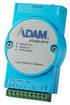 MODBUS TCP to RTU/ASCII Gateway User s Manual 1 INTRODUCTION... 1 1.1 FEATURES... 2 1.2 PRODUCT SPECIFICATIONS... 3 1.3 DEFAULT SETTINGS... 4 2 MAKING THE HARDWARE CONNECTIONS... 5 2.1 POWER CONNECTION...
First Steps. Remote Access Gateway IGW/922. with DIL/NetPC ADNP/9200
 Remote Access Gateway IGW/922 with DIL/NetPC ADNP/9200 First Steps SSV Embedded Systems Dünenweg 5 D-30419 Hannover Phone: +49 (0)511/40 000-0 Fax: +49 (0)511/40 000-40 E-mail: [email protected] Document
SecureLinx Spider Duo Quick Start Guide
 SecureLinx Spider Duo Quick Start Guide SecureLinx Spider Duo Quick Start Guide SecureLinx Spider Duo QUICK START GUIDE CONTENTS Overview... 2 What s In The Box... 3 Installation and Network Settings...
3.1 RS-232/422/485 Pinout:PORT1-4(RJ-45) RJ-45 RS-232 RS-422 RS-485 PIN1 TXD PIN2 RXD PIN3 GND PIN4 PIN5 T+ 485+ PIN6 T- 485- PIN7 R+ PIN8 R-
 MODEL ATC-2004 TCP/IP TO RS-232/422/485 CONVERTER User s Manual 1.1 Introduction The ATC-2004 is a 4 Port RS232/RS485 to TCP/IP converter integrated with a robust system and network management features
Dell Network Management Card. User's Guide. w w w. d e l l. c o m s u p p o r t. d e l l. c o m
 Dell Network Management Card User's Guide w w w. d e l l. c o m s u p p o r t. d e l l. c o m Notes and Warnings NOTE: A NOTE indicates important information that helps you make better use of your software.
EMG Ethernet Modbus Gateway User Manual
 EMG Ethernet Modbus Gateway User Manual Rev 2.2 07/2010 CONTENTS 1. Introduction 1.1. General Features 1.2 Installing the Drivers 2. Configuration 2.1 Main Device Parameters 2.1.1 RS485 Serial Communication
F2400 FOM II Series Fiber Optic Modem Technical Manual
 F2400 FOM II Series Fiber Optic Modem Technical Manual T1 Revision B Copyright April 2003 VERSITRON, Inc. 83 Albe Drive / Suite C Newark, DE 19702 www.versitron.com A030430283T PROPRIETARY DATA All data
Personal Call Manager User Guide. BCM Business Communications Manager
 Personal Call Manager User Guide BCM Business Communications Manager Document Status: Standard Document Version: 04.01 Document Number: NN40010-104 Date: August 2008 Copyright Nortel Networks 2005 2008
Prestige 324. Prestige 324. Intelligent Broadband Sharing Gateway. Version 3.60 January 2003 Quick Start Guide
 Prestige 324 Intelligent Broadband Sharing Gateway Version 3.60 January 2003 Quick Start Guide 1 Introducing the Prestige The Prestige is a broadband sharing gateway with a built-in four-port 10/100 Mbps
CipherLab 5100 Time Attendance Utility Manual
 CipherLab 5100 Time Attendance Utility Manual K:\Products\Product Technical\BI\BI-PC5100T\CipherLab5100TimeAttendnaceUtilityManual0707-process.doc Page 1 / 13 1 Login A popup form as follows will appear
NetVanta 3000 Series (with T1/FT1 or T1/FT1 with DSX-1 Network Interface Module)
 VPN WAN LAN PWR STAT TD RD TD RD TD RD VPN WAN LAN PWR STAT TD RD TD RD TD RD NetVanta 3000 Series (with T1/FT1 or T1/FT1 with DSX-1 Network Interface Module) Quick Configuration Guide 61200862L1-42A November
Crow Limited Warranty. Print Version 017
 Crow Limited Warranty (Crow) warrants this product to be free from defects in materials and workmanship under normal use and service for a period of one year from the last day of the week and year whose
About the HotWire 7900 10-Slot Standalone Shelf
 TM HotWire Model 7900 10-Slot Standalone Shelf Installation Instructions Document Number 7900-A2-GN10-10 About the HotWire 7900 10-Slot Standalone Shelf The HotWire 7900 10-Slot Standalone Shelf is designed
Prestige 650R-31/33 Read Me First
 Prestige 650R-31/33 Read Me First Prestige Rear Panel Connections PORT DSL CONSOLE LAN 10/100M POWER Connect to a telephone jack using a telephone wire. CONNECTION Connect to a serial port (COM port) on
ZC-24DO CANopen I/O Module: 24 Digital Outputs
 Z-PC Line EN ZC-24DO CANopen I/O Module: 24 Digital Outputs Installation Manual Contents: - General Specifications - Technical Specifications - Installation Rules - Electrical connections - DIP-switches
NetProbe Lite. Web Based 8 Channel Sensor Collector. User Manual. Version 1.2
 NetProbe Lite Web Based 8 Channel Sensor Collector User Manual Version 1.2 Copyright Information Copyright 2004-2005, Mega System Technologies, Inc. All rights reserved. Reproduction without permission
! encor en etworks TM
 ! encor en etworks TM Version A, March 2010 2013 Encore Networks, Inc. All rights reserved. Configuring the BANDIT III s T1 E1 Card for a PCM Voice Network The T1 E1 card fits into the expansion slot on