
Technical White Paper for IP Leased Line
|
|
|
- Maud Parsons
- 10 years ago
- Views:
Transcription
1 Technical White Paper for IP Leased Line

2

3 Contents Technical White Paper for IP Leased Line Preface Background of the IP Leased Line Technology Associated Technical Standards Technical Introduction Layer 2 Circuit Emulation Technical Scheme Pseudo Wire Technical Scheme MPLS L3VPN Technical Scheme Key Technologies Leased Line Bearing Technology End to End Quality Assurance for IP Leased Line Service Visualized Deployment of IP Leased Line IP SLA Visualized Report on the Quality of the Leased Line Visualized Detection of Leased Line Faults Protection Technology of the Leased Line Services Traditional Leased Line Migration Technology Typical Application Interconnection of Branches within an Enterprise Carrier Wholesale Service Migration of the Traditional Leased Line Conclusion References Acronyms and Abbreviations...43

4 Figures Figure 1-1 Revenue and development trend of the leased line of the enterprise... 2 Figure 2-1 Basic structure of the MPLS L2VPN...5 Figure 2-2 PWE3 basic transmission components...6 Figure 2-3 BGP/MPLS VPN model...8 Figure 3-1 VLL networking in the Martini mode...12 Figure 3-2 VLL networking in the Kempella mode...13 Figure 3-3 Topology model of PW protection...15 Figure 3-4 MS-PW reference model...16 Figure 3-5 Inter-AS BGP MPLS IP VPN Option A...18 Figure 3-6 Inter-AS BGP MPLS IP VPN Option B...19 Figure 3-7 Inter-AS BGP MPLS IP VPN Option C...20 Figure 3-8 Figure 12 Multicast VPN networking model...22 Figure 3-9 VLAN HQoS service and bandwidth model...23 Figure 3-10 MPLS HQoS service and bandwidth model...24 Figure 3-11 Deployment of the PWE3 service through the U Figure 3-13 Using a template to deploy services...26 Figure 3-12 Formulating a template...26 Figure 3-14 Replicating services...27 Figure 3-16 Creating an SLA monitoring instance...28 Figure 3-15 U2520 monitoring center...28 Figure 3-17 Checking the SLA detection result...29 Figure 3-18 Fault and alarm management...29 Figure 3-19 Presentation of the service topology...30 Figure 3-20 Test diagnosis...30 Figure 3-21 Scenario that the E-Trunk implements the redundant access at the access side...31 Figure 3-22 PW Redundancy in the dual-homing scenario...32 Figure 3-23 PW redundancy in the scenario where the E-Trunk accesses the VPLS network...33 Figure 4-1 Interconnection of branches in an enterprise in point-to-point mode Figure 4-2 Interconnection of branches in an enterprise in point-to-multipoint mode...37 Figure 4-3 Interconnection of branches in an enterprise in point-to-multipoint mode...38 Figure 4-4 Wholesale service...38 Figure 4-5 ATM leased line migration...39

5 Technical White Paper for IP Leased Line Keywords VPWS, VPLS, MPLS L3VPN, IP leased line OAM, ATM/TDM leased line migration, HQoS Abstract The ALL-IP service bearer technology has been widely recognized in the industry. The leased line service, as a high value-added service, attracts attention from carriers worldwide. More and more leading carriers worldwide adopt the IP technology to carry the leased line service. On the broadband MAN, more and more new leased line services are using the IP technology. At the same time, services carried over the traditional ATM/TDM leased line are migrating to the IP-based leased line. This document describes the background, development trend, implementation, key technology, and typical service scenarios of the IP leased line to explain the understandings and technical viewpoints of Huawei on the IP leased line service. 1

6 1 Preface The leased line service has long been the most important value-added service for the carrier. With the development of the IP technology and changes of the requirement of the leased line service, carriers need to carry all services uniformly over the IP network. The enterprise leased line service also needs to be carried in an IP network. Through the IP bearer network, enterprise sites interconnection, service wholesale, and data migration from the traditional ATM/TDM network to the IP network can be implemented to provide the high-quality and high value-added leased line services. 1.1 Background of the IP Leased Line Technology The Multi-protocol label switching (MPLS) technology implements high-speed data forwarding through the label over the IP network. Its value lies in that the feature of the connection mode can be used on the connectionless network and that multiple value-added mechanisms (such as the differentiated service, traffic engineering (TE), fault recovery, and path display) can be provided. This helps extend new applications flexibly and meets the new requirements. With these characteristics, the MPLS makes the high-quality and high-valued leased line services feasible. The statistics indicate that the IP-based leased line services are ever increasing, and meanwhile the ATM/TDM-based traditional leased line services are decreasing. For details, see the following figure. Enterprise Data Services Revenue, Worldwide Millions of U.S.Dollars Source: Gartner ( June 2008 ) 120, ,000 80,000 60,000 40,000 Ethernet WAN IP-VPN Legacy Packet Leased Lines Equipment Market Space 20, Figure 1-1 Revenue and development trend of the leased line of the enterprise 2
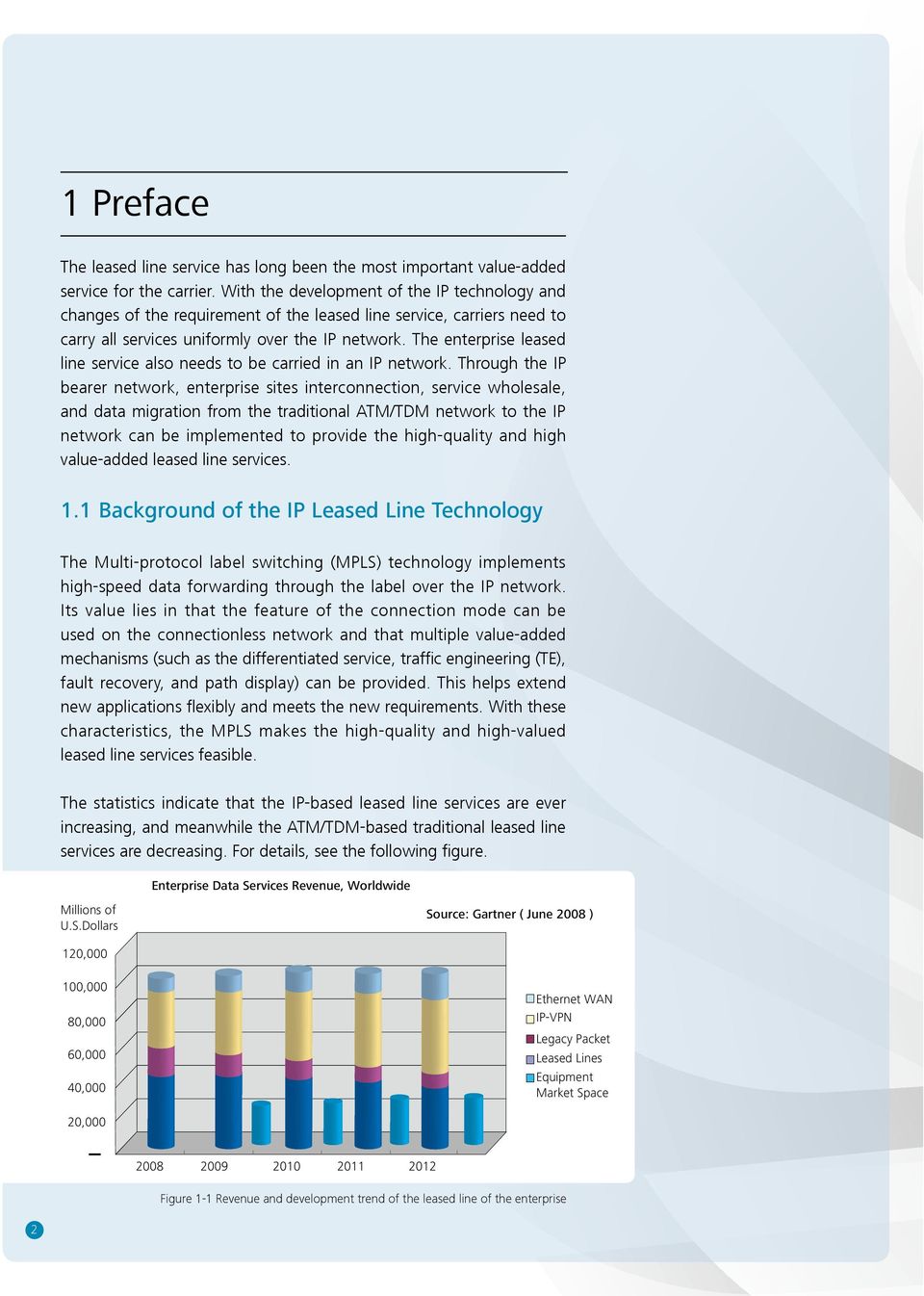
7 As shown in Figure 1-1, the IP leased line service in the enterprise data market is increasing rapidly, and the traditional ATM/TDM leased line service is decreasing very fast. In this case, carriers are all optimizing the existing network, that is, slowing down or stopping the traditional leased line service and promoting the MPLS-based IP leased line service. In the development of the MPSL-based IP leased line service, carriers, however, face a lot of troubles. During the service migration from the traditional leased line to the IP leased line, carriers need to protect the original investment, reuse the original ATM/TDM network transmission resources, and implement data migration on the network without affecting the user service. This document describes these issues in detail and also describes the smooth migration and the migration solution. 1.2 Associated Technical Standards The MPLS-based IP leased line involves the MPLS basic protocols, VPWS, VPLS, MPLS L3VPN, ATM over PSN, and TDM over PSN. The associated standards are as follows: RFC 2283-Multiprotocol Extensions for BGP-4 RFC 3107-Carrying Label Information in BGP-4 RFC 2547-BGP/MPLS VPNs RFC Pseudo Wire Emulation Edge-to-Edge RFC 4553-Structure-Agnostic Time Division Multiplexing (TDM) over Packet (SAToP) RFC 5086-Structure-Aware Time Division Multiplexed (TDM) Circuit Emulation Service over Packet Switched Network (SoPSN) 3

8 2 Technical Introduction 2.1 Layer 2 Circuit Emulation Technical Scheme Principle With the VPN service based on the MPLS network, carriers can provide the Layer 2 interconnection services based on different media on the same MPLS network, such as ATM, FR, VLAN, Ethernet, and PPP. The Layer 2 interconnection service is used to transmit the user Layer 2 data transparently on the MPLS network. From the perspective of the user, the MPLS network is a L3 switching network, and can set up Layer 2 connections between different nodes. The VLL mode and VPLS mode are mainly involved. VLL Virtual leased line (VLL) is the emulation of the traditional leased line. The IP network is used to emulate the leased line, providing the asymmetric point-to-point (PTP) interconnection service at a low cost. The VLL is a PTP virtual leased line technology, and can transmit all the user data transparently. From the perspective of users on the two ends of the virtual leased line, this virtual leased line is similar to the traditional leased line. VPLS Virtual private LAN service (VPLS) technology connects multiple Ethernet LAN network segments through the packet switched network (PSN) to make the network segments work as a LAN. The VPLS is also called transparent LAN service (TLS) or virtual private switched network service (VPSNS). Different from the ordinary L2VPN PTP service, the VPLS can help carriers provide the Ethernet-based point-to-multipoint (P2MP) service for the users through the MPLS network. Service Element The MPLS L2VPN contains three sections, AC, VC, and tunnel, as shown in the following figure. 4

9 AC VC AC Tunnel MPLS Network Figure 2-1 Basic structure of the MPLS L2VPN Attachment circuit (AC) is the access circuit. The AC is an independent link or circuit that connects the to the. The AC interface can be a physical interface or a logical interface. Attributes of the AC include interface parameters, such as the encapsulation type, maximum transmission unit (MTU), and specific link type. Virtual circuit (VC) is a logical connection between two nodes. Network tunnel is used to transmit the user data transparently. 2.2 Pseudo Wire Technical Scheme Principle PWE3 is a bearer technology that implements the end-to-end Layer 2 service bearing. It is a PTP L2VPN. Between two s on the PSN, the PWE3 takes the LDP/RSVP-TE as a signaling, and emulates various Layer 2 services of the end through the tunnel (MPLS tunnel, GRE, L2TPv3, or other types of tunnels) to implement the transparent transmission of the Layer 2 data on the end on the PSN network. The Layer 2 services include Layer 2 data packet and bit stream. Service Element The basic transmission components and functions of the PWE3 network are as follows: Attachment circuit (AC) is a link or virtual circuit that connects the and. All user packets on the AC need to be directly forwarded to the peer site, including Layer 2 and Layer 3 protocol packets. Pseudo wire (PW) is a VC plus a tunnel. The tunnel can be LSP, 5

10 L2TPv3, GRE, or TE. The virtual connection has direction. The virtual connection of the PWE3 is set up by the VC message transfer through the signaling (LDP or RSVP). The VC message and tunnel is managed to form a PW. For the PWE3 system, the PW is direct connection channel from the local AC to the remote AC to implement transparent transmission of the Layer 2 data. Forwarders select the PW for forwarding the packet after the receives the data frame sent from the AC. The forwarder is actually the forwarding table of the PWE3. Tunnels are used to bear the PW. One tunnel can bear multiple PWs. The tunnel is generally the MPLS tunnel. The tunnel is actually a direct connection channel from the local to the remote to implement transparent transmission of the data between s. Encapsulation: The packet transmitted on the PW is encapsulated through the standard PW encapsulation format and technology. There are multiple encapsulation modes for the PWE3 packet on the PW, which are defined in the draft-itef-pwe3-iana-allocation-x. Pseudo wire signaling is the basis of the PWE3. It is used to create and maintain the PW. Currently, the PW signaling protocols are mainly LDP and RSVP. Quality of service (QoS): Based on the priority carried in the Layer 2 packet header, the packet is forwarded on the network according to the QoS priority. In this case, the MPLS QoS needs to be supported. The following figure shows the location of the PWE3 basic transmission components on the network. VPN1 Site 1 C PW C VPN1 Site 2 U -AGG N VPN2 Site 1 C C VPN2 Site 2 Tunnel AC PW Figure 2-2 PWE3 basic transmission components 6
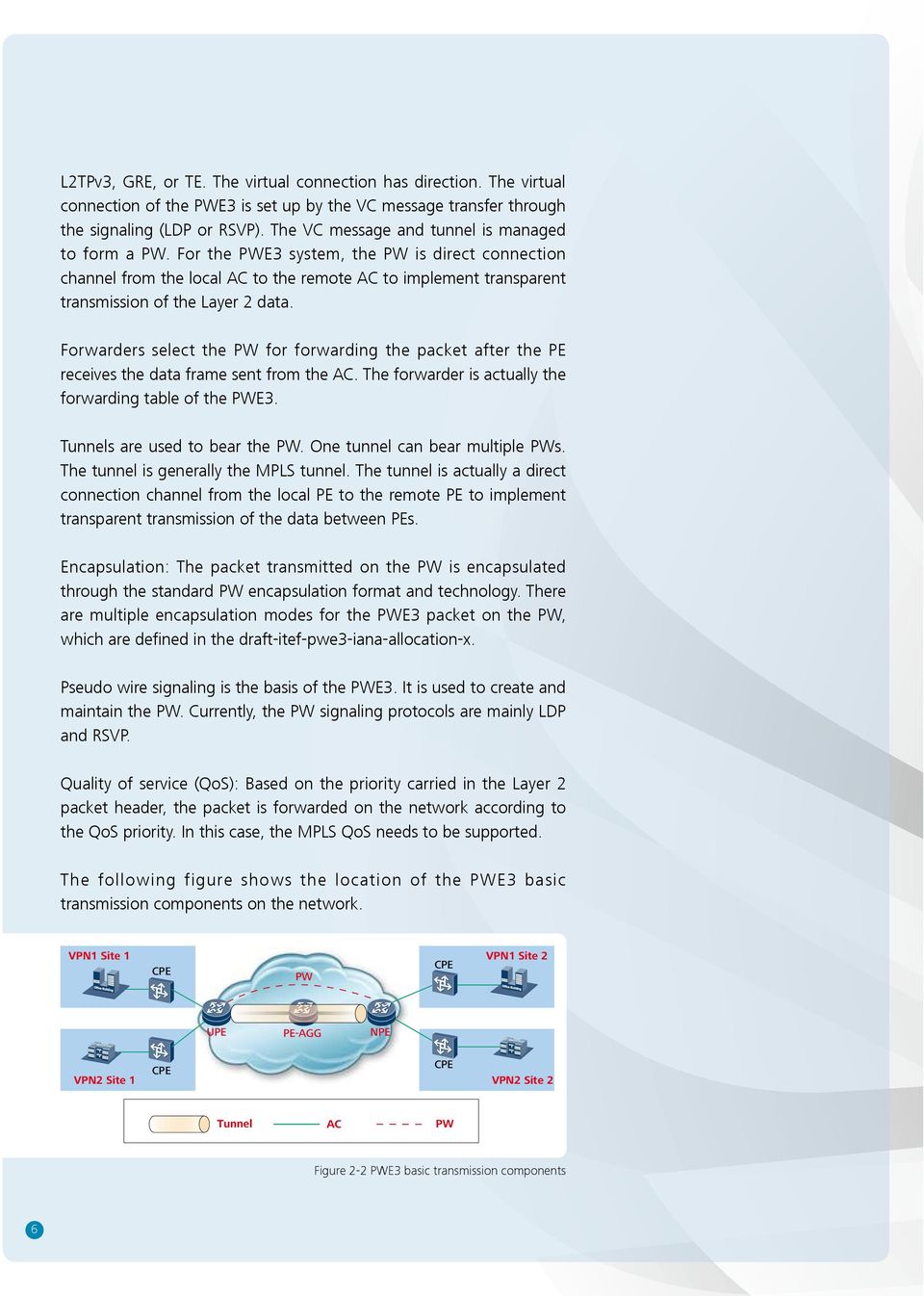
11 The PWE3 provides a Layer 2 technology for the PTP transmission. With the PWE3, the user can access the IP network smoothly without changing the original access mode, and interconnection between different access modes can be also implemented, thus implementing the service interconnection between the traditional and IP leased line services. 2.3 MPLS L3VPN Technical Scheme Principle The BGP/MPLS IP VPN is a layer 3 virtual private network (L3VPN) technology. It uses the boarder gateway protocol (BGP) to advertise the VPN route information on the IP network of the carrier and forward the VPN packet on the IP network of the carrier. Service Element The basic model of the BGP/MPLS IP VPN contains,, and P. Customer edge () provides an interface for directly connecting to the network of the service provider (SP). The can be a router, a switch, or a host. Generally, the can not sense the existence of the VPN and need not support the MPLS. Provide edge () is an edge device of the SP and connected to the directly. On the MPLS network, all the processing of the VPN is performed on the, and therefore there is a high requirement on the performance. Provide (P) is a backbone router on the SP network, and is not directly connected to the. The P device only needs to support MPLS forwarding, but does not maintain the VPN information. The following figure shows the networking of a BGP/MPLS VPN. 7

12 VPN2 Site 2 VPN1 Site 1 P P VPN2 Site 3 VPN2 Site 1 P P VPN1 Site 2 Figure 2-3 BGP/MPLS VPN model Site 1 and site 5 belong to VPN1. Site 2, site 3, and site 4 belong to VPN2. The and are divided according to the management scope of the carrier and user. The is the boarder between the management scopes of the carrier and the user. The is generally a router. After the adjacency relationship is set up between the and the that is directly connected to the, the advertises the VPN route of this node to the and learns the route to the remote VPN from the. The and exchange the route information by using the BGP/IGP and the static route can be also used. 8

13 3 Key Technologies 3.1 Leased Line Bearing Technology VPLS In the P2MP leased line service, direct interconnection between sites is required. In addition, the correlation between the carriers needs to be minimized. Therefore, the VPLS is recommended to bear the service. In the case of leased line service carried by the VPLS, to provide P2MP Layer 2 communication service, the following issues need to be considered. Prevention of the VPLS loop On the Ethernet, to prevent the loop, the Layer 2 protocols such as STP, RRPP, and REP need to be enabled. Considering the minimum correlation between the user and carrier network, the IP protocol of the user network must not be used on the carrier network, but runs only between the devices on the user network. This prevents the loop on the user network. In the VPLS, "full connection" and "spilt horizon" are used to prevent the loop. Each must create a tree to all the routers under this instance for a VPLS forwarding instance. Each router must support spilt horizon to prevent the loop. That is, the cannot forward packet between the PWs that have the same VPLS instance. Generally, in the same VPLS instance, the s are connected through the PW. Accordingly, spilt horizon means that the data packet received from the PW are not forwarded to other PWs but only forwarded to the AC. The full connection and spilt horizon between s ensure that the VPLS forwarding is reachable and free of loops. When multiple s are connected to the, or different s connected to the same VPLS VPN are connected between each other, the VPLS cannot ensure that the loop does not occur. Therefore, various mechanisms are needed to prevent the loop. User access mode User access modes can be classified into the VLAN access and 9

14 Ethernet access modes. The meanings are as follows: VLAN access: If the VLAN access mode is used, the frame header of the packet that is transmitted from the to the or from the to the carries a VLAN tag. This VLAN tag is a service boarder identifier marked for differentiating the users. It is also called Provider Tag (P-Tag). Ethernet access: If the Ethernet access mode is used, the frame header of the packet that is transmitted from the to the or from the to the does not carry a P-Tag. If the VLAN tag is carried in the frame header, it is only the inner VLAN tag in the user packet, and is called U-Tag (user-tag). The U-Tag is carried in the packet before the packet is transmitted but is not added by the during packet transmission. It is used for the to differentiate the VLAN of the packet and is of no significance for the. The user access mode in the actual scenario can be specified through the configured mode. Hierarchical VPLS (H-VPLS) The VPLS requires the full connection between the s. Therefore, the relation between the number of PWs of one VPLS instance and the number of s is the number of PWs = the number of s x (the number of s - 1)/2. In a large scale VPLS network, the number of PWs and the overhead of the PW signaling are both great. Therefore, network management and extension become complicated. To simplify the network management and improve the extensibility of the network, the H-VPLS networking is introduced. The H-VPLS divides the into U and N. The U mainly functions as the MTU when the user accesses the VPN and is used to connect the and the SP network. The N is on the edge of the core of the VPLS network and provides the transparent transmission of the user packet on the core network. The U need not set up connections with all Ns, but need to set up connections between Ns. Through hierarchy, the H-VPLS reduces the number of PWs and the load of the PW signaling. The advantages of the VPLS are as follows: The VPLS uses the Ethernet port at the user network side, which 10

15 simplifies the LAN/WAN boarder and supports the rapid and flexible service deployment. The VPLS hands over the control and management rights of route policies on the user network to the user, which simplifies the management of the carrier network. All the user router s in the VPLS service are part of the same subnet, which simplifies the IP addressing planning. The VPLS service neither need to sense nor need to participate in the IP addressing and routing. VLL/PWE3 VLL In the P2MP leased line service, direct interconnection between multiple sites is required. In addition, the correlation between the carriers needs to be minimized. Therefore, the VLL is recommended to bear the service. According to the protocols of setting up the VLL, two modes of VLLs are defined in the relevant standards: Martini mode This mode complies with RFC4762 specified by the IETF. In this mode, the LDP is used to transmit the signaling of the VC messages. In the Martini mode, the LDP remote session is set up between the s. The allocates a VC label to each link of the, and transmits the VC label to the remote through the LSP set up using the LDP. In this case, a virtual link is set up on the LSP. In this mode, an LSP between a pair of s on the carrier network can be shared to multiple virtual links. As shown in the following figure, site 1 and site 2 on VPN1 use the LSP1 and LSP2, site 1 and site 2 on VPN2 can also use LSP1 and LSP2. 11

16 VPN 1 Site 1 VLAN 10 VCI601 VPN 2 Site 2 VCI P P VLAN P P VPN 1 Site 2 VCI605 VPN Site VCI705 Figure 3-1 VLL networking in the Martini mode In the Martini mode, the on the carrier network needs to maintain a few VC labels and mapping information of the LSP. The P device needs not process any L2VPN information, and therefore the extensibility is good. In addition, when a new virtual link needs be set up, unidirectional virtual links only need to be configured on the s on the two ends. Therefore, network running is not affected. The Martini mode is applicable to the Layer 2 connection, such as star connection. Kompella mode The Kompella mode complies with FRC4761. Through the setup of the IBGP session between the s, the sites of the L2VPN are detected automatically, and the VPN information is transmitted. The L2VPN information is transmitted between the s through the extended BGP. In label allocation, the MPLS L2VPN uses the label block manner in the Kompella mode. The size of the label block is equal to the range (specified by the user) for the convenience of allocating labels to multiple connections. This mode allows the user to allocate some extra label to the VPN, which reduces the configuration workload during the VPN deployment and capacity expansion. In the Kompella mode, the vpn-target is used to differentiate the VPNs. This brings great flexibility to the VPN networking and is applicable to various VPN network topologies. Different from the MPLS L2VPN in the Martini mode, in the Kompella mode, no operation is performed for the link between the s, but the SP network is divided into different VPNs. The is numbered within the VPN. When the connection needs to be set up between 12

17 two s, the IDs of the local and the remote need only to be configured on the, and the virtual link ID allocated to the link of the local needs to be specified. Site 4 VLAN 10 VOI Site 1 VLAN 11 P P Site 3 VOI Site 2 VLAN 12 P P Site 0 Figure 3-2 VLL networking in the Kempella mode In Kempella mode, the VLL user can be reserved for configuration. When the L2VPN site needs to be added in the future, only the of the new site needs to be configured, and other s need not be configured. As shown in Figure 3-2, in the initial phase, the number of labels allocated to the s on the s is greater or equal to six, and the link to 6 is bound in advance. In this case, when site 4 is added to 6, only 6 and other s bound to 6 need to be added. The advantages of the leased line service through the VLL are as follows: High extensibility Overcoming the complexity of the extension on the traditional ATM or FR network, the MPLS VPN uses the label technology to reuse multiple virtual circuits on the same LSP. Therefore, the only needs to maintain information of one LSP, which greatly improves the extensibility of the system. Clear administrative responsibility The MPLS L2VPN carrier provides the Layer 2 connectivity, and the customer provides the L3 connectivity. Route oscillation caused by the incorrect configuration of the user does not affect the stability of the carrier network. Better security and confidentiality 13

18 The security and confidentiality equivalent to the ATM or RF VPN network are provided. The user maintains its own route information. Therefore, the carrier need not consider IP address overlay of each user, and also need not concerns about route information leakage to the private networks of other uses. This reduces the management workload of the carrier and also improves the security of the user information. Supports from multiple network protocols The carrier provides only the Layer 2 connection. The customer can use any L3 protocol, such as IP, IPv6, IPX, and SNA. Smooth evolution of the L2VPN The MPLS L2VPN is transparent to users. When the carrier upgrades the traditional L2VPN such as ATM and FR to the MPLS L2VPN, the users need not perform any reconfiguration. Except temporary data loss during the switchover, the user services are not affected. PWE3 It is recommended that you deploy the PWE3 to carry services in the traditional leased line transition scenario. Sites with various media can be interconnected through PWE3. In deploying PWE3, you need to consider different networking modes: Networking of Static-and-Dynamic Multi-Hop The static-and-dynamic multi-hop PW indicates that a static PW is set up on one end and a dynamic PW is set up on the other end. The static PW and dynamic PW can be multi-hop PWs. They, however, cannot alternate between each other. The processing of the PW on the U- and the S- is the same as the processing of the static PW or dynamic PW, but is different from the processing of the PW on the S- where the static PW and the dynamic PW meet. On the S- where the static PW and the dynamic PW meet, for the dynamic PW, the static PW can be regarded as the AC of the dynamic PW; the status change of the static PW can be regarded as the status change of the AC of the dynamic PW. The parameters such as the PW 14

19 type and interface MTU need to be specified for signaling negotiation and these parameters must be the same as those configured for the interface of the static PW. For the static PW, it is Up if a tunnel exists; for a dynamic PW, the remote PW is Up if a tunnel exists. If the type and the MTU of the remote PW have the same setting as the local ones, the dynamic PW is Up. PW Protection The PW protection indicates that when a PW fails, such as a PW tunnel is deleted, the traffic can be rapidly switched to another PW. The fast switching on the data plane thus can be implemented. As shown in the following figure: Primary PW U-1 PW1 PW5 PW4 S- PW2 PW3 U-2 PW6 PW7 PW8 S- Secondary PW Figure 3-3 Topology model of PW protection To protect the PW, you need to do the following (in the case of the multi-hop): Configure two PWs on two U-s respectively. The two PWs map each other. Configure one PW (PW5) on one U- (U-1) as the secondary PW. Configure PWs on the S-s that are passed. The PWs configured on the S-s and on the U-s thus form multihop PWs, as shown in figure Figure 3-3. Both the primary PW and the secondary PW need to negotiate and process the signaling. This is the same as the processing of ordinary dynamic multi-hop PWs. If the primary PW fails (for example, the LDP session is Down or the tunnel is deleted), the secondary PW must be immediately 15

20 informed of the fault. If the secondary PW is Up, it upgrades to a primary PW. MS-PW Generally, a PW is a Single-Segment PW, referred to as an SS-PW. The SS-PW is applied to most bearer scenarios. But some scenarios have limitations and problems. The service pressure on the core and the convergence node service is great. When the services traverse the PSN network with heterogeneous media, the tunnel cannot be established in end to end mode. When the inter-area services are required, the tunnel cannot be established in end to end mode. The capabilities of fast protection on many times of faults are low. The MS-PW can solve the above mentioned problems. Native Service (AC) < Multi-Segment Pseudowire > PSN PSN < -Tunnel- > < -Tunnel- > V V 1 V V 2 V V Native Service (AC) 1 T1 S1 T2 PW.Seg t1 PW.Seg t3 PW.Seg t2 PW.Seg t4 2 < Provider Edge 1 Provider Edge 2 < < PW switching point Emulated Service > Figure 3-4 MS-PW reference model 16

21 The preceding figure shows the MS-PW reference model. T-1 and T-2 are respectively connected to 1 and 2 and provide the end-to-the-end Layer 2 service simulation for the s. The MS-PW, traversing two or multiple PSN networks, is comprised of two or multiple PWs. When each PW is established on the tunnel of the PSN network, the switching of these PWs occurs on one or multiple S- nodes. According to the way in which the PSN tunnel is established and the switching relationship is configured on the S- node, MS-PW can be set up in the following ways: Statically configure the PW label and PW switching relationship on each T-/S-. Establish each PW dynamically and configure the PW switching relationship statically on the S- node. Establish the end-to-end MS-PW dynamically and the PW switching on the S- node is automatically completed. The configurations must support the mode 1 and mode 2 and can totally meet requirements for the MS-PW application. But the mode 3 only simplifies users' configurations and requires more protocol extensions. At present, the mode 3 has not become mature yet in the aspect of the standard. It remains at the stage of the private draft and the commercial products supporting the mode 3 have not been unveiled in the industry, in particular, in the extension for the PW reachable information advertisement. BGP/MPLS IP VPN Multiple sites are required to be directly interconnected for the scenario of the point-to-multipoint leased line services. If large scale interconnected sites faces the extension problem or the leasedline clients are not capable of maintaining the information about the Layer 3 network and the IP router, it is expected that carriers can maintain the information in place of the leased line clients and can also charge them for the value-added services. At this time it is recommended that you deploy the BGP MPLS IP VPN and provide the Layer 3 interconnection service between multiple sites. In this case, you need to consider the following: 17
22 Inter-AS VPN In the actual networking, the sites of some leased line client at multiple branches may be connected to many carriers' network with different AS numbers or to multiple ASs of one carrier (for example, multiple sites of the leased line clients are located in different MANs and different WANs distribute different AS numbers). This application mode that the VPN spans multiple autonomous systems is called inter- AS VPN (Multi-AS BGP/MPLS VPN). At present, there are three technological solutions to the above mentioned inter-as problems: VRF-TO-VRF (back-to-back mode) -ASBR1 VPN-1 VPN-1 -ASBR2 AS-X VPN-2 VPN-2 AS-Y VPN-1 Site 1 VPN-1 Site 2 VPN-2 Site 1 VPN-2 Site 2 Figure 3-5 Inter-AS BGP MPLS IP VPN Option A For an inter-as VPN client, the VPN-A needs to configure a same VPN in the -ASBR of the AS. As shown in the preceding figure, configure VPN-AS on the -ASBR-1 and the -ASBR-2, create a logic link (or a physical link) between the two ASBRs and then associate VPN-As with this link. In this networking, the ASBR, as a device, creates a same VPN on the and regards the peer ASBR as its own device. In this case, two ASs play the role as operating the MPLS VPN services in one AS. Specifically, advertise the VPN information in the AS to the ASBR ( device), and advertise the VPN information to the remote ASBR (considered as the ASBR's device). After the VPN on the ASBR receives the VPN information (considered as another device of the AS), it advertises the information to the device of the VPN AS. Finally, the VPN is advertised to the device and then the VPN 18
23 routing information is exchanged between the two ASs. MP-EBGP (single-hop MP-EBGP mode) -ASBR1 MP-eBGP -ASBR2 AS-X AS-Y VPN-1 Site 1 VPN-1 Site 2 VPN-2 Site 1 VPN-2 Site 2 Figure 3-6 Inter-AS BGP MPLS IP VPN Option B The MP-EBGP runs between two ASBRs and transmits all the VPN information of an AS to another AS. The transmitted information is about VPN routes and labels. When the MP-EBGP transmits the route, it changes the next hop of routes. According to the principle of the label distribution, when the next hop of an FEC is changed, the label must be replaced in the local ASBR. So when the ASBR receives the information about the VPN router of the AS and advertises the information, the ASBR must redistribute labels for the information about the VPN router. After the information is advertised with new labels, new and old labels form a switching operation of labels in the local ASBR. The remote ASBR receives the information about the VPN route advertised through MP-EBGP, the information is saved in the local end and continues to be advertised to the device of the ASBR AS. When this ASBR advertises the route to MP-IBGP neighbors of the AS, it can choose not to change the next hop of the route or change the next hop of the route to itself. If the next hop of the route is changed, the ASBR also needs to redistribute the labels for the VPN routes and the switching operation of labels is formed in the local ASBR, as shown in the preceding principle of the label distribution. 19
24 MULTIHOP-EBGP (multi-hop MP-EBGP mode) -ASBR1 MP-eBGP -ASBR2 AS-X AS-Y VPN-1 Site 1 VPN-1 Site 2 VPN-2 Site 1 VPN-2 Site 2 Figure 3-7 Inter-AS BGP MPLS IP VPN Option C In the MP-EBGP option, the information about the VPN route is saved and advertised through the ASBR routers between the AS. Many VPN routes bring great pressure to these ASBRs. When the traffic passes through multiple ASs, the ASBR in each AS saves the same VPN route. If the router in this option carries the ASBR forwarded by the public network IP at the same time, the demand on the device is higher. So in the MP-EBGP option, generally, for the ASBR which needs to carry the information about the VPN router, it is configured separately. It indicates that the ASBR is not required to function as the VPN ASBR and the ASBR of the public network at the same time. Actually, Option A and Option B are to relay VPN routes of an AS to another one through intermediate devices, which receive and advertise routes between the ASs. This means the intermediate devices have to support the VPN features. If the VPN is across multiple ASs, more intermediate devices are involved and affected. This principle contradicts the MPLS VPN principle that VPN information is transparent to devices except s. So, the best solution is that in the case of the inter-as, like the MPLS VPN of one AS, the VPN route is directly advertised but not saved and advertised through the intermediate device. Actually the BGP has this function that two different ASs can directly set the BGP connection and exchange the information about the route. This goes for the information about the VPN route. It indicates that the devices (RR) of two ASs can directly exchange the information about the VPN route. It is very easy to realize that through the MULTIHOP-EBGP. But 20
25 we only solve the problem related to the advertisement of the VPN information in this way. Another important problem that how to set a public network LSP between two s in different ASs remains to be solved (or LSP tunnel). This is also the problem to be solved dearly in the MULTIHOP-EBGP inter-as VPN Option. HoVPN To solve the scalability problem, the BGP/MPLS VPN must be changed from the plane model to the Layered model. In the MPLS L3VPN field, Huawei launches the Hierarchy of VPN (HoVPN) solution. The functions of a router are distributed to multiple s playing different roles and forming a hierarchical architecture to fulfill the functions of a centralized. The HoVPN imposes relatively high demand on the route capabilities and the forwarding performance of higher layer devices but low demand on those of lower layer devices. This conforms to the typical layered network model. Multicast VPN With the informatization and the multi-media technology applying to the normal operation and management in enterprises, the video telecommunication is a kind of very important application and valueadded service. Carriers face a severe challenge concerning how to provide the leased line services that support the video application in the bandwidth MAN. It is recommended by Huawei to deploy the multicast VPN technology to provide the IP leased line services of the video application. Multicast VPN is a technology that transmits multicast data between different sites in the MPLS/BGP VPN based on the encapsulation of the multicast protocol. The multicast VPN scheme requires that the multicast function be supported by a service provider's backbone network (core network or public network). Running PIM instances in VPN instances on the router can implement multicast traffic and video stream transmission between sites in different VPNs over the MPLS backbone network. 21
26 VPN-1 Site 1 Multicast Source -AGG U VPN-2 Site 2 Multicast Receiver Multicast Source VPN-2 Site 1 N -AGG U Multicast Receiver VPN-1 Site 2 Figure 3-8 Figure 12 Multicast VPN networking model With the multicast VPN technology developing constantly and becoming mature, Layer 2 or Layer 3 VPNs can be set up based on diverse technologies such as the traditional VPN based on the Layer 2 Tunneling Protocol (L2TP), Generic Routing Encapsulation (GRE) and IPSec protocol. As the VPN technology becomes mature, the VPN is widely used. Requirements of users for operating multicast services over the VPN have been put on the agenda. 3.2 End to End Quality Assurance for IP Leased Line Service QoS technology for the access side: VLAN HQoS When the leased line service is provided on a network, enterprises services generally enter the leased line by passing the C and then the U, and sub-interfaces are configured at the access side of the U to differentiate enterprises. When a leased line carries multiple service types of different enterprises at the same time, the lease line can identify the enterprises and services based on QinQ (the inner Q indicates the service type and the outer Q indicates the enterprise) or based on the single-layered Q (the single-layered Q indicates the enterprise and the 802.1P field of the single-layered Q indicates the service type). In addition, because multiple enterprise services share the link at the U access side, it is possible that different enterprise services and services of the same enterprise preempt bandwidth when the link is congested. To address the problem, you need to implement the VLAN HQoS, instead of the common Diffserv QoS, on the link 22
27 so that services of multiple enterprises do not preempt bandwidth and different services of the same enterprise are scheduled based on service priorities. Five-level HQoS scheduling is provided for the bandwidth assurance and scheduling in the leased line service. To be specific, after being configured on the U, the VLAN HQoS independently assures the bandwidth for each enterprise, and provides the queue scheduling for the services of the same enterprise based on service priorities. For details, see the following figure. N N C Metro Core U C U N N Port Enterprise VPN A:SQ 1 CIR 20M PIR:20M Enterprise VPN B:SQ 2 CIR 50M PIR:50M Enterprise VPN C:SQ 3 CIR 100M PIR:20M FQ1-Voice-EF CIR 2M PIR 2M FQ2-Video-AF3 CIR 2M PIR 5M FQ3-Data-BE CIR 0 PIR 20M FQ1-Voice-EF CIR 5M PIR 5M FQ2-Video-AF3 CIR 5M PIR 10M FQ3-Data-BE CIR 0 PIR 50M FQ1-Voice-EF CIR 5M PIR 5M FQ2-Video-AF3 CIR 10M PIR 10M FQ3-Data-BE CIR 0 PIR 100M Figure 3-9 VLAN HQoS service and bandwidth model For technical details of VLNA HQoS, refer to the Technical White Paper for VLAN HQoS. QoS technology for the network side: MPLS HQoS When the leased line service is provided on the broadband MAN, various MPLS VPN technologies are usually used to transmit services between the U and the N. Because the link or LSP between the U and the N is shared by multiple VPNs and different enterprise services preempt bandwidth when the link is congested, bandwidth and priority scheduling cannot be guaranteed on the leased line from end to end. In this case, the MPLS HQoS technology is introduced to provide the mechanism of layered bandwidth assurance and priority 23
28 scheduling for the VPN interface at the network site, guarantee independent bandwidth for each VPN between the U and the N, and schedule services of different types in the same VPN based on service priorities. For details, see the following figure. N N C Metro Core U C U N N Port1 LSP1( LDP )150M VPN1:20M( L3VPN ) VPN2:30M( VPLS ) VPN3:100M( MVPN ) VPN4:40M( L3VPN ) VPN5:60M( L3VPN ) LSP2( TE )100M Port1 Figure 3-10 MPLS HQoS service and bandwidth model For details of MPLS HQoS, refer to the Technical White Paper for MPLS HQoS. 3.3 Visualized Deployment of IP Leased Line At present, an IP leased line can be established by configuring multiple VPN instances on various devices of the carrier's network through command lines. This proposes a high requirement for the service deployment personnel on IP knowledge and skills. In addition, service deployment personnel have to manually implement and guarantee the service relationships between different devices in different sites manually, which is error prone and low efficient. The Huawei U2000 supports the deployment of multiple VPN services such as VLL, VPLS, BGP MPLS IP VPN, and multicast VPN. The U2000 supports the one-stop service configuration without the need to switch windows and supports the creation and replication of services in batches, thus improving the efficiency of service deployment. The following part describes how to use the U2000 to achieve the fast 24
29 and virtualized deployment of the leased line service. You can use the topology on the U2000 to fast deploy the PWE3 service. As shown in the following figure, after you select the source node, destination node, and the protection node through the physical topology, the primary and secondary PWs are generated automatically. Then, you can choose to configure certain QoS parameters based on the specific requirement and finish the service deployment. Figure 3-11 Deployment of the PWE3 service through the U2000 The U2000 supports the template-based service deployment. You can formulate a template based on the specific user requirement and application scenario to make the configurations simpler, more efficient, and easier to learn. 25
30 Define a template Figure 3-12 Formulating a template Specify the access interfaces for multiple devices and configure IP addresses and other parameters Figure 3-13 Using a template to deploy services The U2000 supports the services replication function. By replicating and adjusting the existing function slightly, you can create new services. This measure can not only improve the efficiency of service deployment but also reduce the failure probability. 26
31 Figure 3-14 Replicating services 3.4 IP SLA Visualized Report on the Quality of the Leased Line The IP leased line service needs to be based on the refined SLA management. The Huawei service quality management system, U2520, can provide comprehensive SLA monitoring for leased lines by monitoring the key performance indicators, and enhance the diagnosis efficiency by using diagnosis tools. As shown in the following figure, the U2520 supports two detection modes, namely, external probe and internal probe. External probe: provides a solution and end-to-end emulation and detection with varied priorities in the scenario that s are not manageable. Internal probe: detects the VPN operation status at the network site, supports multiple OAM detection mechanisms such as Y.1731 for PW, VRF Ping, and LSP Ping, and enables the monitoring system to summarize and analyze the system performance based on the performance reference for the single node and the statistics of the MPLS QoS queue. 27
32 U2520 monitoring center Enterprise1 Enterprise2 U2520 NEU100 U U N Metro Network N BE AF1 AF2 AF3 AF4 EF CS6 CS7 IP/MPLS Core N N N N U U U U Enterprise1 U2520 NEU100 Enterprise2 Enterprise1 U2520 NEU100 Enterprise2 Figure 3-15 U2520 monitoring center Based on user requirements, the U2520 can create an SLA monitoring instance tailored to the leased line service. By providing a flexible curve chart of the network performance, the U2520 facilitates users to learn the health status of the network. By analyzing the performance trend and displaying alarms when the quality threshold is exceeded, the U2520 prevents network faults in advance. Customer Monitored object Monitoring period Threshold of the indicator Importance of the indicator Figure 3-16 Creating an SLA monitoring instance 28
33 Display the history of the selected indicator and support different data collection interval (day, week. Month, and year) and automatic update Figure 3-17 Checking the SLA detection result 3.5 Visualized Detection of Leased Line Faults The U2000 provides easy network monitoring and alarming as well as fast fault location. Users can directly view alarms through the network topology, alarm windows, or slot layout of the network elements. The U2000 monitors the network operation status in a 7x24 manner, detects network faults and worsened situations in time, implements the real-time alarm monitoring and reporting, and informs the relevant personnel of the current network faults through SMS and s. All these measures effectively guarantee the normal operation of the network. Figure 3-18 Fault and alarm management 29
34 The U2000 monitors VPN services and provides the visualized topology views for the MPLS VPN, VPLS, and PWE3 services. In the views, resources occupied by current services, such as the operation status of interfaces, VRFs, PWs, and VSIs, are shown to facilitate users to fast locate faults. In addition, a user can also monitor all services of a key account by displaying these services on the same topology diagram. Figure 3-19 Presentation of the service topology The U2000 provides the test and diagnosis function. In this case, the U2000 enables users to test network connections and QoS and diagnose network faults according to the test result. The test and diagnosis function can be used to limit the fault diagnosis scope and shorten the period of fault location and rectification. Users can formulate a diagnosis task by specifying services or operating on the device nodes on the topology diagram. Services are interrupted Check whether the configurations are incorrect. C h e c k w h i c h l a y e r becomes faulty. Check forwarding entries of the IP layer Find Figure 3-20 Test diagnosis 30
35 3.6 Protection Technology of the Leased Line Services Fault protection technology of the leased line services at the access side: E-trunk Through the binding technology, multiple physical interfaces are bundled into a logical interface that is called a Trunk interface, and the bundled physical interfaces are called member interfaces. The E-Trunk extends the Trunk concept, dividing a trunk of a into two sub-trunks to connect to two routers (the two routers are a pair of s backing up each other), instead of establishing the trunk only across multiple interface boards on a router. The E-Trunk ensures not only the link-level reliability, but also the network-level reliability because the E-Trunk is connected to two systems. Note that in the E-trunk networking, the still uses the standard trunk without the need to support E-trunk. In other words, the access devices like the are transparent to the E-Trunk. The E-Trunk control protocol is mainly applied to the link protection between the and the s and the link protection between the s when the accesses the VPLS, VLL or PWE3 network in dualhoming mode. As shown in the following Figure 3-21, two routers are directly connected through three Ethernet interfaces. The three interfaces are bound to form an Eth-Trunk interface. Eth1/0/0 Eth1/0/1 Eth2/0/0 Eth-Trunk Eth1/0/0 Eth1/0/1 Eth2/0/0 Figure 3-21 Scenario that the E-Trunk implements the redundant access at the access side. The E-Trunk supports the binding of interfaces including FE, GE and 10GE interfaces and supports both Layer 2 and Layer 3 features. Advantages of the E-Trunk technology are as follows: Increased bandwidth: The bandwidth of a trunk interface is the total bandwidth of all member interfaces. Thus, the interface bandwidth can be increased by multiple folds in the E-Trunk mode. Enhanced reliability: When the physical link connected to a member 31
36 interface fails, traffic on the link is switched to another available link. This improves the reliability of the trunk link. Load balancing: Load balancing can be implemented through the E-Trunk interface. That is, an E-Trunk interface distributes traffic among its member interfaces and then transmits the traffic through the member links to the same destination. This prevents the network congestion that occurs when all traffic is transmitted through one path. Saved IP addresses: If two devices are directly connected through multiple links that have the same configuration, IP addresses of different network segments are required. After being bound through the E-Trunk, the multiple direct links can share the same IP address. The E-Trunk solves the problem that member interfaces of a common trunk can only reside on the same router and improves the link reliability from the board-level to the device-level. This feature only needs to be supported by s rather than s. Fault protection technology of the leased line services at the network side: PW redundancy With the increasing number of applications of the L2VPN PW, the PW reliability becomes much more important, which involves the protection of AC links, routers, and links of the public network. PW redundancy is a reliability insurance technology. It determines the primary or secondary status of a PW through dynamic negotiation, which is determined by the MC-Trunk or MC-APS at the AC side. When a PW fails, it is switched to another one to ensure smooth traffic transmission. There are mainly two PW redundancy solutions, as shown follows: 3 VLL (single dual-homing) 1( VLL ) 1 Inter-chassis protocol PW1 3( VLL ) 2 PW2 2( VLL ) Figure 3-22 PW Redundancy in the dual-homing scenario 32
37 1 is dual-homed to 1 and 2 in active and standby mode, and 2 is single-homed to 3. 1 and 2 negotiate and obtain the active AC status and standby AC status through the technology such as MC-Trunk or MC-APS and inform 3 of the active and standby status (PW Preferential Forwarding Status). Then, 3 selects PW1 as the primary PW according to the primary and secondary status of PW1 and PW2. When the switching of the primary and secondary PWs on 1 occurs, no matter whether it is caused by a fault, the automatic switching, or the manual switching, 1 and 2 inform 3 of the switching through the PW Preferential Forwarding Status field in the LDP Notification message. Scenario in which the E-trunk accesses the VPLS 1( VPLS ) 1 MC-TRUNK PW1 3( VPLS ) 2 PW2 2( VPLS ) Figure 3-23 PW redundancy in the scenario where the E-Trunk accesses the VPLS network 1 is dual-homed to 1 and 2 in the active and standby mode and the 2 is single-homed to 3. After the successful MC-trunk or MC-APS negotiation on 1 and 2, the primary and secondary PWs are determined. The physical status of the primary PW is Up and that of the secondary PW is Down. The VPLS modules of 1 and 2 ignore the physical status of AC interfaces after command configurations. The switching of the primary and secondary links on 1 causes the physical status of AC interfaces on 1 and 2 to change. After receiving the information about the change in the physical status of interfaces, The VPLS modules trigger the MAC-withdraw messages to inform 3 of clearing MAC addresses, thus implementing traffic switching. Currently, PW redundancy is a mainstream solution of Huawei for the networks such as IP RAN and converged ME. The solution is reliable and traffic switching and protection meets the demand of clients. 33
38 PW redundancy is similar to VLL FRR, and what is different is that it can determine the primary and secondary PWs dynamically through the cooperation with the E-APS and the E-Trunk and no longer require the detection and association technology of Eth-OAM. 3.7 Traditional Leased Line Migration Technology TDM-PWE3 TDM PWE3 is used to emulate and transparently transmit the TDM service over the PSN network. TDM PWE3 is mainly applied to wireless services and leased line services. 2G or 3G base stations or leased lines access the router through E1 or channelized STM-1 line, and then the router fragments the E1 signal, encapsulates the E1 signal to packets, and transmits the packets to the remote end through PWs over the MAN transfer network. Huawei routers support TDM PWE3 services in structured emulation mode and unstructured emulation mode. The structured emulation mode refers to the Structure-aware TDM Circuit Emulation Service over Packet Switched Network (SoPSN), whereas the unstructured emulation mode refers to the Structure-Agnostic TDM over Packet (SAToP).After enabling PWE3 on interfaces such as cstm-1 POS interface, CT1 interface, and 1 interface, you can use PWE3 to transmit traditional TDM services. TDM PWE3 is obviously beneficial for carriers. It saves the expensive rent on TDM leased lines and facilitates the smooth evolution of the network. For leased line users, the voice access does not mean the high expensive rent to the carriers, thus greatly reducing the cost. ATM-PWE3 ATM PWE3 is used to emulate and transparently transmit the ATM service over the PSN network., such as the MPLS network or the Ethernet network. There are five ATM service transparent transmission modes, namely, transparent transmission on port, 1to1 VPC, 1to1 VCC, nto1 VPC, and nto1 VCC. Currently, on mobile carriers' R99/R4 networks, a great number of ATM switches are deployed on the convergence point to converge ports and bandwidths for 155 Mbit/s ATM and IMA interfaces of 34
39 NodeBs. With the changes in the entire industry chain, ATM switches are showing disadvantages in terms of costs and scalability. Along with the trend of All-IP on core networks and increasing use of the Ethernet technology on access-layer devices, the Ethernet+IP solution has become more appealing to customers than conventional service access and bearing solutions, in terms of both costs and resource usage. Therefore, for both service providers and users, the provision and bearing of ATM services need to be shifted to PSNs. ATM PWE3 is a well-developed solution to meet this need. Mapping ATM QoS to IP QoS At the edge of the ATM network, the router is responsible for the access to the IP network. Data is encapsulated in AAL5 frames such as IPoA, IPoEoA, and PPPoEoA. Such frames are decapsulated by the router and are forwarded to other types of interfaces, or are forwarded to the Ethernet interface as Layer 2 Ethernet frames. The IP network and the ATM network can communicate based on the IPoA technology. IPoA, however, cannot make full use of all ATM functions, and it restricts the application of ATM in the case of fullyconnected permanent virtual circuits (PVC).Therefore, the IP network with 10Gbit/s Ethernet interfaces cannot communicate with the ATM network. Otherwise, traffic congestion may occur and QoS cannot be ensured. To solve the problem, ATM QoS is introduced. The ATM network possesses the QoS capability. With the transition from the ATM network to the IP/MPLS network, the QoS capability of the ATM network needs to be kept. ATM QoS enables ATM cells with higher precedence to be transferred with the same precedence in the IP network. Similarly, it enables IP packets with higher precedence to be transferred with the same precedence in the ATM network. The greatest advantage of mapping ATM QoS to IP QoS is to make use of the QoS mechanism of the ATM network to support the multimedia service and allow the LAN to access the ATM network at the network layer. In this manner, the network bandwidth and performance are improved. To a certain extent, IP and ATM are complementary to each other. IP is widely applied and features low cost; although ATM is complicated and expensive, it can provide high bandwidth and QoS assurance, thus meeting user's service requirements. 35
40 4 Typical Application 4.1 Interconnection of Branches within an Enterprise Interconnection of branches in an enterprise is a typical application of IP leased line. The purpose of this application is to provide the virtual leased line service for the enterprise by using the MPLS VPN technology on the MAN, connect branches to the headquarters, implement multiple applications in the process of enterprise informatization, and transmit enterprise data privately on the public network. According to the specific interconnection requirement, one of the following service transmission technologies can be adopted: 1. VLL 2. VPLS 3. BGP/MPLS IP VPN An enterprise can adopt the VLL technology in the following scenarios: The branches are connected to the headquarters in point-to-point mode. Branches do not need to be interconnected or need to be interconnected through the headquarters. The enterprise is relatively large. The enterprise is capable of maintaining the Layer 3 network and routes. The enterprise hopes that its network is relatively separated from the carrier's network. SITE-1 MPLS SITE-2 VLL networking diagram Figure 4-1 Interconnection of branches in an enterprise in point-to-point mode Take the following as an example to show the VLL application. An enterprise has multiple branches in different locations and needs to connect them to the headquarters in point-to-point mode. In this manner, carrier A can deploy VLLs on its MPLS backbone network to provide the transparent Layer 2 tunnel service for the enterprise, ensuring the security and privacy of the enterprise data transmitted on the public network. 36
41 An enterprise can adopt the VPLS technology in the following scenarios: The enterprise is in a large scale and has a larger number of geographically-dispersed branches. The headquarters and branched are interconnected in point-tomultipoint mode. The enterprise is capable of maintaining the Layer 3 network and routes. The enterprise hopes that its network is relatively separated from the carrier's network. SITE-2 MPLS SITE-3 branch branch SITE-1 headquarters VPLS networking diagram Figure 4-2 Interconnection of branches in an enterprise in point-to-multipoint mode Take the following as an example to show the VPLS application. Carrier A provides the VPLS service on the MPLS backbone network for an enterprise. In this case, the enterprise seems to have its own LAN switches on the MPLS backbone network, which interconnect multiple sites of this enterprise, ensuring the security and privacy of the enterprise data transmitted on the public network. The preceding MPLS-based Layer 2 leased line emulation technologies provide secured service transmission tunnels on the public network for enterprises. These technologies, however, are based on Layer 2, thus having poor expandability, hard to implement service change, and lack of security mechanisms. Therefore, the BGP/MPLS IP VPN technology is recommended. The BGP/MPLS IP VPN is an L3VPN. It uses BGP to advertise VPN routes and MPLS to forward VPN packets on the carrier's backbone network. 37
42 Enterprise-1 Enterprise-1 branch MPLS branch Enterprise-2 branch Enterprise-2 branch Enterprise-1 headquarters Enterprise-2 headquarters BGP/MPLS IP VPN networking diagram Figure 4-3 Interconnection of branches in an enterprise in point-to-multipoint mode On the control plane, the BGP/MPLS IP VPN uses the Route Distinguisher (RD) and Route Target (RT) to identify routes and implement route isolation, and maintain different routing domains for different enterprises. On the forwarding plane, the BGP/MPLS IP VPN uses MPLS labels to forward data. In this manner, the virtual leased line service can be provided for enterprises on the public network. 4.2 Carrier Wholesale Service The MPLS-based wholesale service, as an important service mode of IP leased line, is a value-added service for carriers. The operation mode of the wholesale service is that the medium- and small-sized SPs rent logical tunnels from the large carriers to transmit services and provide user access for final users. Small SP Network Large SP Network Small SP Network SHDSL xdsl DSLAM L2 PI MSCG LSW L2 PI headquarters NodeB CSG RNC Wholesale service Figure 4-4 Wholesale service 38
43 The wholesale SP needs to transparently transmit user data and ensure the QoS of the user data according to the signed SLA. In this service scenario, VLL is recommended to provide Layer 2 tunneling services, and the MPLS HQoS technology solely owned by Huawei is recommended to ensure the bandwidth provision and priority scheduling. In this manner, the SLA signed between the carrier and the user can be guaranteed. 4.3 Migration of the Traditional Leased Line Many mainstream carriers use the ATM/TDM technologies to provide many leased line services. After constructing the MPLSbased broadband MAN, these carriers hop that the previous leased line services can be migrated, which better uses network resources, reduces the operation cost, and realizes smooth cutover of existing leased line users. Therefore, MPLS PWE3 is introduced. MPLS PWE3 is a key technology in MANs. Through MPLS PWE3, previous access modes can be well converged with the current IP backbone network. This reduces the repetitious network construction and saves the operation cost. Shanghai branch FR access 2 National backbone 2 1 Beijing branch ATM access 1 Customer A Figure 4-5 ATM leased line migration The preceding figure shows a typical PWE3 application. A carrier establishes a national backbone network that provides the PWE3 service. Customer A has two branches, with one in Beijing and the other in Shanghai. The Beijing branch accesses the backbone network 39
44 40 of the carrier through ATM, and the Shanghai branch accesses the backbone network of the carrier through FR. The carrier can set up a PWE3 connection between the two access sites, 1 in Beijing and 2 in Shanghai. In this manner, the carrier can provide the point-to-point interconnection service for customer A over the backbone network, without changing the current access mode of the customer. Customer A does not need to modify the original intranet because of the simple and convenient VPWS/VLL solution. The carrier succeeds in smoothly migrating the previous access mode on the IP backbone network.
45 5 Conclusion The MPLS IP leased line technology can be used to implement pointto-point and point-to-multipoint service interconnection, ensure highstandard services, and provide differentiated services and enhanced services. This technology is compatible with traditional leased line technologies, and can be used to smoothly migrate traditional ATM/ TDM leased line services. This meets the requirement of carriers to transmit all services on the universal IP network, enhances service flexibility, and reduces the overall cost of the carriers. Therefore, the MPLS IP leased line technology becomes the best choice of carriers. 41
46 6 References 111RFC 3916, Requirements for Pseudo-Wire Emulation Edge-to-Edge (PWE3),IETF 222RFC 3985, Pseudo Wire Emulation Edge-to-Edge (PWE3) Architecture,IETF 333RFC 4197, Requirements for Edge-to-Edge Emulation of Time Division Multiplexed(TDM) Circuits over Packet Switching Networks,IETF 444RFC 4553, Structure-Agnostic Time Division Multiplexing (TDM) over Packet (SAToP), IETF 555Internet Draft, draft-ietf-pwe3-cesopsn-07, IETF 666MEF8.0, Metro Ethernet Forum 777MFA 8.0.0, Emulation of TDM Circuits over MPLS Using Raw Encapsulation Implementation Agreement, MFA 42
47 7 Acronyms and Abbreviations Abbreviation/Acronym S PWE3 PSN TDM PDH SDH SONET IETF PSTN AC SAToP SoPSN CAS CCS MEF MFA ITU-T Full Spelling Circuit Emulation Service Pseudo Wire Emulation Edge-to-Edge Packet Switched Networks Time Division Multiplex Plesiochronous Digital Hierarchy Synchronous Digital Hierarchy Synchronous Optical Network Internet Engineering Task Force Public Switched Telephone Network Customer Edge Provider Edge Attachment Circuit Structure-Agnostic TDM over Packet Circuit Emulation Services over Packet Switch Network Channel Associated Signaling Common Channel Signaling Metro Ethernet Forum MPLS Forum Frame Relay Forum The ATM Forum International Telecommunication Union - Telecommunication Standardization Sector 43
48 Copyright 2010 Huawei Technologies Co., Ltd. All rights reserved. No part of this document may be reproduced or transmitted in any form or by any means without prior written consent of Huawei Technologies Co., Ltd. Trademarks and Permissions and other Huawei trademarks are the property of Huawei Technologies Co., Ltd. All other trademarks and trade names mentioned in this document are the property of their respective holders. 44 Notice The product, service, or feature that you purchase should be restricted by the Huawei commercial contract and the clauses in the contract. All or a part of products, services, or features described in this document may not be purchased or used. Every effort has been made in the preparation of this document to ensure the accuracy of the contents, but the statements, information, and recommendations in this document do not constitute a warranty of any kind, expressed or implied. The information in this document is subject to change without notice. Every effort has been made in the preparation of this document to ensure the accuracy of the contents, but the statements, information, and recommendations in this document do not constitute a warranty of any kind, expressed or implied. Huawei Technologies Co., Ltd. Address: Huawei Industrial Base Bantian, Longgang Shenzhen People's Republic of China Website: [email protected]
VPLS Technology White Paper HUAWEI TECHNOLOGIES CO., LTD. Issue 01. Date 2012-10-30
 Issue 01 Date 2012-10-30 HUAWEI TECHNOLOGIES CO., LTD. 2012. All rights reserved. No part of this document may be reproduced or transmitted in any form or by any means without prior written consent of
MPLS L2VPN (VLL) Technology White Paper
 MPLS L2VPN (VLL) Technology White Paper Issue 1.0 Date 2012-10-30 HUAWEI TECHNOLOGIES CO., LTD. 2012. All rights reserved. No part of this document may be reproduced or transmitted in any form or by any
Addressing Inter Provider Connections With MPLS-ICI
 Addressing Inter Provider Connections With MPLS-ICI Introduction Why migrate to packet switched MPLS? The migration away from traditional multiple packet overlay networks towards a converged packet-switched
MPLS VPN Services. PW, VPLS and BGP MPLS/IP VPNs
 A Silicon Valley Insider MPLS VPN Services PW, VPLS and BGP MPLS/IP VPNs Technology White Paper Serge-Paul Carrasco Abstract Organizations have been demanding virtual private networks (VPNs) instead of
WHITE PAPER. Addressing Inter Provider Connections with MPLS-ICI CONTENTS: Introduction. IP/MPLS Forum White Paper. January 2008. Introduction...
 Introduction WHITE PAPER Addressing Inter Provider Connections with MPLS-ICI The migration away from traditional multiple packet overlay networks towards a converged packet-switched MPLS system is now
IP/MPLS-Based VPNs Layer-3 vs. Layer-2
 Table of Contents 1. Objective... 3 2. Target Audience... 3 3. Pre-Requisites... 3 4. Introduction...3 5. MPLS Layer-3 VPNs... 4 6. MPLS Layer-2 VPNs... 7 6.1. Point-to-Point Connectivity... 8 6.2. Multi-Point
Virtual Private LAN Service on Cisco Catalyst 6500/6800 Supervisor Engine 2T
 White Paper Virtual Private LAN Service on Cisco Catalyst 6500/6800 Supervisor Engine 2T Introduction to Virtual Private LAN Service The Cisco Catalyst 6500/6800 Series Supervisor Engine 2T supports virtual
INTRODUCTION TO L2VPNS
 INTRODUCTION TO L2VPNS 4 Introduction to Layer 2 and Layer 3 VPN Services CE Layer 3 VPN Link Comprised of IP Traffic Passed Over IP Backbone LEGEND Layer 3 VPN Layer 2 VPN CE CE PE IP Backbone PE CE Layer
L2 VPNs. Pseudowires. Virtual Private LAN Services. Metro/Carrier Ethernet.
 L2 VPNs. Pseudowires. Virtual Private LAN Services. Metro/Carrier Ethernet. Petr Grygárek rek 1 Layer 2 VPNs 2 Usages of L2 VPNs Server farms/clusters and other L2- dependent applications redundancy and
MP PLS VPN MPLS VPN. Prepared by Eng. Hussein M. Harb
 MP PLS VPN MPLS VPN Prepared by Eng. Hussein M. Harb Agenda MP PLS VPN Why VPN VPN Definition VPN Categories VPN Implementations VPN Models MPLS VPN Types L3 MPLS VPN L2 MPLS VPN Why VPN? VPNs were developed
Introduction to MPLS-based VPNs
 Introduction to MPLS-based VPNs Ferit Yegenoglu, Ph.D. ISOCORE [email protected] Outline Introduction BGP/MPLS VPNs Network Architecture Overview Main Features of BGP/MPLS VPNs Required Protocol Extensions
MPLS Pseudowire Innovations: The Next Phase Technology for Today s Service Providers
 MPLS Innovations: The Next Phase Technology for Today s Service Providers Introduction MPLS technology enables a smooth evolution of core networks within today s service provider infrastructures. In particular,
Enhancing Converged MPLS Data Networks with ATM, Frame Relay and Ethernet Interworking
 TECHNOLOGY WHITE PAPER Enhancing Converged Data Networks with, Frame Relay and Ethernet Interworking Virtual Private Networks (VPN) are a popular way for enterprises to interconnect remote sites. Traditionally,
APRICOT 2012 MPLS WORKSHOP L2VPN
 APRICOT 2012 MPLS WORKSHOP L2VPN Alastair Johnson February 2012 [email protected] 2 MPLS WORKSHOP L2VPN 1. Introduction to L2VPN a. Background to VPNs b. Why L2VPNs c. Types of L2VPNs
MPLS in Private Networks Is It a Good Idea?
 MPLS in Private Networks Is It a Good Idea? Jim Metzler Vice President Ashton, Metzler & Associates March 2005 Introduction The wide area network (WAN) brings indisputable value to organizations of all
VPN Technologies A Comparison
 VPN Technologies A Comparison Matthew Finlayson, [email protected] Jon Harrison, [email protected] Richard Sugarman, [email protected] First issued February 2003 100
Virtual Private Networks. Juha Heinänen [email protected] Song Networks
 Virtual Private Networks Juha Heinänen [email protected] Song Networks What is an IP VPN? an emulation of private (wide area) network facility using provider IP facilities provides permanent connectivity between
How To Understand The Benefits Of An Mpls Network
 NETWORKS NetIron XMR 16000 NETWORKS NetIron XMR 16000 NETWORKS NetIron XMR 16000 Introduction MPLS in the Enterprise Multi-Protocol Label Switching (MPLS) as a technology has been around for over a decade
VPN taxonomy. János Mohácsi NIIF/HUNGARNET tf-ngn meeting April 2005
 VPN taxonomy János Mohácsi NIIF/HUNGARNET tf-ngn meeting April 2005 VPNs Definition: the capability of both private and public networks to support a communication infrastructure connecting geographically
Development of the FITELnet-G20 Metro Edge Router
 Development of the Metro Edge Router by Tomoyuki Fukunaga * With the increasing use of broadband Internet, it is to be expected that fiber-tothe-home (FTTH) service will expand as the means of providing
Data Networking and Architecture. Delegates should have some basic knowledge of Internet Protocol and Data Networking principles.
 Data Networking and Architecture The course focuses on theoretical principles and practical implementation of selected Data Networking protocols and standards. Physical network architecture is described
November 2013. Defining the Value of MPLS VPNs
 November 2013 S P E C I A L R E P O R T Defining the Value of MPLS VPNs Table of Contents Introduction... 3 What Are VPNs?... 4 What Are MPLS VPNs?... 5 What Are the Benefits of MPLS VPNs?... 8 How Do
Implementing Cisco Service Provider Next-Generation Edge Network Services **Part of the CCNP Service Provider track**
 Course: Duration: Price: $ 3,695.00 Learning Credits: 37 Certification: Implementing Cisco Service Provider Next-Generation Edge Network Services Implementing Cisco Service Provider Next-Generation Edge
ICTTEN6172A Design and configure an IP- MPLS network with virtual private network tunnelling
 ICTTEN6172A Design and configure an IP- MPLS network with virtual private network tunnelling Release: 1 ICTTEN6172A Design and configure an IP-MPLS network with virtual private network tunnelling Modification
IP/MPLS Networks for Public Safety
 APPLICATION NOTE IP/MPLS Networks for Public Safety Highly reliable mission-critical communications infrastructures Abstract Alcatel-Lucent delivers a converged IP/MPLS-based network for public safety
Demonstrating the high performance and feature richness of the compact MX Series
 WHITE PAPER Midrange MX Series 3D Universal Edge Routers Evaluation Report Demonstrating the high performance and feature richness of the compact MX Series Copyright 2011, Juniper Networks, Inc. 1 Table
SBSCET, Firozpur (Punjab), India
 Volume 3, Issue 9, September 2013 ISSN: 2277 128X International Journal of Advanced Research in Computer Science and Software Engineering Research Paper Available online at: www.ijarcsse.com Layer Based
APPLICATION NOTE. Benefits of MPLS in the Enterprise Network
 APPLICATION NOTE Benefits of MPLS in the Enterprise Network Abstract As enterprises evolve to keep pace with the ever-changing business climate, enterprises networking needs are becoming more dynamic.
Network Virtualization with the Cisco Catalyst 6500/6800 Supervisor Engine 2T
 White Paper Network Virtualization with the Cisco Catalyst 6500/6800 Supervisor Engine 2T Introduction Network virtualization is a cost-efficient way to provide traffic separation. A virtualized network
OVERLAYING VIRTUALIZED LAYER 2 NETWORKS OVER LAYER 3 NETWORKS
 OVERLAYING VIRTUALIZED LAYER 2 NETWORKS OVER LAYER 3 NETWORKS Matt Eclavea ([email protected]) Senior Solutions Architect, Brocade Communications Inc. Jim Allen ([email protected]) Senior Architect, Limelight
The Essential Guide to Deploying MPLS for Enterprise Networks
 White Paper The Essential Guide to Deploying MPLS for Enterprise Networks Daniel Backman Systems Engineer Troy Herrera Sr. Field Solutions Manager Juniper Networks, Inc. 1194 North Mathilda Avenue Sunnyvale,
Technical Brief: Offering Scalable Layer 2 Services with VPLS and VLL
 SERVI PROVIDER Technical Brief: Offering Scalable Layer 2 Services with VPLS and VLL An overview of Virtual Private LAN Service (VPLS) and Virtual Leased Line (VLL) and Brocade solutions for deploying
MPLS over IP-Tunnels. Mark Townsley Distinguished Engineer. 21 February 2005
 MPLS over IP-Tunnels Mark Townsley Distinguished Engineer 21 February 2005 1 MPLS over IP The Basic Idea MPLS Tunnel Label Exp S TTL MPLS VPN Label Exp S TTL MPLS Payload (L3VPN, PWE3, etc) MPLS Tunnel
Sprint Global MPLS VPN IP Whitepaper
 Sprint Global MPLS VPN IP Whitepaper Sprint Product Marketing and Product Development January 2006 Revision 7.0 1.0 MPLS VPN Marketplace Demand for MPLS (Multiprotocol Label Switching) VPNs (standardized
Multi Protocol Label Switching (MPLS) is a core networking technology that
 MPLS and MPLS VPNs: Basics for Beginners Christopher Brandon Johnson Abstract Multi Protocol Label Switching (MPLS) is a core networking technology that operates essentially in between Layers 2 and 3 of
Quidway MPLS VPN Solution for Financial Networks
 Quidway MPLS VPN Solution for Financial Networks Using a uniform computer network to provide various value-added services is a new trend of the application systems of large banks. Transplanting traditional
ISTANBUL. 1.1 MPLS overview. Alcatel Certified Business Network Specialist Part 2
 1 ISTANBUL 1.1 MPLS overview 1 1.1.1 Principle Use of a ATM core network 2 Overlay Network One Virtual Circuit per communication No routing protocol Scalability problem 2 1.1.1 Principle Weakness of overlay
MPLS Layer 2 VPNs Functional and Performance Testing Sample Test Plans
 MPLS Layer 2 VPNs Functional and Performance Testing Sample Test Plans Contents Overview 1 1. L2 VPN Padding Verification Test 1 1.1 Objective 1 1.2 Setup 1 1.3 Input Parameters 2 1.4 Methodology 2 1.5
MPLS and IPSec A Misunderstood Relationship
 # 129 TECHNOLOGY WHITE PAPER Page: 1 of 5 MPLS and IPSec A Misunderstood Relationship Jon Ranger, Riverstone Networks ABSTRACT A large quantity of misinformation and misunderstanding exists about the place
MPLS Layer 3 and Layer 2 VPNs over an IP only Core. Rahul Aggarwal Juniper Networks. [email protected]
 MPLS Layer 3 and Layer 2 VPNs over an IP only Core Rahul Aggarwal Juniper Networks [email protected] Agenda MPLS VPN services and transport technology Motivation for MPLS VPN services over an IP only core
Introducing Basic MPLS Concepts
 Module 1-1 Introducing Basic MPLS Concepts 2004 Cisco Systems, Inc. All rights reserved. 1-1 Drawbacks of Traditional IP Routing Routing protocols are used to distribute Layer 3 routing information. Forwarding
MPLS-Enabled Network Infrastructures
 T E C H N O L O G Y W H I T E P A P E R MPLS-Enabled Network Infrastructures Delivering Reliable Enterprise VPN Services Enterprise and government CIOs will testify that lowering information technology
MPLS-based Virtual Private Network (MPLS VPN) The VPN usually belongs to one company and has several sites interconnected across the common service
 Nowdays, most network engineers/specialists consider MPLS (MultiProtocol Label Switching) one of the most promising transport technologies. Then, what is MPLS? Multi Protocol Label Switching (MPLS) is
Building Trusted VPNs with Multi-VRF
 Building Trusted VPNs with Introduction Virtual Private Networks (VPNs) have been a key application in networking for a long time. A slew of possible solutions have been proposed over the last several
What Is a Virtual Private Network?
 C H A P T E R 1 What Is a Virtual Private Network? A virtual private network (VPN) allows the provisioning of private network services for an organization or organizations over a public or shared infrastructure
Implementing Virtual Leased Lines Using MPLS
 Lines Using MPLS able of Contents 1. Objective... 3 2. arget Audience... 3 3. Pre-Requisites... 3 4. Introduction: MPLS and IP-Based VPNs... 3 5. he Promise of MPLS Layer-2 VPNs... 5 6. unneling Layer-2
Fundamentals Multiprotocol Label Switching MPLS III
 Fundamentals Multiprotocol Label Switching MPLS III Design of Telecommunication Infrastructures 2008-2009 Rafael Sebastian Departament de tecnologies de la Informació i les Comunicaciones Universitat Pompeu
Expert Reference Series of White Papers. An Overview of MPLS VPNs: Overlay; Layer 3; and PseudoWire
 Expert Reference Series of White Papers An Overview of MPLS VPNs: Overlay; Layer 3; and PseudoWire 1-800-COURSES www.globalknowledge.com An Overview of MPLS VPNs: Overlay; Layer 3; and PseudoWire Al Friebe,
1.1. Abstract. 1.2. VPN Overview
 1.1. Abstract Traditionally organizations have designed their VPN networks using layer 2 WANs that provide emulated leased lines. In the last years a great variety of VPN technologies has appeared, making
DD2491 p2 2011. MPLS/BGP VPNs. Olof Hagsand KTH CSC
 DD2491 p2 2011 MPLS/BGP VPNs Olof Hagsand KTH CSC 1 Literature Practical BGP: Chapter 10 MPLS repetition, see for example http://www.csc.kth.se/utbildning/kth/kurser/dd2490/ipro1-11/lectures/mpls.pdf Reference:
Enterprise Network Simulation Using MPLS- BGP
 Enterprise Network Simulation Using MPLS- BGP Tina Satra 1 and Smita Jangale 2 1 Department of Computer Engineering, SAKEC, Chembur, Mumbai-88, India [email protected] 2 Department of Information Technolgy,
Transport for Enterprise VoIP Services
 Transport for Enterprise VoIP Services Introduction Many carriers are looking to advanced packet services as an opportunity to generate new revenue or lower costs. These services, which include VoIP, IP
MPLS/IP VPN Services Market Update, 2014. United States
 MPLS/IP VPN Services Market Update, 2014 United States August 2014 Contents Section Slide Numbers Executive Summary 4 Market Overview & Definitions 8 Drivers & Restraints 14 Market Trends & Revenue Forecasts
The Keys for Campus Networking: Integration, Integration, and Integration
 The Keys for Campus Networking: Introduction Internet Protocol (IP) is considered the working-horse that the vast majority of current and future applications use as the key technology for information exchange,
IP/MPLS Networks for Highways
 A P P L I C A T I O N N O T E IP/MPLS Networks for Highways Infrastructures for highly available mission-critical communications Abstract Alcatel-Lucent delivers a converged IP/MPLS-based network for highways
Rohde & Schwarz R&S SITLine ETH VLAN Encryption Device Functionality & Performance Tests
 Rohde & Schwarz R&S Encryption Device Functionality & Performance Tests Introduction Following to our test of the Rohde & Schwarz ETH encryption device in April 28 the European Advanced Networking Test
Master Course Computer Networks IN2097
 Chair for Network Architectures and Services Prof. Carle Department for Computer Science TU München Master Course Computer Networks IN2097 Prof. Dr.-Ing. Georg Carle Christian Grothoff, Ph.D. Chair for
VLAN and QinQ Technology White Paper
 VLAN and QinQ Technology White Paper Issue 1.01 Date 2012-10-30 HUAWEI TECHNOLOGIES CO., LTD. 2012. All rights reserved. No part of this document may be reproduced or transmitted in any form or by any
Multi-Provider Ethernet Service Delivery
 Multi-Provider Ethernet Service Delivery Ananda Rajagopal Product Manager, Service Provider Solutions Foundry Networks Agenda Multi-Provider Ethernet Service Delivery Ethernet Service Delivery Today A
QoS Switching. Two Related Areas to Cover (1) Switched IP Forwarding (2) 802.1Q (Virtual LANs) and 802.1p (GARP/Priorities)
 QoS Switching H. T. Kung Division of Engineering and Applied Sciences Harvard University November 4, 1998 1of40 Two Related Areas to Cover (1) Switched IP Forwarding (2) 802.1Q (Virtual LANs) and 802.1p
MPLS L3 VPN Supporting VoIP, Multicast, and Inter-Provider Solutions
 MPLS L3 VPN Supporting VoIP, Multicast, and Inter-Provider Solutions Luyuan Fang ATT MPLSCon 2005, NYC The world s networking company SM Outline Overview of the L3 VPN deployment VoIP over MPLS VPN MPLS
Tackling the Challenges of MPLS VPN Testing. Todd Law Product Manager Advanced Networks Division
 Tackling the Challenges of MPLS VPN ing Todd Law Product Manager Advanced Networks Division Agenda Background Why test MPLS VPNs anyway? ing Issues Technical Complexity and Service Provider challenges
Reliable Airport IP Networks
 APPLICATION NOTE Reliable Airport IP Networks MPLS enables mission-critical communications Abstract Alcatel-Lucent envisions a converged IP/MPLS-based network for airports using next-generation products
Course Description. Students Will Learn
 Course Description The next generation of telecommunications networks will deliver broadband data and multimedia services to users. The Ethernet interface is becoming the interface of preference for user
Virtual Private LAN Service (VPLS)
 White Paper Virtual Private LAN Service (VPLS) Scalable Ethernet-Based Enterprise Connectivity and Broadband Delivery Juniper Networks, Inc. 1194 North Mathilda Avenue Sunnyvale, California 94089 USA 408.745.2000
MPLS VPNs: Layer 2 or Layer 3? Understanding the Choice
 #128 TECHNOLOGY WHITE PAPER Page: 1 of 6 MPLS VPNs: Layer 2 or Layer 3? Understanding the Choice Tim Wu, Riverstone Networks ABSTRACT Since there s been data networking, there s been a debate between switched
TRILL for Data Center Networks
 24.05.13 TRILL for Data Center Networks www.huawei.com enterprise.huawei.com Davis Wu Deputy Director of Switzerland Enterprise Group E-mail: [email protected] Tel: 0041-798658759 Agenda 1 TRILL Overview
Solving the Access Conundrum for the All-IP Network:
 Solving the Access Conundrum for the All-IP Network: Business Service Delivery Across Diverse Infrastructures London, June 27 th, 2006 Presented by: Dr. Yuri Gittik Chief Strategy Officer [email protected]
WAN and VPN Solutions:
 WAN and VPN Solutions: Choosing the Best Type for Your Organization xo.com WAN and VPN Solutions: Choosing the Best Type for Your Organization WAN and VPN Solutions: Choosing the Best Type for Your Organization
Agilent N2X Layer 2 MPLS VPN Emulation Software
 Agilent N2X Layer 2 MPLS VPN Emulation Software E7884A Technical Data Sheet An easy-to-use solution specifically designed for measuring the scalability and performance of Layer 2 MPLS VPNs and pseudo wire
How Routers Forward Packets
 Autumn 2010 [email protected] MULTIPROTOCOL LABEL SWITCHING (MPLS) AND MPLS VPNS How Routers Forward Packets Process switching Hardly ever used today Router lookinginside the packet, at the ipaddress,
Virtual Private LAN Service
 Virtual Private LAN Service Authors Kireeti Kompella, Juniper Networks, 1194 N Mathilda Avenue, Sunnyvale, CA 94089, USA E-mail : [email protected] Jean-Marc Uzé, Juniper Networks, Espace 21, 31 Place
Delivering MPLS VPLS VPN Services With Metro Service Edge Platform
 Delivering MPLS VPLS VPN Services With Metro Service Edge Platform Objective This paper outlines the overall network architecture and elements for delivering MPLS VPLS VPN services by extending MPLS (Multiprotocol
Testing Edge Services: VPLS over MPLS
 Testing Edge Services: VPLS over MPLS White Paper Introduction Virtual Private LAN Services (VPLS) is an emerging technology for transparently connecting corporate LANs over the Internet so they appear
MikroTik RouterOS Introduction to MPLS. Prague MUM Czech Republic 2009
 MikroTik RouterOS Introduction to MPLS Prague MUM Czech Republic 2009 Q : W h y h a v e n 't y o u h e a r d a b o u t M P LS b e fo re? A: Probably because of the availability and/or price range Q : W
Layer 2 and 3 Virtual Private Networks: Taxonomy, Technology, and Standardization Efforts
 STANDARDS TOPICS Layer 2 and 3 Virtual Private Networks: Taxonomy, Technology, and Standardization Efforts Paul Knight, Nortel Networks Chris Lewis, Cisco Systems ABSTRACT Virtual private network services
s@lm@n Cisco Exam 400-201 CCIE Service Provider Written Exam Version: 7.0 [ Total Questions: 107 ]
![s@lm@n Cisco Exam 400-201 CCIE Service Provider Written Exam Version: 7.0 [ Total Questions: 107 ]](/thumbs/27/11074762.jpg "s@lm@n Cisco Exam 400-201 CCIE Service Provider Written Exam Version: 7.0 [ Total Questions: 107 ]") s@lm@n Cisco Exam 400-201 CCIE Service Provider Written Exam Version: 7.0 [ Total Questions: 107 ] Cisco 400-201 : Practice Test Question No : 1 Which two frame types are correct when configuring T3 interfaces?
s@lm@n Cisco Exam 400-201 CCIE Service Provider Written Exam Version: 7.0 [ Total Questions: 107 ] Cisco 400-201 : Practice Test Question No : 1 Which two frame types are correct when configuring T3 interfaces?
White paper. Reliable and Scalable TETRA networks
 Abstract The evolution of TETRA networks towards an all- IP architecture is now a reality and has been accepted by even the most demanding users of TETRA technology. Although circuit switch based TETRA
Removing Cell Demultiplexing Performance Bottleneck in ATM Pseudo Wire Emulation over MPLS Networks 1 Introduction
 1 Removing Cell Demultiplexing Performance Bottleneck in ATM Pseudo Wire Emulation over MPLS Networks Puneet Konghot and Hao Che {[email protected], [email protected]} The Department of Computer Science
APPLICATION NOTE 211 MPLS BASICS AND TESTING NEEDS. Label Switching vs. Traditional Routing
 MPLS BASICS AND TESTING NEEDS By Thierno Diallo, Product Specialist Protocol Business Unit The continuing expansion and popularity of the Internet is forcing routers in the core network to support the
The Evolution of Ethernet
 June 2010 White Paper The Evolution of Ethernet How Ethernet solutions, such as NTT America s VLink, can help businesses reduce private networking costs while leveraging Ethernet technology. Introduction
Innovation in Access and Metropolitan Area Networks -
 Innovation in Access and Metropolitan Area s - Combining Ethernet and MPLS By Jim Metzler SPONSORED BY: K ubernan Guiding Innovation Innovation in Access and Metropolitan Area s - Combining Ethernet and
MPLS VPN over mgre. Finding Feature Information. Prerequisites for MPLS VPN over mgre
 The feature overcomes the requirement that a carrier support multiprotocol label switching (MPLS) by allowing you to provide MPLS connectivity between networks that are connected by IP-only networks. This
Datacom Services Description and their applications
 Datacom Services Description and their applications What is data communication services? Data communication ( datacom ) is range of services that will help organise communication and data exchange between
MPLS Concepts. Overview. Objectives
 MPLS Concepts Overview This module explains the features of Multi-protocol Label Switching (MPLS) compared to traditional ATM and hop-by-hop IP routing. MPLS concepts and terminology as well as MPLS label
WAN. Introduction. Services used by WAN. Circuit Switched Services. Architecture of Switch Services
 WAN Introduction Wide area networks (WANs) Connect BNs and LANs across longer distances, often hundreds of miles or more Typically built by using leased circuits from common carriers such as AT&T Most
RFC 2547bis: BGP/MPLS VPN Fundamentals
 White Paper RFC 2547bis: BGP/MPLS VPN Fundamentals Chuck Semeria Marketing Engineer Juniper Networks, Inc. 1194 North Mathilda Avenue Sunnyvale, CA 94089 USA 408 745 2001 or 888 JUNIPER www.juniper.net
H3C SR8800 RPR Technology White Paper
 H3C 00 RPR Technology White Paper Keywords: RPR, IP ring network Abstract: Resilient Packet Ring (RPR) is an international standard for establishing IP ring networks, offering a highly efficient and reliable
Interconnecting Data Centers Using VPLS
 Interconnecting Data Centers Using VPLS Nash Darukhanawalla, CCIE No. 10332 Patrice Bellagamba Cisco Press 800 East 96th Street Indianapolis, IN 46240 viii Interconnecting Data Centers Using VPLS Contents
EVALUATING NETWORKING TECHNOLOGIES
 WHITE PAPER EVALUATING NETWORKING TECHNOLOGIES CONTENTS EXECUTIVE SUMMARY 01 NETWORKS HAVE CHANGED 02 Origin of VPNS Next-generation VPNS TODAY S CHOICES 04 Layer 3 VPNS Layer 2 VPNS MAKING YOUR DECISION
Network Virtualization and Data Center Networks 263-3825-00 DC Virtualization Basics Part 3. Qin Yin Fall Semester 2013
 Network Virtualization and Data Center Networks 263-3825-00 DC Virtualization Basics Part 3 Qin Yin Fall Semester 2013 1 Outline A Brief History of Distributed Data Centers The Case for Layer 2 Extension
VPLS lies at the heart of our Next Generation Network approach to creating converged, simplified WANs.
 Virtual Private LAN Service (VPLS) A WAN that thinks it s a LAN. VPLS is a high security, low latency means to connect sites or services either point-to-point or as a mesh. We use Virtual Private LAN Service
PRASAD ATHUKURI Sreekavitha engineering info technology,kammam
 Multiprotocol Label Switching Layer 3 Virtual Private Networks with Open ShortestPath First protocol PRASAD ATHUKURI Sreekavitha engineering info technology,kammam Abstract This paper aims at implementing
Virtual Leased Lines - Martini
 Virtual Lease Lines - Martini Virtual Leased Lines - Martini Martini Drafts draft -martini-l2circuit-encap-mpls -04.txt defines the handling and encapsulation of layer two packets. draft -martini-l2circuit-trans-mpls
Riverstone Networks. Carrier Ethernet Standards Progress. Igor Giangrossi Sr. Systems Engineer, CALA
 Riverstone Networks Carrier Ethernet Standards Progress Igor Giangrossi Sr. Systems Engineer, CALA Agenda History Metro Ethernet Forum work IETF work IEEE work Conclusion 2 Ethernet Evolution What do we
Cisco Which VPN Solution is Right for You?
 Table of Contents Which VPN Solution is Right for You?...1 Introduction...1 Before You Begin...1 Conventions...1 Prerequisites...1 Components Used...1 NAT...2 Generic Routing Encapsulation Tunneling...2