
DAMAGE ASSESSMENT REPORT
|
|
|
- Cory McGee
- 10 years ago
- Views:
Transcription
1 O F F I C E O F D I S A S T E R P R E P A R E D N E S S A N D E M E R G E N C Y M A N A G E M E N T DAMAGE ASSESSMENT REPORT OCTOBER 29 NOVEMBER 5, 2001 RAINS PREPARED BY: THE MITIGATION PLANNING AND RESEARCH DIVISION OFFICE OF DISASTER PREPAREDNESS AND EMERGENCY MANAGEMENT November

2 TABLE OF CONTENTS 1.0 INTRODUCTION 1.1 Background 1.2 Aims and Objectives 1.3 Methodology 2.0 RAINFALL DATA 3.0 GENERAL CHARACTERISTICES 3.1 Profiles of the affected parishes Portland St. Mary St. Ann St. Catherine 4.0 TYPES OF HAZARDS AND AREAS AFFECTED 4.1 Introduction 4.2 Factors that caused flooding 4.3 Factors that caused landslides 5.0 ECONOMIC IMPACT 6.0 RECOMMENDATIONS 6.1 Landslides 6.2 Flooding 6.3 Vulnerability and Risk Assessment 6.4 Siting of developments 7.0 CONCLUSION 8.0 REFERENCES 9.0 SITE INVESTIGATIONS APPENDICES APPENDIX 1 REPORT WATER RESOURCES AUTHORITY 1998 FLOOD REPORT APPENDIX 2 - CONCLUSION AND RECOMMENDATIONS NEPA OCT. NOV. FLOOD REPORT 2001 APPENDIX 3 REPORT NATIONAL WORKS AGENCY APPENDIX 4 REPORT FROM MINISTRY OF EDUCATION APPENDIX 5 REPORT HEALTH SECTOR NEEDS ASSESSMENT LIST OF TABLES TABLE :1 PRELIMINARY RAINFALL REPORT FOR OCT TH 2001 TABLE :2 30 YEAR ( ) MEAN PARISH RAINFAL MM TABLE :3 SHOWING AGRICULTURE LOSSES FROM OCT. NOV RAINS TABLE :4 SHOWING COST TO REHABILITATE ROADS TABLE :5 SUMMARY OF INFRASTRUCTURE REHABILITATION COSTS TABLE :6 NWC DAMAGE TO FACILITIES OCT. 29 NOV. 5 TH RAINS 2001 TABLE :7 C AND W PLANT AFFECTED BY FLOOD RAINS TABLE :8 ISSUES ASSOCIATED WITH HURRICANE MICHELLE TABLE :9 SHOWING SCHOOLS TYPE OF DAMAGE AND LOSSES OCT. NOV RAINS TABLE :10 SUMMARY OF WELFARE TABLE :11 SUMMARY OF DAMAGE LOSSES TO SECTORS 2

3 LIST OF FIGURES FIGURE :1 CROP LOSSES TO AGRICULTURE SECTOR FIGURE :2 LIVESTOCK ANALYSIS FIGURE :3 FARMERS AFFECTED FIGURE :4 COST TO REHABILITATE ROADS FIGURE :5 SUMMARY OF INFRASTRUCTURE DAMAGE FIGURE :6 BAR GRAPH SHOWING TYPES OF SCHOOLS AFFECTED FIGURE :7 TYPE OF DAMAGE AND COST FIGURE :8 TOTAL DAMAGE COSTS OF EDUCATIONAL FACILITIES BY PARISH AFFECTED FIGURE :9 PIE CHART SHOWING LOSSES TO SECTORS 3

4 1.0 BACKGROUND Jamaica s rainfall is derived from several weather phenomenon. The major rainy period is during the hurricane season that starts from June 1 st to November 30 th. Heavy rains also occur during the months November to April and are due to cold frontal systems that descend from the north. Over the period October 29 th to November 5 th heavy 1 and at times violent rainfall impacted Jamaica mainly the Northeastern parishes. The heavy rainfall during this period was as result of the development of Hurricane Michelle. The report from the Meteorological Office indicates that the majority of the most intense rainfall across the parishes occurred in the early developmental stages of the Hurricane and not during its general northward track as it passed west of the island. Agriculture and road/bridge infrastructures were damaged or destroyed in most parishes. Portland and St. Mary were reported as the parishes that were worst affected with preliminary estimated flood damage loss of $2,229,298, J Dollars. Several families were evacuated due to flooding for example, in the Bybrook community in Portland, and two persons were reported dead. 1.2 AIMS AND OBJECTIVES The aim of this report is to focus on the damage caused by landslides and floods from the rains of October 29 th - to November 5 th 2001, in several north- northwestern communities, these parishes are: Portland St. Mary Trelawny St. Ann St. Catherine St. Andrew The report is to document the damage that resulted from the event and to make recommendations on appropriate mitigation strategies that could be implemented in these areas. This report will be written in two parts: 1. Focus on the activities that caused flooding and 2. The damage cost of the disaster event. A second report will focus on recovery and rehabilitation and will form the second part of the complete document. The objectives are to: 1. Identify the causes of the landslides and flooding. 2. Determine the vulnerability caused by the landslide. 3. Identify the needs and priorities for mitigation and emergency preparedness. 4. Determine the economic impact of landslides and floods in each parish. 1.3 METHODOLOGY Preliminary information concerning effects of the heavy rains was collected and recorded from distress reports from residents in the affected areas. Confirmation from response authorities like the JDF and JFB was also used to compare reports and to plan appropriate responses. Primary research was done directly in the field as site investigations. Pictures and details of the incidences were taken. Parishes that were visited were: Portland, and St. Mary. Representatives who were present 1 Rainfall intensity: light less than 2mm/h; moderate 2 10 mm/h; heavy more than 10mm/h; violent more than 50mm/h Source: National Meteorological Service 2001 Report on Severe Weather Event. 4

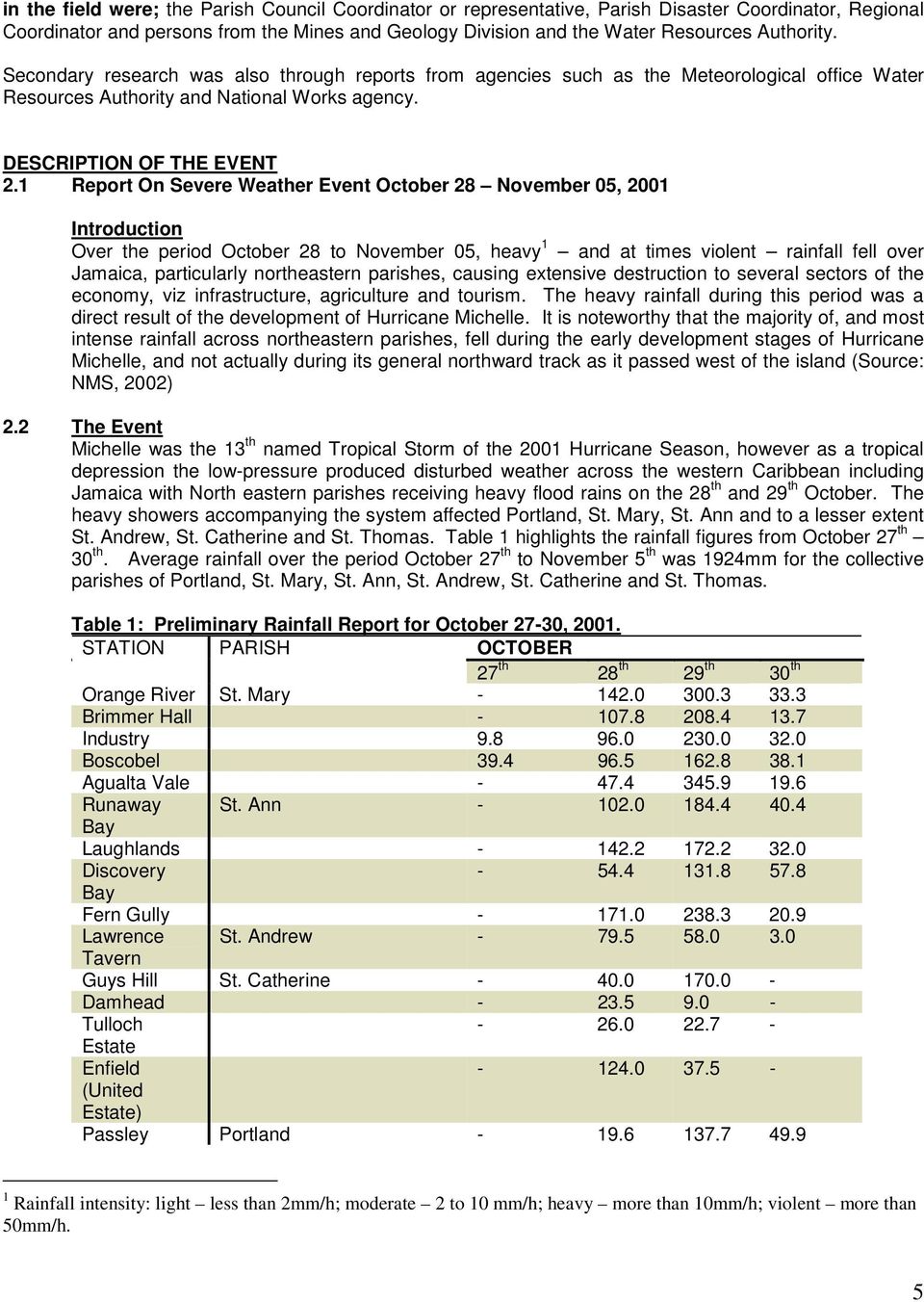
5 in the field were; the Parish Council Coordinator or representative, Parish Disaster Coordinator, Regional Coordinator and persons from the Mines and Geology Division and the Water Resources Authority. Secondary research was also through reports from agencies such as the Meteorological office Water Resources Authority and National Works agency. DESCRIPTION OF THE EVENT 2.1 Report On Severe Weather Event October 28 November 05, 2001 Introduction Over the period October 28 to November 05, heavy 1 and at times violent rainfall fell over Jamaica, particularly northeastern parishes, causing extensive destruction to several sectors of the economy, viz infrastructure, agriculture and tourism. The heavy rainfall during this period was a direct result of the development of Hurricane Michelle. It is noteworthy that the majority of, and most intense rainfall across northeastern parishes, fell during the early development stages of Hurricane Michelle, and not actually during its general northward track as it passed west of the island (Source: NMS, 2002) 2.2 The Event Michelle was the 13 th named Tropical Storm of the 2001 Hurricane Season, however as a tropical depression the low-pressure produced disturbed weather across the western Caribbean including Jamaica with North eastern parishes receiving heavy flood rains on the 28 th and 29 th October. The heavy showers accompanying the system affected Portland, St. Mary, St. Ann and to a lesser extent St. Andrew, St. Catherine and St. Thomas. Table 1 highlights the rainfall figures from October 27 th 30 th. Average rainfall over the period October 27 th to November 5 th was 1924mm for the collective parishes of Portland, St. Mary, St. Ann, St. Andrew, St. Catherine and St. Thomas. Table 1: Preliminary Rainfall Report for October 27-30, STATION PARISH OCTOBER 27 th 28 th 29 th 30 th Orange River St. Mary Brimmer Hall Industry Boscobel Agualta Vale Runaway St. Ann Bay Laughlands Discovery Bay Fern Gully Lawrence St. Andrew Tavern Guys Hill St. Catherine Damhead Tulloch Estate Enfield (United Estate) Passley Portland Rainfall intensity: light less than 2mm/h; moderate 2 to 10 mm/h; heavy more than 10mm/h; violent more than 50mm/h. 5
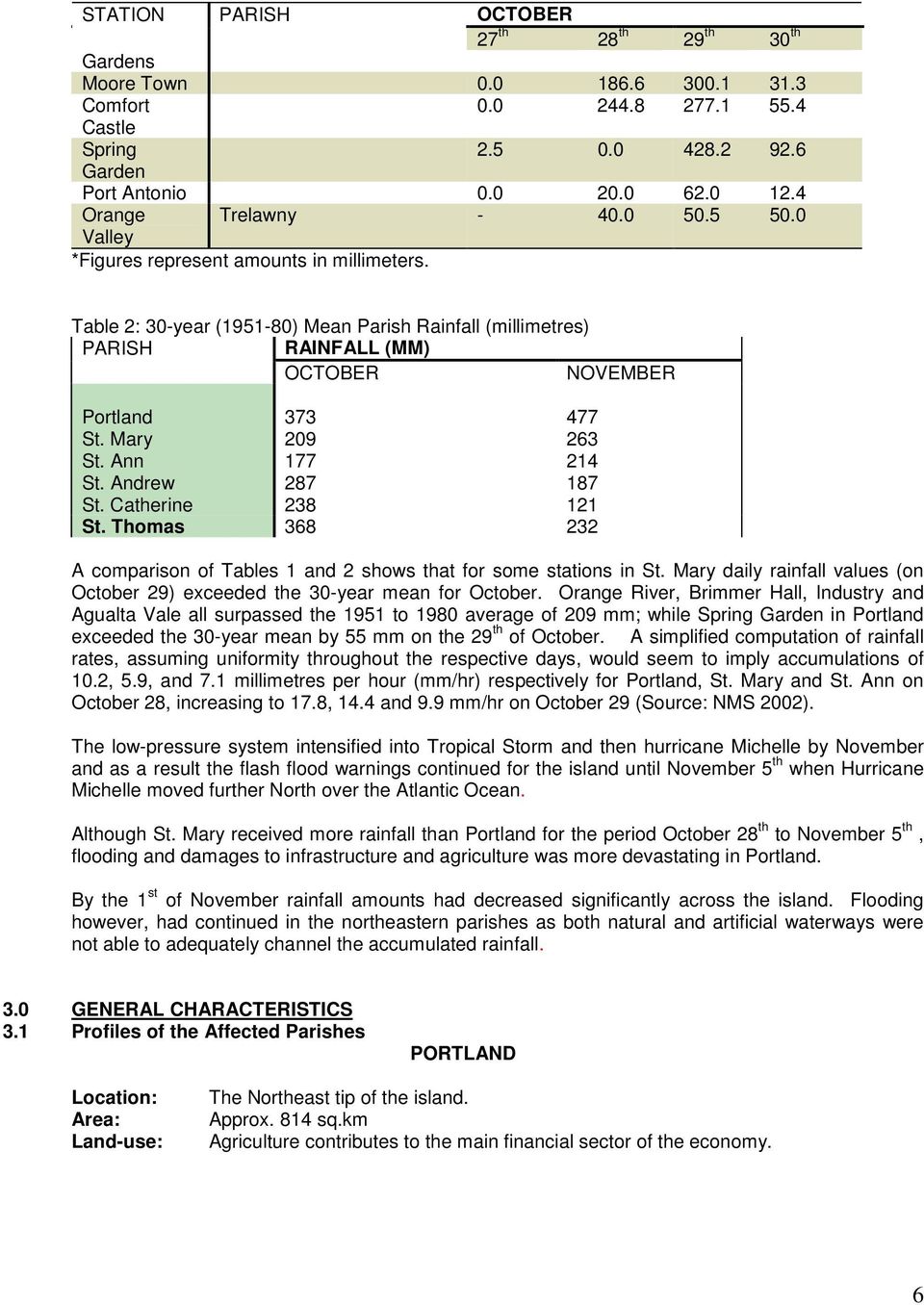
6 STATION PARISH OCTOBER 27 th 28 th 29 th 30 th Gardens Moore Town Comfort Castle Spring Garden Port Antonio Orange Trelawny Valley *Figures represent amounts in millimeters. Table 2: 30-year ( ) Mean Parish Rainfall (millimetres) PARISH RAINFALL (MM) OCTOBER NOVEMBER Portland St. Mary St. Ann St. Andrew St. Catherine St. Thomas A comparison of Tables 1 and 2 shows that for some stations in St. Mary daily rainfall values (on October 29) exceeded the 30-year mean for October. Orange River, Brimmer Hall, Industry and Agualta Vale all surpassed the 1951 to 1980 average of 209 mm; while Spring Garden in Portland exceeded the 30-year mean by 55 mm on the 29 th of October. A simplified computation of rainfall rates, assuming uniformity throughout the respective days, would seem to imply accumulations of 10.2, 5.9, and 7.1 millimetres per hour (mm/hr) respectively for Portland, St. Mary and St. Ann on October 28, increasing to 17.8, 14.4 and 9.9 mm/hr on October 29 (Source: NMS 2002). The low-pressure system intensified into Tropical Storm and then hurricane Michelle by November and as a result the flash flood warnings continued for the island until November 5 th when Hurricane Michelle moved further North over the Atlantic Ocean. Although St. Mary received more rainfall than Portland for the period October 28 th to November 5 th, flooding and damages to infrastructure and agriculture was more devastating in Portland. By the 1 st of November rainfall amounts had decreased significantly across the island. Flooding however, had continued in the northeastern parishes as both natural and artificial waterways were not able to adequately channel the accumulated rainfall. 3.0 GENERAL CHARACTERISTICS 3.1 Profiles of the Affected Parishes PORTLAND Location: Area: Land-use: The Northeast tip of the island. Approx. 814 sq.km Agriculture contributes to the main financial sector of the economy. 6
7 Rivers: Elevation: Geology: The main rivers are the Rio Grande, Swift, Buff Bay and Spanish River. Other minor rivers flowing through the parish include Daniels, Little Spanish, Priestmans and Back Rivers. Blue Mountain Peak 7402 ft. Catherine Peak 5000 ft. White Limestone, Yellow Limestone and Sedimentary Rocks are the dominant geological formations in this parish. The sedimentary formations are Richmond, Wagwater and Cretaceous Sedimentary rocks. Volcanics are also present in small amounts. This Parish has a high fault density that contributes to the instability of the land. This factor of instability is seen especially in the hilly interiors (source: Parish Profiles Prepared by JIS) Because of the parish s position on the island, Portland experiences hard lashes of bad weather. Cloud masses laden with moisture are forced to rise when they reach the mountains of Portland; at that height the moisture is cooled and then condensation of the moisture takes place; this subsequently produces rain, most of which falls in the Portland area. The amount and intensity of the rains are just some factors for the instability of the land and soil in this area. Landslides were reported on the eastern side of the parish where sedimentary formations- Richmond, Wagwater, and Cretaceous Sedimentary formations are located. ST. MARY Location: Area: Land-use: Geology: Northeast of Jamaica sq km Tourism is now the fastest growing sector of the economy. Agriculture remains the backbone of the Parish s economy. The Parish can be noticeably divided into two sections: 1. The geological formations on the eastern side of the parish consist mainly of sedimentary rocks (sandstone, siltstone or shale). Two of the major formations are the Wagwater and the Richmond formations. Under tropical conditions these formations tend to weather easily and erode during periods of heavy rainfall. Intricate surface drainage is also another topographic feature recognized in the eastern section of this Parish. The eastern section of the parish experienced landslides especially the District of Richmond. 2. The geological formation on the western section of the parish is made up of the White Limestone Group. This formation is not as unstable as the formations located on the eastern section of the parish. The texture ranges from chalky and marly beds to brecciated types to very hard to compact rocks. This section has predominantly underground features. Landslides were not reported from this section. ST. ANN Location: Area: Land-use: The north coast of the island sq. km Agriculture, cultivation is predominantly confined to the crown lands in the hill. Livestock is also produced. 7

8 Geology: Rivers and Waterfalls: Location: Area: Land-use: Geography: Geology: White Limestone Group is the main formation found in this parish. There are several popular hills and mountains in this area. This includes the Dry Harbour Mountain, Mount Alba, Irons Mountain, Murray Mountain, Mount Diablo and Mount Zion. There were no landslides reported in this area. This may be due to the stability of the limestone. Flooding though, occurred along the roadways. From these mountains and hills numerous rivers originate, the Whiter, Great, Dunns, Roaring, Caver and the Pedro rivers. The more popular waterfalls are Dunns River Falls, the Llandovery and the Roaring River Falls. ST. CATHERINE South Coast of Jamaica 1191 sq. km. Agriculture, St. Catherine is one of the major sugar producing parishes. Industry the largest salt producing plant in the Caribbean is located in this parish. The Linstead Basin makes up one of the largest and most important basins in Jamaica the Rio Cobre Basin. This area comprises over 300 sq. miles and includes extensive agricultural lands. St. Catherine Plains occupy the southern part of the Rio Cobre River Basin. The North of the Parish is mainly made up of White Limestone whereas the south is made up of Alluvium deposits. Note though that the Hellshire area is predominantly White Limestone. A minor landslide was reported in this Parish. 4.0 TYPES OF HAZARDS AND AREAS AFFECTED Impact of the hazards 4.1 Introduction Landslides debris flows and flooding are the main hazards that affected the parishes.. Evidence of this can be seen with the rainfall of October 28th November 5 th 2001 which caused widespread damage across most parishes but particularly devasted the parish of Portland and St. Mary. This section will describe that impact of floods and landslides on human systems. 4.2 FACTORS CAUSING FLOODING Flooding was reported in Portland, St. Mary, St. Ann, St. Thomas, St. Andrew and St. Catherine Trewlany, Hanover, and Clarendon. A number of Factors influenced that extent of the flooding. These include:- METEOROLOGICAL AND CLIMATIC CONDITIONS ASSOCIATED WITH THE SEVERE WEATHER SYSTEM. LOCATION OF RESIDENTIAL AREAS IN FLOOD PLAIN OR FLOOD WAY THE LACK OF MAINTENANCE OF DRAINAGE NETWORKS FAULTY DRAINAGE AND OTHER HYDRAULIC STRUCTURAL DESIGN AND CONSTRUCTION REDUCED CONVEYANCE CAPACITY OF THE NATURAL AND MAN-MADE CHANNELS METEOROLOGICAL AND CLIMATIC CONDITIONS ASSOCIATED WITH THE SEVER E WEATHER SYSTEM 1. The counter clockwise wind-flow pattern into the center of the system drew warm moist air from the eastern Pacific and southern Caribbean Sea into the Jamaica area. 8
9 2. Specific to Portland and St. Mary, is the presence of the Blue Mountain Ridge. The mountain range acted as a barrier and zone of convergence to surface wind; forced the warm moist air to rise, thereby producing relief rainfall in the process. 3. The southeasterly breeze was enhanced by the near southerly flow from the system. The Northern side of the mountain range became the distinctive leeward side, setting up the development of a leeside trough which is a low pressure area that forms on the leeward side of mountain ranges when the wind flow is nearly perpendicular to the ridge thus producing more rainfall 4. The near stationary position of the system during the formative stages to being Hurricane Michelle 5. The additional rainfall on already saturated soils which triggered more flooding and landslides 4.3 AREAS AFFECTED BY FLOODING PORTLAND - Fellowship, San San, Berrydale, Orange Bay, Fruitful Vale, Spring Garden, Shrewsbury, Hope Bay near bridge, Claverty Cottage, Swift River Skibob, Spring Gardens, Buff Bay Kingston & St. Andrew - Castleton, Brandon Hill, Robertsfield, Florence Hill Havendale, Mannings Hill Road, March Pen Road, Industrial Village, Long Lane, Seaview Gardens, Woodlawn Avenue, Morecambe Avenue, Glendale, Riverside Drive, Gore Terrace, Patrick City, Almonda Terrace, Windward Road/Rockfort, Columbus Drive, Gore Terrace, Longwood Avenue, Pembroke Hall, Bayshore Harbour View, White Avenue Drive, Waltham Park Road, Spanish Town Road, Baldwin Crescent, New Haven, Benbow Crescent, Hope Boulevard, Colbeck Avenue, Hampton Crescent, Stafford Close, Washington Gardens St. Mary -Lewisburg, Coloraine Crossing/Oracabessa entire Annotto Bay, Sections of Port Antonio, Enfield, Friendship Gap Trewlany - Jackson Town, Clarkes Town, Falmouth, Carey Park community Hanover - Cousins Cove, and Green Island St. Ann - Runaway Bay, Great Pond, Cardiff Hall, Lime hall, Content Gardens, Mamme Bay, Discovery Bay, Browns Town, Shaw Park, Lime Bottom, Walkers Wood Fern Gully, Steer Town, Hollywood, Lydford Orange Park, Laycox St. St. Catherine - Waterford, Passage Fort, Braeton Phase 1, Greater Portmore 6E, 2W, 3W, 2E Caymanas Gardens, Old Braeton, Newland, Bridgeport, Independence City, Westchester, Sunny Side St. Thomas - Yallahs Bulls Bay Albion, Poormans s Corner, Danvers Pen Clarendon - Vere - Longwood 4.4 Factors Causing Flooding The Water Resources Authority conducted a review of the 1998 flood Event as a comparison to the flood event of October November The findings of this report are outlined below: Review of recommendations of the 1998 Flood Reports The report indicated that the 1998 flooding in Portland was greatly amplified because of: 1) Extensive debris blocking hydraulic structures and reducing the conveyance capacity of the natural and manmade channels. The debris resulted from landslide and the remains from the logging activities in the upper catchments. 2) Encroachment of Floodway and floodplains. 3) Faulty drainage and other hydraulic structural design and construction The present Oct-Nov 2001 flooding was induced by much more intense rainfall with higher return periods than the previous floods. Rainfall intensity gauge at Bellevue in Portland recorded 622mm or 24.5 inches of 9

10 rain in 24hrs on 29/10. Highest intensity was 96mm (3.78 inch) in one hour. Comparisons with existing rainfall frequencies for nearby stations showed that this far exceeded a 50-year event. The flood hazard was again amplified by the very same factors that existed during the 98 floods and very little was done to reduce vulnerability and exposure (See Appendix 1 outlines the Contents of the 1998 Portland Flood Report). 4.5 FACTORS CAUSING LANDSLIDES Landslides were reported in the parishes mentioned already in this report. These landslides were triggered by the heavy rains, which saturated the soils. In the parish of Portland areas affected are located within 4 watershed management units namely Swift River, Spanish River, Rio Grande, Pencar These watershed units receive the highest rainfall in the country. The geology of the area coupled with the heavy torrential rains and weather systems greatly impacted the area. 4.6 AREAS AFFECTED BY LANDSLIDES Swift River Watershed Management Unit Portland Rivers - Swift River and its tributaries the Back River and Bantama. Communities affected within this watershed Swift River, Bloomfield, Chelsea, Shirley Castle, Shrewsbury, Fruitful Vale and Grants Gate. Damage was due to landslides, flooding and deposition of debris. Sand and rubble (river shingle) up to 3 m high was deposited throughout the community including the interior of buildings and burying parked vehicles. A massive landslide at Grants Gate covered four houses. Spanish River Watershed Management Unit River and tributaries - Spanish River and its tributaries the Mabess River Communities affected - Chepstowe, Claverty Cottage, Bangor Ridge, Bybrook and Skibo with Bybrook being the most severely affected. Mabess River brought down an excessive amount of soil and other debris some m high depositing this material on the main road and in buildings along it. The river doubled its normal width sweeping away land(for example the Anglican Church and the burial plot behind the church). Damage - Several homes were destroyed by floodwaters and debris, the road network was affected by landslides. Rio Grande Watershed Management Unit River: - Rio Grande and its tributaries the Back Rio Grande and Sandy River Communities affected - Berridale, Grants Level and Fellowship. Pencar - Buff Bay Watershed Management Unit Rivers - Dry River, White River Landslides of varying sizes occurred at Stanton, Tranquillity, Belvedere and Mt. Vernon Portland Shirley Castle, Toms River, Bybrook, Bloomfield, Anns Delight, Bangor Ridge, Chepstow, St. Bernard Bellevue, Berwick Spring, Clifton Hill. Kingston and St. Andrew - Hermitage, Rose Hall, Mount Airy, Golden Spring, Friendship, Florence, Cavaliers, Lawrence Tavern Craig Hill Shooters Hill Junction Road St. Mary - Broadgate Georgia Road in vicinity of Westmoreland Bridge, Cool Spring Dressikie, Mount Rose Comfort Valley, Scotts Hall/Ireland Rock River St. Ann - Lime Hall - Lumsden St. Elizabeth - Red Ground Houses, roads, crops and farmland were affected in this management unit. In Buff Bay blocked drains led to flooding of the town. The river overflowed its banks scouring the roadway at Enfield and washing away livestock and agricultural crops. The river eroded its banks washing away large acreages of land at Craig 10

11 Mill (See Appendix 2 Conclusion and Recommendations from NEPA Report Oct Nov 2001 Flood Report) 5.0 ECONOMIC SITUATION IN THE COUNTRY 5.1 Economic Impact Flooding landslides and debris flows produce a net work of inter-related impacts which span many sectors of the economy. The damage impact can be listed as economic, environmental and social. 5.2 SECTOR DAMAGE The agricultural sector is one of the major foundations to support growth in the economy. the rains of october 29 November 5 th had again significantly affected this sector with losses totalling $533,200, hectares of crops were damaged. The total number of farmers that were affected total with the highest numbers in Portland, St. Andrew, and St. Elizabeth. It must be noted however that St. Elizabeth was not highlighted as one of the parishes seriously affected from he server weather. Table: 3 Showing Agricultural Losses from Oct- Nov Flood Rains 2001 Parish Crop Loss Ha Value Ja$ Livest ock Value Soil Con. Value Ja$ Portland ,800,000 26,500 18,250,000 4,000 ch 4.800,00 0 Road s km Value Rem arks farme rs affect ed ,300 St. Mary ,638,200 9,825 2,916, ,300, 000 1,054 St. Catherin e ,020,000 6, , ,500, St , 193, - 1,142, ,350,000 1,099 Thomas 500 St. Ann ,406,000 2, , ,000, St ,100, ,150, ,000 Andrew 0 2,455,000 Westmor ,905,000 4, eland Hanover ,107 1,433, ,410, ,165,000 St ,195,243 1,930 1,344, ,000,000 1,449 Elizabeth Clarendo ,101,765 3, , ,315,000 n Manches ,584, ,000, ter St ,324,000-1,011, James TOTAL 1, ,637, , ,421, 400 4,000 CH 4,800, km 124,341, Source: RADA

12 CROP ANALYSIS Crop Losses to Agricultural Sector Clarendon 3% Manchest er 2% St. James 4% Port land 19% St. Elizabet h 28% St. Mary 6% St. Cat herine 3% St. Thomas Hanover 4% Westmoreland 4% St. Andrew 14% St. Ann 5% 8% Portland St. Mary St. Cat herine St. Thomas St. Ann St. Andrew West moreland Hanover St. Elizabet h Clarendon Manchest er St. James Figure:1 Livestock Analysis Losses in Livestock Hanover 8% West moreland 0% St. Andrew 7% St. Ann 2% Clarendon 6% St. Elizabet h 3% Manchest er 0% St. James 0% Port land 43% St. Thomas 5% St. Cat herine 10% St. Mary 16% Port land St. Mary St. Cat herine St. Thomas St. Ann St. Andrew West moreland Hanover St. Elizabet h Clarendon Manchest er St. James Figure: 2 12

13 St. James Manchester Farmers Affected Rains October 29th - November 5th Clarendon St. Elizabeth ,449 Hanover Westmoreland St. Andrew St. Ann St. Thomas Parishes Farmers Affected ,099 1,054 3,000 St. Catherine St. Mary Portland ,000 1,500 2,000 2,500 3,000 3,500 Farmers affected 3,300 Figure: PHYSICAL INFRASTRUCTURE ROADS, BRIDGES, DRAINS, AND GULLIES The physical infrastructure was severely affected as a result of the Rains of October November This sector received the most extensive damage through all the parishes that were affected. The major damage that affected the road network include: 1. Roads affected directly by landslides 2. Roads significantly eroded 3. Drain walls to be repaired 4. Damage to bridges 5. Damage to flood control works and gullies. The cost for rehabilitation of roads, bridges gullies that were damaged is estimated at J$1,493,376,408. The information below was taken from a report that was prepared by the National Works agency which summarizes the damage done to the Main and Parish Council road network as well as the damage done to bridges, sea defense works, river training works, drainage structures and gullies Roads Affected by Land Slips/Flooding etc. Approximately 241 main roads and over 200 PC roads were affected by landslides, and flooding. The total costs to re-open the roads affected by slippage and flooding is estimated at $13.18 million dollars. 13

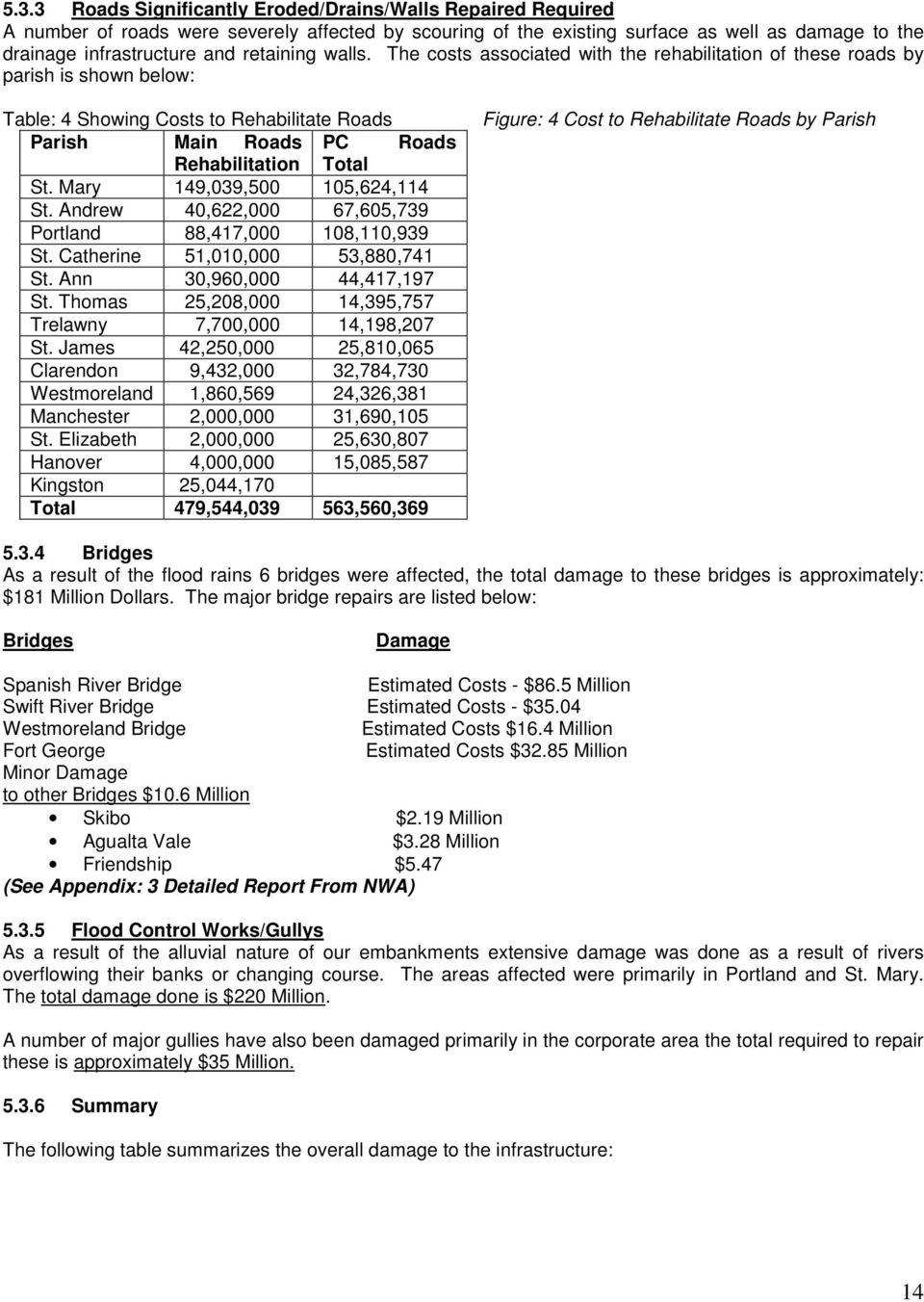
14 5.3.3 Roads Significantly Eroded/Drains/Walls Repaired Required A number of roads were severely affected by scouring of the existing surface as well as damage to the drainage infrastructure and retaining walls. The costs associated with the rehabilitation of these roads by parish is shown below: Table: 4 Showing Costs to Rehabilitate Roads Parish Main Roads PC Roads Rehabilitation Total St. Mary 149,039, ,624,114 St. Andrew 40,622,000 67,605,739 Portland 88,417, ,110,939 St. Catherine 51,010,000 53,880,741 St. Ann 30,960,000 44,417,197 St. Thomas 25,208,000 14,395,757 Trelawny 7,700,000 14,198,207 St. James 42,250,000 25,810,065 Clarendon 9,432,000 32,784,730 Westmoreland 1,860,569 24,326,381 Manchester 2,000,000 31,690,105 St. Elizabeth 2,000,000 25,630,807 Hanover 4,000,000 15,085,587 Kingston 25,044,170 Total 479,544, ,560,369 Figure: 4 Cost to Rehabilitate Roads by Parish Bridges As a result of the flood rains 6 bridges were affected, the total damage to these bridges is approximately: $181 Million Dollars. The major bridge repairs are listed below: Bridges Damage Spanish River Bridge Estimated Costs - $86.5 Million Swift River Bridge Estimated Costs - $35.04 Westmoreland Bridge Estimated Costs $16.4 Million Fort George Estimated Costs $32.85 Million Minor Damage to other Bridges $10.6 Million Skibo $2.19 Million Agualta Vale $3.28 Million Friendship $5.47 (See Appendix: 3 Detailed Report From NWA) Flood Control Works/Gullys As a result of the alluvial nature of our embankments extensive damage was done as a result of rivers overflowing their banks or changing course. The areas affected were primarily in Portland and St. Mary. The total damage done is $220 Million. A number of major gullies have also been damaged primarily in the corporate area the total required to repair these is approximately $35 Million Summary The following table summarizes the overall damage to the infrastructure: 14
15 Table: 5 Summary Of Infrastructure Rehabilitation Costs Figure :5 Summary of infrastructure Damage Activity Total Costs J$ Main Road Rehabilitation P.C. Road Rehabilitation Bridges River Training Works Including Critical Repairs Cost to reopen Roads 479,544, ,560, ,770, ,320,000 13,182,000 Total 1,493,376, UTILITIES WATER REPORTS FROM THE NATIONAL WATER COMMISION REVEALED THAT THE FOLLOWING SYSTEMS IN THE VARIOUS PARISHES WERE DAMAGED. THIS CAN BE SEEN IN TALBE BELOW. THE TOTAL COSTS OF RESTORATION OF SYSTEM TO DATE TOTALLED $95M. ASSESSMENT OF THE YALLAS PIPE LINE IS STILL ONGOING HOWEVER THE DAMAGE TOTALED $25M Table: 6 NWC Damage to Facilities October November Rains 2001 PARISH WATER SUPPLIES DAMAGES Damage Costs Portland St. Mary Shirley Castle, Claverty Cottage, Yhanside Bybrook/Skibo Bangor Ridge Black Hill Lennox/Orange Bay Orange Hill/Chewstowe New Eden Claverty to Clifton Hill Gap/Smithfield Happy Grove to Belmont Packie River to Eddingham Road to Fairy Hill Beach Foundout to Barnett St. Catherine St. Thomas St. Ann St. Andrew Westmoreland Hanover St. Elizabeth Clarendon Pipes leading from pump facilities 330, Manchester St. James Source: NWC Electricity Reports from the Jamaica Public Service (JPS Co) indicate that their systems sustained damages estimated at$6.8 Million. The break down of the damages cost reflected approximately $1.2 M in damage to their systems and a cost of $5.6M to restore and relocate lines. Some of the damage was as a result of burnt poles due to lightening and erosion Telephone 15

16 Over the period of flooding, October November 2001, Cable and Wireless reported damage to the telephone system totalling $537, The damage to exchanges and locations is highlighted in table below. Table: 7 PLANT AFFECTED BY FLOOD RAINS NER/WER, OCTOBER 2001 EXCHANGE LOCATION DEFECT CORRECTION STATUS OF NO. OF WORK CUSTO MERS AFFECT Discovery Bay Rio Bueno Bridge Pole and Push Brace Dislocate d Damage d Cables Runaway Bay Main Road/Exchan ge Road Intersection Claremont Higgin Town Pole washed out Tower Main Road Rio Nuevo Gayle Ocho Rios Highgate Dunn s River Main Road Heywood Hall Trees fell on Cable Poles washed out Dislocate d Guy Belfield 3 poles partially washed out Port Antonio Main road Trees fell between on the Orange Bay cable and St. Margaret s Bay TOTAL Reset Pole and Push Brace Replace Damaged Cables Pole Relocated/Repl aced Replaced Broken Cable Two poles were replaced Replace pole guy Poles to be replanted Trees cut and area cleared ESTIMA TED COST ED Completed None $ 3, Temporary Restoration Effected 45 $400, Completed None $ 16, Completed None $ 65, Completed None $ 30, To be None $ completed by 3, /11/01 To be completed by 16/11/01 None $11, Completed None $10, $540,

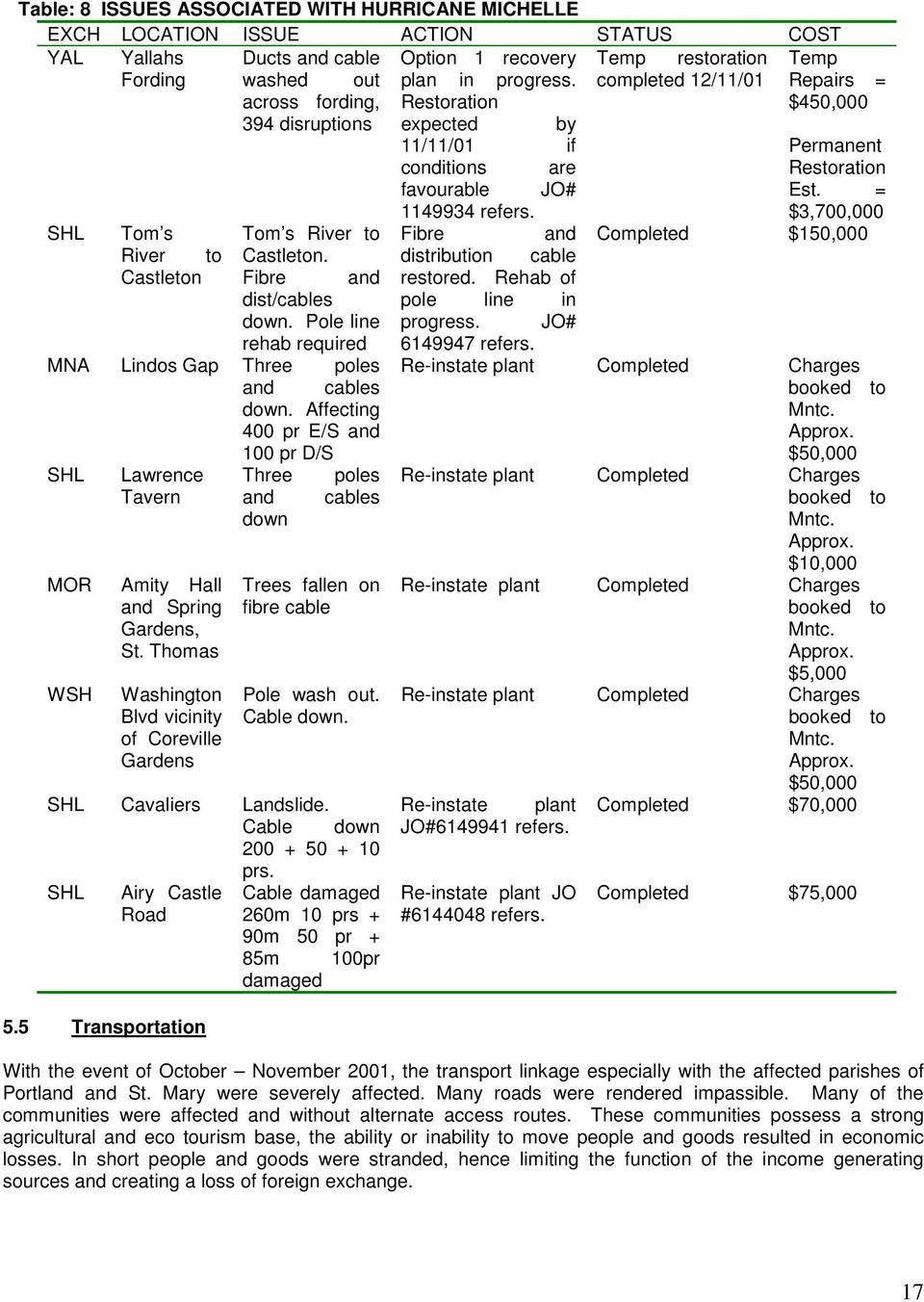
17 Table: 8 ISSUES ASSOCIATED WITH HURRICANE MICHELLE EXCH LOCATION ISSUE ACTION STATUS COST YAL Yallahs Ducts and cable Option 1 recovery Temp restoration Temp Fording washed out plan in progress. completed 12/11/01 Repairs = across fording, Restoration $450, disruptions expected by 11/11/01 if Permanent conditions are Restoration favourable JO# Est. = refers. $3,700,000 SHL Tom s Tom s River to Fibre and Completed $150,000 River to Castleton. distribution cable Castleton Fibre and restored. Rehab of dist/cables pole line in down. Pole line progress. JO# rehab required refers. MNA Lindos Gap Three poles Re-instate plant Completed Charges and cables booked to down. Affecting 400 pr E/S and 100 pr D/S Mntc. Approx. $50,000 SHL MOR WSH Lawrence Tavern Amity Hall and Spring Gardens, St. Thomas Washington Blvd vicinity of Coreville Gardens Three and down poles cables Trees fallen on fibre cable Pole wash out. Cable down. SHL Cavaliers Landslide. Cable down prs. SHL Airy Castle Cable damaged Road 260m 10 prs + 90m 50 pr + 85m 100pr damaged 5.5 Transportation Re-instate plant Completed Charges booked to Mntc. Approx. $10,000 Re-instate plant Completed Charges booked to Mntc. Approx. $5,000 Re-instate plant Completed Charges booked to Mntc. Approx. $50,000 Re-instate plant JO# refers. Re-instate plant JO # refers. Completed $70,000 Completed $75,000 With the event of October November 2001, the transport linkage especially with the affected parishes of Portland and St. Mary were severely affected. Many roads were rendered impassible. Many of the communities were affected and without alternate access routes. These communities possess a strong agricultural and eco tourism base, the ability or inability to move people and goods resulted in economic losses. In short people and goods were stranded, hence limiting the function of the income generating sources and creating a loss of foreign exchange. 17
18 5.6 COMMERCE AND TOURISM IN PORTLAND APPROXIMATELY 210 RAFTS WERE LOST WHICH TOTALLED $420, IN DAMAGES. PROPERTY LOSSES ARE STILL BEING ASSESSED. OTHER 5.7 SOCIAL INFRASTRUCTURE Social Infrastructure and Impacts Every community has as some of its most significant development facilities social and physical (engineering) infrastructure. The social infrastructure seeks to develop the personality of the man and thereby enhance his inter-personal relationship, morals, ethics, and integrity. Social infrastructure include: homes, churches, schools, health services, police stations, post offices and in the case of disasters shelters EDUCATIONAL FACILITIES Impact On Educational Institutions Island wide The severe flooding experienced in the parishes of Portland and St. Mary and to a lesser extent in other northern and western parishes impacted negatively upon the ability of the educational institutions to function normally as in many cases they were inaccessible to vehicular traffic. Most of the damage to schools which were already in poor condition was made worse as the already porous roofs were made more so by the heavy rainfall. Debris was deposited on some of the school properties and soil erosion was evident in a number of cases. Provisions have been put in place to allow the students who were affected and unable to attend school to be temporally taught at the nearest accessible high school. This has put a strain on existing infrastructure and has resulted in the need for additional furniture at the relevant schools, that were already suffering a shortage of student s furniture. The schools that have opened their doors to the affected students are: Annotto Bay High, St. Mary High, St. Mary Technical Marymount High, Buff Bay High The estimated cost of remedial work is Twenty Million Dollars ($20,000,000.00) Four hundred (400) students desks and chairs are required at a cost of ($1,250,000.00). If any relocation of affected persons in Portland is carried out a review of the need for school places in the affected areas will need to be done to determine any future development projects. Table: 9 Showing type of Damage and losses Oct. Nov Rains NAME OF SCHOOL PARIS H RUR AL URB AN ESTIMATED COST TYPE OF DAMAGE Belvedere All Portlan * 500,000 Electrical Age d Buff Bay Portlan * 1,500,000 Roofing and Electrical Primary d Nonsuch All Portlan * 300,000 Latrines Age d Windsor Forest Portlan * 600,000 Latrines Primary d Windsor Castle Portlan * 1,500,000 Latrines and Roofing All Age d Sub-Total 4,400,000 Annotto Bay St. * 1,000,000 Sewage disposal and roofing 18

19 NAME OF PARIS RUR URB ESTIMATED TYPE OF DAMAGE SCHOOL H AL AN COST Primary Mary Brainard All St. * 1,200,000 Land Slippage Retaining Wall Age Mary Bromley St. * 200,000 Roofing Primary Mary Islington High St. * 900,000 Roofing Mary Ramble All St. * 400,000 Roofing Age Mary Robins Bay All St. * 900,000 Roofing Age Mary Rose Bank St. * 300,000 Roofing Primary Mary St. Mary High St. Mary * 5,000,000 Land Slippage Retaining Wall and Sewage Disposal System Woodside All St. * 600,000 Roofing Age Mary Sub-Total 10,200,000 Duckenfield Primary St. Thoma * 1,250,000 Roofing Hayfield All Age Wilmington All Age s St. Thoma s St. Thoma s * 350,000 Roofing * 300,000 Roofing Sub-Total 1,900,000 Cascade All St. Ann * 300,000 Roofing Age Walkerswood St. Ann * 700,000 Roofing All Age Sub-Total 1,000,000 Hampden Trelawn * 300,000 Roofing Primary y Warsop All Trelawn * 500,000 Roofing Age y Sub-Total 800,000 Johns Hall St. * 300,000 Latrines James Salters Hill All St. * 700,000 Roofing Age James Sub-Total 1,000,000 Mt. Grace Prim Westm * 700,000 Roofing and Jnr High oreland New Castle All Westm * 900,000 Roofing Age oreland Sub-Total 1,600,000 Figure 6 below shows the number of schools that were affected in the various parishes in both urban and rural areas. A total of two schools were affected in the urban areas of St. Mary and Portland, while 23 19

20 schools were affected in rural areas. Westmoreland, St. James, Trewlany, St. Ann with a total of 2 schools each being affected. St. Thomas with a total of 3, St. Mary accounting for 8 and Portland accounting for 4. Figure 7 highlights the type of damage and the costs. These damages varied form Roofing, Electrical and latrines and landslipage. Roofing damage which was the highest accounted for 67% of total damage, latrines were next 13% and electrical, latrine and roofing, sewage disposal and roofing landslipage/retaining wall all accounted for 4%. Figure: 6 Bar Graph showing Types of Schools affected Westmoreland St. James Trewlany Parishes St. Ann St. Thomas St. Mary Portland Schools Urban Rural Figure: 7 Type of Damage and Cost land slipage retaining wall (s.s.s) 4% Latrine &Roofing 4% land slipage retaining wall 4% Electrical 4% Roof and Electrical 4% Latrines 13% Roofing 67% Electrical Latrines Latrine &Roofing land slipage retaining wall Roof and Electrical Roofing land slipage retaining wall (s.s.s) 20

21 Total Damage Costs for Educational Facilities by Parishes Affected 12,000, ,000, ,000, Cost in J$ 6,000, ,000, ,000, Portland St. Mary St. Thomas St. Ann Trewlany St. James Westmoreland Parishes Figure: 8 Summa ry of total damage to educational institutions is highlighted in figure 8 above. Both summary and figure highlights St. Mary as the parish with the highest cost in this sector. SUMMARY PORTLAND 4,400,000 ST. MARY 10,200,000 ST. THOMAS 1,900,000 ST. ANN 1,000,000 TRELAWNY 800,000 ST. JAMES 1,000,000 WESTMORELAND 1,600,000 Grand Total 20,900,000 TOTAL ESTIMATE = $20,900, SOCIAL AND PSYCHOLOGICAL IMPACTS Overview Vulnerability. Portland has an approximate population of 790,400 persons (Survey of Living Conditions 1999) of which approximately 42% are children (below 18 years). 17 communities are located in west Portland. Most children are from low-income families in rural communities whose farming activities provide primary income for the families Prime Disaster Areas The areas mainly affected by the recent floods were inland/interior and one community on the coast (Spring Garden). In total approximately 10 to 17 communities were hard hit see Map 1: 1. Skibo 2. Bybrook 3. Hans Delight 21
22 4. Barracks Spring 5. Carlton 6. Claverty 7. Chepstowe 8. Belevdere 9. Bangor Ridge 10. Spring Garden Realities Access to the affected communities were limited and within communities many districts have been cut off from each other. Most internal roads have been demolished by the water and as a result most communities can only be accessed with high four wheel drives Access to shelter disrupted: Most homes have been either destroyed or are unfit for living in. Evacuation to shelters begun on Thursday, November 1, 2001 after which those families desirous of leaving the communities were housed at the Buff Bay Primary School for three days and four nights. Two shelters exist in Buff Bay, one at the Globe (church Mans) and the other at the Lynch Park Civic Centre. These shelters house a total of 32 adults and 56 children. Within shelters regular meals are provided. Many children lost clothing (washed away, muddy, soaked) Sheets are used to divide sleeping areas Families range from single to eight members (one family consisting of six children and two adults) Residents of the shelter have improvised beds consisting of ply board on blocks with mattresses provided by relief agencies. Access to sanitary convenience exist at both shelter Access To Services Now Limited Disruption of education some children within shelters are attending schools, other children within districts are not attending schools due to teachers inability to access communities. Children took canoes across the Spanish River or were taken by helicopter to school until alternate arrangements for High School children could be made. While at schools these children were/are fed by the school feeding programme. They currently wear any available clothing, not uniforms to school. Footwear is by far inappropriate for weather and books are not available. Disruption of regular health services medical teams present however communities no longer have regular access to services provided by the clinics. Limited access to drinking water relief agencies providing bottled water Electricity and piped water have not yet been restored Disruption of Livelihoods Most members of the communities were peasant farmers, employed to coffee and banana farms. A significant number commuted to other communities and parishes for employment in various industries. As a result of the floods there has been great disruption to livelihood patterns: Goods not available at shops as many shops have been washed away and goods trucks have no access to communities Subsistence farming on which most communities depend as main income (animals, food stuff) washed away. Inability to earn due to crop destruction/devastation will have implications for ability of parents to provide for the children as well as the nutrition of these children. Psychological many people are unable to pull themselves together and as a result counseling was provided. Many within the shelters tell horror stories of waking up and seeing water springing up 22
23 within yards and dwellings, many recall sites of devastation while being airlifted from their communities. Although eager to continue their lives many have expressed feelings of hopelessness Concerns For Children Within Disaster Areas Lack of privacy of children within shelters Education of children within shelters many attend school however with the very basic necessities Education of children within communities which have been cut off teachers unable to access communities. Lack of recreational opportunities children confined to area, outside wet With limitations now presented to livelihoods nutritional needs of children may be at risk if proper education of parents in alternative methods of food use and preparation is not shared. Trauma counseling for those children affected by disaster Uncertainty of when structured lives will resume 5.9 SOCIAL IMPACTS HEALTH SECTOR Wide scale destruction and damage to water supplies, houses and pit latrines, inadequate solid waste management, pooling of water and the lack of road access to some communities, place the affected populations at high risk for diseases and illnesses. The issues that contribute to the deterioration of environmental health need to be addressed as a priority to avert disease outbreaks. Report From the Ministry health revealed that the priority areas for the Health Sector include:- Service Delivery Water Supply and Quality Waste Water Disposal Solid Waste Disposal Vector Control Public Education on Health Issues Health Sector Needs Assessment and Budget International Collaboration MOH Direction and Coordination Damage totaled $ 53, 567, J $. (Appendix: 5 Highlights health Sector needs Assessment and Recommendations). 1. Service Delivery Facilities Over seventy five percent (75%) of the health facilities islandwide continue to leak due to faulty roofs. The Primary Care facilities are the worse affected. Flooding occurred at fifteen percent (15%) of health facilities. Damage occurred at the Swift River Health Centre, Portland with silt and debris surrounding and entering it and the fence at the Olympic Gardens Health Centre, KSA was damaged by a falling tree. Efforts must be made to effect repairs to these facilities and correct the poor drainage systems. Services 23
24 All services were maintained at ninety-five percent (95%) of the facilities. In some cases there was a reduction in the scope of services due to non-attendance by staff and patients. Two facilities the Fruitful Vale Health Centre in Portland and the Annotto Bay hospital were used as shelters for short periods. Services are suspended at four Health Centres in Portland: - Swift River (as above) relocated to Hope Bay - Cascade, Spring Hill and Bangor Ridge inaccessible. There are no alternate facilities. Once a week airlifts of staff will be requested. Transportation Field work was limited by a lack of four (4) wheel drive vehicles, especially in Portland. Helicopter transfer of critically ill patients will increase until the road network is restored. Surveillance Disease surveillance activities have been heightened in all parishes. There were no reports of increased incidence of any disease resulting from this event. Shelters At 2001/11/04, four (4) shelters remain open in Portland with 107 occupants and one (1) in Annotto Bay, St. Mary with 157 occupants. There are no immediate health concerns. 2. Water Supply and Quality Water quality remains poor in many areas and analysis of samples was limited by the lack of water quality testing kits. The NWC was advised to liaise closely with the Public Health Departments. Parish Councils lack the resources to effectively restore their supplies. The MOH and MOWH are working to increase the storage capacity of communities and households. The MOH and Health Departments have implemented a public education programme on Making Water Safe, by boiling or using household bleach. 3. Waste Water Disposal The majority of persons in the affected areas utilize pit latrines. Community surveys reveal: Portland 118 destroyed and 91 damaged. St. Mary 410 destroyed (Nov. to date 2001) Replacement must be treated as a priority, especially in the typhoid endemic areas. 4. Solid Waste Disposal Collection systems, in particular in Portland and St. Mary, were limited by reduced road access and excessive deposits of debris. The worst affected areas in Portland were not previously served by the public collection system. Special initiatives will have to be implemented and monitored. The effects of inadequate solid waste disposal to increased breeding of vectors mosquitos, rodents and flies require an urgent solution. 5. Vector Control 24
25 Health Departments are constrained by the lack of an on-going comprehensive programme, while the island remains on alert for the West Nile virus and dengue and dengue haemorrhagic fevers. Excessive pools of stagnant water, uncollected garbage and the presence of raw sewage in some areas are cause for concern. Parish health teams will need resources to address these issues and avert disease outbreaks. 6. Public Education on Health Issues An initial one (1) month programme for Making Water Safe has been implemented. This will be followed by programmes for other environmental health issues. 7. Health Sector Needs Assessment and Budget An updated needs assessment and budget, totaling J$53, 567, were prepared on November 06. An additional three hundred and fifty (350) pit latrines were added, based on assessments received from St. Mary. Cabinet has approved an initial J$10M for the health sector. 8. International Collaboration PAHO, Barbados sent one (1) officer to Jamaica from November to gather information for the preparation of a proposal for funding from international donors. The MOH facilitated this process including transportation to Portland. The ODPEM has forwarded the health sector needs assessment and budget to the international donor community in Jamaica. 9. MOH Direction and Coordination Direction and coordination activities continue from the Emergency, Disaster Management and Special Services Branch. Contact has been maintained with the parishes and regions and requested reports received. Damage Assessment continue and two (2) needs assessment reports have been prepared. Assistance was provided in the preparation of a Cabinet note on November 02, Coordination meetings were attended at the ODPEM, including on November 05. No attempt was made to make the MOH EOC at the Bustamante Hospital for Children operational on November 03 and 04, as heavy rainfall and flooding in Kingston made transfer of equipment, furniture and supplies impossible. The Directors, EDMSSB and Health Service Planning and Integration initiated contact with all regions and received reports at home. The Director, EDMSSB responded to all emergency calls from the NEOC at the ODPEM, from home WELFARE AND RELIEF PERSONS AFFECTED A total of approximately 1084 families were affected by the flood event (Source Office of Disaster Preparedness and Emergency Management and Ministry of Labour Social Security 2001). Approximately 3252 persons were affected this is using 3 as the approximate figure to give the total population affected. A break down from the affected parishes highlights 25
26 Portland 220 families affected approx. 660 persons with 277 children St. Mary 422 Families St. Ann 20 families St. Catherine 22 Families Kingston & St. Andrew 400 families Its interesting to note that the percentage of the children affected in Portland is fairly high as that population accounts for 41% of the total person affected. Persons Affected also received blankets and mattresses as part of the assistance package. This assessment was carried out on a house to house basis. Total Cost as of November 2001 $497, TABLE: 10 SUMMARY OF WELFARE ASSISTANCE Date Number Families Affected Approximately Number of Persons Affected Assistance January, 1998 SOURCE: MLSS $407, In total 10 shelters were opened to accommodate the affected persons these include:- Portland (4) Fruitful Vale All Age, Swift river SDA, Buff Bay Independent Church, Lynch Park Community Centre. St. Mary (3) Enfield Community Centre, Enfield Primary School, Enfield Baptise Church. St. Ann - none St. Catherine - None Kingston & St. Andrew (3) New Heaven and Duhaney Park Area. Much of the damage reported were that of household and personal effects. While others reported damages losses to crops and livestock and damage and/or destruction to houses. 26
27 5.11 SUMMARY OF LOSSES TABLE: 11 SUMMARY OF DAMAGE LOSSES October November 2001 FLOOD EVENT SECTOR Agriculture Crop losses 375, 637, Livestock Losses 28, 421, Soil Conservation 4, 800, Farm Roads 124, 341, , 200, Utilities Water 95, 000, ,000, Electricity 6,800, Telephone 537, , 337, Physical Infrastructure Main roads 479, 544, PC roads 563, 560, Bridges 181, 770, River training works 255, 320, Cost to reopen 13,182, , 493, 376, Housing Social Infrastructure Welfare and relief 497, Health 53, 567, Education 20, 900, , 964, Commerce and Tourism 420, COST IN JAMAICAN DOLLARS ($) 533, 200, , 337, , 493, 376, , 964, , GRAND TOTAL 2,229,298, Source: ODPEM SUMMARY OF DAMAGE LOSSES AND IMPLICATIONS FOR THE SECTORS The total cost of damage resulting from the flood rains is estimated a at $2,229,298, Billion Jamaican dollars. The analysis revealed that the physical infrastructure sector suffered the greatest damage. The total estimated damage was set at $1,493,376, Billion or 66.99% of the total damage to all sectors. The 27
28 second highest was Agriculture which accounted for 23.92%, or $533,200, million in damage. pie chart below shows total damage by sector. The Pie Chart Showing Losses to Sectors Social Infrastrucutre 3% Commerce and Tourism 0% Agriculture 24% Utilities 6% Physical Infrastructure 67% Agriculture Utilities Physical Infrastructure Social Infrastrucutre commercea and Tourism Figure 9 The damage from the rains has impacted significantly across the sectors. Within the physical infrastructure sector poor road conditions resulted in increased time spent in travelling between destinations. Losses were also rendered to industries directly affected by agriculture, this has also put a strain on the financial institutions in terms of more credit risks and capital shortfall.. It must be noted that the Agriculture and Physical Infrastructure Sector continue to be the sectors hardest hit and the money spent in rehabilitation continues to increase. In light of this closer attention needs to be placed in these sectors along with more stringent mitigation measures. The losses have caused revenue shortfall in utilities and losses in production to communities, and also a general loss of revenue to Gross Domestic Product. The social impacts although more difficult to quantify, also manifest themselves in disaster situations. In general, there was reduced quality of life in both rural and urban areas, which promote the cycle of poverty. Many residents and an increased number of children had to be counseled as trauma and stress levels increased after the disaster. Human lives were also lost. In short all the sector are vulnerable to disasters which in turn affect the economy. It is therefore becoming more evident that disaster mitigation should be a major component in the overall sector development. 6.0 RECOMMENDATIONS Overview The Damage Assessment of the severely affected parishes of St. Mary, and Portland and to a lesser extent St. Ann, Trewlany, St. Catherine Kingston and St. Andrew has highlighted that the occurrence of floods, landslides and debris flows continue to have devastating effects on our country. Heavy precipitation and severe weather has caused deaths and serious damage across the various sectors of the economy. The flood Event occurred within the latter half of the Hurricane season. It was associated with an area of disturbed weather, which fueled the formation of Hurricane Michelle. This coupled with short duration and high intensity rainfall caused the capacity of the soil to be saturated hence, giving rise to rapid runoff and thus increasing the risk of slope failures. 28
29 Damage to Agriculture, roads, housing and the other sectors as a result of Flooding and landslide was severe and the impact covered all sectors. The dollar losses accounted for $2,229,298, Billion dollars. This indicates that more focus needs to be placed on mitigation measures to reduce loss to life and property. Development Planning and Mitigation An accurate and timely prediction of a hazardous event can save human lives but can do very little to reduce economic losses and social disruption that can only be accomplished by measures long in advance. Therefore Mitigation measures, both structural and non-structural will have to be implemented to reduce the damage impact on the communities. Mitigation of disaster usually entails reducing the vulnerability of the elements at risk; modifying the hazard process of the site, and changing its function. Mitigation measures can have structural characteristics such as specific safety on vulnerability reduction measures in the design of new facilities, retrofitting of existing buildings. Non-structural measures concentrate on limiting landuse, use of tax incentives and risk undermining through insurance programmes. 6.1 Landslide Landslides are caused when the forces of gravity pulls rock debris on soils down a slope. Because gravity acts on slopes landslides only occur when the stress produced by the force of gravity exceeds the resistance of the material. The range and magnitude of landslide is so great that general instructions on how to prevent or halt them cannot be given. However, for every landslide, specific geological, morphological, soil-mechanic investigations should be carried out. And landslide hazard maps prepared for vulnerable communities. Hopefully these investigations may be able to help us determine what building measures might be able to be taken to protect buildings and infrastructure. The effects of landslides on buildings depends on the size of the displacement and the static type of structure. Therefore structures which are vulnerable to displacement of their foundations, such as multi-story buildings and shells, etc should not be erected in areas where the possibility of landslides would occur. Slope Reduction Reduction of a slide potential of rock material can be done by reducing the steepness of the slope by adding material at the base of the slope. The type of material and its porosity potential that would be added to the base should have the qualities where it would be able to channel water that would otherwise collect and trigger more land movements. Retaining Structures Construction of gabion baskets would stabilize the soil. Weight of the formation material, Gradient of the slope and The population density would all play a major part in the importance of the construction of these structures. Weight of the formation material The weight of the retaining wall should be able to accommodate the weight of the soil material that has the potential to become unstable. Gradient of Slope The intentions to stabilize the slope becomes more difficult with increase slope gradient. The dimensions of the wall that is the length and width should be adjusted depending on the steepness of the slope. Population Density Priority should be considered when constructing gabion baskets in populated areas. Densely populated areas where fatal accidents from landslide may occur would take priority over an area with little or no population. 29
30 Main roads that link communities should take priority, examples can be seen in Rose Mount, St. Mary and Swift River main road, Portland. Planting Vegetation Planting vegetation on slopes that shows bare rock can also reduce the amount of landslides. This vegetation should not be agricultural for them to be removed, but should be permanently planted. Choose vegetation that has high-density roots and branches and would not attract persons in the area to cut down and use for domestic purposes. Recognizing the hazard before it becomes disastrous is also important. From past observations and research, sedimentary rocks especially the Richmond Formation in these northern parishes have been susceptible to landslides. Recognizing this hazard and monitoring where persons settle can prevent fatal incidences from occurring. Areas where there are continuous reports of landslides should not be allowed to be over-populated. Squatters must be monitored and permanently removed/relocated as soon as authorities know of their intentions. This being a delicate matter, landslide hazard maps should be interpreted and displayed to them when enforcing the law. Residence, especially in Portland, should be educated about hazardous areas, flood prone and landslide prone areas, when constructing their homes. The Town Planning Department should be involved in advising home owners when constructing their homes. 6.2 FLOODING Flooding is caused by persistent and intense rainfall that exceeds the absorptive capacity of soil and the flow capacity of natural or man- made watercourses. This causes the watercourse to overflow its banks onto adjacent lands. In areas with steep topography and small drainage basins such as Trelawny, floods occur rapidly and rise to a relatively high peak. In the areas affected damage was severe because of the high flow and the sudden onset of the flood. There were general characteristics of the areas that were affected by the flooding: 1. Residents live next to a gully or a river. 2. Squatter settlements. 3. Inadequate or lack of drainage especially on the sides of roads. 4. Construction on unstable slopes. 5. Persons living in swampy lands. Other factors that caused flooding: 1. Deforestation, 2. Inappropriately constructed buildings in high-risk location especially by squatters. 3. Makeshift houses on unstable slopes 4. Poor Drainage 5. Unsuitably built and poorly maintained drains 6. Poor construction and inadequate design specifications have also contributed to the flooding (Source: 2001 DAR ODPEM). The recommendations to reduce flood damage are based on two strategies: 1. Technical protection of inundation areas using dykes, embankments grounes etc. 2. Protection of houses and buildings in the area Technical protection of inundation areas This can take the form of channel improvements: cleaning of all watercourses to increase water flow and stabilizing of banks with gabion baskets, and elevation of houses on stilts and other 30
31 structural mitigative measures. The stilts must be designed to withstand the impact of floating debris and the stilt foundations need to be protected from erosion(source: 2001 DAR ODPEM). Protection of houses and buildings in the area This can take the form of floodproofing which gives design specifications of buildings and sometimes involves permanent relocation of residents living in flood-prone areas for example the residents of Albion Lane, St, James who live on the banks of North Gully and those of Holland Road, Trelawny; it provides low level of protection when other solutions are not available. Floodproofing has to be also put in place for road and bridges such as the Pencar River Bridge in St. Mary. Zoning which prohibits housing developments in high-risk areas is also recommended (Source: 2001 DAR ODPEM). Education, information and training is needed especially for those who live in flood-prone areas. This will help to reduce their susceptibility to flood damage, as they will be able to make informed decisions. Encouraging flood insurance is key so that individuals will be able to pay for the damage caused by flooding instead of depending on the Government to give them financial assistance Programme to put flood control structures in place should be embraced. This should be compiled with some assessment of the capacity of draining. Drains should be constructed with some forward planning, taking into consideration growing population and urbanization of the parish and should also take into account run off for different return periods. Drain cleaning which is currently carried out in the parish should probably be done more often in the year or at some critical peak times if a trend is noticed. It is important that debris cleared in drain cleaning be removed from the site upon cleaning to prevent material reentering the drainage systems, especially after a heavy rain (Source: 2001 DAR ODPEM). 6.3 Vulnerability and Risk Assessments To support decision-making and forward planning, vulnerability and risk assessments should be carried out. It outlines the responsibilities that will be necessary in the long term for the community to recover to a pre-disaster condition. These assessments also seek to guide the formulation of building codes and standards for public safety and disaster awareness education programmes. Such assessments serve as a foundation to enable more hazard mapping, to determine areas of high risk and vulnerability. Vulnerability risk assessments and hazard mapping allows for zoning This information will be useful as a planning tool to guide the development process in the parish. 6.4 Siting of Developments In terms of planning development orders are used to guide development. These are legal documents empowering the Town and Country Planning Authority, under the TCP Act 1957, to prepare and consult with the local planning Authority on development for specific areas throughout Jamaica. These documents are to regulate and control the use of land ensuring that land is not misused, and to guide the manner in which development will take place. However one draw back to this is that development orders only cover the coast of Portland and one mile inland this is also applicable for the parish of St. Mary. For development to take place persons will have to acquire both planning and building permission. Development orders only cover coastal towns, not the interior and other areas that were affected. These areas are covered by the local building Act. This requires the Local planning Authority to inspect building plans and give advice. However, the building Act is mainly concerned with structural integrity of the building and not necessarily on location or site situation. This therefore leads to a situation where buildings and other types of development are located on sites which are highly unsuitable and hence, exposed to hazards. 31
32 It is therefore important that the vulnerable parishes be put within the parameters of development orders where technical assessments will be carried out to determine the optimum use of the land. 7.0 CONCLUSION Jamaica due to its global position would continue to experience severe weather conditions and systems that originate North of the island. Parishes in the north and northwestern section of the island would always be more vulnerable than parishes in the south to such systems. This factor is justified by the fact that most of the parishes in the south are protected by the rain shadow from the mountains whereas the north and northwestern parishes are not (Source: 2001 DAR ODPEM). The severity of the hazardous incidences (especially flooding) could have been reduced by the proper maintenance of the network of drains and culverts in the parishes. Residences in all of the parishes agree that the roads and drains are not being maintained. Drains need to be maintained to reduce the effect of flooding. Poor channeling of water from the roads also caused extensive road surface damage. This may be speaking to the road construction practices and the quality of work in construction. Road materials approved by engineering standards and the practice of proper engineering skills when constructing roads in Jamaica need to be enforced. The better the quality of infrastructures constructed in Jamaica the less damage they would experience during heavy rains (Source: 2001 DAR ODPEM). Further, maintenance does not only relate to the roads, gullies and drains but also the many sinkholes that are located in the parishes. These sinkholes need to be maintained either by the government or small farmers who cultivate in those areas. The government or volunteer agencies should approach people in the communities and educate them about the benefits of maintaining sinkholes. The most beneficial mitigation measure that could be initiated is the relocation of squatters and other affected persons. Vulnerability and risk assessments should be carried out in these areas if the areas are found to be hazard prone areas, plans should be put in place to relocate persons to places that are habitable. As we seek to make disaster management a part of our daily lifestyle. Efforts to strengthen Disaster Mitigation especially in the area of public education at the community level must be addressed. Finally, it is the responsibility of the government to maintain public infrastructures. The government needs to discourage persons from settling in hazardous prone areas. Appropriate habitable areas need to be determined for persons who would be relocated. These few mitigation measures would definitely be economically beneficial in future disaster management programmes (Source: 2001 DAR ODPEM). 32
33 References Harris N Rain Induced Slope Failures and Damage Assessment in Portland Jamaica: January 3-4, 1998 Flood Event Unpublished Mines and Geology Division Report. Harris, N. Landslip Investigation- Mt. Airy, St. Andrew. Jamaica, Engineering Geology Unit, p.13, Laing G. A, Flash Floods in Jamaica during January and March, 1988: Environmental Conditions and Mitigation. Montgomery, Carla W. Environmental Geology. USA, Wm. C. Brown Publishers,p.121,125,128,157,995. OAS. Primer on Natural Hazard management in Integrated Regional Development Planning ODPEM (Peod), Flood Report. ODPEM Report on the Cost of Damage Incurred due to Hurricane Mitch. ODPEM, Portland Report and Damage Assessment- January 4, Jamaica, ODPEM. Water Resources Authority, Flood Report Portland January 3-4, Atlas for Caribbean Examinations. United Kingdom, Longman Group, p.18, Parish Profiles: Portland, St. James, St. Ann, St. Catherine, Trelawny, St. Mary. Jamaica Information Services,
34 APPENDIX :1 REPORT WATER RESOURCES AUTHORITY 1998 FLOOD REPORT. The recommendations of the report if they were adopted would have resulted in reduced losses and damage. From a Hydrology and Hydraulic point of view the subset of recommendations of utmost significance are: The Flood Hazard Mapping Regulations of Flood Plain Usage Data Collection and Management Technical Guides Flood Hazard Mapping As underscored by the report these are fundamental tools in disaster preparedness, planning and mitigation. The importance of this tool is even now demonstrated in the difficulty experienced in identifying sites for relocation. Where as 3 years ago it could be very time consuming to prepare floodplain maps. Today with significant advancement in the technology facilitated by GIS based inputs, these maps can now be prepared much quicker. There is an urgent need for training, hence in the interim, required technology and training can be fast track to facilitate mapping urgently needed in the critical areas. Software = US$6, (Ja$300,000) 1 Data Collection and Management Recommendations were made for 3.7 million dollars for intensity rain gauges and water level recorders for Portland, to facilitate more effective data recording and analysis capabilities in support of flood hazard mitigation. Only 4 gauges were installed costing US$24,000 ($Ja1.1 million) (DIPECHO Project). There is a need for at least one intensity gauge in each of the watersheds to facilitate hydrological analyses and hydraulic designs data. (9 gauges for eastern Jamaica) Cost for purchase and installation US$36,000 (Ja$1.66 million) At present an additional cost of $1.4 million is required to rehabilitate hydrometric stations damaged during the Oct-Nov floods. Regulations of flood plain Usage Recommendations were made to review and adopt the draft proposed Canadian prototype of Regulations governing the use of flood plains. No one was given this responsibility. The Water Resources Authority in carrying out a review of its mandate has recognized the need to assume responsibility for development of a Flood Water Control Master Plan to include Flood Plain Mapping islandwide. This has been accepted by the MOWH and revisions to the WRA s ACT are now being drafted. And should be finalized by March This proposed planning process should include the review and adoption Canadian Template regulation. It is recommended that directive be given by parliament for the Ministry to proceed quickly with the development of this plan. The MOWH should as a first step organize a workshop with all the stakeholders to determine the scope of the plan. Cost of workshop = U$6, WATER RESOURCES AUTHORITY
35 Technical Guides Recommendations were made for the involvement of the WRA in the preparation of detailed guidelines and working notes illustrating appropriate standards and criteria regarding the siting, and dimensioning of buildings and hydraulic structures. Again no one was given the responsibility to ensure that this was done. It is recommended that this guideline document be an output of the Proposed Flood Water Control Master Plan. 35
36 APPENDIX : 2 CONCLUSIONS AND RECOMMENDATIONS - NEPA Oct Nov Flood Report 2001 Land use in Portland is often not consistent with land capability. Soil conservation measures need to be implemented along with other physical works such as river training and management. River works need to be implemented after a thorough hydrological assessment of major rivers and tributaries is conducted. This is critical in watershed management units with known histories of flooding. In places where Groynes and Gabion Baskets have been destroyed there needs to systematic replacement of these structures to prevent destructive effects from high rainfall events. Orderly development of communities is needed with planning recommendations based on geological, geographical and environmental information. The recommendations for development need to be adhered to. Encroachment on forest areas and the resulting deforestation reduces water retention and accelerates runoff leading to flooding during high rainfall. Erosion in these areas contributes to high levels of soil in rivers during rains. This was evidenced by an aerial photo of the Spanish River and Mabess River confluence where the Mabess River ran clear while the Spanish River was brown with soil. Programmes written for short term, medium term and long-term watershed rehabilitation need to be funded so that the excessive costs associated with disasters can be avoided as far as possible. While acknowledging the limitations of the government treasury, innovative approaches to funding these programmes must be actively sought. The postulated effects of global climate change indicate an increasing number of storms and other severe weather events. These will bring large volumes of rain and high winds. As a result, high-risk areas will have to be brought to a state of readiness. International funding sources that address climate change and its effects may be one source of identifiable funding for some of these programmes. One thing is certain, watershed programmes and activities need to be funded. 36
37 APPENDIX : 3 REPORT FROM NATIONAL WORKS AGENCY Spanish River Bridge At Spanish River approximately 300 feet of the approach road to the bridge has been eroded away. This resulted from the river channel becoming approximately twice as wide as normal during the floods. In order to repair the roadway, approximately 3500 ft of river training works will be required to protect the road in the future and narrow the river channel. Estimated Costs - $86.5 Million Swift River Bridge Approximately 30 ft of this approach road was washed away. This will require gabion protection to the approach road. Estimated Costs - $35.04 Westmoreland Bridge One Abutment undermined resulting in the settling of the bridge footing and resulting twisiting of bridge. Repairs to this bridge will require the driving of new piles and the replacement/strengthening of the abutment. Estimated Costs $16.4 Million Fort George Flood rains had previously damaged this bridge; the temporary fording has also been washed away. Repairs to this bridge will require the erection of a new bridge. Estimated Costs $32.85 Million. Minor Damage to other Bridges $10.6 Million - Skibo $2.19 Million - Agualta Vale $3.28 Million - Friendship $5.47 Update on Repairs Bridges Spanish River Bridge Pedestrian access across the Spanish River has now been re-established. Work has also commenced on filling out the approach to the Western abutment. Vehicular access across the bridge should be possible within a week. Spring Garden to Chepstowe (Detour around both the Spanish River, Swift River Bridges) Work has commenced in the river bed to restore the collapsed section of roadway near the Chepstowe Bridge. This should be completed in another two weeks. Swift River Bridge The placing of boulders and placement of fill material to replace the washed out section of the approach will commence by Thursday, November 15, In the interim traffic will continue to use the old railway bridge. Westmoreland Bridge Work has commenced on the rebuilding of the central pier for the bridge and should be completed in eight weeks. Skibo Bridge Work on the Skibo Bridge has been completed. 37
38 Major/Minor Road Rehabilitation Patching/Minor Road repairs have commenced utilizing the agency s routine maintenance contractors, all contractors are expected to be fully mobilized within 2 weeks. Other major works will be carried out by larger road contractors who will be selected primarily from contractors now working under the National Road Rehabilitation Program. All major flood damage repairs are scheduled for completion within one year. Over 40 Front End Loaders, Backhoes, and Trucks were mobilized to carry out clearing exercises. These were drawn from the NWA fleet as well as from our Routine Maintenance contractors. Currently more than 98% of the main road network has now been re-opened to at least single lane traffic. At the time of this report the following main roads were are still impassible: I) Buff Bay to Hope Bay at Spanish River Bridge (Spanish River/Swift River Bridges) II) School House Corner Spring Gardens at Chepstowe Bridge (Failure of retaining wall) III) Chovey Claremont at Westmoreland Bridge Chips Hall Durham (Blocked by Major Landslides) Approximately 150 m of road abutting the western approach to the Spanish River Bridge near to Orange Bay was swept away. The Anns Delight Bridge was damaged. The bridge at Chepstowe which was initially unaffected became damaged in the November rains. 38
39 APPENDIX :4 REPORT FROM MINISTRY OF EDUCATION RE FLOODS IN PORTLAND AND ST. MARY Beyond the above costs the Ministry of Education, Youth and Culture will need funding to carry out a project at the Annotto Bay High School, to address a problem which though it may not be considered a direct result of the flooding, has been exasperated by the flood event. The school opened in September 2001 as a grade 7 to 11 school but was actually built to accommodate 405 students at grades 7 to 9. Prior to the floods the school population was over 300 but has since increased by 151. There is some feeling that a large percentage of the temporary students may remain after their schools become accessible again. The MOEY&C is currently in discussions with the World Bank about a project, (including Annotto Bay), to erect additional secondary level institutions. However the agreement is unlikely to be signed before June There is great concern as to what will be the situation at the school in September 2002 as the enrolment is likely to exceed the capacity by a great margin It has been suggested that the MOEY&C carry out the expansion project at the Annotto Bay High School through funding of its Capital A Budget. It could therefore begin the design process immediately and begin construction about mid The project is estimated to cost $50,000, of which approximately 75% would be expended in the financial year
40 APPENDIX :5 HEALTH SECTOR NEEDS ASSESSMENT SEVERE WEATHER EVENT OCTOBER 29, Water Quality a) Thirty (30) Water Quality Kits HACH Test Kits 17N Ph Model No. J$108, b) Thirty (30) Patho Screen (Coliform) Kits -PLW 100 mls/model No. J$ 69, Sub-Total J$177, Waste Water - Five Hundred and Fifty (550) Latrines (St. Mary 60%, Portland 35%, St. Ann and Trelawny 5%) Standard J$35, sealed double vault pit latrines and Sub-Total J$3,500, J$40,000, J$6,750, J$50,250, Vector Control (Mosquitoes) Programme for one (1) month - Source reduction and Larvicidal work oil, etc. - Twelve (12) fogging J$60, Protective equipment e.g. heavy duty gloves etc. J$100, J$720, J$130, Malathion (technical grade) 20 J$70, J$1,400, x 25kg bags A-bate J$ 390, Sub-Total 4. Public Education Programme - Making Water Safe - General Environment Health - Waste Disposal/Vector Control J$2,740, J$400, TOTAL J$53, 567,
41 Recommendations 1. The issues of environmental health and the potential for disease epidemics need to be presented as a priority at the highest level and budgetary support identified. 2. Redeployment of staff and transportation needs to be considered to ensure speedy damage and needs assessments, and the implementation and follow-up of priority work programmes. 3. Programme managers need to monitor the effects of interruptions in services, in particular Maternal and Child Health activities, and initiate corrective actions, as necessary, to ensure that goals are met. 4. The MOH needs to establish a permanent facility to ensure 24-hr capabilities and rapid response to emergencies and disasters. 5. The Emergency, Disaster Management and Special Services Branch needs staff to be assigned on a full-time basis to cope with the on-going emergencies and disasters. This present event and preparing the nation, including the health sector, for the possibility of Anthrax, as well as the daily response activities are difficult. A seven-day week response has been required and carried out by the Branch since October 01, 2001, resulting in high levels of stress and fatigue. 41
SUMMARY OF IMPACT OF HURRICANE SANDY" ON CDEMA PARTICIPATING STATES
 SUMMARY OF IMPACT OF HURRICANE SANDY" ON CDEMA PARTICIPATING STATES Response Actions, Recovery and Report Prepared by the Coordinating Unit of the Caribbean Disaster Emergency Management Agency (CDEMA)
Flooding Fast Facts. flooding), seismic events (tsunami) or large landslides (sometime also called tsunami).
 Flooding Fast Facts What is a flood? Flooding is the unusual presence of water on land to a depth which affects normal activities. Flooding can arise from: Overflowing rivers (river flooding), Heavy rainfall
Landslides & Mudslides
 Landslides & Mudslides Landslides, also known as mudslides and debris flow, occur in all U.S. states and territories. In snowy mountainous areas winter snow landslides are called avalanches. Landslides
The Boscastle Flood 2004
 The Boscastle Flood 2004 by Phil Bull Causes of the Flood Physical Causes The flood took Boscastle entirely by surprise - it was a flash flood event & the village is not prone to regular annual flooding
MANAGING NATURAL HAZARDS IN JAMAICA
 Page 1 of 11 Disaster Do Happen.. BACK - HOME INFORMATION MENU MANAGING NATURAL HAZARDS IN JAMAICA By Ronald Jackson Acting Deputy Director General Office of Disaster Preparedness and Emergency Management
GEOTECHNICAL ISSUES OF LANDSLIDES CHARACTERISTICS MECHANISMS PREPARDNESS: BEFORE, DURING AND AFTER A LANDSLIDE QUESTIONS FOR DISCUSSIONS
 GEOTECHNICAL ISSUES OF LANDSLIDES CHARACTERISTICS MECHANISMS PREPARDNESS: BEFORE, DURING AND AFTER A LANDSLIDE QUESTIONS FOR DISCUSSIONS Huge landslide Leyte, Phillipines, 1998 2000 casulties Small debris
AFRICAN DEVELOPMENT BANK
 AFRICAN DEVELOPMENT BANK SUDAN PROPOSAL FOR EMERGENCY ASSISTANCE GRANT OF USD MILLION RELATED TO THE FLOODS EXPERIENCED IN THE BLUE AND WHITE NILE STATES OREB DEPARTMENT June 203 ACRONYMS TABLE OF CONTENTS
Assessing the Costs of Disasters on Jamaica s Infrastructure: Evidence from the Damage and Loss Assessment by the Planning Institute of Jamaica
 Assessing the Costs of Disasters on Jamaica s Infrastructure: Evidence from the Damage and Loss Assessment by the Planning Institute of Jamaica Jamaica s Vulnerability to Natural Hazards Methodology ECLAC
Landslides. Landslides-1. March 2007
 Landslides Learn if landslides, including debris flows, could occur in your area by contacting local officials, your state geological survey or department of natural resources, or the geology department
Maryland Emergency Operations Plan
 Maryland Emergency Operations Plan Purpose The purpose of the Maryland Emergency Operations Plan (EOP) is to outline an approach and designate responsibilities intended to minimize the consequences of
JAMAICA: MACRO-SOCIO-ECONOMIC ASSESSMENT OF THE DAMAGE DONE BY FLOOD RAINS AND LANDSLIDES MAY 2002
 GENERAL LC/CAR/G.698 22 July 2002 ORIGINAL: ENGLISH JAMAICA: MACRO-SOCIO-ECONOMIC ASSESSMENT OF THE DAMAGE DONE BY FLOOD RAINS AND LANDSLIDES MAY 2002 ECONOMIC COMMISSION FOR LATIN AMERICA AND THE CARIBBEAN
Best Practice of Flood Hazard Map in Japan
 Best Practice of Flood Hazard Map in Japan 1. Hazard map in Japan There are about 1,500 municipalities in Japan, which need to prepare flood hazard map. 510 municipalities have already made and disclosed
Landslides & Mudflows
 1 2 - What is a Landslide? - Geologic hazard Common to almost all 50 states Annual global Billions in losses Thousands of deaths and injuries 3 1 - What is a Landslide? - Gravity is driving force Some
Flood After Fire Fact Sheet
 FACT SHEET Flood After Fire Fact Sheet Risks and Protection Floods are the most common and costly natural hazard in the nation. Whether caused by heavy rain, thunderstorms, or the tropical storms, the
VOLUME 3 SECTION 11 POSTAL SERVICES OFFERED IN JAMAICA. Managed by The Postal Corporation of Jamaica 6-10 South Camp Road Kingston CSO
 Postal Services In Jamaica.qxp 01/05/2007 12:11 PM Page 1 VOLUME 3 SECTION 11 POSTAL SERVICES OFFERED IN JAMAICA Managed by The Postal Corporation of Jamaica 6-10 South Camp Road Kingston CSO Postal Services
Emergency Management is responsible for coordinating the City of Houston s preparation for and response to emergency situations.
 CITY OF HOUSTON Office of Emergency Management October 2004 Emergency Management is responsible for coordinating the City of Houston s preparation for and response to emergency situations. Houston is exposed
Church of God in Jamaica Locations of Congregations
 Region 1 Western Bridgewater Church of God St. Leonard s P. O., St James Ginger Hill Church of God Ginger Hill P.O. Plum Church of God Mt. Horeb P.O. Three Miles River Church of God Georges Plain P.O.
Standard Operating Procedures for Flood Preparation and Response
 Standard Operating Procedures for Flood Preparation and Response General Discussion Hurricanes, tropical storms and intense thunderstorms support a conclusion that more severe flooding conditions than
Types of flood risk. What is flash flooding? 3/16/2010. GG22A: GEOSPHERE & HYDROSPHERE Hydrology. Main types of climatically influenced flooding:
 GG22A: GEOSPHERE & HYDROSPHERE Hydrology Types of flood risk Main types of climatically influenced flooding: 1. Flash (rapid-onset) 2. Lowland (slow-rise) 3. Coastal (not covered here) But! Causal factors
In the Caribbean, August and September are peak months during the hurricane season that lasts from June 1 through November 30.
 Hurricane Fact sheet What is a hurricane? A hurricane is a tropical storm with winds that have reached a constant speed of 74 miles per hour more. Hurricane winds blow in a large spiral around a relative
Multi-Jurisdictional Hazard Mitigation Plan
 Flooding General Flooding is the leading cause of death among all types of natural disasters throughout the United States, with its ability to roll boulders the size of cars, tear out trees, and destroy
The Government of Dominica has declared nine (9) Special Disaster Areas. These are:
 EVENT: Erika became the fifth named storm of this year s Atlantic Hurricane Season on August 24, 2015. Erika began impacting the CDEMA Participating States from Wednesday, August 26 and degenerated to
Flood Emergency Response Planning: How to Protect Your Business from a Natural Disaster RIC005
 Flood Emergency Response Planning: How to Protect Your Business from a Natural Disaster RIC005 Speakers: Tom Chan, CEO, Global Risk Miyamoto Greg Bates, Principal, Global Risk Consultants Learning Objectives
How To Manage A Flood In Mozambique
 Flood Risk Management in Mozambique and Sub-regional Trans-boundary Issues UNFCCC regional expert meeting on loss and damage in Addis Ababa, Ethiopia from 13 to 15 June 2012 Ron Cadribo, UNISDR DRR Advisor,
ECONOMIC ANALYSIS FLOOD DAMAGE REDUCTION. Lower Carmel River Floodplain Restoration and Enhancement Project
 ECONOMIC ANALYSIS FLOOD DAMAGE REDUCTION Lower Carmel River Floodplain Restoration and Enhancement Project I. Description of the Project and its Relationship to Other Projects in the Proposal The Lower
Jackson Gulch Outlet Canal Rehabilitation Project
 Jackson Gulch Outlet Canal Rehabilitation Project Preliminary Budgetary Estimate for Rehabilitation February 2004 Prepared for the Mancos Water Conservancy District Jackson Gulch Reservoir 42888 County
APPENDIX B: PUBLIC PARTICIPATION SURVEY RESULTS
 APPENDIX B: PUBLIC PARTICIPATION SURVEY RESULTS APPENDIX B: PUBLIC PARTICIPATION SURVEY RESULTS This section of the Plan includes a general summary of the results and findings of the Public Participation
Damage Potential of Tropical Cyclone
 Damage Potential of Tropical Cyclone Regional Specialised Meteorological Centre (RSMC)- Tropical Cyclone, New Delhi Cyclone Warning Division India Meteorological Department Mausam Bhavan, Lodi Road, New
INFORMATION BULLETIN BUSINESS FLOOD PLANNING AND MITIGATION GUIDE ACE GLOBAL RISK ENGINEERING. Flood risk assessment. Introduction
 ACE GLOBAL RISK ENGINEERING INFORMATION BULLETIN BUSINESS FLOOD PLANNING AND MITIGATION GUIDE Introduction The most common cause of flooding is due to established water storage areas (natural and man-made)
INSTALLATION OF AN AUTOMATED EARLY WARNING SYSTEM FOR ANNOTTO BAY
 TERMS OF REFERENCE INSTALLATION OF AN AUTOMATED EARLY WARNING SYSTEM FOR ANNOTTO BAY A Community Disaster Risk Reduction Project funded through the Building Disaster Resilient Communities Project (ODPEM)
Hurricane Sandy Recovery Efforts
 Hurricane Sandy: Recovery Efforts One Year Later There's nothing more important than us getting this right. And we're going to spend as much time, effort and energy as necessary to make sure that all the
HOMEOWNER S GUIDE. to LANDSLIDES. and MITIGATION RECOGNITION, PREVENTION, CONTROL, Compiled by Dr. Scott F. Burns Tessa M. Harden Carin J.
 HOMEOWNER S GUIDE to LANDSLIDES RECOGNITION, PREVENTION, CONTROL, and MITIGATION Compiled by Dr. Scott F. Burns Tessa M. Harden Carin J. Andrew Federal Emergency Management Agency Region 10 If you are
NATURAL HAZARD AND VULNERABILITY ASSESSMENT FOR PORTMORE, ST. CATHERINE. Presenters: Norman Harris & Rupert Green Mines and Geology Division
 NATURAL HAZARD AND VULNERABILITY ASSESSMENT FOR PORTMORE, ST. CATHERINE Presenters: Norman Harris & Rupert Green Mines and Geology Division BACKGROUND UNDP Funded Project Project began in July 2006; 14
Index. protection. excavated drop inlet protection (Temporary) 6.50.1 6.51.1. Block and gravel inlet Protection (Temporary) 6.52.1
 6 Index inlet protection excavated drop inlet protection (Temporary) 6.50.1 HARDWARE CLOTH AND GRAVEL INLET PROTECTION Block and gravel inlet Protection (Temporary) sod drop inlet protection ROCK DOUGHNUT
Recovery Action Plan Guidelines
 Recovery Action Plan Guidelines July 2011 TABLE OF CONTENTS Section 1: Introduction... 3 Audience... 3 Background... 3 Purpose... 3 Section 2: Development of a Recovery Action Plan... 4 Information Sources...
Jefferson Parish Department of Water Emergency Plan
 1. Overview Jefferson Parish Department of Water Emergency Plan 1.1. Purpose The purpose of this document is to establish procedures for the Department of Water during natural disasters or terrorist acts.
FLOOD RISK RECENT TRENDS AND POLICY RESPONSES
 FLOOD RISK RECENT TRENDS AND POLICY RESPONSES DEVELOPING WESTMINSTER S LOCAL PLAN Booklet No. 2 LDF Consultation - CMP Revision November 2013 INTRODUCTION CLLR ROBERT DAVIS Westminster is at risk of flooding
Type of Sewer Systems. Solomon Seyoum
 Type of Sewer Systems Solomon Seyoum 0 Learning objectives Upon completion of this lecture, the participants will be able to differentiate between types of sewer systems and discuss different aspects of
Structural Damage Due to Floods
 Structural Damage Due to Floods By Craig D. Rogers, P.E. The Federal Emergency Management Agency (FEMA) reports that each year approximately 90 percent of all disaster-related property damage results from
Siting and settlement: The most important way to protect shelter from floods is to build in a place that is unlikely to be flooded.
 Siting and settlement: The most important way to protect shelter from floods is to build in a place that is unlikely to be flooded. Key Messages Shelters and settlements should be sited above the highest
PRSENTATION ON DRAINAGE SYSTEM DELHI 25.07.2014 EAST DELHI MUNICIPAL CORPORATION
 PRSENTATION ON DRAINAGE SYSTEM OF DELHI EAST DELHI MUNICIPAL CORPORATION 25.07.2014 MAP OF DELHI SHOWING MCD s, NDMC & DCB ABOUT DELHI DELHI MANIFESTS UNCONTROLLED URBANISATION POPULATION INDUSTRIALISATION
Flash Flood Science. Chapter 2. What Is in This Chapter? Flash Flood Processes
 Chapter 2 Flash Flood Science A flash flood is generally defined as a rapid onset flood of short duration with a relatively high peak discharge (World Meteorological Organization). The American Meteorological
Flood Protection Tips
 Flood Protection Tips Information About Floodplains and Flood Prevention What is a floodplain? Floodplains serve many useful purposes, and those that are preserved in their natural or nearly natural state
SISTER ISLANDS DRAFT
 SISTER ISLANDS DRAFT PRELIMINARY DAMAGE ASSESSMENT REPORT HURRICANE GUSTAV Daft Report Revision 1 September 3, 2008 1 INTRODUCTION: Hurricane Gustav affected Cayman Brac and Little Cayman on the 29 th
River Management 2013 Colorado Flood
 River Management 2013 Colorado Flood Damages, Countermeasures, Socio-Economic Impacts Miles Blair, Allen Chestnut, Hwayoung Kim, & Caroline Ubing CIVE 717 Spring 2014 Flood Statistics Sept 9 th 16 th,
NEI IDENTIFIES EMERGING GOOD SCHOOLS
 Contact: Byron Buckley, Director, Corporate Communication Tel. 285 7448, 318 0236 Email: [email protected] September 21, 2014 NEWS RELEASE 2-4 National Heroes Circle Kingston 4, Jamaica Tel: 876-612-5828
COMPREHENSIVE PLAN SECTION B, ELEMENT 4 WATER RESOURCES. April 20, 2010 EXHIBIT 1
 COMPREHENSIVE PLAN SECTION B, ELEMENT 4 WATER RESOURCES April 20, 2010 EXHIBIT 1 ELEMENT 4 WATER RESOURCES TABLE OF CONTENTS 4.1 INTRODUCTION 4.2 GOALS AND POLICIES 4.2.A General Goals and Policies 1 4.2.B
Outlet stabilization structure
 Overview of Sedimentation and Erosion Control Practices Practice no. 6.41 Outlet stabilization structure Erosion at the outlet of channels, culverts, and other structures is common, and can cause structural
The correct answers are given below. Some talking points have been added for the teachers use.
 Natural Resources Canada 2011: Lesson Plan Grades 11 and 12 Landslide activity 5b: Landslides in Canada quiz Description: This is an independent study activity for grades 11 and 12. Students will read
KAWERAU DISTRICT COUNCIL BUSINESS DISASTER RECOVERY PLAN 2011
 KAWERAU DISTRICT COUNCIL BUSINESS DISASTER RECOVERY PLAN 2011 Kawerau District Council Private Bag 1004 Ranfurly Court KAWERAU 3169 Tel (07) 306 9009 Fax (07) 323 8072 Email [email protected]
DONOR REPORT WATER PROJECTS 2015
 DONOR REPORT WATER PROJECTS 2015 UPDATED: MAY 2015 ISLAMIC RELIEF USA WATER PROJECTS FUNDING IN PROGRESS. 2 URGENT WATER REPAIRS FOR GAZA FEB. 2015 - JULY 2015 LOCATION: Gaza Working with American Near
Swannanoa River Flood Risk Management Study
 Swannanoa River Flood Risk Management Study Measures Evaluated to Reduce Future Flood Damages City of Asheville U.S. Army Corps of Engineers Flooding History Part of the 132 square mile Swannanoa River
EL Civics Objective 16 (Emergencies) Level: Beginning Low & Beginning High Task #1: Identify Emergencies & Disasters
 EL Civics Objective 16 (Emergencies) Level: Beginning Low & Beginning High Task #1: Identify Emergencies & Disasters Language & Literacy Objectives: 1. Identify what constitutes an emergency or disaster,
6. Base your answer to the following question on the graph below, which shows the average monthly temperature of two cities A and B.
 1. Which single factor generally has the greatest effect on the climate of an area on the Earth's surface? 1) the distance from the Equator 2) the extent of vegetative cover 3) the degrees of longitude
Challenges. Estimated Damages from 100-Year Flood
 Suffield Suffield is a rural community located along the Massachusetts border. It encompasses about 42.2 square miles and has a population of about 15,735. Suffield s terrain rises from an elevation of
ENVIRONMENTAL REVIEW SCREENING QUESTIONS
 ENVIRONMENTAL REVIEW SCREENING QUESTIONS All applications to WHEDA are required to meet the Department of Housing and Urban Development s environmental compliance standards listed in 24 CFR Part 58. Your
Town of Amherst Flood Plan Annex
 Town of Amherst Flood Plan Annex The following document is an annex to the Town of Amherst Disaster Plan and is specifically used as a guideline for Flooding events Flood Plans can enable a flexible response
FLOOD FORECASTING PRACTICE IN NORTHERN CALIFORNIA
 FLOOD FORECASTING PRACTICE IN NORTHERN CALIFORNIA California Department of Water Resources Post Office Box 219000, Sacramento, California 95821 9000 USA By Maurice Roos, Chief Hydrologist ABSTRACT Although
What to do if sewage floods your property
 What to do if sewage floods your property This leaflet will answer some of your questions and concerns, as well as give you helpful information and advice. What we will do for you Sewer flooding is unpleasant
Flooding Hazards, Prediction & Human Intervention
 Page 1 of 10 EENS 3050 Tulane University Natural Disasters Prof. Stephen A. Nelson Flooding Hazards, Prediction & Human Intervention This page last updated on 19-Oct-2015 Hazards Associated with Flooding
CHAPTER 3A Environmental Guidelines for STREAM CROSSING BY ALL-TERRAIN VEHICLES
 GOVERNMENT OF NEWFOUNDLAND AND LABRADOR DEPARTMENT OF ENVIRONMENT AND LABOUR CHAPTER 3A Environmental Guidelines for STREAM CROSSING BY ALL-TERRAIN VEHICLES WATER RESOURCES MANAGEMENT DIVISION Water Investigations
Prattsville Berm Removal Project. 1.0 Project Location
 Prattsville Berm Removal Project 1.0 Project Location The project site is located between the New York State Route 23 Bridge over the Schoharie Creek and the Schoharie Reservoir. The restoration plan encompassed
City of Shelbyville Site Inspection Checklist
 City of Shelbyville Site Inspection Checklist General Information Project Name: KYR10 Permit Number: Date: Project Location: Contractor: Conractor Representative: Inspector's Name: Title: Signature : Weather
Burnt River Black River and Gull River Flood Contingency Plan
 Burnt River Black River and Gull River Flood Contingency Plan Objective: The objective of this plan is to preplan and prepare for flooding events in the Burnt River, Black River and Gull River area of
Coastal Erosion Risk Mitigation Strategies applied in a Small Island Developing State: The Barbados Model
 Coastal Erosion Risk Mitigation Strategies applied in a Small Island Developing State: The Barbados Model BY Dr. Leo Brewster, Director Coastal Zone Management Unit, Barbados Presented At UNFCCC Expert
Draft Dapto Flood Management Plan
 NATURE OF HAZARD Draft Dapto Flood Management Plan Since Dapto school has been established on the current site there have been two floods. The SES is responsible for responding to floods in NSW. During
Historic Flood Impact on the Nashville Drinking Water System. Scott Potter, Director Metro Water Services, Nashville, TN
 Historic Flood Impact on the Nashville Drinking Water System Scott Potter, Director Metro Water Services, Nashville, TN Historic Event = 13.53 /48 Hours May 1 6.32 of Rain = 3rd greatest one-day rainfall
London Borough of Waltham Forest LOCAL FLOOD RISK MANAGEMENT STRATEGY. Summary Document
 LOCAL FLOOD RISK MANAGEMENT STRATEGY Summary Document October 2013 Local Flood Risk Management Strategy Summary 1 Introduction 2 Partner responsibilities 3 What do we know about flooding in the borough?
Chapter 18 Introduction to. A f r i c a
 Chapter 18 Introduction to A f r i c a Ch. 18:1 Landforms & Resources 1. Africa s shape & landforms are the result of its location in the southern part of the ancient supercontinent of. Pangaea Over thousands
MEMORANDUM TO CLIENT Attorney-Client Privileged
 TO: FROM: Structural Occupancy Category I and II Building Owners Adam Leitman Bailey, P.C. DATE: April 8, 2013 SUBJECT: Changes to NYC Zoning and Building Regulations after Hurricane Sandy Question Presented:
Antecedent Conditions:
 Antecedent Conditions: Record to Near Record Heat occurred across Northeast & North Central Colorado September 2-8. A cold front moved across Northeast Colorado the morning of the 9 th, and deeper subtropical
16. Storm water drainage
 16. Storm water drainage There are three principal ways to dispose of rainwater from roofs, courtyards and paved areas: storm water sewers, soakaways and collection in storage tanks. Storm water sewers,
7) Coastal Storms: Multi-Hazard Analysis for New York City
 7) Coastal Storms: Multi-Hazard Analysis for New York City a) Hazard Profile i) Hazard Description Coastal storms, including nor'easters, tropical storms, and hurricanes, can and do affect New York City.
Lower Raritan Watershed Management Area Stormwater & Flooding Subcommittee Strategy Worksheet LRSW-S3C1
 Strategy Name: Reduce Existing Potential for Flood Damages LRSW-S3C1. Develop and implement a program to: Minimize flood damages through the use of structural measures. Minimize flood damages through the
FLOOD RISKS IN LONDON
 Environment Committee FLOOD RISKS IN LONDON Summary of findings April 2014 About this summary 2 This is a summary of the findings of the Environment Committee s investigation into flood risk. In January
Bolton s Flood Risk Management Strategy
 Bolton s Flood Risk Management Strategy www.bolton.gov.uk Public Summary Bolton s Flood Risk Management Strategy Public Summary Introduction Over 5.5 million properties in England and Wales are at risk
Flooding and Flood Threats on Trenton Island
 Mitigation Success Trenton Island, Pierce County, Wisconsin Background: Trenton Island is located in the unincorporated area of Trenton Township, Pierce County, in northwestern Wisconsin. Often called
Anticyclones, depressions, hot & drought, cold & snow
 AS/A2-Level Geography Anticyclones, depressions, hot & drought, cold & snow Learning Objectives: To describe and explain the weather associated with high and low pressure systems and their links to extreme
TOWN OF SURFSIDE UTILITY UPGRADE PROJECT Project Completion
 TOWN OF SURFSIDE UTILITY UPGRADE PROJECT Project Completion Project Overview Sanitary Sewer System 2 Town of Surfside Project Overview Potable Water System 3 Town of Surfside Project Overview Storm Water
SUSTAINABLE URBAN DRAINAGE SYSTEMS
 overflow can lead into a permeable conveyance system to increase further the benefit and reduce the need for pipe systems. Pollutant removal rates have been shown to be high, with some pollutants being
Vermont Economic Resiliency Initiative (VERI) Community Forum Barre City & Barre Town
 Vermont Economic Resiliency Initiative (VERI) Community Forum Barre City & Barre Town MEETING NOTES April 16, 2015 6:00 8:00 PM VERI Project Overview With funding from the US Economic Development Administration
REPORT TO REGIONAL WATER SUPPLY COMMISSION MEETING OF WEDNESDAY, SEPTEMBER 4, 2013 LEECH WATER SUPPLY AREA RESTORATION UPDATE
 Making a difference... together Agenda Item #9 REPORT #RWSC 2013-17 REPORT TO REGIONAL WATER SUPPLY COMMISSION MEETING OF WEDNESDAY, SEPTEMBER 4, 2013 SUBJECT LEECH WATER SUPPLY AREA RESTORATION UPDATE
PRIVATE TREATMENT CONTROL BMP OPERATION AND MAINTENANCE VERIFICATION FORM BIORETENTION FACILITIES, VEGETATED SWALES & HIGHER RATE BIOFILTERS
 BIORETENTION FACILITIES, VEGETATED SWALES & HIGHER RATE BIOFILTERS Check here for Address or phone number change the fiscal year (July 1 June 30), and date(s) maintenance was performed. Under Inspection,
KINGDOM OF CAMBODIA NATION RELIGION KING MINISTRY OF EDUCATION, YOUTH AND SPORT FLOOD ASSESSMENT REPORT ON IMPACTS AND DAMAGES ON EDUCATION SECTOR
 Final Draft KINGDOM OF CAMBODIA NATION RELIGION KING MINISTRY OF EDUCATION, YOUTH AND SPORT FLOOD ASSESSMENT REPORT ON IMPACTS AND DAMAGES ON EDUCATION SECTOR DECEMBER 2013 1 Contents ****** FOREWORD*****...
Terms of Reference For First Joint Mission for the Pilot Programme on Climate Resilience (PPCR) In St. Vincent and the Grenadines
 Terms of Reference For First Joint Mission for the Pilot Programme on Climate Resilience (PPCR) In St. Vincent and the Grenadines 1 Glossary of Terms and Abbreviations CIF IDB MTESP NEMO NESDC NESDP NGO
 Disaster Prevention Measures in Global-Local Context 4 th World Water Forum Dr. Yoshihiko Yamashita CTI Engineering Co., Ltd Association of Japanese Consulting Engineers Outline of Presentation Up-to to-date
FLOOD PROTECTION BENEFITS
 IV. (340 points) Flood Protection Benefits A. Existing and potential urban development in the floodplain (50) 1. Describe the existing and potential urban development at the site and the nature of the
PREVENTION. City of Orem FLOOD DAMAGE PREVENTION 10-1-1
 City of Orem FLOOD DAMAGE PREVENTION 10-1-1 CHAPTER 10. Article 10-1. Article 10-2. Article 10-3. Article 10-4. Article 10-5. FLOOD DAMAGE PREVENTION Purposes Definitions General Provisions Administration
Follow the Drop. Activity Overview Students observe and collect information about water runoff on their school property. Objective Students will:
 Follow the Drop Activity Overview Students observe and collect information about water runoff on their school property. Objective Students will: Practice observation and investigative skills Survey and
Flood Risk Management
 Flood Risk Management Value of Flood Risk Management Every year floods sweep through communities across the United States taking lives, destroying property, shutting down businesses, harming the environment
Flood Risk Management
 Flood Risk Management Value of Flood Risk Management Value to Individuals and Communities Every year floods sweep through communities across the United States taking lives, destroying property, shutting
Rural Flooding: The Potential Role of Forestry
 Rural Flooding: The Potential Role of Forestry Nadeem Shah, Tom Nisbet, & Huw Thomas Centre for Forestry and Climate Change Structure Background Woodland and Flood Alleviation The Theory. Studies on Woodland
Disaster Risk Management: prevention and urgent repair procedures for infrastructure and facilities
 Disaster Risk Management: prevention and urgent repair procedures for infrastructure and facilities Jacob Greenstein Ph.D, PE, EGAT/ I&E EGAT workshop-december 2009 1 Natural disasters-new trends Natural
DOÑA ANA COUNTY DESIGN STORM CRITERIA GUIDELINES FOR COMMERCIAL AND RESIDENTIAL SITES. Run-off Analysis Methods
 DOÑA ANA COUNTY DESIGN STORM CRITERIA GUIDELINES FOR COMMERCIAL AND RESIDENTIAL SITES Run-off Analysis Methods This document sets forth the minimum design, technical criteria and specifications for the
Action plans for hotspot locations - Ash Study
 Appendix 9 Action plans for hotspot locations - Ash Study Ash Vale North 1. Local evidence indicates the culvert could not discharge during December 2013 because the outlet was blocked on the western side
SECTOR ASSESSMENT (SUMMARY): CLIMATE CHANGE. 1. Sector Performance, Problems, and Opportunities
 Climate Resilience Sector Project (RRP TON 46351) Sector Road Map SECTOR ASSESSMENT (SUMMARY): CLIMATE CHANGE 1. Sector Performance, Problems, and Opportunities 1. Tonga is being affected by climate change,
ESTIMATING THE COSTS OF EMERGENCY SERVICES DURING FLOOD EVENTS
 C. Pfurtscheller R. Schwarze ESTIMATING THE COSTS OF EMERGENCY SERVICES DURING FLOOD EVENTS Funding Project Management Coordination Agenda Introduction Emergency costs State of the art Flooding of 2005