
Dual-Core Intel Xeon Processor 3000 Δ Series
|
|
|
- Evelyn Barton
- 10 years ago
- Views:
Transcription
1 Dual-Core Intel Xeon Processor 3000 Δ Series Datasheet on 65 nm Process in the 775-land LGA Package November 2007 Document Number:

2 INFORMATION IN THIS DOCUMENT IS PROVIDED IN CONNECTION WITH INTEL PRODUCTS. NO LICENSE, EXPRESS OR IMPLIED, BY ESTOPPEL OR OTHERWISE, TO ANY INTELLECTUAL PROPERTY RIGHTS IS GRANTED BY THIS DOCUMENT. EXCEPT AS PROVIDED IN INTEL'S TERMS AND CONDITIONS OF SALE FOR SUCH PRODUCTS, INTEL ASSUMES NO LIABILITY WHATSOEVER, AND INTEL DISCLAIMS ANY EXPRESS OR IMPLIED WARRANTY, RELATING TO SALE AND/OR USE OF INTEL PRODUCTS INCLUDING LIABILITY OR WARRANTIES RELATING TO FITNESS FOR A PARTICULAR PURPOSE, MERCHANTABILITY, OR INFRINGEMENT OF ANY PATENT, COPYRIGHT OR OTHER INTELLECTUAL PROPERTY RIGHT. INTEL PRODUCTS ARE NOT INTENDED FOR USE IN MEDICAL, LIFE SAVING, OR LIFE SUSTAINING APPLICATIONS. Intel may make changes to specifications and product descriptions at any time, without notice. Designers must not rely on the absence or characteristics of any features or instructions marked "reserved" or "undefined." Intel reserves these for future definition and shall have no responsibility whatsoever for conflicts or incompatibilities arising from future changes to them. Δ Intel processor numbers are not a measure of performance. Processor numbers differentiate features within each processor family, not across different processor families. See for details. Over time processor numbers will increment based on changes in clock, speed, cache, FSB, or other features, and increments are not intended to represent proportional or quantitative increases in any particular feature. Current roadmap processor number progression is not necessarily representative of future roadmaps. See processor_number for details. Φ Intel 64 requires a computer system with a processor, chipset, BIOS, operating system, device drivers, and applications enabled for Intel 64. Processor will not operate (including 32-bit operation) without an Intel 64-enabled BIOS. Performance will vary depending on your hardware and software configurations. See for more information including details on which processors support Intel 64, or consult with your system vendor for more information. No computer system can provide absolute security under all conditions. Intel Trusted Execution Technology (Intel TXT) is a security technology under development by Intel and requires for operation a computer system with Intel Virtualization Technology, a Intel Trusted Execution Technology-enabled Intel processor, chipset, BIOS, Authenticated Code Modules, and an Intel or other Intel Trusted Execution Technology compatible measured virtual machine monitor. In addition, Intel Trusted Execution Technology requires the system to contain a TPMv1.2 as defined by the Trusted Computing Group and specific software for some uses. ±Intel Virtualization Technology requires a computer system with an enabled Intel processor, BIOS, virtual machine monitor (VMM) and, for some uses, certain platform software enabled for it. Functionality, performance or other benefits will vary depending on hardware and software configurations and may require a BIOS update. Software applications may not be compatible with all operating systems. Please check with your application vendor. Enabling Execute Disable Bit functionality requires a PC with a processor with Execute Disable Bit capability and a supporting operating system. Check with your PC manufacturer on whether your system delivers Execute Disable Bit functionality. The Dual-Core Intel Xeon processor 3000 series may contain design defects or errors known as errata which may cause the product to deviate from published specifications. Contact your local Intel sales office or your distributor to obtain the latest specifications and before placing your product order. Intel, Pentium, Xeon, Intel Inside, Intel Leap ahead, Intel Trusted Execution Technology, Intel SpeedStep, Intel Virtualization Technology, and the Intel logo are trademarks or registered trademarks of Intel Corporation or its subsidiaries in the United States and other countries. *Other names and brands may be claimed as the property of others. Copyright Intel Corporation. 2 Dual-Core Intel Xeon Processor 3000 Series Datasheet

3 Contents 1 Introduction Terminology Processor Terminology References Electrical Specifications Power and Ground Lands Decoupling Guidelines VCC Decoupling Vtt Decoupling FSB Decoupling Voltage Identification Market Segment Identification (MSID) Reserved, Unused, and TESTHI Signals Voltage and Current Specification Absolute Maximum and Minimum Ratings DC Voltage and Current Specification V CC Overshoot Die Voltage Validation Signaling Specifications FSB Signal Groups CMOS and Open Drain Signals Processor DC Specifications GTL+ Front Side Bus Specifications Clock Specifications Front Side Bus Clock (BCLK[1:0]) and Processor Clocking FSB Frequency Select Signals (BSEL[2:0]) Phase Lock Loop (PLL) and Filter BCLK[1:0] Specifications (CK505 based Platforms) BCLK[1:0] Specifications (CK410 based Platforms) PECI DC Specifications Package Mechanical Specifications Package Mechanical Drawing Processor Component Keep-Out Zones Package Loading Specifications Package Handling Guidelines Package Insertion Specifications Processor Mass Specification Processor Materials Processor Markings Processor Land Coordinates Land Listing and Signal Descriptions Processor Land Assignments Alphabetical Signals Reference Thermal Specifications and Design Considerations Processor Thermal Specifications Thermal Specifications Thermal Metrology Processor Thermal Features Dual-Core Intel Xeon Processor 3000 Series Datasheet 3

4 5.2.1 Thermal Monitor Thermal Monitor On-Demand Mode PROCHOT# Signal THERMTRIP# Signal Platform Environment Control Interface (PECI) Introduction Key Difference with Legacy Diode-Based Thermal Management PECI Specifications PECI Device Address PECI Command Support PECI Fault Handling Requirements PECI GetTemp0() Error Code Support Features Power-On Configuration Options Clock Control and Low Power States Normal State HALT and Extended HALT Powerdown States HALT Powerdown State Extended HALT Powerdown State Stop Grant and Extended Stop Grant States Stop Grant State Extended Stop Grant State Extended HALT Snoop State, HALT Snoop State, Extended Stop Grant Snoop State, and Stop Grant Snoop State HALT Snoop State, Stop Grant Snoop State Extended HALT Snoop State, Extended Stop Grant Snoop State Enhanced Intel SpeedStep Technology Boxed Processor Specifications Mechanical Specifications Boxed Processor Cooling Solution Dimensions Boxed Processor Fan Heatsink Weight Boxed Processor Retention Mechanism and Heatsink Attach Clip Assembly Electrical Requirements Fan Heatsink Power Supply Thermal Specifications Boxed Processor Cooling Requirements Variable Speed Fan Debug Tools Specifications Logic Analyzer Interface (LAI) Mechanical Considerations Electrical Considerations Dual-Core Intel Xeon Processor 3000 Series Datasheet

5 Figures 2-1 V CC Static and Transient Tolerance for Processors with 4 MB L2 Cache V CC Static and Transient Tolerance for Processors with 2 MB L2 Cache V CC Overshoot Example Waveform Differential Clock Waveform Differential Clock Crosspoint Specification Differential Measurements Differential Clock Crosspoint Specification Processor Package Assembly Sketch Processor Package Drawing Sheet 1 of Processor Package Drawing Sheet 2 of Processor Package Drawing Sheet 3 of Processor Top-Side Markings Example for the Dual-Core Intel Xeon Processor 3000 Series with 2MB L2 Cache with 1066 MHz FSB Processor Top-Side Markings Example for the Dual-Core Intel Xeon Processor 3000 Series with 4 MB L2 Cache with 1066 MHz FSB Processor Top-Side Markings Example for the Dual-Core Intel Xeon Processor 3000 Series with 4 MB L2 Cache with 1333 MHz FSB Processor Land Coordinates and Quadrants (Top View) land-out Diagram (Top View Left Side) land-out Diagram (Top View Right Side) Thermal Profile (Dual-Core Intel Xeon Processor 3000 Series with 4 MB L2 Cache) Thermal Profile (Dual-Core Intel Xeon 3070/3060 Processor with 4 MB L2 Cache) Thermal Profile (Dual-Core Intel Xeon Processor 3000 Series with 2 MB L2 Cache) Case Temperature (TC) Measurement Location Thermal Monitor 2 Frequency and Voltage Ordering Processor PECI Topology Conceptual Fan Control on PECI-Based Platforms Conceptual Fan Control on Thermal Diode-Based Platforms Processor Low Power State Machine Mechanical Representation of the Boxed Processor Space Requirements for the Boxed Processor (Side View) Space Requirements for the Boxed Processor (Top View) Space Requirements for the Boxed Processor (Overall View) Boxed Processor Fan Heatsink Power Cable Connector Description Baseboard Power Header Placement Relative to Processor Socket Boxed Processor Fan Heatsink Airspace Keepout Requirements (Side 1 View) Boxed Processor Fan Heatsink Airspace Keepout Requirements (Side 2 View) Boxed Processor Fan Heatsink Set Points Dual-Core Intel Xeon Processor 3000 Series Datasheet 5

6 Tables 2-1 Voltage Identification Definition Market Segment Selection Truth Table for MSID[1:0] 1, 2, 3, Absolute Maximum and Minimum Ratings Voltage and Current Specifications V CC Static and Transient Tolerance for Processors with 4 MB L2 Cache V CC Static and Transient Tolerance for Processors with 2 MB L2 Cache V CC Overshoot Specifications FSB Signal Groups Signal Characteristics Signal Reference Voltages GTL+ Signal Group DC Specifications Open Drain and TAP Output Signal Group DC Specifications CMOS Signal Group DC Specifications PECI DC Electrical Limits GTL+ Bus Voltage Definitions Core Frequency to FSB Multiplier Configuration BSEL[2:0] Frequency Table for BCLK[1:0] Front Side Bus Differential BCLK Specifications Front Side Bus Differential BCLK Specifications PECI DC Electrical Limits Processor Loading Specifications Package Handling Guidelines Processor Materials Alphabetical Land Assignments Numerical Land Assignment Signal Description Processor Thermal Specifications Thermal Profile (Dual-Core Intel Xeon Processor 3000 Series with 4 MB L2 Cache) Thermal Profile (Dual-Core Intel Xeon 3070/3060 Processor with 4 MB L2 Cache) hermal Profile (Dual-Core Intel Xeon Processor 3000 Series with 2 MB L2 Cache) Thermal Diode Parameters using Diode Model Thermal Diode Parameters using Transistor Model Thermal Diode Interface GetTemp0() Error Codes Power-On Configuration Option Signals Fan Heatsink Power and Signal Specifications Fan Heatsink Power and Signal Specifications Dual-Core Intel Xeon Processor 3000 Series Datasheet

7 Revision History Revision Number Description Date -001 Initial release September Updated Features Page Updated Table 2-4, 2-15 Added Section 2.8, PECI DC Specifications Updated Figure 3-5, 3-6, 3-7 Updated Section 5.4, Platform Environment Control Interface (PECI) Updated Figure 6, 6-1 Added specificaitons for Dual-Core Intel Xeon 3065, 3075, 3085 processors Added specifications for 1333 MHz FSB Added support for Extended Stop Grant State, Extended Stop Grant Snoop States Added new thermal profile table and figure November 2007 Dual-Core Intel Xeon Processor 3000 Series Datasheet 7

8 Dual-Core Intel Xeon Processor 3000 Series Features Available at 2.66 GHz, 2.40 GHz, 2.13 GHz, and 1.86 GHz (Dual-Core Intel Xeon processors 3070, 3060, 3050, and 3040 only) Available at 3.00 GHz, 2.66 GHz, 2.40 GHz, and 2.33 GHz (Dual-Core Intel Xeon processors 3085, 3075, 3070, 3065, and 3060 only) Enhanced Intel Speedstep Technology Supports Intel 64 Φ Supports Intel Virtualization Technology Supports Intel Trusted Execution Technology (Intel TXT) Supports Intel Virtualization Technology (Dual-Core Intel Xeon processor 3000 series) Supports Execute Disable Bit capability Binary compatible with applications running on previous members of the Intel microprocessor line FSB frequency at 1066, 1333 MHz Advance Dynamic Execution Very deep out-of-order execution Enhanced branch prediction Optimized for 32-bit applications running on advanced 32-bit operating systems Two 16-KB Level 1 data caches 4 MB Advanced Smart Cache (Dual-Core Intel Xeon processors 3070 and 3060 only) 2 MB Advanced Smart Cache (Dual-Core Intel Xeon processors 3050 and 3040 only) Advanced Digital Media Boost Enhanced floating point and multimedia unit for enhanced video, audio, encryption, and 3D performance Power Management capabilities System Management mode Multiple low-power states 8-way cache associativity provides improved cache hit rate on load/store operations 775-land Package The Dual-Core Intel Xeon processor 3000 series deliver Intel's advanced, powerful processors for unit processor servers. The processor is designed to deliver performance across applications and usages where end-users can truly appreciate and experience the performance. Intel 64 Φ enables the processor to execute operating systems and applications written to take advantage of the Intel 64. The processor supporting Enhanced Intel Speedstep technology allows tradeoffs to be made between performance and power consumption. The Dual-Core Intel Xeon processor 3000 series also include the Execute Disable Bit capability. This feature, combined with a supported operating system, allows memory to be marked as executable or non-executable. The Dual-Core Intel Xeon processor 3000 series support Intel Virtualization Technology. Virtualization Technology provides silicon-based functionality that works together with compatible Virtual Machine Monitor (VMM) software to improve on software-only solutions. The Dual-Core Intel Xeon processor 3000 series support Intel Trusted Execution Technology (Intel TXT). Intel Trusted Execution Technology (Intel TXT) is a security technology. 8 Dual-Core Intel Xeon Processor 3000 Series Datasheet

9 Introduction 1 Introduction The Dual-Core Intel Xeon processor 3000 series combines the performance of previous generation products with the power efficiencies of a low-power microarchitecture to enable smaller, quieter systems. These processors are 64-bit processors that maintain compatibility with IA-32 software. The Dual-Core Intel Xeon processor 3000 series uses Flip-Chip Land Grid Array (FC-LGA6) package technology, and plugs into a 775-land surface mount, Land Grid Array (LGA) socket, referred to as the LGA775 socket. Note: In this document unless otherwise specified, the Dual-Core Intel Xeon processor 3000 series refers to Dual-Core Intel Xeon processors 3085, 3075, 3070, 3065, 3060, 3050, and Unless otherwise specified the Dual-Core Intel Xeon processor 3000 series is referred to as processor. The processors support several Advanced Technologies including the Execute Disable Bit, Intel 64, and Enhanced Intel SpeedStep Technology. In addition, the Dual-Core Intel Xeon processor 3000 series supports Intel Virtualization Technology (Intel VT) and Intel Trusted Execution Technology (Intel TXT). The processor's front side bus (FSB) uses a split-transaction, deferred reply protocol like the Intel Pentium 4 processor. The FSB uses Source-Synchronous Transfer (SST) of address and data to improve performance by transferring data four times per bus clock (4X data transfer rate, as in AGP 4X). Along with the 4X data bus, the address bus can deliver addresses two times per bus clock and is referred to as a "doubleclocked" or 2X address bus. Working together, the 4X data bus and 2X address bus provide a data bus bandwidth of up to GB/s. Intel has enabled support components for the processor including heatsink, heatsink retention mechanism, and socket. Manufacturability is a high priority; hence, mechanical assembly may be completed from the top of the baseboard and should not require any special tooling. The processor includes an address bus power-down capability which removes power from the address and data signals when the FSB is not in use. This feature is always enabled on the processor. 1.1 Terminology A # symbol after a signal name refers to an active low signal, indicating a signal is in the active state when driven to a low level. For example, when RESET# is low, a reset has been requested. Conversely, when NMI is high, a nonmaskable interrupt has occurred. In the case of signals where the name does not imply an active state but describes part of a binary series (such as address or data), the # symbol implies that the signal is inverted. For example, D[3:0] = HLHL refers to a hex A, and D[3:0]# = LHLH also refers to a hex A (H= High logic level, L= Low logic level). The phrase Front Side Bus refers to the interface between the processor and system core logic (a.k.a. the chipset components). The FSB is a multiprocessing interface to processors, memory, and I/O. Dual-Core Intel Xeon Processor 3000 Series Datasheet 11

10 Introduction Processor Terminology Commonly used terms are explained here for clarification: Dual-Core Intel Xeon Processor 3085, 3075, 3070, 3065, and 3060 Dual core processor in the FC-LGA package with a 4 MB L2 cache. Dual-Core Intel Xeon Processor 3050 and 3040 Dual core processor in the FC-LGA package with a 2 MB L2 cache. Processor For this document, the term processor is the generic form of the Dual-Core Intel Xeon processor 3000 series. The processor is a single package that contains one or more execution units. Keep-out zone The area on or near the processor that system design can not use. Processor core Processor core die with integrated L2 cache. LGA775 socket The processors mate with the system board through a surface mount, 775-land, LGA socket. Integrated heat spreader (IHS) A component of the processor package used to enhance the thermal performance of the package. Component thermal solutions interface with the processor at the IHS surface. Retention mechanism (RM) Since the LGA775 socket does not include any mechanical features for heatsink attach, a retention mechanism is required. Component thermal solutions should attach to the processor via a retention mechanism that is independent of the socket. FSB (Front Side Bus) The electrical interface that connects the processor to the chipset. Also referred to as the processor system bus or the system bus. All memory and I/O transactions as well as interrupt messages pass between the processor and chipset over the FSB. Storage conditions Refers to a non-operational state. The processor may be installed in a platform, in a tray, or loose. Processors may be sealed in packaging or exposed to free air. Under these conditions, processor lands should not be connected to any supply voltages, have any I/Os biased, or receive any clocks. Upon exposure to free air (i.e., unsealed packaging or a device removed from packaging material) the processor must be handled in accordance with moisture sensitivity labeling (MSL) as indicated on the packaging material. Functional operation Refers to normal operating conditions in which all processor specifications, including DC, AC, system bus, signal quality, mechanical and thermal are satisfied. Execute Disable Bit The Execute Disable bit allows memory to be marked as executable or non-executable, when combined with a supporting operating system. If code attempts to run in non-executable memory the processor raises an error to the operating system. This feature can prevent some classes of viruses or worms that exploit buffer over run vulnerabilities and can thus help improve the overall security of the system. See the Intel Architecture Software Developer's Manual for more detailed information. 12 Dual-Core Intel Xeon Processor 3000 Series Datasheet

11 Introduction Intel 64 Architecture An enhancement to Intel's IA-32 architecture, allowing the processor to execute operating systems and applications written to take advantage of Intel 64. Further details on Intel 64 architecture and programming model can be found in the Intel Extended Memory 64 Technology Software Developer Guide at Enhanced Intel SpeedStep Technology Enhanced Intel Speedstep Technology allows trade-offs to be made between performance and power consumptions, based on processor utilization. This may lower average power consumption (in conjunction with OS support). Intel Virtualization Technology (Intel VT) Intel Virtualization Technology provides silicon-based functionality that works together with compatible Virtual Machine Monitor (VMM) software to improve upon software-only solutions. Because this virtualization hardware provides a new architecture upon which the operating system can run directly, it removes the need for binary translation. Thus, it helps eliminate associated performance overhead and vastly simplifies the design of the VMM, in turn allowing VMMs to be written to common standards and to be more robust. See the Intel Virtualization Technology Specification for the IA-32 Intel Architecture for more details. Intel Trusted Execution Technology (Intel TXT) A key element in Intel's safer computing initiative which defines a set of hardware enhancements that interoperate with an Intel TXT enabled OS to help protect against software-based attacks. Intel TXT creates a hardware foundation that builds on Intel's Virtualization Technology (VT) to help protect the confidentiality and integrity of data stored/created on the client PC. 1.2 References Material and concepts available in the following documents may be beneficial when reading this document. Document Location Notes Intel 3000 and 3010 Chipset Platform Design Guide Intel 3000 and 3010 Chipset Platform Design Guide Supplement 1 Conroe and Woodcrest Processor Family BIOS Writer's Guide (BWG) 1, 2 Dual-Core Intel Xeon Processor 3000 Series Thermal and Mechanical Design Guidelines Voltage Regulator-Down (VRD) 11.0 Processor Power Delivery Design Guidelines For Desktop LGA775 Socket 1, 2 1 CK505 Clock Synthesizer/Driver Specification 1 LGA775 Socket Mechanical Design Guide 1 IA-32 Intel Architecture Software Developer's Manuals Intel 64 and IA-32 Architecture Software Developer s Manual Volume 1: Basic Architecture Intel 64 and IA-32 Architecture Software Developer s Manual Volume 2A: Instruction Set Reference Manual A M Intel 64 and IA-32 Architecture Software Developer s Manual Volume 2B: Instruction Set Reference Manual, N Z Intel 64 and IA-32 Architecture Software Developer s Manual Volume 3A: System Programming Guide Intel 64 and IA-32 Architecture Software Developer s Manual Volume 3B: System Programming Guide /products/ processor/ manuals/ - Conroe Processor Thermal Models 1, 2, 3 Dual-Core Intel Xeon Processor 3000 Series Datasheet 13

12 Introduction Document Location Notes Conroe Processor Enabled Components Drawings 1, 2, 4 Conroe Processor I/O Buffer Models 1, 2, 5 Conroe Processor Overshoot Checker 1, 2, 5 Debug Port Design Guide for Intel 975X, 3000, 3010, Bearlake and Bigby Family Chipset Systems Notes: 1. Contact your Intel representative for the latest revision and order number of this document. 2. This document may not be released as of the publication of this document. 3. Thermal models of the processor will be provided by Intel. These models are password protected. The password is Thrm&Md%05. Contact your field sales representative for delivery of these models. 4. The Enabled Components files are in ProE* format and are password protected with the password Thrm&Md%05. Contact your field sales representative for delivery of these models. 5. The I/O Buffer Models are in IBIS format. Both models and the overshoot checker tool are password protected. The password is Bf41rz&d. Contact your field sales representative for delivery of these models Dual-Core Intel Xeon Processor 3000 Series Datasheet

13 Electrical Specifications 2 Electrical Specifications This chapter describes the electrical characteristics of the processor interfaces and signals. DC and AC electrical characteristics are provided. 2.1 Power and Ground Lands The processor has VCC (power), VTT and VSS (ground) inputs for on-chip power distribution. All power lands must be connected to V CC, while all V SS lands must be connected to a system ground plane. The processor V CC lands must be supplied the voltage determined by the Voltage IDentification (VID) lands. The signals denoted as V TT provide termination for the front side bus and power to the I/O buffers. A separate supply must be implemented for these lands, that meets the V TT specifications outlined in Table Decoupling Guidelines Due to its large number of transistors and high internal clock speeds, the processor is capable of generating large current swings. This may cause voltages on power planes to sag below their minimum specified values if bulk decoupling is not adequate. Larger bulk storage (C BULK ), such as electrolytic or aluminum-polymer capacitors, supply current during longer lasting changes in current demand by the component, such as coming out of an idle condition. Similarly, they act as a storage well for current when entering an idle condition from a running condition. The motherboard must be designed to ensure that the voltage provided to the processor remains within the specifications listed in Table 2-4. Failure to do so can result in timing violations or reduced lifetime of the component V CC Decoupling V CC regulator solutions need to provide sufficient decoupling capacitance to satisfy the processor voltage specifications. This includes bulk capacitance with low effective series resistance (ESR) to keep the voltage rail within specifications during large swings in load current. In addition, ceramic decoupling capacitors are required to filter high frequency content generated by the front side bus and processor activity. Consult the Voltage Regulator-Down (VRD) 11.0 Processor Power Delivery Design Guidelines For Desktop LGA775 Socket V TT Decoupling Decoupling must be provided on the motherboard. Decoupling solutions must be sized to meet the expected load. To insure compliance with the specifications, various factors associated with the power delivery solution must be considered including regulator type, power plane and trace sizing, and component placement. A conservative decoupling solution would consist of a combination of low ESR bulk capacitors and high frequency ceramic capacitors. Dual-Core Intel Xeon Processor 3000 Series Datasheet 15

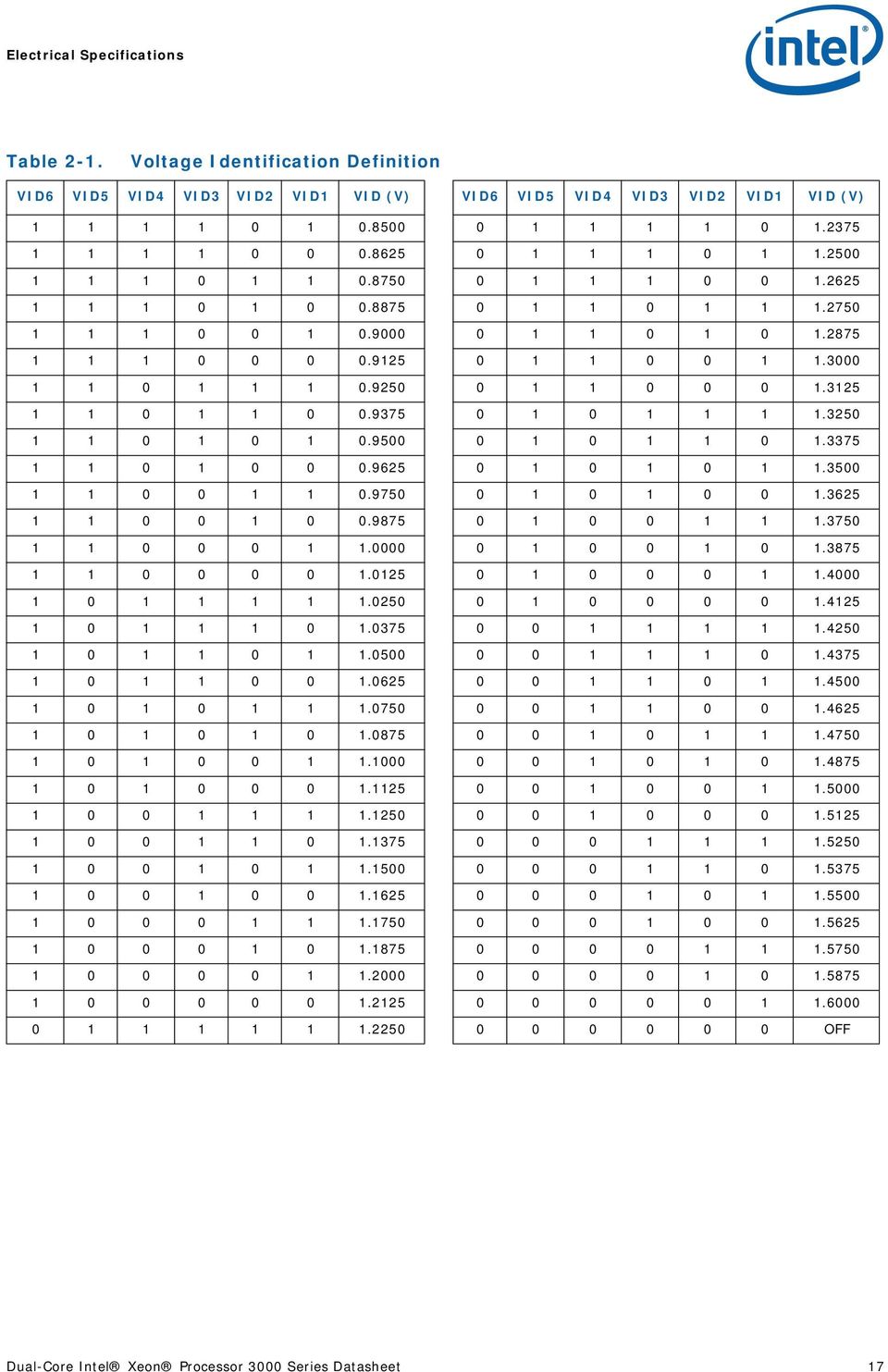
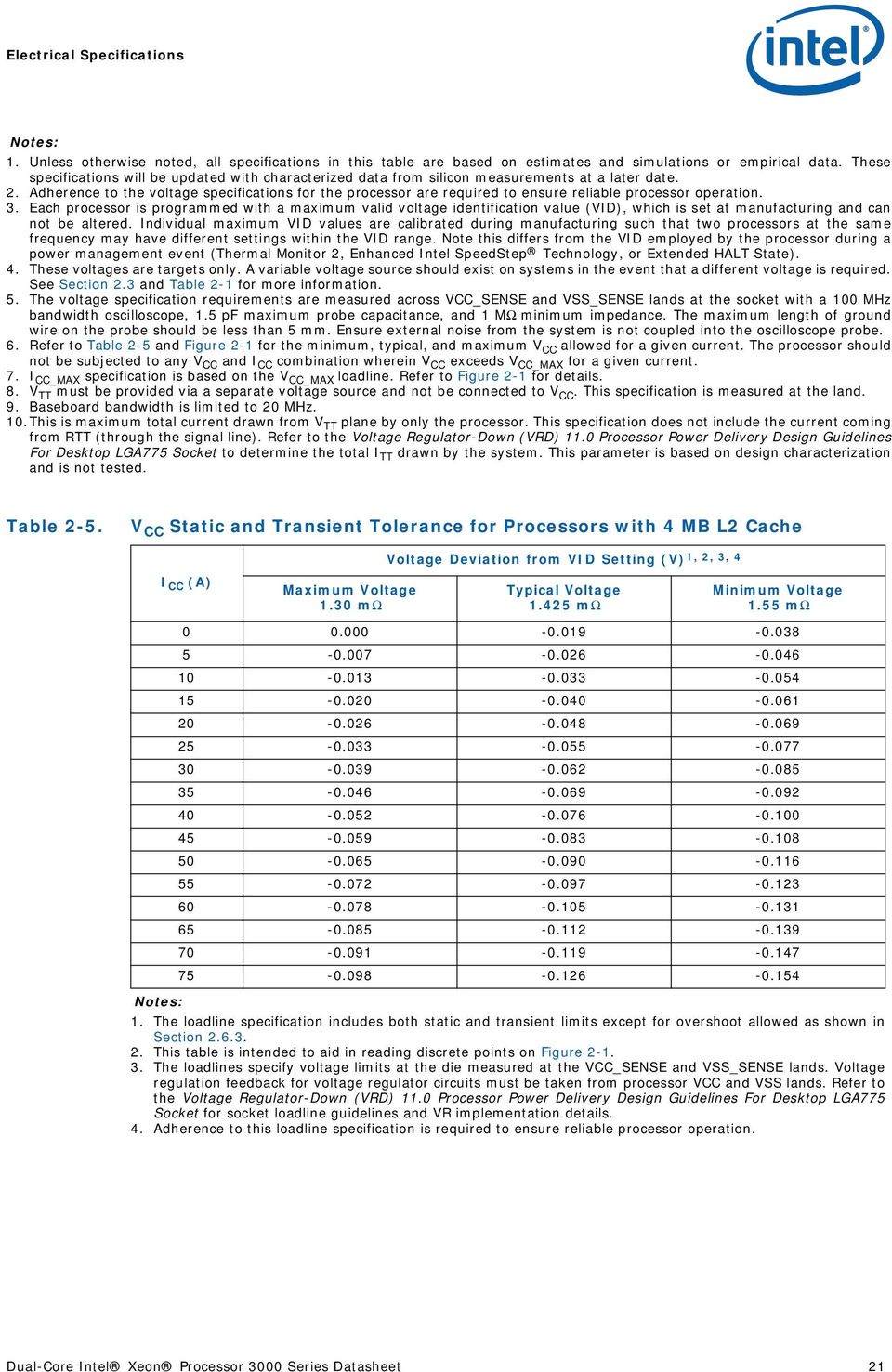
14 Electrical Specifications FSB Decoupling The processor integrates signal termination on the die. In addition, some of the high frequency capacitance required for the FSB is included on the processor package. However, additional high frequency capacitance must be added to the motherboard to properly decouple the return currents from the front side bus. Bulk decoupling must also be provided by the motherboard for proper [A]GTL+ bus operation. 2.3 Voltage Identification The Voltage Identification (VID) specification for the processor is defined by the Voltage Regulator-Down (VRD) 11.0 Processor Power Delivery Design Guidelines For Desktop LGA775 Socket. The voltage set by the VID signals is the reference VR output voltage to be delivered to the processor V CC pins (see Chapter for V CC overshoot specifications). Refer to Table 2-13 for the DC specifications for these signals. Voltages for each processor frequency is provided in Table 2-4. Individual processor VID values may be calibrated during manufacturing such that two devices at the same core speed may have different default VID settings. This is reflected by the VID Range values provided in Table 2-4. Refer to the Dual-Core Intel Xeon processor 3000 Series Specification Update for further details on specific valid core frequency and VID values of the processor. Note this differs from the VID employed by the processor during a power management event (Thermal Monitor 2, Enhanced Intel SpeedStep Technology, or Extended HALT State). The processor uses six voltage identification signals, VID[6:1], to support automatic selection of power supply voltages. Table 2-1 specifies the voltage level corresponding to the state of VID[6:1]. A 1 in this table refers to a high voltage level and a 0 refers to a low voltage level. If the processor socket is empty (VID[6:1] = ), or the voltage regulation circuit cannot supply the voltage that is requested, it must disable itself. The Voltage Regulator-Down (VRD) 11.0 Processor Power Delivery Design Guidelines For Desktop LGA775 Socket defines VID [7:0], VID7 and VID0 are not used on the processor; VID0 and VID7 are strapped to V SS on the processor package. VID0 and VID7 must be connected to the VR controller for compatibility with future processors. The processor provides the ability to operate while transitioning to an adjacent VID and its associated processor core voltage (V CC ). This will represent a DC shift in the load line. It should be noted that a low-to-high or high-to-low voltage state change may result in as many VID transitions as necessary to reach the target core voltage. Transitions above the specified VID are not permitted. Table 2-4 includes VID step sizes and DC shift ranges. Minimum and maximum voltages must be maintained as shown in Table 2-5 and Figure 2-1 as measured across the VCC_SENSE and VSS_SENSE lands. The VRM or VRD used must be capable of regulating its output to the value defined by the new VID. DC specifications for dynamic VID transitions are included in Table 2-4 and Table 2-5. Refer to the Voltage Regulator-Down (VRD) 11.0 Processor Power Delivery Design Guidelines For Desktop LGA775 Socket for further details. 16 Dual-Core Intel Xeon Processor 3000 Series Datasheet

15 Electrical Specifications Table 2-1. Voltage Identification Definition VID6 VID5 VID4 VID3 VID2 VID1 VID (V) VID6 VID5 VID4 VID3 VID2 VID1 VID (V) OFF Dual-Core Intel Xeon Processor 3000 Series Datasheet 17
16 Electrical Specifications 2.4 Market Segment Identification (MSID) The MSID[1:0] signals may be used as outputs to determine the Market Segment of the processor. Table 2-2 provides details regarding the state of MSID[1:0]. A circuit can be used to prevent 130 W TDP processors from booting on boards optimized for 65 W TDP. Table 2-2. Market Segment Selection Truth Table for MSID[1:0] 1, 2, 3, 4 MSID1 MSID0 Description 0 0 Dual-Core Intel Xeon processor 3000 series 0 1 Reserved 1 0 Reserved 1 1 Reserved Notes: 1. The MSID[1:0] signals are provided to indicate the Market Segment for the processor and may be used for future processor compatibility or for keying. Circuitry on the motherboard may use these signals to identify the processor installed. 2. These signals are not connected to the processor die. 3. A logic 0 is achieved by pulling the signal to ground on the package. 4. A logic 1 is achieved by leaving the signal as a no connect on the package. 2.5 Reserved, Unused, and TESTHI Signals All RESERVED lands must remain unconnected. Connection of these lands to V CC, V SS, V TT, or to any other signal (including each other) can result in component malfunction or incompatibility with future processors. See Chapter 4 for a land listing of the processor and the location of all RESERVED lands. In a system level design, on-die termination has been included by the processor to allow signals to be terminated within the processor silicon. Most unused GTL+ inputs should be left as no connects as GTL+ termination is provided on the processor silicon. However, see Table 2-8 for details on GTL+ signals that do not include on-die termination. Unused active high inputs, should be connected through a resistor to ground (V SS ). Unused outputs can be left unconnected, however this may interfere with some TAP functions, complicate debug probing, and prevent boundary scan testing. A resistor must be used when tying bidirectional signals to power or ground. When tying any signal to power or ground, a resistor will also allow for system testability. Resistor values should be within ± 20% of the impedance of the motherboard trace for front side bus signals. For unused GTL+ input or I/O signals, use pull-up resistors of the same value as the on-die termination resistors (R TT ). For details, see Table TAP and CMOS signals do not include on-die termination. Inputs and used outputs must be terminated on the motherboard. Unused outputs may be terminated on the motherboard or left unconnected. Note that leaving unused outputs unterminated may interfere with some TAP functions, complicate debug probing, and prevent boundary scan testing. All TESTHI[13:0] lands should be individually connected to V TT via a pull-up resistor that matches the nominal trace impedance. 18 Dual-Core Intel Xeon Processor 3000 Series Datasheet
![Market Segment Selection Truth Table for MSID[1:0] 1, 2, 3, 4 MSID1 MSID0 Description 0 0 Dual-Core Intel Xeon processor 3000 series 0 1 Reserved 1 0 Reserved 1 1 Reserved Notes: 1.](/docs-images/43/2602083/images/page_16.jpg "The MSID[1:0] signals are provided to indicate the Market Segment for the processor and may be used for future processor compatibility or for keying.")
17 Electrical Specifications The TESTHI signals may use individual pull-up resistors or be grouped together as detailed below. A matched resistor must be used for each group: TESTHI[1:0] TESTHI[7:2] TESTHI8/FC42 cannot be grouped with other TESTHI signals TESTHI9/FC43 cannot be grouped with other TESTHI signals TESTHI10 cannot be grouped with other TESTHI signals TESTHI11 cannot be grouped with other TESTHI signals TESTHI12/FC44 cannot be grouped with other TESTHI signals TESTHI13 cannot be grouped with other TESTHI signals However, utilization of boundary scan test will not be functional if these lands are connected together. For optimum noise margin, all pull-up resistor values used for TESTHI[13:0] lands should have a resistance value within ± 20% of the impedance of the board transmission line traces. For example, if the nominal trace impedance is 50 Ω, then a value between 40 Ω and 60 Ω should be used. 2.6 Voltage and Current Specification Absolute Maximum and Minimum Ratings Table 2-3 specifies absolute maximum and minimum ratings only and lie outside the functional limits of the processor. Within functional operation limits, functionality and long-term reliability can be expected. At conditions outside functional operation condition limits, but within absolute maximum and minimum ratings, neither functionality nor long-term reliability can be expected. If a device is returned to conditions within functional operation limits after having been subjected to conditions outside these limits, but within the absolute maximum and minimum ratings, the device may be functional, but with its lifetime degraded depending on exposure to conditions exceeding the functional operation condition limits. At conditions exceeding absolute maximum and minimum ratings, neither functionality nor long-term reliability can be expected. Moreover, if a device is subjected to these conditions for any length of time then, when returned to conditions within the functional operating condition limits, it will either not function, or its reliability will be severely degraded. Although the processor contains protective circuitry to resist damage from static electric discharge, precautions should always be taken to avoid high static voltages or electric fields. Dual-Core Intel Xeon Processor 3000 Series Datasheet 19

18 Electrical Specifications Table 2-3. Absolute Maximum and Minimum Ratings Symbol Parameter Min Max Unit Notes 1, 2 V CC Core voltage with respect to V SS V - V TT FSB termination voltage with respect to V - V SS T C Processor case temperature See Chapter 5 Notes: 1. For functional operation, all processor electrical, signal quality, mechanical and thermal specifications must be satisfied. 2. Excessive overshoot or undershoot on any signal will likely result in permanent damage to the processor. 3. Storage temperature is applicable to storage conditions only. In this scenario, the processor must not receive a clock, and no lands can be connected to a voltage bias. Storage within these limits will not affect the longterm reliability of the device. For functional operation, refer to the processor case temperature specifications. 4. This rating applies to the processor and does not include any tray or packaging. 5. Failure to adhere to this specification can affect the long term reliability of the processor DC Voltage and Current Specification See Chapter 5 C - T STORAGE Processor storage temperature C 3, 4, 5 Table 2-4. Voltage and Current Specifications Symbol Parameter Min Typ Max Unit Notes 1, 2 VID Range VID V 3 V CC Processor Number (4 MB L2 Cache) Processor Number (2 MB L2 Cache) V CC for 775_VR_CONFIG_ GHz 2.66 GHz 2.66 GHz 2.33 GHz 2.40 GHz V CC for 775_VR_CONFIG_ GHz 1.86 GHz Refer to Table 2-5 and Figure 2-1 Refer to Table 2-6 and Figure 2-2 V 4, 5, 6 V CC_BOOT Default V CC voltage for initial power up 1.10 V V CCPLL PLL V CC - 5% % I CC Processor Number I CC for A 7 775_VR_CONFIG_ GHz 2.66 GHz 2.66 GHz 2.33 GHz 2.40 GHz 2.13 GHz 1.86 GHz V TT VTT_OUT_LEFT and VTT_OUT_RIGHT I CC I TT FSB termination voltage (DC + AC specifications) DC Current that may be drawn from VTT_OUT_LEFT and VTT_OUT_RIGHT per pin I CC for V TT supply before V CC stable I CC for V TT supply after V CC stable V ma I CC_VCCPLL I CC for PLL land 130 ma I CC_GTLREF I CC for GTLREF 200 μa A Dual-Core Intel Xeon Processor 3000 Series Datasheet

19 Electrical Specifications Notes: 1. Unless otherwise noted, all specifications in this table are based on estimates and simulations or empirical data. These specifications will be updated with characterized data from silicon measurements at a later date. 2. Adherence to the voltage specifications for the processor are required to ensure reliable processor operation. 3. Each processor is programmed with a maximum valid voltage identification value (VID), which is set at manufacturing and can not be altered. Individual maximum VID values are calibrated during manufacturing such that two processors at the same frequency may have different settings within the VID range. Note this differs from the VID employed by the processor during a power management event (Thermal Monitor 2, Enhanced Intel SpeedStep Technology, or Extended HALT State). 4. These voltages are targets only. A variable voltage source should exist on systems in the event that a different voltage is required. See Section 2.3 and Table 2-1 for more information. 5. The voltage specification requirements are measured across VCC_SENSE and VSS_SENSE lands at the socket with a 100 MHz bandwidth oscilloscope, 1.5 pf maximum probe capacitance, and 1 MΩ minimum impedance. The maximum length of ground wire on the probe should be less than 5 mm. Ensure external noise from the system is not coupled into the oscilloscope probe. 6. Refer to Table 2-5 and Figure 2-1 for the minimum, typical, and maximum V CC allowed for a given current. The processor should not be subjected to any V CC and I CC combination wherein V CC exceeds V CC_MAX for a given current. 7. I CC_MAX specification is based on the V CC_MAX loadline. Refer to Figure 2-1 for details. 8. V TT must be provided via a separate voltage source and not be connected to V CC. This specification is measured at the land. 9. Baseboard bandwidth is limited to 20 MHz. 10.This is maximum total current drawn from V TT plane by only the processor. This specification does not include the current coming from RTT (through the signal line). Refer to the Voltage Regulator-Down (VRD) 11.0 Processor Power Delivery Design Guidelines For Desktop LGA775 Socket to determine the total I TT drawn by the system. This parameter is based on design characterization and is not tested. Table 2-5. V CC Static and Transient Tolerance for Processors with 4 MB L2 Cache I CC (A) Maximum Voltage 1.30 mω Voltage Deviation from VID Setting (V) 1, 2, 3, 4 Typical Voltage mω Minimum Voltage 1.55 mω Notes: 1. The loadline specification includes both static and transient limits except for overshoot allowed as shown in Section This table is intended to aid in reading discrete points on Figure The loadlines specify voltage limits at the die measured at the VCC_SENSE and VSS_SENSE lands. Voltage regulation feedback for voltage regulator circuits must be taken from processor VCC and VSS lands. Refer to the Voltage Regulator-Down (VRD) 11.0 Processor Power Delivery Design Guidelines For Desktop LGA775 Socket for socket loadline guidelines and VR implementation details. 4. Adherence to this loadline specification is required to ensure reliable processor operation. Dual-Core Intel Xeon Processor 3000 Series Datasheet 21
20 Electrical Specifications Figure 2-1. V CC Static and Transient Tolerance for Processors with 4 MB L2 Cache VID Icc [A] VID VID Vcc Maximum VID VID VID Vcc [V] VID VID Vcc Typical VID VID Vcc Minimum VID VID VID VID Notes: 1. The loadline specification includes both static and transient limits except for overshoot allowed as shown in Section This loadline specification shows the deviation from the VID set point. 3. The loadlines specify voltage limits at the die measured at the VCC_SENSE and VSS_SENSE lands. Voltage regulation feedback for voltage regulator circuits must be taken from processor VCC and VSS lands. Refer to the Voltage Regulator-Down (VRD) 11.0 Processor Power Delivery Design Guidelines For Desktop LGA775 Socket for socket loadline guidelines and VR implementation details. Table 2-6. V CC Static and Transient Tolerance for Processors with 2 MB L2 Cache (Sheet 1 of 2) I CC (A) Maximum Voltage 1.40 mω Voltage Deviation from VID Setting (V) 1, 2, 3, 4 Typical Voltage 1.53 mω Minimum Voltage 1.65 mω Dual-Core Intel Xeon Processor 3000 Series Datasheet

21 Electrical Specifications Table 2-6. V CC Static and Transient Tolerance for Processors with 2 MB L2 Cache (Sheet 2 of 2) I CC (A) Maximum Voltage 1.40 mω Voltage Deviation from VID Setting (V) 1, 2, 3, 4 Typical Voltage 1.53 mω Minimum Voltage 1.65 mω Notes: 1. The loadline specification includes both static and transient limits except for overshoot allowed as shown in Section This table is intended to aid in reading discrete points on Figure The loadlines specify voltage limits at the die measured at the VCC_SENSE and VSS_SENSE lands. Voltage regulation feedback for voltage regulator circuits must be taken from processor VCC and VSS lands. Refer to the Voltage Regulator-Down (VRD) 11.0 Processor Power Delivery Design Guidelines For Desktop LGA775 Socket for socket loadline guidelines and VR implementation details. 4. Adherence to this loadline specification is required to ensure reliable processor operation. Figure 2-2. V CC Static and Transient Tolerance for Processors with 2 MB L2 Cache Icc [A] VID VID VID VID Vcc Maximum VID VID Vcc [V] VID VID VID Vcc Typical VID Vcc Minimum VID VID VID VID VID Notes: 1. The loadline specification includes both static and transient limits except for overshoot allowed as shown in Section This loadline specification shows the deviation from the VID set point. 3. The loadlines specify voltage limits at the die measured at the VCC_SENSE and VSS_SENSE lands. Voltage regulation feedback for voltage regulator circuits must be taken from processor VCC and VSS lands. Refer to the Voltage Regulator-Down (VRD) 11.0 Processor Power Delivery Design Guidelines For Desktop LGA775 Socket for socket loadline guidelines and VR implementation details. Dual-Core Intel Xeon Processor 3000 Series Datasheet 23
22 Electrical Specifications V CC Overshoot The processor can tolerate short transient overshoot events where V CC exceeds the VID voltage when transitioning from a high to low current load condition. This overshoot cannot exceed VID + V OS_MAX (V OS_MAX is the maximum allowable overshoot voltage). The time duration of the overshoot event must not exceed T OS_MAX (T OS_MAX is the maximum allowable time duration above VID). These specifications apply to the processor die voltage as measured across the VCC_SENSE and VSS_SENSE lands. Table 2-7. V CC Overshoot Specifications Symbol Parameter Min Max Unit Figure Notes V OS_MAX Magnitude of V CC overshoot above VID 50 mv T OS_MAX Time duration of V CC overshoot above VID 25 μs Notes: 1. Adherence to these specifications is required to ensure reliable processor operation. Figure 2-3. V CC Overshoot Example Waveform Example Overshoot Waveform VID V OS Voltage [V] VID T OS Time [us] T OS : Overshoot time above VID V OS : Overshoot above VID Notes: 1. V OS is measured overshoot voltage. 2. T OS is measured time duration above VID Die Voltage Validation Overshoot events on processor must meet the specifications in Table 2-7 when measured across the VCC_SENSE and VSS_SENSE lands. Overshoot events that are < 10 ns in duration may be ignored. These measurements of processor die level overshoot must be taken with a bandwidth limited oscilloscope set to a greater than or equal to 100 MHz bandwidth limit. 24 Dual-Core Intel Xeon Processor 3000 Series Datasheet
23 Electrical Specifications 2.7 Signaling Specifications Most processor Front Side Bus signals use Gunning Transceiver Logic (GTL+) signaling technology. This technology provides improved noise margins and reduced ringing through low voltage swings and controlled edge rates. Platforms implement a termination voltage level for GTL+ signals defined as V TT. Because platforms implement separate power planes for each processor (and chipset), separate V CC and V TT supplies are necessary. This configuration allows for improved noise tolerance as processor frequency increases. Speed enhancements to data and address busses have caused signal integrity considerations and platform design methods to become even more critical than with previous processor families. The GTL+ inputs require a reference voltage (GTLREF) which is used by the receivers to determine if a signal is a logical 0 or a logical 1. GTLREF must be generated on the motherboard (see Table 2-15 for GTLREF specifications). Termination resistors (R TT ) for GTL+ signals are provided on the processor silicon and are terminated to V TT. Intel chipsets will also provide on-die termination, thus eliminating the need to terminate the bus on the motherboard for most GTL+ signals FSB Signal Groups The front side bus signals have been combined into groups by buffer type. GTL+ input signals have differential input buffers, which use GTLREF[1:0] as a reference level. In this document, the term GTL+ Input refers to the GTL+ input group as well as the GTL+ I/O group when receiving. Similarly, GTL+ Output refers to the GTL+ output group as well as the GTL+ I/O group when driving. With the implementation of a source synchronous data bus comes the need to specify two sets of timing parameters. One set is for common clock signals which are dependent upon the rising edge of BCLK0 (ADS#, HIT#, HITM#, etc.) and the second set is for the source synchronous signals which are relative to their respective strobe lines (data and address) as well as the rising edge of BCLK0. Asychronous signals are still present (A20M#, IGNNE#, etc.) and can become active at any time during the clock cycle. Table 2-8 identifies which signals are common clock, source synchronous, and asynchronous. Table 2-8. FSB Signal Groups (Sheet 1 of 2) Signal Group Type Signals 1 GTL+ Common Clock Input GTL+ Common Clock I/O GTL+ Source Synchronous I/O Synchronous to BCLK[1:0] Synchronous to BCLK[1:0] Synchronous to assoc. strobe BPRI#, DEFER#, RESET#, RS[2:0]#, TRDY# ADS#, BNR#, BPM[5:0]#, BR0#, DBSY#, DRDY#, HIT#, HITM#, LOCK# Signals Associated Strobe REQ[4:0]#, A[16:3]# 3 A[35:17]# 3 D[15:0]#, DBI0# D[31:16]#, DBI1# D[47:32]#, DBI2# D[63:48]#, DBI3# ADSTB0# ADSTB1# DSTBP0#, DSTBN0# DSTBP1#, DSTBN1# DSTBP2#, DSTBN2# DSTBP3#, DSTBN3# Dual-Core Intel Xeon Processor 3000 Series Datasheet 25
24 Electrical Specifications Table 2-8. FSB Signal Groups (Sheet 2 of 2) Signal Group Type Signals 1 GTL+ Strobes CMOS Open Drain Output Open Drain Input/Output Synchronous to BCLK[1:0] ADSTB[1:0]#, DSTBP[3:0]#, DSTBN[3:0]# A20M#, IGNNE#, INIT#, LINT0/INTR, LINT1/NMI, SMI#, STPCLK#, PWRGOOD, TCK, TDI, TMS, TRST#, BSEL[2:0], VID[6:1] FERR#/PBE#, IERR#, THERMTRIP#, TDO PROCHOT# 4 FSB Clock Clock BCLK[1:0], ITP_CLK[1:0] 2 Power/Other VCC, VTT, VCCA, VCCIOPLL, VCCPLL, VSS, VSSA, GTLREF[1:0], COMP[8,3:0], RESERVED, TESTHI[13:0], VCC_SENSE, VCC_MB_REGULATION, VSS_SENSE, VSS_MB_REGULATION, DBR# 2, VTT_OUT_LEFT, VTT_OUT_RIGHT, VTT_SEL, FCx, PECI, MSID[1:0]. Table 2-9. Notes: 1. Refer to Section 4.2 for signal descriptions. 2. In processor systems where no debug port is implemented on the system board, these signals are used to support a debug port interposer. In systems with the debug port implemented on the system board, these signals are no connects. 3. The value of these signals during the active-to-inactive edge of RESET# defines the processor configuration options. See Section 6.1 for details. 4. PROCHOT# signal type is open drain output and CMOS input. Signal Characteristics Signals with R TT A[35:3]#, ADS#, ADSTB[1:0]#, BNR#, BPRI#, D[63:0]#, DBI[3:0]#, DBSY#, DEFER#, DRDY#, DSTBN[3:0]#, DSTBP[3:0]#, HIT#, HITM#, LOCK#, PROCHOT#, REQ[4:0]#, RS[2:0]#, TRDY# Signals with No R TT A20M#, BCLK[1:0], BSEL[2:0], COMP[8,3:0], IGNNE#, INIT#, ITP_CLK[1:0], LINT0/INTR, LINT1/NMI, MSID[1:0] PWRGOOD, RESET#, SMI#, STPCLK#, TESTHI[13:0], VID[6:1], GTLREF[1:0], TCK, TDI, TMS, TRST#, VTT_SEL Open Drain Signals 1 THERMTRIP#, FERR#/PBE#, IERR#, BPM[5:0]#, BR0#, TDO, FCx Notes: 1. Signals that do not have R TT, nor are actively driven to their high-voltage level. Table Signal Reference Voltages GTLREF V TT /2 BPM[5:0]#, RESET#, BNR#, HIT#, HITM#, BR0#, A[35:0]#, ADS#, ADSTB[1:0]#, BPRI#, D[63:0]#, DBI[3:0]#, DBSY#, DEFER#, DRDY#, DSTBN[3:0]#, DSTBP[3:0]#, LOCK#, REQ[4:0]#, RS[2:0]#, TRDY# A20M#, LINT0/INTR, LINT1/NMI, IGNNE#, INIT#, PROCHOT#, PWRGOOD 1, SMI#, STPCLK#, TCK 1, TDI 1, TMS 1, TRST# 1 Notes: 1. These signals also have hysteresis added to the reference voltage. See Table 2-12 for more information. 26 Dual-Core Intel Xeon Processor 3000 Series Datasheet
25 Electrical Specifications CMOS and Open Drain Signals Legacy input signals such as A20M#, IGNNE#, INIT#, SMI#, and STPCLK# use CMOS input buffers. All of the CMOS and Open Drain signals are required to be asserted/deasserted for at least four BCLKs in order for the processor to recognize the proper signal state. See Section for the DC. See Section 6.2 for additional timing requirements for entering and leaving the low power states Processor DC Specifications The processor DC specifications in this section are defined at the processor core (pads) unless otherwise stated. All specifications apply to all frequencies and cache sizes unless otherwise stated. Table GTL+ Signal Group DC Specifications Symbol Parameter Min Max Unit Notes 1 V IL Input Low Voltage GTLREF 0.10 V 2, 3 V IH Input High Voltage GTLREF V TT V 4, 5, 3 V OH Output High Voltage V TT 0.10 V TT V 5, 3 I OL Output Low Current N/A V TT_MAX /[(R TT_MIN )+(2*R ON_ MIN)] A - I LI Input Leakage Current N/A ± 100 µa 6 I LO Output Leakage Current N/A ± 100 µa 7 R ON Buffer On Resistance Ω Notes: 1. Unless otherwise noted, all specifications in this table apply to all processor frequencies. 2. V IL is defined as the voltage range at a receiving agent that will be interpreted as a logical low value. 3. The V TT referred to in these specifications is the instantaneous V TT. 4. V IH is defined as the voltage range at a receiving agent that will be interpreted as a logical high value. 5. V IH and V OH may experience excursions above V TT. 6. Leakage to V SS with land held at V TT. 7. Leakage to V TT with land held at 300 mv.. Table Open Drain and TAP Output Signal Group DC Specifications Symbol Parameter Min Max Unit Notes 1 V OL Output Low Voltage V - V OH Output High Voltage V TT 0.05 V TT V 2 I OL Output Low Current ma 3 I LO Output Leakage Current N/A ± 200 µa 4 Notes: 1. Unless otherwise noted, all specifications in this table apply to all processor frequencies. 2. V OH is determined by the value of the external pull-up resister to V TT. Refer to theappropriate platform design guide for details. 3. Measured at V TT * For Vin between 0 and V OH. Dual-Core Intel Xeon Processor 3000 Series Datasheet 27
26 Electrical Specifications Table CMOS Signal Group DC Specifications Symbol Parameter Min Max Unit Notes 1 V IL Input Low Voltage V TT * 0.30 V 2, 3 V IH Input High Voltage V TT * 0.70 V TT V 3, 4, 5 V OL Output Low Voltage V TT * 0.10 V 3 V OH Output High Voltage 0.90 * V TT V TT V 3, 6, 5 I OL Output Low Current ma 3, 7 I OH Output High Current ma 3, 7 I LI Input Leakage Current N/A ± 100 µa 8 I LO Output Leakage Current N/A ± 100 µa 9 Notes: 1. Unless otherwise noted, all specifications in this table apply to all processor frequencies. 2. V IL is defined as the voltage range at a receiving agent that will be interpreted as a logical low value. 3. The V TT referred to in these specifications refers to instantaneous V TT. 4. V IH is defined as the voltage range at a receiving agent that will be interpreted as a logical high value. 5. V IH and V OH may experience excursions above V TT. 6. All outputs are open drain. 7. I OL is measured at 0.10 * V TT. I OH is measured at 0.90 * V TT. 8. Leakage to V SS with land held at V TT. 9. Leakage to V TT with land held at 300 mv. Table PECI DC Electrical Limits Symbol Definition and Conditions Min Max Units Notes V in Input Voltage Range V TT V V hysteresis Hysteresis 0.1 * V TT V 3 V n Negative-edge threshold voltage * V TT * V TT V V p Positive-edge threshold voltage * V TT * V TT V I source High level output source (V OH = 0.75 * V TT) -6.0 N/A ma I sink Low level output sink (V OL = 0.25 * V TT ) ma I leak+ High impedance state leakage to V TT N/A 50 µa 2 I leak- High impedance leakage to GND N/A 10 µa 2 C bus Bus capacitance 10 pf V noise Signal noise immunity above 300 MHz 0.1 * V TT V p-p Note: 1. V TT supplies the PECI interface. PECI behavior does not affect V TT min/max specifications. 2. The leakage specification applies to powered devices on the PECI bus. 3. The input buffers use a Schmitt-triggered input design for improved noise immunity. 28 Dual-Core Intel Xeon Processor 3000 Series Datasheet
27 Electrical Specifications GTL+ Front Side Bus Specifications In most cases, termination resistors are not required as these are integrated into the processor silicon. See Table 2-9 for details on which GTL+ signals do not include on-die termination. Valid high and low levels are determined by the input buffers by comparing with a reference voltage called GTLREF. Table 2-15 lists the GTLREF specifications. The GTL+ reference voltage (GTLREF) should be generated on the system board using high precision voltage divider circuits. Table GTL+ Bus Voltage Definitions Symbol Parameter Min Typ Max Units Notes 1 GTLREF_PU GTLREF_PD GTLREF_PU GTLREF_PD GTLREF pull up resistor on Mukilteo-2 (3000/3010) chipset family boards GTLREF pull down resistor on Mukilteo-2 (3000/3010) chipset family boards GTLREF pull up resistor on Bearlake chipset family boards GTLREF pull down resistor on Bearlake chipset family boards 124 * * 1.01 Ω * * 1.01 Ω * * 1.01 Ω * * 1.01 Ω 2 R TT Termination Resistance Ω 3 COMP[3:0] COMP Resistance Ω 4 COMP8 COMP Resistance Ω 4 Notes: 1. Unless otherwise noted, all specifications in this table apply to all processor frequencies. 2. GTLREF is to be generated from V TT by a voltage divider of 1% resistors (one divider for each GTLEREF land). Refer to the applicable platform design guide for implementation details. 3. R TT is the on-die termination resistance measured at V TT /3 of the GTL+ output driver. Refer to the appropriate platform design guide for the board impedance. Refer to processor I/O buffer models for I/V characteristics. 4. COMP resistance must be provided on the system board with 1% resistors. See the applicable platform design guide for implementation details. COMP[3:0] and COMP8 resistors are to V SS Clock Specifications Front Side Bus Clock (BCLK[1:0]) and Processor Clocking BCLK[1:0] directly controls the FSB interface speed as well as the core frequency of the processor. As in previous generation processors, the processor s core frequency is a multiple of the BCLK[1:0] frequency. The processor bus ratio multiplier will be set at its default ratio during manufacturing. Refer to Table 2-16 for the processor supported ratios. The processor uses a differential clocking implementation. For more information on the processor clocking, contact your Intel Field representative. Platforms using a CK505 Clock Synthesizer/Driver should comply with the specifications in Section Platforms using a CK410 Clock Synthesizer/Driver should comply with the specifications in Section Dual-Core Intel Xeon Processor 3000 Series Datasheet 29
28 Electrical Specifications Table Core Frequency to FSB Multiplier Configuration Multiplication of System Core Frequency to FSB Frequency Core Frequency (266 MHz BCLK/1066 MHz FSB) Core Frequency (333 MHz BCLK/1333 MHz FSB) Notes 1, 2 1/ GHz 2.00 GHz - 1/ GHz 2.33 GHz - 1/ GHz 2.66 GHz - 1/ GHz 3.00 GHz - 1/ GHz na - 1/ GHz na - Notes: 1. Individual processors operate only at or below the rated frequency. 2. Listed frequencies are not necessarily committed production frequencies FSB Frequency Select Signals (BSEL[2:0]) The BSEL[2:0] signals are used to select the frequency of the processor input clock (BCLK[1:0]). Table 2-17 defines the possible combinations of the signals and the frequency associated with each combination. The required frequency is determined by the processor, chipset, and clock synthesizer. All agents must operate at the same frequency. The Dual-Core Intel Xeon processor 3000 series operates at a 1066 MHz FSB frequency (selected by a 266 MHz BCLK[1:0] frequency). Table BSEL[2:0] Frequency Table for BCLK[1:0] BSEL2 BSEL1 BSEL0 FSB Frequency L L L 266 MHz L L H RESERVED L H H RESERVED L H L RESERVED H H L RESERVED H H H RESERVED H L H RESERVED H L L 333 MHz Phase Lock Loop (PLL) and Filter An on-die PLL filter solution will be implemented on the processor. The VCCPLL input is used for the PLL. Refer to Table 2-4 for DC specifications. 30 Dual-Core Intel Xeon Processor 3000 Series Datasheet
29 Electrical Specifications BCLK[1:0] Specifications (CK505 based Platforms) Table Front Side Bus Differential BCLK Specifications Symbol Parameter Min Typ Max Unit Figure Notes 1 V L Input Low Voltage N/A N/A V V H Input High Voltage N/A N/A 1.15 V V CROSS(abs) Absolute Crossing Point N/A V 2-4, 2-5 3, 4, 5 ΔV CROSS Range of Crossing Points N/A N/A V 2-4, V OS Overshoot N/A N/A 1.4 V V US Undershoot N/A N/A V V SWING Differential Output Swing N/A N/A V I LI Input Leakage Current -5 N/A 5 μa Cpad Pad Capacitance pf 8 Notes: 1. Unless otherwise noted, all specifications in this table apply to all processor frequencies. 2. "Steady state" voltage, not including overshoot or undershoot. 3. Crossing voltage is defined as the instantaneous voltage value when the rising edge of BCLK0 equals the falling edge of BCLK1. 4. V Havg is the statistical average of the V H measured by the oscilloscope. 5. The crossing point must meet the absolute and relative crossing point specifications simultaneously. 6. Overshoot is defined as the absolute value of the maximum voltage. Undershoot is defined as the absolute value of the minimum voltage. 7. Measurement taken from differential waveform. 8. Cpad includes die capacitance only. No package parasitics are included. Figure 2-4. Differential Clock Waveform CLK 0 V CROSS Median + 75 mv V CROSS median V CROSS Median - 75 mv CLK 1 High Time V CROSS Max 550 mv V CROSS Min 300 mv Low Time V CROSS median Period Dual-Core Intel Xeon Processor 3000 Series Datasheet 31
30 Electrical Specifications Figure 2-5. Differential Clock Crosspoint Specification Crossing Point (mv) (VHavg - 700) 300 mv (VHavg - 700) 550 mv VHavg (mv) Figure 2-6. Differential Measurements Slew_rise Slew _fall +150 mv +150mV 0.0V V_swing 0.0V -150 mv -150mV Diff BCLK[1:0] Specifications (CK410 based Platforms) Table Front Side Bus Differential BCLK Specifications Symbol Parameter Min Typ Max Unit Figure Notes 1 V L Input Low Voltage N/A V V H Input High Voltage V V CROSS(abs) Absolute Crossing Point N/A V 2-4, 2-5 2, 3 V CROSS(rel) Relative Crossing Point (V Havg 0.700) ΔV CROSS Range of Crossing Points N/A (V Havg 0.700) V 2-4, 2-5 4, 3, 5 N/A N/A V 2-4, V OS Overshoot N/A N/A V H V V US Undershoot N/A N/A V V RBM Ringback Margin N/A N/A V V TM Threshold Region V CROSS N/A V CROSS V Dual-Core Intel Xeon Processor 3000 Series Datasheet
31 Electrical Specifications Notes: 1. Unless otherwise noted, all specifications in this table apply to all processor frequencies. 2. Crossing voltage is defined as the instantaneous voltage value when the rising edge of BCLK0 equals the falling edge of BCLK1. 3. The crossing point must meet the absolute and relative crossing point specifications simultaneously. 4. V Havg is the statistical average of the V H measured by the oscilloscope. 5. V Havg can be measured directly using Vtop on Agilent* oscilloscopes and High on Tektronix* oscilloscopes. 6. Overshoot is defined as the absolute value of the maximum voltage. 7. Undershoot is defined as the absolute value of the minimum voltage. 8. Ringback Margin is defined as the absolute voltage difference between the maximum Rising Edge Ringback and the maximum Falling Edge Ringback. 9. Threshold Region is defined as a region entered around the crossing point voltage in which the differential receiver switches. It includes input threshold hysteresis. Figure 2-7. Differential Clock Crosspoint Specification Crossing Point (mv) (VHavg - 700) 250 mv (VHavg - 700) 550 mv VHavg (mv) 2.8 PECI DC Specifications PECI is an Intel proprietary one-wire interface that provides a communication channel between Intel processors (may also include chipset components in the future) and external thermal monitoring devices. The processor contains Digital Thermal Sensors (DTS) distributed throughout die. These sensors are implemented as analog-to-digital converters calibrated at the factory for reasonable accuracy to provide a digital representation of relative processor temperature. PECI provides an interface to relay the highest DTS temperature within a die to external management devices for thermal/fan speed control. More detailed information is available in the Platform Environment Control Interface (PECI) Specification. Table 20. PECI DC Electrical Limits Symbol Definition and Conditions Min Max Units Notes 1 V in Input Voltage Range V TT V V hysteresis Hysteresis 0.1 * V TT V 2 V n Negative-edge threshold voltage * V TT * V TT V V p Positive-edge threshold voltage * V TT * V TT V I source High level output source (V OH = 0.75 * V TT) -6.0 N/A ma I sink Low level output sink (V OL = 0.25 * V TT ) ma I leak+ High impedance state leakage to V TT N/A 50 µa 3 Dual-Core Intel Xeon Processor 3000 Series Datasheet 33
32 Electrical Specifications Table 20. PECI DC Electrical Limits Symbol Definition and Conditions Min Max Units Notes 1 I leak- High impedance leakage to GND N/A 10 µa 3 C bus Bus capacitance per node N/A 10 pf 4 V noise Signal noise immunity above 300 MHz 0.1 * V TT V p-p Notes: 1. V TT supplies the PECI interface. PECI behavior does not affect V TT min/max specifications. Refer to Table 2-3 for V TT specifications. 2. The input buffers use a Schmitt-triggered input design for improved noise immunity. 3. The leakage specification applies to powered devices on the PECI bus. 4. One node is counted for each client and one node for the system host. Extended trace lengths might appear as additional nodes. 34 Dual-Core Intel Xeon Processor 3000 Series Datasheet
33 Package Mechanical Specifications 3 Package Mechanical Specifications The processor is packaged in a Flip-Chip Land Grid Array (FC-LGA6) package that interfaces with the motherboard via an LGA775 socket. The package consists of a processor core mounted on a substrate land-carrier. An integrated heat spreader (IHS) is attached to the package substrate and core and serves as the mating surface for processor component thermal solutions, such as a heatsink. Figure 3-1 shows a sketch of the processor package components and how they are assembled together. Refer to the LGA775 Socket Mechanical Design Guide for complete details on the LGA775 socket. The package components shown in Figure 3-1 include the following: Integrated Heat Spreader (IHS) Thermal Interface Material (TIM) Processor core (die) Package substrate Capacitors Figure 3-1. Processor Package Assembly Sketch Substrate IHS Core (die) TIM Capacitors System Board LGA775 Socket Note: 1. Socket and System Board are included for reference and are not part of processor package. Dual-Core Intel Xeon Processor 3000 Series Datasheet 35
34 Package Mechanical Specifications 3.1 Package Mechanical Drawing The package mechanical drawings are shown in Figure 3-2 and Figure 3-3. The drawings include dimensions necessary to design a thermal solution for the processor. These dimensions include: Package reference with tolerances (total height, length, width, etc.) IHS parallelism and tilt Land dimensions Top-side and back-side component keep-out dimensions Reference datums All drawing dimensions are in mm [in]. Guidelines on potential IHS flatness variation with socket load plate actuation and installation of the cooling solution is available in the processor Thermal/Mechanical Design Guidelines. 36 Dual-Core Intel Xeon Processor 3000 Series Datasheet
35 Package Mechanical Specifications Figure 3-2. Processor Package Drawing Sheet 1 of 3 Dual-Core Intel Xeon Processor 3000 Series Datasheet 37
36 Package Mechanical Specifications Figure 3-3. Processor Package Drawing Sheet 2 of 3 38 Dual-Core Intel Xeon Processor 3000 Series Datasheet
37 Package Mechanical Specifications Figure 3-4. Processor Package Drawing Sheet 3 of 3 Dual-Core Intel Xeon Processor 3000 Series Datasheet 39
38 Package Mechanical Specifications Processor Component Keep-Out Zones The processor may contain components on the substrate that define component keepout zone requirements. A thermal and mechanical solution design must not intrude into the required keep-out zones. Decoupling capacitors are typically mounted to either the topside or land-side of the package substrate. See Figure 3-2 and Figure 3-3 for keepout zones. The location and quantity of package capacitors may change due to manufacturing efficiencies but will remain within the component keep-in Package Loading Specifications. Table 3-1 provides dynamic and static load specifications for the processor package. These mechanical maximum load limits should not be exceeded during heatsink assembly, shipping conditions, or standard use condition. Also, any mechanical system or component testing should not exceed the maximum limits. The processor package substrate should not be used as a mechanical reference or load-bearing surface for thermal and mechanical solution. The minimum loading specification must be maintained by any thermal and mechanical solutions. Table 3-1. Processor Loading Specifications Parameter Minimum Maximum Notes Static 80 N [17 lbf] 311 N [70 lbf] 1, 2, 3 Dynamic 756 N [170 lbf] 1, 3, 4 Notes: 1. These specifications apply to uniform compressive loading in a direction normal to the processor IHS. 2. This is the maximum force that can be applied by a heatsink retention clip. The clip must also provide the minimum specified load on the processor package. 3. These specifications are based on limited testing for design characterization. Loading limits are for the package only and do not include the limits of the processor socket. 4. Dynamic loading is defined as an 11 ms duration average load superimposed on the static load requirement Package Handling Guidelines Table 3-2 includes a list of guidelines on package handling in terms of recommended maximum loading on the processor IHS relative to a fixed substrate. These package handling loads may be experienced during heatsink removal. Table 3-2. Package Handling Guidelines Parameter Maximum Recommended Notes Shear 311 N [70 lbf] 1, 2 Tensile 111 N [25 lbf] 2, 3 Torque 3.95 N-m [35 lbf-in] 2, 4 Notes: 1. A shear load is defined as a load applied to the IHS in a direction parallel to the IHS top surface. 2. These guidelines are based on limited testing for design characterization. 3. A tensile load is defined as a pulling load applied to the IHS in a direction normal to the IHS surface. 4. A torque load is defined as a twisting load applied to the IHS in an axis of rotation normal to the IHS top surface Package Insertion Specifications The processor can be inserted into and removed from a LGA775 socket 15 times. The socket should meet the LGA775 requirements detailed in the LGA775 Socket Mechanical Design Guide. 40 Dual-Core Intel Xeon Processor 3000 Series Datasheet
39 Package Mechanical Specifications Processor Mass Specification The typical mass of the processor is 21.5 g [0.76 oz]. This mass [weight] includes all the components that are included in the package Processor Materials Table 3-3 lists some of the package components and associated materials. Table 3-3. Processor Materials Component Integrated Heat Spreader (IHS) Substrate Substrate Lands Material Nickel Plated Copper Fiber Reinforced Resin Gold Plated Copper 3.2 Processor Markings Figure 3-5, Figure 3-6 and Figure 3-7 how the topside markings on the processors. These diagrams aid in the identification of the processor. Figure 3-5. Processor Top-Side Markings Example for the Dual-Core Intel Xeon Processor 3000 Series with 2MB L2 Cache with 1066 MHz FSB 2.13GHZ/2M/1066/06 INTEL XEON 3050 SLxxx [COO] i M '05 [FPO] e4 ATPO S/N Dual-Core Intel Xeon Processor 3000 Series Datasheet 41
40 Package Mechanical Specifications Figure 3-6. Processor Top-Side Markings Example for the Dual-Core Intel Xeon Processor 3000 Series with 4 MB L2 Cache with 1066 MHz FSB 2.40GHZ/4M/1066/06 INTEL XEON 3060 SLxxx [COO] i M '05 [FPO] e4 ATPO S/N Figure 3-7. Processor Top-Side Markings Example for the Dual-Core Intel Xeon Processor 3000 Series with 4 MB L2 Cache with 1333 MHz FSB INTEL M ' INTEL XEON SLxxx [COO] 2.33GHZ/4M/1333/06 [FPO] e4 ATPO S/N 42 Dual-Core Intel Xeon Processor 3000 Series Datasheet
41 Package Mechanical Specifications Processor Land Coordinates Figure 3-8 shows the top view of the processor land coordinates. The coordinates are referred to throughout the document to identify processor lands.. Figure 3-8. Processor Land Coordinates and Quadrants (Top View) V CC / V SS AN AM AL AK AJ AH AG AF AE AD AC AB AA Y W V U T R P N M L K J H G F E D C B A Preliminary Socket 775 Quadrants Top View AN AM AL AK AJ AH AG AF AE AD AC AB AA Y W V U T R P N M L K J H G F E D C B A Address/ Common Clock/ Async V TT / Clocks Data Dual-Core Intel Xeon Processor 3000 Series Datasheet 43
42 Package Mechanical Specifications 44 Dual-Core Intel Xeon Processor 3000 Series Datasheet
43 Land Listing and Signal Descriptions 4 Land Listing and Signal Descriptions This chapter provides the processor land assignment and signal descriptions. 4.1 Processor Land Assignments This section contains the land listings for the processor. The land-out footprint is shown in Figure 4-1 and Figure 4-2. These figures represent the land-out arranged by land number and they show the physical location of each signal on the package land array (top view). Table 4-1 provides a listing of all processor lands ordered alphabetically by land (signal) name. Table 4-2 provides a listing of all processor lands ordered by land number. Dual-Core Intel Xeon Processor 3000 Series Datasheet 45
44 Land Listing and Signal Descriptions Figure 4-1. land-out Diagram (Top View Left Side) AN VCC VCC VSS VSS VCC VCC VSS VSS VCC VCC VSS VCC VCC VSS VSS VCC AM VCC VCC VSS VSS VCC VCC VSS VSS VCC VCC VSS VCC VCC VSS VSS VCC AL VCC VCC VSS VSS VCC VCC VSS VSS VCC VCC VSS VCC VCC VSS VSS VCC AK VSS VSS VSS VSS VCC VCC VSS VSS VCC VCC VSS VCC VCC VSS VSS VCC AJ VSS VSS VSS VSS VCC VCC VSS VSS VCC VCC VSS VCC VCC VSS VSS VCC AH VCC VCC VCC VCC VCC VCC VSS VSS VCC VCC VSS VCC VCC VSS VSS VCC AG VCC VCC VCC VCC VCC VCC VSS VSS VCC VCC VSS VCC VCC VSS VSS VCC AF VSS VSS VSS VSS VSS VSS VSS VSS VCC VCC VSS VCC VCC VSS VSS VCC AE VSS VSS VSS VSS VSS VSS VSS VCC VCC VCC VSS VCC VCC VSS VSS VCC AD VCC VCC VCC VCC VCC VCC VCC VCC AC VCC VCC VCC VCC VCC VCC VCC VCC AB VSS VSS VSS VSS VSS VSS VSS VSS AA VSS VSS VSS VSS VSS VSS VSS VSS Y VCC VCC VCC VCC VCC VCC VCC VCC W VCC VCC VCC VCC VCC VCC VCC VCC V VSS VSS VSS VSS VSS VSS VSS VSS U VCC VCC VCC VCC VCC VCC VCC VCC T VCC VCC VCC VCC VCC VCC VCC VCC R VSS VSS VSS VSS VSS VSS VSS VSS P VSS VSS VSS VSS VSS VSS VSS VSS N VCC VCC VCC VCC VCC VCC VCC VCC M VCC VCC VCC VCC VCC VCC VCC VCC L VSS VSS VSS VSS VSS VSS VSS VSS K VCC VCC VCC VCC VCC VCC VCC VCC J VCC VCC VCC VCC VCC VCC VCC VCC VCC VCC VCC VCC VCC FC34 FC31 VCC H BSEL1 FC15 VSS VSS VSS VSS VSS VSS VSS VSS VSS VSS VSS VSS FC33 FC32 G BSEL2 BSEL0 BCLK1 TESTHI4 TESTHI 5 TESTHI 3 TESTHI 6 RESET# D47# D44# DSTBN2 # DSTBP2 # D35# D36# D32# D31# F RSVD BCLK0 VTT_SEL TESTHI 0 TESTHI 2 TESTHI 7 RSVD VSS D43# D41# VSS D38# D37# VSS D30# E FC26 VSS VSS VSS VSS FC10 RSVD D45# D42# VSS D40# D39# VSS D34# D33# D VTT VTT VTT VTT VTT VTT VSS VCCPLL D46# VSS D48# DBI2# VSS D49# RSVD VSS C VTT VTT VTT VTT VTT VTT VSS VCCIO PLL VSS D58# DBI3# VSS D54# DSTBP3 # VSS D51# B VTT VTT VTT VTT VTT VTT VSS VSSA D63# D59# VSS D60# D57# VSS D55# D53# A VTT VTT VTT VTT VTT VTT FC23 VCCA D62# VSS RSVD D61# VSS D56# DSTBN3 # VSS Dual-Core Intel Xeon Processor 3000 Series Datasheet
45 Land Listing and Signal Descriptions Figure 4-2. land-out Diagram (Top View Right Side) VCC VSS VCC VCC VSS VCC VCC VID_SEL ECT VSS_MB_ VCC_MB_ REGULATION REGULATION VSS_ SENSE VCC_ SENSE VSS VSS AN VCC VSS VCC VCC VSS VCC VCC VID7 FC40 VID6 VSS VID2 VID0 VSS AM VCC VSS VCC VCC VSS VCC VCC VSS VID3 VID1 VID5 VRDSEL PROCHOT # THERMDA AL VCC VSS VCC VCC VSS VCC VCC VSS FC8 VSS VID4 ITP_CLK0 VSS THERMDC AK VCC VSS VCC VCC VSS VCC VCC VSS A35# A34# VSS ITP_CLK1 BPM0# BPM1# AJ VCC VSS VCC VCC VSS VCC VCC VSS VSS A33# A32# VSS RSVD VSS AH VCC VSS VCC VCC VSS VCC VCC VSS A29# A31# A30# BPM5# BPM3# TRST# AG VCC VSS VCC VCC VSS VCC VCC VSS VSS A27# A28# VSS BPM4# TDO AF VCC VSS VCC VCC VSS VCC SKTOCC# VSS RSVD VSS RSVD FC18 VSS TCK AE VCC VSS A22# ADSTB1# VSS FC36 BPM2# TDI AD VCC VSS VSS A25# RSVD VSS DBR# TMS AC VCC VSS A17# A24# A26# FC37 IERR# VSS AB VCC VSS VSS A23# A21# VSS FC39 VTT_OUT_ RIGHT AA VCC VSS A19# VSS A20# FC17 VSS FC0 Y VCC VSS A18# A16# VSS TESTHI1 TESTHI12/ FC44 MSID0 W VCC VSS VSS A14# A15# VSS RSVD MSID1 V VCC VSS A10# A12# A13# FC30 FC29 FC28 U VCC VSS VSS A9# A11# VSS FC4 COMP1 T VCC VSS ADSTB0# VSS A8# FERR#/P BE# VSS COMP3 R VCC VSS A4# RSVD VSS INIT# SMI# TESTHI11 P VCC VSS VSS RSVD RSVD VSS IGNNE# PWRGOOD N VCC VSS REQ2# A5# A7# STPCLK# THERMTRI P# VSS M VCC VSS VSS A3# A6# VSS TESTHI13 LINT1 L VCC VSS REQ3# VSS REQ0# A20M# VSS LINT0 K VCC VCC VCC VCC VCC VCC VCC VSS REQ4# REQ1# VSS FC22 FC3 VTT_OUT_ LEFT J VSS VSS VSS VSS VSS VSS VSS VSS VSS TESTHI10 FC35 VSS GTLREF1 GTLREF0 H D29# D27# DSTBN1# DBI1# FC38 D16# BPRI# DEFER# RSVD PECI TESTHI9/ FC43 TESTHI8/ FC42 COMP2 FC27 G D28# VSS D24# D23# VSS D18# D17# VSS FC21 RS1# VSS BR0# FC5 F VSS D26# DSTBP1# VSS D21# D19# VSS RSVD RSVD FC20 HITM# TRDY# VSS E RSVD D25# VSS D15# D22# VSS D12# D20# VSS VSS HIT# VSS ADS# RSVD D D52# VSS D14# D11# VSS FC38 DSTBN0# VSS D3# D1# VSS LOCK# BNR# DRDY# C VSS COMP8 D13# VSS D10# DSTBP0 # VSS D6# D5# VSS D0# RS0# DBSY# VSS B D50# COMP0 VSS D9# D8# VSS DBI0# D7# VSS D4# D2# RS2# VSS A Dual-Core Intel Xeon Processor 3000 Series Datasheet 47
46 Land Listing and Signal Descriptions Table 4-1. Land Name Land # Alphabetical Land Assignments (Sheet 1 of 20) Signal Buffer Type Direction A3# L5 Source Synch Input/Output A4# P6 Source Synch Input/Output A5# M5 Source Synch Input/Output A6# L4 Source Synch Input/Output A7# M4 Source Synch Input/Output A8# R4 Source Synch Input/Output A9# T5 Source Synch Input/Output A10# U6 Source Synch Input/Output A11# T4 Source Synch Input/Output A12# U5 Source Synch Input/Output A13# U4 Source Synch Input/Output A14# V5 Source Synch Input/Output A15# V4 Source Synch Input/Output A16# W5 Source Synch Input/Output A17# AB6 Source Synch Input/Output A18# W6 Source Synch Input/Output A19# Y6 Source Synch Input/Output A20# Y4 Source Synch Input/Output A20M# K3 Asynch CMOS Input A21# AA4 Source Synch Input/Output A22# AD6 Source Synch Input/Output A23# AA5 Source Synch Input/Output A24# AB5 Source Synch Input/Output A25# AC5 Source Synch Input/Output A26# AB4 Source Synch Input/Output A27# AF5 Source Synch Input/Output A28# AF4 Source Synch Input/Output A29# AG6 Source Synch Input/Output A30# AG4 Source Synch Input/Output A31# AG5 Source Synch Input/Output A32# AH4 Source Synch Input/Output A33# AH5 Source Synch Input/Output A34# AJ5 Source Synch Input/Output A35# AJ6 Source Synch Input/Output ADS# D2 Common Clock Input/Output ADSTB0# R6 Source Synch Input/Output ADSTB1# AD5 Source Synch Input/Output BCLK0 F28 Clock Input BCLK1 G28 Clock Input BNR# C2 Common Clock Input/Output Table 4-1. Land Name Land # Alphabetical Land Assignments (Sheet 2 of 20) Signal Buffer Type Direction BPM0# AJ2 Common Clock Input/Output BPM1# AJ1 Common Clock Input/Output BPM2# AD2 Common Clock Input/Output BPM3# AG2 Common Clock Input/Output BPM4# AF2 Common Clock Input/Output BPM5# AG3 Common Clock Input/Output BPRI# G8 Common Clock Input BR0# F3 Common Clock Input/Output BSEL0 G29 Power/Other Output BSEL1 H30 Power/Other Output BSEL2 G30 Power/Other Output COMP0 A13 Power/Other Input COMP1 T1 Power/Other Input COMP2 G2 Power/Other Input COMP3 R1 Power/Other Input COMP8 B13 Power/Other Input D0# B4 Source Synch Input/Output D1# C5 Source Synch Input/Output D2# A4 Source Synch Input/Output D3# C6 Source Synch Input/Output D4# A5 Source Synch Input/Output D5# B6 Source Synch Input/Output D6# B7 Source Synch Input/Output D7# A7 Source Synch Input/Output D8# A10 Source Synch Input/Output D9# A11 Source Synch Input/Output D10# B10 Source Synch Input/Output D11# C11 Source Synch Input/Output D12# D8 Source Synch Input/Output D13# B12 Source Synch Input/Output D14# C12 Source Synch Input/Output D15# D11 Source Synch Input/Output D16# G9 Source Synch Input/Output D17# F8 Source Synch Input/Output D18# F9 Source Synch Input/Output D19# E9 Source Synch Input/Output D20# D7 Source Synch Input/Output D21# E10 Source Synch Input/Output D22# D10 Source Synch Input/Output D23# F11 Source Synch Input/Output 48 Dual-Core Intel Xeon Processor 3000 Series Datasheet
47 Land Listing and Signal Descriptions Table 4-1. Alphabetical Land Assignments (Sheet 3 of 20) Table 4-1. Alphabetical Land Assignments (Sheet 4 of 20) Land Name Land # Signal Buffer Type Direction Land Name Land # Signal Buffer Type Direction D24# F12 Source Synch Input/Output D25# D13 Source Synch Input/Output D26# E13 Source Synch Input/Output D27# G13 Source Synch Input/Output D28# F14 Source Synch Input/Output D29# G14 Source Synch Input/Output D30# F15 Source Synch Input/Output D31# G15 Source Synch Input/Output D32# G16 Source Synch Input/Output D33# E15 Source Synch Input/Output D34# E16 Source Synch Input/Output D35# G18 Source Synch Input/Output D36# G17 Source Synch Input/Output D37# F17 Source Synch Input/Output D38# F18 Source Synch Input/Output D39# E18 Source Synch Input/Output D40# E19 Source Synch Input/Output D41# F20 Source Synch Input/Output D42# E21 Source Synch Input/Output D43# F21 Source Synch Input/Output D44# G21 Source Synch Input/Output D45# E22 Source Synch Input/Output D46# D22 Source Synch Input/Output D47# G22 Source Synch Input/Output D48# D20 Source Synch Input/Output D49# D17 Source Synch Input/Output D50# A14 Source Synch Input/Output D51# C15 Source Synch Input/Output D52# C14 Source Synch Input/Output D53# B15 Source Synch Input/Output D54# C18 Source Synch Input/Output D55# B16 Source Synch Input/Output D56# A17 Source Synch Input/Output D57# B18 Source Synch Input/Output D58# C21 Source Synch Input/Output D59# B21 Source Synch Input/Output D60# B19 Source Synch Input/Output D61# A19 Source Synch Input/Output D62# A22 Source Synch Input/Output D63# B22 Source Synch Input/Output DBI0# A8 Source Synch Input/Output DBI1# G11 Source Synch Input/Output DBI2# D19 Source Synch Input/Output DBI3# C20 Source Synch Input/Output DBR# AC2 Power/Other Output DBSY# B2 Common Clock Input/Output DEFER# G7 Common Clock Input DRDY# C1 Common Clock Input/Output DSTBN0# C8 Source Synch Input/Output DSTBN1# G12 Source Synch Input/Output DSTBN2# G20 Source Synch Input/Output DSTBN3# A16 Source Synch Input/Output DSTBP0# B9 Source Synch Input/Output DSTBP1# E12 Source Synch Input/Output DSTBP2# G19 Source Synch Input/Output DSTBP3# C17 Source Synch Input/Output FC0 Y1 Power/Other FC3 J2 Power/Other FC4 T2 Power/Other FC5 F2 Power/Other FC8 AK6 Power/Other FC10 E24 Power/Other FC15 H29 Power/Other FC17 Y3 Power/Other FC18 AE3 Power/Other FC20 E5 Power/Other FC21 F6 Power/Other FC22 J3 Power/Other FC23 A24 Power/Other FC26 E29 Power/Other FC27 G1 Power/Other FC28 U1 Power/Other FC29 U2 Power/Other FC30 U3 Power/Other FC31 J16 Power/Other FC32 H15 Power/Other FC33 H16 Power/Other FC34 J17 Power/Other FC35 H4 Power/Other FC36 AD3 Power/Other Dual-Core Intel Xeon Processor 3000 Series Datasheet 49
48 Land Listing and Signal Descriptions Table 4-1. Alphabetical Land Assignments (Sheet 5 of 20) Table 4-1. Alphabetical Land Assignments (Sheet 6 of 20) Land Name Land # Signal Buffer Type Direction Land Name Land # Signal Buffer Type Direction FC37 AB3 Power/Other FC38 G10 Power/Other FC38 C9 Power/Other FC39 AA2 Power/Other FC40 AM6 Power/Other FERR#/PBE# R3 Asynch CMOS Output GTLREF0 H1 Power/Other Input GTLREF1 H2 Power/Other Input HIT# D4 Common Clock Input/Output HITM# E4 Common Clock Input/Output IERR# AB2 Asynch CMOS Output IGNNE# N2 Asynch CMOS Input INIT# P3 Asynch CMOS Input ITP_CLK0 AK3 TAP Input ITP_CLK1 AJ3 TAP Input LINT0 K1 Asynch CMOS Input LINT1 L1 Asynch CMOS Input LOCK# C3 Common Clock Input/Output MSID0 W1 Power/Other Output MSID1 V1 Power/Other Output PECI G5 Power/Other Input/Output PROCHOT# AL2 Asynch CMOS Input/Output PWRGOOD N1 Power/Other Input REQ0# K4 Source Synch Input/Output REQ1# J5 Source Synch Input/Output REQ2# M6 Source Synch Input/Output REQ3# K6 Source Synch Input/Output REQ4# J6 Source Synch Input/Output RESERVED A20 RESERVED AC4 RESERVED AE4 RESERVED AE6 RESERVED AH2 RESERVED D1 RESERVED D14 RESERVED D16 RESERVED E23 RESERVED E6 RESERVED E7 RESERVED F23 RESERVED F29 RESERVED G6 RESERVED N4 RESERVED N5 RESERVED P5 RESERVED V2 RESET# G23 Common Clock Input RS0# B3 Common Clock Input RS1# F5 Common Clock Input RS2# A3 Common Clock Input SKTOCC# AE8 Power/Other Output SMI# P2 Asynch CMOS Input STPCLK# M3 Asynch CMOS Input TCK AE1 TAP Input TDI AD1 TAP Input TDO AF1 TAP Output TESTHI0 F26 Power/Other Input TESTHI1 W3 Power/Other Input TESTHI10 H5 Power/Other Input TESTHI11 P1 Power/Other Input TESTHI12/FC44 W2 Power/Other Input TESTHI13 L2 Power/Other Input TESTHI2 F25 Power/Other Input TESTHI3 G25 Power/Other Input TESTHI4 G27 Power/Other Input TESTHI5 G26 Power/Other Input TESTHI6 G24 Power/Other Input TESTHI7 F24 Power/Other Input TESTHI8/FC42 G3 Power/Other Input TESTHI9/FC43 G4 Power/Other Input THERMDA AL1 Power/Other THERMDC AK1 Power/Other THERMTRIP# M2 Asynch CMOS Output TMS AC1 TAP Input TRDY# E3 Common Clock Input TRST# AG1 TAP Input VCC AA8 Power/Other VCC AB8 Power/Other VCC AC23 Power/Other VCC AC24 Power/Other 50 Dual-Core Intel Xeon Processor 3000 Series Datasheet
49 Land Listing and Signal Descriptions Table 4-1. Alphabetical Land Assignments (Sheet 7 of 20) Table 4-1. Alphabetical Land Assignments (Sheet 8 of 20) Land Name Land # Signal Buffer Type Direction Land Name Land # Signal Buffer Type Direction VCC AC25 Power/Other VCC AC26 Power/Other VCC AC27 Power/Other VCC AC28 Power/Other VCC AC29 Power/Other VCC AC30 Power/Other VCC AC8 Power/Other VCC AD23 Power/Other VCC AD24 Power/Other VCC AD25 Power/Other VCC AD26 Power/Other VCC AD27 Power/Other VCC AD28 Power/Other VCC AD29 Power/Other VCC AD30 Power/Other VCC AD8 Power/Other VCC AE11 Power/Other VCC AE12 Power/Other VCC AE14 Power/Other VCC AE15 Power/Other VCC AE18 Power/Other VCC AE19 Power/Other VCC AE21 Power/Other VCC AE22 Power/Other VCC AE23 Power/Other VCC AE9 Power/Other VCC AF11 Power/Other VCC AF12 Power/Other VCC AF14 Power/Other VCC AF15 Power/Other VCC AF18 Power/Other VCC AF19 Power/Other VCC AF21 Power/Other VCC AF22 Power/Other VCC AF8 Power/Other VCC AF9 Power/Other VCC AG11 Power/Other VCC AG12 Power/Other VCC AG14 Power/Other VCC AG15 Power/Other VCC AG18 Power/Other VCC AG19 Power/Other VCC AG21 Power/Other VCC AG22 Power/Other VCC AG25 Power/Other VCC AG26 Power/Other VCC AG27 Power/Other VCC AG28 Power/Other VCC AG29 Power/Other VCC AG30 Power/Other VCC AG8 Power/Other VCC AG9 Power/Other VCC AH11 Power/Other VCC AH12 Power/Other VCC AH14 Power/Other VCC AH15 Power/Other VCC AH18 Power/Other VCC AH19 Power/Other VCC AH21 Power/Other VCC AH22 Power/Other VCC AH25 Power/Other VCC AH26 Power/Other VCC AH27 Power/Other VCC AH28 Power/Other VCC AH29 Power/Other VCC AH30 Power/Other VCC AH8 Power/Other VCC AH9 Power/Other VCC AJ11 Power/Other VCC AJ12 Power/Other VCC AJ14 Power/Other VCC AJ15 Power/Other VCC AJ18 Power/Other VCC AJ19 Power/Other VCC AJ21 Power/Other VCC AJ22 Power/Other VCC AJ25 Power/Other VCC AJ26 Power/Other VCC AJ8 Power/Other VCC AJ9 Power/Other Dual-Core Intel Xeon Processor 3000 Series Datasheet 51
50 Land Listing and Signal Descriptions Table 4-1. Alphabetical Land Assignments (Sheet 9 of 20) Table 4-1. Alphabetical Land Assignments (Sheet 10 of 20) Land Name Land # Signal Buffer Type Direction Land Name Land # Signal Buffer Type Direction VCC AK11 Power/Other VCC AK12 Power/Other VCC AK14 Power/Other VCC AK15 Power/Other VCC AK18 Power/Other VCC AK19 Power/Other VCC AK21 Power/Other VCC AK22 Power/Other VCC AK25 Power/Other VCC AK26 Power/Other VCC AK8 Power/Other VCC AK9 Power/Other VCC AL11 Power/Other VCC AL12 Power/Other VCC AL14 Power/Other VCC AL15 Power/Other VCC AL18 Power/Other VCC AL19 Power/Other VCC AL21 Power/Other VCC AL22 Power/Other VCC AL25 Power/Other VCC AL26 Power/Other VCC AL29 Power/Other VCC AL30 Power/Other VCC AL8 Power/Other VCC AL9 Power/Other VCC AM11 Power/Other VCC AM12 Power/Other VCC AM14 Power/Other VCC AM15 Power/Other VCC AM18 Power/Other VCC AM19 Power/Other VCC AM21 Power/Other VCC AM22 Power/Other VCC AM25 Power/Other VCC AM26 Power/Other VCC AM29 Power/Other VCC AM30 Power/Other VCC AM8 Power/Other VCC AM9 Power/Other VCC AN11 Power/Other VCC AN12 Power/Other VCC AN14 Power/Other VCC AN15 Power/Other VCC AN18 Power/Other VCC AN19 Power/Other VCC AN21 Power/Other VCC AN22 Power/Other VCC AN25 Power/Other VCC AN26 Power/Other VCC AN29 Power/Other VCC AN30 Power/Other VCC AN8 Power/Other VCC AN9 Power/Other VCC J10 Power/Other VCC J11 Power/Other VCC J12 Power/Other VCC J13 Power/Other VCC J14 Power/Other VCC J15 Power/Other VCC J18 Power/Other VCC J19 Power/Other VCC J20 Power/Other VCC J21 Power/Other VCC J22 Power/Other VCC J23 Power/Other VCC J24 Power/Other VCC J25 Power/Other VCC J26 Power/Other VCC J27 Power/Other VCC J28 Power/Other VCC J29 Power/Other VCC J30 Power/Other VCC J8 Power/Other VCC J9 Power/Other VCC K23 Power/Other VCC K24 Power/Other VCC K25 Power/Other VCC K26 Power/Other VCC K27 Power/Other 52 Dual-Core Intel Xeon Processor 3000 Series Datasheet
51 Land Listing and Signal Descriptions Table 4-1. Alphabetical Land Assignments (Sheet 11 of 20) Table 4-1. Alphabetical Land Assignments (Sheet 12 of 20) Land Name Land # Signal Buffer Type Direction Land Name Land # Signal Buffer Type Direction VCC K28 Power/Other VCC K29 Power/Other VCC K30 Power/Other VCC K8 Power/Other VCC L8 Power/Other VCC M23 Power/Other VCC M24 Power/Other VCC M25 Power/Other VCC M26 Power/Other VCC M27 Power/Other VCC M28 Power/Other VCC M29 Power/Other VCC M30 Power/Other VCC M8 Power/Other VCC N23 Power/Other VCC N24 Power/Other VCC N25 Power/Other VCC N26 Power/Other VCC N27 Power/Other VCC N28 Power/Other VCC N29 Power/Other VCC N30 Power/Other VCC N8 Power/Other VCC P8 Power/Other VCC R8 Power/Other VCC T23 Power/Other VCC T24 Power/Other VCC T25 Power/Other VCC T26 Power/Other VCC T27 Power/Other VCC T28 Power/Other VCC T29 Power/Other VCC T30 Power/Other VCC T8 Power/Other VCC U23 Power/Other VCC U24 Power/Other VCC U25 Power/Other VCC U26 Power/Other VCC U27 Power/Other VCC U28 Power/Other VCC U29 Power/Other VCC U30 Power/Other VCC U8 Power/Other VCC V8 Power/Other VCC W23 Power/Other VCC W24 Power/Other VCC W25 Power/Other VCC W26 Power/Other VCC W27 Power/Other VCC W28 Power/Other VCC W29 Power/Other VCC W30 Power/Other VCC W8 Power/Other VCC Y23 Power/Other VCC Y24 Power/Other VCC Y25 Power/Other VCC Y26 Power/Other VCC Y27 Power/Other VCC Y28 Power/Other VCC Y29 Power/Other VCC Y30 Power/Other VCC Y8 Power/Other VCC_MB_ REGULATION AN5 Power/Other Output VCC_SENSE AN3 Power/Other Output VCCA A23 Power/Other VCCIOPLL C23 Power/Other VCCPLL D23 Power/Other VID_SELECT AN7 Power/Other Output VID0 AM2 Power/Other Output VID1 AL5 Power/Other Output VID2 AM3 Power/Other Output VID3 AL6 Power/Other Output VID4 AK4 Power/Other Output VID5 AL4 Power/Other Output VID6 AM5 Power/Other Output VID7 AM7 Power/Other Output VRDSEL AL3 Power/Other VSS A12 Power/Other VSS A15 Power/Other VSS A18 Power/Other Dual-Core Intel Xeon Processor 3000 Series Datasheet 53
52 Land Listing and Signal Descriptions Table 4-1. Alphabetical Land Assignments (Sheet 13 of 20) Table 4-1. Alphabetical Land Assignments (Sheet 14 of 20) Land Name Land # Signal Buffer Type Direction Land Name Land # Signal Buffer Type Direction VSS A2 Power/Other VSS A21 Power/Other VSS A6 Power/Other VSS A9 Power/Other VSS AA23 Power/Other VSS AA24 Power/Other VSS AA25 Power/Other VSS AA26 Power/Other VSS AA27 Power/Other VSS AA28 Power/Other VSS AA29 Power/Other VSS AA3 Power/Other VSS AA30 Power/Other VSS AA6 Power/Other VSS AA7 Power/Other VSS AB1 Power/Other VSS AB23 Power/Other VSS AB24 Power/Other VSS AB25 Power/Other VSS AB26 Power/Other VSS AB27 Power/Other VSS AB28 Power/Other VSS AB29 Power/Other VSS AB30 Power/Other VSS AB7 Power/Other VSS AC3 Power/Other VSS AC6 Power/Other VSS AC7 Power/Other VSS AD4 Power/Other VSS AD7 Power/Other VSS AE10 Power/Other VSS AE13 Power/Other VSS AE16 Power/Other VSS AE17 Power/Other VSS AE2 Power/Other VSS AE20 Power/Other VSS AE24 Power/Other VSS AE25 Power/Other VSS AE26 Power/Other VSS AE27 Power/Other VSS AE28 Power/Other VSS AE29 Power/Other VSS AE30 Power/Other VSS AE5 Power/Other VSS AE7 Power/Other VSS AF10 Power/Other VSS AF13 Power/Other VSS AF16 Power/Other VSS AF17 Power/Other VSS AF20 Power/Other VSS AF23 Power/Other VSS AF24 Power/Other VSS AF25 Power/Other VSS AF26 Power/Other VSS AF27 Power/Other VSS AF28 Power/Other VSS AF29 Power/Other VSS AF3 Power/Other VSS AF30 Power/Other VSS AF6 Power/Other VSS AF7 Power/Other VSS AG10 Power/Other VSS AG13 Power/Other VSS AG16 Power/Other VSS AG17 Power/Other VSS AG20 Power/Other VSS AG23 Power/Other VSS AG24 Power/Other VSS AG7 Power/Other VSS AH1 Power/Other VSS AH10 Power/Other VSS AH13 Power/Other VSS AH16 Power/Other VSS AH17 Power/Other VSS AH20 Power/Other VSS AH23 Power/Other VSS AH24 Power/Other VSS AH3 Power/Other VSS AH6 Power/Other VSS AH7 Power/Other 54 Dual-Core Intel Xeon Processor 3000 Series Datasheet
53 Land Listing and Signal Descriptions Table 4-1. Alphabetical Land Assignments (Sheet 15 of 20) Table 4-1. Alphabetical Land Assignments (Sheet 16 of 20) Land Name Land # Signal Buffer Type Direction Land Name Land # Signal Buffer Type Direction VSS AJ10 Power/Other VSS AJ13 Power/Other VSS AJ16 Power/Other VSS AJ17 Power/Other VSS AJ20 Power/Other VSS AJ23 Power/Other VSS AJ24 Power/Other VSS AJ27 Power/Other VSS AJ28 Power/Other VSS AJ29 Power/Other VSS AJ30 Power/Other VSS AJ4 Power/Other VSS AJ7 Power/Other VSS AK10 Power/Other VSS AK13 Power/Other VSS AK16 Power/Other VSS AK17 Power/Other VSS AK2 Power/Other VSS AK20 Power/Other VSS AK23 Power/Other VSS AK24 Power/Other VSS AK27 Power/Other VSS AK28 Power/Other VSS AK29 Power/Other VSS AK30 Power/Other VSS AK5 Power/Other VSS AK7 Power/Other VSS AL10 Power/Other VSS AL13 Power/Other VSS AL16 Power/Other VSS AL17 Power/Other VSS AL20 Power/Other VSS AL23 Power/Other VSS AL24 Power/Other VSS AL27 Power/Other VSS AL28 Power/Other VSS AL7 Power/Other VSS AM1 Power/Other VSS AM10 Power/Other VSS AM13 Power/Other VSS AM16 Power/Other VSS AM17 Power/Other VSS AM20 Power/Other VSS AM23 Power/Other VSS AM24 Power/Other VSS AM27 Power/Other VSS AM28 Power/Other VSS AM4 Power/Other VSS AN1 Power/Other VSS AN10 Power/Other VSS AN13 Power/Other VSS AN16 Power/Other VSS AN17 Power/Other VSS AN2 Power/Other VSS AN20 Power/Other VSS AN23 Power/Other VSS AN24 Power/Other VSS AN27 Power/Other VSS AN28 Power/Other VSS B1 Power/Other VSS B11 Power/Other VSS B14 Power/Other VSS B17 Power/Other VSS B20 Power/Other VSS B24 Power/Other VSS B5 Power/Other VSS B8 Power/Other VSS C10 Power/Other VSS C13 Power/Other VSS C16 Power/Other VSS C19 Power/Other VSS C22 Power/Other VSS C24 Power/Other VSS C4 Power/Other VSS C7 Power/Other VSS D12 Power/Other VSS D15 Power/Other VSS D18 Power/Other VSS D21 Power/Other VSS D24 Power/Other Dual-Core Intel Xeon Processor 3000 Series Datasheet 55
54 Land Listing and Signal Descriptions Table 4-1. Alphabetical Land Assignments (Sheet 17 of 20) Table 4-1. Alphabetical Land Assignments (Sheet 18 of 20) Land Name Land # Signal Buffer Type Direction Land Name Land # Signal Buffer Type Direction VSS D3 Power/Other VSS D5 Power/Other VSS D6 Power/Other VSS D9 Power/Other VSS E11 Power/Other VSS E14 Power/Other VSS E17 Power/Other VSS E2 Power/Other VSS E20 Power/Other VSS E25 Power/Other VSS E26 Power/Other VSS E27 Power/Other VSS E28 Power/Other VSS E8 Power/Other VSS F10 Power/Other VSS F13 Power/Other VSS F16 Power/Other VSS F19 Power/Other VSS F22 Power/Other VSS F4 Power/Other VSS F7 Power/Other VSS H10 Power/Other VSS H11 Power/Other VSS H12 Power/Other VSS H13 Power/Other VSS H14 Power/Other VSS H17 Power/Other VSS H18 Power/Other VSS H19 Power/Other VSS H20 Power/Other VSS H21 Power/Other VSS H22 Power/Other VSS H23 Power/Other VSS H24 Power/Other VSS H25 Power/Other VSS H26 Power/Other VSS H27 Power/Other VSS H28 Power/Other VSS H3 Power/Other VSS H6 Power/Other VSS H7 Power/Other VSS H8 Power/Other VSS H9 Power/Other VSS J4 Power/Other VSS J7 Power/Other VSS K2 Power/Other VSS K5 Power/Other VSS K7 Power/Other VSS L23 Power/Other VSS L24 Power/Other VSS L25 Power/Other VSS L26 Power/Other VSS L27 Power/Other VSS L28 Power/Other VSS L29 Power/Other VSS L3 Power/Other VSS L30 Power/Other VSS L6 Power/Other VSS L7 Power/Other VSS M1 Power/Other VSS M7 Power/Other VSS N3 Power/Other VSS N6 Power/Other VSS N7 Power/Other VSS P23 Power/Other VSS P24 Power/Other VSS P25 Power/Other VSS P26 Power/Other VSS P27 Power/Other VSS P28 Power/Other VSS P29 Power/Other VSS P30 Power/Other VSS P4 Power/Other VSS P7 Power/Other VSS R2 Power/Other VSS R23 Power/Other VSS R24 Power/Other VSS R25 Power/Other VSS R26 Power/Other VSS R27 Power/Other 56 Dual-Core Intel Xeon Processor 3000 Series Datasheet
55 Land Listing and Signal Descriptions Table 4-1. Alphabetical Land Assignments (Sheet 19 of 20) Table 4-1. Alphabetical Land Assignments (Sheet 20 of 20) Land Name Land # Signal Buffer Type Direction Land Name Land # Signal Buffer Type Direction VSS R28 Power/Other VSS R29 Power/Other VSS R30 Power/Other VSS R5 Power/Other VSS R7 Power/Other VSS T3 Power/Other VSS T6 Power/Other VSS T7 Power/Other VSS U7 Power/Other VSS V23 Power/Other VSS V24 Power/Other VSS V25 Power/Other VSS V26 Power/Other VSS V27 Power/Other VSS V28 Power/Other VSS V29 Power/Other VSS V3 Power/Other VSS V30 Power/Other VSS V6 Power/Other VSS V7 Power/Other VSS W4 Power/Other VSS W7 Power/Other VSS Y2 Power/Other VSS Y5 Power/Other VSS Y7 Power/Other VSS_MB_ REGULATION AN6 Power/Other Output VSS_SENSE AN4 Power/Other Output VSSA B23 Power/Other VTT A25 Power/Other VTT A26 Power/Other VTT A27 Power/Other VTT A28 Power/Other VTT A29 Power/Other VTT A30 Power/Other VTT B25 Power/Other VTT B26 Power/Other VTT B27 Power/Other VTT B28 Power/Other VTT B29 Power/Other VTT B30 Power/Other VTT C25 Power/Other VTT C26 Power/Other VTT C27 Power/Other VTT C28 Power/Other VTT C29 Power/Other VTT C30 Power/Other VTT D25 Power/Other VTT D26 Power/Other VTT D27 Power/Other VTT D28 Power/Other VTT D29 Power/Other VTT D30 Power/Other VTT_OUT_LEFT J1 Power/Other Output VTT_OUT_RIGHT AA1 Power/Other Output VTT_SEL F27 Power/Other Output Dual-Core Intel Xeon Processor 3000 Series Datasheet 57
56 Land Listing and Signal Descriptions Table 4-2. Land # Numerical Land Assignment (Sheet 1 of 20) Land Name Signal Buffer Type Direction A2 VSS Power/Other A3 RS2# Common Clock Input A4 D02# Source Synch Input/Output A5 D04# Source Synch Input/Output A6 VSS Power/Other A7 D07# Source Synch Input/Output A8 DBI0# Source Synch Input/Output A9 VSS Power/Other A10 D08# Source Synch Input/Output A11 D09# Source Synch Input/Output A12 VSS Power/Other A13 COMP0 Power/Other Input A14 D50# Source Synch Input/Output A15 VSS Power/Other A16 DSTBN3# Source Synch Input/Output A17 D56# Source Synch Input/Output A18 VSS Power/Other A19 D61# Source Synch Input/Output A20 RESERVED A21 VSS Power/Other A22 D62# Source Synch Input/Output A23 VCCA Power/Other A24 FC23 Power/Other A25 VTT Power/Other A26 VTT Power/Other A27 VTT Power/Other A28 VTT Power/Other A29 VTT Power/Other A30 VTT Power/Other B1 VSS Power/Other B2 DBSY# Common Clock Input/Output B3 RS0# Common Clock Input B4 D00# Source Synch Input/Output B5 VSS Power/Other B6 D05# Source Synch Input/Output B7 D06# Source Synch Input/Output B8 VSS Power/Other B9 DSTBP0# Source Synch Input/Output B10 D10# Source Synch Input/Output B11 VSS Power/Other Table 4-2. Land # Numerical Land Assignment (Sheet 2 of 20) Land Name Signal Buffer Type Direction B12 D13# Source Synch Input/Output B13 COMP8 Power/Other Input B14 VSS Power/Other B15 D53# Source Synch Input/Output B16 D55# Source Synch Input/Output B17 VSS Power/Other B18 D57# Source Synch Input/Output B19 D60# Source Synch Input/Output B20 VSS Power/Other B21 D59# Source Synch Input/Output B22 D63# Source Synch Input/Output B23 VSSA Power/Other B24 VSS Power/Other B25 VTT Power/Other B26 VTT Power/Other B27 VTT Power/Other B28 VTT Power/Other B29 VTT Power/Other B30 VTT Power/Other C1 DRDY# Common Clock Input/Output C2 BNR# Common Clock Input/Output C3 LOCK# Common Clock Input/Output C4 VSS Power/Other C5 D01# Source Synch Input/Output C6 D03# Source Synch Input/Output C7 VSS Power/Other C8 DSTBN0# Source Synch Input/Output C9 FC38 Power/Other C10 VSS Power/Other C11 D11# Source Synch Input/Output C12 D14# Source Synch Input/Output C13 VSS Power/Other C14 D52# Source Synch Input/Output C15 D51# Source Synch Input/Output C16 VSS Power/Other C17 DSTBP3# Source Synch Input/Output C18 D54# Source Synch Input/Output C19 VSS Power/Other C20 DBI3# Source Synch Input/Output C21 D58# Source Synch Input/Output 58 Dual-Core Intel Xeon Processor 3000 Series Datasheet
57 Land Listing and Signal Descriptions Table 4-2. Numerical Land Assignment (Sheet 3 of 20) Table 4-2. Numerical Land Assignment (Sheet 4 of 20) Land # Land Name Signal Buffer Type Direction Land # Land Name Signal Buffer Type Direction C22 VSS Power/Other C23 VCCIOPLL Power/Other C24 VSS Power/Other C25 VTT Power/Other C26 VTT Power/Other C27 VTT Power/Other C28 VTT Power/Other C29 VTT Power/Other C30 VTT Power/Other D1 RESERVED D2 ADS# Common Clock Input/Output D3 VSS Power/Other D4 HIT# Common Clock Input/Output D5 VSS Power/Other D6 VSS Power/Other D7 D20# Source Synch Input/Output D8 D12# Source Synch Input/Output D9 VSS Power/Other D10 D22# Source Synch Input/Output D11 D15# Source Synch Input/Output D12 VSS Power/Other D13 D25# Source Synch Input/Output D14 RESERVED D15 VSS Power/Other D16 RESERVED D17 D49# Source Synch Input/Output D18 VSS Power/Other D19 DBI2# Source Synch Input/Output D20 D48# Source Synch Input/Output D21 VSS Power/Other D22 D46# Source Synch Input/Output D23 VCCPLL Power/Other D24 VSS Power/Other D25 VTT Power/Other D26 VTT Power/Other D27 VTT Power/Other D28 VTT Power/Other D29 VTT Power/Other D30 VTT Power/Other E2 VSS Power/Other E3 TRDY# Common Clock Input E4 HITM# Common Clock Input/Output E5 FC20 Power/Other E6 RESERVED E7 RESERVED E8 VSS Power/Other E9 D19# Source Synch Input/Output E10 D21# Source Synch Input/Output E11 VSS Power/Other E12 DSTBP1# Source Synch Input/Output E13 D26# Source Synch Input/Output E14 VSS Power/Other E15 D33# Source Synch Input/Output E16 D34# Source Synch Input/Output E17 VSS Power/Other E18 D39# Source Synch Input/Output E19 D40# Source Synch Input/Output E20 VSS Power/Other E21 D42# Source Synch Input/Output E22 D45# Source Synch Input/Output E23 RESERVED E24 FC10 Power/Other E25 VSS Power/Other E26 VSS Power/Other E27 VSS Power/Other E28 VSS Power/Other E29 FC26 Power/Other F2 FC5 Power/Other F3 BR0# Common Clock Input/Output F4 VSS Power/Other F5 RS1# Common Clock Input F6 FC21 Power/Other F7 VSS Power/Other F8 D17# Source Synch Input/Output F9 D18# Source Synch Input/Output F10 VSS Power/Other F11 D23# Source Synch Input/Output F12 D24# Source Synch Input/Output F13 VSS Power/Other F14 D28# Source Synch Input/Output Dual-Core Intel Xeon Processor 3000 Series Datasheet 59
58 Land Listing and Signal Descriptions Table 4-2. Numerical Land Assignment (Sheet 5 of 20) Table 4-2. Numerical Land Assignment (Sheet 6 of 20) Land # Land Name Signal Buffer Type Direction Land # Land Name Signal Buffer Type Direction F15 D30# Source Synch Input/Output F16 VSS Power/Other F17 D37# Source Synch Input/Output F18 D38# Source Synch Input/Output F19 VSS Power/Other F20 D41# Source Synch Input/Output F21 D43# Source Synch Input/Output F22 VSS Power/Other F23 RESERVED F24 TESTHI7 Power/Other Input F25 TESTHI2 Power/Other Input F26 TESTHI0 Power/Other Input F27 VTT_SEL Power/Other Output F28 BCLK0 Clock Input F29 RESERVED G1 FC27 Power/Other G2 COMP2 Power/Other Input G3 TESTHI8/FC42 Power/Other Input G4 TESTHI9/FC43 Power/Other Input G5 PECI Power/Other Input/Output G6 RESERVED G7 DEFER# Common Clock Input G8 BPRI# Common Clock Input G9 D16# Source Synch Input/Output G10 FC38 Power/Other G11 DBI1# Source Synch Input/Output G12 DSTBN1# Source Synch Input/Output G13 D27# Source Synch Input/Output G14 D29# Source Synch Input/Output G15 D31# Source Synch Input/Output G16 D32# Source Synch Input/Output G17 D36# Source Synch Input/Output G18 D35# Source Synch Input/Output G19 DSTBP2# Source Synch Input/Output G20 DSTBN2# Source Synch Input/Output G21 D44# Source Synch Input/Output G22 D47# Source Synch Input/Output G23 RESET# Common Clock Input G24 TESTHI6 Power/Other Input G25 TESTHI3 Power/Other Input G26 TESTHI5 Power/Other Input G27 TESTHI4 Power/Other Input G28 BCLK1 Clock Input G29 BSEL0 Power/Other Output G30 BSEL2 Power/Other Output H1 GTLREF0 Power/Other Input H2 GTLREF1 Power/Other Input H3 VSS Power/Other H4 FC35 Power/Other H5 TESTHI10 Power/Other Input H6 VSS Power/Other H7 VSS Power/Other H8 VSS Power/Other H9 VSS Power/Other H10 VSS Power/Other H11 VSS Power/Other H12 VSS Power/Other H13 VSS Power/Other H14 VSS Power/Other H15 FC32 Power/Other H16 FC33 Power/Other H17 VSS Power/Other H18 VSS Power/Other H19 VSS Power/Other H20 VSS Power/Other H21 VSS Power/Other H22 VSS Power/Other H23 VSS Power/Other H24 VSS Power/Other H25 VSS Power/Other H26 VSS Power/Other H27 VSS Power/Other H28 VSS Power/Other H29 FC15 Power/Other H30 BSEL1 Power/Other Output J1 VTT_OUT_LEFT Power/Other Output J2 FC3 Power/Other J3 FC22 Power/Other J4 VSS Power/Other J5 REQ1# Source Synch Input/Output 60 Dual-Core Intel Xeon Processor 3000 Series Datasheet
59 Land Listing and Signal Descriptions Table 4-2. Numerical Land Assignment (Sheet 7 of 20) Table 4-2. Numerical Land Assignment (Sheet 8 of 20) Land # Land Name Signal Buffer Type Direction Land # Land Name Signal Buffer Type Direction J6 REQ4# Source Synch Input/Output J7 VSS Power/Other J8 VCC Power/Other J9 VCC Power/Other J10 VCC Power/Other J11 VCC Power/Other J12 VCC Power/Other J13 VCC Power/Other J14 VCC Power/Other J15 VCC Power/Other J16 FC31 Power/Other J17 FC34 Power/Other J18 VCC Power/Other J19 VCC Power/Other J20 VCC Power/Other J21 VCC Power/Other J22 VCC Power/Other J23 VCC Power/Other J24 VCC Power/Other J25 VCC Power/Other J26 VCC Power/Other J27 VCC Power/Other J28 VCC Power/Other J29 VCC Power/Other J30 VCC Power/Other K1 LINT0 Asynch CMOS Input K2 VSS Power/Other K3 A20M# Asynch CMOS Input K4 REQ0# Source Synch Input/Output K5 VSS Power/Other K6 REQ3# Source Synch Input/Output K7 VSS Power/Other K8 VCC Power/Other K23 VCC Power/Other K24 VCC Power/Other K25 VCC Power/Other K26 VCC Power/Other K27 VCC Power/Other K28 VCC Power/Other K29 VCC Power/Other K30 VCC Power/Other L1 LINT1 Asynch CMOS Input L2 TESTHI13 Power/Other Input L3 VSS Power/Other L4 A06# Source Synch Input/Output L5 A03# Source Synch Input/Output L6 VSS Power/Other L7 VSS Power/Other L8 VCC Power/Other L23 VSS Power/Other L24 VSS Power/Other L25 VSS Power/Other L26 VSS Power/Other L27 VSS Power/Other L28 VSS Power/Other L29 VSS Power/Other L30 VSS Power/Other M1 VSS Power/Other M2 THERMTRIP# Asynch CMOS Output M3 STPCLK# Asynch CMOS Input M4 A07# Source Synch Input/Output M5 A05# Source Synch Input/Output M6 REQ2# Source Synch Input/Output M7 VSS Power/Other M8 VCC Power/Other M23 VCC Power/Other M24 VCC Power/Other M25 VCC Power/Other M26 VCC Power/Other M27 VCC Power/Other M28 VCC Power/Other M29 VCC Power/Other M30 VCC Power/Other N1 PWRGOOD Power/Other Input N2 IGNNE# Asynch CMOS Input N3 VSS Power/Other N4 RESERVED N5 RESERVED N6 VSS Power/Other N7 VSS Power/Other Dual-Core Intel Xeon Processor 3000 Series Datasheet 61
60 Land Listing and Signal Descriptions Table 4-2. Numerical Land Assignment (Sheet 9 of 20) Table 4-2. Numerical Land Assignment (Sheet 10 of 20) Land # Land Name Signal Buffer Type Direction Land # Land Name Signal Buffer Type Direction N8 VCC Power/Other N23 VCC Power/Other N24 VCC Power/Other N25 VCC Power/Other N26 VCC Power/Other N27 VCC Power/Other N28 VCC Power/Other N29 VCC Power/Other N30 VCC Power/Other P1 TESTHI11 Power/Other Input P2 SMI# Asynch CMOS Input P3 INIT# Asynch CMOS Input P4 VSS Power/Other P5 RESERVED P6 A04# Source Synch Input/Output P7 VSS Power/Other P8 VCC Power/Other P23 VSS Power/Other P24 VSS Power/Other P25 VSS Power/Other P26 VSS Power/Other P27 VSS Power/Other P28 VSS Power/Other P29 VSS Power/Other P30 VSS Power/Other R1 COMP3 Power/Other Input R2 VSS Power/Other R3 FERR#/PBE# Asynch CMOS Output R4 A08# Source Synch Input/Output R5 VSS Power/Other R6 ADSTB0# Source Synch Input/Output R7 VSS Power/Other R8 VCC Power/Other R23 VSS Power/Other R24 VSS Power/Other R25 VSS Power/Other R26 VSS Power/Other R27 VSS Power/Other R28 VSS Power/Other R29 VSS Power/Other R30 VSS Power/Other T1 COMP1 Power/Other Input T2 FC4 Power/Other T3 VSS Power/Other T4 A11# Source Synch Input/Output T5 A09# Source Synch Input/Output T6 VSS Power/Other T7 VSS Power/Other T8 VCC Power/Other T23 VCC Power/Other T24 VCC Power/Other T25 VCC Power/Other T26 VCC Power/Other T27 VCC Power/Other T28 VCC Power/Other T29 VCC Power/Other T30 VCC Power/Other U1 FC28 Power/Other U2 FC29 Power/Other U3 FC30 Power/Other U4 A13# Source Synch Input/Output U5 A12# Source Synch Input/Output U6 A10# Source Synch Input/Output U7 VSS Power/Other U8 VCC Power/Other U23 VCC Power/Other U24 VCC Power/Other U25 VCC Power/Other U26 VCC Power/Other U27 VCC Power/Other U28 VCC Power/Other U29 VCC Power/Other U30 VCC Power/Other V1 MSID1 Power/Other Output V2 RESERVED V3 VSS Power/Other V4 A15# Source Synch Input/Output V5 A14# Source Synch Input/Output V6 VSS Power/Other V7 VSS Power/Other 62 Dual-Core Intel Xeon Processor 3000 Series Datasheet
61 Land Listing and Signal Descriptions Table 4-2. Numerical Land Assignment (Sheet 11 of 20) Table 4-2. Numerical Land Assignment (Sheet 12 of 20) Land # Land Name Signal Buffer Type Direction Land # Land Name Signal Buffer Type Direction V8 VCC Power/Other V23 VSS Power/Other V24 VSS Power/Other V25 VSS Power/Other V26 VSS Power/Other V27 VSS Power/Other V28 VSS Power/Other V29 VSS Power/Other V30 VSS Power/Other W1 MSID0 Power/Other Output W2 TESTHI12/FC44 Power/Other Input W3 TESTHI1 Power/Other Input W4 VSS Power/Other W5 A16# Source Synch Input/Output W6 A18# Source Synch Input/Output W7 VSS Power/Other W8 VCC Power/Other W23 VCC Power/Other W24 VCC Power/Other W25 VCC Power/Other W26 VCC Power/Other W27 VCC Power/Other W28 VCC Power/Other W29 VCC Power/Other W30 VCC Power/Other Y1 FC0 Power/Other Y2 VSS Power/Other Y3 FC17 Power/Other Y4 A20# Source Synch Input/Output Y5 VSS Power/Other Y6 A19# Source Synch Input/Output Y7 VSS Power/Other Y8 VCC Power/Other Y23 VCC Power/Other Y24 VCC Power/Other Y25 VCC Power/Other Y26 VCC Power/Other Y27 VCC Power/Other Y28 VCC Power/Other Y29 VCC Power/Other Y30 VCC Power/Other AA1 VTT_OUT_RIGHT Power/Other Output AA2 FC39 Power/Other AA3 VSS Power/Other AA4 A21# Source Synch Input/Output AA5 A23# Source Synch Input/Output AA6 VSS Power/Other AA7 VSS Power/Other AA8 VCC Power/Other AA23 VSS Power/Other AA24 VSS Power/Other AA25 VSS Power/Other AA26 VSS Power/Other AA27 VSS Power/Other AA28 VSS Power/Other AA29 VSS Power/Other AA30 VSS Power/Other AB1 VSS Power/Other AB2 IERR# Asynch CMOS Output AB3 FC37 Power/Other AB4 A26# Source Synch Input/Output AB5 A24# Source Synch Input/Output AB6 A17# Source Synch Input/Output AB7 VSS Power/Other AB8 VCC Power/Other AB23 VSS Power/Other AB24 VSS Power/Other AB25 VSS Power/Other AB26 VSS Power/Other AB27 VSS Power/Other AB28 VSS Power/Other AB29 VSS Power/Other AB30 VSS Power/Other AC1 TMS TAP Input AC2 DBR# Power/Other Output AC3 VSS Power/Other AC4 RESERVED AC5 A25# Source Synch Input/Output AC6 VSS Power/Other AC7 VSS Power/Other Dual-Core Intel Xeon Processor 3000 Series Datasheet 63
62 Land Listing and Signal Descriptions Table 4-2. Numerical Land Assignment (Sheet 13 of 20) Table 4-2. Numerical Land Assignment (Sheet 14 of 20) Land # Land Name Signal Buffer Type Direction Land # Land Name Signal Buffer Type Direction AC8 VCC Power/Other AC23 VCC Power/Other AC24 VCC Power/Other AC25 VCC Power/Other AC26 VCC Power/Other AC27 VCC Power/Other AC28 VCC Power/Other AC29 VCC Power/Other AC30 VCC Power/Other AD1 TDI TAP Input AD2 BPM2# Common Clock Input/Output AD3 FC36 Power/Other AD4 VSS Power/Other AD5 ADSTB1# Source Synch Input/Output AD6 A22# Source Synch Input/Output AD7 VSS Power/Other AD8 VCC Power/Other AD23 VCC Power/Other AD24 VCC Power/Other AD25 VCC Power/Other AD26 VCC Power/Other AD27 VCC Power/Other AD28 VCC Power/Other AD29 VCC Power/Other AD30 VCC Power/Other AE1 TCK TAP Input AE2 VSS Power/Other AE3 FC18 Power/Other AE4 RESERVED AE5 VSS Power/Other AE6 RESERVED AE7 VSS Power/Other AE8 SKTOCC# Power/Other Output AE9 VCC Power/Other AE10 VSS Power/Other AE11 VCC Power/Other AE12 VCC Power/Other AE13 VSS Power/Other AE14 VCC Power/Other AE15 VCC Power/Other AE16 VSS Power/Other AE17 VSS Power/Other AE18 VCC Power/Other AE19 VCC Power/Other AE20 VSS Power/Other AE21 VCC Power/Other AE22 VCC Power/Other AE23 VCC Power/Other AE24 VSS Power/Other AE25 VSS Power/Other AE26 VSS Power/Other AE27 VSS Power/Other AE28 VSS Power/Other AE29 VSS Power/Other AE30 VSS Power/Other AF1 TDO TAP Output AF2 BPM4# Common Clock Input/Output AF3 VSS Power/Other AF4 A28# Source Synch Input/Output AF5 A27# Source Synch Input/Output AF6 VSS Power/Other AF7 VSS Power/Other AF8 VCC Power/Other AF9 VCC Power/Other AF10 VSS Power/Other AF11 VCC Power/Other AF12 VCC Power/Other AF13 VSS Power/Other AF14 VCC Power/Other AF15 VCC Power/Other AF16 VSS Power/Other AF17 VSS Power/Other AF18 VCC Power/Other AF19 VCC Power/Other AF20 VSS Power/Other AF21 VCC Power/Other AF22 VCC Power/Other AF23 VSS Power/Other AF24 VSS Power/Other AF25 VSS Power/Other 64 Dual-Core Intel Xeon Processor 3000 Series Datasheet
63 Land Listing and Signal Descriptions Table 4-2. Numerical Land Assignment (Sheet 15 of 20) Table 4-2. Numerical Land Assignment (Sheet 16 of 20) Land # Land Name Signal Buffer Type Direction Land # Land Name Signal Buffer Type Direction AF26 VSS Power/Other AF27 VSS Power/Other AF28 VSS Power/Other AF29 VSS Power/Other AF30 VSS Power/Other AG1 TRST# TAP Input AG2 BPM3# Common Clock Input/Output AG3 BPM5# Common Clock Input/Output AG4 A30# Source Synch Input/Output AG5 A31# Source Synch Input/Output AG6 A29# Source Synch Input/Output AG7 VSS Power/Other AG8 VCC Power/Other AG9 VCC Power/Other AG10 VSS Power/Other AG11 VCC Power/Other AG12 VCC Power/Other AG13 VSS Power/Other AG14 VCC Power/Other AG15 VCC Power/Other AG16 VSS Power/Other AG17 VSS Power/Other AG18 VCC Power/Other AG19 VCC Power/Other AG20 VSS Power/Other AG21 VCC Power/Other AG22 VCC Power/Other AG23 VSS Power/Other AG24 VSS Power/Other AG25 VCC Power/Other AG26 VCC Power/Other AG27 VCC Power/Other AG28 VCC Power/Other AG29 VCC Power/Other AG30 VCC Power/Other AH1 VSS Power/Other AH2 RESERVED AH3 VSS Power/Other AH4 A32# Source Synch Input/Output AH5 A33# Source Synch Input/Output AH6 VSS Power/Other AH7 VSS Power/Other AH8 VCC Power/Other AH9 VCC Power/Other AH10 VSS Power/Other AH11 VCC Power/Other AH12 VCC Power/Other AH13 VSS Power/Other AH14 VCC Power/Other AH15 VCC Power/Other AH16 VSS Power/Other AH17 VSS Power/Other AH18 VCC Power/Other AH19 VCC Power/Other AH20 VSS Power/Other AH21 VCC Power/Other AH22 VCC Power/Other AH23 VSS Power/Other AH24 VSS Power/Other AH25 VCC Power/Other AH26 VCC Power/Other AH27 VCC Power/Other AH28 VCC Power/Other AH29 VCC Power/Other AH30 VCC Power/Other AJ1 BPM1# Common Clock Input/Output AJ2 BPM0# Common Clock Input/Output AJ3 ITP_CLK1 TAP Input AJ4 VSS Power/Other AJ5 A34# Source Synch Input/Output AJ6 A35# Source Synch Input/Output AJ7 VSS Power/Other AJ8 VCC Power/Other AJ9 VCC Power/Other AJ10 VSS Power/Other AJ11 VCC Power/Other AJ12 VCC Power/Other AJ13 VSS Power/Other AJ14 VCC Power/Other AJ15 VCC Power/Other Dual-Core Intel Xeon Processor 3000 Series Datasheet 65
64 Land Listing and Signal Descriptions Table 4-2. Numerical Land Assignment (Sheet 17 of 20) Table 4-2. Numerical Land Assignment (Sheet 18 of 20) Land # Land Name Signal Buffer Type Direction Land # Land Name Signal Buffer Type Direction AJ16 VSS Power/Other AJ17 VSS Power/Other AJ18 VCC Power/Other AJ19 VCC Power/Other AJ20 VSS Power/Other AJ21 VCC Power/Other AJ22 VCC Power/Other AJ23 VSS Power/Other AJ24 VSS Power/Other AJ25 VCC Power/Other AJ26 VCC Power/Other AJ27 VSS Power/Other AJ28 VSS Power/Other AJ29 VSS Power/Other AJ30 VSS Power/Other AK1 THERMDC Power/Other AK2 VSS Power/Other AK3 ITP_CLK0 TAP Input AK4 VID4 Power/Other Output AK5 VSS Power/Other AK6 FC8 Power/Other AK7 VSS Power/Other AK8 VCC Power/Other AK9 VCC Power/Other AK10 VSS Power/Other AK11 VCC Power/Other AK12 VCC Power/Other AK13 VSS Power/Other AK14 VCC Power/Other AK15 VCC Power/Other AK16 VSS Power/Other AK17 VSS Power/Other AK18 VCC Power/Other AK19 VCC Power/Other AK20 VSS Power/Other AK21 VCC Power/Other AK22 VCC Power/Other AK23 VSS Power/Other AK24 VSS Power/Other AK25 VCC Power/Other AK26 VCC Power/Other AK27 VSS Power/Other AK28 VSS Power/Other AK29 VSS Power/Other AK30 VSS Power/Other AL1 THERMDA Power/Other AL2 PROCHOT# Asynch CMOS Input/Output AL3 VRDSEL Power/Other AL4 VID5 Power/Other Output AL5 VID1 Power/Other Output AL6 VID3 Power/Other Output AL7 VSS Power/Other AL8 VCC Power/Other AL9 VCC Power/Other AL10 VSS Power/Other AL11 VCC Power/Other AL12 VCC Power/Other AL13 VSS Power/Other AL14 VCC Power/Other AL15 VCC Power/Other AL16 VSS Power/Other AL17 VSS Power/Other AL18 VCC Power/Other AL19 VCC Power/Other AL20 VSS Power/Other AL21 VCC Power/Other AL22 VCC Power/Other AL23 VSS Power/Other AL24 VSS Power/Other AL25 VCC Power/Other AL26 VCC Power/Other AL27 VSS Power/Other AL28 VSS Power/Other AL29 VCC Power/Other AL30 VCC Power/Other AM1 VSS Power/Other AM2 VID0 Power/Other Output AM3 VID2 Power/Other Output AM4 VSS Power/Other AM5 VID6 Power/Other Output 66 Dual-Core Intel Xeon Processor 3000 Series Datasheet
65 Land Listing and Signal Descriptions Table 4-2. Numerical Land Assignment (Sheet 19 of 20) Table 4-2. Numerical Land Assignment (Sheet 20 of 20) Land # Land Name Signal Buffer Type Direction Land # Land Name Signal Buffer Type Direction AM6 FC40 Power/Other AM7 VID7 Power/Other Output AM8 VCC Power/Other AM9 VCC Power/Other AM10 VSS Power/Other AM11 VCC Power/Other AM12 VCC Power/Other AM13 VSS Power/Other AM14 VCC Power/Other AM15 VCC Power/Other AM16 VSS Power/Other AM17 VSS Power/Other AM18 VCC Power/Other AM19 VCC Power/Other AM20 VSS Power/Other AM21 VCC Power/Other AM22 VCC Power/Other AM23 VSS Power/Other AM24 VSS Power/Other AM25 VCC Power/Other AM26 VCC Power/Other AM27 VSS Power/Other AM28 VSS Power/Other AM29 VCC Power/Other AM30 VCC Power/Other AN1 VSS Power/Other AN2 VSS Power/Other AN3 VCC_SENSE Power/Other Output AN4 VSS_SENSE Power/Other Output AN5 VCC_MB_ Power/Other Output REGULATION AN6 VSS_MB_ REGULATION Power/Other Output AN7 VID_SELECT Power/Other Output AN8 VCC Power/Other AN9 VCC Power/Other AN10 VSS Power/Other AN11 VCC Power/Other AN12 VCC Power/Other AN13 VSS Power/Other AN14 VCC Power/Other AN15 VCC Power/Other AN16 VSS Power/Other AN17 VSS Power/Other AN18 VCC Power/Other AN19 VCC Power/Other AN20 VSS Power/Other AN21 VCC Power/Other AN22 VCC Power/Other AN23 VSS Power/Other AN24 VSS Power/Other AN25 VCC Power/Other AN26 VCC Power/Other AN27 VSS Power/Other AN28 VSS Power/Other AN29 VCC Power/Other AN30 VCC Power/Other Dual-Core Intel Xeon Processor 3000 Series Datasheet 67
66 Land Listing and Signal Descriptions 4.2 Alphabetical Signals Reference Table 4-3. Signal Description (Sheet 1 of 7) Name Type Description A[35:3]# Input/Output A[35:3]# (Address) define a byte physical memory address space. In sub-phase 1 of the address phase, these signals transmit the address of a transaction. In sub-phase 2, these signals transmit transaction type information. These signals must connect the appropriate pins/lands of all agents on the processor FSB. A[35:3]# are source synchronous signals and are latched into the receiving buffers by ADSTB[1:0]#. On the active-to-inactive transition of RESET#, the processor samples a subset of the A[35:3]# signals to determine power-on configuration. See Section 6.1 for more details. A20M# Input If A20M# (Address-20 Mask) is asserted, the processor masks physical address bit 20 (A20#) before looking up a line in any internal cache and before driving a read/write transaction on the bus. Asserting A20M# emulates the 8086 processor's address wrap-around at the 1-MB boundary. Assertion of A20M# is only supported in real mode. A20M# is an asynchronous signal. However, to ensure recognition of this signal following an Input/Output write instruction, it must be valid along with the TRDY# assertion of the corresponding Input/Output Write bus transaction. ADS# Input/Output ADS# (Address Strobe) is asserted to indicate the validity of the transaction address on the A[35:3]# and REQ[4:0]# signals. All bus agents observe the ADS# activation to begin protocol checking, address decode, internal snoop, or deferred reply ID match operations associated with the new transaction. ADSTB[1:0]# Input/Output Address strobes are used to latch A[35:3]# and REQ[4:0]# on their rising and falling edges. Strobes are associated with signals as shown below. Signals REQ[4:0]#, A[16:3]# A[35:17]# Associated Strobe ADSTB0# ADSTB1# BCLK[1:0] Input The differential pair BCLK (Bus Clock) determines the FSB frequency. All processor FSB agents must receive these signals to drive their outputs and latch their inputs. All external timing parameters are specified with respect to the rising edge of BCLK0 crossing V CROSS. BNR# Input/Output BNR# (Block Next Request) is used to assert a bus stall by any bus agent unable to accept new bus transactions. During a bus stall, the current bus owner cannot issue any new transactions. BPM[5:0]# Input/Output BPM[5:0]# (Breakpoint Monitor) are breakpoint and performance monitor signals. They are outputs from the processor which indicate the status of breakpoints and programmable counters used for monitoring processor performance. BPM[5:0]# should connect the appropriate pins/lands of all processor FSB agents. BPM4# provides PRDY# (Probe Ready) functionality for the TAP port. PRDY# is a processor output used by debug tools to determine processor debug readiness. BPM5# provides PREQ# (Probe Request) functionality for the TAP port. PREQ# is used by debug tools to request debug operation of the processor. These signals do not have on-die termination. BPRI# Input BPRI# (Bus Priority Request) is used to arbitrate for ownership of the processor FSB. It must connect the appropriate pins/lands of all processor FSB agents. Observing BPRI# active (as asserted by the priority agent) causes all other agents to stop issuing new requests, unless such requests are part of an ongoing locked operation. The priority agent keeps BPRI# asserted until all of its requests are completed, then releases the bus by de-asserting BPRI#. 68 Dual-Core Intel Xeon Processor 3000 Series Datasheet
67 Land Listing and Signal Descriptions Table 4-3. Signal Description (Sheet 2 of 7) BR0# Input/Output BR0# drives the BREQ0# signal in the system and is used by the processor to request the bus. During power-on configuration this signal is sampled to determine the agent ID = 0. This signal does not have on-die termination and must be terminated. BSEL[2:0] Output The BCLK[1:0] frequency select signals BSEL[2:0] are used to select the processor input clock frequency. Table 2-17 defines the possible combinations of the signals and the frequency associated with each combination. The required frequency is determined by the processor, chipset and clock synthesizer. All agents must operate at the same frequency. For more information about these signals, including termination recommendations refer to Section COMP8 COMP[3:0] Name Type Description Analog COMP[3:0] and COMP8 must be terminated to V SS on the system board using precision resistors. D[63:0]# Input/Output D[63:0]# (Data) are the data signals. These signals provide a 64-bit data path between the processor FSB agents, and must connect the appropriate pins/lands on all such agents. The data driver asserts DRDY# to indicate a valid data transfer. D[63:0]# are quad-pumped signals and will, thus, be driven four times in a common clock period. D[63:0]# are latched off the falling edge of both DSTBP[3:0]# and DSTBN[3:0]#. Each group of 16 data signals correspond to a pair of one DSTBP# and one DSTBN#. The following table shows the grouping of data signals to data strobes and DBI#. Quad-Pumped Signal Groups Data Group DSTBN#/DST BP# DBI# D[15:0]# 0 0 D[31:16]# 1 1 D[47:32]# 2 2 D[63:48]# 3 3 Furthermore, the DBI# signals determine the polarity of the data signals. Each group of 16 data signals corresponds to one DBI# signal. When the DBI# signal is active, the corresponding data group is inverted and therefore sampled active high. DBI[3:0]# Input/Output DBI[3:0]# (Data Bus Inversion) are source synchronous and indicate the polarity of the D[63:0]# signals.the DBI[3:0]# signals are activated when the data on the data bus is inverted. If more than half the data bits, within a 16-bit group, would have been asserted electrically low, the bus agent may invert the data bus signals for that particular sub-phase for that 16-bit group. DBI[3:0] Assignment To Data Bus Bus Signal DBI3# DBI2# DBI1# DBI0# Data Bus Signals D[63:48]# D[47:32]# D[31:16]# D[15:0]# DBR# Output DBR# (Debug Reset) is used only in processor systems where no debug port is implemented on the system board. DBR# is used by a debug port interposer so that an in-target probe can drive system reset. If a debug port is implemented in the system, DBR# is a no connect in the system. DBR# is not a processor signal. DBSY# Input/Output DBSY# (Data Bus Busy) is asserted by the agent responsible for driving data on the processor FSB to indicate that the data bus is in use. The data bus is released after DBSY# is de-asserted. This signal must connect the appropriate pins/lands on all processor FSB agents. Dual-Core Intel Xeon Processor 3000 Series Datasheet 69
68 Land Listing and Signal Descriptions Table 4-3. Signal Description (Sheet 3 of 7) Name Type Description DEFER# Input DEFER# is asserted by an agent to indicate that a transaction cannot be ensured in-order completion. Assertion of DEFER# is normally the responsibility of the addressed memory or input/output agent. This signal must connect the appropriate pins/lands of all processor FSB agents. DRDY# Input/Output DRDY# (Data Ready) is asserted by the data driver on each data transfer, indicating valid data on the data bus. In a multi-common clock data transfer, DRDY# may be de-asserted to insert idle clocks. This signal must connect the appropriate pins/lands of all processor FSB agents. DSTBN[3:0]# Input/Output DSTBN[3:0]# are the data strobes used to latch in D[63:0]#. Signals D[15:0]#, DBI0# D[31:16]#, DBI1# D[47:32]#, DBI2# D[63:48]#, DBI3# Associated Strobe DSTBN0# DSTBN1# DSTBN2# DSTBN3# DSTBP[3:0]# Input/Output DSTBP[3:0]# are the data strobes used to latch in D[63:0]#. Signals D[15:0]#, DBI0# D[31:16]#, DBI1# D[47:32]#, DBI2# D[63:48]#, DBI3# Associated Strobe DSTBP0# DSTBP1# DSTBP2# DSTBP3# FCx Other FC signals are signals that are available for compatibility with other processors. FERR#/PBE# Output FERR#/PBE# (floating point error/pending break event) is a multiplexed signal and its meaning is qualified by STPCLK#. When STPCLK# is not asserted, FERR#/PBE# indicates a floating-point error and will be asserted when the processor detects an unmasked floating-point error. When STPCLK# is not asserted, FERR#/PBE# is similar to the ERROR# signal on the Intel 387 coprocessor, and is included for compatibility with systems using MS-DOS*-type floatingpoint error reporting. When STPCLK# is asserted, an assertion of FERR#/PBE# indicates that the processor has a pending break event waiting for service. The assertion of FERR#/PBE# indicates that the processor should be returned to the Normal state. For additional information on the pending break event functionality, including the identification of support of the feature and enable/disable information, refer to volume 3 of the Intel Architecture Software Developer's Manual and the Intel Processor Identification and the CPUID Instruction application note. GTLREF[1:0] Input GTLREF[1:0] determine the signal reference level for GTL+ input signals. GTLREF is used by the GTL+ receivers to determine if a signal is a logical 0 or logical 1. HIT# HITM# Input/Output Input/Output HIT# (Snoop Hit) and HITM# (Hit Modified) convey transaction snoop operation results. Any FSB agent may assert both HIT# and HITM# together to indicate that it requires a snoop stall, which can be continued by reasserting HIT# and HITM# together. IERR# Output IERR# (Internal Error) is asserted by a processor as the result of an internal error. Assertion of IERR# is usually accompanied by a SHUTDOWN transaction on the processor FSB. This transaction may optionally be converted to an external error signal (e.g., NMI) by system core logic. The processor will keep IERR# asserted until the assertion of RESET#. This signal does not have on-die termination. Refer to Section for termination requirements. 70 Dual-Core Intel Xeon Processor 3000 Series Datasheet
69 Land Listing and Signal Descriptions Table 4-3. Signal Description (Sheet 4 of 7) Name Type Description IGNNE# Input IGNNE# (Ignore Numeric Error) is asserted to the processor to ignore a numeric error and continue to execute noncontrol floating-point instructions. If IGNNE# is de-asserted, the processor generates an exception on a noncontrol floating-point instruction if a previous floating-point instruction caused an error. IGNNE# has no effect when the NE bit in control register 0 (CR0) is set. IGNNE# is an asynchronous signal. However, to ensure recognition of this signal following an Input/Output write instruction, it must be valid along with the TRDY# assertion of the corresponding Input/Output Write bus transaction. INIT# Input INIT# (Initialization), when asserted, resets integer registers inside the processor without affecting its internal caches or floating-point registers. The processor then begins execution at the power-on Reset vector configured during power-on configuration. The processor continues to handle snoop requests during INIT# assertion. INIT# is an asynchronous signal and must connect the appropriate pins/lands of all processor FSB agents. ITP_CLK[1:0] Input ITP_CLK[1:0] are copies of BCLK that are used only in processor systems where no debug port is implemented on the system board. ITP_CLK[1:0] are used as BCLK[1:0] references for a debug port implemented on an interposer. If a debug port is implemented in the system, ITP_CLK[1:0] are no connects in the system. These are not processor signals. LINT[1:0] Input LINT[1:0] (Local APIC Interrupt) must connect the appropriate pins/lands of all APIC Bus agents. When the APIC is disabled, the LINT0 signal becomes INTR, a maskable interrupt request signal, and LINT1 becomes NMI, a nonmaskable interrupt. INTR and NMI are backward compatible with the signals of those names on the Pentium processor. Both signals are asynchronous. Both of these signals must be software configured via BIOS programming of the APIC register space to be used either as NMI/INTR or LINT[1:0]. Because the APIC is enabled by default after Reset, operation of these signals as LINT[1:0] is the default configuration. LOCK# Input/Output LOCK# indicates to the system that a transaction must occur atomically. This signal must connect the appropriate pins/lands of all processor FSB agents. For a locked sequence of transactions, LOCK# is asserted from the beginning of the first transaction to the end of the last transaction. When the priority agent asserts BPRI# to arbitrate for ownership of the processor FSB, it will wait until it observes LOCK# de-asserted. This enables symmetric agents to retain ownership of the processor FSB throughout the bus locked operation and ensure the atomicity of lock. MSID[1:0] Output These signals indicate the Market Segment for the processor. Refer to Table 2-2 for additional information. PECI Input/Output PECI is a proprietary one-wire bus interface. See Section 5.4 for details. PROCHOT# Input/Output As an output, PROCHOT# (Processor Hot) will go active when the processor temperature monitoring sensor detects that the processor has reached its maximum safe operating temperature. This indicates that the processor Thermal Control Circuit (TCC) has been activated, if enabled. As an input, assertion of PROCHOT# by the system will activate the TCC, if enabled. The TCC will remain active until the system de-asserts PROCHOT#. See Section for more details. PWRGOOD Input PWRGOOD (Power Good) is a processor input. The processor requires this signal to be a clean indication that the clocks and power supplies are stable and within their specifications. Clean implies that the signal will remain low (capable of sinking leakage current), without glitches, from the time that the power supplies are turned on until they come within specification. The signal must then transition monotonically to a high state. PWRGOOD can be driven inactive at any time, but clocks and power must again be stable before a subsequent rising edge of PWRGOOD. The PWRGOOD signal must be supplied to the processor; it is used to protect internal circuits against voltage sequencing issues. It should be driven high throughout boundary scan operation. Dual-Core Intel Xeon Processor 3000 Series Datasheet 71
70 Land Listing and Signal Descriptions Table 4-3. Signal Description (Sheet 5 of 7) Name Type Description REQ[4:0]# Input/Output REQ[4:0]# (Request Command) must connect the appropriate pins/lands of all processor FSB agents. They are asserted by the current bus owner to define the currently active transaction type. These signals are source synchronous to ADSTB0#. RESET# Input Asserting the RESET# signal resets the processor to a known state and invalidates its internal caches without writing back any of their contents. For a power-on Reset, RESET# must stay active for at least one millisecond after V CC and BCLK have reached their proper specifications. On observing active RESET#, all FSB agents will deassert their outputs within two clocks. RESET# must not be kept asserted for more than 10 ms while PWRGOOD is asserted. A number of bus signals are sampled at the active-to-inactive transition of RESET# for power-on configuration. These configuration options are described in the Section 6.1. This signal does not have on-die termination and must be terminated on the system board. RESERVED All RESERVED lands must remain unconnected. Connection of these lands to V CC, V SS, V TT, or to any other signal (including each other) can result in component malfunction or incompatibility with future processors. RS[2:0]# Input RS[2:0]# (Response Status) are driven by the response agent (the agent responsible for completion of the current transaction), and must connect the appropriate pins/lands of all processor FSB agents. SKTOCC# Output SKTOCC# (Socket Occupied) will be pulled to ground by the processor. System board designers may use this signal to determine if the processor is present. SMI# Input SMI# (System Management Interrupt) is asserted asynchronously by system logic. On accepting a System Management Interrupt, the processor saves the current state and enter System Management Mode (SMM). An SMI Acknowledge transaction is issued, and the processor begins program execution from the SMM handler. If SMI# is asserted during the de-assertion of RESET#, the processor will tri-state its outputs. STPCLK# Input STPCLK# (Stop Clock), when asserted, causes the processor to enter a low power Stop-Grant state. The processor issues a Stop-Grant Acknowledge transaction, and stops providing internal clock signals to all processor core units except the FSB and APIC units. The processor continues to snoop bus transactions and service interrupts while in Stop-Grant state. When STPCLK# is de-asserted, the processor restarts its internal clock to all units and resumes execution. The assertion of STPCLK# has no effect on the bus clock; STPCLK# is an asynchronous input. TCK Input TCK (Test Clock) provides the clock input for the processor Test Bus (also known as the Test Access Port). TDI Input TDI (Test Data In) transfers serial test data into the processor. TDI provides the serial input needed for JTAG specification support. TDO Output TDO (Test Data Out) transfers serial test data out of the processor. TDO provides the serial output needed for JTAG specification support. TESTHI[13:0] Input TESTHI[13:0] must be connected to the processor s appropriate power source (refer to VTT_OUT_LEFT and VTT_OUT_RIGHT signal description) through a resistor for proper processor operation. See Section 2.5 for more details. THERMDA Other Thermal Diode Anode. See Section 5.3. THERMDC Other Thermal Diode Cathode. See Section Dual-Core Intel Xeon Processor 3000 Series Datasheet
71 Land Listing and Signal Descriptions Table 4-3. Signal Description (Sheet 6 of 7) Name Type Description THERMTRIP# Output In the event of a catastrophic cooling failure, the processor will automatically shut down when the silicon has reached a temperature approximately 20 C above the maximum T C. Assertion of THERMTRIP# (Thermal Trip) indicates the processor junction temperature has reached a level beyond where permanent silicon damage may occur. Upon assertion of THERMTRIP#, the processor will shut off its internal clocks (thus, halting program execution) in an attempt to reduce the processor junction temperature. To protect the processor, its core voltage (V CC ) must be removed following the assertion of THERMTRIP#. Driving of the THERMTRIP# signal is enabled within 10 μs of the assertion of PWRGOOD (provided V TT and V CC are valid) and is disabled on de-assertion of PWRGOOD (if V TT or V CC are not valid, THERMTRIP# may also be disabled). Once activated, THERMTRIP# remains latched until PWRGOOD, V TT, or V CC is deasserted. While the de-assertion of the PWRGOOD, V TT, or V CC will deassert THERMTRIP#, if the processor s junction temperature remains at or above the trip level, THERMTRIP# will again be asserted within 10 μs of the assertion of PWRGOOD (provided V TT and V CC are valid). TMS Input TMS (Test Mode Select) is a JTAG specification support signal used by debug tools. TRDY# Input TRDY# (Target Ready) is asserted by the target to indicate that it is ready to receive a write or implicit writeback data transfer. TRDY# must connect the appropriate pins/lands of all FSB agents. TRST# Input TRST# (Test Reset) resets the Test Access Port (TAP) logic. TRST# must be driven low during power on Reset. VCC Input VCC are the power pins for the processor. The voltage supplied to these pins is determined by the VID[7:0] pins. VCCPLL Input VCCPLL provides isolated power for internal processor FSB PLLs. VCC_SENSE Output VCC_SENSE is an isolated low impedance connection to processor core power (V CC ). It can be used to sense or measure voltage near the silicon with little noise. VCC_MB_ REGULATION Output This land is provided as a voltage regulator feedback sense point for V CC. It is connected internally in the processor package to the sense point land U27 as described in the Voltage Regulator-Down (VRD) 11.0 Processor Power Delivery Design Guidelines For Desktop LGA775 Socket. VID[7:0] Output VID[7:0] (Voltage ID) signals are used to support automatic selection of power supply voltages (V CC ). Refer to the Voltage Regulator-Down (VRD) 11.0 Processor Power Delivery Design Guidelines For Desktop LGA775 Socket for more information. The voltage supply for these signals must be valid before the VR can supply V CC to the processor. Conversely, the VR output must be disabled until the voltage supply for the VID signals becomes valid. The VID signals are needed to support the processor voltage specification variations. See Table 2-1 for definitions of these signals. The VR must supply the voltage that is requested by the signals, or disable itself. VID_SELECT Output This land is tied high on the processor package and is used by the VR to choose the proper VID table. Refer to the Voltage Regulator-Down (VRD) 11.0 Processor Power Delivery Design Guidelines For Desktop LGA775 Socket for more information. VRDSEL Input This input should be left as a no connect in order for the processor to boot. The processor will not boot on legacy platforms where this land is connected to V SS. VSS Input VSS are the ground pins for the processor and should be connected to the system ground plane. VSSA Input VSSA is the isolated ground for internal PLLs. VSS_SENSE Output VSS_SENSE is an isolated low impedance connection to processor core V SS. It can be used to sense or measure ground near the silicon with little noise. VSS_MB_ REGULATION Output This land is provided as a voltage regulator feedback sense point for V SS. It is connected internally in the processor package to the sense point land V27 as described in the Voltage Regulator-Down (VRD) 11.0 Processor Power Delivery Design Guidelines For Desktop LGA775 Socket. Dual-Core Intel Xeon Processor 3000 Series Datasheet 73
72 Land Listing and Signal Descriptions Table 4-3. Signal Description (Sheet 7 of 7) Name Type Description VTT Input Miscellaneous voltage supply. VTT_OUT_LEFT VTT_OUT_RIGHT Output The VTT_OUT_LEFT and VTT_OUT_RIGHT signals are included to provide a voltage supply for some signals that require termination to V TT on the motherboard. VTT_SEL Output The VTT_SEL signal is used to select the correct V TT voltage level for the processor. This land is connected internally in the package to V TT. 74 Dual-Core Intel Xeon Processor 3000 Series Datasheet
73 Thermal Specifications and Design Considerations 5 Thermal Specifications and Design Considerations 5.1 Processor Thermal Specifications The processor requires a thermal solution to maintain temperatures within the operating limits as described in Section Any attempt to operate the processor outside these operating limits may result in permanent damage to the processor and potentially other components within the system. As processor technology changes, thermal management becomes increasingly crucial when building computer systems. Maintaining the proper thermal environment is key to reliable, long-term system operation. A complete thermal solution includes both component and system level thermal management features. Component level thermal solutions can include active or passive heatsinks attached to the processor Integrated Heat Spreader (IHS). Typical system level thermal solutions may consist of system fans combined with ducting and venting. For more information on designing a component level thermal solution, refer to the appropriate Thermal and Mechanical Design Guidelines (see Section 1.2 ). Note: The boxed processor will ship with a component thermal solution. Refer to Chapter 7 for details on the boxed processor Thermal Specifications To allow for the optimal operation and long-term reliability of Intel processor-based systems, the system/processor thermal solution should be designed such that the processor remains within the minimum and maximum case temperature (T C ) specifications when operating at or below the Thermal Design Power (TDP) value listed per frequency in Table 5-1. Thermal solutions not designed to provide this level of thermal capability may affect the long-term reliability of the processor and system. For more details on thermal solution design, refer to the appropriate Thermal and Mechanical Design Guidelines (see Section 1.2). The processor uses a methodology for managing processor temperatures which is intended to support acoustic noise reduction through fan speed control. Selection of the appropriate fan speed is based on the relative temperature data reported by the processor s Platform Environment Control Interface (PECI) bus as described in Section The temperature reported over PECI is always a negative value and represents a delta below the onset of thermal control circuit (TCC) activation, as indicated by PROCHOT# (see Section 5.2). Systems that implement fan speed control must be designed to take these conditions in to account. Systems that do not alter the fan speed only need to ensure the case temperature meets the thermal profile specifications. To determine a processor's case temperature specification based on the thermal profile, it is necessary to accurately measure processor power dissipation. Intel has developed a methodology for accurate power measurement that correlates to Intel test temperature and voltage conditions. Refer to the appropriate Thermal and Mechanical Design Guidelines (see Section 1.2) and the Processor Power Characterization Methodology for the details of this methodology. Dual-Core Intel Xeon Processor 3000 Series Datasheet 75
74 Thermal Specifications and Design Considerations The case temperature is defined at the geometric top center of the processor. Analysis indicates that real applications are unlikely to cause the processor to consume maximum power dissipation for sustained time periods. Intel recommends that complete thermal solution designs target the Thermal Design Power (TDP) indicated in Table 5-1 instead of the maximum processor power consumption. The Thermal Monitor feature is designed to protect the processor in the unlikely event that an application exceeds the TDP recommendation for a sustained periods of time. For more details on the usage of this feature, refer to Section 5.2. In all cases the Thermal Monitor and Thermal Monitor 2 feature must be enabled for the processor to remain within specification. Table 5-1. Processor Thermal Specifications Processor Number Core Frequency (GHz) Thermal Design Power (W) Extended HALT Power (w) 1 775_VR_ CONFIG_06 Guidance 2 Minimum T C ( C) Maximum T C ( C) Notes See Table 5-2, 5 775_VR_CONFIG_0 Figure _VR_CONFIG_0 5 See Table 5-3, and Figure _VR_CONFIG_0 5 See Table 5-4, and Figure Notes: 1. Thermal Design Power (TDP) should be used for processor thermal solution design targets. The TDP is not the maximum power that the processor can dissipate. 2. This table shows the maximum TDP for a given frequency range. Individual processors may have a lower TDP. Therefore, the maximum T C will vary depending on the TDP of the individual processor. Refer to thermal profile figure and associated table for the allowed combinations of power and T C. 3Refer to the Component Identification Information section of the Dual-Core Intel Xeon Processor 3000 Series Specification Update for processor specific Idle power _VR_CONFIG_06/775_VR_CONFIG_05B guidelines provide a design target for meeting future thermal requirements. 5. Specification is at 35 C T C and typical voltage loadline. 6. Specification is at 50 C T C and typical voltage loadline. Specification is ensured by design characterization and not 100% tested. 76 Dual-Core Intel Xeon Processor 3000 Series Datasheet
75 Thermal Specifications and Design Considerations Table 5-2. Thermal Profile (Dual-Core Intel Xeon Processor 3000 Series with 4 MB L2 Cache) Power (W) Maximum Tc ( C) Power Maximum Tc ( C) Power Maximum Tc ( C) Figure 5-1. Thermal Profile (Dual-Core Intel Xeon Processor 3000 Series with 4 MB L2 Cache) Dual-Core Intel Xeon Processor 3000 Series Datasheet 77
76 Thermal Specifications and Design Considerations Table 5-3. Thermal Profile (Dual-Core Intel Xeon 3070/3060 Processor with 4 MB L2 Cache) Power (W) Maximum Tc ( C) Power Maximum Tc ( C) Power Maximum Tc ( C) Figure 5-2. Thermal Profile (Dual-Core Intel Xeon 3070/3060 Processor with 4 MB L2 Cache) Tcase (C) y = 0.26x Power (W) 78 Dual-Core Intel Xeon Processor 3000 Series Datasheet
77 Thermal Specifications and Design Considerations Table 5-4. hermal Profile (Dual-Core Intel Xeon Processor 3000 Series with 2 MB L2 Cache) Power (W) Maximum Tc ( C) Power Maximum Tc ( C) Power Maximum Tc ( C) Figure 5-3. Thermal Profile (Dual-Core Intel Xeon Processor 3000 Series with 2 MB L2 Cache) y = 0.28x Tcase (C) Power (W) Dual-Core Intel Xeon Processor 3000 Series Datasheet 79
78 Thermal Specifications and Design Considerations Thermal Metrology The maximum and minimum case temperatures (T C ) for the processor is specified in Table 5-1. This temperature specification is meant to help ensure proper operation of the processor. Figure 5-4 illustrates where Intel recommends T C thermal measurements should be made. For detailed guidelines on temperature measurement methodology, refer to the Dual-Core Intel Xeon Processor 3000 Series Thermal and Mechanical Design Guidelines. Figure 5-4. Case Temperature (T C ) Measurement Location Measure T C at this point (geometric center of the package) 37.5 mm 37.5 mm 5.2 Processor Thermal Features Thermal Monitor The Thermal Monitor feature helps control the processor temperature by activating the thermal control circuit (TCC) when the processor silicon reaches its maximum operating temperature. The TCC reduces processor power consumption by modulating (starting and stopping) the internal processor core clocks. The Thermal Monitor feature must be enabled for the processor to be operating within specifications. The temperature at which Thermal Monitor activates the thermal control circuit is not user configurable and is not software visible. Bus traffic is snooped in the normal manner, and interrupt requests are latched (and serviced during the time that the clocks are on) while the TCC is active. When the Thermal Monitor feature is enabled, and a high temperature situation exists (i.e., TCC is active), the clocks will be modulated by alternately turning the clocks off and on at a duty cycle specific to the processor (typically 30 50%). Clocks often will not be off for more than 3.0 microseconds when the TCC is active. Cycle times are processor speed dependent and will decrease as processor core frequencies increase. A small amount of hysteresis has been included to prevent rapid active/inactive transitions of the TCC when the processor temperature is near its maximum operating temperature. Once the temperature has dropped below the maximum operating temperature, and the hysteresis timer has expired, the TCC goes inactive and clock modulation ceases. 80 Dual-Core Intel Xeon Processor 3000 Series Datasheet
79 Thermal Specifications and Design Considerations With a properly designed and characterized thermal solution, it is anticipated that the TCC would only be activated for very short periods of time when running the most power intensive applications. The processor performance impact due to these brief periods of TCC activation is expected to be so minor that it would be immeasurable. An under-designed thermal solution that is not able to prevent excessive activation of the TCC in the anticipated ambient environment may cause a noticeable performance loss, and in some cases may result in a T C that exceeds the specified maximum temperature and may affect the long-term reliability of the processor. In addition, a thermal solution that is significantly under-designed may not be capable of cooling the processor even when the TCC is active continuously. Refer to the Dual-Core Intel Xeon Processor 3000 Series Thermal Design Guidelines for information on designing a thermal solution. The duty cycle for the TCC, when activated by the Thermal Monitor, is factory configured and cannot be modified. The Thermal Monitor does not require any additional hardware, software drivers, or interrupt handling routines Thermal Monitor 2 The processor also supports an additional power reduction capability known as Thermal Monitor 2. This mechanism provides an efficient means for limiting the processor temperature by reducing the power consumption within the processor. When Thermal Monitor 2 is enabled, and a high temperature situation is detected, the Thermal Control Circuit (TCC) will be activated. The TCC causes the processor to adjust its operating frequency (via the bus multiplier) and input voltage (via the VID signals). This combination of reduced frequency and VID results in a reduction to the processor power consumption. A processor enabled for Thermal Monitor 2 includes two operating points, each consisting of a specific operating frequency and voltage. The first operating point represents the normal operating condition for the processor. Under this condition, the core-frequency-to-fsb multiple used by the processor is that contained in the appropriate MSR and the VID is that specified in Table 2-4. These parameters represent normal system operation. The second operating point consists of both a lower operating frequency and voltage. When the TCC is activated, the processor automatically transitions to the new frequency. This transition occurs very rapidly (on the order of 5 μs). During the frequency transition, the processor is unable to service any bus requests, and consequently, all bus traffic is blocked. Edge-triggered interrupts will be latched and kept pending until the processor resumes operation at the new frequency. Once the new operating frequency is engaged, the processor will transition to the new core operating voltage by issuing a new VID code to the voltage regulator. The voltage regulator must support dynamic VID steps to support Thermal Monitor 2. During the voltage change, it will be necessary to transition through multiple VID codes to reach the target operating voltage. Each step will likely be one VID table entry (see Table 2-4). The processor continues to execute instructions during the voltage transition. Operation at the lower voltage reduces the power consumption of the processor. A small amount of hysteresis has been included to prevent rapid active/inactive transitions of the TCC when the processor temperature is near its maximum operating temperature. Once the temperature has dropped below the maximum operating temperature, and the hysteresis timer has expired, the operating frequency and Dual-Core Intel Xeon Processor 3000 Series Datasheet 81
80 Thermal Specifications and Design Considerations voltage transition back to the normal system operating point. Transition of the VID code will occur first, to insure proper operation once the processor reaches its normal operating frequency. Refer to Figure 5-5 for an illustration of this ordering. Figure 5-5. Thermal Monitor 2 Frequency and Voltage Ordering T TM2 Temperature f MAX f TM2 Frequency VID VID TM2 VID PROCHOT# The PROCHOT# signal is asserted when a high temperature situation is detected, regardless of whether Thermal Monitor or Thermal Monitor 2 is enabled. It should be noted that the Thermal Monitor 2 TCC cannot be activated via the on demand mode. The Thermal Monitor TCC, however, can be activated through the use of the on demand mode On-Demand Mode The processor provides an auxiliary mechanism that allows system software to force the processor to reduce its power consumption. This mechanism is referred to as On- Demand mode and is distinct from the Thermal Monitor feature. On-Demand mode is intended as a means to reduce system level power consumption. Systems using the processor must not rely on software usage of this mechanism to limit the processor temperature. The processor provides an auxiliary mechanism that allows system software to force the processor to reduce its power consumption. This mechanism is referred to as On-Demand mode and is distinct from the Thermal Monitor and Thermal Monitor 2 features. On-Demand mode is intended as a means to reduce system level power consumption. Systems must not rely on software usage of this mechanism to limit the processor temperature. If bit 4 of the IA32_CLOCK_MODULATION MSR is set to a 1, the processor will immediately reduce its power consumption via modulation (starting and stopping) of the internal core clock, independent of the processor temperature. When using On-Demand mode, the duty cycle of the clock modulation is programmable via bits 3:1 of the same IA32_CLOCK_MODULATION MSR. In On-Demand mode, the duty cycle can be programmed from 12.5% on/ 87.5% off to 87.5% on/ 12.5% off in 12.5% increments. On-Demand mode may be used in conjunction with the Thermal Monitor; 82 Dual-Core Intel Xeon Processor 3000 Series Datasheet
81 Thermal Specifications and Design Considerations however, if the system tries to enable On-Demand mode at the same time the TCC is engaged, the factory configured duty cycle of the TCC will override the duty cycle selected by the On-Demand mode PROCHOT# Signal An external signal, PROCHOT# (processor hot), is asserted when the processor core temperature has reached its maximum operating temperature. If the Thermal Monitor is enabled (note that the Thermal Monitor must be enabled for the processor to be operating within specification), the TCC will be active when PROCHOT# is asserted. The processor can be configured to generate an interrupt upon the assertion or deassertion of PROCHOT#. As an output, PROCHOT# (Processor Hot) will go active when the processor temperature monitoring sensor detects that one or both cores has reached its maximum safe operating temperature. This indicates that the processor Thermal Control Circuit (TCC) has been activated, if enabled. As an input, assertion of PROCHOT# by the system will activate the TCC, if enabled, for both cores. The TCC will remain active until the system de-asserts PROCHOT#. PROCHOT# allows for some protection of various components from over-temperature situations. The PROCHOT# signal is bi-directional in that it can either signal when the processor (either core) has reached its maximum operating temperature or be driven from an external source to activate the TCC. The ability to activate the TCC via PROCHOT# can provide a means for thermal protection of system components. PROCHOT# can allow VR thermal designs to target maximum sustained current instead of maximum current. Systems should still provide proper cooling for the VR, and rely on PROCHOT# only as a backup in case of system cooling failure. The system thermal design should allow the power delivery circuitry to operate within its temperature specification even while the processor is operating at its Thermal Design Power. With a properly designed and characterized thermal solution, it is anticipated that PROCHOT# would only be asserted for very short periods of time when running the most power intensive applications. An under-designed thermal solution that is not able to prevent excessive assertion of PROCHOT# in the anticipated ambient environment may cause a noticeable performance loss. Refer to the Voltage Regulator-Down (VRD) 11.0 Processor Power Delivery Design Guidelines For Desktop LGA775 Socket for details on implementing the bi-directional PROCHOT# feature THERMTRIP# Signal Regardless of whether or not Thermal Monitor or Thermal Monitor 2 is enabled, in the event of a catastrophic cooling failure, the processor will automatically shut down when the silicon has reached an elevated temperature (refer to the THERMTRIP# definition in Table 4-3). At this point, the FSB signal THERMTRIP# will go active and stay active as described in Table 4-3. THERMTRIP# activation is independent of processor activity and does not generate any bus cycles. 5.3 Thermal Diode The processor incorporates an on-die PNP transistor where the base emitter junction is used as a thermal "diode", with its collector shorted to ground. A thermal sensor located on the system board may monitor the die temperature of the processor for thermal management and fan speed control. Table 5-5,Table 5-6, and Table 7 provide Dual-Core Intel Xeon Processor 3000 Series Datasheet 83
82 Thermal Specifications and Design Considerations the "diode" parameter and interface specifications. Two different sets of "diode" parameters are listed in Table 5-5 and Table 5-6. The Diode Model parameters (Table 5-5) apply to traditional thermal sensors that use the Diode Equation to determine the processor temperature. Transistor Model parameters (Table 5-6) have been added to support thermal sensors that use the transistor equation method. The Transistor Model may provide more accurate temperature measurements when the diode ideality factor is closer to the maximum or minimum limits. This thermal "diode" is separate from the Thermal Monitor's thermal sensor and cannot be used to predict the behavior of the Thermal Monitor. T CONTROL is a temperature specification based on a temperature reading from the thermal diode. The value for T CONTROL will be calibrated in manufacturing and configured for each processor. The T CONTROL temperature for a given processor can be obtained by reading a MSR in the processor. The T CONTROL value that is read from the MSR needs to be converted from Hexadecimal to Decimal and added to a base value of 50 C. The value of T CONTROL may vary from 00 h to 1E h (0 to 30 C). When T DIODE is above T CONTROL then T C must be at or below T C_MAX as defined by the thermal profile in Table 5-2; otherwise, the processor temperature can be maintained at T CONTROL (or lower) as measured by the thermal diode. Table 5-5. Thermal Diode Parameters using Diode Model Symbol Parameter Min Typ Max Unit Notes I FW Forward Bias Current µa 1 n Diode Ideality Factor , 3, 4 R T Series Resistance Ω 2, 3, 5 NOTES: 1. Intel does not support or recommend operation of the thermal diode under reverse bias. 2. Preliminary data. Will be characterized across a temperature range of C. 3. Not 100% tested. Specified by design characterization. 4. The ideality factor, n, represents the deviation from ideal diode behavior as exemplified by the diode equation: I FW = I S * (e qvd/nkt 1) where I S = saturation current, q = electronic charge, V D = voltage across the diode, k = Boltzmann Constant, and T = absolute temperature (Kelvin). 5. The series resistance, R T, is provided to allow for a more accurate measurement of the junction temperature. R T, as defined, includes the lands of the processor but does not include any socket resistance or board trace resistance between the socket and the external remote diode thermal sensor. R T can be used by remote diode thermal sensors with automatic series resistance cancellation to calibrate out this error term. Another application is that a temperature offset can be manually calculated and programmed into an offset register in the remote diode thermal sensors as exemplified by the equation: T error = [R T * (N 1) * I FWmin ] / [nk/q * ln N] where T error = sensor temperature error, N = sensor current ratio, k = Boltzmann Constant, q = electronic charge. 84 Dual-Core Intel Xeon Processor 3000 Series Datasheet
83 Thermal Specifications and Design Considerations Table 5-6. Thermal Diode Parameters using Transistor Model Symbol Parameter Min Typ Max Unit Notes I FW Forward Bias Current µa 1, 2 I E Emitter Current n Q Transistor Ideality , 4, 5 Beta , 4 R T Series Resistance Ω 3, 6 NOTES: 1. Intel does not support or recommend operation of the thermal diode under reverse bias. 2. Same as I FW in Table Preliminary data. Will be characterized across a temperature range of C. 4. Not 100% tested. Specified by design characterization. 5. The ideality factor, nq, represents the deviation from ideal transistor model behavior as exemplified by the equation for the collector current: I C = I S * (e qvbe/nqkt 1) Where I S = saturation current, q = electronic charge, V BE = voltage across the transistor base emitter junction (same nodes as VD), k = Boltzmann Constant, and T = absolute temperature (Kelvin). 6. The series resistance, R T, provided in the Diode Model Table (Table 5-5) can be used for more accurate readings as needed. The Intel Core2 Extreme processor X6800 and Intel Core2 Duo desktop processor E6000 and E4000 sequences do not support the diode correction offset that exists on other Intel processors. Table 7. Thermal Diode Interface Signal Name Land Number Signal Description THERMDA AL1 diode anode THERMDC AK1 diode cathode 5.4 Platform Environment Control Interface (PECI) Introduction PECI offers an interface for thermal monitoring of Intel processor and chipset components. It uses a single wire, thus alleviating routing congestion issues. Figure 5-6 shows an example of the PECI topology in a system. PECI uses CRC checking on the host side to ensure reliable transfers between the host and client devices. Also, data transfer speeds across the PECI interface are negotiable within a wide range (2 Kbps to 2 Mbps). The PECI interface on the processor is disabled by default and must be enabled through BIOS. More information on this can be found in the Conroe BIOS Writer s Guide. Dual-Core Intel Xeon Processor 3000 Series Datasheet 85
84 Thermal Specifications and Design Considerations Figure 5-6. Processor PECI Topology PECI Host Controller Land G5 30h Domain Key Difference with Legacy Diode-Based Thermal Management Fan speed control solutions based on PECI uses a T CONTROL value stored in the processor IA32_TEMPERATURE_TARGET MSR. The T CONTROL MSR uses the same offset temperature format as PECI though it contains no sign bit. Thermal management devices should infer the T CONTROL value as negative. Thermal management algorithms should use the relative temperature value delivered over PECI in conjunction with the T CONTROL MSR value to control or optimize fan speeds. Figure 7 shows a conceptual fan control diagram using PECI temperatures.. Figure 7. The relative temperature value reported over PECI represents the delta below the onset of thermal control circuit (TCC) activation as indicated by PROCHOT# assertions. As the temperature approaches TCC activation, the PECI value approaches zero. TCC activates at a PECI count of zero. Conceptual Fan Control on PECI-Based Platforms T CONTROL Setting TCC Activation Temperature Max PECI = 0 Fan Speed (RPM) PECI = -10 Min PECI = -20 Temperature Note: Not intended to depict actual implementation. 86 Dual-Core Intel Xeon Processor 3000 Series Datasheet
85 Thermal Specifications and Design Considerations Figure 8. Conceptual Fan Control on Thermal Diode-Based Platforms T CONTROL Setting TCC Activation Temperature Max T DIODE = 90 C Fan Speed (RPM) T DIODE = 80 C Min T DIODE = 70 C Temperature Dual-Core Intel Xeon Processor 3000 Series Datasheet 87
86 Thermal Specifications and Design Considerations PECI Specifications PECI Device Address The PECI device address for socket 0 is 30h and socket 1 resides at 31h. Note that each address also supports two domains (Domain 0 and Domain 1). For more information on PECI domains, refer to the Platform Environment Control Interface Specification PECI Command Support PECI command support is covered in detail in the Platform Environment Control Interface Specification. Refer to this document for details on supported PECI command function and codes PECI Fault Handling Requirements PECI is largely a fault tolerant interface, including noise immunity and error checking improvements over other comparable industry standard interfaces. The PECI client is as reliable as the device that it is embedded in, and thus given operating conditions that fall under the specification, the PECI will always respond to requests and the protocol itself can be relied upon to detect any transmission failures. There are, however, certain scenarios where the PECI is know to be unresponsive. Prior to a power on RESET# and during RESET# assertion, PECI is not ensured to provide reliable thermal data. System designs should implement a default power-on condition that ensures proper processor operation during the time frame when reliable data is not available via PECI. To protect platforms from potential operational or safety issues due to an abnormal condition on PECI, the Host controller should take action to protect the system from possible damaging states. It is recommended that the PECI host controller take appropriate action to protect the client processor device if valid temperature readings have not been obtained in response to three consecutive gettemp()s or for a one second time interval. The host controller may also implement an alert to software in the event of a critical or continuous fault condition PECI GetTemp0() Error Code Support The error codes supported for the processor GetTemp() command are listed in Table 8. Table 8. GetTemp0() Error Codes Error Code 8000h 8002h General sensor error Description Sensor is operational, but has detected a temperature below its operational range (underflow). 88 Dual-Core Intel Xeon Processor 3000 Series Datasheet
87 Features 6 Features 6.1 Power-On Configuration Options Several configuration options can be configured by hardware. The processor samples the hardware configuration at reset, on the active-to-inactive transition of RESET#. For specifications on these options, refer to Table 6-1. The sampled information configures the processor for subsequent operation. These configuration options cannot be changed except by another reset. All resets reconfigure the processor; for reset purposes, the processor does not distinguish between a "warm" reset and a "power-on" reset. Table 6-1. Power-On Configuration Option Signals Configuration Option Signal 1,2,3 Output tristate SMI# Execute BIST A3# Disable dynamic bus parking A25# Symmetric agent arbitration ID BR0# RESERVED A[8:5]#, A[24:11]#, A[35:26]# Notes: 1. Asserting this signal during RESET# will select the corresponding option. 2. Address signals not identified in this table as configuration options should not be asserted during RESET#. 3. Disabling of any of the cores within the processor must be handled by configuring the EXT_CONFIG Model Specific Register (MSR). This MSR will allow for the disabling of a single core. 6.2 Clock Control and Low Power States The processor allows the use of AutoHALT and Stop-Grant states to reduce power consumption by stopping the clock to internal sections of the processor, depending on each particular state. See Figure 6-1 for a visual representation of the processor low power states. Dual-Core Intel Xeon Processor 3000 Series Datasheet 89
88 Features Figure 6-1. Processor Low Power State Machine Normal State - Normal Execution HALT or MWAIT Instruction and HALT Bus Cycle Generated INIT#, INTR, NMI, SMI#, RESET#, FSB interrupts Extended HALT or HALT State -BCLK running - Snoops and interrupts allowed STPCLK# Asserted STPCLK# De-asserted STPCLK# Asserted STPCLK# De-asserted Snoop Event Occurs Snoop Event Serviced Extended Stop Grant State or Stop Grant State - BCLK running - Snoops and interrupts allowed Snoop Event Occurs Snoop Event Serviced Extended HALT Snoop or HALT Snoop State -BCLK running - Service Snoops to caches Extended Stop Grant Snoop or Stop Grant Snoop State -BCLK running - Service Snoops to caches Normal State This is the normal operating state for the processor HALT and Extended HALT Powerdown States The processor supports the HALT or Extended HALT powerdown state. The Extended HALT Powerdown must be enabled via the BIOS for the processor to remain within its specification. Refer to the Conroe Processor Family BIOS Writer's Guide (BWG) for Extended HALT configuration information. The Extended HALT state is a lower power state as compared to the Stop Grant State. If Extended HALT is not enabled, the default Powerdown state entered will be HALT. Refer to the following sections for details about the HALT and Extended HALT states HALT Powerdown State HALT is a low power state entered when all the processor cores have executed the HALT or MWAIT instructions. When one of the processor cores executes the HALT instruction, that processor core is halted; however, the other processor continues normal operation. The processor transitions to the Normal state upon the occurrence of SMI#, INIT#, or LINT[1:0] (NMI, INTR). RESET# causes the processor to immediately initialize itself. 90 Dual-Core Intel Xeon Processor 3000 Series Datasheet
89 Features The return from a System Management Interrupt (SMI) handler can be to either Normal Mode or the HALT Power Down state. See the IA-32 Intel Architecture Software Developer's Manual Volume 3: System Programmer's Guide for more information. The system can generate a STPCLK# while the processor is in the HALT powerdown state. When the system deasserts the STPCLK# interrupt, the processor will return execution to the HALT state. While in HALT powerdown state, the processor will process bus snoops Extended HALT Powerdown State Extended HALT is a low power state entered when all processor cores have executed the HALT or MWAIT instructions and Extended HALT has been enabled via the BIOS. When one of the processor cores executes the HALT instruction, that logical processor is halted; however, the other processor continues normal operation. The Extended HALT Powerdown state must be enabled via the BIOS for the processor to remain within its specification. The processor automatically transitions to a lower frequency and voltage operating point before entering the Extended HALT state. Note that the processor FSB frequency is not altered; only the internal core frequency is changed. When entering the low power state, the processor first switches to the lower bus ratio and then transitions to the lower VID. While in Extended HALT state, the processor processes bus snoops. The processor exits the Extended HALT state when a break event occurs. When the processor exits the Extended HALT state, it will resume operation at the lower frequency, first transition the VID to the original value and then change the bus ratio back to the original value Stop Grant and Extended Stop Grant States The processor supports the Stop Grant and Extended Stop Grant states. The Extended Stop Grant state is a feature that must be configured and enabled via the BIOS. Refer to the BIOS Writer s Guide for Extended Stop Grant configuration information. Refer to the following sections for details about the Stop Grant and Extended Stop Grant states Stop Grant State When the STPCLK# signal is asserted, the Stop Grant state of the processor is entered 20 bus clocks after the response phase of the processor-issued Stop Grant Acknowledge special bus cycle. Since the GTL+ signals receive power from the FSB, these signals should not be driven (allowing the level to return to V TT ) for minimum power drawn by the termination resistors in this state. In addition, all other input signals on the FSB should be driven to the inactive state. RESET# will cause the processor to immediately initialize itself, but the processor will stay in Stop-Grant state. A transition back to the Normal state will occur with the deassertion of the STPCLK# signal. Dual-Core Intel Xeon Processor 3000 Series Datasheet 91
90 Features A transition to the Grant Snoop state will occur when the processor detects a snoop on the FSB (see Section 6.2.4). While in the Stop-Grant State, SMI#, INIT#, and LINT[1:0] will be latched by the processor, and only serviced when the processor returns to the Normal State. Only one occurrence of each event will be recognized upon return to the Normal state. While in Stop-Grant state, the processor will process a FSB snoop Extended Stop Grant State Extended Stop Grant is a low power state entered when the STPCLK# signal is asserted and Extended Stop Grant has been enabled via the BIOS. The processor will automatically transition to a lower frequency and voltage operating point before entering the Extended Stop Grant state. When entering the low power state, the processor will first switch to the lower bus ratio and then transition to the lower VID. The processor exits the Extended Stop Grant state when a break event occurs. When the processor exits the Extended Stop Grant state, it will resume operation at the lower frequency, transition the VID to the original value, and then change the bus ratio back to the original value Extended HALT Snoop State, HALT Snoop State, Extended Stop Grant Snoop State, and Stop Grant Snoop State The Extended HALT Snoop State is used in conjunction with the new Extended HALT state. If Extended HALT state is not enabled in the BIOS, the default Snoop State entered will be the HALT Snoop State. Refer to the sections below for details on HALT Snoop State, Stop Grant Snoop State and Extended HALT Snoop State, and Extended Stop Grant Snoop State HALT Snoop State, Stop Grant Snoop State The processor will respond to snoop transactions on the FSB while in Stop-Grant state or in HALT Power Down state. During a snoop transaction, the processor enters the HALT Snoop State:Stop Grant Snoop state. The processor will stay in this state until the snoop on the FSB has been serviced (whether by the processor or another agent on the FSB). After the snoop is serviced, the processor returns to the Stop Grant state or HALT Power Down state, as appropriate Extended HALT Snoop State, Extended Stop Grant Snoop State The Extended HALT Snoop State is the default Snoop State when the Extended HALT state is enabled via the BIOS. The processor will remain in the lower bus ratio and VID operating point of the Extended HALT state or Extended Stop Grant state. While in the Extended HALT Snoop State or Extended Stop Grant Snoop State, snoops are handled the same way as in the HALT Snoop State or Stop Grant Snoop State. After the snoop is serviced, the processor will return to the Extended HALT state or Extended Stop Grant state. 92 Dual-Core Intel Xeon Processor 3000 Series Datasheet
91 Features 6.3 Enhanced Intel SpeedStep Technology The processor supports Enhanced Intel SpeedStep Technology. This technology enables the processor to switch between multiple frequency and voltage points, which results in platform power savings. Enhanced Intel SpeedStep Technology requires support for dynamic VID transitions in the platform. Switching between voltage/ frequency states is software controlled. Note: Not all processors are capable of supporting Enhanced Intel SpeedStep Technology. More details on which processor frequencies support this feature is provided in the Dual-Core Intel Xeon Processor 3000 Series Specification Update. Enhanced Intel SpeedStep Technology creates processor performance states (P-states) or voltage/frequency operating points. P-states are lower power capability states within the Normal state as shown in Figure 6-1. Enhanced Intel SpeedStep Technology enables real-time dynamic switching between frequency and voltage points. It alters the performance of the processor by changing the bus to core frequency ratio and voltage. This allows the processor to run at different core frequencies and voltages to best serve the performance and power requirements of the processor and system. The processor has hardware logic that coordinates the requested voltage (VID) between the processor cores. The highest voltage that is requested for either of the processor cores is selected for that processor package. Note that the front side bus is not altered; only the internal core frequency is changed. To run at reduced power consumption, the voltage is altered in step with the bus ratio. Dual-Core Intel Xeon Processor 3000 Series Datasheet 93
92 Features The following are key features of Enhanced Intel SpeedStep Technology: Multiple voltage/frequency operating points provide optimal performance at reduced power consumption. Voltage/frequency selection is software controlled by writing to processor MSRs (Model Specific Registers), thus eliminating chipset dependency. If the target frequency is higher than the current frequency, V CC is incremented in steps (+12.5 mv) by placing a new value on the VID signals and the processor shifts to the new frequency. Note that the top frequency for the processor can not be exceeded. If the target frequency is lower than the current frequency, the processor shifts to the new frequency and V CC is then decremented in steps (-12.5 mv) by changing the target VID through the VID signals. 94 Dual-Core Intel Xeon Processor 3000 Series Datasheet
93 Boxed Processor Specifications 7 Boxed Processor Specifications The processor is also offered as an Intel boxed processor. Intel boxed processors are intended for system integrators who build systems from baseboards and standard components. The boxed processor will be supplied with a cooling solution. This chapter documents baseboard and system requirements for the cooling solution that will be supplied with the boxed processor. This chapter is particularly important for OEMs that manufacture baseboards for system integrators. Figure 7-1 shows a mechanical representation of a boxed processor. Note: Note: Figure 7-1. Unless otherwise noted, all figures in this chapter are dimensioned in millimeters and inches [in brackets]. Drawings in this section reflect only the specifications on the Intel boxed processor product. These dimensions should not be used as a generic keep-out zone for all cooling solutions. It is the system designers responsibility to consider their proprietary cooling solution when designing to the required keep-out zone on their system platforms and chassis. Refer to the Dual-Core Intel Xeon Processor 3000 Series Thermal and Mechanical Design Guidelines for further guidance. Mechanical Representation of the Boxed Processor Note: The airflow of the fan heatsink is into the center and out of the sides of the fan heatsink. Dual-Core Intel Xeon Processor 3000 Series Datasheet 95
94 Boxed Processor Specifications 7.1 Mechanical Specifications Boxed Processor Cooling Solution Dimensions This section documents the mechanical specifications of the boxed processor. The boxed processor will be shipped with an unattached fan heatsink. Figure 7-1 shows a mechanical representation of the boxed processor. Clearance is required around the fan heatsink to ensure unimpeded airflow for proper cooling. The physical space requirements and dimensions for the boxed processor with assembled fan heatsink are shown in Figure 7-2 (Side View), and Figure 7-3 (Top View). The airspace requirements for the boxed processor fan heatsink must also be incorporated into new baseboard and system designs. Airspace requirements are shown in Figure 7-7 and Figure 7-8. Note that some figures have centerlines shown (marked with alphabetic designations) to clarify relative dimensioning. Figure 7-2. Space Requirements for the Boxed Processor (Side View) 95.0 [3.74] 81.3 [3.2] 10.0 [0.39] 25.0 [0.98] Figure 7-3. Space Requirements for the Boxed Processor (Top View) Notes: 1. Diagram does not show the attached hardware for the clip design and is provided only as a mechanical representation. 96 Dual-Core Intel Xeon Processor 3000 Series Datasheet
95 Boxed Processor Specifications Figure 7-4. Space Requirements for the Boxed Processor (Overall View) Boxed Proc OverallView Boxed Processor Fan Heatsink Weight The boxed processor fan heatsink will not weigh more than 550 grams. See Chapter 5 and the Dual-Core Intel Xeon Processor 3000 Series Thermal and Mechanical Design Guidelines for details on the processor weight and heatsink requirements Boxed Processor Retention Mechanism and Heatsink Attach Clip Assembly The boxed processor thermal solution requires a heatsink attach clip assembly, to secure the processor and fan heatsink in the baseboard socket. The boxed processor will ship with the heatsink attach clip assembly. 7.2 Electrical Requirements Fan Heatsink Power Supply The boxed processor's fan heatsink requires a +12 V power supply. A fan power cable will be shipped with the boxed processor to draw power from a power header on the baseboard. The power cable connector and pinout are shown in Figure 7-5. Baseboards must provide a matched power header to support the boxed processor. Table 7-1 contains specifications for the input and output signals at the fan heatsink connector. The fan heatsink outputs a SENSE signal that is an open- collector output that pulses at a rate of 2 pulses per fan revolution. A baseboard pull-up resistor provides V OH to match the system board-mounted fan speed monitor requirements, if applicable. Use of the SENSE signal is optional. If the SENSE signal is not used, pin 3 of the connector should be tied to GND. The fan heatsink receives a PWM signal from the motherboard from the 4th pin of the connector labeled as CONTROL. Dual-Core Intel Xeon Processor 3000 Series Datasheet 97
96 Boxed Processor Specifications The boxed processor's fanheat sink requires a constant +12 V supplied to pin 2 and does not support variable voltage control or 3-pin PWM control. The power header on the baseboard must be positioned to allow the fan heatsink power cable to reach it. The power header identification and location should be documented in the platform documentation, or on the system board itself. Figure 7-6 shows the location of the fan power connector relative to the processor socket. The baseboard power header should be positioned within 110 mm [4.33 inches] from the center of the processor socket. Figure 7-5. Boxed Processor Fan Heatsink Power Cable Connector Description Pin Signal GND +12 V SENSE CONTROL Straight square pin, 4-pin terminal housing with polarizing ribs and friction locking ramp " pitch, 0.025" square pin width. Match with straight pin, friction lock header on mainboard C Table 7-1. Fan Heatsink Power and Signal Specifications Description Min Typ Max Unit Notes +12 V: 12 volt fan power supply V - IC: Peak fan steady-state current draw Average fan steady-state current draw Max fan start-up current draw Fan start-up current draw maximum duration A A A Second SENSE: SENSE frequency 2 pulses per fan revolution CONTROL Hz 2, 3 Notes: 1. Baseboard should pull this pin up to 5 V with a resistor. 2. Open drain type, pulse width modulated. 3. The fan will have a pull-up resistor for this signal, maximum of 5.25 V Dual-Core Intel Xeon Processor 3000 Series Datasheet
97 Boxed Processor Specifications Figure 7-6. Baseboard Power Header Placement Relative to Processor Socket B R110 [4.33] C Boxed Proc PwrHeaderPlacement 7.3 Thermal Specifications This section describes the cooling requirements of the fan heatsink solution used by the boxed processor Boxed Processor Cooling Requirements The boxed processor may be directly cooled with a fan heatsink. However, meeting the processor's temperature specification is also a function of the thermal design of the entire system, and ultimately the responsibility of the system integrator. The processor temperature specification is listed in Chapter 5. The boxed processor fan heatsink is able to keep the processor temperature within the specifications (see Table 5-1) in chassis that provide good thermal management. For the boxed processor fan heatsink to operate properly, it is critical that the airflow provided to the fan heatsink is unimpeded. Airflow of the fan heatsink is into the center and out of the sides of the fan heatsink. Airspace is required around the fan to ensure that the airflow through the fan heatsink is not blocked. Blocking the airflow to the fan heatsink reduces the cooling efficiency and decreases fan life. Figure 7-7 and Figure 7-8 illustrate an acceptable airspace clearance for the fan heatsink. The air temperature entering the fan should be kept below 38 ºC. Again, meeting the processor's temperature specification is the responsibility of the system integrator. Dual-Core Intel Xeon Processor 3000 Series Datasheet 99
98 Boxed Processor Specifications Figure 7-7. Boxed Processor Fan Heatsink Airspace Keepout Requirements (Side 1 View) Figure 7-8. Boxed Processor Fan Heatsink Airspace Keepout Requirements (Side 2 View) 100 Dual-Core Intel Xeon Processor 3000 Series Datasheet
99 Boxed Processor Specifications Variable Speed Fan If the boxed processor fan heatsink 4-pin connector is connected to a 3-pin motherboard header it will operate as follows: The boxed processor fan will operate at different speeds over a short range of internal chassis temperatures. This allows the processor fan to operate at a lower speed and noise level, while internal chassis temperatures are low. If internal chassis temperature increases beyond a lower set point, the fan speed will rise linearly with the internal temperature until the higher set point is reached. At that point, the fan speed is at its maximum. As fan speed increases, so does fan noise levels. Systems should be designed to provide adequate air around the boxed processor fan heatsink that remains cooler then lower set point. These set points, represented in Figure 7-9 and Table 7-2, can vary by a few degrees from fan heatsink to fan heatsink. The internal chassis temperature should be kept below 38 ºC. Meeting the processor's temperature specification (see Chapter 5) is the responsibility of the system integrator. The motherboard must supply a constant +12 V to the processor's power header to ensure proper operation of the variable speed fan for the boxed processor. Refer to Table 7-1 for the specific requirements. Figure 7-9. Boxed Processor Fan Heatsink Set Points Higher Set Point Highest Noise Level Increasing Fan Speed & Noise Lower Set Point Lowest Noise Level X Y Z Internal Chassis Temperature (Degrees C) Dual-Core Intel Xeon Processor 3000 Series Datasheet 101
100 Boxed Processor Specifications Table 7-2. Fan Heatsink Power and Signal Specifications Boxed Processor Fan Heatsink Set Point ( C) X 30 Y = 35 Z 38 Boxed Processor Fan Speed When the internal chassis temperature is below or equal to this set point, the fan operates at its lowest speed. Recommended maximum internal chassis temperature for nominal operating environment. When the internal chassis temperature is at this point, the fan operates between its lowest and highest speeds. Recommended maximum internal chassis temperature for worst-case operating environment. When the internal chassis temperature is above or equal to this set point, the fan operates at its highest speed. Notes Notes: 1. Set point variance is approximately ± 1 C from fan heatsink to fan heatsink. If the boxed processor fan heatsink 4-pin connector is connected to a 4-pin motherboard header and the motherboard is designed with a fan speed controller with PWM output (CONTROL see Table 7-1) and remote thermal diode measurement capability the boxed processor will operate as follows: As processor power has increased the required thermal solutions have generated increasingly more noise. Intel has added an option to the boxed processor that allows system integrators to have a quieter system in the most common usage. The 4th wire PWM solution provides better control over chassis acoustics. This is achieved by more accurate measurement of processor die temperature through the processor's temperature diode (T-diode). Fan RPM is modulated through the use of an ASIC located on the motherboard that sends out a PWM control signal to the 4th pin of the connector labeled as CONTROL. The fan speed is based on actual processor temperature instead of internal ambient chassis temperatures. If the new 4-pin active fan heat sink solution is connected to an older 3-pin baseboard processor fan header it will default back to a thermistor controlled mode, allowing compatibility with existing 3-pin baseboard designs. Under thermistor controlled mode, the fan RPM is automatically varied based on the Tinlet temperature measured by a thermistor located at the fan inlet. For more details on specific motherboard requirements for 4-wire based fan speed control see the Dual-Core Intel Xeon Processor 3000 Series Thermal and Mechanical Design Guide. 102 Dual-Core Intel Xeon Processor 3000 Series Datasheet
101 Debug Tools Specifications 8 Debug Tools Specifications 8.1 Logic Analyzer Interface (LAI) Intel is working with two logic analyzer vendors to provide logic analyzer interfaces (LAIs) for use in debugging systems. Tektronix and Agilent should be contacted to get specific information about their logic analyzer interfaces. The following information is general in nature. Specific information must be obtained from the logic analyzer vendor. Due to the complexity of systems, the LAI is critical in providing the ability to probe and capture FSB signals. There are two sets of considerations to keep in mind when designing a system that can make use of an LAI: mechanical and electrical Mechanical Considerations The LAI is installed between the processor socket and the processor. The LAI lands plug into the processor socket, while the processor lands plug into a socket on the LAI. Cabling that is part of the LAI egresses the system to allow an electrical connection between the processor and a logic analyzer. The maximum volume occupied by the LAI, known as the keepout volume, as well as the cable egress restrictions, should be obtained from the logic analyzer vendor. System designers must make sure that the keepout volume remains unobstructed inside the system. Note that it is possible that the keepout volume reserved for the LAI may differ from the space normally occupied by the processor s heatsink. If this is the case, the logic analyzer vendor will provide a cooling solution as part of the LAI Electrical Considerations The LAI will also affect the electrical performance of the FSB; therefore, it is critical to obtain electrical load models from each of the logic analyzers to be able to run system level simulations to prove that their tool will work in the system. Contact the logic analyzer vendor for electrical specifications and load models for the LAI solution it provides. Dual-Core Intel Xeon Processor 3000 Series Datasheet 103
102 Debug Tools Specifications 104 Dual-Core Intel Xeon Processor 3000 Series Datasheet
Intel Celeron Processor 400 Δ Series
 Intel Celeron Processor 400 Δ Series Datasheet Supporting the Intel Celeron processor 420 Δ, 430 Δ, 440 Δ, and 450 Δ August 2008 Document Number: 316963-002 INFORMATION IN THIS DOCUMENT IS PROVIDED IN
Intel Pentium Dual-Core Processor E6000 and E5000 Series
 Intel Pentium Dual-Core Processor E6000 and E5000 Series Datasheet November 2010 Document Number: 320467-011 INFORMATION IN THIS DOCUMENT IS PROVIDED IN CONNECTION WITH INTEL PRODUCTS. NO LICENSE, EXPRESS
Quad-Core Intel Xeon Processor 3300 Series
 Quad-Core Intel Xeon Processor 3300 Series Datasheet February 2009 Version -002 Document Number: 319005-002 INFORMATION IN THIS DOCUMENT IS PROVIDED IN CONNECTION WITH INTEL PRODUCTS. NO LICENSE, EXPRESS
Intel Core 2 Extreme Processor QX9000 Δ Series and Intel Core 2 Quad Processor Q9000 Δ Series
 Intel Core 2 Extreme Processor QX9000 Δ Series and Intel Core 2 Quad Processor Q9000 Δ Series Datasheet on 45 nm process in the 775 land package March 2008 Document Number: 318726-003 INFORMATION IN THIS
Intel Core 2 Extreme Processor QX9000 Δ Series, Intel Core 2 Quad Processor Q9000 Δ, Q9000S Δ, Q8000 Δ, and Q8000S Δ Series
 Intel Core 2 Extreme Processor QX9000 Δ Series, Intel Core 2 Quad Processor Q9000 Δ, Q9000S Δ, Q8000 Δ, and Q8000S Δ Series Datasheet on 45 nm process in the 775 land package August 2009 Document Number:
Quad-Core Intel Xeon Processor 5400 Series
 Quad-Core Intel Xeon Processor 5400 Series Datasheet March 2008 Reference Number: 318589-001 INFORMATION IN THIS DOCUMENT IS PROVIDED IN CONNECTION WITH INTEL PRODUCTS. NO LICENSE, EXPRESS OR IMPLIED,
Intel Celeron D Processor 300 Δ Sequence
 Intel Celeron D Processor 300 Δ Sequence Datasheet On 90 nm Process in the 775-Land Package December 2005 Document Number: 304092-006 INFORMATION IN THIS DOCUMENT IS PROVIDED IN CONNECTION WITH INTEL PRODUCTS.
Intel Celeron M Processor on 65 nm Process
 Intel Celeron M Processor on 65 nm Process Datasheet September 2006 Document : 312726-003 INFORMATION IN THIS DOCUMENT IS PROVIDED IN CONNECTION WITH INTEL PRODUCTS. NO LICENSE, EXPRESS OR IMPLIED, BY
Intel Celeron Processor up to 1.10 GHz
 Intel Celeron Processor up to 1.10 GHz Datasheet Available at 1.10 GHz, 1 GHz, 950 MHz, 900 MHz, 850 MHz, 800 MHz, 766 MHz, 733 MHz, 700 MHz, 667 MHz, 633 MHz, 600 MHz, 566 MHz, 533 MHz, 533A MHz, 500
Intel Pentium III Processor for the SC242 at 450 MHz to 1.0 GHz
 Intel Pentium III Processor for the SC242 at 450 MHz to 1.0 GHz Datasheet Product Features Available in 1.0B GHz, 933, 866, 800EB, 733, 667, 600B, 600EB, 533B, and 533EB MHz speeds support a 133 MHz system
Intel 815 Chipset Platform for Use with Universal Socket 370
 Intel 815 Chipset Platform for Use with Universal Socket 370 Design Guide Update October 2002 Notice: The Intel 815 Chipset family may contain design defects or errors known as errata which may cause the
Intel Pentium 4 Processor in the 423-pin Package at 1.30, 1.40, 1.50, 1.60, 1.70, 1.80, 1.90 and 2 GHz
 Intel Pentium 4 Processor in the 423-pin Package at 1.30, 1.40, 1.50, 1.60, 1.70, 1.80, 1.90 and 2 GHz Product Features Available at 1.30, 1.40,1.50, 1.60, 1.70, 1.80, 1.90 and 2 GHz Binary compatible
Intel Pentium Dual-Core Mobile Processor
 Intel Pentium Dual-Core Mobile Processor Datasheet For Intel 965 Express Chipset Family September 2007 Revision 001 INFORMATION IN THIS DOCUMENT IS PROVIDED IN CONNECTION WITH INTEL PRODUCTS. NO LICENSE,
Pentium II Processor at 350 MHz, 400 MHz, and 450 MHz
 Pentium II Processor at 350 MHz, 400 MHz, and 450 MHz Product Features Available at 350 MHz, 400 MHz, and 450 MHz frequencies System bus frequency at 100 MHz Binary compatible with applications running
Intel Celeron Processor for the PGA370 Socket up to 1.40 GHz on 0.13 Micron Process
 Intel Celeron Processor for the PGA370 Socket up to 1.40 GHz on 0.13 Micron Process Product Features Datasheet Available at 1.4 GHz, 1.30 GHz, 1.20 GHz, 1.10A GHz, 1A GHz and 900 MHz with 100 MHz system
TRIPLE PLL FIELD PROG. SPREAD SPECTRUM CLOCK SYNTHESIZER. Features
 DATASHEET ICS280 Description The ICS280 field programmable spread spectrum clock synthesizer generates up to four high-quality, high-frequency clock outputs including multiple reference clocks from a low-frequency
Supply voltage Supervisor TL77xx Series. Author: Eilhard Haseloff
 Supply voltage Supervisor TL77xx Series Author: Eilhard Haseloff Literature Number: SLVAE04 March 1997 i IMPORTANT NOTICE Texas Instruments (TI) reserves the right to make changes to its products or to
Intel Desktop Board DG45FC
 Intel Desktop Board DG45FC Specification Update July 2010 Order Number: E46340-007US The Intel Desktop Board DG45FC may contain design defects or errors known as errata, which may cause the product to
Intel Desktop Board D945GNT
 Intel Desktop Board D945GNT Specification Update Release Date: November 2007 Order Number: D23992-007US The Intel Desktop Board D945GNT may contain design defects or errors known as errata, which may cause
Intel Core i7-900 Desktop Processor Extreme Edition Series and Intel Core i7-900 Desktop Processor Series
 Intel Core i7-900 Desktop Processor Extreme Edition Series and Intel Core i7-900 Desktop Processor Series Datasheet, Volume 1 February 2010 Document # 320834-004 INFORMATION IN THIS DOCUMENT IS PROED IN
ICS514 LOCO PLL CLOCK GENERATOR. Description. Features. Block Diagram DATASHEET
 DATASHEET ICS514 Description The ICS514 LOCO TM is the most cost effective way to generate a high-quality, high-frequency clock output from a 14.31818 MHz crystal or clock input. The name LOCO stands for
Intel architecture. Platform Basics. White Paper Todd Langley Systems Engineer/ Architect Intel Corporation. September 2010
 White Paper Todd Langley Systems Engineer/ Architect Intel Corporation Intel architecture Platform Basics September 2010 324377 Executive Summary Creating an Intel architecture design encompasses some
1 TO 4 CLOCK BUFFER ICS551. Description. Features. Block Diagram DATASHEET
 DATASHEET 1 TO 4 CLOCK BUFFER ICS551 Description The ICS551 is a low cost, high-speed single input to four output clock buffer. Part of IDT s ClockBlocks TM family, this is our lowest cost, small clock
ICS379. Quad PLL with VCXO Quick Turn Clock. Description. Features. Block Diagram
 Quad PLL with VCXO Quick Turn Clock Description The ICS379 QTClock TM generates up to 9 high quality, high frequency clock outputs including a reference from a low frequency pullable crystal. It is designed
DS1307ZN. 64 x 8 Serial Real-Time Clock
 DS137 64 x 8 Serial Real-Time Clock www.maxim-ic.com FEATURES Real-time clock (RTC) counts seconds, minutes, hours, date of the month, month, day of the week, and year with leap-year compensation valid
Intel 810E2 Chipset Platform for Use with Universal Socket 370
 Intel 810E2 Chipset Platform for Use with Universal Socket 370 Design Guide Update April 2002 Notice: The Intel 810E Chipset family may contain design defects or errors known as errata which may cause
ICS650-44 SPREAD SPECTRUM CLOCK SYNTHESIZER. Description. Features. Block Diagram DATASHEET
 DATASHEET ICS650-44 Description The ICS650-44 is a spread spectrum clock synthesizer intended for video projector and digital TV applications. It generates three copies of an EMI optimized 50 MHz clock
Intel Atom Processor E3800 Product Family
 Intel Atom Processor E3800 Product Family Thermal Design Guide October 2013 Document Number: 329645-001 Legal Lines and Disclaimers INFORMATION IN THIS DOCUMENT IS PROVIDED IN CONNECTION WITH INTEL PRODUCTS.
Intel Desktop Board DQ45CB
 Intel Desktop Board DQ45CB Specification Update July 2010 Order Number: E53961-007US The Intel Desktop Board DQ45CB may contain design defects or errors known as errata, which may cause the product to
MOBILE PENTIUM II PROCESSOR AT 233 MHz, 266 MHz, AND 300 MHz
 MOBILE PENTIUM II PROCESSOR AT 233 MHz, 266 MHz, AND 300 MHz + Available at 233 MHz, 266 MHz and 300 MHz + Supports the Intel Architecture with Dynamic Execution + Dual Independent Bus (DIB) architecture
ICS650-01 SYSTEM PERIPHERAL CLOCK SOURCE. Description. Features. Block Diagram DATASHEET
 DATASHEET ICS650-01 Description The ICS650-01 is a low-cost, low-jitter, high-performance clock synthesizer for system peripheral applications. Using analog/digital Phase-Locked Loop (PLL) techniques,
Intel Core 2 Duo Mobile Processor, Intel Core 2 Solo Mobile Processor and Intel Core 2 Extreme Mobile Processor on 45-nm Process
 Intel Core 2 Duo Mobile Processor, Intel Core 2 Solo Mobile Processor and Intel Core 2 Extreme Mobile Processor on 45-nm Process Datasheet For platforms based on Mobile Intel 4 Series Express Chipset Family
Spread-Spectrum Crystal Multiplier DS1080L. Features
 Rev 1; 3/0 Spread-Spectrum Crystal Multiplier General Description The is a low-jitter, crystal-based clock generator with an integrated phase-locked loop (PLL) to generate spread-spectrum clock outputs
DS1621 Digital Thermometer and Thermostat
 www.maxim-ic.com FEATURES Temperature measurements require no external components Measures temperatures from -55 C to +125 C in 0.5 C increments. Fahrenheit equivalent is -67 F to 257 F in 0.9 F increments
DS1621 Digital Thermometer and Thermostat
 Digital Thermometer and Thermostat www.dalsemi.com FEATURES Temperature measurements require no external components Measures temperatures from 55 C to +125 C in 0.5 C increments. Fahrenheit equivalent
Intel Desktop Board DP55WB
 Intel Desktop Board DP55WB Specification Update July 2010 Order Number: E80453-004US The Intel Desktop Board DP55WB may contain design defects or errors known as errata, which may cause the product to
DS2187 Receive Line Interface
 Receive Line Interface www.dalsemi.com FEATURES Line interface for T1 (1.544 MHz) and CEPT (2.048 MHz) primary rate networks Extracts clock and data from twisted pair or coax Meets requirements of PUB
ZL40221 Precision 2:6 LVDS Fanout Buffer with Glitchfree Input Reference Switching and On-Chip Input Termination Data Sheet
 Features Inputs/Outputs Accepts two differential or single-ended inputs LVPECL, LVDS, CML, HCSL, LVCMOS Glitch-free switching of references On-chip input termination and biasing for AC coupled inputs Six
Low-Jitter I 2 C/SPI Programmable Dual CMOS Oscillator
 eet General Description The DSC2111 and series of programmable, highperformance dual CMOS oscillators utilizes a proven silicon MEMS technology to provide excellent jitter and stability while incorporating
Intel Desktop Board DG43NB
 Intel Desktop Board DG43NB Specification Update August 2010 Order Number: E49122-009US The Intel Desktop Board DG43NB may contain design defects or errors known as errata, which may cause the product to
11. High-Speed Differential Interfaces in Cyclone II Devices
 11. High-Speed Differential Interfaces in Cyclone II Devices CII51011-2.2 Introduction From high-speed backplane applications to high-end switch boxes, low-voltage differential signaling (LVDS) is the
Intel Desktop Board D945GCZ
 Intel Desktop Board D945GCZ Specification Update December 2007 Order Number D23991-007US The Intel Desktop Board D945GCZ may contain design defects or errors known as errata, which may cause the product
Features. Modulation Frequency (khz) VDD. PLL Clock Synthesizer with Spread Spectrum Circuitry GND
 DATASHEET IDT5P50901/2/3/4 Description The IDT5P50901/2/3/4 is a family of 1.8V low power, spread spectrum clock generators capable of reducing EMI radiation from an input clock. Spread spectrum technique
MM74C150 MM82C19 16-Line to 1-Line Multiplexer 3-STATE 16-Line to 1-Line Multiplexer
 MM74C150 MM82C19 16-Line to 1-Line Multiplexer 3-STATE 16-Line to 1-Line Multiplexer General Description The MM74C150 and MM82C19 multiplex 16 digital lines to 1 output. A 4-bit address code determines
VITESSE SEMICONDUCTOR CORPORATION. 16:1 Multiplexer. Timing Generator. CMU x16
 Features 16:1 2.488 Gb/s Multiplexer Integrated PLL for Clock Generation - No External Components 16-bit Wide, Single-ended, ECL 100K Compatible Parallel Data Interface 155.52 MHz Reference Clock Frequency
Intel Desktop Board DG43RK
 Intel Desktop Board DG43RK Specification Update December 2010 Order Number: E92421-003US The Intel Desktop Board DG43RK may contain design defects or errors known as errata, which may cause the product
DG2302. High-Speed, Low r ON, SPST Analog Switch. Vishay Siliconix. (1-Bit Bus Switch with Level-Shifter) RoHS* COMPLIANT DESCRIPTION FEATURES
 High-Speed, Low r ON, SPST Analog Switch (1-Bit Bus Switch with Level-Shifter) DG2302 DESCRIPTION The DG2302 is a high-speed, 1-bit, low power, TTLcompatible bus switch. Using sub-micron CMOS technology,
DS1220Y 16k Nonvolatile SRAM
 19-5579; Rev 10/10 NOT RECOENDED FOR NEW DESIGNS 16k Nonvolatile SRAM www.maxim-ic.com FEATURES 10 years minimum data retention in the absence of external power Data is automatically protected during power
Intel Virtualization Technology (VT) in Converged Application Platforms
 Intel Virtualization Technology (VT) in Converged Application Platforms Enabling Improved Utilization, Change Management, and Cost Reduction through Hardware Assisted Virtualization White Paper January
Intel Desktop Board D925XECV2 Specification Update
 Intel Desktop Board D925XECV2 Specification Update Release Date: July 2006 Order Number: C94210-005US The Intel Desktop Board D925XECV2 may contain design defects or errors known as errata, which may cause
3-input EXCLUSIVE-OR gate. The 74LVC1G386 provides a 3-input EXCLUSIVE-OR function.
 Rev. 02 3 September 2007 Product data sheet 1. General description The provides a 3-input EXCLUSIVE-OR function. The input can be driven from either 3.3 or 5 V devices. This feature allows the use of these
CAT28C64B F R E E. 64K-Bit CMOS PARALLEL EEPROM L E A D FEATURES DESCRIPTION BLOCK DIAGRAM
 64K-Bit CMOS PARALLEL EEPROM FEATURES Fast read access times: 90/120/150ns Low power CMOS dissipation: Active: 25 ma max. Standby: 100 µa max. Simple write operation: On-chip address and data latches Self-timed
LM118/LM218/LM318 Operational Amplifiers
 LM118/LM218/LM318 Operational Amplifiers General Description The LM118 series are precision high speed operational amplifiers designed for applications requiring wide bandwidth and high slew rate. They
CMOS, the Ideal Logic Family
 CMOS, the Ideal Logic Family INTRODUCTION Let s talk about the characteristics of an ideal logic family. It should dissipate no power, have zero propagation delay, controlled rise and fall times, and have
TS555. Low-power single CMOS timer. Description. Features. The TS555 is a single CMOS timer with very low consumption:
 Low-power single CMOS timer Description Datasheet - production data The TS555 is a single CMOS timer with very low consumption: Features SO8 (plastic micropackage) Pin connections (top view) (I cc(typ)
Intel Media SDK Library Distribution and Dispatching Process
 Intel Media SDK Library Distribution and Dispatching Process Overview Dispatching Procedure Software Libraries Platform-Specific Libraries Legal Information Overview This document describes the Intel Media
Spread Spectrum Clock Generator AK8126A
 Features Output Frequency Range: 22.5MHz 32MHz, 45 MHz 64MHz 90MHz 128MHz Configurable Spread Spectrum Modulation: - AKEMD s Original Spread Spectrum Profile - Modulation Ratio: Center Spread: ±0.25%,
SPREAD SPECTRUM CLOCK GENERATOR. Features
 DATASHEET ICS7152 Description The ICS7152-01, -02, -11, and -12 are clock generators for EMI (Electro Magnetic Interference) reduction (see below for frequency ranges and multiplier ratios). Spectral peaks
8-Bit Flash Microcontroller for Smart Cards. AT89SCXXXXA Summary. Features. Description. Complete datasheet available under NDA
 Features Compatible with MCS-51 products On-chip Flash Program Memory Endurance: 1,000 Write/Erase Cycles On-chip EEPROM Data Memory Endurance: 100,000 Write/Erase Cycles 512 x 8-bit RAM ISO 7816 I/O Port
TS321 Low Power Single Operational Amplifier
 SOT-25 Pin Definition: 1. Input + 2. Ground 3. Input - 4. Output 5. Vcc General Description The TS321 brings performance and economy to low power systems. With high unity gain frequency and a guaranteed
CLA4607-085LF: Surface Mount Limiter Diode
 DATA SHEET CLA4607-085LF: Surface Mount Limiter Diode Applications Low-loss, high-power limiters Receiver protectors Anode (Pin 1) Anode (Pin 3) Features Low thermal resistance: 55 C/W Typical threshold
DS1721 2-Wire Digital Thermometer and Thermostat
 www.dalsemi.com FEATURES Temperature measurements require no external components with ±1 C accuracy Measures temperatures from -55 C to +125 C; Fahrenheit equivalent is -67 F to +257 F Temperature resolution
Intel RAID Controllers
 Intel RAID Controllers Best Practices White Paper April, 2008 Enterprise Platforms and Services Division - Marketing Revision History Date Revision Number April, 2008 1.0 Initial release. Modifications
AN460 Using the P82B96 for bus interface
 INTEGRATED CIRCUITS 2001 Feb 14 IC12a and IC28 Data Handbook The P82B96 offers many different ways in which it can be used as a bus interface. In its simplest application it can be used as an interface
Cold-Junction-Compensated K-Thermocoupleto-Digital Converter (0 C to +1024 C)
 19-2235; Rev 1; 3/02 Cold-Junction-Compensated K-Thermocoupleto-Digital General Description The performs cold-junction compensation and digitizes the signal from a type-k thermocouple. The data is output
INTEGRATED CIRCUITS. 74LVC08A Quad 2-input AND gate. Product specification IC24 Data Handbook. 1997 Jun 30
 INTEGRATED CIRCUITS IC24 Data Handbook 1997 Jun 30 FEATURES Wide supply voltage range of 1.2 V to 3.6 V In accordance with JEDEC standard no. 8-1A Inputs accept voltages up to 5.5 V CMOS low power consumption
LC898300XA. Functions Automatic adjustment to the individual resonance frequency Automatic brake function Initial drive frequency adjustment function
 Ordering number : A2053 CMOS LSI Linear Vibrator Driver IC http://onsemi.com Overview is a Linear Vibrator Driver IC for a haptics and a vibrator installed in mobile equipments. The best feature is it
ABRIDGED DATA SHEET EVALUATION KIT AVAILABLE
 EVALUATION KIT AVAILABLE General Description DeepCoverM embedded security solutions cloak sensitive data under multiple layers of advanced physical security to provide the most secure key storage possible.
Low Power AMD Athlon 64 and AMD Opteron Processors
 Low Power AMD Athlon 64 and AMD Opteron Processors Hot Chips 2004 Presenter: Marius Evers Block Diagram of AMD Athlon 64 and AMD Opteron Based on AMD s 8 th generation architecture AMD Athlon 64 and AMD
PACKAGE OUTLINE DALLAS DS2434 DS2434 GND. PR 35 PACKAGE See Mech. Drawings Section
 PRELIMINARY DS2434 Battery Identification Chip FEATURES Provides unique ID number to battery packs PACKAGE OUTLINE Eliminates thermistors by sensing battery temperature on chip DALLAS DS2434 1 2 3 256
Intel N440BX Server System Event Log (SEL) Error Messages
 Intel N440BX Server System Event Log (SEL) Error Messages Revision 1.00 5/11/98 Copyright 1998 Intel Corporation DISCLAIMERS Information in this document is provided in connection with Intel products.
Data Sheet. HFBR-0600Z Series SERCOS Fiber Optic Transmitters and Receivers
 HFBR-0600Z Series SERCOS Fiber Optic Transmitters and Receivers Data Sheet SERCOS SERCOS is a SErial Realtime COmmunication System, a standard digital interface for communication between controls and drives
High-Speed, Low r ON, SPST Analog Switch (1-Bit Bus Switch)
 High-Speed, Low r ON, SPST Analog Switch (1-Bit Bus Switch) DG2301 ishay Siliconix DESCRIPTION The DG2301 is a high-speed, 1-bit, low power, TTLcompatible bus switch. Using sub-micron CMOS technology,
NTE2053 Integrated Circuit 8 Bit MPU Compatible A/D Converter
 NTE2053 Integrated Circuit 8 Bit MPU Compatible A/D Converter Description: The NTE2053 is a CMOS 8 bit successive approximation Analog to Digital converter in a 20 Lead DIP type package which uses a differential
PC Solutions That Mean Business
 PC Solutions That Mean Business Desktop and notebook PCs for small business Powered by the Intel Core 2 Duo Processor The Next Big Thing in Business PCs The Features and Performance to Drive Business Success
Intel Desktop Board DG965RY
 Intel Desktop Board DG965RY Specification Update May 2008 Order Number D65907-005US The Intel Desktop Board DG965RY contain design defects or errors known as errata, which may cause the product to deviate
Intel Core TM i3 Processor Series Embedded Application Power Guideline Addendum
 Intel Core TM i3 Processor Series Embedded Application Power Guideline Addendum July 2012 Document Number: 327705-001 INFORMATION IN THIS DOCUMENT IS PROVIDED IN CONNECTION WITH INTEL PRODUCTS. NO LICENSE,
The Motherboard Chapter #5
 The Motherboard Chapter #5 Amy Hissom Key Terms Advanced Transfer Cache (ATC) A type of L2 cache contained within the Pentium processor housing that is embedded on the same core processor die as the CPU
14-stage ripple-carry binary counter/divider and oscillator
 Rev. 8 25 March 2016 Product data sheet 1. General description 2. Features and benefits 3. Ordering information The is a with three oscillator terminals (RS, REXT and CEXT), ten buffered outputs (Q3 to
Intel Core i3-2120 Processor (3M Cache, 3.30 GHz)
 *Trademarks Intel Core i3-2120 Processor (3M Cache, 3.30 GHz) COMPARE PRODUCTS Intel Corporation All Essentials Memory Specifications Essentials Status Launched Add to Compare Compare w (0) Graphics Specifications
www.jameco.com 1-800-831-4242
 Distributed by: www.jameco.com 1-800-831-4242 The content and copyrights of the attached material are the property of its owner. LF411 Low Offset, Low Drift JFET Input Operational Amplifier General Description
HEF4011B. 1. General description. 2. Features and benefits. 3. Ordering information. 4. Functional diagram. Quad 2-input NAND gate
 Rev. 6 10 December 2015 Product data sheet 1. General description 2. Features and benefits 3. Ordering information The is a quad 2-input NAND gate. The outputs are fully buffered for the highest noise
V CC TOP VIEW. f SSO = 20MHz to 134MHz (DITHERED)
 19-013; Rev 1; 10/11 0MHz to 13MHz Spread-Spectrum General Description The is a spread-spectrum clock modulator IC that reduces EMI in high clock-frequency-based, digital electronic equipment. Using an
Push-Pull FET Driver with Integrated Oscillator and Clock Output
 19-3662; Rev 1; 5/7 Push-Pull FET Driver with Integrated Oscillator General Description The is a +4.5V to +15V push-pull, current-fed topology driver subsystem with an integrated oscillator for use in
DSC1001. Low-Power Precision CMOS Oscillator 1.8~3.3V. Features. General Description. Benefits. Block Diagram
 DSC.8~.V LowPower Precision CMOS Oscillator General Description The DSC is a silicon MEMS based CMOS oscillator offering excellent jitter and stability performance over a wide range of supply voltages
POWER-VOLTAGE MONITORING IC WITH WATCHDOG TIMER
 FUJITSU SEMICONDUCTOR DATA SHEET DS04-27402-2E ASSP POWER-VOLTAGE MONITORING IC WITH WATCHDOG TIMER MB3793-42/30 DESCRIPTION The MB3793 is an integrated circuit to monitor power voltage; it incorporates
Intel Desktop Board DQ43AP
 Intel Desktop Board DQ43AP Specification Update July 2010 Order Number: E69398-005US The Intel Desktop Board DQ43AP may contain design defects or errors known as errata, which may cause the product to
Intel Desktop Board DP43BF
 Intel Desktop Board DP43BF Specification Update September 2010 Order Number: E92423-004US The Intel Desktop Board DP43BF may contain design defects or errors known as errata, which may cause the product
SKY13380-350LF: 20 MHz-3.0 GHz High Power SP4T Switch With Decoder
 DATA SHEET SKY13380-350LF: 20 MHz-3.0 GHz High Power SP4T Switch With Decoder Applications GSM/WCDMA/EDGE datacards and handsets Mobile high power switching systems Features Broadband frequency range:
HEF4021B. 1. General description. 2. Features and benefits. 3. Ordering information. 8-bit static shift register
 Rev. 10 21 March 2016 Product data sheet 1. General description 2. Features and benefits 3. Ordering information The is an (parallel-to-serial converter) with a synchronous serial data input (DS), a clock
Interfacing Intel 8255x Fast Ethernet Controllers without Magnetics. Application Note (AP-438)
 Interfacing Intel 8255x Fast Ethernet Controllers without Magnetics Application Note (AP-438) Revision 1.0 November 2005 Revision History Revision Revision Date Description 1.1 Nov 2005 Initial Release
HCF4056B BCD TO 7 SEGMENT DECODER /DRIVER WITH STROBED LATCH FUNCTION
 BCD TO 7 SEGMENT DECODER /DRIVER WITH STROBED LATCH FUNCTION QUIESCENT CURRENT SPECIF. UP TO 20V OPERATION OF LIQUID CRYSTALS WITH CMOS CIRCUITS PROVIDES ULTRA LOW POWER DISPLAY. EQUIVALENT AC OUTPUT DRIVE
Mobile Intel Pentium III Processor in BGA2 and Micro- PGA2 Packages
 R Mobile Intel Pentium III Processor in BGA2 and Micro- PGA2 Packages Featuring Intel SpeedStep Technology at 1 GHz, 900 MHz, 850 MHz, 800 MHz, 750 MHz, 700 MHz, Low-voltage 750MHz, Low-voltage 700MHz,
CMOS Power Consumption and C pd Calculation
 CMOS Power Consumption and C pd Calculation SCAA035B June 1997 1 IMPORTANT NOTICE Texas Instruments (TI) reserves the right to make changes to its products or to discontinue any semiconductor product or
MC10SX1190. Fibre Channel Coaxial Cable Driver and Loop Resiliency Circuit
 Fibre Channel Coaxial Cable Driver and Loop Resiliency Circuit Description The MC10SX1190 is a differential receiver, differential transmitter specifically designed to drive coaxial cables. It incorporates