
International AntiCounterfeiting Coalition IACC Payment Processor Portal Program: First Year Statistical Review
|
|
|
- Warren Griffith
- 10 years ago
- Views:
Transcription
1 EXECUTIVE SUMMARY OCTOBER 2012 International AntiCounterfeiting Coalition IACC Payment Processor Portal Program: First Year Statistical Review Prepared by Kristina Montanaro, IACC Associate Counsel & Director of Special Programs This summary has been prepared for presentation to the U.S. Intellectual Property Enforcement Coordinator (IPEC).
2 INTRODUCTION This document summarizes the findings and recommendations of the IACC in its evaluation of the IACC Payment Processor Initiative & Portal Program (the Portal Program ). The IACC launched the Portal Program in January 2012, after a short beta testing period in December The purpose of this report is to evaluate the successes and challenges of the program to date, and to provide recommendations for its continued viability. PRINCIPAL FINDINGS Statistics for the program to date have demonstrated remarkable success, with 906 individual merchant accounts terminated as a result of rights-holder reports. Because counterfeiters and other criminal entities often use one merchant account to process illegal transactions for multiple rogue sites, these numbers likely correspond to a much higher number of sites no longer able to take payment. Despite these successes, there have been significant challenges involved in administering the program. The most significant of these is the propensity of counterfeit sellers to evolve their payment processing systems to avoid detection and subsequent termination. Rogue sites are increasingly relying on the services of a select few illegitimate payment service providers ( PSPs ) that utilize highly-sophisticated anti-fraud technologies to intentionally block investigative transactions. Continued viability of the program will require improvements in trace messaging operations, enhanced collaboration and targeting between program partners, and additional financial investment. BACKGROUND As legitimate retailers have increasingly leveraged the Internet as a platform for sale and distribution of their goods to consumers, so too have counterfeiters and IP pirates. Where such illicit activity was once confined to brick-and-mortar shops, the Internet s maturation as a commercial platform has created new opportunities for sales and advertising of illegal goods, as well as an ever-widening pool of potential customers. According to data provided by MarkMonitor, in the past decade, there have been approximately 2 billion new Internet users, representing a 425% growth since In 2010, 1 in 4 consumers reported that they had used the Internet for shopping. It is anticipated that the number of Internet users, and accordingly, the number of Internet shoppers, will only continue to grow in the coming years. As the e-commerce world has developed, incidents of online sales of counterfeit and pirated goods have grown exponentially among all industries. The Internet provides criminals with a 1

3 highly desirable environment for illegal sales, as e-commerce is characterized by minimal cost of entry, ease of operation, decreased overhead, and a decreased risk of prosecution. The Internet has in turn raised various practical difficulties for traditional IP enforcement, including virtual anonymity of infringers, jurisdictional issues, high enforcement costs, inability to collect judgments, and an ease of relocation for the infringer. The U.S. Customs and Border Protection Office of International Trade has noted the [c]ontinued growth of websites selling counterfeit and piratical merchandise directly to consumers as a contributing factor to a trend of increased importation of such goods via mail and express courier shipments. 1 Such direct-toconsumer trafficking represents a marked shift from the traditional distribution chain characterized by the importation of large-scale, container-load shipments, and eliminates the opportunity for enforcement against mid-level distributors who previously were tasked with getting the product to retail markets after it entered the country. And, whereas in the past, seizures of entire containers of counterfeit goods could be viewed as a significant financial hardship to counterfeiters, the seizure of individual customers orders have only a minimal impact. Based on such difficulties associated with traditional enforcement mechanisms, rights-holders have begun to explore alternative enforcement methods. The follow the money approach is one such method that has emerged. Because the only real deterrent to counterfeiters is to make counterfeiting less profitable as an industry, payment processing has been identified as an effective choke-point in the fight against counterfeit goods. By working with the payment industry, rights-holders can diminish the ability of counterfeiters and IP pirates to process online payments, thereby decreasing the profitability of their illegal businesses. The main objective of the Portal Program is to provide a streamlined, simplified procedure that allows rights-holders to report online sellers of counterfeit or pirated goods directly to credit card and payment processing networks in a more time- and cost-efficient manner, thereby facilitating action against the corresponding merchant accounts and diminishing the ability of such sellers to profit from their illicit sales. To implement this program, the IACC has developed an accesscontrolled portal system to facilitate the flow of information between and among participating rights-holders, the IACC, the National Intellectual Property Rights Coordination Center (the IPR Center ), and credit card and payment processing network partners (the Card Networks ), utilizing a master IACC portal (the Umbrella Portal ) as the clearinghouse for such information. The portal system contains analytical tools, as well as a reporting mechanism that provides disposition results and statistical data to the reporting rights-holders. Card Network partners to the program include MasterCard, Visa International, Visa Europe, PayPal, American Express, and Discover / PULSE / Diners Club. Additionally, the IACC has retained G2 Web Services as the vendor charged with development and maintenance of the 1 CBP Office of International Trade, Intellectual Property Rights Fiscal Year 2011 Border Seizure Statistics, 2
4 portal system. Apart from its role as the vendor for the program, G2 also acts as a monitoring agent for several major credit card and payment processing networks and over 180 acquiring banks. The Portal Program is dependent on Card Network policies, which prohibit merchants from using card services for illegal transactions. Use of card services for sales of counterfeit or pirated goods constitutes a breach of these policies, and thus provides for remediation of the corresponding merchant account. Because merchants are bound by Card Network policies regardless of jurisdiction, the Portal Program has global reach. There are currently thirty-one rights-holder participants to the Portal Program. These participants are representative of several product sectors, including apparel, footwear, and luxury goods, electronics, automotive, tobacco, pharmaceutical, business and entertainment software, and consumer products. PROGRAM GOALS The IACC has identified several goals for the Portal Program, as well as underlying strategies to accomplish each overall goal: o Goal 1: Increase the cost of doing business for and decrease profits to the counterfeiter. Assist Card Networks in identifying merchants who are violating Card Network policies, so that those merchants may lose their ability to process payments and the acquiring banks of such merchants may potentially incur fines for their violations; and Improve investigation techniques, so that it becomes more difficult and more expensive for counterfeit merchants to develop measures to evade detection. 2 o Goal 2: Shrink the universe of third-party acquiring banks willing to do business with rogue merchants. Maximize financial disincentives for third-party acquiring banks to do business with merchants willing to violate Card Network policies; and 2 One trend identified over the past few months is that whenever the IACC improves its investigation abilities, the counterfeit merchants will follow suit with enhanced measures to avoid detection by the IACC and the Card Networks. However, any measures taken to avoid detection in turn decreases the market share of the merchant and/or increases the probability that the merchant will be fined. For example, if a merchant employs sophisticated anti-fraud measures in order to block investigative transaction, this will likely increase the cost of doing business, and will also result in a significant decrease in sales to the actual customer. Infra p. 25; see also Brian Krebs, Rogue Pharma, Fake AV Vendors Feel Credit Card Crunch, Krebs on Security, Oct. 8, 2012, (describing how security measures can be self-defeating ). 3

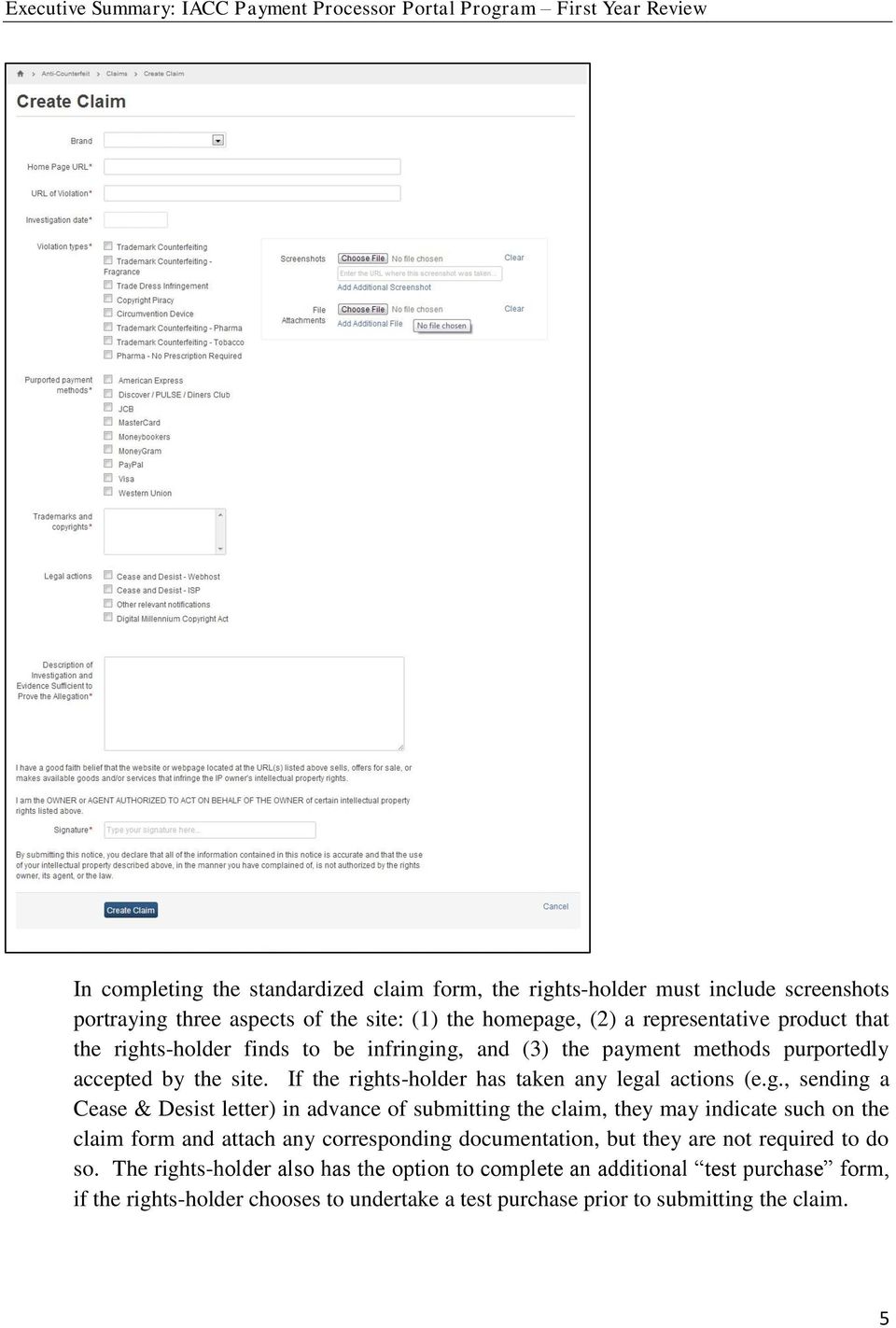
5 Participate in trainings of payment industry personnel to increase awareness as to the risk associated with taking on counterfeit merchants. o Goal 3: Facilitate efficient use of resources. Provide a centralized reporting system for rights-holders, with a standardized procedure for submitting claims regarding merchant violations to the Card Networks; Provide for effective use of each program participant s individual expertise; Allow for elimination of duplicate reports from different rights-holders; and Reduce administrative burdens (both for IACC-member rights-holders, as well as the Card Networks). o Goal 4: Disrupt and dismantle counterfeit networks. Increase intelligence regarding networks of counterfeit sellers and their affiliates; and Encourage collaboration between the payment industry, rights-holders, academic experts, and law enforcement to address criminal networks. THE PROCESS Each participating rights-holder has its own access-controlled, brand-specific portal ( Brand Portal ) for submitting reports regarding online sellers to the Umbrella Portal. The reporting process proceeds as follows: o Step 1: Rights-Holder Investigation Each action within the portal system begins with the rights-holder s own investigation. The rights-holder determines which URLs to report through the portal, 3 and must complete a standardized claim form for each individual URL. Each rights-holder may submit a maximum of twenty-five claims per month. 4 The standardized claim form is pictured below: 3 The IACC has instructed participating rights-holders to select only standalone, rogue websites (as opposed to online marketplaces or auction sites) for submission through the portal system. 4 The 25-claim-per-month limit is an internal limit imposed by the IACC to help manage IACC and Card Network resources. 4

6 In completing the standardized claim form, the rights-holder must include screenshots portraying three aspects of the site: (1) the homepage, (2) a representative product that the rights-holder finds to be infringing, and (3) the payment methods purportedly accepted by the site. If the rights-holder has taken any legal actions (e.g., sending a Cease & Desist letter) in advance of submitting the claim, they may indicate such on the claim form and attach any corresponding documentation, but they are not required to do so. The rights-holder also has the option to complete an additional test purchase form, if the rights-holder chooses to undertake a test purchase prior to submitting the claim. 5
7 o Step 2: IACC Review & Trace Messaging Once the rights-holder submits the completed claim to the Umbrella Portal, the IACC then reviews the claim for sufficiency and compliance with Card Network policies regarding claim eligibility. If the IACC finds the claim to be deficient, it can either reject the claim or send it back to the rights-holder to correct the deficiency. Also during this step, the system will alert the IACC if there is an existing claim pending against the URL in question. If this alert appears, the IACC will merge the new claim with the one previously submitted ( deconflicting the claim). After the IACC reviews the content of the claim, a trace message 5 is conducted. Under the current arrangement with the Card Networks, the IACC has undertaken to conduct all necessary Visa and MasterCard trace messaging for claims originating in the portal. 6 Each trace message is conducted by IACC staff in-house (or in some cases, by G2, at the direction of the IACC). Once trace messaging data is appended to the claim, the IACC will approve the claim for submission. o Step 3: IPR Center Hold Opportunity Once the IACC approves the claim, the IPR Center then has a 24-hour opportunity to place a hold on the claim, if it finds that the claim could potentially interfere with ongoing law enforcement investigations. If the IPR Center does not place a hold on the claim within the 24-hour period, the claim is automatically released to G2 for evaluation. o Step 4: G2 Evaluation Provided all threshold requirements are met, the claim will be forwarded to G2. G2 then initiates the merchant identification process by running the URL against the G2 database of known merchant accounts. This database consists of merchant account data G2 has acquired based on its existing relationships with some of the Card Networks and acquiring banks. If the URL is found in the G2 database, G2 can at times identify merchant accounts that would not typically be uncovered by a trace message. o Step 5: Payment Industry Investigation & Remediation After running the URL against its database, G2 then relays the investigation to the identified Card Networks 7 for resolution in accordance with the internal operating procedures and policies of each. The manner for handling the claim then depends on the business model of the individual Card Network, as described below: 5 A trace message is an attempt to make an online purchase using a valid, yet set-to-decline credit card. It is similar to a test purchase, but because the payment is declined, no goods are delivered. The purpose of a trace message is to assist the Card Network in identifying the merchant account associated with the website. 6 The IACC took on the responsibility of conducting trace messages as a courtesy to the Card Networks for their partnership in the program. 7 In cases where G2 is able to identify a merchant account apart from the trace message, the claim may be forwarded directly to the G2-client acquiring bank for remediation. 6

8 PayPal: Once PayPal receives a claim, PayPal s investigation team initiates its own version of a trace message, navigating the reported site through the checkout process, to identify the corresponding PayPal merchant account. PayPal may then initiate remedial action against the merchant. Closed-Loop Networks: American Express is a closed-loop payment network, meaning that it has direct contractual relationships with merchants. 8 Once American Express receives a claim, it initiates its own merchant identification process, and subsequently, may take action against the merchant account. Open-Loop Networks: Visa and MasterCard are both open-loop payment networks, meaning that they do not have direct contractual relationships with merchants, and instead must rely on the appropriate third-party acquiring bank to take action against a merchant. Once Visa or MasterCard receives a claim, each team utilizes the data from the IACC trace message to identify the acquiring bank associated with the merchant, and then relays the investigation on to that bank. The bank then conducts its own investigation, and reports any remedial action taken against the merchant to the Card Network. Discover / PULSE / Diners Club has recently altered its business model from a closed-loop network to a primarily open loop network. When Discover / PULSE / Diners Club receives a claim, it initiates its own merchant identification process (including conducting a trace message), and depending on the merchant relationship, will either relay the investigation to the appropriate bank, or may itself take action against the merchant account. o Step 7: Distribution of Results As payment industry investigations are completed, each Card Network updates its corresponding disposition status in the claim summary to reflect any action taken with regard to the merchant account. The reporting rights-holders may access these results in the portal as they are updated by the Card Networks. 8 This is the general rule; however, in some cases, American Express may take on merchants through third-party acquiring banks. For example, in China, American Express functions as an open-loop network. 7
9 RESULTS The following results were drawn from claims submitted between December 15, 2011 (the date of the first portal submission) to September 30, I. Results by Claim During this period, participating rights-holders submitted a total of 3,140 claims through the portal. The number of claims submitted is broken down by month in the table below: Claims Submitted Per Month Dec. Jan. Feb. Mar. Apr. May June July Aug. Sept Pie Chart 1 indicates where each claim submitted through the portal system currently lies in the system, as of October 11, Pie Chart 1: December 2011 September 2012 IACC Portal Claims by Status 5 24 Website Down IPR Center Hold Opportunity (24 hours) Rejected by IACC Payment Industry Investigation Complete G2 Evaluation (~2.8 days) Investigation Closed Payment Industry Investigation (~35.7 days) Total: 3,140 claims o Websites Marked as Down: The website down status indicates that the reported website has become inaccessible at some point before the IACC has had an opportunity to conduct a trace message. 9 Claims in this state remain in a holding pattern, unless and until they later become accessible. 9 If a reported website becomes inaccessible after the IACC s trace message, the claim will nonetheless continue through the portal process to the Card Networks. So long as the website is accessible during the trace message, the Card Networks can use the trace messaging data to identify the merchant account. 8
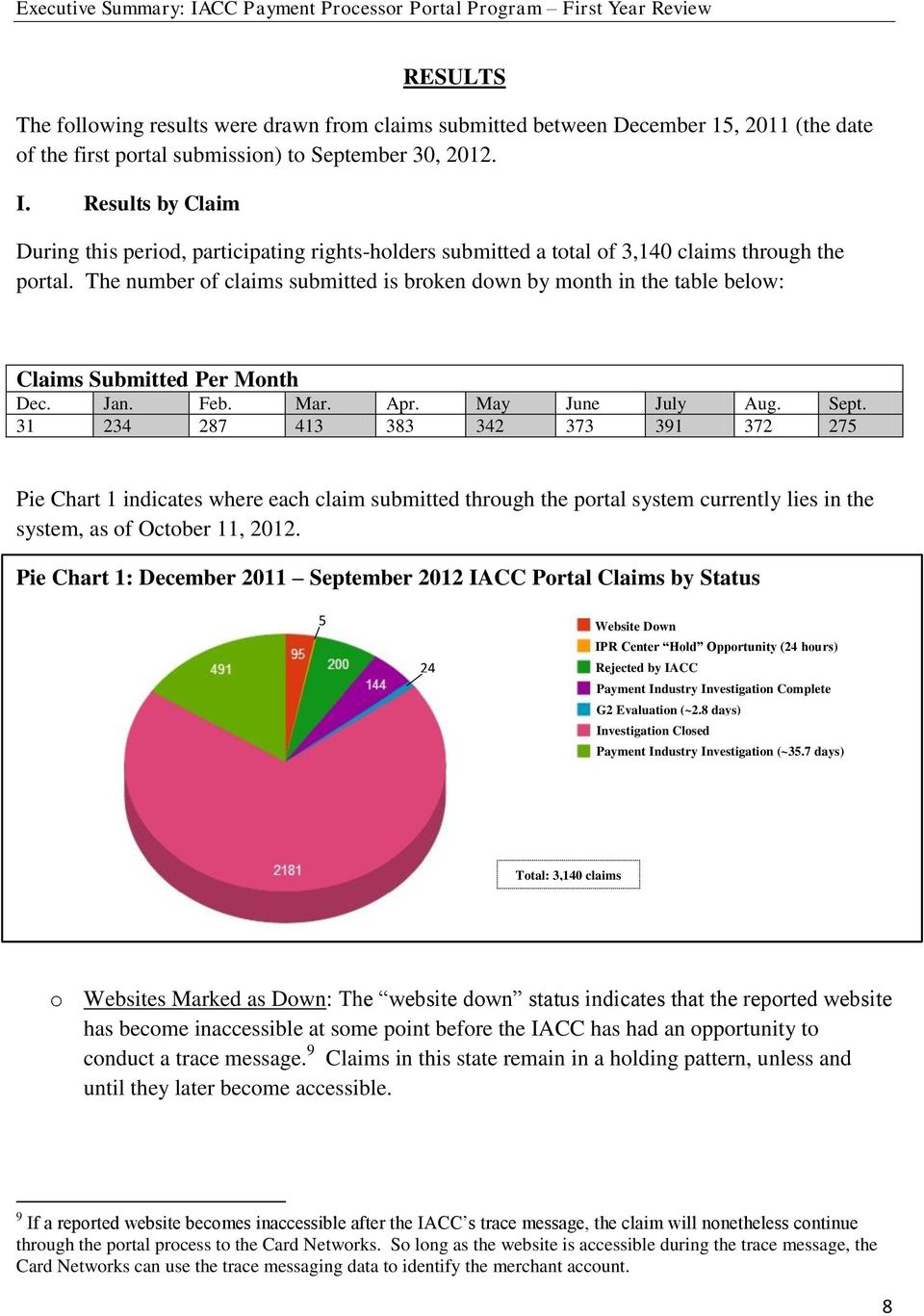
10 o IACC-Rejected Claims: As Pie Chart 1 indicates, 200 claims have been rejected by the IACC. The IACC rejects a claim if it finds the claim to be noncompliant with the criteria of the Card Networks and the IACC Portal Program. For example, the IACC commonly rejects claims found to be lacking in evidence or falling outside the scope of the Portal Program. 10 The number of rejections dropped significantly in February, when G2 updated the portal to provide the IACC with the ability to send a claim back for brand re-work as opposed to rejecting it outright. The number has further decreased over time, as participating rights-holders have become more familiar with Card Network criteria and IACC policies. The number of rejected claims is broken down by month below, along with their percentage of total monthly claims: Claims Rejected by IACC per Month Dec. Jan. Feb. Mar. Apr. May June July Aug. Sept % % % % % % % % 7 1.9% 5 1.8% o Payment Industry Investigation: Claims in this state have at least one Card Network investigation pending. Claims will remain in this state until all identified payment channels (i.e., Card Network relationships) have been updated with a final disposition. The table below breaks down the number of claims currently under payment industry investigation by month submitted by the rights-holder, along with their percentage of total monthly claims: Claims Currently under Payment Industry Investigation, by Month Submitted Dec. Jan. Feb. Mar. Apr. May June July Aug. Sept % % % % % % % % % % As Pie Chart 1 indicates, the average period from the Card Networks receipt of a claim until the claim has been updated with a final disposition for all payment channels is approximately 35.7 days. The average payment industry investigation time has decreased significantly over time. The table below provides the average time for payment industry investigation, broken down by claims submitted each month. Please note that these numbers represent only those claims that have completed the payment industry 10 Generally, claims regarding online marketplace or auction sites are seen as falling outside the scope of the Portal Program, because the infringing sales are not processed through the seller s own individual merchant account. Instead, the sales are often processed through the merchant account for the overall online marketplace site, which may also be used to process many other, non-infringing sales. For this reason, it would be unfeasible to terminate the processing ability of the individual seller without terminating the merchant account for the entire website. It is therefore preferable in these cases for the rights-holder to pursue take-down of the infringing listings through the website s regular reporting avenues. There are some exceptions to this general rule. For example, in some cases, where the website has been nonresponsive to rights-holder take-down requests, the IACC may approve the claim for submission to the Card Networks. The Card Networks (or the appropriate third-party acquiring bank, as the case may be) can then request that the website remove the reported listings, or may decide to terminate the overall merchant account for the site. 9

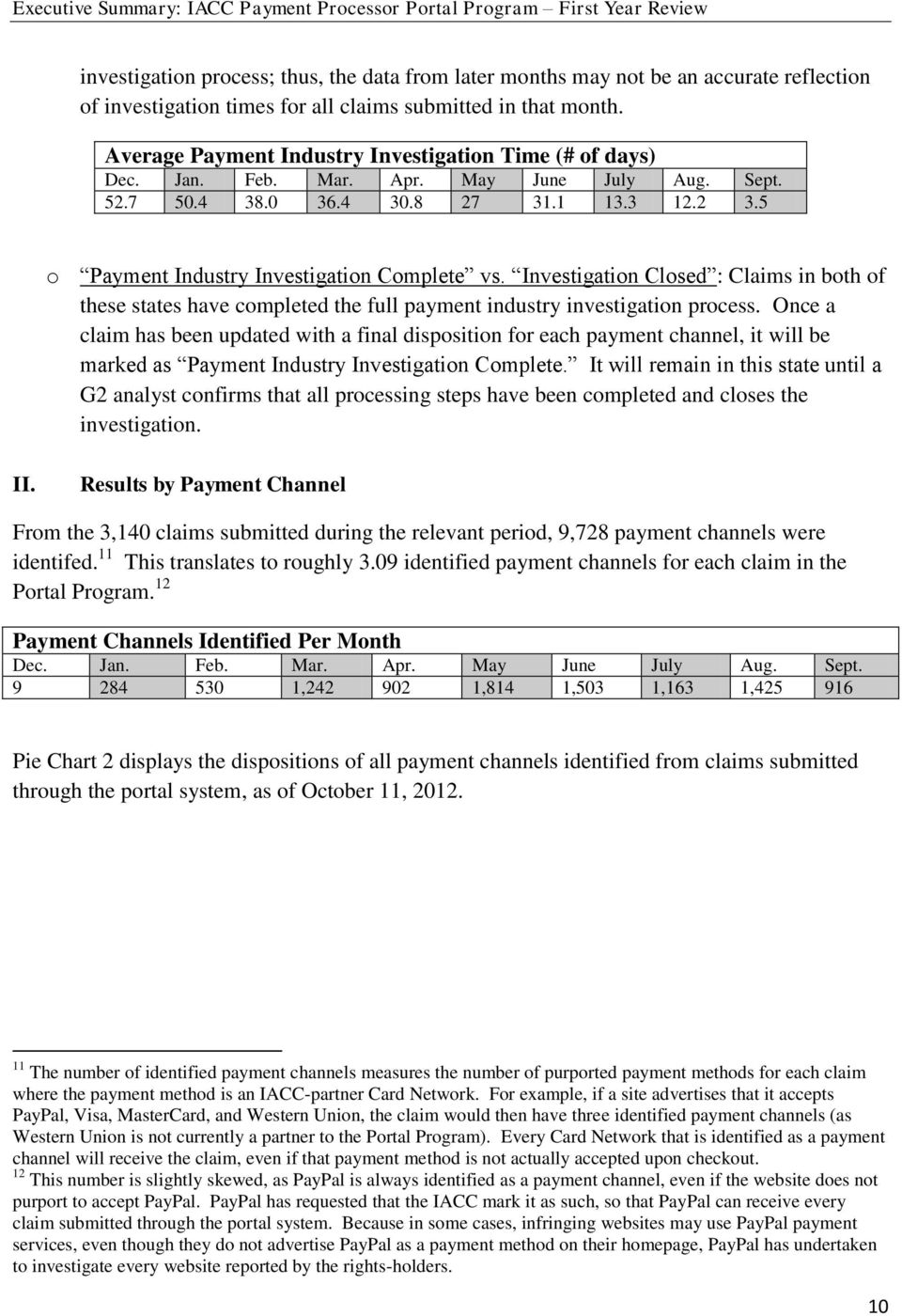
11 investigation process; thus, the data from later months may not be an accurate reflection of investigation times for all claims submitted in that month. Average Payment Industry Investigation Time (# of days) Dec. Jan. Feb. Mar. Apr. May June July Aug. Sept o Payment Industry Investigation Complete vs. Investigation Closed : Claims in both of these states have completed the full payment industry investigation process. Once a claim has been updated with a final disposition for each payment channel, it will be marked as Payment Industry Investigation Complete. It will remain in this state until a G2 analyst confirms that all processing steps have been completed and closes the investigation. II. Results by Payment Channel From the 3,140 claims submitted during the relevant period, 9,728 payment channels were identifed. 11 This translates to roughly 3.09 identified payment channels for each claim in the Portal Program. 12 Payment Channels Identified Per Month Dec. Jan. Feb. Mar. Apr. May June July Aug. Sept , ,814 1,503 1,163 1, Pie Chart 2 displays the dispositions of all payment channels identified from claims submitted through the portal system, as of October 11, The number of identified payment channels measures the number of purported payment methods for each claim where the payment method is an IACC-partner Card Network. For example, if a site advertises that it accepts PayPal, Visa, MasterCard, and Western Union, the claim would then have three identified payment channels (as Western Union is not currently a partner to the Portal Program). Every Card Network that is identified as a payment channel will receive the claim, even if that payment method is not actually accepted upon checkout. 12 This number is slightly skewed, as PayPal is always identified as a payment channel, even if the website does not purport to accept PayPal. PayPal has requested that the IACC mark it as such, so that PayPal can receive every claim submitted through the portal system. Because in some cases, infringing websites may use PayPal payment services, even though they do not advertise PayPal as a payment method on their homepage, PayPal has undertaken to investigate every website reported by the rights-holders. 10
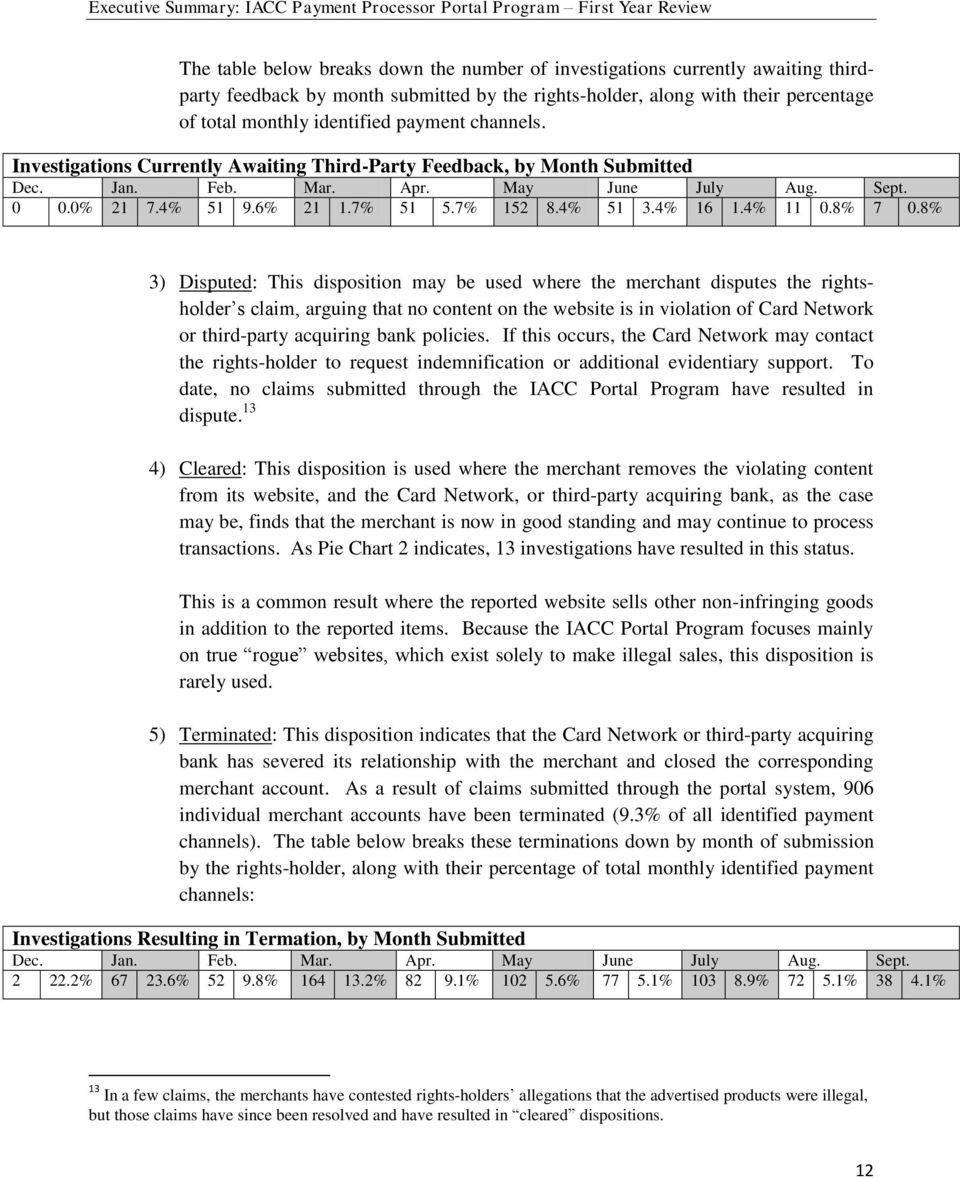
12 Pie Chart 2: All Payment Channels from December 2011 September 2012 Claims, by Disposition Processing Initial Investigation (~18.8 days) Payment Accepted But Does Not Complete Terminated Payment Method Not Accepted Processing Waiting for 3 rd -Party Feedback (~78.4 days) Cleared Total: 9,728 payment channels These numbers reflect the overall dispositions for all of the Card Networks. There are seven potential disposition statuses in the system: 1) Processing Initial Investigation: This disposition is used to indicate that a claim is under initial investigation by the Card Network. During this phase, the Card Network conducts its own investigation and attempts to identify the merchant account. As Pie Chart 2 indicates, the average time for this phase is approximately 18.8 days. The table below breaks down the number of initial payment industry investigations currently pending by month submitted by the rights-holder, along with their percentage of total monthly identified payment channels: Initial Payment Industry Investigations Currently Pending, by Month Submitted Dec. Jan. Feb. Mar. Apr. May June July Aug. Sept % 6 2.1% 3 0.6% 5 0.4% 4 0.4% 0 0.0% 7 0.5% % % % 2) Processing Waiting for Third-Party Feedback: An open-loop Card Network updates the disposition to this status once it has identified the third-party acquiring bank responsible for the merchant relationship and has requested that the third-party take action to resolve the violation. As Pie Chart 2 indicates, the average time for this phase is approximately 78.4 days. Again, this number represents only those investigations that are complete; thus, it may not be an accurate reflection of current response times. 11

13 The table below breaks down the number of investigations currently awaiting thirdparty feedback by month submitted by the rights-holder, along with their percentage of total monthly identified payment channels. Investigations Currently Awaiting Third-Party Feedback, by Month Submitted Dec. Jan. Feb. Mar. Apr. May June July Aug. Sept % % % % % % % % % 7 0.8% 3) Disputed: This disposition may be used where the merchant disputes the rightsholder s claim, arguing that no content on the website is in violation of Card Network or third-party acquiring bank policies. If this occurs, the Card Network may contact the rights-holder to request indemnification or additional evidentiary support. To date, no claims submitted through the IACC Portal Program have resulted in dispute. 13 4) Cleared: This disposition is used where the merchant removes the violating content from its website, and the Card Network, or third-party acquiring bank, as the case may be, finds that the merchant is now in good standing and may continue to process transactions. As Pie Chart 2 indicates, 13 investigations have resulted in this status. This is a common result where the reported website sells other non-infringing goods in addition to the reported items. Because the IACC Portal Program focuses mainly on true rogue websites, which exist solely to make illegal sales, this disposition is rarely used. 5) Terminated: This disposition indicates that the Card Network or third-party acquiring bank has severed its relationship with the merchant and closed the corresponding merchant account. As a result of claims submitted through the portal system, 906 individual merchant accounts have been terminated (9.3% of all identified payment channels). The table below breaks these terminations down by month of submission by the rights-holder, along with their percentage of total monthly identified payment channels: Investigations Resulting in Termation, by Month Submitted Dec. Jan. Feb. Mar. Apr. May June July Aug. Sept % % % % % % % % % % 13 In a few claims, the merchants have contested rights-holders allegations that the advertised products were illegal, but those claims have since been resolved and have resulted in cleared dispositions. 12
14 Because counterfeiters commonly use one merchant account to process transactions for multiple rogue sites, these numbers likely correspond to a much higher number of websites no longer able to take payment. Counterfeiters and other criminals use various tactics in setting up merchant accounts, 14 which result in different termination outcomes. Three common tactics include (i) opening multiple accounts at the same bank, (ii) opening multiple accounts at different banks, and (iii) aggregation. i. Multiple Merchant Accounts A seller may set up multiple merchant accounts at the same acquiring bank in order to manage risk. This allows the seller to spread the risk of charge-backs over multiple accounts to avoid fees, and also provides the seller with other options should one merchant account be terminated. In some cases, depending on the Card Network, where a third-party acquiring bank reports to the Card Network that it has terminated the merchant account, the Card Network will run a follow-up trace message on the reported website. If the trace message is successful, this indicates to the Card Network that the seller has another merchant account. If this merchant account sits at the same third-party acquirer as the first account, the Card Network will again relay the investigation to the third-party. ii. iii. Multiple Acquiring Banks A seller sets up merchant accounts at multiple acquiring banks for the same reasons listed above. Similarly, if a third-party acquirer reports to the Card Network that it has terminated a merchant account, in some cases, the Card Network will run a follow-up trace message to identify any remaining merchant accounts. Aggregation Aggregation is a very common counterfeiter tactic and is in itself a violation of Card Network policies. It is characterized by a single merchant, who acts as a front for a network of sellers, who in turn each may have a network of websites. This tactic provides for anonymity of sellers making transactions through the shell merchant account, and 14 For more on these tactics, see Attachment 1: Damon McCoy et al., Priceless: The Role of Payments in Abuse- Advertised Goods (Oct. 2012), Section

15 shields those sellers from the due diligence requirements associated with the acquiring bank s on-boarding process. If the acquiring bank terminates the shell merchant account, this results in the termination of payment facilities for all websites processing payments through that account. This tactic is to be distinguished from the use of legitimate payment facilitators/psps. PSPs function in much the same way, in that they form a direct relationship with the acquiring bank to provide payment services for a network of sellers. Legitimate PSPs, however, are registered with the Card Networks and are bound by Card Network policies. The cost of termination for the counterfeit seller is high. Securing a new merchant account generally takes a minimum of a week, assuming the seller can satisfy the due diligence requirements of the new third-party acquiring bank. 15 As such, merchant account termination can be a highly effective result from the rights-holder s perspective, particularly as compared to website take-downs, which involve a minimal cost to the counterfeit seller. 16 6) Payment Method Not Accepted: This disposition indicates that the payment method is not actually accepted during the checkout process on the website, although the site may advertise otherwise (e.g., by displaying the payment brand logos on its homepage). Out of 9,728 total identified payment channels, 6,716 were not actually offered as payment methods upon checkout (69%). These are broken down by month of submission by the rights-holder, along with their percentage of total monthly identified payment channels, in the table below: Payment Methods Not Accepted, by Month Submitted Dec. Jan. Feb. Mar. Apr. May June July Aug. Sept % % % % % 1, % 1, % % % % 15 Attachment 2: Kirill Levchenko et al., Click Trajectories: End-to-End Analysis of the Spam Value Chain (May 2011), Section IV.C. 16 See Attach. 1, Section 2.3 ( [A] miscreant can replace a suspended domain name within minutes at a cost of a few dollars, but if a banking relationship is shuttered they may lose hundreds of thousands of dollars in holdback and spend weeks developing a suitable replacement). 14

16 In most cases, rogue websites advertise several payment methods that they do not accept. This provides an air of legitimacy and allows the seller to lure consumers in with familiar, trusted payment brands. Once they arrive at the checkout page, many consumers are then so invested in the purchase that they are less likely to back out when the seller asks that they instead use a less-familiar means of payment, such as a wire transfer or e-check. While the Card Networks have no means of terminating the payment facilities of these sellers, the portal system nonetheless delivers these claims, so that the Card Networks may take action to address the unauthorized use of their own intellectual property. 7) Payment Accepted But Does Not Complete: After receiving a claim, the Card Network will mark it with this disposition if, at the time of the trace message, the website appeared to accept that particular payment method, and in fact took the card number, but the transaction details do not appear in the Card Network s system (i.e., the transaction was never processed by the seller). This can occur for any number of reasons, including the following: a) The merchant account has already been terminated. Where a merchant account has already been terminated (possibly as a result of a portal claim regarding another URL), the website may nonetheless appear as if it accepts the payment method. The checkout process may remain fully functional, but the seller will not be able to process the transaction. b) The website has a broken e-commerce platform. Even where the seller has a functioning merchant account, the seller may be unable to process the transaction due to technical issues with the checkout process or payment processing service. c) The website is a phishing operation. Some rogue sites will not process the transaction, but will capture the card number for purposes of phishing. 17 d) The website employs sophisticated anti-fraud measures. Many rogue sites, or more frequently, the PSPs or aggregators utilized on such sites, employ sophisticated anti-fraud software to block 17 In fact, several cards used for IACC trace messaging have been compromised in this manner. 15
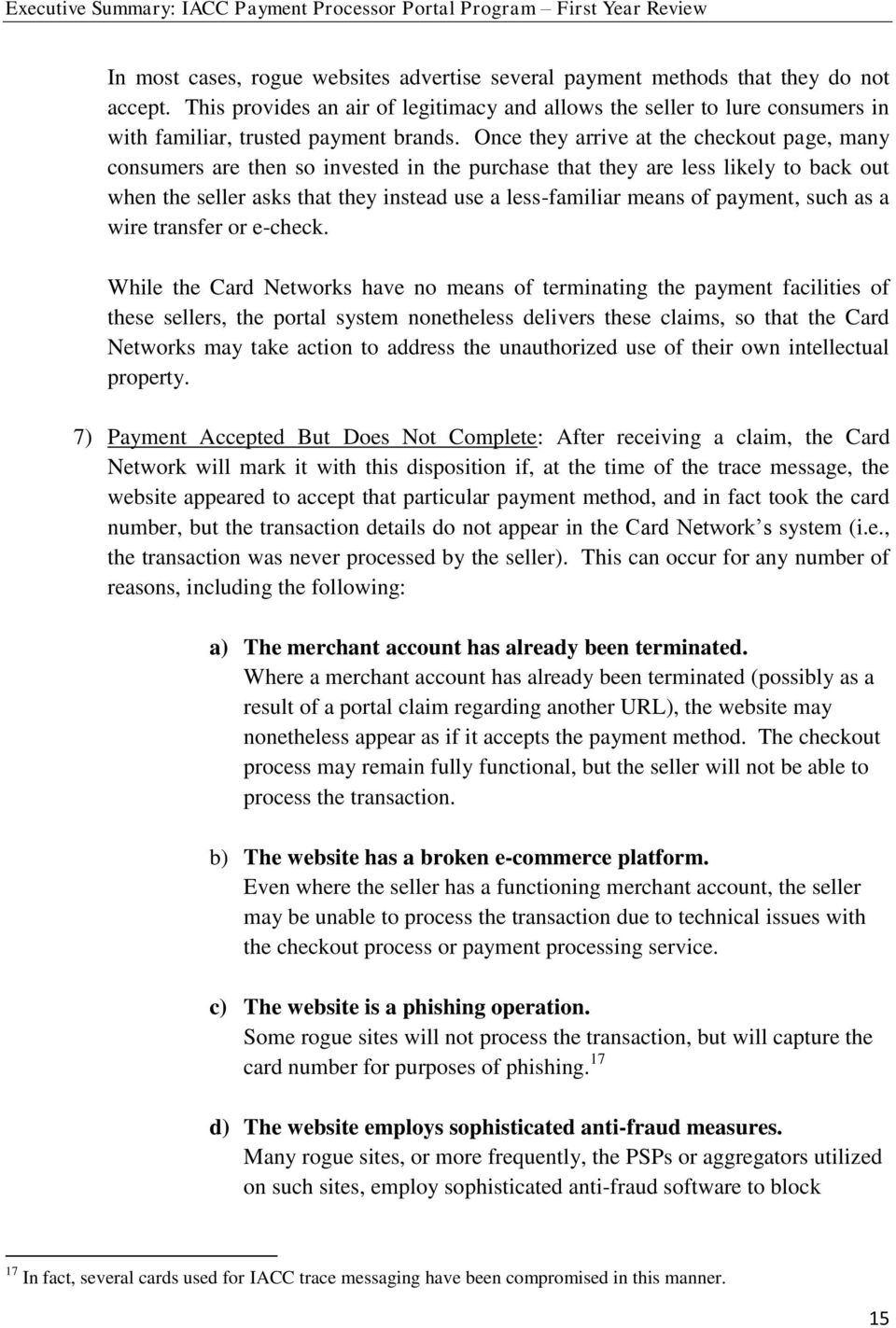
17 potentially investigative transactions before they are processed. 18 These programs give every transaction a fraud score based on certain indicators, such as whether the geo-located IP address of the consumer matches the billing and shipping address provided during checkout. 19 Unfortunately, there is no way to identify with certainty the reason the seller failed to process the transaction. In any case, if the seller does not attempt to process the transaction, there will be no record of the transaction in the Card Network s system. And without such record, there is very little chance that the merchant account (assuming one exists) will be identified and consequently terminated. As Pie Chart 2 demonstrates, this disposition is quite common. 18.2% of all payment channels have resulted in this disposition (compared to 9.3% resulting in termination). The table below breaks down the number of these dispositions by month submitted by the rights-holder, along with their percentage of total monthly identified payment channels: Payment Accepted But Does Not Complete Dispositions, by Month Submitted Dec. Jan. Feb. Mar. Apr. May June July Aug. Sept % % % % % % % % % % III. Non-Partner Card Network Statistics As the IACC Portal Program has progressed, commonly-used, non-partner credit card networks and payment service providers have been added to the standardized claim form as purported payment methods, so that the numbers for claims involving these payment methods may be tracked. In addition to partner Card Networks, the portal system now also compiles claims against websites purporting to accept JCB, Moneybookers, MoneyGram, and Western Union. 20 Because these entities are not currently partners to the IACC Portal Program, they do not currently receive claims through the portal. However, if and when they do join the initiative, all previously-submitted claims involving these payment methods will be provided to the corresponding entities for their review. 18 Anti-fraud measures, in themselves, have a legitimate purpose. Most websites employ such measures to determine the legitimacy of transactions. Some criminal enterprises, however, utilize these measures to identify investigative transactions and thus avoid detection by the Card Networks. 19 Attach. 1, fn These payment methods were identified by IACC trace messaging analysts as being among the most commonlyadvertised on reported websites. 16

18 o JCB (Japan Credit Bureau) JCB was added to the standardized claim form as a purported payment method in late January Since the time it was added, it has been identified as a purported payment method in 896 claims (30.1 % of all claims). Beyond being one of the most frequently advertised payment methods, JCB also appears to be one of the more commonlyaccepted upon checkout, based on IACC trace messaging data. o Moneybookers Moneybookers, a PSP, was added to the standardized claim form in late February Since the time it was added, it has been identified as a purported payment method in 128 claims (4.8% of all claims). o MoneyGram MoneyGram was added to the standardized claim form in late February Since the time it was added, it has been identified as a purported payment method in 89 claims (3.3% of all claims). o Western Union Western Union was added to the standardized claim form in late January Since that time, it has been identified as a purported payment method in 1,199 claims (40.3% of all claims). Trace messaging analysts note that Western Union has also become more commonly available on reported sites in recent months, with many sites advertising discounts for customers who choose to pay via Western Union (see image below). This may be an indication that counterfeit sellers, now faced with an enhanced risk of termination by the Card Networks as a result of the IACC Portal Program, are increasingly forced to rely on Western Union payments. 17

19 IV. PSP Trends In late March 2012, the IACC also began keeping record of PSPs 21 used by the reported websites, as identified during the trace messaging process. When the IACC initially began recording this information, the PSPs used by reported sites appeared somewhat varied, and many sites did not use a PSP. However, in recent months, there has been a drastic increase in the number of sites using PSPs, and those PSPs have become decreasingly varied, with more and more sites depending on a select few PSPs for payment processing. The top three most commonly identified PSPs are (1) sslepay.com, (2) realypay.com, and (3) 95epay.com. During checkout on a rogue website, the consumer will typically be redirected from the shopping site s checkout page to any one of these PSP sites. The PSP is easily identifiable by the URL found on the payment form, as shown below: sslepay.com 21 This report uses the term PSP here in a generic sense, to include both legitimate, registered PSPs and nonregistered aggregators, as well as account brokers, merchant servicers, and ISO/MSPs with third-party servicers. For the reader s reference, these terms are not mutually exclusive, as each can provide a variety of different payment services. 18

20 realypay.com 95epay.com Other common PSPs include ECPSS Payment Gateway (which appears to be the same entity as sslepay.com), billingcheckout.com (which appears to be the same entity as realypay.com), wedopay.net, sfepay.com, fashionpay.com, glbpay.com, and ips epayment. Often, these PSPs 19

21 will appear as different checkout options on the same rogue site (the most frequent combination being sslepay.com and realypay.com), and the consumer will be encouraged to try each option until finding one that works. The IACC submits records of commonly used PSPs to the relevant Card Networks each month. The Card Networks have indicated that most of these entities are considered rogue PSPs, or aggregators, as opposed to legitimate, registered PSPs. CHALLENGES The single most prevailing, yet unanticipated, challenge for the IACC Portal Program has been trace messaging. 22 Since the inception of the program, the IACC has conducted over 5,000 individual trace messages for claims submitted through the portal system. There have been several difficulties associated with this task. o Trace Messaging Costs Currently, all trace messaging efforts are funded by the IACC and participating rightsholders. For the first term of the program, all participating rights-holders were charged a trace messaging fee of $ for the year; however, this amount has not come close to covering the actual costs associated with trace messaging. For those conducted in-house, each trace message costs the IACC $6.00 in labor. For more difficult trace messages, the IACC will often request that they be conducted by G2. G2 charges between $45.00 and $50.00 per trace message. In addition to labor costs, the IACC has also made significant investments in the infrastructure required for trace messaging operations. This includes everything from computers, phones, and credit cards, to IT assistance and sophisticated security and privacy tools. Lastly, in May 2012, the IACC opened a satellite office to function as a secure, off-site headquarters for all trace messaging efforts. o Finding Payment Cards In order to protect the identities (and credit scores) of trace messaging staff, the use of personal cards must be avoided. However, finding the appropriate cards to use for trace messaging has presented its own difficulties. 23 In looking for the rights cards, several aspects were evaluated: 22 This challenge of trace messaging was unanticipated for the IACC; because, based on the best practices documents negotiated with the Card Networks in 2011, the assumption was that the Card Networks would conduct their own trace messaging for the program. The IACC later agreed to undertake this task after subsequent negotiations with the Card Networks, as a good faith effort to alleviate some of the resource strain caused by the sudden increase in rights-holder reports. 23 For more on the difficulties of finding appropriate payment cards for investigative use, see Attachment 3: Chris Kanich et al., No Plan Survives Contact: Experience with Cybercrime Measurement, Aug. 2011,
22 Card Value: Because the goal of trace messaging is not the actual purchase and receipt of hard goods, which would be cost-prohibitive and present complications regarding shipping and receiving, cards with little to no monetary value must be used. Although the transaction will eventually be declined for insufficient value, the merchant must first submit the transaction through the Card Network system, which creates sufficient record for the merchant account to later be located. Potential for Alias Use: Because the cards must be used along with created aliases, they cannot be acquired through standard credit card application processes, which present undesirable due diligence complications. For this reason, the only feasible option has been to obtain prepaid cards, 24 which can be purchased anonymously. Access to Transaction Records: One difficulty associated with prepaid cards is finding a prepaid card issuer that provides cardholder access to transaction records. Only a few issuers provide prepaid cardholders with online access to transaction history, and only a small subset of these few will provide details for transactions that were not approved. Without these details (which typically include the transaction date and amount, merchant name and ID number, and country of the merchant), it becomes much more difficult for the Card Network to locate the merchant account, and for the IACC to confirm that the trace message was successful. For the IACC, the solution to this issue was to contact a major prepaid card issuer directly. With the encouragement of one Card Network partner, and for a minimal fee paid by the IACC, the issuer agreed to supply the IACC with a large number of cards with a zero balance, and to provide an online interface (usually reserved for bank use only) with access to transaction details. Number of Cards: In order to conduct several hundred trace messages per month, a large quantity of cards must be kept on hand. Conducting multiple, consecutive transactions for counterfeit goods using the same card number will often trigger fraud check systems, and this is particularly true when those transactions are consistently declined. Because suspicious 24 One common difficulty for investigations using prepaid cards is that most U.S. prepaid card issuers, in response to the Credit Card Reform Act of 2009, restrict the use of their cards to domestic transactions, and the cards will thus be declined for any transactions with foreign acquiring banks. See Attach. 3, at 5. Because the IACC is not making actual purchases, however, this has not presented an insurmountable hurdle. As long as the transaction shows up in the Card Network system, the reason it is declined is irrelevant. 21
23 card numbers are often blocked, trace messaging cards and aliases must be constantly rotated. 25 BIN Diversity: A related difficulty of conducting consecutive, declined transactions is that when the cards are obtained through a single issuer, the merchant (or PSP used by the merchant) may grow suspicious of, and even block, all transactions for cards with that particular issuer s Bank Identification Number (BIN) 26. For this reason, BIN diversity is recommended 27 ; however, given the difficulties in finding even one bank to accommodate the IACC s trace messaging needs, BIN diversity is simply not feasible at this point. o Evading Fraud Checks The biggest hurdle for trace messaging, and thus, for the entire program, has been in identifying potential fraud check triggers and finding ways to avoid setting them off. Counterfeit sellers and other criminal entities often employ anti-fraud measures to block investigative transactions, 28 and some of these measures can be very sophisticated. Address Verification Service (AVS): Provided through the Card Networks, AVS is a standard tool that verifies the numeric street address and ZIP code that the consumer provided in registration for the card. For this reason, each prepaid card must be registered with the address of the corresponding alias on the issuer s website. IP Geolocation: Many rogue websites appear to use fraud check systems that provide IP geolocation tools, which match the IP address location of the consumer to the AVS information, as well as the shipping and billing addresses provided during checkout. In order to combat this, the IACC uses a proxy service that allows the trace messaging analyst to select an appropriate IP address location for the alias used. While in some cases this can be a solution, in others, the fraud check system may be able to identify the use of a proxy, and will nonetheless block the transaction. Trace messaging analysts will generally reattempt the transaction without the proxy, but then the IP address location will likely not match that of the alias. 25 Researchers in this field even advise conducting only one purchase per card. Attach. 3, fn. 3. Unfortunately, this practice is not currently practical, given the volume of claims submitted through the portal system, the cost of the cards, and the constraints on card availability. 26 The BIN number consists of the first six digits listed on a card. This number is used to identify the issuing bank. 27 See Attach. 1, at For more information on the use of fraud check technologies by criminals, see Attach. 1, at 10, and Attach. 3, at
24 In addition to geolocating the IP address to determine if it matches the billing and shipping addresses provided, some merchants will filter out IP addresses used for previous transactions that resulted in a decline, or may even blacklist all IP addresses from a particular location. For example, some rogue sites will block purchases for all U.S. consumers, resulting in a message like that pictured below: Confirmation of Residential Location: Some merchants will use tools to validate that the shipping address provided is a residential location. In order to combat this, the IACC uses addresses of foreclosed homes for aliases. Flagging: Some anti-fraud measures will flag a consumer s use of a free account as an indication of risk. The IACC currently uses Yahoo! accounts for aliases, but is now considering a switch to Google Apps as a host for services from newly-created domain names. Blocking of Prepaid Cards: While the IACC has put significant effort into selecting the appropriate cards for use in trace messaging, and has taken all practical measures to ensure that these cards appear to be registered as regular credit cards (i.e., with the name and address of the alias), there is some suspicion that merchants may nonetheless be able to identify the cards as prepaid, and are blocking them as such. Unfortunately, at this time, there appears to be no feasible alternative to the use of prepaid cards. Phone Verification: Some very sophisticated merchants (most commonly those in counterfeit tobacco and pharmaceutical sales, but in some cases others) will 23
25 call the phone number supplied by the consumer during checkout to confirm the order. This requires the use of various phone numbers during trace messaging, as well as a trace messaging analyst to answer phones and return messages from sellers. The IACC has set up a virtual phone system with several phone lines, which all forward to the same phone at the IACC satellite office. Nonetheless, this fraud check has presented several difficulties, as the analyst manning the phone is faced with the difficult task of playing whichever alias identity the caller is trying to reach, and improvising in any questions the caller might ask. This can understandably become more awkward (and can result in blacklisting) when one caller makes calls regarding several individual orders placed by different aliases, only to be answered by the same person each time. Documentation Requirements: In many cases, counterfeit tobacco and pharmaceutical merchants will also request additional documentation, such as copies of drivers licenses, credit cards, and prescriptions, before running the card transaction. There is currently no way to combat these checks, as the IACC is unwilling to forge identity documents and prescriptions for use in trace messaging. While the fraud checks described above have always presented a challenge for the program, it appears that in recent months, more and more rogue sites are employing these measures in an effort to intentionally block IACC trace messages. At the inception of the program in January 2012, there were 94 claims regarding websites purporting to accept one particular Card Network as a payment method. From these reports, IACC trace messaging analysts were able to conduct 53 successful trace messages (56.4%) for that payment method. In 26 (27.7%) of the remaining claims, trace messaging analysts were able to complete the checkout process (entering a full card number), but the transactions were never processed by the merchant (resulting in Payment Accepted But Does Not Complete statuses for these payment channels). In September 2012, by comparison, there were 232 total claims regarding websites purporting to accept the same payment method. From these claims, IACC trace messaging analysts were only able to conduct 7 successful trace messages (3%), compared to 165 (71%) instances where the card number was entered, but the transaction was never processed by the merchant. The IACC believes that this decline in successful trace messages is in large part due to the fact that rogue websites are increasingly relying on the services of a select few illegitimate PSPs that utilize highly-sophisticated fraud checks as part of the checkout process. In a recent submission to one of the Card Networks, the IACC provided PSP data for sites where the IACC was unable 24
26 to conduct a successful trace message. The majority of the sites listed relied on two PSPs specifically, realypay.com and sslepay.com, with many of the sites providing both as available payment methods. For this period, about 67% of all instances where the IACC was unable to get a trace message through for this Card Network, the website used one or both of these PSPs. Perhaps more concerning is the fact that wherever a rogue site uses one of the big three PSPs identified in the section on PSP Trends above (including realypay.com, sslepay.com, and 95epay.com), or one of their related affiliates, IACC trace messaging analysts are consistently unable to get a trace message through. As explained above, it is very difficult to determine the reason behind an unsuccessful trace message. However, given the patterns identified during trace messaging, the IACC feels certain that the trace messaging issues with respect to these PSPs in particular are owed to the fact that these entities have taken on sophisticated anti-fraud measures in order to deliberately block potentially investigative transactions. This is furthermore confirmed by reports from IACC brands that have received complaints from real consumers who were able to complete card transactions on such sites. Given the fact that more and more rogue websites are now relying on these PSPs, it would appear that wherever a counterfeit seller wishes to evade detection by IACC/Card Network investigations, there is a very real incentive to turn to one of the big three PSPs for payment services (and these entities are most likely marketing their services to counterfeiters and other criminals accordingly). A simple Google search of each of these entities provides a number of consumer reviews complaining of sites trafficking in counterfeit goods. The actions of these PSPs not only frustrate the efforts of rights-holders, but also introduce an increased risk of fraud in the Card Network systems and damage Card Network reputations to the consumer. From the rights-holder perspective, the use of heightened anti-fraud measures does have some desirable consequences to counterfeit merchants. For one, these measures represent a significant investment for the seller. Moreover, the use of these measures is accompanied by a high likelihood of false positives (transactions from actual customers often do not satisfy such stringent security checks), which can dramatically reduce sales. Regardless, the IACC is currently working with the Card Networks and G2 to identify alternative ways to address particularly evasive PSPs. NEW DEVELOPMENTS & OFF-SHOOTS OF THE PROGRAM o Expanded Participant Access On September 23, 2012, the IACC extended and expanded its contract with G2. One significant change to the contract was an expansion in the scope of participants permitted access to the Portal Program. The portal system is now available for use by the following entities: 25
27 IACC-member rights-holders, IACC-member associations and their sub-members (including non-members of the IACC), IACC-member law firms and their IACC-member clients, IACC-member product security firms and their IACC-member clients, and IACC-member investigative firms and their IACC-member clients. o Enhanced Services Provided by G2 While system-wide success has been evident, the IACC has nonetheless received requests for additional research and intelligence gathering tools to assist individual rights-holders in quantifying their ROI for the program. Based on those requests, G2 has developed an enhanced services menu, tailored to fit the needs of IACC Portal Program participants, with offerings to compliment the existing portal system. These optional services will be provided by G2 for an additional cost to the participant. By expanding access to G2's enhanced services, the IACC intends to increase the efficiency and impact of the system. These enhanced services will allow for rightsholders to take a more targeted approach, based on affiliate network mapping and other intelligence. o Bank and PSP Training One important off-shoot of the Portal Program has been the IACC s collaboration with a few of the Card Networks in training Card Network employees, acquiring banks, and PSPs on the risks associated with taking on counterfeit merchants. Since the spring of 2012, the IACC and representative rights-holders have participated in three such events, including one taking place in Beijing, one in Bangkok, and one in New York. These provide the IACC and rights-holders a valuable opportunity, not only to support the efforts of the Card Networks as partners to the Portal Program, but also to influence the decision-making of those payment industry executives and employees who have the biggest impact on e-commerce. o IACC Designs Faux Real Campaign A separate off-shoot of the Portal Program is the Designs Faux Real consumer education campaign, which launched in May The campaign was conceived by the IACC, in collaboration with MasterCard and the IPR Center, as a way to educate the most difficult consumers: those who actively search out counterfeit goods online. The idea was to create a "fake, fake shopping site," which consumers looking to purchase counterfeit goods would visit, thinking it was like any other counterfeit shopping site. While browsing the site, those consumers would then learn about the potential 26
28 harms of shopping for counterfeits online (particularly, identity theft and credit card fraud). The site is currently live; however, it has not been formally released. The IACC is now working with the IPR Center, so that it might use the site as a public education tool in future Operation: In Our Sites seizures. RECOMMENDATIONS The IACC has several recommendations for continued viability of the program: o Improved Trace Messaging Operations In order for the program to continue its initial success, trace messaging operations must be improved, so that where there is an underlying merchant account, the merchant does not suspect IACC transactions to be fraudulent. The following improvements are recommended: New Trace Messaging Cards: The IACC has requested any assistance the Card Networks might be able to provide in obtaining BIN-diverse, non-prepaid Visa and MasterCard payment cards for IACC trace messaging efforts. The IACC takes a number of steps to avoid being blocked by entities that employ anti-fraud measures. At this time, however, the IACC s only option is to use prepaid cards from one issuer source. Accordingly, there is a significant possibility that several merchants and PSPs are blocking transactions from all cards with this issuer s BIN number and/or all prepaid cards. Enhanced Transaction Details: Ideally, any issuing bank that is willing to provide cards for trace messaging should also be able to provide additional details for each transaction, including Acquirer Reference Numbers (ARNs), so that this information might be recorded and tracked. Additional IP Address Options: In order to avoid triggering fraud checks, the IACC needs to identify options for improving IP diversity. Consultation from professionals in the field would be helpful in this respect, but such assistance requires additional financial investment by the IACC. Additional Address Options: Similarly, the IACC needs to explore additional options for alias addresses. As explained above, the IACC is considering a switch from Yahoo! Mail accounts to newly-created domain names hosted by Google Apps. 27
29 Additional Staff for Trace Messaging: Additional staff resources to devote to trace messaging operations, including phone verification (which requires several analysts on call to answer phones at any given time) would be very beneficial. Enhanced Targeting Efforts: In order to maintain continued viability of the program, the IACC, participating rights-holders, and the Card Network partners must work together to come up with a more targeted approach to addressing rogue websites and PSPs. Research by experts in the field has demonstrated that with comprehensive intelligence as to the extent of the particular affiliate network, as well as a persistent follow up strategy, concentrated actions taken against key merchant accounts can have a dramatic impact. 29 One example of the success of this method is a recent campaign by one rightsholder. Experts believe that the success of that program is in part owed to the relentless tactics of the rights-holder, who targeted all merchant accounts for an affiliate, then aggressively attacked each new merchant account obtained creating a substantial disincentive for any acquiring bank that previously might have been willing to take on such a merchant. 30 Such coordination is crucial for long-term impact. As experts explain, [t]aking down accounts here and there does raise the cost structure for [merchants], but ultimately it takes focus to convince such operators to close up shop. 31 This type of coordinated approach would require extensive network mapping and enhanced intelligence. G2 is one entity that may be capable of providing such assistance, but in order to have maximum impact, it would need to be offered as part of the standard Portal Program (as opposed to just as an enhanced service). This would result in a significant increase to the cost of the program, which many participating rights-holders would not be willing to sustain. o Additional Program Partners In order for the program to evolve with payment processing trends, the IACC needs to secure the partnership of Western Union. As explained above, and as confirmed by external research, 32 it has become increasingly common for merchants faced with Card Network terminations to rely on Western Union payments for continued sales. The IACC has participated in discussions with Western Union regarding its potential partnership in the program; however, these discussions up to this point have been 29 Attach. 1, at Id. at Id. at See id. at
30 unproductive, as Western Union insists that the program is not conducive to its business model. Beyond Western Union, the IACC would like to expand the breadth of the program to include other third-party entities, such as DNS providers, ad networks, ISPs, search engines, and shipping service providers whose logos are also commonly used by rogue websites. o Continued Participation in Payment Industry Trainings The IACC intends to continue participation in Card Network-hosted training events for acquiring banks, PSPs, and Card Network staff, to the extent possible. This may require an increase in program funds to account for travel-related expenses. o Additional Financial Resources Several of the recommendations outlined above require additional financial investment by the IACC. Unfortunately, the IACC is currently running the Portal Program at a significant loss to the organization. The IACC must seek out alternative funding options toward this end. 29
Review: The IACC Payment Processor Program
 Written Testimony of Robert C. Barchiesi President On Behalf of The International AntiCounterfeiting Coalition The Role of Voluntary Agreements in the U.S. Intellectual Property System United States House
Card Not Present Fraud Webinar Transcript
 Card Not Present Fraud Webinar Transcript All right let s go ahead and get things started, and to do that, I d like to turn it over to Fae Ghormley. Fae? Thank you for giving us this opportunity to share
Addressing the Sale of Counterfeits on the Internet
 Addressing the Sale of Counterfeits on the Internet The Issue In the global environment, the sale of counterfeit goods remains a significant issue facing consumers, industry and governments alike. The
STRENGTHENING ANTICOUNTERFEITING CANADA
 STRENGTHENING ANTICOUNTERFEITING LAWS and PROCEDURES in CANADA Canada Task Force INTA Anticounterfeiting Committee February 2013 I. Introduction: The Harms of Counterfeits Counterfeiting is the most serious
CRM4M Accounting Set Up and Miscellaneous Accounting Guide Rev. 10/17/2008 rb
 CRM4M Accounting Set Up and Miscellaneous Accounting Guide Rev. 10/17/2008 rb Topic Page Chart of Accounts 3 Creating a Batch Manually 8 Closing a Batch Manually 11 Cancellation Fees 17 Check Refunds 19
Google Payments Terms of Service Buyer (US)
 Google Payments Terms of Service Buyer (US) September 10, 2015 These Terms of Service are a legal agreement, between you and Google Payment Corp. ("GPC" or "we"), a wholly owned subsidiary of Google Inc.,
USDA: Handling Fraud and Disputes. Deanna Hanson CPS Fraud Support Analyst
 USDA: Handling Fraud and Disputes Deanna Hanson CPS Fraud Support Analyst Agenda What is fraud? Fraud trends Fraud case lifecycle Fraud and dispute process Tips to prevent fraud 2 Fraud Overview and Trends
PayLeap Guide. One Stop
 PayLeap Guide One Stop PayLeap does it all. Take payments in person? Check. Payments over the phone or by mail? Check. Payments from mobile devices? Of course. Online payments? No problem. In addition
Chargelytics Consulting
 Chargelytics Consulting Case Study: Understanding the Impacts of Consumer Authentication on Approved Transactions 1 CardinalComerce Chargelytics Consulting Table of Contents: Table of Contents. 1 Executive
Accepting Ecommerce Payments & Taking Online Transactions
 Accepting Ecommerce Payments & Taking Online Transactions Accepting credit and debit cards is mandatory for Ecommerce websites. This method is fast and efficient for you and your customers and with the
Credit card: permits consumers to purchase items while deferring payment
 General Payment Systems Cash: portable, no authentication, instant purchasing power, allows for micropayments, no transaction fee for using it, anonymous But Easily stolen, no float time, can t easily
Online Payment Processing What You Need to Know. PayPal Business Guide
 Online Payment Processing What You Need to Know PayPal Business Guide PayPal Business Guide Online Payment Processing 2006 PayPal, Inc. All rights reserved. PayPal, Payflow, and the PayPal logo are registered
How Fashion and Luxury Brands are Turning the Tide Against Rogue Websites
 White Paper How Fashion and Luxury Brands are Turning the Tide Against Rogue Websites Executive Summary As counterfeiting in digital channels proliferates, fashion and luxury brands find themselves in
A CHASE PAYMENTECH WHITE PAPER. Expanding internationally: Strategies to combat online fraud
 A CHASE PAYMENTECH WHITE PAPER Expanding internationally: Strategies to combat online fraud Fraud impacts nearly eight in every ten international online retailers 1. It hampers prospects for growth, restricts
Merchant Account Basics. A compilation of Braintree blog posts
 Merchant Account Basics A compilation of Braintree blog posts Table of Contents I. A Brief History of the Credit Card Processing Industry... 3 II. Industry Overview... 4 The necessity of merchant accounts...
Five Steps Towards Effective Fraud Management
 Five Steps Towards Effective Fraud Management Merchants doing business in a card-not-present environment are exposed to significantly higher fraud risk, costly chargebacks and the challenge of securing
The Comprehensive, Yet Concise Guide to Credit Card Processing
 The Comprehensive, Yet Concise Guide to Credit Card Processing Written by David Rodwell CreditCardProcessing.net Terms of Use This ebook was created to provide educational information regarding payment
Credit Card Processing Buyer's Guide By the purchasing experts at BuyerZone
 Introduction When Western Union first gave charge cards to their best customers in 1914, no one would have guessed that over $2.56 trillion would be charged in the U.S. alone in 2008. As ubiquitous as
Who Are The Parties Involved In Credit Card Processing?
 Who Are The Parties Involved In Credit Card Processing? Often one of the hardest and most frustrating things that a business owner must encounter when starting and running a business is choosing the right
Credit Card Related Merchant Activities
 Credit Card Related Merchant Activities Standards Examiners should evaluate the above-captioned function against the following control and performance standards. The Standards represent control and performance
Consumer ID Theft Total Costs
 Billions Consumer and Business Identity Theft Statistics Business identity (ID) theft is a growing crime and is a growing concern for state filing offices. Similar to consumer ID theft, after initially
Sending money abroad. Plain text guide
 Sending money abroad Plain text guide Contents Introduction 2 Ways to make international payments 3 Commonly asked questions 5 What is the cost to me of sending money abroad? 5 What is the cost to the
Sage Pay Fraud Prevention Guide
 Sage Pay Fraud Prevention Guide April 2014 Table of Contents 1.0 Introduction to fraud prevention 3 1.1 What are the fraud prevention tools 3 2.0 AVS/CV2 4 2.1 What is AVS/CV2 4 2.2 How it works 5 2.3
We believe First Data is well positioned to take advantage of all of these trends given the breadth of our solutions and our global operating
 Given recent payment data breaches, clients are increasingly demanding robust security and fraud solutions; and Financial institutions continue to outsource and leverage technology providers given their
With the Target breach on everyone s mind, you may find these Customer Service Q & A s helpful.
 With the Target breach on everyone s mind, you may find these Customer Service Q & A s helpful. Breach Overview Q: Media reports are stating that Target experienced a data breach. Can you provide more
PayPal Website Payments Pro and Virtual Terminal Agreement
 >> View all legal agreements PayPal Website Payments Pro and Virtual Terminal Agreement Last Update: Oct 22, 2013 Print Download PDF This PayPal Pro / Virtual Terminal Agreement ("Pro/VT Agreement") is
Third Party Agent Registration and PCI DSS Compliance Validation Guide
 Visa Europe Third Party Agent Registration and PCI DSS Compliance Validation Guide May 2016 Version 1.3 Visa Europe 2015 Contents 1 Introduction... 4 1.1 Definitions of Agents... 4 2 Registration Process...
Comptroller s Handbook for National Bank Examiners April 1992 - Temporary Insert. Merchant Processing Introduction Section 212A.1
 Comptroller s Handbook for National Bank Examiners April 1992 - Temporary Insert Merchant Processing Introduction Section 212A.1 Merchant processing is the settlement of credit card sales transactions
April 12, 2004. To: Verified by Visa Merchants Verified by Visa Acquirers Verified by Visa Merchant Service Providers
 April 12, 2004 To: Verified by Visa Merchants Verified by Visa Acquirers Verified by Visa Merchant Service Providers The year 2003 was an active one for the Verified by Visa program, and 2004 promises
MiGS Virtual Payment Client Integration Guide. July 2011 Software version: MR 27
 MiGS Virtual Payment Client Integration Guide July 2011 Software version: MR 27 Copyright MasterCard and its vendors own the intellectual property in this Manual exclusively. You acknowledge that you must
BinBase.com REPORT: credit card fraud
 BinBase.com REPORT: credit card fraud Whether you are a security specialist, an e-commerce web developer, or an online merchant, a knowledge of how credit card fraud works and what you can do to prevent
Merchant Guide to the Visa Address Verification Service
 Merchant Guide to the Visa Address Verification Service Merchant Guide to the Visa Address Verification Service TABLE OF CONTENTS Table of Contents Merchant Guide to the Visa Address Verification Service
Chargebacks: Another Payment Card Acceptance Cost for Merchants
 Chargebacks: Another Payment Card Acceptance Cost for Merchants Fumiko Hayashi, Zach Markiewicz, and Richard J. Sullivan January 216 RWP 16-1 http://dx.doi.org/1.18651/rwp216-1 Chargebacks: Another Payment
Order Processing Guide
 Yahoo! Merchant Solutions Order Processing Guide Version 1.0 PROCESSING CREDIT CARD ORDERS 1 PROCESSING CREDIT CARD ORDERS Contents Note: If your store already has online credit card processing set up,
Statement of. Carlos Minetti. Discover Financial Services. Before the. Subcommittee on Oversight and Investigations. of the
 Statement of Carlos Minetti Discover Financial Services Before the Subcommittee on Oversight and Investigations of the Committee on Financial Services United States House of Representatives July 21, 2005
MASTERCARD PAYMENT GATEWAY SERVICES
 MASTERCARD PAYMENT GATEWAY SERVICES OVERVIEW MAKING PAYMENTS SAFE, SIMPLE & SMART What are MasterCard Payment Gateway Services? Our Solutions Making payments safe, simple & smart for your customers, for
Website Privacy Policy Statement. 1519 York Rd Lutherville, MD 21093. We may be reached via email at [email protected].
 Website Privacy Policy Statement This website juliereisler.com is operated by Empowered Living, LLC and this policy applies to all websites owned, operated, controlled and otherwise made available by Company,
Merchant Procedure Guide
 Merchant Procedure Guide Customer Service Phone 800-939-9942 Fax 707-578-7088 After Hours Help Desk 800-228-0210 Voice Authorization / Call Center 800-228-1122 Security/ Dispute Department Phone -- 800-385-6212
Domain Name Registration Agreement
 Domain Name Registration Agreement THIS AGREEMENT HAS A PROVISION FOR ARBITRATION OF DISPUTES BETWEEN THE PARTIES. This Services Agreement ("Agreement") sets forth the terms and conditions of your use
So why is the head of a federal agency with jurisdiction over customs, immigration, and border crimes appearing at a
 Remarks by Director John Morton U.S. Immigration and Customs Enforcement Department of Homeland Security State of the Net Conference Washington, D.C. January 18, 2011 Good morning, I am indeed John Morton,
Registration and PCI DSS compliance validation
 Visa Europe A Guide for Third Party Agents Registration and PCI DSS compliance validation October 2015 Version 1.1 Visa Europe 2015 Contents 1 Introduction... 4 1.1 Definitions of Agents... 4 2 Registration
European Payment Card Systems for the 21 st Century. A paper from MasterCard Europe
 U European Payment Card Systems for the 21 st Century A paper from MasterCard Europe For four decades, MasterCard Europe 1 has been working successfully with European banks to deliver secure, efficient
Merchant Card Processing Best Practices
 Merchant Card Processing Best Practices Background: The major credit card companies (VISA, MasterCard, Discover, and American Express) have published a uniform set of data security standards that ALL merchants
Credit/Debit Card Processing Requirements and Best Practices. Adele Honeyman Oregon State Treasury Training Specialist
 Credit/Debit Card Processing Requirements and Best Practices Adele Honeyman Oregon State Treasury Training Specialist 1 What? What do I need to know about excepting credit cards? Who s involved, how it
Virtual Terminal User s Guide
 Virtual Terminal User s Guide For Professional Use Only Currently only available in English. A usage Professional Uniquement Disponible en Anglais uniquement pour l instant. Last updated: August 2009 PayPal
Testimony of. Ronald A. Prill. Outgoing President, Target Financial Services. Target Corporation. on behalf of the. National Retail Federation
 Testimony of Ronald A. Prill Outgoing President, Target Financial Services Target Corporation on behalf of the National Retail Federation before the Committee on Banking, Housing and Urban Affairs United
Merchant Business Solutions. Protecting business against credit card fraud.
 Merchant Business Solutions. Protecting business against credit card fraud. Version 4.0 May 2011 Contents Protect your business 3 Authorisation 4 Chargebacks 5 Verification of Purchaser 6 Types of goods
Part 1: Common Mistakes in E-commerce and Best Practices
 Part 1: Common Mistakes in E-commerce and Best Practices Common Mistakes of E-Commerce Merchants & Solutions Weak design & thought in layout Lack of security (PCI compliance) Lack of focus Lack of easy
Mistake #1: Assuming that lowest rate means lowest overall cost.
 Introduction Congratulations you ve selected a top-notch e-commerce website solution. But you re not done yet. In fact, the next choice you make will be one of the most important in the process of setting
Actorcard Prepaid Visa Card Terms & Conditions
 Actorcard Prepaid Visa Card Terms & Conditions These Terms & Conditions apply to your Actorcard prepaid Visa debit card. Please read them carefully. In these Terms & Conditions: "Account" means the prepaid
GPS, Wi-Fi, and Cell Phone Jammers Frequently Asked Questions (FAQs)
 Enforcement Bureau GPS, Wi-Fi, and Cell Phone Jammers Frequently Asked Questions (FAQs) GENERAL INFORMATION 1. What are jammers? 2. How do jammers work? 3. What laws prohibit the marketing, sale, and use
Clark Brands Payment Methods Manual. First Data Locations
 Clark Brands Payment Methods Manual First Data Locations Table of Contents Introduction... 3 Valid Card Types... 3 Authorization Numbers, Merchant ID Numbers and Request for Copy Fax Numbers... 4 Other
Fraud Detection Module (basic)
 Table of contents 1. Introduction 1.1 Benefits 1.2 Contents 2. Activation and configuration 2.1 Blocking rules 2.1.1 Card country 2.1.2 IP address country 2.1.3 Country consistency 2.1.4 3-D Secure 2.2
University Policy Accepting Credit Cards to Conduct University Business
 BROWN UNIVERSITY University Policy Accepting Credit Cards to Conduct University Business Purpose Brown University requires all departments that are involved with credit card handling to do so in compliance
Boss Revolution Direct to Consumer U.S. Website. Terms of Use for Non-Regulated Products and Services that IDT Distributes
 Boss Revolution Direct to Consumer U.S. Website Terms of Use for Non-Regulated Products and Services that IDT Distributes 1. Introduction Welcome to Boss Revolution from IDT Domestic Telecom, Inc. and
PocketSuite Terms of Service. Last modified: November 2015
 PocketSuite Terms of Service Last modified: November 2015 These Terms of Service (these Terms ) constitute the agreement (this Agreement ) between PocketSuite, Inc. (the Company ) and the User (as defined
LEVERAGING OPEN SOURCE INTELLIGENCE (OSINT) TO COMBAT FRAUD
 The illicit practices of diversion, theft of trade secrets, and counterfeiting pharmaceutical drugs have been estimated to be a $200 billion per year industry. Managing and identifying intellectual property
SAMPLE RETURN POLICY
 DISCLAIMER The sample documents below are provided for general information purposes only. Your use of any of these sample documents is at your own risk, and you should not use any of these sample documents
Virtual Terminal User s Guide
 Virtual Terminal User s Guide For Professional Use Only Currently only available in English. A usage Professional Uniquement Disponible en Anglais uniquement pour l instant. Last updated: June 2008 PayPal
Your Gateway to Online Success
 The NETBANX gateway is a leading, proprietary online payment processing platform operating on a world class technology infrastructure. Trusted by global brands and companies around the world, the NETBANX
A Gu i d e f o r Bu y e r s a n d
 In t e r n e t Au c t io n s A Gu i d e f o r Bu y e r s a n d Sellers FEDERAL TRADE COMMISSION 1-877-FTC-HELP ftc.gov FOR THE CONSUMER Inside How Internet Auctions Work: Rules of the Marketplace...........................
FAX-TO-EMAIL END-USER LICENSE AGREEMENT
 FAX-TO-EMAIL END-USER LICENSE AGREEMENT This Agreement, which governs the terms and conditions of your use of the Fax-to-Email Services, is between you ("you" or "End-User") and ( we, us, our or Company
Reach more customers. Take quicker payments. Make it all easier With just one Click.
 Reach more customers. Take quicker payments. Make it all easier With just one Click. By phone, online or mobile app, it doesn t matter when or where, Click allows you to reach more customers and take more
FINANCIAL COALITION AGAINST CHILD PORNOGRAPHY
 FINANCIAL COALITION AGAINST CHILD PORNOGRAPHY Internet Merchant Acquisition and Monitoring Best Practices for the Prevention and Detection of Commercial Child Pornography* Background The Financial Coalition
Fraud Detection. Configuration Guide for the Fraud Detection Module v.4.2.0. epdq 2014, All rights reserved.
 Configuration Guide for the Fraud Detection Module v.4.2.0 Table of Contents 1 What is the... Fraud Detection Module? 4 1.1 Benefits 1.2 Access 1.3 Contents... 4... 4... 4 2 Fraud detection... activation
FAQ s for Payment Card Processing at the University
 FAQ s for Payment Card Processing at the University 1) We are thinking about taking credit cards for payments. What do we need to know? 2) Who is the PCPC (Payment Card Process Coordinator)? 3) What is
FIGHTING FRAUD: IMPROVING INFORMATION SECURITY TESTIMONY OF JOHN J. BRADY VICE PRESIDENT, MERCHANT FRAUD CONTROL MASTERCARD INTERNATIONAL
 FIGHTING FRAUD: IMPROVING INFORMATION SECURITY TESTIMONY OF JOHN J. BRADY VICE PRESIDENT, MERCHANT FRAUD CONTROL MASTERCARD INTERNATIONAL Before the Subcommittee on Financial Institutions and Consumer
Internet Reputation Management Guide. Building a Roadmap for Continued Success
 Internet Reputation Management Guide Building a Roadmap for Continued Success About BrandProtect BrandProtect is the leader in multi-channel Internet threat monitoring and risk mitigation. The company
By placing an order with International Checkout Inc. and / or using its website, you agree and are bound to the Terms & Conditions below.
 By placing an order with International Checkout Inc. and / or using its website, you agree and are bound to the Terms & Conditions below. 1. How It Works International Checkout Inc. ( we / us ) has agreements
Office Relocation Planner Guide to Credit Card Processing
 Office Relocation Planner Guide to Credit Card Processing Introduction The world of merchant services can be confusing, especially for businesses who have never accepted credit cards for payment before.
Agent Registration. Program Guidelines. (For use in Asia Pacific, Central Europe, Middle East and Africa)
 (For use in Asia Pacific, Central Europe, Middle East and Africa) January 2012 Contents 1 INTRODUCTION... 3 1.1 BACKGROUND... 3 1.2 PURPOSE OF DOCUMENT... 4 1.3 WHO NEEDS TO BE REGISTERED?... 5 1.4 WHY
Cost-management strategies. Your guide to accepting card payments cost-effectively
 Cost-management strategies Your guide to accepting card payments cost-effectively Table of Contents Guidance from Wells Fargo Merchant Services...3 The secret to better interchange rates...4 Why interchange
Common Mistakes to Avoid When Selecting a Payment Processor
 7 Common Mistakes to Avoid When Selecting a Payment Processor Introduction Selecting a payment processor is one of the most important steps to getting paid online. But comparing solutions for accepting
European Financial Coalition: Best practice guidance for the financial industry on the prevention and detection of commercial child abuse images
 European Financial Coalition: Best practice guidance for the financial industry on the prevention and detection of commercial child abuse images With support from the Prevention of and Fight against Crime
Internet Usage (as of November 1, 2011)
 ebusiness Chapter 11 Online Payment Systems Internet Usage (as of November 1, 2011) United States Population: 312,521,655 Internet users: 245,000,000 (78.4% of population) Facebook users: 151,350,260 (61.8%
Go Digital Kuranda Workshop Manual
 Go Digital Kuranda Workshop Manual Topic 5 Ecommerce Session 2 Get Set! Ecommerce in Depth 1 Topic 4 Ecommerce Session 1 Get Ready! Ecommerce Basics Session 2 Get Set! Ecommerce in Depth Session 3 Get
The State of Insurance Fraud Technology. A study of insurer use, strategies and plans for anti-fraud technology
 The State of Insurance Fraud Technology A study of insurer use, strategies and plans for anti-fraud technology September 2014 The State of Insurance Fraud Technology A study of insurer use, strategies
A Glossary of Key Terms for the Vendor to Surcharge to Make Card Payments a Price Competitive Payment Channel By: Scott Blakeley, Esq.
 A Glossary of Key Terms for the Vendor to Surcharge to Make Card Payments a Price Competitive Payment Channel By: Scott Blakeley, Esq. & Brad Boe Abstract Customers have payment channel choices, whether
Revised Standards for the Business Risk Assessment and Mitigation (BRAM) Program
 Revised Standards for the Business Risk Assessment and Mitigation (BRAM) Program Topic(s): E-Commerce, Fraud/Risk, Merchant, Rules/Standards, Security May Apply To: Acquirers Processors Summary: MasterCard
Before The United States House of Representatives Committee On The Judiciary. Subcommittee on Intellectual Property, Competition and the Internet
 Before The United States House of Representatives Committee On The Judiciary Subcommittee on Intellectual Property, Competition and the Internet Hearing on Promoting Investment and Protecting Commerce
South African Payment Gateways
 A guide to South African Payment Gateways THE FORGE WEB CREATIONS Updated September 2012 We Craft Digital Magic www.theforge.co.za THERE ARE TWO TYPES OF PAYMENT GATEWAY PROVIDERS IN SOUTH AFRICA those
mobile payment acceptance Solutions Visa security best practices version 3.0
 mobile payment acceptance Visa security best practices version 3.0 Visa Security Best Practices for, Version 3.0 Since Visa s first release of this best practices document in 2011, we have seen a rapid
WASHINGTON STATE UNIVERSITY MERCHANT ACCOUNT AGREEMENT FOR UNIVERSITY DEPARTMENTS
 WASHINGTON STATE UNIVERSITY MERCHANT ACCOUNT AGREEMENT FOR UNIVERSITY DEPARTMENTS I. Introduction, Background and Purpose This Merchant Account Agreement (the Merchant Agreement or Agreement ) is entered
ACCEPT MORE ORDERS, FROM MORE PEOPLE, IN MORE PLACES.
 ACCEPT MORE ORDERS, FROM MORE PEOPLE, IN MORE PLACES. Kount s fraud prevention platform helps you maximize sales. Now you can sell more, to more people, and in more markets than ever before. SELL MORE
RESELLERS SELLING THE BENEFITS OF ALLIED WALLET
 RESELLERS SELLING THE BENEFITS OF ALLIED WALLET JULY 2013 ALTERNATIVE BILLING OPTION (ABO) Describing Allied Wallet as an Alternative Billing Option is a useful tool in situations where our pricing may
General Conditions of Business INET-CASH with Webmaster. (As of August 09, 2013)
 1 General Conditions of Business with Webmaster (As of August 09, 2013) A. General Conditions of Business... 2 1. Contract partners, contractual object... 2 2. Relationship between the parties... 2 3.
Interchange Plus Pricing. Bringing Transparency to Credit Card Processing Fees
 Interchange Plus Pricing Bringing Transparency to Credit Card Processing Fees Industry Whitepaper by Marlon Harris, emerchant Inc. Most credit card processors simplify the complexity of interchange by
A multi-layered approach to payment card security.
 A multi-layered approach to payment card security. CARD-NOT-PRESENT 1 A recent research study revealed that Visa cards are the most widely used payment method at Canadian websites, on the phone, or through
Intellectual Property Rights Enforcement. How Businesses Can Partner with CBP to Protect their Rights. National IPR Coordination Center
 Intellectual Property Rights Enforcement How Businesses Can Partner with CBP to Protect their Rights National IPR Coordination Center Our Mission We are the guardians of our Nation s borders. We are America
INTERAC Online Merchant Guide. Interac Online. Merchant Guide
 Interac Online Merchant Guide This Guide is provided as a general reference tool only. Acxsys Corporation (Acxsys) and its affiliated and related companies make no warranties, express or implied, in this