
Fall Project Control & Reporting Project Management and Training
|
|
|
- Jared Harrison
- 10 years ago
- Views:
Transcription
1 Advanced Project Management Fall 2005 Project Control & Reporting Project Management and Training

2

3 Advanced Project Management (formerly MSSB) Course Title: Advanced Project Management (MSSB) Course Code: CPH Date: Location: Instructor(s): AFTER SUCCESSFUL COMPLETION OF THIS COURSE, THE CLASS PARTICIPANT WILL BE ABLE TO: Identify project team roles and method of project conflict resolution Plan and estimate percent complete for schedule and budget management Identify methods for schedule compression and/or recovery Develop Risk Management Plans Identify methods for budget and scheduling estimates Develop a resource histogram and balance resources Perform Earned Value analysis on an actively tracked project plan Successfully pass the Learning Assessment at the end of the course Resources / Manuals used: WSDOT Executive Order E Project Management, dated July 1, WSDOT. Project Management Process training manual, WSDOT. Intro to Project Scheduling training manual WSDOT. A Policy for Cost Risk Assessment, dated August Project Management Institute. A Guide to the Project Management Body of Knowledge, 3 rd Edition (PMBOK Guide). Project Management Institute, Inc Harold Kerzner, Ph.D. Project Management, A Systems Approach to Planning, Scheduling, and Controlling, 8 th Edition. John Wiley & Sons, Inc Velociteach. The PMP Exam, 2005 Edition. Andy Crowe, PMP International Institute for Learning (IIL). Advance Project Risk Management training manual, version 4.0. International Institute of Learning, Inc i Introduction

4 Table of Contents MODULE 1 GENERAL PROJECT MANAGEMENT THEORY & SKILL... 1 PROJECT MANAGEMENT BODY OF KNOWLEDGE... 1 THE PROJECT TEAM... 2 ORGANIZATIONAL INFLUENCES AND STRUCTURE... 5 POWER... 7 CONFLICT MANAGEMENT... 8 TEAM ROLES... 9 MODULE 1 REFERENCES MODULE 1 EXERCISE MODULE 2 WSDOT PROJECT MANAGEMENT OVERVIEW PROJECT MANAGEMENT POLICY PROJECT MANAGEMENT PLAN PROJECT PERFORMANCE BASELINE MANAGEMENT MODULE 2 REFERENCES MODULE 2 EXERCISE MODULE 3 SCHEDULE MANAGEMENT SCHEDULE TERMINOLOGY & DEFINITIONS SCHEDULE TRACKING SCHEDULE RECOVERY / SCHEDULE COMPRESSION MODULE 3 REFERENCES MODULE 3 EXERCISE MODULE 4 RISK PLANNING & RISK MANAGEMENT RISK DEFINITIONS RISK TOLERANCE WSDOT RISK POLICY RISK PLANNING PROCESS EXERCISE RISK IDENTIFICATION EXERCISE RISK ANALYSIS USING 2X2 MATRIX (CONTINUATION OF EARLIER EXERCISE RESULTS) EXERCISE RISK RESPONSE DEVELOPMENT RISK MONITORING & CONTROL EXERCISE MONTE CARLO SIMULATION MODULE 4 REFERENCES MODULE 5 RESOURCE PLANNING RESOURCE ESTIMATING RESOURCE HISTOGRAM RESOURCE CONFLICT AND BALANCING MODULE 5 REFERENCES MODULE 5 EXERCISE MODULE 6 BUDGET MANAGEMENT BUDGET DEVELOPMENT COST BUDGETING COST CONTROL MODULE 6 REFERENCES MODULE 6 EXERCISE EARNED VALUE AND RECOVERY METHODS Introduction ii

5 Acknowledgements Patrick Forza, PMP Project Control & Reporting Patty Mutton, PMP Project Control & Reporting Stuart Anderson Cost Risk Estimating & Management Bill Elliott OR Project Management Office iii Introduction

6 (This page intentionally left blank) Introduction iv

7 Module 1 General Project Management Theory & Skill Project Management Body of Knowledge While terminology may vary, the principles of project management are consistent. A project manager needs more than tools to succeed in delivering quality projects on time and within budget. Project managers with the knowledge and skill to lead a team toward a common goal will optimize team member talents to the best benefit of the team. Project Management Body of Knowledge Interpersonal Skills Application Area Knowledge, Standards, & Regulations General Management Knowledge & Skills Understanding the Project Environment PMBOK Guide, 3 rd Edition The Project Management Body of Knowledge (PMBOK) Guide describes the work planning process as defining and refining objectives and selecting the best alternative courses of action. There are many tools and techniques unique to project management; such as work breakdown structures, critical path, or earned value. These tools and techniques alone are not sufficient without effective project management knowledge and skills. The project team must recognize and use knowledge and skills from at least five areas of expertise: The Project Management Body of Knowledge Knowledge unique to the project management field and overlaps other management disciplines. Application area knowledge, standards, and regulations Project categories with common elements but not necessary in all projects 1 Module 1 General Management Theory & Skill

8 Functional and supporting disciplines - legal, inventory management, personnel, traffic, right-of-way, environmental, etc. Technical elements software development or ENGINEERING Management specializations government contracting, new product development Industry groups automotive, chemical, agriculture. Each of these areas typically have there own set of accepted standards and practices. Understanding the project environment The team needs to understand the positive and/or negative cultural, political, social and environmental impacts the project may have and how people (customers, stakeholders, etc.) may affect the project. General management knowledge and skills Planning, organizing, staffing, controlling ongoing operations; including strategic planning, accounting, procurement, human resources, information technology, etc. Interpersonal skills Effective communication, getting things done, leadership, motivation, conflict management, and problem solving. Each of these areas may appear to be discrete elements, but they generally overlap. It is not required that every team member be an expert in all five areas, the combined knowledge of the team leads to an effectively managed project. The Project Team Organization planning is a process that is primarily concerned with identifying and assigning roles and responsibilities for the project. Everyone on a project has a function or role and a responsibility assigned to that role or function. It is important for the Project Manager to identify these roles and help influence these team members in order to keep the project running smoothly and ensuring project success. Identifying and defining these roles is a vital part of the Initiate and Align step of the project management process. Module 1 General Management Theory & Skill 2
9 Stakeholders $ponsor Sr. Mgmt. Project Manager ƒmanagers Project Team Members Figure 1-1 Project Manager The project manager is ultimately responsible for the project. This person uses organizational resources to accomplish the project objectives. The project manager is large and in charge for the project. The project manager leads each step in the project management process. Project Sponsor The sponsor and the project manager are the owners of the project. Usually, the project sponsor will come from senior management, but can be the customer in some cases. The project sponsor is the person or group responsible for providing the financial resources (funding) for the project Senior Management (Executive Management) Senior managers are the people above the project manager within an organization. Senior management will prioritize projects in the organization. Senior management will Initiate the project, which is the formal recognition that a project exists. Senior managers delegate project responsibilities and authority to the project manager. It is also senior management s role to create a productive environment for the project, and to review and endorse the project management plan. Functional Manager The functional manager manages the specialty or specific resources required to create deliverables required for the project. Project managers will coordinate and negotiate with the functional managers for the resources needed for the project. Functional managers are often involved in project planning and setting priorities for the project. 3 Module 1 General Management Theory & Skill

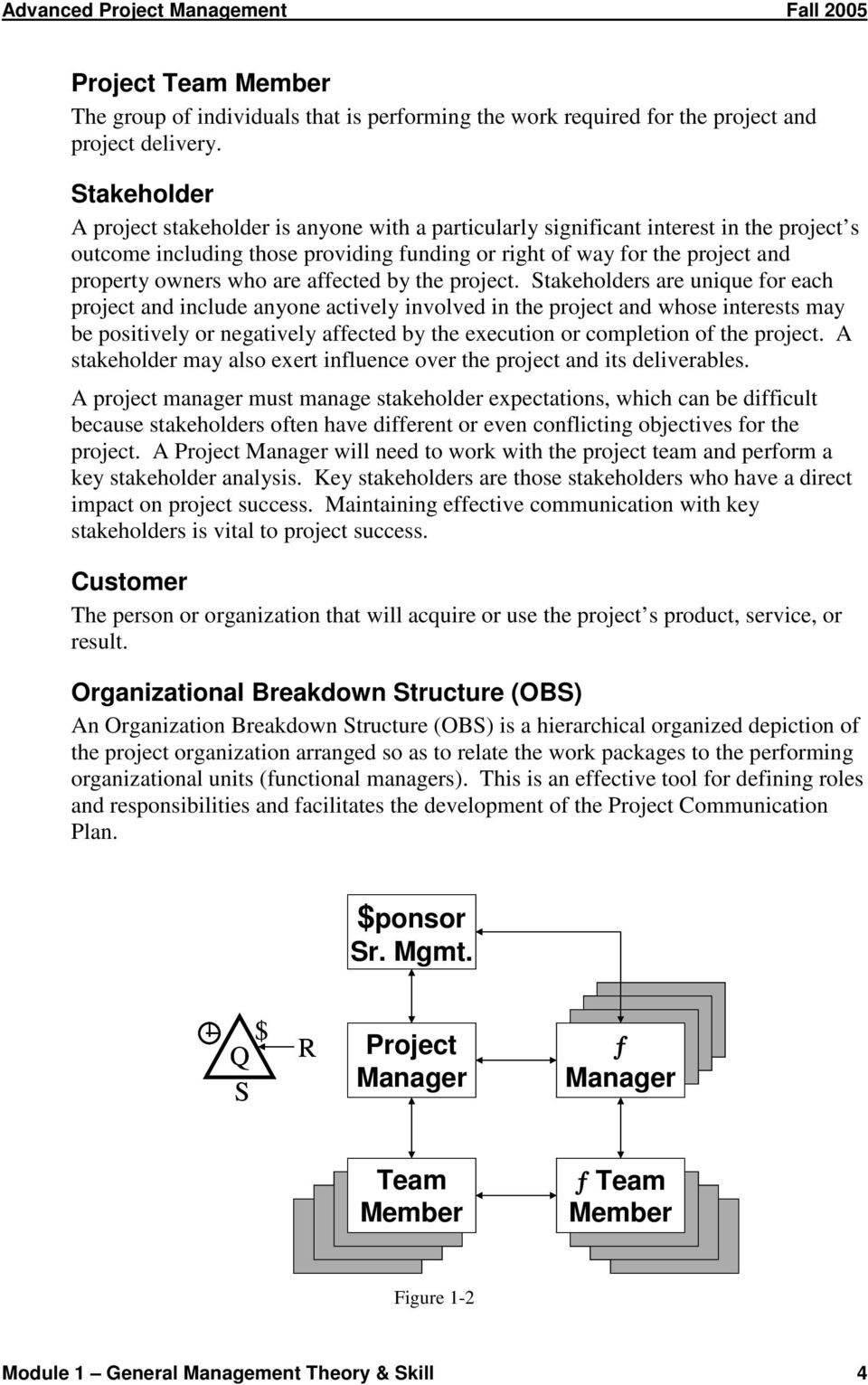
10 Project Team Member The group of individuals that is performing the work required for the project and project delivery. Stakeholder A project stakeholder is anyone with a particularly significant interest in the project s outcome including those providing funding or right of way for the project and property owners who are affected by the project. Stakeholders are unique for each project and include anyone actively involved in the project and whose interests may be positively or negatively affected by the execution or completion of the project. A stakeholder may also exert influence over the project and its deliverables. A project manager must manage stakeholder expectations, which can be difficult because stakeholders often have different or even conflicting objectives for the project. A Project Manager will need to work with the project team and perform a key stakeholder analysis. Key stakeholders are those stakeholders who have a direct impact on project success. Maintaining effective communication with key stakeholders is vital to project success. Customer The person or organization that will acquire or use the project s product, service, or result. Organizational Breakdown Structure (OBS) An Organization Breakdown Structure (OBS) is a hierarchical organized depiction of the project organization arranged so as to relate the work packages to the performing organizational units (functional managers). This is an effective tool for defining roles and responsibilities and facilitates the development of the Project Communication Plan. $ponsor Sr. Mgmt. $ Q S R Project Manager ƒ Manager Team Member ƒ Team Member Figure 1-2 Module 1 General Management Theory & Skill 4
11 Responsibility Assignment Matrix (RAM) A Responsibility Assignment Matrix (RAM) is a tool that relates the project OBS to the project Work Breakdown Structure (WBS). It is used to help ensure that each component of the project s scope is assigned to a responsible team or person. Role WBS Item Project Manager Functional Manager A Functional Manager B Functional Manager C Functional Manager D Functional Manager E Functional Manager F Functional Manager G Functional Manager H Functional Manager J Functional Manager K Functional Manager L Functional Manager M Functional Manager N Functional Manager P WBS Deliverable 1 R S A WBS Deliverable 2 P S R A WBS Deliverable 3 R I I A S WBS Deliverable 4 S I WBS Deliverable 5 WBS Deliverable 6 R A I R I A S S WBS Deliverable 7 R S P - Participant; A Accountable; R Review; I Input Required; S Signature Required Figure 1-3 Organizational Influences and Structure Projects are typically part of an organization that is larger than the project. Examples of organizations include corporations, governmental agencies, healthcare institutions, international bodies, professional associations, and others. Project based organizations are those whose operations consist primarily of projects. These organizations fall into two categories: Organizations that derive their revenue primarily from performing projects for others under contract (i.e. architectural firms, engineering firms, consultants, construction contractors, and government contractors). Organizations that have adopted management by projects. These organizations usually have a management system in place to facilitate project management. The structure of an organization often constrains the availability of resources. S A 5 Module 1 General Management Theory & Skill

12 Org Structure> Characteristics Project Mgr s Authority Resource Availability Who controls project budget Project Mgr s Role Project Mgr Admin Staff Functional Matrix Weak Balanced Strong Little or None Limited Low to Moderate Moderate to High Little or None Limited Low to Moderate Moderate to High Functional Manager Functional Manager Projectized High to Almost Total High to Almost Total Mixed Project Manager Project Manager Part-time Part-time Full-time Full-time Full-time Part-time Part-time Part-time Full-time Full-time Figure 1-4 PMBOK Guide, 3 rd Edition Functional Organization The typical functional organization is a hierarchy where each employee has one clear supervisor. Staff members are grouped by their specialty. The scope of work is typically bound by the group s specialty or specific function. Projects developed in a functional organization will have a project coordinator in lieu of a project manager. Projectized Organization At the other end of the spectrum from the functional organization is the projectized organization. Often, team members are collocated. Most of the organization s resources are involved with the project s work. Project managers have a great amount of independence and project authority. Matrix Organization Matrix organizations are a blend of functional and projectized characteristics. Strong Matrix In a strong matrix organization, the Project Manager has considerable authority and usually will have full-time staff assigned. The Project Manager will usually report to a manager of project managers, or a Project Management Office. Weak Matrix Weak matrices maintain many of the characteristics of a functional organization, with the project manager actually providing a coordination role, with limited or no project authority. Module 1 General Management Theory & Skill 6

13 Balanced Matrix A balanced matrix recognizes the need for a project manager; this structure does not provide the project manager with the full authority over the project and project funding. Project Coordinator In some organizations, project managers do not exist. Instead, these organizations use the role of a project coordinator. The project coordinator has less authority than a project manager. This person may not be allowed to make budget decisions or overall project decisions, but they have some authority to assign resources. Project coordinators are typically found in weak matrix and functional organizations. Project Expeditor This role has the least amount of authority. The project expeditor is a staff member who makes sure things arrive on time and that tasks/activities are completed on time. An expeditor is usually found in a functional organization. Power Power is the ability to influence behavior in others. Power that is based on the organization and the position/title of the Project Manager is Organizational or Legitimate power. Power that is based on the characteristics of the person is Individual or Earned power. Legitimate/Formal Power Legitimate power, also known as formal power, is the power that the Project Manager has due to the position or title. This power comes from being formally in charge of a project and the backing and support from the agency/organization. Strong, broad based formal authority for a project manager is rare. This would be characteristic of a projectized organizational structure. Reward Power Reward power is the ability to give rewards and recognize achievements. Some examples of these rewards and recognition are pay raises, bonuses, time off, or any other type of reward that would motivate the person. Punishment Power Similar to Reward power, this type of influence is the ability to punish an employee if a goal is not met. Nobody is taking vacation next month is we miss this milestone date, or If you overspend the project budget, you ll be demoted are examples of a manager using punishment power. This type of power is also known as coercive power. 7 Module 1 General Management Theory & Skill
14 Expert Power Expert power exists when the individual, or Project Manager, is an expert on the subject. People will listen and respond to an individual that has Expert power because that person has credibility. A subject matter expert (SME) has significant power to influence and control behavior. Referent Power Referent power is a form of power based on the respect or charismatic traits of the individual. This power is based in the persuasive ability of the person. Another form of referent power is when a less persuasive (powerful) person will use the influence of, or allies with, another person with more persuasive trait, and leverages the power of the ally. Most project management references consider Reward and Expert power as the most effective and Punishment or Coercive power as the least effective. Conflict Management Project Managers need to realize that conflicts during the life of a project are inevitable. Recognizing this fact, developing good procedures or techniques, and planning for conflict resolution can help resolve conflicts as they arise. A project management plan can identify potential conflicts, develop resolution methods, and document the methods for the project team to use throughout the project. Sources of Conflict Research has shown that the greatest source of conflict is between project managers and functional managers. Most of these are the result of disagreements over schedules, priorities, and resources. This runs contrary to commonly held beliefs that most project conflicts are a result of personality differences. Confronting / Problem-Solving Sometimes referred to as confronting or collaborating, although the term confronting may have a negative connotation to it, this method is generally viewed as the best method for conflict resolution. It confronts the source of conflict and looks to solve the conflict so it will not be an issue for the project. Compromising To compromise is to negotiate or bargain for a solution that gives both parties some degree of satisfaction. Some would call this a give and take or win-win situation. Others might call it a lose-lose position, since neither party will get everything they want or need. Module 1 General Management Theory & Skill 8

15 Forcing Forcing is exactly as the name implies. It is when one party tries to impose the solution on the other party. The result is usually viewed as a win-lose situation, where one party wins at the expense of the other. Typically, this method does not address the underlying source of conflict and can reduce team morale. It is not viewed as a good method for long term solutions and relationship building. Smoothing / Accommodating When using the smoothing, or accommodating, technique, the Project Manager will emphasize the areas of agreement or turn attention to what is going well and deemphasizing the areas of disagreement or conflict. Smoothing tends to downplay the conflict instead of resolving it. Withdrawing / Avoiding Withdrawal is often regarded as a temporary solution at best. Some argue that this is not a conflict resolution at all. A project manager that uses this method is merely hoping that the problem will go away by itself over time. Because of the avoidance or temporary nature of this method, the conflict can come up again and again throughout the project life. Team Roles A project manager s ability to effectively address and manage conflicts on a project will be affected by his or her ability to recognize and deal with constructive and destructive roles on the project team. An effective project manager will be able to identify destructive roles within the team and look to diminish or eliminate them and enhance and maximize the positive effects from constructive team roles. Constructive Team Roles Initiators An initiator is a project team member that brings ideas and activities to a project. This role is proactive and is considered highly productive and positive. Information Seekers An information seeker is a project team member that actively seeks to gain as much project information and project understanding as possible. This role is considered positive because this develops an environment of increased project knowledge and open communications for the project team. Information Givers An information giver is a project team member that openly shares project information. Similar to the information seeker, this role is considered positive because it develops an environment of increased project knowledge and open 9 Module 1 General Management Theory & Skill

16 communications for the project team. Be mindful that not all information can be readily shared (i.e. confidential, classified, secret information). Encouragers Encouragers are project team members that maintain a positive and realistic attitude within the project team. These individuals keep the team focused on what can be accomplished. This role is considered positive because is contributes, improves, and maintains team morale. Clarifiers A clarifier is a project team member that works to ensure that everyone has the same project understanding and project knowledge. This role is considered positive because it is proactive and keeps the team focuses on the project objectives. This role also improves communication. Harmonizers A harmonizer is a project team member that actively looks to enhance project information is a way that increases project understanding. This is considered a positive role because is increased project understanding and can contribute to better communication. Summarizers A summarizer can take the minute details of the project and restate or relate them in a summarized form back to the project objectives. This is considered a positive role because the fine details of a project can become overwhelming to project team members. A summarizer will, similar to the harmonizer, help in increased project understanding and can contribute to better communication. Gate Keepers The role of gate keeper has a couple of possible meanings in project management, depending on the reference used. One definition is a project team member that works to draw other team members into the project discussions. This role is considered possible because it encourages participation on the project. Another definition is the project team member that judges whether the project will continue when a kill point or stage gate has been reached. This project team member makes decisions whether the project still meets the business needs and is justified in transitioning to the next phase. Destructive Team Roles Aggressors An aggressor is a project team member that is openly opposed and hostile to the project and project objectives. This is a negative role because it serves no productive purpose for the project. Module 1 General Management Theory & Skill 10

17 Blockers A blocker is a project team member that blocks access to information and looks to disrupt the flow of communication. Since good project communication is essential for project success, this role is very destructive. Withdrawers A withdrawer is a project team member who does not participate in discussions, brainstorming sessions, team meetings, etc. This person will likely remain quiet or refuse to participate at all. This is a negative role because it usually produces a project team member that will not commit to the project plan and can have a negative effect on team morale. Recognition Seekers A recognition seeker will look at a project to see how it can personally benefit him or her. Because this person is more interested in personal benefit rather than project success, he or she can ultimately jeopardize the project. Topic Jumpers A topic jumper is a project team member that constantly changes the subject and brings up irrelevant facts. This is a destructive role because it disrupts effective communication and could prevent important topics from being fully discussed and brought to closure. Dominator A dominator is a project team member that disrupts team participation and communication by presenting their own opinions forcefully and without any recognition or consideration of other s contributions or points of view. This person will dominate the communication and bully their way through the project. This is a negative role because is prevents effective communication, quashes other s valid opinions, and may be contrary to the project s objectives. Devil s Advocate advocatus diaboli. Although the origins of this role are rooted as a positive role for the critical examination of canonization or beatification in the Roman Catholic Church, for project management this is considered a negative role. The definition of this role is a project team member that takes up the contrary view just for the sake of argument and not on the arguments merits (if any). This role is negative because is often frustrates and disrupts effective communication and discourages people from participating. 11 Module 1 General Management Theory & Skill

18 Module 1 references Harold Kerzner, Ph.D. Project Management, A Systems Approach to Planning, Scheduling, and Controlling, 8 th Edition. John Wiley & Sons, Inc Project Management Institute. A Guide to the Project Management Body of Knowledge, 3 rd Edition (PMBOK Guide). Project Management Institute, Inc Velociteach. The PMP Exam, 2005 Edition. Andy Crowe, PMP Module 1 General Management Theory & Skill 12
19 Module 1 exercise 1) The project team member who is responsible for providing the financial resources (funding) for the project is the: a) Project Manager b) Functional Manager c) Project Sponsor d) Senior Manager 2) An effective tool for identifying roles and responsibilities and facilitating the development of the project communication plan is the: a) Organizational Breakdown Structure (OBS) b) Responsibility Assignment Matrix (RAM) c) Work Breakdown Structure (WBS) d) Key Stakeholder Analysis 3) Who manages the project budget in a functional matrix organization? a) Project Manager b) Functional Manager c) Customer d) Key Stakeholder 4) In what type of matrix organization does the Project Manager have high to total authority of the project? a) Balanced Matrix b) Functional Matrix c) Projectized Matrix d) Weak Matrix 5) Which one of the following is an example of Earned or Individual power? a) Referent power b) Reward power c) Punishment power d) Legitimate power 13 Module 1 General Management Theory & Skill

20 6) A project team member is an expert in hydraulic analysis. The other project team members, including the project manager look to this team member for guidance through the hydraulic design and permitting process. What type of power is this? a) Punishment power b) Referent power c) Reward power d) Expert power 7) Which of the following is a productive team role? a) Recognition seeker b) Withdrawer c) Clarifier d) Topic Jumper 8) If the Project Manager is heard saying, We agree that this deliverable is important and we have agreed on all of the other deliverables, let s not fight over a few thousand dollars. What conflict resolution method is this Project Manager using? a) Smoothing b) Confronting c) Compromising d) Forcing 9) Which conflict resolution method produces the most lasting results and in considered the most effective method? a) Smoothing b) Confronting c) Compromising d) Forcing 10) According to research, what is the most common source of conflict on a project? a) Personality conflicts b) Procedures c) Resource priority (availability) / Schedules d) Technical Opinions Module 1 General Management Theory & Skill 14

21 Module 2 WSDOT Project Management Overview Initiate & Align Plan the Work Endorse the Plan Project Team Commitment Management Endorsement Project Description Team Mission/ Assignment Major Milestones Boundaries Team Identification Roles & Responsibilities Measures of Success Operating Guidelines Work Breakdown Structure (WBS) / Master Deliverables List (MDL) Task Planning & Scheduling Budget Risk Planning Communication Plan Change Management Plan Quality (QA/QC) Plan Transition & Closure Plan Work the Plan Managing Scope, Schedule & Budget Manage Risks Manage Change Communicate Progress Issues Lessons Learned Transition & Closure Implement Transition Plan Review Lessons Learned Reward & Recognize Archive Figure 2-1 Project Management Policy In late 1998, a focus team was formed to begin looking at how WSDOT could more effectively and efficiently deliver projects. The team developed guidance and tools for project management as it applies to WSDOT. An Instructional Letter (IL) recommending the use of these principles was signed in the summer of 2000, followed by Design Manual Chapter 140. Many other tools for delivery, accountability, and communicating have followed: Cost Estimating & Validation Process (CEVP) Project Delivery Information System Cost Risk Assessment Project Control & Reporting (change management) In 2004, the Joint Legislative Audit and Review Committee (JLARC) review focused on the agencies critical path management, risk management, project reporting, and organizational structures used to execute capital projects. Since the study was intended to be a pre-audit review, only eight example projects were selected to represent the diversity of issues and characteristics in WSDOT s capital program. JLARC chose projects well into the construction phase; many of these projects were designed prior to some of the tools and processes we have in place today. 15 Module 2 Project Management Overview
22 The Overview of Washington State Department of Transportation Capital Project Management Report, dated January 21, 2005, made four summary management recommendations: Recommendation 1 WSDOT should extend the application of the Managing Project Delivery, Project Delivery Information System, and Primavera Project Planner for the Enterprise tools and put management steps in place to confirm their adoption. Recommendation 2 WSDOT should develop a plan and timeline for implementing recommendations issued by Gannett Fleming, which center primarily on a) using existing exemplary practices in place at some projects to develop minimum standards and/or templates; b) improving the clarity of project communication by documenting terms and definitions; and c) confirming the consistency and currency of reporting information. Recommendation 3 WSDOT should conduct an assessment of the effectiveness of current information systems and options for addressing any deficiencies. Recommendation 4 WSDOT should develop criteria for extending Cost Risk Estimating and Management (CREM) analyses to a wider universe of projects. WSDOT is proactively identifying ways to address these recommendations. One step was the formation of a Project Management Task Force. The Project Management Task Force was made up of representatives from across the state; representing multiple disciplines (design, construction, etc.). This team was tasked with identifying ways to implement the JLARC recommendations, but more importantly to improve our project management process. The result of this effort is the Project Management Online Guide and Executive Order Copies of the Executive Order and a link to the Project Management On-Line Guide are available on the project management website. Project Management Processes A few changes have occurred over the years but the philosophy remains the same. WSDOT s project management process features a 5-step process very similar to other project management approaches being used around the world by project managers in the private and public sectors. Initiate & Align the Project Team This is the first step in the project management process. Initiation is the formal recognition that a project exists. Organizational senior management will initiate the project and assign the project to a Project Manager. The Project Manager will identify the project team and align the team with a common goal and purpose. The elements of the Initiate & Align process are: Project Description: A description of the project s product, purpose, or intended outcome. Module 2 Project Management Overview 16
23 Team Mission/Assignment: A high level description of what the project team s work will be to achieve the Project Description. The work order assigned to the project phase is a good indication of what the Team Mission/Assignment is. Major Milestones: A listing of programmed milestones for the project. Boundaries: Identification of physical boundaries, operational limitations, and project objective constraints for the project. Team Identification: The Project Manager will identify the functional teams required to deliver the project. Roles & Responsibilities: Who will do what? The project team roles (the who ) and the project responsibilities (the what ) will be identified by the project team. This is further developed with the Responsibility Assignment Matrix (RAM) during the Plan the Work process step. Measures of Success: Identifying critical success factors and methods to measure performance for these factors. Operating Guidelines: The project team will identify how decisions will be made and plan methods for managing project conflicts. This information is documented on the Initiate and Align Worksheet and reviewed by the project team. Plan the Work This is the second step in the project management process. This step produces the Project Management Plan that will used by the project team to deliver the project. The elements of the Plan the Work step are: Work Breakdown Structure (WBS): Using the Master Deliverable List (MDL) as a template, the project team will decompose the list and develop a project specific WBS. This will define the project s requirements objective (the project scope) and the expected quality standard for the project s deliverables. Task Planning & Scheduling: The project team will use the WBS and the RAM to develop tasks to deliver the project deliverables. These activities are entered into the organizations enterprise project scheduling program. This will define the project s time objective (the project schedule). Budget: The project team will resource load the project schedule to develop a bottom-up or engineering estimate for the project. This will define the project s cost requirements (the project budget). This is compared against programmed budgets. The project team will look at ways to optimize the scope, schedule, and budget to match the earlier identified project boundaries. Risk Planning: The project team will develop a Risk Management Plan and Risk Register to identify, analyze, plan response action strategy, and monitor the risk event. 17 Module 2 Project Management Overview
24 Communication Plan: The project team will develop a Communication Plan to identify and describe the methods, media, frequency, required details and information needed. Both external and internal communications are planned. Change Management Plan: The project team will develop a Change Management Plan that will provide a framework and process for the team to use when change occurs. Quality Plan: The project team will identify the quality methods to be planned and implemented to prevent errors from reaching the customer (Quality Control QC) and to ensure that the team is doing the right things (Quality Assurance QA). Transition & Closure Plan: Beginning with the end in mind. The project team will develop the Transition & Closure Plan for the transition of the project to the next phase, or the closure of the project. The first four elements (WBS, schedule, budget, risk) define the Project Performance Baseline. The last four elements (Communication Plan, Change Management Plan, Quality Plan, and Transition & Closure Plan) are developed to help facilitate project management. Endorse the Plan Endorsement is the third step in the project management process. Endorsement also completes the Plan the Work phase of project management. Once the Project Management Plan is endorsed, the project team will move to the Work the Plan phase of project management. The elements of endorsement are: Project Team Commitment: Getting an agreement or pledge from the project team that they will perform and deliver the project deliverables as documented in the Project Management Plan. Management Endorsement: Getting approval and a commitment from senior management that the resources required and documented in the Project Management Plan will be available. Once the Project Management Plan is endorsed, the Project Manager will baseline the plan and use the plan as a metric for project performance and for facilitating project management. Endorsement is not a one-time event, but is done throughout the life of the project. As changes occur, the project team will need to review and re-commit and re-endorse the updated plan. Work the Plan Work the Plan is the fourth step of the project management process. Although the steps have been listed as a linear order, working the plan requires the project manager to continually update the plan, requiring some additional planning and possible reendorsement in the case of change. This updating process is referred to as Module 2 Project Management Overview 18
25 progressive elaboration, or in other words, an iterative process. As the project team knows more about the project, further refinement of the plan is required. The elements of work the Plan are as follows: Manage the Scope, Schedule, & Budget: These are the components of the Project Performance Baseline. The project manager will continually update the Project Performance Baseline by tracking what work was actually completed, when that work was actually completed, and how much was actually expended to complete the work planned. Comparing these actuals against the Project Performance Baseline will give the project team a sense of how the project is performing with respect to schedule and budget. Manage Risks: The project team created a risk management plan with risk register during the plan the work step. During the work the plan step, the project manager and the project team will monitor the identified risk, continue to update the plan with identifying new risks, evaluating the impact and probability of the identified risks, and monitoring the effectiveness of the risk response strategy. Manage Change: Change is inevitable on a project. A project manager will manage change by implementing the Change Management Plan for the project. Communication: The most important skill set for a project manager is the ability to communicate clearly and appropriately. The Communication Plan developed during the plan the work step is implemented and updated as needed. The items required for reporting are progress reporting (schedule and budget performance); issues (risks and changes); and lessons learned. These items should be a standing agenda item for all team meetings. Throughout the project life, the project manager will need to manage a dynamic project team. These teams must be built and sustained to attain high performance, produce effective results, and successfully deliver the project. Transition & Closure The final step in the project management process is Transition & Closure. This is the step of transitioning the project to the next phase or completing the project as described in the project description and delivering the product to the customer. The elements for this project management step are as follows: Implement the Transition Plan: During the Plan the Work step, the project team developed a plan for transitioning and closing the project. Implementation of this plan gives a foundation to accomplish this. Review Lessons Learned: Lessons learned was planned early on and maintained throughout the project life. The team will review lessons learned from the project and share it with the team and agency. 19 Module 2 Project Management Overview
26 Reward & Recognize: Look to recognize and award the outstanding achievements of the project team. Since teams are dynamic, this is an element that is managed throughout the project s life. Archive: Archiving the project information as directed by agency policies and from the Transition and Closure Plan. Being able to plan early to what information will be archived and in what format or media will allow the team to archive as it develops and completes the project. Project Management Plan During the Plan the Work phase of the project, which encompasses the first three project management steps, the project team will create and endorse a Project Management Plan. This plan will typically consist of the following: Completed Initiate and Align Worksheet Project Work Breakdown Structure (WBS) Project Schedule Project Budget with appropriate forecasted expenditures (aging) Risk Management Plan with Risk Register Communication Plan Change Management Plan Quality Plan Transition and Closure Plan Commitment and Endorsement Project Performance Baseline Management SCHEDULE Q BUDGET PROJECT RISK SCOPE Project Managers often talk of a triple constraint or trade off triangle project requirements (scope), project time (schedule), and project costs (budget). Replacing these project objectives with the tools to manage those objectives gives the trade off triangle of Module 2 Project Management Overview 20
27 scope, schedule, and budget. The relationship between these parameters is such that if any one of the three parameters is changed, at least one of the other project parameters is likely to be affected. Project quality is affected by balancing these project objectives. High quality projects deliver the required product, service, or result within scope, on time, and within budget. Project managers also manage projects in response to uncertainty. Project risk is an uncertain event or condition that, if the risk event occurs, has a positive or negative effect on at least one project parameter. Project Requirements (Scope) and Quality The Project WBS is developed to define the project requirements and project scope. The project manager will manage the project scope and the associated quality defined for the project deliverables. If an additional project deliverable is required, the project manager will implement the appropriate change management actions to update the project scope. Work completed that is not part of the endorsed project WBS is called scope creep. Technically oriented team members are motivated not only by meeting specifications, but also by exceeding them. Unfortunately, exceeding specifications can become quite costly. A project manager needs to be able to discern between legitimate scope change and scope creep. Project Time (Schedule) The Project Schedule is developed to define when the work will be completed on a project. During the work the plan process step, a project manager will track the actual dates for the work completed and evaluate/analyze the effects of these dates on the remainder of the project network. Schedule performance will be evaluated by comparing the actual dates to the planned dates (project performance baseline). A project manager will use schedule compression techniques (discussed later) to recover a project schedule. Project Costs (Budget) & Aging The Project Budget is developed to define when financial resources will be required. Based on the Project WBS (work to be done) and the Project Schedule (when work will need to be completed), the budget is developed and an appropriate forecasting report, aging report is developed. During the work the plan process step, a project manager will track the actual expenditures for the work completed and evaluate/analyze the effects of these actual costs on the remainder of the project aging. Budget performance will be evaluated by comparing the actual expenditures to the planned expenditures (project performance baseline). 21 Module 2 Project Management Overview
28 Module 2 references WSDOT Executive Order E Project Management, dated July 1, 2005 WSDOT. Project Management Process training manual, Module 2 Project Management Overview 22
29 Module 2 exercise 1. The five steps of the project management process, as defined in the Executive Order 1032E, dated July 1, 2005, and the Project Management On-Line Guide are: 2. Complete the below trade off triangle with the appropriate project objectives and tools to manage the objectives: 3. The Endorsed Project Performance Baseline consists of: 23 Module 2 Project Management Overview
30 4. The Project Management Plan consists of: Work Breakdown Structure (WBS) / MDL Risk Planning Task Planning and Scheduling Budget 5. The most important skill set for a project manager is: a. Scheduling expertise b. Communication c. Technical Knowledge d. Budgeting Module 2 Project Management Overview 24
31 Module 3 Schedule Management Schedule Terminology & Definitions Work Breakdown Structure (WBS) A deliverable oriented hierarchical decomposition of the work to be executed by the project team to accomplish the team mission and create the required deliverables. The WBS defines the project scope. Team Mission Deliverable Any unique and verifiable product or result that must be produced to complete a project. Usually the lowest level of the WBS. Team Mission 25 Module 3 Schedule Management
32 Scheduled Activity (Task) A component of work performed to create a deliverable. Team Mission Activity List (Schedule) WBS (Scope) Task 1 Task 2 (Etc.) Task 1 Task 2 (Etc.) Task 1 Task 2 (Etc.) Task 1 Task 2 (Etc.) Task 1 Task 2 (Etc.) Task 1 Task 2 (Etc.) Schedule Milestone A significant event in the project schedule, such as an event restraining future work or marking the completion of a major deliverable. A measuring point. Milestones have 0 (zero) duration and no resource assignments. Logical Relationship Logical relationship is a dependency between two project schedule activities, or between a project schedule activity and a schedule milestone. Logical relationship are generally defined as mandatory dependencies (or hard logic ) and discretionary dependencies (or soft logic ). The four possible types of logical relationships are: Finish-to-Start (most common): The end of one schedule activity will constrain the start of another activity. Finish-to-Start Finish-to-Finish: The end of one schedule activity will constrain the finish of another activity. Finish-to-Finish Module 3 Schedule Management 26
33 Start-to-Start: The start of one schedule activity will constrain the start of another activity. Start-to-Start Start-to-Finish (very rare, not available in some software applications): The start of one schedule activity will constrain the finish of another schedule activity. Start-to-Finish All four of these logical relationships can be modified by applying a lead, acceleration in the start of the successor activity, or a lag, a delay in the start of the successor activity. Precedence Diagram (Network Diagram) A schedule network diagramming technique in which schedule activities are represented by nodes. Schedule activities are graphically linked by one or more logical relationships to show the sequence in which the activities are to be performed. Also referred to as Activity-on-Node (AON) A B C D E Precedence Diagram F G Critical Path The critical path is the sequence of schedule activities that determines the duration of the project. Some characteristics of the critical path are: Longest duration path through the project network Activities on the Critical Path are called Critical Activities Critical activities have no float or slack A project can have more than one critical path Activities not on the Critical Path are called Non Critical Activities 27 Module 3 Schedule Management
34 To shorten the project duration, a scheduler must modify the critical path activities or dependencies Float (Slack) Float, or slack, is the amount of time a scheduled activity has that it can be delayed or extended without affecting the project end date or the next scheduled activity. Float can be further defined as: Total Float The total amount of time that a scheduled activity (or milestone) may be delayed or extended without delaying the project end date or violating a schedule constraint. Activity Duration Total Float Free Float The amount of time that a scheduled activity (or milestone) can be delayed without delaying the start of the next activity in the network. Activity Duration Free Float Negative Float The amount of time that by which a critical activity (or milestone) misses a required date. Negative Float Activity Duration Critical Path Method (CPM) Scheduling A schedule network analysis technique used to determine the amount of schedule flexibility (float) on various network paths in the project schedule network, and to determine the minimum project duration (critical path). This is done by performing a forward pass through the project schedule network to determine the early start and early finish dates. Then performing a backward pass through the project schedule network to determine the late start and late finish dates. Gantt Chart Also called a bar chart. A graphic display of schedule related information. Schedule activities or WBS components are listed at the left of the chart and dates are shown across the top of the chart. Schedule activities are shown as a date paced horizontal bar. This is the most common form of communication for a schedule. This is a report from the project management or project scheduling programs. Module 3 Schedule Management 28
35 Schedule tracking Once the project team has committed to and endorsed a project schedule, a project manager needs to baseline the project schedule. This project performance baseline represents a snapshot of the approved project scope (WBS), project schedule, and corresponding project cost. Evaluating actual schedule dates and actual cost to the project performance baseline will help the project team evaluate schedule and cost performance. A project manager needs to track the schedule activities and record when these schedule activities actually started and completed. This will help identify where the project is currently at and what potential changes or delays are approaching. Tracking Schedule Actuals Actual Start This is the date that the work on the deliverable or schedule activity actually started. In the project schedule software applications, this field is called Actual Start. Actual Finish This is the date that the work on the deliverable or schedule activity actually finished. In the project schedule software applications, this field is called Actual Finish. Percent Complete Percent Complete is a function of time. The formula for this value is defined as Elapsed Duration/Activity Duration. With the current project management software system the WSDOT has, this field must be greater than 0 before the Base Cost % Complete can be entered. Base Cost Percent completes The key to accurately calculating project progress is having an accurate estimate of how much of the deliverable (or work) is complete, expressed in a percentage (%). There are several methods to choose from, depending upon the type of work performed. Units Produced Method This is the ratio of the units produced to the total specified at completion. Units must be nearly identical. Some examples would be: Drilling 10 holes, completed 4 holes, % complete would be 40% Paving 5 lane miles, completed 4 lane miles, % complete would be 80% Interim Milestone Method (Agreement Method) Establish the percent of the total that is represented by each milestone, based on experience or, an agreement with the project team members on percent complete of various stages of the process/deliverable. Some examples would be: Geometric design complete = 30% 29 Module 3 Schedule Management
36 Detailed Plans = 60% Contract Documents = 90% or Data Collection = 10% Draft Report = 70% Revised Draft = 90% Published final = 100% 50/50 Method The 50/50 method is best used when an accurate estimate is nearly impossible and when durations are relatively short (less than the reporting frequency). This method is a good method for higher-level EVM and when there are several processes (or deliverables) to be evaluated. The more tasks/deliverables evaluated, the more accurate the EVM. 50% complete is assumed when the task/deliverable has started. 100% complete is assumed when the task/deliverable is finished. 0/100 Method The 0/100 method is best used when a task/deliverable has no value unless it is completed and when durations are relatively short (less than the reporting frequency). This method is also a good method for higher-level EVM and when there are several processes (or deliverables) to be evaluated. 0% complete is assumed until a task/deliverable is complete. 100% complete is assumed when the task/deliverable is finished. Proportional Relationship Method This method is used when the completion of a measurable amount of one work package indicates the completion of another task that cannot be easily measured. This method works well for the on-going or hammock tasks within the project schedule. An example of this method would be: 40% of the project is complete, so 40% of the project management task is complete. Schedule Recovery / Schedule Compression Schedule compression is a technique used to shorten the project duration without reducing the project scope. There are two methods used to compress, or recover a schedule. Schedule crashing Schedule crashing is a compression technique in which schedule activity durations are modified, working day definitions are modified, or resource requirements are modified. These modifications are analyzed to determine how to obtain the greatest amount of compression for the least incremental cost (Triple Constraints Theory). Module 3 Schedule Management 30
37 Typically, crashing a project schedule will increase project costs, and sometimes crashing a project schedule does not produce a viable alternative. Some examples of crashing are: Shorten schedule activity durations Assigning additional resources Working overtime / working during non-working days Changing project or resource calendars Schedule fast tracking Fast tracking is a compression technique in which activities that would normally be completed in sequence are performed in parallel. Fast tracking does not change the resource requirements, but modifies the logical relationships between schedule activities. This approach can require work to be performed without complete detailed information. Typically, fast tracking a project schedule will increase project risk, which may have an impact on project costs (Triple Constraints Theory). What-If Scenario Analysis This is the analysis of the question What if the situation represented by scenario X happens? Using the schedule model, the effects of different compression techniques can be analyzed with regards to project costs and the amount of schedule time recovered. The outcome from what-if analysis can be used to assess the feasibility of the project schedule under certain adverse conditions. This can be further used for risk planning, contingency planning, and response planning. Monte Carlo Analysis is a common what-if technique used. (To be discussed later.) 31 Module 3 Schedule Management
38 Module 3 references WSDOT. Intro to Project Scheduling training manual Project Management Institute. A Guide to the Project Management Body of Knowledge, 3 rd Edition (PMBOK Guide). Project Management Institute, Inc Module 3 Schedule Management 32
39 Module 3 exercise S Task A 20 days Task B 16 days Task C 25 days Task D 10 days Task E 20 days Task F 7 days Task G 14 days Task H 10 days Task J 15 days F 1. Identify the paths through schedule network and determine the critical path and project duration. 2. The project customer is requesting this project completed in 45 days. Is schedule compression even required? If so, what methods would be used to compress the project schedule? 3. Using the revised project schedule from #2 as the baseline plan, the duration of Task E is delayed to 24 days due to a key resource being unavailable for the first 4 days. Does this impact the project schedule and project end date? If so, what methods would be used to recover the remaining project schedule (assume everything else to date is completed or in progress). 33 Module 3 Schedule Management
40 (This page intentionally left blank) Module 3 Schedule Management 34
41 Module 4 Risk Planning & Risk Management Risk Definitions Risk Management Risk management is the act or practice of dealing with project risk. It includes planning for risk, assessing risk (identification and analyzing), developing risk response strategies, and monitoring risks to determine how risk changes during the project life. Risk Project risk in an uncertain event or condition that, if it occurs, has a positive or negative effect on at least one of the project objectives (scope, schedule, budget, quality) Threat A project risk that has a negative effect is referred to as a threat. A project manager will proactively manage threats to the project and look for ways to reduce the probability or impact of the threat or eliminate the threat all together. Opportunity A project risk that has a positive effect is referred to as an opportunity. A project manager will proactively manage opportunities to the project and look for ways to exploit, enhance, or share the opportunity. Risk Trigger A risk may have one or more causes, and if the event occurs, one or more impacts. Identifying the causes of risk events help define the risk trigger. A risk trigger indicates that a risk event in imminent. Risk Tolerance There are many resources available to give guidance for risk management. Unfortunately, there is no single textbook answer for how to manage project risk. Project managers need to rely on the organization s policies, project team involvement in risk planning, and the input from subject matter experts. Ultimately, the decisions made on how to deal with project risk will be based on the risk profile, or risk tolerance, of the project manager, project team and organization. Three common classifications used for describing risk tolerance are the risk averter (or avoider), risk neutral, or risk seeker (or taker). The method to classify these is based on the utility, or the satisfaction received from the risk payoff. 35 Module 4 Risk Planning & Risk Management
42 Risk Adverse / Averter U With a risk adverse or averter, the utility rises at a decreasing rate. This means when more money is at stake, the tolerance diminishes. Another way to describe this is that the limit of risk tolerance is achieved at a lower dollar amount. A risk adverse person will prefer a more certain outcome and demand a premium to accept risk. Risk Neutral U $ With a risk neutral profile, the utility, or satisfaction from a risk payoff rises at a constant rate. Risk Taker / Seeker U $ With a risk taker or risk seeker, the utility rises at an increasing rate. This means when more money is at stake, the tolerance increases. Another way to describe this is that the limit of risk tolerance is not achieved unless the dollar amount is greater. A risk adverse person will prefer a more uncertain outcome and is willing to pay a penalty to take a risk. $ Module 4 Risk Planning & Risk Management 36
43 WSDOT Risk Policy Executive Order 1032E directs project managers to the Project Management On-Line Guide for the agency policy on development of the Project Management Plan. From the project management step plan the work, the element of Risk Planning is identified and the development of the Risk Management Plan and Risk Register is described. The Project Management On-Line Guide also has tools available for risk planning, such as the Risk Management Plan Template, sample risk plans, and the Cost Risk Estimating and Management (CREM) website link. The CREM office provides risk planning tools for projects that meet certain funding thresholds. Coordination with the CREM office is required for these projects. WSDOT A Policy for Cost Risk Assessment is available from the CREM office website and defines the process and products of risk planning for these projects. A Cost Risk Assessment (CRA) is required for all projects with an estimated cost of $25 million of more. A Cost Estimate Validation Process (CEVP ) is required for any project with an estimated cost of $100 million or more. Other projects can greatly benefit from formal risk assessments; typically those projects having a preliminary estimate exceeding $5 million or more and include one or more of the following: Projects that are unique or unusual; Project with a high degree of political interest Project that have been through an abbreviated scoping process Projects with alternative solutions that vary scope and cost New alignments of bypass sections Capacity improvements that widen an existing highway Major structures Interchanges on multilane facilities Projects with extensive or expensive environmental or geotechnical requirements Materials that are difficult to acquire or require special efforts Major reconstruction or difficult construction Projects with multiple stages Major right-of-way and/or utility issues These factors are important because the levels of risk, variability, and opportunity associated with each are generally higher than with routine or typical projects. 37 Module 4 Risk Planning & Risk Management
44 Risk Planning Process Step 1 Review Organization Risk Policy The first step in risk planning is to review the organizations risk policy. Depending on the cost or complexity of the project, special risk planning skills will be required from the CREM office. Reviewing the Project Management On-Line Guide and the Policy for Risk Assessment will help the project team determine the appropriate level of risk planning. Step 2 Risk Identification Risk identification determines which risks might affect the project and documents the characteristics of the risk event. Risk identification is an iterative process because additional risks may become apparent as the project progresses through its life cycle. Some tools a project team can use to identify and gather information about project risks are: Brainstorming: The goal of brainstorming is to obtain a comprehensible list of project risks. The project team will identify the risk events and the trigger for the risk event. Risks can also be categorized by which project parameter(s) are affected by the risk event. This is a common technique for risk information gathering. Delphi Technique: The Delphi technique is a way to reach a consensus of experts. Risk experts participate anonymously as a facilitator uses a questionnaire to solicit project risks. The responses are summarized and then re-circulated to the experts for further comment. Consensus is reached after a few rounds of this process. This technique helps reduce bias in the data and keeps any one person from having undue influence on the outcome. Interviewing: Interviewing experienced project team members, stakeholders, and subject matter experts (SMEs) can identify risks. Interviews are another common source of risk identification data gathering. Root Cause Identification: This is a method used to further define the risk event. Think of the little 2-year old, asking why after each response. Eventually, the root cause, the trigger, for the risk event is identified. Developing the plan to address the risk trigger is the most effective way to respond to risk events. SWOT Analysis: Strengths, weaknesses, opportunities, and threats (SWOT) technique ensures examination of the project from each of the SWOT perspectives. This increases the breadth of considered risks. Assumption Analysis: Every project is developed based on a set of hypotheses, scenarios, or assumptions. Analyzing and exploring the validity of the assumptions can help identify risks due to inaccuracy, inconsistency, or incompleteness. Module 4 Risk Planning & Risk Management 38
45 Diagramming Techniques: Risk diagramming methods such as the causeand-effect diagram (also known as Ishikawa or fishbone diagrams) and flow charts can be used to help in risk identification and risk trigger identification. Risk Register The outputs from risk identification are typically contained as initial entries into a document called a risk register. A template of the risk register can be downloaded from the Project Management On-Line Guide. The risk identification part of the template identifies: Status: Whether a risk is an active risk, a dormant risk, or a retired risk. ID#: the identification for the risk Date Identified & Project Phase: When a risk was identified and what project phase (preconstruction or construction) the risk was identified in. Functional Assignment: The capital delivery functions (planning, design, ROW, environmental, construction, etc.) which are impacted by the risk. Risk Event: What the risk event is to the project with detailed description using the SMART technique (Specific, Measurable, Achievable, Realistic, and Time sensitive) Risk Trigger: warning signs that indicate the risk is likely to occur or imminent. Used to determine when response strategies will be implemented. Once the risk has been identified, the project team can conduct further analysis (qualitative and quantitative) on the risk event. Exercise Risk Identification As a team, choose one of the following projects: 1. Building a house 2. Planning a Caribbean trip For the project, use risk gathering techniques such as interviewing and brainstorming to identify risk events. Also identify the risk triggers for each event. Enter the information onto the risk register. Prepare a listing to present to the group. (Time: 15 minutes) 39 Module 4 Risk Planning & Risk Management
46 Step 3 Qualitative Risk Analysis Qualitative Risk Analysis includes methods for prioritizing the identified risks for further action, such as Quantitative Risk Analysis and Risk Response Planning. Project teams can improve performance by focusing on high level or high priority risks. Qualitative Risk Analysis assesses the risk events with respect to the impact to the project objectives and the probability of occurrence. Definitions of the levels of impact and probability, as well as interviewing techniques, can help correct biases that are present in the data, as well as address the different risk profiles (tolerances) within the project team. Impact/Probability Matrix A very useful tool for Qualitative Risk Analysis is the Impact/Probability matrix. This matrix combines impact and probability values for the risk event that lead to categorizing the risk as low, medium, or high priority risks. These matrices can vary in size depending on the organization s risk policies and the nature of the project. For projects meeting the thresholds for a CRA or CEVP, the CREM office will provide the risk register and facilitate the risk analysis for the project. The Impact/Probability matrix for these projects will typically be a 5x5 size with values ranging from very low through very high. For the projects that do not meet the thresholds for CRA or CEVP, a simplified risk register is available from the Project Management On-Line Guide that uses a 2x2 Impact/Probability matrix. The values in this matrix are low and high. 2 X 2 Impact/Probability Matrix Low PROBABILITY High Low IMPACT High Figure 3-1 Each risk event is evaluated with respect to the impact to the project objectives. Once the impact for the risks has been assessed, the project team will evaluate the probability of the high impact risks. Risks are categorized as low risk (green condition), medium risk (yellow condition) or high risk (red condition). (In a black and white matrix, these conditions are noted as shades of gray with the darker gray representing high risk and white representing low risk.) Module 4 Risk Planning & Risk Management 40
47 Typically, in a 2x2 matrix, the high (red) risks will be further analyzed and a specific response strategy will be developed. The medium (yellow) risks will be actively accepted or further analyzed, depending on the risk tolerance of the project team. The low (green) risks will be passively accepted. Acceptance is further discussed in Risk Response Strategy. Comparative Risk Rating (CRR) Once risk events have been qualitatively assessed, the project team can prioritize the risks within each category. An easy and common method of prioritizing these risks is using a comparative risk rating method, (sometimes referred as poor man s rating). Each risk event within the category is compared one-on-one with the other risk events. The project team will identify the higher priority risk event and record that comparison result. A simple matrix such as the following can be set up to compare these risk events. Comparative Risk Rating for 4 risk events A X B A X C C C X D A B C X A B C D Figure 3-2 Simply counting the number of occurrences for each risk comparison will prioritize the risks in the category. For the example in Figure 3-2, risk event C has 3 scored comparisons, risk event A has scored 2 comparisons, risk event B has 1 scored comparison and risk event D has none. The order of priority for these four risk events would be C-A-B-D. Comparative risk ratings are done to the risk events that fall into the high (red) risk zone and medium (yellow) risk zone. 41 Module 4 Risk Planning & Risk Management
48 Exercise Risk Analysis using 2x2 matrix (continuation of earlier exercise results) Using a 2x2 impact and probability matrix, assess the risks identified in the last exercise. First, evaluate the impact of the risk event on the project objectives. Then, with the risks identified as high impact, assess the probability of the risk event Perform a comparative risk rating on the high-high risk events to prioritize these risk events. (Time: 15 minutes) 2 X 2 Impact/Probability Matrix Low PROBABILITY High Low IMPACT High Module 4 Risk Planning & Risk Management 42
49 Step 4 Quantitative Risk Analysis Quantitative Risk Analysis is a way of numerically estimating the probability that a project will meet its time and cost objectives. Quantitative analysis is based on simultaneous evaluation of the impacts of all identified and quantified risks. Quantitative Risk Analysis is only performed on projects meeting the thresholds for a CRA or CEVP. The CREM office will facilitate the risk analysis for the project and perform the quantitative risk analysis using modeling techniques. Project managers should contact the CREM office during the Initiate and align step of the project management process to plan for these risk analysis products. Quantitative Risk Analysis is performed on risks that have been prioritized by the Qualitative Risk Analysis process as potentially and substantially impacting the project objectives. The Quantitative Risk Analysis process analyzes those risk events and assigns a numerical value to these risk events. This process uses modeling techniques such as Monte Carlo simulations and decision tree analysis to: Quantify the possible outcomes for the project and their probabilities Assess the probability of achieving specific project objectives Identify risks requiring the most attention by quantifying their relative contribution to overall project risk Identify realistic and achievable cost, schedule, or scope targets, given the project risks Determine the best management decision when some conditions or outcomes are uncertain. Interviewing techniques are used to quantify the probability and impact of risks on project objectives. These values (typically optimistic, most likely, & pessimistic) are used to develop a probability distribution for the project components. Decision tree analysis or modeling and simulation techniques are then used to develop the probabilities for scenarios and the rewards for logical paths. Products of the Quantitative Risk Analysis process are: An updated risk register, the information for the individual risk events is updated based on this analysis Probabilistic analysis of success for project objectives (time and cost) Updated prioritization of quantified risks, the risks that pose the greatest threat or present the greatest opportunity to the project Trends in quantitative risk analysis. If this process and analysis is repeated during the projects life cycle, trends can become apparent leading to conclusions regarding the risk response. 43 Module 4 Risk Planning & Risk Management
50 Monte Carlo Simulation A project simulation uses a model that translates the uncertainties specified at the detailed level of the project into their potential impact on project objectives (time and cost). In a Monte Carlo simulation, the project model is computed many times (iterated), with the input values randomly selected based on the probability distribution for the project element or schedule activity. A probability distribution is calculated. For a cost risk analysis, a simulation can use the project WBS or a cost breakdown as its model. For schedule risk analysis, the precedence diagramming method (PDM) is used. (PDM is further discuss in Module 4 Schedule Management) 100% 90% TOTAL PROJECT COSTS Cumulative Chart PROBABILITY 15% 75% 50% 25% 0% $30m $33m $36m $39m Figure 3-3 COST $37.5m In the Figure 3-3 above, assume that the project has a programmed budget of $33 million dollars. Risk events are identified, qualitatively analyzed, and quantitatively analyzed and tied to the project WBS. Using the Monte Carlo simulation technique, a Total Project Cost graph is generated reflecting the probability of achieving certain cost values. In the graph above, the project has a 15% probability of achieving a $33 million cost or less. Depending on the risk tolerance of the organization, this chart can be used to look for contingency values needed to meet the probability for success. In this example, assume the organization is very conservative (risk averse) and wants a 90% confidence, or probability, for project success. Based on the evaluated risk events for the project, this project needs a contingency of $4.5 million (a contingency of nearly 14%) to achieve this level of risk tolerance. For further information regarding Quantitative Risk Analysis and the modeling techniques used by WSDOT, contact the CREM office. Module 4 Risk Planning & Risk Management 44
51 Step 5 Risk Response Strategy Risk response strategy is the process of planning and developing options and actions to enhance opportunities and reduce or eliminate threats to the project objectives. This process follows the qualitative and quantitative analyses. Planned risk responses must be: Proactive, not reactive Appropriate to the significance of the risk Cost effective Timely Realistic within the project context Agreed upon by the project team and parties involved Assigned to / owned by a responsible person Selection of the best response from several options is often required. Several risk response strategies are available. The strategy (or mix of strategies) most likely to be effective should be selected for each risk event. Risk Response Definitions: Avoidance Risk avoidance involves changing a project objective to eliminate the threat posed by the risk event. Transference Risk transference requires shifting the negative impact of a threat, along with the ownership of the response, to a third party. Transferring the risk does not eliminate the risk. Transferring liability for a risk is most effective in dealing with financial risk exposure. Risk transference nearly always involves payment of a risk premium to the party taking on the risk. Some examples of risk transference are insurance, performance bonds, warranties, guarantees, etc. Mitigation Risk mitigation implies a reduction in the probability and/or impact of a threat posed by the risk event to an acceptable threshold. Taking early action to reduce the probability and/or impact of a risk event occurring on a project is often more effective than trying to repair the damage after the risk has occurred. Acceptance This strategy is adopted because it is seldom possible to eliminate all risk from a project. This strategy is used when the project team has decided not to 45 Module 4 Risk Planning & Risk Management
52 change the project management plan to address or deal with the identified risk event, or the project team is unable to identify any other suitable response strategy. Acceptance is a risk response strategy used for both threats and opportunities. This strategy can be either passive or active. Passive acceptance requires no action, leaving the project team to deal with the risk event as they occur (workaround). Active acceptance strategies will establish a contingency reserve, including time, money, or resources to handle known (and sometimes unknown) risks. Exploit This strategy may be selected for risks with positive impacts where the organization wishes to ensure that the opportunity is realized. This strategy seeks to eliminate the uncertainty associated with an opportunity by making sure it happens. Share Sharing a positive risk involves allocating ownership to a third party who is best able to capture the opportunity for the project. One example of a share risk strategy is forming of partnerships or joint ventures. Enhance This strategy, similar to mitigation, increased the probability and/or positive impacts of an opportunity. This is done by identifying and maximizing key drivers of these positive risk events. Contingency Reserve Contingency reserve is not a risk response strategy; it is an output of risk planning. When a project team chooses to actively accept a project risk event, a contingency reserve is established. This is the amount of funds, budget, or time needed above the estimate to reduce the risk of overruns of project objectives to a level acceptable to the organization. Module 4 Risk Planning & Risk Management 46
53 Exercise Risk Response development Using the result from the qualitative risk analysis from the last exercise: Identify risk response strategies for the high-high (red zone) risk events. Decide who will be the responsible person to monitor the risk event the effectiveness of the risk response. Decide if active acceptance of further risk response planning will be required for the high-low (yellow zone) risk events. (Time: 15 minutes) 47 Module 4 Risk Planning & Risk Management
54 Risk Monitoring & Control Throughout the project s life cycle, new risks will develop; some risks will not occur at all, the impacts of risk can change. If the Risk Management Plan and the Risk Register are not maintained, monitored, and controlled, the effort and work done during planning will go to waste. Risk monitoring and control is the process of: Monitoring risk and opportunity elements Identifying new risk and opportunity elements Evaluating/upgrading probability of occurrence and potential impacts Devising and implementing response strategies Evaluating and documenting the effectiveness of response actions Reporting to Region/Organization Management and Stakeholders Module 4 Risk Planning & Risk Management 48
55 Exercise Monte Carlo simulation 49 Module 4 Risk Planning & Risk Management
56 Module 4 references WSDOT Executive Order E Project Management, dated July 1, 2005 WSDOT. A Policy for Cost Risk Assessment, dated August Project Management Institute. A Guide to the Project Management Body of Knowledge, 3 rd Edition (PMBOK Guide). Project Management Institute, Inc Harold Kerzner, Ph.D. Project Management, A Systems Approach to Planning, Scheduling, and Controlling, 8 th Edition. John Wiley & Sons, Inc Velociteach. The PMP Exam, 2005 Edition. Andy Crowe, PMP International Institute for Learning (IIL). Advance Project Risk Management training manual, version 4.0. International Institute of Learning, Inc Module 4 Risk Planning & Risk Management 50
57 Module 5 Resource Planning Estimating schedule activity resources involves determining what resources (persons, equipment, materials) and what quantity of each resource will be used, and when each resource will be available to perform project activities. Resource Estimating Estimating the level of effort, or quantity of resource can be challenging, especially when a project manager is estimating the level of effort for a labor resource (person). There are several tools and techniques available to the project manager and to the project team for estimating resources for project activities. Expert Judgment Any group or person with specialized knowledge can provide estimates for specific activities. Bottom-up Estimating Decomposing the activity into smaller, more detailed sub tasks and evaluating the resource requirements for these activities. The resource needs of each lower, more detailed piece of work are estimated, and these estimates are then aggregated into a total quantity for the schedule activity. Three point Estimating Similar to estimating schedule activity duration, an optimistic, pessimistic, and most likely estimate values are identified. This method will allow for risk contingency to be planned for the resource assignment and the schedule activity. With the project management software currently used at WSDOT, the project manager will need to estimate the labor resource in terms of effort (total hours planned for the activity); or as a uniform rate (rate of effort for the activity duration). Resource Histogram A resource histogram is a bar chart showing the amount of time that a resource is scheduled to work over a series of time periods. Resource availability may be depicted as a line for comparison purposes. 51 Module 5 Resource Planning
58 40 Week 8 Week 7 Week 6 Week 5 Week 4 Week 3 Week 2 Week 1 Resource Histogram Resource conflict and balancing As discussed earlier, one of the primary sources of conflict on a project is the availability of resources, especially critical, or specialized, resources that must be shared with different projects. A project manager must be able to identify when a resource is needed. Using the resource histogram, and comparing the assigned work to the resource s availability (calendar), a project manager can validate the schedule activity. Resource and Project Calendars Resource calendars and project calendars identify the periods of work or when work is allowed. Project calendars affect all activities. Resource calendars only affect a specific resource or a category of resources. Resource Leveling Resource leveling is a schedule network analysis technique that is applied to a schedule model that has been already analyzed by the critical path method. Resource leveling is used to verify the project schedule is realistic. Scheduled start dates and scheduled finish dates can be modified to reflect resource availability. Resource leveling is also performed to ensure that capable resources are available for critical activities and to address situations when critical resources must be shared. Resource leveling can also help identify resources that may be underutilized, allowing a project manager to use this available pool of resources to deliver scheduled activities on the scheduled dates if other critical resources are not available. There are different methods for resource leveling. A project manager must be able to identify how resolving a resource conflict can have any impact to the project objectives. The following methods can be used and the effects to time and cost analyzed. Do nothing. This method is recognizing that the resource requirements are an estimate and that a tolerable limit can be set for accepting an over allocation of the resource. Time (schedule) impact None. Cost (budget) impact None. Module 5 Resource Planning 52
59 Delay non-critical path tasks within available float. Time (schedule) impact None. Cost (budget) impact None (except for inflation effects). Extend non-critical path task durations within available float (keeping total effort constant and decreasing the rate at which the resource is used). Time (schedule) impact None. Cost (budget) impact None (except for inflation effects). Add or substitute resources of equal or greater capability for the over-allocated resource. Time (schedule) impact May need to consider learning curve for new resources. Cost (budget) impact Substitute resource may have higher cost. Delay critical path tasks. Time (schedule) impact Project schedule delay impact equal to delay value. Cost (budget) impact Costs associated with project extension and possible inflation costs. Extend the durations of critical path tasks (while keeping the total effort constant and decreasing the rate at which the resource is used). Time (schedule) impact Project schedule delay impact equal to extension value. Cost (budget) impact Costs associated with project extension and possible inflation costs. Authorize the use of overtime for tasks that are on the critical path. Time (schedule) impact Could shorten the schedule (schedule crashing). Cost (budget) impact Cost impact due to higher resource cost if resources incur overtime cost. Split the task into two or more non-sequential pieces. Time (schedule) impact Schedule impact if part of task extends outside of float. Cost (budget) impact Cost impact due to possible project extension, inflation costs, and inefficiencies in splitting the task. 53 Module 5 Resource Planning
60 Modify the Scope. Time (schedule) impact Could possibly shorten the schedule due to less work or quality of work being accomplished. Cost (budget) impact Could go either way. In the short run, the costs should be less due to less work being accomplished; however the long run costs may be increased Module 5 references Project Management Institute. A Guide to the Project Management Body of Knowledge, 3 rd Edition (PMBOK Guide). Project Management Institute, Inc Module 5 Resource Planning 54
61 Module 5 exercise Using the Gantt chart above (Gantt chart report from scheduling exercise earlier), develop a resource histogram for this project. (Use the blank histogram below.) Assume that a Design Engineer is the required resource for each activity. Each activity will only require one Design Engineer to complete the task. 4.0 Resource Histogram W1 W2 W3 W4 W5 W6 W7 W8 W9 W10 55 Module 5 Resource Planning
62 Questions: 1. What are the most Design Engineers needed at any one time? 2. Only three Design Engineers are available. How would you resolve this resource conflict? 3. Was there an impact to the project end date? Complete the revised resource histogram. Resource Histogram W1 W2 W3 W4 W5 W6 W7 W8 W9 W10 Module 5 Resource Planning 56
63 Module 6 Budget Management Budget Development One of the most important duties of the Project Manager is to develop and manage the project budget. Developing the project budget involves good scheduling abilities, understanding of the project scope, and a well-developed WBS and schedule. Some key reasons for overspending budgets are: Bad luck: Even the best of planning cannot prevent changes that are external to the project team and project manager s control. Good contingency plans can help mitigate these unknown unknowns. Overly optimistic initial cost estimates: Often, project managers always assume the project will go without any changes. This leads to aggressive schedules and budgets with no flexibility. Understanding that change will occur at some point in the project and development of a good contingency plan will help offset the optimistic estimates. Poor communication and understanding of the project objective: Communication, communication, communication. Sometimes project team members are unaware of the project objective. It is key that the project manager ensures that all project team members, including specialty group members, are in agreement with the project objectives and is working towards the same goals. Poor cost/time estimating practices: Are project managers using sound estimating techniques and consulting with the team members and experts that are actually assigned to the work packages. Project estimating is defined as three basic types: Analogous Estimating This is an estimating technique that uses the values (such as scope, cost, duration, etc.) from previous, similar activities or projects as the basis for estimating the same value for future activities or projects. This method is used when there is a limited amount of detailed information about the activity or project. This method is sometimes referred to as the Top Down method. Parametric Estimating This is an estimating technique that uses a statistical relationship between historical data and other variables to calculate an estimate for activity or project values. An example for a cost parameter is multiplying the planned quantity of work to be performed by the historical cost per unit to obtain the estimated cost. 57 Module 6 Budget Management
64 Bottom-up Estimating This is an estimating technique that decomposes the work into more detail. An estimate is prepared for what is needed to meet the requirements of each of the lower, more detailed pieces of work, and these estimates are then aggregated into a total quantity for the component of work. The accuracy of bottom-up estimating is driven by the size and complexity of the work identified at the lower levels. Cost Budgeting Cost budgeting is a planning process that involves aggregating the estimated costs of individual schedule activities to establish a total cost baseline for measuring project performance. The output from cost budgeting is called the Cost Baseline. Cost Baseline The cost baseline is the time-phased budgets that are used as a basis against which to measure, monitor, and control overall cost performance on the project. It is developed by summing the estimated costs for a period of time (based on the scheduled dates for the activities) and is typically displayed in a spreadsheet or an S- curve graphic. Cumulative Costs Time This cost baseline also represents Planned Value, which is used for Earned Value Management (discussed later). Cost Control Cost control is the process of influencing factors that create variances, and controlling changes to the project budget. Project cost control includes: Ensuring requested changes are agreed upon Module 6 Budget Management 58
65 Managing the actual changes when and as they occur Assuring that potential cost overruns do not exceed the authorized funding periodically and in total for the project. Monitoring cost performance to detect and understand variances from the cost baseline Recording all appropriate changes against the cost baseline Preventing incorrect, inappropriate, and unapproved changes from being included in the reported, or actual, costs Informing stakeholders of approved changes Acting to bring expected cost overruns within acceptable limits Project cost control searches out the causes for positive and negative variances to the cost baseline. Inappropriate responses, or lack of any response, can cause schedule problems or produce an unacceptable level of risk later in the project. Tools for project cost control are a documented change control system and performance measurement analysis. Cost Change Control System A cost change control system defines the procedures by which the cost baseline can be changed. At WSDOT, these procedures are defined in the Project Control and Reporting Guide. These measures should also be documented in the Project Management Plan for the project. It includes the forms, documentation, tracing systems, and required approval authority levels necessary for authorizing change. Earned Value Management Earned Value Management (EVM) is a method of integrating scope, schedule, and resources, and for measuring project performance. EVM compares the amount of work that was planned with what was actually earned with what was actually spent to determine if cost and schedule performance are as planned. A project manager needs to have the following to perform EVM: A baseline plan. A project budget. A project end date. Tasks that are identified and assigned. Each task has a budget or effort (resource loaded or weighted). Actuals tracked. EVM Definitions To perform EVM, three values need to be determined: 59 Module 6 Budget Management
66 Planned Value (PV) What are the budgeted costs of the work scheduled? Time phased based on baseline budget. Only changes when baseline is changed. Also referred to as BCWS. Budget at Completion BAC is used for the planned value of the overall project. Actual Costs (AC) What are the actual costs of the work performed? Based on the actual completion of the work packages. Actual costs for reported work. Also referred to as ACWP. Earned Value (EV) What are the budgeted costs of the work performed? Based on the actual completion of the work packages. Baseline value of the reported work. Also referred to as BCWP EVM Formulas Once the project manager has the PV, EV, & AC values for the project, some EVM calculations can be done to measure the progress of the project and help identify trends, forecast costs, and identify ways to correct/mitigate project pitfalls. Cost Variance (CV) CV = EV AC CV is the difference between the Earned Value and the Actual Costs. If this value is positive, then the project is currently under budget (spending less than what was planned). If this value is negative, then the project is currently over budget (spending more than what was planned). Cost Performance Index (CPI) CPI = EV/AC The CPI is a factor that indicates the budget efficiency. If this value is greater or equal to 1.0, the project cost trend is under or at planned budget. If this value is less than 1.0, the project cost trend is over planned budget. Cost Variance Percentage (CV%) CV% = CV/EV Module 6 Budget Management 60
67 The cost variance percentage indicates the percentage difference that a project is over or under spending the planned budget. A positive percentage indicates that the project is currently under budget by the percent calculated. A negative percentage indicates that the project is currently overspending by the percent calculated. Schedule Variance (SV) SV = EV PV SV is the difference between the Earned Value and the Planned Value. If this value is positive, then the project is currently ahead of schedule. If this value is negative, then the project is currently behind schedule. Schedule Performance Index (SPI) SPI = EV/PV The SPI is a factor that indicates schedule efficiency. If this value is greater or equal to 1.0, the project schedule trend is ahead of or on schedule. If this value is less than 1.0, the project schedule trend is behind schedule. Schedule Variance Percentage (SV%) SV% = SV/PV The cost variance percentage indicates the percentage difference that a project is over or under spending the planned budget. A positive percentage indicates that the project is currently under budget by the percent calculated. A negative percentage indicates that the project is currently overspending by the percent calculated. Estimate at Completion (EAC) There are different methods of calculating the EAC depending upon the project circumstances. Each method will produce a different result based upon those circumstances. EAC = AC + ETC (Method #1) This method is to be used when the baseline project schedule is no longer valid. This is when numerous changes have occurred and it is not feasible to attempt to recover the baseline schedule. Adding the actual costs to date (AC) to the new estimate to complete (ETC) generated from the updated and approved schedule will give up a new EAC value. This most likely will require some change management, depending on which parameter of the project has been prioritized, optimized, and accepted. EAC = AC + BAC EV (Method #2) This method is to be used when a project has incurred unusual costs or procurement costs. An example would be if there was a price increase in start up materials and more money was spent to purchase the materials. The remaining part of the project schedule is still valid. (Current variances are viewed as atypical.) 61 Module 6 Budget Management
68 Adding the actual costs to date (AC) to the original project budget (BAC) and then subtracting the Earned Value will give the updated EAC value. Again, this most likely will require some change management, depending on which parameter of the project has been prioritized, optimized, and accepted. EAC = AC + (BAC EV)/CPI (Method #3) or EAC = BAC/CPI (Method #4) This method is used if the current variances are viewed as typical and the project manager is anticipating that the remaining of the project schedule will perform at the same index rate. Earned Value Scenario A new project manager, John Doe, has been asked by his senior manager to submit a project status report for the SR999, Main Street Intersection Signal & Channelization project. Being a diligent manager and proud that he is using PDIS, has a baseline project schedule & plan, and is actively tracking his project, the project manager submits the following report, stating that the project is 42% complete and the project team has spent $48,000. Project Status Report #1 Of course the senior manager looks at the report and still feels that there may be more to the project than the report shows. The senior manager asks the project manager to look at whether the project will be completed as planned. The project manager generates a Gantt chart report from PDIS, identifies the critical path, and notices that Module 6 Budget Management 62
69 the Ad date is as planned 8/1/04. The project manager submits a revised project status report stating that as of 5/30/04 (since the schedule is being tracked diligently), the Ad date is still on schedule and the budget is $100,000. Project Status Report #2 The senior manager, still feeling a little uneasy about the project (call it a hunch), goes to Program Management (project sponsor) and asks for the status of the SR999, Main Street Intersection Signal & Channelization project. The project sponsor cheerfully states, The project has submitted aging reports and the planned expenditures were to be $56K, but the project team has only spent $48K, so we are ahead of budget. 63 Module 6 Budget Management
70 Program Management Report The senior manager is still feeling uneasy about this report. The senior manager murmurs, What good does it tell us to report actual costs against planned costs if we don t know what has been done on the project? This report is of NO value! Next day, the senior manager calls the project manager and asks for better project status report. The project manager remembers from a class recently taken that organization executives like to know bottom lines, and everything bottom line ties to dollars, the project manager submits a project status report stating that the project is 42% complete, the Ad date is 8/1/04, and the money spent to date is $48K and the budget is $100K. Module 6 Budget Management 64
71 Project Status Report #3 The senior manager still has an uneasy feeling, but from the fragmented reports, which all state the project is on time, and ahead of budget, the boss is able to do some quick, easy Earned Value Analysis First, the values for the BAC, EV, PV, and AC need to be identified and calculated. From the various reports we can calculate the following: Budget at Completion (BAC) The budget at completion for this project is $100,000. This is stated is several of the reports. Earned Value (EV) The reports stated that the project is 42% completed according to the schedule. This means that 42% of $100,000 worth of work has been completed. The EV is $42,000. Planned Value (PV) From the aging reports, the project should have accomplished 56% of the $100,000 planned work. The PV is $56,000 Actual Cost (AC) From the actual expenditures report, $48,000 has been spent as of the reporting date. Actual costs do not come from the schedule, but from an external source, such as work order ledgers or accounting programs. The AC is $48,000. Is this project doing as well as the project manager and Program Management manager think? Or are there some serious problems that need to be addressed? 65 Module 6 Budget Management
72 Cost Variance (CV) CV = EV AC CV = $42,000 $48,000 CV = $6000 Calculating the CV, the project has a negative variance. This tells the senior manager that the project is currently over budget. How can that be? When the earlier reports even stated that the project was UNDER budget Cost Performance Index (CPI) CPI = EV/AC CPI = $42,000/$48,000 CPI = Cost Variance Percentage (CV%) CV% = CV/EV CV% = $6000/$42,000 CV% = 14% The CPI calculates to 0.875, and the CV% calculates to -14%. This project is currently 14% over budget and is trending to overspend even more. The project team, during the Plan the Work phase, identified that Change Management action would be needed if the budget variation exceeded 10%. Why hasn t the senior managers and project sponsors seen any funds request or change management plans? Schedule Variance (SV) SV = EV PV SV = $42,000 $56,000 SV = $14,000 Calculating the SV, the project has a negative variance. This tells the senior manager that the project is currently behind schedule. How can that be? Earlier reports even stated that the project was on time, even the Critical Path shows the Ad date as 8/1/04 (but the boss also notices that some non critical tasks have been delayed and the project now has minimal float) Schedule Performance Index (SPI) SPI = EV/PV SPI = $42,000/$56,000 SPI = Module 6 Budget Management 66
73 Schedule Variance Percentage (SV%) SV% = SV/PV SV% = $14,000/$56,000 SV% = 25% The SPI calculates to 0.75, telling us that the SV% is 25%. This project is currently 25% behind schedule and is trending to miss the Ad Date milestone. The project team, during the development of the Change Management Plan, identified that a formal change request would be needed is the Ad date was more than 1 month delayed. Why hasn t the senior managers and project sponsors seen any Ad date revision request or change management plans? The senior manager calls the project manager into his office and shares the information he calculated from EVM. This project is behind schedule and is overspending explains the senior manager, the legislature and the secretary are counting on this project being on time and on budget. The project manager and senior manager discuss ways to get back on track. Using the Trade off triangle (Triple Constraints Theorem) and the project boundaries identified in the project management plan, the project team agrees that the priority is to deliver on time and get the project out to construction this season and request additional funding. The project manager evaluates the schedule and realizes that to make the 8/1/04 Ad date, additional resources, overtime and soft logic scheduling will be required. Method 1 was used to develop EAC. Estimate at Completion (EAC) Method #1 EAC = AC + ETC ETC is calculated from the revised resource loaded schedule. ETC is $68,000. EAC = $48,000 + $68,000 EAC = $116,000 The project manager now prepares and submits a new report, showing EVM values, to the senior manager, along with recovery plans and corresponding change requests. 67 Module 6 Budget Management
74 EVM Project Status Report Although the news isn t great, the senior manager is glad to know the real story regarding the project status. Now the project manger can use the Change Management Plan and the steps outlined in the plan to start the change process to request the additional funds needed to complete the project. The revised project performance baseline is shared with the project team and the project manager will analyze future performance against the revised project performance baseline. With a well planned, resource loaded, tracked schedule, the reasons for justification are easier to identify. Module 6 references Project Management Institute. A Guide to the Project Management Body of Knowledge, 3 rd Edition (PMBOK Guide). Project Management Institute, Inc Module 6 Budget Management 68
75 Module 6 Exercise Earned Value and Recovery Methods Project #1: BAC = $350,000 (original project budget) The project schedule is actively tracked and is 33% complete. Baseline #3 (design baseline) shows that at this time, 30% of the project was planned to be complete. From the work order ledgers, $132,500 has been spent to date. But $20,000 is for new equipment that was charged to the work order. A completion date was committed to the customer. Time is of the essence and the schedule is the priority. Calculate the EV, PV, & AC. From these values, perform EVM to determine if the project is ahead or behind schedule and budget and what the EAC is. What Change management action would be appropriate, if needed? Project #2 BAC = $500,000 (original project budget) The project schedule is actively tracked and is 25% complete. Baseline #3 (design baseline) shows that at this time, 33% of the project was planned to be complete. From the work order ledgers, $124,000 has been spent to date. The project team is relatively stable and the indexes calculated are a fairly accurate reflection of the team s production. The budget has no flexibility (no additional funding is available). Calculate the EV, PV, & AC. From these values, perform EVM to determine if the project is ahead or behind schedule and budget and what the EAC is. What Change management action would be appropriate, if needed? Project #3 BAC = $750,000 (original project budget) The project schedule is actively tracked and is 33% complete. Baseline #3 (design baseline) shows that at this time, 50% of the project was planned to be complete. From the work order ledgers, $275,000 has been spent to date. The project team is relatively stable, but some changes in permitting requirements have required some design changes and have caused the schedule to be re planned from this point on. The revised remaining schedule shows a new ETC of $550,000. The project scope is the priority, with the project schedule as the optimized parameter. Calculate the EV, PV, & AC. From these values, perform EVM to determine if the project is ahead or behind schedule and budget and what the EAC is. What Change management action would be appropriate, if needed? 69 Module 6 Budget Management
INDIANA DEPARTMENT OF TRANSPORTATION PROJECT MANAGEMENT TRAINING PROGRAM TRAINING MANUAL
 INDIANA DEPARTMENT OF TRANSPORTATION PROJECT MANAGEMENT TRAINING PROGRAM Advanced Project Management TRAINING MANUAL INDIANA DEPARTMENT OF TRANSPORTATION PROJECT MANAGEMENT TRAINING PROGRAM Advanced Project
Project Time Management
 Project Time Management Study Notes PMI, PMP, CAPM, PMBOK, PM Network and the PMI Registered Education Provider logo are registered marks of the Project Management Institute, Inc. Points to Note Please
Importance of Project Schedules. matter what happens on a project. projects, especially during the second half of projects
 Project Time Management Chapter 6 Importance of Project Schedules Managers often cite delivering projects on time as one of their biggest challenges Time has the least amount of flexibility; it passes
The Project Planning Process Group
 3 The Project Planning Process Group............................................... Terms you ll need to understand: Activity Activity attributes Activity list Activity on arrow diagram (AOA) Activity
Unit 4: Time Management (PMBOK Guide, Chapter 6)
 (PMBOK Guide, Chapter 6) The questions on this topic focus heavily on scheduling techniques, network diagrams, Gantt charts, the critical path, compressing the schedule, PERT, and float. You may or may
PROJECT TIME MANAGEMENT. 1 www.pmtutor.org Powered by POeT Solvers Limited
 PROJECT TIME MANAGEMENT 1 www.pmtutor.org Powered by POeT Solvers Limited PROJECT TIME MANAGEMENT WHAT DOES THE TIME MANAGEMENT AREA ATTAIN? Manages the project schedule to ensure timely completion of
Chapter 2: Project Time Management
 Chapter 2: Project Time Management Learning Objectives o o o o Understand the importance of project schedules and good project time management. Define activities as the basis for developing project schedules.
Chapter 6: Project Time Management. King Fahd University of Petroleum & Minerals SWE 417: Software Project Management Semester: 072
 Chapter 6: Project Time Management King Fahd University of Petroleum & Minerals SWE 417: Software Project Management Semester: 072 Learning Objectives Understand the importance of project schedules Define
Project Time Management
 Project Time Management Study Notes PMI, PMP, CAPM, PMBOK, PM Network and the PMI Registered Education Provider logo are registered marks of the Project Management Institute, Inc. Points to Note Please
PROJECT TIME MANAGEMENT
 6 PROJECT TIME MANAGEMENT Project Time Management includes the processes required to ensure timely completion of the project. Figure 6 1 provides an overview of the following major processes: 6.1 Activity
Chapter 6. (PMBOK Guide)
 Chapter 6 Project Time Management (PMBOK Guide) Mohammad A. Rajabi Dept. of Geomatics Eng., University it of Th Tehran Tel: +98 21 8833 4341, Cell: +98 912 132 5823 Email: [email protected] ir Homepage:
Information Technology Project Management, Sixth Edition. Note: See the text itself for full citations. More courses at cie-wc.edu
 Note: See the text itself for full citations. More courses at cie-wc.edu Understand the importance of project schedules and good project time management Define activities as the basis for developing project
Develop Project Charter. Develop Project Management Plan
 Develop Charter Develop Charter is the process of developing documentation that formally authorizes a project or a phase. The documentation includes initial requirements that satisfy stakeholder needs
Project Time Management
 Project Time Management Plan Schedule Management is the process of establishing the policies, procedures, and documentation for planning, developing, managing, executing, and controlling the project schedule.
Sample Examination Questions
 Sample Examination Questions The following questions are examples of the type of questions that appear on the PMP Certification Examination. Disclaimer: These questions are intended for study purposes
PMP Exam Preparation Answer Key
 Chapter 2 Answers 1) d) They are all of equal importance unless otherwise stated The Triple Constraint of Project Management is that Scope, Time, and Cost are all equal unless otherwise defined as such.
Chapter 4: Project Time Management
 Chapter 4: Project Time Management Importance of Project Schedules Managers often cite delivering projects on time as one of their biggest challenges Time has the least amount of flexibility; it passes
Learning Objectives. Learning Objectives (continued) Importance of Project Schedules
 Chapter 6: Project Time Management Information Technology Project Management, Fifth Edition Learning Objectives Understand the importance of project schedules and good project time management Define activities
SCHEDULING AND TIME MANAGEMENT. Project Management and Leadership 2015D, PhD, PMP
 SCHEDULING AND TIME MANAGEMENT Project Management and Leadership 2015D, PhD, PMP Our PROGRAMME: 1. INTRODUCTION TO PROJECT MANAGEMENT 2. STARTING A PROJECT 3. WORK MOTIVATION 4. COMMUNICATION 5: TEAMS
The Plan s Journey From Scope to WBS to Schedule
 The Plan s Journey From Scope to WBS to Schedule Presented by: Rick Clare, CBAP, PMP, OCP, CSM PM Centers USA, LLC. 2013 Company Background Consulting and Training (Virtual, Public and Private Training)
Lecture 6: Project Time Management By: Prof. Lili Saghafi. Information Technology Project Management, Fifth Edition
 Lecture 6: Project Time Management By: Prof. Lili Saghafi Information Technology Project Management, Fifth Edition Learning Objectives 2 Understand the importance of project schedules and good project
Module 7 Human Resources Management PMP Exam Questions
 Module 7 Management PMP Exam Questions PMP, PMBOK and the Registered Education Provider logo are registered marks of the Project Management Institute, Inc. Question 1 You and your manager are discussing
Scheduling Glossary Activity. A component of work performed during the course of a project.
 Scheduling Glossary Activity. A component of work performed during the course of a project. Activity Attributes. Multiple attributes associated with each schedule activity that can be included within the
TIME MANAGEMENT TOOLS AND TECHNIQUES FOR PROJECT MANAGEMENT. Hazar Hamad Hussain *
 TIME MANAGEMENT TOOLS AND TECHNIQUES FOR PROJECT MANAGEMENT Hazar Hamad Hussain * 1. Introduction The definition of Project as a temporary endeavor... refers that project has to be done within a limited
Time Management. Part 5 Schedule Development. Richard Boser
 Time Management Part 5 Schedule Development Richard Boser 6.5 Schedule Development Inputs Organizational Process Assets Scope Statement Activity List Activity Attributes Network Diagrams Resource Req ms
A Glossary of Project Management Terms
 OpenStax-CNX module: m31434 1 A Glossary of Project Management Terms Merrie Barron, PMP, CSM Andrew R. Barron This work is produced by OpenStax-CNX and licensed under the Creative Commons Attribution License
CSC 443: IT Project Management Midterm 1 exam - Spring semester 2011-2012 March 21 st, 2012
 King Saud University College of Computer & Information Sciences Department of Computer Science CSC 443: IT Project Management Midterm 1 exam - Spring semester 2011-2012 March 21 st, 2012 1- Decomposing
Project Management Certificate (IT Professionals)
 Project Management Certificate (IT Professionals) Whether your field is architecture or information technology, successful planning involves a carefully crafted set of steps to planned and measurable goals.
PMP SAMPLE QUESTIONS BASED ON PMBOK 5TH EDITION
 PMP SAMPLE QUESTIONS http://www.tutorialspoint.com/pmp-exams/pmp_sample_questions_set2.htm Copyright tutorialspoint.com BASED ON PMBOK 5TH EDITION Here are 200 more objective type sample questions and
Project Management Glossary
 Project Management Glossary THE VOCABULARY OF ACHIEVEMENT RON BLACK THE MENTOR GROUP WWW.RONBLACK.COM 800-381-8686 This glossary is an excerpt from Ron Black s book, The Complete Idiot s Guide to Project
NFSA Project Management Guidelines
 NFSA Project Management Guidelines Project Management Guide Purpose of this Guide This Guide outlines the NFSA Project Management Guidelines, and includes: NFSA Project Life Cycle Governance Roles and
pm4dev, 2015 management for development series Project Schedule Management PROJECT MANAGEMENT FOR DEVELOPMENT ORGANIZATIONS
 pm4dev, 2015 management for development series Project Schedule Management PROJECT MANAGEMENT FOR DEVELOPMENT ORGANIZATIONS PROJECT MANAGEMENT FOR DEVELOPMENT ORGANIZATIONS A methodology to manage development
Introduction to Project Management
 L E S S O N 1 Introduction to Project Management Suggested lesson time 50-60 minutes Lesson objectives To be able to identify the steps involved in project planning, you will: a b c Plan a project. You
Certification Exam Objectives: PK0-003
 Certification Exam Objectives: PK0-003 INTRODUCTION The CompTIA Project + examination is designed for business professionals involved with projects. This exam will certify that the successful candidate
PROJECT MANAGEMENT PLAN TEMPLATE < PROJECT NAME >
 PROJECT MANAGEMENT PLAN TEMPLATE < PROJECT NAME > Date of Issue: < date > Document Revision #: < version # > Project Manager: < name > Project Management Plan < Insert Project Name > Revision History Name
Goals of the Unit. spm - 2014 adolfo villafiorita - introduction to software project management
 Project Scheduling Goals of the Unit Making the WBS into a schedule Understanding dependencies between activities Learning the Critical Path technique Learning how to level resources!2 Initiate Plan Execute
Introduction to the ITS Project Management Methodology
 Introduction to the ITS Project Management Methodology In September 1999 the Joint Legislative Committee on Performance Evaluation and Expenditure Review (PEER) produced a report entitled Major Computer
Appendix A of Project Management. Appendix Table of Contents REFERENCES...761
 Appendix A Glossary Terms of Project Management Appendix Table of Contents REFERENCES...761 750 Appendix A. Glossary of Project Management Terms Appendix A Glossary Terms of Project Management A Activity
Chapter 6: Project Time Management
 CIS 486 Managing Information Systems Projects Fall 2003 (Chapter 6), PhD [email protected] California State University, LA Computer and Information System Department Chapter 6: Project Time Management
CPM-200: Principles of Schedule Management
 CPM-: Principles of Schedule Management Lesson B: Critical Path Scheduling Techniques Instructor Jim Wrisley IPM Fall Conference PMI-College of Performance Management Professional Education Program Copyright
Egypt Scholars Presented by Mohamed Khalifa Hassan Jan 2014
 Project Management Six Session Egypt Scholars Presented by Mohamed Khalifa Hassan Jan 2014 Mohamed Khalifa, 2014 All Rights 1 7. Scheduling 2 7. Scheduling 7.1 Scheduling techniques 7.3 Critical path method
Scheduling Fundamentals, Techniques, Optimization Emanuele Della Valle, Lecturer: Dario Cerizza http://emanueledellavalle.org
 Planning and Managing Software Projects 2011-12 Class 9 Scheduling Fundamentals, Techniques, Optimization Emanuele Della Valle, Lecturer: Dario Cerizza http://emanueledellavalle.org Credits 2 This slides
WORK PROGRAM GUIDELINES
 Project Managed Change Program WORK PROGRAM GUIDELINES JABATAN KERJA RAYA MALAYSIA Cawangan Pengurusan Projek Kompleks (PROKOM) Ibu Pejabat JKR Malaysia 2 Document Ownership Section No Section Amendment
Test Fragen + Antworten. October 2004 Project Management Wilhelm F. Neuhäuser IBM Corporation 2003
 Test Fragen + Antworten October 2004 Project Management Wilhelm F. Neuhäuser IBM Corporation 2003 Question 1 All the following Statements about a WBS are true except that it a. Provides a framework for
Project Time Management
 Project Time Management By Augsburg College 1 Learning Objectives Understand the importance of project schedules and good project time management Define activities as the basis for developing project schedules
PROJECT MANAGEMENT METHODOLOGY SECTION 3 -- PLANNING PHASE
 PROJECT MANAGEMENT METHODOLOGY SECTION 3 -- PLANNING PHASE Table of Contents Introduction...3-1 Overview...3-1 The Process and the Project Plan...3-1 Project Objectives and Scope...3-1 Work Breakdown Structure...3-1
Project Management Process. Prepared by Jay Knape
 Project Management Process Prepared by Jay Knape PMI Project Project is... temporary endeavor undertaken to produce a unique products, service or result. UITS Project Definition For Columbus State University
output: communications management plan
 Q1. (50 MARKS) A. List the nine PMBOK knowledge areas and give a one sentence description of the purpose of each knowledge area along with at least one output (document etc.) and its purpose. 1.Project
pm4dev, 2015 management for development series Project Management Glossary of Terms PROJECT MANAGEMENT FOR DEVELOPMENT ORGANIZATIONS
 pm4dev, 2015 management for development series Project Management Glossary of Terms PROJECT MANAGEMENT FOR DEVELOPMENT ORGANIZATIONS PROJECT MANAGEMENT FOR DEVELOPMENT ORGANIZATIONS A methodology to manage
Making project management indispensable for business results. Project Management 101
 Making project management indispensable for business results. Project Management 101 Donald E. Moore, MBA, PMP, President of PMI NB Kelly Barter, Chapter Manager of PMI NB AGM April 28, 2011 Topics of
PBL: Project Management. Competency: Project Definition
 Competency: Project Definition 1. Define project management and the context of modern project management. 2. Describe how to manage projects throughout the five major process groups. 3. Define the characteristics
The work breakdown structure can be illustrated in a block diagram:
 1 Project Management Tools for Project Management Work Breakdown Structure A complex project is made manageable by first breaking it down into individual components in a hierarchical structure, known as
The 10 Knowledge Areas & ITTOs
 This document is part of a series that explain the newly released PMBOK 5th edition. These documents provide simple explanation and summary of the book. However they do not replace the necessity of reading
Scheduling. Anne Banks Pidduck Adapted from John Musser
 Scheduling Anne Banks Pidduck Adapted from John Musser 1 Today Network Fundamentals Gantt Charts PERT/CPM Techniques 2 WBS Types: Process, product, hybrid Formats: Outline or graphical organization chart
Table of Contents Author s Preface... 3 Table of Contents... 5 Introduction... 6 Step 1: Define Activities... 7 Identify deliverables and decompose
 1 2 Author s Preface The Medialogist s Guide to Project Time Management is developed in compliance with the 9 th semester Medialogy report The Medialogist s Guide to Project Time Management Introducing
108-C-215 CRITICAL PATH METHOD SCHEDULE. (Revised 03-24-10)
 CRITICAL PATH METHOD SCHEDULE (Revised 03-24-10) The Standard Specifications are revised as follows: SECTION 108, BEGIN LINE 177, INSERT AS FOLLOWS: 108.04.1 Critical Path Method Schedule (a) General Requirements
Certificate In Project Management (CIPM)
 Conceptualize Plan Plan & Deliver Organize Implement Control Change if Required Integrate Deliver & Closeout Knowledge Leverage Certificate In Project Management (CIPM) Course Overview The Certificate
PMI Lexicon of Project Management Terms
 Project Management Institute PMI Lexicon of Project Management Terms Version 3.0 Published by: Project Management Institute, Inc. 14 Campus Boulevard Newtown Square, Pennsylvania 19073-3299 USA Phone:
www.pmworldjournal.net Featured Paper Satya Narayan Dash By Satya Narayan Dash, PMP, CSM, MCP
 PMBOK Guide 5 th Edition and MS Project 2010: A Practical Step-by-Step Approach 1. Abstract By Satya Narayan Dash, PMP, CSM, MCP Project Management Body of Knowledge (PMBOK) Guide, from PMI, comes with
MNLARS Project Audit Checklist
 Audit Checklist The following provides a detailed checklist to assist the audit team in reviewing the health of a project. Relevance (at this time) How relevant is this attribute to this project or audit?
Administration. Welcome to the Eastwood Harris Pty Ltd MICROSOFT PROJECT 2010 AND PMBOK GUIDE FOURTH EDITION training course presented by
 Welcome to the Eastwood Harris Pty Ltd MICROSOFT PROJECT 2010 AND PMBOK GUIDE FOURTH EDITION training course presented by Paul E Harris Administration Evacuation Timings, meals and facilities Mobile phones
PMP Project Management Professional Study Guide, Third Edition
 PMP Project Management Professional Study Guide, Third Edition Joseph Phillips McGraw-Hill is an independent entity from the Project Management Institute, Inc. and is not affiliated with the Project Management
Test Fragen. October 2003 Project Management Wilhelm F. Neuhäuser IBM Corporation 2003
 Test Fragen October 2003 Project Management Wilhelm F. Neuhäuser IBM Corporation 2003 Question 7 Which term describes a modification of a logical relationship that delays a successor task? a. Lag b. Lead
Agenda. 0 Agenda review 2 minutes. 0 Chapter of the week 50 minutes. 0 Q&A of chapter 10 minutes. 0 Break 10 minutes. 0 Exercises 25 minutes
 Agenda 0 Instructor Introduction 3 minutes 0 Agenda review 2 minutes 0 Chapter of the week 50 minutes 0 Q&A of chapter 10 minutes 0 Break 10 minutes 0 Exercises 25 minutes 0 Round table 15 minutes 0 Closure
Best Practices Statement Project Management. Best Practices for Managing State Information Technology Projects
 State of Arkansas Office of Information Technology 124 W. Capitol Ave. Suite 990 Little Rock, AR 72201 501.682.4300 Voice 501.682.4020 Fax http://www.cio.arkansas.gov/techarch Best Practices Statement
Chapter-6. Developing a Project Plan
 MGMT 4135 Project Management Chapter-6 Where we are now Developing the Project Network Why? Graphical representation of the tasks to be completed Logical sequence of activities Determines dependencies
Mastering Microsoft Project 2010 50413B; 3 days, Instructor-led
 Mastering Microsoft Project 2010 50413B; 3 days, Instructor-led Course Description This three-day instructor-led course provides students with the knowledge and skills plan and manage projects using Microsoft
Project Management Institute (PMBOK 2000) PMP Preparation Worksheet
 Project Integration Management Processes required to ensure that the various elements of the project are properly coordinated to meet / exceed stakeholder expectations. Project Plan Development Other ning
THE PROJECT MANAGEMENT KNOWLEDGE AREAS
 THE PROJECT MANAGEMENT KNOWLEDGE AREAS 4. Project Integration Management 5. Project Scope Management 6. Project Time Management 7. Project Cost Management 8. Project Quality Management 9. Project Human
IMCPM04 Project Scheduling and Cost Control. Course Outline
 IMCPM04 Project Scheduling and Cost Control Course Outline January 2012 Project Scheduling and Cost Control Course Aim Project Scheduling and Cost Control is a five-day (5 day) course which provides participants
PROJECT MANAGEMENT HANDBOOK, PART 1 - ISSUES COMMON TO ALL PROJECT MANAGERS. Table of Contents. Introduction... 2. Why Do We Need Schedules?...
 CHAPTER 15 - Scheduling Table of Contents Topic Page Introduction..... 2 Why Do We Need Schedules?.... 2 How Do We Use Schedules?...... 3 Responsibilities for Scheduling...... 3 The Basics of Scheduling........
State of Michigan (SOM) August 2013. Department of Technology, Management & Budget
 State of Michigan (SOM) PROJECT MANAGEMENT KEY TERMS, DEFINITIONS AND ACRONYMS August 2013 Department of Technology, Management & Budget Table of Contents Table of Contents Key Terms, Definitions, and
Software Project Management I
 Software Project Management I Dr. Jong Yih Kuo Dr. Chien-Hung Liu Computer Science and Information Engineering National Taipei University of Technology Course Schedule Time Topic Document 18:10~18:55 (45
PROJECT MANAGEMENT PLAN Outline VERSION 0.0 STATUS: OUTLINE DATE:
 PROJECT MANAGEMENT PLAN Outline VERSION 0.0 STATUS: OUTLINE DATE: Project Name Project Management Plan Document Information Document Title Version Author Owner Project Management Plan Amendment History
Mastering Microsoft Project 2010
 Mastering Microsoft Project 2010 Duration: 2 days Course Description This two-day instructor-led course provides students with the knowledge and skills to plan and manage projects using Microsoft Project
PROJECT TIME MANAGEMENT
 PROJECT TIME MANAGEMENT http://www.tutorialspoint.com/pmp-exams/project_time_management.htm Copyright tutorialspoint.com Here is a list of sample questions which would help you to understand the pattern
PN 107-01/16/2009 - CRITICAL PATH METHOD PROGRESS SCHEDULE
 PN 107-01/16/2009 - CRITICAL PATH METHOD PROGRESS SCHEDULE A. General. The progress schedule required for this project is the critical path method schedule (CPM schedule). The Contractor shall designate
8. Project Time Management
 8. Project Time Management Project Time Management closely coordinated Two basic approaches -bottom-up (analytical) -top-down (expert judgement) Processes required to ensure timely completion of the project
ITS Project Management Methodology
 ITS Project Management Methodology Information Technology Services Project Management Group 11/17/2014 Version 2.1 Author: ITS Project Management Group Document Control Change Record Date Author Version
Project Management Professional (Certified by PMI)
 Project Management Professional (Certified by PMI) PMI certified Project Management Professional credential is the most important industryrecognized certification for project managers. This recognition
Certification Preparation Course LATVIKON (R.E.P.)Centre
 PMP Certification Preparation Course LATVIKON (R.E.P.)Centre ABOUT THIS COURSE Your ability as a project manager to demonstrate best practices in Project Management both on the job and through professional
Do not open this paper until instructed by the invigilator. Please note: This question paper must not be removed from the examination room.
 APM Introductory Certificate in Project Management Exam paper Candidate Reference Number Date of Exam Location of the Exam General Notes Time allowed 1 hour Answer all 60 multiple choice questions Use
The Job of the Project Manager. Robert Youker World Bank (retired) 5825 Rockmere Drive Bethesda, Md. USA 20816 [email protected].
 The Job of the Project Manager Robert Youker World Bank (retired) 5825 Rockmere Drive Bethesda, Md. USA 20816 [email protected] For any organization and for any project manager it is vitally important
PROJECT AUDIT METHODOLOGY
 PROJECT AUDIT METHODOLOGY 1 "Your career as a project manager begins here!" Content Introduction... 3 1. Definition of the project audit... 3 2. Objectives of the project audit... 3 3. Benefit of the audit
SE351a: Software Project & Process Management
 SE351a: Software Project & Process Management W8: Software Project Planning 22 Nov., 2005 SE351a, ECE UWO, (c) Hamada Ghenniwa SE351 Roadmap Introduction to Software Project Management Project Management
MODULE TWO PROJECT MANAGEMENT BACKGROUND & COMMUNICATION
 Syed Quadri, PMP Region 5 RPM MODULE TWO PROJECT MANAGEMENT BACKGROUND & COMMUNICATION 0 Project Management Background Topics to be covered: Benefits of using PM tools PMI and PMBOK Strategic Project Management
U.S. Department of Veterans Affairs. Facilities Management. Critical Path Method. Guidelines for Preparation of CPM Schedule Volume I
 VA U.S. Department of Veterans Affairs Facilities Management Critical Path Method design DECEMBER 2012 Volume I Design Manual for & TABLE OF CONTENTS, Volume I 1. INTRODUCTION... 3 1.1. Purpose and Scope...
Project Management Using Earned Value
 Project Management Using Earned Value Third Edition Gary C. Humphreys Earned Value Management Consulting Training 2002, 2011, 2014 Gary C. Humphreys Humphreys & Associates, Inc. All rights reserved. No
Project Management Guidebook
 METHOD 12 3 empowering managers to succeed Project Management Guidebook ISBN 0-473-10445-8 A bout this e-book This e-book was created by Method123 (see www.method123.com) to help provide you with a simple
Description of Program Management Processes (Initiating, Planning) 2011 PROGstudy.com. All rights reserved
 Description of Program Management Processes (Initiating, Planning) Topics Covered Program Management Process Groups salient features Description of all processes in Initiating Process Group: Initiate Program
Errata 1 st Printing. Errata 2 nd Printing
 Errata 1 st Printing NOTE: The following errata only pertain to the first printing of the PMBOK Guide Fifth Edition. In order to verify the print run of your book (or PDF), refer to the bottom of the copyright
Network Diagram Critical Path Method Programme Evaluation and Review Technique and Reducing Project Duration
 Network Diagram Critical Path Method Programme Evaluation and Review Technique and Reducing Project Duration Prof. M. Rammohan Rao Former Dean Professor Emeritus Executive Director, Centre for Analytical
Software Development & Education Center. Microsoft Office 2010. (Microsoft Project 2010)
 Software Development & Education Center Microsoft Office 2010 (Microsoft Project 2010) Mastering Microsoft Project 2010 About This Course This three-day instructor-led course provides students with the
INTEGRATED COST AND SCHEDULE CONTROL IN PROJECT MANAGEMENT
 INTEGRATED COST AND SCHEDULE CONTROL IN PROJECT MANAGEMENT SECOND EDITION Ursula Kuehn, PMI> EVP m MANAGEMENTCONCEPTS CONTENTS Preface Acknowledgments xxi xxix Part 1 Project Management and the Integrated
Program Management Professional (PgMP) Examination Content Outline
 Program Management Professional (PgMP) Examination Content Outline Project Management Institute Program Management Professional (PgMP ) Examination Content Outline April 2011 Published by: Project Management
Input, Output and Tools of all Processes
 1 CIS12-3 IT Project Management Input, Output and Tools of all Processes Marc Conrad D104 (Park Square Building) [email protected] 26/02/2013 18:22:06 Marc Conrad - University of Luton 1 2 Mgmt /
MODEL SCHEDULING SPECIFICATION
 MODEL SCHEDULING SPECIFICATION Introduction (Not part of the specification) Before implementation, we recommend that your contract and this provision be reviewed and modified to ensure compatibility with
Project Time Management
 Project Skills Team FME www.free-management-ebooks.com ISBN 978-1-62620-981-3 Copyright Notice www.free-management-ebooks.com 2014. All Rights Reserved ISBN 978-1-62620-981-3 The material contained within
PROJECT MANAGEMENT FOR NON-PROJECT MANAGERS
 PROJECT MANAGEMENT FOR NON-PROJECT MANAGERS NADC PTAC 2929 3 rd Ave., N., Suite 300 Billings, MT 59101 P. (406) 259-3804 F. (406) 259-4569 ww.nadc-nabn.org HIGHLINER CONSULTING GROUP, LLC. 255 E. Fireweed