
Hywind Scotland Pilot Park
|
|
|
- Norah Lang
- 9 years ago
- Views:
Transcription
1 Hywind Scotland Pilot Park Environmental Statement Non Technical Summary April 2015 COS_140158/
2
3 Table of Contents 1 INTRODUCTION The requirement for the Project Hywind Scotland Limited Regulatory consent 6 2 PROJECT DETAILS Site selection and alternatives Scoping, consultation and public exhibitions Environment overview 10 3 ENVIRONMENTAL IMPACT ASSESSMENT Physical environment Benthic habitats and ecology Fish and shellfish ecology Ornithology Marine mammals Aviation and radar Commercial fisheries Shipping and navigation Marine historic environment Other sea users Socio-economics, tourism and recreation Seascape, landscape and visual amenity Potential hydrocarbon and chemical spill Cumulative and in-combination impacts 20 4 ENVIRONMENTAL MANAGEMENT Environmental management, mitigation and monitoring 22 Document Number: A S00-EIAS-003 iii
4 1 INTRODUCTION This document is a Non-Technical Summary (NTS) of the Environmental Statement (ES) for the proposed Hywind Scotland Pilot Park Project ("the Project"). The purpose of this document is to provide an overview of the key findings of the Environmental Impact Assessment (EIA) undertaken by independent energy consultants Xodus Group. 1.1 The requirement for the Project There are four key drivers for the shift in energy production to renewable sources in Scotland and the UK: The need to address climate change; The need to secure energy supply; The need for new energy infrastructure; and The need to maximise economic opportunities. The Scottish Government has signalled its commitment to tackling climate change and its strong support for renewable energy through both legislation and policy. The Climate Change (Scotland) Act 2009 imposes a legal commitment on the Scottish Government to reduce emissions by 42% from 1990 levels by 2020 and a further 8% by The Scottish Government s stated objective is for the equivalent of 100% of Scottish electricity demand to be generated from renewable sources by The Marine Energy Roadmap highlights the key role marine renewables will play in meeting these targets and objectives. The UK has committed to sourcing 15% of its total energy from renewable sources by 2020 and projections suggest that by 2020, 30% or more of our electricity could come from renewable sources, compared with 6.7% in Projects such as the Hywind Scotland Pilot Park Project are important in developing the renewables industry in Scotland and shifting energy consumption away from non-renewable sources. 1.2 Hywind Scotland Limited Hywind Scotland Limited (HSL) was incorporated in 2013 with the single purpose of developing and operating the Hywind Scotland Pilot Project. The company is owned 100% by Statoil Wind Limited (SWL). The ultimate parent company is Statoil ASA, which is incorporated in Norway. The principal activity of SWL is the development of renewable energy projects in the United Kingdom. Conventional offshore wind projects in the UK i.e. with turbine bases attached to the seabed, where Statoil is involved include Sheringham Shoal, Dudgeon and Dogger Bank. As part of their offshore wind portfolio, Statoil has invested in the development of the world s first full scale floating wind turbine. A full-scale demonstration (Hywind Demo) has been successfully in operation 10 km off the Norwegian west-coast since During the five years of testing, the Hywind Demo has been verified as a technically viable concept and HSL is now planning to develop a Pilot Park which will be used to demonstrate technological improvements, operation of multiple units, and cost reductions for floating wind farms on a commercial scale. The Hywind Pilot Park is the subject of this EIA. HSL has been awarded an Agreement for Lease (AfL) by The Crown Estate (TCE) for the deployment of the Pilot Park in an area known as the Buchan Deep which is an area of deep water (95 to 120 m) about 12 nautical miles off the coast near Peterhead. The Pilot Park will be made up of 5 floating turbines capable of generating of up to 30 Mega Watts (MW) of power and will be connected to shore by an export cable to Peterhead. Document Number: A S00-EIAS-003 4
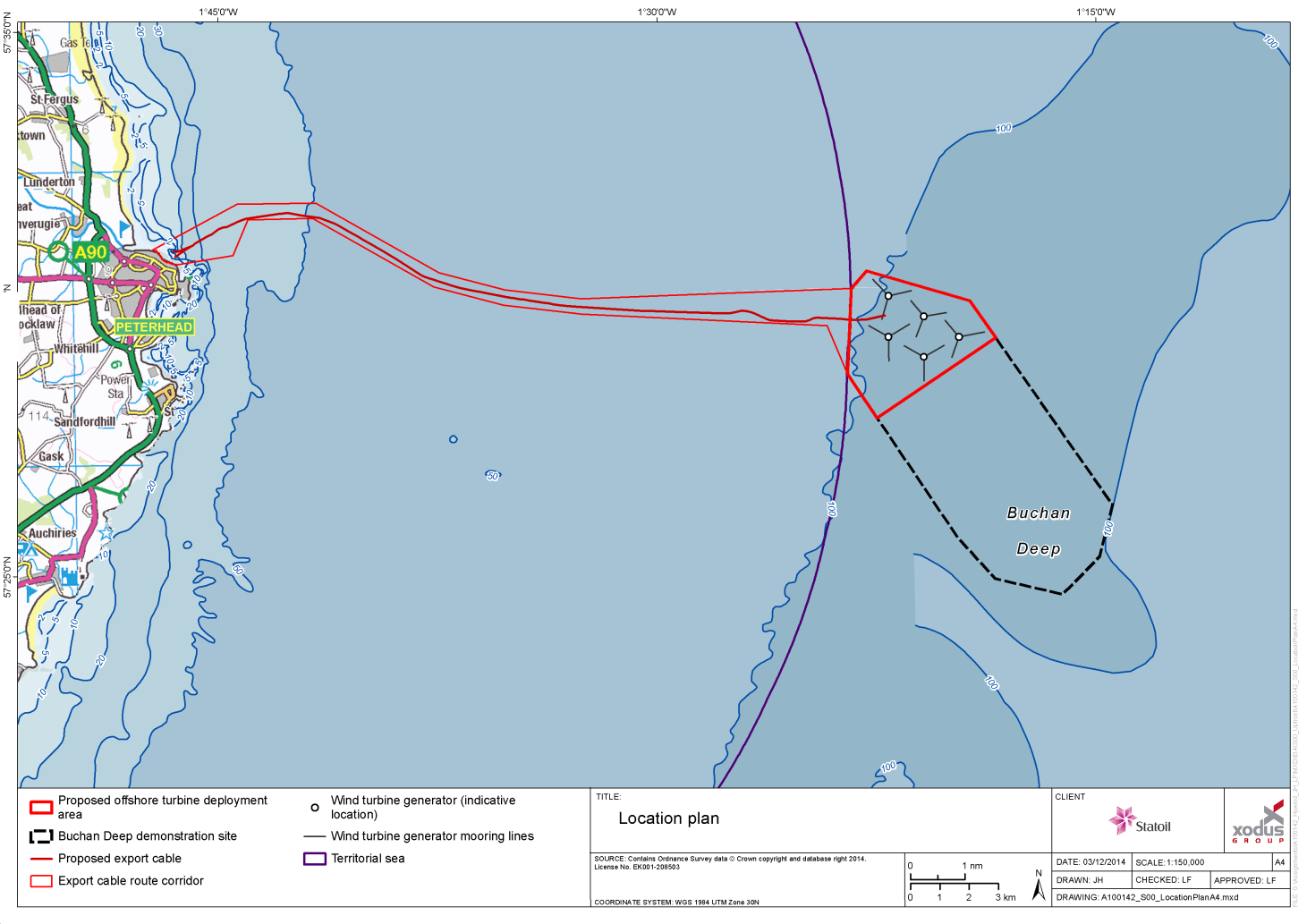
5 Figure 1-1 Location of the Hywind Pilot Park Project Document Number: A S00-EIAS-003 5
6 1.3 Regulatory consent A number of regulatory consents are required for the construction and operation of the Project. For the offshore components of the Project a Marine Licence under the Marine (Scotland) Act 2010 (for Project components within the 12 nm territorial sea limit i.e. the export cable) and the Marine and Coastal Access Act 2009 (for Project components outside 12 nm i.e. the Pilot Park) is required. The offshore application will be submitted to the regulatory authority for the Scottish Government, Marine Scotland. Planning permission for the onshore aspects of the Project will be applied for under the Town and Country Planning (Scotland) Act The regulatory authority for the onshore application is Aberdeenshire Council. An Environmental Statement (ES), produced under the Marine Works (Environmental Impact Assessment) Regulations 2007 (as amended) supports the Marine Licence application. Through screening Aberdeenshire Council has concluded that there is no requirement for an ES under the Environmental Impact Assessment (Scotland) Regulations Consent under Section 36 of the Electricity Act 1989 is not required for this Project as it is located outside the 12 nm (territorial sea) limit and is below the 50 MW threshold that would trigger such an application. In addition, a Habitats Regulations Appraisal (HRA) has been undertaken to assess potential impacts on conservation sites of European importance and inform the requirement for appropriate assessment. The HRA process is separate to the EIA process; however, the information collated during the EIA has informed the HRA. Document Number: A S00-EIAS-003 6
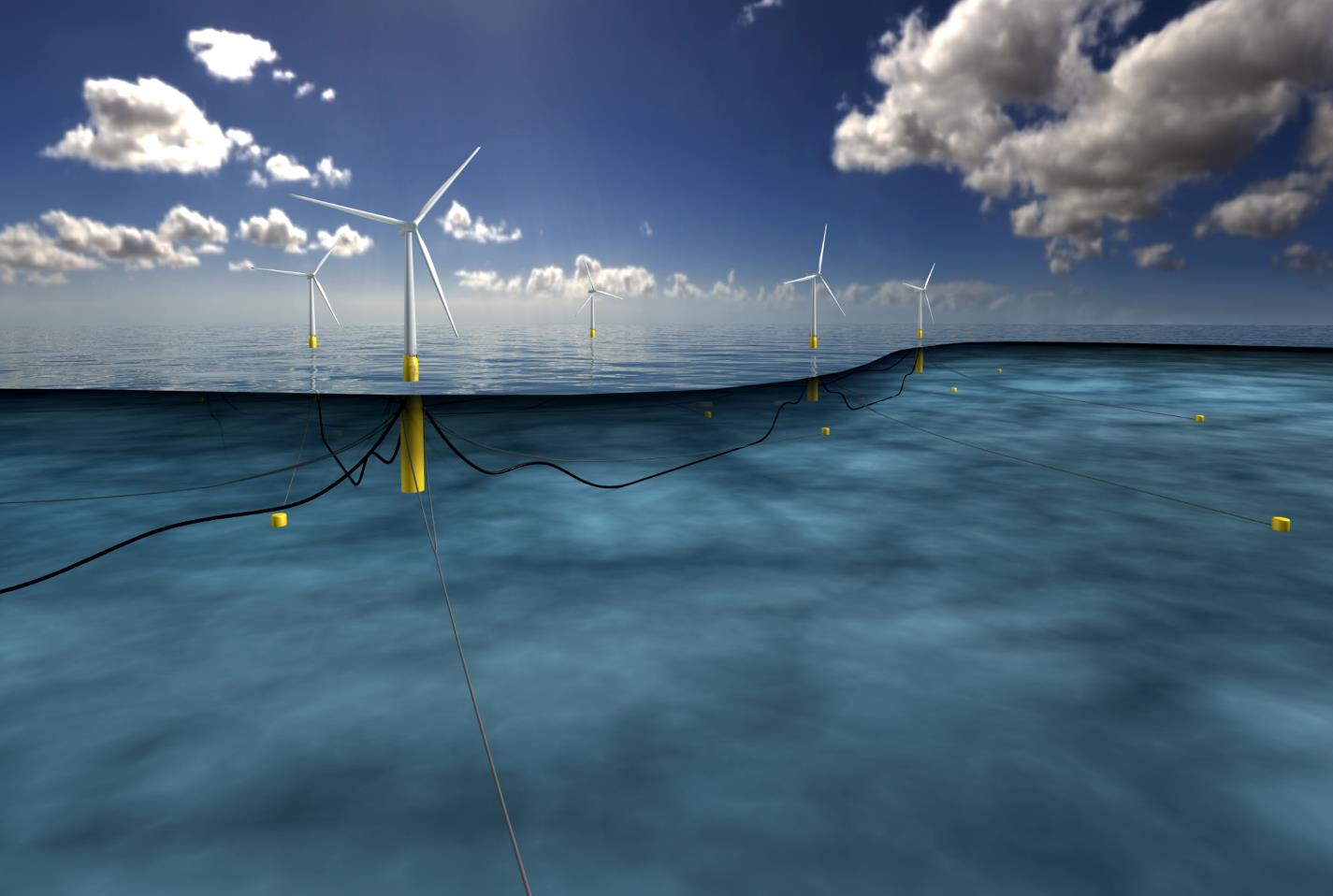
7 2 PROJECT DETAILS The proposed Pilot Park is located approximately 25 km off the coast at Peterhead, north east Scotland just outside the 12 nm territorial water limit. The Project includes construction, installation, operation and maintenance activities. The Project will involve the installation of five 6 MW wind turbine generator (WTG) units and will be expected to produce between 15 and 30 GWh 1 per year of electricity each. The turbines will be positioned between 720 to 1,600 m apart and attached to the seabed by a three-point mooring spread and anchoring system. Three anchors will be required per turbine and the radius of the mooring system will extend 600 to 1,200 m out from each turbine. The anchor and mooring system could be installed up to 18 months prior to the turbines being installed. An artist s impression of the offshore Pilot Park is provided in Figure 2-1. Figure 2-1 Illustration of the turbine moorings and layout The turbines will be connected by inter-array cables which may require stabilisation in some locations. The export cable, which will transport electricity from the Pilot Park to shore at Peterhead, will be buried where seabed conditions allow. Where this is not possible cable protection in the form of concrete mattresses and rock will be required. Both the inter-array and export cables will have 33 kv transfer voltage. The export cable is planned to come ashore at Peterhead and connect to the local distribution network at SSE Peterhead Grange substation. The onshore Project infrastructure will comprise an underground cable approximately 1.5 km in length and a small switchgear yard facility close to Peterhead Grange substation (Figure 1-1). A schematic illustrating the overall Project is provided in Figure Gigawatt hours, abbreviated to GWh, is a unit of energy representing one billion (1,000,000,000) watt hours and is equivalent to one million kilowatt hours. A kilowatt hour is equivalent to a steady power of one kilowatt running for one hour. Document Number: A S00-EIAS-003 7

8 Figure 2-2 Key components of the Hywind Scotland Pilot Park Project In addition to the proposed Pilot Park area and associated offshore and onshore infrastructure, the Project will use a deep water inshore area, to assemble the turbines prior to installation. The location of this inshore assembly is still to be decided; however, suitable facilities on the west coast of Norway have been identified. Once assembled, the turbines will be towed in an upright position from the assembly point to the turbine deployment area in the Buchan Deep. HSL aims to begin onshore construction in 2015 / 2016 followed by offshore construction in 2016 / This will allow for final commissioning of the Pilot Park in The Pilot Park is expected to have an operational life of 20 years and decommissioning will commence in the late 2030 s. During the operational phase the Pilot Park will be serviced from a base most likely in Peterhead. The main features of the turbines are summarised in Figure 2-3 below. Figure 2-3 Main features of the turbines Document Number: A S00-EIAS-003 8
9 2.1 Site selection and alternatives The Hywind concept has been demonstrated and verified through five years of operation of the 2.3 MW Hywind Demo during which the prototype has performed beyond expectations. It has produced around 40 GWh since the start, and in this period survived waves up to 20 m and wind speed in excess of 40 m/s. The next step towards building large commercial parks is to up-scale and optimise the substructure design, and to test out the technology in a small park with several units. Furthermore, the Pilot Park will demonstrate that the costs can be reduced significantly, and sufficiently to make the technology cost-effective in large scale commercial parks in the longer term. The evaluation of potential sites for the Hywind Scotland Pilot Park began in Identification of a suitable location for development of a Hywind Scotland Pilot Park was influenced by a number of factors including: Water depth the turbines require, in general, water depths of more than 95 to 100 m; Proximity to the grid due to the relatively small scale of the Pilot Park potential development sites needed to be close to the coast in order to facilitate export of power to the local/national grid; Proximity to deep water navigation route once assembled the turbines are towed in an upright position to the Pilot Park site. Therefore the navigation route between the inshore assembly area and Pilot Park site had to be of sufficient water depth to accommodate the unit s towing draft; and Suitable seabed conditions although the mooring system is not dependent of a specific type of anchor and therefore has no strict requirements in terms of seabed conditions, an even seabed, with sufficient soil above bedrock was preferred for the ease of installation. Two locations were identified in Scottish waters which met all or most of the criteria above. These potentially viable locations included an area in The Minch off Stornoway and the Buchan Deep off Peterhead. Identification of these areas was supported by high level constraint mapping and initial consultations with statutory consultees and some local stakeholders. Feedback from the conservation bodies at this early stage suggested the Buchan Deep location was further offshore and had less environmental sensitivity. The Buchan Deep site also offered better availability of grid connections and was therefore selected as the preferred development location. 2.2 Scoping, consultation and public exhibitions In October 2013 HSL requested a Scoping Opinion from the Scottish Ministers by submitting a Scoping Report (and accompanying navigation Preliminary Hazard Analysis (PHA)) for the Project to Marine Scotland and Aberdeenshire Council. A Scoping Opinion was received from Marine Scotland on 17 th March It details the views of the statutory consultees and what they deem necessary for inclusion in the ES, and the accompanying Navigation Risk Assessment (NRA) required by the Maritime and Coastguard Agency (MCA). As well as statutory consultees, the EIA Scoping Report was also distributed to a number of non-statutory bodies. Following receipt of the Scoping Opinion each issue raised was reviewed and implications to the overall Project, as well as the EIA, considered. Where appropriate, further meetings and discussions were held, generally on a topic specific basis, throughout the EIA. These were necessary to refine the scope of EIA studies being undertaken, based on the Scoping Opinion received and / or results of EIA studies as they became available. This on-going consultation was an important aspect in ensuring the EIA addressed all issues required in the appropriate manner. The Marine Licensing (Pre-application Consultation) (Scotland) Regulations , require prospective applicants for Marine Licences for certain activities to carry out a public pre-application consultation. A public consultation event was held in Peterhead on the 20 th and 21 st May 2014, in the form of a public display and question and answer sessions with the Hywind project team. As required by the Regulations a post event report was submitted to Marine Scotland. 2 The legislation came into force on 1 st January 2014 and applies to all relevant marine licence applications submitted to MS-LOT on or after 6 April Document Number: A S00-EIAS-003 9
10 For the NRA, consultation was undertaken with the MCA and other shipping, navigation, recreational sailing and fishing interests that navigate within and around the Project area. Consultation has included a number of meetings and a hazard review workshop with the MCA and other stakeholders. Through this process shipping and navigation characteristics within the Project area and potential risks to the Project have been identified. This information has been used to inform the risk assessment undertaken as part of the NRA. 2.3 Environment overview The offshore environment within which the Pilot Park and export cable route is located is typical for this region of the North Sea as described below and in the subsequent impact assessment sections. The Project is located in the Buchan Deep and is characterised by water depths ranging between 98 m and 117 m, becoming deeper from north to south. The seabed within the turbine deployment area comprises silty sand and gravel, overlain with scattered boulders. This same seabed type extends west along the deeper offshore end of the export cable corridor, although boulders become more frequent towards the coast. Sediment sampling and analysis for hydrocarbons, metals and other contamination indicates that there are no areas of contamination present in the Pilot Park area or along the cable export route. However, the export cable corridor passes close to three dredge disposal sites, approximately 3 km from shore. The seabed within the Pilot Park area is sparsely populated with hermit crabs, brittle stars and anemones. Animals living in the sediment include species of worm and burrowing sea urchins. A higher diversity of species is found on boulder patches and mixed sediment including shrimps, sponges and the Ross worm (Sabellaria spinulosa). Colonies of the Ross worm are low, patchy and small in extent. Along the cable route, particularly in the offshore area, there are aggregations of Ross worm reef structures with occasional boulders supporting communities characterised by encrusting colonial animals and soft corals. The Ross worm can form biogenic 3 reef which is an internationally important habitat identified for conservation, however, the colonies present in the Project area are not located within a protected site. The Southern Trench area is proposed as a potential Marine Protected Area (MPA). This is located adjacent to the Project area (See Figure 2-4). The nearest established offshore protected area is the Turbot Bank MPA which is located 18 km from the Project area. Coastal areas designated for the protection of conservation interests along the Scottish coast in the north east of Scotland include Special Protection Areas (SPAs) for birds and Special Areas of Conservation (SACs) for mammals that will forage in and transit through the Project area. There are a number of mobile species present in the Pilot Park area and surrounding region including commercially important species of fish and shellfish. Migratory fish, including Atlantic salmon, are assumed to pass through the Project area as part of their migratory activities, some will originate from the River Ugie located just to the north of the cable landfall area and others more distant rivers on the east coast of Scotland such as the River Spey, River Dee and River Tay. Six species of marine mammal were recorded within the Project area during the 12 month Project specific marine wildlife surveys including minke whale, harbour porpoise, white-beaked dolphin, Risso s dolphin, harbour seal and grey seal. Seabirds recorded in the Project area, again during Project specific surveys, include guillemot, razorbill, puffin, kittiwake, Arctic tern, gannet, herring gull and great black-backed gull amongst others. For most species and at most times of the year the abundance of these species in the Project area is low or very low in the context of their population size. However during the breeding season common guillemot and razorbill are at times present in moderate or high abundance. Shellfish, demersal and pelagic 4 fisheries operate in the wider area around the Pilot Park area and export cable corridor. The demersal and pelagic fisheries are more important further offshore, where demersal trawling for whitefish such as haddock, and pelagic trawling for herring and mackerel take place. Although fishing does take place in the Buchan Deep, this area is not as important an area compared to surrounding waters in terms of fishing effort and value of landings. The principal fishing activities in the inshore areas of the export cable route are scallop dredging, creeling for crab and lobster, and line fishing for mackerel. These fisheries are targeted by fishermen operating out of local ports. 3 Reef structure created by the animal itself. 4 Demersal to describe fisheries associated with or close to the seabed. Pelagic to describe fisheries associated with the water column. Document Number: A S00-EIAS
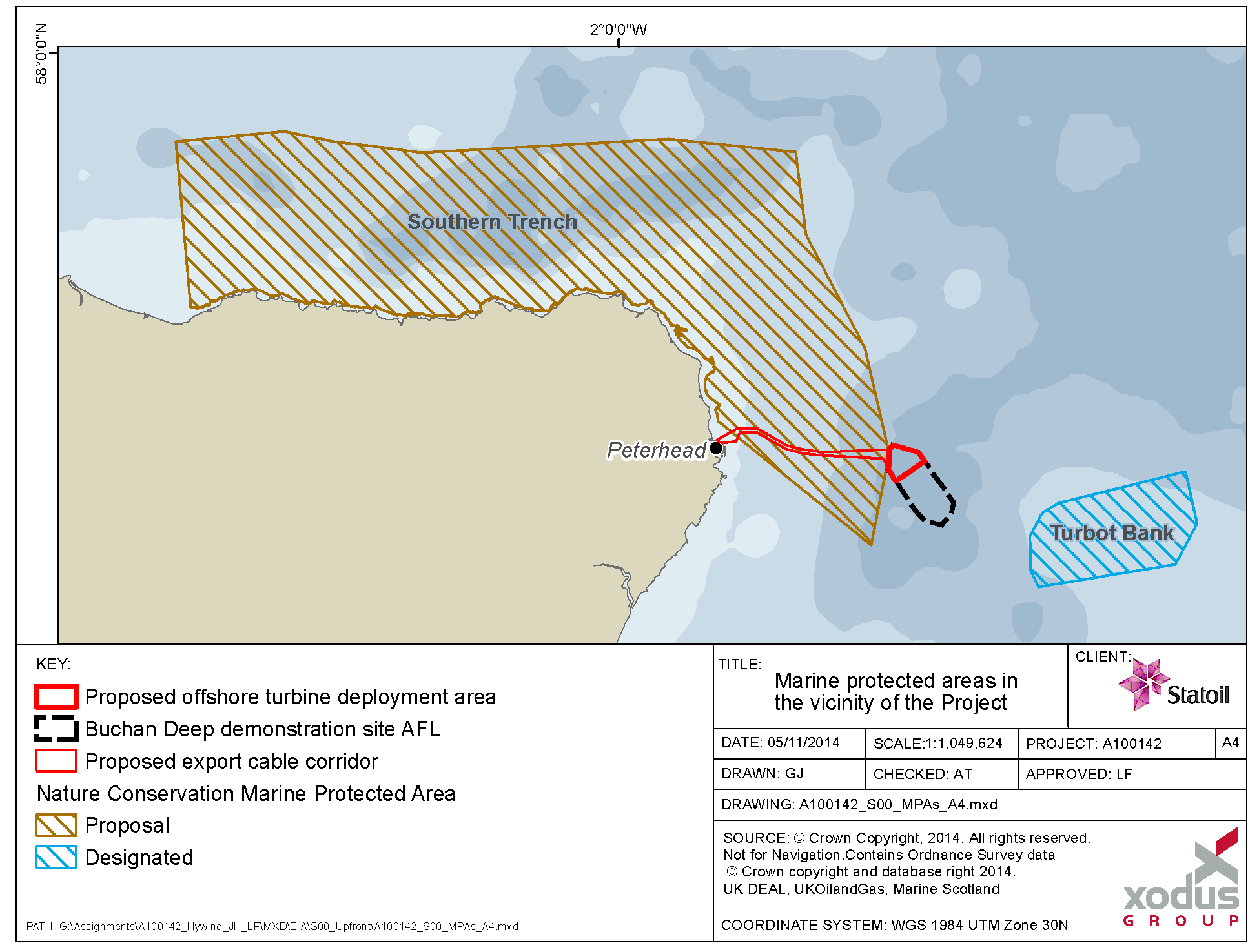
11 Figure 2-4 Marine Protected Areas in the vicinity of the Project The turbine deployment area has moderate vessel traffic levels. High levels of traffic to the west and northwest of the Pilot Park area are associated with traffic bound to or from busy ports such as Aberdeen and Peterhead, and traffic passing north and south off the east coast of Scotland. On average 3-4 vessels per day transited through the turbine deployment area over the four month-long surveys conducted over 2013 to The maximum number of vessels per day ranged from Most of these were cargo or oil services vessels. Oil and gas activity is relatively low in this area of the North Sea; however, the Forties pipeline system which s passes through the Hywind AfL area, transports 40% of the UK continental shelf oil production. The pipeline system is approximately 1 km south of the nearest WTG Unit. The next closest oil and gas activity to the Project is the Nexen-operated Buzzard oil field, approximately 40 km to the north west of the Pilot Park area. To the north of Peterhead, St Fergus is a landing point for several offshore gas pipelines, the closest of which passes approximately 5 km north of the export cable route corridor and Pilot Park area. There are also several existing submarine cables in the vicinity of the Project and three dredge spoil disposal sites adjacent to the export cable corridor and approximately 3 km offshore. The shoreline at the cable landfall site is a rocky shelf with pockets of coarse gravel/cobbles/boulders that extends out from the base of a concrete seawall. At landfall, the cable route crosses a roughly 200 m-wide intertidal zone which consists of a patchwork of rocky and stony reef habitat with rock pools, moderately exposed or exposed to wave action and characterised by seaweeds and barnacles. Document Number: A S00-EIAS
12 As the onshore development associated with the onshore cable route, installation of the switchgear yard and connection to the Peterhead substation is not considered within the scope of the EIA, the onshore environment is not discussed in detail in the ES and is dealt with separately by the planning application process. Document Number: A S00-EIAS

13 3 ENVIRONMENTAL IMPACT ASSESSMENT An EIA has been undertaken to assess the potential impacts of the proposed Hywind Scotland Pilot Park. The impact assessment has been undertaken using standard EIA methodologies, followed established guidance and has been informed by a number of Project specific surveys and studies. Throughout the assessment, and where relevant, flexibility in the design parameters of the Project has been retained in line with the Design Envelope 5 approach. This approach has evolved over recent years of EIA practice as a result of lessons learned from previous projects and relevant case law. The impact assessment considers the project design which is considered to result in the greatest potential environmental impact. The Project design scenarios considered to result in the greatest environmental impact vary between topics and have therefore been defined on a topic by topic basis. Potential variances in the impacts predicted based on the different design options have also been summarised. Overall there are not significant variances in design options due to both the relatively small scale of the Project and the advanced nature of the engineering design. The level of information provided on the proposed design options is considered sufficient to enable the likely significant effects on the environment to be described and where appropriate quantified and suitable mitigation measures and monitoring requirements identified. As the Project evolves, its design may vary within the parameters stipulated in the Design Envelope without changing the overall findings of the EIA. To inform the EIA process a number of project specific surveys and studies have been undertaken to collect data on aspects of the environment in the Project area and assess the significance of potential impacts. The following sections summarise the findings of the EIA surveys and studies and are presented in the same order as the impact assessment chapters in the ES. Each section provides an overview of the environmental baseline, key impacts identified and relevant mitigation and monitoring that will be put in place. 3.1 Physical environment The predicted impacts of the Project (from both the Pilot Park and the cables) on the physical environment are assessed as not significant. This conclusion is based on the impact assessment described below. Characterisation of the existing physical environment and sediment processes is based on both existing and site-specific survey data obtained from geophysical and geotechnical surveys. The turbine deployment area and majority of the export cable corridor are characterised by thick sediment cover. The deep water at the turbine deployment area means that wave action is unlikely to influence scour. The coast at the cable landfall is comprised of irregular basement rock, with mobile cobbles and boulders lying towards the west of the potential landfall site. Scottish water outfall and seawall at the proposed cable landfall The base case for cable landfall is installation via a horizontally directional drilled (HDD) bore under the seabed; however the option of cable installation via a surface trench across the shore has been assessed as this would result in greater impacts compared with the HDD option. Through scoping, it was identified that the physical environment may be affected as a result of; effects on the coast at the export cable landfall, effects on the Scottish Water outfall, and through the introduction of scour within the Pilot Park. 5 Also known as Rochdale Envelope. Document Number: A S00-EIAS
14 The coastal environment at the cable landfall is considered to be tolerable to change, due to its irregular rocky nature, and mobile cobbles and boulders, therefore the sensitivity of the rocky shore and seabed is considered to be low. Any changes are expected to be of short duration and minor magnitude. The beach at the cable landfall has a seawall for shore protection and the Buchanhaven combined sewer overflow (CSO) discharge pipe is located within the cable landfall footprint. This existing infrastructure could be impacted should the cable be installed across the beach (rather than the HDD bore) and HSL will ensure any necessary measures are taken to protect the seawall and outfall. There is potential for some limited areas of scour around suction anchors and if required scour protection will be installed over an area of not more than 15 m from the edge of each anchor. The impacts of this are assessed as relevant to other receptors e.g. benthic ecology. Overall, because of the rocky nature of the coastline at the proposed cable landfall site, and the dynamic nature of the mobile sediments at the turbine deployment area, indicates it is concluded that no significant impacts are expected on the physical environment. 3.2 Benthic habitats and ecology Despite the presence of the protected Ross worm, the predicted impacts to benthic ecology from the Project has been assessed as not significant following mitigation. This conclusion is based on the impact assessment described below. Two surveys were undertaken to inform the assessment of impact on benthic habitats and ecology; one to collate information related to the intertidal environment and the other to collate information related to the offshore subtidal environment. Photographs showing example habitats in the intertidal and subtidal environments are shown below. On the left is an intertidal habitat dominated by algae and lichens and on the right is a subtidal habitat dominated by mounds of Ross worm colonies. Elevated steep bedrock covers the low shore with lower lying bedrock in the upper and mid shore. Patches of boulders and cobble with barnacles and winkles are present among the bedrock. The patchwork of topography creates variable levels of wave exposure throughout the cable landfall area, thereby creating a mosaic of substrata and communities, particularly algae and barnacle dominated communities. Rockpools were recorded throughout the high shore to the low shore. The survey of the offshore area included drop down video and still photography. The Pilot Park area is characterised by sandy sediments with patches of small boulder fields colonised by a sparse animal community. There are also patches of the tube aggregations of the Ross worm. Where colonies of the Ross worm were present the diversity of other species was higher than in the surrounding area, including brittlestars, urchins, clams and worms. The proposed cable route passes through the southern extremities of the proposed Southern Trench nature conservation MPA, however, there are no MPA specific benthic features of interest present in this section Document Number: A S00-EIAS
15 and therefore impacts on the proposed MPA benthic features are not predicted. In addition, no impacts on other protected areas with benthic conservation interests are predicted. The impact assessment considered a number of potential impacts on the intertidal area and seabed including loss and disturbance of habitats, introduction of non-native species, and protection of benthic habitats due to reduced fishing trawling. Although very small areas of potential low quality reef could be affected in the subtidal environment together with patches of rocky and stony reef, the majority of this area is occupied by habitats of no specific conservation concern which are present on a wider scale throughout this area of the North Sea. Although the seabed survey work identified the presence of Ross worm biogenic reef in parts of the wider AfL area, the best areas of these are in the southernmost parts of the AfL area, away from the proposed turbine deployment area. Any biogenic reef present in the northern half of the AfL area where the wind turbines are being sited is very sparsely distributed, covers very small areas, and is rated as being of low reef potential and based on the indicative turbine layout proposed will not be impacted. Similarly small isolated patches are also present at intervals along the export cable route, mainly in the deeper offshore half. Where possible the cable has been routed to minimise impacts on areas of Ross worm. The introduction of non-native marine species could impact not only the Project area but areas wider afield, as any introduced species could travel with water currents. The location of the inshore turbine assembly area will be on the Norwegian west coast, and as that is within the North Sea containing more or less the same species, the risk of alien invasive species introductions to the east coast of Scotland is minimal. When the vessels required for the Project are contracted, risks for introduction of non-native marine species will be evaluated and mitigation measures implemented as appropriate. Through the implementation of proposed mitigation the impact of the Project on benthic habitats and ecology are not considered significant. The protection of benthic habitats as a result of reduced trawling in the area where the turbines will be deployed is considered to result in a positive effect. 3.3 Fish and shellfish ecology The predicted impacts of the Project on fish and shellfish ecology are assessed as not significant. This conclusion is based on the impact assessment described below Published research and Project specific surveys of large fish indicate the presence of the following marine fish in the Project area and surrounding waters: Breeding - spawning grounds for demersal species (herring, sandeel and Norway lobster) and spawning areas for pelagic species (cod, plaice and whiting); Recruitment and growth of early life-history stages intensive nursery grounds for whiting, herring, and saithe, and less intensive nursery grounds for a number of other species; Shellfish dominate the inshore part of the export cable corridor; and Due to the close proximity of the cable export corridor to the River Ugie and the presence of protected populations of Atlantic salmon and river lamprey along the east coast of Scotland, migratory species are expected to transit the inshore areas of the export cable corridor. The impact assessment has concluded there will be no significant impacts on fish as a result of noise, heat or electromagnetic fields generated by the project. Neither will there be any entanglement risk to basking sharks from the turbine mooring system and inter array cables. It is recognised that there may be some limited disturbance to seabed spawning species (e.g. herring, sandeel and Norway lobster) during construction and installation, however the areas impacted are extremely small and will not result in any significant impacts. The long term presence of the Project could result in changes to species and habitat diversity resulting from the fish aggregating potential in the wind turbine deployment area. Document Number: A S00-EIAS

16 3.4 Ornithology Despite the presence of high abundances of some birds on the sea surface at certain times of the year and birds that will fly through the Project area at the same height as the turbine rotors, the predicted impacts to ornithology are assessed as not significant following mitigation. This conclusion is based on the impact assessment described below. Project specific baseline surveys showed that a range of common seabird species forage in and pass through the turbine deployment area and its vicinity. For most species and at most times of year the abundance of these species in the area potentially affected by the Project was low or very low in the context of their population size. However during the breeding season two species, common guillemot and razorbill, were at times present in moderate or high abundance, especially in August. The installation and operation of 5 wind turbines has the potential to impact seabirds, primarily through indirect habitat loss caused by disturbance and displacement, and through additional mortality caused by collision with turbine rotors and small-scale accidental pollution incidents. With one exception, predictions of the size and duration of potential impacts shows that for all species for all times of year impacts would have negligible consequences for receptor populations. The exception is razorbill, for which a potential disturbance impact of minor for the breeding population is Guillemots on the sea (Digger Jackson) identified owing to the very high densities sometimes present in August, a period when individuals of this species has heightened vulnerability to disturbance. This impact is nevertheless judged as not significant. Collision mortality has been predicted for species that commonly fly at rotor height using a range of modelling scenarios. This shows that the predicted additional mortality is negligible compared to the numbers of birds that die from existing background mortality causes. The Project has multiple embedded measures to minimise the risk of accidental pollution incidents. 3.5 Marine mammals Despite the occasional presence of internationally protected species of whale and dolphins, the predicted impacts to marine mammals from the Project are assessed as not significant following mitigation. This conclusion is based on the impact assessment described below. A review of available literature on marine mammal presence in the Project area was ground-truthed with records of marine mammals from site-specific surveys. From this it was determined that minke whale, harbour porpoise, white-beaked dolphin, Risso s dolphin, grey seal and harbour seal were the species most likely to be present in the Project area. However, it was recognised that some other whales and dolphins (such as bottlenose dolphin) could potentially be present, especially nearer to shore. The potential sensitive receptors to such impacts are those species that have been identified as using the Project area. Overall mammals are not frequent visitors to the Project area and hence predicted to have infrequent interaction with the Project. Any interactions that do occur are unlikely to lead to impacts to individuals and even less likely to affect the species at the population level. Considering the highly limited extent, both spatially and temporally, of potential effects, few, if any, marine mammals are likely to be impacted by the Project. As such, an effect at the population level of any species using the Project area is not expected and therefore no significant impacts are anticipated. Whilst the potential impacts on marine mammals are not considered to be significant in an EIA context, the legislation makes it an offence to deliberately or recklessly disturb any dolphin, porpoise or whale in Scottish waters. Document Number: A S00-EIAS
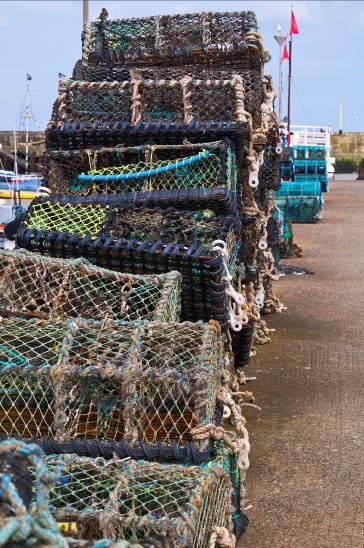
17 3.6 Aviation and radar Impacts on aviation and radar were considered to be significant. Statoil has undertaken extensive work in order to identify suitable mitigation and the successful negation of contracts associated with the identified solutions will ensure no significant impacts remain. The aviation and radar constraints associated with the Project have been assessed by means of detailed modelling and consultation with National Air Traffic Services (NATS) and the Ministry of Defence (MOD). The significant concerns that have been assessed relate to potential radar impacts and potential issues due to the proximity of the main helicopter routes and military interests. The MOD has raised concerns with regard to potential impact on the air defence radar (ADR) at Remote Radar Head (RHH) Buchan. This potential impact is significant, and the Project is deemed unacceptable to MOD without any mitigating solution in place for the Buchan ADR. In a meeting in December 2013, the MOD informed HSL about the recent completion of a developer-led purchase for the system upgrade of the Type-92 Buchan ADR that will ensure that the radar is at the same standard as the TPS-77 radars. HSL subsequently appointed the aviation consultant Serco to perform a radar modelling report to identify a potential mitigation solution. The Serco mitigation modelling report was submitted to the MOD in July The MOD has confirmed that the proposed mitigation is acceptable and a suitable consent condition will be agreed. The potential impact on the NATS Perwinnes radar is significant, however a technical mitigation option has been identified and NATS has confirmed that the Project is acceptable to them with a blanking solution in place on the Perwinnes radar. HSL needs to agree up on a commercial agreement with NATS. 3.7 Commercial fisheries Despite the occasional presence of a number of different fisheries in Project area, impacts as a result of the Project have been assessed as not significant following mitigation. This conclusion is based on the impact assessment described below. A desk based review of available data was undertaken and supported by consultation with fishermen. Low level demersal fisheries targeting haddock, Norway lobster and squid are dominant in the turbine deployment area. There is also a low level of pelagic activity in the turbine deployment area (pelagic activity is greater in the export cable corridor). Scallop dredging is the fishery of highest economic value in the export cable corridor. Creels targeting crab and lobster and hand lining for mackerel also take place in the export cable corridor and fishing intensity increases closer to the shore. Vessels fishing the inshore area operate out of local ports. Creels used to fish for crabs Helicopters servicing the oil and gas industry During construction and installation, safety zones will prevent all vessels, including fishing vessels, entering within 500 m of construction works both in the turbine deployment area and along the export cable route. These areas take place in extremely small areas and over very short timeframes, therefore impacts on fisheries will not be significant. HSL will follow the Best Practice Guidance for Offshore Renewables Developments: Recommendations for Fisheries Liaison issued by the Fishing Liaison with Offshore Wind and Wet Renewables (FLOWW) Group and continue to use the already appointed Fisheries Liaison Officer (FLO) during the construction period to minimise impacts on fisheries during this period. Following installation, fishing activities will be able to resume along the cable route. However, in the turbine deployment area, there will be a period of up to 18 months after installation of the anchors and mooring systems before the WTG Units will be installed. During this period and the subsequent 20 year operational phase of the Project, fisheries Document Number: A S00-EIAS

18 will be restricted from the 7.5 km 2 occupied by the turbines and their mooring system. However, due to the limited amount of fishing that currently takes place in the turbine deployment area and availability of suitable fishing areas in the surrounding waters, impacts on fisheries will not be significant. Further consultation is still required with the MCA and DECC regarding safety zones, or other methods of protecting against fishing gear interaction. The agreed strategy, whether mandatory or advisory, will be implemented and notified to UKHO for suitable depiction on Admiralty charts. 3.8 Shipping and navigation No significant shipping and navigation impacts are predicted as mitigation measures to increase awareness and increase safety are proposed. Consequently no significant impacts are anticipated. The assessment is set out below. A Navigation Risk Assessment (NRA) was undertaken to identify the risks in the Project area and in the vicinity of the Project area. The NRA for the Project followed the Maritime and Coastguard Agency (MCA) and the Department for Energy and Climate Change (DECC) guidance for such assessments. This included baseline data collection to obtain information on the vessel activities in the vicinity of the Project, comprising four months of seasonal Automatic Identification System (AIS) data, visual surveys, desk-based information and consultation with local stakeholders and experts in this field. The data collection exercise identified that the Project area and the immediate surrounding area is used by transiting merchant vessels, with approximately two-thirds associated with the oil and gas industry. The majority of these vessels are using the onshore bases at Peterhead Port and Aberdeen Harbour. There is also some fishing vessel activity in Buchan Deep, both from vessels steaming on passage and vessels engaged in fishing with the vast majority of activity being from Scottish vessels. There is limited recreational vessel activity in the vicinity of the Project due to its offshore location; however, there are occasional transits by yachts crossing the North Sea which pass in the vicinity of the Project, for example en route to and from Peterhead marina. The potential hazards and risks to this vessel activity represented by the Project, including the turbines and associated infrastructure, have been assessed based on consultation, a Hazard Review Workshop involving a cross-section of all relevant stakeholders and quantitative risk modelling. Risks considered in the assessment include vessel collision risk, collision with a turbine, fishing and anchor interaction with project infrastructure and turbine total loss of station. By applying standard industry practice and additional project-specific mitigation measures identified during consultation and at the Hazard Review Workshop, all the residual risks are assessed to be either broadly acceptable or tolerable (ALARP). Further liaison with Regulators and stakeholders is planned to ensure the appropriate mitigation is effectively implemented. In particular, the plans for safety zones and/or fishing prohibition, either compulsory or advisory, will need to be agreed with DECC, the MCA and Marine Scotland pre-construction. 3.9 Marine historic environment Oil and gas industry supply boat No significant impacts on the marine historic environment are expected. This conclusion is based on the impact assessment described below. There are a number of potential marine historic interests within and adjacent to the Pilot Park and the export cable route corridor. Mitigation measures proposed include avoiding potential marine historic interests or, if that isn t possible, an investigation of potential interests will be carried out according to a specific reporting protocol. As a consequence significant impacts are not anticipated. Document Number: A S00-EIAS
19 A desk-based assessment of relevant data sources was undertaken in combination with a review and interpretation of geotechnical and geophysical survey data of the Project area to provide the baseline for the impact assessment. No marine cultural heritage sites with statutory designations, no aircraft, no palaeo environmental or submerged landscape deposits have been identified that will be affected by the Project. No shipwreck sites with confirmed positions will be affected by the Project. Assessment of the geotechnical data indicates that there are not likely to be submerged landscapes of archaeological interest present in the Project area. Twenty-one potential shipwreck sites were identified within the Project and surrounding area, though none with statutory designations or confirmed positions were located in the Pilot Park or cable route corridor. The positions of 15 wrecks are tentative, which therefore have the potential to be located in the Project area. Of these, two are of highest importance including the Muriel, which may be located 500 m to the north of the export cable route. A number are considered either of uncertain importance, as the identity of the wrecks is unknown or of no historic significance. Twenty-six geophysical anomalies with the potential to be cultural remains were identified and there is potential for these to be remains from wrecks known to have sunk in the general area with unverified locations, or to be previously unrecorded cultural heritage. Potential impacts are possible on two anthropogenic geophysical anomalies along the cable route and another five in the proposed offshore turbine deployment area. The identity of these anomalies is uncertain and there is therefore potential for these to be remains from wrecks of high or moderate importance known to have sunk in the general area with unverified locations, or to be previously unrecorded cultural heritage. To minimise impacts, cultural heritage and historic interests will be avoided. If it is not possible to avoid identified anomalies, further investigation will be undertaken. If this indicates that they are of cultural heritage interest, there may be a need for further survey, reporting and salvage. A reporting protocol for accidental discoveries will also be put in place to safeguard any presently unknown cultural heritage interests. The implementation of these mitigation and management strategies will avoid or reduce potential impacts so that the residual impacts of the Project on marine cultural heritage will be not be significant Other sea users No significant impacts on other sea users are predicted following mitigation. The assessment carried out for other sea users is detailed below. The BP Forties crude oil pipeline system which transports 40% of the UK North Sea oil production, passes through the AfL area, 1 km to the south of the proposed turbine deployment area. There are several existing cables in the vicinity of the proposed turbine deployment area and export cable corridor, including one cable along the export cable route for which it has not been possible to identify the owner. Two active and one inactive at sea disposal sites are located adjacent to the export cable corridor close to shore. An explosive ordnance legacy from the two world wars and modern military exercises has potential to contaminate the Project area. The Project will have crossing agreements in place with other cable operators to ensure that no significant impacts result from the installation and operation the Project and procedures will be in place to minimise the risk of inadvertent detonation of unexploded ordinance. Discussions are ongoing with BP to ensure there no unacceptable risks to the Forties pipeline system Socio-economics, tourism and recreation The economic benefits from the Project range from minor to moderate, where the economic benefits to Scotland will depend on the level of local content under two different development scenarios. For the first scenario which assumes all construction, installation, operations and maintenance and decommissioning (except turbine manufacture and heavy lift charter) will take place in Scotland. In this instance the Project will create an estimated 39 direct FTE jobs, 5.6m direct GVA and support a further 218 indirect jobs FTE jobs and 31 million GVA in the supply chain during construction. A total of 260 direct, indirect and induced FTE jobs and 40 million GVA during construction and installation in the first two years. This is considered to represent a moderate economic benefit. During operations and maintenance it is estimated that there will be 100 million spend per annum and 33 FTE jobs, along with 10 million spend and 21 temporary jobs during decommissioning. This is considered to represent a minor economic benefit. Document Number: A S00-EIAS
20 For the second scenario which assumes only operations and maintenance and decommissioning will take place in Scotland the economic impact significance of the Project will be minor. Under this scenario 44 million GVA and 33 FTE jobs will be sustained during operations and maintenance along with 10 million spend and 21 temporary jobs during decommissioning. Economic impacts from new tourism and recreational activities specifically for boat tour operators are considered positive, although their magnitude is considered to be of minor impact and overall not significant. Impacts on existing tourism and recreational businesses during construction and installation is likely to be a combination of both positive (related to increase local spend) and negative (due to short term local disruption around onshore construction works). Both impacts are likely to be minor and not significant. During the operation stage the impacts from loss of scenic visual quality are predicated but will not be significant. The Project has the potential to attract inward investment especially for turbine manufacture, tower/substructure fabrication and operations and maintenance which could have significant economic impact, although the five turbine pilot Project alone is unlikely to attract investors to setup facilities in Scotland. The Project is also potentially a springboard to the wider opportunity for Scotland of developing expertise in floating offshore wind, where experience gained e.g. design, construction, installation, operation and decommissioning could lead to cumulative projects. For example, a potential larger offshore park off Scotland or in-combination with 12 other current/future offshore projects off Scotland Seascape, landscape and visual amenity Baseline surveys of the 50 km radius study area identify a total of 57 seascape, landscape, and visual receptors, the most sensitive of which include local seascape units, special types of rural land, valued views, recreational routes, and settlements. Potential impacts on these receptors relate to the visibility of the five offshore WTG units, which in the case of seascape and landscape receptors, will be indirect. The WTG units will be located at distances ranging from approximately 22 km to a maximum of 50 km from the receptors, and their visibility will vary widely with weather conditions, and in daylight or night time. All impacts are assessed as not significant. The primary determinant of the assessments relates to the magnitude of the predicted effects, which due their relatively small scale, limited geographical extent or size, or a combination of these factors, was considered to be minor or negligible for all receptors. Cumulative or in-combination impacts due to the proposed projects at the European Offshore Wind Deployment Centre and the Kincardine Offshore Wind Farm are predicted, but these are also assessed as not significant Potential hydrocarbon and chemical spill Appropriate mitigation measures and management measures are proposed to minimise the potential for potential hydrocarbon and chemical spill to occur. These include measures to prevent an incident occurring, management plans to minimise spills from vessels and emergency response procedures. No significant impacts are therefore predicted Cumulative and in-combination impacts The cumulative and in-combination impact assessment details the potential interactions between the impacts arising from the Project, other marine renewable developments in the region and other regulated activities. Cumulative impacts are impacts caused by planned and consented offshore wind farms. In-combination impacts are impacts as a result of offshore wind farms (and their associated activities) combined with impacts from other marine activities or users of the sea. Cumulative and in-combination impacts have been considered for all topics. The projects included in the assessment were varied and included 14 other projects including nine offshore wind farms (the majority of which are of much greater scale than the Hywind Pilot Park), two interconnector projects and three infrastructure projects. Although there is potential for cumulative and in-combination impacts to occur due to the small scale and limited spatial extent of the Hywind Project and the large separation distances between it and other Projects, cumulative and in combination impacts are not considered to be significant. Document Number: A S00-EIAS
21 The potential cumulative collision mortality on ornithological receptors together with other offshore wind projects in the waters off the east coast of Scotland is very small, which is to be expected as the Project has 0.7% (5 out of 677) of the offshore wind turbines in the area. On this basis it is judged that the potential contribution made by the Project to a regional collision mortality impact is unlikely to be sufficient to make a material difference to the magnitude of the effect from all the other developments combined. There is no requirement for any mitigation over and above that proposed at a Project level. Document Number: A S00-EIAS
22 4 ENVIRONMENTAL MANAGEMENT As a company, Statoil has a clear goal to ensure sustainable development and is committed to minimising environmental impacts. Statoil s Safety and Sustainability policy and Management System will be implemented within the Hywind Scotland Pilot Park project to achieve this goal. The potential effects of the Hywind Pilot Park Project have been assessed through the EIA and Navigation Risk Assessment (NRA) processes and the results of the impact assessment presented in the ES (and accompanying NRA). These processes have indicated it is necessary to manage certain aspects of the Project to ensure potential impacts are not significant. Some of the key mitigation measures that have been identified include: Solutions have been identified to remove unacceptable impacts on the Buchan Air Defence Radar and the Perwinnes radar and HSL are in the process of negotiating contracts for this mitigation. Standard industry practice with regards to the management and mitigation of shipping and navigation activities will be followed in addition to project specific (enhanced) mitigation, the specific details of which will be agreed as part of ongoing consultation with the Maritime and Coastguard Agency and other navigation stakeholders. This includes consideration for either compulsory or advisory safety zones and/or fishing prohibition. Statoil will retain its already appointed Fisheries Liaison Officer (FLO) for the construction phase of the Project and follow the Fishing Liaison with Offshore Wind and Wet Renewables Group (FLOWW) best practice guidance for offshore renewables developments with regards to liaison with the fishing community. Agreements will be put in place with other sea users e.g. cable operators and asset owners e.g. Scottish Water and Aberdeenshire Council with regards to the outfall and sea wall at the cable landfall, to ensure no unacceptable impacts during installation of the Project. Emergency plans developed for the Project will include measures to reduce the risk or and impacts from any accidental hydrocarbon or chemical spills. 4.1 Environmental management, mitigation and monitoring Environmental assessment, including consultation with stakeholders is an iterative process and will continue beyond ES submission. The primary mechanism for ensuring environmental assessment continues and that all environmental issues are addressed is through the Project Operational Management System. This management system will ensure that ES mitigation commitments, consent conditions and environmental monitoring requirements and taken through to implementation via a full Environmental Monitoring Plan (EMP). The EMP will highlight the various parties responsible for the implementation of the contents of the EMP and will identify a number of other mechanisms to deliver environmental improvements and prevent harm to the environment including approaches to interfacing with contractors, raising environmental awareness and training the work force involved in the construction, maintenance and operation of the Project. The full EMP will be implemented in agreement with the Regulator and statutory advisors following successful award of Project consents. Mitigation measures will be monitored to enable HSL to track and assess the performance of the EMP, ensuring improvements can be made if necessary. Document Number: A S00-EIAS
Experience from the first large scale tidal turbine EIA in Europe. How do we work towards effective and proportionate EIA?
 Independent, integrated thinking Experience from the first large scale tidal turbine EIA in Europe How do we work towards effective and proportionate EIA? Liz Foubister IEMA Webinar 30 th July 2014 What
Firth of Forth Offshore Wind Farm Zone. Offshore and Onshore Project Information
 Firth of Forth Offshore Wind Farm Zone Offshore and Onshore Project Information May 2012 Introduction Seagreen Wind Energy Limited (Seagreen) is a 50/50 joint venture between SSE and Fluor (UK) Limited.
I refer to the application made by Aquamarine Power Ltd. ( the Company ), dated 17 th June 2011 for:
 Ms Megan Richardson Aquamarine Power Ltd. Elder House 24 Elder Street Edinburgh EH1 3DX 14 February 2012 Dear Ms. Richardson, CONSENT FOR THE CONSTRUCTION AND OPERATION OF AN OFFSHORE DEMONSTRATOR WAVE
Who are we? *Based on an average annual domestic household electricity consumption of 4,700KWh (DECC).
 Who are we? We re one of the world s leading power and gas companies. Here in the UK, we supply energy to more than 5 million customers, generate enough electricity for around 8 million homes and employ
BMP Guidelines. Environmental Impact Assessment (EIA) report for activities related to hydrocarbon exploration and exploitation offshore Greenland
 BMP Guidelines for preparing an Environmental Impact Assessment (EIA) report for activities related to hydrocarbon exploration and exploitation offshore Greenland Danish National Environmental Research
London Array. Operations and Maintenance
 London Array londonarray.com London Array Operations & Maintenance Base Port of Ramsgate Military Road Ramsgate CT11 9LG Registered in England and Wales No 04344423 Operations and Maintenance 1 2 Operations
Basics of Sustainability. Environmental Impact Assessments (EIA)
 Basics of Sustainability 8 Environmental Impact Assessments (EIA) 1 Contents Page Aims... 2 Introduction... 3 The Objectives of EIAs... 3 Developments that Require an EIA... 4 Key Stages of an EIA... 6
Developing Ocean Energy in Ireland. Belmullet Wave Energy Test Site
 Developing Ocean Energy in Ireland Belmullet Wave Energy Test Site Where does our energy come from? Most of the energy we use in Ireland comes from fossil fuels such as oil, coal, peat and gas. We burn
Round 3 zone appraisal and planning. A strategic approach to zone design, project identification and consent
 Round 3 zone appraisal and planning A strategic approach to zone design, project identification and consent 7 May 2010 Table of contents Glossary of terms and abbreviations... 1 Purpose of this document...
1. Purpose and scope. 2. SEPA's role in hydropower and planning
 Page no: 1 of 10 1. Purpose and scope 1.1 The purpose of this note is to provide guidance on the approach that we will take when dealing with hydropower development management consultations. We welcome
PRESS KIT PL 553 KVITVOLA. Exploration well 34/7 36 S
 PRESS KIT PL 553 KVITVOLA Exploration well 34/7 36 S PAGE : 2 of 8 TABLE OF CONTENTS 1 INTRODUCTION... 3 1.1 PURPOSE OF DOCUMENT... 3 1.2 DET NORSKE OLJESELSKAP... 3 2 LICENSE PL 553 KVITVOLA, EXPLORATION
A consultancy perspective: Building consensus on wildlife monitoring
 June 30, 2015 A consultancy perspective: Building consensus on wildlife monitoring Gareth Lewis, Director Pro-Tide Work Package 2 Environmental Aspects, Final workshop (Isle of Wight 30 th June 2015).
Strategy of the German Government on the use of off-shore wind energy
 Strategy of the German Government on the use of off-shore wind energy in the context of its national sustainability strategy Ministries involved: Federal Ministry for the Environment, Nature Conservation
Environmental damage: Extending the Environmental Liability Directive into marine waters
 Environmental damage: Extending the Environmental Liability Directive into marine waters Consultation on amending the Environmental Liability (Prevention and Remediation) Regulations (Northern Ireland)
Pollution Response RESPONDING TO AN OIL SPILL
 Pollution Response RESPONDING TO AN OIL SPILL Most oil spills within New Zealand waters are likely to happen close to the coast or in harbours. This makes it extremely difficult for responders to prevent
The Norwegian ecosystem-based management plan for the Barents Sea and sea areas off the Lofoten Islands. The Barents Sea
 The Norwegian ecosystem-based management plan for the Barents Sea and sea areas off the Lofoten Islands By: Dr. Erik Olsen, Research Scientist The Barents Sea Continental shelf sea Average depth 230m Area
Tidal Energy. Wind Energy. Transmission & Distribution Network. Offshore Substation. Onshore Substation. Tidal Stream Energy.
 Offshore Renewables Tidal Energy Transmission & Distribution Network Offshore Substation Wind Energy Onshore Substation Tidal Stream Energy Consumer Atkins in Offshore Renewables The offshore wind journey
Position Statement regarding Offshore Wind Proposals on Lake Huron. Lake Huron Centre for Coastal Conservation
 Position Statement regarding Offshore Wind Proposals on Lake Huron Lake Huron Centre for Coastal Conservation June 2010 Lake Huron Centre for Coastal Conservation (LHCCC) Corporate Position related to:
TERMS OF REFERENCE. for an ENVIRONMENTAL IMPACT ASSESSMENT. for a PROPOSED RESORT DEVELOPMENT
 TERMS OF REFERENCE for an ENVIRONMENTAL IMPACT ASSESSMENT for a PROPOSED RESORT DEVELOPMENT at BIG AND LITTLE PELICAN CAY PORTLAND BIGHT, ST. CATHERINE, JAMAICA TABLE OF CONTENTS BACKGROUND 4 1. Executive
TRITON KNOLL ELECTRICAL SYSTEM CONSULTATION: QUESTIONNAIRE
 RWE Innogy UK TRITON KNOLL ELECTRICAL SYSTEM CONSULTATION: QUESTIONNAIRE The Planning Act 2008 requires developers to undertake pre-application consultation before submitting an application for a Development
Planning Act 2008: Guidance on Changes to Development Consent Orders. December 2015 Department for Communities and Local Government
 Planning Act 2008: Guidance on Changes to Development Consent Orders December 2015 Department for Communities and Local Government Crown copyright, 2015 Copyright in the typographical arrangement rests
SUBSIDIARY LEGISLATION WILDLIFE & PROTECTED AREAS. Marine Protected Areas Order 2012. S. R. & O. No: 1 of 2012
 SUBSIDIARY LEGISLATION WILDLIFE & PROTECTED AREAS Marine Protected Areas Order 2012 S. R. & O. No: 1 of 2012 Made: 23 February 2012 Published: 29 February 2012 Coming into force: on publication IN EXERCISE
ENVIRONMENTAL IMPACT ASSESSMENTS AND ENVIRONMENTAL IMPACT STATEMENTS
 GOVERNMENT OF BERMUDA Department of Planning ENVIRONMENTAL IMPACT ASSESSMENTS AND Section 1: Introduction... 2 Section 2: What are Environmental Impact Assessments and Environmental Impact Statements and
Baltic Sea Perspective on - Building a Gas Pipeline and - Oil Spills
 Baltic Sea Perspective on - Building a Gas Pipeline and - Oil Spills Dr Juha-Markku Leppänen Head of the Monitoring and Assessment Unit, Marine Research Centre, Finnish Environment Institute (SYKE) Content
Different Types of Marine Protected Area
 A protected area is defined by the IUCN as a clearly defined geographical space, recognised, dedicated and managed, through legal or other effective means, to achieve the long-term conservation of nature
Scope & Prospects for Growth of UK Marine Aquaculture: A Crown Estate Perspective
 Scope & Prospects for Growth of UK Marine Aquaculture: A Crown Estate Perspective Oceanology International 2014 Alex Adrian UK Aquaculture Operations Manager Contents The Crown Estate s marine assets Marine
SOUTH GEORGIA AND SOUTH SANDWICH ISLANDS MARINE PROTECTED AREAS: EXISTING PROTECTION AND PROPOSALS FOR FURTHER PROTECTION
 SOUTH GEORGIA AND SOUTH SANDWICH ISLANDS MARINE PROTECTED AREAS: EXISTING PROTECTION AND PROPOSALS FOR FURTHER PROTECTION CONSULTATION DOCUMENT OCTOBER 2012 1 1. Background 1.1 What is a marine protected
Marine Harvest Scotland Farms Office, Blar Mhor Ind. Est., Fort William 01397 715 074 [email protected]
 Marine Harvest Scotland Farms Office, Blar Mhor Ind. Est., Fort William 01397 715 074 [email protected] PH33 7PT Sron, Loch Alsh 57 o 16.029 N, 5 o 40.608 W; 178400E, 825601N Atlantic
ROADMAP ON MARINE RENEWABLE ENERGY
 FAME PROJECT - INTERNATIONAL WORKSHOP TERESA SIMAS 1 20 TH NOVEMBER, 2012 OBJECTIVES Overview of marine renewable energy development and prospects CONTENTS Green House Gas emissions targets Renewable energy
Protecting the environment of the Arctic ecosystem. By Professor Olav Orheim Norwegian Polar Institute
 Protecting the environment of the Arctic ecosystem By Professor Olav Orheim Norwegian Polar Institute Outline What is the Arctic? The Arctic marine environment Key environmental challenges Integrated Management
Triton Knoll Offshore Wind Farm Limited Electrical System. Outline Traffic Management Plan
 Triton Knoll Offshore Wind Farm Limited Electrical System Outline Traffic Management Plan October 2014 RWE Innogy UK Triton Knoll TMP Copyright 2014 RWE Innogy UK Ltd All pre-existing rights reserved.
LIQUID WASTE TREATMENT FACILITY MENDIS ROAD, HUDSON CREEK DRAFT GUIDELINES FOR A PUBLIC ENVIRONMENTAL REPORT
 LIQUID WASTE TREATMENT FACILITY MENDIS ROAD, HUDSON CREEK DRAFT GUIDELINES FOR A PUBLIC ENVIRONMENTAL REPORT Introduction The purpose of this Public Environmental Report (PER) is to provide the Government
TELECOMMUNICATIONS...
 CONTENTS 15 TELECOMMUNICATIONS... 15-1 15.1 Introduction... 15-1 15.2 Legislation and Policy Context... 15-1 15.3 Scoping and Consultation... 15-2 15.4 Assessment Methodology... 15-3 15.5 Environmental
Pipelines and seabed intervention
 Workshop on seabed habitats of environmental concern Jørn Spiten Content Pipeline - route design Seabed Intervention - Trenching - Ploughing - Dredging - Rock installation 2 Pipeline routes 3 Pipeline
NEW YORK SEASCAPE PROGRAM A COMMITMENT TO OCEAN CONSERVATION
 NEW YORK SEASCAPE PROGRAM A COMMITMENT TO OCEAN CONSERVATION JULY 2012 1 Wildlife Conservation Society The Wildlife Conservation Society (WCS) saves wildlife and wild places worldwide. We do so through
Overview of Atlantic Offshore Renewable Energy Studies Program. Brian Hooker Office of Renewable Energy Programs
 Overview of Atlantic Offshore Renewable Energy Studies Program Brian Hooker Office of Renewable Energy Programs February 2012 Completed Studies of Interest Compendium of Avian Information and Comprehensive
23.1 RENEWABLE ENERGY
 Proposed Hastings District Plan as Amended 23.1 Renewable Energy 23.1 RENEWABLE ENERGY 23.1.1 INTRODUCTION The use of energy is of fundamental importance to the function and development of our society.
RECALLING Paragraph b of Article 13 of the Convention on the Protection of the Marine Environment of the Baltic Sea Area, 1974 (Helsinki Convention),
 CONVENTION ON THE PROTECTION OF THE MARINE ENVIRONMENT OF THE BALTIC SEA AREA HELSINKI COMMISSION - Baltic Marine HELCOM 19/98 Environment Protection Commission 15/1 Annex 3 19th Meeting Helsinki, 23-27
SAMOA MARINE WILDLIFE PROTECTION REGULATIONS 2009
 S.R. 2009/18 SAMOA MARINE WILDLIFE PROTECTION REGULATIONS 2009 Arrangement of Provisions PART I PRELIMINARY 1. Short title and commencement 2. Interpretation 3. Application in the Exclusive Economic Zone
CHAPTER 4 ALTERNATIVES COMPARISON
 CHAPTER 4 ALTERNATIVES COMPARISON 4.1 INTRODUCTION This chapter provides a comparison of the and its alternatives as described in EIS/EIR Section 1.8.3 (s Evaluated in this EIS/EIR) and analyzed in Sections
Environmental Impact Assessment of Forestry Projects
 Environmental Impact Assessment of Forestry Projects Flow chart of EIA process Developer submits grant application FC screens when sufficient info received, normally at "Proposal Submit stage Developer
Chatham Rock Phosphate Marine Consent Application. P Kennedy - Environmental Impact Assessment Evidence Summary
 Chatham Rock Phosphate Marine Consent Application P Kennedy - Environmental Impact Assessment Evidence Summary My evidence and this summary cover the following matters: Seabed and sediment Discharge and
GRAVITY BASE FOUNDATIONS
 GRAVITY BASE FOUNDATIONS 2 Crown with reference to Marine All Activity Map Concrete gravity base foundations able to be floated and towed out to deeper water windfarms and installed without specialist
Council of the European Union Brussels, 20 May 2016 (OR. en)
 Council of the European Union Brussels, 20 May 2016 (OR. en) 8673/1/16 REV 1 ER 141 CLIMA 43 NOTE From: To: Subject: General Secretariat of the Council Delegations Political declaration on energy cooperation
13 Aviation. Introduction. Consultation and scoping. Table 13.1 Summary of Key Concerns in relation to Aviation
 13 Aviation Introduction 13.1 This topic chapter reports on the potential impacts of the proposed TKOWF project in relation to civil and military aviation. The assessment carried out for this chapter consists
HV Submarine Cable Systems Design, Testing and Installation
 HV Submarine Cable Systems Design, Testing and Installation CIGRE Ireland Technical Seminar 6 th October 2010 Robert Donaghy Senior Consultant Engineer, ESB International Presentation Overview Applications
THE FISHERIES REQUIREMENTS FOR AREA IN RELATION TO SEISMIC ACTIVITIES THE FISHERIES
 THE FISHERIES REQUIREMENTS FOR AREA IN RELATION TO SEISMIC ACTIVITIES THE FISHERIES The fish stocks in the Norwegian sector can be divided into two separate categories: The pelagic species comprise herring,
Case Study 5 Use of Wind Turbine Technology
 Case Study 5 Use of Wind Turbine Technology 1. Context Hong Kong relies on an adequate and reliable electricity supply for its economic development. Our electricity needs are met by the two electricity
Statoil (U.K.) Limited 2008 Offshore Environmental Statement
 Statoil (U.K.) Limited 2008 Offshore Environmental Statement 23 March 2009 Statoil (U.K.) Limited Statoil House 11a Regent Street London SW1Y 4ST (until 19 June 2009) Statoil (U.K.) Limited 1 Kingdom Street
EIA case for Hiiumaa offshore wind farm in Estonia
 EIA case for Hiiumaa offshore wind farm in Estonia Georg Martin & Liis Rostin With contributions from Aune Aunapuu, Ramboll Eesti and materials from Nelja Energia Seminar on Environmental Impact Assessment
PROJECT PROFILE DEVELOPMENT OF A 100MW OFFSHORE WIND FARM IN HONG KONG
 Ref: PD/900/00/00 PROJECT PROFILE DEVELOPMENT OF A 100MW OFFSHORE WIND FARM IN HONG KONG July 2006 Revision 0 The Hongkong Electric Co., Ltd. TABLE OF CONTENT Page 1. BASIC INFORMATION...2 1.1 Project
ENVIRONMENTAL & SOCIAL IMPACT ASSESSMENT (ESIA) FOR PRINOS OFFSHORE DEVELOPMENT PROJECT ANNEX 15: TRAFFIC MANAGEMENT PLAN
 : Pioneer in integrated consulting services March 2016 PRINOS OFFSHORE DEVELOPMENT PROJECT THIS PAGE IS LEFT INTENTIONALLY BLANK Page ii Environmental Consultant: LDK Engineering Consultants SA Date: 04/03/2016
An Act To Facilitate Testing and Demonstration of Renewable Ocean Energy Technology Be it enacted by the People of the State of Maine as follows:
 PLEASE NOTE: Legislative Information cannot perform research, provide legal advice, or interpret Maine law. For legal assistance, please contact a qualified attorney. An Act To Facilitate Testing and Demonstration
Kermadec. Ocean Sanctuary
 Kermadec Ocean Sanctuary Kermadec Ocean Sanctuary, New Zealand Coral Sea Marine Reserve, Australia Pacific Remote Islands National Marine Monument, United States Proposed Pitcairn Marine Reserve, United
8.0 ENVIRONMENTAL PROTECTION MONITORING AND FOLLOW-UP
 8.0 ENVIRONMENTAL PROTECTION MONITORING AND FOLLOW-UP 8.1 INTRODUCTION Mitigation measures, monitoring and other follow-up actions identified in Chapter 7 (Environmental Effects Assessment and Mitigation)
CHAPTER 24: ENVIRONMENTAL MANAGEMENT
 Central Eyre Iron Project Environmental Impact Statement CHAPTER 24: ENVIRONMENTAL MANAGEMENT CHAPTER 24 ENVIRONMENTAL MANAGEMENT COPYRIGHT Copyright Iron Road Limited, 2015 All rights reserved This document
Feasibility Study for Marine Wildlife Tourism in Henningsvær and in the Vestfjord
 1 Feasibility Study for Marine Wildlife Tourism in Henningsvær and in the Vestfjord Heike Vester Biologist, specialist for Marine Mammal Biology and Bio acoustics Ocean Sounds AS, Sauøya 1, 8312 Henningsvær
STATUS REPORT FOR THE SUBMERGED REEF BALL TM ARTIFICIAL REEF SUBMERGED BREAKWATER BEACH STABILIZATION PROJECT FOR THE GRAND CAYMAN MARRIOTT HOTEL
 STATUS REPORT FOR THE SUBMERGED REEF BALL TM ARTIFICIAL REEF SUBMERGED BREAKWATER BEACH STABILIZATION PROJECT FOR THE GRAND CAYMAN MARRIOTT HOTEL performed by Lee E. Harris, Ph.D., P.E. Consulting Coastal
GREAT BARRIER REEF. Climate Change Action Plan
 GREAT BARRIER REEF Climate Change Action Plan 2007 2011 Climate change is now recognised as the greatest long-term threat to the Great Barrier Reef. The Great Barrier Reef is internationally renowned as
./01&2/M./T34 1MP36T ST3T.M./T. 1a$t3l$4 536e-al4 13$7363 83%3te9. Sol9ara 1 Pro;ect. !"l$%e ( Mai$ &e(ort. Te-t. )e*te%,e- 2//0 :; <//0=>=?
 ./01&2/M./T34 1MP36T ST3T.M./T 1a$t3l$4 536e-al4 13$7363 83%3te9 Sol9ara 1 Pro;ect!"l$%e ( Mai$ &e(ort Te-t )e*te%,e- 2//0 :; =?@ ENVIRONMENTAL IMPACT STATEMENT VOLUME A: MAIN REPORT TEXT CR 7008_09_v4
Removal of Wrecks Directive 2015
 Removal of Wrecks Directive 2015 Directive 01-2015 The Director of the Department of Marine Services and Merchant Shipping (ADOMS), in exercise of the powers conferred by Section 7, sub-section (3) of
Cliff Head Oil Field Development- 20 km south of Dongara, Shire of Irwin Roc Oil (WA) Limited
 Cliff Head Oil Field Development- 20 km south of Dongara, Shire of Irwin Roc Oil (WA) Limited Report and recommendations of the Environmental Protection Authority Environmental Protection Authority Perth,
4 Alternatives and Design Evolution
 4 Introduction 4.1 This Chapter describes the considerations and constraints influencing the siting, layout and massing of the Development. It also describes the main alternatives to the Development that
(1) define the objectives and intended use of the maps and spatial data and
 Mapping coastal seabed habitats in Tasmania: development and integration of remote sensing techniques within a hierarchical framework Alan Jordan Vanessa Halley Miles Lawler Richard Mount Project Planning
Decom North Sea and Bureau Veritas Decommissioning Step by Step: Including Asbestos Guidance 14th March. - Copyright Bureau Veritas
 Decom North Sea and Bureau Veritas Decommissioning Step by Step: Including Asbestos Guidance 14th March Agenda DECOMMISSIONING STEP BY STEP INCLUDING ASBESTOS GUIDANCE: 12:00pm: Registration and networking
Environmental damage: extending the Environmental Liability Directive into marine waters
 www.gov.uk/defra Environmental damage: extending the Environmental Liability Directive into marine waters Consultation on amending the Environmental Damage (Prevention and Remediation) Regulations 2009
7.1 How and why are some eco-systems threatened with destruction?
 Topic 7: Oceans on the Edge 7.1 How and why are some eco-systems threatened with destruction? How are human activities degrading and destroying marine ecosystems on a global scale? Mangrove removal- over
Our approach to the design and routeing of new electricity transmission lines
 Our approach to the design and routeing of new electricity transmission lines We own and manage the grid to which many different energy sources are connected. In Britain we run systems that deliver gas
NATIONAL PRIORITIES FOR INTRODUCED MARINE PEST RESEARCH AND DEVELOPMENT 2013 2023
 NATIONAL PRIORITIES FOR INTRODUCED MARINE PEST RESEARCH AND DEVELOPMENT 2013 2023 Developed by the Marine Pest Sectoral Committee, 2013 Commonwealth of Australia Ownership of intellectual property rights
installation, operations & maintenance
 installation, operations & maintenance Contents Introduction... 2 The offshore wind opportunity... 2 Innovation in offshore wind... 2 The cost of offshore wind projects... 2 Offshore wind foundation, turbine
Flood Risk Assessment and Drainage Impact Assessment: Planning Guidance for Developers
 Flood Risk Assessment and Drainage Impact Assessment: Planning Guidance for Developers Development and Regeneration Services Glasgow City Council 229 George Street Glasgow G1 1QU May 2011 1. Introduction...-
Coastal Erosion Risk Mitigation Strategies applied in a Small Island Developing State: The Barbados Model
 Coastal Erosion Risk Mitigation Strategies applied in a Small Island Developing State: The Barbados Model BY Dr. Leo Brewster, Director Coastal Zone Management Unit, Barbados Presented At UNFCCC Expert
Law of Ukraine on the exclusive (marine) economic zone of 16 May 1995
 Page 1 Law of Ukraine on the exclusive (marine) economic zone of 16 May 1995 Taking into consideration the relevant provisions of the 1982 United Nations Convention on the Law of the Sea, Ukraine hereby
Bressay Community Council Area Statement
 Bressay Community Council Area Statement See Bressay Proposals Map Background 1.1 The island of Bressay is 7 miles (11 km) long by 3 miles (5 km) wide with a current population of approximately 400. The
PIRSA Fisheries & Aquaculture Charter Fishery Compliance Plan 2014-2015
 Fishery Management Plan Goals: 1. Charter Boat Fishery resources harvested within ecologically sustainable limits 2. Optimum utilisation and equitable distribution of the Charter Boat Fishery resources
Possible management measures and potential fisheries displacement analysis Upper Loch Fyne and Loch Goil
 Purpose v1.0 Page 1 Possible Marine Protected Areas (pmpas) Analysis of possible fisheries management measures The purpose of this paper is to set out possible management measures of the pmpa and provide
ENVIRONMENTAL AND SOCIAL RISK ASSESSMENT IN LENDING
 ENVIRONMENTAL AND SOCIAL RISK ASSESSMENT IN LENDING Barclays has a strong and longstanding commitment to managing the environmental and social risks associated with commercial lending. We recognise that
Northern Territory Fisheries Resource Sharing Framework
 Northern Territory Fisheries Resource Sharing Framework Page 1 of 11 Introduction Fishing is important in the Northern Territory (Territory). Coastal Aboriginal people recognise sea country out to the
WELCOME TO THE BAD Á CHEÒ WIND FARM EXHIBITION
 WELCOME TO THE BAD Á CHEÒ WIND FARM EXHIBITION Thank you for taking the time to attend The purpose of this exhibition is to explain why we have identified this site for a potential wind farm development
Development proposals will require to demonstrate, according to scale, type and location, that they:-
 Appendix 2 : Relevant Development Plan Policies Angus Local Plan Review 2009 Policy S1 : Development Boundaries (a) Within development boundaries proposals for new development on sites not allocated on
The concepts developed in this standard include the following: Oceans cover about 70% of the surface of the Earth.
 Name Date Grade 5 SOL 5.6 Review Oceans Made by SOLpass - www.solpass.org [email protected] Reproduction is permitted for SOLpass subscribers only. The concepts developed in this standard include
Environmental Compliance Questionnaire for National Oceanic and Atmospheric Administration Federal Financial Assistance Applicants
 OMB Approval No.: 0648-0538 Environmental Compliance Questionnaire for National Oceanic and Atmospheric Administration Federal Financial Assistance Applicants Instructions The National Environmental Policy
Offshore Renewable Energy in Virginia
 Offshore Renewable Energy in Virginia Presented to the Renewable Natural Resources Foundation December, 8 2009 Neil Rondorf Vice President, Maritime Operations Science Applications International Corporation
Swedish Law as an Example The Nairobi Convention Summary. Wreck Removal. Jhonnie Kern University of Gothenburg
 Wreck Removal Jhonnie Kern University of Gothenburg 13 October 2015 WRECK REMOVAL Swedish Law as an Example The Nairobi Convention Purposes of the Convention Scope of the Convention Definitions of Ship
Viking Link Interconnector
 Viking Link Interconnector Public information event for Bicker Parish Why we re here today We re here today to introduce the Viking Link project, to explain what we want to build and to answer any questions
THE FUTURE OF THE OCEAN ECONOMY: AN OECD/IFP FORESIGHT PROJECT
 THE FUTURE OF THE OCEAN ECONOMY: EXPLORING THE PROSPECTS FOR EMERGING OCEAN INDUSTRIES TO 2030 AN OECD/IFP FORESIGHT PROJECT BARRIE STEVENS OECD/DSTI Verftskonferansen 2013 Alesund, Norway, 5 th November
Offshore Wind: some of the Engineering Challenges Ahead
 Offshore Wind: some of the Engineering Challenges Ahead David Infield CDT in Wind Energy Systems Institute of Energy and Environment University of Strathclyde International context (from IPCC report) Greenhouse
MULTI-FUNCTIONAL USE OF OFFSHORE WIND FARMS, AN INVENTORY OF CHALLENGES AND OPPORTUNITIES
 MULTI-FUNCTIONAL USE OF OFFSHORE WIND FARMS, AN INVENTORY OF CHALLENGES AND OPPORTUNITIES The WE@SEA research programme conducts multiple studies on future offshore wind energy application subdivided into
Who is National Grid?
 Who is National Grid? National Grid is a leading international energy infrastructure business In the UK, our business includes electricity and gas transmission networks and gas distribution networks. We
Joint Con Edison LIPA Offshore Wind Power Integration Project Feasibility Assessment
 Joint Con Edison LIPA Offshore Wind Power Integration Project Feasibility Assessment March 20, 2009 Joint Con Edison LIPA Offshore Wind Power Integration Project Feasibility Assessment Table of Contents:
CIRCULAR 2009. ircular PLANNING SERIES
 5 HIERARCHY CIRCULAR 2009 OF DEVELOPMENTS ircular PLANNING SERIES Scottish Planning Series CIRCULAR 5 2009 Hierarchy of Developments July 2009 Crown copyright 2009 ISSN 0141-514X ISBN 978 0 7559 7572 3
Effects of offshore wind farms on birds
 AARHUS VERSITY DEPARTMENT OF BIOSCIENCE 11. OCTOBER 2012 Effects of offshore wind farms on birds Ib Krag Petersen, Anthony D. Fox, Mark Desholm, Johnny Kahlert and Thomas K. Christensen Department of Bioscience
INFRASTRUCTURE, FLOOD PROTECTION AND REMEDIATION. Infrastructure Flood Protection Remediation Policies
 INFRASTRUCTURE, FLOOD PROTECTION AND REMEDIATION Infrastructure Flood Protection Remediation Policies DRAFT POOLBEG PLANNING SCHEME 196 FIGURE 9.1: UTILITIES WAYLEAVES Electricity Cables 8m Wayleave for
Instrumentation for Monitoring around Marine Renewable Energy Devices
 Instrumentation for Monitoring around Marine Renewable Energy Devices 1 Introduction As marine renewable energy has developed, a set of consistent challenges has emerged following attempts to understand