
How to improve your memory: Mnemonic Devices
|
|
|
- Jack Washington
- 9 years ago
- Views:
Transcription
1 How to improve your memory: Mnemonic Devices Chapter 8 pp Why do we need MEMORY? Memory is the diary that we all carry about with us. ~Oscar Wilde Memory is the primary and fundamental power, without which there could be no other intellectual operation. ~Samuel Johnson What if you couldn t create new memories? Amnesia patient: Clive Wearing How do you use your memory everyday? National Memory Championship Memoriad How can I improve my memory? Most popular answer: Mnemonic devices Mnemonics Tricks and strategies to help memory! First letter technique Rhyming Visualization Keyword Link Method of Loci Pegword Learn the following list by ONLY reading; go through list as many times as possible Recall as many as possible Horse Table Island Hat Door Note Bear Apple Clock Moon Building Dog River Table Road - Paper Basket Cloud Ring Ship Snow Window Pencil Hammer Bread Car Meat Envelope Box Garden Book - Cup Horse Island Door Bear Clock Building River Road - Basket Ring Snow Pencil Bread Meat Box Book 1

2 Answers technique Horse Table Island Hat Door Note Bear Apple Clock Moon Building Dog River Table Road - Paper Basket Cloud Ring Ship Snow Window Pencil Hammer Bread Car Meat Envelope Box Garden Book - Cup Forces you to pay attention Visual and verbal memory for material Spacing effect Distributed practice is best for delayed test Massed practice ok for immediate test Why? Time to consolidate info Only concentrate for so long Study under different conditions/settings Short-term memory capacity limit Magic number 7 +/- 2 Memory span Remember: Or remember: Remember 7 +/- 2 CHUNKS Increase capacity by grouping information Gives meaning to random information First-letter technique Acronym: ROY G BIV: colors of the rainbow HOMES: great lakes PRICE: Injury Acrostic: first letter of each word of sentence is cue Music notes: Every Good Boy Deserves Fun 12 cranial nerves: OOO To Touch And Feel Letters act as cue Rhyming technique Dual-coding hypothesis When did Columbus discover America? In fourteen hundred ninety-two, Columbus sailed the ocean blue i before e except after c; or when sounded like a, as in neighbor and weigh Thirty days has September, April, June, and November ABC s song (rhyming and chunking) Dual-coding 2 cues: verbal and visual Visualization Picture superiority effect Effective visualization Interaction Vividness Bizzareness HOMES 2

3 Learn the following list by creating a mental image of two items in vivid interaction Recall Bird Fruit Rain Rock Dress Money House Mountain Cow Flower Corn Gate Roof Nest Baby Hair Ice Train Fence Letter Egg Chair Book Water Coat Glass Candy Sign Rabbit Paint Hammer - Book Bird Rain Dress House Cow Corn Roof Baby Ice Fence Egg Book Coat Candy Rabbit Hammer - Answers Keyword mnemonic Bird Fruit Rain Rock Dress Money House Mountain Cow Flower Corn Gate Roof Nest Baby Hair Ice Train Fence Letter Egg Chair Book Water Coat Glass Candy Sign Rabbit Paint Hammer - Book Use to learn foreign language vocabulary Spanish example: Pato = Duck First step: Concrete keyword that sounds like foreign word = Pot Second step: Form visual image connecting keyword with meaning Picture: Duck wearing a pot on its head Use for any vocabulary words Try: Skulk : To hide or sneak around for evil reasons Image name mnemonic Use to remember name with face Think of vivid word that sounds like name Link word with person s appearance Example Rodney Flanery Image: Football player with rod in his knee, so benched and wearing flannel to stay warm Create one for your own name! Link mnemonic Chaining or Link system First: form visual image for each item Second: associate image with next image Important to SEE associations Narrative technique Form a story using items you want to remember Appropriate for serial learning Problem: if forget one item then next items may be inaccessible too 3

4 Method of Loci Method of Loci: Campus Map In the first place 1. Memorize familiar locations in natural order 2. Create visual image of word with each location 3. Recall: take a mental walk Begin to write only after I have given the signal, Go. Method of Loci: Answers Olin, DuPre, Main, Snyder, Library, Carlisle, Daniel, Milliken, Burwell Apple Piano Hammer Cake Planet Pizza Kite Bus Butterfly Scissors Apple Piano Hammer Cake Planet Pizza Kite Bus Butterfly Scissors Locations serve as a cue Helpful for serial learning Locations should be distinct Need strong association between location and item Problem: using same locations over again can lead to confusion Peg-word technique Thought paper First: use memorized concrete nouns Rhyming words with numbers helps to remember words Second: create visual image of target word with peg-word Similar to Loci: objects instead of locations Problem: limited # peg-words What tricks and strategies do you use to memorize information? You go to a party and meet lots of new people. You would like to be able to remember their face and name. How do you do it? 4


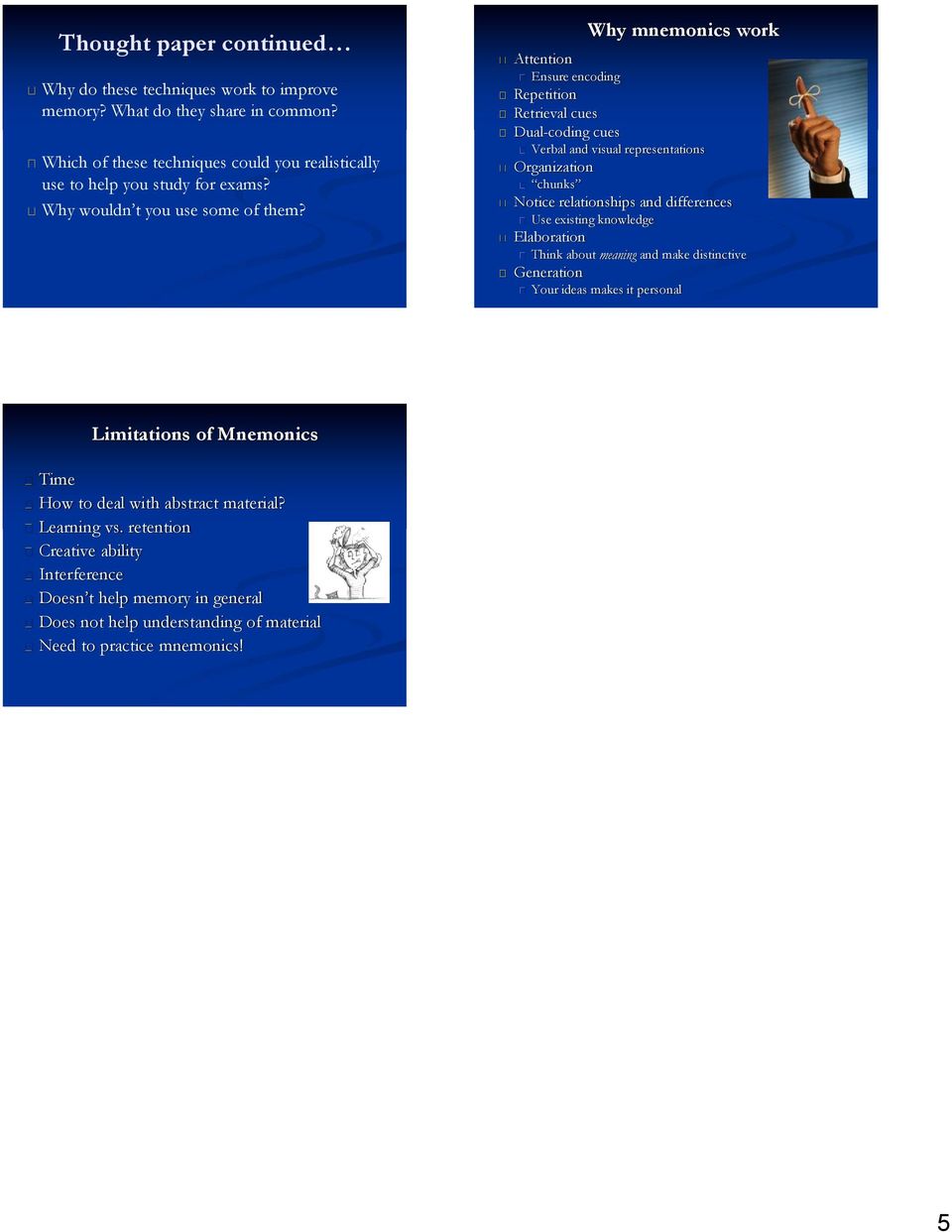
5 Thought paper continued Why do these techniques work to improve memory? What do they share in common? Which of these techniques could you realistically use to help you study for exams? Why wouldn t you use some of them? Why mnemonics work Attention Ensure encoding Retrieval cues Dual-coding cues Verbal and visual representations Organization chunks Notice relationships and differences Use existing knowledge Elaboration Think about meaning and make distinctive Generation Your ideas makes it personal Limitations of Mnemonics Time How to deal with abstract material? Learning vs. retention Creative ability Interference Doesn t help memory in general Does not help understanding of material Need to practice mnemonics! 5
Fry Phrases Set 1. TeacherHelpForParents.com help for all areas of your child s education
 Set 1 The people Write it down By the water Who will make it? You and I What will they do? He called me. We had their dog. What did they say? When would you go? No way A number of people One or two How
Memory: The Long and Short of It
 Memory: The Long and Short of It Memory s Beginnings Atkinson and Shiffrin (1968) Encoding Converting information into a form that can be entered into memory Storage Retaining information over varying
Fry s Sight Word Phrases
 The people Write it down By the water Who will make it? You and I What will they do? He called me. We had their dog. What did they say? When would you go? No way A number of people One or two How long
Chapter 3 Growing with Verbs 77
 Chapter 3 Growing with Verbs 77 3.2 Direct Objects A direct object is the noun or pronoun that receives the direct action of a verb. The verb used with a direct object is always an action verb and is called
Fast Phrases. - Timed - PHRASES WITH FRY INSTANT WORDS
 Fast Phrases - Timed - PHRASES WITH FRY INSTANT WORDS Fry Instant Words are high-frequency words that occur in reading. By practicing reading these phrases containing these words, students can improve
Mnemonic Strategies: Success for the Young-Adult Learner
 Mnemonic Strategies: Success for the Young-Adult Learner Jeffrey P. Bakken, Interim Associate Dean for Research, Graduate Studies, and International Education, College of Education, Illinois State University,
PUSD High Frequency Word List
 PUSD High Frequency Word List For Reading and Spelling Grades K-5 High Frequency or instant words are important because: 1. You can t read a sentence or a paragraph without knowing at least the most common.
FIRST TERM ENGLISH WORKSHEET 2016-2017
 FIRST TERM ENGLISH WORKSHEET 2016-2017 Class -1 1& 11 GIRLS SECTION 1.Make sentences. Flower - Mother - Water - Butterfly - Lovely - Big - 1 2. Circle the correct word. a. It is [Mother s / Father s] birthday.
Exam Preparation and Memory Strategies
 Counselling & Learning Support North Vancouver Campus Student Success Workshops Exam Preparation and Memory Strategies BR 267 604.984.1744 www.capilanou.ca/services Prepared by: Alison Parry, Learning
Memory booklet. RDaSH. Occupational therapy. Doncaster Community Integrated Services
 Memory booklet Occupational therapy RDaSH Doncaster Community Integrated Services Contents Introduction 3 What is memory? 3 The memory process 4 Different types of memory 4 Everyday difficulties 5 Memory
Your Memory : How It Works and How to Improve It by Kenneth L. Higbee
 AN INTRODUCTION TO MNEMONICS What Are Mnemonics? The word mnemonic (pronounced ne MON ik ) is briefly defined as aiding the memory. It is derived from Mnemosyne, the name of the ancient Greek goddess of
A Note to Parents. 1. As you study the list, vary the order of the words.
 A Note to Parents This Wordbook contains all the sight words we will be studying throughout the year plus some additional enrichment words. Your child should spend some time each week studying this Wordbook
First Grade Spelling Words
 First Grade Spelling Words The Hat 1. at 2. hat 3. cat 4. can 5. cap 6. tap 7. map 8. mad 9. a 10. the I tap the can. Sam and the Bag 1. am 2. ham 3. had 4. bad 5. bag 6. rag 7. cap 8. mad 9. up 10. go
RECLAIMING YOUR MEMORY
 RECLAIMING YOUR MEMORY People with chronic illness, chronic stress, and chronic problems often report having memory difficulty. My brain just doesn t work as well as it used to I seem to be more scatter-brained
Growing Up With Epilepsy
 Teaching Students with Epilepsy: Children with epilepsy often experience learning issues as a result of their seizures. These may include ongoing problems with motor skills or cognitive functions, as well
Make maths fun!! Give your child lots of praise and encouragement!
 Make maths fun!! Give your child lots of praise and encouragement! Talk to your child about how you work things out. CALCULATION The maths work your child is doing at school may look very different to
Write ten silly sentences using a spelling word in each sentence. Please underline your spelling words! Write neatly!
 Rainbow write eight of your spelling words. Write each word first in pencil. Then trace over each word three times. Each time you trace, you must use a DIFFERENT color. Write ten silly sentences using
http://www.bbc.co.uk/schools/wordsandpictures/longvow/poems/
 48 1. Can you write four words that rhyme with feet: ee 2. Which words go together? Use the ee- words to fill in. smelly woolly saw 3. Can you use the ee- words to complete the sentences? A car horn goes.
EKOLA Junior High School Bilingual Programme Entrance Test (1h15) Sample Paper. Result:
 EKOLA Junior High School Bilingual Programme Entrance Test (1h15) Sample Paper Name: Result: Task 1 Which notice says what? For questions 1 5, match the correct letter A H. 1. You do not have to pay extra
Chapter 7: Memory. Memory
 Chapter 7: Memory Case Study: H.M. and His Missing Memories Section 1: Memory Classifications and Processes Section 2: Three Stages of Memory Section 3: Forgetting and Memory Improvement Experiment: Applying
MEMORY TEST. Princeton Review. Kaplan
 MEMORY TEST Princeton Review 1. The main difference between auditory and visual sensory memory is that (A) Visual memory dominates auditory memory (B) Visual sensory memory lasts for a shorter period of
Tune Up Your Memory. Overview of course. A Few Statistics 2/3/2015
 Tune Up Your Memory Michelle Swantek Certified Geriatric Wellness Instructor MorningStar Senior Living Boise Overview of course How Memory Works How the Brain Works Use It or Lose It Nutrition and Exercise
Coping with Memory Problems after Brain Injury Practical Strategies
 Coping with Memory Problems after Brain Injury Practical Strategies Introduction Memory problems are one of the most common effects of acquired brain injury. Sadly there are no cures available, but there
LTTC English Grammar Proficiency Test Grade 1
 LTTC English Grammar Proficiency Test Grade 1 A. Short Comprehension The candidate is expected to demonstrate the ability to understand the passage (around 30 words) and answer questions. B. Usage The
What Brain Changes Are Normal for Older Adults?
 Losing keys, misplacing a wallet, or forgetting someone s name are common experiences. But for people nearing or over age 65, such memory lapses can be frightening. They wonder if they have Alzheimer s
GED Language Arts, Writing Lesson 1: Noun Overview Worksheet
 CLN Televised Courses Nina Beegle, Instructor Lesson 1: Noun Overview Worksheet NOUNS: DEFINITION A NOUN can be a person, a place, a thing, or an idea. EXAMPLES: man, children, store, a dream There are
1. 2. 3. 4. 5. 6. 7. 8.
 arm horn core oar Pick a word from the box to match each picture. Write the word on the line. artist bark garden roar score short start store stork storm 1. 2. 3. 4. 5. 6. 7. 8. Pick a word that is the
One basic need of living things is energy. Living things use food and water to get energy. The bird is living. It eats fish for energy.
 reflect If you are cold, what can you do to get warm? You could put on a coat and hat. You can jump in place. These are ways you might react to the cold. Now think about a rock. What if a rock is somewhere
Young Learners English
 University of Cambridge ESOL Examinations Young Learners English Movers Information for Candidates Information for candidates YLE Movers Dear Parent Thank you for encouraging your child to learn English
This activity explores the amazing Water
 4.2 LESSON 1 What is the Water Cycle? At-Home Activity Objectives... Learn key vocabulary terms: Evaporation, Condensation, Precipitation, and Transpiration and be able to apply them. Materials Needed...
Simple Present Tense. Simple Present Tense in the Negative. Grammar Practice Worksheets
 Simple Present Tense Choose the correct verb from the list below to complete the following sentences. Use the correct form of the simple present tense. fix stand speak drink eat do wear have wash make
Pre-K. Animals Around Us. Differentiated Resources. English Language Learners... 2 Three-Year-Olds...3-4 Small Groups...5-6
 Pre-K Differentiated Resources Animals Around Us English Language Learners.......... 2 Three-Year-Olds...................3-4 Small Groups......................5-6 Visit www.macmillanmh.com for online games
Dr. Seuss s ABC: An Amazing Alphabet Book!
 Lesson 2: Dr. Seuss s ABC: An Amazing Alphabet Book! By Dr. Seuss / ISBN: 0-679-88281-2 Lesson Author Mary C. Suiter, Ph.D., Federal Reserve Bank of St. Louis Lesson Description In this lesson, students
Teaching Machine Based on the work of Judi Garratt
 Teaching Machine Based on the work of Judi Garratt 1. Ask students to name various machines they see in the room. 2. Establish that movement of machines is mechanical, repetitive, and often stationary.
AR State PIRC/ Center for Effective Parenting
 Helping Young Children Learn to Read What Parents Can Do Reading is one of the basic building blocks for your child s learning and school success. It is a skill on which most other learning is built. Children
Barter vs. Money. Grade One. Overview. Prerequisite Skills. Lesson Objectives. Materials List
 Grade One Barter vs. Money Overview Students share the book Sheep in a Shop, by Nancy Shaw, to learn about choice, making decisions, trade, and the barter system. They complete worksheets on comparing
Amazing AmMy Brain! DID YOU KNOW..
 My Amazing Brain! DID YOU KNOW... 3 Your Amazing Brain 4-5 How your Amazing Brain Works 6 7 Left Brain, Right Brain 8 Brain Facts 9 Senses 10 Look after your Brain 11 What Does a Brain Scientist Do? MY
First Certificate in English
 First Certificate in English Placement Test Time allowed: 2 hours QUESTION PAPER DO NOT write on this paper Instructions: Please answer all questions DO NOT USE a dictionary Write all answers on the separate
Grade R Term 2 English Home Language Lesson Plan. Weeks 1-3 There are 30 worksheets in total for 3 weeks. These are the lesson plans for week 3.
 Grade R Term 2 English Home Language Lesson Plan Weeks 1-3 There are 30 worksheets in total for 3 weeks. These are the lesson plans for week 3. Name of topics: My family Who belongs to my family Activities
Teaching Vocabulary to Young Learners (Linse, 2005, pp. 120-134)
 Teaching Vocabulary to Young Learners (Linse, 2005, pp. 120-134) Very young children learn vocabulary items related to the different concepts they are learning. When children learn numbers or colors in
Instant Words 1,000 Most Frequently Used Words
 Instant 1,000 Most Frequently Used These are the most common words in English, ranked in frequency order. The first 25 make up about a third of all printed material. The first 100 make up about half of
The Perfect Gift. by Kelly Hashway. Why don t you make them something? Colin s older sister Whitney asked.
 by Kelly Hashway Colin walked through the mall with his head down. He couldn t bear to look at another window display of great Christmas gifts he couldn t afford. There were only a few days left until
Thank you for downloading these samples from the Teacher to Parent Workbooks for Fourth Grade.
 Thank you for downloading these samples from the Teacher to Parent Workbooks for Fourth Grade. We offer a variety of workbooks such as Reading, Math, Science and Social Studies, Grammar, Vocabulary and
Water Scarcity Ashley Schopieray
 Water Scarcity Ashley Schopieray INTRODUCTION In this lesson, students will learn about water scarcity and how much of the earth s water is actually available for daily human use. They will learn the importance
LESSON PLAN FORMAT FOR A CLIL LESSON:
 LESSON PLAN FORMAT FOR A CLIL LESSON: UNIT / LESSON TIMING LEVEL MATERIALS THE WATER CYCLE 5 DAYS 4 th YEAR MATERIAL FOR TEACHER S WORK - Blackboard - Interactive Digital Board - Power Point Presentation
How To Tell Someone You Love Them Back From The Dead
 Roczny plan zajęć dydaktycznych język angielski rok 2015/2016 Miesiąc Temat tygodnia Słówka WRZESIEŃ Hello! My friends Body parts Hello, Bye-bye,What's your name?i'm... Girl, boy, teacher. Head, feet,
Previous Letterland at Tweetsie Railroad Motivation and reward Letterland at Tweetsie Curriculum Guides
 Previous Letterland at Tweetsie Railroad Each May since 2007, children from all over North Carolina (and Texas and Georgia) have come to Letterland at Tweetsie Railroad, where we have transformed our theme
The Winchester School Family Learning Newsletter (FS 2) March 2015
 The Winchester School Family Learning Newsletter (FS 2) March 2015 Area of learning Focus Home activities/how can you help your child at home Useful website Prime Area Personal, Social and Emotional Development
Tom had 5 toy cars. His dad gave him 3 more toy cars. How many toy cars did Tom have in all?
 How many and in all? How many more than? How many are left? Tom had 5 toy cars. His dad gave him 3 more toy cars. How many toy cars did Tom have in all? 7 birds were in a tree. 2 more birds flew to the
Memory Problems Following Traumatic Brain Injury. Patient Information Booklet. Talis Consulting Limited
 Memory Problems Following Traumatic Brain Injury Patient Information Booklet Talis Consulting Limited What is Memory? Memory consists of several processes that work in different ways. In order to use your
MAPS AND GLOBES: WHERE IN THE WORLD ARE WE?
 MAPS AND GLOBES: WHERE IN THE WORLD ARE WE? Grade Level: Kindergarten Presented by: Karen Davis and Tamara Young, Tate Elementary, Van Buren, AR Length of unit:5 lessons I. ABSTRACT A. This unit focuses
4THE UNIVERSITY OF THE STATE OF NEW YORK
 4THE UNIVERSITY OF THE STATE OF NEW YORK GRADE 4 ELEMENTARY-LEVEL SCIENCE TEST WRITTEN TEST JUNE 6, 2011 Student Name School Name Print your name and the name of your school on the lines above. The test
Sample Cooperative Learning Lesson Plan
 1 Sample Cooperative Learning Lesson Plan OVERVIEW Subject Grade Level Topic Brief Overview and Explanation PLANNING Objectives Assessment Pre / Diagnostic Formative (informal and/or formal) Summative
Ohio s Assessment System
 hio Department of Education Student Name: Ohio s Assessment System Grade 2 Reading Student Booklet Form A Diagnostic Measure 3rd Edition Office of Curriculum and Assessment Copyright 2012 by the Ohio Department
Practicing Science Process Skills at Home
 Practicing Science Process Skills at Home A Handbook for Parents By Debbye Vitti and Angie Torres May 2006 Handbook Objectives After reading this handbook, you will be able to: 1. Name the major science
Preschool March Lessons. Dr. Seuss Day. One Day Free Sample
 Preschool March Lessons Dr. Seuss Day One Day Free Sample Kids R Learning Preschool Lesson Plans Letter R - Number 9 Dr. Seuss Day Circle Time: Left & Right Feet Read the story the Foot Book Explain to
1. Listen to your teacher read the vocabulary words.
 Lesson 6 Literature Link 1. Listen to your teacher read the vocabulary words. Vocabulary Tilda Tennessee troublemaker chicken visitors special invited outwit enough bridle saddle reins different comfortable
Today, it is spoken in some offices. He's going to study English hard. and talk with a lot of people in the future.
 Good. How are you? You re welcome. How are you? Oh, no. You mustn t help him. OK. I ll ask him. Why did you finish the report? You can t buy a dictionary. No, thank you. How are you? It s cloudy. How are
DOMAIN Ill: Cognitive Development
 Purpose: To develop new skills, knowledge and the ability to acquire and process new information through play and interaction with others and the environment. The cognitive development domain includes
SUBJECT-VERB AGREEMENT
 SUBJECT-VERB AGREEMENT RULES FOR SUBJECT-VERB AGREEMENT RULE 1 A verb agrees with its subject in number. Singular subjects take singular verbs: The car stays in the garage. The flower smells good. There
Interview Questions for Secondary Schools Interviews
 Interview Questions for Secondary Schools Interviews PART I 1. What is your name? My name is Lu Kin Tsang. My English name is Donald. 2. How old are you? I am twelve years old. 3. Where were you born?
SINGULAR AND PLURAL NOUNS
 SINGULAR AND PLURAL NOUNS A. Underline the singular nouns in each sentence. RETEACHING: A singular noun names one person, place, thing, or idea. A plural noun names more than one person, place, thing,
Activity type Activities Materials 1 Distinguishing special letters in words. Alphabet race Farm animals / Means of transp.
 Writing activities Activity type Activities Materials 1 Distinguishing special letters in words 2 Word competitions word games 3 Crosswords Completing words Alphabet race Farm animals / Means of transp.
Active Learning. Write down what the teacher says.
 Active Learning One important mentor task is helping a mentee become an active learner. "Active learning" implies seeking information beyond the material in the textbook. An active learner takes initiative
Joined Together. Programme 8. B B C Northern Ireland Schools One Potato, Two Potato Spring 2005. 8 March by Isobel Gamble
 B B C Northern Ireland Schools Spring 2005 Programme 8 Joined Together 8 March by Isobel Gamble A whole variety of articles which are joined, illustrated with poetry e.g. holding hands, clothes fastenings,
Foundation Stage. Fix it Duck. Information to Parents Curriculum Newsletter. 4 th
 Foundation Stage Information to Parents Curriculum Newsletter Fix it Duck th January 4 th February 2012 4 th Dear Parents/Carers Welcome back to the new term and the new year. We hope that you have had
Memory and Concentration
 Memory and Concentration MEMORY 1) Simple definition: mental activity of recalling information that you have learned or experienced. 2) Short-Term Memory (STM) a) stored for a few seconds or a few minutes
Week 4 Lesson Plan. Pre-K. Animals in the Wild. Macmillan /McGraw-Hill. Extend. the Unit
 Lesson Plan Extend Unit the Unit Pre-K Animals in the Wild Alphabet Time.....................2-3 Book Time.........................-5 Retelling Puppets................... 6 Content Area......................7-8
Compound Words Lesson Plan
 Compound Words Lesson Plan Purpose: 1. Students will develop an understanding of how compound words are formed. 2. To improve student word recognition decoding and encoding compound words. MA Frameworks:
Using Proportions to Solve Percent Problems I
 RP7-1 Using Proportions to Solve Percent Problems I Pages 46 48 Standards: 7.RP.A. Goals: Students will write equivalent statements for proportions by keeping track of the part and the whole, and by solving
CHIPPEWA STUDY SKILLS. Helpful Hints for Test and. Exam Preparation. Brought to you by Chippewa Resource and Student Success
 CHIPPEWA STUDY SKILLS Helpful Hints for Test and Exam Preparation Brought to you by Chippewa Resource and Student Success The Raider 5 Step Study Method & Other Tidbits Step 1: Organize Your Notebook Your
A Chair for My Mother written and illustrated by Vera B. Williams
 A Chair for My Mother written and illustrated by Vera B. Williams My mother works as a waitress in the Blue Tile Diner. After school sometimes I go to meet her there. Then her boss Josephine gives me a
Lesson Plan #2. Performance Objective(s): Given a worksheet of 12 sentences, the 2 nd grade students will identify the action verb 9 out of 12 times.
 Lesson Plan #2 Lesson: Action Verb Lesson with Book, Game, and Video Length: 45 minutes Age or Grade Level Intended: 2 nd Grade Source: Taken from www.lessonsnips.com and Emily Gallmeyer Academic Standard(s):
Macmillan Children's Readers
 Macmillan Children's Readers 1 Level 1 9781405057172 Colin's Colours 700 2 Level 1 9780230469198 Clothes We Wear NEW 700 3 Level 1 9780230010062 Eddie's Exercise 700 4 Level 1 9780230010048 Fantastic Freddy
5 mins I. Pre-Assessment The teacher will ask the children to arrange a 3-picture sequence
 QUARTER 4 - WEEK 4 Theme: My School and Friends TARGET SKILLS : At the end of the lesson the students should be able to: Expressive Objectives: Appreciate what one does with friends Appreciate what one
lesson three budgeting your money teacher s guide
 lesson three budgeting your money teacher s guide budgeting your money lesson outline lesson 3 overview I m all out of money, and I won t get paid again until the end of next week! This is a common dilemma
Maths Targets for pupils in Year 2
 Maths Targets for pupils in Year 2 A booklet for parents Help your child with mathematics For additional information on the agreed calculation methods, please see the school website. ABOUT THE TARGETS
Fry Instant Words Checklist Level 1: First Hundred (Red)
 Level 1: First Hundred (Red) Level 1: First Hundred (Red) the at an would than of be each make first and this which like water a have she him been to from do into called in or how time who is one their
Twinkle Twinkle Mommy!
 Twinkle Twinkle Mommy! Nursery Rhymes & Songs rewritten for Mommy & Baby By Amy Sadanaga This Young Mom (To the tune of This Old Man ) Sing with baby on your lap! This young mom She s the one, She makes
Color Read-Aloud. Other books about colors
 Color Read-Aloud Kids usually learn their colors before they even go to school. But, do they know that colors are made from light? There is science behind colors that we don t often consider. This theme
Family Child Care Home. Instructional Unit: LETTERS
 Family Child Care Home Instructional Unit: LETTERS Family Child Care Home Instructional Unit: LETTERS AUTHOR Dr. Janice Wood Crawford Early Literacy Faculty Fellow The Instructional Units presented here
Lesson Plans Letter: H
 Lesson Plans Letter: H Teacher: Lauren Butler Week of: Room #: Objective-TSW identify what letter habitat starts with. TSW create an ocean habitat. Materials- Rainbow Fish, shoe box/small box, glue, crayons,
First Grade Spelling 3-1. First Grade Spelling. 1. an 2. at 3. can 4. cat 5. had 6. man 7. I 8. and 9. the 10. a. Dictation Sentences:
 First Grade Spelling Dear Parents, Beginning this week, the first graders will be starting their spelling program. Each Monday, or the beginning of the week, they will be given a pre-test on 10 words that
Selection Test. Leah s Pony. Grade 4 Unit 6 Week 1. Fill in the bubble next to the best answer.
 Grade 4 Unit 6 Week 1 Selection Test Fill in the bubble next to the best answer. Leah s Pony 1. Leah s pony was sturdy. If something is sturdy, itis. A. scared B. weak C. rugged D. broken 2. Leah brushed
MODIFIERS. There are many different types of modifiers. Let's begin by taking a look at the most common ones.
 MODIFIERS A modifier is a word, phrase, or clause that describes another word or word group. Many types of words and phrases can act as modifiers, such as adjectives, adverbs, and prepositional phrases.
flrhyme Riddles 2005 by Marla Lewis & Ken Jones
 I know a word that rhymes with star, Not a school bus, it s a car! Car, far, jar, guitar, So many words that rhyme with star! I know a word that rhymes with moon, Not a fork, it s a spoon! Spoon, soon,
20 MEMORY TECHNIQUES
 IMPROVE YOUR MEMORY Studying has two parts: learning and remembering. Learning is pinpointing the facts and ideas and understanding them; remembering is putting them into long-term storage in your head.
Montreal Cognitive Assessment (MoCA) Version 2. Administration and Scoring Instructions
 Montreal Cognitive Assessment (MoCA) Version 2 Administration and Scoring Instructions The Montreal Cognitive Assessment (MoCA) was designed as a rapid screening instrument for mild cognitive dysfunction.
Grade 4 Standard 1 Unit Test Water Cycle. Multiple Choice. 1. Where is most water found on Earth? A. in glaciers B. in lakes C. in rivers D.
 Grade 4 Standard 1 Unit Test Water Cycle Multiple Choice 1. Where is most water found on Earth? A. in glaciers B. in lakes C. in rivers D. in oceans 2. What source of energy evaporates the most water from
What is the EYFS Framework why do we have one?
 *Publication currently subject to redesign Parents Guide to the Early Years Foundation Stage Framework Exciting times ahead for you and your child What is the Early Years Foundation Stage? Welcome to the
Mean, Median, and Mode
 DELTA MATH SCIENCE PARTNERSHIP INITIATIVE M 3 Summer Institutes (Math, Middle School, MS Common Core) Mean, Median, and Mode Hook Problem: To compare two shipments, five packages from each shipment were
How To Play With A Toddler
 Where Is The Green Sheep? 0-12 12 M Play is the most powerful way babies learn. Every time you pick up babies, cuddle them, sing to them or read to them they are learning about language. By sharing this
Brain Injury: Stages of Recovery
 Brain Injury: Stages of Recovery Recovery after brain injury is a process that occurs in stages. Some people move quickly through the stages, while others make slow, but steady gains. The Rancho Los Amigos'
Movers Reading & Writing
 Page 28 Movers Cambridge Young Learners English Tests Part 1 6 questions Look and read. Choose the correct words and write them on the lines. a whale coffee a shoulder an elephant soup a stomach milk a
Mnemonics and Research on Using the Keyword Method in the Classroom. Christopher L. Spackman. Ohio Dominican University
 Mnemonics in the Classroom 1 Running head: MNEMONICS IN THE CLASSROOM Mnemonics and Research on Using the Keyword Method in the Classroom Christopher L. Spackman Ohio Dominican University Mnemonics in
Write silly sentences using a spelling word in each sentence. Please underline your spelling words! Write neatly!
 First write each word in pencil. Then trace over each word three times. Each time you trace, you must use a DIFFERENT color crayon. Trace neatly and you will see a rainbow! Write silly sentences using
English Language Arts Materials Collections 2015-16 Instructionally Embedded Assessment Window
 English Language Arts Materials Collections 2015-16 Instructionally Embedded Assessment Window DLM testlets sometimes call for the use of specific materials or manipulatives. Materials are identified in
Practicing for the. TerraNova. Success on Standardized Tests for TerraNova Grade 2 3. McGraw-Hill School Division
 Practicing for the TerraNova Success on Standardized Tests for TerraNova Grade 2 3 How can this booklet help? A note to families In the booklet you hold now, there is a practice version of the TerraNova.
LESSON PLANS. Elementary Levels
 LESSON PLANS Elementary Levels Recording Your Community s History In this lesson, students will act as keepers for their class s community history. As a class, students will discuss the events of each
PEER PRESSURE TEACHER S GUIDE:
 TEACHER S GUIDE: PEER PRESSURE LEARNING OBJECTIVES Students will be able to identify peer pressure as both a positive and negative force. Students will understand how peer pressure impacts everyone. Students