
Tutorial on variational approximation methods. Tommi S. Jaakkola MIT AI Lab
|
|
|
- Camilla Hubbard
- 9 years ago
- Views:
Transcription
1 Tutorial on variational approximation methods Tommi S. Jaakkola MIT AI Lab

2 Tutorial topics A bit of history Examples of variational methods A brief intro to graphical models Variational mean field theory Accuracy of variational mean field Structured mean field theory Variational methods in Bayesian estimation Convex duality and variational factorization methods Example: variational inference and the QMR-DT
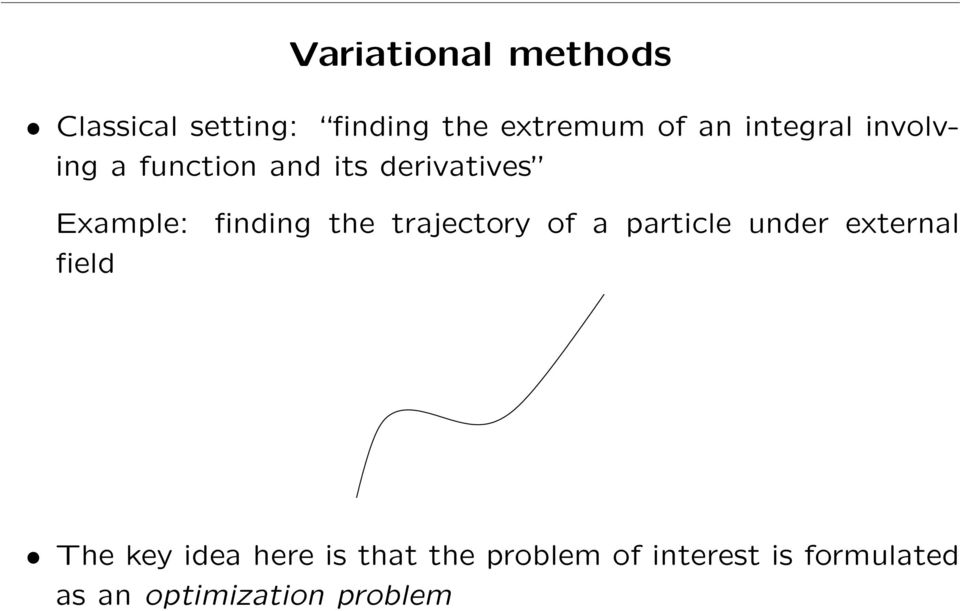
3 Variational methods Classical setting: finding the extremum of an integral involving a function and its derivatives Example: field finding the trajectory of a particle under external The key idea here is that the problem of interest is formulated as an optimization problem
4 Variational methods cont d Variational methods have a long history in physics, statistics, control theory as well as economics. calculus of variations (physics) linear/non-linear moments problems (statistics) dynamic programming (control theory) Variational formulations appear naturally also in machine learning contexts: regularization theory maximum entropy estimation Recently variational methods been used and further developed in the context of approximate inference and estimation
5 Examples of variational methods In classical examples the formulation itself is given but for us this is one of the key problems We provide here a few examples that highlight 1. how to cast problems as optimization problems 2. how to find an approximate solution when the exact solution is not feasible The examples we use involve a) finite element methods for solving differential equations b) large deviation methods (Chernoff bound)
6 Linear regression example n examples {(x 1, y 1 ),..., (x n, y n )} y x Find the parameter vector w that minimizes the squared error min n t=1 ( yt w T x t ) 2 w = n t=1 x t x T t 1 n t=1 x i y i Optimization problem desired solution We wish to find a (variational) optimization problem given the solution

7 Example: finite element method Consider the following simple 1-D Laplace (or Poisson) differential equation u (x) = f(x), x (a, b) with homogeneous boundary conditions u(a) = u(b) = 0. If u (x) denotes the solution, we can recover it by minimizing the following silly functional b J silly (u) = a (u (x) u (x)) 2 dx subject to the boundary conditions.

8 Finite element method cont d The silly functional is useful since we can evaluate the relevant part of it J silly (u) =... b a (u (x) u (x)) 2 dx = const. + b a u (x) 2 dx 2 b u(x)f(x)dx } {{ a } J(u) where J(u) only depends on u(x) and the constant is defined in terms of the unknown solution u (x). We typically cannot find the solution exactly but J(u) still permits us to evaluate and rank approximate solutions

9 Finite element method cont d To find an approximate solution, we specify a set of basis functions {φ 1 (x),..., φ n (x)} consistent with the boundary conditions and find the best solution of the form u(x) = c 1 φ 1 (x) + + c n φ n (x) Substituting this tentative solution back into our (quadratic) objective J(u) gives a quadratic objective for the coefficients J(c) = ij c i c j [ b a φ i (x)φ j (x)dx ] } {{ } A ij 2 i c i [ b a φ i(x)f(x)dx ] } {{ } r i Minimizing with respect to the coefficients c finally leads to the following fixed point equations chracterizing the best approximate solution: Ac = r
![tentative solution back into our (quadratic) objective J(u) gives a quadratic objective for the coefficients J(c) = ij c i c j [ b a φ i (x)φ j (x)dx ]](/docs-images/42/22875445/images/page_9.jpg "} {{ } A ij 2 i c i [ b a φ i(x)f(x)dx ] } {{ } r i Minimizing with respect to the coefficients c finally leads to the following fixed point equations")
10 The key steps were: Summary of the example 1. We defined a natural objective with reference to the optimal solution 2. We identified the relevant portion of this objective so that it could be evaluated without reference to the unknown solution 3. The resulting objective permitted us to search for the best approximate solution within a parametric family 4. The best approximate solution were characterized by a set of fixed point equations

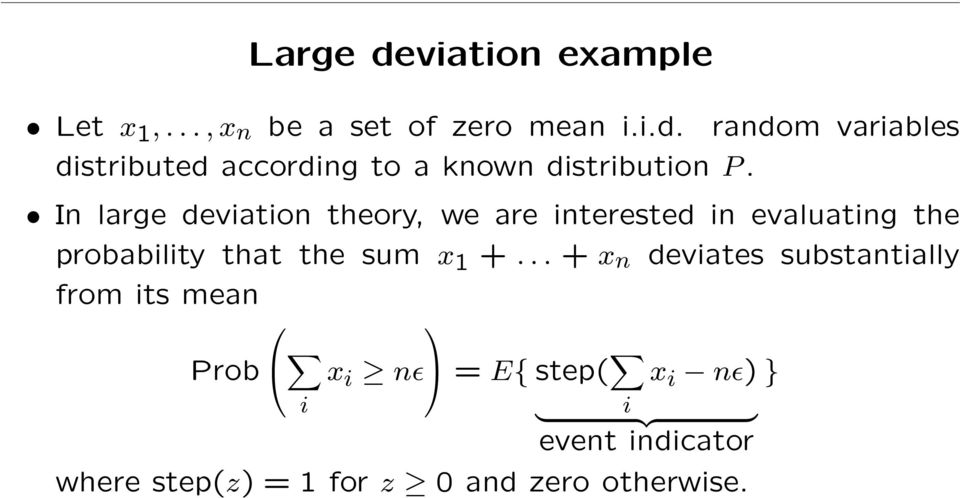
11 Large deviation example Let x 1,..., x n be a set of zero mean i.i.d. random variables distributed according to a known distribution P. In large deviation theory, we are interested in evaluating the probability that the sum x x n deviates substantially from its mean Prob i x i nɛ = E{ step( x i nɛ) } } i {{ } event indicator where step(z) = 1 for z 0 and zero otherwise.
12 Large deviation example cont d Prob( i x i nɛ) = E{ step( x i nɛ) } i {{ } event indicator } 3 To actually evaluate this probability, we make use of the following transformation large ξ small ξ step(z) = min ξ 0 e ξ z
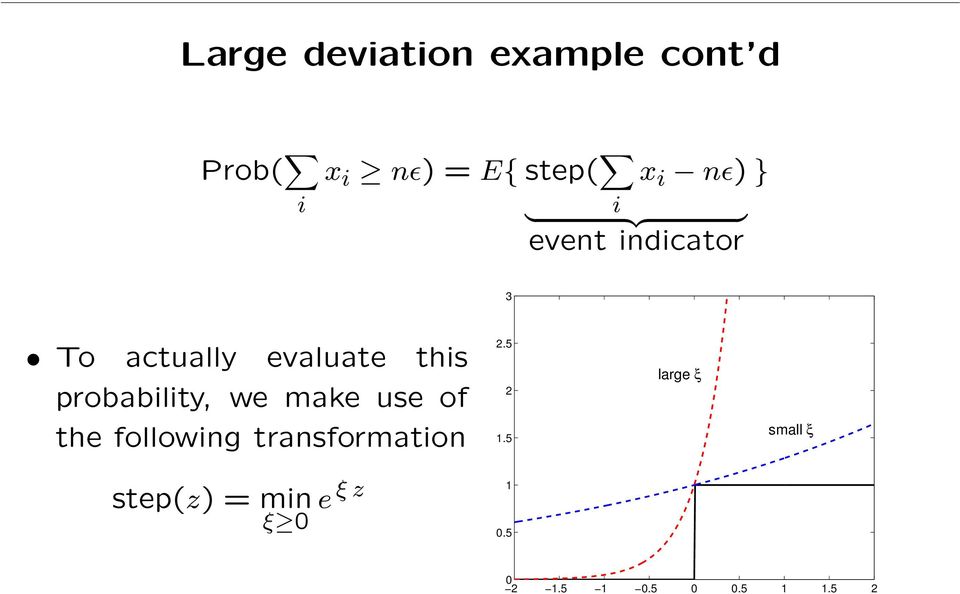
13 Large deviation example cont d Prob( i x i nɛ) = E{ step( i = E{ min x i nɛ) } e ξ ( i xi nɛ) } ξ i xi nɛ) } min ξ E{ e ξ ( (introduce the transform) (exchange the operations) where we can finally evaluate the expectation since the argument factors across the independent variables min and E{ } do not commute and thus we get an upper bound.

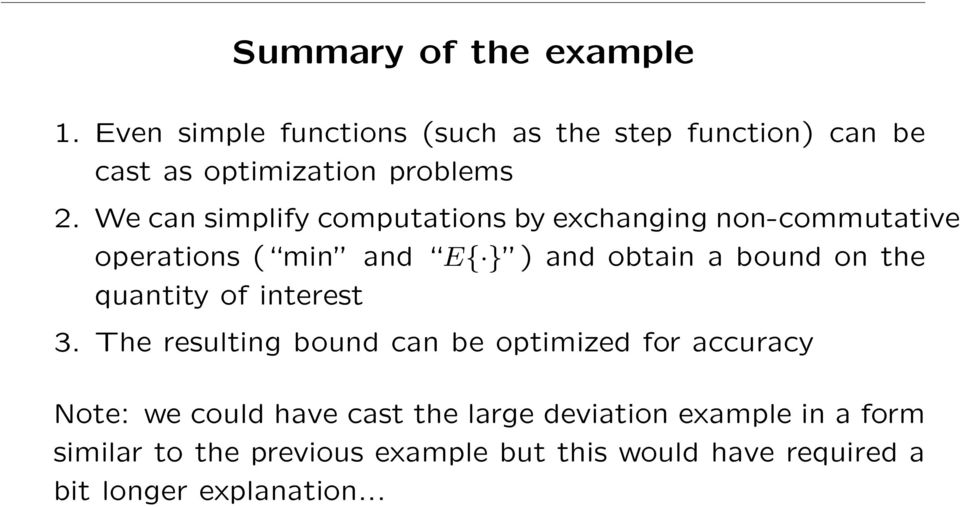
14 Summary of the example 1. Even simple functions (such as the step function) can be cast as optimization problems 2. We can simplify computations by exchanging non-commutative operations ( min and E{ } ) and obtain a bound on the quantity of interest 3. The resulting bound can be optimized for accuracy Note: we could have cast the large deviation example in a form similar to the previous example but this would have required a bit longer explanation...
15 Probabilistic inference Let P (x 1,..., x n ) be the distribution of interest over n variables We divide the set of variables into 1. visible variables x v whose marginal distribution P (x v ) we are interested in computing 2. hidden variables x h whose posterior distribution P (x h x v ) we want Evaluating the marginal or posterior involves summing over all configurations of the hidden variables x h P (x v ) = x h P (x h, x v ) The complexity of this operation depends on the structure or factorization of the joint distribution P We try to capture the factorization explicitly in terms of graphs

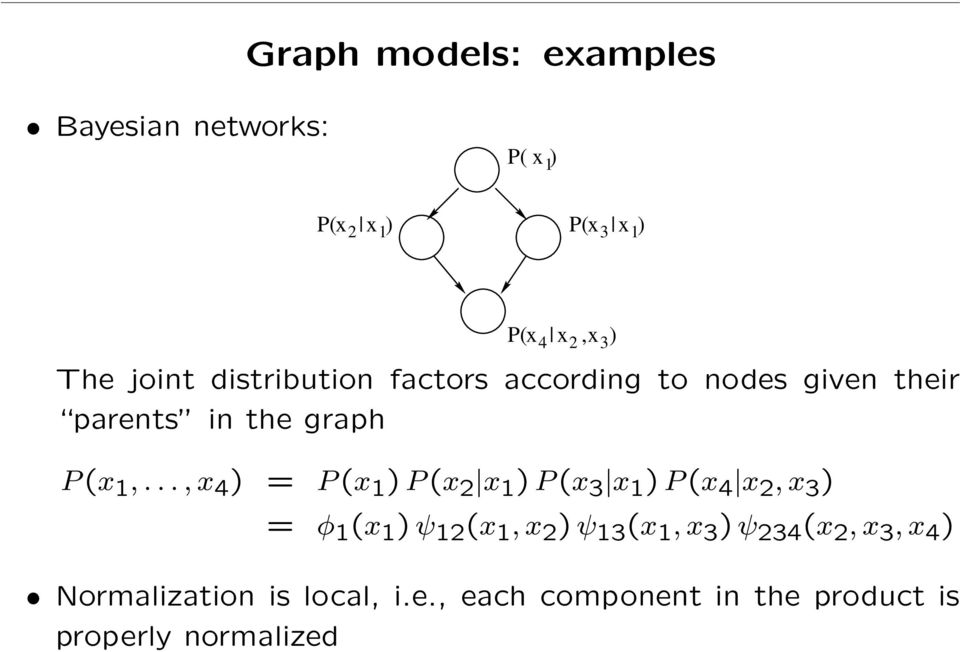
16 Graph models: examples Bayesian networks: P( x 1 ) P( x 2 x 1 ) P( x 3 x 1 ) P( x 4 x 2, x 3 ) The joint distribution factors according to nodes given their parents in the graph P (x 1,..., x 4 ) = P (x 1 ) P (x 2 x 1 ) P (x 3 x 1 ) P (x 4 x 2, x 3 ) = φ 1 (x 1 ) ψ 12 (x 1, x 2 ) ψ 13 (x 1, x 3 ) ψ 234 (x 2, x 3, x 4 ) Normalization is local, i.e., each component in the product is properly normalized
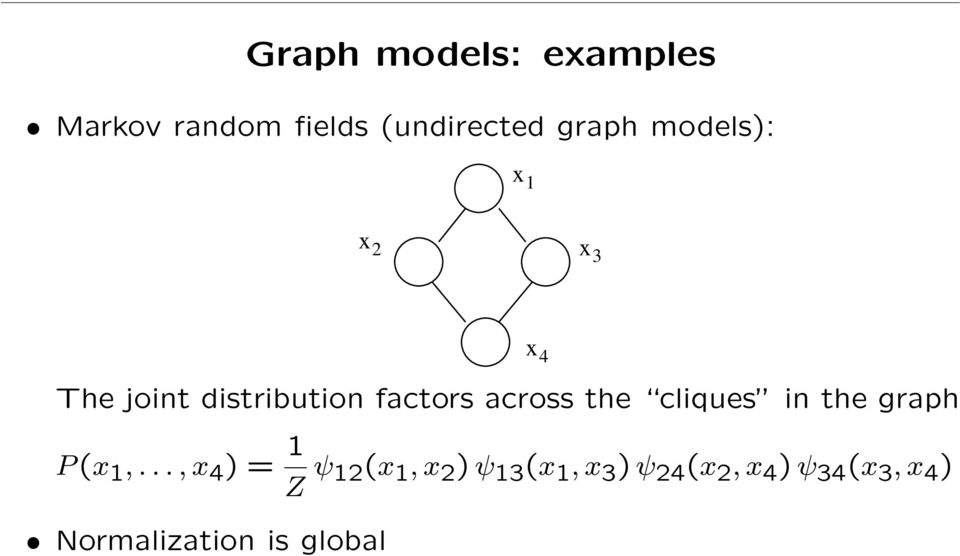
17 Graph models: examples Markov random fields (undirected graph models): x 1 x 2 x3 The joint distribution factors across the cliques in the graph P (x 1,..., x 4 ) = 1 Z ψ 12(x 1, x 2 ) ψ 13 (x 1, x 3 ) ψ 24 (x 2, x 4 ) ψ 34 (x 3, x 4 ) Normalization is global x 4
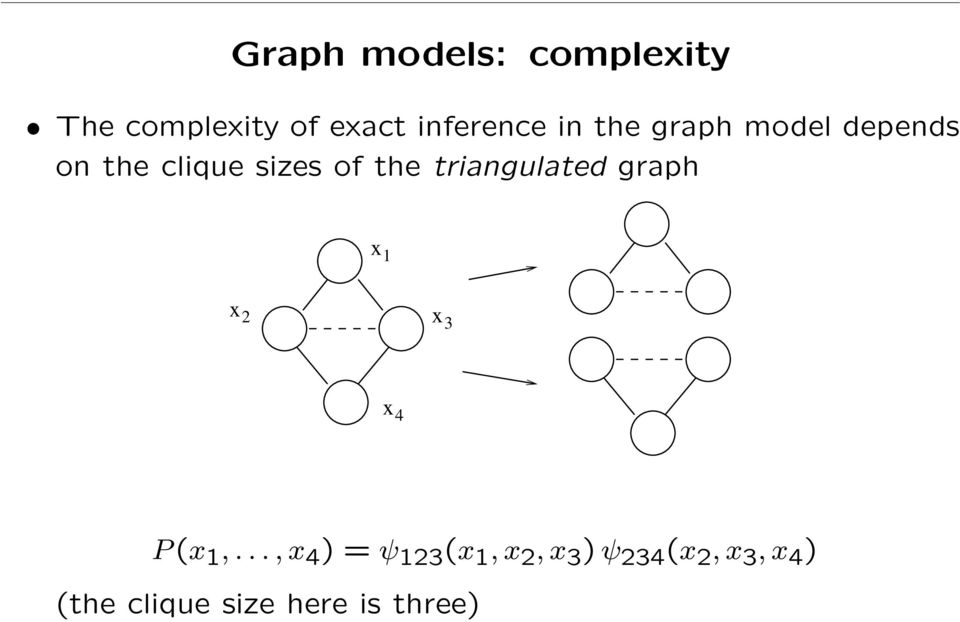
18 Graph models: complexity The complexity of exact inference in the graph model depends on the clique sizes of the triangulated graph x 1 x 2 x3 x 4 P (x 1,..., x 4 ) = ψ 123 (x 1, x 2, x 3 ) ψ 234 (x 2, x 3, x 4 ) (the clique size here is three)
19 HMMs and coupled HMMs Specific examples The clique size here is 2 and the graph is already triangulated... The clique size is 2; three after triangulation the shaded nodes denote visible variables - the unshaded nodes are hidden variables

20 Exact methods for inference Forward-backward (chains) Belief propagation (trees) Junction tree algorithm (clique trees) All the technigues heavily exploit the graph structure BUT...

21 Example: medical diagnosis The QMR database (Middleton et al.) Diseases Findings Probabilistic inference is in general NP-hard Even approximate inference is in general NP-hard
22 Approximate methods Belief propagation (even for graphs with cycles) Search algorithms Sampling methods Variational methods Our focus is on variational methods...
23 Approximate methods and graph structure Approximate inference relies on additional factorization or structure in the probability model 1. small clique size in the original, not triangulated graph (e.g., in coupled HMMs) 2. parametric conditional probabilities as in the noisy-or model P (x 4 = 0 x 2, x 3 ) = e ( θ 0+θ 1 x 2 +θ 2 x 3 ) P (x 4 = 1 x 2, x 3 ) = 1 e ( θ 0+θ 1 x 2 +θ 2 x 3 ) (written here in an exponentiated form) There s little one can do (in general) if the model has large (unstructured) probability tables associated with the cliques
24 Probabilistic inference problem again P (x 1,..., x n ) is the distribution of interest and the variables are divided into sets of 1. visible variables x v whose marginal distribution P (x v ) we are interested evaluating and 2. hidden variables x h whose posterior distribution P (x h x v ) we want Evaluating the marginal or posterior involves summing over all configurations of the hidden variables x h P (x v ) = x h P (x h, x v ) To find a variational solution we need to cast these computations as optimization problems
25 Variational probabilistic inference We start with a silly objective function: J(Q) = KL(Q xh P xh x v ) + log P (x v ) where Q is a variational distribution over the hidden variables x h. 1) If Q(x h ) = P (x h x v ), the posterior probability over the hidden variables x h, we recover the desired log-marginal log P (x v ). 2) log P (x v ) J(Q) for all Q, i.e., the objective function is a lower bound on the desired quantity. 3) The slack in the bound is given by the KL-divergence between Q and the true posterior.
26 Variational probabilistic inference cont d This objective function can be rewritten without reference to the posterior or the marginal J(Q) = KL(Q xh P xh x v ) + log P (x v )... = x h Q(x h ) log P (x h, x v ) + H(Q) where H(Q) is the (Shannon) entropy of Q. Taking the logarithm of the joint distribution is attractive because of the factorization log P (x h, x v ) = log c C ψ c (x c ) = c C log ψ c (x c )
27 Variational mean field method The variational formulation is exact and thus not (yet) manageable We can, however, restrict the maximization of J(Q) = x h Q(x h ) log P (x h, x v ) + H(Q) to some manageable class of distributions Q (cf. finite element methods) The simplest choice is the class of completely factored or mean field distributions Q(x h ) = i h Q i (x i )
28 Variational mean field method cont d We want to approximate a complicated graph model with a simple factored model Coupled HMMs factored model The measure of distance between the two models is the KLdivergence KL(Q xh P xh x v )
29 Variational mean field method: updates How do we optimize the simple variational distribution? We derive mean field equations (updates) by maximizing J(Q) = Q(x h ) log P (x h, x v ) + H(Q) x h with respect to each of the marginals Q i (x i ) in Q(x h ) = Q i (x i ) i h while keeping the remaining marginals fixed.
30 Variational mean field updates cont d P( x, x ) Q( x ) Q( x ) x 1 x 2 Simple model factored approximation The updates are made locally by geometrically averaging the ignored dependencies with respect to the other component distributions Q 1 (x 1 ) 1 Z 1 exp( x 2 Q 2 (x 2 ) log P (x 1, x 2 ) ) where Z 1 normalizes the right hand side across x 1. In other words, each x i only sees the mean effect of the dependencies These update equations are the fixed point equations
31 Variational mean field updates cont d Example: coupled HMMs Q i (x i ) 1 Z i evidence { }} at { i within chain dependencies ψ iv (x i, x { }} { vi ) exp( Q j (x j ) log ψ ij (x i, x j ) ) x j exp( x k Q k (x k ) log φ ik (x i, x k ) ) ψ ( x, x* ) iv i vi } {{ } between chains dependencies φ ( x, x) ik i k x k x i ψ ( x, x ) ij i j x j......
32 Accuracy of variational mean field General thoughts: weak dependence (near independence) good accuracy accurate even for large systems with weak interactions (law of large numbers) strong dependencies poor approximation We ll analyze the accuracy a bit in the context of the following simple example P( x, x ) 1 2 x 1 x 2 (no visible nodes)
33 Simple example P( x, x ) Q( x ) Q( x ) x 1 x 2 Simple model factored approximation Since there are no visible variables the log-marginal we are trying to approximate is log x h P (x 1, x 2 ) = log x 1,x 2 P (x 1, x 2 ) = log 1 = 0 The variational mean field approximation does not achieve this value, however, but rather J(Q) = KL ( Q x1,x 2 P x1,x 2 ) + 0 unless the factored approximation equals P (x 1, x 2 ) Q(x 1, x 2 ) = Q 1 (x 1 ) Q 2 (x 2 )
34 Simple example cont d P( x, x ) Q( x ) Q( x ) x 1 x 2 Simple model factored approximation There are two notions of accuracy: 1. How close the lower bound J(Q) is to zero (or more generally to the log-marginal log P (x v )) 2. How close Q 1 (x 1 ) and Q 2 (x 2 ) are to the true marginals P 1 (x 1 ) and P 2 (x 2 ) The two notions of accuracy need not be strongly correlated (and indeed they are not)
35 Simple example cont d P( x, x ) 1 2 x 1 x 2 We introduce a single parameter p that characterizes the dependence between x 1 and x 2 in a simple symmetric model: P (0, 0) = (1 p)/2 P (0, 1) = p/2 P (1, 0) = p/2 P (1, 1) = (1 p)/2 Note that the marginals P 1 (x 1 ) and P 2 (x 2 ) are uniform (equal to 0.5) regardless of the value of p. We might expect that increasing p 0.5 gradually degrades the accuracy of the variational approximation
36 Simple example: results Q 1 (x 1 =1) p J(Q) p The variational marginals undergo spontaneous symmetry breaking as the dependence increases. The rate at which the lower bound J(Q) deteriorates slows down when the symmetry is broken
37 Simple example: results without symmetry Q 1 (x 1 =1) p J(Q) p The phase transition disappears when the problem is no longer exactly symmetrical (e.g., P 1 (x 1 = 1) > 0.5) The variational marginals still deteriorate rapidly after some critical point p
38 Summary of the simple example What can we conclude? The variational marginals remain accurate when the dependencies are relatively weak Larger models offer more opportunities for degradation (symmetries, frustration, explaining away etc.) The variational lower bound can remain fairly accurate even in larger systems We should be able improve both forms of accuracy if we dispense with the completely factored (mean field) assumption
39 Structured mean field approach In a structured mean field approach, we want to approximate a complicated graph model with a tractable graph model Coupled HMMs Structured approximation The measure of distance between the two models is the KLdivergence as before KL(Q xh P xh x v )
40 Structured mean field approach cont d We can restrict the maximization of J(Q) = x h Q(x h ) log P (x h, x v ) + H(Q) to any manageable class of distributions Q. In a structured approximation, we partition the hidden variables x h into disjoint sets of variables x h1,..., x hm The variational distribution now factors across these sets but no constraints are imposed within the sets Q(x h ) = m i=1 Q hi (x hi ) As a result we incorporate any interactions within each partition exactly while performing a mean field approximation across the partitions
41 Structured mean field method Simple example (all hidden variables): x 1 x 2 x 1 x 2 x 3 x 4 Original graph x 3 x 4 structured approximation P (x) = 1 Z ψ 12(x 1, x 2 )ψ 23 (x 1, x 3 )ψ 34 (x 3, x 4 )ψ 42 (x 4, x 2 ) Q(x) = Q 12 (x 1, x 2 )Q 34 (x 3, x 4 )
42 Example cont d Simple example (only hidden variables): x 1 x 2 x 1 x 2 x 3 x 4 Original graph x 3 x 4 structured approximation Q 12 (x 1, x 2 ) 1 Z 12 exact potential { }} { ψ 12 (x 1, x 2 ) mean 1-3 dependence { }} { exp( x 3 Q 34 (x 3 ) log ψ 13 (x 1, x 3 ) ) exp( x 4 Q 34 (x 4 ) log ψ 42 (x 4, x 2 ) ) } {{ } mean 2-4 dependence
43 Example: coupled HMMs Factored approximation across chains: Q(x h ) = Q h1 (x h1 ) Q h2 (x h2 ) Q h1 (x h1 ) 1 ( first HMM model ) Z h1 x i x i+1 exp( x k Q h2 (x k ) log φ ik (x i, x k ) ) } i {{ } mean dependencies between the chains φ ( x, x) ik i k x k Coupled HMMs Structured approximation
44 Extensions 1. The components need not be disjoint (e.g., spanning trees) 2. We can use directed graph models as variational approximating distributions 3. etc. These extensions require additional search for the structure of the approximating distribution (difficult)
45 Bayesian estimation Bayesian estimation is inference In principle, the variational methods we have discussed so far should be applicable to such inference problems We distinguish here two cases of Bayesian estimation 1. no hidden variables 2. with hidden variables The case with hidden variables is often considerably more involved (the posterior has multiple modes)
46 Bayesian estimation without hidden variables θ θ x x n x 1 x n Density estimation y 1 y n Classification/regression The mean field/structured mean field approach does not directly help us here since there s no additional (explicit) factorization of θ We could, alternatively, impose parametric constraints on the variational posterior distribution Q(θ) (e.g., Gaussian). We may also use variational methods to impose additional factorization (discussed later)
47 Bayesian estimation with hidden variables a Bayesian mixture model k 1 θ k n x x n P (x, k, θ) = n i=1 P (k i ) P (x i k i, θ) P (θ) where we assume for simplicity that the parameters θ only influence the conditionals P (x i k i, θ) and not the mixing proportions P (k i ).
48 Bayesian mixture model cont d k 1 θ k n k 1 θ k n x 1 x n mixture model factored approximation Our factored approximation is Q(k, θ) = Q(k)Q(θ) = n i=1 Q i (k i ) Q(θ)
49 Bayesian mixture model: updates 1. Variational posterior over mixing variables Q i (k i ) 1 Z i P (k i ) mean θ k i dependence { }} { exp( 2. Variational posterior over parameters Q(θ) 1 Z P (θ) n i=1 Q(θ) log P (x i k i, θ)dθ ) mean θ k i dependence { }} { exp( k i Q i (k i ) log P (x i k i, θ) ) k 1 θ k n k 1 θ k n x 1 x n mixture model factored approximation
50 Bayesian mixture model: discussion Imposing any factorization of the form Q(k, θ) = Q(k)Q(θ) makes the solution liable to sudden deterioration of the component marginals (as in the context of the simple example presented earlier) This may happen if the mixing variables and the parameters are strongly dependent in the true posterior Since in Bayesian estimation we really want the marginals (or at least Q(θ)), we need to be a bit more careful...
51 Additional factorization Success of approximate inference/estimation depends in part on additional structure in the probability model beyond what is visible in the graph (pairwise potentials, parametric conditional probabilities, etc.) We can rely on such additional structure to impose further factorization of the joint distribution Useful factorization decouples dependent variables as in P (x i x pai ) j pa i ψ ij (x i, x j ) where x pai denotes the parents of x i in a Bayesian network. When can we impose such factorization? in a principled way?
52 Imposing additional factorization cont d Theorem (factorization theorem) Assuming x i and all its parents x pai are discrete variables, then we can always find a variational transform of the form P (x i x pai ) = min ξ j pa i ψ ij (x i, x j ; ξ) (analogous formulation holds for max ) Unfortunately the mere existence of such transforms is not sufficient; we need transforms that lead to accurate approximations and they are much harder to find
53 Factorization via convex duality Basic idea: for a concave function f(x) any tangent plane serves as a bound f(x) λ x f (λ) f(x) x 0 x The bound is exact for one of the tangents f(x) = min λ { λ x f (λ) } (the conjugate function f (λ), also concave, can be similarly expressed in terms of f(x), hence the duality)
54 Factorization via convex duality: example Factorization transform for the noise-or model P (f = 1 d, θ) = [1 e ( θ 1 d θ n d n ) ] [1 = e log e ( θ 1 d θ n d n ) ] e λ ( θ 1 d θ n d n ) f (λ) since f(x) = log [ 1 e x] is a concave (convex down) function. This is exactly the type of factorization we have discussed P (f = 1 d, θ) = min λ n j=1 e λ θ jd j f (λ)/n Similar transforms can be derived for logistic and other models
55 The QMR belief network (Shwe et al. 1991) d Diseases d d n f 1 f2... Findings f m - Contains over 600 significant diseases and about 4000 associated findings in internal medicine. - Embodies extensive expert (and statistical) knowledge.
56 QMR: Statistical assumptions d Diseases d d n f 1 f2... Findings f m The assumptions: (1) The diseases are marginally independent. (2) The findings are conditionally independent. (3) Causal independence (noisy-or) P (fk d) = e ( θ k1 d θ kn d n ) P (f k + d) = 1 e ( θ k1 d θ kn d n )
57 Diagnostic inference d Diseases d d n f 1 - f2... Findings + f m The inference problem: Compute the posterior probabilities for the diseases given the instantiated findings. the order in which the evidence is absorbed from the findings is immaterial.
58 Evidence from positive findings d Diseases 1 n... d + f k Findings P (d f k + ) = c P (f k + d)p (d) [ = c 1 e ( θ k1 d θ kn d n ) ] P (d) Marginal independence no longer holds. Absorbing the evidence from positive findings is (typically) exponentially costly in the number of positive findings.
59 Evidence from positive findings d Diseases 1 n... d Variational evidence + f k Findings We can transform the positive evidence according to P (f k + [ d) = 1 e ( θ k1 d θ kn d n ) ] [1 = e log e ( θ k1 d θ kn d n ) ] e λ ( θ k1 d θ kn d n ) f (λ) since f(x) = log [ 1 e x] is a convex down function.
60 Evidence from positive findings d Diseases d d n f 1 f2... Findings With every variational transformation we lose some accuracy + we reduce the computation time by a factor of two. + We can balance the accuracy of inference with the available computational resources + f m
61 Performance on actual medical cases 1 1 variational estimates variational estimates exact marginals exact marginals 12 findings treated exactly 16 findings treated exactly log likelihood sorted cases bounds on log-likelihood mean correlation execution time comparison to sampling
62 The QMR belief network: conclusions The approximation results are closed form expressions and can be analyzed for reliability. We may also use more sophisticated variational methods to obtain rigorous upper and lower bounds on the desired disease marginals (practical?)
63 Discussion There are a number of variational methods we did not discuss recursive variational algorithms on-line variational methods for Bayesian estimation variational methods for structured Bayesian estimation (with hyperparameters) etc. Current and future directions: smooth combination of variational methods with other methods (e.g., junction tree, sampling) better characterization of the accuracy of variational approximation methods new formulations
64 References (please see the references in the associated tutorial paper)
Several Views of Support Vector Machines
 Several Views of Support Vector Machines Ryan M. Rifkin Honda Research Institute USA, Inc. Human Intention Understanding Group 2007 Tikhonov Regularization We are considering algorithms of the form min
3. The Junction Tree Algorithms
 A Short Course on Graphical Models 3. The Junction Tree Algorithms Mark Paskin [email protected] 1 Review: conditional independence Two random variables X and Y are independent (written X Y ) iff p X ( )
STA 4273H: Statistical Machine Learning
 STA 4273H: Statistical Machine Learning Russ Salakhutdinov Department of Statistics! [email protected]! http://www.cs.toronto.edu/~rsalakhu/ Lecture 6 Three Approaches to Classification Construct
Introduction to General and Generalized Linear Models
 Introduction to General and Generalized Linear Models General Linear Models - part I Henrik Madsen Poul Thyregod Informatics and Mathematical Modelling Technical University of Denmark DK-2800 Kgs. Lyngby
Probabilistic Models for Big Data. Alex Davies and Roger Frigola University of Cambridge 13th February 2014
 Probabilistic Models for Big Data Alex Davies and Roger Frigola University of Cambridge 13th February 2014 The State of Big Data Why probabilistic models for Big Data? 1. If you don t have to worry about
Course: Model, Learning, and Inference: Lecture 5
 Course: Model, Learning, and Inference: Lecture 5 Alan Yuille Department of Statistics, UCLA Los Angeles, CA 90095 [email protected] Abstract Probability distributions on structured representation.
The Basics of Graphical Models
 The Basics of Graphical Models David M. Blei Columbia University October 3, 2015 Introduction These notes follow Chapter 2 of An Introduction to Probabilistic Graphical Models by Michael Jordan. Many figures
Linear Threshold Units
 Linear Threshold Units w x hx (... w n x n w We assume that each feature x j and each weight w j is a real number (we will relax this later) We will study three different algorithms for learning linear
Linear Programming Notes V Problem Transformations
 Linear Programming Notes V Problem Transformations 1 Introduction Any linear programming problem can be rewritten in either of two standard forms. In the first form, the objective is to maximize, the material
Language Modeling. Chapter 1. 1.1 Introduction
 Chapter 1 Language Modeling (Course notes for NLP by Michael Collins, Columbia University) 1.1 Introduction In this chapter we will consider the the problem of constructing a language model from a set
Basics of Statistical Machine Learning
 CS761 Spring 2013 Advanced Machine Learning Basics of Statistical Machine Learning Lecturer: Xiaojin Zhu [email protected] Modern machine learning is rooted in statistics. You will find many familiar
Linear and quadratic Taylor polynomials for functions of several variables.
 ams/econ 11b supplementary notes ucsc Linear quadratic Taylor polynomials for functions of several variables. c 010, Yonatan Katznelson Finding the extreme (minimum or maximum) values of a function, is
Master s Theory Exam Spring 2006
 Spring 2006 This exam contains 7 questions. You should attempt them all. Each question is divided into parts to help lead you through the material. You should attempt to complete as much of each problem
ECON 459 Game Theory. Lecture Notes Auctions. Luca Anderlini Spring 2015
 ECON 459 Game Theory Lecture Notes Auctions Luca Anderlini Spring 2015 These notes have been used before. If you can still spot any errors or have any suggestions for improvement, please let me know. 1
Christfried Webers. Canberra February June 2015
 c Statistical Group and College of Engineering and Computer Science Canberra February June (Many figures from C. M. Bishop, "Pattern Recognition and ") 1of 829 c Part VIII Linear Classification 2 Logistic
Variational Mean Field for Graphical Models
 Variational Mean Field for Graphical Models CS/CNS/EE 155 Baback Moghaddam Machine Learning Group baback @ jpl.nasa.gov Approximate Inference Consider general UGs (i.e., not tree-structured) All basic
Lecture 3: Linear methods for classification
 Lecture 3: Linear methods for classification Rafael A. Irizarry and Hector Corrada Bravo February, 2010 Today we describe four specific algorithms useful for classification problems: linear regression,
Modern Optimization Methods for Big Data Problems MATH11146 The University of Edinburgh
 Modern Optimization Methods for Big Data Problems MATH11146 The University of Edinburgh Peter Richtárik Week 3 Randomized Coordinate Descent With Arbitrary Sampling January 27, 2016 1 / 30 The Problem
Statistical Machine Learning
 Statistical Machine Learning UoC Stats 37700, Winter quarter Lecture 4: classical linear and quadratic discriminants. 1 / 25 Linear separation For two classes in R d : simple idea: separate the classes
10-601. Machine Learning. http://www.cs.cmu.edu/afs/cs/academic/class/10601-f10/index.html
 10-601 Machine Learning http://www.cs.cmu.edu/afs/cs/academic/class/10601-f10/index.html Course data All up-to-date info is on the course web page: http://www.cs.cmu.edu/afs/cs/academic/class/10601-f10/index.html
Math 120 Final Exam Practice Problems, Form: A
 Math 120 Final Exam Practice Problems, Form: A Name: While every attempt was made to be complete in the types of problems given below, we make no guarantees about the completeness of the problems. Specifically,
1 Prior Probability and Posterior Probability
 Math 541: Statistical Theory II Bayesian Approach to Parameter Estimation Lecturer: Songfeng Zheng 1 Prior Probability and Posterior Probability Consider now a problem of statistical inference in which
This unit will lay the groundwork for later units where the students will extend this knowledge to quadratic and exponential functions.
 Algebra I Overview View unit yearlong overview here Many of the concepts presented in Algebra I are progressions of concepts that were introduced in grades 6 through 8. The content presented in this course
Algebra 2 Chapter 1 Vocabulary. identity - A statement that equates two equivalent expressions.
 Chapter 1 Vocabulary identity - A statement that equates two equivalent expressions. verbal model- A word equation that represents a real-life problem. algebraic expression - An expression with variables.
Penalized regression: Introduction
 Penalized regression: Introduction Patrick Breheny August 30 Patrick Breheny BST 764: Applied Statistical Modeling 1/19 Maximum likelihood Much of 20th-century statistics dealt with maximum likelihood
MATH 425, PRACTICE FINAL EXAM SOLUTIONS.
 MATH 45, PRACTICE FINAL EXAM SOLUTIONS. Exercise. a Is the operator L defined on smooth functions of x, y by L u := u xx + cosu linear? b Does the answer change if we replace the operator L by the operator
Constrained optimization.
 ams/econ 11b supplementary notes ucsc Constrained optimization. c 2010, Yonatan Katznelson 1. Constraints In many of the optimization problems that arise in economics, there are restrictions on the values
Semi-Supervised Support Vector Machines and Application to Spam Filtering
 Semi-Supervised Support Vector Machines and Application to Spam Filtering Alexander Zien Empirical Inference Department, Bernhard Schölkopf Max Planck Institute for Biological Cybernetics ECML 2006 Discovery
Chapter 10. Key Ideas Correlation, Correlation Coefficient (r),
 Chapter 0 Key Ideas Correlation, Correlation Coefficient (r), Section 0-: Overview We have already explored the basics of describing single variable data sets. However, when two quantitative variables
Overview of Violations of the Basic Assumptions in the Classical Normal Linear Regression Model
 Overview of Violations of the Basic Assumptions in the Classical Normal Linear Regression Model 1 September 004 A. Introduction and assumptions The classical normal linear regression model can be written
Probability and Statistics Prof. Dr. Somesh Kumar Department of Mathematics Indian Institute of Technology, Kharagpur
 Probability and Statistics Prof. Dr. Somesh Kumar Department of Mathematics Indian Institute of Technology, Kharagpur Module No. #01 Lecture No. #15 Special Distributions-VI Today, I am going to introduce
Creating, Solving, and Graphing Systems of Linear Equations and Linear Inequalities
 Algebra 1, Quarter 2, Unit 2.1 Creating, Solving, and Graphing Systems of Linear Equations and Linear Inequalities Overview Number of instructional days: 15 (1 day = 45 60 minutes) Content to be learned
Lecture 3. Linear Programming. 3B1B Optimization Michaelmas 2015 A. Zisserman. Extreme solutions. Simplex method. Interior point method
 Lecture 3 3B1B Optimization Michaelmas 2015 A. Zisserman Linear Programming Extreme solutions Simplex method Interior point method Integer programming and relaxation The Optimization Tree Linear Programming
Duality in General Programs. Ryan Tibshirani Convex Optimization 10-725/36-725
 Duality in General Programs Ryan Tibshirani Convex Optimization 10-725/36-725 1 Last time: duality in linear programs Given c R n, A R m n, b R m, G R r n, h R r : min x R n c T x max u R m, v R r b T
Information Theory and Coding Prof. S. N. Merchant Department of Electrical Engineering Indian Institute of Technology, Bombay
 Information Theory and Coding Prof. S. N. Merchant Department of Electrical Engineering Indian Institute of Technology, Bombay Lecture - 17 Shannon-Fano-Elias Coding and Introduction to Arithmetic Coding
Message-passing sequential detection of multiple change points in networks
 Message-passing sequential detection of multiple change points in networks Long Nguyen, Arash Amini Ram Rajagopal University of Michigan Stanford University ISIT, Boston, July 2012 Nguyen/Amini/Rajagopal
SENSITIVITY ANALYSIS AND INFERENCE. Lecture 12
 This work is licensed under a Creative Commons Attribution-NonCommercial-ShareAlike License. Your use of this material constitutes acceptance of that license and the conditions of use of materials on this
Approximating the Partition Function by Deleting and then Correcting for Model Edges
 Approximating the Partition Function by Deleting and then Correcting for Model Edges Arthur Choi and Adnan Darwiche Computer Science Department University of California, Los Angeles Los Angeles, CA 995
3.2. Solving quadratic equations. Introduction. Prerequisites. Learning Outcomes. Learning Style
 Solving quadratic equations 3.2 Introduction A quadratic equation is one which can be written in the form ax 2 + bx + c = 0 where a, b and c are numbers and x is the unknown whose value(s) we wish to find.
Class #6: Non-linear classification. ML4Bio 2012 February 17 th, 2012 Quaid Morris
 Class #6: Non-linear classification ML4Bio 2012 February 17 th, 2012 Quaid Morris 1 Module #: Title of Module 2 Review Overview Linear separability Non-linear classification Linear Support Vector Machines
PS 271B: Quantitative Methods II. Lecture Notes
 PS 271B: Quantitative Methods II Lecture Notes Langche Zeng [email protected] The Empirical Research Process; Fundamental Methodological Issues 2 Theory; Data; Models/model selection; Estimation; Inference.
Maximum Likelihood Estimation
 Math 541: Statistical Theory II Lecturer: Songfeng Zheng Maximum Likelihood Estimation 1 Maximum Likelihood Estimation Maximum likelihood is a relatively simple method of constructing an estimator for
Markov random fields and Gibbs measures
 Chapter Markov random fields and Gibbs measures 1. Conditional independence Suppose X i is a random element of (X i, B i ), for i = 1, 2, 3, with all X i defined on the same probability space (.F, P).
PATTERN RECOGNITION AND MACHINE LEARNING CHAPTER 4: LINEAR MODELS FOR CLASSIFICATION
 PATTERN RECOGNITION AND MACHINE LEARNING CHAPTER 4: LINEAR MODELS FOR CLASSIFICATION Introduction In the previous chapter, we explored a class of regression models having particularly simple analytical
Fairfield Public Schools
 Mathematics Fairfield Public Schools AP Statistics AP Statistics BOE Approved 04/08/2014 1 AP STATISTICS Critical Areas of Focus AP Statistics is a rigorous course that offers advanced students an opportunity
Conditional Random Fields: An Introduction
 Conditional Random Fields: An Introduction Hanna M. Wallach February 24, 2004 1 Labeling Sequential Data The task of assigning label sequences to a set of observation sequences arises in many fields, including
Vector and Matrix Norms
 Chapter 1 Vector and Matrix Norms 11 Vector Spaces Let F be a field (such as the real numbers, R, or complex numbers, C) with elements called scalars A Vector Space, V, over the field F is a non-empty
Tutorial on Markov Chain Monte Carlo
 Tutorial on Markov Chain Monte Carlo Kenneth M. Hanson Los Alamos National Laboratory Presented at the 29 th International Workshop on Bayesian Inference and Maximum Entropy Methods in Science and Technology,
Linear Programming for Optimization. Mark A. Schulze, Ph.D. Perceptive Scientific Instruments, Inc.
 1. Introduction Linear Programming for Optimization Mark A. Schulze, Ph.D. Perceptive Scientific Instruments, Inc. 1.1 Definition Linear programming is the name of a branch of applied mathematics that
Linear Classification. Volker Tresp Summer 2015
 Linear Classification Volker Tresp Summer 2015 1 Classification Classification is the central task of pattern recognition Sensors supply information about an object: to which class do the object belong
How To Solve A Sequential Mca Problem
 Monte Carlo-based statistical methods (MASM11/FMS091) Jimmy Olsson Centre for Mathematical Sciences Lund University, Sweden Lecture 6 Sequential Monte Carlo methods II February 3, 2012 Changes in HA1 Problem
Pattern Analysis. Logistic Regression. 12. Mai 2009. Joachim Hornegger. Chair of Pattern Recognition Erlangen University
 Pattern Analysis Logistic Regression 12. Mai 2009 Joachim Hornegger Chair of Pattern Recognition Erlangen University Pattern Analysis 2 / 43 1 Logistic Regression Posteriors and the Logistic Function Decision
Høgskolen i Narvik Sivilingeniørutdanningen STE6237 ELEMENTMETODER. Oppgaver
 Høgskolen i Narvik Sivilingeniørutdanningen STE637 ELEMENTMETODER Oppgaver Klasse: 4.ID, 4.IT Ekstern Professor: Gregory A. Chechkin e-mail: [email protected] Narvik 6 PART I Task. Consider two-point
15.062 Data Mining: Algorithms and Applications Matrix Math Review
 .6 Data Mining: Algorithms and Applications Matrix Math Review The purpose of this document is to give a brief review of selected linear algebra concepts that will be useful for the course and to develop
Support Vector Machines Explained
 March 1, 2009 Support Vector Machines Explained Tristan Fletcher www.cs.ucl.ac.uk/staff/t.fletcher/ Introduction This document has been written in an attempt to make the Support Vector Machines (SVM),
Numerical methods for American options
 Lecture 9 Numerical methods for American options Lecture Notes by Andrzej Palczewski Computational Finance p. 1 American options The holder of an American option has the right to exercise it at any moment
NEW YORK STATE TEACHER CERTIFICATION EXAMINATIONS
 NEW YORK STATE TEACHER CERTIFICATION EXAMINATIONS TEST DESIGN AND FRAMEWORK September 2014 Authorized for Distribution by the New York State Education Department This test design and framework document
Gaussian Processes in Machine Learning
 Gaussian Processes in Machine Learning Carl Edward Rasmussen Max Planck Institute for Biological Cybernetics, 72076 Tübingen, Germany [email protected] WWW home page: http://www.tuebingen.mpg.de/ carl
Spatial Statistics Chapter 3 Basics of areal data and areal data modeling
 Spatial Statistics Chapter 3 Basics of areal data and areal data modeling Recall areal data also known as lattice data are data Y (s), s D where D is a discrete index set. This usually corresponds to data
Notes on Orthogonal and Symmetric Matrices MENU, Winter 2013
 Notes on Orthogonal and Symmetric Matrices MENU, Winter 201 These notes summarize the main properties and uses of orthogonal and symmetric matrices. We covered quite a bit of material regarding these topics,
BINOMIAL OPTIONS PRICING MODEL. Mark Ioffe. Abstract
 BINOMIAL OPTIONS PRICING MODEL Mark Ioffe Abstract Binomial option pricing model is a widespread numerical method of calculating price of American options. In terms of applied mathematics this is simple
Second Order Linear Nonhomogeneous Differential Equations; Method of Undetermined Coefficients. y + p(t) y + q(t) y = g(t), g(t) 0.
 Second Order Linear Nonhomogeneous Differential Equations; Method of Undetermined Coefficients We will now turn our attention to nonhomogeneous second order linear equations, equations with the standard
Elasticity Theory Basics
 G22.3033-002: Topics in Computer Graphics: Lecture #7 Geometric Modeling New York University Elasticity Theory Basics Lecture #7: 20 October 2003 Lecturer: Denis Zorin Scribe: Adrian Secord, Yotam Gingold
LECTURE 4. Last time: Lecture outline
 LECTURE 4 Last time: Types of convergence Weak Law of Large Numbers Strong Law of Large Numbers Asymptotic Equipartition Property Lecture outline Stochastic processes Markov chains Entropy rate Random
The Envelope Theorem 1
 John Nachbar Washington University April 2, 2015 1 Introduction. The Envelope Theorem 1 The Envelope theorem is a corollary of the Karush-Kuhn-Tucker theorem (KKT) that characterizes changes in the value
Lecture 2. Marginal Functions, Average Functions, Elasticity, the Marginal Principle, and Constrained Optimization
 Lecture 2. Marginal Functions, Average Functions, Elasticity, the Marginal Principle, and Constrained Optimization 2.1. Introduction Suppose that an economic relationship can be described by a real-valued
1 Error in Euler s Method
 1 Error in Euler s Method Experience with Euler s 1 method raises some interesting questions about numerical approximations for the solutions of differential equations. 1. What determines the amount of
Multi-variable Calculus and Optimization
 Multi-variable Calculus and Optimization Dudley Cooke Trinity College Dublin Dudley Cooke (Trinity College Dublin) Multi-variable Calculus and Optimization 1 / 51 EC2040 Topic 3 - Multi-variable Calculus
Cell Phone based Activity Detection using Markov Logic Network
 Cell Phone based Activity Detection using Markov Logic Network Somdeb Sarkhel [email protected] 1 Introduction Mobile devices are becoming increasingly sophisticated and the latest generation of smart
Lecture Note 1 Set and Probability Theory. MIT 14.30 Spring 2006 Herman Bennett
 Lecture Note 1 Set and Probability Theory MIT 14.30 Spring 2006 Herman Bennett 1 Set Theory 1.1 Definitions and Theorems 1. Experiment: any action or process whose outcome is subject to uncertainty. 2.
Introduction to Support Vector Machines. Colin Campbell, Bristol University
 Introduction to Support Vector Machines Colin Campbell, Bristol University 1 Outline of talk. Part 1. An Introduction to SVMs 1.1. SVMs for binary classification. 1.2. Soft margins and multi-class classification.
1 Sufficient statistics
 1 Sufficient statistics A statistic is a function T = rx 1, X 2,, X n of the random sample X 1, X 2,, X n. Examples are X n = 1 n s 2 = = X i, 1 n 1 the sample mean X i X n 2, the sample variance T 1 =
Sensitivity Analysis 3.1 AN EXAMPLE FOR ANALYSIS
 Sensitivity Analysis 3 We have already been introduced to sensitivity analysis in Chapter via the geometry of a simple example. We saw that the values of the decision variables and those of the slack and
Numerical Methods for Option Pricing
 Chapter 9 Numerical Methods for Option Pricing Equation (8.26) provides a way to evaluate option prices. For some simple options, such as the European call and put options, one can integrate (8.26) directly
Finding the M Most Probable Configurations Using Loopy Belief Propagation
 Finding the M Most Probable Configurations Using Loopy Belief Propagation Chen Yanover and Yair Weiss School of Computer Science and Engineering The Hebrew University of Jerusalem 91904 Jerusalem, Israel
APPLIED MATHEMATICS ADVANCED LEVEL
 APPLIED MATHEMATICS ADVANCED LEVEL INTRODUCTION This syllabus serves to examine candidates knowledge and skills in introductory mathematical and statistical methods, and their applications. For applications
Microeconomic Theory: Basic Math Concepts
 Microeconomic Theory: Basic Math Concepts Matt Van Essen University of Alabama Van Essen (U of A) Basic Math Concepts 1 / 66 Basic Math Concepts In this lecture we will review some basic mathematical concepts
LABEL PROPAGATION ON GRAPHS. SEMI-SUPERVISED LEARNING. ----Changsheng Liu 10-30-2014
 LABEL PROPAGATION ON GRAPHS. SEMI-SUPERVISED LEARNING ----Changsheng Liu 10-30-2014 Agenda Semi Supervised Learning Topics in Semi Supervised Learning Label Propagation Local and global consistency Graph
MASSACHUSETTS INSTITUTE OF TECHNOLOGY 6.436J/15.085J Fall 2008 Lecture 5 9/17/2008 RANDOM VARIABLES
 MASSACHUSETTS INSTITUTE OF TECHNOLOGY 6.436J/15.085J Fall 2008 Lecture 5 9/17/2008 RANDOM VARIABLES Contents 1. Random variables and measurable functions 2. Cumulative distribution functions 3. Discrete
E3: PROBABILITY AND STATISTICS lecture notes
 E3: PROBABILITY AND STATISTICS lecture notes 2 Contents 1 PROBABILITY THEORY 7 1.1 Experiments and random events............................ 7 1.2 Certain event. Impossible event............................
Statistical Machine Learning from Data
 Samy Bengio Statistical Machine Learning from Data 1 Statistical Machine Learning from Data Gaussian Mixture Models Samy Bengio IDIAP Research Institute, Martigny, Switzerland, and Ecole Polytechnique
CHAPTER 2 Estimating Probabilities
 CHAPTER 2 Estimating Probabilities Machine Learning Copyright c 2016. Tom M. Mitchell. All rights reserved. *DRAFT OF January 24, 2016* *PLEASE DO NOT DISTRIBUTE WITHOUT AUTHOR S PERMISSION* This is a
Least-Squares Intersection of Lines
 Least-Squares Intersection of Lines Johannes Traa - UIUC 2013 This write-up derives the least-squares solution for the intersection of lines. In the general case, a set of lines will not intersect at a
Math 4310 Handout - Quotient Vector Spaces
 Math 4310 Handout - Quotient Vector Spaces Dan Collins The textbook defines a subspace of a vector space in Chapter 4, but it avoids ever discussing the notion of a quotient space. This is understandable
Bayesian probability theory
 Bayesian probability theory Bruno A. Olshausen arch 1, 2004 Abstract Bayesian probability theory provides a mathematical framework for peforming inference, or reasoning, using probability. The foundations
Applications to Data Smoothing and Image Processing I
 Applications to Data Smoothing and Image Processing I MA 348 Kurt Bryan Signals and Images Let t denote time and consider a signal a(t) on some time interval, say t. We ll assume that the signal a(t) is
The Effects of Start Prices on the Performance of the Certainty Equivalent Pricing Policy
 BMI Paper The Effects of Start Prices on the Performance of the Certainty Equivalent Pricing Policy Faculty of Sciences VU University Amsterdam De Boelelaan 1081 1081 HV Amsterdam Netherlands Author: R.D.R.
Logistic Regression. Jia Li. Department of Statistics The Pennsylvania State University. Logistic Regression
 Logistic Regression Department of Statistics The Pennsylvania State University Email: [email protected] Logistic Regression Preserve linear classification boundaries. By the Bayes rule: Ĝ(x) = arg max
CS 2750 Machine Learning. Lecture 1. Machine Learning. http://www.cs.pitt.edu/~milos/courses/cs2750/ CS 2750 Machine Learning.
 Lecture Machine Learning Milos Hauskrecht [email protected] 539 Sennott Square, x5 http://www.cs.pitt.edu/~milos/courses/cs75/ Administration Instructor: Milos Hauskrecht [email protected] 539 Sennott
HT2015: SC4 Statistical Data Mining and Machine Learning
 HT2015: SC4 Statistical Data Mining and Machine Learning Dino Sejdinovic Department of Statistics Oxford http://www.stats.ox.ac.uk/~sejdinov/sdmml.html Bayesian Nonparametrics Parametric vs Nonparametric
ECON20310 LECTURE SYNOPSIS REAL BUSINESS CYCLE
 ECON20310 LECTURE SYNOPSIS REAL BUSINESS CYCLE YUAN TIAN This synopsis is designed merely for keep a record of the materials covered in lectures. Please refer to your own lecture notes for all proofs.
Bayesian Analysis for the Social Sciences
 Bayesian Analysis for the Social Sciences Simon Jackman Stanford University http://jackman.stanford.edu/bass November 9, 2012 Simon Jackman (Stanford) Bayesian Analysis for the Social Sciences November
Scheduling Shop Scheduling. Tim Nieberg
 Scheduling Shop Scheduling Tim Nieberg Shop models: General Introduction Remark: Consider non preemptive problems with regular objectives Notation Shop Problems: m machines, n jobs 1,..., n operations
Monte Carlo-based statistical methods (MASM11/FMS091)
 Monte Carlo-based statistical methods (MASM11/FMS091) Magnus Wiktorsson Centre for Mathematical Sciences Lund University, Sweden Lecture 6 Sequential Monte Carlo methods II February 7, 2014 M. Wiktorsson
Monte Carlo and Empirical Methods for Stochastic Inference (MASM11/FMS091)
 Monte Carlo and Empirical Methods for Stochastic Inference (MASM11/FMS091) Magnus Wiktorsson Centre for Mathematical Sciences Lund University, Sweden Lecture 5 Sequential Monte Carlo methods I February
Algebra Unpacked Content For the new Common Core standards that will be effective in all North Carolina schools in the 2012-13 school year.
 This document is designed to help North Carolina educators teach the Common Core (Standard Course of Study). NCDPI staff are continually updating and improving these tools to better serve teachers. Algebra
Linear Programming in Matrix Form
 Linear Programming in Matrix Form Appendix B We first introduce matrix concepts in linear programming by developing a variation of the simplex method called the revised simplex method. This algorithm,
Duality in Linear Programming
 Duality in Linear Programming 4 In the preceding chapter on sensitivity analysis, we saw that the shadow-price interpretation of the optimal simplex multipliers is a very useful concept. First, these shadow