
HANDBOOK ON INDUSTRIAL PROPERTY INFORMATION AND DOCUMENTATION. Ref.: Examples and IPO practices page:
|
|
|
- Adelia Collins
- 10 years ago
- Views:
Transcription
1 Ref.: Examples and IPO practices page: SURVEY OF NUMBERING SYSTEMS USED, OR INTENDED TO BE USED, BY INDUSTRIAL PROPERTY OFFICES WITH REGARD TO APPLICATIONS, PUBLISHED DOCUMENTS AND REGISTERED RIGHTS Text approved by the Working Group on General Information INTRODUCTION 1. This Survey covers data mainly since the year 1970 and relates to patents for inventions, plant patents, design patents, utility models, supplementary protection certificates (SPCs), industrial designs, topographies of integrated and trademarks. 2. The Survey consists of two tables; Table I gives examples of forms of presentation of application numbers, Table II gives examples of forms of presentation of publication and/or registration numbers. 3. References to the following Standards are of relevance to this Survey: WIPO Standard ST.6 WIPO Standard ST.10/C WIPO Standard ST.13 Recommendation for the Numbering of Published Patent Documents; Presentation of Bibliographic Data Components; Recommendation for the Numbering of Applications for Industrial Property Rights (IPRs). 4. It should be noted that the Benelux Trademark and Designs Offices have replaced the national Offices of Belgium, Luxembourg and the Netherlands with regard to actions relating to industrial designs and trademarks. 5. For further information regarding numbering systems, please refer to the following: Summary regarding numbering systems and date formats introduced or planned to be applied with regard to the arrival of the year 2000 (Part 7.2.3); Presentation of application numbers (Part 7.2.1).

2 Ref.: Examples and IPO practices page: TABLE I NUMBERING SYSTEMS WITH REGARD TO APPLICATIONS AM (ARMENIA) Application numbers are given by annual series U The first two digits of the number represent the last two digits of the year of filing of the application. The letter U denotes a utility model. AP (AFRICAN REGIONAL INDUSTRIAL PROPERTY ) AP/P/96/00567 The letter P indicates a patent application. The figure 96 denotes the year of filing of the application. The last part after the slash represents the sequential number of filing of the application. AP/D/96/00055 The letter D indicates an industrial design application. The figure 96 denotes the year of filing of the application. The last part after the slash represents the sequential number of filing of the application. AR (ARGENTINA) AT (AUSTRIA) The specimen presentation of an application number shows that the numbers are continuous and consecutive, without any indication of the year in which the sequence started. Applications for trademark registration are numbered consecutively, in increasing and ascending order and continuously. A 1234/95 Application numbers are given by annual series. They consist of the letter A, a serial number allotted in ascending order, a slash and a two-digit indication of the last two numbers of the year in which the application was filed. A 9034/95 A 8034/95 Annual serial application numbers with the digit 9 in the leading position are given to PCT applications which have entered the national phase in AT. Annual serial application numbers with the digit 8 in the leading position indicate utility model applications which have been changed to patent applications.

3 Ref.: Examples and IPO practices page: Table I, page 2 AT (cont d) GM 123/95 Application numbers are given by annual series. They consist of the letters GM, a serial number allotted in ascending order, a slash and a two-digit indication of the last two numbers of the year in which the application was filed. GM 8034/95 GM 9034/95 Annual serial application numbers with the digit 8 in the leading position are given to patent applications which have been changed to utility model applications. Annual serial application numbers with the digit 9 in the leading position are given to PCT applications which have entered the national phase. SPCs SZ 1234/95 Application numbers are given by annual series. They consist of the letters SZ, a serial number allotted in ascending order, a slash and a two-digit indication of the last two numbers of the year in which the application was filed. MU 1234/95 Application numbers are given by annual series. They consist of the letters MU, a serial number allotted in ascending order, a slash and a two-digit indication of the last two numbers of the year in which the application was filed. AM 1234/95 Application numbers are given by annual series. They consist of the letters AM, a serial number allotted in ascending order, a slash and a two-digit indication of the last two numbers of the year in which the application was filed. AU (AUSTRALIA) 59195/69 Complete application numbers are given by long series spread over several years. They consist of a five-digit number allotted in sequential order from to 99999, a slash and a two-digit indication of the last two numbers of the year in which the complete application was first received. PN2345 Provisional applications filed after January 1, 1970, were numbered PA0001 to PA9999, PB0001 to PB9999, etc. SPCs Following amendment of the Patents Act 1990 by the Patents Act 1994 on July 1, 1995, to introduce a 20-year patent term, extensions of patent term (SPCs) are no longer possible. Extensions of term granted under the previous legislation are not identified by a separate numbering system; they are merely patents of defined scope with an extended term of protection.

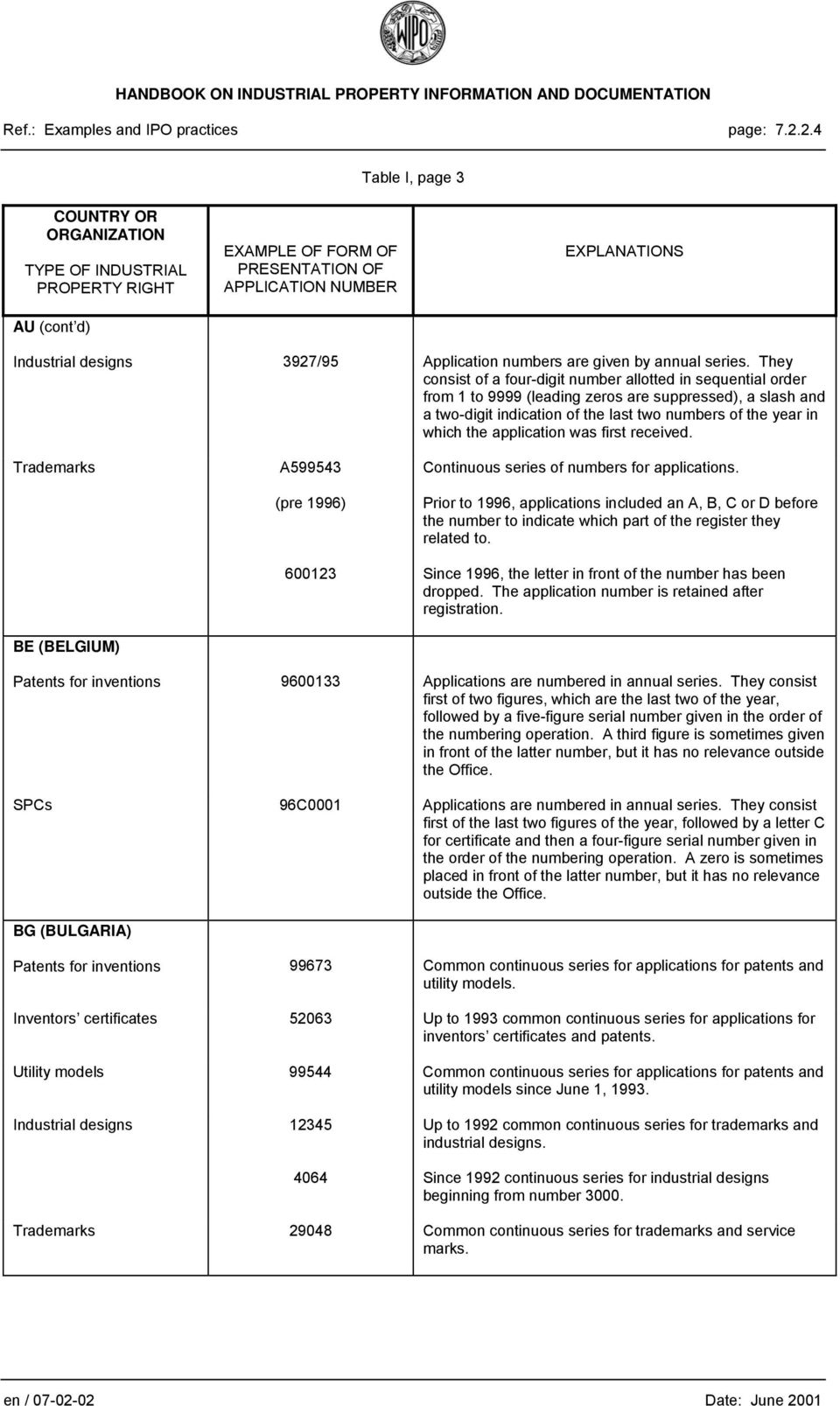
4 Ref.: Examples and IPO practices page: Table I, page 3 AU (cont d) 3927/95 Application numbers are given by annual series. They consist of a four-digit number allotted in sequential order from 1 to 9999 (leading zeros are suppressed), a slash and a two-digit indication of the last two numbers of the year in which the application was first received. BE (BELGIUM) A (pre 1996) Continuous series of numbers for applications. Prior to 1996, applications included an A, B, C or D before the number to indicate which part of the register they related to. Since 1996, the letter in front of the number has been dropped. The application number is retained after registration Applications are numbered in annual series. They consist first of two figures, which are the last two of the year, followed by a five-figure serial number given in the order of the numbering operation. A third figure is sometimes given in front of the latter number, but it has no relevance outside the Office. SPCs 96C0001 Applications are numbered in annual series. They consist first of the last two figures of the year, followed by a letter C for certificate and then a four-figure serial number given in the order of the numbering operation. A zero is sometimes placed in front of the latter number, but it has no relevance outside the Office. BG (BULGARIA) Common continuous series for applications for patents and utility models. Inventors certificates Up to 1993 common continuous series for applications for inventors certificates and patents Common continuous series for applications for patents and utility models since June 1, Up to 1992 common continuous series for trademarks and industrial designs. Since 1992 continuous series for industrial designs beginning from number Common continuous series for trademarks and service marks.
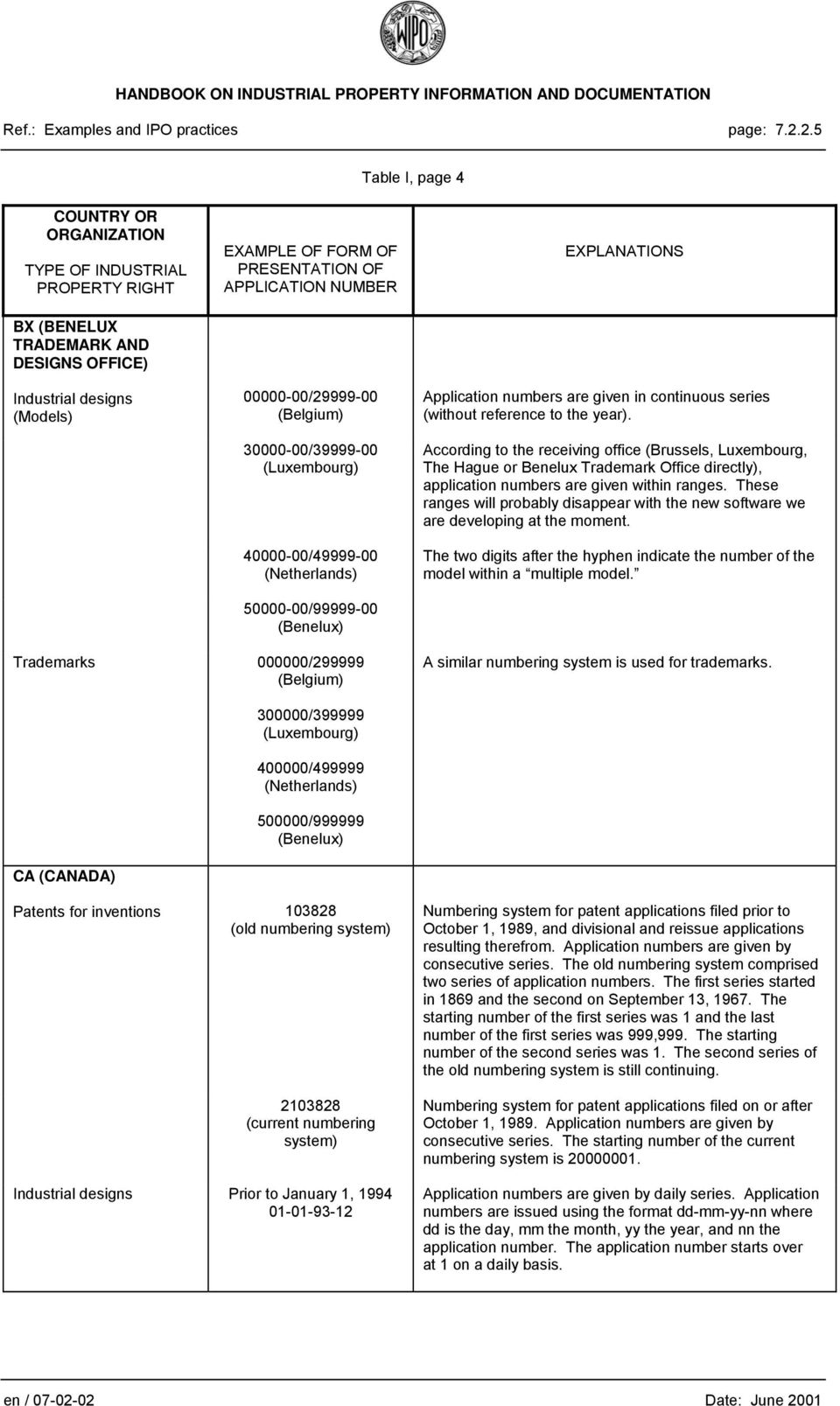
5 Ref.: Examples and IPO practices page: Table I, page 4 BX (BENELUX TRADEMARK AND DESIGNS OFFICE) (Models) / (Belgium) / (Luxembourg) / (Netherlands) / (Benelux) Application numbers are given in continuous series (without reference to the year). According to the receiving office (Brussels, Luxembourg, The Hague or Benelux Trademark Office directly), application numbers are given within ranges. These ranges will probably disappear with the new software we are developing at the moment. The two digits after the hyphen indicate the number of the model within a multiple model / (Belgium) A similar numbering system is used for trademarks / (Luxembourg) / (Netherlands) / (Benelux) CA (CANADA) (old numbering system) (current numbering system) Prior to January 1, Numbering system for patent applications filed prior to October 1, 1989, and divisional and reissue applications resulting therefrom. Application numbers are given by consecutive series. The old numbering system comprised two series of application numbers. The first series started in 1869 and the second on September 13, The starting number of the first series was 1 and the last number of the first series was 999,999. The starting number of the second series was 1. The second series of the old numbering system is still continuing. Numbering system for patent applications filed on or after October 1, Application numbers are given by consecutive series. The starting number of the current numbering system is Application numbers are given by daily series. Application numbers are issued using the format dd-mm-yy-nn where dd is the day, mm the month, yy the year, and nn the application number. The application number starts over at 1 on a daily basis.
6 Ref.: Examples and IPO practices page: Table I, page 5 CA (cont d) On or after January 1, Application numbers are given by annual series. Application numbers are issued using the format YYYY-NNNN where YYYY is the year and NNNN the application number. Leading zeros are included in the application number. 18 Application numbers are given by consecutive series. The numbering series was started on October 20, There are no pre-defined series of digits for the numbering series nor are leading zeros used (old numbering system, until May 1996) (new numbering system, as from May 1996) Application numbers were given by consecutive series. Leading zeros were included in the application number. Application numbers are given by consecutive series. The starting number for the new numbering system is CH (SWITZERLAND) 01234/96-2 Annual numbering series. The year of filing of the application is given (by two digits) after the slash. The figure after the dash is a check digit / Annual numbering series. The year of filing of the application is given after the slash. The figure after the dash is a check digit. Leading zeros are used. The application number is not published in the trademark gazette. CN (CHINA) Application numbers are given by annual series. They consist of nine numerals. The first two digits indicate the last two numbers of the year in which the application was filed. The third digit indicates the type of industrial property right (1 = patent for invention, 2 = utility model, 3 = industrial design). The next five digits represent the serial number allotted in sequential order. The digit after the full stop is a computer check digit Application numbers are given by annual series. The number consists of two parts. The first part contains a two-digit indication of the last two numbers of the year in which the application was filed. The second part is a seven-digit serial number allotted in sequential order. The serial number is zero filled to the left if it is less than seven digits.

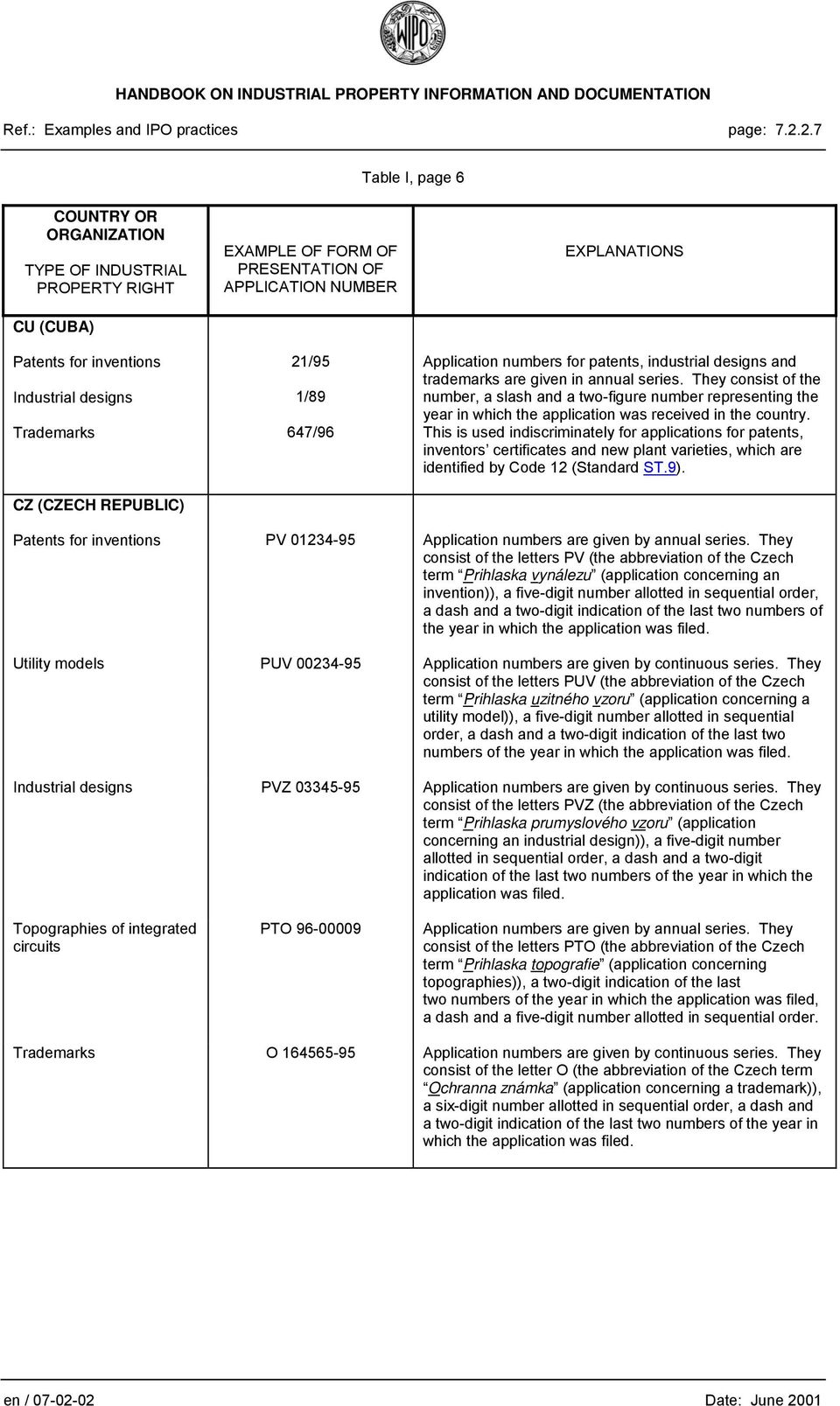
7 Ref.: Examples and IPO practices page: Table I, page 6 CU (CUBA) CZ (CZECH REPUBLIC) 21/95 1/89 647/96 Application numbers for patents, industrial designs and trademarks are given in annual series. They consist of the number, a slash and a two-figure number representing the year in which the application was received in the country. This is used indiscriminately for applications for patents, inventors certificates and new plant varieties, which are identified by Code 12 (Standard ST.9). PV Application numbers are given by annual series. They consist of the letters PV (the abbreviation of the Czech term Prihlaska vynálezu (application concerning an invention)), a five-digit number allotted in sequential order, a dash and a two-digit indication of the last two numbers of the year in which the application was filed. PUV Application numbers are given by continuous series. They consist of the letters PUV (the abbreviation of the Czech term Prihlaska uzitného vzoru (application concerning a utility model)), a five-digit number allotted in sequential order, a dash and a two-digit indication of the last two numbers of the year in which the application was filed. PVZ Application numbers are given by continuous series. They consist of the letters PVZ (the abbreviation of the Czech term Prihlaska prumyslového vzoru (application concerning an industrial design)), a five-digit number allotted in sequential order, a dash and a two-digit indication of the last two numbers of the year in which the application was filed. PTO Application numbers are given by annual series. They consist of the letters PTO (the abbreviation of the Czech term Prihlaska topografie (application concerning topographies)), a two-digit indication of the last two numbers of the year in which the application was filed, a dash and a five-digit number allotted in sequential order. O Application numbers are given by continuous series. They consist of the letter O (the abbreviation of the Czech term Ochranna známka (application concerning a trademark)), a six-digit number allotted in sequential order, a dash and a two-digit indication of the last two numbers of the year in which the application was filed.
8 Ref.: Examples and IPO practices page: Table I, page 7 DE (GERMANY) The numeral 1 in the leading position indicates a patent application. The numerals in the second and third positions indicate the last two numbers of the year of filing of the application. The range to each year is reserved for SPCs (see below). The numerals 8 and 9 in the fourth position indicate PCT applications designating Germany and which have entered the national phase (see second example). The last digit after the dot is a check digit. This system has been used since For the administration of patents granted by the EPO and designating Germany, numbers with the numerals 5 and 6 in the leading position are used. The numeral 5 indicates a patent filed in German, the numeral 6 indicates a patent filed in English or French. This system has been used for patents the applications of which had been filed with the EPO as of The numeral 2 in the leading position indicates a utility model application. The numerals in the second and third positions indicate the year of filing of the application. The range to each year is reserved for topographies (see below). The numerals 8 and 9 in the fourth position indicate PCT applications designating Germany and which have entered the national phase. The last digit after the dot is a check digit. This system has been used since SPCs For SPCs a range of numbers of the application numbering system of patents is used (see above). M (old numbering system) (will be new numbering system as from 1997) The letter M indicates an industrial design. The first two numerals indicate the last two numbers of the year of filing of the application. The numeral 4 in the leading position indicates an industrial design. The numerals in the second and third positions indicate the last two numbers of the year of filing of the application. The last digit after the dot is a check digit For topographies a range of numbers of the application numbering system of utility models is used (see above). This system has been used since The numeral 3 in the leading position indicates a trademark application. The numerals in the second and third position indicate the last two numbers of the year of filing of the application. The last digit after the dot is a check digit. This system has been used since November 1, 1994.

9 Ref.: Examples and IPO practices page: Table I, page 8 DK (DENMARK) 1056/95 Annual series are used. The number consists of a four-digit serial number, a slash and a two-digit indication of the last two numbers of the year of filing of the application The number consists of a two-digit indication of the last two numbers of the year of filing of the application and a five-digit serial number. SPCs CA The number consists of letters CA (certfikatansøgning), a four-digit indication of the year of filing of the application and a five-digit serial number. MA The number consists of letters MA (mønsteransøgning), a four-digit serial number and a four-digit indication of the year of filing of the application. TA The number consists of letters TA ((topografiansøgning), a four-digit serial number and a four-digit indication of the year of filing of the application. VA Trademark applications The number consists of letters VA (varemaekeansøgning), a five-digit serial number and a four-digit indication of the year of filing of the application. FA Collective mark applications The number consists of letters FA (faellesmaerkeansøgning), a five-digit serial number and a four-digit indication of the year of filing of the application. DZ (ALGERIA) EE (ESTONIA) Application numbers are numbered in annual series. The first two figures represent the year of filing, while the four figures that follow are the application number granted in the sequential order of filing Application numbers are given by annual series. The two digits indicative of the year are given in a leading position of the number. U The first two digits of the number indicate the last two digits of the year of filing of the application. The last five digits represent the serial number of the application. The letter U denotes a utility model application.

10 Ref.: Examples and IPO practices page: Table I, page 9 EG (EGYPT) Application numbers are given as annual series. The first four digits indicate the year followed by a two-digit indication of the month of filing of the application. The last four digits represent the serial number of the application. EM (OFFICE FOR HARMONIZATION IN THE INTERNAL MARKET) Community trademark application numbers are given by continuous series. The last digit of the number is a check digit. EP (EUROPEAN PATENT OFFICE) The first two digits indicate the year of application. The third and fourth digits denote the place of filing. Digits in positions 5 to 8 denote the serial number of the application given by the receiving office. The digit in the last position is an error control digit. ES (SPAIN) (9) P (7) (1) U (X) Continuous numbering series comprising six digits, used up to The character between brackets is a control character. Annual numbering series comprising seven digits of which the first two represent the year of filing of the application and the remainder a continuous numbering series of the applications filed in that year. The application number is preceded by the letter P. The character between brackets is a control character. Continuous numbering series comprising six digits, used up to The character between brackets is a control character. Annual numbering series comprising seven digits of which the first two represent the year of filing of the application and the remainder a continuous numbering series of the applications filed in that year. The application number is preceded by the letter U. The character between brackets is a control character. Industrial models I (6) Continuous numbering series comprising six digits. The application number is preceded by the letter I. The character between brackets is a control character.

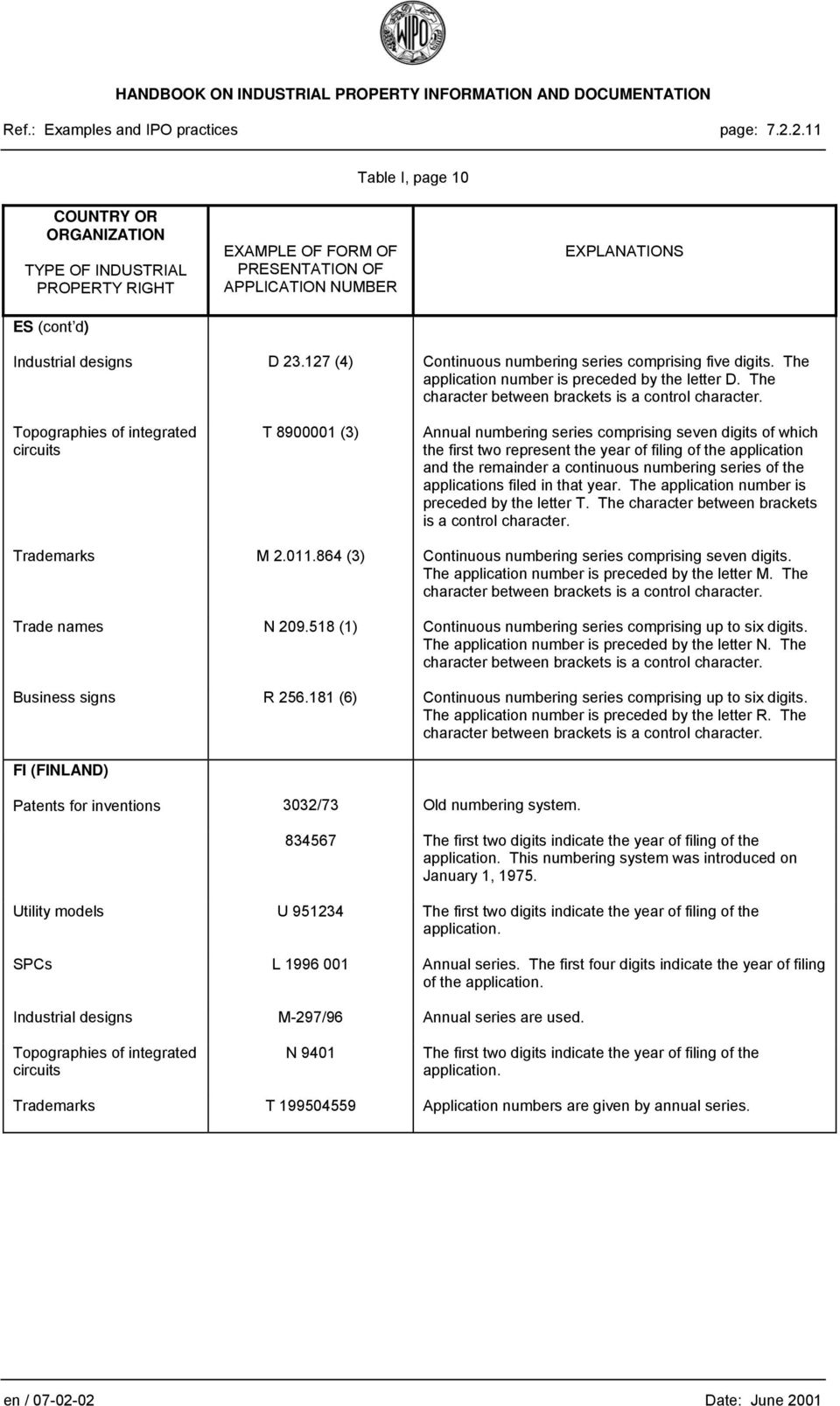
11 Ref.: Examples and IPO practices page: Table I, page 10 ES (cont d) D (4) Continuous numbering series comprising five digits. The application number is preceded by the letter D. The character between brackets is a control character. T (3) Annual numbering series comprising seven digits of which the first two represent the year of filing of the application and the remainder a continuous numbering series of the applications filed in that year. The application number is preceded by the letter T. The character between brackets is a control character. M (3) Continuous numbering series comprising seven digits. The application number is preceded by the letter M. The character between brackets is a control character. Trade names N (1) Continuous numbering series comprising up to six digits. The application number is preceded by the letter N. The character between brackets is a control character. Business signs R (6) Continuous numbering series comprising up to six digits. The application number is preceded by the letter R. The character between brackets is a control character. FI (FINLAND) 3032/73 Old numbering system The first two digits indicate the year of filing of the application. This numbering system was introduced on January 1, U The first two digits indicate the year of filing of the application. SPCs L Annual series. The first four digits indicate the year of filing of the application. M-297/96 Annual series are used. N 9401 The first two digits indicate the year of filing of the application. T Application numbers are given by annual series.
12 Ref.: Examples and IPO practices page: Table I, page 11 FR (FRANCE) and utility certificates Patent applications and utility certificate applications are given a number on filing comprising the year (two characters) followed by a five-digit number in ascending order for the year concerned. It should be noted that this is a single series for the two types of application. SPCs 96C0001 The number given on filing comprises the year in question (two figures) followed by the letter C again followed by an annual series number of four digits (the same numbering from filing through grant) The number given on grant for industrial designs is comprised by the year (two figures) followed by a four-digit number in ascending order for the year concerned. This number is shared by all reproductions belonging to one deposit. A number is given for publication when the compliance of the deposit is recognized (see FR entry in Table II) The number given on filing comprises the year concerned (two digits) followed by a six-digit serial number in continuous ascending order since number The first number of this type was (BOPI new Law of February 14, 1992). GB (UNITED KINGDOM) 41352/70 Numbering system introduced according to the 1949 Patents Act. Application numbers are given by annual series. The last two digits represent the year of application Numbering system introduced according to the 1977 Patents Act. Application numbers are given by annual series. The first two digits of the number represent the last two digits of the year of application. The digit after the point is a check digit.
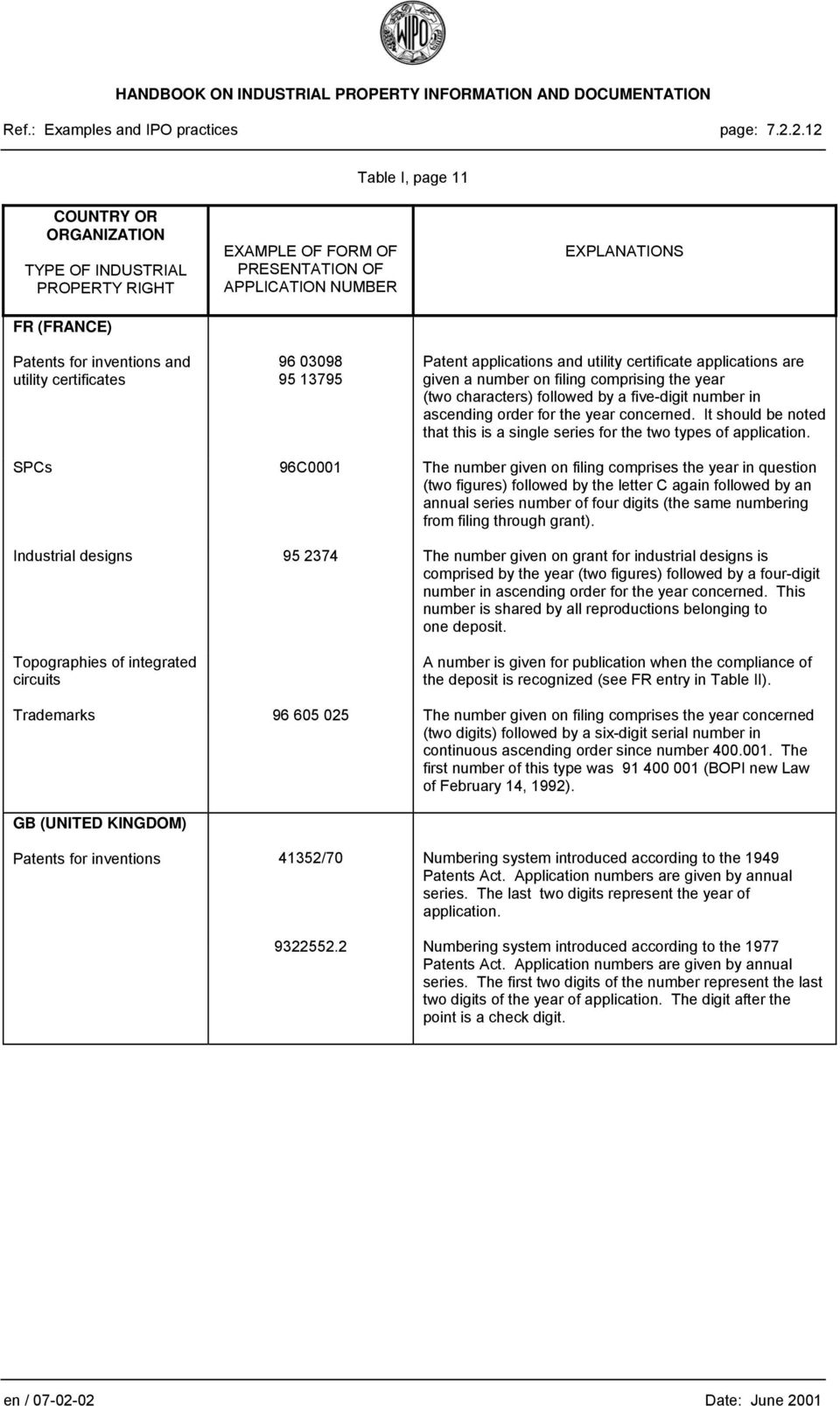
13 Ref.: Examples and IPO practices page: Table I, page 12 GB (cont d) Plant patents 40189/ (a) With regard to genetic manipulation of the plant cell, see entry ; the numbering systems used are the same, i.e., inventions protected under the 1949 Patents Act and the 1977 Patents Act. Application numbers are given by annual series. (b) If by Plant patent is meant protection for a plant variety or hybrid, then this is administered by the Plant Variety Rights Office, Whitehouse Lane, Hungtingdon Road, Cambridge CB3 OLF, under the Plant Variety and Seeds Act SPCs 96/010 System introduced January Annual numbering system is used. The first two digits of the number represent the last two digits of the year. The last three digits refer to the number assigned in ascending order to the application, the series of numbers being restarted annually Non-textile: Textile: onwards Non-textile: Textile: /10/ onwards: Non-textile applications started at 1 in 1884 and ran consecutively to number in July Textile applications also ran consecutively to number up to July When the 1988 Copyright, Designs and Patents Act came into effect August 1989, a new numbering system started; applications for non-textiles numbered from ; applications for textiles numbered from The numbering system is continuous. No official registration system within the UK. Protection is offered through the unregistered design right which came into being with the Copyright, Designs and Patents Act The first trademark application was filed on The numbering system was continuous with no known breaks until the New Act was introduced in Last number allocated under the 1938 Act was Numbering system introduced as a result of the introduction of the 1994 Trade Marks Act. The numbering system is continuous starting with the number , as from October 31, 1994, though some numbers have been suppressed to aid internal file distribution.

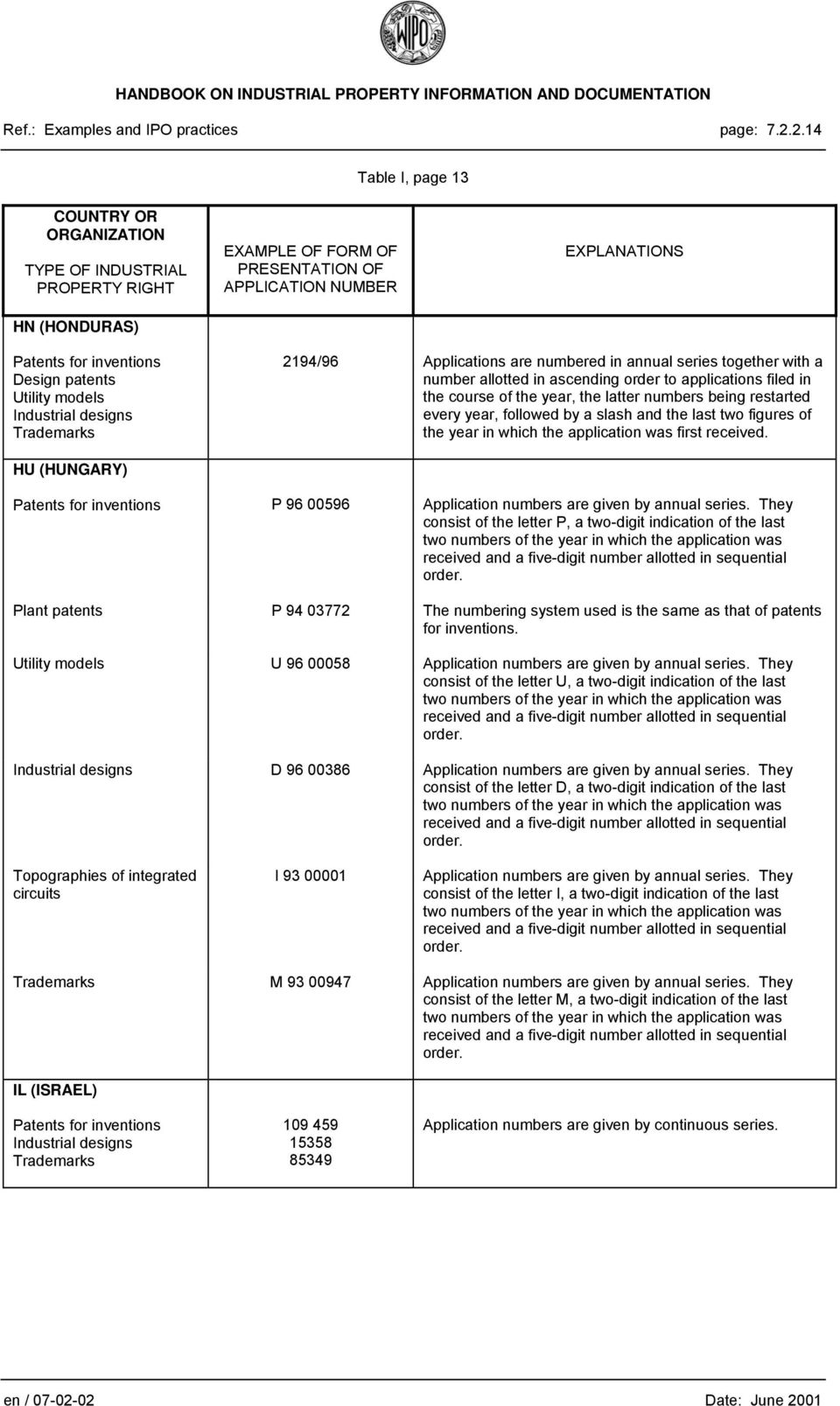
14 Ref.: Examples and IPO practices page: Table I, page 13 HN (HONDURAS) Design patents 2194/96 Applications are numbered in annual series together with a number allotted in ascending order to applications filed in the course of the year, the latter numbers being restarted every year, followed by a slash and the last two figures of the year in which the application was first received. HU (HUNGARY) P Application numbers are given by annual series. They consist of the letter P, a two-digit indication of the last two numbers of the year in which the application was received and a five-digit number allotted in sequential order. Plant patents P The numbering system used is the same as that of patents for inventions. U Application numbers are given by annual series. They consist of the letter U, a two-digit indication of the last two numbers of the year in which the application was received and a five-digit number allotted in sequential order. D Application numbers are given by annual series. They consist of the letter D, a two-digit indication of the last two numbers of the year in which the application was received and a five-digit number allotted in sequential order. I Application numbers are given by annual series. They consist of the letter I, a two-digit indication of the last two numbers of the year in which the application was received and a five-digit number allotted in sequential order. M Application numbers are given by annual series. They consist of the letter M, a two-digit indication of the last two numbers of the year in which the application was received and a five-digit number allotted in sequential order. IL (ISRAEL) Application numbers are given by continuous series.
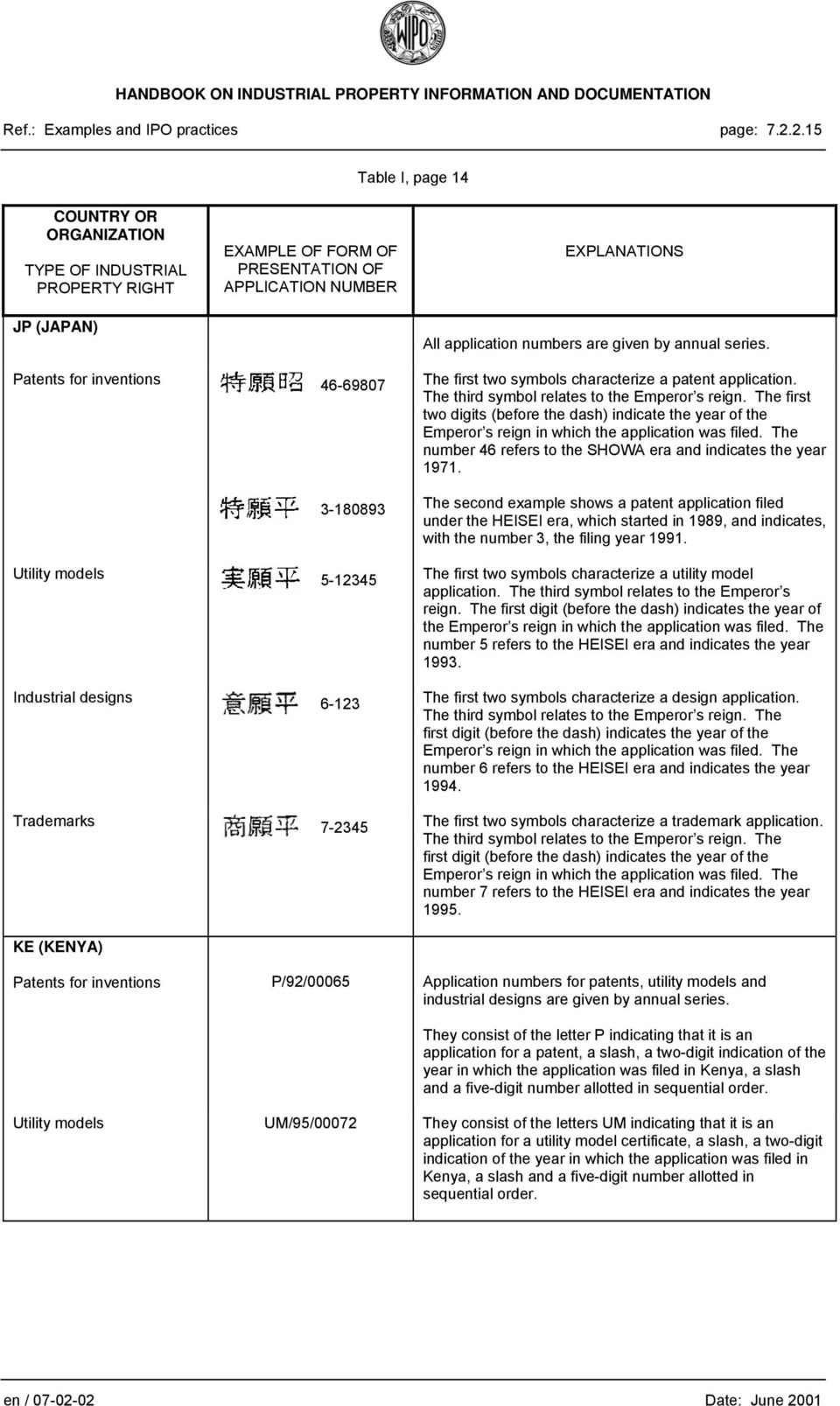
15 Ref.: Examples and IPO practices page: Table I, page 14 JP (JAPAN) KE (KENYA) All application numbers are given by annual series. The first two symbols characterize a patent application. The third symbol relates to the Emperor s reign. The first two digits (before the dash) indicate the year of the Emperor s reign in which the application was filed. The number 46 refers to the SHOWA era and indicates the year The second example shows a patent application filed under the HEISEI era, which started in 1989, and indicates, with the number 3, the filing year The first two symbols characterize a utility model application. The third symbol relates to the Emperor s reign. The first digit (before the dash) indicates the year of the Emperor s reign in which the application was filed. The number 5 refers to the HEISEI era and indicates the year The first two symbols characterize a design application. The third symbol relates to the Emperor s reign. The first digit (before the dash) indicates the year of the Emperor s reign in which the application was filed. The number 6 refers to the HEISEI era and indicates the year The first two symbols characterize a trademark application. The third symbol relates to the Emperor s reign. The first digit (before the dash) indicates the year of the Emperor s reign in which the application was filed. The number 7 refers to the HEISEI era and indicates the year P/92/00065 Application numbers for patents, utility models and industrial designs are given by annual series. They consist of the letter P indicating that it is an application for a patent, a slash, a two-digit indication of the year in which the application was filed in Kenya, a slash and a five-digit number allotted in sequential order. UM/95/00072 They consist of the letters UM indicating that it is an application for a utility model certificate, a slash, a two-digit indication of the year in which the application was filed in Kenya, a slash and a five-digit number allotted in sequential order.
16 Ref.: Examples and IPO practices page: Table I, page 15 KE (cont d) ID/91/00006 They consist of the letters ID indicating that it is an application for an industrial design, a slash, a two-digit indication of the year in which the application was filed in Kenya, a slash and a five-digit number allotted in sequential order. TMA.No.34 Trademark application numbers consist of a three-letter abbreviation for Trade Marks Application, a dot, a two-letter abbreviation for Number, a dot and any digit number allotted in sequential order of registration in Kenya. KG (KYRGYZSTAN) KR (REPUBLIC OF KOREA) SMA.No Service mark application numbers consist of a three-letter abbreviation for Service Marks Application, a dot, a two-letter abbreviation for Number, a dot and any digit number allotted in sequential order of registration in Kenya. Application numbers are given by annual series. The first two figures indicate the last two numbers of the year of filing of the application. The following 4-digit number indicates the serial number of the application. The figure after the dot indicates the type of industrial property right (1 = patent for invention, 2 = utility model, 3 = trademark, 4 = industrial design). Application numbers for patents for inventions, utility models, industrial designs, topographies of integrated and trademarks are given by annual series. The application number consists of a two-digit number indicating the year in which the application was filed, a dash and a six-digit number allotted in sequential order. A serial number higher than indicates a PCT application (see second example). Application numbers for topographies of integrated have a four-digit serial number KZ (KAZAKSTAN) Application numbers for patents for inventions, utility models and industrial designs are given by annual series. They consist of a two-digit indication of the last two numbers of the year of filing of the application, a threeor four-digit number allotted in sequential order and a numeral (after the dot) which denotes the type of industrial property right (1 = patent for invention, 2 = utility model, 3 = industrial design). Trademark applications are numbered by continuous series.

17 Ref.: Examples and IPO practices page: Table I, page 16 LT (LITHUANIA) RP1384 IP2069 There are two different numbering series. Between 1992 and 1994, a system of continuous series was used with an alphanumeric string of characters not exceeding six and consisting of a two-letter indication (RP for reregistrations of the former SU, or IP in accordance with the Lithuanian Patent Law) and a serial number of up to four digits As from 1995, annual series are introduced with a two-digit designation of the year of filing of the application and a serial number not exceeding three digits. RP212 PP279 There are two different numbering series. Between 1992 and 1994, a system of continuous series was used with an alphanumeric string of characters not exceeding five and consisting of a two-letter indication (RP for reregistrations of the former SU, or PP in accordance with the Lithuanian Law on Industrial Designs) and a serial number of up to three digits As from 1995, annual series are introduced with a two-digit designation of the year of filing of the application and a serial number not exceeding three digits. RL14258 ZP7739 There are two different numbering series. Between 1992 and 1994, a system of continuous series was used with an alphanumeric string of characters not exceeding seven and consisting of a two-letter indication (RL for reregistrations of the former SU, or ZP in accordance with the Lithuanian Law on and Service Marks) and a serial number of up to five digits As from 1995, annual series are introduced with a two-digit designation of the year of filing of the application and a serial number not exceeding four digits. LU (LUXEMBOURG) Continuous series are used for all industrial property titles. SPCs SPCs use the same numbering as patents (this system is likely to be amended soon). 001 LV (LATVIA) P D M Application numbers are given by annual series. They consist of the letter P for patents for inventions or D for industrial designs or M for marks, a hyphen, a two-digit indication of the last two numbers of the year in which the application was filed, a hyphen and a number allotted in sequential order.

18 Ref.: Examples and IPO practices page: Table I, page 17 MD (REPUBLIC OF MOLDOVA) Application numbers are given by annual series. The first two digits (before the dash) indicate the year of filing of the patent application. The four digits following the dash denote the serial number of the application Application numbers for utility models, industrial designs and trademarks are given by continuous series. MG (MADAGASCAR) MK (THE FORMER YUGOSLAV REPUBLIC OF MACEDONIA) Plant patents MN (MONGOLIA) MX (MEXICO) SPCs / /94 M 526/94 Ж 1024/ Applications are numbered in annual series. The first two figures represent the year of filing. Application numbers are given by annual series for patents, industrial designs and trademarks. The letter code preceding the number denotes the type of industrial property right (9 = patent for invention, as well as plant patent, M = industrial design, Ж for trademark). The last two digits indicate the year of filing of the application. All application numbers are given by continuous series. This system is used for published documents as well. Applications are numbered in annual series. The numbers consist of the last two figures of the year in which the application was received and a figure of four or five digits allotted in sequential order Application numbers for trademarks are given in sequential order. MY (MALAYSIA) PI Application numbers are given by annual series. They consist of the letters PI, a two-digit indication of the year in which the application was received and a five-digit number allotted in sequential order. UI Application numbers are given by annual series. They consist of the letters UI, a two-digit indication of the year in which the application was received and a five-digit number allotted in sequential order.

19 Ref.: Examples and IPO practices page: Table I, page 18 MY (cont d) There is no registration of industrial designs in Malaysia. However, protection of industrial designs is made via the registration made in the UK and such protection also covers Malaysia. The numbering system is yet to be decided. 96/00001 Application numbers are given by annual series. The numerals before the slash represent the last two numbers of the year in which the application was submitted and the five-digit number after the slash represent the allocation of the application in sequential order. NL (NETHERLANDS) The first two digits indicate the year of filing of the application. This numbering system ended on April 1, It will only be used for divisional applications filed before the mentioned date New numbering system introduced according to the new Patent Act of April 1, It is a continuous series. A patent will be granted under the filing number. SPCs The first two digits indicate the last two numbers of the year in which the application was received, followed by a four-digit number allotted in sequential order. NO (NORWAY) TA Application numbers are given by annual series. They consist of the letters TA (T = Topography, A = Application filed), followed by a two-digit indication of the last two numbers of the year in which the application was received, followed by a four-digit number allotted in sequential order Application numbers are given by annual series. The first two digits represent the last two numbers of the year of filing of the application. The last four digits represent the serial number. SPCs SPC/NO Application numbers are given by annual series. They consist of the letters SPC, a slash, the letters NO for Norway, a space, four digits designating the year of filing of the application and a three-digit serial number Application numbers are given by annual series. The first two digits represent the last two numbers of the year of filing of the application. The last four digits represent the serial number Application numbers are given by annual series. The first two digits represent the last two numbers of the year of filing of the application. The last four digits represent the serial number.

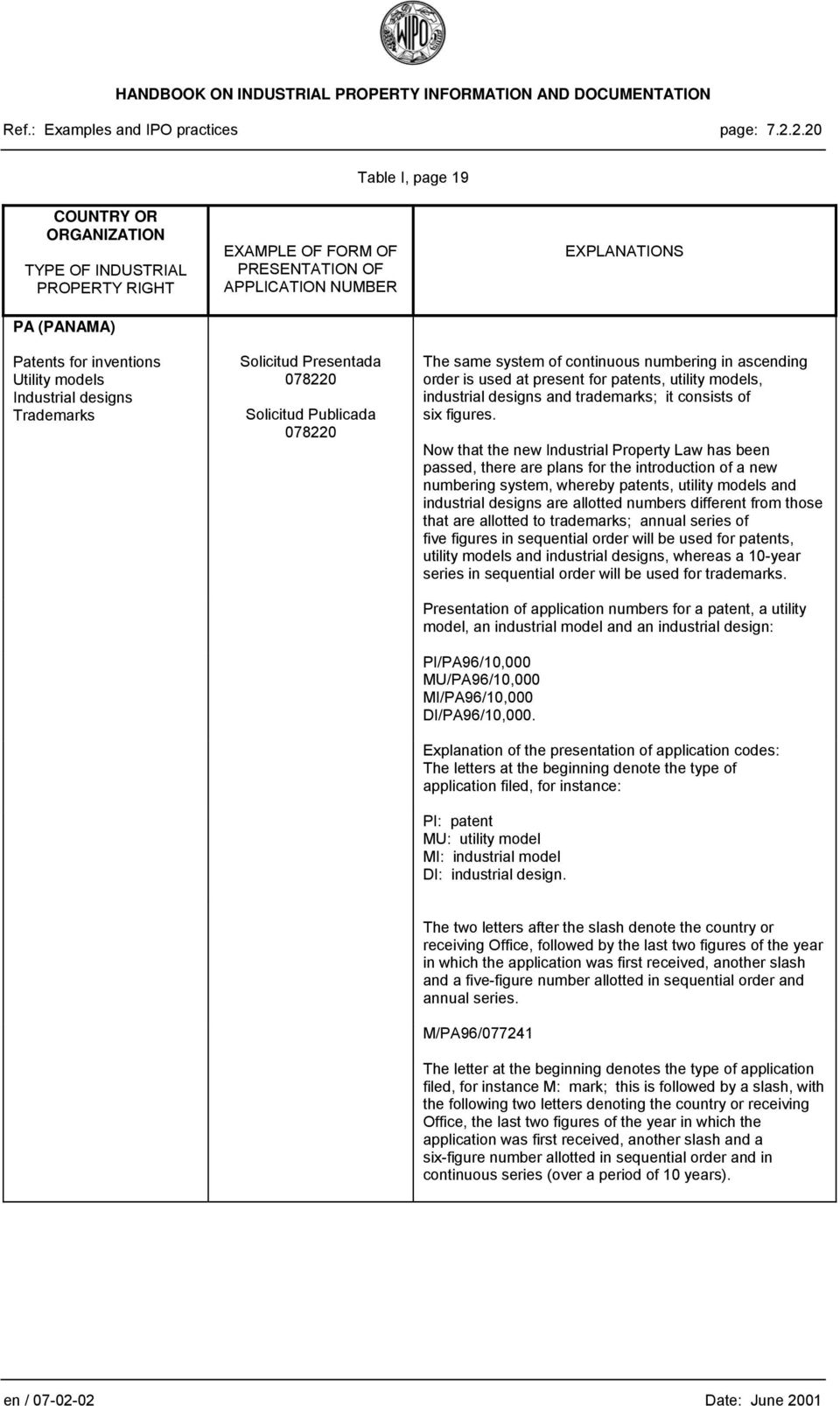
20 Ref.: Examples and IPO practices page: Table I, page 19 PA (PANAMA) Solicitud Presentada Solicitud Publicada The same system of continuous numbering in ascending order is used at present for patents, utility models, industrial designs and trademarks; it consists of six figures. Now that the new Industrial Property Law has been passed, there are plans for the introduction of a new numbering system, whereby patents, utility models and industrial designs are allotted numbers different from those that are allotted to trademarks; annual series of five figures in sequential order will be used for patents, utility models and industrial designs, whereas a 10-year series in sequential order will be used for trademarks. Presentation of application numbers for a patent, a utility model, an industrial model and an industrial design: PI/PA96/10,000 MU/PA96/10,000 MI/PA96/10,000 DI/PA96/10,000. Explanation of the presentation of application codes: The letters at the beginning denote the type of application filed, for instance: PI: patent MU: utility model MI: industrial model DI: industrial design. The two letters after the slash denote the country or receiving Office, followed by the last two figures of the year in which the application was first received, another slash and a five-figure number allotted in sequential order and annual series. M/PA96/ The letter at the beginning denotes the type of application filed, for instance M: mark; this is followed by a slash, with the following two letters denoting the country or receiving Office, the last two figures of the year in which the application was first received, another slash and a six-figure number allotted in sequential order and in continuous series (over a period of 10 years).
21 Ref.: Examples and IPO practices page: Table I, page 20 PE (PERU) Plant patents /1996-OIN Application numbers are allotted in continuous series. Each number consists of six figures, allotted in sequential order, followed by a slash and a four-figure number denoting the year in which the application was first received, a dash and the letter code of the receiving Office (OIN stands for Oficina de Invenciones y Nuevas Tecnologías) The first two figures are the last two numbers of the year in which the application was filed, and the following are allotted in the order corresponding to the time of filing. A new numbering series starts every year. PL (POLAND) P Continuous numbering series from 1945 onwards. This format is used on priority documents and in correspondence. As from No , the application number is preceded by the letter P. W Continuous numbering series which started in This format is used on priority documents and in correspondence. As from No , the application number is preceded by the letter W. (Ornamental designs) W 8077 Continuous numbering series which started in This format is used on priority documents and in correspondence. The number range from No to No is preceded by the letter W. Wz S 1 From 1995 (starting with No ), application numbers are preceded by letters Wz. A continuous numbering series is used which started in The number is preceded by the letter S. Z Continuous numbering series which started in This format is used on priority documents and in correspondence. The application number is preceded by the letter Z.
22 Ref.: Examples and IPO practices page: Table I, page 21 PT (PORTUGAL) Application numbers are allotted in continuous sequence. There is no data string denoting the year of filing. A patent application number currently consists of six figures Application numbers are allotted in continuous sequence. There is no data string denoting the year of filing. A utility model application number currently consists of four figures. Industrial models are divided into two different numbering series. Application numbers are allotted in continuous sequence. There is no data string denoting the year of filing. An industrial design application number currently has four figures and an industrial model application five figures. 01 Application numbers are allotted in continuous sequence. There is no data string denoting the year of filing. An integrated circuit topography application number consists of two figures. Only one number has been allotted to date Application numbers are allotted in continuous sequence. There is no data string denoting the year of filing. The application number of a national mark currently consists of six figures. RO (ROMANIA) Application numbers are allotted in annual series. The figures before the dash are the last two figures of the year in which the application was received at the Office. Those after the dash are the actual application number Numbering system used pursuant to the new Industrial Designs Law since January 8, The four-figure number is allotted in continuous sequence Numbering system to be used as from January 1, Application numbers are allotted in annual series. The figures before the blank space are the last two figures of the year in which the application was received at the Office. The third to sixth figures are the actual application number. The same numbering system is to be used as for industrial designs Numbering system in use since Five-figure numbers are allotted in continuous sequence.
23 Ref.: Examples and IPO practices page: Table I, page 22 RU (RUSSIAN FEDERATION) / / Application numbers are given by annual series. The first two digits indicate the last two numbers of the year of filing of the application, the third digit indicates the type of industrial property right and the last five digits represent the serial number. The two digits following the slash refer to classification information. Since January 1, 1995, the third digit denotes the type of industrial property right (1 to 4 indicate applications for inventions and utility models, 5 and 6 indicate applications for industrial designs) Application numbers are given by annual series. The first two digits indicate the last two numbers of the year of filing of the application Application numbers are given by annual series. The first two digits indicate the last two numbers of the year of filing of the application, the third digit indicates the type of industrial property right and the last five digits indicate the serial number. Numerals 7 to 9 at the third position of the application number denote a trademark. SE (SWEDEN) Digits 1 and 2 indicate the last two numbers of the year of filing of the application; digits 3 to 7 represent an annual serial number. The last digit (after the hyphen) is a control character. SPCs Digits 1 and 2 indicate the last two numbers of the year of filing of the application; the numeral 90 (digits 3 and 4) denote an SPC, digits 5 to 7 represent an annual serial number. The last digit (after the hyphen) is a control character Digits 1 and 2 indicate the last two numbers of the year of filing of the application; digits 3 to 6 represent an annual serial number. Year indication and annual serial number are separated by a hyphen Digits 1 and 2 indicate the last two numbers of the year of filing of the application; digits 3 to 7 represent an annual serial number. Year indication and annual serial number are separated by a hyphen.
24 Ref.: Examples and IPO practices page: Table I, page 23 SG (SINGAPORE) (for patents previously registered under the Registration of United Kingdom Patents Act (RUKPA) before and for applications made under RUKPA in accordance with the transitional provisions of the 1994 Patents Act) Application numbers are given by annual series. The first two digits (in bold) refer to the year in which the application was filed. The number 9 in the third position indicates the fact that the application was made under RUKPA. The last digit (after the dash) is a computer generated check digit of the application (for patent applications filed under the new patent system) T F Application numbers are given by annual series. They consist of the letter T indicating a trademark application number, a two-digit indication (in bold) of the year in which the application was filed and a five-digit number assigned in ascending order to the application. The letter in the last position of the character string is a computer generated check digit of the application. SK (SLOVAKIA) PV Application numbers are given by annual series. They consist of the letters PV (abbreviation of the Slovak term Prihláska vynálezu (an application concerning an invention)), a number allotted in sequential order, a dash and a two-digit indication of the last two numbers of the year in which the application was filed. PUV Application numbers are given by annual series. They consist of the letters PUV (abbreviation of the Slovak term Prihláska uzitkového vzoru (application concerning a utility model)), a number allotted in sequential order, a dash and a two-digit indication of the last two numbers of the year in which the application was filed.
25 Ref.: Examples and IPO practices page: Table I, page 24 SK (cont d) PVZ Application numbers are given by annual series. They consist of the letters PVZ (abbreviation of the Slovak term Prihláska priemyslového vzoru (application concerning an industrial design)), a number allotted in sequential order, a dash and a two-digit indication of the last two numbers of the year in which the application was filed. PTO Application numbers are given by annual series. They consist of the letters PTO (abbreviation of the Slovak term Prihláska topografie (application concerning topographies)), a two-digit indication of the last two numbers of the year in which the application was filed, a dash and a number allotted in sequential order. POZ Application numbers are given by annual series. They consist of the letter POZ (abbreviation of the Slovak term Prihláska ochrannej známky (application concerning a trademark)), a number allotted in sequential order, a dash and a two-digit indication of the last two numbers of the year in which the application was filed. SV (EL SALVADOR) 43/96 Application numbers are allotted in annual series. They consist of the numbers allotted in sequential order, with a slash followed by two figures denoting the last two figures of the year in which the application was received. MU44/96 Numbers are allotted in annual series. They consist of the letters MU followed by the serial number, a slash and a two-figure number corresponding to the last two figures of the year in which the application was received. DI 68/96 Numbers are allotted in annual series. They consist of the letters DI followed by the serial number, a slash and a two-figure number corresponding to the last two figures of the year in which the application was received. 1459/96 Numbers are allotted in annual series. They consist of the numbers allotted in sequential order, followed by a slash and a two-figure number denoting the last two figures of the year in which the application was received. TH (THAILAND) Design patents TH/ Application numbers of patents for both inventions and designs are given by continuous series. They consist of the two-letter code TH for Thailand, a slash and a six-digit number allotted in sequential order. TH/ Application numbers are given by continuous series. They consist of the two-letter code TH for Thailand, a slash and the numerals allotted in sequential order.
26 Ref.: Examples and IPO practices page: Table I, page 25 TN (TUNISIA) SN94086 Every patent application is allotted a number consisting of the following: the letters SN, denoting a new series; a five-figure number, the first two figures representing the last two numbers of the year of filing and the last three a number in the chronological order of filing. After publication, if no opposition has been registered after the end of a period of two months following publication, a chronological grant number is allotted to the actual patent granted. The granted patent is published again, and the publication number is the same as the grant number. DM94109 Every filing is allotted a number consisting of the two letters DM, denoting an industrial design deposit, and a five-figure number. The first two numbers represent the last two numbers of the year of deposit and the last three the chronological order of deposit. UA (UKRAINE) ET94360 EE Every filing is given a number consisting of: the two letters ET or EE, where ET = Tunisian establishment; EE = foreign establishment a six-figure number for filings of foreign trademarks and a five-figure number for filings of Tunisian trademarks. The first two figures indicate the last two numbers of the year of filing, and the other numbers the chronological order of filing. Application numbers of patents for inventions, utility models, industrial designs and trademarks are given by annual series. They consist of the last two numbers of the year, followed by the two numbers of the month in which the application was filed and a four-digit number allotted in sequential order.
27 Ref.: Examples and IPO practices page: Table I, page 26 US (UNITED STATES OF AMERICA) /000,001 09/ , In the USPTO s automated Patent Application Locating and Monitoring (PALM) system, the series code/serial number field is defined as one eight-character numeric field. When shown on documents, including file wrappers, the first two digits (indicating the series code) are normally separated by a slash or hyphen from a six-digit serial number. Serial numbers for each series start with 000,001 and may go as high as 999,999. Serial numbers are assigned to incoming patent applications (including Reissue applications) in sequential order in order of receipt. Thus far, series codes have been assigned as follows: 1. Series Code 02 Filing dates earlier than January 1, Series Code 03 Filing dates January 1, 1948, to December 31, Series Code 04 Filing dates January 1, 1960, to December 31, Series Code 05 Filing dates January 1, 1970, to December 31, Series Code 06 Filing dates January 1, 1979, to December 31, Series Code 07 Filing dates January 1, 1987, to December 31, Series Code 08 Filing dates January 1, 1993, to December 29, Series Code 09 Filing dates December 30, 1997, to present. Series Codes assigned to other types of applications are: Series Code 60 Provisional applications Series Code 90 Reexamination applications. Plant patents Design patents /000,001 29/ , The same Series Code and number range is applied as for patents for inventions since January 4, See explanation regarding the format of these numbers under entry,, above. Design patent applications filed between January 4, 1971, and October 1, 1992, were assigned the same Series Code as patents for inventions. Series Code 29 has been used for design patent applications from October 1, 1992, to present.
28 Ref.: Examples and IPO practices page: Table I, page 27 US (cont d) /000,001 75/ , In the USPTO s automated Trademark Reporting and Monitoring (TRAM) system, the series code/serial number field is defined as one eight-character numeric field. When shown on documents, including file wrappers, the first two digits (indicating the series code) are normally separated by a slash or hyphen from a six-digit serial number. The first digit of the series code is 7. The second digit increases by one each time the series changes. Serial numbers for each series start with 000,001 and may go as high as 999,999. Serial numbers are assigned to incoming applications in sequential order in order of receipt. Thus far, series codes have been assigned as follows: 1. Series Code 70 Filing dates from 1881 through March 31, Series Code 71 Filing dates from April 1, 1905, through December 31, Series Code 72 Filing dates from January 1, 1956, through August 31, Series Code 73 Filing dates from September 1, 1973, through November 15, Series Code 74 Filing dates from November 16, 1989, through September 30, Series Code 75 Filing dates from October 1, 1995, through present. WO (WORLD INTELLECTUAL PROPERTY ) YU (YUGOSLAVIA) PCT/US95/03744 PCT/IB95/00153 Application numbers are given by annual series. They consist of the letters PCT, a slash, the two-letter code indicating the receiving Office, a two-digit indication of the last two numbers of the year in which the application was first received, a slash and a five-digit number allotted in sequential order. Where the International Bureau of WIPO acts as receiving Office under PCT Rule 19.1(a)(iii), the two-letter code IB is used. P-347/96 Application numbers are given by annual series. They consist of the letter P for patent applications (the abbreviation of the term patent ), a number allotted in sequential order, a slash and a two-digit indication of the last two numbers of the year in which the application was filed.
29 Ref.: Examples and IPO practices page: Table I, page 28 YU (cont d) Petty patents MP-148/96 Application numbers are given by annual series. They consist of the letters MP for petty patent applications (the abbreviation of the term mali patent meaning petty patent in Serbian), a number allotted in sequential order, a slash and a two-digit indication of the last two numbers of the year in which the application was filed. M-153/96 U-15/96 Application numbers are given by annual series. They consist of the letter M for model applications (the abbreviation of the term model meaning model in Serbian) or letter U for the pattern applications (the abbreviation of the term uzorak meaning pattern in Serbian), a number allotted in sequential order, a slash and a two-digit indication of the last two numbers of the year in which the application was filed. Ž-548/96 Application numbers are given by annual series. They consist of the letter Ž for trademark applications (the abbreviation of the term žig meaning trademark in Serbian) a number allotted in sequential order, a slash and a two-digit indication of the last two numbers of the year in which the application was filed. [Table II follows]
30 Ref.: Examples and IPO practices page: TABLE II NUMBERING SYSTEMS WITH REGARD TO PUBLISHED DOCUMENTS AND REGISTERED RIGHTS AM (ARMENIA) AP (AFRICAN REGIONAL INDUSTRIAL PROPERTY ) AR (ARGENTINA) PUBLICATION OR REGISTRATION NUMBER S 128 AP 420 AP/D/00049 Publication numbers are given by continuous series for each of the four types of industrial property rights. The kind of document code according to WIPO Standard ST.16 is associated with the publication number of patents for inventions and of utility models. The letter S denotes an industrial design. Serial registration number. Publication numbers are given as a continuous series. The kind of document code according to WIPO Standard ST.16 is associated with the publication number. Registration numbers are given as a continuous series. The letter D indicates a registered industrial design The numbering of grants of trademark registrations is consecutive, in ascending order and continuous. AT (AUSTRIA) E Publication numbers are given by consecutive series. The second example shows a publication number for a translation of a European patent specification with AT as designated state. Such publication numbers consist of the letter E followed by a serial number allotted in ascending order Publication numbers are given by consecutive series.
31 Ref.: Examples and IPO practices page: Table II, page 2 AU (AUSTRALIA) PUBLICATION OR REGISTRATION NUMBER AU-A-34864/93 Publication numbers of unexamined documents consist of the country code AU, a dash, the publication level A, a dash and the application number. AU-B-34864/93 Publication numbers of accepted patents consist of the country code AU, a dash, the publication level B, a dash and the application number Acceptance numbers consist of a six-digit serial number. AU (cont d) SPCs Following amendment of the Patents Act 1990 by the Patents Act 1994 on July 1, 1995, to introduce a 20-year patent term, extensions of patent term (SPCs) are no longer possible. Extensions of term granted under the previous legislation are not identified by a separate numbering system; they are merely patents of defined scope with an extended term of protection. AU-S Registration numbers consist of the country code, a dash, the publication code S, a dash and a six-digit serial number. BE (BELGIUM) A (pre 1996) A6 (six years) A4 (20 years) The application number is retained for registered trademarks. See AU entry in Table I. Publication numbers are allotted in continuous series. The last two digits are letter codes, like A and B, for first and second publications and a figure such as 3, 4, 5, 6 or 7 to indicate whether a patent is a 20-year or six-year patent or whether the contents have been altered in the course of the procedure. SPCs 96C0005 The publication numbers of certificates are the same as those of the certificate applications. BG (BULGARIA) Up to 1993 common continuous series for inventors certificates and patents for inventions Continuous series starting with number (since June 1, 1993). Inventors certificates Up to 1993 common continuous series for inventors certificates and patents for inventions. 86 Continuous series beginning from number 1 (since June 1, 1993) Continuous series Continuous series.
32 Ref.: Examples and IPO practices page: Table II, page 3 PUBLICATION OR REGISTRATION NUMBER Service marks 4031 Continuous series. CA (CANADA) Patents resulting from patent applications filed prior to October 1, 1989, and divisional and reissue applications resulting therefrom. Patent numbers are given by continuous series. There are no pre-defined series of digits nor are leading zeros used Patent numbers are given by continuous series for applications filed on or after October 1, The patent number is the same as the application number. Laid-open applications are published with the same number 18 months from the earliest filing date Registration numbers are given by consecutive series. Leading zeros are not used. 18 Same numbering system as used for topography applications. Registration numbers are given by consecutive series. The numbering series was started on October 20, There are no predefined series of digits for the numbering series nor are leading zeros used. Several numbering systems exist for trademark registrations. The numbering systems that have been used since 1865 are as follows: TMA999,999 (Trade-Marks Act) UCA99999 (Unfair Competition Act) TMDA99999 (Trade-Marks and Designs Act) NFLD9999 (Newfoundland marks, pre-confederation) Current numbering system since November 5, Registration numbers are given by continuous series. The starting number for the series was 100,000. Numbering system from October 25, 1932, to June 14, Registration numbers were given by continuous series. The first and last numbers in the series were and 51128, respectively. Leading zeros are included in the registration number. Numbering system from September 26, 1871, to June 14, Registration numbers were given by continuous series. The first and last numbers in the series were and 57542, respectively. Leading zeros are included in the registration number. Numbering system for Newfoundland trademarks from March 9, 1890, to March 31, Registration numbers were given by continuous series. The first and last numbers in the series were 0001 and 3291, respectively. Leading zeros are included in the registration number.
33 Ref.: Examples and IPO practices page: Table II, page 4 CA (cont d) CH (SWITZERLAND) PUBLICATION OR REGISTRATION NUMBER ATM999 (Act pertaining to ) PBRA9999 Numbering system from July 29, 1865, to June 12, There were only two registration numbers registered under this Act, 072 and 127. Numbering system from February 25, 1993, to date for marks relating to Plant Breeders Rights. Leading zeros are used Publication numbers are given as continuous series. The figure after the dash is a check digit. SPCs C611931/01 The number consists of the letter C followed by the number of the basic patent. The figures after the slash indicate the components protected by the SPC. C /02 Number of an SPC which is based on a European patent having effect in Switzerland and Liechtenstein A continuous numbering system is used. T0005 A continuous numbering system is used A continuous numbering system is used which was started in Until March 31, 1994, the renewal of a trademark led to a new registration number. The figure after the dash is a check digit. A trademark is published by using its registration number without the check digit. After prolongation of a trademark, the letter P is added preceding the registration number. A digit in front of the letter P indicates how many times the mark has been renewed, e.g., 2P-NNNNNN. After a partial transfer or a division of the trademark, a new registration number is given to the new trademark. CN (CHINA) D Publication numbers are given as continuous series. The number consists of seven digits. The first digit indicates the type of industrial property right (1 = patents for inventions, 2 = utility models, 3 = industrial designs). The kind of document code according to WIPO Standard ST.16 is associated with the publication number. The letter D indicates a registered industrial design The numbers of published documents are given by continuous series, which are the same as the registration numbers of the corresponding documents. Each of them, at present, consists of seven digits, with no leading zeros.
34 Ref.: Examples and IPO practices page: Table II, page 5 CU (CUBA) PUBLICATION OR REGISTRATION NUMBER Publication numbers are allotted in consecutive sequence regardless of the year, and at present consist of five figures corresponding to the number given to the protection document granted Publication numbers are allotted in consecutive sequence regardless of the year, and at present consist of four figures, corresponding to the number given to the protection document granted Trademark publication numbers are allotted in consecutive series regardless of the year, and at present consist of six figures, corresponding to the registration number. CZ (CZECH REPUBLIC) Publication numbers are given as continuous series and consist of six digits. A similar system is used for utility models, industrial designs, topographies of integrated and trademarks. DE (GERMANY) Application numbers are used as publication numbers (old numbering system used for publications based on applications filed until the end of 1994) (new numbering system) The numerals in the first and second positions indicate the year of filing of the application reduced by 50. The numeral 9 in the third position indicates a document originating from a PCT application. The numeral 1 in the leading position indicates a document concerning a patent for invention. The numerals in the second and third positions indicate the last two numbers of the year of filing of the application. The numerals 8 and 9 in the fourth position indicate a document originating from a PCT application The numeral 6 indicates a translation of a European patent specification the application of which had been filed with the EPO in English or French. DE/EP xxxxxxx T1 For the publication of the translation of the claims of a European patent application the EPO publication number is used The numeral 2 in the leading position indicates a utility model application. The numerals in the second and third positions indicate the last two numbers of the year of filing of the application. The range to each year is reserved for topographies (see below). The numerals 8 and 9 in the fourth position indicate that the document originates from a PCT application.
35 Ref.: Examples and IPO practices page: Table II, page 6 DE (cont d) PUBLICATION OR REGISTRATION NUMBER M (old numbering system used until the end of 1996) (will be new numbering system as from 1997) Registration number. The letter M denotes an industrial design. The first two numerals indicate the last two numbers of the year of filing of the application. Registration number. The numeral 4 in the leading position indicates an industrial design. The numerals in the second and third positions indicate the last two numbers of the year of filing of the application For topographies a range of numbers of the publication numbering system of utility models is used (see above) Registration number. The numeral 3 in the leading position indicates a trademark. The numerals in the second and third positions indicate the last two numbers of the year of filing of the application. DK (DENMARK) Danish patents Continuous series are used. The publication number is identical to the patent number. It consists of a six-digit serial number European patents having effect in Denmark Continuous series are used. The publication number is identical to the EP patent number. It consists of a seven-digit serial number The publication number, registration number and application number are identical. The numbers consist of a two-digit indication of the last two numbers of the year of filing of the application and a five-digit serial number given to the application. SPCs CR Registration number. Annual series are used. The number consists of the letters CR (certifkatregistrering), a four-digit indication of the year of filing of the application and a five-digit serial number given to the application. No document is published. MR Registration number. Annual series are used. The number consists of the letters MR (mønsterrregistrering), a four-digit serial number and a four-digit indication of the year of registration. No document is published. TR Registration number. Annual series are used. The number consists of the letters TR (topografiregistrering), a four-digit serial number given to the application and a four-digit indication of the year of filing of the application. No document is published.
36 Ref.: Examples and IPO practices page: Table II, page 7 DK (cont d) PUBLICATION OR REGISTRATION NUMBER VR Trademark registrations Registration number. Annual series are used. The number consists of the letters VR (varemaerkeregistrering), a five-digit serial number and a four-digit indication of the year of registration. No document is published. FR Collective mark registrations Registration number. Annual series are used. The number consists of the letters FR (faellesmaerkeregistrering), a five-digit serial number and a four-digit indication of the year of registration. No document is published. DZ (ALGERIA) 1900 The publication numbers are the registration numbers, consisting of four figures given in continuous sequence The publication numbers are the registration numbers, consisting of five figures given in continuous sequence. EE (ESTONIA) Publication numbers are given by continuous series. The kind of document code according to WIPO Standard ST.16 is associated with the publication number. The numbering of granted patents was restarted on April 11, 1996, with serial No Prior to 1996, the last patent (serial No ) was granted on July 9, U The first two digits of the number indicate the last two digits of the year of filing of the application. Digits in positions 3 to 7 denote the serial number of the application. The letter U denotes a utility model. EG (EGYPT) Publication numbers are given as continuous series. EM (OFFICE FOR HARMONIZATION IN THE INTERNAL MARKET) Application numbers and registration numbers of Community trademarks are the same. The last digit of the number is a check digit.
37 Ref.: Examples and IPO practices page: Table II, page 8 EP (EUROPEAN PATENT OFFICE) PUBLICATION OR REGISTRATION NUMBER Publication numbers are seven-digit serial numbers with leading zeros. All published patent documents relating to a particular application number receive the same publication number. This includes the published patent application (A1 or A2), possibly a separate publication of the European search report (A3), the granted patent document, i.e., the patent specification (B1) and possibly a published new patent specification (B2). ES (SPAIN) (9) (1) Continuous numbering series comprising up to six digits, used until The character between brackets is a control character. Annual numbering series comprising up to seven digits of which the first two represent the year of publication and the remainder a continuous numbering series of the publications made in that year. Used between 1981 and Continuous numbering series that began with , used since Continuous numbering series comprising six digits, used until The character between brackets is a control character. Continuous numbering series that began with , used since Industrial models I (6) Continuous numbering series comprising six digits. The registration number is preceded by the letter I. This registration number corresponds to the application number. The character between brackets is a control character. D (4) Continuous numbering series comprising five digits. The registration number is preceded by the letter D. This registration number corresponds to the application number. The character between brackets is a control character. T (3) Annual numbering series comprising seven digits of which the first two represent the year of filing of the application and the remainder a continuous numbering series of the registrations made in that year. The registration number is preceded by the letter T. This registration number corresponds to the application number. The character between brackets is a control character. M (3) Continuous numbering series comprising up to seven digits. The registration number is preceded by the letter M. This registration number corresponds to the application number. The character between brackets is a control character.
38 Ref.: Examples and IPO practices page: Table II, page 9 ES (cont d) PUBLICATION OR REGISTRATION NUMBER Trade names N (1) Continuous numbering series comprising up to six digits. The registration number is preceded by the letter N. This registration number corresponds to the application number. The character between brackets is a control character. Business signs R (6) Continuous numbering series comprising up to six digits. The registration number is preceded by the letter R. This registration number corresponds to the application number. The character between brackets is a control character. FI (FINLAND) Continuous series are used Continuous series are used. SPCs 53 Continuous series are used. 297/96 Annual series are used Registration number. Continuous series are used. FR (FRANCE) and utility certificates The publication number is given at the time of publication of the patent application or utility certificate application. This numbering is continuous; it began with number on entry into force of the 1968 Patent Law. This numbering is maintained for patents and utility certificates already granted. SPCs 96C0001 The number given on filing is maintained on publication of applications for SPCs and also for publication of the grant to A continuous numbering series comprising six digits is used since the origins of industrial designs (1910). As from the entry into force of Decree of August 13, 1992, each reproduction belonging to a single deposit is published under a publication number that is specific to that reproduction TPS96 The number given for publication is composed of a serial number of four digits, followed by three letters (TPS) and by the year concerned (two digits) There is no specific numbering for registration of a mark. The numbering used on filing is maintained for the registered title.
39 Ref.: Examples and IPO practices page: Table II, page 10 GB (UNITED KINGDOM) PUBLICATION OR REGISTRATION NUMBER A 1979 onwards A B Examined granted specification. Publication numbers given as a continuous series and consist of seven digits (Patents Act 1949). First level publication. Examined granted specification. Published applications and granted patents have same number; only the letter code changes, e.g., when application No A is granted it becomes No B. Plant patents A 1979 onwards A B Numbers constitute a continuous series and consist at present of seven digits administered under Patents Act 1977 beginning at number published 4 January If by Plant patent is meant genetic manipulation of plant cell: Examined granted specification. First level publication. Examined granted specification. See entry. If by Plant patent is meant protection for a plant variety or hybrid, then this is administered by the Plant Variety Rights Office, Whitehouse Lane, Huntingdon Road, Cambridge CB3 0LF, under the Plant Variety and Seeds Act SPCs 96/010 System introduced January Granted certificates retain the original application number assigned to the application. An annual numbering system is used. The first two digits of the number represent the last two digits of the year. The last three digits refer to the number assigned in ascending order to the application, the series of numbers being restarted annually Non-textile: Textile: onwards Non-textile: Textile: Between 1970 and 1989 application and publication numbers were the same for registered designs, a continuous numbering system being used. Non-textile applications started at 1 in 1884 and ran consecutively to number in July Textile applications also ran consecutively to number up to July Under the 1988 Copyright, Designs and Patents Act, numbers start from for non-textiles and from for textiles. Numbering system is continuous. Application and publication numbers are the same. No official registration system within the UK. Protection is offered through the unregistered design right.
40 Ref.: Examples and IPO practices page: Table II, page 11 GB (cont d) PUBLICATION OR REGISTRATION NUMBER /10/ onwards Numbering system continuous. Application and publication (registration) numbers are the same. The example relates to an application made under the 1938 Trade Marks Act, i.e., prior to 31 October Publication (registration) number relating to an application made under the 1994 Trade Marks Act, i.e., from 31 October HN (HONDURAS) Design patents HU (HUNGARY) N Registro 3436 Tomo 6 Folio 349 Where the application has met all the requirements and the patent has been granted, it is given a settlement number and date. Registration numbers and volume numbers are given continuously, and are presented in ascending order; the folio number, which depends on the other two, is the one under which the document is registered. T/70697 H/3776 (old numbering system used for published patent applications until the end of 1996) P (new numbering system used from the beginning of 1997) Publication numbers are given by continuous series. They consist of either the letter T or H, a slash and a four- or five-digit number. The letter T indicates that complete examination was requested; the letter H indicates that deferred examination was requested. Application numbers are used as publication numbers Registration numbers are given as continuous series and consist of six digits. Plant patents P Application numbers are used as publication numbers. Registration numbers are given as continuous series and consist of six digits Registration numbers are given as continuous series and consist of five digits. D Application numbers are used as publication numbers Registration numbers are given as continuous series and consist of five digits. 1 Registration numbers are given as continuous series Registration numbers are given as continuous series and consist of six digits.
41 Ref.: Examples and IPO practices page: Table II, page 12 IL (ISRAEL) JP (JAPAN) PUBLICATION OR REGISTRATION NUMBER The patent number is the same as the application number. The same number is used as for the application. The same number is used as for the application The three symbols indicate the following: = Patent = Publication of unexamined patent applications 8 = the eighth year of the HEISEI era (the period of the present Emperor s reign), corresponding to 1996 in which the application was published. The number is the serial number given by annual series (This publication discontinued on March 29, 1996, according to the new patent law.) The three symbols indicate the following: = Patent = Publication of examined patent applications 8 = the eighth year of the HEISEI era (the period of the present Emperor s reign), corresponding to 1996 in which the application was published. The number is the serial number given by annual series The three symbols indicate the following: = Patent = Publication of unexamined patent applications filed under the PCT and designating Japan 8 = the eighth year of the HEISEI era (the period of the present Emperor s reign), corresponding to 1996 in which the application was published. The number is the serial number given by annual series, starting with the number The symbols mean the publication of registered (This publication started on May 29, 1996, under the patents is the patent number given by continuous series, starting with the number new patent law.)
42 Ref.: Examples and IPO practices page: Table II, page 13 JP (cont d) PUBLICATION OR REGISTRATION NUMBER means the ninth year of HEISEI, in which year (This publication, which an opposition was filed. relates to decisions on oppositions made, will start in the middle of 1997 The symbols mean the publication of decisions on un der the new patent law.) oppositions filed against patent and utility model applications is the application number given for both patents and utility models by annual series, starting with the number The first two symbols indicate the following: = Utility model = Publication of utility models registered under the new utility model law, which law does not require substantive examination is the registration number given by continuous series, starting with the number The symbols mean the publication of utility models registered under the old utility model law, which law requires substantive examination is the registration number given by continuous series, starting with the number T he first four symbols mean the publication of registered industrial designs is the registration number given by continuous series. The symbols mean the publication of industrial 1 designs registered in relation to the other similar registered ones is the registration number allotted to the original registered industrial design. 1 are letters and number allotted to the registered industrial design similar to the registered one carrying the registration number of
43 Ref.: Examples and IPO practices page: Table II, page 14 JP (cont d) PUBLICATION OR REGISTRATION NUMBER stands for trademark. means the publication of examined trademark applications. KE (KENYA) 6 means the sixth year of HEISEI (the period of the present Emperor s reign), corresponding to 1994 in which the application was published is the publication number given by annual series. KEP YY/nnnnn Publication numbers for patents, utility models and industrial designs are given by annual series They consist of a three-letter code wherein the first two letters indicate the country code, and the third letter (P) indicates that it is a publication relating to patents, a space, a two-digit indication of the last two numbers of the year of publication, a slash and a five-digit number allotted in sequential order. KEU YY/nnnnn They consist of a three-letter code wherein the first two letters indicate the country code, and the third letter (U) indicates that it is a publication relating to utility models, a space, a two-digit indication of the last two numbers of the year of publication, a slash and a five-digit number allotted in sequential order. KED YY/nnnnn They consist of a three-letter code wherein the first two letters indicate the country code, and the third letter (D) indicates that it is a publication relating to industrial designs, a space, a two-digit indication of the last two numbers of the year of publication, a slash and a five-digit number allotted in sequential order. KETM YY/nnnnn Registration numbers for trademarks and service marks are given by annual series. They consist of a four-letter code wherein the first two letters indicate the country code, and the third and fourth letters ((TM) or (SM)) indicate that it is a publication relating to trademarks or service marks, a space, a two-digit indication of the last two numbers of the year of publication, a slash and a five-digit number allotted in sequential order. KG (KYRGYZSTAN) Patents and preliminary patents, as well as utility models, industrial designs and trademarks, are numbered by continuous series, each of which started with the number 1.
44 Ref.: Examples and IPO practices page: Table II, page 15 KR (REPUBLIC OF KOREA) PUBLICATION OR REGISTRATION NUMBER Publication numbers for patents for inventions, utility models and trademarks are given by annual series. The numerals before the dash indicate the year in which the application was published. Publication numbers for industrial designs are given by continuous series, which started in Publication numbers for topographies of integrated are given by continuous series, which started in The numerals before the dash indicate the last two numbers of the year in which the application was registered. KZ (KAZAKSTAN) LT (LITHUANIA) Publication numbers are given by continuous series. The kind of document code according to WIPO Standard ST.16 is associated with the publication number of patents for inventions and utility models. Format of a registration number recorded in the State Register of Industrial Designs. Format of the registration number recorded in the State Register of. Continuous series are used for patents for inventions, industrial designs and trademarks The number range from 2001 to 2664 was used for reregistrations of the former SU. The numbering of patents in accordance with the Patent Law of 1994 started with No The numbering range from 201 to 280 was used for reregistrations of the former SU. The numbering of industrial designs in accordance with the Law on Industrial Designs of 1995 started with No The numbering range from 6001 to was used for reregistrations of the former SU. The numbering of registered trademarks in accordance with the Law on and Service Marks of 1993 started with No
45 Ref.: Examples and IPO practices page: Table II, page 16 LU (LUXEMBOURG) PUBLICATION OR REGISTRATION NUMBER There is no publication number; the application number (or filing number) is used throughout the life of the patent (the introduction of a publication number is under consideration). SPCs There is no publication number; the application number (or filing number) is used throughout the life of the SPC (the introduction of a publication number is under consideration). 001 Only a filing number exists. LV (LATVIA) Publication numbers are given by continuous series. The numbers for new applications started with No For reregistrations of the former SU and other publications according to certain agreements between Latvia and other countries, a number range higher than 5000 was used. D 5069 D M M Registration numbers (Latvian industrial design patent numbers) are given by continuous series. They consist of the letter D and a number allotted in sequential order. The numbers of industrial design patents granted within the reregistration procedure of the former SU industrial designs started with D Numbers of industrial design patents granted under the provisions of the Industrial Design Protection Law of 1993 started with D Trademark registration numbers are given by continuous series. They consist of the letter M and a number allotted in sequential order. The numbers of reregistered former SU trademarks (total amount approximately 9.5 thousand) started with M The numbers of trademarks registered on the basis of new, regular applications started with M MD (REPUBLIC OF MOLDOVA) Publication numbers are given by continuous series for each of the four types of industrial property rights. The kind of document code according to WIPO Standard ST.16 is associated with the publication number of patents for inventions, utility models and patents relating to plants. The kind of document code P is used to denote a patent for invention relating to the protection of plants.
46 Ref.: Examples and IPO practices page: Table II, page 17 MG (MADAGASCAR) MK (THE FORMER YUGOSLAV REPUBLIC OF MACEDONIA) Plant patents MN (MONGOLIA) MX (MEXICO) SPCs PUBLICATION OR REGISTRATION NUMBER M Ж A five-figure number allotted in a continuous sequence is used. Publication numbers are given by annual series for patents, industrial designs and trademarks. The letter code preceding the number denotes the type of industrial property right (9 = patent for invention, as well as plant patent, M = industrial design, Ж = trademark). The first two digits indicate the year of filing of the application. Application numbers are also used as publication or registration numbers. Publication numbers are allotted in annual series of three, four or six-figure numbers. The kind of document code according to WIPO Standard ST.16 is associated with the publication numbers of patents and utility models The six digits correspond to the application number given in sequential order. MY (MALAYSIA) Publication numbers are given by continuous series. The kind of document code according to WIPO Standard ST.16 is associated with the publication number of patents for inventions and utility models. See explanation given in Table I. 93/08927 The application number is retained.
47 Ref.: Examples and IPO practices page: Table II, page 18 NL (NETHERLANDS) PUBLICATION OR REGISTRATION NUMBER The first two digits indicate the last two numbers of the year of filing of the application. This numbering system ended on April 1, It will only be used for divisional applications filed before the mentioned date New numbering system introduced according to the new Patent Act of April 1, It is a continuous series. A patent will be granted under the filing number Sequential number for B- and C- documents published or granted under the 1964 Patent Act. SPCs The granted SPC bears the same number as the corresponding application. NO (NORWAY) TB Application numbers are given by annual series. They consist of the letters TB (T = Topography, B = indication that the topography entered into the Register), followed by a two-digit indication of the last two numbers of the year in which the application was received, followed by a four-digit number allotted in sequential order Publication numbers are given by continuous series. SPCs SPC/NO The application number is also used as publication number The registration number is given as a continuous series The registration number is given as a continuous series. PA (PANAMA) B40/PA96/43214 Publication numbers are allotted in annual series of five-figure numbers, corresponding to the same entry number as the application; the two figures before the second slash are the last two figures of the year in which the application was published, with a two-letter code denoting the country in which publication occurred, while the number and letter preceding them correspond to the type of publication, B being the Official Bulletin of the Directorate, and the two-figure number accompanying it the publication number. This type of coding for published applications will be the same for patents, utility models and industrial designs. B40/PA96/ Publication numbers are allotted in continuous series of six-figure numbers for a period of 10 years, and correspond to the numbering used for the receipt of the application; all the codes preceding that number have the same meanings as for patents, utility models and industrial designs.
48 Ref.: Examples and IPO practices page: Table II, page 19 PE (PERU) Plant patents PUBLICATION OR REGISTRATION NUMBER Aviso No N o de título: 0494 N o de título: 0001 N o de título: 0033 N o de título: 0065 The Office of Inventions and New Technology carries out two kinds of publication: publication of an extract from unexamined applications, which takes place in the nationally circulated official journal, and publication of granted applications in the Intellectual Property Gazette. The order numbers of the announcements are allotted in annual series. The numbering consists of a two-figure number representing the last two numbers of the year in which the announcement was ordered, a dash and a three-figure number given in sequential order. Publication numbers are allotted in continuous series. For this type of industrial property, the numbering consists of four figures, allotted in sequential order. This numbering corresponds to the number of the industrial property right Publication takes place in the Official Journal, using the same publication number. PL (POLAND) The kind of document code according to WIPO Standard ST.16 is associated with the publication number of patents for inventions and utility models. (Patent specification) Continuous numbering series from 1945 onwards. This series started with No Patent applications (A1 documents) are published by using the application number referred to in Table I, however, without giving the letter P Continuous numbering series are used for utility model registrations as from 1945 onwards. (Ornamental designs) Continuous numbering series are used as from 1945, starting with No Continuous numbering series are used which started in Continuous numbering series are used which started in 1946, with No
49 Ref.: Examples and IPO practices page: Table II, page 20 PT (PORTUGAL) Industrial models PUBLICATION OR REGISTRATION NUMBER The publication number for patents and utility models is the same as that allotted to the application. The file retains at all times the numerical reference given it at the time of filing. Different numbering series exist for designs and for models. The registration number for designs and models is the same as that given to the application. The file retains at all times the same numerical reference given it at the time of filing. 01 See explanations in Table I The registration number is the same as that allotted to the application. The file retains at all times the number given it at the time of filing. RO (ROMANIA) The six-figure number for patents is allotted in continuous sequence This is the numbering system that has been used since The five-figure number is given in continuous sequence in the national register of marks. RU (RUSSIAN FEDERATION) During the period from 1924 to 1994, publication numbers were the same as the registration numbers. They were given by continuous series. Applications for inventions /25 From 1995 onwards, application numbers are used as publication numbers. They are given by annual series. See also Table I As from 1992, publication numbers are the same as the registration numbers. They are given by continuous series Publication numbers are the same as the registration numbers. They are given by continuous series Publication numbers are given by annual series. The first two digits indicate the last two numbers of the year of registration Publication numbers are the same as the registration number. They are given by continuous series which started in 1924.
50 Ref.: Examples and IPO practices page: Table II, page 21 SE (SWEDEN) PUBLICATION OR REGISTRATION NUMBER Publication numbers are given by continuous series. Up to now, three series have been issued: No. 1 - No , No x xxx, and the present series starting with No Translations of European Patents keep the number allotted by the EPO. SPCs The granted SPC retains the application number. There is no publication of the SPC; only an announcement is made in the Gazette. The components of the application number are explained in Table I. SG (SINGAPORE) Registration number Registration number Registered designs are numbered in a unique series. No separate publication; only an announcement is made in the Gazette. No publication number exists. Registered trademarks are numbered in a unique series. No separate publication; only an announcement is made in the Gazette. No publication number exists Publication numbers are given by continuous series beginning from No The registration number is identical to the application number. SK (SLOVAKIA) Publication numbers are given by continuous series. The first patent granted in the Slovak Republic after January 1, 1993, bears No Registration numbers of utility models, industrial designs, topographies of integrated and trademarks are given by continuous series The first registered utility model in the Slovak Republic after January 1, 1993, bears No The first registered industrial design in the Slovak Republic after January 1, 1993, bears No The first registered trademark in the Slovak Republic after January 1, 1993, bears No
51 Ref.: Examples and IPO practices page: Table II, page 22 SV (EL SALVADOR) PUBLICATION OR REGISTRATION NUMBER SV 211/19 El Salvador does not have an industrial property bulletin in which applications for patents, utility models and industrial designs are published. The publication of applications and grants takes place in the Official Gazette, the numbering of which corresponds to the reception number. However, for internal control purposes, a number is allotted in continuous series. This consists of the letters SV, which are the international code for the country, followed by the numbers corresponding to the registrations, which are given in sequence, followed by a slash and the book number. From this year onwards, there will in addition be a two-figure number representing the last two digits of the year in which registration took place, presented as follows: /19. are a new institution under the Law on the Promotion and Protection of Intellectual Property, and no registrations have yet been effected. Publication will take place in the Official Gazette. are a new concept, and no registrations have yet been effected. 73/64 Publications take place in the Official Gazette. A number is given for internal control purposes, however. Numbers are allotted in continuous series. They consist of the numbers corresponding to the actual registrations, in sequential order followed by a slash and the number of the book. Each book consists of 500 folio pages. TH (THAILAND) Design patents Publication numbers of patents for inventions and designs are given by continuous series. The numbers refer to applications which are published in sequential order. TN (TUNISIA) For patents, the grant number is that of the publication. See Table I. DM94109 The numbers used for industrial design deposits to be registered are also used for publication. See Table I. UA (UKRAINE) ET94360 EE The filing and registration number is also used for publication. See Table I. Publication numbers or registration numbers of patents for inventions, utility models, industrial designs and trademarks are given by continuous series.
52 Ref.: Examples and IPO practices page: Table II, page 23 US (UNITED STATES OF AMERICA) Plant patents Design patents PUBLICATION OR REGISTRATION NUMBER 5,119,510 Re.33,950 B1 4,384,436 Plant 7,880 Des. 339,411 Numbers of patents for inventions, reissue patents, plant patents and design patents are assigned in numerical sequence. The letter B and the number of the reexamination precedes the original patent number. For example, B1 is used for the first reexamination, B2 for the second reexamination, etc. 1,970,680 Registration numbers have been assigned in sequence beginning with registration number 1. A registration number is assigned on the day the mark registers after the mark has been published for opposition. When the mark is published for opposition prior to registration, it is identified by its serial number. Both the application number and the registration number are maintained for each registered mark in the United States of America and either may be used to retrieve records from automated databases. WO (WORLD INTELLECTUAL PROPERTY ) WO 95/26134 Publication numbers are given by annual series. The numerals before the slash represent an indication of the last two numbers of the year in which the international application was published. DM/ Format of the registration number of an international deposit under the Hague Agreement Concerning the International Deposit of Industrial Designs according to the 1960 Act. Deferred deposits have a provisional numbering of the following format: DMA/NNNNNN Format of the registration number of an international deposit under the Hague Agreement Concerning the International Deposit of Industrial Designs according to the 1934 Act Format of the registration number of an international mark recorded in the International Register under the Madrid Agreement Concerning the International Registration of Marks. YU (YUGOSLAVIA) Petty patents Publication numbers for patents, industrial designs and marks are allotted in continuous series consisting of rising numbers starting with the number 1. Registration numbers are also used as publication numbers. [End of Survey]
53 Ref.: Examples and IPO practices page: Table II, page 24
European Research Council
 ERC Starting Grant Outcome: Indicative statistics Reproduction is authorised provided the source ERC is acknowledged ERCEA/JH. ERC Starting Grant: call Submitted and selected proposals by domain Submitted
Our patent and trade mark attorneys are here to help you protect and profit from your ideas, making sure they re working every bit as hard as you do.
 Our patent and trade mark attorneys are here to help you protect and profit from your ideas, making sure they re working every bit as hard as you do. Our people work with everyone from multi-nationals
ENTERING THE EU BORDERS & VISAS THE SCHENGEN AREA OF FREE MOVEMENT. EU Schengen States. Non-Schengen EU States. Non-EU Schengen States.
 ENTERING THE EU BORDERS & VISAS THE SCHENGEN AREA OF FREE MOVEMENT An area without internal borders where EU citizens and non-eu nationals may move freely EU Schengen States Non-Schengen EU States IS Azores
SURVEY ON THE TRAINING OF GENERAL CARE NURSES IN THE EUROPEAN UNION. The current minimum training requirements for general care nurses
 SURVEY ON THE TRAINING OF GENERAL CARE NURSES IN THE EUROPEAN UNION This survey serves as a background document for the discussion of the Commission's legislative proposal to modernize the minimum requirements
European Research Council
 ERC Advanced Grants 2011 Outcome: Indicative Statistics Reproduction is authorised provided that the source ERC is acknowledged NB: In these graphs grantee refers to a candidate selected for ERC funding
Axioma Risk Monitor Global Developed Markets 29 June 2016
 Axioma Risk Monitor Global Developed Markets 29 June 2016 1. Global volatility hotspots 2. Global correlation hotspots www.axioma.com Greater than 1% rise over last week Greater than 1% fall over last
INTERNATIONAL TRADEMARK REGISTRATION UNDER THE MADRID PROTOCOL
 INTERNATIONAL TRADEMARK REGISTRATION UNDER THE MADRID PROTOCOL Presented to The American Bar Association Spring Meeting Washington, D.C., April 24, 2013 Bruce Alexander McDonald BUCHANAN INGERSOLL & ROONEY
SESAR. Luftfahrttechnologie - Auftaktveranstaltung zum 7. EU-Forschungsrahmenprogramm Wien, 4 Dezember 2006
 Luftfahrttechnologie - Auftaktveranstaltung zum 7. EU-Forschungsrahmenprogramm Wien, 4 Dezember 2006 SESAR Christian Pusch EUROCONTROL Experimental Centre European page 1Organisation of 22 for the Safety
Appendix 1: Full Country Rankings
 Appendix 1: Full Country Rankings Below please find the complete rankings of all 75 markets considered in the analysis. Rankings are broken into overall rankings and subsector rankings. Overall Renewable
ERMInE Database. Presentation by Nils Flatabø SINTEF Energy Research. ERMInE Workshop 2 - Northern Europe Oslo, 1. November 2006
 ERMInE Database Presentation by Nils Flatabø SINTEF Energy Research ERMInE Workshop 2 - Northern Europe Oslo, 1. November 26 Overview Content of the Ermine Database Electronic Questionnaire RTD&D Data
World Consumer Income and Expenditure Patterns
 World Consumer Income and Expenditure Patterns 2014 14th edi tion Euromonitor International Ltd. 60-61 Britton Street, EC1M 5UX TableTypeID: 30010; ITtableID: 22914 Income Algeria Income Algeria Income
41 T Korea, Rep. 52.3. 42 T Netherlands 51.4. 43 T Japan 51.1. 44 E Bulgaria 51.1. 45 T Argentina 50.8. 46 T Czech Republic 50.4. 47 T Greece 50.
 Overall Results Climate Change Performance Index 2012 Table 1 Rank Country Score** Partial Score Tendency Trend Level Policy 1* Rank Country Score** Partial Score Tendency Trend Level Policy 21 - Egypt***
INNOBAROMETER 2015 - THE INNOVATION TRENDS AT EU ENTERPRISES
 Eurobarometer INNOBAROMETER 2015 - THE INNOVATION TRENDS AT EU ENTERPRISES REPORT Fieldwork: February 2015 Publication: September 2015 This survey has been requested by the European Commission, Directorate-General
INNOVATION IN THE PUBLIC SECTOR: ITS PERCEPTION IN AND IMPACT ON BUSINESS
 Flash Eurobarometer INNOVATION IN THE PUBLIC SECTOR: ITS PERCEPTION IN AND IMPACT ON BUSINESS REPORT Fieldwork: February-March 22 Publication: June 22 This survey has been requested by the European Commission,
Dublin, March 2013. EPSO Network of Experts in the field of Personnel Selection 14th March 2013
 Dublin, March 2013 EPSO Network of Experts in the field of Personnel Selection 14th March 2013 On-going and upcoming competitions AD2012 by Citizenship AD2012 Citizenship %EU Population validated application
THE ROLE OF PUBLIC SUPPORT IN THE COMMERCIALISATION OF INNOVATIONS
 Flash Eurobarometer THE ROLE OF PUBLIC SUPPORT IN THE COMMERCIALISATION OF INNOVATIONS REPORT Fieldwork: January February 2014 Publication: May 2014 This survey has been requested by the European Commission,
Payments to Overseas banks Things to be aware of
 Payments to Overseas banks Things to be aware of Payment can be made to accounts in most countries. If you wish to have your pension paid overseas, the Royal Bank of Scotland (RBS), the Funds bankers,
OVERVIEW OF RESEARCH PROJECTS IN THE ICT DOMAIN 2012. ICT statistical report for annual monitoring (StReAM)
 OVERVIEW OF RESEARCH PROJECTS IN THE ICT DOMAIN 2012 ICT statistical report for annual monitoring (StReAM) 12 June 2013 ACRONYMS AAL: ACC: ARTEMIS: ASS: BPN: CA: CIP: CP: CSA: EEA: EPO: FP: FET: GBAORD:
CO2 BASED MOTOR VEHICLE TAXES IN THE EU IN 2015
 CO2 BASED MOTOR VEHICLE TAXES IN THE EU IN 2015 COUNTRY AT (AUSTRIA) BE (BELGIUM) BG (BULGARIA) CO2/FUEL CONSUMPTION TAXES A fuel consumption tax (Normverbrauchsabgabe or NoVA) is levied upon the first
Reporting practices for domestic and total debt securities
 Last updated: 4 September 2015 Reporting practices for domestic and total debt securities While the BIS debt securities statistics are in principle harmonised with the recommendations in the Handbook on
Comparison of annuity markets (OECD National Annuity Markets: Features and Implications, Rusconi 2008) Mercer
 May 2009 Retirement Income/Annuities Around the World What US Policy Makers Might Learn Barbara Marder, Baltimore Global Defined Contribution Consulting Leader www.mercer.com 1 Comparison of annuity markets
User language preferences online. Analytical report
 Flash Eurobarometer 313 The Gallup Organization Flash Eurobarometer European Commission User language preferences online Analytical report Fieldwork: January 2011 Publication: May 2011 This survey was
BIS CEMLA Roundtable on Fiscal Policy, public debt management and government bond markets: issues for central banks
 BIS CEMLA Roundtable on Fiscal Policy, public debt management and government bond markets: issues for central banks Is monetary policy constrained by fiscal policy? by Carlos Montoro 26-27 November 212
INVESTING IN INTANGIBLES: ECONOMIC ASSETS AND INNOVATION DRIVERS FOR GROWTH
 Flash Eurobarometer INVESTING IN INTANGIBLES: ECONOMIC ASSETS AND INNOVATION DRIVERS FOR GROWTH REPORT Fieldwork: January February 213 Publication: May 213 This survey has been requested by the European
How To Calculate The Lorenz Curve
 FACT SHEET 1. Overview 1.1 Developed by an Italian statistician Corrado in the 1910s, is commonly used to indicate income inequality in a society. is a number which has a value between zero and one. As
EUROPE 2020 TARGETS: RESEARCH AND DEVELOPMENT
 EUROPE 2020 TARGETS: RESEARCH AND DEVELOPMENT Research, development and innovation are key policy components of the EU strategy for economic growth: Europe 2020. By fostering market take-up of new, innovative
How To Study The Small Ruminant Population In The European Land Animals
 1 Joint Research Centre (JRC) Economic Analysis of Electronic Identification (EID) of Small Ruminants in Member States IPSC - Institute for the Protection and Security of the Citizen Ispra - Italy http://ipsc.jrc.ec.europa.eu/
72/2015-21 April 2015
 72/2015-21 April 2015 Provision of deficit and debt data for 2014 - first notification Euro area and EU28 government deficit at 2.4% and 2.9% of GDP respectively Government debt at 91.9% and 86.8% In 2014,
Private Sector Debt Dívida do Sector Privado. dossiers. Economic Outlook Conjuntura Económica. Conjuntura Económica.
 dossiers Economic Outlook Private Sector Debt Dívida do Sector Privado Last Update Última Actualização:12/08/2015 Portugal Economy Probe (PE Probe) Prepared by PE Probe Preparado por PE Probe Copyright
ANALYSIS OF THE STAKEHOLDER CONSULTATION ON
 ANALYSIS OF THE STAKEHOLDER CONSULTATION ON Science and Technology, the key to Europe s future: guidelines for future European policy to support research COM(353)2004 DG Research, European Commission,
Table 1: TSQM Version 1.4 Available Translations
 Quintiles, Inc. 1 Tables 1, 2, & 3 below list the existing and available translations for the TSQM v1.4, TSQM vii, TSQM v9. If Quintiles does not have a translation that your Company needs, the Company
OHIM SEARCH TOOLS: TMVIEW, DSVIEW AND TMCLASS. Making trade mark and design information readily available for users
 OHIM SEARCH TOOLS: TMVIEW, DSVIEW AND TMCLASS Making trade mark and design information readily available for users Mariano Riccheri Moscow, 24 September 2015 INTERNATIONAL COOPERATION AREA European Cooperation:
EUROPE 2020 TARGET: EARLY LEAVERS FROM EDUCATION AND TRAINING
 EUROPE 2020 TARGET: EARLY LEAVERS FROM EDUCATION AND TRAINING By 2020, the share of early leavers from education and training (aged 18-24) should be less than 10% Early school leaving 1 is an obstacle
I have asked for asylum in the EU which country will handle my claim?
 EN I have asked for asylum in the EU which country will handle my claim? A Information about the Dublin Regulation for applicants for international protection pursuant to article 4 of Regulation (EU) No
Study on comparison tools and third-party verification schemes
 Justice and Consumers Study on comparison tools and third-party verification schemes ECCG 25/03/2015 Julien Brugerolle JUST E6 Introduction Study objectives Explore consumer behavioural patterns in the
Voluntary health insurance and health care reforms
 Voluntary health insurance and health care reforms Sarah Thomson Senior Research Fellow, European Observatory Deputy Director, LSE Health IMF conference, Paris, 21 st June 2011 Health financing policy
OVERVIEW OF PURCHASE AND TAX INCENTIVES FOR ELECTRIC VEHICLES IN THE EU
 01.04.2014 OVERVIEW OF PURCHASE AND TAX INCENTIVES FOR ELECTRIC VEHICLES IN THE EU This table provides an overview of the incentives that are granted in the Member States of the European Union for the
Implementing the cooperation mechanisms of the RES directive current status and open questions
 Implementing the cooperation mechanisms of the RES directive current status and open questions Corinna Klessmann, Ecofys Germany RE-SHAPING Workshop, Vilnius, 16.05.2011 Supported by Intelligent Energy
FDI performance and potential rankings. Astrit Sulstarova Division on Investment and Enterprise UNCTAD
 FDI performance and potential rankings Astrit Sulstarova Division on Investment and Enterprise UNCTAD FDI perfomance index The Inward FDI Performance Index ranks countries by the FDI they receive relative
FedEx Electronic Trade Documents User Guide for FedEx Ship Manager TM Software
 FedEx Electronic Trade Documents User Guide for FedEx Ship Manager TM Software Overview Welcome to FedEx Electronic Trade Documents. FedEx Ship Manager Software includes this new solution to help streamline
SunGard Best Practice Guide
 SunGard Best Practice Guide What Number Should I Use? www.intercalleurope.com Information Hotline 0871 7000 170 +44 (0)1452 546742 [email protected] Reservations 0870 043 4167 +44 (0)1452
Clinical Trials. Local Trial Requirements
 Clinical Trials Clinical trials insurance covers the legal liabilities of the insured in respect of clinical trials for bodily injury arising from the trial. The coverage provided by Newline is on the
Measuring innovation efficiency. INNO-Metrics Thematic Paper. December 2007
 Measuring innovation efficiency INNO-Metrics Thematic Paper Hugo Hollanders 1 and Funda Celikel Esser 2 December 2007 Disclaimer: The views expressed in this report, as well as the information included
FH Studies Collaboration Lecturers at the European Society of Atherosclerosis Congress 2015. Pre- and Post- Event Questionnaires
 FH Studies Collaboration Lecturers at the European Society of Atherosclerosis Congress 2015 Pre- and Post- Event Questionnaires The information on these slides is intended for educational purposes only.
Taxation of tobacco products in the European Union. Frank Van Driessche DG Taxation and Customs Union May 2006
 1 Taxation of tobacco products in the European Union Frank Van Driessche DG Taxation and Customs Union May 2006 2 Legislation on taxation Directive 92/79/EEC (Approximation of taxes on cigarettes) Directive
Factsheet Swiss European Mobility Programme (SEMP/ex-Erasmus)
 Factsheet Swiss European Mobility Programme (SEMP/ex-Erasmus) Academic year 2016-2017 1. Institutional Information 1.1. Institutional details Name of the institution Code Institution website Online course
Finnish foreign trade 2014 Figures and diagrams. 27.2.2015 FINNISH CUSTOMS Statistics 1
 Finnish foreign trade 214 Figures and diagrams 27.2.215 FINNISH CUSTOMS Statistics 1 IMPORTS, EXPORTS AND TRADE BALANCE 199-214 7 billion e 6 5 4 3 2 1-1 9 91 92 93 94 95 96 97 98 99 1 2 3 4 5 6 7 8 9
European judicial training 2014. Justice
 European judicial training 2014 Justice Europe Direct is a service to help you find answers to your questions about the European Union. Freephone number (*): 00 800 6 7 8 9 10 11 (*) Certain mobile telephone
Editorial for Summer Edition
 Editorial for Summer Edition of the SOCIETAS ET IURISPRUDENTIA 2015 Dear readers and friends, let me introduce the second issue of the third volume of SOCIETAS ET IURISPRUDENTIA, an international scientific
THE MADRID PROTOCOL: WHAT TRADEMARK OWNERS AND PRACTITIONERS SHOULD KNOW
 THE MADRID PROTOCOL: WHAT TRADEMARK OWNERS AND PRACTITIONERS SHOULD KNOW Presented by: Anessa Owen Kramer What is the Madrid Protocol? The Madrid Protocol is an international treaty for trademark registration.
CMMI for SCAMPI SM Class A Appraisal Results 2011 End-Year Update
 CMMI for SCAMPI SM Class A 2011 End-Year Update Software Engineering Institute Carnegie Mellon University Pittsburgh, PA 15213 1 Outline Introduction Current Status Community Trends Organizational Trends
Malta Companies in International Tax Structuring February 2015
 INFORMATION SHEET No. 126 Malta in International Tax Structuring February 2015 Introduction Malta is a reputable EU business and financial centre with an attractive tax regime and sound legislative framework.
Social dumping and free movement: Overview of current issues from an economic point of view
 Social dumping and free movement: Overview of current issues from an economic point of view Prof. dr. Jozef Pacolet & Frederic De Wispelaere Design Charles & Ray Eames - Hang it all Vitra Statistics on
COMPANIES ENGAGED IN ONLINE ACTIVITIES
 Flash Eurobarometer 413 COMPANIES ENGAGED IN ONLINE ACTIVITIES SUMMARY Fieldwork: January-February 2015 Publication: May 2015 This survey has been requested by the European Commission, Directorate-General
PREFERENCES OF EUROPEANS TOWARDS TOURISM
 Flash Eurobarometer 414 PREFERENCES OF EUROPEANS TOWARDS TOURISM SUMMARY Fieldwork: January 2015 Publication: March 2015 This survey has been requested by the European Commission, Directorate-General for
EUROPEAN YOUTH: PARTICIPATION IN DEMOCRATIC LIFE
 Flash Eurobarometer EUROPEAN YOUTH: PARTICIPATION IN DEMOCRATIC LIFE REPORT Fieldwork: April 2013 Publication: May 2013 This survey has been requested by the European Commission, Directorate-General for
Edith Soghomonyan National Erasmus+ Office Armenia. American University of Armenia
 Edith Soghomonyan National Erasmus+ Office Armenia American University of Armenia 1 OUTLINE Erasmus Mundus Joint Master Degrees (EMJMD) General overview How to participate as an Organisation/ Selection
ECCE Standing Committee Education & Training
 ECCE Standing Committee Education & Training Impact of the Bologna Process on Civil engineering education in Europe Prof. Iacint Manoliu 45 th ECCE meeting Bucharest, 11 May 2007 SCD Civil Engineering
Schengen routing or Schengen encryption?
 Schengen routing or Schengen encryption? Secure communication and digital sovereignty in Europe Prof. Norbert Pohlmann Internet Key Figure System (IKS) act with the right key figure IKS performs continuous
Ninth United Nations Survey of Crime Trends and Operations of Criminal Justice Systems POLICE
 Indicators as defined by the (- ) POLICE 2. Crimes recorded in criminal (police) statistics, by type of crime including attempts to commit crimes 2.2 Total recorded intentional homicide, completed (c)
The World Market for Medical, Surgical, or Laboratory Sterilizers: A 2013 Global Trade Perspective
 Brochure More information from http://www.researchandmarkets.com/reports/2389480/ The World Market for Medical, Surgical, or Laboratory Sterilizers: A 2013 Global Trade Perspective Description: This report
Consolidated International Banking Statistics in Japan
 Total (Transfer Consolidated cross-border claims in all currencies and local claims in non-local currencies Up to and including one year Maturities Over one year up to two years Over two years Public Sector
Greece Country Profile
 Greece Country Profile EU Tax Centre March 2013 Key factors for efficient cross-border tax planning involving Greece EU Member State Double Tax Treaties With: Albania Estonia Lithuania Serbia Armenia Finland
Foreign Obligations Notification Process
 Foreign Obligations Notification Process Santiago Aguilar Nuclear Regulatory Commission 1 Agreements for Peaceful Nuclear Cooperation Current agreements with the IAEA, 21 countries, and Taiwan. The agreements
EUROPEAN AREA OF SKILLS AND QUALIFICATIONS
 EUROPEAN AREA OF SKILLS AND QUALIFICATIONS REPORT Fieldwork: April - May 2014 Publication: June 2014 This survey has been requested by the European Commission, Directorate-General for Education and Culture
MIT U.S. Income Tax Presentation Non US Resident Students
 MIT U.S. Income Tax Presentation Non US Resident Students PwC Boston Nabih Daaboul Carol McNeil Rich Wagman 1 Basic U.S. Tax Overview for International Students A foreign national is a person born outside
Senate Committee: Education and Employment. QUESTION ON NOTICE Budget Estimates 2015-2016
 Senate Committee: Education and Employment QUESTION ON NOTICE Budget Estimates 2015-2016 Outcome: Higher Education Research and International Department of Education and Training Question No. SQ15-000549
RETAIL FINANCIAL SERVICES
 Special Eurobarometer 373 RETAIL FINANCIAL SERVICES REPORT Fieldwork: September 211 Publication: April 212 This survey has been requested by the European Commission, Directorate-General Internal Market
HOW COMPANIES INFLUENCE OUR SOCIETY: CITIZENS VIEW
 Flash Eurobarometer HOW COMPANIES INFLUENCE OUR SOCIETY: CITIZENS VIEW REPORT Fieldwork: October-November 2012 Publication: April 2013 This survey has been requested by the European Commission, Directorate-General
Non-Resident Withholding Tax Rates for Treaty Countries 1
 Non-Resident Withholding Tax Rates for Treaty Countries 1 firms Non-Resident Withholding Tax Rates for Treaty Countries 1 Country 2 Interest 3 Dividends 4 Royalties 5 Annuities 6 Pensions/ Algeria 15%
Know the Facts. Aon Hewitt Country Profiles can help: Support a decision to establish or not establish operations in a specific country.
 Aon Hewitt Country Profiles Your eguide to employment requirements and practices Profiles for nearly 90 countries worldwide Risk. Reinsurance. Human Resources. Know the Facts Whether you are a newcomer
The big pay turnaround: Eurozone recovering, emerging markets falter in 2015
 The big pay turnaround: Eurozone recovering, emerging markets falter in 2015 Global salary rises up compared to last year But workers in key emerging markets will experience real wage cuts Increase in
Monitoring the social impact of the crisis: public perceptions in the European Union (wave 6) REPORT
 Eurobarometer Monitoring the social impact of the crisis: public perceptions in the European Union (wave 6) REPORT Fieldwork: December 2011 Publication: April 2012 This survey has been requested by Directorate-General
Contact Centers Worldwide
 A Contact Centers Worldwide Country Tel.no. Supported lang. Contact Center Albania Algeria 852 665 00 +46 10 71 66160 Angola 89900 +34 91 339 2121 (Port) and Portuguese +34 913394044 +34 913394023 (Por)
History Future cooperation...steinbeis
 About : History Future cooperation...steinbeis Daniela Chiran Project Manager Steinbeis-Europa-Zentrum, Germany 03.06.2014, Athen 1 History, culture, friendship. networking approch v 2 . 3 About Steinbeis.
Foreign Taxes Paid and Foreign Source Income INTECH Global Income Managed Volatility Fund
 Income INTECH Global Income Managed Volatility Fund Australia 0.0066 0.0375 Austria 0.0045 0.0014 Belgium 0.0461 0.0138 Bermuda 0.0000 0.0059 Canada 0.0919 0.0275 Cayman Islands 0.0000 0.0044 China 0.0000
Patent Kind Codes by Country
 H O M S O N S I E N I F I Kind odes by ountry ountry Kind code Description African Intellectual Property A Granted Organization (OAPI) (OA) African Regional Industrial A Granted Property Organization (ARIPO)
Digital TV Research. http://www.marketresearch.com/digital-tv- Research-v3873/ Publisher Sample
 Digital TV Research http://www.marketresearch.com/digital-tv- Research-v3873/ Publisher Sample Phone: 800.298.5699 (US) or +1.240.747.3093 or +1.240.747.3093 (Int'l) Hours: Monday - Thursday: 5:30am -
Where People Search for Jobs:
 Indeed Hiring Lab I July 2014 Where People Search for Jobs: Cross-Border Labor Mobility Report Economists typically study labor mobility by analyzing how many people have moved to a new location for a
Cisco Global Cloud Index Supplement: Cloud Readiness Regional Details
 White Paper Cisco Global Cloud Index Supplement: Cloud Readiness Regional Details What You Will Learn The Cisco Global Cloud Index is an ongoing effort to forecast the growth of global data center and
Region Country AT&T Direct Access Code(s) HelpLine Number. Telstra: 1 800 881 011 Optus: 1 800 551 155
 Mondelēz International HelpLine Numbers March 22, 2013 There are many ways to report a concern or suspected misconduct, including discussing it with your supervisor, your supervisor s supervisor, another
RETAIL FINANCIAL SERVICES
 Special Eurobarometer 373 RETAIL FINANCIAL SERVICES REPORT Fieldwork: September 211 Publication: March 212 This survey has been requested by Directorate-General Internal Market and Services and co-ordinated
Brochure More information from http://www.researchandmarkets.com/reports/1339929/
 Brochure More information from http://www.researchandmarkets.com/reports/1339929/ The 2011 World Forecasts of Machine Tools That Remove Material by Laser or Light, Photon, Ultrasonic, Electro-Discharge,
States Parties to the 1951 Convention relating to the Status of Refugees and the 1967 Protocol
 States Parties to the 1951 Convention relating to the Status of Refugees and the 1967 Protocol Date of entry into force: 22 April 1954 (Convention) 4 October 1967 (Protocol) As of 1 October 2008 Total
SMES, RESOURCE EFFICIENCY AND GREEN MARKETS
 Flash Eurobarometer 381 SMES, RESOURCE EFFICIENCY AND GREEN MARKETS SUMMARY Fieldwork: September 2013 Publication: December 2013 This survey has been requested by the European Commission, Directorate-General
COST Presentation. COST Office Brussels, 2013. ESF provides the COST Office through a European Commission contract
 COST Presentation COST Office Brussels, 2013 COST is supported by the EU Framework Programme ESF provides the COST Office through a European Commission contract What is COST? COST is the oldest and widest
Configuring DHCP for ShoreTel IP Phones
 Configuring DHCP for ShoreTel IP Phones Network Requirements and Preparation 3 Configuring DHCP for ShoreTel IP Phones The ShoreTel server provides the latest application software and configuration information
Family Law. Fieldwork: June 2006 Report: October 2006
 The Gallup Organization Flash EB N o 188 Consular Protection and Family Law Flash Eurobarometer European Commission Family Law Summary Fieldwork: June 06 Report: October 06 Flash Eurobarometer 188 The
BUSINESS-TO-BUSINESS ALTERNATIVE DISPUTE RESOLUTION IN THE EU
 Flash Eurobarometer BUSINESS-TO-BUSINESS ALTERNATIVE DISPUTE RESOLUTION IN THE EU REPORT Fieldwork: March-April 22 Publication: November 22 This survey has been requested by Directorate-General for Justice
BT Premium Event Call and Web Rate Card
 BT Managed Event and BT Self-Managed Event (also referred to as Express, Plus and Premium) Conference Bridge and Call for Booked Audio Conferencing Services will comprise the following for each phone-conference:
The coverage rate of social benefits. Research note 9/2013
 Research note 9/2013 SOCIAL SITUATION OBSERVATORY INCOME DISTRIBUTION AND LIVING CONDITIONS APPLICA (BE), EUROPEAN CENTRE FOR THE EUROPEAN CENTRE FOR SOCIAL WELFARE POLICY AND RESEARCH (AT), ISER UNIVERSITY
UNHCR, United Nations High Commissioner for Refugees
 Belgium 22 Jul 1953 r 08 Apr 1969 a Belize 27 Jun 1990 a 27 Jun 1990 a Benin 04 Apr 1962 s 06 Jul 1970 a Bolivia 09 Feb 1982 a 09 Feb 1982 a Bosnia and Herzegovina 01 Sep 1993 s 01 Sep 1993 s Botswana
GfK PURCHASING POWER INTERNATIONAL
 GfK PURCHASING POWER INTERNATIONAL 1 Agenda 1. Europe 3 2. Americas 45 3. Asia & Near East 54 4. Afrika 66 5. Australia 68 6. Overview of countries and available levels 70 2 2 EUROPE 4 GfK
QATAR CENTRAL BANK INTERNATIONAL BANK ACCOUNT NUMBER (IBAN) - QATAR STANDARDS DOCUMENT. E-Banking Instructions IBAN Standard Annex No.
 E-Banking Instructions IBAN Standard Annex No. (193) QATAR CENTRAL BANK INTERNATIONAL BANK ACCOUNT NUMBER (IBAN) - QATAR STANDARDS DOCUMENT JULY 2013 Circular no. (66/2013) dated 14/8/2013. Fifteenth Edition
EUROPEAN CITIZENS DIGITAL HEALTH LITERACY
 Flash Eurobarometer EUROPEAN CITIZENS DIGITAL HEALTH LITERACY REPORT Fieldwork: September 2014 Publication: November 2014 This survey has been requested by the European Commission, Directorate-General
Global Trends in Online Shopping A Nielsen Global Consumer Report. June 2010
 Global Trends in Online Shopping A Nielsen Global Consumer Report June 20 Online Shopping Around the World The Internet has transformed many aspects of life, but perhaps none more so than how we shop for
Supported Payment Methods
 Supported Payment Methods Global In the global payments market, credit cards are the most popular payment method. However, BlueSnap expands the payment selection by including not only the major credit
Mineral Industry Surveys
 4 Mineral Industry Surveys For information contact: Robert L. Virta, Asbestos Commodity Specialist U.S. Geological Survey 989 National Center Reston, VA 20192 Telephone: 703-648-7726, Fax: (703) 648-7757