
David M. Sundman President
|
|
|
- Andrea Bishop
- 9 years ago
- Views:
Transcription
1
2 Dear Collector, Welcome to the fun and exciting hobby of U.S. paper money collecting. For centuries, paper currency has attracted collectors and historians alike. People from all walks of life are drawn to paper money because of its history, artistic beauty, and economic legacy. Many vignettes on early U.S. paper money were engraved by well-known artists, and offer a snapshot of life as it was then. Still others were printed by famous statesmen like Paul Revere and Benjamin Franklin, or signed by men whose signatures can be found on the Declaration of Independence. Hold a note in your hand and imagine the era in which it circulated. Travel back to colonial America with Continental Currency, to the Civil War with a Confederate or a federally issued Legal Tender Note, and to the early 1900s with a Federal Reserve Note. Paper money also makes an ideal companion to coin collecting, as both chronicle the art and history of American economics. Prior to the 20th century, paper money s purchasing power was so great, few people could afford to set it aside. In the 1820s, Dr. Joshua Cohen was one of the few who assembled a collection of American Revolutionary currency, but over all, there was little collecting interest until the first half of the 20th century. Since then, interest in paper money has increased dramatically as more collectors across the nation have discovered the excitement and satisfaction this colorful hobby offers. In this updated edition of How to Collect U.S. Paper Money, you ll... Read about how two different people on opposite sides of the country turned old forgotten notes into fortunes. Discover the many types of paper currency that helped build America. Learn how to care for your collection. Find a handy glossary that explains terms used with the hobby. Sit back and relax. As you browse through this latest edition, you ll discover a wide selection of notes to collect. Some of the notes shown you may never have seen. In fact, many people may not even know such notes existed! Once you see them for yourself, though, I m sure you ll find them irresistible! I hope you ll join us in exploring the colorful world of paper money collecting one rich in history and excitement! Sincerely, { 2 David M. Sundman President LittletonCoin.com {littleton coin company
3 Introduction U. S. paper money can be easily divided into distinct types: Colonial, Private Bank Notes (popularly called Broken Bank Notes ), Confederate and Southern States Notes, and large- and small-size federal issues. Although there are many types of U.S. paper money, this handy guide primarily covers major types of currency authorized by the U.S. government from the Civil War onward, with the exception of Colonial and Continental Currency. Starting with small-size paper money, which is easier to obtain, notes are arranged in Friedberg order. In the early 1950s, Robert Friedberg developed a standardized system to classify U.S. paper money. As the number of issues is enormous, this handy booklet includes an overview of the six most popular large- and small-size note types with brief descriptions of each. Table of Contents Frequently Asked Questions About Paper Money Do You Have a Fortune in Your Attic? The History of U.S. Paper Money Small-Size Notes Large-Size Notes Fractional Currency Colonial & Continental Currency U.S. Paper Money Grading Guide Paper Money Security Features Illustrated Glossary of Paper Money Terms Caring for Paper Money About Littleton Coin Company and What We Can Do For You how to collect paper money Call toll free

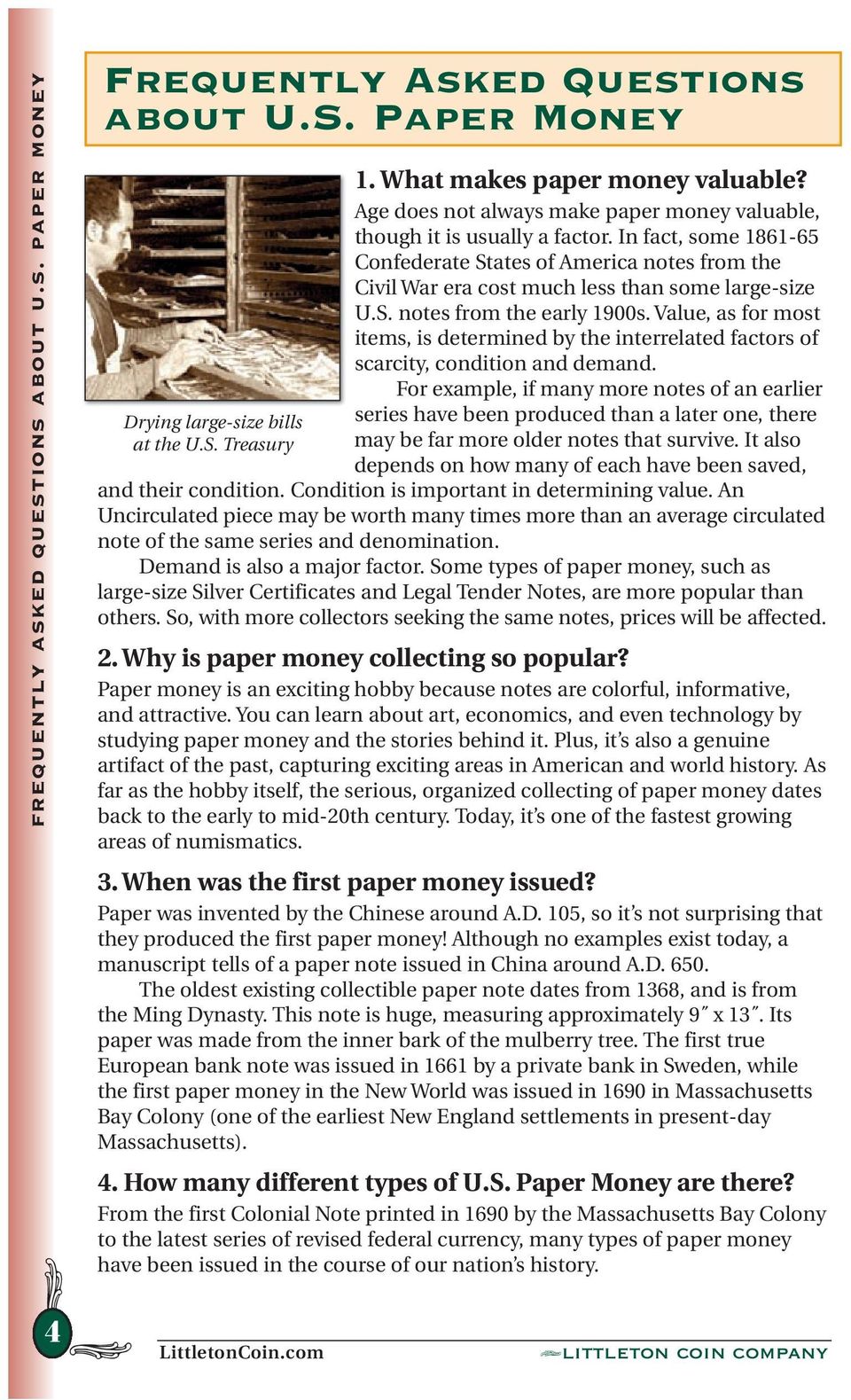
4 frequently asked questions about u.s. paper money { 1. What makes paper money valuable? Age does not always make paper money valuable, though it is usually a factor. In fact, some Confederate States of America notes from the Civil War era cost much less than some large-size U.S. notes from the early 1900s. Value, as for most items, is determined by the interrelated factors of scarcity, condition and demand. For example, if many more notes of an earlier series have been produced than a later one, there may be far more older notes that survive. It also depends on how many of each have been saved, and their condition. Condition is important in determining value. An Uncirculated piece may be worth many times more than an average circulated note of the same series and denomination. Demand is also a major factor. Some types of paper money, such as large-size Silver Certificates and Legal Tender Notes, are more popular than others. So, with more collectors seeking the same notes, prices will be affected. 2. Why is paper money collecting so popular? Paper money is an exciting hobby because notes are colorful, informative, and attractive. You can learn about art, economics, and even technology by studying paper money and the stories behind it. Plus, it s also a genuine artifact of the past, capturing exciting areas in American and world history. As far as the hobby itself, the serious, organized collecting of paper money dates back to the early to mid-20th century. Today, it s one of the fastest growing areas of numismatics. 3. When was the first paper money issued? Paper was invented by the Chinese around A.D. 105, so it s not surprising that they produced the first paper money! Although no examples exist today, a manuscript tells of a paper note issued in China around A.D The oldest existing collectible paper note dates from 1368, and is from the Ming Dynasty. This note is huge, measuring approximately 9 x 13. Its paper was made from the inner bark of the mulberry tree. The first true European bank note was issued in 1661 by a private bank in Sweden, while the first paper money in the New World was issued in 1690 in Massachusetts Bay Colony (one of the earliest New England settlements in present-day Massachusetts). 4. How many different types of U.S. Paper Money are there? From the first Colonial Note printed in 1690 by the Massachusetts Bay Colony to the latest series of revised federal currency, many types of paper money have been issued in the course of our nation s history. 4 Frequently Asked Questions about U.S. Paper Money Drying large-size bills at the U.S. Treasury LittletonCoin.com {littleton coin company
5 Non-federal issues include various Colonial Notes from individual colonies, Continental Currency, emergency-issue government Treasury Notes, a wide variety of state-chartered bank notes, and notes of the Confederacy and Southern States. Federal issues include Demand Notes, Fractional Currency, large and small-size Legal Tender Notes (also known as United States Notes), shortlived Compound Interest Treasury Notes, Interest Bearing Notes (rarest of all U.S. paper money), Refunding Certificates, large and small-size Silver Certificates, Treasury (Coin) Notes, large and small-size National Bank Notes, Federal Reserve Bank Notes, Federal Reserve Notes, and Gold Certificates. 5. Are there different ways to collect? Yes, absolutely! In fact, it can be said that there are as many different ways to collect paper money as there are collectors. You see, there is really no one right way. It depends on your interests and what gives you the most enjoyment within your collecting budget. That said, however, there are a few traditional ways to go about it. At first, you may pursue a general collection containing a variety of different notes. As you find examples of different large and small-size notes Legal Tenders, Silver Certificates or Nationals, for instance you notice you re attracted to some more than others. Then, you may want to assemble a complete set every signature combination of a particular series, for example. Or you may prefer to collect one of each different $1 note, then go after $2 or $5 notes. You might want one example of each Silver Certificate (or other note type) issued. Some collectors choose to assemble a set of notes that all portray a related theme like presidential portraits, military leaders, modes of transportation, or allegorical figures. Whichever way you choose to collect, the most important thing is to have fun. 6. How do I start a paper money collection? Once you become interested in paper money, it s natural to want to collect everything. But as a beginning collector, it s important to decide what kind of notes interest you the most and start with those. To become familiar with paper money, it would be a good idea to read this guide first. It s a great way to explore 1.6 million dollars worth of destroyed the wide range of paper money types and paper currency at the U.S. Treasury designs, and it might help you decide where to start. When you decide, keep in mind that you can purchase paper money easily and conveniently by mail no matter where you live. Littleton offers catalogs, price lists, and paper money on approval so a large inventory is always available for you to choose from. You should only purchase paper money from a company that guarantees your satisfaction (like Littleton). See page 39 for ways Littleton can help you start and expand your collection. how to collect paper money Call toll free frequently asked questions about u.s. paper money

6 Do you have a fortune in your attic? Do you have a fortune in your attic? One of the great thrills of paper money collecting is the never-ending possibility of discovering an unexpected rare old note that will bring hundreds or thousands of dollars to the lucky owner. Because there are so many different varieties of paper money not adequately described in catalogs, it s still possible to make such a find. These discoveries cause excitement with both the public and the collecting community, and gain publicity for the hobby. This is exactly what happened to two lucky people who inherited paper money that turned out to be valuable! Shown against the antique red wallet, this ultra-rare note was hand-dated and signed by H. H. Van Dyck, assistant secretary of the U.S. Treasury in New York. His signature made this note even more desirable, as it is one of only two known with his autograph. That s a rare note! Several years ago, a New England resident inherited an antique red leather billfold filled with old paper money. Because it had belonged to his great-grandfather, a New York City banker, he was curious about what he had received. Unable to find any information, he approached two different coin dealers, who offered him $2,000 and $1,100 respectively for the entire 64-note collection. Fortunately, he brought it to Littleton Coin Company. When president David Sundman saw the note from about five feet away, he exclaimed, That s a rare note! It turned out to be a previously unreported 6th example of an ultra-rare Civil War-era $20 Gold Certificate, Friedberg No. 1166b. This elusive note was part of a series authorized by Congress on March 3, 1863, in denominations of $20 to $10,000, to help finance the Civil War. The owner s great-grandfather had put this note and others away. Through Littleton Coin s efforts on the owner s behalf, it was sold in seconds at auction in March 2001 for $242,000. { 6 LittletonCoin.com {littleton coin company

7 This is the very first National Bank Note, plate 1A, which even after more than a century is still in Choice Crisp Uncirculated condition. Cashier William S. Huntington s signature is at the bottom left of the note. The First National Bank Note Across the country, a California schoolteacher read about the rare Civil War note s discovery. After consultation, she decided to send to Littleton a large-size $5 bill she had inherited. Her note held by her family for four generations turned out to be the very first National Bank Note (Friedberg No. 394) ever released. Here s why the schoolteacher decided to send her special note to us: At first I was nervous at the thought of sending the note I inherited from my great-grandfather across the country. But your friendly, honest advice won my trust and helped me find the right market for my note. Do you have a fortune in your attic? This note was issued by the First National Bank of Washington, D.C., and signed by the woman s great-grandfather, William Spooner Huntington, who was cashier. The bank was located directly across the street from the U.S. Treasury and had the honor of receiving the first National Bank Notes after the National Banking Act of We know this was the very first National Bank Note because back then, paper money was printed in sheets of four. This was plate number 1A. This 1863 $5 National also sold in seconds in March 2001, for $220,000. With more than 14,000 banks across the country chartered as national banks, there may still be undiscovered notes held Cashier William Spooner Huntington by the descendants of 19th-century bankers. And old paper money passed down through a family makes a nice addition to any collection. If you have paper money that you ve inherited or discovered, contact Littleton Coin Company and let us assist you. Call toll free or us at [email protected]. how to collect paper money Call toll free

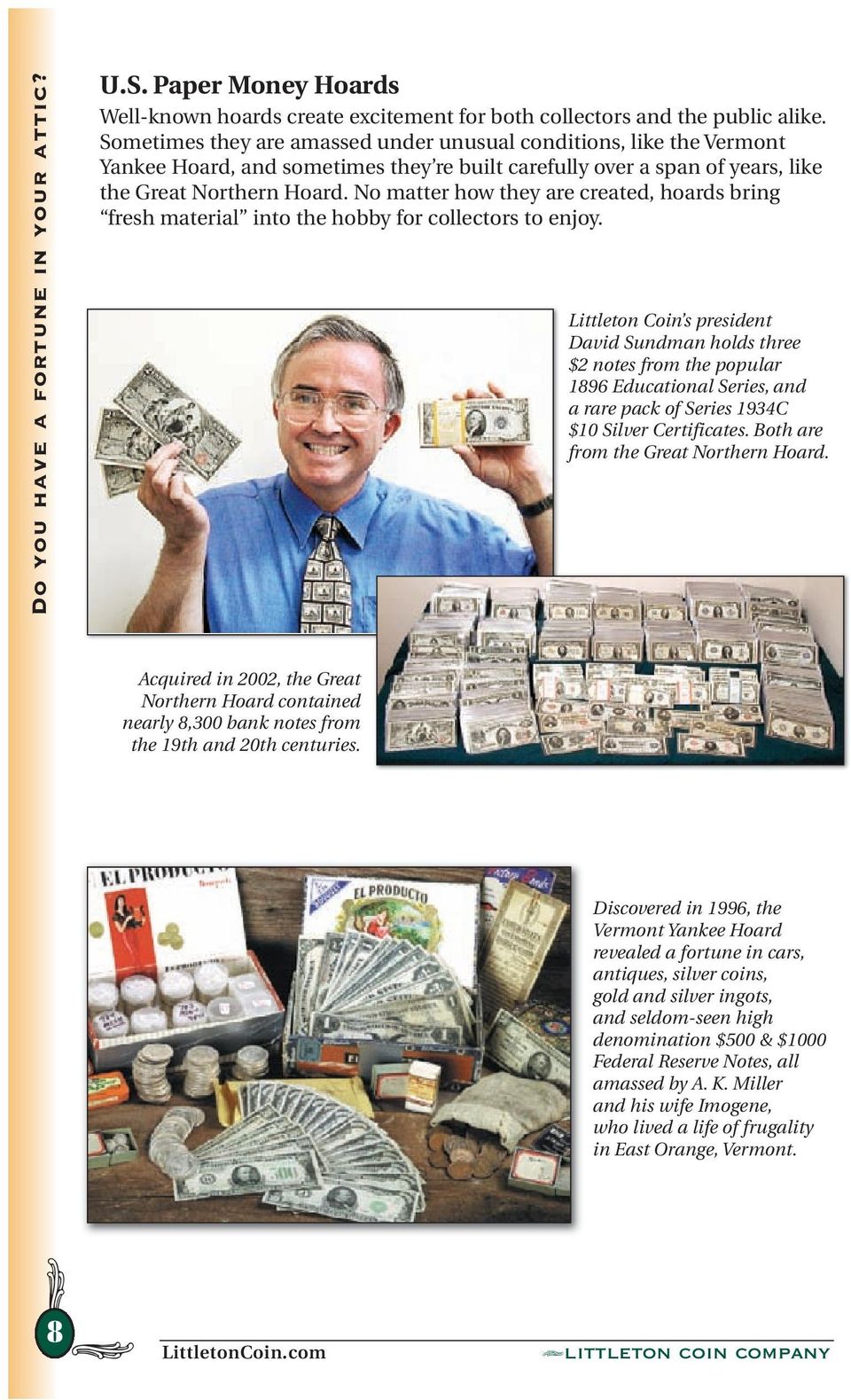
8 Do you have a fortune in your attic? U.S. Paper Money Hoards Well-known hoards create excitement for both collectors and the public alike. Sometimes they are amassed under unusual conditions, like the Vermont Yankee Hoard, and sometimes they re built carefully over a span of years, like the Great Northern Hoard. No matter how they are created, hoards bring fresh material into the hobby for collectors to enjoy. Littleton Coin s president David Sundman holds three $2 notes from the popular 1896 Educational Series, and a rare pack of Series 1934C $10 Silver Certificates. Both are from the Great Northern Hoard. Acquired in 2002, the Great Northern Hoard contained nearly 8,300 bank notes from the 19th and 20th centuries. Discovered in 1996, the Vermont Yankee Hoard revealed a fortune in cars, antiques, silver coins, gold and silver ingots, and seldom-seen high denomination $500 & $1000 Federal Reserve Notes, all amassed by A. K. Miller and his wife Imogene, who lived a life of frugality in East Orange, Vermont. { 8 LittletonCoin.com {littleton coin company
9 The History of U.S. Paper Money Early history 1690 to 1775 Although the first United States paper money under the Constitution dates from the year 1861, it actually circulated in the country long before then. As early as the 17th century, while still under British rule, the American colonies issued their first notes. As more and more people settled in Colonial America and the economy grew, the lack of hard money became apparent. Prior to the Revolutionary War, the colonists were eager to establish some economic self-sufficiency. They wanted to market their surplus produce at reasonable prices, then use that money to buy necessities and comforts not made locally. They preferred to do this without royal interference, but unfortunately, in the 17th and 18th centuries, England regarded this as treason! This 5-Pence Colonial Note was issued by Connecticut in To put an end to such activity, England attempted to control the amount of gold or silver coinage (hard money) that was paid to the colonies for goods and services. Colonists were forced to trade in furs, fish, grain, and musket bullets. As a precaution against the colonists somehow obtaining precious metals, England insisted that taxes be paid first in gold or silver then in grain if there was nothing else of value. But in order to meet the needs of the expanding population, and in an effort to encourage local trade, it was necessary for the colonies to issue their own paper currency. Those earliest types, called Colonial Notes, originally served as a means of payment for military campaigns and public works for the issuing colony. Breaking from the mother country 1775 When the colonists made their final break from England, war became the price to pay for that freedom. The newly formed nation needed money in order to finance its war effort, but because of England s attempts to keep gold and silver out, the colonists had few precious metals. Thus, the Revolutionary War would have to be financed with paper. In mid-1775, the Continental Congress authorized the issuance of paper currency. These war notes were redeemable in Spanish Milled Dollars large silver coins of the 8 Reales denomination (the famous Pieces of Eight ) how to collect paper money Call toll free the history of u.s. paper money

10 the history of u.s. paper money struck at the Spanish colonial mints in Mexico and South America. Because the Continental Congress authorized their creation, they became known as Continental Currency. Unfortunately, these notes quickly depreciated to where the face value was worth less than the paper it was printed on. This depreciation in value created the popular expression of the day, it s not worth a Continental. Today, the notes are in great demand by collectors! After their experience with Continental Currency, Americans were extremely reluctant to accept paper money issued by our government. The birth of America s currency system 1793 Once the Constitution was ratified, the coinage system of the United States was established. America s first coins were struck in 1793 at the Philadelphia Mint, and from then until 1861 (68 years later), the U.S. government saw no need for a national paper currency. But during this period, several important events took place. The War of 1812, the Mexican War of 1846, the Panic of 1857, and the uneasy period immediately before the outbreak of the Civil War all caused a severe drain on the U.S. Treasury. To overcome these deficits, the federal government issued so-called Treasury Notes from time to time. They were simply signed promissory notes which earned interest, and did not circulate as money except for a brief time in Financial ruin and broken banks 1830s-1861 Despite such difficult economic periods, the country continued to grow. It became apparent that there simply was not enough money in circulation to meet the ever-increasing needs of daily commerce. In an effort to remedy the situation, some states gave private banks the right to issue their own currency. The backing for this currency was the amount of money the bank had on deposit. Unfortunately, when times were hard, people failed to pay their loans, and banks lost their source of income. Without money coming in, banks literally went broke and were forced to close their doors. Broken Bank Notes often showcase artistic designs. { The currency issued by these ruined banks became known as Broken Bank Notes. Because of their wide range of artistic designs, unusual denominations, and the oftentimes colorful names of the banks themselves, these notes are popular collectibles today! LittletonCoin.com {littleton coin company 10

11 The Civil War The Civil War had a great impact on America s paper money. Due to the duration of the conflict, financing the war became a major problem. Supplies, clothing, and pay for the military had to come from somewhere. And it wasn t long before the United States found itself in a desperate financial situation. Remedies included increasing the national debt, enacting the first income tax, and issuing a national paper currency. Putting their faith in paper money Congress finally passed the Act of July 17, 1861, which permitted the Treasury Department to print and circulate money. Specie payments were suspended, which meant the new paper money could not be converted into either silver or gold coins. The public was expected to accept this money purely on faith The first $5 Legal Tender Note, dating from the Civil War. Alexander Hamilton and a statue symbolizing Freedom are featured. that it would be good. People did use the currency. But the mounting costs of fighting the Civil War, and the uncertain financial position of the North cheapened the paper dollar so much that circulating copper, silver and gold coins were hoarded and almost disappeared completely! The first United States notes of 1861 are known as Demand Notes, and in 1862 they were replaced by Legal Tender Notes. From the first U.S. paper money issued in 1861 through to the present day, all paper currency issued by the U.S. government has remained legal tender! Confederate Currency On February 9, 1861, the Confederate States of America established a provisional government with its capitol in the city of Montgomery, Alabama. Jefferson Davis was elected president. Five days after Louisiana seceded from the Union, her state troops seized the United States Branch Mint and Custom House at New Orleans. The Congress of the Confederate States resolved that the mints at New Orleans and Dahlonega, Georgia should be continued striking U.S. coins dated 1861, though now under Confederate supervision. the history of u.s. paper money Jefferson Davis, president of the Confederate States of America how to collect paper money Call toll free

12 the history of u.s. paper money { Once the Confederate government was fully established, it resolved to solve its financial woes by issuing its own paper currency. Southerners were asked to accept it on a par with regular money or bank notes enabling it to perform the functions of legal tender. Eventually, as the war dragged on and continued to drain the South s finances, it was patriotism alone that gave the Confederate currency any value. The South battles inflation The expenses of the Confederate States of America continued to increase, and as the war went on, Southern currency continued to depreciate in value. Confederate president Jefferson Davis s wife kept a diary of those trying days in the South. Paper money As the Civil War progressed, inflation in the South reached such a high level that it took as many as five of these $10 notes to buy one bar of soap! in denominations of $5 and under was useless. The Confederate money supply was so inflated it could buy little. Mrs. Davis recalled that turkeys sold for $60 each, tea was $22 a pound, and milk was $4 a quart. One bar of soap could sell for as high as $50, and an ordinary suit of clothes cost $2,700! In spite of the inflation, the Confederate Congress continued to issue millions of dollars worth of notes. At the time of the war s conclusion, the currency authorized by the Confederate Congress consisted of hundreds of varieties. Several states of the Confederacy (Georgia and North Carolina, in particular) issued their own money, too. As true mementos of the Civil War, genuine Confederate currency is hard to beat! The North s war chest runs low While the Civil War was in progress, Lincoln s administration needed increasing sums of money to wage the war. The nation lacked a central banking authority, and was relying largely on private banks banks whose finances were not always sound. In 1863, the National Banking Act passed. This act created more money with which to fight the war. It also attempted to regulate the country s chaotic currency system. The new act encouraged private banks to apply for federal charters, thereby making them national banks. National Banks to the rescue 1863 Newly chartered national banks used their funds to buy Union bonds (thus raising money for the war). They deposited the bonds with the Treasury in Washington, D.C., and then were allowed to issue National Bank Notes for up LittletonCoin.com {littleton coin company 12

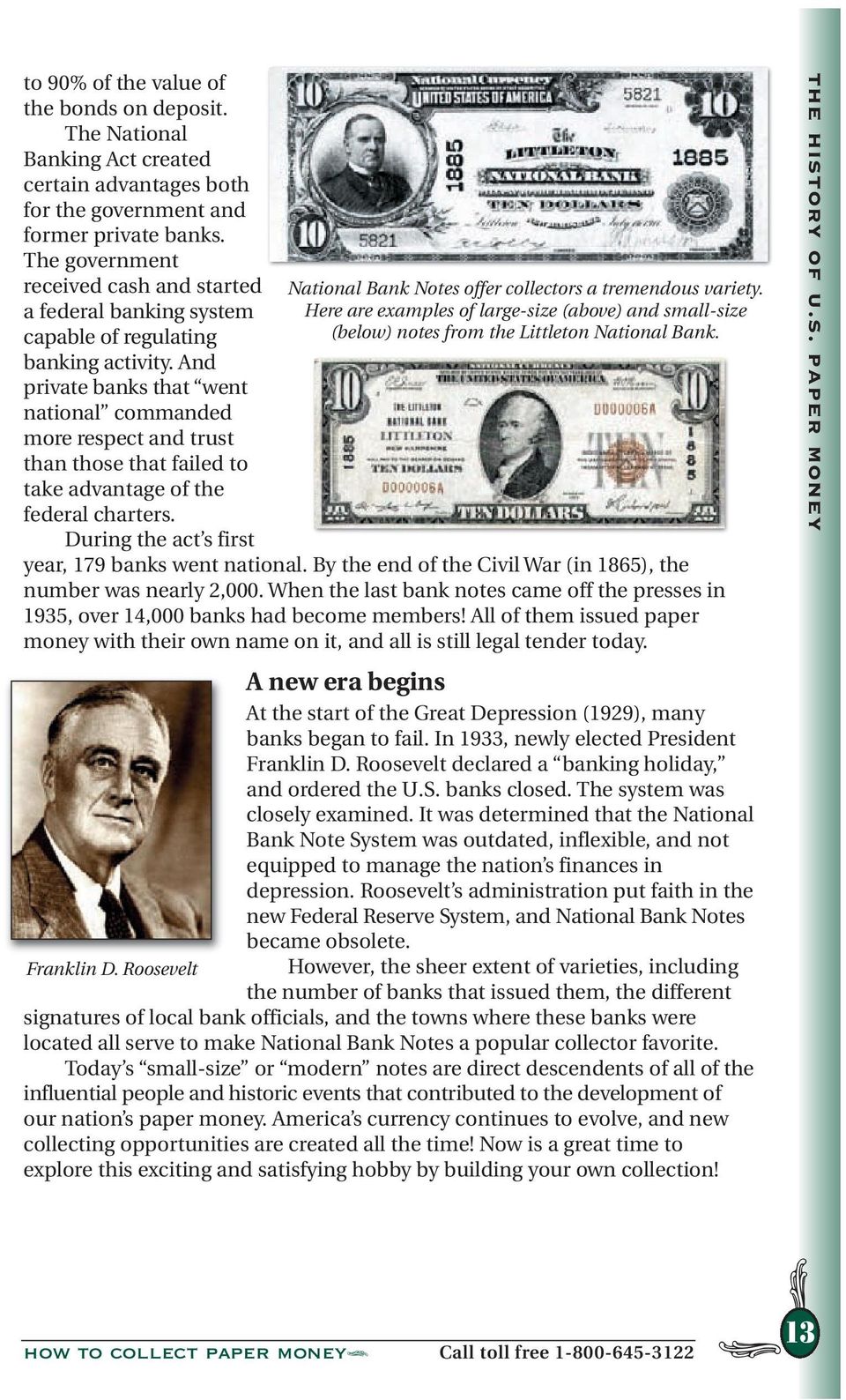
13 to 90% of the value of the bonds on deposit. The National Banking Act created certain advantages both for the government and former private banks. The government received cash and started National Bank Notes offer collectors a tremendous variety. a federal banking system Here are examples of large-size (above) and small-size capable of regulating (below) notes from the Littleton National Bank. banking activity. And private banks that went national commanded more respect and trust than those that failed to take advantage of the federal charters. During the act s first year, 179 banks went national. By the end of the Civil War (in 1865), the number was nearly 2,000. When the last bank notes came off the presses in 1935, over 14,000 banks had become members! All of them issued paper money with their own name on it, and all is still legal tender today. A new era begins At the start of the Great Depression (1929), many banks began to fail. In 1933, newly elected President Franklin D. Roosevelt declared a banking holiday, and ordered the U.S. banks closed. The system was closely examined. It was determined that the National Bank Note System was outdated, inflexible, and not equipped to manage the nation s finances in depression. Roosevelt s administration put faith in the new Federal Reserve System, and National Bank Notes became obsolete. Franklin D. Roosevelt However, the sheer extent of varieties, including the number of banks that issued them, the different signatures of local bank officials, and the towns where these banks were located all serve to make National Bank Notes a popular collector favorite. Today s small-size or modern notes are direct descendents of all of the influential people and historic events that contributed to the development of our nation s paper money. America s currency continues to evolve, and new collecting opportunities are created all the time! Now is a great time to explore this exciting and satisfying hobby by building your own collection! the history of u.s. paper money how to collect paper money Call toll free
14 guide to u.s. paper money small size notes Guide to U.S. Paper Money On the following pages, you ll find a guide to U.S. Paper Money that outlines the major types of paper currency authorized by the U.S. government from the Civil War onward. Because the total number of different notes issued is enormous, only a select few are included here as examples. Littleton has available simplified paper money checklists to help you keep track of your collection. To order, call LC-1380 Littleton s Simplified Checklist of Small Size U.S. Paper Money LC-1567 Littleton s Simplified Checklist of Large Size U.S. Paper Money Small-Size U.S. Paper Money 1929-Present By the 1920s, the number of notes produced annually by the Bureau of Engraving and Printing was huge and ever increasing. Production costs also went up, due to the tremendous amounts of specialized paper and ink that were needed. One way to cut expenses was to reduce the size of the notes. And that s precisely what they did. Small-Size Legal Tender Notes Legal Tender Notes are the longest-lived type of U.S. paper money! Also known as United States Notes, these were first authorized in 1862, and although none has been issued since 1969, they are all still legal tender today. All small-size Legal Tender Notes have a red Treasury seal and red serial numbers. { $5 Legal Tender Note Series 1928A A distinguished portrait of Abraham Lincoln is featured on the face of this note, and a view of the Lincoln Memorial in Washington, D.C. is depicted on the back. The note shown is from Series 1928A. LittletonCoin.com {littleton coin company 14

15 Small-Size Silver Certificates These popular notes were once backed by an equivalent amount of silver deposited into the U.S. Treasury, payable to the bearer upon demand for the note s face value in precious metal. $1 Funnyback Silver Certificate Series 1928A Seen on the face is a classic portrait of George Washington. The back of this note features a large, ornately engraved ONE, plus fancy borders and scrollwork. These notes are nicknamed Funnybacks, because at first glance, the back of the note seems mismatched in design with the front. The note shown is from Series 1928A and has a blue seal and serial numbers. Small-Size National Bank Notes National Bank Notes were originally authorized in the early 1860s to allow banks which had been chartered to issue their own currency. By 1929, over 14,000 banks had been chartered as National Banks. All small-size National Bank Notes are from Series 1929, and they were issued until mid-1935, when the bonds securing these notes were called in. There are two different types of small-size nationals: Type 1 with the charter number shown twice, and Type 2 with the number shown four times. guide to u.s. paper money small size notes $5 National Bank Note Series 1929, Type 2 This note features a classic portrait of Abraham Lincoln on the face, and the Lincoln Memorial on the back. The note shown is from Series 1929, Type 2, and was issued by the First National Bank of Laporte, Pennsylvania. It has a brown Treasury seal and serial numbers. how to collect paper money Call toll free

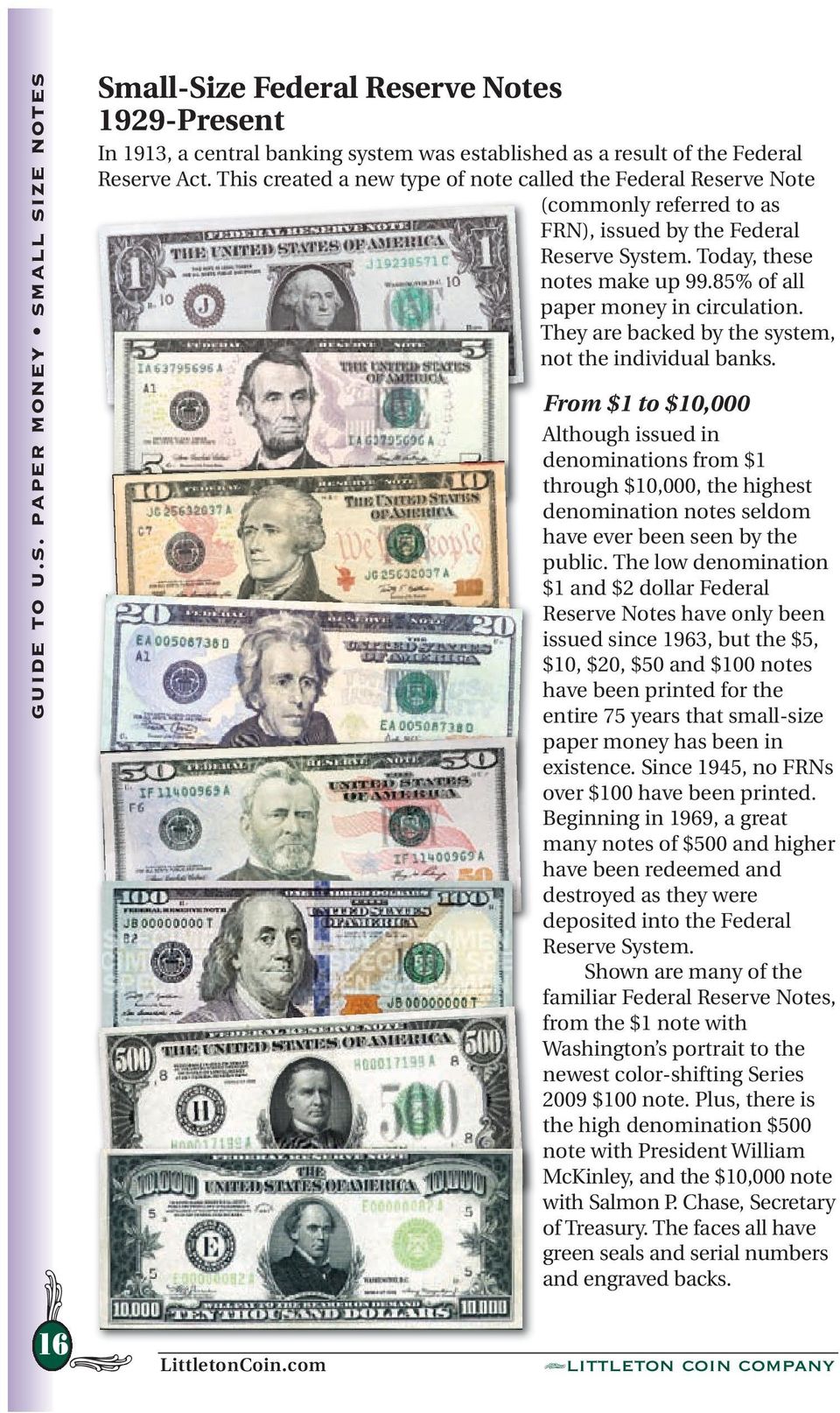
16 guide to u.s. paper money small size notes { Small-Size Federal Reserve Notes 1929-Present In 1913, a central banking system was established as a result of the Federal Reserve Act. This created a new type of note called the Federal Reserve Note (commonly referred to as FRN), issued by the Federal Reserve System. Today, these notes make up 99.85% of all paper money in circulation. They are backed by the system, not the individual banks. From $1 to $10,000 Although issued in denominations from $1 through $10,000, the highest denomination notes seldom have ever been seen by the public. The low denomination $1 and $2 dollar Federal Reserve Notes have only been issued since 1963, but the $5, $10, $20, $50 and $100 notes have been printed for the entire 75 years that small-size paper money has been in existence. Since 1945, no FRNs over $100 have been printed. Beginning in 1969, a great many notes of $500 and higher have been redeemed and destroyed as they were deposited into the Federal Reserve System. Shown are many of the familiar Federal Reserve Notes, from the $1 note with Washington s portrait to the newest color-shifting Series 2009 $100 note. Plus, there is the high denomination $500 note with President William McKinley, and the $10,000 note with Salmon P. Chase, Secretary of Treasury. The faces all have green seals and serial numbers and engraved backs. LittletonCoin.com {littleton coin company 16
17 World War II Emergency Notes World War II brought about some collectible varieties of small-size U.S. currency specially printed notes designed to be used in certain geographical locations during the war. Some were issued for use during the invasions of North Africa and Europe, and others were intended for use on the Hawaiian Islands. These notes are sought after by collectors as true mementos of World War II. Hawaii Overprint Notes 1942 These notes were an economic defense against a Japanese invasion and possible takeover of Hawaii. Specially marked notes, distinguishable by brown Treasury seals and serial numbers, were issued seven months after the attack on Pearl Harbor. In addition, each one was overprinted with HAWAII on the face and back. These notes could have been declared worthless if large quantities were ever captured by enemy forces. guide to u.s. paper money small size notes $10 North African Invasion Notes 1942 This special currency was issued to the U.S. troops that landed in North Africa in 1942 and began the advance into Axis-held Europe from the south. Because of the yellow Treasury seals, the notes could be easily identified and declared worthless in case enemy forces captured large quantities of cash. The notes were Silver Certificates, but with a difference the Treasury seals were printed in yellow instead of the normal blue.? Did you know If you had 10 billion $1 notes, and spent one every second of every day, it would take approximately 317 years for you to go broke! how to collect paper money Call toll free

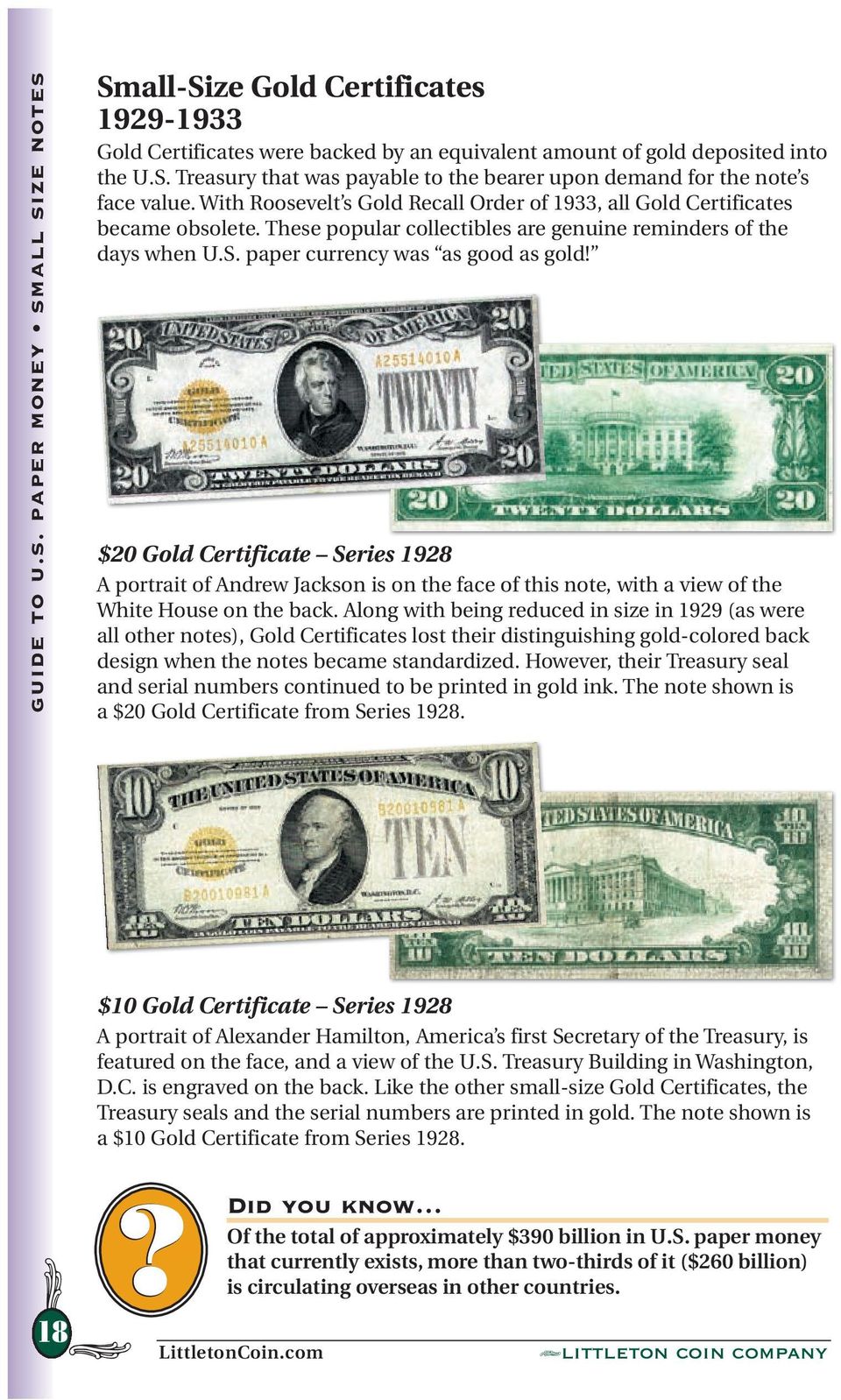
18 guide to u.s. paper money small size notes Small-Size Gold Certificates Gold Certificates were backed by an equivalent amount of gold deposited into the U.S. Treasury that was payable to the bearer upon demand for the note s face value. With Roosevelt s Gold Recall Order of 1933, all Gold Certificates became obsolete. These popular collectibles are genuine reminders of the days when U.S. paper currency was as good as gold! $20 Gold Certificate Series 1928 A portrait of Andrew Jackson is on the face of this note, with a view of the White House on the back. Along with being reduced in size in 1929 (as were all other notes), Gold Certificates lost their distinguishing gold-colored back design when the notes became standardized. However, their Treasury seal and serial numbers continued to be printed in gold ink. The note shown is a $20 Gold Certificate from Series $10 Gold Certificate Series 1928 A portrait of Alexander Hamilton, America s first Secretary of the Treasury, is featured on the face, and a view of the U.S. Treasury Building in Washington, D.C. is engraved on the back. Like the other small-size Gold Certificates, the Treasury seals and the serial numbers are printed in gold. The note shown is a $10 Gold Certificate from Series {? Did you know Of the total of approximately $390 billion in U.S. paper money that currently exists, more than two-thirds of it ($260 billion) is circulating overseas in other countries. LittletonCoin.com {littleton coin company 18
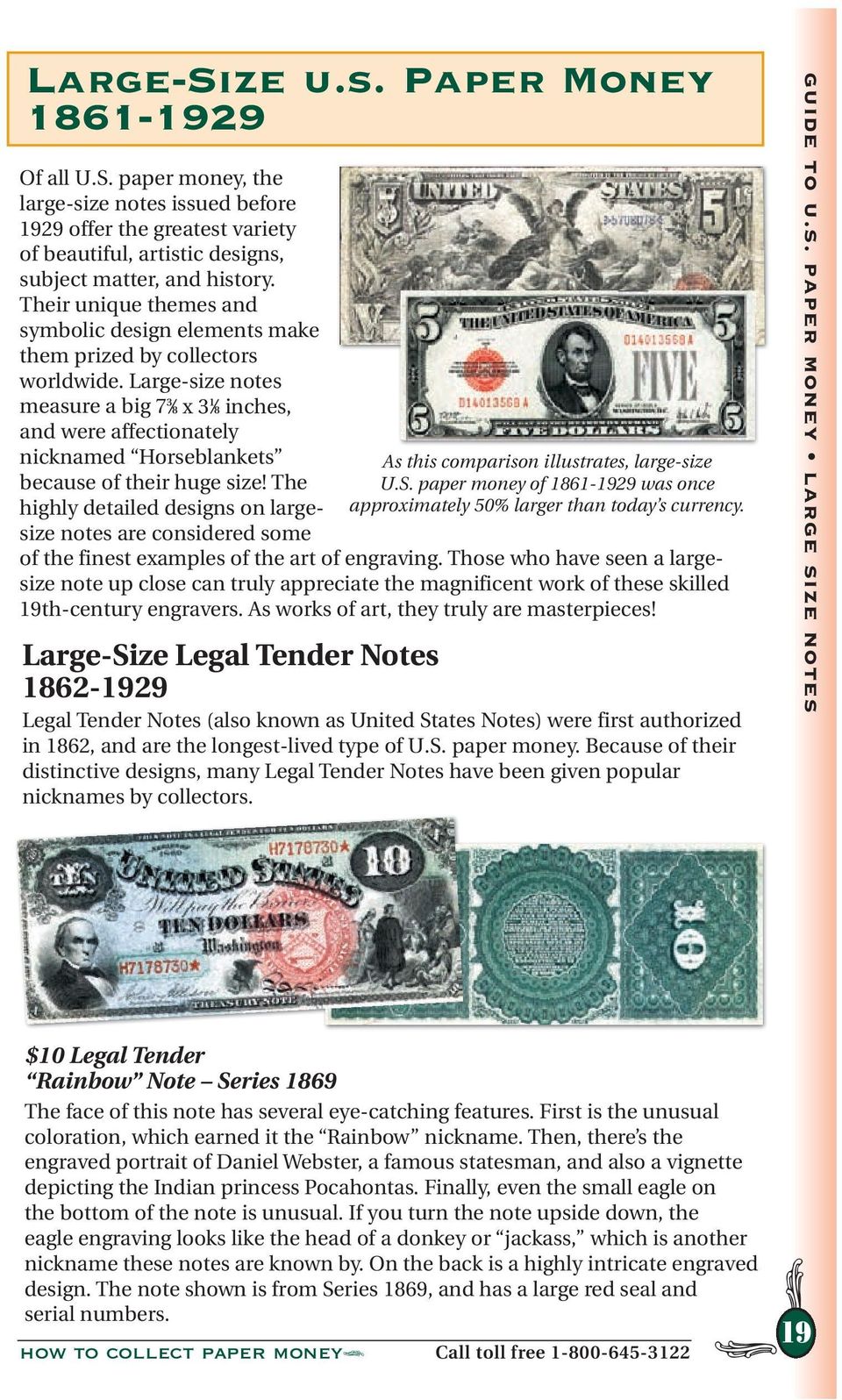
19 Large-Size u.s. Paper Money Of all U.S. paper money, the large-size notes issued before 1929 offer the greatest variety of beautiful, artistic designs, subject matter, and history. Their unique themes and symbolic design elements make them prized by collectors worldwide. Large-size notes measure a big x inches, and were affectionately nicknamed Horseblankets because of their huge size! The highly detailed designs on largesize notes are considered some As this comparison illustrates, large-size U.S. paper money of was once approximately 50% larger than today s currency. of the finest examples of the art of engraving. Those who have seen a largesize note up close can truly appreciate the magnificent work of these skilled 19th-century engravers. As works of art, they truly are masterpieces! Large-Size Legal Tender Notes Legal Tender Notes (also known as United States Notes) were first authorized in 1862, and are the longest-lived type of U.S. paper money. Because of their distinctive designs, many Legal Tender Notes have been given popular nicknames by collectors. guide to u.s. paper money large size notes $10 Legal Tender Rainbow Note Series 1869 The face of this note has several eye-catching features. First is the unusual coloration, which earned it the Rainbow nickname. Then, there s the engraved portrait of Daniel Webster, a famous statesman, and also a vignette depicting the Indian princess Pocahontas. Finally, even the small eagle on the bottom of the note is unusual. If you turn the note upside down, the eagle engraving looks like the head of a donkey or jackass, which is another nickname these notes are known by. On the back is a highly intricate engraved design. The note shown is from Series 1869, and has a large red seal and serial numbers. how to collect paper money Call toll free
20 guide to u.s. paper money large size notes $10 Legal Tender Bison Note Series 1901 The face of this famous note pictures an American bison between portraits of two famous explorers of the western United States, Lewis and Clark. A female figure symbolizing Columbia is on the back. The note shown is from Series 1901, and has a red scalloped seal and serial numbers. $5 Legal Tender Woodchopper Note Series 1875 The face of this note features the famous Woodchopper vignette, plus a portrait of Andrew Jackson. There is an ornately engraved design on the back. The note shown is from Series 1875 and has a red scalloped seal and serial numbers. { $1 Legal Tender Note with Sawhorse back Series 1875 The face of this note has a portrait of George Washington and a vignette titled Christopher Columbus in Sight of Land, while the back features the famous Sawhorse design. The note shown, from Series 1875, has a red seal and serial numbers. LittletonCoin.com {littleton coin company 20

21 Large-Size Silver Certificates Due to the discovery of silver in the American West, and surplus of that metal, in 1878, Congress authorized silver dollars as backing for U.S. paper currency. Known as Silver Certificates, these notes were backed by an equivalent dollar amount of silver deposited into the U.S. Treasury, and was payable to the bearer upon demand for the note s face value in the precious metal. Their attractive designs and the allure of silver have made Silver Certificates one of the most popular types of U.S. paper money to collect. $1 Martha Washington Silver Certificate Series 1886 The first $1 Silver Certificate ever issued, and a must-have for every collection! A portrait of Martha Washington, the wife of George Washington, is on the face, while a highly ornate floral design appears on the back. The note shown is from Series 1886, and has a large red seal and blue serial numbers. guide to u.s. paper money large size notes $5 Silver Certificate with Silver Dollars back Series 1886 A portrait of Ulysses S. Grant appears on the face, while the unique back design features five Morgan silver dollars in a highly detailed engraving. The note shown is from Series 1886, and has a large red seal and blue serial numbers.? Did you know Both Benjamin Franklin and Paul Revere printed some of America s early paper money. Paul Revere even engraved some of the designs himself! how to collect paper money Call toll free
22 guide to u.s. paper money large size notes $1 Educational Series Silver Certificate Series 1896 One of the famous Educational Series Silver Certificates. On the face is a vignette titled History Instructing Youth, with the Washington Monument and Capitol in the background. The back features portraits of George and Martha Washington. The note shown is from Series 1896, and has a small red seal and blue serial numbers. $1 Black Eagle Silver Certificate Series 1899 The vignette on this note is titled Eagle of the Capitol, but it is nicknamed Black Eagle. Portraits of Lincoln and Grant are beneath the denomination on the face. An engraved design with an obligation is on the back. The note shown is from Series 1899, and has a blue seal and serial numbers. { $1 Washington Silver Certificate Series 1923 The face of this distinctive looking note features a portrait of George Washington. The denomination is in an engraved design on back. The note shown is from Series 1923, and has a blue seal and serial numbers. LittletonCoin.com {littleton coin company 22
23 Large-Size Treasury Notes Also known as Coin Notes, these were used to pay for silver bullion purchased by the Treasury Department. First authorized in 1890, the notes stated that the bearer was to be paid on demand the note s face value in coin (silver or gold). The decision of whether it was to be silver or gold was left to the Secretary of the Treasury. After the Treasury paid for its silver bullion purchases with these notes, the bearer of the note could redeem it for gold coin. The redemption of these notes for gold almost bankrupted the Treasury in 1893! $1 Treasury Note Series 1890 The face of this note features a portrait of Edwin M. Stanton, who was Secretary of War under both President Abraham Lincoln and President Andrew Johnson. On the back is an intricately detailed engraved design. The note shown is from Series 1890 and has a large brown seal and red serial numbers. guide to u.s. paper money large size notes? Did you know The early paper money of America was the very first paper money issued by any government in the Western world. Large-Size National Bank Notes Once, National Bank Notes played an important part in daily commerce. They came into existence in 1863 during the Civil War. To help establish a national banking system and raise money to finance the war, the federal government decided to charter banks. Local and regional banks became chartered when they purchased government bonds and deposited them into the Treasury to back the paper they issued. The charter number served as a guarantee that the issuing bank had U.S. government bonds backing its paper. Along with the charter number, National Bank Notes also carried the bank s name, town and state. National Bank Notes were authorized by Federal Acts allowing qualified banks to issue their own currency. These large-size notes were issued by chartered banks from 1863 to how to collect paper money Call toll free
24 guide to u.s. paper money large size notes $2 Lazy 2 National Bank Note Series 1875 This eye-catcher is known to collectors as the Lazy 2 or Lazy Deuce because of the large numeral 2 lying on its side. Also on the face is a vignette titled Stars and Stripes. The ornate back features a vignette of Sir Walter Raleigh. The note shown is from Series 1875, and has a scalloped red seal and serial numbers. Did? you know From the first National Bank charter granted in 1863 to the last one granted in 1935, over 14,000 National Bank charters were issued. Many, though not all, of those banks issued their own paper currency! Large-Size Federal Reserve Bank Notes The formation of the Federal Reserve System created a new type of currency. These new Federal Reserve Bank Notes carry the inscription National Currency, and are backed by government bonds. The twelve individual Federal Reserve Banks issued their own notes, and the obligation to pay the bearer is made by the issuing bank, and not by the Federal Reserve System itself. { $20 Federal Reserve Bank Note Series 1915 Issued by only 5 of the 12 Federal Reserve Banks, this $20 note features a portrait of President Grover Cleveland on the face. The engraved vignettes on the back portray modes of land, sea, and air transportation. The note shown, from Series 1915, has a blue seal and serial numbers. It was issued by the Federal Reserve Bank of Chicago. LittletonCoin.com {littleton coin company 24
25 Large-Size Federal Reserve Notes Another new type of currency created by the formation of the Federal Reserve System was the Federal Reserve Note. These differed from Federal Reserve Bank Notes in that they were issued by the Federal Reserve System and were an obligation of the system not the individual banks that released them. Federal Reserve Notes were once redeemable for gold upon demand. $100 Federal Reserve Note Series 1914 An unusual portrait of Benjamin Franklin in profile is shown on the face of the note, and an engraving of five figures symbolizing Labor, Plenty, America, Peace, and Commerce is featured on the reverse. The note shown is from Series 1914, and has a blue seal and serial numbers. Large-Size Gold Certificates Large-size Gold Certificates, with their bright golden-orange backs, are among the most attractive of all U.S. paper money types. When people see a large-size Gold Certificate for the first time, they often think the note isn t real, as such bold colors aren t ordinarily associated with U.S. paper currency. Gold Certificates were backed by gold deposited into the U.S. Treasury, and payable to the bearer upon demand for the notes face value in gold. guide to u.s. paper money large size notes Technicolor Gold Certificate Series 1905 This note earned its Technicolor nickname because in addition to its bright golden-orange back, it also has gold tinting on a portion of the face. It is considered by collectors to be the most beautiful of all Gold Certificates. A portrait of George Washington is on the face, while the back shows the Great Seal of the United States. The note shown is from Series 1905 and has a red seal and serial numbers. how to collect paper money Call toll free
26 fractional currency Fractional Currency Fractional Currency was issued for over a 14-year period from The notes shown are examples selected from the numerous designs that were issued to combat attempts at counterfeiting. Many design changes were made for each of the six different denominations. { Once it became obvious that the federal Treasury did not have sufficient bullion reserves to finance the Civil War, the value of the dollar dropped drastically. Whatever coins were in circulation quickly disappeared as people hoarded as much hard currency (coins) as they could. This caused major problems for both merchants and their customers, as small-denomination coins were needed to make change in everyday business transactions. To replace coins, people even began to use postage stamps! From Postage Currency to Fractional Currency Realizing the seriousness of the situation, in 1862 the government authorized the production of paper notes in values of less than one dollar. They were called Postage Currency because their designs resembled U.S. postage stamps of the time. One year later, the government authorized the release of additional issues of fractional value notes. These are known as Fractional Currency. They continued to be issued for 14 years, until the production of small-denomination coinage was large enough to allow people to redeem their Fractional Notes for coins. Out of the millions of dollars of Fractional Currency originally released by the government, most was redeemed for U.S. coins and destroyed over a century ago. Today, less than 1% is still unaccounted for. Most of the survivors are believed to be in the hands of collectors. And you may be surprised to know that, like all U.S. government currency issued since 1861, those Fractional Notes that have survived are still legal tender for their face value today! But because so few survive, they are highly prized by collectors. LittletonCoin.com {littleton coin company 26
27 Colonial and Continental Currency (Non-Federal Type U.S. Paper Money) Prior to 1861 when the first official U.S. government paper money was released, currency circulated in America. Colonial and Continental Currency are some of America s earliest paper money. Many of these issues bear signatures of the signers of the Declaration of Independence or Constitution. Today, all are scarce and some are rare. Colonial Currency is pre-revolutionary War paper money created in response to a growing economy and desperate coin shortage. Beginning with Massachusetts in 1690 to 1781, individual colonies issued notes to pay for public works, trade deficits, and other items of necessity. Continental Currency was authorized by the Continental Congress, and issued between 1775 and These notes provided a way to help finance the American Revolution. Originally, the notes bore the legend THE UNITED COLONIES, which was changed in 1777 to THE UNITED STATES. The final Continental Currency was released in Printed by the Philadelphia firm of Hall & Sellers, this $8 Colonial Note shows one of Franklin s innovative leaf prints used to thwart counterfeiters. This $3 Colonial Note was issued by the State of Massachusetts-Bay. The punch signifies that it has been redeemed for THREE Spanish milled DOLLARS. colonial and continental currency This early Continental Currency is hand-numbered and signed. how to collect paper money Call toll free
28 u.s. paper money grading guide U.S. Paper Money Grading Guide The physical characteristics of a note play an important part in determining its collectible appeal and value. Aside from those scarce or rare notes whose limited availability makes them desirable in almost any grade, there are many that have no additional monetary worth beyond their face value in ordinary circulated condition. However, in the highest circulated grades and in Uncirculated condition, those same notes may command a premium. Only advanced collectors and paper money professionals have the necessary training and experience to accurately and consistently grade the condition of paper currency. The following grading definitions and photos are presented as a guide only. Crisp Uncirculated A note that has not been released into circulation and is in the same condition as it was when produced. The paper must be firm and crisp, without any creases, folds or tears, and the corners must be sharp and square. { 28 About Uncirculated Extra Fine LittletonCoin.com A note that at first glance might appear as Uncirculated, but closer examination discloses the slightest signs of handling, some minor corner folds, a light (not hard) crease, a slight finger smudge, or some pinholes. Paper is still crisp and bright, and has original sheen. Paper is clean and bright, with original sheen. Light handling is apparent, with several light folds or one strong crease visible. Tears and stains are not present. {littleton coin company
29 Very Fine Fine Still an attractive note, but with more pronounced wear from handling, though some crispness remains. May have several vertical and horizontal folds, as well as slight dirt or smudging visible. No tears on the edges, though the corners aren t as sharp as Uncirculated. Considerable circulation is apparent, with creases, folds and wrinkles visible, and most, if not all, of the crispness is gone. Edges show evidence of circulation, and there may be slight tears. Some fading of color noticeable, with some staining possible. u.s. paper money grading guide Very Good An obviously wellcirculated bank note with much creasing, folding and wrinkling noticeable. Note may be dirty, and corners may show much wear and rounding, and some tears may be present, though no pieces of the note should be missing. Good A heavily circulated note with characteristics similar to Very Good, except with more pronounced soiling and considerable wear and tear. Corners of the note may also be missing. how to collect paper money Call toll free
30 paper money security features Anti-Counterfeiting Devices for Series 2009 The very latest anti-counterfeiting devices are combined with time-tested classics on the newly redesigned $100 Federal Reserve Notes. See below for details on how these features work to safeguard our currency. A Enlarged portrait with background color The portrait is larger, with more detail to make it harder to duplicate. In addition, there is a subtle background color on both sides. A B Liberty Bell in the inkwell The image of the Liberty Bell inside an inkwell on the face of the new $100 shifts from copper to green as you tilt the note. This makes the bell seem to appear and disappear! C F F B E D { Specimen (sample) shown, not actual note C 3-D Security Ribbon In addition to the traditional security thread, the new $100 features a blue ribbon woven into the face. As you tilt the note, the 100s change to bells. The bells and 100s move as well, depending upon the direction you tilt the note. Watermark D A watermark of Benjamin Franklin is located on the right side of the seal. It is part of the paper and can be seen from both sides when held up to the light. E Easy-to-read features As you tilt the note, the 100 in the lower corner of the face shifts from a copper-gold color to green. And on the back, for the first time, a large gold 100 is printed offering higher visibility to those with sight impairments. F Microprinting Extremely small, printed words appear in four places on the new $100 beside the quill, on Franklin s collar, around the watermark, and in the border. LittletonCoin.com {littleton coin company 30
31 Paper Money Glossary Anatomy of the U.S. $1 Federal Reserve Note Below are features that are common for many U.S. bank notes. A more in-depth definition can be found in the glossary that follows. Watch for the numbered, colored circles before the definitions that apply. 6 Face of note paper money glossary Back of note Back 2 Border 3 Check Number 4 Denomination 5 District Number 6 Face Federal Reserve District Seal Great Seal Obligation Plate Position Number Plate Serial Number 12 Portrait 13 Serial Number 14 Series Date 15 Signature 16 Treasury Seal how to collect paper money Call toll free
32 paper money glossary { 32 The cancellation punch above shows this note has been redeemed. Check number used to cross reference plate numbers on the note s face. LittletonCoin.com Anti-Counterfeiting Measures Actions taken to prevent the unauthorized duplication of U.S. currency. See Greenback; Microprinting; Portrait; Security Thread; Watermark (see page 30). 1 Back This is the preferred term for the reverse side of a paper note. Back Plate Number A small number found at the lower right of the Back of a note; officially known as a Check Number. This number provides a cross-reference to the Plate Serial Number on the front of the note. Bank Note A piece of paper currency issued by a bank, either private or government. Commonly used to refer to paper money whether bank issued or not. BEP The Bureau of Engraving and Printing (see below). 2 Border The outer edge of the design on either the face or back of a note where the design ends and the plain currency paper outer margin begins. Brick A unit of measurement used by the BEP for paper money. A strap is 100 notes banded together. Forty straps are packaged together to make a brick consisting of 4,000 notes and weighing about pounds. Broken Bank Note Paper money issued by a now-defunct bank that has failed; may also be referred to as an Obsolete Bank Note. Bureau of Engraving and Printing Also referred to as BEP, established in the early days of the Civil War and formally recognized in Since 1887, it has printed all paper currency for the United States. Over its history, the BEP has also printed U.S. postage and revenue stamps, treasury bonds, and food coupons. Cancellation A hand stamp or punch that signifies the note has been redeemed or withdrawn. 3 Check Number A small number found at the lower right of the back of a note, used to cross-reference with plate numbers on the face of the note. Check Number is the correct term for Back Plate Number. Colonial Currency Pre-Revolutionary War paper money issued by the individual colonies. Condition The grade or state of preservation of a piece of paper currency. Continental Currency Paper money first issued in 1775 by the Continental Congress to finance the Revolutionary War, originally backed by Spanish milled dollars. Eventually, these notes depreciated to the point of near-worthlessness, but today are prized by collectors. (See Shinplaster, page 35.) {littleton coin company
33 The District Number is represented by 8 A Federal Reserve District Seal from a Series 1928 $500 note A new Federal Reserve District Seal from a Series 1963 $1 note The obverse of the Great Seal as pictured on the $20 Gold Technicolor Note Counterfeit Paper currency specifically created to look just like genuine currency, made with the intent to defraud. Currency Refers to legal tender; usually used for paper money only, but does apply to both coins and notes. 4 Denomination The face value or amount of money a coin or note is worth. 5 District Number The Federal Reserve District Number appears four times on the face of a bill for identification purposes and corresponds with the letter in the District Seal to designate the Federal Reserve Bank that issued the note. Engraving A labor-intensive process done by highly skilled employees of the BEP. The finely detailed design is engraved onto a steel printing plate with a tool called a graver. Error Note A piece of currency that has a manufacturing mistake or a misprint; usually caught and destroyed by the BEP before it enters circulation. 6 Face This is the preferred term for the front side of a paper note. Federal Reserve Bank Note A series of U.S. paper money once authorized by the Federal Reserve, now obsolete; not to be confused with Federal Reserve Note. The Federal Reserve Bank that issued the note, not the Federal Reserve System, was obligated to honor this note. 7 Federal Reserve District Seal Found to the left of the portrait on the face of a note, the seal identifies the Federal Reserve Bank (there are 12) that issued the note. Federal Reserve Note The only form of paper money presently being printed in the United States (see pages 16 & 25); not to be confused with Federal Reserve Bank Note. The Federal Reserve System is obligated to honor this note, not the bank that released it into circulation. Gold Certificate A form of U.S. paper money redeemable for gold coin at one time. Illegal to own between 1933 and 1964, they now are honored at banks, but can t be redeemed for gold coin. Highly prized by collectors. Grade The condition or state of preservation of a piece of paper currency (see pages 28 & 29). 8 Great Seal Established as the national emblem in 1782, it first appeared on U.S. paper money in Since 1935, it has been part of the back design of the $1 bill. On the obverse of the seal, the American eagle holds olive branches in its right talon and arrows in its left, under 13 stars for the original colonies. On the seal s reverse, a broken pyramid signifies strength, with room to expand. how to collect paper money Call toll free paper money glossary
34 paper money glossary { 34 Microprinting is used to foil counterfeiters. On the Series 2004 $20, it is found below the Treasurer s signature. IN GOD WE TRUST was added to the back of U.S. paper money in 1957 The engraved obligation along with a warning against counterfeiting on a Series 1869 $1 Legal Tender (United States) Note. LittletonCoin.com Greenback Originally known as a Demand Note. Issued in 1861, it was the first note to have a green reverse or back, establishing a tradition that exists today. Green ink was originally used as an anti-counterfeiting measure, because early cameras and film could not reproduce it. Today, Greenback is a common term for any U.S. paper currency. Horseblanket A popular nickname for U.S. large-size notes (see page 19). Large-Size Refers to U.S. paper money that measures x 3 1 8, issued 1861 to Legal Tender (or United States) Note The longest-lived type of U.S. paper money, Legal Tender Notes were authorized by the U.S. government in 1862, and last issued in Microprinting The tiny printing (letters can be six- to seven-thousandths of an inch high) found in various areas of some U.S. paper currency (see page 30). Since most photocopiers and scanners cannot capture such small detail, this is an effective anti-counterfeiting measure. Military Payment Certificates Commonly known as MPCs, issued between by the U.S. armed forces for use overseas by service personnel. National Bank Note Also known as National Currency. Most extensive paper money series in the nation, issued by government-chartered national banks in the U.S. from 1863 to 1935, and secured by government bonds. National Motto In God We Trust, the national motto of the United States; added to the back of paper currency in Obligation Legal Tender issued by the federal government is a promissory note; the government is required, or obligated, to honor it as legal currency. The actual written obligation (current notes state THIS NOTE IS LEGAL TENDER FOR ALL DEBTS, PUBLIC AND PRIVATE) appears on each note. The location and wording varies by series and type. Obsolete Bank Note Paper money issued prior to 1865; often used interchangeably with Broken Bank Note; however, many banks that issued notes became National Banks or liquidated (obsolete banks), but did not fail (broken banks). Obverse The front side of paper money; the preferred term is Face. Overprint Refers to adding the serial number, Treasury seal, and Federal Reserve District Seal and number to the front of paper currency; the overprinting is done in green ink after the black portion has been printed. {littleton coin company
35 The Plate Position Number or Check Letter is represented on this $500 bill by the letter I. The security thread helps deter counterfeiting Series date shows when design was first used or modified 10 Plate Position Number Also called the Check Letter, it s the small capital letter (and sometimes number) that appears in the upper left corner of a note (see page 31) indicating the specific location of this note on the printing plate. 11 Plate Serial Number The small number at the lower right of a note s face (see page 31); identifies the printing plate from which the note was produced. 12 Portrait Artwork depicting a real or fictional person on currency (see page 31). Beginning in 1929, the U.S. government instituted a system of standardized portraits of notable Americans on specific denominations. Portraits were difficult to reproduce and readily identifiable to the public, making them effective anti-counterfeiting measures. Press Machinery on which paper currency is printed; printing is done on high-speed presses in secured plants. Printing Plate A sheet of steel upon which the engraver etches the note design. The plate is positioned on a press, and each sheet of paper is forced into the fine lines of the plate to transfer ink. Reverse The back side of paper money; the preferred term is Back. Security Thread Used to deter counterfeiting, a polymer strip embedded in the currency paper that is visible when the note is held up to bright light. The thread glows green when exposed to ultraviolet light, and cannot be reproduced by photocopiers or scanners. 13 Serial Number Identifying number that appears twice on the face of a note (see page 31). Used primarily to thwart counterfeiters, it also allows the Treasury Department to track production and distribution of notes. 14 Series Date The date that appears on U.S. paper money, which unlike U.S. coins, does not represent the date the notes were printed. On paper money, the date changes only when changes are authorized or a new Treasury Secretary takes office. Shinplaster Continental Currency which became nearly worthless during the Revolutionary War, and actually had more value as bandages. Soldiers wet the notes and plastered them together to cover their leg wounds. 15 Signature U.S. paper money issues are promissory notes, currently signed by the Treasurer of the United States and the Secretary of the Treasury (see page 31). Notes were hand-signed until 1863; then facsimiles of signatures were printed directly on the notes. National Bank Notes required four signatures. how to collect paper money Call toll free paper money glossary
36 paper money glossary The star at the beginning of the serial number on a Star Note Treasury Seal shown here in green behind the 500 A vignette from the Woodchopper Note Silver Certificate Authorized by the U.S. government in 1878, it is the second longest-lived paper money series. Once redeemable for silver coins or bullion, it is still considered legal tender at face value, but is no longer redeemable for silver. Small-Size Refers to modern U.S. paper currency that measures x 2 5 8, first issued in 1929 (see pages 14-18). Star Note Also known as Replacement Note. A Star Note is issued when the Bureau of Engraving and Printing discovers a note that has been damaged during manufacture. These notes replace the damaged ones and usually bear a star either before or after the serial number. Syngraphics A word coined in 1974 to denote the study and collecting of paper money; based on the Latin word syngrapha, meaning a written promise to pay. Treasury Note Also known as a Coin Note. First issued in 1890, Treasury Notes were redeemable for gold and silver coins. 16 Treasury Seal An emblem of the United States Treasury, a symbol that the currency is legally produced; printed on all notes, except for some Fractional Currency and the Demand Notes of Vignette The picture on a note that gradually fades into the surrounding background rather than being enclosed within a frame or outlines. Watermark An embedded design created at the time of manufacture by varying the density and thickness of the paper. The watermark can be seen when held up to light. Because it is part of the paper and cannot be reproduced by copiers or scanners, it is an effective anti-counterfeiting measure. { Reference Books Paper Money of the United States by Arthur and Ira Friedberg A catalog of U.S. paper money from 1861 to the present. Faces and backs of all classes and types of currency shown from 3 to $10,000. More than 800 photographs, accompanied by text which lists and describes every U.S. paper money type issued. The Comprehensive Catalog of U.S. Paper Money by Gene Hessler and Carlson Chambliss Important reference loaded with information, pictures, and the history of U.S. paper money. A Guide Book of United States Paper Money by Arthur and Ira Friedberg Lavishly illustrated, this guide features a detailed introduction by noted expert Q. David Bowers, history for each denomination, and more! Organized by denomination from $1 to $10,000 notes. LittletonCoin.com {littleton coin company 36
37 Caring for Paper Money Paper money, especially older issues, should be considered fragile and treated accordingly. The proper handling and storage of paper money is not difficult, and will maintain the notes natural condition (and value). Appropriate care also helps to preserve them for future collectors, perhaps those in your own family. Handling Many paper money collectors use soft cotton gloves when handling their paper money. Also, notes should be placed in clear, inert currency holders or albums. This protects the surface of the note from fingerprints and natural oils in fingers or palms that can be damaging to the notes over time. A variety of paper money holders and albums is available from Littleton for easy viewing and examination of both sides of a note without actual handling. It s also strongly advised that you don t attempt to clean a note or use an eraser on it. Also, don t try to repair any tears with cellophane tape that will damage the note and reduce its collectible appeal more than the original tear itself. Proper Storage High humidity, air pollution, salt air, and temperature extremes can sometimes interfere with the storage of paper money. It is best to store notes flat in protective holders or albums, and to keep them in an area of relatively uniform temperature and humidity, out of direct sunlight. Proper handling and storage of paper money preserves it for future generations. Here, a large-size note is placed into a clear page of an archival-quality currency album. The use of the white cotton gloves keeps dirt, oils and fingerprints away from the note. Our Small-Size Currency Portfolio holds your U.S. & world notes Littleton s exclusive 20-page paper money album will hold up to 70 large- or small-size notes caring for paper money To order Littleton s exclusive paper money albums, call or order online at LittletonCoin.com LCA63 Littleton s Small-Size Currency Portfolio LCA44 Littleton s Paper Money Album how to collect paper money Call toll free
38 about littleton coin company About Littleton Coin Company Celebrating over 65 Years of Friendly Service to Collectors Littleton Coin Company was founded by a young man who turned an enthusiasm for collectibles into one of the largest collectibles firms in the country. Maynard and Fannie Sundman officially founded the firm in 1945, although Maynard had operated a small stamp business from his home in Bristol, Connecticut in the 1930s. When he was drafted into the army in 1941, he curtailed his stamp business and went off to serve his country overseas. Resuming the Business Following the war s end in 1945, Maynard and Fannie relocated to Littleton, New Hampshire, a small town nestled in the picturesque White Mountains. Littleton Stamp Company began in a small upstairs office, but the mail-order firm experienced steady growth by offering a range of services for collectors. Most popular were its Stamps-on-Approval and Coins-on-Approval services, which allow collectors to examine stamps or coins in their homes before they decide whether to purchase. The firm also began publishing catalogs and price lists of stamps and coins. Littleton, New Hampshire, home of Littleton Coin Company, LLC Maynard & Fannie Sundman Growth and Expansion... In 1974, the Sundman family purchased the Mystic Stamp Company in Camden, New York, and Maynard and Fannie s youngest son Don took the reins of the newly acquired firm. The Littleton operation later became devoted exclusively to coins and paper money. The Sundmans oldest son, David, became president of Littleton Coin Company in 1985, and continued to expand its coins selections and collector services. The company s current headquarters is an 85,000-square-foot, state-of-the-art building. Today, the company is one of America s largest coin retailers, offering a wide selection of U.S. and world coins and paper money through a variety of mail-order services to all 50 states and beyond. { LittletonCoin.com {littleton coin company 38
39 What Can Littleton Coin Do For Me? Large selection of U.S. paper money, in a wide range of grades! Littleton offers you the widest variety of coins and paper money available. Internetbased networks connect us to over 2,000 dealers, and Littleton s coin buyers continuously travel to coin shows across the country to replenish our inventory. When you buy paper money from Littleton, you can be sure that each piece has been carefully examined by our numismatic experts, verified as genuine, and assigned an accurate grade. Littleton s expert buyers: Jim, Butch, and Ken See each note before you buy Enjoy Littleton s convenient Risk-Free Coins-on-Approval Service and collector clubs like our U.S. Paper Money Club. These special services let you examine coins and paper money in your home before you buy. It s like have a coin shop come to your house. You buy only what you want, and can cancel at any time there s no obligaton. Here s what B.Z. of Jamaica, Virginia has to say: about littleton coin company Littleton Coin is the best place to buy coins and paper money. On top of that, it s risk-free you get two weeks to check them out. It s great, thanks Littleton! Call toll free to order or speak with Customer Service Simply call to speak with one of our Customer Service representatives or to sign up for a club. Whether you re placing credit card orders or have questions, we re here to serve you. Or, visit us online at LittletonCoin.com. 45-Day Money Back Guarantee of Satisfaction When you collect with Littleton, every item is backed by our 45-Day Money Back Guarantee of Satisfaction, meaning your purchase is RISK FREE! FREE Collector Publications from Littleton Littleton s Checklists of U.S. Paper Money Keep track of your collection easily and accurately. Two different checklists one for small-size and one for large puts a complete listing of U.S. notes at your fingertips. Profit Share Wish Book Earn Profit Shares for each dollar you spend. Then redeem your Shares for FREE coins, paper money and supplies offered in this illustrated catalog. how to collect paper money Call toll free
40 It s never too late to build a collection you ll cherish for years to come! Whether you re collecting for fun and relaxation or to create an heirloom for others to enjoy, Littleton Coin Company has helped collectors like you since Over the years, we ve developed a wide range of services to help you get the most out of your collection. Risk-Free Examination At-Home Approval Service Collector Clubs Special Request Service A Strong 45-Day Money Back Guarantee Fast, Quality Service with a Personal Touch LITTLETON S 45-DAY MONEY BACK GUARANTEE OF SATISFACTION You must be completely satisfied with every purchase you make from Littleton. If not, simply return it within 45 days for a prompt exchange or refund, whichever you prefer. LC-69 6/ Mt. Eustis Road, Littleton NH Discover the exciting world of collecting at LittletonCoin.com/collectorguides! 2004, 2011 LCC, LLC
A Comprehensive Guide to the Gold Price. The American Silver Eagle
 A Comprehensive Guide to the Gold Price The American Silver Eagle Table of Contents Introduction... 2 Dimensions and Physical Specifications... 3 Description... 3 United States Mint... 5 Manufacturing
Numismatic Terms for Law Enforcement
 Numismatic Terms for Law Enforcement Abrasions - marks or small scratches on the surface of a coin, not to be confused with hairlines or bag marks. Alloy - a combination of two or more alloys. Altered
HISTORY AT YOUR FINGERTIPS & SPIRIT OF THE NATION FEDERAL RESERVE BANK OF BOSTON
 HISTORY AT YOUR FINGERTIPS & SPIRIT OF THE NATION FEDERAL RESERVE BANK OF BOSTON "HISTORY AT YOUR FINGERTIPS" AND "SPIRIT OF THE NATION" Four panels displayed at the Federal Reserve Bank of Boston exhibit
The Beginner s Guide to. Investing in Precious Metals
 The Beginner s Guide to Investing in Precious Metals Since the beginning of time, gold and silver have been recognized as valuable and a sign of wealth. Even today, precious metals hold a strong place
Currency and Exchange Rates
 Grade Five Currency and Exchange Rates Overview Students share the book The Story of Money, by Betsy Maestro, to learn about exchange and barter, the functions of money, currency, and spending money. Students
B u r e au o f E n g r av i n g a n d P r i n t i n g. Currency NOTES. www.money factory.gov
 B u r e au o f E n g r av i n g a n d P r i n t i n g Currency NOTES www.money factory.gov TABLE OF CONTENTS U.S. Paper Currency An Overview..................... 1 The Federal Reserve System.............................
Kangaroos, Maple Leaves and Pandas: Famous Gold Bullion Coins
 Kangaroos, Maple Leaves and Pandas: Famous Gold Bullion Coins By Aila de la Rive, MoneyMuseum Investment gold coins are gold pieces minted after 1800 that contain at least 90 percent of pure gold. Such
Money, Money, Money!
 Soldier Pay in the American Civil War Activity Union privates were paid $13 per month until after the final raise on June 20, 1864, when they got $16. In the infantry and artillery, officers were as follows
A New Approach To An Old Market.
 LIQUID BULLION COIN AND COLLECTIBLES A New Approach To An Old Market. DILIGENT FOCUSED RELIABLE LIQUID BULLION COIN AND COLLECTIBLES Your best investment is our first priority and our best investment is
How to Detect a Counterfeit Dollar Bill
 How to Detect a Counterfeit Dollar Bill By an ehow Contributor Though counterfeit money is rare, knowing how to spot it can save you personal embarrassment and trouble with the law (a $5,000 fine and up
Chapter 9: The Policies of Alexander Hamilton and Thomas Jefferson
 Chapter 9: The Policies of Alexander Hamilton and Thomas Jefferson Department of State, Department of Treasury, Department of War, Attorney General, Postmaster General : 5 government departments established
Personal Checklist of United States Coins. Personal Checklist of United States Coins. Compliments of. Compliments of. Keep this Copy for your records
 Personal Checklist of United States Coins Personal Checklist of United States Coins Compliments of Compliments of Keep this Copy for your records Return this Copy to Littleton Coin Company HELP US TO HELP
PUSD High Frequency Word List
 PUSD High Frequency Word List For Reading and Spelling Grades K-5 High Frequency or instant words are important because: 1. You can t read a sentence or a paragraph without knowing at least the most common.
AMERICAN EAGLE & AMERICAN BUFFALO
 INTERNATIONAL INFORMATION Supplement 2014 AMERICAN EAGLE & AMERICAN BUFFALO UNITED STATES MINT SECTIONS United States Mint Foundation 2 Minting Locations 2 Precious Metal Coins 2 Historical Gold Bar Manufacture
Second Grade The War of 1812 Assessment
 Second Grade The War of 1812 Assessment 1a. Who was president during the War of 1812? a. George Washington b. James Madison 1b. Who was president during the War of 1812? a. George Washington b. James Madison
Jamestown Settlement Family Gallery Guide From Africa to Virginia
 Jamestown Settlement Family Gallery Guide From Africa to Virginia Not long after the English settled Jamestown in 1607, the first Africans were brought to Virginia. They arrived in 1619 from the Kongo/Angola
Use This Outside-the-box Marketing Idea To Get Outside-the-park Results
 Use This Outside-the-box Marketing Idea To Get Outside-the-park Results By Geoffery Moore The Power of Marketing Ice-breakers Suppose you are having a social gathering in your home, but people are not
Money, Banking, and the Federal Reserve Bank (Monetary Policy) Chapter 10, Page 256
 Money, Banking, and the Federal Reserve Bank (Monetary Policy) Chapter 10, Page 256 Money Part I Money Objectives: In this lesson, students will be able to identify characteristic of money and the advantages
Module 4 Glossary. Board of Governors of the Fed. Business Cycle. Contraction in the business cycle Contractionary Fiscal Policy
 Module 4 Glossary Term Board of Governors of the Fed Business Cycle Consumers Contraction in the business cycle Contractionary Fiscal Policy Contractionary monetary policy Deficit Discount Rate Entrepreneurism
The 4 Simplest Ways To Invest In Gold Today
 The 4 Simplest Ways To Invest In Gold Today You ve finally found it! Possibly the most useful investment vehicle at your fingertips. I m talking about Gold! There are tons of reasons why investors and
California Treasures High-Frequency Words Scope and Sequence K-3
 California Treasures High-Frequency Words Scope and Sequence K-3 Words were selected using the following established frequency lists: (1) Dolch 220 (2) Fry 100 (3) American Heritage Top 150 Words in English
Causes of the Revolution War Test. (Do not write on this Test)
 Causes of the Revolution War Test (Do not write on this Test) 1) Which group supported Patrick Henry, a famous American colonist who said, Give me liberty or give me death? a) Loyalist b) Patriots c) Tories
Money Basics. { http://youth.macu.com }
 Money Basics { http://youth.macu.com } Mountain America Credit Union knows that it s never too early to start learning critical money management skills. That s why we ve put this information together for
Club Accounts. 2011 Question 6.
 Club Accounts. 2011 Question 6. Anyone familiar with Farm Accounts or Service Firms (notes for both topics are back on the webpage you found this on), will have no trouble with Club Accounts. Essentially
GameRoom of the Month
 GameRoom Magazine s GameRoom of the Month by Jeremy Wagner 46 GameRoom June, 2009 The Vintage Vault Arcade and Game Room I had the privilege of growing up during the golden age of videogames. The sights,
Phonics. High Frequency Words P.008. Objective The student will read high frequency words.
 P.008 Jumping Words Objective The student will read high frequency words. Materials High frequency words (P.HFW.005 - P.HFW.064) Choose target words. Checkerboard and checkers (Activity Master P.008.AM1a
Fry Phrases Set 1. TeacherHelpForParents.com help for all areas of your child s education
 Set 1 The people Write it down By the water Who will make it? You and I What will they do? He called me. We had their dog. What did they say? When would you go? No way A number of people One or two How
Attribution Guide. Variety 1 Small Head; straight line of curls at back of head. Large Head; interrupted line of curls at back of head
 Classic Head Quarter Eagles The Coinage Act of 1834 reduced the standard weight of gold coins to promote coinage and circulation of the coins, previously valued at more than face value. The specifications
Economics. Worksheet 11.1. Circular Flow Simulation
 Worksheet 11.1 Circular Flow Simulation Please note this is a class activity. Why not suggest it to your teacher? Objective: To understand how productive resources, goods and services and money flow from
The South feared that the North would take control of Congress, and Southerners began to proclaim states rights as a means of self-protection.
 U.S. History to 1865 Study Guide HISTORY AND SOCIAL SCIENCE STANDARDS OF LEARNING CURRICULUM FRAMEWORK 2008 (NEW) Reformatted version created by SOLpass www.solpass.org STANDARD USI.9A ISSUES DIVIDING
Phillis Wheatley, 1753-1784: Early African- American Poet
 17 December 2011 voaspecialenglish.com Phillis Wheatley, 1753-1784: Early African- American Poet A rare signed edition of Phillis Wheatley s poetry from 1773 (Download an MP3 of this story at voaspecialenglish.com)
Many veterans and their surviving spouses ask if they can count on pensions
 1 VA Pensions and Benefits: Past, Present, and Future Many veterans and their surviving spouses ask if they can count on pensions from the Department of Veterans Affairs (VA) being available in the years
A Lesson to Accompany Benjamin Franklin and the Birth of a Paper Money Economy
 A Lesson to Accompany Benjamin Franklin and the Birth of a Paper Money Economy Lesson by Andrew T. Hill, Ph.D., Federal Reserve Bank of Philadelphia Lesson Description In this lesson students learn about
FOUND! The Lost Coin of King Kalakaua!
 OFFICIAL NEWSLEITER OF ROYAL HAWAIIAN MINT TLI FOUND! The Lost Coin of King Kalakaua! The HAPAWALU Eighth Dala Was Supposed To Be Issued In 1883 But Only 38 Were Ever Minted - And Then They Disappeared!
u n i t f o u r Savings and Investments: Your Money at Work "It s possible to have your money work for you in two ways..."
 Unit Four Savings and Investments: Your Money at Work "It s possible to have your money work for you in two ways..." In Unit 2, we talked a lot about how you earn money working at a job. In this unit,
17. WHO BECOMES PRESIDENT OF THE UNITED STATES IF THE PRESIDENT SHOULD DIE? 22. HOW MANY CHANGES OR AMENDMENTS ARE THERE TO THE CONSTITUTION?
 DEPARTMENT OF JUSTICE Immigration & Naturalization Service 100 Typical Questions 1. WHAT ARE THE COLORS OF OUR FLAG? 2. HOW MANY STARS ARE THERE IN OUR FLAG? 3. WHAT COLOR ARE THE STARS ON OUR FLAG? 4.
SOCIAL STUDIES UNIT OUTLINES FIFTH GRADE
 SOCIAL STUDIES UNIT OUTLINES FIFTH GRADE In fifth grade, students use their understanding of social studies concepts and cause-and-effect relationships to study the development of the United States up
5th social studies core skills (5thsocstud_coreskills)
 Name: Date: 1. On July 4, 1852 a writer was asked to speak at an Independence Day celebration in Rochester, New York. Below is a part of his speech. Fellow citizens Pardon me, and allow me to ask, why
Precious Metals Demand Outside of China. Terence Hanlon President, Dillon Gage Metals. LBMA Bullion Market Forum Shanghai, China May 26, 2011
 Precious Metals Demand Outside of China Terence Hanlon President, Dillon Gage Metals LBMA Bullion Market Forum Shanghai, China May 26, 2011 I would like to thank Stewart Murray and his colleagues at the
Telemarketing Selling Script for Mobile Websites
 Telemarketing Selling Script for Mobile Websites INTRODUCTION - - - - - - - To person who answers phone - - - - - - - Record name of company, phone Good Morning (or Good Afternoon) I would like to speak
Functions and Characteristics of Money
 Functions and Characteristics of Money CHAPTER 3 SEGMENT 301 Lesson Description In this lesson, students view a film segment on the characteristics and functions of money from The Federal Reserve and You.
United Church of God An International Association. Level 2 Unit 4 Week 4 EIGHTH COMMANDMENT AND TENTH COMMANDMENT
 United Church of God An International Association SABBATH S CHOOL Preteen Sabbath Instruction Program Teacher s Outline Level 2 Unit 4 Week 4 EIGHTH COMMANDMENT AND TENTH COMMANDMENT OBJECTIVE: To show
Life Insurance. Single Premium Life Insurance
 Life Insurance Life insurance provides cash for many important expenses to help survivors deal with a number of pressing financial issues after the loss of a loved one. Proceeds from a life insurance policy
The Concept of Present Value
 The Concept of Present Value If you could have $100 today or $100 next week which would you choose? Of course you would choose the $100 today. Why? Hopefully you said because you could invest it and make
Make and register your lasting power of attorney a guide
 LP12 Make and register your lasting power of attorney a guide Financial decisions including: running your bank and savings accounts making or selling investments paying your bills buying or selling your
Christopher Seder Affiliate Marketer
 This Report Has Been Brought To You By: Christopher Seder Affiliate Marketer TABLE OF CONTENTS INTRODUCTION... 3 NOT BUILDING A LIST... 3 POOR CHOICE OF AFFILIATE PROGRAMS... 5 PUTTING TOO MANY OR TOO
Have You Got a Buck?
 Name: by Mikki Sadil Have you ever heard the expression gotta buck? It refers to the one dollar bill, and although nobody seems to know how buck came to mean a dollar, the term has been around for a very
LIFE INSURANCE STRATEGY GUIDE
 LIFE INSURANCE 101 STRATEGY GUIDE : STRATEGY GUIDE TABLE OF CONTENTS Why You May Need Life Insurance... 5 Shopping for Life Insurance... 5 How Much Life Insurance to Obtain... 6 Calculating Total Funds
CAMBRIDGE EXAMINATIONS, CERTIFICATES & DIPLOMAS FCE FIRST CERTIFICATE IN ENGLISH PAPER 3 SAMPLE PAPERS. English as a Foreign Language
 CAMBRIDGE EXAMINATIONS, CERTIFICATES & DIPLOMAS FCE FIRST CERTIFICATE IN ENGLISH PAPER 3 SAMPLE PAPERS English as a Foreign Language Part 1 For Questions 1-15, read the text below and decide which answer
Your guide to ANZ Home Loans. Be certain about your choice
 Your guide to ANZ Home Loans Be certain about your choice C O N T E N T S 3 The more you know, the easier it is 4 What do you need the loan for? 5 How much can I borrow? 7 Home loan choices for everyone
Sunflowers. Name. Level and grade. PrimaryTools.co.uk
 Sunflowers Name Score Level and grade 2012 Contents Billy s Sunflower... 3 A story by Nicola Moon So Many Sunflowers!... 14 Vincent Van Gogh... 15 Information about the artist Making a Paper Sunflower...
THE BRASS THREEPENCE (1937-1970)
 This Coin Note covers another favourite British coin, the Brass Threepence, minted for some 30 or so years, between 1937 and 1970. Coming after four centuries of silver threepence coins, this was the last
Chapter 2 Balance sheets - what a company owns and what it owes
 Chapter 2 Balance sheets - what a company owns and what it owes SharePad is packed full of useful financial data. This data holds the key to understanding the financial health and value of any company
#20 in notebook WHAT EVENTS LED TO THE CHEROKEE REMOVAL?
 #20 in notebook WHAT EVENTS LED TO THE CHEROKEE REMOVAL? I. BACKGROUND 1733 Georgia was founded. Colonists were welcomed by Tomochichi, a Yamacraw Indian. Most of Georgia was inhabited by Indians. 1838
Introduction to microeconomics
 RELEVANT TO ACCA QUALIFICATION PAPER F1 / FOUNDATIONS IN ACCOUNTANCY PAPER FAB Introduction to microeconomics The new Paper F1/FAB, Accountant in Business carried over many subjects from its Paper F1 predecessor,
How to Simplify Your Life
 Life Reference: Matthew 6:24-34 Focus Verse: But seek ye first the kingdom of God, and his righteousness: and all these things shall be added unto you (Matthew 6:33). Stuff! Wonderful stuff everywhere!
Terminology and Scripts: what you say will make a difference in your success
 Terminology and Scripts: what you say will make a difference in your success Terminology Matters! Here are just three simple terminology suggestions which can help you enhance your ability to make your
11.) France and the U.S. had a special. A.) independence B.) freedom C.) relationship D.) gift
 8 th Form Olympiad 2013 Round I Listening Comprehension Section 1 Directions: Listen to the story, The Statue of Liberty, and mark True (+) or False (-) next to the number. 1.) Twelve people can stand
Leasing Points. The Benefits of Leasing Over Buying
 Leasing Points The National Association of Equipment Leasing Brokers The Benefits of Leasing Over Buying To lease or to buy, that is the question faced by businesses across the country. Here are a few
THEME: God desires for us to demonstrate His love!
 Devotion NT320 CHILDREN S DEVOTIONS FOR THE WEEK OF: LESSON TITLE: The Gift of Love THEME: God desires for us to demonstrate His love! SCRIPTURE: 1 Corinthians 13:1-13 Dear Parents Welcome to Bible Time
May 25th, 2016--"Car Buying: How to Avoid the Extra Stress"--Mary Dittfurth
 May 25th, 2016--"Car Buying: How to Avoid the Extra Stress"--Mary Dittfurth The car-buying process can get pretty stressful, especially if you re not prepared for it. Car buying is supposed to be exciting,
The Commission Cutting Report
 The Commission Cutting Report Why they re being cut and what you can do about it! By Mike Ferry Page 1 of 17 THE COMMISSION CUTTING REPORT Why am I writing a report of this type? Why is a report of this
Reasons for U.S. Involvement in War
 Reasons for U.S. Involvement in War The United States has waged several wars throughout its history. These wars have in some ways differed drastically. For example, during the Revolutionary War, cannons
Management Principles CORPORATE LEARNING COURSE TEAM BUILDING BLOCK SEMINAR 3.4
 LESSON PLAN Management Principles CORPORATE LEARNING COURSE TEAM BUILDING BLOCK SEMINAR 3.4 SCOPE This seminar discusses the basic principles of management. This lesson will help you comprehend how to
Decision Making: Hamilton s Economic Policies Part 1: The Debt PROBLEM
 Decision Making: Hamilton s Economic Policies Part 1: The Debt PROBLEM The year is 1790, and George Washington has been President under the new national government, The Constitution, for about a year.
Selected Homework Answers from Chapter 3
 elected Homework Answers from Chapter 3 NOTE: To save on space, I have not given specific labels to my axis, but rather stuck with just and. Ideally, you should put specific labels. For example, the vertical
Readers Theatre Gettysburg and Mr. Lincoln s Speech
 245 Resource 17: Readers Theatre Gettysburg and Mr. Lincoln s Speech Gettysburg and Mr. Lincoln s Speech Script developed by Rasinski, T. (2004). Kent State University. 1304.109h/326.091 Parts (5): Narrators
A Comprehensive Guide to the Krugerrand. Table of Contents
 Table of Contents Introduction... 2 Dimensions and Physical Specifications... 3 Description... 3 Refining and Minting... 5 Manufacturing... 5 History... 6 Worldwide Markets and Dealers... 8 Krugerrand
AN INTRODUCTION TO TRADING CURRENCIES
 The ins and outs of trading currencies AN INTRODUCTION TO TRADING CURRENCIES A FOREX.com educational guide K$ $ kr HK$ $ FOREX.com is a trading name of GAIN Capital - FOREX.com Canada Limited is a member
I m Going To College Activity Book
 I m Going To College Activity Book This activity book belongs to: Name of student who is going to college NORTHWEST EDUCATION LOAN ASSOCIATION Adapted from the California Association of Student Financial
Chapter 15, Section 5. Turning the tide of the War
 Chapter 15, Section 5 Turning the tide of the War Battles General Battles Result Ambrose Burnside Fredericksburg (C/S) The Union suffered 13,000 losses Joseph Hooker Chancellorsville (C/S) Union force
Courtesy of D W A R D M A R K E T I N G. www.dwardmarketing.com. [email protected] (413) 306-4500
 Courtesy of D. W A R D M A R K E T I N G www.dwardmarketing.com [email protected] (413) 306-4500 Introduction As a business owner, you may have been hearing about this internet thing called Google
Introduction. 2011 Available at www.moneysmartbook.com
 Introduction 12 Ways To Put Money In Your Pocket Without A Part- Time Job. Is this title fact or fiction? Well, in a few short pages, you will surely find out! Why are you reading this book? A. Working
Leasing vs. Purchasing
 How to overcome customers most common objections to financing Leasing vs. Purchasing Help your customers see the value of leasing their IT acquisitions The Equipment Leasing Association of America says
GEORGIA AMERICAN REVOLUTION
 GEORGIA in the AMERICAN REVOLUTION AMERICA HEADS TOWARD INDEPENDENCE: Until 1763, independence was unthinkable!!! Great Britain was the greatest, most powerful nation on earth, and the American colonists
cprax Internet Marketing
 cprax Internet Marketing cprax Internet Marketing (800) 937-2059 www.cprax.com Table of Contents Introduction... 3 What is Digital Marketing Exactly?... 3 7 Digital Marketing Success Strategies... 4 Top
********************************************************************
 ******************************************************************** WARNING: This excerpt from The Skiptracer s Little Black Book is (c) 2003, Crime Time Publishing Co., Inc. All rights reserved. Unauthorized
Loan Protect Scripting
 Positioning Hi My name is [Broker], I m calling from [Branch] Vow Financial. Can I please speak with [Client Name] How are you today? The purpose of this call is to provide you with some information on
The ArT of PrinTing Shakespeare Plays By Charlotte Guthery
 Shakespeare The Art of Printing Plays By Charlotte Guthery The Complete Works of William Shakespeare One Volume, 1878 A teal cloth bound book depicts intricate detail including impressions and gold detailing
THREE WAYS TO QUICKLY IDENTIFY CONFEDERATE CURRENCY
 THREE WAYS TO QUCKLY DENTFY CONFEDERATE CURRENCY Collecting Civil War Confederate currency is potentially very profitable because of the nostalgia for the time period in Southern states, but also rife
A Taxing Time: The Boston Tea Party
 2 A Taxing Time: The Boston Tea Party Lesson Objectives Core Content Objectives Students will: Describe how the thirteen English colonies in America evolved from dependence on Great Britain to independence
PRODUCTION. 1The Surplus
 1The Surplus 2 The US economy produces an amazing number of different products: thousands of different foods, countless movies, dozens of different type cars, hundreds of entertainment products, dozens
Create an Editorial Cartoon
 Create an Editorial Cartoon Background Information for Students What is an Editorial Cartoon? Editorial cartoons use humor and satire to show a position about current issues. Editorial cartoons constitute
YEAR 1: Kings, Queens and Leaders (6 lessons)
 YEAR 1: Kings, Queens and Leaders (6 lessons) Contents Include: The United Kingdom and the Union Jack Kings and Queens The Magna Carta Charles I Parliament The Prime Minister Suggested Teacher Resources:
Thomas Jefferson in the American Government
 Thomas Jefferson in the American Government Many people only think of the Declaration of Independence when they think about Jefferson, but he did much more than that. After the American Constitution was
American Presidents. Author: Dr. Michael Libbee, Michigan Geographic Alliance
 American Presidents Author: Dr. Michael Libbee, Michigan Geographic Alliance Lesson Overview: Students will understand how the political geography of the country has changed. This lesson helps summarize
The Five Biggest Pitfalls Dentists Need to Avoid When Buying a Dental Practice By Troy C. Patton, CPA/ABV
 The Five Biggest Pitfalls Dentists Need to Avoid When Buying a Dental Practice By Troy C. Patton, CPA/ABV Troy Patton, CPA/ABV is an accountant from Indianapolis Indiana. Mr. Patton started his practice
Grade 8. Materials Images of the Boston Tea Party and Edenton Tea Party, attached
 You re Invited! The Edenton Tea Party Overview Through images, reading, and class discussion, students will learn about the Edenton Tea Party, one of the earliest organized women s political actions in
THE INDUSTRIAL REVOLUTION IN AMERICA
 THE INDUSTRIAL REVOLUTION IN AMERICA BUILDING BACKGROUND In the early 1700s making goods depended on the hard work of humans and animals. It had been that way for hundreds of years. Then new technology
Student Worksheet #1
 Student Worksheet #1 Regional Differences between the North and South at the Time of the Civil War Listed below are human factors and ideas that identified the regions of the North and South during the
2015 PRECIOUS METALS WHITEPAPER YOU CAN T AFFORD TO MISS THIS GOLDEN OPPORTUNITY.
 2015 PRECIOUS METALS WHITEPAPER { } YOU CAN T AFFORD TO MISS THIS GOLDEN OPPORTUNITY. SAFARI FINANCIAL PARTNERS WITH US GOLD & SILVER ADVISORS 2 Special points of interest: Why Buy Gold and Silver From
Finance 581: Arbitrage and Purchasing Power Parity Conditions Module 5: Lecture 1 [Speaker: Sheen Liu] [On Screen]
![Finance 581: Arbitrage and Purchasing Power Parity Conditions Module 5: Lecture 1 [Speaker: Sheen Liu] [On Screen]](/thumbs/40/21465294.jpg "Finance 581: Arbitrage and Purchasing Power Parity Conditions Module 5: Lecture 1 [Speaker: Sheen Liu] [On Screen]") Finance 581: Arbitrage and Purchasing Power Parity Conditions Module 5: Lecture 1 [Speaker: Sheen Liu] MODULE 5 Arbitrage and Purchasing Power Parity Conditions [Sheen Liu]: Managers of multinational firms,
Finance 581: Arbitrage and Purchasing Power Parity Conditions Module 5: Lecture 1 [Speaker: Sheen Liu] MODULE 5 Arbitrage and Purchasing Power Parity Conditions [Sheen Liu]: Managers of multinational firms,
Inductive Reasoning Page 1 of 7. Inductive Reasoning
 Inductive Reasoning Page 1 of 7 Inductive Reasoning We learned that valid deductive thinking begins with at least one universal premise and leads to a conclusion that is believed to be contained in the
Masonic Questions and Answers
 Masonic Questions and Answers by Paul M. Bessel iii Masonic Questions and Answers A Cornerstone Book Copyright 2005 by Paul M. Bessel All rights reserved under International and Pan-American Copyright
LEAN ON ME. He took me to this gas station in Colorado Springs and dropped me off with all my stuff. I called my mom and she came and got me.
 You survived the streets for days or maybe months. Then a street outreach worker tells you about a safe place to go for food, clothes, and a hot shower. Tired and alone, you decide to check the place out.
Your home loan what the banks don't tell you
 Your home loan what the banks don't tell you Our homes are the biggest purchases we make, and the home loan you choose can make a significant difference to your ongoing mortgage costs. Mortgage brokers
YPRES SALIENT Besieged city
 YPRES SALIENT Besieged city Dear student, This worksheet is meant to allow you to pause for a moment longer by certain items in the museum. This doesn t mean you cannot look around at other objects, stories
Intro to Forex and Futures
 Intro to Forex and Futures 1 Forex Trading Forex is a term meaning foreign exchange, and refers to trading the currency of one country against the currency from another country simultaneously. Over $1.4