
NXC2500. User s Guide. Quick Start Guide. Wireless LAN Controller. Default Login Details. Version 4.00 Edition 1, 05/2013
|
|
|
- Cornelia Griffin
- 10 years ago
- Views:
Transcription
1 NXC2500 Wireless LAN Controller Version 4.00 Edition 1, 05/2013 Quick Start Guide User s Guide Default Login Details IP Address User Name admin Passwordwww.zyxel.com 1234 Copyright 2013 ZyXEL Communications Corporation

2 IMPORTANT! READ CAREFULLY BEFORE USE. KEEP THIS GUIDE FOR FUTURE REFERENCE. Screenshots and graphics in this book may differ slightly from your product due to differences in your product firmware or your computer operating system. Every effort has been made to ensure that the information in this manual is accurate. Related Documentation Quick Start Guide The Quick Start Guide is designed to show you how to make the NXC hardware connections and access the Web Configurator. CLI Reference Guide The CLI Reference Guide explains how to use the Command-Line Interface (CLI) and CLI commands to configure the NXC. Note: It is recommended you use the Web Configurator to configure the NXC. Web Configurator Online Help Click the help icon in any screen for help in configuring that screen and supplementary information. 2 NXC2500 User s Guide

3 Contents Overview Contents Overview User s Guide...15 Introduction...17 Hardware Installation and Connection...23 The Web Configurator...29 Technical Reference...47 Dashboard...49 Monitor...59 Registration...85 Wireless...89 Interfaces Policy and Static Routes Zones NAT ALG IP/MAC Binding Captive Portal User/Group AP Profile MON Profile Addresses Services Schedules AAA Server Authentication Method Certificates System Log and Report File Manager Diagnostics Packet Flow Explore Reboot Shutdown Troubleshooting NXC2500 User s Guide 3

4 Contents Overview 4 NXC2500 User s Guide

5 Table of Contents Table of Contents Contents Overview...3 Table of Contents...5 Part I: User s Guide Chapter 1 Introduction Overview Zones, Interfaces, and Physical Ports Interface Types Example Interface and Zone Configuration Applications AP Management Wireless Security Captive Portal Load Balancing Dynamic Channel Selection User-Aware Access Control Management Overview Object-based Configuration Starting and Stopping the NXC...22 Chapter 2 Hardware Installation and Connection Rack-mounted Installation Rack-Mounted Installation Procedure Front Panel Front Panel LEDs Rear Panel...27 Chapter 3 The Web Configurator Overview Access The Main Screen Title Bar Navigation Panel...38 NXC2500 User s Guide 5

6 Table of Contents Warning Messages Tables and Lists...41 Part II: Technical Reference Chapter 4 Dashboard Overview What You Can Do in this Chapter Dashboard CPU Usage Memory Usage Session Usage DHCP Table Number of Login Users...58 Chapter 5 Monitor Overview What You Can Do in this Chapter What You Need to Know Port Statistics Port Statistics Graph Interface Status Traffic Statistics Session Monitor IP/MAC Binding Monitor Login Users Dynamic Guest USB Storage AP List Station Count of AP Radio List AP Mode Radio Information Station List Detected Device View Log View AP Log...83 Chapter 6 Registration NXC2500 User s Guide

7 Table of Contents 6.1 Overview What You Can Do in this Chapter What you Need to Know Registration Service...87 Chapter 7 Wireless Overview What You Can Do in this Chapter What You Need to Know Controller AP Management Edit AP List MON Mode Add/Edit Rogue/Friendly List Load Balancing Disassociating and Delaying Connections DCS Technical Reference Dynamic Channel Selection Load Balancing Chapter 8 Interfaces Interface Overview What You Can Do in this Chapter What You Need to Know Ethernet Summary Edit Ethernet Object References Add/Edit DHCP Extended Options VLAN Interfaces VLAN Summary Add/Edit VLAN Technical Reference Chapter 9 Policy and Static Routes Overview What You Can Do in this Chapter What You Need to Know Policy Route NXC2500 User s Guide 7

8 Table of Contents Add/Edit Policy Route Static Route Static Route Setting Technical Reference Chapter 10 Zones Overview What You Can Do in this Chapter What You Need to Know Zone Add/Edit Zone Chapter 11 NAT Overview What You Can Do in this Chapter NAT Summary Add/Edit NAT Technical Reference Chapter 12 ALG Overview What You Can Do in this Chapter What You Need to Know Before You Begin ALG Technical Reference Chapter 13 IP/MAC Binding Overview What You Can Do in this Chapter What You Need to Know IP/MAC Binding Summary Edit IP/MAC Binding Add/Edit Static DHCP Rule IP/MAC Binding Exempt List Chapter 14 Captive Portal Overview NXC2500 User s Guide

9 Table of Contents Captive Portal Type What You Can Do in this Chapter Captive Portal Add Exceptional Services Auth. Policy Add/Edit Login Page Custom Login and Access Pages External or Uploaded Web Portal Details Chapter 15 User/Group Overview What You Can Do in this Chapter What You Need To Know User Summary Add/Edit User Group Summary Add/Edit Group Setting Edit User Authentication Timeout Settings Add/Edit Dynamic Guest Group User Aware Login Example Guest Manager Login Example MAC Address Add/Edit MAC Address Chapter 16 AP Profile Overview What You Can Do in this Chapter What You Need To Know Radio Add/Edit Radio Profile SSID SSID List Security List MAC Filter List Chapter 17 MON Profile Overview What You Can Do in this Chapter What You Need To Know NXC2500 User s Guide 9

10 Table of Contents 17.2 MON Profile Add/Edit MON Profile Technical Reference Chapter 18 Addresses Overview What You Can Do in this Chapter What You Need To Know Address Summary Add/Edit Address Address Group Summary Add/Edit Address Group Rule Chapter 19 Services Overview What You Can Do in this Chapter What You Need to Know Service Summary Add/Edit Service Rule Service Group Summary Add/Edit Service Group Rule Chapter 20 Schedules Overview What You Can Do in this Chapter What You Need to Know Schedule Summary Add/Edit Schedule One-Time Rule Add/Edit Schedule Recurring Rule Chapter 21 AAA Server Overview What You Can Do in this Chapter What You Need To Know Active Directory / LDAP Add/Edit Active Directory / LDAP Server RADIUS Add/Edit RADIUS NXC2500 User s Guide

11 Table of Contents Chapter 22 Authentication Method Overview What You Can Do in this Chapter Before You Begin Authentication Method Add Authentication Method Chapter 23 Certificates Overview What You Can Do in this Chapter What You Need to Know Verifying a Certificate My Certificates Add My Certificates Edit My Certificates Import Certificates Trusted Certificates Edit Trusted Certificates Import Trusted Certificates Technical Reference Chapter 24 System Overview What You Can Do in this Chapter Host Name USB Storage Date and Time Pre-defined NTP Time Servers List Time Server Synchronization Console Speed DNS Overview DNS Server Address Assignment Configuring the DNS Screen Address Record PTR Record Adding an Address/PTR Record Domain Zone Forwarder Add Domain Zone Forwarder MX Record Add MX Record NXC2500 User s Guide 11

12 Table of Contents Add Service Control WWW Overview Service Access Limitations System Timeout HTTPS Configuring WWW Service Control Service Control Rules HTTPS Example SSH How SSH Works SSH Implementation on the NXC Requirements for Using SSH Configuring SSH Examples of Secure Telnet Using SSH Telnet FTP SNMP Supported MIBs SNMP Traps Configuring SNMP Authentication Server Add/Edit RADIUS Client Language Chapter 25 Log and Report Overview What You Can Do In this Chapter Daily Report Log Settings Log Settings Summary Edit System Log Settings Edit USB Storage Log Settings Edit Remote Server Log Settings Log Category Settings Chapter 26 File Manager Overview What You Can Do in this Chapter What you Need to Know Configuration File Firmware Package NXC2500 User s Guide

13 Table of Contents 26.4 Shell Script Chapter 27 Diagnostics Overview What You Can Do in this Chapter Diagnostics Diagnostics Files Packet Capture Packet Capture Files Example of Viewing a Packet Capture File Core Dump Core Dump Files System Log Wireless Frame Capture Wireless Frame Capture Files Chapter 28 Packet Flow Explore Overview What You Can Do in this Chapter The Routing Status Screen The SNAT Status Screen Chapter 29 Reboot Overview What You Need To Know Reboot Chapter 30 Shutdown Overview What You Need To Know Shutdown Chapter 31 Troubleshooting Overview General Wireless Resetting the NXC Getting More Troubleshooting Help NXC2500 User s Guide 13

14 Table of Contents Appendix A Log Descriptions Appendix B Common Services Appendix C Importing Certificates Appendix D Wireless LANs Appendix E Legal Information Index NXC2500 User s Guide
15 PART I User s Guide 15

16 16
17 CHAPTER 1 Introduction 1.1 Overview The NXC is a comprehensive wireless LAN controller. Its flexible configuration helps network administrators set up wireless LAN networks and efficiently enforce security policies over them. In addition, the NXC provides excellent throughput, making it an ideal solution for reliable, secure service. The NXC s security features include certificates. It also provides captive portal configuration, NAT, port forwarding, policy routing, DHCP server, extensive wireless AP control options, and many other powerful features. Flexible configuration helps you set up the network and enforce security policies efficiently. The front panel physical Gigabit Ethernet ports (labeled P1, P2, P3, and so on) are mapped to Gigabit Ethernet (ge) interfaces. By default P1 is mapped to ge1, P2 is mapped to ge2 and so on. The default LAN IP address is The default administrator login user name and password are admin and 1234 respectively. 1.2 Zones, Interfaces, and Physical Ports Here is an overview of zones, interfaces, and physical ports in the NXC. Table 1 Zones, Interfaces, and Physical Ethernet Ports Zones A zone is a group of interfaces. (LAN) Interfaces (Ethernet, VLAN) Physical Ethernet Ports Interfaces are logical entities that (layer-3) packets pass through. Use interfaces in configuring zones, policy routes, static routes, and NAT. Port combine physical ports into interfaces. The physical port is where you connect a cable. (P1, P2, P3, and so on) Interface Types There are two types of interfaces in the NXC. In addition to being used in various features, interfaces also describe the network that is directly connected to it. Ethernet interfaces are the foundation for defining other interfaces and network policies. NXC2500 User s Guide 17

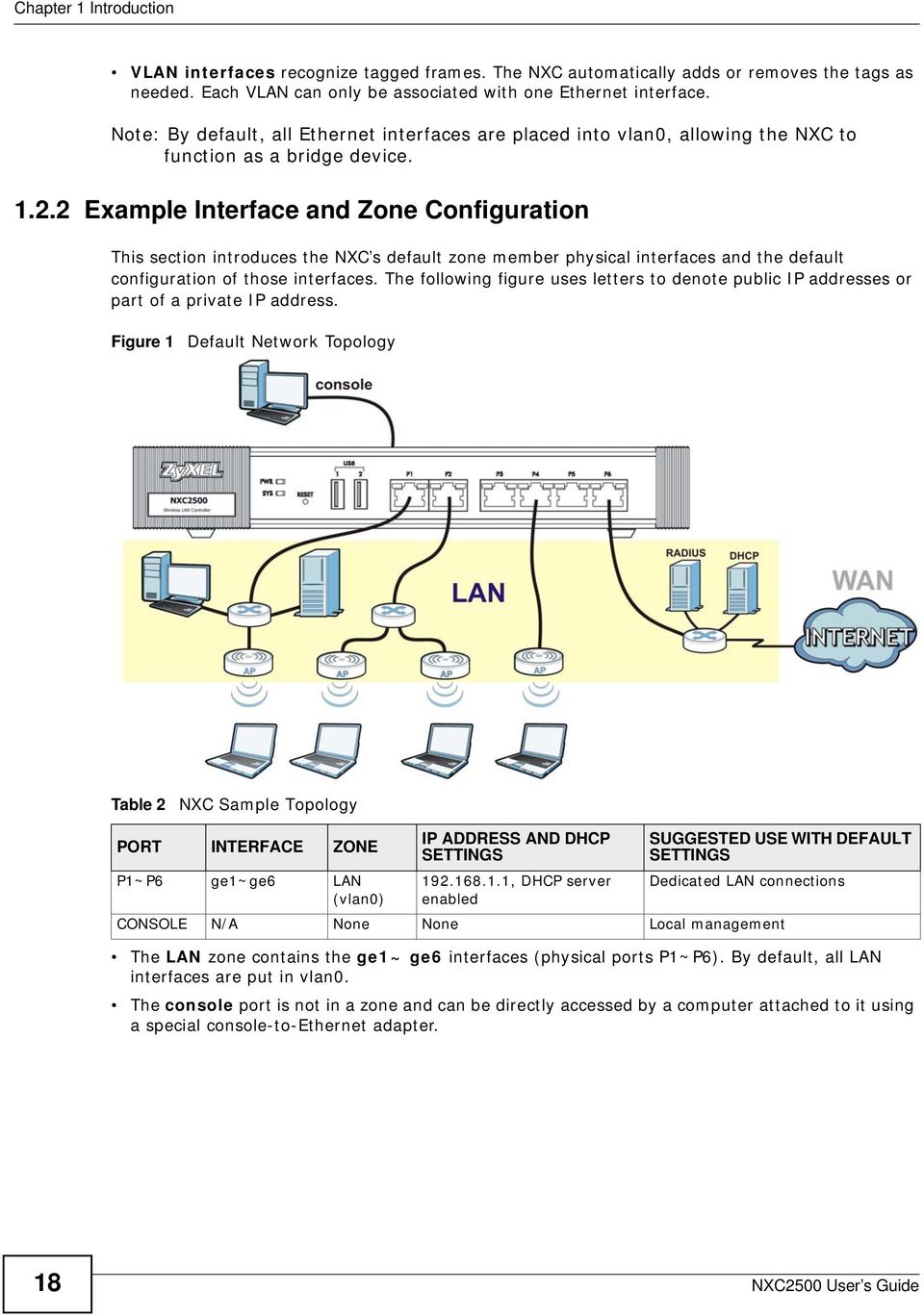
18 Chapter 1 Introduction VLAN interfaces recognize tagged frames. The NXC automatically adds or removes the tags as needed. Each VLAN can only be associated with one Ethernet interface. Note: By default, all Ethernet interfaces are placed into vlan0, allowing the NXC to function as a bridge device Example Interface and Zone Configuration This section introduces the NXC s default zone member physical interfaces and the default configuration of those interfaces. The following figure uses letters to denote public IP addresses or part of a private IP address. Figure 1 Default Network Topology Table 2 NXC Sample Topology PORT INTERFACE ZONE P1~P6 ge1~ge6 LAN (vlan0) IP ADDRESS AND DHCP SETTINGS , DHCP server enabled SUGGESTED USE WITH DEFAULT SETTINGS Dedicated LAN connections CONSOLE N/A None None Local management The LAN zone contains the ge1~ ge6 interfaces (physical ports P1~P6). By default, all LAN interfaces are put in vlan0. The console port is not in a zone and can be directly accessed by a computer attached to it using a special console-to-ethernet adapter. 18 NXC2500 User s Guide
19 Chapter 1 Introduction 1.3 Applications These are some example applications for your NXC AP Management Manage multiple separate Access Points (APs) from a single, persistent location. APs can also be configured to monitor for rogue APs. Figure 2 AP Management Example B C D A Here, the NXC (A) connects to a number of Power over Ethernet (PoE) devices (B). They connect to the managed Access Points (C), such as NWA5160N, NWA5550-N, NWA5560-N, NWA5121-NI or NWA5123-NI, which in turn provide access to the network for the wireless clients (D) within their broadcast radius Wireless Security Keep the connections between wireless clients and your APs secure with the NXC s comprehensive wireless security tools. APs can be configured to require WEP and WPA encryption from all wireless clients attempting to associate with them. Furthermore, you can protect your network by monitoring for rogue APs. Rogue APs are wireless access points operating in a network s coverage area that are not under the control of the network s administrators, and can potentially open up critical holes in a network s security policy. Note: Monitoring for rogue APs is not supported by the NWA5121-N, NWA5121-NI and NWA5123-NI when they are in managed AP mode. NXC2500 User s Guide 19

20 Chapter 1 Introduction Captive Portal The NXC can be configured with a captive portal, which intercepts all network traffic, regardless of address or port, until a connecting user authenticates his or her session, through a designated login Web page. Figure 3 Applications: Captive Portal The captive portal page only appears once per authentication session. Unless a session times out or a user closes the connection, he or she generally will not see it again during the same session Load Balancing With load balancing you can easily distribute wireless traffic across multiple APs to relieve strain on your network. When a station becomes overloaded, it can automatically delay a connection until the client associates with another network, or it can alternatively disassociate idle clients or those clients with weak connections from the network Dynamic Channel Selection The NXC can automatically select the radio channel upon which its APs broadcast by scanning the area around those APs and determining what channels are currently being used by other devices not connected to the network User-Aware Access Control Set up security policies that restrict access to sensitive information and shared resources based on the user who is trying to access it. 20 NXC2500 User s Guide

21 Chapter 1 Introduction 1.4 Management Overview You can use the following ways to manage the NXC. Web Configurator The Web Configurator allows easy NXC setup and management using an Internet browser. This User s Guide provides information about the Web Configurator. Command-Line Interface (CLI) The CLI allows you to use text-based commands to configure the NXC. You can access it using remote management (for example, SSH or Telnet) or via the physical or Web Configurator console port. See the Command Reference Guide for CLI details. The default settings for the console port are as follows: Table 3 Console Port Default Settings SETTING VALUE Speed bps Data Bits 8 Parity None Stop Bit 1 Flow Control Off 1.5 Object-based Configuration The NXC stores information or settings as objects. You use these objects to configure many of the NXC s features and settings. Once you configure an object, you can reuse it in configuring other features. When you change an object s settings, the NXC automatically updates all the settings or rules that use the object. You can create address objects based on an interface s IP address, subnet, or gateway. The NXC automatically updates every rule or setting that uses these objects whenever the interface s IP address settings change. For example, if you change an Ethernet interface s IP address, the NXC automatically updates the rules or settings that use the interface-based, LAN subnet address object. You can use the Configuration > Object screens to create objects before you configure features that use them. If you are in a screen that uses objects, you can also usually select Create new Object to be able to configure a new object. Use the Object Reference screen to see what objects are configured and which configuration settings reference specific objects. NXC2500 User s Guide 21
22 Chapter 1 Introduction 1.6 Starting and Stopping the NXC Here are some of the ways to start and stop the NXC. Always use Maintenance > Shutdown or the shutdown command before you turn off the NXC or remove the power. Not doing so can cause the firmware to become corrupt. Table 4 Starting and Stopping the NXC METHOD Turning on the power Rebooting the NXC Using the RESET button Clicking Maintenance > Shutdown > Shutdown or using the shutdown command Disconnecting the power A cold start occurs when you turn on the power to the NXC. The NXC powers up, checks the hardware, and starts the system processes. A warm start (without powering down and powering up again) occurs when you use the Reboot button in the Reboot screen or when you use the reboot command. The NXC writes all cached data to the local storage, stops the system processes, and then does a warm start. If you press the RESET button, the NXC sets the configuration to its default values and then reboots. Clicking Maintenance > Shutdown > Shutdown or using the shutdown command writes all cached data to the local storage and stops the system processes. Wait for the device to shut down and then manually turn off or remove the power. It does not turn off the power. Power off occurs when you turn off the power to the NXC. The NXC simply turns off. It does not stop the system processes or write cached data to local storage. The NXC does not stop or start the system processes when you apply configuration files or run shell scripts although you may temporarily lose access to network resources. 22 NXC2500 User s Guide
23 CHAPTER 2 Hardware Installation and Connection 2.1 Rack-mounted Installation Note: ZyXEL provides a sliding rail accessory for your use with your device. Please contact your local vendor for details. The NXC can be mounted on an EIA standard size, 19-inch rack or in a wiring closet with other equipment. Follow the steps below to mount your NXC on a standard EIA rack using a rackmounting kit. Make sure the rack will safely support the combined weight of all the equipment it contains and that the position of the NXC does not make the rack unstable or top-heavy. Take all necessary precautions to anchor the rack securely before installing the unit. Note: Leave 10 cm of clearance at the sides and 20 cm in the rear. Use a #2 Phillips screwdriver to install the screws. Note: Failure to use the proper screws may damage the unit Rack-Mounted Installation Procedure 1 Align one bracket with the holes on one side of the NXC and secure it with the included bracket screws (smaller than the rack-mounting screws). NXC2500 User s Guide 23
24 Chapter 2 Hardware Installation and Connection 2 Attach the other bracket in a similar fashion. 24 NXC2500 User s Guide
25 Chapter 2 Hardware Installation and Connection 3 After attaching both mounting brackets, position the NXC in the rack by lining up the holes in the brackets with the appropriate holes on the rack. Secure the NXC to the rack with the rack-mounting screws. 2.2 Front Panel This section gives you an overview of the front panel. Figure 4 NXC Front Panel 1000Base-T Ports The 1000Base-T auto-negotiating, auto-crossover Ethernet ports support 100/1000 Mbps Gigabit Ethernet so the speed can be 100 Mbps or 1000 Mbps. The duplex mode can be both half or full duplex at 100 Mbps and full duplex only at 1000 Mbps. An auto-negotiating port can detect and NXC2500 User s Guide 25
26 Chapter 2 Hardware Installation and Connection adjust to the optimum Ethernet speed (100/1000 Mbps) and duplex mode (full duplex or half duplex) of the connected device. An auto-crossover (auto-mdi/mdi-x) port automatically works with a straight-through or crossover Ethernet cable. Default Ethernet Settings The factory default negotiation settings for the Ethernet ports on the NXC are: Speed: Auto Duplex: Auto Flow control: On (you cannot configure the flow control setting, but the NXC can negotiate with the peer and turn it off if needed) USB 2.0 Ports Connect a USB storage device to a USB port on the NXC to archive the NXC system logs or save the NXC operating system core dump to it Front Panel LEDs The following table describes the front panel LEDs. Table 5 Front Panel LEDs LED COLOR STATUS PWR Off The NXC is turned off. Green On The NXC is turned on. Red On There is a hardware component failure. Shut down the device, wait for a few minutes and then restart the device (see Section 1.6 on page 22). If the LED turns red again, then please contact your vendor. SYS Green Off The NXC is not ready or has failed. On The NXC is ready and running. Blinking The NXC is booting. Red On The NXC had an error or has failed. P1~P6 Green On This port has a successful link to a 10/100 Mbps Ethernet network Blinking The NXC is sending or receiving packets to/from a 10/100 Mbps Ethernet network on this port Orange On This port has a successful link to a 1000 Mbps Ethernet network. Blinking The NXC is sending or receiving packets to/from a 1000 Mbps Ethernet network on this port Off There is no connection on this port. 26 NXC2500 User s Guide
27 Chapter 2 Hardware Installation and Connection 2.3 Rear Panel The rear panel contains a console port, a power switch and a connector for the power receptacle. Figure 5 NXC Rear Panel Console Port Connect this port to your computer (using an RS-232 cable) if you want to configure the NXC using the command line interface (CLI) via the console port. For local management, you can use a computer with terminal emulation software configured to the following parameters: VT100 terminal emulation bps No parity, 8 data bits, 1 stop bit No flow control Connect the male 9-pin end of the RS-232 console cable to the console port of the NXC. Connect the female end to a serial port (COM1, COM2 or other COM port) of your computer. NXC2500 User s Guide 27
28 Chapter 2 Hardware Installation and Connection 28 NXC2500 User s Guide
29 CHAPTER 3 The Web Configurator 3.1 Overview The NXC Web Configurator allows easy management using an Internet browser. In order to use the Web Configurator, you must: Use Internet Explorer 7.0 and later or Firefox 1.5 and later Allow pop-up windows Enable JavaScript (enabled by default) Enable Java permissions (enabled by default) Enable cookies The recommended screen resolution is 1024 x 768 pixels and higher. 3.2 Access 1 Make sure your NXC hardware is properly connected. See the Quick Start Guide. 2 Browse to The Login screen appears. 3 Enter the user name (default: admin ) and password (default: 1234 ). NXC2500 User s Guide 29
30 Chapter 3 The Web Configurator 4 Click Login. If you logged in using the default user name and password, the Update Admin Info screen appears. Otherwise, the dashboard appears. This screen appears every time you log in using the default user name and default password. If you change the password for the default user account, this screen does not appear anymore. 30 NXC2500 User s Guide
31 Chapter 3 The Web Configurator 3.3 The Main Screen The Web Configurator s main screen is divided into these parts: Figure 6 The Web Configurator s Main Screen A B C Title Bar A - Title Bar B - Navigation Panel C - Main Window The title bar provides some useful links that always appear over the screens below, regardless of how deep into the Web Configurator you navigate. Figure 7 Title Bar The icons provide the following functions. Table 6 Title Bar: Web Configurator Icons Logout Click this to log out of the Web Configurator. Help Click this to open the help page for the current screen. NXC2500 User s Guide 31
32 Chapter 3 The Web Configurator Table 6 Title Bar: Web Configurator Icons (continued) About Site Map Object Reference Console CLI Click this to display basic information about the NXC. Click this to see an overview of links to the Web Configurator screens. Click this to open a screen where you can check which configuration items reference an object. Click this to open the console in which you can use the command line interface (CLI). See the NXC CLI Reference Guide for details. Click this to open a popup window that displays the CLI commands sent by the Web Configurator. About Click About to display basic information about the NXC. Figure 8 About The following table describes labels that can appear in this screen. Table 7 About Boot Module Current Version Released Date OK This shows the version number of the software that handles the booting process of the NXC. This shows the firmware version of the NXC. This shows the date (yyyy-mm-dd) and time (hh:mm:ss) when the firmware is released. Click this to close the screen. 32 NXC2500 User s Guide
33 Chapter 3 The Web Configurator Site Map Click Site MAP to see an overview of links to the Web Configurator screens. Click a screen s link to go to that screen. Figure 9 Site Map Object Reference Click Object Reference to open the Object Reference screen. Select the type of object and the individual object and click Refresh to show which configuration settings reference the object. Figure 10 Object Reference NXC2500 User s Guide 33
34 Chapter 3 The Web Configurator The fields vary with the type of object. The following table describes labels that can appear in this screen. Table 8 Object References Object Name This identifies the object for which the configuration settings that use it are displayed. Click the object s name to display the object s configuration screen in the main window. # This field is a sequential value, and it is not associated with any entry. Service This is the type of setting that references the selected object. Click a service s name to display the service s configuration screen in the main window. Priority If it is applicable, this field lists the referencing configuration item s position in its list, otherwise N/A displays. Name This field identifies the configuration item that references the object. Description If the referencing configuration item has a description configured, it displays here. Refresh Click this to update the information in this screen. Cancel Click Cancel to close the screen. Console The Console allows you to use CLI commands from directly within the Web Configurator rather than having to use a separate terminal program. In addition to logging in directly to the NXC s CLI, you can also log into other devices on the network through this Console. It uses SSH to establish a connection. Note: To view the functions in the Web Configurator user interface that correspond directly to specific NXC CLI commands, use the CLI Messages window (see Section on page 37) in tandem with this one. Figure 11 Console 34 NXC2500 User s Guide
35 Chapter 3 The Web Configurator The following table describes the elements in this screen. Table 9 Console Command Line Enter commands for the device that you are currently logged into here. If you are logged into the NXC, see the CLI Reference Guide for details on using the command line to configure it. Device IP Address This is the IP address of the device that you are currently logged into. Logged-In User This displays the username of the account currently logged into the NXC through the Console Window. Note: You can log into the Web Configurator with a different account than used to log into the NXC through the Console. Connection Status This displays the connection status of the account currently logged in. If you are logged in and connected, then this displays Connected. If you lose the connection, get disconnected, or logout, then this displays Not Connected. Tx/RX Activity Monitor This displays the current upload / download activity. The faster and more frequently an LED flashes, the faster the data connection. Before you use the Console, ensure that: Your web browser of choice allows pop-up windows from the IP address assigned to your NXC. Your web browser allows Java programs. You are using the latest version of the Java program ( To login in through the Console: 1 Click the Console button on the Web Configurator title bar. NXC2500 User s Guide 35
36 Chapter 3 The Web Configurator 2 Enter the IP address of the NXC and click OK. 3 Next, enter the User Name of the account being used to log into your target device and then click OK. 4 You may be prompted to authenticate your account password, depending on the type of device that you are logging into. Enter the password and click OK. 36 NXC2500 User s Guide
37 Chapter 3 The Web Configurator 5 If your login is successful, the command line appears and the status bar at the bottom of the Console updates to reflect your connection state. CLI Messages Click CLI to look at the CLI commands sent by the Web Configurator. These commands appear in a popup window, such as the following. Figure 12 CLI Messages Click Clear to remove the currently displayed information. See the Command Reference Guide for information about the commands. NXC2500 User s Guide 37
38 Chapter 3 The Web Configurator Navigation Panel Use the menu items on the navigation panel to open screens to configure NXC features. Click the arrow in the middle of the right edge of the navigation panel to hide the navigation panel menus or drag it to resize them. The following sections introduce the NXC s navigation panel menus and their screens. Figure 13 Navigation Panel Dashboard The dashboard displays general device information, system status, system resource usage, licensed service status, and interface status in widgets that you can re-arrange to suit your needs. For details on the Dashboard s features, see Chapter 4 on page Monitor Menu The monitor menu screens display status and statistics information. Table 10 Monitor Menu Screens Summary FOLDER OR LINK TAB FUNCTION System Status Port Statistics Interface Status Traffic Statistics Session Monitor IP/MAC Binding Login Users Dynamic Guest USB Storage Wireless Display packet statistics for each physical port. Display general interface information and packet statistics. Collect and display traffic statistics. Display the status of all current sessions. List the devices that have received an IP address from NXC interfaces using IP/MAC binding. List the users currently logged into the NXC. List the dynamic guest accounts in the NXC s local database. Display details about a USB device connected to the NXC. AP Information AP List Display information about the connected APs. 38 NXC2500 User s Guide
39 Chapter 3 The Web Configurator Table 10 Monitor Menu Screens Summary (continued) FOLDER OR LINK TAB FUNCTION Station Info Rogue AP Configuration Menu Radio List Detected Device Display information about the radios of the connected APs. Display information about the connected stations. Display information about suspected rogue APs. Log View Log List log entries for the NXC. View AP Log Allow you to query connected APs and view log entries for them. Use the configuration menu screens to configure the NXC s features. Table 11 Configuration Menu Screens Summary FOLDER OR LINK TAB FUNCTION Licensing Registration Registration Register the device. Wireless Service View the licensed service status and upgrade licensed services. Controller Configuration Configure how the NXC handles APs that newly connect to the network. AP Management Mgnt. AP List Edit wireless AP information, remove APs, and reboot them. MON Mode Load Balancing DCS Network Rogue/Friendly AP List Configure how the NXC monitors for rogue APs. Configure load balancing for traffic moving to and from wireless clients. Configure dynamic wireless channel selection. Interface Ethernet Manage Ethernet interfaces and virtual Ethernet interfaces. VLAN Create and manage VLAN interfaces and virtual VLAN interfaces. Routing Policy Route Create and manage routing policies. Zone NAT ALG Static Route Create and manage IP static routing information. Configure zones used to define various policies. Set up and manage port forwarding rules. Configure SIP, H.323, and FTP pass-through settings. IP/MAC Binding Summary Configure IP to MAC address bindings for devices connected to each supported interface. Exempt List Configure ranges of IP addresses to which the NXC does not apply IP/MAC binding. Captive Portal Captive Portal Assign the captive portal web page to various network services. Object Login Page Assign and customize the login page user s see when they hit the captive portal. NXC2500 User s Guide 39
40 Chapter 3 The Web Configurator Table 11 Configuration Menu Screens Summary (continued) FOLDER OR LINK TAB FUNCTION User/Group User Create and manage users. Group Setting MAC Address Create and manage groups of users. Manage default settings for all users, general settings for user sessions, and rules to force user authentication. Map wireless client MAC addresses to MAC roles (MAC address user accounts). AP Profile Radio Create and manage wireless radio settings files that can be associated with different APs. MON Profile SSID Create and manage wireless SSID, security, and MAC filtering settings files that can be associated with different APs. Create and manage rogue AP monitoring files that can be associated with different APs. Address Address Create and manage host, range, and network (subnet) addresses. Address Group Create and manage groups of addresses. Service Service Create and manage TCP and UDP services. Schedule Service Group Create and manage groups of services. Create one-time and recurring schedules. AAA Server Active Directory Configure the default Active Directory settings. Auth. Method LDAP RADIUS Configure the default LDAP settings. Configure the default RADIUS settings. Create and manage ways of authenticating users. Certificate My Certificates Create and manage the NXC s certificates. System Host Name Trusted Certificates Import and manage certificates from trusted sources. Configure the system and domain name for the NXC. USB Storage Settings Configure the settings for the connected USB devices. Date/Time Console Speed DNS WWW SSH TELNET FTP SNMP Auth. Server Language Log & Report Daily Report Log Settings Configure the current date, time, and time zone in the NXC. Set the console speed. Configure the DNS server and address records for the NXC. Configure HTTP, HTTPS, and general authentication. Configure SSH server and SSH service settings. Configure telnet server settings for the NXC. Configure FTP server settings. Configure SNMP communities and services. Configure the NXC to act as a RADIUS server. Select the Web Configurator language. Configure where and how to send daily reports and what reports to send. Configure the system log, logs, and remote syslog servers. 40 NXC2500 User s Guide
41 Chapter 3 The Web Configurator Maintenance Menu Use the maintenance menu screens to manage configuration and firmware files, run diagnostics, and reboot or shut down the NXC. Table 12 Maintenance Menu Screens Summary FOLDER OR LINK TAB FUNCTION File Manager Configuration File Manage and upload configuration files for the NXC. Firmware Package Shell Script View the current firmware version and to upload firmware. Manage and run shell script files for the NXC. Diagnostics Diagnostic Collect diagnostic information. Packet Flow Explore Reboot Shutdown Packet Capture Core Dump System Log Wireless Frame Capture Routing Status SNAT Status Capture packets for analysis. Connect a USB device to the NXC and save the NXC operating system kernel to it here. Connect a USB device to the NXC and archive the NXC system logs to it here. Capture wireless frames from APs for analysis. Check how the NXC determines where to route a packet. View a clear picture on how the NXC converts a packet s source IP address and check the related settings. Restart the NXC. Turn off the NXC Warning Messages Warning messages, such as those resulting from misconfiguration, display in a popup window. Figure 14 Warning Message Tables and Lists The Web Configurator tables and lists are quite flexible and provide several options for how to display their entries. Manipulating Table Display Here are some of the ways you can manipulate the Web Configurator tables. NXC2500 User s Guide 41
42 Chapter 3 The Web Configurator 1 Click a column heading to sort the table s entries according to that column s criteria. 2 Click the down arrow next to a column heading for more options about how to display the entries. The options available vary depending on the type of fields in the column. Here are some examples of what you can do: Sort in ascending alphabetical order Sort in descending (reverse) alphabetical order Select which columns to display Group entries by field Show entries in groups Filter by mathematical operators (<, >, or =) or searching for text. 42 NXC2500 User s Guide
43 Chapter 3 The Web Configurator 3 Select a column heading cell s right border and drag to re-size the column. 4 Select a column heading and drag and drop it to change the column order. A green check mark displays next to the column s title when you drag the column to a valid new location. NXC2500 User s Guide 43
44 Chapter 3 The Web Configurator 5 Use the icons and fields at the bottom of the table to navigate to different pages of entries and control how many entries display at a time. Working with Table Entries The tables have icons for working with table entries. A sample is shown next. You can often use the [Shift] or [Ctrl] key to select multiple entries to remove, activate, or deactivate. Table 13 Common Table Icons Here are descriptions for the most common table icons. Table 14 Common Table Icons Add Edit Remove Activate Inactivate Click this to create a new entry. For features where the entry s position in the numbered list is important (features where the NXC applies the table s entries in order), you can select an entry and click Add to create a new entry after the selected entry. Double-click an entry or select it and click Edit to open a screen where you can modify the entry s settings. In some tables you can just click a table entry and edit it directly in the table. For those types of tables small red triangles display for table entries with changes that you have not yet applied. To remove an entry, select it and click Remove. The NXC confirms you want to remove it before doing so. To turn on an entry, select it and click Activate. To turn off an entry, select it and click Inactivate. 44 NXC2500 User s Guide
45 Chapter 3 The Web Configurator Table 14 Common Table Icons (continued) Object Reference Move Select an entry and click Object Reference to open a screen that shows which settings use the entry. To change an entry s position in a numbered list, select it and click Move to display a field to type a number for where you want to put that entry and press [ENTER] to move the entry to the number that you typed. For example, if you type 6, the entry you are moving becomes number 6 and the previous entry 6 (if there is one) gets pushed up (or down) one. Working with Lists When a list of available entries displays next to a list of selected entries, you can often just doubleclick an entry to move it from one list to the other. In some lists you can also use the [Shift] or [Ctrl] key to select multiple entries, and then use the arrow button to move them to the other list. Figure 15 Working with Lists NXC2500 User s Guide 45
46 Chapter 3 The Web Configurator 46 NXC2500 User s Guide
47 PART II Technical Reference 47
48 48
49 CHAPTER 4 Dashboard 4.1 Overview Use the Dashboard screens to check status information about the NXC What You Can Do in this Chapter The main Dashboard screen (Section 4.2 on page 50) displays the NXC s general device information, system status, system resource usage, licensed service status, and interface status. You can also display other status screens for more information. The DHCP Table screen (Section on page 57) displays the IP addresses currently assigned to DHCP clients and the IP addresses reserved for specific MAC addresses. The Number of Login Users screen (Section on page 58) displays the users currently logged into the NXC. NXC2500 User s Guide 49
50 Chapter 4 Dashboard 4.2 Dashboard This screen is the first thing you see when you log into the NXC. It also appears every time you click the Dashboard icon in the navigation panel. The Dashboard displays general device information, system status, system resource usage, licensed service status, and interface status in widgets that you can re-arrange to suit your needs. You can also collapse, refresh, and close individual widgets. Figure 16 Dashboard A B C D E 50 NXC2500 User s Guide
51 Chapter 4 Dashboard The following table describes the labels in this screen. Table 15 Dashboard Widget Settings (A) Arrow (B) Refresh Time Setting (C) Refresh Now (D) Close Widget (E) Virtual Device Use this link to re-open closed widgets. Widgets that are already open appear grayed out. Click this to collapse or expand a widget. Set the interval for refreshing the information displayed in the widget. Click this to update the widget s information immediately. Click this to close the widget. Use Widget Settings to re-open it. Hover your cursor over a LED or connected Ethernet port to view details about the status of the NXC s LEDs and connections. See Section on page 26 for LED descriptions. An unconnected interface appears grayed out. The following labels display when you hover your cursor over a connected interface. Name Status This field displays the name of the interface or slot. This field displays the current status of each interface or device installed in a slot. The possible values depend on what type of interface it is. Inactive - The Ethernet interface is disabled. Down - The Ethernet interface is enabled but not connected. Speed / Duplex - The Ethernet interface is enabled and connected. This field displays the port speed and duplex setting (Full or Half). Zone IP Address/Mask Device Information System Name Model Name Serial Number MAC Address Range Firmware Version System Resources CPU Usage Memory Usage Flash Usage USB Storage Usage Active Sessions This field displays the zone to which the interface is currently assigned. This field displays the current IP address and subnet mask assigned to the interface. This field displays the name used to identify the NXC on any network. Click the link to open the screen where you can change it. This field displays the model name of this NXC. This field displays the serial number of this NXC. This field displays the MAC addresses used by the NXC. Each physical port has one MAC address. The first MAC address is assigned to physical port 1, the second MAC address is assigned to physical port 2, and so on. This field displays the version number and date of the firmware the NXC is currently running. Click the link to open the screen where you can upload firmware. This field displays what percentage of the NXC s processing capability is currently being used. Hover your cursor over this field to display the Show CPU Usage icon that takes you to a chart of the NXC s recent CPU usage. This field displays what percentage of the NXC s RAM is currently being used. Hover your cursor over this field to display the Show Memory Usage icon that takes you to a chart of the NXC s recent memory usage. This field displays what percentage of the NXC s onboard flash memory is currently being used. This field shows how much storage in the USB device connected to the NXC is in use. This field displays how many traffic sessions are currently open on the NXC. These are the sessions that are traversing the NXC. Hover your cursor over this field to display icons. Click the Detail icon to go to the Session Monitor screen to see details about the active sessions. Click the Show Active Sessions icon to display a chart of NXC s recent session usage. NXC2500 User s Guide 51
52 Chapter 4 Dashboard Table 15 Dashboard (continued) Interface Status Summary Name Status This field displays the name of each interface. This field displays the current status of each interface. The possible values depend on what type of interface it is. Inactive - The Ethernet interface is disabled. Down - The Ethernet interface is enabled but not connected. Speed / Duplex - The Ethernet interface is enabled and connected. This field displays the port speed and duplex setting (Full or Half). Zone IP Addr/ Netmask IP Assignment This field displays the zone to which the interface is currently assigned. This field displays the current IP address and subnet mask assigned to the interface. If the IP address is , the interface is disabled or did not receive an IP address and subnet mask via DHCP. This field displays how the interface gets its IP address. Static - This interface has a static IP address. DHCP Client - This interface gets its IP address from a DHCP server. Action Use this field to get or to update the IP address for the interface. Click Renew to send a new DHCP request to a DHCP server. System Status System Uptime Current Date/ Time DHCP Table Current Login User Number of Login Users Boot Status This field displays how long the NXC has been running since it last restarted or was turned on. This field displays the current date and time in the NXC. The format is yyyy-mm-dd hh:mm:ss. Click the icon to open the screen where you can configure the NXC s date and time. This field displays the number of IP addresses the NXC has assigned via DHCP. Click this to look at the IP addresses currently assigned to the NXC s DHCP clients and the IP addresses reserved for specific MAC addresses. This field displays the user name used to log in to the current session, the amount of reauthentication time remaining, and the amount of lease time remaining. This field displays the number of users currently logged in to the NXC. Click the link to pop-open a list of the users who are currently logged in to the NXC. This field displays details about the NXC s startup state. OK - The NXC started up successfully. Firmware update OK - A firmware update was successful. Problematic configuration after firmware update - The application of the configuration failed after a firmware upgrade. System default configuration - The NXC successfully applied the system default configuration. This occurs when the NXC starts for the first time or you intentionally reset the NXC to the system default settings. Fallback to lastgood configuration - The NXC was unable to apply the startupconfig.conf configuration file and fell back to the lastgood.conf configuration file. Fallback to system default configuration - The NXC was unable to apply the lastgood.conf configuration file and fell back to the system default configuration file (system-default.conf). Booting in progress - The NXC is still applying the system configuration. 52 NXC2500 User s Guide
53 Chapter 4 Dashboard Table 15 Dashboard (continued) AP Information All AP Online Management AP Offline Management AP Un-Management AP All Station Station All Sensed Device This shows a summary of connected wireless Access Points (APs). This section displays a summary for all connected wireless APs. Click the link to go to the AP information > AP List screen. This displays the number of currently connected management APs. This displays the number of currently offline managed APs. This displays the number of non-managed APs. This section displays a summary of connected stations. Click the link to go to the Station Info > Station List screen. This displays the number of stations currently connected to the network. This sections displays a summary of all wireless devices detected by the network. Click the link to go to the Rogue AP > Detected Device screen. This displays the number of detected unclassified APs. This displays the number of detected rogue APs. This displays the number of detected friendly APs. Un-Classified AP Rogue AP Friendly AP Licensed Service Status # This shows how many licensed services there are. Status This is the current status of the license. Name This identifies the licensed service. Version This is the version number of the service. Expiration The Latest Alert Logs If the service license is valid, this shows when it will expire. N/A displays if the service license does not have a limited period of validity. This section of the screen displays recent logs generated by the NXC. # This is the entry s rank in the list of alert logs. Time This field displays the date and time the log was created. Priority This field displays the severity of the log. Category This field displays the type of log generated. Message This field displays the actual log message. Source This field displays the source address (if any) in the packet that generated the log. Destination This field displays the destination address (if any) in the packet that generated the log. Extension Slot This section of the screen displays the status of the USB ports. # This field displays how many USB ports there are. Extension Slot This field displays the name of each extension slot. Device This field displays the name of the device connected to the extension slot (or none if no device is detected). Status Ready - A USB storage device connected to the NXC is ready for the NXC to use. none - The NXC is unable to mount a USB storage device connected to the NXC. Top 5 Station Displays the top 5 Access Points (AP) with the highest number of station (aka wireless client) connections. # This field displays the rank of the station. AP MAC This field displays the MAC address of the AP to which the station belongs. NXC2500 User s Guide 53
54 Chapter 4 Dashboard Table 15 Dashboard (continued) Max. Station Count AP Description This field displays the maximum number of wireless clients that have connected to this AP. This field displays the AP s description. The default description is AP- followed by the AP s MAC address CPU Usage Use this screen to look at a chart of the NXC s recent CPU usage. To access this screen, click Show CPU Usage in the dashboard. Figure 17 Dashboard > CPU Usage The following table describes the labels in this screen. Table 16 Dashboard > CPU Usage The y-axis represents the percentage of CPU usage. The x-axis shows the time period over which the CPU usage occurred Refresh Interval Enter how often you want this window to be automatically updated. Refresh Now Click this to update the information in the window right away. 54 NXC2500 User s Guide
55 Chapter 4 Dashboard Memory Usage Use this screen to look at a chart of the NXC s recent memory (RAM) usage. To access this screen, click Show Memory Usage in the dashboard. Figure 18 Dashboard > Memory Usage The following table describes the labels in this screen. Table 17 Dashboard > Memory Usage The y-axis represents the percentage of RAM usage. The x-axis shows the time period over which the RAM usage occurred Refresh Interval Enter how often you want this window to be automatically updated. Refresh Now Click this to update the information in the window right away. NXC2500 User s Guide 55
56 Chapter 4 Dashboard Session Usage Use this screen to look at a chart of the NXC s recent traffic session usage. To access this screen, click Show Active Sessions in the dashboard. Figure 19 Dashboard > Session Usage The following table describes the labels in this screen. Table 18 Dashboard > Session Usage Sessions The y-axis represents the number of session. The x-axis shows the time period over which the session usage occurred Refresh Interval Enter how often you want this window to be automatically updated. Refresh Now Click this to update the information in the window right away. 56 NXC2500 User s Guide
57 Chapter 4 Dashboard DHCP Table Use this screen to look at the IP addresses currently assigned to DHCP clients and the IP addresses reserved for specific MAC addresses. To access this screen, click the icon beside DHCP Table in the dashboard. Figure 20 Dashboard > DHCP Table The following table describes the labels in this screen. Table 19 Dashboard > DHCP Table # This field is a sequential value, and it is not associated with a specific entry. Interface This field identifies the interface that assigned an IP address to a DHCP client. IP Address This field displays the IP address currently assigned to a DHCP client or reserved for a specific MAC address. Click the column s heading cell to sort the table entries by IP address. Click the heading cell again to reverse the sort order. Host Name This field displays the name used to identify this device on the network (the computer name). The NXC learns these from the DHCP client requests. None shows here for a static DHCP entry. MAC Address This field displays the MAC address to which the IP address is currently assigned or for which the IP address is reserved. Click the column s heading cell to sort the table entries by MAC address. Click the heading cell again to reverse the sort order. Description Reserve For a static DHCP entry, the host name or the description you configured shows here. This field is blank for dynamic DHCP entries. If this field is selected, this entry is a static DHCP entry. The IP address is reserved for the MAC address. If this field is clear, this entry is a dynamic DHCP entry. The IP address is assigned to a DHCP client. To create a static DHCP entry using an existing dynamic DHCP entry, select this field. To remove a static DHCP entry, clear this field. NXC2500 User s Guide 57
58 Chapter 4 Dashboard Number of Login Users Use this screen to look at a list of the users currently logged into the NXC. To access this screen, click the dashboard s Number of Login Users icon. Figure 21 Dashboard > Number of Login Users The following table describes the labels in this screen. Table 20 Dashboard > Number of Login Users # This field is a sequential value and is not associated with any entry. User ID This field displays the user name of each user who is currently logged in to the NXC. Reauth Lease T. This field displays the amount of reauthentication time remaining and the amount of lease time remaining for each user. Type This field displays the way the user logged in to the NXC. IP address This field displays the IP address of the computer used to log in to the NXC. User Info This field displays the types and user names of user accounts the NXC uses. If the user type is ext-user (external user), this field will show its external-group information when you move your mouse over it. If the external user matches two externalgroup objects, both external-group object names will be shown. Force Logout Click this icon to end a user s session. 58 NXC2500 User s Guide
59 CHAPTER 5 Monitor 5.1 Overview Use the Monitor screens to check status and statistics information What You Can Do in this Chapter The Port Statistics screen (Section 5.3 on page 60) displays packet statistics for each physical port. The Port Statistics Graph screen (Section on page 62) displays a line graph of packet statistics for each physical port. The Interface Status screen (Section 5.4 on page 63) displays all of the NXC s interfaces and their packet statistics. The Traffic Statistics screen (Section 5.5 on page 64) allows you to start or stop data collection and view statistics. The Session Monitor screen (Section 5.6 on page 67) displays sessions by user or service. The IP/MAC Binding screen (Section 5.7 on page 69) displays lists of the devices that have received an IP address from NXC interfaces with IP/MAC binding enabled. The Login Users screen (Section 5.8 on page 70) displays a list of the users currently logged into the NXC. The Dynamic Guest screen (Section 5.9 on page 70) displays a list of the guest user accounts, which are created automatically and allowed to access the NXC s services for a certain period of time. The USB Storage screen (Section 5.10 on page 71) displays information about a connected USB storage device. The AP List screen (Section 5.11 on page 73) displays which APs are currently connected to the NXC. The Radio List screen (Section 5.12 on page 75) displays statistics about the wireless radio transmitters in each of the APs connected to the NXC. The Station List screen (Section 5.13 on page 78) displays statistics pertaining to the connected stations (or wireless clients ). The Detected Device screen (Section 5.14 on page 79) displays the wireless devices passively detected by the NXC.. The View Log screen (Section 5.15 on page 80) displays the NXC s current log messages. You can change the way the log is displayed, you can the log, and you can also clear the log in this screen. The View AP Log screen (Section 5.16 on page 83) displays the NXC s current wireless AP log messages. NXC2500 User s Guide 59
60 Chapter 5 Monitor 5.2 What You Need to Know The following terms and concepts may help as you read through the chapter. Rogue AP Rogue APs are wireless access points operating in a network s coverage area that are not under the control of the network s administrators, and can open up holes in a network s security. See Chapter 17 on page 203 for details. Friendly AP Friendly APs are other wireless access points that are detected in your network, as well as any others that you know are not a threat (those from neighboring networks, for example). See Chapter 17 on page 203 for details. 5.3 Port Statistics Use this screen to look at packet statistics for each Gigabit Ethernet port. To access this screen, click Monitor > System Status > Port Statistics. Figure 22 Monitor > System Status > Port Statistics The following table describes the labels in this screen. Table 21 Monitor > System Status > Port Statistics Poll Interval Set Interval Stop Switch to Graphic View Enter how often you want this window to be updated automatically, and click Set Interval. Click this to set the Poll Interval the screen uses. Click this to stop the window from updating automatically. You can start it again by setting the Poll Interval and clicking Set Interval. Click this to display the port statistics as a line graph. 60 NXC2500 User s Guide
61 Chapter 5 Monitor Table 21 Monitor > System Status > Port Statistics (continued) # This field displays the port s number in the list. Port This field displays the physical port number. Status This field displays the current status of the physical port. Down - The physical port is not connected. Speed / Duplex - The physical port is connected. This field displays the port speed and duplex setting (Full or Half). TxPkts RxPkts Collisions Tx B/s Rx B/s Up Time System Up Time This field displays the number of packets transmitted from the NXC on the physical port since it was last connected. This field displays the number of packets received by the NXC on the physical port since it was last connected. This field displays the number of collisions on the physical port since it was last connected. This field displays the transmission speed, in bytes per second, on the physical port in the one-second interval before the screen updated. This field displays the reception speed, in bytes per second, on the physical port in the one-second interval before the screen updated. This field displays how long the physical port has been connected. This field displays how long the NXC has been running since it last restarted or was turned on. NXC2500 User s Guide 61
62 Chapter 5 Monitor Port Statistics Graph Use the port statistics graph to look at a line graph of packet statistics for each physical port. To view, click Monitor > System Status > Port Statistics and then the Switch to Graphic View Button. Figure 23 Monitor > System Status > Port Statistics > Switch to Graphic View The following table describes the labels in this screen. Table 22 Monitor > System Status > Port Statistics > Switch to Graphic View Refresh Interval Refresh Now Port Selection Switch to Grid View Mbps time TX RX Last Update Enter how often you want this window to be automatically updated. Click this to update the information in the window right away. Select the number of the physical port for which you want to display graphics. Click this to display the port statistics as a table. The y-axis represents the speed of transmission or reception. The x-axis shows the time period over which the transmission or reception occurred This line represents traffic transmitted from the NXC on the physical port since it was last connected. This line represents the traffic received by the NXC on the physical port since it was last connected. This field displays the date and time the information in the window was last updated. 62 NXC2500 User s Guide
63 Chapter 5 Monitor 5.4 Interface Status This screen lists all of the NXC s interfaces and gives packet statistics for them. Click Monitor > System Status > Interface Status to access this screen. Figure 24 Monitor > System Status > Interface Status Each field is described in the following table. Table 23 Monitor > System Status > Interface Status Interface Status Name Port Status If an Ethernet interface does not have any physical ports associated with it, its entry is displayed in light gray text. This field displays the name of each interface. This field displays the physical port number. This field displays the current status of each interface. The possible values depend on what type of interface it is. For Ethernet interfaces: Inactive - The Ethernet interface is disabled. Down - The Ethernet interface is enabled but not connected. Speed / Duplex - The Ethernet interface is enabled and connected. This field displays the port speed and duplex setting (Full or Half). For VLAN interfaces: Up - The VLAN interface is enabled and one of its member Ethernet interfaces is connected. Down - The VLAN interface is enabled but none of its member Ethernet interfaces is connected. Inactive - The VLAN interface is disabled. NXC2500 User s Guide 63
64 Chapter 5 Monitor Table 23 Monitor > System Status > Interface Status (continued) Zone IP Addr/Netmask IP Assignment This field displays the zone to which the interface is assigned. This field displays the current IP address and subnet mask assigned to the interface. If the IP address and subnet mask are , the interface is disabled or did not receive an IP address and subnet mask via DHCP. This field displays how the interface gets its IP address. Static - This interface has a static IP address. DHCP Client - This interface gets its IP address from a DHCP server. Services Action Interface Statistics Refresh Name Status This field lists which services the interface provides to the network. Examples include DHCP relay and DHCP server. This field displays n/a if the interface does not provide any services to the network. Use this field to get or to update the IP address for the interface. Click Renew to send a new DHCP request to a DHCP server. Click Connect to try to connect the interface. If the interface cannot use one of these ways to get or to update its IP address, this field displays n/a. This table provides packet statistics for each interface. Click this button to update the information in the screen. This field displays the name of each interface. This field displays the current status of each interface. The possible values depend on what type of interface it is. For Ethernet interfaces: Inactive - The Ethernet interface is disabled. Down - The Ethernet interface is enabled but not connected. Speed / Duplex - The Ethernet interface is enabled and connected. This field displays the port speed and duplex setting (Full or Half). For VLAN interfaces: Up - The VLAN interface is enabled and one of its member Ethernet interfaces is connected. Down - The VLAN interface is enabled but none of its member Ethernet interfaces is connected. Inactive - The VLAN interface is disabled. TxPkts RxPkts Tx B/s Rx B/s This field displays the number of packets transmitted from the NXC on the interface since it was last connected. This field displays the number of packets received by the NXC on the interface since it was last connected. This field displays the transmission speed, in bytes per second, on the interface in the onesecond interval before the screen updated. This field displays the reception speed, in bytes per second, on the interface in the onesecond interval before the screen updated. 5.5 Traffic Statistics Click Monitor > System Status > Traffic Statistics to display this screen. This screen provides basic information about the different kinds of data traffic moving through the NXC. For example: 64 NXC2500 User s Guide
65 Chapter 5 Monitor Most-visited Web sites and the number of times each one was visited. This count may not be accurate in some cases because the NXC counts HTTP GET packets. Most-used protocols or service ports and the amount of traffic on each one LAN IP with heaviest traffic and how much traffic has been sent to and from each one You use the Traffic Statistics screen to tell the NXC when to start and when to stop collecting information for these reports. You cannot schedule data collection; you have to start and stop it manually in the Traffic Statistics screen. Figure 25 Monitor > System Status > Traffic Statistics There is a limit on the number of records shown in the report. See Table 25 on page 67 for more information. The following table describes the labels in this screen. Table 24 Monitor > System Status > Traffic Statistics Data Collection Collect Statistics Apply Reset Statistics Interface Select this to have the NXC collect data for the report. If the NXC has already been collecting data, the collection period displays to the right. The progress is not tracked here real-time, but you can click the Refresh button to update it. Click Apply to save your changes back to the NXC. Click Reset to return the screen to its last-saved settings. Select the interface from which to collect information. You can collect information from Ethernet or VLAN interfaces. NXC2500 User s Guide 65
66 Chapter 5 Monitor Table 24 Monitor > System Status > Traffic Statistics (continued) Sort By Refresh Flush Data Select the type of report to display. Choices are: Host IP Address/User - displays the IP addresses or users with the most traffic and how much traffic has been sent to and from each one. Service/Port - displays the most-used protocols or service ports and the amount of traffic for each one. Web Site Hits - displays the most-visited Web sites and how many times each one has been visited. Each type of report has different information in the report (below). Click this button to update the report display. Click this button to discard all of the screen s statistics and update the report display. These fields are available when the report type is Host IP Address/User. # This field is the rank of each record. The IP addresses and users are sorted by the amount of traffic. Direction This field indicates whether the IP address or user is sending or receiving traffic. IP Address/User Amount Rx From- traffic is coming from the IP address or user to the NXC. Tx To - traffic is going from the NXC to the IP address or user. This field displays the IP address or user in this record. The maximum number of IP addresses or users in this report is indicated in Table 25 on page 67. This field displays how much traffic was sent or received from the indicated IP address or user. If the Direction is Rx From, a red bar is displayed; if the Direction is Tx To, a blue bar is displayed. The unit of measure is bytes, Kbytes, Mbytes or Gbytes, depending on the amount of traffic for the particular IP address or user. The count starts over at zero if the number of bytes passes the byte count limit. See Table 25 on page 67. These fields are available when the report type is Service/Port. # This field is the rank of each record. The protocols and service ports are sorted by the amount of traffic. Service Port This field displays the service and port in this record. The maximum number of services and service ports in this report is indicated in Table 25 on page 67. Protocol This field indicates what protocol the service was using. Direction This field indicates whether the indicated protocol or service port is sending or receiving traffic. Amount Ingress - traffic is coming into the NXC through the interface. Egress - traffic is going out from the NXC through the interface. This field displays how much traffic was sent or received from the indicated service / port. If the Direction is Ingress, a red bar is displayed; if the Direction is Egress, a blue bar is displayed. The unit of measure is bytes, Kbytes, Mbytes, Gbytes, or Tbytes, depending on the amount of traffic for the particular protocol or service port. The count starts over at zero if the number of bytes passes the byte count limit. See Table 25 on page 67. These fields are available when the report type is Web Site Hits. # This field is the rank of each record. The domain names are sorted by the number of hits. Web Site This field displays the domain names most often visited. The NXC counts each page viewed on a Web site as another hit. The maximum number of domain names in this report is indicated in Table 25 on page 67. Hits This field displays how many hits the Web site received. The NXC counts hits by counting HTTP GET packets. Many Web sites have HTTP GET references to other Web sites, and the NXC counts these as hits too. The count starts over at zero if the number of hits passes the hit count limit. See Table 25 on page NXC2500 User s Guide
67 Chapter 5 Monitor The following table displays the maximum number of records shown in the report, the byte count limit, and the hit count limit. Table 25 Maximum Values for Reports Maximum Number of Records 20 Byte Count Limit 2 64 bytes; this is just less than 17 million terabytes. Hit Count Limit 2 64 hits; this is over 1.8 x hits. 5.6 Session Monitor This screen displays information about active sessions for debugging or statistical analysis. It is not possible to manage sessions in this screen. The following information is displayed. User who started the session Protocol or service port used Source IP address Destination IP address Number of bytes received (so far) Number of bytes transmitted (so far) Duration (so far) You can look at all the active sessions by user, service, source IP address, or destination IP address. You can also filter the information by user, protocol / service or service group, source address, and/ or destination address and view it by user. Click Monitor > System Status > Session Monitor to display the following screen. Figure 26 Monitor > System Status > Session Monitor NXC2500 User s Guide 67
68 Chapter 5 Monitor The following table describes the labels in this screen. Table 26 Monitor > System Status > Session Monitor View Select how you want the information to be displayed. Choices are: sessions by users - display all active sessions grouped by user sessions by services - display all active sessions grouped by service or protocol sessions by source IP - display all active sessions grouped by source IP address sessions by destination IP - display all active sessions grouped by destination IP address all sessions - filter the active sessions by the User, Service, Source Address, and Destination Address, and display each session individually (sorted by user). Refresh Click this button to update the information on the screen. The screen also refreshes automatically when you open and close the screen. The User, Service, Source Address, and Destination Address fields display if you view all sessions. Select your desired filter criteria and click the Search button to filter the list of sessions. User This field displays when View is set to all sessions. Type the user whose sessions you want to view. It is not possible to type part of the user name or use wildcards in this field; you must enter the whole user name. Service This field displays when View is set to all sessions. Select the service or service group whose sessions you want to view. The NXC identifies the service by comparing the protocol and destination port of each packet to the protocol and port of each services that is defined. (See Chapter 19 on page 215 for more information about services.) Source This field displays when View is set to all sessions. Type the source IP address whose sessions you want to view. You cannot include the source port. Destination This field displays when View is set to all sessions. Type the destination IP address whose sessions you want to view. You cannot include the destination port. Search This button displays when View is set to all sessions. Click this button to update the information on the screen using the filter criteria in the User, Service, Source Address, and Destination Address fields. # This field displays the index number of each active session. User This field displays the user in each active session. If you are looking at the sessions by users (or all sessions) report, click + or - to display or hide details about a user s sessions. Service This field displays the protocol used in each active session. If you are looking at the sessions by services report, click + or - to display or hide details about a protocol s sessions. Source This field displays the source IP address and port in each active session. If you are looking at the sessions by source IP report, click + or - to display or hide details about a source IP address s sessions. Destination This field displays the destination IP address and port in each active session. If you are looking at the sessions by destination IP report, click + or - to display or hide details about a destination IP address s sessions. Rx Tx Duration This field displays the amount of information received by the source in the active session. This field displays the amount of information transmitted by the source in the active session. This field displays the length of the active session in seconds. 68 NXC2500 User s Guide
69 Chapter 5 Monitor 5.7 IP/MAC Binding Monitor Click Monitor > System Status > IP/MAC Binding to display the following screen. This screen lists the devices that have received an IP address from NXC interfaces with IP/MAC binding enabled and have ever established a session with the NXC. Devices that have never established a session with the NXC do not display in the list. Figure 27 Monitor > System Status > IP/MAC Binding The following table describes the labels in this screen. Table 27 Monitor > System Status > IP/MAC Binding Interface Select a NXC interface that has IP/MAC binding enabled to show to which devices it has assigned an IP address. # This is the index number of an IP/MAC binding entry. IP Address Host Name MAC Address Last Access Description Refresh This is the IP address that the NXC assigned to a device. This field displays the name used to identify this device on the network (the computer name). The NXC learns these from the DHCP client requests. This field displays the MAC address to which the IP address is currently assigned. This is when the device last established a session with the NXC through this interface. This field displays the descriptive name that helps identify the entry. Click this button to update the information in the screen. NXC2500 User s Guide 69
70 Chapter 5 Monitor 5.8 Login Users Use this screen to look at a list of the users currently logged into the NXC. To access this screen, click Monitor > System Status > Login Users. Figure 28 Monitor > System Status > Login Users The following table describes the labels in this screen. Table 28 Monitor > System Status > Login Users Force Logout Select a user ID and click this icon to end a user s session. # This field is a sequential value and is not associated with any entry. User ID This field displays the user name of each user who is currently logged in to the NXC. Reauth Lease T. This field displays the amount of reauthentication time remaining and the amount of lease time remaining for each user. See Chapter 15 on page 169. Type This field displays the way the user logged in to the NXC. IP address This field displays the IP address of the computer used to log in to the NXC. MAC For an IEEE 802.1x or MAC authentication login, this field displays the MAC address of the user s computer. A - displays for other types of login. User Info This field displays the types of user accounts the NXC uses. If the user type is ext-user (external user), this field will show its external-group information when you move your mouse over it. If the external user matches two externalgroup objects, both external-group object names will be shown. Refresh Click this button to update the information in the screen. 5.9 Dynamic Guest A dynamic guest account has a dynamically-created user name and password that allows a guest user to access the Internet or the NXC s services in a specified period of time. Multiple dynamic guest accounts can be automatically generated at one time for guest users by using the web configurator and the guest-manager account. Guest users can log in with the dynamic accounts 70 NXC2500 User s Guide
71 Chapter 5 Monitor when connecting to an SSID for a specified time unit. Use this screen to look at a list of dynamic guest user accounts on the NXC s local database. To access this screen, click Monitor > System Status > Dynamic Guest. Figure 29 Monitor > System Status > Dynamic Guest The following table describes the labels in this screen. Table 29 Monitor > System Status > Dynamic Guest Remove Select an entry and click this button to remove it from the list. Note: If you delete a valid user account which is in use, the NXC ends the user session. Status User ID Reauth Lease T. Expiration Time IP address Group Guest Name Phone Address Company Other Refresh This field displays whether an account expires or not. This field displays the user name of the user account. This field displays the amount of reauthentication time remaining and the amount of lease time remaining for each user. See Chapter 15 on page 169. This field displays the date and time the user account becomes invalid. This field displays the IP address of the computer used to log in to the NXC. This field displays the name of the dynamic guest group to which the account belongs. This field displays the name of the person that uses the account. This field displays the telephone number for the user account. This field displays the address for the user account. This field displays the geographic address for the user account. This field displays the company name for the user account. This field displays the additional information for the user account. Click this button to update the information in the screen USB Storage This screen displays information about a connected USB storage device. Click Monitor > System Status > USB Storage to display this screen. NXC2500 User s Guide 71
72 Chapter 5 Monitor Figure 30 Monitor > System Status > USB Storage The following table describes the labels in this screen. Table 30 Monitor > System Status > USB Storage Device description Usage File System Speed Status This is a basic description of the type of USB device. This field displays how much of the USB storage device s capacity is currently being used out of its total capacity and what percentage that makes. This field displays what file system the USB storage device is formatted with. This field displays Unknown if the file system of the USB storage device is not supported by the NXC, such as NTFS. This field displays the connection speed the USB storage device supports. Ready - you can have the NXC use the USB storage device. Click Remove Now to stop the NXC from using the USB storage device so you can remove it. Unused - the connected USB storage device was manually unmounted by using the Remove Now button or for some reason the NXC cannot mount it. Click Use It to have the NXC mount a connected USB storage device. This button is grayed out if the file system is not supported (unknown) by the NXC. none - no USB storage device is connected. Detail This field displays any other information the NXC retrieves from the USB storage device. Deactivated - the use of a USB storage device is disabled (turned off) on the NXC. OutofSpace - the available disk space is less than the disk space full threshold (see Section 24.3 on page 260 for how to configure this threshold). Mounting - the NXC is mounting the USB storage device. Removing - the NXC is unmounting the USB storage device. none - the USB device is operating normally or not connected. 72 NXC2500 User s Guide
73 Chapter 5 Monitor 5.11 AP List Use this screen to view which APs are currently connected to the NXC. To access this screen, click Monitor > Wireless > AP Information > AP List. Figure 31 Monitor > Wireless > AP Information > AP List The following table describes the labels in this screen. Table 31 Monitor > Wireless > AP Information > AP List Add to Mgnt AP List More Information Click this to add the selected AP to the managed AP list. Click this to view a daily station count about the selected AP. The count records station activity on the AP over a consecutive 24 hour period. # This is the AP s index number in this list. Status This visually displays the AP s connection status with icons. For details on the different Status states, see the next table. Registration This indicates whether the AP is registered with the managed AP list. IP Address This displays the AP s IP address. MAC Address This displays the AP s MAC address. Model This displays the AP s model number. Mgnt. VLAN ID(AC/AP) This displays the Access Controller (the NXC) management VLAN ID setting for the AP and the runtime management VLAN ID setting on the AP. VLAN Conflict displays if the AP s management VLAN ID does not match the NXC s management VLAN ID setting for the AP. This field displays n/a if the NXC cannot get VLAN information from the AP. Description Station Recent On-line Time Last Off-line Time This displays the AP s associated description. The default description is AP- + the AP s MAC Address. This displays the number of stations (aka wireless clients) associated with the AP. This displays the most recent time the AP came on-line. N/A displays if the AP has not come on-line since the NXC last started up. This displays the most recent time the AP went off-line. N/A displays if the AP has either not come on-line or gone off-line since the NXC last started up. NXC2500 User s Guide 73
74 Chapter 5 Monitor The following table describes the icons in this screen. Table 32 Monitor > Wireless > AP Information > AP List Icons This AP is not on the management list. This AP is on the management list and online. This AP is in the process of having its firmware updated. This AP is on the management list but offline. This indicates one of the following cases: This AP has a runtime management VLAN ID setting that conflicts with the VLAN ID setting on the Access Controller (the NXC). A setting the NXC assigns to this AP does not match the AP s capability Station Count of AP Use this screen to look at station statistics for the connected AP. To access this screen, select an entry and click the More Information button in the AP List screen. Figure 32 Monitor > Wireless > AP Information > AP List > Station Count of AP 74 NXC2500 User s Guide
75 Chapter 5 Monitor The following table describes the labels in this screen. Table 33 Monitor > Wireless > AP Information > AP List > Station Count of AP Configuration Status Non Support Station Count Time Last Update This displays whether or not any of the AP s configuration is in conflict with the NXC s settings for the AP. If any of the AP s configuration conflicts with the NXC s settings for the AP, this field displays which configuration conflicts. It displays n/a if none of the AP s configuration conflicts with the NXC s settings for the AP. The y-axis represents the number of connected stations. The x-axis shows the time over which a station was connected. This field displays the date and time the information in the window was last updated Radio List Use this screen to view statistics about the wireless radio transmitters in each of the APs connected to the NXC. To access this screen, click Monitor > Wireless > AP Information > Radio List. Figure 33 Monitor > Wireless > AP Information > Radio List The following table describes the labels in this screen. Table 34 Monitor > Wireless > AP Information > Radio List More Information Click this to view additional information about the selected radio s SSID(s), wireless traffic and wireless clients. Information spans a 24 hour period. # This is the radio s index number in this list. Loading This indicates the AP s load balance status (UnderLoad or OverLoad) when load balancing is enabled on the AP. Otherwise, it shows - when load balancing is disabled or the radio is in monitor mode. AP Description This displays the description of the AP to which the radio belongs. Model This displays the model of the AP to which the radio belongs. MAC Address This displays the MAC address of the radio. Radio This indicates the radio number on the AP to which it belongs. OP Mode This indicates the radio s operating mode. Operating modes are AP (access point) or MON (monitor). Profile This indicates the profile name to which the radio belongs. NXC2500 User s Guide 75
76 Chapter 5 Monitor Table 34 Monitor > Wireless > AP Information > Radio List (continued) Frequency This indicates the wireless frequency currently being used by the radio. This shows - when the radio is in monitor mode. Channel ID Station Rx PKT Tx PKT Rx FCS Error Count Tx Retry Count This indicates the radio s channel ID. This displays the number of stations (aka wireless clients) associated with the radio. This displays the total number of packets received by the radio. This displays the total number of packets transmitted by the radio. This indicates the number of received packet errors accrued by the radio. This indicates the number of times the radio has attempted to re-transmit packets. The following table describes the icons in this screen. Table 35 Monitor > Wireless > AP Information > Radio List Icons When an AP is being load balanced, this icon means it is operating over the maximum allocated bandwidth. When an AP is being load balanced, this icon means it is operating under the maximum allocated bandwidth. 76 NXC2500 User s Guide
77 Chapter 5 Monitor AP Mode Radio Information This screen allows you to view detailed information about a selected radio s SSID(s), wireless traffic and wireless clients for the preceding 24 hours. To access this window, select an entry and click the More Information button in the Radio List screen. Figure 34 Monitor > Wireless > AP Information > Radio List > AP Mode Radio Information NXC2500 User s Guide 77
78 Chapter 5 Monitor The following table describes the labels in this screen. Table 36 Monitor > Wireless > AP Info > Radio List > AP Mode Radio Information MBSSID Detail This list shows information about the SSID(s) that is associated with the radio over the preceding 24 hours. # This is the items sequential number in the list. It has no bearing on the actual data in this list. SSID Name This displays an SSID associated with this radio. There can be up to eight maximum. BSSID This displays the MAC address associated with the SSID. Security This displays the security mode in which the SSID is operating. Mode VLAN This displays the VLAN ID associated with the SSID. Traffic Statistics This graph displays the overall traffic information about the radio over the preceding 24 hours. y-axis This axis represents the amount of data moved across this radio in megabytes per second. x-axis This axis represents the amount of time over which the data moved across this radio. Station Count This graph displays information about all the wireless clients that have connected to the radio over the preceding 24 hours. y-axis The y-axis represents the number of connected wireless clients. x-axis The x-axis shows the time over which a wireless client was connected. Last Update This field displays the date and time the information in the window was last updated. OK Click this to close this window. Cancel Click this to close this window Station List Use this screen to view statistics pertaining to the associated stations (or wireless clients ). Click Monitor > Wireless > Station Info to access this screen. Figure 35 Monitor > Wireless > Station List 78 NXC2500 User s Guide
79 Chapter 5 Monitor The following table describes the labels in this screen. Table 37 Monitor > Wireless > Station List SSID Name This field displays the SSID name with which at least one station is associated. Click + or - to display or hide details about wireless stations that connected to the SSID. # This is the station s index number in this list. MAC Address Associated AP SSID Name Security Mode Signal Strength IP Address Tx Rate Rx Rate Association Time Refresh This is the station s MAC address. This indicates the AP through which the station is connected to the network. This indicates the name of the wireless network to which the station is connected. A single AP can have multiple SSIDs or networks. This indicates which secure encryption methods is being used by the station to connect to the network. This indicates the strength of the signal. The signal strength mainly depends on the antenna output power and the distance between the station and the AP. This is the station s IP address. An 169.x.x.x IP address is a private IP address that means the station didn't get the IP address from a DHCP server. This indicates the current data transmission rate of the station. This indicates the current data receiving rate of the station. This displays the time a wireless station first associated with the AP. Click this to refresh the items displayed on this page Detected Device Use this screen to view information about wireless devices detected by the AP. Click Monitor > Wireless > Rogue AP > Detected Device to access this screen. Note: At least one radio of the APs connected to the NXC must be set to monitor mode (in the Wireless > AP Management screen) in order to detect other wireless devices in its vicinity. Figure 36 Monitor > Wireless > Rogue AP > Detected Device NXC2500 User s Guide 79
80 Chapter 5 Monitor The following table describes the labels in this screen. Table 38 Monitor > Wireless > Rogue AP > Detected Device Mark as Rogue AP Mark as Friendly AP Click this button to mark the selected AP as a rogue AP. A rogue AP can be contained in the Configuration > Wireless > MON Mode screen (Chapter 7 on page 89). Click this button to mark the selected AP as a friendly AP. For more on managing friendly APs, see the Configuration > Wireless > MON Mode screen (Chapter 7 on page 89). # This is the station s index number in this list. Status This indicates the detected device s status. Device This indicates the detected device s network type (such as infrastructure or ad-hoc). Role This indicates the detected device s role (such as friendly or rogue). MAC Address This indicates the detected device s MAC address. SSID Name This indicates the detected device s SSID. Channel ID This indicates the detected device s channel ID Mode This indicates the mode (a/b/g/n) transmitted by the detected device. Security This indicates the encryption method (if any) used by the detected device. Description This displays the detected device s description. For more on managing friendly and rogue APs, see the Configuration > Wireless > MON Mode screen (Chapter 7 on page 89). Last Seen This indicates the last time the device was detected by the NXC. Refresh Click this to refresh the items displayed on this page View Log Log messages are stored in two separate logs, one for regular log messages and one for debugging messages. In the regular log, you can look at all the log messages by selecting All Logs, or you can select a specific category of log messages (for example, user). You can also look at the debugging log by selecting Debug Log. All debugging messages have the same priority. To access this screen, click Monitor > Log. The log is displayed in the following screen. Note: When a log reaches the maximum number of log messages, new log messages automatically overwrite existing log messages, starting with the oldest existing log message first. For individual log descriptions, see Appendix A on page 359. For the maximum number of log messages in the NXC, see the datasheet. 80 NXC2500 User s Guide
81 Chapter 5 Monitor Events that generate an alert (as well as a log message) display in red. Regular logs display in black. Click a column s heading cell to sort the table entries by that column s criteria. Click the heading cell again to reverse the sort order. Figure 37 Monitor > View Log The following table describes the labels in this screen. Table 39 Monitor > View Log Show Filter / Hide Filter Click this button to show or hide the filter settings. If the filter settings are hidden, the Display, Log Now, Refresh, and Clear Log fields are available. If the filter settings are shown, the Display, Priority, Source Address, Destination Address, Source Interface, Destination Interface, Service, Keyword, Protocol and Search fields are available. Display Priority Source Address Select the category of log message(s) you want to view. You can also view All Logs at one time, or you can view the Debug Log. This displays when you show the filter. Select the priority of log messages to display. The log displays the log messages with this priority or higher. Choices are: any, emerg, alert, crit, error, warn, notice, and info, from highest priority to lowest priority. This field is read-only if the category is Debug Log. This displays when you show the filter. Type the source IP address of the incoming packet that generated the log message. Do not include the port in this filter. NXC2500 User s Guide 81
82 Chapter 5 Monitor Table 39 Monitor > View Log (continued) Destination Address Source Interface Destination Interface Service Keyword Protocol Search Log Now Refresh Clear Log This displays when you show the filter. Type the IP address of the destination of the incoming packet when the log message was generated. Do not include the port in this filter. This displays when you show the filter. Select the source interface of the packet that generated the log message. This displays when you show the filter. Select the destination interface of the packet that generated the log message. This displays when you show the filter. Select the service whose log messages you would like to see. The Web Configurator uses the protocol and destination port number(s) of the service to select which log messages you see. This displays when you show the filter. Type a keyword to look for in the Message, Source, Destination and Note fields. If a match is found in any field, the log message is displayed. You can use up to 63 alphanumeric characters and the underscore, as well as punctuation marks (),:;?! +-*/= ; the period, double quotes, and brackets are not allowed. This displays when you show the filter. Select a service protocol whose log messages you would like to see. This displays when you show the filter. Click this button to update the log using the current filter settings. Click this button to send log messages to the Active addresses specified in the Send Log To field on the Log Settings page. Click this button to update the log table. Click this button to clear the whole log, regardless of what is currently displayed on the screen. # This field is a sequential value, and it is not associated with a specific log message. Time Priority Category Message Source Destination Note This field displays the time the log message was recorded. This field displays the priority of the log message. It has the same range of values as the Priority field above. This field displays the log that generated the log message. It is the same value used in the Display and (other) Category fields. This field displays the reason the log message was generated. The text [count=x], where x is a number, appears at the end of the Message field if log consolidation is turned on and multiple entries were aggregated to generate into this one. This field displays the source IP address and the port number in the event that generated the log message. This field displays the destination IP address and the port number of the event that generated the log message. This field displays any additional information about the log message. The Web Configurator saves the filter settings if you leave the View Log screen and return to it later. 82 NXC2500 User s Guide
83 Chapter 5 Monitor 5.16 View AP Log Use this screen to view the NXC s current wireless AP log messages. Click Monitor > Log > View AP Log to access this screen. Figure 38 Monitor > Log > View AP Log The following table describes the labels in this screen. Table 40 Monitor > Log > View AP Log Show/Hide Filter Select an AP Log Query Status Click this to show or hide the AP log filter. Select an AP from the list and click Query to view its log messages. This indicates the current log query status. init - Indicates the query has not been initialized. querying - Indicates the query is in process. fail - Indicates the query failed. success - Indicates the query succeeded. AP Information Log File Status Last Log Query Time Display This displays the MAC address for the selected AP. This indicates the status of the AP s log messages. This indicates the last time the AP was queried for its log messages. Select the log file from the specified AP that you want displayed. Note: This criterion only appears when you Show Filter. NXC2500 User s Guide 83
84 Chapter 5 Monitor Table 40 Monitor > Log > View AP Log Priority Select a priority level to use for filtering displayed log messages. Note: This criterion only appears when you Show Filter. Source Address Enter a source IP address to display only the log messages that include it. Note: This criterion only appears when you Show Filter. Destination Address Source Interface Enter a destination IP address to display only the log messages that include it. Note: This criterion only appears when you Show Filter. Enter a source interface to display only the log messages that include it. Note: This criterion only appears when you Show Filter. Destination Interface Service Enter a destination interface to display only the log messages that include it. Note: This criterion only appears when you Show Filter. Select a service type to display only the log messages related to it. Note: This criterion only appears when you Show Filter. Keyword Enter a keyword to display only the log messages that include it. Note: This criterion only appears when you Show Filter. Protocol Select a protocol to display only the log messages that include it. Note: This criterion only appears when you Show Filter. Search Click this to start the log query based on the selected criteria. If no criteria have been selected, then this displays all log messages for the specified AP regardless. Log Now Click this open a new in your default program with the selected log attached. Refresh Click this to refresh the log table. Clear Log Click this to clear the log on the specified AP. # This field is a sequential value, and it is not associated with a specific log message. Time This indicates the time that the log messages was created or recorded on the AP. Priority This indicates the selected log message s priority. Category This indicates the selected log message s category. Message This displays content of the selected log message. Source This displays the source IP address of the selected log message. Destination This displays the source IP address of the selected log message. Note This displays any notes associated with the selected log message. 84 NXC2500 User s Guide
85 CHAPTER 6 Registration 6.1 Overview Use the Configuration > Licensing > Registration screens to register your NXC and manage its service subscriptions What You Can Do in this Chapter The Registration screen (Section 6.2 on page 86) registers your NXC with myzyxel.com. The Service screen (Section 6.3 on page 87) displays the status of your service registrations and upgrade licenses What you Need to Know This section introduces the topics covered in this chapter. myzyxel.com myzyxel.com is ZyXEL s online services center where you can register your NXC and manage subscription services available for the NXC. To use a subscription service, you have to register the NXC and activate the corresponding service at myzyxel.com (through the NXC). Note: You need to create a myzyxel.com account before you can register your device and activate the services at myzyxel.com. You can directly create a myzyxel.com account, register your NXC and activate a service using the Registration screen. Alternatively, go to with the NXC s serial number and LAN MAC address to register it. Refer to the web site s on-line help for details. Note: To activate a service on a NXC, you need to have access to myzyxel.com via that NXC. Maximum Number of Managed APs The NXC is initially configured to support up to 8 managed APs (such as the NWA5123-NI). You can increase this by subscribing to additional licenses. As of this writing, each license upgrade allows an additional 8 managed APs while the maximum number of APs a single NXC can support is 24. NXC2500 User s Guide 85
86 Chapter 6 Registration 6.2 Registration Use this screen to register your NXC with myzyxel.com. Click Configuration > Licensing > Registration in the navigation panel to open the screen as shown next. Figure 39 Configuration > Licensing > Registration The following table describes the labels in this screen. Table 41 Configuration > Licensing > Registration General Settings new myzyxel.com account existing myzyxel.com account UserName Check Password Confirm Password If you select existing myzyxel.com account, only the User Name and Password fields are available. If you haven t created an account at myzyxel.com, select this option and configure the following fields to create an account and register your NXC. If you already have an account at myzyxel.com, select this option and enter your user name and password in the fields below to register your NXC. Enter a user name for your myzyxel.com account. The name should be from six to 20 alphanumeric characters (and the underscore). Spaces are not allowed. Click this button to check with the myzyxel.com database to verify the user name you entered has not been used. Enter a password of between six and 20 alphanumeric characters (and the underscore). Spaces are not allowed. Enter the password again for confirmation. 86 NXC2500 User s Guide
87 Chapter 6 Registration Table 41 Configuration > Licensing > Registration (continued) Address Country Seller Details Seller s Name Seller s Seller s Contact Number VAT Number I accept the terms in the Privacy Policy Apply Enter your address. You can use up to 80 alphanumeric characters (periods and the underscore are also allowed) without spaces. Select your country from the drop-down box list. Use this section to enter your seller information. Enter your seller s name. Enter your seller s address. Enter your seller s phone number. Enter your seller s Value-Added Tax number, if you bought your NXC from Europe. If you accept the privacy policy statement shown above this field, select this check box. Click Apply to save your changes back to the NXC. Note: If the NXC is registered already, this screen is read-only. Use the Service screen to update your service subscription status. Figure 40 Configuration > Licensing > Registration: Registered Device 6.3 Service Use this screen to display the status of your service registrations and upgrade licenses. To activate or extend a standard service subscription, purchase an icard and enter the icard s PIN number NXC2500 User s Guide 87
88 Chapter 6 Registration (license key) in this screen. Click Configuration > Licensing > Registration > Service to open the screen as shown next. Figure 41 Configuration > Licensing > Registration > Service The following table describes the labels in this screen. Table 42 Configuration > Licensing > Registration > Service License Status # This is the entry s position in the list. Service This lists the services that are available on the NXC. Status This field displays whether a service is activated (Licensed) or not (Not Licensed) or expired (Expired). Registration Type This field displays whether you applied for a trial application (Trial) or registered a service with your icard s PIN number (Standard). This field is blank when a service is not activated. Expiration date This field displays the date your service expires. Count This field displays how many managed APs the NXC can support with your current license. This field does not apply to the other services. License Upgrade License Key Enter your icard s PIN number and click Activation to activate or extend a standard service subscription. If a standard service subscription runs out, you need to buy a new icard (specific to your NXC) and enter the new PIN number to extend the service. Service License Refresh Click this button to renew service license information (such as the registration status and expiration day). 88 NXC2500 User s Guide
89 CHAPTER 7 Wireless 7.1 Overview Use the Wireless screens to configure how the NXC manages the Access Point that are connected to it What You Can Do in this Chapter The Controller screen (Section 7.2 on page 90) sets how the NXC allows new APs to connect to the network. The AP Management screen (Section 7.3 on page 90) manages all of the APs connected to the NXC. The MON Mode screen (Section 7.4 on page 93) allows you to assign APs either to the rogue AP list or the friendly AP list. The Load Balancing screen (Section 7.5 on page 95) configures network traffic load balancing between the APs and the NXC. The DCS screen (Section 7.6 on page 97) configures dynamic radio channel selection on managed APs What You Need to Know The following terms and concepts may help as you read this chapter. Station / Wireless Client A station or wireless client is any wireless-capable device that can connect to an AP using a wireless signal. Dynamic Channel Selection (DCS) Dynamic Channel Selection (DCS) is a feature that allows an AP to automatically select the radio channel upon which it broadcasts by scanning the area around it and determining what channels are currently being used by other devices. Load Balancing (Wireless) Wireless load balancing is the process where you limit the number of connections allowed on an wireless access point (AP) or you limit the amount of wireless traffic transmitted and received on it so the AP does not become overloaded. NXC2500 User s Guide 89
90 Chapter 7 Wireless 7.2 Controller Use this screen to set how the NXC allows new APs to connect to the network. Click Configuration > Wireless > Controller to access this screen. Figure 42 Configuration > Wireless > Controller Each field is described in the following table. Table 43 Configuration > Wireless > Controller Registration Type Select Manual to add each AP to the NXC for management, or Always Accept to automatically add APs to the NXC for management. Note: Select the Manual option for managing a specific set of APs. This is recommended as the registration mechanism cannot automatically differentiate between friendly and rogue APs. For details on how to handle rogue APs, see Section 5.14 on page 79. APs must be connected to the NXC by a wired connection or network. Apply Reset Click Apply to save your changes back to the NXC. Click Reset to return the screen to its last-saved settings. 7.3 AP Management Use this screen to manage all of the APs connected to the NXC. Click Configuration > Wireless > AP Management to access this screen. Figure 43 Configuration > Wireless > AP Management 90 NXC2500 User s Guide
91 Chapter 7 Wireless Each field is described in the following table. Table 44 Configuration > Wireless > AP Management Edit Remove Select an AP and click this button to edit its properties. Select an AP and click this button to remove it from the list. Note: If in the Configuration > Wireless > Controller screen you set the Registration Type to Always Accept, then as soon as you remove an AP from this list it reconnects. Reboot Select an AP and click this button to force it to restart. # This field is a sequential value, and it is not associated with any interface. IP Address This field displays the IP address of the AP. MAC Address This field displays the MAC address of the AP. Model This field displays the AP s hardware model information. It displays N/A (not applicable) only when the AP disconnects from the NXC and the information is unavailable as a result. R1 Mode / Profile This field displays the operating mode (AP or MON) and AP profile name for Radio 1. It displays n/a for the profile for a radio not using an AP profile. R2 Mode / Profile This field displays the operating mode (AP or MON) and AP profile name for Radio 2. It displays n/a for the profile for a radio not using an AP profile. Mgnt. VLAN ID(AC) This displays the Access Controller (the NXC) management VLAN ID setting for the AP. Mgnt. VLAN ID(AP) This displays the runtime management VLAN ID setting on the AP. VLAN Conflict displays if the AP s management VLAN ID does not match the Mgnt. VLAN ID(AC). This field displays n/a if the NXC cannot get VLAN information from the AP. Description This field displays the AP s description, which you can configure by selecting the AP s entry and clicking the Edit button. NXC2500 User s Guide 91
92 Chapter 7 Wireless Edit AP List Select an AP and click the Edit button in the Configuration > Wireless > AP Management table to display this screen. Figure 44 Configuration > Wireless > AP Management > Edit AP List Each field is described in the following table. Table 45 Configuration > Wireless > AP Management > Edit AP List Create new Object MAC Model Use this menu to create a new Radio Profile or MON Profile object to associate with this AP. This displays the MAC address of the selected AP. This field displays the AP s hardware model information. It displays N/A (not applicable) only when the AP disconnects from the NXC and the information is unavailable as a result. Description Enter a description for this AP. You can use up to 31 characters, spaces and underscores allowed. Radio 1/2 OP Mode Select the operating mode for radio 1 or radio 2. AP Mode means the AP can receive connections from wireless clients and pass their data traffic through to the NXC to be managed (or subsequently passed on to an upstream gateway for managing). MON Mode means the AP monitors the broadcast area for other APs, then passes their information on to the NXC where it can be determined if those APs are friendly or rogue. If an AP is set to this mode it cannot receive connections from wireless clients. 92 NXC2500 User s Guide
93 Chapter 7 Wireless Table 45 Configuration > Wireless > AP Management > Edit AP List (continued) Radio 1/2 Profile Force Overwrite VLAN Config Management VLAN ID As Native VLAN OK Cancel Select a profile from the list. If no profile exists, you can create a new one through the Create new Object menu. Select this to have the NXC change the AP s management VLAN to match the configuration in this screen. Enter a VLAN ID for this AP. Select this option to treat this VLAN ID as a VLAN created on the NXC and not one assigned to it from outside the network. Click OK to save your changes back to the NXC. Click Cancel to close the window with changes unsaved. 7.4 MON Mode Use this screen to assign APs either to the rogue AP list or the friendly AP list. A rogue AP is a wireless access point operating in a network s coverage area that is not under the control of the network administrator, and which can potentially open up holes in a network s security. Click Configuration > Wireless > MON Mode to access this screen. Figure 45 Configuration > Wireless > MON Mode Each field is described in the following table. Table 46 Configuration > Wireless > MON Mode Rogue/Friendly AP List Add Edit Remove Click this button to add an AP to the list and assign it either friendly or rogue status. Select an AP in the list to edit and reassign its status. Select an AP in the list to remove. NXC2500 User s Guide 93
94 Chapter 7 Wireless Table 46 Configuration > Wireless > MON Mode (continued) # This field is a sequential value, and it is not associated with any interface. Role This field indicates whether the selected AP is a rogue-ap or a friendly-ap. To change the AP s role, click the Edit button. MAC Address This field indicates the AP s radio MAC address. Description This field displays the AP s description. You can modify this by clicking the Edit button. Rogue/Friendly AP List Importing/Exporting File Path / Browse / Importing Exporting These controls allow you to export the current list of rogue and friendly APs or import existing lists. Enter the file name and path of the list you want to import or click the Browse button to locate it. Once the File Path field has been populated, click Importing to bring the list into the NXC. Click this button to export the current list of either rogue APs or friendly APS Add/Edit Rogue/Friendly List Select an AP and click the Edit button in the Configuration > Wireless > MON Mode table to display this screen. Figure 46 Configuration > Wireless > MON Mode > Add/Edit Rogue/Friendly Each field is described in the following table. Table 47 Configuration > Wireless > MON Mode > Add/Edit Rogue/Friendly MAC Address Description Role Apply Reset Enter the MAC address of the AP you want to add to the list. A MAC address is a unique hardware identifier in the following hexadecimal format: xx:xx:xx:xx:xx:xx where xx is a hexadecimal number separated by colons. Enter up to 60 characters for the AP s description. Spaces and underscores are allowed. Select either Rogue AP or Friendly AP for the AP s role. Click Apply to save your changes back to the NXC. Click Reset to return the screen to its last-saved settings. 94 NXC2500 User s Guide
95 Chapter 7 Wireless 7.5 Load Balancing Use this screen to configure wireless network traffic load balancing between the APs on your network. Click Configuration > Wireless > Load Balancing to access this screen. Figure 47 Configuration > Wireless > Load Balancing Each field is described in the following table. Table 48 Configuration > Wireless > Load Balancing Enable Load Balancing Mode Select this to enable load balancing on the NXC. Select a mode by which load balancing is carried out. Select By Station Number to balance network traffic based on the number of specified stations connect to an AP. Select By Traffic Level to balance network traffic based on the volume generated by the stations connected to an AP. Once the threshold is crossed (either the maximum station numbers or with network traffic), then the AP delays association request and authentication request packets from any new station that attempts to make a connection. This allows the station to automatically attempt to connect to another, less burdened AP if one is available. Max Station Number Traffic Level Disassociate station when overloaded Enter the threshold number of stations at which an AP begins load balancing its connections. Select the threshold traffic level at which the AP begins load balancing its connections (low, medium, high). Select this option to disassociate wireless clients connected to the AP when it becomes overloaded. If you do not enable this option, then the AP simply delays the connection until it can afford the bandwidth it requires, or it transfers the connection to another AP within its broadcast radius. The disassociation priority is determined automatically by the NXC and is as follows: Idle Timeout - Devices that have been idle the longest will be disassociated first. If none of the connected devices are idle, then the priority shifts to Signal Strength. Signal Strength - Devices with the weakest signal strength will be disassociated first. Note: If you enable this function, you should ensure that there are multiple APs within the broadcast radius that can accept any rejected or kicked wireless clients; otherwise, a wireless client attempting to connect to an overloaded AP will be kicked continuously and never be allowed to connect. NXC2500 User s Guide 95
96 Chapter 7 Wireless Table 48 Configuration > Wireless > Load Balancing (continued) Apply Click Apply to save your changes back to the NXC. Reset Click Reset to return the screen to its last-saved settings Disassociating and Delaying Connections When your AP becomes overloaded, there are two basic responses it can take. The first one is to delay a client connection. This means that the AP withholds the connection until the data transfer throughput is lowered or the client connection is picked up by another AP. If the client is picked up by another AP then the original AP cannot resume the connection. For example, here the AP has a balanced bandwidth allotment of 6 Mbps. If laptop R connects and it pushes the AP over its allotment, say to 7 Mbps, then the AP delays the red laptop s connection until it can afford the bandwidth or the laptop is picked up by a different AP with bandwidth to spare. Figure 48 Delaying a Connection 96 NXC2500 User s Guide
97 Chapter 7 Wireless The second response your AP can take is to kick the connections that are pushing it over its balanced bandwidth allotment. Figure 49 Kicking a Connection Connections are kicked based on either idle timeout or signal strength. The NXC first looks to see which devices have been idle the longest, then starts kicking them in order of highest idle time. If no connections are idle, the next criteria the NXC analyzes is signal strength. Devices with the weakest signal strength are kicked first. 7.6 DCS Use DCS (Dynamic Channel Selection) in an environment where are many APs and there may be interference. DCS allows APs to automatically find a less-used channel in such an environment. Use NXC2500 User s Guide 97
98 Chapter 7 Wireless this screen to configure dynamic radio channel selection on managed APs. Click Configuration > Wireless > DCS to access this screen. Figure 50 Configuration > Wireless > DCS Each field is described in the following table. Table 49 Configuration > Wireless > DCS Enable Dynamic Channel Selection DCS Time Interval Select this to turn on dynamic channel selection for the APs that the NXC manages. Enter a number of minutes. This regulates how often the NXC surveys the other APs within its broadcast radius. If the channel on which it is currently broadcasting suddenly comes into use by another AP, the NXC will then dynamically select the next available clean channel or a channel with lower interference. 98 NXC2500 User s Guide
99 Chapter 7 Wireless Table 49 Configuration > Wireless > DCS (continued) DCS Sensitivity Level Select the AP s sensitivity level toward other channels. Options are High, Medium, and Low. Generally, as long as the area in which your AP is located has minimal interference from other devices you can set the DCS Sensitivity Level to Low. This means that the AP has a very broad tolerance. If you are not sure about the number and location of any other devices in the region, set the level to Medium. The AP s tolerance for interference is relatively narrow. On the other hand, if you know there are numerous other devices in the region, you should set the level to High to keep the interference to a minimum. In this case, the NXC s tolerance for interference is quite strict. Note: Generally speaking, the higher the sensitivity level, the more frequently the AP switches channels. As a consequence, anyone connected to the AP will experience more frequent disconnects and reconnects unless you select Enable DCS Client Aware. Enable DCS Client Aware Select this to have the AP wait until all connected clients have disconnected before switching channels. If you disable this then the AP switches channels immediately regardless of any client connections. In this instance, clients that are connected to the AP when it switches channels are dropped. 2.4 GHz Channel Selection Method Select auto to have the AP search for available channels automatically in the 2.4 GHz band. The available channels vary depending on what you select in the 2.4 GHz Channel Deployment field. Select manual and specify the channels the AP uses in the 2.4 GHz band. Available channels Channels selected 2.4 GHz Channel Deployment This text box lists the channels that are available in the 2.4 GHz band. Select the channels that you want the AP to use, and click the right arrow button to add them. This text box lists the channels that you allow the AP to use. Select any channels that you want to prevent the AP from using it, and click the left arrow button to remove them. This field is available only when you set 2.4 GHz Channel Selection Method to auto. Select Three-Channel Deployment to limit channel switching to channels 1,6, and 11, the three channels that are sufficiently attenuated to have almost no impact on one another. In other words, this allows you to minimize channel interference by limiting channel-hopping to these three safe channels. Select Four-Channel Deployment to limit channel switching to four channels. Depending on the country domain, if the only allowable channels are 1-11 then the NXC uses channels 1, 4, 7, 11 in this configuration; otherwise, the NXC uses channels 1, 5, 9, 13 in this configuration. Four channel deployment expands your pool of possible channels while keeping the channel interference to a minimum. Enable 5 GHz DFS Aware Select this if your APs are operating in an area known to have RADAR devices. This allows the device to downgrade its frequency to below 5 GHz in the event a RADAR signal is detected, thus preventing it from interfering with that signal. Enabling this forces the AP to select a non-dfs channel. 5 GHz Channel Selection Method Select auto to have the AP search for available channels automatically in the 5 GHz band. Select manual and specify the channels the AP uses in the 5 GHz band. Available channels This text box lists the channels that are available in the 5 GHz band. Select the channels that you want the AP to use, and click the right arrow button to add them. NXC2500 User s Guide 99
100 Chapter 7 Wireless Table 49 Configuration > Wireless > DCS (continued) Apply Reset Channels selected This text box lists the channels that you allow the AP to use. Select any channels that you want to prevent the AP from using it, and click the left arrow button to remove them. Click Apply to save your changes back to the NXC. Click Reset to return the screen to its last-saved settings. 7.7 Technical Reference The following section contains additional technical information about the features described in this chapter Dynamic Channel Selection When numerous APs broadcast within a given area, they introduce the possibility of heightened radio interference, especially if some or all of them are broadcasting on the same radio channel. If the interference becomes too great, then the network administrator must open his AP configuration options and manually change the channel to one that no other AP is using (or at least a channel that has a lower level of interference) in order to give the connected stations a minimum degree of interference. Dynamic channel selection frees the network administrator from this task by letting the AP do it automatically. The AP can scan the area around it looking for the channel with the least amount of interference. In the 2.4 GHz spectrum, each channel from 1 to 13 is broken up into discrete 22 MHz segments that are spaced 5 MHz apart. Channel 1 is centered on GHz while channel 13 is centered on GHz. Figure 51 An Example Three-Channel Deployment 100 NXC2500 User s Guide
101 Chapter 7 Wireless Three channels are situated in such a way as to create almost no interference with one another if used exclusively: 1, 6 and 11. When an AP broadcasts on any of these three channels, it should not interfere with neighboring APs as long as they are also limited to same trio. Figure 52 An Example Four-Channel Deployment However, some regions require the use of other channels and often use a safety scheme with the following four channels: 1, 4, 7 and 11. While they are situated sufficiently close to both each other and the three so-called safe channels (1,6 and 11) that interference becomes inevitable, the severity of it is dependent upon other factors: proximity to the affected AP, signal strength, activity, and so on. Finally, there is an alternative four channel scheme for ETSI, consisting of channels 1, 5, 9, 13. This offers significantly less overlap that the other one. Figure 53 An Alternative Four-Channel Deployment Load Balancing Because there is a hard upper limit on an AP s wireless bandwidth, load balancing can be crucial in areas crowded with wireless users. Rather than let every user connect and subsequently dilute the available bandwidth to the point where each connecting device receives a meager trickle, the load balanced AP instead limits the incoming connections as a means to maintain bandwidth integrity. There are two kinds of wireless load balancing available on the NXC: Load balancing by station number limits the number of devices allowed to connect to your AP. If you know exactly how many stations you want to let connect, choose this option. For example, if your company s graphic design team has their own AP and they have 10 computers, you can load balance for 10. Later, if someone from the sales department visits the graphic design team s offices for a meeting and he tries to access the network, his computer s connection is delayed, giving it the opportunity to connect to a different, neighboring AP. If he still connects to the AP regardless of the delay, then the AP may boot other people who are already connected in order to associate with the new connection. NXC2500 User s Guide 101
102 Chapter 7 Wireless Load balancing by traffic level limits the number of connections to the AP based on maximum bandwidth available. If you are uncertain as to the exact number of wireless connections you will have then choose this option. By setting a maximum bandwidth cap, you allow any number of devices to connect as long as their total bandwidth usage does not exceed the configured bandwidth cap associated with this setting. Once the cap is hit, any new connections are rejected or delayed provided that there are other APs in range. Imagine a coffee shop in a crowded business district that offers free wireless connectivity to its customers. The coffee shop owner can t possibly know how many connections his AP will have at any given moment. As such, he decides to put a limit on the bandwidth that is available to his customers but not on the actual number of connections he allows. This means anyone can connect to his wireless network as long as the AP has the bandwidth to spare. If too many people connect and the AP hits its bandwidth cap then all new connections must basically wait for their turn or get shunted to the nearest identical AP. 102 NXC2500 User s Guide
103 CHAPTER 8 Interfaces 8.1 Interface Overview Use these screens to configure the NXC s interfaces. Ports are the physical ports to which you connect cables. Interfaces are used within the system operationally. You use them in configuring various features. An interface also describes a network that is directly connected to the NXC. For example, You connect the LAN network to the interface. Zones are groups of interfaces used to ease security policy configuration What You Can Do in this Chapter The Ethernet screens (Section 8.2 on page 104) configure the Ethernet interfaces. Ethernet interfaces are the foundation for defining other interfaces and network policies. The VLAN screens (Section 8.3 on page 113) divide the physical network into multiple logical networks. VLAN interfaces receive and send tagged frames. The NXC automatically adds or removes the tags as needed What You Need to Know The following terms and concepts may help as you read this chapter. Interface Characteristics Interfaces generally have the following characteristics (although not all characteristics apply to each type of interface). An interface is a logical entity through which (layer-3) packets pass. An interface is bound to a physical port or another interface. Many interfaces can share the same physical port. An interface belongs to at most one zone. Many interfaces can belong to the same zone. Types of Interfaces You can create several types of interfaces in the NXC. Ethernet interfaces are the foundation for defining other interfaces and network policies. VLAN interfaces receive and send tagged frames. The NXC automatically adds or removes the tags as needed. NXC2500 User s Guide 103
104 Chapter 8 Interfaces 8.2 Ethernet Summary This screen lists every Ethernet interface. To access this screen, click Configuration > Network > Interface. Unlike other types of interfaces, you cannot create new Ethernet interfaces nor can you delete any of them. If an Ethernet interface does not have any physical ports assigned to it, it is effectively removed from the NXC even though you can still configure it. Ethernet interfaces are similar to other types of interfaces in many ways. They have an IP address, subnet mask, and gateway used to make routing decisions. They restrict the amount of bandwidth and packet size. They can provide DHCP services, and they can verify the gateway is available. Use Ethernet interfaces to control which physical ports exchange routing information with other routers and how much information is exchanged through each one. The more routing information is exchanged, the more efficient the routers should be. However, the routers also generate more network traffic, and some routing protocols require a significant amount of configuration and management. Figure 54 Configuration > Network > Interface > Ethernet 104 NXC2500 User s Guide
105 Chapter 8 Interfaces Each field is described in the following table. Table 50 Configuration > Network > Interface > Ethernet Edit Activate Double-click an entry or select it and click Edit to open a screen where you can modify the entry s settings. To turn on an interface, select it and click Activate. Inactivate To turn off an interface, select it and click Inactivate. Object Reference Select an entry and click Object Reference to open a screen that shows which settings use the entry. # This field is a sequential value, and it is not associated with any interface. Status This icon is lit when the entry is active and dimmed when the entry is inactive. Name This field displays the name of the interface. IP Address This field displays the current IP address of the interface. If the IP address is , the interface does not have an IP address yet. This screen also shows whether the IP address is a static IP address (STATIC) or dynamically assigned (DHCP). IP addresses are always static in virtual interfaces. Mask PVID Apply Reset This field displays the interface s subnet mask in dot decimal notation. This field indicates the interface s PVID. Click Apply to save your changes back to the NXC. Click Reset to return the screen to its last-saved settings Edit Ethernet This screen lets you configure IP address assignment and interface parameters. To access this screen, click an Edit icon in the Ethernet screen. NXC2500 User s Guide 105
106 Chapter 8 Interfaces Note: If you create IP address objects based on an interface s IP address, subnet, or gateway, the NXC automatically updates every rule or setting that uses the object whenever the interface s IP address settings change. For example, if you change LAN s IP address, the NXC automatically updates the corresponding interfacebased, LAN subnet address object. Figure 55 Configuration > Network > Interface > Ethernet > Edit (general) 106 NXC2500 User s Guide
107 Chapter 8 Interfaces This screen s fields are described in the table below. Table 51 Configuration > Network > Interface > Ethernet > Edit Show / Hide Advanced Settings General Settings Enable Interface Interface Properties Interface Type Click this button to display a greater or lesser number of configuration fields. Select this to enable this interface. Clear this to disable this interface. Select to which type of network you will connect this interface. When you select internal or external the rest of the screen s options automatically adjust to correspond. The NXC automatically adds default route and SNAT settings for traffic it routes from internal interfaces to external interfaces; for example LAN to WAN traffic. Select internal to connect to a local network. Other corresponding configuration options: DHCP server and DHCP relay. The NXC automatically adds default SNAT settings for traffic flowing from this interface to an external interface. Select external to connect to an external network (like the Internet). If you select general, the rest of the screen s options do not automatically adjust and you must manually configure a policy route to add routing and SNAT settings for the interface. Interface Name Port PVID Specify a name for the interface. It can use alphanumeric characters, hyphens, and underscores, and it can be up to 11 characters long. This indicates the port that you are currently editing. A PVID (Port VLAN ID) is a tag that adds to incoming untagged frames received on a port so that the frames are forwarded to the VLAN group that the tag defines. Enter the PVID for this port (1~4094). Zone MAC Address Description IP Address Assignment Get Automatically Use Fixed IP Address IP Address Select a zone with which to associate this port. This field is read-only. This is the MAC address that the Ethernet interface uses. Enter a description of this interface. It is not used elsewhere. You can use alphanumeric and ()+/:=?!*#@$_%- characters, and it can be up to 60 characters long. These IP address fields configure an IP address on the interface itself. If you change this IP address on the interface, you may also need to change a related address object for the network connected to the interface. For example, if you use this screen to change the IP address of your LAN interface, you should also change the corresponding LAN subnet address object. This option appears when you set the Interface Type to external or general. Select this to make the interface a DHCP client and automatically get the IP address, subnet mask, and gateway address from a DHCP server. This option appears when you set the Interface Type to external or general. Select this if you want to specify the IP address, subnet mask, and gateway manually. This field is enabled if you set the Interface Type to internal or you select Use Fixed IP Address. Enter the IP address for this interface. Subnet Mask This field is enabled if you set the Interface Type to internal or you select Use Fixed IP Address. Enter the subnet mask of this interface in dot decimal notation. The subnet mask indicates what part of the IP address is the same for all computers in the network. NXC2500 User s Guide 107
108 Chapter 8 Interfaces Table 51 Configuration > Network > Interface > Ethernet > Edit (continued) Gateway This field is enabled if you select Use Fixed IP Address. Enter the IP address of the gateway. The NXC sends packets to the gateway when it does not know how to route the packet to its destination. The gateway should be on the same network as the interface. Metric This field is enabled if you set the Interface Type to external or general and select Get Automatically. Enter the priority of the gateway (if any) on this interface. The NXC decides which gateway to use based on this priority. The lower the number, the higher the priority. If two or more gateways have the same priority, the NXC uses the one that was configured first. Interface Parameters Egress Bandwidth Ingress Bandwidth MTU Connectivity Check Enter the maximum amount of traffic, in kilobits per second, the NXC can send through the interface to the network. Allowed values are This is reserved for future use. Enter the maximum amount of traffic, in kilobits per second, the NXC can receive from the network through the interface. Allowed values are Maximum Transmission Unit. Type the maximum size of each data packet, in bytes, that can move through this interface. If a larger packet arrives, the NXC divides it into smaller fragments. Allowed values are Usually, this value is These fields appear when you set the Interface Type to External or General. The interface can regularly check the connection to the gateway you specified to make sure it is still available. You specify how often the interface checks the connection, how long to wait for a response before the attempt is a failure, and how many consecutive failures are required before the NXC stops routing to the gateway. The NXC resumes routing to the gateway the first time the gateway passes the connectivity check. Enable Connectivity Check Check Method Select this to turn on the connection check. Select the method that the gateway allows. Select icmp to have the NXC regularly ping the gateway you specify to make sure it is still available. Select tcp to have the NXC regularly perform a TCP handshake with the gateway you specify to make sure it is still available. Check Period Check Timeout Check Fail Tolerance Check Default Gateway Check this address Check Port DHCP Setting Enter the number of seconds between connection check attempts. Enter the number of seconds to wait for a response before the attempt is a failure. Enter the number of consecutive failures before the NXC stops routing through the gateway. Select this to use the default gateway for the connectivity check. Select this to specify a domain name or IP address for the connectivity check. Enter that domain name or IP address in the field next to it. This field only displays when you set the Check Method to tcp. Specify the port number to use for a TCP connectivity check. These fields appear when you set the Interface Type to Internal or General. 108 NXC2500 User s Guide
109 Chapter 8 Interfaces Table 51 Configuration > Network > Interface > Ethernet > Edit (continued) DHCP Select what type of DHCP service the NXC provides to the network. Choices are: None - the NXC does not provide any DHCP services. There is already a DHCP server on the network. DHCP Relay - the NXC routes DHCP requests to one or more DHCP servers you specify. The DHCP server(s) may be on another network. DHCP Server - the NXC assigns IP addresses and provides subnet mask, gateway, and DNS server information to the network. The NXC is the DHCP server for the network. These fields appear if the NXC is a DHCP Relay. Relay Server 1 Relay Server 2 IP Pool Start Address Enter the IP address of a DHCP server for the network. This field is optional. Enter the IP address of another DHCP server for the network. These fields appear if the NXC is a DHCP Server. Enter the IP address from which the NXC begins allocating IP addresses. If you want to assign a static IP address to a specific computer, use the Static DHCP Table. If this field is blank, the Pool Size must also be blank. In this case, the NXC can assign every IP address allowed by the interface s IP address and subnet mask, except for the first address (network address), last address (broadcast address) and the interface s IP address. Pool Size Enter the number of IP addresses to allocate. This number must be at least one and is limited by the interface s Subnet Mask. For example, if the Subnet Mask is and IP Pool Start Address is , the NXC can allocate to , or 245 IP addresses. If this field is blank, the IP Pool Start Address must also be blank. In this case, the NXC can assign every IP address allowed by the interface s IP address and subnet mask, except for the first address (network address), last address (broadcast address) and the interface s IP address. First DNS Server, Second DNS Server, Third DNS Server Specify the IP addresses up to three DNS servers for the DHCP clients to use. Use one of the following ways to specify these IP addresses. Custom Defined - enter a static IP address. From ISP - select the DNS server that another interface received from its DHCP server. EnterpriseWLAN - the DHCP clients use the IP address of this interface and the NXC works as a DNS relay. First WINS Server, Second WINS Server Default Router Type the IP address of the WINS (Windows Internet Naming Service) server that you want to send to the DHCP clients. The WINS server keeps a mapping table of the computer names on your network and the IP addresses that they are currently using. If you set this interface to DHCP Server, you can either select gex IP (where x is the interface number) to use the interface s IP address or use another IP address as the default router. This default router will become the DHCP clients default gateway. To use another IP address as the default router, select Custom Defined and enter the IP address. Lease time Specify how long each computer can use the information (especially the IP address) before it has to request the information again. Choices are: Extended Options infinite - select this if IP addresses never expire. days, hours, and minutes - select this to enter how long IP addresses are valid. This table is available if you selected DHCP server. Configure this table if you want to send more information to DHCP clients through DHCP packets. Add Click this to create an entry in this table. See Section on page 111. NXC2500 User s Guide 109
110 Chapter 8 Interfaces Table 51 Configuration > Network > Interface > Ethernet > Edit (continued) Edit Select an entry in this table and click this to modify it. Remove Select an entry in this table and click this to delete it. # This field is a sequential value, and it is not associated with any entry. Name This is the name of the DHCP option. Code This is the code number of the DHCP option. Type This is the type of the set value for the DHCP option. Value This is the value set for the DHCP option. Enable IP/MAC Binding Enable Logs for IP/MAC Binding Violation Static DHCP Table Select this option to have this interface enforce links between specific IP addresses and specific MAC addresses. This stops anyone else from manually using a bound IP address on another device connected to this interface. Use this to make use only the intended users get to use specific IP addresses. Select this option to have the NXC generate a log if a device connected to this interface attempts to use an IP address that is bound to another device s MAC address. Configure a list of static IP addresses the NXC assigns to computers connected to the interface. Otherwise, the NXC assigns an IP address dynamically using the interface s IP Pool Start Address and Pool Size. Click this to create a new entry. Select an entry and click this to be able to modify it. Select an entry and click this to delete it. Add Edit Remove # This field is a sequential value, and it is not associated with a specific entry. IP Address Enter the IP address to assign to a device with this entry s MAC address. MAC Enter the MAC address to which to assign this entry s IP address. Description MAC Address Setting Use Default MAC Address Overwrite Default MAC Address Related Setting Configure Policy Route Enter a description to help identify this static DHCP entry. You can use alphanumeric and ()+/:=?!*#@$_%- characters, and it can be up to 60 characters long. Have the interface use either the factory assigned default MAC address, a manually specified MAC address, or clone the MAC address of another device or computer. Select this option to have the interface use the factory assigned default MAC address. By default, the NXC uses the factory assigned MAC address to identify itself. Select this option to have the interface use a different MAC address. Either enter the MAC address in the fields or click Clone by host and enter the IP address of the device or computer whose MAC you are cloning. Once it is successfully configured, the address will be copied to the configuration file. It will not change unless you change the setting or upload a different configuration file. Click Policy Route to go to the policy route summary screen where you can manually associate traffic with this interface. You must manually configure a policy route to add routing and SNAT settings for an interface with the Interface Type set to General. You can also configure a policy route to override the default routing and SNAT behavior for an interface with the Interface Type set to Internal or External. OK Cancel Click OK to save your changes back to the NXC. Click Cancel to exit this screen without saving. 110 NXC2500 User s Guide
111 Chapter 8 Interfaces Object References When a configuration screen includes an Object Reference icon, select a configuration object and click Object Reference to open the Object References screen. This screen displays which configuration settings reference the selected object. The fields shown vary with the type of object. Figure 56 Object References The following table describes labels that can appear in this screen. Table 52 Object References Object Name This identifies the object for which the configuration settings that use it are displayed. Click the object s name to display the object s configuration screen in the main window. # This field is a sequential value, and it is not associated with any entry. Service This is the type of setting that references the selected object. Click a service s name to display the service s configuration screen in the main window. Priority If it is applicable, this field lists the referencing configuration item s position in its list, otherwise N/A displays. Name This field identifies the configuration item that references the object. Description If the referencing configuration item has a description configured, it displays here. Refresh Click this to update the information in this screen. Cancel Click Cancel to close the screen Add/Edit DHCP Extended Options When you configure an interface as a DHCPv4 server, you can additionally add DHCP extended options which have the NXC to add more information in the DHCP packets. The available fields vary depending on the DHCP option you select in this screen. To open the screen, click Configuration > Network > Interface > Ethernet > Edit, select DHCP Server in the DHCP Setting section, and then click Add or Edit in the Extended Options table. NXC2500 User s Guide 111
112 Chapter 8 Interfaces Figure 57 Configuration > Network > Interface > Ethernet > Edit > Add/Edit Extended Options The following table describes labels that can appear in this screen. Table 53 Configuration > Network > Interface > Ethernet > Edit > Add/Edit Extended Options Option Name Code Type Value First IP Address, Second IP Address, Third IP Address First Enterprise ID, Second Enterprise ID First Class, Second Class First Information, Second Information OK Cancel Select which DHCP option that you want to add in the DHCP packets sent through the interface. See Table 54 on page 113 for more information. This field displays the name of the selected DHCP option. If you selected User Defined in the Option field, enter a descriptive name to identify the DHCP option. You can enter up to 16 characters ( a-z, A-Z, 0-9, -, and _ ) with no spaces allowed. The first character must be alphabetical (a-z, A-Z). This field displays the code number of the selected DHCP option. If you selected User Defined in the Option field, enter a number for the option. This field is mandatory. This is the type of the selected DHCP option. If you selected User Defined in the Option field, select an appropriate type for the value that you will enter in the next field. Only advanced users should configure User Defined. Misconfiguration could result in interface lockout. Enter the value for the selected DHCP option. For example, if you selected TFTP Server Name (66) and the type is TEXT, enter the DNS domain name of a TFTP server here. This field is mandatory. If you selected Time Server (4), NTP Server (42), SIP Server (120), CAPWAP AC (138), or TFTP Server (150), you have to enter at least one IP address of the corresponding servers in these fields. The servers should be listed in order of your preference. If you selected VIVC (124) or VIVS (125), you have to enter at least one vendor s 32- bit enterprise number in these fields. An enterprise number is a unique number that identifies a company. If you selected VIVC (124), enter the details of the hardware configuration of the host on which the client is running, or of industry consortium compliance. If you selected VIVS (125), enter additional information for the corresponding enterprise number in these fields. Click this to close this screen and update the settings to the previous Edit screen. Click Cancel to close the screen. 112 NXC2500 User s Guide
113 Chapter 8 Interfaces The following table lists the available DHCP extended options (defined in RFCs) on the NXC. See RFCs for more information. Table 54 DHCP Extended Options OPTION NAME CODE Time Offset 2 This option specifies the offset of the client's subnet in seconds from Coordinated Universal Time (UTC). Time Server 4 This option specifies a list of Time servers available to the client. NTP Server 42 This option specifies a list of the NTP servers available to the client by IP address. TFTP Server Name 66 This option is used to identify a TFTP server when the sname field in the DHCP header has been used for DHCP options. The minimum length of the value is 1. Bootfile 67 This option is used to identify a bootfile when the file field in the DHCP header has been used for DHCP options. The minimum length of the value is 1. SIP Server 120 This option carries either an IPv4 address or a DNS domain name to be used by the SIP client to locate a SIP server. VIVC 124 Vendor-Identifying Vendor Class option A DHCP client may use this option to unambiguously identify the vendor that manufactured the hardware on which the client is running, the software in use, or an industry consortium to which the vendor belongs. VIVS 125 Vendor-Identifying Vendor-Specific option DHCP clients and servers may use this option to exchange vendor-specific information. CAPWAP AC 138 CAPWAP Access Controller addresses option The Control And Provisioning of Wireless Access Points Protocol allows a Wireless Termination Point (WTP) to use DHCP to discover the Access Controllers to which it is to connect. This option carries a list of IPv4 addresses indicating one or more CAPWAP ACs available to the WTP. TFTP Server 150 The option contains one or more IPv4 addresses that the client may use. The current use of this option is for downloading configuration from a VoIP server via TFTP; however, the option may be used for purposes other than contacting a VoIP configuration server. 8.3 VLAN Interfaces A Virtual Local Area Network (VLAN) divides a physical network into multiple logical networks. The standard is defined in IEEE 802.1q. NXC2500 User s Guide 113
114 Chapter 8 Interfaces Note: By default, the NXC acts a bridge device. This means all interfaces (ge1~g6) are grouped together into a single VID, vlan0. Also note that vlan0 cannot be removed and the VID cannot be changed. Figure 58 Example: Before VLAN A B C In this example, there are two physical networks and three departments A, B, and C. The physical networks are connected to hubs, and the hubs are connected to the router. Alternatively, you can divide the physical networks into three VLANs. Figure 59 Example: After VLAN A B Each VLAN is a separate network with separate IP addresses, subnet masks, and gateways. Each VLAN also has a unique identification number (ID). The ID is a 12-bit value that is stored in the MAC header. The VLANs are connected to switches, and the switches are connected to the router. (If one switch has enough connections for the entire network, the network does not need switches A and B.) Traffic inside each VLAN is layer-2 communication (data link layer, MAC addresses). It is handled by the switches. As a result, the new switch is required to handle traffic inside VLAN 2. Traffic is only broadcast inside each VLAN, not each physical network. Traffic between VLANs (or between a VLAN and another type of network) is layer-3 communication (network layer, IP addresses). It is handled by the router. This approach provides a few advantages. Increased performance - In VLAN 2, the extra switch should route traffic inside the sales department faster than the router does. In addition, broadcasts are limited to smaller, more logical groups of users. 114 NXC2500 User s Guide
115 Chapter 8 Interfaces Higher security - If each computer has a separate physical connection to the switch, then broadcast traffic in each VLAN is never sent to computers in another VLAN. Better manageability - You can align network policies more appropriately for users. For example, you can create different policy route rules for each VLAN (each department in the example above), and you can set different bandwidth limits for each VLAN. These rules are also independent of the physical network, so you can change the physical network without changing policies. In this example, the new switch handles the following types of traffic: Inside VLAN 2. Between the router and VLAN 1. Between the router and VLAN 2. Between the router and VLAN VLAN Summary This screen lists every VLAN interface. To access this screen, click Configuration > Network > Interface > VLAN. Figure 60 Configuration > Network > Interface > VLAN Each field is explained in the following table. Table 55 Configuration > Network > Interface > VLAN Add Edit Remove Activate Click this to create a new VLAN. Double-click an entry or select it and click Edit to open a screen where you can modify the entry s settings. To remove an entry, select it and click Remove. The NXC confirms you want to remove it before doing so. To turn on an entry, select it and click Activate. Inactivate To turn off an entry, select it and click Inactivate. Object Reference Select an entry and click Object Reference to open a screen that shows which settings use the entry. # This field is a sequential value, and it is not associated with any interface. Status This icon is lit when the entry is active and dimmed when the entry is inactive. Name This field displays the name of the interface. NXC2500 User s Guide 115
116 Chapter 8 Interfaces Table 55 Configuration > Network > Interface > VLAN (continued) IP Address This field displays the current IP address of the interface. If the IP address is , the interface does not have an IP address yet. This screen also shows whether the IP address is a static IP address (STATIC) or dynamically assigned (DHCP). IP addresses are always static in virtual interfaces. VID Member Apply Reset This field displays the VLAN ID number. This field displays the Ethernet interface(s) that is a member of this VLAN. Click Apply to save your changes back to the NXC. Click Reset to return the screen to its last-saved settings Add/Edit VLAN This screen lets you configure IP address assignment, interface bandwidth parameters, DHCP settings, and connectivity check for each VLAN interface. To access this screen, click the Add icon at the top of the Add column or click an Edit icon next to a VLAN interface in the VLAN Summary screen. The following screen appears. 116 NXC2500 User s Guide
117 Chapter 8 Interfaces Figure 61 Configuration > Network > Interface > VLAN > Add/Edit Each field is explained in the following table. Table 56 Configuration > Network > Interface > VLAN > Add/Edit Show / Hide Advanced Settings General Settings Enable Click this button to display a greater or lesser number of configuration fields. Select this to turn this interface on. Clear this to disable this interface. NXC2500 User s Guide 117
118 Chapter 8 Interfaces Table 56 Configuration > Network > Interface > VLAN > Add/Edit (continued) Interface Properties Interface Name VID Zone Description Member Configuration This field is read-only if you are editing an existing VLAN interface. Enter the number of the VLAN interface. You can use a number from 0~4094. For example, vlan0, vlan8, and so on. Enter the VLAN ID. This 12-bit number uniquely identifies each VLAN. Allowed values are (0 and 4095 are reserved.) Select the zone to which the VLAN interface belongs. Enter a description of this interface. It is not used elsewhere. You can use alphanumeric and ()+/:=?!*#@$_%- characters, and it can be up to 60 characters long. Use these settings to assign interfaces to this VLAN as members. Edit Click this to edit the selected interface s membership values. # This is sequential indicator of the interface number. Port Name This indicates the interface name. Member This indicates whether the selected interface is a member or not of the VLAN which is currently being edited. Click this field to edit the value. Tx Tagging This indicates whether the selected interface tags outbound traffic with this VLAN s ID. IP Address Assignment Click this field to edit the value. Get Automatically Use Fixed IP Address IP Address Select this if this interface is a DHCP client. In this case, the DHCP server configures the IP address, subnet mask, and gateway automatically. Select this if you want to specify the IP address, subnet mask, and gateway manually. This field is enabled if you select Use Fixed IP Address. Enter the IP address for this interface. Subnet Mask This field is enabled if you select Use Fixed IP Address. Enter the subnet mask of this interface in dot decimal notation. The subnet mask indicates what part of the IP address is the same for all computers in the network. Gateway This field is enabled if you select Use Fixed IP Address. Enter the IP address of the gateway. The NXC sends packets to the gateway when it does not know how to route the packet to its destination. The gateway should be on the same network as the interface. Metric Related Setting Configure Policy Route Interface Parameters Egress Bandwidth Enter the priority of the gateway (if any) on this interface. The NXC decides which gateway to use based on this priority. The lower the number, the higher the priority. If two or more gateways have the same priority, the NXC uses the one that was configured first. Click Policy Route to go to the screen where you can manually configure a policy route to associate traffic with this VLAN. Enter the maximum amount of traffic, in kilobits per second, the NXC can send through the interface to the network. Allowed values are NXC2500 User s Guide
119 Chapter 8 Interfaces Table 56 Configuration > Network > Interface > VLAN > Add/Edit (continued) Ingress Bandwidth MTU DHCP Setting DHCP This is reserved for future use. Enter the maximum amount of traffic, in kilobits per second, the NXC can receive from the network through the interface. Allowed values are Maximum Transmission Unit. Type the maximum size of each data packet, in bytes, that can move through this interface. If a larger packet arrives, the NXC divides it into smaller fragments. Allowed values are Usually, this value is Select what type of DHCP service the NXC provides to the network. Choices are: None - the NXC does not provide any DHCP services. There is already a DHCP server on the network. DHCP Relay - the NXC routes DHCP requests to one or more DHCP servers you specify. The DHCP server(s) may be on another network. DHCP Server - the NXC assigns IP addresses and provides subnet mask, gateway, and DNS server information to the network. The NXC is the DHCP server for the network. These fields appear if the NXC is a DHCP Relay. Relay Server 1 Relay Server 2 IP Pool Start Address Enter the IP address of a DHCP server for the network. This field is optional. Enter the IP address of another DHCP server for the network. These fields appear if the NXC is a DHCP Server. Enter the IP address from which the NXC begins allocating IP addresses. If you want to assign a static IP address to a specific computer, click Add Static DHCP. If this field is blank, the Pool Size must also be blank. In this case, the NXC can assign every IP address allowed by the interface s IP address and subnet mask, except for the first address (network address), last address (broadcast address) and the interface s IP address. Pool Size Enter the number of IP addresses to allocate. This number must be at least one and is limited by the interface s Subnet Mask. For example, if the Subnet Mask is and IP Pool Start Address is , the NXC can allocate to , or 245 IP addresses. If this field is blank, the IP Pool Start Address must also be blank. In this case, the NXC can assign every IP address allowed by the interface s IP address and subnet mask, except for the first address (network address), last address (broadcast address) and the interface s IP address. First DNS Server Second DNS Server Third DNS Server Specify the IP addresses up to three DNS servers for the DHCP clients to use. Use one of the following ways to specify these IP addresses. Custom Defined - enter a static IP address. From ISP - select the DNS server that another interface received from its DHCP server. EnterpriseWLAN - the DHCP clients use the IP address of this interface and the NXC works as a DNS relay. First WINS Server, Second WINS Server Lease time Type the IP address of the WINS (Windows Internet Naming Service) server that you want to send to the DHCP clients. The WINS server keeps a mapping table of the computer names on your network and the IP addresses that they are currently using. Specify how long each computer can use the information (especially the IP address) before it has to request the information again. Choices are: infinite - select this if IP addresses never expire days, hours, and minutes - select this to enter how long IP addresses are valid. NXC2500 User s Guide 119
120 Chapter 8 Interfaces Table 56 Configuration > Network > Interface > VLAN > Add/Edit (continued) Enable IP/MAC Binding Enable Logs for IP/MAC Binding Violation Static DHCP Table Select this option to have the NXC enforce links between specific IP addresses and specific MAC addresses for this VLAN. This stops anyone else from manually using a bound IP address on another device connected to this interface. Use this to make use only the intended users get to use specific IP addresses. Select this option to have the NXC generate a log if a device connected to this VLAN attempts to use an IP address that is bound to another device s MAC address. Configure a list of static IP addresses the NXC assigns to computers connected to the interface. Otherwise, the NXC assigns an IP address dynamically using the interface s IP Pool Start Address and Pool Size. Click this to create a new entry. Select an entry and click this to be able to modify it. Select an entry and click this to delete it. Add Edit Remove # This field is a sequential value, and it is not associated with a specific entry. IP Address Enter the IP address to assign to a device with this entry s MAC address. MAC Address Enter the MAC address to which to assign this entry s IP address. Description Connectivity Check Enable Connectivity Check Check Method Enter a description to help identify this static DHCP entry. You can use alphanumeric and ()+/:=?!*#@$_%- characters, and it can be up to 60 characters long. The NXC can regularly check the connection to the gateway you specified to make sure it is still available. You specify how often to check the connection, how long to wait for a response before the attempt is a failure, and how many consecutive failures are required before the NXC stops routing to the gateway. The NXC resumes routing to the gateway the first time the gateway passes the connectivity check. Select this to turn on the connection check. Select the method that the gateway allows. Select icmp to have the NXC regularly ping the gateway you specify to make sure it is still available. Select tcp to have the NXC regularly perform a TCP handshake with the gateway you specify to make sure it is still available. OK Check Period Check Timeout Check Fail Tolerance Check Default Gateway Check this address Cancel Check Port Enter the number of seconds between connection check attempts. Enter the number of seconds to wait for a response before the attempt is a failure. Enter the number of consecutive failures before the NXC stops routing through the gateway. Select this to use the default gateway for the connectivity check. Select this to specify a domain name or IP address for the connectivity check. Enter that domain name or IP address in the field next to it. This field only displays when you set the Check Method to tcp. Specify the port number to use for a TCP connectivity check. Click OK to save your changes back to the NXC. Click Cancel to exit this screen without saving. 120 NXC2500 User s Guide
121 Chapter 8 Interfaces 8.4 Technical Reference The following section contains additional technical information about the features described in this chapter. IP Address Assignment Most interfaces have an IP address and a subnet mask. This information is used to create an entry in the routing table. In most interfaces, you can enter the IP address and subnet mask manually. In many interfaces, you can also let the IP address and subnet mask be assigned by an external DHCP server on the network. In this case, the interface is a DHCP client. Virtual interfaces, however, cannot be DHCP clients. You have to assign the IP address and subnet mask manually. In general, the IP address and subnet mask of each interface should not overlap, though it is possible for this to happen with DHCP clients. In the example above, if the NXC gets a packet with a destination address of , it might not find any entries in the routing table. In this case, the packet is dropped. However, if there is a default router to which the NXC should send this packet, you can specify it as a gateway in one of the interfaces. For example, if there is a default router at , you can create a gateway at on ge2. In this case, the NXC creates the following entry in the routing table. Table 57 Example: Routing Table Entry for a Gateway IP ADDRESS(ES) DESTINATION / The gateway is an optional setting for each interface. If there is more than one gateway, the NXC uses the gateway with the lowest metric, or cost. If two or more gateways have the same metric, the NXC uses the one that was set up first (the first entry in the routing table). If the interface gets its IP address and subnet mask from a DHCP server, the DHCP server also specifies the gateway, if any. Interface Parameters The NXC restricts the amount of traffic into and out of the NXC through each interface. Egress bandwidth sets the amount of traffic the NXC sends out through the interface to the network. Ingress bandwidth sets the amount of traffic the NXC allows in through the interface from the network. 1 If you set the bandwidth restrictions very high, you effectively remove the restrictions. The NXC also restricts the size of each data packet. The maximum number of bytes in each packet is called the maximum transmission unit (MTU). If a packet is larger than the MTU, the NXC divides 1. At the time of writing, the NXC does not support ingress bandwidth management. NXC2500 User s Guide 121
122 Chapter 8 Interfaces it into smaller fragments. Each fragment is sent separately, and the original packet is re-assembled later. The smaller the MTU, the more fragments sent, and the more work required to re-assemble packets correctly. On the other hand, some communication channels, such as Ethernet over ATM, might not be able to handle large data packets. DHCP Settings Dynamic Host Configuration Protocol (DHCP, RFC 2131, RFC 2132) provides a way to automatically set up and maintain IP addresses, subnet masks, gateways, and some network information (such as the IP addresses of DNS servers) on computers in the network. This reduces the amount of manual configuration you have to do and usually uses available IP addresses more efficiently. In DHCP, every network has at least one DHCP server. When a computer (a DHCP client) joins the network, it submits a DHCP request. The DHCP servers get the request; assign an IP address; and provide the IP address, subnet mask, gateway, and available network information to the DHCP client. When the DHCP client leaves the network, the DHCP servers can assign its IP address to another DHCP client. In the NXC, some interfaces can provide DHCP services to the network. In this case, the interface can be a DHCP relay or a DHCP server. As a DHCP relay, the interface routes DHCP requests to DHCP servers on different networks. You can specify more than one DHCP server. If you do, the interface routes DHCP requests to all of them. It is possible for an interface to be a DHCP relay and a DHCP client simultaneously. As a DHCP server, the interface provides the following information to DHCP clients. IP address - If the DHCP client s MAC address is in the NXC s static DHCP table, the interface assigns the corresponding IP address. If not, the interface assigns IP addresses from a pool, defined by the starting address of the pool and the pool size. Table 58 Example: Assigning IP Addresses from a Pool START IP ADDRESS POOL SIZE RANGE OF ASSIGNED IP ADDRESS The NXC cannot assign the first address (network address) or the last address (broadcast address) in the subnet defined by the interface s IP address and subnet mask. For example, in the first entry, if the subnet mask is , the NXC cannot assign or If the subnet mask is , the NXC cannot assign or Otherwise, it can assign every IP address in the range, except the interface s IP address. If you do not specify the starting address or the pool size, the interface the maximum range of IP addresses allowed by the interface s IP address and subnet mask. For example, if the interface s IP address is and subnet mask is , the starting IP address in the pool is , and the pool size is 253. Subnet mask - The interface provides the same subnet mask you specify for the interface. Gateway - The interface provides the same gateway you specify for the interface. 122 NXC2500 User s Guide
123 Chapter 8 Interfaces DNS servers - The interface provides IP addresses for up to three DNS servers that provide DNS services for DHCP clients. You can specify each IP address manually (for example, a company s own DNS server), or you can refer to DNS servers that other interfaces received from DHCP servers (for example, a DNS server at an ISP). These other interfaces have to be DHCP clients. It is not possible for an interface to be the DHCP server and a DHCP client simultaneously. WINS WINS (Windows Internet Naming Service) is a Windows implementation of NetBIOS Name Server (NBNS) on Windows. It keeps track of NetBIOS computer names. It stores a mapping table of your network s computer names and IP addresses. The table is dynamically updated for IP addresses assigned by DHCP. This helps reduce broadcast traffic since computers can query the server instead of broadcasting a request for a computer name s IP address. In this way WINS is similar to DNS, although WINS does not use a hierarchy (unlike DNS). A network can have more than one WINS server. Samba can also serve as a WINS server. NXC2500 User s Guide 123
124 Chapter 8 Interfaces 124 NXC2500 User s Guide
125 CHAPTER 9 Policy and Static Routes 9.1 Overview Use policy routes and static routes to override the NXC s default routing behavior in order to send packets through the appropriate interface What You Can Do in this Chapter The Policy Route screens (Section 9.2 on page 126) list and configure policy routes. The Static Route screens (Section 9.3 on page 131) list and configure static routes What You Need to Know The following terms and concepts may help as you read this chapter. Policy Routing Traditionally, routing is based on the destination address only and the NXC takes the shortest path to forward a packet. IP Policy Routing (IPPR) provides a mechanism to override the default routing behavior and alter the packet forwarding based on the policy defined by the network administrator. Policy-based routing is applied to incoming packets on a per interface basis, prior to the normal routing. How You Can Use Policy Routing Source-Based Routing Network administrators can use policy-based routing to direct traffic from different users through different connections. Cost Savings IPPR allows organizations to distribute interactive traffic on high-bandwidth, highcost paths while using low-cost paths for batch traffic. Load Sharing Network administrators can use IPPR to distribute traffic among multiple paths. Static Routes The NXC usually uses the default gateway to route outbound traffic from computers on the LAN to the Internet. To have the NXC send data to devices not reachable through the default gateway, use static routes. Policy Routes Versus Static Routes Policy routes are more flexible than static routes. You can select more criteria for the traffic to match and can also use schedules and NAT. NXC2500 User s Guide 125
126 Chapter 9 Policy and Static Routes Policy routes are only used within the NXC itself. Static routes can be propagated to other routers. Policy routes take priority over static routes. If you need to use a routing policy on the NXC and propagate it to other routers, you could configure a policy route and an equivalent static route. DiffServ QoS is used to prioritize source-to-destination traffic flows. All packets in the same flow are given the same priority. CoS (class of service) is a way of managing traffic in a network by grouping similar types of traffic together and treating each type as a class. You can use CoS to give different priorities to different packet types. DiffServ (Differentiated Services) is a class of service (CoS) model that marks packets so that they receive specific per-hop treatment at DiffServ-compliant network devices along the route based on the application types and traffic flow. Packets are marked with DiffServ Code Points (DSCPs) indicating the level of service desired. This allows the intermediary DiffServ-compliant network devices to handle the packets differently depending on the code points without the need to negotiate paths or remember state information for every flow. In addition, applications do not have to request a particular service or give advanced notice of where the traffic is going. DSCP Marking and Per-Hop Behavior DiffServ defines a new DS (Differentiated Services) field to replace the Type of Service (TOS) field in the IP header. The DS field contains a 2-bit unused field and a 6-bit DSCP field which can define up to 64 service levels. The following figure illustrates the DS field. DSCP (6 bits) Unused (2 bits) DSCP is backward compatible with the three precedence bits in the ToS octet so that non-diffserv compliant, ToS-enabled network device will not conflict with the DSCP mapping. The DSCP value determines the forwarding behavior, the PHB (Per-Hop Behavior), that each packet gets across the DiffServ network. Based on the marking rule, different kinds of traffic can be marked for different kinds of forwarding. Resources can then be allocated according to the DSCP values and the configured policies. 9.2 Policy Route Click Configuration > Network > Routing to open this screen. Use this screen to see the configured policy routes and turn policy routing based bandwidth management on or off. A policy route defines the matching criteria and the action to take when a packet meets the criteria. The action is taken only when all the criteria are met. The criteria can include the user name, source address and incoming interface, destination address, schedule, IP protocol (ICMP, UDP, TCP, etc.) and port. The actions that can be taken include: Routing the packet to a different gateway or outgoing interface. Limiting the amount of bandwidth available and setting a priority for traffic. 126 NXC2500 User s Guide
127 Chapter 9 Policy and Static Routes IPPR follows the existing packet filtering facility of RAS in style and in implementation. Figure 62 Configuration > Network > Routing > Policy Route The following table describes the labels in this screen. Table 59 Configuration > Network > Routing > Policy Route Show / Hide Advanced Settings Use Policy Route to Override Direct Route Add Edit Remove Activate Inactivate Move Click this button to display a greater or lesser number of configuration fields. Select this to have the NXC forward packets that match a policy route according to the policy route instead of sending the packets directly to a connected network. Click this to create a new entry. Select an entry and click Add to create a new entry after the selected entry. Double-click an entry or select it and click Edit to open a screen where you can modify the entry s settings. To remove an entry, select it and click Remove. The NXC confirms you want to remove it before doing so. To turn on an entry, select it and click Activate. To turn off an entry, select it and click Inactivate. To change a rule s position in the numbered list, select the rule and click Move to display a field to type a number for where you want to put that rule and press [ENTER] to move the rule to the number that you typed. The ordering of your rules is important as they are applied in order of their numbering. # This is the number of an individual policy route. Status User Schedule Incoming Source Destination This icon is lit when the entry is active and dimmed when the entry is inactive. This is the name of the user (group) object from which the packets are sent. any means all users. This is the name of the schedule object. none means the route is active at all times if enabled. This is the interface on which the packets are received. This is the name of the source IP address (group) object. any means all IP addresses. This is the name of the destination IP address (group) object. any means all IP addresses. NXC2500 User s Guide 127
128 Chapter 9 Policy and Static Routes Table 59 Configuration > Network > Routing > Policy Route (continued) DSCP Code This is the DSCP value of incoming packets to which this policy route applies. any means all DSCP values or no DSCP marker. default means traffic with a DSCP value of 0. This is usually best effort traffic The af entries stand for Assured Forwarding. The number following the af identifies one of four classes and one of three drop preferences. The wmm entries are for QoS. For more information on QoS and WMM categories, see page 134. Service Source Port Next-Hop DSCP Marking This is the name of the service object. any means all services. This is the name of a service object. The NXC applies the policy route to the packets sent from the corresponding service port. any means all service ports. This is the next hop to which packets are directed. It helps forward packets to their destinations and can be a router or outgoing interface. This is how the NXC handles the DSCP value of the outgoing packets that match this route. If this field displays a DSCP value, the NXC applies that DSCP value to the route s outgoing packets. preserve means the NXC does not modify the DSCP value of the route s outgoing packets. default means the NXC sets the DSCP value of the route s outgoing packets to 0. The af choices stand for Assured Forwarding. The number following the af identifies one of four classes and one of three drop preferences. The wmm entries are for QoS. For more information on QoS and WMM categories, see page 134. SNAT This is the source IP address that the route uses. It displays none if the NXC does not perform NAT for this route. Apply Reset Click Apply to save your changes back to the NXC. Click Reset to return the screen to its last-saved settings. 128 NXC2500 User s Guide
129 Chapter 9 Policy and Static Routes Add/Edit Policy Route Click Configuration > Network > Routing to open the Policy Route screen. Then click the Add or Edit icon to open the Policy Route Edit screen. Use this screen to configure or edit a policy route. Figure 63 Configuration > Network > Routing > Policy Route > Add/Edit The following table describes the labels in this screen. Table 60 Configuration > Network > Routing > Policy Route > Add/Edit Show / Hide Advanced Settings Create new Object Configuration Enable Description Criteria User Click this button to display a greater or lesser number of configuration fields. Use this to configure any new settings objects that you need to use in this screen. Select this to activate the policy. Enter a descriptive name of up to 60 printable ASCII characters for the policy. Select a user name or user group from which the packets are sent. NXC2500 User s Guide 129
130 Chapter 9 Policy and Static Routes Table 60 Configuration > Network > Routing > Policy Route > Add/Edit (continued) Incoming Please select one member Source Address Destination Address DSCP Code Select where the packets are coming from; any, an interface, or the NXC itself (EnterpriseWLAN). For an interface, you also need to select the individual interface. This field displays only when you set Incoming to Interface. Select an interface from which the packets are sent. Select a source IP address object from which the packets are sent. Select a destination IP address object to which the traffic is being sent. Select a DSCP code point value of incoming packets to which this policy route applies or select User Defined to specify another DSCP code point. The lower the number the higher the priority with the exception of 0 which is usually given only best-effort treatment. any means all DSCP value or no DSCP marker. default means traffic with a DSCP value of 0. This is usually best effort traffic The af choices stand for Assured Forwarding. The number following the af identifies one of four classes and one of three drop preferences. The wmm entries are for QoS. For more information on QoS and WMM categories, see page 134. User-Defined DSCP Code Schedule Service Source Port Next-Hop Type Use this field to specify a custom DSCP code point. Select a schedule to control when the policy route is active. none means the route is active at all times if enabled. Select a service or service group to identify the type of traffic to which this policy route applies. Select a service or service group to identify the source port of packets to which the policy route applies. Select Auto to have the NXC use the routing table to find a next-hop and forward the matched packets automatically. Select Gateway to route the matched packets to the next-hop router or switch you specified in the Gateway field. You have to set up the next-hop router or switch as a HOST address object first. Select Interface to route the matched packets through the specified outgoing interface to a gateway (which is connected to the interface). Gateway Interface Auto-Disable DSCP Marking This field displays when you select Gateway in the Type field. Select a HOST address object. The gateway is an immediate neighbor of your NXC that will forward the packet to the destination. The gateway must be a router or switch on the same segment as your NXC's interface(s). This field displays when you select Interface in the Type field. Select an interface to have the NXC send traffic that matches the policy route through the specified interface. This field displays when you select Interface in the Type field. Select this to have the NXC automatically disable this policy route when the next-hop s connection is down. 130 NXC2500 User s Guide
131 Chapter 9 Policy and Static Routes Table 60 Configuration > Network > Routing > Policy Route > Add/Edit (continued) DSCP Marking Set how the NXC handles the DSCP value of the outgoing packets that match this route. Select one of the pre-defined DSCP values to apply or select User Defined to specify another DSCP value. The af choices stand for Assured Forwarding. The number following the af identifies one of four classes and one of three drop preferences. Select preserve to have the NXC keep the packets original DSCP value. Select default to have the NXC set the DSCP value of the packets to 0. The wmm entries are for QoS. For more information on QoS and WMM categories, see page 134. User-Defined DSCP Code Address Translation Source Network Address Translation Use this field to specify a custom DSCP value. Use this section to configure NAT for the policy route. Select none to not use NAT for the route. Select outgoing-interface to use the IP address of the outgoing interface as the source IP address of the packets that matches this route. If you select outgoing-interface, you can also configure port trigger settings for this interface. Otherwise, select a pre-defined address (group) to use as the source IP address(es) of the packets that match this route. Use Create new Object if you need to configure a new address (group) to use as the source IP address(es) of the packets that match this route. OK Cancel Click OK to save your changes back to the NXC. Click Cancel to exit this screen without saving. 9.3 Static Route Click Configuration > Network > Routing > Static Route to open the Static Route screen. This screen displays the configured static routes. Figure 64 Configuration > Network > Routing > Static Route The following table describes the labels in this screen. Table 61 Configuration > Network > Routing > Static Route Add Edit Remove Click this to create a new static route. Double-click an entry or select it and click Edit to open a screen where you can modify the entry s settings. To remove an entry, select it and click Remove. The NXC confirms you want to remove it before doing so. NXC2500 User s Guide 131
132 Chapter 9 Policy and Static Routes Table 61 Configuration > Network > Routing > Static Route (continued) # This is the number of an individual static route. Destination Subnet Mask Next-Hop Metric This is the destination IP address. This is the IP subnet mask. This is the IP address of the next-hop gateway or the interface through which the traffic is routed. The gateway is a router or switch on the same segment as your NXC's interface(s). The gateway helps forward packets to their destinations. This is the route s priority among the NXC s routes. The smaller the number, the higher priority the route has Static Route Setting Select a static route index number and click Add or Edit. The screen shown next appears. Use this screen to configure the required information for a static route. Figure 65 Configuration > Network > Routing > Static Route > Add/Edit The following table describes the labels in this screen. Table 62 Configuration > Network > Routing > Static Route > Add/Edit Destination IP Subnet Mask Gateway IP Interface Metric OK Cancel This parameter specifies the IP network address of the final destination. Routing is always based on network number. If you need to specify a route to a single host, use a subnet mask of in the subnet mask field to force the network number to be identical to the host ID. Enter the IP subnet mask here. Select the radio button and enter the IP address of the next-hop gateway. The gateway is a router or switch on the same segment as your NXC's interface(s). The gateway helps forward packets to their destinations. Select the radio button and a predefined interface through which the traffic is sent. Metric represents the cost of transmission for routing purposes. IP routing uses hop count as the measurement of cost, with a minimum of 1 for directly connected networks. Enter a number that approximates the cost for this link. The number need not be precise, but it must be 0~127. In practice, 2 or 3 is usually a good number. Click OK to save your changes back to the NXC. Click Cancel to exit this screen without saving. 132 NXC2500 User s Guide
133 Chapter 9 Policy and Static Routes 9.4 Technical Reference The following section contains additional technical information about the features described in this chapter. NAT and SNAT NAT (Network Address Translation - NAT, RFC 1631) is the translation of the IP address in a packet in one network to a different IP address in another network. Use SNAT (Source NAT) to change the source IP address in one network to a different IP address in another network. Assured Forwarding (AF) PHB for DiffServ Assured Forwarding (AF) behavior is defined in RFC The AF behavior group defines four AF classes. Inside each class, packets are given a high, medium or low drop precedence. The drop precedence determines the probability that routers in the network will drop packets when congestion occurs. If congestion occurs between classes, the traffic in the higher class (smaller numbered class) is generally given priority. Combining the classes and drop precedence produces the following twelve DSCP encodings from AF11 through AF43. The decimal equivalent is listed in brackets. Table 63 Assured Forwarding (AF) Behavior Group Class 1 Class 2 Class 3 Class 4 Low Drop Precedence AF11 (10) AF21 (18) AF31 (26) AF41 (34) Medium Drop Precedence AF12 (12) AF22 (20) AF32 (28) AF42 (36) High Drop Precedence AF13 (14) AF23 (22) AF33 (30) AF43 (38) NXC2500 User s Guide 133
134 Chapter 9 Policy and Static Routes WMM Wi-Fi Multimedia (WMM) provides basic Quality of Service (QoS) features to wireless networks. The four categories of QoS described by WMM are: voice (VO), video (VI), best effort (BE), and background (BK). These categories, known as a access categories (AC), are mapped to 802.1D priority values which can then be mapped to their corresponding DSCP hex values. Table 64 WMM to DiffServ Conversion on the NXC Priority WMM AC 802.1D Priority DSCP Hex Value Lowest Highest BK 1 0x08 BK 2 0x10 BE 0 0x00 BE 3 0x18 VI 4 0x20 VI 5 0x28 VO 6 0x30 VO 7 0x38 The WMM ACs as implemented on the NXC have the following functions: VOICE: All wireless traffic to the SSID is tagged as voice data. This is recommended if an SSID is used for activities like placing and receiving VoIP phone calls. VIDEO: All wireless traffic to the SSID is tagged as video data. This is recommended for activities like video conferencing. BEST EFFORT: All wireless traffic to the SSID is tagged as best effort, meaning the data travels the best route it can without displacing higher priority traffic. This is good for activities that do not require the best bandwidth throughput, such as surfing the Internet. BACKGROUND: All wireless traffic to the SSID is tagged as low priority or background traffic, meaning all other access categories take precedence over this one. If traffic from an SSID does not have strict throughput requirements, then this access category is recommended. For example, an SSID that only has network printers connected to it. 134 NXC2500 User s Guide
135 C HAPTER 10 Zones 10.1 Overview Set up zones to configure network security and network policies in the NXC. A zone is a group of interfaces. The NXC uses zones instead of interfaces in many security and policy settings. Zones cannot overlap. Each interface can be assigned to just one zone What You Can Do in this Chapter The Zone screens (see Section 10.2 on page 136) manage the NXC s zones What You Need to Know The following terms and concepts may help as you read this chapter. Effects of Zones on Different Types of Traffic Zones effectively divide traffic into three types--intra-zone traffic, inter-zone traffic, and extra-zone traffic--which are affected differently by zone-based security and policy settings. Intra-zone Traffic Intra-zone traffic is traffic between interfaces in the same zone. In each zone, you can either allow or prohibit all intra-zone traffic. Inter-zone Traffic Inter-zone traffic is traffic between interfaces in different zones. Extra-zone Traffic Extra-zone traffic is traffic to or from any interface that is not assigned to a zone. Some zone-based security and policy settings may apply to extra-zone traffic, especially if you can set the zone attribute in them to Any or All. See the specific feature for more information. NXC2500 User s Guide 135
136 Chapter 10 Zones 10.2 Zone The Zone screen provides a summary of all zones. In addition, this screen allows you to add, edit, and remove zones. To access this screen, click Configuration > Network > Zone. Figure 66 Configuration > Network > Zone The following table describes the labels in this screen. Table 65 Configuration > Network > Zone Add Edit Click this to create a new, user-configured zone. Double-click an entry or select it and click Edit to open a screen where you can modify the entry s settings. Remove To remove a user-configured zone, select it and click Remove. The NXC confirms you want to remove it before doing so. Object Reference Select an entry and click Object Reference to open a screen that shows which settings use the entry. # This field is a sequential value, and it is not associated with any interface. Name This field displays the name of the zone. Member This field displays the names of the interfaces that belong to each zone. 136 NXC2500 User s Guide
137 Chapter 10 Zones Add/Edit Zone This screen allows you to add or edit a zone. To access this screen, go to the Zone screen, and click the Add icon or an Edit icon. Figure 67 Network > Zone > Add/Edit The following table describes the labels in this screen. Table 66 Network > Zone > Add/Edit Name Member List Type the name used to refer to the zone. You may use 1-31 alphanumeric characters, underscores(_), or dashes (-), but the first character cannot be a number. This value is case-sensitive. Available lists the interfaces that do not belong to any zone. Select the interfaces that you want to add to the zone you are editing, and click the right arrow button to add them. Member lists the interfaces that belong to the zone. Select any interfaces that you want to remove from the zone, and click the left arrow button to remove them. OK Cancel Click OK to save your customized settings and exit this screen. Click Cancel to exit this screen without saving. NXC2500 User s Guide 137
138 Chapter 10 Zones 138 NXC2500 User s Guide
139 C HAPTER 11 NAT 11.1 Overview NAT (Network Address Translation - NAT, RFC 1631) is the translation of the IP address of a host in a packet. For example, the source address of an outgoing packet, used within one network is changed to a different IP address known within another network. Use Network Address Translation (NAT) to make computers on a private network behind the NXC available outside the private network. If the NXC has only one public IP address, you can make the computers in the private network available by using ports to forward packets to the appropriate private IP address. Suppose you want to assign ports to one FTP, Telnet and SMTP server (A in the example), port 80 to another (B in the example) and assign a default server IP address of to a third (C in the example). You assign the LAN IP addresses and the ISP assigns the WAN IP address. The NAT network appears as a single host on the Internet. Figure 68 Multiple Servers Behind NAT Example What You Can Do in this Chapter The NAT screens (see Section 11.2 on page 139) display and manage the list of NAT rules and see their configuration details. You can also create new NAT rules and edit or delete existing ones NAT Summary The NAT summary screen provides a summary of all NAT rules and their configuration. In addition, this screen allows you to create new NAT rules and edit and delete existing NAT rules. To access this NXC2500 User s Guide 139
140 Chapter 11 NAT screen, login to the Web Configurator and click Configuration > Network > NAT. The following screen appears, providing a summary of the existing NAT rules. Figure 69 Configuration > Network > NAT The following table describes the labels in this screen. Table 67 Configuration > Network > NAT Add Edit Remove Activate Click this to create a new entry. Double-click an entry or select it and click Edit to open a screen where you can modify the entry s settings. To remove an entry, select it and click Remove. The NXC confirms you want to remove it before doing so. To turn on an entry, select it and click Activate. Inactivate To turn off an entry, select it and click Inactivate. # This field is a sequential value, and it is not associated with a specific entry. Status This icon is lit when the entry is active and dimmed when the entry is inactive. Name This field displays the name of the entry. Mapping Type This field displays what kind of NAT this entry performs: Virtual Server, 1:1 NAT, or Many 1:1 NAT. Interface This field displays the interface on which packets for the NAT entry are received. Original IP This field displays the original destination IP address (or address object) of traffic that matches this NAT entry. It displays any if there is no restriction on the original destination IP address. Mapped IP This field displays the new destination IP address for the packet. Protocol This field displays the service used by the packets for this NAT entry. It displays any if there is no restriction on the services. Original Port This field displays the original destination port(s) of packets for the NAT entry. This field is blank if there is no restriction on the original destination port. Mapped Port This field displays the new destination port(s) for the packet. This field is blank if there is no restriction on the original destination port. Apply Click this button to save your changes to the NXC. Reset Click this button to return the screen to its last-saved settings. 140 NXC2500 User s Guide
141 Chapter 11 NAT Add/Edit NAT This screen lets you create new NAT rules and edit existing ones. To open this window, open the NAT summary screen. Then, click on an Add icon or Edit icon to open the following screen. Figure 70 Configuration > Network > NAT > Add/Edit The following table describes the labels in this screen. Table 68 Configuration > Network > NAT > Add/Edit Create new Object Enable Rule Rule Name Use to configure any new settings objects that you need to use in this screen. Use this option to turn the NAT rule on or off. Type in the name of the NAT rule. The name is used to refer to the NAT rule. You may use 1-31 alphanumeric characters, underscores(_), or dashes (-), but the first character cannot be a number. This value is case-sensitive. NXC2500 User s Guide 141
142 Chapter 11 NAT Table 68 Configuration > Network > NAT > Add/Edit (continued) Classification Select what kind of NAT this rule is to perform. Virtual Server - This makes computers on a private network behind the NXC available to a public network outside the NXC (like the Internet). 1:1 NAT - If the private network server will initiate sessions to the outside clients, select this to have the NXC translate the source IP address of the server s outgoing traffic to the same public IP address that the outside clients use to access the server. Many 1:1 NAT - If you have a range of private network servers that will initiate sessions to the outside clients and a range of public IP addresses, select this to have the NXC translate the source IP address of each server s outgoing traffic to the same one of the public IP addresses that the outside clients use to access the server. The private and public ranges must have the same number of IP addresses. One many 1:1 NAT rule works like multiple 1:1 NAT rules, but it eases configuration effort since you only create one rule. Incoming Interface Original IP Select the interface on which packets for the NAT rule must be received. It can be an Ethernet or VLAN interface. Specify the destination IP address of the packets received by this NAT rule s specified incoming interface. any - Select this to use all of the incoming interface s IP addresses including dynamic addresses or those of any virtual interfaces built upon the selected incoming interface. User Defined - Select this to manually enter an IP address in the User Defined field. For example, you could enter a static public IP assigned by the ISP without having to create a virtual interface for it. Host address - select a host address object to use the IP address it specifies. The list also includes address objects based on interface IPs. So for example you could select an address object based on a WAN interface even if it has a dynamic IP address. User Defined Original IP Original IP Subnet/Range Mapped IP This field is available if Original IP is User Defined. Type the destination IP address that this NAT rule supports. This field displays for Many 1:1 NAT. Select the destination IP address subnet or IP address range that this NAT rule supports. The original and mapped IP address subnets or ranges must have the same number of IP addresses. Select to which translated destination IP address this NAT rule forwards packets. User Defined - this NAT rule supports a specific IP address, specified in the User Defined field. HOST address - the drop-down box lists all the HOST address objects in the NXC. If you select one of them, this NAT rule supports the IP address specified by the address object. User Defined Original IP Mapped IP Subnet/Range This field is available if Mapped IP is User Defined. Type the translated destination IP address that this NAT rule supports. This field displays for Many 1:1 NAT. Select to which translated destination IP address subnet or IP address range this NAT rule forwards packets. The original and mapped IP address subnets or ranges must have the same number of IP addresses. 142 NXC2500 User s Guide
143 Chapter 11 NAT Table 68 Configuration > Network > NAT > Add/Edit (continued) Port Mapping Type Use the drop-down list box to select how many original destination ports this NAT rule supports for the selected destination IP address (Original IP). Choices are: Any - this NAT rule supports all the destination ports. Service - this NAT rule supports the destination port(s) used by the specified service(s). Port - this NAT rule supports one destination port. Ports - this NAT rule supports a range of destination ports. You might use a range of destination ports for unknown services or when one server supports more than one service. This field is read-only and displays any for Many 1:1 NAT. Original Service Mapped Service Protocol Type Original Port Mapped Port Original Start Port Original End Port Mapped Start Port Mapped End Port Enable NAT Loopback This field is available if Port Mapping Type is Service. Select the original service whose destination port(s) is supported by this NAT rule. This field is available if Port Mapping Type is Service. Select the translated service whose destination port(s) is supported if this NAT rule forwards the packet. This field is available if Port Mapping Type is Port or Ports. Select the protocol (TCP, UDP, or Any) used by the service requesting the connection. This field is available if Port Mapping Type is Port. Enter the original destination port this NAT rule supports. This field is available if Port Mapping Type is Port. Enter the translated destination port if this NAT rule forwards the packet. This field is available if Port Mapping Type is Ports. Enter the beginning of the range of original destination ports this NAT rule supports. This field is available if Port Mapping Type is Ports. Enter the end of the range of original destination ports this NAT rule supports. This field is available if Port Mapping Type is Ports. Enter the beginning of the range of translated destination ports if this NAT rule forwards the packet. This field is available if Port Mapping Type is Ports. Enter the end of the range of translated destination ports if this NAT rule forwards the packet. The original port range and the mapped port range must be the same size. Enable NAT loopback to allow users connected to any interface (instead of just the specified Incoming Interface) to use the NAT rule s specified Original IP address to access the Mapped IP device. For users connected to the same interface as the Mapped IP device, the NXC uses that interface s IP address as the source address for the traffic it sends from the users to the Mapped IP device. For example, if you configure a NAT rule to forward traffic from the WAN to a LAN server, enabling NAT loopback allows users connected to other interfaces to also access the server. For LAN users, the NXC uses the LAN interface s IP address as the source address for the traffic it sends to the LAN server. If you do not enable NAT loopback, this NAT rule only applies to packets received on the rule s specified incoming interface. OK Cancel Click OK to save your changes back to the NXC. Click Cancel to return to the NAT summary screen without creating the NAT rule (if it is new) or saving any changes (if it already exists). NXC2500 User s Guide 143
144 Chapter 11 NAT 11.3 Technical Reference The following section contains additional technical information about the features described in this chapter. NAT Loopback Suppose a NAT 1:1 rule maps a public IP address to the private IP address of a LAN SMTP server to give WAN users access. NAT loopback allows other users to also use the rule s original IP to access the mail server. For example, a LAN user s computer at IP address queries a public DNS server to resolve the SMTP server s domain name (xxx.lan-smtp.com in this example) and gets the SMTP server s mapped public IP address of Figure 71 LAN Computer Queries a Public DNS Server DNS xxx.lan-smtp.com =? xxx.lan-smtp.com = LAN NXC2500 User s Guide
145 Chapter 11 NAT The LAN user s computer then sends traffic to IP address NAT loopback uses the IP address of the NXC s LAN interface ( ) as the source address of the traffic going from the LAN users to the LAN SMTP server. Figure 72 LAN to LAN Traffic NAT Source SMTP Source SMTP LAN The LAN SMTP server replies to the NXC s LAN IP address and the NXC changes the source address to before sending it to the LAN user. The return traffic s source matches the original destination address ( ). If the SMTP server replied directly to the LAN user without the traffic going through NAT, the source would not match the original destination address which would cause the LAN user s computer to shut down the session. Figure 73 LAN to LAN Return Traffic NAT Source SMTP Source SMTP LAN NXC2500 User s Guide 145
146 Chapter 11 NAT 146 NXC2500 User s Guide
147 C HAPTER 12 ALG 12.1 Overview Application Layer Gateway (ALG) allows the following application to operate properly through the NXC s NAT. FTP - File Transfer Protocol - an Internet file transfer service. The ALG feature is only needed for traffic that goes through the NXC s NAT What You Can Do in this Chapter The ALG screen (Section 12.2 on page 148) configures the FTP ALG settings What You Need to Know The following terms and concepts may help as you read this chapter. Application Layer Gateway (ALG) and NAT The NXC can function as an Application Layer Gateway (ALG) to allow certain NAT un-friendly applications to operate properly through the NXC s NAT. The NXC dynamically creates an implicit NAT session for the application s traffic from the WAN to the LAN. The ALG on the NXC supports all of the NXC s NAT mapping types. FTP ALG The FTP ALG allows TCP packets with a specified port destination to pass through. If the FTP server is located on the LAN, you must also configure NAT (port forwarding) rules if you want to allow access to the server from the WAN Before You Begin You must also enable NAT in the NXC to allow sessions initiated from the WAN. NXC2500 User s Guide 147
148 Chapter 12 ALG 12.2 ALG Click Configuration > Network > ALG to open this screen. Use this screen to turn the ALG off or on, configure the port numbers to which it applies. Figure 74 Configuration > Network > ALG The following table describes the labels in this screen. Table 69 Configuration > Network > ALG Enable FTP ALG Enable FTP Transformations Turn on the FTP ALG to detect FTP (File Transfer Program) traffic and help build FTP sessions through the NXC s NAT. Select this option to have the NXC modify IP addresses and port numbers embedded in the FTP data payload to match the NXC s NAT environment. Clear this option if you have an FTP device or server that will modify IP addresses and port numbers embedded in the FTP data payload to match the NXC s NAT environment. FTP Signaling Port Additional FTP Signaling Port for Transformations Apply Reset If you are using a custom TCP port number (not 21) for FTP traffic, enter it here. If you are also using FTP on an additional TCP port number, enter it here. Click Apply to save your changes back to the NXC. Click Reset to return the screen to its last-saved settings Technical Reference The following section contains additional technical information about the features described in this chapter. FTP File Transfer Protocol (FTP) is an Internet file transfer service that operates on the Internet and over TCP/IP networks. A system running the FTP server accepts commands from a system running an FTP client. The service allows users to send commands to the server for uploading and downloading files. 148 NXC2500 User s Guide
149 C HAPTER 13 IP/MAC Binding 13.1 Overview IP address to MAC address binding helps ensure that only the intended devices get to use privileged IP addresses. The NXC uses DHCP to assign IP addresses and records to MAC address it assigned each IP address. The NXC then checks incoming connection attempts against this list. A user cannot manually assign another IP to his computer and use it to connect to the NXC. Suppose you configure access privileges for IP address and use static DHCP to assign it to Tim s computer s MAC address of 12:34:56:78:90:AB. IP/MAC binding drops traffic from any computer trying to use IP address with another MAC address. Figure 75 IP/MAC Binding Example Bob MAC: 12:34:56:78:90:AB IP: Jim MAC: AB:CD:EF:12:34:56 IP: What You Can Do in this Chapter The Summary and Edit screens (Section 13.2 on page 150) bind IP addresses to MAC addresses. The Exempt List screen (Section 13.3 on page 153) configures ranges of IP addresses to which the NXC does not apply IP/MAC binding What You Need to Know The following terms and concepts may help as you read this chapter. DHCP IP/MAC address bindings are based on the NXC s dynamic and static DHCP entries. NXC2500 User s Guide 149
150 Chapter 13 IP/MAC Binding Interfaces Used With IP/MAC Binding IP/MAC address bindings are grouped by interface. You can use IP/MAC binding with Ethernet and VLAN interfaces. You can also enable or disable IP/MAC binding and logging in an interface s configuration screen IP/MAC Binding Summary Click Configuration > Network > IP/MAC Binding to open the IP/MAC Binding Summary screen. This screen lists the total number of IP to MAC address bindings for devices connected to each supported interface. Figure 76 Configuration > Network > IP/MAC Binding > Summary The following table describes the labels in this screen. Table 70 Configuration > Network > IP/MAC Binding > Summary Edit Activate Double-click an entry or select it and click Edit to open a screen where you can modify the entry s settings. To turn on an entry, select it and click Activate. Inactivate To turn off an entry, select it and click Inactivate. # This field is a sequential value, and it is not associated with a specific entry. Status This icon is lit when the entry is active and dimmed when the entry is inactive. Interface This is the name of an interface that supports IP/MAC binding. Number of Binding Apply This field displays the interface s total number of IP/MAC bindings and IP addresses that the interface has assigned by DHCP. Click Apply to save your changes back to the NXC. 150 NXC2500 User s Guide
151 Chapter 13 IP/MAC Binding Edit IP/MAC Binding Click Configuration > Network > IP/MAC Binding > Edit to open this screen. Use this screen to configure an interface s IP to MAC address binding settings. Figure 77 Configuration > Network > IP/MAC Binding > Edit The following table describes the labels in this screen. Table 71 Configuration > Network > IP/MAC Binding > Edit IP/MAC Binding Settings Interface Name Enable IP/ MAC Binding Enable Logs for IP/MAC Binding Violation Static DHCP Bindings Add Edit Remove This field displays the name of the interface within the NXC and the interface s IP address and subnet mask. Select this option to have this interface enforce links between specific IP addresses and specific MAC addresses. This stops anyone else from manually using a bound IP address on another device connected to this interface. Use this to make use only the intended users get to use specific IP addresses. Select this option to have the NXC generate a log if a device connected to this interface attempts to use an IP address not assigned by the NXC. This table lists the bound IP and MAC addresses. The NXC checks this table when it assigns IP addresses. If the computer s MAC address is in the table, the NXC assigns the corresponding IP address. You can also access this table from the interface s edit screen. Click this to create a new entry. Double-click an entry or select it and click Edit to open a screen where you can modify the entry s settings. To remove an entry, select it and click Remove. The NXC confirms you want to remove it before doing so. # This is the index number of the static DHCP entry. NXC2500 User s Guide 151
152 Chapter 13 IP/MAC Binding Table 71 Configuration > Network > IP/MAC Binding > Edit (continued) IP Address This is the IP address that the NXC assigns to a device with the entry s MAC address. MAC Address This is the MAC address of the device to which the NXC assigns the entry s IP address. Description This helps identify the entry. OK Click OK to save your changes back to the NXC. Cancel Click Cancel to exit this screen without saving Add/Edit Static DHCP Rule Click Configuration > Network > IP/MAC Binding > Edit to open this screen. Click the Add or Edit icon to open the following screen. Use this screen to configure an interface s IP to MAC address binding settings. Figure 78 Configuration > Network > IP/MAC Binding > Edit > Add/Edit The following table describes the labels in this screen. Table 72 Configuration > Network > IP/MAC Binding > Edit > Add/Edit Interface Name IP Address MAC Address Description OK Cancel This field displays the name of the interface within the NXC and the interface s IP address and subnet mask. Enter the IP address that the NXC is to assign to a device with the entry s MAC address. Enter the MAC address of the device to which the NXC assigns the entry s IP address. Enter up to 64 printable ASCII characters to help identify the entry. For example, you may want to list the computer s owner. Click OK to save your changes back to the NXC. Click Cancel to exit this screen without saving. 152 NXC2500 User s Guide
153 Chapter 13 IP/MAC Binding 13.3 IP/MAC Binding Exempt List Click Configuration > Network > IP/MAC Binding > Exempt List to open the IP/MAC Binding Exempt List screen. Use this screen to configure ranges of IP addresses to which the NXC does not apply IP/MAC binding. Figure 79 Configuration > Network > IP/MAC Binding > Exempt List The following table describes the labels in this screen. Table 73 Configuration > Network > IP/MAC Binding > Exempt List Add Edit Remove Click this to create a new entry. Click an entry or select it and click Edit to modify the entry s settings. To remove an entry, select it and click Remove. The NXC confirms you want to remove it before doing so. # This is the index number of the IP/MAC binding list entry. Name Start IP End IP Apply Enter a name to help identify this entry. Enter the first IP address in a range of IP addresses for which the NXC does not apply IP/ MAC binding. Enter the last IP address in a range of IP addresses for which the NXC does not apply IP/ MAC binding. Click Apply to save your changes back to the NXC. NXC2500 User s Guide 153
154 Chapter 13 IP/MAC Binding 154 NXC2500 User s Guide
155 C HAPTER 14 Captive Portal 14.1 Overview A captive portal can intercepts network traffic, according to the authentication policies, until the user authenticates his or her connection, usually through a specifically designated login web page. As an added security measure, the NXC contains captive portal functionality. This means all web page requests can initially be redirected to a special web page that requires you to authenticate your session. Once authentication is successful, you can then connect to the rest of the network or Internet. Typically, you often find captive portal pages in public hotspots such as bookstores, coffee shops, and hotel rooms, to name a few; as soon as you attempt to open a web page, the hotspot s AP reroutes your browser to a captive portal page that prompts you to log in. Figure 80 Captive Portal Example The captive portal page only appears once per authentication session. Unless a user idles out or closes the connection, he or she generally will not see it again during the same session. NXC2500 User s Guide 155
156 Chapter 14 Captive Portal Captive Portal Type The NXC allows you to use either an internal captive web portal (built into the NXC) or external captive web portal (on an external web server). You can even customize the portal page(s). See Section on page 164 and Section on page 166 for portal pages details. The following table shows you the differences between available web portal options. Table 74 Captive Portal Options OPTION PORTAL TYPE USER-DEFINED PORTAL PAGES WHERE TO CONFIGURE External Web Portal External Login, Logout, Welcome, Session, Error Default Login Page Internal N/A Customized Login Page Uploaded Web Portal File Internal Internal Login, Access What You Can Do in this Chapter Login, Logout, Welcome, Session, Error Captive Portal > Captive Portal Captive Portal > Login Page The Captive Portal screen (Section 14.2 on page 157) configures which HTTP-based network services default to the captive portal page when a client makes an initial network connection. The Login Page screen (Section 14.3 on page 162) assigns a default login page or create a customized one. 156 NXC2500 User s Guide
157 Chapter 14 Captive Portal 14.2 Captive Portal This screen allows you to configure which HTTP-based network services default to the captive portal page when client makes an initial network connection. Click Configuration > Captive Portal to access this screen. Note: You can configure the look and feel of the captive portal web page on the Login Page screen; see Section 14.3 on page 162 for details. Figure 81 Configuration > Captive Portal The following table describes the labels in this screen. Table 75 Configuration > Captive Portal Enable Captive Portal Internal Web Portal Select this to turn on the captive portal feature. Once enabled, all network traffic is blocked until a client authenticates with the NXC through the specifically designated captive portal page. Select this to use the login page built into the NXC. The login page appears whenever the web portal intercepts network traffic, preventing unauthorized users from gaining access to the network. NXC2500 User s Guide 157
158 Chapter 14 Captive Portal Table 75 Configuration > Captive Portal (continued) External Web Portal Select this to use a custom login page from an external web portal instead of the one built into the NXC. You can configure the look and feel of the web portal page. Note: It is recommended to have the external web server on the same subnet as the login users. Login URL Specify the login page s URL; for example, server IP Address/login.asp. You must configure this field if you select External Web Portal. The Internet Information Server (IIS) is the web server on which the web portal files are installed. Logout URL Specify the logout page s URL; for example, server IP Address/logout.asp. The Internet Information Server (IIS) is the web server on which the web portal files are installed. Welcome URL Session URL Specify the welcome page s URL; for example, server IP Address/welcome.asp. The Internet Information Server (IIS) is the web server on which the web portal files are installed. Specify the session page s URL; for example, server IP Address/session.asp. This page records the lease-timeout, reauth-timeout, and session-timeout for a user. The user can also click a logout button to log out. The Internet Information Server (IIS) is the web server on which the web portal files are installed. Error URL Specify the error page s URL; for example, server IP Address/error.asp. The Internet Information Server (IIS) is the web server on which the web portal files are installed. Download Authentication Method Click this to download an example web portal file for your reference. Select an authentication method for the captive portal page. You can configure the authentication method in the Configuration > Object > Auth. Method screen (Chapter 22 on page 238). Exceptional Services Add Remove This sets the default for all wireless clients interacting with the network through the captive portal page. You can override this in the Auth. Policy Edit screen (Section on page 160). This table allows you to configure exceptions to the captive portal interception of network traffic. Click to add a service that is allowed to by-pass the captive portal. This allows certain networking features (such as being able to connect to a DNS server, one of the preconfigured default exceptions), to remain unhindered. Select an exception from the table then click this button to remove it. Once removed, all traffic from the specified protocol goes back to being intercepted by the captive portal. # This is the index number of the Exceptional Services list entry. Exceptional Services Authentication Policy Summary Add Edit Remove Activate This column lists the services that you have flagged as exceptions to captive portal interception. This table defines how captive portal interception is implemented using the source IPs, and destination IPs that you specify. Click this to create a new entry. Double-click an entry or select it and click Edit to open a screen where you can modify the entry s settings. To remove an entry, select it and click Remove. The NXC confirms you want to remove it before doing so. To turn on an entry, select it and click Activate. 158 NXC2500 User s Guide
159 Chapter 14 Captive Portal Table 75 Configuration > Captive Portal (continued) Inactivate Move To turn off an entry, select it and click Inactivate. Click this to assign the selected policy a new Priority. When you click the button, an entry box opens beside it. Enter the priority value, then press [Enter]. Status Priority This indicates whether a policy is active or inactive. This indicates the priority of a policy. Priority values are unique to each policy. If you want to adjust the priority, use the Move button. Source This indicates the source IP address to be monitored by the policy. All traffic from the source IP has the policy applied to it. Destination This indicates the destination IP address to be monitored by the policy. All traffic going to the destination IP has the policy applied to it. Schedule Authentication Description Apply Reset This indicates which Schedule objects (if any) is applied to the policy. A schedule object allows you to configure which times the rule is in effect. This indicates whether authentication is required for the policy. This displays the description of the policy. It has no intrinsic value to the system. Click Apply to save your changes back to the NXC. Click Reset to return the screen to its last-saved settings Add Exceptional Services This screen allows you to manage exceptions to captive portal interception. Click the Add button in the Exceptional Services table on the Captive Portal screen to access this screen. Note: If you want 802.1x to work properly, you must set BOOTP_Client and DNS as exceptional services. Figure 82 Configuration > Captive Portal > Add Exceptional Services NXC2500 User s Guide 159
160 Chapter 14 Captive Portal The following table describes the labels in this screen. Table 76 Configuration > Captive Portal > Add Exceptional Services Available Member OK Cancel This lists all available network services eligible for being excepted from captive portal interception. This lists all networks services currently assigned to the Exceptional Services table. Click OK to save your changes back to the NXC. Click Cancel to exit this screen without saving Auth. Policy Add/Edit This screen allows you to add authentication policies to captive portal interception. Click the Add or Edit button (for an existing policy) in the Authentication Policy Summary table on the Captive Portal screen to access this screen. Figure 83 Configuration > Captive Portal > Auth. Policy Add/Edit The following table describes the labels in this screen. Table 77 Configuration > Captive Portal > Auth. Policy Add/Edit Create New Object Enable Policy Select an object (SSID Profile, Address, or Service) from the list to create a new one. You can then use the object with the authentication policy rule. For example, if you create a new SSID Profile called CoffeeBar, then you can select it immediately from the SSID list in this screen. Select this to enable the new authentication policy. You can later edit the authentication policy and deselect it if you want to disable it. 160 NXC2500 User s Guide
161 Chapter 14 Captive Portal Table 77 Configuration > Captive Portal > Auth. Policy Add/Edit Description Enter an optional description of the authentication policy. You can enter up to 60 characters. Source Address Select an address object from the list. If none are available, you can create a new one using the Create New Object button. The source address is an IP address for which the captive portal intercepts all network traffic. Destination Address Select an address object from the list. If none are available, you can create a new one using the Create New Object button. The destination address is an IP address for which the captive portal intercepts all network traffic toward. Schedule Authentication Force User Authentication OK Cancel Select a schedule from the list. If none are available, you can create one in Configuration > Object > Schedule. Select whether authentication is required or not necessary for this rule. Select this option to redirect HTTP traffic to the login screen if the user has not logged in yet. Click OK to save your changes back to the NXC. Click Cancel to exit this screen without saving. NXC2500 User s Guide 161
162 Chapter 14 Captive Portal 14.3 Login Page The login page appears whenever the captive portal intercepts network traffic, preventing unauthorized users from gaining access to the network. Use this page to select the default login page or customize it. Click Configuration > Captive Portal > Login Page to display it. Figure 84 Configuration > Captive Portal > Login Page The following table describes the labels in this screen. Table 78 Configuration > Captive Portal > Login Page Select Type Use Default Login Page Use Customized Login Page Select this to use the default login page built into the device. If you later create a custom login page, you can still return to the NXC s default page as it is saved indefinitely. Select this to use a custom login page instead of the default one built into the NXC. Once this option is selected, the custom login page controls below become active. 162 NXC2500 User s Guide
163 Chapter 14 Captive Portal Table 78 Configuration > Captive Portal > Login Page Use uploaded file Logo File Select this to upload a web portal file with custom html pages to the NXC and use it. Once this option is selected, the screen changes. This section allows you to choose and upload a custom logo image for the customized login page. This corresponds to the ZyXEL logo image in the default page. File Path / Browse / Upload Browse for the image file or enter the file path in the available input box, then click the Upload button to put it on the NXC. Once uploaded, this image file replaces the default ZyXEL logo on the login page. You can use the following image file formats: GIF, PNG, or JPG. Customized Login Page Title This section allows you to customize the other elements on the captive portal login page. Enter 1-64 characters for the page title. Spaces are allowed. This corresponds to the NXC2500 title in the default page. Title Color Message Color Note Message Background Select a font color for the page title. You can use the color palette chooser, or enter a color value of your own. Specify the color of the screen s text. Enter a note to display below the title. Use up to 1024 printable ASCII characters. Spaces are allowed. Set how the window s background looks. To use a graphic, select Picture and upload a graphic. Specify the location and file name of the logo graphic or click Browse to locate it. You can use the following image file formats: GIF, PNG, or JPG. To use a color, select Color and specify the color. Customized Access Page Title This section allows you to customize elements on the access page that appears upon successful login. Enter 1-64 characters for the page title. Spaces are allowed. This corresponds to the NXC2500 title in the default page. Message Color Note Message Window Background Specify the color of the screen s text. Enter a note to display below the title. Use up to 1024 printable ASCII characters. Spaces are allowed. Set how the window s background looks. To use a graphic, select Picture and upload a graphic. Specify the location and file name of the logo graphic or click Browse to locate it. You can use the following image file formats: GIF, PNG, or JPG. To use a color, select Color and specify the color. Upload File Download File Path / Browse / Upload Download customized zip Preview This section appears when you select Use uploaded file. It allows you to choose and upload a zipped web portal file to the NXC. Click this to download an example web portal file for your reference. Browse for the web portal file or enter the file path in the available input box, then click the Upload button to put it on the NXC. Click Download to download the web portal file from the NXC to your computer. This button is clickable only after you upload a zipped web port file to the NXC. Click a button to display the corresponding portal page you uploaded to the NXC. The buttons are clickable only after you upload the corresponding portal pages to the NXC. NXC2500 User s Guide 163
164 Chapter 14 Captive Portal Table 78 Configuration > Captive Portal > Login Page Apply Reset Restore customization file to default Click Restore to set the NXC back to use the default built-in login page. Click Apply to save your changes back to the NXC. Click Reset to return the screen to its last-saved settings Custom Login and Access Pages The following identify the parts you can customize in the login and access pages. Figure 85 Login Page Customization Logo Title Message Color (color of all text) Background Note Message (last line of text) 164 NXC2500 User s Guide
165 Chapter 14 Captive Portal Figure 86 Access Page Customization Logo Title Message Color (color of all text) Background Note Message (last line of text) You can specify colors in one of the following ways: Click Color to display a screen of web-safe colors from which to choose. Enter the name of the desired color. Enter a pound sign (#) followed by the six-digit hexadecimal number that represents the desired color. For example, use # for black. Enter rgb followed by red, green, and blue values in parenthesis and separate by commas. For example, use rgb(0,0,0) for black. Your desired color should display in the preview screen on the right after you click in another field, click Apply, or press [ENTER]. If your desired color does not display, your browser may not support it. Try selecting another color. NXC2500 User s Guide 165
166 Chapter 14 Captive Portal External or Uploaded Web Portal Details You can also configure the look and feel of the web portal page if you use an external web portal or upload a web portal file to the NXC. Here are some examples. Figure 87 External Web Portal Login Page Example Figure 88 External Web Portal Welcome Page Example 166 NXC2500 User s Guide
167 Chapter 14 Captive Portal Figure 89 External Web Portal Session Page Example Figure 90 External Web Portal Logout Page Example NXC2500 User s Guide 167
168 Chapter 14 Captive Portal Figure 91 External Web Portal Error Page Example Here are the error codes the NXC sends to the External Web Portal Error page. Table 79 External Web Portal Error Page Error Codes ERROR CODE TITLE MESSAGE -1 Login denied Validation failed -2 Login denied Login attempt from a locked out address -3 Login denied Simultaneous admin/access logons or users have reached the maximum number Here are the HTTP parameters the NXC uses with the external URL. Table 80 HTTP Parameters for External URL PARAMETER LOGIN WELCOME SESSION LOGOUT ERROR gw_addr NXC IP Address V V V V error_num Login error code V auth_hour auth_min auth_sec lease_time The remaining hours before authentication timeout The remaining minutes before authentication timeout The remaining seconds before authentication timeout Total remaining seconds before lease timeout username Login username V cgi_str The CGI for user login. The admin type is admin.cgi and the user related type is login.cgi. Ses_time Accounting session timeout V V V V V V 168 NXC2500 User s Guide
169 C HAPTER 15 User/Group 15.1 Overview This chapter describes how to set up user accounts, user groups, and user settings for the NXC. You can also set up rules that control when users have to log in to the NXC before the NXC routes traffic for them What You Can Do in this Chapter The User screen (see Section 15.2 on page 172) lets you see, add, and edit user accounts. The Group screen (see Section 15.3 on page 175) provides a summary of all user groups. In addition, this screen allows you to add, edit, and remove user groups. User groups may consist of access users and other user groups. You cannot put admin users in user groups The Setting screen (see Section 15.4 on page 176) controls default settings, login settings, lockout settings, and other user settings for the NXC. You can also use this screen to specify when users must log in to the NXC before it routes traffic for them. The MAC Address screen (see Section 15.5 on page 185) lists all the mappings of MAC addresses to MAC address user accounts (MAC roles) What You Need To Know The following terms and concepts may help as you read this chapter. User Account A user account defines the privileges of a user logged into the NXC. User accounts are used in controlling access to configuration and services in the NXC. User Types These are the types of user accounts the NXC uses. Table 81 Types of User Accounts TYPE ABILITIES LOGIN METHOD(S) Admin Users admin Change NXC configuration (web, CLI) WWW, TELNET, SSH, FTP, Console limited-admin Look at NXC configuration (web, CLI) WWW, TELNET, SSH, Console Perform basic diagnostics (CLI) Access Users NXC2500 User s Guide 169
170 Chapter 15 User/Group Table 81 Types of User Accounts (continued) TYPE ABILITIES LOGIN METHOD(S) user Access network services Captive Portal, TELNET, SSH Browse user-mode commands (CLI) guest Access network services Captive Portal ext-user External user account Captive Portal ext-group-user External group user account Captive Portal guest-manager Create dynamic guest accounts WWW dynamic guest Access network services Captive Portal mac-address As permitted by the user-aware feature configuration. MAC Authentication Note: The default admin account is always authenticated locally, regardless of the authentication method setting. Ext-User Accounts Set up an ext-user account if the user is authenticated by an external server and you want to set up specific policies for this user in the NXC. If you do not want to set up policies for this user, you do not have to set up an ext-user account. All ext-user users should be authenticated by an external server, such as AD, LDAP or RADIUS. If the NXC tries to use the local database to authenticate an ext-user, the authentication attempt always fails. Note: If the NXC tries to authenticate an ext-user using the local database, the attempt always fails. Once an ext-user user has been authenticated, the NXC tries to get the user type from the external server. If the external server does not have the information, the NXC sets the user type for this session to User. Ext-Group-User Accounts Ext-Group-User accounts work are similar to ext-user accounts but allow you to group users by the value of the group membership attribute configured for the AD or LDAP server. Ext-Server Accounts Ext-Server accounts are admin accounts that can log into the NXC from the WAN and which are authenticated by an associated RADIUS server. Dynamic Guest Accounts Dynamic guest accounts are guest accounts, but are created dynamically with the guest manager account and stored in the NXC s local user database. A dynamic guest account has a dynamicallycreated user name and password. A dynamic guest account user can access the NXC s services only within a given period of time and will become invalid after the expiration date/time. You cannot modify or edit a dynamic guest account. 170 NXC2500 User s Guide
171 Chapter 15 User/Group MAC Address Accounts Use an external server to authenticate wireless clients by MAC address. After authentication the NXC maps the wireless client to a mac-address user account (MAC role). Configure user-aware features to control MAC address user access to network services. For example, do the following to give a notebook access to a network printer. 1 Configure the external server to authenticate the notebook s wireless client MAC address. 2 Click Configuration > Object > AP Profile > SSID > Security List > Add/Edit Security Profile and configure an SSID security profile s MAC authentication settings to have the AP use the external server to authenticate wireless clients by MAC address (see Section on page 198). 3 Click Configuration > Object > User/Group > User > Add and create a MAC address user account (see Section on page 173). 4 Click Configuration > Object > User/Group > MAC Address > Add and map the notebook s MAC address to the MAC address user account (also called a MAC role). See Section 15.5 on page 185. User Groups User groups may consist of user accounts or other user groups. Use user groups when you want to create the same rule for several user accounts, instead of creating separate rules for each one. Note: You cannot put access users and admin users in the same user group. Note: You cannot put the default admin account into any user group. User Awareness By default, users do not have to log into the NXC to use the network services it provides. The NXC automatically routes packets for everyone. If you want to restrict network services that certain users can use via the NXC, you can require them to log in to the NXC first. The NXC is then aware of the user who is logged in and you can create user-aware policies that define what services they can use. User Role Priority The NXC checks the following in order of priority. 1 User role setting in ext-user. 2 User role setting in ext-group-user. 3 User role setting in default user (ldap-users, ad-users, radius-users). NXC2500 User s Guide 171
172 Chapter 15 User/Group 15.2 User Summary The User screen provides a summary of all user accounts. To access this screen click Configuration > Object > User/Group. Figure 92 Configuration > Object > User/Group > User The following table describes the labels in this screen. Table 82 Configuration > Object > User/Group > User Add Edit Click this to create a new entry. Double-click an entry or select it and click Edit to open a screen where you can modify the entry s settings. Remove To remove an entry, select it and click Remove. The NXC confirms you want to remove it before doing so. Object Reference Select an entry and click Object Reference to open a screen that shows which settings use the entry. # This field is a sequential value, and it is not associated with a specific user. User Name This field displays the user name of each user. User Type This field displays the kind of account of each user. These are the kinds of user account the NXC supports. admin - this user can look at and change the configuration of the NXC limited-admin - this user can look at the configuration of the NXC but not to change it user - this user has access to the NXC s services but cannot look at the configuration. guest - this user has access to the NXC s services but cannot look at the configuration. ext-user - this user account is maintained in a remote server, such as RADIUS or LDAP. ext-group-user - this user account is maintained in a remote server, such as RADIUS or LDAP. guest-manager - this user can log in via the web configurator login screen and create dynamic guest accounts using the Master Manager screen that pops up. mac-address - an external server authenticates wireless clients based on their MAC addresses. After authentication the NXC maps a wireless client to a MAC address user account (MAC role). User-aware features control MAC address user access to specific resources. Description This field displays the description for each user. 172 NXC2500 User s Guide
173 Chapter 15 User/Group Add/Edit User The User Add/Edit screen allows you to create a new user account or edit an existing one Rules for User Names Enter a user name from 1 to 31 characters. The user name can only contain the following characters: Alphanumeric A-z 0-9 (there is no unicode support) _ [underscores] - [dashes] The first character must be alphabetical (A-Z a-z), an underscore (_), or a dash (-). Other limitations on user names are: User names are case-sensitive. If you enter a user 'bob' but use 'BOB' when connecting via CIFS or FTP, it will use the account settings used for 'BOB' not bob. User names have to be different than user group names. Here are the reserved user names: adm admin any bin daemon debug devicehaecived ftp games halt ldap-users lp mail news nobody operator radius-users root shutdown sshd sync uucp zyxel To access this screen, go to the User screen, and click Add or Edit. Figure 93 Configuration > User/Group > User > Add/Edit A User NXC2500 User s Guide 173
174 Chapter 15 User/Group The following table describes the labels in this screen. Table 83 Configuration > User/Group > User > Add/Edit A User User Name User Type Type the user name for this user account. You may use 1-31 alphanumeric characters, underscores(_), or dashes (-), but the first character cannot be a number. This value is casesensitive. User names have to be different than user group names, and some words are reserved. Select what type of user this is. Choices are: admin - this user can look at and change the configuration of the NXC limited-admin - this user can look at the configuration of the NXC but not to change it user - this user has access to the NXC s services but cannot look at the configuration guest - this user has access to the NXC s services but cannot look at the configuration ext-user - this user account is maintained in a remote server, such as RADIUS or LDAP. ext-group-user - this user account is maintained in a remote server, such as RADIUS or LDAP. guest-manager - this user can log in via the web configurator login screen and create dynamic guest accounts using the Master Manager screen that pops up mac-address - an external server authenticates wireless clients based on their MAC addresses. After authentication the NXC maps a wireless client to a MAC address user account (MAC role). User-aware features control MAC address user access to specific resources. Password This field is not available if you select the ext-user or ext-group-user type. Enter the password of this user account. It can consist of 4-31 alphanumeric characters. Retype Group Identifier Associated AAA Server Object Description Authenticati on Timeout Settings Lease Time Reauthentic ation Time Configuratio n Validation OK Cancel This field is not available if you select the ext-user or ext-group-user type. This field is available for a ext-group-user type user account. Specify the value of the AD or LDAP server s Group Membership Attribute that identifies the group to which this user belongs. This field is available for a ext-group-user type user account. Select the AAA server to use to authenticate this account s users. Enter the description of each user, if any. You can use up to 60 printable ASCII characters. Default descriptions are provided. If you want to set authentication timeout to a value other than the default settings, select Use Manual Settings then fill your preferred values in the fields that follow. Enter the number of minutes this user has to renew the current session before the user is logged out. You can specify 1 to 1440 minutes. You can enter 0 to make the number of minutes unlimited. Admin users renew the session every time the main screen refreshes in the Web Configurator. Access users can renew the session by clicking the Renew button on their screen. If you allow access users to renew time automatically, the users can select this check box on their screen as well. In this case, the session is automatically renewed before the lease time expires. Type the number of minutes this user can be logged into the NXC in one session before the user has to log in again. You can specify 1 to 1440 minutes. You can enter 0 to make the number of minutes unlimited. Unlike Lease Time, the user has no opportunity to renew the session without logging out. Use a user account from the group specified above to test if the configuration is correct. Enter the account s user name in the User Name field and click Test. Click OK to save your changes back to the NXC. Click Cancel to exit this screen without saving your changes. 174 NXC2500 User s Guide
175 Chapter 15 User/Group 15.3 Group Summary User groups consist of access users and other user groups. You cannot put admin users in user groups. The Group screen provides a summary of all user groups. In addition, this screen allows you to add, edit, and remove user groups. To access this screen, login to the Web Configurator, and click Configuration > Object > User/Group > Group. Figure 94 Configuration > Object > User/Group > Group The following table describes the labels in this screen. Table 84 Configuration > Object > User/Group > Group Add Edit Click this to create a new entry. Double-click an entry or select it and click Edit to open a screen where you can modify the entry s settings. Remove To remove an entry, select it and click Remove. The NXC confirms you want to remove it before doing so. Removing a group does not remove the user accounts in the group. Object Reference Select an entry and click Object Reference to open a screen that shows which settings use the entry. # This field is a sequential value, and it is not associated with a specific user group. Group Name This field displays the name of each user group. Description This field displays the description for each user group. Member This field lists the members in the user group. Each member is separated by a comma. NXC2500 User s Guide 175
176 Chapter 15 User/Group Add/Edit Group This screen allows you to add a new user group or edit an existing one. To access this screen, go to the Group screen, and click either the Add icon or an Edit icon. Figure 95 Configuration > User/Group > Group > Add/Edit Group The following table describes the labels in this screen. Table 85 Configuration > User/Group > Group > Add/Edit Group Name Description Member List Type the name for this user group. You may use 1-31 alphanumeric characters, underscores(_), or dashes (-), but the first character cannot be a number. This value is casesensitive. User group names have to be different than user names. Enter the description of the user group, if any. You can use up to 60 characters, punctuation marks, and spaces. The Member list displays the names of the users and user groups that have been added to the user group. The order of members is not important. Select users and groups from the Available list that you want to be members of this group and move them to the Member list. You can double-click a single entry to move it or use the [Shift] or [Ctrl] key to select multiple entries and use the arrow button to move them. Move any members you do not want included to the Available list. OK Cancel Click OK to save your changes back to the NXC. Click Cancel to exit this screen without saving your changes Setting This screen controls default settings, login settings, lockout settings, and other user settings for the NXC. You can also use this screen to specify when users must log in to the NXC before it routes traffic for them. To access this screen, login to the Web Configurator, and click Configuration > Object > User/ Group > Setting. 176 NXC2500 User s Guide
177 Chapter 15 User/Group Figure 96 Configuration > Object > User/Group > Setting NXC2500 User s Guide 177
178 Chapter 15 User/Group The following table describes the labels in this screen. Table 86 Configuration > Object > User/Group > Setting User Default Settings Default Authentication Timeout Settings These authentication timeout settings are used by default when you create a new user account. They also control the settings for any existing user accounts that are set to use the default settings. You can still manually configure any user account s authentication timeout settings. Edit Double-click an entry or select it and click Edit to open a screen where you can modify the entry s settings. # This field is a sequential value, and it is not associated with a specific entry. User Type These are the kinds of user account the NXC supports. admin - this user can look at and change the configuration of the NXC limited-admin - this user can look at the configuration of the NXC but not to change it user - this user has access to the NXC s services but cannot look at the configuration. guest - this user has access to the NXC s services but cannot look at the configuration. ext-user - this user account is maintained in a remote server, such as RADIUS or LDAP. ext-group-user - this user account is maintained in a remote server, such as RADIUS or LDAP. guest-manager - this user can log in via the web configurator login screen and create dynamic guest accounts using the Master Manager screen that pops up. dynamic-guest - this user has access to the NXC s services within a given period of time but cannot look at the configuration. mac-address - an external server authenticates wireless clients based on their MAC addresses. After authentication the NXC maps a wireless client to a MAC address user account (MAC role). User-aware features control MAC address user access to specific resources. You do not need to set the lease time and reauthentication time for this type of user account. Lease Time This is the default lease time in minutes for each type of user account. It defines the number of minutes the user has to renew the current session before the user is logged out. Admin users renew the session every time the main screen refreshes in the Web Configurator. Access users can renew the session by clicking the Renew button on their screen. If you allow access users to renew time automatically, the users can select this check box on their screen as well. In this case, the session is automatically renewed before the lease time expires. Reauthenticatio n Time Miscellaneous Settings Allow renewing lease time automatically Enable user idle detection This is the default reauthentication time in minutes for each type of user account. It defines the number of minutes the user can be logged into the NXC in one session before having to log in again. Unlike Lease Time, the user has no opportunity to renew the session without logging out. Select this check box if access users can renew lease time automatically, as well as manually, simply by selecting the Updating lease time automatically check box on their screen. This is applicable for access users. Select this check box if you want the NXC to monitor how long each access user is logged in and idle (in other words, there is no traffic for this access user). The NXC automatically logs out the access user once the User idle timeout has been reached. 178 NXC2500 User s Guide
179 Chapter 15 User/Group Table 86 Configuration > Object > User/Group > Setting (continued) User idle timeout User Logon Settings Limit the number of simultaneous logons for administration account Maximum number per administration account Limit the number of simultaneous logons for access account Maximum number per access account User Lockout Settings Enable logon retry limit Maximum retry count Lockout period Dynamic Guest Settings Add Edit This is applicable for access users. This field is effective when Enable user idle detection is checked. Type the number of minutes each access user can be logged in and idle before the NXC automatically logs out the access user. Select this check box if you want to set a limit on the number of simultaneous logins by admin users. If you do not select this, admin users can login as many times as they want at the same time using the same or different IP addresses. This field is effective when Limit... for administration account is checked. Type the maximum number of simultaneous logins by each admin user. Select this check box if you want to set a limit on the number of simultaneous logins by non-admin users. If you do not select this, access users can login as many times as they want as long as they use different IP addresses. This field is effective when Limit... for access account is checked. Type the maximum number of simultaneous logins by each access user. Select this check box to set a limit on the number of times each user can login unsuccessfully (for example, wrong password) before the IP address is locked out for a specified amount of time. This field is effective when Enable logon retry limit is checked. Type the maximum number of times each user can login unsuccessfully before the IP address is locked out for the specified lockout period. The number must be between 1 and 99. This field is effective when Enable logon retry limit is checked. Type the number of minutes the user must wait to try to login again, if logon retry limit is enabled and the maximum retry count is reached. This number must be between 1 and 65,535 (about 45.5 days). Click this to create a new entry. Double-click an entry or select it and click Edit to open a screen where you can modify the entry s settings. Remove To remove an entry, select it and click Remove. The NXC confirms you want to remove it before doing so. Removing a group does not remove the user accounts in the group. Object Reference Select an entry and click Object Reference to open a screen that shows which settings use the entry. # This field is a sequential value, and it is not associated with a specific user group. Group Name This field displays the name of each dynamic guest group. Description This field displays the description for each dynamic guest group. Account Deleted After Expiration Dynamic Guest Note Select this check box to remove the dynamic guest accounts from the Monitor > System Status > Dynamic Guest screen when they expire. Enter the notes (such as the SSID and security key the dynamic guests can use to access the network services) you wan to display in the paper along with the account information you print out for dynamic guest users. You can enter up to 1024 ASCII characters. NXC2500 User s Guide 179
180 Chapter 15 User/Group Table 86 Configuration > Object > User/Group > Setting (continued) Apply Click Apply to save the changes. Reset Click Reset to return the screen to its last-saved settings Edit User Authentication Timeout Settings This screen allows you to set the default authentication timeout settings for the selected type of user account. These default authentication timeout settings also control the settings for any existing user accounts that are set to use the default settings. You can still manually configure any user account s authentication timeout settings. To access this screen, go to the Configuration > Object > User/Group > Setting screen, and click one of the Default Authentication Timeout Settings section s Edit icons. Figure 97 User/Group > Setting > Edit User Authentication Timeout Settings The following table describes the labels in this screen. Table 87 User/Group > Setting > Edit User Authentication Timeout Settings User Type This read-only field identifies the type of user account for which you are configuring the default settings. admin - this user can look at and change the configuration of the NXC limited-admin - this user can look at the configuration of the NXC but not to change it user - this user has access to the NXC s services but cannot look at the configuration. guest - this user has access to the NXC s services but cannot look at the configuration. ext-user - this user account is maintained in a remote server, such as RADIUS or LDAP. ext-group-user - this user account is maintained in a remote server, such as RADIUS or LDAP. guest-manager - this user can log in via the web configurator login screen and create dynamic guest accounts using the Master Manager screen that pops up. dynamic-guest - this user has access to the NXC s services within a given period of time but cannot look at the configuration. Lease Time Enter the number of minutes this type of user account has to renew the current session before the user is logged out. You can specify 1 to 1440 minutes. You can enter 0 to make the number of minutes unlimited. Admin users renew the session every time the main screen refreshes in the Web Configurator. Access users can renew the session by clicking the Renew button on their screen. If you allow access users to renew time automatically, the users can select this check box on their screen as well. In this case, the session is automatically renewed before the lease time expires. 180 NXC2500 User s Guide
181 Chapter 15 User/Group Table 87 User/Group > Setting > Edit User Authentication Timeout Settings (continued) Reauthentication Time OK Cancel Type the number of minutes this type of user account can be logged into the NXC in one session before the user has to log in again. You can specify 1 to 1440 minutes. You can enter 0 to make the number of minutes unlimited. Unlike Lease Time, the user has no opportunity to renew the session without logging out. Click OK to save your changes back to the NXC. Click Cancel to exit this screen without saving your changes Add/Edit Dynamic Guest Group This screen allows you to create a dynamic guest group or edit an existing one. To access this screen, go to the Configuration > Object > User/Group > Setting screen, and click either the Add icon or an Edit icon in the Dynamic Guest Group section. Figure 98 User/Group > Setting > Add/Edit Dynamic Guest Group The following table describes the labels in this screen. Table 88 User/Group > Setting > Add/Edit Dynamic Guest Group Name Specify the name used to identify the dynamic guest group. Description Enter a description for the dynamic guest group. OK Click OK to save your changes back to the NXC. Cancel Click Cancel to exit this screen without saving your changes. NXC2500 User s Guide 181
182 Chapter 15 User/Group User Aware Login Example Access users cannot use the Web Configurator to browse the configuration of the NXC. Instead, after access users log into the NXC, the following user aware login screen appears. Figure 99 User Aware Login The following table describes the labels in this screen. Table 89 User Aware Login User-defined lease time (max... minutes) Renew Access users can specify a lease time shorter than or equal to the one that you specified. The default value is the lease time that you specified. Access users can click this button to reset the lease time, the amount of time remaining before the NXC automatically logs them out. The NXC sets this amount of time according to the User-defined lease time field in this screen. Lease time field in the User Add/Edit screen. Lease time field in the Setting > Edit screen. Updating lease time automatically Remaining time before lease timeout Remaining time before auth. timeout Remaining time before session timeout This box appears if you checked the Allow renewing lease time automatically box in the Setting screen. Access users can select this check box to reset the lease time automatically 30 seconds before it expires. Otherwise, access users have to click the Renew button to reset the lease time. This field displays the amount of lease time that remains, though the user might be able to reset it. This field displays the amount of time that remains before the NXC automatically logs the access user out, regardless of the lease time. This field displays how much longer the user can use the session before the NXC automatically logs the access user out. 182 NXC2500 User s Guide
183 Chapter 15 User/Group Guest Manager Login Example To create dynamic guest accounts, enter the guest-manager account information in the Web Configurator login screen. After you log in successfully, the following guest manager screen appears. Figure 100 Guest Manager Login The following table describes the labels in this screen. Table 90 Guest Manager Login Create account Enter the number (up to 32) of dynamic guest accounts you want to create. Guest Name This field is available only when you want to create one account. Enter the name for the guest account. Phone This field is available only when you want to create one account. Enter the telephone number for the guest account. This field is available only when you want to create one account. Enter the address for the guest account. Company Address Other Account Expiration Date Account Expiration Time Dynamic Guest User Group Apply Logout Enter the company name (up to 64 characters) for the guest account(s). Enter the geographic address (up to 64 characters) for the guest account(s). Enter the additional information (up to 60 characters) for the guest account(s). Select the date when the account(s) becomes invalid. Select the time when the account(s) becomes invalid. Select the dynamic guest group with which the dynamic guest account(s) is associated. Click this icon to create the account(s). Click this icon to exit and go back to the Web Configurator login screen. NXC2500 User s Guide 183
184 Chapter 15 User/Group Guest Account List After you click Apply to create dynamic guest accounts, the following guest account list screen appears. Figure 101 Guest Account List The following table describes the labels in this screen. Table 91 Guest Account List # This is the rank of an account in the list. Guest Name This is the descriptive name for an account. User Name This is the user name of an account. Password This is the password of an account. Guest(s) Print Click this icon to print out the account information and the notes you specified in the User/ Group > Setting screen for dynamic guests. Return Click this icon to go back to the previous screen. 184 NXC2500 User s Guide
185 Chapter 15 User/Group The following figure shows the dynamic guest account printout example. Figure 102 Preview of Dynamic Guest Account Printout Dynamic Guest Note 15.5 MAC Address The MAC Address screen maps wireless client MAC addresses to MAC roles (MAC address user accounts). See page 171 for more on MAC address user accounts and MAC roles. Click Configuration > Object > User/Group > MAC Address to open this screen. Figure 103 Configuration > Object > User/Group > MAC Address The following table describes the labels in this screen. Table 92 Configuration > Object > User/Group > MAC Address Add Edit Remove Click this to create a new entry. Double-click an entry or select it and click Edit to open a screen where you can modify the entry s settings. To remove an entry, select it and click Remove. The NXC confirms you want to remove it before doing so. NXC2500 User s Guide 185
186 Chapter 15 User/Group Table 92 Configuration > Object > User/Group > MAC Address (continued) # This field is a sequential value, and it is not associated with a specific entry. MAC Address/ OUI MAC Type The wireless client MAC address or OUI (Organizationally Unique Identifier). The OUI is the first three octets in a MAC address and uniquely identifies the manufacturer of a network device. This displays whether the entry is for a MAC address or an OUI. ext-mac-address is a MAC address authenticated by an external server. int-mac-address is a MAC address authenticated by the NXC s local user database. ext-oui is an OUI authenticated by an external server. int-oui is an OUI authenticated by the NXC s local user database. MAC Role Description The MAC address user account to which the NXC maps the entry s MAC address or OUI. This field displays the description for each mapping Add/Edit MAC Address Use the MAC Address Add/Edit screen to map a wireless client s MAC address or OUI to a MAC role (MAC address user account). Figure 104 Configuration > Object > User/Group > MAC Address > Add The following table describes the labels in this screen. Table 93 Configuration > Object > User/Group > MAC Address > Add/Edit MAC Address/ OUI MAC Role Save it into Local Database Description OK Cancel Specify the wireless client s MAC address or OUI (Organizationally Unique Identifier). The OUI is the first three octets in a MAC address and uniquely identifies the manufacturer of a network device. Select one of the MAC address user accounts that you have configured to which to map this entry s MAC address or OUI. Select this option to save the mapping settings into the NXC s local user database and to have the NXC authenticate the MAC address or OUI using the local user database. Enter the description of the mapping, if any. Click OK to save your changes back to the NXC. Click Cancel to exit this screen without saving your changes. 186 NXC2500 User s Guide
187 C HAPTER 16 AP Profile 16.1 Overview This chapter shows you how to configure preset profiles for the Access Points (APs) connected to your NXC s wireless network What You Can Do in this Chapter The Radio screen (Section 16.2 on page 188) creates radio configurations that can be used by the APs. The SSID screen (Section 16.3 on page 193) configures three different types of profiles for your networked APs What You Need To Know The following terms and concepts may help as you read this chapter. Wireless Profiles At the heart of all wireless AP configurations on the NXC are profiles. A profile represents a group of saved settings that you can use across any number of connected APs. You can set up the following wireless profile types: Radio - This profile type defines the properties of an AP s radio transmitter. You can have a maximum of 32 radio profiles on the NXC. SSID - This profile type defines the properties of a single wireless network signal broadcast by an AP. Each radio on a single AP can broadcast up to 8 SSIDs. You can have a maximum of 32 SSID profiles on the NXC. Security - This profile type defines the security settings used by a single SSID. It controls the encryption method required for a wireless client to associate itself with the SSID. You can have a maximum of 32 security profiles on the NXC. MAC Filtering - This profile provides an additional layer of security for an SSID, allowing you to block access or allow access to that SSID based on wireless client MAC addresses. If a client s MAC address is on the list, then it is either allowed or denied, depending on how you set up the MAC Filter profile. You can have a maximum of 32 MAC filtering profiles on the NXC. SSID The SSID (Service Set IDentifier) is the name that identifies the Service Set with which a wireless station is associated. Wireless stations associating to the access point (AP) must have the same SSID. In other words, it is the name of the wireless network that clients use to connect to it. NXC2500 User s Guide 187
188 Chapter 16 AP Profile WEP WEP (Wired Equivalent Privacy) encryption scrambles all data packets transmitted between the AP and the wireless stations associated with it in order to keep network communications private. Both the wireless stations and the access points must use the same WEP key for data encryption and decryption. WPA and WPA2 Wi-Fi Protected Access (WPA) is a subset of the IEEE i standard. WPA2 (IEEE i) is a wireless security standard that defines stronger encryption, authentication and key management than WPA. Key differences between WPA(2) and WEP are improved data encryption and user authentication. IEEE 802.1x The IEEE 802.1x standard outlines enhanced security methods for both the authentication of wireless stations and encryption key management. Authentication is done using an external RADIUS server Radio This screen allows you to create radio profiles for the APs on your network. A radio profile is a list of settings that a supported managed AP (NWA5121-N for example) can use to configure either one of its two radio transmitters. To access this screen click Configuration > Object > AP Profile. Note: You can have a maximum of 32 radio profiles on the NXC. Figure 105 Configuration > Object > AP Profile > Radio The following table describes the labels in this screen. Table 94 Configuration > Object > AP Profile > Radio Add Click this to add a new radio profile. Edit Click this to edit the selected radio profile. Remove Click this to remove the selected radio profile. 188 NXC2500 User s Guide
189 Chapter 16 AP Profile Table 94 Configuration > Object > AP Profile > Radio (continued) Activate To turn on an entry, select it and click Activate. Inactivate To turn off an entry, select it and click Inactivate. Object Reference Click this to view which other objects are linked to the selected radio profile. # This field is a sequential value, and it is not associated with a specific profile. Status This icon is lit when the entry is active and dimmed when the entry is inactive. Profile Name This field indicates the name assigned to the radio profile. Frequency Band This field indicates the frequency band which this radio profile is configured to use. Channel ID This field indicates the broadcast channel which this radio profile is configured to use. Apply Click Apply to save your changes back to the NXC. Reset Click Reset to return the screen to its last-saved settings. NXC2500 User s Guide 189
190 Chapter 16 AP Profile Add/Edit Radio Profile This screen allows you to create a new radio profile or edit an existing one. To access this screen, click the Add button or select a radio profile from the list and click the Edit button. Figure 106 Configuration > Object > AP Profile > Add/Edit Radio Profile 190 NXC2500 User s Guide
191 Chapter 16 AP Profile The following table describes the labels in this screen. Table 95 Configuration > Object > AP Profile > Add/Edit Radio Profile Hide / Show Advanced Settings Create New Object General Settings Click this to hide or show the Advanced Settings in this window. Select an item from this menu to create a new object of that type. Any objects created in this way are automatically linked to this radio profile. Activate Select this option to make this profile active. Profile Name Enter up to 31 alphanumeric characters to be used as this profile s name. Spaces and underscores are allowed Band Select the wireless band which this radio profile should use. 2.4 GHz is the frequency used by IEEE b/g/n wireless clients. 5 GHz is the frequency used by IEEE a/n wireless clients. Mode Select how to let wireless clients connect to the AP. When using the 2.4 GHz band, select b/g to let IEEE b and IEEE g compliant WLAN devices associate with the AP. When using the 2.4 GHz band, select b/g/n to let IEEE b, IEEE g, and IEEE n compliant WLAN devices associate with the AP. When using the 5 GHz band, select a to let only IEEE a compliant WLAN devices associate with the AP. When using the 5 GHz band, select a/n to let IEEE a and IEEE n compliant WLAN devices associate with the AP. Channel Select the wireless channel which this radio profile should use. It is recommended that you choose the channel least in use by other APs in the region where this profile will be implemented. This will reduce the amount of interference between wireless clients and the AP to which this profile is assigned. Some 5 GHz channels include the label indoor use only. These are for use with an indoor AP only. Do not use them with an outdoor AP. Advanced Settings Channel Width Select the channel bandwidth you want to use for your wireless network. Select Auto to allow the NXC to adjust the channel bandwidth to 40 MHz or 20 MHz depending on network conditions. Select 20 MHz if you want to lessen radio interference with other wireless devices in your neighborhood. Guard Interval Set the guard interval for this radio profile to either short or long. The guard interval is the gap introduced between data transmission from users in order to reduce interference. Reducing the interval increases data transfer rates but also increases interference. Increasing the interval reduces data transfer rates but also reduces interference. Enable A-MPDU Aggregation A-MPDU Limit Select this to enable A-MPDU aggregation. Message Protocol Data Unit (MPDU) aggregation collects Ethernet frames along with their n headers and wraps them in a n MAC header. This method is useful for increasing bandwidth throughput in environments that are prone to high error rates. Enter the maximum frame size to be aggregated. NXC2500 User s Guide 191
192 Chapter 16 AP Profile Table 95 Configuration > Object > AP Profile > Add/Edit Radio Profile (continued) A-MPDU Subframe Enable A-MSDU Aggregation A-MSDU Limit Disable-Channel Switch for DFS Enter the maximum number of frames to be aggregated each time. Select this to enable A-MSDU aggregation. Mac Service Data Unit (MSDU) aggregation collects Ethernet frames without any of their n headers and wraps the header-less payload in a single n MAC header. This method is useful for increasing bandwidth throughput. It is also more efficient than A-MPDU except in environments that are prone to high error rates. Enter the maximum frame size to be aggregated. This field is available when you select 5G in the Band field. DFS (dynamic frequency selection) allows an AP to detect other devices in the same channel. If there is another device using the same channel, the AP changes to a different channel, so that it can avoid interference with radar systems or other wireless networks. Select this option to disable DFS on the AP. RTS/CTS Threshold Use RTS/CTS to reduce data collisions on the wireless network if you have wireless clients that are associated with the same AP but out of range of one another. When enabled, a wireless client sends an RTS (Request To Send) and then waits for a CTS (Clear To Send) before it transmits. This stops wireless clients from transmitting packets at the same time (and causing data collisions). A wireless client sends an RTS for all packets larger than the number (of bytes) that you enter here. Set the RTS/CTS equal to or higher than the fragmentation threshold to turn RTS/CTS off. Beacon Interval DTIM Output Power When a wirelessly networked device sends a beacon, it includes with it a beacon interval. This specifies the time period before the device sends the beacon again. The interval tells receiving devices on the network how long they can wait in low-power mode before waking up to handle the beacon. A high value helps save current consumption of the access point. Delivery Traffic Indication Message (DTIM) is the time period after which broadcast and multicast packets are transmitted to mobile clients in the Active Power Management mode. A high DTIM value can cause clients to lose connectivity with the network. This value can be set from 1 to 255. Set the output power of the AP in this field. If there is a high density of APs in an area, decrease the output power of the NWA5160N to reduce interference with other APs. Select one of the following 100%, 50%, 25%, or 12.5%. See the product specifications for more information on your NXC s output power. Note: Reducing the output power also reduces the NXC s effective broadcast radius. Enable RSSI Threshold Use the Received Signal Strength Indication (RSSI) threshold to ensure wireless clients receive good throughput. This allows only wireless clients with a strong signal to connect to the AP. Select the check box and set a minimum client signal strength for connecting to the AP. -20 dbm is the strongest signal you can require and -76 is the weakest. Clear the check box to not require wireless clients to have a minimum signal strength to connect to the AP. 192 NXC2500 User s Guide
193 Chapter 16 AP Profile Table 95 Configuration > Object > AP Profile > Add/Edit Radio Profile (continued) Rate Configuration This section controls the data rates permitted for clients. For each Rate, select a rate option from its list. The rates are: Basic Rate (Mbps) - Set the basic rate configuration in Mbps. Support Rate (Mbps) - Set the support rate configuration in Mbps. MCS Rate - Set the MCS rate configuration. IEEE n supports many different data rates which are called MCS rates. MCS stands for Modulation and Coding Scheme. This is an n feature that increases the wireless network performance in terms of throughput. Multicast Settings Transmission Mode Use this section to set a transmission mode and maximum rate for multicast traffic. Set how the AP handles multicast traffic. Select Multicast to Unicast to broadcast wireless multicast traffic to all of the wireless clients as unicast traffic. Unicast traffic dynamically changes the data rate based on the application s bandwidth requirements. The retransmit mechanism of unicast traffic provides more reliable transmission of the multicast traffic, although it also produces duplicate packets. Select Fixed Multicast Rate to send wireless multicast traffic at a single data rate. You must know the multicast application s bandwidth requirements and set it in the following field. Multicast Rate (Mbps) MBSSID Settings OK Edit Cancel SSID Profile If you set the multicast transmission mode to fixed multicast rate, set the data rate for multicast traffic here. For example, to deploy 4 Mbps video, select a fixed multicast rate higher than 4 Mbps. This section allows you to associate an SSID profile with the radio profile. Select and SSID and click this button to reassign it. The selected SSID becomes editable immediately upon clicking. Indicates which SSID profile is associated with this radio profile. Click OK to save your changes back to the NXC. Click Cancel to exit this screen without saving your changes SSID The SSID screens allow you to configure three different types of profiles for your networked APs: an SSID list, which can assign specific SSID configurations to your APs; a security list, which can assign specific encryption methods to the APs when allowing wireless clients to connect to them; and a MAC filter list, which can limit connections to an AP based on wireless clients MAC addresses SSID List This screen allows you to create and manage SSID configurations that can be used by the APs. An SSID, or Service Set IDentifier, is basically the name of the wireless network to which a wireless client can connect. The SSID appears as readable text to any device capable of scanning for wireless frequencies (such as the WiFi adapter in a laptop), and is displayed as the wireless network name when a person makes a connection to it. To access this screen click Configuration > Object > AP Profile > SSID. NXC2500 User s Guide 193
194 Chapter 16 AP Profile Note: You can have a maximum of 32 SSID profiles on the NXC. Figure 107 Configuration > Object > AP Profile > SSID List The following table describes the labels in this screen. Table 96 Configuration > Object > AP Profile > SSID List Add Edit Click this to add a new SSID profile. Click this to edit the selected SSID profile. Remove Click this to remove the selected SSID profile. Object Reference Click this to view which other objects are linked to the selected SSID profile (for example, radio profile). # This field is a sequential value, and it is not associated with a specific profile. Profile Name This field indicates the name assigned to the SSID profile. SSID This field indicates the SSID name as it appears to wireless clients. Security Profile This field indicates which (if any) security profile is associated with the SSID profile. QoS This field indicates the QoS type associated with the SSID profile. MAC Filtering This field indicates which (if any) MAC Filter Profile is associated with the SSID profile. Profile VLAN ID This field indicates the VLAN ID associated with the SSID profile. 194 NXC2500 User s Guide
195 Chapter 16 AP Profile Add/Edit SSID Profile This screen allows you to create a new SSID profile or edit an existing one. To access this screen, click the Add button or select an SSID profile from the list and click the Edit button. Figure 108 Configuration > Object > AP Profile > Add/Edit SSID Profile The following table describes the labels in this screen. Table 97 Configuration > Object > AP Profile > Add/Edit SSID Profile Create new Object Profile Name SSID Security Profile Select an object type from the list to create a new one associated with this SSID profile. Enter up to 31 alphanumeric characters for the profile name. This name is only visible in the Web Configurator and is only for management purposes. Spaces and underscores are allowed. Enter the SSID name for this profile. This is the name visible on the network to wireless clients. Enter up to 32 characters, spaces and underscores are allowed. Select a security profile from this list to associate with this SSID. If none exist, you can use the Create new Object menu to create one. Note: It is highly recommended that you create security profiles for all of your SSIDs to enhance your network security. MAC Filtering Profile Select a MAC filtering profile from the list to associate with this SSID. If none exist, you can sue the Create new Object menu to create one. MAC filtering allows you to limit the wireless clients connecting to your network through a particular SSID by wireless client MAC addresses. Any clients that have MAC addresses not in the MAC filtering profile of allowed addresses are denied connections. The disable setting means no MAC filtering is used. NXC2500 User s Guide 195
196 Chapter 16 AP Profile Table 97 Configuration > Object > AP Profile > Add/Edit SSID Profile (continued) QoS Select a Quality of Service (QoS) access category to associate with this SSID. Access categories minimize the delay of data packets across a wireless network. Certain categories, such as video or voice, are given a higher priority due to the time sensitive nature of their data packets. QoS access categories are as follows: disable: Turns off QoS for this SSID. All data packets are treated equally and not tagged with access categories. WMM: Enables automatic tagging of data packets. The NXC assigns access categories to the SSID by examining data as it passes through it and making a best guess effort. If something looks like video traffic, for instance, it is tagged as such. WMM_VOICE: All wireless traffic to the SSID is tagged as voice data. This is recommended if an SSID is used for activities like placing and receiving VoIP phone calls. WMM_VIDEO: All wireless traffic to the SSID is tagged as video data. This is recommended for activities like video conferencing. WMM_BEST_EFFORT: All wireless traffic to the SSID is tagged as best effort, meaning the data travels the best route it can without displacing higher priority traffic. This is good for activities that do not require the best bandwidth throughput, such as surfing the Internet. WMM_BACKGROUND: All wireless traffic to the SSID is tagged as low priority or background traffic, meaning all other access categories take precedence over this one. If traffic from an SSID does not have strict throughput requirements, then this access category is recommended. For example, an SSID that only has network printers connected to it. VLAN ID Hidden SSID Enter the VLAN ID that will be used to tag all traffic originating from this SSID if the VLAN is different from the native VLAN. Select this if you want to hide your SSID from wireless clients. This tells any wireless clients in the vicinity of the AP using this SSID profile not to display its SSID name as a potential connection. Not all wireless clients respect this flag and display it anyway. When an SSID is hidden and a wireless client cannot see it, the only way you can connect to the SSID is by manually entering the SSID name in your wireless connection setup screen(s) (these vary by client, client connectivity software, and operating system). Enable Intra-BSS Traffic Blocking OK Cancel Select this option to prevent crossover traffic from within the same SSID. Click OK to save your changes back to the NXC. Click Cancel to exit this screen without saving your changes Security List This screen allows you to manage wireless security configurations that can be used by your SSIDs. Wireless security is implemented strictly between the AP broadcasting the SSID and the stations that are connected to it. To access this screen click Configuration > Object > AP Profile > SSID > Security List. 196 NXC2500 User s Guide
197 Chapter 16 AP Profile Note: You can have a maximum of 32 security profiles on the NXC. Figure 109 Configuration > Object > AP Profile > SSID > Security List The following table describes the labels in this screen. Table 98 Configuration > Object > AP Profile > SSID > Security List Add Edit Click this to add a new security profile. Click this to edit the selected security profile. Remove Click this to remove the selected security profile. Object Reference Click this to view which other objects are linked to the selected security profile (for example, SSID profile). # This field is a sequential value, and it is not associated with a specific profile. Profile Name This field indicates the name assigned to the security profile. Security Mode This field indicates this profile s security mode (if any). NXC2500 User s Guide 197
198 Chapter 16 AP Profile Add/Edit Security Profile This screen allows you to create a new security profile or edit an existing one. To access this screen, click the Add button or select a security profile from the list and click the Edit button. Note: This screen s options change based on the Security Mode selected. Only the default screen is displayed here. Figure 110 Configuration > Object > AP Profile > SSID > Security Profile > Add/Edit Security Profile 198 NXC2500 User s Guide
199 Chapter 16 AP Profile The following table describes the labels in this screen. Table 99 Configuration > Object > AP Profile > SSID > Security Profile > Add/Edit Security Profile Profile Name Security Mode Radius Server Type Primary / Secondary Radius Server Activate Radius Server IP Address Radius Server Port Radius Server Secret Auth. Method Enter up to 31 alphanumeric characters for the profile name. This name is only visible in the Web Configurator and is only for management purposes. Spaces and underscores are allowed. Select a security mode from the list: wep, wpa, wpa2, or wpa2-mix. Select Internal to use the NXC s internal authentication database, or External to use an external RADIUS server for authentication. Select this to have the NXC use the specified RADIUS server. Enter the IP address of the RADIUS server to be used for authentication. Enter the port number of the RADIUS server to be used for authentication. Enter the shared secret password of the RADIUS server to be used for authentication. This field is available only when you set the RADIUS server type to Internal. Select an authentication method if you have created any in the Configuration > Object > Auth. Method screen. Idle Timeout Authentication Type Key Length Enter the idle interval (in seconds) that a client can be idle before authentication is discontinued. Select a WEP authentication method. Choices are Open or Share key. Select the bit-length of the encryption key to be used in WEP connections. If you select WEP-64: Enter 10 hexadecimal digits in the range of A-F, a-f and 0-9 (for example, 0x11AA22BB33) for each Key used. or Enter 5 ASCII characters (case sensitive) ranging from a-z, A-Z and 0-9 (for example, MyKey) for each Key used. If you select WEP-128: Enter 26 hexadecimal digits in the range of A-F, a-f and 0-9 (for example, 0x AABBCC) for each Key used. or Enter 13 ASCII characters (case sensitive) ranging from a-z, A-Z and 0-9 (for example, MyKey ) for each Key used. Key 1~4 MAC Authentication Based on your Key Length selection, enter the appropriate length hexadecimal or ASCII key. Select this to use an external server to authenticate wireless clients by their MAC addresses. Users cannot get an IP address if the MAC authentication fails. See page 171 for information on MAC address user accounts. An external server can use the wireless client s account (username/password) or Calling Station ID for MAC authentication. Configure the ones the external server uses. Delimiter (Account) Case (Account) Select the separator the external server uses for the two-character pairs within account MAC addresses. Select the case (upper or lower) the external server requires for letters in the account MAC addresses. NXC2500 User s Guide 199
200 Chapter 16 AP Profile Table 99 Configuration > Object > AP Profile > SSID > Security Profile > Add/Edit Security Profile Delimiter (Calling Station ID) Case (Calling Station ID) RADIUS servers can require the MAC address in the Calling Station ID RADIUS attribute. Select the separator the external server uses for the pairs in calling station MAC addresses. Select the case (upper or lower) the external server requires for letters in the calling station MAC addresses X Select this to enable 802.1x secure authentication. Reauthentication Timer PSK Pre-Shared Key Cipher Type Enter the interval (in seconds) between authentication requests. Enter a 0 for unlimited requests. Select this option to use a Pre-Shared Key with WPA encryption. Enter a pre-shared key of between 8 and 63 case-sensitive ASCII characters (including spaces and symbols) or 64 hexadecimal characters. Select an encryption cipher type from the list. auto - This automatically chooses the best available cipher based on the cipher in use by the wireless client that is attempting to make a connection. tkip - This is the Temporal Key Integrity Protocol encryption method added later to the WEP encryption protocol to further secure. Not all wireless clients may support this. aes - This is the Advanced Encryption Standard encryption method. It is a more recent development over TKIP and considerably more robust. Not all wireless clients may support this. Group Key Update Timer Pre-Authentication Enter the interval (in seconds) at which the AP updates the group WPA encryption key. This field is available only when you set Security Mode to wpa2 or wpa2-mix and enable 802.1x authentication. Enable or Disable pre-authentication to allow the AP to send authentication information to other APs on the network, allowing connected wireless clients to switch APs without having to re-authenticate their network connection. OK Cancel Click OK to save your changes back to the NXC. Click Cancel to exit this screen without saving your changes MAC Filter List This screen allows you to create and manage security configurations that can be used by your SSIDs. To access this screen click Configuration > Object > AP Profile > SSID > MAC Filter List. Note: You can have a maximum of 32 MAC filtering profiles on the NXC. Figure 111 Configuration > Object > AP Profile > SSID > MAC Filter List 200 NXC2500 User s Guide
201 Chapter 16 AP Profile The following table describes the labels in this screen. Table 100 Configuration > Object > AP Profile > SSID > MAC Filter List Add Edit Add/Edit MAC Filter Profile Click this to add a new MAC filtering profile. Click this to edit the selected MAC filtering profile. Remove Click this to remove the selected MAC filtering profile. Object Reference Click this to view which other objects are linked to the selected MAC filtering profile (for example, SSID profile). # This field is a sequential value, and it is not associated with a specific profile. Profile Name This field indicates the name assigned to the MAC filtering profile. Filter Action This field indicates this profile s filter action (if any). This screen allows you to create a new MAC filtering profile or edit an existing one. To access this screen, click the Add button or select a MAC filter profile from the list and click the Edit button. Figure 112 SSID > MAC Filter List > Add/Edit MAC Filter Profile The following table describes the labels in this screen. Table 101 SSID > MAC Filter List > Add/Edit MAC Filter Profile Profile Name Filter Action Enter up to 31 alphanumeric characters for the profile name. This name is only visible in the Web Configurator and is only for management purposes. Spaces and underscores are allowed. Select allow to permit the wireless client with the MAC addresses in this profile to connect to the network through the associated SSID; select deny to block the wireless clients with the specified MAC addresses. Add Click this to add a MAC address to the profile s list. Edit Click this to edit the selected MAC address in the profile s list. Remove Click this to remove the selected MAC address from the profile s list. # This field is a sequential value, and it is not associated with a specific profile. NXC2500 User s Guide 201
202 Chapter 16 AP Profile Table 101 SSID > MAC Filter List > Add/Edit MAC Filter Profile (continued) MAC Address Description OK Cancel This field specifies a MAC address associated with this profile. This field displays a description for the MAC address associated with this profile. You can click the description to make it editable. Enter up to 60 characters, spaces and underscores allowed. Click OK to save your changes back to the NXC. Click Cancel to exit this screen without saving your changes. 202 NXC2500 User s Guide
203 C HAPTER 17 MON Profile 17.1 Overview This screen allows you to set up monitor mode configurations that allow your connected APs to scan for other wireless devices in the vicinity. Once detected, you can use the MON Mode screen (Chapter 7 on page 89) to classify them as either rogue or friendly and then manage them accordingly What You Can Do in this Chapter The MON Profile screen (Section 17.2 on page 204) creates preset monitor mode configurations that can be used by the APs What You Need To Know The following terms and concepts may help as you read this chapter. Active Scan An active scan is performed when an compatible wireless monitoring device is explicitly triggered to scan a specified channel or number of channels for other wireless devices broadcasting on the frequencies by sending probe request frames. Passive Scan A passive scan is performed when an compatible monitoring device is set to periodically listen to a specified channel or number of channels for other wireless devices broadcasting on the frequencies. NXC2500 User s Guide 203
204 Chapter 17 MON Profile 17.2 MON Profile This screen allows you to create monitor mode configurations that can be used by the APs. To access this screen, login to the Web Configurator, and click Configuration > Object > MON Profile. Figure 113 Configuration > Object > MON Profile The following table describes the labels in this screen. Table 102 Configuration > Object > MON Profile Add Edit Remove Activate Click this to add a new monitor mode profile. Click this to edit the selected monitor mode profile. Click this to remove the selected monitor mode profile. To turn on an entry, select it and click Activate. Inactivate To turn off an entry, select it and click Inactivate. Object Reference Click this to view which other objects are linked to the selected monitor mode profile (for example, an AP management profile). # This field is a sequential value, and it is not associated with a specific user. Status This icon is lit when the entry is active and dimmed when the entry is inactive. Profile Name This field indicates the name assigned to the monitor profile. Apply Click Apply to save your changes back to the NXC. Reset Click Reset to return the screen to its last-saved settings. 204 NXC2500 User s Guide
205 Chapter 17 MON Profile Add/Edit MON Profile This screen allows you to create a new monitor mode profile or edit an existing one. To access this screen, click the Add button or select and existing monitor mode profile and click the Edit button. Figure 114 Configuration > Object > MON Profile > Add/Edit MON Profile The following table describes the labels in this screen. Table 103 Configuration > Object > MON Profile > Add/Edit MON Profile Activate Profile Name Channel dwell time Scan Channel Mode Select this to activate this monitor mode profile. This field indicates the name assigned to the monitor mode profile. Enter the interval (in milliseconds) before the AP switches to another channel for monitoring. Select auto to have the AP switch to the next sequential channel once the Channel dwell time expires. Select manual to set specific channels through which to cycle sequentially when the Channel dwell time expires. Selecting this options makes the Scan Channel List options available. NXC2500 User s Guide 205
206 Chapter 17 MON Profile Table 103 Configuration > Object > MON Profile > Add/Edit MON Profile (continued) Set Scan Channel List (2.4 GHz) Move a channel from the Available channels column to the Channels selected column to have the APs using this profile scan that channel when Scan Channel Mode is set to manual. These channels are limited to the 2 GHz range ( b/g/n). Set Scan Channel List (5 GHz) Move a channel from the Available channels column to the Channels selected column to have the APs using this profile scan that channel when Scan Channel Mode is set to manual. These channels are limited to the 5 GHz range ( a/n). OK Cancel Click OK to save your changes back to the NXC. Click Cancel to exit this screen without saving your changes Technical Reference The following section contains additional technical information about the features described in this chapter. Rogue APs Rogue APs are wireless access points operating in a network s coverage area that are not under the control of the network s administrators, and can open up holes in a network s security. Attackers can take advantage of a rogue AP s weaker (or non-existent) security to gain access to the network, or set up their own rogue APs in order to capture information from wireless clients. If a scan reveals a rogue AP, you can use commercially-available software to physically locate it. Figure 115 Rogue AP Example X A RG C B In the example above, a corporate network s security is compromised by a rogue AP (RG) set up by an employee at his workstation in order to allow him to connect his notebook computer wirelessly (A). The company s legitimate wireless network (the dashed ellipse B) is well-secured, but the rogue AP uses inferior security that is easily broken by an attacker (X) running readily available 206 NXC2500 User s Guide
207 Chapter 17 MON Profile encryption-cracking software. In this example, the attacker now has access to the company network, including sensitive data stored on the file server (C). Friendly APs If you have more than one AP in your wireless network, you should also configure a list of friendly APs. Friendly APs are other wireless access points that are detected in your network, as well as any others that you know are not a threat (those from recognized networks, for example). It is recommended that you export (save) your list of friendly APs often, especially if you have a network with a large number of access points. NXC2500 User s Guide 207
208 Chapter 17 MON Profile 208 NXC2500 User s Guide
209 C HAPTER 18 Addresses 18.1 Overview Address objects can represent a single IP address or a range of IP addresses. Address groups are composed of address objects and other address groups What You Can Do in this Chapter The Address screen (Section 18.2 on page 209) provides a summary of all addresses in the NXC. The Address Group summary screen (Section 18.3 on page 211) and the Address Group Add/Edit screen maintain address groups in the NXC What You Need To Know The following terms and concepts may help as you read this chapter. Addresses Address objects and address groups are used in dynamic routes. Please see the respective sections for more information about how address objects and address groups are used in each one. Address groups are composed of address objects and address groups. The sequence of members in the address group is not important Address Summary The address screens are used to create, maintain, and remove addresses. There are the types of address objects. HOST - a host address is defined by an IP Address. RANGE - a range address is defined by a Starting IP Address and an Ending IP Address. SUBNET - a network address is defined by a Network IP address and Netmask subnet mask. NXC2500 User s Guide 209
210 Chapter 18 Addresses The Address screen provides a summary of all addresses in the NXC. To access this screen, click Configuration > Object > Address > Address. Click a column s heading cell to sort the table entries by that column s criteria. Click the heading cell again to reverse the sort order. Figure 116 Configuration > Object > Address > Address Summary The following table describes the labels in this screen. Table 104 Configuration > Object > Address > Address Summary Add Edit Click this to create a new entry. Double-click an entry or select it and click Edit to be able to modify the entry s settings. Remove To remove an entry, select it and click Remove. The NXC confirms you want to remove it before doing so. Object Reference Select an entry and click Object Reference to open a screen that shows which settings use the entry. # This field is a sequential value, and it is not associated with a specific address. Name This field displays the configured name of each address object. Type This field displays the type of each address object. INTERFACE means the object uses the settings of one of the NXC s interfaces. Address This field displays the IP addresses represented by each address object. If the object s settings are based on one of the NXC s interfaces, the name of the interface displays first followed by the object s current address settings Add/Edit Address The Add/Edit Address screen allows you to create a new address or edit an existing one. To access this screen, go to the Address screen, and click either the Add icon or an Edit icon. Figure 117 Configuration > Object > Address > Address > Add/Edit 210 NXC2500 User s Guide
211 Chapter 18 Addresses The following table describes the labels in this screen. Table 105 Configuration > Object > Address > Address > Add/Edit Name Address Type Type the name used to refer to the address. You may use 1-31 alphanumeric characters, underscores(_), or dashes (-), but the first character cannot be a number. This value is case-sensitive. Select the type of address you want to create. Choices are: HOST, RANGE, SUBNET, INTERFACE IP, INTERFACE SUBNET, and INTERFACE GATEWAY. Note: The NXC automatically updates address objects that are based on an interface s IP address, subnet, or gateway if the interface s IP address settings change. For example, if you change ge1 s IP address, the NXC automatically updates the corresponding interface-based, LAN subnet address object. IP Address Starting IP Address Ending IP Address Network Netmask Interface OK Cancel This field is only available if the Address Type is HOST. This field cannot be blank. Enter the IP address that this address object represents. This field is only available if the Address Type is RANGE. This field cannot be blank. Enter the beginning of the range of IP addresses that this address object represents. This field is only available if the Address Type is RANGE. This field cannot be blank. Enter the end of the range of IP address that this address object represents. This field is only available if the Address Type is SUBNET, in which case this field cannot be blank. Enter the IP address of the network that this address object represents. This field is only available if the Address Type is SUBNET, in which case this field cannot be blank. Enter the subnet mask of the network that this address object represents. Use dotted decimal format. If you selected INTERFACE IP, INTERFACE SUBNET, or INTERFACE GATEWAY as the Address Type, use this field to select the interface of the network that this address object represents. Click OK to save your changes back to the NXC. Click Cancel to exit this screen without saving your changes Address Group Summary The Address Group screen provides a summary of all address groups. To access this screen, click Configuration > Object > Address > Address Group. Click a column s heading cell to sort the table entries by that column s criteria. Click the heading cell again to reverse the sort order. Figure 118 Configuration > Object > Address > Address Group NXC2500 User s Guide 211
212 Chapter 18 Addresses The following table describes the labels in this screen. Table 106 Configuration > Object > Address > Address Group Add Edit Remove Object Reference Click this to create a new entry. Double-click an entry or select it and click Edit to be able to modify the entry s settings. To remove an entry, select it and click Remove. The NXC confirms you want to remove it before doing so. Select an entry and click Object Reference to open a screen that shows which settings use the entry. # This field is a sequential value, and it is not associated with a specific address group. Name This field displays the name of each address group. Description This field displays the description of each address group, if any Add/Edit Address Group Rule The Add/Edit Address Group Rule screen allows you to create a new address group or edit an existing one. To access this screen, go to the Address Group screen and click either the Add icon or an Edit icon. Figure 119 Configuration > Object > Address > Address Group > Add/Edit The following table describes the labels in this screen. Table 107 Configuration > Object > Address > Address Group > Add/Edit Name Enter a name for the address group. You may use 1-31 alphanumeric characters, underscores(_), or dashes (-), but the first character cannot be a number. This value is case-sensitive. Description This field displays the description of each address group, if any. You can use up to 60 characters, punctuation marks, and spaces. 212 NXC2500 User s Guide
213 Chapter 18 Addresses Table 107 Configuration > Object > Address > Address Group > Add/Edit (continued) Member List The Member list displays the names of the address and address group objects that have been added to the address group. The order of members is not important. Select items from the Available list that you want to be members and move them to the Member list. You can double-click a single entry to move it or use the [Shift] or [Ctrl] key to select multiple entries and use the arrow button to move them. Move any members you do not want included to the Available list. OK Cancel Click OK to save your changes back to the NXC. Click Cancel to exit this screen without saving your changes. NXC2500 User s Guide 213
214 Chapter 18 Addresses 214 NXC2500 User s Guide
215 C HAPTER 19 Services 19.1 Overview Use service objects to define TCP applications, UDP applications, and ICMP messages. You can also create service groups to refer to multiple service objects in other features What You Can Do in this Chapter The Service screens (Section 19.2 on page 216) display and configure the NXC s list of services and their definitions. The Service Group screens (Section 19.2 on page 216) display and configure the NXC s list of service groups What You Need to Know The following terms and concepts may help as you read this chapter. IP Protocols IP protocols are based on the eight-bit protocol field in the IP header. This field represents the nextlevel protocol that is sent in this packet. This section discusses three of the most common IP protocols. Computers use Transmission Control Protocol (TCP, IP protocol 6) and User Datagram Protocol (UDP, IP protocol 17) to exchange data with each other. TCP guarantees reliable delivery but is slower and more complex. Some uses are FTP, HTTP, SMTP, and TELNET. UDP is simpler and faster but is less reliable. Some uses are DHCP, DNS, RIP, and SNMP. TCP creates connections between computers to exchange data. Once the connection is established, the computers exchange data. If data arrives out of sequence or is missing, TCP puts it in sequence or waits for the data to be re-transmitted. Then, the connection is terminated. In contrast, computers use UDP to send short messages to each other. There is no guarantee that the messages arrive in sequence or that the messages arrive at all. Both TCP and UDP use ports to identify the source and destination. Each port is a 16-bit number. Some port numbers have been standardized and are used by low-level system processes; many others have no particular meaning. Unlike TCP and UDP, Internet Control Message Protocol (ICMP, IP protocol 1) is mainly used to send error messages or to investigate problems. For example, ICMP is used to send the response if a computer cannot be reached. Another use is ping. ICMP does not guarantee delivery, but networks often treat ICMP messages differently, sometimes looking at the message itself to decide where to send it. NXC2500 User s Guide 215
216 Chapter 19 Services Service Objects and Service Groups Use service objects to define IP protocols. TCP applications UDP applications ICMP messages user-defined services (for other types of IP protocols) These objects are used in policy routes. Use service groups when you want to create the same rule for several services, instead of creating separate rules for each service. Service groups may consist of services and other service groups. The sequence of members in the service group is not important Service Summary The Service summary screen provides a summary of all services and their definitions. In addition, this screen allows you to add, edit, and remove services. To access this screen, log in to the Web Configurator, and click Configuration > Object > Service > Service. Click a column s heading cell to sort the table entries by that column s criteria. Click the heading cell again to reverse the sort order. Figure 120 Configuration > Object > Service > Service 216 NXC2500 User s Guide
217 Chapter 19 Services The following table describes the labels in this screen. Table 108 Configuration > Object > Service > Service Add Edit Remove Object Reference Click this to create a new entry. Double-click an entry or select it and click Edit to be able to modify the entry s settings. To remove an entry, select it and click Remove. The NXC confirms you want to remove it before doing so. Select an entry and click Object Reference to open a screen that shows which settings use the entry. # This field is a sequential value, and it is not associated with a specific service. Name This field displays the name of each service. Content This field displays a description of each service Add/Edit Service Rule The Add/Edit Service Rule screen allows you to create a new service or edit an existing one. To access this screen, go to the Service screen and click either the Add icon or an Edit icon. Figure 121 Configuration > Object > Service > Service > Add/Edit The following table describes the labels in this screen. Table 109 Configuration > Object > Service > Service > Add/Edit Name IP Protocol Starting Port Ending Port ICMP Type Type the name used to refer to the service. You may use 1-31 alphanumeric characters, underscores(_), or dashes (-), but the first character cannot be a number. This value is casesensitive. Select the protocol the service uses. Choices are: TCP, UDP, ICMP, and User Defined. This field appears if the IP Protocol is TCP or UDP. Specify the port number(s) used by this service. If you fill in one of these fields, the service uses that port. If you fill in both fields, the service uses the range of ports. This field appears if the IP Protocol is ICMP Type. Select the ICMP message used by this service. This field displays the message text, not the message number. IP Protocol Number OK Cancel This field appears if the IP Protocol is User Defined. Enter the number of the next-level protocol (IP protocol). Allowed values are Click OK to save your changes back to the NXC. Click Cancel to exit this screen without saving your changes. NXC2500 User s Guide 217
218 Chapter 19 Services 19.3 Service Group Summary The Service Group summary screen provides a summary of all service groups. In addition, this screen allows you to add, edit, and remove service groups. To access this screen, log in to the Web Configurator, and click Configuration > Object > Service > Service Group. Figure 122 Configuration > Object > Service > Service Group The following table describes the labels in this screen. Table 110 Configuration > Object > Service > Service Group Add Edit Click this to create a new entry. Double-click an entry or select it and click Edit to be able to modify the entry s settings. Remove To remove an entry, select it and click Remove. The NXC confirms you want to remove it before doing so. Object Reference Select an entry and click Object Reference to open a screen that shows which settings use the entry. # This field is a sequential value, and it is not associated with a specific service group. Name This field displays the name of each service group. Description This field displays the description of each service group, if any. 218 NXC2500 User s Guide
219 Chapter 19 Services Add/Edit Service Group Rule The Add/Edit Service Group Rule screen allows you to create a new service group or edit an existing one. To access this screen, go to the Service Group screen and click either the Add icon or an Edit icon. Figure 123 Configuration > Object > Service > Service Group > Add/Edit The following table describes the labels in this screen. Table 111 Configuration > Object > Service > Service Group > Add/Edit Name Description Member List Enter the name of the service group. You may use 1-31 alphanumeric characters, underscores(_), or dashes (-), but the first character cannot be a number. This value is case-sensitive. Enter a description of the service group, if any. You can use up to 60 printable ASCII characters. The Member list displays the names of the service and service group objects that have been added to the service group. The order of members is not important. Select items from the Available list that you want to be members and move them to the Member list. You can double-click a single entry to move it or use the [Shift] or [Ctrl] key to select multiple entries and use the arrow button to move them. Move any members you do not want included to the Available list. OK Cancel Click OK to save your changes back to the NXC. Click Cancel to exit this screen without saving your changes. NXC2500 User s Guide 219
220 Chapter 19 Services 220 NXC2500 User s Guide
221 C HAPTER 20 Schedules 20.1 Overview Use schedules to set up one-time and recurring schedules for policy routes. The NXC supports onetime and recurring schedules. One-time schedules are effective only once, while recurring schedules usually repeat. Both types of schedules are based on the current date and time in the NXC. Note: Schedules are based on the NXC s current date and time What You Can Do in this Chapter The Schedule screen (Section 20.2 on page 222) displays a list of all schedules in the NXC. The One-Time Schedule Add/Edit screen (Section on page 223) creates or edits a onetime schedule. The Recurring Schedule Add/Edit screen (Section on page 224) creates or edits a recurring schedule What You Need to Know The following terms and concepts may help as you read this chapter. One-time Schedules One-time schedules begin on a specific start date and time and end on a specific stop date and time. One-time schedules are useful for long holidays and vacation periods. Recurring Schedules Recurring schedules begin at a specific start time and end at a specific stop time on selected days of the week (Sunday, Monday, Tuesday, Wednesday, Thursday, Friday, and Saturday). Recurring schedules always begin and end in the same day. Recurring schedules are useful for defining the workday and off-work hours. NXC2500 User s Guide 221
222 Chapter 20 Schedules 20.2 Schedule Summary The Schedule summary screen provides a summary of all schedules in the NXC. To access this screen, click Configuration > Object > Schedule. Figure 124 Configuration > Object > Schedule The following table describes the labels in this screen. Table 112 Configuration > Object > Schedule One Time Add Edit Remove Object Reference Click this to create a new entry. Double-click an entry or select it and click Edit to be able to modify the entry s settings. To remove an entry, select it and click Remove. The NXC confirms you want to remove it before doing so. Select an entry and click Object Reference to open a screen that shows which settings use the entry. # This field is a sequential value, and it is not associated with a specific schedule. Name This field displays the name of the schedule, which is used to refer to the schedule. Start Day / This field displays the date and time at which the schedule begins. Time Stop Day / This field displays the date and time at which the schedule ends. Time Recurring Add Click this to create a new entry. Edit Double-click an entry or select it and click Edit to be able to modify the entry s settings. Remove Object Reference To remove an entry, select it and click Remove. The NXC confirms you want to remove it before doing so. Select an entry and click Object Reference to open a screen that shows which settings use the entry. # This field is a sequential value, and it is not associated with a specific schedule. Name This field displays the name of the schedule, which is used to refer to the schedule. 222 NXC2500 User s Guide
223 Chapter 20 Schedules Table 112 Configuration > Object > Schedule (continued) Start Time This field displays the time at which the schedule begins. Stop Time This field displays the time at which the schedule ends Add/Edit Schedule One-Time Rule The Add/Edit Schedule One-Time Rule screen allows you to define a one-time schedule or edit an existing one. To access this screen, go to the Schedule screen and click either the Add icon or an Edit icon in the One Time section. Figure 125 Configuration > Object > Schedule > Add/Edit (One-Time) The following table describes the labels in this screen. Table 113 Configuration > Object > Schedule > Add/Edit (One-Time) Configuration Name Date Time StartDate Type the name used to refer to the one-time schedule. You may use 1-31 alphanumeric characters, underscores(_), or dashes (-), but the first character cannot be a number. This value is case-sensitive. Specify the year, month, and day when the schedule begins. Year Month Day (it is not possible to specify illegal dates, such as February 31.) StartTime Specify the hour and minute when the schedule begins. Hour Minute StopDate Specify the year, month, and day when the schedule ends. Year Month Day (it is not possible to specify illegal dates, such as February 31.) NXC2500 User s Guide 223
224 Chapter 20 Schedules Table 113 Configuration > Object > Schedule > Add/Edit (One-Time) (continued) StopTime Specify the hour and minute when the schedule ends. Hour Minute OK Cancel Click OK to save your changes back to the NXC. Click Cancel to exit this screen without saving your changes Add/Edit Schedule Recurring Rule The Add/Edit Schedule Recurring Rule screen allows you to define a recurring schedule or edit an existing one. To access this screen, go to the Schedule screen and click either the Add icon or an Edit icon in the Recurring section. Figure 126 Configuration > Object > Schedule > Add/Edit (Recurring) The Year, Month, and Day columns are not used in recurring schedules and are disabled in this screen. The following table describes the remaining labels in this screen. Table 114 Configuration > Object > Schedule > Add/Edit (Recurring) Configuration Name Date Time StartTime Type the name used to refer to the recurring schedule. You may use 1-31 alphanumeric characters, underscores(_), or dashes (-), but the first character cannot be a number. This value is case-sensitive. Specify the hour and minute when the schedule begins each day. Hour Minute StopTime Specify the hour and minute when the schedule ends each day. Hour Minute NXC2500 User s Guide
225 Chapter 20 Schedules Table 114 Configuration > Object > Schedule > Add/Edit (Recurring) (continued) Weekly Week Days Select each day of the week the recurring schedule is effective. OK Click OK to save your changes back to the NXC. Cancel Click Cancel to exit this screen without saving your changes. NXC2500 User s Guide 225
226 Chapter 20 Schedules 226 NXC2500 User s Guide
227 C HAPTER 21 AAA Server 21.1 Overview You can use a AAA (Authentication, Authorization, Accounting) server to provide access control to your network. The AAA server can be a Active Directory, LDAP, or RADIUS server. Use the AAA Server screens to create and manage objects that contain settings for using AAA servers. You use AAA server objects in configuring ext-group-user user objects and authentication method objects What You Can Do in this Chapter The Active Directory / LDAP screens (Section 21.2 on page 230) configure Active Directory or LDAP server objects. The RADIUS screen (Section 21.3 on page 235) configures the default external RADIUS server to use for user authentication What You Need To Know The following terms and concepts may help as you read this chapter. Directory Service (AD/LDAP) LDAP/AD allows a client (the NXC) to connect to a server to retrieve information from a directory. A network example is shown next. Figure 127 Example: Directory Service Client and Server The following describes the user authentication procedure via an LDAP/AD server. 1 A user logs in with a user name and password pair. 2 The NXC tries to bind (or log in) to the LDAP/AD server. 3 When the binding process is successful, the NXC checks the user information in the directory against the user name and password pair. NXC2500 User s Guide 227
228 Chapter 21 AAA Server 4 If it matches, the user is allowed access. Otherwise, access is blocked. RADIUS Server RADIUS (Remote Authentication Dial-In User Service) authentication is a popular protocol used to authenticate users by means of an external server instead of (or in addition to) an internal device user database that is limited to the memory capacity of the device. In essence, RADIUS authentication allows you to validate a large number of users from a central location. Figure 128 RADIUS Server Network Example Authentication Capability List This list displays the NXC s authentication capabilities: Table 115 Authentication Capability List INTERNAL AUTHENTICATION METHOD EXTERNAL RADIUS AD LDAP RADIUS EAP-TLS O O O O EAP-TTLS ( Mschapv2/Mschap) O A O O O EAP-TTLS (eap) EAP-TTLS (pap) EAP-PEAP (Mschapv2) EAP-PEAP (TLS) A. Must set domain authentication. X X X O O O O O O A O O O X X X O EAP-MD5 X X X O AAA Servers Supported by the NXC The following lists the types of authentication server the NXC supports. Local user database The NXC uses the built-in local user database to authenticate administrative users logging into the NXC s Web Configurator or network access users logging into the network through the NXC. 228 NXC2500 User s Guide
229 Chapter 21 AAA Server Directory Service (LDAP/AD) LDAP (Lightweight Directory Access Protocol)/AD (Active Directory) is a directory service that is both a directory and a protocol for controlling access to a network. The directory consists of a database specialized for fast information retrieval and filtering activities. You create and store user profile and login information on the external server. RADIUS RADIUS (Remote Authentication Dial-In User Service) authentication is a popular protocol used to authenticate users by means of an external or built-in RADIUS server. RADIUS authentication allows you to validate a large number of users from a central location. Note: Because the NXC has an internal authentication database, you can create local login accounts on it without needing to rely on an external authentication server. The built-in authentication server supports PEAP/EAP-TLS/EAP-TTLS. Directory Structure The directory entries are arranged in a hierarchical order much like a tree structure. Normally, the directory structure reflects the geographical or organizational boundaries. The following figure shows a basic directory structure branching from countries to organizations to organizational units to individuals. Figure 129 Basic Directory Structure Sprint Sales RD3 Root US UPS QA CSO Japan NEC Sales RD Countries (c) Organizations Organization Units Unique Common Name (cn) Distinguished Name (DN) A DN uniquely identifies an entry in a directory. A DN consists of attribute-value pairs separated by commas. The leftmost attribute is the Relative Distinguished Name (RDN). This provides a unique name for entries that have the same parent DN ( cn=domain1.com, ou=sales, o=mycompany in the following examples). cn=domain1.com, ou = Sales, o=mycompany, c=us cn=domain1.com, ou = Sales, o=mycompany, c=jp NXC2500 User s Guide 229
230 Chapter 21 AAA Server Base DN A base DN specifies a directory. A base DN usually contains information such as the name of an organization, a domain name and/or country. For example, o=mycompany, c=uk where o means organization and c means country. Bind DN A bind DN is used to authenticate with an LDAP/AD server. For example a bind DN of cn=zyadmin allows the NXC to log into the LDAP/AD server using the user name of zyadmin. The bind DN is used in conjunction with a bind password. When a bind DN is not specified, the NXC will try to log in as an anonymous user. If the bind password is incorrect, the login will fail Active Directory / LDAP Use the Active Directory or LDAP screen to manage the list of AD or LDAP servers the NXC can use in authenticating users. Note: Both the Active Directory and LDAP screens, while on separate tabs, are identical in configuration. This section applies to both equally. Click Configuration > Object > AAA Server > Active Directory/LDAP to display the Active Directory / LDAP screen. Figure 130 Configuration > Object > AAA Server > Active Directory/LDAP The following table describes the labels in this screen. Table 116 Configuration > Object > AAA Server > Active Directory/LDAP Add Edit Remove Object Reference Click this to create a new entry. Double-click an entry or select it and click Edit to open a screen where you can modify the entry s settings. To remove an entry, select it and click Remove. The NXC confirms you want to remove it before doing so. Select an entry and click Object Reference to open a screen that shows which settings use the entry. # This field displays the index number. Name This is the name that you specified to identify the server. 230 NXC2500 User s Guide
231 Chapter 21 AAA Server Table 116 Configuration > Object > AAA Server > Active Directory/LDAP (continued) Server Address This is the address of the AD or LDAP server. Base DN This specifies a directory. For example, o=zyxel, c=us. NXC2500 User s Guide 231
232 Chapter 21 AAA Server Add/Edit Active Directory / LDAP Server Click Object > AAA Server > Active Directory/LDAP to display the Active Directory (or LDAP) screen. Click the Add icon or an Edit icon to display the following screen. Use this screen to create a new entry or edit an existing one. Note: The Active Directory and LDAP server setup screens are almost identical, so the features for both screens are described in this section. Figure 131 Configuration > Object > AAA Server > Active Directory > Add/Edit 232 NXC2500 User s Guide
233 Chapter 21 AAA Server Figure 132 Configuration > Object > AAA Server > LDAP > Add/Edit The following table describes the labels in these screens. Table 117 Configuration > Object > AAA Server > Active Directory (or LDAP) > Add/Edit Name Description Server Address Port Enter a descriptive name (up to 63 alphanumerical characters) for identification purposes. Enter the description of each server, if any. You can use up to 60 printable ASCII characters. Enter the address of the AD or LDAP server. Specify the port number on the AD or LDAP server to which the NXC sends authentication requests. Enter a number between 1 and Base DN Use SSL Search time limit This port number should be the same on all AD or LDAP server(s) in this group. Specify the directory (up to 127 alphanumerical characters). For example, o=zyxel, c=us. Select Use SSL to establish a secure connection to the AD or LDAP server(s). Specify the timeout period (between 1 and 300 seconds) before the NXC disconnects from the AD server. In this case, user authentication fails. Search timeout occurs when either the user information is not in the AD or LDAP server or the AD or LDAP server is down. NXC2500 User s Guide 233
234 Chapter 21 AAA Server Table 117 Configuration > Object > AAA Server > Active Directory (or LDAP) > Add/Edit Case-sensitive User Names Select this if the server checks the case of the usernames. Bind DN Specify the bind DN for logging into the AD or LDAP server. Enter up to 127 alphanumerical characters. Password Retype to Confirm Login Name Attribute Alternative Login Name Attribute Group Membership Attribute For example, cn=zyadmin specifies zyadmin as the user name. If required, enter the password (up to 15 alphanumerical characters) for the NXC to bind (or log in) to the AD or LDAP server. Retype your new password for confirmation. Enter the type of identifier the users are to use to log in. For example name or address. If there is a second type of identifier that the users can use to log in, enter it here. For example name or address. Enter the name of the attribute that the NXC is to check to determine to which group a user belongs. The value for this attribute is called a group identifier; it determines to which group a user belongs. You can add ext-group-user user objects to identify groups based on these group identifier values. For example you could have an attribute named memberof with values like sales, RD, and management. Then you could also create a ext-group-user user object for each group. One with sales as the group identifier, another for RD and a third for management. Enable Select this to enable domain authentication for MSChap. MS-CHAP Microsoft CHAP (Challenge Handshake Authentication Protocol) uses a challenge-response mechanism where the response is encrypted. Note: This is only for Active Directory. User Name Enter the user name for the user who has rights to add a machine to the domain. Note: This is only for Active Directory. User Password Enter the password for the associated user name. Note: This is only for Active Directory. Retype to Confirm Realm Retype your new password for confirmation. Enter the AD server s realm (network domain). Note: This is only for Active Directory. NetBIOS Name Enter the NetBIOS name of the AD or LDAP server. If you enter this, the NXC uses it with the user name in the format NetBIOS\USERNAME to do authentication. If you do not configure this, the NXC uses the format USERNAME@realm to do authentication. Configuration Validation OK Cancel Use a user account from the server specified above to test if the configuration is correct. Enter the account s user name in the Username field and click Test. Click OK to save the changes. Click Cancel to discard the changes. 234 NXC2500 User s Guide
235 Chapter 21 AAA Server 21.3 RADIUS Use the RADIUS screen to manage the list of RADIUS servers the NXC can use in authenticating users. Click Configuration > Object > AAA Server > RADIUS to display the RADIUS screen. Figure 133 Configuration > Object > AAA Server > RADIUS The following table describes the labels in this screen. Table 118 Configuration > Object > AAA Server > RADIUS Add Edit Remove Object Reference Click this to create a new entry. Double-click an entry or select it and click Edit to open a screen where you can modify the entry s settings. To remove an entry, select it and click Remove. The NXC confirms you want to remove it before doing so. Select an entry and click Object Reference to open a screen that shows which settings use the entry. # This field displays the index number. Name This is the name of the RADIUS server entry. Server Address This is the address of the AD or LDAP server. NXC2500 User s Guide 235
236 Chapter 21 AAA Server Add/Edit RADIUS Click Configuration > Object > AAA Server > RADIUS to display the RADIUS screen. Click the Add icon or an Edit icon to display the following screen. Use this screen to create a new entry or edit an existing one. Figure 134 Configuration > Object > AAA Server > RADIUS > Add/Edit The following table describes the labels in this screen. Table 119 Configuration > Object > AAA Server > RADIUS > Add/Edit Name Description Server Address Authentication Port Backup Server Address Backup Authentication Port Timeout Enter a descriptive name (up to 63 alphanumerical characters) for identification purposes. Enter the description of each server, if any. You can use up to 60 printable ASCII characters. Enter the address of the RADIUS authentication server. Specify the port number on the RADIUS server to which the NXC sends authentication requests. Enter a number between 1 and If the RADIUS server has a backup authentication server, enter its address here. Specify the port number on the RADIUS server to which the NXC sends authentication requests. Enter a number between 1 and Specify the timeout period (between 1 and 300 seconds) before the NXC disconnects from the RADIUS server. In this case, user authentication fails. Search timeout occurs when either the user information is not in the RADIUS server or the RADIUS server is down. 236 NXC2500 User s Guide
237 Chapter 21 AAA Server Table 119 Configuration > Object > AAA Server > RADIUS > Add/Edit (continued) NAS IP Address Case-sensitive User Names Key If the RADIUS server requires the NXC to provide the Network Access Server IP address attribute with a specific value, enter it here. Select this if the server checks the case of the usernames. Enter a password (up to 15 alphanumeric characters) as the key to be shared between the external RADIUS server and the NXC. The key is not sent over the network. This key must be the same on the external RADIUS server and the NXC. Group Membership Attribute A RADIUS server defines attributes for its accounts. Select the name and number of the attribute that the NXC is to check to determine to which group a user belongs. If it does not display, select User Defined and specify the attribute s number. This attribute s value is called a group identifier; it determines to which group a user belongs. You can add ext-group-user user objects to identify groups based on these group identifier values. For example you could have an attribute named memberof with values like sales, RD, and management. Then you could also create a ext-group-user user object for each group. One with sales as the group identifier, another for RD and a third for management. OK Cancel Click OK to save the changes. Click Cancel to discard the changes. NXC2500 User s Guide 237
238 C HAPTER 22 Authentication Method 22.1 Overview Authentication method objects set how the NXC authenticates wireless, HTTP/HTTPS clients, and captive portal clients. Configure authentication method objects to have the NXC use the local user database, and/or the authentication servers and authentication server groups specified by AAA server objects. By default, user accounts created and stored on the NXC are authenticated locally What You Can Do in this Chapter The Auth. Method screens (Section 22.2 on page 238) create and manage authentication method objects Before You Begin Configure AAA server objects before you configure authentication method objects Authentication Method Click Configuration > Object > Auth. Method to display this screen. Note: You can create up to 16 authentication method objects. Figure 135 Configuration > Object > Auth. Method NXC2500 User s Guide 238
239 Chapter 22 Authentication Method The following table describes the labels in this screen. Table 120 Configuration > Object > Auth. Method Add Edit Click this to create a new entry. Double-click an entry or select it and click Edit to open a screen where you can modify the entry s settings. Remove To remove an entry, select it and click Remove. The NXC confirms you want to remove it before doing so. Object Reference Select an entry and click Object Reference to open a screen that shows which settings use the entry. # This field displays the index number. Method Name This field displays a descriptive name for identification purposes. Method List This field displays the authentication method(s) for this entry Add Authentication Method Follow the steps below to create an authentication method object. 1 Click Configuration > Object > Auth. Method. 2 Click Add. 3 Specify a descriptive name for identification purposes in the Name field. You may use 1-31 alphanumeric characters, underscores(_), or dashes (-), but the first character cannot be a number. This value is case-sensitive. For example, My_Device. 4 Click Add to insert an authentication method in the table. 5 Select a server object from the Method List drop-down list box. 6 You can add up to four server objects to the table. The ordering of the Method List column is important. The NXC authenticates the users using the databases (in the local user database or the external authentication server) in the order they appear in this screen. If two accounts with the same username exist on two authentication servers you specify, the NXC does not continue the search on the second authentication server when you enter the username and password that doesn t match the one on the first authentication server. NXC2500 User s Guide 239
240 Chapter 22 Authentication Method 7 Click OK to save the settings or click Cancel to discard all changes and return to the previous screen. The following table describes the labels in this screen. Table 121 Configuration > Object > Auth. Method > Add Name Specify a descriptive name for identification purposes. You may use 1-31 alphanumeric characters, underscores(_), or dashes (-), but the first character cannot be a number. This value is case-sensitive. For example, My_Device. Add Edit Remove Move Click this to create a new entry. Select an entry and click Add to create a new entry after the selected entry. Double-click an entry or select it and click Edit to modify the entry s settings. To remove an entry, select it and click Remove. The NXC confirms you want to remove it before doing so. To change a method s position in the numbered list, select the method and click Move to display a field to type a number for where you want to put it and press [ENTER] to move the rule to the number that you typed. The ordering of your methods is important as NXC authenticates the users using the authentication methods in the order they appear in this screen. # This field displays the index number. Method List Select a server object from the drop-down list box. You can create a server object in the AAA Server screen. The NXC authenticates the users using the databases (in the local user database or the external authentication server) in the order they appear in this screen. If two accounts with the same username exist on two authentication servers you specify, the NXC does not continue the search on the second authentication server when you enter the username and password that doesn t match the one on the first authentication server. OK Cancel Click OK to save the changes. Click Cancel to discard the changes. 240 NXC2500 User s Guide
241 C HAPTER 23 Certificates 23.1 Overview The NXC can use certificates (also called digital IDs) to authenticate users. Certificates are based on public-private key pairs. A certificate contains the certificate owner s identity and public key. Certificates provide a way to exchange public keys for use in authentication What You Can Do in this Chapter The My Certificate screens (Section 23.2 on page 244) generate and export self-signed certificates or certification requests and import the NXC s CA-signed certificates. The Trusted Certificates screens (Section 23.3 on page 252) save CA certificates and trusted remote host certificates to the NXC. The NXC trusts any valid certificate that you have imported as a trusted certificate. It also trusts any valid certificate signed by any of the certificates that you have imported as a trusted certificate What You Need to Know The following terms and concepts may help as you read this chapter. When using public-key cryptology for authentication, each host has two keys. One key is public and can be made openly available. The other key is private and must be kept secure. These keys work like a handwritten signature (in fact, certificates are often referred to as digital signatures ). Only you can write your signature exactly as it should look. When people know what your signature looks like, they can verify whether something was signed by you, or by someone else. In the same way, your private key writes your digital signature and your public key allows people to verify whether data was signed by you, or by someone else. This process works as follows: 1 Tim wants to send a message to Jenny. He needs her to be sure that it comes from him, and that the message content has not been altered by anyone else along the way. Tim generates a public key pair (one public key and one private key). 2 Tim keeps the private key and makes the public key openly available. This means that anyone who receives a message seeming to come from Tim can read it and verify whether it is really from him or not. 3 Tim uses his private key to sign the message and sends it to Jenny. 4 Jenny receives the message and uses Tim s public key to verify it. Jenny knows that the message is from Tim, and that although other people may have been able to read the message, no-one can have altered it (because they cannot re-sign the message with Tim s private key). NXC2500 User s Guide 241
242 Chapter 23 Certificates 5 Additionally, Jenny uses her own private key to sign a message and Tim uses Jenny s public key to verify the message. The NXC uses certificates based on public-key cryptology to authenticate users attempting to establish a connection, not to encrypt the data that you send after establishing a connection. The method used to secure the data that you send through an established connection depends on the type of connection. The certification authority uses its private key to sign certificates. Anyone can then use the certification authority s public key to verify the certificates. A certification path is the hierarchy of certification authority certificates that validate a certificate. The NXC does not trust a certificate if any certificate on its path has expired or been revoked. Certification authorities maintain directory servers with databases of valid and revoked certificates. A directory of certificates that have been revoked before the scheduled expiration is called a CRL (Certificate Revocation List). The NXC can check a peer s certificate against a directory server s list of revoked certificates. The framework of servers, software, procedures and policies that handles keys is called PKI (public-key infrastructure). Advantages of Certificates Certificates offer the following benefits. The NXC only has to store the certificates of the certification authorities that you decide to trust, no matter how many devices you need to authenticate. Key distribution is simple and very secure since you can freely distribute public keys and you never need to transmit private keys. Self-signed Certificates You can have the NXC act as a certification authority and sign its own certificates. Factory Default Certificate The NXC generates its own unique self-signed certificate when you first turn it on. This certificate is referred to in the GUI as the factory default certificate. Certificate File Formats Any certificate that you want to import has to be in one of these file formats: Binary X.509: This is an ITU-T recommendation that defines the formats for X.509 certificates. PEM (Base-64) encoded X.509: This Privacy Enhanced Mail format uses lowercase letters, uppercase letters and numerals to convert a binary X.509 certificate into a printable form. Binary PKCS#7: This is a standard that defines the general syntax for data (including digital signatures) that may be encrypted. A PKCS #7 file is used to transfer a public key certificate. The private key is not included. The NXC currently allows the importation of a PKS#7 file that contains a single certificate. PEM (Base-64) encoded PKCS#7: This Privacy Enhanced Mail (PEM) format uses lowercase letters, uppercase letters and numerals to convert a binary PKCS#7 certificate into a printable form. 242 NXC2500 User s Guide
243 Chapter 23 Certificates Binary PKCS#12: This is a format for transferring public key and private key certificates.the private key in a PKCS #12 file is within a password-encrypted envelope. The file s password is not connected to your certificate s public or private passwords. Exporting a PKCS #12 file creates this and you must provide it to decrypt the contents when you import the file into the NXC. Note: Be careful not to convert a binary file to text during the transfer process. It is easy for this to occur since many programs use text files by default Verifying a Certificate Before you import a trusted certificate into the NXC, you should verify that you have the correct certificate. You can do this using the certificate s fingerprint. A certificate s fingerprint is a message digest calculated using the MD5 or SHA1 algorithm. The following procedure describes how to check a certificate s fingerprint to verify that you have the actual certificate. 1 Browse to where you have the certificate saved on your computer. 2 Make sure that the certificate has a.cer or.crt file name extension. 3 Double-click the certificate s icon to open the Certificate window. Click the Details tab and scroll down to the Thumbprint Algorithm and Thumbprint fields. 4 Use a secure method to verify that the certificate owner has the same information in the Thumbprint Algorithm and Thumbprint fields. The secure method may very based on your situation. Possible examples would be over the telephone or through an HTTPS connection. NXC2500 User s Guide 243
244 Chapter 23 Certificates 23.2 My Certificates Click Configuration > Object > Certificate > My Certificates to open this screen. This is the NXC s summary list of certificates and certification requests. Figure 136 Configuration > Object > Certificate > My Certificates The following table describes the labels in this screen. Table 122 Configuration > Object > Certificate > My Certificates PKI Storage Space in Use Add Edit This bar displays the percentage of the NXC s PKI storage space that is currently in use. When the storage space is almost full, you should consider deleting expired or unnecessary certificates before adding more certificates. Click this to go to the screen where you can have the NXC generate a certificate or a certification request. Double-click an entry or select it and click Edit to open a screen with an in-depth list of information about the certificate. Remove The NXC keeps all of your certificates unless you specifically delete them. Uploading a new firmware or default configuration file does not delete your certificates. To remove an entry, select it and click Remove. The NXC confirms you want to remove it before doing so. Subsequent certificates move up by one when you take this action. Object Reference You cannot delete certificates that any of the NXC s features are configured to use. Select an entry and click Object Reference to open a screen that shows which settings use the entry. # This field displays the certificate index number. The certificates are listed in alphabetical order. Name This field displays the name used to identify this certificate. It is recommended that you give each certificate a unique name. Type This field displays what kind of certificate this is. REQ represents a certification request and is not yet a valid certificate. Send a certification request to a certification authority, which then issues a certificate. Use the My Certificate Import screen to import the certificate and replace the request. SELF represents a self-signed certificate. CERT represents a certificate issued by a certification authority. 244 NXC2500 User s Guide
245 Chapter 23 Certificates Table 122 Configuration > Object > Certificate > My Certificates (continued) Subject Issuer Valid From Valid To Import Refresh This field displays identifying information about the certificate s owner, such as CN (Common Name), OU (Organizational Unit or department), O (Organization or company) and C (Country). It is recommended that each certificate have unique subject information. This field displays identifying information about the certificate s issuing certification authority, such as a common name, organizational unit or department, organization or company and country. With self-signed certificates, this is the same information as in the Subject field. This field displays the date that the certificate becomes applicable. This field displays the date that the certificate expires. The text displays in red and includes an Expired! message if the certificate has expired. Click Import to open a screen where you can save a certificate to the NXC. Click Refresh to display the current validity status of the certificates. NXC2500 User s Guide 245
246 Chapter 23 Certificates Add My Certificates Click Configuration > Object > Certificate > My Certificates and then the Add icon to open the My Certificates Add screen. Use this screen to have the NXC create a self-signed certificate, enroll a certificate with a certification authority or generate a certification request. Figure 137 Configuration > Object > Certificate > My Certificates > Add 246 NXC2500 User s Guide
247 Chapter 23 Certificates The following table describes the labels in this screen. Table 123 Configuration > Object > Certificate > My Certificates > Add Name Subject Information Type a name to identify this certificate. You can use up to 31 alphanumeric and ; ~!@#$%^&()_+[]{},.=- characters. Use these fields to record information that identifies the owner of the certificate. You do not have to fill in every field, although you must specify a Host IP Address, Host Domain Name, or . The certification authority may add fields (such as a serial number) to the subject information when it issues a certificate. It is recommended that each certificate have unique subject information. Select a radio button to identify the certificate s owner by IP address, domain name or address. Type the IP address (in dotted decimal notation), domain name or e- mail address in the field provided. The domain name or address is for identification purposes only and can be any string. A domain name can be up to 255 characters. You can use alphanumeric characters, the hyphen and periods. An address can be up to 63 characters. You can use alphanumeric characters, the hyphen, symbol, periods and the underscore. Organizational Unit Identify the organizational unit or department to which the certificate owner belongs. You can use up to 31 characters. You can use alphanumeric characters, the hyphen and the underscore. Organization Identify the company or group to which the certificate owner belongs. You can use up to 31 characters. You can use alphanumeric characters, the hyphen and the underscore. Town (City) Identify the town or city where the certificate owner is located. You can use up to 31 characters. You can use alphanumeric characters, the hyphen and the underscore. State (Province) Identify the state or province where the certificate owner is located. You can use up to 31 characters. You can use alphanumeric characters, the hyphen and the underscore. Country Identify the nation where the certificate owner is located. You can use up to 31 characters. You can use alphanumeric characters, the hyphen and the underscore. Key Type Select RSA to use the Rivest, Shamir and Adleman public-key algorithm. Select DSA to use the Digital Signature Algorithm public-key algorithm. Key Length Create a self-signed certificate Create a certification request and save it locally for later manual enrollment Select a number from the drop-down list box to determine how many bits the key should use. The longer the key, the more secure it is. A longer key also uses more PKI storage space. These radio buttons deal with how and when the certificate is to be generated. Select this to have the NXC generate the certificate and act as the Certification Authority (CA) itself. This way you do not need to apply to a certification authority for certificates. Select this to have the NXC generate and store a request for a certificate. Use the My Certificate Details screen to view the certification request and copy it to send to the certification authority. Copy the certification request from the My Certificate Details screen and then send it to the certification authority. NXC2500 User s Guide 247
248 Chapter 23 Certificates Table 123 Configuration > Object > Certificate > My Certificates > Add (continued) Create a certification request and enroll for a certificate immediately online Select this to have the NXC generate a request for a certificate and apply to a certification authority for a certificate. You must have the certification authority s certificate already imported in the Trusted Certificates screen. When you select this option, you must select the certification authority s enrollment protocol and the certification authority s certificate from the drop-down list boxes and enter the certification authority s server address. You also need to fill in the Reference Number and Key if the certification authority requires them. Enrollment Protocol This field applies when you select Create a certification request and enroll for a certificate immediately online. Select the certification authority s enrollment protocol from the drop-down list box. Simple Certificate Enrollment Protocol (SCEP) is a TCP-based enrollment protocol that was developed by VeriSign and Cisco. Certificate Management Protocol (CMP) is a TCP-based enrollment protocol that was developed by the Public Key Infrastructure X.509 working group of the Internet Engineering Task Force (IETF) and is specified in RFC CA Server Address This field applies when you select Create a certification request and enroll for a certificate immediately online. Enter the IP address (or URL) of the certification authority server. For a URL, you can use up to 511 of the following characters. a-za-z0-9'()+,/ :.=?;!*#@$_%- CA Certificate This field applies when you select Create a certification request and enroll for a certificate immediately online. Select the certification authority s certificate from the CA Certificate drop-down list box. You must have the certification authority s certificate already imported in the Trusted Certificates screen. Click Trusted CAs to go to the Trusted Certificates screen where you can view (and manage) the NXC's list of certificates of trusted certification authorities. Request Authentication When you select Create a certification request and enroll for a certificate immediately online, the certification authority may want you to include a reference number and key to identify you when you send a certification request. Fill in both the Reference Number and the Key fields if your certification authority uses the CMP enrollment protocol. Just the Key field displays if your certification authority uses the SCEP enrollment protocol. For the reference number, use 0 to For the key, use up to 31 of the following characters. a-za-z0-9; `~!@#$%^&*()_+\{}':,./<>=- OK Cancel Click OK to begin certificate or certification request generation. Click Cancel to quit and return to the My Certificates screen. If you configured the My Certificate Create screen to have the NXC enroll a certificate and the certificate enrollment is not successful, you see a screen with a Return button that takes you back to the My Certificate Create screen. Click Return and check your information in the My Certificate Create screen. Make sure that the certification authority information is correct and that your Internet connection is working properly if you want the NXC to enroll a certificate online. 248 NXC2500 User s Guide
249 Chapter 23 Certificates Edit My Certificates Click Configuration > Object > Certificate > My Certificates and then the Edit icon to open the My Certificate Edit screen. You can use this screen to view in-depth certificate information and change the certificate s name. Figure 138 Configuration > Object > Certificate > My Certificates > Edit NXC2500 User s Guide 249
250 Chapter 23 Certificates The following table describes the labels in this screen. Table 124 Configuration > Object > Certificate > My Certificates > Edit Name This field displays the identifying name of this certificate. You can use up to 31 alphanumeric and ; ~!@#$%^&()_+[]{},.=- characters. Certification Path This field displays for a certificate, not a certification request. Refresh Certificate Information Click the Refresh button to have this read-only text box display the hierarchy of certification authorities that validate the certificate (and the certificate itself). If the issuing certification authority is one that you have imported as a trusted certification authority, it may be the only certification authority in the list (along with the certificate itself). If the certificate is a self-signed certificate, the certificate itself is the only one in the list. The NXC does not trust the certificate and displays Not trusted in this field if any certificate on the path has expired or been revoked. Click Refresh to display the certification path. These read-only fields display detailed information about the certificate. Type This field displays general information about the certificate. CA-signed means that a Certification Authority signed the certificate. Self-signed means that the certificate s owner signed the certificate (not a certification authority). X.509 means that this certificate was created and signed according to the ITU-T X.509 recommendation that defines the formats for public-key certificates. Version This field displays the X.509 version number. Serial Number This field displays the certificate s identification number given by the certification authority or generated by the NXC. Subject This field displays information that identifies the owner of the certificate, such as Common Name (CN), Organizational Unit (OU), Organization (O), State (ST), and Country (C). Issuer This field displays identifying information about the certificate s issuing certification authority, such as Common Name, Organizational Unit, Organization and Country. With self-signed certificates, this is the same as the Subject Name field. none displays for a certification request. Signature Algorithm Valid From Valid To Key Algorithm Subject Alternative Name Key Usage Basic Constraint This field displays the type of algorithm that was used to sign the certificate. The NXC uses rsa-pkcs1-sha1 (RSA public-private key encryption algorithm and the SHA1 hash algorithm). Some certification authorities may use rsa-pkcs1-md5 (RSA public-private key encryption algorithm and the MD5 hash algorithm). This field displays the date that the certificate becomes applicable. none displays for a certification request. This field displays the date that the certificate expires. The text displays in red and includes an Expired! message if the certificate has expired. none displays for a certification request. This field displays the type of algorithm that was used to generate the certificate s key pair (the NXC uses RSA encryption) and the length of the key set in bits (1024 bits for example). This field displays the certificate owner s IP address (IP), domain name (DNS) or address ( ). This field displays for what functions the certificate s key can be used. For example, DigitalSignature means that the key can be used to sign certificates and KeyEncipherment means that the key can be used to encrypt text. This field displays general information about the certificate. For example, Subject Type=CA means that this is a certification authority s certificate and Path Length Constraint=1 means that there can only be one certification authority in the certificate s path. This field does not display for a certification request. 250 NXC2500 User s Guide
251 Chapter 23 Certificates Table 124 Configuration > Object > Certificate > My Certificates > Edit MD5 Fingerprint SHA1 Fingerprint Certificate in PEM (Base-64) Encoded Format This is the certificate s message digest that the NXC calculated using the MD5 algorithm. This is the certificate s message digest that the NXC calculated using the SHA1 algorithm. This read-only text box displays the certificate or certification request in Privacy Enhanced Mail (PEM) format. PEM uses lowercase letters, uppercase letters and numerals to convert a binary certificate into a printable form. You can copy and paste a certification request into a certification authority s web page, an that you send to the certification authority or a text editor and save the file on a management computer for later manual enrollment. You can copy and paste a certificate into an to send to friends or colleagues or you can copy and paste a certificate into a text editor and save the file on a management computer for later distribution (via floppy disk for example). Export Export Certificate Only Password Export Certificate with Private Key OK Cancel This button displays for a certification request. Use this button to save a copy of the request without its private key. Click this button and then Save in the File Download screen. The Save As screen opens, browse to the location that you want to use and click Save. Use this button to save a copy of the certificate without its private key. Click this button and then Save in the File Download screen. The Save As screen opens, browse to the location that you want to use and click Save. If you want to export the certificate with its private key, create a password and type it here. Make sure you keep this password in a safe place. You will need to use it if you import the certificate to another device. Use this button to save a copy of the certificate with its private key. Type the certificate s password and click this button. Click Save in the File Download screen. The Save As screen opens, browse to the location that you want to use and click Save. Click OK to save your changes back to the NXC. You can only change the name. Click Cancel to quit and return to the My Certificates screen Import Certificates Click Configuration > Object > Certificate > My Certificates > Import to open the My Certificate Import screen. Follow the instructions in this screen to save an existing certificate to the NXC. Note: You can import a certificate that matches a corresponding certification request that was generated by the NXC. You can also import a certificate in PKCS#12 format, including the certificate s public and private keys. The certificate you import replaces the corresponding request in the My Certificates screen. NXC2500 User s Guide 251
252 Chapter 23 Certificates You must remove any spaces in the certificate s filename before you can import it. Figure 139 Configuration > Object > Certificate > My Certificates > Import The following table describes the labels in this screen. Table 125 Configuration > Object > Certificate > My Certificates > Import File Path Type in the location of the file you want to upload in this field or click Browse to find it. You cannot import a certificate with the same name as a certificate that is already in the NXC. Browse Password OK Cancel Click Browse to find the certificate file you want to upload. This field only applies when you import a binary PKCS#12 format file. Type the file s password that was created when the PKCS #12 file was exported. Click OK to save the certificate on the NXC. Click Cancel to quit and return to the My Certificates screen Trusted Certificates Click Configuration > Object > Certificate > Trusted Certificates to open the Trusted Certificates screen. This screen displays a summary list of certificates that you have set the NXC to accept as trusted. The NXC also accepts any valid certificate signed by a certificate on this list as 252 NXC2500 User s Guide
253 Chapter 23 Certificates being trustworthy; thus you do not need to import any certificate that is signed by one of these certificates. Figure 140 Configuration > Object > Certificate > Trusted Certificates The following table describes the labels in this screen. Table 126 Configuration > Object > Certificate > Trusted Certificates PKI Storage Space in Use Edit This bar displays the percentage of the NXC s PKI storage space that is currently in use. When the storage space is almost full, you should consider deleting expired or unnecessary certificates before adding more certificates. Double-click an entry or select it and click Edit to open a screen with an in-depth list of information about the certificate. Remove The NXC keeps all of your certificates unless you specifically delete them. Uploading a new firmware or default configuration file does not delete your certificates. To remove an entry, select it and click Remove. The NXC confirms you want to remove it before doing so. Subsequent certificates move up by one when you take this action. Object Reference You cannot delete certificates that any of the NXC s features are configured to use. Select an entry and click Object Reference to open a screen that shows which settings use the entry. # This field displays the certificate index number. The certificates are listed in alphabetical order. Name This field displays the name used to identify this certificate. Subject This field displays identifying information about the certificate s owner, such as CN (Common Name), OU (Organizational Unit or department), O (Organization or company) and C (Country). It is recommended that each certificate have unique subject information. Issuer This field displays identifying information about the certificate s issuing certification authority, such as a common name, organizational unit or department, organization or company and country. With self-signed certificates, this is the same information as in the Subject field. Valid From This field displays the date that the certificate becomes applicable. Valid To This field displays the date that the certificate expires. The text displays in red and includes an Expired! message if the certificate has expired. Import Click Import to open a screen where you can save the certificate of a certification authority that you trust, from your computer to the NXC. Refresh Click this button to display the current validity status of the certificates. NXC2500 User s Guide 253
254 Chapter 23 Certificates Edit Trusted Certificates Click Configuration > Object > Certificate > Trusted Certificates and then a certificate s Edit icon to open the Trusted Certificates Edit screen. Use this screen to view in-depth information about the certificate, change the certificate s name and set whether or not you want the NXC to check a certification authority s list of revoked certificates before trusting a certificate issued by the certification authority. Figure 141 Configuration > Object > Certificate > Trusted Certificates > Edit 254 NXC2500 User s Guide
255 Chapter 23 Certificates The following table describes the labels in this screen. Table 127 Configuration > Object > Certificate > Trusted Certificates > Edit Name Certification Path Refresh Enable X.509v3 CRL Distribution Points and OCSP checking OCSP Server URL ID Password LDAP Server Address Port ID Password Certificate Information Type Version Serial Number Subject Issuer This field displays the identifying name of this certificate. You can change the name. You can use up to 31 alphanumeric and ; ~!@#$%^&()_+[]{},.=- characters. Click the Refresh button to have this read-only text box display the end entity s certificate and a list of certification authority certificates that shows the hierarchy of certification authorities that validate the end entity s certificate. If the issuing certification authority is one that you have imported as a trusted certificate, it may be the only certification authority in the list (along with the end entity s own certificate). The NXC does not trust the end entity s certificate and displays Not trusted in this field if any certificate on the path has expired or been revoked. Click Refresh to display the certification path. Select this check box to have the NXC check incoming certificates that are signed by this certificate against a Certificate Revocation List (CRL) or an OCSP server. You also need to configure the OSCP or LDAP server details. Select this check box if the directory server uses OCSP (Online Certificate Status Protocol). Type the protocol, IP address and pathname of the OCSP server. The NXC may need to authenticate itself in order to assess the OCSP server. Type the login name (up to 31 ASCII characters) from the entity maintaining the server (usually a certification authority). Type the password (up to 31 ASCII characters) from the entity maintaining the OCSP server (usually a certification authority). Select this check box if the directory server uses LDAP (Lightweight Directory Access Protocol). LDAP is a protocol over TCP that specifies how clients access directories of certificates and lists of revoked certificates. Type the IP address (in dotted decimal notation) of the directory server. Use this field to specify the LDAP server port number. You must use the same server port number that the directory server uses. 389 is the default server port number for LDAP. The NXC may need to authenticate itself in order to assess the CRL directory server. Type the login name (up to 31 ASCII characters) from the entity maintaining the server (usually a certification authority). Type the password (up to 31 ASCII characters) from the entity maintaining the CRL directory server (usually a certification authority). These read-only fields display detailed information about the certificate. This field displays general information about the certificate. CA-signed means that a Certification Authority signed the certificate. Self-signed means that the certificate s owner signed the certificate (not a certification authority). X.509 means that this certificate was created and signed according to the ITU-T X.509 recommendation that defines the formats for public-key certificates. This field displays the X.509 version number. This field displays the certificate s identification number given by the certification authority. This field displays information that identifies the owner of the certificate, such as Common Name (CN), Organizational Unit (OU), Organization (O) and Country (C). This field displays identifying information about the certificate s issuing certification authority, such as Common Name, Organizational Unit, Organization and Country. With self-signed certificates, this is the same information as in the Subject Name field. NXC2500 User s Guide 255
256 Chapter 23 Certificates Table 127 Configuration > Object > Certificate > Trusted Certificates > Edit (continued) Signature Algorithm Valid From Valid To Key Algorithm Subject Alternative Name Key Usage Basic Constraint MD5 Fingerprint SHA1 Fingerprint Certificate in PEM (Base-64) Encoded Format This field displays the type of algorithm that was used to sign the certificate. Some certification authorities use rsa-pkcs1-sha1 (RSA public-private key encryption algorithm and the SHA1 hash algorithm). Other certification authorities may use rsapkcs1-md5 (RSA public-private key encryption algorithm and the MD5 hash algorithm). This field displays the date that the certificate becomes applicable. The text displays in red and includes a Not Yet Valid! message if the certificate has not yet become applicable. This field displays the date that the certificate expires. The text displays in red and includes an Expiring! or Expired! message if the certificate is about to expire or has already expired. This field displays the type of algorithm that was used to generate the certificate s key pair (the NXC uses RSA encryption) and the length of the key set in bits (1024 bits for example). This field displays the certificate s owner s IP address (IP), domain name (DNS) or e- mail address ( ). This field displays for what functions the certificate s key can be used. For example, DigitalSignature means that the key can be used to sign certificates and KeyEncipherment means that the key can be used to encrypt text. This field displays general information about the certificate. For example, Subject Type=CA means that this is a certification authority s certificate and Path Length Constraint=1 means that there can only be one certification authority in the certificate s path. This is the certificate s message digest that the NXC calculated using the MD5 algorithm. You can use this value to verify with the certification authority (over the phone for example) that this is actually their certificate. This is the certificate s message digest that the NXC calculated using the SHA1 algorithm. You can use this value to verify with the certification authority (over the phone for example) that this is actually their certificate. This read-only text box displays the certificate or certification request in Privacy Enhanced Mail (PEM) format. PEM uses lowercase letters, uppercase letters and numerals to convert a binary certificate into a printable form. You can copy and paste the certificate into an to send to friends or colleagues or you can copy and paste the certificate into a text editor and save the file on a management computer for later distribution (via floppy disk for example). Export Certificate OK Cancel Click this button and then Save in the File Download screen. The Save As screen opens, browse to the location that you want to use and click Save. Click OK to save your changes back to the NXC. You can only change the name. Click Cancel to quit and return to the Trusted Certificates screen Import Trusted Certificates Click Configuration > Object > Certificate > Trusted Certificates > Import to open the Trusted Certificates Import screen. Follow the instructions in this screen to save a trusted certificate to the NXC. 256 NXC2500 User s Guide
257 Chapter 23 Certificates Note: You must remove any spaces from the certificate s filename before you can import the certificate. Figure 142 Configuration > Object > Certificate > Trusted Certificates > Import The following table describes the labels in this screen. Table 128 Configuration > Object > Certificate > Trusted Certificates > Import File Path Type in the location of the file you want to upload in this field or click Browse to find it. You cannot import a certificate with the same name as a certificate that is already in the NXC. Browse OK Cancel Click Browse to find the certificate file you want to upload. Click OK to save the certificate on the NXC. Click Cancel to quit and return to the previous screen Technical Reference The following section contains additional technical information about the features described in this chapter. OCSP OCSP (Online Certificate Status Protocol) allows an application or device to check whether a certificate is valid. With OCSP the NXC checks the status of individual certificates instead of downloading a Certificate Revocation List (CRL). OCSP has two main advantages over a CRL. The first is real-time status information. The second is a reduction in network traffic since the NXC only gets information on the certificates that it needs to verify, not a huge list. When the NXC requests certificate status information, the OCSP server returns a expired, current or unknown response. NXC2500 User s Guide 257
258 Chapter 23 Certificates 258 NXC2500 User s Guide
259 C HAPTER 24 System 24.1 Overview Use the system screens to configure general NXC settings What You Can Do in this Chapter The Host Name screen (Section 24.2 on page 260) configures a unique name for the NXC in your network. The USB Storage screen (Section 24.3 on page 260) configures the settings for the connected USB devices. The Date/Time screen (Section 24.4 on page 261) configures the date and time for the NXC. The Console Speed screen (Section 24.5 on page 264) configures the console port speed when you connect to the NXC via the console port using a terminal emulation program. The DNS screen (Section 24.6 on page 265) configures the DNS (Domain Name System) server used for mapping a domain name to its corresponding IP address and vice versa. The WWW screens (Section 24.7 on page 271) configure settings for HTTP or HTTPS access to the NXC and how the login and access user screens look. The SSH screen (Section 24.8 on page 282) configures SSH (Secure SHell) for securely accessing the NXC s command line interface. You can specify which zones allow SSH access and from which IP address the access can come. The Telnet screen (Section 24.9 on page 287) configures Telnet for accessing the NXC s command line interface. Specify which zones allow Telnet access and from which IP address the access can come. The FTP screen (Section on page 288) specifies from which zones FTP can be used to access the NXC. You can also specify from which IP addresses the access can come. You can upload and download the NXC s firmware and configuration files using FTP. Please also see Chapter 26 on page 313 for more information about firmware and configuration files. The SNMP screen (Section on page 290) configures the device s SNMP settings, including from which zones SNMP can be used to access the NXC. You can also specify from which IP addresses the access can come. The Auth. Server screen (Section on page 292) configures the device to operate as a RADIUS server. The Language screen (Section on page 295) sets the user interface language for the NXC s Web Configurator screens. NXC2500 User s Guide 259
260 Chapter 24 System 24.2 Host Name A host name is the unique name by which a device is known on a network. Click Configuration > System > Host Name to open this screen. Figure 143 Configuration > System > Host Name The following table describes the labels in this screen. Table 129 Configuration > System > Host Name System Name Choose a descriptive name to identify your NXC device. This name can be up to 64 alphanumeric characters long. Spaces are not allowed, but dashes (-) underscores (_) and periods (.) are accepted. Domain Name Apply Reset Enter the domain name (if you know it) here. This name is propagated to DHCP clients connected to interfaces with the DHCP server enabled. This name can be up to 254 alphanumeric characters long. Spaces are not allowed, but dashes - are accepted. Click Apply to save your changes back to the NXC. Click Reset to return the screen to its last-saved settings USB Storage The NXC can use a connected USB device to store the system log and other diagnostic information. Use this screen to turn on this feature and set a disk full warning limit. Note: Only connect one USB device. It must allow writing (it cannot be read-only) and use the FAT16, FAT32, EXT2, or EXT3 file system. Click Configuration > System > USB Storage to open the screen as shown next. Figure 144 Configuration > System > USB Storage 260 NXC2500 User s Guide
261 Chapter 24 System The following table describes the labels in this screen. Table 130 Configuration > System > USB Storage Activate USB storage service Disk full warning when remaining space is less than Apply Reset Select this if you want to use the connected USB device(s). Set a number and select a unit (MB or %) to have the NXC send a warning message when the remaining USB storage space is less than the value you set here. Click Apply to save your changes back to the NXC. Click Reset to return the screen to its last-saved settings Date and Time For effective scheduling and logging, the NXC system time must be accurate. The NXC s Real Time Chip (RTC) keeps track of the time and date. There is also a software mechanism to set the time manually or get the current time and date from an external server. To change your NXC s time based on your local time zone and date, click Configuration > System > Date/Time. The screen displays as shown. You can manually set the NXC s time and date or have the NXC get the date and time from a time server. Figure 145 Configuration > System > Date/Time NXC2500 User s Guide 261
262 Chapter 24 System The following table describes the labels in this screen. Table 131 Configuration > System > Date/Time Current Time and Date Current Time Current Date Time and Date Setup Manual New Time (hh:mm:ss) New Date (yyyy-mm-dd) Get from Time Server This field displays the present time of your NXC. This field displays the present date of your NXC. Select this radio button to enter the time and date manually. If you configure a new time and date, time zone and daylight saving at the same time, the time zone and daylight saving will affect the new time and date you entered. When you enter the time settings manually, the NXC uses the new setting once you click Apply. This field displays the last updated time from the time server or the last time configured manually. When you set Time and Date Setup to Manual, enter the new time in this field and then click Apply. This field displays the last updated date from the time server or the last date configured manually. When you set Time and Date Setup to Manual, enter the new date in this field and then click Apply. Select this radio button to have the NXC get the time and date from the time server you specify below. The NXC requests time and date settings from the time server under the following circumstances. When the NXC starts up. When you click Apply or Synchronize Now in this screen. 24-hour intervals after starting up. Time Server Address Sync. Now Time Zone Setup Time Zone Enable Daylight Saving Enter the IP address or URL of your time server. Check with your ISP/network administrator if you are unsure of this information. Click this button to have the NXC get the time and date from a time server (see the Time Server Address field). This also saves your changes (except the daylight saving settings). Choose the time zone of your location. This will set the time difference between your time zone and Greenwich Mean Time (GMT). Daylight saving is a period from late spring to early fall when many countries set their clocks ahead of normal local time by one hour to give more daytime light in the evening. Select this option if you use Daylight Saving Time. Start Date Configure the day and time when Daylight Saving Time starts if you selected Enable Daylight Saving. The at field uses the 24 hour format. Here are a couple of examples: Daylight Saving Time starts in most parts of the United States on the second Sunday of March. Each time zone in the United States starts using Daylight Saving Time at 2 A.M. local time. So in the United States you would select Second, Sunday, March and type 2 in the at field. Daylight Saving Time starts in the European Union on the last Sunday of March. All of the time zones in the European Union start using Daylight Saving Time at the same moment (1 A.M. GMT or UTC). So in the European Union you would select Last, Sunday, March. The time you type in the at field depends on your time zone. In Germany for instance, you would type 2 because Germany's time zone is one hour ahead of GMT or UTC (GMT+1). 262 NXC2500 User s Guide
263 Chapter 24 System Table 131 Configuration > System > Date/Time (continued) End Date Configure the day and time when Daylight Saving Time ends if you selected Enable Daylight Saving. The at field uses the 24 hour format. Here are a couple of examples: Daylight Saving Time ends in the United States on the first Sunday of November. Each time zone in the United States stops using Daylight Saving Time at 2 A.M. local time. So in the United States you would select First, Sunday, November and type 2 in the at field. Daylight Saving Time ends in the European Union on the last Sunday of October. All of the time zones in the European Union stop using Daylight Saving Time at the same moment (1 A.M. GMT or UTC). So in the European Union you would select Last, Sunday, October. The time you type in the at field depends on your time zone. In Germany for instance, you would type 2 because Germany's time zone is one hour ahead of GMT or UTC (GMT+1). Offset Specify how much the clock changes when daylight saving begins and ends. Enter a number from 1 to 5.5 (by 0.5 increments). For example, if you set this field to 3.5, a log occurred at 6 P.M. in local official time will appear as if it had occurred at 10:30 P.M. Apply Reset Click Apply to save your changes back to the NXC. Click Reset to return the screen to its last-saved settings Pre-defined NTP Time Servers List When you turn on the NXC for the first time, the date and time start at :00:00. The NXC then attempts to synchronize with one of the following pre-defined list of Network Time Protocol (NTP) time servers. The NXC continues to use the following pre-defined list of NTP time servers if you do not specify a time server or it cannot synchronize with the time server you specified. Table 132 Default Time Servers 0.pool.ntp.org 1.pool.ntp.org 2.pool.ntp.org When the NXC uses the pre-defined list of NTP time servers, it randomly selects one server and tries to synchronize with it. If the synchronization fails, then the NXC goes through the rest of the list in order from the first one tried until either it is successful or all the pre-defined NTP time servers have been tried Time Server Synchronization Click the Synchronize Now button to get the time and date from the time server you specified in the Time Server Address field. NXC2500 User s Guide 263
264 Chapter 24 System When the Loading message appears, you may have to wait up to one minute. Figure 146 Loading The Current Time and Current Date fields will display the appropriate settings if the synchronization is successful. If the synchronization was not successful, a log displays in the View Log screen. Try re-configuring the Date/Time screen. To manually set the NXC date and time: 1 Click System > Date/Time. 2 Select Manual under Time and Date Setup. 3 Enter the NXC s time in the New Time field. 4 Enter the NXC s date in the New Date field. 5 Under Time Zone Setup, select your Time Zone from the list. 6 As an option you can select the Enable Daylight Saving check box to adjust the NXC clock for daylight savings. 7 Click Apply. To get the NXC date and time from a time server: 1 Click System > Date/Time. 2 Select Get from Time Server under Time and Date Setup. 3 Under Time Zone Setup, select your Time Zone from the list. 4 Under Time and Date Setup, enter a Time Server Address. 5 Click Apply Console Speed This section shows you how to set the console port speed when you connect to the NXC via the console port using a terminal emulation program. See Table 3 on page 21 for default console port settings. 264 NXC2500 User s Guide
265 Chapter 24 System Click Configuration > System > Console Speed to open this screen. Figure 147 Configuration > System > Console Speed The following table describes the labels in this screen. Table 133 Configuration > System > Console Speed Console Port Speed Use the drop-down list box to change the speed of the console port. Your NXC supports 9600, 19200, 38400, 57600, and bps (default) for the console port. The Console Port Speed applies to a console port connection using terminal emulation software and NOT the Console in the NXC Web Configurator Status screen. Apply Reset Click Apply to save your changes back to the NXC. Click Reset to return the screen to its last-saved settings DNS Overview DNS (Domain Name System) is for mapping a domain name to its corresponding IP address and vice versa. The DNS server is extremely important because without it, you must know the IP address of a machine before you can access it DNS Server Address Assignment The NXC can get the DNS server addresses in the following ways. The ISP tells you the DNS server addresses, usually in the form of an information sheet, when you sign up. If your ISP gives you DNS server addresses, manually enter them in the DNS server fields. If your ISP dynamically assigns the DNS server IP addresses (along with the NXC s WAN IP address), set the DNS server fields to get the DNS server address from the ISP. You can manually enter the IP addresses of other DNS servers Configuring the DNS Screen Click Configuration > System > DNS to change your NXC s DNS settings. Use the DNS screen to configure the NXC to use a DNS server to resolve domain names for NXC system features like the time server. You can also configure the NXC to accept or discard DNS queries. Use the Network > NXC2500 User s Guide 265
266 Chapter 24 System Interface screens to configure the DNS server information that the NXC sends to the specified DHCP client devices. Figure 148 Configuration > System > DNS The following table describes the labels in this screen. Table 134 Configuration > System > DNS Address/PTR Record Add Edit Remove This record specifies the mapping of a Fully-Qualified Domain Name (FQDN) to an IP address. An FQDN consists of a host and domain name. For example, is a fully qualified domain name, where www is the host, zyxel is the third-level domain, com is the second-level domain, and tw is the top level domain. Click this to create a new entry. Double-click an entry or select it and click Edit to be able to modify the entry s settings. To remove an entry, select it and click Remove. The NXC confirms you want to remove it before doing so. Note that subsequent entries move up by one when you take this action. # This is the index number of the address/ptr record. FQDN IP Address Domain Zone Forwarder This is a host s fully qualified domain name. This is the IP address of a host. This specifies a DNS server s IP address. The NXC can query the DNS server to resolve domain zones for features like the time server. When the NXC needs to resolve a domain zone, it checks it against the domain zone forwarder entries in the order that they appear in this list. Add Edit Remove Click this to create a new entry. Select an entry and click Add to create a new entry after the selected entry. Double-click an entry or select it and click Edit to be able to modify the entry s settings. To remove an entry, select it and click Remove. The NXC confirms you want to remove it before doing so. Note that subsequent entries move up by one when you take this action. 266 NXC2500 User s Guide
267 Chapter 24 System Table 134 Configuration > System > DNS (continued) Move To change an entry s position in the numbered list, select the method and click Move to display a field to type a number for where you want to put it and press [ENTER] to move the rule to the number that you typed. # This is the index number of the domain zone forwarder record. The ordering of your rules is important as rules are applied in sequence. A hyphen (-) displays for the default domain zone forwarder record. The default record is not configurable. The NXC uses this default record if the domain zone that needs to be resolved does not match any of the other domain zone forwarder records. Domain Zone A domain zone is a fully qualified domain name without the host. For example, zyxel.com.tw is the domain zone for the fully qualified domain name. Type DNS Server Query Via MX Record (for My FQDN) Add Edit Remove A * means all domain zones. This displays whether the DNS server IP address is assigned by the ISP dynamically through a specified interface or configured manually (User-Defined). This is the IP address of a DNS server. This field displays N/A if you have the NXC get a DNS server IP address from the ISP dynamically but the specified interface is not active. This is the interface through which the NXC sends DNS queries to the entry s DNS server. A MX (Mail exchange) record identifies a mail server that handles the mail for a particular domain. Click this to create a new entry. Double-click an entry or select it and click Edit to be able to modify the entry s settings. To remove an entry, select it and click Remove. The NXC confirms you want to remove it before doing so. Note that subsequent entries move up by one when you take this action. # This is the index number of the MX record. Domain Name IP/FQDN Service Control Add Edit Remove Move This is the domain name where the mail is destined for. This is the IP address or Fully-Qualified Domain Name (FQDN) of a mail server that handles the mail for the domain specified in the field above. This specifies from which computers and zones you can send DNS queries to the NXC. Click this to create a new entry. Select an entry and click Add to create a new entry after the selected entry. Double-click an entry or select it and click Edit to be able to modify the entry s settings. To remove an entry, select it and click Remove. The NXC confirms you want to remove it before doing so. Note that subsequent entries move up by one when you take this action. To change an entry s position in the numbered list, select the method and click Move to display a field to type a number for where you want to put it and press [ENTER] to move the rule to the number that you typed. # This the index number of the service control rule. The ordering of your rules is important as rules are applied in sequence. The entry with a hyphen (-) instead of a number is the NXC s (non-configurable) default policy. The NXC applies this to traffic that does not match any other configured rule. It is not an editable rule. To apply other behavior, configure a rule that traffic will match so the NXC will not have to use the default policy. Zone Address Action This is the zone on the NXC the user is allowed or denied to access. This is the object name of the IP address(es) with which the computer is allowed or denied to send DNS queries. This displays whether the NXC accepts DNS queries from the computer with the IP address specified above through the specified zone (Accept) or discards them (Deny). NXC2500 User s Guide 267
268 Chapter 24 System Address Record An address record contains the mapping of a Fully-Qualified Domain Name (FQDN) to an IP address. An FQDN consists of a host and domain name. For example, is a fully qualified domain name, where www is the host, zyxel is the second-level domain, and com is the top level domain. mail.myzyxel.com.tw is also a FQDN, where mail is the host, myzyxel is the third-level domain, com is the second-level domain, and tw is the top level domain. The NXC allows you to configure address records about the NXC itself or another device. This way you can keep a record of DNS names and addresses that people on your network may use frequently. If the NXC receives a DNS query for an FQDN for which the NXC has an address record, the NXC can send the IP address in a DNS response without having to query a DNS name server PTR Record A PTR (pointer) record is also called a reverse record or a reverse lookup record. It is a mapping of an IP address to a domain name Adding an Address/PTR Record Click the Add icon in the Address/PTR Record table to add an address/ptr record. Figure 149 Configuration > System > DNS > Add Address/PTR Record The following table describes the labels in this screen. Table 135 Configuration > System > DNS > Add Address/PTR Record FQDN Type a Fully-Qualified Domain Name (FQDN) of a server. An FQDN starts with a host name and continues all the way up to the top-level domain name. For example, is a fully qualified domain name, where www is the host, zyxel is the third-level domain, com is the second-level domain, and tw is the top level domain. Underscores are not allowed. Use "*." as a prefix in the FQDN for a wildcard domain name (for example, *.example.com). IP Address OK Cancel Enter the IP address of the host in dotted decimal notation. Click OK to save your customized settings and exit this screen. Click Cancel to exit this screen without saving 268 NXC2500 User s Guide
269 Chapter 24 System Domain Zone Forwarder A domain zone forwarder contains a DNS server s IP address. The NXC can query the DNS server to resolve domain zones for features like the time server. A domain zone is a fully qualified domain name without the host. For example, zyxel.com is the domain zone for the fully qualified domain name Add Domain Zone Forwarder Click the Add icon in the Domain Zone Forwarder table to add a domain zone forwarder record. Figure 150 Configuration > System > DNS > Add Domain Zone Forwarder The following table describes the labels in this screen. Table 136 Configuration > System > DNS > Add Domain Zone Forwarder Domain Zone A domain zone is a fully qualified domain name without the host. For example, zyxel.com.tw is the domain zone for the fully qualified domain name. For example, whenever the NXC receives needs to resolve a zyxel.com.tw domain name, it can send a query to the recorded name server IP address. Enter * if all domain zones are served by the specified DNS server(s). DNS Server Select DNS Server(s) from ISP if your ISP dynamically assigns DNS server information. You also need to select an interface through which the ISP provides the DNS server IP address(es). The interface should be activated and set to be a DHCP client. The fields below display the (read-only) DNS server IP address(es) that the ISP assigns. N/A displays for any DNS server IP address fields for which the ISP does not assign an IP address. Note: If all interfaces are static, then this field is hidden. Select Public DNS Server if you have the IP address of a DNS server. Enter the DNS server's IP address in the field to the right. The NXC must be able to connect to the DNS server. The DNS server could be on the Internet or one of the NXC s local networks. You cannot use Use the Query via field to select the interface through which the NXC sends DNS queries to a DNS server. OK Cancel Click OK to save your customized settings and exit this screen. Click Cancel to exit this screen without saving. NXC2500 User s Guide 269
270 Chapter 24 System MX Record A MX (Mail exchange) record indicates which host is responsible for the mail for a particular domain, that is, controls where mail is sent for that domain. If you do not configure proper MX records for your domain or other domain, external from other mail servers will not be able to be delivered to your mail server and vice versa. Each host or domain can have only one MX record, that is, one domain is mapping to one host Add MX Record Click the Add icon in the MX Record table to add a MX record. Figure 151 Configuration > System > DNS > Add MX Record The following table describes the labels in this screen. Table 137 Configuration > System > DNS > Add MX Record Domain Name IP Address/FQDN OK Cancel Enter the domain name where the mail is destined for. Enter the IP address or Fully-Qualified Domain Name (FQDN) of a mail server that handles the mail for the domain specified in the field above. Click OK to save your customized settings and exit this screen. Click Cancel to exit this screen without saving Add Service Control Click the Add icon in the Service Control table to add a service control rule. Figure 152 Configuration > System > DNS > Add Service Control Rule 270 NXC2500 User s Guide
271 Chapter 24 System The following table describes the labels in this screen. Table 138 Configuration > System > DNS > Add Service Control Rule Create new Object Address Object Use this to configure any new settings objects that you need to use in this screen. Select ALL to allow or deny any computer to send DNS queries to the NXC. Select a predefined address object to just allow or deny the computer with the IP address that you specified to send DNS queries to the NXC. Zone Select ALL to allow or prevent DNS queries through any zones. Select a predefined zone on which a DNS query to the NXC is allowed or denied. Action Select Accept to have the NXC allow the DNS queries from the specified computer. Select Deny to have the NXC reject the DNS queries from the specified computer. OK Cancel Click OK to save your customized settings and exit this screen. Click Cancel to exit this screen without saving 24.7 WWW Overview The following figure shows secure and insecure management of the NXC coming in from the WAN. HTTPS and SSH access are secure. HTTP, and Telnet management access are not secure. Figure 153 Secure and Insecure Service Access From the WAN Service Access Limitations A service cannot be used to access the NXC when: 1 You have disabled that service in the corresponding screen. 2 The allowed IP address (address object) in the Service Control table does not match the client IP address (the NXC disallows the session). 3 The IP address (address object) in the Service Control table is not in the allowed zone or the action is set to Deny. NXC2500 User s Guide 271
272 Chapter 24 System System Timeout There is a lease timeout for administrators. The NXC automatically logs you out if the management session remains idle for longer than this timeout period. The management session does not time out when a statistics screen is polling. Each user is also forced to log in the NXC for authentication again when the reauthentication time expires. You can change the timeout settings in the User/Group screens HTTPS You can set the NXC to use HTTP or HTTPS (HTTPS adds security) for Web Configurator sessions. Specify which zones allow Web Configurator access and from which IP address the access can come. HTTPS (HyperText Transfer Protocol over Secure Socket Layer, or HTTP over SSL) is a web protocol that encrypts and decrypts web pages. Secure Socket Layer (SSL) is an application-level protocol that enables secure transactions of data by ensuring confidentiality (an unauthorized party cannot read the transferred data), authentication (one party can identify the other party) and data integrity (you know if data has been changed). It relies upon certificates, public keys, and private keys (see Chapter 23 on page 241 for more information). HTTPS on the NXC is used so that you can securely access the NXC using the Web Configurator. The SSL protocol specifies that the HTTPS server (the NXC) must always authenticate itself to the HTTPS client (the computer which requests the HTTPS connection with the NXC), whereas the HTTPS client only should authenticate itself when the HTTPS server requires it to do so (select Authenticate Client Certificates in the WWW screen). Authenticate Client Certificates is optional and if selected means the HTTPS client must send the NXC a certificate. You must apply for a certificate for the browser from a CA that is a trusted CA on the NXC. Please refer to the following figure. 1 HTTPS connection requests from an SSL-aware web browser go to port 443 (by default) on the NXC s web server. 2 HTTP connection requests from a web browser go to port 80 (by default) on the NXC s web server. Figure 154 HTTP/HTTPS Implementation 272 NXC2500 User s Guide
273 Chapter 24 System Note: If you disable HTTP in the WWW screen, then the NXC blocks all HTTP connection attempts Configuring WWW Service Control Click Configuration > System > WWW to open the WWW screen. Use this screen to specify from which zones you can access the NXC using HTTP or HTTPS. You can also specify which IP addresses the access can come from. Note: Admin Service Control deals with management access (to the Web Configurator). User Service Control deals with user access to the NXC. Figure 155 Configuration > System > WWW > Service Control NXC2500 User s Guide 273
274 Chapter 24 System The following table describes the labels in this screen. Table 139 Configuration > System > WWW > Service Control HTTPS Enable Server Port Authenticate Client Certificates Server Certificate Redirect HTTP to HTTPS Admin/User Service Control Add Edit Remove Move Select the check box to allow or disallow the computer with the IP address that matches the IP address(es) in the Service Control table to access the NXC Web Configurator using secure HTTPs connections. The HTTPS server listens on port 443 by default. If you change the HTTPS server port to a different number on the NXC, for example 8443, then you must notify people who need to access the NXC Web Configurator to use IP Address:8443 as the URL. Select Authenticate Client Certificates (optional) to require the SSL client to authenticate itself to the NXC by sending the NXC a certificate. To do that the SSL client must have a CA-signed certificate from a CA that has been imported as a trusted CA on the NXC. Select a certificate the HTTPS server (the NXC) uses to authenticate itself to the HTTPS client. You must have certificates already configured in the My Certificates screen. To allow only secure Web Configurator access, select this to redirect all HTTP connection requests to the HTTPS server. Admin Service Control specifies from which zones an administrator can use HTTPS to manage the NXC (using the Web Configurator). You can also specify the IP addresses from which the administrators can manage the NXC. User Service Control specifies from which zones a user can use HTTPS to log into the NXC. You can also specify the IP addresses from which the users can access the NXC. Click this to create a new entry. Select an entry and click Add to create a new entry after the selected entry. Double-click an entry or select it and click Edit to be able to modify the entry s settings. To remove an entry, select it and click Remove. The NXC confirms you want to remove it before doing so. Note that subsequent entries move up by one when you take this action. To change an entry s position in the numbered list, select the method and click Move to display a field to type a number for where you want to put it and press [ENTER] to move the rule to the number that you typed. # This is the index number of the service control rule. The entry with a hyphen (-) instead of a number is the NXC s (non-configurable) default policy. The NXC applies this to traffic that does not match any other configured rule. It is not an editable rule. To apply other behavior, configure a rule that traffic will match so the NXC will not have to use the default policy. Zone Address Action HTTP Enable Server Port This is the zone on the NXC the user is allowed or denied to access. This is the object name of the IP address(es) with which the computer is allowed or denied to access. This displays whether the computer with the IP address specified above can access the NXC zone(s) configured in the Zone field (Accept) or not (Deny). Select the check box to allow or disallow the computer with the IP address that matches the IP address(es) in the Service Control table to access the NXC Web Configurator using HTTP connections. You may change the server port number for a service if needed, however you must use the same port number in order to use that service to access the NXC. 274 NXC2500 User s Guide
275 Chapter 24 System Table 139 Configuration > System > WWW > Service Control (continued) Admin/User Service Control Add Edit Remove Move Admin Service Control specifies from which zones an administrator can use HTTP to manage the NXC (using the Web Configurator). You can also specify the IP addresses from which the administrators can manage the NXC. User Service Control specifies from which zones a user can use HTTP to log into the NXC. You can also specify the IP addresses from which the users can access the NXC. Click this to create a new entry. Select an entry and click Add to create a new entry after the selected entry. Double-click an entry or select it and click Edit to be able to modify the entry s settings. To remove an entry, select it and click Remove. The NXC confirms you want to remove it before doing so. Note that subsequent entries move up by one when you take this action. To change an entry s position in the numbered list, select the method and click Move to display a field to type a number for where you want to put it and press [ENTER] to move the rule to the number that you typed. # This is the index number of the service control rule. The entry with a hyphen (-) instead of a number is the NXC s (non-configurable) default policy. The NXC applies this to traffic that does not match any other configured rule. It is not an editable rule. To apply other behavior, configure a rule that traffic will match so the NXC will not have to use the default policy. Zone Address Action Authentication Client Authentication Method Apply Reset This is the zone on the NXC the user is allowed or denied to access. This is the object name of the IP address(es) with which the computer is allowed or denied to access. This displays whether the computer with the IP address specified above can access the NXC zone(s) configured in the Zone field (Accept) or not (Deny). Select a method the HTTPS or HTTP server uses to authenticate a client. You must have configured the authentication methods in the Auth. method screen. Click Apply to save your changes back to the NXC. Click Reset to return the screen to its last-saved settings Service Control Rules Click Add or Edit in the Service Control table in a WWW, SSH, TELNET, FTP or SNMP screen to add a service control rule. Figure 156 Configuration > System > Service Control Rule > Add/Edit NXC2500 User s Guide 275
276 Chapter 24 System The following table describes the labels in this screen. Table 140 Create new Object Address Object Configuration > System > Service Control Rule > Add/Edit Use this to configure any new settings objects that you need to use in this screen. Select ALL to allow or deny any computer to communicate with the NXC using this service. Select a predefined address object to just allow or deny the computer with the IP address that you specified to access the NXC using this service. Zone Select ALL to allow or prevent any NXC zones from being accessed using this service. Select a predefined NXC zone on which a incoming service is allowed or denied. Action Select Accept to allow the user to access the NXC from the specified computers. Select Deny to block the user s access to the NXC from the specified computers. OK Cancel Click OK to save your customized settings and exit this screen. Click Cancel to exit this screen without saving HTTPS Example If you haven t changed the default HTTPS port on the NXC, then in your browser enter IP Address/ as the web site address where NXC IP Address is the IP address or domain name of the NXC you wish to access Internet Explorer Warning Messages When you attempt to access the NXC HTTPS server, a Windows dialog box pops up asking if you trust the server certificate. Click View Certificate if you want to verify that the certificate is from the NXC. You see the following Security Alert screen in Internet Explorer. Select Yes to proceed to the Web Configurator login screen; if you select No, then Web Configurator access is blocked. Figure 157 Security Alert Dialog Box (Internet Explorer) 276 NXC2500 User s Guide
277 Chapter 24 System Avoiding Browser Warning Messages Here are the main reasons your browser displays warnings about the NXC s HTTPS server certificate and what you can do to avoid seeing the warnings: The issuing certificate authority of the NXC s HTTPS server certificate is not one of the browser s trusted certificate authorities. The issuing certificate authority of the NXC's factory default certificate is the NXC itself since the certificate is a self-signed certificate. For the browser to trust a self-signed certificate, import the self-signed certificate into your operating system as a trusted certificate. To have the browser trust the certificates issued by a certificate authority, import the certificate authority s certificate into your operating system as a trusted certificate. Refer to Appendix C on page 391 for details Login Screen After you accept the certificate, the NXC login screen appears. The lock displayed in the bottom of the browser status bar denotes a secure connection. Figure 158 Login Screen (Internet Explorer) Enrolling and Importing SSL Client Certificates The SSL client needs a certificate if Authenticate Client Certificates is selected on the NXC. You must have imported at least one trusted CA to the NXC in order for the Authenticate Client Certificates to be active (see the Certificates chapter for details). NXC2500 User s Guide 277
278 Chapter 24 System Apply for a certificate from a Certification Authority (CA) that is trusted by the NXC (see the NXC s Trusted Certificates Web Configurator screen). Figure 159 Trusted Certificates The CA sends you a package containing the CA s trusted certificate(s), your personal certificate(s) and a password to install the personal certificate(s) Installing the CA s Certificate 1 Double click the CA s trusted certificate to produce a screen similar to the one shown next. 2 Click Install Certificate and follow the wizard as shown earlier in this appendix. 278 NXC2500 User s Guide
279 Chapter 24 System Installing a Personal Certificate You need a password in advance. The CA may issue the password or you may have to specify it during the enrollment. Double-click the personal certificate given to you by the CA to produce a screen similar to the one shown next 1 Click Next to begin the wizard. 2 The file name and path of the certificate you double-clicked should automatically appear in the File name text box. Click Browse if you wish to import a different certificate. NXC2500 User s Guide 279
280 Chapter 24 System 3 Enter the password given to you by the CA. 4 Have the wizard determine where the certificate should be saved on your computer or select Place all certificates in the following store and choose a different location. 280 NXC2500 User s Guide
281 Chapter 24 System 5 Click Finish to complete the wizard and begin the import process. 6 You should see the following screen when the certificate is correctly installed on your computer Using a Certificate When Accessing the NXC To access the NXC via HTTPS: 1 Enter IP Address/ in your browser s web address field. NXC2500 User s Guide 281
282 Chapter 24 System 2 When Authenticate Client Certificates is selected on the NXC, the following screen asks you to select a personal certificate to send to the NXC. This screen displays even if you only have a single certificate as in the example. 3 You next see the Web Configurator login screen SSH You can use SSH (Secure SHell) to securely access the NXC s command line interface. Specify which zones allow SSH access and from which IP address the access can come. SSH is a secure communication protocol that combines authentication and data encryption to provide secure encrypted communication between two hosts over an unsecured network. In the 282 NXC2500 User s Guide
283 Chapter 24 System following figure, computer A on the Internet uses SSH to securely connect to the WAN port of the NXC for a management session. Figure 160 SSH Communication Over the WAN Example How SSH Works The following figure is an example of how a secure connection is established between two remote hosts using SSH v1. Figure 161 How SSH v1 Works Example 1 Host Identification The SSH client sends a connection request to the SSH server. The server identifies itself with a host key. The client encrypts a randomly generated session key with the host key and server key and sends the result back to the server. The client automatically saves any new server public keys. In subsequent connections, the server public key is checked against the saved version on the client computer. 2 Encryption Method Once the identification is verified, both the client and server must agree on the type of encryption method to use. NXC2500 User s Guide 283
284 Chapter 24 System 3 Authentication and Data Transmission After the identification is verified and data encryption activated, a secure tunnel is established between the client and the server. The client then sends its authentication information (user name and password) to the server to log in to the server SSH Implementation on the NXC Your NXC supports SSH versions 1 and 2 using RSA authentication and four encryption methods (AES, 3DES, Archfour, and Blowfish). The SSH server is implemented on the NXC for management using port 22 (by default) Requirements for Using SSH You must install an SSH client program on a client computer (Windows or Linux operating system) that is used to connect to the NXC over SSH Configuring SSH Click Configuration > System > SSH to change your NXC s Secure Shell settings. Use this screen to specify from which zones SSH can be used to manage the NXC. You can also specify from which IP addresses the access can come. Note: It is recommended that you disable Telnet and FTP when you configure SSH for secure connections. Figure 162 Configuration > System > SSH 284 NXC2500 User s Guide
285 Chapter 24 System The following table describes the labels in this screen. Table 141 Configuration > System > SSH Enable Version 1 Server Port Server Certificate Service Control Add Edit Remove Move Select the check box to allow or disallow the computer with the IP address that matches the IP address(es) in the Service Control table to access the NXC CLI using this service. Select the check box to have the NXC use both SSH version 1 and version 2 protocols. If you clear the check box, the NXC uses only SSH version 2 protocol. You may change the server port number for a service if needed, however you must use the same port number in order to use that service for remote management. Select the certificate whose corresponding private key is to be used to identify the NXC for SSH connections. You must have certificates already configured in the My Certificates screen. This specifies from which computers you can access which NXC zones. Click this to create a new entry. Select an entry and click Add to create a new entry after the selected entry. Double-click an entry or select it and click Edit to be able to modify the entry s settings. To remove an entry, select it and click Remove. The NXC confirms you want to remove it before doing so. Note that subsequent entries move up by one when you take this action. To change an entry s position in the numbered list, select the method and click Move to display a field to type a number for where you want to put it and press [ENTER] to move the rule to the number that you typed. # This the index number of the service control rule. Zone Address Action Apply Reset This is the zone on the NXC the user is allowed or denied to access. This is the object name of the IP address(es) with which the computer is allowed or denied to access. This displays whether the computer with the IP address specified above can access the NXC zone(s) configured in the Zone field (Accept) or not (Deny). Click Apply to save your changes back to the NXC. Click Reset to return the screen to its last-saved settings Examples of Secure Telnet Using SSH This section shows two examples using a command interface and a graphical interface SSH client program to remotely access the NXC. The configuration and connection steps are similar for most SSH client programs. Refer to your SSH client program user s guide Example 1: Microsoft Windows This section describes how to access the NXC using the Secure Shell Client program. 1 Launch the SSH client and specify the connection information (IP address, port number) for the NXC. 2 Configure the SSH client to accept connection using SSH version 1. NXC2500 User s Guide 285
286 Chapter 24 System 3 A window displays prompting you to store the host key in you computer. Click Yes to continue. Figure 163 SSH Example 1: Store Host Key Enter the password to log in to the NXC. The CLI screen displays next Example 2: Linux This section describes how to access the NXC using the OpenSSH client program that comes with most Linux distributions. 1 Test whether the SSH service is available on the NXC. Enter telnet at a terminal prompt and press [ENTER]. The computer attempts to connect to port 22 on the NXC (using the default IP address of ). A message displays indicating the SSH protocol version supported by the NXC. Figure 164 SSH Example 2: Test $ telnet Trying Connected to Escape character is '^]'. SSH Enter ssh This command forces your computer to connect to the NXC using SSH version 1. If this is the first time you are connecting to the NXC using SSH, a message displays prompting you to save the host information of the NXC. Type yes and press [ENTER]. Then enter the password to log in to the NXC. Figure 165 SSH Example 2: Log in $ ssh The authenticity of host ' ( )' can't be established. RSA1 key fingerprint is 21:6c:07:25:7e:f4:75:80:ec:af:bd:d4:3d:80:53:d1. Are you sure you want to continue connecting (yes/no)? yes Warning: Permanently added ' ' (RSA1) to the list of known hosts. Administrator@ 's password: 3 The CLI screen displays next. 286 NXC2500 User s Guide
287 Chapter 24 System 24.9 Telnet You can use Telnet to access the NXC s command line interface. Specify which zones allow Telnet access and from which IP address the access can come. Click Configuration > System > TELNET to configure your NXC for remote Telnet access. Use this screen to specify from which zones Telnet can be used to manage the NXC. You can also specify from which IP addresses the access can come. Figure 166 Configuration > System > TELNET The following table describes the labels in this screen. Table 142 Configuration > System > TELNET Enable Server Port Service Control Add Edit Remove Move Select the check box to allow or disallow the computer with the IP address that matches the IP address(es) in the Service Control table to access the NXC CLI using this service. You may change the server port number for a service if needed, however you must use the same port number in order to use that service for remote management. This specifies from which computers you can access which NXC zones. Click this to create a new entry. Select an entry and click Add to create a new entry after the selected entry. Double-click an entry or select it and click Edit to be able to modify the entry s settings. To remove an entry, select it and click Remove. The NXC confirms you want to remove it before doing so. Note that subsequent entries move up by one when you take this action. To change an entry s position in the numbered list, select the method and click Move to display a field to type a number for where you want to put it and press [ENTER] to move the rule to the number that you typed. # This the index number of the service control rule. The entry with a hyphen (-) instead of a number is the NXC s (non-configurable) default policy. The NXC applies this to traffic that does not match any other configured rule. It is not an editable rule. To apply other behavior, configure a rule that traffic will match so the NXC will not have to use the default policy. Zone Address Action This is the zone on the NXC the user is allowed or denied to access. This is the object name of the IP address(es) with which the computer is allowed or denied to access. This displays whether the computer with the IP address specified above can access the NXC zone(s) configured in the Zone field (Accept) or not (Deny). NXC2500 User s Guide 287
288 Chapter 24 System Table 142 Configuration > System > TELNET (continued) Apply Click Apply to save your changes back to the NXC. Reset Click Reset to return the screen to its last-saved settings FTP You can upload and download the NXC s firmware and configuration files using FTP. To use this feature, your computer must have an FTP client. See Chapter 26 on page 313 for more information about firmware and configuration files. To change your NXC s FTP settings, click Configuration > System > FTP tab. The screen appears as shown. Use this screen to specify from which zones FTP can be used to access the NXC. You can also specify from which IP addresses the access can come. Figure 167 Configuration > System > FTP The following table describes the labels in this screen. Table 143 Configuration > System > FTP Enable TLS required Select the check box to allow or disallow the computer with the IP address that matches the IP address(es) in the Service Control table to access the NXC using this service. Select the check box to use FTP over TLS (Transport Layer Security) to encrypt communication. This implements TLS as a security mechanism to secure FTP clients and/or servers. Server Port Server Certificate Service Control You may change the server port number for a service if needed, however you must use the same port number in order to use that service for remote management. Select the certificate whose corresponding private key is to be used to identify the NXC for FTP connections. You must have certificates already configured in the My Certificates screen. This specifies from which computers you can access which NXC zones. 288 NXC2500 User s Guide
289 Chapter 24 System Table 143 Configuration > System > FTP (continued) Add Edit Remove Move Click this to create a new entry. Select an entry and click Add to create a new entry after the selected entry. Double-click an entry or select it and click Edit to be able to modify the entry s settings. To remove an entry, select it and click Remove. The NXC confirms you want to remove it before doing so. Note that subsequent entries move up by one when you take this action. To change an entry s position in the numbered list, select the method and click Move to display a field to type a number for where you want to put it and press [ENTER] to move the rule to the number that you typed. # This the index number of the service control rule. The entry with a hyphen (-) instead of a number is the NXC s (non-configurable) default policy. The NXC applies this to traffic that does not match any other configured rule. It is not an editable rule. To apply other behavior, configure a rule that traffic will match so the NXC will not have to use the default policy. Zone Address Action Apply Reset This is the zone on the NXC the user is allowed or denied to access. This is the object name of the IP address(es) with which the computer is allowed or denied to access. This displays whether the computer with the IP address specified above can access the NXC zone(s) configured in the Zone field (Accept) or not (Deny). Click Apply to save your changes back to the NXC. Click Reset to return the screen to its last-saved settings. NXC2500 User s Guide 289
290 Chapter 24 System SNMP Simple Network Management Protocol is a protocol used for exchanging management information between network devices. Your NXC supports SNMP agent functionality, which allows a manager station to manage and monitor the NXC through the network. The NXC supports SNMP version one (SNMPv1) and version two (SNMPv2c). The next figure illustrates an SNMP management operation. Figure 168 SNMP Management Model An SNMP managed network consists of two main types of component: agents and a manager. An agent is a management software module that resides in a managed device (the NXC). An agent translates the local management information from the managed device into a form compatible with SNMP. The manager is the console through which network administrators perform network management functions. It executes applications that control and monitor managed devices. The managed devices contain object variables/managed objects that define each piece of information to be collected about a device. Examples of variables include such as number of packets received, node port status etc. A Management Information Base (MIB) is a collection of managed objects. SNMP allows a manager and agents to communicate for the purpose of accessing these objects. SNMP itself is a simple request/response protocol based on the manager/agent model. The manager issues a request and the agent returns responses using the following protocol operations: Get - Allows the manager to retrieve an object variable from the agent. GetNext - Allows the manager to retrieve the next object variable from a table or list within an agent. In SNMPv1, when a manager wants to retrieve all elements of a table from an agent, it initiates a Get operation, followed by a series of GetNext operations. Set - Allows the manager to set values for object variables within an agent. Trap - Used by the agent to inform the manager of some events. 290 NXC2500 User s Guide
291 Chapter 24 System Supported MIBs The NXC supports MIB II that is defined in RFC-1213 and RFC The NXC also supports private MIBs (zywall.mib and zyxel-zywall-zld-common.mib) to collect information about CPU and memory usage and VPN total throughput. The focus of the MIBs is to let administrators collect statistical data and monitor status and performance. You can download the NXC s MIBs from SNMP Traps The NXC will send traps to the SNMP manager when any one of the following events occurs. Table 144 SNMP Traps OBJECT OBJECT ID Cold Start This trap is sent when the NXC is turned on or an agent restarts. linkdown This trap is sent when the Ethernet link is down. linkup This trap is sent when the Ethernet link is up. authenticationfailure This trap is sent when an SNMP request comes from nonauthenticated hosts Configuring SNMP To change your NXC s SNMP settings, click Configuration > System > SNMP tab. The screen appears as shown. Use this screen to configure your SNMP settings, including from which zones SNMP can be used to access the NXC. You can also specify from which IP addresses the access can come. Figure 169 Configuration > System > SNMP NXC2500 User s Guide 291
292 Chapter 24 System The following table describes the labels in this screen. Table 145 Configuration > System > SNMP Enable Server Port Get Community Set Community Trap Community Destination Trap CAPWAP Event Service Control Add Edit Remove Move Select the check box to allow or disallow the computer with the IP address that matches the IP address(es) in the Service Control table to access the NXC using this service. You may change the server port number for a service if needed, however you must use the same port number in order to use that service for remote management. Enter the Get Community, which is the password for the incoming Get and GetNext requests from the management station. The default is public and allows all requests. Enter the Set community, which is the password for incoming Set requests from the management station. The default is private and allows all requests. Type the trap community, which is the password sent with each trap to the SNMP manager. The default is public and allows all requests. Type the IP address of the SNMP manager to which your SNMP traps are sent. Select this option to have the NXC send a trap to the SNMP manager when a managed AP is connected to or disconnected from the NXC. This specifies from which computers you can access which NXC zones. Click this to create a new entry. Select an entry and click Add to create a new entry after the selected entry. Double-click an entry or select it and click Edit to be able to modify the entry s settings. To remove an entry, select it and click Remove. The NXC confirms you want to remove it before doing so. Note that subsequent entries move up by one when you take this action. To change an entry s position in the numbered list, select the method and click Move to display a field to type a number for where you want to put it and press [ENTER] to move the rule to the number that you typed. # This the index number of the service control rule. The entry with a hyphen (-) instead of a number is the NXC s (non-configurable) default policy. The NXC applies this to traffic that does not match any other configured rule. It is not an editable rule. To apply other behavior, configure a rule that traffic will match so the NXC will not have to use the default policy. Zone Address Action Apply Reset This is the zone on the NXC the user is allowed or denied to access. This is the object name of the IP address(es) with which the computer is allowed or denied to access. This displays whether the computer with the IP address specified above can access the NXC zone(s) configured in the Zone field (Accept) or not (Deny). Click Apply to save your changes back to the NXC. Click Reset to return the screen to its last-saved settings Authentication Server You can set the NXC to work as a RADIUS server to exchange messages with a RADIUS client, such as an AP for user authentication and authorization. Click Configuration > System > Auth. 292 NXC2500 User s Guide
293 Chapter 24 System Server tab. The screen appears as shown. Use this screen to enable the authentication server feature of the NXC and specify the RADIUS client s IP address. Figure 170 Configuration > System > Auth. Server The following table describes the labels in this screen. Table 146 Configuration > System > Auth. Server Enable Authentication Server Certificate Authentication Method Service Control Add Edit Remove Activate Inactivate Select the check box to have the NXC act as a RADIUS server. Select the certificate whose corresponding private key is to be used to identify the NXC to the RADIUS client. You must have certificates already configured in the My Certificates screen. Select an authentication method if you have created any in the Configuration > Object > Auth. Method screen. This specifies from which computers you can access which NXC zones. Click this to create a new entry. Select an entry and click Add to create a new entry after the selected entry. Double-click an entry or select it and click Edit to be able to modify the entry s settings. To remove an entry, select it and click Remove. The NXC confirms you want to remove it before doing so. Note that subsequent entries move up by one when you take this action. To turn on an entry, select it and click Activate. To turn off an entry, select it and click Inactivate. # This is the index number of the entry. Status This icon is lit when the entry is active and dimmed when the entry is inactive. Profile Name This field indicates the name assigned to the profile. IP Address Mask Description Apply Reset This is the IP address of the RADIUS client that is allowed to exchange messages with the NXC. This is the subnet mask of the RADIUS client. This is the description of the RADIUS client. Click Apply to save your changes back to the NXC. Click Reset to return the screen to its last-saved settings. NXC2500 User s Guide 293
294 Chapter 24 System Add/Edit RADIUS Client Click Configuration > System > Auth. Server to display the Auth. Server screen. Click the Add icon or an Edit icon to display the following screen. Use this screen to create a new entry or edit an existing one. Figure 171 Configuration > System > Auth. Server > Add/Edit The following table describes the labels in this screen. Table 147 Configuration > System > Auth. Server > Add/Edit Activate Profile Name IP Address Netmask Secret Select this check box to make this profile active. Enter a descriptive name (up to 31 alphanumerical characters) for identification purposes. Enter the IP address of the RADIUS client that is allowed to exchange messages with the NXC. Enter the subnet mask of the RADIUS client. Enter a password (up to 64 alphanumeric characters) as the key to be shared between the NXC and the RADIUS client. The key is not sent over the network. This key must be the same on the external authentication server and the NXC. Description OK Cancel Enter the description of each server, if any. You can use up to 60 printable ASCII characters. Click OK to save the changes. Click Cancel to discard the changes. 294 NXC2500 User s Guide
295 Chapter 24 System Language Click Configuration > System > Language to open this screen. Use this screen to select a display language for the NXC s Web Configurator screens. Figure 172 Configuration > System > Language The following table describes the labels in this screen. Table 148 Configuration > System > Language Language Setting Apply Reset Select a display language for the NXC s Web Configurator screens. You also need to open a new browser session to display the screens in the new language. Click Apply to save your changes back to the NXC. Click Reset to return the screen to its last-saved settings. NXC2500 User s Guide 295
296 Chapter 24 System 296 NXC2500 User s Guide
297 C HAPTER 25 Log and Report 25.1 Overview Use the system screens to configure daily reporting and log settings What You Can Do In this Chapter The Daily Report screen (Section 25.2 on page 297) configures how and where to send daily reports and what reports to send. The Log Settings screens (Section 25.3 on page 299) specify which logs are ed, where they are ed, and how often they are ed Daily Report Use this screen to start or stop data collection and view various statistics about traffic passing through your NXC. Note: Data collection may decrease the NXC s traffic throughput rate. NXC2500 User s Guide 297
298 Chapter 25 Log and Report Click Configuration > Log & Report > Daily Report to display the following screen. Configure this screen to have the NXC you system statistics every day. Figure 173 Configuration > Log & Report > Daily Report The following table describes the labels in this screen. Table 149 Configuration > Log & Report > Daily Report Enable Daily Report Mail Server Select this to send reports by every day. Type the name or IP address of the outgoing SMTP server. 298 NXC2500 User s Guide
299 Chapter 25 Log and Report Table 149 Configuration > Log & Report > Daily Report (continued) Mail Subject Mail From Mail To SMTP Authentication User Name Password Retype to Confirm Send Report Now Time for sending report Report Items Reset All Counters Apply Reset Type the subject line for the outgoing . Select Append system name to add the NXC s system name to the subject. Select Append date time to add the NXC s system date and time to the subject. Type the address from which the outgoing is delivered. This address is used in replies. Type the address (or addresses) to which the outgoing is delivered. Select this check box if it is necessary to provide a user name and password to the SMTP server. This box is effective when you select the SMTP Authentication check box. Type the user name to provide to the SMTP server when the log is ed. This box is effective when you select the SMTP Authentication check box. Type the password to provide to the SMTP server when the log is ed. Retype your new password for confirmation. Click this button to have the NXC send the daily report immediately. Select the time of day (hours and minutes) when the log is ed. Use 24-hour notation. Select the information to include in the report. Select Reset counters after sending report successfully if you only want to see statistics for a 24 hour period. Click this to discard all report data and start all of the counters over at zero. Click Apply to save your changes back to the NXC. Click Reset to return the screen to its last-saved settings Log Settings These screens control log messages and alerts. A log message stores the information for viewing (for example, in the View Log tab) or regular ing later, and an alert is ed immediately. Usually, alerts are used for events that require more serious attention, such as system errors and attacks. The NXC provides a system log and supports profiles and remote syslog servers. The system log is available on the View Log tab, the profiles are used to mail log messages to the specified destinations, and the other four logs are stored on specified syslog servers. The Log Settings tab also controls what information is saved in each log. For the system log, you can also specify which log messages are ed, where they are ed, and how often they are ed. For alerts, the Log Settings tab controls which events generate alerts and where alerts are e- mailed. The Log Settings Summary screen provides a summary of all the settings. You can use the Log Settings Edit screen to maintain the detailed settings (such as log categories, addresses, server names, etc.) for any log. Alternatively, if you want to edit what events is included in each log, you can also use the Log Category Settings screen to edit this information for all logs at the same time. NXC2500 User s Guide 299
300 Chapter 25 Log and Report Log Settings Summary To access this screen, click Configuration > Log & Report > Log Settings. Figure 174 Configuration > Log & Report > Log Settings The following table describes the labels in this screen. Table 150 Configuration > Log & Report > Log Settings Edit Activate Double-click an entry or select it and click Edit to open a screen where you can modify the entry s settings. To turn on an entry, select it and click Activate. Inactivate To turn off an entry, select it and click Inactivate. # This field is a sequential value, and it is not associated with a specific log. Status This icon is lit when the entry is active and dimmed when the entry is inactive. Name This field displays the name of the log (system log or one of the remote servers). Log Format This field displays the format of the log. Internal - system log; you can view the log on the View Log tab. VRPT/Syslog - ZyXEL s Vantage Report, syslog-compatible format. CEF/Syslog - Common Event Format, syslog-compatible format. Summary This field is a summary of the settings for each log. 300 NXC2500 User s Guide
301 Chapter 25 Log and Report Table 150 Configuration > Log & Report > Log Settings (continued) Log Category Settings Apply Click this button to open the Log Category Settings screen. Click this button to save your changes (activate and deactivate logs) and make them take effect. NXC2500 User s Guide 301
302 Chapter 25 Log and Report Edit System Log Settings This screen controls the detailed settings for each log in the system log (which includes the profiles). Go to the Log Settings Summary screen and click the system log Edit icon. Figure 175 Configuration > Log & Report > Log Settings > Edit (System Log) 302 NXC2500 User s Guide
303 Chapter 25 Log and Report The following table describes the labels in this screen. Table 151 Configuration > Log & Report > Log Settings > Edit (System Log) Server 1/2 Active Mail Server Mail Subject Send From Send Log To Send Alerts To Sending Log Day for Sending Log Time for Sending Log SMTP Authentication User Name Password Retype to Confirm Active Log and Alert System log Select this to send log messages and alerts according to the information in this section. You specify what kinds of log messages are included in log information and what kinds of log messages are included in alerts in the Active Log and Alert section. Type the name or IP address of the outgoing SMTP server. Type the subject line for the outgoing . Type the address from which the outgoing is delivered. This address is used in replies. Type the address to which the outgoing is delivered. Type the address to which alerts are delivered. Select how often log information is ed. Choices are: When Full, Hourly and When Full, Daily and When Full, and Weekly and When Full. This field is available if the log is ed weekly. Select the day of the week the log is ed. This field is available if the log is ed weekly or daily. Select the time of day (hours and minutes) when the log is ed. Use 24-hour notation. Select this check box if it is necessary to provide a user name and password to the SMTP server. This box is effective when you select the SMTP Authentication check box. Type the user name to provide to the SMTP server when the log is ed. This box is effective when you select the SMTP Authentication check box. Type the password to provide to the SMTP server when the log is ed. Retype your new password for confirmation. Use the System Log drop-down list to change the log settings for all of the log categories. disable all logs (red X) - do not log any information for any category for the system log or any logs to server 1 or 2. enable normal logs (green check mark) - create log messages and alerts for all categories for the system log. If server 1 or 2 also has normal logs enabled, the NXC will logs to them. enable normal logs and debug logs (yellow check mark) - create log messages, alerts, and debugging information for all categories. The NXC does not debugging information, even if this setting is selected. Server 1 Use the Server 1 drop-down list to change the settings for ing logs to server 1 for all log categories. Using the System Log drop-down list to disable all logs overrides your server 1 settings. enable normal logs (green check mark) - log messages for all categories to server 1. enable alert logs (red exclamation point) - alerts for all categories to server 1. NXC2500 User s Guide 303
304 Chapter 25 Log and Report Table 151 Configuration > Log & Report > Log Settings > Edit (System Log) (continued) Server 2 Use the Server 2 drop-down list to change the settings for ing logs to server 2 for all log categories. Using the System Log drop-down list to disable all logs overrides your server 2 settings. enable normal logs (green check mark) - log messages for all categories to server 2. enable alert logs (red exclamation point) - alerts for all categories to server 2. # This field is a sequential value, and it is not associated with a specific address. Log Category System log This field displays each category of messages. It is the same value used in the Display and Category fields in the View Log tab. The Default category includes debugging messages generated by open source software. Select which events you want to log by Log Category. There are three choices: disable all logs (red X) - do not log any information from this category enable normal logs (green check mark) - create log messages and alerts from this category enable normal logs and debug logs (yellow check mark) - create log messages, alerts, and debugging information from this category; the NXC does not debugging information, however, even if this setting is selected. Server 1 Server 2 Log Consolidation Active Log Consolidation Interval OK Cancel Select whether each category of events should be included in the log messages when it is ed (green check mark) and/or in alerts (red exclamation point) for the e- mail settings specified in Server 1. The NXC does not debugging information, even if it is recorded in the System log. Select whether each category of events should be included in log messages when it is ed (green check mark) and/or in alerts (red exclamation point) for the e- mail settings specified in Server 2. The NXC does not debugging information, even if it is recorded in the System log. Select this to activate log consolidation. Log consolidation aggregates multiple log messages that arrive within the specified Log Consolidation Interval. In the View Log tab, the text [count=x], where x is the number of original log messages, is appended at the end of the Message field, when multiple log messages were aggregated. Type how often, in seconds, to consolidate log information. If the same log message appears multiple times, it is aggregated into one log message with the text [count=x], where x is the number of original log messages, appended at the end of the Message field. Click this to save your changes and return to the previous screen. Click this to return to the previous screen without saving your changes Edit USB Storage Log Settings The Edit Log on USB Storage Setting screen controls the detailed settings for saving logs to a connected USB storage device. Go to the Log Settings Summary screen, and click the USB storage Edit icon. 304 NXC2500 User s Guide
305 Chapter 25 Log and Report Figure 176 Configuration > Log & Report > Log Settings > Edit (USB Storage) The following table describes the labels in this screen. Table 152 Configuration > Log & Report > Log Settings > Edit (USB Storage) Duplicate logs to USB storage (if ready) Active Log Selection Select this to have the NXC save a copy of its system logs to a connected USB storage device. Use the Active Log section to specify what kinds of messages to include. Use the Selection drop-down list to change the log settings for all of the log categories. disable all logs (red X) - do not send the remote server logs for any log category. enable normal logs (green check mark) - send the remote server log messages and alerts for all log categories. enable normal logs and debug logs (yellow check mark) - send the remote server log messages, alerts, and debugging information for all log categories. # This field is a sequential value, and it is not associated with a specific entry. Log Category This field displays each category of messages. The Default category includes debugging messages generated by open source software. NXC2500 User s Guide 305
306 Chapter 25 Log and Report Table 152 Configuration > Log & Report > Log Settings > Edit (USB Storage) (continued) Selection Select what information you want to log from each Log Category (except All Logs; see below). Choices are: disable all logs (red X) - do not log any information from this category enable normal logs (green check mark) - log regular information and alerts from this category enable normal logs and debug logs (yellow check mark) - log regular information, alerts, and debugging information from this category OK Cancel Click this to save your changes and return to the previous screen. Click this to return to the previous screen without saving your changes. 306 NXC2500 User s Guide
307 Chapter 25 Log and Report Edit Remote Server Log Settings This screen controls the settings for each log in the remote server (syslog). Go to the Log Settings Summary screen and click a remote server Edit icon. Figure 177 Configuration > Log & Report > Log Settings > Edit (Remote Server) NXC2500 User s Guide 307
308 Chapter 25 Log and Report The following table describes the labels in this screen. Table 153 Configuration > Log & Report > Log Settings > Edit (Remote Server) Log Settings for Remote Server Active Log Format Select this check box to send log information according to the information in this section. You specify what kinds of messages are included in log information in the Active Log section. This field displays the format of the log information. It is read-only. VRPT/Syslog - ZyXEL s Vantage Report, syslog-compatible format. CEF/Syslog - Common Event Format, syslog-compatible format. Server Address Log Facility Active Log Selection Type the server name or the IP address of the syslog server to which to send log information. Select a log facility. The log facility allows you to log the messages to different files in the syslog server. Please see the documentation for your syslog program for more information. Use the Selection drop-down list to change the log settings for all of the log categories. disable all logs (red X) - do not send the remote server logs for any log category. enable normal logs (green check mark) - send the remote server log messages and alerts for all log categories. enable normal logs and debug logs (yellow check mark) - send the remote server log messages, alerts, and debugging information for all log categories. # This field is a sequential value, and it is not associated with a specific address. Log Category Selection This field displays each category of messages. It is the same value used in the Display and Category fields in the View Log tab. The Default category includes debugging messages generated by open source software. Select what information you want to log from each Log Category (except All Logs; see below). Choices are: disable all logs (red X) - do not log any information from this category enable normal logs (green check mark) - log regular information and alerts from this category enable normal logs and debug logs (yellow check mark) - log regular information, alerts, and debugging information from this category OK Cancel Click this to save your changes and return to the previous screen. Click this to return to the previous screen without saving your changes Log Category Settings This screen allows you to view and to edit what information is included in the system log, USB storage, profiles, and remote servers at the same time. It does not let you change other log settings (for example, where and how often log information is ed or remote server names). 308 NXC2500 User s Guide
309 Chapter 25 Log and Report To access this screen, go to the Log Settings Summary screen, and click the Log Category Settings button. Figure 178 Configuration > Log & Report > Log Settings > Log Category Settings This screen provides a different view and a different way of indicating which messages are included in each log and each alert. (The Default category includes debugging messages generated by open source software.) NXC2500 User s Guide 309
310 Chapter 25 Log and Report The following table describes the fields in this screen. Table 154 Configuration > Log & Report > Log Settings > Log Category Settings System log Use the System Log drop-down list to change the log settings for all of the log categories. disable all logs (red X) - do not log any information for any category for the system log or any logs to server 1 or 2. enable normal logs (green check mark) - create log messages and alerts for all categories for the system log. If server 1 or 2 also has normal logs enabled, the NXC will logs to them. enable normal logs and debug logs (yellow check mark) - create log messages, alerts, and debugging information for all categories. The NXC does not debugging information, even if this setting is selected. USB Storage Use the USB Storage drop-down list to change the log settings for saving logs to a connected USB storage device. disable all logs (red X) - do not log any information for any category to a connected USB storage device. enable normal logs (green check mark) - create log messages and alerts for all categories and save them to a connected USB storage device. enable normal logs and debug logs (yellow check mark) - create log messages, alerts, and debugging information for all categories and save them to a connected USB storage device. Server 1 Use the Server 1 drop-down list to change the settings for ing logs to server 1 for all log categories. Using the System Log drop-down list to disable all logs overrides your server 1 settings. enable normal logs (green check mark) - log messages for all categories to server 1. enable alert logs (red exclamation point) - alerts for all categories to server 1. Server 2 Use the Server 2 drop-down list to change the settings for ing logs to server 2 for all log categories. Using the System Log drop-down list to disable all logs overrides your server 2 settings. enable normal logs (green check mark) - log messages for all categories to server 2. enable alert logs (red exclamation point) - alerts for all categories to server 2. Remote Server 1~4 For each remote server, use the Selection drop-down list to change the log settings for all of the log categories. disable all logs (red X) - do not send the remote server logs for any log category. enable normal logs (green check mark) - send the remote server log messages and alerts for all log categories. enable normal logs and debug logs (yellow check mark) - send the remote server log messages, alerts, and debugging information for all log categories. # This field is a sequential value, and it is not associated with a specific address. Log Category This field displays each category of messages. It is the same value used in the Display and Category fields in the View Log tab. The Default category includes debugging messages generated by open source software. 310 NXC2500 User s Guide
311 Chapter 25 Log and Report Table 154 Configuration > Log & Report > Log Settings > Log Category Settings (continued) System log Select which events you want to log by Log Category. There are three choices: disable all logs (red X) - do not log any information from this category enable normal logs (green check mark) - create log messages and alerts from this category enable normal logs and debug logs (yellow check mark) - create log messages, alerts, and debugging information from this category; the NXC does not debugging information, however, even if this setting is selected. USB Storage Select which event log categories to save to a connected USB storage device. There are three choices: disable all logs (red X) - do not log any information from this category enable normal logs (green check mark) - save log messages and alerts from this category enable normal logs and debug logs (yellow check mark) - save log messages, alerts, and debugging information from this category. Server 1 Server 2 Remote Server 1~4 Select whether each category of events should be included in the log messages when it is ed (green check mark) and/or in alerts (red exclamation point) for the settings specified in Server 1. The NXC does not debugging information, even if it is recorded in the System log. Select whether each category of events should be included in log messages when it is e- mailed (green check mark) and/or in alerts (red exclamation point) for the settings specified in Server 2. The NXC does not debugging information, even if it is recorded in the System log. For each remote server, select what information you want to log from each Log Category (except All Logs; see below). Choices are: disable all logs (red X) - do not log any information from this category enable normal logs (green check mark) - log regular information and alerts from this category enable normal logs and debug logs (yellow check mark) - log regular information, alerts, and debugging information from this category OK Cancel Click this to save your changes and return to the previous screen. Click this to return to the previous screen without saving your changes. NXC2500 User s Guide 311
312 Chapter 25 Log and Report 312 NXC2500 User s Guide
313 C HAPTER 26 File Manager 26.1 Overview Configuration files define the NXC s settings. Shell scripts are files of commands that you can store on the NXC and run when you need them. You can apply a configuration file or run a shell script without the NXC restarting. You can store multiple configuration files and shell script files on the NXC. You can edit configuration files or shell scripts in a text editor and upload them to the NXC. Configuration files use a.conf extension and shell scripts use a.zysh extension What You Can Do in this Chapter The Configuration File screen (Section 26.2 on page 315) stores and names configuration files. You can also download and upload configuration files. The Firmware Package screen (Section 26.3 on page 319) checks your current firmware version and uploads firmware to the NXC. The Shell Script screen (Section 26.4 on page 321) stores, names, downloads, uploads and runs shell script files What you Need to Know The following terms and concepts may help as you read this chapter. Configuration Files and Shell Scripts When you apply a configuration file, the NXC uses the factory default settings for any features that the configuration file does not include. When you run a shell script, the NXC only applies the commands that it contains. Other settings do not change. NXC2500 User s Guide 313
314 Chapter 26 File Manager These files have the same syntax, which is also identical to the way you run CLI commands manually. An example is shown below. Figure 179 Configuration File / Shell Script: Example # enter configuration mode configure terminal # change administrator password username admin password 4321 user-type admin # configure ge3 interface ge3 ip address ip gateway metric 1 exit # create address objects for remote management # use the address group in case we want to open up remote management later address-object TW_SUBNET /24 object-group address TW_TEAM address-object TW_SUBNET exit # enable Telnet access (not enabled by default, unlike other services) ip telnet server # open WLAN-to-NXC firewall for TW_TEAM for remote management firewall WLAN NXC insert 4 sourceip TW_TEAM service TELNET action allow exit write While configuration files and shell scripts have the same syntax, the NXC applies configuration files differently than it runs shell scripts. This is explained below. Table 155 Configuration Files and Shell Scripts in the NXC Configuration Files (.conf) Resets to default configuration. Goes into CLI Configuration mode. Runs the commands in the configuration file. Shell Scripts (.zysh) Goes into CLI Privilege mode. Runs the commands in the shell script. You have to run the aforementioned example as a shell script because the first command is run in Privilege mode. If you remove the first command, you have to run the example as a configuration file because the rest of the commands are executed in Configuration mode. Comments in Configuration Files or Shell Scripts In a configuration file or shell script, use # or! as the first character of a command line to have the NXC treat the line as a comment. Your configuration files or shell scripts can use exit or a command line consisting of a single! to have the NXC exit sub command mode. Note: exit or!' must follow sub commands if it is to make the NXC exit sub command mode. 314 NXC2500 User s Guide
315 Chapter 26 File Manager Line 3 in the following example exits sub command mode. interface ge1 ip address dhcp! Lines 1 and 3 in the following example are comments and line 4 exits sub command mode.! interface ge1 # this interface is a DHCP client! Lines 1 and 2 are comments. Line 5 exits sub command mode.! this is from Joe # on 2008/04/05 interface ge1 ip address dhcp! Errors in Configuration Files or Shell Scripts When you apply a configuration file or run a shell script, the NXC processes the file line-by-line. The NXC checks the first line and applies the line if no errors are detected. Then it continues with the next line. If the NXC finds an error, it stops applying the configuration file or shell script and generates a log. You can change the way a configuration file or shell script is applied. Include setenv stop-onerror off in the configuration file or shell script. The NXC ignores any errors in the configuration file or shell script and applies all of the valid commands. The NXC still generates a log for any errors Configuration File Click Maintenance > File Manager > Configuration File to open this screen. Use the Configuration File screen to store, run, and name configuration files. You can also download configuration files from the NXC to your computer and upload configuration files from your computer to the NXC. Once your NXC is configured and functioning properly, it is highly recommended that you back up your configuration file before making further configuration changes. The backup configuration file will be useful in case you need to return to your previous settings. NXC2500 User s Guide 315
316 Chapter 26 File Manager Configuration File Flow at Restart If there is not a startup-config.conf when you restart the NXC (whether through a management interface or by physically turning the power off and back on), the NXC uses the system-default.conf configuration file with the NXC s default settings. If there is a startup-config.conf, the NXC checks it for errors and applies it. If there are no errors, the NXC uses it and copies it to the lastgood.conf configuration file as a back up file. If there is an error, the NXC generates a log and copies the startup-config.conf configuration file to the startup-config-bad.conf configuration file and tries the existing lastgood.conf configuration file. If there isn t a lastgood.conf configuration file or it also has an error, the NXC applies the system-default.conf configuration file. You can change the way the startup-config.conf file is applied. Include the setenv-startup stop-on-error off command. The NXC ignores any errors in the startup-config.conf file and applies all of the valid commands. The NXC still generates a log for any errors. Figure 180 Maintenance > File Manager > Configuration File Do not turn off the NXC while configuration file upload is in progress. 316 NXC2500 User s Guide
317 Chapter 26 File Manager The following table describes the labels in this screen. Table 156 Maintenance > File Manager > Configuration File Rename Use this button to change the label of a configuration file on the NXC. You can only rename manually saved configuration files. You cannot rename the lastgood.conf, systemdefault.conf and startup-config.conf files. You cannot rename a configuration file to the name of another configuration file in the NXC. Click a configuration file s row to select it and click Rename to open the Rename File screen. Specify the new name for the configuration file. Use up to 25 characters (including a-za- Z0-9; ~!@#$%^&()_+[]{},.=-). Click OK to save the duplicate or click Cancel to close the screen without saving a duplicate of the configuration file. Remove Click a configuration file s row to select it and click Remove to delete it from the NXC. You can only delete manually saved configuration files. You cannot delete the systemdefault.conf, startup-config.conf and lastgood.conf files. A pop-up window asks you to confirm that you want to delete the configuration file. Click OK to delete the configuration file or click Cancel to close the screen without deleting the configuration file. Download Copy Click a configuration file s row to select it and click Download to save the configuration to your computer. Use this button to save a duplicate of a configuration file on the NXC. Click a configuration file s row to select it and click Copy to open the Copy File screen. Specify a name for the duplicate configuration file. Use up to 25 characters (including a- za-z0-9; ~!@#$%^&()_+[]{},.=-). Click OK to save the duplicate or click Cancel to close the screen without saving a duplicate of the configuration file. NXC2500 User s Guide 317
318 Chapter 26 File Manager Table 156 Maintenance > File Manager > Configuration File (continued) Apply Use this button to have the NXC use a specific configuration file. Click a configuration file s row to select it and click Apply to have the NXC use that configuration file. The NXC does not have to restart in order to use a different configuration file, although you will need to wait for a few minutes while the system reconfigures. The following screen gives you options for what the NXC is to do if it encounters an error in the configuration file. Immediately stop applying the configuration file - this is not recommended because it would leave the rest of the configuration blank. If the interfaces were not configured before the first error, the console port may be the only way to access the device. Immediately stop applying the configuration file and roll back to the previous configuration - this gets the NXC started with a fully valid configuration file as quickly as possible. Ignore errors and finish applying the configuration file - this applies the valid parts of the configuration file and generates error logs for all of the configuration file s errors. This lets the NXC apply most of your configuration and you can refer to the logs for what to fix. Ignore errors and finish applying the configuration file and then roll back to the previous configuration - this applies the valid parts of the configuration file, generates error logs for all of the configuration file s errors, and starts the NXC with a fully valid configuration file. Click OK to have the NXC start applying the configuration file or click Cancel to close the screen # This column displays the number for each configuration file entry. This field is a sequential value, and it is not associated with a specific address. The total number of configuration files that you can save depends on the sizes of the configuration files and the available flash storage space. File Name This column displays the label that identifies a configuration file. You cannot delete the following configuration files or change their file names. The system-default.conf file contains the NXC s default settings. Select this file and click Apply to reset all of the NXC settings to the factory defaults. This configuration file is included when you upload a firmware package. The startup-config.conf file is the configuration file that the NXC is currently using. If you make and save changes during your management session, the changes are applied to this configuration file. The NXC applies configuration changes made in the Web Configurator to the configuration file when you click Apply or OK. It applies configuration changes made via commands when you use the write command. The lastgood.conf is the most recently used (valid) configuration file that was saved when the device last restarted. If you upload and apply a configuration file with an error, you can apply lastgood.conf to return to a valid configuration. 318 NXC2500 User s Guide
319 Chapter 26 File Manager Table 156 Maintenance > File Manager > Configuration File (continued) Size Last Modified Upload Configuration File This column displays the size (in KB) of a configuration file. This column displays the date and time that the individual configuration files were last changed or saved. The bottom part of the screen allows you to upload a new or previously saved configuration file from your computer to your NXC You cannot upload a configuration file named system-default.conf or lastgood.conf. If you upload startup-config.conf, it will replace the current configuration and immediately apply the new settings. File Path Browse... Upload Type in the location of the file you want to upload in this field or click Browse... to find it. Click Browse... to find the.conf file you want to upload. The configuration file must use a.conf filename extension. You will receive an error message if you try to upload a fie of a different format. Remember that you must decompress compressed (.zip) files before you can upload them. Click Upload to begin the upload process. This process may take up to two minutes Firmware Package Click Maintenance > File Manager > Firmware Package to open this screen. Use the Firmware Package screen to check your current firmware version and upload firmware to the NXC. Note: The Web Configurator is the recommended method for uploading firmware. You only need to use the command line interface if you need to recover the firmware. See the CLI Reference Guide for how to determine if you need to recover the firmware and how to recover it. Find the firmware package at in a file that (usually) uses the system model name with a.bin extension, for example, nxc.bin. The NXC s firmware package cannot go through the NXC when you enable the anti-virus Destroy compressed files that could not be decompressed option. The NXC classifies the firmware package as not being able to be decompressed and deletes it. You can upload the firmware package to the NXC with the option enabled, so you only need to clear the Destroy compressed files that could not be decompressed option while you download the firmware package. NXC2500 User s Guide 319
320 Chapter 26 File Manager The firmware update can take up to five minutes. Do not turn off or reset the NXC while the firmware update is in progress! Figure 181 Maintenance > File Manager > Firmware Package The following table describes the labels in this screen. Table 157 Maintenance > File Manager > Firmware Package Boot Module Current Version Released Date File Path Browse... Upload This is the version of the boot module that is currently on the NXC. This is the firmware version and the date created. This is the date that the version of the firmware was created. Type in the location of the file you want to upload in this field or click Browse... to find it. Click Browse... to find the.bin file you want to upload. Remember that you must decompress compressed (.zip) files before you can upload them. Click Upload to begin the upload process. This process may take up to two minutes. After you see the Firmware Upload in Process screen, wait two minutes before logging into the NXC again. Figure 182 Firmware Upload In Process Note: The NXC automatically reboots after a successful upload. The NXC automatically restarts causing a temporary network disconnect. In some operating systems, you may see the following icon on your desktop. Figure 183 Network Temporarily Disconnected After five minutes, log in again and check your new firmware version in the Dashboard screen. 320 NXC2500 User s Guide
321 Chapter 26 File Manager If the upload was not successful, the following message appears in the screen. Figure 184 Firmware Upload Error 26.4 Shell Script Use shell script files to have the NXC use commands that you specify. Use a text editor to create the shell script files. They must use a.zysh filename extension. Click Maintenance > File Manager > Shell Script to open this screen. Use the Shell Script screen to store, name, download, upload and run shell script files. You can store multiple shell script files on the NXC at the same time. Note: You should include write commands in your scripts. If you do not use the write command, the changes will be lost when the NXC restarts. You could use multiple write commands in a long script. Figure 185 Maintenance > File Manager > Shell Script NXC2500 User s Guide 321
322 Chapter 26 File Manager Each field is described in the following table. Table 158 Maintenance > File Manager > Shell Script Rename Use this button to change the label of a shell script file on the NXC. You cannot rename a shell script to the name of another shell script in the NXC. Click a shell script s row to select it and click Rename to open the Rename File screen. Specify the new name for the shell script file. Use up to 25 characters (including a-za-z0-9; ~!@#$%^&()_+[]{},.=-). Click OK to save the duplicate or click Cancel to close the screen without saving a duplicate of the configuration file. Remove Click a shell script file s row to select it and click Delete to delete the shell script file from the NXC. A pop-up window asks you to confirm that you want to delete the shell script file. Click OK to delete the shell script file or click Cancel to close the screen without deleting the shell script file. Download Copy Click a shell script file s row to select it and click Download to save the configuration to your computer. Use this button to save a duplicate of a shell script file on the NXC. Click a shell script file s row to select it and click Copy to open the Copy File screen. Specify a name for the duplicate file. Use up to 25 characters (including a-za-z0-9; ~!@#$%^&()_+[]{},.=-). Click OK to save the duplicate or click Cancel to close the screen without saving a duplicate of the configuration file. Apply Use this button to have the NXC use a specific shell script file. Click a shell script file s row to select it and click Apply to have the NXC use that shell script file. You may need to wait awhile for the NXC to finish applying the commands. # This column displays the number for each shell script file entry. File Name Size Last Modified Upload Shell Script File Path This column displays the label that identifies a shell script file. This column displays the size (in KB) of a shell script file. This column displays the date and time that the individual shell script files were last changed or saved. The bottom part of the screen allows you to upload a new or previously saved shell script file from your computer to your NXC. Type in the location of the file you want to upload in this field or click Browse... to find it. 322 NXC2500 User s Guide
323 Chapter 26 File Manager Table 158 Maintenance > File Manager > Shell Script (continued) Browse... Click Browse... to find the.zysh file you want to upload. Upload Click Upload to begin the upload process. This process may take up to several minutes. NXC2500 User s Guide 323
324 Chapter 26 File Manager 324 NXC2500 User s Guide
325 C HAPTER 27 Diagnostics 27.1 Overview Use the diagnostics screens for troubleshooting What You Can Do in this Chapter The Diagnostics screen (Section 27.2 on page 325) generates a file containing the NXC s configuration and diagnostic information if you need to provide it to customer support during troubleshooting. The Packet Capture screen (Section 27.3 on page 327) captures data packets going through the NXC. The Core Dump screens (Section 27.4 on page 330) save a process s core dump to an attached USB storage device if the process terminates abnormally (crashes) so you can send the file to customer support for troubleshooting. The System Log screens (Section 27.5 on page 332) download files of system logs from a connected USB storage device to your computer. The Wireless Frame Capture screens (Section 27.6 on page 333) capture network traffic going through the AP interfaces connected to your NXC Diagnostics This screen provides an easy way for you to generate a file containing the NXC s configuration and diagnostic information. You may need to generate this file and send it to customer support during troubleshooting. Click Maintenance > Diagnostics to open the Diagnostic screen. Figure 186 Maintenance > Diagnostics NXC2500 User s Guide 325
326 Chapter 27 Diagnostics The following table describes the labels in this screen. Table 159 Maintenance > Diagnostics Filename Last modified Size Copy the diagnostic file to USB storage (if ready) Apply Collect Now Download This is the name of the most recently created diagnostic file. This is the date and time that the last diagnostic file was created. The format is yyyy-mm-dd hh:mm:ss. This is the size of the most recently created diagnostic file. Select this to have the NXC create an extra copy of the diagnostic file to a connected USB storage device. Click Apply to save your changes. Click this to have the NXC create a new diagnostic file. Click this to save the most recent diagnostic file to a computer Diagnostics Files Click Maintenance > Diagnostics > Files to open the diagnostic files screen. This screen lists the files of diagnostic information the NXC has collected and stored in a connected USB storage device. You may need to send these files to customer support for troubleshooting. Figure 187 Maintenance > Diagnostics > Files The following table describes the labels in this screen. Table 160 Maintenance > Diagnostics > Files Remove Download Select files and click Remove to delete them from the NXC. Use the [Shift] and/or [Ctrl] key to select multiple files. A pop-up window asks you to confirm that you want to delete. Click a file to select it and click Download to save it to your computer. # This column displays the number for each file entry. The total number of files that you can save depends on the file sizes and the available storage space. File Name Size Last Modified This column displays the label that identifies the file. This column displays the size (in bytes) of a file. This column displays the date and time that the individual files were saved. 326 NXC2500 User s Guide
327 Chapter 27 Diagnostics 27.3 Packet Capture Use this screen to capture network traffic going through the NXC s interfaces. Studying these packet captures may help you identify network problems. Click Maintenance > Diagnostics > Packet Capture to open the packet capture screen. Note: New capture files overwrite existing files of the same name. Change the File Suffix field s setting to avoid this. Figure 188 Maintenance > Diagnostics > Packet Capture > Capture The following table describes the labels in this screen. Table 161 Maintenance > Diagnostics > Packet Capture Interfaces IP Version Protocol Type Enabled interfaces appear under Available Interfaces. Select interfaces for which to capture packets and click the right arrow button to move them to the Capture Interfaces list. Use the [Shift] and/or [Ctrl] key to select multiple objects. Select the version of the Internet Protocol (IP) by which traffic is routed across the networks and Internet. Select any to capture packets for traffic sent by either IP version. Select the protocol type of traffic for which to capture packets. Select any to capture packets for all types of traffic. NXC2500 User s Guide 327
328 Chapter 27 Diagnostics Table 161 Maintenance > Diagnostics > Packet Capture (continued) Host IP Host Port Continuously capture and overwrite old ones Save data to onboard storage only Select a host IP address object for which to capture packets. Select any to capture packets for all hosts. Select User Defined to be able to enter an IP address. This field is configurable when you set the Protocol Type to any, tcp, or udp. Specify the port number of traffic to capture. Select this to have the NXC keep capturing traffic and overwriting old packet capture entries when the available storage space runs out. Select this to have the NXC only store packet capture entries on the NXC. The available storage size is displayed as well. Note: The NXCL reserves some onboard storage space as a buffer. Save data to USB storage Select this to have the NXC store packet capture entries only on a USB storage device connected to the NXC. Status: Unused - the connected USB storage device was manually unmounted by using the Remove Now button or for some reason the NXC cannot mount it. none - no USB storage device is connected. available - you can have the NXC use the USB storage device. The available storage capacity also displays. service deactivated - the USB storage feature is disabled and the NXC cannot use a connected USB device to store the system log and other diagnostic information. Note: The NXC reserves some USB storage space as a buffer. Captured Packet Files When saving packet captures only to the NXC s onboard storage, specify a maximum limit in megabytes for the total combined size of all the capture files on the NXC. When saving packet captures to a connected USB storage device, specify a maximum limit in megabytes for each capture file. Note: If you have existing capture files and have not selected the Continuously capture and overwrite old ones option, you may need to set this size larger or delete existing capture files. The valid range depends on the available onboard/usb storage size. The NXC stops the capture and generates the capture file when either the file reaches this size or the time period specified in the Duration field expires. Split threshold Duration File Suffix Specify a maximum size limit in megabytes for individual packet capture files. After a packet capture file reaches this size, the NXC starts another packet capture file. Set a time limit in seconds for the capture. The NXC stops the capture and generates the capture file when either this period of time has passed or the file reaches the size specified in the Captured Packet Files field. 0 means there is no time limit. Specify text to add to the end of the file name (before the dot and filename extension) to help you identify the packet capture files. Modifying the file suffix also avoids making new capture files that overwrite existing files of the same name. The file name format is interface name-file suffix.cap, for example vlan2-packetcapture.cap. Number Of Bytes To Capture (Per Packet) Specify the maximum number of bytes to capture per packet. The NXC automatically truncates packets that exceed this size. As a result, when you view the packet capture files in a packet analyzer, the actual size of the packets may be larger than the size of captured packets. 328 NXC2500 User s Guide
329 Chapter 27 Diagnostics Table 161 Maintenance > Diagnostics > Packet Capture (continued) Capture Click this button to have the NXC capture packets according to the settings configured in this screen. You can configure the NXC while a packet capture is in progress although you cannot modify the packet capture settings. The NXC s throughput or performance may be affected while a packet capture is in progress. After the NXC finishes the capture it saves a separate capture file for each selected interface. The total number of packet capture files that you can save depends on the file sizes and the available flash storage space. Once the flash storage space is full, adding more packet captures will fail. Stop Reset Click this button to stop a currently running packet capture and generate a separate capture file for each selected interface. Click this button to return the screen to its last-saved settings Packet Capture Files Click Maintenance > Diagnostics > Packet Capture > Files to open the packet capture files screen. This screen lists the files of packet captures stored on the NXC or a connected USB storage device. You can download the files to your computer where you can study them using a packet analyzer (also known as a network or protocol analyzer) such as Wireshark. Figure 189 Maintenance > Diagnostics > Packet Capture > Files The following table describes the labels in this screen. Table 162 Maintenance > Diagnostics > Packet Capture > Files Remove Download Select files and click Remove to delete them from the NXC. Use the [Shift] and/or [Ctrl] key to select multiple files. A pop-up window asks you to confirm that you want to delete. Click a file to select it and click Download to save it to your computer. # This column displays the number for each packet capture file entry. The total number of packet capture files that you can save depends on the file sizes and the available flash storage space. NXC2500 User s Guide 329
330 Chapter 27 Diagnostics Table 162 Maintenance > Diagnostics > Packet Capture > Files (continued) File Name Size Last Modified This column displays the label that identifies the file. The file name format is interface namefile suffix.cap. This column displays the size (in bytes) of a configuration file. This column displays the date and time that the individual files were saved Example of Viewing a Packet Capture File Here is an example of a packet capture file viewed in the Wireshark packet analyzer. Notice that the size of frame 15 on the wire is 1514 bytes while the captured size is only 1500 bytes. The NXC truncated the frame because the capture screen s Number Of Bytes To Capture (Per Packet) field was set to 1500 bytes. Figure 190 Packet Capture File Example 27.4 Core Dump Use the Core Dump screen to have the NXC save a process s core dump to an attached USB storage device if the process terminates abnormally (crashes). You may need to send this file to customer support for troubleshooting. 330 NXC2500 User s Guide
331 Chapter 27 Diagnostics Click Maintenance > Diagnostics > Core Dump to open the following screen. Figure 191 Maintenance > Diagnostics > Core Dump The following table describes the labels in this screen. Table 163 Maintenance > Diagnostics > Core Dump Save core dump to USB storage (if ready) Apply Reset Select this to have the NXC save a process s core dump to an attached USB storage device if the process terminates abnormally (crashes). If you clear this option the NXC only saves Click Apply to save the changes. Click Reset to return the screen to its last-saved settings Core Dump Files Click Maintenance > Diagnostics > Core Dump > Files to open the core dump files screen. This screen lists the core dump files stored on the NXC or a connected USB storage device. You may need to send these files to customer support for troubleshooting. Figure 192 Maintenance > Diagnostics > Core Dump > Files NXC2500 User s Guide 331
332 Chapter 27 Diagnostics The following table describes the labels in this screen. Table 164 Maintenance > Diagnostics > Core Dump > Files Remove Download Select files and click Remove to delete them from the NXC. Use the [Shift] and/or [Ctrl] key to select multiple files. A pop-up window asks you to confirm that you want to delete. Click a file to select it and click Download to save it to your computer. # This column displays the number for each packet capture file entry. The total number of packet capture files that you can save depends on the file sizes and the available flash storage space. File Name Size Last Modified This column displays the label that identifies the file. This column displays the size (in bytes) of a file. This column displays the date and time that the individual files were saved System Log Click Maintenance > Diagnostics > System Log to open the system log files screen. This screen lists the files of system logs stored on a connected USB storage device. The files are in comma separated value (csv) format. You can download them to your computer and open them in a tool like Microsoft s Excel. Figure 193 Maintenance > Diagnostics > System Log The following table describes the labels in this screen. Table 165 Maintenance > Diagnostics > System Log Remove Download Select files and click Remove to delete them from the NXC. Use the [Shift] and/or [Ctrl] key to select multiple files. A pop-up window asks you to confirm that you want to delete. Click a file to select it and click Download to save it to your computer. # This column displays the number for each file entry. The total number of files that you can save depends on the file sizes and the available storage space. File Name Size Last Modified This column displays the label that identifies the file. This column displays the size (in bytes) of a file. This column displays the date and time that the individual files were saved. 332 NXC2500 User s Guide
333 Chapter 27 Diagnostics 27.6 Wireless Frame Capture Use this screen to capture wireless network traffic going through the AP interfaces connected to your NXC. Studying these frame captures may help you identify network problems. Click Maintenance > Diagnostics > Wireless Frame Capture to display this screen. Note: New capture files overwrite existing files of the same name. Change the File Suffix field s setting to avoid this. Figure 194 Maintenance > Diagnostics > Wireless Frame Capture > Capture The following table describes the labels in this screen. Table 166 Maintenance > Diagnostics > Wireless Frame Capture > Capture MON Mode APs Configure AP to MON Mode Available MON Mode APs Click this to go the Configuration > Wireless > AP Management screen, where you can set one or more APs to monitor mode. This column displays which APs on your wireless network are currently configured for monitor mode. Use the arrow buttons to move APs off this list and onto the Captured MON Mode APs list. Capture MON Mode APs Misc Setting This column displays the monitor-mode configured APs selected to for wireless frame capture. NXC2500 User s Guide 333
334 Chapter 27 Diagnostics Table 166 Maintenance > Diagnostics > Wireless Frame Capture > Capture (continued) File Size Specify a maximum size limit in kilobytes for the total combined size of all the capture files on the NXC, including any existing capture files and any new capture files you generate. Note: If you have existing capture files you may need to set this size larger or delete existing capture files. The valid range is 1 to The NXC stops the capture and generates the capture file when either the file reaches this size or the time period specified in the Duration field expires. File Prefix Specify text to add to the front of the file name in order to help you identify frame capture files. You can modify the prefix to also create new frame capture files each time you perform a frame capture operation. Doing this does no overwrite existing frame capture files. The file format is: [file prefix].cap. For example, monitor.cap. Capture Click this button to have the NXC capture frames according to the settings configured in this screen. You can configure the NXC while a frame capture is in progress although you cannot modify the frame capture settings. The NXC s throughput or performance may be affected while a frame capture is in progress. After the NXC finishes the capture it saves a combined capture file for all APs. The total number of frame capture files that you can save depends on the file sizes and the available flash storage space. Once the flash storage space is full, adding more frame captures will fail. Stop Reset Click this button to stop a currently running frame capture and generate a combined capture file for all APs. Click this button to return the screen to its last-saved settings Wireless Frame Capture Files Click Maintenance > Diagnostics > Wireless Frame Capture > Files to open this screen. This screen lists the files of wireless frame captures the NXC has performed. You can download the files to your computer where you can study them using a packet analyzer (also known as a network or protocol analyzer) such as Wireshark. Figure 195 Maintenance > Diagnostics > Wireless Frame Capture > Files 334 NXC2500 User s Guide
335 Chapter 27 Diagnostics The following table describes the labels in this screen. Table 167 Maintenance > Diagnostics > Wireless Frame Capture > Files Remove Download Select files and click Remove to delete them from the NXC. Use the [Shift] and/or [Ctrl] key to select multiple files. A pop-up window asks you to confirm that you want to delete. Click a file to select it and click Download to save it to your computer. # This column displays the number for each packet capture file entry. The total number of packet capture files that you can save depends on the file sizes and the available flash storage space. File Name Size Last Modified This column displays the label that identifies the file. The file name format is interface namefile suffix.cap. This column displays the size (in bytes) of a configuration file. This column displays the date and time that the individual files were saved. NXC2500 User s Guide 335
336 Chapter 27 Diagnostics 336 NXC2500 User s Guide
337 C HAPTER 28 Packet Flow Explore 28.1 Overview Use this to get a clear picture on how the NXC determines where to forward a packet and how to change the source IP address of the packet according to your current settings. This function provides you a summary of all your routing and SNAT settings and helps troubleshoot any related problems What You Can Do in this Chapter The Routing Status screen (Section 28.2 on page 337) displays the overall routing flow and each routing function s settings. Use the SNAT Status screen (Section 28.3 on page 340) displays the overall source IP address conversion (SNAT) flow and each SNAT function s settings The Routing Status Screen The Routing Status screen allows you to view the current routing flow and quickly link to specific routing settings. Click a function box in the Routing Flow section, the related routes (activated) will display in the Routing Table section. To access this screen, click Maintenance > Packet Flow Explore. The order of the routing flow may vary depending on whether you: select use policy route to override direct route in the CONFIGURATION > Network > Routing > Policy Route screen. use policy routes to control 1-1 NAT by using the policy control-virtual-server-rules activate command. Note: Once a packet matches the criteria of a routing rule, the NXC takes the corresponding action and does not perform any further flow checking. NXC2500 User s Guide 337
338 Chapter 28 Packet Flow Explore Figure 196 Maintenance > Packet Flow Explore > Routing Status (Direct Route) Figure 197 Maintenance > Packet Flow Explore > Routing Status (Policy Route) Figure 198 Maintenance > Packet Flow Explore > Routing Status (1-1 SNAT) 338 NXC2500 User s Guide
339 Chapter 28 Packet Flow Explore Figure 199 Maintenance > Packet Flow Explore > Routing Status (Main Route) The following table describes the labels in this screen. Table 168 Maintenance > Packet Flow Explore > Routing Status Routing Flow Routing Table This section shows you the flow of how the NXC determines where to route a packet. Click a function box to display the related settings in the Routing Table section. This section shows the corresponding settings according to the function box you click in the Routing Flow section. The following fields are available if you click Direct Route or Main Route in the Routing Flow section. # This field is a sequential value, and it is not associated with any entry. Destination Gateway Interface Metric Flags Persist This is the destination IP address of a route. This is the IP address of the next-hop gateway or the interface through which the traffic is routed. This is the name of an interface associated with the route. This is the route s priority among the displayed routes. This indicates additional information for the route. The possible flags are: A - this route is currently activated S - this is a static route C - this is a direct connected route O - this is a dynamic route learned through OSPF R - this is a dynamic route learned through RIP G - the route is to a gateway (router) in the same network.! - this is a route which forces a route lookup to fail. B - this is a route which discards packets. L - this is a recursive route. This is the remaining time of a dynamically learned route. The NXC removes the route after this time period is counted down to zero. The following fields are available if you click Policy Route in the Routing Flow section. # This field is a sequential value, and it is not associated with any entry. PR # Incoming This is the number of an activated policy route. If you have configured a schedule for the route, this screen only displays the route at the scheduled time. This is the interface on which the packets are received. NXC2500 User s Guide 339
340 Chapter 28 Packet Flow Explore Table 168 Maintenance > Packet Flow Explore > Routing Status (continued) Source Destination Service Source Port DSCP Code Next Hop Type This is the source IP address(es) from which the packets are sent. This is the destination IP address(es) to which the packets are transmitted. This is the name of the service object. any means all services. This is the name of a service object. The NXC applies the policy route to the packets sent from the corresponding service port. any means all service ports. This is the DSCP value of incoming packets to which this policy route applies. This is the type of the next hop to which packets are directed. Next Hop Info This is the main route if the next hop type is Auto. This is the interface name and gateway IP address if the next hop type is Interface / GW. The following fields are available if you click 1-1 SNAT in the Routing Flow section. # This field is a sequential value, and it is not associated with any entry. NAT Rule Source Destination Outgoing Gateway This is the name of an activated 1:1 or Many 1:1 NAT rule in the NAT table. This is the original source IP address(es). any means any IP address. This is the original destination IP address(es). any means any IP address. This is the name of an interface which transmits packets out of the NXC. This is the IP address of the gateway in the same network of the outgoing interface The SNAT Status Screen The SNAT Status screen allows you to view and quickly link to specific source NAT (SNAT) settings. Click a function box in the SNAT Flow section, the related SNAT rules (activated) will display in the SNAT Table section. To access this screen, click Maintenance > Packet Flow Explore > SNAT Status. The order of the SNAT flow may vary depending on whether you: use policy routes to control 1-1 NAT by using the policy control-virtual-server-rules activate command. Note: Once a packet matches the criteria of an SNAT rule, the NXC takes the corresponding action and does not perform any further flow checking. 340 NXC2500 User s Guide
341 Chapter 28 Packet Flow Explore Figure 200 Maintenance > Packet Flow Explore > SNAT Status (Policy Route SNAT) Figure 201 Maintenance > Packet Flow Explore > SNAT Status (1-1 SNAT) Figure 202 Maintenance > Packet Flow Explore > SNAT Status (Loopback SNAT) NXC2500 User s Guide 341
342 Chapter 28 Packet Flow Explore Figure 203 Maintenance > Packet Flow Explore > SNAT Status (Default SNAT) The following table describes the labels in this screen. Table 169 Maintenance > Packet Flow Explore > SNAT Status SNAT Flow SNAT Table This section shows you the flow of how the NXC changes the source IP address for a packet according to the rules you have configured in the NXC. Click a function box to display the related settings in the SNAT Table section. The table fields in this section vary depending on the function box you select in the SNAT Flow section. The following fields are available if you click Policy Route SNAT in the SNAT Flow section. # This field is a sequential value, and it is not associated with any entry. PR # Outgoing SNAT This is the number of an activated policy route which uses SNAT. This is the outgoing interface that the route uses to transmit packets. This is the source IP address(es) that the SNAT rule uses finally. The following fields are available if you click 1-1 SNAT in the SNAT Flow section. # This field is a sequential value, and it is not associated with any entry. NAT Rule Source Destination Outgoing SNAT This is the name of an activated NAT rule which uses SNAT. This is the original source IP address(es). This is the original destination IP address(es). This is the outgoing interface that the SNAT rule uses to transmit packets. This is the source IP address(es) that the SNAT rule uses finally. The following fields are available if you click Loopback SNAT in the SNAT Flow section. # This field is a sequential value, and it is not associated with any entry. NAT Rule Source Destination SNAT This is the name of an activated NAT rule which uses SNAT and enables NAT loopback. This is the original source IP address(es). any means any IP address. This is the original destination IP address(es). any means any IP address. This indicates which source IP address the SNAT rule uses finally. For example, Outgoing Interface IP means that the NXC uses the IP address of the outgoing interface as the source IP address for the matched packets it sends out through this rule. The following fields are available if you click Default SNAT in the SNAT Flow section. # This field is a sequential value, and it is not associated with any entry. Incoming This indicates internal interface(s) on which the packets are received. 342 NXC2500 User s Guide
343 Chapter 28 Packet Flow Explore Table 169 Maintenance > Packet Flow Explore > SNAT Status (continued) Outgoing SNAT This indicates external interface(s) from which the packets are transmitted. This indicates which source IP address the SNAT rule uses finally. For example, Outgoing Interface IP means that the NXC uses the IP address of the outgoing interface as the source IP address for the matched packets it sends out through this rule. NXC2500 User s Guide 343
344 Chapter 28 Packet Flow Explore 344 NXC2500 User s Guide
345 C HAPTER 29 Reboot 29.1 Overview Use this to restart the device What You Need To Know If you applied changes in the Web configurator, these were saved automatically and do not change when you reboot. If you made changes in the CLI, however, you have to use the write command to save the configuration before you reboot. Otherwise, the changes are lost when you reboot. Reboot is different to reset; reset returns the device to its default configuration Reboot This screen allows remote users can restart the device. To access this screen, click Maintenance > Reboot. Figure 204 Maintenance > Reboot Click the Reboot button to restart the NXC. Wait a few minutes until the login screen appears. If the login screen does not appear, type the IP address of the device in your Web browser. You can also use the CLI command reboot to restart the NXC. NXC2500 User s Guide 345
346 Chapter 29 Reboot 346 NXC2500 User s Guide
347 C HAPTER 30 Shutdown 30.1 Overview Use this screen to shutdown the device. Always use Maintenance > Shutdown > Shutdown or the shutdown command before you turn off the NXC or remove the power. Not doing so can cause the firmware to become corrupt What You Need To Know Shutdown writes all cached data to the local storage and stops the system processes. Shutdown is different to reset; reset returns the device to its default configuration Shutdown To access this screen, click Maintenance > Shutdown. Figure 205 Maintenance > Shutdown Click the Shutdown button to shut down the NXC. Wait for the device to shut down before you manually turn off or remove the power. It does not turn off the power. You can also use the CLI command shutdown to shutdown the NXC. NXC2500 User s Guide 347
348 Chapter 30 Shutdown 348 NXC2500 User s Guide
349 C HAPTER 31 Troubleshooting 31.1 Overview This chapter offers some suggestions to solve problems you might encounter General This section provides a broad range of troubleshooting tips for your device. None of the LEDs turn on. Make sure that you have the power cord connected to the NXC and plugged in to an appropriate power source. Make sure that you have both power cords connected to the NXC and plugged into appropriate power sources. Make sure you have both of the NXC s power switches turned on. Make sure you have the NXC turned on. Check all cable connections. If the LEDs still do not turn on, you may have a hardware problem. In this case, you should contact your local vendor. Cannot access the NXC from the LAN. Check the cable connection between the NXC and your computer or switch. Ping the NXC from a LAN computer. Make sure your computer s Ethernet card is installed and functioning properly. Also make sure that its IP address is in the same subnet as the NXC s. In the computer, click Start > Programs > Accessories and then Command Prompt. In the Command Prompt window, type "ping" followed by the NXC s LAN IP address ( is the default) and then press [ENTER]. The NXC should reply. If you ve forgotten the NXC s password, use the RESET button. Press the button in for about 5 seconds (or until the PWR LED starts to blink), then release it. It returns the NXC to the factory defaults (password is 1234, LAN IP address etc.; see your User s Guide for details). If you ve forgotten the NXC s IP address, you can use the commands through the console port to check it. Connect your computer to the CONSOLE port using a console cable. Your computer should have a terminal emulation communications program (such as HyperTerminal) set to VT100 terminal emulation, no parity, 8 data bits, 1 stop bit, no flow control and bps port speed. NXC2500 User s Guide 349
350 Chapter 31 Troubleshooting I cannot access the Internet. Check the NXC s connection to the Ethernet jack with Internet access. Make sure the Internet gateway device (such as a DSL modem) is working properly. If the NXC is operating in its default bridge mode, ensure that the DHCP server to which the NXC is connected is properly configured to assign IP addresses. Check the NXC s security settings and/or interface and VLAN settings to ensure you have not inadvertently excluded your client device from accessing the network or the Internet. The NXC is not applying the custom policy route I configured. The NXC checks the policy routes in the order that they are listed. So make sure that your custom policy route comes before any other routes that the traffic would also match. I can t enter the interface name I want. The format of interface names other than the Ethernet interface names is very strict. Each name consists of 2-4 letters (interface type), followed by a number (x, limited by the maximum number of each type of interface). For example, VLAN interfaces are vlan0, vlan1, vlan2,...; and so on. My rules and settings that apply to a particular interface no longer work. The interface s IP address may have changed. To avoid this create an IP address object based on the interface. This way the NXC automatically updates every rule or setting that uses the object whenever the interface s IP address settings change. For example, if you change ge1 s IP address, the NXC automatically updates the corresponding interface-based, ge1 subnet address object. Hackers have accessed my WEP-encrypted wireless LAN. WEP is extremely insecure. Its encryption can be broken by an attacker, using widely-available software. It is strongly recommended that you use a more effective security mechanism. Use the strongest security mechanism that all the wireless devices in your network support. WPA2 or WPA2- PSK is recommended. The wireless security is not following the re-authentication timer setting I specified. 350 NXC2500 User s Guide
351 Chapter 31 Troubleshooting If a RADIUS server authenticates wireless stations, the re-authentication timer on the RADIUS server has priority. Change the RADIUS server s configuration if you need to use a different reauthentication timer setting. The NXC is not applying an interface s configured ingress bandwidth limit. At the time of writing, the NXC does not support ingress bandwidth management. The NXC routes and applies SNAT for traffic from some interfaces but not from others. The NXC automatically uses SNAT for traffic it routes from internal interfaces to external interfaces. For example LAN to WAN traffic. You must manually configure a policy route to add routing and SNAT settings for an interface with the Interface Type set to General. You can also configure a policy route to override the default routing and SNAT behavior for an interface with the Interface Type set to Internal or External. The NXC keeps resetting the connection. If an alternate gateway on the LAN has an IP address in the same subnet as the NXC s LAN IP address, return traffic may not go through the NXC. This is called an asymmetrical or triangle route. This causes the NXC to reset the connection, as the connection has not been acknowledged. I changed the LAN IP address and can no longer access the Internet. The NXC automatically updates address objects based on an interface s IP address, subnet, or gateway if the interface s IP address settings change. However, you need to manually edit any address objects for your LAN that are not based on the interface. I cannot get the RADIUS server to authenticate the NXC s default admin account. The default admin account is always authenticated locally, regardless of the authentication method setting. The NXC fails to authentication the ext-user user accounts I configured. NXC2500 User s Guide 351
352 Chapter 31 Troubleshooting An external server such as AD, LDAP or RADIUS must authenticate the ext-user accounts. If the NXC tries to use the local database to authenticate an ext-user, the authentication attempt will always fail. I cannot add the admin users to a user group with access users. You cannot put access users and admin users in the same user group. I cannot add the default admin account to a user group. You cannot put the default admin account into any user group. The schedule I configured is not being applied at the configured times. Make sure the NXC s current date and time are correct. I cannot get a certificate to import into the NXC. 1 For My Certificates, you can import a certificate that matches a corresponding certification request that was generated by the NXC. You can also import a certificate in PKCS#12 format, including the certificate s public and private keys. 2 You must remove any spaces from the certificate s filename before you can import the certificate. 3 Any certificate that you want to import has to be in one of these file formats: Binary X.509: This is an ITU-T recommendation that defines the formats for X.509 certificates. PEM (Base-64) encoded X.509: This Privacy Enhanced Mail format uses lowercase letters, uppercase letters and numerals to convert a binary X.509 certificate into a printable form. Binary PKCS#7: This is a standard that defines the general syntax for data (including digital signatures) that may be encrypted. A PKCS #7 file is used to transfer a public key certificate. The private key is not included. The NXC currently allows the importation of a PKS#7 file that contains a single certificate. PEM (Base-64) encoded PKCS#7: This Privacy Enhanced Mail (PEM) format uses lowercase letters, uppercase letters and numerals to convert a binary PKCS#7 certificate into a printable form. Binary PKCS#12: This is a format for transferring public key and private key certificates.the private key in a PKCS #12 file is within a password-encrypted envelope. The file s password is not connected to your certificate s public or private passwords. Exporting a PKCS #12 file creates this and you must provide it to decrypt the contents when you import the file into the NXC. 352 NXC2500 User s Guide
353 Chapter 31 Troubleshooting Note: Be careful not to convert a binary file to text during the transfer process. It is easy for this to occur since many programs use text files by default. I cannot access the NXC from a computer connected to the Internet. Check the service control rules. I uploaded a logo to display on the upper left corner of the Web Configurator login screen and access page but it does not display properly. Make sure the logo file is a GIF, JPG, or PNG of 100 kilobytes or less. I uploaded a logo to use as the screen or window background but it does not display properly. Make sure the logo file is a GIF, JPG, or PNG of 100 kilobytes or less. The NXC s traffic throughput rate decreased after I started collecting traffic statistics. Data collection may decrease the NXC s traffic throughput rate. I can only see newer logs. Older logs are missing. When a log reaches the maximum number of log messages, new log messages automatically overwrite existing log messages, starting with the oldest existing log message first. The commands in my configuration file or shell script are not working properly. In a configuration file or shell script, use # or! as the first character of a command line to have the NXC treat the line as a comment. Your configuration files or shell scripts can use exit or a command line consisting of a single! to have the NXC exit sub command mode. Include write commands in your scripts. Otherwise the changes will be lost when the NXC restarts. You could use multiple write commands in a long script. Note: exit or!' must follow sub commands if it is to make the NXC exit sub command mode. NXC2500 User s Guide 353
354 Chapter 31 Troubleshooting I cannot get the firmware uploaded using the commands. The Web Configurator is the recommended method for uploading firmware. You only need to use the command line interface if you need to recover the firmware. See the CLI Reference Guide for how to determine if you need to recover the firmware and how to recover it. My packet capture captured less than I wanted or failed. The packet capture screen s File Size sets a maximum size limit for the total combined size of all the capture files on the NXC, including any existing capture files and any new capture files you generate. If you have existing capture files you may need to set this size larger or delete existing capture files. The NXC stops the capture and generates the capture file when either the capture files reach the File Size or the time period specified in the Duration field expires. My earlier packet capture files are missing. New capture files overwrite existing files of the same name. Change the File Suffix field s setting to avoid this Wireless This section provides troubleshooting for wireless devices connected the NXC. Wireless clients cannot connect to an AP. There may be a configuration mismatch between the AP and the NXC. This could be the result of a number of things, such as incorrect VLAN topology, incorrect AP profiles, incorrect security settings between the AP and the NXC, and so on. See Section 5.11 on page 73 for how to check if the AP s runtime management VLAN ID setting matches the NXC s management VLAN ID setting for the AP. See Section on page 74 for how to check if the AP s configuration is in conflict with the NXC s settings for the AP. The wireless client s MAC address may be on the MAC filtering list. See Section on page 201 for details on managing the NXC MAC Filter. 354 NXC2500 User s Guide
355 Chapter 31 Troubleshooting The wireless client may not be able to get an IP: If the NXC is operating in bridge mode, check the settings on the DHCP server associated with the network. Check the wireless client s own network configuration settings to ensure that it is set up to receive its IP address automatically. If the NXC or a connected Internet access device are managing the network with static IPs, make sure that the server settings for issuing those IPs are properly configured. Check the wireless client s own network settings to ensure it is already set up with its static IP address. Authentication of the wireless client with the authentication server may have failed. Ensure the AP profile assigned to the AP uses a security profile that is properly configured and which matches the security settings in use by the NXC. For example, if the security mode on the AP is set to WPA/WPA2 then make sure the authentication server is running and able to complete the 802.1x authentication sequence. See Chapter 16 on page 187 and Chapter 7 on page 89 for more. If the AP profile uses an SSID security profile that has the AP use an external server to authenticate wireless clients by MAC address, check the SSID security profile s MAC authentication settings (see Section on page 198). Enable the AP Wireless LAN logs (see Section on page 302). Check the AP log Wireless LAN logs (Section 5.16 on page 83) for WTP logs. WTP stands for Wireless Wireless Terminal Point and is equivalent to an AP. If you cannot solve the problem on your own, before contacting Customer Support use the builtin wireless frame capture tools (Chapter 27 on page 325) to capture data that can be used for more granular troubleshooting procedures. To use the built-in wireless frame capture tool, first set up a second NWA5160N nearby to act as a Monitor AP (Chapter 7 on page 89). The AP status is registered as offline even though it is on. Check the network connections between the NXC and the AP to ensure they are still intact. The AP may be suffering from instability. Disconnect it to turn its power off, wait some time, then reconnect it and see if that resolves the issue. The CAPWAP daemon may be down. You can use the NXC s built-in diagnostic tools and CLI console to get CAPWAP debug messages which can later be sent to customer service for analysis. See Chapter 3 on page 29 for more information. A wireless client cannot be authenticated through the Captive Portal. If the Captive Portal redirects a wireless client to a failed login page or an internal server error page, then the authentication server may not be reachable. Make sure that the NXC can reach it if is external to the LAN by opening the Console Window and pinging the server s IP address. If Captive Portal is using the external web portal: Make sure the Captive Portal configuration pointing to it is correct. You must configure the Login URL field. Check that the external Web server is configured properly. NXC2500 User s Guide 355
356 Chapter 31 Troubleshooting It is recommended to have the external web server on the same subnet as the login users. The NXC sends wireless clients the default logout page instead of a login page. Make sure you have configured the Captive Portal external web portal s Login URL field correctly. Wireless clients are not being load balanced among my APs. Make sure that all the APs used by the wireless clients in question share the same SSID, security, and radio settings. Make sure that all the APs are in the same broadcast domain. Make sure that the wireless clients are in range of the other APs; if they are only in range of a single AP, then load balancing may not be as effective. In the Monitor > Wireless > AP Info > AP List screen, there is no load balancing indicator associated with any APs assigned to the load balancing task. Check to be sure that the AP profile which contains the load balancing settings is correctly assigned to the APs in question. The load balancing task may have been terminated because further load balancing on the APs in question is no longer required Resetting the NXC If you cannot access the NXC by any method, try restarting it by turning the power off and then on again. If you still cannot access the NXC by any method or you forget the administrator password(s), you can reset the NXC to its factory-default settings. Any configuration files or shell scripts that you saved on the NXC should still be available afterwards. Use the following procedure to reset the NXC to its factory-default settings. This overwrites the settings in the startup-config.conf file with the settings in the system-default.conf file. Note: This procedure removes the current configuration. 1 Make sure the SYS LED is on and not blinking. 2 Press the RESET button and hold it until the SYS LED begins to blink. (This usually takes about five seconds.) 3 Release the RESET button, and wait for the NXC to restart. You should be able to access the NXC using the default settings. 356 NXC2500 User s Guide
357 Chapter 31 Troubleshooting 31.3 Getting More Troubleshooting Help Search for support information for your model at for more troubleshooting suggestions. NXC2500 User s Guide 357
358 Chapter 31 Troubleshooting 358 NXC2500 User s Guide
359 APPENDIX A Log Descriptions This appendix provides descriptions of example log messages. The ZySH logs deal with internal system errors. Table 170 ZySH Logs LOG MESSAGE Invalid message queue. Maybe someone starts another zysh daemon. ZySH daemon is instructed to reset by %d System integrity error! Group OPS cannot close property group cannot close group %s: cannot get size of group %s: cannot specify properties for entry %s %s: cannot join group %s, loop detected cannot create, too many groups (>%d) %s: cannot find entry %s %s: cannot remove entry %s List OPS can't alloc entry: %s! can't retrieve entry: %s! can't get entry: %s! can't print entry: %s! %s: cannot retrieve entries from list! can't get name for entry %d! 1st:pid num 1st:zysh group name 1st:zysh group name, 2st:zysh entry name 1st:zysh group name, 2st:zysh group name 1st:max group num 1st:zysh group name, 2st:zysh entry name 1st:zysh group name, 2st:zysh entry name 1st:zysh entry name 1st:zysh entry name 1st:zysh entry name 1st:zysh entry name 1st:zysh list name 1st:zysh entry index NXC2500 User s Guide 359
360 Appendix A Log Descriptions Table 170 ZySH Logs (continued) LOG MESSAGE can't get reference count: %s! can't print entry name: %s! Can't append entry: %s! Can't set entry: %s! Can't define entry: %s! %s: list is full! Can't undefine %s Can't remove %s Table OPS %s: cannot retrieve entries from table! %s: index is out of range! %s: cannot set entry #%d %s: table is full! %s: invalid old/new index! Unable to move entry #%d! %s: invalid index! Unable to delete entry #%d! Unable to change entry #%d! %s: cannot retrieve entries from table! %s: invalid old/new index! Unable to move entry #%d! %s: apply failed at initial stage! %s: apply failed at main stage! %s: apply failed at closing stage! 1st:zysh list name 1st:zysh entry name 1st:zysh entry name 1st:zysh entry name 1st:zysh entry name 1st:zysh list name 1st:zysh list name 1st:zysh list name 1st:zysh table name 1st:zysh table name 1st:zysh table name,2st: zysh entry num 1st:zysh table name 1st:zysh table name 1st:zysh entry num 1st:zysh table name 1st:zysh entry num 1st:zysh entry num 1st:zysh table name 1st:zysh table name 1st:zysh entry num 1st:zysh table name 1st:zysh table name 1st:zysh table name 360 NXC2500 User s Guide
361 Appendix A Log Descriptions Table 171 User Logs LOG MESSAGE %s %s from %s has logged in EnterpriseWLAN %s %s from %s has logged out EnterpriseWLAN %s %s from %s has been logged out EnterpriseWLAN (re-auth timeout) %s %s from %s has been logged out EnterpriseWLAN (lease timeout) %s %s from %s has been logged out EnterpriseWLAN (idle timeout) Console has been put into lockout state Address %u.%u.%u.%u has been put into lockout state Failed login attempt to EnterpriseWLAN from %s (login on a lockout address) Failed login attempt to EnterpriseWLAN from %s (reach the max. number of user) Failed login attempt to EnterpriseWLAN from %s (reach the max. number of simultaneous logon) A user logged into the NXC. 1st %s: The type of user account. 2nd %s: The user s user name. 3rd %s: The name of the service the user is using (HTTP, HTTPS, FTP, Telnet, SSH, or console). A user logged out of the NXC. 1st %s: The type of user account. 2nd %s: The user s user name. 3rd %s: The name of the service the user is using (HTTP, HTTPS, FTP, Telnet, SSH, or console). The NXC is signing the specified user out due to a re-authentication timeout. 1st %s: The type of user account. 2nd %s: The user s user name. 3rd %s: The name of the service the user is using (HTTP, HTTPS, FTP, Telnet, SSH, or console). The NXC is signing the specified user out due to a lease timeout. 1st %s: The type of user account. 2nd %s: The user s user name. 3rd %s: The name of the service the user is using (HTTP, HTTPS, FTP, Telnet, SSH, or console). The NXC is signing the specified user out due to an idle timeout. 1st %s: The type of user account. 2nd %s: The user s user name. 3rd %s: The name of the service the user is using (HTTP, HTTPS, FTP, Telnet, SSH, or console). Too many failed login attempts were made on the console port so the NXC is blocking login attempts on the console port. Too many failed login attempts were made from an IP address so the NXC is blocking login attempts from that IP address. %u.%u.%u.%u: the source address of the user s login attempt A login attempt came from an IP address that the NXC has locked out. %u.%u.%u.%u: the source address of the user s login attempt The NXC blocked a login because the maximum login capacity for the particular service has already been reached. %s: service name The NXC blocked a login because the maximum simultaneous login capacity for the administrator or access account has already been reached. %s: service name NXC2500 User s Guide 361
362 Appendix A Log Descriptions Table 171 User Logs (continued) LOG MESSAGE User %s has been denied access from %s User %s has been denied access from %s LDAP/AD: Wrong IP or Port. IP:%s, Port: %d Domain-auth fail Failed to join domain: Access denied The NXC blocked a login according to the access control configuration. %s: service name The NXC blocked a login attempt by the specified user name because of an invalid user name or password. 2nd %s: service name LDAP/AD: Wrong IP or Port.Please check the AAA server setting. Domain-auth fail. Please check the domain-auth related setting. Failed to join domain: Access denied. Please check the AD server. Table 172 Registration Logs LOG MESSAGE Send registration message to MyZyXEL.com server has failed. Get server response has failed. Timeout for get server response. User has existed. User does not exist. Internal server error. Device registration has failed:%s. Device registration has succeeded. Registration has failed. Because of lack must fields. %s:trial service activation has failed:%s. The device was not able to send a registration message to MyZyXEL.com. The device sent packets to the MyZyXEL.com server, but did not receive a response. The root cause may be that the connection is abnormal. zysh need to catch MyZyXEL.com agent's return code, this log will be shown when timeout. The user name already exists in MyZyXEL.com's database. So the user can't use it for device registration and needs to specify another one. The user name does not yet exist in MyZyXEL.com's database. So the user can use it for device registration. MyZyXEL.com's database had an error when checking the user name. Device registration failed, an error message returned by the MyZyXEL.com server will be appended to this log. %s: error message returned by the myzyxel.com server The device registered successfully with the myzyxel.com server. The device received an incomplete response from the myzyxel.com server and it caused a parsing error for the device. Trail service activation failed for the specified service, an error message returned by the MyZyXEL.com server will be appended to this log. 1st %s: service name %s:trial service activation has succeeded. Trial service activation has failed. Because of lack must fields. 2nd %s: error message returned by the myzyxel.com server Trail service was activated successfully for the specified service. %s: service name The device received an incomplete response from the myzyxel.com server and it caused a parsing error for the device. 362 NXC2500 User s Guide
363 Appendix A Log Descriptions Table 172 Registration Logs (continued) LOG MESSAGE Standard service activation has failed:%s. Standard service activation has succeeded. Standard service activation has failed. Because of lack must fields. Service expiration check has failed:%s. Service expiration check has succeeded. Service expiration check has failed. Because of lack must fields. Server setting error. Resolve server IP has failed. Verify server's certificate has failed. Connect to MyZyXEL.com server has failed. Do account check. Do device register. Do trial service activation. Do standard service activation. Do expiration check. Build query message has failed. Parse receive message has failed. Change Anti-Virus engine. Change Anti-Virus engine has failed:%s. Change Anti-Virus engine has succeeded. Standard service activation failed, this log will append an error message returned by the MyZyXEL.com server. %s: error message returned by the myzyxel.com server Standard service activation has succeeded. The device received an incomplete response from the myzyxel.com server and it caused a parsing error for the device. The service expiration day check failed, this log will append an error message returned by the MyZyXEL.com server. %s: error message returned by myzyxel.com server The service expiration day check was successful. The device received an incomplete response from the myzyxel.com server and it caused a parsing error for the device. The device could not retrieve the myzyxel.com server's IP address or FQDN from local. The device could not resolve the myzyxel.com server's FQDN to an IP address through gethostbyname(). The device could not process an HTTPS connection because it could not verify the myzyxel.com server's certificate. The device could not connect to the MyZyXEL.com server. The device started to check whether or not the user name in MyZyXEL.com's database. The device started device registration. The device started trail service activation. The device started standard service activation. The device started the service expiration day check. Some information was missing in the packets that the device sent to the MyZyXEL.com server. The device cannot parse the response returned by the MyZyXEL.com server. Maybe some required fields are missing. The device started to change the type of anti-virus engine. The device failed to change the type of anti-virus engine. %s is the server response error message. The device successfully changed the type of anti-virus engine. NXC2500 User s Guide 363
364 Appendix A Log Descriptions Table 172 Registration Logs (continued) LOG MESSAGE Change Anti-Virus engine type has failed. Because of lack must fields. Resolve server IP has failed. Update stop. Verify server's certificate has failed. Update stop. Send download request to update server has failed. Get server response has failed. Timeout for get server response. Send update request to update server has failed. Update has failed. Because of lack must fields. Update server is busy now. File download after %d seconds. Device has latest file. No need to update. Device has latest signature file; no need to update Connect to update server has failed. Wrong format for packets received. Server setting error. Update stop. Build query message failed. Starting signature update. IDP signature download has succeeded. IDP signature update has succeeded. IDP signature download has failed. The device failed to change the type of anti-virus engine because the response from the server is missing required fields. The update has stopped because the device couldn t resolve the myzyxel.com server's FQDN to an IP address through gethostbyname(). The device could not process an HTTPS connection because it could not verify the myzyxel.com server's certificate. The update has stopped. The device s attempt to send a download message to the update server failed. The device sent packets to the MyZyXEL.com server, but did not receive a response. The root cause may be that the connection is abnormal. zysh need to catch MyZyXEL.com agent's return code, this log will be shown when timeout. The device could not send an update message to the update server. The device received an incomplete response from the update server and it caused a parsing error for the device. The update server was busy so the device will wait for the specified number of seconds and send the download request to the update server again. The device already has the latest version of the file so no update is needed. The device already has the latest version of the signature file so no update is needed. The device cannot connect to the update server. The device cannot parse the response returned by the server. Maybe some required fields are missing. The device could not resolve the update server's FQDN to an IP address through gethostbyname(). The update process stopped. Some information was missing in the packets that the device sent to the server. The device started an IDP signature update. The device successfully downloaded an IDP signature file. The device successfully downloaded and applied an IDP signature file. The device still cannot download the IDP signature after 3 retries. 364 NXC2500 User s Guide
365 Appendix A Log Descriptions Table 172 Registration Logs (continued) LOG MESSAGE Anti-Virus signature download has succeeded. Anti-Virus signature update has succeeded. Anti-Virus signature download has failed. System protect signature download has succeeded. System protect signature update has succeeded. System protect signature download has failed. Resolve server IP has failed. Connect to MyZyXEL.com server has failed. Build query message has failed. Verify server's certificate has failed. Get server response has failed. Expiration dailycheck has failed:%s. Do expiration dailycheck has failed. Because of lack must fields. Server setting error. Do expiration dailycheck has failed. Do expiration dailycheck has succeeded. System bootup. Do expiration dailycheck. After register. Do expiration dailycheck immediately. The device successfully downloaded an anti-virus signature file. The device successfully downloaded and applied an anti-virus signature file. The device still cannot download the anti-virus signature after 3 retries. The device successfully downloaded the system protect signature file. The device successfully downloaded and applied a system protect signature file. The device still cannot download the system protect signature file after 3 retries. The device could not resolve the myzyxel.com server's FQDN to an IP address through gethostbyname(). The device could not connect to the MyZyXEL.com server. Some information was missing in the packets that the device sent to the server. The device could not process an HTTPS connection because it could not verify the server's certificate. The device sent packets to the server, but did not receive a response. The root cause may be that the connection is abnormal. The daily check for service expiration failed, an error message returned by the MyZyXEL.com server will be appended to this log. %s: error message returned by myzyxel.com server The device received an incomplete response to the daily service expiration check and the packets caused a parsing error for the device. The device could not retrieve the server's IP address or FQDN from local. The daily check for service expiration failed. The daily check for service expiration was successful. The device processes a service expiration day check immediately after it starts up. The device processes a service expiration day check immediately after device registration. NXC2500 User s Guide 365
366 Appendix A Log Descriptions Table 172 Registration Logs (continued) LOG MESSAGE Time is up. Do expiration dailycheck. Read MyZyXEL.com storage has failed. Open /proc/mrd has failed. IDP service has expired. Content-Filter service has expired. Unknown TLS/SSL version: %d. Load trusted root certificates has failed. Certificate has expired. Self signed certificate. Self signed certificate in certificate chain. Verify peer certificates has succeeded. Certification verification failed: Depth: %d, Error Number(%d):%s. The processes a service expiration day check every 24 hrs. Read data from EEPROM has failed. This error message is shown when getting MAC address. The IDP service period has expired. The device can find this through either a service expiration day check via MyZyXEL.com server or by the device s own count. The content filtering service period has expired. The device can find this through either a service expiration day check via MyZyXEL.com server or by the device s own count. The device only supports SSLv3 protocol. %d: SSL version assigned by client. The device needs to load the trusted root certificate before the device can verify a server's certificate. This log displays if the device failed to load it. Verification of a server s certificate failed because it has expired. Verification of a server s certificate failed because it is self-signed. Verification of a server s certificate failed because there is a self-signed certificate in the server s certificate chain. The device verified a server s certificate while processing an HTTPS connection. Verification of a server s certificate failed while processing an HTTPS connection. This log identifies the reason for the failure. 1st %d: certificate chain level 2nd %d: error number Certificate issuer name:%s. The wrong format for HTTP header. Timeout for get server response. Download file size is wrong. Parse HTTP header has failed. %s: error message Verification of the specified certificate failed because the device could not get the certificate s issuer name. %s is the certificate name. The header format of a packet returned by a server is wrong. After the device sent packets to a server, the device did not receive any response from the server. The root cause may be a network delay issue. The file size downloaded for AS is not identical with content-length Device can't parse the HTTP header in a response returned by a server. Maybe some HTTP headers are missing. 366 NXC2500 User s Guide
367 Appendix A Log Descriptions Table 173 Sessions Limit Logs LOG MESSAGE Maximum sessions per host (%d) was exceeded. %d is maximum sessions per host. Table 174 Policy Route Logs LOG MESSAGE Can't open bwm_entries Can't open link_down Cannot get handle from UAM, user-aware PR is disabled mblock: allocate memory failed! pt: allocate memory failed! To send message to policy route daemon failed! The policy route %d allocates memory fail! The policy route %d uses empty user group! The policy route %d uses empty source address group! The policy route %d uses empty destination address group! The policy route %d uses empty service group Policy-route rule %d was inserted. Policy-route rule %d was appended. Policy-route rule %d was modified. Policy-route rule %d was moved to %d. Policy routing can't activate BWM feature. Policy routing can't detect link up/down status. User-aware policy routing is disabled due to some reason. Allocating policy routing rule fails: insufficient memory. Allocating policy routing rule fails: insufficient memory. Failed to send control message to policy routing manager. Allocating policy routing rule fails: insufficient memory. %d: the policy route rule number Use an empty object group. %d: the policy route rule number Use an empty object group. %d: the policy route rule number Use an empty object group. %d: the policy route rule number Use an empty object group. %d: the policy route rule number Rules is inserted into system. %d: the policy route rule number Rules is appended into system. %d: the policy route rule number Rule is modified. %d: the policy route rule number Rule is moved. 1st %d: the original policy route rule number 2nd %d: the new policy route rule number NXC2500 User s Guide 367
368 Appendix A Log Descriptions Table 174 Policy Route Logs (continued) LOG MESSAGE Policy-route rule %d was deleted. Policy-route rules were flushed. BWM has been activated. BWM has been deactivated. Rule is deleted. %d: the policy route rule number Policy routing rules are cleared. The global setting for bandwidth management on the NXC has been turned on. The global setting for bandwidth management on the NXC has been turned off. Table 175 Built-in Services Logs LOG MESSAGE User on %u.%u.%u.%u has been denied access from %s HTTPS certificate:%s does not exist. HTTPS service will not work. HTTPS port has been changed to port %s. HTTPS port has been changed to default port. HTTP port has changed to port %s. HTTP port has changed to default port. SSH port has been changed to port %s. SSH port has been changed to default port. SSH certificate:%s does not exist. SSH service will not work. SSH certificate:%s format is wrong. SSH service will not work. TELNET port has been changed to port %s. TELNET port has been changed to default port. HTTP/HTTPS/TELNET/SSH/FTP/SNMP access to the device was denied. %u.%u.%u.%u is IP address %s is HTTP/HTTPS/SSH/SNMP/FTP/TELNET An administrator assigned a nonexistent certificate to HTTPS. %s is certificate name assigned by user An administrator changed the port number for HTTPS. %s is port number An administrator changed the port number for HTTPS back to the default (443). An administrator changed the port number for HTTP. %s is port number assigned by user An administrator changed the port number for HTTP back to the default (80). An administrator changed the port number for SSH. %s is port number assigned by user An administrator changed the port number for SSH back to the default (22). An administrator assigned a nonexistent certificate to SSH. %s is certificate name assigned by user After an administrator assigns a certificate for SSH, the device needs to convert it to a key used for SSH. %s is certificate name assigned by user An administrator changed the port number for TELNET. %s is port number assigned by user An administrator changed the port number for TELNET back to the default (23). 368 NXC2500 User s Guide
369 Appendix A Log Descriptions Table 175 Built-in Services Logs (continued) LOG MESSAGE FTP certificate:%s does not exist. FTP port has been changed to port %s. FTP port has been changed to default port. SNMP port has been changed to port %s. SNMP port has been changed to default port. Console baud has been changed to %s. Console baud has been reset to %d. DHCP Server on Interface %s will not work due to Device HA status is Stand-By DHCP Server on Interface %s will be reapplied due to Device HA status is Active DHCP's DNS option:%s has changed. Set timezone to %s. An administrator assigned a nonexistent certificate to FTP. %s is certificate name assigned by user An administrator changed the port number for FTP. %s is port number assigned by user An administrator changed the port number for FTP back to the default (21). An administrator changed the port number for SNMP. %s is port number assigned by user An administrator changed the port number for SNMP back to the default (161). An administrator changed the console port baud rate. %s is baud rate assigned by user An administrator changed the console port baud rate back to the default (115200). %d is default baud rate If interface is stand-by mode for device HA, DHCP server can't be run. Otherwise it has conflict with the interface in master mode. %s is interface name When an interface has become the HA master, the DHCP server needs to start operating. %s is interface name DHCP pool's DNS option support from WAN interface. If this interface is unlink/ disconnect or link/connect, this log will be shown. %s is interface name. The DNS option of DHCP pool has retrieved from it An administrator changed the time zone. Set timezone to default. Enable daylight saving. Disable daylight saving. DNS access control rules have been reached the maximum number. DNS access control rule %u of DNS has been appended. %s is time zone value An administrator changed the time zone back to the default (0). An administrator turned on daylight saving. An administrator turned off daylight saving. An administrator tried to add more than the maximum number of DNS access control rules (64). An administrator added a new rule. %u is rule number NXC2500 User s Guide 369
370 Appendix A Log Descriptions Table 175 Built-in Services Logs (continued) LOG MESSAGE DNS access control rule %u has been inserted. DNS access control rule %u has been appended DNS access control rule %u has been modified DNS access control rule %u has been deleted. DNS access control rule %u has been moved to %d. The default record of Zone Forwarder have reached the maximum number of 128 DNS servers. Interface %s ping check is successful. Zone Forwarder adds DNS servers in records. Interface %s ping check is failed. Zone Forwarder removes DNS servers in records. Interface %s ping check is disabled. Zone Forwarder adds DNS servers in records. Wizard apply DNS server failed. Wizard adds DNS server %s failed because DNS zone setting has conflictd. Wizard adds DNS server %s failed because Zone Forwarder numbers have reached the maximum number of 32. Access control rules of %s have reached the maximum number of %u An administrator inserted a new rule. %u is rule number An administrator appended a new rule. %u is rule number An administrator modified the rule %u. %u is rule number An administrator removed the rule %u. %u is rule number An administrator moved the rule %u to index %d. %u is previous index %d variable is current index The default record DNS servers is more than 128. Ping check ok, add DNS servers in bind. %s is interface name Ping check failed, remove DNS servers from bind. %s is interface name Ping check disabled, add DNS servers in bind. %s is interface name Wizard apply DNS server failed. Wizard apply DNS server failed because DNS zone conflicted. %s is the IP address of the DNS server Wizard apply DNS server fail because the device already has the maximum number of DNS records configured. %s is IP address of the DNS server. The maximum number of allowable rules has been reached. %s is HTTP/HTTPS/SSH/SNMP/FTP/TELNET. %u is the maximum number of access control rules. 370 NXC2500 User s Guide
371 Appendix A Log Descriptions Table 175 Built-in Services Logs (continued) LOG MESSAGE Access control rule %u of %s was appended. A new built-in service access control rule was appended. %u is the index of the access control rule. Access control rule %u of %s was inserted. Access control rule %u of %s was modified. Access control rule %u of %s was deleted. Access control rule %d of %s was moved to %d. %s is HTTP/HTTPS/SSH/SNMP/FTP/TELNET. An access control rule was inserted successfully. %u is the index of the access control rule. %s is HTTP/HTTPS/SSH/SNMP/FTP/TELNET. An access control rule was modified successfully. %u is the index of the access control rule. %s is HTTP/HTTPS/SSH/SNMP/FTP/TELNET. An access control rule was removed successfully. %u is the index of the access control rule. %s is HTTP/HTTPS/SSH/SNMP/FTP/TELNET. An access control rule was moved successfully. 1st %d is the previous index. %s is HTTP/HTTPS/SSH/SNMP/FTP/TELNET. SNMP trap can not be sent successfully 2nd %d is current previous index. Cannot send a SNMP trap to a remote host due to network error Table 176 System Logs LOG MESSAGE Port %d is up!! When LINK is up, %d is the port number. Port %d is down!! When LINK is down, %d is the port number. %s is dead at %s A daemon (process) is gone (was killed by the operating system). %s process count is incorrect at %s %s becomes Zombie at %s 1st %s: Daemon Name, 2nd %s: date and time The count of the listed process is incorrect. 1st %s: Daemon Name, 2nd %s: date and time A process is present but not functioning. 1st %s: Daemon Name, 2nd %s: date and time When memory usage exceed threshold-max, memory usage reaches %d%% :mem-threshold-max. When local storage usage exceeds threshold-max, %s: Partition name file system usage reaches %d%%: disk-threshold-max. When memory usage drops below threshold-min, System Memory usage drops below the threshold of %d%%: mem-threshold-min. DHCP Server executed with cautious mode enabled When local storage usage drops below threshold-min, %s: partition_name file system drops below the threshold of %d%%: disk-threshold-min. DHCP Server executed with cautious mode enabled. NXC2500 User s Guide 371
372 Appendix A Log Descriptions Table 176 System Logs (continued) LOG MESSAGE DHCP Server executed with cautious mode disabled Received packet is not an ARP response packet Receive an ARP response Receive ARP response from %s (%s) The request IP is: %s, sent from %s Received ARP response NOT for the request IP address Receive an ARP response from the client issuing the DHCP request Receive an ARP response from an unknown client In total, received %d arp response packets for the requested IP address Clear arp cache successfully. Client MAC address is not an Ethernet address DHCP request received via interface %s (%s:%s), src_mac: %s with requested IP: %s IP confliction is detected. Send back DHCP-NAK. Clear ARP cache done Set manual time has succeeded. Current time is %s NTP update successful, current time is %s NTP update failed Device is rebooted by administrator! DHCP Server executed with cautious mode disabled. A packet was received but it is not an ARP response packet. The device received an ARP response. The device received an ARP response from the listed source. The device accepted a request. The device received an ARP response that is NOT for the requested IP address. The device received an ARP response from the client issuing the DHCP request. The device received an ARP response from an unknown client. The device received the specified total number of ARP response packets for the requested IP address. The ARP cache was cleared successfully. A client MAC address is not an Ethernet address. The device received a DHCP request through the specified interface. IP conflict was detected. Send back DHCP-NAK. Clear ARP cache done. The device date and time was changed manually. %s is the date and time. The device successfully synchronized with a NTP time server. %s is the date and time. The device was not able to synchronize with the NTP time server successfully. An administrator restarted the device. 372 NXC2500 User s Guide
373 Appendix A Log Descriptions Table 176 System Logs (continued) LOG MESSAGE Insufficient memory. Update the profile %s has failed because of strange server response. Update the profile %s has succeeded because the IP address of FQDN %s was not changed. Update the profile %s has succeeded. Collect Diagnostic Information has failed - Server did not respond. Collect Diagnostic Infomation has succeeded. Port %d is up!! Port %d is down!! Cannot allocate system memory. Update profile failed because the response was strange, %s is the profile name. Update profile succeeded, because the IP address of profile is unchanged, %s is the profile name. Update profile succeeded, %s is the profile name. There was an error and the diagnostics were not completed. The diagnostics scripts were executed successfully. The specified port has it s link up. The specified port has it s link down. Table 177 Connectivity Check Logs LOG MESSAGE Can't open link_up2 Cannot recover routing status which is link-down. Can not open %s.pid Cannot open connectivity check process ID file. Can not open %s.arg The connectivitycheck is activate for %s interface The connectivitycheck is fail for %s interface Can't get gateway IP of %s interface Can't alloc memory Can't load %s module Can't handle 'isalive' function of %s module %s: interface name Cannot open configuration file for connectivity check process. %s: interface name The link status of interface is still activate after check of connectivity check process. %s: interface name The link status of interface is fail after check of connectivity check process. %s: interface name The connectivity check process can't get the gateway IP address for the specified interface. %s: interface name The connectivity check process can't get memory from OS. The connectivity check process can't load module for check link-status. %s: the connectivity module, currently only ICMP available. The connectivity check process can't execute 'isalive' function from module for check link-status. %s: the connectivity module, currently only ICMP available. NXC2500 User s Guide 373
374 Appendix A Log Descriptions Table 177 Connectivity Check Logs (continued) LOG MESSAGE Create socket error Can't get IP address of %s interface Can't get flags of %s interface Can't get NETMASK address of %s interface Can't get BROADCAST address of %s interface Can't use MULTICAST IP for destination The destination is invalid, because destination IP is broadcast IP Can't get MAC address of %s interface! To send ARP REQUEST error! The %s routing status seted to DEAD by connectivity-check The %s routing status seted ACTIVATE by connectivity-check The link status of %s interface is inactive The connectivity check process can't get socket to send packet. The connectivity check process can't get IP address of interface. %s: interface name. The connectivity check process can't get interface configuration. %s: interface name The connectivity check process can't get netmask address of interface. %s: interface name The connectivity check process can't get broadcast address of interface %s: interface name The connectivity check process can't use multicast address to check linkstatus. The connectivity check process can't use broadcast address to check linkstatus. The connectivity check process can't get MAC address of interface. %s: interface name The connectivity check process can't send ARP request packet. The interface routing can't forward packet. %s: interface name The interface routing can forward packet. %s: interface name The specified interface failed a connectivity check. Table 178 NAT Logs LOG MESSAGE The NAT range is full %s FTP ALG has succeeded. Extra signal port of FTP ALG has been modified. Signal port of FTP ALG has been modified. %s H.323 ALG has succeeded. The NAT mapping table is full. The FTP Application Layer Gateway (ALG) has been turned on or off. %s: Enable or Disable Extra FTP ALG port has been changed. Default FTP ALG port has been changed. The H.323 ALG has been turned on or off. %s: Enable or Disable 374 NXC2500 User s Guide
375 Appendix A Log Descriptions Table 178 NAT Logs (continued) LOG MESSAGE Extra signal port of H.323 ALG has been modified. Signal port of H.323 ALG has been modified. %s SIP ALG has succeeded. Extra signal port of SIP ALG has been modified. Signal port of SIP ALG has been modified. Register SIP ALG extra port=%d failed. Register SIP ALG signal port=%d failed. Register H.323 ALG extra port=%d failed. Register H.323 ALG signal port=%d failed. Register FTP ALG extra port=%d failed. Register FTP ALG signal port=%d failed. Extra H.323 ALG port has been changed. Default H.323 ALG port has been changed. The SIP ALG has been turned on or off. %s: Enable or Disable Extra SIP ALG port has been changed. Default SIP ALG port has been changed. SIP ALG apply additional signal port failed. %d: Port number SIP ALG apply signal port failed. %d: Port number H323 ALG apply additional signal port failed. %d: Port number H323 ALG apply signal port failed. %d: Port number FTP ALG apply additional signal port failed. %d: Port number FTP ALG apply signal port failed. %d: Port number Table 179 Certificate Path Verification Failure Reason Codes CODE 1 Algorithm mismatch between the certificate and the search constraints. 2 Key usage mismatch between the certificate and the search constraints. 3 Certificate was not valid in the time interval. 4 (Not used) 5 Certificate is not valid. 6 Certificate signature was not verified correctly. 7 Certificate was revoked by a CRL. 8 Certificate was not added to the cache. 9 Certificate decoding failed. 10 Certificate was not found (anywhere). 11 Certificate chain looped (did not find trusted root). 12 Certificate contains critical extension that was not handled. 13 Certificate issuer was not valid (CA specific information missing). 14 (Not used) NXC2500 User s Guide 375
376 Appendix A Log Descriptions Table 179 Certificate Path Verification Failure Reason Codes (continued) CODE 15 CRL is too old. 16 CRL is not valid. 17 CRL signature was not verified correctly. 18 CRL was not found (anywhere). 19 CRL was not added to the cache. 20 CRL decoding failed. 21 CRL is not currently valid, but in the future. 22 CRL contains duplicate serial numbers. 23 Time interval is not continuous. 24 Time information not available. 25 Database method failed due to timeout. 26 Database method failed. 27 Path was not verified. 28 Maximum path length reached. Table 180 Interface Logs LOG MESSAGE Interface %s has been deleted. Interface %s has been changed. Interface %s has been added. Interface %s is enabled. Interface %s is disabled. Interface %s links down. Default route will not apply until interface %s links up. name=%s,status=%s,txp kts=%u, RxPkts=%u,Colli.=%u,T xb/s=%u, RxB/s=%u,UpTime=%s name=%s,status=%s,txp kts=%u, RxPkts=%u,Colli.=%u,T xb/s=%u, RxB/s=%u An administrator deleted an interface. %s is the interface name. An administrator changed an interface s configuration. %s: interface name. An administrator added a new interface. %s: interface name. An administrator enabled an interface. %s: interface name. An administrator disabled an interface. %s: interface name. An administrator set a static gateway in interface but this interface is link down. At this time the configuration will be saved but route will not take effect until the link becomes up.1st %s: interface name, 2nd %s: interface name. Port statistics log. This log will be sent to the VRPT server. 1st %s: physical port name, 2nd %s: physical port status, 1st %u: physical port Tx packets, 2nd %u: physical port Rx packets, 3rd %u: physical port packets collisions, 4th %u: physical port Tx Bytes/s, 5th %u: physical port Rx Bytes/s, 3rd %s: physical port up time. Interface statistics log. This log will be sent to the VRPT server. 1st %s: interface name, 2nd %s: interface status, 1st %u variable: interface Tx packets, 2nd %u variable: interface Rx packets, 3rd %u: interface packets collisions, 4th %u: interface Tx Bytes/s, 5th %u: interface Rx Bytes/s. 376 NXC2500 User s Guide
377 Appendix A Log Descriptions Table 180 Interface Logs (continued) LOG MESSAGE Interface %s connect failed: MS-CHAPv2 mutual authentication failed. Interface %s connect failed: MS-CHAP authentication failed. Interface %s connect failed: CHAP authentication failed. Interface %s connect failed: Peer not responding. Interface %s connect failed: PAP authentication failed. Interface %s create failed because has no member. MS-CHAPv2 authentication failed (the server must support ms-chapv2 and verify that the authentication failed, this does not include cases where the servers does not support MS-CHAPv2). %s: interface name. MS-CHAP authentication failed (the server must support MS-CHAP and verify that the authentication failed, this does not include cases where the server does not support MS-CHAP). %s: interface name. CHAP authentication failed (the server must support CHAP and verify that the authentication failed, this does not include cases where the server does not support CHAP). CHAP: interface name. The interface s connection will be terminated because the server did not send any LCP packets. %s: interface name. PAP authentication failed (the server must support PAP and verify verify that the authentication failed, this does not include cases where the server does not support PAP). A bridge interface has no member. %s: bridge interface name. Table 181 WLAN Logs LOG MESSAGE Wlan %s is enabled. Wlan %s is disabled. Wlan %s has been configured. Interface %s has been configured. Interface %s has been deleted. Create interface %s has failed. Wlan device does not exist. System internal error. No 802.1X or WPA enabled! System internal error. Error configuring WPA state! System internal error. Error enabling WPA/ 802.1X! The WLAN (IEEE b and or g) feature has been turned on. %s is the slot number where the WLAN card is or can be installed. The WLAN (IEEE b and or g) feature has been turned off. %s is the slot number where the WLAN card is or can be installed. The WLAN (IEEE b and or g) feature s configuration has been changed. %s is the slot number where the WLAN card is or can be installed. The configuration of the specified WLAN interface (%s) has been changed. The specified WLAN interface (%s) has been removed. The wireless device failed to create the specified WLAN interface (%s). Remove the wireless device and reinstall it. IEEE 802.1x or WPA is not enabled. The NXC was not able to configure the wireless device to use WPA. Remove the wireless device and reinstall it. The NXC was not able to enable WPA/IEEE 802.1X. NXC2500 User s Guide 377
378 Appendix A Log Descriptions Table 181 WLAN Logs (continued) LOG MESSAGE Station has associated. Interface: %s, MAC: %s. WPA or WPA2 enterprise EAP timeout. Interface: %s, MAC: %s. Station association has failed. Maximum associations have reached the maximum number. Interface: %s, MAC: %s. WPA authentication has failed. Interface: %s, MAC: %s. Incorrect password for WPA or WPA2 enterprise internal authentication. Interface: %s, MAC: %s. Incorrect username or password for WPA or WPA2 enterprise internal authentication. Interface: %s, MAC: %s. System internal error. %s: STA %s could not extract EAP-Message from RADIUS message A wireless client with the specified MAC address (second %s) associated with the specified WLAN interface (first %s). There was an EAP timeout for a wireless client connected to the specified WLAN interface (first %s). The MAC address of the wireless client is listed (second %s). A wireless client with the specified MAC address (second %s) failed to connect to the specified WLAN interface (first %s) because the WLAN interface already has its maximum number of wireless clients. A wireless client used an incorrect WPA key and thus failed to connect to the specified WLAN interface (first %s). The MAC address of the wireless client is listed (second %s). A wireless client used an incorrect WPA or WPA2 user password and failed authentication by the NXC s local user database while trying to connect to the specified WLAN interface (first %s). The MAC address of the wireless client is listed (second %s). A wireless client used an incorrect WPA or WPA2 user name or user password and failed authentication by the NXC s local user database while trying to connect to the specified WLAN interface (first %s). The MAC address of the wireless client is listed (second %s). There was an error when attempting to extract the EAP-Message from a RADIUS message. The first %s is the WLAN interface. The second %s is the MAC address of the wireless client. Table 182 Account Logs LOG MESSAGE Account %s %s has been deleted. Account %s %s has been changed. Account %s %s has been added. A user deleted an ISP account profile. 1st %s: profile type, 2nd %se: profile name. A user changed an ISP account profile s options. 1st %s: profile type, 2nd %s: profile name. A user added a new ISP account profile. 1st %s: profile type, 2nd %s: profile name. 378 NXC2500 User s Guide
379 Appendix A Log Descriptions Table 183 Force Authentication Logs LOG MESSAGE Force User Authentication will be enabled due to http server is enabled. Force User Authentication will be disabled due to http server is disabled. Force User Authentication may not work properly! Force user authentication will be turned on because HTTP server was turned on. Force user authentication will be turned off because HTTP server was turned off. Table 184 File Manager Logs LOG MESSAGE ERROR:#%s, %s Apply configuration failed, this log will be what CLI command is and what error message is. 1st %s is CLI command. WARNING:#%s, %s 2nd %s is error message when apply CLI command. Apply configuration failed, this log will be what CLI command is and what warning message is. 1st %s is CLI command. ERROR:#%s, %s 2nd %s is warning message when apply CLI command. Run script failed, this log will be what wrong CLI command is and what error message is. 1st %s is CLI command. WARNING:#%s, %s 2nd %s is error message when apply CLI command. Run script failed, this log will be what wrong CLI command is and what warning message is. 1st %s is CLI command. Resetting system... System resetted. Now apply %s.. Running %s... 2nd %s is warning message when apply CLI command. Before apply configuration file. After the system reset, it started to apply the configuration file. %s is configuration file name. An administrator ran the listed shell script. %s is script file name. NXC2500 User s Guide 379
380 Appendix A Log Descriptions Table 185 DHCP Logs LOG MESSAGE Can't find any lease for this client - %s, DHCP pool full! DHCP server offered %s to %s(%s) Requested %s from %s(%s) No applicable lease found for DHCP request - %s! DHCP released %s with %s(%s) Sending ACK to %s DHCP server assigned %s to %s(%s) All of the IP addresses in the DHCP pool are already assigned to DHCP clients, so there is no IP address to give to the listed DHCP client. The DHCP server feature gave the listed IP address to the computer with the listed hostname and MAC address. The NXC received a DHCP request for the specified IP address from the computer with the listed hostname and MAC address. There is no matching DHCP lease for a DHCP client s request for the specified IP address. A DHCP client released the specified IP address. The DHCP client s hostname and MAC address are listed. The DHCP server feature received a DHCP client s inform packet and is sending an ACK to the client. The DHCP server feature assigned a client the IP address that it requested. The DHCP client s hostname and MAC address are listed. Table 186 Daily Report Logs LOG MESSAGE Daily Report has been activated. Daily Report has been deactivated. daily report has been sent successfully. Cannot resolve mail server address %s. Mail server authentication failed. Failed to send report. Mail From address %s1 is inconsistent with SMTP account %s2. Failed to connect to mail server %s. The daily report function has been turned on. The NXC will a daily report about the selected items at the scheduled time if the required settings are configured correctly. The daily report function has been turned off. The NXC will not daily reports. The NXC sent a daily report mail successfully. The (listed) SMTP address configured for the daily report function is incorrect. The user name or password configured for authenticating with the server is incorrect. The user name and password configured for authenticating with the server are correct, but the (listed) sender address does not match the (listed) SMTP account. The NXC could not connect to the SMTP server (%s). The address configured for the server may be incorrect or there may be a problem with the NXC s or the server s network connection. 380 NXC2500 User s Guide
381 Appendix A Log Descriptions Table 187 IP-MAC Binding Logs LOG MESSAGE Drop packet %s- The IP-MAC binding feature dropped an Ethernet packet. The interface the %u.%u.%u.%u- packet came in through and the sender s IP address and MAC address are also %02X:%02X:%02X:%02X:%0 shown. 2X:%02X Cannot bind ip-mac from dhcpd: %s#%u.%u.%u.%u#%02x:%0 2X:%02X:%02X:%02X:%02X. Cannot remove ip-mac binding from dhcpd: %s#%u.%u.%u.%u#%02x:%0 2X:%02X:%02X:%02X:%02X. The IP-MAC binding feature could not create an IP-MAC binding hash table entry. The interface the packet came in through, the sender s IP address and MAC address, are also shown along with the binding type ( s for static or d for dynamic). The IP-MAC binding feature could not delete an IP-MAC binding hash table entry. The interface the packet came in through, the sender s IP address and MAC address, are also shown along with the binding type ( s for static or d for dynamic). Table 188 CAPWAP Server Logs LOG MESSAGE WLAN Controller Start. Registration Type:%s WLAN Controller Reset. Registration Type:%s WLAN Controller End. Start the AP management service. 1st %s: Registration Type. {Always Accept Manual} Reset the AP management service. 1st %s: Registration Type. {Always Accept Manual} Stop/End the AP management service. AP Connect. MAC:%02x%02x%02x%02x%02x%02x, Name:%s,Model:%s Model of AP is fake. MAC:%02x%02x%02x%02x%02x%02x, Model ID:%x AP Disconnect. MAC:%02x%02x%02x%02x%02x%02x, Name:%s, Reason:%s in %s State,Model:%s A Managed AP connected to the CAPWAP Server. 1st %02x ~ 6th %02x: Managed AP MAC Address. 7th %s: Managed AP Description. 8th %s: Managed AP Model Name. A Managed AP's model is not support by CAPWAP Server. 1st %02x ~ 6th %02x: Managed AP MAC Address. 7th %x: Managed AP's Model ID. A Managed AP disconnected from the CAPWAP Server. 1st %02x ~ 6th %02x: Managed AP MAC Address. 7th %s: Managed AP Description. 8th %s: Managed AP Disconnect Reason. 9th %s: Managed AP Model Name. NXC2500 User s Guide 381
382 Appendix A Log Descriptions Table 188 CAPWAP Server Logs LOG MESSAGE AP Add. MAC:%02x%02x%02x%02x%02x%02x, Model:%s AP Delete. MAC:%02x%02x%02x%02x%02x%02x, Model:%s Update AP Configure. MAC:%02x%02x%02x%02x%02x%02x, Model:%s Update AP Configure Fail. Wrong Configure Apply,MAC:%02x%02x%02x%02x%02x% 02x, Model:%s AP Reboot. MAC:%02x%02x%02x%02x%02x%02x, Name:%s,Model:%s Upgrade AP Firmware. MAC:%02x%02x%02x%02x%02x%02x, Name:%s,Model:%s Start Send Configuration to AP. MAC:%02x%02x%02x%02x%02x%02x, Name:%s,Model:%s Sucess Send Configuration to AP. MAC:%02x%02x%02x%02x%02x%02x, Name:%s,Model:%s Start Send Updating Configuration to AP. MAC:%02x%02x%02x%02x%02x%02x, Name:%s,Model:%s Add an AP from un-managed list to managed list. 1st %02x ~ 6th %02x: Managed AP MAC Address. 7th %s: Managed AP Model Name. Delete an AP from managed list. 1st %02x ~ 6th %02x: Managed AP MAC Address. 7th %s: Managed AP Model Name. Send configuration to an AP in the managed list. 1st %02x ~ 6th %02x: Managed AP MAC Address. 7th %s: Managed AP Model Name. Send configuration to an AP in the managed list, but AP sent back an apply fail response. 1st %02x ~ 6th %02x: Managed AP MAC Address. 7th %s: Managed AP Model Name. Reboot the specified AP in the managed list. 1st %02x ~ 6th %02x: Managed AP MAC Address. 7th %s: Managed AP Description. 8th %s: Managed AP Model Name. Update AP Firmware in the managed list. 1st %02x ~ 6th %02x: Managed AP MAC Address. 7th %s: Managed AP Description. 8th %s: Managed AP Model Name. Start Send Configuration to an AP in the Managed List. 1st %02x ~ 6th %02x: Managed AP MAC Address. 7th %s: Managed AP Description. 8th %s: Managed AP Model Name. Receiving Send Configuration Respons from an AP in the Managed List. 1st %02x ~ 6th %02x: Managed AP MAC Address. 7th %s: Managed AP Description. 8th %s: Managed AP Model Name. Start Send Updating Configuration to an AP in the Managed List. 1st %02x ~ 6th %02x: Managed AP MAC Address. 7th %s: Managed AP Description. 8th %s: Managed AP Model Name. 382 NXC2500 User s Guide
383 Appendix A Log Descriptions Table 188 CAPWAP Server Logs LOG MESSAGE Sucess Send Updating Configuration to AP. MAC:%02x%02x%02x%02x%02x%02x, Name:%s,Model:%s Send Retransmit Configuration to AP. MAC:%02x%02x%02x%02x%02x%02x, Name:%s, Retry Count=%d,Model:%s, AP SSID Stop. MAC:%02x%02x%02x%02x%02x%02x, Radio:%d, SSID:%s Stop. Receiving Send Updating Configuration Response from an AP in the Managed List. 1st %02x ~ 6th %02x: Managed AP MAC Address. 7th %s: Managed AP Model Name. 8th %s: Managed AP Description. Retransmit Configuration to an AP in the Managed List. 1st %02x ~ 6th %02x: Managed AP MAC Address. 7th %s: Managed AP Description. 8th %s: Managed AP Model Name. 9th %d: Retry count. A Managed AP's stops broadcasting the SSID due to DTLS (Datagram Transport Layer Security) is disabled. 1st %02x ~ 6th %02x: Managed AP MAC Address. 7th: %d: Managed AP's Radio Number. VLAN setting is conflict.mac:%02x:%02x:%02x:%02 x:%02x:%02x,model:%s, Mgnt. VID(AC):%d, %s, Mgnt. VID(AP):%d,%s 8th: %s: Managed AP Stop SSID Name. The VLAN ID of the AC is not the same as the VLAN ID of the AP. 1st %02x~6th%02x: Managed AP MAC Address. 7th %s: Managed AP Description. 8th %d: VID, 9th %s: tag or untag 10th %d: VID, 11th %s: tag or untag AP doesn't support %s feature. MAC:%02x:%02x:%02x:%02x:%02x:%0 2x,AP:%s An AP doesn't support a feature. 1st %s: feature name 2st %02x~7th%02x: Managed AP MAC Address. 8th %s: Managed AP Description. Table 189 CAPWAP Client Logs LOG MESSAGE AP Start. Discovery Type:%s AP Reset. Discovery Type:%s Connect to WLAN Controller. IP:%s Disconnect from WLAN Controller. IP:%s Start the CAPWAP Client service. 1st %s: Discovery type {Static DHCP DNS Broadcast} Reset the CAPWAP Client service. 1st %s: Discovery type {Static DHCP DNS Broadcast} CAPWAP Client connected to the WLAN Controller. 1st %s: WLAN Controller IP Address. CAPWAP Client disconnected from to the WLAN Controller. 1st %s: WLAN Controller IP Address. NXC2500 User s Guide 383
384 Appendix A Log Descriptions Table 189 CAPWAP Client Logs LOG MESSAGE Updated Configuration by a WLAN Controller Success. Partial Update Updated Configuration by a WLAN Controller Fail. ReBoot by a WLAN Controller. IP:%s Firmware Upgraded by WLAN Controller. IP:%s Apply Configuration by a WLAN Controller Success.%s WLAN Controller IP Changed. New Discovery Type:%s, WLAN Controller IP: %s AP Receiving Complete ZySH Configuration from WLAN Controller. AP Receiving Updating ZySH Configuration from WLAN Controller. STA List Full. STA List of AP [%s] is Full DNS Query result is NULL. Configuration upgraded success by WLAN Controller. Configuration upgraded fail by WLAN Controller. Reboot the WTP by WLAN Controller. 1st %s: WLAN Controller IP Address. Firmware upgraded by WLAN Controller. 1st %s: WLAN Controller IP Address. Configuration apply success by WLAN Controller. 1st %s: Complete Update Changed WTP's AC IP. 1st %s: Discovery type {Static DHCP DNS Broadcast} 2nd %s: WLAN Controller IP Address WTP receiving total configuration from WLAN Controller during CAPWAP protocol handshaking. (Configuration Change State) WTP receiving total configuration from WLAN Controller When AC changed configuration. (RUN State) Number of stations connecting to the specified AP has reached its upper limit. 1st %s: WTP's description. A DNS query failed. Table 190 AP Load Balancing Logs LOG MESSAGE kick station Indicates that the specified station was removed from an AP s wireless %02x:%02x:%02x:%02x:%0 network because the AP became overloaded. 2x:%02x Table 191 Rogue AP Logs LOG MESSAGE rogue ap detection is enabled. Indicates that rogue AP detection is enabled. 384 NXC2500 User s Guide
385 Appendix A Log Descriptions Table 192 Wireless Frame Capture Logs LOG MESSAGE Capture done! check_size:%d, max_file_size:%d\n This message displays check_size %d and max_file_size %d when the wireless frame capture has been completed. 1st %d: total files size of directory. Can not initial monitor mode signal handler.\n 2nd %d: max files size. While an AP is in Monitor mode, the handler functions as a daemon; if it fails to initialize the handler, then this message is returned. Table 193 DCS Logs LOG MESSAGE dcs init failed!\n init zylog fail\n channel changed: %s %d -> %d\n Indicates that the NXC failed to initialize the dcs daemon. Indicates that the NXC failed to initialize zylog. DCS has changed the wireless interface %s channel from %d to channel %d. 1st %s: interface name 1st %d: current channel dcs is terminated! 2nd %d: new channel DCS was terminated for an unknown reason. Table 194 WLAN Station Info LOG MESSAGE STA Association. A wireless client is connected to the AP. Addr:%02x%02x%02x%02x% 1st %02x ~ 6th %02x: Managed AP MAC Address. 02x%02x, AP:%s 7th %s: Managed AP's description. STA Disassociation. Addr:%02x%02x%02x%02x% 02x%02x, AP:%s STA Roaming. MAC:%02x:%02x:%02x:%02 x:%02x:%02x, From:%s, To:%s A wireless client is disconnected from the AP. 1st %02x ~ 6th %02x: Managed AP MAC Address. 7th %s: Managed AP's description. A wireless client roams from one AP to another. 1st %02x~6th%02x: Station MAC Address. 7th %s: Source WTP's description. STA List Full. STA List of AP [%s] is Full 8th %s: Destination WTP's description. The number of wireless clients connected to the AP has reached the maximium limit. 1st %s: Managed AP's description. NXC2500 User s Guide 385
386 Appendix A Log Descriptions Table 194 WLAN Station Info LOG MESSAGE STA Disassociation(%s).MAC :%02x:%02x:%02x:%02x:% 02x:%02x,AP:%s Indicates the reason why a wireless client is disassociated from an AP. 1st %s: Disassociation reason. 2nd %02x~7th%02x: Wireless client s MAC Address. AP Radio MAC=%02x:%02x:%02x:%02 x:%02x:%02x, Reject Station MAC%02x:%02x:%02x:%02x :%02x:%02x, RSSI=%d dbm 8th %s: Managed AP Description. An AP rejected a wireless client s association request. 1st %02x~6th%02x: AP s MAC Address. 7th %02x~12th%02x: Wireless client s MAC Address. 13th %d: RSSI value 386 NXC2500 User s Guide
387 APPENDIX B Common Services The following table lists some commonly-used services and their associated protocols and port numbers. For a comprehensive list of port numbers, ICMP type/code numbers and services, visit the IANA (Internet Assigned Number Authority) web site. Name: This is a short, descriptive name for the service. You can use this one or create a different one, if you like. Protocol: This is the type of IP protocol used by the service. If this is TCP/UDP, then the service uses the same port number with TCP and UDP. If this is USER-DEFINED, the Port(s) is the IP protocol number, not the port number. Port(s): This value depends on the Protocol. Please refer to RFC 1700 for further information about port numbers. If the Protocol is TCP, UDP, or TCP/UDP, this is the IP port number. If the Protocol is USER, this is the IP protocol number. Description: This is a brief explanation of the applications that use this service or the situations in which this service is used. Table 195 Commonly Used Services NAME PROTOCOL PORT(S) AH (IPSEC_TUNNEL) User-Defined 51 The IPSEC AH (Authentication Header) tunneling protocol uses this service. AIM/New-ICQ TCP 5190 AOL s Internet Messenger service. It is also used as a listening port by ICQ. AUTH TCP 113 Authentication protocol used by some servers. BGP TCP 179 Border Gateway Protocol. BOOTP_CLIENT UDP 68 DHCP Client. BOOTP_SERVER UDP 67 DHCP Server. CU-SEEME TCP 7648 A popular videoconferencing solution from White Pines Software. UDP DNS TCP/UDP 53 Domain Name Server, a service that matches web names (for example to IP numbers. ESP (IPSEC_TUNNEL) User-Defined 50 The IPSEC ESP (Encapsulation Security Protocol) tunneling protocol uses this service. FINGER TCP 79 Finger is a UNIX or Internet related command that can be used to find out if a user is logged on. FTP TCP TCP File Transfer Program, a program to enable fast transfer of files, including large files that may not be possible by . H.323 TCP 1720 NetMeeting uses this protocol. NXC2500 User s Guide 387
388 Appendix B Common Services Table 195 Commonly Used Services (continued) NAME PROTOCOL PORT(S) HTTP TCP 80 Hyper Text Transfer Protocol - a client/ server protocol for the world wide web. HTTPS TCP 443 HTTPS is a secured http session often used in e-commerce. ICMP User-Defined 1 Internet Control Message Protocol is often used for diagnostic or routing purposes. ICQ UDP 4000 This is a popular Internet chat program. IGMP (MULTICAST) User-Defined 2 Internet Group Management Protocol is used when sending packets to a specific group of hosts. IKE UDP 500 The Internet Key Exchange algorithm is used for key distribution and management. IRC TCP/UDP 6667 This is another popular Internet chat program. MSN Messenger TCP 1863 Microsoft Networks messenger service uses this protocol. NEW-ICQ TCP 5190 An Internet chat program. NEWS TCP 144 A protocol for news groups. NFS UDP 2049 Network File System - NFS is a client/ server distributed file service that provides transparent file sharing for network environments. NNTP TCP 119 Network News Transport Protocol is the delivery mechanism for the USENET newsgroup service. PING User-Defined 1 Packet INternet Groper is a protocol that sends out ICMP echo requests to test whether or not a remote host is reachable. POP3 TCP 110 Post Office Protocol version 3 lets a client computer get from a POP3 server through a temporary connection (TCP/IP or other). PPTP TCP 1723 Point-to-Point Tunneling Protocol enables secure transfer of data over public networks. This is the control channel. PPTP_TUNNEL (GRE) User-Defined 47 PPTP (Point-to-Point Tunneling Protocol) enables secure transfer of data over public networks. This is the data channel. RCMD TCP 512 Remote Command Service. REAL_AUDIO TCP 7070 A streaming audio service that enables real time sound over the web. REXEC TCP 514 Remote Execution Daemon. RLOGIN TCP 513 Remote Login. RTELNET TCP 107 Remote Telnet. RTSP TCP/UDP 554 The Real Time Streaming (media control) Protocol (RTSP) is a remote control for multimedia on the Internet. SFTP TCP 115 Simple File Transfer Protocol. 388 NXC2500 User s Guide
389 Appendix B Common Services Table 195 Commonly Used Services (continued) NAME PROTOCOL PORT(S) SMTP TCP 25 Simple Mail Transfer Protocol is the message-exchange standard for the Internet. SMTP enables you to move messages from one server to another. SNMP TCP/UDP 161 Simple Network Management Program. SNMP-TRAPS TCP/UDP 162 Traps for use with the SNMP (RFC:1215). SQL-NET TCP 1521 Structured Query Language is an interface to access data on many different types of database systems, including mainframes, midrange systems, UNIX systems and network servers. SSH TCP/UDP 22 Secure Shell Remote Login Program. STRM WORKS UDP 1558 Stream Works Protocol. SYSLOG UDP 514 Syslog allows you to send system logs to a UNIX server. TACACS UDP 49 Login Host Protocol used for (Terminal Access Controller Access Control System). TELNET TCP 23 Telnet is the login and terminal emulation protocol common on the Internet and in UNIX environments. It operates over TCP/ IP networks. Its primary function is to allow users to log into remote host systems. TFTP UDP 69 Trivial File Transfer Protocol is an Internet file transfer protocol similar to FTP, but uses the UDP (User Datagram Protocol) rather than TCP (Transmission Control Protocol). VDOLIVE TCP 7000 Another videoconferencing solution. NXC2500 User s Guide 389
390 Appendix B Common Services 390 NXC2500 User s Guide
391 APPENDIX C Importing Certificates This appendix shows you how to import public key certificates into your web browser. Public key certificates are used by web browsers to ensure that a secure web site is legitimate. When a certificate authority such as VeriSign, Comodo, or Network Solutions, to name a few, receives a certificate request from a website operator, they confirm that the web domain and contact information in the request match those on public record with a domain name registrar. If they match, then the certificate is issued to the website operator, who then places it on the site to be issued to all visiting web browsers to let them know that the site is legitimate. Many ZyXEL products, such as the NXC, issue their own public key certificates. These can be used by web browsers on a LAN or WAN to verify that they are in fact connecting to the legitimate device and not one masquerading as it. However, because the certificates were not issued by one of the several organizations officially recognized by the most common web browsers, you will need to import the ZyXEL-created certificate into your web browser and flag that certificate as a trusted authority. Note: You can see if you are browsing on a secure website if the URL in your web browser s address bar begins with or there is a sealed padlock icon ( ) somewhere in the main browser window (not all browsers show the padlock in the same location.) NXC2500 User s Guide 391
392 Appendix C Importing Certificates Internet Explorer The following example uses Microsoft Internet Explorer 7 on Windows XP Professional; however, they can also apply to Internet Explorer on Windows Vista. 1 If your device s Web Configurator is set to use SSL certification, then the first time you browse to it you are presented with a certification error. 2 Click Continue to this website (not recommended). 3 In the Address Bar, click Certificate Error > View certificates. 392 NXC2500 User s Guide
393 Appendix C Importing Certificates 4 In the Certificate dialog box, click Install Certificate. 5 In the Certificate Import Wizard, click Next. NXC2500 User s Guide 393
394 Appendix C Importing Certificates 6 If you want Internet Explorer to Automatically select certificate store based on the type of certificate, click Next again and then go to step 9. 7 Otherwise, select Place all certificates in the following store and then click Browse. 8 In the Select Certificate Store dialog box, choose a location in which to save the certificate and then click OK. 394 NXC2500 User s Guide
395 Appendix C Importing Certificates 9 In the Completing the Certificate Import Wizard screen, click Finish. 10 If you are presented with another Security Warning, click Yes. 11 Finally, click OK when presented with the successful certificate installation message. NXC2500 User s Guide 395
396 Appendix C Importing Certificates 12 The next time you start Internet Explorer and go to a ZyXEL Web Configurator page, a sealed padlock icon appears in the address bar. Click it to view the page s Website Identification information. Installing a Stand-Alone Certificate File in Internet Explorer Rather than browsing to a ZyXEL Web Configurator and installing a public key certificate when prompted, you can install a stand-alone certificate file if one has been issued to you. 1 Double-click the public key certificate file. 2 In the security warning dialog box, click Open. 3 Refer to steps 4-12 in the Internet Explorer procedure beginning on page 392 to complete the installation process. 396 NXC2500 User s Guide
397 Appendix C Importing Certificates Removing a Certificate in Internet Explorer This section shows you how to remove a public key certificate in Internet Explorer 7 on Windows XP. 1 Open Internet Explorer and click Tools > Internet Options. 2 In the Internet Options dialog box, click Content > Certificates. NXC2500 User s Guide 397
398 Appendix C Importing Certificates 3 In the Certificates dialog box, click the Trusted Root Certificates Authorities tab, select the certificate that you want to delete, and then click Remove. 4 In the Certificates confirmation, click Yes. 5 In the Root Certificate Store dialog box, click Yes. 6 The next time you go to the web site that issued the public key certificate you just removed, a certification error appears. 398 NXC2500 User s Guide
399 Appendix C Importing Certificates Firefox The following example uses Mozilla Firefox 2 on Windows XP Professional; however, the screens can also apply to Firefox 2 on all platforms. 1 If your device s Web Configurator is set to use SSL certification, then the first time you browse to it you are presented with a certification error. 2 Select Accept this certificate permanently and click OK. 3 The certificate is stored and you can now connect securely to the Web Configurator. A sealed padlock appears in the address bar, which you can click to open the Page Info > Security window to view the web page s security information. NXC2500 User s Guide 399
400 Appendix C Importing Certificates Installing a Stand-Alone Certificate File in Firefox Rather than browsing to a ZyXEL Web Configurator and installing a public key certificate when prompted, you can install a stand-alone certificate file if one has been issued to you. 1 Open Firefox and click Tools > Options. 2 In the Options dialog box, click Advanced > Encryption > View Certificates. 400 NXC2500 User s Guide
401 Appendix C Importing Certificates 3 In the Certificate Manager dialog box, click Web Sites > Import. 4 Use the Select File dialog box to locate the certificate and then click Open. 5 The next time you visit the web site, click the padlock in the address bar to open the Page Info > Security window to see the web page s security information. NXC2500 User s Guide 401
402 Appendix C Importing Certificates Removing a Certificate in Firefox This section shows you how to remove a public key certificate in Firefox 2. 1 Open Firefox and click Tools > Options. 2 In the Options dialog box, click Advanced > Encryption > View Certificates. 402 NXC2500 User s Guide
403 Appendix C Importing Certificates 3 In the Certificate Manager dialog box, select the Web Sites tab, select the certificate that you want to remove, and then click Delete. 4 In the Delete Web Site Certificates dialog box, click OK. 5 The next time you go to the web site that issued the public key certificate you just removed, a certification error appears. NXC2500 User s Guide 403
404 Appendix C Importing Certificates 404 NXC2500 User s Guide
405 APPENDIX D Wireless LANs Wireless LAN Topologies This section discusses ad-hoc and infrastructure wireless LAN topologies. Ad-hoc Wireless LAN Configuration The simplest WLAN configuration is an independent (Ad-hoc) WLAN that connects a set of computers with wireless adapters (A, B, C). Any time two or more wireless adapters are within range of each other, they can set up an independent network, which is commonly referred to as an ad-hoc network or Independent Basic Service Set (IBSS). The following diagram shows an example of notebook computers using wireless adapters to form an ad-hoc wireless LAN. Figure 206 Peer-to-Peer Communication in an Ad-hoc Network BSS A Basic Service Set (BSS) exists when all communications between wireless clients or between a wireless client and a wired network client go through one access point (AP). Intra-BSS traffic is traffic between wireless clients in the BSS. When Intra-BSS is enabled, wireless client A and B can access the wired network and communicate with each other. When Intra-BSS is NXC2500 User s Guide 405
406 Appendix D Wireless LANs disabled, wireless client A and B can still access the wired network but cannot communicate with each other. Figure 207 Basic Service Set ESS An Extended Service Set (ESS) consists of a series of overlapping BSSs, each containing an access point, with each access point connected together by a wired network. This wired connection between APs is called a Distribution System (DS). This type of wireless LAN topology is called an Infrastructure WLAN. The Access Points not only provide communication with the wired network but also mediate wireless network traffic in the immediate neighborhood. 406 NXC2500 User s Guide
407 Appendix D Wireless LANs An ESSID (ESS IDentification) uniquely identifies each ESS. All access points and their associated wireless clients within the same ESS must have the same ESSID in order to communicate. Figure 208 Infrastructure WLAN Channel A channel is the radio frequency(ies) used by wireless devices to transmit and receive data. Channels available depend on your geographical area. You may have a choice of channels (for your region) so you should use a channel different from an adjacent AP (access point) to reduce interference. Interference occurs when radio signals from different access points overlap causing interference and degrading performance. Adjacent channels partially overlap however. To avoid interference due to overlap, your AP should be on a channel at least five channels away from a channel that an adjacent AP is using. For example, if your region has 11 channels and an adjacent AP is using channel 1, then you need to select a channel between 6 or 11. NXC2500 User s Guide 407
408 Appendix D Wireless LANs RTS/CTS A hidden node occurs when two stations are within range of the same access point, but are not within range of each other. The following figure illustrates a hidden node. Both stations (STA) are within range of the access point (AP) or wireless gateway, but out-of-range of each other, so they cannot "hear" each other, that is they do not know if the channel is currently being used. Therefore, they are considered hidden from each other. Figure 209 RTS/CTS When station A sends data to the AP, it might not know that the station B is already using the channel. If these two stations send data at the same time, collisions may occur when both sets of data arrive at the AP at the same time, resulting in a loss of messages for both stations. RTS/CTS is designed to prevent collisions due to hidden nodes. An RTS/CTS defines the biggest size data frame you can send before an RTS (Request To Send)/CTS (Clear to Send) handshake is invoked. When a data frame exceeds the RTS/CTS value you set (between 0 to 2432 bytes), the station that wants to transmit this frame must first send an RTS (Request To Send) message to the AP for permission to send it. The AP then responds with a CTS (Clear to Send) message to all other stations within its range to notify them to defer their transmission. It also reserves and confirms with the requesting station the time frame for the requested transmission. Stations can send frames smaller than the specified RTS/CTS directly to the AP without the RTS (Request To Send)/CTS (Clear to Send) handshake. You should only configure RTS/CTS if the possibility of hidden nodes exists on your network and the "cost" of resending large frames is more than the extra network overhead involved in the RTS (Request To Send)/CTS (Clear to Send) handshake. If the RTS/CTS value is greater than the Fragmentation Threshold value (see next), then the RTS (Request To Send)/CTS (Clear to Send) handshake will never occur as data frames will be fragmented before they reach RTS/CTS size. Note: Enabling the RTS Threshold causes redundant network overhead that could negatively affect the throughput performance instead of providing a remedy. 408 NXC2500 User s Guide
409 Appendix D Wireless LANs Fragmentation Threshold A Fragmentation Threshold is the maximum data fragment size (between 256 and 2432 bytes) that can be sent in the wireless network before the AP will fragment the packet into smaller data frames. A large Fragmentation Threshold is recommended for networks not prone to interference while you should set a smaller threshold for busy networks or networks that are prone to interference. If the Fragmentation Threshold value is smaller than the RTS/CTS value (see previously) you set then the RTS (Request To Send)/CTS (Clear to Send) handshake will never occur as data frames will be fragmented before they reach RTS/CTS size. Preamble Type Preamble is used to signal that data is coming to the receiver. Short and long refer to the length of the synchronization field in a packet. Short preamble increases performance as less time sending preamble means more time for sending data. All IEEE compliant wireless adapters support long preamble, but not all support short preamble. Use long preamble if you are unsure what preamble mode other wireless devices on the network support, and to provide more reliable communications in busy wireless networks. Use short preamble if you are sure all wireless devices on the network support it, and to provide more efficient communications. Use the dynamic setting to automatically use short preamble when all wireless devices on the network support it, otherwise the NXC uses short preamble. Note: The wireless devices MUST use the same preamble mode in order to communicate. IEEE g Wireless LAN IEEE g is fully compatible with the IEEE b standard. This means an IEEE b adapter can interface directly with an IEEE g access point (and vice versa) at 11 Mbps or lower depending on range. IEEE g has several intermediate rate steps between the maximum and minimum data rates. The IEEE g data rate and modulation are as follows: Table 196 IEEE g DATA RATE (MBPS) MODULATION 1 DBPSK (Differential Binary Phase Shift Keyed) 2 DQPSK (Differential Quadrature Phase Shift Keying) 5.5 / 11 CCK (Complementary Code Keying) 6/9/12/18/24/36/48/54 OFDM (Orthogonal Frequency Division Multiplexing) Wireless Security Overview Wireless security is vital to your network to protect wireless communication between wireless clients, access points and the wired network. NXC2500 User s Guide 409
410 Appendix D Wireless LANs Wireless security methods available on the NXC are data encryption, wireless client authentication, restricting access by device MAC address and hiding the NXC identity. The following figure shows the relative effectiveness of these wireless security methods available on your NXC. Table 197 Wireless Security Levels SECURITY LEVEL Least Secure Most Secure SECURITY TYPE Unique SSID (Default) Unique SSID with Hide SSID Enabled MAC Address Filtering WEP Encryption IEEE802.1x EAP with RADIUS Server Authentication Wi-Fi Protected Access (WPA) WPA2 Note: You must enable the same wireless security settings on the NXC and on all wireless clients that you want to associate with it. IEEE 802.1x In June 2001, the IEEE 802.1x standard was designed to extend the features of IEEE to support extended authentication as well as providing additional accounting and control features. It is supported by Windows XP and a number of network devices. Some advantages of IEEE 802.1x are: User based identification that allows for roaming. Support for RADIUS (Remote Authentication Dial In User Service, RFC 2138, 2139) for centralized user profile and accounting management on a network RADIUS server. Support for EAP (Extensible Authentication Protocol, RFC 2486) that allows additional authentication methods to be deployed with no changes to the access point or the wireless clients. RADIUS RADIUS is based on a client-server model that supports authentication, authorization and accounting. The access point is the client and the server is the RADIUS server. The RADIUS server handles the following tasks: Authentication Determines the identity of the users. Authorization Determines the network services available to authenticated users once they are connected to the network. Accounting Keeps track of the client s network activity. 410 NXC2500 User s Guide
411 Appendix D Wireless LANs RADIUS is a simple package exchange in which your AP acts as a message relay between the wireless client and the network RADIUS server. Types of RADIUS Messages The following types of RADIUS messages are exchanged between the access point and the RADIUS server for user authentication: Access-Request Sent by an access point requesting authentication. Access-Reject Sent by a RADIUS server rejecting access. Access-Accept Sent by a RADIUS server allowing access. Access-Challenge Sent by a RADIUS server requesting more information in order to allow access. The access point sends a proper response from the user and then sends another Access-Request message. The following types of RADIUS messages are exchanged between the access point and the RADIUS server for user accounting: Accounting-Request Sent by the access point requesting accounting. Accounting-Response Sent by the RADIUS server to indicate that it has started or stopped accounting. In order to ensure network security, the access point and the RADIUS server use a shared secret key, which is a password, they both know. The key is not sent over the network. In addition to the shared key, password information exchanged is also encrypted to protect the network from unauthorized access. Types of EAP Authentication This section discusses some popular authentication types: EAP-MD5, EAP-TLS, EAP-TTLS, PEAP and LEAP. Your wireless LAN device may not support all authentication types. EAP (Extensible Authentication Protocol) is an authentication protocol that runs on top of the IEEE 802.1x transport mechanism in order to support multiple types of user authentication. By using EAP to interact with an EAP-compatible RADIUS server, an access point helps a wireless station and a RADIUS server perform authentication. The type of authentication you use depends on the RADIUS server and an intermediary AP(s) that supports IEEE 802.1x.. For EAP-TLS authentication type, you must first have a wired connection to the network and obtain the certificate(s) from a certificate authority (CA). A certificate (also called digital IDs) can be used to authenticate users and a CA issues certificates and guarantees the identity of each certificate owner. NXC2500 User s Guide 411
412 Appendix D Wireless LANs EAP-MD5 (Message-Digest Algorithm 5) MD5 authentication is the simplest one-way authentication method. The authentication server sends a challenge to the wireless client. The wireless client proves that it knows the password by encrypting the password with the challenge and sends back the information. Password is not sent in plain text. However, MD5 authentication has some weaknesses. Since the authentication server needs to get the plaintext passwords, the passwords must be stored. Thus someone other than the authentication server may access the password file. In addition, it is possible to impersonate an authentication server as MD5 authentication method does not perform mutual authentication. Finally, MD5 authentication method does not support data encryption with dynamic session key. You must configure WEP encryption keys for data encryption. EAP-TLS (Transport Layer Security) With EAP-TLS, digital certifications are needed by both the server and the wireless clients for mutual authentication. The server presents a certificate to the client. After validating the identity of the server, the client sends a different certificate to the server. The exchange of certificates is done in the open before a secured tunnel is created. This makes user identity vulnerable to passive attacks. A digital certificate is an electronic ID card that authenticates the sender s identity. However, to implement EAP-TLS, you need a Certificate Authority (CA) to handle certificates, which imposes a management overhead. EAP-TTLS (Tunneled Transport Layer Service) EAP-TTLS is an extension of the EAP-TLS authentication that uses certificates for only the serverside authentications to establish a secure connection. Client authentication is then done by sending username and password through the secure connection, thus client identity is protected. For client authentication, EAP-TTLS supports EAP methods and legacy authentication methods such as PAP, CHAP, MS-CHAP and MS-CHAP v2. PEAP (Protected EAP) LEAP Like EAP-TTLS, server-side certificate authentication is used to establish a secure connection, then use simple username and password methods through the secured connection to authenticate the clients, thus hiding client identity. However, PEAP only supports EAP methods, such as EAP-MD5, EAP-MSCHAPv2 and EAP-GTC (EAP-Generic Token Card), for client authentication. EAP-GTC is implemented only by Cisco. LEAP (Lightweight Extensible Authentication Protocol) is a Cisco implementation of IEEE 802.1x. Dynamic WEP Key Exchange The AP maps a unique key that is generated with the RADIUS server. This key expires when the wireless connection times out, disconnects or reauthentication times out. A new WEP key is generated each time reauthentication is performed. 412 NXC2500 User s Guide
413 Appendix D Wireless LANs If this feature is enabled, it is not necessary to configure a default encryption key in the wireless security configuration screen. You may still configure and store keys, but they will not be used while dynamic WEP is enabled. Note: EAP-MD5 cannot be used with Dynamic WEP Key Exchange For added security, certificate-based authentications (EAP-TLS, EAP-TTLS and PEAP) use dynamic keys for data encryption. They are often deployed in corporate environments, but for public deployment, a simple user name and password pair is more practical. The following table is a comparison of the features of authentication types. Table 198 Comparison of EAP Authentication Types EAP-MD5 EAP-TLS EAP-TTLS PEAP LEAP Mutual Authentication No Yes Yes Yes Yes Certificate Client No Yes Optional Optional No Certificate Server No Yes Yes Yes No Dynamic Key Exchange No Yes Yes Yes Yes Credential Integrity None Strong Strong Strong Moderate Deployment Difficulty Easy Hard Moderate Moderate Moderate Client Identity Protection No No Yes Yes No WPA and WPA2 Encryption Wi-Fi Protected Access (WPA) is a subset of the IEEE i standard. WPA2 (IEEE i) is a wireless security standard that defines stronger encryption, authentication and key management than WPA. Key differences between WPA or WPA2 and WEP are improved data encryption and user authentication. If both an AP and the wireless clients support WPA2 and you have an external RADIUS server, use WPA2 for stronger data encryption. If you don't have an external RADIUS server, you should use WPA2-PSK (WPA2-Pre-Shared Key) that only requires a single (identical) password entered into each access point, wireless gateway and wireless client. As long as the passwords match, a wireless client will be granted access to a WLAN. If the AP or the wireless clients do not support WPA2, just use WPA or WPA-PSK depending on whether you have an external RADIUS server or not. Select WEP only when the AP and/or wireless clients do not support WPA or WPA2. WEP is less secure than WPA or WPA2. Both WPA and WPA2 improve data encryption by using Temporal Key Integrity Protocol (TKIP), Message Integrity Check (MIC) and IEEE 802.1x. WPA and WPA2 use Advanced Encryption Standard (AES) in the Counter mode with Cipher block chaining Message authentication code Protocol (CCMP) to offer stronger encryption than TKIP. TKIP uses 128-bit keys that are dynamically generated and distributed by the authentication server. AES (Advanced Encryption Standard) is a block cipher that uses a 256-bit mathematical algorithm NXC2500 User s Guide 413
414 Appendix D Wireless LANs called Rijndael. They both include a per-packet key mixing function, a Message Integrity Check (MIC) named Michael, an extended initialization vector (IV) with sequencing rules, and a re-keying mechanism. WPA and WPA2 regularly change and rotate the encryption keys so that the same encryption key is never used twice. The RADIUS server distributes a Pairwise Master Key (PMK) key to the AP that then sets up a key hierarchy and management system, using the PMK to dynamically generate unique data encryption keys to encrypt every data packet that is wirelessly communicated between the AP and the wireless clients. This all happens in the background automatically. The Message Integrity Check (MIC) is designed to prevent an attacker from capturing data packets, altering them and resending them. The MIC provides a strong mathematical function in which the receiver and the transmitter each compute and then compare the MIC. If they do not match, it is assumed that the data has been tampered with and the packet is dropped. By generating unique data encryption keys for every data packet and by creating an integrity checking mechanism (MIC), with TKIP and AES it is more difficult to decrypt data on a Wi-Fi network than WEP and difficult for an intruder to break into the network. The encryption mechanisms used for WPA(2) and WPA(2)-PSK are the same. The only difference between the two is that WPA(2)-PSK uses a simple common password, instead of user-specific credentials. The common-password approach makes WPA(2)-PSK susceptible to brute-force password-guessing attacks but it s still an improvement over WEP as it employs a consistent, single, alphanumeric password to derive a PMK which is used to generate unique temporal encryption keys. This prevent all wireless devices sharing the same encryption keys. (a weakness of WEP) User Authentication WPA and WPA2 apply IEEE 802.1x and Extensible Authentication Protocol (EAP) to authenticate wireless clients using an external RADIUS database. WPA2 reduces the number of key exchange messages from six to four (CCMP 4-way handshake) and shortens the time required to connect to a network. Other WPA2 authentication features that are different from WPA include key caching and pre-authentication. These two features are optional and may not be supported in all wireless devices. Key caching allows a wireless client to store the PMK it derived through a successful authentication with an AP. The wireless client uses the PMK when it tries to connect to the same AP and does not need to go with the authentication process again. Pre-authentication enables fast roaming by allowing the wireless client (already connecting to an AP) to perform IEEE 802.1x authentication with another AP before connecting to it. Wireless Client WPA Supplicants A wireless client supplicant is the software that runs on an operating system instructing the wireless client how to use WPA. At the time of writing, the most widely available supplicant is the WPA patch for Windows XP, Funk Software's Odyssey client. The Windows XP patch is a free download that adds WPA capability to Windows XP's built-in "Zero Configuration" wireless client. However, you must run Windows XP to use it. 414 NXC2500 User s Guide
415 Appendix D Wireless LANs WPA(2) with RADIUS Application Example To set up WPA(2), you need the IP address of the RADIUS server, its port number (default is 1812), and the RADIUS shared secret. A WPA(2) application example with an external RADIUS server looks as follows. "A" is the RADIUS server. "DS" is the distribution system. 1 The AP passes the wireless client's authentication request to the RADIUS server. 2 The RADIUS server then checks the user's identification against its database and grants or denies network access accordingly. 3 A 256-bit Pairwise Master Key (PMK) is derived from the authentication process by the RADIUS server and the client. 4 The RADIUS server distributes the PMK to the AP. The AP then sets up a key hierarchy and management system, using the PMK to dynamically generate unique data encryption keys. The keys are used to encrypt every data packet that is wirelessly communicated between the AP and the wireless clients. Figure 210 WPA(2) with RADIUS Application Example WPA(2)-PSK Application Example A WPA(2)-PSK application looks as follows. 1 First enter identical passwords into the AP and all wireless clients. The Pre-Shared Key (PSK) must consist of between 8 and 63 ASCII characters or 64 hexadecimal characters (including spaces and symbols). 2 The AP checks each wireless client's password and allows it to join the network only if the password matches. 3 The AP and wireless clients generate a common PMK (Pairwise Master Key). The key itself is not sent over the network, but is derived from the PSK and the SSID. NXC2500 User s Guide 415
416 Appendix D Wireless LANs 4 The AP and wireless clients use the TKIP or AES encryption process, the PMK and information exchanged in a handshake to create temporal encryption keys. They use these keys to encrypt data exchanged between them. Figure 211 WPA(2)-PSK Authentication Security Parameters Summary Refer to this table to see what other security parameters you should configure for each authentication method or key management protocol type. MAC address filters are not dependent on how you configure these security features. Table 199 Wireless Security Relational Matrix AUTHENTICATION METHOD/ KEY MANAGEMENT PROTOCOL ENCRYPTION METHOD ENTER MANUAL KEY IEEE 802.1X Open None No Disable Enable without Dynamic WEP Key Open WEP No Enable with Dynamic WEP Key Yes Enable without Dynamic WEP Key Yes Disable Shared WEP No Enable with Dynamic WEP Key Yes Enable without Dynamic WEP Key Yes Disable WPA TKIP/AES No Enable WPA-PSK TKIP/AES Yes Disable WPA2 TKIP/AES No Enable WPA2-PSK TKIP/AES Yes Disable 416 NXC2500 User s Guide
417 APPENDIX E Legal Information Copyright Copyright 2013 by ZyXEL Communications Corporation. The contents of this publication may not be reproduced in any part or as a whole, transcribed, stored in a retrieval system, translated into any language, or transmitted in any form or by any means, electronic, mechanical, magnetic, optical, chemical, photocopying, manual, or otherwise, without the prior written permission of ZyXEL Communications Corporation. Published by ZyXEL Communications Corporation. All rights reserved. Certifications Disclaimer ZyXEL does not assume any liability arising out of the application or use of any products, or software described herein. Neither does it convey any license under its patent rights nor the patent rights of others. ZyXEL further reserves the right to make changes in any products described herein without notice. This publication is subject to change without notice. Your use of the NXC is subject to the terms and conditions of any related service providers. Trademarks ZyNOS (ZyXEL Network Operating System) is a registered trademark of ZyXEL Communications, Inc. Other trademarks mentioned in this publication are used for identification purposes only and may be properties of their respective owners. Federal Communications Commission (FCC) Interference Statement The device complies with Part 15 of FCC rules. Operation is subject to the following two conditions: This device may not cause harmful interference. This device must accept any interference received, including interference that may cause undesired operations. This device has been tested and found to comply with the limits for a Class B digital device pursuant to Part 15 of the FCC Rules. These limits are designed to provide reasonable protection against harmful interference in a residential installation. This device generates, uses, and can radiate radio frequency energy, and if not installed and used in accordance with the instructions, may cause harmful interference to radio communications. However, there is no guarantee that interference will not occur in a particular installation. If this device does cause harmful interference to radio/television reception, which can be determined by turning the device off and on, the user is encouraged to try to correct the interference by one or more of the following measures: 1 Reorient or relocate the receiving antenna. 2 Increase the separation between the equipment and the receiver. 3 Connect the equipment into an outlet on a circuit different from that to which the receiver is connected. 4 Consult the dealer or an experienced radio/tv technician for help. Notices Changes or modifications not expressly approved by the party responsible for compliance could void the user's authority to operate the equipment. This Class B digital apparatus complies with Canadian ICES-003. Cet appareil numérique de la classe B est conforme à la norme NMB-003 du Canada. Viewing Certifications Go to to view this product s documentation and certifications. ZyXEL Limited Warranty ZyXEL warrants to the original end user (purchaser) that this product is free from any defects in material or workmanship for a specific period (the Warranty Period) from the date of purchase. The Warranty Period varies by region. Check with your vendor and/or the authorized ZyXEL local distributor for details about the Warranty Period of this product. During the warranty period, and upon proof of purchase, should the product have indications of failure due to faulty workmanship and/or materials, ZyXEL will, at its discretion, repair or replace the defective products or components without charge for either parts or labor, and to whatever extent it shall deem necessary to restore the product or components to proper operating condition. Any replacement will consist of a new or re-manufactured functionally equivalent product of equal or higher value, and will be solely at the discretion of ZyXEL. This warranty shall not apply if the product has been modified, misused, tampered with, damaged by an act of God, or subjected to abnormal working conditions. Note Repair or replacement, as provided under this warranty, is the exclusive remedy of the purchaser. This warranty is in lieu of all other warranties, express or implied, including any implied warranty of merchantability or fitness for a particular use or purpose. ZyXEL shall in no event be held liable for indirect or consequential damages of any kind to the purchaser. To obtain the services of this warranty, contact your vendor. You may also refer to the warranty policy for the region in which you bought the device at NXC2500 User s Guide 417
418 Appendix E Legal Information Registration Register your product online to receive notices of firmware upgrades and information at for global products, or at for North American products. Open Source Licenses Safety Warnings This product contains in part some free software distributed under GPL license terms and/or GPL like licenses. Open source licenses are provided with the firmware package. You can download the latest firmware at To obtain the source code covered under those Licenses, please contact [email protected] to get it. Do NOT use this product near water, for example, in a wet basement or near a swimming pool. Do NOT expose your device to dampness, dust or corrosive liquids. Do NOT store things on the device. Do NOT install, use, or service this device during a thunderstorm. There is a remote risk of electric shock from lightning. Connect ONLY suitable accessories to the device. Do NOT open the device or unit. Opening or removing covers can expose you to dangerous high voltage points or other risks. ONLY qualified service personnel should service or disassemble this device. Please contact your vendor for further information. Make sure to connect the cables to the correct ports. Place connecting cables carefully so that no one will step on them or stumble over them. Always disconnect all cables from this device before servicing or disassembling. Use ONLY an appropriate power adaptor or cord for your device. Connect it to the right supply voltage (for example, 110V AC in North America or 230V AC in Europe). Do NOT allow anything to rest on the power adaptor or cord and do NOT place the product where anyone can walk on the power adaptor or cord. Do NOT use the device if the power adaptor or cord is damaged as it might cause electrocution. If the power adaptor or cord is damaged, remove it from the device and the power source. Do NOT attempt to repair the power adaptor or cord. Contact your local vendor to order a new one. Do not use the device outside, and make sure all the connections are indoors. There is a remote risk of electric shock from lightning. The PoE (Power over Ethernet) devices that supply or receive power and their connected Ethernet cables must all be completely indoors. This product is for indoor use only (utilisation intérieure exclusivement). Your product is marked with this symbol, which is known as the WEEE mark. WEEE stands for Waste Electronics and Electrical Equipment. It means that used electrical and electronic products should not be mixed with general waste. Used electrical and electronic equipment should be treated separately. "INFORMAZIONI AGLI UTENTI" Ai sensi dell'art. 13 del Decreto Legislativo 25 luglio 2005, n.151"attuazione delle Direttive 2002/95/CE, 2002/96/CE e 2003/108/CE, relative alla riduzione dell uso di sostanze pericolose nelle apparecchiature elettriche ed elettroniche, nonche allo smaltimento dei rifiuti" Il simbolo del cassonetto barrato riportato sull apparecchiatura o sulla sua confezione indica che il prodotto alla fine della propria vita utile deve essere raccolto separatamente dagli altri rifiuti. La raccolta differenziata della presente apparecchiatura giunta a fine vita e organizzata e gestita dal produttore. L utente che vorra disfarsi della presente apparecchiatura dovra quindi contattare il produttore e seguire il sistema che questo ha adottato per consentire la raccolta separata dell apparecchiatura giunta a fine vita. L adeguata raccolta differenziata per l avvio successivo dell apparecchiatura dismessa al riciclaggio, al trattamento e allo smaltimento ambientalmente compatibile contribuisce ad evitare possibili effetti negativi sull ambiente e sulla salute e favorisce il reimpiego e/o riciclo dei materiali di cui e composta l apparecchiatura. Lo smaltimento abusivo del prodotto da parte del detentore comporta l applicazione delle sanzioni amministrative previste dalla normativa vigente." 418 NXC2500 User s Guide
419 Appendix E Legal Information RoHS ENGLISH DEUTSCH ESPAÑOL FRANÇAIS Green Product Declaration Grünes Produkt Erklärung Declaración de Producto Ecológico Déclaration de Produit Vert RoHS Directive 2011/65/EU RoHS Richtlinie 2011/65/EU Directiva RoHS 2011/65/UE Directive RoHS 2011/65/UE WEEE Directive 2002/96/EC (WEEE: Waste Electrical and Electronic Equipment) 2003/108/EC;2008/34/EC ElektroG Richtlinie 2002/96/EG (ElektroG: Über Elektro- und Elektronik-Altgeräte) 2003/108/EG;2008/34/EG Directiva RAEE 2002/96/CE (RAEE : Residuos de Aparatos Eléctricos y Electrónicos) 2003/108/CE;2008/34/CE Directive DEEE 2002/96/CE (DEEE : déchets d'équipements électriques et électroniques) 2003/108/CE;2008/34/CE Declaration Signature: Name/Title: Raymond Huang / Quality & Customer Service Division/ Assistant VP. Date (yyyy/mm/dd): 2013/02/01 Unterschrift des Erklärenden: Name/Title: Raymond Huang / Quality & Customer Service Division / Assistant VP. Date (yyyy/mm/dd): 2013/02/01 Firma de declaración: Nombre/Título: Raymond Huang / Quality & Customer Service Division / Assistant VP. Fecha (aaaa/mm/dd): 2013/02/01 ITALIANO NEDERLANDS SVENSKA Prodotto dichiarazione di verde Productmilieuverklaring Miljödeklaration Signature de la déclaration : Nom/Titre : Raymond Huang / Quality & Customer Service Division / Assistant VP. Date (aaaa/mm/jj) : 2013/02/01 Direttiva RoHS 2011/65/UE RoHS Richtlijn 2011/65/EU RoHS Direktiv 2011/65/EU Direttiva RAEE 2002/96/CE (RAEE: Rifiuti di Apparecchiature Elettriche ed Elettroniche) 2003/108/CE;2008/34/CE AEEA-Richtlijn 2002/96/EG (AEEA: Afgedankte Elektrische en Elektronische apparatuur) 2003/108/EG;2008/34/EG WEEE Direktiv 2002/96/EG (WEEE: om avfall som utgörs av eller innehåller elektriska eller elektroniska produkter) 2003/108/EG;2008/34/EG Firma dichiarazione: Nome/titolo: Raymond Huang / Quality & Customer Service Division / Assistant VP. Data (aaaa/mm/gg): 2013/02/01 Verklaringshandtekening: Naam/titel: Raymond Huang / Quality & Customer Service Division / Assistant VP. Datum(jjjj/mm/dd): 2013/02/01 Deklaration undertecknad av: Namn/Titel: Raymond Huang / Quality & Customer Service Division / Assistant VP. Datum (åååå/mm/dd): 2013/02/01 NXC2500 User s Guide 419
420 Appendix E Legal Information 420 NXC2500 User s Guide
421 Index Index A AAA Base DN 230 Bind DN 230, 234 directory structure 229 Distinguished Name, see DN DN 229, 231, 233 password 234 port 233, 236 search time limit 233 SSL 233 AAA server 227 AD 229 and users 170 directory service 227 LDAP 227, 229 local user database 228 RADIUS 228, 229 RADIUS default 235 RADIUS group 236 see also RADIUS access 29 access users 169, 171 idle timeout 178 multiple logins 179 see also users 169 Web Configurator 182 account myzyxel.com 86 user 169 accounting server 227 Active Directory, see AD active sessions 51, 56, 67 AD 227, 229, 230, 231, 233, 234 directory structure 229 Distinguished Name, see DN password 234 port 233, 236 search time limit 233 SSL 233 address groups 209 and FTP 289 and SNMP 292 and SSH 285 and Telnet 287 and WWW 276 address objects 209 and FTP 289 and NAT 131, 142 and policy routes 130 and SNMP 292 and SSH 285 and Telnet 287 and WWW 276 HOST 209 RANGE 209 SUBNET 209 types of 209 address record 268 admin users 169 multiple logins 179 see also users 169 Advanced Encryption Standard, see AES AES 413 alerts 299, 303, 304, 305, 308, 309, 310 ALG 147 and NAT 147 FTP 147 AP (Access Point) 407 Application Layer Gateway, see ALG applications 19 authentication LDAP/AD 229 server 227 authentication method objects 238 and users 170 and WWW 275 create 239 Authentication server RADIUS client 294 authentication server 292 Authentication, Authorization, Accounting servers, see AAA server NXC2500 User s Guide 421
422 Index authorization server 227 B backing up configuration files 315 Base DN 230 Basic Service Set, See BSS 405 Bind DN 230, 234 boot module 320 BSS 405 C CA 412 and certificates 242 CA (Certificate Authority), see certificates Calling Station ID 200 captive portal 155 authentication 155 page 155 type 156 CEF (Common Event Format) 300, 308 cellular status 71 Certificate Authority (CA) 412 see certificates Certificate Management Protocol (CMP) 248 Certificate Revocation List (CRL) 242 vs OCSP 257 certificates 241 advantages of 242 and CA 242 and FTP 288 and HTTPS 272 and SSH 285 and WWW 274 certification path 242, 250, 255 expired 242 factory-default 242 file formats 242 fingerprints 251, 256 importing 245 not used for encryption 242 revoked 242 self-signed 242, 247 serial number 250, 255 storage space 244, 253 thumbprint algorithms 243 thumbprints 243 used for authentication 242 verifying fingerprints 243 certification requests 247, 248 certifications 417 notices 417 viewing 417 channel 407 interference 407 CLI 21, 37 button 37 messages 37 popup window 37 Reference Guide 2 cold start 22 commands 21 sent by Web Configurator 37 Common Event Format (CEF) 300, 308 common services 387 computer names 109, 119, 123 configuration information 325, 330 object-based 21 configuration files 313 at restart 316 backing up 315 downloading 317, 329, 335 downloading with FTP 288 editing 313 how applied 314 lastgood.conf 316, 318 managing 315 startup-config.conf 318 startup-config-bad.conf 316 syntax 314 system-default.conf 318 uploading 319 uploading with FTP 288 use without restart 313 connectivity check 108, 120 console port speed 264 cookies NXC2500 User s Guide
423 Index copyright 417 CPU usage 51, 54 CTS (Clear to Send) 408 current date/time 52, 261 and schedules 221 daylight savings 262 setting manually 264 time server 264 Domain Name System, see DNS DSA 247 DSCP 340 dynamic guest 70 dynamic guest account 70, 170 Dynamic Host Configuration Protocol, see DHCP. dynamic WEP key exchange 412 D date 261 daylight savings 262 default interfaces and zones 18 port mapping 17 device introduction 17 DHCP 122, 260 and DNS servers 123 and domain name 260 and interfaces 122 client list 57 pool 122 static DHCP 122 diagnostics 325, 330 Digital Signature Algorithm public-key algorithm, see DSA directory 227 directory service 227 file structure 229 disclaimer 417 Distinguished Name (DN) 229, 231, 233 DN 229, 231, 233 DNS 265 address records 268 domain name forwarders 269 domain name to IP address 268 IP address to domain name 268 Mail exchange (MX) records 270 pointer (PTR) records 268 DNS servers 265, 269 and interfaces 123 documentation related 2 domain name 260 E EAP Authentication 411 daily statistics report 298 encryption 413 RSA 250 ESS 406 Ethernet interfaces 103 and routing protocols 104 Ethernet ports 17 default settings 26 Extended Service Set IDentification 187 Extended Service Set, See ESS 406 F FCC interference statement 417 file extensions configuration files 313 shell scripts 313 file manager 313 Firefox 29 firmware and restart 319 boot module, see boot module current version 51, 320 getting updated 319 uploading 319, 320 uploading with FTP 288 flash usage 51 FQDN 268 fragmentation threshold 409 front panel ports 17 FTP 288 NXC2500 User s Guide 423
424 Index additional signaling port 148 ALG 147 and address groups 289 and address objects 289 and certificates 288 and zones 289 signaling port 148 with Transport Layer Security (TLS) 288 Fully-Qualified Domain Name, see FQDN G ge 17 Gigabit Ethernet 17 ports 17 Guide CLI Reference 2 Quick Start 2 H hidden node 408 HTTP over SSL, see HTTPS redirect to HTTPS 274 vs HTTPS 272 HTTPS 272 and certificates 272 authenticating clients 272 avoiding warning messages 277 example 276 vs HTTP 272 with Internet Explorer 276 HyperText Transfer Protocol over Secure Socket Layer, see HTTPS I IBSS 405 ICMP 215 IEEE g 409 IEEE 802.1q VLAN IEEE 802.1x 188 Independent Basic Service Set See IBSS 405 initialization vector (IV) 414 interface mapping 17 status 52, 63 types 17 interfaces 17, 103 and DNS servers 123 and NAT 142 and physical ports 17, 103 and policy routes 130 and static routes 132 and zones 17, 103 as DHCP relays 122 as DHCP servers 122, 260 bandwidth management 121 default configuration 18 DHCP clients 121 Ethernet, see also Ethernet interfaces. gateway 121 general characteristics 103 IP address 121 metric 121 MTU 121 overlapping IP address and subnet mask 121 static DHCP 122 subnet mask 121 types 103 VLAN, see also VLAN interfaces. Internet Control Message Protocol, see ICMP Internet Explorer 29 IP policy routing, see policy routes IP protocols 215 ICMP, see ICMP TCP, see TCP UDP, see UDP IP static routes, see static routes IP/MAC binding 149 exempt list 153 monitor 69 static DHCP 152 J Java 424 NXC2500 User s Guide
425 Index permissions 29 JavaScripts 29 system 299 types of 299 K key pairs 241 L lastgood.conf 316, 318 LDAP 227 and users 170 Base DN 230 Bind DN 230, 234 directory 227 directory structure 229 Distinguished Name, see DN DN 229, 231, 233 password 234 port 233, 236 search time limit 233 SSL 233 license key 88 upgrading 88 licensing 85 Lightweight Directory Access Protocol, see LDAP local user database 228 log messages categories 304, 305, 308, 309, 310 debugging 80 regular 80 types of 80 logged in users 58 logout Web Configurator 31 logs descriptions 359 profiles 299 ing log messages 82, 303 formats 300 log consolidation 304 settings 299 syslog servers 299 M MAC address 185 and VLAN 114 Ethernet interface 107 range 51 MAC authentication 199 Calling Station ID 200 case 199, 200 delimiter 199, 200 mac role 185 Management Information Base (MIB) 290, 291 mapping ports 17 memory usage 51, 55 message bar 41 Message Integrity Check (MIC) 413 messages CLI 37 warning 41 metrics, see reports model name 51 multicast 193 multicast rate 193 My Certificates, see also certificates 244 myzyxel.com 85 accounts, creating 85 N NAT 133, 139 ALG, see ALG and address objects 131 and address objects (HOST) 142 and ALG 147 and interfaces 142 and policy routes 131 NAT example 139 NBNS 109, 119, 123 NetBIOS Name Server, see NBNS. NXC2500 User s Guide 425
426 Index NetBIOS name 234 Netscape Navigator 29 Network Address Translation, see NAT Network Time Protocol (NTP) 263 O object-based configuration 21 objects 21 AAA server 227 addresses and address groups 209 authentication method 238 certificates 241 for configuration 21 introduction to 21 schedules 221 services and service groups 215 users, user groups 169 Online Certificate Status Protocol (OCSP) 257 vs CRL 257 other documentation 2 OUI 186 benefits 125 criteria 126 pop-up windows 29 port mapping 17 ports 17 power off 22 power on 22 PPP interfaces subnet mask 121 preamble mode 409 product overview 17 product registration 418 PSK 414 PTR record 268 Public-Key Infrastructure (PKI) 242 public-private key pairs 241 Q QoS 126 Quick Start Guide 2 P P1 17 packet statistics 60, 62 packet capture files 326, 331, 332 packet captures downloading files 326, 332 Pairwise Master Key (PMK) 414, 415 physical ports 17 and interfaces 17 packet statistics 60, 62 pointer record 268 policy routes 125 actions 126 and address objects 130 and interfaces 130 and schedules 130 and user groups 129, 130 and users 129, 130 R RADIUS 228, 229, 410 advantages 228 and users 170 message types 411 messages 411 shared secret key 411 RADIUS server 292 reboot 22, 345, 347 vs reset 345, 347 Reference Guide, CLI 2 registration 85 product 418 related documentation 2 Relative Distinguished Name (RDN) 229, 231, 233 Remote Authentication Dial-In User Service, see RADIUS remote management FTP, see FTP 426 NXC2500 User s Guide
427 Index Telnet 287 WWW, see WWW reports collecting data 65 daily 298 daily 298 specifications 67 traffic statistics 64 reset 356 vs reboot 345, 347 RESET button 22, 356 RFC 1631 (NAT) (DHCP) (DHCP) (Certificate Management Protocol or CMP) 248 Rivest, Shamir and Adleman public-key algorithm (RSA) 247 routing protocols and Ethernet interfaces 104 RSA 247, 250, 256 RSSI threshold 192 RTS (Request To Send) 408 threshold 408 S SCEP (Simple Certificate Enrollment Protocol) 248 schedules 221 and current date/time 221 and policy routes 130 one-time 221 recurring 221 types of 221 screen resolution 29 Secure Socket Layer, see SSL serial number 51 service control and users 272 limitations 271 timeouts 272 service groups 216 service objects 215 Service Set 187 service subscription status 88 services 215, 216, 387 and policy routes 216 sessions 67 sessions usage 51, 56 shell scripts 313 downloading 322 editing 321 how applied 314 managing 321 syntax 314 uploading 323 shutdown 22 Simple Certificate Enrollment Protocol (SCEP) 248 Simple Network Management Protocol, see SNMP SNAT 133 SNMP 290 agents 290 and address groups 292 and address objects 292 and zones 292 Get 290 GetNext 290 Manager 290 managers 290 MIB 290, 291 network components 290 Set 290 Trap 290 traps 291 versions 290 Source Network Address Translation, see SNAT SSH 282 and address groups 285 and address objects 285 and certificates 285 and zones 285 client requirements 284 encryption methods 284 for secure Telnet 285 how connection is established 283 versions 284 with Linux 286 with Microsoft Windows 285 SSL 272 and AAA 233 and AD 233 and LDAP 233 NXC2500 User s Guide 427
428 Index starting the device 22 startup-config.conf 318 if errors 316 missing at restart 316 present at restart 316 startup-config-bad.conf 316 static DHCP 152 static routes 125 and interfaces 132 metric 132 statistics daily report 298 traffic 64 status 50 status bar 41 warning message popup 41 stopping the device 22 subscription services status 88 upgrading 88 supported browsers 29 syslog 300, 308 syslog servers, see also logs system log, see logs system name 51, 260 system reports, see reports system uptime 52 system-default.conf 318 T target market 17 TCP 215 connections 215 port numbers 215 Telnet 287 and address groups 287 and address objects 287 and zones 287 with SSH 285 Temporal Key Integrity Protocol (TKIP) 413 time 261 time servers (default) 263 trademarks 417 traffic statistics 64 Transmission Control Protocol, see TCP Transport Layer Security (TLS) 288 troubleshooting 325, 330, 349 Trusted Certificates, see also certificates 252 U UDP 215 messages 215 port numbers 215 upgrading firmware 319 licenses 88 uploading configuration files 319 firmware 319 shell scripts 321 usage CPU 51, 54 flash 51 memory 51, 55 onboard flash 51 sessions 51, 56 user authentication 169 external 170 local user database 228 user awareness 171 User Datagram Protocol, see UDP user group objects 169 user groups 169, 171 and policy routes 129, 130 user name rules 173 user objects 169 user sessions, see sessions users 169 access, see also access users admin (type) 169 admin, see also admin users and AAA servers 170 and authentication method objects 170 and LDAP 170 and policy routes 129, 130 and RADIUS NXC2500 User s Guide
429 Index V and service control 272 attributes for Ext-User 170 currently logged in 52, 58 default lease time 178, 180 default reauthentication time 178, 181 default type for Ext-User 170 ext-group-user (type) 170 Ext-User (type) 170 ext-user (type) 170 groups, see user groups guest (type) 170 guest-manager (type) 170 lease time 174 limited-admin (type) 169 lockout 179 mac-address (type) 170, 171 reauthentication time 174 types of 169 user (type) 170 user names 173 Vantage Report (VRPT) 300, 308 virtual interfaces not DHCP clients 121 Virtual Local Area Network, see VLAN. VLAN 113 advantages 114 and MAC address 114 ID 114 VLAN interfaces 103 VRPT (Vantage Report) 300, 308 W warm start 22 warning message popup 41 warranty 417 note 417 Web Configurator 21, 29 access 29 access users 182 requirements 29 supported browsers 29 WEP (Wired Equivalent Privacy) 188 Wi-Fi Protected Access 188, 413 Windows Internet Naming Service, see WINS Windows Internet Naming Service, see WINS. WINS 109, 119, 123 WINS server 109 wireless client WPA supplicants 414 wireless security 409 WLAN interference 407 security parameters 416 WPA 188, 413 key caching 414 pre-authentication 414 user authentication 414 vs WPA-PSK 414 wireless client supplicant 414 with RADIUS application example 415 WPA2 188, 413 user authentication 414 vs WPA2-PSK 414 wireless client supplicant 414 with RADIUS application example 415 WPA2-Pre-Shared Key (WPA2-PSK) 413 WPA2-PSK 413, 414 application example 415 WPA-PSK 413, 414 application example 415 WWW 273 and address groups 276 and address objects 276 and authentication method objects 275 and certificates 274 and zones 276 see also HTTP, HTTPS 273 Z zones 17, 135 and FTP 289 and interfaces 17, 135 and SNMP 292 and SSH 285 and Telnet 287 and VPN 17, 135 and WWW 276 NXC2500 User s Guide 429
430 Index default 18 extra-zone traffic 135 inter-zone traffic 135 intra-zone traffic 135 types of traffic NXC2500 User s Guide
NXC Series. User s Guide. Quick Start Guide. Wireless LAN Controller. Default Login Details. Version 4.10 Edition 1, 01/2014
 NXC Series Wireless LAN Controller Version 4.10 Edition 1, 01/2014 Quick Start Guide User s Guide Default Login Details IP Address https://192.168.1.1 User Name admin Passwordwww.zyxel.com 1234 Copyright
Vantage RADIUS 50. Quick Start Guide Version 1.0 3/2005
 Vantage RADIUS 50 Quick Start Guide Version 1.0 3/2005 1 Introducing Vantage RADIUS 50 The Vantage RADIUS (Remote Authentication Dial-In User Service) 50 (referred to in this guide as Vantage RADIUS)
WAP3205 v2. User s Guide. Quick Start Guide. Wireless N300 Access Point. Default Login Details. Version 1.00 Edition 2, 10/2015
 WAP3205 v2 Wireless N300 Access Point Version 1.00 Edition 2, 10/2015 Quick Start Guide User s Guide Default Login Details Web Address http://zyxelsetup Password www.zyxel.com 1234 Copyright 2014 ZyXEL
10/2011 - English Edition 1. Quick Start Guide. NWA1100N-CE CloudEnabled Business N Wireless Access Point
 10/2011 - English Edition 1 Quick Start Guide NWA1100N-CE CloudEnabled Business N Wireless Access Point Package Contents - 1 x ZyXEL NWA1100N-CE Access Point - 2 x Detachable Antennas - 1 x Power Adapter
WRE6505. User s Guide. Quick Start Guide. Wireless AC750 Range Extender. Default Login Details. Version 1.00 Edition 1, 4 2014
 WRE6505 Wireless AC750 Range Extender Version 1.00 Edition 1, 4 2014 2.4G 5G Quick Start Guide User s Guide Default Login Details LAN IP Address 192.168.1.2 User Name admin www.zyxel.com Password 1234
NBG6815. User s Guide. AC2200 MU-MIMO Dual-Band Wireless Gigabit Router. Quick Start Guide. Default Login Details. Version 1.00 Edition 1, 02/2016
 NBG6815 AC2200 MU-MIMO Dual-Band Wireless Gigabit Router Version 1.00 Edition 1, 02/2016 Quick Start Guide User s Guide Default Login Details LAN IP http://192.168.1.1 Address (Router Mode) www.zyxel.comhttp://192.168.1.2
D-Link Central WiFiManager Configuration Guide
 Table of Contents D-Link Central WiFiManager Configuration Guide Introduction... 3 System Requirements... 3 Access Point Requirement... 3 Latest CWM Modules... 3 Scenario 1 - Basic Setup... 4 1.1. Install
ZyWALL 5. Internet Security Appliance. Quick Start Guide Version 3.62 (XD.0) May 2004
 ZyWALL 5 Internet Security Appliance Quick Start Guide Version 3.62 (XD.0) May 2004 Introducing the ZyWALL The ZyWALL 5 is the ideal secure gateway for all data passing between the Internet and the LAN.
NWA1120 Series. User s Guide. Quick Start Guide. Wireless LAN Ceiling Mountable PoE Access Point. Default Login Details
 NWA1120 Series Wireless LAN Ceiling Mountable PoE Access Point Version 1.00 Edition 1, 08/2012 Quick Start Guide User s Guide Default Login Details LAN IP Address http://192.168.1.2 User Name admin Passwordwww.zyxel.com
NBG6816. User s Guide. Quick Start Guide. Simultaneous Dual-Band Wireless AC2350 Ultra HD Media Router. Default Login Details
 NBG6816 Simultaneous Dual-Band Wireless AC2350 Ultra HD Media Router Version 1.00 Edition 1, 03/2015 Quick Start Guide User s Guide Default Login Details LAN IP http://192.168.1.1 Address (Router Mode)
EMG2926-Q10A Quick Start Guide User s Guide Default Login Details www.zyxel.com
 EMG2926-Q10A Dual-Band Wireless AC/N Gigabit Ethernet Gateway Version 1.00 Edition 1, 09/2014 Quick Start Guide User s Guide Default Login Details LAN IP Address http://192.168.1.1 (Router Mode) www.zyxel.comhttp://192.168.1.2
Chapter 4 Management. Viewing the Activity Log
 Chapter 4 Management This chapter describes how to use the management features of your NETGEAR WG102 ProSafe 802.11g Wireless Access Point. To get to these features, connect to the WG102 as described in
Prestige 202H Plus. Quick Start Guide. ISDN Internet Access Router. Version 3.40 12/2004
 Prestige 202H Plus ISDN Internet Access Router Quick Start Guide Version 3.40 12/2004 Table of Contents 1 Introducing the Prestige...3 2 Hardware Installation...4 2.1 Rear Panel...4 2.2 The Front Panel
3.5 EXTERNAL NETWORK HDD. User s Manual
 3.5 EXTERNAL NETWORK HDD User s Manual Table of Content Before You Use Key Features H/W Installation Illustration of Product LED Definition NETWORK HDD Assembly Setup the Network HDD Home Disk Utility
Management Software. Web Browser User s Guide AT-S106. For the AT-GS950/48 Gigabit Ethernet Smart Switch. Version 1.0.0. 613-001339 Rev.
 Management Software AT-S106 Web Browser User s Guide For the AT-GS950/48 Gigabit Ethernet Smart Switch Version 1.0.0 613-001339 Rev. A Copyright 2010 Allied Telesis, Inc. All rights reserved. No part of
WRE2205. User s Guide. Quick Start Guide. Wireless N300 Range Extender. Default Login Details. Version 1.00 Edition 1, 06/2012
 WRE2205 Wireless N300 Range Extender Version 1.00 Edition 1, 06/2012 Quick Start Guide User s Guide Default Login Details LAN IP Address http://192.168.1.2 User Name admin Passwordwww.zyxel.com 1234 Copyright
NMS300 Network Management System
 NMS300 Network Management System User Manual June 2013 202-11289-01 350 East Plumeria Drive San Jose, CA 95134 USA Support Thank you for purchasing this NETGEAR product. After installing your device, locate
Prestige 324. Prestige 324. Intelligent Broadband Sharing Gateway. Version 3.60 January 2003 Quick Start Guide
 Prestige 324 Intelligent Broadband Sharing Gateway Version 3.60 January 2003 Quick Start Guide 1 Introducing the Prestige The Prestige is a broadband sharing gateway with a built-in four-port 10/100 Mbps
Chapter 3 Management. Remote Management
 Chapter 3 Management This chapter describes how to use the management features of your ProSafe 802.11a/g Dual Band Wireless Access Point WAG102. To access these features, connect to the WAG102 as described
PePWave Surf Series PePWave Surf Indoor Series: Surf 200, AP 200, AP 400
 PePWave Surf Series PePWave Surf Indoor Series: Surf 200, AP 200, AP 400 PePWave Surf Outdoor Series: Surf AP 200/400-X, PolePoint 400-X, Surf 400-DX User Manual Document Rev. 1.2 July 07 COPYRIGHT & TRADEMARKS
SSL-VPN 200 Getting Started Guide
 Secure Remote Access Solutions APPLIANCES SonicWALL SSL-VPN Series SSL-VPN 200 Getting Started Guide SonicWALL SSL-VPN 200 Appliance Getting Started Guide Thank you for your purchase of the SonicWALL SSL-VPN
Barracuda Link Balancer Administrator s Guide
 Barracuda Link Balancer Administrator s Guide Version 1.0 Barracuda Networks Inc. 3175 S. Winchester Blvd. Campbell, CA 95008 http://www.barracuda.com Copyright Notice Copyright 2008, Barracuda Networks
Chapter 6 Using Network Monitoring Tools
 Chapter 6 Using Network Monitoring Tools This chapter describes how to use the maintenance features of your RangeMax Wireless-N Gigabit Router WNR3500. You can access these features by selecting the items
Prestige 324 Quick Start Guide. Prestige 324. Intelligent Broadband Sharing Gateway. Version V3.61(JF.0) May 2004 Quick Start Guide
 Prestige 324 Intelligent Broadband Sharing Gateway Version V3.61(JF.0) May 2004 Quick Start Guide 1 1 Introducing the Prestige The Prestige is a broadband sharing gateway with a built-in four-port 10/100
Pharos Control User Guide
 Outdoor Wireless Solution Pharos Control User Guide REV1.0.0 1910011083 Contents Contents... I Chapter 1 Quick Start Guide... 1 1.1 Introduction... 1 1.2 Installation... 1 1.3 Before Login... 8 Chapter
QUICK START GUIDE. Cisco C170 Email Security Appliance
 1 0 0 1 QUICK START GUIDE Email Security Appliance Cisco C170 303357 Cisco C170 Email Security Appliance 1 Welcome 2 Before You Begin 3 Document Network Settings 4 Plan the Installation 5 Install the Appliance
QUICK START GUIDE. Cisco S170 Web Security Appliance. Web Security Appliance
 1 0 0 0 1 1 QUICK START GUIDE Web Security Appliance Web Security Appliance Cisco S170 303417 Cisco S170 Web Security Appliance 1 Welcome 2 Before You Begin 3 Document Network Settings 4 Plan the Installation
Chapter 6 Using Network Monitoring Tools
 Chapter 6 Using Network Monitoring Tools This chapter describes how to use the maintenance features of your Wireless-G Router Model WGR614v9. You can access these features by selecting the items under
AP6511 First Time Configuration Procedure
 AP6511 First Time Configuration Procedure Recommended Minimum Configuration Steps From the factory, all of the 6511 AP s should be configured with a shadow IP that starts with 169.254.xxx.xxx with the
AC1900, N900, and N450 WiFi Cable Data Gateways
 AC1900, N900, and N450 WiFi Cable Data Gateways Models C6300BD, CG4500BD, and CG3000Dv2 User Manual March 2015 202-11434-03 350 East Plumeria Drive San Jose, CA 95134 USA Support Thank you for selecting
Procedure: You can find the problem sheet on Drive D: of the lab PCs. Part 1: Router & Switch
 University of Jordan Faculty of Engineering & Technology Computer Engineering Department Computer Networks Laboratory 907528 Lab. 2 Network Devices & Packet Tracer Objectives 1. To become familiar with
Chapter 8 Router and Network Management
 Chapter 8 Router and Network Management This chapter describes how to use the network management features of your ProSafe Dual WAN Gigabit Firewall with SSL & IPsec VPN. These features can be found by
Unified Access Point Administrator's Guide
 Unified Access Point Administrator's Guide Product Model: DWL-3600AP DWL-6600AP DWL-8600AP Unified Wired & Wireless Access System Release 2.0 November 2011 Copyright 2011. All rights reserved. November
XMS Quick Start Guide
 812-0055-002D XMS Quick Start Guide Overview of Quick Start Steps This guide will quickly get you up and running with the Xirrus Management System (XMS). It includes instructions for setting up the XMS
Management Software. User s Guide AT-S84. For the AT-9000/24 Layer 2 Gigabit Ethernet Switch. Version 1.1. 613-000368 Rev. B
 Management Software AT-S84 User s Guide For the AT-9000/24 Layer 2 Gigabit Ethernet Switch Version 1.1 613-000368 Rev. B Copyright 2006 Allied Telesyn, Inc. All rights reserved. No part of this publication
UAG Series. Application Note. Unified Access Gateway. Version 4.00 Edition 1, 04/2014. Copyright 2014 ZyXEL Communications Corporation
 UAG Series Unified Access Gateway Version 4.00 Edition 1, 04/2014 Application Note Copyright 2014 ZyXEL Communications Corporation Table of Contents Scenario 1 How to Activate a Paid Access Hotspot...
ZyWALL USG Series. User s Guide. Quick Start Guide. Unified Security Gateway. Default Login Details. Version 3.30 Edition 2, 9/2013
 ZyWALL USG Series Unified Security Gateway Version 3.30 Edition 2, 9/2013 Quick Start Guide User s Guide Default Login Details LAN IP Address http://192.168.1.1 User Name admin Passwordwww.zyxel.com 1234
Mobility System Software Quick Start Guide
 Mobility System Software Quick Start Guide Version 8.0 P/N 530-041387 Rev.05 Table of Contents About this Guide Using the Web Quick Start (WLC2, WLC8, WLC200,WLC800R, and WLC880R) Remotely Configuring
MN-700 Base Station Configuration Guide
 MN-700 Base Station Configuration Guide Contents pen the Base Station Management Tool...3 Log ff the Base Station Management Tool...3 Navigate the Base Station Management Tool...4 Current Base Station
Prestige 623R-T. Quick Start Guide. ADSL Dual-link Router. Version 3.40
 Prestige 623R-T ADSL Dual-link Router Quick Start Guide Version 3.40 February 2004 Introducing the Prestige The Prestige 623R-T ADSL Dual-link Router is the ideal all-in-one device for small networks connecting
VSG1432. User Setup Guide. 802.11n Wireless VDSL2 4-port Gateway. Default Login Details. www.zyxel.com. Firmware Version 1.10 Edition 1, 10/2011
 VSG1432 User Setup Guide 802.11n Wireless VDSL2 4-port Gateway Default Login Details IP Address http://192.168.1.254 Username admin Password telus Firmware Version 1.10 Edition 1, 10/2011 www.zyxel.com
How to Log On... 15 Main Screen... 18 Control Console Menus... 21. How to Log On... 24 Summary Page... 27 Navigation Menu... 29
 Contents Introduction--1 Product Description.................................. 1 Access Procedures.................................... 3 How to Recover From a Lost Password..................... 6 Upgrading
SOHO 6 Wireless Installation Procedure Windows 95/98/ME with Internet Explorer 5.x & 6.0
 SOHO 6 Wireless Installation Procedure Windows 95/98/ME with Internet Explorer 5.x & 6.0 Before You Begin Before you install the SOHO 6 Wireless, you must have: A computer with a 10/100BaseT Ethernet card
P-2024. Quick Start Guide. VoIP Analog Telephone Adaptor DEFAULT LOGIN. IP Address http://192.168.5.1 Password 1234. Version 3.60 7/2007 Edition 1
 P-2024 VoIP Analog Telephone Adaptor Quick Start Guide Version 3.60 7/2007 Edition 1 DEFAULT LOGIN IP Address http://192.168.5.1 Password 1234 Copyright 2007. All rights reserved. Overview Use your P-2024
How To Check If Your Router Is Working Properly On A Nr854T Router (Wnr854) On A Pc Or Mac) On Your Computer Or Ipad (Netbook) On An Ipad Or Ipa (Networking
 Chapter 7 Using Network Monitoring Tools This chapter describes how to use the maintenance features of your RangeMax NEXT Wireless Router WNR854T. These features can be found by clicking on the Maintenance
NBG6616. User s Guide. Quick Start Guide. Simultaneous Dual-Band Wireless AC1200 Media Router. Default Login Details. Version 1.00 Edition 1, 01/2016
 NBG6616 Simultaneous Dual-Band Wireless AC1200 Media Router Version 1.00 Edition 1, 01/2016 Quick Start Guide User s Guide Default Login Details LAN IP Address http://192.168.1.1 (Router Mode) www.zyxel.comhttp://192.168.1.2
Unpacking the Product. Rack Installation. Then, use the screws provided with the equipment rack to mount the firewall in the rack.
 About This Guide This guide contains step-by-step instructions for setting up the D-Link DFL-260E/860E Firewall. Please note that the model you have purchased may appear slightly different from those shown
Network Management Card. User Manual
 User Manual 1 Contents Contents 2 Chapter 1 Overview 3 1.1 NMC package contents 4 1.2 NMC CD Resources 4 1.3 Features 4 1.4 NMC Applications 5 Chapter 2 NMC parameters setting via serial COM port 6 2.1
User Guide. Cloud Gateway Software Device
 User Guide Cloud Gateway Software Device This document is designed to provide information about the first time configuration and administrator use of the Cloud Gateway (web filtering device software).
Quick Start Guide. Cisco Small Business. 300 Series Managed Switches
 Quick Start Guide Cisco Small Business 300 Series Managed Switches Welcome Thank you for choosing the Cisco 300 Series Managed Switch, a Cisco Small Business network communications device. This device
How To Check If Your Router Is Working Properly
 Chapter 6 Using Network Monitoring Tools This chapter describes how to use the maintenance features of your RangeMax Dual Band Wireless-N Router WNDR3300. You can access these features by selecting the
Initial Access and Basic IPv4 Internet Configuration
 Initial Access and Basic IPv4 Internet Configuration This quick start guide provides initial and basic Internet (WAN) configuration information for the ProSafe Wireless-N 8-Port Gigabit VPN Firewall FVS318N
Prestige 792H. G.SHDSL 4-port Security Gateway. Compact Guide Version 3.40(BZ.0) March 2004
 G.SHDSL 4-port Security Gateway Compact Guide Version 3.40(BZ.0) March 2004 Table of Contents 1 Introducing the Prestige... 3 1.1 Certifications... 3 2 Hardware... 4 2.1 Rear Panel Connections... 4 2.2
Configuration Manual English version
 Configuration Manual English version Frama F-Link Configuration Manual (EN) All rights reserved. Frama Group. The right to make changes in this Installation Guide is reserved. Frama Ltd also reserves the
User Manual. Onsight Management Suite Version 5.1. Another Innovation by Librestream
 User Manual Onsight Management Suite Version 5.1 Another Innovation by Librestream Doc #: 400075-06 May 2012 Information in this document is subject to change without notice. Reproduction in any manner
NETWORK PRINT MONITOR User Guide
 NETWORK PRINT MONITOR User Guide Legal Notes Unauthorized reproduction of all or part of this guide is prohibited. The information in this guide is subject to change without notice. We cannot be held liable
Cisco S380 and Cisco S680 Web Security Appliance
 QUICK START GUIDE Cisco S380 and Cisco S680 Web Security Appliance 1 Welcome 2 Before You Begin 3 Document Network Settings 4 Plan the Installation 5 Install the Appliance in a Rack 6 Plug In the Appliance
3.1 RS-232/422/485 Pinout:PORT1-4(RJ-45) RJ-45 RS-232 RS-422 RS-485 PIN1 TXD PIN2 RXD PIN3 GND PIN4 PIN5 T+ 485+ PIN6 T- 485- PIN7 R+ PIN8 R-
 MODEL ATC-2004 TCP/IP TO RS-232/422/485 CONVERTER User s Manual 1.1 Introduction The ATC-2004 is a 4 Port RS232/RS485 to TCP/IP converter integrated with a robust system and network management features
Ruckus Wireless ZoneDirector Command Line Interface
 Ruckus Wireless ZoneDirector Command Line Interface Reference Guide Part Number 800-70258-001 Published September 2010 www.ruckuswireless.com Contents About This Guide Document Conventions................................................
Acano solution. Acano Solution Installation Guide. Acano. January 2014 76-1002-03-B
 Acano solution Acano Solution Installation Guide Acano January 2014 76-1002-03-B Contents Contents 1 Introduction... 3 1.1 Before You Start... 3 1.1.1 Safety information... 3 1.1.2 You will need the following
V310 Support Note Version 1.0 November, 2011
 1 V310 Support Note Version 1.0 November, 2011 2 Index How to Register V310 to Your SIP server... 3 Register Your V310 through Auto-Provision... 4 Phone Book and Firmware Upgrade... 5 Auto Upgrade... 6
USER S GUIDE Switched Rack PDU
 Contents Introduction--1 Product Description....................................... 1 Access Procedures....................................... 3 Recover From a Lost Password..............................
LifeSize UVC Manager TM Deployment Guide
 LifeSize UVC Manager TM Deployment Guide May 2014 LifeSize UVC Manager Deployment Guide 2 LifeSize UVC Manager Network administrators who use UVC Manager to manage video and voice communications systems
User s Manual UPS SERIES. Network Interface Card UPS-IPCARD. I-00453 Rev B
 User s Manual UPS SERIES Network Interface Card UPS-IPCARD I-00453 Rev B TABLE OF CONTENTS INTRODUCTION............................................................. 3-4 INSTALLATION GUIDE.......................................................
Nokia Siemens Networks. CPEi-lte 7212. User Manual
 Nokia Siemens Networks CPEi-lte 7212 User Manual Contents Chapter 1: CPEi-lte 7212 User Guide Overview... 1-1 Powerful Features in a Single Unit... 1-2 Front of the CPEi-lte 7212... 1-2 Back of the CPEi-lte
Ethernet Interface Manual Thermal / Label Printer. Rev. 1.01 Metapace T-1. Metapace T-2 Metapace L-1 Metapace L-2
 Ethernet Interface Manual Thermal / Label Printer Rev. 1.01 Metapace T-1 Metapace T-2 Metapace L-1 Metapace L-2 Table of contents 1. Interface setting Guiding...3 2. Manual Information...4 3. Interface
Unified Access Point Administrator s Guide
 Page 1 Table of Contents Section 1 - About This Document...9 Document Organization... 9 Additional Documentation... 9 Document Conventions... 9 Online Help, Supported Browsers, and Limitations... 10 Section
Prestige 650R-31/33 Read Me First
 Prestige 650R-31/33 Read Me First Prestige Rear Panel Connections PORT DSL CONSOLE LAN 10/100M POWER Connect to a telephone jack using a telephone wire. CONNECTION Connect to a serial port (COM port) on
Wireless Cable Gateway CG3100Dv3
 Wireless Cable Gateway CG3100Dv3 User Manual 350 East Plumeria Drive San Jose, CA 95134 USA October 2011 202-10942-01 v1.0 2011 NETGEAR, Inc. All rights reserved No part of this publication may be reproduced,
User s Manual TCP/IP TO RS-232/422/485 CONVERTER. 1.1 Introduction. 1.2 Main features. Dynamic DNS
 MODEL ATC-2000 TCP/IP TO RS-232/422/485 CONVERTER User s Manual 1.1 Introduction The ATC-2000 is a RS232/RS485 to TCP/IP converter integrated with a robust system and network management features designed
Barracuda Link Balancer
 Barracuda Networks Technical Documentation Barracuda Link Balancer Administrator s Guide Version 2.2 RECLAIM YOUR NETWORK Copyright Notice Copyright 2004-2011, Barracuda Networks www.barracuda.com v2.2-110503-01-0503
Link Link sys E3000 sys RE1000
 User Guide High Performance Extender Wireless-N Router Linksys Linksys RE1000 E3000Wireless-N Table of Contents Contents Chapter 1: Product Overview 1 Front 1 Top 1 Bottom 1 Back 2 Chapter 2: Advanced
Quick Start Guide. WRV210 Wireless-G VPN Router with RangeBooster. Cisco Small Business
 Quick Start Guide Cisco Small Business WRV210 Wireless-G VPN Router with RangeBooster Package Contents WRV210 Router Ethernet Cable Power Adapter Product CD-ROM Quick Start Guide Welcome Thank you for
FI8910W Quick Installation Guide. Indoor MJPEG Pan/Tilt Wireless IP Camera
 Model: FI8910W Quick Installation Guide (For Windows OS) (For MAC OS please go to page 17) Indoor MJPEG Pan/Tilt Wireless IP Camera Black White Package Contents IP Camera FI8910W with IR-Cut.x 1 DC Power
Linksys WAP300N. User Guide
 User Guide Contents Contents Overview Package contents 1 Back view 1 Bottom view 2 How to expand your home network 3 What is a network? 3 How to expand your home network 3 Where to find more help 3 Operating
Connecting the DG-102S VoIP Gateway to your network
 Contents of Package: DG-102S VoIP Station Gateway Power adapter CD-ROM, including User s Manual Quick Install Guide Requirements: RS-232 Console Cable Two RJ-45 CAT-5 Straight-Through Cables For more information
Prestige 660R-6x Read Me First
 Prestige 660R-6x Read Me First Prestige Rear Panel Connections DSL PORT CONNECTION Connect the DSL port on the Prestige to the wall jack using the included DSL cable (telephone wire). Connect the micro
Broadband Phone Gateway BPG510 Technical Users Guide
 Broadband Phone Gateway BPG510 Technical Users Guide (Firmware version 0.14.1 and later) Revision 1.0 2006, 8x8 Inc. Table of Contents About your Broadband Phone Gateway (BPG510)... 4 Opening the BPG510's
Creating your fi rst CloudTrax network
 CLOUDTAX QUICK STAT GUIDE Creating your fi rst CloudTrax network CloudTrax is a free cloud-based network controller that helps you build, manage and monitor your wireless networks from anywhere in the
User Manual. PePWave Surf / Surf AP Indoor Series: Surf 200, E200, AP 200, AP 400. PePWave Mesh Connector Indoor Series: MC 200, E200, 400
 User Manual PePWave Surf / Surf AP Indoor Series: Surf 200, E200, AP 200, AP 400 PePWave Mesh Connector Indoor Series: MC 200, E200, 400 PePWave Surf AP Series: Surf AP 200-X, E200-X, 400-X PePWave Surf
Quick Start Guide. Cisco Small Business. 200E Series Advanced Smart Switches
 Quick Start Guide Cisco Small Business 200E Series Advanced Smart Switches Welcome Thank you for choosing the Cisco 200E series Advanced Smart Switch, a Cisco Small Business network communications device.
How To Use 1Bay 1Bay From Awn.Net On A Pc Or Mac Or Ipad (For Pc Or Ipa) With A Network Box (For Mac) With An Ipad Or Ipod (For Ipad) With The
 1-bay NAS User Guide INDEX Index... 1 Log in... 2 Basic - Quick Setup... 3 Wizard... 3 Add User... 6 Add Group... 7 Add Share... 9 Control Panel... 11 Control Panel - User and groups... 12 Group Management...
Prestige 314 Read Me First
 Prestige 314 Read Me First Console WAN 10M PORT Prestige Rear Panel Connections CONNECTION Use an RS-232 console cable. Use the cable that came with your broadband modem. LAN 10/100M Port Number COMPUTER
Configuring the WT-4 for ftp (Infrastructure Mode)
 Introduction En Configuring the WT-4 for ftp (Infrastructure Mode) This document provides basic instructions on configuring the WT-4 wireless transmitter and a ftp server for transmission over an infrastructure
NetProbe Lite. Web Based 8 Channel Sensor Collector. User Manual. Version 1.2
 NetProbe Lite Web Based 8 Channel Sensor Collector User Manual Version 1.2 Copyright Information Copyright 2004-2005, Mega System Technologies, Inc. All rights reserved. Reproduction without permission
TDP43ME NetPS. Network Printer Server. Control Center. for Ethernet Module
 Panduit Corp. 2010 TDP43ME NetPS PA26306A01 Rev. 01 11-2010 Network Printer Server Control Center for Ethernet Module NOTE: In the interest of higher quality and value, Panduit products are continually
User s Manual Network Management Card
 User s Manual Network Management Card RMCARD202 Intelligent Network Management Card allows a UPS system to be managed, monitored, and configured Version 1.0 E-K01-SNMP005-0 TABLE OF CONTENTS Introduction
iboss Enterprise Deployment Guide iboss Web Filters
 iboss Enterprise Deployment Guide iboss Web Filters Copyright Phantom Technologies, Inc. All rights reserved. No part of this publication may be reproduced, transmitted, transcribed, stored in a retrieval
VDSL2/GigE Wireless 11n Gateway. Model #: T1200H, T2200H. User Manual. Ver 1.0. Solutions for the Digital Life
 VDSL2/GigE Wireless 11n Gateway Model #: T1200H, T2200H User Manual Ver 1.0 Solutions for the Digital Life Table of Contents Introduction 1 Minimum System Requirements 1 Features 2 Getting to Know the
IP Phone Configuration and Troubleshooting Guide
 IP Phone Configuration and Troubleshooting Guide NetVanta 7000 Series and IP 700 Series Phones Overview The purpose of this guide: Explain the default configuration. Explain how to configure the NetVanta
Chapter 4 Managing Your Network
 Chapter 4 Managing Your Network This chapter describes how to perform network management tasks with your ADSL2+ Modem Wireless Router. Backing Up, Restoring, or Erasing Your Settings The configuration
Configuring PA Firewalls for a Layer 3 Deployment
 Configuring PA Firewalls for a Layer 3 Deployment Configuring PAN Firewalls for a Layer 3 Deployment Configuration Guide January 2009 Introduction The following document provides detailed step-by-step
Wireless VoIP Phone User s Manual
 Wireless VoIP Phone User s Manual Table of Contents Chapter 1 Overview of the WiFi phone... 5 1.1 Front Panel and Keypad...5 1.2 Removing and Installing the Battery...7 1.3 Charging the WIFI PHONE...8
Quick Installation Guide
 V2.01 Model: FI9821W Quick Installation Guide Indoor HD Pan/Tilt Wireless IP Camera Black White For Windows OS ------- Page 1 For MAC OS ------- Page 16 ShenZhen Foscam Intelligent Technology Co., Ltd
FWS WiTDM Series KWA-O8800-I User Manual
 FWS WiTDM Series KWA-O8800-I User Manual Date: 2009 / 04 / 23 Version: 1.0 1 Copyright This user s manual and the software described in it are copyrighted with all rights reserved. No part of this publication
N300 WiFi Range Extender WN2000RPT User Manual
 N300 WiFi Range Extender WN2000RPT User Manual December 2013 202-11333-01 350 East Plumeria Drive San Jose, CA 95134 USA Support Thank you for selecting NETGEAR products. After installing your device,
LevelOne WAP - 0005. User s Manual. 108 Mbps Wireless Access Point
 LevelOne WAP - 0005 108 Mbps Wireless Access Point User s Manual TABLE OF CONTENTS CHAPTER 1 INTRODUCTION... 1 Features of your Wireless Access Point... 1 Package Contents... 3 Physical Details... 3 CHAPTER
SecureLinx Spider Duo Quick Start Guide
 SecureLinx Spider Duo Quick Start Guide SecureLinx Spider Duo Quick Start Guide SecureLinx Spider Duo QUICK START GUIDE CONTENTS Overview... 2 What s In The Box... 3 Installation and Network Settings...
Features Reference. About Unified Communication System. Before Using This Machine. Starting a Meeting. What You Can Do During the Meeting
 Features Reference About Unified Communication System Before Using This Machine Starting a Meeting What You Can Do During the Meeting Leaving a Meeting Managing Address Book Changing Network Configuration
your Gateway Windows network installationguide 802.11b wireless series Router model WBR-100 Configuring Installing
 your Gateway Windows network installationguide 802.11b wireless series Router model WBR-100 Installing Configuring Contents 1 Introduction...................................................... 1 Features...........................................................