
Cisco Content Services Switch Content Load-Balancing Configuration Guide
|
|
|
- Dora King
- 10 years ago
- Views:
Transcription
1 Cisco Content Services Switch Content Load-Balancing Configuration Guide Software Version 8.10 November 2005 Corporate Headquarters Cisco Systems, Inc. 170 West Tasman Drive San Jose, CA USA Tel: NETS (6387) Fax: Text Part Number:

2 THE SPECIFICATIONS AND INFORMATION REGARDING THE PRODUCTS IN THIS MANUAL ARE SUBJECT TO CHANGE WITHOUT NOTICE. ALL STATEMENTS, INFORMATION, AND RECOMMENDATIONS IN THIS MANUAL ARE BELIEVED TO BE ACCURATE BUT ARE PRESENTED WITHOUT WARRANTY OF ANY KIND, EXPRESS OR IMPLIED. USERS MUST TAKE FULL RESPONSIBILITY FOR THEIR APPLICATION OF ANY PRODUCTS. THE SOFTWARE LICENSE AND LIMITED WARRANTY FOR THE ACCOMPANYING PRODUCT ARE SET FORTH IN THE INFORMATION PACKET THAT SHIPPED WITH THE PRODUCT AND ARE INCORPORATED HEREIN BY THIS REFERENCE. IF YOU ARE UNABLE TO LOCATE THE SOFTWARE LICENSE OR LIMITED WARRANTY, CONTACT YOUR CISCO REPRESENTATIVE FOR A COPY. The Cisco implementation of TCP header compression is an adaptation of a program developed by the University of California, Berkeley (UCB) as part of UCB s public domain version of the UNIX operating system. All rights reserved. Copyright 1981, Regents of the University of California. NOTWITHSTANDING ANY OTHER WARRANTY HEREIN, ALL DOCUMENT FILES AND SOFTWARE OF THESE SUPPLIERS ARE PROVIDED AS IS WITH ALL FAULTS. CISCO AND THE ABOVE-NAMED SUPPLIERS DISCLAIM ALL WARRANTIES, EXPRESSED OR IMPLIED, INCLUDING, WITHOUT LIMITATION, THOSE OF MERCHANTABILITY, FITNESS FOR A PARTICULAR PURPOSE AND NONINFRINGEMENT OR ARISING FROM A COURSE OF DEALING, USAGE, OR TRADE PRACTICE. IN NO EVENT SHALL CISCO OR ITS SUPPLIERS BE LIABLE FOR ANY INDIRECT, SPECIAL, CONSEQUENTIAL, OR INCIDENTAL DAMAGES, INCLUDING, WITHOUT LIMITATION, LOST PROFITS OR LOSS OR DAMAGE TO DATA ARISING OUT OF THE USE OR INABILITY TO USE THIS MANUAL, EVEN IF CISCO OR ITS SUPPLIERS HAVE BEEN ADVISED OF THE POSSIBILITY OF SUCH DAMAGES. CCSP, CCVP, the Cisco Square Bridge logo, Follow Me Browsing, and StackWise are trademarks of Cisco Systems, Inc.; Changing the Way We Work, Live, Play, and Learn, and iquick Study are service marks of Cisco Systems, Inc.; and Access Registrar, Aironet, ASIST, BPX, Catalyst, CCDA, CCDP, CCIE, CCIP, CCNA, CCNP, Cisco, the Cisco Certified Internetwork Expert logo, Cisco IOS, Cisco Press, Cisco Systems, Cisco Systems Capital, the Cisco Systems logo, Cisco Unity, Empowering the Internet Generation, Enterprise/Solver, EtherChannel, EtherFast, EtherSwitch, Fast Step, FormShare, GigaDrive, GigaStack, HomeLink, Internet Quotient, IOS, IP/TV, iq Expertise, the iq logo, iq Net Readiness Scorecard, LightStream, Linksys, MeetingPlace, MGX, the Networkers logo, Networking Academy, Network Registrar, Packet, PIX, Post-Routing, Pre-Routing, ProConnect, RateMUX, ScriptShare, SlideCast, SMARTnet, StrataView Plus, TeleRouter, The Fastest Way to Increase Your Internet Quotient, and TransPath are registered trademarks of Cisco Systems, Inc. and/or its affiliates in the United States and certain other countries. All other trademarks mentioned in this document or Website are the property of their respective owners. The use of the word partner does not imply a partnership relationship between Cisco and any other company. (0502R) Copyright 2005 Cisco Systems, Inc. All rights reserved.

3 CONTENTS Preface xxiii Audience xxiv How to Use This Guide xxiv Related Documentation xxvi Symbols and Conventions xxix Obtaining Documentation, Obtaining Support, and Security Guidelines xxx CHAPTER 1 Content Load-Balancing Overview 1-1 Service, Owner, and Content Rule Overview 1-1 Overview of CSS Flow 1-4 CHAPTER 2 Configuring Flow and Port Mapping Parameters 2-1 Configuring Flow Parameters 2-1 Configuring Permanent Connections for TCP or UDP Ports 2-2 Configuring TCP Maximum Segment Size 2-3 Enabling the Reordering of Persistent Spanned Packets 2-4 Passing Traffic that Use TCP or UDP Source or Destination Port Configuring TCP Acknowledgements for Layer 5 Spanning Packets 2-5 Showing Flow Statistics 2-5 Configuring Flow Inactivity Timeouts on Content Rules and Source Groups 2-7 Timeout Value Precedence 2-7 Configuring Flow Timeouts 2-8 Displaying Flow Timeout Statistics 2-9 Displaying Content Rule and Source Group Information 2-10 Configuring Flow Processing for Fragmented IP Packets 2-10 iii

4 Contents What Is IP Packet Fragmentation? 2-12 Configuration Restrictions 2-12 Enabling Flow Processing for Fragmented IP Packets 2-13 Configuring the Maximum Assembled Size 2-13 Configuring the Minimum Fragment Size 2-14 Displaying IP Fragment Statistics 2-16 Resetting IP Fragment Statistics 2-18 Configuring a CSS to Send a TCP Reset if a VIP Is Unavailable 2-19 Configuring the Flow-State Table 2-20 Configuring the Flow State of a Port 2-23 Resetting the Flow-State Table Hit Counters 2-25 Displaying the Flow-State Table 2-25 Configuring CSS Port Mapping 2-26 Overview of Global Port Mapping 2-26 Configuring Global Port Mapping 2-27 Displaying Global Port Mapping Statistics 2-29 Configuring No-Flow Port Mapping 2-31 Displaying No-Flow Port Mapping Statistics 2-32 CHAPTER 3 Configuring Services 3-1 Service Configuration Quick Start 3-2 Creating a Service 3-4 Assigning an IP Address to the Service 3-4 Specifying a Port 3-6 Specifying a Protocol 3-6 Specifying a Domain Name 3-7 Specifying an HTTP Redirect String 3-8 Setting TCP FIN or RST Flags for HTTP 302 Redirect Messages 3-9 Prepending to a Redirect String or a Domain 3-10 iv

5 Contents Configuring an Advanced Load-Balancing String 3-10 Configuring a Service HTTP Cookie 3-10 Configuring Weight and Graceful Shutdown 3-11 Specifying a Service Type 3-13 How the CSS Accesses Server Types 3-15 Configuring Service Access 3-16 Bypassing Content Rules on Caches 3-16 Configuring Network Address Translation for Transparent Caches 3-17 Configuring a Service to Bypass a Cache Farm 3-17 Configuring Maximum TCP Connections 3-18 Configuring Keepalives for a Service 3-19 Activating a Service 3-19 Suspending a Service 3-20 Showing Service Configurations 3-20 Clearing Service Statistics Counters 3-27 Where to Go Next 3-27 CHAPTER 4 Configuring Service, Global, and Script Keepalives 4-1 CSS Keepalive Overview 4-2 Configuring Service Keepalives 4-4 Configuring Global Keepalives 4-5 Creating and Naming a Global Keepalive 4-7 Configuring a Global Keepalive IP Address 4-7 Configuring a Global Keepalive Description 4-8 Activating the Global Keepalive 4-8 Suspending a Global Keepalive 4-8 Associating a Service with a Global Keepalive 4-8 Configuring Service and Global Keepalive Attributes 4-9 v

6 Contents Configuring a Keepalive Frequency 4-9 Configuring a Keepalive Retry Period 4-10 Configuring the Maximum Number of Failures for a Keepalive 4-11 Configuring a Keepalive Type 4-12 Configuring a TCP Keepalive with Graceful Socket Close (FIN) 4-16 Configuring a Keepalive Port Number 4-16 Configuring the HTTP Keepalive Method 4-17 Configuring a Keepalive HTTP Response Code 4-18 Configuring a Keepalive URI 4-19 Configuring a Keepalive Hash Value 4-20 Showing Keepalive Configurations 4-23 Using Script Keepalives with Services 4-25 Script Keepalive Considerations 4-26 Configuring Script Keepalives 4-28 Viewing a Script Keepalive in a Service 4-29 Script Keepalive Status Codes 4-30 Script Keepalives and Upgrading WebNS Software 4-31 CHAPTER 5 Configuring Source Groups for Services 5-1 Overview of Source Groups and Port Mapping 5-2 Source Group Configuration Quick Start 5-5 Creating a Source Group 5-8 Configuring the Source Group 5-8 Configuring a VIP Address for a Source Group 5-9 Configuring a Service on a Source Group 5-10 Adding a Destination Service to the Source Group 5-11 Activating and Suspending a Source Group 5-12 Configuring Source Group Port Mapping 5-12 Configuring the Starting Port Number 5-12 vi

7 Contents Configuring the Total Number of Ports in a Port-Map Range 5-13 Configuring a VIP Address Range for Port Mapping 5-13 Disabling Port Mapping 5-16 Configuring Source Groups and ACLs 5-17 Configuring a Source Group for FTP Connections 5-19 Configuring Source Groups to Allow Servers to Resolve Domain Names Using the Internet 5-20 Showing Source Groups 5-21 Clearing Source Group Counters 5-25 CHAPTER 6 Configuring Loads for Services 6-1 Configuring Relative Load for Services 6-1 Relative Load Overview 6-2 Configuring Relative Load 6-4 Relative Load Configuration Quick Start 6-5 Configuring Global Load Reporting 6-6 Configuring the Relative Load Step 6-6 Configuring the Global Load Threshold 6-7 Configuring the Load Teardown Timer 6-8 Configuring the Load Ageout Timer 6-8 Showing Global Service Loads 6-9 Configuring the Absolute Load Calculation Method 6-11 Overview of Calculating Absolute Load 6-12 Configuration Requirements and Restrictions 6-13 Absolute Load Configuration Quick Start 6-13 Configuring Load Calculation 6-15 Using the load absolute-sensitivity Command 6-16 Configuring load absolute-sensitivity 6-16 Optimizing the Absolute Load Number Scale 6-17 vii

8 Contents Configuring Load Variance 6-18 Displaying Relative Load Statistics 6-19 Displaying Absolute Load Calculation Ranges 6-20 Using ArrowPoint Content Awareness Based on Server Load and Weight 6-26 Using ACA Based on Server Load 6-26 Using ACA Based on Server Weight and Load 6-26 Configuring the Load Command for Use with ACA 6-27 CHAPTER 7 Configuring Server/Application State Protocol for Server Load Balancing 7-1 SASP Overview 7-2 SASP Messages 7-3 Weight Precedence and Range 7-4 Configuring SASP 7-5 Configuring an SASP Agent 7-5 Configuring an SASP Agent on a Content Rule 7-7 Enabling and Disabling SASP on the CSS 7-8 Changing the Maximum Accepted SASP Weight 7-10 Displaying SASP Information 7-11 Displaying the SASP Manager Configuration on the CSS 7-12 Displaying SASP Agent Configuration and States 7-13 Displaying Service Information and Reports 7-15 CHAPTER 8 Configuring Dynamic Feedback Protocol for Server Load Balancing 8-1 DFP Overview 8-2 Functions of a DFP Agent 8-3 Types of DFP Messages 8-3 DFP System Flow 8-4 Configuring a DFP Agent 8-5 viii
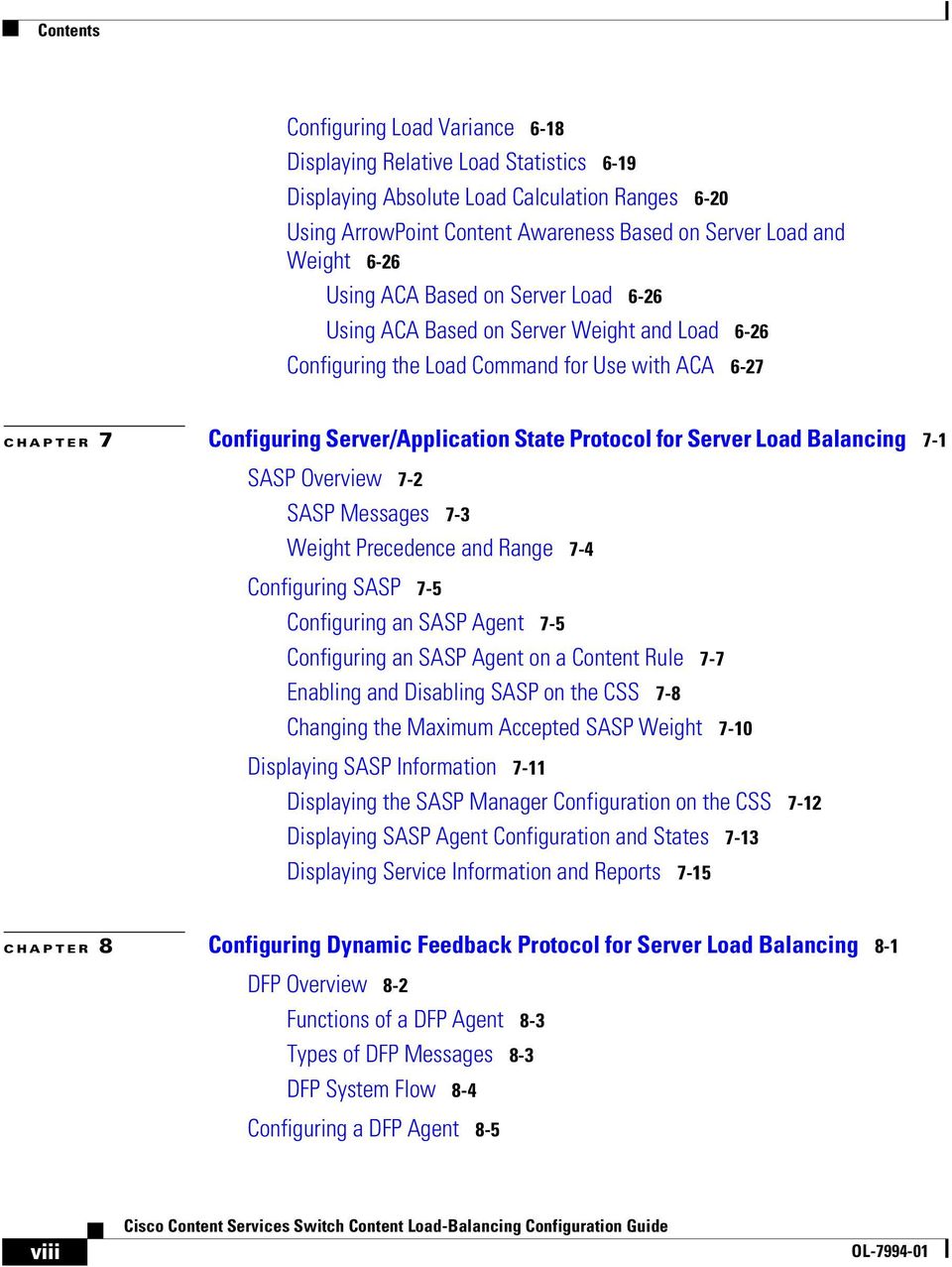
9 Contents Maintaining a Consistent Weight Range Among Services 8-8 Displaying Configured DFP Agents 8-9 Displaying Services Supported by Configured DFP Agents 8-10 Displaying DFP Information 8-11 Using the show service Command 8-11 Using the show rule services Command 8-12 CHAPTER 9 Configuring Owners 9-1 Owner Configuration Quick Start 9-2 Creating an Owner 9-3 Configuring an Owner DNS Balance Type 9-3 Specifying Owner Address 9-4 Specifying Owner Billing Information 9-4 Specifying Case 9-5 Specifying Owner DNS Type 9-5 Specifying Owner Address 9-6 Removing an Owner 9-6 Showing Owner Information 9-7 Showing Owner Summary 9-10 Where to Go Next 9-11 CHAPTER 10 Configuring Content Rules 10-1 Content Rule Overview 10-2 Content Rule Hierarchy 10-3 Matching Precedence for Layer 5 Rules 10-3 Content Rule Configuration Quick Start 10-5 Naming and Assigning a Content Rule to an Owner 10-7 Configuring a Virtual IP Address 10-8 ix

10 Contents Configuring a Domain Name Content Rule Matching Content Rules to Multiple Domain Names Configuring a Content Rule Using a Domain Name and a VIP Address Using Wildcards in Domain Name Content Rules General Guidelines for Domain Name Wildcards in Content Rules Configuring Domain Qualifier Lists Creating a DQL Describing a DQL Adding a Domain to a DQL Adding a DQL to a Content Rule Removing a DQL from a Content Rule Showing DQL Configurations Configuring Virtual Web Hosting Adding Services to a Content Rule Adding a Service to a Content Rule Specifying a Service Weight Adding a Primary Sorry Server to a Content Rule Adding a Secondary Sorry Server to a Content Rule Adding a DNS Name to a Content Rule Disabling DNS in a Content Rule Activating a Content Rule Suspending a Content Rule Removing a Content Rule Removing a Service from a Content Rule Configuring a Protocol Configuring a Port Configuring Load Balancing Configuring a DNS Balance Type Configuring Hot Lists x

11 Contents Configuring a Domain Hotlist Configuring HTTP Method Parsing Configuring RFC-2518 Extension Methods Parsing Configuring User-Defined Methods Showing the HTTP Method Parsing Configuration and Status Configuring Extension Qualifier Lists Specifying an EQL in a Uniform Resource Locator Showing EQL Extensions and Descriptions Configuring URL Qualifier Lists URQL Quick Start Creating a URQL Configuring a URL in a URQL Specifying the URL Entry Defining the URL Describing the URL Designating the Domain Name of URLs in a URQL Adding a URQL to a Content Rule Describing the URQL Activating a URQL Suspending a URQL URQL Configuration in a Startup-Config File Showing URQLs Specifying a Uniform Resource Locator Specifying an Extension Qualifier List in a URL Specifying the Number of Spanned Packets Specifying a Load Threshold Including Services in a CSS Ping Response Decision Enabling TCP Flow Reset Reject Configuring Persistence, Remapping, and Redirection Configuring Content Rule Persistence xi

12 Contents Configuring Bypass Persistence Configuring HTTP Redirection and Service Remapping Redirecting Requests for Content Setting TCP FIN or RST Flags for HTTP 302 Redirect Messages Displaying the Persistence Settings Defining Failover Specifying an Application Type Configuring a Content Rule for FTP Connections Configuring the Teardown Timeout Period for the FTP Control Channel Configuring the Wait Time to Initiate the FTP Data Channel Configuring the CSS to Handle Non-Standard FTP Ports Enabling Content Requests to Bypass Transparent Caches Showing Content Showing Content Rules Clearing Counters in a Content Rule Clearing Counters for Content Rules Clearing Service Statistics Counters in a Content Rule Where to Go Next CHAPTER 11 Configuring Sticky Parameters for Content Rules 11-1 Sticky Overview 11-2 Why Use Stickiness? 11-3 Using Layer 3 Sticky 11-4 Using Layer 4 Sticky 11-4 Using Layer 5 Sticky 11-5 Configuring Sticky on the CSS 11-5 Specifying an Advanced Load-Balancing Method for Sticky Content 11-9 Configuring SSL-Layer 4 Fallback xii

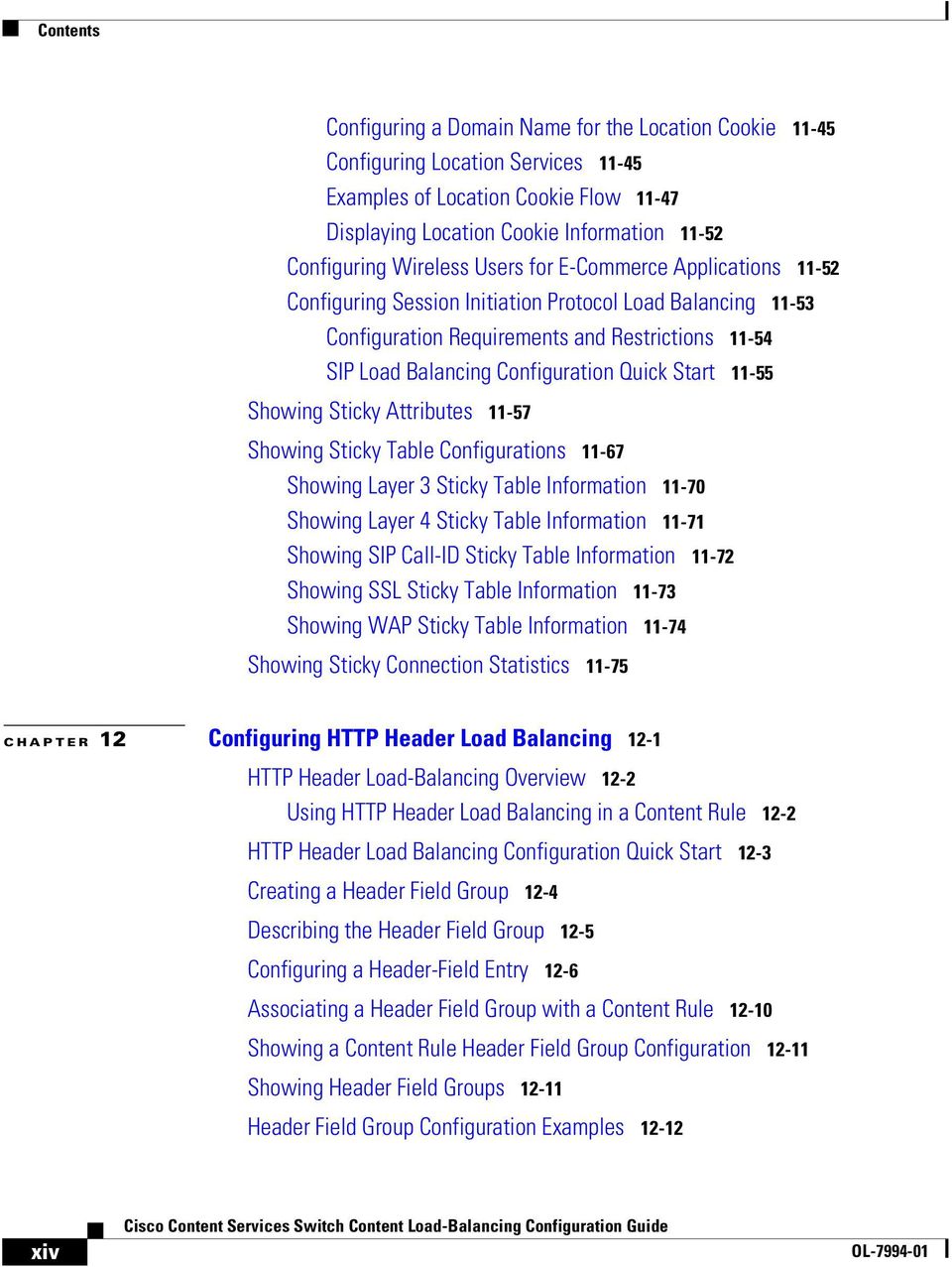
13 Contents Configuring Sticky Serverdown Failover Configuring Sticky Mask Configuring Sticky Inactive Timeout Configuring Sticky Content for SSL Configuring String Range Specifying a String Operation Comparing Hash Method with Match Method Enabling or Disabling String ASCII Conversion Configuring the Handling of Multiple String Matches Specifying End-of-String Characters Specifying a String Prefix Specifying a String Process Length Specifying a String Skip Length Configuring Sticky-No-Cookie-Found-Action Configuring Sticky Parameters for E-Commerce and Other Internet Applications Configuring an advanced-balance arrowpoint-cookie Configuring an Arrowpoint Cookie Configuring an Arrowpoint Cookie Name Configuring an Arrowpoint Cookie Path Configuring an Arrowpoint-Cookie Expiration Time Configuring Arrowpoint-Cookie Browser Expire Configuring Arrowpoint-Cookie Expire Services Configuring an Arrowpoint Cookie Domain Reinserting an Arrowpoint Cookie in an HTTP Server Response Configuring a Location Cookie Overview Location Cookie Quick Start Configuring the location-cookie Command xiii

14 Contents Configuring a Domain Name for the Location Cookie Configuring Location Services Examples of Location Cookie Flow Displaying Location Cookie Information Configuring Wireless Users for E-Commerce Applications Configuring Session Initiation Protocol Load Balancing Configuration Requirements and Restrictions SIP Load Balancing Configuration Quick Start Showing Sticky Attributes Showing Sticky Table Configurations Showing Layer 3 Sticky Table Information Showing Layer 4 Sticky Table Information Showing SIP Call-ID Sticky Table Information Showing SSL Sticky Table Information Showing WAP Sticky Table Information Showing Sticky Connection Statistics CHAPTER 12 Configuring HTTP Header Load Balancing 12-1 HTTP Header Load-Balancing Overview 12-2 Using HTTP Header Load Balancing in a Content Rule 12-2 HTTP Header Load Balancing Configuration Quick Start 12-3 Creating a Header Field Group 12-4 Describing the Header Field Group 12-5 Configuring a Header-Field Entry 12-6 Associating a Header Field Group with a Content Rule Showing a Content Rule Header Field Group Configuration Showing Header Field Groups Header Field Group Configuration Examples xiv
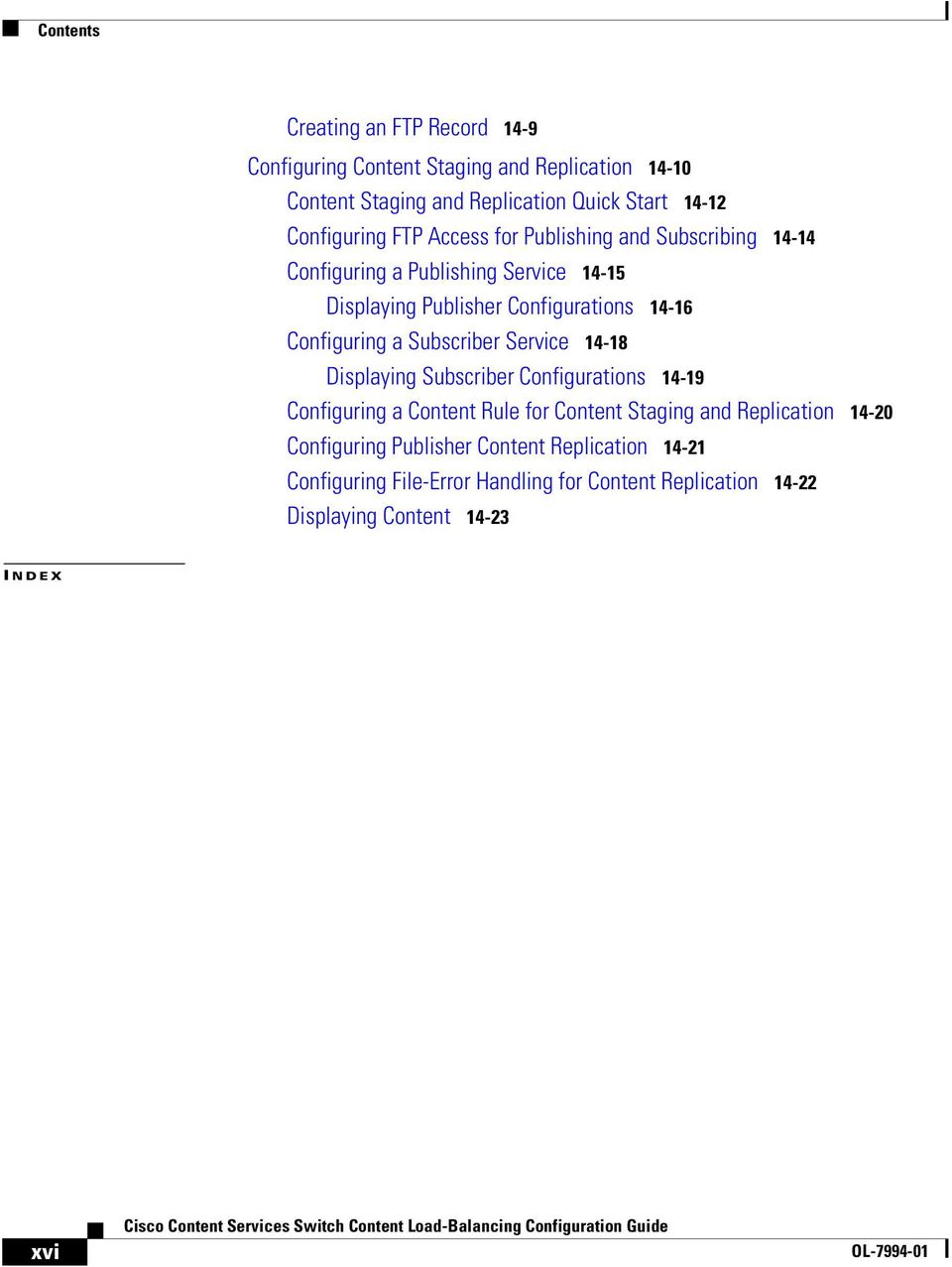
15 Contents CHAPTER 13 Configuring Caching 13-1 Caching Overview 13-1 Content Caching 13-2 Using Proxy Caching 13-3 Using Reverse Proxy Caching 13-4 Using Transparent Caching 13-5 Using Cache Clustering 13-7 Caching Configuration Quick Start 13-8 Configuring Caching Content Rules Specifying a Service Type Specifying a Failover Type Configuring Load Balancing Configuring a Double-Wildcard Caching Content Rule Enabling Content Requests to Bypass Caches Using the param-bypass Command Using the cache-bypass Command Using the bypass-hosttag Command Configuring Network Address Translation for Transparent Caches Configuring Network Address Translation Peering Configuring NAT Peering CHAPTER 14 Configuring Content Replication 14-1 Configuring Demand-Based Content Replication 14-2 Demand-Based Content Replication Quick Start 14-3 Configuring Hot Lists 14-5 Specifying Service Type for Replication 14-6 Configuring Max Age 14-7 Configuring Max Content 14-8 Configuring Max Usage 14-8 Configuring FTP Access for Content Replication 14-8 xv

16 Contents Creating an FTP Record 14-9 Configuring Content Staging and Replication Content Staging and Replication Quick Start Configuring FTP Access for Publishing and Subscribing Configuring a Publishing Service Displaying Publisher Configurations Configuring a Subscriber Service Displaying Subscriber Configurations Configuring a Content Rule for Content Staging and Replication Configuring Publisher Content Replication Configuring File-Error Handling for Content Replication Displaying Content I NDEX xvi
17 FIGURES Figure 1-1 Services, Owners, and Content Rules 1-3 Figure 1-2 Example of a TCP Flow 1-4 Figure 1-3 Example of a UDP Flow 1-5 Figure 1-4 Example of a TCP Flow with Front-End and Back-End Connections 1-6 Figure 1-5 Setting Up the Front-End TCP Connection - Delayed Binding 1-6 Figure 1-6 Setting Up the Back-End TCP Connection - Delayed Binding 1-7 Figure 1-7 Example of HTTP Redirection 1-8 Figure 1-8 Example of Remapping the Back-end Connection 1-9 Figure 6-1 Load Calculation Example with Three Servers 6-3 Figure 7-1 Example of SASP Functional Overview 7-2 Figure 8-1 Example of DFP Manager to DFP Agents System Flow 8-5 Figure 10-1 Example of Configuring a Virtual IP Address Figure 10-2 ServerB Configured for Failover Next Figure 10-3 ServerC Configured for Failover Next Figure 10-4 Suspended or Failed Service Configured for Failover Linear Figure 10-5 Removing a Service Configured for Failover Linear Figure 13-1 Proxy Cache Configuration Example 13-4 Figure 13-2 Reverse Proxy Cache Configuration Example 13-5 Figure 13-3 Transparent Cache Configuration Example 13-6 Figure 13-4 Cache Cluster Configuration Example 13-7 Figure 13-5 Cache Services Configured for Failover Next Example Figure 13-6 Cache Services Configured for Failover Next Example xvii

18 Figures Figure 13-7 Suspended or Failed Cache Service Configured for Failover Linear Figure 13-8 Removing a Cache Service Configured for Failover Linear Figure 13-9 NAT Peering Configuration Example xviii

19 TABLES Table 2-1 Field Descriptions for the flow statistics Command 2-6 Table 2-2 Field Descriptions for show flow-timeout default Command 2-9 Table 2-3 Field Descriptions for the show flow-timeout configured Command 2-10 Table 2-4 Field Descriptions for the show ip-fragment-stats Command 2-16 Table 2-5 Default CSS Flow-Disabled Ports 2-20 Table 2-6 Flow-State Table Default Values 2-21 Table 2-7 Field Descriptions for the show flow-state-table Command 2-25 Table 2-8 Field Descriptions for show global-portmap Command 2-30 Table 2-9 Field Descriptions for show noflow-portmap Command 2-33 Table 3-1 Service Configuration Quick Start 3-3 Table 3-2 Field Descriptions for the show service Command Output 3-21 Table 4-1 Keepalive Class, Types, and Limitations 4-3 Table 4-2 Global Keepalive Configuration Quick Start 4-5 Table 4-3 Field Descriptions for the show keepalive Command Output 4-24 Table 5-1 Adding Modules (SPs) to a CSS Decreases the Number of Eligible Source Ports While Adding VIP Addresses for Port Mapping Increases the Number of Eligible Source Ports 5-4 Table 5-2 Adding Destination Ports or Configuring a VIP Address Range for Port Mapping Increases the Number of Eligible Source Ports 5-5 Table 5-3 Source Group Configuration Quick Start 5-6 Table 5-4 Field Descriptions for the show group Command Output 5-22 Table 6-1 Relative Load Configuration Quick Start 6-5 xix

20 Tables Table 6-2 Field Descriptions for the show load Command Output 6-10 Table 6-3 Absolute Load Configuration Quick Start 6-13 Table 6-4 Service-Specific Field Descriptions for the show load Command Output 6-19 Table 6-5 Output for the show load absolute Command (load absolute-sensitivity = 21) 6-21 Table 6-6 Field Descriptions for the show load absolute Command Output 6-22 Table 6-7 Output for the show load absolute Command (load absolute-sensitivity = 22) 6-23 Table 6-8 Output for the show load absolute Command (load absolute-sensitivity = 1) 6-24 Table 6-9 Output for the show load absolute Command (load absolute-sensitivity = 2) 6-25 Table 7-1 Field Descriptions for the show sasp Command Output 7-12 Table 7-2 Field Descriptions for the show sasp-agent-summary Command Output 7-13 Table 7-3 Field Descriptions for the show sasp-agent label Command Output 7-17 Table 8-1 Field Descriptions for the show dfp Command Output 8-9 Table 8-2 Field Descriptions for the show dfp-reports Command Output 8-11 Table 9-1 Owner Configuration Quick Start 9-2 Table 9-2 Field Descriptions for the show owner name Command Output 9-7 Table 9-3 Field Descriptions for the show owner name statistics Command Output 9-9 Table 9-4 Field Descriptions for the show summary Command Output 9-11 Table 10-1 Content Rule Configuration Quick Start 10-5 Table 10-2 Field Descriptions for the show dql Command Output Table 10-3 Virtual Web Hosting Configuration Quick Start Table 10-4 Field Descriptions for the show domain hotlist Command Output Table 10-5 Field Descriptions for the show http-methods Command Output Table 10-6 Field Descriptions for the show eql Command Output Table 10-7 URQL Configuration Quick Start Table 10-8 Field Descriptions for the show urql Command Output xx
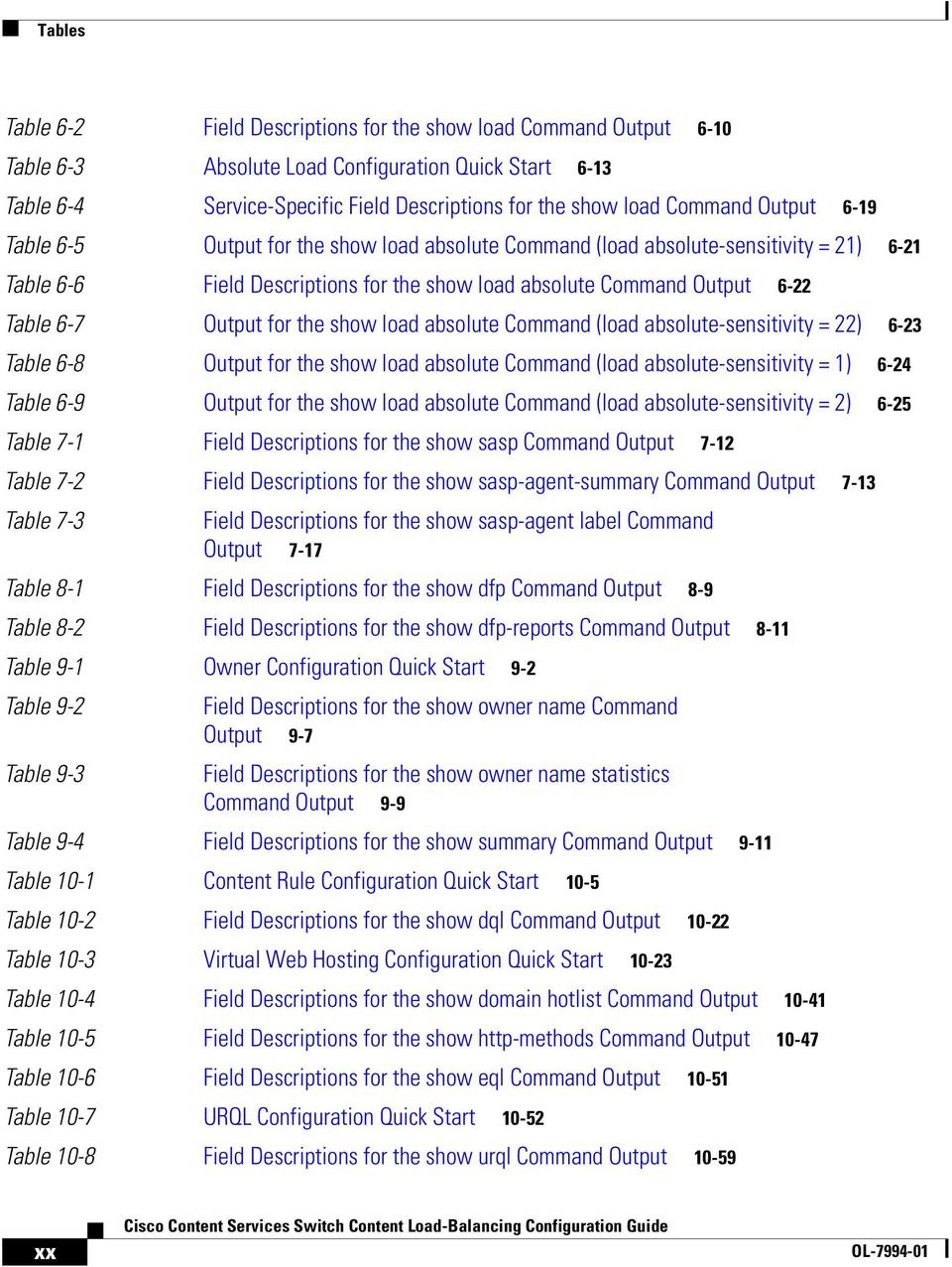
21 Tables Table 10-9 Field Descriptions for a Specified URQL Table Field Descriptions for the show remap Command Output Table Field Descriptions for the show content Command Output Table Field Descriptions for the show rule Command Output Table 11-1 Applying Sticky Rules to Content Rules 11-8 Table 11-2 Location Cookie Configuration Quick Start for Site Table 11-3 Location Cookie Configuration Quick Start for Site Table 11-4 Location Cookie Configuration Quick Start for Site Table 11-5 SIP Configuration Quick Start Table 11-6 Field Descriptions for the show rule sticky Command Output Table 11-7 Field Descriptions for the show sticky-table all-sticky Command Output Table 11-8 Field Descriptions for the show sticky-stats Command Output Table 12-1 HTTP Load Balancing Configuration Quick Start 12-3 Table 12-2 Field Descriptions for the show header-field-group Command Output Table 13-1 Caching Configuration Quick Start 13-8 Table 13-2 NAT Configuration Quick Start Table 14-1 Demand-Based Content Replication Configuration Quick Start 14-3 Table 14-2 Content Staging and Replication Configuration Quick Start Table 14-3 Field Descriptions for the show publisher Command Table 14-4 Field Descriptions for the show subscriber Command Table 14-5 Field Descriptions for the show content Command xxi
22 Tables xxii
23 Preface This guide provides instructions for the content load-balancing configuration of the Cisco Series Content Services Switch (CSS). Information in this guide applies to all CSS models except where noted. The CSS software is available in a Standard or optional Enhanced feature set. The Enhanced feature set contains all of the Standard feature set and also includes Network Address Translation (NAT) Peering, Domain Name Service (DNS), Demand-Based Content Replication (Dynamic Hot Content Overflow), Content Staging and Replication, and Network Proximity DNS. Proximity Database and Secure Management, which includes Secure Shell Host and SSL strong encryption, are optional features. This preface contains the following major sections: Audience How to Use This Guide Related Documentation Symbols and Conventions Obtaining Documentation, Obtaining Support, and Security Guidelines xxiii
24 Audience Preface Audience This guide is intended for the following trained and qualified service personnel who are responsible for configuring the CSS: Web master System administrator System operator How to Use This Guide This guide is organized as follows: Chapter Chapter 1, Content Load-Balancing Overview Chapter 2, Configuring Flow and Port Mapping Parameters Chapter 3, Configuring Services Chapter 4, Configuring Service, Global, and Script Keepalives Chapter 5, Configuring Source Groups for Services Chapter 6, Configuring Loads for Services Description Assist you in understanding load balancing on the CSS by providing information about the relationship of service, owner, and content rules, and describes how the CSS handles TCP and UDP traffic. Configure flow and port mapping parameters for the CSS. Create and configure services. This chapter also provides information on activating and suspending a service and displaying service information. Configure service, global, and script keepalives. This chapter also provides information on how to display keepalive information. Configure source groups for services. This chapter also provides information on source group port mapping and displaying source group information. Configure the relative and absolute load for services. This chapter also provides information on how to display global load information. xxiv
25 Preface How to Use This Guide Chapter Chapter 7, Configuring Server/Application State Protocol for Server Load Balancing Chapter 8, Configuring Dynamic Feedback Protocol for Server Load Balancing Chapter 9, Configuring Owners Chapter 10, Configuring Content Rules Chapter 11, Configuring Sticky Parameters for Content Rules Chapter 12, Configuring HTTP Header Load Balancing Chapter 13, Configuring Caching Chapter 14, Configuring Content Replication Description ConfigureServer/Application State Protocol (SASP). SASP allows global workload managers (GWM) to monitor backend servers and their applications. The GWM uses SASP to send updated service weights to the CSS for load balancing decisions. Configure Dynamic Feedback Protocol (DFP). DFP allows load-balanced servers (both local and remote) to dynamically report changes in their status and their ability to provide services to a CSS. Create and configure owners. This chapter also describes how to configure owner attributes such as a DNS balance type, address, billing information, case sensitivity, and DNS type. Create and configure content rules. This chapter also describes how to assign a content rule to an owner, configure a virtual IP address, add a service to a content rule, and activate, suspend, and remove a content rule. Configure sticky parameters for content rules such as subnet mask, inactive timeout, string range, string operation, string prefix and string skip length. Configure HTTP header load balancing including creating a header field group, configuring a header field entry, associating a header field group to a content rule, and showing header field groups. Configure content caching for proxy, reverse proxy, and transparent caching configurations. Configure demand-based content replication and content synchronization using publisher and subscriber services on a CSS. xxv
26 Related Documentation Preface Related Documentation In addition to this document, the Content Services Switch documentation set includes the following: Document Title Release Note for the Cisco Series Content Services Switch Cisco Series Content Services Switch Hardware Installation Guide Cisco Content Services Switch Getting Started Guide Description This release note provides information on operating considerations, caveats, and command-line interface (CLI) commands for the Cisco series CSS. This guide provides information for installing, cabling, and powering the Cisco series CSS. In addition, this guide provides information about CSS specifications, cable pinouts, and hardware troubleshooting. This guide describes how to perform initial administration and configuration tasks on the CSS, including: Booting the CSS for the first time and a routine basis, and logging in to the CSS Configuring the username and password, Ethernet management port, static IP routes, and the date and time Configuring DNS server for hostname resolution Configuring sticky cookies with a sticky overview and advanced load-balancing method using cookies Installing the CSS Cisco View Device Manager (CVDM) browser-based user interface used to configure the CSS Finding information in the CSS documentation with a task list Troubleshooting the boot process xxvi
27 Preface Related Documentation Document Title Cisco Content Services Switch Administration Guide Cisco Content Services Switch Routing and Bridging Configuration Guide Description This guide describes how to perform administrative tasks on the CSS, including upgrading your CSS software and configuring the following: Logging, including displaying log messages and interpreting sys.log messages User profile and CSS parameters SNMP RMON XML documents to configure the CSS CSS scripting language Offline Diagnostic Monitor (Offline DM) menu This guide describes how to perform routing and bridging configuration tasks on the CSS, including: Management ports, interfaces, and circuits Spanning-tree bridging Address Resolution Protocol (ARP) Routing Information Protocol (RIP) Internet Protocol (IP) Open Shortest Path First (OSPF) protocol Cisco Discovery Protocol (CDP) Dynamic Host Configuration Protocol (DHCP) relay agent xxvii
28 Related Documentation Preface Document Title Cisco Content Services Switch Global Server Load-Balancing Configuration Guide Cisco Content Services Switch Redundancy Configuration Guide Cisco Content Services Switch Security Configuration Guide Cisco Content Services Switch SSL Configuration Guide Cisco Content Services Switch Command Reference Description This guide describes how to perform CSS global load-balancing configuration tasks, including: Domain Name System (DNS) DNS Sticky Content Routing Agent Client-Side Accelerator Network proximity This guide describes how to perform CSS redundancy configuration tasks, including: VIP and virtual interface redundancy Adaptive session redundancy Box-to-box redundancy This guide describes how to perform CSS security configuration tasks, including: Controlling access to the CSS Secure Shell Daemon protocol Radius TACACS+ Firewall load balancing This guide describes how to perform CSS SSL configuration tasks, including: SSL certificate and keys SSL termination Back-end SSL SSL initiation HTTP data compression This reference provides an alphabetical list of all CLI commands including syntax, options, and related commands. xxviii
29 Preface Symbols and Conventions Symbols and Conventions This guide uses the following symbols and conventions to identify different types of information. Caution A caution means that a specific action you take could cause a loss of data or adversely impact use of the equipment. Warning A warning describes an action that could cause you physical harm or damage the equipment. Note A note provides important related information, reminders, and recommendations. Bold text indicates a command in a paragraph. Courier text indicates text that appears on a command line, including the CLI prompt. Courier bold text indicates commands and text you enter in a command line. Italic text indicates the first occurrence of a new term, a book title, emphasized text, or variables for which you supply values. 1. A numbered list indicates that the order of the list items is important. a. An alphabetical list indicates that the order of the secondary list items is important. A bulleted list indicates that the order of the list topics is unimportant. An indented list indicates that the order of the list subtopics is unimportant. xxix
30 Obtaining Documentation, Obtaining Support, and Security Guidelines Preface Obtaining Documentation, Obtaining Support, and Security Guidelines For information on obtaining documentation, obtaining support, providing documentation feedback, security guidelines, and also recommended aliases and general Cisco documents, see the monthly What s New in Cisco Product Documentation, which also lists all new and revised Cisco technical documentation, at: xxx
31 CHAPTER 1 Content Load-Balancing Overview Content load balancing is how the CSS handles requests for content to a specific destination. To assist you in understanding what occurs when load balancing occurs on the CSS, this chapter provides information about the relationship of service, owner, and content rules, and describes how the CSS handles TCP and UDP traffic. This chapter contains the following sections: Service, Owner, and Content Rule Overview Overview of CSS Flow Information in this chapter applies to all CSS models except where noted. Service, Owner, and Content Rule Overview The CSS enables you to configure services, owners, and content rules in order to direct requests for content to a specific destination service (for example, a server or a port on a server). By configuring services, owners, and content rules, you optimize and control how the CSS handles each request for specific content. Services, owners, and content rules are described below: A service is a destination location where a piece of content resides physically (a local or remote server and port). You add services to content rules. Adding a service to a content rule includes it in the resource pool that the CSS uses for load-balancing requests for content. A service may belong to multiple content rules. 1-1
32 Service, Owner, and Content Rule Overview Chapter 1 Content Load-Balancing Overview An owner is generally the person or company who contracts the Web hosting service to host their Web content and allocate bandwidth as required. Owners can have multiple content rules. A content rule is a hierarchical rule set containing individual rules that describe which content (for example, an.html file) is accessible by visitors to the Web site, how the content is mirrored, on which server the content resides, and how the CSS should process requests for the content. Each rule set must have an owner. The CSS uses content rules to determine: Where the content physically resides, whether local or remote Where to direct the request for content (which service or services) Which load balancing method to use When a request for content is made, the CSS: 1. Uses the owner content rule to translate the owner Virtual IP address (VIP) or domain name using Network Address Translation (NAT) to the corresponding service IP address and port. 2. Checks for available services that match the content request. 3. Uses content rules to choose which service can best process the request for content. 4. Applies all content rules to service the request for content (for example, load-balancing method, redirects, failover, stickiness). 1-2
33 Chapter 1 Content Load-Balancing Overview Service, Owner, and Content Rule Overview Figure 1-1 illustrates the CSS service, owner, and content rule concepts. Figure 1-1 Services, Owners, and Content Rules Clients request content from Clients request content from CSS NATs to VIP Owner: arrowpoint content rule: arrowrule1 - VIP service Serv1 - protocol tcp - port 80 - round-robin - activate rule CSS NATs to VIP Owner: frednmandi content rule: fredrules - VIP service Serv2 - protocol tcp - port activate rule Serv1 contains content for arrowpoint.com Serv1 - IP address keepalive type ICMP - protocol tcp - port activate service Serv2 Serv1 contains content for dogsrus.com - IP address keepalive type ICMP - protocol tcp - port activate service
34 Overview of CSS Flow Chapter 1 Content Load-Balancing Overview The following chapters provides information on configuring services, owners, and content rules: Chapter 1, Configuring Services Chapter 9, Configuring Owners Chapter 10, Configuring Content Rules For information on how TCP and UDP traffic flows through the CSS, see the following Overview of CSS Flow section. Overview of CSS Flow A flow is the transfer of a sequence of related packets over a TCP or UDP connection between a source (client) and a destination (server) through the CSS. All packets in an ingress flow (traffic entering the CSS) share a common 5-tuple consisting of: Source address Destination address Protocol Source port Destination port TCP flows are bidirectional (Figure 1-2). Packets move from the client to the server and from the server to the client through the CSS. Strictly speaking, a TCP connection consists of two flows, one in each direction. A TCP flow begins with a SYN and ends with an ACK to a FIN/ACK, or an RST. Figure 1-2 Example of a TCP Flow Packets Client Packets CSS Server
35 Chapter 1 Content Load-Balancing Overview Overview of CSS Flow UDP flows (Figure 1-3) are typically unidirectional (for example, streaming audio transmitted by a server to a client). A UDP flow has no definitive beginning or end and is considered completed only after a period of time has elapsed during which the destination device receives no packets that share the same addresses, protocol, and ports that defined the original flow. Figure 1-3 Example of a UDP Flow Packets Client CSS Server A CSS uses data structures called flow control blocks (FCBs) to set up and keep track of ingress flows. FCBs contain all the information the CSS needs to process and manage flows. The creation of an FCB from flow information is called flow mapping. The flow manager in each module session processor is responsible for FCB creation and flow mapping. Each unidirectional flow uses one FCB. Therefore, a TCP flow uses two FCBs and a UDP flow typically uses one FCB. Front-end SSL, which runs over TCP, requires four FCBs and back-end SSL adds two more FCBs for a total of six FCBs per full-duplex SSL connection. For more information about SSL, refer to the Cisco Content Services Switch SSL Configuration Guide. 1-5
36 Overview of CSS Flow Chapter 1 Content Load-Balancing Overview Each client-css-server connection consists of two parts (Figure 1-4): Front-end - Connection between a client and the CSS Back-end - Connection between the CSS and a server Figure 1-4 Example of a TCP Flow with Front-End and Back-End Connections Front-end TCP connection Back-end TCP connection Client Packets CSS Server A Layer 5 flow begins with a client request for content. After the D-proxy resolves the DNS request (for example, a client types a URL in a Web browser) and points the client to the CSS virtual IP address (VIP), the CSS establishes the front-end TCP connection with the client using the TCP 3-way handshake (Figure 1-5). Figure 1-5 Setting Up the Front-End TCP Connection - Delayed Binding 2. SYN/ACK Client 1. SYN 3. ACK, HTTP GET CSS Server When it establishes a Layer 5 flow, a CSS spoofs the back-end TCP connection by acting as a proxy for the destination device (server) for the client SYN. In other words, the CSS responds to the client SYN with a SYN/ACK before the CSS sets up the back-end TCP connection with the server. 1-6
37 Chapter 1 Content Load-Balancing Overview Overview of CSS Flow This process is referred to as delayed binding. Delayed binding causes the client to respond with an ACK and an HTTP GET request. This process allows the CSS to gather the information it needs to select the best service (a server port where content resides or an application running on a server such as FTP) for the content request. The CSS examines the HTTP header and URL in the HTTP request method (for example, GET, HEAD, or POST). Based on the information in the HTTP header, the URL, and the content rules configured on the CSS, the CSS selects the best site and the best service to satisfy the request. A CSS bases service selection (server load balancing) on factors such as: Content rule match Service availability Service load Cookies Source IP address For more information about CSS server load balancing (SLB), see the Service, Owner, and Content Rule Overview section. After the CSS selects the best service to provide the requested content to the client, the CSS establishes the back-end connection with the service using the TCP 3-way handshake and splices the front-end and back-end connections together. The CSS forwards the content request from the client to the service (Figure 1-6). The service responds to the client through the CSS. For the remaining life of the flow, the CSS switches the packets between the client and the service, and performs network address translation (NAT) and other packet transformations as required. Figure 1-6 Setting Up the Back-End TCP Connection - Delayed Binding Front-end TCP connection Back-end TCP connection 2. SYN/ACK Client CSS 1. SYN 3. ACK, HTTP GET Server
38 Overview of CSS Flow Chapter 1 Content Load-Balancing Overview For subsequent content requests from the same client over the same TCP connection (HTTP 1.1 and higher), the CSS attempts to maintain the back-end connection with the service that provided the content for the first HTTP request by default. This condition is called persistence. During the life of a persistent connection, a CSS must determine if it needs to move a client connection to a new service based on content rules, load balancing, and service availability. In some situations, moving the client connection is not necessary; in other situations, it is mandatory. You can configure the CSS to perform one of the following functions when it becomes necessary to move a client to a new service: HTTP redirection - Using the persistence reset redirect command, a CSS closes the back-end connection by sending a RST to the service (Figure 1-7). The CSS sends a 302 redirect to the client s browser to tell the browser to reconnect using the same DNS name, but this time the HTTP request matches on a different content rule. The CSS then establishes a new flow between the client and the best service. Figure 1-7 Example of HTTP Redirection 302 Redirect Client CSS RST Server
39 Chapter 1 Content Load-Balancing Overview Overview of CSS Flow Service remapping - Using the persistence reset remap command, a CSS closes only the back-end connection by sending a RST to the service (server 1 in Figure 1-8), then establishes a new back-end connection with service server 2 and splices the back-end and front-end connections together. The CSS forwards the content request from the client to server 2. Packets now flow between the client and server 2. For more information about persistence, HTTP redirection, and service remapping, see Chapter 10, Configuring Content Rules. Figure 1-8 Example of Remapping the Back-end Connection Front-end TCP connection Back-end TCP connection Client Packets CSS RST Server 1 New back-end connection spliced to the existing front-end connection Server Periodically, the CSS flow manager tears down old, idle flows and reclaims the system resources (FCBs). This process is called flow resource reclamation. It is also referred to as flow cleanup or garbage collection. Flow resource reclamation involves removing FCBs from the TCP and UDP lists. For optimal performance, the CSS reuses FCBs that are no longer needed for flows. Normally, flow cleanup occurs at a rate that is directly related to the total number of flows that are currently active on a CSS. A CSS always cleans up UDP flows. For TCP flows, a CSS reclaims resources when the number of used FCBs reaches a certain percentage of the total FCBs. A CSS also cleans up long-lived TCP flows that have received a FIN or a RST, or whose timeout values have been met. You can configure various commands to change the default flow-cleanup behavior of the CSS. 1-9
40 Overview of CSS Flow Chapter 1 Content Load-Balancing Overview In some instances it may not be desirable for the CSS to clean up idle TCP flows. For example, during a connection to a database server that must permanently remain active even when no data passes through the connection. If you observe the CSS dropping long-lived idle connections that need to be maintained you can configure the following TCP flow commands: flow permanent command - Creates permanent TCP or UDP ports that are not reclaimed flow-timeout-multiplier command - Configures flow inactivity timeout values for TCP and UDP flows on a per content rule and per source group basis Refer to Chapter 2, Configuring Flow and Port Mapping Parameters for information on the commands you can use to control how the CSS handles and cleans up TCP and UDP flows. 1-10
41 CHAPTER 2 Configuring Flow and Port Mapping Parameters This chapter describes how to configure flow and port mapping parameters for the CSS. Information in this chapter applies to all CSS models, except where noted. This chapter contains the following major sections: Configuring Flow Parameters Configuring Flow Inactivity Timeouts on Content Rules and Source Groups Configuring Flow Processing for Fragmented IP Packets Configuring a CSS to Send a TCP Reset if a VIP Is Unavailable Configuring the Flow-State Table Configuring CSS Port Mapping For information on how the CSS handles flows, see Chapter 1, Content Load-Balancing Overview. Configuring Flow Parameters To configure flow parameters for the CSS, use the flow command. The options for this global configuration mode command are as follows: flow permanent - Creates permanent TCP or UDP ports that are not reclaimed flow tcp-mss - Configures the TCP maximum segment size that the CSS expects to receive from the transmitting device 2-1
42 Configuring Flow Parameters Chapter 2 Configuring Flow and Port Mapping Parameters flow persist-span-ooo - Enables the reordering of persistent spanning packets flow set-port-zero - Enables the CSS to pass traffic using TCP or UDP source or destination port of 0 flow tcp-del-ack - Configures TCP Acknowledgements for Layer 5 spanning packets flow statistics - Displays statistics on currently allocated flows Note Flow parameter setup by the CSS is restricted on the following TCP or UDP ports: 67 (BOOTP server), 68 (BOOTP client), 137 (NETBIOS name service), 138 (NETBIOS datagram service), 161 (SNMP), 162 (SNMP traps), 520 (RIP), and 8089 (restricted UDP only). By default, the CSS does not pass traffic that use TCP or UDP source or destination port 0. To configure the CSS to pass this traffic, see the Passing Traffic that Use TCP or UDP Source or Destination Port 0 section. This section includes the following topics: Configuring Permanent Connections for TCP or UDP Ports Configuring TCP Maximum Segment Size Enabling the Reordering of Persistent Spanned Packets Passing Traffic that Use TCP or UDP Source or Destination Port 0 Configuring TCP Acknowledgements for Layer 5 Spanning Packets Showing Flow Statistics Configuring Permanent Connections for TCP or UDP Ports The CSS allows you to configure a maximum of 20 TCP or UDP ports that have permanent connections and will not be reclaimed by the CSS when the flows are inactive. Use the flow permanent port1 portnumber (through flow permanent port 20 portnumber) commands to configure a TCP or UDP port as a permanent connection. Enter a port number from 0 to The default is 0. A CSS may reclaim flows that have not received an ACK or content request after approximately 15 seconds. To prevent the CSS from reclaiming flows to a specific source or destination port, specify one of the flow permanent port commands and identify the TCP or UDP port number you do not want reclaimed. 2-2
43 Chapter 2 Configuring Flow and Port Mapping Parameters Configuring Flow Parameters For example, to configure port 80 as a permanent connection, enter: (config) flow permanent port1 80 To reset the port number for port1 to 0, enter: (config) no flow permanent port1 We recommend that when you configure a flow permanent port command you also enable the cmd-sched command to periodically remove the permanent port and allow for cleanup. For details on using the cmd-sched command to configure the scheduled execution of any CLI command, refer to the Cisco Content Services Switch Administration Guide. Configuring TCP Maximum Segment Size The maximum segment size (MSS) is the largest amount of TCP data that can be transmitted in one segment. The need for a smaller MSS between devices may be necessary in rare instances due to network restrictions between devices. Use the flow tcp-mss command to configure the TCP MSS that the CSS expects to receive from the transmitting device. The flow tcp-mss command changes the MSS value in the TCP header OPTIONS field of a SYN/ACK segment back to the client, to reduce the MSS from the default value of 1460 bytes. The flow tcp-mss command applies only when the client is accessing a Layer 5 content rule. The CSS does not negotiate TCP maximum segment size for Layer 3 or Layer 4 content rules. Enter a maximum segment size (in bytes) from 1 to The default is 1460 bytes. Use the no form of the command to reset the TCP maximum segment size back to the default value of 1460 bytes. Caution Do not define a smaller than necessary TCP maximum segment size with the flow tcp-mss command. Smaller payloads may be less efficient due to increased overhead. To configure a TCP maximum segment size of 1400 bytes, enter: (config)# flow tcp-mss 1400 To reset the TCP maximum segment size to the default value of 1460 bytes, enter: (config)# no flow tcp-mss 2-3
44 Configuring Flow Parameters Chapter 2 Configuring Flow and Port Mapping Parameters Enabling the Reordering of Persistent Spanned Packets By default, the CSS disables the reordering of persistent spanned packets. To enable the CSS to reorder the packets in the correct order, use the flow persist-span-ooo command in global configuration mode. For example, enter: (config)# flow persist-span-ooo To reset the default behavior of disabling the reordering of persistent spanned packets, use the no flow persist-span-ooo command. For example, enter: (config)# no flow persist-span-ooo Note If you configure the CSS to insert an arrowpoint cookie in a server response, it does not expect packets to arrive out of order. If the packets arrive out of order with the CSS receiving the FIN first, when the CSS finally receives the server data packet, it forwards the packet without inserting the cookie. Enabling the flow persist-span-ooo command allows the CSS to detect that the FIN packet arrived out of order and discards it. Then the server retransmits the packets and the CSS processes them in the correct order and inserts the arrowpoint cookie in the server data packet. Passing Traffic that Use TCP or UDP Source or Destination Port 0 By default, the CSS disables the passing of traffic that use TCP or UDP source or destination port 0. The CSS normally logs traffic with source or destination ports of 0 as a denial-of-service (DOS) attacks. If you enable traffic on port 0, the CSS does not log the flows as denial-of-service attacks. To enable or disable the CSS to pass traffic using port of 0, use the flow set-port-zero command. The syntax for this command is: flow set-port-zero enable disable Use the enable keyword to enable the passing of traffic that use a TCP/UDP source and destination port of 0. For example, enter: (config)# flow set-port-zero enable 2-4
45 Chapter 2 Configuring Flow and Port Mapping Parameters Configuring Flow Parameters Use the disable keyword to reset the CSS to its default behavior of not passing traffic using a TCP/UDP source and destination port of 0. For example, enter: (config)# flow set-port-zero disable Configuring TCP Acknowledgements for Layer 5 Spanning Packets By default, when an HTTP content request spans multiple packets, the CSS sends delayed TCP acknowledgements (ACKs) to the client at an interval of 200 milliseconds (ms) if more of the spanned packets is not received. To send TCP ACKs immediately to a client upon receipt of each packet in an HTTP spanned content request, use the no flow tcp-del-ack command. For example, enter: (config)# no flow tcp-del-ack To reenable the default behavior, use the flow tcp-del-ack command. For example, enter: (config)# flow tcp-del-ack Showing Flow Statistics Use the flow statistics command to display statistics on active flows or Flow Control Blocks (FCBs) on the CSS interfaces. Note To display summary information about redundant dormant flows, use the flow statistics dormant command. Refer to the Cisco Content Services Switch Redundancy Configuration Guide for details. Table 2-1 describes the fields in the flow statistics output. 2-5
46 Configuring Flow Parameters Chapter 2 Configuring Flow and Port Mapping Parameters Table 2-1 Field Descriptions for the flow statistics Command Field Flow Manager Statistics - Slot n, Subslot n UDP Flows per Second TCP Flows per Second Total Flows Per Second Hits Per Second Number of Allocated Flows (non-purged) Number of Free Flows Number of Allocated Fast-Path FCBs Number of Free Fast-Path FCBs Description Flow manager statistics for the module in the specified slot and subslot in the CSS chassis. The flow manager is responsible for FCB creation and flow mapping. The number of UDP flows received per second by the CSS (displayed as current, high, and average flows). The number of TCP flows received per second by the CSS (displayed as current, high, and average flows). Total number of TCP and UDP flows received per second by the CSS (displayed as current, high, and average flows). Cumulative number of content rule hits for all configured rules (displayed as current, high, and average hits). For a Layer 3 and Layer 4 rule, this value increments by one hit for each session. For a Layer 5 rule, this value increments by one hit for each HTTP method. The allocated FCBs for the flow manager for this module. At CSS boot time, the flow manager designates a number of free flows. If the flow manager runs out of free flows, it can allocate up to a maximum number of FCBs in blocks of 200. The initial free and maximum flows are based on the amount of memory available in the module. The allocated flows equal the cumulative number of active flows for each port on the module. The number of FCBs that the flow manager allocates from memory both at initialization time and during system run time. This value is taken from the memory displayed in the show system-resources command. The total number of FCBs in use by the fastpath software in the CSS. A TCP flow uses two FCBs and a UDP flow typically uses one FCB. The total number of FCBs available for use by the fastpath software in the CSS. 2-6
47 Chapter 2 Configuring Flow and Port Mapping Parameters Configuring Flow Inactivity Timeouts on Content Rules and Source Groups Table 2-1 Field Descriptions for the flow statistics Command (continued) Field Aggregate Flow Statistics Per Port Description The summary of TCP and UDP flows for each active port. Port The ingress slot and subslot on the CSS 11501, CSS 11503, or CSS (for example, 2/1). Active The total number of active TCP and UDP flows. Total The cumulative total of flows. TCP The current number of active TCP flows. UDP The current number of active UDP flows. Configuring Flow Inactivity Timeouts on Content Rules and Source Groups Use this feature with a CSS to configure flow inactivity timeout values for TCP and UDP flows on a per content rule and per source group basis. This timeout value is not the frequency with which a CSS reclaims flow resources, but is the time period that must elapse for an idle flow before the CSS marks the flow for cleanup. Timeout Value Precedence The CSS uses the following guidelines in the order presented when reclaiming flow resources: 1. If a flow matches on a content rule, the CSS checks for a user-configured timeout value and uses that timeout value if one exists. 2. If the flow matches on a source group, the CSS checks for a user-configured timeout value and uses that timeout value if one exists. 3. If you have configured a permanent port using the flow permanent port command (see the Configuring Permanent Connections for TCP or UDP Ports section), the CSS sets the flow timeout value to 0, which means that the flow should never time out. 2-7
48 Chapter 2 Configuring Flow Inactivity Timeouts on Content Rules and Source Groups Configuring Flow and Port Mapping Parameters 4. If none of the above conditions are met, then the CSS uses the default timeout value for the protocol type. For more information, see the Displaying Flow Timeout Statistics section. Configuring Flow Timeouts To specify the number of seconds for which an idle flow can exist before the CSS tears it down, use the flow-timeout-multiplier command. Specify this command in owner-content or group configuration mode. The syntax for this command is: flow-timeout-multiplier number Note If you configure a source group with destination services for client source NATing, you need to configure the flow-timeout multiplier command only on the content rule. The CSS sets the same flow timeout value for flows in both directions. If you configure different timeout values on the content rule and on the source group, the CSS uses the timeout value configured on the content rule for both flows. Enter an integer for the number variable from 0 to The CSS multiplies the value you specify by 16 to calculate the flow timeout in seconds. The default value depends on the TCP or UDP port number (see the Displaying Flow Timeout Statistics section). This default value applies only to flows that you create under a content rule or source group. A value of zero (no timeout) instructs the CSS to never tear down the flow, resulting in a permanent flow and lost resources. Specifying a value of zero is equivalent to entering the flow permanent port command (see the Configuring Permanent Connections for TCP or UDP Ports section). Note We do not recommend that you set the flow-timeout multiplier command to 0 for UDP flows on Layer 3 and Layer 4 content rules. If the value is set to 0, the CSS does not clean up the resources for the UDP flows. 2-8
49 Chapter 2 Configuring Flow and Port Mapping Parameters Configuring Flow Inactivity Timeouts on Content Rules and Source Groups Note The CSS tears down the FTP control channel after 10 minutes of idle time. This teardown may occur during a file transfer if the transfer exceeds 10 minutes. Use the flow-timeout-multiplier command on the associated content rule to configure the timeout to a value that can accommodate the expected duration of the FTP file transfers. These two examples show flow timeout periods of 80 seconds: (config-owner-content[cisco-rule1])# flow-timeout-multiplier 5 (config-group[group1])# flow-timeout-multiplier 5 To disable the configured flow-timeout-multiplier value and restore the default timeout for the port type, enter: (config-owner-content[cisco-rule1])# no flow-timeout (config-group[group1])# no flow-timeout Displaying Flow Timeout Statistics Use the show flow-timeout default command to display the default timeout values for TCP and UDP ports and applications. The default values are not user configurable. Table 2-2 shows the fields in the show flow-timeout default command output. Table 2-2 Field Descriptions for show flow-timeout default Command Field TCP/IP Port Application Inactivity Timeout Seconds Description Default TCP or UDP port numbers. Names of the default TCP or UDP applications. Default flow inactivity timeouts, in seconds, for the TCP or UDP port. If a flow is idle for the amount of time specified in the timeout value, the CSS tears down the flow and reclaims the flow resources. Use the show flow-timeout configured command to display the configured flow timeout values. The command output includes the content rule or source group for which you configured the flow timeout value. 2-9
50 Configuring Flow Processing for Fragmented IP Packets Chapter 2 Configuring Flow and Port Mapping Parameters Table 2-3 describes the fields in the show flow-timeout configured command output. Table 2-3 Field Descriptions for the show flow-timeout configured Command Field Port Content Rule Source Group Timeout Description TCP or UDP port number. Name of the content rule for which the flow timeout is configured. Name of the source group for which the flow timeout is configured. Configured activity timeout in 16-second increments for the TCP or UDP port. When this time period elapses for an idle flow, the CSS tears down the connection and reclaims the FCBs. Displaying Content Rule and Source Group Information If you configure a flow timeout value in a content rule or a source group, the show rule or show group command output includes an additional field called Flow Timeout Multiplier. This field contains the configured timeout value assigned to flows that match on the rule or group. Configuring Flow Processing for Fragmented IP Packets By default, a CSS does not process fragmented TCP and UDP IP packets (IP fragments) in the flow path, but simply routes them according to standard IP routing practices. As a result, IP fragments do not match on configuration items such as content rules and source groups and, therefore, the CSS does not NAT or load balance the fragments. 2-10
51 Chapter 2 Configuring Flow and Port Mapping Parameters Configuring Flow Processing for Fragmented IP Packets When you enable flow processing for IP fragments, a CSS processes the IP fragments in the flow path using the IP address and TCP port or UDP port information in the IP header and in the TCP or UDP header. The CSS then forwards and NATs the individual fragments of a packet based on the configured content rules and source groups matched by the fragments. This feature supports only Layer 3 and Layer 4 content rules. For Layer 5 content rules, use the flow tcp-mss command. For details about the flow-tcp-mss command, see the Configuring Flow Parameters section. Use this feature to support: Microsoft Media Server using Microsoft Media Server UDP (MMSU) protocol and other applications that fragment UDP IP packets or other applications that fragment TCP IP packets Applications and devices that do not support MTU path discovery Network configurations where TCP and UDP IP packets must be fragmented to traverse the network Note Whenever possible, avoid applications or network configurations that create IP fragments. This feature provides support for those edge conditions where IP fragmentation is unavoidable. This section describes how to configure flow processing for fragmented IP packets. It includes the following topics: What Is IP Packet Fragmentation? Enabling Flow Processing for Fragmented IP Packets Configuring the Maximum Assembled Size Configuring the Minimum Fragment Size Resetting IP Fragment Statistics Displaying IP Fragment Statistics 2-11
52 Configuring Flow Processing for Fragmented IP Packets Chapter 2 Configuring Flow and Port Mapping Parameters What Is IP Packet Fragmentation? An IP fragment is a part of a larger complete IP packet. IP packets require fragmentation when the next-hop network s maximum transmit unit (MTU) is less than the incoming packet size. The transmitting device divides the packet into smaller pieces that the network medium can accommodate and copies the packet IP header into each fragment. Packets can be fragmented by the source host, intermediate routers, and other network devices. IP packet fragmentation is generally considered an undesirable condition because fragmentation and subsequent reassembly of packets cause additional CPU and network overhead. However, despite the best efforts of network designers, some fragmentation is inevitable because of the different network media with varying MTUs that support the IP protocol. For more information about IP packet fragmentation, refer to RFC 791 and RFC 815. Configuration Restrictions The following TCP applications are not supported when a CSS receives fragmented packets and flow processing for TCP IP fragments is enabled: Layer 5 content rules when a client request is fragmented. There is no fall back to a Layer 4 or Layer 3 rule if configured. HTTPS client (SSL) with an SSL module for front-end SSL termination. HTTPS client (SSL) without an SSL module, with the advanced-balance-ssl command configured. FTP control channel. ArrowPoint cookies. Note The CSS cannot inspect the UDP/TCP payload of a fragmented IP packet to make a load-balancing decision. 2-12
53 Chapter 2 Configuring Flow and Port Mapping Parameters Configuring Flow Processing for Fragmented IP Packets Enabling Flow Processing for Fragmented IP Packets To allow a CSS to flow-process IP fragments, use the udp-ip-fragment-enabled or the tcp-ip-fragment-enabled command in global configuration mode. By default, this feature is disabled. Note The ip-fragment-enabled command has been deprecated (obsoleted). The CSS automatically converts the ip-fragment-enabled command to the udp-ip-fragment-enabled command. To reset the default behavior of the CSS to forward IP fragments, use the no form of the command. For example, enter: (config)# no udp-ip-fragment-enabled (config)# no tcp-ip-fragment-enabled Note This feature performs content rule-based forwarding using Layer 3 (IP address) and Layer 4 (TCP or UDP port) information in the IP header and the TCP or UDP header. Layer 5 forwarding decisions for IP fragments, based on the packet payload (data), are not supported. Configuring the Maximum Assembled Size The maximum assembled size is the total length of an IP packet if all the IP fragments were assembled into the original packet. Assembled IP packets should be no larger than 64 KB. As the CSS receives the IP fragments, it checks the fragments against the maximum assembled size value. If a fragment IP offset plus the IP payload (data) length is greater than the configured maximum assembled size, the CSS increments the Max Assembled Size error field in the show ip-fragment-stats command output and discards the packet. See the Displaying IP Fragment Statistics section. Note To eliminate unnecessary processing overhead, the CSS does not reassemble fragmented IP packets. 2-13
54 Configuring Flow Processing for Fragmented IP Packets Chapter 2 Configuring Flow and Port Mapping Parameters To specify the maximum assembled size for TCP and UDP IP fragments, use the ip-fragment max-assembled-size command. The syntax of this global configuration mode command is: ip-fragment max-assembled-size number The number variable specifies the maximum size of an assembled packet in bytes. Enter an integer from 2048 to The default is 5120 bytes. For example, enter: (config)# ip-fragment max-assembled-size 4096 To restore the default maximum IP fragment assembled size to 5120 bytes, use the no form of the command. For example, enter: (config)# no ip-fragment max-assembled-size Configuring the Minimum Fragment Size The minimum fragment size is the smallest IP payload in an IP fragment that a CSS accepts. As the CSS receives the IP fragments, it checks the fragments against the minimum fragment size value. If a fragment IP payload length is less than the configured minimum fragment size, the CSS increments the Less Than Min Size error field in the show ip-fragment-stats command output and discards the packet. See the Displaying IP Fragment Statistics section. To specify the smallest IP fragment payload for TCP and UDP IP fragments based on your applications, use the ip-fragment min-fragment-size command. This command also provides protection against fragment attacks, which can consist of a chain of valid-looking, but very small, fragments. 2-14
55 Chapter 2 Configuring Flow and Port Mapping Parameters Configuring Flow Processing for Fragmented IP Packets The syntax of this global configuration mode command is: ip-fragment min-fragment-size number The number variable specifies the size of the smallest IP fragment payload that the CSS supports in bytes. Enter an integer from 64 to The default is 1024 bytes. For example, enter: (config)# ip-fragment min-fragment-size 256 Note Requiring that the minimum fragment size be at least 64 bytes guarantees that the IP header and the TCP or UDP header information is present in the first fragment. To restore the default minimum IP fragment payload size to 1024 bytes, use the no form of the command. For example, enter: (config)# no ip-fragment min-fragment-size 2-15
56 Configuring Flow Processing for Fragmented IP Packets Chapter 2 Configuring Flow and Port Mapping Parameters Displaying IP Fragment Statistics To display the status, statistics, and error counts associated with TCP and UDP IP fragment processing, use the show ip-fragment-stats command in any mode. Table 2-4 describes the fields for the show ip-fragment-stats command output. Table 2-4 Field Descriptions for the show ip-fragment-stats Command Field IP Fragment Status UDP State TCP State Min Fragment Size Max Assembled Size IP Fragment Statistics Packets Tracked Fragments Buffered Packets Completed Longest Frag Chain Largest Asm Packet Description Configured state of the UDP IP fragment feature, Enabled or Disabled. Configured state of the TCP IP fragment feature, Enabled or Disabled. Configured minimum fragment IP payload size. Configured maximum assembled IP packet size. Current, high, and total number of fragmented IP packets that the CSS tracked. This field contains the number of actual packets tracked, not the number of fragments. Current, high, and total number of buffered IP fragments from all packets that the CSS tracked. Number of successfully processed IP packets that were fragmented. Longest IP fragment chain that constituted any one fragmented IP packet. An IP fragment chain is the number of fragments that make up the original packet. Largest IP length of an IP fragmented packet that the CSS received. 2-16
57 Chapter 2 Configuring Flow and Port Mapping Parameters Configuring Flow Processing for Fragmented IP Packets Table 2-4 Field Descriptions for the show ip-fragment-stats Command (continued) Field Smallest Fragment IP Fragment Errors No Tracking Entry Could Not Buffer Duplicate Fragment Validating Fragments Inserting Fragment Less Than Min Size Max Assembled Size Collection Timeout Description Smallest fragment IP payload length that the CSS received. This field does not include the last fragment in any IP fragment because its payload can be any size. While receiving a fragment of a new packet, the CSS could not obtain a fragment tracking entry. This error can occur if the CSS memory is low or used completely. CSS received a fragment, but could not buffer it because the CSS was low on buffers. CSS detected a duplicate offset or last fragment. After the CSS received all the IP fragments, it attempted to validate the fragments, but found overlapping offsets, short offsets, or other possible denial of service (DoS) fragment attack conditions. While the CSS was inserting fragments into the fragment chain on the tracking entry, it encountered duplicate fragments, fragments of less than the configured minimum fragment size, or a total assembled size greater than the configured maximum assembled size. CSS received an IP fragment (not the last fragment) with an IP payload that was less than the configured minimum fragment size. After the CSS received a fragment, the calculated total length of the assembled IP packet was greater than the configured maximum assembled size. While the CSS was waiting to receive IP fragments, too much time elapsed. 2-17
58 Configuring Flow Processing for Fragmented IP Packets Chapter 2 Configuring Flow and Port Mapping Parameters Table 2-4 Field Descriptions for the show ip-fragment-stats Command (continued) Field Flow Timeout IPv4 Header RxQueue Full Description After the CSS received all fragments of an IP packet and a fragment was sent to flow processing, the entry timed out before the fragment returned. The CSS received a fragment with an invalid IPv4 header length compared with the total IP fragment size. The CSS flow-processing receive queue for IP fragments was full. The CSS discarded the IP fragments. Resetting IP Fragment Statistics To reset the TCP and UDP IP fragment statistics, use the zero ip-fragment-stats command in any mode. This command resets the values of the statistics in the IP Fragment Statistics and IP Fragment Errors sections of the show ip-fragment-stats command output to zero. For more information about the show ip-fragment-stats command, see the Displaying IP Fragment Statistics section. 2-18
59 Chapter 2 Configuring Flow and Port Mapping Parameters Configuring a CSS to Send a TCP Reset if a VIP Is Unavailable Configuring a CSS to Send a TCP Reset if a VIP Is Unavailable If a Layer 3 or Layer 4 content rule VIP that a CSS is hosting is unavailable, the CSS, by default: Rejects a TCP packet sent to that VIP by a client Drops the TCP packet This behavior can occur when a packet: Matches a Layer 3 or Layer 4 content rule that has no active services Matches a Layer 3 or Layer 4 content rule with services that have reached their maximum number of connections If a CSS rejects a TCP packet, the client can retransmit the packet. If no services become available for a matching Layer 3 or Layer 4 content rule, the client application becomes unresponsive and either the connection or the application eventually times out. It takes the application a variable amount of time to time out. The latency caused by this time-out process is unacceptable for some applications. This feature allows you to configure a CSS to send a TCP RST to the client in response to the TCP packet if the VIP is unavailable. If the application receives the TCP RST, the application stops retransmitting the packet and usually displays an error message about the failed connection attempt. Note For Layer 5 spoofed connections, if the CSS rejects the content request, it always sends a TCP RST to the client. This behavior has not changed. Applications where this feature may be useful include: Web browsers Telnet FTP To configure a CSS to send a TCP RST to a client when a VIP is unavailable, use the flow tcp-reset-vip-unavailable command in global configuration mode. The CSS sends the TCP RST only in response to a TCP packet that is destined for a VIP that the CSS is hosting and only if that VIP is unavailable. 2-19
60 Configuring the Flow-State Table Chapter 2 Configuring Flow and Port Mapping Parameters For example, enter: (config)# flow tcp-reset-vip-unavailable To return the CSS behavior to the default of dropping the TCP packet if a VIP is unavailable, enter: (config)# no flow tcp-reset-vip-unavailable To display the number of TCP RSTs that a CSS sent because a VIP was unavailable, enter the show ip statistics command. For more information on the show ip statistics command, refer to the Cisco Content Services Switch Routing and Bridging Configuration Guide. Configuring the Flow-State Table A CSS sets up flows for most TCP and UDP traffic. However, for packets that use specific ports, a CSS does not set up flows. The default behavior for a CSS is not to set up flows for the ports listed in Table 2-5. Table 2-5 Default CSS Flow-Disabled Ports Port Application 67 Bootstrap Protocol (BOOTP) Server 68 BOOTP Client 137 NETBIOS Name Service 138 NETBIOS Datagram Service 161 Simple Network Management Protocol (SNMP) 162 SNMP Traps 520 Routing Information Protocol (RIP) 8089 Inktomi-UDP 2-20
61 Chapter 2 Configuring Flow and Port Mapping Parameters Configuring the Flow-State Table To keep track of the flow states of TCP and UDP ports, a CSS maintains a flow-state table. The 10 default TCP and UDP ports that the CSS preconfigures in the flow-state table are shown in Table 2-6. Of these 10 ports, only DNS (port 53, TCP and UDP) and SIP (port 5060, UDP only) are flow-enabled by default. To set up flows for the other ports in Table 2-6, you must configure them using the flow-state command. All other ports that are not among the 10 default ports are flow-enabled by default. Table 2-6 Flow-State Table Default Values Port Protocol NAT-State Flow-State Hit-Count 53 TCP flow-enable 0 53 UDP flow-enable 0 67 TCP flow-disable 0 67 UDP nat-disable flow-disable 0 68 TCP flow-disable 0 68 UDP nat-disable flow-disable TCP flow-disable UDP nat-disable flow-disable TCP flow-disable UDP nat-disable flow-disable TCP flow-disable UDP nat-disable flow-disable TCP flow-disable UDP nat-disable flow-disable UDP nat-disable flow-disable UDP flow-enable UDP nat-disable flow-disable 0 You can change the flow states of these preconfigured ports and you can configure 16 additional unique TCP or UDP ports and their flow states.you can also set the Network Address Translation (NAT) state for flow-disabled UDP ports only. 2-21
62 Configuring the Flow-State Table Chapter 2 Configuring Flow and Port Mapping Parameters If a CSS receives any traffic destined to its own IP address or VIP address and the port specified by that traffic is flow-disabled and NAT-disabled, the CSS sends an ICMP port unreachable message to the client. When the CSS receives TCP packets on a flow-disabled port, it does not NAT those packets. In this case, the CSS simply forwards the packets. If a CSS receives such a packet destined to its VIP, the CSS drops the packet. Note The CSS does not support the NATing of payload data, such as that required for the Real-Time Streaming Protocol (RTSP). Use the flow-state table: For any application that does not use a random client port. For example, if a CSS were to set up a flow for DNS traffic between two authorities that use source port 1024 and destination port 53 repeatedly for a series of requests, all traffic would appear to be the same connection and no load balancing would occur. To avoid flow setup overhead for one-time UDP packets. To avoid flow setup overhead for known non-nated packets. For details on NAT, see Chapter 5, Configuring Source Groups for Services. For details on DNS, refer to the Cisco Content Services Switch Global Server Load-Balancing Configuration Guide. The CSS supports the Trivial File Transfer Protocol (TFTP) and TFTP-like protocols (where the server selects a random port in its response) only on flow-enabled ports and only when the server is behind a source group (the CSS NATs the server IP address in server-initiated traffic). The CSS does not support these protocols when a client is behind a source group (the CSS NATs the client IP address in client-initiated traffic) or on flow-disabled ports. 2-22
63 Chapter 2 Configuring Flow and Port Mapping Parameters Configuring the Flow-State Table Configuring the Flow State of a Port To set the flow state of any TCP or UDP port, use the flow-state command. When you set the flow state of a port to flow-enable, the CSS performs content-rule and source-group matching. For flow-disabled UDP ports, you can enable the NAT state independent of the flow state so that the CSS performs NATing and port mapping. In addition to the default ports preconfigured in the table, you can configure a maximum of 16 additional unique TCP or UDP ports using the flow-state table. The syntax of this global configuration mode command is: flow-state number tcp [flow-enable flow-disable] flow-state number udp [flow-enable flow-disable {nat-enable nat-disable}] The options and variables for this global configuration mode command are as follows: number - Specifies the TCP or UDP port number whose flow state you want to configure. Enter an integer from 1 to tcp - Specifies traffic using TCP. udp - Specifies traffic using UDP. flow-enable - Enables flows on the specified TCP or UDP port. With this option, the CSS performs full content-rule and source-group matching, including Layer 5 (URL string) content-based load balancing and sticky. flow-disable - Disables flows on the specified TCP or UDP port. When you disable flows on a port, the CSS does not perform content rule and source group matching. The benefit is that there is no flow setup overhead. nat-enable - For flow-disabled UDP ports only, enables content-rule and source-group lookups for NAT. With this option, you can use Layer 3 (IP address) and Layer 4 (IP address and destination port) content rules and the sticky table (for example, sticky-srcip). However, without the benefit of a flow, the CSS cannot spoof the back-end connection, which is required to make Layer 5 content-based decisions. nat-disable - For flow-disabled UDP ports only, the CSS does not perform content-rule and source-group lookups for NAT. 2-23
64 Configuring the Flow-State Table Chapter 2 Configuring Flow and Port Mapping Parameters Caution If you configure the flow-disable and nat-disable options simultaneously on a particular port, content-rule and source-group lookups are no longer available for that port. In this case, the CSS drops TCP packets directed to a VIP address associated with that port. For UDP, the CSS sends an ICMP port unreachable message to the client. The CSS continues to forward packets directed to other IP addresses. Example 1: To enable flows for SNMP TCP port 161, enter: (config)# flow-state 161 tcp flow-enable To reset SNMP TCP port 161 to its default value of flow-disable, enter: (config)# no flow-state 161 tcp Example 2: To disable flows for SIP UDP port 5060, enter: (config)# flow-state 5060 udp flow-disable To reset SIP UDP port 5060 to its default value of flow-enable, enter: (config)# no flow-state 5060 udp Example 3: To disable the flow state of SNMP UDP port 162 (SNMP traps) and enable NAT for that port, enter: (config)# flow-state 162 udp flow-disable nat-enable To reset SNMP UDP port 162 to its default settings of flow-disable and nat-disable, enter: (config)# no flow-state 162 udp 2-24
65 Chapter 2 Configuring Flow and Port Mapping Parameters Configuring the Flow-State Table Resetting the Flow-State Table Hit Counters The flow-state table contains hit counters that total the number of hits for each port entry in the table. Use the zero flow-state-counters command to reset all the hit counters in the table to zero. For example: (config)# zero flow-state-counters Displaying the Flow-State Table Use the show flow-state-table command to display the flow-state table entries. For the default settings in the flow-state table, see Table 2-6. Table 2-7 describes the fields in the show flow-state-table command output. Table 2-7 Field Descriptions for the show flow-state-table Command Field Port Protocol NAT-State Flow-State Hit-Count Description Number of the port for which you are displaying flow-state data. IP protocol (TCP or UDP) associated with the port number. Status of network address translation for the port. Possible states are nat-enable, nat-disable, or (state cannot be modified or the field is not applicable in combination with the value in the Flow-State field). The nat-enable and nat-disable states are available only for flow-disabled UDP ports. Status of flows for a particular port. Possible states are flow-enable and flow-disable. Number of hits on a particular port. * Indicates that the values in this row of the flow-state table are the default values. 2-25
66 Configuring CSS Port Mapping Chapter 2 Configuring Flow and Port Mapping Parameters Configuring CSS Port Mapping This section describes how to globally control the range of port numbers a CSS uses to perform port address translation (PAT) on TCP and UDP source port numbers specified in packets sent to the CSS from clients. The CSS assigns unique port numbers within a configurable range for the source port numbers specified in the packets, then sends the packets to the appropriate server port. When a server initiates a return flow, the packets flow through the CSS. The CSS matches the translated port number with the client that initiated the request and sends the server packets to the appropriate client. For information about source groups and port mapping, see the Overview of Source Groups and Port Mapping section in Chapter 5, Configuring Source Groups for Services. Overview of Global Port Mapping Each CSS module (except the SSL module) has one session processor (SP) that is responsible for mastering flows. CSS supports one SP CSS11503 supports a maximum of three SPs CSS supports a maximum of six SPs The global port mapper in a CSS is called the mega port mapper. The mega port mapper database comprises 16 banks (megamap banks) of port-map numbers each in each session processor (SP). A CSS uses a source address hash algorithm to select a megamap bank in a particular SP. For client-side flows, the CSS sends packets to different SPs for flow processing and the flows have access to the source ports in that SP. The CSS performs a simple XOR hash of the TCP or UDP source and destination port numbers to determine the SP that becomes master for that flow. If the port numbers are the same (for example, DNS UDP port 53), then the CSS uses the low order bits of the source and destination IP addresses to calculate the hash value. The CSS uses the hash value to index into a weighted table of SPs and selects the appropriate SP. 2-26
67 Chapter 2 Configuring Flow and Port Mapping Parameters Configuring CSS Port Mapping When the CSS performs PAT, the master SP for the flow uses a source port from either the global port mapper or a source group, depending on your configuration. (For information about source groups, see Chapter 5, Configuring Source Groups for Services) The CSS chooses a source port so that the hash of it and the destination port will select the same SP for the server-side flow as the SP that mastered the client-side flow. For the server-side flow from a given destination port, only certain source port numbers hash to the same SP that was used for the client-side flow. For this reason, all ports available to a particular SP are not necessarily eligible for use when establishing the back-end connection. Therefore, the hash algorithm selects only a percentage of the available ports on any one SP. Each CSS maintains a database of used and available port-map numbers. When a CSS needs to PAT a source port, it uses the next unused port number in its database. This section includes the following topics: Configuring Global Port Mapping Displaying Global Port Mapping Statistics Configuring No-Flow Port Mapping Displaying No-Flow Port Mapping Statistics Configuring Global Port Mapping To control the global PAT for TCP flows on a CSS, use the global-portmap command. This command is always enabled. You can use this command to specify the source-port mapping range on: A CSS when you configure a service that uses a nondefault destination port number. A CSS changes a TCP destination port number configured on a service in a content rule when a request hits the content rule and the CSS sends a packet to the selected server. The CSS uses the global-portmap command parameters to translate the corresponding client source port number to distinguish it from other clients requesting the same service. Redundant Cisco series CSS peers in an Adaptive Session Redundancy (ASR) configuration. Refer to the Cisco Content Services Switch Redundancy Configuration Guide for information about ASR. 2-27
68 Configuring CSS Port Mapping Chapter 2 Configuring Flow and Port Mapping Parameters A CSS with back-end server remapping enabled (refer to Chapter 10, Configuring Content Rules. When you configure a source group, the portmap command parameter values take precedence over the global-portmap command parameter values. The portmap disable command has no effect on TCP flows. The syntax for this global configuration mode command is: global-portmap base-port number1 range number2 The options and variables for this command are: base-port number1 - The starting port number for global port mapping on a CSS. Enter an integer from 2016 to The default is Caution Changing the value of the number1 variable may cause port conflicts on existing flows. range number2 - The total number of ports in the port-map range that the CSS allocates to each of the 16 megamap banks in each session processor (SP). Each megamap bank in an SP can use the full range of configured ports. Because of the unique source address hash that the CSS uses to select a megamap bank in an SP, more than one SP can use the same port number without a tuple collision. Caution Changing the value of the number2 variable may cause port conflicts on existing flows. Enter an integer from 2048 to The default is If you enter a value that is not a multiple of 32, the CSS rounds up the value to the next possible multiple of 32. Note If you enter a port-map range value that exceeds the number of available ports, you get an error. To determine the number of available ports, subtract the starting port number you specify from
69 Chapter 2 Configuring Flow and Port Mapping Parameters Configuring CSS Port Mapping For example: (config)# global-portmap base-port 3096 range To return the global-portmap command parameters to their default values, enter: (config)# no global-portmap Displaying Global Port Mapping Statistics Use the show global-portmap command to display statistics for global port mapping on a CSS. This command is available in all modes except RMON, URQL, and VLAN configuration modes. The syntax for this command is: show global-portmap [all-banks [all-sps slot number1] number2 [all-sps slot number1]] The options and variables for this command are as follows: all-banks - Specifies the display of global port-map information for all port-map banks (0 to 15). all-sps - Specifies the display of global port-map information for all session processors (SPs) in the CSS. slot number1 - Specifies the chassis slot where the module resides. For a CSS 11503, enter an integer from 1 to 3. For a CSS 11506, enter an integer from 1 to 6. To display the available active slots in the CSS, enter the show global-portmap all-banks slot? command. If you enter an invalid slot number, the CLI displays values for only the first two parameters listed in Table 2-8. number2 - Specifies the global port-map bank number. Enter an integer from 0 to 15. To display port mapping statistics for all megamap banks (up to 16) on every active SP in the CSS, enter: (config)# show global-portmap all-banks all-sps 2-29
70 Configuring CSS Port Mapping Chapter 2 Configuring Flow and Port Mapping Parameters To display global port mapping statistics for megamap bank 12 in the SP that resides in slot 3, enter: (config)# show global-portmap 12 slot 3 Table 2-8 describes the fields in the show global-portmap command output. Table 2-8 Field Descriptions for show global-portmap Command Field MegaMap Banks in Use Per SP Configured Base Port Total Configured Ports Description The number of global port mapping banks being used in each session processor (SP). There are 16 banks available in each SP. A CSS selects a bank by hashing the source address contained in a packet. The base-port (starting port number) specified with the global-portmap command or the default of The total number of ports specified with the global-portmap range command or the default of Slot The number of the slot in the CSS or CSS where the specified SP resides. MegaMap Bank # The number of the port mapping bank. Possible values are 0 to 15 for a total of 16 banks for each SP. Number Normal Avail Ports Current Mapped Ports Last Normal Mapped Port Equal Port Base Port The number of ports available for use by the network address translation algorithm when the source port number is different from the destination port number in a TCP packet. The total number of ports currently in use or mapped. The most recent port number used by the network algorithm when the source port number is different from the destination port number in a TCP packet. The starting port number that the network address translation algorithm uses when the source port number is the same as the destination port number in a TCP packet. 2-30
71 Chapter 2 Configuring Flow and Port Mapping Parameters Configuring CSS Port Mapping Table 2-8 Field Descriptions for show global-portmap Command (continued) Field Number Equal Avail Ports High Water Mark Last Equal Mapped Port No Portmap Errors Description The number of ports available for use by the network address translation algorithm when the source port number is the same as the destination port number in a TCP packet. The largest number of ports mapped or in use at one time since the last CSS reboot. The last port number used by the network address translation algorithm when the source port number is the same as the destination port number in a TCP packet. The number of times that a failure occurred because no ports were available (all ports were mapped). Configuring No-Flow Port Mapping To control the PAT range of DNS UDP source-port numbers greater than 1023 on a CSS, use the noflow-portmap command. This command is always enabled. However, before a CSS can use this command, you must use the flow-state command to disable DNS flows on the CSS. See the Configuring the Flow-State Table section. Note The portmap command values configured in a source group take precedence over the noflow-portmap command values, unless you configure the portmap disable command. Refer to Chapter 3, Configuring Services, for details on configuring the portmap commands in a source group. The syntax for this global configuration mode command is: noflow-portmap base-port number1 range number2 The options and variables for this command are: base-port number1 - The starting port number for no-flow (DNS flows are disabled) port mapping on a CSS. Enter an integer from 2016 to The default is
72 Configuring CSS Port Mapping Chapter 2 Configuring Flow and Port Mapping Parameters Caution Changing the value of the number1 variable may cause port conflicts on existing flows. range number2 - The total number of ports in the port-map range that the CSS allocates to each session processor (SP). Each SP can use the full range of configured ports. Caution Changing the value of the number2 variable may cause port conflicts on existing flows. Enter an integer from 2048 to The default is If you enter a value that is not a multiple of 32, the CSS rounds up the value to the next possible multiple of 32. Note If you enter a range value that exceeds the number of available ports, you get an error. To determine the number of available ports, subtract the starting port number from For example, to specify a port map range, starting with port 4317, enter: (config)# noflow-portmap base-port 4317 range To reset the starting port number and port-map range to their default values, enter: (config)# no noflow-portmap Displaying No-Flow Port Mapping Statistics Use the show noflow-portmap command to display statistics for no-flow port mapping on a CSS. This command is available in all modes except RMON, URQL, and VLAN configuration modes. The syntax for this command is: show noflow-portmap [all-sps slot number] 2-32
73 Chapter 2 Configuring Flow and Port Mapping Parameters Configuring CSS Port Mapping The options and variables for this command are as follows: all-sps - Specifies the display of no-flow port-map information for all session processors (SPs) in the CSS. slot number - The chassis slot number where the module resides. For a CSS 11503, enter an integer from 1 to 3. For a CSS 11506, enter an integer from 1 to 6. Note To display the available active slots in the CSS, enter the show noflow-portmap slot? command. If you enter an invalid slot number, the CLI displays values for only the first two parameters listed in Table 2-9. For example: (config)# show noflow-portmap slot 3 Table 2-9 describes the fields in the show noflow-portmap command output. Table 2-9 Field Descriptions for show noflow-portmap Command Field Configured Base Port Total Configured Ports Description The starting port number specified by the noflow-portmap base-port command or the default of 2016 The total number of ports specified by the noflow-portmap range command or the default of Slot The number of the slot in the CSS or CSS where the specified SP resides Number Normal Avail Ports Current Mapped Ports Last Normal Mapped Port The number of ports available for use by the network address translation algorithm when the source port number is different from the destination port number in a UDP packet The total number of ports currently in use or mapped The most recent port number used by the network address translation algorithm when the source port number is different from the destination port number in a UDP packet 2-33
74 Configuring CSS Port Mapping Chapter 2 Configuring Flow and Port Mapping Parameters Table 2-9 Field Descriptions for show noflow-portmap Command (continued) Field Equal Port Base Port Number Equal Avail Ports High Water Mark Last Equal Mapped Port No Portmap Errors Description The starting port number that the network address translation algorithm uses when the source port number is the same as the destination port number in a UDP packet The number of ports available for use by the network address translation algorithm when the source port number is the same as the destination port number in a UDP packet The largest number of ports mapped or in use at one time since the last CSS reboot. The last port number used by the network address translation algorithm when the source port number was the same as the destination port number in a UDP packet The number of times that a failure occurred because no ports were available (all ports were mapped) 2-34
75 CHAPTER 3 Configuring Services This chapter describes how to configure content services. Information in this chapter applies to all CSS models except where noted. Service Configuration Quick Start Creating a Service Assigning an IP Address to the Service Specifying a Port Specifying a Protocol Specifying a Domain Name Specifying an HTTP Redirect String Setting TCP FIN or RST Flags for HTTP 302 Redirect Messages Prepending to a Redirect String or a Domain Configuring an Advanced Load-Balancing String Configuring a Service HTTP Cookie Configuring Weight and Graceful Shutdown Specifying a Service Type Configuring Service Access Bypassing Content Rules on Caches Configuring Network Address Translation for Transparent Caches Configuring a Service to Bypass a Cache Farm Configuring Maximum TCP Connections 3-1
76 Service Configuration Quick Start Chapter 3 Configuring Services Configuring Keepalives for a Service Activating a Service Suspending a Service Showing Service Configurations Clearing Service Statistics Counters For an overview of the association between services, owners, and content rules, see Chapter 1, Content Load-Balancing Overview. For information on configuring HTTP response data compression on a service, refer to the Cisco Content Services Switch SSL Configuration Guide. Note The CSS supports Adaptive Session Redundancy (ASR) on the Cisco series CSS peers in an active-backup VIP redundancy and virtual interface redundancy environment to provide stateful failover of existing flows. For details on ASR, refer to the Cisco Content Services Switch Global Server Load-Balancing Configuration Guide. Service Configuration Quick Start Table 3-1 provides a quick overview of the basic steps required to configure a service. Each step includes the CLI command required to complete the task. For a complete description of each feature and all the options associated with the CLI commands, see the sections following Table
77 Chapter 3 Configuring Services Service Configuration Quick Start Table 3-1 Service Configuration Quick Start Task and Command Example 1. Enter config mode by typing config. # config (config)# 2. Create services. When you create a service, the CLI enters that service mode, as shown in the command response below. To create additional services, reenter the service command. (config)# service serv1 (config-service[serv1])# (config-service[serv1])# service serv2 (config-service[serv2])# 3. Assign an IP address to each service. The IP address is the actual IP address of the server. (config-service[serv2])# (config-service[serv2])# ip address (config-service[serv2])# service serv1 (config-service[serv1])# ip address Activate each service. (config-service[serv1])# active (config-service[serv1])# service serv2 (config-service[serv2])# active (config-service[serv2])# exit 5. (Recommended) Display service information to verify your configuration. (config-service[serv2])# show service summary The following running-configuration example shows the results of entering the commands in Table 3-1.!************************** SERVICE ************************** service serv1 ip address active service serv2 ip address active 3-3
78 Creating a Service Chapter 3 Configuring Services Creating a Service A service can be a destination location or entity that contains and provides Internet content (for example, a server, an application on a server such as FTP, or streaming audio). A service has a name that is associated with an IP address and optionally, a protocol and a port number. By creating a service, you identify the service and enable the CSS to recognize it. You can then apply content rules to services that allow the CSS to: Direct requests for content to the service Deny requests for content from the service Enter a service name from 1 to 31 characters. For example, to create service serv1, enter: (config)# service serv1 The CSS transitions into the newly created service mode. (config-service[serv1])# To delete an existing service, enter: (config)# no service serv1 Delete service <serv1>, [y/n]:y Assigning an IP Address to the Service To enable the CSS to direct requests for content to the appropriate service, you must assign an IP address or range of IP addresses to a service. Assigning an IP address to a service identifies the service to the CSS. When the CSS receives a request for content, it translates the VIP (and potentially, the port) to the service IP address (or addresses) and port. The CSS restricts VIP and IP addresses on services to class A, B, or C addresses. The CSS does not allow multicast (class D and E) and IP addresses with ranges beyond the end of the address range. For example, to assign an IP address to serv1, enter: (config-service[serv1])# ip address
79 Chapter 3 Configuring Services Assigning an IP Address to the Service To restore a service IP address to the default of , enter: (config-service[serv1])# no ip address Note Some services do not require an IP address. Services that does not require an IP address are: Services configured with the ssl-accel service type Services configured with the redirect service type Services configured with the bypass-hosttag command You must configure these services with a keepalive type of none. The range option allows you to specify a range of IP addresses starting with the IP address you specified using the ip address command. Enter a number from 1 to The default range is 1. For example, if you enter an IP address of with a range of 10, the IP addresses range from through For example, enter: (config-service[serv1])# ip address range 10 When using the ip address range command, use IP addresses that are within the subnet you are using. The CSS does not arp for IP addresses that are not on the circuit subnet. For example, if you configure the circuit for /24 and configure the VIP range as range 400, the CSS will not arp for any IP addresses beyond Using the same example only with a VIP range of 200, the CSS will arp for all IP addresses in the range. Note The CSS sends keepalives only to the first address in a service range. If you configure a scripted keepalive, it should contain the first address in a service range as one of its arguments. For the CSS to forward requests to a service on any of the addresses in a range, the CSS must successfully arp for the first address in the range. This behavior is independent of keepalives. 3-5
80 Specifying a Port Chapter 3 Configuring Services Specifying a Port The TCP or UDP destination port number is associated with a service. Use the port command to specify a service TCP/UDP port number or range of port numbers. Enter the port number as an integer from 0 to The default is 0 (any). For example, enter: (config-service[serv1])# port 80 To specify a port to be used for keepalives, use the service mode keepalive port command. Use the range option to specify a range of port numbers starting with the port number you specified using the port command. Enter a range number from 1 to The default range is 1. For example, if you enter a port number of 80 with a range of 10, the port numbers will range from 80 through 89. You can use the port range command only on local (default) services. For example, enter: (config-service[serv1])# port To set the port to the default of 0 (any), enter: (config-service[serv1])# no port Specifying a Protocol By default setting, the CSS uses any IP protocol for the service. To specify the service IP protocol that the service is to use, use the protocol command. The options for this command are: protocol tcp - The service uses the TCP protocol suite protocol udp - The service uses the UDP protocol suite For example, enter: (config-service[serv1])# protocol tcp To set the protocol to the default of any, enter: (config-service[serv1])# no protocol 3-6
81 Chapter 3 Configuring Services Specifying a Domain Name Specifying a Domain Name The CSS uses the configured domain name in the redirect message as the new location for the requested content. The CSS prepends the domain name to the requested URL. If the domain name is not configured, the CSS uses the domain in the host-tag field from the original request. If no host tag is found, the CSS uses the service IP address to generate the redirect. Use the domain command to specify the domain name that will be prepended to a requested piece of content when an HTTP redirect service generates a 302 object moved message for the service. Note You can use a service redirect domain only on a service type configured to redirect. You must specify the domain command in order for a redirect service to obtain an applicable HTTP redirect. Note You cannot configure the domain and (config-service) redirect-string commands simultaneously on the same service. Note The redirect-string and (config-service) domain commands are similar. The CSS returns the redirect-string command string as configured. With the (config-service) domain command, the CSS prepends the domain to the original requested URL. Enter the service domain name as an unquoted text string with no spaces and a maximum length of 64 characters. Note The CSS automatically prepends the domain name with For example, enter: (config-service[serv1])# domain or (config-service[serv1])# domain
82 Specifying an HTTP Redirect String Chapter 3 Configuring Services To clear the redirect domain for this service, enter: (config-service[serv1])# no domain or (config-service[serv1])# no domain Specifying an HTTP Redirect String The CSS uses the entire configured redirect string as the new location for the requested content. If no string is configured, the CSS prepends the domain configured with the (config-service) domain command to the original request. If neither the redirect string nor the domain name is configured, the CSS uses the domain in the host-tag field from the original request combined with the requested HTTP content. If no host tag is found, the CSS uses the IP address of the service to generate the redirect. Use the redirect-string command to specify an HTTP redirect string that the CSS uses when an HTTP redirect service generates a 302 object moved message for the service. You can configure a redirect string only on a service of type redirect. Note The redirect-string and domain commands are similar. The CSS returns the redirect-string command string exactly as configured. The alternative to using the redirect-string command is to configure the domain command on the service, where the CSS prepends the configured domain to the originally requested URL. You cannot configure the redirect-string and domain commands simultaneously on the same service. The syntax for this service mode command is: redirect-string string Enter the HTTP redirect string as a quoted or an unquoted text string with no spaces and a maximum of 252 characters. 3-8
83 Chapter 3 Configuring Services Setting TCP FIN or RST Flags for HTTP 302 Redirect Messages For example, enter: (config-service[serv1])# redirect-string To remove the redirect string from the service, enter: (config-service[serv1])# no redirect-string Setting TCP FIN or RST Flags for HTTP 302 Redirect Messages By default, when the CSS sends an HTTP 302 redirect message, it sends a FIN flag on an initial connection and RST flags on subsequent requests in a persistent connection. When the CSS sends packets to a client that contain redirect messages to a Microsoft IE browser, the default flag settings may not be suitable for the browser. Use the global configuration http-redirect-option command to determine the TCP FIN or RST flags sent with the redirect messages. The syntax for this command is: http-redirect-option [fin-rst fin-fin rst-rst] The keywords are: fin-rst - The default behavior, the CSS sends a FIN flag on an initial connection and an RST flag on subsequent request in a persistent connection fin-fin - The CSS always sends FIN flags rst-rst - The CSS always sends RST flags For example, to configure the CSS to always send FIN flags with 302 redirect messages, enter: (config)# http-redirect-option fin-fin To reset the default behavior, enter: (config)# http-redirect-option fin-rst To display the flag settings for the HTTP redirect messages, use the show http-redirect-option command. For example, enter: (config)# show http-redirect-option HTTP Redirect Option: fin-rst 3-9
84 Prepending to a Redirect String or a Domain Chapter 3 Configuring Services Prepending to a Redirect String or a Domain By default, the CSS prepends to a redirect string or domain. To disable prepending to a redirect string or domain configured on a service, enter: (config-service[serv1])# no prepend-http Use the prepend-http command to prepend to a redirect string or domain configured for a service. For example, enter: (config-service[serv1])# prepend-http Configuring an Advanced Load-Balancing String You can specify an advanced load-balancing method for a content rule that includes stickiness. A content rule is sticky when additional sessions from the same user or client are sent to the same service as the first connection, overriding normal load balancing. By default, the advanced balancing method is disabled. To specify an advanced load-balancing string for a service, use the string command. Use this command with the advanced load-balancing methods url, cookie, or cookieurl. For information on advanced load-balancing methods, refer to Chapter 11, Configuring Sticky Parameters for Content Rules. Enter a string from 1 to 15 characters. For example, enter: (config-service[serv1])# string To remove a string from a service, enter: (config-service[serv1])# no string Configuring a Service HTTP Cookie You can specify an advanced load-balancing method for a content rule that includes stickiness. A content rule is sticky when additional sessions from the same user or client are sent to the same service as the first connection, overriding normal load balancing. By default, the advanced balancing method is disabled. 3-10
85 Chapter 3 Configuring Services Configuring Weight and Graceful Shutdown If you are using advanced-balance cookies, url, or cookieurl to match an exact string, you must configure the unique string that you want to use for matching each server. Use the string command to specify the HTTP cookie for the service. The syntax for this service mode command is: string cookie_name Enter the cookie_name as an unquoted text string with no spaces and a maximum of 15 characters. For example, enter: (config-service[serv1])# string userid3217 To remove the cookie for a service, enter: (config-service[serv1])# no string For information on configuring sticky on the CSS, refer to Chapter 11, Configuring Sticky Parameters for Content Rules. Configuring Weight and Graceful Shutdown The CSS uses this weight when you configure an ACA or weighted roundrobin load balancing method on a content rule. By default, all services have a weight of 1. A higher weight will bias flows toward the specified service. For background information on ACA load-balancing decisions based on server weight, see the Using ArrowPoint Content Awareness Based on Server Load and Weight section later in Chapter 6, Configuring Loads for Services. To specify the relative weight of the service, use the weight command in service mode. To set the weight for a service, enter a number from 0 (graceful shutdown) to 10. The default is 1. If you want to perform a graceful shutdown of an overloaded service or take a service offline for maintenance, specify a weight of 0 so no new connections, except the connections for existing sticky sessions, will be directed to the service. Over time, as existing sticky sessions complete, the load on the service begins to diminish. Changing the weight from 0 to a value between 1 and 10 causes the service to be brought back into rotation for all load balancing methods. 3-11
86 Configuring Weight and Graceful Shutdown Chapter 3 Configuring Services Note If you configure the absolute load calculation method on a CSS and then set a weight of zero on a service, the CSS does not include the load of that service in any content rule load that the CSS advertises. The CSS recognizes content requests that include a location cookie as part of a sticky session. Therefore, even if you add a service with a configured weight of zero as a location service to a content rule, the CSS continues to direct to that service any requests that contain location cookies originating from the service. For example, to specify a weight of 2, enter: (config-service[serv1])# weight 2 To specify a weight of 0 to gracefully shut down a specific service, enter: (config-service[serv1])# weight 0 To restore the weight to the default of 1, enter: (config-service[serv1])# no weight If you configure a weight on a service using the weight command, and there is a configured Dynamic Feedback Protocol (DFP) agent for the service, the configured weight for the DFP agent takes precedence over the weight configured on a service (weighted round-robin load-balancing method only). When you add a service to one or more content rules, the CSS applies the service weight, as configured in service mode, to each content rule as a server-specific attribute. To specify a content rule-specific server weight (assuming the content rule is using a weighted load-balancing method), use the weight option of either the add service command. These two commands override the server-specific weight and apply only to the content rule to which you add the service. For information on using the add service command, see the Specifying a Service Weight section in Chapter 10, Configuring Content Rules. 3-12
87 Chapter 3 Configuring Services Specifying a Service Type Specifying a Service Type By default, the service type is local. Use the type command to specify the type for a service. The syntax and options for this service mode command are: type nci-direct-return - Specify the service as NAT channel indication for direct return. Note Use the type nci-direct-return command to configure NAT peering. For information on NAT peering, see Chapter 13, Configuring Caching. type nci-info-only - Specify the service as NAT channel indication for information only. type proxy-cache - Define the service as a proxy cache. This is a cache-specific option. This option bypasses content rules for requests coming from the cache server. Bypassing content rules in this case prevents a loop between the cache and the CSS. For a description of a proxy cache, see Chapter 13, Configuring Caching. type redirect - Define the service as a remote service to enable the CSS to redirect content requests to the remote service when a local service is not available (for example, the local service has exceeded its configured load threshold). To configure a load threshold for a content rule, use the load-threshold command in owner-content mode (see the Specifying a Load Threshold section in Chapter 10, Configuring Content Rules). If you have multiple remote services defined as type redirect, the CSS uses the roundrobin load-balancing method to load balance requests between them. When you add a type redirect service to a content rule, you must also configure a URL to match on the content. For example, /* or /vacations.html. Note Previously, DNS requests to a VIP address returned a service IP address if a backend service is a type redirect service. In versions and greater, DNS requests now return a VIP address. type redundancy-up - Specify the router service in a redundant uplink. 3-13
88 Specifying a Service Type Chapter 3 Configuring Services type rep-cache-redir - Specify the service as a replication cache with redirect. type rep-store - Specify the service as a replication store. type rep-store-redir - Specify the service as a replication store with redirect. No content rules are applied to requests from this service type. type ssl-accel - Specify that this is an SSL termination service for the SSL Acceleration Module. This allows you to: Configure the service as an SSL termination service. Add the SSL proxy list to an SSL termination service through the (config-service) add ssl-proxy-list command. For more information on configuring SSL termination, refer to the Cisco Content Services Switch SSL Configuration Guide. type ssl-accel-backend - Specify that this is a service for a back-end SSL server. This allows you to: Configure the service as a back-end SSL service. Add the SSL proxy list to a back-end SSL service through the (config-service) add ssl-proxy-list command. For more information on configuring a back-end SSL server, refer to the Cisco Content Services Switch SSL Configuration Guide. type ssl-init - Specify that this is a service for an SSL initiation server. This allows you to: Configure the service as an SSL initiation service. Add the SSL proxy list to an SSL initiation service through the (config-service) add ssl-proxy-list command. For more information on configuring an SSL initiation server, refer to the Cisco Content Services Switch SSL Configuration Guide. type transparent-cache - Specify the service as a transparent cache. This is a cache-specific option. No content rules are applied to requests from this service type. Bypassing content rules in this case prevents a loop between the cache and the CSS. For a description of a transparent cache, see Chapter 13, Configuring Caching. 3-14
89 Chapter 3 Configuring Services Specifying a Service Type For example, to enable the CSS to redirect content requests for serv1, specify redirect in the serv1 content rule: (config-service[serv1])# type redirect To restore the service type to the default setting of local, enter: (config-service[serv1])# no type How the CSS Accesses Server Types When you configure a Layer 3 or Layer 4 content rule, the rule hits the local services. If: The local services are not active or configured, the rule hits the primary sorry server. The primary sorry server fails, the rule hits the secondary sorry server. Redirect services and redirect content strings cannot be used with Layer 3 or Layer 4 rules because they use the HTTP protocol. When you configure a Layer 5 content rule, the CSS directs content requests to local services. If: The local services are not active or configured, the rule sends the HTTP redirects with the location of the redirect services to the clients. The local and redirect services are not active or configured, the rule forwards the HTTP requests to the primary sorry server. All services are down except the secondary sorry server, the rule forwards the HTTP requests to the secondary sorry server. For information on adding a service to a content rule or adding primary and secondary sorry servers, see Chapter 10, Configuring Content Rules. 3-15
90 Configuring Service Access Chapter 3 Configuring Services Configuring Service Access When a service offers publishing services, you must associate an FTP access mechanism for moving content during publishing, subscribing, and demand-based replication activities. Use the access command to associate an FTP access mechanism with a service. You must use this command for each service that offers publishing services. This command is optional for subscriber services; the subscriber service inherits the access mechanism from the publisher. When you use this command to associate an FTP access mechanism with a service, the base directory of an existing FTP record becomes the tree root. To maintain coherent mapping between WWW daemons and FTP daemons, make the FTP access base directory equivalent to the WWW daemon root directory as seen by clients. For information on creating an FTP record, refer to the (config) ftp-record command in the Cisco Content Services Switch Administration Guide. Enter the name of the existing FTP record as an unquoted text string with no spaces. For example, enter: (config-service[serv1])# access ftp arrowrecord To remove a service access mechanism, enter: (config-service[serv1])# no access ftp Bypassing Content Rules on Caches By default, no content rules are applied to requests from a proxy or transparent-cache type service. Use the cache-bypass command to prevent the CSS from applying content rules to requests originating from a proxy or transparent-cache type service when it processes the requests. Note For a description of proxy and transparent caching, see Chapter 13, Configuring Caching. For example, enter: (config-service[serv1])# cache-bypass 3-16
91 Chapter 3 Configuring Services Configuring Network Address Translation for Transparent Caches To allow the CSS to apply content rules to requests from a proxy or transparent-cache type service, enter: (config-service[serv1])# no cache-bypass Configuring Network Address Translation for Transparent Caches By default, destination Network Address Translation (NAT) for the transparent cache service type is disabled. Use the transparent-hosttag command to enable destination NAT for the transparent cache service type. Currently, you can use the transparent-hosttag command only with a CSS operating in a Client Side Accelerator (CSA) environment. For details on CSA, refer to the Content Services Switch Global Server Load-Balancing Configuration Guide. Note For a description of a transparent cache, see Chapter 13, Configuring Caching. For example, enter: (config-service[serv1])# transparent-hosttag To disable destination NATing for the transparent cache service type, enter: (config-service[serv1])# no transparent-hosttag Configuring a Service to Bypass a Cache Farm By default, the CSS bypasses cache for non-cacheable content. Use the bypass-hosttag command to allow the CSA on the CSS to bypass a cache farm and establish a connection with the origin server to retrieve non-cacheable content. The domain name from the host-tag field is used to look up the origin IP address on the CSA. Currently, you can use the bypass-hosttag command only with a CSS operating in a CSA environment. For details on CSA, refer to the Cisco Content Services Switch Global Server Load-Balancing Configuration Guide. 3-17
92 Configuring Maximum TCP Connections Chapter 3 Configuring Services For example, enter: (config-service[serv1])# bypass-hosttag To disable bypassing cache for non-cacheable content, enter: (config-service[serv1])# no bypass-hosttag Configuring Maximum TCP Connections By default, there is no limit on the number of TCP connections on a service. To define the maximum number of TCP connections on a service, use the max connections command. Enter the maximum number of connections from 6 to The default is 65534, which indicates that there is no limit on the number of connections. Note If you configure the absolute load calculation method on a CSS and a service exceeds the configured maximum number of connections, the CSS does not include the load of that service in any content rule load that the CSS advertises. For example: (config-service[serv1])# max connections 7 To set the maximum TCP connections to the default value, enter: (config-service[serv1])# no max connections Note Do not use service max connections on UDP content rules. The service connection counters do not increment and remain at 0 because UDP is a connectionless protocol. 3-18
93 Chapter 3 Configuring Services Configuring Keepalives for a Service Configuring Keepalives for a Service The default service keepalive is ICMP with a frequency and retry period of 5 seconds, and a maximum failure rate of 3 times. For information on configuring keepalives for a service, see Chapter 4, Configuring Service, Global, and Script Keepalives. Activating a Service Once you configure a service, you must activate it to enable the CSS to access it for content requests. Activating a service puts it into the resource pool for load-balancing content requests and starts the keepalive function. Note Once a service is activated, the following commands cannot be changed for the active service: ip address, port, protocol, type, transparent-hosttag, and bypass-hosttag. If you need to make modifications to an active service, you must first suspend it. The following command activates service serv1: (config-service[serv1])# active Note The CSS supports one active SSL service for each SSL Acceleration Module in the chassis (one SSL service per slot). You can configure more than one SSL service for a slot, but only a single SSL service can be active at a time. Before you can activate the service, you must add an SSL proxy list to an ssl-accel type service and then activate the SSL proxy list. For information on adding to a content rule, see Chapter 10, Configuring Content Rules. For information on adding a service to a source group, see Chapter 5, Configuring Source Groups for Services. 3-19
94 Suspending a Service Chapter 3 Configuring Services Suspending a Service Suspending a service removes it from the pool for future load-balancing content requests. Suspending a service does not affect existing content flows, but it prevents additional connections from accessing the service for its content. You may want to suspend a service prior to performing maintenance on the service. The following command suspends service serv1: (config-service[serv1])# suspend Note When you suspend a service, the CSS rebalances the remaining services using the failover setting. Showing Service Configurations Before activating a service, you may want to display the service configuration to ensure that all the parameters are correct. The show service command enables you to display information for a specific service or all services currently configured in the CSS, depending on the location from where you issue the command. You can issue the following show service commands from any mode: show service - Display configurations for a service. show service service_name - Display service information for a specific service. show service summary - Display a summary of each service. From a specific service mode, the show service command displays configuration information only for that service. For example: (config-service[serv1])# show service 3-20
95 Chapter 3 Configuring Services Showing Service Configurations When you issue this command from any other mode, it displays configuration information for all services. To display information for a specific service, use the show service command with the service name. For example: # show service serv86 The show service summary command displays a summary of all service currently configured. Note The connection counters displayed with the show service command do not increment and remain at 0 for UDP flows. UDP is a connectionless protocol. Table 3-2 describes the fields in the show service command output. Table 3-2 Field Name Index Field Descriptions for the show service Command Output Description The name of the service. The CSS assigned unique numeric index. 3-21
96 Showing Service Configurations Chapter 3 Configuring Services Table 3-2 Field Type Field Descriptions for the show service Command Output (continued) Description The type for the service. If you do not define a type for the service, the default service type is local. The possible types are: nci-direct-return - A NAT channel indication (NCI) service for NAT peering. nci-info-only - The service is NAT channel indication for information only. proxy-cache - The service is a proxy cache. This type bypasses content rules for requests from the cache. redirect - The service is not directly accessible and requires redirection. redundancy-up - The service is a redundant uplink. rep-cache-redir - The service is a replication cache with redirect. rep-store - The service is a replication store server for hot content. rep-store-redir - The service is a replication store to which content requests are redirected. ssl-accel - The service is an SSL acceleration service for an SSL Acceleration Module. ssl-accel-backend - The service is an SSL backend server. ssl-init - The service is an SSL initiation service. transparent-cache - The service is a transparent cache. No content rules are applied to requests from the cache. 3-22
97 Chapter 3 Configuring Services Showing Service Configurations Table 3-2 Field Descriptions for the show service Command Output (continued) Field State Rule Redirect Domain Session Redundancy SSL-Accel Slot Session Cache Size Redundancy Global Index Redirect String Description The state of the service. The State field displays the service as Alive, Dying, Down, or Suspended. The Dying state reports that a service is failing according to the parameters configured in the following service mode commands: keepalive retryperiod, keepalive frequency, and keepalive maxfailure. When a service enters the Down state, the CSS does not forward any new connections to it (the service is removed from the load-balancing rotation for the content rule). However, the CSS keeps all existing connections to the service (that is, connections to that service are not torn down ). The address, protocol, and port information for the service. The domain name to be used when an HTTP redirect service generates an OBJECT MOVED message for the service. Indicates whether Adaptive Session Redundancy (ASR) is enabled or disabled for the service. For details on ASR, refer to the Cisco Content Services Switch Global Server Load-Balancing Configuration Guide. The slot in the CSS where the SSL module is located. An SSL service requires the SSL module slot number in order to correlate the SSL proxy list to a specific SSL module. For details on SSL, refer to the Cisco Content Services Switch SSL Configuration Guide. The size of the SSL session ID cache for the service. The cache size is the maximum number of SSL session IDs that can be stored in a dedicated session cache on an SSL module. The unique global index value for ASR assigned to the service using the redundant-index command in service configuration mode. The HTTP redirect string to be used when an HTTP redirect service generates an OBJECT MOVED message for the service. 3-23
98 Showing Service Configurations Chapter 3 Configuring Services Table 3-2 Field Keepalive Keepalive Encrypted Field Descriptions for the show service Command Output (continued) Description The keepalive type, frequency, maxfailure, and retry period. The possible keepalive types are: ftp - The keepalive method that accesses an FTP server by logging in to an FTP server as defined in an FTP record file. http - An HTTP index page request. By default, HTTP keepalives attempt to use persistent connections. For an HTTP Head keepalive, the response code is also displayed. icmp - An ICMP echo message (default). named - Global keepalive defined in keepalive configuration mode. none - Do not send keepalive messages to the service. script - Script keepalive to be used by the service. The script is played each time the keepalive is issued. ssl - SSL HELLO keepalives for this service. Use this keepalive for all backend services supporting SSL. When the CSS is using an SSL module, use the keepalive type of none. tcp - TCP connection handshake request. The keepalive frequency value is the interval in seconds between keepalive messages sent to the service. The default is 5. The range is from 2 to 255. The keepalive maxfailure value is the number of times the service can fail to respond to a keepalive message before being considered down. The default is 3. The range is from 1 to 10. The keepalive retry period value is the interval in seconds between retry messages sent to the service. The default is 5. The range is from 2 to 255. The SSL encryption state for the HTTP keepalive. Possible values are Enabled or Disabled. 3-24
99 Chapter 3 Configuring Services Showing Service Configurations Table 3-2 Field Descriptions for the show service Command Output (continued) Field Last Clearing of Stats Counters Mtu State Transitions Total Local Connections Current Local Connections Total Backup Connections Current Backup Connections Total Connections Max Connections Description The date and time when the State Transitions, Total Connections, or Total Reused Conns. counters were last cleared (reset to 0). The date and time stamp initially shown reflects when the service was activated or 01/01/00 00:00:00 if the service is down. The size of the largest datagram that can be sent or received on the service. The total number of state transitions on the service. If the State Transitions field is 0, the 0 value can be due to a counter reset through either the global configuration mode zero service state-transitions command or the content mode zero state-transitions command. The counter can also be 0 if the service is down, or if the service is alive but no traffic is running. Total number of TCP connections mastered by the CSS in an ASR configuration. Number of current active TCP connections on the CSS in an ASR configuration. Total number of TCP connections backed up by the CSS for the master CSS in an ASR configuration. Number of curent TCP connections that the CSS is backing up in an ASR configuration. The total number of connections that have been mapped to the service. In an Adaptive Session Redundancy configuration, Total Connections equals the sum of the Total Local Connections and the Total Backup Connections. If the Total Connections field is 0, the 0 value can be due to a counter reset through either the global configuration mode zero service total-connections command or the content mode zero total-connections command. The counter can also be 0 if the service is down, or if the service is alive but no traffic is running. The configured maximum number of TCP connections on the service. 3-25
100 Showing Service Configurations Chapter 3 Configuring Services Table 3-2 Field Descriptions for the show service Command Output (continued) Field Total Reused Conns. Weight Load/Averag e Load Weight Reporting Reported- Weight Description The total number of connections that were reused for multiple content requests during persistent connections. If the Total Reused Conns field is 0, the 0 value can be due to a counter reset through either the global configuration mode zero service total-reused-connections command or the content mode zero total-reused connections command. The counter can also be 0 if the service is down, or if the service is alive but no traffic is running. The service weight used with load metrics to make load allocation decisions. The weight is used in ArrowPoint Content Awareness (ACA) and weighted roundrobin load balancing decisions. The range is from 1 to 10. The default is 1. The current and average load for the service. The weight reporting method on the service. This field indicates whether Dynamic Feedback Protocol (DFP), Server/Application State Protocol (SASP), or no weight reporting is used for this service. Possible field values are DFP, SASP, or None. For details on DFP, see Chapter 8, Configuring Dynamic Feedback Protocol for Server Load Balancing. For details on SASP, see Chapter 7, Configuring Server/Application State Protocol for Server Load Balancing. The most recently updated SASP weight. 3-26
101 Chapter 3 Configuring Services Clearing Service Statistics Counters Clearing Service Statistics Counters To clear a specific service statistics counter for all existing CSS services and to set that counter to zero, use the zero service command. The reset statistics appear as 0 in the show service display. The zero service command is available in all modes. Use the following zero service commands from any mode: zero service total-connections - Set the Total Connections counter to zero for all services zero service total-reused-connections - Set the Total Reused Conns. counter to zero for all services zero service state-transitions - Set the State Transitions counter to zero for all services For example, to clear the Total Connections counter for all services, enter: (config)# zero service total-connections Note To clear statistics counters for all services belonging to a specific content rule, use the the zero command in content mode. You can also use this command to clear the counters for a specified service associated with the content rule. For details on clearing service statistics associated with a content rule, see Chapter 10, Configuring Content Rules. Where to Go Next For information on configuring keepalives, source groups, loads, Server/Application State Protocol (SASP), and Dynamic Feedback Protocol (DFP), see the following chapters: Chapter 4, Configuring Service, Global, and Script Keepalives Chapter 5, Configuring Source Groups for Services Chapter 6, Configuring Loads for Services 3-27
102 Where to Go Next Chapter 3 Configuring Services Chapter 7, Configuring Server/Application State Protocol for Server Load Balancing Chapter 8, Configuring Dynamic Feedback Protocol for Server Load Balancing For information on creating and configuring owners, see Chapter 9, Configuring Owners. 3-28
103 CHAPTER 4 Configuring Service, Global, and Script Keepalives When you configure a service on the CSS, the CSS determines the state of the service by sending keepalive messages. By default, the CSS assigns each service with an ICMP keepalive with a frequency and retry period of 5 seconds, and a maximum failure rate of 3 times. To change the default keepalive settings for a service, you can configure individual keepalive attributes for the service or create a keepalive in keepalive mode and apply the service to it. This chapter describes how to configure service, global, and script keepalives. Information in this chapter applies to all CSS models except where noted. This chapter contains the following major sections to configure CSS keepalives: CSS Keepalive Overview Configuring Service Keepalives Configuring Global Keepalives Configuring Service and Global Keepalive Attributes Showing Keepalive Configurations Using Script Keepalives with Services 4-1
104 CSS Keepalive Overview Chapter 4 Configuring Service, Global, and Script Keepalives CSS Keepalive Overview The CSS supports a total of 2048 keepalives. These keepalives include: ICMP, HTTP-GET, HTTP-HEAD, TCP, FTP, SSL, and script keepalives configured and assigned to a service through the (config-service) keepalive type command. By default, a service has an ICMP keepalive. Each time you assign one of these keepalives to a service through this command, the CSS counts it as one keepalive. For information on configuring service keepalives, see the Configuring Service Keepalives section. Global keepalives configured in keepalive configuration mode. You can apply multiple services to a global keepalive reducing the amount of configuration required for each service. The CSS counts a global keepalive as one keepalive regardless of the number of services assigned to it. Global keepalives supersede the individual keepalive parameters configured in service mode. For information on configuring global keepalives, see the Configuring Global Keepalives section later in this chapter. The CSS divides the keepalive types into two categories, Class A and Class B keepalives. The CSS supports a maximum of 2048 Class A keepalives. The CSS supports a maximum of 512 Class B keepalives. Caution Do not configure more than 2048 total keepalives, including a total of 512 Class B keepalives. Any services assigned to keepalives over the supported total number will not be eligible for content rule selection. Table 4-1 lists the keepalive types in each class, the maximum number of each type, and the maximum number of each keepalive type that can execute concurrently. 4-2
105 Chapter 4 Configuring Service, Global, and Script Keepalives CSS Keepalive Overview Table 4-1 Keepalive Class, Types, and Limitations Class Type CSS Maximum Concurrent Maximum A ICMP (The CSS limits 2048 keepalives per Class A.) HTTP-HEAD non-persistent 1 SSL (Hello) TCP B FTP (The CSS limits 512 keepalives per Class B.) HTTP (GET persistent or non-persistent, or HEAD persistent) 1 Script An SSL proxy list contains a maximum of 256 SSL back-end servers. Therefore, the combined total number of Class A and Class B encrypted HTTP keepalives can only be 256. When you configure a keepalive for a service (or associate a service with a global keepalive), the CSS periodically sends a message to the service based on the keepalive frequency to determine the state of the service. See the Configuring a Keepalive Frequency section. The CSS considers the service to be alive when a service responds to the keepalive message. 4-3
106 Configuring Service Keepalives Chapter 4 Configuring Service, Global, and Script Keepalives The CSS transitions the service to the dying state when the service fails to respond to a keepalive message. The CSS tests whether the failed service is functional by sending a keepalive message at time intervals based on the retry period. See the Configuring a Keepalive Retry Period section. The CSS transitions the service to the down state if the service fails to respond a maximum number of retries to the keepalive message. See the Configuring the Maximum Number of Failures for a Keepalive section. Then the CSS removes the service from the load-balancing algorithm. The CSS continues to test whether the service is functional at time intervals based on the retry period. Thus, using the default values of a 5-second keepalive frequency interval, a 5-second retry period interval, and maximum of three failures, a service can transition from the alive state to the dead state in 15 seconds; a 5-second interval between a keepalive response and the initial keepalive failure based on the keepalive frequency, and two failures, each occurring at 5-second intervals based on the retry period. However, if the keepalives are Class B type keepalives, the time for a service to transition from an alive state to the dead state may take longer. This transition delay occurs because the CSS executes smaller numbers of Class B keepalives at the same time. For example, if you configure 256 HTTP-GET keepalives using the default values for frequency, retry period, and maximum failure, and all services fail, the time for all of the services to transition from the alive state to the dead state is 120 seconds; 32 services transitioning in 15 seconds followed by another 32 services until all 256 services have transitioned. Configuring Service Keepalives A service keepalive is the keepalive configured for a specific service. As you configure a service, you can configure its keepalive attributes. To configure keepalive attributes for a service, access Service configuration mode for the service and use the keepalive command. For information, see the Configuring Service and Global Keepalive Attributes section. If you want to apply a CSS service to a global keepalive, see the Configuring Global Keepalives section. 4-4
107 Chapter 4 Configuring Service, Global, and Script Keepalives Configuring Global Keepalives After you configure a service including its keepalive attributes, you can activate the service. Activating a service puts it into the resource pool for load-balancing content requests and starts the keepalive function. For example, to activate service serv1, enter: (config-service[serv1])# active Configuring Global Keepalives A global keepalive allows you to configure keepalive attributes and apply multiple services to the keepalive. As long as one service is alive, the global keepalive service is alive. By having a single keepalive configuration for more than one service, you can reduce the amount of time to configure each service. Also the keepalive counts as one keepalive no matter how many services you apply to it. Table 4-2 provides a quick overview of the basic steps required to configure a global keepalive. Each step includes the CLI command required to complete the task. For a complete description of each feature and all the options associated with the CLI commands, see the sections following Table 4-2. Table 4-2 Global Keepalive Configuration Quick Start Task and Command Example 1. Enter global configuration mode by typing config. # config (config)# 2. Create a global keepalive and enter the keepalive configuration mode. See the Creating and Naming a Global Keepalive section. (config)# keepalive keepimages (config-keepalive[keepimages])# 3. Specify the IP address where the keepalive messages are sent. See the Configuring a Global Keepalive IP Address section. (config-keepalive[keepimages])# ip address Specify the type of keepalive message assigned to a keepalive. See the Configuring a Keepalive Type section. (config-keepalive[keepimages])# type http 4-5
108 Configuring Global Keepalives Chapter 4 Configuring Service, Global, and Script Keepalives Table 4-2 Global Keepalive Configuration Quick Start (continued) Task and Command Example 5. Specify the HTTP keepalive method assigned to the global keepalive. See the Configuring the HTTP Keepalive Method section. (config-keepalive[keepimages])# method get 6. Specify the content information for an HTTP global keepalive. See the Configuring a Keepalive URI section. (config-keepalive[keepimages])# uri /index.html 7. Activate the global keepalive. (config-keepalive[keepimages])# active 8. Associate a service with a global keepalive. (config-service[imageserver1])# keepalive type named keepimages 9. (Recommended) Use the show keepalive command to verify the global keepalive configuration. See the Showing Keepalive Configurations section. (config-keepalive[keepimages])# show keepalive 10. (Optional) Use the show service command to verify the basic keepalive configuration on the service. (config-service[imageserver1])# show service The following running-configuration example shows the results of entering the commands in Table 4-2 as shown in bold and any related commands.!************************** SERVICE ************************** server2 ip address keepalive type named keepimages active!************************* KEEPALIVE ************************* keepalive keepimages ip address type http method get uri /index.html active The following sections provides information on: 4-6
109 Chapter 4 Configuring Service, Global, and Script Keepalives Configuring Global Keepalives Creating and Naming a Global Keepalive Configuring a Global Keepalive IP Address Configuring a Global Keepalive Description Activating the Global Keepalive Suspending a Global Keepalive Associating a Service with a Global Keepalive For information on configuring the keepalive attributes, see the Configuring Service and Global Keepalive Attributes section. Creating and Naming a Global Keepalive To create and name a global keepalive, use the keepalive command to access keepalive mode. You can access keepalive mode from circuit, global, interface, and IP configuration modes. The prompt changes to (config-keepalive [name]). You can also use this command from keepalive mode to access another keepalive. Enter the name of the new keepalive you want to create or the name of an existing keepalive. Enter an unquoted text string with no spaces and a length of 1 to 31 characters. To see a list of existing keepalive names, use the keepalive? command. For example, to create the global keepalive keepimages, enter: (config)# keepalive keepimages When you access this mode, the prompt changes to (config-keepalive [keepimages]). (config-keepalive[keepimages])# To remove an existing keepalive, enter: (config)# no keepalive keepimages Configuring a Global Keepalive IP Address The CSS sends global keepalives to a service that monitors the state of services assigned to it. Use the ip address command to specify the IP address where the keepalive messages are sent. Enter the IP address in dotted-decimal notation. 4-7
110 Configuring Global Keepalives Chapter 4 Configuring Service, Global, and Script Keepalives For example, to enter an IP address for keepalive keepimages, enter: (config-keepalive[keepimages])# ip address Configuring a Global Keepalive Description Optionally, you can provide a description for the global keepalive. To specify the description, use the description command. Enter the description as a quoted text string with a maximum of 64 characters, including spaces. For example, to enter a description for the global keepalive keepimages, enter: (config-keepalive[keepimages])# description This keepalive is for the image servers To delete a description, enter: (config-keepalive[keepimages])# no description Activating the Global Keepalive Activating a keepalive enables the CSS to start sending keepalive messages to the IP address. Use the active command to activate the global keepalive. For example, to activate the global keepalive keepimages, enter: (config-keepalive[keepimages])# active Suspending a Global Keepalive To deactivate the keepalive, use the suspend command. For example, enter: (config-keepalive[keepimages])# suspend Associating a Service with a Global Keepalive To associate a service with a global keepalive, use the keepalive type named command. The service maintains the global keepalive attributes when you add the service to content rules. 4-8
111 Chapter 4 Configuring Service, Global, and Script Keepalives Configuring Service and Global Keepalive Attributes For example, to associate imageserver1 with global keepalive keepimages, enter: (config-service[imageserver1])# keepalive type named keepimages Configuring Service and Global Keepalive Attributes The following sections describe the attributes you can configure for keepalives: Configuring a Keepalive Frequency Configuring a Keepalive Retry Period Configuring the Maximum Number of Failures for a Keepalive Configuring a Keepalive Type Configuring a TCP Keepalive with Graceful Socket Close (FIN) Configuring a Keepalive Port Number Configuring the HTTP Keepalive Method Configuring a Keepalive HTTP Response Code Configuring a Keepalive URI Configuring a Keepalive Hash Value Configuring a Keepalive Frequency The keepalive frequency specifies the interval in seconds between keepalives messages sent to a service. Specify a frequency from 2 to 255 seconds. The default is 5 seconds. Note When configuring the CSS for FTP keepalives, do not configure the keepalive frequency or the keepalive retryperiod to a value less than 15 seconds. Note that the CSS does not prevent you from configuring smaller values. Also, the default value for the keepalive frequency or the keepalive retryperiod is five seconds. You must use the frequency and retryperiod commands to override the defaults. 4-9
112 Configuring Service and Global Keepalive Attributes Chapter 4 Configuring Service, Global, and Script Keepalives Note The timeout value for a keepalive is related to the configured keepalive frequency. For versions and greater, the timeout is 2 seconds less than the keepalive frequency with a minimum of 1 second. From version 5.20 up to version , the timeout is one second less than the keepalive frequency. To configure the keepalive frequency for a specific service, use the service mode keepalive frequency command. For example, to configure a frequency of 15 seconds, enter: (config-service[serv1])# keepalive frequency 15 To reset the frequency to its default value of 5, enter: (config-service[serv1])# no keepalive frequency To configure the frequency for a global keepalive, use the keepalive mode frequency command to specify the time between keepalive messages sent to the IP address. For example, to set the frequency time to 10 seconds, enter: (config-keepalive[keepimages])# frequency 10 To reset the frequency to its default value of 5, enter: (config-keepalive[keepimages])# no frequency Configuring a Keepalive Retry Period When a service has failed to respond to a given keepalive message (the service has transitioned to the dying state), the retry period specifies how frequently the CSS tests the service to see if it is functional. Enter the retry period as an integer from 2 to 255 seconds. The default is 5 seconds. Note When configuring the CSS for FTP keepalives, do not configure the keepalive frequency or the keepalive retryperiod to a value less than 15 seconds. Note that the CSS does not prevent you from configuring smaller values. Also, the default value for the keepalive frequency or the keepalive retryperiod is five seconds. You must use the frequency and retryperiod commands to override the defaults. 4-10
113 Chapter 4 Configuring Service, Global, and Script Keepalives Configuring Service and Global Keepalive Attributes To configure the keepalive retry period for a service, use the service mode keepalive retryperiod command. For example, to configure a retry period of 60 seconds, enter: (config-service[serv1])# keepalive retryperiod 60 To reset the retry period to its default value of 5, enter: (config-service[serv1])# no keepalive retryperiod To configure the retry period for a global keepalive, use the keepalive mode retryperiod command. For example, to configure a retry period of 60 seconds, enter: (config-keepalive[keepimages])# retryperiod 60 To reset the retry period to its default value of 5, enter: (config-keepalive[keepimages])# no retryperiod Configuring the Maximum Number of Failures for a Keepalive The maximum failures is the number of times a service can fail to respond to a keepalive message before the CSS considers it offline. Specify a maximum failure number from 1 to 10. The default is 3. To configure the keepalive maximum failure value for a service, use the service mode keepalive maxfailure command. For example, to configure the maximum failure value to 5, enter: (config-service[serv1])# keepalive maxfailure 5 To reset the maximum failure number to its default value of 3, enter: (config-service[serv1])# no keepalive maxfailure To configure the maximum failure value for a global keepalive, use the keepalive mode maxfailure command. For example, to configure a value of 7, enter: (config-keepalive[keepimages])# maxfailure 7 To reset the maximum failure number to its default value of 3, enter: (config-keepalive[keepimages])# no maxfailure 4-11
114 Configuring Service and Global Keepalive Attributes Chapter 4 Configuring Service, Global, and Script Keepalives Configuring a Keepalive Type The keepalive type specifies the type of keepalive message assigned to the keepalive. The keepalive types include ICMP, HTTP-GET, HTTP-HEAD, TCP, FTP, SSL, and script keepalives. Also, with the use of an SSL module, you can configure encrypted HTTP-type keepalives to allow for HTTPS application verification. For a service keepalive, a named keepalive type allows you to apply the service to a configured global keepalive. To specify the type of keepalive message for a service, use the service mode keepalive type command, if any, appropriate for a service or to associate a service with a global keepalive. For example, to set serv1 keepalive type to ftp, enter: (config-service[serv1])# keepalive type ftp To specify the keepalive type for a global keepalive, use the keepalive mode type command. For example, to set the global keepalive keepimages to type tcp, enter: (config-keepalive[keepimages])# type tcp Each time you assign a keepalive type to a service or global keepalive, the CSS counts it as one keepalive. Caution Do not configure more than 2048 total keepalives, including a total of 512 Class B keepalives. Any services assigned to keepalives over the supported total number will not be eligible for content rule selection. The options for the keepalive type or type command are: ftp ftp_record - Keepalive method in which the CSS logs in to an FTP server as defined in the FTP record file. Enter the name of the existing FTP record for an FTP server as an unquoted text string with no spaces. To create an FTP record, use the (config) ftp-record command. The FTP keepalive type is a Class B type. The CSS supports a maximum of 256 FTP keepalives and concurrently executes a maximum of 32 keepalives of this type at a time. 4-12
115 Chapter 4 Configuring Service, Global, and Script Keepalives Configuring Service and Global Keepalive Attributes When configuring the CSS for FTP keepalives, do not configure the keepalive frequency or the keepalive retryperiod to a value less than 15 seconds. Note that the CSS does not prevent you from configuring smaller values. Also, the default value for the keepalive frequency or the keepalive retryperiod is five seconds. You must use the keepalive frequency and keepalive retryperiod commands to override the defaults. http - A persistent HTTP index page request. By default, HTTP keepalives attempt to use persistent connections. For configuring the method for the HTTP keepalive type, see the Configuring the HTTP Keepalive Method section. The HTTP-HEAD persistent, and HTTP-GET persistent keepalive types are Class B types. Of each of these types, the CSS supports a maximum of 256 keepalives and concurrently executes a maximum of 32 keepalives at a time. If an HTTP persistent keepalive fails to make a persistent connection, then it attempts to make a non-persistent connection. If the non-persistent connection succeeds, then the keepalive succeeds. At the next interval, the keepalive attempts a persistent connection. http non-persistent - A non-persistent HTTP index page request. This command disables the default persistent behavior. For configuring the method for the HTTP keepalive type, see the Configuring the HTTP Keepalive Method section. The HTTP-GET non-persistent keepalive type is a Class B type. Of this type, the CSS supports a maximum of 256 keepalives and concurrently executes a maximum of 32 keepalives at a time. The HTTP-HEAD non-persistent keepalive type is a Class A type. The CSS supports a maximum of 2048 HTTP-HEAD non-persistent keepalives and concurrently executes a maximum of 2048 keepalives of this type at a time. http {non-persistent} encrypt - An encrypted persistent or non-persistent HTTP HEAD or GET keepalive for SSL back-end or initiation servers. Encrypted HTTP keepalives allow the verification of the full SSL handshake and the data returned from the server. For a back-end SSL server, the keepalives perform an HTTP GET or HEAD. The keepalive selects an SSL module and the module connects to the configured server. The keepalive sends messages to the module until a keepalive failure occurs. Then the keepalive selects another SSL module in the CSS. 4-13
116 Configuring Service and Global Keepalive Attributes Chapter 4 Configuring Service, Global, and Script Keepalives For an SSL initiation server, the keepalives perform an HTTP GET or HEAD that is directed to the SSL module configured for the server. Then, the module connects to the configured server. An SSL proxy list can consist of a maximum of 256 SSL back-end or initiation servers, thus the CSS supports a maximum of 256 encrypted keepalives. Note The encrypted keepalives are included in the maximum and concurrent number of applicable Class A and B HTTP keepalives that the CSS supports. For information on configuring an SSL back-end or initiation server, refer to the Cisco Content Services Switch SSL Configuration Guide. icmp - An ICMP echo message (ping). This is the default keepalive type. The ICMP keepalive type is a Class A type. The CSS supports a maximum of 2048 ICMP keepalives and concurrently executes a maximum of 2048 keepalives of this type at a time. named name - (service mode only) Associates the service with a previously defined global keepalive. Before using this command, ensure that the global keepalive is activated through the (config-keepalive) active command. Assigning a service to a global keepalive overrides any keepalive properties you assigned in service mode. For information on creating a global keepalive, see the Configuring Global Keepalives section. none - Do not send keepalive messages to a service. script script_name { arguments } {use-output} - Defines a script keepalive to be used by the service. The script is played each time the keepalive is issued. Enter the name of an existing script keepalive. The optional arguments variable passes arguments into the keepalive script. Enter a quoted text string with a maximum of 128 characters including spaces. 4-14
117 Chapter 4 Configuring Service, Global, and Script Keepalives Configuring Service and Global Keepalive Attributes The use-output option allows the script to parse the output for each executed command. This optional keyword allows the use grep and file direction within a script. By default, the script does not parse the output. For details on using script keepalives, see the Using Script Keepalives with Services section later in this chapter. The script keepalive type is a Class B type. The CSS supports a maximum of 256 script keepalives and concurrently executes a maximum of 16 keepalives of this type at a time. Note To preserve CSS system resources, use script keepalives only when needed. If an ICMP or HTTP keepalive message is sufficient to validate the service, then use that type of message instead of a script keepalive. ssl - SSL HELLO keepalives for this service. The CSS sends a client HELLO to establish a connection to the SSL server. After the CSS receives a HELLO from the server, the CSS closes the connection with a TCP RST. The SSL keepalive type is a Class A type. The CSS supports a maximum of 2048 SSL keepalives and concurrently executes a maximum of 2048 keepalives of this type at a time. When the series CSS is using an SSL module, use the keepalive type of none. The SSL module is an integrated device in the CSS and does not require the use of keepalive messages for the service. tcp - A TCP session that determines service viability through a 3-way handshake and reset; SYN, SYN-ACK, ACK, RST-ACK. By default, the CSS sends a RST to close the socket on a server port for TCP keepalives. If your servers require a graceful closing of a socket using a FIN, you can use a keepalive to send a FIN to close a socket by using the tcp-close fin command. For more information on the tcp-close command, see the Configuring a TCP Keepalive with Graceful Socket Close (FIN) section. The TCP keepalive type is a Class A type. The CSS supports a maximum of 2048 TCP keepalives and concurrently executes a maximum of 2048 keepalives of this type at a time. 4-15
118 Configuring Service and Global Keepalive Attributes Chapter 4 Configuring Service, Global, and Script Keepalives Configuring a TCP Keepalive with Graceful Socket Close (FIN) By default and in compliance with RFC 1122, the CSS sends a reset (RST) to close the socket on a server port for TCP keepalives. An RST is faster than a FIN, because an RST requires only one packet, while a FIN can take up to four packets. If your servers require a graceful closing of a socket using a FIN, you can configure a keepalive to send a FIN to close a socket. Note The CSS does not apply a keepalive tcp-close command configuration to scripted keepalives. To configure a keepalive to send a FIN to close a socket, use the service mode keepalive tcp-close fin command. For example, enter: (config-service[serv1])# keepalive tcp-close fin To reset the keepalive to send an RST, enter: (config-service[serv1])# keepalive tcp-close rst To configure a global keepalive to send a FIN to close a socket, use the keepalive mode tcp-close fin command. For example, enter: (config-keepalive[keepimages])# tcp-close fin To reset the keepalive to send an RST, enter: (config-keepalive[keepimages])# tcp-close rst Configuring a Keepalive Port Number By default, the port number for keepalives is based on the keepalive type. If the keepalive type is: HTTP or TCP - The default port number is 80 FTP - The port number is 21 and is not configurable SSL - The port number is 443 ICMP - The port number is the number for the service 4-16
119 Chapter 4 Configuring Service, Global, and Script Keepalives Configuring Service and Global Keepalive Attributes You can configure a port number from 0 to To specify the keepalive port number for a service, use the service mode keepalive port command. For example, to specify port 8080 as the keepalive port, enter: (config-service[serv1])# keepalive port 8080 To reset the keepalive port to its default value, enter: (config-service[serv1])# no keepalive port To specify a port for a global keepalive, use the keepalive mode port command. For example, to specify port 8080,enter: (config-keepalive[keepimages])# port 8080 To reset the keepalive port to its default value, enter: (config-keepalive[keepimages])# no port Configuring the HTTP Keepalive Method By default, when you configure an HTTP keepalive type, the CSS uses an HTTP-HEAD method. The CSS issues an HTTP-HEAD method to the service and a 200 OK status is required. The CSS does not compute a reference hash value for this type of keepalive. If the 200 OK status is not returned, the CSS considers the service down. You can also configure an HTTP GET method. The CSS issues an HTTP GET method to the service, computes an MD5 (Message Digest Algorithm Version 5) hash value on the page, and stores the hash value as a reference hash. Subsequent GETs require a 200 OK status (HTTP command completed OK response) and the hash value to equal the reference hash value. If the 200 OK status is not returned, or if the 200 OK status is returned but the hash value is different from the reference hash value, the CSS considers the service down. When you specify the content information of an HTTP Uniform Resource Identifier (URI) for an HTTP keepalive, the CSS calculates a hash value for the content. If the content information changes, the hash value no longer matches the original hash value and the CSS assumes that the service is down. To prevent the CSS from assuming that a service is down due to a hash value mismatch, specify the keepalive method as HTTP HEAD. 4-17
120 Configuring Service and Global Keepalive Attributes Chapter 4 Configuring Service, Global, and Script Keepalives For information of configuring an HTTP response code, see the Configuring a Keepalive HTTP Response Code section. For information of configuring an HTTP URI, see the Configuring a Keepalive URI section. To specify the HTTP keepalive method for a service, use the service mode keepalive method command. For example, to specify the HTTP GET method, enter: (config-service[serv1])# keepalive method get To reset the HTTP keepalive method to HTTP HEAD, enter: (config-service[serv1])# keepalive method head To specify the HTTP keepalive method for a global keepalive, use the keepalive method command. For example, to specify the HTTP GET keepalive method, enter: (config-keepalive[keepimages])# method get To reset the HTTP keepalive method to HTTP HEAD, enter: (config-keepalive[keepimages])# method head If you change the keepalive method on an active service, make sure that you suspend and reactivate the service for the change to take effect. Note By default, HTTP keepalives attempt to use persistent connections. If an HTTP persistent keepalive fails to make a persistent connection, then it attempts to make a non-persistent connection. If the non-persistent connection succeeds, then the keepalive succeeds. At the next interval, the keepalive attempts a persistent connection. Configuring a Keepalive HTTP Response Code By default, when the CSS issues an HTTP-HEAD keepalive, the CSS expects a response code of 200 in the response packet from the server it is querying. For HTTP-HEAD non-persistent keepalives, you can configure the CSS to expect a non-200 response code (for example, a 302 redirect response code). Enter the response code as an integer from 100 to
121 Chapter 4 Configuring Service, Global, and Script Keepalives Configuring Service and Global Keepalive Attributes To specify the keepalive response code for a service, use the service mode keepalive http-rspcode command. For example, to specify a response code of 302, enter: (config-service[serv1])# keepalive http-rspcode 302 To reset the response code to its default value of 200, enter: (config-service[serv1])# no keepalive http-rspcode To specify the response code for a global keepalive, use the http-rspcode command. For example, to specify a response code of 302, enter: (config-keepalive[keepimages])# http-rspcode 302 To reset the response code to its default value of 200, enter: (config-keepalive[keepimages])# no http-rspcode Configuring a Keepalive URI When you configure an HTTP keepalive type, the CSS uses the URI string to determine if the service is alive. By default, the CSS uses the URI string to the root directory, /. For an HTTP Get, the CSS uses the URI information to calculate the hash value. You can specify the URI content information for an HTTP keepalive. Note When you specify the content information of a URI for an HTTP keepalive, the CSS calculates a hash value for the content. If the content information changes, the hash value no longer matches the original hash value and the CSS assumes that the service is down. To prevent the CSS from assuming that a service is down due to a hash value mismatch, define keepalive method as head. The CSS does not compute a hash value for this type of keepalive. If you specify a Web page with changeable content and do not specify the head keepalive method, you must suspend and reactivate the service each time the content changes. 4-19
122 Configuring Service and Global Keepalive Attributes Chapter 4 Configuring Service, Global, and Script Keepalives Enter the content information of the URI as a quoted text string with a maximum of 64 characters. Do not include the host information in the string. The CSS derives the host information from the service IP address and the keepalive port number. To specify the HTTP keepalive content information for a service, use the service mode keepalive uri command. For example, enter: (config-service[serv1])# keepalive uri /index.html To clear the content information for the keepalive, enter: (config-service[serv1])# no keepalive uri To specify the HTTP keepalive content information for a global keepalive, use the uri command. For example, to specify the content information for the global keepalive, enter: (config-keepalive[keepimages])# uri /index.html To clear the content information assigned to this keepalive, enter: (config-keepalive[keepimages])# no uri Configuring a Keepalive Hash Value By default, the CSS uses the MD5 (Message Digest Algorithm Version 5) hash for an HTTP GET keepalive. The CSS compares the hash value against the computed hash value of all HTTP GET responses. A successful comparison causes the keepalive to maintain an Alive state. For a service keepalive, use the service mode keepalive hash command to override the default MD5 hash. To configure the hash value for a service keepalive: 1. Configure the keepalive. The example below creates a keepalive GET to a test page. (config)# service serv1 (config-service[serv1])# ip address (config-service[serv1])# keepalive type http (config-service[serv1])# keepalive method get (config-service[serv1])# keepalive uri /testpage.html (config-service[serv1])# keepalive hash 1024b91e516637aaf9ffca21b4b05b8c (config-service[serv1])# active 4-20
123 Chapter 4 Configuring Service, Global, and Script Keepalives Configuring Service and Global Keepalive Attributes 2. Display the hash value using the show keepalive command. For example, enter: (config-service[serv1])# show keepalive Keepalives: Name: serv1 Index: 0 State: ALIVE Description: Auto generated for service serv1 Address: Port: 80 Type: Hash: 1024b91e516637aaf9ffca21b4b05b8c Frequency: 5 Max Failures: 3 Retry Frequency: 5 Dependent Services: 3. Use the hash value from the keepalive display to configure the keepalive hash. Enter the MD5 hash as a quoted hexadecimal string with a maximum of 32 characters. For example, enter: (config-service[serv1])# keepalive hash 1024b91e516637aaf9ffca21b4b05b8c An excerpt of the service configuration from the running-config is as follows: service serv1 ip address keepalive type http keepalive method get keepalive uri /testpage.html keepalive hash 1024b91e516637aaf9ffca21b4b05b8c active To clear a hash value and return to the default hash value, enter: (config-service[serv1])# no keepalive hash For a global keepalive, use the hash command to override the default MD5 hash for an HTTP GET keepalive. To configure the hash value for a global keepalive: 1. Configure the global keepalive. For example, enter: (config-keepalive[keepimages])# method get (config-keepalive[keepimages])# uri /testpage.html (config-keepalive[keepimages])# hash 1024b91e516637aaf9ffca21b4b05b8c 4-21
124 Configuring Service and Global Keepalive Attributes Chapter 4 Configuring Service, Global, and Script Keepalives 2. Configure the service. For example, enter: (config)# service imageserver1 (config-service[imageserver1])# ip address (config-service[imageserver1])# keepalive type named keepimages (config-service[imageserver1])# active 3. Display the hash value using the show keepalive command. For example, enter: (config-keepalive[keepimages])# show keepalive Keepalives: Name: imageserver1 Index: 0 State: ALIVE Description: Auto generated for service serv1 Address: Port:80 Type: HTTP GET:/testpage.html Hash: 1024b91e516637aaf9ffca21b4b05b8c Frequency: 5 Max Failures: 3 Retry Frequency: 5 Dependent Services: 4. Use the hash value from the keepalive display to configure the keepalive hash. Enter the MD5 hash value as a quoted hexadecimal string with a maximum of 32 characters. For example, enter: (config-keepalive[keepimages])# hash 1024b91e516637aaf9ffca21b4b05b8c An excerpt of the service configuration from the running-config is as follows: service imageserver1 ip address keepalive type http keepalive method get keepalive uri /testpage.html keepalive hash 1024b91e516637aaf9ffca21b4b05b8c active To clear a hash value and return to the default hash value, enter: (config-keepalive[keepimages])# no hash 4-22
125 Chapter 4 Configuring Service, Global, and Script Keepalives Showing Keepalive Configurations Showing Keepalive Configurations To display keepalive information for a service, use the show service command. For more information on this command and what it displays, see the Showing Service Configurations section in Chapter 3, Configuring Services. To display global keepalive configurations, use the show keepalive command. To display a list of existing keepalives, use the show keepalive? command. Note Two sessions (for example, SSH, console or Telnet) can access keepalive data at the same time. If one session views the data through the show keepalive command when the other session reconfigures the keepalive data by clearing a service or a keepalive, the CSS may abort the show command and display the following message: Command Aborted!!! Configuration changed. Please reissue command. This command provides the following options: show keepalive - Display information for all keepalives show keepalive keepalive_name - Display information for a specific keepalive show keepalive-summary - Display summary information for all keepalives For example, enter: (config)# show keepalive Keepalives: Name: keepimages Index: 1 State: ALIVE ( ICP Check ) Description: This keepalive is for image servers Address: Port: 80 Type: Frequency: 5 Max Failures: 3 Retry Frequency: 5 Dependent Services: imageserver1 Name: rualive Index: 2 State: ALIVE Description: Auto generated for service serv2 Address: Port: 80 Type: Frequency:
126 Showing Keepalive Configurations Chapter 4 Configuring Service, Global, and Script Keepalives Max Failures: 3 Retry Frequency: 5 Dependent Services: serv2 (config)# show keepalive-summary Keepalives: Alive1 DOWN Alive2 ALIVE Table 4-3 describes the fields in the show keepalive command output. Table 4-3 Field Descriptions for the show keepalive Command Output Field Name Index State Description Address Port Type Encryption Frequency Max Failures Retry Frequency Dependent Services Description The name of the keepalive. The CSS-assigned unique index value for each keepalive. The state of the keepalive. The possible states are Down, Alive, Dying, Suspended, and No Services. The description for the keepalive. The IP address where the keepalive messages are sent. The port number for the keepalive. The type of keepalive message assigned to the keepalive. The possible types are FTP, HTTP, ICMP, script, SSL, TCP, or named. For an HTTP Head keepalive, the response code is also displayed. The SSL encryption state for the HTTP keepalive. Possible values are Enabled or Disabled. The time, in seconds, between keepalive messages sent to the IP address. The range is from 2 to 255. The default is 5. The configured number of times the IP address can fail to respond to a keepalive message before being considered down. The range is from 1 to 10. The default is 3. The retry period, in seconds, to send messages to the keepalive IP address. The range is from 2 to 255. The default is 5. Services currently configured to use the keepalive. This is mainly used for named keepalive types. 4-24
127 Chapter 4 Configuring Service, Global, and Script Keepalives Using Script Keepalives with Services Using Script Keepalives with Services Script keepalives are scripts that you can create to provide custom keepalives for your specific service requirements. To create the scripts, use the rich CSS Scripting Language that is included in your CSS software. For details on using the CSS Scripting Language, including using socket commands and examples of keepalive scripts, refer to the Cisco Content Services Switch Administration Guide. Currently, a CSS provides keepalives for FTP, HTTP, ICMP, SSL, and TCP. For information on configuring keepalive messages, see the CSS Keepalive Overview section earlier in this chapter. Using script keepalives allow you to extend the CSS keepalive functionality beyond the default keepalives. For example, you can develop a script specifically to connect a CSS to a Post Office Protocol 3 (POP3) mail server. Once you create a script offline, you can upload it to the CSS and configure the script keepalive option on a service. The CSS supports a maximum of 256 script keepalives. If you specify a script to parse the output for each executed command, you can configure only 16 keepalives that use script output. Note You can also configure a script keepalive without having the corresponding script present on the CSS. In this case, a constant Down state remains on the service until you upload the appropriate script to the CSS. This allows you to develop and implement a configuration before uploading all the scripts to the CSS. 4-25
128 Using Script Keepalives with Services Chapter 4 Configuring Service, Global, and Script Keepalives Script Keepalive Considerations When you configure a script keepalive, follow the same general guidelines as those for keepalive types, with the exceptions noted in these sections. For details on keepalives, see the CSS Keepalive Overview section earlier in this chapter. The CSS provides scripted keepalives to support the need for keepalives operations that cannot be handled using non-scripted keepalives. We recommend that you limit I/O operations in a scripted keepalive to socket operations used to probe network connectivity to a server and for determining application health on a server. Although the scripting language supports file I/O on the CSS hard drive or flash drive, we recommend that you do not use file I/O operations within scripted keepalives. Extensive file I/O operations within scripted keepalives may cause services to transition. File system access is allowed in scripts executed from the CLI or from the command scheduler. The CSS Scripting Language allows you to pass 128 characters in a quoted argument. Assuming an average of seven characters per argument (plus a space delimiter), you can potentially use a maximum of 16 arguments in one script. The CSS executes each line in a script keepalive. If your application requires numerous script keepalives (for example, greater than 60), keep each script as short and concise as possible. A smaller script yields much faster script execution results than a larger size script. To maximize CSS system performance, avoid complex protocols or extensive scripts (for example, no database queries, not performing a full login with validation), which can take the CSS longer to execute. Use the script naming convention of ap-kal-type, so that when you press Tab or?, you can easily see the keepalive scripts available for use. For example, an SMTP script would be named ap-kal-smtp. The script name can have a maximum of 32 characters. The arguments must be in a quoted text string with a maximum of 128 characters. 4-26
129 Chapter 4 Configuring Service, Global, and Script Keepalives Using Script Keepalives with Services For the configured script keepalive to find the corresponding script, the script must reside in the /<current running version>/script directory. When you configure a script keepalive, use only script names. (A CSS does not accept path names.) If the script is present elsewhere on the CSS, the script keepalive assumes it does not exist. To see a complete list of all scripts available in the /<current running version>/script directory, press the Tab key or?. Optionally, you can type a script name not found in the list, then you can upload the script later. You can manipulate scripts using the archive, clear, and copy commands. You can also upload a script from a local hard drive to the /script directory on the CSS, or download a script from the /script directory on the CSS to a local hard drive. Because many scripts have a multistep process such as connecting, sending a request, and waiting for a specific type of response, configure a higher frequency time value for script keepalives than for standard keepalives. A time interval of 10 seconds or higher ensures that the script keepalive has enough time to finish. Otherwise, state transitions may occur more often than is usual. The CSS sends keepalives only to the first address in a service range. If you configure a service with a range of IP addresses and configure a script keepalive with an IP address to it, the address must be the first address in a service range. 4-27
130 Using Script Keepalives with Services Chapter 4 Configuring Service, Global, and Script Keepalives Because a CSS reads an entire script into memory, there is a maximum script keepalive size of 200 KB (approximately 6,000 lines). If a script exceeds this limit, it will not load. This should be more than adequate for all applications. For example, the script keepalives included with your CSS software are approximately 1 KB. To further conserve CSS memory, services can share a common script keepalive so that only one instance of the script needs to reside in memory. However, you must configure the script keepalive for each service where you want the script to run. Note For a large number of services that use script keepalives, use a smaller subset of global keepalives to handle the work for them. For information on global keepalives, see the Configuring Global Keepalives section earlier in this chapter. Configuring Script Keepalives Script keepalives are scripts that you can create to provide custom keepalives for your specific service requirements. Use the keepalive type script command to configure script keepalives. The syntax for this service configuration mode command is: keepalive type script script_name { arguments } {use-output} Enter the name of an existing script keepalive. The optional arguments variable passes arguments into the keepalive script. Enter a quoted text string with a maximum of 128 characters including spaces. The optional use-output keyword allows the script to parse the output for each executed command. This optional keyword allows the use of grep and file direction within a script. You can configure a maximum of 16 script keepalives (out of a maximum of 255 script keepalives) to use script output. By default, the script does not parse the output. For example, to configure a script keepalive named ap-kal-httplist, enter: (config-service[serv1)# keepalive type script ap-kal-httplist /default.htm 4-28
131 Chapter 4 Configuring Service, Global, and Script Keepalives Using Script Keepalives with Services In the previous example, the keepalive command configures the serv1 service keepalive to be of type script with the script name ap-kal-httplist and the arguments /default.htm. The output is not parsed by the script. To disable a script keepalive on a service, enter: (config-service[serv1])# keepalive type none Viewing a Script Keepalive in a Service When you add a script keepalive to a service, the CSS recognizes that the script is the keepalive for the service in the show service screen. The script name appears in the Keepalive field, and any potential arguments appear directly below in the Script Arguments field. If there are no script arguments, then the Script Arguments field does not appear. For example, enter: (config-service[serv1])# show service Name: serv1 Index: 1 Type: Local State: Alive Rule ( ANY ANY) Session Redundancy: Disabled Redirect Domain: Redirect String: Keepalive: (SCRIPT ap-kal-httplist ) Script Arguments: /default.htm Script Error: None Script Run Time: 1 second Script Using Output Parsing: No Last Clearing of Stats Counters 03/15/ :45:01 Mtu: 1500 State Transitions: 0 Connections: 0 Max Connections: 0 Total Connections: 0 Total Reused Conns: 0 Weight: 1 Load: 2 Note If a script keepalive terminates with an error, you can use the Script Error and Script Run Time fields to help troubleshoot the problem. 4-29
132 Using Script Keepalives with Services Chapter 4 Configuring Service, Global, and Script Keepalives You can also use the show running-config command to display the script keepalive and its arguments. For example, enter: (config-service[serv1])# show running-config service serv1 ip address keepalive frequency 10 keepalive type script ap-kal-httplist /default.htm active The example above shows the script keepalive and arguments that have been configured on a service. If no arguments are specified in the script, then the quoted text following the script name will not appear. Script Keepalive Status Codes A script can return a status code of zero or non-zero. On a return of non-zero, the CSS flags the service state as Dying or Down; on a return of zero, the CSS flags the service state as Alive. For example, enter:! Connect to the remote host socket connect host einstein port 25 tcp! Purposely fail exit script 1 Because the above script fails when it executes the exit command, the script returns a non-zero value. By default, the script will fail with a syntax error if the connect command fails. Be sure to check the logic of your scripts to ensure that the CSS returns the correct value. 4-30
133 Chapter 4 Configuring Service, Global, and Script Keepalives Using Script Keepalives with Services Script Keepalives and Upgrading WebNS Software When you upgrade the WebNS software in your CSS, the upgrade process creates a new /<current running version>/script directory. You must copy your custom scripts (including custom script keepalives) to the new /<current running version>/script directory so that the CSS can find them. Use the following procedure to ensure that your custom script keepalives operate properly after upgrading the software. 1. Upgrade the WebNS software in your CSS. Refer to the Cisco Content Services Switch Administration Guide. 2. Copy the scripts from the old /<current running version>/script directory to the new /<current running version>/script directory. 3. Reboot the CSS. 4-31
134 Using Script Keepalives with Services Chapter 4 Configuring Service, Global, and Script Keepalives 4-32
135 CHAPTER 5 Configuring Source Groups for Services A source group is a collection of local servers that initiate flows from within the local web farm. The CSS enables you to treat a source group as a virtual server with its own source IP address to which all IP addresses of services configured in the group will be translated. For example, if you configure several streaming audio transmitters as a group, the CSS will process flows from the group members and give them all the same source IP address. This chapter describes how to configure source groups for services. Overview of Source Groups and Port Mapping Source Group Configuration Quick Start Creating a Source Group Configuring the Source Group Activating and Suspending a Source Group Configuring Source Group Port Mapping Configuring Source Groups and ACLs Configuring a Source Group for FTP Connections Configuring Source Groups to Allow Servers to Resolve Domain Names Using the Internet Showing Source Groups Clearing Source Group Counters Information in this chapter applies to all CSS models except where noted. 5-1
136 Overview of Source Groups and Port Mapping Chapter 5 Configuring Source Groups for Services Overview of Source Groups and Port Mapping When you configure a source group, a CSS provides network address translation (NAT) of source IP addresses and port address translation (PAT) of source ports. NAT and PAT add a measure of security to your network by not exposing private network addresses and ports to the public side of a CSS. To NAT source IP addresses and source ports for flows originating from a server (server-side) on the private side of the CSS, add existing services to a source group. To NAT source IP addresses and source ports for flows originating from a client (client-side) on the public side of the CSS, add existing services to a source group as destination services. You can also configure access control lists (ACLs) to perform source NATing. For information about ACLs, refer to the Cisco Content Services Switch Security Configuration Guide. Each CSS module (except the SSL module) has one session processor (SP) that is responsible for mastering flows. CSS supports one SP CSS supports a maximum of three SPs CSS supports a maximum of six SPs The default number of source ports available for a single source group is (65533 minus the named ports). With one source group configured, the CSS allocates the total number of ports proportionally among all the SPs in the CSS chassis according to the SP relative weight value. To display the relative weight value of an SP, enter the show chassis session-processors command as described in the Cisco Content Services Switch Administration Guide. The SP relative weight value is not configurable. For client-side flows, the CSS sends packets to different SPs for flow processing and the flows have access to the source ports in that SP. The CSS performs a simple XOR hash of the TCP or UDP source and destination port numbers to determine the SP that becomes master for that flow. If the port numbers are the same (for example, DNS UDP port 53), then the CSS uses the low order bits of the source and destination IP addresses to calculate the hash value. The CSS uses the hash value to index into a weighted table of SPs and selects the appropriate SP. When the CSS performs PAT, the master SP for the flow uses a source port from either a source group or the global port mapper, depending on your configuration. (For information about global port mapping, see the Configuring Global Port Mapping section in Chapter 2, Configuring Flow and Port Mapping Parameters.) 5-2
137 Chapter 5 Configuring Source Groups for Services Overview of Source Groups and Port Mapping The CSS chooses a source port so that the hash of the source port and the destination port will cause the CSS to select the same SP for the server-side flow as the SP that mastered the client-side flow. For the server-side flow from a given destination port, only certain source port numbers hash to the same SP that was used for the client-side flow. For this reason, all ports available to a particular SP are not necessarily eligible for use when establishing the back-end connection. Therefore, the hash algorithm selects only a percentage of the available ports on any one SP. To make more available source ports eligible for flows or to provide additional source ports for each SP, use one of the following methods: Configure a VIP address range for port mapping using the portmap vip-address-range command. For each additional VIP address that you configure for port mapping, you add one more port mapper to your configuration with another available ports. This method requires that you configure a destination service on a source group. For details, see Configuring a VIP Address Range for Port Mapping section. Configure services on different destination ports (vary the destination port) to broaden the hash across the SPs and allow a larger percentage of available ports to be eligible for port mapping. This strategy works by making the hashing algorithm less restrictive in the sense that now more source ports can be used to satisfy the hashing equations. Use this method when you cannot use the vip-address-range command because of limited server-side address space. For each additional destination port that you configure, the CSS receives an additional set of eligible source ports to use for port mapping as shown in the second column of Table 5-1. This method has the following requirements: Configure your web server to listen on multiple ports (for example ports 80, 81, 82, and so on) For each destination port, configure a new service on the CSS Add the services to a content rule Add the services as destination services to a source group Configure multiple source groups to provide an additional ports for each source group, which the CSS also distributes among the SPs in the same manner as described earlier in this section. This method requires that you: Configure multiple IP addresses on your web server (IP aliases) Create a new service on the CSS for each server IP address 5-3
138 Overview of Source Groups and Port Mapping Chapter 5 Configuring Source Groups for Services Add each service to a unique source group as a destination service Add the services to a content rule Table 5-1 illustrates how the number of eligible ports in a CSS decreases as you increase the number of installed modules (SPs) and how you can dramatically increase the number of eligible ports by configuring a VIP address range for port mapping. In all cases, the CSS is configured with one service in one source group with a single destination port for all flows (for example, port 80). The numbers of eligible ports in Table 5-1 are approximate and are used for illustration only. Your results may vary depending on your configuration. Table 5-1 Adding Modules (SPs) to a CSS Decreases the Number of Eligible Source Ports While Adding VIP Addresses for Port Mapping Increases the Number of Eligible Source Ports Number of Number of Eligible Source Ports for the Chassis Modules (SPs) port-map vip-address-range = 1 port-map vip-address-range = Table 5-2 shows that, by increasing the number of destination ports, even in a fully-loaded CSS (six SPs), you can dramatically increase the number of source ports that are eligible for port mapping. You can even more dramatically increase the number of eligible source ports by configuring a higher VIP address range for port mapping. In this example, the destination ports were chosen consecutively. 5-4
139 Chapter 5 Configuring Source Groups for Services Source Group Configuration Quick Start Table 5-2 Adding Destination Ports or Configuring a VIP Address Range for Port Mapping Increases the Number of Eligible Source Ports Number of Number of Eligible Source Ports for the Chassis Dest Ports port-map vip-address-range = 1 port-map vip-address-range = By comparing row six in Table 5-1 with row 1 in Table 5-2, you can see that increasing the number of destination ports to 10 more than doubles the number of source ports eligible for port mapping. Note that it is algorithmically significant which destination ports you select to increase the number of eligible source ports and it is not a linear relationship. You may need to select several ranges of destination ports to produce the maximum number of eligible source ports. Adaptive Session Redundancy (ASR) requires that both CSSs have the same number of SPs installed in the same relative order (skipping slots is acceptable) in each chassis. This requirement allows the port mapper to use the same port-selection algorithm used in a non-asr configuration. There is no further restriction on the number of eligible source ports in an ASR configuration. For more information about ASR, refer to the Cisco Content Services Switch Redundancy Configuration Guide. Source Group Configuration Quick Start Use the procedure in Table 5-3 to configure a source group for TCP/UDP traffic. To configure a source group for FTP traffic, see the next section. Note that each source group requires a content rule that contains the same services and virtual IP address (VIP) as the source group. 5-5
140 Source Group Configuration Quick Start Chapter 5 Configuring Source Groups for Services Table 5-3 Source Group Configuration Quick Start Task and Command Example 1. Create the source group. Source group names can be a maximum of 31 characters. The following example creates a source group ftpgroup. (config)# group ftpgroup The CLI transitions into config-group mode where you can configure attributes for the source group and activate it. (config-group[ftpgroup])# 2. Configure the source group VIP address to which all service IP addresses will be translated. For example, enter: (config-group[ftpgroup])# vip address You can assign the same VIP address to multiple source groups, but only one of the source groups can be active at a time. 3. Add previously defined services to the source group. For example, enter: (config-group[ftpgroup])# add service server1 (config-group[ftpgroup])# add service server2 4. Activate the source group. (config-group[ftpgroup])# active Because a VIP address can belong to only one active source group at a time, the CSS will not allow you to activate a second source group that contains the same VIP address as the one in the active source group. 5-6
141 Chapter 5 Configuring Source Groups for Services Source Group Configuration Quick Start Table 5-3 Source Group Configuration Quick Start (continued) Task and Command Example 5. Create a content rule, add the same services and VIP that are configured in the source group, and activate the content rule. The content rule enables the CSS to match requests for the content rule VIP. When either server1 or server2 replies to the request, the CSS NATs the server IP addresses to the source group VIP. For example, enter: (config-owner[arrowpoint.com])# content ftpsource1 (config-owner-content[arrowpoint.com-ftpsource1])# add service server1 (config-owner-content[arrowpoint.com-ftpsource1])# add service server2 (config-owner-content[arrowpoint.com-ftpsource1])# vip address (config-owner-content[arrowpoint.com-ftpsource1])# active The following running-configuration example shows the results of entering the commands in Table 5-3.!*************************** GROUP *************************** group ftpgroup vip address add service server1 add service server2 active!*************************** OWNER *************************** owner arrowpoint content ftpsource1 add service server2 vip address active 5-7
142 Creating a Source Group Chapter 5 Configuring Source Groups for Services Creating a Source Group Group configuration mode allows you to configure a maximum of 255 source groups on a CSS. To access group configuration mode, use the group command from any mode except ACL and boot configuration modes. The syntax for this command is: group groupname Enter an existing or a new source group name from 1 to 31 characters. For example, enter: (config)# group ftpgroup (config-group[ftpgroup])# To view a list of existing source groups, enter: (config)# group? Note You can also use the group command from within group mode to access or create another source group. To remove a source group, enter: (config)# no group ftpgroup Configuring the Source Group This section describes how to configure a source group. Configuring a VIP Address for a Source Group Configuring a Service on a Source Group Adding a Destination Service to the Source Group For information on configuring source group port mapping, see the Configuring Source Group Port Mapping section. After you configure a source group, you can activate it, as described in the Activating and Suspending a Source Group section. 5-8
143 Chapter 5 Configuring Source Groups for Services Configuring the Source Group Note To make certain modifications to an active source group, you must first suspend the source group using the suspend command. Such modifications include: changing the IP address to 0 or using the no ip address command, adding or removing a service or destination service, or using the portmap command. Configuring a VIP Address for a Source Group When a CSS performs NAT, it substitutes a VIP for the source IP address in flows originating from one of the group s sources or destined to one of the group s destinations if you configured the service with the add destination service command. NATing provides a measure of security by preventing the source IP address from being exposed on the Internet. You can assign the same VIP address to multiple source groups, but only one of the source groups can be active at a time. Use the vip address command to specify the base VIP address for the group. The syntax for this group configuration mode command is: vip address ip_or_host {range number} The options and variables for this command are: ip_or_host - IP address or name for the group. Enter the address in either dotted-decimal IP notation (for example, ) or mnemonic host-name format (for example, myhost.mydomain.com). The CSS restricts VIP and IP addresses on source groups to class A, B, or C addresses. The CSS does not allow multicast (class D and E) and IP addresses with ranges beyond the end of the address range. range number - (Optional) Defines the range of IP addresses for the group. Enter a number from 1 to The default is 1. The ip_or_host variable is the first address in the range. When configuring a source group with the same VIP address as a content rule, the VIP address range for the source group must be the same as the range for the content rule. Note When you configure the base VIP address of a source group, be sure to leave enough address space for expansion in case the CSS uses all configured port-map entries and you need to increase the VIP address range used for port mapping. See the Configuring a VIP Address Range for Port Mapping section. 5-9
144 Configuring the Source Group Chapter 5 Configuring Source Groups for Services For example enter: (config-group[ftpgroup])# vip address range 3 Configuring a Service on a Source Group To NAT source IP addresses and source ports for flows originating from a server (server-side) on the private side of the CSS, add existing services to a source group. You can configure a maximum of 64 services per source group. A service may belong to only one group at a time. When the source group is active and the same service is selected through a content rule, ACL preferred service or sorry service, the source group is used to NAT (Network Address Translation) the source address. The service must be active in order for it to perform source address NATing for the source group. Be aware that you cannot use a service with: The same name in other source groups or use the destination service list within the same source group The same address as a source service on another source group To add previously defined services to the source group, use the add service command. For example, enter: (config-group[ftpgroup])# add service server1 To remove a previously configured service from a source group, use the remove service command. For example, to remove service server1 from the source group, enter: (config-group[ftpgroup])# remove service server1 The CSS allows a maximum of 1024 services to be associated with source groups. 5-10
145 Chapter 5 Configuring Source Groups for Services Configuring the Source Group Adding a Destination Service to the Source Group To NAT source IP addresses and source ports for flows originating from a client (client-side) on the public side of the CSS, add existing services to a source group as destination services. You can configure a maximum of 64 services per source group. Be aware that: You cannot use a service with the same name in other source groups or use the source service list within the same source group. You can use services with duplicate addresses among destination services because the actual service is chosen through content rule selection. The destination service must be active and must be added to a content rule for it to perform destination source address NATing for the source group (see Chapter 10, Configuring Content Rules). Note When the service initiates the flows, adding a destination service to a source group does not allow the destination service flows to be NATed by the source group. This is because the destination service applies group membership based on rule and service match criteria. To ensure that service-initiated connections are NATed, you must also configure ACL match criteria or additional service names with duplicate addresses, and then add those services to a source group. The source group used could be the current source group with the destination service or any other configured source group. Use the add destination service command to add a destination service to a source group. For example, enter: (config-group[ftpgroup])# add destination service server2 To remove a previously configured destination service from a source group, use the remove command. (config-group[ftpgroup])# remove destination service server2 5-11
146 Activating and Suspending a Source Group Chapter 5 Configuring Source Groups for Services Activating and Suspending a Source Group When you activate a source group, the CSS uses it to NAT (Network Address Translation) the source IP address. After you configure a source group, you can activate it. Because a VIP address can belong to only one active source group at a time, the CSS does not allow you to activate a second source group that contains the same VIP address as the one in the active source group. (config-group[ftpgroup])# active Suspend the source group when you need to change its configuration. The group and its attributes remain the same but no longer have an effect on flow creation. Use the suspend command to suspend a source group. For example, enter: (config-group[ftpgroup])# suspend Configuring Source Group Port Mapping By default, PAT or port mapping is enabled for source groups on source ports greater than The CSS translates such source ports to a range starting at The following sections provide information about how to change the default PAT behavior of the CSS: Configuring the Starting Port Number Configuring the Total Number of Ports in a Port-Map Range Configuring a VIP Address Range for Port Mapping Disabling Port Mapping Before configuring an active source group, make sure that you suspend it. Configuring the Starting Port Number By default, the base port (starting port number) for the CSS is The portmap base-port command defines the base port for the CSS. You can enter a base port value from 2016 to For example, to configure a base port of 3354, enter: (config-group[ftpgroup])# portmap base-port
147 Chapter 5 Configuring Source Groups for Services Configuring Source Group Port Mapping To reset the base port to its default value of 2016, use the no portmap base-port command. For example, enter: (config-group[ftpgroup])# no portmap base-port Configuring the Total Number of Ports in a Port-Map Range The CSS allocates the total number of configured ports proportionally among all the SPs in the CSS chassis according to the session processor relative weight value. To display the relative weight value of a session processor, enter the show chassis session-processors command as described in the Cisco Content Services Switch Administration Guide. The more modules you add to the CSS chassis, the less session processing each module performs and the fewer ports the CSS makes available to each module. To display the number of ports that the CSS allocates to each module, enter the show group portmap command as described in the Showing Source Groups section. For more information about the port mapping behavior of the CSS, see the Configuring Source Group Port Mapping section. By default, the total number of ports in the port-map range for the entire CSS is This default value should be fine for most applications. To define the total number of ports in the port-map range, use the portmap number-of-ports command. Enter a number from 2048 to If you enter a value that is not a multiple of 32, the CSS rounds up the value to the next possible multiple of 32. For example, to configure the total number of ports to 2048, enter: (config-group[ftpgroup])# portmap number-of-ports 2048 To reset the number of ports to the default value, use the no portmap number-of-ports command. For example, enter: (config-group[ftpgroup])# no portmap number-of-ports Configuring a VIP Address Range for Port Mapping For each source group that you configure, a maximum of (the default) source ports are available for port mapping. However, not all available ports are eligible for flows. For details about source groups and port mapping, see the Overview of Source Groups and Port Mapping section. 5-13
148 Configuring Source Group Port Mapping Chapter 5 Configuring Source Groups for Services To increase the number of available ports for port mapping, you can configure the port mapper with additional VIP addresses by specifying a range of VIPs. For each additional VIP address that you configure, the CSS creates a new port mapper to manage the available ports for that VIP. When the CSS performs PAT, the source group roundrobins among all the configured port mappers and the selected port mapper chooses the next eligible port for a given VIP. Note that configuring a VIP address range for port mapping is different from a Virtual Web Hosting (VWH) configuration where you configure a VIP address range on a source group, not the port mapper. In a VWH configuration, there is only one port mapper available. For information about VWH, see the Configuring Virtual Web Hosting section in Chapter 10, Configuring Content Rules. The CLI enforces the following configuration restrictions: You cannot configure virtual Web hosting and a port mapper VIP address range in the same source group. For information about virtual Web hosting, see the Configuring Virtual Web Hosting section in Chapter 10, Configuring Content Rules. You cannot configure a service (using the add service command) and a port mapper VIP address range in the same source group. For information about the add service command, see the Configuring a Service on a Source Group section. You cannot configure a port mapper VIP address range in a source group that is used by an ACL. The reverse is also true. For information about ACLs, refer to the Cisco Content Services Switch Security Configuration Guide. You can configure a maximum of 255 port mappers on one CSS. You can reach this limit by configuring any of the following: A port-map VIP address range of 255 on one source group A port-map VIP address range of 1 on 255 source groups A combination of port-map VIP address ranges configured on a number of source groups that total 255 port mappers Configure the same VIP address ranges on a port mapper and content rule with the same VIP addresses. The maximum VIP address range for a content rule is 65535, greater than the range of 255 allowed on the port mapper. If you need to create a rule with a VIP address range greater than 255, create multiple rules with smaller ranges instead. 5-14
149 Chapter 5 Configuring Source Groups for Services Configuring Source Group Port Mapping To configure additional VIP addresses for the port mapper of a source group, use the portmap vip-address-range command in group configuration mode. The syntax of this command is: portmap vip-address-range number The number variable indicates a range of VIP addresses starting with the address specified by the vip address command in group configuration mode. Enter an integer from 1 to 255. The default is 1. For information about configuring a VIP address for a source group using the vip address command, see the Configuring a VIP Address for a Source Group section. Note When you configure the base VIP address of a source group, be sure to leave enough address space for expansion in case the CSS uses all configured port-map entries and you need to increase the VIP address range used for port mapping. See the Configuring a VIP Address for a Source Group section. Note If you observe no-portmap errors, configure the portmap vip-address-range command and set the range to a value greater than that required to support the maximum number of active connections that you anticipate for your application With a VIP range of 255, the maximum number of eligible ports on an SCM in a fully populated CSS chassis is For other SPs or chassis configurations, the number of ports is greater. For example, to configure the port mapper of a source group with three VIP addresses, enter: (config-group[ftpgroup])# portmap vip-address-range 3 If the configured VIP for the source group is , then, after entering the above portmap vip-address-range command, the three available VIPs for the port mapper would be:
150 Configuring Source Group Port Mapping Chapter 5 Configuring Source Groups for Services To reset the VIP address range to the default value of 1, enter: (config-group[ftpgroup])# no portmap vip-address-range Disabling Port Mapping By default, the CSS NATs source IP addresses and PATs source ports for a configured source group. If you configure the portmap disable command in a source group, the CSS performs NAT on the source IP addresses but does not perform PAT on the source ports of UDP traffic that matches on that source group. For UDP applications with high-numbered assigned ports (for example, SIP and WAP), we recommend that you preserve those port numbers by configuring destination services in source groups instead of using the portmap disable command. Destination services cause the CSS to NAT the client source ports, but not the destination ports. For information about configuring destination services, see Chapter 3, Configuring Source Groups for Services. Note If you disable flows for a UDP port using the flow-state table and configure the portmap disable command in a source group, traffic for that port that matches on the source group may be returned to the client on an unrecognizable port number. For information about the flow-state table, see Chapter 2, Configuring Flow and Port Mapping Parameters. The CSS maintains but ignores any base-port or number-of ports (see the previous options) values configured in the source group. If you later reenable PAT for that source group, any configured base-port or number-of ports values will take effect. The default behavior for a configured source group is to NAT the source IP address and to PAT the source port for port numbers greater than Note The portmap disable command does not affect TCP flows. To disable port mapping, enter: (config-group[ftpgroup])# portmap disable 5-16
151 Chapter 5 Configuring Source Groups for Services Configuring Source Groups and ACLs To restore the default CSS behavior of NATing source IP addresses and PATing source ports for a configured source group, use the portmap enable command. For example, enter: (config-group[ftpgroup])# portmap enable Configuring Source Groups and ACLs For the CSS to perform NAT for traffic destined to the Internet and not to perform NAT for local traffic, you can use ACLs with source groups to make the decision based on the destination IP address in the ACL. In the following example, clients on and private subnets want to communicate with each other without the source group NATing their traffic. Three VLANs exist, one for each subnet (VLAN1 and VLAN2) and a VLAN to the Internet through the source group (VLAN3). 1. Create a source group and activate it. In this example, the source group is named outbound and has a VIP address of (config) # group outbound Create group <outbound>, [y/n]:y (config-group[outbound]) # vip address (config-group[outbound]) # active Note that the VIP address in the source group must be a public address allowing the routing of response traffic to the CSS. The address can be an IP address in the same subnet as the IP address configured for the VLAN3 circuit (but not the same IP address), or a different public IP address that the routers in the network have static routes pointing to the CSS. 2. Create an ACL that allows the clients on the private subnet to communicate to each other. The following ACL and clause allows clients on subnet to communicate with clients on subnet without the source group using NATing because the CSS uses the bypass option to route the traffic and bypass all rules configured on the CSS. (config) # acl 1 Create ACL <1>, [y/n]:y (config-acl[1]) # clause 2 bypass any destination
152 Configuring Source Groups and ACLs Chapter 5 Configuring Source Groups for Services 3. Add a clause to direct all other traffic from the clients on the subnet to the source group, allowing the source IP address to use NAT to connect to (config-acl[1]) # clause 10 permit any destination any sourcegroup outbound 4. Add a clause 1 to permit the keepalives for the services on the CSS. (config-acl[1]) # clause 1 permit icmp any destination any 5. Apply the ACL to VLAN1. (config-acl[1]) # apply circuit-(vlan1) (config-acl[1]) # exit 6. If you want to allow traffic from the servers on VLAN2 to the source group but also allow the servers to communicate with VLAN1 without using a NAT IP address, configure the following ACL for VLAN2. (config) # acl 2 Create ACL <2>, [y/n]:y (config-acl[2]) # clause 2 bypass any destination (config-acl[2]) # clause 10 permit any destination any sourcegroup outbound (config-acl[2]) # apply circuit-(vlan2) (config-acl[2]) # exit 7. For inbound traffic from the Internet, configure an ACL for VLAN3. (config) # acl 3 Create ACL <3>, [y/n]:y (config-acl[23) # clause 1 permit any any destination any (config-acl[3]) # apply circuit-(vlan3) (config-acl[3]) # exit 8. Globally enable all ACLs on the CSS. (config) # acl enable 5-18
153 Chapter 5 Configuring Source Groups for Services Configuring a Source Group for FTP Connections Configuring a Source Group for FTP Connections To use source groups to support FTP sessions to a VIP that is load balanced across multiple services, configure a content rule for the VIP and then a source group. Note When you use an FTP content rule with a configured VIP address range, be sure to configure the corresponding source group with the same VIP address range (see Chapter 10, Configuring Content Rules). To configure FTP sessions to a VIP: 1. Configure a content rule as required using the VIP that will be load balanced across multiple servers. The following example shows the portion of a running-config for content rule ftp_rule. Ensure that you use the application ftp-control command to define the application type. content ftp_rule vip address protocol tcp port 21 application ftp-control add service serv1 add service serv2 add service serv3 active 2. Configure a source group defining the same VIP and services as configured in the content rule. Note If you are load-balancing passive FTP servers, you must configure services directly in the associated source groups as shown in the following example. The following running-config example shows source group ftp_group. group ftp_group vip address add service serv1 add service serv2 add service serv3 active 5-19
154 Chapter 5 Configuring Source Groups for Services Configuring Source Groups to Allow Servers to Resolve Domain Names Using the Internet By default, the CSS waits 5 seconds to initiate the FTP data channel on an active or passive FTP connection for CSS FTP content rules and source groups. You can globally configure the time to wait to initiate the FTP data channel on an active or passive FTP connection. For more information, see the Configuring the Wait Time to Initiate the FTP Data Channel section in Chapter 10, Configuring Content Rules. Configuring Source Groups to Allow Servers to Resolve Domain Names Using the Internet The CSS provides support to enable servers to resolve domain names using the Internet. If you are using private IP addresses for your servers and wish to have the servers resolve domain names using domain name servers that are located on the Internet, you must configure a content rule and source group. The content rule and source group are required to specify a public Internet-routable IP address (VIP address) for the servers to allow them to resolve domain names. To configure a server to resolve domain names: 1. If you have not already done so, configure the server. The following example creates Server1 and configures it with a private IP address and activates it. (config)# service Server1 (config-service[server1])# ip address (config-service[server1])# active 2. Create a content rule to process DNS replies. The content rule to process DNS replies is in addition to the content rules you created to process Web traffic. The content rule example below enables the CSS to NAT inbound DNS replies from the public VIP address ( ) to the server s private IP address ( ). The following example creates content rule dns1 with a public VIP and adds server Server1. (config-owner[arrowpoint.com])# content dns1 (config-owner-content[arrowpoint.com-dns1])# vip address (config-owner-content[arrowpoint.com-dns1])# add service Server1 (config-owner-content[arrowpoint.com-dns1])# active 5-20
155 Chapter 5 Configuring Source Groups for Services Showing Source Groups 3. Create a source group to process DNS requests. The source group enables the CSS to NAT outbound traffic source IP addresses from the server s private IP address ( ) to the public VIP address ( ). To prevent server source port collisions, the CSS NATs the server s source IP address and port by translating the: Source IP address to the IP address defined in the source group. Port to the port selected by the source group. The source group assigns each server a unique port for a DNS query so that the CSS can match the DNS reply with the assigned port. This port mapping enables the CSS to direct the DNS reply to the correct server. The following example creates source group dns1 with public VIP address and adds the service Server1. (config)# group dns1 (config-group[dns1])# vip address (config-group[dns1])# add service Server1 (config-group[dns1])# active Showing Source Groups To display source group configuration information, use the show group commands in SuperUser, User, Global Configuration, and Group modes. The options are: show group - Displays all source group configurations. show group group_name - Displays the source group configuration specified by group_name. You cannot specify a group name in Group mode. show group group_name portmap - Displays detailed port mapping information for each SP in a CSS. show group group_name portmap all - Displays detailed port mapping information about each SP in a CSS for all VIP addresses of the source group port mapper. show group group_name portmap ip_address - Displays detailed port mapping information about each SP in a CSS for the specified VIP address of the source group port mapper. 5-21
156 Showing Source Groups Chapter 5 Configuring Source Groups for Services For example, enter: (config)# show group Table 5-4 describes the fields in the show group command output. Table 5-4 Field Descriptions for the show group Command Output Field Group Portmap VIP Range Session Redundancy Redundancy Global Index Associated ACLs Source/Destination Services Name Hits State DNS Load Description Name of the group, whether the group is activated (Active) or suspended (Suspend), and the source IP address for the group. Number of configured VIP addresses that the port mapper can use for NAT and the address range. Indicates whether ASR is enabled or disabled for the source group. For details on ASR, refer to the Cisco Content Services Switch Redundancy Configuration Guide. The unique global index value for Adaptive Session Redundancy assigned to the source group using the redundant-index command in group configuration mode. Any ACLs associated with the group. The source or destination services of the source group. The name of the service. The number of content accessed (hit) on the service. This field is incremented for traffic from a group server going out from the source group. Traffic coming into the group does not increment the counter. The state of the service. The possible states are Alive, Dying, or Dead. The DNS load for the service. A load of 255 indicates that the service is down. An eligible load range is from 2 to
157 Chapter 5 Configuring Source Groups for Services Showing Source Groups Table 5-4 Field Descriptions for the show group Command Output (continued) Field Trans Keepalive Conn Flow Timeout Multiplier Group Service Total Counters Hits/Frames/Bytes Connection Total/Current FTP Control Total/Current SP Port Map Info Configured Base Port Configured Ports per VIP Slot Description The number of times that the state of the service has transitioned. The keepalive type of the service. The possible types are FTP, HTTP, ICMP, NAMED, SCRIPT, or TCP. The number of connections currently on the service. Number of 16-second multiples that a flow remains idle before the CSS reclaims the flow resources, as configured with the flow-timeout-multiplier command. For details on the flow-timeout-multiplier command, refer to the Chapter 2, Configuring Flow and Port Mapping Parameters. The counters for the group. The number of group hits, frames, and bytes. This field is incremented for traffic from a group server going out from the source group. Traffic coming into the group does not increment the counter. The total number of connections and the current number of connections for the group. The total number of FTP control channels that were mapped and monitored by the CSS, and the current number of those connections that are mapped. The port map information for each SP in the CSS. Includes the status of the portmap command (Enabled or Disabled). The configured starting port number. The total number of ports on each VIP address in the CSS. If the number is not a multiple of 32, the CSS rounds the number up to the next multiple of 32. The slot in the CSS chassis where the module resides. 5-23
158 Showing Source Groups Chapter 5 Configuring Source Groups for Services Table 5-4 Field Descriptions for the show group Command Output (continued) Field Subslot Ports Avail to this SP VIP Address Current Mapped Ports Last Mapped Port High Water Mark Current Ctrl Channels Description The subslot in the module where the SP resides. The total number of source ports available to the SP. The configured VIP address of the port mapper. For the show group portmap command, the CSS displays all if there are multiple configured VIPs. For the all command option or for a specified VIP address, the fields in the show group portmap screen contain information specific to individual port mappers. The total number of ports currently in use for flows. The port number that the CSS used for the most recent NATed flow. Use this field with the Last Mapped VIP field to obtain the latest NAT information. The highest number of ports that this source group has had concurrently mapped since the last group was activated. This counter may not be equal to the sum of all individual port mapper high water marks because the high water marks for each port mapper may occur at different times. The total number of FTP control channels that the CSS is currently NATing. No Portmap Errors The number of times no port could be allocated by the port mapper. Last Mapped VIP The VIP address that the CSS used in the most recently NATed flow. This is the same as the VIP Address field for the all command option or a specified VIP address option. Use this field with the Last Mapped Port field to obtain the latest NAT information. 5-24
159 Chapter 5 Configuring Source Groups for Services Clearing Source Group Counters Clearing Source Group Counters To clear the service and portmap statistics for all source groups displayed through the show group command, use the zero group statistics command. This command is available in all modes. For example, enter: (config-group[ftpgroup])# zero group statistics To clear the statistics for the group in the current mode, use the zero all command in group configuration mode. For example, enter: (config-group[ftpgroup])# zero all 5-25
160 Clearing Source Group Counters Chapter 5 Configuring Source Groups for Services 5-26
161 CHAPTER 6 Configuring Loads for Services A service becomes ineligible to receive flows when its load number exceeds the configured load threshold. This chapter contains the following sections on how to configure relative and absolute load for services. Configuring Relative Load for Services Configuring the Absolute Load Calculation Method Information in this chapter applies to all CSS models except where noted. Configuring Relative Load for Services The following sections describe how to configure relative load for services: Relative Load Overview Configuring Relative Load Showing Global Service Loads 6-1
162 Configuring Relative Load for Services Chapter 6 Configuring Loads for Services Relative Load Overview Relative load is a mechanism that the CSS uses to express the current load experienced by a service. The CSS calculates relative load by using the variances in normalized response times from client to service to determine a service s load number. A service with a heavier processing load would be biased toward a more significant, larger load number. For details on configuring absolute load, see the Configuring the Absolute Load Calculation Method section. To configure global load parameters for the eligibility and ineligibility of CSS services, use the load report, load teardown timer, and load ageout timer commands (discussed later in this section). Note Use relative load in a GSLB environment when the configurations and traffic patterns of all CSSs in the peer mesh are very similar. You can adjust relative load calculations by changing the load step size, which is the difference, in milliseconds, between load numbers. The CSS can determine the load step dynamically, or you can configure the initial load step using the load step command. The load on a service has a range of 2 to 255, with an eligible load of 2 to 254. An eligible service is an active service that can receive flows. A service with a load of 255 is offline. A service becomes ineligible to receive flows when its load number exceeds the configured load threshold. The CSS uses the configured ageout timer value to return the service to the eligible state. For the CSS to consider the service loads as different, response times of the services must differ by the configured load step or greater. If the response times differ by less than the configured load step, the CSS considers the services to have the same load. Note Redirect services have load numbers associated with them, but the load numbers are either 2 (available) or 255 (unavailable). 6-2
163 Chapter 6 Configuring Loads for Services Configuring Relative Load for Services Figure 6-1 shows servers A, B, and C with response times of 100 ms, 1100 ms, and 120 ms, respectively. One group of servers has load step configured to 10 ms. The second group of servers has load step configured to 100 ms. Figure 6-1 Load Calculation Example with Three Servers Server Name Normalized Response Time servera serverb serverc 100 ms 1100 ms 120 ms Servers with 10 ms load step Calculated load number Servers with 100 ms load step Calculated load number serverb serverc 4 serverb 12 servera 2 servera & serverc For the servers set to the 10 ms load step, the difference in response time between: ServerA and serverb is 1000 ms. Because this value is greater than the configured load step of 10 ms, the CSS considers the server loads to be different. ServerA and serverc is 20 ms. Because this value is greater than the configured load step of 10 ms, the CSS considers the server loads to be different. 6-3
164 Configuring Relative Load for Services Chapter 6 Configuring Loads for Services For the servers set to 100 ms load step, the difference in response time between: ServerA and serverb is 1000 ms. Because this value is greater than the configured load step of 100 ms, the CSS considers the server loads to be different. ServerA and serverc is 20 ms. Because this value is less than the configured load step of 100 ms, the CSS considers servers A and C to be the same load. Increasing the load step causes the load for servers to be closer to each other. Decreasing the load step causes the load for servers to be further from each other. To enable you to configure an accurate load threshold for a server, you can calculate a load number for a server. To calculate a server load number: 1. Take the difference between the server with the lowest response time and the server for which you want to determine a load number. 2. Divide the difference by the configured load step. 3. Add this number to the calculated load step of the server with the lowest response time, which is always 2. For example, to calculate the load number for serverc with the 10 ms load step: 1. Take the difference in server response time between servera and serverc (20 ms). 2. Divide it by the configured load step (10 ms). The result equals Add 2 to servera s (server with lowest response time) calculated load of 2 to determine serverc s calculated load of 4. Configuring Relative Load The following sections describe how to configure load: Relative Load Configuration Quick Start Configuring Global Load Reporting Configuring the Relative Load Step Configuring the Global Load Threshold Configuring the Load Teardown Timer Configuring the Load Ageout Timer 6-4
165 Chapter 6 Configuring Loads for Services Configuring Relative Load for Services Relative Load Configuration Quick Start Table 6-1 provides a quick overview of the basic steps required to configure relative load for services. Each step includes the CLI command required to complete the task. For a complete description of each feature and all the options associated with the CLI commands, see the sections following Table 6-1. Table 6-1 Relative Load Configuration Quick Start Task and Command Example 1. Enter config mode by typing config. # config (config)# 2. Enable the CSS to generate teardown reports and to derive load numbers. (config)# load reporting 3. Set the relative load step, which is the difference, in milliseconds, between load numbers. (config)# load step 100 dynamic 4. Define the global load number. The CSS uses this number to determine whether a service is eligible to receive flows. (config)# load threshold Set the maximum time interval, in seconds, between teardown reports (config)# load teardown-timer Set the time interval, in seconds, in which the CSS times out stale load information for a service. (config)# load ageout-timer (Recommended) Use the show load command to verify your configuration. (config)# show load 6-5
166 Configuring Relative Load for Services Chapter 6 Configuring Loads for Services The following running-configuration example shows the results of entering the commands in Table 6-1.!*************************** GLOBAL *************************** load teardown-timer 120 load ageout-timer 180 load step 100 dynamic load threshold 25 Configuring Global Load Reporting A teardown report is a summary of response times for services when flows are being torn down. The CSS uses the teardown report to derive the load number for a service. By default, load reporting is enabled on the CSS. This command applies to both relative load and absolute load. Use the load reporting command to enable load reporting; the CSS generates teardown reports and derives load numbers. If you are not concerned about load reporting, disable it and it may increase performance (depending on flows and load reporting already occurring). To disable load reporting, enter: (config)# no load reporting To reenable load reporting, enter: (config)# load reporting Configuring the Relative Load Step By default, the CSS starts at a load step of 10 ms and then dynamically calculates the load step as it accumulates minimum and maximum response times for the services. Use the load step command to set the relative load step, which is the difference, in milliseconds, between load numbers. Load numbers have a range from 2 to 254. When you configure the load step to reduce the flows to a slower service, consider the differences in response times between services. For example: Increasing the load step causes the load for services to be closer to each other, thus increasing the number of flows to a slower service. Decreasing the load step causes the load for services to be further from each other, decreasing the flows to a slower service. 6-6
167 Chapter 6 Configuring Loads for Services Configuring Relative Load for Services The options and syntax for this global configuration mode command are: load step ms dynamic (default) - Set the initial load step. The CSS uses the default of 10 ms as the initial load step, modifying it after the CSS collects sufficient response-time information. load step ms static - Set a constant load step. The CSS uses this load step value instead of making dynamic calculations. Enter the load step, in milliseconds, from 10 to The default is 10 ms. For example, to set the load step to 100 ms, enter: (config)# load step 100 To set the load step to the default of 10 ms, enter: (config)# no load step Configuring the Global Load Threshold The CSS uses the global load number to determine whether a service is eligible to receive flows. Use the load threshold command to define the global load number. If the service load exceeds the threshold, the service becomes ineligible to receive flows until the CSS ages the service into the eligible state. This command applies to both relative load and absolute load. Enter the threshold as a number from 2 to 254. The default is 254, which is the maximum threshold services can reach before becoming unavailable. To view the global load on services, use the show load command (see Table 6-2 for details). For example, to set the load threshold to 25, enter: (config)# load threshold 25 Note If you do not configure a load threshold for the content rule with the (config-owner-content) load-threshold command, the rule inherits the global load threshold. To set the load threshold to the default of 254, enter: (config)# no load threshold 6-7
168 Configuring Relative Load for Services Chapter 6 Configuring Loads for Services Note If you configure the absolute load calculation method on a CSS and a service exceeds its configured global load threshold, the CSS does not include the load of that service in any content rule load that the CSS advertises. Configuring the Load Teardown Timer A teardown report is a summary of response times for services when flows are being torn down. The CSS uses the teardown report to derive the load number for a service. This command applies to both relative load and absolute load. When the CSS has sufficient teardown activity for a service, it generates a teardown report and the teardown timer is reset. If a teardown report is not triggered at the end of the teardown timer interval due to insufficient activity, the CSS generates a teardown report based on its current activity. If there is no activity, no report is generated and the timer resets. Use the load teardown-timer command to set the maximum time between teardown reports. The teardown timer is the number of seconds between teardown reports. Enter an integer from 0 to The default is 20. The value of 0 disables the timer. Note The teardown timer is overridden when a service is reset. After 10 teardown reports are recorded, the timer is reset to its configured value. For example, to set the teardown timer to 120 seconds, enter: (config)# load teardown-timer 120 To reset the teardown time interval to its default of 20 seconds, enter: (config)# no load teardown-timer Configuring the Load Ageout Timer By default, the CSS times out stale load information for a service at time interval of 60 seconds. When the ageout timer interval expires, the CSS erases the information and resets the service load to 2. Load information is stale when the teardown report number recorded on a service has not incremented during the ageout time interval because no flows (long or short) are being torn down on the service. This command applies to both relative load and absolute load. 6-8
169 Chapter 6 Configuring Loads for Services Configuring Relative Load for Services At the beginning of the time interval, the ageout timer saves the number of the current teardown report. When the CSS generates a new teardown report, the report number in the CSS increments and any services in the report will save this number. At the end of the ageout time interval, the CSS compares the initial teardown number, saved at the beginning of the time interval, with the current teardown number saved by each service. If the number of a service is less than or equal to the timer number, the load information is stale. The CSS erases it and the service load is reset to 2. Use the load ageout-timer command to set the time interval, in seconds, in which the CSS times out stale load information for a service. Enter the ageout timer as the number of seconds to time out load information for a service. Enter an integer from 0 to The default is 60. A value of 0 disables the timer. For example, enter: (config)# load ageout-timer 180 To set the ageout time to the default of 60, enter: (config)# no load ageout-timer Showing Global Service Loads Use the show load command to display the global load configuration and service load information. For example, enter: (config)# show load Table 6-2 describes the fields in the show load command output. 6-9
170 Configuring Relative Load for Services Chapter 6 Configuring Loads for Services Table 6-2 Field Descriptions for the show load Command Output Field Global load information Step Size Configured Actual Threshold Ageout-Timer Teardown-timer Configured Description The configured state of load reporting (enabled or disabled). Reporting is disabled by default. The configured method in which the load step size is calculated: Dynamic indicates that the CSS calculates the step size. Static indicates that the configured step size is used. The configured load step. The value is the difference, in milliseconds, between load numbers. If the step size method is dynamic, this is the initial load step. The CSS modifies the value after it collects sufficient response time information from the services. The actual load step. The value is the difference, in milliseconds, between load numbers. If the step size method is configured, the actual value will be the same as that in the Configured field. The configured global load number that the CSS uses to determine whether a service is eligible to receive flows. The range is from 2 to 254. The default is 254. The configured time interval, in seconds, in which stale load information for a service is timed out. When the ageout timer interval expires, the CSS erases the information and resets the service load to 2. The range is an integer from 0 to The default is 60. A value of 0 disables the timer. The maximum time between teardown reports. The range is from 0 to The default is 20. A value of 0 disables the timer. The configured maximum time between teardown reports. The range is from 0 to The default is 20. A value of 0 disables the timer. 6-10
171 Chapter 6 Configuring Loads for Services Configuring the Absolute Load Calculation Method Table 6-2 Field Descriptions for the show load Command Output (continued) Field Actual Service Name Average Load Number Description The actual time between teardown reports. The name of the service. The average load number for the service. Configuring the Absolute Load Calculation Method Configure the absolute load calculation method on a CSS to enhance the way the CSS determines service load, either locally, or in a global server load balancing (GSLB) environment. This method is an alternative to the relative load-calculation algorithm and calculates the load on a service without normalizing load values against the fastest services on the CSS. Consider using absolute load instead of relative load when you have a single CSS serving multiple applications, or when you are using GSLB to balance between multiple CSSs. The section contains the following subsections: Overview of Calculating Absolute Load Configuration Requirements and Restrictions Configuring Load Calculation Using the load absolute-sensitivity Command Configuring Load Variance Displaying Relative Load Statistics Displaying Absolute Load Calculation Ranges 6-11
172 Configuring the Absolute Load Calculation Method Chapter 6 Configuring Loads for Services Overview of Calculating Absolute Load Calculating absolute load numbers for services may allow the CSS to make more intelligent load-balancing decisions than using relative load numbers. Absolute load only takes into account the actual observed load on a service, whereas relative load compares services to the service with the fastest response time. Absolute load also allows you to configure the response times that correlate with values within the CSS load number scale. Unlike the relative load number scale, where all the load numbers between 2 and 254 represent equal steps or increases in response times, absolute load creates 16 different divisions or ranges within the CSS load number scale. Ranges are groups of consecutive load numbers that share a common step size (delta) between numbers. Note Regardless of which load calculation method you choose, be sure that all CSSs in a GSLB environment have very similar configurations. This feature provides a default set of 16 ranges with a configurable sensitivity option that you can use to modify the upper boundary of the load number scale while adjusting the step sizes (granularity) within the ranges. In general, the better the granularity between load numbers, the better load balancing a CSS performs. However, if the granularity is too fine, the slower servers will be excluded from the load number scale and load numbers will be meaningless for these load-balancing decisions. Keeping the ranges within the load number scale allows some fine granularity for faster servers and coarser granularity for slower servers, while accommodating both short-lived and long-lived flows. A CSS calculates the average response time for a service based on the measured lifetime of flows to that service. The CSS filters the response values for deviation and damps them to avoid sudden changes. The average response time is then mapped to the absolute load ranges. For example, suppose a site has two groups of services serving two different types of applications. Group A supports application A, which involves mainly short-lived, quick connections; Group B supports application B, which is much more server-intensive and takes longer to complete. Further, it should never take more than 200 ms for a service handling application A to respond, but it could take up to 200,000 ms for services handling application B to respond. Rather than grouping these services together and using a response time much too large for application A, absolute load allows the CSS to use ranges within the load number scale to better handle load monitoring and balancing for each application. 6-12
173 Chapter 6 Configuring Loads for Services Configuring the Absolute Load Calculation Method Configuration Requirements and Restrictions Observe the following configuration requirements and restrictions when you configure your services. You must configure the load reporting command to enable the CSS to derive loads on services. See the Configuring Global Load Reporting section. If you are using absolute load calculations in a GSLB configuration, the values of load absolute sensitivity should be the same for all participating sites. If you decide to change an existing configuration to use absolute load instead of relative load, it is possible that the CSS load-balancing behavior will change. The CSS may report some service load numbers differently; any configured load thresholds may affect these load numbers. If you plan to combine absolute load calculation with the GSLB least-loaded algorithm, we recommend that you set the load variance to 0. This ensures that the CSS always uses load numbers to determine the least-loaded site. Absolute Load Configuration Quick Start Table 6-3 provides a quick overview of the basic steps required to configure absolute load. Each step includes the CLI command required to complete the task. For a complete description of each feature and all the options associated with the CLI commands, see the sections following Table 6-3. Table 6-3 Absolute Load Configuration Quick Start Task and Command Example 1. Enter config mode by typing config. # config (config)# 2. Specify the absolute load method, which the CSS uses to assign load numbers to all configured services. See the Configuring Load Calculation section. (config)# load calculation absolute 6-13
174 Configuring the Absolute Load Calculation Method Chapter 6 Configuring Loads for Services Table 6-3 Absolute Load Configuration Quick Start (continued) Task and Command Example 3. Configure the load variance using one of the following commands, depending on your DNS load-balancing configuration. We recommend that you configure a load variance value of 0 when you use the absolute load calculation method. dns-peer load-variance - Sets the difference in peer load numbers that a CSS considers to be similar for the least loaded algorithm in a rule-based DNS load-balancing decision. For more information on the dns-peer command, refer to the Cisco Content Services Switch Global Server Load-Balancing Configuration Guide. dns-server zone load variance - Sets the deterministic difference in peer load numbers that a CSS considers to be similar for the least loaded algorithm in a zone-based DNS load-balancing decision. For more information on the dns-server zone command, refer to the Cisco Content Services Switch Global Server Load-Balancing Configuration Guide. (config)# dns-peer load variance 0 (config)# dns-server zone load variance 0 4. (Recommended) Use the show load command to display the load calculation information for each service configured on your CSS. (config)# show load 5. (Recommended) Use the show load absolute command to display absolute load number ranges. (config)# show load absolute The following running-configuration example shows the results of entering the commands in Table 6-3.!*************************** GLOBAL *************************** dns-server zone load variance 0 load calculation absolute 6-14
175 Chapter 6 Configuring Loads for Services Configuring the Absolute Load Calculation Method Configuring Load Calculation By default, the CSS uses the relative load calculation method to assign load numbers to all configured services. This method assigns load numbers to services based on a comparison with the fastest local service. Use the load calculation command to specify the calculation method that the CSS uses to assign load numbers to all configured services. The syntax for this global configuration mode command is: load calculation relative absolute The options are: relative (default) - Specifies that the CSS assigns load numbers to services based on a comparison with the fastest local service. For details about relative load, see the Relative Load Overview section. absolute - Specifies that the CSS assigns load numbers to services based strictly on pure response times. For example, to configure the absolute load calculation method, enter: (config)# load calculation absolute To return the load calculation method to the default of relative, enter: (config)# no load calculation Note In a GSLB environment with the absolute load calculation method configured, if a service exceeds its maximum connections limit, exceeds the local load threshold, or has a configured weight of 0 (to gracefully shut down), a CSS does not consider the load for that service in the calculation of reported load average for one or more content rules. This behavior results in more accurate load average reporting for APP, kal-ap, and kal-ap-vip. For information about services, see Chapter 3, Configuring Services. For details about APP, kal-ap, and kal-ap-vip, refer to the Cisco Content Services Switch Global Server Load-Balancing Configuration Guide. 6-15
176 Configuring the Absolute Load Calculation Method Chapter 6 Configuring Loads for Services Using the load absolute-sensitivity Command By default, the absolute load calculation method uses an internal load number scale designed to support a wide range of configurations and applications. However, you can adjust the absolute load number scale to suit your configuration. Configuring load absolute-sensitivity Increasing the CSS load absolute-sensitivity value increases the upper boundary of the maximum response time and the step size (granularity) of the absolute load number scale, thereby reducing the load value for a given service response time. Conversely, decreasing the load absolute-sensitivity value decreases upper boundary of the maximum response time and the step size (granularity) of the absolute load number scale, thereby increasing the load value for a given service response time. Use the load absolute-sensitivity command to modify the absolute load number scale. The syntax for this global configuration mode command is: load absolute-sensitivity number The number variable specifies the sensitivity of the absolute load number scale. Enter an integer from 1 to 25. The default is 21. For example, to configure a load sensitivity of 18, enter: (config)# load absolute-sensitivity 18 To return the load absolute-sensitivity to the default value of 21, enter: (config)# no load absolute-sensitivity For number values from 1 to 20, the absolute load number ranges are linear, which means that the step sizes are equal among all the ranges. For values from 21 to 25, the ranges are nonlinear, which means different ranges have different step sizes that increase as the range number increases. For details, see the Displaying Absolute Load Calculation Ranges section later in this chapter. 6-16
177 Chapter 6 Configuring Loads for Services Configuring the Absolute Load Calculation Method Optimizing the Absolute Load Number Scale As an experienced user, you can optimize the absolute load number scale to more closely resemble the actual load numbers and maximum response times of your configured services. Before you attempt to modify the absolute load number scale, read this procedure in its entirety to familiarize yourself with the steps. To optimize the absolute load number scale: 1. Use the show load command to gather information about the load numbers and response times of your configured services. Capture and print out or write down the statistics from the show load command output. See the Displaying Relative Load Statistics section later in this chapter. 2. Use the data you gathered in Step 1 to determine if you have services whose peak average response times correspond approximately with the maximum response time associated with a load of 254, as displayed with the show load absolute command. See the Displaying Absolute Load Calculation Ranges section later in this chapter. 3. Expand the absolute response time range if you do have such services and the high load values are unexpected. Do this by gradually increasing the load absolute-sensitivity value in increments of one, thereby reducing the load number for those services. You may find it desirable to repeat this step until the target service load values reach the middle of the absolute load number scale. 4. Condense the absolute response time range if your peak average service response times tend to cluster around lower load number range. Do this by gradually decreasing the load absolute-sensitivity value in decrements of two, thereby increasing the load number for those services. 5. Monitor the results of each change you make to the load absolute-sensitivity value by observing the show load absolute command output. See the Displaying Absolute Load Calculation Ranges section later in this chapter. 6. Repeat Steps 3, 4, and 5 until you are satisfied with the load number and response time results for each configured service. 7. Be sure to allow sufficient load number differentiation among all your services for best load-balancing result. Check to ensure that all services are represented on the absolute load number scale and that services are not clustered around a particular load number range. 6-17
178 Configuring the Absolute Load Calculation Method Chapter 6 Configuring Loads for Services 8. Test the new configuration by running traffic through the CSS and checking the load-balancing results with the show rule owner_name content_rule_name services and show service commands. If necessary, repeat this entire procedure. Configuring Load Variance Load variance is a configured value that represents a range of load numbers among sites or zones that the CSS considers to be similar for the least-loaded algorithm in a DNS load-balancing decision. For example, if you configure a load variance of 50, and the load difference among three sites is 50 or less, the CSS calculates the minimum response time for each site, then selects the site with the fastest service, ignoring the similar load values. Note For GSLB, we recommend that you set the same load variance value on all CSSs in a peer mesh. If you configure the absolute load calculation method, we recommend that you configure a load variance of 0. See the Configuring Load Calculation section. To set the deterministic difference in peer load numbers that a CSS considers to be similar for the least-loaded algorithm in a zone-based DNS load-balancing decision, use the dns-server zone load variance command. For the number variable, enter an integer from 0 to 254. The default is 50. Use the no dns-server zone load variance command to restore the load variance to the default of 50. For more information on the dns-server zone command, refer to the Cisco Content Services Switch Global Server Load-Balancing Configuration Guide. 6-18
179 Chapter 6 Configuring Loads for Services Configuring the Absolute Load Calculation Method Displaying Relative Load Statistics Use the show load command to display the load calculation information for each service configured on your CSS. Table 6-4 describes the service-specific fields in the show load command output. Table 6-4 Service-Specific Field Descriptions for the show load Command Output Field Service Name Average Load Number Average Response Time Peak Average Response Time Description Name of the configured service Accumulated average load number for the service identified in the Service Name field. Values range from 2 to 255 and indicate a position on the load number scale. A load of 255 indicates that the service is unavailable. Accumulated average response time, in milliseconds, for the service identified in the Service Name field. The displayed value indicates the response time measured from flow setup to flow teardown. Highest Average Response Time, in milliseconds, reported for each configured service. Use the Average Response Time and the Peak Average Response Time values when you configure services and their associated load and when monitoring configured services. These two fields appear in the show load command output regardless of the configured load calculation method. 6-19
180 Configuring the Absolute Load Calculation Method Chapter 6 Configuring Loads for Services After monitoring traffic, use the show load command to determine whether the absolute-sensitivity value needs to be modified for your configuration. Observe the peak response times of all the servers and determine the worst performing service. By comparing the worst server response time to the associated response time of the load number 254, you can determine whether the load number scale needs to be expanded. Note You can reset the current values of Average Response Time and Peak Average Response Time by toggling load reporting using the no load reporting and the load reporting commands. Be sure that load reporting is enabled when you are finished. The CSS requires that the load reporting command be enabled to calculate loads for services. Displaying Absolute Load Calculation Ranges Use the show load absolute command to display absolute load number ranges. This command displays all load numbers and their associated maximum response times based upon the currently configured value for load absolute-sensitivity (see the Configuring load absolute-sensitivity section). The show load absolute command also displays the ranges and their calculated step sizes for load numbers within a range. 6-20
181 Chapter 6 Configuring Loads for Services Configuring the Absolute Load Calculation Method Table 6-5 displays the show load absolute command output based on the load absolute-sensitivity default value of 21. Table 6-5 Output for the show load absolute Command (load absolute-sensitivity = 21) Range Number Load Numbers Step Size (ms) Maximum Response Time (ms) Maximum Response Time (h:m:s) : 0: : 0: : 0: : 0: : 0: : 0: : 0: : 0: ,352 0: 0: ,736 0: 0: ,504 0: 1: ,040 0: 2: ,112 0: 4: , ,256 0: 8: ,768 1,048,544 0:17: ,536 2,031,584 0:33:
182 Configuring the Absolute Load Calculation Method Chapter 6 Configuring Loads for Services Table 6-6 describes the fields in the show load absolute command output. Table 6-6 Field Descriptions for the show load absolute Command Output Field Range Number Load Numbers StepSize Maximum Response Time Description Numbers from 1 to 16 representing the Load Number ranges Numbers from 2 to 254 of the CSS load scale segmented into 16 ranges Difference between response times for load numbers within a range Maximum response time, measured from flow setup to flow teardown, permitted in a range The load number scale starts at 2 and ends at 255, where the value of 255 means a service is unavailable. Within the load number scale, there are 16 equal-sized ranges. The response time boundaries of each range are based on deriving a step size and the number of steps within a range. The stepsizes differ among ranges, with stepsizes getting larger as load numbers increase. This scheme provides finer granularity to faster services where it is needed and provides coarser granularity to slower services. 6-22
183 Chapter 6 Configuring Loads for Services Configuring the Absolute Load Calculation Method Table 6-7 displays the show load absolute command output based on a load absolute-sensitivity value of 22. Notice that both the Step Size and the Maximum Response Time values have increased for each range. Table 6-7 Output for the show load absolute Command (load absolute-sensitivity = 22) Range Number Load Numbers Step Size (ms) Maximum Response Time (ms) Maximum Response Time (h:m:s) : 0: : 0: : 0: : 0: : 0: : 0: : 0: ,316 0: 0: ,700 0: 0: ,468 0: 1: ,004 0: 2: ,076 0: 4: , ,220 0: 8: ,768 1,048,508 0:17: ,536 2,097,084 0:34: ,072 4,063,164 1: 7:
184 Configuring the Absolute Load Calculation Method Chapter 6 Configuring Loads for Services Table 6-8 displays the show load absolute command output based on a load absolute-sensitivity value of 1. This value represents the smallest (finest) granularity allowed between service response times and the load numbers that represent them. Notice that the step size remains constant (linear) for all ranges. Table 6-8 Output for the show load absolute Command (load absolute-sensitivity = 1) Range Number Load Numbers Step Size (ms) Maximum Response Time (ms) Maximum Response Time (h:m:s) : 0: : 0: : 0: : 0: : 0: : 0: : 0: : 0: : 0: : 0: : 0: : 0: : 0: : 0: : 0: : 0:
185 Chapter 6 Configuring Loads for Services Configuring the Absolute Load Calculation Method Table 6-9 displays the show load absolute command output based on a load absolute-sensitivity value of 2. The step size remains constant for all ranges, but its value has increased. The maximum response time associated with each range has also increased. Table 6-9 Output for the show load absolute Command (load absolute-sensitivity = 2) Range Number Load Numbers Step Size (ms) Maximum Response Time (ms) Maximum Response Time (h:m:s) : 0: : 0: : 0: : 0: : 0: : 0: : 0: : 0: : 0: : 0: : 0: : 0: : 0: : 0: : 0: : 0:
186 Configuring the Absolute Load Calculation Method Chapter 6 Configuring Loads for Services Using ArrowPoint Content Awareness Based on Server Load and Weight The ArrowPoint Content Awareness (ACA) load-balancing algorithm balances traffic between a group of servers. You can configure the CSS to make ACA load-balancing decisions based on: Server load Server weight and load Using ACA Based on Server Load ACA determines the best service for each content request based on server load and size of the content being requested. ACA estimates the file size based on previous requests for the same content. A service with a lower load receives more flows than a service with a higher load. Using ACA Based on Server Weight and Load Server weight is a mechanism to express the processing capabilities of a server. Weights allow you to configure the CSS to prefer one group of servers over another. When you configure weights, the number of hits per server is relative to the weight configured on that server. A higher weight will bias flows toward the specified server. For example, in Figure 6-1, ServerA with a weight of two is hit twice as often as ServerB which has a weight of one. ServerC has a weight of 10 and is hit 10 times as often as ServerB. All servers with the same weight are hit equally in a roundrobin manner. The CSS can use a server s weight in tandem with server load to determine server availability. When you configure ACA on a content rule to use both weight and load, the CSS calculates the number of requests per weight level based on the number of servers with that weight. The CSS then balances the requests among the servers based on their individual loads. The number of requests per weight level is equal to weight level times the number of servers times 10. The CSS then increments the weight level and uses the same mechanism to balance requests among the servers in the next weight level. 6-26
187 Chapter 6 Configuring Loads for Services Configuring the Absolute Load Calculation Method For information on configuring weight for a service, see the Configuring Weight and Graceful Shutdown section in Chapter 3, Configuring Services. Also see the Specifying a Service Weight section in Chapter 10, Configuring Content Rules. Configuring the Load Command for Use with ACA To configure a load on a service and bypass the CSS load calculation method (relative or absolute), use the load command in service configuration mode. Use this command with the ACA load-balancing method when you want to take into account server load parameters, for example: CPU utilization Free memory Application threads Other server tasks You can set the load command value with your application or server using SNMP or the CSS XML interface. For information about ACA, see the Using ArrowPoint Content Awareness Based on Server Load and Weight section. For information about SNMP and the XML interface, refer to the Cisco Content Services Switch Administration Guide. Caution Before you can use the load command on a service, you must disable load reporting by entering the no load reporting command in global configuration mode. Do not reenable load reporting. If you do, the load value you entered with the load command will no longer apply to the service. To recover, you must disable load reporting again and reenter the load command on the service at the CLI. The load command has the following syntax: load number The number variable is the load value that you assign to a service. A service with a higher load number receives fewer hits than a service with a lower load number. The CSS considers a service with a load of 254 as unavailable, and, therefore, the service receives no hits. Enter an integer from 2 to 254. The default is
188 Configuring the Absolute Load Calculation Method Chapter 6 Configuring Loads for Services For example, to configure a load of 50, enter: (config-service[server1])# load 50 Use the no form of the command to reset the load value to the default of 2. For example, enter: (config-service[server1])# no load To display the configured value for the load command, use the show load command. For details about the show load command, see the Showing Global Service Loads section. 6-28
189 CHAPTER 7 Configuring Server/Application State Protocol for Server Load Balancing The Server/Application State Protocol (SASP), developed by IBM, provides a mechanism for global workload managers (GWM) to monitor backend servers and their applications. The GWM uses SASP to send updated service weights to the CSS for load balancing decisions. This chapter will refer to the GWM as the SASP agent. This chapter contains the following major sections: SASP Overview Configuring SASP Displaying SASP Information Information in this chapter applies to all CSS models except where noted. Note You cannot configure SASP and DFP on the CSS at the same time. For more information on CSS server load-balancing, refer to Chapter 10, Configuring Content Rules. 7-1
190 SASP Overview Chapter 7 Configuring Server/Application State Protocol for Server Load Balancing SASP Overview Figure 7-1 shows the CSS load-balancing requests across three servers. Figure 7-1 Example of SASP Functional Overview Server 1 Local Workload Manager (LWM) Request origins Requests CSS SASP manager Requests Server 2 LWM Server 3 SASP LWM SASP agent (Global Workload Manager) SASP The SASP feature allows you to configure the CSS to act as an SASP manager. The SASP manager is responsible for interpreting SASP messages sent from a SASP agent. The SASP manager communicates with the agent across an unencrypted unsecured TCP connection while the agent monitors the associated CSS services. For an agent to monitor CSS services, you must configure the services on a content rule and then associate the agent with the rule. When you associate an agent with a content rule, services configured on the rule become an SASP group. The SASP manager informs the SASP agent of the services in the SASP group. Each service in the group is an SASP member. As an SASP member, each service has a local workload manager (LWM) that communicates the status of the service to the SASP agent. As the agent monitors the status of the CSS services, it reports service weights through SASP messages to the SASP manager on the CSS. The manager informs the CSS of the updated service weights from the SASP agent. Then, the CSS uses the weight information to modify the load-balancing distribution. 7-2
191 Chapter 7 Configuring Server/Application State Protocol for Server Load Balancing SASP Overview SASP Messages For communications between the SASP agent and CSS SASP manager, SASP has five pairs of request and reply messages, and a single Send Weights Message. These messages are: Registration Request and Reply Deregistration Request and Reply Get Weights Request and Reply Set Load Balancer State Request and Reply Set Member State Request and Reply Send Weights Message The CSS SASP manager uses the Registration request to inform the SASP agent that members are added to a group. Likewise, the Deregistration request informs the agent when members are removed from the group. The response for both the Registration and Deregistration messages inform the SASP manager of a successful or failed request. The SASP manager issues the Get Weights request to the SASP agent to retrieve the most recent weight information for the members of a group. The response from the agent should contain all of the requested weight information. The Send Weights message is similar to the Get Weights response as this message contains member weights. However, by default, the SASP manager receives weights from the SASP agent within a time interval determined by the agent. If the agent does not provide updated weights with the interval, the SASP manager sends a Set Load Balancer Request to validate that the agent is functioning. The SASP manager sends a message every 30 seconds until it receives a response from the agent. If two attempts fail, the SASP manager reverts all service weights reported by the agent to their default weights. After five unanswered responses, the SASP manager terminates the connection. Then the SASP Manager waits 60 seconds before trying to reconnect to the SASP agent. The SASP manager uses the Set Load Balancer request to inform the agent of the CSS health and the current options. The SASP manager also uses the request as a keepalive in the event that it does not receive regular weight updates from the agent. The Set Load Balancer response from the agent indicates a failure or successful request. 7-3
192 SASP Overview Chapter 7 Configuring Server/Application State Protocol for Server Load Balancing The SASP manager uses the Set Member State request to notify the agent of the service availability. The service is either up or down, as per the CSS. The response to this message indicates a successful or failed request. Weight Precedence and Range There are three different ways that you can set weights on the CSS. You can set the weight on the service, the content rule, or through a reporting mechanism such as SASP or DFP. The weight precedence on the CSS, starting with the most precedent to least precedent, is: Weight on the content rule Reported weight through SASP or DFP Weight on the service Note Because the content rule weight takes precedence over any other weight, if you add a service to a content rule with a weight, the reported weight by the SASP agent is not used. However, if you configure SASP on this rule, the service is associated with the SASP agent and cannot be used on another agent. By default, the CSS can accept an SASP reported weight in the range of 0 to 64. However, the CSS weight range is 0 to 10. Due to this differences in weight ranges, the CSS performs a weight scaling conversion calculation that maps the SASP weight range to the CSS weight range. By default, the CSS weight scaling formula is: CSS Weight = (SASP Weight * 10) / (SASP Weight in range from 1 to 63) Note If the agent reports a weight of zero and the converted weight is the value of one, the CSS weight is zero. If the agent reports a weight of 64 and the converted weight is the value of 11, the CSS weight is 10. You can change the maximum weight that the CSS can accept from an SASP agent and thus change the CSS weight scaling for SASP. For more information, see the Changing the Maximum Accepted SASP Weight section. 7-4
193 Chapter 7 Configuring Server/Application State Protocol for Server Load Balancing Configuring SASP Configuring SASP To configure the CSS to use SASP, you must: Configure the CSS as a valid load balancer on the SASP agent before you can configure the agent on the CSS. For more information, refer to the SASP documentation that came with your SASP agent. Configure the SASP agent. Associate the SASP agent with the content rule. Enable SASP on the CSS. The following sections provide information to configure SASP on the CSS: Configuring an SASP Agent Configuring an SASP Agent on a Content Rule Enabling and Disabling SASP on the CSS Changing the Maximum Accepted SASP Weight Configuring an SASP Agent An SASP agent monitors CSS services and reports weights to the SASP manager on the CSS. When you configure the agent, you configure its IP address and TCP listening port from which the CSS will retrieve weight information for services. You will also configure a label for the agent that you will use to add the agent to a content rule. Note You must configure the CSS as a valid load balancer on the SASP agent before you can configure the agent on the CSS. To configure the SASP agent, use the global configuration mode sasp-agent command. You can configure a total of eight agents on the CSS. The syntax for this command is: sasp-agent label ip_address port 7-5
194 Configuring SASP Chapter 7 Configuring Server/Application State Protocol for Server Load Balancing The variables are: label - The label that identifies the SASP agent when associating the agent with a content rule. Enter a text string with a maximum of 31 alphanumeric characters, including hyphen (-) and underscore (_) characters, with no spaces. ip_address - The IP address for the SASP agent. Enter an IP address in dotted-decimal notation (for example, ). port - The TCP listening port for the agent. Enter a number from 1 to For example, to configure an SASP agent with a label of agent1, an IP address of , and a port number of 3500, enter: (config)# sasp-agent agent If you enter a label that already exists, the following message appears: %% The sasp-agent label is already in use If you enter a duplicate IP address and port number, the following message appears: %% The sasp-agent is already configured If you enter an overlapping IP address, the following message appears: %% SASP Agent IP address conflicts with local IP address You can only delete an SASP agent from the CSS after you remove the agent from all associated content rules. For information on removing an agent from a rule, see the Configuring an SASP Agent on a Content Rule section. If you do not remove the agent from the content rules, the following error message appears: %% The sasp-agent is still monitoring services To delete the SASP agent, enter the agent label, for example: (config)# no sasp-agent agent1 You can also delete the SASP agent by entering the agent label, IP address, and port number, for example: (config)# no sasp-agent agent
195 Chapter 7 Configuring Server/Application State Protocol for Server Load Balancing Configuring SASP Configuring an SASP Agent on a Content Rule After you configure an SASP agent on the CSS, you can add it to the content rule. When you add the agent to a rule, the CSS populates the agent group with the services configured on the rule. Make sure that the rule load-balancing method is weighted round-robin. The following message appears if the rule is configured with another type of method: %% WeightedRR should be configured with SASP. A service can only be associated with one SASP agent. If you try to configure a SASP agent on a content rule containing a service that is configured on another content rule and SASP agent, the following error message appears: %% One or more services contained in the content rule are associated with a different sasp-agent If you try to configure a service on a content rule that is configured with an SASP agent and the service is associated with another SASP agent, the follow error message appears: %% The service is already associated with a different sasp-agent To add an SASP agent to a content rule, use the add sasp-agent command in owner-content configuration mode. The syntax for the command is: add sasp-agent label The label variable is the label configured for the SASP agent through the global configuration sasp-agent command. For example, to add the SASP agent with the label agent1 to the content rule sasp-rule1, enter: (config-owner-content [sasp-rule1])# add sasp-agent agent1 7-7
196 Configuring SASP Chapter 7 Configuring Server/Application State Protocol for Server Load Balancing If the SASP agent does not exist, the following message appears: %% The sasp-agent does not exist. Note The CSS identifies the SASP member by the IP address, port, and protocol type. If you configure services with these identical parameters on a content rule, you cannot add the SASP agent to the rule. The following error appears: %% A duplicate SASP Member would be created from the list of services If you try to add a service to a content rule that has a current rule with the same parameters, and the rule is configured with a SASP agent, the following error message: %% Adding this service would create a duplicate SASP member To remove the SASP agent agent1 from the content rule sasp-rule1, enter: (config-owner-content [sasp-rule1])# remove sasp-agent Enabling and Disabling SASP on the CSS To allow the CSS to communicate with the SASP agent, enable SASP on the CSS to start the CSS SASP manager. You can enable or disable the SASP functionality without removing all of the SASP agents and removing the content rule associations. Note SASP and DFP cannot be configured on the CSS at the same time. If you try to enable SASP on the CSS when DFP is already enabled, the following error message appears: %% A DFP agent is already configured; SASP and DFP cannot be run simultaneously 7-8
197 Chapter 7 Configuring Server/Application State Protocol for Server Load Balancing Configuring SASP To enable SASP, use the global configuration mode sasp command. The syntax for the command is: sasp {unique-id name } The CSS requires an identifier (ID) when communicating with an SASP agent. By default, when you enable the CSS and do not define an ID, the CSS uses the ID of Cisco-CSS and appends the last three octets of its base MAC address to it. For example, for a CSS with a MAC address of AA:BB:CC:DD:EE:FF, the corresponding default ID is Cisco-CSS_DD-EE-FF. To enable the CSS with a default ID, enter: (config)# sasp You can also define a unique SASP ID for the CSS by using the unique-id option and name variable. Enter a name as a quoted text string with a maximum of 63 alphanumeric characters including hyphen (-) and underscore (_) characters. The name cannot contain spaces. You cannot use control and special characters or the following message occurs: %% Invalid character in SASP unique-identifier For example, to define an SASP name of Cisco-CSS11506_UID , enter: (config)# sasp unique-id Cisco-CSS11506_UID If the SASP manager receives errors indicating that there is a duplicate SASP ID, it closes the connection. You can reestablish the connection by disabling SASP and then reenabling it. Note To support box-to-box and VIP redundancy, each CSS must have a unique SASP ID. The commit_redundancy script copies all of the SASP commands and does not copy the SASP ID. You can disable SASP without removing all of the associated configuration commands. To disable SASP on the CSS, enter: (config)# no sasp 7-9
198 Configuring SASP Chapter 7 Configuring Server/Application State Protocol for Server Load Balancing Note When you disable SASP on the CSS, the SASP ID is no longer configured. When you reenable SASP, you can enable SASP with the default ID or configure a unique ID again. Changing the Maximum Accepted SASP Weight By default, the CSS supports a maximum weight of 64 reported by the SASP agent. Because the CSS supports a weight range of 0 to 10, the CSS performs a weight scaling conversion calculation that maps the SASP weight range to the CSS weight range. If the SASP agent reports weights higher then 64, the CSS maps them to a weight of 10. If the SASP agent reports a maximum weight less than 64, the full weight range of the CSS will not be used. If you change the maximum weight that the CSS accepts, the weight scaling conversion calculation that maps the SASP weight range to the CSS weight range changes accordingly. To configure the maximum weight that an SASP agent can report to the CSS, use the sasp max-agent-weight command. The syntax for this command is: sasp max-agent-weight weight The weight variable is the maximum weight that the SASP agent can report to the CSS. Enter a number from 1 to The default is 64. For example, to change the maximum weight to 50, enter: (config)# sasp-agent max-agent-weight 50 To reset the maximum weight to 64, enter: (config)# no sasp-agent max-agent-weight 7-10
199 Chapter 7 Configuring Server/Application State Protocol for Server Load Balancing Displaying SASP Information Displaying SASP Information You can display all of the SASP agents configured on the CSS, or weight and statistical data for services associated with an agent. The following sections provide this information: Displaying the SASP Manager Configuration on the CSS Displaying SASP Agent Configuration and States Displaying Service Information and Reports You can also view whether SASP is enabled for reporting the weight of a service. Use the show service command to display service-specific information. The show service command output includes a Weight Reporting field that indicates whether weight reporting through SASP is enabled. For details on the show service command, see the Showing Service Configurations section in Chapter 3, Configuring Services. Use the show rule owner rule service command in global configuration mode or the show rule command in owner-content configuration modes to display content rule information. The outputs of these commands display the weight assigned to each service preceded by a code letter. If the code letter is A, an SASP agent is reporting the weight for the service. For details on the show rule command, see Chapter 10, Configuring Content Rules. The show service and show rule commands display SASP weight information when the following conditions exist: SASP is enabled. The SASP member (the owner, content rule, and service) is registered with the SASP agent. The SASP agent reported weight for the SASP member is confident (accurate). The SASP agent and the CSS do not have discrepancies with the registration and quiesced flag values. 7-11
200 Displaying SASP Information Chapter 7 Configuring Server/Application State Protocol for Server Load Balancing Displaying the SASP Manager Configuration on the CSS To view the SASP manager configuration on the CSS, use the show sasp command. This command displays whether SASP is enabled or disabled on the CSS, the state of the SASP manager, and the label assigned to the SASP manager on the CSS. The syntax for this command is: show sasp For example, to display the SASP configuration on the CSS, enter: # show sasp Table 7-1 describes the fields in the show sasp command output. Table 7-1 Field Descriptions for the show sasp Command Output Field Description SASP Configuration LB Health LB UID LB Redundancy Indicates whether SASP is enabled or disabled on the CSS. The values are Enabled or Disabled. The state of health for the CSS as reported to the SASP agent in the Set Load Balancer State Message. The SASP ID label configured for CSS when the CSS is enabled. The CSS redundancy state. The possible states are master, backup, or other. The other state appears when the state of the CSS could not be determined. For example, the CSS is master for some redundant VIPs but is backup for other redundant VIPs. 7-12
201 Chapter 7 Configuring Server/Application State Protocol for Server Load Balancing Displaying SASP Information Displaying SASP Agent Configuration and States To view the configuration and state information for all SASP agents on a CSS, use the show sasp-agent-summary command. This command displays a list of each configured SASP agent including the agent IP address, port number, the current state of the connection, the number of services assigned to the agent, and whether the services are active or suspended. The syntax for this command is: show sasp-agent-summary For example, to display all configured SASP agents, enter: # show sasp-agent-summary Table 7-2 describes the fields in the show sasp-agent-summary command output. Table 7-2 Field Label IP Address Port Field Descriptions for the show sasp-agent-summary Command Output Description The label configured for the SASP agent. The IP address of the SASP agent for weight reporting. The port number that the CSS uses when connecting to the configured agent. 7-13
202 Displaying SASP Information Chapter 7 Configuring Server/Application State Protocol for Server Load Balancing Table 7-2 Field State Last State Change Services Field Descriptions for the show sasp-agent-summary Command Output (continued) Description The state of the connection between the SASP agent and CSS. Possible states are: Initialized - The SASP agent is created. Closed - The SASP agent is disabled but not removed from the CSS. Trying - The agent tries to open a socket to the SASP manager on the CSS. Connecting - The SASP manager on the CSS opens the socket and is connecting to the SASP agent. Established - An agent is communicating with the SASP manager. DownTrying - A communication failure occurred between the SASP agent and CSS, and the CSS is attempting to reconnect to the agent. DownDuplicate - The agent detects that a load balancer has a duplicate SASP ID is on the network. Down - A communication failure occurred and the CSS is unable to reestablish the connection with the agent. The agent will be in this state for 60 seconds after a failure. Other - This state occurs when no other state applies to the condition. The last time that the agent had a state change. The number of active and inactive services configured for the agent that manages their weights. An inactive service is a service suspended on the CSS. The number on the left indicates the active services. The number on the right indicates the inactive services. 7-14
203 Chapter 7 Configuring Server/Application State Protocol for Server Load Balancing Displaying SASP Information Displaying Service Information and Reports To view information for services that are members of an SASP agent, and SASP agent statistics, use the show sasp-agent label command. This command displays: The state of the agent Information about the active and inactive services that are SASP members. Inactive services are services that are suspended on the CSS. The service information includes: The owner and content rule for the service SASP group Service name SASP member name for the service SASP and default weight SASP flags Time stamp when the reported weight occurred The SASP agent statistics include the number of SASP messages received and transmitted by the CSS, and the number of message failures. The syntax for this command is: show sasp- agent label {active-list inactive-list statistics} 7-15
204 Displaying SASP Information Chapter 7 Configuring Server/Application State Protocol for Server Load Balancing The variable and options are: label - The label configured for the SASP agent through the global configuration sasp-agent command. active-list - (Optional) Displays the active SASP member services for each content rule. inactive-list - (Optional) Displays the inactive SASP member services for each content rule. statistics - (Optional) Displays the statistics for SASP received and transmitted messages, and their failures. To clear the SASP statistics for the agent, use the zero sasp-agent label statistics command. For example, to display the state of a SASP agent with the label agent1, and information about its active and inactive SASP groups and members, and statistics, enter. # show sasp-agent agent1 To display the state of a SASP agent with the label agent1, and information about its active SASP groups and members, enter. # show sasp-agent agent1 active-list To display the state of a SASP agent with the label agent1, and information about its inactive SASP groups and members, enter. # show sasp-agent agent1 inactive-list To display the statistics for SASP received and transmitted messages, and their failures, enter. # show sasp-agent agent1 statistics Table 7-3 describes the fields in the show sasp-agent label command output. 7-16
205 Chapter 7 Configuring Server/Application State Protocol for Server Load Balancing Displaying SASP Information Table 7-3 Field Descriptions for the show sasp-agent label Command Output Field Agent State Active/Inactive Member List Owner/Rule SASP Group Service Name SASP Member Description The state of the connection between the SASP agent and CSS. Possible states are: Initialized - The SASP agent is created. Closed - The SASP agent is disabled but not removed from the CSS. Trying - The agent tries to open a socket to the SASP manager on the CSS. Connecting - The SASP manager on the CSS opens the socket and is connecting to the SASP agent. Established - An agent is communicating with the SASP manager. DownTrying - A communication failure occurred between the SASP agent and CSS, and the CSS is attempting to reconnect to the agent. DownDuplicate - The agent detects that a load balancer has a duplicate SASP ID is on the network. Down - A communication failure occurred and the CSS is unable to reestablish the connection with the agent. The agent will be in this state for 60 seconds after a failure. Other - This state occurs when no other state applies to the condition. Lists the active or inactive member information in the fields that follow this field. If no member is part of active or inactive list, None appears next to this field. The owner and content rule configured on the CSS. The SASP group name for owner and content rule configured on the CSS. The name of the service associated with the SASP agent. The member name for the service configured on the CSS. 7-17
206 Displaying SASP Information Chapter 7 Configuring Server/Application State Protocol for Server Load Balancing Table 7-3 Field Descriptions for the show sasp-agent label Command Output (continued) Field Weight Description The weight after the CSS converts it from SASP agent, and the default weight of the service.the converted CSS weight is: CSS weight = (SASP Weight * CSS Max Weight)/SASP Max Weight For example, when 3/5 is displayed, the 3 is the converted weight from the SASP agent and 5 is the default weight. If the agent reports a weight of zero and the converted weight is the value of one, the CSS weight is zero. If the agent reports a weight of 64 and the converted weight is the value of 11, the CSS weight is 10. An asterisk (*) indicates the weight being used. Note that the CSS may use the default weight if the register and confident flags are all true. This default weight selection may occur when either a rule weight is configured for the service, or one of the following problems occurred within the context of the rule weight update message: If the SASP agent reports the quiesced flag for a member that is different from the quiesced flag stored on the CSS. If the SASP agent reports the registration flag for a member is false indicating that the member registered itself. You can change the default weight for mapping between the SASP agent weight range and the CSS weight range with the sasp max-agent-weight command. See Changing the Maximum Accepted SASP Weight for details. 7-18
207 Chapter 7 Configuring Server/Application State Protocol for Server Load Balancing Displaying SASP Information Table 7-3 Field Descriptions for the show sasp-agent label Command Output (continued) Field Flags R C Q Last-Wgt- Change Description The registration (R), confident (C), and quiesced (Q) flags for the SASP member. A true flag appears as a T. A false flag appears as an F. The registration flag identifies whether the member has successfully registered with the SASP agent. The states are: True identifies that the member successfully registered with the SASP agent. False identifies that the member could not registered with the SASP agent. If this flag occurs, the registration failure counter increments. The confidence flag identifies whether the SASP agent is confident in the weight reported to the CSS for the member. The states are: True indicates the SASP agent is confident of the weight reported. False indicates that the SASP agent is not confident in the reported weight. The quiesced flag indicates whether the member is receiving load-balanced traffic from the CSS. The states are: True indicates that the member is not receiving load-balanced traffic. The rule may be suspended or the keepalives detect that the service is down. False indicates that the member is active and is receiving traffic from the CSS. The rule is active and the keepalives detect that the service is alive. The last time the SASP agent reported the weight for the service member. 7-19
208 Displaying SASP Information Chapter 7 Configuring Server/Application State Protocol for Server Load Balancing Table 7-3 Field Descriptions for the show sasp-agent label Command Output (continued) Field SASP Statistics Tx/Rx Registration Msgs Tx/Rx Deregistration Msgs Tx/Rx Get Weight Msgs Tx/Rx Set LB State Msgs Description The total number of SASP Registration messages that the CSS transmitted (Tx) or received (Rx). The transmitted Registration message informs the agent to start reporting the server weight for each member listed in the message. The received message indicates that the transmitted registration request succeeded or failed. The total number of SASP Deregistration messages that the CSS transmitted (Tx) or received (Rx). The transmitted deregistration message informs the agent to stop reporting the server weight for each member listed in the message. The received message indicates that the transmitted request succeeded or failed. The total number of SASP Get Weight messages that the CSS transmitted (Tx) or received (Rx). The transmitted Get Weights message is used only when the CSS is actively retrieving the weight for each member. This received message contains the current weights for the requested members. The total number of SASP Set Load Balancer State messages that the CSS transmitted (Tx) or received (Rx). The transmitted message informs the SASP agent of the CSS health and its current options. This message informs the SASP agent that a member has either been activated, or has dropped out of service. The received message indicates whether the transmitted request succeeded or failed. 7-20
209 Chapter 7 Configuring Server/Application State Protocol for Server Load Balancing Displaying SASP Information Table 7-3 Field Descriptions for the show sasp-agent label Command Output (continued) Field Tx/Rx Set Member State Msgs Rx Send Weight Msgs Errors Registration Failures Deregistration Failures Get Weight Failures Set LB State Failures Set Member State Failures Connection Failures Description The total number of SASP Set Member State messages that the CSS transmitted (Tx) or received (Rx). The transmitted message updates the member weights when the CSS is passively retrieving them. The received message indicates whether the transmitted request succeeded or failed. The total number of SASP Send Weight Messages that the CSS received from the SASP Agent. The CSS uses this message to update the member weights when it passively retrieves them. The total number of SASP Registration message failures. The total number of SASP Deregistration message failures. The total number of SASP Get Weight message failures. The total number of SASP Set Load Balancer State message failures. The total number of SASP Set Member State message failures. The total number of times the CSS encountered a connection failure with the SASP agent. 7-21
210 Displaying SASP Information Chapter 7 Configuring Server/Application State Protocol for Server Load Balancing Table 7-3 Field Descriptions for the show sasp-agent label Command Output (continued) Field Send Weight Failures No Change/Send Violations Description The total number of times the CSS detects an errors in the send weights message. The connection closes unless the error is recoverable. A counter that increments when the CSS receives an updated weight for a member whose weight has not changed since the previous update. By default, the CSS sets the No Change/No Send flag within the set load balancer state request. This flag informs the SASP agent not to send a weight update for members whose weights have not changed. 7-22
211 CHAPTER 8 Configuring Dynamic Feedback Protocol for Server Load Balancing The Dynamic Feedback Protocol (DFP) is a mechanism that allows load-balanced servers (both local and remote) to dynamically report changes in their status and their ability to provide services to a CSS. A status report sent to a CSS from a server contains a relative weight/number of connections to define the load and availability of each server. A CSS incorporates server feedback into the load-balancing decision process in order to: Obtain server availability information Identify load imbalances over multiple sites Distribute traffic more evenly This chapter contains the following major sections: DFP Overview Configuring a DFP Agent Maintaining a Consistent Weight Range Among Services Displaying Configured DFP Agents Displaying Services Supported by Configured DFP Agents Displaying DFP Information Information in this chapter applies to all CSS models except where noted. 8-1
212 DFP Overview Chapter 8 Configuring Dynamic Feedback Protocol for Server Load Balancing DFP Overview The DFP manager (running on the CSS as a task and part of the load manager) is responsible for establishing TCP connections with the DFP agents that reside on each server. A DFP manager can communicate simultaneously with a maximum of 127 DFP agents. DFP agents can be software running on the actual server itself or may be separate hardware devices that collect and consolidate information from one or more servers for load-balancing purposes. DFP agents are available from a number of third-party sources. DFP agents collect relative weights from the load-balanced servers and periodically send new or adjusted weights to the DFP manager in the form of load vectors. The CSS load manager distributes the incoming connections or services (local or remote) to the servers in the order of weight assigned to the load-balanced servers. The load manager uses the reported weights to choose the best available server, resulting in optimal performance of servers and less response time. Note If you configure a weight on a service using the add service weight command in owner-content configuration mode, the configured weight takes precedence over the service weight reported by the DFP agent for that content rule. In turn, the DFP-reported weight take precedence over the weight configured on a service in service configuration mode. The CSS uses load-balancing algorithms such as roundrobin, weighted roundrobin, Arrowpoint Content Aware (ACA), and least connections to distribute the incoming connections or service requests. Weighted roundrobin can take advantage of the server weights reported by the DFP agents. The weighted roundrobin load-balancing method uses weight to specify how many consecutive connections to give to the highest-weighted server before moving on to the next highest-weighted server. As a server s load changes, the DFP agent recalculates the weight for each server and reports the updated weights to the DFP manager, thereby influencing how the load manager distributes the service requests. For more information on CSS server load-balancing, refer to Chapter 10, Configuring Content Rules. 8-2
213 Chapter 8 Configuring Dynamic Feedback Protocol for Server Load Balancing DFP Overview The following sections provides information on: Functions of a DFP Agent Types of DFP Messages DFP System Flow Functions of a DFP Agent A DFP agent reports server weight/connection information to the DFP manager. Multiple DFP agents can exist on a server platform. An agent provides several benefits to the load-balancing process. A DFP agent can inform the CSS that the server: Is congested Is under-utilized Should not be used for load balancing for a period of time Types of DFP Messages The following messages are defined for communication between the DFP agent and the DFP manager in the CSS: The preference information message reports the status or weight of an IP server and is sent from the DFP agent to the DFP manager. The server state message, sent from the DFP manager to the agent, informs the agent that the load manager has decided to take the server in or out of service. The DFP parameters send configuration information from the DFP manager to the agent. Currently, the only configuration parameter passed is the keepalive interval. DFP messages consist of a DFP header called a signal header followed by message vectors. Vectors are optional commands that exist in the defined messages. Each message vector contains a vector header, which is the first part of each vector in the DFP message, followed by data specific to the defined vector. The vector header allows the DFP manager or the DFP agent to discard any vectors or commands that it does not understand. 8-3
214 DFP Overview Chapter 8 Configuring Dynamic Feedback Protocol for Server Load Balancing Defined vectors for DFP include: Security Vector - Allows each DFP message to be verified. Load Vector - Contains the actual load information being reported for the real servers and represents the servers' preferred capability. Keepalive Vector - Part of the DFP connection configuration. The keepalive vector allows the load manager to inform the DFP agent of the minimum time interval by which the agent must send information over the DFP connection to the CSS. If a CSS receives a message that contains a vector type that it does not understand, The CSS discards the unknown vector. DFP System Flow When you configure a DFP agent on a CSS, the DFP manager initiates a single TCP connection with the DFP agent (regardless of the number of servers the agent supports) with the parameters specified in the DFP agent configuration. The DFP manager sends a keepalive vector in a DFP message to change the default keepalive time if required. After the connection is established, the DFP agent periodically sends update information in the form of a load-vector. If an agent has no information to send, it still must send an empty DFP packet to prevent the connection from being torn down. If a DFP agent is responsible for collecting information from multiple servers, the servers are grouped by their port number and protocol type, and a separate load vector is required for each grouping. A DFP agent can report weights for a maximum of 128 servers in a single weight report. Upon receiving information about an adjusted weight, the e DFP manager updates the weights of the server reported in the list of load-balanced servers. If DFP is disabled, a CSS uses the weight configured on a service in owner-content configuration mode using the add service weight command (for that content rule only) or the weight configured on the service in service configuration mode, in that order. If no weight is configured on the service, the CSS uses a default weight of 1 to load balance the service. If a connection between a DFP agent and the DFP manager closes because of a timeout, a CSS uses the default weight for load balancing until the DFP manager reestablishes the connection with the DFP agent and obtains a new weight report. 8-4
215 Chapter 8 Configuring Dynamic Feedback Protocol for Server Load Balancing Configuring a DFP Agent If the configured DFP agent supports MD5 security, you can specify a shared key text string in the DFP manager. MD5 encryption is a one-way hash function that provides strong encryption protection. The CSS provides an MD5 secure connection between the DFP manager and the DFP agent on the server. In this secure environment, the CSS discards DFP messages from the server unless the messages contain the MD5 code. Figure 8-1 summarizes the relationship between the DFP manager (in the CSS) and a DFP agent. Figure 8-1 Example of DFP Manager to DFP Agents System Flow Content Services Switch Origin Server 1 TCP connections DFP Manager DFP Agent Weight information (grouped by port number and protocol) Service list Origin Server Configuring a DFP Agent To configure a DFP agent listening for DFP connections on a particular IP address and TCP port combination on a server and to enable the DFP manager on the CSS, use the dfp command. Note DFP and SASP cannot be configured on the CSS at the same time. If you try to enable DFP on the CSS when SASP is already enabled, the following error message appears: % SASP agent is alreadt configured; SASP and DFP cannot be run simultaneously 8-5
216 Configuring a DFP Agent Chapter 8 Configuring Dynamic Feedback Protocol for Server Load Balancing You can configure a maximum of 127 DFP agents for the DFP manager in the CSS. Use the no dfp command to disable the DFP agent connection to a particular IP address. The syntax for the dfp command is: dfp ip_or_host {port} {key secret [des-encrypted encrypted_key encrypt_key ]} {timeout seconds} {retry count} {delay time} {max-agent-wt weight} The variables and options are: ip_or_host - The IP address or host name of the configured DFP agent. Enter an IP address in dotted-decimal notation (for example, ) or a mnemonic host name (for example, myhost.mydomain.com). port - (Optional) The server TCP port that the configured DFP agent uses to listen for connections from the CSS DFP manager. Valid entries are 0 to The default is Note Do not configure a service TCP keepalive to connect to the same port that the DFP agent uses to listen for connections from the DFP manager. This type of configuration causes the built-in DFP keepalive to fail. key secret - (Optional) An MD5 security key used for encryption to provide a secure data exchange between the CSS DFP manager and the DFP agents. MD5 encryption is a one-way hash function that provides strong encryption protection. Enter the secret as a case-sensitive quoted text string (maximum of 64 characters). It can include any printable ASCII character except tabs. For DFP to function properly, ensure that you configure the same key on each DFP agent that you configured on the DFP manager. If the key on an agent does not match the key on the DFP manager, no connection will be established and the DFP agent will not be able to send a weight report to the CSS. In this case, when the DFP manager fails to establish a connection with an agent for a given key, the CSS logs the following informational message in SYSLOG: Secret key might not be same as DFP agent s key. Check secret key. des-encrypted - (Optional) Specifies that a Data Encryption Standard (DES) key follows. 8-6
217 Chapter 8 Configuring Dynamic Feedback Protocol for Server Load Balancing Configuring a DFP Agent encrypted_key - The DES key that the CSS previously encrypted. The CSS does not reencrypt this key. The CSS saves the key in the running-config the same as you entered it. Enter an unquoted case-sensitive text string with no spaces and a maximum of 128 characters. encrypt_key - The DES encryption key that you want the CSS to encrypt. The CSS saves the encrypted key in the running-config as you entered it. Enter a quoted case-sensitive text string with no spaces and a maximum of 64 characters. timeout seconds - (Optional) The maximum inactivity time period (the keepalive time) for the connection between the CSS DFP manager and the server DFP agent. If the inactivity time period exceeds the timeout value, the DFP manager closes the connection. The DFP manager attempts to reopen the connection as often as specified by the value of the retry option. The range is from 1 to seconds. The default is 3600 seconds (1 hour). retry count - (Optional) The number of times the CSS DFP manager tries to reopen a connection with the server DFP agent. The range is from 0 (for continuous retries) to The default is 3 retry attempts. delay time - (Optional) The delay time, in seconds, between each attempt to reestablish a connection. Valid entries are 1 (immediately) to seconds (18 hours). The default value is 5 seconds. max-agent-wt value - (Optional) Maximum value of the weight reported by a DFP agent. A CSS uses this option to scale the reported weight when the weight range of a DFP agent does not match the weight range of the DFP manager. For example, the DFP manager weight range is 0 to 255. If a DFP agent reports weight in the range 0 to 16, the CSS scales up the agent-reported weight to match the weight range of the DFP manager. If an agent reports weight in the range 0 to 65535, the CSS scales down the agent-reported weight to match the weight range of the DFP manager. If a DFP agent reports a weight greater than the maximum configured weight, then the CSS rejects the weight report and does not use the weight in load-balancing decisions. In this case, the CSS also logs an error in SYSLOG. Enter an integer from 1 to The default is
218 Chapter 8 Maintaining a Consistent Weight Range Among Services Configuring Dynamic Feedback Protocol for Server Load Balancing For example, the following command configures the DFP manager to communicate with the DFP agent at the specified address running with the following options and variables: DFP agent IP address Port (default) MD5 security key - hello Connection timeout seconds Number of connection retries - 3 Delay between connection retries - 60 seconds (config)# dfp key hello timeout 6000 retry 3 delay 60 To disable the DFP agent, enter: (config)# no dfp Maintaining a Consistent Weight Range Among Services The CSS has a weight range of 1 through 10; the DFP manager has a weight range of 0 through 255. Because of this difference in weight ranges, you may need to manually adjust the weights configured on the DFP agent for different services to maintain the same service weight range that exists outside of the DFP. For example, suppose that you configure on the same content rule three services (serv1, serv2, and serv3) with weights of 1, 2, and 5, respectively. If the DFP agent reports a weight of 20 for serv1, serv1 will now receive 20 connections for every 2 connections on serv2 and 5 connections on serv3. This configuration places a disproportionate load on serv1, especially if serv2 and serv3 represent fast servers with plenty of unused resources. 8-8
219 Chapter 8 Configuring Dynamic Feedback Protocol for Server Load Balancing Displaying Configured DFP Agents To solve this problem and to maintain the same weight range for all three services, you can do either of the following: Force the DFP agent to report a weight in the range of 1 to 10 for serv1 Have the DFP agent report weights for all three services to maintain the same weight range Displaying Configured DFP Agents For reporting purposes, you can view the configured DFP agents on a CSS using the show dfp command. This command displays a list of all DFP agents or the DFP agents at the specified IP address or host name arranged by their IP addresses, the port number on which the agent is connected to the DFP manager, the current state of the DFP agent, the keepalive time for the DFP TCP connection, and the DES-encrypted key of the agent, if any. The syntax for this command is: show dfp ip_or_host The ip_or_host variable allows you to specify the DFP agent or agents running at a particular IP address or host name. For example, to display configuration information for all DFP agents, enter: # show dfp Table 8-1 describes the fields in the show dfp command output. Table 8-1 Field IP Address Port State Field Descriptions for the show dfp Command Output Description The IP address of the configured DFP agent. The port number of the configured DFP agent. The default is The state of the DFP agent. Possible states are Active, Dead, or Connecting. 8-9
220 Chapter 8 Configuring Dynamic Feedback Protocol for Server Load Balancing Displaying Services Supported by Configured DFP Agents Table 8-1 Field KAL MD5 Key Field Descriptions for the show dfp Command Output (continued) Description The configured maximum inactivity time, in seconds, for the TCP connection between the DFP manager and the DFP agent. When this time elapses, the CSS tears down the connection. The DES-encrypted key of the DFP agent, if configured. Displaying Services Supported by Configured DFP Agents To view the individual weights of load-balanced services reported by a configured DFP agent, use the show dfp-reports command. This command groups the weights by the port number of reported services, the type of protocol, and the IP address of servers. The syntax for this command is: show dfp-reports {ip_or_host {port number {protocol text {ip ip_or_host}}}} The options and variables for this command are: ip_or_host - The IP address or host name of the configured DFP agent. Enter an IP address in dotted-decimal notation (for example, ) or a mnemonic host name (for example, myhost.mydomain.com). port number - (Optional) The port number for the load-balanced server or service. Valid entries are 0 to The default is protocol text - (Optional) The type of protocol for the load-balanced server or service. Possible values are TCP, UDP, HTTP, or FTP. ip ip_or_host - (Optional) The IP address or host name of the load-balanced server or service. Enter an IP address in dotted-decimal notation (for example, ) or a mnemonic host name (for example, myhost.mydomain.com). 8-10
221 Chapter 8 Configuring Dynamic Feedback Protocol for Server Load Balancing Displaying DFP Information The following example shows the weight reported by a DFP agent configured at , for server Weights are first grouped by port number of reported servers, and then by protocol. # show dfp-reports port 80 protocol tcp ip Table 8-2 describes the fields in the show dfp-reports command output. Table 8-2 Field Descriptions for the show dfp-reports Command Output Field Description Service The name of the configured service for which the DFP agent is reporting Weight The last weight reported by the DFP agent for the service Time-Stamp The month, day, and time of the last-received report # of Reports The total number of reports Displaying DFP Information To display DFP information, see the following sections: Using the show service Command Using the show rule services Command Using the show service Command Use the show service command to display service-specific information. The show service command output includes a DFP field that indicates the state of DFP. Possible states are Enable or Disable. The state is Enable when DFP is configured and there is no weight configured on the service in owner-content configuration mode. The state is Disable if DFP is not enabled or if DFP is enabled and you have configured a service weight in owner-content configuration mode using the add service weight command. For details on the show service command, see the Showing Service Configurations section in Chapter 3, Configuring Services. 8-11
222 Displaying DFP Information Chapter 8 Configuring Dynamic Feedback Protocol for Server Load Balancing Using the show rule services Command Use the show rule services command in owner-content mode to display weights configured for services in service mode, owner-content mode, and DFP, as well as other service-related information. The output of the command includes the weight assigned to each service preceded by a code letter. The code letters have the following meanings: D, the weight reported by a DFP agent R, the weight configured for a service using the add service weight command in owner-content mode S, the weight configured for a service using the weight command in service mode For details on the show rule services command, see Chapter 10, Configuring Content Rules. 8-12
223 CHAPTER 9 Configuring Owners This chapter describes how to create and configure owners. Information in this chapter applies to all CSS models except where noted. This chapter contains the following major sections: Owner Configuration Quick Start Creating an Owner Configuring an Owner DNS Balance Type Specifying Owner Address Specifying Owner Billing Information Specifying Case Specifying Owner DNS Type Specifying Owner Address Removing an Owner Showing Owner Information For information on how service, owners and content rules work together, see Chapter 1, Content Load-Balancing Overview. 9-1
224 Owner Configuration Quick Start Chapter 9 Configuring Owners Owner Configuration Quick Start Table 9-1 provides a quick overview of the steps required to configure owners. Each step includes the CLI command required to complete the task. For a complete description of each feature and all the options associated with the CLI command, see the sections following Table 9-1. Table 9-1 Owner Configuration Quick Start Task and Command Example 1. Enter config mode by typing config. # config (config)# 2. Create an owner. (config)# owner arrowpoint (config-owner[arrowpoint])# 3. Specify the owner address. (config-owner[arrowpoint])# -address [email protected] 4. Specify the owner mailing address. (config-owner[arrowpoint])# address 373 grand ave usa 5. Specify the owner billing information. (config-owner[arrowpoint])# billing-info finance 6. (Recommended) Display owner information to verify your owner configuration. (config-owner[arrowpoint])# show owner The following running-configuration example shows the results of entering the commands in Table 9-1.!*************************** OWNER *************************** owner arrowpoint -address [email protected] address 373 grand ave usa billing-info finance 9-2
225 Chapter 9 Configuring Owners Creating an Owner Creating an Owner An owner is generally the person or company who contracts the web hosting service to host their web content and allocate bandwidth as required. Use the owner command to create an owner for a content rule. When you create an owner, you enable the CSS to identify the entity (for example, person, company name, or other meaningful title) that owns content rules. The CSS can contain many owners and maintain a configurable profile for each owner. When creating an owner, you may want to use the owner s DNS (Domain Name Service) name. Enter the owner name as an unquoted text string from 1 to 31 characters in length. The following example creates the owner arrowpoint: (config)# owner arrowpoint Once you create an owner, the CLI enters owner mode. (config-owner[arrowpoint])# To remove an owner, use the no owner command. When you remove an owner, you also remove all content rules created for the owner. For example, enter: (config-owner[arrowpoint])# no owner arrowpoint Configuring an Owner DNS Balance Type By default, the content rule will use the DNS load-balancing method assigned to the owner. The DNS load-balancing method configured for the owner applies to all of the owner s content rules. To set a different method to a specific content rule, use the (config-owner-content) dnsbalance command. Use the dnsbalance command to determine where to resolve a request for a domain name to an IP address. The syntax and options for this owner mode command are: dnsbalance leastloaded - Resolve the request to the least-loaded of all local or remote domain sites. The CSS first compares load numbers. If the load number between domain sites is within 50, then the CSS compares their response times. The site with the faster response time is considered the least-loaded site. 9-3
226 Specifying Owner Address Chapter 9 Configuring Owners dnsbalance preferlocal - Resolve the request to a local virtual IP (VIP) address. If all local systems exceed their load threshold, the CSS chooses the least-loaded remote CSS VIP address as the resolved address for the domain name. dnsbalance roundrobin (default) - Resolve the request by evenly distributing the load to resolve domain names among content domain sites, local and remote. The CSS does not include sites that exceed their local load threshold. For example, enter: (config-owner[arrowpoint])# dnsbalance leastloaded To reset the DNS load balancing method to its default setting of roundrobin, enter: (config-owner[arrowpoint])# no dnsbalance Specifying Owner Address To enter an address for an owner, use the address command in owner mode. Enter a quoted text string with a maximum of 128 characters. For example, enter: (config-owner[arrowpoint])# address 373 granite ave usa To delete an owner address, enter: (config-owner[arrowpoint])# no address Specifying Owner Billing Information To enter billing information for an owner, use the billing-info command in owner mode. Enter the billing information assigned to an owner as a quoted text string with a maximum length of 128 characters. For example, enter: (config-owner[arrowpoint])# billing-info finance To delete an owner billing address, enter: (config-owner[arrowpoint])# no billing-info 9-4
227 Chapter 9 Configuring Owners Specifying Case Specifying Case To define whether or not the CSS employs case-sensitivity when matching content requests to an owner s content rule, use the case command. The default is case insensitive. Note You must reboot the CSS for the case command to take effect. For example, a client requests content from arrowpoint/index.html. If owner arrowpoint is configured for: case sensitive, the request must match content index.html exactly case insensitive, the request can be any combination of uppercase and lowercase letters (for example, Index.html, INDEX.HTML) To configure owner arrowpoint content rules to be case-sensitive, enter: (config-owner[arrowpoint])# case sensitive To return to the default, enter: (config-owner[arrowpoint])# case insensitive Specifying Owner DNS Type To set the peer name exchange policy for a specific owner, use the dns command. The default is none, which does not set a peer name exchange policy. For information on configuring DNS, refer to the Cisco Content Services Switch Global Server Load-Balancing Configuration Guide. The syntax and options for this owner mode command are: dns accept - Accept all content rules proposed by the CSS peer dns push - Push (send) all content rules onto the CSS peer dns both - Accept all content rules proposed by the CSS peer and push all rules onto the CSS peer For example, enter: (config-owner[arrowpoint])# dns push 9-5
228 Specifying Owner Address Chapter 9 Configuring Owners To remove an owner s peer name exchange policy, enter: (config-owner[arrowpoint])# no dns Specifying Owner Address To enter an address for an owner, use the -address command in owner mode. For example, enter: (config-owner[arrowpoint])# -address [email protected] To remove an owner address, enter: (config-owner[arrowpoint])# no -address Removing an Owner Caution Removing an owner also deletes the content rules associated with it. To remove an owner, use the no owner command from config mode. To remove an owner, you must first exit from the owner mode. You cannot be in the owner mode that you wish to remove. For example, to remove an owner, enter: (config)# no owner arrowpoint 9-6
229 Chapter 9 Configuring Owners Showing Owner Information Showing Owner Information The show owner command enables you to display owner information for an owner. An owner is an entity that owns Web content and is using the CSS to manage access to that content. You can issue the following show owner commands from the specified command modes to display configuration information and statistics for an owner: show owner {owner_name {statistics}} - Display configuration information and statistics for an owner. This command is available in ACL, Circuit, Global, Group, Interface, Service, SuperUser, and User modes. The show owner command displays configuration information for all owners. The show owner owner_name command displays configuration information for a specified owner. The statistics option displays the statistics for the owner. show owner {statistics} - Display configuration information and statistics for the current owner, or for the owner of the current content rule. This command is available in Owner and Content mode. The show owner command with no options displays configuration information only. The statistics option displays the statistics for the current owner. For example, to display configuration information for a specific owner from the ACL, Circuit, Global, Group, Interface, Service, SuperUser, or User modes, enter: # show owner test.com To display configuration information for the owner in Owner mode, enter: (config-owner[test.com])# show owner Table 9-2 describes the fields in the show owner name command output. Table 9-2 Field Descriptions for the show owner name Command Output Field Name Billing Info Address Description The name of the owner. The billing information about the owner. The postal address for the owner of the Web-hosting service. 9-7
230 Showing Owner Information Chapter 9 Configuring Owners Table 9-2 Field Descriptions for the show owner name Command Output (continued) Field Address DNS Policy Case Matching Description The address for the owner. The peer DNS exchange policy for the owner. The possible policies are: accept - Accept all content rules proposed by the CSS peer. push - Advertise the owner and push all content rules onto the CSS peer. both - Advertise the owner and push all content rules onto the CSS peer, and accept all content rules proposed by the CSS peer. none - The default DNS exchange policy for the owner. The owner is hidden from the CSS peer. Indicates the matching of content requests to the owner s rules is case-sensitive or insensitive. To display statistics for an owner from the ACL, Circuit, Global, Group, Interface, Service, SuperUser, or User modes, enter: # show owner test.com statistics To display statistics for the owner from either Owner or Content mode, enter: (config-owner[test.com])# show owner statistics 9-8
231 Chapter 9 Configuring Owners Showing Owner Information Table 9-3 describes the fields in the show owner name statistics command output. Table 9-3 Field Descriptions for the show owner name statistics Command Output Field DNS Policy Hits Bytes Frames Redirects Description The peer DNS exchange policy for the owner. The possible policies are: accept - Accept all content rules proposed by the CSS peer. push - Advertise the owner and push all content rules onto the CSS peer. both - Advertise the owner and push all content rules onto the CSS peer, and accept all content rules proposed by the CSS peer. none - The default DNS exchange policy for the owner. The owner is hidden from the CSS peer. Number of connections processed under the rules of the owner. Total number of bytes transferred that matched the rules of the owner. Total frames transferred that matched the rules of the owner. Total number of flows that have been redirected due to persistent connections or stickiness. 9-9
232 Showing Owner Information Chapter 9 Configuring Owners Table 9-3 Field Descriptions for the show owner name statistics Command Output (continued) Field Spoofs Case Matching (Sensitivity) Reject Overload Reject No Services Drops NAT Translations Description Number of times that client connections have been replied to by the CSS while the CSS simultaneously negotiates a connection with the back-end service. Indicates whether the matching of content requests to the rules of the owner is case sensitive or case insensitive. Not used. Number of times that connections were rejected due to no available services. Not used. Not used. Showing Owner Summary The show summary command enables you to display a summary of the following owner information for all owners or a specific owner: Owners Content rules Services Service hits You can issue the following show summary commands from any mode: show summary - Display a summary of all owner information show summary owner_name - Display a summary of owner information for a specific owner For example, enter: (config)# show summary 9-10
233 Chapter 9 Configuring Owners Where to Go Next Table 9-4 describes the fields in the show summary command output. Table 9-4 Field Descriptions for the show summary Command Output Field Description Global Bypass Counters No Rule Bypass Count ACL Bypass Count URL Prams Bypass Count Cache Miss Bypass Count Garbage Bypass Count Owner Content Rules State Services Service Hits The number of times that a flow passes through even though it did not match one of the existing content rules. The number of times that the ACL immediately sends traffic to its destination, bypassing the content rule. The number of times that content requests match on content rules that have param-bypass set to enable. The CSS forwards the content requests to the origin server. The number of times that TCP connections from the cache servers bypassed content rules so the cache server could access the origin server for the requested content. The number of times that the CSS examined content requests and deemed them unrecognizable or corrupt. As a result, the CSS forwards the content request to the origin server rather than the cache server. The owner name. The rule associated with the owner. The state of the rule (active or suspended). The services associated with the rule. The number of hits on the service. Where to Go Next Once you create and configure an owner, see Chapter 10, Configuring Content Rules, for information on configuring content rules. Content rules instruct the CSS on how to handle requests for the owner s content. You create and configure a content rule within a specific owner mode. This method ensures that the configured content rule applies only to a specific owner. 9-11
234 Where to Go Next Chapter 9 Configuring Owners 9-12
235 10 CHAPTER Configuring Content Rules This chapter describes how to create and configure content rules. Information in this chapter applies to all CSS models except where noted. This chapter contains the following major sections: Content Rule Overview Naming and Assigning a Content Rule to an Owner Configuring a Virtual IP Address Configuring a Domain Name Content Rule Adding Services to a Content Rule Activating a Content Rule Suspending a Content Rule Removing a Content Rule Removing a Service from a Content Rule Configuring a Protocol Configuring a Port Configuring Load Balancing Configuring a DNS Balance Type Configuring Hot Lists Configuring HTTP Method Parsing Configuring Extension Qualifier Lists Configuring URL Qualifier Lists 10-1
236 Content Rule Overview Chapter 10 Configuring Content Rules Specifying a Uniform Resource Locator Specifying the Number of Spanned Packets Specifying a Load Threshold Including Services in a CSS Ping Response Decision Enabling TCP Flow Reset Reject Configuring Persistence, Remapping, and Redirection Defining Failover Specifying an Application Type Enabling Content Requests to Bypass Transparent Caches Showing Content Showing Content Rules Clearing Counters in a Content Rule For information on how service, owners and content rules work together, see Chapter 1, Content Load-Balancing Overview. Content Rule Overview The CSS uses content rules to determine: Where the content physically resides, whether local or remote Where to direct the request for content (which service or services) Which load-balancing method to use The type of rule also implies the layer at which the rule functions. A Layer 3 content rule implies a destination IP address of the host or network. A Layer 4 content rule implies a combination of destination IP address, protocol, and port. A Layer 5 content rule implies a combination of destination IP address, protocol, port, and URL that may or may not contain an HTTP cookie or a domain name. 10-2
237 Chapter 10 Configuring Content Rules Content Rule Overview Content Rule Hierarchy Content rules are hierarchical. That is, if a request for content matches more than one rule, the characteristics of the most specific rule apply to the flow. The CSS uses this order of precedence to process requests for the content, with 1 being the highest match and 9 being the lowest match. The hierarchy for content rules is as follows: 1. Domain name, IP address, protocol, port, URL 2. Domain name, protocol, port, URL 3. IP address, protocol, port, URL 4. IP address, protocol, port 5. IP address, protocol 6. IP address 7. Protocol, port, URL 8. Protocol, port Protocol Matching Precedence for Layer 5 Rules In a Layer 5 content rule, the CSS matches the URL after the CSS matches the IP address, protocol, and port. An HTTP header field group in a Layer 5 content rule enables a rule to be more specific than if the rule defined just a URL. For more information on configuring HTTP header field groups, refer to the Chapter 12, Configuring HTTP Header Load Balancing. Because content rules are hierarchical, if a request for content matches more than one rule, the characteristics of the most specific rule apply to the flow. For a Layer 5 content rule, the CSS uses the following order of precedence to process requests for the content, with 1 being the highest match and 10 being the lowest match. 1. Exact URL (for example, /test/index.html) with a header field group configuration. 2. Exact URL (for example, /test/index.html). 3. Wildcard URL length (for example, /test/ind* or /test/index.h*) with a header field group configuration. 10-3
238 Content Rule Overview Chapter 10 Configuring Content Rules 4. Wildcard URL length (for example, /test/ind* or /test/index.h*) with a partial path match before applying the wildcard. 5. Wildcard URL extension (for example, /test/*.html) with a header field group configuration. 6. Wildcard URL extension (for example, /test/*.html). 7. Wildcard Extension Qualifier List (for example, /test/* eql EQL_LIST) with a header field group configuration. For more information on Extension Qualifier Lists (EQLs), see the Configuring Extension Qualifier Lists section. 8. Wildcard EQL (for example, /test/* eql EQL_LIST). 9. Wildcard URL (for example, /test/*) with a header field group configuration. 10. Wildcard URL (for example, /test/*) where the entire path segment is wildcarded without regard to a partial path match. In the following example, the content rules rulewap and rulenowap are identical except rulewap includes a header field group. The content rule rulewap matches any TCP port 80 traffic destined for VIP that has the MSISDN field in the HTTP header, as defined in the header field group configuration. The content rule rulenowap matches any TCP port 80 traffic destined for VIP that does not have the MSISDN field in the HTTP header. Because content rule rulewap includes a header field group, the CSS will try to match on it before trying to match on content rule rulenowap. header-field-group wap header-field 1 msisdn exist owner arrowpoint content rulewap vip address protocol tcp port 80 url /* add service server1 add service server2 header-field-rule wap active 10-4
239 Chapter 10 Configuring Content Rules Content Rule Overview content rulenowap vip address protocol tcp port 80 url /* add service server21 add service server22 active Content Rule Configuration Quick Start Table 10-1 provides a quick overview of the steps required to create and configure a Layer 3 content rule. Each step includes the CLI command required to complete the task. For a complete description of each feature and all the content rule configuration options, see the sections following Table Ensure that you have already created and configured a service and owner for the content rules. The command examples in Table 10-1 create a Layer 3 content rule for owner arrowpoint. Table 10-1 Content Rule Configuration Quick Start Task and Command Example 1. Enter config mode by typing config. # config (config)# 2. Enter the owner mode for which you wish to create content rules. (config)# owner arrowpoint 3. Create the content rule for the owner. (config-owner[arrowpoint])# content rule1 The CSS enters the owner-content rule mode. (config-owner-content[arrowpoint-rule1]# 10-5
240 Content Rule Overview Chapter 10 Configuring Content Rules Table 10-1 Content Rule Configuration Quick Start (continued) Task and Command Example 4. Configure a VIP address or domain name for the owner content. This example configures a VIP address, which implies a Layer 3 content rule. (config-owner-content[arrowpoint-rule1]# vip address If you require a Layer 4 content rule, specify a protocol in the content rule and a specific TCP/UDP port number (in addition to the VIP address or domain name). (config-owner-content[arrowpoint-rule1]# protocol tcp (config-owner-content[arrowpoint-rule1]# port 80 If you require a Layer 5 content rule, specify a URL in the content rule (in addition to the protocol and port number). (config-owner-content[arrowpoint-rule1]# url // 5. Specify a load-balancing type. (config-owner-content[arrowpoint-rule1]# balance aca 6. Add previously configured services to the content rule. (config-owner-content[arrowpoint-rule1]# add service serv1 (config-owner-content[arrowpoint-rule1]# add service serv2 7. Activate the content rule. (config-owner-content[arrowpoint-rule1]# active 8. Display the content rules (optional). (config-owner-content[arrowpoint-rule1]# show rule 10-6
241 Chapter 10 Configuring Content Rules Naming and Assigning a Content Rule to an Owner The following running-configuration example shows the results of entering the commands in Table 10-1.!*************************** OWNER *************************** owner arrowpoint address "200 Beaver Brook Road, Boxborough, MA 01719" content rule1 add service server1 vip address balance aca add service serv2 protocol tcp port 80 url "// Naming and Assigning a Content Rule to an Owner By assigning content rules to an owner, you can manage access to the content. Assign content rules to an owner by creating the content rule in the mode for that owner. The CSS identifies content rules by the names you assign. To name a content rule and assign it to an owner, use the content command. Enter a content rule name from 1 to 31 characters. Note The CSS supports a maximum of 31 characters for content rule names. In a content rule-based DNS configuration, CSS peers share content rules over APP sessions. When a CSS learns a content rule from a peer, it appends an "at" sign (@) and the VIP address of the CSS peer to the content rule name. Depending on the length of the original content rule name and the VIP address of the peer, the learned content rule name may exceed 31 characters. To maintain the maximum length of 31 characters, the CSS drops characters from the left side of the learned content rule name. If you have content rule names greater than 15 characters with content-rule based DNS configured, this process could cause a CSS to have two content rules with the same name, which renders both content rules inoperable. To prevent this occurrence, always place the unique characters in a content rule name at the end of the name. 10-7
242 Configuring a Virtual IP Address Chapter 10 Configuring Content Rules The following example assigns: The name rule1 to the content rule Content rule rule1 to owner arrowpoint (config-owner[arrowpoint])# content rule1 Once you assign a content rule to an owner, the CLI prompt changes to reflect the specific owner and content rule mode. (config-owner-content[arrowpoint-rule1])# Within owner and content mode, you can configure how the CSS will handle requests for the content. To remove an existing content rule from an owner, use the no content command from owner mode. For example, enter: (config-owner[arrowpoint])# no content rule1 Configuring a Virtual IP Address A VIP address is an address that an Internet Domain Name System (DNS) provides when asked to resolve a domain name. For example, a DNS server may translate to the VIP address Internet service providers (ISPs) generally assign VIP addresses. ISPs request VIP addresses from the Internet Assigned Numbers Authority (IANA). Assigning a VIP address to owner content enables the CSS to translate (using Network Address Translation (NAT)) the VIP address to the IP address of the service where the content resides. Note The CSS allows you to configure a domain name instead of a VIP address. See the next section for information on configuring a domain name. You may configure either a VIP address, a domain name, or both in a content rule. To enable the CSS to translate an owner s Internet IP address to the IP address of the service where the content resides, configure a VIP address to the owner content. By translating a VIP address to the service IP address, the CSS enhances network security because it prevents users from accessing your private network IP addresses. 10-8
243 Chapter 10 Configuring Content Rules Configuring a Virtual IP Address Caution Ensure that all VIP addresses are unique IP addresses. Do not configure a VIP address to the same address as an existing IP address on your network or a static Address Resolution Protocol (ARP) entry. Note The CSS supports Adaptive Session Redundancy (ASR) on Cisco series CSS peers in an active-backup VIP redundancy and virtual interface redundancy environment to provide stateful failover of existing flows. For details on ASR, refer to the Cisco Content Services Switch Global Server Load-Balancing Configuration Guide. Note When you configure a rule without a VIP address (wildcard VIP rule), the rule matches any VIP address that matches the other configured rule attributes (for example, port and protocol). When you configure a rule without a VIP address and without a port (double-wildcard caching rule), the rule matches any VIP address or port that matches the other configured rule attributes (for example, protocol). For more information on double-wildcard caching rules, see Chapter 13, Configuring Caching. If you have a configuration that requires either type of rule, be aware that the client request will match this rule when the client request attempts to connect directly to a server IP address. The variables and options for the vip address command include: ip_address or host - The IP address or name for the content rule. Enter the address in either dotted-decimal IP notation (for example, ) or mnemonic host-name format (for example, myhost.mydomain.com). The CSS restricts VIP and IP addresses on content rules to class A, B, or C addresses. The CSS does not allow multicast (class D and E) and IP addresses with ranges beyond the end of the address range. range number - The range option and variable allows you to specify a range of IP addresses starting with the VIP address. Enter a number from 1 to The default range is 1. The ip_or_host variable is the first address in the range. For example, if you enter a VIP address of with a range of 10, the VIP addresses will range from to When configuring a content rule with the same VIP address as a source group, the VIP address range for a content rule must be the same as the range for a source group. 10-9
244 Configuring a Virtual IP Address Chapter 10 Configuring Content Rules When configuring a port mapper in a source group with the same VIP address as the content rule, you must configure the port mapper and content rule with the same VIP address ranges. Note that the maximum VIP address range for a port mapper is 255. If you need to create a rule with a VIP address range greater than 255, create multiple rules with smaller ranges instead. You cannot configure content rules with VIP address ranges that overlap, including rules with different port numbers. However, you can configure content rules with the same VIP address range. Note The CSS does not support VIP address ranges on the SSL module. The ssl-proxy-list and ssl-server vip commands cannot be configured as part of a content rule VIP configured using the vip address command with the range option. Note When you use an FTP content rule with a configured VIP address range, be sure to configure the corresponding source group with the same VIP address range (see Chapter 3, Configuring Services). To configure a VIP address, issue the vip address command and specify either an IP address or a host name. For example, enter: (config-owner-content[arrowpoint-rule1])# vip address Note When you ping a VIP address, the CSS responds only if there is at least one live service, live sorry server, or redirect string configured for the VIP address, or if the service is associated with a source group. If the services or sorry servers are down and you have not defined a redirect string for the VIP address, the CSS does not respond to the ping. To configure a VIP address with a range of 10, use the vip address command with the range option. For example, enter: (config-owner-content[arrowpoint-rule1])# vip address range
245 Chapter 10 Configuring Content Rules Configuring a Virtual IP Address When using the vip address range command, use IP addresses that are within the subnet you are using. The CSS does not use the ARP for IP addresses that are not on the circuit subnet. For example, if you configure the circuit for /24 and configure the VIP address range as range 400, the CSS will not use the ARP for any IP addresses beyond Using the same example with a VIP address range of 200, the CSS will use the ARP for all IP addresses in the range. To remove a VIP address from a content rule, enter: (config-owner-content[arrowpoint-rule1])# no vip address Figure 10-1 shows an example of configuring a VIP address. In this example, a user requests content from arrowpoint. The content physically resides on the server with IP address By configuring VIP address to the content, the CSS translates the VIP address to the server IP address where the content actually resides without exposing internal IP addresses. Figure 10-1 Example of Configuring a Virtual IP Address CSS Ethernet-4 Ethernet-2 VLAN Router Ethernet-3 Serv Serv Owner - arrowpoint Content - rule1 VIP VLAN Client PC requesting content from arrowpoint (VIP )
246 Configuring a Domain Name Content Rule Chapter 10 Configuring Content Rules Configuring a Domain Name Content Rule The CSS allows you to use a domain name in place of, or in conjunction with, a VIP address in a content rule. Using a domain name in a content rule enables you to: Enable service provisioning to be independent of IP-to-domain name mappings Provision cache bandwidth as needed based on domain names Note Domain names in content rules are case-insensitive, regardless of the case command setting. To configure a domain name in a content rule, use the url command and place two slash characters (//) at the front of the quoted url_name or url_path. For example, enter: (config-owner-content[arrowpoint-rule1])# url // Normally, port 80 traffic does not use a port number in the domain name. To specify a port other than port 80, enter the domain name with the port number exactly. Separate the domain name and the port number with a colon. For example, enter: (config-owner-content[arrowpoint-rule1])# url // Use domain name rules rather than VIP rules when you have several transparent caches and you want certain domains to use the most powerful cache server. You want all other domains load balanced among the remaining cache servers. For this configuration, set up a domain name rule for the specific domains you want directed to the powerful cache server. Then configure a wildcard VIP rule (specify port 80 and no VIP address) to balance all other HTTP traffic among the remaining caches. You may use a single VIP address in front of a server that is hosting many domain names. Over time, some of the domain names may receive more traffic and could benefit from having their content on a separate server. To segregate the traffic, configure the domain names you want directed to specific services. You do not need to configure additional VIP addresses for the domain names because the CSS will use the domain names as the matching criteria in the content rules
247 Chapter 10 Configuring Content Rules Configuring a Domain Name Content Rule Matching Content Rules to Multiple Domain Names When you have a requirement for a content rule to match multiple domain names, you can associate a Domain Qualifier List (DQL) to the rule. A DQL is a list of domain names that you configure. You can use a DQL on a rule to specify that content requests for each domain in the list will match the rule. You can determine the order that the domain names are listed in the DQL. You can arrange the names in a DQL by assigning an index number as you add the name to the list. DQLs exist independently of any range mapping. You can use them as matching criteria to balance across servers that do not have IP addresses or port ranges. If you want to use range mapping when using a service range, you need to consider the index of any domain name in the DQL. Note The DQL indexes need to map to the service range. If the indexes do not map properly, an error message appears when you activate the rule. If you are not using service ranges with DQLs, you do not need to configure any index; the default index is 1. For example, you could configure a DQL named Woodworker. (config)# dql Woodworker The domain names you could add as part of the DQL include You could configure and to have the same mapping index. You can enter indexes from 1 to 1000 and provide an optional quoted description for each index. For example, enter: (config-dql[woodworker]# domain index 1 This is the same as the woodworker domain (config-dql[woodworker]# domain index 1 (config-dql[woodworker]# domain index 2 (config-dql[woodworker]# domain index
248 Configuring a Domain Name Content Rule Chapter 10 Configuring Content Rules If you specify a DQL as a matching criteria for content rule WoodSites, and there are two services, S1 and S2, associated with the rule, the CSS checks the services at mapping time for ranges. To add a DQL to a content rule, use the url command as shown: (config-owner-content[woodsites])# url /* dql Woodworker For example, if the CSS receives a request for along with other criteria, a match on the WoodSites rule occurs on DQL index 3. If the rule has the roundrobin load-balancing method, the CSS examines a service (S2 for this example) to determine the back-end connection mapping parameters. If you configured S2 with a VIP address of with a range of 5, the addresses include through Because this service has a range of addresses and 0 (any) as its port, the DQL index of 3 matches the service VIP address range index of 3, which is address To delete a DQL, use the no dql command. For example, enter: (config)# no dql Woodworker Note You cannot delete a DQL currently in use by a content rule. For a complete description of DQLs, see the Configuring Domain Qualifier Lists section. Configuring a Content Rule Using a Domain Name and a VIP Address Use a domain name and a VIP address in a content rule when you want the CSS to match content requests going to a specific domain at a specific VIP address. If the CSS is serving more than one VIP address at the domain name, configure two domain name content rules and specify the different VIP addresses. This configuration is shown in the following sample running-config. Note that because the IP addresses in the example are contiguous, you could use the vip address range command to specify a VIP address range of
249 Chapter 10 Configuring Content Rules Configuring a Domain Name Content Rule For example: content domainrule1 vip address protocol tcp port 80 url //domain.com/* add service Serv1 activate content domainrule2 vip address protocol tcp port 80 url //domain.com/* add service Serv1 activate If your network topology does not require that the CSS use an ARP reply for VIP addresses, you do not need to configure separate content rules for the domain name and VIP address. In this situation, a domain name content rule without a VIP address is sufficient because it will match all content requests going to the domain regardless of the VIP address. For example: content domainrule3 protocol tcp port 80 url //domain.com/* add service Serv1 active An example of a topology where an ARP reply is not required is when an upstream router has the CSS statically configured as the next-hop router for the VIP addresses. Using Wildcards in Domain Name Content Rules You can use wildcards in domain names as part of the matching criteria for a content rule. Domain name wildcards work within the content rule hierarchy. That is, if a request for content matches more than one rule (including a wildcard domain name), the characteristics of the most specific rule determine how the CSS sets up the flow
250 Configuring a Domain Name Content Rule Chapter 10 Configuring Content Rules Note You cannot use wildcards with either a DQL or a Uniform Resource Locator Qualifier List (URQL). For example, the following content rule criteria have the highest precedence because, as a set, they provide the greatest specificity in matching content: Domain name, IP address, protocol, port, URL If you want to create a content rule using all these criteria, such as the configuration shown below, then the content rule matches only the JPEG files that are found in the domain whose name starts with arr, as well as the other criteria, including VIP address, protocol, and port number. (config-owner-content[arrowpoint-rule1])# vip address (config-owner-content[arrowpoint-rule1])# protocol tcp (config-owner-content[arrowpoint-rule1])# port 80 (config-owner-content[arrowpoint-rule1])# url //arr*.com/*.jpg When the CSS encounters a content rule with a wildcard domain name and matches according to the content rule hierarchy, it stops the search at that point. This behavior is consistent with the way that the CSS manages content rules in general. For example, if the content request matches the rule with VIP address and URL /*, the CSS does not continue the search to match a second rule with a wildcard VIP address (no address specified) and a URL of /*.jpg. The specific address match makes the first rule more specific than the second rule. To further clarify, if the match occurs on a rule with //arrowpoint*.com/*, the search stops at that point and does not continue to match a rule with //arr*.com/*.gif, because the first rule is a more specific match. Also note that a fully specified domain name rule (arrowpoint.com) is more specific than a wildcard domain name rule (arr*.com). For example, to have the content rule match on all instances of the text string arr in the domain name portion of the content rule, enter: (config-owner-content[arrowpoint-rule1])# url //arr*.com/* 10-16
251 Chapter 10 Configuring Content Rules Configuring Domain Qualifier Lists General Guidelines for Domain Name Wildcards in Content Rules A domain name is made up of text strings called words and word separators called dots (.). The CSS parses the domain name from right word to left word. The CSS allows wildcards to be used as part of the domain name in one word or more than one word, but the wildcard cannot start the word. For example, the CSS supports the following domain names: arr*.com *.arr*.com arr*.home.com Notice that the wildcard character either appears by itself as a domain word or appears to the right of any characters that start a domain word. However, a wildcard character cannot start a domain name word. For example, the CSS does not support the following domain names: *point.com *.*point.com *point.home.com Note You cannot use wildcards on the rightmost portion of the domain name (for example,.com,.org,.gov). For this reason, the wildcard domain name syntax f* is not supported. You can use wildcards in any other words that make up the domain name. Configuring Domain Qualifier Lists When you have a requirement for a content rule to match on multiple domain names, you can associate a domain qualifier list (DQL) to the rule. A DQL is a list of domain names that you configure and assign to a content rule, instead of creating a content rule for each domain. Assigning multiple domain names to a DQL enables you to have many domain names match one content rule
252 Configuring Domain Qualifier Lists Chapter 10 Configuring Content Rules You can use a DQL on a rule to specify that content requests for each domain in the list will match the rule. You can determine the order in which the domain names are listed in the DQL. You can arrange the names in a DQL by assigning an index number as you add the name to the list. Note The CSS supports a maximum of 512 DQLs, with a maximum of 2,500 DQL domain name entries. This means that a single DQL can have up to 2500 entries, or five DQLs can have up to 500 entries for each DQL. DQLs exist independently of any range mapping. You can use them as a matching criteria to balance across servers that do not have VIP or port ranges. If you want to use range mapping when using range services, you need to consider the index of any domain name in the DQL. If you are not using service ranges with DQLs, you do not need to configure any index; the default index is 1. For example, you could configure a DQL named Woodworker. (config)# dql Woodworker The domain names you could add as part of the DQL include You could configure and to have the same mapping index. You can enter indexes from 1 to 1000 and provide an optional quoted description for each index. For example, enter: (config-dql[woodworker]# domain index 1 This is the same as the woodworker domain (config-dql[woodworker]# domain index 1 (config-dql[woodworker]# domain index 2 (config-dql[woodworker]# domain index 3 If you specify a DQL as a matching criteria for content rule WoodSites, and there are two services, S1 and S2, associated with the rule, the CSS checks the services at mapping time for ranges. To add a DQL to a content rule, use the url command as shown: (config-owner-content[woodsites])# url /* dql Woodworker 10-18
253 Chapter 10 Configuring Content Rules Configuring Domain Qualifier Lists For example, if the CSS receives a request for along with other criteria, a match on the WoodSites rule occurs on DQL index 3. If the rule has the roundrobin balance method configured, the CSS examines a service (S2 for this example) to determine the backend connection mapping parameters. If you configured S2 with a VIP address of with a range of 5, the addresses include through Because this service has a range of address and any as its port, the DQL index of 3 matches the service VIP range index of 3, which is address To access DQL configuration mode, use the dql command from any configuration mode except boot, group, RMON alarm, RMON event, and RMON history configuration modes. The prompt changes to (config-dql [name]). You can also use this command from DQL mode to access an existing DQL. See the following sections to configure a DQL: Creating a DQL Describing a DQL Adding a Domain to a DQL Adding a DQL to a Content Rule Removing a DQL from a Content Rule Showing DQL Configurations Creating a DQL To create a new DQL, enter the name of the DQL you want to create as an unquoted text string with no spaces and a maximum of 31 characters. To access an existing DQL, enter the DQL name. To display a list of existing DQL names, use the dql? command. For example, to configure a DQL: (config)# dql pet_domains (config-dql[pet_domains])# 10-19
254 Configuring Domain Qualifier Lists Chapter 10 Configuring Content Rules Describing a DQL Use the description command to provide a description for DQL. Enter the description as a quoted text string with a maximum of 63 characters, including spaces. For example, enter: (config-dql[pet_domains])# description pet supplies Adding a Domain to a DQL Assigning multiple domain names to a DQL enables you to have many domain names match one content rule. Use the domain command to add a domain to the list of domains supported by a DQL. The syntax is: domain name index number { description } The variables and option are: name - The name of the domain. Enter an unquoted text string with a maximum of 63 characters (for example, The CSS matches the domain name exactly. number - The index number for the domain. Enter a number from 1 to If a domain has more than one domain name, you can assign the same index number to its different names. description - A description of the domain name. Enter a quoted text string with a maximum of 63 characters including spaces. Note The CSS supports a maximum of 512 DQLs, with a maximum of 2500 DQL domain name entries. This means that a single DQL can have up to 2500 entries, or five DQLs can have up to 500 entries for each DQL
255 Chapter 10 Configuring Content Rules Configuring Domain Qualifier Lists For example, enter: (config-dql[pet_domains])# domain index 1 idaho-based (config-dql[pet_domains])# domain index 2 worldwide (config-dql[pet_domains])# domain index 3 florida-based Normally, port 80 traffic does not use a port number in the domain name. To specify a port other than port 80, enter the domain name with the port number exactly. Separate the domain name and the port number with a colon. For example, enter: (config-dql[pet_domains])# domain index 4 To add or delete a domain name from a DQL that is assigned to a content rule, you must first suspend the content rule using the suspend command. You cannot make changes to a DQL currently in use by a content rule. For example, to remove a domain from the example DQL, enter: (config-dql[pet_domains])# no domain Adding a DQL to a Content Rule Once you have configured a DQL, use the url command to add it to a content rule. You cannot use wildcards in DQL entries. For example, enter: (config-owner-content[pets.com-rule1])# url /* dql pet_domains Removing a DQL from a Content Rule To remove a DQL that is assigned to a content rule, you must first suspend the content rule using the suspend command. You cannot remove a DQL currently in use by a content rule. Once the content rule is suspended, use the no dql command to remove the DQL from the content rule. For example, enter: (config) no dql pet_domains 10-21
256 Configuring Domain Qualifier Lists Chapter 10 Configuring Content Rules Showing DQL Configurations Use the show dql command to display all DQL configurations. To display a specific DQL, include the DQL name in the command line. For example, enter: (config-dql[pet_domains])# show dql pet_domains Table 10-2 describes the fields in the show dql command output. Table 10-2 Field Descriptions for the show dql Command Output Field Name Index Description Index Domain Description Description The name of the DQL The CSS unique index which identifies the DQL The description for the DQL The DQL unique index number for this domain The name of the domain associated with the index number The description for the domain Configuring Virtual Web Hosting Virtual Web hosting enables you to host a large number of Web sites on a small number of servers (typically 2 to 10 servers) that have mirrored content. Each server can virtually host multiple IP addresses, ports, or domain names, and may contain hundreds or thousands of Web sites. The servers determine which Web site is being requested based on IP address, port, or domain name. Configure virtual Web hosting when using File Transfer Protocol (FTP) or UDP applications. To use virtual Web hosting, configure: Services with either a range of IP addresses or a range of ports. Content rules with either a range of VIPs or a DQL (but not both). This configuration allows a CSS to map the range of VIPs or the domain names in the DQL to the servers
257 Chapter 10 Configuring Content Rules Configuring Domain Qualifier Lists Content rules with either a range of VIPS or a DQL (but not both) that would map to a server without a range. This configuration allows the CSS to map the range of VIPs or many domain names to one server. Source groups with a range of VIPs for NATing source IP addresses and ports when using FTP or UDP applications only. This configuration allows a CSS to map a range of service IP addresses or ports to a range of source group VIPs. You can configure the CSS to load balance the Web sites by configuring port ranges, VIP ranges, or DQLs. For more information on the service and content rule commands required, see Chapter 3, Configuring Services and this chapter. For example, if the destination IP address of an inbound content request matches the second VIP in the range configured on a content rule, the CSS maps the flow to the second IP address or port in the range configured on the corresponding service. If an outbound flow originates from the third IP address or port in the range configured on a service, the CSS maps the flow to the third VIP in the range configured on a matching source group. See Table 10-3 for the steps required to configure virtual Web hosting. Table 10-3 Virtual Web Hosting Configuration Quick Start Task and Command Example 1. Enter config mode by typing config. (config)# 2. Create a service. (config)# service serv1 (config-service[serv1])# 3. Assign an IP address to the service and define the IP address range. Enter a number from 1 to When using the ip address range command, use IP addresses that are within the subnet you are using. The CSS does not use ARP for IP addresses that are not on the circuit subnet. (config-service[serv1])# ip address range
258 Configuring Domain Qualifier Lists Chapter 10 Configuring Content Rules Table 10-3 Virtual Web Hosting Configuration Quick Start (continued) Task and Command Example 4. Configure other service rules as needed (for example, protocol, keepalive parameters). (config-service[serv1])# protocol tcp (config-service[serv1])# keepalive type http (config-service[serv1])# keepalive method get (config-service[serv1])# keepalive uri /index.html Note The CSS uses one keepalive for a service configured with an IP address range or port range and always sends the keepalive to the first IP address or port in that range. 5. Activate the service. (config-service[serv1])# active 6. Create the content rule. (config-owner[arrowpoint])# content rule1 (config-owner-content[arrowpoint-rule1])# 7. Configure a VIP. You can define a VIP range only if you do not plan to configure a DQL. (config-owner-content[arrowpoint-rule1])# vip address range 10 When using the vip address range command, use IP addresses that are within the subnet you are using. The CSS does not use ARP for IP addresses that are not on the circuit subnet. 8. Configure other content rule commands as needed (for example, port, protocol, and add a service). (config-owner-content[arrowpoint-rule1])# port 80 (config-owner-content[arrowpoint-rule1])# protocol tcp (config-owner-content[arrowpoint-rule1])# add service serv1 9. Activate the content rule. (config-owner-content[arrowpoint-rule1])# active 10. Create a source group. (config)# group group1 (config-group[group1])# 10-24
259 Chapter 10 Configuring Content Rules Configuring Domain Qualifier Lists Table 10-3 Virtual Web Hosting Configuration Quick Start (continued) Task and Command Example 11. Configure a VIP address range on the source group. (config-group[group1])# vip address range Add the services that you want to be part of the group. (config-group[group1])# add service serv1 13. Activate the source group. (config-group[group1])# active 14. If you have not configured a VIP range on a content rule, you can create a DQL. (config)# dql pet_domains (config-dql[pet_domains])# 15. Add domains to the DQL you created. (config-dql[pet_domains])# domain index 1 idaho-based (config-dql[pet_domains])# domain index 2 worldwide (config-dql[pet_domains])# domain index 3 florida-based 16. Add the DQL to the content rule using the url command. (config-owner-content[arrowpoint-rule1])# url /* dql pet_domains The following running-configuration example shows the results of entering the commands in Table 10-3.!************************** SERVICE ************************** service serv1 ip address range 200 protocol tcp keepalive type http keepalive method get keepalive uri "/index.html" active!**************************** DQL **************************** dql pet_domains domain index 1 "idaho-based" domain index 2 "worldwide" 10-25
260 Adding Services to a Content Rule Chapter 10 Configuring Content Rules domain index 3 "florida-based"!*************************** OWNER *************************** owner arrowpoint content rule1 vip address range 10 add service serv1 protocol tcp port 80 url "/*" dql pet_domains active!*************************** GROUP *************************** group group1 vip address range 10 add service serv1 active Adding Services to a Content Rule Adding a service to a content rule includes it in the resource pool that the CSS uses for load-balancing requests for content. The maximum number of services that you can add to a single content rule is 64. Note that a service may belong to multiple content rules. To add an existing service to a content rule, use the add command. To see a list of services you can add to a content rule, use add service? command. Note You can add local services only to a content rule that contains either a Domain Qualifier List (DQL) or a service port range
261 Chapter 10 Configuring Content Rules Adding Services to a Content Rule The add service command enables you to add the following types of services to a content rule: Service Primary sorry server Secondary sorry server For information on configuring service types, see the Specifying a Service Type section in Chapter 3, Configuring Services. When you configure a Layer 3 or Layer 4 content rule, the rule matches the local services. If: The local services are not active or configured, the rule matches the primary sorry server The primary sorry server fails, the rule matches the secondary sorry server Redirect services and redirect content strings cannot be used with Layer 3 or Layer 4 rules because they use the HTTP protocol. When you configure a Layer 5 content rule, the CSS directs content requests to local services. If: The local services are not active or configured, the rule sends the HTTP redirects with the location of the redirect services to the clients The local and redirect services are not active or configured, the rule forwards the HTTP requests to the primary sorry server All services are down except the secondary sorry server, the rule forwards the HTTP requests to the secondary sorry server Note A Layer 5 content rule supports the RFC-2518 HTTP CONNECT, GET, HEAD, POST, PUSH, and PUT methods. In addition, the CSS recognizes and forwards the following RFC-2518 extension methods directly to the destination server in a transparent caching environment but does not load balance them: OPTIONS, TRACE and PROPFIND, PROPPATCH, MKCOL, MOVE, LOCK, UNLOCK, COPY, DELETE. To configure the CSS to support the RFC-2518 extension methods, see the Configuring HTTP Method Parsing section
262 Adding Services to a Content Rule Chapter 10 Configuring Content Rules Note In some environments, URL, cookie strings, or HTTP header information can span over multiple packets. In these environments, the CSS can parse multiple packets for Layer 5 information before making load-balancing decisions. Through the global configuration mode spanning-packets command, the CSS can parse up to 20 packets; the default is 6. The CSS makes the load-balancing decision as soon as it finds a match and does not require parsing of all of the configured number of spanned packets. Because parsing multiple packets does impose a longer delay in connection, performance can be impacted by longer strings that span mulitple packets. For information on using the spanning-packets command, see the Specifying the Number of Spanned Packets section later in this chapter. Adding a Service to a Content Rule Specifying a Service Weight Use the add service command to add a service to a content rule. The maximum number of services that you can add to a single content rule is 64. For example, enter: (config-owner-content[arrowpoint-rule1])# add service serv2 The CSS uses the weight for a service when you configure weighted roundrobin load balancing on the content rule. When you assign a higher weight to the service, the CSS redirects more requests to the service. When you add a service to a content rule, you can assign a weight for the service using the add service service_name weight command or the change service service_name weight command as described as follows: add service service_name weight - This command allows you to assign a weight to the service used when you configure weighted roundrobin load balancing on the content rule. change service service_name weight - This command allows you to modify the weight of a service without removing the service from the content rule and adding it back again. Removing the service causes all existing sticky sessions created on the service, as a result of matching on the sticky content rule, to terminate. Enter the server name as a case-sensitive unquoted text string with no spaces
263 Chapter 10 Configuring Content Rules Adding Services to a Content Rule Both commands override the server-specific weight and apply only to the content rule to which you add the service. To set the weight for a service, enter a number from 0 (graceful shutdown) to 10. The default is the weight configured for a service through the (config-service) weight command (see the Configuring Weight and Graceful Shutdown section in Chapter 3, Configuring Services). By default, all services have a weight of 1. Note When you configure weighted roundrobin load balancing on the content rule, the configured weight takes precedence over the service weight reported by a configured DFP agent for that content rule as well as the weight configured in service mode. If you want to perform a graceful shutdown of an overloaded service or take a service offline gracefully for maintenance, when you specify a weight of 0, no new connections, except the connections for existing sticky sessions, will be directed to the service. Over time, as existing sticky sessions complete, the load on the service begins to diminish. Changing the weight from 0 to a value between 1 and 10 causes the service to be brought back into rotation for all load-balancing methods. For example, to specify a service weight of 3, enter: (config-owner-content[arrowpoint-rule1]) add service serv2 weight 3 For example, to specify a weight of 0 to gracefully shut down an active service, enter: (config-owner-content[arrowpoint-rule1]) change service serv2 weight 0 To restore the weight to the weight configured in service mode, enter: (config-owner-content[arrowpoint-rule1]) no change service serv
264 Adding Services to a Content Rule Chapter 10 Configuring Content Rules Note the following guidelines for the add service service_name weight and the change service service_name weight commands when configuring the CSS for a graceful shutdown: If you do not have a weighted roundrobin load-balancing method specified for the content rule or do not have DFP specified for server load-balancing, use the weight command only in service mode (see the Configuring Weight and Graceful Shutdown section in Chapter 3, Configuring Services). For these load-balancing methods, using the add service service_name weight or the change service service_name weight command in content mode has no affect on the service weights and cannot be used to gracefully shut down the service. Weight is not configurable on a content rule for primary or secondary sorry servers. Sorry servers can be gracefully shut down only when you set the weight to 0 in service mode. We recommend that you use the sticky-inact-timeout command to specify an inactivity timeout period if you use advanced load-balancing methods such as sticky-srcip or sticky-srcip-dstport in conjunction with a graceful shutdown. Once the sticky entries time out as a result of inactivity, the connection count to the shutdown service decreases. Adding a Primary Sorry Server to a Content Rule The CSS directs content requests to the primary sorry server when all other services are unavailable. You can configure this service to contain content, or to provide a drop or redirect message. This service is not used in load balancing. Note If you configure the persistence reset remap command in the global configuration and no persistent command on the content rule, when a local service becomes available again, the CSS remaps any new or in-progress persistent connections to the local server from the sorry server. Otherwise, new connections go to the available local services, but in-progress persistent connections stay on the sorry server. For more information on service remapping and redirection, see the Configuring HTTP Redirection and Service Remapping section
265 Chapter 10 Configuring Content Rules Adding Services to a Content Rule Use the primarysorryserver command to configure the primary sorry service for a content rule. Enter the server name as a case-sensitive unquoted text string with no spaces. Note You can only add a primary sorry server to a rule if its range for the IP address or port is equal to the range for the IP address or port of each service on the rule. For example, if the rule has two services each with a range of three addresses, the primary sorry server must have a range of three addresses. For example, enter: (config-owner-content[arrowpoint-rule1])# primarysorryserver slowserver To remove a primary sorry service, enter: (config-owner-content[arrowpoint-rule1])# no primarysorryserver Adding a Secondary Sorry Server to a Content Rule A secondary sorry service is a backup service the CSS uses when the primary sorry service is unavailable. You can configure this service to contain content, or to provide a drop or redirect message. This service is not used in load balancing. Use the secondarysorryserver command to configure the secondary sorry service for a content rule. Enter the server name as a case-sensitive unquoted text string with no spaces. Note You can only add a secondary sorry server to a rule if its range for the IP address or port is equal to the range for the IP address or port of each service on the rule. For example, if the rule has two services each with a range of three addresses, the secondary sorry server must have a range of three addresses. For example, enter: (config-owner-content[arrowpoint-rule1])# secondarysorryserver slowestserver To remove a secondary sorry service, enter: (config-owner-content[arrowpoint-rule1])# no secondarysorryserver 10-31
266 Adding Services to a Content Rule Chapter 10 Configuring Content Rules Adding a DNS Name to a Content Rule To specify a DNS name that maps to a content rule, use the add dns command. The options for this command are: add dns dns_name - The DNS name to be mapped to the content rule. Enter the name as a case-sensitive unquoted text string with no spaces and a length of 1 to 31 characters. add dns dns_name ttl_value - The DNS name to be mapped to the content rule with the optional Time to Live (TTL) value, in seconds. This value sets how long the DNS client remembers the IP address response to the query. Enter a value from 0 to 255. The default is 0. Note When using the content add dns command, you must add DNS names in lowercase only. If you enter DNS names with a combination of uppercase and lowercase characters, a startup error appears and you must reenter the names in all lowercase characters. For example, enter: (config-owner-content[arrowpoint-rule1])# add dns arrowpoint 120 To remove a DNS name mapped to the content rule, enter: (config-owner-content[arrowpoint-rule1])# remove dns arrowpoint Note To configure DNS server functionality on the CSS, use the (config) dns-server command. Disabling DNS in a Content Rule If the services related to a content rule are not available for DNS activities, the CSS informs other CSSs through an Application Peering Protocol (APP) session. However, the services remain active for other functions. To disable DNS in a content rule, use the dns-disable-local command
267 Chapter 10 Configuring Content Rules Activating a Content Rule If you configure the dns-disable-local command on a content rule in a GSLB environment, the rule is active, and there is no DNS peer configured for the domain name, the CSS responds with SERVERFAIL to the server that requested the DNS resolution. For example, to disable DNS for a specific content rule, enter: (config-owner-content[arrowpoint-rule1])# dns-disable-local To enable DNS in the content rule, use the no dns-disable-local command. For example, enter: (config-owner-content[arrowpoint-rule1])# no dns-disable-local Activating a Content Rule Activating content enables the CSS to provide access to the content. To activate content, use the active command in content mode to activate specific content. Note Once a content rule is activated, the following commands cannot be changed for the active content rule: port, protocol, balance, dnsbalance, header-field-rule, and url. In addition, you cannot remove the last remaining service from the content rule. If you need to make modifications to an active content rule, you must first suspend it. For example, enter: (config-owner-content[arrowpoint-rule1])# active Suspending a Content Rule Suspending a content rule deactivates it. Suspending a content rule: Prevents the CSS from providing access to the content Does not affect existing flows to the content To suspend a content rule, use the suspend command in content mode. For example, enter: (config-owner-content[arrowpoint-rule1])# suspend 10-33
268 Removing a Content Rule Chapter 10 Configuring Content Rules Removing a Content Rule To remove an existing content rule, use the no content command from owner mode. For example, enter: (config-owner[arrowpoint])# no content rule1 Removing a Service from a Content Rule Removing a service removes it from the resource pool that the CSS uses for balancing the load of requests for content governed by a rule. When you remove a service, the remaining services are rebalanced. To remove an existing service from a content rule, use the remove command from owner-content mode. For example, enter: (config-owner-content[arrowpoint-rule1])# remove service serv1 Configuring a Protocol Specifying a protocol in a content rule enables the CSS to direct requests for content associated with the content rule to use a specific protocol. You may specify the following protocols for content: any (default; means the rule will match a TCP or UDP port) tcp udp If you specify Session Initiation Protocol (SIP) as the application type and you have not previously configured a protocol in the content rule, the CSS automatically enters the default SIP protocol of UDP in the running-configuration file. See the Specifying an Application Type section. To configure the TCP protocol for content, enter: (config-owner-content[arrowpoint-rule1])# protocol tcp To reset the protocol to the default of any, enter: (config-owner-content[arrowpoint-rule1])# no protocol 10-34
269 Chapter 10 Configuring Content Rules Configuring a Port Configuring a Port Specifying a port enables the CSS to associate a content rule with a specific TCP/UDP port number. Specify a port number ranging from 0 to The default is 0, which indicates any port. If you specify SIP as the application type and you have not previously specified a port in the content rule, the CSS automatically enters the default SIP port number of 5060 in the running-configuration file. See the Specifying an Application Type section. To configure a port for content, enter: (config-owner-content[arrowpoint-rule1])# port 80 To reset the port number to the default of 0 value, enter: (config-owner-content[arrowpoint-rule1])# no port Configuring Load Balancing To specify the load-balancing algorithm for a content rule, use the balance command available in content configuration mode. Note We strongly recommend that if you configure a balance method on a content rule that requires the TCP protocol for Layer 5 (L5) spoofing, you should configure a default URL string, such as url /*. The addition of the URL string forces the content rule to become an L5 rule and ensures L5 load balancing or stickiness. If you do not configure a default URL string, unexpected results can occur. In the following configuration example, if you configure a Layer 3 (L3) content rule with an L5 balance method, the CSS performs L5 load balancing but will reject UDP packets. content testing vip address add service s1 balance url active 10-35
270 Configuring Load Balancing Chapter 10 Configuring Content Rules The balance url method is an L5 load-balancing method in which the CSS must spoof the connection and examine the HTTP GET content request to perform load balancing. The CSS rejects the UDP packet sent to this rule because a UDP connection cannot be L5. Though the CSS allows this rule configuration, its expected behavior would be more clear if you promote the rule to L5 by configuring the url /* command. The options are: balance aca - ArrowPoint Content Awareness load-balancing algorithm (see the Using ArrowPoint Content Awareness Based on Server Load and Weight section in Chapter 6, Configuring Loads for Services). ACA balances the traffic over the services based on load or on server weight and load. balance destip - Destination IP address division algorithm. The CSS directs all client requests with the same destination IP address to the same service. This option is typically used in a caching environment. balance domain - Domain name division algorithm. The CSS divides the alphabet evenly across the number of caches. It parses the host tag for the first four letters following the first dot and then uses these characters of the domain name to determine to which server it should forward the request. This option is typically used in a caching environment. balance domainhash - Internal CSS hash algorithm based on the domain string. The CSS parses the host tag and does an exclusive XOR hash across the entire host name. It then uses the XOR hash value to determine to which server to forward the request. This method guarantees that all requests with the same host tag will be sent to the same server in order to increase the probability of a cache hit. This option is typically used in a caching environment. Note When you configure a content rule with no persistent command, the global persistent reset remap command, and the domainhash load-balancing method, the CSS remaps a server when a subsequent HTTP GET on an HTTP 1.1 connection causes a different hash value than the previous GET
271 Chapter 10 Configuring Content Rules Configuring Load Balancing balance leastconn - Least connection algorithm. This balance method chooses a running service that has the fewest number of connections. We do not recommend that you use UDP content rules with the leastconn load-balancing algorithm. The service connection counters do not increment and remain at 0 because UDP is a connectionless protocol. Because the counters remain at 0, the CSS will give inconsistent results. balance roundrobin - Roundrobin algorithm (default). The CSS resolves the request by evenly distributing the load to resolve domain names among local and remote content domain sites. balance srcip - Source IP address division algorithm. The CSS directs all client requests coming from the same source IP address to the same service. This option is generally used in a caching configuration. balance url - URL division algorithm. The CSS divides the alphabet evenly across the number of caches. It then parses the URL for the first four characters located after the portion of the URL matched by the rule. For example, if the URL in a content rule is configured for "/news/*", the CSS will balance on the first four characters following "/news/". This option is typically used in a caching environment. balance weightedrr - Weighted roundrobin algorithm. The CSS uses roundrobin but weighs some services more heavily than others depending on the server s configured weight. All servers have a default weight of 1. To set a server weight, use the add service weight command in owner-content mode. balance urlhash - Internal CSS hash algorithm based on the URL string. The CSS parses the URL and performs an XOR hash across the URL. It then uses the XOR hash value to determine to which server to forward the request. This method guarantees that all requests for the same URL will be sent to the same server in order to increase the probability of a cache hit. This option is typically used in a caching environment. Note When you configure a content rule with no persistent command, the global persistent reset remap command, and the urlhash load-balancing method, the CSS remaps a server when a subsequent HTTP GET on an HTTP 1.1 connection causes a different hash value than the previous GET
272 Configuring Load Balancing Chapter 10 Configuring Content Rules Note A Layer 5 content rule supports the RFC-2518 HTTP CONNECT, GET, HEAD, POST, PUSH, and PUT methods. In addition, the CSS recognizes and forwards the following RFC-2518 extension methods directly to the destination server in a transparent caching environment but does not load balance them: OPTIONS, TRACE and PROPFIND, PROPPATCH, MKCOL, MOVE, LOCK, UNLOCK, COPY, DELETE. To configure the CSS to support the RFC-2518 extension methods, see the Configuring HTTP Method Parsing section. For example, to specify weightedrr load balancing, enter: (config-owner-content[arrowpoint-rule1])# balance weightedrr To revert the balance type to the default of roundrobin, enter: (config-owner-content[arrowpoint-rule1])# no balance 10-38
273 Chapter 10 Configuring Content Rules Configuring a DNS Balance Type Configuring a DNS Balance Type To determine where to resolve a request for a domain name into an IP address, use the dnsbalance command. The syntax and options for this content mode command are: dnsbalance preferlocal - Resolve the request to a local VIP address. If all local systems exceed their load threshold, the CSS chooses the least-loaded remote system VIP address as the resolved address for the domain name. dnsbalance roundrobin - Resolve the request by evenly distributing the load to resolve domain names among local and remote content domain sites. The CSS does not include sites that exceed their local load threshold. dnsbalance leastloaded - Resolve the request to the least-loaded of all local or remote domain sites. The CSS first compares load numbers. If the load number between domain sites is within 50, then the CSS compares their response times. The site with the fastest response time is considered the least-loaded site. dnsbalance useownerdnsbalance - Resolve the request by using the DNS load-balancing method assigned to the owner. This is the default method for the content rule. If you do not configure an owner method, the CSS uses the default owner DNS load-balancing method of roundrobin. To configure a DNS balancing method for an owner, see Chapter 9, Configuring Owners. For example, enter: (config-owner-content[arrowpoint-rule1])# dnsbalance roundrobin To restore the DNS balance type to the default setting of using the owner s method, enter: (config-owner-content[arrowpoint-rule1])# no dnsbalance 10-39
274 Configuring Hot Lists Chapter 10 Configuring Content Rules Configuring Hot Lists The CSS enables you to configure hot-list attributes for content rules. Defining hot-list attributes for a content rule enables you to determine which content is heavily accessed. With this information, you can accurately determine which content should be replicated. Use the hotlist command to define a hot list that lists the content most requested (hot content) during a user-defined period of time. Note You must configure and enable a hot list for replication-store and replication-cache to work. You can configure the following attributes for hot lists for specific content from config-owner-content mode: hotlist - Enable the hot list. To enable a hot list for a specific content rule, use the hotlist command from the corresponding owner-content mode. For example, enter: (config-owner-content[arrowpoint-rule1])# hotlist To disable a hot list, enter: (config-owner-content[arrowpoint-rule1])# no hotlist hotlist interval - Set the hot-list refresh interval. Enter the interval time in minutes from 1 to 60. The default is 1. For example, enter: (config-owner-content[arrowpoint-rule1])# hotlist interval 10 To restore the hot-list interval to the default of 1, enter: (config-owner-content[arrowpoint-rule1])# no hotlist interval hotlist size - Set the size of the hot list. Enter the total number of entries maintained for this rule from 1 to 100. The default is 10. For example, enter: (config-owner-content[arrowpoint-rule1])# hotlist size 10 To restore the hot-list size to the default of 10, enter: (config-owner-content[arrowpoint-rule1])# no hotlist size 10-40
275 Chapter 10 Configuring Content Rules Configuring Hot Lists hotlist threshold - Set the hot-list threshold. Enter an integer from 0 to to specify the threshold above which a piece of content is considered hot. The default is 0. For example, enter: (config-owner-content[arrowpoint-rule1])# hotlist threshold 9 To restore the hot-list threshold default of 0, enter: (config-owner-content[arrowpoint-rule1])# no hotlist threshold hotlist hitcount - Set the hot-list type to hit count, which is the number of times the content was accessed. For example, enter: (config-owner-content[arrowpoint-rule1])# hotlist type hitcount To restore the hot-list type to the default setting hitcount, enter: (config-owner-content[arrowpoint-rule1])# no hotlist type To display hot-list information, use the show domain hotlist command. Table 10-4 describes the fields in the show domain hotlist command output. Table 10-4 Field Descriptions for the show domain hotlist Command Output Field Description Hotlist Enable the domain hot list. The domain hot list is disabled Enabled/Disabled by default. Size The configured maximum number of domain entries contained in the hot list. The range is from 1 to 100. The default is 10. Interval The configured interval, in minutes, to refresh the domain hot list and start a new list. The interval range is from 1 to 60. The default is 1. Threshold The configured number of domain hits per interval, which must be exceeded for a domain to be considered hot and added to the list. The threshold range is from 0 to The default is 0, which indicates that the threshold is disabled. # Hot Domains The total number of hot domains. Hits The number of hits for a hot domain. Domain The name of the hot domain associated with the Hits field
276 Configuring Hot Lists Chapter 10 Configuring Content Rules Configuring a Domain Hotlist A domain hot list lists the most accessed domains on a CSS during a user-defined period of time. Use the domain command to enable the domain hot list and configure domain hot-list parameters. The syntax and options are: domain hotlist - Enable the domain hot list. The domain hotlist is disabled by default. domain hotlist interval minutes - Configure the interval to refresh the domain hot list and start a new list. Enter the interval from 1 to 60 minutes. The default is 1 minute. domain hotlist size max_entries - Configure the maximum number of domain entries contained in the hot list. Enter the maximum number of entries from 1 to 100. The default is 10 entries. domain hotlist threshold number - Configure the threshold, which is the number of domain accesses per interval that must be exceeded for a domain to be considered hot and added to the list. Enter the threshold from 0 to The default is 0, which disables the threshold. To enable a domain hot list, enter: (config)# domain hotlist To disable the domain hot list, enter: (config)# no domain hotlist To display the domain hot list and its configuration, use the show domain hotlist command (see Table 10-4)
277 Chapter 10 Configuring Content Rules Configuring HTTP Method Parsing Configuring HTTP Method Parsing Before the CSS can compare the HTTP request to the content rules, it parses the Request packet into tokens. This parsing evaluates the Request-Line and the different header fields. The Request-line field in the packet helps to define how the packet should be parsed. The method token in the Request-line field determines how to interpret the Request-URI field. After the CSS parses the information in the HTTP packet into tokens, it attempts to match the tokens against criteria of content rules that define how the CSS should load balance the request. The CSS compares the HTTP request tokens to active Layer 5 content rules. When a match occurs, the CSS forwards the packet according to the configured rule. If a Layer 5 rule match does not occur, then the CSS attempts to match the tokens to a Layer 4 rule, and then a Layer 3 rule. By default, a Layer 5 content rule supports the HTTP CONNECT, GET, HEAD, POST, and PUT methods. Unless configured, the CSS recognizes and forwards the following HTTP methods directly to the destination server in a transparent caching environment but does not load balance them: OPTIONS, TRACE, PROPFIND, PROPPATCH, MKCOL, MOVE, LOCK, UNLOCK, COPY, and DELETE. You can configure the CSS to extend its support for parsing and matching of all extension methods defined in RFC-2518, including RFC You can also configure user-defined methods. For more information, see the following sections: Configuring RFC-2518 Extension Methods Parsing Configuring User-Defined Methods Showing the HTTP Method Parsing Configuration and Status Note The CSS provides scripts for the configuration of RFC-2518 and custom methods required for Outlook Web Access (OWA). The setup_owa_methods script enables RFC-2518 methods and configures the POLL, SEARCH, SUBSCRIBE, BMOVE, BCOPY, BDELETE, and BPROPPATCH user-defined methods. The remove_owa_methods script disables the RFC-2518 methods and removes the OWA methods configured with the setup_owa_methods script
278 Configuring HTTP Method Parsing Chapter 10 Configuring Content Rules Configuring RFC-2518 Extension Methods Parsing By default, the CSS supports the parsing of HTTP CONNECT, GET, HEAD, POST, and PUT methods. You can enable the CSS to support all RFC-2518 extension methods parsing and processing, including OPTIONS, TRACE, PROPFIND, PROPPATCH, MKCOL, MOVE, LOCK, UNLOCK, COPY, and DELETE. When you enable the CSS to support all RFC-2518 methods, the CSS parses the Request-URI field in an attempt to match a Layer 5 rule. If the contents of the Request-URI field are not in a compliant format of an absolute URI or an absolute path, then the CSS tries to match the field to the next best wildcard ( /* ) rule. If the match fails, the CSS attempts to match the Layer 4 rule, and then the Layer 3 rule. To enable support for the extension methods defined RFC-2518, enter: (config)# http-method parse RFC2518-methods To disable support for the extension methods defined RFC-2518, enter: (config)# no http-method parse RFC2518-methods Configuring User-Defined Methods If you require parsing of a method for proprietary web applications, the CSS allows you to configure a maximum of 16 user-defined methods. To configure a user-defined method, use the http-method parse user-defined-method command. The syntax for this global configuration mode command is: http-method parse user-defined-method METHOD_NAME {uri [wildcard authority url]} The variables and options are: METHOD_NAME - The name for the method that processes the Request-URI field. Enter the name as an unquoted alphanumeric text string with a minimum of 3 characters and a maximum of 15 characters, including the hyphen (-) and underscore (_) characters. You must capitalize the alphabetic 10-44
279 Chapter 10 Configuring Content Rules Configuring HTTP Method Parsing characters. You cannot use control, tspecial, and space characters. The tspecial characters include (, ), <, ;, :, \, ", /, [, ],?, =, {, }, space (SP), and horizontal tab (HT) characters. The method name cannot conflict with currently supported HTTP methods defined in RFC-2616, extension methods defined in RFC-2518, or any user-defined methods. uri - (Optional) Allows you to identify the resource in the Request-URI field that is applied to the method. By default, the method processes a resource in an absoluteuri or absolute path format. The absoluteuri format is required when the request is to a proxy. The proxy either forwards the request or services it from a valid cache, and then returns a response. For example: GET HTTP/1.1 The absolute path identifies a resource on an origin server or gateway. The absolute path of the URI is transmitted as the Request-URI, and the network location of the URI (authority) is transmitted in a Host header field. GET /index.html HTTP/1.1 Host: url - Indicates that the Request-URI field contains an absoluteuri or absolute path format. This keyword is the default resource. wildcard - Indicates that the Request-URI field can contain a wildcard (*) character, an absolute URI, or an absolute path. The wildcard character indicates that the request does not apply to a particular resource, but to the server itself, and is only allowed when the method used does not necessarily apply to a resource. For example: OPTIONS * HTTP/1.1 When you configure a user-defined method with a wildcard URI, you must configure a Layer 5 rule (url /* ) with a header-field group that contains a request line with the method name for the CSS to match the user-defined method to the rule. authority - Indicates that the Request-URI field contains an authority format. The CONNECT method is the only method that uses the authority format. For example: CONNECT server.cisco.com:80 HTTP/
280 Configuring HTTP Method Parsing Chapter 10 Configuring Content Rules For example, to configure a user-defined method named TREE with a wildcard in the Request-URI field, enter. (config)# http-method parse user-defined-method TREE uri wildcard Note To change the URI resource for an existing user-defined method, you must remove the method and reconfigure it. To remove a user-defined method, use the no http-method parse user-defined-method command. For example, to remove the user-defined method, enter: (config)# no http-method parse user-defined-method TREE Showing the HTTP Method Parsing Configuration and Status To display the HTTP method parsing configuration and processing status on the CSS, use the show http-methods command. For example, enter: (config)# show http-methods Table 10-5 describes the fields in the show http-methods command output
281 Chapter 10 Configuring Content Rules Configuring HTTP Method Parsing Table 10-5 Field Descriptions for the show http-methods Command Output Field Description HTTP Method Processing Summary RFC-2518 Methods Full Processing Support: User-defined methods: Method Processing Detail: Method Name URI Format: Processing state of RFC-2518 methods. The states are: enabled - The CSS processes all RFC-2518 methods and attempts to match them to a content rule. disabled - The CSS processes the RFC-2518 HTTP CONNECT, GET, HEAD, POST, and PUT methods. However, the CSS recognizes, but only forwards, the OPTIONS, TRACE, PROPFIND, PROPPATCH, MKCOL, MOVE, LOCK, UNLOCK, COPY, and DELETE methods to transparent caching applications. This behavior is the default setting. The number of user-defined methods. The method name in the request line. The method name can be an RFC-2518, RFC-2616, or user-defined method. How the CSS processes the URI. The values are: wildcard - The wildcard character ( *'), absoluteuri format, or absolute path format is valid. url - The absoluteuri or absolute path format is valid. authority - The authority format is valid
282 Configuring HTTP Method Parsing Chapter 10 Configuring Content Rules Table 10-5 Field Descriptions for the show http-methods Command Output Field Defined-In Hit Counter Description The document that defines the method and URI format. The values are: RFC RFC-2616 defined method and URI behavior RFC RFC-2518 defined method and URI behavior Custom - User-defined method name and URI behavior The number of times that the CSS matched the method. To clear all of the hit counters, use the global configuration mode http-method statistics clear command
283 Chapter 10 Configuring Content Rules Configuring Extension Qualifier Lists Configuring Extension Qualifier Lists An extension qualifier list (EQL) is a collection of file extensions that enable you to match a content rule based on extensions. You activate an EQL by associating it as part of a URL in a Layer 5 content rule. Use the eql command to access EQL configuration mode and configure an extension qualifier list. Enter a name that identifies the extension list you want to create. Enter an unquoted text string with no spaces and a length of 1 to 31 characters. For example, enter: (config)# eql graphics (config-eql[graphics])# To remove an existing EQL, use the no eql command from config mode. For example, enter: (config)# no eql graphics Once you create an EQL, you can configure the following attributes for it: description - Provides a description for the EQL. Enter a quoted text string with a maximum length of 64 characters. For example, enter: (config-eql[graphics])# description This EQL specifies graphic file extensions extension name - Specifies the extension name for content on which you want the CSS to match. Enter a text string from 1 to 7 characters. When configuring EQLs for services, make sure you enter an extension for static content such as.avi,.gif, or.jpg. Do not enter extensions for dynamic content such as.asp and.html. The order in which you enter extensions is irrelevant. For example, enter: (config-eql[graphics])# extension pcx Optionally, you may provide a description of the extension type. Enter a quoted text string with a maximum length of 64 characters. For example, enter: (config-eql[graphics])# extension gif This is a graphics file To remove an extension from an EQL, use the no extension command. For example, enter: (config-eql[graphics])# no extension gif 10-49
284 Configuring Extension Qualifier Lists Chapter 10 Configuring Content Rules Specifying an EQL in a Uniform Resource Locator Server selections are based on the URL specified in the owner content rule. To enable the CSS to access a service when a request for content matches the extensions contained in a previously defined EQL, specify the URL and EQL name for the content. Specify a URL as a quoted text string with a maximum of 252 characters followed by eql and the EQL name. Each path defined within the 252 URL character string cannot exceed a maximum of 32 characters. A URL path includes all characters between the two slashes (//). Note Do not specify a file extension in the URL when you use an EQL in the URL because doing so will cause the CSS to return an error message. For example, the CSS will return an error message for the command url /*.txt eql graphics. The following command is valid: url /* eql graphics. For example, enter: (config-owner-content[arrowpoint.com-products.html])# url /* eql graphics The following example enables the CSS to direct all requests to the correct service for content that matches: Pathnames (/customers/products) Extensions listed in the EQL (graphics) (config-owner-content[arrowpoint.com-products.html])# url /customers/products/* eql graphics To display an EQL name and extensions configured for a content rule, use the show rule command. For details on the show rule command and its output, see Chapter 10, Configuring Content Rules
285 Chapter 10 Configuring Content Rules Configuring URL Qualifier Lists Showing EQL Extensions and Descriptions To display a list of existing EQLs names, use eql? command. For example, enter: (config)# eql? To display the extensions configured for a specific EQL including any descriptions, use the show eql command and the EQL name. For example, enter: (config)# show eql graphics Table 10-6 describes the fields in the show eql command output. Table 10-6 Field EQL Extensions Field Descriptions for the show eql Command Output Description The name of the EQL and its description, if configured The extensions of content requests associated with the EQL and their descriptions, if configured Configuring URL Qualifier Lists URQL configuration mode allows you to configure a Uniform Resource Locator qualifier list (URQL). A URQL is a group of URLs for content that you associate with one or more content rules. The CSS uses this list to identify which requests to send to a service. For example, you want all streaming video requests to be handled by your powerful servers. Create a URQL that contains the URLs for the content, and then associate the URQL to a content rule. The CSS will direct all requests for the streaming video URLs to the powerful servers specified in the content rule. Creating a URQL to group the URLs saves you from having to create a separate content rule for each URL. Note You cannot specify both url urql and application ssl within the same content rule. You cannot specify a URQL with subscriber services
286 Configuring URL Qualifier Lists Chapter 10 Configuring Content Rules See the following sections to configure a URQL: Creating a URQL Configuring a URL in a URQL Designating the Domain Name of URLs in a URQL Adding a URQL to a Content Rule Describing the URQL Activating a URQL Suspending a URQL URQL Configuration in a Startup-Config File Showing URQLs URQL Quick Start Use the quick-start procedure in Table 10-7 to configure a URQL. Each step includes the CLI command required to complete the task. For a complete description of each feature, see the sections following this procedure. Table 10-7 URQL Configuration Quick Start Task and Command Example 1. Create a URQL. (config)# urql videos (config-urql[videos)# 2. Optionally, describe the URQL. (config-urql[videos])# description cooking streaming video 10-52
287 Chapter 10 Configuring Content Rules Configuring URL Qualifier Lists Table 10-7 URQL Configuration Quick Start (continued) Task and Command Example 3. Configure the URLs you want to group in the URQL: a. Specify the URL entry. (config-urql[videos])# url 10 b. Define the URL. config-urql[videos])# url 10 url /cooking/cookies.avi c. Optionally, describe the URL (config-urql[videos])# url 10 description making cookies 4. Designate the domain name of the URLs in a URQL. For example: (config-urql[videos])# domain 5. Add the URQL to a content rule using the owner-content url command. (config-owner-content[chefsbest-recipes])# url urql videos The following running-configuration example shows the results of entering the commands in Table 10-7.!**************************** URQL **************************** urql videos description "cooking streaming video" url 10 url 10 url "/cooking/cookies.avi" url 10 description "making cookies" domain " OWNER *************************** owner chefsbest address "200 Beaver Brook Road, Boxborough, MA 01719" content recipes vip address protocol tcp port 80 url "urql videos" add service server1 active 10-53
288 Configuring URL Qualifier Lists Chapter 10 Configuring Content Rules Creating a URQL To access URQL configuration mode, use the urql command. The prompt changes to (config-urql [name]). You can also use this command from URQL mode to access another URQL. Enter the URQL name you want to create or enter an existing URQL. Enter the name as an unquoted text string with no spaces and a maximum of 31 characters. When you create a URQL, it remains suspended until you activate it using the activate command in URQL mode. To display a list of existing URQL names, enter: (config)# urql? For example, enter: (config)# urql videos (config-urql[videos)# To remove an existing URQL, enter the following command in global configuration mode: (config) no urql videos Once you create a URQL, configure the URLs you want to group in the URQL. The following section describes how to complete this task. Configuring a URL in a URQL Use the url command to include the URL for content requests you want as part of this URQL, and optionally provide a description. The following sections describe how to configure a URL in a URQL: Specifying the URL Entry Defining the URL Describing the URL Note You must create the URL entry before you can define the URL, describe it, or associate it with a content rule
289 Chapter 10 Configuring Content Rules Configuring URL Qualifier Lists Specifying the URL Entry To specify a URL entry in a URQL, enter a URL number from 1 to For example, enter: (config-urql[videos])# url 10 To remove a URL entry from a URQL, use the no url command. For example, enter: (config-urql[videos])# no url 10 To specify additional URL entries in the URQL, reenter the url command. For example, enter: (config-urql[videos])# url 20 (config-urql[videos])# url 30 (config-urql[videos])# url 40 Defining the URL To define a URL for the entry, use the url command. Enter the URL as a quoted text string with a maximum of 252 characters. Each path defined within the 252 URL character string cannot exceed a maximum of 32 characters. A URL path includes all characters between the two slashes (//). In addition, an extension after the "." character cannot exceed 7 characters. The URL must match the URL GET request exactly. Wildcards, partial URL paths, and a trailing / character in the URL are not allowed in a URQL URL entry. For example, enter: (config-urql[videos])# url 10 url /cooking/cookies.avi To remove a URL from an entry, use the no url number url command. Use this command to remove a previously assigned URL before you redefine the URL for an entry. For example, enter: (config-urql[videos])# no url 10 url To define additional URL for the entries, reenter the url entry url command. For example, enter: (config-urql[videos])# url 20 url /cooking/fudge.avi (config-urql[videos])# url 30 url /cooking/pie.avi (config-urql[videos])# url 40 url /cooking/cake.avi 10-55
290 Configuring URL Qualifier Lists Chapter 10 Configuring Content Rules Describing the URL You may optionally enter a description for the URL. Enter a quoted text string with a maximum of 64 characters. For example, enter: (config-urql[videos])# url 10 description making cookies To remove a description about the URL, enter: (config-urql[videos])# no url 10 description Designating the Domain Name of URLs in a URQL Use the domain command to designate the domain name or IP address of the URLs to a URQL. Enter the domain name in mnemonic host-name format (for example, from 1 to 63 characters. Enter the IP address as a valid address for the domain name (for example, ). Note You must assign a domain before you can activate a URQL. To change the domain address of an existing URQL, suspend the URQL and then change the domain. For example, enter: (config-urql[videos])# domain or (config-urql[videos])# domain Adding a URQL to a Content Rule Once you create and configure a URQL, use the url urql command to add it to a previously configured content rule. You can assign only one URQL per rule. Also, a content rule may contain either a URL or a URQL. To see a list of URQLs, use the urql? command. Note You cannot specify both url urql and application ssl within the same content rule. You cannot specify both url urql and subscriber services within the same content rule
291 Chapter 10 Configuring Content Rules Configuring URL Qualifier Lists For example, enter: (config-owner-content[chefsbest-recipes])# url urql videos To remove a URQL from a content rule, enter: (config-owner-content[chefsbest-recipes])# no url urql To display a URL for a content rule, use the show rule command for the content rule. For details on the show rule command and its output, see Chapter 10, Configuring Content Rules. Describing the URQL Use the description command to provide a description for a URQL. Enter the description an a quoted text string with a maximum of 64 characters. For example, enter: (config-urql[videos])# description cooking streaming video To clear a description for the URQL, enter: (config-urql[videos])# no description Activating a URQL Use the active command to activate a suspended URQL. When you create a URQL, it is suspended until you use the active command to activate it. Note Before you can activate a URQL, you must assign the domain for the URLs. See the Designating the Domain Name of URLs in a URQL section in this chapter. For example, enter: (config-urql[videos])# active 10-57
292 Configuring URL Qualifier Lists Chapter 10 Configuring Content Rules Suspending a URQL Use the suspend command to deactivate a URQL on all currently assigned content rules. For example, enter: (config-urql[videos])# suspend To reactivate the URQL, use the (config-urql) active command. URQL Configuration in a Startup-Config File The following example shows a URQL configuration in a startup-config file.!**************************** URQL ************************** urql excellence1 url 10 url 30 url 30 url /arrowpoint.gif domain url 10 url / urql excellence2 url 10 url 10 url /poweredby.gif domain Showing URQLs To display a list of URQLs, enter: (config)# urql? To display all configured URQLs, enter: (config)# show urql To display a specific URQL, enter: (config)# show urql videos 10-58
293 Chapter 10 Configuring Content Rules Configuring URL Qualifier Lists Table 10-8 describes the fields in the show urql command output. Table 10-8 Field Descriptions for the show urql Command Output Field Name Description Domain Create Type State Rules Associated Description The name of the URQL The configured description for the URQL The domain name or address of the URLs associated with the URQL The create type (static or dynamic) The state of the URQL (Active or Suspended) The number of rules associated with the URQL Table 10-9 describes the additional fields when you display a specified URQL. Table 10-9 Field Descriptions for a Specified URQL Field URQL Table Domain Number of entries configured URL Description Create Type State CSD Entries Description The domain name or address of the URLs associated with the URQL The number of URL entries in the URQL The URL The description associated with the URL The create type (static or dynamic) The state of the URL (Active or Suspended) The number of Content Server Database (CSD) entries 10-59
294 Specifying a Uniform Resource Locator Chapter 10 Configuring Content Rules Specifying a Uniform Resource Locator To specify the Uniform Resource Locator (URL) for content and enable the CSS to access a remote service when a request for content matches the rule, use the url command. Enter the URL as a quoted text string with a maximum length of 252 characters. Each path defined within the 252 URL character string cannot exceed a maximum of 32 characters. A URL path includes all characters between the double slash (//) at the beginning of the host name and the single slash (/) at the end of the host name. In addition, an extension after the period character (.) cannot exceed 7 characters. Note Do not include the? or # parameter character in the URL string. The CSS terminates the URL at these parameter characters. Before you can change the URL for a content rule, you must remove the current URL first using the no url command. Note We strongly recommend that if you configure a balance or advanced-balance method on a content rule that requires the TCP protocol for Layer 5 (L5) spoofing, you should configure a default URL string, such as url /*. The addition of the URL string forces the content rule to become an L5 rule and ensures L5 load balancing or stickiness. If you do not configure a default URL string, unexpected results can occur. In the following configuration example, if you configure a Layer 3 (L3) content rule with an L5 balance method, the CSS performs L5 load balancing but will reject UDP packets. content testing vip address add service s1 balance url active The balance url method is an L5 load-balancing method in which the CSS must spoof the connection and examine the HTTP GET content request to perform load balancing. The CSS rejects the UDP packet sent to this rule because a UDP connection cannot be L5. Though the CSS allows this rule configuration, its expected behavior would be more clear if you promote the rule to L5 by configuring the url /* command
295 Chapter 10 Configuring Content Rules Specifying a Uniform Resource Locator In the next example, if you configure an L3 content rule with an L5 advanced-balance method, L5 stickiness will not work as expected. content testing vip address add service s1 advanced-balance arrowpoint-cookie active The advanced-balance arrowpoint-cookie method causes the CSS to spoof the connection, however, the CSS still marks it as an L3 rule. Thus, the CSS does not insert the generated cookie and the rule defaults to L3 stickiness (sticky-srcip). You must configure a URL like url /*" to promote this rule to L5, ensuring that L5 stickiness works as expected. The syntax and options for the url content mode command are: url /url_name - Specify the URL for the content as a quoted text string with a maximum length of 252 characters. The url_name is the URL for the content. Enter a quoted text string with a maximum length of 252 characters. You must place a slash (/) at the beginning of the URL (for example, /announcements/prize.html ). To specify a domain name, place two slashes (//) at the beginning of the URL. For example, // allows the rule to match on HTTP traffic that contains the domain name in the HTTP host tag. Normally, port 80 traffic does not use a port number in the domain name. To specify a port other than port 80, enter the domain name with the port number exactly. Separate the domain name and the port number with a colon. For example, enter: (config-owner-content[arrowpoint-rule1])# url //
296 Specifying a Uniform Resource Locator Chapter 10 Configuring Content Rules You can specify certain wildcard operations for wildcard matching. Use an asterisk (*) to specify a wildcard match. You can specify a maximum of eight directories. Each directory name can be a maximum of 32 characters with a total maximum of 252 characters in the URL. You can specify only one wildcard per URL. Examples of supported wildcards are: /*.html - Matches all requests with the.html extension /announcements/* - Matches all requests for files in the announcements directory /announcements/*.html - Matches requests for files in the announcements directory that have.html extensions /announcements/new/*.jpg - Matches requests for all files in the announcements/new directory that contain the.jpg extension url /url_path/* eql eql_name - Specify the URL for any content file that has its file extension defined in the specified Extension Qualifier List (EQL). The url_path is the path to any content file that has its file extension defined in the EQL. Enter a quoted text string. You must place: A slash (/) at the beginning of the quoted path. For caching environments, you can configure a domain content rule by placing two slashes (//) at the front of the url_path. A slash and asterisk (/*) at the end of the quoted path. For example, /announcements/new/*. The eql_name is the name of the EQL. To see a list of EQLs, use the eql? command. url "/url_path/*" dql dql_name {eql_name} - Specify the URL for any content file that has its domain name defined in the specified Domain Qualifier List (DQL). You cannot use a DQL in conjunction with a domain name in a URL. You may include an EQL name after the DQL name to specify specific file extensions as part of the DQL matching criteria
297 Chapter 10 Configuring Content Rules Specifying a Uniform Resource Locator The url_path variable is the path to any content file that has its domain defined in a DQL. Enter a quoted text string. You must place: A slash (/) at the beginning of the quoted path. For caching environments, you can configure a domain content rule by placing two slashes (//) at the front of the url_path. Two slashes (//) at the beginning of the quoted path The dql_name variable is the name of the DQL. To see a list of DQLs, use the dql? command. url urql urql_name - Specify a URL qualifier list (URQL) consisting of a group of URLs to this content rule. Note that you cannot specify both url urql and application ssl, application sip, or subscriber services for the same content rule. The urql_name variable is the name of the URQL. You can assign only one URQL per rule. To see a list of URQLs, enter the urql? command. Note For caching environments, you can configure a domain content rule by placing two slashes (//) at the front of the url_name or url_path. The rule matches HTTP traffic that contains the domain name in the HTTP host tag. For example, to specify a URL that matches all requests for content in the announcements directory with.html extensions, enter: (config-owner-content[arrowpoint-products.html])# url "/announcements/*.html" To remove a URL, enter: (config-owner-content[arrowpoint-products.html])# no url To remove a URQL from a URL, enter: (config-owner-content[arrowpoint-products.html])# no url urql To display a URL for a content rule, use the show rule command for the content rule
298 Specifying a Uniform Resource Locator Chapter 10 Configuring Content Rules Specifying an Extension Qualifier List in a URL Server selections are based on the URL specified in the owner content rule. To enable the CSS to access a service when a request for content matches the extensions contained in a previously defined EQL, specify the URL and EQL name for the content. For information on creating an EQL, see the Configuring Extension Qualifier Lists section. Specify a URL as a quoted text string with a maximum of 252 characters followed by eql and the EQL name. Each path defined within the 252 URL character string cannot exceed a maximum of 32 characters. A URL path includes all characters between the two slashes (//). Note Do not specify a file extension in the URL when you use an EQL in the URL; doing so will cause the CSS to return an error message. For example, the CSS will return an error message for the url /*.txt eql Cacheable command. The following command is valid: url /* eql Cacheable. For example, enter: (config-owner-content[arrowpoint-products.html])# url "/*" eql graphics The following example enables the CSS to direct all requests to the correct service for content that matches: Pathnames (/customers/products) Extensions listed in the EQL (graphics) (config-owner-content[arrowpoint-products.html])# url "/customers/products/*" eql graphics To display a content rule EQL, use the show rule command
299 Chapter 10 Configuring Content Rules Specifying the Number of Spanned Packets Specifying the Number of Spanned Packets In some environments, URLs, cookie strings, or HTTP header information can span multiple packets. In these environments, the CSS can parse up to 20 packets for Layer 5 information before making a load-balancing decision. By default, the CSS parses six packets. The CSS makes the load-balancing decision as soon as it finds a match, and it does not require parsing of all the spanned packets. Because parsing multiple packets does impose a longer delay in connection, performance can be impacted by longer strings that span mulitple packets. Use the spanning-packets command to configure the number of packets spanned for the search of the HTTP header termination string. To change the number of packets, enter a number from 1 to 20. The default value is 6. For example, to configure the number of packets spanned to 10, enter: (config)# spanning-packets 10 To reset the number of packets spanned to the default value of 6, enter: (config)# no spanning-packets Specifying a Load Threshold When the service load metric exceeds this threshold, the local service becomes unavailable and is redirected to remote services. To define a remote service, use the service mode type redirect command (see the Specifying a Service Type section in Chapter 3, Configuring Services). Use the load-threshold command to set the normalized load threshold for the availability of each local service on a content rule. Enter the load threshold as an integer from 2 to 254. The default is 254, which is the maximum threshold a service can reach before becoming unavailable. To view the load on services, use show service. For example, enter: (config-owner-content[arrowpoint-rule1])# load-threshold 100 To reset the load threshold to its default value of 254, enter: (config-owner-content[arrowpoint-rule1])# no load-threshold 10-65
300 Including Services in a CSS Ping Response Decision Chapter 10 Configuring Content Rules Including Services in a CSS Ping Response Decision By default, a CSS responds to a ping request to a Virtual IP (VIP) address configured on a content rule if any of the local services on the content rule are alive. To include remote services, for example services of type redirect, in the decision to respond to a ping request to the VIP address, use the vip-ping-response local-remote command. For example, enter: (config-owner-content[arrowpoint-rule1])# vip-ping-response local-remote To reset the CSS to its default behavior of including only local services in the ping response decision, enter: (config-owner-content[arrowpoint-rule1])# vip-ping-response local Enabling TCP Flow Reset Reject By default, the CSS disables the sending of the TCP RST frame to the client when a flow for requested content is mapped to a destination IP address that is no longer reachable. Use the flow-reset-reject command to enable the CSS flow manager subsystem to send a TCP RST (reset) frame. The flow-reset-reject command prevents a CSS client from hanging up and retransmitting when the request can never be serviced. The flow-reset-reject command is applied on a per-content rule basis. To enable the CSS to send a TCP RST frame, enter: (config-owner-content[rule1])# flow-reset-reject To reset the CSS back to the default state of not sending a TCP RST frame, enter: (config-owner-content[rule1])# no flow-reset-reject 10-66
301 Chapter 10 Configuring Content Rules Configuring Persistence, Remapping, and Redirection Configuring Persistence, Remapping, and Redirection During the life of a persistent connection, a CSS must determine when it needs to move a client connection to a new service based on content rules, load balancing, and service availability. In some situations, moving the client connection is not necessary; in other situations, it is mandatory. This section describes how to configure the CSS to make these decisions using: Content rule persistence Bypass persistence HTTP redirection Service remapping Configuring Content Rule Persistence When a CSS receives a request for content from a client, the software checks if the request matches a content rule to determine the best service to handle the request. If the request matches a content rule, the CSS establishes a client connection to the best service specified by the content rule. By default, the CSS keeps the client on the same connection for an entire flow session as long as a new content request: Matches the same content rule that specified the current service Matches a new content rule that contains the current service, even if a different best service is specified by the content rule This CSS behavior is known as content rule persistence. If you are using transparent caches (which prefetch content) or mirrored-content servers, this scheme works well because the same content is available on each service. Use the persistent command in content configuration mode to maintain a persistent connection with a server as long as the above criteria are met. By default, persistence is enabled. Disabling persistence allows the CSS to move a connection to a better service on the same rule or to use cache bypass functionality (EQLs or failover bypass)
302 Configuring Persistence, Remapping, and Redirection Chapter 10 Configuring Content Rules For example, enter: (config-owner-content[arrowpoint-rule1])# persistent Use the no persistent command on a content rule with: A balance method of domain or domain hash when using proxy caches A balance method of url or urlhash when using transparent caches A failover method of bypass when using transparent caches An EQL bypass with a transparent cache Adding a sorry server to a content rule Note If you configure an ArrowPoint cookie on a content rule using the advanced-balance arrowpoint-cookie command and the CSS receives a subsequent GET with no ArrowPoint cookie on a persistent HTTP connection, the CSS ignores all persistence settings in the running-config, remaps the back-end connection to a new server, and inserts a new ArrowPoint cookie. To disable persistence: (config-owner-content[arrowpoint-rule1])# no persistent Note If a request for content on a persistent connection matches a new content rule that does not contain the current service, or if persistence is disabled and there is a better service configured in the content rule, the CSS redirects or remaps the current connection to a new best service based on the setting of the persistence reset command, if configured. If you do not configure persistence reset, the CSS performs an HTTP redirect by default. For details on HTTP redirection, see the Configuring HTTP Redirection and Service Remapping section later in this chapter
303 Chapter 10 Configuring Content Rules Configuring Persistence, Remapping, and Redirection Configuring Bypass Persistence If a CSS bypasses a service (for example, a transparent cache is down and failover bypass is configured) and the next content request on the same TCP connection matches a content rule that contains the transparent cache that was down, the CSS will continue to bypass the cache, by default, even after the bypassed cache is back online. In this case, the CSS typically sends the content request to the origin server. This behavior is called bypass persistence. You can configure the CSS to redirect or remap a bypassed connection using the bypass persistence global config command in conjunction with the persistence reset command. Use the bypass persistence command to determine when the CSS performs either a remapping or redirection operation to reset a bypassed service when a content request matches on a content rule, but a previous request caused the bypass. This global command affects all flows. By default, bypass persistence is enabled. For example, enter: (config)# bypass persistence disable The CSS uses remapping or redirection to reset the connection according to the setting of the persistence reset method. (config)# bypass persistence enable The CSS does not use remapping or redirection to reset the connection and continues to bypass a service. Configuring HTTP Redirection and Service Remapping If you need to place different content on different servers (for example, to conserve server disk space, for load-balancing considerations, or when using proxy caches), content rule persistence is not useful. In this case, you can disable persistence by using the no persistent command, described in the Configuring Content Rule Persistence section earlier in this chapter
304 Configuring Persistence, Remapping, and Redirection Chapter 10 Configuring Content Rules When the CSS receives a request for content that is not available on the current service, it must reset the current connection to the service and establish a new connection to another service (for example, a different proxy cache or the origin server) that contains the requested content. You can accomplish this in either of the following ways: Redirection - An HTTP technique that resets both the client-to-css (front-end) connection and the CSS-to-service (back-end) connection, and then establishes a new flow to the best service that contains the requested content. Service Remapping - A technique that resets only the back-end connection to the current service and then creates a new back-end connection to the best service that contains the requested content. This technique is faster and more efficient than redirection because the CSS does not need to reset and then reestablish the front-end connection. With service remapping, the CSS strictly manages portmapping to prevent the occurrence of duplicate port numbers. Note Service remapping is incompatible with stateless redundancy failover (the redundancy-l4-stateless command). Service remapping enables CSS portmapping, which source-port NATs all flows. Stateless redundancy failover requires that the CSS not NAT source ports. For more information on stateless redundancy failover, refer to the Cisco Content Services Switch Redundancy Configuration Guide. Use the persistence reset global configuration mode command with the no persistent content rule command to cause an HTTP redirection or perform a back-end remapping operation when resetting a connection to a new back-end service. The global persistence reset command affects all flow setups that require redirection or remapping. Note When you configure a content rule with no persistent command, the global persistent reset remap command, and the urlhash or domainhash load-balancing methods, the CSS remaps a server when a subsequent HTTP GET on an HTTP 1.1 connection causes a different hash value than the previous GET. For example, to enable redirection: (config)# persistence reset redirect 10-70
305 Chapter 10 Configuring Content Rules Configuring Persistence, Remapping, and Redirection For example, to enable service remapping: (config)# persistence reset remap Note The CSS does not use remapping when selecting redirect type services. See the Specifying a Service Type section in Chapter 3, Configuring Services. If your topology consists of a CSS using ECMP to the servers and server port NAT configured on the services, to ensure the correct processing of packets either: Enable Service Remapping with the persistence reset remap command. Create source groups for the services in the content rule with the add destination service command. Note If you configure an ArrowPoint cookie on a content rule using the advanced-balance arrowpoint-cookie command and the CSS receives a subsequent GET with no ArrowPoint cookie on a persistent HTTP connection, the CSS ignores all persistence settings in the running-config, remaps the back-end connection to a new server, and inserts a new ArrowPoint cookie. Redirecting Requests for Content Use the redirect command to set HTTP status code 302 (object moved) for a content rule and specify the alternate location of the content governed by a rule. Use this command to: Make the content unavailable to subsequent requests at its current address. Provide a URL to send back to the requestor. You must add a URL to the content rule for redirect to force the HTTP request. For example, url /*. Enter the URL as a quoted text string with no spaces and a maximum of 252 characters. Note If you also set status code 404 (drop message) for content, code 302 takes priority. Do not configure a service for a redirect-only content rule
306 Configuring Persistence, Remapping, and Redirection Chapter 10 Configuring Content Rules For example, enter: (config-owner-content[arrowpoint-rule1])# redirect "// To delete the redirect URL, enter: (config-owner-content[arrowpoint-rule1])# no redirect Setting TCP FIN or RST Flags for HTTP 302 Redirect Messages By default, when the CSS sends an HTTP 302 redirect message, it sends a FIN flag on an initial connection and RST flags on subsequent requests in a persistent connection. When the CSS sends packets to a client that contain redirect messages to a Microsoft IE browser, the default flag settings may not be suitable for the browser. Use the global configuration http-redirect-option command to determine the TCP FIN or RST flags sent with the redirect messages. The syntax for this command is: http-redirect-option [fin-rst fin-fin rst-rst] The keywords are: fin-rst - The default behavior, the CSS sends a FIN flag on an initial connection and an RST flag on subsequent request in a persistent connection fin-fin - The CSS always sends FIN flags rst-rst - The CSS always sends RST flags For example, to configure the CSS to always send FIN flags with 302 redirect messages, enter: (config)# http-redirect-option fin-fin To reset the default behavior, enter: (config)# http-redirect-option fin-rst To display the flag settings for the HTTP redirect messages, use the show http-redirect-option command. For example, enter: (config)# show http-redirect-option HTTP Redirect Option: fin-rst 10-72
307 Chapter 10 Configuring Content Rules Configuring Persistence, Remapping, and Redirection Displaying the Persistence Settings Use the show remap command to display the configured persistence reset and bypass persistence settings. This command is available in all modes except RMON, URQL, and VLAN configuration modes. Table describes the fields in the show remap command output. Table Field Descriptions for the show remap Command Output Field Group SFP Port Map Info Persistence Reset Method Bypass Persistence Description This field is currently not used. The configured persistence reset method when resetting a connection to a new back-end service. The possible methods are: redirect - Causes an HTTP redirection when resetting a connection to a new back-end service. An HTTP redirection resets both sides of the connection. remap - Uses a back-end remapping operation when resetting a connection to a new back-end service. The configured bypass persistence setting. The possible settings are: disable - The CSS performs either a service remapping or HTTP redirection operation to reset a bypassed service when a content request matches a content rule, but a previous request caused the bypass. enable - The CSS does not perform remapping or redirection to reset the connection and continues to bypass a service. By default, bypass persistence is enabled
308 Defining Failover Chapter 10 Configuring Content Rules Defining Failover Note The CSS supports Adaptive Session Redundancy (ASR) on Cisco series CSS peers in an active-backup VIP redundancy and virtual interface redundancy environment to provide stateful failover of existing flows. For details on ASR, refer to the Cisco Content Services Switch Global Server Load-Balancing Configuration Guide. To define how the CSS handles content requests when a service fails or is suspended, use the failover command. For the CSS to use this setting, ensure that you configure a keepalive for each service; that is, do not set the keepalive type to none (the keepalive default is ICMP). The CSS uses the keepalive settings to monitor the services to determine server health and availability. The failover command applies to the following caching load-balancing types: balance domain balance url balance srcip balance destip balance domainhash balance urlhash Note If you remove a service (using the remove service command), the CSS rebalances the remaining services. The CSS does not use the failover setting. This command supports the following options: failover bypass - Bypass all failed services and send the content request directly to the origin server. This option is used in a proxy or transparent cache environment when you want to bypass the failed cache and send the content request directly to the server that contains the content. failover linear (default) - Distribute the content request evenly between the remaining services
309 Chapter 10 Configuring Content Rules Defining Failover failover next - Send the content requests to the cache service next to the failed service. The CSS selects the service to redirect content requests to by referring to the order in which you configured the services. For example, enter: (config-owner-content[arrowpoint-rule1])# failover bypass To restore the default setting of failover linear, enter: (config-owner-content[arrowpoint-rule1])# no failover Figure 10-2 shows three cache services configured for failover next. If ServerB fails, the CSS sends ServerB content requests to ServerC, which was configured after ServerB in the content rule. Figure 10-2 ServerB Configured for Failover Next ServerA 33% ServerB 33% ServerC 33% + 33% CSS
310 Defining Failover Chapter 10 Configuring Content Rules As shown in Figure 10-3, if ServerC fails, the CSS sends ServerC content requests to ServerA because no other services were configured after ServerC. Figure 10-3 ServerC Configured for Failover Next ServerA 33% + 33% ServerB 33% ServerC 33% CSS Figure 10-4 shows three cache services configured for failover linear. If you suspend ServerB or if it fails, the CSS does not rebalance the services. It evenly distribute ServerB cache workload between servers A and C. Note that Figure 10-4 and Figure 10-5 use the alphabet to illustrate division balance Figure 10-4 Suspended or Failed Service Configured for Failover Linear ServerA A - H + I - M ServerB suspended I - Q ServerC R - Z + N - Q CSS
311 Chapter 10 Configuring Content Rules Specifying an Application Type Figure 10-5 also shows three cache services configured for failover linear, but in this example, you remove ServerB using the remove service command from owner-content mode. Because the CSS does not apply the failover setting when you remove a service, it rebalances the remaining services. Figure 10-5 Removing a Service Configured for Failover Linear ServerA A - M ServerB removed ServerC N - Z CSS Specifying an Application Type The application type enables the CSS to correctly interpret the data stream to match and parse the content rule. If you do not specify an application type, the CSS rejects the data stream packets. Always define an application type for nonstandard ports. To specify the application type associated with a content rule, use the application command. When configuring Layer 5 content rules for an application other than HTTP, use the appropriate application type to enable the Layer 5 rule to function. A Layer 5 content rule supports the RFC-2518 HTTP CONNECT, GET, HEAD, POST, PUSH, and PUT methods. In addition, the CSS recognizes and forwards the following RFC-2518 extension methods directly to the destination server in a transparent caching environment but does not load balance them: OPTIONS, TRACE and PROPFIND, PROPPATCH, MKCOL, MOVE, LOCK, UNLOCK, COPY, DELETE. To configure the CSS to support the RFC-2518 extension methods, see the Configuring HTTP Method Parsing section
312 Specifying an Application Type Chapter 10 Configuring Content Rules The application command enables you to specify the following application types: bypass - Bypass the matching of a content rule and send the request directly to the origin server. ftp-control - Process FTP data streams. For information on configuring a content rule for FTP connections and allowing the use of a non-standard FTP control port, see the Configuring a Content Rule for FTP Connections and Configuring the CSS to Handle Non-Standard FTP Ports sections. http (default) - Process HTTP data streams. realaudio-control - Process RealAudio Control data streams. ssl - Process Secure Sockets Layer (SSL) protocol data streams. sip - Process Session Initiation Protocol (SIP) UDP control packets. When you type application sip at the CLI, the CSS automatically enters the protocol as UDP and the port number as 5060 in the running-configuration file if you have not previously configured a protocol and a port. Note You cannot configure both url urql and application ssl or application sip for the same content rule. Always configure the ssl application type with the ssl advanced load-balancing method. It is important that you configure both the application command and advanced-balance command together to ensure that the CSS properly interprets the SSL session ID and sticks the client to a server based on the ID. For details, see the Specifying an Advanced Load-Balancing Method for Sticky Content section in Chapter 11, Configuring Sticky Parameters for Content Rules. To remove an application type, enter: (config-owner-content[arrowpoint-rule1])# no application 10-78
313 Chapter 10 Configuring Content Rules Specifying an Application Type Configuring a Content Rule for FTP Connections If clients are connecting through Port (active) mode FTP, you need to configure the content rule with application type ftp-control. This application type instructs the CSS to process only FTP requests coming into the specified port. (config-owner-content[arrowpoint-rule1])# application ftp-control The following example shows the portion of a running-config for content rule ftp_rule. In this content rule, the CSS process FTP requests on port 21.!************************** OWNER ************************** owner arrowpoint content ftp_rule vip address protocol tcp port 21 application ftp-control add service serv1 add service serv2 add service serv3 active You must also configure a source group because the control channel is a new flow initiated by the server. Configure the source group with the same VIP address as the content rule. Note When you configure the CSS to support passive FTP on a non-standard FTP control port, the CSS inspects the PASV 227 server response payload in order to NAT the embedded server IP address and server TCP port number. If you configure the CSS to perform this NAT through an ACL clause with a preferred source group, then you must configure the ACL clause to match on the FTP control port. The CSS does not perform ACL clause matching based on the embedded FTP PASV payload IP address or TCP port number. For more information on configuring a source group for FTP connections, see the Configuring a Source Group for FTP Connections section in Chapter 5, Configuring Source Groups for Services. See the following sections for: Configuring the Teardown Timeout Period for the FTP Control Channel Configuring the Wait Time to Initiate the FTP Data Channel 10-79
314 Specifying an Application Type Chapter 10 Configuring Content Rules Configuring the Teardown Timeout Period for the FTP Control Channel The CSS tears down the FTP control channel after 10 minutes of idle time. This teardown may occur during a file transfer if the transfer exceeds 10 minutes. The idle timeout applies only to active FTP; it does not apply to PASV FTP. To configure the timeout to a value that can accommodate the expected duration of FTP file transfers, use the owner-content flow-timeout-multiplier command on the associated content rule. This command specifies a value that the CSS uses to derive the number of seconds for which an idle flow can exist before the CSS tears it down. The CSS multiplies the value you specify by 16 to calculate the flow timeout in seconds. Enter an integer for the number variable from 0 to For example, to configure a flow timeout period of 16 minutes (960 seconds), enter: (config-owner-content[cisco-rule1])# flow-timeout-multiplier 60 Configuring the Wait Time to Initiate the FTP Data Channel By default, the CSS waits 5 seconds to initiate the FTP data channel on an active or passive FTP connection for CSS FTP content rules and source groups. You can globally configure the time to wait to initiate the FTP data channel on an active or passive FTP connection. To configure this wait time, use the ftp data-channel-timeout command in global configuration mode. The syntax for this command is: ftp data-channel-timeout seconds The seconds variable is the wait time in seconds. Enter a number from 5 to 20. For example, to configure a wait time of 10 seconds, enter: (config)# ftp data-channel-timeout 10 To reset the default wait time to 5 seconds, use the no ftp data-channel-timeout command. For example, enter: (config)# no ftp data-channel-timeout 10-80
315 Chapter 10 Configuring Content Rules Specifying an Application Type Configuring the CSS to Handle Non-Standard FTP Ports By default, the CSS requires the FTP connection to use the standard FTP control port of 21 and data port of 20. The CSS preserves and does not NAT the FTP data port when the FTP data connection is passed through the CSS. Through the ftp non-standards-ports command, you can configure the CSS to allows the FTP control connection to use a non-standard port, not ports 21. The CSS does not preserve the FTP data port when the FTP data connection is passed through the CSS. For example, enter: (config)# ftp non-standard-ports Note When you use the ftp non-standards-ports command to allow the use of non-standard FTP ports and a content rule is using FTP, you must configure the application ftp-control command on the content rule. Note When you configure the CSS to support passive FTP on a non-standard FTP control port, the CSS inspects the PASV 227 server response payload in order to NAT the embedded server IP address and server TCP port number. If you configure the CSS to perform this NAT through an ACL clause with a preferred source group, then you must configure the ACL clause to match on the FTP control port. The CSS does not perform ACL clause matching based on the embedded FTP PASV payload IP address or TCP port number. To reset the default behavior of requiring the FTP connection to use the standard control port of 21, use the no form of this command. For example, enter: (config)# no ftp non-standard-ports 10-81
316 Enabling Content Requests to Bypass Transparent Caches Chapter 10 Configuring Content Rules Enabling Content Requests to Bypass Transparent Caches The "#" and "?" terminators indicate that the content is dependent on the arguments that follow the terminators. Because the content returned by the server is dependent on the content request itself, the returned content is deemed not cacheable, and the content request is directed to the origin server. Use the param-bypass command to enable content requests to bypass transparent caches when the CSS detects special terminators in the requests. This command contains the following options: param-bypass disable (default) - Content requests with special terminators do not bypass transparent caches. param-bypass enable - Content requests with special terminators bypass transparent caches and are forwarded to the origin server. For example, to enable the param-bypass command, enter: (config-owner-content[arrowpoint-rule1])# param-bypass enable Showing Content The show content command enables you to display content entries in the Content Service Database (CSD) of the CSS. This command is available in all modes. To display content from a specific module, and content entry location, in either the CSS or CSS 11506, specify the show content command as follows: show content slot_number {start-index index_number} The variables and options are: slot_number - Display content from the module located in a specific slot in the CSS or CSS chassis. For the CSS 11503, the available choices are 1 through 3. For the CSS 11506, the available choices are 1 through 6. If you do not specify a slot number, the CSS displays the content entries from the SCM in slot 1 of the CSS
317 Chapter 10 Configuring Content Rules Showing Content start-index index_number - Display content entries starting at the specified index_number parameter. This variable defines where you want to start browsing CSS content. Starting from the specified index number, you receive up to a maximum of 64K of information. To see additional information, issue the show content command again, starting from the last index number displayed. To specify an index number, enter a number from 0 to If you do not specify a start-index the CSS displays the content entries starting from 0. Use the show content command with no options or variables to show all content entries in the Content Service Database for a CSS 11501, CSS 11503, or CSS For example, to look at the content from the module in CSS chassis slot 2, starting at index 150, enter: (config)# show content slot 2 start-index 150 Table describes the fields in the show content command output. Note URQL entries are flagged with an asterisk (*) in the show content command output. Table Field Descriptions for the show content Command Output Field Pieces of Content for Slot Subslot Total Content Index <address> Protocol Port Description The chassis slot number in which the module resides. The module slot number in which the Session Processor resides. The total number of content entries. Unique index for known content in the CSD. The IP address of the content. The IP Protocol of the content. Protocol port of the content
318 Showing Content Rules Chapter 10 Configuring Content Rules Table Field Descriptions for the show content Command Output Field Best Effort Streamed URL Domain Description The QoS class of the content. This field is not used by the CSS at this time. Identifies whether the piece of content is streaming media (video or audio). This field is not used by the CSS at this time. The Universal Resource Locator of the content. The domain name of the content. Showing Content Rules The show rule command displays content rule information for specific content rules or all content rules currently configured in the CSS. When using the show rule command in content configuration mode, the CSS displays only information for the current rule. You cannot enter the owner and content rule name for another content rule. Use the following show rule commands from any User, SuperUser, global configuration, owner, and content mode: Note The owner and content rule variables shown in the following commands are not available in content configuration mode. show rule - Display all owners and content rules currently configured in the CSS show rule-summary - Display a summary of owner content information show rule owner_name - Display information identical to the show rule command, but only for the specified owner s content show rule owner_name content_rule_name - Display information identical to the show rule command, but only for a specific owner and content show rule owner_name content_rule_name acl - Display the ACL attributes for the specified content rule 10-84
319 Chapter 10 Configuring Content Rules Showing Content Rules show rule owner_name content_rule_name all - Display all attributes for the specified content rule show rule owner_name content_rule_name dns - Display the DNS attributes for the specified content rule show rule owner_name content_rule_name header-field - Display the header-field attributes for the specified content rule show rule owner_name content_rule_name hot-list - Display the hot-list attributes for the specified content rule show rule owner_name content_rule_name services - Display the services for the specified content rule show rule owner_name content_rule_name statistics - Display the statistics for the specified content rule show rule owner_name content_rule_name sticky - Display the sticky attributes for the specified content rule To display all content rule information, enter: # show rule To display the summary for all content rules, enter: # show rule-summary To display all rule attributes for an owner, enter: # show rule owner content_rule all Note The CntRuleName and OwnerName fields display the first 16 characters of the configured data. The URL field displays the first 10 characters of configured data. Table describes the fields in the show rule command output. Table Field Descriptions for the show rule Command Output Field Name Owner Author Description The name of the content rule. The owner of the rule. The author (Local CSS or remote CSS peer) of the rule
320 Showing Content Rules Chapter 10 Configuring Content Rules Table Field Descriptions for the show rule Command Output (continued) Field Index State Type L3 L4 URL URQL EQL DQL Header Field Group Total Bytes Total Frames Total Redirects Description A CSS assigned unique index for the rule. The number is based in the order that the rule was created. The state of the rule (active or suspend). The application type associated with the rule. The possible values are: bypass - Bypasses the matching of the content rule and sends the request directly to the origin server http - Processes HTTP data streams (default) ftp-control - Processes FTP data streams realaudio-control - Processes RealAudio Control data streams ssl - Processes Secure Sockets Layer (SSL) protocol data streams Destination IP address. Destination protocol and port. The URL for the content. The name of the associated URL Qualifier list. The name of the associated EQL. The name of the associated DQL. The name of the associated header-field group. Total bytes to the content rule. Total frames to the content rule. Total redirects by the content rule (when the redirect command is configured for a content rule). This field increments whenever a request for content is redirected to an alternate location
321 Chapter 10 Configuring Content Rules Showing Content Rules Table Field Descriptions for the show rule Command Output (continued) Field Total Rejects Overload Rejects Balance Description Total rejects by the content rule. This field increments when all services for a content rule are unavailable. Total rejects on the content rule due to overload on the rule s available services. The load-balancing algorithm for the content rule. The possible values are: ACA - ArrowPoint Content Awareness algorithm. The CSS correlates content request frequency with the server s cache sizes to improve cache hit rates for that server. destip - Destination IP address division. The CSS directs all client requests with the same destination IP address to the same service. domain - Domain name division. The CSS uses the domain name in the request URI to direct the client request to the appropriate service
322 Showing Content Rules Chapter 10 Configuring Content Rules Table Field Descriptions for the show rule Command Output (continued) Field Description Balance (continued) domainhash - Internal CSS hash algorithm based on the domain string. The CSS uses the algorithm to hash the entire domain string. Then, the CSS uses the hash result to choose the server. leastconn - Least connections. The CSS chooses a running service that has the least number of connections. roundrobin - Roundrobin algorithm (default). srcip - Source IP address division. The CSS directs all client requests with the same source IP address to the same service. url - URL division. The CSS uses the URL (omitting the leading slash) in the redirect URL to direct the client requests to the appropriate service. urlhash - Internal CSS hash algorithm based on the URL string. The CSS uses the algorithm to hash the entire URL string. Then, the CSS uses the hash result to choose the server. weightedrr - Weighted roundrobin algorithm. The CSS uses the roundrobin algorithm but weighs some services more heavily than others. You can configure the weight of a service when you add it to the rule
323 Chapter 10 Configuring Content Rules Showing Content Rules Table Field Descriptions for the show rule Command Output (continued) Field Advanced Balance Description The advanced load-balancing method for the content rule, including stickiness. The possible values are: none - Disables the advanced-balancing method for the rule. This is the default setting. arrowpoint-cookie - Enables the content rule to stick the client to the server based on the unique service identifier information of the selected server in the ArrowPoint-generated cookie. Note When you configure the arrowpoint-cookie expiration command and the advanced-balance arrowpoint-cookie command, the CSS CPU may spike and the CSS may experience a degradation in its performance. cookies - Enables the content rule to stick the client to the server based on the configured string found in the HTTP cookie header. You must specify a port in the content rule to use this option. The CSS then spoofs the connection. cookieurl - This is the same as advanced-balance cookies, but if the CSS cannot find the cookie header in the HTTP packet, this type of failover looks up the URL extensions (that is, the portion after the? in the URL) based on the same string criteria. Use this option with any Layer 5 HTTP content rule. sticky-srcip - Enables the content rule to stick a client to a server based on the client IP address, also known as Layer 3 stickiness. You can use this option with Layer 3, 4, or 5 content rules
324 Showing Content Rules Chapter 10 Configuring Content Rules Table Field Descriptions for the show rule Command Output (continued) Field Advanced Balance (continued) Description sticky-srcip-dstport - Enables the content rule to stick a client to a server based on both the client IP address and the server destination port number, also known as Layer 4 stickiness. You can use this option with Layer 4 or 5 content rules. ssl - Enables the content rule to stick the client to the server based on the Secure Sockets Layer (SSL) version 3 session ID assigned by the server. The application type must be SSL for the content rule. You must specify a port in the content rule to use this option. The CSS will then spoof the connection. url - Enables the content rule to stick a client to a server based on a configured string found in the URL of the HTTP request. You must specify a port in the content rule to use this option. The CSS will then spoof the connection. Sticky Mask The subnet mask used for stickiness. The default is Sticky Inactivity Timeout The inactivity timeout period on a sticky connection for a content rule before the CSS removes the sticky entry from the sticky table. The range is from 0 to minutes. The default value is 0, which means this feature is disabled
325 Chapter 10 Configuring Content Rules Showing Content Rules Table Field Descriptions for the show rule Command Output (continued) Field Sticky No Cookie Found Action Description The action the CSS should take for a sticky cookie content rule when it cannot locate the cookie header or the specified cookie string in the client request. The possible values are: loadbalance - The CSS uses the configured balanced method when no cookie is found in the client request. This is the default setting. redirect "URL" - The CSS redirects the client request to a specified URL string when no cookie found in the client request. When using this option, you must also specify a redirect URL. Enter the redirect URL as a quoted text string from 0 to 64 characters. reject - The CSS rejects the client request when no cookie is found in the request. service name - The CSS sends the no cookie client request to the specified service when no cookie is found in the request
326 Showing Content Rules Chapter 10 Configuring Content Rules Table Field Descriptions for the show rule Command Output (continued) Field Sticky Server Down Failover ArrowPoint Cookie Path ArrowPoint Cookie Expiration ArrowPoint Cookie CSS/Browser Expired Description The action that the CSS should take when a sticky string is found but the associated service has failed or is suspended. The possible values are: Balance - The failover method uses a service based on the configured load-balancing method (default). Redirect - The failover method uses a service based on the currently configured redirect string. If a redirect string is not configured, the load-balancing method is used. Reject - The failover method rejects the content request. Sticky-srcip - The failover method uses a service based on the client IP address. This is dependent on the sticky configuration. Sticky-srcip-dstport - The failover method uses a service based on the client IP address and the server destination port. This is dependent on the sticky configuration. The pathname where you want to send the ArrowPoint cookie. The default path of the cookie is /. The expiration time that the CSS compares with the time associated with the ArrowPoint cookie. If you do not set an expiration time, the cookie expires when the client exits the browser. Indicates whether the arrowpoint-cookie browser-expire command is enabled to allow the browser to expire the ArrowPoint cookie based on the expiration time. If the command is enabled, the field displays Browser in place of CSS. The default is CSS
327 Chapter 10 Configuring Content Rules Showing Content Rules Table Field Descriptions for the show rule Command Output (continued) Field ArrowPoint Cookie Service ArrowPoint Cookie Advanced ArrowPoint Cookie Format Description Specifies whether the arrowpoint-cookie expire-services command is issued to expire service information when the cookie expires before sending a new cookie. By default, when the cookie expires, the CSS sends a new cookie with the server information from the expired cookie. Specifies whether the advanced-balance arrowpoint-cookie command is issued to enable the content rule to stick the client to the server based on the unique service identifier of the selected server in the ArrowPoint-generated cookie. Specifies the format of the ArrowpointCookie expiration time, whether the RFC 2822-compliant format is enabled or disabled. The arrowpoint-cookie rfc2822-compliant command configures the ArrowpointCookie expiration time syntax to be RFC 2822-compliant. This command causes the arrowpoint-cookie expiration time syntax to be only three-character days of the week (for example, Tue rather than Tues ) and to capitalize only the first character of the month (for example, Jan rather than JAN )
328 Showing Content Rules Chapter 10 Configuring Content Rules Table Field Descriptions for the show rule Command Output (continued) Field String Match Criteria String Range String Prefix String Eos-Char String Ascii-Conversion String Skip-Len Description The string criteria to derive string results and the method to choose a destination server for the result. The string result is a sticky string in the cookie header, URL, or URL extension based on a sticky type being configured. See the following fields. The starting and ending byte positions within a cookie, URL, or URL extension from a client. By specifying the range of bytes, the CSS processes the information located only within the range. The range is from 1 to The default starting byte position is 1. The range is from 2 to The default ending byte position is 100. The string prefix located in the sticky range. If you do not configure the string prefix, the string functions start from the beginning of the cookie, URL, or URL extension, depending on the sticky type. If the string prefix is configured but is not found in the specified sticky range, load balancing defaults to the roundrobin method. The default has no prefix ( ). The ASCII characters that are the delimiters for the sticky string. Indicates whether to enable or disable the ASCII conversion of escaped special characters within the specified sticky range before applying any processing to the string. By default, ACSII conversion is enabled. The number of bytes to skip after the end of the prefix to find the string result. The default is 0. The range is from 0 to
329 Chapter 10 Configuring Content Rules Showing Content Rules Table Field Descriptions for the show rule Command Output (continued) Field String Process-Len String Operation Location-Cookie Location-Cookie Expiration Cookie-Domain Redirect Description The number of bytes, after the end of the prefix designated by the string prefix command and skipping the bytes designated by the string skip-length command, that the string operation will use. The range is from 0 to 64. The default is 0. The method to choose a destination server for a string result; derived from the settings of the string criteria commands. The possible values are: match-service-cookie - Choose a server by matching a service cookie in the sticky string. This is the default setting. When a match is not found, the server is chosen by using the configured balance method (for example, roundrobin). This is the default method. hash-a - Apply a basic hash algorithm on the hash string to generate the hash key. hash-crc32 - Apply the CRC32 algorithm on the hash string to generate a hash key. hash-xor -Perform an Exclusive OR (XOR) on each byte of the hash string to derive the final hash key. The format (NAME=VALUE) of the location cookie string. The expiration date and time of the location cookie. This value tells the client browser when the cookie will expire. A domain name for the location cookie. The cookie domain name allows your browser to send the cookie back to any site that ends with the domain name that you specify. Text used to build an HTTP 302 redirect message that is sent to the client when the rule is matched
330 Showing Content Rules Chapter 10 Configuring Content Rules Table Field Descriptions for the show rule Command Output (continued) Field Persistence Param-Bypass Session Redundancy Redund Glb Index IP Redundancy Flow Timeout Multiplier Description Indicates whether or not a persistent connection with a server is maintained. By default, persistence is enabled. Indicates whether or not content requests bypass transparent caches when the CSS detects special terminators in the requests. These # and? terminators indicate that the content is dependent on the arguments that follow the terminators. Bypass is disabled by default. Indicates whether ASR is enabled or disabled on the rule. For details on ASR, refer to the Cisco Content Services Switch Redundancy Configuration Guide. The unique global index value for Adaptive Session Redundancy assigned to the content rule using the redundant-index command in owner-content configuration mode. The state of IP redundancy if configured on the rule. Possible values are Master, Backup, or Down. If IP redundancy is not configured, the state is Not Redundant. Number of seconds that a flow remains idle before the CSS reclaims the flow resources, as configured with the flow-timeout-multiplier command. For details on the flow-timeout-multiplier command, see Chapter 2, Configuring Flow and Port Mapping Parameters
331 Chapter 10 Configuring Content Rules Showing Content Rules Table Field Descriptions for the show rule Command Output (continued) Field Rule Services Local Load Threshold PrimarySorryServer SecondSorryServer Name Hits Wgt Description Content rule services to configuration and statistic information, as follows: The normalized load threshold for the availability of each local service on the content rule. When the service load metric exceeds this threshold, the local service becomes unavailable and is redirected to the remote services. The range is from 2 through 254. The default is 254, which is the maximum load. A load of 255 indicates that the service is down. The primary service to be used when all other services for the content rule are unavailable. The secondary service to be used when all other services for the content rule are unavailable. The names of the services. The number of content accesses on the service. The weight for the service used when you configure ACA, weighted roundrobin, and SASP or DFP load-balancing on the content rule. With a higher weight, the CSS redirects more requests to the service. The letters preceding the weight numbers have the following meanings: A = Weight reported by SASP D = Weight reported by DFP R = Weight configured for a service using the add service weight command in owner-content mode S = Weight configured for a service using the weight command in service mode State The state of the service. Ld The service load. The range is from 2 to 255; 255 indicates that the service is unavailable. KAlive The service keepalive type
332 Showing Content Rules Chapter 10 Configuring Content Rules Table Field Descriptions for the show rule Command Output (continued) Field Conn DNS DNS Names DNS TTL DNS Balance Description The number of connections currently mapped to the service. The number of times that the CSS DNS resolver chose the service as the answer to a DNS client query. Domain Name System names. The Time to Live value, in seconds, which determines how long the DNS client remembers the IP address response to the query. Where the CSS resolves a request for a domain name into an IP address. The possible values are: leastloaded - Resolves the request to the least-loaded local or remote domain site. The CSS first compares load numbers. If the load number between domain sites is within 50, then the CSS compares their response times. The site with the fastest response time is considered the least-loaded site. Preferlocal - Resolves the request to a local VIP address. If all local systems exceed their load threshold, the CSS chooses the least-loaded remote system VIP address as the resolved address for the domain name. roundrobin - Resolves the request by evenly distributing the load to resolve domain names among content domain sites, both local and remote. The CSS does not include sites that exceed their local load threshold. useownerdnsbalance - Resolves the request by using the DNS load-balancing method assigned to the owner. This is the default method for the content rule. If you do not implicitly set an owner method, the CSS uses the default owner DNS load-balancing method of roundrobin
333 Chapter 10 Configuring Content Rules Clearing Counters in a Content Rule Table Field Descriptions for the show rule Command Output (continued) Field Hotlist Size Type Threshold Interval Associated ACLs TCP RST Client If Service Unreachable Description Indicates whether or not hot list is enabled. The total number of hot-list entries that is maintained for the rule. The range is from 1 to 100. The default is 10. The hot-list type. Currently, the CSS supports only the hit count hot-list type, which is the default setting. Hit count is the number of times that the content is accessed. The hit count per interval threshold below which content is not considered hot. The range is from 0 to The default is 0. The interval, in minutes, for refreshing the hot list. The range is from 1 to 60. The default is 1. The ACLs associated with a content rule. Whether or not the flow-reset-reject command is enabled to allow the CSS s flow manager subsystem to send a TCP RST (reset) frame when a flow is mapped to a service that is no longer reachable. By default, the flow-reset-reject command is disabled. Clearing Counters in a Content Rule The CSS allows you to clear counters: Associated with all content rules or only the current content rule Associated with a single service or for all services in a content rule Use the zero command and its options to clear the counters for content rules or services associated with content rules, and set the counters to zero. This section contains: Clearing Counters for Content Rules Clearing Service Statistics Counters in a Content Rule 10-99
334 Clearing Counters in a Content Rule Chapter 10 Configuring Content Rules Clearing Counters for Content Rules To reset the counters for all content rules to zero, use the zero all command. The reset counter statistics appear as zero in the show summary display. Note If you issue the zero command without an option, only the counters for the current content rule are set to zero. For example, enter: (config-owner-content[rule1])# zero all Clearing Service Statistics Counters in a Content Rule To clear a service statistics counter for all CSS services associated with a content rule, use the zero command. To clear a service statistics counter for a specific service in the content rule, use the zero command and identify the name of the service. In this case, only the counter for the specified service is set to zero. The reset statistics appear as 0 in the show service display. You can issue the following zero commands from content mode: zero total-connections - Set the Total Connections counter to zero for all services associated with the specified content rule zero total-reused-connections - Set the Total Reused Conns. counter to zero for all services associated with the specified content rule zero state-transitions - Set the State Transitions counter to zero for all services associated with the specified content rule You can issue the following zero commands from content mode: zero total-connections service service_name - Set the Total Connections counter to zero for only the specified service associated with the content rule zero total-reused-connections service service_name - Set the Total Reused Conns. counter to zero for only the specified service associated with the content rule zero state-transitions service service_name - Set the State Transitions counter to zero for only the specified service associated with the content rule
335 Chapter 10 Configuring Content Rules Where to Go Next For example, to clear a counter for all services associated with the specified content rule, enter: (config-owner-content[rule1])# zero total-connections For example, to clear a counter for a specific service in a content rule, enter: (config-owner-content[rule1])# zero total-connections service serv1 Where to Go Next Once you create content rules you can configure sticky parameters for the content rules. For information on configuring sticky parameters, see Chapter 11, Configuring Sticky Parameters for Content Rules
336 Where to Go Next Chapter 10 Configuring Content Rules
337 CHAPTER 11 Configuring Sticky Parameters for Content Rules This chapter describes how to configure sticky parameters for content rules. The information in this chapter applies to all CSS models, except where noted. This chapter contains the following major sections: Sticky Overview Configuring Sticky on the CSS Specifying an Advanced Load-Balancing Method for Sticky Content Configuring SSL-Layer 4 Fallback Configuring Sticky Serverdown Failover Configuring Sticky Mask Configuring Sticky Inactive Timeout Configuring Sticky Content for SSL Configuring String Range Specifying a String Operation Enabling or Disabling String ASCII Conversion Configuring the Handling of Multiple String Matches Specifying End-of-String Characters Specifying a String Prefix Specifying a String Process Length Specifying a String Skip Length 11-1
338 Sticky Overview Chapter 11 Configuring Sticky Parameters for Content Rules Sticky Overview Configuring Sticky-No-Cookie-Found-Action Configuring Sticky Parameters for E-Commerce and Other Internet Applications Showing Sticky Attributes Showing Sticky Table Configurations Showing Sticky Connection Statistics During a session, the CSS maintains an association between a client and a server. This association is referred to as stickiness. Stickiness enables transactions over the Web when the client must remain on the same server for the entire session. Depending on the content rule, the CSS sticks a client to an appropriate server after the CSS has determined which load-balancing method to use. If the CSS determines that a client is already stuck to a particular service, then the CSS places the client request on that service, regardless of the load balancing criteria specified by the matched content rule. If the CSS determines that the client is not stuck to a particular service, it applies normal load balancing to the content request. Client cookies uniquely identify clients to the services providing content. A cookie is a small data structure used by a server to deliver data to a Web client and request that the client store the information. In certain applications, the client returns the information to the server to maintain the state between the client and the server. When the CSS examines a request for content and determines through content rule matching that the content is sticky, it examines any cookie or URL present in the content request. The CSS uses this information to place the content request on the appropriate server. The total number of entries in the CSS sticky table depends on the size of the CPU memory. The CSS supports a 128K sticky table (288 MB of CPU memory). The CSS and supports either a 128K or 32K sticky table, depending on whether the System Control module (SCM) has 288 MB or 144 MB of memory. With 288 MB of memory, the CSS supports a 128K sticky table. With 144 MB of memory, the CSS supports a 32K sticky table. 11-2
339 Chapter 11 Configuring Sticky Parameters for Content Rules Sticky Overview The size of the sticky table means that once 128K or 32K simultaneous users are on the site, the table wraps and the first users become unstuck. The following sections describe stickiness and its uses: Why Use Stickiness? Using Layer 3 Sticky Using Layer 4 Sticky Using Layer 5 Sticky Why Use Stickiness? When customers visit an e-commerce site, they usually start out by browsing the site, the Internet equivalent of window shopping. Depending on the application, the site may require that the customer become stuck to one server once the connection is established, or the application may not require this until the customer starts to build a shopping cart. In either case, once the customer adds items to the shopping cart, it is important that all of the customer s requests get directed to the same server so that all the items are contained in one shopping cart on one server. An instance of a customer's shopping cart is typically local to a particular Web server and is not duplicated across multiple servers. E-commerce applications are not the only types of applications that require stickiness. Any Web application that maintains client information may require stickiness, such as banking applications or online trading. Because the application must distinguish each user or group of users, the CSS needs to determine how a particular user is stuck to a specific Web server. The CSS can use a variety of methods, including: Source IP address Source IP address and destination port String found in a cookie or a URL SSL session ID The e-commerce application itself dictates which of these methods is appropriate for a particular e-commerce vendor. 11-3
340 Sticky Overview Chapter 11 Configuring Sticky Parameters for Content Rules Using Layer 3 Sticky If an application requires that a user be stuck for the entire session, use Layer 3 sticky, which sticks a user to a server based on the user's IP address. The total number of entries in the sticky table depends on the size of the CPU memory (128K sticky table with 288 MB of CPU memory or a 32K sticky table with 144 MB of CPU memory). If the volume of your site is such that you will have more than 128K or 32K users at a time, or if a large percentage of your customers come to you through a mega-proxy, then consider using either a different sticky method (for example, the advanced-balance method cookies, cookieurl, or url), or increasing your sticky mask. Note If you use the sticky-inact-timeout command to specify the inactivity timeout period on a sticky connection, when the sticky table becomes full and none of the entries have expired from the sticky table, the CSS rejects subsequent needed sticky requests. Using Layer 4 Sticky The default sticky mask is , which means that each entry in the sticky table is an individual IP address. Some mega-proxies allow one user to use several different IP addresses in a range of addresses over the life of one session. This use of multiple addresses for one session can cause some of the TCP connections to get stuck to one server, and other TCP connections to a different server for the same transaction. The result is possibly losing some items from the shopping cart. To avoid this problem, use one of the more advanced methods of sticking. If you cannot, we recommend using a sticky mask of Layer 4 sticky functions identically to Layer 3 sticky, except that it sticks based on a combination of source IP address, protocol, and destination port. Layer 4 sticky also uses a sticky table and has the same limitations as Layer 3 sticky. If the CSS sees the same IP address with two different destination ports, it will use two entries. You can also apply sticky mask to Layer 4 sticky. If you are concerned about whether your site can handle all of the simultaneous sessions, then consider using the Layer 5 advanced-balanced methods of arrowpoint-cookie, cookie, cookieurl, or url. 11-4
341 Chapter 11 Configuring Sticky Parameters for Content Rules Configuring Sticky on the CSS Using Layer 5 Sticky Layer 5 sticky uses a combination of destination IP address, protocol, port, and URL that may or may not contain an HTTP cookie or a domain name. Layer 5 sticky can function based on a sticky string in a cookie or URL, or based on an SSL version 3 session ID. The advanced-balanced methods such as arrowpoint-cookie, cookie, cookieurl, and url do not use a sticky table to keep track of IDs. The advanced-balance ssl method for SSL sticky does use a sticky table. Note If you use the sticky-inact-timeout command to specify the inactivity timeout period on a sticky connection, when the sticky table becomes full and none of the entries have expired from the sticky table, the CSS rejects subsequent new sticky requests. If the sticky-inact-timeout command is specified for a Layer 5 content rule using SSL sticky, the SSL sessions continue even if the sticky table is full but the CSS does not maintain stickiness on the new sessions. Configuring Sticky on the CSS Configuring sticky on the CSS requires you to: Determine the sticky method you want to use according to the requirements of the site (for example, Layer 3, Layer 4, or one of the string methods) Configure a failover method If you use advanced-balance methods cookies, url, or cookieurl, you must also: Determine whether you want to use an exact string match or a hash, and then configure that function. Determine how you want to delimit (configure) the string. To configure sticky on the CSS: 1. Configure the sticky method using the advanced-balance command and its options. The advanced-balance command options are described in Specifying an Advanced Load-Balancing Method for Sticky Content later in this chapter. To configure Layer 3 sticky, use advanced-balance sticky-srcip in the content rule. If necessary, change the sticky mask from the default of
342 Configuring Sticky on the CSS Chapter 11 Configuring Sticky Parameters for Content Rules To configure Layer 4 sticky, use advanced-balance sticky-srcip-dstport in the content rule. If necessary, change the sticky mask from the default of To configure sticky cookies, use advanced-balance cookies in the content rule. To configure sticky URL, use advanced-balance url in the content rule. To configure sticky cookies with URLs, use advanced-balance cookieurl in the content rule. 2. Configure a failover method. Use the sticky-serverdown-failover command to define what will happen if a sticky string is found but the associated service has failed or is suspended. The sticky failover default is for the CSS to use the configured load-balancing method. The sticky-serverdown-failover options are described in the Configuring Sticky Serverdown Failover section later in this chapter. If you configured an advanced-balance method of sticky-srcip or sticky-srcip-dstport, no further steps are required. If you configured the advanced-balance methods cookies, url, or cookieurl, complete Steps 3 and If you are using advanced-balance cookies, url, or cookieurl, determine whether you want to use an exact string match or a hash. To use an exact string match: a. Enter the string operation match-service-cookie command (this is the default for the string operation command). b. For each service configuration, use the service mode string command to configure the unique string that you want to use for matching each server. For example, you have three servers and you want the string matching to be serverid111 for service1, serverid112 for service2, and serverid113 for service3. Configure the Web server applications to use these strings when they set cookies or pass parameters. For information on the string operation match-service-cookie command, see the Specifying a String Operation section later in this chapter. To use the hash algorithm: a. Enter the string operation command in the content rule. 11-6
343 Chapter 11 Configuring Sticky Parameters for Content Rules Configuring Sticky on the CSS b. Select an option (hash-a, hash-crc32, or hash-xor) depending on the hash method you wish to use. Hashing requires that each server can accept cookies set by all other servers. We recommend using either hash-xor or hash-crc32, depending on your string possibilities. If the strings are completely dissimilar, use hash-xor. If the strings are similar, use hash-crc32. For example, if your string values are abc1, abc2, and abc3, the hash-xor method cannot provide you with enough variance in the hash values (that is, abc1 and abc2 may end up on the same server because they may hash to the same value). For information on the string operation hash options, see the Specifying a String Operation section later in this chapter. 4. If you are using advanced-balance cookies, url, or cookieurl, determine how you want to delimit (configure) the string. Use the following owner-content string commands to delimit the string: string range - Defining the string range enables you to limit the size of the search. By default the CSS searches the first 100 bytes of the cookie, URL, or parameters in the URL depending on the method. If you know where in the cookie or URL the string is likely to appear, define the string range accordingly. The range is from 1 to The default is 1 to 100. The string range options are described in the Configuring String Range section later in this chapter. string eos-char - A maximum of 3 ASCII characters that delimit the end of the string within the string range. Use this option when the string length varies. Note that string process-length overrides string eos-char. If you do not configure either option, the CSS uses a maximum of 100 bytes for the delimiter. string prefix - The CSS uses the string prefix (maximum of 30 characters) to locate the string within the string range of the cookie or URL. If the string prefix is specified, but not found, the CSS uses the normal balance method. string process-length - Specifies the number of bytes within the string range after the end of the prefix plus the skip-length that is used to determine the string. Use this option when the string length is fixed. string skip-length - Specifies the number of bytes to skip after the end of the prefix within the string range. The range is 0 to
344 Configuring Sticky on the CSS Chapter 11 Configuring Sticky Parameters for Content Rules For example, if you are using ipaddr= &, then use the string prefix ipaddr= and the string eos-char & because the IP addresses vary in length. For example, if you are using server ID=server111, then use the string prefix server ID= and a string process-length of 8 because the string length does not vary in length. Table 11-1 describes sticky rules and how they apply to content rules. Table 11-1 Applying Sticky Rules to Content Rules Rule Type Sticky Configuration Stickiness Based on... Layer 3 content rule advancedbalance Source IP address using a sticky sticky-srcip mask. Layer 4 content rule Layer 5 content rule not using a sticky string Layer 5 content rule using a sticky string Layer 5 content rule with SSL advancedbalance sticky-srcipdstport advancedbalance sticky-srcipdstport advancedbalance cookies or advancedbalance cookieurl advancedbalance ssl Source IP address and destination port using a sticky mask. Source IP address and destination port using a sticky mask. Searching for a sticky string in the cookie or URL. If the CSS does not find the sticky string in the cookie or URL, the CSS load-balances each request among the available servers. SSL v3 session ID. If no session ID is present, the CSS uses the source IP address and destination port to maintain stickiness. 11-8
345 Chapter 11 Configuring Sticky Parameters for Content Rules Specifying an Advanced Load-Balancing Method for Sticky Content Note In some environments, URL, cookie strings, or HTTP header information can span over multiple packets. In these environments, the CSS can parse multiple packets for Layer 5 information before making load-balancing decisions. Through the global configuration mode spanning-packets command, the CSS can parse up to 20 packets; the default is 6. The CSS makes the load-balancing decision as soon as it finds a match and does not require parsing of all of the configured number of spanned packets. Because parsing multiple packets does impose a longer delay in connection, performance can be impacted by longer strings that span multiple packets. For information on using the spanning-packets command, see Chapter 10, Configuring Content Rules. Specifying an Advanced Load-Balancing Method for Sticky Content A content rule is sticky when additional sessions from the same user or client are sent to the same service as the first connection, overriding normal load balancing. By default, the advanced balancing method is disabled. Use the advanced-balance command to specify an advanced load-balancing method for a content rule that includes stickiness. The advanced-balance command options cookies, cookieurl, and url use strings for sticking clients to servers. These options are beneficial when the sticky table limit is too small for your application requirements because the string methods do not use the sticky table. Note We strongly recommend that you configure an advanced-balance method content rule that requires the TCP protocol for Layer 5 (L5) spoofing with a default URL string, such as url /*. The addition of the URL string forces the content rule to become an L5 rule and ensures L5 load balancing or stickiness. If you do not configure a default URL string, unexpected results can occur. For example, if you configure an L3 content rule with an L5 advanced-balance method, L5 stickiness will not work as expected. content testing vip address add service s1 advanced-balance arrowpoint-cookie active 11-9
346 Chapter 11 Specifying an Advanced Load-Balancing Method for Sticky Content Configuring Sticky Parameters for Content Rules The advanced-balance arrowpoint-cookie method causes the CSS to spoof the connection, however, the CSS still marks it as an L3 rule. Thus, the CSS does not insert the generated cookie and the rule defaults to L3 stickiness (sticky-srcip). You must configure a URL like url /*" to promote this rule to L5, ensuring that L5 stickiness works as expected. The syntax and options for this content mode command are: advanced-balance arrowpoint-cookie - Enables the content rule to stick a client to a server based on the unique service identifier information of the selected server in the arrowpoint cookie. Configure the service identifier by using the (config-service) string command. For information on configuring the arrowpoint cookie, see the Configuring an Arrowpoint Cookie section later in this chapter. You can use this option with any Layer 5 content rule. Note If you are using the arrowpoint-cookie option of the advanced-balance command, do not configure string match criteria or use the sticky-no-cookie-found-action or sticky-serverdown-failover commands. Note When you configure the arrowpoint-cookie expiration command and the advanced-balance arrowpoint-cookie command, the CSS CPU may spike and the CSS may experience a degradation in its performance advanced-balance cookies - Enables the content rule to stick a client to a server based on the configured string found in the HTTP cookie header. You must specify a port in the content rule to use this option. The CSS then spoofs the connection. A content rule with a sticky configuration set to advanced-balance cookies requires all clients to enable cookies on their browser. When a client makes an initial request, they do not have a cookie. But once they go to a server that is capable of setting cookies, they receive the cookie from the server. Each subsequent request contains the cookie until the cookie expires. A string in a cookie can be used to stick a client to a server. The service mode string command enables you to specify where the CSS should locate the string within the cookie.
347 Chapter 11 Configuring Sticky Parameters for Content Rules Specifying an Advanced Load-Balancing Method for Sticky Content The CSS processes the cookie using: An exact match that you set up when you configure the services. Data for a hash algorithm. For more information, see the Comparing Hash Method with Match Method section later in this chapter. advanced-balance cookieurl - Same as the advanced-balance cookies command, but if the CSS cannot find the cookie header in the HTTP packet, this type fails over to look up the URL extensions (that is, the portion after the? in the URL) based on the same string criteria. You must specify a port in the content rule to use this option. The CSS then spoofs the connection. This option is useful if a Microsoft IIS web server is used with Cookie Munger, which dynamically places the session state information in the cookie header or URL extension, depending on whether the client can accept cookies. Some client applications do not accept cookies. When a site depends upon the information in the cookie, administrators sometimes modify the server application so that it appends the cookie data to the parameters section of the URL. The parameters typically follow a? at the end of the main data section of the URL. The advanced-balance cookieurl command sticks a client to a server based on locating the configured string in the: Cookie, if a cookie exists Parameters section of the URL, if no cookie exists The string can either be an exact match or be hashed. advanced-balance none - Disables the advanced-balancing method for a content rule (default). advanced-balance sticky-srcip - Enables the content rule to stick a client to a server based on the client IP address, also known as Layer 3 stickiness. You can use this option with Layer 3, Layer 4, or Layer 5 content rules. advanced-balance sticky-srcip-dstport - Enables the content rule to stick a client to a server based on both the client IP address and the server destination port number, also known as Layer 4 stickiness. You can use this option with Layer 4 or Layer 5 content rules
348 Chapter 11 Specifying an Advanced Load-Balancing Method for Sticky Content Configuring Sticky Parameters for Content Rules advanced-balance sip-call-id - Enables the content rule to stick a client to a server based on Session Initiation Protocol (SIP) Call-ID. The application type must be sip for the content rule and the protocol must be UDP. For more information about SIP, see the Configuring Session Initiation Protocol Load Balancing section. advanced-balance ssl - Enables the content rule to stick the client to the server based on the Secure Socket Layer (SSL) version 3 session ID assigned by the server. The application type must be SSL for the content rule. You must specify a port in the content rule to use this option. The CSS then spoofs the connection. Sites where encryption is required for security purposes often use SSL. SSL contains session IDs, and the CSS can use these session IDs to stick the client to a server. For the CSS to successfully provide SSL stickiness, the application must be using SSL version 3 session IDs. Sticky SSL uses the sticky table. If you are concerned about the number of concurrent sessions, and not concerned about security, you should consider using the cookies, cookieurl, or url options. Note Use the ssl-l4-fallback disable command when you want to disable the CSS from inserting the Layer 4 hash value, which is based on the source IP address and destination address pair, into the sticky table. This may be necessary in a lab environment when testing SSL with a small number of clients and servers, where some retransmissions might occur. In this case, you would not want to use the Layer 4 hash value because it will skew the test results. See the Configuring SSL-Layer 4 Fallback section later in this chapter for details. Do not issue the ssl-l4-fallback disable command if SSL version 2 is in use on the network. advanced-balance url - Enables the content rule to stick a client to a server based on a configured string found in the URL of the HTTP request. You must specify a port in the content rule to use this option. The CSS then spoofs the connection. The advanced-balance url command is similar to the advanced-balance cookies command. It can use either an exact match method or a hash algorithm. The string can exist anywhere in the URL
349 Chapter 11 Configuring Sticky Parameters for Content Rules Specifying an Advanced Load-Balancing Method for Sticky Content advanced-balance wap-msisdn - Enables a Layer 5 content rule to stick a client to a server based on the MSISDN header field in an HTTP request. MSISDN is the header field for wireless clients using the Wireless Application Protocol (WAP). The MSISDN field value can contain the client s telephone number or user ID, which uniquely identifies the client. This command is especially useful for clients using e-commerce applications. Note We recommend that you configure advanced-balance wap-msisdn only on a Layer 5 content rule (a rule configured with a URL statement). If the MSISDN header is present in an HTTP request, the CSS generates a hash value (key) based on the value in the MSISDN header field. The CSS uses the key to look up an entry in the sticky table. If an entry exists in the sticky table, the CSS sends the client to the sticky server indicated by the table entry. If an entry does not exist in the sticky table, the CSS: a. Generates a new entry in the sticky table (similar to Layer 3, Layer 4, and SSL sticky) b. Load balances the request to a server c. Stores the selected server and the key (hashed value of the MSISDN header) in the sticky entry The CSS looks up the same table entry and sends the client to the same server for subsequent requests from the same client. If the MSISDN header field is not present in an HTTP request, the CSS load-balances the client request based on the configured load-balancing method. The default load-balancing method is roundrobin. In the following example, TCP port 80 traffic destined for is stuck to either server1 or server2 based on the contents of the MSISDN HTTP header field. owner arrowpoint content rulewapsticky vip address protocol tcp port 80 url /* add service server
350 Configuring SSL-Layer 4 Fallback Chapter 11 Configuring Sticky Parameters for Content Rules add service server2 advanced-balance wap-msisdn active For example, to specify advanced-balance wap-msisdn for content rule rule1, enter: (config-owner-content[arrowpoint-rule1])# advanced-balance wap-msisdn Note You can use the advanced-balance wap-msisdn command alone or with the MSISDN header field type. For a configuration example using both, see the Configuring Wireless Users for E-Commerce Applications section later in this chapter. To disable the advanced load-balancing method, enter: (config-owner-content[arrowpoint-rule1])# advanced-balance none Configuring SSL-Layer 4 Fallback Insertion of the Layer 4 hash value into the sticky table occurs when more than three frames are transmitted in either direction (client-to-server, server-to-client) or if SSL version 2 is in use on the network. If either condition occurs, the CSS inserts the Layer 4 hash value into the sticky table, overriding the further use of the SSL version 3 session ID. Use the ssl-l4-fallback disable command when you want to prevent the CSS from inserting the Layer 4 hash value, based on the source IP address and destination address pair, into the sticky table (the default CSS operation). The ssl-l4-fallback command is applicable only when the advanced-balance ssl method is specified for a content rule, which forces the content rule to stick to a server based on SSL version 3 session ID. The use of the ssl-l4-fallback command may be necessary in a lab environment when testing SSL with a small number of clients and servers, where some retransmissions might occur. In this case, you would not want to use the Layer 4 hash value because it will skew the test results. Note The ssl-l4-fallback command is a global configuration mode command and affects all contents rules using the advanced-balance ssl method
351 Chapter 11 Configuring Sticky Parameters for Content Rules Configuring SSL-Layer 4 Fallback The options for this global configuration mode command include: ssl-l4-fallback enable - The CSS inserts the Layer 4 hash value into the sticky table (default setting). ssl-l4-fallback disable - The CSS does not insert the Layer 4 hash value into the sticky table and continues to look for SSL version 3 session IDs. Note Do not issue the ssl-l4-fallback disable command if SSL version 2 is in use on the network. For example, to disable the CSS from inserting the Layer 4 hash value into the sticky table, enter: (config)# ssl-l4-fallback disable To reset the CSS back the default action of inserting a Layer 4 hash value into the sticky table, enter: (config)# ssl-l4-fallback enable 11-15
352 Configuring Sticky Serverdown Failover Chapter 11 Configuring Sticky Parameters for Content Rules Configuring Sticky Serverdown Failover The sticky failover default method is for the CSS to use the configured load-balancing method. Use the sticky-serverdown-failover command to define what will happen if a sticky string is found but the associated service has failed or is suspended. Note If you are using the arrowpoint-cookie option of the advanced-balance command, do not configure string match criteria, the sticky-no-cookie-found-action command, or the sticky-serverdown-failover command. The syntax and options for this content mode command are: sticky-serverdown-failover balance - Sets the failover method to use a service based on the configured load-balancing method. sticky-serverdown-failover redirect - Sets the failover method to use the redirect string configured on a content rule. This command supports a 252-character redirect string (URL). For more information on redirect strings, see the Redirecting Requests for Content section in Chapter 10, Configuring Content Rules. If you do not configure a redirect string on a content rule, the load-balancing method is used. sticky-serverdown-failover reject - Rejects the content request. sticky-serverdown-failover sticky-srcip - Sets the failover method to use a service based on the client source IP address. sticky-serverdown-failover sticky-srcip-dstport - Sets the failover method to use a service based on the client source IP address and the server destination port. For example, to set the sticky failover method to sticky-srcip, enter: (config-owner-content[arrowpoint-rule1])sticky-serverdown-failover sticky-srcip To set the sticky failover method to its default setting of using the configured load-balancing method, enter: (config-owner-content[arrowpoint-rule1])# no sticky-serverdown-failover 11-16
353 Chapter 11 Configuring Sticky Parameters for Content Rules Configuring Sticky Mask Configuring Sticky Mask A client IP address uniquely identifies the client to the CSS. During normal client-server sessions, the IP address is maintained throughout the connection. However, if the connection is lost (for example, due to a dense proxy failover) and the client reconnects with a different IP address, the CSS needs to reconnect the client to the same server that is preserving the client information (for example, information from a shopping cart or financial session). Use the sticky-mask command to mask a group of client IP addresses in order to preserve the client connection state when the client s source IP address changes. The sticky mask specifies which portion of the client IP address the CSS will mask. The default sticky subnet mask is For example, enter: (config-owner-content[arrowpoint-rule1])# sticky-mask To restore the sticky subnet mask to the default of , enter: (config-owner-content[arrowpoint-rule1])# no sticky-mask Configuring Sticky Inactive Timeout By default, new sticky connection uses the oldest used sticky entry. A sticky association could exist for a time depending on the sticky traffic load on the CSS. Use the sticky-inact-timeout command to specify the inactivity timeout period on a sticky connection for a content rule before the CSS removes the sticky entry from the sticky table. When you configure this period, the CSS keeps the sticky entry in the sticky table for the specified amount of time. The CSS does not reuse this entry until the time expires. If the sticky table is full and none of the entries has expired, the CSS rejects the new sticky request. If the sticky-inact-timeout command is specified for a Layer 5 content rule using SSL sticky, the SSL sessions continue even if the sticky table is full; however, the CSS does not maintain stickiness on the new sessions. When the sticky connection expires, the CSS uses the configured load-balancing method to choose an available server for the request. When this feature is disabled, the new sticky connection uses the oldest used sticky entry. A sticky association could exist for a time depending on the sticky traffic load on the CSS
354 Configuring Sticky Content for SSL Chapter 11 Configuring Sticky Parameters for Content Rules The syntax for this command is: sticky-inact-timeout minutes Enter the number of minutes of inactivity, from 0 to The default value is 0, which means this feature is disabled. For example, enter: (config-owner-content[arrowpoint-rule1])# sticky-inact-timeout 9 Note The timer for each sticky entry begins at the start of a new connection and increments while the connection is open. Only a new connection that matches the entry causes its timer to reset. An entry with a timeout less than the life of an open connection may result in a new connection opening to a new server and a new sticky entry to the new server. To disable the sticky connection inactivity timeout feature, enter: (config-owner-content[arrowpoint-rule1])# no sticky-inact-timeout Configuring Sticky Content for SSL To use stickiness based on SSL version 3 session ID, configure a specific SSL Layer 5 rule for a service. To configure an SSL Layer 5 rule for a service: Set the port to 443 using the (config-owner-content) port command. Enable the content rule to be sticky based on SSL using the (config-owner-content) advanced-balance ssl command. Specify the SSL application type using the (config-owner-content) application ssl command. Note We recommend that the application ssl command always be configured in conjunction with the advanced-balance ssl command. The application ssl command causes the CSS to spoof a connection so that you see the response come back from the server. The advanced-balance ssl command causes the CSS to look for the SSL session ID coming from the server and stick the client to the server based on that session ID. Once a flow is set up, the application ssl command then causes the CSS to treat the flow as a Layer 4 flow and does not inspect the flow for Layer 5 data in order to prevent the CSS from misinterpreting encrypted data
355 Chapter 11 Configuring Sticky Parameters for Content Rules Configuring String Range For example, the following owner portion of a startup-config shows a content rule configured for SSL. Note that url /* command in this example is optional. The combination of the application ssl and advanced-balance ssl commands promotes the rule to Layer 5.!*************************** OWNER ***************************! owner arrowpoint content L5sslsticky vip address add service server87 add service server88 balance aca protocol tcp port 443 url /* advanced-balance ssl application ssl active Configuring String Range By specifying the starting and ending byte positions within a cookie, URL, or URL extension that the CSS uses to search for the specified string, the CSS processes the information located only within this range. This limits the amount of information that the CSS has to process when examining each cookie, URL, or URL extension, enhancing its performance. By default, the string range is the first 100 bytes of the cookie, URL, or parameters in the URL. Note If the starting position is beyond the cookie, URL, or URL extension, the CSS does not perform the string function. When the ending position is beyond the cookie, URL, or URL extension, the string processing stops at the end of the corresponding header. Use the string-range command to specify the starting and ending byte positions within a cookie, URL, or URL extension that the CSS uses to search for the specified string. Enter the start_byte variable as the starting byte position of the cookie, URL, or URL extension after the header. Enter an integer from 1 to The default is 1. Ensure that the starting byte position is less than the end byte
356 Specifying a String Operation Chapter 11 Configuring Sticky Parameters for Content Rules Enter the end_byte variable as the ending byte position of the cookie, URL, or URL extension. Enter an integer from 2 to The default is 100. Ensure that the ending byte position is more than the start byte position. If you are using advanced-balance: cookies - The CSS starts counting after Cookie: (including the space after the colon). url - The CSS starts counting after the /. cookieurl - The CSS starts counting after the Cookie: string. If the CSS does not find Cookie: in the HTTP request, it starts counting after the? in the URL of the same request. For example, enter: (config-owner-content[arrowpoint-rule1])# string-range 35 to 55 To restore the string range to the default of 1 to 100, enter: (config-owner-content[arrowpoint-rule1])# no string-range Specifying a String Operation To determine the method to choose a destination server for a string result, use the string operation command. The CSS derives the string result from the settings of the string criteria commands within the string range. You can choose a server by using the configured balance method or by using the hash key generated by the specified sticky hash type. If the Web servers: Are only capable of accepting the cookies that they set, then you must use the exact match method Can accept any cookies that are set by either a cookie server or other servers, then you may use the hash method Note If you are using the arrowpoint-cookie option of the advanced-balance command, do not configure string match criteria, the sticky-no-cookie-found-action command, or the sticky-serverdown-failover command
357 Chapter 11 Configuring Sticky Parameters for Content Rules Specifying a String Operation Comparing Hash Method with Match Method When an application uses the exact match method, once a client makes a request to a particular server, the server is responsible for providing the client with a string unique to the server to use for future requests. Typically, if a server receives a string in a request that was set by another server, that string causes an error. In an exact match, the CSS looks for the unique string. If it finds an exact match, then the server is used. If no match is found, the CSS uses the configured load-balancing method to select a server for the client. When an application uses one of the hash algorithms, all of the servers are capable of accepting any strings set by other servers. The model was designed so you could set up a site where the initial login would send a client to a Web server that assigns cookies to clients. When the CSS receives the first request from a client with the cookie string, it performs the hash operation on the string and chooses a server accordingly. The hash algorithm ensures that a particular string is always sent to a specific server, but it does not have to be a predefined server, as with an exact match. Using the string operation hash algorithms may allow the Web server application to be used without being modified. When you use the string operation match-service-cookie method, you must modify the Web server application so that each server generates a unique string. The hash algorithms may be able to take advantage of strings already generated by the servers. The syntax and options for this content mode command are: string operation match-service-cookie - Chooses a server by matching a service cookie in the sticky string. This is the default setting. When a match is not found, the CSS chooses the server by using the configured balance method (for example, roundrobin). string operation [hash-a hash-crc32 hash-xor] - Chooses a server by using the hash key generated by the designated hash method. When using advanced balance cookies with a hash algorithm, all servers in the same domain must accept cookies regardless of which server created the cookie. This enables all servers configured on the Layer 5 rule to process cookies passed in an HTTP request. The hash method keywords are: hash-a - Apply a basic hash algorithm on the hash string to generate the hash key 11-21
358 Specifying a String Operation Chapter 11 Configuring Sticky Parameters for Content Rules hash-crc32 - Apply the CRC32 algorithm on the hash string to generate a hash key hash-xor - Exclusive OR (XOR) each byte of the hash string to derive the final hash key If the selected server is out of service, the CSS performs a rehash to choose another server. We recommend using either hash-xor or hash-crc32 depending on your string possibilities. If the strings are completely dissimilar, use hash-xor. If the strings are similar, use hash-crc32. For example, if your string values are abc1, abc2, and abc3, the hash-xor method cannot provide you with enough variance in the hash values (that is, abc1 and abc2 may end up on the same server because they may hash to the same value). For example, to set the string operation to choose a server by using the string operation hash-crc32 algorithm, enter: (config-owner-content[arrowpoint-rule1])# string operation hash-crc32 To reset the string operation to its default setting of choosing a server by matching a service cookie in the sticky string, enter: (config-owner-content[arrowpoint-rule1])# no string operation The CSS derives a string result from the following string criteria commands: string ascii-conversion string match string eos-char string prefix string process-length string skip-length 11-22
359 Chapter 11 Configuring Sticky Parameters for Content Rules Enabling or Disabling String ASCII Conversion Enabling or Disabling String ASCII Conversion By default, ASCII conversion of escaped special characters within the specified sticky string range before applying any processing to the string is enabled. Use the string ascii-conversion command to enable or disable the ASCII conversion. For example, to disable ASCII conversion of escaped special characters, enter: (config-owner-content[arrowpoint-rule1])# string ascii-conversion disable To reenable the ASCII conversion of escaped special characters to its default setting, use the no form of the command or the enable option. For example, enter: (config-owner-content[arrowpoint-rule1])# no string ascii-conversion (config-owner-content[arrowpoint-rule1])# string ascii-conversion enable Configuring the Handling of Multiple String Matches By default, if the CSS determines that the incoming string matches multiple configured service strings, the CSS matches the most specific (longest) string. In the following example, the CSS service configuration is: service s1 string pear service s2 string grape service s3 string banana If the incoming string is grapebananapear, the string match of the most specific string is banana. Using the string match command, you can also configure the CSS to: Match the first string in the incoming string by using the first-string-match keyword. Enter: (config-owner-content[arrowpoint-rule1])# string match first-string-match 11-23
360 Specifying End-of-String Characters Chapter 11 Configuring Sticky Parameters for Content Rules In the case of the previous example, the string match is grape. Look at each service in the order of its index entry until there is a match by using the first-service-match keyword. Enter: (config-owner-content[arrowpoint-rule1])# string match first-service-match In the case of the previous example, the first-service-string match is pear. Note Use string match command with the advanced-balance cookies cookiesurl url command. To reset the default behavior of matching the most specific string, enter: (config-owner-content[arrowpoint-rule1])# string match specific Specifying End-of-String Characters To specify up to three ASCII characters as the delimiters for the sticky string within the string range, use the string eos-char command. For example, in a cookie header, a semicolon (;) is usually used as a delimiter; in a URL extension, an ampersand (&) is often used as a delimiter. The CSS uses the string eos-char value if the (config-owner-content) string process-length command is not configured. The (config-owner-content) string process-length command has higher precedence. If neither command is configured, the CSS uses the maximum of 100 bytes for the final string length. Enter the sticky string end-of-string characters as a quoted text string with a maximum of three characters. For example, enter: (config-owner-content[arrowpoint-rule1])# string eos-char ; To clear the end of string characters, enter: (config-owner-content[arrowpoint-rule1])# no string eos-char 11-24
361 Chapter 11 Configuring Sticky Parameters for Content Rules Specifying a String Prefix Specifying a String Prefix If you do not configure the string prefix, the string functions start from the beginning of the string range for the cookie, URL, or URL extension, depending on the sticky type. By default, the string range is the first 100 bytes of the cookie, URL, or parameters in the URL. If the string prefix is configured but is not found in the string range, the CSS uses the load-balancing method you defined in the sticky-serverdown-failover command. Use the string prefix command to specify the string prefix located in the string range. Enter the string prefix as a quoted text string with a maximum of 30 characters. The default is no prefix ( ). For example, enter: (config-owner-content[arrowpoint-rule1])# string prefix UID= To clear the string prefix, enter: (config-owner-content[arrowpoint-rule1])# no string prefix Specifying a String Process Length To specify how many bytes, after the end of the prefix within the string range designated by the string prefix command and skipping the bytes designated by the string skip-length command, the string action will use, use the string process-length command. This command has higher precedence than the string eos-char command. If neither command is configured, the CSS uses the maximum of 100 bytes for the final string action. Enter the number of bytes from 0 to 252. The default is 0. For example, enter: (config-owner-content[arrowpoint-rule1])# string process-length 16 To set the number of bytes to its default setting of 0, enter: (config-owner-content[arrowpoint-rule1])# no string process-length 11-25
362 Specifying a String Skip Length Chapter 11 Configuring Sticky Parameters for Content Rules Specifying a String Skip Length To specify how many bytes to skip after the end of prefix within the string range to find the string result, use the string skip-length command. Enter the number of bytes from 0 to 64. The default is 0. For example, enter: (config-owner-content[arrowpoint-rule1])# string skip-length 3 To set the number of bytes to its default setting of 0, enter: (config-owner-content[arrowpoint-rule1])# no string skip-length Configuring Sticky-No-Cookie-Found-Action To specify the action the CSS should take for a sticky cookie content rule when it cannot locate the cookie header or the specified cookie string, use the sticky-no-cookie-found-action command. Note If you intend to use the advanced-balance arrowpoint-cookie command, do not configure the sticky-no-cookie-found-action command. They are not compatible. The options for the sticky-no-cookie-found-action command are: loadbalance (default) - The CSS uses the configured balance method when no cookie is found in the client request. redirect URL - Redirects the client request to a specified URL string when no cookie found in the client request. When using this option, you must also specify a redirect URL. Specify the redirect URL as a quoted text string from 0 to 252 characters. reject - Rejects the client request when no cookie is found in the request. service name - Sends the no cookie client request to the specified service when no cookie is found in the request. For example, enter: (config-owner-content[arrowpoint-rule1])# sticky-no-cookie-found-action redirect
363 Chapter 11 Configuring Sticky Parameters for Content Rules Configuring Sticky Parameters for E-Commerce and Other Internet Applications To reset sticky-no-cookie-found-action to the default of loadbalance, enter: (config-owner-content[arrowpoint-rule1])# no sticky-no-cookie-found-action Configuring Sticky Parameters for E-Commerce and Other Internet Applications By configuring sticky parameters for e-commerce applications, you can instruct the CSS how to process client requests that do not contain cookies when the requests are destined to a content rule that is sticking based on a string within a cookie. You can also instruct the CSS how to process wireless users by integrating HTTP header load balancing with the advanced-balance wap-msisdn command. For applications that use the CSS sticky table, you can remove a sticky table entry after a defined period of activity. The following sections describe how to configure sticky parameters for e-commerce and other Internet applications: Configuring an advanced-balance arrowpoint-cookie Configuring an Arrowpoint Cookie Reinserting an Arrowpoint Cookie in an HTTP Server Response Configuring a Location Cookie Configuring Wireless Users for E-Commerce Applications Configuring Session Initiation Protocol Load Balancing Configuring an advanced-balance arrowpoint-cookie To enable the content rule to stick the client to the server based on the unique service identifier of the selected server in the arrowpoint-generated cookie, use the advanced-balance arrowpoint-cookie command. Configure the service identifier by using the (config-service) string command
364 Chapter 11 Configuring Sticky Parameters for Content Rules Configuring Sticky Parameters for E-Commerce and Other Internet Applications Note If you are using the arrowpoint-cookie option of the advanced-balance command, do not configure string match criteria, the sticky-no-cookie-found-action command, or the sticky-serverdown-failover command. They are not compatible with advanced-balance arrowpoint-cookie command. You do not need to configure string match criteria. For information on configuring the arrowpoint-generated cookie, see the Configuring an Arrowpoint Cookie section. You can use this option with any Layer 5 content rule. Note If you configure an ArrowPoint cookie on a content rule using the advanced-balance arrowpoint-cookie command and the CSS receives a subsequent GET with no ArrowPoint cookie on a persistent HTTP connection, the CSS ignores all persistence settings in the running-config, remaps the back-end connection to a new server, and inserts a new ArrowPoint cookie. For example, to specify advanced-balance arrowpoint-cookie for content rule1, enter: (config-owner-content[arrowpoint-rule1])# advanced-balance arrowpoint-cookie To disable the advanced load-balancing method, enter: (config-owner-content[arrowpoint-rule1])# no advanced-balance Configuring an Arrowpoint Cookie The CSS generates the arrowpoint cookie transparently for a client, the client stores it and returns it in subsequent requests, and the CSS later uses it to maintain the client-server stickiness. This cookie contains the sticky information itself and does not refer to a sticky table. Use the arrowpoint-cookie command to configure the arrowpoint cookie name, path, and expiration time. If you configure the arrowpoint-cookie method in a content rule, the CSS always checks for the existence of the arrowpoint cookie when it receives a client request. If this cookie does not exist, the CSS performs server load balancing and generates an arrowpoint cookie
365 Chapter 11 Configuring Sticky Parameters for Content Rules Configuring Sticky Parameters for E-Commerce and Other Internet Applications Note If you configure the CSS to insert an arrowpoint cookie in a server response, it does not expect packets to arrive out of order. If the packets arrive out of order with the CSS receiving the FIN first, when the CSS finally receives the server data packet, it forwards the packet without inserting the cookie. Enabling the flow persist-span-ooo command allows the CSS to detect that the FIN packet arrived out of order and discards it. Then the server retransmits the packets and the CSS processes them in the correct order and inserts the arrowpoint cookie in the server data packet. When the CSS finds the cookie in the client request, it unscrambles the cookie data and then validates it. Then, the CSS checks the cookie expiration time. If the cookie has expired, the CSS sends a new cookie containing the information about the server where the client was stuck. This appears as an uninterrupted connection. If the cookie format is valid, the CSS ensures the consistency between the cookie and the CSS configuration. When all the validations are passed, the CSS forwards the client request to the server indicated by the server identifier. Otherwise, the CSS treats this request as an initial request. The options for this content mode command are: arrowpoint-cookie name - Specifies a unique cookie identifier. arrowpoint-cookie path - Sets the cookie path to a configured path. arrowpoint-cookie expiration - Sets an expiration time, which the CSS compares with the time associated with the cookie. Note When you configure the arrowpoint-cookie expiration command and the advanced-balance arrowpoint-cookie command, the CSS CPU may spike and the CSS may experience a degradation in its performance. Configure the arrowpoint-cookie expiration command only when necessary. arrowpoint-cookie browser-expire - Allows the browser to expire the cookie. arrowpoint-cookie expire services - Expires the service information when the cookie expires
366 Chapter 11 Configuring Sticky Parameters for Content Rules Configuring Sticky Parameters for E-Commerce and Other Internet Applications Configuring an Arrowpoint Cookie Name To configure a unique cookie identifier with a maximum of four alphanumeric characters, use the arrowpoint-cookie name command. With this option, you can configure multiple CSSs to inject cookies without the potential of one CSS overwriting another CSS cookie. The syntax of this owner-content configuration mode command is: arrowpoint-cookie name name Enter a unique string consisting of 1 to 31 alphanumeric characters for the name variable. The default is ARPT. Caution When you configure a new cookie name on a content rule, the CSS no longer recognizes any pre-existing cookie name configured on that rule. Therefore, any existing stickiness is lost. For example: (config-owner-content[arrowpoint-rule1])# arrowpoint-cookie name abc5678 The cookie resulting from this command would appear as: abc5678=000000sservicenamet0x_0xc1234 To reset the Arrowpoint cookie name to the default of ARPT, enter: (config-owner-content[arrowpoint-rule1])# no arrowpoint-cookie name Configuring an Arrowpoint Cookie Path By default, the CSS sets the default path attribute of the cookie to a slash (/). Use the arrowpoint-cookie path command to set the arrowpoint-cookie path to a configured path. The syntax of this owner-content configuration mode command is: arrowpoint-cookie path path_name Enter the path_name where you want to send the cookie. Enter a quoted text string with a maximum of 99 characters. The default path of the cookie is /
367 Chapter 11 Configuring Sticky Parameters for Content Rules Configuring Sticky Parameters for E-Commerce and Other Internet Applications For example, enter: (config-owner-content[arrowpoint-rule1])# arrowpoint-cookie path /cgi-bin/ To reset the cookie path to its default of /, enter: (config-owner-content[arrowpoint-rule1])# no arrowpoint-cookie path Configuring an Arrowpoint-Cookie Expiration Time If the arrowpoint cookie has expired, the CSS sends a new cookie that includes the server where the client was stuck. The sending of the new cookie allows for the appearance of an uninterrupted connection. By default, if you do not set an expiration time, the cookie expires when the client exits the browser. Use the arrowpoint-cookie expiration command to set an expiration time, which the CSS compares with the time associated with the arrowpoint cookie.the syntax of this owner-content mode configuration command is: arrowpoint-cookie expiration dd:hh:mm:ss The variables are: dd - Number of days. Valid numbers are from 00 to 99. hh - Number of hours. Valid numbers are from 00 to 99. mm - Number of minutes. Valid numbers are from 00 to 99. ss - Number of seconds. Valid numbers are from 00 to 99. Note Do not use all zeros for days, hours, minutes, and seconds. This value is invalid. For example, enter: (config-owner-content[arrowpoint-rule1])# arrowpoint-cookie expiration 08:04:03:06 To reset the expiration time to when the client exits the browser, enter: (config-owner-content[arrowpoint-rule1])# no arrowpoint-cookie expiration 11-31
368 Chapter 11 Configuring Sticky Parameters for Content Rules Configuring Sticky Parameters for E-Commerce and Other Internet Applications Configuring Arrowpoint-Cookie Browser Expire To allow the browser to expire the arrowpoint cookie based on the expiration time, use the arrowpoint-cookie browser-expire command. To configure the expiration time, see the previous section. The syntax of this owner-content configuration mode command is: arrowpoint-cookie browser-expire For example, enter: (config-owner-content[arrowpoint-rule1])# arrowpoint-cookie browser-expire To allow the CSS to expire the cookie, enter: (config-owner-content[arrowpoint-rule1])# no arrowpoint-cookie browser-expire Note When the cookie expires, all sticky information is lost. Configuring Arrowpoint-Cookie Expire Services By default, when the arrowpoint cookie expires, the CSS sends a new cookie with the server information from the expired cookie. Use the arrowpoint-cookie expire-services command to expire service information when the cookie expires before sending a new cookie. The syntax of this owner-content configuration mode command is: arrowpoint-cookie expire-services For example, enter: (config-owner-content[arrowpoint-rule1])# arrowpoint-cookie expire-services To reset the default behavior, enter: (config-owner-content[arrowpoint-rule1])# no arrowpoint-cookie expire-services 11-32
369 Chapter 11 Configuring Sticky Parameters for Content Rules Configuring Sticky Parameters for E-Commerce and Other Internet Applications Configuring an Arrowpoint Cookie Domain Use the cookie-domain command to configure a domain name for the arrowpoint cookie. For details, see the Configuring a Domain Name for the Location Cookie section later in this chapter. Reinserting an Arrowpoint Cookie in an HTTP Server Response By default, the CSS always inserts an Arrowpoint (ARPT ) cookie in the first server response packet that begins with HTTP. More than likely during POST processing, the packet may contain a 100 Continue response instead of a 200 OK response. When the client receives the 100 Continue response with the inserted ARPT cookie, it may discard the response along with the cookie. Because the CSS does not reinsert the cookie when it receives a following 200 OK response, the client never uses the cookie and stickiness is broken. To reinsert the Arrowpoint cookie in an HTTP server response if the previous packet contains a 100 Continue response, use the arpt-lct http-100-reinsert command. Use this command on a content rule configured with the advanced-balance arrowpoint-cookie command. For example, enter: (config-owner-content[arrowpoint-rule1])# arpt-lct http-100-reinsert To reset the default behavior of inserting the Arrowpoint cookie in the first server response packet that begins with HTTP, enter: (config-owner-content[arrowpoint-rule1])# no arpt-lct http-100-reinsert Configuring a Location Cookie Occasionally, when a client is stuck to a particular CSS and server in a multisite network configuration, a subsequent DNS request may resolve to a different IP address, which sends the client to a different CSS and server. This different resolution can be a problem in an e-commerce application, especially when a client already has items in a shopping cart. To ensure that a CSS returns the client to the original CSS in a multisite environment, configure a Location Cookie
370 Chapter 11 Configuring Sticky Parameters for Content Rules Configuring Sticky Parameters for E-Commerce and Other Internet Applications Note The CSS recognizes content requests that include a location cookie as part of a sticky session. Therefore, even if you add a service with a configured weight of zero as a location service to a content rule, the CSS continues to direct to that service any requests that contain location cookies originating from the service. Overview Location Cookie injects a user-defined NAME=VALUE cookie pair string (configured on the CSS specific to a site) into the response packet from the server. On subsequent connections after cookie injection, if a new DNS resolution sends the client to a different CSS, the new CSS attempts to match the NAME=VALUE pair to the values in a configured content rule. If the CSS cannot match the NAME=VALUE pair, the CSS compares the VALUE portion of the cookie to information in location services configured in a content rule. The CSS uses the information in the location services to return the client to the original site. There are two methods that a CSS can use to return a client to the original site, depending on the type of location service that you configured on the CSS. The first method uses a standard service (pass-through service) to pass all traffic through the current CSS, then back to the original CSS. You must configure this same service as a destination service in a source group to ensure that all return traffic from the original CSS is NATed through the current CSS before going to the client. The second method uses a redirect service to send a 302 redirect to the client, thereby forcing the client back to the original site. The 302 redirect uses any URL PUT and appends it with unless you configure the service configuration mode no prepend http command. The URL points to a specific file or default file in a directory. Redirected services can also use the service configuration mode domain command to redirect from HTTP to HTTPS. Note that a 302 redirect changes all HTTP methods to HTTP GETs. For example, if a client is performing a POST operation and the current CSS redirects the client to the original site, the client will lose all data in the POST method. Note In addition to the IP address of the main site, each site must also have a unique DNS entry; for example, site1.work.com. These site-specific DNS entries guarantee that a client will receive a unique response from the DNS server for each site and prevent a client from being redirected to an IP address
371 Chapter 11 Configuring Sticky Parameters for Content Rules Configuring Sticky Parameters for E-Commerce and Other Internet Applications Location Cookie Quick Start Table 11-2, Table 11-3, and Table 11-4 provide a quick overview of the steps required to configure the Location Cookie feature on each CSS in a multisite configuration. This section includes quick start procedures for three sample sites. Each step includes the CLI command required to complete the task. For a complete description of each feature and all the options associated with the CLI commands, see the sections following the tables. Table 11-2 Location Cookie Configuration Quick Start for Site1 Task and Command Example 1. Enter global configuration mode. # config (config)# 2. Configure local services as needed. For details on configuring services, see Chapter 3, Configuring Services. For example: (config)# service localserv1 (config-service[localserv1])# ip address (config-service[localserv1])# active (config-service[localserv1])# service localserv2 (config-service[localserv2])# ip address (config-service[localserv2])# active 3. Configure a redirect service that the CSS will use as a location service. (config-service[localserv2])# service site2 (config-service[site2])# ip address (config-service[site2])# string site2 (config-service[site2])# type redirect (config-service[site2])# active 4. Configure a standard service that the CSS will use as a location service. (config-service[site2])# service site3 (config-service[site3])# ip address (config-service[site3])# string site3 (config-service[site3])# active 5. Configure an owner. For details on configuring an owner, see Chapter 9, Configuring Owners. (config)# owner ArrowPoint (config-owner[arrowpoint])# 11-35
372 Chapter 11 Configuring Sticky Parameters for Content Rules Configuring Sticky Parameters for E-Commerce and Other Internet Applications Table 11-2 Location Cookie Configuration Quick Start for Site1 (continued) Task and Command Example 6. Create a content rule for the owner. For details on configuring a content rule, see Chapter 10, Configuring Content Rules. (config-owner[arrowpoint])# content loccookie (config-owner-content[arrowpoint-loccookie])# 7. Configure the following commands on the content rule. (config-owner-content[arrowpoint-loccookie])# vip address (config-owner-content[arrowpoint-loccookie])# add service localserv1 (config-owner-content[arrowpoint-loccookie])# add service localserv2 (config-owner-content[arrowpoint-loccookie])# protocol tcp (config-owner-content[arrowpoint-loccookie])# port 80 (config-owner-content[arrowpoint-loccookie])# url /* (config-owner-content[arrowpoint-loccookie])# location-cookie name work value site1 (config-owner-content[arrowpoint-loccookie])# cookie-domain.work.com (config-owner-content[arrowpoint-loccookie])# add location-service site2 (config-owner-content[arrowpoint-loccookie])# add location-service site3 (config-owner-content[arrowpoint-loccookie])# active 8. Create a source group and add service site3 as a destination service. For details on configuring a source group, see Chapter 3, Configuring Services. (config)# group site1 (config-group[site1])# add destination service site3 (config-group[site1])# vip address (config-group[site1])# active 9. Use the show rule sticky command to verify the location cookie configuration. # show rule sticky The following running-config example shows the results of entering the commands described in Table 11-2 for site 1.!************************** SERVICE ************************** 11-36
373 Chapter 11 Configuring Sticky Parameters for Content Rules Configuring Sticky Parameters for E-Commerce and Other Internet Applications service localserv1 ip address active service localserv2 ip address active service site2 ip address string site2 type redirect active service site3 ip address string site3 active!*************************** OWNER *************************** owner ArrowPoint content loccookie vip address add service localserv1 add service localserv2 protocol tcp port 80 url "/*" location-cookie name work value site1 cookie-domain ".work.com" add location-service site2 add location-service site3 active!*************************** GROUP *************************** group site1 add destination service site3 vip address active 11-37
374 Chapter 11 Configuring Sticky Parameters for Content Rules Configuring Sticky Parameters for E-Commerce and Other Internet Applications Table 11-3 Location Cookie Configuration Quick Start for Site2 Task and Command Example 1. Enter global configuration mode. # config (config)# 2. Configure local services as needed. For example: (config)# service localserv1 (config-service[localserv1])# ip address (config-service[localserv1])# active (config-service[localserv1])# service localserv2 (config-service[localserv2])# ip address (config-service[localserv2])# active 3. Configure a standard service for each of the other sites that the CSS will use as location services. (config-service[localserv2])# service site1 (config-service[site1])# ip address (config-service[site1])# string site1 (config-service[site1])# active (config-service[site1])# service site3 (config-service[site3])# ip address (config-service[site3])# string site3 (config-service[site3])# active 4. Configure an owner. (config)# owner ArrowPoint (config-owner[arrowpoint])# 5. Create a content rule for the owner. (config-owner[arrowpoint])# content loccookie (config-owner-content[arrowpoint-loccookie])# 11-38
375 Chapter 11 Configuring Sticky Parameters for Content Rules Configuring Sticky Parameters for E-Commerce and Other Internet Applications Table 11-3 Location Cookie Configuration Quick Start for Site2 (continued) Task and Command Example 6. Configure the following commands on the content rule. (config-owner-content[arrowpoint-loccookie])# vip address (config-owner-content[arrowpoint-loccookie])# add service localserv1 (config-owner-content[arrowpoint-loccookie])# add service localserv2 (config-owner-content[arrowpoint-loccookie])# protocol tcp (config-owner-content[arrowpoint-loccookie])# port 80 (config-owner-content[arrowpoint-loccookie])# url /* (config-owner-content[arrowpoint-loccookie])# location-cookie name work value site2 (config-owner-content[arrowpoint-loccookie])# cookie-domain.work.com (config-owner-content[arrowpoint-loccookie])# add location-service site1 (config-owner-content[arrowpoint-loccookie])# add location-service site3 (config-owner-content[arrowpoint-loccookie])# active 7. Create a source group and add service site1 and service site3 as destination services. (config)# group site2 (config-group[site2])# add destination service site1 (config-group[site2])# add destination service site3 (config-group[site2])# vip address (config-group[site2])# active 8. Use the show rule sticky command to verify the location cookie configuration. # show rule sticky 11-39
376 Chapter 11 Configuring Sticky Parameters for Content Rules Configuring Sticky Parameters for E-Commerce and Other Internet Applications The following running-config example shows the results of entering the commands described in Table 11-3 for site 2.!************************** SERVICE ************************** service localserv1 ip address active service localserv2 ip address active service site1 ip address string site1 active service site3 ip address string site3 active!*************************** OWNER *************************** owner ArrowPoint content loccookie vip address add service localserv1 add service localserv2 protocol tcp port 80 url /* location-cookie name work value site2 cookie-domain.work.com add location-service site1 add location-service site3 active!*************************** GROUP *************************** group site2 add destination service site1 add destination service site3 vip address active 11-40
377 Chapter 11 Configuring Sticky Parameters for Content Rules Configuring Sticky Parameters for E-Commerce and Other Internet Applications Table 11-4 Location Cookie Configuration Quick Start for Site3 Task and Command Example 1. Enter global configuration mode. # config (config)# 2. Configure local services as needed. For example: (config)# service localserv1 (config-service[localserv1])# ip address (config-service[localserv1])# active (config-service[localserv1])# service localserv2 (config-service[localserv2])# ip address (config-service[localserv2])# active 3. Configure a standard service that the CSS will use as a location service. (config-service[localserv2])# service site1 (config-service[site1])# ip address (config-service[site1])# string site1 (config-service[site1])# active 4. Configure a redirect service that the CSS will use as a location service. (config-service[site1])# service site2 (config-service[site2])# ip address (config-service[site2])# string site2 (config-service[site2])# type redirect (config-service[site2])# active 5. Configure an owner. (config)# owner ArrowPoint (config-owner[arrowpoint])# 6. Create a content rule for the owner. (config-owner[arrowpoint])# content loccookie (config-owner-content[arrowpoint-loccookie])# 11-41
378 Chapter 11 Configuring Sticky Parameters for Content Rules Configuring Sticky Parameters for E-Commerce and Other Internet Applications Table 11-4 Location Cookie Configuration Quick Start for Site3 (continued) Task and Command Example 7. Configure the following commands on the content rule. (config-owner-content[arrowpoint-loccookie])# vip address (config-owner-content[arrowpoint-loccookie])# add service localserv1 (config-owner-content[arrowpoint-loccookie])# add service localserv2 (config-owner-content[arrowpoint-loccookie])# protocol tcp (config-owner-content[arrowpoint-loccookie])# port 80 (config-owner-content[arrowpoint-loccookie])# url /* (config-owner-content[arrowpoint-loccookie])# location-cookie name work value site3 (config-owner-content[arrowpoint-loccookie])# cookie-domain.work.com (config-owner-content[arrowpoint-loccookie])# add location-service site1 (config-owner-content[arrowpoint-loccookie])# add location-service site2 (config-owner-content[arrowpoint-loccookie])# active 8. Create a source group and add service site1 as a destination service. (config)# group site3 (config-group[site1])# add destination service site1 (config-group[site1])# vip address (config-group[site1])# active 9. Use the show rule sticky command to verify the location cookie configuration. # show rule sticky 11-42
379 Chapter 11 Configuring Sticky Parameters for Content Rules Configuring Sticky Parameters for E-Commerce and Other Internet Applications The following running-config example shows the results of entering the commands described in Table 11-4 for site 3.!************************** SERVICE ************************** service localserv1 ip address active service localserv2 ip address active service site1 ip address string site1 active service site2 ip address string site2 type redirect active!*************************** OWNER *************************** owner ArrowPoint content loccookie vip address add service localserv1 add service localserv2 protocol tcp port 80 url /* location-cookie name work value site3 cookie-domain.work.com add location-service site1 add location-service site2 active!*************************** GROUP *************************** group site3 add destination service site1 vip address active 11-43
380 Chapter 11 Configuring Sticky Parameters for Content Rules Configuring Sticky Parameters for E-Commerce and Other Internet Applications Configuring the location-cookie Command To configure the NAME=VALUE cookie string and expiration time for the local site, use the location-cookie command. A CSS injects this cookie string into responses from a server. Note Location cookie requires a Layer 5 (L5) content rule. At a minimum, you need to configure url /* on the rule, as shown in the Location Cookie Quick Start section. The syntax for this owner-content configuration mode command is: location-cookie name text value text {expiration dd:hh:mm:ss} The options and variables for this command are: name text - The first part of the NAME=VALUE cookie string. Enter an unquoted text string from 1 to 31 characters. value text - The second part of the NAME=VALUE cookie string. Enter an unquoted text string from 1 to 31 characters. expiration dd:hh:mm:ss - (Optional) Expiration date and time of the Location Cookie. This value indicates to the client browser when the cookie will expire based on a relative time from cookie generation. Enter a date and time in the following format: dd - Number of days. Valid numbers are from 00 to 99. hh - Number of hours. Valid numbers are from 00 to 99. mm - Number of minutes. Valid numbers are from 00 to 99. ss - Number of seconds. Valid numbers are from 00 to 99. Note When you configure the expiration time and date for the Location Cookie, the CSS CPU may spike and the CSS may experience a degradation in its performance. Configure the expiration option only when necessary
381 Chapter 11 Configuring Sticky Parameters for Content Rules Configuring Sticky Parameters for E-Commerce and Other Internet Applications For example: (config-owner-content[arrowpoint-rule1])# location-cookie name work value site1 00:02:30:00 To remove the location cookie, enter: (config-owner-content[arrowpoint-rule1])# no location-cookie name Configuring a Domain Name for the Location Cookie The cookie domain name allows your browser to send the cookie back to any site that ends with the domain name that you specify. For example, if you specify a cookie domain name of.work.com, the browser will send back the Location Cookie to all sites that end with.work.com, including site1.work.com, site2.work.com, and site3.work.com. Use the cookie-domain command to configure a domain name for the Location Cookie. The syntax for this owner-content configuration mode command is: cookie-domain name The name variable specifies the name of the domain for the Location Cookie. Enter a quoted text string from 1 to 64 characters. For example: (config-owner-content[arrowpoint-rule1)# cookie-domain.work.com To remove the cookie domain name, enter: (config-owner-content[arrowpoint-rule1)# no cookie-domain Configuring Location Services To add services to the content rule that the CSS uses to locate the site where the client was originally stuck, use the add location-service command. The syntax for this owner-content configuration mode command is: add location-service service_name The name variable specifies the name of a standard service or redirect service that you want to add to the content rule for Location Cookie matching. Enter a name from 1 to 31 characters
382 Chapter 11 Configuring Sticky Parameters for Content Rules Configuring Sticky Parameters for E-Commerce and Other Internet Applications For example, enter: (config-owner-content[arrowpoint-rule1)# add location-service site1 To remove the site1 location service, enter: (config-owner-content[arrowpoint-rule1)# remove location-service site1 You can configure a maximum of 10 location services; either standard services or redirect services. These services do not count toward the 64-service maximum per content rule and do not participate in the load-balancing algorithm of the content rule. Note You cannot add a location service to a content rule if another location service on the rule is configured with the same cookie string. A redirect service configured as a location service must have an IP address that is the same as the VIP address of the location cookie content rule configured on the redirected site. You must also define a string on any service used as a location service. This string must match the VALUE portion of the Location Cookie. For information on configuring a string on a service, see the Configuring an Advanced Load-Balancing String section. Also, you must configure as a destination service in a source group any standard service that you configure as a location service in the content rule, as shown in the Location Cookie Quick Start section
383 Chapter 11 Configuring Sticky Parameters for Content Rules Configuring Sticky Parameters for E-Commerce and Other Internet Applications Examples of Location Cookie Flow The following examples illustrate the two mechanisms that a CSS uses to return a client to the CSS and server that serviced the original request. See the Location Cookie Quick Start section for specific CSS site configuration information. Example 1 - Returning a client to the original site using a location service (pass-through method) 1. The client sends a lookup request for my.work.com to the DNS server. 2. The DNS server responds with the CSS Site1 VIP address of DNS Server Client 3. The client sends a GET request to with no cookie. 4. The CSS injects the location cookie work=site1 to the response from the local server. Client-server interaction proceeds normally Client CSS Site
384 Chapter 11 Configuring Sticky Parameters for Content Rules Configuring Sticky Parameters for E-Commerce and Other Internet Applications 5. At some point in the future, the client sends another lookup request for my.work.com to the DNS server. 6. This time the DNS server responds with the CSS Site2 VIP address of DNS Server Client 7. The client sends a GET request to (CSS Site2) with a location cookie of work=site1. This cookie string matches the configured location cookie name (work), but not the cookie value (site2). CSS Site2 searches through the list of location services checking the configured strings against the value in the cookie. In this case, a match is made on service site Client CSS Site
385 Chapter 11 Configuring Sticky Parameters for Content Rules Configuring Sticky Parameters for E-Commerce and Other Internet Applications 8. Service site1 is configured as a destination service on the source group site2. This service matches on the loccookie content rule configured on CSS Site2. CSS Site2 forwards packets from the client to CSS Site1. 9. Because the client already sent a cookie with the GET request in Step 7, there is no need to inject another cookie. Content rule processing continues with no changes. The server response goes back through CSS Site1 to CSS Site2 to the client. The client is now stuck to the original site (site1.work.com) through CSS Site Client CSS Site2 CSS Site1 Example 2 - Returning a client to the original site using a redirect service 1. The client sends a lookup request for my.work.com to the DNS server. 2. The DNS server responds with the CSS Site2 VIP address of DNS Server Client 11-49
386 Chapter 11 Configuring Sticky Parameters for Content Rules Configuring Sticky Parameters for E-Commerce and Other Internet Applications 3. The client sends a GET request to (Site2) with no cookie. 4. The CSS injects the location cookie work=site2 to the response from the local server. Client-server interaction proceeds normally Client CSS Site2 5. At some point in the future, the client sends another lookup request for my.work.com to the DNS server. 6. This time, the DNS server responds with the CSS Site3 VIP address of DNS Server Client 7. The client sends a GET request to (CSS Site3) with a location cookie of work=site2. This cookie string matches the configured location cookie name (work) on CSS Site3, but not the cookie value (site3). CSS Site3 searches through the list of location services checking the configured strings against the value in the cookie. In this case, a match is made on service site Client CSS Site
387 Chapter 11 Configuring Sticky Parameters for Content Rules Configuring Sticky Parameters for E-Commerce and Other Internet Applications 8. Service site2 is a redirect service, so CSS Site3 sends the client a 302 redirect to site2.work.com Client CSS Site3 9. The client sends a lookup request for site2.work.com to the DNS server. 10. The DNS server responds with the CSS Site2 VIP address of DNS Server Client 11. The client sends a GET request to (CSS Site2) with the cookie work=site The cookie name and value match on the loccookie content rule configured on CSS Site2. Because the client already sent a cookie with the GET request in Step 11, there is no need to inject another cookie. Content rule processing continues with no changes. The client is now permanently stuck to the original site (site2.work.com) Client CSS Site
388 Chapter 11 Configuring Sticky Parameters for Content Rules Configuring Sticky Parameters for E-Commerce and Other Internet Applications Displaying Location Cookie Information To display location cookie information, use the show rule sticky command. For details, see the Showing Sticky Attributes section. Configuring Wireless Users for E-Commerce Applications Wireless clients use the Wireless Application Protocol (WAP) to access Internet content. When a wireless client sends a request for content, the WAP protocol gateway (a device that translates requests from the WAP protocol stack to the WWW protocol stack) generates the MSISDN field and adds it to the HTTP header. Use the advanced-balance wap-msisdn command with the MSISDN header field to configure wireless users for e-commerce applications. For details on the advanced-balance wap-msisdn command, see the Specifying an Advanced Load-Balancing Method for Sticky Content section earlier in this chapter. For details on the MSISDN header field, see the Configuring a Header-Field Entry section in Chapter 12, Configuring HTTP Header Load Balancing. In the following example, TCP port 80 traffic destined for VIP that contains the string 012 in the MSISDN HTTP header field will match content rule rule012. The CSS will stick this traffic to either server1 or server2 based on the entire contents of the MSISDN field. TCP port 80 traffic destined for that does not contain the string 012 in the MSISDN HTTP header field, but has the field in the header, will match content rule ruleno012. The CSS will use roundrobin to load balance the traffic across server21 and server22. TCP port 80 traffic destined for that does not contain the MSISDN HTTP header field will match content rule rulenowap. The CSS will use roundrobin to load balance the traffic across server31 and server32. header-field-group wap012 header-field 1 wap-msisdn contain 012 header-field-group wapno012 header-field 1 wap-msisdn not-contain
389 Chapter 11 Configuring Sticky Parameters for Content Rules Configuring Sticky Parameters for E-Commerce and Other Internet Applications owner arrowpoint content rule012 vip address protocol tcp port 80 url /* add service server1 add service server2 header-field-rule wap012 advanced-balance wap-msisdn active content ruleno012 vip address protocol tcp port 80 url /* add service server21 add service server22 header-field-rule wapno012 active content rulenowap vip address protocol tcp port 80 url /* add service server31 add service server32 active Configuring Session Initiation Protocol Load Balancing Session Initiation Protocol (SIP) is an application-layer control protocol that functions as a signaling mechanism between user devices and media servers. SIP is a peer-to-peer protocol where end-devices (the User Agent Clients) initiate interactive communications sessions with SIP servers. These sessions can include Internet multimedia conferences, Internet telephone calls (voice-over-ip), and multimedia distribution. Examples of client devices include hardware, software, handheld IP telephones, and personal digital assistants (PDAs). The session Call-ID is a unique call identifier that is contained in the SIP messages sent from the client to the SIP proxy server. Stickiness by Call-ID is particularly important for call stateful services that use the Call-ID to identify current SIP sessions and make decisions based on the content of the message
390 Chapter 11 Configuring Sticky Parameters for Content Rules Configuring Sticky Parameters for E-Commerce and Other Internet Applications If the CSS finds the SIP Call-ID in the SIP messages sent from the client to the SIP server, the CSS generates a key (hash value) based on the SIP Call-ID. The CSS uses the key to look up an entry in the sticky table. If the entry exists, the CSS sends the client to the sticky server indicated by the table entry. If the entry does not exist, the CSS creates a new sticky entry, hashes the SIP Call-ID value into a key, and saves the key in the entry. The CSS supports the following SIP methods: INVITE - Indicates that the user or service is being invited to participate in a SIP session ACK - Confirms that the client has received a final reponse to an INVITE request OPTIONS - The server is being queried about its capabilities BYE - Indicates to the server that the client wants to release the call CANCEL - Cancels a pending request with the same Call-ID, To, From, and Cseq header field values, but does not affect a completed request REGISTER - Registers the address listed in the To header field with a SIP server Configuration Requirements and Restrictions The following requirements and restrictions apply to SIP load-balancing configurations on a CSS: The CSS supports SIP over UDP only. If you want UDP responses from the SIP proxy server to return to the client through the CSS and be NATed, configure destination services in the source group. Destination services NAT the client IP address to the CSS VIP, forcing return packets from the server to flow through the CSS and back to the client. When you enter the application sip content configuration mode command, the CSS automatically configures the SIP port as 5060 and the protocol as UDP. If you remove the SIP port from your configuration, the activation of the SIP content rule fails and the CSS sends an error message explaining the reason for the failure. To ensure that the port is configured, enter the show rule command. The application sip command is not compatible with the url command and the url, urlhash, domain, and domainhash load-balancing methods
391 Chapter 11 Configuring Sticky Parameters for Content Rules Configuring Sticky Parameters for E-Commerce and Other Internet Applications By default, the CSS sets up flows for SIP. You can disable SIP flows using the flow-state 5060 udp flow-disable nat-enable global configuretion mode command. Doing so prohibits the concept of different call-ids in the same flow. Stickiness behaves the same as in a flow-enabled configuration. To restore SIP flows, enter the no flow-state 5060 udp command. SIP Load Balancing Configuration Quick Start Table 11-5 provides a quick overview of the steps required to configure the SIP load balancing feature on each CSS in a multisite configuration. Each step includes the CLI command required to complete the task. For a complete description of each feature and all the options associated with the CLI commands, see the sections following the table. Table 11-5 SIP Configuration Quick Start Task and Command Example 1. Enter global configuration mode. # config (config)# 2. Configure a service for the SIP proxy server. For details on configuring services, see Chapter 3, Configuring Services. For example: (config)# service sipserver (config-service[sipserver])# ip address (config-service[sipserver])# active 3. Configure an owner. For details on configuring an owner, see Chapter 9, Configuring Owners. (config)# owner sipowner (config-owner[sipowner])# 4. Create a SIP content rule for the owner. For details on configuring a content rule, see Chapter 10, Configuring Content Rules. (config-owner[sipowner])# content siprule (config-owner-content[sipowner-siprule])# 11-55
392 Chapter 11 Configuring Sticky Parameters for Content Rules Configuring Sticky Parameters for E-Commerce and Other Internet Applications Table 11-5 SIP Configuration Quick Start (continued) Task and Command Example 5. Configure the following commands on the content rule. For information about the application sip command, see the Specifying an Application Type section in Chapter 10, Configuring Content Rules. For information about the advanced-balance sip-call-id command, see the Specifying an Advanced Load-Balancing Method for Sticky Content section earlier in this chapter. Note When you enter the application sip command, the CSS automatically configures the protocol as UDP and the port number as 5060 if you have not already configured a protocol and a port. (config-owner-content[sipowner-siprule])# vip address (config-owner-content[sipowner-siprule])# application sip (config-owner-content[sipowner-siprule])# advanced-balance sip-call-id (config-owner-content[sipowner-siprule])# add service sipserver (config-owner-content[sipowner-siprule])# active 6. If your application requires that the client receive the server response from the VIP (CSS), then you need to configure a source group. In this case, source groups work only if the server is configured to use the received= field. Otherwise, you can skip this step. For details on configuring a source group, see Chapter 5, Configuring Source Groups for Services. (config)# group sipgroup (config-group[sipgroup])# vip address (config-group[sipgroup])# add destination service sipserver (config-group[sipgroup])# active 7. (Recommended) Use the show rule sticky, show sticky-table all-sticky, show sticky-table call-id-sticky, and the show sticky-stats commands to verify your SIP configuration. # show rule sticky # show sticky-table all-sticky # show sticky-table call-id-sticky # show sticky-stats 11-56
393 Chapter 11 Configuring Sticky Parameters for Content Rules Showing Sticky Attributes The running-config example below shows the results of entering the commands described in Table 11-5.!************************** CIRCUIT ************************** circuit VLAN1 ip address ip address !************************** SERVICE ************************** service sipserver ip address active!*************************** OWNER *************************** owner sipowner content siprule vip address protocol udp port 5060 application sip advanced-balance sip-call-id add service sipserver active!*************************** GROUP *************************** group sipgroup vip address add destination service sipserver active Showing Sticky Attributes To display the sticky attributes for a content rule, use the show rule command with the sticky option. The syntax for the show rule command is: show rule {owner_name {content_rule_name {acl all dns header-field hot-list services statistics sticky}}} This command is available in SuperUser, User, global configuration mode, or owner configuration mode. For example, enter: (config)# show rule sipowner siprule sticky 11-57
394 Showing Sticky Attributes Chapter 11 Configuring Sticky Parameters for Content Rules For example, in content configuration mode, enter: (config-owner-content[sipowner-siprule])# show rule sticky Table 11-6 describes the fields in the show rule sticky command output. Table 11-6 Field Balance Field Descriptions for the show rule sticky Command Output Description The load-balancing algorithm for the content rule. The possible values are: ACA - Arrowpoint Content Awareness algorithm. The CSS correlates content request frequency with the server s cache sizes to improve cache hit rates for that server. destip - Destination IP address division. The CSS directs all client requests with the same destination IP address to the same service. domain - Domain name division. The CSS uses the domain name in the request URI to direct the client request to the appropriate service. domainhash - Internal CSS hash algorithm based on the domain string. The CSS uses the algorithm to hash the entire domain string. Then, the CSS uses the hash result to choose the server
395 Chapter 11 Configuring Sticky Parameters for Content Rules Showing Sticky Attributes Table 11-6 Field Descriptions for the show rule sticky Command Output (continued) Field Description Balance (continued) leastconn - Least connections. The CSS chooses a running service that has the least number of connections. roundrobin - Roundrobin algorithm (default). srcip - Source IP address division. The CSS directs all client requests with the same source IP address to the same service. url - URL division. The CSS uses the URL (omitting the leading slash) in the redirect URL to direct the client requests to the appropriate service. urlhash - Internal CSS hash algorithm based on the URL string. The CSS uses the algorithm to hash the entire URL string. The CSS uses the hash result to choose the server. weightedrr - Weighted roundrobin algorithm. The CSS uses the roundrobin algorithm but weighs some services more heavily than others, depending on the weight configured on the service. You can configure or change the weight of a service when you add it to the rule. The content rule-configured service weight overrides the service-configured weight only for that content rule
396 Showing Sticky Attributes Chapter 11 Configuring Sticky Parameters for Content Rules Table 11-6 Field Descriptions for the show rule sticky Command Output (continued) Field Advanced Balance Description The advanced load-balancing method for the content rule, including stickiness. The possible values are: arrowpoint-cookie - Enables the content rule to stick the client to the server based on the unique service identifier information of the selected server in the cookie. cookies - Enables the content rule to stick the client to the server based on the configured string found in the HTTP cookie header. You must specify a port in the content rule to use this option. The CSS then spoofs the connection
397 Chapter 11 Configuring Sticky Parameters for Content Rules Showing Sticky Attributes Table 11-6 Field Descriptions for the show rule sticky Command Output (continued) Field Advanced Balance (continued) Description cookieurl - This is the same as the advanced-balance cookies option, but if the CSS cannot find the cookie header in the HTTP packet, this type of failover looks up the URL extensions (that is, the portion after the? in the URL) based on the same string criteria. You can use this option with any Layer 5 HTTP content rule. none - Disables the advanced-balancing method for the rule. This is the default setting. sip call-id - Enables the content rule to stick a client to a server based on Session Initiation Protocol (SIP) session Call-ID. The application type must be SIP for the content rule and the protocol must be UDP. sticky-srcip - Enables the content rule to stick a client to a server based on the client IP address, also known as Layer 3 stickiness. You can use this option with Layer 3, 4, or 5 content rules. sticky-srcip-dstport - Enables the content rule to stick a client to a server based on both the client IP address and the server destination port number; also known as Layer 4 stickiness. You can use this option with Layer 4 or 5 content rules. ssl - Enables the content rule to stick the client to the server based on the Secure Socket Layer (SSL) version 3 session ID assigned by the server. The application type must be SSL for the content rule. You must specify a port in the content rule to use this option. The CSS then spoofs the connection
398 Showing Sticky Attributes Chapter 11 Configuring Sticky Parameters for Content Rules Table 11-6 Field Descriptions for the show rule sticky Command Output (continued) Field Advanced Balance (continued) Sticky Mask Sticky Inactivity timeout Sticky No Cookie Found Action Description url - Enables the content rule to stick a client to a server based on a configured string found in the URL of the HTTP request. You must specify a port in the content rule to use this option. The CSS then spoofs the connection. The subnet mask used for stickiness. The default is The inactivity timeout period on a sticky connection for a content rule before the CSS removes the sticky entry from the sticky table. The range is from 0 to minutes. The default value is 0, which means this feature is disabled. The action the CSS should take for a sticky cookie content rule when it cannot locate the cookie header or the specified cookie string in the client request. The possible values are: loadbalance - The CSS uses the configured balanced method when no cookie is found in the client request. This is the default setting. redirect URL - The CSS redirects the client request to a specified URL string when no cookie is found in the client request. When using this option, you must also specify a redirect URL. Enter the redirect URL as a quoted text string from 0 to 64 characters. reject - The CSS rejects the client request when no cookie is found in the request. service name - The CSS sends the no cookie client request to the specified service when no cookie is found in the request
399 Chapter 11 Configuring Sticky Parameters for Content Rules Showing Sticky Attributes Table 11-6 Field Descriptions for the show rule sticky Command Output (continued) Field Sticky Server Down Failover ArrowPoint Cookie Path ArrowPoint Cookie Expiration ArrowPoint Cookie CSS/Browser Expired Description The action that the CSS should take when a sticky string is found but the associated service has failed or is suspended. The possible values are: Balance - The failover method uses a service based on the configured load balancing method (default). Redirect - The failover method uses a service based on the currently configured redirect string. If a redirect string is not configured, the load balancing method is used. Reject - The failover method rejects the content request. Sticky-srcip - The failover method uses a service based on the client IP address. This is dependent on the sticky configuration. Sticky-srcip-dstport - The failover method uses a service based on the client IP address and the server destination port. This is dependent on the sticky configuration. The pathname where you want to send the cookie. The default path of the cookie is /. The expiration time that the CSS compares with the time associated with the cookie. If you do not set an expiration time, the cookie expires when the client exits the browser. Indicates whether the arrowpoint-cookie browser-expire command is enabled to allow the browser to expire the cookie based on the expiration time. If the command is enabled, the field displays Browser in place of CSS. The default is CSS
400 Showing Sticky Attributes Chapter 11 Configuring Sticky Parameters for Content Rules Table 11-6 Field Descriptions for the show rule sticky Command Output (continued) Field ArrowPoint Cookie Service ArrowPoint Cookie Advanced ArrowPoint Cookie Format Description Specifies whether the arrowpoint-cookie expire-services command has been entered to expire service information when the cookie expires before sending a new cookie. By default, when the cookie expires, the CSS sends a new cookie with the server information from the expired cookie. Specifies whether the advanced-balance arrowpoint-cookie command has been entered to enable the content rule to stick the client to the server based on the unique service identifier of the selected server in the arrowpoint cookie. Specifies the format of the arrowpoint-cookie expiration time, whether the RFC 2822-compliant format is enabled or disabled. The arrowpoint-cookie rfc2822-compliant command configures the arrowpoint-cookie expiration time syntax to be RFC 2822-compliant. This command causes the arrowpoint-cookie expiration time syntax to be only three-character days of the week (for example, Tue rather than Tues ) and to capitalize only the first character of the month (for example, Jan rather than JAN )
401 Chapter 11 Configuring Sticky Parameters for Content Rules Showing Sticky Attributes Table 11-6 Field Descriptions for the show rule sticky Command Output (continued) Field String Match Criteria String Range String Prefix String Eos-Char String Ascii-Conversion String Skip-Len Description The string criteria to derive string results and the method to choose a destination server for the result. The string result is a sticky string in the cookie header, URL, or URL extension based on a sticky type being configured. See the following fields. The starting and ending byte positions within a cookie, URL, or URL extension from a client. By specifying the range of bytes, the CSS processes the information located only within the range. The range is from 1 to The default starting byte position is 1. The range is from 2 to The default ending byte position is 100. The string prefix located in the sticky range. If you do not configure the string prefix, the string functions start from the beginning of the cookie, URL, or URL extension, depending on the sticky type. If the string prefix is configured but is not found in the specified sticky range, load balancing defaults to the roundrobin method. The default has no prefix ( ). The ASCII characters as the delimiters for the sticky string. Specifies whether to enable or disable the ASCII conversion of Escape-sequence special characters within the specified sticky range before applying any processing to the string. By default, ACSII conversion is enabled. The number of bytes to skip after the end of the prefix to find the string result. The default is 0. The range is from 0 to
402 Showing Sticky Attributes Chapter 11 Configuring Sticky Parameters for Content Rules Table 11-6 Field Descriptions for the show rule sticky Command Output (continued) Field String Process-Len String Operation Location-Cookie Location-Cookie Expiration Cookie-Domain Description The number of bytes, after the end of the prefix designated by the string prefix command and skipping the bytes designated by the string skip-length command, that the string operation will use. The range is from 0 to 64. The default is 0. The method to choose a destination server for a string result as derived from the settings of the string criteria commands. The possible values are: match-service-cookie - Choose a server by matching a service cookie in the sticky string. This is the default setting. When a match is not found, the server is chosen by using the configured balance method (for example, roundrobin). This is the default method. hash-a - Apply a basic hash algorithm on the hash string to generate the hash key. hash-crc32 - Apply the CRC32 algorithm on the hash string to generate a hash key. hash-xor - Exclusive OR (XOR) each byte of the hash string to derive the final hash key. The format (NAME=VALUE) of the location cookie string. The expiration date and time (dd:hh:mm:ss) of the location cookie. This value tells the client browser the time the cookie expires. A domain name for the location cookie (for example,.site.com). The cookie domain name allows your browser to send the cookie back to any site that ends with the domain name that you specify
403 Chapter 11 Configuring Sticky Parameters for Content Rules Showing Sticky Table Configurations Showing Sticky Table Configurations The show sticky-table command displays the contents of the CSS sticky table based on the advanced load-balancing method for a content rule. Use the following show sticky-table commands from any mode to display the sticky information contained in the CSS sticky table: show sticky-table all-sticky - Displays all Layer 3, Layer 4, SIP Call-ID, SSL, and WAP MSISDN sticky entries show sticky-table l3-sticky - Displays the Layer 3 entries show sticky-table l4-sticky - Displays the Layer 4 entries show sticky-table sip-callid-sticky - Displays the SIP Call-ID entries show sticky-table ssl-sticky - Displays the SSL entries show sticky-table wap-sticky - Displays the WAP MSISDN entries To display sticky configurations for content, use the show rule sticky command in content mode. For details on the show rule sticky command, see the Showing Sticky Attributes section. To display all sticky entries contained in the CSS sticky table, enter: (config)# show sticky-table all-sticky Table 11-7 describes all of the fields in the show sticky-table all-sticky command output. Table 11-7 Field Descriptions for the show sticky-table all-sticky Command Output Field All Sticky List on Slot n, Subslot n Entries for Page Entry Number Description Identifies the slot and subslot numbers of the SP in the CSS. If there are multiple SPs, the sticky table information is divided by slot number. Indicates the number of the page of information from the sticky table. The show screen displays a maximum of 100 sticky table entries for a page. The default is page 1. The row number of the entry displayed from the sticky table
404 Showing Sticky Table Configurations Chapter 11 Configuring Sticky Parameters for Content Rules Table 11-7 Field Descriptions for the show sticky-table all-sticky Command Output (continued) Field Hash Value Rule Index Rule State Srv Index Srv State Time (Sec) Elapsed Hit Cnt Description A key generated by the CSS for the different sticky data types. The hash value is a representation of the client-specific information inserted into the sticky table, functioning as an index or entry key into the sticky table. The CSS generates the following hash values for the various sticky data types: Layer 3 - Source IP address Layer 4 - Combination of source IP address and destination port SIP - Session Initiation Protocol (SIP) Call-ID (CID) SSL - SSL version 3.0 session ID (SID) WAP - MSISDN header field A CSS-assigned unique numeric index for the rule. This is the index displayed using the show rule summary command. The state of the rule: ACT (active) or SUSP (suspended). The CSS-assigned unique numeric index for the service. This is the index displayed in the show service summary command. The state of the service. The State field displays the service as Alive, Dying, Down, or Suspended. Indicates the elapsed time since the entry in the sticky table was last referenced and has been idle since that point in time. The counter starts at 0 and increments until the sticky table entry is used again. The number of times the CSS received a transaction from the client for the entry in the CSS sticky table
405 Chapter 11 Configuring Sticky Parameters for Content Rules Showing Sticky Table Configurations Table 11-7 Field Descriptions for the show sticky-table all-sticky Command Output (continued) Field Col Cnt Elem Type Inact Cfg (Min) Total Number of Entries Found Description The number of times the CSS received a transaction from different clients for an entry in the CSS sticky table with the same hash value. This field is used only with the show sticky-table ssl-sticky command. The sticky type associated with the content rule. The possible element types include: Layer 3 Layer 4 SIP - Session Initiation Protocol (SIP) Call-ID (CID) SSL - SSL version 3.0 session ID (SID) WAP - MSISDN header field The inactivity timeout period configured for the content rule associated with the entry. This field indicates the length of idle time the sticky entry is held in the sticky table. A value of 0 (the default, which means the feature is disabled) indicates that the entry is not timed out of the sticky table. The CSS removes the entry from the sticky table if it is the least used entry in the table, the sticky table becomes full, and a new entry needs to be added to the table. The total number of the queried entries found in the sticky table. This total value can also be based on a specific sticky data type (Layer 3, Layer 4, SIP, SSL, or WAP)
406 Showing Sticky Table Configurations Chapter 11 Configuring Sticky Parameters for Content Rules Showing Layer 3 Sticky Table Information Use the show sticky-table l3-sticky command to display the Layer 3 sticky entries contained in the CSS sticky table. Layer 3 sticks a user to a server based on the source IP address. The syntax for this global configuration mode command is: show sticky-table l3-sticky [page {value} ipaddress {ip_address sticky_mask}] The show sticky-table l3-sticky command supports the following options and variables: page value - Shows Layer 3 sticky entries for a specific page in the sticky table, at 100 entries per page. Enter a value from 1 to 5000 to select the page of entries you want to view from the sticky table. To determine the page you want to display, take the Total Number of Used Entries Found value in the show sticky-stats command output and divide by 100 (entries per page). ipaddress ip_address sticky_mask - The IP address of the Layer 3 sticky table entry to be shown. Enter the IP address in dotted-decimal notation (for example, ). Specify the sticky mask from the content rule for this IP address in dotted-decimal notation (for example, ). The default sticky mask of a content rule is For example, to display Layer 3 sticky entries from page 60 in the sticky table, enter: (config)# show sticky-table l3-sticky page 60 For example, to display Layer 3 sticky entries from a specific IP address and sticky mask in the sticky table, enter: (config)# show sticky-table l3-sticky ipaddress See Table 11-7 for a description of the fields in the show sticky-table l3-sticky command output
407 Chapter 11 Configuring Sticky Parameters for Content Rules Showing Sticky Table Configurations Showing Layer 4 Sticky Table Information Use the show sticky-table l4-sticky command to display the Layer 4 sticky entries contained in the CSS sticky table. Layer 4 sticky functions identically to Layer 3 sticky, except that it sticks a user to a server based on a combination of source IP address and destination port. The syntax for this global configuration mode command is: show sticky-table l4-sticky [page {value} ipaddress {ip_address sticky_mask} {port}] The show sticky-table l4-sticky command supports the following options and variables: page value - Shows Layer 4 sticky entries for a specific page in the sticky table, at 100 entries per page. Enter a value from 1 to 5000 to select the page of entries you want to view from the sticky table. To determine the page you want to display, take the Total Number of Used Entries Found value in the show sticky-stats command output and divide by 100 (entries per page). ipaddress ip_address sticky_mask - The IP address of the Layer 3 sticky table entry to be shown. Enter the IP address in dotted-decimal notation (for example, ). Specify the sticky mask from the content rule for this IP address in dotted-decimal notation (for example, ). The default sticky mask of a content rule is port - Destination port of the entry to be shown. For example, to display Layer 4 sticky entries from a specific IP address and sticky mask in the sticky table for destination port 80, enter: (config)# show sticky-table l4-sticky ipaddress See Table 11-7 for a description of the fields in the show sticky-table l4-sticky command output
408 Showing Sticky Table Configurations Chapter 11 Configuring Sticky Parameters for Content Rules Showing SIP Call-ID Sticky Table Information Use the show sticky-table sip-callid-sticky command to display the entries contained in the sticky table based on session Call-ID. Call-ID is a unique call identifier contained in the SIP messages sent from the client to the SIP server. The syntax for this global configuration mode command is: show sticky-table sip-callid-sticky [page {value} Call-ID {sip_callid}] The show sticky-table sip-callid-sticky command supports the following options and variables: page value - Shows SIP Call-ID sticky entries for a specific page in the sticky table, at 100 entries per page. Enter a value from 1 to 5000 to select the page of entries you want to view from the sticky table. To determine the page you want to display, take the Total Number of Used Entries Found value in the show sticky-stats command output and divide by 100 (entries per page). Call-ID sip_callid - Specifies a specific Call-ID to display from the sticky table. You can locate the Call-ID number by performing a packet trace. For example, to display sticky entries for a specific Call-ID in the sticky table, enter: (config)# show sticky-table sip-callid-sticky @here.com See Table 11-7 for a description of the fields in the show sticky-table sip-callid-sticky command output
409 Chapter 11 Configuring Sticky Parameters for Content Rules Showing Sticky Table Configurations Showing SSL Sticky Table Information Use the show sticky-table ssl-sticky command to display the SSL entries contained in the sticky table. The syntax for this global configuration mode command is: show sticky-table ssl-sticky [rule {index}{page {value}} time {number} {page {value}} sid {text} collision page {value}] The show sticky-table ssl-sticky command supports the following options and variables: rule index - Displays the SSL entries in the sticky table for the content rule. Enter the index number for the SSL sticky content rule. You can locate the index number for the content rule in the show rule summary command. page value - Shows entries for a specific page in the sticky table, at 100 entries per page. Enter a value from 1 to 5000 to select the page of entries you want to view from the sticky table. To determine the page you want to display, take the Total Number of Used Entries Found value list in the show sticky-stats command output and divide by 100 (entries per page). time number - Specifies the window of elapsed time (in seconds) in which to display entries from the sticky table. All sticky entries in the table that were referenced within the specified time appear in the show output. Enter the time in seconds. sid text - Displays the entries in the sticky table based on SSL Session ID (SID). Enter the SID value as a hexadecimal ASCII string without the 0x prefix. You can locate the SID number by performing a packet trace. collision - Displays the entries in the sticky table that have a collision count (Col Cnt) greater than 0. For example, to show SSL entries in the sticky table based on content rule index number and page number in the sticky table, enter: (config)# show sticky-table ssl-sticky rule 4 page 33 See Table 11-7 for a description of the fields in the show sticky-table ssl-sticky command output
410 Showing Sticky Table Configurations Chapter 11 Configuring Sticky Parameters for Content Rules Showing WAP Sticky Table Information Use the show sticky-table wap-sticky command to display the entries contained in the sticky table based on the MSISDN header field. MSISDN is the header field for wireless clients using the Wireless Application Protocol (WAP). The syntax for this global configuration mode command is: show sticky-table wap-sticky [page {value} msisdn {msisdn_header}] The show sticky-table wap-sticky command supports the following options and variables: page value - Shows MSISDN sticky entries for a specific page in the sticky table, at 100 entries per page. Enter a value from 1 to 5000 to select the page of entries you want to view from the sticky table. To determine the page you want to display, take the Total Number of Entries Found value list in the show sticky-table all-sticky command output or the show sticky-stats command output and divide by 100 (entries per page). msisdn msisdn_header - Specifies the MSISDN header field to display from the sticky table. Enter the msisdn_header as a text string. The MSISDN header field typically contains the wireless phone numbers. You can locate the MSISDN header by performing a packet trace. For example, to show MSISDN sticky entries in the sticky table based on MSISDN header, enter: (config)# show sticky-table wap-sticky msisdn See Table 11-7 for a description of the fields in the show sticky-table wap-sticky command output
411 Chapter 11 Configuring Sticky Parameters for Content Rules Showing Sticky Connection Statistics Showing Sticky Connection Statistics The show sticky-stats command displays a summary of sticky connection statistics for the CSS. To display sticky configurations for content, you can also use the show rule sticky command in content mode. For details on the show rule sticky command, see the Showing Sticky Attributes section. For example: (config-owner-content[arrowpoint-rule1])# show sticky-stats Table 11-8 describes the fields in the show sticky-stats command output. Table 11-8 Field Descriptions for the show sticky-stats Command Output Field Total Number of New Sticky Entries Total Number of Sticky Table Hits Total Number of Sticky Rejects (No Entry) Total Number of Sticky Collisions Total Number of Available Sticky Entries Description The total number of unique entries used in the sticky table. Every time an entry is created in the sticky table that is unique, the counter increments. The total number of times the CSS received a request from a client that matches an entry in the CSS sticky table. Every time the CSS receives a client entry and the hash value exists in the sticky table, the counter increments. The CSS performs a lookup in the sticky table. If no match is found, the entry is considered to be a new sticky count. The total number of times that the CSS rejects sticky requests. When the sticky table becomes full and none of the entries have expired from the sticky table, the CSS rejects subsequent sticky requests. The total number of times the CSS receives a request from a client for an entry in the CSS sticky table with the same hash value and the load-balancing server cannot be resolved. The total number of available sticky entries in the sticky table
412 Showing Sticky Connection Statistics Chapter 11 Configuring Sticky Parameters for Content Rules Table 11-8 Field Descriptions for the show sticky-stats Command Output (continued) Field Total Number of Used Sticky Entries Total Number of L3 Sticky Entries Total Number of L4 Sticky Entries Total Number of SSL Sticky Entries Total Number of WAP Sticky Entries Total Number of SIP Sticky Entries Description The total number of entries currently used in the sticky table. The CSS supports a 128K sticky table (with 288 MB of CPU memory) or a 32K sticky table (with 144 MB of CPU memory). The total number of Layer 3 sticky entries in the sticky table. The total number of Layer 4 sticky entries in the sticky table. The total number of SSL session ID sticky entries in the sticky table. The total number of WAP MSISDN header sticky entries in the sticky table. The total number of SIP Call-ID sticky entries in the sticky table
413 12 CHAPTER Configuring HTTP Header Load Balancing This chapter describes how to configure HTTP header load balancing by creating an HTTP header field group and configuring HTTP header fields. Information in this chapter applies to all CSS models except where noted. This chapter contains the following major sections: HTTP Header Load-Balancing Overview HTTP Header Load Balancing Configuration Quick Start Creating a Header Field Group Describing the Header Field Group Configuring a Header-Field Entry Associating a Header Field Group with a Content Rule Showing a Content Rule Header Field Group Configuration Showing Header Field Groups Header Field Group Configuration Examples Note You must enable service remapping in order for HTTP header load balancing to work properly. For information on the service remapping feature, see Chapter 10, Configuring Content Rules. 12-1
414 HTTP Header Load-Balancing Overview Chapter 12 Configuring HTTP Header Load Balancing HTTP Header Load-Balancing Overview Configuring HTTP header load balancing enables the CSS to inspect incoming content requests for HTTP header fields. HTTP header load balancing allows the CSS to make load-balancing decisions based on the HTTP header field information and then direct content requests to the servers designed to handle the type of content being requested. The CSS can direct content requests to specific servers based on different types of browsers or different representations of the same content that has been modified for end users. For example, a client running a hand-held personal organizer may want the same content as a client using a PC, but with fewer graphics. Users may want to see content in only a particular language. Using HTTP header load balancing eliminates the need to duplicate various forms of the same content across all of the servers, thus freeing up valuable server space. In addition to dividing the server farm for different types of clients, you can also use HTTP header load balancing to bypass noncacheable traffic and prioritize client browser traffic from search engine services. Using HTTP Header Load Balancing in a Content Rule Using an HTTP header field group in a Layer 5 content rule enables a rule to be more specific than if the rule defined just a URL. The HTTP header field group makes the content match more specific. Because content rules are hierarchical, if a request for content matches more than one rule, the characteristics of the most specific rule apply to the flow. This hierarchy for Layer 5 rules is defined below. The CSS uses this order of precedence to process requests for the content, with 1 being the highest match and 4 being the lowest match. 1. Domain name, IP address, protocol, port, URL, HTTP header field group 2. IP address, protocol, port, URL, HTTP header field group 3. Domain name, protocol, port, URL, HTTP header field group 4. Protocol, port, URL, HTTP header field group 12-2
415 Chapter 12 Configuring HTTP Header Load Balancing HTTP Header Load Balancing Configuration Quick Start HTTP Header Load Balancing Configuration Quick Start Table 12-1 provides a quick overview of the steps required to create and configure HTTP header load balancing. Each step includes the CLI command required to complete the task. For a complete description of each feature and all the HTTP header load-balancing configuration options, see the sections following Table Ensure that you have already created and configured a service and owner for the content rules. The command examples in Table 12-1 create HTTP load balancing for owner arrowpoint and content rule rule1. Table 12-1 HTTP Load Balancing Configuration Quick Start Task and Command Example 1. Enter config mode by typing config. (config)# 2. Create a header field group. This example creates the group ppilot. (config)# header-field-group ppilot (config-header-field-group[ppilot])# 3. Describe the header field group (optional). (config-header-field-group[ppilot])# description ppilot content 4. Configure header field entries by defining a header, field, name, field type, and operator. (config-header-field-group[ppilot])# header-field palm1 user-agent contain MSIE Associate the header field group with a content rule. (config-owner-content[arrowpoint-rule1])# header-field-rule ppilot 6. (Recommended) Display the header field group to verify your configuration. (config)# show header-field-group 12-3
416 Creating a Header Field Group Chapter 12 Configuring HTTP Header Load Balancing The following running-configuration example shows the results of entering the commands in Table 12-1.!********************* HEADER FIELD GROUP ********************* header-field-group ppilot description "ppilot content" header-field palm1 user-agent contain "MSIE" 20!*************************** OWNER *************************** owner arrowpoint address "200 Beaver Brook Road, Boxborough, MA 01719" content rule1 vip address protocol tcp port 80 add service server1 header-field-rule ppilot Creating a Header Field Group Header field group configuration mode allows you to create a header field group. A header field group contains a list of user-defined header field entries used by the CSS content rule lookup process. A group can contain several header-field entries. Note The CSS supports a maximum number of 1024 header field groups, with a maximum of 4096 header field entries. Note When there is more than one header field entry in a group, each header field entry must be successfully matched before the CSS uses the associated content rule. To create a header field group or to access header field group configuration mode, use the header-field-group command from any configuration mode except boot and RMON modes. The prompt changes to (config-header-field-group [group_name]). You can also use this command in header-field-group mode to access another group. 12-4
417 Chapter 12 Configuring HTTP Header Load Balancing Describing the Header Field Group The syntax for this mode-transition command is: header-field-group group_name Enter the group_name of the header-field group you want to create. You must define a unique name for each header field group so different content rules can use the groups. Enter a text string with a maximum of 32 characters. To see an existing list of header-field groups, use the header-field-group? command. For example, enter: (config)# header-field-group ppilot (config-header-field-group[ppilot])# To remove a header-field group, use the no header-field-group command. For example, enter: (config)# no header-field-group ppilot Describing the Header Field Group To provide a description for a header field group, use the description command. The syntax for this command is: description text Enter the text as a quoted text string with a maximum length of 64 characters. For example, (config-header-field-group[ppilot])# description ppilot content To remove a description for a header-field group, enter: (config-header-field-group[ppilot])# no description 12-5
418 Configuring a Header-Field Entry Chapter 12 Configuring HTTP Header Load Balancing Configuring a Header-Field Entry Configure a header-field entry in a header-field group to specify a field in an HTTP header and an operator to perform a function on that field. When the CSS receives an HTTP content request, it inspects the HTTP header field specified in the header-field entry and performs the function on that field specified in the operator variable. The CSS uses the results of the header-field operation to load balance all subsequent packets in the flow. A header field entry contains a header field name, field type to be used, an operation to be performed, the header-string to be searched for, and an optional search length. If a header field group contains multiple header field entries, a content request must match each entry for the rule to be used. Note The CSS supports a maximum number of 1024 header field groups, with a maximum of 4096 header field entries. Use the header-field command to define a header field entry in a header field group. The syntax for this command is: header-field name field_type {custom_string} operator {header_string {search_length}} The variables and options are: name - The name uniquely identifies the header field entry. Enter the name as a string from 1 to 31 characters. You must define a header field entry name because the CSS can use the same field type multiple times in a header field group. field_type - The field type includes one of the following: user-agent - Information about the user agent, for example a software program originating the request. This information is for statistical purposes, the tracing of protocol violations, and automated recognition of user agents for the sake of tailoring responses to avoid particular user agent limitations. 12-6
419 Chapter 12 Configuring HTTP Header Load Balancing Configuring a Header-Field Entry language - The ISO code for the language in which the document is written. The language code is an ISO 3316 language code with an optional ISO639 country code to specify a national variant. host - The Internet host and port number of the resource being requested, as obtained from the original URI given by the user or referring resource. The Host field value MUST represent the naming authority of the origin server or gateway given by the original URL. cache-control - Directives that must be obeyed by all caching mechanisms along the request/response chain. The directives specify behavior intended to prevent caches from adversely interfering with the request or response. pragma - Pragma directives understood by servers to whom the directives are relevant. The syntax is the same as for other multiple-value fields in HTTP, for example, the accept field, a comma-separated list of entries, for which the optional parameters are separated by semicolons. encoding - The encoding mechanism used. charset - The character sets are acceptable for the response. This field allows clients capable of understanding more comprehensive or specialpurpose character sets to signal that capability to a server that can representing documents in those character sets. connection - Options for the connection. referer - The address (URI) of the resource from which the URI in the request was obtained. accept - A semicolon-separated list of representation schemes (content type metainformation values) that will be accepted in the response to this request. request-line - When you attempt to access an Internet resource using your browser (for example, the browser issues a request for the resource in an HTTP request message. The request line contains the HTTP method (GET, HEAD, or PUSH), the request URI, and the HTTP version. A uniform resource identifier (URI) consists of a string of alphanumeric and sometimes special characters that identify a resource on the Internet. The request line is a required HTTP request message field. 12-7
420 Configuring a Header-Field Entry Chapter 12 Configuring HTTP Header Load Balancing For example, suppose an HTTP request contains the following URI: /cgi-bin/some-app.pl?session= &user=ciscouser &action=loadbalanceme&foo=bar By creating a header field group and header field rules, you can configure a CSS to make a content rule selection based on a string in the URI. For example, you can configure a CSS to make a content rule selection based on the string LoadBalanceMe in the above URI using the following configuration: header-field-group url header-field urlstring request-line contain LoadBalanceMe owner arrowpoint content rule UrlString vip address protocol tcp port 80 url /* add service server1 add service server2 header-field-rule url active content rule2 vip address protocol tcp port 80 url /* add service server21 add service server22 active cookies - The configured string found in the HTTP header that the CSS uses to stick the client to the server. msisdn - The header field type for Wireless Application Protocol (WAP). HTTP requests from certain wireless gateways contain the MSISDN field in the HTTP header. By configuring the msisdn header field type in a header field group, you can load balance wireless requests. See the Example 3. Wireless configuration that load balances HTTP requests based on the MSISDN header field section later in this chapter. You can use this option alone or with the advanced-balance wap-msisdn sticky command. See the Specifying an Advanced Load-Balancing Method for Sticky Content section in Chapter 11, Configuring Sticky Parameters for Content Rules. 12-8
421 Chapter 12 Configuring HTTP Header Load Balancing Configuring a Header-Field Entry custom - Field type keyword that indicates a user-defined header field. Use the custom header field with the custom_string variable to perform HTTP header matching on the Name: value in the HTTP header field. custom_string - A case-insensitive, alphanumeric string used with the custom field type. Enter a quoted alphanumeric string from 1 to 31 chartacters. You cannot use the following ASCII characters: control characters ( decimal 0 through 31), DEL (decimal 127), and special characters (, ), <, ;, \,, /, [, ],?, =, {, }, SP, and HT. You can define a maximum of 16 unique custom header fields for each CSS. Note You cannot configure a custom header field that is identical to one of the currently predefined header field tags. The custom header field uses the current header-field matching rules; that is, it does not add any new matching rules. See the Example 4. Configuration that load-balances HTTP requests based on user-defined header fields section. For example: header-field customtag2 custom Peak contain CD operator - Enter one of the following operators: exist not-exist - Use the exist and not-exist operators to check whether a specified header field exists in a content request header. equal not-equal { header_string } - Use the equal and not-equal operators to match a defined header_string to the contents of the specified header field, and to determine whether it is equal to the header string. Enter the header_string as a case-insensitive, quoted text string with a maximum of 31 characters including spaces. contain not-contain { header_string {search_length}} - Use the contain and not-contain operators to match the configured header_string to a substring in the contents of the specified field type, and to determine whether its contents contain the header_string. Enter the header_string as a case-insensitive, quoted text string with a maximum of 31 characters including spaces. You may include an optional search_length to define the header field portion to be used for the operation. If you do not define a search length, the CSS uses the entire header field (delimited by a CR and LF) for the operation. To define the search length, enter a number from 0 to
422 Associating a Header Field Group with a Content Rule Chapter 12 Configuring HTTP Header Load Balancing For example, enter: (config-header-field-group[ppilot])# header-field palm1 user-agent contain MSIE 20 (config-header-field-group[ppilot])# header-field palm2 user-agent contain palm To remove a header field entry, use the no header-field command. For example, enter: (config-header-field-group[ppilot])# no header-field palm1 Note To completely delete a custom header field from a CSS and to make it available for reuse, you must remove all instances of that custom header field from all header-field groups on the CSS using the no header-field command. Associating a Header Field Group with a Content Rule To associate a header field group with a content rule, and optionally assign a weight value to the header field group, use the header-field-rule command. Use weights to allow the CSS to prefer one content rule over a similar content rule. For example, you want to load balance French clients to a specific server, and you also want to differentiate the clients using Microsoft Internet Explorer from those using Netscape Navigator. If it is more important to direct the French clients to a specific server than to direct them to a server based on whether they are using Internet Explorer or Netscape Navigator, then you need to weight the French content rule higher than the Internet Explorer/Netscape content rule. Note The CSS supports only one header field group for each content rule. The syntax for this content mode command is: header-field-rule name {weight number} 12-10
423 Chapter 12 Configuring HTTP Header Load Balancing Showing a Content Rule Header Field Group Configuration The variables are: name - The name of the header field group used with the content rule. To see a list of groups, use the header-field-rule? command. weight number - The weight you want to assign to the header field group. Enter a number from 0 to The default weight is 0. For example, enter: (config-owner-content[arrowpoint-rule1])# header-field-rule french weight 3 To remove the header field group from the content rule, enter: (config-owner-content[arrowpoint-rule1])# no header-field-rule Showing a Content Rule Header Field Group Configuration Use the show rule header-field command to display information about the header field group associated with a content rule. For example, to display information about the header-field rule and group associated with a specific content rule, enter: (config-owner-content[arrowpoint-rule1])# show rule header-field Showing Header Field Groups Use the show header-field-group command to display the configuration for all header field groups or a specific group. This command is available in all modes. The syntax and options for this command are: show header-field-group - Displays a summary of all configured header field groups show header-field-group all - Displays detailed information about all configured header field groups show header-field-group name - Displays detailed information about a specific header field group 12-11
424 Header Field Group Configuration Examples Chapter 12 Configuring HTTP Header Load Balancing For example, to show a summary of all configured header field groups, enter: (config)# show header-field-group Table 12-2 describes the fields in the show header-field-group command output. Table 12-2 Field Descriptions for the show header-field-group Command Output Field Header field group Description Description The name of the header-field group The configured description for the header-field group Header Field Group Configuration Examples When configuring header field groups, it is good practice to configure rules to be specific in rule matching (as shown in configuration Example 2). If the rules are not specific enough, the CSS may match a client request to the first rule it finds, and the first-matched rule may change on subsequent requests. This section contains the following configuration examples: Example 1. Configuration that is ambiguous in rule-matching capabilities Example 2. Configuration that broadens the rule-matching capabilities Example 3. Wireless configuration that load balances HTTP requests based on the MSISDN header field Example 4. Configuration that load-balances HTTP requests based on user-defined header fields Example 1. Configuration that is ambiguous in rule-matching capabilities Example 1 shows a configuration that is ambiguous. If a client request specifies the language as French and the user-agent as Netscape, this request may match equally to rulea2 or rulea3. In this example, the rule matching may not be consistent. One way to solve the ambiguity between rulea2 and rulea3 is to use different weight values (not shown in the configuration example). If you assign a weight value of 10 to header field group B when you associate it with rulea2, the CSS will always use rulea2 as a match to the client request. Another method is to configure more specific rules as shown in configuration Example
425 Chapter 12 Configuring HTTP Header Load Balancing Header Field Group Configuration Examples! ***************** HEADER FIELD GROUP ******************** header-field-group A header-field ual language equal en header-field-group B header-field ua2 language equal fr header-field-group C header-field-group ua3 user-agent contain Netscape! ********************** OWNER *************************** owner arrowpoint content rulea protocol tcp vip address port 80 url /* add service server1 add service server2 content rulea1 protocol tcp vip address port 80 url /* header-field-rule A add service server11 add service server12 content rulea2 protocol tcp vip address port 80 url /* header-field-rule B add service server21 add service server22 content rulea3 protocol tcp vip address port 80 url /* header-field-rule C add service server31 add service server
426 Header Field Group Configuration Examples Chapter 12 Configuring HTTP Header Load Balancing Example 2. Configuration that broadens the rule-matching capabilities Example 2 shows the same configuration as Example 1, only modified to broaden the rule-matching capabilities. Each content rule is specific. The client request specifying the language as French and the user-agent as Netscape will match only content rule rulea2.! ***************** HEADER FIELD GROUP ******************** header-field-group A header-field ual language equal en header-field ua2 user-agent contain Netscape header-field-group B header-field ua3 language equal fr header-field ua4 user-agent contain Netscape header-field-group C header-field ua5 language equal en header-field ua6 user-agent not-contain Netscape header-field-group D header-field ua7 language equal fr header-field ua8 user-agent not-contain Netscape! ********************** OWNER *************************** owner arrowpoint content rulea protocol tcp vip address port 80 url /* add service server1 add service server2 content rulea1 protocol tcp vip address port 80 url /* header-field-rule A add service server11 add service server
427 Chapter 12 Configuring HTTP Header Load Balancing Header Field Group Configuration Examples content rulea2 protocol tcp vip address port 80 url /* header-field-rule B add service server21 add service server22 content rulea3 protocol tcp vip address port 80 url /* header-field-rule C add service server31 add service server32 content rulea4 protocol tcp vip address port 80 url /* header-field-rule D add service server41 add service server42 Example 3. Wireless configuration that load balances HTTP requests based on the MSISDN header field Example 3 shows a configuration that makes load-balancing decisions based on whether a client is a wireless client. Wireless devices use the Wireless Application Protocol (WAP). When a wireless client sends a request for content, the WAP protocol gateway (a device that translates requests from the WAP protocol stack to the WWW protocol stack) generates the MSISDN field and adds it to the HTTP header. You can test for the presence of the MSISDN header field using the exist and not-exist operators in the header field entry of a header field group. Then, you can make load-balancing decisions based on the presence or absence of the MSISDN header field. For details on configuring the MSISDN header field type, see the Configuring a Header-Field Entry section earlier in this chapter
428 Header Field Group Configuration Examples Chapter 12 Configuring HTTP Header Load Balancing In the following example, any TCP port 80 traffic destined for VIP that has the MSISDN field in the HTTP header will match on the content rule rulewap. Any TCP port 80 traffic destined for that does not have the MSISDN field in the HTTP header will match on the content rule rulenowap. header-field-group wap header-field 1 msisdn exist owner arrowpoint content rulewap vip address protocol tcp port 80 url /* add service server1 add service server2 header-field-rule wap active content rulenowap vip address protocol tcp port 80 url /* add service server21 add service server22 active Note You can use the MSISDN header field with the advanced-balance wap-msisdn command to configure wireless users for e-commerce applications. For details on configuring a wireless user, see the Configuring Wireless Users for E-Commerce Applications section in Chapter 11, Configuring Sticky Parameters for Content Rules. Example 4. Configuration that load-balances HTTP requests based on user-defined header fields Example 4 shows a configuration that enables a CSS to make load-balancing decisions based on custom header fields. You can define a maximum of 16 unique custom header fields on one CSS. However, you can define more than one custom header field in each header field group. If you configure an identical custom header field in more than one header field group, the custom header field counts as only one of the 16 maximum custom header fields that you can configure on that CSS
429 Chapter 12 Configuring HTTP Header Load Balancing Header Field Group Configuration Examples In the following example, two unique custom header fields are configured. Any TCP port 80 traffic destined for VIP with the tag Acme and with the tag Peak that contains the string CD will match on the content rule HTTPrule1. Any TCP port 80 traffic destined for VIP with the tag Peak that contains the string CD will match on the content rule HTTPrule2. The CSS finds the best match based on all the commands configured in the content rules. For more information about configuring content rules, see Chapter 10, Configuring Content Rules. header-field-group group1 header-field customtag1 custom Acme exist header-field customtag2 custom Peak contain CD header-field-group group2 header-field customtag1 custom Peak contain CD owner arrowpoint content HTTPrule1 vip address protocol tcp port 80 url /* add service server1 add service server2 header-field-rule group1 active content HTTPrule2 vip address protocol tcp port 80 url /* add service server3 add service server4 header-field-rule group2 active 12-17
430 Header Field Group Configuration Examples Chapter 12 Configuring HTTP Header Load Balancing 12-18
431 13 CHAPTER Configuring Caching This chapter provides an overview of the CSS caching feature and describes how to configure it for operation. Information in this chapter applies to all CSS models, except where noted. The chapter includes the following major sections: Caching Overview Caching Configuration Quick Start Configuring Caching Content Rules Configuring Network Address Translation Peering Caching Overview Increasing demand for information on the Internet causes congestion and long delays in retrieving information. Because much of the same information is retrieved over and over again, saving and storing this information can satisfy subsequent requests with more efficiency and less bandwidth. Saving and storing information locally is known as caching. With Web caching, copies of recently requested content are stored temporarily on a cache server in locations that are topologically closer to the client. The content is then readily available to be reused for subsequent client requests for the same content. 13-1
432 Caching Overview Chapter 13 Configuring Caching By storing content locally, you: Optimize network resources Conserve network bandwidth Reduce Internet congestion Improve network response time and overall service quality Content Caching You can make Web caching cost-effective and more reliable by deploying content caching in your network. By creating content rules to utilize your cache servers, the CSS acts as a cache front-end device by: Examining network traffic for Web content requests Bypassing the cache automatically for non-cacheable content Distributing content requests to maximize cache hits on services Bypassing the cache or redistributing content requests among the remaining cache services if a cache service fails When a client requests content, the CSS: Intercepts the request for content Applies content intelligence by parsing the HTTP request header to distribute content requests to the cache servers The CSS then either: Directs the request to the appropriate cache based on the load-balancing method you specify in the content rule (for example, destination IP address) Bypasses the cache servers and forwards the request to the origin server if the content is noncacheable 13-2
433 Chapter 13 Configuring Caching Caching Overview When the CSS directs the request to the cache server, the cache server either returns the requested content (if it has a local copy) or sends a new request for the content through the CSS to the origin server hosting the content. When the cache sends a new request for content and receives a reply from the origin server, it returns the response to the client. If the content is cacheable, the cache saves a copy of the content for future requests. When the requested content is found on a local cache server, the request is known as a cache hit. When the requested content is not local and the cache initiates a new request for the content, the request is known as a cache miss. The following sections provide CSS content caching examples: Using Proxy Caching Using Reverse Proxy Caching Using Transparent Caching Using Cache Clustering Using Proxy Caching With proxy caching, each client is configured with the IP address of the proxy cache to which clients send content requests. You may also configure a URL for browsers to identify the location of the proxy configuration file for automatic proxy configuration. Each client s content request is sent directly to the proxy cache IP address. The cache returns the requested content if it has a local copy, or else it sends a new request to the origin server for the information. If all cache servers are unavailable in a proxy cache configuration, the client request does not pass to the origin server because clients are configured with the proxy cache VIP. 13-3
434 Caching Overview Chapter 13 Configuring Caching Figure 13-1 shows an example of using a CSS in a proxy cache configuration. Figure 13-1 Proxy Cache Configuration Example Router Internet CSS Origin servers Clients Network Cache Using Reverse Proxy Caching In a reverse proxy cache configuration, the proxy server is configured with an Internet-routable IP address. Clients are directed to the proxy server based on a Domain Name System (DNS) resolution of a domain name. To a client, the reverse proxy server appears like a Web server. In a regular proxy cache configuration, the proxy server acts as a proxy for the client. In the reverse proxy configuration, the reverse proxy server acts as a proxy for the server. Also, a reverse proxy cache caches specific content, whereas proxy and transparent caches cache frequently requested content. Reverse proxy caches serve two primary functions: Replication of content to geographically dispersed areas Replication of content for load balancing 13-4
435 Chapter 13 Configuring Caching Caching Overview Figure 13-2 shows an example of a CSS and CSS 11503s in a reverse proxy cache configuration. Figure 13-2 Reverse Proxy Cache Configuration Example DNS RPC CSS Boston 3 RPC DNS 1 Internet 2 CSS San Jose data center Origin servers RPC CSS London CSS Atlanta DNS RPC RPC RPC Using Transparent Caching Transparent caching deploys cache servers that are transparent to the browsers. You do not have to configure browsers to point to a cache server. Cache servers duplicate and store inbound Internet data previously requested by clients. When you configure transparent caching on the CSS, the CSS intercepts and redirects outbound client requests for Internet data to the cache servers on your network. The cache returns the requested content if it has a local copy, or else it sends a new request to the origin server for the information. 13-5
436 Caching Overview Chapter 13 Configuring Caching If all cache servers are unavailable in a transparent cache configuration, the CSS allows all client requests to progress to the origin servers. A transparent caching configuration: Reduces network congestion caused by HTTP traffic Increases network efficiency Decreases the time required to fulfill a client request by accessing locally stored information rather than obtaining the same information across the Internet Figure 13-3 shows an example of a typical transparent cache configuration. Figure 13-3 Transparent Cache Configuration Example CSS Web servers Router Internet Network Cache
437 Chapter 13 Configuring Caching Caching Overview Using Cache Clustering Multiple caches deployed at a single location is referred to as cache clustering. Cache clustering provides: Scalability Redundancy Transparency Simplified administration Figure 13-4 shows an example of using content caching in a cache cluster configuration. Figure 13-4 Cache Cluster Configuration Example Internet Web servers CSS Network Cache CSS CSS Remote access servers Clients Clients
438 Caching Configuration Quick Start Chapter 13 Configuring Caching Caching Configuration Quick Start Table 13-1 provides the steps to configure service serv1 as a caching service. Each step includes the CLI command required to complete the task. Ensure that you have configured services, owners, and content rules prior to configuring CSS caching. Note When using content caching, the keepalive type must be ICMP (default setting). For a complete description of each caching command, see the sections following Table Table 13-1 Caching Configuration Quick Start Task and Command Example 1. Specify a service type (type local, type proxy-cache, type redirect, type transparent-cache). The default is local. (config-service[serv1])# type transparent-cache 2. Create an Extension Qualifier List (EQL) where you specify which content types the CSS caches. (config)# eql graphics (config-eql[graphics])# 3. Describe the EQL by entering a quoted text string with a maximum length of 63 characters. (config-eql[graphics])# description This EQL specifies cacheable graphic files 4. Specify the extension for content you want the CSS to cache. Enter a text string from 1 to 8 characters. (config-eql[graphics])# extension jpeg Optionally, you may provide a description of the extension type. Enter a quoted text string with a maximum length of 64 characters. (config-eql[graphics])# extension gif This is a graphics file (config-eql[graphics])# exit (config)# 13-8
439 Chapter 13 Configuring Caching Caching Configuration Quick Start Table 13-1 Caching Configuration Quick Start (continued) Task and Command Example 5. Specify the EQL in a content rule to match all content requests with the desired extensions. (config-owner-content[arrowpoint.com-rule1])# url /* eql graphics 6. Configure the load-balancing method for the cache content rule. The default is roundrobin. (config-owner-content[arrowpoint.com-rule1])# balance domain 7. Specify a failover type to define how the CSS handles content requests when a service fails (bypass, next). The default is linear. (config-owner-content[arrowpoint.com-rule1])# failover bypass 8. Display the EQL configuration. (config-owner-content[arrowpoint.com-rule1])# show eql 9. Display the content rule to show the cache configuration. (config-owner-content[arrowpoint.com-rule1])# show rule The following running-configuration example shows the results of entering the commands in Table 13-1.!************************** SERVICE ************************** service serv1 type transparent-cache ip address active!**************************** EQL **************************** eql graphics extension.jpg description This EQL specifies cacheable graphic files extension jpeg extension gif This is a graphics file!*************************** OWNER *************************** owner arrowpoint address 200 Beaver Brook Road, Boxborough, MA 01719" 13-9
440 Configuring Caching Content Rules Chapter 13 Configuring Caching content rule1 vip address add service serv1 protocol tcp port 80 url /* eql graphics balance domain failover bypass Configuring Caching Content Rules Configure caching using content rules. When you are creating caching content rules, the additional configuration requirements involve: Specifying a service type that supports caching Specifying a failover type for the cache servers Configuring a load-balancing algorithm that supports caching Configuring EQLs to identify file extensions that the CSS should direct to the cache services Note If you are running the Inktomi Traffic Server on a system that does not listen in promiscuous mode and want to bypass the Inktomi Adaptive Redirect module (that is, you want to send traffic directly to port 8080 instead of port 80), specify the CSS service type as type proxy-cache. Configuring the CSS service type to type proxy-cache causes the CSS to perform full Network Address Translation (NAT) when directing traffic to the Traffic Server. Specifying a Service Type The CSS enables you to specify the following cache-specific service types using the type command. The default service type is local. type nci-direct-return - Specifies the service as NAT Channel indication for direct return. Use with reverse proxy cache and NAT peering. type nci-info-only - Specifies the service as NAT Channel indication for information only. Use with reverse proxy cache and NAT peering
441 Chapter 13 Configuring Caching Configuring Caching Content Rules type proxy-cache -Specifies the service as a proxy cache. This option bypasses content rules for requests coming from the cache server. In this case, bypassing content rules prevents a loop between the cache and the CSS. type rep-cache - Specifies the service as a replication cache. type rep-cache-redir - Specifies the service as a replication cache with redirect. type transparent-cache - Specifies the service as a transparent cache. No content rules are applied to requests from this service type. Bypassing content rules in this case prevents a loop between the cache and the CSS. For example, to specify service serv1 as a proxy cache, enter: (config-service[serv1])# type proxy-cache Note A Layer 5 content rule supports the RFC-2518 HTTP CONNECT, GET, HEAD, POST, PUSH, and PUT methods. In addition, the CSS recognizes and forwards the following RFC-2518 extension methods directly to the destination server in a transparent caching environment but does not load balance them: OPTIONS, TRACE and PROPFIND, PROPPATCH, MKCOL, MOVE, LOCK, UNLOCK, COPY, DELETE. To configure the CSS to support the RFC-2518 extension methods, see Chapter 10, Configuring Content Rules.. Note To enable the CSS to redirect a request to a remote service when a request for content matches the rule, you must specify a URL for the content rule. Specifying a Failover Type By default, the CSS uses a linear failover method, which distributes the content requests to the failed service evenly among the remaining services. To define how the CSS handles content requests when a cache service fails or is suspended, use the failover command. For the CSS to use this setting, ensure that you configure a keepalive for each service; that is, do not set the keepalive type to none (default keepalive is ICMP). The CSS uses the keepalive settings to monitor the cache services to determine server health and availability. See Chapter 3, Configuring Services for more information on the keepalive command
442 Configuring Caching Content Rules Chapter 13 Configuring Caching Note If you remove a service (using the remove service command) the CSS rebalances the remaining services. The CSS does not use the failover setting. This command supports the following options: failover bypass - Bypass all failed services and send the content request directly to the origin server. This option is used in a proxy or transparent cache environment when you want to bypass the failed cache and send the content request directly to the server that contains the content. failover linear (default) - Distribute the content request evenly between the remaining services. failover next - Send the content requests to the cache service next to the failed service. The CSS selects the service to redirect content requests to by referring to the order in which you configured the services. For example, enter: (config-owner-content[arrowpoint.com-rule1])# failover bypass To restore the default failover method of linear, enter: (config-owner-content[arrowpoint.com-rule1])# no failover Figure 13-5 shows three cache services configured for failover next. If ServerB fails, the CSS sends ServerB content requests to ServerC, which was configured after ServerB in the content rule. Figure 13-5 Cache Services Configured for Failover Next Example 1 ServerA 33% ServerB 33% ServerC 33% + 33% CSS
443 Chapter 13 Configuring Caching Configuring Caching Content Rules As shown in Figure 13-6, if ServerC fails, the CSS sends ServerC content requests to ServerA because no other services were configured after ServerC. Figure 13-6 Cache Services Configured for Failover Next Example 2 ServerA 33% + 33% ServerB 33% ServerC 33% CSS Figure 13-7 shows three cache services configured for failover linear (the default). If you suspend ServerB or if it fails, the CSS does not rebalance the services. It evenly distributes ServerB cache workload between servers A and C. Note that Figure 13-7 and Figure 13-8 use the alphabet to illustrate division balance. Figure 13-7 Suspended or Failed Cache Service Configured for Failover Linear ServerA A - H + I - M ServerB suspended I - Q ServerC R - Z + N - Q CSS
444 Configuring Caching Content Rules Chapter 13 Configuring Caching Figure 13-8 also shows three cache services configured for failover linear, but in this example, you remove ServerB using the remove service command from owner-content mode. Because the CSS does not apply the failover setting when you remove a service, it rebalances the remaining services. Figure 13-8 Removing a Cache Service Configured for Failover Linear ServerA A - M ServerB removed ServerC N - Z CSS Configuring Load Balancing To specify the load-balancing algorithm for a content rule, use the balance command. This command is available in content configuration mode. The options are: balance aca - ArrowPoint Content Awareness load-balancing algorithm (see the Using ArrowPoint Content Awareness Based on Server Load and Weight section in Chapter 6, Configuring Loads for Services). ACA balances the traffic over the services based on load or on server weight and load. balance destip - Destination IP address division algorithm. The CSS directs all client requests with the same destination IP address to the same service. This option is typically used in a caching environment. balance domain - Domain name division algorithm. The CSS divides the alphabet evenly across the number of caches. It parses the host tag for the first four letters following the first dot and then uses these characters of the domain name to determine to which server it should forward the request. This option is typically used in a caching environment
445 Chapter 13 Configuring Caching Configuring Caching Content Rules balance domainhash - Internal CSS hash algorithm based on the domain string. The CSS parses the host tag and does an XOR hash across the entire host name. It then uses the XOR hash value to determine to which server to forward the request. This method guarantees that all requests with the same host tag will be sent to the same server in order to increase the probability of a cache hit. This option is typically used in a caching environment. Note If you are using the domainhash load-balancing method with proxy cache services, you may see duplicate sites across caches because the CSS balances on the first GET request in a persistent connection unless the subsequent GET request does not match a rule with the same proxy service specified. If you are concerned about duplicate hits across caches, reset persistence to remap and disable persistence on the rule. Issue the (config) persistence reset remap command globally and the (config-owner-content) no persistent command on the content rule. balance leastconn - Least connection algorithm. This balance method chooses a running service that has the least number of connections. balance roundrobin - Roundrobin algorithm (default). The CSS resolves the request by evenly distributing the load to resolve domain names among local and remote content domain sites. balance srcip - Source IP address division algorithm. The CSS directs all client requests coming from the same source IP address to the same service. This option is generally used in a caching configuration. balance url - URL division algorithm. The CSS divides the alphabet evenly across the number of caches. It then parses the URL for the first four characters located after the portion of the URL matched on by the rule. For example, if the URL in a content rule is configured for /news/*, the CSS will balance on the first four characters following /news/. This option is typically used in a caching environment. balance weightedrr - Weighted roundrobin algorithm. The CSS uses roundrobin but weighs some services more heavily than others depending on the server s configured weight. All servers have a default weight of 1. To set a server weight, use the add service weight command in owner-content mode
446 Configuring Caching Content Rules Chapter 13 Configuring Caching balance urlhash - Internal CSS hash algorithm based on the URL string. The CSS parses the URL and performs an XOR hash across the URL. It then uses the XOR hash value to determine to which server to forward the request. This method guarantees that all requests for the same URL will be sent to the same server in order to increase the probability of a cache hit. This option is typically used in a caching environment. Note A Layer 5 content rule supports the RFC-2518 HTTP CONNECT, GET, HEAD, POST, PUSH, and PUT methods. In addition, the CSS recognizes and forwards the following RFC-2518 extension methods directly to the destination server in a transparent caching environment but does not load balance them: OPTIONS, TRACE and PROPFIND, PROPPATCH, MKCOL, MOVE, LOCK, UNLOCK, COPY, DELETE. To configure the CSS to support the RFC-2518 extension methods, see Chapter 10, Configuring Content Rules.. In a transparent caching environment (for example, no VIP address on a Layer 5 content rule), the CSS bypasses these HTTP methods, and they are forwarded to the destination server. For example, to specify weighted roundrobin load balancing, enter: (config-owner-content[arrowpoint-rule1])# balance weightedrr To revert the balance type to the default of roundrobin, enter: (config-owner-content[arrowpoint-rule1])# no balance Configuring a Double-Wildcard Caching Content Rule When you want to optimize Layer 3 and Layer 4 TCP/IP traffic, configure a content rule for transparent caching without specifying the VIP address and port number. This configuration may be particularly useful in a wireless environment where there is intelligence built into the backend server. If all other matching criteria in the content rule are met by the client request, a request with any VIP or port will match the rule. This is called a double-wildcard caching rule. You still need to specify the protocol in the rule. Typically, use this type of rule when you are load-balancing services of type transparent-cache. However, you can configure this type of rule with other service types as well
447 Chapter 13 Configuring Caching Configuring Caching Content Rules Note If you have a configuration that requires a double-wildcard rule, be aware that the client request will match on this rule when the client attempts to connect directly to a server IP address. Enabling Content Requests to Bypass Caches The following sections describe how to enable content requests to bypass caches: Using the param-bypass Command Using the cache-bypass Command Using the bypass-hosttag Command Using the param-bypass Command The terminators # and? indicate that the content is dependent on the arguments that follow the terminators. Because the content returned by the server is dependent on the content request itself, the returned content is not cacheable. Use the param-bypass command to enable content requests to bypass transparent caches when the CSS detects special terminators in the requests.this command contains the following options: param-bypass disable (default) - Content requests with special terminators do not bypass transparent caches. param-bypass enable - Content requests with special terminators bypass transparent caches and are forwarded to the origin server. For example, to enable the param-bypass command, enter: (config-owner-content[arrowpoint-rule1])# param-bypass enable 13-17
448 Configuring Caching Content Rules Chapter 13 Configuring Caching Using the cache-bypass Command By default, a CSS does not apply content rules to requests from a proxy or transparent-cache type service going to the origin server when the cache does not contain the requested content. Use the no cache-bypass command to allow the application of content rules to requests originating from a proxy or transparent cache. Use the cache-bypass command to restore the default behavior of the CSS after you have issued the no cache-bypass command. For example, to allow the CSS to apply content rules to requests from a proxy or transparent-cache type service, enter: (config-service[serv1])# no cache-bypass To restore the CSS default behavior after issuing the no cache-bypass command, enter: (config-service[serv1])# cache-bypass Using the bypass-hosttag Command By default, the CSS disables the bypassing of a cache farm for noncacheable content. Use the bypass-hosttag command to allow a CSS configured as a Client Side Accelerator (CSA) to bypass a cache farm and establish a connection with the origin server to retrieve noncacheable content. The domain name from the host-tag field is used to look up the origin IP address on the CSA. Note Use the bypass-hosttag command only with a CSS operating in a CSA environment. For details on CSA, refer to the Cisco Content Services Switch Global Server Load-Balancing Configuration Guide. For example, enter: (config-service[serv1])# bypass-hosttag To disable bypassing cache for noncacheable content, enter: (config-service[serv1])# no bypass-hosttag 13-18
449 Chapter 13 Configuring Caching Configuring Caching Content Rules Configuring Network Address Translation for Transparent Caches By default, the CSS disables destination NATing for the transparent cache service type. Use the transparent-hosttag command to enable destination Network Address Translation (NAT) for the transparent cache service type. This command NATs the destination address of the client s packet (forwarded by the CSS to the cache) to the origin server IP address for the requested domain. Using this command ensures that the cache always has the current origin server IP address based on periodic DNS lookups that the CSS performs for all accelerated domains. The alternative is to manually configure all origin server IP addresses on the cache, which may or may not support static configuration. Also, statically configured IP addresses can become obsolete if the origin server IP address changes. For caches that support DNS resolution and use the DNS response to fetch content or that support configuration of origin server IP addresses, transparent-hosstag is not required but is recommended. Note You can use the transparent-hosttag command only with a CSS operating in a Client Side Accelerator (CSA) environment. For details on CSA, refer to the Cisco Content Service Switch Global Server Load-Balancing Configuration Guide. For example, enter: (config-service[serv1])# transparent-hosttag To disable destination NATing for the transparent cache service type, enter: (config-service[serv1])# no transparent-hosttag 13-19
450 Configuring Network Address Translation Peering Chapter 13 Configuring Caching Configuring Network Address Translation Peering NAT peering allows clients to connect to remote Web sites through CSSs and have the return traffic use the shortest network path back to the client. The forward path from the client to the server is through TCP connections between two CSSs, but the reverse path from the server to the client may take the shortest network route rather than traversing back through the CSSs. Note NAT peering requires the CSS Enhanced feature set license. NAT peering allows the CSS to: Forward client connections to a remote CSS Perform the final translation at the remote CSS, which allows return traffic packets to flow to the client through any network path Preserve the client IP address when forwarding traffic to the origin server Note Adaptive Session Redundancy (ASR) does not support NAT peering. For details on ASR, refer to the Cisco Content Services Switch Global Server Load-Balancing Configuration Guide. To perform NAT transformations on a TCP flow, the client-side CSS forwards traffic to the server-side CSS through a NAT channel. This channel uses a special TCP option called the NAT Channel Indication (NCI) option. This option indicates to the server-side CSS that NAT parameters are in use, and contains the original source and destination IP addresses, and TCP port numbers. This option also has a spoof bit to indicate that part of the flow has been spoofed and the rest of the forward path must be established before the destination CSS can use the information in the packet to perform the NAT transformations for the reverse path. Note Spoofing occurs when a CSS requires information from the HTTP request, (such as host tag, filename, file extension) in order to make a load-balancing decision
451 Chapter 13 Configuring Caching Configuring Network Address Translation Peering The server-side CSS preserves the client address and port. This allows the origin server to maintain statistics based on the original traffic source addressing data, and allows the return path to be independent of the forwarding path. Figure 13-9 shows an example of NAT peering. The steps that follow describe this example. Figure 13-9 NAT Peering Configuration Example Client A Source = Destination = Client IP Source = Client IP address Destination = Client side CSS VIP Owner - Boston Content rule - rule Internet 3 Source = Destination = Server side CSS VIP Source = Destination = Client IP address Origin server Client A sends a content request for /bostoninfo.html from the client-side CSS (CSS1, VIP ). 2. The client-side CSS matches the request to its content rule, which specifies a service located on the server-side CSS (CSS2, VIP ). The server-side CSS service is configured for service type nci-direct-return. This service type informs the client-side CSS to include the NCI option in the TCP packet sent to server-side CSS. If a Layer 5 rule is matched, the spoof bit in the NCI option is set
452 Configuring Network Address Translation Peering Chapter 13 Configuring Caching 3. The client-side CSS sends the TCP packet to the server-side CSS. Source address group mapping maps the Client A source address and port to those from the client-side CSS. The TCP packet contains the client-side CSS source information, the server-side CSS destination information, and the original source and destination information from Client A. 4. The server-side CSS determines whether the spoof bit has been set in the packet. If the bit is set, the CSS stores the NAT information until the connection is spoofed. The server-side CSS sets up the forward and return paths. The server-side CSS then matches the request from the client-side CSS on a content rule. Note The server-side CSS (in Figure 13-9) would use the NCI option in a packet if the VIP rule is directed at a local, proxy-cache, or transparent cache service. 5. The server-side CSS sends the request to the origin server with the destination IP address translated to the origin server IP address and the source IP address translated to the client IP address. 6. The origin server responds directly back to Client A. As the packet flows through the server-side CSS, that CSS translates the source IP address to the CSS1 VIP. The destination IP address is the client IP address. Configuring NAT Peering All NAT peering configuration occurs on the client-side CSS. During the configuration consider the following: When you configure the NCI service as nci-direct-return, the service must be directed to the VIP on the server-side CSS to indicate an endpoint for the connection. The server-side CSS always uses the nci-direct-return option to modify the source address and port that the server sees. When the nci-direct-return service is used on the client-side, the return path is modified to directly return to the client. When you are specifying an NCI service type, you must specify: type nci-direct-return to represent a VIP on another CSS type nci-info-only for any Web server 13-22
453 Chapter 13 Configuring Caching Configuring Network Address Translation Peering Table 13-2 describes the steps necessary to configure NAT peering using command examples based on the configuration in Figure Because NAT peering applies to Layer 3 as well as Layer 5 rules, the port, protocol, and URL rule examples shown in Table 13-2 are optional. Table 13-2 NAT Configuration Quick Start Task and Command Example 1. On the client-side CSS (CSS1), create content rules to configure the server-side CSS (CSS2) as a service. a. Create service CSS2. CSS1 (config)# service CSS2 b. Configure CSS2 VIP as the service IP address. CSS1 (config-service[css2])# ip address c. Configure CSS2 as a service type nci-direct-return. CSS1 (config-service[css2])# type nci-direct-return d. Activate the content rule. CSS1 (config-service[css2])# active 13-23
454 Configuring Network Address Translation Peering Chapter 13 Configuring Caching Table 13-2 NAT Configuration Quick Start (continued) Task and Command Example 2. On the client-side CSS (CSS1), create content rules with the criteria required for the client-side CSS (CSS1) to forward traffic to the server-side CSS (CSS2). a. Create an owner. CSS1 (config)# owner boston.com b. Name the content rule and assign it the owner. CSS1 (config-owner[boston.com])# content rule1 c. Configure the CSS1 VIP. CSS1 (config-owner-content[boston.com-rule1])# vip address d. Configure port and protocol. CSS1 (config-owner-content[boston.com-rule1])# port 80 CSS1 (config-owner-content[boston.com-rule1])# protocol tcp e. Define the URL. CSS1 (config-owner-content[boston.com-rule1])# url //bostoninfo.html/ f. Add CSS2 as the service. CSS1 (config-owner-content[boston.com-rule1])# add service CSS2 g. Activate the rule. CSS1 (config-owner-content[boston.com-rule1])# active 13-24
455 Chapter 13 Configuring Caching Configuring Network Address Translation Peering Table 13-2 NAT Configuration Quick Start (continued) Task and Command Example 3. On the client-side CSS (CSS1), create a source group for the client traffic. CSS1 will translate the Client A IP address to the IP address defined in the source group. To configure a source group: a. Create the source group. CSS1 (config)# group boston CSS1 (config-group[boston])# b. Define the CSS1 VIP as the IP address into which the Client A IP address will be translated. CSS1 (config-group[boston])# vip c. Activate the source group. CSS1 (config-group[boston])# active 4. On the client-side CSS (CSS1), create an access control list (ACL) clause to specify which source IP addresses use the source group. Note that clause 20 is a required clause that permits all other traffic. Without clause 20, all traffic not defined in clause 10 is denied. CSS1 (config)# acl 1 CSS1 (config-acl[1])# clause 10 permit tcp any destination content boston.com/rule1 sourcegroup boston CSS1 (config-acl[1])# clause 20 permit any any destination any apply circuit-(vlan1) 5. On the server-side CSS (CSS2), configure the origin server connected to CSS2. a. Create origin server serv1. CSS2 (config)# service serv1 b. Configure an IP address for serv1. CSS2 (config-service[serv1])# ip address c. Activate the server. CSS2 (config-service[serv1])# active 13-25
456 Configuring Network Address Translation Peering Chapter 13 Configuring Caching Table 13-2 NAT Configuration Quick Start (continued) Task and Command Example 6. On the server-side CSS (CSS2), configure content rules with the criteria required to forward content requests to serv1. a. Create an owner. CSS2 (config)# owner boston.com b. Name the content rule and assign it the owner. CSS2 (config-owner[boston.com])# content rule1 c. Configure the CSS2 VIP. CSS2 (config-owner-content[boston.com-rule1])# vip address d. Configure port and protocol. CSS2 (config-owner-content[boston.com-rule1])# port 80 CSS2 (config-owner-content[boston.com-rule1])# protocol tcp e. Add serv1 as the service. CSS2 (config-owner-content[boston.com-rule1])# add service serv1 f. Define a URL. CSS2 (config-owner-content[boston.com-rule1])# url /* g. Activate the rule. CSS2 (config-owner-content[boston.com-rule1])# active The following running-configuration example shows the results of entering the client-side CSS commands in Table 13-2.!************************** SERVICE ************************** service CSS2 ip address type nci-direct-return active 13-26
457 Chapter 13 Configuring Caching Configuring Network Address Translation Peering!*************************** OWNER *************************** owner boston.com content rule1 protocol tcp port 80 url //bostoninfo.html/ vip address add service CSS2 active!*************************** GROUP *************************** group boston vip address active!**************************** ACL *************************** acl 1 clause 10 permit tcp any destination content boston.com/rule1 sourcegroup boston clause 20 permit any any destination any apply circuit-(vlan1) The following running-configuration example shows the results of entering the server-side CSS commands in Table 13-2.!************************** SERVICE ************************** service serv1 ip address active!*************************** OWNER *************************** owner boston.com content rule1 vip address add service serv1 protocol tcp port 80 url /* active 13-27
458 Configuring Network Address Translation Peering Chapter 13 Configuring Caching 13-28
459 14 CHAPTER Configuring Content Replication This chapter describes how to configure demand-based content replication and content staging and replication. Note The Demand-Based Content Replication and the Content Staging and Replication features require the CSS Enhanced feature set license. The information in this chapter applies to all CSS models, except where noted. This chapter contains the following major sections: Configuring Demand-Based Content Replication Configuring Content Staging and Replication 14-1
460 Configuring Demand-Based Content Replication Chapter 14 Configuring Content Replication Configuring Demand-Based Content Replication One of the biggest challenges for a Web site includes managing unpredictable traffic and flash crowds caused by sudden hot content. Using demand-based content replication, the CSS can track content requests and identify and replicate hot content to overflow Web servers or caches dynamically. Note The Demand-Based Content Replication feature requires the CSS Enhanced feature set license. Demand-based content replication is traffic-based. Increases in the flow of traffic make content available automatically at replication services. When you configure demand-based content replication, the CSS automatically: 1. Uses hot lists to detect hot content when the URL hits exceed the configured hot list threshold. 2. Modifies the content rules dynamically to provide additional services from which the hot content may be served. The following sections describe how to configure service replication: Demand-Based Content Replication Quick Start Configuring Hot Lists Specifying Service Type for Replication Configuring Max Age Configuring Max Content Configuring Max Usage Configuring FTP Access for Content Replication Creating an FTP Record 14-2
461 Chapter 14 Configuring Content Replication Configuring Demand-Based Content Replication Demand-Based Content Replication Quick Start Table 14-1 provides a quick overview of the steps required to configure demand-based content replication. Each step includes the CLI command required to complete the task. For a complete description of each feature and all the options associated with the CLI command, see the sections following Table Table 14-1 Demand-Based Content Replication Configuration Quick Start Task and Command Example 1. Enter global configuration mode. # config (config)# 2. If necessary, create an FTP record. See the Creating an FTP Record section. (config)# ftp-record myftprecord bobo secret / 3. Enter owner mode. (config)# owner arrowpoint (config-owner[arrowpoint])# 4. Enter config-owner-content mode. (config-owner[arrowpoint])# content rule1 (config-owner-content[arrowpoint-rule1])# 5. Use the hotlist command to configure a list that captures the names of the most requested content (hot content). For details, see the Configuring Hot Lists section. You can set the following hotlist command options: interval size threshold type (config-owner-content[arrowpoint-rule1])# hotlist interval
462 Configuring Demand-Based Content Replication Chapter 14 Configuring Content Replication Table 14-1 Demand-Based Content Replication Configuration Quick Start (continued) Task and Command Example 6. Configure at least two services: one local (default) and one replication type. For details on configuring services, refer to Chapter 3, Configuring Services. (config)# service local_serv (config-service[local_serv])# exit (config)# service rep_serv (config-service[rep_serv])# type rep-cache-redir 7. Associate an FTP access mechanism with a service for demand-based replication activities. You must use this command for each service that offers publishing services. See the Configuring FTP Access for Content Replication section. (config-service[rep-serv])# access ftp myftprecord 8. (Optional) Alternatively, use the command scheduler to enable the hotlist command. You can set up the command scheduler to inject the hotlist command at a certain time and then to disable the hotlist command (no hotlist) at a later time. While the hotlist command is enabled, the content associated with the hot list is eligible for replication whenever the hotlist threshold value is exceeded. For details about using the command scheduler, refer to the Cisco Content Services Switch Administration Guide. # (config)# cmd-sched record content_replication The following running-configuration example shows the results of entering the commands in Table 14-1.!************************** SERVICE ************************** service local_serv service rep_serv type rep-cache-redir access ftp myftprecord!*************************** OWNER *************************** owner arrowpoint address "200 Beaver Brook Road, Boxborough, MA 01719" 14-4
463 Chapter 14 Configuring Content Replication Configuring Demand-Based Content Replication content rule1 vip address protocol tcp port 80 hotlist interval 10 Configuring Hot Lists Defining hot-list attributes for a content rule enables you to determine which content is heavily accessed. With this information, you can accurately determine which content should be replicated. The CSS enables you to configure hot-list attributes for content rules. Use the hotlist command to define a list that captures the names of the most requested content (hot content). Note You must configure and enable a hot list for the service types replication-store and replication-cache to work. You can configure the following hot-list attributes for specific content from config-owner-content mode: hotlist - Enables the hot list. To enable a hot list for a specific content rule, enter the hotlist command from the corresponding owner-content mode. For example: (config-owner-content[arrowpoint-rule1])# hotlist To disable a hot list, enter: (config-owner-content[arrowpoint-rule1])# no hotlist hotlist interval - Sets the hot-list refresh interval. Enter the interval time from 1 to 60 minutes. The default is 1. For example: (config-owner-content[arrowpoint-rule1])# hotlist interval 10 To restore the hot-list interval to the default of 1, enter: (config-owner-content[arrowpoint-rule1])# no hotlist interval 14-5
464 Configuring Demand-Based Content Replication Chapter 14 Configuring Content Replication hotlist size - Sets the size of the hot list. Enter the total number of entries maintained for this rule from 1 to 100. The default is 10. For example: (config-owner-content[arrowpoint-rule1])# hotlist size 20 To restore the hot-list size to the default of 10, enter: (config-owner-content[arrowpoint-rule1])# no hotlist size hotlist threshold - Sets the hot-list threshold. Enter an integer from 0 to to specify the threshold above which a piece of content is considered hot. The default is 0. For example: (config-owner-content[arrowpoint-rule1])# hotlist threshold 9 To restore the hot-list threshold default of 0, enter: (config-owner-content[arrowpoint-rule1])# no hotlist threshold hotlist type hitcount - Sets the hot-list type to hit count, which is how many times the content was accessed. For example: (config-owner-content[arrowpoint-rule1])# hotlist type hitcount To restore the hot-list type to the default setting hitcount, enter: (config-owner-content[arrowpoint-rule1])# no hotlist type Specifying Service Type for Replication Within a replication configuration, you must configure at least two servers: one local and one replication type. The CSS provides the following service types specific to replication: type rep-cache-redir - Specifies the service is a replication cache with redirect. type rep-store - Specifies the service is a replication store, which is a local overflow service used to load balance content requests. type rep-store-redir - Specifies the service is a replication store with redirect. When you specify a service as type rep-cache-redir, the CSS uses the service as a cache server, caching hot content and sending requests to it. Once content is cached on the replication server, the CSS creates a dynamic content rule for the hot content and a dynamic service. 14-6
465 Chapter 14 Configuring Content Replication Configuring Demand-Based Content Replication The CSS deletes the hot content when the max-age time has elapsed. See the section, Configuring Max Age later in this chapter. For example: (config)# service serv1 (config-service[serv1])# type rep-cache-redir When you specify a service as type rep-store, the CSS replicates hot content on the service. Once content is replicated on the replication server, the CSS creates a dynamic content rule for the hot content automatically. The dynamic content rule inherits all the attributes of the existing rule with the following changes: Specifically identifies the hot content with the content rule uri command Changes the server type from replication-store to type local The CSS deletes the dynamic content rule after the maximum age time elapses. See the following section, Configuring Max Age. The CSS lists the dynamic content rule in the show rule display. It is not displayed in the running- or startup-config files. Note A replication service type is not included in the load-balancing algorithm until content is replicated on the service. For example: (config)# service serv1 (config-service[serv1])# type rep-store Configuring Max Age To define the maximum age for replicated objects on services defined as type rep-cache-redir, rep-store, or rep-store-redir, use the max age command. Enter the maximum age in minutes from 1 to The default is 120. For example: (config-service[serv1])# max age 10 To set the maximum age for replicated objects to its default value of 120, enter: (config-service[serv1])# no max age 14-7
466 Configuring Demand-Based Content Replication Chapter 14 Configuring Content Replication Configuring Max Content To define the maximum pieces of content for replication on services defined as type rep-cache-redir, rep-store, or rep-store-redir, use the max content command. Enter the maximum pieces of content from 1 to The default is 100. For example: (config-service[serv1])# max content 50 To set the maximum content to its default value of 100, enter: (config-service[serv1])# no max content Configuring Max Usage to define the maximum disk space allowed for replication on services defined as type rep-cache-redir, rep-store, or rep-store-redir, use the max usage command. Enter the disk space for a service from 1 to 1000 MB. The default is 1. For example: (config-service[serv1])# max usage 100 To set the maximum disk space to its default value of 1, enter: (config-service[serv1])# no max usage Configuring FTP Access for Content Replication You must associate an FTP access mechanism for each service that offers publishing services. Use the access ftp command to associate an FTP access mechanism with a service for demand-based replication activities. When you use this command to associate an FTP access mechanism with a service, the base directory of an existing FTP record becomes the tree root. To maintain coherent mapping between WWW daemons and FTP daemons, make the FTP access base directory equivalent to the WWW daemon root directory as seen by clients. Enter the access ftp_record as the name of an existing FTP record. Enter the FTP record name as an unquoted text string with no spaces. 14-8
467 Chapter 14 Configuring Content Replication Configuring Demand-Based Content Replication Note To create an FTP record, use the (config) ftp-record command. For more information on creating an FTP record, see Creating an FTP Record later in this chapter. For example: (config-service[serv1])# access ftp myftprecord To remove a service access mechanism, enter: (config-service[serv1])# no access myftprecord Note Content replication does not support the WSFTP FTP application. Creating an FTP Record To create a File Transfer Protocol (FTP) record file to use when accessing an FTP server from the CSS, use the ftp-record command. The syntax for this global configuration mode command is: ftp-record ftp_record ip_address or hostname username [ password des-password des_password] base_directory The variables are: ftp_record - The name for this FTP record file. Enter an unquoted text string with no spaces and a maximum length of 16 characters. ip_address or hostname - The IP address or host name of the FTP server you want to access. username - A valid login username on the FTP server. Enter a case-sensitive unquoted text string with no spaces and a maximum of 32 characters. password - The password for the login username on the FTP server. Enter a case-sensitive quoted text string with no spaces and a maximum of 16 characters. des_password - The Data Encryption Standard (DES) encrypted password for the valid login username on the FTP server. Enter a case-sensitive unquoted text string with no spaces and a maximum of 64 characters. base_directory - An optional base directory when using this record. 14-9
468 Configuring Content Staging and Replication Chapter 14 Configuring Content Replication For example: (config)# ftp-record myftprecord bobo secret / To delete an FTP record file from the CSS, use the no ftp-record command and the ftp record name. For example: (config)# no ftp-record myftprecord Configuring Content Staging and Replication The CSS supports content staging and replication using Publisher and Subscriber services. With this feature, the CSS takes content (for example, a file, multiple files, or complete directories) that you post to the staging publisher server and replicates the content dynamically to multiple subscriber servers based on one of the following triggers: CLI commands. Detected changes to specific content on the staging server. The CSS then replicates that content to the subscriber servers or caches dynamically. The CSS detects changes to specific content by performing an FTP-based examination of filenames, sizes, and file dates. The CSS performs this examination based on the configured publisher interval or by the replicate command. The subscriber knows how to interface to the publisher by virtue of the 'access ftp' associated with the publisher-designated service. (Optional) Preconfigured month, day, and time using the command scheduler feature. Note The Content Staging and Replication feature requires the CSS Enhanced feature set license. For new configurations, after software upgrades, or after adding a new subscriber, we recommend that you use the replicate command with the force option to ensure that the publisher and the subscriber information is synchronized. Thereafter, the CSS automatically updates the associated subscribers with any file or directory changes that occur on the publisher according to the configured publisher interval
469 Chapter 14 Configuring Content Replication Configuring Content Staging and Replication If a CSS detects any differences on the publisher when you reboot the CSS on the same software image with content replication configured, the publisher applies those differences to the associated subscribers to maintain synchronization. This behavior assumes that you have previously synchronized the publisher and the subscriber. Note If you manually manipulate the files or directories on a subscriber, you invalidate the synchronization between the publisher and that subscriber. To resynchronize the subscriber content with the publisher content, you must enter the replicate command with the force option. The content staging and replication feature does not limit the size of files to be replicated. However, larger files take a longer time to be replicated. The maximum number of replicated files is 1,000,000. Note that the CSS does not store replicated files on its disk. The CSS creates a virtual path to transfer data between the publisher and subscriber services. Buffering is limited to the default buffering associated with TCP. Note Content replication does not function properly if any name of a file or subdirectory contains more than six spaces. You can configure the CSS to continually update content that has been replicated. For example, the CSS can replicate content associated with a breaking news story. You can post updates to the staging server and the updates will be replicated to all distributed locations automatically. Publisher and subscriber services are usually defined as type local. There is no need to change the service type. The following sections describe how to configure publisher and subscriber services: Content Staging and Replication Quick Start Configuring FTP Access for Publishing and Subscribing Configuring a Publishing Service Configuring a Subscriber Service Configuring a Content Rule for Content Staging and Replication 14-11
470 Configuring Content Staging and Replication Chapter 14 Configuring Content Replication Configuring Publisher Content Replication Displaying Content Content Staging and Replication Quick Start Table 14-2 provides a quick overview of the steps required to configure demand-based content replication. Each step includes the CLI command required to complete the task. For a complete description of each feature and all the options associated with the CLI command, see the sections following Table Table 14-2 Content Staging and Replication Configuration Quick Start Task and Command Example 1. Enter config mode. # config (config)# 2. If necessary, create an FTP record. See the Creating an FTP Record section. (config)# ftp-record myftprecord bobo secret / 3. Create a service to be used as a publishing service. (config)# service pubserver (config-service[pubserver])# 4. Configure the service as a publishing service. See the Configuring a Publishing Service section. (config-service[pubserver])# publisher 5. Configure a recurrent time interval in minutes to synchronize content among the subscribers. See the Configuring a Publishing Service section. (config-service[pubserver])# publisher interval Associate an FTP access mechanism with a service for demand-based replication activities. You must use this command for each service that offers publishing services. See the Configuring FTP Access for Content Replication section. (config-service[pubserver])# access ftp myftprecord 14-12
471 Chapter 14 Configuring Content Replication Configuring Content Staging and Replication Table 14-2 Content Staging and Replication Configuration Quick Start Task and Command Example 7. Create a service to be used as a subscriber service. (config)# service subserver (config-service[subserver])# 8. Use the subscriber command to configure a service as a subscriber to a publishing service. See the Configuring a Subscriber Service section. (config-service[subserver])# subscriber pubserver 9. Configure a URL in a content rule to define which files you want replicated: (config-owner-content[arrowpoint-products.html])# url /announcements/*.html For a complete description of configuring URLs, refer to Chapter 10, Configuring Content Rules. 10. Use the add service command to add the subscriber services to the content rule. (config-owner-content[arrowpoint-products.html)# add service subserver 11. Use the replicate command to start replicating content between a publisher and all associated subscribers immediately. # replicate pubserver 12. (Optional) Alternatively, use the command scheduler to specify a month, day, and time when you want content replication to occur. For details about using the command scheduler, refer to the Cisco Content Services Switch Administration Guide. # (config)# cmd-sched record content_replication (Recommended) Use the show publisher command to display the operational status of the publishing service and content information # show publisher 14. (Recommended) Use the show content command to display content entries in the Content Service Database (CSD) of a CSS
472 Configuring Content Staging and Replication Chapter 14 Configuring Content Replication The following running-configuration example shows the results of entering the commands in Table 14-2.!************************** SERVICE ************************** service pubserver publisher interval 120 access ftp myftprecord service subserver subscriber pubserver!*************************** OWNER *************************** owner arrowpoint address "200 Beaver Brook Road, Boxborough, MA 01719" content products.html protocol tcp port 80 url "/announcements.html" add service subserver Configuring FTP Access for Publishing and Subscribing You must associate an access mechanism for each service that offers publishing services and for each service that you configure as a subscriber. Use the access ftp command to associate an access mechanism with a service for use during publishing and subscribing activities. Enter the FTP record as the name of an existing FTP record. Enter the FTP record name as an unquoted text string with no spaces. Note When you configure content staging and replication, you must create the FTP record prior to configuring any other content staging and replication command or the feature will not work properly. To create an FTP record, use the (config) ftp-record command. For more information see Creating an FTP Record earlier in this chapter. The syntax for this service mode command is: (config-service[pubserver])# access ftp myftprecord To remove a service access mechanism, enter: (config-service[pubserver])# no access ftp 14-14
473 Chapter 14 Configuring Content Replication Configuring Content Staging and Replication Configuring a Publishing Service A publishing service synchronizes content among associated subscriber services. To move the content during publishing activities, you must configure an access mechanism for the publisher service. Use the (config-service) access ftp command defined earlier in this chapter to configure a mechanism for the publisher service. When you define the interval to synchronize the subscriber, the interval begins at the time you issue the command. Subscribers that are unavailable for synchronization are placed in an offline state and retried until the operation is completed. There is no limit on the size of the files that a CSS can replicate between a publisher and a subscriber. When transferring data between a publisher and a subscriber, a CSS creates a virtual pipe so that the replicated files never use the CSS disk. The CSS uses the default buffering associated with the TCP communications stack. Note The publisher service does not become active until it has at least one configured subscriber. You do not need to configure the publisher before configuring the subscriber, but the publisher must be configured before the subscriber can receive any content synchronization updates. Use the publisher command to configure a service as a publishing service. A publishing service can be any type of service that applies to your applications (for example, local or proxy-cache). For a complete description of service types, see Chapter 3, Configuring Services. The syntax and options for this service mode command are: publisher - Configures the service as a publishing service. publisher interval minutes - Defines a recurrent interval in minutes to synchronize content among the subscribers. You can enter this command only after you configure this service as a publishing service. Enter the synchronization interval in minutes. Enter the number from 0 to The default is 0 which disables the interval
474 Configuring Content Staging and Replication Chapter 14 Configuring Content Replication publisher interval minutes trigger_filename - Defines a recurrent interval in minutes to synchronize content among the subscribers only when the specified trigger file is modified. Specify the trigger_filename from 1 to 64 characters in length. You can enter this command only after you configure the service as a publishing service. To configure publishing on a service, enter: (config-service[pubserver])# publisher To remove publishing on a service, enter: (config-service[pubserver])# no publisher To configure a publisher resynchronization interval, enter: (config-service[pubserver])# publisher interval 120 To disable the publisher resynchronization interval by setting it to its default of 0, enter: (config-service[pubserver])# no publisher interval Displaying Publisher Configurations Use the show publisher command to display the operational status of the publishing service and content information. The options and syntax are: show publisher - Displays information about all configured publishing services. show publisher publisher_name - Displays information about the specified publishing service. show publisher publisher_name content {verbose} - Displays information about the content for the specified publishing service. Include the verbose option to display more detailed content information. To display information about the publishing services, enter: (config-service)# show publisher 14-16
475 Chapter 14 Configuring Content Replication Configuring Content Staging and Replication Table 14-3 describes the fields in the show publisher output. Table 14-3 Field Descriptions for the show publisher Command Field State Access Type Access IP Access Port Access Username Access Base Dir Published Files Published Bytes Subscribers Trigger File Publish Interval Next Interval Managed Files Subscribers Synced Managed Dirs Managed Bytes Description The state of the publisher service. The associated access mechanism with a service for use during publishing activities. Currently, the FTP record is the only mechanism. The IP address for the FTP record. The port number for the FTP record associated with the access mechanism. The username for the FTP server as defined through the FTP record. The base directory as defined through the FTP record. The number of files published from the publisher to the subscriber. The number of bytes published from the publisher to its subscribers. The number of subscribers configured to use the publisher. The file upon modification that causes the synchronization between the publisher and the subscriber. The interval in seconds when the publisher checks for subscriber synchronization. The time when the next publisher synchronization check will occur. The number of files that the publisher will replicate. The number of synchronized subscribers. The number of files that the publisher will replicate. The number of bytes that the publisher is tracking
476 Configuring Content Staging and Replication Chapter 14 Configuring Content Replication Table 14-3 Field Descriptions for the show publisher Command (continued) Field Last Method Last Time Description The last method that caused the publisher to attempt synchronization with the subscriber. The synchronization methods are: cli - User initiated interval - The configured time interval signal - Trigger file change retry - Retry when a publisher failed to synchronize previously reboot - CSS reboot The last time when the publisher attempted to synchronize with the subscriber. Configuring a Subscriber Service To configure a service as a subscriber to a publishing service, use the subscriber command. You can define a maximum of 31 subscribers per publisher. You must configure an access mechanism for each subscriber. Use the (config-service) access ftp command defined earlier in this chapter to configure an access mechanism for each subscriber. To configure a service as a subscriber to a publishing service, enter: (config-service[subserver])# subscriber pubserver To unsubscribe the service from a publishing service, enter: (config-service[subserver])# no subscriber Note A subscriber s state will not be ready or will be in access failure until the publisher s state is ready
477 Chapter 14 Configuring Content Replication Configuring Content Staging and Replication Displaying Subscriber Configurations Use the show subscriber command to display the operational status of the subscriber services. The syntax is: show subscriber - Displays information about all configured subscriber services show subscriber publisher_name - Displays information about all subscriber services for the specified publishing service show publisher publisher_name subscriber_name - Displays information about the specified subscriber service for the specified publishing service To display information about the subscriber services, enter: (config)# show subscriber Table 14-4 describes the fields in the show subscriber output. Table 14-4 Field Descriptions for the show subscriber Command Field State Access Type Access IP Access Port Access Username Access Base Dir Subscribed Files Subscribed Bytes Description The state of the subscriber. The FTP access mechanism with a service for use during subscribing activities. The IP address for the FTP record associated with the access mechanism. The port number for the FTP record associated with the access mechanism. The username for the FTP record associated with the access mechanism. The base directory for the FTP record associated with the access mechanism. The number of files replicated on the subscriber. The number of bytes replicated on the subscriber
478 Configuring Content Staging and Replication Chapter 14 Configuring Content Replication Table 14-4 Field Descriptions for the show subscriber Command (continued) Field Last Method Last Time Synchronized Description The last method that caused the publisher to attempt synchronization with the subscriber. The synchronization methods are: cli - user initiated interval - the configured time interval signal - trigger file change retry - retry when a publisher failed to synchronize previously reboot - CSS reboot The last time when the publisher attempted to synchronize with the subscriber. Indicates whether or not the subscriber is currently synchronized with the publisher. Configuring a Content Rule for Content Staging and Replication When you configure content staging and replication, you must configure a URL in a content rule to define which files you want replicated. Then add the subscriber services to the content rule. Note If you want all files in all directories replicated, you do not need to create a content rule. Create a content rule to specify only those files you want replicated. Note You cannot configure a URQL with subscriber services in a content rule. For example, to specify a URL that matches all requests for content in the announcements directory with.html extensions, enter: (config-owner-content[arrowpoint-products.html])# url /announcements/*.html 14-20
479 Chapter 14 Configuring Content Replication Configuring Content Staging and Replication For a complete description of configuring URLs, see Chapter 10, Configuring Content Rules. To add the subscriber services to the content rule, use the add service command. For example: (config-owner-content[arrowpoint-products.html)# add service subserver Configuring Publisher Content Replication To start replicating content between a publisher and all associated subscribers immediately, use the replicate command. You can use this command to replicate to subscribers changes in content on the publisher or to force resynchronization of all content to new subscribers. Note Content replication does not function properly if any name of a file or subdirectory contains more than six spaces. Enter the publisher_name as the name of the existing publisher. Enter the subscriber_name as the name of the subscriber associated with the publisher service. The syntax and options are: replicate publisher_name - Resynchronizes any changes to content between the specified publisher and its subscriber services. If the content has not changed, no resynchronization occurs. replicate publisher_name subscriber_name - Resynchronizes any changes to content between the specified publisher and the specified subscriber service. If the content has not changed, no resynchronization occurs. replicate publisher_name subscriber_name force - Resynchronizes all content between the specified publisher and the specified subscriber service whether or not content changes have occurred. Use this option only for: New configurations Software upgrades New subscribers A server that has had disk problems 14-21
480 Configuring Content Staging and Replication Chapter 14 Configuring Content Replication We recommend that you do not use the force option for routine content replication. The force option does not scan the publisher directory structure and, therefore, does not account for files added to or deleted from the publisher directory structure since the last scan. If you want to use the force option in a situation other than the ones listed above, manually replicate the content first to allow the CSS to scan the publisher tree, then apply the force option. For example: # replicate pubserver Configuring File-Error Handling for Content Replication Under certain rare circumstances, it is possible for the CSS to encounter a file error during content replication. A file error can occur when an application or a user deletes a file from the publisher tree during a replication operation. If such an event occurs, the scan does not detect the deleted file and during replication the CSS may keep retrying the file until another scan occurs or the file becomes available. To specify how the CSS handles file errors during content replication, use the replication file-error command. The syntax of this global configuration mode command is: replication file-error retry skip The command options are : retry - (Default) Replication pauses while the CSS periodically attempts to replicate a missing file skip - The CSS skips the missing file and continues the replication process For example: (config)# replication file-error skip 14-22
481 Chapter 14 Configuring Content Replication Configuring Content Staging and Replication Displaying Content The show content command enables you to display content entries in the Content Service Database (CSD) of a CSS. This command is available in all modes. The syntax is: show content slot slot_number {start-index index_number} The variables and option are: slot slot_number - Display content from the module located in a specific slot in the CSS chassis. For the CSS 11503, the available choices are 1 through 3; for the CSS 11506, the available choices are 1 through 6. If you do not specify a slot number the CSS displays the content entries from the SCM in slot 1 of the CSS chassis. start-index index_number - Display content entries starting at the specified index_number parameter. This variable defines where you want to start browsing CSS content. Starting from the specified index number, you receive up to a maximum of 64 KB of information. To see additional information, issue the show content command again, starting from the last index number displayed. To specify an index number, enter a number from 0 to If you do not specify a start-index the CSS displays the content entries starting from 0. For example, to look at the content from the module in chassis slot 2, starting at index 150, enter: (config)# show content slot 2 start-index 150 Table 14-5 describes the fields in the show content output. Table 14-5 Field Descriptions for the show content Command Field Pieces of Content for Slot Subslot Total Content Index Description The chassis slot number in which the module resides. The module slot number in which the Session Processor resides. The total number of content entries. Unique index for a known piece of content in the CSD
482 Configuring Content Staging and Replication Chapter 14 Configuring Content Replication Table 14-5 Field <address> Protocol Port Best Effort Streamed URL Domain Field Descriptions for the show content Command (continued) Description The IP address of the piece of content. The IP Protocol of the piece of content. Protocol port of the piece of content. The QoS class of the piece of content. This field is not used by the CSS at this time. Identifies if the piece of content is streaming media (video or audio). This field is not used by the CSS at this time. The Universal Resource Locator of the piece of content. The domain name of the piece of content
483 INDEX A absolute load configuration requirements and restrictions 6-13 configuring load variance 6-17, 6-18 optimizing the load number scale 6-17 overview 6-11 running-config example 6-14 sensitivity 6-16 ACA load balancing 10-36, using with server weight and load 6-26 access FTP demand-based replication 14-8 publishing and subscribing ACLs, global bypass counter 9-11 activating content rule global keepalive 4-8 service 3-19 URQL Adaptive Session Redundancy 3-2, 5-5, 10-9, adding domain name service to content rule service to content rule sorry server to content rule advanced balance string, configuring for service 3-10 advanced load balancing method cookies 11-4 specifying for sticky content agent, DFP 8-2, 8-5 application type, specifying in a content rule ArrowPoint Content Awareness. See ACA arrowpoint cookie configuring configuring a cookie path expiration time, configuring reinserting in an HTTP server response ASR. See Adaptive Session Redundancy assigning content rule to owner 10-7 IP address to a service 3-4 VIP to owner content 10-8 audience xxiv IN-1
484 Index B balance type for DNS load balancing billing information, specifying for owner 9-4 bypass caches 10-74, for failover 10-74, parameter bypass persistence 10-67, transparent caches bypassing C content rule for cache server 3-16 cache bypass, configuring for a service 3-16, 3-17, bypassing transparent cache clustering 13-7 hit 13-3 miss 13-3 cache server bypassing content rules 3-16 caching configuration quick start 13-8 configuring content caching overview 13-2 overview 13-1 proxy 13-3 reverse proxy 13-4 running-config example 13-9 specifying service type transparent 13-5 case-sensitivity, specifying for content requests 9-5 caution keepalive type maximum 4-2, 4-12 symbol overview xxix VIP addresses, configuring 10-9 checksum, calculated for Web page 4-19 Class A keepalives 4-2 Class B keepalives 4-2 CLI conventions xxix clustering cache servers 13-7 configuration example header field group NAT peering configuration quick start caching 13-8 content rule 10-5, 12-3 HTTP header load balancing 12-3 owner 9-2 service 3-2, 4-5 source groups 5-5 URQL virtual web hosting IN-2
485 Index configuring caching content rule port information domain name in a content rule flow parameters 2-1 global keepalive 4-7 hot-list attributes for content rules load balancing 10-35, protocol for a content rule service 3-1 service keepalive 3-19, 4-1 source groups 5-1 sticky mask sticky parameters 11-5 string start and end range virtual IP address 10-8 content case-sensitivity 9-5 displaying 10-82, EQL in a URL, specifying removing from owner 10-8, showing specifying an EQL in a URL staging and replication staging and replication file limitations staging and replication quick start sticky with SSL URL, specifying content requests activating a service 3-19 case-sensitivity 9-5 domain name and VIP specific enabling to bypass transparent caches failover global bypass counters 9-11 multiple domain names primary sorry server redirects redirecting to a service 3-13 content rule activating adding a DQL advanced load balancing method for sticky content 11-9 assigning to owner 10-7 bypassing for cache server 3-16 configuration quick start 10-5 configuring SASP agent 7-7 counters, clearing defining failover displaying sticky configurations 11-27, 11-57, domain name, configuring domain name and VIP, using domain name service, adding domain name wildcards, specifying EQLs, configuring header field group header load balancing 12-2 hot list 14-5 hot list, configuring IN-3
486 Index Layer 3, Layer 4, Layer , 11-4 load balancing for FTP, configuring 5-19 overview 1-1, 1-3, 10-2 persistence port information, configuring primary sorry server, adding protocol, configuring purpose 1-2, 10-2 redirecting requests removing removing a DQL replication and staging secondary sorry server, adding service, adding showing showing header field configurations specifying failover type specifying load threshold sticky parameters, configuring 11-1, 11-5 suspending wildcards in domain names 10-13, cookies advanced-balance 11-4, 11-9 client 11-2 domain, configuring 11-44, e-commerce applications end of string characters layer 5 content rule 11-8 location sticky 11-6 string operation string prefix 11-7, string range 11-7, strings, spanning multiple packets 10-28, 10-65, 11-9 url 11-6 counters content rule, clearing for service, clearing for 3-27, 10-99, custom header field D default sticky subnet delayed binding 1-7 demand-based replication configuration quick start 14-3 FTP access 14-8 FTP record 14-9 max age 14-7 max content 14-8 max usage 14-8 running-config example 14-4 service type 14-6 DFP agent 8-2, 8-5 configuring 8-5 displaying configuration 8-9 manager 8-2 IN-4
487 Index messages 8-3 overview 8-2 reported weight 8-2 strong encryption 8-5 system flow 8-4 vectors 8-3 weight scaling 8-7 disabling DNS in a content rule hot list portmap 5-16 script keepalive on a service 4-29 string ASCII conversion displaying global port mapping statistics 2-29 noflow port mapping 2-32 DNS dnsbalance, leastloaded dnsbalance, preferlocal dnsbalance, roundrobin type, specifying for owner 9-5 documentation audience xxiv chapter contents xxiv set xxvi symbols and conventions xxix domain adding to a DQL names, configuring for server resolution 5-20 domain hot list, configuring domain names content rule, configuring in a service, adding to content rule specifying 3-7 using in a content rule using wildcards in content rules Domain Qualifier List. See DQL DQL adding a domain adding to a content rule 10-21, configurations creating describing removing from a content rule showing configurations Dynamic Feedback Protocol. See DFP E e-commerce applications, sticky requirements 11-3 configuring sticky parameters configuring wireless users using stickiness address, specifying for owner 9-6 EQL configuring displaying extensions and descriptions displaying in a content rule IN-5
488 Index specifying in a URL 10-50, example running-config for location cookie 11-36, 11-40, Extension Qualifier List. See EQL F failover bypass 10-74, defining for a content rule 10-74, linear 10-74, next 10-75, file extensions, entering in an EQL flags FIN or RST for HTTP redirect messages 3-9, flow cleanup 1-9 control block 1-5 dropping long-lived idle connections 1-10 inactivity timeout 2-7 Layer maintaining long-lived idle connections 1-10 overview 1-4 parameters, configuring 2-1 permanent connections for TCP/UDP ports 2-2 reset reject resource reclamation 1-9, 2-7 state table 2-21 statistics, showing 2-5 TCP 1-4 TCP maximum segment size, configuring 2-3 UDP 1-5 fragmentation FTP configuration restrictions 2-12 configuring flow processing for TCP and UDP 2-10 displaying statistics 2-16 maximum assembled size 2-13 minimum fragment size 2-14 overview 2-12 resetting statistics 2-18 configuring load balancing 5-19, connections, configuring a source group 5-19, connections, configuring non-standard ports control channel, teardown timeout period data channel, wait time to initiate ftp-control, specifying application type FTP access demand-based content replication 14-8 publishing and subscribing FTP record associating with replication services 14-8, IN-6
489 Index G demand-based content replication 14-9 garbage collection 1-9 global bypass counters descriptions 9-11 in show summary command 9-10 global port mapping 2-27 graceful shutdown 3-11, group H configuration mode 5-8 configuring for FTP 5-19 displaying 5-21 source 5-1 hash balance domainhash balance urlhash keepalive, configuring for 4-20 XOR hash 10-36, header field entry, configuring 12-6 header field group associating with a content rule configuration examples configurations, showing in a content rule display creating 12-4 describing 12-5 showing hot list content rules, configuring for disabling 10-40, 14-5 domains, configuring for enabling 10-40, 14-5 HTTP 1-7, cookie, configuring for a service 3-10, 3-11 redirection 10-67, service remapping specifying as application type in a content rule status code HTTP 302 redirect message, setting FIN or RST flag 3-9, HTTP header field, using in a content rule 12-2 HTTP header load balancing configuration quick start 12-3 overview 12-2 running-config example 12-4 spanning multiple packets 10-28, 10-65, 11-9 HTTP method parsing configuring displaying RFC user-defined IN-7
490 Index I Internet Assigned Name Authority 10-8 internet service providers 10-8 IP fragmentation K configuration restrictions 2-12 configuring flow processing for TCP and UDP 2-10 displaying statistics 2-16 maximum assembled size 2-13 minimum fragment size 2-14 overview 2-12 resetting statistics 2-18 keepalive activating global 4-8 associating service to global keepalive 4-8 categories 4-2 configuring global 4-5 configuring service 4-4 description, configuring (global) 4-8 frequency, configuring 4-9 global keepalive, creating 4-7 hash, configuring 4-20 HTTP response code, configuring 4-18 IP address, configuring (global) 4-7 maximum keepalive types 4-25 method, configuring 4-16 L overview 4-2 port, configuring 4-16 retry period, configuring 4-10 running-config example global 4-6 script 4-25, 4-29, 4-30, 4-31 service, configuring for 3-19, 4-1 show group field 5-23 showing configurations 4-23 suspend, configuring (global) 4-8 TCP graceful socket close (FIN), configuring 4-16 TCP RST, configuring 4-16 type, configuring 4-12 URI, configuring 4-19 virtual web hosting Layer 3 content rule 11-8 content rule description 10-2 sticky 11-4 Layer 4 content rule 11-8 content rule description 10-2 SSL-Layer 4 fallback, configuring sticky 11-4, 11-5 Layer 5 content rule 11-8 IN-8
491 Index load content rule, specifying application type content rule description 10-2 spanning multiple packets 10-28, 10-65, 11-9 absolute, configuring 6-11 absolute sensitivity 6-16 ageout timer, configuring 6-8 calculation, absolute 6-15 configuring for FTP 5-19 configuring for services 6-4 displaying statistics 6-19 manually configuring 6-27 optimizing the absolute load number scale 6-17 relative 6-2 relative, configuring 6-4 reporting, configuring 6-6 showing for services 6-9 step, configuring 6-6 step, configuring for services 6-6 tear down timer, configuring 6-8 teardown timer, configuring 6-8 threshold, configuring for services 6-7 variance 6-18 load balancing ACA 10-36, configuring 10-35, destip 10-36, 10-74, domain 10-36, 10-74, domainhash 10-36, 10-74, least connection 10-37, roundrobin 10-37, srcip 10-37, 10-74, url 10-37, 10-74, urlhash 10-37, 10-74, weighted roundrobin 10-37, load threshold, specifying for content rule location cookie configuring domain name, configuring location service, configuring overview 11-33, pass-through method example quick start redirect method example running-config example 11-36, 11-40, location services, configuring M max age, demand-based replication 14-7 connections, configuring for service 3-18 content, demand-based replication 14-8 usage, demand-based replication 14-8 MD5 8-5 MSISDN 11-13, 11-52, 12-8, IN-9
492 Index N NAT 2-26, 5-2 client 5-2 server 2-21, 5-2 NAT peering configuration example configuring functions running-config example 13-26, Network Address Translation Peering. See NAT peering noflow port mapping 2-31 no-portmap errors 5-15 O origin servers 10-74, owner address, specifying 9-4 assigning content rule 10-7 configuration quick start 9-2 creating 9-3 DNS type, specifying 9-5 address, specifying 9-6 overview 1-1, 1-3, 10-2 owner billing information, specifying 9-4 removing 9-6 removing content 10-8, running-config example 9-2, 10-7 P showing global bypass counters 9-10 showing information 9-7 packets, processing fragmented TCP and UDP 2-10 param-bypass PAT 2-26, 5-2 permanent connections, configuring for TCP/UDP ports 2-2, 2-3 persistence 1-8 port configuring in a content rule permanent connections for TCP/UDP ports 2-2 specifying for a service 3-6 translation 2-26 port address translation. See PAT port mapping global 2-26, 2-27, 2-29 noflow 2-26, 2-31, 2-32 source group 5-12 VIP address range 5-13 primary sorry server, adding to content rule protocol content rule for a service 3-6 TCP 3-6 UDP 3-6 IN-10
493 Index proxy-cache, specifying for service proxy caching 13-3 publisher Q content replication displaying service configurations service quick start R caching 13-8 configuring caching 13-8 content rule 10-5 demand-based content replication 14-3 location cookie owner 9-2 service 3-2, 4-5, 6-5, 6-13 SIP source groups 5-5 URQLs virtual web hosting realaudio-control, specifying as application type reclaiming flow resources 2-7 redirection 1-8, HTTP requests for content relative load configuring 6-1, 6-4 displaying statistics 6-19 overview 6-2 running-config example 6-6 remapping 1-9 configuring in a content rule showing remote service 3-13 removing content rule content rule from owner 10-8 owner 9-6 replication content rule content staging content staging configuration quick start demand-based 14-2 FTP access 14-8 FTP record, creating 14-9 hot lists 14-5 max age 14-7 max content 14-8 max usage 14-8 publisher publishing and subscribing service type 14-6 replication and staging, configuring a content rule IN-11
494 Index reset, TCP 2-19 resetting the back-end connection 1-9 resource reclamation, flow 2-7 reverse proxy caching 13-4 RFC-2518 Extension methods parsing configuring roundrobin least connection 10-37, load balancing 10-37, running-config example absolute load 6-14 caching 13-9 content staging and replication demand-based replication 14-4 global keepalive 4-6 HTTP header load balancing 12-4 location cookie 11-36, 11-40, NAT peering 13-26, owner 9-2, 10-7 relative load 6-6 service 3-3 source group 5-7 URQL virtual web hosting S SASP configuring agent 7-5 configuring unique ID for the CSS 7-9 DFP restriction 7-8 displaying agents on a CSS 7-13 displaying agent statistics 7-15 displaying information 7-11 displaying manager configuration 7-12 displaying members of an agent 7-15 enabling and disabling 7-8 member flags 7-19 messages 7-3 overview 7-2 weight precedence and range 7-4 script keepalives 4-25 configuring 4-28 displaying 4-29 maximum keepalive types 4-25 overview 4-25 status codes 4-30 upgrading WebNS software 4-31 usage considerations 4-26 secondary sorry server, adding to a content rule Secure Socket Layer. See SSL server load, configuring for ACA 6-27 order in which types are hit 3-15, primary sorry secondary sorry types, how CSS handles 3-15 weight and load, using with ACA 6-26 IN-12
495 Index Server/Application State Protocol. See SASP serverdown failover, configuring for sticky applications service absolute load 6-11 access, configuring 3-16 activating 3-19 adding to a content rule 10-26, advanced balanced string, configuring 3-10 assigning an IP address 3-4 bypassing content rules for cache server 3-16 cache bypass, configuring 3-17 configuration quick start 3-2, 4-5, 6-5, 6-13 configuring 3-1 configuring cache bypass configuring for NAT peering counters, clearing 3-27, 10-99, creating 3-4 global load reporting, configuring 6-6 global load threshold, configuring 6-7 graceful shutdown 3-11, HTTP cookie, configuring an 3-10 keepalive, configuring 3-19, 4-1 load, configuring 6-1, 6-27 load ageout timer, configuring 6-8 load step, configuring 6-6 load tear down timer, configuring 6-8 max connections, configuring 3-18 maximum TCP connections 3-18 order in which types are hit 3-15, overview 1-1, 1-3, 10-2 port, specifying 3-6 primary sorry protocol, specifying 3-6 publisher remapping remapping and HTTP redirection, configuring removing from source group 5-10 replication 14-2 running-config example 3-3 secondary sorry showing configuration 3-20 showing load 6-9 specifying a protocol 3-6 specifying type 3-13, subscriber suspending 3-20 weight, configuring 3-11 service type local nci-direct-type nci-info-type 3-13, proxy-cache 3-13, redirect 3-13 redundancy-up 3-13 replication cache replication cache redirect 3-14, 13-11, 14-6 replication-store 3-14, 14-6 replication-store redirect 3-14, 14-6 IN-13
496 Index specifying for replication 14-6 ssl-accel 3-14 ssl-accel-backend 3-14 ssl-init 3-14 transparent-cache 3-14, showing SIP content content rules global bypass counters 9-10 global keepalives 4-23 header field groups owner information 9-7 remapping service configuration 3-20 overview quick start specifying as advanced-balance method in a content rule SIP, specifying as application type in a content rule sorry server adding a primary to a content rule adding a secondary to a content rule source group configuring 5-1 configuring for domain name resolution 5-20 configuring for FTP connections 5-19 displaying 5-21 port mapping 5-12 removing service 5-10 running-config example 5-7 spanning multiple packets 10-28, 10-65, 11-9 spoofing 1-6, SSL configuring sticky content for specifying as advanced-balance method in a content rule specifying as application type in a content rule SSL-Layer 4 fallback, configuring staging and replication, configuring for content statistics flow 2-5 fragmentation 2-18 global port mapping 2-29 noflow port mapping 2-32 showing flows 2-5 sticky configuring failover configuring sticky no cookie found action configuring string operation configuring string start and end range default subnet displaying configuration 11-57, 11-67, e-commerce application requirements 11-3 end of string characters handling multiple string matches inactive timeout IN-14
497 Index mask overview 11-2 procedure for configuring on the CSS 11-5 purpose 11-3 serverdown failover, configuring for sticky applications showing configurations skip length SSL-Layer 4 fallback, configuring string operation, choosing a destination server string prefix string process length string range, configuring for stickiness using string ASCII conversion WAP load balancing sticky content configuring for SSL specifying an advanced load balancing method 11-9 specifying in a content rule 11-9 sticky parameters configuring 11-5 configuring for e-commerce sticky string operation, choosing a destination server sticky table displaying configurations 11-67, overview 11-2 subscriber service configuring displaying configurations suspending content rule service 3-20 symbol overview xxix T TCP way handshake 1-6 flow 1-4 flow reset reject IP packet fragments 2-10 keepalive type tcp 4-15 max connections, configuring for service 3-18 port destination number, specifying 3-6 port destination port number, specifying protocol, specifying for service 3-6 protocol, specifying in content rule reset 2-19 TCP ports destination number, specifying 3-6 permanent connections, configuring 3-6 threshold global load threshold 6-7 load threshold, specifying timeout, flow inactivity 2-7 transparent-cache IN-15
498 Index bypassing specifying for service transparent caching 13-5 type, specifying for service 3-13 U UDP 2-21 DNS port numbers, mapping 2-31 flow 1-5 IP packet fragments 2-10 port destination port number, specifying 3-6, protocol, specifying for service 3-6 protocol, specifying in content rule Universal Resource Locator. See URL upgrading WebNS software, script keepalives 4-31 URI, specifying for HTTP keepalive 4-17 URL configuring in a URQL content, specifying for defining in a URQL strings, spanning multiple packets 10-28, 10-65, 11-9 URQL activating adding to content rule configuring creating describing designating URL domain name displaying configurations quick start running-config example suspending user-defined method parsing V virtual IP address, configuring 10-8 virtual web hosting running-config example virtual web hosting, configuring W WAP 11-13, 11-52, 12-8, warning symbol overview xxix web page, verifying checksum 4-17 weight configuring for a service 3-11 graceful shutdown, specifying 3-11, reported by DFP 8-2 weighted roundrobin, load balancing 10-37, wildcards domain names in content rules using in content rule domain names IN-16
499 Index Wireless Application Protocol. See WAP X XOR hash used in domainhash balance algorithm 10-36, used in urlhash balance algorithm 10-37, IN-17
500 Index IN-18
Cisco Content Services Switch Content Load-Balancing Configuration Guide
 Cisco Content Services Switch Content Load-Balancing Configuration Guide Software Version 7.40 August 2004 Corporate Headquarters Cisco Systems, Inc. 170 West Tasman Drive San Jose, CA 95134-1706 USA http://www.cisco.com
Data Center Infrastructure Design Guide 2.1 Readme File
 Data Center Infrastructure Design Guide 2.1 Readme File Corporate Headquarters Cisco Systems, Inc. 170 West Tasman Drive San Jose, CA 95134-1706 USA http://www.cisco.com Tel: 408 526-4000 800 553-NETS
Cisco IP Phone 7961G/7961G-GE and 7941G/7941G-GE Enhancements
 Enhancements The purpose of this document is to provide a summary of some of the feature behavior enhancements on the new, and how they differ from the Cisco IP Phone 7960G/7940G. Complete information
Cisco Content Services Switch Redundancy Configuration Guide
 Cisco Content Services Switch Redundancy Configuration Guide Software Version 8.10 November 2005 Corporate Headquarters Cisco Systems, Inc. 170 West Tasman Drive San Jose, CA 95134-1706 USA http://www.cisco.com
Cisco Registered Envelope Recipient Guide
 September 8, 2008 Americas Headquarters Cisco Systems, Inc. 170 West Tasman Drive San Jose, CA 95134-1706 USA http://www.cisco.com Tel: 408 526-4000 800 553-NETS (6387) Fax: 408 527-0883 Text Part Number:
Transferring Files Using HTTP or HTTPS
 Transferring Files Using HTTP or HTTPS First Published: May 5, 2005 Last Updated: May 14, 2009 Cisco IOS Release 12.4 provides the ability to transfer files between your Cisco IOS software-based device
Cisco Network Planning Solution 2.0.2 Documentation Guide and Supplemental License Agreement
 Cisco Network Planning Solution 2.0.2 Documentation Guide and Supplemental License Agreement June 2007 This documentation guide contains the End User Supplemental License Agreement for Cisco Systems Network
Cisco Content Services Switch Global Server Load-Balancing Configuration Guide
 Cisco Content Services Switch Global Server Load-Balancing Configuration Guide Software Versions 8.10 and 8.20 November 2006 Corporate Headquarters Cisco Systems, Inc. 170 West Tasman Drive San Jose, CA
Installation Guide for Cisco Unified ICM/Contact Center Enterprise and Hosted Release 9.0(1)
 Installation Guide for Cisco Unified ICM/Contact Center Enterprise and Hosted Release 9.0(1) First Published: June 21, 2012 Americas Headquarters Cisco Systems, Inc. 170 West Tasman Drive San Jose, CA
Getting Started. Cisco Desktop Product Suite 4.5 (ICD)
 Getting Started Cisco Desktop Product Suite 4.5 (ICD) Corporate Headquarters Cisco Systems, Inc. 170 West Tasman Drive San Jose, CA 95134-1706 USA http://www.cisco.com Tel: 408 526-4000 800 553-NETS (6387)
Integrating CAD with Thin Client and Virtual Desktop Environments
 Integrating CAD with Thin Client and Virtual Desktop Environments CAD for Cisco Unified Contact Center Express, releases 6.2 10.5 CAD for Cisco Unified Contact Center Enterprise, releases 7.0 10.0 First
L2TP Dial-Out Load Balancing and Redundancy
 L2TP Dial-Out Load Balancing and Redundancy The L2TP Dial-Out Load Balancing and Redundancy feature enables an L2TP network server (LNS) to dial out to multiple L2TP access concentrators (LACs) When the
Enabling and Monitoring NetFlow on Subinterfaces
 Enabling and Monitoring NetFlow on Subinterfaces This module contains instructions for enabling and monitoring NetFlow on a router subinterface or a Versatile Interface Processor (VIP) controller interface.
Constraining IP Multicast in a Switched Ethernet Network
 Constraining IP Multicast in a Switched Ethernet Network This module describes how to configure routers to use the Cisco Group Management Protocol (CGMP) in switched Ethernet networks to control multicast
Catalyst 6500 Series Switch and Cisco 7600 Series Router Firewall Services Module Configuration Guide
 Catalyst 6500 Series Switch and Cisco 7600 Series Router Firewall Services Module Configuration Guide Release 2.3 Corporate Headquarters Cisco Systems, Inc. 170 West Tasman Drive San Jose, CA 95134-1706
Cisco UCS Director Payment Gateway Integration Guide, Release 4.1
 First Published: April 16, 2014 Americas Headquarters Cisco Systems, Inc. 170 West Tasman Drive San Jose, CA 95134-1706 USA http://www.cisco.com Tel: 408 526-4000 800 553-NETS (6387) Fax: 408 527-0883
Cisco PIX 515E Security Appliance Getting Started Guide
 Cisco PIX 515E Security Appliance Getting Started Guide Corporate Headquarters Cisco Systems, Inc. 170 West Tasman Drive San Jose, CA 95134-1706 USA http://www.cisco.com Tel: 408 526-4000 800 553-NETS
Cisco Smart Care Services Questions and Answers About the Voice Quality Monitor Service
 Cisco Smart Care Services Questions and Answers About the Voice Quality Monitor Service For Qualified Cisco Partners October 2008 Americas Headquarters Cisco Systems, Inc. 170 West Tasman Drive San Jose,
Cisco Data Center Infrastructure Design Guide 2.1 Release Notes
 Cisco Data Center Infrastructure Design Guide 2.1 Release Notes Corporate Headquarters Cisco Systems, Inc. 170 West Tasman Drive San Jose, CA 95134-1706 USA http://www.cisco.com Tel: 408 526-4000 800 553-NETS
Cisco OC-3/OC-12/OC-48 SFP Transceiver Modules Compatibility Matrix
 Cisco OC-3/OC-12/OC-48 SFP Transceiver Modules Compatibility Matrix This publication contains information about the Cisco platforms and software versions that support the OC-3/OC-12/OC-48 Small Form-Factor
Cisco IOS Flexible NetFlow Command Reference
 Americas Headquarters Cisco Systems, Inc. 170 West Tasman Drive San Jose, CA 95134-1706 USA http://www.cisco.com Tel: 408 526-4000 800 553-NETS (6387) Fax: 408 527-0883 THE SPECIFICATIONS AND INFORMATION
Accessibility Guidelines for Cisco Unified Contact Center Management Portal
 Accessibility Guidelines for Cisco Unified Contact Center Management Portal Release 8.0(1) February 2010 Corporate Headquarters Cisco System s, Inc. 170 West Tasman D riv e San Jose, CA 95134-1706 USA
Cisco Content Services Switch SSL Configuration Guide
 Cisco Content Services Switch SSL Configuration Guide Software Version 8.10 November 2005 Corporate Headquarters Cisco Systems, Inc. 170 West Tasman Drive San Jose, CA 95134-1706 USA http://www.cisco.com
Cisco 10-Gigabit Ethernet Transceiver Modules Compatibility Matrix
 Cisco 10-Gigabit Ethernet Transceiver Modules Compatibility Matrix This publication contains information about the Cisco platforms and software versions that support the 10-Gigabit Ethernet transceiver
FXO, FXS, and E&M Voice Interface Card Support on Cisco 1700 Series Routers
 FXO, FXS, and E&M Voice Interface Card Support on Cisco 1700 Series Routers This document describes the support on the Cisco 1751 and Cisco 1760 routers for the following new voice interface cards (VICs):
White Paper: Active Directory Capacity Planning (Cisco Unity Versions 4.x, 3.1, and 3.0(3) and Later with Microsoft Exchange)
 White Paper: Active Directory Capacity Planning (Cisco Unity Versions 4.x, 3.1, and 3.0(3) and Later with Microsoft Exchange) Revised August 10, 2007 Purpose This document provides capacity planning recommendations
Cisco IOS Flexible NetFlow Overview
 Cisco IOS Flexible NetFlow Overview First Published: June 19th, 2006 Last Updated: June 19th, 2006 NetFlow is a Cisco IOS technology that provides statistics on packets flowing through the router. NetFlow
Implementation Note for NetFlow Collectors
 This document describes the implementation details for NetFlow collectors for the ASA 5580 adaptive security appliance, and includes the following sections: Event-Driven Data Export Bidirectional Flows
Cause Codes and Debug Values
 s and Debug Values This chapter contains the following information: Details of s and Debug Values for VoIP, page 1 Internal s for SIP and H.323, page 4 Additional cause code information can be found in
Cisco ASA 5505 Getting Started Guide
 Cisco ASA 5505 Getting Started Guide Software Version 7.2 Corporate Headquarters Cisco Systems, Inc. 170 West Tasman Drive San Jose, CA 95134-1706 USA http://www.cisco.com Tel: 408 526-4000 800 553-NETS
Upgrading to the Cisco ubr7246vxr Universal Broadband Router
 Upgrading to the Cisco ubr7246vxr Universal Broadband Router This document outlines the process for upgrading an existing Cisco ubr7246 universal broadband router to a Cisco ubr7246vxr chassis, along with
Cisco Router and Security Device Manager File Management
 Application Note Cisco Router and Security Device Manager File Management Introduction Cisco Router and Security Device Manager (SDM) allows you to view and manage the file system on your Cisco router
Release Notes for the Cisco WAN Modeling Tools, Release 15.4.00 Patch 1
 Release Notes for the Cisco WAN Modeling Tools, Release 15.4.00 Patch 1 June 2007 Rev. A0 These release notes are for use with the Cisco WAN Modeling Tools, which includes the following subsystems: NMT
System Message Logging
 System Message Logging This module describes how to configure system message logging on your wireless device in the following sections: Understanding System Message Logging, page 1 Configuring System Message
Voice-Over IP Monitoring Best Practices Deployment Guide for CAD 6.0/6.1
 Voice-Over IP Monitoring Best Practices Deployment Guide for CAD 6.0/6.1 Corporate Headquarters Cisco Systems, Inc. 170 West Tasman Drive San Jose, CA 95134-1706 USA http://www.cisco.com Tel: 408 526-4000
Cisco IronPort Encryption Appliance 6.5.5 Release Notes
 Cisco IronPort Encryption Appliance 6.5.5 Release Notes Published: August 30, 2011 Contents These release notes contain important information about running the latest version of the IronPort Encryption
Calling Name Delivery (CNAM)
 Calling Name Delivery (CNAM) Document Release History Publication Date June 25, 2007 Comments Initial version of the document. Feature History Release Modification 9.7(3) The Calling Name Delivery (CNAM)
Basic Software Configuration Using the Cisco IOS Command-Line Interface
 Basic Software Configuration Using the Cisco IOS Command-Line Interface This document describes how to use the Cisco IOS command-line interface (CLI) to perform a basic software configuration for your
User Guide for Cisco Unified MeetingPlace Web Conferencing
 User Guide for Cisco Unified MeetingPlace Web Conferencing Release 5.4 Revised August, 2007 Americas Headquarters Cisco Systems, Inc. 170 West Tasman Drive San Jose, CA 95134-1706 USA http://www.cisco.com
Installation and Configuration Guide Cisco Unified CRM Connector for SAP
 Installation and Configuration Guide Cisco Unified CRM Connector for SAP Release 1.0(1) September 2009 Cor pora te Headquar ters Cisco Syst em s, Inc. 170 West Tasman Drive San Jo se, CA 95134-1706 USA
Disaster Recovery System Administration Guide for Cisco Unified Presence Server Release 1.0(3)
 Disaster Recovery System Administration Guide for Cisco Unified Presence Server Release 1.0(3) The Disaster Recovery System Administration Guide provides an overview of the Disaster Recovery System, describes
Installing and Configuring External Flash Memory Cards in Cisco 3600 Series Routers
 Installing and Configuring External Flash Memory Cards in Cisco 3600 Series Routers Product Numbers: MEM3600-4FC=, MEM3600-8FC=, MEM3600-16FC=, MEM3600-20FC= This document describes how to install external
Configuring VIP and Virtual IP Interface Redundancy
 CHAPTER 6 Configuring VIP and Virtual IP Interface Redundancy This chapter describes how to plan for and configure Virtual IP (VIP) and Virtual IP Interface Redundancy on the CSS. Information in this chapter
This feature was introduced. This feature was integrated in Cisco IOS Release 12.2(11)T.
 BGP Link Bandwidth The Border Gateway Protocol (BGP) Link Bandwidth feature is used to advertise the bandwidth of an autonomous system exit link as an extended community. This feature is configured for
CLE202 Introduction to ServerIron ADX Application Switching and Load Balancing
 Introduction to ServerIron ADX Application Switching and Load Balancing Student Guide Revision : Introduction to ServerIron ADX Application Switching and Load Balancing Corporate Headquarters - San
Cisco Unified Web and E-Mail Interaction Manager Knowledge Base Author s Guide
 Cisco Unified Web and E-Mail Interaction Manager Knowledge Base Author s Guide For Unified Contact Center Enterprise Release 9.0(1) January 2013 Americas Headquarters Cisco Systems, Inc. 170 West Tasman
Configuring Stickiness
 CHAPTER5 This chapter describes how to configure stickiness (sometimes referred to as session persistence) on an ACE module. It contains the following major sections: Stickiness Overview Configuration
Cisco 10-Gigabit Ethernet Transceiver Modules Compatibility Matrix
 Cisco 10-Gigabit Ethernet Transceiver Modules Compatibility Matrix This publication contains information about the Cisco platforms and software versions that support the 10-Gigabit Ethernet transceiver
Cisco Aironet 5-dBi Omnidirectional Antenna (AIR-ANT2450V-N)
 Cisco Aironet 5-dBi Omnidirectional Antenna (AIR-ANT2450V-N) This document describes the Cisco Aironet AIR-ANT2450V-N 5-dBi Omnidirectional Antenna and provides instructions for mounting it. The antenna
Cisco Unified Web and E-Mail Interaction Manager Knowledge Base Author s Guide
 Cisco Unified Web and E-Mail Interaction Manager Knowledge Base Author s Guide For Unified Contact Center Enterprise Release 4.3(1) May 2012 Americas Headquarters Cisco Systems, Inc. 170 West Tasman Drive
Cisco Unified Communications Manager SIP Line Messaging Guide (Standard)
 Cisco Unified Communications Manager SIP Line Messaging Guide (Standard) For Cisco Unified Communications Manager Release 8.5(1) These materials are made available by Cisco as a courtesy to provide certain
How to Register, Start, and Access a Cisco Online Exam
 How to Register, Start, and Access a Cisco Online Exam Lifecycle Services and SMB Exams The process for registering and taking a Cisco online exam is different from the process for registering and taking
Exam Name: Foundry Networks Certified Layer4-7 Professional Exam Type: Foundry Exam Code: FN0-240 Total Questions: 267
 Question: 1 SYN-Guard and SYN-Defense can be configured on: A. ServerIron XL B. ServerIron 100 C. ServerIron 400 D. ServerIron 800 E. ServerIron 450 F. ServerIron 850 G. ServerIron GT-E, C, D, E, F, G
Danish Train Operator Gets Customer Service Back On Track
 Danish Train Operator Gets Customer Service Back On Track Danish Rail uses Cisco Unified Communications to sharpen its customer focus and revitalise its call centre operation EXECUTIVE SUMMARY Customer
Cisco IP Phone 7912G. At a Glance
 At a Glance Cisco IP Phone 7912G 1 Overview 2 Connecting Your Phone 3 Introducing Your Cisco IP Phone 7912G 4 Tips for Using Your Phone 5 Using Additional Features 6 Where to Find More Information 7 Safety
Cisco GLBP Load Balancing Options
 Data Sheet Cisco GLBP Load Balancing Options Last updated: December 2005 INTRODUCTION The purpose of this document is to discuss the options that Cisco Gateway Load Balancing Protocol (GLBP) one of Cisco
Terminal Services Overview
 Terminal Services Overview This chapter provides an overview of Cisco IOS terminal services and includes the following main sections: Cisco IOS Network Access Devices Line Characteristics and s Asynchronous
Cisco TelePresence VCR MSE 8220
 Cisco TelePresence VCR MSE 8220 Getting started 61-0008-05 Contents General information... 3 About the Cisco TelePresence VCR MSE 8220... 3 Port and LED location... 3 LED behavior... 4 Installing the VCR
Installation Guide for Cisco Unified Call Services, Universal Edition and Unified Call Studio
 Installation Guide for Cisco Unified Call Services, Universal Edition and Unified Call Studio Release 6.0(1) November 2008 Corporate Headquarters Cisco System s, Inc. 170 West Tasman D riv e San Jose,
Cisco Global Site Selector CLI-Based Global Server Load-Balancing Configuration Guide
 Cisco Global Site Selector CLI-Based Global Server Load-Balancing Configuration Guide Software Version 1.3 March 2006 Corporate Headquarters Cisco Systems, Inc. 170 West Tasman Drive San Jose, CA 95134-1706
Cisco Registered Envelope Recipient Guide
 February, 2012 Americas Headquarters Cisco Systems, Inc. 170 West Tasman Drive San Jose, CA 95134-1706 USA http://www.cisco.com Tel: 408 526-4000 800 553-NETS (6387) Fax: 408 527-0883 Text Part Number:
Cisco Application Networking Manager Version 2.0
 Cisco Application Networking Manager Version 2.0 Cisco Application Networking Manager (ANM) software enables centralized configuration, operations, and monitoring of Cisco data center networking equipment
Cisco Configuration Assurance Solution Audit and Analysis IT Sentinel Reference Guide
 Cisco Configuration Assurance Solution Audit and Analysis IT Sentinel Reference Guide Software Release 11.5 Corporate Headquarters Cisco Systems, Inc. 170 West Tasman Drive San Jose, CA 95134-1706 USA
Cisco ASA, PIX, and FWSM Firewall Handbook
 Cisco ASA, PIX, and FWSM Firewall Handbook David Hucaby, CCIE No. 4594 Cisco Press Cisco Press 800 East 96th Street Indianapolis, Indiana 46240 USA Contents Foreword Introduction xxii xxiii Chapter 1 Firewall
CISCO SMALL AND MEDIUM BUSINESS CLASS VOICE SOLUTIONS: CISCO CALLMANAGER EXPRESS BUNDLES
 OVERVIEW CISCO SMALL AND MEDIUM BUSINESS CLASS VOICE SOLUTIONS: CISCO CALLMANAGER EXPRESS BUNDLES COMPANY PROFILE Cisco CallManager Express (CME) promotional bundles are appropriate for small businesses
642 523 Securing Networks with PIX and ASA
 642 523 Securing Networks with PIX and ASA Course Number: 642 523 Length: 1 Day(s) Course Overview This course is part of the training for the Cisco Certified Security Professional and the Cisco Firewall
Overview: Cisco Wireless Network Management Suite 1.0
 Overview: Cisco Wireless Network Management Suite 1.0 Introduction Cisco Wireless Network Management Suite 1.0 (CWNMS 1.0) is a client/server based network management application suite for Broadband Fixed
Understanding Slow Start
 Chapter 1 Load Balancing 57 Understanding Slow Start When you configure a NetScaler to use a metric-based LB method such as Least Connections, Least Response Time, Least Bandwidth, Least Packets, or Custom
Configuring Health Monitoring
 CHAPTER4 Note The information in this chapter applies to both the ACE module and the ACE appliance unless otherwise noted. The features that are described in this chapter apply to both IPv6 and IPv4 unless
Ports Reference Guide for Cisco Virtualization Experience Media Engine for SUSE Linux Release 9.0
 Ports Reference Guide for Cisco Virtualization Experience Media Engine for SUSE Linux Release 9.0 Ports 2 Virtualization Experience Media Engine 2 Virtualization Experience Client Manager 3 Cisco Jabber
Configuring Health Monitoring
 CHAPTER 6 This chapter describes how to configure the health monitoring on the CSM and contains these sections: Configuring Probes for Health Monitoring, page 6-1 Configuring Route Health Injection, page
Cisco Collaboration with Microsoft Interoperability
 Cisco Collaboration with Microsoft Interoperability Infrastructure Cheatsheet First Published: June 2016 Cisco Expressway X8.8 Cisco Unified Communications Manager 10.x or later Microsoft Lync Server 2010
What's New in Cisco ACE Application Control Engine Module for the Cisco Catalyst 6500 and Cisco 7600 Series Software Release 2.1.0
 What's New in Cisco ACE Application Control Engine Module for the Cisco Catalyst 6500 and Cisco 7600 Series Software Release 2.1.0 PB458841 Product Overview The Cisco ACE Application Control Engine Module
Cisco Registered Envelope Service 4.3 Recipient Guide
 Cisco Registered Envelope Service 4.3 Recipient Guide December 6, 2014 Americas Headquarters Cisco Systems, Inc. 170 West Tasman Drive San Jose, CA 95134-1706 USA http://www.cisco.com Tel: 408 526-4000
Firewall Load Balancing
 CHAPTER 6 This chapter describes the (FWLB) feature. It includes the following sections: FWLB Overview, page 6-1 FWLB Features, page 6-2 FWLB Configuration Tasks, page 6-3 Monitoring and Maintaining FWLB,
User Guide Cisco Unified MeetingPlace Express Release 2.0
 User Guide Cisco Unified MeetingPlace Express Release 2.0 6/5/07 Americas Headquarters Cisco Systems, Inc. 170 West Tasman Drive San Jose, CA 95134-1706 USA http://www.cisco.com Tel: 408 526-4000 800 553-NETS
Connecting Cisco Fast Ethernet ISDN PRI Network Modules to the Network
 Connecting Cisco Fast Ethernet ISDN PRI Network Modules to the Network Revised: May 1, 2008, OL-12808-01 This guide describes how to connect Cisco Fast Ethernet Integrated Services Digital Network (ISDN)
Cisco TelePresence VCR Converter 1.0(1.8)
 Cisco TelePresence VCR Converter 1.0(1.8) Software release notes D14725.02 February 2011 Contents Contents Document revision history... 3 Introduction... 4 New features in version 1.0(1.8)... 5 Convert
Cisco Global Site Selector CLI-Based Global Server Load-Balancing Configuration Guide
 Cisco Global Site Selector CLI-Based Global Server Load-Balancing Configuration Guide Software Version 3.1(1) September 2009 Americas Headquarters Cisco Systems, Inc. 170 West Tasman Drive San Jose, CA
Cisco Registered Envelope Service 4.4 Recipient Guide
 Cisco Registered Envelope Service 4.4 Recipient Guide March 21, 2015 Americas Headquarters Cisco Systems, Inc. 170 West Tasman Drive San Jose, CA 95134-1706 USA http://www.cisco.com Tel: 408 526-4000 800
Cisco Router and Security Device Manager USB Storage
 Application Note Cisco Router and Security Device Manager USB Storage Introduction The USB Storage feature on the Cisco Router and Security Device Manager (Cisco SDM) allows the Cisco 871 and Cisco 1800,
Cisco Unified CallConnector for Microsoft Dynamics CRM 3.0 Installation and Configuration Guide
 Cisco Unified CallConnector for Microsoft Dynamics CRM 3.0 Installation and Configuration Guide May 2007 Corporate Headquarters Cisco Systems, Inc. 170 West Tasman Drive San Jose, CA 95134-1706 USA http://www.cisco.com
axsguard Gatekeeper Internet Redundancy How To v1.2
 axsguard Gatekeeper Internet Redundancy How To v1.2 axsguard Gatekeeper Internet Redundancy How To v1.2 Legal Notice VASCO Products VASCO data Security, Inc. and/or VASCO data Security International GmbH
Basic System. Vyatta System. REFERENCE GUIDE Using the CLI Working with Configuration System Management User Management Logging VYATTA, INC.
 VYATTA, INC. Vyatta System Basic System REFERENCE GUIDE Using the CLI Working with Configuration System Management User Management Logging Vyatta Suite 200 1301 Shoreway Road Belmont, CA 94002 vyatta.com
Cisco 100-Megabit Ethernet SFP Modules Compatibility Matrix
 Cisco 100-Megabit Ethernet SFP Modules Compatibility Matrix This document contains information about the Cisco platforms and software versions that support the 100-Megabit Ethernet Small Form-Factor Pluggable
CISCO ISDN BRI S/T WIC FOR THE CISCO 1700, 1800, 2600, 2800, 3600, 3700, AND 3800 SERIES
 DATA SHEET CISCO ISDN BRI S/T WIC FOR THE CISCO 1700, 1800, 2600, 2800, 3600, 3700, AND 3800 SERIES Offering a single ISDN BRI S/T interface, this WIC may require an external Network Termination 1 (NT1),
Cisco Cable Modem Termination System Feature Guide
 Cisco Cable Modem Termination System Feature Guide September 2004 Corporate Headquarters Cisco Systems, Inc. 170 West Tasman Drive San Jose, CA 95134-1706 USA http://www.cisco.com Tel: 408 526-4000 800
Services. Vyatta System. REFERENCE GUIDE DHCP DHCPv6 DNS Web Caching LLDP VYATTA, INC.
 VYATTA, INC. Vyatta System Services REFERENCE GUIDE DHCP DHCPv6 DNS Web Caching LLDP Vyatta Suite 200 1301 Shoreway Road Belmont, CA 94002 vyatta.com 650 413 7200 1 888 VYATTA 1 (US and Canada) COPYRIGHT
HP Load Balancing Module
 HP Load Balancing Module Load Balancing Configuration Guide Part number: 5998-2685 Document version: 6PW101-20120217 Legal and notice information Copyright 2012 Hewlett-Packard Development Company, L.P.
IOS Server Load Balancing
 IOS Server Load Balancing This feature module describes the Cisco IOS Server Load Balancing (SLB) feature. It includes the following sections: Feature Overview, page 1 Supported Platforms, page 5 Supported
White Paper: Cisco Unity Data and the Directory
 White Paper: Cisco Unity Data and the Directory Published February 28, 2002 This document describes the Cisco Unity data that is stored in the directory and explains how this data is kept consistent with
Cisco Expressway IP Port Usage for Firewall Traversal. Cisco Expressway X8.1 D15066.01 December 2013
 Cisco Expressway IP Port Usage for Firewall Traversal Cisco Expressway X8.1 D15066.01 December 2013 Contents: Cisco Expressway IP port usage Which IP ports are used with Cisco Expressway? Which IP ports
Troubleshooting Procedures for Cisco TelePresence Video Communication Server
 Troubleshooting Procedures for Cisco TelePresence Video Communication Server Reference Guide Cisco VCS X7.2 D14889.01 September 2011 Contents Contents Introduction... 3 Alarms... 3 VCS logs... 4 Event
IOS Server Load Balancing
 IOS Server Load Balancing This feature module describes the Cisco IOS Server Load Balancing (SLB) feature. It includes the following sections: Feature Overview, page 1 Supported Platforms, page 5 Supported
QoS: CBQoS Management Policy-to- Interface Mapping Support Configuration Guide, Cisco IOS XE Release 3S (Cisco ASR 1000)
 QoS: CBQoS Management Policy-to- Interface Mapping Support Configuration Guide, Cisco IOS XE Release 3S (Cisco ASR 1000) Americas Headquarters Cisco Systems, Inc. 170 West Tasman Drive San Jose, CA 95134-1706
Figure 1. The Cisco Aironet Power Injectors Provide Inline Power to Cisco Aironet Access Points and Bridges
 DATA SHEET CISCO AIRONET POWER INJECTOR Cisco Aironet Power Injector products increase the deployment flexibility of Cisco Aironet wireless access points and bridges by providing an alternative powering
Getting Started with the Cisco IP Phone 7910 Series
 Getting Started with the Cisco IP Phone 7910 Series Corporate Headquarters Cisco Systems, Inc. 170 West Tasman Drive San Jose, CA 95134-1706 USA http://www.cisco.com Tel: 408 526-4000 800 553-NETS (6387)
Cisco Unified IP Conference Station 7937G Administration Guide for Cisco Unified Communications Manager 6.0
 Cisco Unified IP Conference Station 7937G Administration Guide for Cisco Unified Communications Manager 6.0 Americas Headquarters Cisco Systems, Inc. 170 West Tasman Drive San Jose, CA 95134-1706 USA http://www.cisco.com