
Cisco Configuration Assurance Solution Audit and Analysis IT Sentinel Reference Guide
|
|
|
- Josephine Robertson
- 10 years ago
- Views:
Transcription
1 Cisco Configuration Assurance Solution Audit and Analysis IT Sentinel Reference Guide Software Release 11.5 Corporate Headquarters Cisco Systems, Inc. 170 West Tasman Drive San Jose, CA USA Tel: NETS (6387) Fax: Text Part Number: OL
2 THE SPECIFICATIONS AND INFORMATION REGARDING THE PRODUCTS IN THIS MANUAL ARE SUBJECT TO CHANGE WITHOUT NOTICE. ALL STATEMENTS, INFORMATION, AND RECOMMENDATIONS IN THIS MANUAL ARE BELIEVED TO BE ACCURATE BUT ARE PRESENTED WITHOUT WARRANTY OF ANY KIND, EXPRESS OR IMPLIED. USERS MUST TAKE FULL RESPONSIBILITY FOR THEIR APPLICATION OF ANY PRODUCTS. THE SOFTWARE LICENSE AND LIMITED WARRANTY FOR THE ACCOMPANYING PRODUCT ARE SET FORTH IN THE INFORMATION PACKET THAT SHIPPED WITH THE PRODUCT AND ARE INCORPORATED HEREIN BY THIS REFERENCE. IF YOU ARE UNABLE TO LOCATE THE SOFTWARE LICENSE OR LIMITED WARRANTY, CONTACT YOUR CISCO REPRESENTATIVE FOR A COPY. The Cisco implementation of TCP header compression is an adaptation of a program developed by the University of California, Berkeley (UCB) as part of UCB s public domain version of the UNIX operating system. All rights reserved. Copyright 1981, Regents of the University of California. NOTWITHSTANDING ANY OTHER WARRANTY HEREIN, ALL DOCUMENT FILES AND SOFTWARE OF THESE SUPPLIERS ARE PROVIDED AS IS WITH ALL FAULTS. CISCO AND THE ABOVE-NAMED SUPPLIERS DISCLAIM ALL WARRANTIES, EXPRESSED OR IMPLIED, INCLUDING, WITHOUT LIMITATION, THOSE OF MERCHANTABILITY, FITNESS FOR A PARTICULAR PURPOSE AND NONINFRINGEMENT OR ARISING FROM A COURSE OF DEALING, USAGE, OR TRADE PRACTICE. IN NO EVENT SHALL CISCO OR ITS SUPPLIERS BE LIABLE FOR ANY INDIRECT, SPECIAL, CONSEQUENTIAL, OR INCIDENTAL DAMAGES, INCLUDING, WITHOUT LIMITATION, LOST PROFITS OR LOSS OR DAMAGE TO DATA ARISING OUT OF THE USE OR INABILITY TO USE THIS MANUAL, EVEN IF CISCO OR ITS SUPPLIERS HAVE BEEN ADVISED OF THE POSSIBILITY OF SUCH DAMAGES. CCSP, CCVP, the Cisco Square Bridge logo, Follow Me Browsing, and StackWise are trademarks of Cisco Systems, Inc.; Changing the Way We Work, Live, Play, and Learn, and iquick Study are service marks of Cisco Systems, Inc.; and Access Registrar, Aironet, ASIST, BPX, Catalyst, CCDA, CCDP, CCIE, CCIP, CCNA, CCNP, Cisco, the Cisco Certified Internetwork Expert logo, Cisco IOS, Cisco Press, Cisco Systems, Cisco Systems Capital, the Cisco Systems logo, Cisco Unity, Empowering the Internet Generation, Enterprise/Solver, EtherChannel, EtherFast, EtherSwitch, Fast Step, FormShare, GigaDrive, GigaStack, HomeLink, Internet Quotient, IOS, IP/TV, iq Expertise, the iq logo, iq Net Readiness Scorecard, LightStream, Linksys, MeetingPlace, MGX, the Networkers logo, Networking Academy, Network Registrar, Packet, PIX, Post-Routing, Pre-Routing, ProConnect, RateMUX, ScriptShare, SlideCast, SMARTnet, StrataView Plus, TeleRouter, The Fastest Way to Increase Your Internet Quotient, and TransPath are registered trademarks of Cisco Systems, Inc. and/or its affiliates in the United States and certain other countries. All other trademarks mentioned in this document or Website are the property of their respective owners. The use of the word partner does not imply a partnership relationship between Cisco and any other company. (0502R) Cisco Configuration Assurance Solution Audit and Analysis IT Sentinel Reference Guide Copyright 2005 Cisco Systems, Inc. All rights reserved.

3 Reference Guide Copyright Copyright Document Copyright Document Title: Reference Guide Document Part Number: D00266 Version: OPNET Technologies, Inc. All Rights Reserved. Reproduction, adaptation, or translation without prior written permission is prohibited, except as allowed under the copyright laws. Software Copyright Product Name: IT Sentinel Product Release: OPNET Technologies, Inc. All Rights Reserved. IT Sentinel/Release 11.5 ISR-FM-iii
4 Documentation Conventions Documentation Conventions Reference Guide OPNET documentation uses specific formatting and typographic conventions to present the following types of information: Objects, examples, and system I/O Object hierarchies, notes, and warnings Computer commands Lists and procedures Objects, Examples, and System I/O Directory paths and file names are in plain Courier typeface: opnet\release\models\std\ip Function names in body text are in italics: op_dist_outcome() The names of functions of interest in example code are in bolded Courier typeface: /* determine the object ID of packet s creation module */ src_mod_objid = op_pk_creation_mod_get (pkptr); Variables are enclosed in angle brackets (< >): <opnet_user_home>/op_admin/err_log Object Hierarchies, Notes, and Warnings Menu hierarchies are indicated by right angle brackets (>); for example: Open File > Print Setup > Properties... Attribute hierarchies are represented by angled arrows ( ) that indicate that you must drill down to a lower level of the hierarchy: ISR-FM-iv IT Sentinel/Release 11.5
5 Reference Guide Documentation Conventions Attribute level 1 Attribute level 2 Attribute level 3 Note Notes are indicated by text with the word Note at the beginning of the paragraph. Notes advise you of important supplementary information. WARNING Warnings are indicated by text with the word WARNING at the beginning of the paragraph. Warnings advise you of vital information about an operation or system behavior. Computer Commands These conventions apply to windowing systems and navigation methods that use the standard graphical-user-interface (GUI) terminology such as click, drag, and dialog box. Key combinations appear in the form press <button>+x ; this means press the <button> and x keys at the same time to do the operation. The mouse operations left-click (or click) and right-click indicate that you should press the left mouse button or right mouse button, respectively. Lists and Procedures Information is often itemized in bulleted (unordered) or numbered (ordered) lists: In bulleted lists, the sequence of items is not important. In numbered lists, the sequence of items is important. Procedures are contained within procedure headings and footings that indicate the start and end of the procedure. Each step of a procedure is numbered to indicate the sequence in which you should do the steps. A step may be followed by a description of the results of that step; such descriptions are preceded by an arrow. Procedure FM-1 Sample Procedure Format 1 Procedure step. Result of the procedure step. 2 Procedure step. End of Procedure FM-1 For more information about using and maintaining OPNET documentation, see the Documentation Guide. IT Sentinel/Release 11.5 ISR-FM-v

6 Document Revision History Document Revision History Reference Guide Release Date Product Version Chapter Description of Change August Preferences Added Standard preference handle_exception_extended. Added GUI preferences allow_rotated_world_coordinates, flow_spreadsheet_import_filename, flow_spreadsheet_import_overwrite, network_palette.style, show_network_browser_threshold, subnet_hierarchy.interactive.reparenting_disable, suppress_use_startup_wizard_checkbox and use_startup_wizard. February PL3 Preferences Clarified precedence of Assignment Mechanisms. Program Descriptions 64-bit kernels now supported on Windows. October PL1 Preferences Added new GUI preferences icon_autosizing.disable, icon_autosizing.large_element_count, icon_autosizing.max_neighbors, network_layout.adjust_unconnected_groups, network_layout.max_overlap_links_to_bend, network_layout.use_simple_threshold, title_autoplacing.directions, title_autoplacing.disable, and title_autoplacing.try_small_font. Program Descriptions Expanded description of parallel_sim.num_processors preference. August Preferences Added new preferences geocentric_model and code_editor_prog. Removed /G6 from the comp_flags_optim default. Added section on Passwords. Program Descriptions Deleted obsolete preference parallel_sim.ui_selected. March PL1 Distributions Added chapter describing distributions January Protocol Models Deleted this chapter from the manual. For protocol information, see the Standard Model User Guides and Specialized Model User Guides in this document set. System Environment Environment Attributes Added information on File Names for Compiled Code. Replaced.sid and.sio with.repos in File Type Suffixes. Added Windows file extensions for object files and libraries in File Type Suffixes. Moved details on Architecture Suffix to System Environment chapter. September Revision History Section added to this manual. ISR-FM-vi IT Sentinel/Release 11.5
7 Reference Guide Document Revision History IT Sentinel/Release 11.5 ISR-FM-vii

8 Contents Contents Reference Guide Copyright ISR-FM-iii Documentation Conventions ISR-FM-iv Document Revision History ISR-FM-vi List of Figures ISR-FM-xx List of Tables ISR-FM-xxii List of Procedures ISR-FM-xxiv 1 Protocol Models ISR-1-1 ATM ISR-1-2 Model Features ISR-1-3 BGP ISR-1-5 Model Features ISR-1-5 Reference Documents ISR-1-7 EIGRP ISR-1-8 Model Features ISR-1-9 Model Limitations ISR-1-10 Reference Documents ISR-1-11 Protocol Overview ISR-1-11 Ethernet ISR-1-12 Model Features ISR-1-12 Frame Relay ISR-1-14 Model Features ISR-1-15 IGRP ISR-1-19 Model Features ISR-1-19 IP (Internet Protocol) ISR-1-21 Model Features ISR-1-22 Reference Documents ISR-1-24 IP Addressing ISR-1-24 IP Multicast ISR-1-27 Model Features ISR-1-27 Reference Documents ISR-1-27 IS-IS ISR-1-29 Model Features ISR-1-30 Model Limitations ISR-1-31 Reference Documents ISR-1-32 Global IS-IS Configuration ISR-1-32 ISR-FM-viii IT Sentinel/Release 11.5
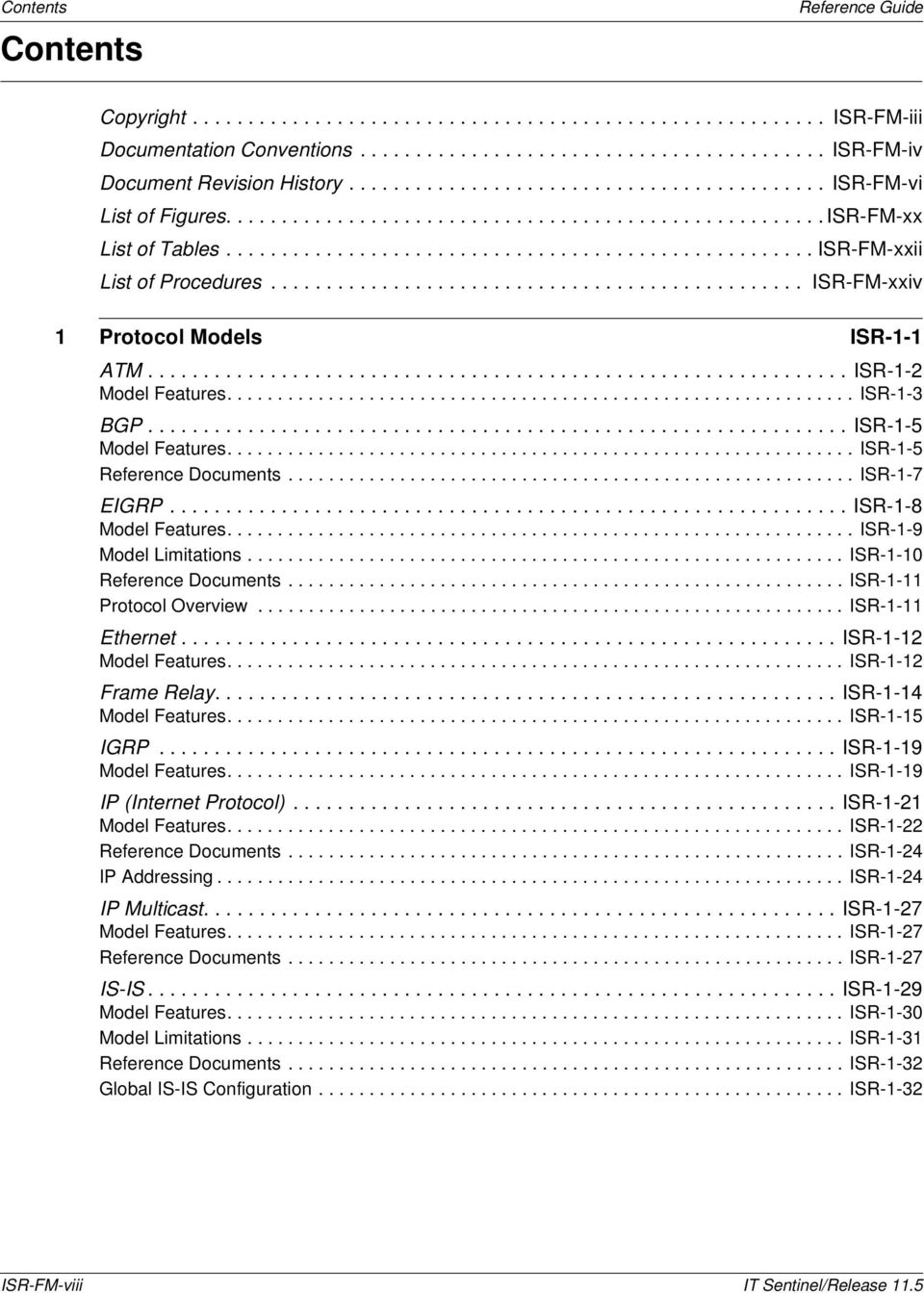
9 Reference Guide Contents Link Aggregation ISR-1-34 MPLS ISR-1-35 Model Features ISR-1-35 Reference Documents ISR-1-36 OSPF ISR-1-38 Model Features ISR-1-38 Reference Documents ISR-1-41 PNNI ISR-1-42 Model Features ISR-1-42 RIP ISR-1-44 Model Features ISR-1-44 Unimplemented Features ISR-1-45 Reference Documents ISR-1-45 RSVP ISR-1-46 Reference Documents ISR-1-46 Spanning Tree Bridge ISR-1-47 Model Features ISR-1-47 Method of Lazy Evaluation ISR-1-47 Reference Documents ISR-1-48 Vendor Device Models ISR-1-49 Model Features ISR-1-49 Available Devices ISR-1-51 Devices That Can Be Created Using the Device Creator ISR-1-60 Model Naming Convention ISR-1-62 Vendor Name Conventions ISR-1-62 Configuration Conventions ISR-1-63 Example Model Names ISR-1-64 VLAN ISR-1-65 Model Features ISR-1-66 Reference Documents ISR System Environment ISR-2-1 Operating System ISR-2-1 File System Organization ISR-2-2 OPNET Directory (<opnet_dir>) ISR-2-4 Release Directory (<reldir>) ISR-2-5 System Directory (sys) ISR-2-5 Architecture Directory (<arch>) ISR-2-7 Binary Directory (bin) ISR-2-7 Library Directory (lib) ISR-2-7 Include Directory (include) ISR-2-8 Miscellaneous Directory (etc) ISR-2-8 Configuration Directory (configs) ISR-2-8 Icon Directory (icons) ISR-2-8 Image Directory (images) ISR-2-9 Documentation Directory (doc) ISR-2-9 IT Sentinel/Release 11.5 ISR-FM-ix
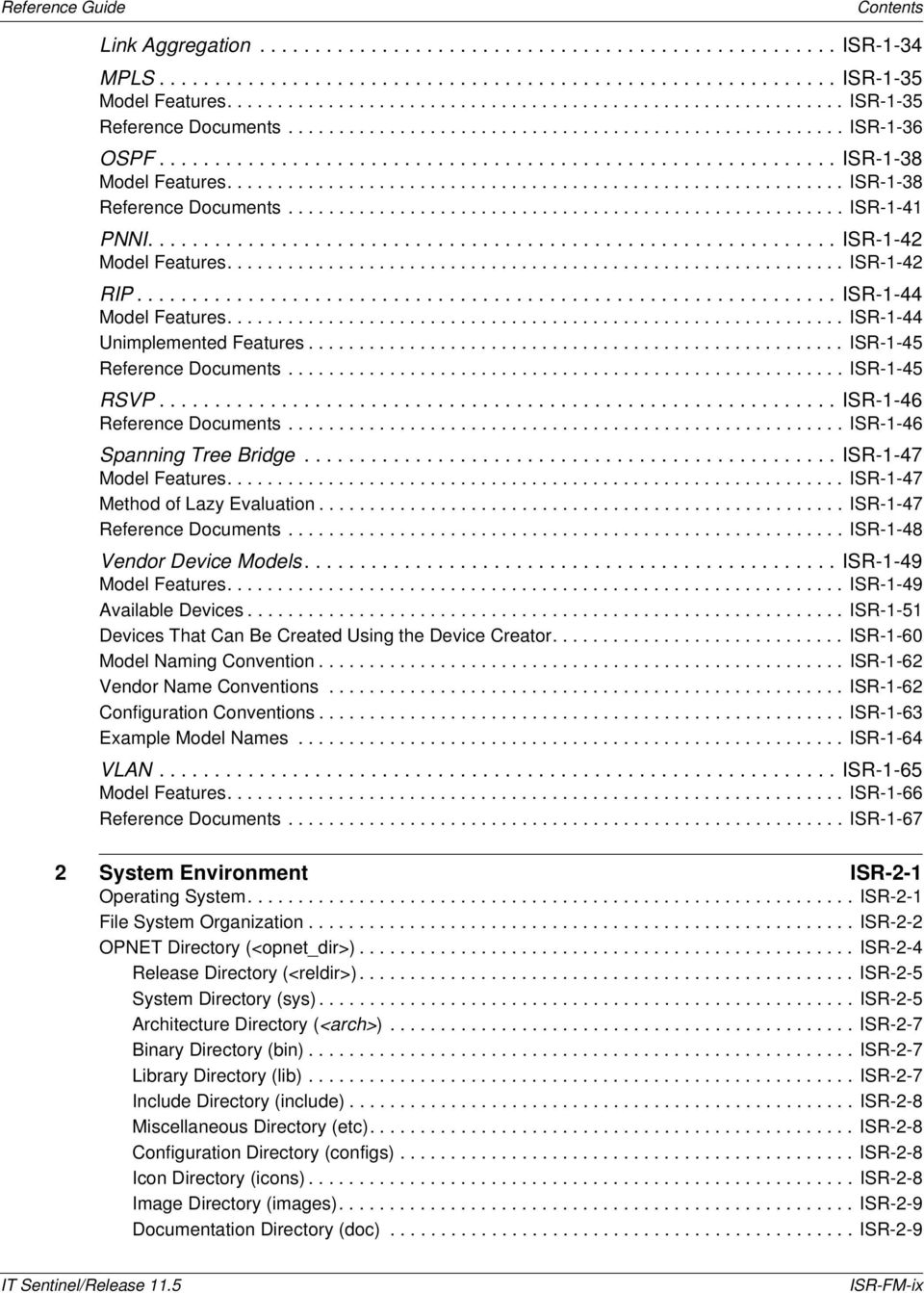
10 Contents Reference Guide Models Directory (models) ISR-2-10 Standard Models Directory (std) ISR-2-10 Tutorial Reference Models Directory (tutorial_ref) ISR-2-11 Contributed Models Directory (contrib) ISR-2-11 Compatibility Models Directory (compat) ISR-2-11 Vendor Models Directory (vendor_models) ISR-2-11 Licensing System Components ISR-2-11 Administration Directory (op_admin) ISR-2-12 Backup Directory (bk) ISR-2-13 Temporary File Directory (tmp) ISR-2-14 Temporary File Types and Names ISR-2-15 Temporary File Directory Maintenance ISR-2-15 User Model Directories ISR-2-16 Model Directory Organization ISR-2-16 Model Precedence ISR-2-17 Default Model Directory ISR-2-18 Model File Naming Conventions ISR-2-18 Versioning in File Names ISR-2-18 File Names for Compiled Code ISR-2-18 File Type Suffixes ISR-2-20 Customizing the User Interface ISR-2-26 Editing Keyboard Shortcuts ISR-2-26 Adding Optional Operations ISR Preferences ISR-3-1 Scope ISR-3-1 s ISR-3-2 Passwords ISR-3-2 Assignment Mechanisms ISR-3-3 Command Line Flags ISR-3-3 Shell Variables ISR-3-5 Environment Database ISR-3-7 Environment Files ISR-3-9 Assignment Precedence ISR-3-11 Static vs. Dynamic Preferences ISR-3-12 Name Wildcards ISR-3-13 Runtime Prompts ISR-3-15 Standard Preferences ISR-3-16 arch_suffix ISR-3-17 console_exit_pause ISR-3-17 dconfirm ISR-3-18 ef ISR-3-18 env_db ISR-3-19 enva ISR-3-19 envp ISR-3-20 geocentric_model ISR-3-21 handle_exception ISR-3-21 ISR-FM-x IT Sentinel/Release 11.5

11 Reference Guide Contents handle_exception_extended ISR-3-21 help ISR-3-22 mem_clear ISR-3-23 mem_optimize ISR-3-23 mod_dirs ISR-3-24 new_env_db ISR-3-25 no_env_db ISR-3-26 noprompt ISR-3-26 opnet_dir ISR-3-27 opnet_user_home ISR-3-27 sconfirm ISR-3-28 Preference Sets ISR-3-29 Development ISR-3-30 bind_shobj_flags ISR-3-31 bind_shobj_flags_devel ISR-3-31 bind_shobj_flags_optim ISR-3-32 bind_shobj_libs ISR-3-32 bind_shobj_libs_devel ISR-3-32 bind_shobj_libs_optim ISR-3-33 bind_shobj_prog ISR-3-33 bind_static_flags ISR-3-33 bind_static_flags_devel ISR-3-33 bind_static_flags_optim ISR-3-34 bind_static_libs ISR-3-34 bind_static_libs_devel ISR-3-34 bind_static_libs_optim ISR-3-35 bind_static_prog ISR-3-35 check_newer_process_model_files ISR-3-35 comp_flags_c++_specific ISR-3-35 comp_flags_c_specific ISR-3-36 comp_flags_common ISR-3-36 comp_flags_devel ISR-3-37 comp_flags_mt ISR-3-37 comp_flags_optim ISR-3-38 comp_globals_export ISR-3-38 comp_per_process_errors ISR-3-39 comp_prog ISR-3-39 comp_prog_cpp ISR-3-39 comp_trace_info ISR-3-39 core_dump ISR-3-40 debug_mk ISR-3-40 ema_verbose ISR-3-40 kernel_type ISR-3-41 mem_track ISR-3-42 mem_track_object ISR-3-42 ov_diff_tolerance ISR-3-42 ov_mem_size ISR-3-43 IT Sentinel/Release 11.5 ISR-FM-xi

12 Contents Reference Guide prof_output ISR-3-43 prof_output_separator ISR-3-43 prof_track ISR-3-43 prof_track_func ISR-3-44 prof_track_recurse ISR-3-44 progress_bar_positioning ISR-3-44 show_compilation_output ISR-3-44 show_compilation_success_dialog ISR-3-44 verbose_mk ISR-3-45 Diagnostics ISR-3-45 beep_count_confirm ISR-3-45 beep_count_error ISR-3-45 diag_enable ISR-3-45 rec_err_suppress ISR-3-46 warning_suppress ISR-3-46 File ISR-3-46 backup_interval ISR-3-47 backup_max_count ISR-3-47 buffered_tfile_types ISR-3-47 file_read_abort_suppress ISR-3-48 force_posix_locale ISR-3-48 verbose_session_log ISR-3-48 GUI ISR-3-48 allow_rotated_world_coordinates ISR-3-49 annot_fonts.large ISR-3-49 annot_fonts.medium ISR-3-49 annot_fonts.small ISR-3-49 async_cmd_mode ISR-3-49 async_cmd_port ISR-3-50 async_cmd_trace ISR-3-50 browser_prog ISR-3-50 check_subnet_bounds ISR-3-50 code_editor_prog ISR-3-51 console ISR-3-51 creation_mode ISR-3-51 disable_message_confirmations ISR-3-51 disable_message_tips ISR-3-51 disable_object_operations ISR-3-52 disable_object_palette_configuration ISR-3-52 disable_object_palette_model_properties_display ISR-3-52 display ISR-3-52 doubleclickinterval ISR-3-53 drag_obj_threshold ISR-3-53 edit_pad.default_height ISR-3-53 edit_pad.default_width ISR-3-53 edit_pad.drag_and_drop ISR-3-54 edit_pad.font ISR-3-54 ISR-FM-xii IT Sentinel/Release 11.5
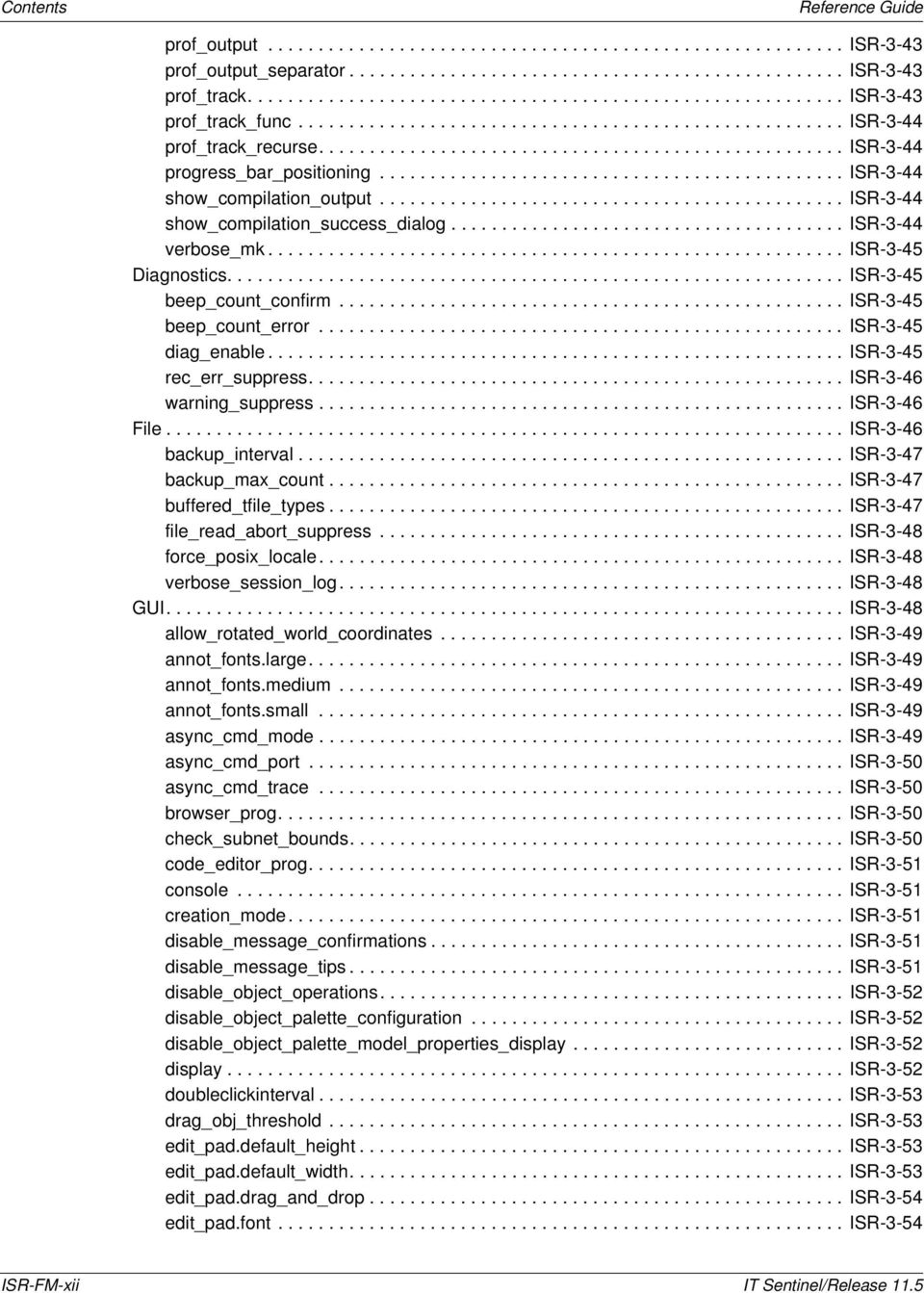
13 Reference Guide Contents edit_pad.selection_background_color ISR-3-54 edit_pad.selection_color ISR-3-54 edit_pad.show_line_number ISR-3-54 edit_pad.text_background_color ISR-3-55 edit_pad.text_color ISR-3-55 edit_pad.word_wrap ISR-3-55 editor_config ISR-3-55 editor_keep ISR-3-56 editor_prog ISR-3-56 expanded_subnets_iconic ISR-3-56 expanded_subnets_thickness ISR-3-57 flow_spreadsheet_import_filename ISR-3-57 flow_spreadsheet_import_overwrite ISR-3-57 font ISR-3-57 html_export_max_image_width ISR-3-57 http_port ISR-3-58 icon_autosizing.disable ISR-3-58 icon_autosizing.large_element_count ISR-3-58 icon_autosizing.max_neighbors ISR-3-58 icon_dbs ISR-3-59 image_capture.border_width ISR-3-59 image_capture.include_window_title ISR-3-59 image_capture.screen_hot_key ISR-3-59 image_capture.show_in_browser ISR-3-60 image_capture.window_hot_key ISR-3-60 load_image ISR-3-60 mark_nondefault_attrs ISR-3-60 mark_nondefault_attrs.changed_color ISR-3-61 mark_nondefault_attrs.intended_color ISR-3-61 model_name ISR-3-61 move_delta ISR-3-61 netbiz_show_promote_button ISR-3-62 network_add_world_map_to_new_models ISR-3-62 network_layout.adjust_unconnected_groups ISR-3-62 network_layout.max_overlap_links_to_bend ISR-3-62 network_layout.use_simple_threshold ISR-3-63 network_links_infer_threshold ISR-3-63 network_palette.style ISR-3-63 network_path_add_subnet_single_left_click ISR-3-63 network_positions_in_deg_min_sec ISR-3-64 network_show_links_to_parent_subnet_objects ISR-3-64 network_use_trx_prompt ISR-3-64 network_visualization.minimized_icon_pixel_threshold ISR-3-64 network_visualization.minimized_icon_size ISR-3-65 network_visualization.show_demand_labels ISR-3-65 network_visualization.show_labels_icon_pixel_threshold ISR-3-65 network_visualization.show_link_arrowheads ISR-3-65 IT Sentinel/Release 11.5 ISR-FM-xiii
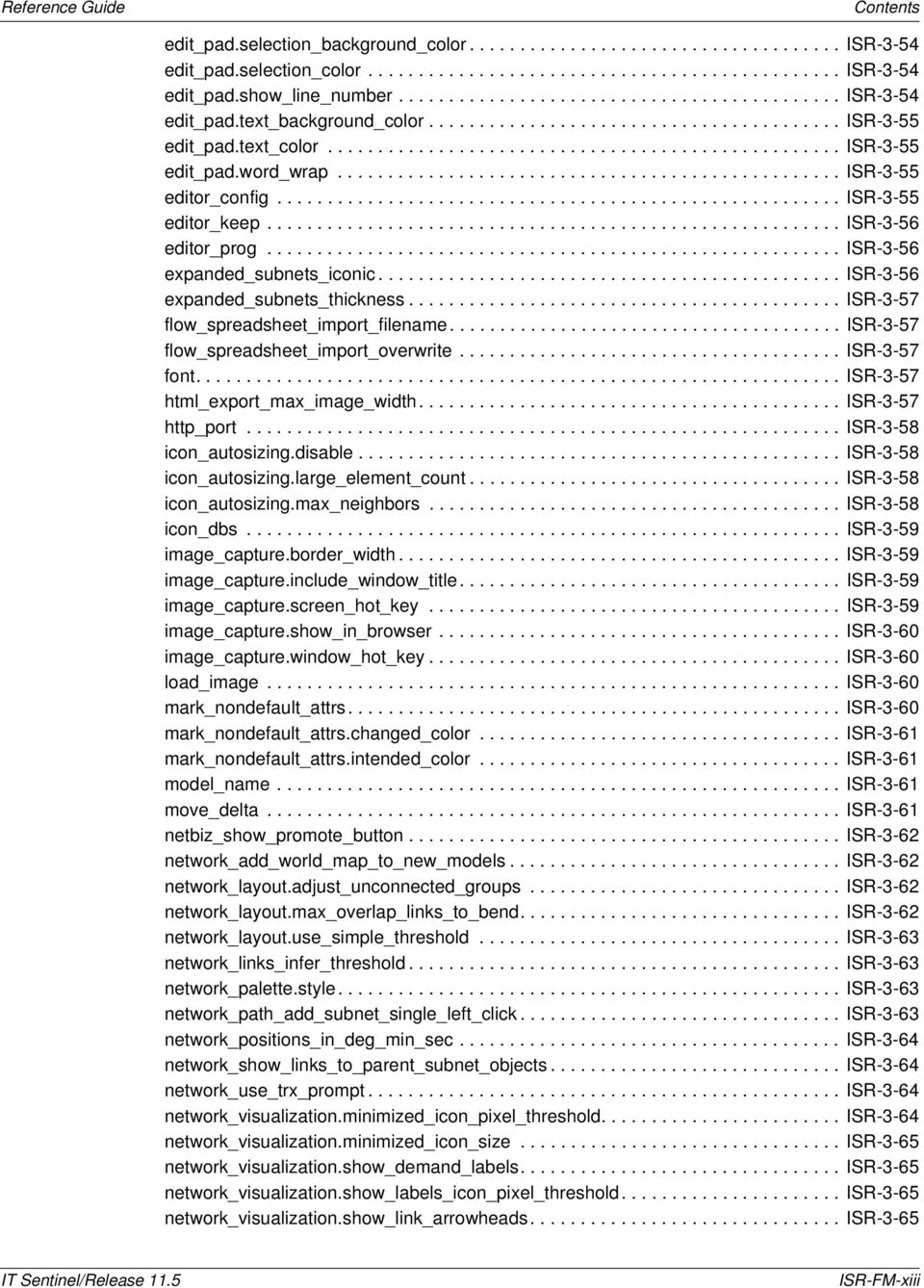
14 Contents Reference Guide network_visualization.show_link_labels ISR-3-66 network_visualization.show_node_labels ISR-3-66 network_visualization.show_path_labels ISR-3-66 obj_dbox_headers ISR-3-66 orbit_draw_style ISR-3-67 panels_close_behavior ISR-3-67 panels_tile_columns_size ISR-3-67 panels_tile_rows_size ISR-3-68 panels_tile_sizing_automatic ISR-3-68 panels_tile_spacing ISR-3-68 panels_tile_x_size ISR-3-68 panels_tile_y_size ISR-3-68 program_banner ISR-3-69 program_resources ISR-3-69 project_backup_on_dont_save ISR-3-69 project_editable_attributes ISR-3-69 project_readonly ISR-3-70 recent_files_limit ISR-3-70 report_top_n ISR-3-70 scenario_name ISR-3-70 select_live_network ISR-3-71 self_desc_validate ISR-3-71 show_ca_count ISR-3-71 show_network_browser_threshold ISR-3-71 show_units ISR-3-72 sim_duration_default ISR-3-72 splash_image ISR-3-72 subnet_hierarchy.interactive.reparenting_disable ISR-3-72 suppress_use_startup_wizard_checkbox ISR-3-73 system_window_behavior ISR-3-73 title_autoplacing.directions ISR-3-73 title_autoplacing.disable ISR-3-74 title_autoplacing.try_small_font ISR-3-74 tool_name ISR-3-74 tool_open_save_behavior ISR-3-74 tool_open_start_dir ISR-3-75 tool_override_dir_behavior ISR-3-75 tooltip.annot_attributes ISR-3-75 tooltip.demand_attributes ISR-3-76 tooltip.link_attributes ISR-3-76 tooltip.object_update ISR-3-76 tooltip.path_attributes ISR-3-76 tooltip.site_attributes ISR-3-76 tooltip_delay ISR-3-77 tutorial_top ISR-3-77 ui.hide_all_windows ISR-3-77 ui.remember_window_sizes_and_positions ISR-3-78 ISR-FM-xiv IT Sentinel/Release 11.5

15 Reference Guide Contents ui_colors.tool_back ISR-3-78 ui_colors.tool_fore ISR-3-78 ui_colors.transparent_pixel_color ISR-3-78 ui_fonts.header ISR-3-79 ui_fonts.large ISR-3-79 ui_fonts.medium ISR-3-79 ui_fonts.small ISR-3-79 ui_fonts.tiny ISR-3-79 ui_layout.hide_buttons ISR-3-80 use_tooltip_as_link_title ISR-3-80 use_startup_wizard ISR-3-80 verbose_report ISR-3-81 vudoc_prog ISR-3-81 win_height ISR-3-82 win_width ISR-3-82 win_x ISR-3-82 win_x_inset ISR-3-82 win_x_stagger ISR-3-83 win_y ISR-3-83 win_y_inset ISR-3-83 win_y_stagger ISR-3-83 window_icon ISR-3-83 wrap_world_links ISR-3-84 Licensing ISR-3-84 Printing ISR-3-84 printcmd ISR-3-84 printername ISR-3-84 print_graph_method ISR-3-85 print_page_limit ISR-3-85 User Lock ISR-3-85 edit_lock_mode ISR-3-85 named_locks ISR-3-85 user_lock_devname ISR-3-86 Web Reporting ISR-3-86 web_rep_graph_enable ISR-3-86 web_rep_graph_height ISR-3-86 web_rep_graph_width ISR-3-87 web_rep_home_url ISR-3-87 web_rep_storage_dir ISR-3-87 web_rep_vendor_urls ISR-3-87 XML ISR-3-87 xml_export_postproc_function ISR-3-88 xml_export_postproc_library ISR-3-88 xml_export_postproc_verbose_attrs ISR-3-88 xml_import_postproc_function ISR-3-88 xml_import_postproc_library ISR-3-88 IT Sentinel/Release 11.5 ISR-FM-xv

16 Contents Reference Guide 4 Program Descriptions ISR-4-1 op_clrtmp ISR-4-2 Description ISR-4-2 Preferences ISR-4-2 op_flse ISR-4-3 Description ISR-4-3 Preferences ISR-4-3 op_install ISR-4-4 Description ISR-4-4 Preferences ISR-4-4 op_license_manager ISR-4-5 Description ISR-4-5 Preferences ISR-4-5 op_license_server ISR-4-6 Description ISR-4-6 op_license_util ISR-4-7 Description ISR-4-7 Preferences ISR-4-7 license_server_kill ISR-4-8 port_check ISR-4-8 op_manfile ISR-4-9 Description ISR-4-9 Preferences ISR-4-11 all ISR-4-12 app_name ISR-4-12 checksum ISR-4-13 comments_add ISR-4-13 comments_del ISR-4-13 comments_print ISR-4-13 edit_lock ISR-4-14 edit_unlock ISR-4-14 f ISR-4-14 find ISR-4-14 from_f ISR-4-15 from_mf ISR-4-15 header_add ISR-4-15 header_print ISR-4-16 header_repair ISR-4-16 header_update ISR-4-16 m ISR-4-16 mf ISR-4-17 register ISR-4-17 suite ISR-4-17 user_lock ISR-4-17 user_unlock ISR-4-17 version_set ISR-4-18 op_vuerr ISR-4-19 ISR-FM-xvi IT Sentinel/Release 11.5

17 Reference Guide Contents Description ISR-4-19 Preferences ISR-4-21 num_err ISR-4-21 itsentinel ISR-4-22 Description ISR-4-22 Preferences ISR-4-22 aliases_verify ISR-4-23 an_mono_sym ISR-4-23 apply_all_aliases ISR-4-23 auto_fire ISR-4-23 bgutil_errlog_incident_limit ISR-4-24 bgutil_gbu_bucket_size ISR-4-24 bgutil_gbu_bucket_type ISR-4-24 bgutil_gbu_file_list ISR-4-24 bgutil_gbu_from_time ISR-4-24 bgutil_gbu_overwrite ISR-4-25 bgutil_gbu_to_time ISR-4-25 bgutil_ignore_alias_case ISR-4-25 comp_target_type.development_parallel_ ISR-4-25 comp_target_type.development_parallel_ ISR-4-25 comp_target_type.development_sequential_ ISR-4-26 comp_target_type.development_sequential_ ISR-4-26 comp_target_type.optimized_parallel_ ISR-4-26 comp_target_type.optimized_parallel_ ISR-4-27 comp_target_type.optimized_sequential_ ISR-4-27 comp_target_type.optimized_sequential_ ISR-4-27 disk_cleanup.clean_automatically ISR-4-27 disk_cleanup.clean_duplicate_scenarios ISR-4-28 disk_cleanup.clean_duplicate_scenarios_days ISR-4-28 disk_cleanup.clean_error_log ISR-4-28 disk_cleanup.clean_error_log_days ISR-4-28 disk_cleanup.clean_session_log ISR-4-29 disk_cleanup.clean_session_log_days ISR-4-29 disk_cleanup.clean_temporary_files ISR-4-29 disk_cleanup.clean_temporary_files_days ISR-4-29 edit_attr_undo_warning_prompt ISR-4-30 ets_options ISR-4-30 event_speed_parameter ISR-4-30 file_abort_read_suppress ISR-4-30 flow_import_errlog_incident_limit ISR-4-31 hpov_default_server ISR-4-31 import_default_interface_type ISR-4-31 import_default_machine_type ISR-4-31 import_mem_stats_log ISR-4-32 ip_address_change_notify_limit ISR-4-32 javascript_enable ISR-4-32 ma_errlog_incident_limit ISR-4-32 IT Sentinel/Release 11.5 ISR-FM-xvii

18 Contents Reference Guide manage_licenses ISR-4-33 model_assistant_adjust_view_after_apply ISR-4-33 model_assistant_configuration_file ISR-4-33 net_report_link_detail_attrs ISR-4-33 net_report_link_summary_attrs ISR-4-34 net_report_link_tooltip_alias ISR-4-34 net_report_node_detail_attrs ISR-4-34 net_report_node_summary_attrs ISR-4-34 net_report_node_tooltip_alias ISR-4-35 network_diff.default_live_spec ISR-4-35 network_diff.default_report_spec ISR-4-35 network_diff.output_dir ISR-4-35 network_diff.suppress_live_legend ISR-4-35 network_palette ISR-4-36 network_palette.fixed_subnet_icon ISR-4-36 network_palette.group_aggregation ISR-4-36 network_palette.keep_above ISR-4-37 network_palette.mobile_subnet_icon ISR-4-37 network_palette.only_one ISR-4-37 network_palette.satellite_subnet_icon ISR-4-37 nmx_no_dynamic ISR-4-38 nt_model_post_conversion_library ISR-4-38 nt_model_post_conversion_proc ISR-4-38 nt_model_pre_conversion_library ISR-4-38 nt_model_pre_conversion_proc ISR-4-39 num_collect_values ISR-4-39 parallel_sim.num_processors ISR-4-39 product ISR-4-39 product_options ISR-4-40 repositories ISR-4-40 show_import_help ISR-4-40 show_map_edit_mode_help_msg ISR-4-41 spreadsheet_prog ISR-4-41 static_bk_util.archive_dir ISR-4-41 top_n_results_min_significant_digits ISR-4-41 traffic_archive_dir ISR-4-42 traffic_default_interval ISR-4-42 traffic_import_suppress_unrecognized_sources_dialog ISR-4-42 traffic_preprocessor_prog ISR-4-42 traffic_servers ISR-4-43 undo_stack_size ISR-4-43 use_metric ISR-4-43 use_network_editor_warning ISR-4-43 use_scenario_prompt ISR-4-43 use_startup_wizard ISR-4-44 value_notch_filter_tolerance ISR-4-44 word_processing_prog ISR-4-44 ISR-FM-xviii IT Sentinel/Release 11.5

19 Reference Guide Contents 5 Icon Database Editor ISR-5-1 Icon Database Editor Menus ISR-5-2 Image Editor ISR-5-3 The Tool Palette ISR-5-3 File Menu ISR-5-6 Importing an Image ISR-5-6 Exporting an Image ISR-5-7 Edit Menu ISR-5-8 View Menu ISR-5-9 Options Menu ISR-5-11 Color Palette Editor ISR-5-11 Transparencies and Masks ISR Distributions ISR-6-1 Index ISR-IX-1 IT Sentinel/Release 11.5 ISR-FM-xix

20 List of Figures List of Figures Reference Guide Figure 1-1 Figure 1-2 Figure 1-3 Figure 1-4 Figure 1-5 Figure 1-6 Figure 2-1 Figure 2-2 Figure 2-3 Figure 2-4 Figure 2-5 Figure 2-6 Figure 2-7 Figure 3-1 Figure 3-2 Figure 3-3 Figure 3-4 Figure 3-5 Figure 3-6 Figure 3-7 Figure 3-8 Figure 3-9 Figure 4-1 Figure 4-2 Figure 4-3 Figure 4-4 Figure 4-5 Figure 5-1 Figure 5-2 Figure 6-1 Figure 6-2 Figure 6-3 Figure 6-4 Figure 6-5 Figure 6-6 Figure 6-7 Figure 6-8 Figure 6-9 Figure 6-10 Figure 6-11 Figure 6-12 Figure 6-13 Figure 6-14 Figure 6-15 Figure 6-16 Units for Bandwidth and Delay Components ISR-1-20 Internet Protocol Address Classes ISR-1-24 Internet Protocol Subnet Addressing ISR-1-25 Protocols Menu - IS-IS ISR-1-32 Aggregating Links Between Two Nodes ISR-1-34 Using VLANs for Broadcast Control ISR-1-65 File System Organization ISR-2-3 OPNET Directory Organization ISR-2-4 Release Directory Organization ISR-2-5 System Directory Organization ISR-2-6 Architecture Directory Organization ISR-2-7 Initial Organization of Administration Directory ISR-2-13 Example of a Complex Model Directory Organization ISR-2-17 Environment Database Example ISR-3-7 Environment File Example ISR-3-9 Assignment Precedence for Preferences ISR-3-11 Sample dconfirm Preference Information ISR-3-18 Sample envp Output ISR-3-20 Sample help Preference List ISR-3-22 Sample mod_dirs Assignments ISR-3-25 Sample opnet_dir Assignments ISR-3-27 Sample sconfirm Preference List ISR-3-29 Example Usage of op_license_util ISR-4-7 Example Usage of op_manfile (1) ISR-4-11 Example Usage of op_manfile (2) ISR-4-11 Example Usage of op_vuerr ISR-4-20 Sample Code with Four Error Locations ISR-4-21 Icon Editor Tool Palette ISR-5-3 Using a Transparency To Hide the Black Background ISR-5-13 Bernoulli PMF Definition ISR-6-2 Bernoulli PMF Shape ISR-6-2 Binomial PMF Definition ISR-6-3 Binomial PMF Shape ISR-6-3 Chi-Square PDF Definition ISR-6-4 Chi-Square PDF Shape ISR-6-4 Constant PMF Definition ISR-6-5 Constant PMF Shape ISR-6-5 Erlang PDF Definition ISR-6-6 Erlang PDF Shape ISR-6-6 Exponential PDF Definition ISR-6-7 Exponential PDF Shape ISR-6-7 Extreme Value (Gumbel) PDF Definition ISR-6-8 Extreme Value (Gumbel) PDF Shape ISR-6-8 Gamma PDF Definition ISR-6-9 Gamma PDF Shape ISR-6-9 ISR-FM-xx IT Sentinel/Release 11.5
21 Reference Guide Figure 6-17 Figure 6-18 Figure 6-19 Figure 6-20 Figure 6-21 Figure 6-22 Figure 6-23 Figure 6-24 Figure 6-25 Figure 6-26 Figure 6-27 Figure 6-28 Figure 6-29 Figure 6-30 Figure 6-31 Figure 6-32 Figure 6-33 Figure 6-34 Figure 6-35 Figure 6-36 Figure 6-37 Figure 6-38 Figure 6-39 Figure 6-40 Figure 6-41 Figure 6-42 List of Figures Geometric PMF Definition ISR-6-10 Geometric PMF Shape ISR-6-10 Laplace (Double Exponential) PDF Definition ISR-6-11 Laplace (Double Exponential) PDF Shape ISR-6-11 Logistic PDF Definition ISR-6-12 Logistic PDF Shape ISR-6-12 Lognormal PDF Definition ISR-6-13 Lognormal PDF Shape ISR-6-13 Normal and Fast Normal PDF Definition ISR-6-14 Normal and Fast Normal PDF Shape ISR-6-14 Pareto PDF Definition ISR-6-15 Pareto PDF Shape ISR-6-15 Poisson PMF Definition ISR-6-16 Poisson PMF Shape ISR-6-16 Power Function PDF Definition ISR-6-17 Power Function PDF Shape ISR-6-17 Rayleigh PDF Definition ISR-6-18 Rayleigh PDF Shape ISR-6-18 Triangular (Symmetrical) PDF Definition ISR-6-19 Triangular (Symmetrical) PDF Shape ISR-6-19 Uniform PDF Definition ISR-6-20 Uniform PDF Shape ISR-6-20 Uniform Integer PMF Definition ISR-6-21 Uniform Integer PMF Shape ISR-6-21 Weibull CDF Definition ISR-6-22 Weibull CDF Shape ISR-6-22 IT Sentinel/Release 11.5 ISR-FM-xxi
22 List of Tables List of Tables Reference Guide Table 1-1 Table 1-2 Table 1-3 Table 1-4 Table 1-5 Table 1-6 Table 1-7 Table 1-8 Table 1-9 Table 1-10 Table 1-11 Table 1-12 Table 1-13 Table 1-14 Table 1-15 Table 1-16 Table 1-17 Table 1-18 Table 1-19 Table 1-20 Table 1-21 Table 1-22 Table 1-23 Table 1-24 Table 1-25 Table 1-26 Table 1-27 Table 1-28 Table 1-29 Table 1-30 Table 2-1 Table 2-2 Table 2-3 Table 2-7 Table 2-8 Table 2-9 Table 3-1 Table 3-2 Table 3-3 Table 3-4 Table 3-5 Table 3-6 Table 3-7 Table 3-8 Table 4-1 ATM Model Features ISR-1-3 Reference Documents ISR-1-4 BGP Model Features ISR-1-5 Reference Documents ISR-1-7 EIGRP Model Features ISR-1-9 Reference Documents ISR-1-11 IP Model Features ISR-1-22 Reference Documents ISR-1-24 Internet Protocol Address Range ISR-1-25 IP Multicast Model Features ISR-1-27 Reference Documents ISR-1-27 IS-IS Model Features ISR-1-30 Reference Documents ISR-1-32 Protocols Menu Options ISR-1-33 MPLS Model Features ISR-1-35 Summary of MPLS Support in IT Sentinel ISR-1-35 Reference Documents ISR-1-36 OSPF Model Features ISR-1-38 Reference Documents ISR-1-41 PNNI Model Features ISR-1-42 Reference Documents ISR-1-43 Reference Documents ISR-1-45 Reference Documents ISR-1-46 Vendor Device Model Library ISR-1-51 Device Creator: Supported Device Categories ISR-1-60 Supported Vendor Names ISR-1-62 Interface Abbreviations ISR-1-63 Vendor Model Naming Conventions ISR-1-64 VLAN Model Features ISR-1-66 Reference Document ISR-1-67 Contents of the Release Directory ISR-2-5 Contents of the sys Directory ISR-2-6 Contents of the <arch> Directory ISR-2-7 File Name Suffixes for Code Type ISR-2-19 Architecture Codes ISR-2-19 IT Sentinel File Type Suffixes ISR-2-20 Command Line Syntax for Basic Preference Types ISR-3-4 UNIX Shell Variable Syntax for Basic Preference Types ISR-3-6 Windows Shell Variable Syntax for Basic Preference Types ISR-3-6 Environment File Syntax for Basic Preference Types ISR-3-9 Standard Preferences ISR-3-16 Preference Sets ISR-3-30 Compiling and Linking Program Preferences for C ISR-3-31 Effects of use_startup_wizard and suppress_use_startup_wizard_checkbox ISR-3-81 IT Sentinel Programs and Utilities ISR-4-1 ISR-FM-xxii IT Sentinel/Release 11.5
23 Reference Guide List of Tables Table 4-2 Table 5-1 Table 5-2 Table 5-3 Table 5-4 Table 5-5 Table 5-6 Table 5-7 Table 5-8 Table 6-1 op_manfile Operations ISR-4-10 Common Icon Tasks ISR-5-1 Icon Pop-Up Menu Operations ISR-5-2 Tool Palette Summary ISR-5-4 File Menu Summary ISR-5-6 Edit Menu Summary ISR-5-8 View Menu Summary ISR-5-9 Options Menu Summary ISR-5-11 Editing Buttons ISR-5-12 Predefined Distributions ISR-6-1 IT Sentinel/Release 11.5 ISR-FM-xxiii
24 List of Procedures List of Procedures Reference Guide Procedure 2-1 Procedure 2-2 Procedure 5-1 Procedure 5-2 Procedure 5-3 Procedure 5-4 Procedure 5-5 Adding or Changing a Shortcut ISR-2-26 Adding an Optional Operation ISR-2-27 Importing an Image ISR-5-6 Exporting an Image ISR-5-7 Editing Colors in a Palette ISR-5-11 Creating and Installing a Shade Spectrum ISR-5-12 Creating a Transparency ISR-5-13 ISR-FM-xxiv IT Sentinel/Release 11.5
25 Reference Guide 1 Protocol Models 1 Protocol Models This document describes the features included in the following protocol models: ATM on page ISR-1-2 BGP on page ISR-1-5 EIGRP on page ISR-1-8 Ethernet on page ISR-1-12 Frame Relay on page ISR-1-14 IGRP on page ISR-1-19 IP (Internet Protocol) on page ISR-1-21 IP Multicast on page ISR-1-27 IS-IS on page ISR-1-29 Link Aggregation on page ISR-1-34 MPLS on page ISR-1-35 OSPF on page ISR-1-38 PNNI on page ISR-1-42 RIP on page ISR-1-44 RSVP on page ISR-1-46 Spanning Tree Bridge on page ISR-1-47 Vendor Device Models on page ISR-1-49 VLAN on page ISR-1-65 IT Sentinel/Release 11.5 ISR-1-1
26 1 ATM ATM Reference Guide Asynchronous Transfer Mode (ATM) is a connection-oriented packet switching technique that is universally accepted as the transfer mode of choice for Broadband Integrated Services Digital Network. This document describes key features of the ATM model suite shipped as part of the standard OPNET model library. ISR-1-2 IT Sentinel/Release 11.5
27 Reference Guide Model Features 1 ATM This section provides a list of the main features available in the ATM model: The ATM model suite captures the following protocol behavior: Table 1-1 ATM Model Features Feature Signaling Support Traffic Control Buffering Connection support Description Signaling is provided for point-to-point, full-duplex, Switched Virtual Circuit (SVC), Soft-Permanent Virtual Circuit (SPVC) and Soft- Permanent Virtual Path (SPVP). Dynamic call setup and teardown procedures are supported. Traffic control includes Call Admission Control (CAC) and Usage Parameter Control (UPC). Traffic Control is based on specific service category, traffic parameters (PCR, SCR, MCR, MBS) and QoS parameters (ppcdv, maxctd, CLR). Traffic Control prevents all calls with unsupportable traffic requirements from establishing a connection and prevents established calls from degrading network service below the specified Quality of Service requirements. Output port buffering is modeled. Output buffer supports the round-robin and weighted round-robin queueing schemes. Buffers can be configured at each switch for various QoS levels. A QoS level is made up of the QoS category (CBR, rt-vbr, nrt-vbr, ABR, UBR), the QoS parameters, (ppcdv, max CTD, CLR), and the traffic parameters. The connections of the ATM model suite enable you to do the following: Configure hard and soft PVPs and PVCs Switch between hard and soft PVPs and PVCs Import hard and soft PVCs from a file Specify a preferred route for an SPVx Accelerate capacity planning using the Call Only Mode feature on ATM uni-source nodes Set up SVC connections on a per-demand basis Display VC routes using the route browser ATM connection models are implemented based on information available from the sources listed below and in Table 1-2. End of Table 1-1 Configurable parameters for Service Specific Connection Oriented Protocol (SSCOP) IT Sentinel/Release 11.5 ISR-1-3
28 1 ATM Reference Guide Dynamic routing using PNNI or an adaptation of the Bellman-Ford shortest path algorithm Simulation efficiency modes to reduce the duration of large simulations without sacrificing accuracy An API package that applications can use to create, destroy, and send packets through an ATM Virtual Circuit SPVC reroute capability to reroute SPVC connections on failure ATM models are implemented based on information available from the following sources Table 1-2 Reference Documents ATM Forum, September 1993 ATM User-Network Interface Specification, Version 3.0 ATM Forum, April 1996 ATM Traffic Management Specification, Version 4.0 ITU-TSS Recommendation I.150 ITU-TSS Recommendation I.361 ITU-TSS Recommendation I.362 ITU-TSS Recommendation I.363 ITU-T Specification Q.2110 P-NNI V1.0 B-ISDN ATM Functional Characteristics B-ISDN ATM Layer Specification B-ISDN ATM Adaptation Layer (AAL) Functional Description B-ISDN ATM Adaptation Layer (AAL) Specification B-ISDN AAL - Service Specific Connection Oriented Protocol (SSCOP) PNNI 1.0 ATM Forums: Private Network-Network Interface Specification Version 1.0 (PNNI1.0) End of Table 1-2 ISR-1-4 IT Sentinel/Release 11.5
29 Reference Guide BGP 1 BGP Border Gateway Protocol (BGP) is an interdomain routing protocol used to exchange network reachability information between BGP speaking systems. Unlike most other routing protocols that operate within an autonomous system (such as RIP and OSPF), BGP is designed to transmit routing information between different autonomous systems. The OPNET BGP model implements the current version: BGP-4. This document describes the BGP model distributed with the Standard Model Library. Model Features The BGP model supports the following protocol features. Table 1-3 BGP Model Features (Part 1 of 2) Feature Neighbor configuration Routing policies Route filtering Redistribution Description IBGP (Internal BGP) and EBGP (External BGP) neighbors can be configured for a BGP router. A router can be configured with multiple routing policies. These routing policies can be applied to neighbors to restrict outgoing or incoming routes or to modify the attributes of advertised routes. The following attributes can be checked or modified in route maps: IP Address AS Path Communities Local Preference Degree of Preference Multi Exit Discriminator Weight Route filtering, on prefix lists and AS path lists, is supported on a per-router or per-neighbor basis. Routes can be redistributed between BGP and other routing protocols. You can use route maps to restrict or change the attributes of routes redistributed into BGP according to the following: Next hop Metric Route type (Internal or External) Destination s IP address IT Sentinel/Release 11.5 ISR-1-5
30 1 BGP Reference Guide Table 1-3 BGP Model Features (Part 2 of 2) Feature Advertised destinations Confederations Route Reflectors Timers Description A BGP router can be configured to advertise additional routes. That is, the router can add routes that may not be included in the routes received from neighbors and other routing protocols. Large autonomous systems may be split into smaller member autonomous systems to reduce the required number of IBGP peering sessions. The use of route reflectors to reduce the IBGP mesh is supported. The following timers are modeled. Hold Timer. The value of this timer is the maximum interval during which the routes advertised by a peer will be valid without a keepalive or an update packet coming from the peer. The hold timer is started once the connection to the peer is established and it will be periodically reset every time a keepalive or an update packet is received from the peer. Keep Alive Timer. This timer value is not taken from an attribute, but is modeled internally as one third of the value of the Hold Timer. Connect Retry Timer. Time between successive attempts to open a TCP connection with a neighbor. This timer is canceled once the TCP connection is successfully established. Min Route Advertisement Interval. Minimum amount of time that must elapse between advertisements of routes to a particular destination from a single BGP speaker. Scan Period. The period between two successive BGP scans. A BGP scan determines the metric changes to routes specified in the Network Reachability Attribute and advertises them via UPDATE messages. It also detects if previously unreachable neighbors have become reachable and triggers the connection establishment mechanism. End of Table 1-3 ISR-1-6 IT Sentinel/Release 11.5
31 Reference Guide 1 BGP Reference Documents The model is implemented based on information from the following sources. Table 1-4 Reference Documents RFC RFC-1997, 1998 RFC-2796 RFC-3065 BGP4 Specifications and usage guidelines BGP communities usage Use of route reflectors BGP Confederations specifications End of Table 1-4 IT Sentinel/Release 11.5 ISR-1-7
32 1 EIGRP EIGRP Reference Guide EIGRP (Enhanced Interior Gateway Routing Protocol) is a distance-vector routing protocol developed by Cisco Systems to reduce routing protocol overhead in steady state, and to provide fast convergence in case of topology changes. In well-designed networks, EIGRP scales well and converges quickly with minimal network traffic. To minimized its load on the network, EIGRP propagates only routing table changes instead of the entire routing table when a change occurs. This document describes the EIGRP model, which is shipped as part of the standard OPNET model library. ISR-1-8 IT Sentinel/Release 11.5
33 Reference Guide Model Features 1 EIGRP The following table summarizes the main EIGRP features included in the model implementation. Table 1-5 EIGRP Model Features Feature Neighbor Discovery/Recovery Timers EIGRP Tables DUAL Metric Computations Load Balancing Passive Interfaces Split-Horizon Route redistribution Route Filtering Multiple Processes VLSM Traffic Sharing Description The model implements automatic neighbor discovery and recovery at start time and after failures. Hello, update, query, and reply messages are explicitly modeled. Hold Time and Hello Interval timers are configurable on a per-as basis on each interface basis. The following tables are modeled: Topology table Routing table Neighbor table The model handles topology changes such as node and link failures and recoveries using the Diffusing Update Algorithm (DUAL) when necessary. The model uses composite metric computation using configurable K values. Metric variance is also configurable. Load balancing over multiple routes is modeled. The model supports the passive interface feature for EIGRP. Passive interfaces do not send or receive routing updates; however, they are included in routing updates sent from non-passive interfaces. Split horizon can be enabled on a per-interface basis to prevent routing loops. The EIGRP model accepts redistributed external routes. Incoming and outgoing routes can be filtered according to prefix lists on a per-interface basis. Multiple EIGRP processes can be active on a router. Variable length subnet masks are supported. Traffic sharing is configurable on a router-wide or perinterface basis. End of Table 1-5 IT Sentinel/Release 11.5 ISR-1-9
34 1 EIGRP Model Limitations Reference Guide The following protocol features are not implemented in the EIGRP model suite. The model suite does not include the implementation of the RTP (Reliable Transfer Protocol) component of EIGRP. The model assumes all the underlying protocol stacks are reliable and every packet sent reaches its destination unless there is a link or node failure (that is, no underlying protocol packet drops). Among the protocol dependent modules, only the IP module is included in the implementation the EIGRP module does not run over the IPX module. Stub routers and multipath routes threshold are not supported. ISR-1-10 IT Sentinel/Release 11.5
35 Reference Guide Reference Documents 1 EIGRP EIGRP is a proprietary product of Cisco Systems, so there is no standard that explains the design and details of the protocol. The EIGRP model is based on CISCO product documentation and on the following references. Table 1-6 Reference Documents Jeff Doyle, CCIE#1919 Alvaro Ratana, Russ White, Don Slice CCIE Professional Development: Routing TCP/IP, Volume 1 EIGRP for IP: Basic Operation and Configuration, Addison Wesley Networking Basics Series, End of Table 1-6 Protocol Overview EIGRP activities start at EIGRP start time by sending initial hello messages through the active interfaces of the underlying router node. The EIGRP node discovers neighbor EIGRP modules when they send hello messages, and the module begins to build its topology and routing tables accordingly. In an effort to discover the entire network, the EIGRP nodes then exchange topology and update messages with their new-found neighbors. When all update messages have been processed and there are no triggered update messages left, the EIGRP network has converged (that is, all routers have discovered all of the IP subnetworks in the entire network). At this point, the EIGRP process enters into steady state. In steady state, periodic hello messages are used by EIGRP nodes to detect changes in neighbor node status. If an EIGRP node does not receive a hello message from a neighbor for a specific amount of time, the EIGRP process considers that neighbor to be down or unreachable. If the failed node recovers, then its EIGRP process will start sending periodic hello messages again, and these hello messages alert its neighbors that it has recovered. In case of topology changes, the EIGRP process tries to recover quickly by using its topology table to find an alternate route. If the topology table does not yield a feasible alternate route for some subnetworks, the EIGRP process starts DUAL, which queries neighbor nodes topology tables for an alternate route. Execution of DUAL causes query and reply message exchanges between EIGRP processes, as well as the exchange of update messages. The EIGRP network reaches convergence again when there are no active query, reply or update messages in the network. Any subnetworks to which DUAL could not find a route become unreachable. IT Sentinel/Release 11.5 ISR-1-11
36 1 Ethernet Ethernet Reference Guide Ethernet is a bus-based local area network (LAN) technology commonly used in the technical and business communities. Detailed information about the Ethernet protocol is in the IEEE Standard. Model Features The Ethernet MAC model provided with OPNET implements the carrier sensing, collision detection, and retransmission mechanisms specified in the IEEE 802.3, IEEE 8-2.3u, and IEEE 802.3z Standard. Explicit modeling is performed for all features other than serialization of bit transfers to and from the physical layer. The following list itemizes the features provided in this model: FIFO processing of Transmission Requests Propagation Delay based on Distance Between Individual Stations Carrier Sensing from Physical Layer Collision Detection from Physical Layer Truncated Binary Exponential Backoff Transmission Attempt Limit of 16 Interframe Gap Timing for Deference Jam Sequence Transmission after Collisions Minimum and Maximum Frame Sizes Frame Bursting (1000BaseX Ethernet operating in half-duplex only) Full- and half-duplex transmissions You can configure port-based VLANs on all generic bridge and switch models, and on any vendor-specific models that support this technology. Ethernet link models allow you to simulate point-to-point trunk links; a single trunk link can carry traffic for multiple VLANs as specified by IEEE 802.1q. To configure a VLAN, set the VLAN Scheme attribute to Port-based VLAN on the bridge or switch supporting the VLAN. You can assign VLAN identifiers to specific port numbers in the VLAN Port Configuration Table. (To find a link s port numbers, use Link Interfaces on the Edit Attributes (Advanced) dialog box.) Note that you can assign only one VLAN identifier to a specific port. However, multiple ports can belong to the same VLAN. ISR-1-12 IT Sentinel/Release 11.5
37 Reference Guide 1 Ethernet The Ethernet models also support Fast EtherChannel technology. This allows multiple Ethernet point-to-point links to be bundled into one logical full-duplex channel of up to 800 Mbps (for Fast Ethernet) or 8000 Mbps (for Gigabit Ethernet). You can use a Fast EtherChannel or Gigabit EtherChannel link in place of any regular Ethernet link (10BaseT, 100BaseT, or 1000BaseX). EtherChannel links support flow-based balancing of traffic, and are useful for upgrading bottleneck links in Ethernet LAN networks. Note You can only use EtherChannel links when Ethernet is running in fullduplex mode. The Ethernet models can be deployed either in a bus (10Base2) or a hub (10BaseT, 100BaseT or fast ethernet, and 1000BaseX or gigabit ethernet) configuration. The following list itemizes the main differences between these two configurations: Connections from the MAC processes to the hub are via duplex point-to-point links, as opposed to a bus medium. Collision Detection in the hub configuration is handled by the hub, rather than individual MAC processes. Deference mechanism is handled by the hub, rather than a separate deference process. Ethernet hubs cannot be directly connected to one another. Instead, a bridge must be used to link two or more hubs together. IT Sentinel/Release 11.5 ISR-1-13
38 1 Frame Relay Frame Relay Reference Guide Frame Relay is a connection-oriented, packet-switching protocol used to pass information across a digital interface. Connection-oriented means that a connection between the communicating parties is set up before the actual data transfer takes place. Other higher layer protocols are required to handle additional network services, such as flow control and error recovery. This protocol operates in the lowest sublayer of the data link layer (DLL) of the Open System Interconnection (OSI) reference model. Detailed information on the Frame Relay protocol can be found in the following documentation: ANSI T1.606, 1990, Frame Relay Bearer Service. ANSI T1.617, 1991, Signaling Specification for Frame Relay Bearer Service. ANSI T1.618, 1991, Core Aspects of Frame Protocol for Use with Frame Relay Bearer Service. ANSI T1.606a, 1992, Frame Relay Bearer Service - Congestion Management and Frame Size. ANSI T1.513, 1994, User Information Transfer Performance Parameters. These documents can be obtained from the American National Standards Institute. Additionally, RFC-1490 has been used as a reference for the multiprotocol interconnection over Frame Relay. The following is a list of additional ANSI standards available on the Frame Relay protocol: ANSI T1.606b, 1993, Frame Relay Bearer Service - Network-to-Network Interface Requirements. ANSI T1.617a, 1994, Signaling Specification for Frame Relay Bearer Service - Protocol Encapsulation and PICS. ISR-1-14 IT Sentinel/Release 11.5
39 Reference Guide Model Features 1 Frame Relay This section discusses the implementation choices made in developing this OPNET Frame Relay model. Certain parts of the protocol have been simplified or omitted in view of the fact that it is intended primarily for performance estimation. The following information is important in order to determine whether the OPNET Frame Relay example model is applicable for a particular simulation study or not. The main limitations of the described model are: The model does not incorporate the SVC implementation for call establishment; rather all the virtual circuits used for data transfer are modeled using the PVC approach. The PVC approach assumes that the user sets up the virtual circuits at the service subscription time and these virtual circuits remain intact during the length of the simulation. Specific instructions for setting up a PVC connection between source-destination application pairs are provided later in this document. The Local Management Interface (LMI) message passing is not implemented. The LMI messages, if implemented, help in providing the user with status and configuration information for the PVCs operating over the Frame Relay interface. This feature is not implemented based on the assumption that once the PVC circuits are setup, they are not released until the end of the simulation. The Consolidated Link Layer Management (CLLM) message provides a useful feature to the Frame Relay protocol by acting as an additional congestion notification mechanism. However, since this feature is optional and many systems do not implement this feature, the current model does not support it. The frame check sequence (FCS) checking is not implemented. This feature of the Frame Relay protocol is used to ensure that transmission errors get trapped by the receiving stations. However, assuming that transmission errors are very rare, the implementation of this feature has been omitted from the simulation model. The model provides only a store-and-forward switching methodology (i.e., the frame switching takes place within a network switching device only after it is completely received). There may be instances when the frame switching equipment employs a cut-through switching technology (i.e., the leading edge of the incoming frame may be forwarded on to the next link before the trailing edge is completely received). If cut-through switching needs to be modeled, changes will have to be made to the existing model to achieve the desired characteristics. IT Sentinel/Release 11.5 ISR-1-15
40 1 Frame Relay Reference Guide Some of the important features that the model incorporates are: The Frame Relay example model is developed in a modular fashion, with simple interface requirements for DTE and DCE. The FRAD implementation takes care of interfacing the application to the Frame Relay network. Applications may be supported directly on top of the FRAD, or via an interface module if the applications relies on some other protocol. As an example, a Frame Relay-IP interface model (FRIPIF) is provided to illustrate interfacing Frame Relay with IP (an example showing how to set up applications using TCP/IP to support data transfer over a Frame Relay network is also provided). Each PVC supports separate bi-directional specification of all the necessary parameters associated with it (i.e., CIR, Bc and Be along with the source and destination application information). More details on this topic are provided in a later section of this document. The model implements congestion control mechanisms at the DTE on a per- PVC basis by monitoring the data transfer in accordance with the subscription time parameters (CIR, B c and B e ) for that PVC over a measurement interval, T c. Data in excess of the B c specification is marked DE, and data in excess of B e specification is discarded immediately. The model allows emulation of zero CIR specification. In this mode all the frames generated at the source are marked Discard Eligible (DE). The model implements congestion notification at the DCE by monitoring network resource utilization in terms of the buffer usage for the outgoing link supporting each PVC. If the buffer usage exceeds a certain preset threshold (to denote onset of congestion), the FECN and/or BECN bits are marked in the outgoing frames. The model allows the user to define the following thresholds (expressed as a percentage of the total bit capacity for that buffer) where congestion control mechanisms are affected: Enable Congestion Status Disable network congestion The model also implements congestion control at the DCE by discarding frames which are discard eligible (i.e., with their DE bit set), and in case of severe throttling discarding all the frames until the network recovers from the congestion status. Again, these mechanisms are activated when the buffer usage exceeds predefined thresholds. The following four attributes are used to set these thresholds: Start discarding DE frames Start discarding all frames Stop discarding all frames Stop discarding DE frames ISR-1-16 IT Sentinel/Release 11.5
41 Reference Guide 1 Frame Relay Additionally, the model provides an option for the network to participate in congestion control by setting the DE bit in frames if the network is in a congested state. This feature can be incorporated in the model by enabling the following parameter: Network action on DE bit All of the seven parameters above are attributes of the Frame Relay switching node. The values for these parameters are computed as a percentage of the buffer capacity for that switching node. The model implements Frame Relay fragmentation. The Frame Relay layer fragments application packets that are larger than a specified maximum frame size that the network can carry. At the destination end, these fragments are reassembled to form the original application data packet. The model calculates standard user-information-transfer performance parameters like end-to-end delays, congestion status of the network with respect to time, and the frame residual error rate (RER). More details on these statistics can be found in a subsequent section of this document. Additionally, specific portions of the model can be easily modified to incorporate other custom statistics, if desired. The number of application processes running directly on top of the FRAD can be easily changed without modifying any of the existing models. More details on this topic are provided in a later section of this document. The Frame Relay demand object provides you with a way to define Frame Relay PVCs. You define the PVC as a demand object overlaid between two nodes in a network model, then you can define specific characteristics of the PVC on the Layer 2 Mapping compound attribute of the interface. You do not need to use the Frame Relay PVC Config node in the model. The Frame Relay PVC Config node allows you to define a traffic pattern and assign it to a PVC. You can also create multiple PVCs for a given sourcedestination pair; this allows you to characterize different PVCs to support specific traffic patterns, thereby providing varying QoS for different higherlayer traffic flows. The standard model library includes a set of Frame Relay cloud models that allow you to abstract parts of a network infrastructure. A cloud behaves like a simplified Frame Relay switch with many ports: it supports connectivity between attached devices, but does not include complex operations like buffer management. Clouds allow you to model a subnetwork s packet-loss IT Sentinel/Release 11.5 ISR-1-17
42 1 Frame Relay Reference Guide and latency characteristics while its inner workings remain transparent; see the Standard Model Library chapter of Modeling Concepts in the Modeler documentation or of the User Guide in the Guru documentation for more information. Note To add a Frame Relay demand object to your network model, open the Frame Relay object palette and drag the fr_pvc object to the workspace. Note If you do not specify a name for the PVC, the default name is <source_endpoint_name>-<destination_endpoint_name>. ISR-1-18 IT Sentinel/Release 11.5
43 Reference Guide IGRP 1 IGRP IGRP is the Interior Gateway Routing Protocol used in TCP/IP and OSI internets. It is classified under the interior gateway protocol (IGP) class of routing protocols, but can also be used as an exterior gateway protocol (EGP) for inter-domain routing. Like the RIP routing protocol, IGRP uses distance vector routing technology. This technology specifies that gateways exchange routing information only with adjacent gateways. This routing information contains a summary of information about the rest of the network. The concept is that each router need not know all the router/link relationships for the entire network. Each router advertises destinations with a corresponding distance and the routers hearing the information adjust the distance and pass along the information to neighboring routers. The distance information in IGRP is represented as a composite metric of available bandwidth, delay, load utilization, and link reliability. The dependence on all these metric-related parameters allows fine tuning of link characteristics to achieve optimal paths. Model Features The following features are implemented. The IGRP routing tables maintained at each node are initialized with the local gateway s IP addresses. The cost for these routes is set to 0. The cost computation for routes learned from neighboring routers is performed using topological delay, bandwidth of the narrowest bandwidth segment, channel occupancy of the route, and the route reliability. Equal-cost multi-path support: In many cases it makes sense to split traffic between two or more paths. IGRP will do this whenever two or more paths are equally good. A modified Bellman-Ford algorithm (as documented in the reference above) is used during route computation. The start time at which the first regular routing update is generated is a parameter that you can control on a per-node basis. Triggered updates (that is, a new routing table) are sent every time a change is detected in the routing tables. Normally, new routing tables are sent to neighboring gateways on a regular basis (every 90 seconds by default; this can be adjusted using a model attribute). IT Sentinel/Release 11.5 ISR-1-19
44 1 IGRP Reference Guide Holddown timer is implemented to avoid the problems due to potential latency in route propagation through the entire network. The holddown rule indicates that when a route is removed, no new route will be accepted for the same destination for some period of time. This holddown period ensures that triggered updates are delivered to all other gateways, so that any new routes received are indeed new, not an old route being re-inserted by a gateway that has not received the triggered update. Split horizon with route poisoning is implemented to avoid routing loops. Split horizon should prevent loops between adjacent gateways. Route poisoning is intended to break larger loops. The rule is that, when an update shows the metric for an existing route to have increased sufficiently, there is a loop. The route should be removed and put into holddown. IGRP simulation efficiency. With this technique (enabled by default), routing update messages are not sent after a certain point in time, resulting in faster simulation execution. If you know that routing information will not change after a certain point, enter that time as the IGRP Stop Time. It is intended that only nodes that are gateways (those that have more than one network interface) implement IGRP. Therefore the IGRP routing tables are only used to route packets between gateways. This is important in order to reduce unnecessary simulation events and therefore improve simulation efficiency. The IGRP route metric computation requires particular units for the bandwidth and delay components. These values are specified for each media type in a common external file (igrp_metric_compute_support.gdf): Figure 1-1 Units for Bandwidth and Delay Components ISR-1-20 IT Sentinel/Release 11.5
45 Reference Guide IP (Internet Protocol) 1 IP (Internet Protocol) The Internet Protocol (IP) is a connectionless network-level protocol that interconnects networks. In the IP model suite, IP services transport layer protocols such as TCP and UDP. As such, IP is situated beneath the transport layer. In turn, IP relies on data link layer technologies, such as Ethernet and Token Ring, to relay packets to other IP modules. This document describes key features of the IP model shipped as part of the standard OPNET model library. IT Sentinel/Release 11.5 ISR-1-21
46 1 IP (Internet Protocol) Model Features Reference Guide This section provides a list of the main features available in the Internet Protocol model: The IP model suite captures the following protocol behavior: Table 1-7 IP Model Features (Part 1 of 2) Feature IP Addressing Routing and Forwarding Fragmentation and Reassembly Description IP addresses are specified using dotted decimal notation (also called dotted quad notation). The model incorporates addresses from class A, B, C, and D types of addresses. Class D addresses are used for IP Multicasting, and is modeled in OPNET s specialized IP Multicasting model. IP routers are modeled using a finite buffer with two available processing modes: Slot-based and Central. Routing in the IP model is provided by: dynamic routing tables created by dynamic routing protocols static routing tables user-configured The IP model uses the same principles and methods as actual IP implementations to break up datagrams before transmission and to reassemble them at the destination IP module. This is essential if the model is to produce the same traffic characteristics that occur in the modeled network. Fragmentation occurs when the length of a datagram forwarded by an IP module exceeds the maximum transfer unit (MTU). Reassembly functions are performed on datagrams when they reach their final destination. ISR-1-22 IT Sentinel/Release 11.5
47 Reference Guide 1 IP (Internet Protocol) Table 1-7 IP Model Features (Part 2 of 2) Feature Processing Delay and Queuing Capacity Queuing Algorithms IP Cloud Models Description The performance of IP-based networks depends on the characteristics and capabilities of the network s switching elements. To support accurate studies involving these parameters, the IP model allows you to specify queuing capacities and packet processing speeds for each IP module. The model offers several queuing management options: a standard FIFO queue a weighted fair queue (WFQ) Implemented as a bitwise round-robin fair queuing algorithm, it simulates the WFQ found in most routers. priority queuing (PQ) custom queuing (CQ) random early detection (RED) weighted random early detection (WRED) The standard model library includes IP cloud models that allow you to abstract parts of a network s infrastructure. A cloud behaves like a simplified IP-based router with many ports: it supports connectivity between attached devices, but does not include complex operations like WFQ. Clouds allow you to model only packet-loss and latency characteristics of a subnetwork. See for more information. End of Table 1-7 IT Sentinel/Release 11.5 ISR-1-23
48 1 IP (Internet Protocol) Reference Documents Reference Guide The model is based on information from the following sources: Table 1-8 Reference Documents RFC-791 Parekh, A.K.J, and Gallager, R.G. Internet Protocol A Generalized Processor Sharing Approach to Flow Control in Integrated Services Networks: the Single Node Case, Laboratory for Information and Decision Systems, Massachusetts Institute of Technology, January 1991 End of Table 1-8 IP Addressing An IP address is a 32-bit number consisting of two fields: the network number (identifying the network) and the host number (identifying a particular host within the network). An IP address is specified using dotted decimal notation. This notation uses four decimal integers separated by decimal points, where each integer is the value of one octet (8 bits) of the IP address. For example, the following 32-bit address: is written as: Thus, an IP address is represented using the E.F.G.H format, where E, F, G, and H are decimal numbers between 0 and 255. Each of these decimal numbers represents one byte of the IP address. Together, the four bytes (32 bits) represent the network and host address. However, which numbers refer to the network and which numbers refer to the host depends upon the Internet address class. The following illustration highlights the most-commonly used address classes: Figure 1-2 Internet Protocol Address Classes Network Host Class A 0 7 bits 24 bits Network Host Class B bits 16 bits Network Host Class C bits 8 bits ISR-1-24 IT Sentinel/Release 11.5
49 Reference Guide 1 IP (Internet Protocol) You can differentiate among the IP address classes by looking at the three most significant bits of the address. For example, the range of values for the first byte of Class C addresses begins at 192 (in decimal notation). The following table lists the range of values available as valid addresses for Class A, B, and C networks, based on the reservation of bits for network and host identifiers. Table 1-9 Internet Protocol Address Range Class Size (bytes) Range of Values (dotted quad) Network Host Network Portion Host Portion A B C End of Table 1-9 An integral part of IP addressing is subnet addressing (also called subnet routing or subnetting). Subnetting allows one IP network address to define and identify multiple underlying physical networks. This feature helps solve the potential problem of running out of the finite number of available IP network addresses. Subnet routing is achieved using extra bits from the host portion of the IP address. For example, consider a class B IP address: since it has 16 host number bits, it can assign node numbers. However, network configuration may require that nodes within this network are placed on different physical networks (for efficient administration, perhaps). If each physical network contains no more than 255 nodes, the higher order 8 bits of the host number portion of the IP address can be used for subnet addressing. Thus, the IP address representation changes from: Figure 1-3 Internet Protocol Subnet Addressing Network Host to: Network Subnet Host This representation allows a maximum of 256 physical networks, each with 255 nodes, to be addressed with the single IP address. IT Sentinel/Release 11.5 ISR-1-25
50 1 IP (Internet Protocol) Reference Guide A subnet mask identifies how IP nodes interpret IP addresses. When configuring a subnet mask, the number of extra bits used as the subnet number is determined. Then, a value of 1 is set for every bit position in the IP address that will be recognized as part of the network or subnetwork number. Additionally, a value of 0 is set for every bit position in the IP address that should be recognized as the host identifier (or node number). For example, if the eight most significant bits from the host identifier field of a class B address are to be used as the subnet numbers, the resulting subnet mask will be For more details on IP addressing or subnetting procedures, see any standard IP textbook, or to the Internet Engineering Task Force document RFC-950. ISR-1-26 IT Sentinel/Release 11.5
51 Reference Guide IP Multicast 1 IP Multicast Model Features IP Multicast is an efficient way to distribute information from a single source to multiple destinations. The model library includes a highly detailed model for simulating IP multicast networks. This document describes key features of the IP Multicast model shipped as part of the standard model library. The IP Multicast model supports the following protocol features. Table 1-10 IP Multicast Model Features Feature Rendezvous Point (RP) Selection Shortest Path Tree (SPT) Switchover Capacity Planning Traffic Engineering Description The model supports dynamic and static RP selection. Two types of dynamic RP selection are supported: Bootstrap and Auto-RP. Auto-RP is feature of Cisco routers, which is automatically supported on all Cisco router models. Multicast routing uses the PIM-SM (Protocol-Independent Multicast - Sparse Mode) multicast routing protocol. The operation mode can be changed from shared-tree (RP tree) to shortest path tree (SPT tree) dynamically (during a simulation). The model supports capacity planning studies using flow analysis and the Capacity Planning module. You can use the IP multicast model for the following types of traffic engineering studies: Dependency on RP position Dependency on multicast routing configuration Dependency on the IP unicast routing table End of Table 1-10 Reference Documents The model is based on information from the following sources: Table 1-11 Reference Documents (Part 1 of 2) RFC-1112 Host Extensions for IP Multicasting RFC-2236 Internet Group Management Protocol, Version 2 IT Sentinel/Release 11.5 ISR-1-27
52 1 IP Multicast Reference Guide Table 1-11 Reference Documents (Part 2 of 2) RFC-2362 Auto-RP internet draft draft_ietf_pim_sm_bsr_03.t xt Protocol Independent Multicast-Sparse Mode (PIM-SM) Cisco Product Documentation Bootstrap Router (BSR) Mechanism for PIM Sparse Mode End of Table 1-11 ISR-1-28 IT Sentinel/Release 11.5
53 Reference Guide IS-IS 1 IS-IS Intermediate System-to-Intermediate System (IS-IS) is an OSI link-state routing protocol. Originally designed to route packets in an ISO connectionless network protocol (CLNP), IS-IS was later extended to support routing in IP networks, including support for mesh groups and traffic engineering (TE) extensions. This document describes key features of the IS-IS model shipped as part of the standard OPNET model library. IT Sentinel/Release 11.5 ISR-1-29
54 1 IS-IS Model Features Reference Guide This section lists the main features available in the Intermediate System-to- Intermediate System model suite. The IS-IS model suite captures the following protocol behavior: Table 1-12 IS-IS Model Features (Part 1 of 2) Model feature Link state routing IS-IS packets over the MAC layer Multiple processes Two-level hierarchy Traffic engineering Virtual links Hello protocol Description Router node models running IS-IS build routing tables by obtaining link information from a global link-state database and by using Dijkstra s algorithm to find the shortest path to every destination in the domain. IS-IS packets are transmitted directly over the MAC layer. This is in contrast to other routing protocols whose packets are encapsulated in an IP datagram before being sent to the MAC layer. A router can have multiple IS-IS routing processes active at the same time. When multiple processes are running, routing information is exchanged among the processes through redistribution. An IS-IS domain can have a two-level hierarchy with a single Level-2 area and multiple Level-1 areas. Routers in Level-1 areas exchange routing packets with other routers in the same Level-1 area. To communicate with a router in another area, data packets are sent to the nearest Level-2 router, which routes the packets at Level-2. The IS-IS model supports Constraint Shortest Path First (CSPF) computations, which are used to set up MPLS Label Switched Paths (LSPs). When setting up an MPLS LSP, the MPLS module requests a CSPF path from IS-IS or OSPF. If both protocols are enabled, the IS-IS path is used. The IS-IS TE feature consists of: Dissemination of TE attributes in IS-IS link state packets using TLVs CSPF computations to determine a path for an LSP The CSPF computation using IS-IS TE considers metrics such as TE metric, IS-IS metric and delay TE attributes such as available link bandwidth include and exclude colors (resource classes) IS-IS allows automatic repair of partitioned Level-1 areas using a virtual link through level-2. A partitioned level-2 cannot be repaired. IS-IS routers establish neighbor relationships by exchanging periodic hello messages with neighbors. ISR-1-30 IT Sentinel/Release 11.5
55 Reference Guide 1 IS-IS Table 1-12 IS-IS Model Features (Part 2 of 2) Model feature Pseudo-nodes Metric configuration Failure recovery Overload Description To reduce the amount of routing information maintained in each router s link-state database, IS-IS represents broadcast networks as pseudo-nodes (PSN), where each router connected to the broadcast network has a link to the PSN and the PSN has a link back to each router. The metric (interface cost) is specified as an absolute number or it can be auto-calculated based on the interface bandwidth. Standard 6-bit and wide 3-byte metrics are supported. The IS-IS model suite supports failure and recovery of nodes and links in the network. The model learns of failures and recoveries through interrupts and modifies the global link-state database accordingly. A router can indicate to other routers that its LS database is full by setting an overload flag in its packets. This will cause other routers to avoid using the overloaded router in their routing table calculations. End of Table 1-12 Model Limitations The following features are not included in the model suite. As model development continues, many of these features will be implemented. Overload bit Virtual links Mesh groups IPv6 support IT Sentinel/Release 11.5 ISR-1-31
56 1 IS-IS Reference Documents Reference Guide The model is based on information from the following sources: Table 1-13 Reference Documents Document Description ISO (Original IS-IS specification for CLNP) RFC 1195 (IS-IS extension for IP) IETF draft (TE extensions) RFC 2973 Title Information technology Telecommunications and information exchange between systems Intermediate system to Intermediate system intra-domain routeing information exchange protocol for use in conjunction with the protocol for providing the connectionless-mode Network Service (ISO 8473) Use of OSI IS-IS for Routing in TCP/IP and Dual Environments IS-IS extensions for Traffic Engineering draft-ietf-isistraffic-04.txt IS-IS Mesh Groups End of Table 1-13 Global IS-IS Configuration If you plan to use standardized configurations across the network model for IS- IS, you can save time by setting parameters from the Protocols menu. Figure 1-4 Protocols Menu - IS-IS ISR-1-32 IT Sentinel/Release 11.5
57 Reference Guide 1 IS-IS The following table describes the configuration options available from the Protocols menu: Table 1-14 Protocols Menu Options Menu Selection Configure Interface Metrics... Configure Interface Circuit Type... Configure System Type... Configure Metric Style... Configure SPF Calculation Parameters... Configure Route Redistribution Disable Route Redistribution on Routers... Model User Guide Description Configure IS-IS interface metrics with the specified value. Apply to Level-1 and/or Level-2 routers Subinterfaces Interfaces on selected links All interfaces Configure the IS-IS circuit type on All interfaces, with or without subinterfaces All connected interfaces Interfaces on selected links Specify the system type (Level-1, Level-2, or Level-1-2) on all routers in the network model or a selected set. Specify the metric style (Narrow, Wide, or Both) on all routers in the network model or a selected set. Configure the frequency at which the shortest-path first (SPF) calculations are performed. Set the values for all routers or a selected set. Control the way advertised routes from certain protocols are redistributed into IS-IS Enable or Disable redistribution Set metric Apply to all routers or a selected set Disable redistribution of advertised routes into IS-IS for all routers or a selected set. Opens this manual. End of Table 1-14 IT Sentinel/Release 11.5 ISR-1-33
58 1 Link Aggregation Link Aggregation Reference Guide The OPNET link aggregation model implements the Link Aggregation Control Protocol (LACP) specified in section 43 of the IEEE standard. Cisco s EtherChannel is a form of link aggregation. In link aggregation, two or more Ethernet links of the same speed that connect a pair of nodes are aggregated to form a link aggregation group. These groups are treated as a single link by MAC client layers such as spanning tree protocols. LACP performs conversation-based load sharing among the links of the group. Without link aggregation, multiple links between a pair of nodes does not increase the available bandwidth between the nodes. The spanning tree algorithm blocks the ports connected to the extra links to prevent routing loops. When links are aggregated by LACP, the spanning tree algorithm sees a single link with the combined bandwidth. LACP distributes the traffic among the component links using a configurable algorithm. Because LACP provides a single logical link to its clients, the spanning tree is not susceptible to the failures of individual links within the aggregated link. The spanning tree is only impacted if all of the member links fail (or, if all of the links are down, when one of them recovers). Figure 1-5 Aggregating Links Between Two Nodes Link aggregation is supported for router interfaces and switch ports. The procedure for configuring link aggregation differs slightly depending on the type of node (router or switch). The model will bundle (aggregate) the ports or physical interfaces of a node if all of the following are true: The ports belong to the same group or the physical interfaces belong to the same aggregate interface The ports or physical interfaces have the same configuration The ports or physical interfaces are connected to the same node The corresponding ports or interfaces on the other node can be aggregated to each other ISR-1-34 IT Sentinel/Release 11.5
59 Reference Guide MPLS 1 MPLS Multi-Protocol Label Switching (MPLS) is a multi-layer switching technology that uses labels to determine how packets are forwarded through a network. IT Sentinel includes several complementary technologies that you can use to model and analyze MPLS networks. Model Features This section contains a list of the main features available in the Multi-Protocol Label Switching model: The MPLS model captures the following protocol behavior: Table 1-15 MPLS Model Features Feature LSP (Label Switched Path) configuration Differential Services (DiffServ) Traffic Engineering Description LSPs can be created manually or automatically from traffic conversation pairs. LSPs are easily reused in other scenarios or projects by using the LSP import and export features. Both dynamic and static LSPs are created using the path object. DiffServ extensions, as defined in RFC- 2475, are provided. The model enables you to perform QoS (quality of service) analyses by accounting for different types of service. Traffic engineered routes are computed using Constrained Shortest Path First (CSPF) with OSPF or IS-IS routing protocols. End of Table 1-15 Table 1-16 Summary of MPLS Support in IT Sentinel Technology Supports MPLS Special Requirements Device Configuration Import Requires SP Guru or SP Sentinel. Import from VNE Server Requires SP Guru or SP Sentinel. IT Sentinel/Release 11.5 ISR-1-35
60 1 MPLS Reference Guide Table 1-16 Summary of MPLS Support in IT Sentinel Technology Supports MPLS Special Requirements NetDoctor None. Flow Analysis Requires SP Guru or SP Sentinel. Discrete event simulation Requires MPLS specialized model license. End of Table 1-16 Reference Documents MPLS models are implemented based on information available from the following sources. Table 1-17 Reference Documents (Part 1 of 2) Model Features Document Traffic Engineering MPLS TE FECs IGP shortcuts RFC-2702 Requirements for Traffic Engineering Over MPLS RFC-3031 Multiprotocol Label Switching Architecture draft-hsmit-mpls-igp-spf-00 Label Switched Paths Dynamic LSPs Static LSPs RFC-3031 Multiprotocol Label Switching Architecture LSP routing OSPF TE IS-IS TE RFC-2676 QoS Routing and OSPF Extensions Label distribution LDP CR-LDP RSVP-TE RFC-3036 LDP Specification RFC-3212 Constraint-based LSP Setup Using LDP RFC-3209 RSVP-TE: Extensions to RSVP for LSP Tunnels PP-VPNs ISR-1-36 IT Sentinel/Release 11.5
61 Reference Guide 1 MPLS Table 1-17 Reference Documents (Part 2 of 2) A framework for layer-3 PP VPNs BGP/MPLS VPNs RFC-2547 BGP/MPLS VPNs draft-ietf-ppvpn-framework-05 Quality of Service QOS Architecture MPLS Support of Differentiated Services RFC-2475 An Architecture for Differentiated Services RFC-3270 Multi Protocol Label Switching draft-ietf-mpls-diff-ext-08 Restoration and Resiliency Fast reroute with bypass tunnels LSP protection with ingress backup draft-ietf-mpls-rsvp-lsp-fastreroute-00 End of Table 1-17 IT Sentinel/Release 11.5 ISR-1-37
62 1 OSPF OSPF Reference Guide The Open Shortest Path First (OSPF) protocol is an interior gateway protocol (IGP) used for routing in Internet Protocol (IP) networks. As a link state routing protocol, OSPF is more robust against network topology changes than distance vector protocols such as RIP, IGRP, and EIGRP. Two versions of OSPF are implemented, OPSFv2 for IPv4 routing and OSPFv3 for IPv6 routing. This document describes key features of the OSPF model shipped as part of the standard OPNET model library. Model Features Table 1-18 OSPF Model Features (Part 1 of 3) The section lists the main features available in the OSPF model suite. Supported In Feature Description v2 v3 Link-State Routing OSPF is a link-state routing protocol. Each router sends link-state advertisements (LSAs) to the other routers in its domain. Upon receiving link-state information, routers use the shortest path first (SPF) algorithm to calculate the shortest paths to all destinations. Yes Yes Equal-cost/Multi-path Routing When there are multiple paths of equal cost to a destination, OSPF includes all of these paths in the IP routing table. This allows load balancing across equal-cost paths to a given destination. Yes Yes Classless Inter-Domain Routing (CIDR) OSPF supports CIDR addressing, which is also known as Variable Length Subnet Mask (VLSM). In CIDR, an IP network can be divided into subnets of different sizes, providing extra network configuration flexibility. Yes Yes Multiple Processes Multiple OSPF processes can be configured on a router. The interfaces of a router can be configured to run one of the processes configured on that router. Each OSPF process builds its own link state database. The Reports > OSPF Link State Database attribute lets you export at different times during the simulation. Yes Yes ISR-1-38 IT Sentinel/Release 11.5
63 Reference Guide 1 OSPF Table 1-18 OSPF Model Features (Part 2 of 3) Supported In Feature Description v2 v3 Multiple Areas OSPF can operate within a hierarchy. OPNET models have the following area configuration options: Yes Yes Areas: An OSPF network (such as an autonomous system, AS) can be divided into several areas, where each area is typically a group of contiguous networks and attached hosts. Routing information from one area is disseminated to other areas by area border routers (ABRs), which are routers that belong to multiple areas. Backbone: The OSPF backbone is responsible for distributing routing information among areas. All areas must be connected to the backbone area, by an ABR or by a virtual link. Since the backbone is also an OSPF area, routers in the backbone area maintain routing information using the same procedures and algorithms that any area router uses to maintain routing information. By default, all routers are configured to belong to the backbone area. Traffic Engineering (TE) The OSPF model suite supports TE extensions, which are used to set up MPLS LSPs (label switched paths). The following TE features are supported: Distribution of TE attributes (cost, color, and bandwidth) through LSAs (link state advertisements) Computation of CSPF (Constrained Shortest Path First) routes for LSP path calculation using cost or delay as the optimization metric Yes No Topology Database Each router maintains a topological database with the collection of LSAs received from all other routers in the same area. ABRs maintain separate topological databases for each area, where a topological database is essentially an overall picture of networks in relationship to routers. Since routers within the same area share the same information, they also have identical topological databases. Yes Yes Virtual Links OSPF areas can be defined in such a way that some areas are not physically connected to the backbone area by an ABR. In this case, backbone connectivity must be restored through virtual links. A virtual link functions like a direct link configured between a backbone router and a router in the unconnected area. Yes No Virtual links are also used to connect discontiguous parts of the backbone. Route Aggregation at Area Boundaries This is used to condense routing information by reducing a group of routes to a single advertisement, reducing both the load on the router and the perceived complexity of the network. Yes Yes Designated Router Election The model includes configurable parameters for determining which router acts as the designated router within an Yes Yes IT Sentinel/Release 11.5 ISR-1-39
64 1 OSPF Reference Guide Table 1-18 OSPF Model Features (Part 3 of 3) Supported In Feature Description v2 v3 Metric Configuration An interface s cost is determined by setting it explicitly or from a bandwidth specification. Yes Yes Hello Protocol When a router s interface becomes active, it uses the Hello protocol to learn about its neighbors (i.e., routers that have interfaces to a common network). A router also exchanges hello packets that act as keep-alives with its neighbors these inform neighboring routers that it is still functional. Yes Yes Route Redistribution Routes can be learned from other OSPF processes, from other routing protocols (RIP, IGRP, EIGRP, and BGP), or from directly connected interfaces not running OSPF. Yes No End of Table 1-18 Configurable parameters per IP interface include the following: Process and area to which the interface belongs Type of the interface (point-to-point, broadcast or non-broadcast multiple-access) Protocol timers (hello, router dead interval, retransmission) Priority (used for designated router (DR) election) Neighbor list (for NBMA networks) Configurable per-process parameters include the following: Address summarization External route information (OSPFv2 only) Virtual link configurations, including its associated timers (OSPFv2 only) Route redistribution (OSPFv2 only) ISR-1-40 IT Sentinel/Release 11.5
65 Reference Guide 1 OSPF Reference Documents The models are implemented based on information from the following sources: Table 1-19 Reference Documents Document RFC-2328 RFC 2740 Textbook Textbook Textbook Title OSPF Version2 OSPF for IPv6 OSPF Complete Implementation J. Moy OSPF: Anatomy of an Internet Routing Protocol J. Moy Routing TCP/IP (Volume I) J. Doyle End of Table 1-19 IT Sentinel/Release 11.5 ISR-1-41
66 1 PNNI PNNI Reference Guide Private Network-to-Network Interface (PNNI) is a hierarchical ATM routing protocol that distributes information among switches and computes paths through the ATM network. This document describes key features of the PNNI model shipped as part of the specialized OPNET model library. Model Features This section provides a list of the main features available in the PNNI model. The PNNI model suite captures the following protocol behavior. Table 1-20 PNNI Model Features (Part 1 of 2) Feature Flexibility Report generation NNI Signaling Description The model has many configurable parameters. The PNNI model allows you to configure the following: Up to 104 hierarchical levels External static routes to external PNNI domains Routing metric metrics can be administrative weights, cell transfer delay, or cell delay variation Complex node parameters to govern the costs of traversal of logical nodes The model provides several ways to easily display a network s configuration information. The PNNI model allows you to print the following: Node information, such as group IDs, peer group leader status, and node ID Route information for the PNNI domain Hierarchical addressing information Topology Database on a node at various times during the simulation NNI (Network Node Interface) signaling is used during call setup and call tear-down procedures. ISR-1-42 IT Sentinel/Release 11.5
67 Reference Guide 1 PNNI Table 1-20 PNNI Model Features (Part 2 of 2) Feature Topology Discovery in Fast-Mode PNNI Topology Discovery in Explicit PNNI Peer Group Leaders Description Topology information is instantaneously propagated to all nodes in the network. No latency is involved in updating changes in the network. Topology databases are maintained on a per-group basis instead of a per-node basis. Topology database is not subject to aging. Topology discovery is done in the explicit mode, where the Hello protocol first discovers the neighbor links and nodes. Then, database synchronization and flooding is done to propagate the topology information in the network. All changes in the network take time to propagate to other nodes in the network. Topology databases are maintained on a per-node basis. Topology database is subject to aging. Peer group leaders are selected based on: 1) the peer group leader election algorithm 2) the peer group leader priority configured on each node in a peer group. End of Table 1-20 OPNET s PNNI model follows the ATM forum s PNNI 1.0 specification. Djkstra s algorithm is used to compute shortest path routes through the network. PNNI models are implemented based on information available from the following sources: Table 1-21 Reference Documents P-NNI V1.0 PNNI 1.0 ATM Forums: Private Network-Network Interface Specification Version 1.0 (PNNI1.0) End of Table 1-21 IT Sentinel/Release 11.5 ISR-1-43
68 1 RIP RIP Reference Guide The Routing Information Protocol (RIP) is a distance-vector (Bellman Ford) routing protocol that is intended for gateways to exchange routing information between IP-based networks. RIP is used to obtain routing information to destinations. Each route has a metric or cost associated with it, which is the hop count to the destination. Model Features Features incorporated in this model are: The RIP routing tables are initialized with the local gateway s IP addresses. The cost for these routes is set to 0. Silent RIP processes are modeled with a parameter that can be controlled by the user. Silent RIP processes do not send out routing update messages, and are normally used for hosts that do no act as network gateways. The start time at which the first regular routing updates are generated is a parameter that can be controlled by the user. Split Horizon with Poisoned Reverse is implemented to avoid including routes in updates sent to the gateway from which they were learned. Such routes are included in updates, but their metrics are set to infinity. Regular and Triggered Updates Garbage Collection (Flush) and Timeout (Route Invalid) timers RIPv2 ISR-1-44 IT Sentinel/Release 11.5
69 Reference Guide Unimplemented Features 1 RIP The RIP example model provides most of the functionality of RIP as described in RFC 1058; however, the following feature is omitted: Specific routing update requests to ask for a gateway s entire or part of the routing table are not implemented. Requests are in most cases unnecessary and redundant, as the routing tables are propagated through periodic and triggered updates, as discussed above. Reference Documents The model is based on information from the following sources: Table 1-22 Reference Documents Document RFC 1058 Title Routing Information Protocol RFC 2453 RIP Version 2 End of Table 1-22 IT Sentinel/Release 11.5 ISR-1-45
70 1 RSVP RSVP Reference Guide Resource reservation Protocol (RSVP) is a network layer signaling protocol that allows applications to reserve network resources for unicast and multicast data flows. RSVP is used by: Transmitting applications to describe their data traffic characteristics Receiving applications to describe their Quality of Service (QoS) requirements Routers to deliver QoS requests to other routers along the path of a flow Reference Documents The model is based on information from the following sources. Table 1-23 Reference Documents RFC Resource ReSerVation Protocol (RSVP) - Version 1 - Functional Specification RFC RFC RSVP Message Processing Specification of the Controlled-Load Network Element Service End of Table 1-23 ISR-1-46 IT Sentinel/Release 11.5
71 Reference Guide Spanning Tree Bridge 1 Spanning Tree Bridge The OPNET Spanning Tree Bridge (STB) model implements the spanning tree algorithm, which allows bridges to dynamically discover a loop-free subset of the topology. Model Features The OPNET bridge models support interfacing with Ethernet protocol both in a bus and hub configuration, as well as with Token Ring and FDDI protocols in a hub configuration. Features incorporated in the bridge models are: Configuration of a Spanning Tree based on the network topology. Reconfiguration of the Spanning Tree based on topology changes (such as, link or node failures). Discarding of packets whose queuing delay within the bridge exceeds one second. Method of Lazy Evaluation This method is used in two cases in the OPNET bridge model to decrease the number of simulation events and therefore increase simulation efficiency. The Filtering Database contains entries for MAC addresses, which are learned when frames arrive at the bridge ports. These entries are timed out and deleted when their timer expires. Modeling this would require an interrupt for every single entry. In order to prevent this, every time an entry lookup is done in this database, the entry is evaluated to see whether it has expired. If expired, the entry is deleted; otherwise, the packet is routed according to the spanning tree algorithm. A similar process is followed for removing packets which have exceeded a certain delay value at the port queues. When a packet arrives for service, its time spent in the queue will be evaluated. If this exceeds the recommended delay, the packet is discarded. This will prevent having timer interrupts for each packet in every port queue of the bridge. IT Sentinel/Release 11.5 ISR-1-47
72 1 Spanning Tree Bridge Reference Documents Reference Guide The model is based on information from the following source: IEEE Standard 802.1D, 1993 Specification: Local area networks Media access control (MAC) bridges. ISR-1-48 IT Sentinel/Release 11.5
73 Reference Guide Vendor Device Models 1 Vendor Device Models All OPNET simulation products provide a rich library of pre-built vendor device models that you can use to build network models. Most were developed in response to client requests, with information collected from product catalogs and manufacturers web sites. Architecturally, certain device models do not contain internal details that the various vendor implementations offer, as most of these are vendor-proprietary. However, the models closely model the performance aspects of the modeled devices. These devices have been created using information obtained from publicly available device literature published by corresponding vendors. No other device-specific information has been provided by the device manufacturers or is represented in these models. If you want to build a device model not present in the vendor model suite, there are two easy approaches: Use the Device Creator: This utility allows you to create several different types of network components -- routers, bridges, hubs, LAN nodes, multihomed devices, switches, and vendor-specific devices. For more detailed documentation on how to use this utility, see the Creating new devices with Device Creator section of the Building Networks chapter of the User Guide manual in the Guru documentation or the Project Editor chapter of the Editor Reference manual in the Modeler documentation. Additionally, this document also provides a table listing the device types and protocols supported by Device Creator. Use Modeler to manually create devices: Leveraging the extensive standard protocol model library and Modeler s Node Editor, you can quickly and easily develop custom device models. Models created in Modeler can then be immediately used (without any modification) with IT Guru or SP Guru. Model Features This section discusses the implementation choices made in developing these models. All models implement store-and-forward switching (i.e., the reception of the complete packet from the incoming interface is awaited before starting to forward it on the outgoing interface). Cut-through switching is not modeled. This is because most bridges wait until the full packet has been received before attempting to forward it. The most noticeable difference between cut-through and store-and-forward architectures is that the former yields shorter latency. The models implement multiprocessor forwarding/routing if the represented device deploys these technologies. IT Sentinel/Release 11.5 ISR-1-49
74 1 Vendor Device Models Reference Guide Switches and bridges model only layer 2 switching. IP layer routing is modeled in router models only. All bridge models, and the Ethernet and Token Ring switch models, are based on the IEEE Spanning Tree Bridge (STB) protocol. See Chapter 25 Spanning Tree Bridge Model User Guide on page STM-25-1 for more details. Some switch models also contain LANE support. Router models are IP-based. ISR-1-50 IT Sentinel/Release 11.5
75 Reference Guide Available Devices 1 Vendor Device Models The following devices are available as part of the Vendor Model suite. Table 1-24 Vendor Device Model Library (Part 1 of 9) Vendor Name Product Family Device Name Device Type 3Com CoreBuilder CoreBuilder 2500 Layer-3 switch (modeled as high-speed router) CoreBuilder 3500 CoreBuilder 6000 CoreBuilder 7000 CoreBuilder 7000HD CoreBuilder 9000 Ethernet switch Layer-3 switch (modeled as high-speed router) Ethernet switch with LANE interfaces Ethernet switch with LANE interfaces Enterprise switch (modeled as high-speed router) NetBuilder II NetBuilder II Enterprise Router (modeled as high-speed router) SuperStack II SuperStack II Switch 1100 Ethernet switch SuperStack II Switch 3300 SuperStack II Switch 1100 & 3300 SuperStack II Switch 3800 SuperStack II Switch 3900 SuperStack II Switch 9000 SuperStack II Switch 9300 Ethernet switch Ethernet switch Ethernet switch Ethernet switch Ethernet switch Ethernet switch ADC Cuda Cuda Cable Modem Termination System (CMTS) AMD ASUS A7V Motherboard Server Gigabyte GA-7DX Motherboard Server Tyan Thunder K7 Motherboard Server Avici Systems Terabit Switch Router TSR Internet Backbone Router IT Sentinel/Release 11.5 ISR-1-51
76 1 Vendor Device Models Reference Guide Table 1-24 Vendor Device Model Library (Part 2 of 9) Vendor Name Product Family Device Name Device Type Cabletron SecureFast SFCS 200BX ATM switch SmartSwitch SmartSwitch 2040 Ethernet switch SmartSwitch 2200 SmartSwitch 2208 SmartSwitch 6000 SmartSwitch 8000 SmartSwitch 8600 SmartSwitch 9000 Ethernet switch with LANE interfaces Ethernet switch Ethernet switch Router Router Router SmartStack SmartStack 10 Ethernet switch SmartStack 100 Ethernet switch Cisco Cat 1900 Series Catalyst 1900 Ethernet switch Cat 2900 XL Series Catalyst 2912 XL Ethernet switch Catalyst 2916 MXl Catalyst 2924 XL Catalyst 2948G Ethernet switch Ethernet switch Ethernet switch ISR-1-52 IT Sentinel/Release 11.5
77 Reference Guide 1 Vendor Device Models Table 1-24 Vendor Device Model Library (Part 3 of 9) Vendor Name Product Family Device Name Device Type Cisco (cont.) Cat 3000 Series Catalyst 3000 Ethernet switch Catalyst 3200 Catalyst 3900 Ethernet switch Token Ring switch Cat 5000 Series Catalyst 5000 Ethernet switch Catalyst 5500 Ethernet switch Cat 6000 Series Catalyst 6509 Router Cisco 1000 Series Cisco 1005 Router Cisco 1600 Series Cisco 1601 Router Cisco 1602 Cisco 1603 Cisco 1604 Cisco 1605R Router Router Router Router Cisco 1700 Series Cisco 1720 Router Cisco 1750 Router Cisco 2500 Series Cisco 2501 Router Cisco 2502 Cisco 2509 Cisco 2510 Cisco 2511 Cisco 2512 Cisco 2513 Cisco 2514 Cisco 2515 Cisco 2524 Router Router Router Router Router Router Router Router Router IT Sentinel/Release 11.5 ISR-1-53
78 1 Vendor Device Models Reference Guide Table 1-24 Vendor Device Model Library (Part 4 of 9) Vendor Name Product Family Device Name Device Type Cisco (cont.) Cisco 2600 Series Cisco 2620 Router Cisco 3600 Series Cisco 3620 Router Cisco 3640 Cisco 3660 Router Router Cisco 3800 Series Cisco 3810 Router Cisco 4000 Series Cisco 4000 Router Cisco Access Server Series Cisco 4700 Cisco AS4500 Cisco AS5100 Cisco AS5200 Cisco AS5300 Router Access Server Access Server Access Server Access Server Cisco 7000 Series Cisco 7000 Router Cisco 7204 Router Cisco 7500 Series Cisco 7505 Router Cisco 7507 Cisco 7513 Router Router IGX 8400 Series Cisco 8420 Multiservice switch Cisco 8500 Series Cisco 8540 Router BPX 8600 Series Cisco 8650 ATM switch Cisco GSR Series Cisco Cisco Cisco Router Router Router LS 1010 Series LightStream 1010 ATM switch ISR-1-54 IT Sentinel/Release 11.5
79 Reference Guide 1 Vendor Device Models Table 1-24 Vendor Device Model Library (Part 5 of 9) Vendor Name Product Family Device Name Device Type Compaq Alphaserver AlphaServer /533 Server AlphaServer DS10 6/600 AlphaServer DS20 6/500 AlphaServer DS20E 6/667 AlphaServer DS20E 68/833 AlphaServer DS20L 68/833 AlphaServer ES40 6/500 AlphaServer ES40 6/667 AlphaServer ES40 6/833 AlphaServer ES45 Model 68/1000 AlphaServer GS160 6/731 AlphaServer GS160 Model 16 68/1001 AlphaServer GS320 6/731 AlphaServer GS320 Model 32 68/1001 AlphaServer GS80 6/731 AlphaServer GS80 Model 8 68/1001 Server Server Server Server Server Server Server Server Server Server Server Server Server Server Server Extreme Networks Summit Summit24 Router(Ethernet) switch SummitGbX Ethernet switch Alpine Alpine 3804 Router (Ethernet) switch BlackDiamond BlackDiamond 6808 Router (Ethernet) switch Fore Systems (Marconi Systems) Cellpath Cellpath 300 ATM Multiplexer IT Sentinel/Release 11.5 ISR-1-55
80 1 Vendor Device Models Reference Guide Table 1-24 Vendor Device Model Library (Part 6 of 9) Vendor Name Product Family Device Name Device Type Fore Systems (Marconi Systems) (cont.) ForeRunner ASX-1000 ATM switch ASX 1200 ATM switch ASX-200BX ASX-200WG ASX-4000 ForeRunnerLE 155 TNX-210 TNX-1100 ATM switch ATM switch ATM switch ATM switch with LES and BUS ATM switch ATM switch ES ES-3810 Ethernet switch ES-3810 ES-3850 ES-4810 ESX-2400 ESX-3000 ESX-4800 Ethernet switch with LANE interfaces Ethernet switch with LANE interfaces Ethernet switch Ethernet switch with LANE interfaces Ethernet switch with LANE interfaces Ethernet switch with LANE interfaces PowerHub PH 6000 LAN switch PH 7000 PH 8000 LAN switch LAN switch TS TS-2800 Token Ring switch with LANE interfaces ISR-1-56 IT Sentinel/Release 11.5
81 Reference Guide 1 Vendor Device Models Table 1-24 Vendor Device Model Library (Part 7 of 9) Vendor Name Product Family Device Name Device Type Foundry Networks BigIron BigIron 4000 Router (Ethernet) switch BigIron 8000 Router (Ethernet) switch FastIron FastIron II Ethernet switch NetIron NetIron 400 Router (Ethernet) switch NetIron 800 Router (Ethernet) switch Hewlett-Packard AdvanceStack AdvanceStack 10Base-T Hub 16U Ethernet 10BaseT Hub AdvanceStack Switch 800T Ethernet switch ProCurve ProCurve 10Base-T Hub Ethernet 10BaseT Hub ProCurve 100Base-T Hub ProCurve Switch 212M ProCurve Switch 224M ProCurve Switch 1600M ProCurve Switch 2224 ProCurve Switch 2424M ProCurve Switch 4000M ProCurve Switch 8000M ProCurve Routing Switch 9304M ProCurve Routing Switch 9308M Ethernet 100BaseT Hub Ethernet switch Ethernet switch Ethernet switch Ethernet switch Ethernet switch Ethernet switch Ethernet switch Router Router Juniper Backbone Router M20 Internet Backbone Router Backbone Router M 40 Internet Backbone Router Backbone Router M160 Internet Backbone Router IT Sentinel/Release 11.5 ISR-1-57
82 1 Vendor Device Models Reference Guide Table 1-24 Vendor Device Model Library (Part 8 of 9) Vendor Name Product Family Device Name Device Type Lucent & Ascend GRF GRF 400 IP switch (modeled as highspeed router) GRF 1600 IP switch (modeled as highspeed router) MAX MAX 4048 IP switch (modeled as highspeed router) MAX TNT IP switch (modeled as highspeed router) STDX STDX 6000 Frame Relay switch GX Lucent GX 550 ATM switch Lucent & Ascend (cont.) CBX Lucent CBX 500 Router S-TDX Lucent S-TDX 8000 Router Lucent S-TDX 9000 Router NEC Media Gateway CX3200 Media Gateway Router IP Switch Router CX5210 Router Newbridge MainStreetXpress MainStreetXpress Router MainStreetXpress Router VIVID VIVID CS1000 ATM switch VIVID CS3000 VIVID GeoRimE24 VIVID GeoRimFE VIVID GeoStaxE16 VIVID GeoStaxE24 ATM switch Ethernet switch Ethernet switch Ethernet 10BaseT Hub Ethernet 10BaseT Hub ISR-1-58 IT Sentinel/Release 11.5
83 Reference Guide 1 Vendor Device Models Table 1-24 Vendor Device Model Library (Part 9 of 9) Vendor Name Product Family Device Name Device Type Nortel & Bay Networks Accelar Accelar 790 Load Balancer Accelar 1050 Routing (Ethernet) switch Accelar 1100 Accelar 1150 Accelar 1200 Accelar 8010 Accelar 8100 (in development) Accelar 8600 (in development) Routing (Ethernet) switch Routing (Ethernet) switch Routing (Ethernet) switch Enterprise Ethernet switch Enterprise Routing switch Enterprise Routing switch Alteon 180 Series Alteon 180e Load balancer ASN Access Stack Node Router BCN Backbone Concentrator Node Router BLN Backbone Link Node Router BayStack BayStack 350T Routing (Ethernet) switch Bay Stack 450 Routing (Ethernet) switch Centillion Centillion 100 Ethernet switch with LANE Centillion 100 Token Ring switch with LANE Contivity 1500 Access Router CVX 1800 Access Router Passport Passport 7480 Multi-service switch Passport Multi-service switch Shasta Shasta 5000 Broadband Service None UE UE 9000 Multi-service Edge Router End of Table 1-24 IT Sentinel/Release 11.5 ISR-1-59
84 1 Vendor Device Models Devices That Can Be Created Using the Device Creator Reference Guide Device Creator can create the following types of devices. Table 1-25 Device Creator: Supported Device Categories (Part 1 of 2) Device Class Bridge Hub LAN Nodes Multihomed Hosts Supported Protocols Ethernet (10BaseT, 100BaseT, 1000BaseX) FDDI Token Ring Ethernet (10BaseT, 100BaseT, 1000BaseX) FDDI Token Ring Ethernet (10BaseT, 100BaseT, 1000BaseX) FDDI Token Ring ATM Ethernet (10BaseT, 100BaseT, 1000BaseX) FDDI Frame Relay LANE (ethernet and token-ring) SLIP Token Ring ISR-1-60 IT Sentinel/Release 11.5
85 Reference Guide 1 Vendor Device Models Table 1-25 Device Creator: Supported Device Categories (Part 2 of 2) Device Class Router Switch Vendor Devices Supported Protocols ATM Ethernet (10BaseT, 100BaseT, 1000BaseX) FDDI Frame Relay LANE (ethernet and token-ring) SLIP Token Ring ATM Ethernet (10BaseT, 100BaseT, 1000BaseX) FDDI Frame Relay LANE (ethernet and token-ring) Token Ring Multi-protocol 3Com Ascend (Lucent) Avici Systems Bay Networks (Nortel) Cabletron Cisco Systems Extreme Networks Fore Systems Foundry Networks Hewlett-Packard Juniper Networks Lucent (Ascend) NEC Newbridge Networks Nortel Networks End of Table 1-25 IT Sentinel/Release 11.5 ISR-1-61
86 1 Vendor Device Models Model Naming Convention Reference Guide The following format is used to name models in the Vendor Models suite. <Vendor_Name>_<Device_Name>_<Number_of_Slots>_<Configuration> <Vendor_Name> <Device_Name> <Number_of_Slots> <Configuration> is the abbreviated name of the vendor whose device is modeled is the specific product name is the number of slots used in the configuration of the modeled device is the port configuration, by protocol, for the modeled device Vendor Name Conventions The following table presents the supported vendor names: Table 1-26 Supported Vendor Names (Part 1 of 2) Abbreviation 3C AS AV BN CB CS EX FS FD HP JN LU Vendor Name 3Com Ascend Avici Systems Bay Networks Cabletron Cisco Systems Extreme Networks Fore Systems Foundry Networks Hewlett Packard Juniper Networks Lucent ISR-1-62 IT Sentinel/Release 11.5
87 Reference Guide 1 Vendor Device Models Table 1-26 Supported Vendor Names (Part 2 of 2) Abbreviation NB NEC NT Vendor Name Newbridge NEC Nortel End of Table 1-26 Configuration Conventions The following table presents the abbreviations used for interfaces in the names of the vendor models: Table 1-27 Interface Abbreviations Configuration a ae e f fe fr ge Interface description ATM Auto-negotiate Ethernet (10BaseT/100BaseT/1000BaseX) Ethernet (10baseT) FDDI Fast Ethernet (100BaseT) Frame relay Gigabit Ethernet (1000BaseX) Sl SLIP 1 tr Token Ring End of Table Serial Line Internet Protocol Interface. IT Sentinel/Release 11.5 ISR-1-63
88 1 Vendor Device Models Example Model Names Reference Guide Table 1-28 Vendor Model Naming Conventions The following table decodes a few device model names. Models are also described in the Comments section of the Model Description dialog box. Model Name Vendor Device Configuration 3C_CB6000_4s_e16_f2_fe9_tr8 3Com CB6000 A CoreBuilder 6000 router chassis with four slots supporting 16 Ethernet (10BaseT) ports, two FDDI ports, nine fast Ethernet (100BaseT) ports, and eight token ring ports. BN_Centillion100_3s_a8_e8_fe2 Bay Networks Centillion100 A switch with three slots (switching host modules), supporting eight ATM ports, eight Ethernet (10BaseT) ports, and two fast Ethernet (100BaseT) ports. End of Table 1-28 ISR-1-64 IT Sentinel/Release 11.5
89 Reference Guide VLAN 1 VLAN A virtual LAN (VLAN) is a group of network users and resources, logically segmented by some function, such as a project team or application, without regard to the physical locations of the nodes. Unicast, broadcast, and multicast packets are forwarded and flooded only to stations in the VLAN. Each VLAN is considered a logical network, and packets moving from one VLAN to a different VLAN must be forwarded through a layer-3 device. Because VLANs are logically separate networks, each VLAN can support its own spanning tree over the switched network, independent of other VLANs. VLANs have the following advantages: Broadcast control: Prevents traffic destined for a group of users (such as an IP multicasting group) from flooding the entire network. Security: Administrators have control over each port and resource. Flexibility and scalability: Physical location of nodes is no longer a factor. Figure 1-6 Using VLANs for Broadcast Control No VLAN VLAN In a broadcast from the video server, all workstations receive traffic. With a VLAN defined to include workstations 6 and 12, only VLAN members receive traffic. This document describes key features of the VLAN model shipped as part of the standard OPNET model library. IT Sentinel/Release 11.5 ISR-1-65
90 1 VLAN Model Features Reference Guide Table 1-29 VLAN Model Features (Part 1 of 2) The VLAN model suite captures the following protocol behavior: Feature Description Related Attributes RSM Layer-2 Switches (Bridges) VLAN Tags Ports (of VLAN-aware Switches) Access Ports Trunk Ports Enables routing and switching in one device. An RSM (route switch module) node can be created using the Device Creator utility to build a switch that includes an IP layer for routing. Switches are either VLAN-aware or VLAN-unaware. If VLAN-unaware, switch ignores VLAN tags if they exist in the received packet. If VLAN aware, switch performs its forwarding task based on the ingress and egress rules defined in the IEEE 802.1Q standard. If VLAN-aware, all supported VLANs must be defined for a switch. (If no VLANs are specified for a node, it supports only VLAN 1 by default.) If VLAN-aware, VLAN support must be defined for each port. Supported VLANs for a port must be a subset of supported VLANs for the switch. Untagged frames carry no VLAN membership info. VLAN-tagged frames have header tags containing a VLAN ID (VID). Can support one or more VLANs. (If no VLANs are specified for a port, it supports only VLAN 1 by default.) Determine VLAN membership for untagged frames by using the Port VLAN Identifier (PVID) of the receiving port. PVID must be configured. Default PVID is 1. Can be Access, Trunk, or Hybrid. Default port type is Access. Connect end stations to VLAN-aware network. Send all frames untagged. If frame is VLAN tagged, they strip off the tag before sending. Expect to receive VLAN-untagged frames. Insert VLAN tag based on the PVID of the receiving port. Connect VLAN-aware nodes Send all frames VLAN-tagged. Expect to receive VLAN-tagged frames. Can add a VLAN tag based on the PVID of the receiving port, if frame is untagged. VLAN Parameters Scheme Set to Port-Based VLAN VLAN Parameters Supported VLANs Switch Port Configuration VLAN Parameters Supported VLANs Switch Port Configuration VLAN Parameters Supported VLANs Switch Port Configuration VLAN Parameters Port VLAN Identifier Switch Port Configuration VLAN Parameters Port Type ISR-1-66 IT Sentinel/Release 11.5
91 Reference Guide 1 VLAN Table 1-29 VLAN Model Features (Part 2 of 2) Feature Description Related Attributes Hybrid Ports Connect both VLAN-aware and unaware nodes. Send either VLAN-tagged or untagged frames. Consult Supported VLANs table to determine whether to send VLAN-tagged or untagged. Send VLAN-tagged frames to VLAN-aware nodes and send VLAN-untagged frames to VLAN-unaware end stations. Switch Port Configuration VLAN Parameters Supported VLANs > Tagging (for hybrid ports) Specify Send Tagged or Send Untagged. VLAN Links Spanning Tree Protocol End of Table 1-29 are defined by the ports they connect. Trunk links are connections between two trunk ports. They carry frames with VLAN tags. Access links are entry points to a VLAN-aware portion of the network. They are connected to devices that are unaware of any VLAN membership. Switches remove VLAN tags before transmitting on access links. Hybrid links transport packets either VLAN-tagged or untagged, based on the VLAN classification of the packet. You can configure the traffic of all VLANs to use a single spanning tree. Alternatively, the traffic of each VLAN can be mapped to a separate spanning tree by deploying the MSTP or PVSTP protocols. The switch performs Shared VLAN Learning or Independent VLAN Learning based on the spanning tree protocol selection. VLAN Parameters Spanning Tree Creation Mode Specify Multiple, Shared, or Per- VLAN. Reference Documents The model is implemented based on information from the following sources: Table 1-30 Reference Document IEEE-802.1Q Virtual Bridged Local Area Networks End of Table 1-30 IT Sentinel/Release 11.5 ISR-1-67
92 1 VLAN Reference Guide ISR-1-68 IT Sentinel/Release 11.5
93 Reference Guide 2 System Environment 2 System Environment This chapter describes various aspects of the interface between the IT Sentinel system and its operating environment. These aspects include the operating system, directory structure, and file naming conventions. Operating System The IT Sentinel system operating environment typically resides on an engineering workstation. Sentinel has been separately ported to the native operating system (OS) of each supported hardware platform. The OS versions supported by IT Sentinel, along with other system requirements, are listed on the OPNET web site at The Sentinel system consists of a set of well-behaved application programs, object code libraries, and data files. In this context, well-behaved means that the Sentinel components interact with the operating system and the user in a predictable manner that is common to other programs. For instance, Sentinel programs run as regular user processes and do not interfere with the operating system s control of the computer. In contrast, a non-well behaved program might contain its own operating system kernel and usurp control of the computer from its native operating system while it executes. Whenever possible, the Sentinel system abides by and fosters the concept of simple tools with well-defined interfaces that can be combined by the user with other tools in creative ways. IT Sentinel/Release 11.5 ISR-2-1
94 2 System Environment File System Organization Reference Guide For convenience, Sentinel files are organized into at least three general locations within the file system. These locations allow files of different types to be stored separately, as follows: The OPNET directory contains Sentinel system software and standard models. This directory is described in OPNET Directory (<opnet_dir>) on page ISR-2-4. The administration directory contains configuration and by-product files. This directory is described in Administration Directory (op_admin) on page ISR One or more model directories (in one or more locations) contain userdeveloped models. These directories are described in section User Model Directories on page ISR Components of the licensing system are not stored in the OPNET directory, but locally, in one of the following locations: <primary_hard_drive>:\opnet_license (Windows platforms) The <primary_hard_drive> is the first drive letter (usually C:) that names a non-removable, non-network local drive partition. /opt/opnet_license (UNIX platforms) ISR-2-2 IT Sentinel/Release 11.5
95 Reference Guide 2 System Environment Figure 2-1 File System Organization <opnet_dir> <reldir_1> <reldir_2> <reldir_n> sys doc models configs etc help include lib pc_intel_win32 std tutorial_ref vendor_models hpov icons reports tariff op_admin op_models <user_models_1> images utilities bk tmp <user_models_2> web_reports <user_models_n> Components of the licensing system are stored locally /opt (UNIX) or <primary_hard_drive> (Windows) OPNET_license license_file license_server_log app_stats_log IT Sentinel/Release 11.5 ISR-2-3
96 2 System Environment OPNET Directory (<opnet_dir>) Reference Guide The OPNET directory (<opnet_dir>) is the directory where the Sentinel release media contents are downloaded. The OPNET directory is an important reference location on the disk. It is usually represented by the symbol <opnet_dir>, especially when it appears as part of a path name, as in <opnet_dir>/<release>/sys/include. The symbol <opnet_dir> represents an actual directory located somewhere in the file system. The user (or system administrator) has the freedom to select the location of <opnet_dir> and create the directory there; no hardwired location is required by Sentinel. One of the typical locations for <opnet_dir> is in the /usr directory (for example, /usr/opnet). This location is beneficial when several users with different accounts need access to the IT Sentinel software. In this case, <opnet_dir> is owned by the root or system administrator account, with read and execute permissions set up for other accounts. Another common location for <opnet_dir> is within a user s home directory. This location is useful when only one user requires access to the Sentinel software and it is preferred to handle all system administration tasks locally. In this case, <opnet_dir> should not be given the name <HOME>/itsentinel, because this name may conflict with execution of the itsentinel program in the home directory. Instead, choose a neutral name such as <HOME>/opnet. Because the OPNET directory stores the Sentinel system software (including software for different releases or different workstation architectures), there typically is only one OPNET directory per installation site. Even when several workstations are used to execute the Sentinel software, all the workstations can share one <opnet_dir> located on a file server (via the Network File System, NFS, or a similar system). The OPNET directory contains only one type of subdirectory: <reldir>. The release directory contains the system software and standard models for a particular release of Sentinel. There is always at least one release directory. When installed, new Sentinel releases replace the existing files within these two subdirectories, but the top-level organization remains unchanged. The following figure depicts this organization. Figure 2-2 OPNET Directory Organization <opnet_dir> <reldir_1> <reldir_2> <reldir_n> ISR-2-4 IT Sentinel/Release 11.5
97 Reference Guide Release Directory (<reldir>) 2 System Environment The release directory (<opnet_dir>/<reldir>) contains the complete software and model files for a specific Sentinel release. A release is a distinct version of Sentinel that typically incorporates new features or major bug fixes. A release directory is identified by a name such as 11.5.A. Each release directory contains three subdirectories: Table 2-1 Contents of the Release Directory This subdirectory... sys doc models Contains... the system software for the corresponding release data files used by the documentation viewer the models supplied with Sentinel End of Table 2-1 The following figure depicts this organization. Figure 2-3 Release Directory Organization <reldir> sys doc models If you download a new release or software update into an existing <reldir> directory, it replaces the existing files within these two subdirectories, but the top-level organization remains unchanged. Typically, however, a new Sentinel release will go into a new <reldir> directory, in which case any existing <reldir> directories (and their contents) remain unchanged. The names and locations of subdirectories under each <reldir> directory should not be modified after installation. System Directory (sys) The system directory (<opnet_dir>/<reldir>/sys) contains the Sentinel software, including all programs, libraries, and header files. The organization of sys is copied from the Sentinel release media and remains fixed. The contents of sys subdirectories vary somewhat during installation and software updates, but remain fixed during use of the software (that is, no non-installation programs modify the contents of the sys directory and its subdirectories). Because sys contains all of the Sentinel software, it is a resource that can be shared by multiple users. It is also possible that more than one version of Sentinel will be present at a site, due to different machine architectures. The software for different architectures is stored in individual <arch> subdirectories. IT Sentinel/Release 11.5 ISR-2-5
98 2 System Environment Reference Guide The sys directory contains these types of subdirectories: Table 2-2 Contents of the sys Directory This subdirectory... <arch> include etc configs icons images help Contains... architecture-specific system software. One of these subdirectories exists for each different workstation architecture in use. header files used during the compilation of process models. miscellaneous files and utilities. configuration files. icon databases used by Sentinel and by specific GUI-based programs. screen and web images used by Sentinel. data files used by itsentinel s help documentation. End of Table 2-2 The following figure depicts this organization. Figure 2-4 System Directory Organization sys <arch> configs etc help icons include images ISR-2-6 IT Sentinel/Release 11.5
99 Reference Guide Architecture Directory (<arch>) 2 System Environment The architecture directory (<opnet_dir>/<reldir>/sys/<arch>) contains the program executables, object code libraries, and other information needed for a specific workstation architecture. Each architecture directory contains one or two subdirectories: Table 2-3 Contents of the <arch> Directory This subdirectory... bin lib Contains... program executables for the specified architecture. object code libraries that constitute the Simulation Kernel and GUI reference data files for the specified architecture. End of Table 2-3 The following figure depicts this organization. Figure 2-5 Architecture Directory Organization <arch> bin lib In addition, there is one special architecture directory called <opnet_dir>/ <reldir>/sys/unix. This directory contains only a bin subdirectory, which contains scripts used under UNIX to set the LD_LIBRARY_PATH preference and to help Sentinel automatically locate the correct binaries for the workstation architecture being used. Binary Directory (bin) Library Directory (lib) The binary directory (<opnet_dir>/<reldir>/sys/<arch>/bin) contains Sentinel programs, C shell scripts, and batch files. These include installation programs, model building programs, and special utilities. The library directory (<opnet_dir>/<reldir>/sys/<arch>/lib) contains the Sentinel library and reference data files. IT Sentinel/Release 11.5 ISR-2-7
100 2 System Environment Reference Guide Include Directory (include) The include directory (<opnet_dir>/<reldir>/sys/include) contains the Sentinel header files. Header files are C language files that contain symbolic constants, data structure definitions, and preprocessor macros. Each of the header files contained in include has the conventional.h suffix. Explanations of individual header files are not provided here because you do not need to individually reference these files. Miscellaneous Directory (etc) The miscellaneous directory (<opnet_dir>/<reldir>/sys/etc) contains miscellaneous files and utilities. Configuration Directory (configs) The configuration directory (opnet_dir>/<reldir>/sys/configs) contains files used to specify the configuration of the user interface, such as menu items and shortcuts. These files have the file extension.ets. Icon Directory (icons) The icon directory (opnet_dir>/<reldir>/sys/icons) is the standard location for files containing icons used by GUI-based programs. (Another common location is each user s administration directory.) Icon databases can be stored anywhere, however, so long as you specify the location to Sentinel by including the icon database directory in the value of the mod_dirs preference. Icon databases in directories listed earlier in mod_dirs override corresponding databases in directories specified later in the list. Typically, the system and program icon databases provided with Sentinel will remain in the icon directory, unmodified and unoverridden, and user s special icons will be stored in the user icon databases within their administration directories. In this case, the administration directory should appear before the icon directory in the mod_dirs list. ISR-2-8 IT Sentinel/Release 11.5
101 Reference Guide 2 System Environment The icon_dbs preference specifies which icon databases a particular Sentinel application should use. GUI-based Sentinel programs use three types of icon databases: Table 2-4 Types of Icon Databases Icon database sys.icons <program>.icons <name>.icons Contents The system icon database contains icons used in most GUIbased programs. Separate program icon databases exist for each GUI-based program (such as itsentinel, op_vuanim, and op_edmap). These databases contain icons specific to the corresponding program. User icon databases contain user-defined icons created with the Icon Editor. End of Table 2-4 In addition to the icons in these databases, a special missing icon is built into GUI programs. A program displays this icon when it can locate neither the specified icon (usually a user-defined icon) nor an appropriate default icon. Image Directory (images) The image directory (opnet_dir>/<reldir>/sys/images) contains bitmap image files used by the itsentinel program, including the splash screen and various images used by web reports. Documentation Directory (doc) The documentation directory (opnet_dir>/<reldir>/doc) contains files for the <product> documentation and help. These files contain the IT Sentinel printed documentation in online form, the Administrator Guide, tutorials, and menu files for selecting the desired information. These files are stored in Adobe Acrobat format. It also contains the necessary viewer software. IT Sentinel/Release 11.5 ISR-2-9
102 2 System Environment Reference Guide Models Directory (models) The models directory (opnet_dir>/<reldir>/models) contains the Sentinel models that are included on the release media. The organization of models, like that of sys, is initially obtained from the Sentinel release media and generally remains fixed. The models directory usually contains five subdirectories: Table 2-5 Contents of the models Directory Subdirectory std tutorial_ref contrib third_party compat vendor_models Contents The standard models directory contains OPNET-developed models of basic nodes and links, plus example network models. The tutorial models directory contains a set of reference files showing correct results for models created from the tutorials. The contributed model directory contains models created by other users and made available to the OPNET user community. The third-party model directory contains models created by third-party vendors. These models must be obtained from the individual vendors. The compatibility model directory contains models from previous releases of Sentinel. This directory contains device models based on many different sources, including studies conducted at the Harvard Network Device Test Laboratory and product data from the device makers. End of Table 2-5 You can use the models in the std and contrib subdirectories as guides or as a basis for developing your own network models. Standard Models Directory (std) The standard models directory (opnet_dir>/<reldir>/models/std) contains models developed by OPNET and shipped with Sentinel. These models include the basic nodes and links used to develop networks, as well as complete network models. The organization of std is initially obtained from the Sentinel release media and generally remains fixed. The following sections describe the subdirectories of std and their contents. ISR-2-10 IT Sentinel/Release 11.5
103 Reference Guide Tutorial Reference Models Directory (tutorial_ref) 2 System Environment The tutorial models directory (opnet_dir>/<reldir>/models/tutorial) contains reference models for the tutorials. Reference models are completed examples of the files created in each lesson. The required models for the tutorial exercises are in the opnet_dir>/<reldir>/models/std/tutorial_req directory. Contributed Models Directory (contrib) The contributed models directory (opnet_dir>/<reldir>/models/ contrib) contains models developed by other users and made available to the Sentinel user community free of charge. These models are not supported by OPNET Technologies, Inc., but might be useful in your modeling efforts. Each contributed model contains a text file describing its use. You can download the latest contributed models from the OPNET FTP site. Contact OPNET Technical Support for information on how to access these models. Compatibility Models Directory (compat) The compatibility models directory (opnet_dir>/<reldir>/models/ compat) holds link and node models converted from earlier Sentinel releases. Because many models are modified from one release to the next, these converted models may be needed to allow older network models to run under a newer release. Additional details are available in the Release Notes for each release. Vendor Models Directory (vendor_models) The vendor models directory (opnet_dir>/<reldir>/models/ vendor_models) holds models based on a variety of sources, including studies conducted at the Harvard Network Device Test Laboratories (HNDTL) and generally-available product data from the device makers. Note No proprietary information was provided by device manufacturers. Licensing System Components The licensing system consists of three separate data files: license_file contains the individual licenses allocated to users. See the Licensing chapter in the Administrator Guide for details. license_server_log contains the log of events kept by the license server. See the Licensing chapter in the Administrator Guide for details. app_stats_log contains the usage statistics displayed when you choose Show Local Server s Usage Statistics from the License Servers menu of the License Manager. IT Sentinel/Release 11.5 ISR-2-11
104 2 System Environment Reference Guide These files are stored locally, in one of the following locations: <primary_hard_drive>:\opnet_license (Windows platforms) The <primary_hard_drive> is the first drive letter (usually C:) that names a non-removable, non-network local drive partition. /opt/opnet_license (UNIX platforms) Administration Directory (op_admin) The administration directory (<HOME>/op_admin) contains configuration information and files specific to an individual Sentinel user, such as: program configurations model directory paths logical key definitions model backups Because the OPNET directory serves as a centralized resource for all users at a site, it is not an appropriate place to store files that are specific to a particular user. Such files are best stored in the home directory of each user, where they can be easily found and are protected by the user s directory permissions. For this reason Sentinel supports individual administration directories in which users store their personal Sentinel files. The administration directory must be named op_admin so that programs can access it via the shell variable-based path name <HOME>/op_admin. This requirement stems from Sentinel s overall file system organization. Because the OPNET directory and model directories can be placed anywhere in the file system, Sentinel programs must have a fixed location from which to obtain the locations of these directories. The administration directory serves as a fixed site for this configuration information relative to the current user s home directory. ISR-2-12 IT Sentinel/Release 11.5
105 Reference Guide 2 System Environment The initial organization of op_admin is established at installation. Two empty subdirectories and two files are also created within op_admin: Table 2-6 Contents of the op_admin Directory Subdirectory bk tmp env_db11.5 Contents The backup directory stores user model backups, which are automatically created by the itsentinel program at userspecified intervals. The temporary file directory stores any temporary files created by Sentinel programs. The environment database specifies user configuration data and preferences for Sentinel programs (including the abovementioned directory location information). End of Table 2-6 The following figure shows the initial organization of the op_admin directory. Figure 2-6 Initial Organization of Administration Directory op_admin bk tmp env_db9.1 The numerical part of the environment database file name is the Sentinel release to which the database applies. The release number prevents conflicts when an earlier installation is still in use. Sentinel documentation sometimes refers to these files generically by omitting the release number (for example, env_db). Backup Directory (bk) Sentinel creates two types of backup files: time-based backup files preserve all model files being edited at the time the backup occurs. You can specify the backup interval (by default set at 15 minutes) with the backup_interval preference. version-based backup files are created each time you modify and save an existing model file. You can specify the number of versions saved with the backup_max_count preference. Both types of backups are stored in the backup directory (<HOME>/op_admin/ bk) with file names based on the name of the corresponding model. IT Sentinel/Release 11.5 ISR-2-13
106 2 System Environment Reference Guide Version-based backups are named following this format: <model_name>_bk.<n><file_type_suffix> where <n> is a consecutive number that will not exceed backup_max_count. Time-based backup files are named following this format: <model_name>_bk.<file_type_suffix> If a name has not been assigned to a model when a time-based backup occurs, it has the default name unnamed. This file overwrites any older unnamed model backups of that type. The file suffix identifies the type of file. A list of these suffixes appears in Model File Naming Conventions on page ISR You can make a model backup a regular model file by moving or copying it into a model directory, using one of the following commands. Sample UNIX command-line: % mv net1_bk.nt.m net1.nt.m Sample Windows command-line: C:\> move net1_bk.nt.m net1.nt.m The backup model then appears in the relevant model menus. Temporary File Directory (tmp) The temporary file directory (<HOME>/op_admin/tmp) contains temporary files generated by several Sentinel programs in the course of execution, such as the print output files generated by itsentinel printing operations. There are two locations where applications traditionally store such files the current working directory and the system temporary directory (tmp in UNIX, and%tmp% or C:\TEMP in Windows). Both of these locations have drawbacks: The current directory is an unreliable location for storing temporary files because it sometimes will not allow their creation due to read-only security settings. Under UNIX, the tmp directory is located in the root (/) partition, which is commonly allocated minimal free space (typically less than 16 MB). This lack of space almost invariably leads to serious problems (such as crashed programs) when tmp fills up with temporary files. ISR-2-14 IT Sentinel/Release 11.5
107 Reference Guide 2 System Environment Because of these problems, Sentinel programs do not use the current directory or the system temporary directory to store temporary files. Instead, they store these files in the Sentinel temporary file directory. This location has three advantages: The permissions for this directory are reliable, because it is created when Sentinel is installed. The amount of free space in the partition that contains this directory is usually larger than the amount of free space in the root partition. There is greater flexibility for removing unnecessary files. Temporary File Types and Names The Sentinel temporary file directory can contain the following types of files: Message files used for inter-process communication between the itsentinel program and executing simulations. The names of these files use the following formats: ctp_<process_id>.<sequence_num> ptc_<process_id>.<sequence_num> Message files, which contain text and special flags, normally exist in tmp only during simulation execution. However, if a simulation terminates abnormally, message files may be left behind. The message file names are based on the direction of data transfer: ctp (child-to-parent) files are used to send simulation information to itsentinel and ptc (parent-to-child) files are used to send itsentinel information to the simulation. In the preceding name formats, <process_id> is the number of the process that generated the file and <sequence_num> is an integer representing the order in which the file was generated by the process, beginning with 0. Note Do not confuse the.ps suffix of PostScript files with the.ps.c and.ps.o suffixes of certain model files. Temporary File Directory Maintenance Most of the files stored in tmp have value for a limited time only, after which they can be removed. Typically, the only files worth keeping are captured graphics or PostScript files that must be reprinted periodically. You should move such files from tmp and store them elsewhere to avoid accidental removal. During periods when a great deal of printing is being performed through itsentinel, the temporary directory tends to fill up with files. It is a good idea to periodically clear out tmp. IT Sentinel/Release 11.5 ISR-2-15
108 2 System Environment User Model Directories Reference Guide The IT Sentinel models you develop are stored in one or more directories called model directories. The itsentinel program imposes no fixed location for model directories; you have complete flexibility in selecting where in the file system models should be stored. You indicate which directories contain models via a list stored in the mod_dirs preference (this mechanism is discussed in section mod_dirs on page ISR-3-24). However, there are several recommended conventions for model directories; these are initially set up during the installation procedure. Because the mod_dirs preference is stored in the environment database (<HOME>/op_admin/env_db11.5), each user can specify a different set of model directories. Typically, you will take advantage of this by storing personal models in one or more model directories in your home directory. As a convenience, a model directory named op_models is created in your administration directory and includes this directory in the list of model directories. You can change this after installation, completely removing op_models if desired. Model Directory Organization Most users want convenient access to the models provided with the Sentinel release media, both for reference and use. All of these models are stored in subdirectories of the standard models directory (<opnet_dir>/<reldir>/ models/std). The most important of the standard models are the advanced models in the base subdirectory, which include fundamental and default models. Because most Sentinel users will rely on these models, the base subdirectory is included in the list of the model directories set up during installation. The other standard models, which include various applications such as LANs and mobile networks, are often useful and are also included in the list of default model directories. The default list of model directories thus includes several directories: op_models in the home directory each of the subdirectories in the models directory ISR-2-16 IT Sentinel/Release 11.5
109 Reference Guide 2 System Environment You can modify this simple configuration as more models are developed and a structure for organizing models is defined. An example of a complex configuration is shown in the following figure. It includes two subdirectories under models, several user model directories, and several shared model directories. This type of configuration is recommended once you become familiar with IT Sentinel and need enhanced organization of models. Figure 2-7 Example of a Complex Model Directory Organization <HOME>/op_models dual bus model directory list mux st /usr/proj A/mods /usr/proj B/mods <reldir>/models base ethernet Model Precedence The order of directories in the mod_dirs list is important because it determines the precedence of model searches. For instance, if network models named mt_lan are stored in two different model directories, Sentinel programs will find the model stored in the directory listed earlier in the mod_dirs list and ignore the second model stored in a directory appearing later in the list. Thus, you should observe the following guidelines when listing model directories (and icon database directories, with are also listed in mod_dirs): Place the default directory for new models first in the mod_dirs list (as explained in the following, Default Model Directory on page ISR-2-18). Place more actively used model directories and directories with custom icon databases earlier in the list, so that their contents will take precedence in the event of name conflicts. Place subdirectories of the models directory near the end of the list, because any user models with duplicate names should take precedence over original models. Place the icon directory (icons) last in the list. IT Sentinel/Release 11.5 ISR-2-17
110 2 System Environment Reference Guide Default Model Directory The first model directory in the mod_dirs list has a special significance and is termed the default model directory. This directory is the default location where new models are stored when written out or created by Sentinel programs. For instance, if you enter itsentinel, open a new project, define a new network model, and save it, it will be stored in the default model directory. If the default model directory is not the appropriate location for a new model, you can move it to the desired model directory via the UNIX mv or Windows move command. On the other hand, models that are not new (because they already exist within the model directories) are written out to the locations where they were stored when Sentinel began execution (or the last time a Rehash operation was invoked in Sentinel). Model File Naming Conventions Sentinel programs look for models in the model directories, which are listed in the mod_dirs preference. Within each model directory, models are stored as ASCII, binary data, or object code files, on a one file per model basis. Versioning in File Names Certain model files may be updated from one release to the next, so a version number (v<n>) is integrated into the file name, as shown in the examples below: ams_aal1_conn_v3.pr.m ams_support_v2.ex.c Reference the version number to verify that you are using the most recent version of a particular model. Version numbers may be included in the following file types: process model files (.pro.m) header files (.h) packet format files (.pf.m) ici format files (.ic.m) external code files (.ex.c,.ex.h) File Names for Compiled Code Files that contain compiled code (such as object files) are specific to a particular kernel or machine architecture. Thus, the names of such files contain suffixes to characterize the code contained in the file. ISR-2-18 IT Sentinel/Release 11.5
111 Reference Guide 2 System Environment Code Type Suffix The file names for object files, repositories, and simulation executables include a suffix that identifies what kind of code the file contains. This suffix is used to prevent different compilation modes from overwriting one another s files. The code type suffix (listed in Table 2-7) appears before the architecture suffix, as in sink.mtdev32.s1.o. Table 2-7 File Name Suffixes for Code Type Suffix dev32 mtdev32 opt32 mtopt32 dev64 mtdev64 opt64 mtopt64 Type of Code 32-bit integer, debugging mode, sequential 32-bit integer, debugging mode, parallel 32-bit integer, optimized mode, sequential 32-bit integer, optimized mode, parallel 64-bit integer, debugging mode, sequential 64-bit integer, debugging mode, parallel 64-bit integer, optimized mode, sequential 64-bit integer, optimized mode, parallel End of Table 2-7 Architecture Suffix All OPNET model files are portable across different machine architectures. However, simulation executables (.sim), object code files (.<md>.o), and simulation archives (.si.a) are specific to a given machine architecture. Architectures are characterized by CPU type (which determines the object code format) and OS type (which determines the variations of library functions). The architecture suffix incorporates these data items in a two-character code, as follows: <CPU_char><OS_number> The following table lists the architecture codes used by OPNET. Table 2-8 Architecture Codes Code CPU Type Operating System Vendor i0 Intel x86 Windows Microsoft s1 SPARC Solaris Sun IT Sentinel/Release 11.5 ISR-2-19
112 2 System Environment Reference Guide The architecture suffix is optional. It s use is controlled by a preference, described in arch_suffix on page ISR The following examples show the names of OPNET files created with arch_suffix set to both FALSE and TRUE. arch_suffix = FALSE eth_mac.dev32.pr.obj eth_net.opt32.sim arch_suffix = TRUE eth_mac.dev32.i0.pr.obj eth_net.opt32.s1.sim File Type Suffixes Sentinel programs determine the type of each model file from a unique file name suffix associated with each type. This mechanism is common in the UNIX and Windows environments, where files are suffixed with a code for the programming language used (for example,.c for C files,.f for FORTRAN, and.o for object code). UNIX and Windows suffix conventions are integrated within the Sentinel conventions. The following table lists Sentinel file suffixes. Note Object files end in.obj on Windows and.o on UNIX. Libraries end in.dll on Windows and.so on UNIX. Table 2-9 IT Sentinel File Type Suffixes (Part 1 of 6) File Type Suffix Description Format.ac Analysis Configuration binary data.ace.f ACE Filter Definition ASCII text.ace.hm ACE Host Mapping (obsolete) ASCII text.ace.i ACE Import Definition (obsolete) ASCII text.ace.ic.txt ACE Import Configuration Files ASCII text.ace.mt.txt ACE Multi-Transaction Report Settings ASCII text.ace.qpb ACE QuickPredict Bar Chart Templates ASCII text.ace.qps ACE QuickPredict Graph Templates ASCII text.ace.rt.txt ACE MS Word Report Settings ASCII text.ace_dict ACE Protocol Dictionary ASCII text.ad.m Public Attribute Description binary data.af Automation Settings File binary data ISR-2-20 IT Sentinel/Release 11.5
113 Reference Guide 2 System Environment Table 2-9 IT Sentinel File Type Suffixes (Part 2 of 6) File Type Suffix Description Format.agents ACE Agents files ASCII text.ah Animation History binary data.alias Alias Modifications ASCII text.as Animation Script ASCII text.atc.m ACE Application Task Characterization binary data.bkg.i Background map Image binary data.bmp BMP Image binary data.cds Cartographic Data Set binary data.cml Custom Model List ASCII text.csv Comma Separated Values Data File ASCII text.demand.d Derived Demand Model binary data.demand.m Demand Model binary data.dict TIF Dictionary binary data.edge Edge Devices Information ASCII text.ef Environment File ASCII text.el Iso-Line/Cartographic Data Set binary data.em.x EMA Application executable form.esd.m External System Definition Model binary data.ets External Tool Support File ASCII text.ets.so External Tool Support shared library.fl.m Filter Model binary data (editable form).fl.x Filter Model binary data (executable form).gdf General Purpose Data File ASCII text.gif GIF Image binary data.grf Grouping Rules File ASCII text.hcon.l Hardware Configuration Library ASCII text IT Sentinel/Release 11.5 ISR-2-21
114 2 System Environment Reference Guide Table 2-9 IT Sentinel File Type Suffixes (Part 3 of 6) File Type Suffix Description Format.hlp Help File ASCII text.html HTML File ASCII text.ia Import Assistance File ASCII text.ic.m ICI Format binary data.icons Icon Database binary data.image Generic Image binary data.imp.log Import Log ASCII text.lk.d Derived Link Model binary data.lk.m Link Model binary data.m.conv Model Conversion Script.ma Model Assistance File ASCII text.map.i Image Map binary data.mce.m Mainframe Workloads binary data.md.m Modulation binary data.mid MapInfo Data Interchange Format File ASCII text.mif MapInfo Data Interchange Format File ASCII text.nd.d Derived Node Model binary data.nd.m Node Model binary data.nds Network Diff Selection ASCII text.nt.log Simulation Log ASCII text.nt.m Network Model binary data.nt.so/.nt.dll Network Repository shared library.of Output Fragments binary data.orb Satellite Node Orbit binary data.os Output Scalars binary data.ot Output Tables binary data ISR-2-22 IT Sentinel/Release 11.5
115 Reference Guide 2 System Environment Table 2-9 IT Sentinel File Type Suffixes (Part 4 of 6) File Type Suffix Description Format.otf Fragmented Output Tables binary data.ov Output Vectors binary data.ovd Output Vector Dictionary ASCII text.pa.m Antenna Pattern binary data.path.d Derived path object binary data.path.m Path object binary data.pb.m Probe List binary data.pbr.m Report Probe Model binary data.pbs.m SLA Probe Model binary data.pd.m Probability Density Function (PDF) binary data (editable form).pd.s Probability Density Function (PDF) binary data (simulation loadable form).pdf Portable Document Format (Adobe Acrobat file) binary data.pf.m Packet Format (obsolete) binary data.pk.m Packet Format binary data.ppl.m Public Profile Model binary data.pps.m Private Profile Storage binary data.pr.m Process Model binary data form.prj Project Model object code form.prop.d Propagation Model binary data.prop.p Propagation Parameter Set binary data.prop.r.so TMM Propagation Model shared library.py ETS Code Python source code.pyc ETS Code Python byte code.repos Repository shared library.repos.so/.repos.dll Simulation Repository shared library.rspdb Response database binary data IT Sentinel/Release 11.5 ISR-2-23
116 2 System Environment Reference Guide Table 2-9 IT Sentinel File Type Suffixes (Part 5 of 6) File Type Suffix Description Format.sce.f Server Workload Filter Library binary data.sce.m Server Workloads binary data.sce.t Server Workload Template binary data.sce.x Server Workload Export XML.scf Satellite Configuration binary data.sched Task Scheduler data (Automation module) binary data.sched.log Scheduled Tasks Log ASCII text.sd Simulation Description ASCII text.sddb Self Description database binary data.sel.f Logical Object Selection Filter ASCII text.selset Selection Set file.seq Simulation Sequence binary data.sim Simulation Executable executable program.supr.xml NetDoctor Suppressions XML.tim Traffic Import Model object code.trj Mobile Node Trajectory ASCII text.urep.xml User Report Table ASCII text.val.r NetDoctor Rule (Pre-10.0) ASCII text.val.rpt NetDoctor Report Template (Pre-10.5) ASCII text.val.rr NetDoctor Rule ASCII text.val.xrpt NetDoctor Report Template XML.vd.m OPNET Vector Drawing binary data.vdf View Definition File ASCII text.wdomain.d Derived Wireless Domain binary data.wdomain.m Wireless Domain binary data ISR-2-24 IT Sentinel/Release 11.5
117 Reference Guide 2 System Environment Table 2-9 IT Sentinel File Type Suffixes (Part 6 of 6) File Type Suffix Description Format.wrc UI Configuration Resource binary data.xml XML File XML.xsl XSL file XML End of Table 2-9 IT Sentinel/Release 11.5 ISR-2-25
118 2 System Environment Customizing the User Interface Reference Guide You can make the following changes to the Sentinel user interface: Add shortcuts for menu items or change existing ones Add optional operations You accomplish these changes by editing the files that control the interface. These files have the file extension.ets (external tool support). Editing Keyboard Shortcuts Shortcuts are key combinations that substitute for selecting a particular menu item. For example, pressing F1 has the same effect as choosing What s This? from the Help menu. You can change the defined shortcuts or add new ones. Procedure 2-1 Adding or Changing a Shortcut 1 From the system prompt, move to the <reldir>/sys/configs directory. 2 Locate the.ets file that contains the operation definition of the operation you will create a shortcut for. Check each of the following files in turn, until you find the desired operation definition: std_itguru_project_operations.ets std_help_operations.ets std_edit_operations.ets std_shortcut_operations.ets Each of these files consists of numerous operation definitions, as shown in the following example. # button list for Project Editor File format: operation list start_operation menu header: File menu string: Close Project operation: exec_builtin close_project position: 2 shortcut: ctrl-w separator yes end_operation start_operation menu header: File menu string: Save Project operation: exec_builtin save_project position: 4 shortcut: ctrl-s end_operation 3 Use the text editor s search capability to locate the operation you want to modify. The text string shown as menu string duplicates the menu item shown in Sentinel. ISR-2-26 IT Sentinel/Release 11.5
119 Reference Guide 2 System Environment 4 Change the shortcut defined, or add a line for a new shortcut. Shortcut keys can be function keys (<F1>, <F2>) or control key combinations (specified as ctrl-<key> in the operation definition). 5 Save the changes to the file, close the text editor, and start Sentinel. 6 Test the new shortcut. Ensure that: It appears on the menu list next to the operation. It has the functionality intended. It appears in the Shortcuts list. This list is displayed when you choose Shortcuts from the Help menu. End of Procedure 2-1 Adding Optional Operations Sentinel includes code for some optional operations that are not normally included in the menus, such as the Edit Comment Log operation. You can add action buttons or menu items for these operations. Procedure 2-2 Adding an Optional Operation 1 From a system prompt, move to the <reldir>/sys/configs directory. 2 In a text editor, open the std_itguru_project_operations.ets file. 3 Add operation definitions for the optional operations to the file. The lines shown below create the following effects: User lock and comment log operations are added to the File menu. User lock is the last item in the list; comment log is next to last. The position of the menu item in the list is controlled by the position variable. Buttons for both operations appear in the button bar. The position of the button in the button bar is determined by the order of the operation definition in the file (for example, the first operation listed will be the left-most button). start_operation menu header: File menu string: Comment Log operation: exec_builtin open_comment_log position: 9998 icon: comments end_operation start_operation menu header: File menu string: User Lock operation: exec_builtin toggle_user_lock position: 9999 icon: lock_unlock end_operation 4 Save the changes to the file, close the text editor, and start Sentinel. IT Sentinel/Release 11.5 ISR-2-27
120 2 System Environment Reference Guide 5 Test the new operation. Ensure that: It appears on the menu list in the desired position. It appears in the button bar in the desired position. It has the functionality intended. End of Procedure 2-2 ISR-2-28 IT Sentinel/Release 11.5
121 Reference Guide 3 Preferences 3 Preferences Preferences provide a uniform system for passing options and parameters to Sentinel programs. In most cases, you can set the values of preferences from the Preferences menu item on the Edit menu, as described in Preferences on page ISU-4-36 of the User Guide. This section describes how preferences work and gives other methods of setting their values. The later sections describe the common preferences. Scope Preferences can be common or program-specific in scope. Common preferences are supported by most or all Sentinel programs. These preferences are grouped in sets based on their use. The most general of these sets is described in Standard Preferences on page ISR-3-16 The remaining sets are described in Preference Sets on page ISR Program-specific preferences apply to one program and provide information needed by that program alone. These preferences are described with each program in the Program Descriptions chapter. You can use any common preference as a program-specific preference by adding a program-name prefix, as follows <program_name>.<attribute_name> You can use both the common and program-specific versions of a preference together. For example, your environment database might include the assignment: diag_enable: false This assignment would apply to all Sentinel programs. You could then override this assignment for one run and program by specifying the program-specific version as a command line flag: <prog_name> -<prog_name>.diag_enable true As implied by the preceding example, Sentinel gives precedence to programspecific preferences over the corresponding common preferences. IT Sentinel/Release 11.5 ISR-3-1
122 3 Preferences s Reference Guide There are several types of preferences, some of which are more common than others. The four basic types are: integer double (double-precision real number) character string boolean (with possible values of TRUE and FALSE) Other types are: password lists made from the four basic types: integer list double list string list enum (a string list with a defined set of values) boolean list A list is an ordered set of zero or more items of the appropriate type. Each of these data types has a specific syntax associated with it for performing an assignment. The syntax varies depending on the assignment mechanism. Passwords The password data type is used for preferences that contain a password. For security, Sentinel automatically encrypts password values before storing them in the environment database. It is difficult (but not impossible) to decrypt the value of a password preference. Encrypted passwords appear in the Preferences dialog box and in the environment database as a case-sensitive string of characters preceded by op_password: and, possibly, terminated by = characters. For example: op_password:x8guo0l72t5ex6uywantkq== If you enter a clear text password directly into the environment database, Sentinel automatically encrypts the password the next time it reads the env_db file (at program start up). Note Clear text passwords must never begin with the string op_password:. ISR-3-2 IT Sentinel/Release 11.5
123 Reference Guide Assignment Mechanisms 3 Preferences There are several mechanisms for assigning preference values from the environment of a program. Consistency among the different mechanisms is kept as close as possible, given that the mechanisms must abide by traditions common to the host operating systems. The goal is for any option or parameter of a program to be assignable using any of these mechanisms (in descending order of precedence): A custom environment (.ef) file (in one of the mod_dirs directories) The command line Shell variables The default environment database (env_db) A product environment file (<product>.ef). Product environment files are located in <reldir>\sys\configs\global_prefs The Windows registry Command line flags and shell variables are universally used mechanisms for utility programs; environment files and environment databases are Sentinelspecific, but similar to the preference files used in other systems (such as the X Window System). Each mechanism is described separately below. Command Line Flags Most UNIX and some Windows programs accept command line flags. It is standard to precede command line flags with a dash. The UNIX ls directorylisting program is an example: the -l flag indicates that it should print an extended listing of the files in the current directory: ls -l Sentinel programs also abide by the dash convention. Each preference that a program accepts can be assigned a value via a command line flag composed of the preference name preceded by a dash and followed by its value. The following program invocation example has three flags, which set three different preferences. op_vuorb -orb_name leo -sm_axis moon_effects Most preferences take a value argument: in the preceding example, the sm_axis preference is assigned the value and the orb_name preference is assigned the value leo. On the other hand, the boolean moon_effects preference does not need a value argument; merely including it on the command line is equivalent to setting its value to TRUE. IT Sentinel/Release 11.5 ISR-3-3
124 3 Preferences Reference Guide The command line syntax for each of the four basic preference types is shown below: Table 3-1 Command Line Syntax for Basic Preference Types Type Syntax Example integer -<attr_name> <int_value> -size 345 double -<attr_name> <double_value> -mean_anomaly string -<attr_name> <string_value> -orb_name statkeep -site_name "VLA" boolean -<attr_name> -<attr_name> <boolean_value> -verbose -verbose OFF End of Table 3-1 where <boolean_value> is defined to be one of the following strings: On/Off, True/False, and Enabled/Disabled. These boolean values are not case sensitive. Any combination of upper- and lower-case letters is valid. The following syntax considerations apply to preferences used as command line flags. Strings that are one word (with no embedded spaces or tabs) can appear directly after the flag name. Strings consisting of multiple words must be delimited by double quotes. Strings that contain a dash (such as negative numbers and flags being passed to another program) must be specified in one of the following ways: Enclose the value in double quotes, with a space character before the dash. For example: -bind_flags " -g" Change the dash to a caret (which will be converted back to a hyphen automatically). For example: -bind_flags ^g Boolean flags have two forms: A short form in which no value argument is supplied (the value TRUE is assumed). A long form in which a boolean value argument is supplied. List preferences use an extension of basic preference syntax. Instead of one value argument following each preference name flag, there can be more than one value. An example of a string list preference being assigned via the command line appears below. In this case, the ef preference is assigned two strings: base_orb_defs and low_earth_defs. op_vuorb -ef base_orb_defs low_earth_defs ISR-3-4 IT Sentinel/Release 11.5
125 Reference Guide 3 Preferences The command line flag mechanism for preference passing is useful for preferences that change on a run-to-run basis (for instance, the verbose preference). However, it is not very convenient for large numbers of preferences. For programs that require a large number of preferences, it is more efficient to pass most of the preferences via the environment file mechanism described under Environment Files on page ISR-3-9. Shell Variables Shell variables are an alternative way to pass preferences to Sentinel programs. However, they are less convenient than the other mechanisms and are less likely to be used. Shell variables provide a good mechanism for setting a preference temporarily (that is, for the lifetime of the current command interpreter) that is to be passed to a number of programs (or to many invocations of the same program). IT Sentinel/Release 11.5 ISR-3-5
126 3 Preferences Reference Guide The following tables show assignment syntax for shell variables of the four basic preference types. The syntax in the first table applies to the C shell (/bin/csh) available in all supported versions of UNIX. The alternate Korn shell (/bin/ ksh), Bourne shell (/bin/sh), and T shell (/bin/tsh) have a slightly different syntax for shell variable assignments. The second table lists Windows command interpreter (cmd.exe) syntax. Table 3-2 UNIX Shell Variable Syntax for Basic Preference Types Type Syntax Example integer setenv <attr_name> <int_value> setenv size 345 double setenv <attr_name> <double_value> setenv mean_anomaly string setenv <attr_name> <string_value> setenv orb_name statkeep setenv site_name "VLA" boolean setenv <attr_name> <boolean_value> setenv verbose OFF End of Table 3-2 setenv verbose TRUE Note The short form of boolean preferences permitted by command line flags (including only the flag without a subsequent value argument) is not supported by shell variables. Table 3-3 Windows Shell Variable Syntax for Basic Preference Types Type Syntax Example integer set <attr_name>=<int_value> set size=345 double set <attr_name>=<double_value> set mean_anomaly= string set <attr_name>=<string_value> set orb_name=statkeep set site_name=vla boolean set <attr_name>=<boolean_value> set verbose=off set verbose=true End of Table 3-3 Note Do not use quotes when setting string values in Windows, even if there are several space-separated words in the value. ISR-3-6 IT Sentinel/Release 11.5
127 Reference Guide 3 Preferences The syntax for assigning a sequence of values to list preferences using shell variables requires delimiters to separate individual values; the delimiter character is the colon ( : ). An example of a string list preference being assigned via a shell variable appears below. In this case, the ef preference is assigned three strings ( base_orb_defs, low_earth_defs, and options ). setenv ef "base_orb_defs:low_earth_defs:options" Under some circumstances, the automatic parsing of shell variables by Sentinel programs may be undesirable. For instance, a shell variable assignment that is not related to Sentinel may conflict with a preference with the same name; this might override the correct assignment from the environment database. This is most likely to occur for preferences with short names, such as sys. In such cases, the conflict can be resolved at the expense of losing access to all shell variables for preference assignments. To disable parsing of shell variables by the environment package, set the special boolean preference no_shell to TRUE (this preference will have its intended effect only if assigned within the environment database, as shown). no_shell: TRUE Environment Database The environment database serves as a preference file for Sentinel programs. It is a technique by which preferences can be consistently assigned desired values with no special work to perform when a program is invoked, because the environment database is automatically loaded and scanned by all Sentinel programs. The environment database has the same syntax as a normal environment file; it just has a special name (env_db11.5) and a special location (<HOME>/op_admin) that identifies it as the environment database. You can change the contents of the environment database by editing it directly or via the Preferences menu item on the Edit menu. An example environment database appears in the following figure. Figure 3-1 Environment Database Example # Environment Database opnet_dir: /usr/opnet mod_dirs: /usr/users/tsmith/op_models, /usr/opnet/11.5.a/models/std/base, /usr/opnet/11.5.a/sys/icons verbose: vudoc_prog: FALSE acroread fn_x_cour_8pt: fn_x_cour_10pt: fn_x_cour_12pt: fn_x_cour_14pt: fn_x_times_18pt: fn_x_helv_14pt: Courier8 Courier10 Courier12 Courier14 Times-Roman18 Helvetica12 IT Sentinel/Release 11.5 ISR-3-7
128 3 Preferences Reference Guide The opnet_dir and mod_dirs preferences are defined because they are required by most Sentinel programs. The vudoc_prog and verbose preferences are set to typical values. The other preferences being set are font mappings, which map Sentinel font names to specific output device fonts available on the display. For example, the Sentinel font fn_x_cour_10pt maps to the X Windows System Courier 10-point font. The naming scheme for Sentinel fonts is described below: output device type (X Windows system or PostScript) font type font size denotes a font attribute fn_x_cour_10pt The output device types can be set to x (X Windows system) or ps (PostScript); font types include Courier, Times, and Helvetica; and font sizes range form 8 to 18 points. Any of the default fonts can be mapped to a different system font (e.g. fn_x_cour_12pt could be set to Times-Roman 10), but the preference names cannot be changed. You may also notice several fonts in the environment database which appear in the form fn_x_annot_<size>. These fonts are used by annotation text and can be set to either small (Courier 10), medium (Courier 12), or large (Courier 14) in the text preferences. However, these default font types and sizes can be changed in the environment database to any system font. Font preferences are used by GUI-based programs, but do not appear in the documentation of these programs. This is because these preferences are dynamic preferences that are searched for in the environment at the point in program execution when their value is needed. In contrast, static preferences (those documented in the Program Descriptions chapter) are searched for in the environment shortly after a program commences execution. Font requests have been implemented as dynamic preferences to allow enhanced flexibility and efficiency; the five font preferences shown in the preceding example are not the only dynamic preferences used by Sentinel programs. Dynamic preferences are discussed further in Static vs. Dynamic Preferences on page ISR-3-12 ISR-3-8 IT Sentinel/Release 11.5
129 Reference Guide Environment Files 3 Preferences The environment file mechanism is a way of bundling together many preference assignments and passing them to a program as a block. Environment files are ASCII text files with a simple syntax for making assignments. Generally, each line of an environment file constitutes an assignment to one preference. The assignment syntax for environment files appears in the following table. Table 3-4 Environment File Syntax for Basic Preference Types Type Syntax Example integer <attr_name>: <int_value> size: 345 double <attr_name>: <double_value> mean_anomaly: string <attr_name>: <string_value> orb_name: statkeep site_name: 'VLA' boolean <attr_name>: <boolean_value> verbose: OFF End of Table 3-4 verbose: TRUE In environment files, any amount of white space can occur between the preference name, the colon separator, and the preference value. In fact, assignments can spread out onto multiple lines. Comments can also appear in the file, using the shell script standard of starting a comment with a pound sign ( # anywhere on a line, with or without assignments). Figure 3-2 Environment File Example orb_name: elem_type: low_earth osc sm_axis: eccen: 0.02 inclin: 30 start_date: start_time: stop_date: stop_time: time_step: 60.0 moon_effects: on sun_effects: on srp_effects: off # this is off for speed drag_effects: on The syntax for assigning a sequence of values to list preferences using an environment file requires delimiters to separate individual values; the delimiter character is the comma (, ). An example of a string list preference being assigned via an environment file appears below. In this case, the ef preference is assigned three strings (base_orb_defs, low_earth_defs, and options) ef: base_orb_defs, low_earth_defs, options IT Sentinel/Release 11.5 ISR-3-9
130 3 Preferences Reference Guide Preference names that contain embedded spaces must be enclosed in quotes when used in an environment file "HLA Federate Name" : OPNET You can create environment files with any text editor. The file names must have a.ef suffix to be recognized as environment files: polar.ef equatorial.ef To be accessible to Sentinel programs, environment files must be placed in one of the model directories referenced by the mod_dirs preference. Environment file names must be passed to a program through the command line flag -ef. Do not include the environment file suffix in the file name argument: op_vuorb -ef polar Note A product-specific environment file (itsentinel.ef) is located in the <reldir>/sys/configs/global_prefs directory. Typically, you won t need to change this environment file. ISR-3-10 IT Sentinel/Release 11.5
131 Reference Guide Assignment Precedence 3 Preferences With five different mechanisms for passing preferences, there is a possibility that the same preference will be assigned via more than one mechanism. Figure 3-3 shows the order of precedence for preference passing mechanisms. This order is fixed and unmodifiable. Preference assignments that are overridden by higher precedence mechanisms have no effect. Figure 3-3 Assignment Precedence for Preferences environment files (in mod_dirs directories) override command line flags override shell variables override environment database overrides product environment files (in <reldir>\sys\configs\global_prefs) override Windows registry variables Within a given mechanism, there is also a possibility of conflicting preference assignments. The rules of precedence for each mechanism are similar: later assignments of a preference override earlier assignments. Thus, for environment files (and the environment database), assignments that appear later in a file will override conflicting definitions that appear earlier in the file. Likewise, command line flags that appear later on the command line will override conflicting flags on the same line. Shell variable assignments are similar: later assignments overwrite those made earlier. An exception to the precedence rule is that an assignment of the form <program name>.<preference> overrides assignments of the form <preference>, even if the latter is from a higher precedence source. For example, if itsentinel.icons is defined in a shell variable but icons is defined in an environment file, OPNET uses itsentinel.icons as the value of its icons preference, even though icons is assigned in a higher-precedence source (an environment file). IT Sentinel/Release 11.5 ISR-3-11
132 3 Preferences Static vs. Dynamic Preferences Reference Guide There are two types of preferences that can be assigned: static and dynamic. Static preferences form the fixed set of options that is built into the program as a part of its interface. Dynamic preferences hold values for program options that the program determines it needs while executing. Dynamic preferences differ from static ones in that they can be based on conditional events in the execution of a program and thus cannot be considered part of the built-in, centralized option set of a program. Static preferences have the following characteristics: They are searched for in the environment shortly after a program begins executing. They can be required or optional. A required static preference halts execution of the program if you do not assign it a value. An optional static preference has a default value assigned to it automatically by the program if you do not assign a value. They are displayed in the list produced by the help preference (discussed in help on page ISR-3-22). They are described in the Program Descriptions chapter. Dynamic preferences have the following characteristics: They are searched for in the environment whenever an executing Sentinel program determines a need for a preference value. They can be entered in response to a prompt. When a dynamic preference is requested by Sentinel and an assignment for it is not found in the program s environment, a prompt appears on the standard output device requesting you to enter a value for the preference. You can either enter a value or press the <Return> key to assign a default value. (This constitutes a fifth mechanism for assigning dynamic preference values; it is not available for static preferences.) ISR-3-12 IT Sentinel/Release 11.5
133 Reference Guide 3 Preferences Their use is limited to the following types of preferences: Font name mappings of GUI-based programs. The arch_suffix preference, which indicates whether a two-character abbreviation of the host architecture (CPU type and OS) should be added to the file type suffix of object-code model files. Dynamic requests for simulation preferences. Patch preferences (such as xpatch_polyxor_vendors and xpatch_blitclip_vendors) that indicate deficiencies in the host environment. Compatibility preferences (such as outfile and logfile) from previous releases of Sentinel. They are not described in the Program Descriptions chapter, due to their dynamic and conditional nature. Name Wildcards Sentinel simulations use dynamic preferences to obtain values for promoted object attributes. In some cases, the number of dynamic preferences used by a simulation can be large. This usually occurs when many nodes are involved, each with promoted attributes. Manually entering values for each dynamic preference would be tedious in such cases, especially if many of the preference values were the same. To simplify the job of assigning multiple related preferences at the same time, Sentinel programs support a name wildcard feature. Simulation object dynamic preferences have a hierarchical naming structure in which preference names are divided into a series of dot-separated components, each representing one level of the model hierarchy. Every name component belongs to one of the following categories: subnet name (one or more) node name attribute name The format of hierarchical object attribute names is always top-down, but the number of name components can vary according to the type of object being identified. For instance, a promoted node attribute would be specified simply as <node_name>.<attr_name>. On the other hand, an attribute associated with several nested subnets would have a much longer hierarchical name, such as top.<subnet1_name>.<subnet2_name>.<node_name>.<attr_name>. IT Sentinel/Release 11.5 ISR-3-13
134 3 Preferences Reference Guide The wildcard feature allows the wildcard character (the asterisk, * ) to match any number of alphanumeric characters (not including punctuation and special characters) in dynamic preference names. Thus, parts of an attribute name can be separately wildcarded, as follows. The wildcard attribute name: *.*.tx[4].data rate matches any of these actual attribute names: lan0.nd1.tx[4].data rate lan0.nd2.tx[4].data rate lan1.nd1.tx[4].data rate The following wildcarding example shows an environment file statement that makes a wildcard assignment to all channels in a network model. Notice that the third wildcard character matches only the initial characters of the third part of the name; wildcard matching stops when it encounters a non-alphanumeric character (in this case, [ ). *.*.*[*].data rate: 9600 The assignment syntax used for wildcarded dynamic preference names is generally the same as that used for attribute names without wildcards. However, command line assignments of wildcarded attribute names must have special protective symbols (double quotes) to prevent the command interpreter from interpreting the wildcard character as a wildcard for file names. In addition, the first character of a preference flag must be a dash (otherwise the flag will not be recognized as a flag). The proper syntax for a command line wildcarded attribute assignment is shown below. net.sim "-*.*.qx.priority" 20 Notice that the double quotes enclose the whole sequence of characters as the first argument to net.sim, as well as protecting the special meaning of the asterisk character. The attribute s value is not placed inside the quotes because it is a separate argument. ISR-3-14 IT Sentinel/Release 11.5
135 Reference Guide Runtime Prompts 3 Preferences If an assignment for a dynamic preference cannot be found anywhere in the environment, the program displays a prompt on the standard output requesting a value. This feature is especially useful with the runtime parameterization capability of simulations, which automatically promotes unassigned object attributes to dynamic preferences as they are encountered. The following example shows a typical runtime prompt Unset Environment Attribute * lan0.e0.bus_tx[0].data rate: <double> * Desc: * Press <return> to select default: 10,000,000 Enter value> To set a particular value for a prompted preference, type a value and press the <Return> key. By pressing <Return> without entering a value, you force the program to assign a default value to the preference. By typing the special keyword noprompt, you can prevent further prompting for dynamic preference values. A dynamic preference may expect a list value. If so, you can enter multiple values on the same line, separated by commas. Terminate the list value entry by pressing the <Return> key Unset Environment Attribute * top.m1.src.interarrival args: <arg. list> * Desc: * Press <return> to select default: 1.0 Enter value> 2.3, IT Sentinel/Release 11.5 ISR-3-15
136 3 Preferences Standard Preferences Reference Guide Table 3-5 Standard Preferences (Part 1 of 2) There are several preferences supported by all Sentinel programs. These standard preferences provide common services that are useful to most programs. In general, they manage or analyze the program environment. Many of the standard preferences can be set only using a command line flag. These preferences are not supported by Sentinel scripts or batch files. The following table summarizes the standard preferences. Detailed definitions of each preference follow the table. Name arch_suffix console_exit_pause dconfirm 1 ef 1 env_db 1 enva 1 envp 1 geocentric_model handle_exception handle_exception_extended help 1 mem_clear 1 mem_optimize 1 mod_dirs new_env_db 1 no_env_db 1 noprompt 1 Description Specifies that an architectural suffix be included as part of the name of compiled files. Specifies that the program displays a user prompt before terminating. Prints a list of all dynamic preferences used by a program. Specifies a list of environment files to be loaded by the program. Specifies the full path name of the environment database to be used. Lists (in alphabetic order) the environment assignments that are accessible to the program. Lists (in precedence order) the environment assignments that are accessible to the program. Specifies which geocentric coordinate system to use for the earth. Specifies whether the program (instead of the operating system) should handle memory access and other exceptions. Specifies whether to activate extended exception handling. Generates a list of all preferences the program can accept. Specifies that the program should clear n megabytes of memory before starting. Specifies whether optimized memory-allocation routines should be used. Specifies the full path names of the model directories to be used. Causes the program to create a new environment database before running. Causes the program to ignore the user account s environment database (env_db11.5). Causes the program to suppress prompts for the values of any unassigned dynamic preferences. ISR-3-16 IT Sentinel/Release 11.5
137 Reference Guide 3 Preferences Table 3-5 Standard Preferences (Part 2 of 2) Name opnet_dir opnet_user_home sconfirm 1 Description Specifies the full path name of the root directory for Sentinel. Specifies the path name of the user home directory. Prints a list of all preferences and their values. End of Table Can be assigned from the command line only. arch_suffix When TRUE, the arch_suffix specifies that an architectural code be included as part of the file name of compiled files. In a multi-architecture environment, this prevents files generated for one architecture from overwriting those for another architecture. boolean TRUE Note Setting the value of arch_suffix to FALSE causes Sentinel programs to ignore the affected files that have architectural suffixes. The files provided with Sentinel include architectural suffixes in their file names. Thus, if you choose not to use the architectural suffix capability, you must rename all affected files in the <reldir>/models subdirectories and any user model directories for the supplied files to be recognized by Sentinel programs. console_exit_pause When TRUE, specifies that the program sends a user prompt to the command line before terminating, and ensures that the console window remains open until you press <Return> or <Enter>. This allows you to view error and other messages sent to standard output, even if the program terminates abruptly. To use this feature, make sure that both console_exit_pause and the console preference are set to TRUE (console specifies that error and output messages are sent to the application console). boolean FALSE IT Sentinel/Release 11.5 ISR-3-17
138 3 Preferences Reference Guide dconfirm Prints information about each dynamic preference used by the program. The information printed is the preference s name, the source of the preference s current value, and the current value itself. The dconfirm preference can be used only from the command line. boolean FALSE As with static environment variables, it is sometimes useful to confirm that dynamic preferences are being set to appropriate values. The dconfirm preference prints the value of each dynamic preference on the standard output as each value is requested by the program. It does not otherwise affect execution of the program. The sconfirm preference is often used in conjunction with the envp and enva standard preferences, which print the environment settings in precedence and alphabetic order, respectively. Figure 3-4 Sample dconfirm Preference Information itsentinel-dconfirm Dynamic Environment Attribute Confirmation Name: Source: Value: arch_suffix: default TRUE ef Specifies a list of environment files to be loaded by the program. The order in which environment files are listed determines the order in which they are loaded and the precedence used if preference assignments conflict. Preference assignments made by files appearing later in the list will overwrite (that is, have higher precedence) than conflicting assignments made by files appearing earlier in the list. If no file name is specified, the network name will be used. This preference can be used only from the command line. string list <empty> ISR-3-18 IT Sentinel/Release 11.5
139 Reference Guide 3 Preferences The preference support built into all Sentinel programs allows any number of environment files to be loaded by a program, as specified by the ef preference. The preference assignments in these files supplement those taken from the environment database, shell variables, or command line flags. The ef preference is generally assigned as a command line flag. An example assignment is shown below. Notice that the.ef suffix of the environment file name is omitted in the preference assignment. net.sim -ef core_defs misc_defs Note Although the environment database (env_db11.5) is an environment file, it is automatically loaded due to its special role and does not need to be added to the ef list. env_db Specifies the name of an environment file to be used in place of the default environment database (env_db11.5). This preference can be set from the command line, or as a shell variable. If this preference is set from the command line then it must be the first argument of the Sentinel program (unless new_env_db is also used). string enva Lists (in alphabetic order) the environment assignments accessible to the Sentinel program. All types of environment assignments are listed, including those made via environment files, command line flags, shell variables, and the environment database. This preference can be used only from the command line. boolean FALSE The enva preference produces the same list of preferences as the envp preference described in envp on page ISR-3-20 However, the preferences in this list appear in alphabetic order. IT Sentinel/Release 11.5 ISR-3-19
140 3 Preferences Reference Guide envp Lists (in precedence order) the environment assignments accessible to the Sentinel program. All types of environment assignments are listed, including those made via environment files, command line flags, shell variables, and the environment database. The listing is ordered by the precedence of the preference assignments, with highest precedence assignments listed first. The standard preference enva produces the same list, but in alphabetic order. This preference can be used only from the command line. boolean FALSE Because the list of environment assignments produced by this preference is comprehensive, it includes preferences with misspelled names, invalid values, and even shell variables that do not apply to Sentinel programs. This is particularly useful for diagnostic purposes because it can pinpoint assignment problems. For instance, when an incorrect preference name is used, it shows up in the envp listing, but not in the sconfirm listing. It is common for envp to be used in conjunction with the sconfirm and dconfirm standard preferences. Figure 3-5 Sample envp Output itsentinel-envp Precedence-Order Environment Settings List Name: Source: Value: opnet_dir: shell var /usr/opnet SYS_DIR: shell var /usr/opnet/sys OBS_DIR: shell var /usr/opnet/obs REL_DIR: shell var /usr/opnet DISPLAY: shell var unix, 0.0 OP_DIR: shell var /opnet/prod/opnet EXINIT: shell var "set ai sw=4 ts=4" HOST_TYPE: shell var SUN4 PWD: shell var /tmp LOGNAME: shell var tsmith PATH: shell var., /bin, /usr/bin, /usr/ucb, /usr/etc, /usr/opnet/sys/bin USER: shell var tsmith mod_dirs: env_db /usr/users/tsmith/op_models, /usr/opnet/models/base opnet_dir: env_db /usr/opnet % ISR-3-20 IT Sentinel/Release 11.5
141 Reference Guide geocentric_model 3 Preferences Specifies which geocentric coordinate system to use for the earth. The systems are: right-sphere The earth is modeled as a sphere, on which the x-axis intersects the surface at 0 N 0 E, the y-axis at 0 N 90 E, and the z-axis at 90 N. left-sphere The earth is modeled as a sphere, on which the x-axis intersects the surface at 0 N 90 E, the y-axis at 0 N 0 E, and the z-axis at 90 N (x and y are reversed from the right-sphere system). ellipsoid The earth is modeled as an ellipsoid, using the right-sphere coordinate axes. The value of this preference changes only at start-up. Constraints enum right_sphere, left_sphere, ellipsoid right_sphere handle_exception Specifies whether Sentinel should handle memory access and other exceptions. If FALSE, exception handling is left to the operating system. This preference is independent of the preference handle_exception_extended. The value of this preference changes only at start-up. boolean TRUE handle_exception_extended Specifies whether to activate extended exception handling. If TRUE, OPNET adds additional exceptions handling around ets callbacks (client code) to detect memory access and other exceptions. Errors detected by extended exception handling are reported in the error log with the error type <<Exception Detected>>. The first time an error is detected during a session, a dialog box displays to inform the user of the potential issue. IT Sentinel/Release 11.5 ISR-3-21
142 3 Preferences Reference Guide If FALSE, exception handling is performed by either the handle_exception option or the operating system. This preferences applies to the Windows operating systems only. On operating systems other than Windows, this preference is ignored. Additionally, this preference is independent of the preference handle_exception. boolean TRUE help Generates an alphabetical list of every preference the program can accept. This list includes the preference s name, type, default value, and purpose. This preference can be used only from the command line. boolean FALSE The help preference is especially useful when you are trying to use a program that is not very familiar; the list of preferences introduces the range of options the program accepts. The following example shows part of the list produced by the help preference for the op_manfile program. Figure 3-6 Sample help Preference List % op_manfile -help Built-in preferences of op_manfile: (*) command-line only; (!) required Name Type Default Description all <boolean> FALSE apply to all instances (oth -allow_spaces_in_file_names <boolean> FALSE allow spaces in some m -app_name <string> "" application name (used with -arch_suffix <boolean> TRUE enable architecture suffixes -automation_lock_max_wait_time <integer> 60 maximum time in mi -backup_max_count <integer> 10 maximum number of numbered -beep_count_confirm <integer> 1 audible beep count for confirm -beep_count_error <integer> 2 audible beep count for error -buffered_tfile_types <string list> <empty> list of tfiles that should -checksum <boolean> FALSE compute checksum of file -collect_model_deps_in_file (*) <string> "" generate a list of model -comments_add <boolean> FALSE add comments to the model or file -comments_del <boolean> FALSE delete all comments from model -comments_print <boolean> FALSE print comments -console_exit_pause <boolean> FALSE wait for explicit input to -dconfirm (*) <boolean> FALSE print dynamic attribute con -diag_enable <boolean> FALSE enable the printing / logging -dir <boolean> FALSE apply to all model files in -edit_lock <boolean> FALSE set the edit lock -edit_lock_mode <boolean> FALSE enables use of edit locks on models ISR-3-22 IT Sentinel/Release 11.5
143 Reference Guide mem_clear 3 Preferences Specifies that the program should clear out an initial n megabytes of system memory before starting. This preference can be useful when debugging potential memory corruption problems. This preference can be used only from the command line, and its value changes only at start-up. integer 0 mem_optimize Specifies whether Sentinel should use optimized memory allocation routines. By default, Sentinel uses several routines to optimize memory allocation. To suppress this feature, set the value of mem_optimize to FALSE. You may want to suppress memory optimization when running simulations along with certain debugging utilities and libraries, such as Purify. This preference can be used only from the command line, and its value changes only at start-up. boolean TRUE When mem_optimize is FALSE, the way OPNET handles memory allocation is limited: The concept of pooled memory does not exist; thus, all allocations are individual ones. Categorized memory is not used (although categories are defined). Because of these memory allocation limitations, memory reports provided by OPNET (in the Simulation Sequence dialog box) will differ from those given when mem_optimize is TRUE, as follows: No pooled memory is listed. Categorized memory categories are listed, but all show a usage of zero. All memory usage is lumped together in one category, called General. Total usage is typically lower, because there is no pooled memory overhead. IT Sentinel/Release 11.5 ISR-3-23
144 3 Preferences Reference Guide mod_dirs Specifies the full path names of the directories to be used for models and icon databases. This preference is not required by all Sentinel programs; however, if no value can be found in the environment, many programs will abort with an error. string Many Sentinel programs perform operations on models and must know where models are stored in the host file system. In addition, GUI-based programs must know where to look for the icons used by the interface. Typically, the mod_dirs preference is assigned a value in the environment database (env_db<rel>), especially because the default contents of the environment database include this assignment. Example mod_dirs assignments appear in the following diagram. Because this preference is a list of strings, individual elements of its value are separated by the appropriate delimiters. ISR-3-24 IT Sentinel/Release 11.5
145 Reference Guide 3 Preferences Sentinel programs use the order in which directories are listed in mod_dirs to establish precedence among model files and icon databases with conflicting names. See Model Directory Organization on page ISR-2-16 for a description of this process and guidelines for listing model directories. Figure 3-7 Sample mod_dirs Assignments via an environment file: # *** env_db *** mod_dirs: /usr/users/tsmith/op_models, /usr/opnet/11.5.a/models/std/base, /usr/opnet/11.5.a/models/std/ethernet, /usr/opnet/11.5.a/sys/icons via a UNIX shell variable: % setenv mod_dirs "/usr/users/tsmith/op_models:\ /usr/opnet/11.5.a/models/std/base:\ /usr/opnet/11.5.a/models/std/ethernet:\ /usr/opnet/11.5.a/sys/icons" % itsentinel via a Windows shell variable: C:\> set mod_dirs=\usr\users\tsmith\op_models:\ \usr\opnet\11.5.a\models\std\base:\ \usr\opnet\11.5.a\models\std\ethernet:\ \usr\opnet\11.5.a\sys\icons C:\> itsentinel via a command line flag: itsentinel -mod_dirs /usr/users/tsmith/op_models \ /usr/opnet/11.5.a/models/std/base \ /usr/opnet/11.5.a/models/std/ethernet \ /usr/opnet/11.5.a/sys/icons new_env_db Causes the Sentinel program to create a new environment database file based on the current environment. This preference can be used only from the command line, and must be the first argument of the Sentinel program. boolean FALSE IT Sentinel/Release 11.5 ISR-3-25
146 3 Preferences Reference Guide no_env_db Causes the Sentinel program to ignore the user account s environment database. When used on the command line, this preference must be the first argument of the Sentinel program, or the first one after new_env_db. boolean FALSE Sentinel programs obtain the values of preferences from several sources, including the user account s environment database. In certain cases, it is useful to ignore the environment database by setting no_env_db to TRUE. One such case occurs for the root user account, which does not have an environment database. noprompt Causes the Sentinel program to suppress prompts for the values of any unassigned dynamic preferences. Instead, all such unassigned preferences are automatically assigned the associated default values. This preference can be used only from the command line. boolean FALSE Dynamic preferences that are not assigned values in the program environment normally cause the program to print a prompt on the standard output device, requesting you to enter a value. This feature is especially useful in simulations, where values for promoted object attributes are sought from dynamic preferences, thus giving the simulation a runtime parameterization capability. There are occasions, however, when a simulation will have several promoted object attributes to which you would rather not explicitly assign values. This situation usually arises during simulation debugging iterations, when the same simulation is run repeatedly to analyze a specific aspect of its execution. Under these conditions, it may be unnecessary to assign specific values to each promoted object attribute. The noprompt preference allows you to have default values assigned automatically to all dynamic preferences that would otherwise cause prompts. ISR-3-26 IT Sentinel/Release 11.5
147 Reference Guide opnet_dir 3 Preferences Specifies the full path name of the OPNET directory (<opnet_dir>) for Sentinel programs. This preference is not required by all Sentinel programs; however, if no value can be found in the environment, many programs will abort with an error. string Sentinel programs must have knowledge of where the Sentinel files are located in the host file system, because these programs may access system binary and ASCII data files while executing. Typically, opnet_dir is assigned a value in the environment database (env_db11.5), especially because the default contents of the environment database include this assignment. Figure 3-8 Sample opnet_dir Assignments via an environment file: # *** env_db *** opnet_dir: /usr/opnet via a UNIX shell variable: % setenv opnet_dir /usr/opnet % itsentinel via a Windows shell variable: C:\> set opnet_dir=\usr\opnet C:\> itsentinel via a command line flag: itsentinel -opnet_dir /usr/opnet opnet_user_home Specifies the full path name of the user home directory. By default, Sentinel uses the path specified by a shell variable like $HOME or %HOMEDRIVE%/ %HOMEPATH%; this preference lets you override the default. IT Sentinel/Release 11.5 ISR-3-27
148 3 Preferences Reference Guide This preference can be set only from the command line. If Sentinel is using the specified directory for the first time, it creates /op_admin and /op_models subdirectories and then runs the op_addlicense program. string sconfirm Prints a list of all preferences and their values. The list gives the name, the source of the current value, and the current value itself for each preference of the program. This preference can be used only from the command line. boolean FALSE When using Sentinel, it is sometimes useful to confirm that its preferences are being set to appropriate values. This is especially a concern when several preference mechanisms are being used simultaneously, leaving some question as to the final value of a preference. The sconfirm preference prints a list of all preferences and their assigned values on the standard output shortly after the program starts executing. It does not otherwise affect execution of the program. The sconfirm preference is often used in conjunction with the envp and enva standard preferences, which print the environment settings in precedence and alphabetic order, respectively. The following example shows part of an sconfirm preference list. There are four sources given for the preference values: cmd line The preference is set by a command line flag. default The preference is not set by any environment mechanism (and thus has its default value). <env_file> The preference is set by the named environment file, which either is specified by the -ef command line flag or is the environment database. shell var The preference is set by a shell variable. ISR-3-28 IT Sentinel/Release 11.5
149 Reference Guide 3 Preferences Figure 3-9 Sample sconfirm Preference List % itsentinel-ef more_defs -sconfirm Static Environment Attribute Confirmations Name: Source: Value: opnet_dir: shell var /usr/opnet mod_dirs: env. file usr/users/tsmith/op_models, /usr/opnet/models/base ef: cmd line more_defs arch_suffix: default TRUE an_mono_sym: default TRUE backup_interval: default 15 backup_max_count: default 10 beep_enable: default TRUE bind_flags: default <null> code_area_height: env. file 410 code_area_width: env. file 500 comp_flags: default <null> core_dump: default FALSE dbl_click: default 250 diag_enable: env. file TRUE disp_host: default unix disp_server: default % In Figure 3-9, several preferences obtain their values from an environment file specified by the command line flag -ef more_defs. The contents of the file more_defs.ef appear below. # more_defs.ef Environment File diag_enable: TRUE code_area_height: 410 code_area_width: 500 Preference Sets Most Sentinel programs share common preferences. These can be grouped into preference sets according to their use. For example, some preferences assist in tracking program behavior, while others deal with manipulating graphical options of the user interface. The preferences in these sets are described here and referred to in the discussions of programs that accept them. IT Sentinel/Release 11.5 ISR-3-29
150 3 Preferences Reference Guide The preference sets are listed in the following table. Table 3-6 Preference Sets Name Development Diagnostics File GUI Licensing Printing Standard User Lock Web Reporting XML Coverage Software development utility options Error handling and memory usage File handling and search paths Graphical user interface options License System interface Print output format and spooling options Preference processing options (described in Standard Preferences on page ISR-3-16) User-initiated model write locking HTML report options XML import and export End of Table 3-6 All of these preference sets are described in this section except the standard set, which is described in Standard Preferences on page ISR Development Development preferences are used in the process of developing software modules: e.g., object code files, archive-based object code libraries, or executable programs. These attributes manipulate the operating system commands that compile, archive, and bind (link). Only OPNET programs that create software modules accept these attributes, and some of these programs only accept a subset of the attributes (for instance, just the compile and archiverelated attributes). ISR-3-30 IT Sentinel/Release 11.5
151 Reference Guide 3 Preferences When compiling C++ code in OPNET, there are several development preferences that must be set to correctly compile and link the code. Table 3-7 specifies these attributes and their values for each operating system and compiler, depending on whether op_mksim or op_runsim is being used to create the simulation executable file. Table 3-7 Compiling and Linking Program Preferences for C++ OS Version Compiler op_mksim op_runsim Solaris 2.7 and later CC (SunPro) 5.0 and later comp_prog_cpp: comp_unix_cpp bind_static_prog: bind_unix comp_prog_cpp: comp_unix_cpp bind_shobj_prog: bind_so_cc gcc 1 2.x comp_prog_cpp: comp_g++ bind_static_prog: bind_g++ comp_prog_cpp: comp_g++ bind_shobj_prog: bind_so_g and later comp_prog_cpp: comp_g++_3 bind_static_prog: bind_g++ comp_prog_cpp: comp_g++_3 bind_shobj_prog: bind_so_g++ Windows NT 4.0, 2000, XP Visual C++ comp_prog_cpp: comp_msvc bind_static_prog: bind_msvc comp_prog_cpp: comp_msvc bind_shobj_prog: bind_so_msvc End of Table When using gcc for C code, use these settings: comp_prog: comp_gcc, bind_static_prog: bind_gcc, bind_shobj_prog: bind_so_gcc bind_shobj_flags Specifies flags to be passed to the binder program when creating a shared object. string bind_shobj_flags_devel Specifies flags to be passed to the binder program when creating a shared object for a development simulation kernel. string /DEBUG /DEBUGTYPE:BOTH IT Sentinel/Release 11.5 ISR-3-31
152 3 Preferences Reference Guide bind_shobj_flags_optim Specifies flags to be passed to the binder program when creating a shared object for an optimized simulation kernel. string bind_shobj_libs Specifies optional libraries to be passed to the binder program (i.e., the ECI translator that causes object code files to be linked into an executable program). The binder program is indirectly invoked through the ECI program specified by the bind_shobj_prog preference. The value of bind_shobj_libs should be a list of one or more library names separated by spaces. Library names can be simple file names from the current working directory or (preferably) full path names. string bind_shobj_libs_devel Specifies optional libraries to be passed to the binder program (i.e., the ECI translator that causes object code files to be linked into an executable program) for use with a development simulation kernel. The binder program is indirectly invoked through the ECI program specified by the bind_shobj_prog preference. The value of bind_shobj_libs_devel should be a list of one or more library names separated by spaces. Library names can be simple file names from the current working directory or (preferably) full path names. string ISR-3-32 IT Sentinel/Release 11.5
153 Reference Guide 3 Preferences bind_shobj_libs_optim Specifies optional libraries to be passed to the binder program (i.e., the ECI translator that causes object code files to be linked into an executable program) for use with an optimized simulation kernel. The binder program is indirectly invoked through the ECI program specified by the bind_shobj_prog preference. The value of bind_shobj_libs_optim should be a list of one or more library names separated by spaces. Library names can be simple file names from the current working directory or (preferably) full path names. string bind_shobj_prog Specifies the ECI translation program or script to invoke to create a shared object library. string bind_static_flags Specifies optional flags to be passed to the binder program when creating a static executable. string bind_static_flags_devel Specifies optional flags to be passed to the binder program when creating a static executable for a development simulation kernel. string /Z7 /Od IT Sentinel/Release 11.5 ISR-3-33
154 3 Preferences Reference Guide bind_static_flags_optim Specifies optional flags to be passed to the binder program when creating a static executable for an optimized simulation kernel. string bind_static_libs Specifies optional libraries to be passed to the binder program (i.e., the ECI translator that causes object code files to be linked into an executable program). The binder program is indirectly invoked through the ECI program specified by the bind_static_prog preference. The value of bind_static_libs should be a list of one or more library names separated by spaces. Library names can be simple file names from the current working directory or (preferably) full path names. string bind_static_libs_devel Specifies optional libraries to be passed to the binder program (i.e., the ECI translator that causes object code files to be linked into an executable program) for a development simulation kernel. The binder program is indirectly invoked through the ECI program specified by the bind_static_prog preference. The value of bind_static_libs_devel should be a list of one or more library names separated by spaces. Library names can be simple file names from the current working directory or (preferably) full path names. string ISR-3-34 IT Sentinel/Release 11.5
155 Reference Guide 3 Preferences bind_static_libs_optim Specifies optional libraries to be passed to the binder program (i.e., the ECI translator that causes object code files to be linked into an executable program) for an optimized simulation kernel. The binder program is indirectly invoked through the ECI program specified by the bind_static_prog preference. The value of bind_static_libs_optim should be a list of one or more library names separated by spaces. Library names can be simple file names from the current working directory or (preferably) full path names. string bind_static_prog Specifies the ECI translation program or script to invoke to create static executables. Changing the default value of this preference may necessitate a change of the flags passed to the ECI program by the bind_static_flags preference. string check_newer_process_model_files Specifies which dates OPNET consults when deciding whether to recompile a file. if FALSE, only object file dates are checked. When TRUE, both object and process model file dates are checked. boolean TRUE comp_flags_c++_specific Specifies optional flags passed to a C/C++ compiler when compiling C++ code. These flags will be combined with the flags specified by other comp_flags_ preferences (comp_flags_common and others, as needed) and passed to the compiler program. IT Sentinel/Release 11.5 ISR-3-35
156 3 Preferences Reference Guide The value of this preference is compiler-specific and must have a format that is accepted by the compiler being used. For example, compiler flags are typically preceded by a dash. Note If a dash-preceded value for this preference is being specified on a command line, either the dash must be represented by a carat (- bind_static_flags ^g) or the value must be enclosed in double quotes, with a space character preceding the dash (for example, -bind_static_flags -g ). string comp_flags_c_specific Specifies optional flags passed to a C/C++ compiler when compiling C code. These flags will be combined with the flags specified by other comp_flags_ preferences (comp_flags_common and others, as needed) and passed to the compiler program. The value of this preference is compiler-specific and must have a format that is accepted by the compiler being used. For example, compiler flags are typically preceded by a dash. Note If a dash-preceded value for this preference is being specified on a command line, either the dash must be represented by a carat (- bind_static_flags ^g) or the value must be enclosed in double quotes, with a space character preceding the dash (for example, -bind_static_flags -g ). string comp_flags_common Specifies optional compiler flags (such as include paths) to be used for all compilations. These flags will be combined with the flags specified by other comp_flags_ preferences (as needed) and passed to the compiler program. ISR-3-36 IT Sentinel/Release 11.5
157 Reference Guide 3 Preferences The value of this preference is compiler-specific and must have a format that is accepted by the compiler being used. For example, compiler flags are typically preceded by a dash. Note If a dash-preceded value for this preference is being specified on a command line, either the dash must be represented by a carat (- bind_static_flags ^g) or the value must be enclosed in double quotes, with a space character preceding the dash (for example, -bind_static_flags -g ). string comp_flags_devel Specifies optional compiler flags to be used when compiling code in debugging mode. These flags will be combined with the flags specified by other comp_flags_ preferences (comp_flags_common and others, as needed) and passed to the compiler program. The default value represents the debugging flags for Sun and Microsoft compilers. The value of this preference is compiler-specific and must have a format that is accepted by the compiler being used. For example, compiler flags are typically preceded by a dash. Note If a dash-preceded value for this preference is being specified on a command line, either the dash must be represented by a carat (- bind_static_flags ^g) or the value must be enclosed in double quotes, with a space character preceding the dash (for example, -bind_static_flags -g ). string Windows: /Zi /Od UNIX: -g comp_flags_mt Specifies optional compiler flags to be used when compiling code in parallel mode. These flags will be combined with the flags specified by other comp_flags_ preferences (comp_flags_common and others, as needed) and passed to the compiler program. IT Sentinel/Release 11.5 ISR-3-37
158 3 Preferences Reference Guide The value of this preference is compiler-specific and must have a format that is accepted by the compiler being used. For example, compiler flags are typically preceded by a dash. Note If a dash-preceded value for this preference is being specified on a command line, either the dash must be represented by a carat (- bind_static_flags ^g) or the value must be enclosed in double quotes, with a space character preceding the dash (for example, -bind_static_flags -g ). string comp_flags_optim Specifies optional compiler flags to be used when compiling code in optimized mode. These flags will be combined with the flags specified by other comp_flags_ preferences (comp_flags_common and others, as needed) and passed to the compiler program. The default value represents some optimization flags for Sun and Microsoft compilers. The value of this preference is compiler-specific and must have a format that is accepted by the compiler being used. For example, compiler flags are typically preceded by a dash. Note If a dash-preceded value for this preference is being specified on a command line, either the dash must be represented by a carat (- bind_static_flags ^g) or the value must be enclosed in double quotes, with a space character preceding the dash (for example, -bind_static_flags -g ). string Windows: /Ox /Ob2 /DOPD_NO_DEBUG UNIX: -xtarget=ultra -xo3 -xbuiltin=all -xlibmil -DOPD_NO_DEBUG comp_globals_export When creating shared object libraries, specifies whether or not the library will require functions and variables declared in other libraries. If true, any variable declared with IMPORT_GLOBAL will look in other libraries for definition. ISR-3-38 IT Sentinel/Release 11.5
159 Reference Guide 3 Preferences Required under Windows only. boolean FALSE comp_per_process_errors Specifies whether cc_err output files from each compilation should have a process ID appended to their names. This allows multiple compilations to be executed in parallel without the error files being overwritten. boolean TRUE comp_prog Specifies the name of the ECI translation program or script to invoke to compile C source code. Changing the value of this preference may necessitate a change of the flags passed to the C compiler program by the comp_flags_c_specific preference. string comp_unix comp_prog_cpp Specifies the name of the ECI translation program or script to invoke to compile C++ source code. Changing the value of this preference may necessitate a change of the flags passed to the C++ compiler program by the comp_flags_c++_specific preference. string comp_unix_cpp comp_trace_info Modifies compiled source code to include additional trace information. boolean TRUE IT Sentinel/Release 11.5 ISR-3-39
160 3 Preferences Reference Guide core_dump Forces an OPNET program to retain its state in a core file in the current directory if the program encounters a program fault (segmentation violations, floating exceptions, or bus errors). These are typically caused by an improperly trapped condition (for instance, dividing by zero). When such errors occur, use the op_vuerr utility to see where the error occurred. If you contact OPNET by phone, you might be asked to run the UNIX program debugger dbx. The core dump created by this preference allows the error to be partially analyzed without having to recreate it while the program is running under dbx. Setting this preference does not affect the normal operation of OPNET programs. This preference is usable only on UNIX platforms. boolean FALSE debug_mk Specifies that an OPNET program print to standard output the exact compiling and linking commands (including flags) it sends to the operating system. This can be useful when you have trouble compiling or linking process-model or other code. Note Printing the actual command will typically cause the top-level compiling or linking operation to fail. Therefore, you should have this preference set to TRUE only while performing diagnostics or debugging. boolean FALSE ema_verbose Specifies that EMA application code generated by an OPNET tool should include assignments for all object attributes, even those attributes with default values. Non-verbose EMA application code only includes assignment for attributes that have non-default values. boolean FALSE ISR-3-40 IT Sentinel/Release 11.5
161 Reference Guide 3 Preferences kernel_type Specifies which kernel is to be dynamically linked into simulations by op_runsim. Either four or eight kernel types are available, depending on platform: Windows and Solaris development. This kernel allows ODB use, profiling, and detailed function call stack (FCS) information in errors and warnings. optimized. This kernel runs much faster than development, but does not allow ODB use. Also, no profiling data is collected for kernel procedures, nor will any OPNET APIs be listed in the FCS information. Model code can still be profiled or can still include FCS information, if needed. development_parallel. This kernel is similar to development, plus it allows multiple events to be executed in parallel. optimized_parallel. This kernel is similar to optimized, plus it allows multiple events to be executed in parallel. Solaris only development_64bit. This kernel is similar to development, plus it uses 64- bit addresses to give a larger space for executables. optimized_64bit. This kernel is similar to optimized, plus it uses 64-bit addresses to give a larger space for executables. development_parallel_64bit. This kernel is similar to development_parallel, plus it uses 64-bit addresses to give a larger space for executables. optimized_parallel_64bit. This kernel is similar to optimized_parallel, plus it uses 64-bit addresses to give a larger space for executables. Depending on the value of kernel_type, the op_runsim program will invoke one of the following programs to link and run simulations: op_runsim_dev op_runsim_opt op_runsim_mtdev op_runsim_mtopt op_runsim_dev64 op_runsim_opt64 op_runsim_mtdev64 op_runsim_mtopt64 IT Sentinel/Release 11.5 ISR-3-41
162 3 Preferences Reference Guide This preference is also used by op_mkso to determine which type of shared object file to create, by op_mko to build appropriate object files, and by op_mksim to build static simulations. string development mem_track Specifies that the memory allocation and deallocation tracking features of the program should be enabled for use within the host workstation debugger. If mem_track is enabled, internal program functions can be invoked to print lists of the allocation sources and deallocation sinks within the program. This is accomplished by invoking the function Vos_Memstats_Print_Sources (obj_name, mode) where the string argument obj_name is the name of a particular memory object and mode is either 0 (for a list of allocation sources) or 1 (for a list of deallocation sinks). To obtain a list of significant memory object names, invoke the function Vos_Memstats_Print_Table (1, 2). If mem_track is disabled, these functions are not functional. boolean FALSE mem_track_object Specifies the name of a particular object to track memory allocation and deallocation. Specifying an object allows for efficient tracking if only one object is of interest. Used when mem_track is enabled. string ov_diff_tolerance Specifies a tolerance, expressed as a percentage value, to use when testing the equality of graphs. Vectors whose mean values differ by less than this tolerance will be considered equal. integer 5 ISR-3-42 IT Sentinel/Release 11.5
163 Reference Guide 3 Preferences ov_mem_size Specifies the maximum size of the output vector data buffer in megabytes. When a buffer reaches the specified limit, its entries are written to disk, and it resumes the collection of new values. Setting this preference to larger values than the default trades off less writes to disk versus more memory usage. If fragments are allowed to grow too large, the simulation may need to use swap space which will reduce execution speed. Type integer 4 prof_output Specifies a file name or other destination to which function profiling information should be sent. string console prof_output_separator Specifies text to be placed between function profile fields. string prof_track Specifies that function profiling information be reported where possible. When a simulation is run, OPNET reports the number of times each function was called, and how many seconds were spent within that function. boolean FALSE IT Sentinel/Release 11.5 ISR-3-43
164 3 Preferences Reference Guide prof_track_func Specifies a single function for which to report tracking information (if prof_track is enabled) string prof_track_recurse Collects profiling information on recursive function calls (if prof_track is enabled). boolean TRUE progress_bar_positioning Specifies the positioning of progress bars. If recenter, progress bars are kept centered on the current window. If fixed, they remain in a fixed global position. Constraints enum recenter, fixed recenter show_compilation_output Specifies whether OPNET should display the output of each compilation, even if successful. When TRUE, compilation output is always displayed. boolean FALSE show_compilation_success_dialog Specifies whether OPNET should display a dialog box listing the expected targets and the compilation status of each. boolean TRUE ISR-3-44 IT Sentinel/Release 11.5
165 Reference Guide 3 Preferences verbose_mk Specifies that all commands issued to compile and bind code be displayed. boolean FALSE Diagnostics Diagnostics preferences control the handling of program errors and provide additional diagnostic services. All Sentinel programs accept diagnostic preferences, thus letting you make error handling consistent throughout Sentinel by placing value assignments for these preferences in your environment database. beep_count_confirm Specifies the number of beeps generated to confirm completion of selected operations (typically long operations that may result in failure). To disable confirmation beeps altogether, set this preference to 0. integer 1 beep_count_error Specifies the number of beeps generated to indicate an error condition. To disable error beeps altogether, set this preference to 0. integer 2 diag_enable When TRUE, specifies that diagnostic errors are to be detected, printed (either on the standard output device or within the program), and logged (in the <HOME>/op_admin/err_log file). Diagnostic errors indicate program conditions that are incorrect, but recoverable, and that are not normally checked IT Sentinel/Release 11.5 ISR-3-45
166 3 Preferences Reference Guide during program execution. (Typically, diagnostic error conditions are rare and automatic checking would reduce performance excessively.) It is useful to enable this preference during development and debugging sessions to ensure notification of all errors. boolean FALSE rec_err_suppress When TRUE, specifies that recoverable errors and warnings should be suppressed from printing (either on the standard output device or within the program). Even when printing is suppressed, recoverable errors and warnings continue to be detected and logged in the <HOME>/op_admin/ err_log file and can be viewed using the op_vuerr utility. Enabling this preference is useful when programs generate many expected errors. boolean FALSE warning_suppress Specifies that warnings should be suppressed from printing (either on the standard output device or within the GUI). If warning_suppress is enabled, warnings are still detected and logged in the <HOME>/op_admin/err_log file, and can be viewed using the op_vuerr utility. Enabling this preference is useful in situations where programs generate many expected warnings. boolean FALSE File File preferences indicate options that affect file handling, backups, and search paths. Several standard preferences appear among the file preferences when you edit program preferences arch_suffix, ef, opnet_dir, and mod_dirs. These are described in Standard Preferences on page ISR ISR-3-46 IT Sentinel/Release 11.5
167 Reference Guide 3 Preferences backup_interval Specifies the length of the interval between automatic backups of Sentinel models. Setting this preference s value very high will effectively prevent automatic backups from occurring during the session. integer 15 Units minutes backup_max_count Specifies the maximum quantity of numbered version backups kept for a given file. Each time you save a model with the same name, the overwritten file is stored in your op_admin/bk directory with a name of the form: <model_name>.v<vers_num>.<mdl_type>.m. The most recent file versions are kept; when the maximum count of backups would be exceeded by a new version, the earliest version is removed from the bk directory. integer 10 Units versions buffered_tfile_types Specifies a list of tfile types and whether or not each type should be buffered. The preference value should be a comma-separated list of file extensions. Each file type listed will be buffered unless the extension is preceded by an exclamation point (!). For example, ".ot,.otf,!.sddb" means that output table and output table fragment files should be buffered and self-description database file should not be buffered. string list <empty> IT Sentinel/Release 11.5 ISR-3-47
168 3 Preferences Reference Guide file_read_abort_suppress Specifies whether OPNET should suppress model file reading errors. When TRUE, such errors are suppressed. boolean FALSE force_posix_locale Specifies whether OPNET should run in the POSIX locale. When TRUE, POSIX locale is forced. The value of this preference changes only at startup. boolean FALSE verbose_session_log Specifies whether to use verbose session logging. When TRUE, verbose session logging is enabled. boolean FALSE GUI Graphic user interface (GUI) preferences specify options that affect the graphical user interface of programs, including display device parameters, window appearance, and interaction styles. They also provide control of shell scripts and batch files. Several dynamic preferences appear among the GUI preferences when you edit program preferences. These are described in Static vs. Dynamic Preferences on page ISR ISR-3-48 IT Sentinel/Release 11.5
169 Reference Guide 3 Preferences allow_rotated_world_coordinates Allows subnets with degree units and 360 degree spans to wrap in the x direction. If TRUE, subnets can span the International Date Line (180 degrees longitude). If FALSE, subnets cannot span the International Date Line. Instead, subnets must be placed entirely on either one side of the International Date Line or the other side. boolean FALSE annot_fonts.large Specifies the font used for large text annotations. string family:lucida Console-size:9 annot_fonts.medium Specifies the font used for medium text annotations. string family:lucida Console-size:8 annot_fonts.small Specifies the font used for small text annotations. string family:lucida Console-size:7 async_cmd_mode Specifies that the program should accept asynchronous commands. Currently, itsentinel is the only program that supports this preference. The value of this preference changes only at start-up. boolean FALSE IT Sentinel/Release 11.5 ISR-3-49
170 3 Preferences Reference Guide async_cmd_port Specifies a port for asynchronous commands. Currently, itsentinel is the only program that supports this preference. The value of this preference changes only at start-up. integer 3567 async_cmd_trace When TRUE, specifies that tracing of asynchronous commands should be enabled. Currently, itsentinel is the only GUI program that supports this preference. boolean FALSE browser_prog Specifies the full path name of an HTML browser program for viewing web reports. string "" check_subnet_bounds Specifies whether to enforce subnet bounds checking on the positions of contained sites. When TRUE, subnet bounds are checked. boolean TRUE ISR-3-50 IT Sentinel/Release 11.5
171 Reference Guide 3 Preferences code_editor_prog Specifies the full path name of the text editor program to use for editing C/C++ source code. The special value editor_prog means that the text editor specified by the editor_prog preference should be used. string editor_prog console When TRUE, specifies that the application console should be used for stdout and stderr messages. boolean FALSE creation_mode Specifies the mode for creating objects with the mouse. "repeat" allows the user to continue to create instances of the object until the operation is ended with a right-click. "single" automatically ends the operation after only one object is created. enum repeat disable_message_confirmations When TRUE, specifies that OPNET should not display interactive message confirmations. boolean FALSE disable_message_tips When TRUE, specifies that OPNET should not display pop-up message tips. boolean FALSE IT Sentinel/Release 11.5 ISR-3-51
172 3 Preferences Reference Guide disable_object_operations When TRUE, specifies that OPNET should not show operation buttons in the Advanced Object Attributes editor. boolean FALSE disable_object_palette_configuration When TRUE, specifies that OPNET should not show the Configure button in object palettes. boolean FALSE disable_object_palette_model_properties_display When TRUE, specifies that OPNET should not display model details when an icon is right-clicked in the object palette. boolean FALSE display Specifies an identifier for a display host and server for remote graphics. The GUI-based program will send its X Window System graphics requests to the server indicated by this preference. The X server must be configured to permit graphics access from the host running the GUI-based program (this can be checked and modified via the X Window System xhost program). The host computer running the GUI-based program must be able to reach the display host via the IP network protocol. The value of this preference must be of the form: <hostname>:<display_number>.<screen_number>. The hostname can be an IP address or a configured machine name. The display number and screen number are zero-based integers and are usually zero. string :0.0 ISR-3-52 IT Sentinel/Release 11.5
173 Reference Guide 3 Preferences doubleclickinterval Specifies the maximum time, in seconds, between two mouse clicks for the clicks to be interpreted as a double click rather than as two single clicks. Users with fast input styles can set this preference to a shorter interval to avoid false double-clicks. Users with slow input styles can set this preference to a longer interval to ensure that slow double-clicks are detected. integer 0.25 drag_obj_threshold Specifies the maximum number of objects to show while dragging. When the number of objects being dragged is less than this value, a separate drag outline is drawn for each object. When the number is equal to or greater than this value, only two outlines are drawn a small one representing the object the cursor is on and a large rectangle encompassing all of the dragged objects. integer 32 edit_pad.default_height Specifies the initial height of OPNET text editor windows, in pixels. integer 480 edit_pad.default_width Specifies the initial width of OPNET text editor windows, in pixels. integer 640 IT Sentinel/Release 11.5 ISR-3-53
174 3 Preferences Reference Guide edit_pad.drag_and_drop Specifies whether drag-and-drop editing is used by the built-in text editor. When TRUE, drag-and-drop editing is permitted. boolean FALSE edit_pad.font Specifies the font used by the built-in text editor. string Windows: family:lucida Console-size:8 UNIX: family:courier-face:medium-size:12 edit_pad.selection_background_color Specifies the background color for selected text in the built-in text editor. string RGB000 edit_pad.selection_color Specifies the text color for selected text in the built-in text editor. string RGB333 edit_pad.show_line_number Specifies whether the built-in text editor shows line numbers for the displayed text. When TRUE, line numbers are shown. boolean TRUE ISR-3-54 IT Sentinel/Release 11.5
175 Reference Guide 3 Preferences edit_pad.text_background_color Specifies the background color for text in the built-in text editor. string RGB333 edit_pad.text_color Specifies the color of text in the built-in text editor. string RGB000 edit_pad.word_wrap Specifies whether the built-in text editor should wrap lines of text when reaching the edge of the display area. When FALSE, lines are not wrapped and thus continue out of sight. boolean FALSE editor_config Specifies the name of the editor configuration file used by the program. This file defines the operations and menu layouts for the program. The value of this preference changes only at start-up. string "" IT Sentinel/Release 11.5 ISR-3-55
176 3 Preferences Reference Guide editor_keep Specifies how to handle temporary files used to transfer text between the program and an external text editor such as vi, emacs, or notepad. When FALSE, the files are automatically removed when the text editor quits. When TRUE, the files are kept in the user s <op_admin>/tmp directory. boolean FALSE editor_prog Specifies a text editor to be used when editing text files other than source code. (Use the code_editor_prog preference to specify a source code editor.) The default text editor is the Sentinel text edit pad. To use an external editor such as vi, emacs, or Notepad, set this preference to the path name of the editor to be used. If an external editor is specified, the program invokes it with one argument, which is the name of a file containing the text to be edited. The modified text must be in this same file when the text editor quits. Sentinel includes two shell scripts for UNIX (vi_exec, and emacs_exec) and one for Windows (notepad_exec.bat) that allow you to use external text editors within Sentinel programs. string builtin expanded_subnets_iconic When FALSE, expanding a subnet removes the subnet icon and creates a bounding box based on the subnet s extent. When TRUE, the subnet icon remains in place and no bounding box appears. (Note that an object in the expanded subnet may overlap the icon, so it may not be visible.) boolean FALSE ISR-3-56 IT Sentinel/Release 11.5
177 Reference Guide 3 Preferences expanded_subnets_thickness Specifies the thickness of the borders of expanded subnets, in pixels. integer 2 flow_spreadsheet_import_filename Stores the default filename used when importing spreadsheet traffic. string flow_spreadsheet_import_overwrite Stores the default choice for overwriting traffic when importing spreadsheet traffic. When FALSE, only the traffic specified in the import file is overwritten. When TRUE, all traffic is replaced by the imported traffic. boolean FALSE font Specifies a default font used by various UI components. string html_export_max_image_width Specifies the maximum width, in pixels, for exported HTML pages. The value of this preference changes only at startup. integer 1024 IT Sentinel/Release 11.5 ISR-3-57
178 3 Preferences Reference Guide http_port Specifies the port number for ASN and web hot links. Set to -1 to disable. The value of this preference changes only at startup. integer 81 icon_autosizing.disable Specifies whether automatic resizing of site icons in the workspace is enabled or disabled. When FALSE, autosizing is enabled. boolean FALSE icon_autosizing.large_element_count Specifies a threshold for disabling icon autosizing. When the number of nodes in a subnet exceeds this threshold, icon autosizing is disabled to avoid excessive screen-redraw delays. integer 500 icon_autosizing.max_neighbors Specifies the maximum number of overlapping neighbors OPNET will consider before minimizing an icon. This number is interpreted loosely, but increasing it will make automatic minimization less likely, and vice versa. integer 30 ISR-3-58 IT Sentinel/Release 11.5
179 Reference Guide 3 Preferences icon_dbs Specifies which icon databases should be used by Sentinel GUI-based programs. Although you could specify icons for all such programs at once, the programs will start up faster if you specify icons separately for each program. For example, to specify icon databases for op_vuanim in the environment database, you would add the line: op_vuanim.icon_dbs: sys, op_vuanim Any number of icon databases can be listed, including user-created or usermodified ones. Programs search the databases for an icon in the sequence in which the databases are listed and use the first instance of the icon found. The value of this preference changes only at start-up. string "" image_capture.border_width Specifies how wide the black border placed around image captures should be. integer 0 image_capture.include_window_title Specifies whether to include the window title when a window image is captured. When TRUE, the title is included. boolean TRUE image_capture.screen_hot_key Specifies a special key combination to start an image capture of a selected area of a window. string ctrl-shift-t IT Sentinel/Release 11.5 ISR-3-59
180 3 Preferences Reference Guide image_capture.show_in_browser Specifies whether an image of a window or screen rectangle should be displayed in a browser after capture. When TRUE, the captured image is displayed. boolean FALSE image_capture.window_hot_key Specifies a special key combination to start an image capture of the active window. string ctrl-t load_image Specifies an image to display while the application starts. This file must be converted to the OPNET image format, placed in the top mod_dirs (op_models) directory, and have a.image file extension. The value of this preference changes only at startup. string mark_nondefault_attrs Specifies whether OPNET should use color in the Edit Attributes dialog box to highlight attributes that do not inherit their default value. When TRUE, attributes whose values are Intended or Changed have a colored background. boolean FALSE ISR-3-60 IT Sentinel/Release 11.5
181 Reference Guide 3 Preferences mark_nondefault_attrs.changed_color Specifies the color used to highlight values that have been changed in the current instance of an Edit Attributes dialog box. string #FFDFBF mark_nondefault_attrs.intended_color Specifies the color used to highlight values that do not inherit their attribute s default value, but which have not been changed in the current instance of an Edit Attributes dialog box. string #BFBFFF model_name Specifies the name of a model to initially open when an application is invoked. The value of this preference changes only at start-up. string "" move_delta Specifies the number of pixels the mouse must move to initiate a drag and drop operation. This preference allows you to set the sensitivity of objects to being moved (dragged). Too small a value for this preference may allow an object to move slightly when your only intention was to click or double-click the object. integer 10 Units pixels IT Sentinel/Release 11.5 ISR-3-61
182 3 Preferences Reference Guide netbiz_show_promote_button Specifies whether a Promote button is displayed in the attribute dialog boxes of a Netbiz application. When TRUE, the Promote button is displayed. boolean FALSE network_add_world_map_to_new_models Specifies whether a world map should be included in the top subnet of newly created network models. When TRUE, the map is automatically included. boolean TRUE network_layout.adjust_unconnected_groups Specifies whether the spacing of unconnected groups of nodes in a subnet should be adjusted. This preference applies to automatic layout operations using the balanced algorithm (such as during a topology import). Setting this preference to FALSE turns off adjustment of unconnected groups and might speed up the layout operation. boolean TRUE network_layout.max_overlap_links_to_bend Specifies the maximum number of overlapping links between nodes that will be represented with bends by an automatic balanced layout operation (such as during a topology import). The default value of 1 means no limit. integer 1 ISR-3-62 IT Sentinel/Release 11.5
183 Reference Guide 3 Preferences network_layout.use_simple_threshold Specifies the number of sites in a subnet that will trigger the use of a simple, but efficient, layout algorithm instead of the more balanced algorithm. Topology imports use this preference to determine which layout algorithm to use. integer 100 network_links_infer_threshold Specifies whether OPNET should scale link thickness using a threshold inferred from the thresholds of attached nodes. When TRUE, link thickness will be narrowed as the icons of the attached nodes are scaled down during zoom operations. boolean FALSE network_palette.style Specifies whether the default display of the Object Palette is the tree or icon view. Constraints enum treeview, iconview treeview network_path_add_subnet_single_left_click Specifies whether subnets can be added to a path object with a single left click, rather than from a right-click menu. When TRUE, the left-click method is enabled. boolean FALSE IT Sentinel/Release 11.5 ISR-3-63
184 3 Preferences Reference Guide network_positions_in_deg_min_sec Specifies how the Project Editor displays degree-position attributes when a subnetwork s grid properties are expressed in degrees. If TRUE, degrees are displayed in degrees-minutes-seconds format (e.g., 39 52' 46.30"). If FALSE, degrees are displayed in decimal format ( ). You can set an object s x position and y position attributes using either format, regardless of this preference s setting. boolean FALSE network_show_links_to_parent_subnet_objects Specifies whether OPNET should show links from an object in one subnet to objects in parent and sibling subnets. When TRUE, such links are shown. boolean TRUE network_use_trx_prompt Specifies whether OPNET should open the transceiver/port chooser dialog box when a user is manually hooking up links. When TRUE, the transceiver/port chooser is opened. When FALSE, the transceivers and port are chosen automatically. boolean TRUE network_visualization.minimized_icon_pixel_threshold Specifies the size threshold (in pixels) at which icons should be minimized. If an icon is scaled to this size or smaller, the icon will be drawn according to the site s minimized icon preference. integer 12 ISR-3-64 IT Sentinel/Release 11.5
185 Reference Guide 3 Preferences network_visualization.minimized_icon_size Specifies the size of a minimized icon, in pixels. integer 6 network_visualization.show_demand_labels Specifies whether demands are labeled when drawn in the workspace. Constraints enum never always, never network_visualization.show_labels_icon_pixel_threshold Specifies the size threshold (in pixels) for labeling nodes. If a node s icon is larger than this size and the network_visualization.show_node_labels preference is set to for_icons_larger_than_specified, the node s label is displayed. To change the minimum icon size, go to the View menu and choose Edit Visualization Preferences... The Edit Visualization Preferences dialog box appears. Select the Icons larger than radio button and change the number in the text box to the minimum icon size you want. integer 12 network_visualization.show_link_arrowheads Specifies which links are drawn with arrowheads. Constraints enum for_simplex_links_only always, for_simplex_links_only, never IT Sentinel/Release 11.5 ISR-3-65
186 3 Preferences Reference Guide network_visualization.show_link_labels Specifies whether links are labeled when drawn in the workspace. Constraints enum never always, for_off_page_links_only, never network_visualization.show_node_labels Specifies whether nodes are labeled when drawn in the workspace. The size for the for_icons_larger_than_specified option is specified by the network_visualization.show_labels_icon_pixel_threshold preference. Constraints enum for_non_minimized_icons always, for_non_minimized_icons, for_full_icons, for_icons_larger_than_specified, never network_visualization.show_path_labels Specifies whether paths are labeled when drawn in the workspace. Constraints enum never always, never obj_dbox_headers Specifies text strings to be displayed in the Edit Attributes dialog box of objects. Each string contains four pieces of information, separated by commas: <label_text> A label indicating the value displayed, such as Type or Model: <label_tooltip> The text that appears in the tooltip when a user rests the cursor over the label. <value_tooltip> The text that appears in the tooltip when a user rests the cursor over the label. <value_text> The data that appears in the value field. You can specify data from the model s attribute list and self-description for this field. ISR-3-66 IT Sentinel/Release 11.5
187 Reference Guide 3 Preferences For details about the text strings used in this preference, see Customizing Header Information on page ISU-9-25 in the User Guide. string list <empty> orbit_draw_style Specifies whether satellite orbits are drawn as dashed or solid lines. Constraints enum dashed dashed, solid panels_close_behavior Specifies the behavior of the close box in analysis panels, as follows: query Clicking the close box opens a dialog giving the option to hide or remove the panel, or cancel the operation. hide Clicking the close box hides the panel. remove Clicking the close box removes the panel. Constraints enum query query, hide, remove panels_tile_columns_size Specifies the number of columns to use when tiling analysis panels. integer 1 IT Sentinel/Release 11.5 ISR-3-67
188 3 Preferences Reference Guide panels_tile_rows_size Specifies the number of rows to create when tiling analysis panels. integer 1 panels_tile_sizing_automatic Specifies how analysis panels are sized when being tiled. When TRUE, panel sizes are calculated based on the number of panels and the window size. When FALSE, panels are tiled using the sizes specified by panels_tile_x_size and panels_tile_y_size. boolean TRUE panels_tile_spacing Specifies the desired spacing between tiled analysis panels, in pixels. integer 1 panels_tile_x_size Specifies the desired horizontal size of tiled analysis panels, in pixels. integer 35 panels_tile_y_size Specifies the desired vertical size of tiled analysis panels, in pixels. integer 35 ISR-3-68 IT Sentinel/Release 11.5
189 Reference Guide 3 Preferences program_banner Specifies the text that appears as the title of the program window. The title is usually taken from the program s configuration file, which will be overridden if this preference is given a value. The value of this preference changes only at start-up. string program_resources Specifies program resources (.wrc files) to be used in addition to those specified in the <product>.ets file. The value of this preference changes only at start-up. string list <empty> project_backup_on_dont_save Specifies whether OPNET should back up project files when exiting the Project Editor. When TRUE, projects are backed up regardless of whether they were saved. When FALSE, projects are backed up only if saved. boolean FALSE project_editable_attributes Specifies a list of attributes that can be modified even if a project is read-only. string list <empty> IT Sentinel/Release 11.5 ISR-3-69
190 3 Preferences Reference Guide project_readonly Specifies whether projects should be opened as read-only. When TRUE, projects cannot be modified (except for attributes listed by project_editable_attributes). boolean FALSE recent_files_limit Specifies the maximum number of recent files to list for each type of editor in the File > Recent Files list. integer 5 report_top_n Specifies the number of objects that will be included in the top results reports (including SLA reports). integer 5 scenario_name Specifies the name of a scenario to open initially in the Project Editor. (This is only useful if the model_name preference has been supplied and the Project Editor is used to open the model.) The value of this preference changes only at start-up. string ISR-3-70 IT Sentinel/Release 11.5
191 Reference Guide 3 Preferences select_live_network When TRUE, objects are selected dynamically as you drag the mouse in the Project Editor workspace. When FALSE, objects are not selected until you release the mouse button. boolean TRUE self_desc_validate Specifies whether self-descriptions should be validated. When TRUE, Sentinel validates all self-descriptions before importing a network. When FALSE, Sentinel will trust the information currently stored in the self-description database, even though it might be out-of-date with respect to node model changes, additions, and removals. boolean TRUE show_ca_count Specifies whether the Count column should be displayed in compound object attribute dialog boxes. boolean FALSE show_network_browser_threshold Specifies the minimum number of nodes required in the project for the Network Browser to automatically display after an import. integer 250 IT Sentinel/Release 11.5 ISR-3-71
192 3 Preferences Reference Guide show_units Specifies whether the Units column should be displayed in object attribute dialog boxes. boolean FALSE sim_duration_default Specifies the default duration for simulations, in hours. double 1 splash_image Specifies the image be display in the main application window. This file must be converted to the OPNET image format, placed in the top mod_dirs (op_models) directory, and have a.image file extension. The value of this preference changes only at start-up. string subnet_hierarchy.interactive.reparenting_disable Disables the ability to move nodes from one subnet to another subnet using either drag and drop or right-click operations. boolean FALSE ISR-3-72 IT Sentinel/Release 11.5
193 Reference Guide 3 Preferences suppress_use_startup_wizard_checkbox Specifies whether the checkbox Use Startup Wizard when creating new scenarios appears on the dialog box when specifying the name of a new scenario. boolean FALSE This preference is used with the preference use_startup_wizard on page ISR system_window_behavior Specifies how the system (main application) window should behave. The following behaviors are available: show_if_last the system window will unhide and come to the front when the last editor window is closed, thus allowing the user to open a new editor window. quit_if_hidden the application will quit without showing the system window when the last editor window is closed. The user must restart the application to open a new editor. hide_on_startup same as quit_if_hidden, plus the application will start up with the system window hidden if an editor has been opened via a preference setting. hide_when_inactive same as hide_on_startup, plus the system window will hide automatically whenever an editor is opened. The system window must be explicitly opened via the Windows > System Window operation. enum show_if_last title_autoplacing.directions Specifies allowable directions (relative to an icon) for placing a site label. Constraints enum bottom/top/right/left bottom/top/right/left, bottom/top, bottom/right/left, bottom IT Sentinel/Release 11.5 ISR-3-73
194 3 Preferences Reference Guide title_autoplacing.disable Specifies whether automatic placement of site labels in the workspace is enabled or disabled. When FALSE, autoplacement is enabled. boolean FALSE title_autoplacing.try_small_font Specifies whether automatic placement of site labels can try to use a smaller font to make a label fit. When FALSE, a smaller font is not tried. boolean FALSE tool_name Specifies the name of an OPNET tool (such as the Project Editor) to initially open when the program starts. The value of this preference changes only at start-up. string tool_open_save_behavior Specifies whether a file chooser should be used when editors are opened and saved. If used, the starting directory will be specified by the tool_open_start_dir preference. The following behaviors are available: browse_button_some the Open and Save dialog boxes include a Browse button, for only those editors so specified in the itsentinel.ets file. browse_button_all the Open and Save dialog boxes include a Browse button, for all editors. never_browse never include a Browse button in the Open and Save dialog boxes, regardless of any itsentinel.ets file specification. ISR-3-74 IT Sentinel/Release 11.5
195 Reference Guide 3 Preferences always_browse automatically open a file browser without providing the standard Open or Save dialog boxes. enum browse_button_some tool_open_start_dir Specifies the starting directory for the file browser opened when editors are opened and saved (if specified by the tool_open_save_behavior preference). The value of this preference changes only at start-up. string tool_override_dir_behavior Specifies whether typed files in the same directory as a browsed-to model file also should be included in the FIles window of the Open dialog box. The following behaviors are available: same_name typed files with the same base name are included. specific_file only the browsed-to file is included. all_files all typed files in the directory are included (these files override any identically named files in other mod_dirs directories). The value of this preference changes only at start-up. enum same_name tooltip.annot_attributes Specifies the list of attributes to show in tool tips for annotations. string list <empty> IT Sentinel/Release 11.5 ISR-3-75
196 3 Preferences Reference Guide tooltip.demand_attributes Specifies the list of attributes to show in tool tips for demands. string list <empty> tooltip.link_attributes Specifies the list of attributes to show in tool tips for links. When a new environment database file is created by the new_env_db attribute, this preference is given the value "tool tip, name". string list <empty> tooltip.object_update Specifies whether to determine all object attributes before building the tool tip for an object. If this preference is set to FALSE, then occasionally incorrect or outdated information may appear in an object s tool tip. Setting this value to TRUE may result in slower performance. boolean FALSE tooltip.path_attributes Specifies the list of attributes to show in tool tips for paths. string list <empty> tooltip.site_attributes Specifies the list of attributes to show in tool tips for sites (fixed nodes). ISR-3-76 IT Sentinel/Release 11.5
197 Reference Guide 3 Preferences When a new environment database file is created by the new_env_db preference, this preference is given the value "tooltip". string list <empty> tooltip_delay Specifies the delay after the cursor stops moving before the tool tip display appears. The value of this preference changes only at start-up. integer 1000 Units milliseconds tutorial_top Specifies whether or not the tutorial window is above all other windows on the desktop, regardless of whether or not it is the active window. This preference has no effect in the UNIX environment. boolean TRUE ui.hide_all_windows Specifies whether Sentinel should display any windows. When TRUE, all windows are hidden while the program runs. Note Because no windows are visible, Sentinel cannot be shut down normally. You must use an automation script, the Windows Task Manager, or the UNIX kill command to stop the program. This preference can be used only from the command line, and its value changes only at start-up. boolean FALSE IT Sentinel/Release 11.5 ISR-3-77
198 3 Preferences Reference Guide ui.remember_window_sizes_and_positions Specifies whether application windows should open with the same size and position they had last. When TRUE, size and position are remembered. When FALSE, windows open with their default size and position. boolean TRUE ui_colors.tool_back Specifies the background color of tool windows. The value of this preference changes only at start-up. string RGB222 (light gray) ui_colors.tool_fore Specifies the color for foreground objects in tool windows, such as selection markers and the text used for node names and grid numbering. The value of this preference changes only at start-up. string RGB000 (black) ui_colors.transparent_pixel_color Specifies the color for transparent pixels when exporting images to formats such as TIFF or GIF. string RGB222 ISR-3-78 IT Sentinel/Release 11.5
199 Reference Guide 3 Preferences ui_fonts.header Specifies the header font used by various UI components. string Windows: family:times New Roman-face:bold-size:18 UNIX: family:helvetica-face:bold-size:18 ui_fonts.large Specifies the large font used by various UI components. string Windows: family:ms Sans Serif-face:bold-size:12 UNIX: family:courier-face:medium-size:14 ui_fonts.medium Specifies the medium font used by various UI components. string Windows: family:ms Sans Serif-size:10 UNIX: family:courier-face:medium-size:12 ui_fonts.small Specifies the small font used by various UI components. string Windows: family:ms Sans Serif-size:8 UNIX: family:courier-face:medium-size:10 ui_fonts.tiny Specifies the tiny font used by various UI components. string Windows: family:ms Sans Serif-size:7 UNIX: family:courier-face:medium-size:8 IT Sentinel/Release 11.5 ISR-3-79
200 3 Preferences Reference Guide ui_layout.hide_buttons Specifies whether OPNET should hide action buttons. (This preference is useful for providing more workspace on small screens.) When TRUE, action buttons are hidden. The value of this preference changes only at start-up. boolean FALSE use_tooltip_as_link_title Specifies whether OPNET should display the first line of the tooltip text as a label for links (subject to the setting of network_visualization.show_link_labels). When TRUE, tooltip text is used as a label. When FALSE, the link name is used as a label. boolean FALSE use_startup_wizard Specifies whether to use the startup wizard when specifying a new scenario. boolean FALSE ISR-3-80 IT Sentinel/Release 11.5
201 Reference Guide 3 Preferences This preference is used with the preference suppress_use_startup_wizard_checkbox. Table 3-8 lists the effects of different settings for these options. Table 3-8 Effects of use_startup_wizard and suppress_use_startup_wizard_checkbox suppress_use_startup_wizard_checkbox use_startup_wizard= TRUE use_startup_wizard= FALSE End of Table 3-8 TRUE The checkbox does not appear and the startup wizard is used by default. The checkbox does not appear and the startup wizard is not used. FALSE The checkbox appears and the startup wizard is used if the checkbox is selected. The checkbox appears and the startup wizard is used if the checkbox is selected. Additionally, if the checkbox is selected, the setting for preference use_startup_wizard is set to TRUE. verbose_report Specifies that reports generated by the Generate Text Report command in the Process, Packet Format, and ICI Editors should be done in verbose mode. In non-verbose mode, only the name, type, value, and default value of an object attribute is printed. boolean FALSE vudoc_prog Specifies the path name of the Acrobat Reader program. Under UNIX, the value of this preference typically remains blank because the program is installed in a fixed location (sys/doc/viewer). Under Windows, Sentinel sets this value when it is installed. string "" IT Sentinel/Release 11.5 ISR-3-81
202 3 Preferences Reference Guide win_height Specifies the default height (in pixels) for tool windows that do not have a natural size. This preference will not affect tool windows whose positions are remembered if the ui.remember_window_sizes_and_positions preference is TRUE. integer 600 win_width Specifies the default width (in pixels) for tool windows that do not have a natural size. This preference will not affect tool windows whose positions are remembered if the ui.remember_window_sizes_and_positions preference is TRUE. integer 760 win_x Specifies the default x position (in pixels) for the first tool window. This preference will not affect tool windows whose positions are remembered if the ui.remember_window_sizes_and_positions preference is TRUE. integer 40 win_x_inset Specifies the minimum horizontal distance (in pixels) from the left or right screen edge that is reserved when a window is opened. integer 0 ISR-3-82 IT Sentinel/Release 11.5
203 Reference Guide 3 Preferences win_x_stagger Specifies the horizontal offset (in pixels) for subsequent tool windows after the first one is opened. integer 15 win_y Specifies the default y position (in pixels) for the first tool window. This preference will not affect tool windows whose positions are remembered if the ui.remember_window_sizes_and_positions preference is TRUE. integer 40 win_y_inset Specifies the minimum vertical distance (in pixels) from the top or bottom screen edge that is reserved when a window is opened. integer 0 win_y_stagger Specifies the vertical offset (in pixels) for subsequent tool windows after the first one is opened. integer 35 window_icon Specifies the name of the icon to use for application windows. string opnet_logo_small IT Sentinel/Release 11.5 ISR-3-83
204 3 Preferences Reference Guide wrap_world_links Specifies whether links should visually extend more than 180 degrees in longitude. When TRUE, links are drawn using the shortest route between sites, even if this means wrapping from the left side of the screen to the right. When FALSE, all links are drawn continuously across the map. boolean TRUE Licensing Licensing preferences indicate options that affect the licensing operations of OPNET programs. These are described in the Licensing chapter of the Administrator Guide. One additional preference that can be used with the License Manager, tool_name, is a GUI preference, and is described in GUI below. Printing The printing preferences control the generation of print output files (both graphics and reports) and the spooling of print output files to a PostScript printer. Sentinel programs that have the capability of generating print output files accept these preferences. printcmd Specifies the printer spooling program that will be invoked with PostScript output files generated by graphical or report printing operations. The default value of this preference is lpr, the standard printer spooling program of the Berkeley versions of UNIX. Another typical value assigned to this preference is lp, the standard printer spooling program of the System V versions of UNIX. In addition to the printer spooling program name, the value of this preference can include command line flags that appear before the name of the file being spooled (for example, lpr -h). string "lpr" printername Specifies the default printer. This will typically be the name of the default printer specified in the UNIX environment. string "" ISR-3-84 IT Sentinel/Release 11.5
205 Reference Guide 3 Preferences print_graph_method Specifies how visible graphs will be printed: monochrome black and white, with symbols used to identify traces. white-background grayscale or color, with a white background. full-color grayscale or color, with the background color assigned to the graph. enum monochrome print_page_limit Specifies the maximum number of pages that will be printed in one print request. integer 100 User Lock The user lock preferences provide options that affect the interpretation of user model write locks by Sentinel programs. Sentinel programs that write out model files accept these preferences. edit_lock_mode Specifies that models currently in use will have an edit lock placed on the appropriate model files. The value of this preference changes only at start-up. boolean FALSE named_locks Specifies that a development name is to be used as the owner name for user locks on model files. If this preference is set to TRUE, and the development name is not specified by the user_lock_devname preference, a prompt for the development name will appear in the parent shell of the affected program. If this preference is disabled, the user s account name is used as the owner of user locks. IT Sentinel/Release 11.5 ISR-3-85
206 3 Preferences Reference Guide The value of this preference changes only at start-up. boolean FALSE user_lock_devname Specifies the development name to be used as the owner name for user locks on model files. The value of this preference is ignored if the preference named_locks is FALSE. The value of this preference changes only at start-up. boolean FALSE Web Reporting The web reporting preferences provide options that affect the creation of HTMLbased reports by Sentinel. web_rep_graph_enable When TRUE, enables generation of web-compatible (GIF) graphics from analysis panels. boolean FALSE web_rep_graph_height Specifies the default height of a web-based report, in pixels. integer 300 ISR-3-86 IT Sentinel/Release 11.5
207 Reference Guide 3 Preferences web_rep_graph_width Specifies the default width of a web-based report, in pixels. integer 500 web_rep_home_url Specifies the URL of the simulation reports home page. string "" web_rep_storage_dir Full path of directory used to store web-based report files. string "" web_rep_vendor_urls Specifies a list of vendor links to be added to the web report home page, allowing you to customize your report home page or link to other web-based reports. There must be exactly three consecutive lines in the following order for each vendor: Vendor name Vendor URL Vendor image name string "" XML The XML preferences provide options that affect the import and export of XML files by OPNET programs. IT Sentinel/Release 11.5 ISR-3-87
208 3 Preferences Reference Guide xml_export_postproc_function Specifies the name of a function to invoke for XML export post-processing. Type string Nt_Xmle_Postproc_Default xml_export_postproc_library Specifies the name of a library containing the XML export post-processing function. Type string nt_xmle_postproc xml_export_postproc_verbose_attrs Specifies whether OPNET should export all attributes, regardless of intended status. When TRUE, all attributes are exported. Type boolean FALSE xml_import_postproc_function Specifies the name of a function to invoke for XML import post-processing. Type string Nt_Xmli_Postproc_Default xml_import_postproc_library Specifies the name of a library containing the XML import post-processing function. Type string nt_xmli_postproc ISR-3-88 IT Sentinel/Release 11.5
209 Reference Guide 4 Program Descriptions 4 Program Descriptions This chapter describes how to operate the programs, shell scripts, and batch files that comprise IT Sentinel. It describes the external interface of each program and utility, including the preferences that the programs accept. The main Sentinel program (itsentinel) and several others use a graphical user interface (GUI), which is described in the User Interface chapter of the User Guide. Detailed instructions for using itsentinel to build models and run simulations are given in the User Guide. The following table lists the programs and utilities in the order in which they are discussed in this chapter. Table 4-1 IT Sentinel Programs and Utilities Name Type Description op_clrtmp (U) op_clrtmp.bat (W) shell script batch file Removes all files from the temporary file directory of the user s administration directory (<HOME>/op_admin/tmp). op_flse program Releases licenses to the License Manager when license-controlled programs are exited. op_install shell script Provides a method for automating opnet installation. op_license_manager shell script Opens opnet in the manage license mode. op_license_server program Issues licenses to licensed applications. op_license_util program Does management operations for license servers. op_manfile program Does management operations related to the tracking and identification of IT Sentinel model files, including file location, locks, and header contents. op_vuerr program Prints function stack traceback and other program error information. itsentinel GUI program Permits editing and viewing IT Sentinel models, executing simulations, and analyzing simulation output results. End of Table 4-1 IT Sentinel/Release 11.5 ISR-4-1
210 4 Program Descriptions op_clrtmp Reference Guide The op_clrtmp shell script and op_clrtmp.bat batch file remove all files from the temporary file directory in your administration directory (<HOME>/op_admin/ tmp). Description Several IT Sentinel programs generate temporary files in the course of executing. These files are stored in the temporary file directory (<HOME>/ op_admin/tmp), as described in the section Temporary File Directory (tmp) on page ISR Some temporary files are removed as soon as the program that created them completes execution. Other temporary files remain in this directory until they are explicitly removed. After many invocations of IT Sentinel programs or many print operations, the temporary file directory can grow large, containing many files. When this occurs, all directory files can be removed manually (with the UNIX command rm *, for example). However, this approach is risky because it does not verify that the user is actually in the proper directory. Thus, an incorrect assumption about which directory is current can lead to accidental removal of valuable files. A more reliable way to remove the files in the temporary directory is provided by the op_clrtmp shell script (UNIX) and op_clrtmp.bat batch file (Windows). These utilities can be invoked from any directory and will remove all files from <HOME>/op_admin/tmp, without risk of removing files in other directories. Preferences The op_clrtmp and op_clrtmp.bat utilities use no preferences. ISR-4-2 IT Sentinel/Release 11.5
211 Reference Guide op_flse 4 Program Descriptions The op_flse program releases licenses to op_license_server when an application is exited. Description The op_flse program is executed as a background process by all licensed applications. It is the component of the licensing system that is responsible for releasing licenses back to the License Manager. The op_flse program releases licenses and not the applications themselves because the applications may occasionally exit in uncontrolled circumstances, and so lock up a permit. A license represents the right to use the application for one session. The status of licenses is stored within the license file, a data file located in <primary_hard_drive>:\opnet_license\license_file (Windows platforms) /opt/opnet_license/license_file (UNIX platforms) See the Licensing chapter in the Administrator Guide for details on licenses. When a licensed application exits, the corresponding op_flse process running in the background detects the application process s death and sends a message to op_license_server indicating that the application s license is now free. Upon receipt, op_license_server changes the status of the license, allowing it to be reissued. The op_flse program is not intended for direct execution by users. WARNING Do not kill op_flse processes. If you do, the associated licenses will never be returned to op_license_server. Preferences The op_flse program uses the following preference sets: Standard preferences Diagnostics preferences For details on the standard preferences set, see Standard Preferences on page ISR For details on other sets, see Preference Sets on page ISR The op_flse program-specific preferences are not described here because they are used only by licensed applications. IT Sentinel/Release 11.5 ISR-4-3
212 4 Program Descriptions op_install Description Reference Guide The op_install program provides a method for automating OPNET installation. op_install is a script that guides you through the installation process. It should be run from the installation CDs. For detailed instructions, see the installation sheets that came with the CDs or the technical support area of the OPNET Technologies web site. Preferences None, because this is a C Shell script. ISR-4-4 IT Sentinel/Release 11.5
213 Reference Guide op_license_manager Description 4 Program Descriptions The op_license_manager script opens opnet in the manage license mode. When opnet opens in the manage license mode, it does not use a license, but offers limited functionality. You can do license management tasks, but no other operations. The mode is useful for a few reasons: You can do license management tasks without depriving others of a license. You can reliably delete a particular license. If you launch opnet and then open the License Manager, you may find that the license you have been allocated is the one you wanted to delete. You cannot delete an in-use license. You can also open opnet in this mode by launching it with the manage_licenses preference. Preferences None, because this is a C Shell script. IT Sentinel/Release 11.5 ISR-4-5
214 4 Program Descriptions op_license_server Description Reference Guide The op_license_server program runs as a service (on Windows platforms) or as a daemon process (on UNIX platforms), issuing licenses to licensed applications. A daemon process is one that executes continuously without being attached to a user shell. op_license_server manages the allocation of licenses. See the Licensing chapter of the Administrator Guide for details. ISR-4-6 IT Sentinel/Release 11.5
215 Reference Guide op_license_util Description 4 Program Descriptions The op_license_util utility does management operations for license servers. op_license_util supports the following single-operation modes. These are specified by invoking op_license_util with the corresponding preferences: Check the status of a server ports (-port_check) Kill a license server (-license_server_kill) Figure 4-1 Example Usage of op_license_util % op_license_util -port_check The status of the ports on "titan" usable for the license server: port_a: unavailable port_b: available port_c: available % op_license_util -license_server_kill TRUE -license_server unreliable -license_port port_b Preferences This program supports the following preference sets: Standard preferences Diagnostics preferences Licensing preferences Printing preferences For details on the Standard preferences set, see Standard Preferences on page ISR For details on other sets, see Preference Sets on page ISR For details on the Licensing preference set, see Licensing in the Administrator Guide. This program also supports the following additional preferences. IT Sentinel/Release 11.5 ISR-4-7
216 4 Program Descriptions Reference Guide license_server_kill Specifies that the license server process be killed. This operation sends a message to the license server, causing it to log its status just before exiting. This operation prevents op_license_util from presenting an interactive user interface. Only a user account that has write permissions on the license file can do this operation. The values of the license_server and license_port preferences are used to determine the location of the license server process. If these preferences are not set, the license file is checked for the location of the license server. This preference can be used only from the command line. Type boolean FALSE port_check Specifies that the status of the three UDP/IP ports potentially used by the licensing system be checked for availability on the local host computer. A list of the three ports and their statuses is printed on the standard output device. This operation prevents op_license_util from presenting an interactive user interface. This preference can be used only from the command line. Type boolean FALSE ISR-4-8 IT Sentinel/Release 11.5
217 Reference Guide op_manfile 4 Program Descriptions The op_manfile program does management operations related to the tracking and identification of IT Sentinel model files, including file location, locks, header contents, and model security. Description IT Sentinel model files have three portions: a file header, file comments, and model data. The header portion of a model file contains tracking and identification information for the file, such as the time at which the file was created. The comment portion contains user-entered text descriptions of the file s data contents and modification history. Model-derived object code files also contain embedded, non-modifiable file headers. The header portion contains the following information about the file: model type creation time and date name and release of the creating IT Sentinel application earliest release of the creating IT Sentinel application that is compatible with the file s format last modification time and date version number of the file (that is, the number of times the file has been written to disk) user account name and host computer name associated with the last modification status of the file s edit lock (edit locks are automatically set by IT Sentinel applications that are editing a model file, to prevent concurrent editing of the same file) status of the file s user lock (user locks are manually set by users to indicate temporary ownership and prevent other users from modifying the model during a development phase) model security access information (status, number of registered sites, access level of the local site, and world access status) model suite information (suite name and description, often including the model vendor s name and contact information) The header information can be useful in establishing the background of a model file. IT Sentinel applications that manipulate model files can modify the above information, but the only way to view this information is using op_manfile. IT Sentinel/Release 11.5 ISR-4-9
218 4 Program Descriptions Reference Guide The op_manfile program provides the following operations, each of which must be specified from the command line. Only one operation can be done per op_manfile session. Table 4-2 op_manfile Operations Description Find one or more models based on the file base name Print the file header Repair the file header Update the file header Set the file version number Add comments to a file Delete comments from a file Print file comments Set the edit lock Release the edit lock Set the user lock Release the user lock Display the file s checksum Register a model for access Preference -find -header_print -header_repair -header_update -version_set -comments_add -comments_del -comments_print -edit_lock -edit_unlock -user_lock -user_unlock -checksum -register End of Table 4-2 All op_manfile operations require a least one target model file, to which they are applied (some operations can support multiple target files). The target model file of op_manfile is specified by the preference m, mf, or f. Some commands (such as register) also take an optional source model file, which is specified by the preferences from, from_f, or from_mf. The general format of an op_manfile command is as follows: op_manfile <operation> <target> <source> Figure 4-2 shows an example of how to use the op_manfile program to register the suite of models of which oscar_mode_a is a member. ISR-4-10 IT Sentinel/Release 11.5
219 Reference Guide 4 Program Descriptions Figure 4-2 Example Usage of op_manfile (1) op_manfile -register -suite -m oscar_mode_a Send the following transaction code to the model vendor: Transaction code> 0EDF.98DB.6438.F41A Enter the approval code sent by the model vendor: Approval code> 6833.FA47.17C1.BA1A.7C75.C9DC --- op_manfile issued the following command: --- /bin/cp /dtaylor/op_models/oscar_mode_a.nd.m \ /dtaylor/op_admin/bk/oscar_mode_a.nd.m Success. The next example illustrates using the op_manfile program to print out header information for a node model named atm16_crossconn. Figure 4-3 Example Usage of op_manfile (2) C: op_manfile -m atm16_crossconn -header_print file path : C:\OPNET\10.5.A\models\std\atm\atm16_crossconn.nd.d file type : Derived Node Model creation date : Wed Feb 28 14:11: application : op_cvdlb2 release : 10.0.A PL2 (build 2308) file data v. : 8.5.A last modification date : Fri Oct 03 22:26: version : 27 user : opnet host : sunblade edit lock status : unlocked user lock status : unlocked security status : not protected suite info : (none available) C: Preferences The op_manfile program uses the following preference sets: Standard preferences Development preferences core_dump, mem_track, mem_track_object, prof_track, prof_track_func, and prof_track_recurse only Diagnostics preferences IT Sentinel/Release 11.5 ISR-4-11
220 4 Program Descriptions Reference Guide File preferences backup_max_count only Licensing preferences User Lock preferences For details on the standard preferences set, see Standard Preferences on page ISR For details on the Licensing preference set, see Licensing in the Administrator Guide. For details on other sets, see Preference Sets on page ISR The op_manfile program uses the following program-specific preferences. all Specifies that the selected operation be expanded in its scope, in an operationspecific manner. This preference modifies the following operations: edit_lock, edit_unlock, find, header_print, user_lock, and user_unlock. For a lock-related operation, the all preference causes the operation to be applied to all model files located in the model directories (thus, specific files do not need to be specified by the f, m, or mf preferences). For the find operation, the all preference causes all models with duplicate names in different model directories to be found. (Normally, a model found in a higher-precedence model directory will override and effectively hide duplicate models found in lower-precedence model directories). For the print_header operation, the all preference causes the printing of multiple headers present within a file, instead of just the first header in the file. (Only simulations can contain multiple headers, due to the headers associated with each model-derived object code module in the simulation file). Type boolean FALSE app_name Specifies the name of the application identified in the target file header as the creator of the file. This preference s value is used by op_manfile when a file header is created with the header_add preference or when a file header is updated with the header_update preference. Type string ISR-4-12 IT Sentinel/Release 11.5
221 Reference Guide 4 Program Descriptions checksum Specifies that the checksum numbers of the target file be computed and printed. This operation can be applied to any type of file via the f preference, including program executables. The output of the operation is two integer checksum numbers, identified as Add and Xor because of their respective computation methods. File checksum numbers are used to determine whether a release file has been corrupted. Contact Technical Support to compare your checksums with the expected values. Type boolean FALSE comments_add Specifies that one comment be added to the target file. You enter the text of the comment after a prompt that appears on the standard output device. Comments are limited to one line of text; pressing the <Return> key completes the comment. Comments are tagged with the date, user account name, and file version associated with their addition to the file. Type boolean FALSE comments_del Specifies that all comments in the target file be deleted. Type boolean FALSE comments_print Specifies that all comments contained in the target file be printed to the standard output device. Each comment is separated by a line of underscore, and is tagged with the date, user account name, and file version number associated with the comment s addition to the file. Type boolean FALSE IT Sentinel/Release 11.5 ISR-4-13
222 4 Program Descriptions Reference Guide edit_lock Specifies that the target file s edit lock be set, as if the file were being edited by the program. This tags the file as read only and prevents all IT Sentinel programs from modifying it. This operation is not typically used; instead, you can temporarily lock a file with the user_lock preference. Type boolean FALSE edit_unlock Specifies that the target file s edit lock be reset, thus allowing modification by IT Sentinel programs. If the program exits abnormally, files that were being edited by the program may retain edit locks. This situation can be rectified with the edit_unlock preference. Type boolean FALSE f Specifies the full name and path of the target file on which operations will be done. The file names must include file type suffixes and absolute or relative paths. Type string find Specifies that op_manfile search the model directories for the target file(s) and print information about their locations on the standard output device. The location information includes the target file names (with suffix), types, and model directories. This operation does not request the selection of one target file if multiple model files match a base name specified by the m preference; it locates all model files that satisfy the target name. This operation cannot be used with the f preference. Type boolean FALSE ISR-4-14 IT Sentinel/Release 11.5
223 Reference Guide 4 Program Descriptions Specifies the base name of the source model from which to copy protection information (that is, the model name without the file suffix or path). The op_manfile program locates the specified model file in the model directories. If more than one model file is found with this base name and the specified operation requires one source file, op_manfile will request the selection of one file from a menu of options printed on the standard output device. Type string from_f Specifies the full name and path of the source model from which to copy protection information. The file name must include file suffix and absolute or relative path. Type string from_mf Specifies the full name and file suffix of the source model from which to copy protection information. The file name should not include a path (the specified model file will be located in the model directories). Type string header_add Specifies that header information be added to the target file. Type boolean FALSE IT Sentinel/Release 11.5 ISR-4-15
224 4 Program Descriptions Reference Guide header_print Specifies that the header information of the target file be printed on the standard output device. The header includes information about the file path and type, creation, last modification, and security. Type boolean FALSE header_repair Specifies that the header information of the target file be repaired. If the program issues an error message indicating that a model file is corrupted, this operation may be able to repair the damage if it is limited to the header. Type boolean FALSE header_update Specifies that the header information of the target file be updated. An update modifies all last modification fields in the header, including date, version number, user account name, and host computer name. The creating application name is also modified if the app_name preference is set. Type boolean FALSE m Specifies the base name of the target files on which operations will be done (that is, the model name without the file type suffix or path). The op_manfile program locates the specified model file in the model directories. If more than one model file is found with this base name and the specified operation requires one target file, op_manfile will request the selection of one target file from a menu of options printed on the standard output device. Type string ISR-4-16 IT Sentinel/Release 11.5
225 Reference Guide 4 Program Descriptions mf Specifies the full name and file suffix of the target file on which operations will be done. The file name should not include a path (the specified model file will be located in the model directories).. Type string register Registers a protected model file. Registration allows access to the model by users at a specified site (IT Sentinel installation). Type boolean FALSE suite Specifies that all model files in the same suite as the specified model should be registered. The suite preference must be used with the register preference. Type boolean FALSE user_lock Specifies that the target file s user lock be set. This tags the file as belonging to the user account that set the lock and prevents IT Sentinel programs being run by other user accounts from modifying the file. Type boolean FALSE user_unlock Specifies that the target file s user lock be reset, thus allowing programs run by any user account to modify it. Type boolean FALSE IT Sentinel/Release 11.5 ISR-4-17
226 4 Program Descriptions Reference Guide version_set Specifies that the target file s version number be set to the specified integer value (the default value of -1 specifies that no change be made). Type integer -1 ISR-4-18 IT Sentinel/Release 11.5
227 Reference Guide op_vuerr 4 Program Descriptions The op_vuerr program prints out function stack traceback and other program error information. The error information is extracted from an error log maintained by programs supplied by OPNET or based on OPNET object code libraries. Description The op_vuerr program provides a direct way to view the most recently logged errors from IT Sentinel programs. It opens up the error log, searches out the last error (or last n errors, if specified), and prints out the traceback information on the standard output device. The program can be executed from any directory. Typically, IT Sentinel programs handle error conditions and program crashes using a unified error package. This package indicates the error by updating a message area (if the program has a graphical user interface) or by printing messages on the standard output device. In all cases, errors are also logged in an ASCII file named err_log within the administration directory (<HOME>/ op_admin). Each entry in err_log has the following components: Error classification, which indicates the severity of the error. The possible classifications are: Warning A situation that may lead to problems and that should be checked by the user. Recoverable Error A problem that does not prohibit the program from proceeding, but that may result in cancellation of the current operation. Program Abort A problem that prohibits the program from reliably proceeding and therefore causes the program to immediately abort. Program Fault A problem that causes the operating system to immediately abort the program in an uncontrolled manner. Date and time when the error occurred. Program in which the error occurred. Package of functions in which the error occurred. Function in which the error occurred. Description of the error, including variable values and related information which can serve to identify the error s cause. Contents of the program-maintained function stack, which can be used by technical support personnel to help identify the location and cause of the error. IT Sentinel/Release 11.5 ISR-4-19
228 4 Program Descriptions Reference Guide The error log continues to grow as program errors occur and traceback information is added to the file. The error log is cumulative so as to provide a reliable description of a recent sequence of errors that users or technical support personnel can use to investigate the cause of the errors. Typically, the error log will grow to many thousands of lines after a month of heavy use of IT Sentinel programs, so you should check the log s size regularly if disk space is at a premium. The error log file can be removed at any time to reduce disk space usage; it will be recreated as needed when the next error is logged. Figure 4-4 Example Usage of op_vuerr op_vuerr <<< Program Abort >>> * Time: Fri May 17 17:31: * Program: op_runsim (Version 7.0.B) * Package: Simulation Kernel * Function: sim_err_print (severity_level, str0, str1) * Error: Error encountered rebuilding repository -- unable to proceed T (0), EV (-1), MOD (NONE), PROC (sim_load_repos_load) * Function call stack: (builds down) Call Block Count Line# Function ) main (argc, argv, envp) 1) sim_init (argc, argv, envp) 2) sim_load_models (net_name) 3) sim_load_repos_load (net_name) 4) sim_err_print (severity_level, str0, str1) 5) Vos_Error_Print (level, package, error0, error1, error2) Each line in the function call stack contains a call count and a block line number in addition to the function name and arguments. The call count specifies the total number of times that the function has been called since the start of program execution. The block line number specifies the last source-code line number ISR-4-20 IT Sentinel/Release 11.5
229 Reference Guide 4 Program Descriptions which was known to have executed within that function at the time of the error. The block line number is not a fine-grained measure and does not necessarily list the exact line number executed within the function at the time of the error. The example in Figure 4-5 shows this. Figure 4-5 Sample Code with Four Error Locations 1 int function() 2 { 3 int x, y, z; 4 int *ptr; 5 6 z = 0; A 7 for (x = 0; x < 10; x++) 8 { 9 for (y = 0; y < 10; y++) B 10 { 11 z += y; 12 z += x; C 13 } 14 } 15 return z; D 16 } Preferences The op_vuerr program uses the following preference sets: Standard preferences Development preferences core_dump, mem_track, mem_track_object, prof_track, prof_track_func, and prof_track_recurse only Diagnostics preferences beep_count_confirm and beep_count_error only For details on the standard preferences set, see Standard Preferences on page ISR For details on other sets, see Preference Sets on page ISR The op_vuerr program uses the following program-specific preference. num_err Specifies the number of errors to be extracted from the error log and printed to the standard output device. The most recent n errors are printed by op_vuerr (the last n entries in the error log), where n is the value of this preference. Type integer 1 IT Sentinel/Release 11.5 ISR-4-21
230 4 Program Descriptions itsentinel Reference Guide The itsentinel program is a GUI-based, license-controlled application used to edit and view IT Sentinel models, execute simulations, and analyze simulation output results. Description This is the main program of IT Sentinel. It is here that you use the Project Editor to conduct modeling and simulation projects. The itsentinel program supports a large array of preferences that affect its operation, as described in the following subsection. Detailed operational instructions for Sentinel are presented throughout the User Guide. An introduction to using Sentinel is presented in the online tutorial. Preferences The itsentinel program uses the following preference sets: Standard preferences Development preferences Diagnostics preferences File preferences GUI preferences Licensing preferences Printing preferences User Lock preferences Web Reporting preferences XML preferences For details on the Standard preferences set, see Standard Preferences on page ISR For details on the Licensing preference set, see Licensing in the Administrator Guide. For details on the other sets, see Preference Sets on page ISR This program also supports preferences for specific add-on modules; these preferences are described in the corresponding module manuals. The itsentinel program uses the following program-specific preferences. ISR-4-22 IT Sentinel/Release 11.5
231 Reference Guide 4 Program Descriptions aliases_verify When set to TRUE, itsentinel verifies that all node aliases in the current scenario are unique. itsentinel does this whenever you change a node alias, import a topology or import an alias set. A text edit pad lists any duplicate aliases found. Type boolean TRUE an_mono_sym Specifies that analysis panels drawn on monochrome displays should visually distinguish separate traces with unique marker symbols (such as triangles and circles). The value of this preference also applies to multi-trace panels that are printed, because print output is monochrome. Type boolean TRUE apply_all_aliases Specifies the persistence of aliases assigned to network objects in the Unrecognized Traffic Assistant after traffic import. By default, node aliases are persistent program-wide. Setting this preference to FALSE makes node aliases persistent project-wide. Type boolean TRUE auto_fire When TRUE, specifies that analysis panels should automatically display their traces. If this preference is set to FALSE, trace drawing must be manually triggered by selecting the Show Statistic checkbox in the Edit Panel dialog box. Type boolean TRUE IT Sentinel/Release 11.5 ISR-4-23
232 4 Program Descriptions Reference Guide bgutil_errlog_incident_limit Specifies the incident limit for the link load import error logs. Type integer 10 bgutil_gbu_bucket_size Specifies the bucket size to be used for ASCII (.gbu,.gbu2) imports. This preference can be set also from the Import Link Baseline Loads from ASCII FIles dialog box. Type string As Is bgutil_gbu_bucket_type Specifies the bucket mode to be used for ASCII (.gbu,.gbu2) imports. This preference can be set also from the Import Link Baseline Loads from ASCII FIles dialog box. Type string Average bgutil_gbu_file_list Specifies a list of files to be imported as ASCII (.gbu,.gbu2) files. This preference can be set also from the Import Link Baseline Loads from ASCII FIles dialog box. Type string list <empty> bgutil_gbu_from_time Specifies the start of the time window for filtering ASCII (.gbu,.gbu2) data. This preference can be set also from the Import Link Baseline Loads from ASCII FIles dialog box. Type string ALL VALUES ISR-4-24 IT Sentinel/Release 11.5
233 Reference Guide 4 Program Descriptions bgutil_gbu_overwrite Specifies whether ASCII (.gbu,.gbu2) imports should overwrite existing data. When TRUE, existing data is overwritten. This preference can be set also from the Import Link Baseline Loads from ASCII FIles dialog box. Type boolean TRUE bgutil_gbu_to_time Specifies the end of the time window for filtering ASCII (.gbu,.gbu2) data. This preference can be set also from the Import Link Baseline Loads from ASCII FIles dialog box. Type string ALL VALUES bgutil_ignore_alias_case Specifies whether to ignore the case of alias names when importing background utilization (link loads). When TRUE, case is ignored. Type boolean TRUE comp_target_type.development_parallel_32 Specifies whether to generate this type of object file when compiling. Together with the other comp_target_type preferences, this allows you to produce multiple targets from a single source. The value of this preference changes only at start-up. boolean FALSE comp_target_type.development_parallel_64 Specifies whether to generate this type of object file when compiling. Together with the other comp_target_type preferences, this allows you to produce multiple targets from a single source. IT Sentinel/Release 11.5 ISR-4-25
234 4 Program Descriptions Reference Guide The value of this preference changes only at start-up. boolean FALSE comp_target_type.development_sequential_32 Specifies whether to generate this type of object file when compiling. Together with the other comp_target_type preferences, this allows you to produce multiple targets from a single source. The value of this preference changes only at start-up. boolean TRUE comp_target_type.development_sequential_64 Specifies whether to generate this type of object file when compiling. Together with the other comp_target_type preferences, this allows you to produce multiple targets from a single source. The value of this preference changes only at start-up. boolean TRUE comp_target_type.optimized_parallel_32 Specifies whether to generate this type of object file when compiling. Together with the other comp_target_type preferences, this allows you to produce multiple targets from a single source. The value of this preference changes only at start-up. boolean FALSE ISR-4-26 IT Sentinel/Release 11.5
235 Reference Guide 4 Program Descriptions comp_target_type.optimized_parallel_64 Specifies whether to generate this type of object file when compiling. Together with the other comp_target_type preferences, this allows you to produce multiple targets from a single source. The value of this preference changes only at start-up. boolean FALSE comp_target_type.optimized_sequential_32 Specifies whether to generate this type of object file when compiling. Together with the other comp_target_type preferences, this allows you to produce multiple targets from a single source. The value of this preference changes only at start-up. boolean FALSE comp_target_type.optimized_sequential_64 Specifies whether to generate this type of object file when compiling. Together with the other comp_target_type preferences, this allows you to produce multiple targets from a single source. The value of this preference changes only at start-up. boolean FALSE disk_cleanup.clean_automatically Specifies whether OPNET should automatically maintain the files it creates on disk. When TRUE, old files are automatically removed from disk as specified by the other disk_cleanup preferences. This preference can be changed also with the File > Delete Temporary Files operation. boolean TRUE IT Sentinel/Release 11.5 ISR-4-27
236 4 Program Descriptions Reference Guide disk_cleanup.clean_duplicate_scenarios Specifies whether OPNET should automatically maintain the number of automation-generated scenarios in a project. When TRUE, duplicate scenarios older than specified by disk_cleanup.clean_duplicate_scenarios_days are automatically removed from disk when disk cleanup is executed. This preference can be changed also with the File > Delete Temporary Files operation. boolean TRUE disk_cleanup.clean_duplicate_scenarios_days Specifies the number of days that automation-generated scenarios will be kept before being automatically removed from disk. This preference is used only when disk_cleanup.clean_duplicate_scenarios is TRUE. Its value can be changed also with the File > Delete Temporary Files operation. integer 30 disk_cleanup.clean_error_log Specifies whether OPNET should automatically maintain the size of the error log. When TRUE, error log entries older than specified by disk_cleanup.clean_error_log_days are automatically removed from disk when disk cleanup is executed. This preference can be changed also with the File > Delete Temporary Files operation. boolean TRUE disk_cleanup.clean_error_log_days Specifies the number of days that error log entries will be kept before being automatically removed from the log. This preference is used only when disk_cleanup.clean_error_log is TRUE. Its value can be changed also with the File > Delete Temporary Files operation. integer 30 ISR-4-28 IT Sentinel/Release 11.5
237 Reference Guide 4 Program Descriptions disk_cleanup.clean_session_log Specifies whether OPNET should automatically maintain the size of the session log. When TRUE, session log entries older than specified by disk_cleanup.clean_session_log_days are automatically removed from disk when disk cleanup is executed. This preference can be changed also with the File > Delete Temporary Files operation. boolean TRUE disk_cleanup.clean_session_log_days Specifies the number of days that session log entries will be kept before being automatically removed from the log. This preference is used only when disk_cleanup.clean_session_log is TRUE. Its value can be changed also with the File > Delete Temporary Files operation. integer 30 disk_cleanup.clean_temporary_files Specifies whether OPNET should automatically maintain the temporary files in <HOME>\op_admin\tmp. When TRUE, temporary files older than specified by disk_cleanup.clean_temporary_files_days are automatically removed from disk. This preference can be changed also with the File > Delete Temporary Files operation. boolean TRUE disk_cleanup.clean_temporary_files_days Specifies the number of days that temporary files will be kept before being automatically removed from disk. This preference is used only when disk_cleanup.clean_temporary_files is TRUE. Its value can be changed also with the File > Delete Temporary Files operation. integer 7 IT Sentinel/Release 11.5 ISR-4-29
238 4 Program Descriptions Reference Guide edit_attr_undo_warning_prompt If TRUE, specifies that OPNET should display a warning dialog for nonundoable attribute-edit operations. Type boolean TRUE ets_options Specifies a list of unlicensed ETS-based product options. The value of this preference changes only at start-up. Type string list <empty> event_speed_parameter This preference provides an advanced event management system that can be tuned to maintain peak performance when simulating very large systems. Larger values will result in faster simulations. The trade-off is that higher values of event_speed_parameter require additional memory. Optimal values depend on the type and size of models. You may want to experiment with different values and compare the simulation's performance. In general, increasing this parameter will not yield significant performance gains for small, lightly-loaded systems. Type integer 100,000 file_abort_read_suppress Prevents a program abort when itsentinel reads a corrupted node model. Type boolean FALSE ISR-4-30 IT Sentinel/Release 11.5
239 Reference Guide 4 Program Descriptions flow_import_errlog_incident_limit Specifies the maximum number of log messages recorded during flow imports for a particular category, class, and subclass. Type integer 100 hpov_default_server Specifies the default HP OpenView network topology server to be used for imports. Type string import_default_interface_type Specifies the default interface type assigned during a topology import if a port or link s interface type is not specified or cannot be identified. The interface type s protocol and (optionally) speed can be specified by this preference (for example, ethernet:10baset is a valid default interface type). Type Constraints string empty Must be a valid protocol type and speed, if appropriate import_default_machine_type Specifies the default machine type assigned during a topology import if an object s machine type is not specified or cannot be identified (for example, switch is a valid default machine type). Type Constraints string empty Must be a valid machine type IT Sentinel/Release 11.5 ISR-4-31
240 4 Program Descriptions Reference Guide import_mem_stats_log Specifies whether OPNET logs memory usage statistics during topology import operations. When FALSE, memory statistics are not logged. Type boolean FALSE ip_address_change_notify_limit Specifies the maximum number of change messages displayed when autoassigning or clearing IP addresses. Type integer 0 javascript_enable Specifies whether OPNET can use Javascript in the creation of results web reports. When TRUE, Javascript can be used. Type boolean TRUE ma_errlog_incident_limit Specifies the maximum number of incidents to be reported in a model assistant error log. Type integer 10 ISR-4-32 IT Sentinel/Release 11.5
241 Reference Guide 4 Program Descriptions manage_licenses Specifies that itsentinel start with the License Manager running. In this mode, itsentinel does not use a license, opens the License Manager automatically, and allows only limited functionality. This mode is useful when you are doing license management functions only. You must use this mode if you are deleting all licenses, because the License Manager will not allow you to delete a license that is in use. Type boolean FALSE model_assistant_adjust_view_after_apply Specifies whether autozoom is applied to the workspace display following application of a model assistant file. When TRUE, the display is automatically zoomed to the affected objects. The value of this preference changes only at start-up. Type boolean FALSE model_assistant_configuration_file Specifies a configuration file for the model assistant. The value of this preference changes only at start-up. Type string net_report_link_detail_attrs Specifies which link model preferences should be included in the link details section of the network summary report. If this preference and net_report_link_tooltip_alias are set to the default values, the link details section lists the name and link type of each link, organized by subnet. When modifying this preference, enter model attribute names exactly as shown in the Attributes dialog box. Type string list tooltip IT Sentinel/Release 11.5 ISR-4-33
242 4 Program Descriptions Reference Guide net_report_link_summary_attrs Specifies which link model attributes should be included in the link summary section of the network summary report. If this preference and net_report_link_tooltip_alias are set to the default values, the link summary section lists the total number of links and the number (count) by link type. When modifying this preference, enter model attribute names exactly as shown in the Attributes dialog box. Type string list tooltip net_report_link_tooltip_alias Specifies the tooltip preference used in link sections of the network summary report. This is different from the UI tooltip (the explanatory text in a yellow box that appears when you place the cursor over buttons). Type string list Link Type net_report_node_detail_attrs Specifies which node model attributes should be included in the node details section of the network summary report. If this preference and net_report_node_tooltip_alias are set to the default values, the node details section lists the name and device type of each node, organized by subnet. When modifying this preference, enter model attribute names exactly as shown in the Attributes dialog box. Type string list tooltip net_report_node_summary_attrs Specifies which node model attributes should be included in the node summary section of the network summary report. If this preference and net_report_node_tooltip_alias are set to the default values, the node summary section lists the total number of nodes and the number (count) by device type. When modifying this preference, enter model attribute names exactly as shown in the Attributes dialog box. Type string list tooltip ISR-4-34 IT Sentinel/Release 11.5
243 Reference Guide 4 Program Descriptions net_report_node_tooltip_alias Specifies the tooltip preference used in node sections of the network summary report. This is different from the UI tooltip (the explanatory text in a yellow box that appears when you place the cursor over buttons). Type string list Device Type network_diff.default_live_spec Specifies the default specification file for Live Object/Attribute Difference behavior. Type string op_live_diff network_diff.default_report_spec Specifies the default specification file for Object/Attribute Difference reports. Type string op_network_diff network_diff.output_dir Specifies the directory to which Object/Attribute Difference report files will be written. Type string network_diff.suppress_live_legend Specifies whether OPNET should suppress the legend that appears in the lower left-hand corner of the workspace while Live Object/Attribute Differences is active. This legend describes the active tracking mode and the meaning of each of the icons used to mark the various network objects. When FALSE, the legend is shown. When TRUE, the legend is suppressed. Type boolean FALSE IT Sentinel/Release 11.5 ISR-4-35
244 4 Program Descriptions Reference Guide network_palette Specifies a custom model list or set of keywords to be used initially with the object palette in the Project Editor. If this list is empty, no keywords or model list are set when IT Sentinel starts and the object palette displays icons for all models in your model directories. Specifying this preference can save time when you open the object palette, because the palette displays fewer models through which to search. The value of this preference must be one of the following: One or more valid keywords. Multiple keywords must be separated by spaces. The reserved word custom_model_list followed by a space and the name of an existing custom model list. You can specify keywords or a custom model list with this preference, but not both at once. Type string list Constraints see description network_palette.fixed_subnet_icon Specifies the icon used for fixed subnet objects in the object palette. You can specify an icon from any database listed in the icon_dbs line in your itsentinel.ets file. If this preference is an empty string, the fixed subnet object will not appear in the object palette. Type Constraints string subnet see description network_palette.group_aggregation Specifies the self-description core characteristic used to group objects in the object palette when model aggregation is enabled. Type string System Object ID ISR-4-36 IT Sentinel/Release 11.5
245 Reference Guide 4 Program Descriptions network_palette.keep_above Specifies whether OPNET should prevent the object palette from being hidden behind the editor window. When TRUE, the object palette is kept in front of the editor window (but not other windows). Type boolean TRUE network_palette.mobile_subnet_icon Specifies the icon used for mobile subnet objects in the object palette. You can specify an icon from any database listed in the icon_dbs line in your itsentinel.ets file. If this preference is an empty string, the mobile subnet object will not appear in the object palette. Type string subnet (mobile) network_palette.only_one Specifies whether OPNET should limit a network model to only one open object palette at a time. When FALSE, any number of object palettes can be open for a network model. When TRUE, an attempt to open a second object palette will bring the existing object palette window to the front and activate it. Type boolean FALSE network_palette.satellite_subnet_icon Specifies the icon used for satellite subnet objects in the object palette. You can specify an icon from any database listed in the icon_dbs line in your itsentinel.ets file. If this preference is an empty string, the satellite subnet object will not appear in the object palette. Type string subnet (mobile) IT Sentinel/Release 11.5 ISR-4-37
246 4 Program Descriptions Reference Guide nmx_no_dynamic Specifies whether to allow use of DNS for HP NetMetrix traffic import. Setting this preference to TRUE forces NetMetrix to ignore DNS for resolution of addresses found in the archives being read. Otherwise, if NetMetrix was installed to use DNS, importing archives can be very lengthy, as every Internet address found in the archive will be checked to find the corresponding host name. If the address is bogus or the corresponding site cannot be found, the search ends after a lengthy time-out, giving the impression that the import is going nowhere. Type boolean TRUE nt_model_post_conversion_library Specifies a library containing a post-conversion pre-processor function used to perform any additional cleanup work after automatic model conversion. Type string nt_model_post_conversion_proc Specifies a post-conversion pre-processor function used to perform any additional cleanup work after automatic model conversion. Type string nt_model_pre_conversion_library Specifies a library containing a pre-conversion pre-processor function used to perform any setup work for automatic model conversion. Type string ISR-4-38 IT Sentinel/Release 11.5
247 Reference Guide 4 Program Descriptions nt_model_pre_conversion_proc Specifies a pre-conversion pre-processor function used to perform any setup work for automatic model conversion. Type string num_collect_values Specifies the default maximum number of values to collect for each statistic during a simulation. This value can be changed for a given scenario in the Configure/Run DES dialog box. Type integer 100 parallel_sim.num_processors Specifies the number of processors to be used by the Simulation Kernel. This preference applies only to the parallel kernels. If this preference is set to 0 or Maximum, the simulation will try to determine the number of CPUs available and use them all. This value can be changed for a given scenario in the Configure/ Run DES dialog box. WARNING Requesting simulations to use more CPUs than are physically present and available will degrade simulation performance dramatically. Type integer 1 product Specifies an OPNET product, which determines the feature set of the opnet program. The possible product types are OPNET Development Kit ( odktools ) Modeler ( modeler ) SP Guru ( spguru ) IT Guru ( itguru ) SP Sentinel ( spsentinel ) IT Sentinel ( itsentinel ) IT Sentinel/Release 11.5 ISR-4-39
248 4 Program Descriptions Reference Guide CAPEX ( capex ) Netbiz ( netbiz ) WDM Guru ( wdmguru ) The value of this preference changes only at start-up. Type enum itsentinel product_options Specifies a list of modules that add additional functionality to IT Sentinel. Type string Constraints must be a valid product option repositories Specifies the set of code repositories to load for simulation. Type string list show_import_help Specifies whether OPNET should display an import help dialog when failing to connect to a server. When TRUE, the help dialog is displayed. Type boolean TRUE ISR-4-40 IT Sentinel/Release 11.5
249 Reference Guide 4 Program Descriptions show_map_edit_mode_help_msg Specifies whether OPNET should display a help message when entering map edit mode in the Project Editor. When TRUE, the help message is displayed. Type boolean TRUE spreadsheet_prog Specifies the path name of the spreadsheet program that launches when data or a report summary is exported. The value can be simply the program name if the program is in a directory specified by the path variable. If no value is specified, the export operation still takes place, but the spreadsheet program does not launch. The data is exported to a text file stored in the op_admin/tmp directory. The value of this preference changes only at start-up. Type string static_bk_util.archive_dir Specifies a list of directories in which background utilization (link load) data files are stored. IT Sentinel looks in this directory when you import data from a NetworkHealth (.dci) data file, an MRTG configuration (.cfg) file, or a General Background Utilization (.gbu) file. Type string top_n_results_min_significant_digits Specifies the minimum number of significant digits in a Find Top Results report. Type integer 0 IT Sentinel/Release 11.5 ISR-4-41
250 4 Program Descriptions Reference Guide traffic_archive_dir Specifies the path to a directory in which HP NetMetrix archive files can be found. Type string traffic_default_interval Specifies the interval (in seconds) used to subdivide imported traffic when intervals are not otherwise known. Type double 30 Units seconds traffic_import_suppress_unrecognized_sources_dialog Specifies whether OPNET displays the unrecognized sources dialog box after a traffic flow import. When FALSE, the dialog box is displayed; when TRUE, it is suppressed. Type boolean FALSE traffic_preprocessor_prog Specifies a list of external preprocessing scripts used to convert ASCII traffic files to Flexible CSV (.tr2) format. These scripts appear in the Import Traffic dialog box s Traffic Preprocessor menu. Note You must include the full path name for any scripts located outside your user path. Type string list ISR-4-42 IT Sentinel/Release 11.5
251 Reference Guide 4 Program Descriptions traffic_servers Specifies a list of available servers (that is, hostnames) on which op_servd and op_rtid are installed. Through these programs, OPNET can access the traffic files on remote machines (as specified by traffic_archive_dir in the op_rtid.ef environment file on the remote machine). Type string undo_stack_size Specifies the maximum number of undoable operations. Type integer 10 use_metric Specifies whether the Startup Wizard should use metric units as a default. Type boolean TRUE use_network_editor_warning Specifies whether OPNET should display migration information when starting the Network Editor. Type boolean TRUE use_scenario_prompt Specifies that IT Sentinel should prompt for a scenario name when creating a new project. Type boolean TRUE IT Sentinel/Release 11.5 ISR-4-43
252 4 Program Descriptions Reference Guide use_startup_wizard Specifies that the Startup Wizard will launch automatically each time a new scenario is created. You can also control the Startup Wizard via the Run Startup Wizard item in the Tools menu and the Use Startup Wizard for each new scenario checkbox in the initial Startup Wizard dialog box. These methods supersede this preference: unchecking the checkbox will prevent the Startup Wizard from launching even if this preference is set to TRUE, and selecting the menu item will launch the Startup Wizard even if this preference is set to FALSE. Type boolean TRUE value_notch_filter_tolerance Specifies the range used by the value_notch filter to generate an output statistic. Given an input statistic T 0 and an ordinate value x, the value_notch filter eliminates T 0 if it is approximately equal to x. Approximately equal is defined as being greater than x value_notch_filter_tolerance and less than x + value_notch_filter_tolerance. Otherwise the value_notch filter simply sends T0 to the output statistictout. Type boolean TRUE word_processing_prog Specifies the path name of the word processing program that launches when a text report is generated. The value can be simply the program name if the program is in a directory specified by the path variable. If no value is specified, the report is still generated, but the word processing program does not launch. The report is stored in the op_admin/tmp directory. The value of this preference changes only at start-up. Type string ISR-4-44 IT Sentinel/Release 11.5
253 Reference Guide 5 Icon Database Editor 5 Icon Database Editor The icons you see in the itsentinel interface are organized into icon database files, with the suffix.icons. Many icon databases are included as part of itsentinel; you can also create your own icon databases. You can modify icon databases; you can also modify icons. Use the Icon Database Editor to modify the icon database. Use the Image Editor to modify individual icons. You cannot create one icon file, but you can create an icon database file that contains one icon. Note You cannot save an individual icon while in the Image Editor. To write the data related to an individual icon to disk, close the Image Editor and choose the Save operation in the Icon Database Editor to save the entire database. The icon databases included with itsentinel are stored in several locations. For example, the database Cisco.icons (which has icons that represent Cisco products) is in <reldir>/models/vendor_models/cisco_systems. Other icon databases are in the appropriate model directory or in the sys directory. When you create an icon database, it is stored in your default directory (the first directory listed in your mod_dirs preference, typically op_models). The table below lists common tasks related to icon databases and icons, with cross-references to other parts of this manual. Table 5-1 Common Icon Tasks Task Reference Create a new icon database Icon Database Editor Menus on page ISR-5-2 Cut, copy, paste, or delete an icon in an icon database Create a new icon Edit an existing icon Icon Database Editor Menus on page ISR-5-2 Icon Database Editor Menus on page ISR-5-2 Image Editor on page ISR-5-3 End of Table 5-1 IT Sentinel/Release 11.5 ISR-5-1
254 5 Icon Database Editor Icon Database Editor Menus Reference Guide The Icon Database Editor provides operations for managing icons. You access these operations from the menu bar, which contains the following menus: File contains operations that relate to high-level functions such as opening, closing, and saving icon databases. These operations are summarized in section the User Interface chapter of the IT Sentinel User Guide. Edit contains operations that allow you to cut, copy, or paste individual icons in the icon database. The Edit menu also includes two operations that are specific to the Icon Database Editor: New Icon adds a new icon of the default design to the database. You can then edit and rename this template icon in the Image Editor. Delete Icon deletes the icon from the database. Windows lists all open editor windows and allows you to make one active, as described in the User Interface chapter of the IT Sentinel User Guide. Help provides access to context-sensitive help, product documentation and tutorial, the License Manager, and other options, as summarized in the User Interface chapter of the IT Sentinel User Guide. Right-clicking on an icon in the database brings up the Icon pop-up menu, which provides access to the following operations: Table 5-2 Icon Pop-Up Menu Operations Menu item Edit Set Name Delete Cut Copy Description Opens the Image Editor with the selected icon Allows you to enter or edit the name of the icon Deletes the icon Removes the icon from the workspaces and places it on the clipboard Places a copy of the icon on the clipboard End of Table 5-2 Right-clicking on the workspace brings up the Workspace pop-up menu, which provides access to the New Icon or Paste operations. ISR-5-2 IT Sentinel/Release 11.5
255 Reference Guide Image Editor 5 Icon Database Editor With the Image Editor, you can import, edit, and export icons. You access these operations from the menu bar, which contains the following menus: File contains operations that relate to high-level functions such as closing, importing, exporting, and saving icons. These operations are summarized in section File Menu on page ISR-5-6. Edit contains operations that allow you to edit the appearance of an icon in the icon database, as summarized in section Edit Menu on page ISR-5-8. View contains operations that allow you to change the representation of the icon on your screen, as summarized in section View Menu on page ISR-5-9. Options contains operations that allow you to change the font or colors used and to create or delete a transparency for the icon. The Tool Palette The Tool Palette displays when you right-click on the icon you want to edit and choose Edit from the pop-up menu. Figure 5-1 Icon Editor Tool Palette Hand Selection Fill Eraser Pencil Ellipse Rectangle Dropper Lasso Spray can Text Line Filled ellipse Filled rectangle Recently used colors Line width palette Foreground/background colors IT Sentinel/Release 11.5 ISR-5-3
256 5 Icon Database Editor Reference Guide The Tool Palette contains the following editing tools for creating and editing an icon. Table 5-3 Tool Palette Summary (Part 1 of 2) Tool Hand Dropper Selection Lasso Fill Spray Can Eraser Text Pencil Line Description Repositions an oversize image. Select and drag the oversize image with the Hand Tool to reposition the image. Picks up the color from a pixel. Click anywhere in the image editing pane or the Color Palette to pick up a color. The color you pick up is displayed in the Foreground Color Box. To pick up a background color, press the Control key when you click the Dropper Tool. Selects a rectangular area of an image for editing. To select the entire image editing pane, double-click the Selection Tool in the Tool Palette. Selects an irregular area. Fills the enclosed area of an image with the foreground color. Draws the foreground color with a spray pattern Replaces the color of an image with the background color. Drag the Eraser over the area you want to erase. Press the Shift key before erasing to constrain the Eraser Tool horizontally or vertically. To clear the entire editing area, click in the image editing pane, and then double-click the Eraser Tool in the Tool Palette. Places text into the image. Click in the image editing pane with the Text Tool to open an Image Text Window. Text entered in the Image Text Window appears as a selection in the image. Draws or erases one pixel at a time. Click in the image editing pane with the Pencil Tool to draw or erase a pixel. If the Pencil Tool is used on an image area that contains the foreground color, the Pencil Tool draws the background color. Otherwise, the Pencil Tool draws the foreground color. Drag the Pencil Tool to draw a continuous line. Use Fat Bits mode to draw one pixel at a time. Draws straight lines. Drag the Line Tool in the image editing pane to draw a straight line. Press the Shift key during the drag operation to constrain the line horizontally, vertically, or to a 45-degree angle. ISR-5-4 IT Sentinel/Release 11.5
257 Reference Guide 5 Icon Database Editor Table 5-3 Tool Palette Summary (Part 2 of 2) Tool Ellipse Filled Ellipse Rectangle Filled Rectangle Line width palette Recently used colors Foreground/background colors Description Draws an ellipse. Drag the Ellipse Tool in the image editing pane to draw an ellipse. Press the Shift key during the drag operation to constrain the ellipse to a circle. Draws a ellipse filled with the foreground color. Drag the Filled Ellipse Tool in the image editing pane to draw a filled ellipse. Press the Shift key during the drag operation to constrain the ellipse to a circle. Draws a rectangle. Drag the Rectangle Tool in the image editing pane to draw a rectangle. Press the Shift key during the drag operation to constrain the rectangle to a square. Draws a rectangle filled with the foreground color. Drag the Filled Rectangle Tool in the image editing pane to draw a filled rectangle. Press the Shift key during the drag operation to constrain the rectangle to a square. Specifies the width of any lines drawn with the line tool or the border of an ellipse or rectangle. Contains the 16 colors most recently used in your image. When you select a new color, it is added to the bottom of the palette and a color is deleted from the top. To make a color in the palette the foreground color, left-click on it. To make it the background color, right-click on it. To select a new foreground or background color, click and hold the color box. When the Color Palette displays, drag the pointer to a new color. End of Table 5-3 IT Sentinel/Release 11.5 ISR-5-5
258 5 Icon Database Editor Reference Guide File Menu The File menu contains operations that relate to high-level functions. Table 5-4 File Menu Summary Menu item Description Reference Close Closes the Image Editor and places a copy of the edited icon in memory. When the icon database is saved (written to disk), the edited icon will be saved. Import Imports an image. Importing an Image on page ISR-5-6 Export Exports the image. Exporting an Image on page ISR-5-7 Set Size Revert End of Table 5-4 Sets the size of the image, in pixels. The size of the image editing pane does not change automatically when you change the size of the image. Use the zoom options to change the pane size so you will see the entire image in the pane. Returns the image to the one shown when the Image Editor was opened (the version in the Icon Editor s memory). Importing an Image To import an image, follow these steps. Procedure 5-1 Importing an Image 1 Choose File > Import The Open dialog box displays. 2 Use the Filters option in the file chooser to specify an image format. 3 Select the file you want to import. The imported image is displayed in the Image Editor. End of Procedure 5-1 ISR-5-6 IT Sentinel/Release 11.5
259 Reference Guide 5 Icon Database Editor Exporting an Image To export an image, follow these steps. Procedure 5-2 Exporting an Image 1 Choose File > Export The Save As dialog box displays. 2 Specify the exported image format by selecting it from the Filters menu item. 3 Enter the exported file s name. You may want to include the format as part of the file name. The file is saved with a suffix that indicates the image format. End of Procedure 5-2 IT Sentinel/Release 11.5 ISR-5-7
260 5 Icon Database Editor Reference Guide Edit Menu The Edit menu contains operations that allow you to change the appearance of an icon. Table 5-5 Edit Menu Summary Menu item Description Reference Undo Undoes the last editing operation. Redo Redoes the last undo. Cut Cuts the selected pixels, placing them in the clipboard. Copy Copies the selected pixels to the clipboard. Paste Pastes the pixels stored in the clipboard. Clear Rotate Flip Horizontal Flip Vertical Mask Selection Crop to Selection End of Table 5-5 Deletes the selected pixels without storing them in the clipboard. Rotates the selected pixels one-quarter turn counter-clockwise. Flips the selected pixels around a vertical axis. Flips the selected pixels around a horizontal axis. Masks the selected area, as described in the Create Transparency discussion. See Creating a Transparency on page ISR Crops to the selected area. Pixels outside the selection are discarded. ISR-5-8 IT Sentinel/Release 11.5
261 Reference Guide View Menu 5 Icon Database Editor The View menu contains operations that allow you to change the way the icon is displayed in the Image Editor. Table 5-6 View Menu Summary (Part 1 of 2) Menu item Description Reference Fat Bits Draw From Center Show Grid Show Position Magnifies the image so each pixel can be viewed. When Fat Bits is disabled, the image returns to its actual size. (The default magnification is five times the size of the image.) Defines the starting point for certain drawing tools. Normally, the line, ellipse, and rectangle tools begin drawing an item from the end (or perimeter) of the item. Draw From Center specifies that drawing begins at the center of the item. Displays the image in a grid. Individual pixels are outlined with the grid pattern. When the bit size displayed is smaller than three pixels, the grid is not shown. Displays the coordinates of an image. The origin of the image is the lower left corner. X: The position of the item on the X axis Y: The position of the item on the Y axis DX: The change in X as you draw or move an item DY: The change in Y as you draw or move an item Len: The distance between the starting point of the operation and the current position Ang: The arc, in degrees, described from the starting point as you draw or move an item IT Sentinel/Release 11.5 ISR-5-9
262 5 Icon Database Editor Reference Guide Table 5-6 View Menu Summary (Part 2 of 2) Menu item Description Reference Preview Zoom In Zoom Out End of Table 5-6 Displays the entire image in a separate Preview Window. If you use the Hand Tool to pan through an oversize image, the visible area of the image is outlined in the Preview Window. Magnifies the image. Select repeatedly to continually increase the magnification. Decreases the magnification of the image. Select repeatedly to continually decrease the magnification. ISR-5-10 IT Sentinel/Release 11.5
263 Reference Guide Options Menu 5 Icon Database Editor The Options menu contains operations that allow you to change the font or colors used and to create or delete a transparency for the icon. Table 5-7 Options Menu Summary Menu item Description Reference Choose Font Allows you to choose the font desired Edit colors Create Transparency Allows you to select, edit, and install a pre-defined palette, or to create and save a custom palette. Creates a pane where you define the transparency to be used with the icon. Color Palette Editor on page ISR-5-11 Transparencies and Masks on page ISR-5-13 Delete Transparency Deletes an existing transparency. End of Table 5-7 Color Palette Editor Use the Color Palette Editor to Edit individual colors in the Color Palette Save edited color palettes Install different color palettes Procedure 5-3 describes how to select and edit colors in a palette. Procedure 5-3 Editing Colors in a Palette 1 Select the color or series of colors by clicking on the color in the palette or dragging the cursor over a series of colors. An outline appears around the selected colors. 2 Click on an editing button to start or complete an operation using the color(s) you selected (see Table 5-8 on page ISR-5-12). End of Procedure 5-3 IT Sentinel/Release 11.5 ISR-5-11
264 5 Icon Database Editor Reference Guide Table 5-8 lists the operations you can do with the editing buttons in the Color Palette. Table 5-8 Editing Buttons Button New Delete Pick... Ramp Blend Contrast Lighter Darker Warmer Cooler Remap To Closest Color Description Creates a new color. You can then use the other buttons to edit the color. Deletes the selected color. Brings up the Color Chooser. See the Color Chooser section in the User Interface chapter of the IT Sentinel User Guide. Creates a spectrum of shades (very light to very dark) of one color. This can be useful if you want to give subtle shading to a figure. See Creating and Installing a Shade Spectrum on page ISR-5-12 for instructions. Creates a color that is a blend of two others. To create the blended color, select three contiguous colors, then click on the Blend button. The middle color becomes a blend of the two flanking colors. Changes the selected color to be its opposite on the color wheel. Red, for example, becomes green. Adds white to the selected color. Adds black to the selected color. Adds a warm shade (red, orange, or yellow) to the selected color. Adds a cool shade (blue, purple, green) to the selected color. Controls how the colors in an image are mapped when a new color palette is installed. If Remap To Closest Color is checked, the colors of the image are mapped to the closest colors in the newly-installed palette. This default behavior minimizes changes to an image when installing a new palette. If Remap to Closest Color is not checked, colors are mapped according to their position on the palette. For example, if the color in the top-left cell of the old palette is black, and the color in the same position in the new palette is green, all black pixels in the image become green. End of Table 5-8 Procedure 5-4 describes how to create a shade spectrum and install it as color palette. Procedure 5-4 Creating and Installing a Shade Spectrum 1 Determine the number of different shades you want use (five in this example) and the color of the spectrum (orange in this example). ISR-5-12 IT Sentinel/Release 11.5
265 Reference Guide 5 Icon Database Editor 2 Dragging from left to right, select seven color cells, making sure that the left-most cell is orange. 3 Click on the Ramp button. The seven cells are recolored. The left-most cell is white. The right-most cell is black. The five cells in between range from light orange to dark orange. 4 Click on the Install button. The color palette is installed. The Color Palette Editor closes and the image in the Image Editor changes to reflect the newly installed color palette. End of Procedure 5-4 Transparencies and Masks To understand the role of transparencies, consider the following: An icon displays against the background of the object palette or editor. The icon itself is composed of the figure you designed, overlaid on a black rectangle. The transparency is a black and white copy of your icon that sits in a separate layer underneath the icon. It controls what parts of the background are visible and which are hidden. White areas of the transparency allow the background to display. Black areas prevent the background from displaying, making your icon the visible layer. One common use of a transparency is to mask the icon s black rectangle, as shown below. Figure 5-2 Using a Transparency To Hide the Black Background No transparency. Black rectangle of icon displays. With transparency. Black rectangle is hidden, gray background displays. The Mask Selection operation on the Edit menu helps you create an effective transparency. Procedure 5-5 Creating a Transparency 1 Open the icon in the Image Editor. The image displays in one pane of the Image Editor. IT Sentinel/Release 11.5 ISR-5-13
266 5 Icon Database Editor Reference Guide 2 Choose Options > Create Transparency. A second pane (the transparency pane) appears to the right of the first pane. 3 Use the selection tool to demarcate the area you want to mask. 4 Choose Edit > Mask Selection. A mask of the selection appears in the transparency pane. 5 Choose File > Close. The Image Editor closes and the newly-masked icon appears in the Icon Database Editor. 6 Choose File > Save to save the changed icon. End of Procedure 5-5 ISR-5-14 IT Sentinel/Release 11.5
267 Reference Guide 6 Distributions 6 Distributions Distributions are used to generate a series of stochastic numeric values. A list of the predefined distributions appears in Table 6-1, along with their supported arguments. For more information on the mathematical framework of these distributions, consult the textbook Fundamentals of Applied Probability Theory, by Dr. Alvin Drake, published in 1967 by McGraw-Hill. Table 6-1 Predefined Distributions (Part 1 of 2) Name First Argument Second Argument bernoulli mean outcome <none> binomial num_samples p_success chi_square mean outcome <none> constant outcome <none> erlang scale shape exponential mean outcome <none> extreme location mode_scale fast_normal mean outcome outcome variance gamma scale shape geometric prob_success <none> laplace mean scale logistic mean scale lognormal mean outcome outcome variance normal mean outcome outcome variance pareto location shape poisson mean outcome <none> power function shape scale rayleigh scale <none> triangular min max IT Sentinel/Release 11.5 ISR-6-1
268 6 Distributions Reference Guide Table 6-1 Predefined Distributions (Part 2 of 2) Name First Argument Second Argument uniform minimum outcome (inclusive) maximum outcome (exclusive) uniform_int minimum outcome (inclusive) maximum outcome (inclusive) Weibull shape parameter scale parameter End of Table 6-1 Figure 6-1 Bernoulli PMF Definition (1 - P) x 0 = 0 P x (x 0 ) = P x 0 = 1 {0 otherwise 0 < P< 1 mean: Ex ( ) = P variance: σ 2 x = P1 ( P) Arg 1: mean_outcome = P Arg 2: <none> Figure 6-2 Bernoulli PMF Shape ISR-6-2 IT Sentinel/Release 11.5
269 Reference Guide 6 Distributions Figure 6-3 Binomial PMF Definition fx ( ) = n x n x p q x 0 x n (x an integer) mean: E( x) = np variance: σ x 2 = npq Arg 1: num_samples = n (positive integer) Arg 2: p_success = p where 0 < p < 1 q = 1 p Figure 6-4 Binomial PMF Shape IT Sentinel/Release 11.5 ISR-6-3
270 6 Distributions Reference Guide Figure 6-5 Chi-Square PDF Definition n ! 2 n2 / x( n 2) e x 0 2 f x (x 0 ) = {0 x 0 > 0 otherwise n = 1, 2, 3, mean: E( x) = n variance: σ x 2 = 2n Arg 1: mean_outcome = n Arg 2: <none> Figure 6-6 Chi-Square PDF Shape ISR-6-4 IT Sentinel/Release 11.5
271 Reference Guide 6 Distributions Figure 6-7 Constant PMF Definition 1 x0 = C P x (x 0 ) = {0 otherwise mean: E() x = C variance: σ2 x = 0 Arg 1: outcome = C Arg 2: <none> Figure 6-8 Constant PMF Shape IT Sentinel/Release 11.5 ISR-6-5
272 6 Distributions Reference Guide Figure 6-9 Erlang PDF Definition x 0 { x c b e b x f x (x 0 ) = 0 b > 0 c = 1, 2, 3, ( bc ( 1)! ) 0 > 0 otherwise mean: E( x) = bc variance: σ 2 x = cb ( 2 ) Arg 1: scale = b Arg 2: shape = c Figure 6-10 Erlang PDF Shape ISR-6-6 IT Sentinel/Release 11.5
273 Reference Guide 6 Distributions Figure 6-11 Exponential PDF Definition f x (x 0 ) = {0 ae ax 0 x 0 > 0 otherwise a > 0 mean: E() x = a 1 variance: σ2 x = a 2 Arg 1: mean_outcome = 1 / a Arg 2: <none> Figure 6-12 Exponential PDF Shape IT Sentinel/Release 11.5 ISR-6-7
274 6 Distributions Reference Guide Figure 6-13 Extreme Value (Gumbel) PDF Definition fx ( ) = ( 1 b) exp[ ( x a) b] exp{ exp[ ( x a) b] } < x < mean: E() x = a bγ ( 1) Arg 1: location = a Arg 2: scale = b > 0 variance: σ 2 x = b 2 Π 2 6 Γ ( 1) = Γ( 1) is the first derivative of the gamma function with respect to n at n = 1 Figure 6-14 Extreme Value (Gumbel) PDF Shape ISR-6-8 IT Sentinel/Release 11.5
275 Reference Guide 6 Distributions Figure 6-15 Gamma PDF Definition fx ( ) = ( x b) c 1 [ exp( x b) ] bγ( c) Γ( c) is the gamma function with argument c 0 x < mean: E() x = bc variance: σ x 2 = b 2 c Arg 1: scale = b > 0 Arg 2: shape = c > 0 Figure 6-16 Gamma PDF Shape IT Sentinel/Release 11.5 ISR-6-9
276 6 Distributions Reference Guide Figure 6-17 Geometric PMF Definition fx ( ) = pq x x 0 (x an integer) mean: E() x = q p variance: σ 2 x = q p 2 q = 1 p Arg 1: prob_success = 0 < p < 1 Arg 2: (ignored) Figure 6-18 Geometric PMF Shape ISR-6-10 IT Sentinel/Release 11.5
277 Reference Guide 6 Distributions Figure 6-19 Laplace (Double Exponential) PDF Definition fx ( ) = x a 2b exp b < x < mean: E( x) = a variance: σ x 2 2b 2 = Arg 1: mean = a (all real) Arg 2: scale = b > 0 Figure 6-20 Laplace (Double Exponential) PDF Shape IT Sentinel/Release 11.5 ISR-6-11
278 6 Distributions Reference Guide Figure 6-21 Logistic PDF Definition fx ( ) = exp[ ( x a) b ] b{ 1 + exp[ ( x a) b] } 2 < x < mean: E() x = a variance: σ 2 x = π 2 b 2 3 Arg 1: mean = a Arg 2: scale= b > 0 Figure 6-22 Logistic PDF Shape ISR-6-12 IT Sentinel/Release 11.5
279 Reference Guide 6 Distributions Figure 6-23 Lognormal PDF Definition exp ( ln x µ ) f(x) = x 2πσ 2 2σ 2 if x > 0 {0 otherwise Arg 1: mean = e µ + σ2 2 Arg 2: outcome_variance = e 2µ + σ2 ( )( e σ2 1) Figure 6-24 Lognormal PDF Shape IT Sentinel/Release 11.5 ISR-6-13
280 6 Distributions Reference Guide Figure 6-25 Normal and Fast Normal PDF Definition f x ( x 0 ) = ([ x e 0 Ex ()] 2 ( 2σ 2 x )) πσ x all x 0 < Ex () < σ x > 0 Arg 1: mean_outcome = E(x) Arg 2: outcome_variance = σ 2 Note fast_normal and normal model the same distribution. The normal distribution is calculated using the Box-Muller Transform method. It provides greater resolution than fast_normal, but may result in slower simulations. The fast_normal distribution is table-based, with results truncated beyond 10 standard deviations. It is provided for speed and backward compatibility with releases prior to 6.0, in which it was the normal distribution. Figure 6-26 Normal and Fast Normal PDF Shape ISR-6-14 IT Sentinel/Release 11.5
281 Reference Guide 6 Distributions Figure 6-27 Pareto PDF Definition fx ( ) = ca c x c+ 1 a x < mean: E( x) = ca ( c 1) c > 1 variance: σ 2 x = ca 2 [( c 1) 2 ( c 2) ] c > 2 Arg 1: location = a > 0 Arg 2: shape = c > 0 Figure 6-28 Pareto PDF Shape IT Sentinel/Release 11.5 ISR-6-15
282 6 Distributions Reference Guide Figure 6-29 Poisson PMF Definition p x ( x 0 ) = a x e a x 0! x 0 = 0, 1, 2, a > 0 mean: E() x = a variance: σ x 2 = a Arg 1: mean_outcome = a Arg 2: <none> Figure 6-30 Poisson PMF Shape ISR-6-16 IT Sentinel/Release 11.5
283 Reference Guide 6 Distributions Figure 6-31 Power Function PDF Definition fx ( ) = cx c b c 0 x b mean: E() x = bc ( c + 1) variance: σ2 x = b 2 c [( c + 2) ( c + 1) 2 ] Arg 1: shape = c Arg 2: scale = b > 0 Figure 6-32 Power Function PDF Shape IT Sentinel/Release 11.5 ISR-6-17
284 6 Distributions Reference Guide Figure 6-33 Rayleigh PDF Definition fx ( ) = ( x b 2 ) exp[ x 2 ( 2b 2 )] 0 < x < mean: E( x) = b( π 2) variance: σ 2 x = ( 2 π 2)b 2 Arg 1: scale = b > 0 Arg 2: <none> Figure 6-34 Rayleigh PDF Shape ISR-6-18 IT Sentinel/Release 11.5
285 Reference Guide 6 Distributions Figure 6-35 Triangular (Symmetrical) PDF Definition fx ( ) = 4x ( a) ( b a) 2 4b ( x) ( b a) 2 a + b a x a + b x b 2 mean: E() x = ( a + b) 2 variance: σ 2 ( a b) 2 x = Arg 1: location lower limit =a Arg 2: location upper limit = b Figure 6-36 Triangular (Symmetrical) PDF Shape IT Sentinel/Release 11.5 ISR-6-19
286 6 Distributions Reference Guide Figure 6-37 Uniform PDF Definition f x (x 0 ) = {0 otherwise a x 0 < b 1 ( b a) < a< b< mean: E( x) = ( a+ b) 2 variance: σ 2 x = ( b a) 2 12 Arg 1: min_outcome = a Arg 2: max_outcome = b Figure 6-38 Uniform PDF Shape ISR-6-20 IT Sentinel/Release 11.5
287 Reference Guide 6 Distributions Figure 6-39 Uniform Integer PMF Definition p x ( x 0 ) = 1 ( 1 + b a) x 0 ± 1 ± 2 0 =,,, a x 0 b a = 0, ± 1, ± 2, b = 0, ± 1, ± 2, a b mean: E() x = ( a + b) 2 variance: σ 2 1 x = -----[( b a) ( 2+ b a) ] 12 Arg 1: min_outcome = a Arg 2: max_outcome = b Figure 6-40 Uniform Integer PMF Shape IT Sentinel/Release 11.5 ISR-6-21
288 6 Distributions Reference Guide Figure 6-41 Weibull CDF Definition f(x) = { 1 e 0 x -- β α if( x > 0) otherwise where α > 0 and β > 0 Arg 1: shape = α Arg 2: scale = β Figure 6-42 Weibull CDF Shape ISR-6-22 IT Sentinel/Release 11.5
289 Reference Guide Index Index Symbols * (asterisk). See name wildcard.icons suffix, ISR-5-1 Numerics 3Com models. See vendor models 802.1D standard. See Spanning Tree Bridge model 802.1Q. See VLAN model ad. See link aggregation., ISR-1-34 A.ac file type suffix, ISR-2-20.ac.i file type suffix, ISR-2-20.ace.f file type suffix, ISR-2-20.ace.hm file type suffix, ISR-2-20.ace.ic.txt file type suffix, ISR-2-20.ace.mt.txt file type suffix, ISR-2-20.ace.qpb file type suffix, ISR-2-20 to ISR-2-21.ace.qps file type suffix, ISR-2-20.ace.rt.txt file type suffix, ISR-2-20.ace_dict file type suffix, ISR-2-20.ad.m file type suffix, ISR-2-20 adding keyboard shortcut, ISR-2-26 optional operation, ISR-2-26 to ISR-2-27 administration directory (op_admin), ISR-2-12 organization, ISR-2-13.af file type suffix, ISR-2-20.agents file type suffix, ISR-2-21.ah file type suffix, ISR-2-21.alias file suffix, ISR-2-21 aliases_verify preference, ISR-4-23 all preference, ISR-4-12 allow_rotated_world_coordinates preference, ISR-3-49 an_mono_sym preference, ISR-4-23 annot_fonts.large preference, ISR-3-49 annot_fonts.medium preference, ISR-3-49 annot_fonts.small preference, ISR-3-49 Annotate Model fonts, ISR-3-8 app_name preference, ISR-4-12 Applications model, ISR-1-1 apply_all_aliases preference, ISR-4-23 <<arch> directory. <italic>see architecture directory arch_suffix preference, ISR-3-17 architecture (file name suffix), ISR-2-19 architecture codes (table), ISR-2-19 architecture directory (<arch>), ISR-2-7 organization, ISR-2-7.as file type suffix, ISR-2-21 Ascend models. See vendor models assignment precedence. See precedence asterisk (*). See name wildcard async_cmd_mode preference, ISR-3-49 async_cmd_port preference, ISR-3-50 async_cmd_trace preference, ISR-3-50.atc.m file type suffix, ISR-2-21 auto_fire preference, ISR-4-23 Avici models. See vendor models B backup directory (bk), ISR-2-13 backup_interval environment attribute, ISR-2-13 backup_interval preference, ISR-3-47 backup_max_count environment attribute, ISR-2-13 to ISR-2-14 backup_max_count preference, ISR-3-47 backups file name formats, ISR-2-14 interval, ISR-2-13 version, ISR-2-13 Bay Networks models. See vendor models beep_count_confirm preference, ISR-3-45 beep_count_error preference, ISR-3-45 Bernoulli distribution, ISR-6-2 BGP model features, ISR-1-5 bgutil_errlog_incident_limit preference, ISR-4-24 bgutil_gbu_bucket_size preference, ISR-4-24 bgutil_gbu_bucket_type preference, ISR-4-24 bgutil_gbu_file_list preference, ISR-4-24 bgutil_gbu_from_time preference, ISR-4-24 bgutil_gbu_overwrite preference, ISR-4-25 bgutil_gbu_to_time preference, ISR-4-25 bgutil_ignore_alias_case preference, ISR-4-25 bin directory. See binary directory binary directory (bin), ISR-2-7 bind_shobj_flags preference, ISR-3-31 bind_shobj_flags_devel preference, ISR-3-31 bind_shobj_flags_optim preference, ISR-3-32 bind_shobj_libs preference, ISR-3-32 bind_shobj_libs_devel preference, ISR-3-32 bind_shobj_libs_optim preference, ISR-3-33 bind_shobj_prog preference, ISR-3-33 bind_static_flags preference, ISR-3-33 bind_static_flags_devel preference, ISR-3-33 bind_static_flags_optim preference, ISR-3-34 bind_static_libs preference, ISR-3-34 bind_static_libs_devel preference, ISR-3-34 bind_static_libs_optim preference, ISR-3-35 bind_static_prog preference, ISR-3-35 binomial distribution, ISR-6-3 IT Sentinel/Release 11.5 ISR-IX-1
290 C bk directory. See backup directory.bkg.i file type suffix, ISR-2-21 Blend operation (Color Palette Editor), ISR-5-12.bmp file type suffix, ISR-2-21 boolean value on command line, ISR-3-4 bridge models, ISR-1-50 Bridge, Spanning Tree algorithm. See Spanning Tree Bridge model browser_prog preference, ISR-3-50 buffered_tfile_types preference, ISR-3-47 buttons. See also icons. C C shell environment variable syntax, ISR-3-6 C++ code compiling, ISR-3-31 Cabletron models. See vendor models carrier sensing.see physical layer (PHY).cds file type suffix, ISR-2-21 check_newer_process_model_files preference, ISR-3-35 check_subnet_bounds preference, ISR-3-50 checksum preference, ISR-4-13 chi-square distribution, ISR-6-4 Cisco Systems models. See vendor models.cml file type suffix, ISR-2-21 code type (file name suffix), ISR-2-19 code_editor_prog preference, ISR-3-51 collision detection See physical layer (PHY) color user interface, ISR-3-78 Color Palette Editor (Image Editor), ISR-5-11 command line flag dash-preceded value, ISR-3-4 negative value, ISR-3-4 preferences, ISR-3-3 wildcard, ISR-3-14 comment in environment file, ISR-3-9 comments_add preference, ISR-4-13 comments_del preference, ISR-4-13 comments_print preference, ISR-4-13 comp_flags_c++_specific preference, ISR-3-35 comp_flags_c_specific preference, ISR-3-36 comp_flags_common preference, ISR-3-36 comp_flags_devel preference, ISR-3-37 comp_flags_mt preference, ISR-3-37 comp_flags_optim preference, ISR-3-38 comp_globals_export preference, ISR-3-38 comp_per_process_errors preference, ISR-3-39 comp_prog preference, ISR-3-39 comp_prog_cpp preference, ISR-3-39 Reference Guide comp_target_type.development_parallel_32 preference, ISR-4-25 comp_target_type.development_parallel_64 preference, ISR-4-25 comp_target_type.development_sequential_32 preference, ISR-4-26 comp_target_type.development_sequential_64 preference, ISR-4-26 comp_target_type.optimized_parallel_32 preference, ISR-4-26 comp_target_type.optimized_parallel_64 preference, ISR-4-27 comp_target_type.optimized_sequential_32 preference, ISR-4-27 comp_target_type.optimized_sequential_64 preference, ISR-4-27 comp_trace_info preference, ISR-3-39 compatibility models directory (compat), ISR-2-11 configs directory. See configuration directory configuration directory (configs), ISR-2-8 console preference, ISR-3-51 console_exit_pause preference, ISR-3-17 constant distribution, ISR-6-5 Contrast operation (Color Palette Editor), ISR-5-12 contrib directory. See contributed models directory contributed models directory (contrib), ISR-2-11 core file, ISR-3-40 core_dump preference, ISR-3-40 creation_mode preference, ISR-3-51.csv file type suffix, ISR-2-21 D dbx UNIX debugger, ISR-3-40 dconfirm preference, ISR-3-18 debug_mk preference, ISR-3-40 default model directory, ISR-2-18 deference interframe gap timing, ISR-1-12.demand.d file type suffix, ISR-2-21.demand.m file type suffix, ISR-2-21 dev32, ISR-2-19 dev64, ISR-2-19 development preferences, ISR-3-30 diag_enable preference, ISR-3-45 diagnostics preferences, ISR-3-45.dict file type suffix, ISR-2-21 disable_message_confirmations preference, ISR-3-51 disable_message_tips preference, ISR-3-51 disable_object_operations preference, ISR-3-52 disable_object_palette_configuration preference, ISR-3-52 disable_object_palette_model_properties_display preference, ISR-3-52 disk_cleanup.clean_automatically preference, ISR-4-27 disk_cleanup.clean_duplicate_scenarios preference, ISR-4-28 ISR-IX-2 IT Sentinel/Release 11.5
291 Reference Guide E disk_cleanup.clean_duplicate_scenarios_days preference, ISR-4-28 disk_cleanup.clean_error_log preference, ISR-4-28 disk_cleanup.clean_error_log_days preference, ISR-4-28 disk_cleanup.clean_session_log preference, ISR-4-29 disk_cleanup.clean_session_log_days preference, ISR-4-29 disk_cleanup.clean_temporary_files preference, ISR-4-29 disk_cleanup.clean_temporary_files_days preference, ISR-4-29 display preference, ISR-3-52 distribution, ISR-6-1 predefined, ISR-6-1 doc directory. See documentation directory documentation setting viewer path name, ISR-3-81 documentation directory (doc), ISR-2-9 double exponential distribution, ISR-6-11 doubleclickinterval preference, ISR-3-53 drag_obj_threshold preference, ISR-3-53 Dropper tool (Image Editor Tool Palette), ISR-5-4 dynamic preference, ISR-3-8, ISR-3-12 automatic promotion, ISR-3-15 displaying value, ISR-3-18 multiple assignment, ISR-3-13 properties, ISR-3-12 E.edge file suffix, ISR-2-21 edit_attr_undo_warning_prompt preference, ISR-4-30 edit_lock preference, ISR-4-14 edit_lock_mode preference, ISR-3-85 edit_pad.default_height preference, ISR-3-53 edit_pad.default_width preference, ISR-3-53 edit_pad.drag_and_drop preference, ISR-3-54 edit_pad.font preference, ISR-3-54 edit_pad.selection_background_color preference, ISR-3-54 edit_pad.selection_color preference, ISR-3-54 edit_pad.show_line_number preference, ISR-3-54 edit_pad.text_background_color preference, ISR-3-55 edit_pad.text_color preference, ISR-3-55 edit_pad.word_wrap preference, ISR-3-55 edit_unlock preference, ISR-4-14 editor external, ISR-3-56 editor_config preference, ISR-3-55 editor_keep preference, ISR-3-56 editor_prog preference, ISR-3-56.ef file suffix, ISR-3-10.ef file type suffix, ISR-2-21 ef preference, ISR-3-18 EIGRP model features, ISR-1-9 limitations, ISR-1-10 reference documents, ISR-1-11.el file type suffix, ISR-2-21 IT Sentinel/Release 11.5 Ellipse tool (Image Editor Tool Palette), ISR-5-5.em.x file type suffix, ISR-2-21 ema_verbose preference, ISR-3-40 emacs editor, ISR-3-56 env_db preference, ISR-3-19 env_db. See environment database enva preference, ISR-3-19 environment database (env_db), ISR-3-7 editing, ISR-3-7 ignoring, ISR-3-26 environment file, ISR-3-9 comments, ISR-3-9 example, ISR-3-9 location, ISR-3-10 specifying, ISR-3-19 syntax, ISR-3-7 envp preference, ISR-3-20 Eraser tool (Image Editor Tool Palette), ISR-5-4 Erlang distribution, ISR-6-6 error log (err_log), ISR-4-20.esd.m file type suffix, ISR-2-21 etc directory. See miscellaneous directory EtherChannel. See link aggregation, ISR-1-34 Ethernet model scope and limitations, ISR-1-12.ets file suffix, ISR-2-8, ISR-2-26.ets file type suffix, ISR-2-21.ets.so file type suffix, ISR-2-21 ets_options preference, ISR-4-30 event_speed_parameter preference, ISR-4-30 exception handling, ISR-3-21 expanded_subnets_iconic preference, ISR-3-56 expanded_subnets_thickness preference, ISR-3-57 exponential distribution, ISR-6-7 external text editor, ISR-3-56 extreme Networks models. See vendor models extreme value distribution, ISR-6-8 F f preference, ISR-4-14 fast normal distribution, ISR-6-14 FIFO, first-in first-out processing of transmission requests, ISR-1-12 file name architecture code, ISR-2-19 file name code type, ISR-2-19 versioning in, ISR-2-18 file preferences, ISR-3-46 file system, ISR-2-2 file_import_read_suppress preference, ISR-4-30 file_read_abort_suppress preference, ISR-3-48 Fill tool (Image Editor Tool Palette), ISR-5-4 Filled Ellipse tool (Image Editor Tool Palette), ISR-5-5 ISR-IX-3
292 G Filled Rectangle tool (Image Editor Tool Palette), ISR-5-5 find preference, ISR-4-14.fl.m file type suffix, ISR-2-21.fl.x file type suffix, ISR-2-21 flow_import_errlog_incident_limit preference, ISR-4-31 flow_spreadsheet_import_filename preference, ISR-3-57 flow_spreadsheet_import_overwrite preference, ISR-3-57 FLS See Licensing, ISR-3-84 fn_x_<font>_<size> preferences, ISR-3-8 fn_x_annot_<size> preferences, ISR-3-8 font display, ISR-3-8 model annotation, ISR-3-8 font preference, ISR-3-57 force_posix_locale preference, ISR-3-48 Fore Systems models. See vendor models Foreground/background colors (Image Editor Tool Palette), ISR-5-5 Foundry models. See vendor models Frame Relay model scope and limitations, ISR-1-15 from_f preference, ISR-4-15 from_mf preference, ISR-4-15 FTP (OPNET site), ISR-2-11 G gamma distribution, ISR-6-9.gdf file type suffix, ISR-2-21 geocentric_model preference, ISR-3-21 geometric distribution, ISR-6-10.gif file type suffix, ISR-2-21 Gigabit Ethernet, ISR-1-13 graphic user interface preferences, ISR-3-48 GUI. See graphic user interface Gumbel distribution, ISR-6-8 H.h file suffix, ISR-2-8 Hand tool (Image Editor Tool Palette), ISR-5-4 handle_exception preference, ISR-3-21 handle_exception_extended preference, ISR-3-21 Harvard Network Device Test Laboratories, ISR-2-11.hcon.l file type suffix, ISR-2-21 header files, ISR-2-8 header_add preference, ISR-4-15 header_print preference, ISR-4-16 header_repair preference, ISR-4-16 header_update preference, ISR-4-16 help preference, ISR-3-22 Hewlett Packard models. See vendor models hierarchical naming, ISR-3-13.hlp file type suffix, ISR-2-22 HNDTL, ISR-2-11 hpov_default_server preference, ISR-4-31 Reference Guide.html file type suffix, ISR-2-22 html_export_max_image_width preference, ISR-3-57 http_port preference, ISR-3-58 I i0 architecture code, ISR-2-19.ia file type suffix, ISR-2-22.ic.m file type suffix, ISR-2-22 icon missing, ISR-2-9 icon database files, ISR-5-1 closing, ISR-5-2 opening, ISR-5-2 saving, ISR-5-2 precedence, ISR-2-8 program (<program>.icons), ISR-2-9 specifying directories, ISR-3-24 system (sys.icons), ISR-2-9 user, ISR-2-9 Icon Database Editor operations, ISR-5-2 icon directory (icons), ISR-2-8 icon editor. See Icon Database Editor, Image Editor icon_autosizing.disable preference, ISR-3-58 icon_autosizing.large_element_count preference, ISR-3-58 icon_autosizing.max_neighbors preference, ISR-3-58 icon_dbs environment attribute, ISR-2-9 icon_dbs preference, ISR-3-59 icons closing, ISR-5-6 colors of, ISR-5-11 creating, ISR-5-2 deleting, ISR-5-2 displaying, ISR-5-9 exporting, ISR-5-6 to ISR-5-7 font used, ISR-5-11 importing, ISR-5-6 modifying, ISR-5-2, ISR-5-8 naming, ISR-5-2 reverting, ISR-5-6 setting the size, ISR-5-6 transparency of, ISR-5-11 icons directory. See icon directory.icons file type suffix, ISR-2-22 IGRP model background, ISR-1-19 limitations, ISR-1-19 scope, ISR-1-19 image directory (images), ISR-2-9 Image Editor operations, ISR-5-3.image file type suffix, ISR-2-22 image_capture.border_width preference, ISR-3-59 image_capture.include_window_title preference, ISR-3-59 ISR-IX-4 IT Sentinel/Release 11.5
293 Reference Guide image_capture.screen_hot_key preference, ISR-3-59 image_capture.show_in_browser preference, ISR-3-60 image_capture.window_hot_key preference, ISR-3-60.imp.log file type suffix, ISR-2-22 import_default_interface_type preference, ISR-4-31 import_default_machine_type preference, ISR-4-31 import_mem_stats_log preference, ISR-4-32 include directory (include), ISR-2-8 installation, ISR-4-4 interframe gap timing for deference, ISR-1-12 Intermediate System-to-Intermediate System. See IS-IS model IP model addressing in IP, ISR-1-24 features, ISR-1-22 ip_address_change_notify_limit preference, ISR-4-32 IS-IS model features, ISR-1-30 limitations, ISR-1-31 J jam sequence transmission after collisions, ISR-1-12 javascript_enable preference, ISR-4-32 Juniper models. See vendor models K kernel_type preference, ISR-3-41 L LAN, ISR-1-12 Ethernet, ISR-1-12 Laplace distribution, ISR-6-11 Lasso tool (Image Editor Tool Palette), ISR-5-4 LD_LIBRARY_PATH system environment variable, ISR-2-7 lib directory. See library directory library directory (lib), ISR-2-7 license_server_kill preference, ISR-4-8 licenses, ISR-4-6 Licensing preferences, ISR-3-84 Line tool (Image Editor Tool Palette), ISR-5-4 Line width palette (Image Editor Tool Palette), ISR-5-5 link aggregation grouping requirements, ISR-1-34.lk.d file type suffix, ISR-2-22.lk.m file type suffix, ISR-2-22 load_image preference, ISR-3-60 local area network (LAN), ISR-1-12 logistic distribution, ISR-6-12 lognormal distribution, ISR-6-13 lpr UNIX command, ISR-3-84 Lucent models. See vendor models M m preference, ISR-4-16.m.conv file type suffix, ISR-2-22.ma file type suffix, ISR-2-22 ma_errlog_incident_limit preference, ISR-4-32 manage license mode, ISR-4-5 manage_licenses preference, ISR-4-5, ISR-4-33.map.i file type suffix, ISR-2-22 mark_nondefault_attrs preference, ISR-3-60 mark_nondefault_attrs.changed_color preference, ISR-3-61 mark_nondefault_attrs.intended_color preference, ISR-3-61 Mask Selection operation (Image Editor), ISR-5-13.mce.m file type suffix, ISR-2-22.md.m file type suffix, ISR-2-22 mem_clear preference, ISR-3-23 mem_optimize preference, ISR-3-23 mem_track preference of simulation executable, ISR-3-42 mem_track_object preference of simulation executable, ISR-3-42 memory access exceptions, ISR-3-21 memory allocation optimized, ISR-3-23 message file in tmp directory, ISR-2-15 name format, ISR-2-15 mf preference, ISR-4-17.mid file type suffix, ISR-2-22.mif file type suffix, ISR-2-22 miscellaneous directory (etc), ISR-2-8 missing icon, ISR-2-9 mod_dirs environment attribute, ISR-2-16 directory precedence, ISR-2-17 icon databases, ISR-2-8 usage, ISR-2-17 mod_dirs preference, ISR-3-24 model directories, ISR-2-10, ISR-2-16 compat, ISR-2-11 contributed, ISR-2-11 default, ISR-2-18 organization, ISR-2-16 search order, ISR-2-17 specifying, ISR-3-24 standard, ISR-2-10 tutorial, ISR-2-11 vendor models, ISR-2-11 model security information, ISR-4-16 transferring registration, ISR-4-15 model_assistant_adjust_view_after_apply preference, ISR-4-33 model_assistant_configuration_file preference, ISR-4-33 model_name preference, ISR-3-61 J IT Sentinel/Release 11.5 ISR-IX-5
294 N models directory (models), ISR-2-10 models directory (op_models) creation, ISR-2-16 move_delta preference, ISR-3-61 MPLS definition, ISR-1-35 features, ISR-1-35 mtdev32, ISR-2-19 mtdev64, ISR-2-19 mtopt32, ISR-2-19 mtopt64, ISR-2-19 N name hierarchical, ISR-3-13 wildcard, ISR-3-14 command line, ISR-3-14 wildcard (example), ISR-3-14 named_locks preference, ISR-3-85.nd.d file type suffix, ISR-2-22.nd.m file type suffix, ISR-2-22.nds file type suffix, ISR-2-22 NEC models. See vendor models negative value, ISR-3-4 net_report_link_detail_attrs preference, ISR-4-33 net_report_link_summary_attrs preference, ISR-4-34 net_report_link_tooltip_alias preference, ISR-4-34 net_report_node_detail_attrs preference, ISR-4-34 net_report_node_summary_attrs preference, ISR-4-34 net_report_node_tooltip_alias preference, ISR-4-35 netbiz_show_promote_button preference, ISR-3-62 network_add_world_map_to_new_models preference, ISR-3-62 network_diff.default_live_spec preference, ISR-4-35 network_diff.default_report_spec preference, ISR-4-35 network_diff.output dir preference, ISR-4-35 network_diff.suppress_live_legend preference, ISR-4-35 network_layout.adjust_unconnected_groups preference, ISR-3-62 network_layout.max_overlap_links_to_bend preference, ISR-3-62 network_layout.use_simple_threshold preference, ISR-3-63 network_links_infer_threshold preference, ISR-3-63 network_palette preference, ISR-4-36 network_palette.fixed_subnet_icon preference, ISR-4-36 network_palette.group_aggregation preference, ISR-4-36 network_palette.keep_above preference, ISR-4-37 network_palette.mobile_subnet_icon preference, ISR-4-37 network_palette.only_one preference of opnet, ISR-4-37 network_palette.satellite_subnet_icon preference of opnet, ISR-4-37 network_palette.style preference, ISR-3-63 network_path_add_subnet_single_left_click preference, ISR-3-63 Reference Guide network_positions_in_deg_min_sec preference, ISR-3-64 network_show_links_to_parent_subnet_objects preference, ISR-3-64 network_use_trx_prompt preference, ISR-3-64 network_visualization.minimized_icon_pixel_threshold preference, ISR-3-64 network_visualization.minimized_icon_size preference, ISR-3-65 network_visualization.show_demand_labels preference, ISR-3-65 network_visualization.show_labels_icon_pixel_threshold preference, ISR-3-65 network_visualization.show_link_arrowheads preference, ISR-3-65 network_visualization.show_link_labels preference, ISR-3-66 network_visualization.show_node_labels preference, ISR-3-66 network_visualization.show_path_labels preference, ISR-3-66 new_env_db preference, ISR-3-25 Newbridge models. See vendor models nmx_no_dynamic preference, ISR-4-38 no_env_db preference, ISR-3-26 noprompt keyword, ISR-3-15 noprompt preference, ISR-3-26 normal distribution, ISR-6-14 Nortel models. See vendor models notepad editor, ISR-3-56.nt.log file suffix, ISR-2-22.nt.m file type suffix, ISR-2-22.nt.so file type suffix, ISR-2-22 nt_model_post_conversion_library preference, ISR-4-38 nt_model_post_conversion_proc preference, ISR-4-38 nt_model_pre_conversion_library preference, ISR-4-38 nt_model_pre_conversion_proc preference, ISR-4-39 num_collect_values preference, ISR-4-39 num_err preference, ISR-4-21 O obj_dbox_headers preference, ISR-3-66.of file type suffix, ISR-2-22 op_admin directory. See administration directory op_clrtmp script, ISR-4-2 op_clrtmp.bat batch file, ISR-4-2 op_edicon. See Icon Database Editor, Image Editor op_flse program, ISR-4-3 op_install shell script, ISR-4-4 op_license_manager shell script, ISR-4-5 op_license_serverprogram, ISR-4-6 op_license_utilprogram, ISR-4-7 op_manfile program, ISR-4-9 operations summary, ISR-4-10 preferences, ISR-4-11 op_vuerr program, ISR-3-40 op_vuerr program ISR-IX-6 IT Sentinel/Release 11.5
295 Reference Guide P preferences, ISR-4-21 operations Icon Database Editor, ISR-5-2 Image Editor, ISR-5-3 OPNET installation procedure, ISR-4-4 OPNET directory (<opnet_dir>), ISR-2-4 organization, ISR-2-4 ownership, ISR-2-4 sharing, ISR-2-4 OPNET FTP site, ISR-2-11 <opnet_dir> directory. See OPNET directory opnet_dir preference, ISR-3-27 opnet_user_home preference, ISR-3-27 opt32, ISR-2-19 opt64, ISR-2-19 optimized memory allocation, ISR-3-23 optional operation adding, ISR-2-26 to ISR-2-27.orb file type suffix, ISR-2-22 orbit_draw_style preference, ISR-3-67.os file type suffix, ISR-2-22 OSPF model features, ISR-1-38.ot file type suffix, ISR-2-22.otf file type suffix, ISR-2-23.ov file type suffix, ISR-2-23 ov_diff_tolerance preference, ISR-3-42 ov_mem_size preference, ISR-3-43.ovd file type suffix, ISR-2-23 P.pa.m file type suffix, ISR-2-23 panels_close_behavior preference, ISR-3-67 panels_tile_columns_size preference, ISR-3-67 panels_tile_rows_size preference, ISR-3-68 panels_tile_sizing_automatic preference, ISR-3-68 panels_tile_spacing preference, ISR-3-68 panels_tile_x_size preference, ISR-3-68 panels_tile_y_size preference, ISR-3-68 parallel_sim.num_processors preference, ISR-4-39 Pareto distribution, ISR-6-15 password encrypting, ISR-3-2.path.d file type suffix, ISR-2-23.path.m file type suffix, ISR-2-23.pb.m file type suffix, ISR-2-23.pbs.m file suffix, ISR-2-23.pd.m file type suffix, ISR-2-23.pd.s file type suffix, ISR-2-23 PDF arguments, ISR-6-1.pdf file suffix, ISR-2-23 Pencil tool (Image Editor Tool Palette), ISR-5-4.pf.m file type suffix, ISR-2-23 physical layer (PHY) carrier sensing collision detection Pick... operation (Color Palette Editor), ISR-5-12 PNNI features, ISR-1-42 Poisson distribution, ISR-6-16 portchk preference, ISR-4-8 power function distribution, ISR-6-17.ppl.m file type suffix, ISR-2-23.pps.m file type suffix, ISR-2-23.pr.m file type suffix, ISR-2-23 precedence of model directories, ISR-2-17 of preferences, ISR-3-1 preference, ISR-3-11 predefined distributions, ISR-6-1 preference assignment mechanisms, ISR-3-3 command line flag, ISR-3-3 dash-preceded value, ISR-3-4 environment database, ISR-3-7 environment file, ISR-3-9 negative value, ISR-3-4 shell variable, ISR-3-5 common, ISR-3-1 data types, ISR-3-2 definition, ISR-3-1 displaying all alphabetic order, ISR-3-19 precedence order, ISR-3-20 dynamic, ISR-3-8, ISR-3-12 to ISR-3-13 automatic promotion, ISR-3-15 displaying value, ISR-3-18 runtime prompt, ISR-3-15 wildcard, ISR-3-14 font, ISR-3-8 fonts, ISR-3-8 hierarchical name, ISR-3-13 name wildcard, ISR-3-14 precedence, ISR-3-1, ISR-3-11, ISR-3-20 program-specific, ISR-3-1 scope, ISR-3-1 spaces in name, ISR-3-10 static, ISR-3-8, ISR-3-12 displaying value, ISR-3-28 syntax command line, ISR-3-4 environment file, ISR-3-7 shell variable, ISR-3-6 wildcard, ISR-3-14 unassigned automatic promotion, ISR-3-15 preference sets, ISR-3-29 development, ISR-3-30 IT Sentinel/Release 11.5 ISR-IX-7
296 R diagnostics, ISR-3-45 file, ISR-3-46 GUI, ISR-3-48 Licensing, ISR-3-84 printing, ISR-3-84 standard, ISR-3-16 user lock, ISR-3-85 web report, ISR-3-86 XML, ISR-3-87 preferences, ISR-3-7 primary model directory definition, ISR-2-18 print_graph_method preference, ISR-3-85 print_page_limit preference, ISR-3-85 printcmd preference, ISR-3-84 printername preference, ISR-3-84 printing preferences, ISR-3-84.prj file type suffix, ISR-2-23 product preference, ISR-4-39 product_options preference, ISR-4-40 prof_output preference, ISR-3-43 prof_output_separator preference, ISR-3-43 prof_track preference, ISR-3-43 prof_track_func preference, ISR-3-44 prof_track_recurse preference, ISR-3-44 program abort, ISR-4-19 program fault, ISR-4-19 program icon database (<program>.icons). See icon database, program program_banner preference, ISR-3-69 program_resources preference, ISR-3-69 progress_bar_positioning preference, ISR-3-44 project_backup_on_dont_save preference, ISR-3-69 project_editable_attributes preference, ISR-3-69 project_readonly preference, ISR-3-70 promotion of dynamic attribute, ISR-3-15.prop.d file type suffix, ISR-2-23.prop.p file type suffix, ISR-2-23.prop.r.so file type suffix, ISR-2-23 propagation delay distance between individual stations, ISR-1-12 ptc file prefix, ISR-2-15 Purify suppressing memory optimization, ISR-3-23.py file type suffix, ISR-2-23.pyc file type suffix, ISR-2-23 R Ramp operation (Color Palette Editor), ISR-5-12 Rayleigh distribution, ISR-6-18 rec_err_suppress preference, ISR-3-46 recent_files_limit preference, ISR-3-70 Recently used colors (Image Editor Tool Palette), ISR-5-5 Reference Guide recoverable error, ISR-4-19 Rectangle tool (Image Editor Tool Palette), ISR-5-5 register preference, ISR-4-17 rehash operation and model storage, ISR-2-18 release directory (<reldir>), ISR-2-5 organization, ISR-2-5 release number in file names, ISR-2-13 Remap To Closest Color operation (Color Palette Editor), ISR-5-12.pbr.m file suffix, ISR-2-23 report_top_n preference, ISR-3-70.repos file type suffix, ISR-2-23.repos.so file type suffix, ISR-2-23 repositories preference, ISR-4-40 RIP model background/operational description, ISR-1-44 scope and limitations, ISR-1-44 root ownership of <opnet_dir>, ISR-2-4 routing RIP protocol. See RIP model.rspdb file suffix, ISR-2-23 RSVP model references, ISR-1-46 runtime prompt for preference, ISR-3-15 S s1 architecture code, ISR-2-19.sce.f file type suffix, ISR-2-24.sce.m file type suffix, ISR-2-24.sce.t file type suffix, ISR-2-24.sce.x file type suffix, ISR-2-24 scenario_name preference, ISR-3-70.scf file type suffix, ISR-2-24.sched.log file type suffix, ISR-2-24 sconfirm preference, ISR-3-28.sd file type suffix, ISR-2-24.sddb file suffix, ISR-2-24.sel.f file type suffix, ISR-2-24 select_live_network preference, ISR-3-71 Selection tool (Image Editor Tool Palette), ISR-5-4 self_desc_validate preference, ISR-3-71.seq file type suffix, ISR-2-24.selset file type suffix, ISR-2-24 setting color, ISR-3-78 documentation viewer path name, ISR-3-81 shade spectrum, creating. See Ramp operation (Color Palette Editor) shell variable disabling automatic parsing, ISR-3-7 preferences, ISR-3-5 ISR-IX-8 IT Sentinel/Release 11.5
297 Reference Guide T shortcuts adding, ISR-2-26 show_ca_count preference, ISR-3-71 show_compilation_output preference, ISR-3-44 show_compilation_success_dialog preference, ISR-3-44 show_import_help preference, ISR-4-40 show_map_edit_mode_help_msg preference, ISR-4-41 show_network_browser_threshold preference, ISR-3-71 show_units preference, ISR-3-72.sim file type suffix, ISR-2-24 sim_duration_default preference, ISR-3-72 software release file names, ISR-2-13 Spanning Tree model scope and limitations, ISR-1-47 specifying boolean value on command line, ISR-3-4 dash-preceded value on command line, ISR-3-4 negative value on command line, ISR-3-4 splash_image preference, ISR-3-72 Spray Can tool (Image Editor Tool Palette), ISR-5-4 spreadsheet_prog preference, ISR-4-41 standard models directory (std), ISR-2-10 organization, ISR-2-10 standard preferences, ISR-3-16 static preference, ISR-3-8, ISR-3-12 displaying value, ISR-3-28 properties, ISR-3-12 static_bk_util.archive_dir preference, ISR-4-41 STB. See Spanning Tree Bridge model std directory. See standard models directory subnet_hierarchy.interactive.reparenting_disable preference, ISR-3-72 suite preference, ISR-4-17 suppress_use_startup_wizard preference, ISR-3-73.supr.xml file type suffix, ISR-2-24 symmetrical distribution, ISR-6-19 syntax preference command line flag, ISR-3-4 shell variable, ISR-3-6 sys directory. See system directory sys.icons. See icon database, system sys/unix/bin directory, ISR-2-7 system directory (sys), ISR-2-5 organization, ISR-2-6 sharing, ISR-2-5 specifying, ISR-3-27 system icon database (sys.icons). See icon database, system system_window_behavior preference, ISR-3-73 T.sched file suffix, ISR-2-24 temporary file name formats, ISR-2-15 temporary file directory (tmp), ISR-2-14 clearing, ISR-4-2 contents, ISR-2-15 text editor external, ISR-3-56 Text tool (Image Editor Tool Palette), ISR-5-4.tim file suffix, ISR-2-24 title_autoplacing.directions preference, ISR-3-73 title_autoplacing.disable preference, ISR-3-74 title_autoplacing.try_small_font preference, ISR-3-74 tmp directory. See temporary file directory Tool Palette (Image Editor), ISR-5-3 tool_name preference, ISR-3-74 tool_open_save_behavior preference, ISR-3-74 tool_open_start_dir preference, ISR-3-75 tool_override_dir_behavior preference, ISR-3-75 tooltip.annot_attributes preference, ISR-3-75 tooltip.demand_attributes preference, ISR-3-76 tooltip.link_attributes preference, ISR-3-76 tooltip.object_update preference, ISR-3-76 tooltip.path_attributes preference, ISR-3-76 tooltip.site_attributes preference, ISR-3-76 tooltip_delay preference, ISR-3-77 top_n_results_min_significant_digits preference, ISR-4-41 topology node layout during import, ISR-3-62 to ISR-3-63 traffic_archive_dir preference, ISR-4-41 to ISR-4-43 traffic_default_interval preference, ISR-4-42 traffic_import_suppress_unrecognized_sources_dialog preference, ISR-4-42 traffic_preprocessor_args preference, ISR-4-42 traffic_servers preference, ISR-4-43 transmission attempt limit, ISR-1-12 Transparencies (Image Editor), ISR-5-13 triangular distribution, ISR-6-19.trj file type suffix, ISR-2-24 tutorial models directory (tutorial), ISR-2-11 tutorial_top preference, ISR-3-77 U ui.hide_all_windows preference, ISR-3-77 ui.remember_window_sizes_and_positions preference, ISR-3-78 ui_colors.tool_back preference, ISR-3-78 ui_colors.tool_fore preference, ISR-3-78 ui_colors.transparent_pixel_color preference, ISR-3-78 ui_fonts.header preference, ISR-3-79 ui_fonts.large preference, ISR-3-79 ui_fonts.medium preference, ISR-3-79 ui_fonts.small preference, ISR-3-79 ui_fonts.tiny preference, ISR-3-79 ui_layout.hide_buttons preference, ISR-3-80 undo_stack_size preference, ISR-4-43 uniform distribution, ISR-6-20 uniform integer distribution, ISR-6-21 IT Sentinel/Release 11.5 ISR-IX-9
298 V UNIX tmp directory, ISR-2-14 unix/bin directory, ISR-2-7.urep.xml file type suffix, ISR-2-24 use_metric preference, ISR-4-43 use_network_editor_warning preference, ISR-4-43 use_scenario_prompt preference, ISR-4-43 use_startup_wizard preference, ISR-3-80, ISR-4-44 use_tooltip_as_link_title preference, ISR-3-80 user icon database. See icon database, user user lock preferences, ISR-3-85 user_lock preference, ISR-4-17 user_lock_devname preference, ISR-3-86 user_unlock preference, ISR-4-17 V.val.r file type suffix, ISR-2-24.val.rpt file type suffix, ISR-2-24.val.rr file type suffix, ISR-2-24.val.xrpt file type suffix, ISR-2-24 value_notch_filter_tolerance preference, ISR-4-44.vd.m file type suffix, ISR-2-24.vdf file type suffix, ISR-2-24 vendor models 3Com, ISR-1-51 Ascend, ISR-1-58 Avici, ISR-1-51 Bay Networks, ISR-1-59 bridges, ISR-1-50 Cabletron, ISR-1-52 Cisco, ISR-1-52 extreme Networks, ISR-1-55 features, ISR-1-49 Fore Systems, ISR-1-55 Foundry, ISR-1-57 Hewlett Packard, ISR-1-57 Juniper, ISR-1-57 Lucent, ISR-1-58 NEC, ISR-1-58 Newbridge, ISR-1-58 Nortel, ISR-1-59 switches, ISR-1-50 Vendor models directory (vendor_models), ISR-2-11 verbose_mk preference, ISR-3-45 verbose_report preference, ISR-3-81 verbose_session_log preference, ISR-3-48 version (file name suffix), ISR-2-18 version_set preference, ISR-4-18 vi editor, ISR-3-56 VLAN model features, ISR-1-66 W warning (error type), ISR-4-19 warning_suppress preference, ISR-3-46 warnings suppressing during compilation, ISR-3-46.wdomain.d file type suffix, ISR-2-24.wdomain.m file type suffix, ISR-2-24 web report preferences, ISR-3-86 Weibull distribution, ISR-6-22 wildcard. See name wildcard win_height preference, ISR-3-82 win_width preference, ISR-3-82 win_x preference, ISR-3-82 win_x_inset preference, ISR-3-82 win_x_stagger preference, ISR-3-83 win_y preference, ISR-3-83 win_y_inset preference, ISR-3-83 win_y_stagger preference, ISR-3-83 window_icon preference, ISR-3-83 word_processing_prog preference, ISR-4-44 wrap_world_links preference, ISR-3-84.wrc file type suffix, ISR-2-25 wrep_graph_enable preference, ISR-3-86 wrep_graph_height preference, ISR-3-86 wrep_graph_width preference, ISR-3-87 wrep_overwrite_reports preference, ISR-3-87 wrep_storage_dir preference, ISR-3-87 Reference Guide X.xml file type suffix, ISR-2-25 XML preferences, ISR-3-87 xml_export_postproc_function preference, ISR-3-88 xml_export_postproc_library preference, ISR-3-88 xml_export_postproc_verbose_attrs preference, ISR-3-88 xml_import_postproc_function preference, ISR-3-88 xml_import_postproc_library preference, ISR-3-88.xsl file type suffix, ISR-2-25 ISR-IX-10 IT Sentinel/Release 11.5
Cisco Registered Envelope Recipient Guide
 September 8, 2008 Americas Headquarters Cisco Systems, Inc. 170 West Tasman Drive San Jose, CA 95134-1706 USA http://www.cisco.com Tel: 408 526-4000 800 553-NETS (6387) Fax: 408 527-0883 Text Part Number:
Cisco Network Planning Solution 2.0.2 Documentation Guide and Supplemental License Agreement
 Cisco Network Planning Solution 2.0.2 Documentation Guide and Supplemental License Agreement June 2007 This documentation guide contains the End User Supplemental License Agreement for Cisco Systems Network
Cisco IP Phone 7961G/7961G-GE and 7941G/7941G-GE Enhancements
 Enhancements The purpose of this document is to provide a summary of some of the feature behavior enhancements on the new, and how they differ from the Cisco IP Phone 7960G/7940G. Complete information
Getting Started. Cisco Desktop Product Suite 4.5 (ICD)
 Getting Started Cisco Desktop Product Suite 4.5 (ICD) Corporate Headquarters Cisco Systems, Inc. 170 West Tasman Drive San Jose, CA 95134-1706 USA http://www.cisco.com Tel: 408 526-4000 800 553-NETS (6387)
Data Center Infrastructure Design Guide 2.1 Readme File
 Data Center Infrastructure Design Guide 2.1 Readme File Corporate Headquarters Cisco Systems, Inc. 170 West Tasman Drive San Jose, CA 95134-1706 USA http://www.cisco.com Tel: 408 526-4000 800 553-NETS
Integrating CAD with Thin Client and Virtual Desktop Environments
 Integrating CAD with Thin Client and Virtual Desktop Environments CAD for Cisco Unified Contact Center Express, releases 6.2 10.5 CAD for Cisco Unified Contact Center Enterprise, releases 7.0 10.0 First
Installation Guide for Cisco Unified ICM/Contact Center Enterprise and Hosted Release 9.0(1)
 Installation Guide for Cisco Unified ICM/Contact Center Enterprise and Hosted Release 9.0(1) First Published: June 21, 2012 Americas Headquarters Cisco Systems, Inc. 170 West Tasman Drive San Jose, CA
Cisco Router and Security Device Manager File Management
 Application Note Cisco Router and Security Device Manager File Management Introduction Cisco Router and Security Device Manager (SDM) allows you to view and manage the file system on your Cisco router
Cisco 10-Gigabit Ethernet Transceiver Modules Compatibility Matrix
 Cisco 10-Gigabit Ethernet Transceiver Modules Compatibility Matrix This publication contains information about the Cisco platforms and software versions that support the 10-Gigabit Ethernet transceiver
Release Notes for the Cisco WAN Modeling Tools, Release 15.4.00 Patch 1
 Release Notes for the Cisco WAN Modeling Tools, Release 15.4.00 Patch 1 June 2007 Rev. A0 These release notes are for use with the Cisco WAN Modeling Tools, which includes the following subsystems: NMT
Cisco Unified Web and E-Mail Interaction Manager Knowledge Base Author s Guide
 Cisco Unified Web and E-Mail Interaction Manager Knowledge Base Author s Guide For Unified Contact Center Enterprise Release 9.0(1) January 2013 Americas Headquarters Cisco Systems, Inc. 170 West Tasman
Cisco Unified Web and E-Mail Interaction Manager Knowledge Base Author s Guide
 Cisco Unified Web and E-Mail Interaction Manager Knowledge Base Author s Guide For Unified Contact Center Enterprise Release 4.3(1) May 2012 Americas Headquarters Cisco Systems, Inc. 170 West Tasman Drive
Cisco Smart Care Services Questions and Answers About the Voice Quality Monitor Service
 Cisco Smart Care Services Questions and Answers About the Voice Quality Monitor Service For Qualified Cisco Partners October 2008 Americas Headquarters Cisco Systems, Inc. 170 West Tasman Drive San Jose,
Cisco OC-3/OC-12/OC-48 SFP Transceiver Modules Compatibility Matrix
 Cisco OC-3/OC-12/OC-48 SFP Transceiver Modules Compatibility Matrix This publication contains information about the Cisco platforms and software versions that support the OC-3/OC-12/OC-48 Small Form-Factor
Accessibility Guidelines for Cisco Unified Contact Center Management Portal
 Accessibility Guidelines for Cisco Unified Contact Center Management Portal Release 8.0(1) February 2010 Corporate Headquarters Cisco System s, Inc. 170 West Tasman D riv e San Jose, CA 95134-1706 USA
How to Register, Start, and Access a Cisco Online Exam
 How to Register, Start, and Access a Cisco Online Exam Lifecycle Services and SMB Exams The process for registering and taking a Cisco online exam is different from the process for registering and taking
FXO, FXS, and E&M Voice Interface Card Support on Cisco 1700 Series Routers
 FXO, FXS, and E&M Voice Interface Card Support on Cisco 1700 Series Routers This document describes the support on the Cisco 1751 and Cisco 1760 routers for the following new voice interface cards (VICs):
Cisco 10-Gigabit Ethernet Transceiver Modules Compatibility Matrix
 Cisco 10-Gigabit Ethernet Transceiver Modules Compatibility Matrix This publication contains information about the Cisco platforms and software versions that support the 10-Gigabit Ethernet transceiver
Constraining IP Multicast in a Switched Ethernet Network
 Constraining IP Multicast in a Switched Ethernet Network This module describes how to configure routers to use the Cisco Group Management Protocol (CGMP) in switched Ethernet networks to control multicast
CISCO SMALL AND MEDIUM BUSINESS CLASS VOICE SOLUTIONS: CISCO CALLMANAGER EXPRESS BUNDLES
 OVERVIEW CISCO SMALL AND MEDIUM BUSINESS CLASS VOICE SOLUTIONS: CISCO CALLMANAGER EXPRESS BUNDLES COMPANY PROFILE Cisco CallManager Express (CME) promotional bundles are appropriate for small businesses
Cisco Registered Envelope Recipient Guide
 February, 2012 Americas Headquarters Cisco Systems, Inc. 170 West Tasman Drive San Jose, CA 95134-1706 USA http://www.cisco.com Tel: 408 526-4000 800 553-NETS (6387) Fax: 408 527-0883 Text Part Number:
Cisco Data Center Infrastructure Design Guide 2.1 Release Notes
 Cisco Data Center Infrastructure Design Guide 2.1 Release Notes Corporate Headquarters Cisco Systems, Inc. 170 West Tasman Drive San Jose, CA 95134-1706 USA http://www.cisco.com Tel: 408 526-4000 800 553-NETS
Cisco Registered Envelope Service 4.3 Recipient Guide
 Cisco Registered Envelope Service 4.3 Recipient Guide December 6, 2014 Americas Headquarters Cisco Systems, Inc. 170 West Tasman Drive San Jose, CA 95134-1706 USA http://www.cisco.com Tel: 408 526-4000
User Guide for Cisco Unified MeetingPlace Web Conferencing
 User Guide for Cisco Unified MeetingPlace Web Conferencing Release 5.4 Revised August, 2007 Americas Headquarters Cisco Systems, Inc. 170 West Tasman Drive San Jose, CA 95134-1706 USA http://www.cisco.com
Cisco Unified Communications Express Historical Reporting Client Configuration Guide
 Cisco Unified Communications Express Historical Reporting Client Configuration Guide October 2007 Americas Headquarters Cisco Systems, Inc. 170 West Tasman Drive San Jose, CA 95134-1706 USA http://www.cisco.com
L2TP Dial-Out Load Balancing and Redundancy
 L2TP Dial-Out Load Balancing and Redundancy The L2TP Dial-Out Load Balancing and Redundancy feature enables an L2TP network server (LNS) to dial out to multiple L2TP access concentrators (LACs) When the
Cisco IP Phone 7912G. At a Glance
 At a Glance Cisco IP Phone 7912G 1 Overview 2 Connecting Your Phone 3 Introducing Your Cisco IP Phone 7912G 4 Tips for Using Your Phone 5 Using Additional Features 6 Where to Find More Information 7 Safety
Danish Train Operator Gets Customer Service Back On Track
 Danish Train Operator Gets Customer Service Back On Track Danish Rail uses Cisco Unified Communications to sharpen its customer focus and revitalise its call centre operation EXECUTIVE SUMMARY Customer
Cisco Registered Envelope Service 4.4 Recipient Guide
 Cisco Registered Envelope Service 4.4 Recipient Guide March 21, 2015 Americas Headquarters Cisco Systems, Inc. 170 West Tasman Drive San Jose, CA 95134-1706 USA http://www.cisco.com Tel: 408 526-4000 800
This feature was introduced. This feature was integrated in Cisco IOS Release 12.2(11)T.
 BGP Link Bandwidth The Border Gateway Protocol (BGP) Link Bandwidth feature is used to advertise the bandwidth of an autonomous system exit link as an extended community. This feature is configured for
Installing and Configuring External Flash Memory Cards in Cisco 3600 Series Routers
 Installing and Configuring External Flash Memory Cards in Cisco 3600 Series Routers Product Numbers: MEM3600-4FC=, MEM3600-8FC=, MEM3600-16FC=, MEM3600-20FC= This document describes how to install external
White Paper: Active Directory Capacity Planning (Cisco Unity Versions 4.x, 3.1, and 3.0(3) and Later with Microsoft Exchange)
 White Paper: Active Directory Capacity Planning (Cisco Unity Versions 4.x, 3.1, and 3.0(3) and Later with Microsoft Exchange) Revised August 10, 2007 Purpose This document provides capacity planning recommendations
Cisco IronPort Encryption Appliance 6.5.5 Release Notes
 Cisco IronPort Encryption Appliance 6.5.5 Release Notes Published: August 30, 2011 Contents These release notes contain important information about running the latest version of the IronPort Encryption
CISCO IOS SOFTWARE RELEASES 12.4 MAINLINE AND 12.4T FEATURE SETS FOR THE CISCO 3800 SERIES ROUTERS
 PRODUCT BULLETIN NO. 2877 CISCO IOS SOFTWARE RELEASES 12.4 MAINLINE AND FEATURE SETS FOR THE CISCO 3800 SERIES ROUTERS This product bulletin details changes to the Cisco IOS Software packaging for Cisco
Installation Guide for Cisco Unified Call Services, Universal Edition and Unified Call Studio
 Installation Guide for Cisco Unified Call Services, Universal Edition and Unified Call Studio Release 6.0(1) November 2008 Corporate Headquarters Cisco System s, Inc. 170 West Tasman D riv e San Jose,
Cisco PIX 515E Security Appliance Getting Started Guide
 Cisco PIX 515E Security Appliance Getting Started Guide Corporate Headquarters Cisco Systems, Inc. 170 West Tasman Drive San Jose, CA 95134-1706 USA http://www.cisco.com Tel: 408 526-4000 800 553-NETS
Cisco UCS Director Payment Gateway Integration Guide, Release 4.1
 First Published: April 16, 2014 Americas Headquarters Cisco Systems, Inc. 170 West Tasman Drive San Jose, CA 95134-1706 USA http://www.cisco.com Tel: 408 526-4000 800 553-NETS (6387) Fax: 408 527-0883
CISCO SFP OPTICS FOR PACKET-OVER-SONET/SDH AND ATM APPLICATIONS
 DATA SHEET CISCO SFP OPTICS FOR PACKET-OVER-SONET/SDH AND ATM APPLICATIONS The Cisco industry-standard Small Form-Factor Pluggable Interface Converter (SFP) for packet-over-sonet/sdh (POS), optical networking,
CISCO IOS SOFTWARE FEATURE PACKS FOR THE CISCO 1700 SERIES MODULAR ACCESS ROUTERS AND CISCO 1800 SERIES (MODULAR) INTEGRATED SERVICES ROUTERS
 CISCO IOS SOFTWARE FEATURE PACKS FOR THE CISCO 1700 SERIES MODULAR ACCESS ROUTERS AND CISCO 1800 SERIES (MODULAR) INTEGRATED SERVICES ROUTERS This product bulletin provides details on the Cisco IOS s for
Enabling and Monitoring NetFlow on Subinterfaces
 Enabling and Monitoring NetFlow on Subinterfaces This module contains instructions for enabling and monitoring NetFlow on a router subinterface or a Versatile Interface Processor (VIP) controller interface.
Hardware and System Software Specification for Cisco Unified Web and E-Mail Interaction Manager
 Hardware and System Software Specification f Cisco Unified Web and E-Mail Interaction Manager F Unified Contact Center Express Release 4.2(5) October 2009 Americas Headquarters Cisco Systems, Inc. 170
Cisco Aironet 5-dBi Omnidirectional Antenna (AIR-ANT2450V-N)
 Cisco Aironet 5-dBi Omnidirectional Antenna (AIR-ANT2450V-N) This document describes the Cisco Aironet AIR-ANT2450V-N 5-dBi Omnidirectional Antenna and provides instructions for mounting it. The antenna
CISCO CATALYST 3750 SERIES SWITCHES
 AT-A-GLANCE CISCO CATALYST 3750 SERIES SWITCHES Product Part Number Port Speed Number Cisco Catalyst 3750-24TS 3750-24TS 3750-24FS 3750-24PS 3750-24PS 3750-48TS 3750-48TS 3750-48PS WS-C3750-24TS-S 10/100
Upgrading to the Cisco ubr7246vxr Universal Broadband Router
 Upgrading to the Cisco ubr7246vxr Universal Broadband Router This document outlines the process for upgrading an existing Cisco ubr7246 universal broadband router to a Cisco ubr7246vxr chassis, along with
Cisco Aironet 1130AG Series
 Ordering Guide Cisco Aironet 1130AG Series The Cisco Aironet 1130AG Series IEEE 802.11a/b/g Access Point is a fixed-configuration, dual-band access point. Built in to the access point are two radios each
CISCO IOS SOFTWARE RELEASES 12.4 MAINLINE AND 12.4T FEATURE SETS FOR THE CISCO 2800 SERIES ROUTERS
 PRODUCT BULLETIN NO. 2879 CISCO IOS SOFTWARE RELEASES 12.4 MAINLINE AND FEATURE SETS FOR THE CISCO 2800 SERIES ROUTERS This product bulletin details changes to the Cisco IOS Software packaging for Cisco
Cisco GLBP Load Balancing Options
 Data Sheet Cisco GLBP Load Balancing Options Last updated: December 2005 INTRODUCTION The purpose of this document is to discuss the options that Cisco Gateway Load Balancing Protocol (GLBP) one of Cisco
Disaster Recovery System Administration Guide for Cisco Unified Presence Server Release 1.0(3)
 Disaster Recovery System Administration Guide for Cisco Unified Presence Server Release 1.0(3) The Disaster Recovery System Administration Guide provides an overview of the Disaster Recovery System, describes
Cisco 100-Megabit Ethernet SFP Modules Compatibility Matrix
 Cisco 100-Megabit Ethernet SFP Modules Compatibility Matrix This document contains information about the Cisco platforms and software versions that support the 100-Megabit Ethernet Small Form-Factor Pluggable
Figure 1. The Cisco Aironet Power Injectors Provide Inline Power to Cisco Aironet Access Points and Bridges
 DATA SHEET CISCO AIRONET POWER INJECTOR Cisco Aironet Power Injector products increase the deployment flexibility of Cisco Aironet wireless access points and bridges by providing an alternative powering
Configuring Cisco Unified Communications Manager for the NovaTec TransNova S3 Voice Gateway
 Configuring Cisco Unified Communications Manager for the NovaTec TransNova S3 Voice Gateway This document describes how to configure Cisco Unified Communications Manager systems to use the NovaTec TransNova
Customizing Your Cisco Unified IP Phone on the Web
 Phone Guide Customizing Your Cisco Unified IP Phone on the Web Corporate Headquarters Cisco Systems, Inc. 170 West Tasman Drive San Jose, CA 95134-1706 USA http://www.cisco.com Tel: 408 526-4000 800 553-NETS
User Guide Cisco Unified MeetingPlace Express Release 2.0
 User Guide Cisco Unified MeetingPlace Express Release 2.0 6/5/07 Americas Headquarters Cisco Systems, Inc. 170 West Tasman Drive San Jose, CA 95134-1706 USA http://www.cisco.com Tel: 408 526-4000 800 553-NETS
Overview: Cisco Wireless Network Management Suite 1.0
 Overview: Cisco Wireless Network Management Suite 1.0 Introduction Cisco Wireless Network Management Suite 1.0 (CWNMS 1.0) is a client/server based network management application suite for Broadband Fixed
CD Installation Guide for the Cisco SIP Proxy Server on Linux
 CD Installation Guide for the Cisco SIP Proxy Server on Linux The describes how to install the Cisco SIP Proxy Server software on a Pentium-based server running Linux Kernel 2.2.13 or later. Network engineers,
Getting Started with the Cisco IP Phone 7910 Series
 Getting Started with the Cisco IP Phone 7910 Series Corporate Headquarters Cisco Systems, Inc. 170 West Tasman Drive San Jose, CA 95134-1706 USA http://www.cisco.com Tel: 408 526-4000 800 553-NETS (6387)
Cisco Router and Security Device Manager USB Storage
 Application Note Cisco Router and Security Device Manager USB Storage Introduction The USB Storage feature on the Cisco Router and Security Device Manager (Cisco SDM) allows the Cisco 871 and Cisco 1800,
Terminal Services Overview
 Terminal Services Overview This chapter provides an overview of Cisco IOS terminal services and includes the following main sections: Cisco IOS Network Access Devices Line Characteristics and s Asynchronous
CISCO AIRONET POWER INJECTOR
 DATA SHEET CISCO AIRONET POWER INJECTOR Cisco Aironet Power Injector products increase the deployment flexibility of Cisco Aironet wireless access points and bridges by providing an alternative powering
Installation and Configuration Guide Cisco Unified CRM Connector for SAP
 Installation and Configuration Guide Cisco Unified CRM Connector for SAP Release 1.0(1) September 2009 Cor pora te Headquar ters Cisco Syst em s, Inc. 170 West Tasman Drive San Jo se, CA 95134-1706 USA
Cisco Unified Communications Self Care Portal User Guide, Release 10.5(1)
 Cisco Unified Communications Self Care Portal User Guide, Release 10.5(1) Unified Communications Self Care Portal 2 Unified Communications Self Care Settings 2 Phones 4 Additional Settings 12 Revised:
System Message Logging
 System Message Logging This module describes how to configure system message logging on your wireless device in the following sections: Understanding System Message Logging, page 1 Configuring System Message
NETWORK AVAILABILITY IMPROVEMENT SUPPORT OPERATIONAL RISK MANAGEMENT ANALYSIS
 DATA SHEET NETWORK AVAILABILITY IMPROVEMENT SUPPORT OPERATIONAL RISK MANAGEMENT ANALYSIS Operational Risk Management Analysis helps you maintain and improve network availability by evaluating the risks
CISCO IP PHONE EXPANSION MODULE 7914
 DATA SHEET CISCO IP PHONE EXPANSION MODULE 7914 Call coverage is a critical capability for administrative assistants and others who must monitor, manage, and cover the various status of calls. This requires
Cisco Unified Attendant Console Backup and Restore Guide
 Cisco Unified Attendant Console Backup and Restore Guide Revised: January 28, 2013, 2011, This document describes how to back up Cisco Unified Attendant Console server Version 9.0 (all Editions), and restore
How To Install A Cisco Antenna For Outdoor Use
 Cisco Aironet 5.5-dBi Omnidirectional Antenna (AIR-ANT2455V-N) This document describes the Cisco Aironet AIR-ANT2455V-N 5.5-dBi Omnidirectional Antenna and provides instructions for mounting it. The antenna
CISCO MEETINGPLACE FOR OUTLOOK 5.3
 DATA SHEET CISCO MEETINGPLACE FOR OUTLOOK 5.3 Rich-media Conferencing for Microsoft Outlook PRODUCT OVERVIEW Cisco MeetingPlace part of the Cisco IP Communications system is a complete rich-media conferencing
White Paper: Cisco Unity Data and the Directory
 White Paper: Cisco Unity Data and the Directory Published February 28, 2002 This document describes the Cisco Unity data that is stored in the directory and explains how this data is kept consistent with
Cisco ASA 5505 Getting Started Guide
 Cisco ASA 5505 Getting Started Guide Software Version 7.2 Corporate Headquarters Cisco Systems, Inc. 170 West Tasman Drive San Jose, CA 95134-1706 USA http://www.cisco.com Tel: 408 526-4000 800 553-NETS
Cisco Unified CallConnector for Microsoft Office Troubleshooting Guide
 Cisco Unified CallConnector for Microsoft Office Troubleshooting Guide First Published: April 2007 Last Updated: April 2007 OL 13005-01 In this document you will find basic information that will help you
Voice-Over IP Monitoring Best Practices Deployment Guide for CAD 6.0/6.1
 Voice-Over IP Monitoring Best Practices Deployment Guide for CAD 6.0/6.1 Corporate Headquarters Cisco Systems, Inc. 170 West Tasman Drive San Jose, CA 95134-1706 USA http://www.cisco.com Tel: 408 526-4000
CISCO WAN MANAGER 15.1
 DATA SHEET CISCO WAN MANAGER 15.1 Cisco WAN Manager is a high-performance, carrier-class element- and network-management product for the Cisco MGX Family, Cisco BPX Family, and Cisco IGX Family of multiservice
CISCO 10GBASE X2 MODULES
 DATA SHEET CISCO 10GBASE X2 MODULES Figure 1. Cisco 10GBASE X2 and Xenpak Module PRODUCT OVERVIEW The Cisco 10GBASE X2 modules (Figure 1) offers customers a wide variety of 10 Gigabit Ethernet connectivity
City Government Improves Caller Service and Cultivates Economic Vitality
 Customer Case Study City Government Improves Caller Service and Cultivates Economic Vitality EXECUTIVE SUMMARY CITY OF SACRAMENTO, CALIFORNIA 445,000 residents 97 square miles INDUSTRY Local Government
CISCO ISDN BRI S/T WIC FOR THE CISCO 1700, 1800, 2600, 2800, 3600, 3700, AND 3800 SERIES
 DATA SHEET CISCO ISDN BRI S/T WIC FOR THE CISCO 1700, 1800, 2600, 2800, 3600, 3700, AND 3800 SERIES Offering a single ISDN BRI S/T interface, this WIC may require an external Network Termination 1 (NT1),
Connecting Cisco Fast Ethernet ISDN PRI Network Modules to the Network
 Connecting Cisco Fast Ethernet ISDN PRI Network Modules to the Network Revised: May 1, 2008, OL-12808-01 This guide describes how to connect Cisco Fast Ethernet Integrated Services Digital Network (ISDN)
Cisco IOS Flexible NetFlow Overview
 Cisco IOS Flexible NetFlow Overview First Published: June 19th, 2006 Last Updated: June 19th, 2006 NetFlow is a Cisco IOS technology that provides statistics on packets flowing through the router. NetFlow
Definition of Financial Terms
 Definition of Financial Terms ACT Advance Corporation Tax. ACTUARIAL METHODS OF ACCOUNTING Accounting methods where cash earned during a lease is periodically removed from the lessor's investment account
Calling Name Delivery (CNAM)
 Calling Name Delivery (CNAM) Document Release History Publication Date June 25, 2007 Comments Initial version of the document. Feature History Release Modification 9.7(3) The Calling Name Delivery (CNAM)
User Guide for Cisco Unified MeetingPlace Web Conferencing
 User Guide for Cisco Unified MeetingPlace Web Conferencing Release 6.0 July 15, 2009 Americas Headquarters Cisco Systems, Inc. 170 West Tasman Drive San Jose, CA 95134-1706 USA http://www.cisco.com Tel:
Transferring Files Using HTTP or HTTPS
 Transferring Files Using HTTP or HTTPS First Published: May 5, 2005 Last Updated: May 14, 2009 Cisco IOS Release 12.4 provides the ability to transfer files between your Cisco IOS software-based device
CISCO WAN MANAGER 15 DATA SHEET
 DATA SHEET CISCO WAN MANAGER 15 Cisco WAN Manager is a high-performance carrier-class element and network management product for the Cisco MGX, Cisco BPX, and Cisco IGX series multiservice switches and
Cisco Unified Wireless IP Phone 7925G Accessory Guide
 Cisco Unified Wireless IP Phone 7925G Accessory Guide This guide describes the accessories that you can order for your Cisco Unified Wireless IP Phone 7925G. Contents This document contains these sections:
Cause Codes and Debug Values
 s and Debug Values This chapter contains the following information: Details of s and Debug Values for VoIP, page 1 Internal s for SIP and H.323, page 4 Additional cause code information can be found in
END-OF-SALE AND END-OF-LIFE ANNOUNCEMENT FOR SELECTIVE CISCO CATALYST 6503, CATALYST 6506 AND CATALYST 6509 CHASSIS
 PRODUCT BULLETIN NO. 3037 END-OF-SALE AND END-OF-LIFE ANNOUNCEMENT FOR SELECTIVE CISCO CATALYST 6503, CATALYST 6506 AND CATALYST 6509 CHASSIS Cisco Systems announces the end-of-sale and end-of-life dates
Cisco Configuration Assurance Solution Reference Master Glossary
 Cisco Configuration Assurance Solution Reference Software Release 11.0 Corporate Headquarters Cisco Systems, Inc. 170 West Tasman Drive San Jose, CA 95134-1706 USA http://www.cisco.com Tel: 408 526-4000
Sample Configuration: Cisco UCS, LDAP and Active Directory
 First Published: March 24, 2011 Last Modified: March 27, 2014 Americas Headquarters Cisco Systems, Inc. 170 West Tasman Drive San Jose, CA 95134-1706 USA http://www.cisco.com Tel: 408 526-4000 800 553-NETS
Cisco Jabber for Windows 10.5 Advanced Features Guide
 First Published: August 14, 2014 Last Modified: August 26, 2014 Americas Headquarters Cisco Systems, Inc. 170 West Tasman Drive San Jose, CA 95134-1706 USA http://www.cisco.com Tel: 408 526-4000 800 553-NETS
Release Notes for Cisco IronPort Email Security Plug-in 7.2
 Release Notes for Cisco IronPort Email Security Plug-in 7.2 Revised: October 12, 2011 Contents These release notes contain information critical to installing and running the Cisco IronPort Email Security
Cisco IP Phone 7960 and 7940 Series. At a Glance
 At a Glance Cisco IP Phone 7960 and 7940 Series 1 Overview 2 Connecting Your Cisco IP Phone 3 Introducing Your Cisco IP Phone 4 Tips for Using Your Phone 5 How to Get Help with Keys and Features 6 Where
QoS: CBQoS Management Policy-to- Interface Mapping Support Configuration Guide, Cisco IOS XE Release 3S (Cisco ASR 1000)
 QoS: CBQoS Management Policy-to- Interface Mapping Support Configuration Guide, Cisco IOS XE Release 3S (Cisco ASR 1000) Americas Headquarters Cisco Systems, Inc. 170 West Tasman Drive San Jose, CA 95134-1706
Connecting Cisco Serial High-Speed WAN Interface Cards
 Connecting Cisco Serial High-Speed WAN Interface Cards Revised: April 5, 008, Overview This document describes Cisco serial and high-speed WAN interface cards (HWICs) and how to connect them to a network.
Cisco Solution Incentive Program Asia Pacific
 Channel Incentive Offerings Cisco Solution Incentive Program Asia Pacific User Guide This program will expire on December 31, 2006. Cisco Systems reserves the right to cancel or modify this program at
Cisco Unified Wireless IP Phone 7925G Accessory Guide
 Cisco Unified Wireless IP Phone 7925G Accessory Guide This guide describes the accessories that you can order for your Cisco Unified Wireless IP Phone 7925G. Contents This document contains these sections:
Per-Port, Per-VLAN Quality of Service. Trunk-Port Security. 802.1x Private VLAN Assignment. 802.1x Private Guest VLAN
 PRODUCT BULLETIN NO. 2782 INTRODUCING CISCO CATALYST 4948-10GE SWITCH 10 Gigabit Ethernet Switching for High-Performance, Rack-Optimized Server Switching Cisco Systems announces the Cisco Catalyst 4948-10GE,
Cisco Unified Communications Manager SIP Line Messaging Guide (Standard)
 Cisco Unified Communications Manager SIP Line Messaging Guide (Standard) For Cisco Unified Communications Manager Release 8.5(1) These materials are made available by Cisco as a courtesy to provide certain
CISCO CATALYST 6500 SUPERVISOR ENGINE 32
 PRODUCT BULLETIN NO. 2678 CISCO CATALYST 6500 SUPERVISOR ENGINE 32 Cisco Systems introduces the Cisco Catalyst 6500 Series Supervisor Engine 32, the next generation of supervisor engine for the Cisco Catalyst
Release Notes for Cisco IronPort Email Security Plug-in 7.1
 Release Notes for Cisco IronPort Email Security Plug-in 7.1 Revised: December 10, 2010 Contents These release notes contain information critical to upgrading and running the Cisco IronPort Email Security