
Homo economicus or more like Homer Simpson?
|
|
|
- Samuel Collins
- 10 years ago
- Views:
Transcription
1 International topics Current Issues June 29, 2010 Homo economicus or more like Homer Simpson? The final judgement has not yet been passed on what prompted the recent financial market crisis. The Fed s loose monetary policy, regulatory and supervisory shortcomings, the banks unbridled pursuit of profit, and systemic complexity, not to mention non-rational behaviour by economic agents, have all been advanced as explanations. As a result, the homo economicus model still common in economic theory, which effectively forms the microeconomic basis for market efficiency, has once again come under hefty criticism. In this paper the assumptions of the homo economicus model are compared with the results of psychological experiments. It clearly emerges that in real life people do not always make rational decisions based on established preferences and complete information. In many ways their behaviour thus contradicts the homo economicus model. Much of the behaviour observed is caused through people trying to cope with the complexity of the world around them by approximating, because collating and evaluating all the factors of relevance to a decision overtaxes their mental processing capacity. As a rule these approximation methods deliver serviceable results, but they often also lead to distorted perceptions and systematic flaws. These psychologically driven inadequacies also occur with investment decisions. Distortions arise due to information availability, errors of judgement about how representative such information is, loss aversion, the search for confirmation, isolation and endowment effects, status quo bias and particularly on the financial markets the misinterpretation of patterns. Author Stefan Schneider [email protected] Editor Bernhard Gräf Technical Assistant Manuela Peter Deutsche Bank Research Frankfurt am Main Germany Internet: [email protected] Fax: Managing Director Thomas Mayer Investors and investment advisors should be aware of these effects when assessing financial products, when estimating future factors of relevance to the success of an investment decision and their own appetite for risk, and when considering their own investment behaviour especially since they are dealing with typically non-linear processes in conjunction with long maturities for some financial investments. Making allowance for these effects in investment decisions can help avoid wrong decisions but it is still no guarantee of above-average performance.

2

3 Homo economicus 1. Introduction and structure of the paper Self-interest as a disciplining factor on markets? Efficient market theory misperceives the dynamics of economic crises Homo economicus under fire Testifying before a Congressional hearing to investigate the roots of the financial market crisis, former Federal Reserve Chairman Alan Greenspan shook a central pillar of neo-classical economics with the statement: Those of us who have looked to the self-interest of lending institutions to protect shareholders equity, myself included, are in a state of shocked disbelief. With regard to the market for credit default swaps and its role in modern risk management, he conceded: The whole intellectual edifice collapsed in the summer of last year. 1 In their book Animal Spirits, economists George Akerlof and Robert Shiller go one step further. They maintain that too many macroeconomists and financial theorists have relied almost exclusively on the assumption of rational expectations and efficient markets, with the result that they have lost sight of the dynamics underlying economic crises. 2 According to the theory of rational expectations developed by John F. Muth and Robert E. Lucas, expectations are rational if, with regard to an outcome such as the price of a barrel of oil in one month s time, they do not differ systematically from the price resulting from the market mechanism. In its strict interpretation the concept of rational expectations implies that agents are familiar with the structure of the model, which describes the world correctly, and use this to form their expectations. In its less strict form the theory asserts that agents do not make systematic mistakes, in other words they learn from their mistakes. 3 If economic agents were as rational as defined in this theory, markets could be left to their own devices without any serious imbalances emerging or bubbles forming. In the light of the financial market crisis, however, we are more than justified in questioning whether the theory of rational expectations, even in its weak version, does in fact describe economic reality adequately. In particular, economists are taking an increasingly critical view of the homo economicus model underlying this theory, which postulates that humans act completely rationally and follow the principle of maximising utility, for which they possess seamless information, while people from other fields of expertise are openly pouring scorn on the concept. 4 Structure of the paper The following Chapter 2 introduces the concept of homo economicus and its individual assumptions. With reference to the results of psychological experiments, the third chapter examines to what extent human behaviour actually corresponds to these assumptions. Given that people often behave differently and frequently make systematic mistakes, in Chapter 4 we analyse the possible causes of these systematic errors. Finally, the fifth and concluding chapter concentrates on the question of how far these findings can help individual investors avoid making flawed investment decisions The New York Times. October 24, Akerlof, George A. and Robert J. Shiller (2009). Animal Spirits. Hover Kevin D. (1992). The New Classical Macroeconomics, p. 24 ff. Blüm, Norbert. Im goldenen Reich des Preisvergleichs. Die Zeit No. 37. September 2, June 29,

4 Current Issues Homo economicus not a model to describe the behaviour of individuals In search of homo economicus Now, the assumption that people behave rationally and according to logical principles is not a figment of model-smitten economists completely unrealistic wishful thinking; rather, it goes back to the Greek philosopher Aristotle. 5 And indeed, the assumption that a person has a clear idea of whether they wish to spend the sum of, say, EUR 1,000 on a holiday or would prefer to use the money to buy a washing machine and that, when buying a washing machine, they scout around to obtain an overview of what the market has to offer, is apparently borne out by our everyday experiences. On the whole, much of the criticism of the homo economicus model is based on the misconception that this model seeks to explain the behaviour of individuals. In point of fact, it seeks to arrive at average, stable statements on people s economic behaviour in order to deduce from the sum of people s individual decisions statements on macroeconomic aggregates such as consumer demand. 2. Homo economicus a highly original character Criticism of the homo economicus behavioural model stems mainly from its restrictive assumptions. 6 These are: 1. self interest 2. rational behaviour 3. maximising personal utility 4. reaction to constraints 5. fixed preferences 6. (complete) information 1. An egoist who puts himself first As early as 1776 in his book The Wealth of Nations Adam Smith described the self-interest of the individual as a key driver of social prosperity. It is not from the benevolence of the butcher, the brewer, or the baker, that we expect our dinner, but from their regard to their own interest. 7 This does not, however, mean that homo economicus regards his fellow men with resentment and envy; he tends to adopt a neutral attitude towards them. The Scottish philosopher David Hume, a close friend of Adam Smith s, bases his moral philosophy on the assumption that human beings are essentially social creatures. Consequently, within a collective homo economicus may well behave differently from Robinson Crusoe. For one, he has different scope for action as a member of a group, and for another, a group may bring about a decisive change in his self-assessment. 8 Evolutionary researchers see the transition to community life as a successful step that has improved mankind s chances of survival as a whole Although Artistotle ascribed rationality solely to men (!). Franz, Stephan. Grundlagen des ökonomischen Ansatzes: das Erklärungskonzept des Homo Oeconomicus. International Economics. Working Paper Uni Potsdam. Smith, Adam. An inquiry into the Nature and Causes of the Wealth of Nations. Book 1, Chapter 2. Kirchgässner, Gebhard (2008). Homo Oeconomicus: Das ökonomische Modell individuellen Verhaltens und seine Anwendung in den Wirtschafts- und Sozialwissenschaften. Tübingen. 4 June 29, 2010

5 Homo economicus Substantial rationality - formal rationality Utility maximisation is the basis of bargaining 2. Rationality applying economic principles to action Rationality is understood to mean economic Zweckrationalität, i.e. purposive/instrumental rationality. Actions are rational if they satisfy the economic principle of achieving set targets with the minimum allocation of resources or of aiming for the maximum possible degree of target achievement with given resources. 9 These two forms are described as substantial rationality. Whereas this principle is practicable in terms of the production of goods in which a monetary value can be assigned to both input and output, when investigating individual rationality the inability to measure utility, or the satisfaction of needs, objectively causes considerable problems. Here, we can actually only take formal rationality as our basis, that is to say the way an individual makes decisions. By this definition, individuals act rationally by choosing systematically from among the alternative courses of action that are available and known to them. 10 Viewed in this light, both the monk who renounces all worldly goods and the criminal who grabs everything he can get his hands on could, from a purely formal standpoint, be perceived as acting rationally according to their own personal code of values Utility maximisation immune to falsification However, people s individual value systems are not directly observable. Consequently, it can in effect be claimed that every individual action maximises utility. Nobel Laureate Gary S. Becker, for example, argues in the introduction to his book The Economic Approach to Human Behavior that a heavy smoker whose habit shortens his life expectancy is still maximising his utility, because the years of life forfeited would presumably not be worth the cost of quitting smoking. 12 In his theory of marriage Becker argues that a person decides to marry when the utility expected from marriage exceeds that expected from remaining single or from the additional search for a more suitable mate. He similarly explains the decision to have children on the basis of utility maximisation. The principle of utility maximisation also forms the basis for voluntary productive bargaining and hence social cooperation. Rational individuals will bargain only if both expect to gain from the transaction, i.e. if, on the basis of each party s preferences, the expected utility exceeds the cost of the bargain. 13 Since we have already seen that preferences and the utility function are not observable, the utility maximisation hypothesis is, to some extent at least, tautological. When explaining human behaviour, an attempt is made to get round this problem by assuming that preferences remain stable over time. 4. Reacting to constraints Homo economicus reacts systematically to changes in constraints and/or his preferences. For example, if in a bundle of goods consisting of two items the price of one of the two is increased, this will reduce demand for it. However, Gary S. Becker has demonstrated that a decline in demand due to a price increase (i.e. a negatively inclined demand curve) is not necessarily attributable to rational decision making by individual consumers but that it necessarily results at the aggregate market level from budget 9 Woll, Artur (1981). Allgemeine Volkswirtschaftslehre. 7 th edition, p Franz, Stephan. Op. cit. 11 Herder-Dorneich, Philipp and Manfred Groser. Ökonomische Theorie des politischen Wettbewerbs. Quoted from Stephan Franz. Op. cit. 12 Becker, Gary S. (1976). The Economic Approach to Human Behavior. Chicago. 13 Kirchgässner, Gebhard. Op. cit. June 29,

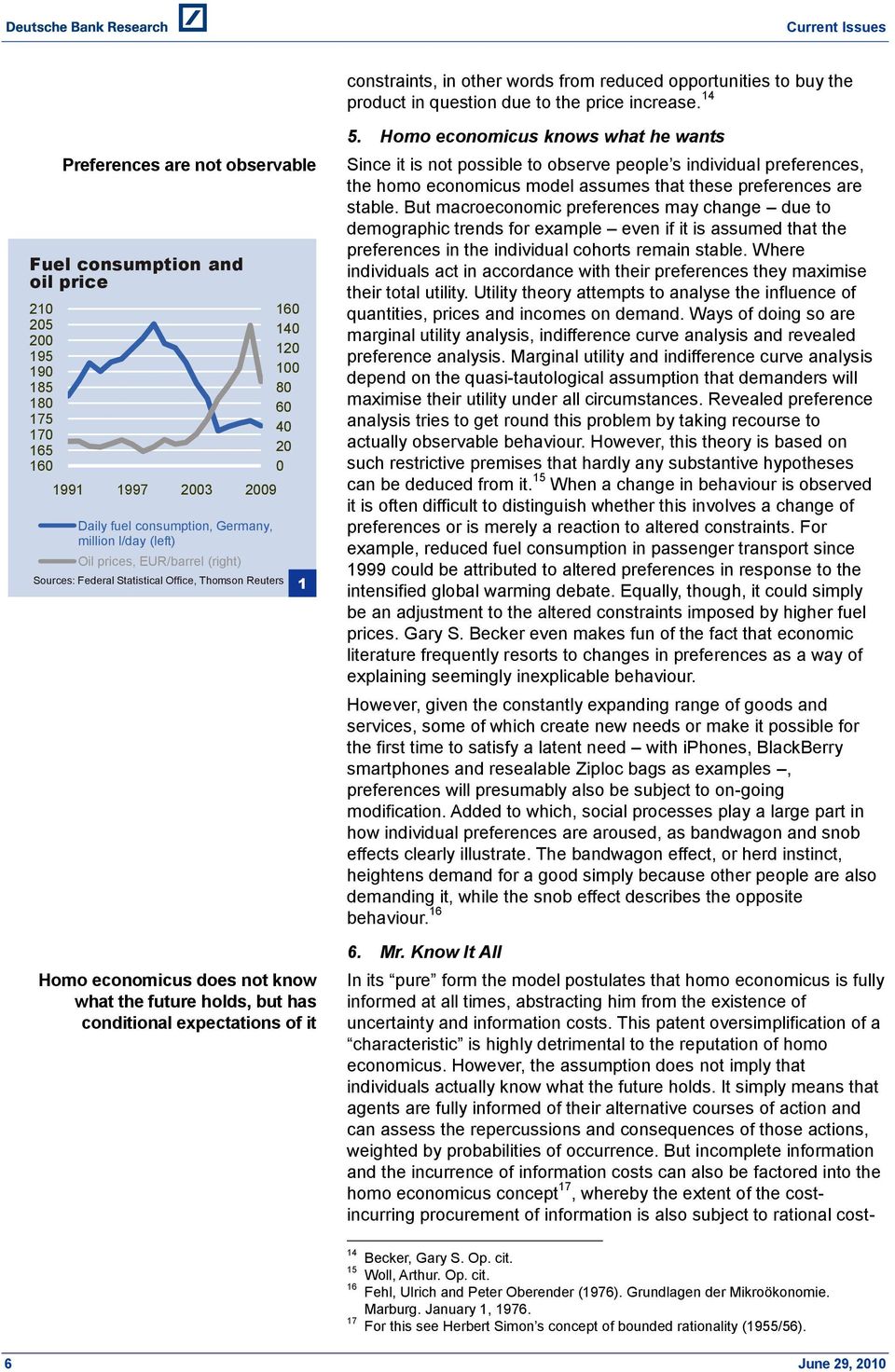
6 Current Issues constraints, in other words from reduced opportunities to buy the product in question due to the price increase. 14 Preferences are not observable Fuel consumption and oil price Daily fuel consumption, Germany, million l/day (left) Oil prices, EUR/barrel (right) Sources: Federal Statistical Office, Thomson Reuters Homo economicus does not know what the future holds, but has conditional expectations of it 5. Homo economicus knows what he wants Since it is not possible to observe people s individual preferences, the homo economicus model assumes that these preferences are stable. But macroeconomic preferences may change due to demographic trends for example even if it is assumed that the preferences in the individual cohorts remain stable. Where individuals act in accordance with their preferences they maximise their total utility. Utility theory attempts to analyse the influence of quantities, prices and incomes on demand. Ways of doing so are marginal utility analysis, indifference curve analysis and revealed preference analysis. Marginal utility and indifference curve analysis depend on the quasi-tautological assumption that demanders will maximise their utility under all circumstances. Revealed preference analysis tries to get round this problem by taking recourse to actually observable behaviour. However, this theory is based on such restrictive premises that hardly any substantive hypotheses can be deduced from it. 15 When a change in behaviour is observed it is often difficult to distinguish whether this involves a change of preferences or is merely a reaction to altered constraints. For example, reduced fuel consumption in passenger transport since 1999 could be attributed to altered preferences in response to the intensified global warming debate. Equally, though, it could simply be an adjustment to the altered constraints imposed by higher fuel prices. Gary S. Becker even makes fun of the fact that economic literature frequently resorts to changes in preferences as a way of explaining seemingly inexplicable behaviour. However, given the constantly expanding range of goods and services, some of which create new needs or make it possible for the first time to satisfy a latent need with iphones, BlackBerry smartphones and resealable Ziploc bags as examples, preferences will presumably also be subject to on-going modification. Added to which, social processes play a large part in how individual preferences are aroused, as bandwagon and snob effects clearly illustrate. The bandwagon effect, or herd instinct, heightens demand for a good simply because other people are also demanding it, while the snob effect describes the opposite behaviour Mr. Know It All In its pure form the model postulates that homo economicus is fully informed at all times, abstracting him from the existence of uncertainty and information costs. This patent oversimplification of a characteristic is highly detrimental to the reputation of homo economicus. However, the assumption does not imply that individuals actually know what the future holds. It simply means that agents are fully informed of their alternative courses of action and can assess the repercussions and consequences of those actions, weighted by probabilities of occurrence. But incomplete information and the incurrence of information costs can also be factored into the homo economicus concept 17, whereby the extent of the costincurring procurement of information is also subject to rational cost- 14 Becker, Gary S. Op. cit. 15 Woll, Arthur. Op. cit. 16 Fehl, Ulrich and Peter Oberender (1976). Grundlagen der Mikroökonomie. Marburg. January 1, For this see Herbert Simon s concept of bounded rationality (1955/56). 6 June 29, 2010
7 Homo economicus Homo economicus a strange creature that has long been criticised benefit calculation. 18 The individual must consequently form conditional expectations or forecasts of the future. 19 All in all, the characteristics of homo economicus in their extreme forms at least show him to be a rather odd guy. Ralf Dahrendorf, for instance, writes of him: Social science has so far presented us with at least two new and highly problematical creatures whom we are unlikely ever to encounter in our everyday experience. One is the much-debated homo economicus of modern economics: the consumer who carefully weighs utility and cost before every purchase and compares hundreds of prices before he makes his decision In our everyday experience this is a strange creature. Dahrendorf does, however, concede that by and large economic facts confirm this theory, and while the assumptions may appear strange and incredible, they enable economists to make accurate predictions. 20 This assessment throws the role of homo economicus in economic theory into sharp focus: it is not about explaining individual behaviour but about enabling authoritative forecasts of economic variables such as consumption, which constitutes the aggregation of individual decisions. The theoretical construction of homo economicus came under fundamental criticism by the economist Thorstein Veblen in the late 19 th century. Since the 1950s, psychologists have systematically investigated economists assumptions about human behaviour. Experiments on people s thought- and decision-making processes, and more recently functional MRIs 21 helping to visualise processes in the human brain, have confirmed the suspicion that people function very differently in the real world. 3. Homo economicus meets Homer Simpson psychological research findings Human behaviour is compared with solutions from probability theory Prospect theory as an alternative decision making model Having introduced homo economicus and his characteristics in the previous chapter, we shall now examine the assumptions made by this model with reference to the results of experiments, most of which were initially carried out by psychologists. Meanwhile, however, many economists are also working on such issues, resulting in a new transdiscipline called behavioural economics. The experiments are frequently based on questions from probability theory, represented in the form of games or bets such as coin tossing or a lottery. But the decisions examined in the experiments can also be placed in quite different narrative contexts. With the aid of probability theory, for example by calculating expected values, it is possible to identify the optimal solutions that homo economicus would go for. By comparing these solutions with the results of the experiments, statements can be made on the rationality of the behaviour observed. The first frontal attack on the expected utility hypothesis and by inference on homo economicus as well was launched by the two psychologists Daniel Kahneman, who was later awarded the Nobel 18 Stigler, George J. (1961). The Economics of Information. The Journal of Political Economy. June Kirchgässner, Gebhard. Op. cit. 20 Dahrendorf, Ralf (1968). Homo Sociologicus. Tübingen. 21 MRI = magnetic resonance imaging. The magnetic properties of haemoglobin make it possible to distinguish between oxygen-enriched and non-enriched blood, pointing to activity in the respective part of the brain. June 29,

8 Current Issues Behaviour contradicts homo economicus assumptions Normative theories can be used to examine rationality e.g. expected value or personal utility Prize, and Amos Tversky in a paper in the Journal Econometrica way back in There they presented an alternative decisionmaking model that they called Prospect Theory. This holds that people show a preference for safe alternatives to those that are only probable, even if the latter have a higher expected value. Ignoring properties common to all alternative decisions, people base their choices on the expected gains or losses rather than on the expected utility. The last point and the non-linear characteristics of the decision-making models used stand in particularly sharp contrast to utility theory. The following presents the results of experiments suggesting that human behaviour is by no means as rational as held in the definition of homo economicus. It will be found that 1. decisions depend on how a problem is described or framed; 2. people s actions are often guided by risk aversion; 3. preferences are not stable; 4. preferences are influenced by the way they are measured; 5. possession of a good increases the value assigned to it; 6. in absolute terms the negative impact of a loss is greater than the positive impact of a similar gain; 7. people tend to prefer the status quo; 8. people do not always maximise their utility; 9. people frequently act altruistically. Measuring rationality Homo economicus always acts rationally. He selects systematically from the alternative courses of action open to him and opts for the alternative that produces the greatest utility with the least input. However, psychological experiments reveal that individuals often fail to choose the most favourable alternative for themselves. Two criteria can be taken to examine whether someone is acting rationally. The first is internal consistency, which can be measured by the transitivity of a person s actions. If they prefer alternative A to B and B to C, they must also favour A over C. Second, normative theories can be used to examine rationality. Taking different criteria as the guide, normative models make it possible to evaluate the various options and thus determine the optimal solution. A frequently used criterion from probability theory is maximisation of the expected value. In a lottery, for example, the expected value is calculated by multiplying the probability of occurrence by the expected winnings. Say a person has two options: option A, a 50% chance of winning USD 50 and option B, a 25% chance of winning USD 110. With option B they would maximise the expected value, which is USD (0.25 x USD 110), whereas the expected value of option A is only USD 25 (0.5 x USD 50). Instead of a purely monetary value, personal utility can also be assigned to an option as a value, which may lead to a different decision. In the following example an individual faced with two options A: 0.85 chance of winning USD 10 (expected utility = USD 8.50) B: 0.25 chance of winning USD 45 (expected utility = USD 11.25) 22 Kahneman, Daniel and Amos Tversky (1979). Prospect Theory: An Analysis of Decision under Risk. Econometrica. Volume 47. Number 2. March June 29, 2010
9 Homo economicus may prefer option A, despite its lower expected value, if they desperately need the USD 10 to buy something to eat. In this case the greater probability that option A will occur gives it a higher utility value. Decisions are consistent if descriptive invariance and procedural invariance are given Framing 1. This way, then that the packaging can count! As just illustrated, whether a person decides rationally can therefore be judged taking expectation maximisation as the yardstick. But the rationality of a decision can also be examined with reference to its consistency. For this the following criteria can be used in addition to transitivity: 1. description invariance, i.e. the same decision is always made irrespective of how the problem is portrayed; 2. procedural invariance, i.e. the decision depends on how the preferences are measured. A large number of experiments have demonstrated that human behaviour often fails to satisfy these two criteria. Nobel Prize winner Daniel Kahneman and Amos Tversky examined the principle of description invariance in a study by dividing the participants into two groups, which they then confronted with the following problems (the number in parentheses denotes the percentage of participants that chose that option). Example 1: Presentation effect (framing) and loss aversion Group 1: Suppose you are given USD 300, but you must also select one of the two following options: A: 100% chance of gaining USD 100 (72%) B: 50% chance of gaining USD 200 and a 50% chance of gaining nothing extra (28%) Group 2: Suppose you are given USD 500, but you must also select one of the two following options: A: 100% chance of losing USD 100 (36%) B: 50% chance of losing nothing and a 50% chance of losing USD 200 (64%) In both groups the expected value for the two alternatives A und B is identical at USD 400. However, the first group preferred the safe alternative resulting in payment of USD 400, while group 2 opted for the riskier alternative B. The result suggests that the way the problem is described or the way the question is framed influences the decision, in other words the principle of description invariance is violated. This presentation effect is called framing. The two groups different behaviour can be explained by the fact that the participants in both groups wanted to avoid a loss, in group 1 by selecting the safe option A, in group 2 by going for option B in which the 50% probability of a loss is only half as high as with option A (100%). This can be ascribed to loss aversion, a phenomenon demonstrated in a large number of experiments. The unpleasantness of losing something hurts twice as much as the pleasure of gaining the same thing. 23 (This is dealt with in greater detail in the section on preferences.) 23 Thaler, Richard H. and Cass R. Sunstein (2008). Nudge: Wie man kluge Entscheidungen anstößt. June 29,

10 Current Issues Certainty effect Certainty effect stronger with gains than losses 2. A bird in the hand is worth two in the bush When making decisions, rational homo economicus would always optimise the expected value obtained by multiplying the gains and probable occurrence. The probability of occurrence as such would play no part in the decision. However, experiments on this have shown that when choosing between options of varying certainty participants systematically give preference to the safer option over the less certain, even if the latter has a lower expected value. This phenomenon is called the certainty effect and can be clearly illustrated in the following experiment. Example 2: Certainty effect The participants are asked two questions with the following optional answers: (again, the numbers in parentheses denote the percentage of participants that chose that option). Question 1: A: a payment of 4,000 with a probability of 80% (20%) or B: a payment of 3,000 with a probability of 100% (80%) Question 2: C: a payment of 4,000 with a probability of 20% (65%) or D: a payment of 3,000 with a probability of 25% (35%) Note that the expected values in options C and D are both a quarter of the expected values in options A and B; the relative expected values of the options offered in both questions are therefore identical. 24 Homo economicus would therefore not only choose option C (expected value 4,000 x 0.2 = 800) in question 2 but also option A in the first question, as its expected value of 4,000 x 0.8 = 3,200 is higher than option B (3,000). But in actual fact the participants in question 1 prefer the certain option B. This certainty effect or, to put it the other way round, risk aversion was also demonstrated in another experiment. It further emerged that the participants in the second experiment behaved risk-aversely when choosing between gains but were risk-happier when choosing between losses. Example 3: Certainty effect in the case of gains and losses The choice is between different programmes to combat an infectious disease which would probably claim the lives of 600 people if no measures at all were taken. Group 1 had the choice of the following programmes: A: Would save 200 lives (72%) B: Would stand a ⅓ chance of saving 600 lives and a ⅔ chance of saving no lives at all (28%) Group 2 had the following alternatives: C: Would lead to the death of 400 people (22%) D: Would stand a ⅓ chance of saving all 600 people and a ⅔ chance of leading to the death of all 600 people (78%) Group 1 had the choice between gains (100% probability of saving 200 lives or ⅓ probability of saving 600). The certain prospect of saving 200 lives appeared more attractive to 72% of the respondents than the riskier option with the same expected value (i.e. saving 200 lives). Group 2 had the choice of the same 24 Kahneman, Daniel and Amos Tversky. Op. cit. 10 June 29, 2010
11 Homo economicus Indifference curve (2 goods) Good y Good x Source: DB Research alternatives, but option C unlike option A for group 1 was expressed as a loss. This prompted 78% to opt for the risky programme D because they were less willing to accept the certain death (loss) of 400 people (option C) than the ⅔ probability of 600 people losing their lives. 25 The two groups different behaviour can be explained by their contradictory attitude to risk, depending on whether it entails gains or losses. If the choice involves gains, the decisions are generally risk-averse; where losses are concerned the riskier option is chosen more often. Further experiments revealed that not only are probabilities rated differently according to whether they entail potential gains or losses but that smaller probabilities are systematically overrated relative to great probabilities. The difference between a 97% and a 98% chance is perceived as less than the difference between a 3% and a 4% chance, as is indeed the case, at least in relative terms. 3. People do not always know what they want (stable preferences?) 26 In microeconomic theory preferences are depicted by means of indifference curves in a simplified two goods model. Indifference curves that are convex to their origin describe combinations of goods x and y that generate the same utility for the person in question, in other words the person is indifferent. The assumption underlying this is that movements on the indifference curve are reversible without utility losses. Homo economicus has clearly defined preferences, which can be depicted in the form of these indifference curves. This means that if, for example, the bundle of goods 5x,3y and 3x,5y lies on homo economicus indifference curve, starting out from the position 5x,3y he will demand 2y in return for giving up 2x because the new position 3x,5y that results from this lies on the same indifference curve and thus generates the same utility for him. Were he to demand, say, 3y, it would mean the indifference curves intersecting, which would represent a massive violation of the indifference curve model. However, experiments have shown that in real life movements on indifference curves are not always reversible and that indifference curves may sometimes intersect. The most important phenomena in this context are the endowment effect (also known as divestiture aversion), loss aversion and the status quo bias. 27 Moreover the results of experiments suggest that decisions are highly dependent on the perception of the decision scenario, which in turn is determined by how the question is framed (see above). 4. Preferences: It s how they are measured that counts! When taking decisions homo economicus tries to maximize his goal achievement or to satisfy his preferences, irrespective of how these preferences are measured. Frequently, however, this procedural invariance, a term signifying rationality in decision making, does not occur in real life. In many cases the order of preference revealed will differ, depending on whether the individual expresses it by choosing 25 Tversky, Amos and Daniel Kahnemann (1981). The Framing of Decisions and the Psychology of Choice. Science. Volume 211, No January 30, As shown in the section Utility maximization immune to falsification, with these experiments too it is difficult to distinguish between behavioural and preference effects. 27 Kahneman, Daniel, Jack L. Knetsch and Richard H. Thaler (1991). Anomalies: The Endowment Effect, Loss Aversion, and Status Quo Bias. The Journal of Economic Perspectives. Volume 5, No. 1, pp Winter June 29,

12 Current Issues between alternatives or pricing the various alternatives. The preference system is not therefore consistent. Procedural invariance Description invariance Endowment effect Example 4: Measuring preferences (I) An experiment gave participants the choice between the following options: A: 89% chance of winning USD 4 or B: 11% chance of winning USD 40 71% go for option A, even though it has a lower expected value than B. But if the participants are asked to quote a minimum price at which they would sell their right to these options, 67% assign a higher monetary price to option B. 28 Another example also shows participants giving different answers to the same question when it is framed using different valuation criteria. Example 5: Measuring preferences (II) Participants were asked to select between two programmes designed to reduce casualties caused by traffic accidents. Programme A costing USD 55 million was expected to limit the number of casualties within a certain period to 500. Programme B cost USD 12 million but would result in a higher number of casualties, estimated at 570. Most of the test persons opted for the much more expensive option A. In a differently worded version of the problem the participants were told only the number of casualties and asked to assign a price differential that would justify a programme to avoid another 70 casualties. Nearly all the test persons considered the extra USD 43 million too high a price to pay for avoiding a mere 70 casualties. 5. Three, two, one, mine! Homo economicus assigns the same value to a good irrespective of whether he possesses it or not. But in real life a good is systematically assigned a higher value if the respondent possesses that good. Example 6: Endowment effect (I) In an experiment half the test persons were given a pen and the other half a gift voucher. At the end of the experiment all the participants could choose between a pen and two chocolate bars. 56% of the people who had been given a pen to begin with opted for the pen, but only 24% of the remaining participants selected that alternative. Example 7: Endowment effect (II) In another experiment the participants were shown a coffee mug and half of the group told it was theirs to keep at the end. Then all participants were asked to estimate what the mug was worth and told that if their valuation was above the market value, which would be revealed at the end of the experiment, they could keep the mug but if it was below the market value they would receive the cash instead. It was interesting that the participants who had been promised the mug at the beginning of the experiment assigned a considerably higher value (USD 7.12) to it than those to whom it had 28 Willingham, Daniel T. Op. cit. 12 June 29, 2010

13 Homo economicus merely been shown (USD 3.12). Evidently the two groups viewed the transactions differently. The group that had only been shown the mug expected either to receive a mug or cash, while the other group felt that they had to give up the mug to get cash. Because of their loss aversion they demanded a higher price for it. 6. A loss hurts twice as much! Generally, it has emerged from experiments on loss aversion that people base their measurement of personal utility not on the change in wealth and prosperity, but relative to a neutral reference situation. Moreover, a loss of small to medium-sized sums of money is felt twice as much as a gain. Loss aversion Example 8: Loss aversion A person has to give up their present job and has the choice of two different job offers with which they could improve their situation in terms of one aspect but would have to tolerate deterioration in another aspect. Two versions of the experiment were conducted, each with a choice between the same two new job alternatives but differing in respect of the characteristics of the job the test persons had to give up. Job Contact with other people Travelling time Present job: Version 1 Largely isolated 10 min Version 2 Lots of social contact 80 min New job: Job A Little contact with other people 20 min Job B Moderate contact with other people 60 min In the first version 70% opted for job A, in the second version only 33%. The key factor in version 1 was evidently the deterioration in the travelling time relative to the present job (the reference point), which outweighed the improvement in social contact. In version 2 job offer B involved less deterioration relative to the present job owing to the moderate contact with other people and was therefore given preference. The potentially significant reduction in travelling time that would have been possible with job A was regarded as less important. This shows that the test persons reacted more sensitively to the aspect that constituted deterioration for them relative to the reference point. Status quo effect 7. When in doubt, leave things as they are (status quo effect) Loss aversion also plays an important part in the so-called status quo effect, as the disadvantages of change appear greater than the potential advantages. The test persons in an experiment were given the task of managing an inherited portfolio that could be invested in asset classes entailing different degrees of risk. A strong inclination not to alter the original structure of the portfolio emerged, irrespective of whether it was more conservatively invested or more risk-oriented. 29 It was even found that the higher the number of alternatives available, the more attractive the status quo became. 29 The experiment did not take account of transaction costs. June 29,

14 Current Issues Satisficing People more cooperative than the self-interest hypothesis would suggest Fairness 8. Utility maximisation it doesn t always have to be the best To maximise utility in a complex decision such as purchasing a car, the utility of the various properties of the car would have to be standardised, i.e. a common unit value a monetary value, for instance assigned to them. This would make it possible to compare the utility of different features, say leather seats, airbags or special paint finishes. It would have to be done for all models of car on the market clearly an impossible undertaking whose costs would far exceed the utility gains. In 1957, Herbert Simon postulated that, rather than maximizing their utility, people seek to achieve a certain degree of satisfaction, a process that he termed satisficing. When selecting a car, this means that the buyer defines key criteria and restricts his search to finding a vehicle that meets these criteria. This heuristic is also known as bounded rationality. 9. Self-interest no man is an island The snob or Veblen effect mentioned earlier has already shown that people s behaviour is influenced by the way other people act. In their book Animal Spirits George Akerlof and Robert Shiller go so far as to ascribe entire economic cycles and boom and bust cycles on the financial markets to infectious waves of optimism, perceptions of fairness and the spread of illegal behaviour. As with the utility maximization hypothesis, any examination of the self-interest hypothesis comes up against the problem that we can only observe actions, while their motives remain in the dark. Evolutionary psychology argues that people who forgo individual utility in favour of a utility gain for others that is to say who behave altruistically are indeed acting rationally. The idea underlying the neo-classical model of a self-interested homo economicus and the theory of evolutionary psychology assuming that genes are interested only in their own reproduction exhibits certain parallels. In the theory of kin selection, people strongly prefer making sacrifices for close relatives. But bargaining experiments also show that people behave much more cooperatively even towards non-relatives than the premises on which homo economicus rests would suggest. In a barter transaction, homo economicus should only be interested in maximizing his own utility and unconcerned about whether he may be gaining an unfair advantage over his bargaining partner. An important driver of behaviour towards other people is presumably the personal contact between the agents, prompting them to behave differently than in an anonymous situation particularly since in real life this kind of interaction does not take place without a past and a future. 30 Moreover, the complex interactions of a modern society would not be possible without an element of basic trust in the honesty and fairness of the person on the other side. The high monitoring costs would considerably complicate many activities, such as contracts in which the reciprocity is not simultaneous. Happiness research findings similarly show people to have a strong interest in fairness. This is also highlighted in experiments based on the impact of the endowment effect. Example 9: Fairness Bottlenecks have arisen in the production of a popular car model, leading to waiting times of two to three months. Some test persons 30 Smith, Vernon L. Bargaining Theory, Behavior and Evolutionary Psychology. Quoted from C. Athena Aktipis, Robert O. Kurzban. Homo economicus extinct. 14 June 29, 2010

15 Homo economicus are told that in response to this the dealer has added USD 200 to the list price. 71% consider this unfair. A second group is told that the dealer is no longer giving a USD 200 discount previously granted. 58% consider this behaviour acceptable. The price increase, which is perceived as a loss, is considered worse than removal of the discount, which is perceived as a reduction in profit. Here too of course, the framing effect plays a part. This example could explain why real wage cuts, which may be accompanied by nominal pay increases when inflation is high, are easier to push through than a direct reduction in nominal pay. 78% of participants in an experiment regarded a 5% pay increase as fair even though inflation was running at 12%, whereas a 7% wage cut was perceived as unfair in an inflation-free scenario. While economists usually cite money illusion i.e. failure to recognise the erosion of purchasing power by inflation to account for this contradictory behaviour, it could also be explained by the psychological endowment effect (mental costs) and the framing effect. All in all, the experiments described in this chapter clearly show that very often the individual s behaviour does not resonate with that of homo economicus. Seldom do individuals decisions and perceptions satisfy the conditions of formal rationality, indeed they often make systematic mistakes. Before examining in the fifth chapter how allowance can be made for these findings in investment decisions, we first discuss the possible reasons for these systematic errors. 4. Why do people make mistakes? 31 Systematic errors through use of heuristics For once in my life I m confused 32 or life is simply too complicated The evolutionary epistemologist and philosopher of science Rupert Riedl laments that ultimately man was let loose on the industrial age with a prehistoric-era brain. His intellectual capacities are limited. With many problems he is unable to run through all the possible alternatives and then decide on the basis of the expected value. Instead, he often has to rely on the use of heuristics. These are approximations that generally deliver quite good results but can lead to systematic errors in certain situations. Shortcuts that make life easier and allow errors to slip in These heuristics are mostly simple rules requiring little information and calculation, and they usually yield acceptable solutions. They draw on past experience and context information to solve decision making problems. This experiential knowledge frequently consists of gut feelings, emotional experiences (schemas) and bookmarks 33 which are stored in the deep limbic system of the brain and are much more quickly available than rational thought in the cerebrum. Particularly in stress situations, these emotional bookmarks can block out rational thought. Experiments have also shown that people under stress do not register even obvious signals (objects, sounds 31 The following remarks are based on: Willingham, Daniel T. Cognition (2003): The Thinking Animal. The focus is on chapters 11 and Quote from Homer Simpson in the US comic series The Simpsons. 33 Gonzales, Laurence (2003). Deep Survival. Page 48. June 29,

16 Current Issues etc.). The following shows how the simplifications underlying heuristics lead to systematic errors. Life insurance and disasters Av. number ( 000) of life policies issued, per million inhabitants US states with disaster events US states without disaster events No disaster events as defined for the source study occurred in 1997 or Source: Stephen G. Fier. Catastrophes and the Demand for Life Insurance Share purchases and DAX EUR bn (left), index (right) Share purchases by private households, net (left) DAX (right) Sources: Global Insight, DB Research USA: Inflation forecast and current inflation rate % yoy Annual average in 1 year s time Annual average in 2 years time Current inflation rate Sources: Federal Reserve Bank of Philadelphia, Datastream Representativeness the temptation to pigeonhole People need to categorise. If something exhibiting certain features (for example, it has feathers) can be assigned to a category (birds), by analogy further statements can be made about it (it lays eggs). However, people frequently associate an object precipitately with a category simply because they recognise similarities in some respects. This explains why many people do not interpret four coin tosses in a row that turn up tails as being random, even though this outcome can quite possibly occur with such a low number of observations. 34 Gamblers fall prey to the same fallacy by believing that a number or card which has not been played for a while is due. 2. Availability deceptive recall People have great difficulty judging probabilities. Tests revealed that a statement such as this event occurs on average every five years meant much more to test persons than a statement conveying the same content but phrased as the annual probability of occurrence is 20%. Similarly, the results of experiments calling for logical deductions are found to be far better if the problem is couched in a familiar context. When called upon to assess the probability of events, people scour their memory for examples of the event in question. The more easily the event can be called to mind, the more probable it is judged to be. For example, demand for indemnity insurance is often found to rise following media coverage of flooding, storm damage or a pile-up on the motorway. In the case of the US a link has even been documented in a comparative study of different federal states between the occurrence of disasters and an increase in life premiums. 35 The availability bias may also explain the procyclicality of investor behaviour. If share prices have trended higher for some time and friends and the media have discussed this, people s willingness to invest in stocks increases. If, however, share prices have fallen sharply, investors want nothing to do with shares, even if they themselves have not suffered any financial losses and they would be better advised to buy while prices are low. Research on inflation expectations in the United Kingdom showed that a one percentage point acceleration in the current rate of inflation drove up inflation expectations by around ¾ of a percentage point. 36 While path dependence theory suggests that this kind of forecast adjustment to developments in the immediate past may indeed make sense, similar phenomena such as consensus estimates of the development in the USD/EUR exchange rate or the S&P 500 are more difficult to explain. and deceptive plausibility The availability heuristic does not only influence our judgement of probabilities of occurrence based on our recall. Like the availability of comparable events in our mind, so the apparent plausibility of an 34 Since the events are unrelated, according to the multiplication theorem the probability can be calculated by multiplying the individual probabilities of a coin toss turning up tails: 0.5 x 0.5 x 0.5 x 0.5 = 6 ¼%. 35 Fier, Stephen G. and James M. Carson (2009). Catastrophes and the Demand for Life Insurance. Florida State University. July 9, Bakhshi, Hasan and Anthony Yates (1998). Are UK inflation expectations rational? Bank of England. 16 June 29, 2010

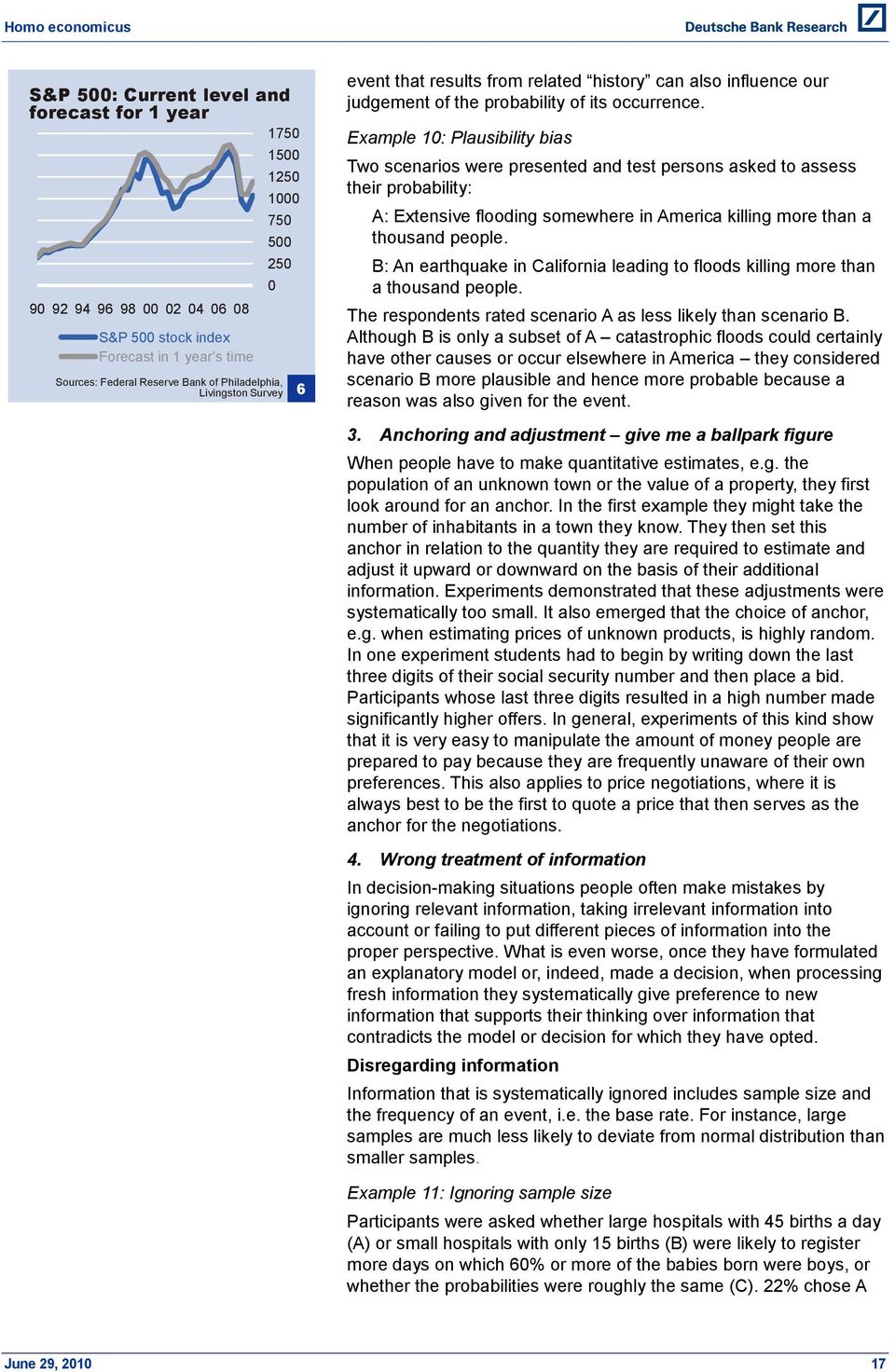
17 Homo economicus S&P 500: Current level and forecast for 1 year S&P 500 stock index Forecast in 1 year s time Sources: Federal Reserve Bank of Philadelphia, Livingston Survey 0 6 event that results from related history can also influence our judgement of the probability of its occurrence. Example 10: Plausibility bias Two scenarios were presented and test persons asked to assess their probability: A: Extensive flooding somewhere in America killing more than a thousand people. B: An earthquake in California leading to floods killing more than a thousand people. The respondents rated scenario A as less likely than scenario B. Although B is only a subset of A catastrophic floods could certainly have other causes or occur elsewhere in America they considered scenario B more plausible and hence more probable because a reason was also given for the event. 3. Anchoring and adjustment give me a ballpark figure When people have to make quantitative estimates, e.g. the population of an unknown town or the value of a property, they first look around for an anchor. In the first example they might take the number of inhabitants in a town they know. They then set this anchor in relation to the quantity they are required to estimate and adjust it upward or downward on the basis of their additional information. Experiments demonstrated that these adjustments were systematically too small. It also emerged that the choice of anchor, e.g. when estimating prices of unknown products, is highly random. In one experiment students had to begin by writing down the last three digits of their social security number and then place a bid. Participants whose last three digits resulted in a high number made significantly higher offers. In general, experiments of this kind show that it is very easy to manipulate the amount of money people are prepared to pay because they are frequently unaware of their own preferences. This also applies to price negotiations, where it is always best to be the first to quote a price that then serves as the anchor for the negotiations. 4. Wrong treatment of information In decision-making situations people often make mistakes by ignoring relevant information, taking irrelevant information into account or failing to put different pieces of information into the proper perspective. What is even worse, once they have formulated an explanatory model or, indeed, made a decision, when processing fresh information they systematically give preference to new information that supports their thinking over information that contradicts the model or decision for which they have opted. Disregarding information Information that is systematically ignored includes sample size and the frequency of an event, i.e. the base rate. For instance, large samples are much less likely to deviate from normal distribution than smaller samples. Example 11: Ignoring sample size Participants were asked whether large hospitals with 45 births a day (A) or small hospitals with only 15 births (B) were likely to register more days on which 60% or more of the babies born were boys, or whether the probabilities were roughly the same (C). 22% chose A June 29,
18 Current Issues and 22% B, whereas 56% thought the probability was roughly the same (C). Answer C was presumably based on the knowledge that the probability of gender in an individual birth is indeed 50:50. However the chance of a different distribution is far higher with a low number of observations. 37 Example 11 was concerned purely with estimating the odds of a certain event occurring. Often, however, people are confronted with situations in which the probabilities of different aspects of the problem have to be combined in order to determine the likelihood of a certain event. This problem often arises with medical diagnostics when, for instance, it is a matter of assessing the probability of a positive test result. In addition to the accuracy of the test for a certain disease, the frequency or rate at which the disease actually occurs also plays a key role. Assuming that among 100 positive test results one is a false positive, whether the base rate of the disease is 1:1,000 or 1:100,000 is crucial to assessment of the test. 38 This is illustrated by the following classic example. Example 12: Ignoring the base rate In a certain city 85% of the taxis are blue and 15% green. A witness to a hit-and-run accident says he thinks he saw a green cab. An eye test shows that under similar lighting conditions to those at the accident there was an 80% chance of his correctly identifying the colour green. The odds that the hit-and-run cab was actually green are not, as one might think, 80% but only around 40%. 39 This example can also be transformed into a question relating to the financial market. A share index is composed of 100 individual stocks. In a certain year 85 of the stocks exhibit rather weak performance, while 15 more than double in price. An investment consultant claims there is an 80 percent probability of his being able to identify a doubler. He recommends a certain share. What are the odds that the price of this share actually will double? Focusing on individual aspects When choosing between alternatives people are inclined to focus on an apparently important difference while ignoring other differences or similarities. This phenomenon is known as the isolation effect 40. Example 13: Isolation effect In a two-stage game there is a 25% chance of reaching the second round. In the second round participants have the choice between an 80% probability of being paid 4,000 and the certainty of receiving 3,000. But they must make their decision before the first round! The expected values of the two options are: A: 0.25 x 0.8 = 20% chance to win 4,000 (expected value: 800) 37 Given two births, the chance of the result being boys only is 25%, with three births the probability falls to 12.5%. 38 In the first case there are 10 false positives for every one positive test result; the odds of actually being ill given a positive result are therefore 1:10. In the second case there are 1,000 false positive results for every one correct result, meaning that the likelihood of actually being ill given a positive result is 1:1, Given a total of a hundred cabs the number of cabs correctly identified as green is 15 x 0.8 = 12, the number of blue taxis wrongly identified as green is 85 x 0.2 = 17. Putting the number of cabs correctly identified as green in relation to the total number of cabs identified as green, the outcome is 12 / (12+17) = or 41%. 40 Kahneman, Daniel and Amos Tversky. Op. cit. 18 June 29, 2010
19 Homo economicus Relativity Mental costs Sunk costs Confirmation bias B: 0.25 x 1 = 25% chance to win 3,000 (expected value: 750) This ultimately equates to question 2 in example 2 on the certainty effect (page 10). While 65% of respondents there opted for alternative A (20% chance to win 4,000), in the two-stage frame presented here 78% went for alternative B (25% chance to win 3,000). The difference is that on page 10 the choice is between two probable events. In the two-stage example, on the implicit assumption that they will reach round two the test persons regard winning 3,000 as a certain outcome, which the certainty effect leads them to prefer even though the expected value is lower when factoring the 25% probability of reaching round two into the equation. Placing information in the wrong context Two pieces of information are often viewed in relation to each other even though they should actually be evaluated separately. This phenomenon is called relativity. 41 For example, when buying a fountain pen worth USD 25 most test persons would be prepared to drive fifteen minutes to another shop in town to save USD 7. But when buying a suit for USD 455 hardly anyone would countenance a fifteen-minute drive to make the same USD 7 saving. Here the money saved is viewed in relation to the amount spent, whereas in point of fact it should be seen relative to the fifteen-minute drive through town. Another example of relativity that is entirely foreign to homo economicus is based on people s categorisation of money they have spent or are contemplating spending, so-called mental costs. They may view a certain item of clothing as too expensive or a luxury if they are considering buying it themselves. But if their spouse, with whom they have a joint account, makes them a present of the garment, it is placed in the mental category gift rather than luxury and no longer seems so expensive. Including irrelevant information Sunk costs, i.e. money already spent and irretrievable a term generally used to denote investment that has not paid off often influence decisions even though they should actually be of no further consequence. It has been demonstrated, for instance, that the higher the price paid for a concert ticket, menu or other service, the greater the willingness to exploit it to the full even though the consumers do not really like what is being offered and could increase their personal utility by leaving the concert early or not finishing their meal. A similar principle is apparent in politics or companies, where the reluctance to terminate a project that no longer makes sense frequently grows with the amount of money already sunk into it. Compulsive search for confirmative information Moreover, when processing information to help them make a decision people fall prey to a far more fundamental problem, that of confirmation bias. Once a promising heuristic has been developed or a decision made, new information is appraised asymmetrically by systematically overrating information confirming the hypothesis and tending to ignore contradictory information or brushing it aside as an exception that cannot be applied in that particular instance. In this context Dietrich Dörner speaks of progressive conditionalisation, 41 Ariely, Dan (2008). Predictably Irrational. June 29,

20 Current Issues with the aid of which the hypothesis can be immunised against contradictory evidence. 42 Growth rates Number in 100, Years Estimate Actual development Source: Dietrich Dörner. Die Logik des Mißlingens 7 5. Logical fallacies in statement inversion This classic fallacy, frequently called the prosecutor s fallacy, was even perpetrated albeit by the defence counsel in one of the most highly publicised criminal proceedings of the last decade, in which the famous American football star O. J. Simpson was accused of murdering his ex-wife Nicole. In reply to the prosecutor s claim that earlier instances of violence towards his former wife Nicole made O.J. s guilt patently obvious, the defence stated that each year in the US around 4 million women are beaten by their partners. However, in 1992 there were only 1,432 cases of murder in which women were killed by their partners. This equated, the defence continued, to a probability of 1 to 2,500. In contrast to the defence s line of reasoning, the right question would have been how high the odds are that a murdered woman who was beaten was beaten by her partner. In 1993 the odds of this in the US were around 90% The illusion of patterns and the pattern of illusions 44 A fundamental problem with processing information is whether the information involved is randomly distributed or whether events follow a certain pattern depending on their past and/or environment and can therefore be examined using time series analysis methods, for example. People are notoriously bad at recognising random developments as such. Evolutionary psychologists explain this by the selection mechanism. The ability to make a connection between the distension of a sabre-toothed tiger s stomach and the likelihood of its attacking will presumably have proved a useful feature in evolution that could possibly be passed on. Our perception mechanism is geared to identifying connections and patterns. Moreover, experiments and case studies of people who have experienced long periods in extreme situations (prisoners, missing persons) show that people need a certain degree of regularity in their environment giving them a sense of at least passive control and predictability. People despair if they feel that they have no influence over their chaotic surroundings, whereas patterns and recognised causal relationships between elements and events reduce complexity and enable people to process, store and recall information more easily. 7. Difficulty with non-linear processes A classic illustration of non-linear processes is the children s puzzle of the water lily and the lily pond. Given that the lily doubles the number of its blossoms within a week and covers half the pond after 16 weeks, the question is how long it will take before it covers the entire pond. The tendency to underestimate exponential growth rates could also be demonstrated in experiments. 45 Dietrich Dörner set test persons the task of estimating how many tractors a factory that began by producing 1,000 units and stepped up its output by 6% a year would produce in 25, 50 and 100 years. The average estimate of output in 100 years time was less than one seventh of the actual figure. These kinds of processes, which correspond to the 42 Dörner, Dietrich (2007). Die Logik des Misslingens. Page According to the Bayes theory, as a rule the probability of A occurring if B has occurred is not the same as the probability of B occurring if A has occurred. 44 Mlodinow, Leonard (2008). The Drunkard's Walk: How Randomness Rules Our Lives. 45 Dörner, Dietrich (2007). Die Logik des Misslingens, page June 29, 2010

21 Homo economicus compound interest formula, play a part in practically all investment decisions, and we come back to them in the concluding chapter. 5. Systematic errors in investment decisions what to beware of! Are we really so like Homer? The American evolutionary psychologist Steven Pinker cautions against interpreting the weaknesses of the human mind when dealing with questions of propositional logic and probability theory as illustrations of human irrationality.* The examples of probability calculus (coin toss, roulette) are mechanisms constructed by man to produce random results. Many processes in daily life are not random experiments and events are not unrelated. Tomorrow s weather depends on the weather today, the price of a share on the previous day s quotation, and the probability of a football player s converting a penalty kick will undoubtedly have something to do with whether he scored at his last attempt. Stating the probability of a singular event is disputed even among mathematicians. There cannot be a 60% probability of an individual event occurring, either it happens or it doesn t. People have learned from their own experience to interpret probabilities as relative frequencies over a long period rather than as the expression of subjective faith in a singular event. People use logic and probability theory to solve problems in the context of their own experiences. If a heavy smoker, mindful of the fact that his parents themselves also heavy smokers both lived into their nineties, assumes that his life expectancy differs from that of the average smoker, he could be quite right. And indeed, the choice of the relevant sample from which statements on probability are deduced is by no means trivial. Which characteristics must be taken into account? The more specific the sample, the smaller the sample size will be, which in turn reduces its significance. *Pinker, Steven. How the mind works The behavioural patterns described in the two preceding chapters are presumably widely known and are, for instance, applied in corporate marketing and sales strategies. Governments can also use them to prod their citizens decisions benevolently in a certain direction. 46 For example, they could make it standard practice for an employee to take out a Riester pension plan when signing an employment contract, unless the employee explicitly objected. Research in the US has revealed a significant rise in the contract conclusion rate for occupational pension plans (401k) when the onus to take action is reversed in this way, due presumably to the status quo bias. In the following we examine the ways in which these inadequacies and the systematic errors that people typically make can impact on investment decisions and discuss how making allowances for these pitfalls might possibly lead to better decision making. 1. People are not rational machines, but they are capable of learning (within limits) People make systematic mistakes, especially on complex issues such as investment decisions. Reflecting on one s own behaviour can help avoid such shortcomings and offers a way of learning from systematic mistakes. However, this presupposes that the time between the decision and its successful or unsuccessful outcome is not too long and that the decision-making situation is recurrent. With important financial decisions such as taking out a life policy or pension plan or buying and financing property, neither precondition is usually given. This makes careful preparation of such decisions all the more important. Experiments show that while the participants assume non-rational behaviour by others, they rule this out for themselves. When motorists, for example, are asked to rate their own driving ability, 90% of respondents regularly describe themselves as exceptionally proficient drivers. Evidence of this illusory superiority or over-confidence effect can also be found in other characteristics such as people s state of health or their estimation of their own intellectual abilities. 2. Meta-knowledge how well do I know what I know? Through reflection we can not only analyse our own behaviour but gain a greater awareness of the quality of our knowledge and the knowledge of advisers. Knowledge is by its very nature incomplete and frequently has to be revised. The average investor s knowledge of how a fixed-income investment works and of the risks attached to it will presumably be much better than his understanding of a structured product. People should be aware of the differing quality of their knowledge and make allowances for this when assessing the risk of an investment. But considerations of this kind are frequently pushed into the background by positive and negative experiences in the past (one s own or other people s), so-called emotional bookmarks, without the decision maker s being aware of this. 46 See: Thaler, Richard H. and Cass R. Sunstein (2008). Nudge: Wie man kluge Entscheidungen anstößt. June 29,
22 Current Issues Stock index DAX and trend Log. representation DAX German bund yields % Expon. (DAX) Source: Global Insight Y bunds 1980s average Sources: Datastream, DB Research Representativeness bias appearances can be deceptive On closer inspection complex structured products, and equally savings agreements promising particularly high rates of interest, sometimes turn out to be equity-based. Instead of rashly assigning products to a specific category simply on the strength of the product name or certain features highlighted in the promotional material, investors need to be aware of all the risks that the product entails. 4. Availability what you don t know won t hurt you When rating probabilities it would be wrong to rely on memory, which tends to attach too much weight to more recent information particularly with regard to assessment of the potential return on an investment. Many products, such as stocks, fluctuate around a longrange trend. Years featuring exceptionally good share performance can encourage people to take greater risks, but they are no indication of another good year. On the contrary, they make a correction all the more likely. On the other hand, periods when the news coming out of the stock market is unremittingly bleak, as in the spring of 2009, are often a good time to buy, but the opportunity is passed up because people are deterred from commitments by the prevailing negative sentiment. 5. Loss aversion how much pain can you take? When determining their risk appetite people should be aware of their asymmetrical approach to gains and losses. Even strategies that result in steady, small losses over longer periods of time which are subsequently more than offset by infrequent but suitably high gains can be emotionally difficult to cope with. 47 In the absence of procedure invariance, when making a decision it is advisable to try to fathom one s true preferences by approaching the issue from various angles. 6. Plausibility that sounds great! Good stories and glossy photos of likeable-looking people in sales prospectuses and company reports may sound and look convincing. But they do not automatically mean that the information is relevant to the performance of the respective shares or property. Success stories in the past need not necessarily stem from an outstanding strategy or visionary management. Indeed, the recent financial crisis has starkly highlighted the dramatic failure of some previously highly rated strategies. 7. Anchoring unfounded expectations People frequently entertain expectations of yields for which there is often no logical justification. Such expectations need not be purely random, as in the experiments described in the previous chapter. But it is a long time since yields on German Bunds topped 7%, the level they averaged in the 1980s. Nor should expectations of returns on one s own portfolio be pinned on stories of people who became rich virtually overnight by subscribing to IPOs during the New Economy bubble. Many people still believe that economic growth in Germany averages 2 ½%. True as this may have been in the 1980s, meanwhile trend growth is scarcely more than 1%. 47 Taleb, Nassim Nicholas (2007). The Black Swan: The Impact of the Highly Improbable. 22 June 29, 2010
23 Homo economicus 8. Categorisation a thousand euros are nothing more and nothing less People are often particularly careful with money they have earned themselves. But when investing previous profits or money they have inherited they are frequently risk-happier. This can be quite rational if, say, they do not really need the money. But they should be aware of the effect of psychic budgets. 9. Sample size it s all down to composition! A portfolio consisting of just a few assets which, moreover, are highly correlated can yield exceptionally high returns in a boom year. But it carries an extremely high risk of causing higher than average losses in the following years. 10. Isolation effect the two sides of the coin The classic example here is arguably the relationship between risk and return. This is frequently ignored, as impressively demonstrated by the securitised subprime mortgages in the US. Similar mistakes can be made by focusing only on the price risk of an investment while failing to bear in mind that if the worst comes to the worst it may not be possible to find a buyer (market risk). This could be an important factor when choosing between stocks and property. 11. Endowment effect it s worth more than that! This effect can lead to exaggerated price expectations when selling an asset, which ultimately puts off any prospective buyers. In the case of a share sale at limit the transaction is not then executed. However, stock market quotes provide a ruthless reality check that will probably cause the seller to lower the limit relatively quickly. But with motor cars or property the situation is more complicated. Firstly, the differences in the product make it difficult to find a guide price, and secondly emotions play a big part. 12. Confirmation bias I told you so! Investors may encounter this problem at the formulation and decision making stages of their strategy. Once a hypothesis has been framed for instance, this year will be a good one on the stock market examples supporting this opinion, such as media reports, positively jump out at them. But contradictory information tends not to be welcome. The same principle applies with a decision once made. In both cases it takes massive evidence before people will accept that they have made a wrong decision or, indeed, even that the situation has changed so as to render their original decision no longer appropriate. 13. Status quo bias sitting on your hands can also be a mistake When it comes to investment decisions, portfolio restructuring and, above all, decisions to sell, people should be aware that they have an inherent tendency to do nothing. They should face up to the fact that deciding not to decide is a decision in itself. 14. Sunk cost no point crying over spilt milk Correcting earlier wrong decisions is so difficult because it implies accepting financial loss and writing it off. This is something that people s loss aversion makes them very reluctant to do. But the decision to invest one s capital today in what promises to be a profitable new investment should not be influenced by the realisation of past losses that this necessitates. Otherwise people are still left June 29,
24 Current Issues sitting on their losses and, to make matters worse, may have passed up a good opportunity to recoup at least some of these shortfalls. The American interest rate conundrum % 7? Fed funds 10Y US Treasuries Source: Thomson Reuters Logical inversion it s logical! Most economic relationships cannot be squeezed into the rigorous corset of formal propositional logic. B does not necessarily always follow on from A, and even then often only under very specific postulates. What is more, particularly with regard to the correlation between prices and demand, the inversion of proposition 1 when demand increases, prices rise into proposition 2 when prices rise, demand increases is not valid. However, the reverse when prices rise, demand falls is correct. In investment decisions the relationship between rising profits and the increase in share prices 48 could represent a logical inversion trap. During the New Economy bubble, for instance, stock investors likely interpreted massive share price rises as signalling future increases in profits Belief in patterns what holds the world together In a strict interpretation, an efficient market is distinguished by investors immediately identifying patterns and arbitraging them away through their investments, with the result that the pattern identified is not permanent. This view pulls the carpet from under the feet of generally accepted stock market axioms that focus, for example, on seasonal patterns. It could also explain why it is virtually impossible to predict exchange rates. Time and again models are put forward that can generally explain exchange rate trends very well for the recent past, but when used for forecasting purposes it is usually not long before they come to grief. The most egregious case in which belief in patterns albeit of the highly complex sort led to the collapse of a once extremely profitable hedge fund is that of Long-Term Capital Management (LTCM). With the aid of two Nobel Prize winners, who were recognised for their research on valuing options, correlations between different submarkets were used for arbitrage deals. To begin with, LTCM turned in astounding profits until the correlations (patterns) identified collapsed following the Russian financial crisis in 1998 and brought LTCM to its knees. Another illustration of how supposedly stable relationships sometimes simply do not apply is the term conundrum famously used by former Fed President Alan Greenspan to describe his puzzlement over the failure of long-term interest rates in the US to respond to the series of rate hikes by the Fed in 2004 and These reflections and examples should not be taken to imply that forecasting capital market trends is inherently impossible. In principle stock and bond markets are systematically impacted by developments in the economy and in prices 50, but investors are well advised to keep in mind that these relationships are not always stable and, indeed, that some relationships are only seemingly correlated (spurious correlation). 48 In discounted cash flow analysis the current value of a share is determined by the future discounted dividends paid out by the company, which depend on profits. 49 An alternative explanation is that they merely expected to be able to sell on their shares at a profit following the hoped-for price rises. 50 However, researchers at the London Business School have gone so far as to identify a slightly negative correlation between economic growth and stock market performance. Credit Suisse Global Investment Return Yearbook June 29, 2010
25 Homo economicus 17. Non-linear processes every little helps Financial decisions frequently involve non-linear processes, especially in the case of complex options. But even with simple products, the long-term effects of comparatively low annual rates of growth are often underestimated. Average annual inflation of 2% does not sound very much, and people are inclined to ignore it in their pension planning. In 20 years time, however, assets of EUR 100,000 will have lost a third of their purchasing power. Conversely, this effect means that over the years small amounts saved can grow into quite decent sums. Conclusion Many of the issues listed here may seem obvious. But in an environment like economics and finance, precisely because it is perceived as being so highly rational, the influence of psychological factors and sentiment is frequently underestimated. Of course, heeding these points arguably not always such an easy matter in practice will not automatically guarantee the success of an investment. But it could certainly help avoid mistakes here and there. As with Homer Simpson, who acknowledges the effect of psychology on his behaviour when he realises that he is confused, the situations we have described may contribute to a clearer awareness of the impact that psychological factors have on our decision making. Stefan Schneider ( , [email protected]) Bibliography Akerlof, George A. and Robert J. Shiller (2009). Animal Spirits. Ariely, Dan (2008). Predictably Irrational. Bakhshi, Hasan and Anthony Yates (1998). Are UK inflation expectations rational? Bank of England. Becker, Gary S. (1976). The Economic Approach to Human Behavior. Chicago. Blüm, Norbert (2009). Im goldenen Reich des Preisvergleichs. Die Zeit No. 37. September 2, 2009 Credit Suisse Global Investment Return Yearbook Dahrendorf, Ralf (1968). Homo Sociologicus. Tübingen. Dörner, Dietrich (2007). Die Logik des Misslingens. Fehl, Ulrich and Peter Oberender (1976). Grundlagen der Mikroökonomie. Marburg. January 1, Fier, Stephen G. and James M. Carson (2009). Catastrophes and the Demand for Life Insurance. Florida State University. July 9, Franz, Stephan. Grundlagen des ökonomischen Ansatzes: das Erklärungskonzept des Homo Oeconomicus. International Economics. Working Paper Potsdam University. Gonzales, Laurence (2003). Deep Survival. Herder-Dorneich, Philipp and Manfred Groser. Ökonomische Theorie des politischen Wettbewerbs. June 29,
26 Current Issues Hover, Kevin D. (1992). The New Classical Macroeconomics, p. 24 ff. Heilbroner, Robert L. (1992). The Worldly Philosophers. Kahneman, Daniel, Jack L. Knetsch and Richard H. Thaler (1991). Anomalies: The Endowment Effect, Loss Aversion, and Status Quo Bias. The Journal of Economic Perspectives. Volume 5, No. 1, pages Winter Kahneman, Daniel and Amos Tversky (1979). Prospect Theory: An Analysis of Decision under Risk. Econometrica. Volume 47. Number 2. March Kirchgässner, Gebhard (2008). Homo Oeconomicus: Das ökonomische Modell individuellen Verhaltens und seine Anwendung in den Wirtschafts- und Sozialwissenschaften. Tübingen. Mlodinow, Leonard (2008). The Drunkard's Walk: How Randomness Rules Our Lives. Smith, Vernon L. Bargaining Theory, Behavior and Evolutionary Psychology. Quoted from C. Athena Aktipis, Robert O. Kurzban, Homo economicus extinct. Simon, Herbert (1955/56). Konzept der begrenzten Rationalität. Stigler, George J. (1961). The Economics of Information. The Journal of Political Economy. June Taleb, Nassim Nicholas (2007). The Black Swan: The Impact of the Highly Improbable. Thaler, Richard H. and Cass R. Sunstein (2008). Nudge: Wie man kluge Entscheidungen anstößt. The New York Times. October 24, 2008 Tversky, Amos and Daniel Kahnemann (1981). The Framing of Decisions and the Psychology of Choice. Science. Volume 211, No January 30, Willingham, Daniel T. (2003). Cognition: The Thinking Animal. Woll, Artur (1981). Allgemeine Volkswirtschaftslehre. 7 th edition, p June 29, 2010
27
28 Current Issues ISSN X Responsible Investments: A new investment trend here to stay... June 24, 2010 Asian property markets: No significant bubbles yet!... June 23, 2010 World water markets: High investment requirements mixed with institutional risks... June 1, 2010 North Africa - Mediterranean neighbours on the rise... May 31, 2010 Coverage vs. cost: The US health care reform in perspective... May 20, 2010 OTC derivatives: A new market infrastructure is taking shape... April 28, 2010 Green buildings: A niche becomes mainstream... April 12, 2010 Public debt in 2020: A sustainability analysis for DM and EM economies... March 24, 2010 Tele-medicine improves patient care... March 15, 2010 Housing markets in OECD countries: Risks remain in Europe... March 3, 2010 Pensions in a post-crisis world... February 26, 2010 All our publications can be accessed, free of charge, on our website You can also register there to receive our publications regularly by . Ordering address for the print version: Deutsche Bank Research Marketing Frankfurt am Main Fax: [email protected] Copyright Deutsche Bank AG, DB Research, D Frankfurt am Main, Germany. All rights reserved. When quoting please cite Deutsche Bank Research. The above information does not constitute the provision of investment, legal or tax advice. Any views expressed reflect the current views of the author, which do not necessarily correspond to the opinions of Deutsche Bank AG or its affiliates. Opinions expressed may change without notice. Opinions expressed may differ from views set out in other documents, including research, published by Deutsche Bank. The above information is provided for informational purposes only and without any obligation, whether contractual or otherwise. No warranty or representation is made as to the correctness, completeness and accuracy of the information given or the assessments made. In Germany this information is approved and/or communicated by Deutsche Bank AG Frankfurt, authorised by Bundesanstalt für Finanzdienstleistungsaufsicht. In the United Kingdom this information is approved and/or communicated by Deutsche Bank AG London, a member of the London Stock Exchange regulated by the Financial Services Authority for the conduct of investment business in the UK. This information is distributed in Hong Kong by Deutsche Bank AG, Hong Kong Branch, in Korea by Deutsche Securities Korea Co. and in Singapore by Deutsche Bank AG, Singapore Branch. In Japan this information is approved and/or distributed by Deutsche Securities Limited, Tokyo Branch. In Australia, retail clients should obtain a copy of a Product Disclosure Statement (PDS) relating to any financial product referred to in this report and consider the PDS before making any decision about whether to acquire the product. Printed by: HST Offsetdruck Schadt & Tetzlaff GbR, Dieburg ISSN Print: X / ISSN Internet and
Prospect Theory Ayelet Gneezy & Nicholas Epley
 Prospect Theory Ayelet Gneezy & Nicholas Epley Word Count: 2,486 Definition Prospect Theory is a psychological account that describes how people make decisions under conditions of uncertainty. These may
Moral Hazard. Itay Goldstein. Wharton School, University of Pennsylvania
 Moral Hazard Itay Goldstein Wharton School, University of Pennsylvania 1 Principal-Agent Problem Basic problem in corporate finance: separation of ownership and control: o The owners of the firm are typically
Find an expected value involving two events. Find an expected value involving multiple events. Use expected value to make investment decisions.
 374 Chapter 8 The Mathematics of Likelihood 8.3 Expected Value Find an expected value involving two events. Find an expected value involving multiple events. Use expected value to make investment decisions.
Methodological Issues for Interdisciplinary Research
 J. T. M. Miller, Department of Philosophy, University of Durham 1 Methodological Issues for Interdisciplinary Research Much of the apparent difficulty of interdisciplinary research stems from the nature
1 Uncertainty and Preferences
 In this chapter, we present the theory of consumer preferences on risky outcomes. The theory is then applied to study the demand for insurance. Consider the following story. John wants to mail a package
ON EXTERNAL OBJECTS By Immanuel Kant From Critique of Pure Reason (1781)
 ON EXTERNAL OBJECTS By Immanuel Kant From Critique of Pure Reason (1781) General Observations on The Transcendental Aesthetic To avoid all misapprehension, it is necessary to explain, as clearly as possible,
Demand for Health Insurance
 Demand for Health Insurance Demand for Health Insurance is principally derived from the uncertainty or randomness with which illnesses befall individuals. Consequently, the derived demand for health insurance
by Maria Heiden, Berenberg Bank
 Dynamic hedging of equity price risk with an equity protect overlay: reduce losses and exploit opportunities by Maria Heiden, Berenberg Bank As part of the distortions on the international stock markets
! Insurance and Gambling
 2009-8-18 0 Insurance and Gambling Eric Hehner Gambling works as follows. You pay some money to the house. Then a random event is observed; it may be the roll of some dice, the draw of some cards, or the
Three Investment Risks
 Three Investment Risks Just ask yourself, which of the following risks is the most important risk to you. Then, which order would you place them in terms of importance. A. A significant and prolonged fall
2 What is Rational: Normative. 4 Lottery & Gambling
 1 Decision Making 2 What is Rational: Normative Key Question: Are you Rational? Deviations from rationality: Value is subjective (utility, and more..). Value is multidimensional (multiple budgets, not
Why own bonds when yields are low?
 Why own bonds when yields are low? Vanguard research November 213 Executive summary. Given the backdrop of low yields in government bond markets across much of the developed world, many investors may be
Asset allocation A key component of a successful investment strategy
 Asset allocation A key component of a successful investment strategy This guide has been produced for educational purposes only and should not be regarded as a substitute for investment advice. Vanguard
Chapter 13 Money and Banking
 Chapter 13 Money and Banking Multiple Choice Questions Choose the one alternative that best completes the statement or answers the question. 1. The most important function of money is (a) as a store of
CHAPTER 11. AN OVEVIEW OF THE BANK OF ENGLAND QUARTERLY MODEL OF THE (BEQM)
 1 CHAPTER 11. AN OVEVIEW OF THE BANK OF ENGLAND QUARTERLY MODEL OF THE (BEQM) This model is the main tool in the suite of models employed by the staff and the Monetary Policy Committee (MPC) in the construction
The Equity Premium in India
 The Equity Premium in India Rajnish Mehra University of California, Santa Barbara and National Bureau of Economic Research January 06 Prepared for the Oxford Companion to Economics in India edited by Kaushik
Chap 3 CAPM, Arbitrage, and Linear Factor Models
 Chap 3 CAPM, Arbitrage, and Linear Factor Models 1 Asset Pricing Model a logical extension of portfolio selection theory is to consider the equilibrium asset pricing consequences of investors individually
Unraveling versus Unraveling: A Memo on Competitive Equilibriums and Trade in Insurance Markets
 Unraveling versus Unraveling: A Memo on Competitive Equilibriums and Trade in Insurance Markets Nathaniel Hendren January, 2014 Abstract Both Akerlof (1970) and Rothschild and Stiglitz (1976) show that
.4 120 +.1 80 +.5 100 = 48 + 8 + 50 = 106.
 Chapter 16. Risk and Uncertainty Part A 2009, Kwan Choi Expected Value X i = outcome i, p i = probability of X i EV = pix For instance, suppose a person has an idle fund, $100, for one month, and is considering
Chapter 11. Market-Clearing Models of the Business Cycle
 Chapter 11 Market-Clearing Models of the Business Cycle Goal of This Chapter In this chapter, we study three models of business cycle, which were each developed as explicit equilibrium (market-clearing)
Life Cycle Asset Allocation A Suitable Approach for Defined Contribution Pension Plans
 Life Cycle Asset Allocation A Suitable Approach for Defined Contribution Pension Plans Challenges for defined contribution plans While Eastern Europe is a prominent example of the importance of defined
Volatility: A Brief Overview
 The Benefits of Systematically Selling Volatility July 2014 By Jeremy Berman Justin Frankel Co-Portfolio Managers of the RiverPark Structural Alpha Fund Abstract: A strategy of systematically selling volatility
Pascal is here expressing a kind of skepticism about the ability of human reason to deliver an answer to this question.
 Pascal s wager So far we have discussed a number of arguments for or against the existence of God. In the reading for today, Pascal asks not Does God exist? but Should we believe in God? What is distinctive
6. Budget Deficits and Fiscal Policy
 Prof. Dr. Thomas Steger Advanced Macroeconomics II Lecture SS 2012 6. Budget Deficits and Fiscal Policy Introduction Ricardian equivalence Distorting taxes Debt crises Introduction (1) Ricardian equivalence
PUBLIC HEALTH OPTOMETRY ECONOMICS. Kevin D. Frick, PhD
 Chapter Overview PUBLIC HEALTH OPTOMETRY ECONOMICS Kevin D. Frick, PhD This chapter on public health optometry economics describes the positive and normative uses of economic science. The terms positive
We never talked directly about the next two questions, but THINK about them they are related to everything we ve talked about during the past week:
 ECO 220 Intermediate Microeconomics Professor Mike Rizzo Third COLLECTED Problem Set SOLUTIONS This is an assignment that WILL be collected and graded. Please feel free to talk about the assignment with
Behavioral Aspects of Dollar Cost Averaging
 Behavioral Aspects of Dollar Cost Averaging By Scott A. MacKillop, President, Frontier Asset Management, LLC The Traditional View Dollar-cost averaging is used by many financial advisors to help their
Successful value investing: the long term approach
 Successful value investing: the long term approach Neil Walton, Head of Global Strategic Solutions, Schroders Do you have the patience to be a value investor? The long-term outperformance of a value investment
Financial Management
 Different forms business organization Financial Management Sole proprietorship Partnership Cooperative society Company Private limited Vs Public limited company Private co min- two and max fifty, Pub Ltd
Inflation. Chapter 8. 8.1 Money Supply and Demand
 Chapter 8 Inflation This chapter examines the causes and consequences of inflation. Sections 8.1 and 8.2 relate inflation to money supply and demand. Although the presentation differs somewhat from that
Two dimensions of pure risk
 What is Insurance? Insurance is protection against risks. We face many risks in our lives: Car accident Theft Disability Heart attack Etc. Consumers buy insurance to pay for the costs associated with some
Choice under Uncertainty
 Choice under Uncertainty Part 1: Expected Utility Function, Attitudes towards Risk, Demand for Insurance Slide 1 Choice under Uncertainty We ll analyze the underlying assumptions of expected utility theory
Killed 2013 upper estimate Killed 2013 lower estimate Killed 2013 central estimate 700
 Statistical Release 12 February 2015 Estimates for reported road traffic accidents involving illegal alcohol levels: 2013 (second provisional) Self-reported drink and drug driving for 2013/14 Main findings
In this essay, I will first outline my understanding of the basis for Kant's categorical
 I ought never to act except in such a way that I can also will that my maxim should become a universal law. What does Kant mean by this, and does it give the right kind of guidance when we are choosing
4. The minimum amount of owners' equity in a bank mandated by regulators is called a requirement. A) reserve B) margin C) liquidity D) capital
 Chapter 4 - Sample Questions 1. Quantitative easing is most closely akin to: A) discount lending. B) open-market operations. C) fractional-reserve banking. D) capital requirements. 2. Money market mutual
Why a Floating Exchange Rate Regime Makes Sense for Canada
 Remarks by Gordon Thiessen Governor of the Bank of Canada to the Chambre de commerce du Montréal métropolitain Montreal, Quebec 4 December 2000 Why a Floating Exchange Rate Regime Makes Sense for Canada
Investing on hope? Small Cap and Growth Investing!
 Investing on hope? Small Cap and Growth Investing! Aswath Damodaran Aswath Damodaran! 1! Who is a growth investor?! The Conventional definition: An investor who buys high price earnings ratio stocks or
How credit analysts view and use the financial statements
 How credit analysts view and use the financial statements Introduction Traditionally it is viewed that equity investment is high risk and bond investment low risk. Bondholders look at companies for creditworthiness,
Investor Guide to Bonds
 Investor Guide Investor Guide to Bonds threadneedle.com Introduction Why invest in bonds? Although your capital is normally considered safe in a traditional deposit account, low interest rates have eroded
How to Win the Stock Market Game
 How to Win the Stock Market Game 1 Developing Short-Term Stock Trading Strategies by Vladimir Daragan PART 1 Table of Contents 1. Introduction 2. Comparison of trading strategies 3. Return per trade 4.
1. Overconfidence {health care discussion at JD s} 2. Biased Judgments. 3. Herding. 4. Loss Aversion
 In conditions of laissez-faire the avoidance of wide fluctuations in employment may, therefore, prove impossible without a far-reaching change in the psychology of investment markets such as there is no
Probability and Expected Value
 Probability and Expected Value This handout provides an introduction to probability and expected value. Some of you may already be familiar with some of these topics. Probability and expected value are
Chapter 3: Commodity Forwards and Futures
 Chapter 3: Commodity Forwards and Futures In the previous chapter we study financial forward and futures contracts and we concluded that are all alike. Each commodity forward, however, has some unique
12.1 Introduction. 12.2 The MP Curve: Monetary Policy and the Interest Rates 1/24/2013. Monetary Policy and the Phillips Curve
 Chapter 12 Monetary Policy and the Phillips Curve By Charles I. Jones Media Slides Created By Dave Brown Penn State University The short-run model summary: Through the MP curve the nominal interest rate
IMPLEMENTATION NOTE. Validating Risk Rating Systems at IRB Institutions
 IMPLEMENTATION NOTE Subject: Category: Capital No: A-1 Date: January 2006 I. Introduction The term rating system comprises all of the methods, processes, controls, data collection and IT systems that support
IS MORE INFORMATION BETTER? THE EFFECT OF TRADERS IRRATIONAL BEHAVIOR ON AN ARTIFICIAL STOCK MARKET
 IS MORE INFORMATION BETTER? THE EFFECT OF TRADERS IRRATIONAL BEHAVIOR ON AN ARTIFICIAL STOCK MARKET Wei T. Yue Alok R. Chaturvedi Shailendra Mehta Krannert Graduate School of Management Purdue University
Choice Under Uncertainty Insurance Diversification & Risk Sharing AIG. Uncertainty
 Uncertainty Table of Contents 1 Choice Under Uncertainty Budget Constraint Preferences 2 Insurance Choice Framework Expected Utility Theory 3 Diversification & Risk Sharing 4 AIG States of Nature and Contingent
MSc Finance and Economics detailed module information
 MSc Finance and Economics detailed module information Example timetable Please note that information regarding modules is subject to change. TERM 1 TERM 2 TERM 3 INDUCTION WEEK EXAM PERIOD Week 1 EXAM
CTS WORKING PAPER ISSN 1747-6232
 CTS WORKING PAPER ISSN 1747-6232 SOME REASONS FOR LOWERING THE LEGAL DRINK- DRIVE LIMIT IN BRITAIN Richard Allsop SOME REASONS FOR LOWERING THE LEGAL DRINK-DRIVE LIMIT IN BRITAIN Richard Allsop Centre
The Decennial Pattern, the Presidential Cycle, Four- year Lows, and How They Affect the Stock Market Outlook for 2010
 The Decennial Pattern, the Presidential Cycle, Four- year Lows, and How They Affect the Stock Market Outlook for 2010 Since this is the start of the first year of a new decade it seemed like a good idea
Cash in advance model
 Chapter 4 Cash in advance model 4.1 Motivation In this lecture we will look at ways of introducing money into a neoclassical model and how these methods can be developed in an effort to try and explain
Regret and Rejoicing Effects on Mixed Insurance *
 Regret and Rejoicing Effects on Mixed Insurance * Yoichiro Fujii, Osaka Sangyo University Mahito Okura, Doshisha Women s College of Liberal Arts Yusuke Osaki, Osaka Sangyo University + Abstract This papers
5 Comparison with the Previous Convergence Programme and Sensitivity Analysis
 5 Comparison with the Previous Convergence Programme and Sensitivity Analysis 5.1 Comparison with the Previous Macroeconomic Scenario The differences between the macroeconomic scenarios of the current
GUIDE To INVESTING At Intrinsic our approach to investment advice is based on clearly understanding your financial situation, your goals, and how
 GUIDE To INVESTING At Intrinsic our approach to investment advice is based on clearly understanding your financial situation, your goals, and how much risk you are prepared to take with your money. 2 GUIDE
Chapter 4 & 5 practice set. The actual exam is not multiple choice nor does it contain like questions.
 Chapter 4 & 5 practice set. The actual exam is not multiple choice nor does it contain like questions. MULTIPLE CHOICE. Choose the one alternative that best completes the statement or answers the question.
The Nature of Financial Risk and How to Manage It
 Offering Complete Wealth Management Services Steve H. Hornstein, Esq., CPA, LL.M., CFP, LPL Financial Advisor Evan Press, LPL Financial Advisor 20335 Ventura Blvd., Suite 203 Woodland Hills, CA 91364 Office:
Applied Economics For Managers Recitation 5 Tuesday July 6th 2004
 Applied Economics For Managers Recitation 5 Tuesday July 6th 2004 Outline 1 Uncertainty and asset prices 2 Informational efficiency - rational expectations, random walks 3 Asymmetric information - lemons,
WHY THE LONG TERM REDUCES THE RISK OF INVESTING IN SHARES. A D Wilkie, United Kingdom. Summary and Conclusions
 WHY THE LONG TERM REDUCES THE RISK OF INVESTING IN SHARES A D Wilkie, United Kingdom Summary and Conclusions The question of whether a risk averse investor might be the more willing to hold shares rather
Lecture 11 Uncertainty
 Lecture 11 Uncertainty 1. Contingent Claims and the State-Preference Model 1) Contingent Commodities and Contingent Claims Using the simple two-good model we have developed throughout this course, think
Using Policy to Stabilize the Economy
 Using Policy to Stabilize the Economy Since the Employment ct of 1946, economic stabilization has been a goal of U.S. policy. Economists debate how active a role the govt should take to stabilize the economy.
Investing in shares became all the rage during the late 1990s. Everyone
 In This Chapter Knowing the essentials Doing your own research Recognising winners Exploring investment strategies Chapter 1 Exploring the Basics Investing in shares became all the rage during the late
IRSG Opinion on Joint Discussion paper on Key Information Document (KID) for Packaged Retail and Insurance-based Investment Products (PRIIPs)
 EIOPA-IRSG-15-03 IRSG Opinion on Joint Discussion paper on Key Information Document (KID) for Packaged Retail and Insurance-based Investment Products (PRIIPs) Executive Summary It is of utmost importance
Algorithmic Trading Session 1 Introduction. Oliver Steinki, CFA, FRM
 Algorithmic Trading Session 1 Introduction Oliver Steinki, CFA, FRM Outline An Introduction to Algorithmic Trading Definition, Research Areas, Relevance and Applications General Trading Overview Goals
The Economic Value of Certainty By Les McGuire, MBA August 19, 2003
 The Economic Value of Certainty By Les McGuire, MBA August 19, 2003 This is supposed to be an article about Whole Life Insurance, and for those who have eyes to see it is. However, before discussing product,
Lecture 13. Understanding Probability and Long-Term Expectations
 Lecture 13 Understanding Probability and Long-Term Expectations Thinking Challenge What s the probability of getting a head on the toss of a single fair coin? Use a scale from 0 (no way) to 1 (sure thing).
Lecture notes for Choice Under Uncertainty
 Lecture notes for Choice Under Uncertainty 1. Introduction In this lecture we examine the theory of decision-making under uncertainty and its application to the demand for insurance. The undergraduate
A Model of Housing Prices and Residential Investment
 A Model of Prices and Residential Investment Chapter 9 Appendix In this appendix, we develop a more complete model of the housing market that explains how housing prices are determined and how they interact
UBS Global Asset Management has
 IIJ-130-STAUB.qxp 4/17/08 4:45 PM Page 1 RENATO STAUB is a senior assest allocation and risk analyst at UBS Global Asset Management in Zurich. [email protected] Deploying Alpha: A Strategy to Capture
Customer Analysis I. Session 3 Marketing Management Prof. Natalie Mizik
 Customer Analysis I Session 3 Marketing Management Prof. Natalie Mizik Outline How do you think about customers? How do customers think? Overview of approaches. Focus on behavioral economics. Useful in
1 Introduction. 1.5 Leverage and Variable Multiplier Feature
 Risk Disclosure BUX is a trading name of ayondo markets Limited. ayondo markets Limited is a company registered in England and Wales under register number 03148972. ayondo markets Limited is authorised
Chapter 11. Keynesianism: The Macroeconomics of Wage and Price Rigidity. 2008 Pearson Addison-Wesley. All rights reserved
 Chapter 11 Keynesianism: The Macroeconomics of Wage and Price Rigidity Chapter Outline Real-Wage Rigidity Price Stickiness Monetary and Fiscal Policy in the Keynesian Model The Keynesian Theory of Business
Choice Under Uncertainty
 Decision Making Under Uncertainty Choice Under Uncertainty Econ 422: Investment, Capital & Finance University of ashington Summer 2006 August 15, 2006 Course Chronology: 1. Intertemporal Choice: Exchange
Bank Liabilities Survey. Survey results 2013 Q3
 Bank Liabilities Survey Survey results 13 Q3 Bank Liabilities Survey 13 Q3 Developments in banks balance sheets are of key interest to the Bank of England in its assessment of economic conditions. Changes
Appropriate discount rates for long term public projects
 Appropriate discount rates for long term public projects Kåre P. Hagen, Professor Norwegian School of Economics Norway The 5th Concept Symposium on Project Governance Valuing the Future - Public Investments
GEORGIA PERFORMANCE STANDARDS Personal Finance Domain
 GEORGIA PERFORMANCE STANDARDS Personal Finance Domain Page 1 of 8 GEORGIA PERFORMANCE STANDARDS Personal Finance Concepts SSEPF1 The student will apply rational decision making to personal spending and
AN ANNUITY THAT PEOPLE MIGHT ACTUALLY BUY
 July 2007, Number 7-10 AN ANNUITY THAT PEOPLE MIGHT ACTUALLY BUY By Anthony Webb, Guan Gong, and Wei Sun* Introduction Immediate annuities provide insurance against outliving one s wealth. Previous research
MODEL WEALTH PORTFOLIOS. discover. new dimensions in investment advice. Dimensional Fund Advisors
 MODEL WEALTH PORTFOLIOS discover new dimensions in investment advice Dimensional Fund Advisors MODEL WEALTH PORTFOLIOS intellectually sound investment strategy A disciplined approach to wealth management
College of Arts and Sciences: Social Science and Humanities Outcomes
 College of Arts and Sciences: Social Science and Humanities Outcomes Communication Information Mgt/ Quantitative Skills Valuing/Ethics/ Integrity Critical Thinking Content Knowledge Application/ Internship
The Future of Wealth Management: Incorporating Behavioral Finance into Your Practice
 The Future of Wealth Management: Incorporating Behavioral Finance into Your Practice By Michael M. Pompian, CFA, CFP and John M. Longo, Ph.D., CFA Michael M. Pompian, CFA, CFP is a Wealth Management Advisor
Lecture 8 The Subjective Theory of Betting on Theories
 Lecture 8 The Subjective Theory of Betting on Theories Patrick Maher Philosophy 517 Spring 2007 Introduction The subjective theory of probability holds that the laws of probability are laws that rational
Smith on Natural Wages and Profits (Chapters VIII and IX of The Wealth of Nations 1 ) Allin Cottrell
 1 The background Smith on Natural Wages and Profits (Chapters VIII and IX of The Wealth of Nations 1 ) Allin Cottrell When Smith begins work on the specifics of natural wages and profits, he has already
COURSE DESCPRIPTIONS. ZSEM international summer school 2016. June 27-July 15 2016. Zagreb School of Economics and Management, Zagreb, Croatia
 COURSE DESCPRIPTIONS ZSEM international summer school 2016 June 27-July 15 2016 Zagreb School of Economics and Management, Zagreb, Croatia Corporate Finance: Mergers & Acquisitions Mergers and acquisitions
chapter: Solution Decision Making by Individuals and Firms
 Decision Making by Individuals and Firms chapter: 9 1. Hiro owns and operates a small business that provides economic consulting services. During the year he spends $57,000 on travel to clients and other
Health Insurance & Behavioral Economics
 Health Insurance & Behavioral Economics Alan C. Monheit, Ph.D. Rutgers University School of Public Health Rutgers National Bureau of Economic Research Standard Model Underlying Consumer Choice In the standard
EDUCATION AND EXAMINATION COMMITTEE SOCIETY OF ACTUARIES RISK AND INSURANCE. Copyright 2005 by the Society of Actuaries
 EDUCATION AND EXAMINATION COMMITTEE OF THE SOCIET OF ACTUARIES RISK AND INSURANCE by Judy Feldman Anderson, FSA and Robert L. Brown, FSA Copyright 25 by the Society of Actuaries The Education and Examination
Equilibrium in Competitive Insurance Markets: An Essay on the Economic of Imperfect Information
 Equilibrium in Competitive Insurance Markets: An Essay on the Economic of Imperfect Information By: Michael Rothschild and Joseph Stiglitz Presented by Benjamin S. Barber IV, Xiaoshu Bei, Zhi Chen, Shaiobi
Can DC members afford to ignore inflation?
 May 2013 Can DC members afford to ignore inflation? Mark Humphreys, Head of UK Strategic Solutions, Schroders Introduction Around 95% of individuals are forgoing inflation protection for their retirement
Kant s deontological ethics
 Michael Lacewing Kant s deontological ethics DEONTOLOGY Deontologists believe that morality is a matter of duty. We have moral duties to do things which it is right to do and moral duties not to do things