
Piezoelectric Accelerometers
|
|
|
- Reynard Butler
- 9 years ago
- Views:
Transcription
1

2 Piezoelectric Accelerometers Theory and Application Manfred Weber Metra Mess- und Frequenztechnik in Radebeul e.k. 2012

3 Published by: Manfred Weber Metra Mess- und Frequenztechnik in Radebeul e.k. Meißner Str. 58 D Radebeul / Germany Phone Fax [email protected] Internet Authors: Johannes Wagner (1993) Jan Burgemeister ( ) 6 th revised edition 2012 Metra Mess- und Frequenztechnik Radebeul Specifications subject to change.

4 Contents 1. Introduction Why Do We Need Accelerometers? The Advantages of Piezoelectric Sensors Instrumentation Operation and Designs Piezoelectric Principle Accelerometer Designs IEPE Compatible Sensor Electronics Characteristics Sensitivity Frequency Response Transverse Sensitivity Maximum Acceleration Linearity Non-Vibration Characteristics Temperature Operating Temperature Range Temperature Coefficients Temperature Transients Base Strain Magnetic Fields Acoustic Noise Inner Capacitance Intrinsic Noise and Resolution Application Information Instrumentation Accelerometers With Charge Output Charge Amplifiers High Impedance Voltage Amplifiers IEPE Compatible Accelerometers Intelligent Accelerometers to IEEE (TEDS) Introduction Sensor Data in TEDS Memory Basic TEDS...30

5 Template No Preparing the Measurement Mounting Location Choosing the Accelerometer Mounting Methods Cabling Avoiding Ground Loops Calibration Evaluation of Measuring Errors Standards...46

6 1 Introduction 1.1 Why Do We Need Accelerometers? Vibration and shock are present in all areas of our daily lives. They may be generated and transmitted by motors, turbines, machine-tools, bridges, towers, and even by the human body. While some vibrations are desirable, others may be disturbing or even destructive. Consequently, there is often a need to understand the causes of vibrations and to develop methods to measure and prevent them. The sensors we manufacture serve as a link between vibrating structures and electronic measurement equipment. 1.2 The Advantages of Piezoelectric Sensors The accelerometers Metra has been manufacturing for over 40 years utilize the phenomenon of piezoelectricity. Piezo is from the Greek word πιέξειν meaning to squeeze. When a piezoelectric material is stressed it produces electrical charge. Combined with a seismic mass it can generate an electric charge signal proportional to vibration acceleration. The active element of Metra s accelerometers consists of a carefully selected ceramic material with excellent piezoelectric properties called Lead-Zirconate Titanate (PZT). Specially formulated PZT provides stable performance and long-term stability. High stability similar to quartz accelerometers is achieved by means of an artificial aging process of the piezoceramic sensing element. The sensitivity of ceramics compared to quartz materials is about 100 times higher. Therefore, piezoceramic accelerometers are the better choice at low frequencies and low acceleration. Piezoelectric accelerometers are widely accepted as the best choice for measuring absolute vibration. Compared to the other types of sensors, piezoelectric accelerometers have important advantages: Extremely wide dynamic range, almost free of noise - suitable for shock measurement as well as for almost imperceptible vibration Excellent linearity over their dynamic range Wide frequency range - very high frequencies can be measured Compact yet highly sensitive 1

7 No moving parts - no wear Self-generating - no external power required Great variety of models available for nearly any purpose Integration of the output signal provides velocity and displacement The following table shows advantages and disadvantages of other common types of vibration sensors compared to piezoelectric accelerometers: Sensor Type Advantage Disadvantage Piezoresistive Measures static acceleration Limited resolution because of resistive noise Only for low and medium frequencies Supply voltage required Electrodynamic / Geophone Cheap manufacturing Only for low frequencies Capacitive 1.3 Instrumentation Measures static acceleration Cheap manufacturing with semiconductor technology Low resolution Fragile The piezoelectric principle requires no external energy. Only alternating acceleration can be measured. This type of accelerometer is not capable of a true DC response, e.g. gravitation acceleration. The high impedance sensor output needs to be converted into a low impedance signal first. In the case of IEPE compatible transducers this is the task of the built-in electronics. This electronic circuit is powered by the connected instrument. This can be a simple supply unit, for instance Metra s M28, or the signal conditioners M32, 2

8 M72 and M208. For sensors with charge output, an external charge amplifier is required, for instance Model M72 or IEPE100. For processing the sensor signal, a variety of equipment can be used, such as: Time domain equipment, e.g. RMS and peak value meters Frequency analyzers Recorders PC instrumentation However, the capability of such equipment would be wasted without an accurate sensor signal. In many cases the accelerometer is the most critical link in the measurement chain. To obtain precise vibration signals some basic knowledge about piezoelectric accelerometers is required. 2 Operation and Designs 2.1 Piezoelectric Principle The active element of an accelerometer is a piezoelectric material. Figure 1 illustrates the piezoelectric effect with the help of a compression disk. A compression disk looks like a capacitor with the piezoceramic material sandwiched between two electrodes. A force applied perpendicular to the disk causes a charge production and a voltage at the electrodes. A d piezo disk F F u q q = d33 F u = d33 d F e33 A A d F q u d33, e33 Figure 1: Piezoelectric effect, basic calculations electrode area thickness force charge voltage piezo constants The sensing element of a piezoelectric accelerometer consists of two major parts: 3

9 Piezoceramic material Seismic mass One side of the piezoelectric material is connected to a rigid post at the sensor base. The so-called seismic mass is attached to the other side. When the accelerometer is subjected to vibration, a force is generated which acts on the piezoelectric element (compare Figure 2). According to Newton s Law this force is equal to the product of the acceleration and the seismic mass. By the piezoelectric effect a charge output proportional to the applied force is generated. Since the seismic mass is constant the charge output signal is proportional to the acceleration of the mass. F = m. a Seismic mass Piezoceramics Acceleration a m Figure 2: Principle of a piezoelectric accelerometer u q charge sensitivity: Bqa = q a voltage sensitivity: Bua = u a Over a wide frequency range both sensor base and seismic mass have the same acceleration magnitude. Hence, the sensor measures the acceleration of the test object. The piezoelectric element is connected to the sensor socket via a pair of electrodes. Some accelerometers feature an integrated electronic circuit which converts the high impedance charge output into a low impedance voltage signal (see section 2.3). Within the useable operating frequency range the sensitivity is independent of frequency, apart from certain limitations mentioned later (see section 3.1). A piezoelectric accelerometer can be regarded as a mechanical lowpass with resonance peak. The seismic mass and the piezoceramics (plus other flexible components) form a spring mass system. It shows the typical resonance behavior and defines the upper frequency limit of an accelerometer. In order to achieve a wider operating frequency range the resonance frequency must be increased. 4

10 This is usually done by reducing the seismic mass. However, the lower the seismic mass, the lower the sensitivity. Therefore, an accelerometer with high resonance frequency, for example a shock accelerometer, will be less sensitive whereas a seismic accelerometer with high sensitivity has a low resonance frequency. Figure 3 shows a typical frequency response curve of an accelerometer when it is excited by a constant acceleration f L f 0 f r lower frequency limit calibration frequency resonance frequency 0.71 f L 2f L 3f L Figure 3: Frequency response curve f 0 0.2f r 0.5f r f r f 0.3f r Some practical frequency ranges can be derived from this curve: At approximately 1/5 the resonance frequency the response of the sensor is This means that the measured error compared to lower frequencies is 5 %. At approximately 1/3 the resonance frequency the error is 10 %. For this reason the linear frequency range should be considered limited to 1/3 the resonance frequency. The 3 db limit with approximately 30 % error is obtained at approximately one half times the resonance frequency. The lower frequency limit mainly depends on the chosen preamplifier. Often it can be adjusted. With voltage amplifiers the low frequency limit is a function of the RC time constant formed by accelerometer, cable, and amplifier input capacitance together with the amplifier input resistance (see section ) 5

11 2.2 Accelerometer Designs Metra employs three mechanical construction designs: Shear system ( KS types) Compression system ( KD types) Bending or flexure system ( KB types) The reason for using different piezoelectric systems is their individual suitability for various measuring purposes and their different sensitivity to environmental influences. The following table shows advantages and drawbacks of the three designs: Advantage Drawback Shear Compression Bending Low temperature High sensi- Best sensitivity- transient tivity-to-mass to-mass ratio sensitivity ratio Low base strain Robustness sensitivity Technological advantages Lower sensitivity-to-mass ratio High temperature transient sensitivity High base strain sensitivity Fragile Relatively high temperature transient sensitivity Shear design is applied in the majority of modern accelerometers because of its better performance. However, compression and bending type sensors are still used in many applications,. 6

12 The main components of the 3 accelerometer designs are shown in the following illustrations: Shear Design: shear force Cover Seismic mass Piezo ceramics Post Socket Base Compression Design: compression force Bending Design: bending force Cover Spring Seismic mass Piezo ceramics Bolt Socket Base Friction coupling Cover Piezo ceramics Spring Seismic mass and damping piston Base 7

13 2.3 IEPE Compatible Sensor Electronics Metra manufactures many accelerometers featuring a built-in preamplifier. It transforms the high impedance charge output of the piezo-ceramics into a low impedance voltage signal which can be transmitted over longer distances. Metra uses the well-established IEPE standard for electronic accelerometers ensuring compatibility with equipment of other manufacturers. The abbreviation IEPE means Integrated Electronics Piezo Electric. Other proprietary names for the same principle are ICP, CCLD, Isotron, Deltatron, Piezotron etc. The built-in circuit is powered by a constant current source (Figure 4). This constant current source may be part of the instrument or a separate unit. The vibration signal is transmitted back to the supply as a modulated bias voltage. Both supply current and voltage output are transmitted via the same coaxial cable which can be as long as several hundred meters. The capacitor C C removes the sensor bias voltage from the instrument input providing a zero-based AC signal. Since the output impedance of the IEPE signal is typically 100 to 300, special low-noise sensor cable is not required. Standard low-cost coaxial cables are sufficient. IEPE Compatible Transducer Piezo System Integrated Charge Converter Q U coaxial cable, over 100 m long U s I const Instrument C c R inp C I c R U const inp s Coupling Capacitor Constant Supply Current Input Resistance of the instrument Supply Voltage of Constant Current Source Figure 4: IEPE principle 8

14 The constant current may vary between 2 and 20 ma (not to be confused with 4 to 20 ma standard!). The lower the constant current the higher the output impedance and, therefore, the susceptibility to EMI. A constant current value of 4 ma is a good compromise in most cases. The bias voltage, i.e. the DC output voltage of the sensor without excitation, is between 8 and 12 V. It varies with supply current and temperature. The output signal of the sensor oscillates around this bias voltage. It can never become negative. The upper limit is set by the supply voltage (U S) of the constant current source. This supply voltage should be between 24 and 30 V. The lower limit is the saturation voltage of the built-in amplifier (about 0.5 V). Metra guarantees an output span of > ± V for its sensors. Figure 5 illustrates the dynamic range of an IEPE compatible sensor. maximum sensor output = supply voltage of constant current source (24 to 30 V) positive overload sensor bias voltage (12 to 14 V) dynamic range sensor saturation voltage 0V negative overload Figure 5: Dynamic range of IEPE compatible transducers In addition to standard IEPE transducers Metra offers a low power version. These types are marked with L. They are particularly suited for battery operated applications like hand-held meters or telemetry systems. Their bias voltage is only 5 to 7 V at a constant supply current of 0.1 to 6 ma. Due to the lower bias voltage the maximum output is limited to ± 2 V. 9

15 The lower frequency limit of Metra s transducers with integrated electronics is 0.1 to 0.3 Hz for most shear and bender accelerometers and 3 Hz for compression sensors. The upper frequency limit mainly depends on the mechanical properties of the sensor. In case of longer cables, their capacitance should be considered. Typical coaxial cables supplied by Metra have a capacitance of approximately 100 pf/m. The nomogram in Figure 6 shows the maximum output span of an IEPE compatible transducer over the frequency range for different cable capacitances and supply currents. With increasing cable capacitance the output span becomes lower. The reason for this influence is the reduced slew rate of the amplifier at higher load capacitances. With very long cables the full output span of ± 6 V can only be reached at frequencies up to a few hundred Hertz. For a cable capacitance up to 10 nf (100 m standard coaxial cable) and 4 ma supply current the reduction of the output span can be neglected. û / V 6 Cable capacitance 600 nf 3,2 µf 200 nf 1 µf 60 nf 320nF 20 nf 100 nf Supply current 4 ma 20 ma Output span , khz Figure 6: Output span of IEPE compatible accelerometers for different cable capacitances and supply currents 10

16 Figure 7 shows the frequency response of the sensor electronics under the influence of different cable capacitances and supply currents. At higher capacitances the upper frequency limit drops due to the low pass filter formed by the output resistance and the cable capacitance. At 4 ma the cable capacitance can be up to 50 nf (500 m standard coaxial cable) without reduction of the upper frequency limit. Gain (normalized) khz 20 nf / 4 ma 60 nf / 4 ma 320 nf / 20 ma 200 nf / 4 ma 1 µf / 20 ma Figure 7: Frequency response of IEPE compatible accelerometers for different cable capacitances and supply currents 11

17 Today in most applications IEPE compatible accelerometers are preferred. However, charge mode accelerometers can be superior in some cases. The following table shows advantages and drawbacks of both sensor types. Advantage Drawback IEPE Compatible Sensors Fixed sensitivity regardless of cable length and cable quality Low-impedance output can be transmitted over long cables in harsh environments Inexpensive signal conditioners and cables Intrinsic self-test function Better withstands harsh conditions like dirt and humidity Constant current excitation required (reduces battery operating hours) Inherent noise source Max. operating temperature limited to <120 C Charge Mode Sensors No power supply required - ideal for battery powered equipment No noise, highest resolution Wide dynamic range Higher operating temperatures Smaller sensors possible Limited cable length (< 10 m) Special low noise cable required Charge amplifier required Further details on IEPE compatible accelerometers can be found in section on page

18 3 Characteristics Metra utilizes for factory calibration a modern PC based calibration system. The calibration procedure is based on a transfer standard which is regularly sent to Physikalisch-Technische Bundesanstalt (PTB) for recalibration. Metra sensors, with few exceptions, are supplied with an individual calibration chart (Figure 8). It shows all individually measured data like sensitivity, transverse sensitivity, isolation resistance, IEPE bias voltage and frequency response curve. Additionally, all available typical characteristics for the transducer are listed. Frequenzgangdiagramm (individuell gemessen) Typische Kennwerte Empfindlichkeit (individuell gemessen) Querempfindlichkeit (individuell gemessen) ICP-Arbeitspunktspannung (individuell gemessen) Typ und Seriennummer Figure 8: Individual calibration chart of Metra accelerometers The following sections explain the parameters used in the individual calibration sheets. 13

19 3.1 Sensitivity A piezoelectric accelerometer with charge output can be regarded as either a charge source or a voltage source with very high impedance. Consequently, charge sensitivity or voltage sensitivity are used to describe the relationship between acceleration and electrical output. In the individual characteristics sheet Metra states the charge sensitivity at 80 Hz and room temperature in picocoulombs per g and per m/s² (1 g = 9.81 m/s²). The sensitivity of accelerometers with IEPE compatible output is stated as voltage sensitivity in millivolts per g and per ms -2. The total accuracy of this calibration is 1.8 %, valid under the following conditions: f = 80 Hz, T = 21 C, a = 10 m/s², C CABLE = 150 pf, I CONST = 4 ma. The stated accuracy should not be confused with the tolerance of nominal sensitivity which is specified for some accelerometers. Model KS80, for example, has ± 5 % nominal sensitivity tolerance. Standard tolerance window for sensitivity, if not stated otherwise, is ± 20 %. Hence the exact sensitivity of production accelerometers may vary from the nominal sensitivity within the specified tolerance range. Charge sensitivity decreases slightly with increasing frequency. It drops approximately 2 % per decade. For precise measurements at frequencies differing very much from 80 Hz a recalibration in the desired frequency range should be performed. Before leaving the factory each accelerometer undergoes a thorough artificial aging process. Nevertheless, further natural aging can not be avoided completely. Typical are -3 % sensitivity loss within the first 3 years. For a high degree of accuracy recalibration should be performed (see section 4.3.5). 14

20 3.2 Frequency Response Measurement of frequency response requires mechanical excitation of the transducer. Metra uses a specially-designed calibration shaker which is driven by a sine generator swept over a frequency range from 20 (80) up to Hz. The acceleration is kept nearly constant at 3 m/s² over the entire frequency range by means of a feedback signal from a reference accelerometer. Most accelerometers are supplied with an individual frequency response curve. It shows the deviation of sensitivity in db. For example the upper 3 db limit can be derived from this curve. The 3 db limit is often used in scientific specifications. It marks the frequency where the measuring error becomes 30 %. It is usually at about 50 % of the resonance frequency (compare Figure 3). The 1 db limit marks an error of approximately 10 %. It can be found in the range of 1/3 the resonance frequency. The mounted resonance frequency, which is the largest mechanical resonance, can also be identified from this curve. Usually there are sub-resonances present at lower frequencies. Metra performs frequency response measurements under optimum operating conditions with the best possible contact between accelerometer and vibration source. In practice, mounting conditions will be less than ideal in many cases and often a lower resonance frequency will be obtained. The frequency response of IEPE compatible transducers can be altered by long cables (see section 2.3, page 8). The lower frequency limit of IEPE accelerometers can be found in the linear frequency range given in the data sheet. It is stated for limits of 5 %, 10 % and 3 db (see also page 5). For accelerometers with charge output we do not state a lower frequency limit since it is mainly determined by the external electronics. 3.3 Transverse Sensitivity Transverse sensitivity is the ratio of the output due to acceleration applied perpendicular to the sensitive axis divided by the basic sensitivity in the main direction. The measurement is made at 40 Hz sine excitation rotating the sensor around a vertical axis. A figureeight curve is obtained for transverse sensitivity. Its maximum de- 15

21 flection is the stated value. Typical are <5 % for shear accelerometers and <10 % for compression and bender models. 3.4 Maximum Acceleration Usually the following limits are specified: â + maximum acceleration for positive output direction â - maximum acceleration for negative output direction â q maximum acceleration for transverse direction (only for shock accelerometers) The maximum acceleration is given for frequencies within the operating frequency range and at room temperature. At higher temperatures it may be lower. For charge output accelerometers these limits are determined solely by the sensor s construction. If one of these limits is exceeded accidentally, for example, by dropping the sensor on the ground, the sensor will usually still function. However, we recommend recalibrating the accelerometer after such incidents. Continuous vibration should not exceed 25 % of the stated limits to avoid wear. When highest accuracy is required, acceleration should not be higher than 10 % of the limit. Transducers with extremely high maximum acceleration are called shock accelerometers. If the accelerometer is equipped with built-in IEPE electronics, the limits â + and â - are usually determined by the output voltage span of the amplifier (see section 2.3). 3.5 Linearity The mechanical sensing elements of piezoelectric accelerometers have very low linearity errors. Within the stated measuring range the linearity error will be less than 1 % usually. Another issue is the linearity of IEPE transducers. The sensor electronics will contribute additional errors, particularly at higher output voltages. Typically the linearity error will be less than 1 % at within 70 % of the maximum output voltage. 16

22 3.6 Non-Vibration Characteristics Temperature Operating Temperature Range The maximum operating temperature of a charge transducer is limited by the piezoelectric material. Above a specified temperature, the so-called Curie point, the piezoelectric element will begin to depolarize causing a permanent loss in sensitivity. The specified maximum operating temperature is the limit at which the permanent change of sensitivity exceeds 3 %. Other components may also limit the operating temperature, for example, adhesives, resins or built-in electronics. Typical temperature ranges are -40 to 250 C and -10 to 80 C. Accelerometers with built-in electronics are generally not suitable for temperatures above 120 C. For such applications Metra offers the remote charge converter IEPE Temperature Coefficients Apart from permanent changes, some characteristics vary over the operating temperature range. Temperature coefficients are specified for charge sensitivity (TK(B qa)) and inner capacitance (TK(C i)). For sensors with built-in electronics only the temperature coefficient of voltage sensitivity TK(B ua) is stated. Some transducers have a non-linear temperature / sensitivity curve. Figure 9 shows an example. In this case the temperature coefficient may be stated for several temperature intervals or graphically as a diagram. Figure 9: Example of non-linear temperature / sensitivity curve 17
23 There is a simple way to reduce the temperature coefficient of charge mode accelerometers. Since the temperature coefficients of B qa, B ua and C i are different, the temperature behavior can be compensated by a serial capacitor at charge amplification or a parallel capacitor in case of high impedance voltage amplification. This capacitor is calculated to: TK(C i ) - TK(B qa ) C = C i TK(B qa ) This can be a useful at very changeable temperatures. Please note that the total sensitivity will become lower by this measure Temperature Transients In addition to the temperature characteristics mentioned above, accelerometers exhibit a slowly varying output when subjected to temperature transients, caused by so-called pyroelectric effect. This is specified by temperature transient sensitivity b at. Temperature transients produce frequencies below 10 Hz. Where low frequency measurements are made this effect must be considered. To avoid this problem, shear type accelerometers should be chosen for low frequency measurements. In practice, they are approximately 100 times less sensitive to temperature transients than compression sensors. Bender systems are midway between the other two systems in terms of sensitivity to temperature transients. When compression sensors are used the amplifier should be adjusted to a 3 or 10 Hz lower frequency limit. Temperature transient sensitivity is measured with the sensor mounted on a 200 g aluminum block which is immersed in containers with water at 20 and 50 C Base Strain When an accelerometer is mounted on a structure which is subjected to strain variations, an unwanted output may be generated as a result of strain transmitted to the piezoelectric material. This effect can be described as base strain sensitivity b as. The stated values are measured by means of a bending beam oscillating at 8 or 15 Hz. Base strain output mainly occurs at frequencies below 18
24 500 Hz. Shear type accelerometers have extremely low base strain sensitivities and should be chosen for strain-critical applications Magnetic Fields Strong magnetic fields often occur around electric machines and frequency converters. Magnetic field sensitivity b ab has been measured at B=0.01 T and 50 Hz for some accelerometers. It is very low and can be ignored under normal conditions. Generally, accelerometers with stainless steel cases provide better protection against magnetic fields than accelerometers with aluminum cases. Stray signal pickup can be avoided by proper cable shielding. This is of particular importance for sensors with charge output. Adequate isolation must be provided against ground loops. They can occur when a measuring system is grounded at several points, particularly when the distance between these grounding points is long. Ground loops can be avoided using accelerometers with insulated bases (for instance Models KS74 and KS80) or insulating mounting studs. More information on ground loops can be found in section 4.3.5) Acoustic Noise If an accelerometer is exposed to a very high noise level, a deformation of the sensor case may occur which can be measured as an output. Acoustic noise sensitivity b ap as stated for some models is measured at an SPL of 154 db which is beyond the pain barrier of the human ear. Acoustic noise sensitivity should not be confused with the sensor response to pressure induced motion of the structure on which it is mounted Inner Capacitance Inner capacitance is stated in the individual calibration sheet only for accelerometers with charge output. It can be relevant if the transducer is used with a high impedance voltage amplifier (compare section on page 23). The stated value includes the capacitance of the sensor cable used for calibration. This cable capacitance is stated separately in the calibration sheet. Its value has to 19
25 be deducted from the sensor capacitance to obtain the actual inner capacitance Intrinsic Noise and Resolution A piezoelectric sensing element can be regarded as purely capacitive source. The sensor itself is practically free of intrinsic noise. The only noise is contributed by the temperature motion of electrons in the built-in the IEPE compatible charge converter. Consequently, a noise specification makes only sense for IEPE compatible sensors. The intrinsic noise determines the resolution limit of the sensor. Signals below the noise level cannot be measured. The signal-to-noise-ratio S n is a measure of the error caused by noise. It is the logarithm of the ratio of the measured signal level (u) and the noise level (u n): u S n = 20 log u n The intrinsic noise of IEPE compatible accelerometers mainly depends on the frequency. Below about 100 Hz it has the typical 1/f characteristics. Above 100 Hz the noise level is nearly independent of the frequency. The following picture shows a typical noise spectrum of an IEPE compatible accelerometer: µv µg ,1 0,7 0,01 0, Hz Figure 10: Typical noise spectrum of an IEPE compatible accelerometer 20
26 It is useful to state the noise of an accelerometer as equivalent acceleration level. For this purpose, the noise voltage (u n) is divided by transducer sensitivity (B ua) yielding the equivalent noise acceleration (a n): a = n u n B ua While u n only depends on the electronic circuit which is similar for all sensor types, the sensitivity of the piezoelectric sensing element will directly influence the equivalent noise acceleration. It can be seen that a transducer with a very sensitive piezo system provides a high resolution. The characteristics of most accelerometers show noise accelerations for several frequency ranges. Example of a noise statement (KS48C): Wide-band noise: a nwb 0.5 to 1000 Hz < 13 µg Noise densities: a n1 0.1 Hz 1 µg/ Hz a n2 1 Hz 0.6 µg/ Hz a n3 10 Hz 0.1 µg / Hz a n4 100 Hz 0.06 µg / Hz Wide-band noise is the RMS acceleration noise measured over the usable frequency range of the sensor. Noise densities show the noise performance at specific frequencies which is of particular interest at low frequencies. To obtain the actual noise acceleration within a certain frequency range, noise density is multiplied by the square root of the difference between upper and lower frequency. Example: Calculation of the intrinsic noise of Model KS48C with the noise data shown above for a frequency range from 0.1 Hz to 1 Hz: Choose the stated noise density at 0.1 Hz (worst case) and multiply by the square root of the frequency range: a n = 1 µg/ Hz (1 Hz 0.1 Hz) = 0.95 µg (RMS) For the evaluation of the intrinsic noise of an entire measuring chain the noise of all components including signal conditioners and other instruments must be considered. 21
27 4 Application Information 4.1 Instrumentation Accelerometers With Charge Output Charge Amplifiers Accelerometers with charge output generate an output signal in the range of some picocoulombs with a very high impedance. To process this signal by standard AC measuring equipment, it needs to be transformed into a low impedance voltage signal. Preferably, charge amplifiers are used for this purpose. The input stage of a charge amplifier features a capacitive feedback circuit which balances the effect of the applied charge input signal. The feedback signal is then a measure of input charge. Figure 11 shows a typical charge input stage. R f q in q f - Cf q c q inp u inp Sensor C c C inp + v out Figure 11: Charge amplifier GND The input charge q in flows into the summing point at the inverting input of the amplifier. It is distributed to the cable capacitance C c, the amplifier input capacitance C inp and the feedback capacitor C f. The node equation of the input is therefore: q in = q c + q inp + q f Using the electrostatic equation: q=u. C and substituting q c, q inp and q f : q in = u. inp (Cc +C inp ) + u. f C f 22
28 Since the voltage difference between the inverting and the non-inverting input of a differential amplifier becomes zero under normal operating conditions, we can assume that the input voltage of the charge amplifier u inp will be equal to GND potential. With u inp = 0 we may simplify the equation: q in = u. f C f and solving for the output voltage u out: u out = q in = u f C f The result shows clearly that the output voltage of a charge amplifier depends only on the charge input and the feedback capacitance. Input and cable capacitances have no influence on the output signal. This is a significant fact when measuring with cables of different lengths and types. Referring to Figure 11, the feedback resistor R f has the function to provide DC stability to the circuit and to define the lower frequency limit of the amplifier. The circuit in Figure 11 represents only the input stage of a charge amplifier. Other parts like voltage amplifiers, buffers filters and integrators are not shown. Typical charge amplifiers are, for example, the M68 series Signal Conditioners and the IEPE100 series Remote Charge Converters made by Metra High Impedance Voltage Amplifiers Instead of charge amplifiers, high impedance voltage amplifiers can be used with charge mode transducers. In this case, however, the capacitances of sensor, cable, and amplifier input must be considered (Figure 12). B qa Charge sensitivity of the accelerometer Bqa C i Accelerometer Cc C inp R inp Voltage Amplifier C i Inner capacitance of the accelerometer C c Cable capacitance R inp Input resistance of the amplifier Cinp Input capacitance of the amplifier Figure 12: Charge accelerometer at high impedance voltage input 23
29 The voltage sensitivity of an accelerometer with known charge sensitivity B qa and inner capacitance C i is calculated to: B B = ua qa C i B qa and C i can be found in the sensor data sheet. Taking into account the capacitance of the sensor cable C c and the input capacitance C inp of the voltage amplifier, the resulting voltage sensitivity B ua will become lower than B ua: C i B ua = Bua C + C + C i c A typical 1.5 m low noise cable Model 009 has a capacitance of approximately 135 pf. The lower frequency limit f l will also be influenced by C c, C inp and R inp: f l = inp 1 2 R ( C + C + C ) inp i c The lower frequency limit increases with decreasing input resistance. Example: A charge mode accelerometer Model KS56 with an inner capacitance of C i = 400 pf is connected to a typical scope input with R inp = 10 M and C inp = 20 pf. The sensor cable capacitance is 135 pf. Result: The lower frequency limit will be at approximately 30 Hz. inp 24
30 4.1.2 IEPE Compatible Accelerometers A special feature of the IEPE compatible sensor circuit is that power supply and measuring signal are transmitted via the same cable. So, an IEPE compatible transducer requires, like a transducer with charge output, only one single-ended shielded cable. Figure 13 shows the principle circuit diagram. IEPE Compatible Transducer Piezo System Integrated Charge Converter Q U coaxial cable, over 100 m long U s I const Instrument C c R inp Figure 13: IEPE principle C I c R U const inp s Coupling Capacitor Constant Supply Current Input Resistance of the instrument Supply Voltage of Constant Current Source The integrated sensor electronics is powered with constant current in the range between 2 and 20 ma. A typical value is 4 ma. For battery powered applications Metra has developed a low-power version of the IEPE standard, which is applied in the accelerometers KS72L, KS94L, KS943L and in the vibration meters VM12 and VM15. Low Power IEPE accelerometers usually have a bias voltage of 4 to 6 V. So a supply voltage (U s) of 9 to 12 V is sufficient. The constant current supply may be as low as 0.1 ma, depending on the transducer model. This can reduce the power consumption of the transducer by up to 99 %. The constant current I const is fed into the signal cable of the sensor. The supply current and the length of the cable may influence the upper frequency limit (compare section 2.3 on page 8). The de-coupling capacitor C c keeps DC components away from the signal conditioner input. The combination of C c and R inp acts as a 25
31 high pass filter. Its time constant should be sufficiently high to let all relevant low frequency components of the sensor signal pass. Important: A voltage source without constant current regulation must never be connected to an IEPE compatible transducer. False polarization of the sensor cable may immediately destroy the built-in electronics. maximum sensor output = supply voltage of constant current source (24 to 30 V) positive overload sensor bias voltage (12 to 14 V) dynamic range 0V negative overload Figure 14: Dynamic range of IEPE compatible transducers In Figure 14 can be seen that IEPE compatible transducers provide an intrinsic self-test feature. By means of the bias voltage at the input of the instrument the following operating conditions can be detected: sensor saturation voltage U BIAS < 0.5 to 1 V: short-circuit or negative overload 1 V < U BIAS < 18 V: O.K., output within the proper range U BIAS > 18 V: positive overload or input open (cable broken or not connected) 26
32 IEPE transducers have an internal time constant which resembles a first order RC filter. When a step signal is applied to the input the output will be an exponentially decreasing voltage (see Figure 15). C Input R Output Input Output t Figure 15: Step response of IEPE transducers Step input signals can be caused by connecting the sensor to the IEPE current source or by shock acceleration. The decay time can reach up to one minute, depending on the lower frequency limit of the sensor. This should be considered when low frequencies are to be measured. A variety of instruments are equipped with a constant current sensor supply. Examples from Metra are the Signal Conditioners of M68 series, M208 and M32, the Vibration Monitor M12, the Vibration Meter VM30 or the Vibration Calibrating System VC110. The constant current source may also be a separate unit, for example Model M28. 27
33 4.2 Intelligent Accelerometers to IEEE (TEDS) Introduction The standard IEEE 1451 complies with the increasing importance of digital data acquisition systems. IEEE 1451 mainly defines the protocol and network structure for sensors with fully digital output. Part IEEE , however, deals with "Mixed Mode Sensors", which have a conventional IEPE compatible output but contain, in addition, a memory for an "Electronic Data Sheet". This data storage is named "TEDS" (Transducer Electronic Data Sheet). The memory of bits contains all important technical data which are of interest for the user. Due to the restrictions of memory size the data is packed in different coding formats. The Transducer Electronic Data Sheet provides several advantages: When measuring at many measuring points it will make it easier to identify the different sensors as belonging to a particular input. It is not necessary to mark and track the cable, which takes up a great deal of time. The measuring system reads the calibration data automatically. Till now it was necessary to have a data base with the technical specification of the used transducers, like serial number, measured quantity, sensitivity etc. The sensor self-identification allows to change a transducer with a minimum of time and work ("Plug & Play"). The data sheet of a transducer is a document which often gets lost. The so called TEDS sensor contains all necessary technical specification. Therefore, you are able to execute the measurement, even if the data sheet is just not at hand. The standard IEEE is based on the IEPE standard. Therefore, TEDS transducers can be used like common IEPE transducers. Figure 16 shows the principle of TEDS. 28
34 - Model number (read) - Serial number (read) - Measurand (read) - Sensitivity (read / calibrate) - Measuring axis (read) - Calibration date (read / calibrate) - Measuring location (read / calibrate) TEDS Memory Us I const a m Ampl. ICP compatible sensor with TEDS to IEEE Figure 16: TEDS principle Coaxial cable length > 100 m If a constant current source is applied, the sensor will act like a normal IEPE compatible sensor. Programming and reading the built-in non-volatile Bit memory DS2430 is also done via the sensor cable. The communication uses Maxim s 1-Wire protocol. For data exchange TTL level with negative polarity is used. This makes it possible to separate analog and digital signals inside the sensor by two simple diodes. Metra's 8-channel IEPE signal conditioner M208A provides full TEDS support with automatic transducer sensitivity normalization. C C TEDS Read / Write circuit 29
35 4.2.2 Sensor Data in TEDS Memory Basic TEDS A 64 bit portion of the memory is called application register. It includes the so-called Basic TEDS with general information to identify the sensor: Model and version number: Metra stores in this location a coded model number. The actual model number, for example "KS78.100", can be decoded by means of a *.xdl file to IEEE standard, the so-called "Manufacturer Model Enumeration File" which can be found in the download section of our web pages. Serial number: This is the actual serial number of the sensor which can be found on its case. Manufacturer code: A manufacturer-specific number assigned by IEEE. Metra's manufacturer number is 61. A complete list of manufacturer codes can be found here: Basic TEDS can exclusively be modified and stored by the manufacturer Template No. 25 Calibration data is stored in a 256 byte section. The arrangement of data is defined in TEDS templates. For accelerometers in most cases the standard template no. 25 will be applied. Some switch bits determine whether the memory includes a transfer function or not. Metra stores, if no other format is desired by the customer, the version with transfer function including data like resonance or lower frequency limit. Template no. 25 includes the following data: Sensitivity in V/m/s²: Sensitivity value at reference conditions according to the supplied calibration chart Calibration frequency of sensitivity in Hz Lower frequency limit in Hz: Typical value according to sensor data sheet 30
36 Measuring direction: Relevant for triaxial accelerometers (0 = X; 1 = Y; 2 = Z; 3 = no data) Sensor weight in grams Polarity of output signal for positive acceleration: 0 = positive, 1 = negative Low pass frequency in Hz (if the sensor includes a low pass filter) Resonance frequency in Hz: Typical value according to sensor data sheet Amplitude slope in percent per decade Temperature coefficient in percent per Kelvin: Typical value according to sensor data sheet Calibration date (DD.MM.YY) Initials of calibrating person (3 capital letters) Calibration interval in days: Recommended time until next calibration This data can be modified by the calibration lab of the manufacturer or later by other calibration labs. In addition, TEDS memory provides some bytes for application specific data which may be entered by the user: Measurement point ID (1 to 2046) User text: 13 characters Note: In the download section of our web site we offer e TEDS editor for reading and modifying the contents of the TEDS memory. A suitable hardware interface can be ordered from Metra. 31
37 4.3 Preparing the Measurement Mounting Location In order to achieve optimum measurement conditions, the following questions should be answered: Can you make at the selected location unadulterated measurements of the vibration and derive the needed information? Does the selected location provide a short and rigid path to the vibration source? Is it allowable (considering warranty restrictions) and possible in technical respects to prepare a flat, smooth, and clean surface with mounting thread for the accelerometer? Can the accelerometer be mounted without altering the vibration characteristics of the test object? Which environmental influences (heat, humidity, EMI, bending etc.) may occur? 32
38 4.3.2 Choosing the Accelerometer The following chart shows a summary of the most important criteria for selecting an accelerometer: Criteria Accelerometer Properties Amplitude and frequency Choose appropriate sensitivity, range max. acceleration and resonance frequency, shock accelerometers for extreme magnitudes, seismic accelerometers for lowest vibration Weight of test object Max. weight of accelerometer <1/10 the weight of test object, choose miniature accelerometers for light test objects Temperature transients, strain, magnetic fields, extreme acoustic noise Humidity and dust Assess influence, choose sensor according to characteristics, choose shear type accelerometers when temperature transients or base strain may occur, stainless steel versions for strong magnetic fields Use industrial accelerometers with IP67 protection grade For integration below 20 Hz preferably use shear accelerometers Measurement of vibration velocity and displacement Mounting Quick spot measurement below 1000 Hz Use accelerometer probe 1 Temporary measurement without alteration of test object hesive Use clamping magnet, wax or ad- Long-term measurement Use mounting stud or screw Grounding problems Use insulated accelerometer or insulating flange Long distance between sensor Use accelerometer with built-in and instrument electronics (IEPE compatible) 1 Metra offers the probe accelerometer Model KST94 with a movable tip which is mechanically isolated from the sensor case. 33
39 4.3.3 Mounting Methods Choosing the optimum mounting arrangement will significantly improve the accuracy. For best performance, particularly at high frequencies, the accelerometer base and the test object should have clean, flat, smooth, unscratched, and burr-free surfaces. A scratched accelerometer base can be applied to a lapping plate for restoration of flatness. If lapping is not possible, other machining processes such as grinding, spotfacing, milling, turning, etc., can produce acceptably flat mounting surfaces. The transmission of higher frequencies can be improved by a thin layer of silicon grease at the coupling surface. It is also important to provide a stiff mechanical connection between the sensor and the source of vibration. Sheet metal or plastic parts and other thin and flexible components are unsuited for accelerometer mounting. Uneven surface Rough surface Flexible coupling F Figure 17: Typical reasons of coupling errors Errors due to unwanted sensor vibrations can be reduced by symmetric mounting. The weight of the sensor including all mounting components should be low compared to the weight of the test object. As a rule the sensor should not weigh more than 10 % of the test object. Misalignment of the sensor axis and the measuring directions should be kept as low as possible, particularly if transverse vibration of high magnitude occurs. When using screw mounting, make sure that the screw is not longer than the threaded hole. The must be no gap under the sensor. 34
40 The following mounting methods are used for accelerometers: Stud mounting with stud bolt, insulating flange or adhesive pads Magnetic base Adhesive by bee wax, cyanoacrylate, epoxy glue or dental cement Probe by hand pressure Automated coupling by a spring loaded tip (Figure 19) Stud Mounting Insulating Flange Magnetic Base Adhesive Pad Direct Triaxial Adhesive Mounting Cube Figure 18: Mounting methods for accelerometers Probe Figure 19: Probe accelerometer KST94 with movable tip The following table compares some typical mounting techniques for piezoelectric accelerometers with regard to different criteria (Source: ISO 5348). 35
41 Stud mounting cyanoacrylate glue Bee wax double sided adhesive tape Magnetic base Probe Resonant frequency Temperature high medium low Sensor Resonance weight and peak (Q) coupling stiffness Relevance of surface quality Figure 20 compares the typical high frequency performance of these methods as a result of added mass and reduced mounting stiffness. 40 db lg B ua(f) B ua (f 0 ) a c d b e a Probe b Insulating Flange c Magnetic Base d Adhesive Mounting 0 e Stud Mounting khz 20 Figure 20: Resonance frequencies of different mounting methods Metra accelerometers may have the mounting thread sizes M3, M5 and M8. Some Models have integral M4, M6 or M10 mounting studs or screws. Many transducers are available with an accessory kit (ordering option /01 ) containing all suitable mounting parts. 36
42 The following list shows the mounting accessories offered by Metra: Mounting Studs 021 (M3) 003 (M5) 043 (M8) 022 (M3 to M5) 044 (M5 to M8) 045 (M5 to 10-32) 046 (M5 to ¼ -28) For best performance, good for permanent mounting. Mounting thread required in the test object. A thin layer of silicon grease between mating surfaces aids in the fidelity of vibration transmission. Recommended torque: 1 Nm. Make sure that the mounting stud is not too long resulting in a gap between sensor and test object. Isolating Studs 106 (2 x M3) 006 (2 x M5) 206 (2 x M8) 129 (M3, adhesive) 329 (M3, adhesive) 029 (M5, adhesive) Avoid grounding problems. Limited performance at high frequencies. Model 006 not to be used above 100 C. Models 029 and 129 for adhesive attachment using cyanoacrylate, (e.g. the gel-like Loctite 454) or epoxy glue. Non-Isolating Mounting Pads 229 (M8) Provides optimum coupling conditions on test objects without flat and smooth surfaces. For adhesive attachment using cyanoacrylate, epoxy glue or dental cement. 37
43 Mounting Cubes 130 (M3) 030 (M5) 230 (M8) 330 (M10) For triaxial arrangements of uniaxial accelerometers. Handle Adapters 140 (M3) For the attachment of uniaxial or triaxial accelerometers with M3 thread on curved surfaces, for instance at machine tool handles. Han-held Adapters 142 (M3) For measurements with uniaxial or triaxial accelerometers with M3 thread on curved surfaces by hand pressure, for instance at machine tool handles. Rare-Earth Mounting Magnets 108 (small, M3 stud) 308 (large, M3 stud) 408 (M4 hole) 008 (M5 stud) 208 (M8 stud) 608 (2 x M5) For rapid mounting with limited high frequency performance. Ferromagnetic object with smooth and flat surface required. If not available, weld or epoxy a steel mounting pad to the test surface. Caution: Do not drop the magnet onto the test object to protect the sensor from shock acceleration. Gently slide the sensor with the magnet to the place. Do not use magnets for seismic accelerometers. 38
44 Probe 001 (M5) Foldable magnet model 608 for tubes etc. For estimating and trending measurements above 5 Hz and below 1000 Hz. Attach the accelerometer via the M5 thread. Press onto the test object perpendicularly. Drilling a countersink will increase repeatability. Adhesive Wax 002 For quick mounting of light sensors at room temperature and low acceleration. Soften the wax with the fingers. Apply thinly onto the test surface. Press sensor onto the wax. Cable Clamps 004 (M5) 020 (M3) Avoid introduction of force via the cable into the transducer. To be screwed onto the test object together with the accelerometer. 39
45 4.3.4 Cabling Cables and connectors are often the weakest part of a measuring system. In our sensor data sheets and catalogs you find recommendations for suitable cables for each accelerometer. Choosing the right sensor cable is of particular importance for accelerometers with charge output. When a coaxial cable is subjected to bending or tension, this may generate local changes in capacitance. They will cause a charge transport, the so-called triboelectric effect. The produced charge signal cannot be distinguished from the sensor output. This can be troublesome when measuring low vibration with charge transducers. Therefore Metra supplies all charge transducers with a special low noise cable. This cable type has a particular dielectric with noise reduction treatment. However, it is recommended to clamp the cable to the test object. As a rule, the cable length of sensors with charge output should not exceed 10 m. Important: The connectors of low noise cables for charge transducers should be kept absolutely clean. Dirt or humidity inside the plug may reduce insulation resistance and will thereby increase the lower frequency limit of the sensor. IEPE compatible transducers do not require special low noise cables. They can be connected with any standard coaxial cable. Strong electromagnetic fields can induce error signals, particularly when charge transducers are used. Therefore it is recommended to route the sensor cable as far away as possible from electromagnetic sources, like generators, AC converters or motors. Do not route the cable along power lines and cross them right-angled. Relative cable motion (cable whip) at the sensor body can cause erroneous sensor outputs. Miniature accelerometers and compression designs (i.e. Metra s KD models) are particularly susceptible to this. The problem can be avoided by proper cable tie-down. Metra offers the cable clamps 004 and 020 for this purpose. Adhesive cable clamps or O -Rings are also suited as shown in Figure
46 "O"-Ring Cable Clamp Mod. 004 Mod. 020 Adhesive Cable Clamp Figure 21: Methods of cable tie-down When securing the cable, leave enough slack to allow free movement of the sensor. Before starting the measurement, make sure that all connectors are carefully tightened. Loose connector nuts are a typical source of measuring errors. Do not use a pliers. Hand tightening is sufficient. A small amount of thread-locking compound can be applied on the male thread. Avoid contamination of the insulator. Metra standard accelerometer cables may have the following connectors: Microdot: coaxial connector with UNF thread Subminiature: coaxial connector with M3 thread TNC: coaxial connector with UNF7/16-28 thread and IP44 BNC: coaxial connector with bayonet closure Binder 707: circular 4 pin connector with M5 thread and IP67 Binder 711: circular 4 pin connector with M8 thread Binder 713: circular 4 pin connector with M12 thread and IP67 Binder 718: circular 4 pin connector with M8 thread and IP Avoiding Ground Loops The most typical source of errors in connection with sensors and AC measuring instruments are ground loops. They are a result of unwanted potential differences in the electric circuit between the sensor and the instrument. Such problems usually occur along ground or earth cables. Possible reasons are: Long distance between sensor and instrument 41
47 Voltage drop over insufficient cable cross-sections in the grounding network Measurement close to powerful electric engines which may cause considerable current transients in the grounding system. These potential differences may cause balancing currents through the shield of the sensor cable. The result are voltage drops which will be added as an error component to the sensor signal at the input of the instrument. Typically these error signals have strong frequency components at 50 or 100 Hz or, in the presence of pulsed drives, also at higher frequencies. For this reason the current path between the sensor mounting location and the instrument should be interrupted. The following practical method usually helps to avoid ground loops: The entire measuring chain is grounded at only one point, if grounding cannot be avoided completely. The transducer, a preamplifier (if required) and the cable shield are insulated from ground / earth potential. The only connection to ground / earth potential is made at the input of the instrument, if necessary. Poor grounding circuit: Cable shield Sensor Signal Balancing current via cable shield Potential difference Instrument Signal GND Ground (Machine earth) Figure 22: Sensor mounting without insulation causes ground loop 42
48 Better: Cable shield Sensor Insulation Signal Case ground Potential difference Instrument Signal GND Earthing (if necessary) Ground (Machine earth) Figure 23: Insulated sensor mounting avoids ground loops A central grounding point is of particular importance in multichannel measuring systems. We recommend the use of accelerometers with insulated base to avoid grounding problems, for example Models KS74, KS80, KS81 and KS813. The insulating flanges 006, 106, 206, 029, 129 and 329 are also suited. 4.4 Calibration Under normal conditions, piezoelectric sensors are extremely stable and their calibrated performance characteristics do not change over time. However, often sensors are exposed to harsh environmental conditions, like mechanical shock, temperature changes, humidity etc. Therefore it is recommended to establish a recalibration cycle. For applications where high accuracy is required, we recommend to recalibrate the accelerometer every time after use under severe conditions or at least every 2 years. In some less critical applications, for example in machine monitoring, recalibration may be unnecessary. For factory recalibration service, please send the transducer to Metra. Our calibration service is based on a transfer standard which is regularly checked at Physikalisch-Technische Bundesanstalt (PTB). Many companies choose to purchase own calibration equipment to perform recalibration themselves. This may save calibration cost, particularly if a larger number of transducers is in use. It may also be desirable to calibrate the vibration sensor including all measuring instruments as a complete chain by means of a constant vibra- 43
49 tion signal. This can be performed using a Vibration Calibrator of Metra s VC2x series. The VC20 calibrator supplies a constant vibration of 10 m/s² acceleration, 10 mm/s velocity, and 10 µm displacement at Hz controlled by an internal quartz generator. Model VC21 has 7 frequencies of 15.92, 40, 80, 159.2, 320, 640 and 1280 Hz with up to 5 magnitudes between 1 and 20 m/s². The VC110 Vibration Calibrating System has an adjustable vibration frequency between 70 and 10,000 Hz at 1 m/s² vibration level. It can be controlled by a PC software. An LCD display shows the sensitivity of the sensor to be calibrated. The VC110 is also suitable for measuring frequency sweeps. If no calibrator is at hand, a measuring chain can be calibrated electrically either by Adjusting the amplifier gain to the accelerometer sensitivity stated in the data sheet. Typing in the stated sensitivity when using a PC based data acquisition system. Replacing the accelerometer by a generator signal and measuring the equivalent magnitude. Please understand the limitations of transducer calibration. Do not expect the uncertainty of calibration to be better than 2 %. 4.5 Evaluation of Measuring Errors For the evaluation of measuring results it is very important to assess the measuring errors. The following three groups of errors occur with piezoelectric accelerometers: Sensitivity Errors: calibration errors, linearity errors, frequency and phase response errors, aging errors, temperature coefficients Coupling Errors: influence of transducer weight, quality of the coupling surfaces, transverse sensitivity Noise and Environmental Influences: noise, base strain, magnetic fields, temperature transients, intensive sound pressure, cable motion, electromagnetic interference in cables, triboelectric effect in cables 44
50 Systematical errors can be corrected arithmetically if their process of formation is known. The effect of these errors has been diminished and well described by the manufacturer. Most of the systematical errors can be neglected if the measuring results are compared with another measurement under similar environmental conditions. This is of particular importance for unknown and undefined systematical errors. Most errors, however, will occur accidentally in an unpredictable manner. They cannot be compensated by a simple mathematical model since their amount and their process of formation is unknown. For practical measurements, systematical errors and accidental errors are combined in one quantity called measuring uncertainty. The following example illustrates the contribution of several error components and their typical amounts: Accelerometer: Basic error 2 % Frequency error (band limits at 5 % deviation) 5 % Linearity error 2 % External influences 5 % Instrument with RMS calculation: Basic error 1 % Frequency error (band limits at 5 % deviation) 5 % Linearity error 1 % Waveform error 1 % The addition of the squared error components yields for this example an uncertainty of u = 9 %. Please note that an uncertainty below 10 % will only be reached if all relevant errors are considered and if the used measuring equipment is of good quality. 45
51 5 Standards Selection of standards concerning piezoelectric accelerometers: ISO 2041: Vibration and shock Vocabulary ISO2954: Mechanical vibration of rotating and reciprocating machinery - Requirements for instruments for measuring vibration severity ISO 5347: Methods of the calibration of vibration and shock pick-ups ISO 5348: Mechanical vibration and shock - Mechanical mounting of accelerometers ISO 8041: Human response to vibration - Measuring instrumentation ISO 8042: Shock and vibration measurements - Characteristics to be specified for seismic pick-ups ISO 10816: Mechanical vibration - Evaluation of machine vibration by measurements on non-rotating parts ISO 15242: Rolling bearings - Measuring methods for vibration ISO 16063: Methods for the calibration of vibration and shock transducers DIN 4150: Vibration in buildings DIN 5426: Rolling bearings - Rolling bearing vibration and noise DIN 45661: Vibration measuring instrumentation - Vocabulary DIN 45662: Vibration measuring instrumentation - Fundamental requirements and verification DIN 45669: Measurement of vibration immission - Part 1: Vibration meters - Requirements and tests 46
52 47
4 SENSORS. Example. A force of 1 N is exerted on a PZT5A disc of diameter 10 mm and thickness 1 mm. The resulting mechanical stress is:
 4 SENSORS The modern technical world demands the availability of sensors to measure and convert a variety of physical quantities into electrical signals. These signals can then be fed into data processing
Transducer Mounting and Test Setup Configurations. Rick Bono The Modal Shop
 Transducer Mounting and Test Setup Configurations Rick Bono The Modal Shop 1 Transducer Mounting Mechanical connection method Stud mount Adhesive mount Magnetic mount Press-fit friction mount Test parameter
Decoding an Accelerometer Specification. What Sensor Manufacturer s Don t Tell You! David Lally VP Engineering PCB Piezotronics, Inc.
 Decoding an Accelerometer Specification Sheet What Sensor Manufacturer s Don t Tell You! David Lally VP Engineering PCB Piezotronics, Inc. IMAC-XXVII February 2008 1 Overview Specification Sheet Provides
APPLICATION NOTE ULTRASONIC CERAMIC TRANSDUCERS
 APPLICATION NOTE ULTRASONIC CERAMIC TRANSDUCERS Selection and use of Ultrasonic Ceramic Transducers The purpose of this application note is to aid the user in the selection and application of the Ultrasonic
9000 Series Accelerometers Specifications
 Technical Data 9000 Series Accelerometers Specifications Catalog Numbers EK-43781I, EK-43782I, EK-46255I, EK-45890I, EK-43784I, EK-47086I, EK-43792I, EK-47090I, EK-43799I, EK-43794I, EK-43795I, EK-43797I,
Reaction Torque Sensor
 Force 1 1 N m up to 1 000 1 000 N m Type 9329A 9389A These easy to install piezoelectric reaction torque sensors are particularly suitable for measuring rapidly changing torques at non-rotating shafts.
Isolated AC Sine Wave Input 3B42 / 3B43 / 3B44 FEATURES APPLICATIONS PRODUCT OVERVIEW FUNCTIONAL BLOCK DIAGRAM
 Isolated AC Sine Wave Input 3B42 / 3B43 / 3B44 FEATURES AC averaging technique used to rectify, amplify, and filter 50 Hz to 400 Hz sine-wave signals. Accepts inputs of between 20 mv to 550 V rms to give
200350 and 200355 Accelerometers
 and Accelerometers Bently Nevada Asset Condition Monitoring Description The and Accelerometers are general purpose, casemounted seismic transducers designed for use with Trendmaster Pro Constant Current
APPLICATION NOTE AP050830
 APPLICATION NOTE AP050830 Selection and use of Ultrasonic Ceramic Transducers Pro-Wave Electronics Corp. E-mail: [email protected] URL: http://www.prowave.com.tw The purpose of this application note
PRODUCT DATA 4397A/ 8A/ 9A. Description. Miniature DeltaTron Accelerometer Type 4397A DeltaTron Accelerometers Types 4398A, 4399A FEATURES USES
 PRODUCT DATA Miniature DeltaTron Accelerometer Type 4397A DeltaTron Accelerometers Types 4398A, 4399A DeltaTron is the generic name for the family of accelerometers and signal conditioning products from
Op Amp Circuit Collection
 Op Amp Circuit Collection Note: National Semiconductor recommends replacing 2N2920 and 2N3728 matched pairs with LM394 in all application circuits. Section 1 Basic Circuits Inverting Amplifier Difference
ACCELEROMETER SELECTION CONSIDERATIONS Charge and ICP Integrated Circuit Piezoelectric
 TN-17 ACCELEROMETER SELECTION CONSIDERATIONS Charge and ICP Integrated Circuit Piezoelectric Jim Lally, PCB Piezotronics, Inc. Depew, NY 14043 There is a broad selection of charge (PE) and Integrated Circuit
Mounting instructions. Acceleration Transducer B12. B 26.B12.10 en
 Mounting instructions Acceleration Transducer B12 B 26.B12.10 en B12 3 Contents Page Safety instructions.............................................. 4 1 Scope of supply..............................................
Precision Miniature Load Cell. Models 8431, 8432 with Overload Protection
 w Technical Product Information Precision Miniature Load Cell with Overload Protection 1. Introduction The load cells in the model 8431 and 8432 series are primarily designed for the measurement of force
1587/1577. Insulation Multimeters. Technical Data. Two powerful tools in one.
 1587/1577 Insulation Multimeters Technical Data Two powerful tools in one. The Fluke 1587 and 1577 Insulation Multimeters combine a digital insulation tester with a full-featured, true-rms digital multimeter
Troubleshooting accelerometer installations
 Troubleshooting accelerometer installations Accelerometer based monitoring systems can be tested to verify proper installation and operation. Testing ensures data integrity and can identify most problems.
The Do s and Don ts of Pressure Transducers
 The Do s and Don ts of Pressure Transducers ABSTRACT When specifying a pressure transducer for a process measurement, a number of items have to be considered. Some of the more important ones are discussed
Kit 106. 50 Watt Audio Amplifier
 Kit 106 50 Watt Audio Amplifier T his kit is based on an amazing IC amplifier module from ST Electronics, the TDA7294 It is intended for use as a high quality audio class AB amplifier in hi-fi applications
Measuring Temperature withthermistors a Tutorial David Potter
 NATIONAL INSTRUMENTS The Software is the Instrument Application Note 065 Measuring Temperature withthermistors a Tutorial David Potter Introduction Thermistors are thermally sensitive resistors used in
Physical Specifications (Custom design available.)
 Helmholtz Coils A useful laboratory technique for getting a fairly uniform magnetic field, is to use a pair of circular coils on a common axis with equal currents flowing in the same sense. For a given
Application Note, Rev.1.0, September 2008 TLE8366. Application Information. Automotive Power
 Application Note, Rev.1.0, September 2008 TLE8366 Automotive Power Table of Contents 1 Abstract...3 2 Introduction...3 3 Dimensioning the Output and Input Filter...4 3.1 Theory...4 3.2 Output Filter Capacitor(s)
Force measurement. Forces VECTORIAL ISSUES ACTION ET RÉACTION ISOSTATISM
 Force measurement Forces VECTORIAL ISSUES In classical mechanics, a force is defined as "an action capable of modifying the quantity of movement of a material point". Therefore, a force has the attributes
Encoders for Linear Motors in the Electronics Industry
 Technical Information Encoders for Linear Motors in the Electronics Industry The semiconductor industry and automation technology increasingly require more precise and faster machines in order to satisfy
High Voltage Power Supplies for Analytical Instrumentation
 ABSTRACT High Voltage Power Supplies for Analytical Instrumentation by Cliff Scapellati Power supply requirements for Analytical Instrumentation are as varied as the applications themselves. Power supply
Differential-Hall-Effect based Sensors Series A5S
 Speed and Frequency Seite 1 von 6 Differential-Hall-Effect based Sensors Series A5S Outstanding Characteristics Speed range covering most demands: from close to zero up to 25,000 pulses/second (response
E. K. A. ADVANCED PHYSICS LABORATORY PHYSICS 3081, 4051 NUCLEAR MAGNETIC RESONANCE
 E. K. A. ADVANCED PHYSICS LABORATORY PHYSICS 3081, 4051 NUCLEAR MAGNETIC RESONANCE References for Nuclear Magnetic Resonance 1. Slichter, Principles of Magnetic Resonance, Harper and Row, 1963. chapter
Acceleration levels of dropped objects
 Acceleration levels of dropped objects cmyk Acceleration levels of dropped objects Introduction his paper is intended to provide an overview of drop shock testing, which is defined as the acceleration
Positive Feedback and Oscillators
 Physics 3330 Experiment #6 Fall 1999 Positive Feedback and Oscillators Purpose In this experiment we will study how spontaneous oscillations may be caused by positive feedback. You will construct an active
The accelerometer designed and realized so far is intended for an. aerospace application. Detailed testing and analysis needs to be
 86 Chapter 4 Accelerometer Testing 4.1 Introduction The accelerometer designed and realized so far is intended for an aerospace application. Detailed testing and analysis needs to be conducted to qualify
Subminiature Load Cell Model 8417
 w Technical Product Information Subminiature Load Cell 1. Introduction... 2 2. Preparing for use... 2 2.1 Unpacking... 2 2.2 Using the instrument for the first time... 2 2.3 Grounding and potential connection...
PowerAmp Design. PowerAmp Design PAD135 COMPACT HIGH VOLATGE OP AMP
 PowerAmp Design COMPACT HIGH VOLTAGE OP AMP Rev G KEY FEATURES LOW COST SMALL SIZE 40mm SQUARE HIGH VOLTAGE 200 VOLTS HIGH OUTPUT CURRENT 10A PEAK 40 WATT DISSIPATION CAPABILITY 200V/µS SLEW RATE APPLICATIONS
Understanding Dynamic Range in Acceleration Measurement Systems. February 2013 By: Bruce Lent
 in Acceleration Measurement Systems February 2013 By: Bruce Lent Topics to discuss Definition of dynamic range The effective range Making full use of the high level Using filters to improve dynamic range
Proximity Transmitters and Seismic Vibration Transmitters
 Proximity Transmitters and Seismic Vibration Transmitters TR1101 Seismic Vibration Transmitter The TR1101 is a cost-effective solution for monitoring case vibration on balance of plant machines. The TR1101
Understanding Power Impedance Supply for Optimum Decoupling
 Introduction Noise in power supplies is not only caused by the power supply itself, but also the load s interaction with the power supply (i.e. dynamic loads, switching, etc.). To lower load induced noise,
Transistor Amplifiers
 Physics 3330 Experiment #7 Fall 1999 Transistor Amplifiers Purpose The aim of this experiment is to develop a bipolar transistor amplifier with a voltage gain of minus 25. The amplifier must accept input
MPC 4. Machinery Protection Card Type MPC 4 FEATURES. Continuous on-line Machinery Protection Card
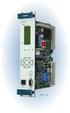 Machinery Protection Card Type FEATURES Continuous on-line Machinery Protection Card Real-time measurement and monitoring using state-of-the-art DSP techniques Fully VME-compatible slave interface Fully
Torque Transducers MEASURING ELECTRONIC
 Screwdriving technology Automation Air motors Air tools MEASURING ELECTRONIC Torque Transducers In most situations, the essential element of screwdriving technology is torque. Controlling the torque generated
Section 3. Sensor to ADC Design Example
 Section 3 Sensor to ADC Design Example 3-1 This section describes the design of a sensor to ADC system. The sensor measures temperature, and the measurement is interfaced into an ADC selected by the systems
Power Supplies. 1.0 Power Supply Basics. www.learnabout-electronics.org. Module
 Module 1 www.learnabout-electronics.org Power Supplies 1.0 Power Supply Basics What you ll learn in Module 1 Section 1.0 Power Supply Basics. Basic functions of a power supply. Safety aspects of working
Guide to adhesively mounting accelerometers
 Guide to adhesively mounting accelerometers cmyk Guide to adhesively mounting accelerometers Purpose This technical paper identifies and clarifies issues regarding adhesive mounting of accelerometers.
Series 6000 Torque measured metal bellow coupling
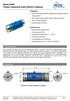 Properties Free of float metal bellow coupling with integrated torque measurement Non-contact measurement system, high robustness High torsional stiffness Limited torque of inertia Performance Measurement
The Sonometer The Resonant String and Timbre Change after plucking
 The Sonometer The Resonant String and Timbre Change after plucking EQUIPMENT Pasco sonometers (pick up 5 from teaching lab) and 5 kits to go with them BK Precision function generators and Tenma oscilloscopes
METHODS FOR THE CALIBRATION OF ELECTROSTATIC MEASURING INSTRUMENTS
 METHODS FOR THE CALIBRATION OF ELECTROSTATIC MEASURING INSTRUMENTS Contents Foreword --------------------------------------------------------------------------------------------------------------------
MAS.836 HOW TO BIAS AN OP-AMP
 MAS.836 HOW TO BIAS AN OP-AMP Op-Amp Circuits: Bias, in an electronic circuit, describes the steady state operating characteristics with no signal being applied. In an op-amp circuit, the operating characteristic
Alternative Linear Motion Systems. Iron Core Linear Motors
 Alternative Linear Motion Systems ME EN 7960 Precision Machine Design Topic 5 ME EN 7960 Precision Machine Design Alternative Linear Motion Systems 5-1 Iron Core Linear Motors Provide actuation forces
Use and Application of Output Limiting Amplifiers (HFA1115, HFA1130, HFA1135)
 Use and Application of Output Limiting Amplifiers (HFA111, HFA110, HFA11) Application Note November 1996 AN96 Introduction Amplifiers with internal voltage clamps, also known as limiting amplifiers, have
Fiber Optic High Density ACC Sensor System Faser Optisches Beschleunigungs-Messsystem
 End Winding Remote unit PNR: 9600.30.180 Remote unit and 6 x One-Axis optical, MIC-Accelerometer Frequency response 1 1000 Hz Easy installation on the end-winding High voltage electrical insulation between
CAN Bus Transceivers Operate from 3.3V or 5V and Withstand ±60V Faults
 CAN Bus Transceivers Operate from 3.3V or 5V and Withstand ±6 Faults Ciaran Brennan design features The LTC2875 is a robust CAN bus transceiver that features ±6 overvoltage and ±25kV ESD tolerance to reduce
Precision, Unity-Gain Differential Amplifier AMP03
 a FEATURES High CMRR: db Typ Low Nonlinearity:.% Max Low Distortion:.% Typ Wide Bandwidth: MHz Typ Fast Slew Rate: 9.5 V/ s Typ Fast Settling (.%): s Typ Low Cost APPLICATIONS Summing Amplifiers Instrumentation
Basic RTD Measurements. Basics of Resistance Temperature Detectors
 Basic RTD Measurements Basics of Resistance Temperature Detectors Platinum RTD resistances range from about 10 O for a birdcage configuration to 10k O for a film type, but the most common is 100 O at 0
Mounting Instructions. Torque Transducer. A0329 3.2 en
 Mounting Instructions Torque Transducer T5 T5 Contents 3 Page Safety instructions.............................................. 4 1 Measuring characteristics..................................... 7 2 Mounting.....................................................
PIEZOELECTRIC FILMS TECHNICAL INFORMATION
 PIEZOELECTRIC FILMS TECHNICAL INFORMATION 1 Table of Contents 1. PIEZOELECTRIC AND PYROELECTRIC EFFECTS 3 2. PIEZOELECTRIC FILMS 3 3. CHARACTERISTICS PROPERTIES OF PIEZOELECTRIC FILMS 3 4. PROPERTIES OF
THERMAL ANEMOMETRY ELECTRONICS, SOFTWARE AND ACCESSORIES
 TSI and TSI logo are registered trademarks of TSI Incorporated. SmartTune is a trademark of TSI Incorporated. THERMAL ANEMOMETRY ELECTRONICS, SOFTWARE AND ACCESSORIES IFA 300 Constant Temperature Anemometry
Signal Conditioning Piezoelectric Sensors
 Application Report SLOA033A - September 2000 Signal Conditioning Piezoelectric Sensors James Karki Mixed Signal Products ABSTRACT Piezoelectric elements are used to construct transducers for a vast number
Product Data. Brüel & Kjær B. DeltaTron Range
 7/6-'89 Product Data DeltaTron Range Miniature Accelerometer Types 4394, 4397 Accelerometer Types 4395, 4396, 4398, 4399 Charge Converter Type 2646 Power Supply ZG 0328 USES: Shock and vibration measurement
APPLICATION NOTE How to Deal with Electrical Noise and Interference in the Measuring Chain using a NEXUS
 APPLICATION NOTE How to Deal with Electrical Noise and Interference in the Measuring Chain using a NEXUS Conditioning Amplifier by Claus Lindahl and Bernard Ginn, Brüel&Kjær When making vibration measurements,
Microcontroller to Sensor Interfacing Techniques
 to Sensor Interfacing Techniques Document Revision: 1.01 Date: 3rd February, 2006 16301 Blue Ridge Road, Missouri City, Texas 77489 Telephone: 1-713-283-9970 Fax: 1-281-416-2806 E-mail: [email protected]
DIODE CIRCUITS LABORATORY. Fig. 8.1a Fig 8.1b
 DIODE CIRCUITS LABORATORY A solid state diode consists of a junction of either dissimilar semiconductors (pn junction diode) or a metal and a semiconductor (Schottky barrier diode). Regardless of the type,
Precision Diode Rectifiers
 by Kenneth A. Kuhn March 21, 2013 Precision half-wave rectifiers An operational amplifier can be used to linearize a non-linear function such as the transfer function of a semiconductor diode. The classic
TECHNICAL DATASHEET #TD1404AX PWM CONTROLLED SOLENOID DRIVER
 TECHNICAL DATASHEET #TD1404AX PWM CONTROLLED SOLENOID DRIVER (PWM Input, 1.2A or 2A Output, Metal Box or PCB) PCB Board - P/N: PWMC-PCB-2A, PWMC-PCB-1.2A Packaged Driver (metal box with 1.5 m (5 ft.) cable)
Measuring Impedance and Frequency Response of Guitar Pickups
 Measuring Impedance and Frequency Response of Guitar Pickups Peter D. Hiscocks Syscomp Electronic Design Limited [email protected] www.syscompdesign.com April 30, 2011 Introduction The CircuitGear
Advanced Monolithic Systems
 Advanced Monolithic Systems FEATURES Three Terminal Adjustable or Fixed oltages* 1.5, 1.8, 2.5, 2.85, 3.3 and 5. Output Current of 1A Operates Down to 1 Dropout Line Regulation:.2% Max. Load Regulation:.4%
Amplifier for Small Magnetic and Electric Wideband Receiving Antennas (model AAA-1B)
 Amplifier for Small Magnetic and Electric Wideband Receiving Antennas (model AAA-1B) 1. Description and Specifications Contents 1.1 Description 1.2 1.2 Specifications 1.3 1.3 Tested parameters in production
Agilent AN 1316 Optimizing Spectrum Analyzer Amplitude Accuracy
 Agilent AN 1316 Optimizing Spectrum Analyzer Amplitude Accuracy Application Note RF & Microwave Spectrum Analyzers Table of Contents 3 3 4 4 5 7 8 8 13 13 14 16 16 Introduction Absolute versus relative
Why to use isolated amplifiers
 Why to use isolated amplifiers AppNote v1.0 www.dewesoft.com Table of Contents Table Of Contents 1Introduction...1 1.1Amplifier technologies...1 1.1.1Single-ended amplifier...1 1.1.2Differential amplifier...1
FREQUENCY CONTROLLED AC MOTOR DRIVE
 FREQUENCY CONTROLLED AC MOTOR DRIVE 1.0 Features of Standard AC Motors The squirrel cage induction motor is the electrical motor motor type most widely used in industry. This leading position results mainly
Sound Pressure Measurement
 Objectives: Sound Pressure Measurement 1. Become familiar with hardware and techniques to measure sound pressure 2. Measure the sound level of various sizes of fan modules 3. Calculate the signal-to-noise
An internal gyroscope minimizes the influence of dynamic linear acceleration on slope sensor readings.
 TECHNICAL DATASHEET #TDAX06070X Triaxial Inclinometer with Gyro ±180⁰ Pitch/Roll Angle Pitch Angle Rate Acceleration SAE J1939, Analog Output or RS-232 Options 2 M12 Connectors, IP67 with Electronic Assistant
LM 358 Op Amp. If you have small signals and need a more useful reading we could amplify it using the op amp, this is commonly used in sensors.
 LM 358 Op Amp S k i l l L e v e l : I n t e r m e d i a t e OVERVIEW The LM 358 is a duel single supply operational amplifier. As it is a single supply it eliminates the need for a duel power supply, thus
LM101A LM201A LM301A Operational Amplifiers
 LM101A LM201A LM301A Operational Amplifiers General Description The LM101A series are general purpose operational amplifiers which feature improved performance over industry standards like the LM709 Advanced
UNDERSTANDING AND CONTROLLING COMMON-MODE EMISSIONS IN HIGH-POWER ELECTRONICS
 Page 1 UNDERSTANDING AND CONTROLLING COMMON-MODE EMISSIONS IN HIGH-POWER ELECTRONICS By Henry Ott Consultants Livingston, NJ 07039 (973) 992-1793 www.hottconsultants.com [email protected] Page 2 THE BASIC
PIEZO FILTERS INTRODUCTION
 For more than two decades, ceramic filter technology has been instrumental in the proliferation of solid state electronics. A view of the future reveals that even greater expectations will be placed on
Product Overview 9100D
 Product Overview 9100D Portable Shaker Vibration Calibrator The Modal Shop 3149 East Kemper Road Cincinnati, OH 45241 Phone: +1.513.351.9919 Fax: 513.458.2171 [email protected] Brief Overview We've taken
DDX 7000 & 8003. Digital Partial Discharge Detectors FEATURES APPLICATIONS
 DDX 7000 & 8003 Digital Partial Discharge Detectors The HAEFELY HIPOTRONICS DDX Digital Partial Discharge Detector offers the high accuracy and flexibility of digital technology, plus the real-time display
Impedance 50 (75 connectors via adapters)
 VECTOR NETWORK ANALYZER PLANAR TR1300/1 DATA SHEET Frequency range: 300 khz to 1.3 GHz Measured parameters: S11, S21 Dynamic range of transmission measurement magnitude: 130 db Measurement time per point:
Description. 5k (10k) - + 5k (10k)
 THAT Corporation Low Noise, High Performance Microphone Preamplifier IC FEATURES Excellent noise performance through the entire gain range Exceptionally low THD+N over the full audio bandwidth Low power
AS2815. 1.5A Low Dropout Voltage Regulator Adjustable & Fixed Output, Fast Response
 1.5A Low Dropout oltage Regulator Adjustable & Fixed Output, Fast Response FEATURES Adjustable Output Down To 1.2 Fixed Output oltages 1.5, 2.5, 3.3, 5.0 Output Current of 1.5A Low Dropout oltage 1.1 Typ.
T1-40 T1-40BF T1-40V T1-38 T1-38BF T1-38V
 Transducers T1-40 T1-40BF T1-40V T1-38 T1-38BF T1-38V Velocity transducers B A L A N C I N G M A C H I N E S B A L A N C I N G M A C H I N E S Principle of operation A voltage proportional to the velocity
PIEZOELECTRIC TRANSDUCERS MODELING AND CHARACTERIZATION
 Piezoelectric Transducers Modeling and Characterization (complete technology and know-how inside). 266 pages, August 2004 www.mpi-ultrasonics.com [email protected] Here you can only see the content and several
Technical Datasheet Scalar Network Analyzer Model 8003-10 MHz to 40 GHz
 Technical Datasheet Scalar Network Analyzer Model 8003-10 MHz to 40 GHz The Giga-tronics Model 8003 Precision Scalar Network Analyzer combines a 90 db wide dynamic range with the accuracy and linearity
PRODUCT INFORMATION. Range of HUMS and Engine-monitoring Accelerometers Type 4511-001, 4511-006, 4523, 8345 and 8347-C.
 PRODUCT INFORMATION Range of HUMS and Engine-monitoring Accelerometers Type 4511-001, 4511-006, 4523, 8345 and 8347-C Health Usage Monitoring Systems (HUMS) are being used more frequently in monitoring
Automation System TROVIS 6400 TROVIS 6493 Compact Controller
 Automation System TROVIS 6400 TROVIS 6493 Compact Controller For panel mounting (front frame 48 x 96 mm/1.89 x 3.78 inch) Application Digital controller to automate industrial and process plants for general
AP1 Waves. (A) frequency (B) wavelength (C) speed (D) intensity. Answer: (A) and (D) frequency and intensity.
 1. A fire truck is moving at a fairly high speed, with its siren emitting sound at a specific pitch. As the fire truck recedes from you which of the following characteristics of the sound wave from the
22.302 Experiment 5. Strain Gage Measurements
 22.302 Experiment 5 Strain Gage Measurements Introduction The design of components for many engineering systems is based on the application of theoretical models. The accuracy of these models can be verified
T-SERIES INDUSTRIAL INCLINOMETER ANALOG INTERFACE
 T-SERIES INDUSTRIAL INCLINOMETER ANALOG INTERFACE T-Series industrial inclinometers are compact high performance sensors used to determine inclination in roll and pitch axes with excellent precision and
Operating instructions
 Operating instructions Torque transducer type AE with replaceable strain gauge measuring element Model TQ 505 Operating instructions no. 1079 Torque Transducer TQ 505 Page 1 / 16 1. Contents 1. List of
Bipolar Transistor Amplifiers
 Physics 3330 Experiment #7 Fall 2005 Bipolar Transistor Amplifiers Purpose The aim of this experiment is to construct a bipolar transistor amplifier with a voltage gain of minus 25. The amplifier must
Description. Specifications and Ordering Information 330400 and 330425 Accelerometer Acceleration Transducers
 Specifications and Ordering Information 330400 and 330425 Accelerometer Acceleration Transducers R Description These accelerometers are intended for critical machinery applications where casing acceleration
Ferrostat Speed Sensor Series DSF Explosion Proof Versions EEx
 Ferrostat Speed Sensor Series DSF Explosion Proof Versions EEx DSF..10.**.HV Ex ATEX Operating Instructions 374E-64368 Valid from lot nr. 0103 General Function Use in potentially explosive environment
Whale 3. User Manual and Installation Guide. DC Servo drive. Contents. 1. Safety, policy and warranty. 1.1. Safety notes. 1.2. Policy. 1.3. Warranty.
 Whale 3 DC Servo drive User Manual and Installation Guide Contents 1. Safety, policy and warranty. 1.1. Safety notes. 1.2. Policy. 1.3. Warranty. 2. Electric specifications. 2.1.Operation ranges. 3. Connections
DDX 7000 & 8003. Digital Partial Discharge Detectors FEATURES APPLICATIONS
 DDX 7000 & 8003 Digital Partial Discharge Detectors The HAEFELY HIPOTRONICS DDX Digital Partial Discharge Detector offers the high accuracy and flexibility of digital technology, plus the real-time display
The Control of ph and Oxidation Reduction Potential (ORP) in Cooling Tower Applications By Charles T. Johnson, Walchem Corporation
 The Control of ph and Oxidation Reduction Potential (ORP) in Cooling Tower Applications By Charles T. Johnson, Walchem Corporation Introduction The importance of keeping cooling tower water in proper chemical
ABB Drives. User s Manual HTL Encoder Interface FEN-31
 ABB Drives User s Manual HTL Encoder Interface FEN-31 HTL Encoder Interface FEN-31 User s Manual 3AUA0000031044 Rev B EN EFFECTIVE: 2010-04-06 2010 ABB Oy. All Rights Reserved. 5 Safety instructions
LM118/LM218/LM318 Operational Amplifiers
 LM118/LM218/LM318 Operational Amplifiers General Description The LM118 series are precision high speed operational amplifiers designed for applications requiring wide bandwidth and high slew rate. They
QUICK START GUIDE FOR DEMONSTRATION CIRCUIT 956 24-BIT DIFFERENTIAL ADC WITH I2C LTC2485 DESCRIPTION
 LTC2485 DESCRIPTION Demonstration circuit 956 features the LTC2485, a 24-Bit high performance Σ analog-to-digital converter (ADC). The LTC2485 features 2ppm linearity, 0.5µV offset, and 600nV RMS noise.
VE 210. Velocity transducer for low-frequency measurements. » From the Vibro-Meter product line» Low-frequency compensation allows frequency
 for low-frequency measurements FEATURES» From the Vibro-Meter product line» Low-frequency compensation allows frequency response down to 0.5 Hz ( 3 db)» Voltage or current modulated output signal» No need
Programmable-Gain Transimpedance Amplifiers Maximize Dynamic Range in Spectroscopy Systems
 Programmable-Gain Transimpedance Amplifiers Maximize Dynamic Range in Spectroscopy Systems PHOTODIODE VOLTAGE SHORT-CIRCUIT PHOTODIODE SHORT- CIRCUIT VOLTAGE 0mV DARK ark By Luis Orozco Introduction Precision
Linear Parameter Measurement (LPM)
 (LPM) Module of the R&D SYSTEM FEATURES Identifies linear transducer model Measures suspension creep LS-fitting in impedance LS-fitting in displacement (optional) Single-step measurement with laser sensor
Sound absorption and acoustic surface impedance
 Sound absorption and acoustic surface impedance CHRISTER HEED SD2165 Stockholm October 2008 Marcus Wallenberg Laboratoriet för Ljud- och Vibrationsforskning Sound absorption and acoustic surface impedance
Current Loop Tuning Procedure. Servo Drive Current Loop Tuning Procedure (intended for Analog input PWM output servo drives) General Procedure AN-015
 Servo Drive Current Loop Tuning Procedure (intended for Analog input PWM output servo drives) The standard tuning values used in ADVANCED Motion Controls drives are conservative and work well in over 90%