
QAD Enterprise Applications Standard & Enterprise Edition. Training Guide MRP/CRP
|
|
|
- Bethanie Simmons
- 9 years ago
- Views:
Transcription
1 QAD Enterprise Applications Standard & Enterprise Edition Training Guide MRP/CRP A QAD Standard & Enterprise Edition Lab: Enterprise Edition r01 - Training Workspace: 10USA > 10USACO September 2011
2 This document contains proprietary information that is protected by copyright and other intellectual property laws. No part of this document may be reproduced, translated, or modified without the prior written consent of QAD Inc. The information contained in this document is subject to change without notice. QAD Inc. provides this material as is and makes no warranty of any kind, expressed or implied, including, but not limited to, the implied warranties of merchantability and fitness for a particular purpose. QAD Inc. shall not be liable for errors contained herein or for incidental or consequential damages (including lost profits) in connection with the furnishing, performance, or use of this material whether based on warranty, contract, or other legal theory. QAD and MFG/PRO are registered trademarks of QAD Inc. The QAD logo is a trademark of QAD Inc. Designations used by other companies to distinguish their products are often claimed as trademarks. In this document, the product names appear in initial capital or all capital letters. Contact the appropriate companies for more information regarding trademarks and registration. Copyright 2011 by QAD Inc. MRPCRP_TG_v2011_1SE_EE.pdf/njm/hes QAD Inc. 100 Innovation Place Santa Barbara, California Phone (805)
3 Contents What s New? vii About This Course Course Description Course Objectives Audience Prerequisites Course Credit Virtual Environment Information QAD Resources Product Help QAD Web Resources Chapter 1 Introduction to MRP and CRP Course Overview Planning and Scheduling Overview Planning and Scheduling Phases Planning and Scheduling Areas of Concern Materials Requirements Planning Balancing Supply and Demand Order Timing MRP Calculations MRP Prerequisites Terminology Action Messages Available to Promise Low-Level Codes Pegging MRP Horizon Capacity Requirements Planning The Foundation for CRP Departments and Work Centers MRP and CRP Users

4 iv Training Guide MRP/CRP Chapter 2 Business Considerations Business Considerations Planning Parameters Kanban Batch Processing Cumulative Lead Times Chapter 3 Set Up MRP MRP Setup Creating Work Schedules Holiday Maintenance Calendar Maintenance Maintaining the Control Program MRP Control Maintaining Planning Parameters Item Planning Maintenance Item-Site Planning Maintenance Order Policies and Modifiers Chapter 4 Use MRP and CRP Use MRP and CRP Low Level Code Update Calculate Requirements Net Change Materials Plan Regenerate Materials Plan Selective Update Selective Materials Plan Review Action Messages Action Message Review/Update Approve Planned Orders Planned Work Order Approval Planned Purchase Order Approval Review MRP Information MRP Summary MRP Summary Inquiry MRP Summary Report Sample MRP Summary Report MRP Details MRP Detail Inquiry Sample MRP Detail Inquiry Past Due Receipts Past Due Receipts Inquiry

5 Contents v Calculate the Capacity Plan Calculate the Capacity Plan Recalculating the Capacity Plan Recalculate Capacity Plan CRP Planning Infinite and Finite Capacity Planning Department and Work Center Capacities Work Center Maintenance Input/Output Analysis Input/Output Inquiry Input/Output Report Field Definitions Summary and Detail Inquiries and Reports Work Center Load Summary Inquiry and Report Report Work Center Load Detail Inquiry and Report Department Load Summary Inquiry and Report Department Load Detail Inquiry and Report MRP/CRP Processing Summary Processing Exercises Exercise: Component Requirement Calculations Exercise: Order Policies and Modifiers Exercise: Order Calculation 1 of Exercise: Order Calculation 2 of Exercise: Running MRP Exercise: Calculating Work Center Load Exercise: Recalculating the Capacity Plan Exercise: Approving MRP Suggestions Answers to Exercises Exercise: Order Calculation 1 of 2 on page Exercise: Calculating Work Center Load on page Appendix A Study Questions Study Questions Answers to Study Questions Appendix B Reports, Inquiries, Browses Appendix C MRP Utilities and Troubleshooting Why are there MRP Utilities? Rebuild mrp_det Table Sync. MRP/DRP Work Table Delete Low Level Code Update
6 vi Training Guide MRP/CRP Stranded qad_wkfl s where qad_key1 = mrp/drp Set Qty Oh/Qty All/Qty Req Seasonal Build MRP Utility Index

7 What s New? The following table summarizes significant differences between this document and the last published version. Date/Version Description Reference September EE Rebranded for QAD EE ---

8 viii Training Guide MRP/CRP

9 About This Course

10 2 Training Guide MRP/CRP Course Description QAD designed this course to cover the basics of preparing to implement Material Requirements Planning (MRP) and Capacity Requirements Planning (CRP) in QAD Enterprise Applications. The Course Includes An introduction to MRP and CRP in QAD Enterprise Applications An overview of key business issues Instructions on how to set up the MRP module Instructions on how to operate the MRP module Instructions on how to process CRP References to other QAD materials, such as on-line help Activities and exercises throughout the course (for student practice of key concepts and processes) Course Objectives In this course you learn how to: Identify some key business considerations before setting up MRP and CRP in QAD Enterprise Applications Set up MRP and CRP in QAD Enterprise Applications Use MRP and CRP in QAD Enterprise Applications Audience Implementation consultants Members of implementation teams Operators Prerequisites Initial QAD Enterprise Applications Setup training course Basic knowledge of: American Production and Inventory Control Society (APICS) theory Theory of MRP and CRP QAD Enterprise Applications as it is used in the business Working knowledge of the manufacturing industry in general Note Students that are unfamiliar with QAD Enterprise Applications should read the User Interface Guide before attending this class. Course Credit This course is valid for 6 credit hours. This course is typically taught in one day.
11 3 Virtual Environment Information The hands-on exercises in this book should be used with the "Enterprise Edition Addons r03 - Training" environment, in the "10USA > 10USACO" workspace. QAD Resources If you encounter questions or problems on QAD software that are not addressed in this book, several resources are available. Product Help All QAD products ship with integrated help systems. A properly installed QAD application will display help when you press the Help key (F1), or access it through the menu. The help covers the normal use of the product. QAD Web Resources The QAD website provides product and company overviews. The Print Solution option on the opening page provides a means of compiling desired content into a document specialized to your industry, business implementation, and needs. From QAD s main site, you can access QAD s Learning or Support sites. QAD Learning Portal for Training Opportunities To view available training courses, locations, and materials, use the QAD Learning Portal. Choose Learning under the Global Services tab to access this resource. QAD Support for Product Documentation and the QAD Knowledgebase To access release notes, user guides, installation and conversion guides by product and release, visit the Support website. Support also offers an array of tools depending on your company s maintenance agreement with QAD. These include the Knowledgebase and direct links to QAD Support experts. Choose Support under the Global Services tab. Any QAD customer can register for a QAD web account by accessing the Support web site and clicking the Accounts link at the top of the screen. Your customer ID number is required. Access to certain areas is dependent on the type of agreement you have with QAD.

12 4 Training Guide MRP/CRP

13 Chapter 1 Introduction to MRP and CRP

14 6 Training Guide MRP/CRP Course Overview

15 Introduction to MRP and CRP 7 Planning and Scheduling Overview Component planning takes place in the Material Requirements Plan (MRP) module and the plans are checked against capacity in the Capacity Requirement Plan (CRP) module. This tool enables you to schedule and issue orders for the items and for the work that will be needed to support the master schedule. You can use CRP to determine at a fairly precise level how this plan will load the resources you have at your site. Component planning enables you to determine which work centers and components will be used to meet the plan. The check is to determine whether the work centers have the capacity to meet the schedule. Items that are not master scheduled will be planned using MRP with master schedule as input. Master schedules generate demand for components. MRP uses this demand to schedule orders for components.

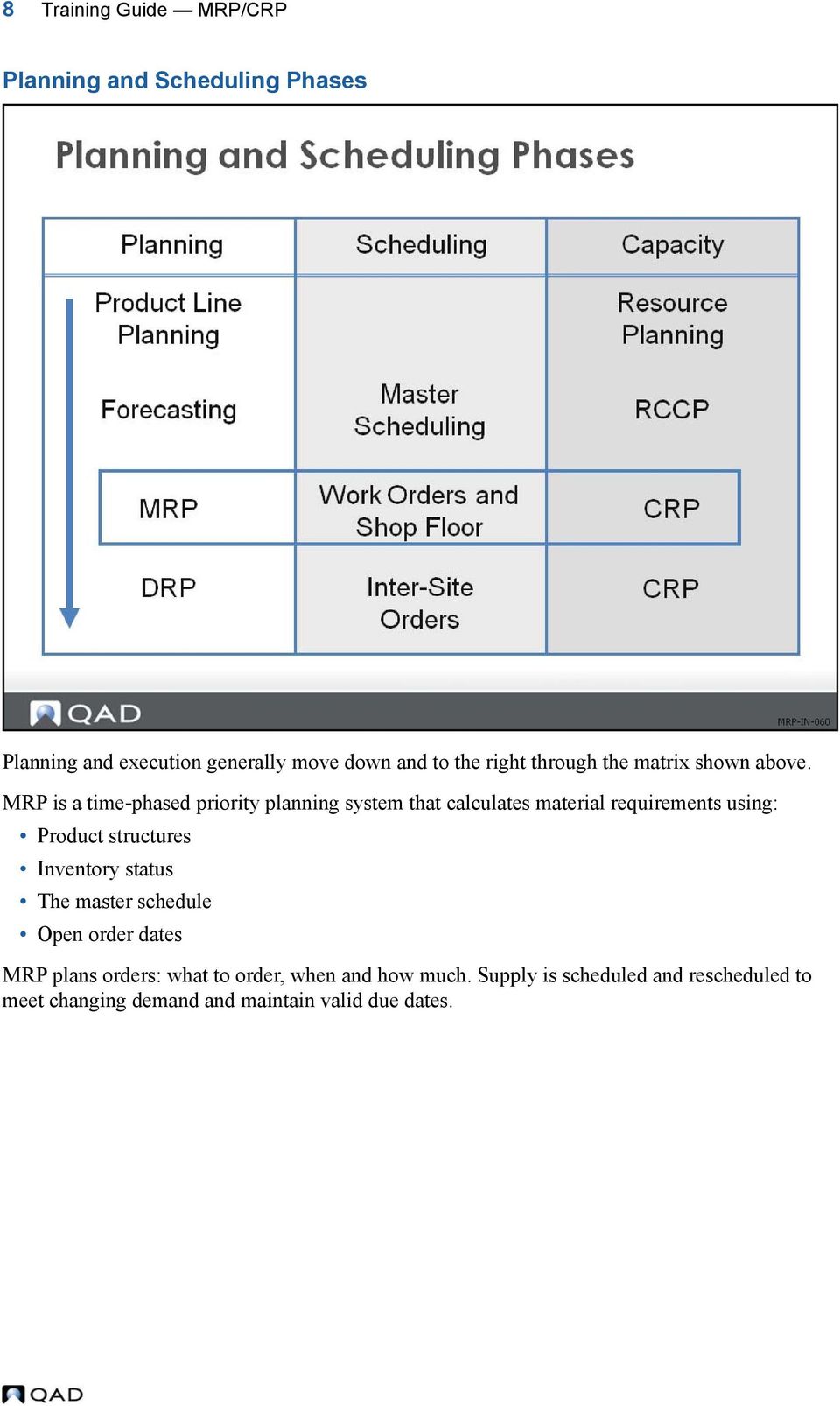
16 8 Training Guide MRP/CRP Planning and Scheduling Phases Planning and execution generally move down and to the right through the matrix shown above. MRP is a time-phased priority planning system that calculates material requirements using: Product structures Inventory status The master schedule Open order dates MRP plans orders: what to order, when and how much. Supply is scheduled and rescheduled to meet changing demand and maintain valid due dates.
17 Introduction to MRP and CRP 9 Planning and Scheduling Areas of Concern MRP and CRP deal with departments, work centers and components. Planners and shop floor personnel use MRP results to determine manufacturing schedules, which have the same time horizon as master schedules.

18 10 Training Guide MRP/CRP Materials Requirements Planning MRP balances supply and demand for purchased and manufactured items. Given a set of demands or requirements, MRP automatically calculates a time-phased schedule of planned supply orders or replenishments to satisfy those demands. It also generates action messages to alert you to any problems such as shortages and late receipts. MRP looks at demand for finished items and uses product structure information to calculate demand for component items For each item, MRP looks at the: Ordering information Amount currently on hand Lead times MRP then generates planned orders suggesting how many of each item to buy or make and when to do so MRP s planning activity is performed by site Each site s material plan is completely independent from inventory, demand, and supply at other sites To plan for multiple sites, you run MRP for each site separately Reliable MRP processing depends on accurate: Inventory data
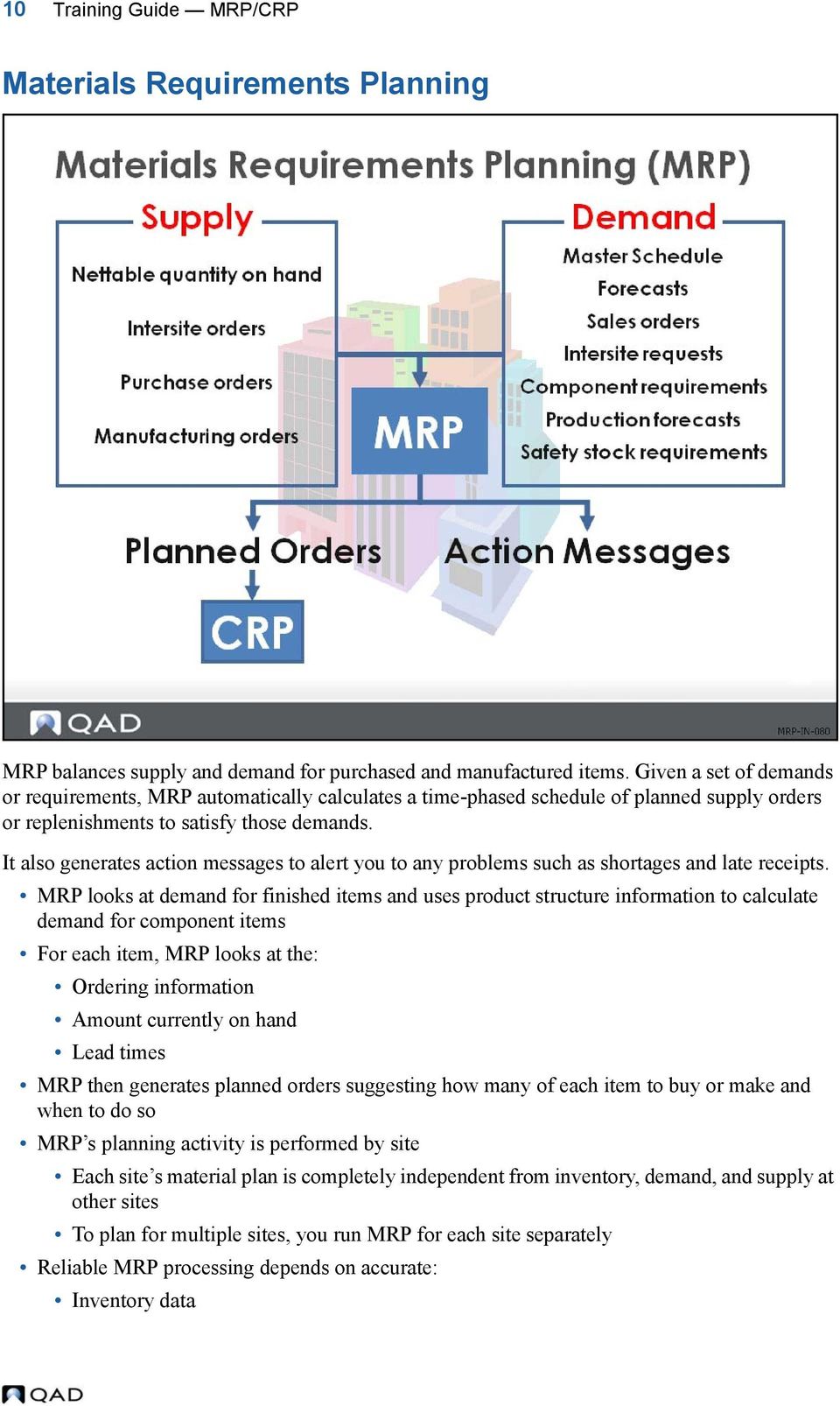
19 Introduction to MRP and CRP 11 Product structures and formulas Manufacturing and purchasing lead times

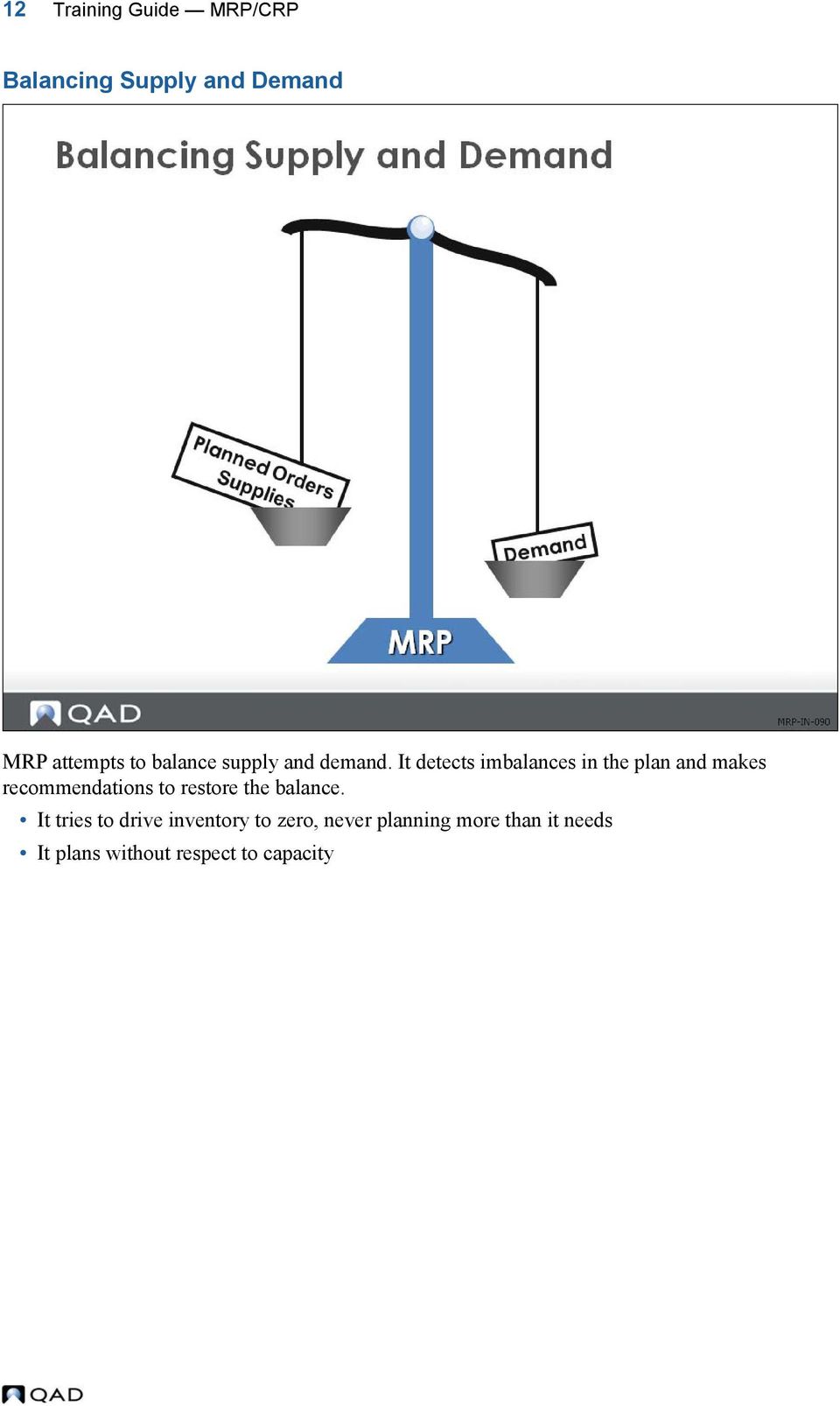
20 12 Training Guide MRP/CRP Balancing Supply and Demand MRP attempts to balance supply and demand. It detects imbalances in the plan and makes recommendations to restore the balance. It tries to drive inventory to zero, never planning more than it needs It plans without respect to capacity
21 Introduction to MRP and CRP 13 Order Timing The master schedule sets the overall plan on which MRP bases the timing.mrp uses backward scheduling to determine the start date. In backward scheduling, the lead time is subtracted from the due date in order to arrive at the start date. MRP performs this calculation on all planned orders. Some guidelines of MRP: A component due date is generally the parent item s release date; however, lead time offsets adjust the component due date. For all non-purchased items, MRP counts only work days as defined in the Shop Calendar. For purchased items, MRP uses regular calendar days; if the release date is a non-workday, MRP uses the prior workday.
22 14 Training Guide MRP/CRP MRP Calculations MRP uses this calculation for each period. Maintaining the balance across the planning horizon complicates the calculations
23 Introduction to MRP and CRP 15 The illustration above shows the calculations for end item A. MRP also calculates the requirements for all components Net Req. = Gross Req. - Sched. Recp. - Nettable On Hand
24 16 Training Guide MRP/CRP MRP Prerequisites MRP is as accurate as its input allows it to be. For useful output, the inputs should be more than 98% accurate.
25 Introduction to MRP and CRP 17 Terminology Action Message A system message usually created during MRP calculations to call attention to a current or potential problem and suggest corrective action. Available to Promise (ATP) The uncommitted portion of inventory or planned production, maintained in the master schedule to support customer order promising. ATP quantity is the uncommitted inventory balance in the first period and is normally calculated for each period in which a Master Production Schedule (MPS) receipt is scheduled. In the first period, ATP equals on-hand inventory less customer orders due and overdue. In any period containing MPS scheduled receipts, ATP equals MPS minus customer orders for the period and all subsequent periods before the next MPS scheduled receipt. A negative ATP reduces prior period ATP Low-Level Code. The lowest level in a product structure (BOM) at which a particular component can appear. Net requirements for an item are not calculated until gross requirements are calculated down to that level. Normally calculated and maintained automatically by the system.
26 18 Training Guide MRP/CRP Pegging (1) In MRP and MPS, the capability to identify for a given item the sources of its gross requirements and/or allocations. (2) The process of consuming a shipper line that is tied to a required ship schedule requirement record. MRP horizon Also known as the MRP planning horizon, the MRP horizon is how far to plan forward in time, and is determined by how far ahead demand is known and by the lead times through the manufacturing operation.
27 Introduction to MRP and CRP 19 Action Messages Action messages recommend the actions a planner should take to balance supply with demand, such as rescheduling, canceling, or releasing orders. MRP generates action messages, as required, for all items with non-blank order policies. Order policy codes not recognized by the system are planned as LFL.
28 20 Training Guide MRP/CRP Available to Promise Available-to-promise (ATP) is the uncommitted portion of inventory or planned production which is available to be promised to new sales orders. The system displays ATP quantities on master schedule reports and inquiries. ATP can be used to verify whether a sales order can be filled within a specific time frame given other demands and currently scheduled supply orders. The system calculates ATP by time period by deducting real demand from real supply Real demand includes requirements for work order components, sales orders, and required ship schedules Real demand excludes forecast and production forecast Real supply includes quantity-on-hand, purchase orders, work orders, and repetitive schedules A net decrease in demand increases ATP, while a net increase in demand decreases ATP Traditionally ATP was only displayed for periods which had a master schedule quantity. ATP from a prior period was not carried forward. QAD Enterprise Applications allow you to display ATP in the traditional format and also in a cumulative format that does allow prior period unconsumed ATP to be carried forward. You also have the option of enforcing ATP in sales order maintenance with either a warning or an error. An ATP error tells you there is insufficient quantity of the item on the date requested, but will let you take the order anyway. An ATP error will not allow the item to be processed.
29 Introduction to MRP and CRP 21 You may also specify an ATP horizon which tells the system how far into the future to look for ATP to fill a demand.
30 22 Training Guide MRP/CRP Low-Level Codes Low-level codes indicate the relative position of each item within the product structures. MRP uses low-level codes to ensure that all dependent demands from parent items are included. In the diagram above, item C s low-level code is determined by the product structure for item E, not by item A. MRP stops searching for occurrences of the item when it reaches the lowest level in each product structure, thus saving time QAD Enterprise Applications and APICS number the levels differently, but the process is the same: search for the item from the top down in each structure and stop searching after the lowest-level code for the item QAD Enterprise Applications automatically updates the low-level codes when you enter or modify product structures Low-level codes can be inaccurate if you import data without testing it, or if you modify structures directly from PROGRESS. If you believe that the codes are incorrect, you should run Low Level Code Update, (23.22). Note Product structure data is often imported from CAD/CAM systems
31 Introduction to MRP and CRP 23 Pegging Pegging identifies the source of the requirements. For example, pegging identifies the sales order or forecast that is creating the need for an item. Pegging is made possible by the low-level codes. Pegging is maintained for one level; in the above example, you can see that the requirement for E came from B, and the requirement for B came from A, but you cannot inquire about E and see that its requirement comes from A.
32 24 Training Guide MRP/CRP MRP Horizon Also referred to as the MRP Planning Horizon, it is the number of calendar days to be planned forward in time. The MRP Horizon is determined by how far ahead demand is known and by the lead times through the manufacturing operation. MRP only processes material requirements within this planning horizon, ignoring activity outside this horizon This horizon should be at least one day longer than your longest cumulative lead time If you change the MRP planning horizon, replan all items by running Regenerate Materials Plan, (23.2).
33 Introduction to MRP and CRP 25 Capacity Requirements Planning CRP calculates the workload in a given department or specific work center or machine by: Exploding the routings and processes for MRP planned and firm planned orders and updating or creating work order routings Determining the start/due dates for each operation using: Work center and shop calendars Back scheduling (start date of the last operation is the due date of the previous operation)
34 26 Training Guide MRP/CRP The Foundation for CRP MRP provides the foundation for calculating CRP, a tool used to complete the master schedule. Master scheduling and rough-cut capacity planning (RCCP) should have removed most of the capacity constraints before MRP is run. Note Discussed in the following Training Guide: Master Scheduling and Rough-Cut Capacity Planning (RCCP) MRP looks at the inventory and at orders CRP uses routings and work centers RCCP uses resources and resource bills Back Scheduling When CRP back schedules orders, it takes the due date of an order or repetitive schedule and schedules each of its operations from the last operation in the order routing or process backward to the first one. CRP assigns each operation a start date and a due date, using the operation lead time components queue, setup, run, wait, and move to calculate operation start dates. The start date of an operation is the same as the due date of the previous operation CRP calculates run times based on the actual order quantity - order quantity less the quantity completed
35 Introduction to MRP and CRP 27 Departments and Work Centers Resources used to process orders on the shop floor, from sub-assembly to end item, are: Departments Work centers Number of machines Departments The capacity of a department is the total number of available labor hours per day for all work centers in the department, as defined in Department Maintenance, (14.1). CRP provides a Department Load Summary which shows the total load hours for all the work centers in a department against the total capacity. This can be a useful quick check on load conditions. However, you need to be aware that labor from one work center may not be interchangeable with other work centers in the department. Work Centers The capacity of a work center is the number of machines and personnel available multiplied by work hours in a period, as defined in Work Center Maintenance, (14.5) and Calendar Maintenance, (36.2.5). CRP loads (or simulates) the expenditure of work center and department hours using orders as production demand. Work order routings provide data about which orders will be using which work centers and when.
36 28 Training Guide MRP/CRP MRP and CRP Users MRP and CRP are high-level operations that should be password protected and used only by qualified employees.
37 Chapter 2 Business Considerations
38 30 Training Guide MRP/CRP Business Considerations In this section, you learn how to identify some key business considerations before setting up MRP and CRP in QAD Enterprise Applications. There are several business issues to take into consideration before using MRP and CRP: Planning parameters Kanban Batch processing Cumulative lead times This section does not discuss all potential issues, but presents some issues to generate thought and discussion.
39 Business Considerations 31 Planning Parameters You set these in Item Planning Maintenance, (1.4.7) and Item-Site Planning Maintenance, (1.4.17). Definitions Planning parameters are established for each item in your database; they govern the way MRP handles the items. Why Consider? MRP is only as accurate as the data it processes; your planning parameters should have 98% plus accuracy. Functionality in QAD Enterprise Applications The item planning data is the most used information in your database. Setup Implications Inaccurate data can be catastrophic A good clean-up of the database is always worthwhile
40 32 Training Guide MRP/CRP Kanban Definition A Japanese method of production and inventory control first developed and used at Toyota. Designed for day-to-day, on-floor control of production and inventory, it relies on a series of control triggers, typically a visual one in the form of cards Kanban is the predecessor of Just-in-Time (JIT) Kanban is an appropriate way to schedule a plant if you use advanced repetitive with single-step routings or multiple steps with a milestone at the last operation. Otherwise, you need a repetitive exploded schedule in place to net the work in process. Why Consider? Many companies use it. Some QAD customers use kanban in their plants and MRP to create supplier schedules. You can set up separate buyer/planner codes to apply to kanban and nonkanban items. Setup Implications Planning parameters in Item Planning Maintenance, (1.4.7) can be set to meet kanban needs. Set Order Policy to POQ with a period of 1 or 2 days Avoid order modifiers or use them to set Kanban quantity
41 Business Considerations 33 QAD Enterprise Applications offer several production options including Kanban, Flow manufacturing Repetitive Line Scheduling and Sequenced Line Scheduling. Which of these methods you choose to use will have a significant impact on setting your planning parameters. This in turn has a significant impact on how MRP calculates requirements. Before setting planning parameters for an item it is necessary to understand the total manufacturing environment for all items at all sites. Different items may be processed differently at different sites.
42 34 Training Guide MRP/CRP Batch Processing Definition A computer technique where transactions are accumulated and processed together. Why Consider? MRP runs can take a long time. You should schedule MRP at reasonable intervals, depending on: How often you require change How often your suppliers need updates The length of your MRP horizon
43 Business Considerations 35 Cumulative Lead Times Definition The time required to produce an item, based on component lead times. Why Consider? MRP considers component lead times in generating its plan Inaccurate lead times result in faulty plans MRP horizon must be at least one day longer than longest cumulative lead-time Discussed in the Product Structures and Formulas Training Guide
44 36 Training Guide MRP/CRP
45 Chapter 3 Set Up MRP
46 38 Training Guide MRP/CRP MRP Setup In this section, you learn how to set up MRP and CRP in QAD Enterprise Applications. This lesson covers the data that you need to enter or configure for a successful MRP implementation. Reading the training flow The current step will be highlighted Optional steps say (optional) A suggested setup sequence for MRP includes three steps: First, verify the accuracy of your work schedules and holidays so that MRP can properly plan your activities. Second, set up or maintain the MRP control program. Third, verify the planning parameters of your items so that MRP can properly process them.
47 Set Up MRP 39 Creating Work Schedules Here you look at how to create calendars and holidays in QAD Enterprise Applications.
48 40 Training Guide MRP/CRP Holiday Maintenance Use Holiday Maintenance (36.2.1) to schedule holidays and other nonwork days that apply to an entire site. That is: Holiday Maintenance is used to set a normal work day to a non-work day for all calendars at a site. Field Definitions The information below describes the key fields in the screen above. Site. The site to which the holiday applies. Date. The holiday date. Holiday. A brief, reference-only description.
49 Set Up MRP 41 Calendar Maintenance Calendars provide the basis for MRP scheduling functions. Calendars define the standard work week for a site and the work centers in it. They also define exceptions to the normal calendar, such as scheduled overtime or shutdown periods. In Calendar Maintenance, (36.2.5), you can create calendars for individual work centers or for the entire site. At least one calendar must be defined. Field Definitions The following information describes the key fields in the screen above. Site. You can also setup for each domain a generic calendar with both site and work center blank will default into each new site you create. This field contains the site code to which this shop calendar applies. For each site, set up at least one calendar without specifying work centers or machines. This sets the default for the site. Work Center. The work center to which this shop calendar applies. A work center is uniquely identified by a work center code and a machine code. Machine. The machine to which this shop calendar applies. Work Day / Hours. Shows which days are work days and how many hours are available for work.
50 42 Training Guide MRP/CRP When calculating schedule due and release dates, the system only looks at scheduled work days, ignoring exceptions and holidays. Note: If you set work day to No on a Sunday, the system will never schedule a work order or purchase order due date that day. If you sometimes work on a Sunday, you should enter Yes in work day and set the scheduled hours to zero, allowing due dates to fall on a Sunday, which you can reschedule manually. Exceptions to the normal calendar are identified by a reference code and a start and end date. Use these fields to schedule overtime, increased shifts, reduced shifts, preventative maintenance or shutdowns. The number of hours specified is added (or subtracted) from the normal work day for each day in the range of dates specified. Reference. A reference code identifying an exception to the shop calendar, usually describing the type of exception, such as Overtime or Shutdown. Exceptions only record holidays if the holiday only applies to some work centers. If the holiday applies to all work centers, use Holiday Maintenance (36.2.1). Missing or empty src attribute on include:include Start / End. The start and end dates of the exception. Enter start and end dates carefully. The exception applies to all work days in the range of dates specified. Daily Hours. Daily hours may be positive or negative. A positive number increases scheduled work hours; a negative number decreases them.
51 Set Up MRP 43 Maintaining the Control Program The MRP control program sets some basic parameters.
52 44 Training Guide MRP/CRP MRP Control Enter appropriate values in MRP Control (23.24). Field Definitions The information below describes the key fields in the screen above. MRP Horizon. The period of time, in calendar days, which MRP should plan. MRP calculations ignore data outside this time period. The horizon should be at least one day longer than the longest item cumulative lead time in the database to avoid planning it late Note If you change the MRP planning horizon, impacted items are not automatically replanned when you run Net Change Materials Plan (23.1). Ensure that all items are replanned by running Regenerate Materials Plan. MRP/DRP Combined. Indicates whether MRP planned items can be planned by the Distribution Requirement Planning (DRP). DRP is the balancing of supply and demand for items transferred between sites. If this field is set to: No = MRP planned items can be recalculated only using the MRP functions Yes = MRP planned items can be recalculated using the DRP planning functions When to run DRP and MRP depends on where your DRP items are in the structure: If you are distributing finished products, you can usually run DRP followed by MRP
53 Set Up MRP 45 If you are supplying component items between sites, you can usually run MRP followed by DRP You would normally only need to run a combined MRP/DRP when you have DRP items at multiple levels of the product structure. Summary Default. Indicates the day of the week all MRP summary reports and inquiries should start. Order Release Horizon. The number of calendar days before planned order release that an action message should appear. MRP assigns Release Due action messages to orders with release dates within this release horizon For example, if you set the release horizon to 7 days, all orders due to be released within the week have a Release Due action message This gives planners time to take appropriate actions The release horizon setting should reflect your normal paperwork lead time and how often you run MRP If you run MRP once a week, the release horizon should be at least 7 days If you run MRP daily, you can leave this field at zero Enable Op Based Yield. This field determines how the system calculates yield for component items when product structures and routings are exploded in material requirements planning (MRP) programs, work orders, repetitive, advanced repetitive, and configured products. No=The system uses the Yield % field associated with the parent item in Item Planning Maintenance or Item-Site Planning Maintenance to calculate component requirements. Yes=The system derives the yield percentage amount for components from operations on the parent item s routing. The Yield % field associated with the item is used for the parent item only, not the components. Note Even when Enable Op Based Yield is Yes, this calculation method is only used for parent items with Operation Based Yield set to Yes in either Item Planning Maintenance or Item-Site Planning Maintenance. Use AppServer. Specify whether your system uses a Progress application server to run MRP/DRP processes on a Symmetric Multiple Processor (SMP) computer. AppServer Name. When Use AppServer is Yes, enter the name of the application server that is configured to run the MRP/DRP programs. Default Number of Threads. When your system uses an AppServer for MRP/DRP processing, enter the default number of processing threads, or agents, that the AppServer can create. This can be any integer up to 99.
54 46 Training Guide MRP/CRP Maintaining Planning Parameters The material planning department uses item planning data to determine how and when to replenish inventory. This data affects MRP, purchasing, manufacturing, configured products, and costing. Most of the fields are used in MRP. Buyer/Planners need to understand the planning parameters for the items. These parameters must be set appropriately for your company.
55 Set Up MRP 47 Item Planning Maintenance MRP uses item planning data to plan items. You define this data in Item Planning Maintenance. If an item is used at multiple sites, you can set up planning data differently for each site using Item- Site Planning Maintenance. Data not defined in Item-Site Planning Maintenance defaults from Item Planning Maintenance. Independent demand items can be identified in the Master Production Schedule (MPS) and planned by a master scheduler, whereas dependent demand items are planed by MRP except items replenished according to a reorder point policy. MPS represents what the company plans to produce expressed in specific configuration, quantities, and dates Note The manufacturing lead time (Mfg. LT) stored with the Item Planning Data is the value calculated during the routing roll up using the Order Quantity value also found in Item Planning Data. The lead time value in days is truncated to a whole number. The Purchase Lead Time is entered by the planner based on information from the supplier and the companies past experience with that supplier. Master Schedule Item Parameters Master Schedule: Yes Plan Order: Yes Time Fence: Management policy Order Policy: Any policy except blank. Non-valid policies are treated as LFL
56 48 Training Guide MRP/CRP MRP Items Master Schedule: No Yes if there is spare part or other independent demand usage to be master scheduled Plan Orders: Yes Time Fence: Optional Order Policy: Any policy except blank Reorder Point Items Master Schedule: No Plan Orders: No Time fence: 0 Order Policy: <blank> Reorder Point: Non-zero quantity, such as demand during lead time Issue Policy: No (Optional) See in this training guide: Order Policies and Modifiers on page 50
57 Set Up MRP 49 Item-Site Planning Maintenance Use this function to set planning data for item on a site-by-site basis. The same item made at different sites will often have different product structures, routs and planning data. This generally results in a different lead time.
58 50 Training Guide MRP/CRP Order Policies and Modifiers The graphic shows the MRP calculation from the introduction and how it would change if the Order Multiples field were set to 50. Order Policies Lot-for-Lot (LFL) Planned orders will be created for the net requirement quantities for each demand. LFL consumes on hand available and on order available prior to creating a supply order to cover this demand. Period Order Quantity (POQ) Planned orders will be created to satisfy requirements for the number of calendar days specified in the Order Period field each time an order is created. Orders are only created when needed. Fixed Order Quantity (FOQ) Planned orders will be created for the quantity specified in the Order Quantity field. One Time Only (OTO) A planned order will be made for a quantity of one only. As long as one (1) order exists, another will not be created. This can be used for prototypes.
59 Set Up MRP 51 No Order Policy (blank) MRP does not plan the item even when the Plan Orders flag is set to Yes. Order modifiers Order modifiers change planned order quantities. Order Quantity A specified quantity used in conjunction with the Fixed Order Quantity (FOQ) order policy. It is also used for all item cost and lead time calculations as the standard order quantity. Safety Stock Quantity A specified quantity used as inventory reserve to compensate for unexpected demand and to maintain desired service levels. This applies to all order policies, including a blank. The system will never plan to use safety stock, but will always replace it if consumed. Minimum Order Quantity This is the smallest order quantity that will be planned. Minimum quantities are often set by vendors for purchased items. This could be a case or pallet quantity or a quantity established for a quantity discount. For manufactured items this is often the minimum quantity required to incur the setup costs for the item. Minimum quantities should only be used with items that have continuing demand, since the minimum order quantity could exceed the actual current demand. Maximum Order Quantity MRP generates a warning message in the event a planned order quantity is larger than the specified maximum order quantity. Excessively large lot sizes may tie up a resource so that other orders may be delayed unnecessarily. Further, setting a quantity limit can uncover data entry errors (i.e., entry of 1,000 instead of 100). Order Quantity Multiple Planned orders will be created in multiples of this quantity. That is, if the order multiple is 100, planned orders will only be created for quantities of 100, 200, 300, etc. Order multiples are appropriate for multiple cavity molding applications, packaging, etc. Order multiples are commonly used for multiples of case or pallet quantities, kanban pull quantities or other convenient storage or transport unit of measure. Items whose calculated requirement has a decimal value due to scrap or yield factors may be forced to a whole number by setting the multiple to one, or any whole number.
60 52 Training Guide MRP/CRP
61 Chapter 4 Use MRP and CRP
62 54 Training Guide MRP/CRP Use MRP and CRP In this section you learn how to use MRP and CRP in QAD Enterprise Applications. The diagram above is a suggested processing sequence of master files for processing MRP which is based on information that flows from one master file to another and the prerequisites that need to be accomplished. The diagram shows the steps that are covered in this course: The MRP output is the direct input to CRP. Once the MRP has been reviewed and action messages acted upon, the capacity plan can be run.
63 Use MRP and CRP 55 Low Level Code Update Low-level codes maintain a numeric value for each item relative to its parent item. This accelerates MRP processing time. Normally, QAD Enterprise Applications automatically updates these codes through item planning, BOM, MRP, and DRP transaction.
64 56 Training Guide MRP/CRP You can update them anytime with Low Level Code Update, (23.22) as shown above. You can also do this through Selective Materials Plan, (23.3). Depending on the number of items in your database, this program can take a long time to run. Discussed in the following training guide: Product Structures and Formulas
65 Use MRP and CRP 57 Calculate Requirements QAD Enterprise Applications offers you three ways to run MRP: Net Change Materials Plan, (23.1) calculates requirements only for those items that have changed since the last update Regenerate Materials Plan, (23.2) updates the entire database Selective Materials Plan, (23.3) updates selected items only MRP ignores items with an order policy of blank.
66 58 Training Guide MRP/CRP Net Change Materials Plan
67 Use MRP and CRP 59 Net Change Materials Plan (23.1) considers only items with MRP Required set to Yes in their item planning data. The system sets this field to Yes automatically when changes occur for an item in any of the following areas: Item or item-site planning data Product structures Sales or purchase orders Work orders or repetitive schedules Inventory Forecasts Master production schedule Intersite demand About this functionality: It may take some time to process. You may wish to submit it in batch. It does not see demand or forecast for items moving into the MRP horizon as time passes. It is used by many companies for their normal MRP runs. If more than 50% of items have changed since the last MRP, it takes about the same amount of time as a full regen.
68 60 Training Guide MRP/CRP Field Definitions The information below describes the key fields in Net Change Materials Plan, (23.1). Site/To. Enter the sites to plan for. One site s material plan is completely independent from inventory, demand, and supply in other sites. Synchronized Calculation. Determines whether this MRP/DRP calculation is to be run simultaneously with other calculations sharing the same synchronization code. Synchronized calculations benefit you if you have Symmetric Multiple Processor (SMP) computers.
69 Regenerate Materials Plan Use MRP and CRP 61
70 62 Training Guide MRP/CRP Regenerate Materials Plan, (23.2) recalculates demand and plans supply for all items in the site. This method generates a plan for all items, not just those that have changed since the last run. The outputs of net change and regenerative MRP are the same. However, net change MRP generally runs faster than regenerative, since it only plans for items that changed since MRP was last run. Guidelines: The first time you run MRP, it should be regenerative. You should always schedule periodic regenerative MRP runs, even if you primarily use net change MRP, since net change MRP does not consider demand or forecast for items entering the MRP horizon over time. For forecasting, you may want to run this at 12:01 a.m. Monday. Note The first time you run MRP, it should be regenerative. Field Definitions The Information Below describes the key fields in Regenerate Materials Plan, (23.2). One site s material plan is completely independent from inventory, demand, and supply in other sites Synchronized Calculation. Determines whether this MRP/DRP calculation is to be run simultaneously with other calculations sharing the same synchronization code.
71 Use MRP and CRP 63 Synchronized calculations benefit you if you have Symmetric Multiple Processor (SMP) computers Synchronization Code. A user-defined alphanumeric code that is shared by multiple, concurrent synchronized MRP/DRP calculations.
72 64 Training Guide MRP/CRP Selective Update
73 Use MRP and CRP 65 Selective Materials Plan Selective Materials Plan (23.3) plans only for items and sites you select. It can be run in net change mode by setting the Required Items Only field to Yes, or in regenerative mode by setting Required Items Only to No. You can use Selective Materials Plan to plan master schedule items separately from other items, or to plan small groups of items by using buyer/planner, product line, group, type, supplier, or any combination of these, as selection criteria. Guidelines: Only master schedulers should use this program. This program plans down one level only. It can be run in net change mode by setting the Required Items Only field to Yes, or in regenerative mode by setting Required Items Only to No. You can use Selective Materials Plan, (23.3) to plan master schedule items separately from other items, or to plan small groups of items by using buyer/planner, product line, group, type, supplier, or any combination of these, as selection criteria. In the selection fields, enter data for the criteria relevant to your needs; bypass fields by leaving them blank.
74 66 Training Guide MRP/CRP Field Definitions The information below describes the key fields in Selective Materials Plan, (23.3). Item Number/To. Enter the range of item numbers that you want to update. Site / To. Enter the range of sites that you want to update. Master Scheduled Items. Yes = Replan those items flagged Master Sched = Yes in Item Planning Maintenance, (1.4.7). No = Ignore these items. Non Master Scheduled Items. Yes = Replan those items flagged Master Sched flag = No in Item Planning Maintenance, (1.4.7). No = Ignore these items. MRP Items. Yes = Replan items flagged as Plan Orders = Yes in Item Planning Maintenance, (1.4.7). No = Ignore these items. DRP Items. Yes = Replan distribution items: Distribution items are flagged as Pur/Mfg = D in Item Planning Maintenance, (1.4.7) This flag may only be set to Yes if the DRP/MRP Combined flag in the DRP Control File is set to Yes Normally these items are planned using DRP calculations No = Ignore these items. Required Items Only. Yes = Include only items flagged for replanning. The system flags replanning whenever a change is made affecting order timing or quantity, including changes to: Planning data Inventory balance Product structure Purchase requisitions and orders Sales orders Work orders Master schedule Repetitive schedule Forecast No: include all selected items. Resolve Low Level Codes. Yes = Analyze and resolve all low level codes.
75 Use MRP and CRP 67 No = Ignore the low level codes. Note If low level codes are unresolved when MRP is run, the results of the MRP run may not be totally accurate. Synchronized Calculation. Determines whether this MRP/DRP calculation is to be run simultaneously with other calculations sharing the same synchronization code. Synchronized calculations benefit you if you have Symmetric Multiple Processor (SMP) computers. Synchronization Code. A user-defined alphanumeric code that is shared by multiple, concurrent synchronized MRP/DRP calculations. Buyer/Planner, Prod Line, Group, Item Type, Supplier, Pur/Mfg fields. If you enter a code in any of these fields, MRP limits planning to items so flagged.
76 68 Training Guide MRP/CRP Review Action Messages Action messages suggest courses of action to resolve problems found by MRP. MRP Action Messages Message Beginning Quantity Less Than Zero Beginning Available Less Than Zero Create De-Expedite Expedite Cancel Release Due For Meaning Indicates that the initial nettable quantity on hand is negative. Indicates that the quantity on hand less safety stock is negative. Indicates that a supply order should be created to satisfy a negative projected on hand balance. This message is only generated if Plan Orders is No or if a new requirement appears within the time fence. Indicates that a scheduled supply order is due before it is needed and should be delayed, or demand rescheduled to an earlier date. Indicates that a scheduled supply order is due after it is needed and should be rescheduled to an earlier date, or demand rescheduled to a later date. Indicates that a scheduled supply order is no longer needed and should be deleted. Indicates that a supply order should be released. If it is a planned order, it must also be approved. Use the Order Release Horizon field in the MRP Control File, (23.24) to specify the number of days prior to the order release date for this action message to display.
77 Use MRP and CRP 69 Message Release Past Due For Quantity Less than Minimum Quantity Exceeds Maximum Past Due Time Fence Conflict Shipment Due Shipment Past Due No Source Of Supply Planned Order Count Exceeds Maximum Meaning Indicates that a supply order was not released when it was due, and should be either released or expedited now, or the demand rescheduled for a later date. Indicates that a supply order was created for a quantity less than the minimum quantity set in the item planning data. Indicates that a supply order was created for a quantity greater than the maximum quantity set in the item planning data. Indicates that a scheduled supply order receipt is past due. Indicates that there is an unsatisfied material requirement inside the planning time fence for this item. You should either manually schedule and expedite orders to fill this demand or delay fulfillment of the requirement that created the demand. Indicates that a shipment for an intersite request item is due. Action should be taken at the source site to ensure that the order is received on time. Indicates that a shipment for an intersite request item is past due. You should either delay the orders that created the requirement for the item or expedite them when the item does arrive. Indicates that the planning data for an intersite request item does not specify a valid source network for the date an intersite request is required. Indicates that the maximum allowable number of 9999 planned orders per day has been generated by an item-site. Calculation for other items is not affected.
78 70 Training Guide MRP/CRP Action Message Review/Update Action Message Review/Update, (23.5) reports on action messages using various selection criteria. Select the messages you want using the criteria.
79 Use MRP and CRP 71 Approve Planned Orders MRP produces orders based on demand. The status of these orders is planned. They can be for manufactured and purchased items and work orders: You release the orders for manufactured items as work orders You release the orders for purchased parts as requisitions Planned orders can be changed by subsequent MRP runs. To move these orders out of MRP s control, you approve them.
80 72 Training Guide MRP/CRP Planned Work Order Approval
81 Use MRP and CRP 73 Planned Work Order Approval, (23.10) approves the MRP plan, generating a firm order for the amount of each planned order, changing the status from P to F. After this step, items are ready for release. The new status prevents MRP from changing the order dates and quantities. Select orders for approval with the criteria displayed. The screen displays the relevant work orders in the top half. In the bottom, you select orders by line number for processing:
82 74 Training Guide MRP/CRP Field Definitions The information below describes the key fields in the screen above. Ln. Enter the line number of the work order, shown in the top half of the screen Work Order. The number assigned by MRP ID / Item Number / Qty Ordered / Release. Display-only fields OK. Yes to release the order, place a check mark in the box by cursor clicking in the box. No to prevent its release Is all information correct? Yes = Process No = Correct the data Cancel = Cancel the function Discussed in the following Training Guide: Work Orders
83 Planned Purchase Order Approval Use MRP and CRP 75
84 76 Training Guide MRP/CRP Planned Purchase Order Approval, (23.11) approves the MRP plan, generating purchase requisitions for the amount of each planned order. From here, the requisitions are ready to print. This moves the purchase orders out of the MRP module and into the purchasing module. On the first screen, select the planned orders to be approved, usually for a range of items and release dates. To approve the entire group, set Default Approve to Yes
85 Use MRP and CRP 77 This screen displays outstanding MRP-generated purchase requisitions and enables you to approve them. Enter the line number in the indicated field to access the appropriate data.
86 78 Training Guide MRP/CRP Review MRP Information In this section, we will cover: MRP Summary MRP Details Past Due Receipts
87 MRP Summary Use MRP and CRP 79
88 80 Training Guide MRP/CRP MRP Summary Inquiry MRP Summary Inquiry, (23.13) gives you a brief view of the MRP outlook for specified date buckets. The top portion of the MRP Summary Inquiry screen shows the item planning data stored in the item master along with the current quantity on hand. The MRP Summary Inquiry screen layout follows APICS standards. The top row shows the Gross Reqs (Gross Requirements) for the period. The calculation of gross requirements was covered in an earlier section. The time buckets are user defined at the selection screen for the summary inquiry. They may be days, weeks, months or General Ledger calendar periods. The display defaults to weeks. In addition you may specify how many periods to display in each vertical column. For example you could select months and two periods per bucket, this would display a years data in a single row. The second line shows Sched Receipt (Scheduled Receipts). These are released orders, either purchase or work orders due to be received in the period the quantity appears in. The third line Projected QOH (Quantity on Hand) is a calculated value based on the current quantity on hand, plus the scheduled receipts, less the gross requirement. The fourth line Plan Ords Due (Planned Orders Due) is the quantity of items on planned orders, that is MRP planned orders that have not been released, that need to be received in the period.
89 Use MRP and CRP 81 The last line, Plan Ords Rel (Planned Orders to be Released) is the quantity of items on planned orders that need to be released in the period. Once an order that appears on the Plan Ords Rel line is release, it becomes a Scheduled Receipt. Note Drill down detail shown above.
90 82 Training Guide MRP/CRP MRP Summary Report MRP Summary Report, (23.14) gives you summary information on MRP for specified date buckets. Information appears in columns, with one column per time period. Activity prior to the start date appears in the first column under the label Past. Select the data according to the criteria displayed. Field Definitions The following information describes the key fields in the screen above. Print Detail. Allows to print order details following the summary. Useful to help resolve shortage situations. This creates a report that is both summary and detail format. Use Cost Plans. Allows you to print a summary of production costs for each period. Normally production costs are based on the GL cost of the item, but if a cost plan is in place, costs are based on these planned future costs. This is the cost of implementing the MRP plan. Costs plans are entered in the Cost Management module and they allow you to project future cost changes - particularly useful for commodities or seasonal items. Print Action Messages. Allows you to print action messages following the summary report. Useful to help resolve shortage situations. Day / Week / Month. Indicates the length of each column period: D for Day
91 Use MRP and CRP 83 W for Week M for Month (requires that you set the Per Column field to 1) P for GL calendar period (works only if you are using the General Ledger module)
92 84 Training Guide MRP/CRP Sample MRP Summary Report The summary report shows the same information as the summary inquiry.
93 MRP Details Use MRP and CRP 85
94 86 Training Guide MRP/CRP MRP Detail Inquiry MRP Detail Inquiry, (23.16) gives you a detailed look at MRP for specified date buckets. Buyer/Planners use this inquiry often.
95 Use MRP and CRP 87 Sample MRP Detail Inquiry The top of the Detail Inquiry screen shows the item planning data and current quantity on hand. The body of the inquiry displays, in date order, all the transactions for the item. Only dates that have transactions are displayed. The second column is the gross requirement. The third column is the projected quantity on hand based on these transactions. The fourth column is the plan order quantity and the last column is the details of that planned order. In the example screen we see Sales Orders (SO) and forecasts creating gross requirements and planned work orders (WO) to satisfy that demand. Note the sales order number and line item are given and work order numbers are given as part of the detail.
96 88 Training Guide MRP/CRP Past Due Receipts
97 Use MRP and CRP 89 Past Due Receipts Inquiry Past Due Receipts Inquiry, (23.19) shows you past due receipts. Because the projected quantity on hand value uses released order due dates for supply, orders that become past due are a real problem. It is imperative that past due orders be rescheduled with a due date in the future for the projected quantity on hand value to be meaningful. MRP has no logic to deal with past due orders, they are simply lumped into the first column of the summary inquiry screen as past due.
98 90 Training Guide MRP/CRP Calculate the Capacity Plan Once the MRP has been reviewed and action messages acted upon, the capacity plan can be run. The MRP output is the direct input to CRP. Capacity Requirements Planning uses all work orders on the system to calculate the load. All capacity planning and reporting is done by work center/machine.
99 Calculate the Capacity Plan Use MRP and CRP 91
100 92 Training Guide MRP/CRP Recalculating the Capacity Plan Capacities and Load The capacity plan is usually recalculated after an MRP run. CRP looks at the available hours or machines for departments and work centers. CRP then loads the work center by locating all orders that meet the selection criteria and applies them to operations by start date, using backward scheduling from the orders due dates. Note This may take some time to process; consider submitting it in batch mode. Discussed in the following training guide: Work Centers, Routings, and WO Subcontracting Like selective MRP, CRP may be restricted to certain ranges of sites, items, and other factors as seen on the Recalculate Capacity Plan selection screen. Like selective MRP you should be very aware of what you are leaving out of the capacity plan.
101 Recalculate Capacity Plan Use MRP and CRP 93
102 94 Training Guide MRP/CRP CRP Planning CRP uses very different logic than MRP to calculate load. MRP offsets from a demand due date the fixed lead time to arrive at a release date for the supply order. CRP calculates from the same due date, but backward schedules all the five elements of lead time from the specific work order route which is based on the work order quantity. CRP does this for each operation.
103 Use MRP and CRP 95 Each element of lead time is added up backwards from the order due date. Each work center/machine may have its own calendar. The system uses the actual order quantity, which may be different from the standard order quantity. In addition the machines per operation and operation overlap values from the route also effect the lead time calculation. For these several reasons it is entirely possible for CRP to calculate a first operation start date before the order release date from MRP. This will be reported as a CRP action message.
104 96 Training Guide MRP/CRP Infinite and Finite Capacity Planning Infinite (Unfixed) Capacity Planning QAD Enterprise Applications CRP uses infinite loading to schedule operation and work center production loads based on work order due dates: No work order routing dates are changed to accommodate insufficient capacity Loading continues into the future without regard to capacity Finite (Fixed) Capacity Planning Finite capacity planning assigns no more work to a work center than the work center can be expected to execute in a given time period. QAD Enterprise Applications Advanced Repetitive Workbench uses finite loading: Loading to finite capacity will extend deliveries; as a result, the Master Schedule will have to be changed. Finite capacity looks at capacity and determines how much to produce, or how long it will take to produce it. The Plan The capacity plan is sorted by:
105 Use MRP and CRP 97 Work order and item Work order due and release dates Quantity ordered and quantity completed CRP-scheduled start and last operation dates The CRP indicates: No Routing for orders that cannot be exploded Op Conflict difference between operation start date and work order release date
106 98 Training Guide MRP/CRP Department and Work Center Capacities The resources used to process orders on the shop floor are work centers, departments, and machines. The capacity of a department or work center is the time available for production in that location. The capacity of a department is the total number of available labor hours per day for all work centers in that department, as defined in Department Maintenance, (14.1), shown above. High level rough cut capacity information can be obtained using Department Load Summary and Detail Inquiries. Thus if a department has four work centers each with four people, who are each available to do work for 7.5 hours per day, the total labor for the department per day is 120 hours. (4 x 4 x 7.5 = 120) This assumes the labor in a department is relatively interchangeable between work centers. Note The labor capacity field is the only field that should be maintained by capacity planners or shop floor personnel. All of the account codes fields should be restricted to the appropriate finance personnel. see the QAD Enterprise Application Security and Controls Guide for information on implementing role permissions and security
107 Use MRP and CRP 99 Work Center Maintenance The capacity for a work center is the number of machines or personnel available for that work center, as defined in Work Center Maintenance, (14.5) shown above, multiplied by work hours (defined in Calendar Maintenance, ). If a work center or machine is over or under-loaded, you can modify either its capacity, the timing, or amount of the load. For example, a work center with a 7.5m day and five interchangeable machines has 37.5 hrs/day of capacity. Field Definitions The information below describes the key fields in Work Center Maintenance, (14.5). Capacity. Adjust capacity using one of the following functions: Calendar Maintenance Holiday Maintenance Add or subtract workday hours as needed for work center or shop calendars Adjusting Load. Adjust the timing or amount of load by modifying: Work order due dates Operation lead time components
108 100 Training Guide MRP/CRP Repetitive schedules Note If you manually adjust operation start and stop dates, CRP reschedules them the next time it is run. In addition, repetitive schedules may have multiple shifts and each shift may have a productivity factor which will increase or decrease the line production rate.
109 Use MRP and CRP 101 Input/Output Analysis Input/Output Inquiry In order to provide control and auditable shop floor data about planned versus actual results, compare the planned load input and output for a work center/machine with the actual load incurred and the actual output hours against that load. Input/Output Inquiry (24.4) and Input/Output Report (24.5) help evaluate a work center or machine s response to planned loads by: Displaying planned and actual input and output in daily, weekly, or monthly periods Spotting bottlenecks Giving a perspective apart from traditional load reports
110 102 Training Guide MRP/CRP The Input/Output Inquiry and Report display the same information. The inquiry screen displays one work center/machine at a time. The report selection allows you to select a range of work centers and or machines.
111 Use MRP and CRP 103 Input/Output Report The Input/Output Inquiry and Report display the same information. The inquiry screen displays one work center/machine at a time. The report selection allows you to select a range of work centers and or machines. Note Enterprise Edition includes an additional enhanced version of Input/Output Report for.net UI users.
112 104 Training Guide MRP/CRP Field Definitions The information below describes the key fields in the screen above. Planned Input. Load on a work center or machine represented by work order operations scheduled to start in a reporting period. It is determined using the following calculation: Standard Setup + (Standard Run * Quantity Ordered). Actual Input. Load that has been moved to the first and subsequent order operations. It is calculated for a reporting period based on move transactions entered using work order release and shop floor control functions. It is determined using the following calculation: Standard Run Hours * Quantity Moved. Planned Output. Load calculated based on order operations scheduled to be completed in a reporting period. It is determined using the following calculation: Standard Setup + (Standard Run * Quantity Ordered). Actual Output. Load calculated for a reporting period based on operation quantity completed transactions for: Work orders Repetitive schedules Report completed quantities for order operations using labor feedback transactions in: Shop Floor Control Advanced Repetitive
113 Use MRP and CRP 105 Repetitive Work Order Accounting Close Actual output is determined using the following calculation: Actual Setup + (Standard Run * Quantity Completed). Planned Queue. Difference between planned input and planned output Actual Queue. Difference between actual input and actual output Experienced shop floor planners will quickly scan the Input/Output Report Queue line for a fast indication of how things are going. Assuming they have loaded a given work center/machine to a relatively fixed planned queue, an actual queue that is either growing or shrinking will be a fast indicator that work is either building up or running out. Note Shop Floor Control (17.24) must be used in order for this to be useful.
114 106 Training Guide MRP/CRP Summary and Detail Inquiries and Reports You can generate load reports by department, work center, or machine using the work center and department load inquiries and reports. CRP determines load hours for a work center based on setup and run times. Queue, wait, and move times are excluded from load calculations. To include queue times in load calculations, set up separate operations for queue. CRP then considers these operations when calculating load. CRP determines the load an operation exerts on a work center using the following calculation: Operation Load = Setup Time + (Run Hours/Unit * Quantity Open) The quantity open for an operation is the order quantity minus any quantities reported complete. The system assigns the entire load for an operation to its scheduled start date. Even for operations with run times longer than one day, load is not spread between operation start and due dates
115 Use MRP and CRP 107 Work Center Load Summary Inquiry and Report Inquiry The work center load summary displays total load from all orders in the period compared to available capacity, with the difference and the cumulative difference. The inquiry displays data for one work center/ machine at a time. A cumulative difference that continues to move in one direction is a sure indication of an imbalance that needs to be addressed.
116 108 Training Guide MRP/CRP Report The work center load summary report displays the same information as the inquiry however it allows you to select a range or work centers and or machines. The report may be view on your terminal but directing the output to page.
117 Use MRP and CRP 109
118 110 Training Guide MRP/CRP Work Center Load Detail Inquiry and Report The work center load detail inquiry and report display the order detail associated with the load shown in the summary inquiry. Usually if the summary inquiry indicates there is no problem the planner will be finished. However if the summary indicates an overloaded condition, the planners next step would be to look at the load detail inquiry to see specifically which orders and which operations are causing the overload. The planning can then make decisions about which orders (or operations) to reschedule or move to a different work center.
119 Use MRP and CRP 111
120 112 Training Guide MRP/CRP Department Load Summary Inquiry and Report The department inquires and reports work the same as the work center inquires and reports except they are summarized for all work center/machines in the department. Depending on how you have setup your department / work center relationships these reports and inquires may be very useful or of little or no use. In the case where the work centers and machines in the department are relatively similar and work could be shared between them, a department level overview may give a good first indication that things are ok, or not. In the case where work centers and machines are quite different the high level overview could be quite meaningless. In this situation one work center could be very overloaded and another quite under-loaded, the department view might make the situation look manageable. Yet because they are very different you cannot adjust load by shifting work from one center to the other.
121 Use MRP and CRP 113
122 114 Training Guide MRP/CRP
123 Department Load Detail Inquiry and Report Use MRP and CRP 115
124 116 Training Guide MRP/CRP
125 MRP/CRP Processing Summary Use MRP and CRP 117
126 118 Training Guide MRP/CRP Processing Exercises The data used in the following exercises may not be the same as the data shown in the screen captures in this lesson. Note If you are using QAD Enterprise Applications, perform the first exercise, Exercise: Component Requirement Calculations on page 119, otherwise, if you are using QAD Enterprise Edition skip to Exercise: Component Requirement Calculations on page 119.
127 Use MRP and CRP 119 Exercise: Component Requirement Calculations In this activity, you describe the determination of gross requirements (product structure explosion) and the subsequent determination of net requirements. Instruction: Using the product structure above, determine the net requirements for items B, C, D, and E to make 100 of item A. Note: There are no item As or Es in inventory, but there are on-hand inventory balances of 30 Bs, 60 Cs and 20 Ds.
128 120 Training Guide MRP/CRP Exercise: Order Policies and Modifiers This activity tests your knowledge of order policies and modifiers. Instruction: Using this table, determine in which periods orders are required and for what quantities. Assume that there is no on-hand inventory.
129 Use MRP and CRP 121 Exercise: Order Calculation 1 of 2 Instruction: This activity tests your knowledge of order policies and modifiers. Using this table, determine in which periods orders are required and for what quantities. Assume that there is no on-hand inventory.
130 122 Training Guide MRP/CRP Exercise: Order Calculation 2 of 2 Instruction: Using the above product structures, determine the required quantities of: Item: B = C = D = E =
131 Use MRP and CRP 123 Exercise: Running MRP In this activity, you review the product structure of an item, review the item planning data, create a forecast for that item, review MRP Control, run MRP, and review and act on the results. 1 Use Product Structure Inquiry (13.6) to review the product structure for item The structure should look like this: 2 Use Routing Inquiry ( ) to review the routing for item The route should look like this: 3 Use Item Planning Maintenance (1.4.7) to review item planning data for item Verify the following information: Field Data Order Policy POQ Order qty 0 Mfg LT 4
132 124 Training Guide MRP/CRP 4 Use Item Planning Maintenance (1.4.7) to review item planning data for item 50011, 60010, 60011, and Note Item has order policy FOQ with a quantity of 1,000 and a yield of 100% 5 Use Forecast Maintenance (22.1) to enter a forecast, starting next week for the following 3 weeks for item at site : Field Data Item Site Next Week 1000 Week Week Week In MRP Control (23.24), set MRP horizon to 60 days and set Order Release Horizon to 7 days. 7 Use Regenerate Materials Plan (23.2) to run MRP at site Set Output to mrp. 8 Use Master Schedule Summary Inquiry (22.18) to review items 50010, 50011, 60010, 60011, and Use MRP Detail Inquiry (23.16) to review each of these items. The program displays pegging information, such as the scrap requirements, seasonal builds, forecasts, and product structure requirements 10 Use Action Message Browse (23.6) to examine the action message details for these items.
133 Use MRP and CRP 125 Exercise: Calculating Work Center Load This activity is intended to help you learn how to calculate work center load and compare it to capacity. Use item number at site , work center There are 2 workers, working 8 hours a day, Monday through Friday, for a combined total of 80 hours a week. Use the data in the above graph to calculate your answers. 1 Determine the total run time and the total load represented by each work order. WO Number Total Run Time Setup Time Total Load Determine the cumulative load for weeks 1 through 3 Week 1 Week 2 Week 3 Load Capacity
134 126 Training Guide MRP/CRP Week 1 Week 2 Week 3 Over/Under Capacity Cumulative Load 3 What might be deduced from these results? What should be done? 4 Two hours of overtime for each worker is added per day. How does this affect the cumulative load calculations? Week 1 Week 2 Week 3 Load Capacity 80 + (2 x 5 x 2) = Over/Under Capacity Cumulative 5 What would be a more optimal solution to this resource problem?
135 Use MRP and CRP 127 Exercise: Recalculating the Capacity Plan In this activity, you recalculate the capacity plan and then review the changes in the work center resulting from the recalculation 1 Run Recalculate Capacity Plan (24.1) using the following information: Site: To: Item Number: To: Accept the defaults for all remaining fields. Note You would not usually recalculate the capacity plan based on a range of items. The capacity plan usually is run for a site, a work center, or some range of sites and work centers. We are specifying the item number so that we can narrow the scope of data that goes into this calculation. 2 Review the Work Center Load Summary Inquiry (24.13) for work center 1000 at site Use today as the start date. a b c How is the work center capacity calculated? How is the work center load determined? Why is the Cumulative row so important? 3 Use Work Center Load Detail Inquiry (24.16) to review the work center load detail for work center Can you tie these work orders to the work center load from Work Center Load Summary Inquiry (24.13)? 5 What can you do to rebalance the load at this work center? Spend some time balancing the work center.
136 128 Training Guide MRP/CRP Exercise: Approving MRP Suggestions 1 Use Planned Work Order Approval (23.10) to approve work orders for item that need to be released before the end of this week. 2 Use Planned Purchase Order Approval (23.11) to approve purchases for the components associated with item that need to be released before the end of this week. 3 Go to Work Order Browse (16.2) to see if the status of the planned order changed from "P" (Planned) to "F" (Firm Planned) when you did the approval of the Planned Work Order. You should see that the work order(s) you approved now have a status of "F" (Firm). The work orders you did not approve should still have a status of "P" (Planned). 4 Go to Purchase Requisition Browse (5.1.5) to see the Purchase Requisitions that were created when the planned purchase orders were approved. These requisitions would then be used to create purchase orders for these items.
137 Use MRP and CRP 129 Answers to Exercises Exercise: Order Policies and Modifiers on page 120 Component Requirement Calculation B=170 C=40 D=20 E=80 Order Policies and Order Modifiers
138 130 Training Guide MRP/CRP Exercise: Order Calculation 1 of 2 on page 121 Exercise: Order Calculation 2 of 2 on page 122 Using the above product structures, determine the required quantities of: Item: B =200 C =600 D =400 E =800
139 Use MRP and CRP 131 Exercise: Calculating Work Center Load on page Determine the total run time and the total load represented by each work order. WO Number Total Run Time Setup Time Total Load Determine the cumulative load for weeks 1 through 3 Week 1 Week 2 Week 3 Load Capacity Over/Under Capacity Cumulative Load What might be deduced from these results? What should be done? 4 Two hours of overtime for each worker is added per day. How does this affect the cumulative load calculations? Week 1 Week 2 Week 3 Load Capacity 80 + (2 x 5 x 2) = Over/Under Capacity Cumulative What would be a more optimal solution to this resource problem? pull load from week 3 forward to week 2
140 132 Training Guide MRP/CRP
141 Appendix A Study Questions
142 134 Training Guide MRP/CRP Study Questions 1 Explain the difference between the three MRP planning modes available in QAD Enterprise Applications. 2 Give an example of what types of items would have the following setups: Item Planning Maintenance Set A Set B Master Sched Yes Master Sched No Plan Orders No Plan Orders Yes Time Fence 0 Time Fence 3 What MRP Item Planning data field would ensure a planned order would never be less than 100 units? 4 What MRP order policy ensures a planned replenishment for every requirement after netting? 5 A sales order, for MRP purposes, is treated as dependent demand. True False 6 MRP calculates the release or start date of a planned order by subtracting the appropriate lead time from the order due or need date. True False 7 Accuracy in the BOM is not of critical importance since MRP is a planning tool. True False 8 MRP will automatically reschedule firm planned orders as long as the regenerative mode is selected. True False 9 Specifying a yield percentage for an item will have no effect on MRP planning activity. True False
143 Study Questions 135 Answers to Study Questions 1 Net Change plans only those items that has changed since the last MRP run. Regenerative replans all items. Selective allows you to specify which items to plan. 2 Set A represents independent demand items (MPS). Set B represents dependent demand items (MRP). 3 Minimum Order Quantity. 4 Lot-for-Lot (LFL). 5 False. Sales orders and forecasts are independent demand. 6 True. 7 False. 8 False. MRP does not reschedule firm orders; MRP generates action messages. 9 False. MRP increases the order quantity for items with less than 100% yield.
144 136 Training Guide MRP/CRP
145 Appendix B Reports, Inquiries, Browses
146 138 Training Guide MRP/CRP MRP and CRP Reports, Inquiries, and Browses Name Action Message Browse Action Message Report Planned Order Browse Planned Order Report MRP Summary Inquiry MRP Summary Report MRP Detail Inquiry MRP Detail Report Past Due Receipts Inquiry Past Due Receipts Report Input/Output Inquiry Input/Output Report Function / Purpose Displays Action messages Prints action messages Displays planned orders Prints planned orders Displays summary MRP data Prints summary MRP data Displays detailed MRP data Prints detailed MRP data Displays past due receipts Prints past due receipts Compares planned load input and output for a work center/machine with actual load and actual output hours against that load. Provides a report on input/output analysis; helps to spot bottlenecks. In Enterprise Edition, an additional enhanced version of the report is available to.net UI users. The following summary and detail inquiries and reports display load information by work center, machine, and department. Work Center Load Summary Inquiry Work Center Load Summary Report Work Center Load Detail Inquiry Work Center Load Detail Report Department Load Summary Inquiry Department Load Summary Report Department Load Detail Inquiry Department Load Detail Report
147 Appendix C MRP Utilities and Troubleshooting
148 140 Training Guide MRP/CRP Why are there MRP Utilities? In general, these utilities are used when a problem is detected in your MRP run. The first step is to contact QAD Support and initiate a call. The main concern of Support will be to identify and resolve the cause of the problem, not gloss over the symptoms with utilities. The MRP utilities allow you to clean up corrupted data and continue with business. They can also be used to establish a baseline to track the cause of a problem and aid in analysis and correcting the issue. Some sites run these utilities prior to running MRP as a precaution. But they should not be used to continually mask a recurrent problem.
149 Rebuild mrp_det Table MRP Utilities and Troubleshooting 141
150 142 Training Guide MRP/CRP
151 MRP Utilities and Troubleshooting 143
152 144 Training Guide MRP/CRP Sync. MRP/DRP Work Table Delete
153 MRP Utilities and Troubleshooting 145
154 146 Training Guide MRP/CRP Low Level Code Update
155 MRP Utilities and Troubleshooting 147
156 148 Training Guide MRP/CRP
157 MRP Utilities and Troubleshooting 149
158 150 Training Guide MRP/CRP
159 MRP Utilities and Troubleshooting 151
160 152 Training Guide MRP/CRP
161 Stranded qad_wkfl s where qad_key1 = mrp/drp MRP Utilities and Troubleshooting 153
162 154 Training Guide MRP/CRP
163 MRP Utilities and Troubleshooting 155
164 156 Training Guide MRP/CRP Set Qty Oh/Qty All/Qty Req
165 MRP Utilities and Troubleshooting 157
166 158 Training Guide MRP/CRP
167 Seasonal Build MRP Utility MRP Utilities and Troubleshooting 159
168 160 Training Guide MRP/CRP
169 MRP Utilities and Troubleshooting 161
170 162 Training Guide MRP/CRP
171 Index A about this course 1 action message browse 138 action message report 138 action message review/update 70 action messages 19, 68 reviewing 68 approving planned orders 71 ATP 20 available to promise 20 B backward scheduling 13 balancing supply and demand 12 batch processing business issue of 34 browses 137 business issues 29 C calculate requirements 57 calendar maintenance 41, 99 capacity requirements planning 25 CRP 25 exercises 125 input/output analysis 101 inquiries and reports 106 users 28 Using 53 cumulative lead times business issue of 35 D department load detail inquiry 115 E exercises 120 F finite (fixed) capacity planning 96 H holiday maintenance 40, 99 horizon MRP 24 I infinite (unfixed) capacity planning 96 input/output inquiry 104, 138 input/output report 138 inquiries 137 K kanban business issue of 32 L low level codes 22 M materials requirements planning 10 MRP 10 calculate requirements 57 calculations 14 control file 43 exercises 120 prerequisites 16 reviewing 78 setting up 37 users 28 using 53 MRP control file 44 MRP detail inquiry 138 MRP detail report 138 MRP Detailed Inquiry 85 MRP horizon 24 MRP summary inquiry 138 MRP summary report 82, 138 O order modifiers 50 policies 50 order timing 13 P past due receipts inquiry 88, 138 past due receipts report 138 pegging 23 planned order browse 138 planned order report 138 planned orders approving 71 Planned Purchase Order Approval 75 Planned Work Order Approval 72 prerequisites 2 R recalculating the capacity plan 92 reports 137
172 164 User Guide QAD Template review MRP 78 reviewing action messages 68 S setting up MRP 37 study questions 133, 134 supply and demand balancing 12 U using MRP 53 W web site, QAD registration 3 work center load detail inquiry 110
QAD Enterprise Applications Standard Edition. Training Guide List/Discount Table Pricing
 QAD Enterprise Applications Standard Edition Training Guide List/Discount Table Pricing 70-3059C QAD 2011 Standard Edition Database: 2010 SE - Training Domain: Training March 2011 This document contains
User Guide QAD Supply Chain Management
 QAD Enterprise Applications Enterprise Edition User Guide QAD Supply Chain Management Enterprise Operations Plan Distribution Requirements Planning Product Line Plan Resource Plan Reports, Browses, and
Material Requirements Planning (MRP)
 Material Requirements Planning (MRP) Unlike many other approaches and techniques, material requirements planning works which is its best recommendation. Joseph Orlicky, 1974 1 History Begun around 1960
QAD Enterprise Applications Standard and Enterprise Edition. Training Guide Product Structures and Formulas
 QAD Enterprise Applications Standard and Enterprise Edition Training Guide Product Structures and Formulas 70-3224-2014SE_EE QAD 2014 Standard and Enterprise Edition March 2014 This document contains proprietary
How to Configure and Use MRP
 SAP Business One How-To Guide PUBLIC How to Configure and Use MRP Applicable Release: SAP Business One 8.8 All Countries English October 2009 Table of Contents Purpose... 3 The MRP Process in SAP Business
QAD Enterprise Applications Enterprise Edition. Training Guide Purchase Order Management
 QAD Enterprise Applications Enterprise Edition Training Guide Purchase Order Management 70-3226-2012.1EE QAD 2012.1 Enterprise Edition Workspace: 10USA > 10USACO September 2012 This document contains proprietary
User Guide Supply Chain Management
 QAD Enterprise Applications 2008/2009 Standard Edition User Guide Supply Chain Management Enterprise Operations Plan Distribution Requirements Planning Product Line Plan Resource Plan 78-0730B QAD 2008/2009
Microsoft Dynamics GP. Manufacturing Planning Functions
 Microsoft Dynamics GP Manufacturing Planning Functions Copyright Copyright 2007 Microsoft Corporation. All rights reserved. Complying with all applicable copyright laws is the responsibility of the user.
QAD Enterprise Applications Enterprise Edition. Training Guide Introduction to Product Costing
 QAD Enterprise Applications Enterprise Edition Training Guide Introduction to Product Costing 70-3203-2013EE QAD 2013 Enterprise Edition Workspace: 10USA > 10USACO March 2013 This document contains proprietary
User Guide QAD Manufacturing
 QAD Enterprise Applications Enterprise Edition User Guide QAD Manufacturing Product Structures Routings and Work Centers Formulas and Processes Co-products and By-products Work Orders Shop Floor Control
QAD Enterprise Applications Standard & Enterprise Edition. Training Guide Forecast Simulation
 QAD Enterprise Applications Standard & Enterprise Edition Training Guide Forecast Simulation 70-3212A QAD 2011.1 Standard & Enterprise Edition Lab: Enterprise Edition 2011.1 r01 - Training Workspace: 10USA
Microsoft Dynamics GP. Manufacturing Setup
 Microsoft Dynamics GP Manufacturing Setup Copyright Copyright 2007 Microsoft Corporation. All rights reserved. Complying with all applicable copyright laws is the responsibility of the user. Without limiting
MFG/PRO Quick Start TRAINING GUIDE
 MFG/PRO Quick Start TRAINING GUIDE 70-2905A August 2006 This document contains proprietary information that is protected by copyright. No part of this document may be photocopied, reproduced, or translated
QAD Enterprise Applications Standard and Enterprise Edition. Training Guide Inventory Control
 QAD Enterprise Applications Standard and Enterprise Edition Training Guide Inventory Control 70-3216-2012.1SE_EE QAD 2012.1 Enterprise Edition and 2012 Standard Edition September 2012 This document contains
BSCM Sample TEST. CPIM(Certified In Production & Inventory Management) - 1 -
 BSCM Sample TEST. 1. Which of the following demand fulfillment approaches typically provides the longest delivery time? A) Engineer-to-order. B) Make-to-order. C) Assemble-to-order. D) Make-to-stock. 2.
QAD Enterprise Applications 2012 Enterprise Edition. Training Guide Demand Management 6.1 Domain Knowledge
 QAD Enterprise Applications 2012 Enterprise Edition Training Guide Demand Management 6.1 Domain Knowledge 70-3250-6.1 QAD Enterprise Applications 2012 February 2012 This document contains proprietary information
for Sage 100 ERP Work Order Overview Document
 for Sage 100 ERP Work Order Document 2012 Sage Software, Inc. All rights reserved. Sage Software, Sage Software logos, and the Sage Software product and service names mentioned herein are registered trademarks
MASTER PRODUCTION SCHEDULE
 6 MASTER PRODUCTION SCHEDULE MGT2405, University of Toronto, Denny Hong-Mo Yeh So far, in discussing material requirement planning (MRP), we have assumed that master production schedule (MPS) is ready
User Guide Volume 8B SERVICE/SUPPORT MANAGEMENT
 User Guide Volume 8B SERVICE/SUPPORT MANAGEMENT 78-0455A MFG/PRO Version 9.0 Printed in the U.S.A. March 1999 This document contains proprietary information that is protected by copyright. No part of this
1 Material Requirements Planning (MRP)
 IEOR 4000: Production Management page 1 Professor Guillermo Gallego 1 Material Requirements Planning (MRP) Material Requirements Planning (MRP) is a computer-based production planning and inventory control
Planning Optimization in AX2012
 Planning Optimization in AX2012 Streamline your manufacturing operations with Master Planning and Forecasting Kevin Cosman 11 June 2013 About the Presenter Kevin Cosman, Senior Solutions consultant with
User Guide QAD Field Service Scheduler
 User Guide QAD Field Service Scheduler Introduction to QAD FSS All Calls Browse Gantt Chart Scheduling Tab Call Details Tab List of Engineers Tab Geography Map Tab Part Details Tab 78-0698-3.3.1 QAD Field
SAP APO SNP (Supply Network Planning) Sample training content and overview
 SAP APO SNP (Supply Network Planning) Sample training content and overview Course Objectives At the completion of this course, you will be able to: Understand the concepts of SNP and supply chain network
CHAPTER 6 AGGREGATE PLANNING AND INVENTORY MANAGEMENT 명지대학교 산업시스템공학부
 CHAPTER 6 AGGREGATE PLANNING AND INVENTORY MANAGEMENT 명지대학교 산업시스템공학부 Learning Objectives You should be able to: Describe the hierarchical operations planning process in terms of materials planning & capacity
ORACLE MANUFACTURING MPS FOR PROCESS MANUFACTURING
 ORACLE MANUFACTURING MPS FOR PROCESS MANUFACTURING KEY FEATURES MPS FOR PROCESS INCLUDES: Access real-time information from sales, production, inventory Allow planners and buyers to define their own planning
User Guide Consignment Inventory
 QAD Enterprise Applications Standard Edition User Guide Consignment Inventory Customer Consignment Inventory Supplier Consignment Inventory 70-3132-2014SE QAD Enterprise Applications 2014 Standard Edition
User Guide Volume 3 MANUFACTURING
 User Guide Volume 3 MANUFACTURING PRODUCT STRUCTURES ROUTINGS/WORK CENTERS FORMULA/PROCESS CO-PRODUCTS/BY-PRODUCTS WORK ORDERS SHOP FLOOR CONTROL ADVANCED REPETITIVE REPETITIVE QUALITY MANAGEMENT FORECASTING/MASTER
User Guide QAD Scheduled Order Management
 QAD Enterprise Applications 2009 Enterprise Edition User Guide QAD Scheduled Order Management Customer Schedules Supplier Schedules Trade Sales 78-0694B QAD 2009 Enterprise Edition April 2009 This document
QAD Enterprise Applications. Training Guide Demand Management 6.1 Technical Training
 QAD Enterprise Applications Training Guide Demand Management 6.1 Technical Training 70-3248-6.1 QAD Enterprise Applications February 2012 This document contains proprietary information that is protected
Key Benefits: Minimize lead times and maximize on-time deliveries to customers. Respond quickly to changes in demand for materials and capacity
 Microsoft Business Solutions Axapta Master Planning streamlines your manufacturing processes and supply chain to help you reduce costs and satisfy customer demands. Key Benefits: Minimize lead times and
Manufacturing Applications in Microsoft Dynamics GP 10.0
 Manufacturing Applications in Microsoft Dynamics GP 10.0 8817: Manufacturing Applications in Microsoft Dynamics GP 10.0 (4 Days) About this Course This four-day instructor-led course provides students
Material Requirements Planning. Lecturer: Stanley B. Gershwin
 Material Requirements Planning Lecturer: Stanley B. Gershwin MRP Overview Primary source: Factory Physics by Hopp and Spearman. Basic idea: Once the final due date for a product is known, and the time
Microsoft Dynamics GP. Bill of Materials
 Microsoft Dynamics GP Bill of Materials Copyright Copyright 2007 Microsoft Corporation. All rights reserved. Complying with all applicable copyright laws is the responsibility of the user. Without limiting
TU-E2020. Capacity Planning and Management, and Production Activity Control
 TU-E2020 Capacity Planning and Management, and Production Activity Control Copyright Jari Laine 11/23/2015 Copyright Jari Laine 11/23/2015 Different capacity planning options 1 4 7 10 13 16 19 22 25 28
ORACLE MANUFACTURING MATERIAL PLANNING FOR PROCESS MANUFACTURING
 ORACLE MANUFACTURING MATERIAL PLANNING FOR PROCESS MANUFACTURING KEY FEATURES MATERIAL PLANNING FOR PROCESS INCLUDES: Material and rough cut capacity planning Multi-level graphical pegging Advanced sourcing
QAD Enterprise Applications. Training Guide QAD Configurator
 QAD Enterprise Applications Training Guide QAD Configurator 70-3126-5.6 QAD Enterprise Applications Configurator 5.6 November 2014 This document contains proprietary information that is protected by copyright
APICS acknowledges the Basics of Supply Chain Management Committee for its contributions in the development of this resource.
 APICS acknowledges the Basics of Supply Chain Management Committee for its contributions in the development of this resource. Jim Caruso, CPIM, CSCP (chair) Carol Bulfer, CPIM James F. Cox, Ph.D., CFPIM,
Business Portal for Microsoft Dynamics GP. Key Performance Indicators Release 10.0
 Business Portal for Microsoft Dynamics GP Key Performance Indicators Release 10.0 Copyright Copyright 2007 Microsoft Corporation. All rights reserved. Complying with all applicable copyright laws is the
INDEPENDENT STUDY PAILIN UDOMSANTI
 1 INDEPENDENT STUDY ERP Comparison : Production Planning and Control Module PAILIN UDOMSANTI An Independent Study submitted in Partial Fulfillment of the requirements For the Degree of Master of Engineering
for Sage 100 ERP Bill of Materials Overview Document
 for Sage 100 ERP Bill of Materials Document 2012 Sage Software, Inc. All rights reserved. Sage Software, Sage Software logos, and the Sage Software product and service names mentioned herein are registered
Manufacturing. Manufacturing challenges of today and how. Navision Axapta solves them- In the current explosive economy, many
 Manufacturing challenges of today and how Navision Axapta solves them- the solution for change; controlled by you. Manufacturing In the current explosive economy, many manufacturers are struggling to keep
PARADIGMS THAT DRIVE COSTS IN MANUFACTURING. The whole purpose of a business enterprise is pretty simple to make a profit by selling
 PARADIGMS THAT DRIVE COSTS IN MANUFACTURING The whole purpose of a business enterprise is pretty simple to make a profit by selling products or services to persons who desire those particular goods or
Microsoft Dynamics GP. Inventory Control
 Microsoft Dynamics GP Inventory Control Copyright Copyright 2010 Microsoft. All rights reserved. Limitation of liability This document is provided as-is. Information and views expressed in this document,
Dependent vs Independent Demand. The Evolution of MRP II. MRP II:Manufacturing Resource Planning Systems. The Modules In MRP II System
 MRP II:Manufacturing Resource Planning Systems IE 505: Production Planning Control Lecture Notes* Rakesh Nagi University at Buffalo * Adapted in part from Lecture Notes of Dr. George Harhalakis, University
1 2 3 4 5 Demand 150 170 180 160 160
 MGT 3110: Exam 2 Study Guide 1. What is aggregate planning? What is its purpose? 2. What are demand options for aggregate planning? Give examples and discuss the effects of each. 3. Why is there a need
Oracle Process Manufacturing Process Operation Controls
 Oracle Process Manufacturing Process Operation Controls Release 11.0 Part No. A69959-01 Oracle Process Manufacturing Process Operation Controls Part No. A69959-01 Copyright 1999, Oracle Corporation. All
ISE 421 QUANTATIVE PRODUCTION PLANNING
 ISE 421 QUANTATIVE PRODUCTION PLANNING LECTURE III MRP, MRPII, ERP, APS Dr. Arslan ÖRNEK 2013 2014 Fall Term PRODUCTION PLANNING & SCHEDULING (PP&S) PP&S is one of the most critical activities in a manufacturing
Kanban Management Implementation Guide Release 9.2
 [1]JD Edwards EnterpriseOne Applications Kanban Management Implementation Guide Release 9.2 E63925-01 October 2015 Describes the Kanban Management module, and discusses how to set up and use the module
ERP(Enterprise Resource Planning) & MRP
 ERP(Enterprise Resource Planning) & MRP Mr.Vijayakumar S 1 Session Objectives At the end of this session the delegate would have understood ERP ERP example SAP MRP and structure MRP1 & MRPII difference
Business Portal for Microsoft Dynamics GP. Requisition Management User s Guide Release 10.0
 Business Portal for Microsoft Dynamics GP Requisition Management User s Guide Release 10.0 Copyright Copyright 2007 Microsoft Corporation. All rights reserved. Complying with all applicable copyright laws
Chapter 7. Production, Capacity and Material Planning
 Chapter 7 Production, Capacity and Material Planning Production, Capacity and Material Planning Production plan quantities of final product, subassemblies, parts needed at distinct points in time To generate
Four Strategies for Smarter Inventory Control
 Whitepaper April 2016 Four Strategies for Smarter Inventory Control Section 01 Synopsis This paper is provided for companies that carry inventory (manufacturers, distributors, retailers and service providers)
Manufacturing Planning and Control for Supp Chain Management
 Manufacturing Planning and Control for Supp Chain Management Sixth Edition F. Robert Jacobs Indiana University William L. Berry The Ohio State University (Emeritus) D. Clay Whybark University of North
Microsoft Dynamics GP. Bill of Materials
 Microsoft Dynamics GP Bill of Materials Copyright Copyright 2010 Microsoft. All rights reserved. Limitation of liability This document is provided as-is. Information and views expressed in this document,
BOM Import for Dynamics GP
 Title Page BOM Import for Dynamics GP For the builds shown below And higher: 11.0.32 / 12.0.29 / 14.0.12 BOM Import by WilloWare Incorporated for Dynamics GP 2 Copyright Manual copyright 2016 WilloWare
Work Order Management. Release 8.7.2
 Work Order Management Release 8.7.2 Legal Notices 2011 Epicor Software Corporation. All rights reserved. Unauthorized reproduction is a violation of applicable laws. Epicor and the Epicor logo are registered
Short-term Planning. How to start the right operation at the right shop at the right time? Just in Time (JIT) How to avoid waste?
 Short-term Planning Material Requirements Planning (MRP) How to get the right material in the right quantity at the right time? Manufacturing Resource Planning (MRP2) How to start the right operation at
Rental Management Implementation Guide Release 9.1
 [1]JD Edwards EnterpriseOne Applications Rental Management Implementation Guide Release 9.1 E55294-09 May 2016 Describes the Rental Management module, and discusses how to set up and use the module to
Master Production Scheduling
 Master Production Scheduling Revised May 7, 2002. mps.doc Author: Dean Ziegler, CPIM Table of Contents Instructions: Search Tips Using Systems2win Word documents Systems2win Copyright Terms How does Master
Chapter 11. MRP and JIT
 Chapter 11 MRP and JIT (Material Resources Planning and Just In Time) 11.1. MRP Even if MRP can be applied among several production environments, it has been chosen here as a preferential tool for the
Manufacturing Planning. Master Production Schedule. Material Requirements Plan. Work Order/ FPO Maintenance. Soft Bill Maintenance
 PRMS TM Manufacturing Planning SHOP FLOOR CONTROL Work Order/ FPO Maintenance Auto Allocation to Lots Pick Slip Print Master Production Schedule Material Requirements Plan Soft Bill Maintenance Stage Request
Logistics. Presenting Navision Axapta Logistics
 Logistics Overview Contracts, trade agreements, special pricing and discounts Price and discount management, purchase and sales Inventory, purchase and sales forecasting Forecast evaluation Product development
Universidad del Turabo MANA 705 DL Workshop Eight W8_8_3 Aggregate Planning, Material Requirement Planning, and Capacity Planning
 Aggregate, Material Requirement, and Capacity Topic: Aggregate, Material Requirement, and Capacity Slide 1 Welcome to Workshop Eight presentation: Aggregate planning, material requirement planning, and
Microsoft Dynamics GP. Project Accounting Billing Guide
 Microsoft Dynamics GP Project Accounting Billing Guide Copyright Copyright 2010 Microsoft. All rights reserved. Limitation of liability This document is provided as-is. Information and views expressed
Sage 300 ERP 2014. General Ledger User's Guide
 Sage 300 ERP 2014 General Ledger User's Guide This is a publication of Sage Software, Inc. Copyright 2013. Sage Software, Inc. All rights reserved. Sage, the Sage logos, and the Sage product and service
MFG/PRO eb2 User Guide Volume 6 Master Data
 MFG/PRO eb2 User Guide Volume 6 Master Data Items/Sites Pricing Product Change Control Compliance Addresses Logistics Accounting Intrastat Inventory Control Physical Inventory Global Tax Management 78-0561A
MSI Accounts Receivable Version 4.0
 MSI Accounts Receivable Version 4.0 User s Guide Municipal Software, Inc. 1850 W. Winchester Road, Ste 209 Libertyville, IL 60048 Phone: (847) 362-2803 Fax: (847) 362-3347 Contents are the exclusive property
MFG/PRO eb2 User Guide Volume 7 Release Management. Customer Schedules Supplier Schedules EDI ECommerce
 MFG/PRO eb2 User Guide Volume 7 Release Management Customer Schedules Supplier Schedules EDI ECommerce 78-0562A MFG/PRO eb2 September 2002 This document contains proprietary information that is protected
Microsoft Dynamics GP. Manufacturing Management Functions
 Microsoft Dynamics GP Manufacturing Management Functions Copyright Copyright 2010 Microsoft. All rights reserved. Limitation of liability This document is provided as-is. Information and views expressed
Expert s Guide to Successful MRP Projects. September 2012
 September 2012 Ziff Davis Research All Rights Reserved 2012 White Paper Executive Summary For most manufacturers, the planning department performs business critical functions. It is responsible for balancing
Microsoft Dynamics GP. Not For Profit Accounting
 Microsoft Dynamics GP Not For Profit Accounting Copyright Copyright 2010 Microsoft. All rights reserved. Limitation of liability This document is provided as-is. Information and views expressed in this
Accounts Payable Back Office Reference Guide
 Accounts Payable Back Office Reference Guide Version 4 Copyright Orion Law Management Systems, Inc. All rights reserved Printed in the United States of America www.orionlaw.com All Rights Reserved. No
Purchase Order Management TRAINING GUIDE
 Purchase Order Management TRAINING GUIDE 70-2863A Database: Train eb2 September 2003 This document contains proprietary information that is protected by copyright. No part of this document may be photocopied,
Microsoft Dynamics GP. Sales Order Processing
 Microsoft Dynamics GP Sales Order Processing Copyright Copyright 2007 Microsoft Corporation. All rights reserved. Complying with all applicable copyright laws is the responsibility of the user. Without
Handling customer returns in Microsoft Dynamics AX 2009
 Microsoft Dynamics AX 2009 Handling customer returns in Microsoft Dynamics AX 2009 White Paper This paper describes the dedicated module for handling customer returns that was introduced in Microsoft Dynamics
Microsoft Dynamics GP. Project Accounting Cost Management Guide
 Microsoft Dynamics GP Project Accounting Cost Management Guide Copyright Copyright 2008 Microsoft Corporation. All rights reserved. Complying with all applicable copyright laws is the responsibility of
Chapter 6. Inventory Control Models
 Chapter 6 Inventory Control Models Learning Objectives After completing this chapter, students will be able to: 1. Understand the importance of inventory control and ABC analysis. 2. Use the economic order
Microsoft Dynamics GP. Field Service Service Call Management
 Microsoft Dynamics GP Field Service Service Call Management Copyright Copyright 2011 Microsoft. All rights reserved. Limitation of liability This document is provided as-is. Information and views expressed
Manufacturing Planning and Control for Supply Chain Management
 Manufacturing Planning and Control for Supply Chain Management APICS/CPIM Certification Edition F. Robert Jacobs Indiana University William L. Berry The Ohio State University (Emeritus) D.ClayWhybark University
Taulia Supplier Portal User Guide
 Taulia Supplier Portal User Guide Version 2.1 Taulia Inc. Taulia GmbH 201 Mission Street, Ste. 900 Gladbacher Strasse 74 San Francisco, CA 94105 Phone +1 (415) 376 8280 40219 Düsseldorf Germany Fax +1
Inventory Management Overview Document. for Sage 100 ERP
 Document for Sage 100 ERP 2012 Sage Software, Inc. All rights reserved. Sage Software, Sage Software logos, and the Sage Software product and service names mentioned herein are registered trademarks or
Microsoft Dynamics GP. Invoicing
 Microsoft Dynamics GP Invoicing Copyright Copyright 2007 Microsoft Corporation. All rights reserved. Complying with all applicable copyright laws is the responsibility of the user. Without limiting the
Automated Inventory System
 Automated Inventory System User Manual Developed by USDA Food and Nutrition Service June 2009 (Incomplete) Table of Contents Welcome Menu Client Services Report System Inventory System Operations Tailgate
Engineering Change Order
 Engineering Change Order Copyright Chapter 1 - Copyright 2002-2003 Horizons International, Inc. All rights reserved. Information in this document is subject to change without notice. The software described
QAD Mobile Field Service (MFS) Demonstration Guide. May 2015 EE2015 / MFS 3.7
 QAD Mobile Field Service (MFS) Demonstration Guide May 2015 EE2015 / MFS 3.7 Overview This demonstration focuses on one aspect of QAD Service and Support Mobile Field Service and shows how this functionality
Oracle Capacity User s Guide
 Oracle Capacity User s Guide Release 11 March 1998 Oracle Capacity User s Guide Release 11 The part number for this book is A58272 01. Copyright 1995, 1998 Oracle Corporation. All Rights Reserved. Major
Connector for CA Unicenter Asset Portfolio Management Product Guide - On Premise. Service Pack 02.0.02
 Connector for CA Unicenter Asset Portfolio Management Product Guide - On Premise Service Pack 02.0.02 This Documentation, which includes embedded help systems and electronically distributed materials (hereinafter
Choosing Planning & Scheduling solutions for Metals
 Choosing Planning & Scheduling solutions for Metals White Paper The planning and scheduling of metals production presents special problems because of the complexity of the manufacturing process and the
Business Portal for Microsoft Dynamics GP. Electronic Document Delivery Release 10.0
 Business Portal for Microsoft Dynamics GP Electronic Document Delivery Release 10.0 Copyright Copyright 2007 Microsoft Corporation. All rights reserved. Complying with all applicable copyright laws is
Deltek Touch Time & Expense for GovCon. User Guide for Triumph
 Deltek Touch Time & Expense for GovCon User Guide for Triumph November 25, 2014 While Deltek has attempted to verify that the information in this document is accurate and complete, some typographical or
Subcontract - BOM Method. User Guide
 Subcontract - BOM Method User Guide 2006 Exact Software ERP-NA, Inc. www.maxexact.com 1065 East Hillsdale Boulevard Foster City, CA 94404 Phone: 650-345-6000 FAX: 650-345-3079 MAX Subcontract (BOM Method)
ORACLE ADVANCED SUPPLY CHAIN PLANNING
 ORACLE ADVANCED SUPPLY CHAIN PLANNING KEY FEATURES Holistic supply and distribution Unconstrained, constrained, and optimized plans Date effective sourcing rules, bills of distribution, and transfer rules
Microsoft Dynamics GP. Field Service - Service Call Management
 Microsoft Dynamics GP Field Service - Service Call Management Copyright Copyright 2008 Microsoft Corporation. All rights reserved. Complying with all applicable copyright laws is the responsibility of
Microsoft Dynamics GP. Purchase Order Enhancements
 Microsoft Dynamics GP Purchase Order Enhancements Copyright Copyright 2007 Microsoft Corporation. All rights reserved. Complying with all applicable copyright laws is the responsibility of the user. Without
Table of Contents. Planning the ERP System...1
 Table of Contents Planning the ERP System...1 Core Group Basic Training...1 Define Current Business Processes...1 Define Future Business Processes...2 Documenting the ERP Blueprint...2 ERP System Budget
User Guide Volume 7 RELEASE MANAGEMENT
 User Guide Volume 7 RELEASE MANAGEMENT CUSTOMER SCHEDULES SUPPLIER SCHEDULES ELECTRONIC DATA INTERCHANGE (EDI) ECOMMERCE GATEWAY 78-0453A MFG/PRO Version 9.0 Printed in the U.S.A. March 1999 This document
NetVault : Backup. for Exchange Server. Recovery Manager Integration Guide. Application Plugin Module (APM) version 4.5 MEG-103-4.
 NetVault : Backup Application Plugin Module (APM) for Exchange Server version 4.5 Recovery Manager Integration Guide MEG-103-4.5-EN-01 03/31/11 Copyrights NetVault: Backup APM for Exchange Server Recovery
Master Scheduling and Rough-cut Capacity Planning
 Master Scheduling and Rough-cut Capacity Planning SUPPLEMENT D Before studying this supplement you should know or, if necessary, review 1. Capacity management concepts, Chapter 9, pp. 316 322. 2. Work
MATERIAL REQUIREMENTS PLANNING
 MATERIAL REQUIREMENTS PLANNING A basic tool for performing the detailed material planning function in the manufacture of component parts and their assembly into finished items. MRP s Managerial objective