
Research Report for Adaptive Testing Assessment
|
|
|
- Randell Webb
- 9 years ago
- Views:
Transcription
1 Research Report for Adaptive Testing Assessment

2 Overview of this Research Report The purpose of this report is to provide the validity research for the Everything DiSC assessment and profiles. Section 1 includes background and research on the assessment, specifically on the Everything DiSC assessment, the DiSC scales that are derived from this information, and the circumplex representation of the model. Sections 2-4 provide research on the application-specific models used in Everything DiSC Management, Everything DiSC Sales, and Everything DiSC Workplace. Section 5 provides the research for the 18 additional scales in Everything DiSC Work of Leaders. Section 6 provides the research for the Everything DiSC Comparison Report. The Appendices contain more detailed information on the Everything DiSC assessment research. Table of Contents Section 1: Everything DiSC Assessment Research... 4 The DiSC Model... 4 Assessment and Scoring... 5 Overview of the Validation Process... 6 Reliability... 7 Validity Construct Validity Summary of the Validation Results Section 2: Everything DiSC Management Research Background The Research Summary of the Validation Results Section 3: Everything DiSC Sales Research Background The Research Summary of the Validation Results Section 4: Everything DiSC Workplace Research Background The Research Summary of the Validation Results Section 5: Everything DiSC Work of Leaders Research Background The Validation Process Internal Reliability Intercorrelations Among the Work of Leaders Scales Correlations Among Work of Leaders Scales and DiSC Scales Section 6: Everything DiSC Comparison Report Research Background Selection of the Continua within Each Report Scoring of the Continua by John Wiley & Sons, Inc. All rights reserved. 2
3 Internal Reliability Intercorrelations Among the Continua Scales Summary of the Validation Results Section 7: Appendices Appendix 1. Everything DiSC Assessment Development Sample Demographics Appendix 2. Everything DiSC Assessment Gender Differences Appendix 3. Correlation between the Everything DiSC Assessment and the 16PF Appendix 4. Correlation between the Everything DiSC Assessment and the NEO-PI-R Appendix 5. References by John Wiley & Sons, Inc. All rights reserved. 3
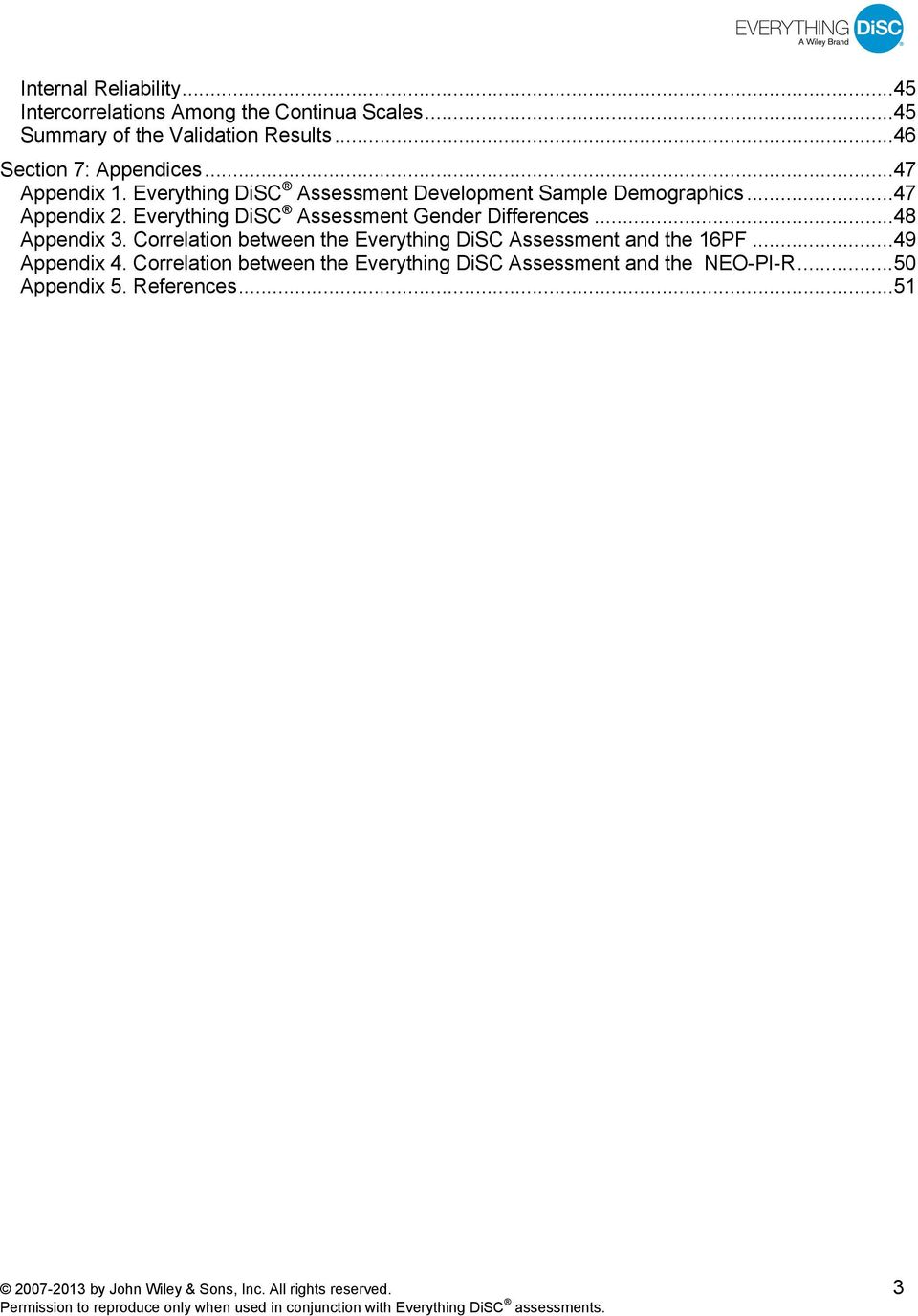
4 Section 1: Everything DiSC Assessment Research Section 1: Everything DiSC Assessment Research The DiSC Model The foundation of DiSC was first described by William Moulton Marston in his 1928 book, Emotions of Normal People. Marston identified what he called four primary emotions and associated behavioral responses, which today we know as Dominance (D), Influence (i), Steadiness (S), and Conscientiousness (C). Since Marston s time, many instruments have been developed to measure these attributes. The Everything DiSC assessment uses the circle, or circumplex, as illustrated below, as an intuitive way to represent this model. Although all points around the circle are equally meaningful and interpretable, the DiSC model discusses four specific reference points. Dominance: direct, strong-willed, and forceful Influence: sociable, talkative, and lively Steadiness: gentle, accommodating, and soft-hearted Conscientiousness: private, analytical, and logical Figure 1. Circumplex DiSC Model Although some people tend equally toward all of these regions, research indicates that most of us lean toward one or two. Each person who takes the Everything DiSC assessment is plotted on the circle, also known as the Everything DiSC Map. The example in Figure 1 shows a person (represented by the dot) who tends toward the D region, but also somewhat toward the i region. This represents a Di style by John Wiley & Sons, Inc. All rights reserved. 4
5 Section 1: Everything DiSC Assessment Research This person, therefore, is probably particularly active, bold, outspoken, and persuasive, as these qualities generally describe people who share both the D and i styles. The distance of the dot from the center of the circle is also meaningful. People whose dots fall toward the edge of the circle, as shown in Figure 1, are much more inclined toward their DiSC styles and are likely to choose the priorities of that style over those of other styles. People whose dots fall close to the center of the circle are less inclined toward a particular style and find it fairly easy to relate to the priorities of other styles. Assessment and Scoring The Everything DiSC assessment asks participants to respond to statements on a five-point ordered response scale, indicating how much they agree with each statement. These responses are used to form scores on eight scales (standardized to have a mean of zero and standard deviation of one) that are located around the DiSC circle, as shown in Figure 2. The eight scales are as follows: D measures a direct, dominant disposition using adjectives such as aggressive, strong-willed, and forceful. Di measures an active, fast-paced disposition using adjectives such as dynamic, adventurous, and bold. i measures an interactive, influencing disposition using adjectives such as sociable, lively, and talkative. is measures an agreeable, warm disposition using adjectives such as trusting, cheerful, and caring. S measures an accommodating, steady disposition using adjectives such as considerate, gentle, and soft-hearted. SC measures a moderate-paced, cautious disposition using adjectives such as careful, softspoken, and self-controlled. C measures a private, conscientious disposition using adjectives such as analytical, reserved, and unemotional. CD measures a questioning, skeptical disposition using adjectives such as cynical, stubborn, and critical. During the assessment process, the respondent s variance on each of the eight scales is calculated. If the variance on a particular scale is above a predetermined cut-off, the participant is presented with additional items for that scale. In this way, the assessment can gain more certainty with regard to the respondent s true score. This process mirrors those used in other adaptive testing assessments by John Wiley & Sons, Inc. All rights reserved. 5

6 Section 1: Everything DiSC Assessment Research An individual s scores on the eight scales are then used to plot the individual on the Everything DiSC Map, as represented by a dot. (Note that these eight scale scores are not directly reported in the profiles.) The Everything DiSC Map is divided into 12 sections, or styles, each representing 30 degrees within the circle. Feedback is largely based on the section in which the dot falls. Other factors, such as the dot s distance from the center of the circle and the individual s priorities, are also reflected in the feedback. Figure 2. Eight DiSC Scales Di D i CD is C S SC Overview of the Validation Process Psychological instruments are used to measure abstract qualities that we can t touch or see. These are characteristics like intelligence, extroversion, or honesty. So how do researchers evaluate these instruments? How do we know whether such tools are actually providing accurate information about these characteristics or just generating haphazard feedback that sounds believable? Simply put, if an instrument is indeed useful and accurate, it should meet a variety of different standards that have been established by the scientific community. Validation is the process through which researchers assess the quality of a psychological instrument by testing the tool against these different standards. This paper is designed to help you understand these different standards and see how the Everything DiSC assessment performs under examination. Validation asks two fundamental questions: 1. How reliable is the tool? That is, researchers ask if an instrument measures in a consistent and dependable way. If the results contain a lot of random variation, it is deemed less reliable. 2. How valid is the tool? That is, researchers ask if an instrument measures accurately. The more that a tool measures what it proposes to measure, the more valid the tool is. Note that no psychometric tool is perfectly reliable or perfectly valid. All psychological instruments are subject to various sources of error. Reliability and validity are seen as matters of degree on continuous scales, rather than reliable/unreliable and valid/invalid on dichotomous scales. Consequently, it is more appropriate to ask, How much evidence is there for the reliability of this tool? than, Is this tool reliable? by John Wiley & Sons, Inc. All rights reserved. 6

7 Section 1: Everything DiSC Assessment Research Reliability When we talk of reliability in relation to profiles such as DiSC assessments, then we are referring partly to the tool s stability and partly to its internal consistency. Stability refers to the tool s ability to yield the same measurements over a period of time. This is generally tested by having the same people complete the tool s questionnaire twice, with a suitable time interval between the two measurements (the so-called test-retest.) The results are then compared to determine how strongly they relate to each other (or correlate.) If a person s DiSC style remains unchanged, a stable tool should produce results that are quite similar between two different administrations. In reality, however, it is almost impossible to obtain perfect test-retest reliability on any sophisticated psychological test, even if the individual in question does not change on the measured attribute. This is because test results are influenced by a variety of extraneous factors that are unrelated to the characteristics that the test intends to measure. For instance, someone who is tired during one testing may answer differently than she will on a second testing when she is wellrested. Similarly, another person may respond to a test differently depending on the mood he is in. Generally speaking, the longer the interval between two test administrations, the greater the chance that these random variables can artificially lower the test-retest reliability of an instrument. In other words, the longer the time period between two testings, the lower we would expect the test-retest reliability to be. In practical terms, the stability of DiSC (i.e., test-retest reliability) is measured by asking a group of respondents to take a DiSC instrument and then asking those same respondents to take the same test again at a later time. This stability can be quantified in the form of a reliability coefficient, which is a statistic that is generated by looking at the mathematical relationship between a group s initial scores on an instrument and their subsequent scores. Reliability coefficients range between 0 and +1. The closer that a correlation coefficient is to +1, the more stable the instrument is considered to be. Researchers generally use the following guidelines to help them interpret these test-retest reliability coefficients: coefficients above.70 are considered acceptable, and coefficients above.80 are considered very good. The eight scales of the Everything DiSC assessment have been measured for their test-retest reliability over a two week period and the following coefficients were found: by John Wiley & Sons, Inc. All rights reserved. 7

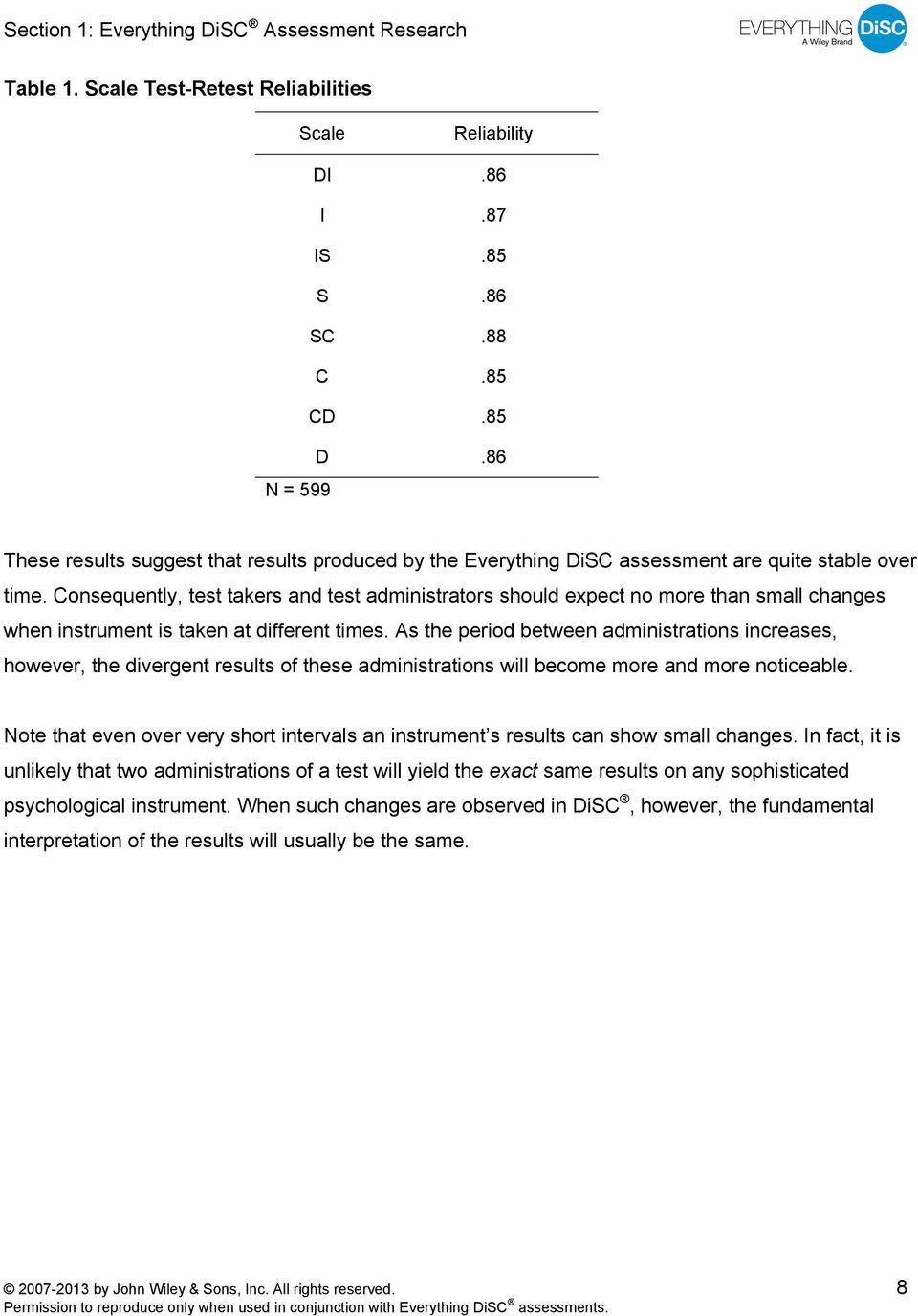
8 Section 1: Everything DiSC Assessment Research Table 1. Scale Test-Retest Reliabilities Scale Reliability DI.86 I.87 IS.85 S.86 SC.88 C.85 CD.85 D.86 N = 599 These results suggest that results produced by the Everything DiSC assessment are quite stable over time. Consequently, test takers and test administrators should expect no more than small changes when instrument is taken at different times. As the period between administrations increases, however, the divergent results of these administrations will become more and more noticeable. Note that even over very short intervals an instrument s results can show small changes. In fact, it is unlikely that two administrations of a test will yield the exact same results on any sophisticated psychological instrument. When such changes are observed in DiSC, however, the fundamental interpretation of the results will usually be the same by John Wiley & Sons, Inc. All rights reserved. 8
9 Section 1: Everything DiSC Assessment Research Internal consistency evaluates the degree of correlation among questions that profess to measure the same thing. That is, each of the eight scales in the DiSC model is measured using a series of different items (i.e., questions in the form of statements, such as I am direct, I tend to take the lead, I want things to be exact, I am always cheerful). Researchers recognize that if all of the items on a given scale (e.g., the D scale) are in fact measuring the same thing (e.g., Dominance), they should all correlate with each other to some degree. In other words, all of the items on a scale should be consistent with each other. A statistic called Cronbach s Alpha is usually regarded as the best method of evaluating internal consistency. Figure 3. D Scale Items The D Scale I am direct I am very outspoken with my opinions I am forceful I tend to challenge people I can be blunt I AM TOUGH-MINDED Cronbach s Alpha expresses the degree of correlation as a specific number, which typically varies between 0.0 and 1.0. If the value of Alpha is 0.0, then there is no relationship among the items/statements on a given scale. On the other hand, if all the statements in a questionnaire measure in an identical fashion, then the value of Alpha will be 1.0, which indicates absolute internal consistency. Cronbach s Alpha is calculated separately for each of the assessment s eight scales. The following guidelines are frequently used to evaluate the quality of a scale s internal reliability: Alpha values above.70 are generally considered acceptable and satisfactory, Alpha values above.80 are usually considered quite good, and values above.90 are considered to reflect exceptional internal consistency. In fact, Alpha values that are too high may indicate that the items on a scale are redundant or too similar. In such cases, many of the instrument s items may provide very little new information about a respondent. Alpha coefficients were calculated for a sample of 752 respondents. The demographics of this sample are included in Appendix 1. The scales on the Everything DiSC instruments demonstrate good-toexcellent internal consistency, as shown by the Alpha values listed in Table 2. All reliabilities are well above.70, with a median of by John Wiley & Sons, Inc. All rights reserved. 9

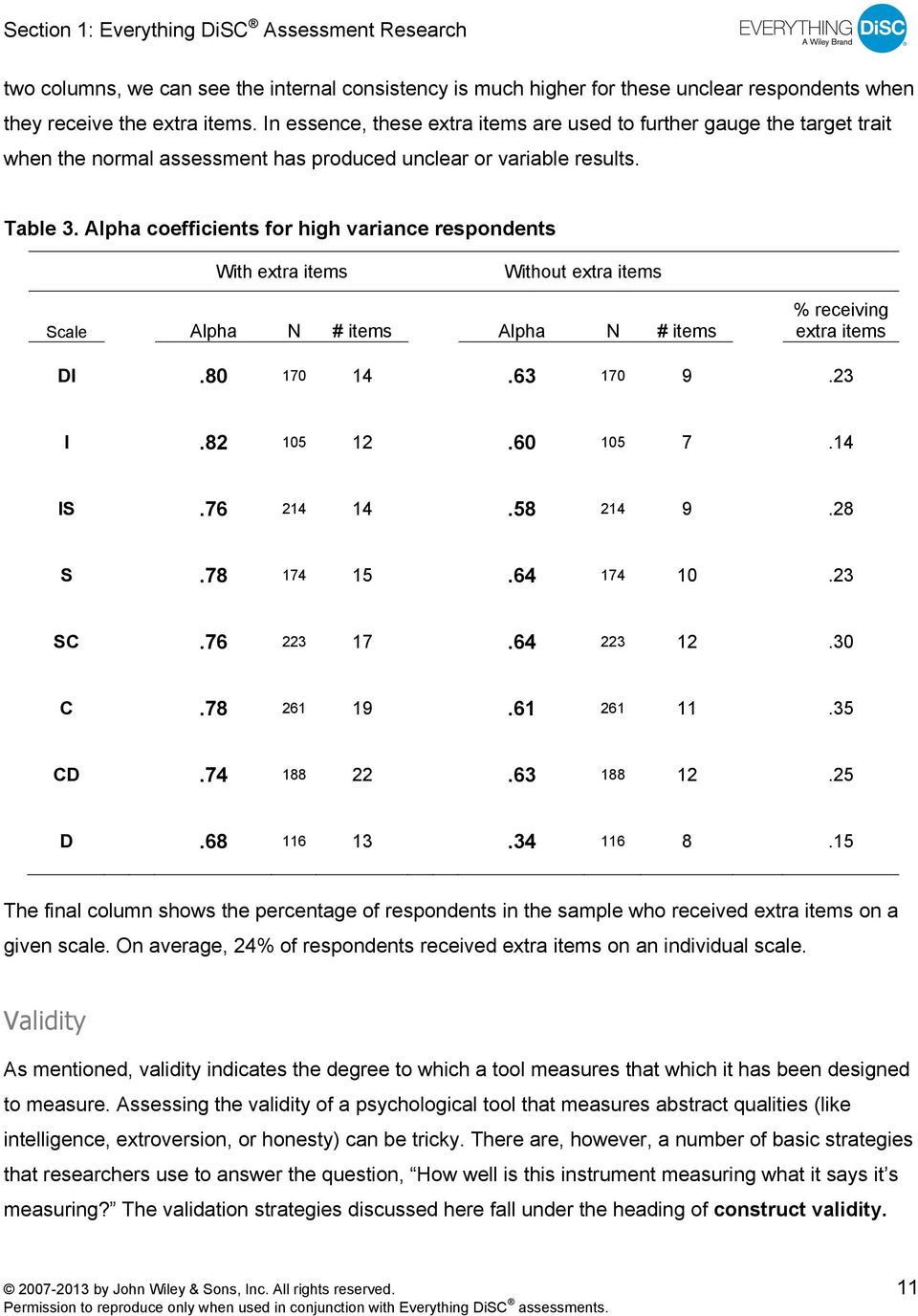
10 Section 1: Everything DiSC Assessment Research Table 2. Internal consistency of the Everything DiSC scales Scale Number of items Cronbach's Alpha DI 9.90 I 7.90 IS 9.86 S SC C CD D 8.88 N=752 Analyses were also performed to understand the impact of the extra, adaptive questions that some respondents receive if there is a large amount of variation within their responses to a single scale s items. That is, if the variance in a respondent s ratings to a scale s items is above a certain level, the respondent is given five to ten extra items that continue to measure the trait assessed by the scale. For convenience, the items that all respondents receive will be called base items and the items that only inconsistent responders receive will be called extra items. Table 3 shows the internal reliabilities for only those respondents who gave the most inconsistent responses to a given scale s items, measured by a high degree of response variance. In other words, these are respondents whose scale preferences seemed most unclear. In the first bold column are the alphas for those respondents using both the base items and extra items (which reflects how these respondents are measured in the actual assessment). In the second bold column are the Alphas for those respondents using only the base items. With only the base items, the median Alpha in this subsample is.62. The median Alpha when the extra items are included is.77. By comparing these by John Wiley & Sons, Inc. All rights reserved. 10

11 Section 1: Everything DiSC Assessment Research two columns, we can see the internal consistency is much higher for these unclear respondents when they receive the extra items. In essence, these extra items are used to further gauge the target trait when the normal assessment has produced unclear or variable results. Table 3. Alpha coefficients for high variance respondents With extra items Without extra items Scale Alpha N # items Alpha N # items % receiving extra items DI I IS S SC C CD D The final column shows the percentage of respondents in the sample who received extra items on a given scale. On average, 24% of respondents received extra items on an individual scale. Validity As mentioned, validity indicates the degree to which a tool measures that which it has been designed to measure. Assessing the validity of a psychological tool that measures abstract qualities (like intelligence, extroversion, or honesty) can be tricky. There are, however, a number of basic strategies that researchers use to answer the question, How well is this instrument measuring what it says it s measuring? The validation strategies discussed here fall under the heading of construct validity by John Wiley & Sons, Inc. All rights reserved. 11
12 Section 1: Everything DiSC Assessment Research Construct Validity Construct validity examines the validity of a tool on a highly theoretical level. A construct is an abstract idea or concept (such as intelligence, dominance, or honesty) that is used to make sense of our experience. The Di scale of the Everything DiSC instruments, for example, measures a particular construct (i.e., the tendency to be bold, adventurous, and fast paced). This bold construct, in turn, is theoretically related to a variety of other constructs. For instance, it is reasonable to assume that someone who is very bold will not be particularly cautious in nature. Thus, bold tendencies and cautious tendencies are theoretically linked in a negative manner. Consequently, if our measure of a bold tendency has high validity, people scoring high on the Di scale should score relatively low on a scale measuring cautiousness, such as the SC scale. This is essentially what researchers do when they examine construct validity. First, they specify a series of theoretical relationships (e.g., the construct of boldness is theoretically related to the constructs of X, Y, and Z). Then, they test these theoretical relationships empirically to see if the relationships actually exist. If the proposed relationships do exist, the instrument is thought to have higher validity. Scale Intercorrelations As you might imagine, there are a variety of different ways to test construct validity. First, we can examine the validity of an instrument as a whole. Instruments like the Everything DiSC assessment propose an underlying model in which the scales have a specific relationship to each other. Researchers examine the actual relationship among the scales to see if they reflect the theoretical relationship proposed by the model. The DiSC model proposes that adjacent scales (e.g., Di and i) will have moderate correlations. That is, these correlations should be considerably smaller than the alpha reliabilities of the individual scales. For example, the correlation between the Di and i scales (.50) should be substantially lower than the Alpha reliability of the Di or i scales (both.90). On the other hand, scales that are theoretically opposite (e.g., i and C) should have strong negative correlations. Table 4 shows data obtained from a sample of 752 respondents who completed the Everything DiSC assessment. The correlations among all eight scales show strong support for the model. That is, moderate positive correlations among adjacent scales and strong negative correlations are observed between opposite scales by John Wiley & Sons, Inc. All rights reserved. 12
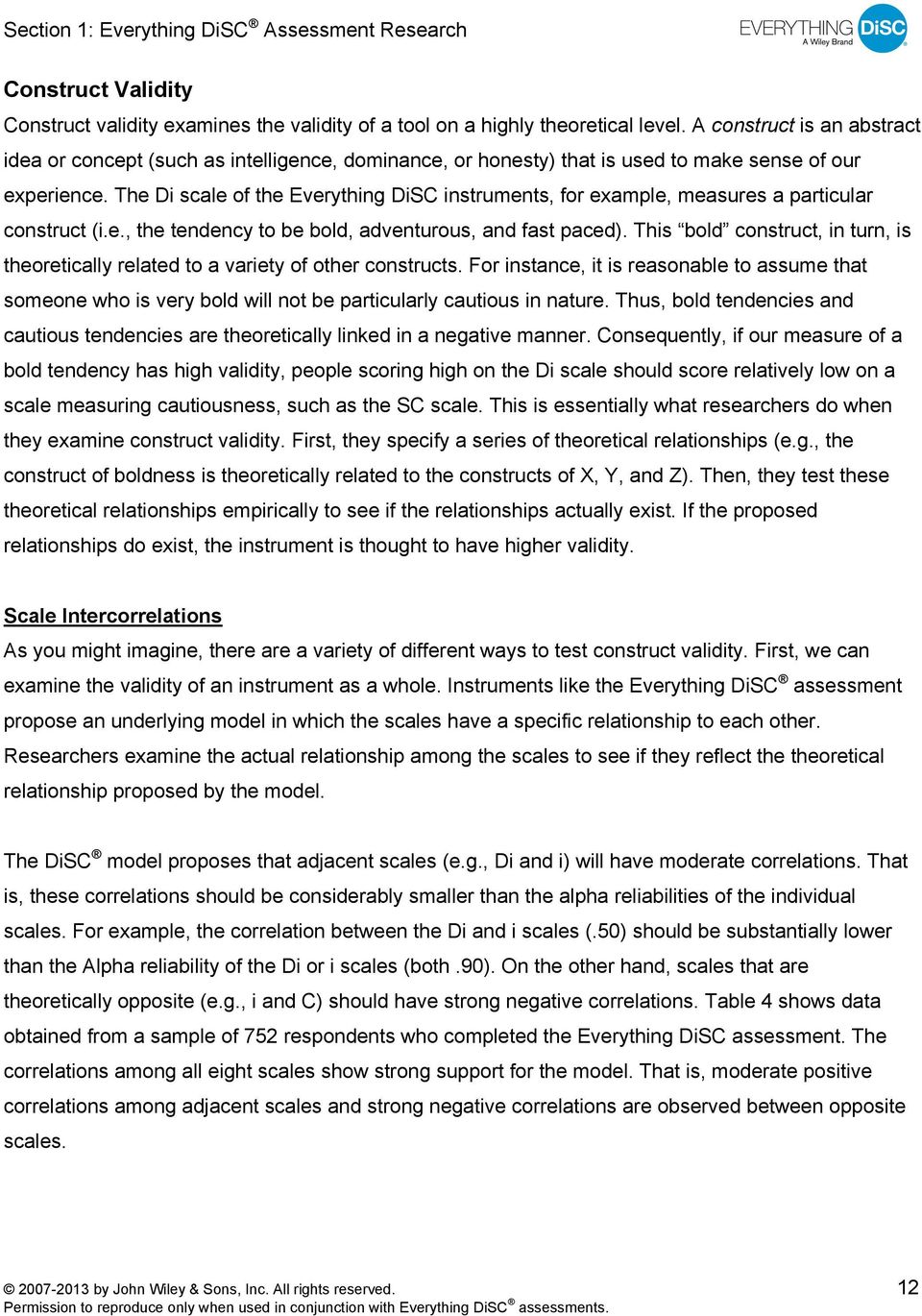
13 Section 1: Everything DiSC Assessment Research Table 4. Scale Intercorrelations D DI I IS S SC C CD D.88 DI I IS S SC C CD Cronbach s Alpha reliabilities are shown in bold along the diagonal, and the correlation coefficients among scales are shown within the body of the table. Correlation coefficients range from -1 to +1. A correlation of +1 indicates that two variables are perfectly positively correlated such that as one variable increases, the other variable increases by a proportional amount. A correlation of -1 indicates that two variables are perfectly negatively correlated, such that as one variable increases, the other variable decreases by a proportional amount. A correlation of 0 indicates that two variables are completely unrelated; N=752, as shown in Appendix 1. Because the Everything DiSC assessment model proposes that the eight scales are arranged as a circumplex, an even more strict set of statistical assumptions are required of the data. The pattern of correlations for a given scale are expected to be arranged in a particular order. As can be seen in Table 5, the strongest theorized correlation for a given scale is labeled r 1. The second strongest is labeled r 2, and so on. In this case, r 4 represents the correlation with a theoretically opposite scale. Consequently, r 4 should be a reasonably strong negative correlation. For each scale, we should observe the following relationship if the scales support a circumplex structure: r 1 > r 2 > r 3 > r 4. Table 5. Expected Scale Intercorrelations D 1.00 D DI I IS S SC C CD DI r I r 2 r IS r 3 r 2 r S r 4 r 3 r 2 r SC r 3 r 4 r 3 r 2 r C r 2 r 3 r 4 r 3 r 2 r CD r 1 r 2 r 3 r 4 r 3 r 2 r by John Wiley & Sons, Inc. All rights reserved. 13
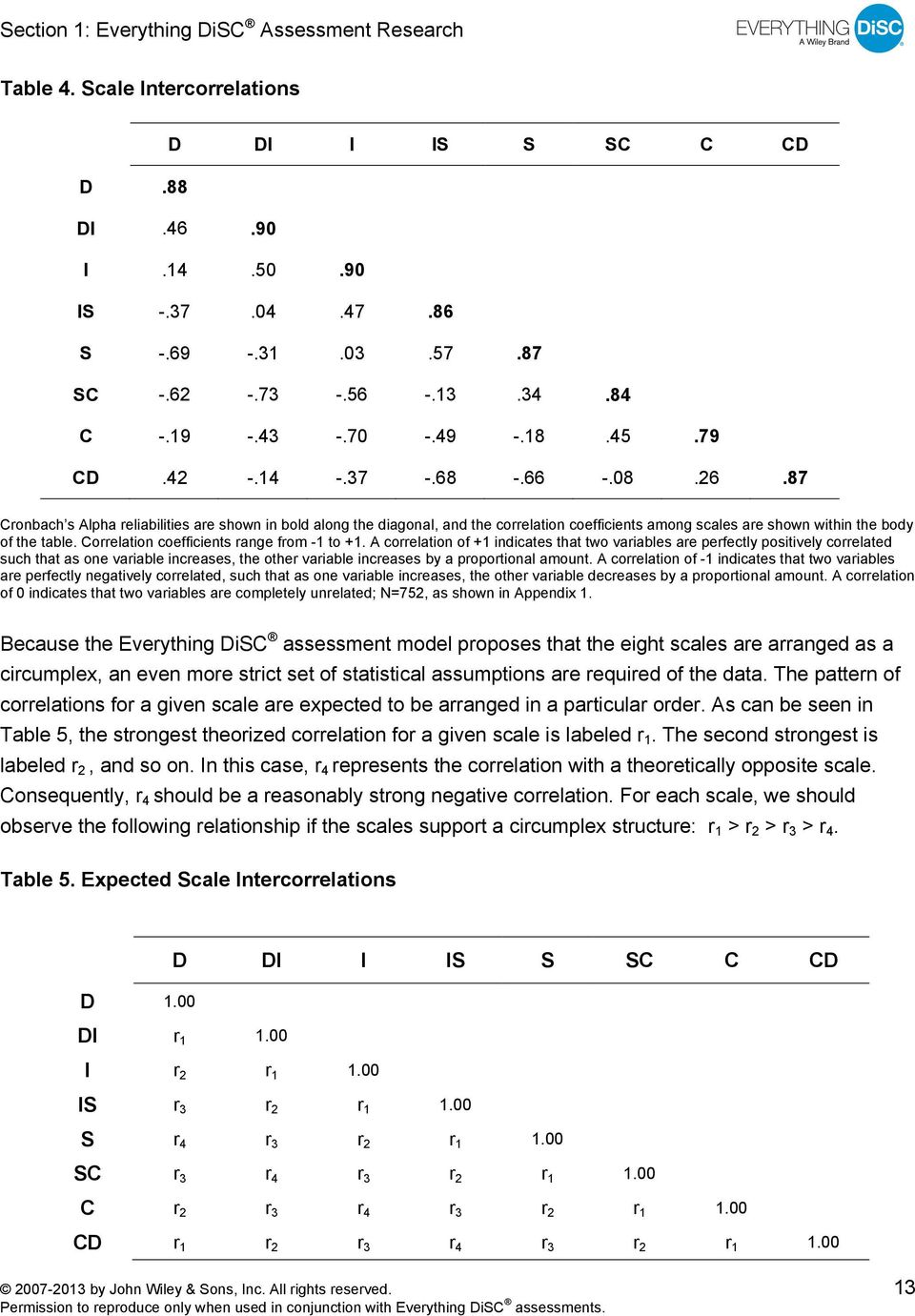
14 Section 1: Everything DiSC Assessment Research Looking at Table 6, we do, in fact, observe a r 1 > r 2 > r 3 > r 4 pattern for each scale. In addition, we can examine the magnitude of these correlations in comparison to the theoretically expected magnitudes. The predicted magnitudes of r 1, r 2, r 3, r 4 under a circumplex structure are listed in Table 4, as described by Wiggins (1995). The actual r x values are the median correlations for a given r x. Although the actual and predicted values are not exactly the same (a near impossible standard for practical purposes), the magnitude of the actual and predicted correlation values is quite similar, thus providing additional support for the DiSC circumplex model and the ability of the Everything DiSC assessment to measure this model. Table 6. Actual and Predicted Scale Relationships r 1 > r 2 > r 3 > r 4.45 > -.11 > -.46 > -.69 Actual (median).42 >.03 > -.36 > -.73 Predicted The Dimensionality of the DiSC Model: Multidimensional Scaling (MDS) A statistical technique called multidimensional scaling also adds support to the DiSC model as a circumplex. This technique has two advantages. First, it allows for a visual inspection of relationship among the eight scales. Second, this technique allows researchers to look at all of the scales simultaneously. In Figure 4, scales that are closer together have a stronger positive relationship. Scales that are farther apart are more dissimilar. The circumplex DiSC model predicts that the eight scales will be arranged in a circular format at equal intervals. As can be seen in Figure 4, the scales are arranged in a way that is expected by the DiSC model. (Keep in mind that the original MDS rotation is presented below and this rotation is arbitrary.) Although the eight scales do not form a perfectly equidistant circle (as predicted by the model), this theoretical ideal is nearly impossible to obtain with actual data. The actual distance between the scales, however, is roughly equal, providing strong support for the model and its assessment by John Wiley & Sons, Inc. All rights reserved. 14
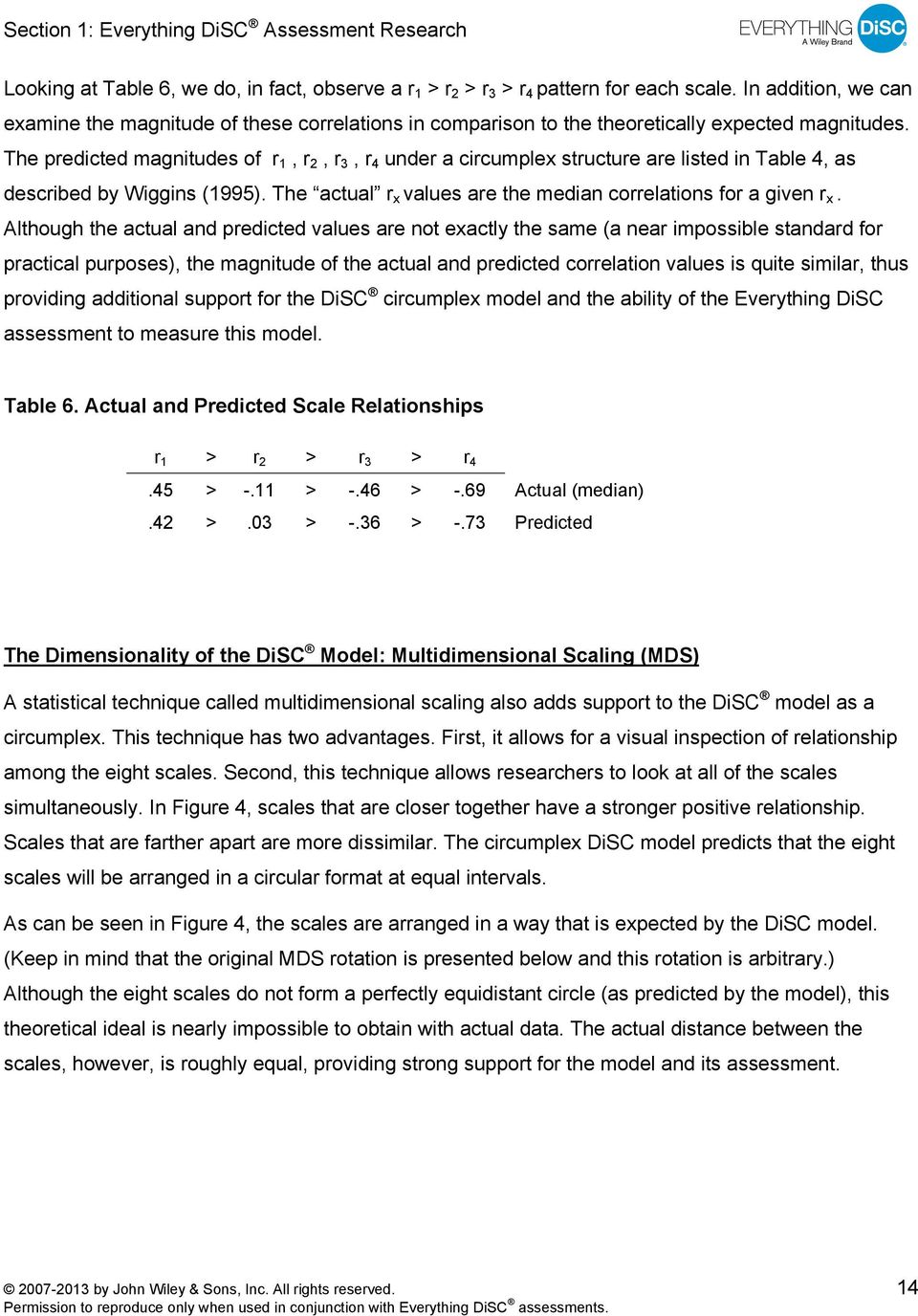
15 Section 1: Everything DiSC Assessment Research Figure 4. MDS Two-Dimensional Solution Stress = RSQ = N = 752 As can be seen above, all scales are closest to the scales that are theoretically adjacent to them in the model. For instance, the Di is closest to the D scale and i scale, as predicted by the model. In addition, scales that are theoretically opposite (e.g., i and C) are generally furthest away from each other on the plot. Consequently, this analysis adds strong support for the two-dimensional DiSC model and the ability of the Everything DiSC assessment to measure that model. Additionally, the S-stress of the model is and the RSQ value is These values reflect the ability of a two-dimensional model to fit the data. Lower S-stress values are preferred (with a minimum of 0) and higher RSQ values are preferred (with a maximum of 1). Both of these values are almost ideal in the data, suggesting that the two-dimensional DiSC model fits the participant data exceptionally well by John Wiley & Sons, Inc. All rights reserved. 15

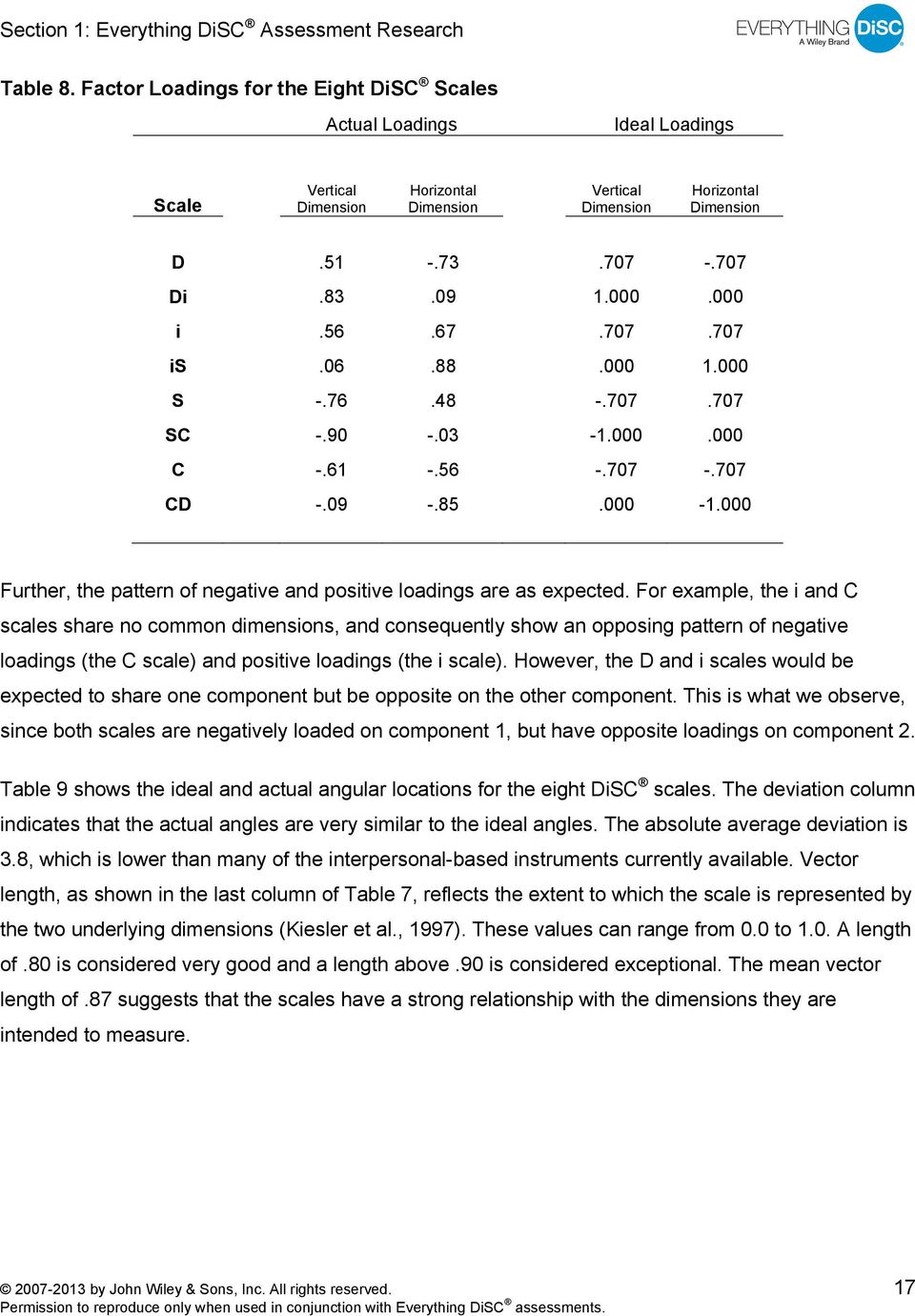
16 Section 1: Everything DiSC Assessment Research The Dimensionality of the Circumplex DiSC Model: Factor Analysis (Note that this section may require some statistical background to understand fully) To further explore the dimensionality of the model, a principle components factor analysis was performed on all eight scales using a varimax rotation. The eigenvalues clearly reinforce the twodimensional structure underlying the eight scales, as shown in Table 7. Only two components demonstrate eigenvalues above one, and both of these are well above one. Further, components 3 through 8 all have eigenvalues that decrease smoothly and are meaningfully below one. Consequently, regardless of whether we use Kaiser s Criterion or a scree plot method of determining the number of factors to extract, the number of retained factors is two, as predicted by the model. Table 7. Factor Analysis Eigenvalues Component Eigenvalues N=752 The rotated factor loadings are listed in Table 8. (Note that the loadings were rotated such that the loadings reflect the original DiSC rotation). The pattern of loadings is as expected for a circumplex model, as listed under the Ideal Loadings column. That is, with a circumplex model, we would expect that some scales would have high loadings on one component and near zero loadings on the other component (i.e., Di, is, SC, and CD) and some scales would have moderately high loadings on both components (e.g., D, i, S, and C) by John Wiley & Sons, Inc. All rights reserved. 16

17 Section 1: Everything DiSC Assessment Research Table 8. Factor Loadings for the Eight DiSC Scales Actual Loadings Ideal Loadings Scale Vertical Dimension Horizontal Dimension Vertical Dimension Horizontal Dimension D Di i is S SC C CD Further, the pattern of negative and positive loadings are as expected. For example, the i and C scales share no common dimensions, and consequently show an opposing pattern of negative loadings (the C scale) and positive loadings (the i scale). However, the D and i scales would be expected to share one component but be opposite on the other component. This is what we observe, since both scales are negatively loaded on component 1, but have opposite loadings on component 2. Table 9 shows the ideal and actual angular locations for the eight DiSC scales. The deviation column indicates that the actual angles are very similar to the ideal angles. The absolute average deviation is 3.8, which is lower than many of the interpersonal-based instruments currently available. Vector length, as shown in the last column of Table 7, reflects the extent to which the scale is represented by the two underlying dimensions (Kiesler et al., 1997). These values can range from 0.0 to 1.0. A length of.80 is considered very good and a length above.90 is considered exceptional. The mean vector length of.87 suggests that the scales have a strong relationship with the dimensions they are intended to measure by John Wiley & Sons, Inc. All rights reserved. 17
18 Section 1: Everything DiSC Assessment Research Table 9. Angular Locations for the Eight DiSC Scales Scale Actual Angle Ideal Angle Deviation Vector Length D Di i is S SC C CD Correlations with Other Assessments of Personality Another method used to provide evidence of construct validity involves correlating an assessment with other well-respected assessments of similar traits. For this purpose, a group of respondents took the Everything DiSC assessment and two established measures of personality: the NEO Personality Inventory Revised (NEO PI-R ) and the Sixteen Personality Factor Questionnaire (16PF ). The NEO PI-R is a 240-item assessment designed to measure the five-factor model of personality: Extraversion, Agreeableness, Conscientiousness, Neuroticism, and Openness to Experience (McCrae & Costa, 2010). The 16PF is a 185-item assessment designed to measure sixteen primary personality traits, as well as the five factor model of personality (IPAT, 2009). The assessment also provides scores on nineteen additional scales in the following areas: self-esteem and adjustment, vocational interests, social skills, leadership, and creativity. The correlations among the Everything DiSC scales and the NEO PI-R and the 16PF are shown in Appendices 3 and 4. For the purposes of interpretation, a summary is provided here. For each Everything DiSC scale, the ten strongest correlations with either the NEO PI-R or 16PF are listed by John Wiley & Sons, Inc. All rights reserved. 18

19 Section 1: Everything DiSC Assessment Research The DI scale The ten strongest correlations with the DI scale are listed below. Table 10. Strongest correlations between the DI scale and the NEO PI-R and 16PF Scale Instrument r Assertiveness NEO PI-R.68 Creative Potential 16PF.62 Independence 16PF.60 Activity NEO PI-R.57 Emotional Expressivity 16PF.56 Social Expressivity 16PF.55 Dominance 16PF.54 Social Control 16PF.53 Enterprising 16PF.53 Social Boldness 16PF.52 The scales listed in Table 10 reflect the active, socially influential disposition that is measured by the DI scale. Although not listed above, this scale also demonstrated high correlations with the Excitement Seeking (r=.51) and Achievement Striving (r=.48) scales of the NEO PI-R. This reflects the adventurous, pioneering aspects of the DI scale. The I scale The ten strongest correlations with the I scale are listed below. Table 11. Strongest correlations between the I scale and the NEO PI-R and 16PF Scale Instrument r Social Expressivity 16PF.74 Extraversion 16PF.70 Social Boldness 16PF.70 Extraversion NEO PI-R.69 Social Adjustment 16PF.68 Gregariousness NEO PI-R.65 Social Control 16PF.62 Liveliness 16PF.62 Warmth NEO PI-R.60 Leadership Potential 16PF.60 The scales listed in Table 11 reflect the extraverted, lively disposition that is measured by the I scale, as well as some elements of social poise or competence. Although not listed above, this scale also demonstrated high correlations with Positive Emotions (r=.50) and Self-consciousness (r= -.48) scale of the NEO PI-R. The I scale also had high correlations with Social (r=.56) and Enterprising (r=.53) vocational interest scales by John Wiley & Sons, Inc. All rights reserved. 19

20 Section 1: Everything DiSC Assessment Research The IS scale The ten strongest correlations with the IS scale are listed below. Table 12 Strongest correlations between the IS scale and the NEO PI-R and 16PF Scale Instrument r Warmth NEO PI-R.61 Positive Emotions NEO PI-R.57 Empathy 16PF.56 Trust NEO PI-R.55 Altruism NEO PI-R.53 Agreeableness NEO PI-R.52 Extraversion NEO PI-R.52 Extraversion 16PF.51 Warmth 16PF.49 Compliance NEO PI-R.47 The scales listed in Table 12 reflect the warm, accepting, and empathic disposition measured by the IS scale. Although not listed above, the IS scale also had significant correlations with the Emotional Sensitivity (r=.42) scale of the 16PF. Significant negative correlations with the Angry Hostility (r= -.46; NEO PI-R)), Tension (r= -.43; 16PF), and Anxiety (r= -.41; 16PF) scales reflect the more cheerful, easy-going disposition measured by the IS scale. The S scale The ten strongest correlations with the S scale are listed below. Table 13. Strongest correlations between the S scale and the NEO PI-R and 16PF Scale Instrument r Agreeableness NEO PI-R.67 Compliance NEO PI-R.65 Altruism NEO PI-R.47 Trust NEO PI-R.39 Straightforwardness NEO PI-R.39 Creative Potential 16PF -.32 Independence 16PF -.40 Dominance 16PF -.45 Tension 16PF -.45 Angry Hostility NEO PI-R -.53 The scales listed in Table 13 reflect the agreeable, peaceful, and accommodating disposition measured by the S scale. The original conceptualization of the S scale also included a number of submissive tendencies, which is reflected by correlations with Compliance, Independence, and Dominance. It is worth noting the Straightforwardness scale is designed to measure sincerity or genuineness (rather than directness or bluntness), which is consistent with the S construct by John Wiley & Sons, Inc. All rights reserved. 20

21 Section 1: Everything DiSC Assessment Research The SC scale The ten strongest correlations with the SC scale are listed below. Table 14. Strongest correlations between the SC scale and the NEO PI-R and 16PF Scale Instrument r Dominance 16PF -.63 Social Adjustment 16PF -.64 Enterprising 16PF -.65 Social Boldness 16PF -.66 Social Expressivity 16PF -.67 Social Control 16PF -.67 Emotional Expressivity 16PF -.69 Independence 16PF -.71 Creative Potential 16PF -.72 Assertiveness NEO PI-R -.75 The scales listed in Table 14 reflect the self-controlled, cautious, and passive disposition measured by the SC scale. Although not listed above, the SC scale had significant positive correlations with a number of scales, particularly on the NEO PI-R. These include Self-Consciousness (r=.44), Compliance (r=.41), and Modesty (r=.37). The C scale The ten strongest correlations with the C scale are listed below. Table 15. Strongest correlations between the C scale and the NEO PI-R and 16PF Scale Instrument r Liveliness 16PF -.55 Warmth NEO PI-R -.55 Social 16PF -.57 Empathy 16PF -.57 Gregariousness NEO PI-R -.59 Social Boldness 16PF -.60 Social Adjustment 16PF -.60 Extraversion NEO PI-R -.63 Social Expressivity 16PF -.66 Extraversion 16PF -.67 The scales listed in Table 15 reflect the introverted and emotional reserved disposition measured by the C scale. Although not listed above, the C scale had significant positive correlations with the Selfreliance (r=.51; 16PF), Self-consciousness (r=.41; NEO PI-R), and Privateness (r=.33; 16PF) scales. Correlations with the Order (r=.07; NEO PI-R), Perfectionism (r=.15;16pf), and Conscientiousness (r=.11; NEO PI-R) scales were significant, but smaller than expected. It is by John Wiley & Sons, Inc. All rights reserved. 21
22 Section 1: Everything DiSC Assessment Research important to note that the C scale is designed to measure a reserved, methodical, analytical disposition rather than directly measuring a preference for order. The CD scale The ten strongest correlations with the CD scale are listed below. Table 16. Strongest correlations between the CD scale and the NEO PI-R and 16PF Scale Instrument r Tension 16PF.55 Angry Hostility NEO PI-R.51 Anxiety 16PF.45 Positive Emotions NEO PI-R -.41 Altruism NEO PI-R -.42 Warmth NEO PI-R -.43 Empathy 16PF -.44 Trust NEO PI-R -.47 Agreeableness NEO PI-R -.48 Compliance NEO PI-R -.55 The scales listed in Table 16 reflect the skeptical, challenging disposition measured by the CD scale. Although not listed above, the CD scale had significant positive correlations with the Vigilance (r=.31; which measures an expectation of being misunderstood or taken advantage of) and Self-reliance (r=.30; which is opposed with group-orientation) scales of the 16PF. The D scale The ten strongest correlations with the D scale are listed below. Table 17. Strongest correlations between the D scale and the NEO PI-R and 16PF Scale Instrument r Dominance 16PF.63 Independence 16PF.60 Assertiveness NEO PI-R.55 Creative Potential 16PF.51 Emotional Expressivity 16PF.50 Enterprising 16PF.44 Social Control 16PF.35 Straightforwardness NEO PI-R -.35 Agreeableness NEO PI-R -.58 Compliance NEO PI-R -.63 The scales listed in Table 17 reflect the forceful, outspoken disposition that is measured by the D scale. Although not listed above, the D scale also had significant positive correlations with the Social Boldness (r=.32; 16PF) and Activity (r=.32; NEO PI-R) scales. As mentioned earlier, the by John Wiley & Sons, Inc. All rights reserved. 22
23 Section 1: Everything DiSC Assessment Research Straightforwardness scale of the NEO PI-R is designed to measure sincerity rather than bluntness. Low scorers are described as more likely to manipulate others or to be cunning. Summary of the Validation Results Evaluation of the Everything DiSC assessment indicates that there is strong support for the reliability and validity of this tool. Analyses suggest that the scales reliabilities are in the good-to-excellent range, with a median coefficient alpha of.87 and a median test-retest reliability of.86. Analyses examining the validity of the tool were also very favorable. The circumplex structure of the assessment conforms well to expectations, as assessed by multidimensional scaling, scale intercorrelations, and factor analysis. The relationships among the eight scales are highly supportive of the circumplex structure and strongly reflect the expected pattern of correlations hypothesized under the DiSC model. Correlations between the Everything DiSC scales and the scales of the NEO PI-R and the 16PF provide additional support for the validity of the assessment by John Wiley & Sons, Inc. All rights reserved. 23
24 Section 2: Everything DiSC Management Research Section 2: Everything DiSC Management Research Background Each Everything DiSC instrument uses an application-specific model to give context to the report interpretation. The management model in the Everything DiSC Management Profile, shown in Figure 5, helps managers understand how they approach their work. The eight words around the map indicate the top priorities of managers with different DiSC styles. For example, the priorities of S managers are Support, Reliability, and Collaboration. The development of this model was based on empirical data gathered from both managers and employees. Figure 5. Everything DiSC Management Model The Research First, participants with management experience (N=427) were presented with a series of statements describing management tasks and asked the importance of each when working as a manager. For instance, participants were asked to rate the importance of Setting high expectations on a five-point scale, ranging from Not Important (1) to Crucially Important (5). Statements were grouped into eight categories that represent the eight priorities on the circle above. Each category contained four to five statements. The 36 individual statements are shown in Table by John Wiley & Sons, Inc. All rights reserved. 24
25 Section 2: Everything DiSC Management Research Table 18. Statements Used to Measure the Priorities from the Manager s Perspective Priority ACTION ACTION ACTION ACTION ACTION ENCOURAGEMENT ENCOURAGEMENT ENCOURAGEMENT ENCOURAGEMENT COLLABORATION COLLABORATION COLLABORATION COLLABORATION SUPPORT SUPPORT SUPPORT SUPPORT RELIABILITY RELIABILITY RELIABILITY RELIABILITY RELIABILITY OBJECTIVITY OBJECTIVITY OBJECTIVITY OBJECTIVITY OBJECTIVITY CHALLENGE CHALLENGE CHALLENGE CHALLENGE CHALLENGE DRIVE DRIVE DRIVE DRIVE Statement Maintaining forward momentum on your team Creating goals for the team that are inspiring Getting new projects moving quickly Encouraging the team to maintain an energetic pace Encouraging people to take risks Celebrating group victories Praising people for good work Letting people know that you're optimistic about their progress Creating enthusiasm in the team Building a sense of collaboration Encouraging teamwork Providing feedback in a way that's warm and understanding Making sure that everyone's getting along Letting people know that you are there to help them out whenever they need it Checking in with people to make sure they are doing ok Taking time to listen to people's concerns and fears Letting people know that you're patient with their mistakes Creating a stable work environment Being consistent in your management Checking to make sure people have the resources they need Giving people time to adjust to changes Providing people with clear guidelines for doing their work Maintaining objectivity in your management decisions Ensuring that decisions are based on logical analysis Emphasizing the need for quality work Making accuracy a top priority Separating out emotions from facts when making decisions Challenging ideas that don't make sense to you Questioning employee's actions when they don't seem logical to you Letting people know when they aren't performing up to your standards Questioning procedures or practices that aren't efficient Providing people with new challenges Constantly pushing yourself and others toward results Creating a sense of urgency in the team Getting results that are practical and concrete Setting high expectations After participants rated each statement, the average response for statements within a priority category was calculated. Consequently, all participants had a category score for all eight priorities. These category scores were then ipsatized by subtracting a mean score across all statements. Ipsatizing controls for response bias and ensures that the category scores reflect the relative importance of the eight priorities for a particular participant by John Wiley & Sons, Inc. All rights reserved. 25
26 Section 2: Everything DiSC Management Research The category scores were then submitted to a multidimensional scaling analysis. This analysis allows researchers to look at the relationship among the eight categories and determine if the categories relate to each other in the manner predicted by the model. The results of the analysis are presented in Figure 6. Categories that are closer together share more in common and categories that are further apart are more dissimilar. Figure 6. Multidimensional Scaling Results for Managers As expected, the eight priorities form a circular shape, with the priorities arranged as predicted by the management model. That is, the sequence around the circle proceeds as follows: Action, Encouragement, Collaboration, Support, Reliability, Objectivity, Challenge, and Drive. Although the eight scales do not form a perfectly equidistant circle (as predicted by the model), this theoretical ideal is nearly impossible to obtain with actual data. To capture management priorities from the perspective of employees, a second study was performed. In this study, 699 participants were asked to think of their previous experiences reporting to a manager. They were then presented with a series of management tasks and asked to rate how important each was for a manager to perform. For instance, participants rated how important Taking time to listen to my concerns and fears was on a 5-point scale ranging from Not Important (1) to Crucially Important (5) by John Wiley & Sons, Inc. All rights reserved. 26
27 Section 2: Everything DiSC Management Research Again, statements were grouped into eight categories that represent the eight priorities in Figure 5. Each category contained three to five statements. As described in the previous study, statement ratings within a priority category were averaged and ipsatized to arrive at a category score. The individual statements used in this study are shown in Table 19. Table 19. Statements Used to Measure the Priorities from an Employee s Perspective Priority DRIVE DRIVE DRIVE DRIVE ACTION ACTION ACTION ACTION ENCOURAGEMENT ENCOURAGEMENT ENCOURAGEMENT COLLABORATION COLLABORATION COLLABORATION COLLABORATION SUPPORT SUPPORT SUPPORT SUPPORT RELIABILITY RELIABILITY RELIABILITY RELIABILITY RELIABILITY OBJECTIVITY OBJECTIVITY OBJECTIVITY OBJECTIVITY OBJECTIVITY CHALLENGE CHALLENGE CHALLENGE CHALLENGE Statement Setting high expectations Creating a sense of urgency in the team Getting quick results Constantly pushing himself/herself and others toward results Maintaining forward momentum on our team Creating goals for the team that are inspiring Encouraging the team to maintain an energetic pace Encouraging me to take risks Celebrating group victories Letting me know that he/she is optimistic about my progress Creating enthusiasm in the team Providing feedback in a way that's warm and understanding Building a sense of collaboration Encouraging teamwork Making sure that everyone's getting along Letting me know that he/she is there to help me out whenever I need it Checking in with me to make sure I'm doing ok Taking time to listen to my concerns and fears Letting me know that he/she is patient with my mistakes Creating a stable work environment Being consistent in his/her management Checking to make sure I have the resources I need Giving me time to adjust to changes Providing me with clear guidelines for doing my work Emphasizing the need for quality work Ensuring that decisions are based on logical analysis Maintaining objectivity in his/her management decisions Making accuracy a top priority Separating out emotions from facts when making decisions Challenging ideas that don't make sense to him/her Questioning employee's actions when they don't seem logical Questioning procedures or practices that aren't efficient Providing me with new challenges by John Wiley & Sons, Inc. All rights reserved. 27
28 Section 2: Everything DiSC Management Research The priority category scores were then submitted to a multidimensional scaling analysis. The results of this analysis are shown in Figure 7. Figure 7. Multidimensional Scaling Results for Employees As with the manager data, the priority categories are arranged in a circle. Further, the categories are plotted in the expected order: Action, Encouragement, Collaboration, Support, Reliability, Objectivity, Challenge, and Drive. The categories are not spaced in a perfectly even manner, but, again, this standard is almost impossible to meet with real data. Summary of the Validation Results Overall, both of these studies provide strong support for the Everything DiSC Management model. Two separate data sets addressing management priorities from the perspective of both managers and employees confirm that the eight priorities are arranged in a circular fashion in the predicted order. This type of empirical support should give managers confidence that the Everything DiSC Management model accurately reflects real-life management environments and is useful for understanding various approaches to management by John Wiley & Sons, Inc. All rights reserved. 28
29 Section 3: Everything DiSC Sales Research Section 3: Everything DiSC Sales Research Background The application-specific model used in the Everything DiSC Sales Profile, shown in Figure 8, helps salespeople better understand themselves and their customers. In this model, the eight words around the map indicate the priorities of both customers and salespeople of different DiSC styles during sales interactions. For example, the priorities of i salespeople and customers are Enthusiasm, Action, and Relationships. The development of this model was based on empirical data gathered from both customers and salespeople. Figure 8. Everything DiSC Sales Model The Research First, participants (N=1,047) were presented with a series of statements and asked the importance of each when working with a salesperson. For instance, participants were asked to rate the importance of Working with a salesperson who is friendly and personable on a five-point scale, ranging from Not Important (1) to Vitally Important (5). Statements were grouped into eight categories that represent the eight priorities on the circle above. Each category contained two to four statements. The individual statements for each category are shown in Table by John Wiley & Sons, Inc. All rights reserved. 29
30 Section 3: Everything DiSC Sales Research Table 20. Statements Used to Measure the Priorities from the Customer s Perspective Priority ACTION ACTION ENTHUSIASM ENTHUSIASM RELATIONSHIPS RELATIONSHIPS RELATIONSHIPS RELATIONSHIPS SINCERITY SINCERITY SINCERITY SINCERITY DEPENDABILITY DEPENDABILITY QUALITY QUALITY COMPETENCY COMPETENCY RESULTS RESULTS RESULTS Statement Being assured that things will happen quickly and easily once I make a decision Getting things moving as soon as possible after the sale Seeing a product/service that I'm excited about Working with salespeople who are enthusiastic and passionate about the product/service Working with salespeople who are friendly and personable Working with salespeople that I connect with Knowing that the salesperson doesn't see me as just another sales opportunity Working with a sales person I enjoy talking to Working with salespeople who are sincere Working with salespeople who I sense are genuinely looking out for my best interest Working with a salesperson who genuinely seems to care about my needs and concerns Working with a salesperson who is a good listener Being sure that the salesperson is dependable Working with salespeople who are thorough, careful, and responsible Being sure that I'm getting the highest quality Seeing demonstrations of the quality of the product/service Being sure that the salesperson is competent to handle my business Working with salespeople who are experts in their field Having salespeople show me how I can get immediate, practical results Seeing how the product/service can have a big impact on my success Seeing the immediate benefits of the product/service After participants rated each statement, the average response for statements within a priority category was calculated. Consequently, all participants had a category score for all eight priorities. These category scores were then ipsatized by subtracting a mean score across all statements. Ipsatizing controls for response bias and ensures that the category scores reflect the relative importance of the eight priorities for a particular participant. The category scores were then submitted to a multidimensional scaling analysis. This analysis allows researchers to look at the relationship among the eight categories and determine if the categories relate to each other in the manner that the model predicts. The results of the analysis are presented below. Categories that are closer together share more in common, and categories that are farther apart are more dissimilar by John Wiley & Sons, Inc. All rights reserved. 30
31 Section 3: Everything DiSC Sales Research Figure 9. Multidimensional Scaling Results for Customers As expected, the eight priorities are arranged in a circular shape, with the priorities arranged in the manner predicted by the sales model. That is, the sequence around the circle proceeds as follows: Action, Enthusiasm, Relationships, Sincerity, Dependability, Quality, Competency, and Results. Although the eight scales do not form a perfectly equidistant circle (as predicted by the model), this theoretical ideal is nearly impossible to obtain with actual data. Because the Everything DiSC Sales model speaks to the priorities of salespeople as well as customers, a second sample of data was collected on salespeople (N=1,800). In this study, salespeople were presented with sales behaviors such as Showing the customer that you're an expert in your field, and asked to rate the importance of each statement on a five-point scale, ranging from Not Important (1) to Vitally Important (5). Each category contained three to five statements. Sample statements for each category are shown in Table by John Wiley & Sons, Inc. All rights reserved. 31
32 Section 3: Everything DiSC Sales Research Table 21. Statements Used to Measure the Priorities from the Salesperson s Perspective Priority ACTION ACTION ACTION ENTHUSIASM ENTHUSIASM ENTHUSIASM RELATIONSHIPS RELATIONSHIPS RELATIONSHIPS RELATIONSHIPS RELATIONSHIPS SINCERITY SINCERITY SINCERITY DEPENDABILITY DEPENDABILITY DEPENDABILITY QUALITY QUALITY QUALITY COMPETENCY COMPETENCY COMPETENCY COMPETENCY RESULTS RESULTS RESULTS Statement Showing the customer that you can make things happen quickly and easily Helping the customer see how they can use your product/service immediately Inspiring the customer that your product/service can help them right away Getting the customer excited about your product/service Creating enthusiasm in the customer Having fun with the customer Developing a comfortable, friendly relationship with the customer Building a personal connection with the customer Being friendly, warm, and personable Showing that you care about the customer as a person, not just as a customer Showing the customer that you empathize with his/her needs and concerns Showing that you're sincere Showing that you're genuinely looking out for the customer's best interest Showing that you truly care about the customer's problems Showing that you and your product/service are a dependable choice Showing that you'll be available to provide support after the sale Showing that you're thorough and careful Explaining the quality of your product/service Showing that you can back up your claims with evidence Making sure customers get all of the information they need to make an informed decision Demonstrating your expertise on the product/service you're selling Showing the customer that you're an expert in your field Showing the customer that you can get things done without wasting a lot of their time Backing up claims with specific information Showing the customer how you can get them immediate, practical results Showing the customer that you can have an impact on their success Getting the customer to see the benefits of your product/service by John Wiley & Sons, Inc. All rights reserved. 32
33 Section 3: Everything DiSC Sales Research As described in the previous study, statement ratings within a priority category were averaged and ipsatized to arrive at a category score. The category scores were then submitted to a multidimensional scaling analysis. The results of this analysis are shown in Figure 10. Figure 10. Multidimensional Scaling Results for Salespeople As with the customer data, the priority categories are arranged in a circle. Further, the categories are plotted in the expected order: Action, Enthusiasm, Relationships, Sincerity, Dependability, Quality, Competency, and Results. The categories are not spaced in a perfectly even manner, but again, this standard is almost impossible to meet with real data. Summary of the Validation Results Overall, both of these studies provide strong support for the Everything DiSC Sales model. Two separate data sets addressing both customers and salespeople s priorities confirm that the eight priorities are arranged in a circular fashion in the predicted order. This type of empirical support should give salespeople confidence that the Everything DiSC Sales model accurately reflects real-life sales environments and is useful for understanding themselves and their customers by John Wiley & Sons, Inc. All rights reserved. 33
34 Section 4: Everything DiSC Workplace Research Section 4: Everything DiSC Workplace Research Background The application-specific model used in the Everything DiSC Workplace Profile, shown to the right, helps people better understand how they approach their work. In this model, the eight words around the map indicate the work priorities of people with different DiSC styles. For example, the top priorities of people with the C style are Accuracy, Stability, and Challenge. The development of this model was based on empirical data gathered from working adults. Figure 11. Everything DiSC Workplace Model The Research First, participants (N=2,270) were presented with a series of statements describing work tasks and asked to rate the importance of each task to job effectiveness. For instance, participants were asked to rate the importance of Speaking up about problems on a five-point scale, ranging from Not Important (1) to Crucially Important (5). Statements were grouped into eight categories that represent the eight priorities on the circle in Figure 11. Each category contained three statements that were used to form a scale. The 24 individual statements are shown in Table 22. After participants rated each statement, these statements were ipsatized by subtracting a mean score across all statements. Ipsatizing controls for response bias and ensures that the item ratings reflect the relative importance of the eight priorities for a particular participant. The average ipsatized response for statements within a priority category was then calculated. Consequently, all participants had a category score for all eight priorities by John Wiley & Sons, Inc. All rights reserved. 34
35 Section 4: Everything DiSC Workplace Research Table 22. Statements Used to Measure Each of the Eight Workplace Priorities Priority ACTION ACTION ACTION ENTHUSIASM ENTHUSIASM ENTHUSIASM COLLABORATION COLLABORATION COLLABORATION SUPPORT SUPPORT SUPPORT STABILITY STABILITY STABILITY ACCURACY ACCURACY ACCURACY CHALLENGE CHALLENGE CHALLENGE RESULTS RESULTS RESULTS Statement Remaining active Being on the lookout for new opportunities Being open to taking risks Showing enthusiasm for the projects you are working on Being optimistic about the work you are doing Encouraging people to have fun at work Communicating frequently with the people you work with Taking opportunities to collaborate with other people Encouraging teamwork Letting people know that you are there to help out if they need it Being patient with other people's mistakes Delivering feedback in a tactful manner Working at a consistent, steady pace Creating schedules for projects Following established rules or procedures Taking extra time to ensure quality Making decisions that are based on logic, not emotion Taking time to analyze choices in-depth before making a decision Speaking up about problems Questioning ideas that don't seem logical Questioning procedures or practices that aren't efficient Being direct with your opinions and ideas Constantly pushing yourself toward new goals Setting high expectations for yourself and others The category scores were then submitted to a multidimensional scaling analysis. This analysis allows researchers to look at the relationship among the eight categories and determine if the categories relate to each other in the manner predicted by the model. The results of the analysis are presented in Figure 12. Categories that are closer together share more in common and categories that are farther apart are more dissimilar by John Wiley & Sons, Inc. All rights reserved. 35
36 Section 4: Everything DiSC Workplace Research Figure 12. Multidimensional Scaling Results As expected, the eight priorities are arranged in a circular shape, with the priorities arranged in the manner predicted by the Everything DiSC Workplace model. That is, the sequence around the circle proceeds: Action, Enthusiasm, Collaboration, Support, Stability, Accuracy, Challenge, and Results. Although the eight priority scales do not form a perfectly equidistant circle, this theoretical ideal is nearly impossible to obtain with actual data. Summary of the Validation Results Overall, this study provides strong support for the Everything DiSC Workplace model. Data from a large sample of working adults suggest that the eight priorities are arranged in a circular fashion in the predicted order. This type of empirical support should give DiSC participants confidence that the Everything DiSC Workplace model accurately reflects real-life workplace environments and is useful for understanding various approaches to work by John Wiley & Sons, Inc. All rights reserved. 36
37 Section 5: Everything DiSC Work of Leaders Research Section 5: Everything DiSC Work of Leaders Research Background The Everything DiSC Work of Leaders assessment includes 75 items in addition to the basic Everything DiSC assessment. These items are necessary to measure the 18 additional scales included on the Everything DiSC Work of Leaders Profile. Each of these items is comprised of two statements placed at opposite ends of a four-point continuum. The rater is asked to choose the point on the continuum that best describes him or her. For instance, one continuum has the statement I am an optimist on one end and the statement I am a realist on the other. Each scale is standardized to have a mean of 0 and standard deviation of 1. The Validation Process The analyses presented below are based on a sample of 349 participants. The sample is 52% female and 48% male. Within the sample, 90% of participants are between the ages of 25 and 60. The majority of participants (52%) have at least some college. Ethnic backgrounds are as follows: African American (6%), Asian American (5%), Caucasian (79%), Hispanic (6%), Native American (1%), and other (3%). Internal Reliability The median internal reliability alpha coefficient for these 18 scales was.81, as shown in Table 23. The alphas range from.69 to.89. These results indicate that the Work of Leaders scales demonstrate good to excellent internal reliability. These findings also suggest that each of these scales measures a single, unified construct. Intercorrelations Among the Work of Leaders Scales Intercorrelations among the 18 Work of Leaders scales are shown in Tables 24 and 25. Coefficients range from -.90 to.80, with a median of.04. Many of the stronger correlations are the result of overlapping items among the scales. For instance, the Praise scale, which measures a tendency to give praise to others at work, has many items in common with the Receptive scale, which measures a tendency to come across as warm and welcoming by John Wiley & Sons, Inc. All rights reserved. 37
38 Section 5: Everything DiSC Work of Leaders Research Overall, correlations are as expected and do not present many surprises. For instance, we would expect a high positive correlation between the Adventurous scale and the Speaking Out scale, whereas we would expect a high negative correlation between the Adventurous scale and the Planning scale. Table 23. Internal Reliability Coefficients for Work of Leaders Scales WOL Scale Alpha # Items Remaining Open.71 8 Prioritizing the Big Picture.69 8 Being Adventurous.75 7 Speaking Out Seeking Counsel.74 4 Exploring Implications.86 9 Explaining Rationale.72 5 Structuring Messages.80 5 Exchanging Perspectives Being Receptive Being Expressive Being Encouraging Being Driven Initiating Acton Providing a Plan.74 9 Analyzing In-Depth.75 9 Addressing Problems Offering Praise Median by John Wiley & Sons, Inc. All rights reserved. 38
39 Section 5: Everything DiSC Work of Leaders Research Table 24. Intercorrelations Among Work of Leaders Scales Remaining Open Prioritizing Big Picture Being Adventurous Speaking Out Seeking Counsel Exploring Implications Explaining Rationale Structuring Messages Exchanging Perspectives Remaining Open Prioritizing Big Picture Being Adventurous Speaking Out Seeking Counsel Exploring Implications Explaining Rationale Structuring Messages Exchanging Perspectives Being Receptive Being Expressive Being Encouraging Being Driven Initiating Action Providing a Plan Analyzing In-Depth Addressing Problems Offering Praise by John Wiley & Sons, Inc. All rights reserved. 39
40 Section 5: Everything DiSC Work of Leaders Research Table 25. Intercorrelations Among Work of Leaders Scales (continued) Being Expressive Being Encouraging Being Driven Initiating Action Providing a Plan Analyzing In-Depth Addressing Problems Offering Praise Remaining Open Prioritizing Big Picture Being Adventurous Speaking Out Seeking Counsel Exploring Implications Explaining Rationale Structuring Messages Exchanging Perspectives Being Receptive Being Expressive Being Encouraging Being Driven Initiating Action Providing a Plan Analyzing In-Depth Addressing Problems Offering Praise by John Wiley & Sons, Inc. All rights reserved. 40
41 Section 5: Everything DiSC Work of Leaders Research Correlations Among Work of Leaders Scales and DiSC Scales Correlations among the Everything DiSC Work of Leaders scales and the DiSC scales are shown in Table 26. These correlations are largely as expected. The largest positive correlation for each of the DiSC scales is as follows: Di-Adventurous, i-expressive, is-encouraging, S-Receptive, SC- Exchanging Perspectives, C-Providing a Plan, CD-Addressing Problems, D-Addressing Problems. Most Work of Leaders scales show a significant correlation with several of the DiSC scales. Further, the pattern of these correlations is consistent with the DiSC circumplex model. That is, if a given Work of Leaders scale has a high positive correlation with a particular DiSC scale, then the Work of Leaders scale has a high negative correlation with the DiSC scale on the opposite side of the DiSC circumplex. The correlations range from -.85 to.87, with a median of by John Wiley & Sons, Inc. All rights reserved. 41
42 Section 5: Everything DiSC Work of Leaders Research Table 26. Correlations Among Work of Leaders Scales and DiSC Scales DiSC Scales Work of Leaders Scales DI I IS S SC C CD D Remaining Open Prioritizing Big Picture Being Adventurous Speaking Out Seeking Counsel Exploring Implications Explaining Rationale Structuring Messages Exchanging Perspectives Being Receptive Being Expressive Being Encouraging Being Driven Initiating Action Providing a Plan Analyzing In-Depth Addressing Problems Offering Praise by John Wiley & Sons, Inc. All rights reserved. 42
43 Section 6: Everything DiSC Comparison Report Research Section 6: Everything DiSC Comparison Report Research Background The Everything DiSC Comparison Report allows any two Everything DiSC participants to see their similarities and differences in six areas. The report includes a narrative that explains these similarities and differences and guides participants in a discussion around them. Overall, the purpose of this report is to improve communication and efficiency, while reducing tension and misunderstandings. The Everything DiSC Comparison Report begins with a brief comparison of the two participants DiSC styles. Each participant s style is calculated from the participant s responses to the Everything DiSC assessment (discussed in Section 1 of this report). The focus of this section of the research report is on the continua contained in the second section of the Everything DiSC Comparison Report. Figure 13 shows an example of one such continuum. Figure 13. Continuum example Selection of the Continua within Each Report For each report, nine continua are calculated. The names of these continua are shown in Table 27. However, only the six continua that are expected to generate the most meaningful discussion for the participants are presented in the Comparison Report. This ensures that participants are not overwhelmed by the information and are better able to focus their discussions on meaningful topics by John Wiley & Sons, Inc. All rights reserved. 43
44 Section 6: Everything DiSC Comparison Report Research Table 27. Everything DiSC Comparison Report Continua Soft-spoken Forceful Daring Careful Patient Driven Skeptical Accepting Outgoing Private Tactful Frank Accommodating Strong-willed Lively Reserved Calm Energetic A panel of DiSC subject matter experts reviewed each possible pairing on all nine continua and developed an algorithm to determine which six continua would be presented within a given Everything DiSC Comparison Report. The decision rules used in creating this algorithm include: If possible, at least two continua showing similarities should be presented. If possible, at least two continua showing differences should be presented. Continua on which there are larger differences are more likely to be presented than continua on which there are smaller differences. Among continua that have very high statistical correlations or conceptual overlap, only the continuum judged to be most meaningful should be presented. Although other decision rules were used to create this algorithm, those presented above represent the major criteria. Within the report, the largest differences are presented first and the smallest differences (or greatest similarities) are shown last. Scoring of the Continua Each of the nine continua are calculated using the same item responses that are used to calculate a participant s DiSC style. Although there is substantial overlap in the items used to calculate DiSC style and continua scores, an individual s continua scores are calculated separately from his or her DiSC style. Therefore, it is possible to have a person who tends toward the S style, for example, who is more Daring than Careful on that particular continuum, even though this is quite atypical for people with the S style. The number of items on each continuum scale range from four to 11, with a median of eight by John Wiley & Sons, Inc. All rights reserved. 44
45 Section 6: Everything DiSC Comparison Report Research Internal Reliability Alpha internal reliability coefficients were calculated for each of the nine continua, as shown in Table 28, using a sample of 752 participants. These coefficients range from.74 to.88, with a median reliability of.78. Therefore, these scales demonstrate adequate to excellent internal consistency. This finding suggests that each of these continua scales is measuring a single, unified construct. Table 28. Alpha Coefficients of the Continua Scales Continua Scale Soft-spoken Forceful Daring Careful Patient Driven Skeptical Accepting Outgoing Private Tactful Frank Accommodating Strong-willed Lively Reserved Calm Energetic Number of Items Alpha Intercorrelations Among the Continua Scales Intercorrelations among the continua scales were calculated using a sample of 752 participants. As shown in Table 29, many of the scale correlations are quite high, likely because these scales contain overlapping items. Although these scales may appear repetitive, they are included because each is used to help facilitate a different discussion between participants. For instance, the Calm-Energetic scale correlates at -.83 with the Outgoing-Private scale. The Calm-Energetic scale, however, is used to facilitate a discussion about the pace at which participants choose to complete tasks. On the other hand, the Outgoing-Private scale is used to facilitate a discussion about such topics such as the need for personal space versus the need for interaction by John Wiley & Sons, Inc. All rights reserved. 45
46 Section 6: Everything DiSC Comparison Report Research Table 29. Continua Scale Intercorrelations Continua Scales Soft-spoken Forceful Daring Careful Patient Driven Skeptical Accepting Outgoing Private Tactful Frank Accommodating Strong-willed Lively Reserved Calm Energetic Soft-spoken Forceful Daring Careful Patient Driven Skeptical Accepting Outgoing Private Tactful Frank Accommodating Strong-willed Lively Reserved Calm Energetic Summary of the Validation Results Overall, this research provides strong support for the Everything DiSC Comparison Report continua scales. Data from a large sample of working adults suggest these scales have good internal reliability and accurately reflect participants self-perceptions. This type of empirical support should give DiSC participants confidence that the Everything DiSC Comparison Report provides a solid foundation for participants to discuss their similarities and differences as a basis for relationships that are more productive and enjoyable by John Wiley & Sons, Inc. All rights reserved. 46
47 Section 7: Appendices Section 7: Appendices Appendix 1. Everything DiSC Assessment Development Sample Demographics Gender Male 52 % Female 48 % Age % % % % 56 or older 16 % Education Some high school 1 % High school graduate 16 % Technical/Trade school 9 % Some college 28 % College graduate 32 % Graduate/Professional degree 14 % Heritage African American 5 % Native American 1 % Asian American 5 % Caucasian 80 % Hispanic 6 % Other 3 % Employment Secretary/Clerical 7 % Executive 3 % Mid-Level Management 6 % Supervisory 2 % Professional 10 % Mechanical-Technical 2 % Customer Service 3 % Sales 4 % Healthcare Worker 3 % Teacher/Educator 6 % Skilled Trades 4 % Student 2 % Other 48 % (N=752) by John Wiley & Sons, Inc. All rights reserved. 47
48 Section 7: Appendices Appendix 2. Everything DiSC Assessment Gender Differences It is important to understand the relationship between gender and profile score. An analysis of variance (ANOVA) was performed on the eight scale means across gender groups to determine any differences. These differences are generally small. The largest differences are seen on the S scale, in which gender accounted for 6.2% of scale variance. Women tended to score higher on the I, IS, S and SC scales, and men tended to score higher on the D, DI, C, and DC scales. Although statistically significant differences were found on five of the eight scales, in practical terms these differences are not large. Percent of Variance Accounted for by Gender Scale % D 5.1 Di 2.3 i 0.1 is 5.2 S 6.2 SC 0.2 C 2.4 CD 4.2 (N=752) by John Wiley & Sons, Inc. All rights reserved. 48
49 Section 7: Appendices Appendix 3. Correlation between the Everything DiSC Assessment and the 16PF 16PF Scale DiSC Scale DI I IS S SC C CD D Warmth Reasoning Emotional Stability Dominance Liveliness Rule Consciousness Social Boldness Sensitivity Vigilance Abstractedness Privateness Apprehension Openness to Change Self Reliance Perfectionism Tension Extraversion Anxiety Tough Mindedness Independence Self Control Realistic Investigative Artistic Social Enterprising Conventional Self Esteem Emotional Adjustment Social Adjustment Emotional Expressivity Emotional Sensitivity Emotional Control Social Expressivity Social Sensitivity Social Control Empathy Leadership Potential Creative Potential Creative Achievement N= by John Wiley & Sons, Inc. All rights reserved. 49
50 Section 7: Appendices Appendix 4. Correlation between the Everything DiSC Assessment and the NEO-PI-R NEO-PI-R Scale DiSC Scale DI I IS S SC C CD D Neuroticism Extraversion Openness to Experience Agreeableness Conscientiousness Anxiety Angry Hostility Depression Self Consciousness Impulsiveness Vulnerability Warmth Gregariousness Assertiveness Activity Excitement Seeking Positive Emotions Fantasy Aesthetics Feelings Actions Ideas Values Trust Straightforwardness Altruism Compliance Modesty Tender Mindedness Competence Order Dutifulness Achievement Striving Self Discipline Deliberation N= by John Wiley & Sons, Inc. All rights reserved. 50
51 Section 7: Appendices Appendix 5. References IPAT (2009). 16PF fifth edition questionnaire manual. Champaign, IL: Institute for Personality and Ability Testing. Kiesler, D. J., Schmidt, J. A., & Wagner, C. C. (1997). A circumplex inventory of impact messages: An operational bridge between emotion and interpersonal behavior. In R. Plutchik & H. Conte (Eds.), Circumplex models of personality and emotions. Washington, DC: American Psychological Association. McCrae, R. R., & Costa, P. T., Jr. (2010). NEO inventories: Professional manual. Odessa, FL: Psychological Assessment Resources. Wiggins, J. S. (1995). Interpersonal Adjective Scales: Professional Manual. Odessa, FL: Psychological Assessment Resources, Inc by John Wiley & Sons, Inc. All rights reserved. 51
DiSC Classic Validation Report
 DiSC Classic Validation Report DISC Classic Validation Report Table of Contents Introduction to the DiSC Model...3 The Validation Process...4 Reliability...5 Validity...7 Construct Validity...7 Scale
Interpretation of Results
 Chapter 8 Interpretation of Results At its core, the DiSC model is designed to be simple to understand and easy to remember. The respondent needs to be able to leave a DiSC experience with clear, simple
DiSC Assessment Results
 DiSC Assessment Results Understanding Yourself and Those You Work With MVMA Power of Ten Presented By Barbara Dartt Kick Off Exercise 1. Take one blank sheet of paper from your table 2. Stand up 3. Close
Big 5 Personality Questionnaire (B5PQ)
 MSP Feedback Guide 2009 Big 5 Personality Questionnaire (B5PQ) Feedback to Test Takers Introduction (page 2) The Big 5 Personality Questionnaire (B5PQ) measures aspects of your personality by asking you
CALCULATIONS & STATISTICS
 CALCULATIONS & STATISTICS CALCULATION OF SCORES Conversion of 1-5 scale to 0-100 scores When you look at your report, you will notice that the scores are reported on a 0-100 scale, even though respondents
EMPLOYEE SELECTION: TESTING AND ASSESSMENT
 EMPLOYEE SELECTION: TESTING AND ASSESSMENT DATTNER CONSULTING, LLC WWW.DATTNERCONSULTING.COM Ben Dattner, Ph.D. [email protected] Allison Dunn [email protected] TABLE OF CONTENTS: TESTING
DiSC Personality Profile
 DiSC Personality Profile Assessment Copyright 2007 Associated Employers Copyright 2007 Associated Employers 1 Model of Human Behavior Outgoing - Task D i Outgoing - People C S Reserved - Task Reserved
Personality Profiling based on the DISC System
 Personality Profiling based on the DISC System Often we find that businesses hire for skills and fire for behaviors. We, on the other hand, strongly recommend that you hire for behavior and train for the
qüé= RJjfkrqb=mboplk^ifqv=qbpqÒ=
 qüé= RJjfkrqb=mboplk^ifqv=qbpqÒ= Below are ten horizontal lines with four words on each line, one in each column. In each line, put the number 4 next to the word that best describes you in that line; a
We re making everything about Everything DiSC better!
 We re making everything about Everything DiSC better! It s no secret that technology is getting more sophisticated. We re able to do more, faster, with increasingly personalized user experiences. So our
Aspects of Leadership
 Aspects of Leadership Mark T. Green MEd, MBA, MS, PhD Chair, Leadership Studies Our Lady of the Lake University http://business.ollusa.edu/leadership www.drmarkgreen.com [email protected] 210.434.6711
Test-Retest Reliability and The Birkman Method Frank R. Larkey & Jennifer L. Knight, 2002
 Test-Retest Reliability and The Birkman Method Frank R. Larkey & Jennifer L. Knight, 2002 Consultants, HR professionals, and decision makers often are asked an important question by the client concerning
Validation of the Core Self-Evaluations Scale research instrument in the conditions of Slovak Republic
 Validation of the Core Self-Evaluations Scale research instrument in the conditions of Slovak Republic Lenka Selecká, Jana Holienková Faculty of Arts, Department of psychology University of SS. Cyril and
Holland s Theory. Holland s Six Personality Types HOLLAND=S OCCUPATIONAL PERSONALITY TYPES
 HOLLAND=S OCCUPATIONAL PERSONALITY TYPES John Holland, Ph.D., professor emeritus at Johns Hopkins University, is a psychologist who devoted his professional life to researching issues related to career
WORK OF LEADERS GROUP REPORT
 WORK OF LEADERS GROUP REPORT ASSESSMENT TO ACTION. Sample Report (9 People) Monday, September 09, 013 This report is provided by: www.discprofile.com Email: [email protected] Phone: (877) 3-861 Your
6.4 Normal Distribution
 Contents 6.4 Normal Distribution....................... 381 6.4.1 Characteristics of the Normal Distribution....... 381 6.4.2 The Standardized Normal Distribution......... 385 6.4.3 Meaning of Areas under
Core Capacity Analysis Of Top Performing Agents at Berkshire Hathaway HomeServices
 Core Capacity Analysis Of Top Performing Agents at Berkshire Hathaway HomeServices Top performers are motivated and capable of making the highest contribution possible because the job they are doing is
A P C T. 3. lighthearted industrious. 5. talkative a listener. 6. quick methodical. 9. relaxed conscientious. 10. generalist detailed
 PERSONALITY AUDIT By Susan Vogt, MA, CFLE Before entering into any healthy, intimate relationship, you need to know yourself. One important aspect of identity is personality. Generally one s personality
competency potential questionnaire
 MySkillsProfile Report competency potential questionnaire Joan Smith myskillsprofile.com around the globe MySkillsProfile.com Internet: http://www.myskillsprofile.com E-mail: [email protected]
EMOTIONAL INTELLIGENCE. Distributed by: Performance Programs, Inc. www.performanceprograms.com 1-860-388-9422
 EQ THE EMOTIONAL INTELLIGENCE ABILITY TO IDENTIFY AND MANAGE ONE S OWN AND OTHERS EMOTIONS. Report for John Doe ID HB690564 Date July 22, 2013 2013 Hogan Assessment Systems Inc. Introduction The Hogan
Session 7 Bivariate Data and Analysis
 Session 7 Bivariate Data and Analysis Key Terms for This Session Previously Introduced mean standard deviation New in This Session association bivariate analysis contingency table co-variation least squares
Chapter 10 Personality Name Period Date. MULTIPLE CHOICE. Choose the one alternative that best completes the statement or answers the question.
 Chapter 10 Personality Name Period Date MULTIPLE CHOICE. Choose the one alternative that best completes the statement or answers the question. 1) The BEST kind of personality test is one that is. A) both
THE ACT INTEREST INVENTORY AND THE WORLD-OF-WORK MAP
 THE ACT INTEREST INVENTORY AND THE WORLD-OF-WORK MAP Contents The ACT Interest Inventory........................................ 3 The World-of-Work Map......................................... 8 Summary.....................................................
16PF Authors: Raymond B. Cattell, A. Karen Cattell, & Heather E. P. Cattell
 Jennifer DePrey COUN 527 - Spring 2011 Test Review Seattle University Dr. Rosalind Oti 1. Title of test: 16PF: Sixteen Personality Factor Questionnaire (5 th edition) 2. Author(s) 16PF Authors: Raymond
Role Expectations Report for Sample Employee and Receptionist
 Role Matching of Sample Employee and Receptionist Page 1 Role Expectations Report for Sample Employee and Receptionist TUTORIAL WORKSHEET In order to match a candidate to a particular role, look at several
Candidate Assessment Report. Chris Williams ABC Company
 Candidate Assessment Report INTRODUCTION This Candidate Assessment Report presents the results of an evaluation on as part of a candidate selection process for. It is based upon the completion of an assessment
User s Guide CALIPER. The Caliper Profile. Use It Today. Get Results Today. Make Better Decisions Today. Solutions for peak performance.
 The Caliper Profile User s Guide CALIPER Solutions for peak performance. 506 Carnegie Center, Suite 300 Princeton, NJ 08540 609.524.1200 www.caliperonline.com Email: [email protected] Use It
FACTOR ANALYSIS NASC
 FACTOR ANALYSIS NASC Factor Analysis A data reduction technique designed to represent a wide range of attributes on a smaller number of dimensions. Aim is to identify groups of variables which are relatively
WORKPLACE PROFILE. Alex Bradley ASSESSMENT TO ACTION. Thursday, February 18, 2016. This report is provided by:
 WORKPLACE PROFILE ASSESSMENT TO ACTION. Alex Bradley Thursday, February 18, 2016 This report is provided by: www.discprofile.com Email: [email protected] Phone: (877) 344-8612 Your Trusted Source
II. DISTRIBUTIONS distribution normal distribution. standard scores
 Appendix D Basic Measurement And Statistics The following information was developed by Steven Rothke, PhD, Department of Psychology, Rehabilitation Institute of Chicago (RIC) and expanded by Mary F. Schmidt,
Reliability Analysis
 Measures of Reliability Reliability Analysis Reliability: the fact that a scale should consistently reflect the construct it is measuring. One way to think of reliability is that other things being equal,
Copyright 2011 Casa Software Ltd. www.casaxps.com. Centre of Mass
 Centre of Mass A central theme in mathematical modelling is that of reducing complex problems to simpler, and hopefully, equivalent problems for which mathematical analysis is possible. The concept of
Test Bias. As we have seen, psychological tests can be well-conceived and well-constructed, but
 Test Bias As we have seen, psychological tests can be well-conceived and well-constructed, but none are perfect. The reliability of test scores can be compromised by random measurement error (unsystematic
Canonical Correlation Analysis
 Canonical Correlation Analysis LEARNING OBJECTIVES Upon completing this chapter, you should be able to do the following: State the similarities and differences between multiple regression, factor analysis,
-----------------------------2008 Farmer Mentor Handbook----------------------------- Adult Learning Styles. Adult Learning Styles
 Learning Styles Primer for Farmer Mentors You are now considering the possibility of mentoring a future farmer; taking an intern under your wing; and inviting someone to come to your farm to observe, listen
EVERYTHING DiSC WORKPLACE
 EVERYTHING DiSC WORKPLACE PROFILE EVERYTHING DiSC WORKPLACE Discovering Your DiSC Style Understanding Other Styles Building More Effective Relationships Personalized Style Index Alex Bradley Tuesday, May
The Dangers of Using Correlation to Measure Dependence
 ALTERNATIVE INVESTMENT RESEARCH CENTRE WORKING PAPER SERIES Working Paper # 0010 The Dangers of Using Correlation to Measure Dependence Harry M. Kat Professor of Risk Management, Cass Business School,
TMA Talent analysis. Performance report. Sarah Jones 17 March 2012. T I www.tmamethod.com E [email protected]
 Talent analysis Performance report Sarah Jones 17 March 2012 T I www.tmamethod.com E [email protected] Content 1. Introduction 3 2. Meaning of the scores 3 3. Consistency 3 4. Providing Feedback 4 5.
EFFECTIVE COMMUNICATION: MOTIVATION, IMPACT AND BEING HEARD
 EFFECTIVE COMMUNICATION: MOTIVATION, IMPACT Jenna Carpenter ADVANCEing Faculty Program November 2011 AND BEING HEARD OUTLINE Motivation: EQ & Leadership Impact of Communication Style What s your Style?
Test Reliability Indicates More than Just Consistency
 Assessment Brief 015.03 Test Indicates More than Just Consistency by Dr. Timothy Vansickle April 015 Introduction is the extent to which an experiment, test, or measuring procedure yields the same results
This chapter will demonstrate how to perform multiple linear regression with IBM SPSS
 CHAPTER 7B Multiple Regression: Statistical Methods Using IBM SPSS This chapter will demonstrate how to perform multiple linear regression with IBM SPSS first using the standard method and then using the
D I S C II Temperament Assessment
 D I S C II Temperament Assessment Assessment on: Sample Sample Phone: Email: Agency: Profile Dynamics Assessment Date: 7/15/2006 For More Information Please Contact: John Cocoris Profile Dynamics 972-529-4483
Introduction to Principal Component Analysis: Stock Market Values
 Chapter 10 Introduction to Principal Component Analysis: Stock Market Values The combination of some data and an aching desire for an answer does not ensure that a reasonable answer can be extracted from
Statistics. Measurement. Scales of Measurement 7/18/2012
 Statistics Measurement Measurement is defined as a set of rules for assigning numbers to represent objects, traits, attributes, or behaviors A variableis something that varies (eye color), a constant does
UNDERSTANDING THE TWO-WAY ANOVA
 UNDERSTANDING THE e have seen how the one-way ANOVA can be used to compare two or more sample means in studies involving a single independent variable. This can be extended to two independent variables
Risk Analysis and Quantification
 Risk Analysis and Quantification 1 What is Risk Analysis? 2. Risk Analysis Methods 3. The Monte Carlo Method 4. Risk Model 5. What steps must be taken for the development of a Risk Model? 1.What is Risk
Psychology 305A Lecture 3. Research Methods in Personality Psychology
 Psychology 305A Lecture 3 Research Methods in Personality Psychology 1 Reminder Research Assistant Positions available! Emotion and Self Lab needs your help! Email [email protected] for information
Chapter 10. Key Ideas Correlation, Correlation Coefficient (r),
 Chapter 0 Key Ideas Correlation, Correlation Coefficient (r), Section 0-: Overview We have already explored the basics of describing single variable data sets. However, when two quantitative variables
Emotional Intelligence Style Report
 Emotional Intelligence Style Report Warner,Jon Wednesday, 12 March 2008 page 1 Copyright 19992007 Worldwide Center for Organizational Development (WCOD). Emotional Intelligence Style Table Of Contents
EMOTIONAL INTELLIGENCE ABILITY TO IDENTIFY AND MANAGE ONE S OWN AND OTHERS EMOTIONS. 2013 Hogan Assessment Systems Inc.
 EQ THE EMOTIONAL INTELLIGENCE ABILITY TO IDENTIFY AND MANAGE ONE S OWN AND OTHERS EMOTIONS. Report for John Doe ID HC243158 Date 27 February,2014 2013 Hogan Assessment Systems Inc. Introduction The Hogan
Retail Sales Potential Identification (RSPI) Report
 CONTENTS Page Recommendations 2 Summary of Scores & Cautions 3 Selection Considerations 4 Responses from Opinions Section 5 #NOQ1E6OTO7KI 2015/04/01 Name: John Smith Telephone: 12345678 Email: [email protected]
Behaving Intelligently: Leadership Traits & Characteristics Kristina G. Ricketts, Community and Leadership Development
 COOPERATIVE EXTENSION SERVICE UNIVERSITY OF KENTUCKY COLLEGE OF AGRICULTURE, LEXINGTON, KY, 40546 ELK1-102 LEADERSHIP BEHAVIOR Behaving Intelligently: Leadership Traits & Characteristics Kristina G. Ricketts,
BIG FIVE INVENTORY (BFI)
 BIG FIVE INVENTORY (BFI) Reference John, O. P., & Srivastava, S. (1999). The Big-Five trait taxonomy: History, measurement, and theoretical perspectives. In L. A. Pervin & O. P. John (Eds.), Handbook of
The Relationship between the Fundamental Attribution Bias, Relationship Quality, and Performance Appraisal
 The Relationship between the Fundamental Attribution Bias, Relationship Quality, and Performance Appraisal Executive Summary Abstract The ability to make quality decisions that influence people to exemplary
Temperament and Character Inventory R (TCI R) and Big Five Questionnaire (BFQ): convergence and divergence 1
 Psychological Reports, 2012, 110, 3, 1002-1006. Psychological Reports 2012 Temperament and Character Inventory R (TCI R) and Big Five Questionnaire (BFQ): convergence and divergence 1 Cristina Capanna,
Measurement: Reliability and Validity
 Measurement: Reliability and Validity Y520 Strategies for Educational Inquiry Robert S Michael Reliability & Validity-1 Introduction: Reliability & Validity All measurements, especially measurements of
The Social Cognitive perspective and Albert Bandura
 LP 11D Social Cog/Trait 1 The Social Cognitive perspective and Albert Bandura For more information on Albert Bandura and the Social Cognitive Perspective, see Chapter 5: Learning and Chapter 8: Motivation
Representing Vector Fields Using Field Line Diagrams
 Minds On Physics Activity FFá2 5 Representing Vector Fields Using Field Line Diagrams Purpose and Expected Outcome One way of representing vector fields is using arrows to indicate the strength and direction
Team Building MARZIO ZANATO
 Team Building 1 What is Teamwork & Team Building Teamwork Concept of people working together as a team Team player A team player is someone who is able to get along with their colleagues and work together
Descriptive Statistics and Measurement Scales
 Descriptive Statistics 1 Descriptive Statistics and Measurement Scales Descriptive statistics are used to describe the basic features of the data in a study. They provide simple summaries about the sample
Using Personality to Predict Outbound Call Center Job Performance
 Applied H.R.M. Research, 2005, Volume 10, Number 2, pages 89-98 Using Personality to Predict Outbound Call Center Job Performance Pamela Skyrme Skyrme & Associates, Inc. Lisa Wilkinson University of South
Emotional Intelligence Why does it matter?
 Emotional Intelligence Why does it matter? Created by Nancy M. Campbell [email protected] 1 Ideal Self Practicing Real Self Trusting Relationships My Strengths Experimenting My Learning Agenda My Gaps
This chapter discusses some of the basic concepts in inferential statistics.
 Research Skills for Psychology Majors: Everything You Need to Know to Get Started Inferential Statistics: Basic Concepts This chapter discusses some of the basic concepts in inferential statistics. Details
Chapter 8. Validity. Imagine that you have applied for your dream job. You have spent time, energy, and
 1 Chapter 8 Validity Imagine that you have applied for your dream job. You have spent time, energy, and perhaps money preparing yourself to be competitive for the position. After all of your preparation,
Personality Profile Sample Report
 Personality Profile Sample Report Produced for : XYZ Company For Applicant : Bob Smith All applicants are treated equally, based on the answers they provided. The five types of personalities reviewed are
NON-PROBABILITY SAMPLING TECHNIQUES
 NON-PROBABILITY SAMPLING TECHNIQUES PRESENTED BY Name: WINNIE MUGERA Reg No: L50/62004/2013 RESEARCH METHODS LDP 603 UNIVERSITY OF NAIROBI Date: APRIL 2013 SAMPLING Sampling is the use of a subset of the
Factor Analysis. Chapter 420. Introduction
 Chapter 420 Introduction (FA) is an exploratory technique applied to a set of observed variables that seeks to find underlying factors (subsets of variables) from which the observed variables were generated.
Motivations of Play in Online Games. Nick Yee. Department of Communication. Stanford University
 Motivations of Play in Online Games Nick Yee Department of Communication Stanford University Full reference: Yee, N. (2007). Motivations of Play in Online Games. Journal of CyberPsychology and Behavior,
The Personality Compass at a glance
 The Personality Compass at a glance Everyone has some characteristics from each of the four types, but one will capture the essence of your personality more accurately than the others. That is your dominant
Chapter Seven. Multiple regression An introduction to multiple regression Performing a multiple regression on SPSS
 Chapter Seven Multiple regression An introduction to multiple regression Performing a multiple regression on SPSS Section : An introduction to multiple regression WHAT IS MULTIPLE REGRESSION? Multiple
PERSONALITY FACETS AND CUSTOMER LOYALTY IN ONLINE GAMES
 PERSONALITY FACETS AND CUSTOMER LOYALTY IN ONLINE GAMES Ching-I Teng 1 and Yun-Jung Chen 2 Department of Business Administration, Chang Gung University, Taiwan 1 [email protected]; 2 [email protected]
Report on the Ontario Principals Council Leadership Study
 Report on the Ontario Principals Council Leadership Study (February 2005) Howard Stone 1, James D. A. Parker 2, and Laura M. Wood 2 1 Learning Ways Inc., Ontario 2 Department of Psychology, Trent University,
BSM Connection elearning Course
 BSM Connection elearning Course Telephone Skills Training 2006, BSM Consulting All Rights Reserved. Table of Contents OVERVIEW... 1 FIRST IMPRESSIONS... 1 TELEPHONE COMMUNICATION TECHNIQUES... 1 VOICE
Introduction to Quantitative Methods
 Introduction to Quantitative Methods October 15, 2009 Contents 1 Definition of Key Terms 2 2 Descriptive Statistics 3 2.1 Frequency Tables......................... 4 2.2 Measures of Central Tendencies.................
The Relationship between Personality and Job Performance in Sales:
 The Relationship between Personality and Job Performance in Sales: A Replication of Past Research and an Extension to a Swedish Context Andreas Klang Stockholm University - Department of Psychology Master
Factor Analysis Using SPSS
 Psychology 305 p. 1 Factor Analysis Using SPSS Overview For this computer assignment, you will conduct a series of principal factor analyses to examine the factor structure of a new instrument developed
Sally Sample 24 August 2010
 candidate interview report Sally Sample 24 August 2010 preface The RPMQ is a self-report questionnaire designed to measure characteristics that are important in the occupational setting. These characteristics
Personal Style Inventory
 Personal Style Inventory Check the word or phrase in each set that is most like you. 1. Competitive 1. Tries new ideas 1. Will power 1. Daring 2. Joyful 2. Optimistic 2. Open-minded 2. Expressive 3. Considerate
Conflict in Organizations
 Joel A. DiGirolamo, BSEE, MBA, MS Psychology Conflict in Organizations Agenda Background When Conflict Arises Good Conflict Tools Going Postal Is the homicide rate for postal workers higher or lower than
How to Get More Value from Your Survey Data
 Technical report How to Get More Value from Your Survey Data Discover four advanced analysis techniques that make survey research more effective Table of contents Introduction..............................................................2
Emotionally unstable? It spells trouble for work, relationships and life
 Emotionally unstable? It spells trouble for work, relationships and life Rob Bailey and Tatiana Gulko, OPP Ltd Summary This presentation explores a range of studies of resilience using the 16PF questionnaire,
ELECTRIC FIELD LINES AND EQUIPOTENTIAL SURFACES
 ELECTRIC FIELD LINES AND EQUIPOTENTIAL SURFACES The purpose of this lab session is to experimentally investigate the relation between electric field lines of force and equipotential surfaces in two dimensions.
Measuring Line Edge Roughness: Fluctuations in Uncertainty
 Tutor6.doc: Version 5/6/08 T h e L i t h o g r a p h y E x p e r t (August 008) Measuring Line Edge Roughness: Fluctuations in Uncertainty Line edge roughness () is the deviation of a feature edge (as
VHMA Sample Evaluation (www.vhma.org) PERFORMANCE APPRAISAL
 VHMA Sample Evaluation (www.vhma.org) PERFORMANCE APPRAISAL Employee Name: Date: Position: Wage: Date of last review: Overall Rating: 1. ATTITUDE - Shows a positive approach toward job assignments and
August 2009. Page 1 PSA-2014-00177
 August 2009. Page 1 Page 2 Citizens' Services (Kim Henderson) Introduction to Employee Engagement Engagement Scores at a Glance Your work unit Your organization 76 72 Employee engagement is a concept that
Accountability for Others being responsible for the consequences of the actions of those whom you manage.
 List of Soft Skill Competencies with Descriptions Each title is available as a separate training and development module and is based on the competencies measured by the TriMetrix Job and Personal Talent
How Professionally Skeptical are Certified Fraud Examiners? Joel Pike Gerald Smith
 How Professionally Skeptical are Certified Fraud Examiners? Joel Pike Gerald Smith Sixth Annual Fraud & Forensic Accounting Education Conference May 17, 2012 What is Professional Skepticism? Proposed ACFE
Using Big Data to Better Appreciate Cultural Differences
 Using Big Data to Better Appreciate Cultural Differences A Research White Paper Examining the Behavioral Assessments of 10 Countries + Creating Behavioral Norms By Bill J. Bonnstetter, Dave Bonnstetter,
University of Alberta Business Alumni Association Alumni Mentorship Program 2015-2016
 University of Alberta Business Alumni Association Alumni Mentorship Program 2015-2016 Program Guidelines This document is designed to be a reference guide, containing information that you will need throughout
A TECHNICAL REPORT ON THE CLIFTON STRENGTHSFINDER WITH COLLEGE STUDENTS. Laurie A. Schreiner, Ph.D. Azusa Pacific University
 1 A TECHNICAL REPORT ON THE CLIFTON STRENGTHSFINDER WITH COLLEGE STUDENTS Laurie A. Schreiner, Ph.D. Azusa Pacific University The decision to use the results from any instrument in working with students
Association Between Variables
 Contents 11 Association Between Variables 767 11.1 Introduction............................ 767 11.1.1 Measure of Association................. 768 11.1.2 Chapter Summary.................... 769 11.2 Chi
Section 14 Simple Linear Regression: Introduction to Least Squares Regression
 Slide 1 Section 14 Simple Linear Regression: Introduction to Least Squares Regression There are several different measures of statistical association used for understanding the quantitative relationship
Name Partners Date. Energy Diagrams I
 Name Partners Date Visual Quantum Mechanics The Next Generation Energy Diagrams I Goal Changes in energy are a good way to describe an object s motion. Here you will construct energy diagrams for a toy
1. Dream, Mission, Vision and Values
 1. Dream, Mission, Vision and Values This document constitutes Chapter 1 of the Fundamental Texts of CGI Group Inc. It begins with the mission statement of the company and is followed by the vision, the
Higher Education Academy Psychology Network miniproject scheme
 To be, or not to be, a psychologist...1 Higher Education Academy Psychology Network miniproject scheme To be, or not to be, a psychologist : Psychology students implicit theories of being a psychologist.
Come scegliere un test statistico
 Come scegliere un test statistico Estratto dal Capitolo 37 of Intuitive Biostatistics (ISBN 0-19-508607-4) by Harvey Motulsky. Copyright 1995 by Oxfd University Press Inc. (disponibile in Iinternet) Table
Independent samples t-test. Dr. Tom Pierce Radford University
 Independent samples t-test Dr. Tom Pierce Radford University The logic behind drawing causal conclusions from experiments The sampling distribution of the difference between means The standard error of
Abstract. Introduction
 Predicting Talent Management Indices Using the 16 Primary Personality Factors John W. Jones, Ph.D.; Catherine C. Maraist, Ph.D.; Noelle K. Newhouse, M.S. Abstract This study investigates whether or not