
Fatigue crack propagation
|
|
|
- Rosemary Hampton
- 9 years ago
- Views:
Transcription
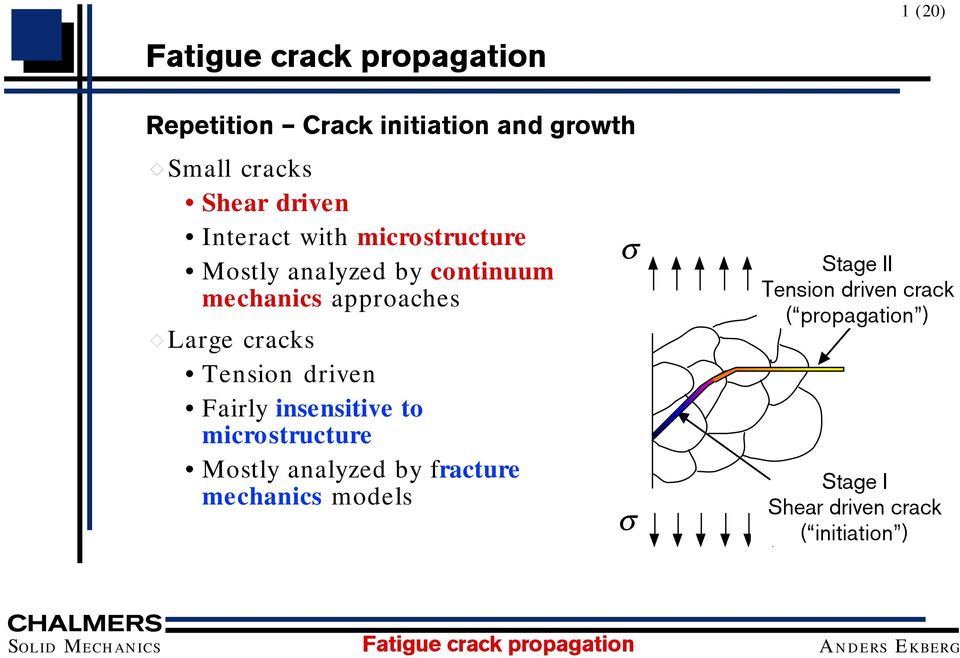
1 1 (20) Repetition Ð Crack initiation and growth Small cracks Shear driven Interact with microstructure Mostly analyzed by continuum mechanics approaches Large cracks Tension driven Fairly insensitive to microstructure Mostly analyzed by fracture mechanics models σ σ Stage II Tension driven crack (ÒpropagationÓ) Stage I Shear driven crack (ÒinitiationÓ)
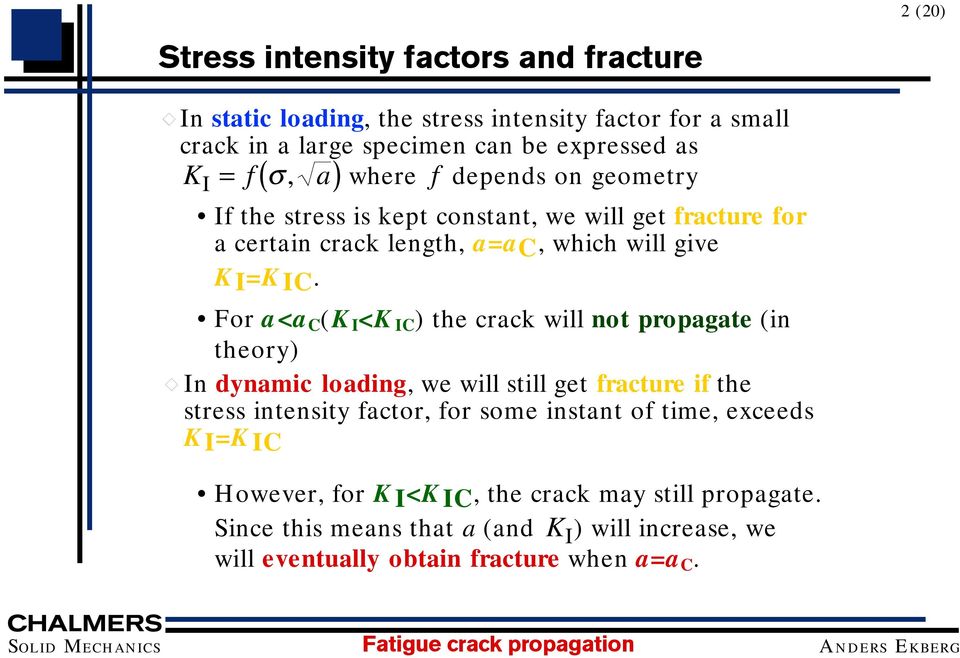
2 2 (20) Stress intensity factors and fracture In static loading, the stress intensity factor for a small crack in a large specimen can be expressed as KI = f( σ, a) where f depends on geometry If the stress is kept constant, we will get fracture for a certain crack length, a=ac, which will give KI=KIC. For a<a C (K I <K IC ) the crack will not propagate (in theory) In dynamic loading, we will still get fracture if the stress intensity factor, for some instant of time, exceeds KI=KIC However, for KI<KIC, the crack may still propagate. Since this means that a (and K I ) will increase, we will eventually obtain fracture when a=a C.
3 Crack growth as a function of K 3 (20) In experiments, crack propagation has been measured as a function of the stress intensity factor log da dn I II III K th K C log K There exists a threshold value of K below which fatigue cracks will not propagate At the other extreme, K max will approach the fracture toughness K C, and the material will fail A linear relationship between log d a d N ( ) and K in region II Note that K depends on the crack size. This is not shown in the plot

4 Crack growth in region I 4 (20) For small K (region I), crack propagation is difficult to predict since it depends on microstructure and flow properties of the material Here, the growth may even come to an arrest Crack growth rate is sensitive to the size of the grains. Finer grains gives Closer spacing of grain boundaries, which the crack has to break through Increased yield stress (normally) Decreased roughness of the crack Crack growth predicted by models of type da dn = f( γ ) p, where γ p is plastic shear strain range empirical adjustment of K-da dn curve log da dn I II III K th K C log K

5 Crack growth in region II and III 5 (20) Region II For larger magnitudes of K (region II), the crack growth rate will be governed by a power law (such as Paris law) The crack growth rate is fairly insensitive to the microstructure (however, the constants m and C are, of course, different for different materials) If region II includes the dominating part of the fatigue life, the fatigue life can be directly estimated by integrating Paris law Region III If the stress intensity ratio is increased even further (region III), the crack growth rate will accelerate and finally fracture will occur The behavior of this fracture is rather sensitive to the microstructure and flow properties of the material.

6 Crack propagation laws Ð introduction 6 (20) It has been found that, for dynamic loading of a crack, the three most important factors determining the propagation (growth) of the crack are K Kmax Kmin the stress intensity range R K min K max the stress intensity ratio H the stress history Thus, the crack growth rate (i.e. growth per stress cycle) can be expressed as da dn = f( K, R, H ) where d a d N is the crack growth per stress cycle

7 ParisÕ law 7 (20) Paris law can be written as da = dn C Km where C and m are material parameters One of the first (1962) and most widely used fatigue crack propagation criteria ÒAlgorithmÓ 1. Find stress intensity factor for the current geometry 2. Find crack length corresponding to Kmax = KC 3. Check if the requirements for linear elastic fracture mechanics are fulfilled 4. Integrate Paris law 5. Solve for the number of stress cycles corresponding to failure Important If the stress intensity factor includes a geometric function of a, estimated (or analytic) values of this function has to be used

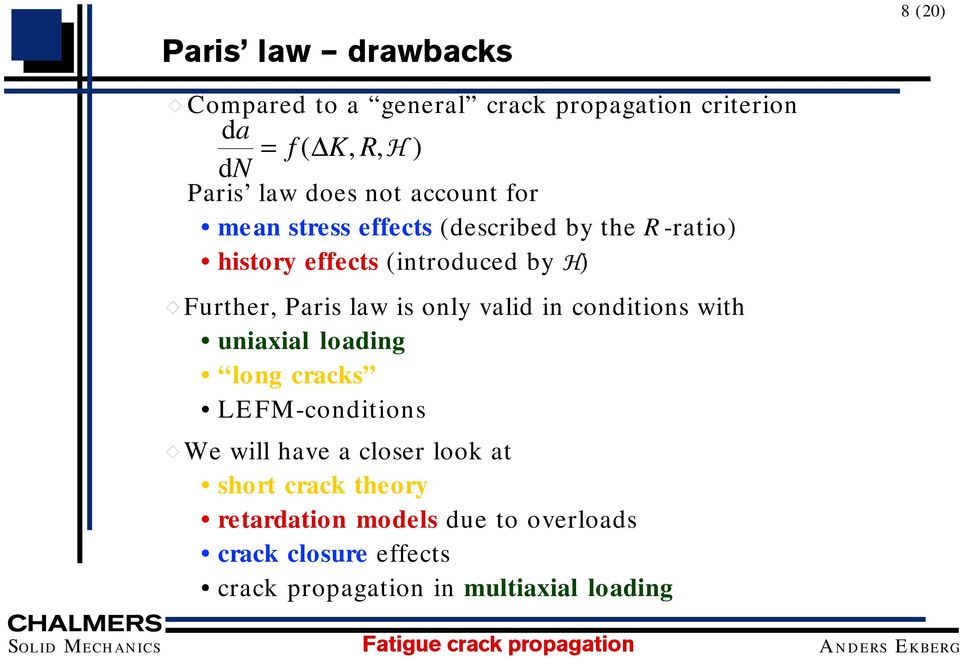
8 ParisÕ law Ð drawbacks 8 (20) Compared to a general crack propagation criterion da dn = f( K, R, H ) Paris law does not account for mean stress effects (described by the R-ratio) history effects (introduced by H) Further, Paris law is only valid in conditions with uniaxial loading long cracks LEFM-conditions We will have a closer look at short crack theory retardation models due to overloads crack closure effects crack propagation in multiaxial loading
9 9 (20) Short cracks So far da dn f K = ( ) where K depends on the amplitude of the normal stress (and geometry) But short cracks are shear stress driven also LEFM is not valid Crack Speed Two types of short cracks mechanically short cracks propagate faster than large cracks with same K microstructurally short cracks interact closely with the microstructure and grow fast σ 1 > σ 2 a 1 < a 2 Short Crack Theory Microstructural Threshold Crack Length

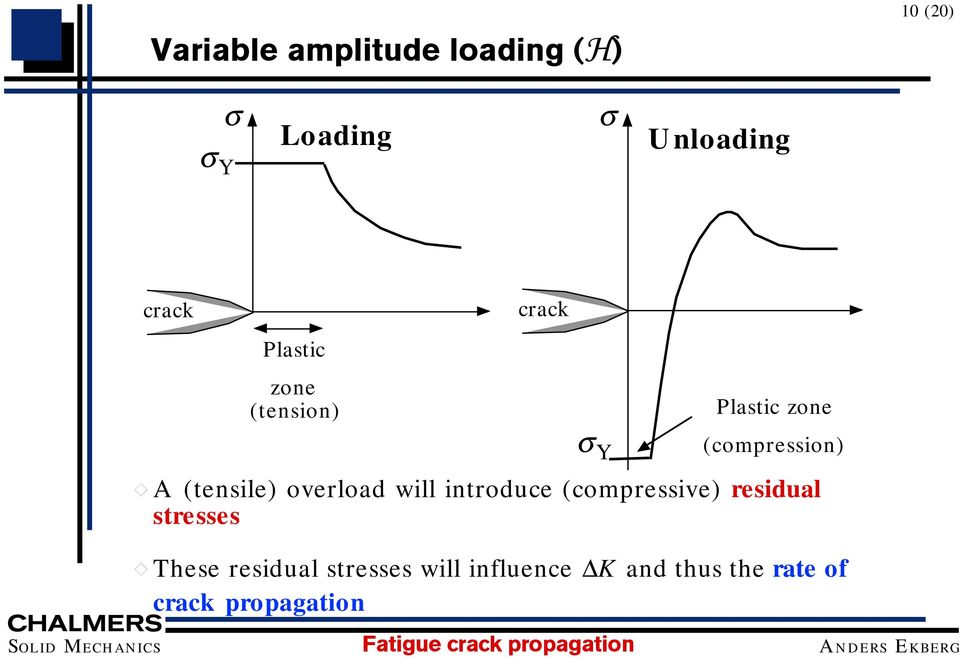
10 10 (20) Variable amplitude loading (H) σ σ Y Loading σ Unloading crack crack Plastic zone (tension) Plastic zone σ Y (compression) A (tensile) overload will introduce (compressive) residual stresses These residual stresses will influence K and thus the rate of crack propagation
11 The Wheeler model 11 (20) The Wheeler model is used to define the reduction of the crack growth rate due to an overload The reduction factor is defined as d 0 Φ R = a+ dc γ d 0 crack The reduced crack growth rate is then calculated as da dn R =Φ R da dn a d c
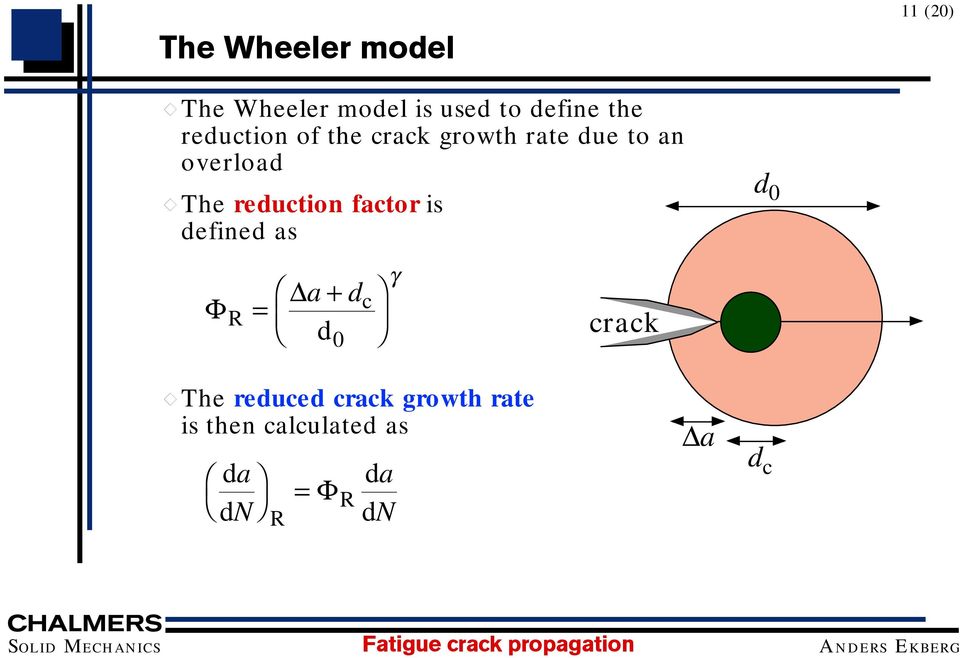
12 Variable Amplitude Loading, contõd The Wheeler model is appropriate for single overloads The reduction of crack growth rate acts only as long as the cracks current plastic zone is within the plastic zone from the overload Multiple overloads or stochastic loads Cycle-by-cycle integration crack of Appropriate crack growth law that takes Retardation/acceleration effects into account Normal crack propagation laws are usually conservative 12 (20)

13 Crack closure (R) 13 (20) Elber, in 1970, discovered that crack closure exists in cyclic loading, even for loads that are greater than zero This crack closure will decrease the fatigue crack growth rate by reducing the effective stress intensity range The stress intensity rate K Kmax Kmin K = max [ K,0] min min Crack closure att K=Kop gives K K K eff max op Paris law using effective stress intensity rate da dn = C K m eff Empirical relation Kop = ϕ( R) Kmax 2 ϕ( R) = R R 1 R 1
![range The stress intensity rate K Kmax Kmin K = max [ K,0] min min Crack closure att K=Kop gives K K K eff max op Paris law](/docs-images/47/20932033/images/page_13.jpg "using effective stress intensity rate da dn = C K m eff Empirical relation Kop = ϕ( R) Kmax 2 ϕ( R) = 025. + 05. R+ 025.")
14 Crack closure and arrestment 14 (20) K max K Keff K op K min Crack closure If the crack is closed throughout the stress cycle, the crack will arrest This is not the only mechanism of a crack to arrest!
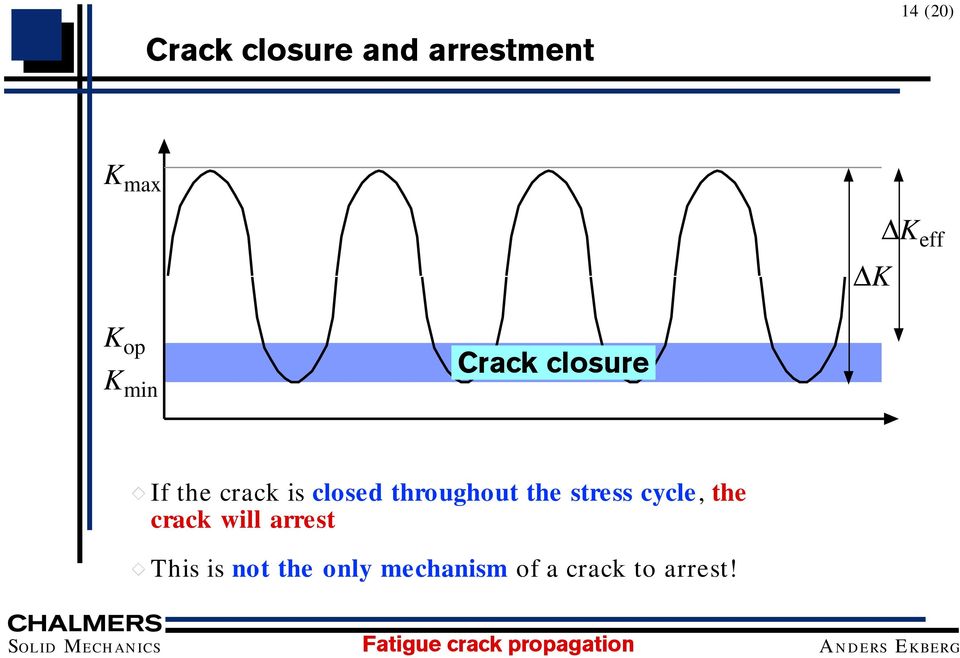
15 Crack closure and arrestment Ð II 15 (20) K op and K min Kop Kmin K Paris K Elber K Paris Smallest magnitude of K min in Paris law R The only difference when using Elber correction is in a new, higher K min Using Elber correction in Paris law is conservative (predicts a longer fatigue life)

16 Crack arrestment 16 (20) da eff dn C K m = = eff C K K K max op C K K m = K K K K max op = C K Kmax Kmin K 1 Kop = C K K max K min K Kmax Kmax m 1 Kop = C K 1 R K m m m For 1 1 Kop R K =0 we get K = Kop( 1 R) = K and d a dn = 0 For 1 1 Kop R K =1 we get K = K 1 R op 1 th

17 Crack growth treshold 17 (20) By taking crack closure into account (using Elber correction), we can model a R-ratio dependence compressive mid stress slower crack propagation tensile mid stress faster crack propagation

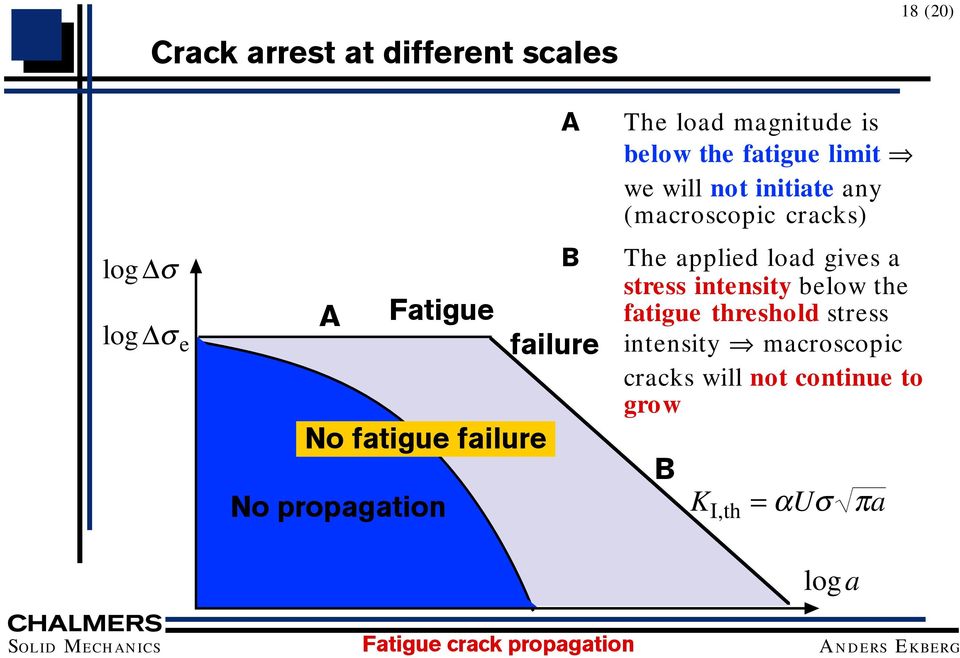
18 Crack arrest at different scales 18 (20) log σ log σ e A B A Fatigue failure No fatigue failure No propagation The load magnitude is below the fatigue limit we will not initiate any (macroscopic cracks) The applied load gives a stress intensity below the fatigue threshold stress intensity macroscopic cracks will not continue to grow B K I,th = αuσ loga πa
19 Cracks in mixed mode loading 19 (20) σ σ + σ σ + σ σ σ + σ σ + σ Cracks that are loaded in mixed mode, will normally tend to propagate in pure mode I One exception is when a crack propagates along a weak zone (e.g. a weld). In this case, an effective stress intensity factor can be employed K = K K 2 ( ) eff I II

20 Crack propagation Ð summary 20 (20) Under one dimensional, elastic conditions and constant load range Paris law, can predict fatigue life of large cracks Under variable amplitude loading, plastic residual stress fields mostly gives a decrease in crack growth rate. Microstructurally small cracks interact closely with microstructure. Mechanically small cracks propagate faster than long cracks. Closure effects of large cracks can give a pronounced effect. It s one mechanism behind crack arrestment In multiaxial loading, most cracks tend to propagate in pure mode I Less ÒmatureÓ areas Cases where LEFM is not applicable The propagation of short, especially microstructurally short, cracks Cases where crack closure and crack friction has a profound effect Conditions of variable amplitude loading Multiaxial loading conditions

CH 6: Fatigue Failure Resulting from Variable Loading
 CH 6: Fatigue Failure Resulting from Variable Loading Some machine elements are subjected to static loads and for such elements static failure theories are used to predict failure (yielding or fracture).
Damage due to fatigue occurs when loading is markedly varying in time. R decreases with time S T. MSÚ F max
 5. Fatigue of steel structures Fatigue loading, Wöhler s approach and fracture mechanics, fatigue strength, influence of notches, damage accumulation, Eurocode approach. Damage due to fatigue occurs when
9. TIME DEPENDENT BEHAVIOUR: CYCLIC FATIGUE
 9. TIME DEPENDENT BEHAVIOUR: CYCLIC FATIGUE A machine part or structure will, if improperly designed and subjected to a repeated reversal or removal of an applied load, fail at a stress much lower than
NOTCHES AND THEIR EFFECTS. Ali Fatemi - University of Toledo All Rights Reserved Chapter 7 Notches and Their Effects 1
 NOTCHES AND THEIR EFFECTS Ali Fatemi - University of Toledo All Rights Reserved Chapter 7 Notches and Their Effects 1 CHAPTER OUTLINE Background Stress/Strain Concentrations S-N Approach for Notched Members
Fatigue. 3. Final fracture (rough zone) 1. Fatigue origin. 2. Beach marks (velvety zone)
 Fatigue Term fatigue introduced by Poncelet (France) 1839 progressive fracture is more descriptive 1. Minute crack at critical area of high local stress (geometric stress raiser, flaws, preexisting cracks)
G1RT-CT-2001-05071 D. EXAMPLES F. GUTIÉRREZ-SOLANA S. CICERO J.A. ALVAREZ R. LACALLE W P 6: TRAINING & EDUCATION
 D. EXAMPLES 316 WORKED EXAMPLE I Infinite Plate under fatigue Introduction and Objectives Data Analysis 317 INTRODUCTION AND OBJECTIVES One structural component of big dimensions is subjected to variable
Figure 1: Typical S-N Curves
 Stress-Life Diagram (S-N Diagram) The basis of the Stress-Life method is the Wohler S-N diagram, shown schematically for two materials in Figure 1. The S-N diagram plots nominal stress amplitude S versus
different levels, also called repeated, alternating, or fluctuating stresses.
 Fatigue and Dynamic Loading 1 Fti Fatigue fil failure: 2 Static ti conditions : loads are applied gradually, to give sufficient i time for the strain to fully develop. Variable conditions : stresses vary
Numerical Analysis of Independent Wire Strand Core (IWSC) Wire Rope
 Numerical Analysis of Independent Wire Strand Core (IWSC) Wire Rope Rakesh Sidharthan 1 Gnanavel B K 2 Assistant professor Mechanical, Department Professor, Mechanical Department, Gojan engineering college,
How To Determine The Fatigue Life Of An A380 Aluminum Alloy Casting
 Failure Analysis of a Cast A380 Aluminum Alloy Casting Using a Microstructurally Based Fatigue Model C.L. Burton, M.K. Jones, D.L. Oglesby A.L. Oppedal, M.Q. Chandler, M.F. Horstemeyer Center for Advanced
Chapter Outline. Mechanical Properties of Metals How do metals respond to external loads?
 Mechanical Properties of Metals How do metals respond to external loads? Stress and Strain Tension Compression Shear Torsion Elastic deformation Plastic Deformation Yield Strength Tensile Strength Ductility
Multiaxial Fatigue. Professor Darrell Socie. 2008-2014 Darrell Socie, All Rights Reserved
 Multiaxial Fatigue Professor Darrell Socie 2008-2014 Darrell Socie, All Rights Reserved Outline Stresses around holes Crack Nucleation Crack Growth MultiaxialFatigue 2008-2014 Darrell Socie, All Rights
Objectives. Experimentally determine the yield strength, tensile strength, and modules of elasticity and ductility of given materials.
 Lab 3 Tension Test Objectives Concepts Background Experimental Procedure Report Requirements Discussion Objectives Experimentally determine the yield strength, tensile strength, and modules of elasticity
C. PROCEDURE APPLICATION (FITNET)
 C. PROCEDURE APPLICATION () 495 INTRODUCTION ASSESSMENT OF SCC ASSESSMENT OF CORROSION FATIGUE STRESS CORROSION AND CORROSION FATIGUE ANALYSIS ASSESSMENT OF LOCAL THINNED AREAS 496 INTRODUCTION INTRODUCTION
FATIGUE CONSIDERATION IN DESIGN
 FATIGUE CONSIDERATION IN DESIGN OBJECTIVES AND SCOPE In this module we will be discussing on design aspects related to fatigue failure, an important mode of failure in engineering components. Fatigue failure
Objective To conduct Charpy V-notch impact test and determine the ductile-brittle transition temperature of steels.
 IMPACT TESTING Objective To conduct Charpy V-notch impact test and determine the ductile-brittle transition temperature of steels. Equipment Coolants Standard Charpy V-Notched Test specimens Impact tester
Lecture 14. Chapter 8-1
 Lecture 14 Fatigue & Creep in Engineering Materials (Chapter 8) Chapter 8-1 Fatigue Fatigue = failure under applied cyclic stress. specimen compression on top bearing bearing motor counter flex coupling
Hardened Concrete. Lecture No. 14
 Hardened Concrete Lecture No. 14 Strength of Concrete Strength of concrete is commonly considered its most valuable property, although in many practical cases, other characteristics, such as durability
STRAIN-LIFE (e -N) APPROACH
 CYCLIC DEFORMATION & STRAIN-LIFE (e -N) APPROACH MONOTONIC TENSION TEST AND STRESS-STRAIN BEHAVIOR STRAIN-CONTROLLED TEST METHODS CYCLIC DEFORMATION AND STRESS-STRAIN BEHAVIOR STRAIN-BASED APPROACH TO
B. INTRODUCTION TO ASSESSMENT PROCEDURES FOR CRACKED COMPONENTS
 B. INTRODUCTION TO ASSESSMENT PROCEDURES FOR CRACKED COMPONENTS 40 INTRODUCTION HOW ARE INTEGRITY, SECURITY OR CRITICAL CONDITIONS ANALYSED IN A CRACKED STRUCTURE? FRACTURE MECHANICS Critical conditions
Structural Integrity Analysis
 Structural Integrity Analysis 1. STRESS CONCENTRATION Igor Kokcharov 1.1 STRESSES AND CONCENTRATORS 1.1.1 Stress An applied external force F causes inner forces in the carrying structure. Inner forces
METU DEPARTMENT OF METALLURGICAL AND MATERIALS ENGINEERING
 METU DEPARTMENT OF METALLURGICAL AND MATERIALS ENGINEERING Met E 206 MATERIALS LABORATORY EXPERIMENT 1 Prof. Dr. Rıza GÜRBÜZ Res. Assist. Gül ÇEVİK (Room: B-306) INTRODUCTION TENSION TEST Mechanical testing
Experiment: Fatigue Testing
 Experiment: Fatigue Testing Objectives - To demonstrate the use of the Instron servohydraulic testing machine for testing specimens subjected to cyclic (fatigue) loadings. - To analytically approximate
Fatigue Resistance of High Strength Bolts with Large Diameters
 1 Fatigue Resistance of High Strength Bolts with Large Diameters Prof. Peter Schaumann; Dipl.-Ing. Frithjof Marten Leibniz Universitaet Hannover Institute for Steel Construction Hannover, Germany [email protected];
Design strength of optical glass
 Design strength of optical glass Keith B. Doyle Sigmadyne, Inc. Rochester, NY Mark A. Kahan Optical Research Associates Westborough, MA ABSTRACT Brittle materials such as glass do not possess a single
Fatigue Life Prediction of Complex 2D Components under Mixed-Mode Variable Loading
 Fatigue Life Prediction of Complex 2D Components under Mixed-Mode Variable Loading M.A. Meggiolaro 1, A.C.O. Miranda 2, J.T.P. Castro 1, L.F. Martha*,2, T.N. Bittencourt 3 1 Department of Mechanical Engineering
Stress Strain Relationships
 Stress Strain Relationships Tensile Testing One basic ingredient in the study of the mechanics of deformable bodies is the resistive properties of materials. These properties relate the stresses to the
Bending, Forming and Flexing Printed Circuits
 Bending, Forming and Flexing Printed Circuits John Coonrod Rogers Corporation Introduction: In the printed circuit board industry there are generally two main types of circuit boards; there are rigid printed
WELD - STATIC AND FATIGUE STRENGTH -III
 32 WELD - STATIC AND FATIGUE STRENGTH -III 1.0 INTRODUCTION A component or a structure, which can withstand a single application of load, may fracture if the same load is applied a large number of times.
Torsion Tests. Subjects of interest
 Chapter 10 Torsion Tests Subjects of interest Introduction/Objectives Mechanical properties in torsion Torsional stresses for large plastic strains Type of torsion failures Torsion test vs.tension test
Fatigue Performance Evaluation of Forged Steel versus Ductile Cast Iron Crankshaft: A Comparative Study (EXECUTIVE SUMMARY)
 Fatigue Performance Evaluation of Forged Steel versus Ductile Cast Iron Crankshaft: A Comparative Study (EXECUTIVE SUMMARY) Ali Fatemi, Jonathan Williams and Farzin Montazersadgh Professor and Graduate
PREVENTING MECHANICAL FATIGUE
 TECHNICAL PAPER PREVENTING MECHANICAL FATIGUE Overview Fatigue is the most common cause of catastrophic failure in metals and can occur in other materials as well. SolidWorks software provides a fast,
Uniaxial Tension and Compression Testing of Materials. Nikita Khlystov Daniel Lizardo Keisuke Matsushita Jennie Zheng
 Uniaxial Tension and Compression Testing of Materials Nikita Khlystov Daniel Lizardo Keisuke Matsushita Jennie Zheng 3.032 Lab Report September 25, 2013 I. Introduction Understanding material mechanics
IMPELLER FATIGUE ASSESSMENT USING AN S-N APPROACH
 ENGINEERING PAPER 5244-08 IMPELLER FATIGUE ASSESSMENT USING AN S-N APPROACH Samuel Orr Engineering Analysis Manager Howden Technology AMCA International Engineering Conference Las Vegas, NV, USA 2 4 March
PROPERTIES OF MATERIALS
 1 PROPERTIES OF MATERIALS 1.1 PROPERTIES OF MATERIALS Different materials possess different properties in varying degree and therefore behave in different ways under given conditions. These properties
σ y ( ε f, σ f ) ( ε f
 Typical stress-strain curves for mild steel and aluminum alloy from tensile tests L L( 1 + ε) A = --- A u u 0 1 E l mild steel fracture u ( ε f, f ) ( ε f, f ) ε 0 ε 0.2 = 0.002 aluminum alloy fracture
FATIGUE LIFE OF BOLT SUBJECTED TO FATIGUE LOADING CONDITIONS
 20 FATIGUE LIFE OF BOLT SUBJECTED TO FATIGUE LOADING CONDITIONS ABSTRACT K. Din and M. T. H. Ghazali Faculty of Civil Engineering, Universiti Teknologi MARA, Shah Alam, Malaysia E-mail: [email protected]
Mechanical Properties of Metals Mechanical Properties refers to the behavior of material when external forces are applied
 Mechanical Properties of Metals Mechanical Properties refers to the behavior of material when external forces are applied Stress and strain fracture or engineering point of view: allows to predict the
Long term performance of polymers
 1.0 Introduction Long term performance of polymers Polymer materials exhibit time dependent behavior. The stress and strain induced when a load is applied are a function of time. In the most general form
Calculating and Displaying Fatigue Results
 Calculating and Displaying Fatigue Results The ANSYS Fatigue Module has a wide range of features for performing calculations and presenting analysis results. By Raymond Browell Product Manager New Technologies
ESCUELA TÉCNICA SUPERIOR DE INGENIEROS INDUSTRIALES Y DE TELECOMUNICACIÓN
 ESCUELA TÉCNICA SUPERIOR DE INGENIEROS INDUSTRIALES Y DE TELECOMUNICACIÓN Titulación: INGENIERO INDUSTRIAL Título del proyecto: MODELING CRACKS WITH ABAQUS Pablo Sanchis Gurpide Pamplona, 22 de Julio del
Short and Large Crack, Mixed-Mode Fatigue-Crack Growth Thresholds in Ti-6Al-4V 1
 Short and Large Crack, Mixed-Mode Fatigue-Crack Growth Thresholds in Ti-6Al-4V 1 Mr. R. K. Nalla, Dr. J. P. Campbell and Professor R. O. Ritchie 2 Department of Materials Science and Engineering University
Tensile fracture analysis of blunt notched PMMA specimens by means of the Strain Energy Density
 Engineering Solid Mechanics 3 (2015) 35-42 Contents lists available at GrowingScience Engineering Solid Mechanics homepage: www.growingscience.com/esm Tensile fracture analysis of blunt notched PMMA specimens
Completely reversed, strain controlled fatigue tests of a steel alloy with E=210000 MPa resulted in the following data:
 Kul-49.4350 Fatigue o Structure Example solutions 5 Problem 5-1. Completely reversed, strain controlled atigue tests o a steel alloy with E=10000 resulted in the ollowing data: a a, (o the stable curve)
CRITERIA FOR PRELOADED BOLTS
 National Aeronautics and Space Administration Lyndon B. Johnson Space Center Houston, Texas 77058 REVISION A JULY 6, 1998 REPLACES BASELINE SPACE SHUTTLE CRITERIA FOR PRELOADED BOLTS CONTENTS 1.0 INTRODUCTION..............................................
Fatigue Life Estimates Using Goodman Diagrams
 Fatigue Life Estimates Using Goodman Diagrams by Robert Stone The purpose of this paper is to review the proper methods by which spring manufacturers should estimate the fatigue life of a helical compression
Ultrasonic Technique and Device for Residual Stress Measurement
 Ultrasonic Technique and Device for Residual Stress Measurement Y. Kudryavtsev, J. Kleiman Integrity Testing Laboratory Inc. 80 Esna Park Drive, Units 7-9, Markham, Ontario, L3R 2R7 Canada [email protected]
Strength of Concrete
 Strength of Concrete In concrete design and quality control, strength is the property generally specified. This is because, compared to most other properties, testing strength is relatively easy. Furthermore,
Fatigue of Metals Copper Alloys. Samuli Heikkinen 26.6.2003
 Fatigue of Metals Copper Alloys Samuli Heikkinen 26.6.2003 T 70 C Temperature Profile of HDS Structure Stress amplitude 220 MPa Stress Profile of HDS Structure CLIC Number of Cycles f = 100 Hz 24 hours
AN EXPLANATION OF JOINT DIAGRAMS
 AN EXPLANATION OF JOINT DIAGRAMS When bolted joints are subjected to external tensile loads, what forces and elastic deformation really exist? The majority of engineers in both the fastener manufacturing
AC 2008-2887: MATERIAL SELECTION FOR A PRESSURE VESSEL
 AC 2008-2887: MATERIAL SELECTION FOR A PRESSURE VESSEL Somnath Chattopadhyay, Pennsylvania State University American Society for Engineering Education, 2008 Page 13.869.1 Material Selection for a Pressure
Ahmet Sami KILINÇ, Tamer BAYBURA. Presented by Ahmet Sami KILINÇ
 Determination of Minimum Horizontal Curve Radius Used in the Design of Transportation Structures, Depending on the Limit Value of Comfort Criterion Lateral Jerk Ahmet Sami KILINÇ, Tamer BAYBURA Presented
STRESS-STRAIN CURVES
 STRESS-STRAIN CURVES David Roylance Department of Materials Science and Engineering Massachusetts Institute of Technology Cambridge, MA 02139 August 23, 2001 Introduction Stress-strain curves are an extremely
Bearing strength of stainless steel bolted plates in tension
 NSCC29 Bearing strength of stainless steel bolted plates in tension G. KIYMAZ 1 1 Department of Civil Engineering, Istanbul Kultur University, Ataköy Campus, Bakırköy, Istanbul, Turkey ABSTRACT: A study
SAMPLE FORMAL LABORATORY REPORT. Fatigue Failure through Bending Experiment Adapted from a report submitted by Sarah Thomas
 SAMPLE FORMAL LABORATORY REPORT Fatigue Failure through Bending Experiment Adapted from a report submitted by Sarah Thomas Lab Partners: David Henry and James Johnson ME 498 November 10, 2004 Professor
Investigation of Stress Intensity Factor of Axial Compressor Blade of Helicopter
 Investigation of Stress Intensity Factor of Axial Compressor Blade of Helicopter Neelesh V K Mr. Manjunath M V Mr. Devaraj Dept. of Mechanical Engineering Asst prof, Dept. of Mechanical Engineering Asst
Chapter Outline Dislocations and Strengthening Mechanisms
 Chapter Outline Dislocations and Strengthening Mechanisms What is happening in material during plastic deformation? Dislocations and Plastic Deformation Motion of dislocations in response to stress Slip
Materials Issues in Fatigue and Fracture
 Materials Issues in Fatigue and Fracture 5.1 Fundamental Concepts 5.2 Ensuring Infinite Life 5.3 Finite Life 5.4 Summary FCP 1 5.1 Fundamental Concepts Structural metals Process of fatigue A simple view
Master of Simulation Techniques. Lecture No.5. Blanking. Blanking. Fine
 Master of Simulation Techniques Lecture No.5 Fine Blanking Prof. Dr.-Ing. F. Klocke Structure of the lecture Blanking Sheared surface and force Wear Blanking processes and blanking tools Errors on sheared
Review of the Application of Design Guideline VDI 2230 Using SR1 for PCs
 11 th Annual Technical Conference on Fastening Technology Clemson University Radisson Hotel, Cleveland, Ohio, September 9, 1999 Review of the Application of Design Guideline VDI 2230 Using SR1 for PCs
The atomic packing factor is defined as the ratio of sphere volume to the total unit cell volume, or APF = V S V C. = 2(sphere volume) = 2 = V C = 4R
 3.5 Show that the atomic packing factor for BCC is 0.68. The atomic packing factor is defined as the ratio of sphere volume to the total unit cell volume, or APF = V S V C Since there are two spheres associated
FRETTING FATIGUE UNDER VARYING LOADING BELOW THE FRETTING FATIGUE LIMIT
 FRETTING FATIGUE UNDER VARYING LOADING BELOW THE FRETTING FATIGUE LIMIT Yoshiyuki KONDO 1, Chu SAKAE 1, Masanobu KUBOTA 1 and Hiroki KITAHARA 2 1 Kyushu University, Faculty of Engineering, 6-10-1, Hakozaki,
MIME 3330 Mechanics Laboratory LAB 5: ROTATING BENDING FATIGUE
 MIME 3330 Mechanics Laboratory LAB 5: ROTATING BENDING FATIGUE Introduction In this experiment, the finite life fatigue behavior of a smooth cylindrical specimen as shown in Figure 1 will be studied in
1. Fluids Mechanics and Fluid Properties. 1.1 Objectives of this section. 1.2 Fluids
 1. Fluids Mechanics and Fluid Properties What is fluid mechanics? As its name suggests it is the branch of applied mechanics concerned with the statics and dynamics of fluids - both liquids and gases.
FATIGUE TESTS AND STRESS-LIFE (S-N) APPROACH
 FATIGUE TESTS AND STRESS-LIFE (S-N) APPROACH FATIGUE TESTING LOADING TEST MACHINES SPECIMENS STANDARDS STRESS-LIFE APPEROACH S-N CURVES MEAN STRESS EFFECTS ON S-N BEHAVIOR FACTORS INFLUENCING S-N BEHAVIOR
WJM Technologies excellence in material joining
 Girish P. Kelkar, Ph.D. (562) 743-7576 [email protected] www.welding-consultant.com Weld Cracks An Engineer s Worst Nightmare There are a variety of physical defects such as undercut, insufficient
Program COLANY Stone Columns Settlement Analysis. User Manual
 User Manual 1 CONTENTS SYNOPSIS 3 1. INTRODUCTION 4 2. PROBLEM DEFINITION 4 2.1 Material Properties 2.2 Dimensions 2.3 Units 6 7 7 3. EXAMPLE PROBLEM 8 3.1 Description 3.2 Hand Calculation 8 8 4. COLANY
7.2.4 Seismic velocity, attenuation and rock properties
 7.2.4 Seismic velocity, attenuation and rock properties Rock properties that affect seismic velocity Porosity Lithification Pressure Fluid saturation Velocity in unconsolidated near surface soils (the
Numerical Analysis of Cohesive Crack Growth Using Extended Finite Element Method (X-FEM)
 Ecole Centrale de Nantes (ECN) Institut de Recherche en Génie Civil et Méchanique (GeM) The International Center for Numerical Methods in Engineering (CIMNE) Master of Science Thesis Numerical Analysis
ANALYSIS OF A LAP JOINT FRICTION CONNECTION USING HIGH STRENGTH BOLTS
 Nordic Steel Construction Conference 212 Hotel Bristol, Oslo, Norway 5-7 September 212 ANALYSIS OF A LAP JOINT FRICTION CONNECTION USING HIGH STRENGTH BOLTS Marouene Limam a, Christine Heistermann a and
1.054/1.541 Mechanics and Design of Concrete Structures (3-0-9) Outline 1 Introduction / Design Criteria for Reinforced Concrete Structures
 Prof. Oral Buyukozturk Massachusetts Institute of Technology Outline 1 1.054/1.541 Mechanics and Design of Concrete Structures (3-0-9) Outline 1 Introduction / Design Criteria for Reinforced Concrete Structures
Lap Fillet Weld Calculations and FEA Techniques
 Lap Fillet Weld Calculations and FEA Techniques By: MS.ME Ahmad A. Abbas Sr. Analysis Engineer [email protected] www.advancedcae.com Sunday, July 11, 2010 Advanced CAE All contents Copyright
3D plasticity. Write 3D equations for inelastic behavior. Georges Cailletaud, Ecole des Mines de Paris, Centre des Matériaux
 3D plasticity 3D viscoplasticity 3D plasticity Perfectly plastic material Direction of plastic flow with various criteria Prandtl-Reuss, Hencky-Mises, Prager rules Write 3D equations for inelastic behavior
Local buckling of plates made of high strength steel
 Local buckling of plates made of high strength steel Tapani Halmea, Lauri Huusko b,a, Gary Marquis a, Timo Björk a a Lappeenranta University of Technology, Faculty of Technology Engineering, Lappeenranta,
Accelerated Corrosion Fatigue Studies on SA 333 Gr.6 Carbon Steel
 Accelerated Corrosion Fatigue Studies on SA 333 Gr.6 Carbon Steel P. S. Aarthi 1, G. Raghava 2, S. Vishnuvardhan 3, M. Surendar 4 P.G. Student, Department of Civil Engineering, Easwari Engineering College,
R&DE (Engineers), DRDO. Theories of Failure. [email protected]. Ramadas Chennamsetti
 heories of Failure ummary Maximum rincial stress theory Maximum rincial strain theory Maximum strain energy theory Distortion energy theory Maximum shear stress theory Octahedral stress theory Introduction
Fundamentals of Extrusion
 CHAPTER1 Fundamentals of Extrusion The first chapter of this book discusses the fundamentals of extrusion technology, including extrusion principles, processes, mechanics, and variables and their effects
2.75 6.525 Problem Set 1 Solutions to ME problems Fall 2013
 2.75 6.525 Problem Set 1 Solutions to ME problems Fall 2013 2. Pinned Joint problem Jacob Bayless a) Draw a free-body diagram for the pin. How is it loaded? Does the loading depend on whether the pin is
STRAIN ENERGY DENSITY (strain energy per unit volume)
 STRAIN ENERGY DENSITY (strain energy per unit volume) For ductile metals and alloys, according to the Maximum Shear Stress failure theory (aka Tresca ) the only factor that affects dislocation slip is
Version default Titre : SSNP161 Essais biaxiaux de Kupfer Date : 10/10/2012 Page : 1/8 Responsable : François HAMON Clé : V6.03.161 Révision : 9783
 Titre : SSNP161 Essais biaxiaux de Kupfer Date : 10/10/2012 Page : 1/8 SSNP161 Biaxial tests of Summarized Kupfer: Kupfer [1] was interested to characterize the performances of the concrete under biaxial
Figure 2.31. CPT Equipment
 Soil tests (1) In-situ test In order to sound the strength of the soils in Las Colinas Mountain, portable cone penetration tests (Japan Geotechnical Society, 1995) were performed at three points C1-C3
How Management Decisions Make or Break Plant Uptime
 How Management Decisions Make or Break Plant Uptime Abstract How Management Decisions Make of Break Plant Uptime: When you run machines above design rates that decision goes against all that we know about
Deflection Calculation of RC Beams: Finite Element Software Versus Design Code Methods
 Deflection Calculation of RC Beams: Finite Element Software Versus Design Code Methods G. Kaklauskas, Vilnius Gediminas Technical University, 1223 Vilnius, Lithuania ([email protected]) V.
VI. Real Business Cycles Models
 VI. Real Business Cycles Models Introduction Business cycle research studies the causes and consequences of the recurrent expansions and contractions in aggregate economic activity that occur in most industrialized
TRAVELING WAVE EFFECTS ON NONLINEAR SEISMIC BEHAVIOR OF CONCRETE GRAVITY DAMS
 TRAVELING WAVE EFFECTS ON NONLINEAR SEISMIC BEHAVIOR OF CONCRETE GRAVITY DAMS H. Mirzabozorg 1, M. R. Kianoush 2 and M. Varmazyari 3 1,3 Assistant Professor and Graduate Student respectively, Department
Properties of Materials
 CHAPTER 1 Properties of Materials INTRODUCTION Materials are the driving force behind the technological revolutions and are the key ingredients for manufacturing. Materials are everywhere around us, and
Methods to predict fatigue in CubeSat structures and mechanisms
 Methods to predict fatigue in CubeSat structures and mechanisms By Walter Holemans (PSC), Floyd Azure (PSC) and Ryan Hevner (PSC) Page 1 Outline Problem Statement What is fatigue? Cyclic loading and strength
/ DSM / IRAMIS / LLB)
 RESIDUAL STRESSES ANF Métallurgie Fondamentale Vincent Klosek (CEA / DSM / IRAMIS / LLB) 23/10/2012 8 NOVEMBRE 2012 CEA 23 OCTOBRE 2012 PAGE 1 INTRODUCTION Residual Stresses? Static multiaxial stresses
INTRODUCTION TO BEAMS
 CHAPTER Structural Steel Design LRFD Method INTRODUCTION TO BEAMS Third Edition A. J. Clark School of Engineering Department of Civil and Environmental Engineering Part II Structural Steel Design and Analysis
A COMPARISON OF AC TO INVERTER DC RESISTANCE SPOT WELDING AND THE EFFECTS ON DUAL-PHASE 600
 A COMPARISON OF AC TO INVERTER DC RESISTANCE SPOT WELDING AND THE EFFECTS ON DUAL-PHASE 600 Kurt Hofman, Mike Soter, Charles Orsette, Shawn Villaire, and Matt Prokator RoMan Engineering Services Inc. Abstract
Structural welding is a process by which the parts that are to be connected are heated and
 CHAPTER 6. WELDED CONNECTIONS 6.1 INTRODUCTORY CONCEPTS Structural welding is a process by which the parts that are to be connected are heated and fused, with supplementary molten metal at the joint. A
Effects of Sulfur Level and Anisotropy of Sulfide Inclusions on Tensile, Impact, and Fatigue Properties of SAE 4140 Steel
 Paper 28-1-434 Effects of Sulfur Level and Anisotropy of Sulfide Inclusions on Tensile, Impact, and Fatigue Properties of SAE 414 Steel Copyright 28 SAE International Nisha Cyril and Ali Fatemi The University
Chapter Outline Dislocations and Strengthening Mechanisms
 Chapter Outline Dislocations and Strengthening Mechanisms What is happening in material during plastic deformation? Dislocations and Plastic Deformation Motion of dislocations in response to stress Slip
Pore pressure. Ordinary space
 Fault Mechanics Laboratory Pore pressure scale Lowers normal stress, moves stress circle to left Doesn Doesn t change shear Deviatoric stress not affected This example: failure will be by tensile cracks
CERAMICS: Properties 2
 CERAMICS: Properties 2 (Brittle Fracture Analysis) S.C. BAYNE, 1 J.Y. Thompson 2 1 University of Michigan School of Dentistry, Ann Arbor, MI 48109-1078 [email protected] 2 Nova Southeastern College of Dental
FATIGUE ANALYSES OF AERONAUTICAL STRUCTURAL DETAILS OF DIFFERENT COMPLEXITY
 FATIGUE ANALYSES OF AERONAUTICAL STRUCTURAL DETAILS OF DIFFERENT COMPLEXITY Paulo M S T de Castro, Paulo F P de Matos, Pedro M G P Moreira, Lucas F M da Silva IDMEC and Faculdade de Engenharia, Universidade
Introduction to Mechanical Behavior of Biological Materials
 Introduction to Mechanical Behavior of Biological Materials Ozkaya and Nordin Chapter 7, pages 127-151 Chapter 8, pages 173-194 Outline Modes of loading Internal forces and moments Stiffness of a structure
Mechanical Properties - Stresses & Strains
 Mechanical Properties - Stresses & Strains Types of Deformation : Elasic Plastic Anelastic Elastic deformation is defined as instantaneous recoverable deformation Hooke's law : For tensile loading, σ =
Introduction to Solid Modeling Using SolidWorks 2012 SolidWorks Simulation Tutorial Page 1
 Introduction to Solid Modeling Using SolidWorks 2012 SolidWorks Simulation Tutorial Page 1 In this tutorial, we will use the SolidWorks Simulation finite element analysis (FEA) program to analyze the response