
VMware vrealize Operations for Published Applications Installation and Administration
|
|
|
- Christiana Price
- 9 years ago
- Views:
Transcription
1 VMware vrealize Operations for Published Applications Installation and Administration vrealize Operations for Published Applications 6.1 This document supports the version of each product listed and supports all subsequent versions until the document is replaced by a new edition. To check for more recent editions of this document, see EN

2 VMware vrealize Operations for Published Applications Installation and Administration You can find the most up-to-date technical documentation on the VMware Web site at: The VMware Web site also provides the latest product updates. If you have comments about this documentation, submit your feedback to: Copyright 2015 VMware, Inc. All rights reserved. Copyright and trademark information. VMware, Inc Hillview Ave. Palo Alto, CA VMware, Inc.
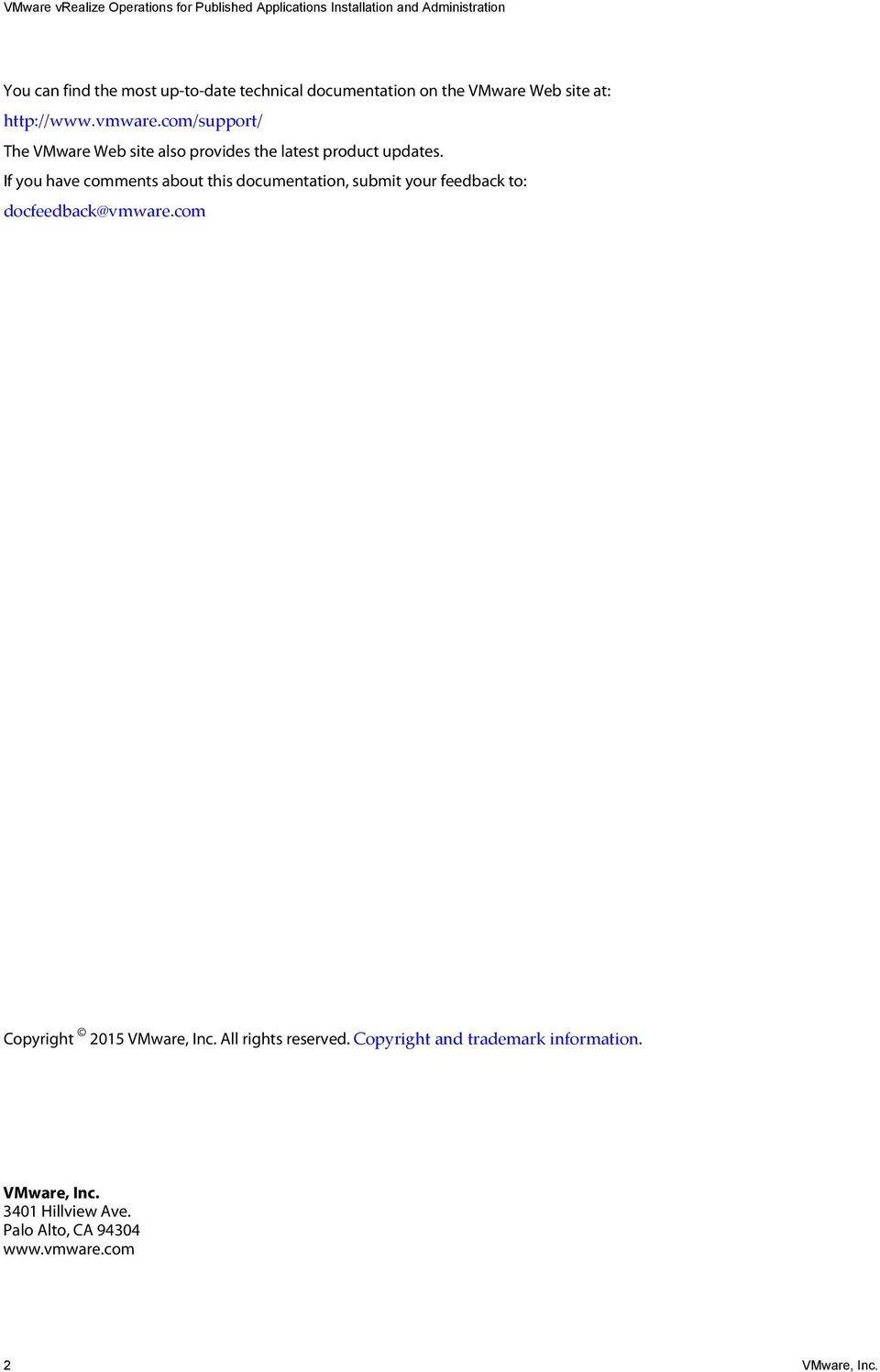
3 Contents 1 VMware vrealize Operations for Published Applications Installation and Administration 5 2 Introducing vrealize Operations for Published Applications 7 vrealize Operations for Published Applications Architecture 8 vrealize Operations for Published Applications Desktop Agent 8 vrealize Operations for Published Applications Broker Agent 9 vrealize Operations for Published Applications Adapter 9 3 System Requirements for vrealize Operations for Published Applications 11 Product Compatibility for vrealize Operations for Published Applications 11 Software Requirements for vrealize Operations for Published Applications 11 4 Installing and Configuring vrealize Operations for Published Applications 13 Install and Configure vrealize Operations for Published Applications 13 5 Monitoring Your Citrix XenApp Environment 25 Using the Citrix XenApp Dashboards 25 Using the XA Reports 29 6 Managing RMI Communication in vrealize Operations for Published Applications 33 RMI Services 33 Default Ports for RMI Services 34 Changing the Default RMI Service Ports 34 7 Changing the Default SSL/TLS Configuration in vrealize Operations for Published Applications 37 Default SSL Protocols and Ciphers for vrealize Operations for Published Applications 37 SSL/TLS Configuration Properties 38 Change the Default SSL/TLS Configuration for Servers 38 Change the Default SSL/TLS for Agents 39 8 Managing Authentication in vrealize Operations for Published Applications 41 Understanding Authentication for Each Component 41 9 Certificate and Trust Store Files 43 vrealize Operations for Published Applications Adapter Certificate and Trust Store Files 43 Broker Agent Certificate and Trust Store Files 44 VMware, Inc. 3
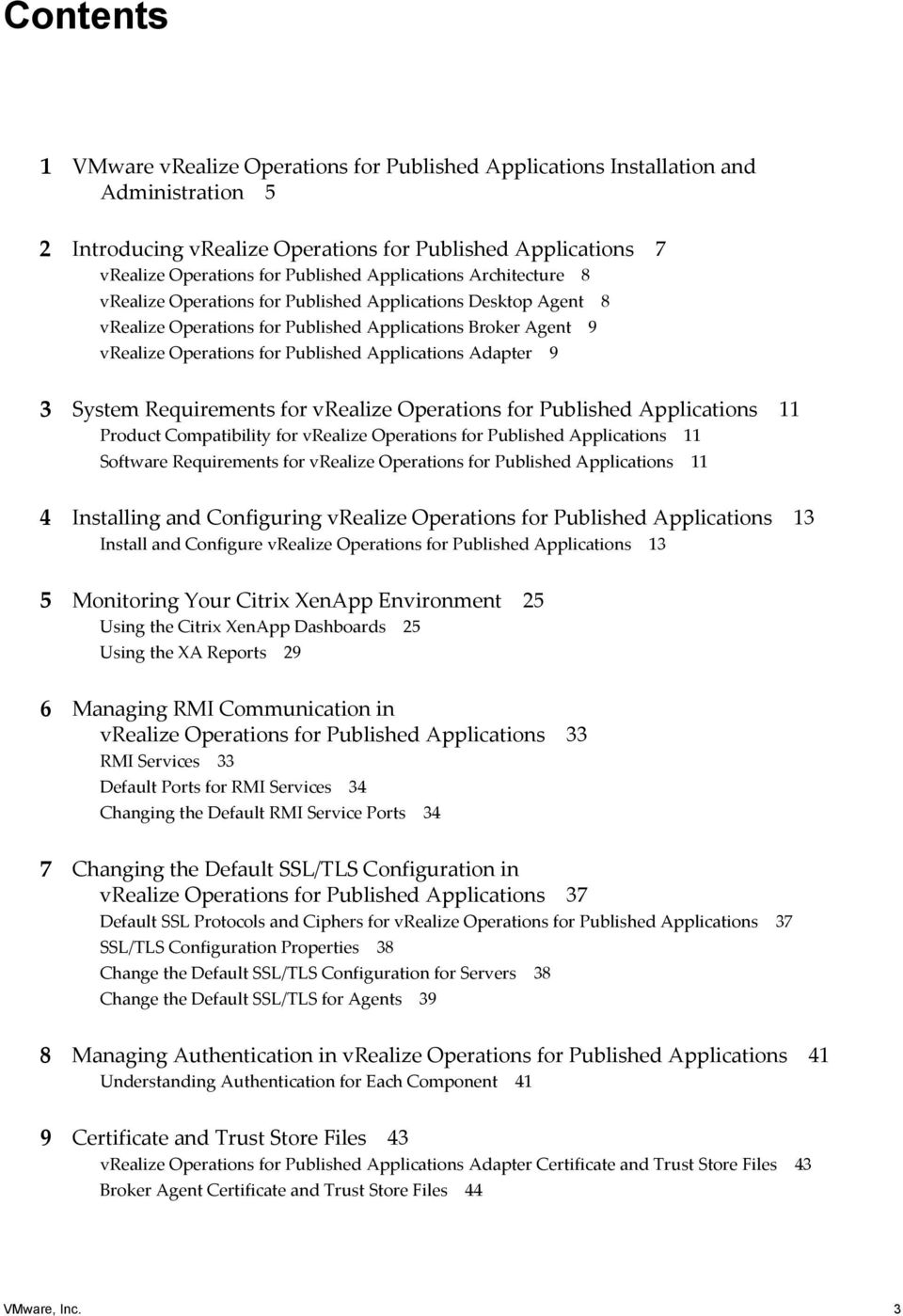
4 VMware vrealize Operations for Published Applications Installation and Administration 10 Replacing the Default Certificates 45 Replace the Default Certificate for the vrealize Operations for Published Applications Adapter 45 Replace the Default Certificate for the Broker Agent Certificate Pairing SSL/TLS and Authentication-Related Log Messages Create a vrealize Operations Manager Support Bundle Download vrealize Operations for Published Applications Broker Agent Log Files Download vrealize Operations for Published Applications Desktop Agent Log Files View Collector and vrealize Operations for Published Applications Adapter Log Files Modify the Logging Level for vrealize Operations for Published Applications Adapter Log Files 61 Index 63 4 VMware, Inc.
5 VMware vrealize Operations for Published Applications Installation and Administration 1 VMware vrealize Operations for Published Applications Installation and Administration provides information about how to monitor the performance of your Citrix XenApp environment in VMware vrealize Operations Manager. Intended Audience This information is intended for users who monitor the performance of a Citrix XenApp environment in VMware vrealize Operations Manager and administrators who are responsible for maintaining and troubleshooting a Citrix XenApp environment. VMware, Inc. 5

6 VMware vrealize Operations for Published Applications Installation and Administration 6 VMware, Inc.

7 Introducing vrealize Operations for Published Applications 2 vrealize Operations for Published Applications collects performance data from monitored software and hardware objects in your Citrix XenApp environment and provides predictive analysis and real-time information about problems in your Published Applications infrastructure. vrealize Operations for Published Applications presents data through alerts, on configurable dashboards, and on predefined pages in vrealize Operations Manager. IT administrators can use vrealize Operations for Published Applications to quickly obtain an overview of how the Citrix XenApp environment is behaving and view important metrics associated with that environment. Help desk specialists can view objects related to end user sessions, perform basic troubleshooting, and resolve user problems. This chapter includes the following topics: vrealize Operations for Published Applications Architecture, on page 8 vrealize Operations for Published Applications Desktop Agent, on page 8 vrealize Operations for Published Applications Broker Agent, on page 9 vrealize Operations for Published Applications Adapter, on page 9 VMware, Inc. 7

8 VMware vrealize Operations for Published Applications Installation and Administration vrealize Operations for Published Applications Architecture The vrealize Operations for Published Applications components include the Published Applications adapter, broker agent, and desktop agents. VMware vrealize Operations for Published Applications Architecture XA Session-host Server XA Controller Server XA Licensing Server XA Web Interface Server Desktop agent XA Powershell script XA metrics: CPU, memory,disk, ICA, session information, published app information Broker agent vrpops for Published Apps Broker Server vrealize Operations Manager vcenter adapter Resources, metrics, relationships, KPIs, alerts, views and reports Published Apps adapter vsphere metrics: ESX, VM, datastore, datacenter vcenter Server vrealize Operations Manager User Interface Published Apps dashboards vrealize Operations for Published Applications Desktop Agent The vrealize Operations for Published Applications desktop agent runs as service on the XA Controller server and on each XA Session host server. The desktop agent monitors Citrix ICA sessions and applications launched in the Citrix ICA sessions by using standard functions and APIs of Windows OS. The desktop agent periodically collects the Citrix ICA sessions' data on properties and performance, and sends the data to the adapter using a secure connection. The desktop agent service is configured to restart automatically by default. You can change the default configuration by accessing services.msc, right-click Desktop Agent Service, and select Properties > Recovery. 8 VMware, Inc.

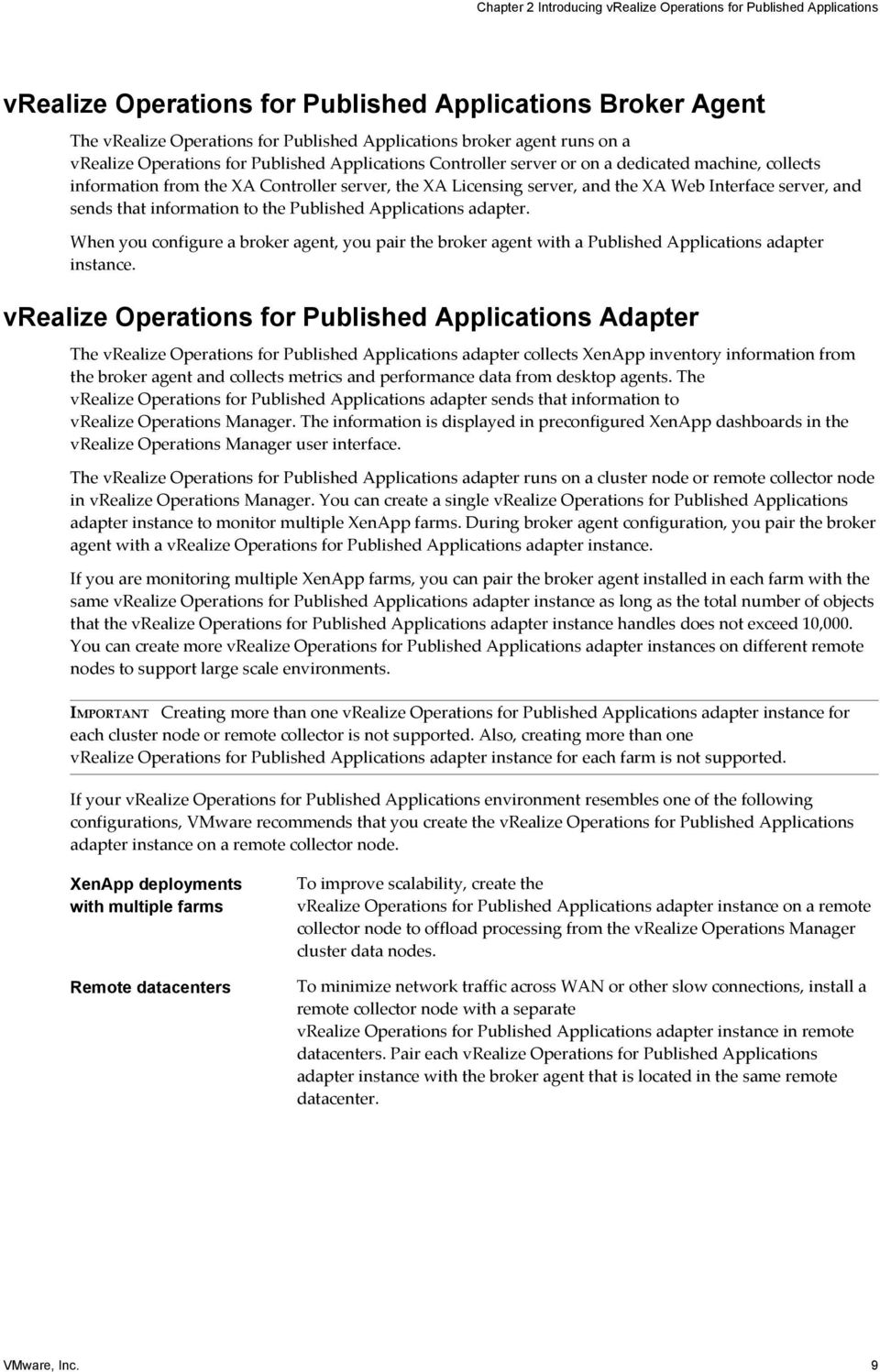
9 Chapter 2 Introducing vrealize Operations for Published Applications vrealize Operations for Published Applications Broker Agent The vrealize Operations for Published Applications broker agent runs on a vrealize Operations for Published Applications Controller server or on a dedicated machine, collects information from the XA Controller server, the XA Licensing server, and the XA Web Interface server, and sends that information to the Published Applications adapter. When you configure a broker agent, you pair the broker agent with a Published Applications adapter instance. vrealize Operations for Published Applications Adapter The vrealize Operations for Published Applications adapter collects XenApp inventory information from the broker agent and collects metrics and performance data from desktop agents. The vrealize Operations for Published Applications adapter sends that information to vrealize Operations Manager. The information is displayed in preconfigured XenApp dashboards in the vrealize Operations Manager user interface. The vrealize Operations for Published Applications adapter runs on a cluster node or remote collector node in vrealize Operations Manager. You can create a single vrealize Operations for Published Applications adapter instance to monitor multiple XenApp farms. During broker agent configuration, you pair the broker agent with a vrealize Operations for Published Applications adapter instance. If you are monitoring multiple XenApp farms, you can pair the broker agent installed in each farm with the same vrealize Operations for Published Applications adapter instance as long as the total number of objects that the vrealize Operations for Published Applications adapter instance handles does not exceed 10,000. You can create more vrealize Operations for Published Applications adapter instances on different remote nodes to support large scale environments. IMPORTANT Creating more than one vrealize Operations for Published Applications adapter instance for each cluster node or remote collector is not supported. Also, creating more than one vrealize Operations for Published Applications adapter instance for each farm is not supported. If your vrealize Operations for Published Applications environment resembles one of the following configurations, VMware recommends that you create the vrealize Operations for Published Applications adapter instance on a remote collector node. XenApp deployments with multiple farms Remote datacenters To improve scalability, create the vrealize Operations for Published Applications adapter instance on a remote collector node to offload processing from the vrealize Operations Manager cluster data nodes. To minimize network traffic across WAN or other slow connections, install a remote collector node with a separate vrealize Operations for Published Applications adapter instance in remote datacenters. Pair each vrealize Operations for Published Applications adapter instance with the broker agent that is located in the same remote datacenter. VMware, Inc. 9
10 VMware vrealize Operations for Published Applications Installation and Administration 10 VMware, Inc.

11 System Requirements for vrealize Operations for Published Applications 3 vrealize Operations for Published Applications has specific system requirements. Verify that your environment meets these system requirements before you install vrealize Operations for Published Applications. This chapter includes the following topics: Product Compatibility for vrealize Operations for Published Applications, on page 11 Software Requirements for vrealize Operations for Published Applications, on page 11 Product Compatibility for vrealize Operations for Published Applications vrealize Operations for Published Applications is compatible with the following products. vcenter Server 5.5 and 6.0 vrealize Operations Manager Citrix XenApp 6.5 Software Requirements for vrealize Operations for Published Applications Each component of vrealize Operations for Published Applications has requirements for the software on the system where it is installed. vrealize Operations for Published Applications Desktop Agent Software Requirements You install the vrealize Operations for Published Applications desktop agent on all Citrix Delivery Controllers and Session Host servers. vrealize Operations for Published Applications Broker Agent Software Requirements You install the vrealize Operations for Published Applications broker agent on the Citrix Delivery Controller. Alternatively, you can install the vrealize Operations for Published Applications broker agent on a separate Windows machine. The vrealize Operations for Published Applications broker agent has the following software requirements. Windows 7, Windows 2008R2, Windows 8, Windows 8.1 VMware, Inc. 11

12 VMware vrealize Operations for Published Applications Installation and Administration Microsoft.Net Framework 3.5 vrealize Operations for Published Applications Adapter Software Requirements You install the vrealize Operations for Published Applications adapter on a vrealize Operations Manager server that is running. The vrealize Operations for Published Applications adapter has the following software requirements. VMware vrealize Operations Manager VMware, Inc.

13 Installing and Configuring vrealize Operations for Published Applications 4 Installing vrealize Operations for Published Applications involves downloading the installation files from the VMware product download page and installing and configuring software components on machines in your vrealize Operations for Published Applications environment. Install and Configure vrealize Operations for Published Applications You install and configure vrealize Operations for Published Applications software components on machines in your Published Applications and vrealize Operations Manager environments. Prerequisites Verify that your environment meets product compatibility, hardware, and software requirements. See Chapter 3, System Requirements for vrealize Operations for Published Applications, on page 11. Verify that vrealize Operations Manager is deployed and running. If you need to upgrade vrealize Operations Manager, perform the upgrade before you install vrealize Operations for Published Applications. Download the vrealize Operations for Published Applications installation files from the product download page. See Downloading the vrealize Operations for Published Applications Installation Files, on page 14. Verify that you have a license key for the vrealize Operations for Published Applications solution. Verify that you have a license key for vrealize Operations Manager. Downloading the vrealize Operations for Published Applications Installation Files on page 14 Registered VMware users can download the vrealize Operations for Published Applications installation files from the product download page. Install the vrealize Operations for Published Applications Solution on page 15 You install the vrealize Operations for Published Applications solution from a PAK file in vrealize Operations Manager. Open the Ports Used by vrealize Operations for Published Applications on page 15 After you install the vrealize Operations for Published Applications adapter, you disable the firewall service and open the default ports. Adding a vrealize Operations for Published Applications License Key on page 16 After you install the vrealize Operations for Published Applications solution, you must add a vrealize Operations for Published Applications license key in the vrealize Operations Manager user interface. vrealize Operations for Published Applications is not functional until it is licensed. VMware, Inc. 13

14 VMware vrealize Operations for Published Applications Installation and Administration Associate Published Applications Objects with Your vrealize Operations for Published Applications License Key on page 17 You must associate Published Applications objects with your vrealize Operations for Published Applications license key by editing license groups in vrealize Operations Manager. Create an Instance of the vrealize Operations for Published Applications Adapter on page 18 After you install the vrealize Operations for Published Applications solution, you must create an instance of the vrealize Operations for Published Applications adapter in vrealize Operations Manager. Enabling Firewall Rules for XA Servers, Web Interface Servers, and License Servers. on page 19 Before you install the broker agent and desktop agent, you must enable specific firewall rules for the XA server, Web Interface server, and License server. Install the vrealize Operations for Published Applications Broker Agent on page 20 You install the vrealize Operations for Published Applications broker agent on a Windows machine. Install a broker agent for each farm in your infrastructure. Configure the vrealize Operations for Published Applications Broker Agent on page 20 After you install the broker agent, you use the Broker Agent Configuration wizard to configure the broker agent on the Windows machine where you installed the broker agent. You can also use the Broker Agent Configuration wizard to make changes to your broker agent configuration. Install a vrealize Operations for Published Applications Desktop Agent on page 22 You install desktop agents on all Citrix Delivery Controllers and Session Host servers. Push the vrealize Operations for Published Applications Desktop Agent Pair Token Using a Group Policy on page 23 To use vrealize Operations for Published Applications to monitor a XenApp Farm, you must create a Group Policy (GPO) to contain the vrealize Operations for Published Applications group policies. You then apply the GPO to the remote desktops that you want to monitor. Downloading the vrealize Operations for Published Applications Installation Files Registered VMware users can download the vrealize Operations for Published Applications installation files from the product download page. Table 4 1. vrealize Operations for Published Applications Installation Files File Name Component Where to Install VMware-vrops-v4paadapter buildnumber.pak VMware-v4pabrokeragent buildnumber.exe VMware-v4pabrokeragentx86_ buildnumber.exe VMware-v4padesktopagentx86_ buildnumber.exe Adapter Broker agent installer for 32-bit Windows OS Broker agent installer for 64-bit Windows OS Desktop agent installer for 64-bit Windows OS vrealize Operations Manager server On XA Controller or on a separate 32- bit Windows machine On XA Controller or on a separate Windows machine On XA Controllers and Session Host servers 14 VMware, Inc.

15 Chapter 4 Installing and Configuring vrealize Operations for Published Applications Install the vrealize Operations for Published Applications Solution You install the vrealize Operations for Published Applications solution from a PAK file in vrealize Operations Manager. Procedure 1 Copy the VMware-vrops-v4paadapter buildnumber.pak file to a temporary folder. 2 Log in to the vrealize Operations Manager user interface with administrator privileges. 3 In the left pane of vrealize Operations Manager, click the Administration tab and click Solutions. 4 On the Solutions tab, click the plus sign. a b Browse to locate the temporary folder and select the PAK file. Click Upload. The upload might take several minutes. c Read and accept the EULA and click Next. Installation details appear in the window during the upload process. d When the installation is complete, click Finish. After the installation is finished, vrealize Operations for Published Applications is listed as a solution. What to do next Provide licensing information for the vrealize Operations for Published Applications solution. See Adding a vrealize Operations for Published Applications License Key, on page 16. Open the Ports Used by vrealize Operations for Published Applications After you install the vrealize Operations for Published Applications adapter, you disable the firewall service and open the default ports. Prerequisites Install the vrealize Operations for Published Applications adapter. Verify that you have root privileges. Procedure 1 Log in to vrealize Operations Manager collector server. 2 Access the command prompt and run the service vmware-vcops-firewall stop to disable the vrealize Operations Manager firewall service. VMware, Inc. 15
16 VMware vrealize Operations for Published Applications Installation and Administration 3 Open the default ports by editing the configuration file. Option Action Linux a Access the vmware-vcops-firewall.conf file in the/opt/vmware/etc/vmware-vcops-firewall.conf directory. b In a text editor, modify the properties for the RMI service ports that you want to change, for example TCPPORTS="$TCPPORTS 3095:3098". Windows a Access Windows Firewall and select Windows Firewall > Advanced Settings > Inbound Rules > New Rule > Port and click Next. b Select Specific local ports and type the ports that you are using, for example The default ports are If you changed the default ports, specify the ports that you are using. 4 Run the vmware-vcops-firewall start command to start the service. If the service vmware-vcops-firewall start command does not enable the ports, start the collector server. What to do next Add a vrealize Operations for Published Applications license key. See Adding a vrealize Operations for Published Applications License Key, on page 16 Adding a vrealize Operations for Published Applications License Key After you install the vrealize Operations for Published Applications solution, you must add a vrealize Operations for Published Applications license key in the vrealize Operations Manager user interface. vrealize Operations for Published Applications is not functional until it is licensed. NOTE You must also add a license key for vrealize Operations Manager. You can have an evaluation license key or a product license key for vrealize Operations for Published Applications. The evaluation license key (eval) provides 60 days of unlimited product use. A product license key is encoded with an expiration date and a license count. To add your vrealize Operations for Published Applications license key, select Administration > Licensing in the vrealize Operations Manager user interface and add your license key to VMware Published Apps Solution on the License Keys tab. For detailed information about adding license keys, see the vrealize Operations Manager Customization and Administration Guide. If your vrealize Operations for Published Applications license key expires, the vrealize Operations for Published Applications adapter stops populating vrealize Operations Manager with data. If you have a valid license key but you exceed the license count, vrealize Operations Manager generates alerts and a watermark appears on certain dashboards. The vrealize Operations for Published Applications adapter does not restrict data when the license count is exceeded. 16 VMware, Inc.

17 Chapter 4 Installing and Configuring vrealize Operations for Published Applications Associate Published Applications Objects with Your vrealize Operations for Published Applications License Key You must associate Published Applications objects with your vrealize Operations for Published Applications license key by editing license groups in vrealize Operations Manager. A license group is a way to gather certain objects, called license group members, under a particular license key. By default, the vrealize Operations Manager and vrealize Operations for Published Applications license groups both include all host, virtual machine, and datastore objects. Because these objects are members of both license groups, they are covered by both your vrealize Operations Manager license and your vrealize Operations for Published Applications license. Each license group includes membership criteria that you can use to filter the objects that are members of the license group. By editing the membership criteria for the vrealize Operations Manager and vrealize Operations for Published Applications license groups, you can specify that certain objects are covered only under your vrealize Operations for Published Applications license key. Prerequisites Add your vrealize Operations for Published Applications license key. See Adding a vrealize Operations for Published Applications License Key, on page 16. Procedure 1 Log in to the vrealize Operations Manager user interface. 2 In the left pane, select Administration > Licensing. 3 Click the License Groups tab. License groups appear in the top pane. The license group for vrealize Operations for Published Applications is called VMware Published Applications Licensing. The license group for vrealize Operations Manager is called Product Licensing. 4 Edit the membership criteria for the VMware Published Application Licensing group. a b c d e f Select VMware Published Applications Licensing and click Edit on the toolbar. Select the vrealize Operations for Published Applications license key under VMware vrealize Operations for Published Applications and click Next. In the first Select the Object Type that matches all of the following criteria drop-down menu, select Host System, define the criteria Relationship, Descendant of, is, and type All Hosts in the Object name text box. In the second Select the Object Type that matches all of the following criteria drop-down menu, select Virtual Machine, define the criteria Relationship, Descendant of, is, and type All Desktop VMs in the Object name text box. In the third Select the Object Type that matches all of the following criteria drop-down menu, select Datastore, define the criteria Relationship, Descendant of, is, and type All Storage in the Object name text box. Click Next and then click Finish to save your configuration. VMware, Inc. 17

18 VMware vrealize Operations for Published Applications Installation and Administration 5 Edit the membership criteria for the Product Licensing group. You must edit the membership criteria for the Product Licensing group to exclude the objects that you included in the VMware Published Application Licensing group. a b c d e f Select Product Licensing and click Edit on the toolbar. Select the vrealize Operations Manager license key under vrealize Operations Manager and click Next. In the first Select the Object Type that matches all of the following criteria drop-down menu, select Host System, define the criteria Relationship, Descendant of, is not, and type All Hosts in the Object name text box. In the second Select the Object Type that matches all of the following criteria drop-down menu, select Virtual Machine, define the criteria Relationship, Descendant of, is not, and type All Desktop VMs in the Object name text box. In the third Select the Object Type that matches all of the following criteria drop-down menu, select Datastore, define the criteria Relationship, Descendant of, is not, and type All Storage in the Object name text box. Click Next and then click Finish to save your configuration. Create an Instance of the vrealize Operations for Published Applications Adapter After you install the vrealize Operations for Published Applications solution, you must create an instance of the vrealize Operations for Published Applications adapter in vrealize Operations Manager. You can create a single vrealize Operations for Published Applications adapter instance to monitor multiple XenApp Farms. If you need to create multiple vrealize Operations for Published Applications adapter instances, you must create each adapter instance on a unique cluster node or remote collector. When you restart a vrealize Operations for Published Applications adapter instance, it takes several minutes before the vrealize Operations for Published Applications desktop agent and broker agent send information to the vrealize Operations for Published Applications adapter. Prerequisites Install the vrealize Operations for Published Applications solution and add your license key. Procedure 1 Log in to the vrealize Operations Manager user interface with administrator privileges. 2 Click the Administration tab and click Solutions. 3 Select VMware Published Application and click the Configure button on the toolbar. 4 Select Published Apps Adapter in the Adapter Type pane. 5 Click the Add (plus sign) icon on the lower pane toolbar to add an adapter instance. 6 In Adapter Settings, type a name and description for the adapter instance. 18 VMware, Inc.
19 Chapter 4 Installing and Configuring vrealize Operations for Published Applications 7 In Basic Settings, configure an adapter ID and credential for the adapter instance. a Type an identifier for the adapter instance in the Adapter ID text box. The identifier must be unique across all vrealize Operations for Published Applications adapter instances in the cluster. b Configure the credential to use when the broker agent pairs with the vrealize Operations for Published Applications adapter instance. Option Use an existing credential Action Select the credential from the Credential drop-down menu. When you create a vrealize Operations for Published Applications adapter instance for the first time, the Credential drop-down menu is empty. Add a new credential 1 Click the Add New (plus sign) icon. 2 Type a name for the credential in the Credential name text box. 3 Type a server key for the adapter instance in the Server Key text box. The server key is required to enable pairing between the broker agent and the adapter. You must provide the server key when you configure the broker agent. 4 Click OK to save the new credential. 5 Select the new credential from the Credential drop-down menu. c Click Test Connection to test the connection with the credential that you selected. 8 In Advanced Settings, select a collector to manage the adapter processes from the Collector drop-down menu. To run the adapter instance on a remote collector, select the remote collector. If you do not have a remote collector, select Automatically select collector. 9 Click Save Settings to save the adapter instance. The adapter instance is added to the list. What to do next Install the vrealize Operations for Published Applications broker agent. See Install the vrealize Operations for Published Applications Broker Agent, on page 20. Enabling Firewall Rules for XA Servers, Web Interface Servers, and License Servers. Before you install the broker agent and desktop agent, you must enable specific firewall rules for the XA server, Web Interface server, and License server. The broker agent cannot communicate with the XA server, Web Interface server, or License server if the firewall is enabled on these servers. Enable the following rules in XA Delivery Controller Servers, XA Session Host Servers, License Server, and Web Interface. Enable Ping in the firewall for all servers using the File and Printer Sharing (Echo Request - ICMPv4-In) rule. Enable Remote WMI in the firewall for all servers using the Windows Management Instrumentation (WMI-In) rule. Enable the following rule in XA Delivery Controller Servers and XA Session Host Servers. Enable Remote Powershell by running the Enable-PSRemoting command in PowerShell command prompt. VMware, Inc. 19
20 VMware vrealize Operations for Published Applications Installation and Administration Install the vrealize Operations for Published Applications Broker Agent You install the vrealize Operations for Published Applications broker agent on a Windows machine. Install a broker agent for each farm in your infrastructure. You only install one broker agent for each XenApp Farm. Prerequisites Install the vrealize Operations for Published Applications solution, add your license key, and create an instance of the vrealize Operations for Published Applications adapter. Verify that you downloaded the broker agent installation file. Verify that you configured the XenApp Controller, Web Interface server, and License server for remote WMI by granting DCOM remote access/activation permissions to the servers. The user name must include the user name that you indicated for the servers. Procedure 1 Log in to the machine where you plan to install the broker agent using a domain account that is part of the local administrators group. 2 Install the broker agent. Option Action Command line a Access the command prompt. b Install the broker agent for your environment using the /s, v, or /qn options. For 32-bit systems run the VMware-v4pabrokeragent buildnumber.exe command. For 64-bit systems run the VMware-v4pabrokeragentx86_ buildnumber.exe command. EXE file a Copy the file for your environment to a temporary folder, and doubleclick the EXE file to start the installation procedure. b For 32-bit systems double-click the VMwarev4pabrokeragent buildnumber.exe file. For 64-bit systems double-click the VMware-v4pabrokeragentx86_ buildnumber.exe file. Follow the steps in the installer. The broker agent is installed and saved to the Program Files folder. What to do next Configure the broker agent. See Configure the vrealize Operations for Published Applications Broker Agent, on page 20. Configure the vrealize Operations for Published Applications Broker Agent After you install the broker agent, you use the Broker Agent Configuration wizard to configure the broker agent on the Windows machine where you installed the broker agent. You can also use the Broker Agent Configuration wizard to make changes to your broker agent configuration. A check box in the Broker Agent Setup wizard controls whether the Broker Agent Configuration wizard opens immediately after you install the broker agent. This check box is selected by default. 20 VMware, Inc.

21 Chapter 4 Installing and Configuring vrealize Operations for Published Applications During broker agent configuration, you pair the broker agent with a vrealize Operations for Published Applications adapter instance. Pairing the broker agent with a vrealize Operations for Published Applications adapter instance is a necessary authentication step that enables the broker agent and desktop agents to communicate with the vrealize Operations for Published Applications adapter. The broker agent and desktop agents cannot communicate with the vrealize Operations for Published Applications adapter until the pairing process is complete. If you are monitoring multiple XenApp Farms, you can pair the broker agent installed in each Farm with the same vrealize Operations for Published Applications adapter instance as long as the total number of desktops that the vrealize Operations for Published Applications adapter instance handles does not exceed 10,000. Each time you restart the broker agent service, a new log file is created. If a log file was created for the day and the broker agent is restarted on that day, a new log file is created. The name of the new log file is v4pa_brokeragent_svc_<date>_00.log, and the log rotation follows this series. Prerequisites Install the vrealize Operations for Published Applications broker agent. See Install the vrealize Operations for Published Applications Broker Agent, on page 20. Verify that you have the server key for the vrealize Operations for Published Applications adapter. You specified the server key when you created a credential for the adapter instance. Verify that you have the IP address or hostname of the machine where you installed the vrealize Operations for Published Applications adapter. If the broker agent is installed on a Windows system outside of the XenApp server environment, verify that you configured remote PowerShell execution for the vrealize Operations for Published Applications broker agent. Procedure 1 If the Broker Agent Configuration wizard is not already open, start it by selecting Start > VMware > vrealize Operations for Published Applications Broker Agent Settings. 2 In the Address text box, type the IP address of the vrealize Operations Manager node or remote collector where the vrealize Operations for Published Applications adapter instance is running. 3 In the Port text box, type the port used to connect to the vrealize Operations for Published Applications adapter. By default, the broker agent uses port 3095 to communicate with the vrealize Operations for Published Applications adapter. You can modify the default port number, depending on your network configuration. 4 Type and confirm the server key for the vrealize Operations for Published Applications adapter. 5 Click Pair to pair the broker agent with the vrealize Operations for Published Applications adapter, and click Test to test the connection. The status of the pairing process appears in the Text area. 6 After the pairing process succeeds, click Next. 7 On the Copy Information page, click Copy to copy the certificate string to the clipboard and click Next. Save this text to copy to the GPO Template. VMware, Inc. 21
22 VMware vrealize Operations for Published Applications Installation and Administration 8 Provide the requested information on the Citrix XenApp Controller Information window. If you installed the broker agent on the XenApp Controller, the XenApp Controller Server Hostname text box is populated with localhost and you can skip to the next step. a b c Type the XenApp Controller Server hostname, domain name, and credentials. Click Test to validate the connection to the XenApp Controller server. Click Next. 9 Provide the Web Interface Server details, and click Ping to verify that the Web Interface Server can be reached through ping.. 10 (Optional) Edit the interval values on the Intervals and Timeouts page, and click Next. 11 (Optional) Configure the logging level and log rotation on the Configure the logging parameters page, and click Next. 12 (Optional) When the Service Configuration window appears, select Start/Restart, and then click Next. 13 Review the configurations and click Finish to apply the configurations. The vrealize Operations for Published Applications broker agent is configured and available. What to do next Verify the status of the vrealize Operations for Published Applications broker agent in the Windows Services Management Console. Review the logs by browsing to the C:\ProgramData\VMware\VMware vrealize Operations for Published Apps\Broker Agent\logs directory. Install a vrealize Operations for Published Applications Desktop Agent You install desktop agents on all Citrix Delivery Controllers and Session Host servers. Prerequisites Verify that you downloaded the desktop agent installation file. Procedure 1 Log in to the machine where you plan to install the desktop agent, using a domain account that is part of the local administrators group. 2 Install the desktop agent. Option Action Command line a Access the command prompt. b Run the VMware-v4padesktopagent-x86_ buildnumber.execommand using the /s, v, or /qnoptions. EXE file a Copy the VMware-v4padesktopagent-x86_ buildnumber.exe file to a temporary folder. b c Double-click the VMware-v4padesktopagent-x86_ buildnumber.exe file. Follow the prompts to complete the installation, and when the installation is complete, click Finish. The desktop agent is installed in Program Files folder. 22 VMware, Inc.
23 Chapter 4 Installing and Configuring vrealize Operations for Published Applications Push the vrealize Operations for Published Applications Desktop Agent Pair Token Using a Group Policy To use vrealize Operations for Published Applications to monitor a XenApp Farm, you must create a Group Policy (GPO) to contain the vrealize Operations for Published Applications group policies. You then apply the GPO to the remote desktops that you want to monitor. You use the Microsoft Group Policy Editor to create the GPO. After you create the GPO, you must apply it to a base image or to an Organizational Unit (OU) on your Active Directory server, depending on your configuration. vrealize Operations for Published Applications group-policy settings are provided in the v4pa_desktopagent.admx file that is installed in the %programfiles%\vmware\vrealize Operations for Published Apps\Broker Agent\extras\GroupPolicyFiles directory. The language-specific resources, for example.adml files, are installed in the %programfiles %\VMware\vRealize Operations for Published Apps\Broker Agent\extras\GroupPolicyFilese\language directory. If there is an Authentication Failure for a desktop agent you must update the GPO policy for desktop agent authentication. When you update the GPO policy for desktop agent authentication, and there are other policies that require updating, all pending policies are updated, not just the GPO policy for desktop agent authentication. Procedure 1 Create an organizational unit (OU) in the domain controller machine. 2 If the XA server was already added to the computer account, move the XA server to the OU. a b Access Active Directory Users Computers, and select Computer, right-click your XA server, and in the context menu select Move... In the Move object into container window, select the OU you created. The XA server is now moved to the OU. 3 Create a Group Policy object using the Group Policy Management Console (GPMC). 4 Copy the certificate string and the RMI URL from the broker agent configuration utility. 5 Copy the v4pa_desktopagent.admx file to PolicyDefinitions folder, which is in the c:\windows\policydefinitions directory. The v4pa_desktopagent.admx file is in the "%ProgramFiles%\VMware\V4PA Broker Agent\Server\extras\GroupPolicyFiles directory. 6 Copy the v4pa_desktopagent.adml file to en-us folder, which is in the c:\windows\policydefinitions\en-us directory. The v4pa_desktopagent.adml file is in the "%ProgramFiles%\VMware\V4PA Broker Agent\Server\extras\GroupPolicyFiles\en_us directory. 7 Set the Group Policy. a b c On the controller machine, click Start and type the gpmc.msc command in the search box. Right-click the GPO that you created and select Edit. Select Computer Configuration > Policies > Administrative Templates > VMware Published Apps Agent Configuration > vrealize Operations, and double-click the item in the right pane. VMware, Inc. 23
24 VMware vrealize Operations for Published Applications Installation and Administration d Select Enable and copy the RMI URL and certificate string in the policy template. You might receive a warning that you exceeded the maximum number of characters per line. e (Optional) Break the line by pressing Enter, and click Apply, and then click OK. 8 Verify on the XA server machine that the RMI URL and certificate string in the HKLM\Software\Policies\VMware, Inc.\vRealize operations for published Apps\Desktop Agent directory. What to do next Install desktop agent on the XA server. If you already installed a desktop agent and planned to push through GPO at later stage, there might be exceptions in the desktop agent log files. After the pair token is pushed using the GPO, you should restart the desktop agent service. 24 VMware, Inc.
25 Monitoring Your Citrix XenApp 5 Environment When you install the vrealize Operations for Published Applications solution, preconfigured dashboards and predefined report templates appear in the vrealize Operations Manager user interface. You can use these Citrix XenApp-specific dashboards and reports along with the standard vrealize Operations Manager object monitoring features to monitor your Citrix XenApp environment. This chapter includes the following topics: Using the Citrix XenApp Dashboards, on page 25 Using the XA Reports, on page 29 Using the Citrix XenApp Dashboards The Citrix XenApp dashboards are in the XA group in the Dashboard List menu in the vrealize Operations Manager user interface. Widget Interaction in Citrix XenApp Dashboards vrealize Operations Manager supports interaction between widgets in a single dashboard. Widgets are combined so that the content of the destination widget is updated according to the value selected in the source widget. For information about creating and modifying dashboards and customizing widgets see vrealize Operations Manager Customization and Administration Guide. Table 5 1. Widget Interaction in Citrix XenApp Dashboards Dashboard Source Widget Destination Widget XA Overview Farms Farm Indicator Metrics XA Overview Adapter Health Adapter Health Metrics XA Infrastructure Web Interface Servers Web Interface Server Indicator Metrics XA Infrastructure Licensing Servers License Usage XA Servers Session-host Servers Virtual Machine of Session-host Server XA Servers Session-host Servers Session-host Server Resource Utilization XA Servers Session-host Servers Session-host Server Indicator Metrics XA Servers Controller Servers Virtual Machine of Controller Server XA Servers Controller Servers Controller Server Indicator Metrics XA Servers Controller Servers Controller Server Resource Utilization XA Session Detail Sessions Application Session Indicator Metrics VMware, Inc. 25
26 VMware vrealize Operations for Published Applications Installation and Administration Table 5 1. Widget Interaction in Citrix XenApp Dashboards (Continued) Dashboard Source Widget Destination Widget XA Session Detail Sessions Session Resource Utilization XA Session Detail Session-host Servers Server Session Statistics XA Session Detail Session-host Servers Server Session Trend XA Servers Detail Farms Farm Session Statistics XA Servers Detail Farms Farm Session Trend XA Applications Session-host Servers Server Indicator Metrics XA Applications Session-host Servers Application Instances XA Applications Application Instances Application Instances Indicator Metrics XA Applications Application Instances Application Instance XA Applications Application Instances Application Instance Metrics XA Application Usage Farms Application Launch Time XA Application Usage Farms Applications XA Application Usage Applications Application Sessions XA Application Usage Applications Application Indicator Metrics XA Application Usage Applications Application User Statistics Introducing the Citrix XenApp Dashboards You can use the preconfigured Citrix XenApp dashboards to monitor the performance of your Citrix XenApp environment. Table 5 2. Citrix XenApp Dashboard Summary View Dashboard What It Shows When To Use It XA Overview Dashboard, on page 27 XA Infrastrucure Dashboard, on page 28 XA Servers Dashboard, on page 28 XA Session Detail Dashboard, on page 28 XA Applications Dashboard, on page 29 XA Application Usage Dashboard, on page 29 Status of your end-to-end XA environment, including the XA-related alerts, key Farm metrics, Adapter health metrics. Web interface server metrics, license usage, and information about XA infrastructure servers. Session-host server metrics and related vsphere VMs, controller-server metrics and related vsphere VMs. Session metrics, session related statistics across session-host servers, farm session metrics Applications published on each server and related session-host workload and performance, application instance metrics. Application alerts, application launch time across farms, application sessions, application launch users. Assess overall XA performance, and the overall user experience. View the top XA-related alerts. Assess workload and performance of the Web interface server. View detailed license usage information on specific licensing servers. Assess workload and performance of servers. View metrics for related vsphere VMs. Troubleshoot session and server issues reported by users. Identify and troubleshoot application issues reported by users. View the workload, historical usage, and average launch time of applications. 26 VMware, Inc.
27 Chapter 5 Monitoring Your Citrix XenApp Environment Understanding the Health Badge The health badge indicates immediate issues that might require your attention. It helps you identify the current health of your system. vrealize Operations Manager combines workload, anomalies, and faults to assess the overall health of your system and to determine the expected workload level in that environment. A low health score might indicate a potential issue. The health badge is enabled on vrealize Operations for Published Applications objects. Table 5 3. Understanding the Health Badge Object XA Application Instance XA Session-host Server XA Controller Server XA Farm XA Application Session XA Broker Collector Description Calculated using the Application Performance Problem alert. This alert is triggered when the application instance's CPU processor time is too high. Calculated using the Session-host Server Performance Problem alert and the Not receiving data from the Desktop Agent fault. The Session-host Server Performance Problem alert is triggered when a session-host server's CPU processor time is too high or the available memory is too low. Calculated using the Controller Server Performance Problem alert. This alert is triggered when a controller server's CPU processor time is too high or the available memory is too low. Calculated using the Farm Performance Problem alert. This alert is triggered when one or more session-host servers or controller servers of this farm have performance problems. Calculated using the Application Session Network Problem alert and the Application Session Performance Problem alert. The Application Session Network Problem alert is triggered when the session's latency it too high. The Application Session Performance Problem alert is triggered when the session's CPU usage is too high. Calculated using the Not receiving data from the Broker Agent fault. XA Overview Dashboard The XA Overview dashboard shows the overall status of your Citrix XenApp environment. Use the XA Overview dashboard to visualize the end-to-end Citrix XenApp environment, farm session metrics, adapter metrics, and alerts. The XenApp Top Alerts widget shows the alerts of the greatest significance for XenApp objects. Tips for Using the XA Overview Dashboard Click an alert in the Top Alerts widget to open the alert details. To view the overall status of a Farm, view the values of the Farm Session Metrics and Farm Capacity Metrics widgets. To view the overall status of an Adapter, view the values of the Adapter Health and Adapter Health Metrics widgets. VMware, Inc. 27
28 VMware vrealize Operations for Published Applications Installation and Administration XA Infrastrucure Dashboard The XA Infrastructure dashboard shows the overall status of XA infrastructure servers. Use the XA Infrastructure dashboard to visualize and assess the performance of Web Interface servers and license usage information for licensing servers. When you select a server in the Web Interface Servers widget, the Web Interface Server Indicator Metrics widget shows data for the server you selected. When you select a server in the Licensing Servers widget, the Licensing Usage widget shows data for the server you selected. Tips for Using the XA Infrastructure Dashboard Use the Web Interface Server Indicator Metrics widget to view the percentage for processor time, privileged time, and user time for the CPU of the server you selected. Use the Licensing Servers widget to view specific license information and collection information for the server you selected. XA Servers Dashboard Use the XA Servers dashboard to assess the health and resource utilization of servers, and the metrics of related vsphere virtual machines. Tips for using the XA Servers Dashboard Use the Virtual Machine of Session-host Server widget to view the badge health and badge workload for the VM of the session-host server. Use the Virtual Machine of Controller Server widget to view badge health and badge workload for the VM of the controller server. Use the Session-host Server Indicator Metrics widget to view the health, workload, number of application sessions, ICA session latency, ICA session input bandwidth, and ICA session output bandwidth for the session-host server. XA Session Detail Dashboard Use the XA Session Detail dashboard to view detailed information about Farm sessions, application sessions, and server sessions. You can use the widgets in the XA Session Detail dashboard to troubleshoot session and server issues that users report, for example, an application is running slowly. Tips for Using the XA Session Detail Dashboard Use the Application Session Indicator Metrics widget to view session health, reconnect duration, logon duration, profile load duration, session duration and session state. Use the Session Resource Utilization widget to view CPU processor time, disk reads per second, disk writes per second, bytes received per second, bytes sent per second, and used memory. Use the Server Session Trend widget to view the number of application sessions during a specific time range at a set time interval. You can customize the time range and the time interval. Use the Server Farm Trend widget to view the number of total sessions during a specific time range at a set time interval. You can customize the time range and the time interval. 28 VMware, Inc.
29 Chapter 5 Monitoring Your Citrix XenApp Environment If there is a Desktop Agent Data Fault alert for all Session-host servers, verify the following configurations. Verify that you configured the GPO policy correctly. See Push the vrealize Operations for Published Applications Desktop Agent Pair Token Using a Group Policy, on page 23 Verify that you configured the broker agent successfully. See Configure the vrealize Operations for Published Applications Broker Agent, on page 20 Verify that the desktops agents started successfully. XA Applications Dashboard Use the XA Applications dashboard to view the overall health and performance of XenApp applications. Tips for Using the XA Applications Dashboard Select a server to view the server metrics in the Server Indicator Metrics widget. Select an application instance to view application instance metrics in the Application Instance Indicator Metrics widget. Use the Application Instance Metrics widget to view CPU processor time, disk reads per second, disk writer per second, IO read operations per second, IO write operations per second, IO other operations per second, memory pages faults per second, and used memory. XA Application Usage Dashboard Use the XA Application Usage dashboard to view the workload, historical use, and average launch time for applications. The All Application Alert List widget shows the alerts of the greatest significance for applications. When you select an application in the All Application Alert List widget, the Applications Sessions, Application Indicator Metrics, and Application User Statistics widgets show data for the application that you selected. Tips for Using the XA Application Usage Dashboard Click an alert in the All Application Alert List widget to open the alert details. Click the name of an application in the Application Launch Time widget to view the health, health alerts, risk, risk alerts, efficiency and efficiency alerts for the application. Click the green arrow icon in the Application User Statistics widget to export the application user data, for example user and application launch time, to a CSV file. Using the XA Reports VMware vrealize Operations Manager has several report templates that you can generate for detailed information about applications, farms, license usage, and servers. You can also create new report templates, edit existing report templates, and clone report templates. To access the vrealize Operations for Published Applications report templates, select Content > Report in vrealize Operations Manager. VMware, Inc. 29
30 VMware vrealize Operations for Published Applications Installation and Administration Introducing the XA Reports The predefined report templates provide detailed information about your XenApp environment. You can generate the report as a PDF or CSV file. Table 5 4. Summary of XA Reports Template Name Published Apps Application Report Published Apps Server Report Published Apps Farm Overview Report Published Apps License Trend Report Published Apps License Usage Report Report Content Includes information about your applications. Includes overall information about your servers. Includes summary information about your farms. The Published Apps Server Summary section displays the average number of sessions. The average might appear as a fraction, for example, sessions. The number of current applications sessions for a server is calculated every five minutes and recorded in vrealize Operations Manager. The average number of sessions is the average of current applications sessions for this server over the last 30 day period. If the time period is less than 30 days, the average number session is the average of current applications sessions for this server recorded in vrealize Operations Manager at the time that you generate the report. Includes information about the trend of Citrix XenApp license usage. Includes information about all Citrix XenApp license usage on your licensing server. Subjects for Reports When you configure reports, vrealize Operations Manager generates the report subjects according to your configurations. To ensure the best possible reports, use the following report subjects. Table 5 5. Subjects for Reports Report Published Apps Farm Overview Report Published Apps Server Report Published Apps Application Report Published Apps License Usage Report Published Apps License Trend Report Subject XA Farm XA Session-host Server and XA Controller Server XA Application, XA Farm XA Licensing Server XA License Subjects for Report Views When you configure the views for a report, vrealize Operations Manager generates the views according to your configurations. To ensure the best possible report views, use the following view subjects. 30 VMware, Inc.
31 Chapter 5 Monitoring Your Citrix XenApp Environment Table 5 6. Subjects for Report Views Report View Published Apps Application Daily User Count Trend Published Apps Application Instance Count Trend Published Apps Application Resource Utilization Published Apps Application Summary Published Apps Farm App Instance Trend Published Apps Farm Session Count Trend Published Apps Farm Session Trend Published Apps Farm Summary Published Apps License Usage Summary Published Apps License Usage Trend Published Apps Most Used Applications Published Apps Most Utilized Servers Published Apps Server CPU Trend Published Apps Server Disk Trend Published Apps Server ICA Bandwidth Trend Published Apps Server Memory Trend Published Apps Server Network Trend Published Apps Server Session Count Trend Published Apps Server Summary Published Apps Session ICA Bandwidth Trend Published Apps Session ICA Latency Trend Published Apps Session Statistics Subject XA Application XA Application XA Application XA Application, XA Farm XA Farm XA Farm XA Farm XA Farm XA Licensing Server XA License XA Farm XA Farm XA Session-host Server, XA Controller Server XA Session-host Server, XA Controller Server XA Session-host Server XA Session-host Server, XA Controller Server XA Session-host Server, XA Controller Server XA Session-host Server XA Session-host Server, XA Controller Server, XA Farm XA Application Session XA Application Session XA Session-host Server, XA Farm VMware, Inc. 31
32 VMware vrealize Operations for Published Applications Installation and Administration 32 VMware, Inc.
33 Managing RMI Communication in vrealize Operations for Published Applications 6 The vrealize Operations for Published Applications components communicate by using Remote Method Invocation (RMI). The vrealize Operations for Published Applications adapter exposes RMI services that can be called by an external client. The vrealize Operations for Published Applications adapter acts as a server and the broker agents and desktop agents act as clients. You can change the default ports for these RMI services. For detailed descriptions of the vrealize Operations for Published Applications components, see vrealize Operations for Published Applications Architecture, on page 8. This chapter includes the following topics: RMI Services, on page 33 Default Ports for RMI Services, on page 34 Changing the Default RMI Service Ports, on page 34 RMI Services The vrealize Operations for Published Applications adapter exposes various RMI service. RMI registry service Desktop message server Broker message server Certificate management server The broker and desktop agents initially connect to the RMI registry service and request the address of a specific RMI server. Because the RMI registry service is used only for lookup and no sensitive data is transmitted to it, it does not use an encrypted channel. The desktop agents connect to the desktop message server and use it to send Published Applications performance data collected by the desktop agent. The desktop message server uses an SSL/TLS channel to encrypt the data that is sent from the desktop agents. The broker agent connects to the broker message server and uses it for sending Published Applications inventory information to the vrealize Operations for Published Applications adapter. The broker message server uses an SSL/TLS channel to encrypt the data that is sent from the broker agent. The broker agent connects to the certificate management server during the certificate pairing process. The certificate management server does not use an encrypted channel. Certificates are encrypted by using the server key during the certificate pairing process. For information, see Chapter 11, Certificate Pairing, on page 49. VMware, Inc. 33
34 VMware vrealize Operations for Published Applications Installation and Administration Default Ports for RMI Services The RMI services use certain default ports. The default ports are left open on the firewall on cluster nodes and remote collector nodes. Table 6 1. Default Ports for RMI Services RMI Service Default Port RMI registry 3095 Desktop message server 3096 Broker message server 3097 Certificate management server 3098 Changing the Default RMI Service Ports You can change the default ports for the RMI registry service, desktop message server, broker message server, and certificate management server. RMI Service Port Properties The RMI service ports are defined in properties in the msgserver.properties file on the server where the vrealize Operations for Published Applications adapter is running. Table 6 2. RMI Service Port Properties RMI Service RMI registry Desktop message server Broker message server Certificate management server Property registry-port desktop-port broker-port certificate-port Change the Default RMI Service Ports You can change the default RMI service ports by modifying the msgserver.properties file on the server where the vrealize Operations for Published Applications adapter is running. Prerequisites Verify that you can connect to the node where the vrealize Operations for Published Applications adapter is running. Become familiar with the RMI service port properties. See RMI Service Port Properties, on page 34. Procedure 1 Log in to the node where the vrealize Operations for Published Applications adapter is running. 34 VMware, Inc.
35 Chapter 6 Managing RMI Communication in vrealize Operations for Published Applications 2 In a text editor, open the msgserver.properties file. Platform Linux Windows File Location /usr/lib/vmwarevcops/user/plugins/inbound/v4pa_adapter3/work/msgserver.pro perties C:\vmware\vcenteroperations\user\plugins\inbound\V4PA_adapter3\work\msgserve r.properties 3 Modify the properties for the RMI service ports that you want to change. 4 Save your changes and close the msgserver.properties file. What to do next Open the new RMI service port or ports on the vrealize Operations Manager firewall. See Open the Ports Used by vrealize Operations for Published Applications, on page 15. Update the vrealize Operations Manager Firewall If you change the default port for an RMI service, you must open the new port on the vrealize Operations Manager firewall. NOTE If the vrealize Operations for Published Applications adapter is running on a remote collector, see the documentation for the firewall on the remote collector node for information about updating the firewall. Procedure 1 On the cluster node where the vrealize Operations for Published Applications adapter is running, use a text editor to open the vmware-vcops-firewall.conf file. The vmware-vcops-firewall.conf file is in the /opt/vmware/etc/ directory. 2 Update the appropriate ports in the vmware-vcops-firewall.conf file and save the file. 3 Restart the firewall service to make your changes take effect. a Execute service vmware-vcops-firewall restart. VMware, Inc. 35
36 VMware vrealize Operations for Published Applications Installation and Administration 36 VMware, Inc.
37 Changing the Default SSL/TLS Configuration in vrealize Operations for Published Applications 7 The vrealize Operations for Published Applications broker message server uses an SSL/TLS channel to communicate with the broker agents. The vrealize Operations for Published Applications desktop message server uses an SSL/TLS channel to communicate with the desktop agents. You can change the default SSL/TLS configuration for servers and agents by modifying SSL/TLS configuration properties. This chapter includes the following topics: Default SSL Protocols and Ciphers for vrealize Operations for Published Applications, on page 37 SSL/TLS Configuration Properties, on page 38 Change the Default SSL/TLS Configuration for Servers, on page 38 Change the Default SSL/TLS for Agents, on page 39 Default SSL Protocols and Ciphers for vrealize Operations for Published Applications When an RMI connection is established between an agent and a server, the agent and server negotiate the protocol and cipher to use Each agent and server has a list of protocols and ciphers that it supports. The strongest protocol and cipher that is common to both the agent list and server list is selected for the SSL/TLS channel. By default, RMI agents and servers are configured to accept only TLSv1 connections with the following ciphers. TLS_DHE_RSA_WITH_AES_128_GCM_SHA256 TLS_DHE_RSA_WITH_AES_256_GCM_SHA384 TLS_ECDHE_RSA_WITH_AES_128_GCM_SHA256 TLS_ECDHE_RSA_WITH_AES_256_GCM_SHA384 TLS_ECDHE_RSA_WITH_AES_256_CBC_SHA TLS_ECDHE_ECDSA_WITH_AES_256_CBC_SHA TLS_ECDH_ECDSA_WITH_AES_256_CBC_SHA TLS_ECDH_RSA_WITH_AES_256_CBC_SHA TLS_DHE_RSA_WITH_AES_256_CBC_SHA TLS_DHE_DSS_WITH_AES_256_CBC_SHA TLS_DH_DSS_WITH_AES_256_CBC_SHA TLS_DH_RSA_WITH_AES_256_CBC_SHA VMware, Inc. 37
38 VMware vrealize Operations for Published Applications Installation and Administration TLS_RSA_WITH_AES_256_CBC_SHA TLS_DHE_RSA_WITH_AES_128_CBC_SHA TLS_RSA_WITH_AES_128_CBC_SHA TLS_DHE_DSS_WITH_AES_128_CBC_SHA TLS_DH_RSA_WITH_AES_128_CBC_SHA TLS_DH_DSS_WITH_AES_128_CBC_SHA TLS_RSA_WITH_3DES_EDE_CBC_SHA SSL/TLS Configuration Properties The SSL/TLS protocols and ciphers for the desktop and broker message servers are specified in properties in the msgserver.properties file. The SSL/TLS protocols and ciphers for the desktop and broker agents are specified in properties in the msgclient.properties file. Table 7 1. SSL/TLS Configuration Properties Property sslprotocols sslciphers List of accepted SSL/TLS protocols, separated by commas. List of accepted SSL/TLS ciphers, separated by commas. Default Value TLSv1 TLS_DHE_RSA_WITH_AES_128_CBC_SHA, TLS_RSA_WITH_AES_128_CBC_SHA, TLS_DHE_DSS_WITH_AES_128_CBC_SHA Change the Default SSL/TLS Configuration for Servers You can change the default SSL/TLS configuration that the desktop message server and broker message server use by modifying the msgserver.properties file on the server where the vrealize Operations for Published Applications adapter is running. Prerequisites Verify that you can connect to the node where the vrealize Operations for Published Applications adapter is running. Become familiar with the SSL/TLS configuration properties. See SSL/TLS Configuration Properties, on page 38. Procedure 1 Log in to the node where the vrealize Operations for Published Applications adapter is running. 2 In a text editor, open the msgserver.properties file. Platform Linux Windows File Location /usr/lib/vmwarevcops/user/plugins/inbound/v4pa_adapter3/work/msgserver.pro perties C:\vmware\vcenteroperations\user\plugins\inbound\V4PA_adapter3\work\msgserve r.properties 3 Modify the SSL/TLS configuration properties. 4 Save your changes and close the msgserver.properties file. 38 VMware, Inc.
39 Chapter 7 Changing the Default SSL/TLS Configuration in vrealize Operations for Published Applications Change the Default SSL/TLS for Agents You can change the SSL/TLS configuration that the desktop agents and broker agents use to connect to the desktop and broker message servers by modifying the msgclient.properties file. Prerequisites For the desktop agents, verify that you can connect to the remote Published Applications server. For a broker agent, verify that you can connect to the host where the Published Applications broker agent is installed. Become familiar with the SSL/TLS configuration properties. See SSL/TLS Configuration Properties, on page 38. Procedure 1 Modify the SSL/TLS configuration properties for a desktop agent. a b Log in to the Published Applications server where the Published Applications agent is running. In a text editor, open the msgclient.properties file. The msgclient.properties file is in the C:\ProgramData\VMware\vRealize Operations for Published Apps\Desktop Agent\conf directory. c d Modify the SSL/TLS configuration properties. Save your changes and close the msgclient.properties file. 2 Modify the SSL/TLS configuration properties for a broker agent. a b Log in to the remote collector host where the broker agent is installed. In a text editor, open the msgclient.properties file. The msgclient.properties file is in the C:\ProgramData\VMware\vRealize Operations for Published Apps\Broker Agent\conf directory. c d Modify the SSL/TLS configuration properties. Save your changes and close the msgclient.properties file. VMware, Inc. 39
40 VMware vrealize Operations for Published Applications Installation and Administration 40 VMware, Inc.
41 Managing Authentication in vrealize Operations for Published Applications 8 RMI servers provide a certificate that the agents use to authenticate the vrealize Operations for Published Applications adapter. Broker agents use SSL/TLS client authentication with a certificate that the vrealize Operations for Published Applications adapter uses to authenticate the broker agents. Desktop agents provide tokens that the vrealize Operations for Published Applications adapter uses to authenticate the desktop agents. To increase security, you can replace the default self-signed certificates that the vrealize Operations for Published Applications adapter and broker agents use. Understanding Authentication for Each Component Each vrealize Operations for Published Applications component handles authentication differently. vrealize Operations for Published Applications Adapter Authentication When an RMI connection is established between the desktop message server and a desktop agent, or between the broker message server and a broker agent, the agent requests a certificate from the server to perform authentication. This certificate is validated against the agent's trust store before proceeding with the connection. If the server does not provide a certificate, or the server certificate cannot be validated, the connection is rejected. When the vrealize Operations for Published Applications adapter is first installed, a self-signed certificate is generated. The desktop message server and broker message server use this self-signed certificate by default to authenticate to their agents. Because this certificate is generated dynamically, you must manually pair the vrealize Operations for Published Applications adapter and broker agent before the agents can communicate with the vrealize Operations for Published Applications adapter. See Chapter 11, Certificate Pairing, on page 49. Desktop Agent Authentication Connections to the desktop message server require an authentication token to verify that the connection is coming from a valid desktop agent. The desktop agent generates a unique authentication token for each remote desktop. In addition, the desktop agent generates a serverid for the Published Applications server and write the serverid into vrealize Operations Manager. When a desktop agent attempts to send data to the vrealize Operations for Published Applications adapter, the adapter will verify whether the authentication token has been cached in memory. If there is no server with same name, the adapter caches the server name and authentication token in memory. If the server has been cached, compare the cached authentication token and the one sent. If the tokens are same, accept the message, else reject the desktop agent message. VMware, Inc. 41
42 VMware vrealize Operations for Published Applications Installation and Administration The vrealize Operations for Published Applications adapter also checks whether a VM with same serverid exists in vrealize Operations Manager, and adds the VM into the topology when a VM with the same name exists. Broker Agent Authentication When an RMI connection is established to the broker message server, the broker message server requests a certificate from the client to perform client authentication. The certificate is validated against the trust store for the vrealize Operations for Published Applications adapter before proceeding with the connection. If the client does not provide a certificate, or the agent's certificate cannot be validated, the connection is rejected. When you first install the broker agent, a self-signed certificate is generated. The broker agent uses this self-signed certificate by default to authenticate to the vrealize Operations for Published Applications adapter. Because this certificate is generated dynamically, you must manually pair the vrealize Operations for Published Applications adapter and broker agent before the broker agent can communicate with the vrealize Operations for Published Applications adapter. For more information, see Chapter 11, Certificate Pairing, on page VMware, Inc.
43 Certificate and Trust Store Files 9 The vrealize Operations for Published Applications components use a certificate trust store to store trusted certificates and root certificates for certificate authorities. Certificates and trust stores are stored in Java key store format. This chapter includes the following topics: vrealize Operations for Published Applications Adapter Certificate and Trust Store Files, on page 43 Broker Agent Certificate and Trust Store Files, on page 44 vrealize Operations for Published Applications Adapter Certificate and Trust Store Files The certificate and trust store files for the vrealize Operations for Published Applications adapter are in the adapter's work directory. These files are in Java key store format. The work directory is on the node where the vrealize Operations for Published Applications adapter is installed. On Linux, the path to the work directory is /usr/lib/vmwarevcops/user/plugins/inbound/v4pa_adapter3/. On Windows, the path to the work directory is C:\vmware\vcenteroperations\user\plugins\inbound\V4PA_adapter3\. You can use the Java keytool utility to view and control the certificate store and trust store files. Table 9 1. Java Key Stores in the work Directory Java Key Store v4pa-adapter.jks v4pa-truststore.jks Description Contains the certificate that the adapter uses to authenticate itself to agents. Contains the trust store that the adapter uses to authenticate the broker agent certificate. The names of the key store files and their credentials are defined in the msgserver.properties file, which is also in the work directory. Table 9 2. Adapter Key Store Configuration Properties in the msgserver.properties File Property Default Value Description keyfile v4pa-adapter.jks Name of the key store file that contains the adapter certificate. keypass Password to the key store file that contains the adapter certificate. The password is dynamically generated. VMware, Inc. 43
44 VMware vrealize Operations for Published Applications Installation and Administration Table 9 2. Adapter Key Store Configuration Properties in the msgserver.properties File (Continued) Property Default Value Description trustfile v4pa-truststore.jks Name of the key store file that contains the adapter trust store. trustpass Password to the key store file that contains the adapter trust store. The password is dynamically generated. Broker Agent Certificate and Trust Store Files The broker agent certificate and trust store files are in the C:\ProgramData\VMware\vRealize Operations for Published Apps\Broker Agent\conf directory on the vrealize Operations for Published Applications broker server host. These files are Java key store files. You can use the Java keytool utility to view and control the certificate store and trust store files. Table 9 3. Java Key Stores in the conf Directory Java Key Store v4pa-brokeragent.jks v4pa-truststore.jks Description Contains the certificate that the broker agent uses to authenticate itself to the vrealize Operations for Published Applications adapter. Contains the trust store that the broker agent uses to authenticate the vrealize Operations for Published Applications adapter certificate. The names of the key store files and their credentials are defined in the msgclient.properties file, which is also in the conf directory. Table 9 4. Broker Agent Key Store Configuration Properties in the msgclient.properties File Property Default Value Description keyfile v4pa-brokeragent.jks The name of the key store file that contains the broker agent's certificate. keypass The password to the key store file that contains the broker agent's certificate. The password is dynamically generated. trustfile v4pa-truststore.jks The name of the key store file that contains the broker agent's trust store. trustpass The password to the key store file that contains the broker agent's trust store. The password is dynamically generated. 44 VMware, Inc.
45 Replacing the Default Certificates 10 By default, the vrealize Operations for Published Applications adapter and the broker agent use self-signed certificates for authentication and data encryption. For increased security, you can replace the default selfsigned certificates with certificates that are signed by a certificate authority. This chapter includes the following topics: Replace the Default Certificate for the vrealize Operations for Published Applications Adapter, on page 45 Replace the Default Certificate for the Broker Agent, on page 47 Replace the Default Certificate for the vrealize Operations for Published Applications Adapter A self-signed certificate is generated when you first install the vrealize Operations for Published Applications adapter. The desktop message server and the broker message server use this certificate by default to authenticate to the agents. You can replace the self-signed certificate with a certificate that is signed by a valid certificate authority. Prerequisites Verify that you can connect to the node where the vrealize Operations for Published Applications adapter is running. Verify that you have the password for certificate store. You can obtain the password from the msgserver.properties file. See vrealize Operations for Published Applications Adapter Certificate and Trust Store Files, on page 43. Become familiar with the Java keytool utility. Documentation is available at Procedure 1 Log in to the node where the vrealize Operations for Published Applications adapter is running. 2 Navigate to the vrealize Operations for Published Applications adapter's work directory. Platform Linux Windows Directory Location /usr/lib/vmwarevcops/user/plugins/inbound/v4pa_adapter3/work C:\vmware\vcenteroperations\user\plugins\inbound\V4PA_adapt er3\work VMware, Inc. 45
46 VMware vrealize Operations for Published Applications Installation and Administration 3 Use the keytool utility with the -selfcert option to generate a new self-signed certificate for the vrealize Operations for Published Applications adapter. Because the default self-signed certificate is issued to VMware, you must generate a new self-signed certificate before you can request a signed certificate. The signed certificate must be issued to your organization. For example: keytool selfcert alias v4pa-adapter dname dn-of-org keystore v4pa-adapter.jks dn-of-org is the distinguished name of the organization to which the certificate is issued, for example, "OU=Management Platform, O=VMware, Inc., C=US". By default, the certificate signature uses the SHA1withRSA algorithm. You can override this default by specifying the name of the algorithm with the -sigalg option. 4 Use the keytool utility with the -certreq option from the adapter work directory to generate a certificate signing request. A certificate signing request is required to request a certificate from a certificate signing authority. For example: keytool certreq alias v4pa-adapter file certificate-request-file -keystore v4paadapter.jks certificate-request-file is the name of the file that will contain the certificate signing request. 5 Upload the certificate signing request to a certificate authority and request a signed certificate. If the certificate authority requests a password for the certificate private key, use the password configured for the certificate store. The certificate authority returns a signed certificate. 6 To import the certificate, copy the certificate file to the vrealize Operations for Published Applications adapter work directory and run the keytool utility with the import option. For example: keytool import alias v4pa-adapter file certificate-filename -keystore v4pa-adapter.jks certificate-filename is the name of the certificate file from the certificate authority. When the keytool utility is finished, the signed certificate is imported to the adapter certificate store. 7 To start using the new certificate, restart the vrealize Operations for Published Applications adapter on the node where the adapter is running. Platform Linux Windows Action Run the service vmware-vcops restart command. Use the Windows Services tool (services.msc) to restart the vrealize Operations for Published Applications Adapter service. What to do next After you restart the vrealize Operations for Published Applications adapter, you must pair any broker agents that are attached to the vrealize Operations for Published Applications adapter. See Chapter 11, Certificate Pairing, on page VMware, Inc.
47 Chapter 10 Replacing the Default Certificates Replace the Default Certificate for the Broker Agent A self-signed certificate is generated when you first install the broker agent. The broker agent uses this certificate by default to authenticate to the vrealize Operations for Published Applications adapter. You can replace the self-signed certificate with a certificate that is signed by a valid certificate authority. Prerequisites Verify that you can connect to the Published Applications Session host where the broker agent is installed. Verify that the keytool utility is added to the system path on the data collector host where the broker agent is installed. Verify that you have the password for the certificate store. You can obtain this password from the msgserver.properties file. See Broker Agent Certificate and Trust Store Files, on page 44. Become familiar with the Java keytool utility. Documentation is available at Procedure 1 Log in to the vrealize Operations for Published Applications Server host where the broker agent is installed. 2 Use the keytool utility with the -selfcert to generate a new self-signed certificate. Because the default self-signed certificate is issued to VMware, you must generate a new self-signed certificate before you request a signed certificate. The signed certificate must be issued to your organization. For example: keytool selfcert alias v4pa-brokeragent dname dn-of-org keystore v4pa-brokeragent.jks dn-of-org is the distinguished name of the organization to which the certificate is issued, for example, "OU=Management Platform, O=VMware, Inc., C=US". By default, the certificate signature uses the SHA1withRSA algorithm. You can override this default by specifying the name of the algorithm in the keytool utility. 3 Use the keytool utility with the -certreq option to generate the certificate signing request. A certificate signing request is required to request a certificate from a certificate signing authority. For example: keytool certreq alias v4pa-brokeragent file certificate-request-file -keystore v4pabrokeragent.jks certificate-request-file is the name of the file that will contain the certificate signing request. 4 Upload the certificate signing request to a certificate authority and request a signed certificate. If the certificate authority requests a password for the certificate private key, use the password configured for the certificate store. The certificate authority returns a signed certificate. VMware, Inc. 47
48 VMware vrealize Operations for Published Applications Installation and Administration 5 Copy the certificate file to the conf directory and run the keytool utility with the -import option to import the signed certificate into the certificate store for the broker agent. You must import the certificate file to the certificate store for the broker agent so that the broker agent can start using the signed certificate. For example: keytool import alias v4pa-brokeragent file certificate-filename -keystore v4pabrokeragent.jks certificate-filename is the name of the certificate file from the certificate authority. 6 Run the keytool utility with the -import option to import the certificate authority root certificate into the trust store file for the broker agent. For example: keytool -import -alias aliasname -file root_certificate -keystore v4pa-truststore.jks - trustcacerts root_certificate is the name of the certificate authority root certificate. 7 Restart the broker agent to start using the new certificate. You can restart the broker agent by using the vrealize Operations for Published Applications Broker Agent Settings wizard, or by restarting the vrealize Operations for Published Applications Broker Agent Service. What to do next After you restart the broker agent, you must pair it with the vrealize Operations for Published Applications adapter. See Chapter 11, Certificate Pairing, on page VMware, Inc.
49 Certificate Pairing 11 Before broker agents can communicate with the vrealize Operations for Published Applications adapter, the adapter certificate must be shared with the agents, and the broker agent certificate must be shared with the adapter. The process of sharing these certificates if referred to as certificate pairing. The following actions occur during the certificate pairing process: 1 The broker agent's certificate is encrypted with the adapter's server key. 2 A connection is opened to the certificate management server and the encrypted certificate is passed to the adapter instance. The adapter decrypts the broker agent's certificate by using the server key. If decryption fails, an error is returned to the broker agent. 3 The broker agent's certificate is placed in the adapter's trust store. 4 The adapter's certificate is encrypted with the adapter's server key. 5 The encrypted certificate is returned to the broker agent. The broker agent decrypts the adapter's certificate by using the server key. If decryption fails, an error is returned to the user. 6 The adapter's certificate is placed in the broker agent's trust store. 7 The adapter's certificate is sent to all Published Applications Session hosts with Group Policy. After the certificates are successfully paired, they are cached in the trust stores for each individual component. If a provision a new Published Applications server, the adapter's certificate is sent to the server by using the Group Policy, and you do not need to pair the certificates again. However, if either the adapter or broker agent certificate changes, you must pair the certificates again. You use the vrealize Operations for Published Applications Broker Agent Settings wizard to pair certificates. VMware, Inc. 49
50 VMware vrealize Operations for Published Applications Installation and Administration 50 VMware, Inc.
51 SSL/TLS and Authentication-Related 12 Log Messages The vrealize Operations for Published Applications adapter logs SSL/TLS configuration and authenticationrelated messages. Table vrealize Operations for Published Applications Adapter Log Message Types Log Message Type CONFIGURATION AUTHENTICATION SUCCESS AUTHENTICATION FAILED Description The SSL/TLS configuration that is being used. A remote desktop has been successfully authenticated. A remote desktop has failed authentication. Only CONFIGURATION and AUTHENTICATION FAILED events are written to the log by default. To troubleshoot problems, you can raise the logging level to log other types of events. You can view log messages and modify logging levels in the vrealize Operations Manager user interface. VMware, Inc. 51
52 VMware vrealize Operations for Published Applications Installation and Administration 52 VMware, Inc.
53 Create a vrealize Operations Manager Support Bundle 13 If the vrealize Operations for Published Applications adapter does not operate as expected, you can collect log and configuration files in a support bundle and send the support bundle to VMware for analysis. Procedure 1 Log in to the vrealize Operations Manager user interface with admin privileges. 2 Click the Administration tab and select Support > Support Bundles. 3 Click the Create Support Bundle (plus sign) icon. 4 Select the type of support bundle to generate and the nodes to include in the support bundle. 5 Click OK to create the support bundle. The progress of the support bundle appears in the Status column on the Support Bundles pane. Support bundle creation might take several minutes, depending on the size of the logs and the number nodes. You can click the Reload Support Bundle icon to refresh the status. 6 Select the support bundle and click the Download Support Bundle icon to download the support bundle to the server. You cannot download a support bundle until its status is Succeed. For security, vrealize Operations Manager prompts you for credentials when you download a support bundle. 7 (Optional) Send the support bundle to VMware for support. VMware, Inc. 53
54 VMware vrealize Operations for Published Applications Installation and Administration 54 VMware, Inc.
55 Download vrealize Operations for Published Applications Broker Agent Log Files 14 If the vrealize Operations for Published Applications broker agent does not operate as expected, you can download the broker agent log files. Prerequisites Verify that you have administrator privileges. Procedure 1 Log in to the machine where the broker agent is installed. 2 Navigate to C:\programdata\VMware\vRealize Operations for Published Apps\Broker Agent\logs on broker agent machine. The logs directory contains the broker agent log files. 3 Use an archive program to create a ZIP file that contains the log files in the logs directory. 4 Send the ZIP file to VMware for support. VMware, Inc. 55
56 VMware vrealize Operations for Published Applications Installation and Administration 56 VMware, Inc.
57 Download vrealize Operations for Published Applications Desktop Agent Log Files 15 If the vrealize Operations for Published Applications desktop agent is not operating as expected, you can download the desktop agent log files from the remote desktop and send the log files to VMware for support. vrealize Operations for Published Applications retains desktop agent log files of the previous seven days by default. You can specify the number of days that vrealize Operations for Published Applications retains desktop agent log files by updating the registry entry LogPruneThreshold under HKEY_LOCAL_MACHINE\SOFTWARE\VMware, Inc.\vRealize Operations for Published Apps\Desktop Agent. Procedure 1 Log in to the controller server or session host server where the desktop agent is installed. 2 Navigate to C:\ProgramData\VMware\vRealize Operations for Published Apps\Desktop Agent\logs and locate the desktop agent log files. Desktop agent log file names begin with v4pa-. 3 Use an archive program to create a ZIP file that contains the desktop agent log files. 4 Send the ZIP file to VMware for support. VMware, Inc. 57
58 VMware vrealize Operations for Published Applications Installation and Administration 58 VMware, Inc.
59 View Collector and vrealize Operations for Published Applications Adapter Log Files 16 You can view collector and vrealize Operations for Published Applications adapter log files in the vrealize Operations Manager user interface. Log files are organized in log type folders. Prerequisites Verify that you have administrator privileges. Procedure 1 Log in to the vrealize Operations Manager user interface with admin privileges. 2 Click the Administration tab, click Support, and click Logs. 3 Select Log Type from the Group by drop-down menu. 4 Double-click the Collector folder and double-click the folder for the node on which the adapter instance is running. 5 View the log files. a b Double-click a log file to view the contents of the log file. Type line numbers in the Starting line and # of lines text boxes and click the Load log content icon (>) to view a specific part of the log file. 6 Click the Reload Tree icon to reload the log tree information and collapse all open folders. VMware, Inc. 59
60 VMware vrealize Operations for Published Applications Installation and Administration 60 VMware, Inc.
61 Modify the Logging Level for vrealize Operations for Published Applications Adapter Log Files 17 You can modify the logging level for the collector node that contains the log files for a vrealize Operations for Published Applications adapter instance. Prerequisites Verify that you have administrator privileges. Procedure 1 Log in to the vrealize Operations Manager user interface. 2 Click the Administration tab, click Support, and click Logs. 3 Select Log Type from the Group by drop-down menu. 4 Expand the Collector folder. 5 Select the node on which the vrealize Operations for Published Applications adapter instance is running and click the Edit Properties icon. 6 In the Logging Level column, click the logging level for the vrealize Operations for Published Applications adapter log class. 7 Select a logging level from the drop-down menu. To troubleshoot problems, set the logging level to Info. To view detailed messages, including micro steps, queries, and returned results, set the logging level to Debug. NOTE If you set the logging level to Debug, log files can become large very quickly. Set the logging level to Debug only for short periods of time. VMware, Inc. 61
62 VMware vrealize Operations for Published Applications Installation and Administration 62 VMware, Inc.
63 Index A about 5 accessing dashboards 25 adapter certificates 43 configuring 18 installation 15 instance 18 trust store files 43 adapter authentication 41 architecture 8 authentication, broker agent 42 B broker agent authentication 42 certificates 44, 47 configuring 20 installing 20 C certificate pairing 49 certificates adapter 45 broker agent 47 changing default 45 managing 41 pairing 49 self-signed 45 changing default ports, RMI services 34 ciphers 37 Citrix XenApp dashboard overview 26 components adapter 9 broker agent 9 desktop agent 8 configuration broker agent 20 desktop agents 23 configuring 13 D dashboards, health badge 27 desktop agent, authentication 41 desktop agents configuring 23 installing 22 F firewall, rules 19 firewalls, updating 35 G generating reports 30 GPO 23 group policies 23 H health badge 27 I installation broker agent 20 desktop agents 22 installation files 14 installation overview 13 installing adapter 15 components 13 installation files 14 overview 13 introduction 7 L License server, firewall rules 19 license groups 17 licensing, vrealize Operations for Published Applications 16 licensing servers 28 log messages, authentication 51 M managing certificates 41 monitoring a Citrix XenApp environment 25 msgclient.properties file 39 msgserver.properties file 34, 38 O overview 7 VMware, Inc. 63
64 VMware vrealize Operations for Published Applications Installation and Administration P ports default 15 RMI services 34 product compatibility 11 R replacing the default certificate, broker agent 47 reports, subjects 30 RMI communication 33 RMI services changing default ports 34 ports 34 S security, RMI communication 33 software requirements 11 SSL/TLS ciphers 37 configuration 37 SSL/TLS configuration properties 38 SSL/TSL configuration 37 system requirements 11 system components 8 T troubleshooting adapter 59, 61 broker agent 55 configuration files 53 desktop agent 57 log files 53, 55, 57, 59, 61 support bundle 53 trust store files, broker agent 44 U using reports 29 W Web Interface server, firewall rules 19 Web Interface servers 28 X XA Application Usage dashboard 29 XA Applications dashboard 29 XA Infrastructure dashboard 28 XA Overview dashboard 27 XA server, firewall rules 19 XA Servers dashboard 28 XA Session Detail dashboard VMware, Inc.
VMware vrealize Operations for Published Applications Installation and Administration
 VMware vrealize Operations for Published Applications Installation and Administration vrealize Operations for Published Applications 6.3 This document supports the version of each product listed and supports
VMware vrealize Operations for Horizon Installation
 VMware vrealize Operations for Horizon Installation vrealize Operations for Horizon 6.0 This document supports the version of each product listed and supports all subsequent versions until the document
VMware vrealize Operations for Horizon Installation
 VMware vrealize Operations for Horizon Installation vrealize Operations for Horizon 6.3 This document supports the version of each product listed and supports all subsequent versions until the document
vcenter Operations Manager for Horizon Supplement
 vcenter Operations Manager for Horizon Supplement vcenter Operations Manager for Horizon 1.6 This document supports the version of each product listed and supports all subsequent versions until the document
VMware vrealize Operations for Horizon Administration
 VMware vrealize Operations for Horizon Administration vrealize Operations for Horizon 6.1 This document supports the version of each product listed and supports all subsequent versions until the document
VMware vcenter Operations Manager for Horizon Supplement
 VMware vcenter Operations Manager for Horizon Supplement vcenter Operations Manager for Horizon 1.7 This document supports the version of each product listed and supports all subsequent versions until
vcenter Operations Manager for Horizon View Installation
 vcenter Operations Manager for Horizon View Installation vcenter Operations Manager for Horizon View 1.5 vcenter Operations Manager for Horizon View 1.5.1 This document supports the version of each product
vrealize Operations Manager Customization and Administration Guide
 vrealize Operations Manager Customization and Administration Guide vrealize Operations Manager 6.0.1 This document supports the version of each product listed and supports all subsequent versions until
Management Pack for vrealize Infrastructure Navigator
 Management Pack for vrealize Infrastructure Navigator This document supports the version of each product listed and supports all subsequent versions until the document is replaced by a new edition. To
Reconfiguring VMware vsphere Update Manager
 Reconfiguring VMware vsphere Update Manager vsphere Update Manager 6.0 This document supports the version of each product listed and supports all subsequent versions until the document is replaced by a
Managing Multi-Hypervisor Environments with vcenter Server
 Managing Multi-Hypervisor Environments with vcenter Server vcenter Server 5.1 vcenter Multi-Hypervisor Manager 1.0 This document supports the version of each product listed and supports all subsequent
Installing and Configuring vcloud Connector
 Installing and Configuring vcloud Connector vcloud Connector 2.0.0 This document supports the version of each product listed and supports all subsequent versions until the document is replaced by a new
Installing and Configuring vcenter Multi-Hypervisor Manager
 Installing and Configuring vcenter Multi-Hypervisor Manager vcenter Server 5.1 vcenter Multi-Hypervisor Manager 1.1 This document supports the version of each product listed and supports all subsequent
Installing and Configuring vcenter Support Assistant
 Installing and Configuring vcenter Support Assistant vcenter Support Assistant 5.5 This document supports the version of each product listed and supports all subsequent versions until the document is replaced
Juniper Networks Management Pack Documentation
 Juniper Networks Management Pack Documentation Juniper Networks Data Center Switching Management Pack for VMware vrealize Operations (vrops) Release 2.5 Modified: 2015-10-12 Juniper Networks, Inc. 1133
Installing and Configuring vcloud Connector
 Installing and Configuring vcloud Connector vcloud Connector 2.7.0 This document supports the version of each product listed and supports all subsequent versions until the document is replaced by a new
vcenter Operations Management Pack for SAP HANA Installation and Configuration Guide
 vcenter Operations Management Pack for SAP HANA Installation and Configuration Guide This document supports the version of each product listed and supports all subsequent versions until a new edition replaces
Reconfiguring VMware vsphere Update Manager
 Reconfiguring VMware vsphere Update Manager vsphere Update Manager 5.5 This document supports the version of each product listed and supports all subsequent versions until the document is replaced by a
Getting Started with ESXi Embedded
 ESXi 4.1 Embedded vcenter Server 4.1 This document supports the version of each product listed and supports all subsequent versions until the document is replaced by a new edition. To check for more recent
Reconfiguration of VMware vcenter Update Manager
 Reconfiguration of VMware vcenter Update Manager Update 1 vcenter Update Manager 4.1 This document supports the version of each product listed and supports all subsequent versions until the document is
vsphere Replication for Disaster Recovery to Cloud
 vsphere Replication for Disaster Recovery to Cloud vsphere Replication 6.0 This document supports the version of each product listed and supports all subsequent versions until the document is replaced
Deployment and Configuration Guide
 vcenter Operations Manager 5 This document supports the version of each product listed and supports all subsequent versions until the document is replaced by a new edition. To check for more recent editions
VMware vcenter Log Insight Getting Started Guide
 VMware vcenter Log Insight Getting Started Guide vcenter Log Insight 1.5 This document supports the version of each product listed and supports all subsequent versions until the document is replaced by
VMware vrealize Operations for Horizon Security
 VMware vrealize Operations for Horizon Security vrealize Operations for Horizon 6.2 This document supports the version of each product listed and supports all subsequent versions until the document is
vrealize Operations Management Pack for vcloud Air 2.0
 vrealize Operations Management Pack for vcloud Air 2.0 This document supports the version of each product listed and supports all subsequent versions until the document is replaced by a new edition. To
EMC Smarts Integration Guide
 vcenter Operations Manager Enterprise 1.0 This document supports the version of each product listed and supports all subsequent versions until the document is replaced by a new edition. To check for more
vsphere Replication for Disaster Recovery to Cloud
 vsphere Replication for Disaster Recovery to Cloud vsphere Replication 5.8 This document supports the version of each product listed and supports all subsequent versions until the document is replaced
Active Directory Solution 1.0 Guide
 This document supports the version of each product listed and supports all subsequent versions until the document is replaced by a new edition. To check for more recent editions of this document, see http://www.vmware.com/support/pubs.
vrealize Air Compliance OVA Installation and Deployment Guide
 vrealize Air Compliance OVA Installation and Deployment Guide 14 July 2015 vrealize Air Compliance This document supports the version of each product listed and supports all subsequent versions until the
VMware Mirage Web Manager Guide
 Mirage 5.1 This document supports the version of each product listed and supports all subsequent versions until the document is replaced by a new edition. To check for more recent editions of this document,
vrealize Operations Manager User Guide
 vrealize Operations Manager User Guide vrealize Operations Manager 6.0.1 This document supports the version of each product listed and supports all subsequent versions until the document is replaced by
Cloud Director User's Guide
 Cloud Director 1.0 This document supports the version of each product listed and supports all subsequent versions until the document is replaced by a new edition. To check for more recent editions of this
VMware vcenter Log Insight Administration Guide
 VMware vcenter Log Insight Administration Guide vcenter Log Insight 1.5 This document supports the version of each product listed and supports all subsequent versions until the document is replaced by
VMware vrealize Operations for Horizon Security
 VMware vrealize Operations for Horizon Security vrealize Operations for Horizon 6.1 This document supports the version of each product listed and supports all subsequent versions until the document is
VMware Horizon FLEX User Guide
 Horizon FLEX 1.5 This document supports the version of each product listed and supports all subsequent versions until the document is replaced by a new edition. To check for more recent editions of this
vcloud Suite Licensing
 vcloud Suite 5.5 This document supports the version of each product listed and supports all subsequent versions until the document is replaced by a new edition. To check for more recent editions of this
Request Manager Installation and Configuration Guide
 Request Manager Installation and Configuration Guide vcloud Request Manager 1.0.0 This document supports the version of each product listed and supports all subsequent versions until the document is replaced
simplify monitoring Consolidated Monitoring, Analysis and Automated Remediation For Hybrid IT Infrastructures
 simplify monitoring Consolidated Monitoring, Analysis and Automated Remediation For Hybrid IT Infrastructures Simplify Monitoring Installation Guide 11.4 (v11.4) Document Date: February 2015 www.tricerat.com
Installing and Administering VMware vsphere Update Manager
 Installing and Administering VMware vsphere Update Manager Update 1 vsphere Update Manager 5.1 This document supports the version of each product listed and supports all subsequent versions until the document
Quick Start Guide for VMware and Windows 7
 PROPALMS VDI Version 2.1 Quick Start Guide for VMware and Windows 7 Rev. 1.1 Published: JULY-2011 1999-2011 Propalms Ltd. All rights reserved. The information contained in this document represents the
Windows Server Update Services 3.0 SP2 Step By Step Guide
 Windows Server Update Services 3.0 SP2 Step By Step Guide Microsoft Corporation Author: Anita Taylor Editor: Theresa Haynie Abstract This guide provides detailed instructions for installing Windows Server
Consolidated Monitoring, Analysis and Automated Remediation For Hybrid IT Infrastructures. Goliath Performance Monitor Installation Guide v11.
 Consolidated Monitoring, Analysis and Automated Remediation For Hybrid IT Infrastructures Goliath Performance Monitor Installation Guide v11.6 (v11.6) Document Date: August 2015 www.goliathtechnologies.com
Core Protection for Virtual Machines 1
 Core Protection for Virtual Machines 1 Comprehensive Threat Protection for Virtual Environments. Installation Guide e Endpoint Security Trend Micro Incorporated reserves the right to make changes to this
SNMP Adapter Installation and Configuration Guide
 SNMP Adapter Installation and Configuration Guide vcenter Operations Manager 1.0 This document supports the version of each product listed and supports all subsequent versions until the document is replaced
vsphere App HA Installation and Configuration Guide
 vsphere App HA Installation and Configuration Guide VMware vsphere App HA 1.0 This document supports the version of each product listed and supports all subsequent versions until the document is replaced
Consolidated Monitoring, Analysis and Automated Remediation For Hybrid IT Infrastructures. Goliath Performance Monitor Installation Guide v11.
 Consolidated Monitoring, Analysis and Automated Remediation For Hybrid IT Infrastructures Goliath Performance Monitor Installation Guide v11.6 (v11.6) Document Date: June 2016 www.goliathtechnologies.com
Administration Guide. . All right reserved. For more information about Specops Deploy and other Specops products, visit www.specopssoft.
 . All right reserved. For more information about Specops Deploy and other Specops products, visit www.specopssoft.com Copyright and Trademarks Specops Deploy is a trademark owned by Specops Software. All
VMware vcenter Operations Standard Installation and Administration Guide
 VMware vcenter Operations Standard Installation and Administration Guide vcenter Operations Standard 1.0 This document supports the version of each product listed and supports all subsequent versions until
VMware Data Recovery. Administrator's Guide EN-000193-00
 Administrator's Guide EN-000193-00 You can find the most up-to-date technical documentation on the VMware Web site at: http://www.vmware.com/support/ The VMware Web site also provides the latest product
Setting Up Resources in VMware Identity Manager
 Setting Up Resources in VMware Identity Manager VMware Identity Manager 2.4 This document supports the version of each product listed and supports all subsequent versions until the document is replaced
Infrastructure Navigator Installation and Administration Guide
 Infrastructure Navigator Installation and Administration Guide vcenter Infrastructure Navigator 2.0.0 This document supports the version of each product listed and supports all subsequent versions until
2X ApplicationServer & LoadBalancer Manual
 2X ApplicationServer & LoadBalancer Manual 2X ApplicationServer & LoadBalancer Contents 1 URL: www.2x.com E-mail: [email protected] Information in this document is subject to change without notice. Companies,
WHITE PAPER Citrix Secure Gateway Startup Guide
 WHITE PAPER Citrix Secure Gateway Startup Guide www.citrix.com Contents Introduction... 2 What you will need... 2 Preparing the environment for Secure Gateway... 2 Installing a CA using Windows Server
Using the vcenter Orchestrator Plug-In for vsphere Auto Deploy 1.0
 Using the vcenter Orchestrator Plug-In for vsphere Auto Deploy 1.0 vcenter Orchestrator 4.2 This document supports the version of each product listed and supports all subsequent versions until the document
Acronis Backup & Recovery 10 Advanced Server Virtual Edition. Quick Start Guide
 Acronis Backup & Recovery 10 Advanced Server Virtual Edition Quick Start Guide Table of contents 1 Main components...3 2 License server...3 3 Supported operating systems...3 3.1 Agents... 3 3.2 License
VMware vcenter Operations Manager Administration Guide
 VMware vcenter Operations Manager Administration Guide Custom User Interface vcenter Operations Manager 5.6 This document supports the version of each product listed and supports all subsequent versions
VMware vcenter Log Insight Getting Started Guide
 VMware vcenter Log Insight Getting Started Guide vcenter Log Insight 2.0 This document supports the version of each product listed and supports all subsequent versions until the document is replaced by
vsphere Upgrade Update 1 ESXi 6.0 vcenter Server 6.0 EN-001804-02
 Update 1 ESXi 6.0 vcenter Server 6.0 This document supports the version of each product listed and supports all subsequent versions until the document is replaced by a new edition. To check for more recent
SonicWALL SRA Virtual Appliance Getting Started Guide
 COMPREHENSIVE INTERNET SECURITY SonicWALL Secure Remote Access Appliances SonicWALL SRA Virtual Appliance Getting Started Guide SonicWALL SRA Virtual Appliance5.0 Getting Started Guide This Getting Started
vsphere Web Access Administrator's Guide
 vsphere Web Access Administrator's Guide vsphere Web Access 4.1 ESX 4.1 vcenter Server 4.1 This document supports the version of each product listed and supports all subsequent versions until the document
Consolidated Monitoring, Analysis and Automated Remediation For Hybrid IT Infrastructures. Goliath Performance Monitor Installation Guide v11.
 Consolidated Monitoring, Analysis and Automated Remediation For Hybrid IT Infrastructures Goliath Performance Monitor Installation Guide v11.5 (v11.5) Document Date: March 2015 www.goliathtechnologies.com
VMware vcenter Support Assistant 5.1.1
 VMware vcenter.ga September 25, 2013 GA Last updated: September 24, 2013 Check for additions and updates to these release notes. RELEASE NOTES What s in the Release Notes The release notes cover the following
Dell SupportAssist Version 2.0 for Dell OpenManage Essentials Quick Start Guide
 Dell SupportAssist Version 2.0 for Dell OpenManage Essentials Quick Start Guide Notes, Cautions, and Warnings NOTE: A NOTE indicates important information that helps you make better use of your computer.
Using the vcenter Orchestrator Plug-In for Microsoft Active Directory
 Using the vcenter Orchestrator Plug-In for Microsoft Active Directory vcenter Orchestrator 4.1 This document supports the version of each product listed and supports all subsequent versions until the document
XenDesktop Implementation Guide
 Consulting Solutions WHITE PAPER Citrix XenDesktop XenDesktop Implementation Guide Pooled Desktops (Local and Remote) www.citrix.com Contents Contents... 2 Overview... 4 Initial Architecture... 5 Installation
Installation and Configuration Guide for Windows and Linux
 Installation and Configuration Guide for Windows and Linux vcenter Operations Manager 5.7 This document supports the version of each product listed and supports all subsequent versions until the document
Enterprise Manager. Version 6.2. Installation Guide
 Enterprise Manager Version 6.2 Installation Guide Enterprise Manager 6.2 Installation Guide Document Number 680-028-014 Revision Date Description A August 2012 Initial release to support version 6.2.1
Windows Firewall Configuration with Group Policy for SyAM System Client Installation
 with Group Policy for SyAM System Client Installation SyAM System Client can be deployed to systems on your network using SyAM Management Utilities. If Windows Firewall is enabled on target systems, it
vsphere Upgrade vsphere 6.0 EN-001721-03
 vsphere 6.0 This document supports the version of each product listed and supports all subsequent versions until the document is replaced by a new edition. To check for more recent editions of this document,
Quick Start Guide for Parallels Virtuozzo
 PROPALMS VDI Version 2.1 Quick Start Guide for Parallels Virtuozzo Rev. 1.1 Published: JULY-2011 1999-2011 Propalms Ltd. All rights reserved. The information contained in this document represents the current
SC-T35/SC-T45/SC-T46/SC-T47 ViewSonic Device Manager User Guide
 SC-T35/SC-T45/SC-T46/SC-T47 ViewSonic Device Manager User Guide Copyright and Trademark Statements 2014 ViewSonic Computer Corp. All rights reserved. This document contains proprietary information that
RSA Authentication Manager 8.1 Virtual Appliance Getting Started
 RSA Authentication Manager 8.1 Virtual Appliance Getting Started Thank you for purchasing RSA Authentication Manager 8.1, the world s leading two-factor authentication solution. This document provides
Advanced Service Design
 vcloud Automation Center 6.0 This document supports the version of each product listed and supports all subsequent versions until the document is replaced by a new edition. To check for more recent editions
Installation and Configuration Guide for Windows and Linux
 Installation and Configuration Guide for Windows and Linux vcenter Operations Manager 5.0.3 This document supports the version of each product listed and supports all subsequent versions until the document
WhatsUp Gold v16.3 Installation and Configuration Guide
 WhatsUp Gold v16.3 Installation and Configuration Guide Contents Installing and Configuring WhatsUp Gold using WhatsUp Setup Installation Overview... 1 Overview... 1 Security considerations... 2 Standard
vrealize Infrastructure Navigator Installation and Configuration Guide
 vrealize Infrastructure Navigator Installation and Configuration Guide vrealize Infrastructure Navigator 5.8.4 This document supports the version of each product listed and supports all subsequent versions
QuickStart Guide vcenter Server Heartbeat 5.5 Update 2
 vcenter Server Heartbeat 5.5 Update 2 This document supports the version of each product listed and supports all subsequent versions until the document is replaced by a new edition. To check for more recent
VMware Software Manager - Download Service User's Guide
 VMware Software Manager - Download Service User's Guide VMware Software Manager 1.1 This document supports the version of each product listed and supports all subsequent versions until the document is
NSi Mobile Installation Guide. Version 6.2
 NSi Mobile Installation Guide Version 6.2 Revision History Version Date 1.0 October 2, 2012 2.0 September 18, 2013 2 CONTENTS TABLE OF CONTENTS PREFACE... 5 Purpose of this Document... 5 Version Compatibility...
2X ApplicationServer & LoadBalancer Manual
 2X ApplicationServer & LoadBalancer Manual 2X ApplicationServer & LoadBalancer Contents 1 URL: www.2x.com E-mail: [email protected] Information in this document is subject to change without notice. Companies,
VMware Identity Manager Administration
 VMware Identity Manager Administration VMware Identity Manager 2.6 This document supports the version of each product listed and supports all subsequent versions until the document is replaced by a new
vcenter Configuration Manager Backup and Disaster Recovery Guide VCM 5.3
 vcenter Configuration Manager Backup and Disaster Recovery Guide VCM 5.3 This document supports the version of each product listed and supports all subsequent versions until the document is replaced by
Installation Guide for Pulse on Windows Server 2008R2
 MadCap Software Installation Guide for Pulse on Windows Server 2008R2 Pulse Copyright 2014 MadCap Software. All rights reserved. Information in this document is subject to change without notice. The software
VMware Identity Manager Connector Installation and Configuration
 VMware Identity Manager Connector Installation and Configuration VMware Identity Manager This document supports the version of each product listed and supports all subsequent versions until the document
Table of Contents. Online backup Manager User s Guide
 Table of Contents Backup / Restore VMware Virtual Machines... Error! Bookmark not defined. Backup virtual machines running on VMware ESXi / ESX Server with VDDK / non VDDK... 2 Requirements and recommendations...
Scenarios for Setting Up SSL Certificates for View
 Scenarios for Setting Up SSL Certificates for View VMware Horizon 6.0 This document supports the version of each product listed and supports all subsequent versions until the document is replaced by a
Microsoft Internet Information Services Solution 1.0
 Microsoft Internet Information Services Solution 1.0 vrealize Operations Manager This document supports the version of each product listed and supports all subsequent versions until the document is replaced
How to Migrate Citrix XenApp to VMware Horizon 6 TECHNICAL WHITE PAPER
 How to Migrate Citrix XenApp to VMware Horizon 6 TECHNICAL WHITE PAPER Table of Contents Introduction... 3 Horizon and XenApp Components Comparison.... 4 Preparing for the Migration.... 5 Three Approaches
Quick Start Guide For Ipswitch Failover v9.0
 For Ipswitch Failover v9.0 Copyright 1991-2015 All rights reserved. This document, as well as the software described in it, is furnished under license and may be used or copied only in accordance with
IBM Security QRadar Vulnerability Manager Version 7.2.6. User Guide IBM
 IBM Security QRadar Vulnerability Manager Version 7.2.6 User Guide IBM Note Before using this information and the product that it supports, read the information in Notices on page 91. Product information
vcenter Chargeback User s Guide vcenter Chargeback 1.0 EN-000186-00
 vcenter Chargeback 1.0 EN-000186-00 You can find the most up-to-date technical documentation on the VMware Web site at: http://www.vmware.com/support/ The VMware Web site also provides the latest product
vcloud Director User's Guide
 vcloud Director 5.5 This document supports the version of each product listed and supports all subsequent versions until the document is replaced by a new edition. To check for more recent editions of
Installation Guide. Capacity Planner 3.0 EN-000688-00
 Capacity Planner 3.0 This document supports the version of each product listed and supports all subsequent versions until the document is replaced by a new edition. To check for more recent editions of
Installation Guide for Pulse on Windows Server 2012
 MadCap Software Installation Guide for Pulse on Windows Server 2012 Pulse Copyright 2014 MadCap Software. All rights reserved. Information in this document is subject to change without notice. The software
Setting up VMware ESXi for 2X VirtualDesktopServer Manual
 Setting up VMware ESXi for 2X VirtualDesktopServer Manual URL: www.2x.com E-mail: [email protected] Information in this document is subject to change without notice. Companies, names, and data used in examples
vrealize Operations Management Pack for OpenStack
 vrealize Operations Management Pack for This document supports the version of each product listed and supports all subsequent versions until the document is replaced by a new edition. To check for more
Getting Started with Database Provisioning
 Getting Started with Database Provisioning VMware vfabric Data Director 2.0 This document supports the version of each product listed and supports all subsequent versions until the document is replaced
vcenter Support Assistant User's Guide
 vcenter Support Assistant 5.5 This document supports the version of each product listed and supports all subsequent versions until the document is replaced by a new edition. To check for more recent editions
Copyright 2012 Trend Micro Incorporated. All rights reserved.
 Trend Micro Incorporated reserves the right to make changes to this document and to the products described herein without notice. Before installing and using the software, please review the readme files,