
PLANNING OF PRODUCTION PROJECTS
|
|
|
- Muriel Gwendolyn Howard
- 10 years ago
- Views:
Transcription
1 ROZWÓJ POTENCJAŁU I OFERTY DYDAKTYCZNEJ POLITECHNIKI WROCŁAWSKIEJ Wrocław University of Technology Production Management Jarosław Chrobot PLANNING OF PRODUCTION PROJECTS Wrocław 2011 Projekt współfinansowany ze środków Unii Europejskiej w ramach Europejskiego Funduszu Społecznego

2 Wrocław University of Technology Production Management Jarosław Chrobot PLANNING OF PRODUCTION PROJECTS Developing Engine Technology Wrocław 2011

3 Copyright by Wrocław University of Technology Wrocław 2011 Reviewer: Edward Chlebus ISBN Published by PRINTPAP Łódź,

4 Table of content 1. INTRODUCTION INTRODUCTION Structure of the manufacturing process and its functions in a company Structure of Planning and Production Control Systems Functions and application of PPC Systems CONCEPTS OF CONTEMPORARY PRODUCTION ORGANIZATION AND MANAGEMENT Planning and Managing Production Resources MRP II / ERP MRP II ERP ERP II Algorithm underlying MRP II / ERP Criteria for evaluation and choice of MRP II / ERP systems Just-In-Time approach Lean Manufacturing Approach Other approaches of production managing Optimized Production Technology System (OPT) FEASIBILITY STUDY Investment project cycle and types of pre-investment studies The pre-investment phase Opportunity studies Pre-feasibility studies Feasibility study Appraisal report The investment phase The operational phase LINEAR PROGRAMMING Introduction Linear programming problem

5 4.3. Example of linear programming problem Using Microsoft Solver Solver Options Solving Linear Problems Example of another linear programming problems Problem 1 Product mix problem Problem 2 Transportation problem Problem 3 - Blending problem Problem 4 - Production and inventory planning problem Grahical methods SHOP FLOOR CONTROL TECHNIQUE (SFC) Introduction Optimization techniques and their application in scheduling production tasks Linear Programming Complete Enumeration method and Branch and Bound decision trees Genetic algorithms Heuristics Summary Connecting PPC systems and Shop Floor Control (SFC) Production Data Acquisition (PDA) Example of SFC system of basic functionality PREACTOR - commercial SFC/APS system Production Planning System PSI LS (SFC system) Combining advanced production scheduling (SFC/APS) with simulation Trends of development of SFC systems MES systems of production control and management SCM SUPPLY CHAIN MANAGEMENT GLOSSARY LITERATURE

6 1. INTRODUCTION 1.1. Structure of the manufacturing process and its functions in a company Main ventures, connected with effective introduction of integrated production systems, are very much dependent on settlement and proper preparation of data flow structure in a production company. It concerns not only technical data, but also administrative data. Properly prepared, recorded and delivered at the right place and in the right time data is the basis for carrying out analysis and taking appropriate decisions. General structure of data flow in a production company is shown in Fig. 1. Construction TPP - Technical Production Preparation Management information Purchasing Production control Manufacturing Quality control Technical information (geometrical oriented) Economics data Dispatching Fig. 1 Interpenetration of technical and organizational data in a production company (general scheme) [44] Two types of data circulation are presented here: organizational data which are related to company's management, production planning and control, and also to running supply economy and logistics, technical data, related to production process including all its phases and based on geometric models which are already created in the construction phase. In the scheme, there is an interconnection between data circulation object data (geometrically oriented data) with data which characterize the process of active data processing (management, planning and control). Functioning features of production systems, flexible systems in particular, are to a large degree dependent on the level of integration of their single components and compatibility of implemented software packages, which handle such systems. Such requirements concern software which is applied in the technical preparation of production as well as in controlling the process of production. DFD scheme (Data Flow Diagram) is the basis for elaborating the structure of data flow in a company. 5

7 It shows successive realization phases of production process along with phases of creating data models, starting with making an order for particular goods up to subsequent phases of product development, planning and controlling of realization of production orders. Product development phases are the most essential and they comprise the following: technical and economic premises, construction premises, functional structure, construction conception, solution analysis and evaluation, construction and technology records, documentation connected with standardization and planning of production processes. Particular phases of technical development are crucial to prospective production, e.g. it can be seen in the connections and appeals to organizational and production infrastructure of a company and economic consequences from taking particular decisions in projecting, planning and producing. Scheme of data flow, typical for medium or large enterprise, is shown in Fig.2. Fig. 2 Typical data flow in a company (DFD scheme) [44] This scheme shows that almost all types of data, especially these logically and physically prepared data structures, are directly or indirectly exchanged with the management section and production control which should always be of great importance in the organizational structure of a company. Information technology of such service may be conducted by means of MRP II/ERP systems which will be tackled later on. 6

8 Data flow in a company as well as its organizational structure and the structure of production means are determined by the realization of production processes and applied technologies. At least six vital factors deciding about the structure and features of realization of production processes can be enumerated here. They include the following: organizational structure of a company, principles of managing the production and logistics, technologies, techniques and methods of product development and production processes, principles of planning and production systems selection, production machines and devices. Those factors may be represented by various technical, organizational means, techniques, methods or even phenomena which must be captured into one, coherent system enabling their controlling and possibly effective utilization. Such approach determines the structure of employed engineer, economic or computer personnel. All actions aiming at producing a specific article concur during the process of its realization and they evidence the quality of work and production organization, both in technical and organizational sphere. Example, typical, however very simplified structure of a production process model, is presented in Fig. 3. Graphic introduction of this structure, according to Ishikawa, indicates both its hierarchic configuration and interconnections of particular areas of a company as well as functions and production process parameters. Each, out of twelve, enumerated areas is determined by an appropriate set of realization functions, quantity or parameters which are to be processed into logically and physically connected data structures. Fig. 3 Structure of typical production process [44] 7

9 1.2. Structure of Planning and Production Control Systems Functions of production managing in a company can be illustrated in a widely applied pyramid of computer-integrated production (Fig. 4) [2]. PPC (Production Planning and Control) systems cover the level 4 while the technique of operational control of SFC (Shop Floor Control) production covers levels 3 and 2 of the pyramid. Operational control of SFC production obtains its production orders from PPC system while the technological data are received from construction and technology department (CAD (Copmputer Aided Design)/CAP (Computer Aided Planning)). The level 3 realizes detailed operational planning while the level 2 transforms the improved plan and supervises accessibility and current state of resources required for production. Control and synchronization of production process take place on this very level. Thje level 1, which may be automatized, deals with the execution of particular operations. It may also deal with collecting PDA (Production Data Acquisition) production data, which aim is to inform the operation control technicians about the current state of the production course. 5 MIS Strategic planning Long-term management and finances 3 4 PPC Tactical planning Medium management and finances SFC Scheduling and process optimization SPC (medium- and short-term) SFC Plan execution, control of processes, production data acquisition (PDA and SPC) in real time DNC, CNC, PLC Automated production Control and measuring devices Physical layer Actuators and manufacturing process sensors Fig. 4 Pyramid of systems of production managing [2] 1.3. Functions and application of PPC Systems Production Planning & Control systems PPC serve all functional areas of a company connected with the flow of materials and data in production. One can define basic planning functions and production control, such as: 8
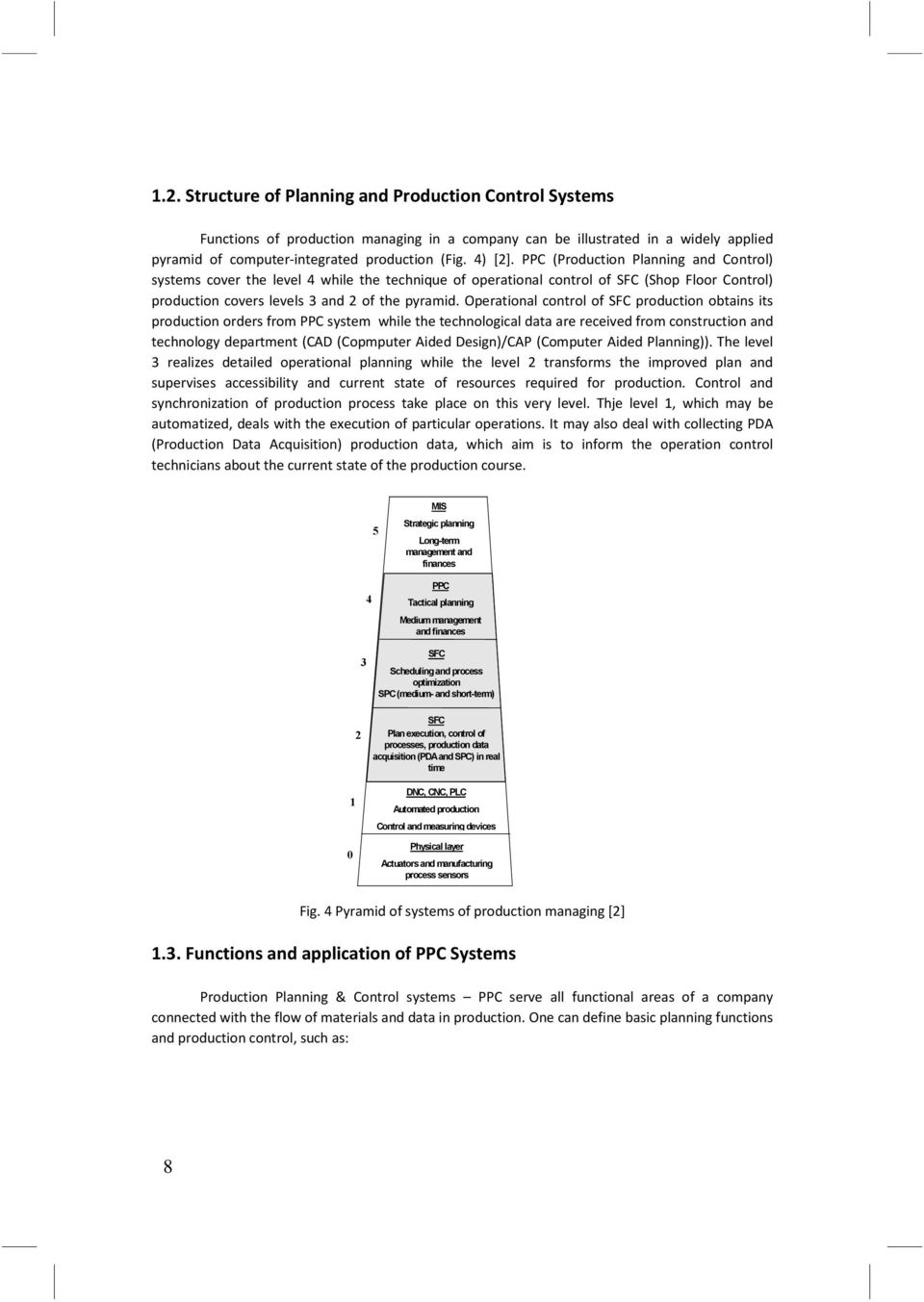
10 Planning is a systematic searching, classification and establishing production tasks as well as means for achieving set goals; Controlling is activating, supervising and protecting realization tasks according to the quantity, deadlines, quality, costs and work conditions; PPC systems are considered to be superior in circulation and data exchange not only in the field of planning, but also on production controlling. PPC systems are also the data integrator for the technical preparation of a production because all the prepared data, in the environment of CAD/CAP/CAM (Computer Aided Manufacturing)) systems, constitute basic planning parameters and production control. PPC systems play an important role in the organization of production as far as the computer-integrated production is concerned (Fig. 5), where they are a nerve of the production system in all the areas of preparation, planning and production realization. Through the task of actualization of particular orders along with data actualization concerning the state of their advancement reflexive report, PPC system controls the information and technical processes which are essential for decision making. Procedures and CAQ (Computer Aided Quality Assurance) systems are also implemented in the environment of planning and control production systems. Fig. 5 General conception of computer-integrated production Influencing the production process (basic and auxiliary) is a basic task of PPC systems. Iit is done in order to assure task realization included in a form of production plan, in a set course of time by determined production system. Such conditions derivate from realized production strategy of a company and the scale of production. The most common kinds of production and their features are given in Tab. 1. It can be observed that many types of production are distinguished which is connected with the size and the organization of a company and it directly influences the principles applied in planning and production control. 9
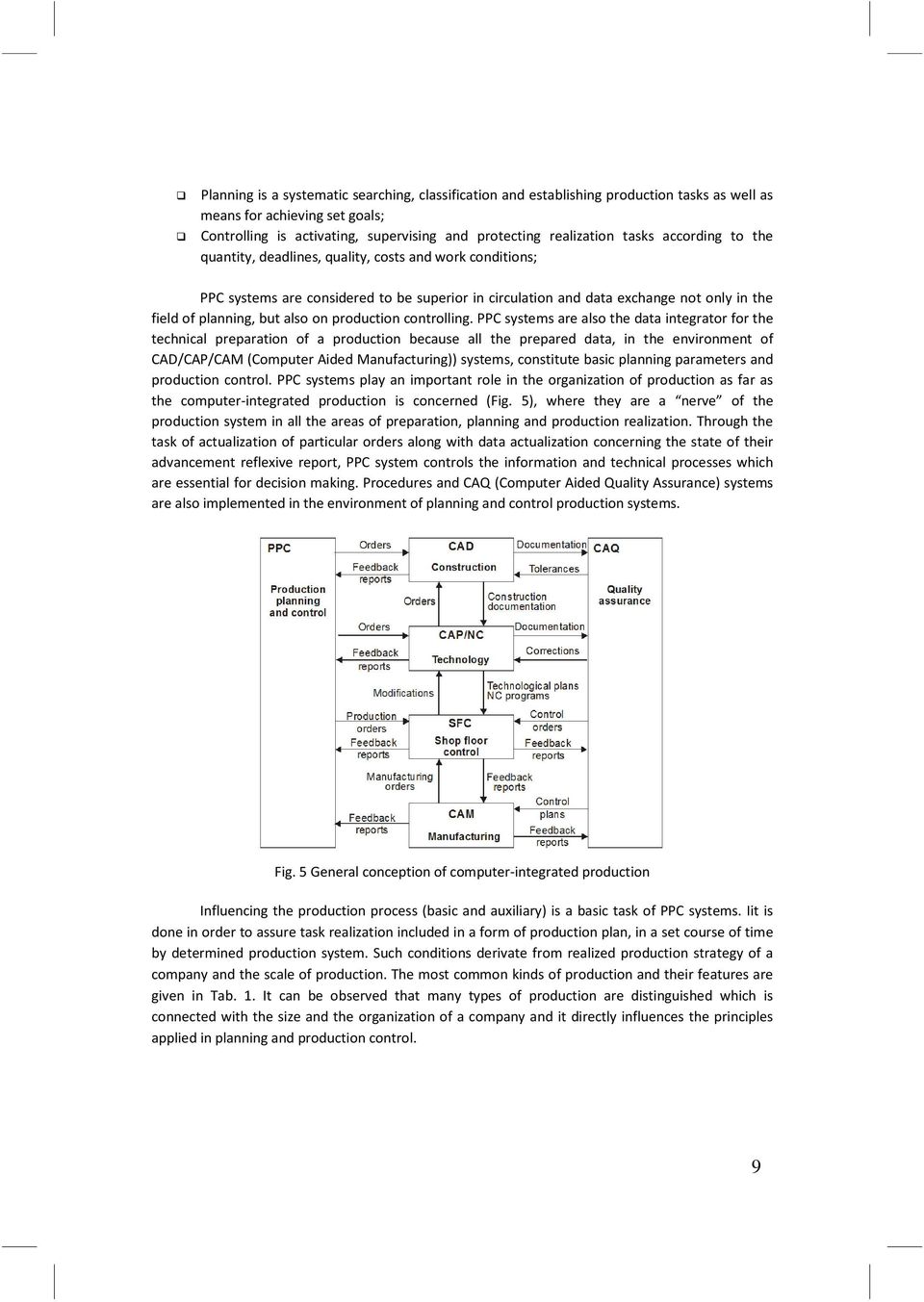
11 Tab. 1 The most common types of production and their features Feature Spectrum of produced goods Standard products Structure of a product One-piece products, such as screws Realization of orders Production type according to quantity of orders The course of production Production based on orders made by customers Unit and short-run production Production type Products in variants specific for customers Multi-piece products of a simple structure, such as hydraulic top hats Warehouse production (based on demands of a warehouse) Serial production Workshop production Production in cells or production lines Range of products Small Medium Large Products according to customers specification Multi-piece products of a complex structure Production for customer's order and warehouse production Mass-production Belt production It often happens that terms, such as: PPC and MRPII / ERP are used interchangeably, which causes confusion in available publications. PPC should be understood as a tool for servicing production processors with planning functions as well as controlling when it comes to quantity and deadlines. Also plans of work (technological processes) are associated with orders and in this way a technological manual, which is the basis for all production planning actions, is created. Between this manual and demand for materials necessary for order realization, in the case of goods with complex structure, there is also a specific relation concerning fixing indirect deadlines in the course of which particular parts and units must be ready. That's how planned deadlines of realization and purchasing of all parts that comprise those units, are arrived at. On the basis of these initial data referred to orders, i.e. defined amount of specific parts gained during fixed deadlines, PPC system is able to generate possibly current material orders for all parts indispensable for production in a company, such as: materials and blanks, trading parts and parts being produced. Functions that are used in this process make a reasonable matching of unit demand in a fixed deadline for orders whose production is planned in a production department. What is important is the availability of PPC system included in the general task of company managing. This role is marked by the following properties: - in PPC systems there are relatively long periods of planning in comparison with a technique of production control (Shop Floor Control SFC), - the amount of data in PPC system is also huge, 10
12 - the required times of reaction of PPC systems is comparatively longer than that of production control. In production planning and control, five main approaches are most frequently used, such as: - scheduling production orders, - assigning orders according to the load in particular sections, - Optimized Production Technology OPT, - section efficiency setting and, - controlling by using so-called kanbans. These are the fundamental tasks of PPC systems: - supervising the realization of customer's orders, from accepting an offer to sending the article, - managing source data, - finance, production controlling systems, CAD and CAP systems interfaces, - controlling production program and material economy, and - activating orders and supervising their realization. PPC systems are often modules of MRPII / ERP systems which must also have the functions of production planning and control as company's managing systems. Production planning and control in a company can be realized according to different conceptions of company managing. Such interchangeability of notions is mostly observable in German publications (both MRPII or ERP are practically not used). Therefore PPC systems collect and process data about states and changes taking place in the production system (production order, production resources, production sections and personnel, material and data flow) in the course of realization of production orders that were previously scheduled. Three basic types of data can be enumerated: stable data, availability data and status data. Characteristic features of stable data (source data) go like the following: - they are not subject to changes for a long period of time, e.g. description of auxiliary production resources (tools, instruments), processing plans, etc., - they contain large amounts of information, but it is crucial to rarely access them and - they are frequently stored in memories (databases). Availability data can be distinguished by features, such as: - they refer to a specific period of planning (day, change), e.g. plans of machine tools occupation time, - after being used for making statistic evaluation, they can be erased. Status data can be characterized by the following properties: - they change in time, e.g. current status of work sections, the place of the object, etc., - they are the basis for making a projection of production system status, - they are collected with the help of terminals, such as: PDA Production Data Acquisition; internal orders are mostly based on them; that is why it is essential to store them in the operating memory and update the image in external memory so as to save them. 11

13 2. CONCEPTS OF CONTEMPORARY PRODUCTION ORGANIZATION AND MANAGEMENT Strategies of company's development, especially in the field of production management, are usually based on common and previously checked conceptions which in recent years, due to dynamic development of computer techniques and methods, has had a new dimension both in the company and its surrounding. Such renaissance of well-known methods and tools took place in the sphere of company management, quality control or even production planning and control. The most popular conceptions applied in production company management and service are illustrated in Fig. 6. Production flow Production type Single production Single and small series production Large series production Mass production Production department organisation Production line organisation Manufacturing system Single machines Process oriented technology Production lines and manufacturing cells Fluent production MRP OPT BOA KANBAN MRP FZS Fig. 6 Conception of managing production resources in a company Constantly developing computer techniques gave those methods a new dimension as far as usage is concern and they considerably broadened their functions, which is impossible in manual data feeding and their activation in the form of paper forms. Moreover, implementing intelligent procedures in decision making and applying simulation tools in monitoring and diagnostics of realized production processes was impossible. Lately, the four most appreciated modern approaches of company and its production sphere managing are like the following: - approach of production and logistics controlling according to Just In Time (JIT) principle, - conception of integrated managing of production resources MRPII, ERP, - approach of rational managing of resources and production potential based on Lean Manufacturing techniques, - conception of task and team organization of work in various phases of product development and realization of productions processes according to Concurrent Engineering. 12

14 2.1. Planning and Managing Production Resources MRP II / ERP MRP II Economic effects that are obtained based on MRP conception (Material Requirements Planning) did not always meet company's expectations. Thus, planning and control of other production parameters was added to the function of resources planning. It improved production scheduling because it joined resources demand with abilities of production means, such as: production machines and tools, energetic media, information and data and capital. Subsequently, the functions of production and volume of sale supervising were added along with tools and their planning and control, due to which a closed system in the area of company managing and production planning and control was arrived at. This system was hailed MRP II (Manufacturing Resource Planning). From the formal point of view, MRP II approach has lots of functions and relations between them, which may have the character of feedback. Each function is connected with different supervising and production reality simulation. The functions of the system are fully presented in a norm elaborated by APICS American Production and Inventory Control Society, like the following: Business Planning, Sales and Operation Planning - SOP, Master Production Scheduling MPS, Demand Management DEM, Material Requirements Planning MRP, Bill of Material Subsystem BOM, Inventory Transaction Subsystem INV, Scheduled Receipts Subsystem SRS, Shop Floor Control SFC, Capacity Requirements Planning CRP, Input/Output Control, Purchasing PUR, Distribution Resource Planning DRP, Tooling, Financial Planning Interfaces, Simulation, Performance Measurement. Each function can be qualified into one of three phases of a planning cycle and company's activity controlling a phase connected with creating a working plan, detailed tasks planning and a phase of execution of those tasks. This division allows for distinguishing functions according to the time scale in which they operate and the detail level of data processing. Practice shows that initiating MRP II systems gives the companies measurable economic profits. 13

15 The main vice of MRP system is the fact that the original MRP method is more than 30 years old and it often happens that it is not able to satisfy the needs of contemporary companies, e.g. MRP/MRP II are not sufficient in the case of complex approach to managing the logistic chain or production cooperation of several enterprises. Another vice concerns the scheduling of the production plan Master Production Schedule (MPS) which is too stiff a tool for the modern companies. In the course of years, MRP/MRP II was supplemented by various modules improving production plans building which took into account delivering products expected by the customers during a fixed deadline, but maintaining at the same time possibly low costs. What can confirm the success and functionality of MRP/MRP II methods is the fact that they still exist as one of the modules in contemporary production systems of ERP or ERP II type ERP Enterprise Resource Planning ERP is a set of applications that allow for ignoring company's activity as far as management is concerned, which provides optimum usage of resources along with ordering and transparency of internal processes. In each business sector, whether it is machine industry or high technologies, the market extorts on the enterprises to be more and more competitive. Managers constantly search for new ways to enter the global market, they search for ways of faster introduction of products or they seek new canals of distribution and ways of creating long-term contacts with business partners and customers. First step to face all those challenges and all continuous changes is to augment the control in a company over something that has recently become the largest resource information. Nowadays, those who learned how to proactively take advantage of the information about their internal processes in order to optimize the functioning of particular sections, are the global leaders. The tool which allows for reaching this stage is the Integrated Managing System of ERP class. ERP is especially designed for production enterprises. The system comprises total production processes and distribution, it integrates various areas of company's activity, it makes the flow of necessary information for its proper functioning more effective and it allows for instant reactions when it comes to any demand changes. In modern ERP applications, working on-line, the information is updated in real time and it is available at the very moment of decision making. Integrated ERP system gives room for simulation of various actions, their analysis and the analysis of their results, and finally, it allows for a better planning and managing of production processes. Just as in each computer solution, the key issue is to comprehend is the awareness that ERP system solutions won't solve business problems and they also won't work out the strategy of an enterprise. They are a tool engaged in the entire company, but providing only, or maybe as much as complete information for the managers. To make ERP system work properly and supply all the necessary information, its initiation and adaptation to company's structures must be successful. The knowledge of all the processes taking place in a company and decisions making, which will be included in ERP system, is of great importance here. These are very difficult matters which make the initiation of complex systems last even up to 2 years. The key issue is the quality of data fed into the system. In such a case many production enterprises decide to strengthen the system of production data acquisition by ADC application Automated Data 14

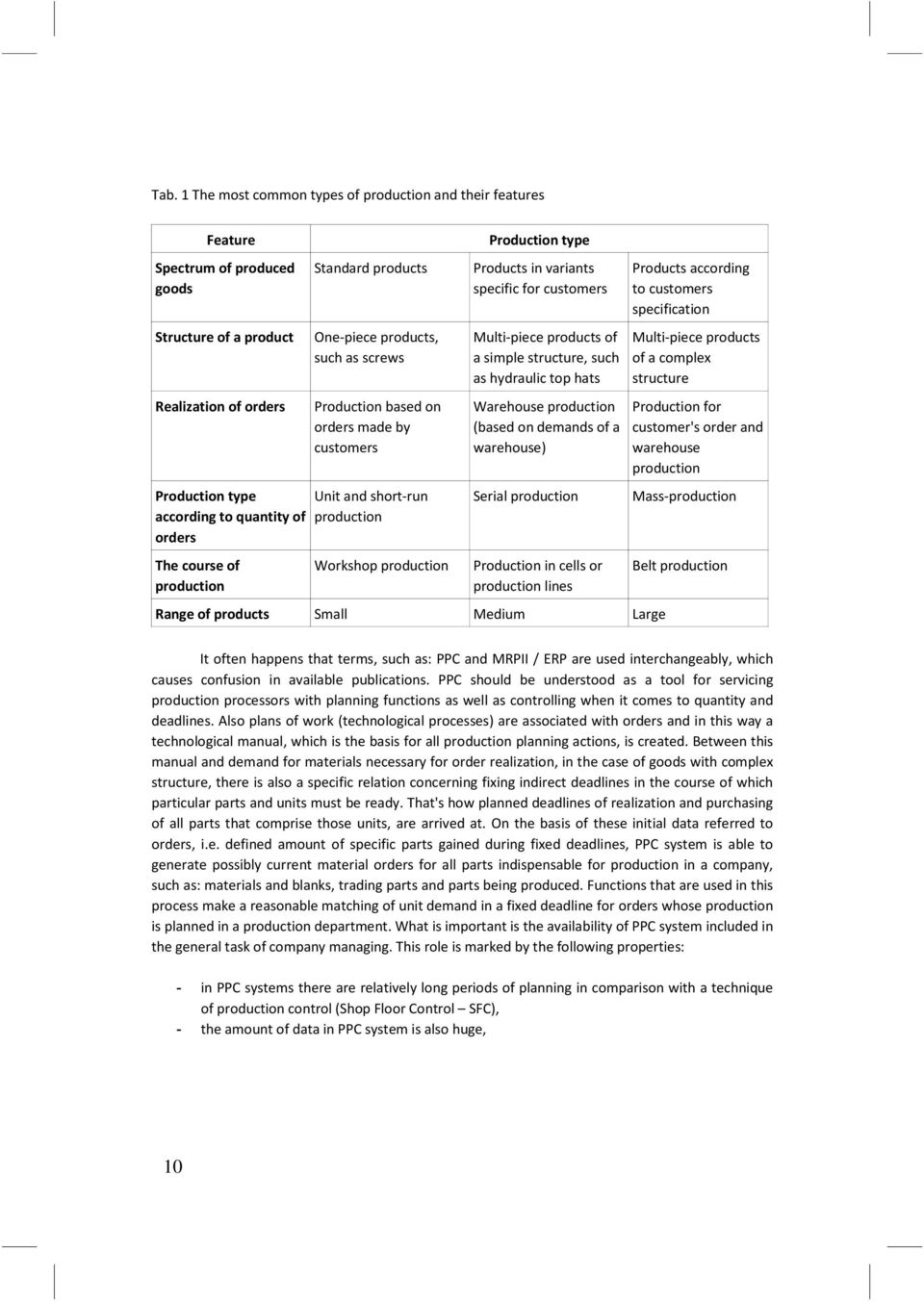
16 Collection. ERP system initiation is a necessity. However, it has to be understood as a successive step on a globalizing market. It can be seen nowadays that creating products engages several companies and also the systems evolve like that. They are outside the company and allow for coordination of particular processes ERP II class, or they link the entire chains of deliveries SCM systems. ERP systems inside the companies are supplemented with knowledge managing systems, ECR, CRM, corporation portals, e- business applications ERP II The idea of ERP II could only appear alongside with the development of Internet, when a cheap, electronic exchange of data between the companies became possible. ERP II systems are equipped with functions which enable a free and safe data exchange between the users of virtual markets, which will help reach a higher step in the development of electronic market [7]. Although the Internet was also the factor which transformed ERP into ERP II, ERP II comprises in its functionality not only product and service traffic, but also an electronic exchange of relevant documents between the buyer and seller, and also between the partners (Fig. 7, Fig. 8). Fig. 7 Internet technology ERP II systems [51] In the course of evolution, ERP II absorbs SCM functionality, in other words it concerns the information exchange in the range of business partners' deliveries chain those delivering materials, creating the product, and finally those who distribute it. In ERP II approach, traditional functions of ERP/MRP II, such as production planning, managing logistics and company's finances, managing stored supplies and material supplies were equipped with electronic exchange of offers, orders, invoices and electronic payments. In the future, managing deliveries (SCM) is about to become an integral part of of ERP II system. Even now, lots of ERP systems allow for partial automation of 15
17 company's provision in office articles, equipment, exploitation materials. Functionality hidden in ERP system will also enable the preparation of an electronic document, confirmed with a digital signature. Fig. 8 From ERP architecture to ERP II [7] There is little chance that absorbing additional functionalities by ERP will simplify the language describing the complexity of processes taking place in the area of the system. It should rather be expected that the nomenclature concerning ERP systems will become much more complicated. As a consequence of terms, such as ATP Available to Promise, new terms emerge, e.g. Plan to Performance. Plan to Performance approach describes financial processes concerning company's payments and charges influencing the consolidation of finances, budgeting and the shape of financial reports. Also in ERP system there will be a record of company's demand for materials, money, work, transport and personnel for the realization of a specific task. Design to Retirement, which is implemented in ERP system, will be responsible for the supervision of the product life cycle from the very moment of its designing up to the withdrawal form the market. Also the widely used software for capital managing will be added to the traditional systems of ERP class it will have both typical functions and those extended, connected with managing the knowledge in a company. It can be assumed that for knowledge exchange a corporate portal will be used, which on the one hand will serve a worker in activating the necessary applications of ERP system while on the other hand, it will be used to find the necessary information. What is a challenge for the evolving ERP systems is the adaptation to the specific of particular businesses for systems suppliers it is the matter of adjusting their offer to the demands of the market. So far, adjusting ERP systems to the specific of customer was realized by the implementation of the appropriate initiation profile different for various sectors. Frequently, the same ERP system initiated in the process production had a totally different functionality than the system initiated in 16
![8 From ERP architecture to ERP II [7] There is little chance that absorbing additional functionalities by ERP will simplify the language describing the complexity of processes taking place in the](/docs-images/41/2056356/images/page_17.jpg "area of the system. It should rather be expected that the nomenclature concerning ERP systems will become much more complicated.")
18 the continuous production. It will be difficult for suppliers to catch up with the development of their systems in the long run and in all possible directions so they will be inclined to choose a specialization. ERP II evolved from the conception of extended ERP, in which the possibility of transaction between the enterprises (B2B) was added. In the 90s, the implementation of ERP system was not enough and that is why approaches of initiating CRM and SCM systems occurred they aimed at managing the delivery chain. By the end of the 90s, e-business solutions became very popular. At the same time, approximately by the year 2000, EAS conception emerged these were the integrated packages for enterprises which included all possible elements of solutions in the name of so-called everything for everybody conception (Fig. 9). Fig. 9 From MRP to ERP II [7] The fascination with e-business was not proper, just as it was improper for the companies to totally neglect the opportunities to gain competitive superiority and lower the costs thanks to e- business. In prospective ERP systems the cooperation with trading partners, both the product suppliers and distributors, will be held according to one out of the two models, such as: one-to-one or one-tomany. The selection of cooperation model is dependent on the specific of the business being run and its surrounding. In 1:1 model (one-to-one), the business processes result form the extension of the traditional ERP model; this extension concerns the relations with trading partners the companies belonging to the delivery chain. Previous attempts to solve the problem of communication between business partners using EDI (Electronic Data Interchange) was expensive and the standards themselves scarcely one-to-one. Also the differences in the implementation of EDI solutions were often various in different systems. Batch processing (using files) caused technical problems as well. But it was just the XML standard which brought about the simplification of information exchange and which enabled the unification of particular suppliers' solutions along with data processing, which is faster than the batch one in real time. In 1:M model (one-to-many) the cooperation of ERP system with e-businesses (virtual markets) is established; it allows the companies for supply at deliverers' and for selling goods to 17

19 distributors according to current rules in the delivery chain. It is assumed that markets, which are created due to internal delivery demands for materials, or so as to sell goods to wholesalers or dealers by producers, will have only a private character and they will only concern the turnover in the group of trading partners. Markets of M:M type (many-to-many), on which the sellers and buyers meet in order to do single shopping, are not related to SCM idea and, as a consequence, to ERP II. The application of an ERP II class system is best presented on the example of value chain integration. Value added flows from the material suppliers, producers of semi-manufactured articles, producer of final goods up to their recipient. Value added, for which a final recipient is about to pay, depends heavily on the quality, reliability and the image of the product, or, in other words, on its capacity to meet customer's needs. On lots of markets, the quality of the product itself is high and even enough at particular suppliers', which makes competing with quality virtually impossible either a norm quality of a product is ensured by the producer or he is out of the market. In such situation it often happens that the factors related to the quality of chain value functioning are decisive. Schematic Fig. 10 presents the chain value for order production. Fig. 10 Traditional chain value [51] Traditionally, the customer expresses interest in buying a product by contacting with a particular shop (it may be independent from an enterprise). The seller contacts with the sales department and makes an order on the behalf of the customer. This order is then verified so as to see whether the ordered product is available in the warehouse. If the product is not available, or its production is impossible, the sales department commissions the production department to manufacture the article. It is also checked there whether it is possible to realize the order, whether there are accessible production resources, materials and raw materials, and only after that, the order is included in the production schedule. At this very moment, the time of order realization can be specified for the customer. Such information must go through all aforementioned sections, however the other way round. Simultaneously, the production department orders the necessary raw materials and materials (using the shopping department). Raw materials go straight to the warehouse and then to the production department. Finally, the sales department is informed about ready products and only then it sends them to the shop, from which the customer can get them. It lasts long (because of the necessity to send information from section to section using traditional methods, such as the paper method), but not always the customer can wait that long. ERP II system can help here as it uses Internet technologies. An enterprise can render selected functions of the system to the remaining participants of chain value (customers, shops, deliverers). Customers can order directly at producer's and follow the degree of its realization. Fig. 11 presents it schematically. 18

20 Fig. 11 Chain of value flow integrated by means of ERP II system [51] In such a case, the chain looks, more or less, like this: a customer makes an order in whichever part of the world via Internet, directly at producer's. This order is immediately visible in the sales department and thanks to the system, it is possible to check, within several minutes, whether particular product is on stock. If not, a production order can be made in the system and it will be immediately visible in the appropriate production department. The state of necessary raw materials is checked automatically and if any of them lacks (or its amount it not enough for production), it is instantly ordered at raw material producer's. Using the Internet he receives the order the same day and he can immediately start the realization. Basically, the whole process can be realized in one day and the period in the course of which a customer will receive the ordered product depends solely on the time necessary for its production. It was previously presumed that the customer wants to order a standard product, i.e. available in a company's offer. However ERP II system also gives room for socalled B2C e-business (Business to Customer), which allows for the contact with an individual customer. It lets the company ask the customer about his expectations concerning the product, while he himself can design his dreamed product. Such designing is frequently realized because there is a possibility to select variants of particular parts comprising the final product Algorithm underlying MRP II / ERP Traditional methods of production planning concentrate mostly on amount calculations (e.g. how many and what kind of materials are necessary for order realization) or on time axes (e.g. mounting lasts a week so the sub-assembly must be ready earlier). However, MRP algorithm combines these two approaches (Fig. 12). All amounts calculated by the program are constantly written into appropriate scheduling periods. As a result of such calculations, a detailed production plan is created, in which for each index and periods of time there is information about the amounts and quantities allowing for the activation of purchase ordering or production, and also about production advancement, planned production finalization, and planned status of stock-in-trade [8]. 19

21 Fig. 12 The way MRP system works [53] Before calculations, the following input data are necessary: 1. Master Production Schedule, also called the efficient plan or the plan of production flow. It is mostly shown as a table whose lines concern particular indexes, the columns scheduling periods, and cells consist of recorded amounts. In practice, the periods are often days or production shifts, however the advanced systems allow for defining periods of any length. Master Schedule is usually the reflection of a sales plan or/and received orders. It includes information about the expected flow from the production of goods and semi-finished products (e.g. for the service). If an enterprise has several production schedules at disposal (e.g. short- and long-term ones), there will be different calculations done independently for each of them (Fig. 13). Fig. 13 Master Schedule in TETA 2000 application [8] Construction specification (or, in some of the sectors, recipes) BOM (Bill of Material), illustrating dependencies taking place between particular elements of a product. It may assume the shape of e.g. a graph of a tree structure construction of a product, in which a final product is on the highest 20
22 position while the lowest levels present parts and sub-assemblies that will be still divided into smaller integral elements, until they will be in the position of the ones bought outside. Construction specification must include amounts of components enclosed in indexes placed higher in the structure and it may be supplemented with additional information, such as: created waste, expiry dates, etc. 2. Technological specification embodying, for each product and semi-manufactures articles, at least one technological itinerary (route); in other words, a list of technological information with a specification of each operation, its duration (unit processing time along with preparation and finalization time) and, if necessary, other data, e.g. specifying the type of section on which the operation will take place. Construction and technological specification can be illustrated together in a graph of a technological tree (Fig. 14). Fig. 14 Technological tree in TETA 2000 application [8] General MRP functioning is based on taking the following steps for each index: 1. Calculating gross needs (GN) on the basis of Master Production Schedule or/and information about planned activations (PA) of elements of high hierarchy. In the second case, PA are additionally multiplied by the amount of components included in that index which is placed higher in the structure (on the basis of construction documentation). 2. Estimating netto needs (NN) with regard to information about the current and planned state of stock-in-trade (SS). For each period NN=GN-SS. Then, for all positive netto needs, there are quantities of planned activations that are fixed in a timetable. In this phase, the technological times are applied, as well as calendars of work sections and information concerning the ways of production batching. There are amounts of planned acceptances and in-process production. The planned acceptances will augment the planned state of stock-intrade. After planning single production activation, the system cyclically repeats the calculations of netto needs for a particular index (step 2) and it inserts planned activations once again (step 3), and 21
23 does it as long as NN for each index are satisfied. Then, it stars the calculations for another index the one for which the calculations have not been done yet. It is usually the element that is lower in the construction structure or the one that is at the same level. In this way, the whole procedure is repeated. The algorithm works until all the indexes will be planned. Manual calculations, when there would be a larger amount of final products and more complicated structures, is too toilsome and that is why they can be done only with the use of computer systems. In practice, many additional information, such as: lack/shortage coefficient, various methods of batching, individual calendars, etc. should be taken into account. It all makes the calculations too intricate to handle them without a proper IT application. MRP is a purely planning/scheduling tool, however thanks to creating feedback between the planning phase and the phase of realization, it can be used for a current production. What we get then is a so-called MRP system working in a closed loop. So even in the situations of failure in planned course of production, the system can correct the schedules, the plans of material needs and production capacities, or even the plan of final articles production. The above calculations do not take into account the production capacities. Including this aspect in planning gives an essential development of this algorithm in the form of Manufacturing Resources Planning, appearing in various publications as MRP II. In this very conception the amount of production capacities is calculated, which is necessary for orders realization in each time unit planning for particular sections or departments, and shown in the form of an order load chart (Fig. 15). This chart can be compared with actual capacities, and in the case when they are not satisfactory enough or there are considerable load fluctuations in particular periods of time, one of the following actions is undertaken: the production capacities are about to be increased by e.g. work overtime, changes in task distribution or eventually, the Master Production Schedule is changed. Advanced systems are able to currently, during the calculations, analyze the loads of the sections and in the case of overloads, they immediately queue the tasks in bottle-necks, i.e. exactly where the production capacities cannot be augmented. Fig. 15 The way how MRP II works [53] 22
24 Another development of MRP system is based on adding financial planning into it. As an effect of such actions, ERP system is arrived at. It allows for controlling the financial capacity of order realization and create alternative production plans, from the point of view of their influence on financial results Criteria for evaluation and choice of MRP II / ERP systems People selecting an appropriate computer system, which will be adding the managing and meeting company's expectations, should take lots of factors into account. It is crucial to be welloriented in various system offers. However, before the company will compare the offers, it should exactly specify its needs, i.e. define the current and in-coming state. The more careful the analysis will be carried out, the easier it will be to select the right system and to plan the time and costs of its initiating. Properly set aims, which an enterprise and a new structure of processes related with them, will allow for answering the following question: which areas of branches and whose detailed functions are essential? Such data can be the basis for making a rational choice of a package and a conscious, from the user's part, formulation of purchasing deal conditions, package adjustment and initiation, and finally, the necessary equipment. Accurate specification of needs is not an easy process. It requires the engagement of all units interested in the initiation and its effects, such as: company's management, management of sections included in the new system, prospective expert users, and also, in a limited dimension, simple users of the future system. It is only the complete engagement of all the groups at this stage that guarantees the success of this undertaking. The majority of the offered systems is in the form of modules which group the functions connected with a particular aspect of company's activity, such as: financial accountancy, sales and distribution, etc. They are independent applications that can be initiated one by one or single modules integrated into the whole. However, the total prospective needs of a company should be taken into account at the very beginning of the selection of the first module supplier, who offers all the necessary modules for a particular company. It allows for automatic module integration from one supplier. Obviously, a strict module structure enables the application of single modules form various suppliers, but it should be avoided, especially when company's needs can be predicted. It turns out that improving production processes itself, which may seem to be the key element of MRP II module management, is not the most important factor motivating the initiation of integrated software, commonly referred to as a system of MRP class. Assuming that initiation decisions concerning systems of MRP class are rather rationally made, one may leap to a conclusion that in national enterprises the largest sources of reserves are currently not in the production, but in the financial management and material saving. The basic selection criteria and the decision process of an integrated computer system selection are the following: - functionality criterion, - system's configurability criterion, - the scale of enterprise's activity criterion, 23
25 - economic criterion, - criterion of programs used and, - decision areas criterion. Functionality criterion The basic criterion for the selection of a module supplier, who is to support a particular aspect of enterprise's activity, is the compatibility of functionality with company's needs. For instance, a company using a discrete form of short-run production must choose a production model which will support such production form. Standard system functionality is a set of all functions and economic processes supported by the system, after its proper configuration. It consists of economic processes and the flow of information (data feeding and processing), and finally, standard reports (data analysis and summary). The confrontation of company's needs with the functionality offered by the system is of great importance. In an ideal situation, both of them should overlap. Situations in which the system offers too little or too wide functionality are inconvenient. Still, the future needs of the company, connected with its development, cannot be forgotten. Deciding on needs according to the system should also include defining company's needs in the nearest future. Economic viability of the system in the course of 5 years and the long period of initiation should also be considered because they often exceed one year. A very interesting solution, facilitating the adjustment of the system to the enterprise's growing needs, is the division of this system into modules and modules into smaller areas of functionality. An enterprise beginning the initiation buys and initiates only the functionality which is needed at this very moment, and which can be extended with the implementation of other functions. It is the most reasonable compromise between purchasing the system which does everything and the one which is simple, cheap and fast to initiate, but on the other hand, it cannot be extended. It frequently happens that a standard functionality of the system is not enough for a company. That is why further solutions added by a customer are that essential. The most commonly added functions are as follows: - additional reports (fed data analyzes and summaries), - interfaces for other systems and appliances (e.g. work time recorder, production machines), - automatic data feeding instead of the traditional one, - non-standard functions implementation specific for a particular enterprise (e.g. collecting marketing data in the module of sales and distribution). All system modifications and extensions often require programmers work and they are veryexpensive. Their introduction should be preceded by an exact profit and costs accountancy. From the point of view of the system it is important what sort of functionality it offers as far as creating new functions is concerned. Secondly, it is vital whether all changes can be done by a company itself or whether it is necessary to commission a company responsible for supplying the software. 24
26 System's configurability criterion The configuration of the system is the adjustment of a computer system to the needs of a particular enterprise. Usually the delivered systems are equipped with a standard configuration, into which the processes taking place in a company must be built. It is obvious that business processes taking place in Petrochemia Plock are totally different form the ones in POLKOMTEL S.A., however both companies use the same system. It is the appropriate configuration that enables this. Moreover, a careful and deep system configuration allows for the adjustment of any detail in a standard functionality to company's needs. Then, it is not necessary anymore to prepare non-standard solutions within initiation phase. But on the other hand, such possibility of configuration augments the costs of system initiation, such as: - higher costs of software due to its versatility, - higher costs of initiation because of the necessity of an appropriate parameter setting and a significant prolongation of initiation project, - costs of initiation team training and the one responsible for supporting the application after the initiation of the systems intricacies. It needs to be highlighted that the possibility of deep system configuration enables the adjustment of complicated systems to the needs of huge corporations. It is a long-lasting and expensive process. IFS Applications, SAP R/3, ORACLE APPLICATIONS, Baan are the instances of a system of MRP class. Small and medium enterprises (SME) are mostly run in one country, their structure is not complicated and they have limited budgets for computerization. Their selection concerns smaller systems which are delivered almost totally configured, and which do not require vast modifications. On the national market these are the indigenous systems, such as: SIMPLE, TETA, etc. The scale of enterprise's activity criterion It is obvious that small and medium enterprises will make different requirements concerning the computer system than the large companies and world corporations. So it is not wise to create one system for everyone. The majority of systems serve the customers from one segment of the market. The requirements and criteria of system selection, depending on the scale of enterprise's activity, are illustrated in Tab. 1. Detailed information about systems that are offered in Poland are included in the subsequent part. Economic criterion It is a basic criterion for the majority of enterprises. That is why all investments in information technology, and systems supporting company's management in particular, should be driven by economic profits, not by fashion or desire to show off. The scale of investments, which amount to, millions of PLN, causes that the companies try to act economically rational. However, the problem of measurable evaluation of profits (in financial assets) connected with the introduction of computer systems remains. But still, it is even more difficult to rationally estimate those profits before the system is initiated. Hopefully, an enterprise should manage this. Moreover, an exact specification of purposes for change and introduction of criteria for their evaluation allow for cost 25
27 estimation. Limited budgets of companies, which to a large degree depend on its size, are another aspect. Small enterprises devote only small sums of money to computer systems, oscillating between several to dozen or more thousands of PLN. Medium companies have up to several dozens of thousands of PLN at their disposal while the largest enterprises must consider many million expenditures for systems initiation and integration. Integrated initiation costs of the system include the following: - software costs (license cost), - costs of the equipment, - costs of software of databases managing systems, - costs of system initiation, - costs of training and - costs of system maintenance and modification. Tab. 1 Criteria for system selection according to company's activity Criterion Small companies Medium companies Large companies Functionality Standard program which functionality satisfies all company's needs Maximum use of standard functionality and special solutions System's openness for development and changes Like the widest functionality and special solutions. Lots of interfaces for other applications. Report flexibility. Configurability Minimal or non-existent standard configuration Configuration flexibility and using branch solutions Large system flexibility: multi-nationality, multicurrency feature, etc. Profitable use of sectorial solutions. Economic IT budget Low price and almost no initiation costs. Fast investment return Single licenses for several hundred PLN Limitation of initiation costs. Fast initiation and anticipation of investment return. Several dozen of thousands 0,5 millions of PLN Large costs license for thousands of users, long initiation period, large costs of maintenance Long term of return. Several a dozen or so millions of PLN Number of users < several thousands Initiated modules Usually one program for sales, accountancy, and Financial accountancy, controlling, sales and Initiation of all modules, but in time: financial 26
28 Criterion Small companies Medium companies Large companies simple logistics. distribution, logistics, rarely production accountancy, controlling, sales and distribution, logistics, production Hitherto used modules and systems Do not influence the selection of a new system Little influence on the selection of a new system Little influence on the selection of a new system Databases safety and protection Data back up is enough Complex and reliable safety copy system. General control over the accessibility to the system (the level of modules or/and functions) Refined and expensive safety copy system. Thorough control over the accessibility to the data (best with the precision of the group fields) Hitherto used programs Other modules used by an enterprise should be taken into account while deciding on a new module supplier. If a company uses e.g. a financial and logistic module of a particular supplier, and it is satisfied with them, it will be a rational solution to buy some new modules at the same supplier. It is not necessary, but it can facilitate an already complicated process of system initiation. Profits from the application of one computer system for all aspects of company's activity are as follows: - automatic integration of single modules into an integrated system aiding the management, - previous initiation experiences will be helpful in a new module and - system users are already used to systems service interface the limitation of the training hours. Tab.2 shows a review of the most popular integrated production management systems available on Polish market. Tab. 2 Integrated production management systems available on Polish market Producer Name Description Altkom Matrix, Baan Company, ycountry/poland/ SYMFONIA Managing System BAAN IV Integrated package designed for Windows environment, appropriate for small and medium companies. SYMFONIA II consists of the following programs: Finances Accountancy, Finanacial Analyzes, Fixed Assets, Wages, Sales, Trade, Pro Invoice, Invoice and Small Accountancy. Currently, the system has about 20 thousand users. System of MRP II class for large companies (includes Baan Orgware a set of tool facilitating initiation processes); distribution - e.g. TCH Systems. BPSC, IMPULS BPSC A package for small and medium companies. BPSC managing 27
29 Managing v3/ Package realizes functions necessary for production, trade and service units. IMPULS BPSC applied elements of standard enterprise management of an MRP II type. ComArch, EGERIA For subjects with an extended financial sections and numerous personnel. It includes subsystems, such as: Finances- Accountancy, Personnel Management, Logistics, Fixed Assets, Planning and Budgeting, Vindication. CSBI, Promis An integrated system of company's managing. Great Plains, DyNAMICS DyNAMICS Compact an open, integrated system for medium companies managing and DyNAMICS C/S+ - an open, integrated system for large companies managing. DyNAMICS is distributed in Poland by Great Plains Software Poland SA (GPS). IFS, IFS Applications Module solution of an MRP II class for industrial enterprise managing of branches, such as: energetic, chemical, machine, paper, telecommunication. InsERT, InsERT Software for small and medium companies including the following: Shop Assistant, Reckoner, Engraver, Controller. Intentia, MOVEX System of an MRP II type, aiding production enterprise economic and distribution processes in the following fields: logistics, production, accountancy and finances, marketing, and staff managing. Novelty Movex Nex GEN, written completely in Java. JBA, JBA System 21 Integrated, multi-module solutions fulfilling MRP II/ERP standards. The system operates multi-company structures, it is of multi-currency and polyglot type. The specialized versions are as follows: FOOD for food processing and distribution, DRINKS for distributors of alcoholic and non-alcoholic beverages, AUTOMOTIVE for producers and distributors of motorization components, STYLE for producers and distributors of clothes, shoes, sports garments, jewelery, etc. MacroSoft, MKJ, SKID Polka, Ewka, Jolka The modules include the following: FIKS - finances and accountancy with controlling elements, KALI staff evidence and pay-rolls, ZZL human resources managing, MAGFAKT warehouse economy and sales, ESTRA fixed assets evidence. Designed for small and medium companies, it operates accountancy, warehouse, sales, orders and invoices. QAD, MFG/PRO 9.0 Integrated software for production and distribution enterprises managing. An ERP class solution. SAP, SAP/R3 The most popular integrated system for MRP II class systems 28
30 managing; designed for large companies. Scala, Scala An ERP class software for aiding the management of medium and large companies. SIMPLE,. Softart, Softlab, TETA, Simple Business/System Softart Sortlab TETA-C, TETA_2000 Simple Business an integrated computer system aiding company's activity; designed for small and medium trading, service and production companies. Simple System multimodule, integrated system including all basic branches of enterprise's activity (finances and accountancy, staff managing, wages, product turnover, production); designed for medium and large companies. A program for small and medium companies including functions, such as: FIX (FK system), Wages, Invoice, programs for fiscal operation of appliances FK program for small companies including the following: warehouse modules, leasing service, fixed assets, staff and wages and tax forms service. Software for MRP II standard for medium and large companies. It consists of the following modules: Finances and Accountancy, Fixed assets, Staff-Wages, Material Economy. Decision areas The process of selection of an appropriate system aiding the management for a particular company is very complicated and because of that and the prospective consequences, it should engage quite a wide range of a company's staff. In order to make a credible decision the engagement of the following units is necessary: - company's chief management, - principle or principles of sections included in the initiation module (the Project holder), - expert users management of a lower rank which will be directly operating the new system, - Information Technology (IT) Section of an enterprise. When selecting computer system (module), one has to consider whether it is fully adjusted for example to Polish condition and regulations. Full localization (Polish version) considerably shortens the time necessary of system initiation. It needs to be emphasized than full product localization by the producer and the compatibility with the Polish regulations is a requirement of great importance, which the computer system should face. Furthermore, the producer should also modify the system to make it as current as possible due to the changes of regulations in Poland, and he should provide it with particular amendments. It will make the initiation process shorter and possibly concentrated on settings specific for a particular company. 29
31 2.2. Just-In-Time approach The philosophy and approach of JIT Just-In-Time was created, in its contemporary form, by Japanese people. It was very much based on H. Ford's experiences and observations of his production companies. The main aims of JIT present as follows: resource minimization, product quality improvement and production efficiency maximization, and all of this done with an optimum level of customer service. JIT system arrived at perfection thanks to Toyota production companies in 50s and 60s. That is why in literature it is referred to as TPS Toyota Production System. Basically American became interested in this system when Japanese cars, whose prices and quality were competitive, started to be a threat for American industry. It turned out that American car producers maintain production provisions in the course of 775 USD worth per each produced car while at Japanese producers' it was only 150 USD. It is typical of JIT systems that they are heterogeneous and their theory has not been generalized yet. Publication concerning JIT systems are mostly specific application descriptions or model system studies that are frequently hypothetic and idealized. So as to let JIT function properly, it is crucial for its components to work faultlessly, such as: - production process and production methods planning, - provisions according to Kanban approach, - faultless and effective quality controlling procedures, - well-functioning and well-organized network of sub-suppliers. A special JIT role is assigned to sub-suppliers because they are responsible for quality and punctuality of delivered products. In Japan, there are 10 principles concerning suppliers, such as: 1. Suppliers are encouraged to locate their companies close to a recipient, which reduces the costs of transport and delivery time. 2. Supplies are done frequently and in small parts even a couple of times during one day. 3. Supplier is responsible for buffer supplies and he is obliged to create them. 4. There is one, main rule rather one supplier than two or more. 5. Supplier, who is the main source of parts, sub-assemblies or products for a company, deserves a special treatment allowing for his further development. 6. Suppliers with larger authorizations can often reduce their own supplies and the costs of reserves. 7. Being chosen as the only supplier means that the company's success is dependent on him the final producer. Suppliers, then, must offer possibly low prices, high quality and fast reactions for production needs of a company. 8. Company recipient supports a supplier technically and financially, which allows him for development and in this way, it ensures itself high quality, low costs of parts and products delivery. 9. The quality of parts and products is required, but it is not checked by recipients because of a strong economic connection between the suppliers and the recipients, so there is no reserves to supplement the production or the improvement of deficiencies. 10. There is also a strong connection between the recipient and supplier manifesting itself in a form of a closed cooperation, coordination and unconditional trust. Both sides are aware of the profits of being in the same boat. 30
32 It looks different in the USA where the suppliers are often perceived as competition. A final producer constantly tries to gain the lowest prices, which is the cause of frequent changes of subsuppliers and it makes the creation of one partner virtually impossible. That is why Toyota has 250 suppliers while General Motors about 4000 of them. This is the reason why there are so many provision and logistic difficulties and a constantly high level of the stock. For instance, Toyota reaches approximately 100 cycles of reserve parity turns in a year while a best car company in the USA only Lean Manufacturing Approach LM Lean Manufacturing means choosing the way for a company where means are managed rationally. It brings about changes in the ways of company's organization, management, and also in the sphere of workers' professional preparation and shaping their attitudes. LM method can be defined in the following way: relatively independent cooperation of work teams consisting of workers professionally prepared in all possible respects and working in a highly flexible and automatized work organization systems so as to realize various production tasks, in conditions of a strict cooperation with respective customers and sub-suppliers. The most important results of designing such a research team are based on the statement that Japanese people in their companies in Japan, the USA, The Great Britain, in comparison with the world competitors, need the following: - half of staff size in a company, - half of production space, - half of investment expenses on machines and appliances, - far less than a half of material reserves, - half of time flow in the main production (mounting), - half of necessary time for research and development in creating new products. According to his conception, managing is a never-ending process of rationalization, in the course of which the cooperators and authorities are one, strongly integrated team. That is why there is a need for proper ways of perspective thinking along with a proper behavior, cooperation and the sense of responsibility. Such features as trust, discipline and a considerable improvement of quality and efficacy are essential in the worker worker, worker supervisor, section section relations. Actions increasing the value added are opposed to waste, which is the key issue in Lean Manufacturing conception. Value added is what a customer is ready to pay. If an action does not add value it is waste too. Taiichi Ohno, the main designer of Toyota Production System, identified 7 main forms of waste, such as: overproduction, improvement of deficiencies and faults, useless processing, useless material transport, reserves, extensive motion and waiting time. This list should be supplemented with an even more dangerous form of waste which is a lost creativity. In a conventional factory only 15-20% of processes (steps in production) includes value added. Usually only 0.2% of time during which the material is in a company, from the moment of provision appearance in a warehouse to the moment when a product is finished, the value is added (if there are processes depending on time, such as heat treatment, the percentage when the value is added is much more beneficial). A lot of waste means high costs and long periods of production realization, which may result in long supply periods. Waste elimination entails low costs and shortening the time 31
33 of production realization. In conventional factories, waste is hidden in a sea of reserves (raw materials reserves, reserves collected in the course of production, reserves of ready-made products). That is why the key conception of Lean Manufacturing is based on gradual reduction of reserves in controlled phases, facing arising problems and solving them, and on further reserves reduction. Typical problems arising during the reduction of reserves include the following [13]: Anticipation workers' anticipation of further operations on the line because the previous operations have not been done yet. Insufficient Communication the workers were not fully informed about what should be done and how. Disorder lack of order is a commonplace in work sections and it causes mistakes and waste of time. Long periods of setup long periods of machines setup encourage a production in long production batches, which results in increased reserves in the course of production, long production cycle and large costs. Low quality the cost of defect repairs, which were not identified at the beginning of production, augments 10 times along with the subsequent phases of a production cycle. Weak work balance it is manifested by an overload of work in particular sections while the remaining ones are left inactive. It results in so-called bottle-necks and prolongation of production cycle, which causes inconveniences as far as punctuality of supplies is concerned. Unprofitable operating wrong assignment of reserves and workers to tasks which, from customer's point of view, does not increase value added. Differences between enterprises with a traditional management and those managed according to LM approach are illustrated in Tab. 3. Level, from which the initiation of Lean Manufacturing should begin, is the company's production level, and to be more specific, from the perspective of the whole company, these are particular value streams which are created by particular families of products [40]. Value stream is a collection of all actions (both actions of value adding and those which do not do it), undertaken in the production process, from raw material up to ready-made product. Determining basic improvement aims of each value stream, such as: shortening lead time, reserves reduction or increasing flexibility is done by the company's management and it is a starting point of so-called Value Stream Mapping [10]. Tab. 3 Differences between enterprises with a traditional management and those managed according to LM Traditional enterprise Specialized plants Complicated, expensive and highly efficient machines and appliances Long periods for setup Separate quality control In the field of production technology Enterprise of LM type Plants of changeable production processes Cheap and easy-operated machines Short periods for setup Quality control done by producers of particular products 32
34 Heavy duty caused by long production batches Course of production compatible with the requirements of complex work organization Number of parts compatible with an order Production adjusted to current needs Numerous, specialized teams Lots of decision making areas Large amount of information and long ways of information flow In the field of organization With reference to workers Specialization in performing single actions One-sided requirements concerning the staff Limited scope of action Only top-to-bottom management planning Small range of qualification training and improving With reference to management Controlling management Interfering with the course of work Controlling workers by the supervisors; in the case of mistakes and defects searching for the guilty person Solving problems done by the management Barely diverse distribution of tasks Few decision making areas Information directed at determined aims and short ways of information flow Extensively educated and prepared workers able to perform various actions Multi-sided requirements Broad scope of action Encouraging workers' initiative and using ideas of, e.g. small activity groups Professional training as a continuous process Supporting control Appears in a role of an adviser Supporting teams in self-control processes Common reduction of mistakes and defects Solving problems done not only by the management, but also by teams A mapping method helps to see and understand the flow of material and information in the course of product's movement along the value stream. But still, this conception is easy; first, product's route should be analyzed - from a customer up to its supplier (up the value stream), and then, one should carefully outline the material flow, and what is even more important the information flow, by means of fixed, graphic symbols (Fig. 16). Current map of value stream comprises the basis for the application of various methods, techniques and Lean Manufacturing tools (Tab. 4) necessary for creating a map of a future state (target), pointing in this way at the desired value stream flow (Fig. 17). The perspective of a production process map means illustrating the whole flow connected with production, and not only a segment of the process or individual, technological operations. Thus the aim of this tool is to improve the whole system, and not to optimize some of its parts. 33
35 Fig. 16 Example map of value stream current state [10] Tab. 4 Methods, techniques and conceptions in Lean Manufacturing [13] Cell production / layout planning Total Preventive Maintenance Visual steering Continuous flow / One piece flow Pull system Kanban / Supermarket Lead time / cycle time Just in Time Quantity leveling and production mixing Setup time reduction (SMED) Quality at a source Andon 5 S Building Poka-yoke resistance in Constant training / Kaizen Standardized work Workers commission Team work Suppliers and internal customers Process orientation 34
36 Fig. 17 Map of a future state for an example value stream form Fig. 16 [10] Lots of managers, trying to apply lean principles, got to know that improving only a fragment of a production system does not necessarily mean the improvement of general achievements in the whole company. That is why the value stream mapping consists of material flow analysis and an analysis of the information flow within the system of company's door-to-door production line; it means including raw material suppliers and recipients of produced goods along with the conditions of their mutual cooperation (supplies realization, deliveries, shipments, etc.) in the process of mapping. Value Stream Mapping method is effective in many production sectors [16], both in a discrete production and constant processes [17], in large and small companies [18]. Going from a current state of value stream to a future state, determined by a map, requires activating a range of projects using lots of methods, techniques and conceptions (Tab. 4) often realized within the hours of Kaizen workshops by a specially selected teams. Appointing a manager to a post for each value stream managing strategy, whose responsibility will be extended on the whole stream - from sending a parcel to a customer to relations with raw materials suppliers - is its essential element. The need for skillful production management, of a large degree of processing (of value added) and the possibly small distance in relation to a customer, decide about the form and organization of a warehouse for ready-made products. A project of value stream based on the assumption that a company is able to produce goods exactly according to orders made by customers (with no need to gather reserves of ready-made products) does not work in the case when the market is characterized by strong fluctuations in the quantity orders. In such a model, the lack of a warehouse for ready-made products would cause the necessity for maintaining production power characteristic of peak orders. In a situation when a medium level of orders is considerably low, it would mean that they would not be used. Therefore designing a warehouse for ready-made products, with a controlled level of reserves along with processes responsible for its replenishment and with signaling of any current customer's needs, is the strategy that is used in the case when the value stream is forced to react to fluctuations on the market. Then, a customer is satisfied by the accessibility of assortment in the form of reserves of ready-made products and the production 35
37 system supplements it in quantities that has already been taken by a customer. Thanks to that, all the changes caused by fluctuations in sales do not influence subsequent production processes. Thus in situations in which maintaining excessive production powers turns out to be more expensive than keeping a controlled level of ready-made reserves, it is better to adopt a model based on a solution that is referred to as a supermarket of ready-made products. At the same time such solution overthrows a wrong, but widely spread thesis that the lean production is characterized by zero level of reserves. Establishing a supermarket for ready-made products makes the level of reserves of the ready-made products a subject of quantity control (firstly - the reserves cannot exceed the limits, secondly - the level of reserves, which is a signal for production beginning or finishing, is localized in the top part of value stream). The supermarket with the ready-made goods must obviously be coupled with the remaining linkages of value stream in the course of further works. In a situation of stable and predicted orders, the aforementioned order production (so-called mail-order production) turns out to be a better solution. Moreover, such a solution will be especially well-founded in the case of enterprises in which mounting in the process of value adding plays a vital, cost role or when there is a wide range of variants of the products. This strategy extorts the improvement of mounting system flexibility, i.e. by a maximum reduction of setup periods and personnel's qualification improvement [39]. While designing the production courses on the level of single processes, some key issues emerge, such as: continuous flow, pull system and a delivery system of raw materials and parts for production lines. Continuous flow, also referred to as one piece flow, single unit flow or make one, move one, is the most effective way of production; that is why it should be applied where it is possible, combining various sections. However, when its application is impossible and the continuous flow must be discontinued, the best solution is to join the areas of continuous flow with the pull system or with FIFO queues. Continuous flow is a conception which, in its perfect shape, designates that parts are processed and passed on form one machining section to another, one unit at a time. Each section processes only one part that is delivered to a subsequent section just before it is needed, and then the size of batch for transport equals one. Lean Manufacturing aims at reaching the continuous flow in each possible area because it is the most effective method of processing the materials for readymade products [15]: Minimum reserves are used. The number of people (indirectly and directly productive), machines, materials, buildings, transport devices, etc. required for the production of goods is kept on a minimal level. It gives better productivity and lower costs. The time of realization is shortened, which allows for fast reaction as far as customer's demands are concerned and shorter time of money traffic cycle (it is the time between paying for raw materials and receiving money for products made of those materials). Such problems as deficiencies, instead of being hidden, occur rapidly. They can be easily identified and corrected by a further processing. It is better to identify source causes of failures, if they are found right after their occurrence. The communication between the sections, which are combined on the basis of customer supplier, is stimulated. 36
38 While projecting the continuous flow, it is necessary to analyze in detail and consider the following issues: - the flow of the process along with its all operations and cuts, and their execution periods, - machines, their capacity to work in the course of a cycle and the level of their automation, - spatial layout of the process, - balancing the load of operators' work and the ways of work distribution among them, - scheduling applied in a mixed production model. For example, various methods, such as the ones enumerated below, can be taken into consideration while designing the work distribution among operators in a production cell: Work distribution among operators, each of whom does half of work in the course of cycle time, often by moving among different machines (Błąd! Nie można odnaleźć źródła odwołania.). A lap during which one operator does all the cuts by moving in a full cell circuit, in a direction of material flow. The next operator works several sections in the back. Reversed flow, in which the operators make a lap in a reverse direction of material flow. Combination of work distribution and lap or reversed flow. One operator per station; every operator stands by one work station. The gear rack, where each operator operates two machines and he moves the processed part every time he comes to a machine at the bottom of a stream. Pull system is a production system propelled by an actual consumption and controlled by synchronized signals informing about the need of material supplementation. Even in 1953, Toyota started to experiment with methods signaling the previous processes the need of material supplementation. Example techniques applied by the pull system are gathered in Tab.5. Tab. 5 Example techniques applied by the pull system Type Function Kanban Ordering point Supermarket Min/Max Two containers Empty space Managed by a supplier Virtual kanban Label signaling that a certain portion of material has been consumed Supplementation of a certain portion of material takes place when the level of reserves decreases to a particular degree Inter-operational warehouse system with a production and transport circuit of kanban labels Supplementation to a maximum level when the reserve decreases to a minimum level Filling one of the containers while the content of the other one is being consumed Filling the reserve shelves, if only there is space External supplier supplements the material Electronic version of a kanban 37
39 Type Function Heijunka box Sequencer Planning box for production leveling Accumulating kanban labels at supplier's Effective management of parts and raw materials, bought in an enterprise, shifts to the following advantages: - fewer workers of internal transport, - less time spent on searching for parts by operators, - higher indicator of reserves rotation, - fewer reserves, - fewer fork trolleys, - fewer accidents connected with fork trolleys, - better production capacity, - fewer overtime work, - lowering the costs of express dispatching. Key elements concerning the management of parts and shopping raw materials are as follows [22]: Creating a plan for each part, which includes all information about each and every part, such as: average daily consumption, consumption place/process, storing place, order frequency, supplier's name and address, container type, container weight, parts weight, etc. Such data, collected in an uniform way and available in one place, are the basis for reserves reduction and an improvement of a system of parts handling in a company. Creating a market of shopping parts along with rules of its functioning and also with methods of setting the stored quantities and the space required for each of them. Designing the routes for supplies of parts and shopping raw materials, and the computer system. It concerns the adjustment of supply procedures to production processes and their way of signalization what and when must be supplied, and creating a detailed route plan. Profits gained by an enterprise, as a result of initiating lean production practices, may be fully used when the two following systems: a system of ready-made products distribution and a system of raw material demand, will be adjusted accordingly. The philosophy of lean production, based on the Toyota production system, treats the stream of value creation as a whole from the very beginning, i.e. as a sequence of actions going through lots of enterprises. Five principles of Lean Manufacturing, proposed by Womack and Jones, can be referred to both: a single enterprise and to the whole suppliers chain, also called a net of values [21]. However when managing the network of values, such principles gain a new perspective. On the one hand, for instance, a continuous improvement will concern the actions on a strategic level. On the other hand, the whole stream of values consists of specific actions in production departments or in warehouses of particular, cooperating enterprises. What is more, even improvements in one of them may have a positive influence on the whole network of values. The word may should be emphasized in this context because what is good for one member of the network, does not have to be beneficial for the network as a whole. That is why Lean Manufacturing stresses the realization of a principle win-win in the relations with a supplier and recipient. It is important that the participants of the network of values have a tool necessary for 38
40 documenting the present state, knowledge exchange on the subject of their network, and that they know where to find the waste and how to run the process of improvement together. Still, in many cases the analysis of a macro-map is not enough to recognize the waste and to come up with an improvement proposition. The reasons of problems visible on a macro level should often be sought on local maps, on which they should also be solved Other approaches of production managing Apart from the above-mentioned, approved conceptions of production and production resources controlling, there are other approaches developed, however less useful, but also widely applied in production engineering. These are as follows: OPT approach Optimized Production Technology; managing narrow cross-sections (in jargon it referred to as a bottle-necks managing). It is simply a conception of an optimal load of sections of a critical productivity. Such conception, as a superior criterion of production orders control, allows for possibly maximum use of those production sections on which there is an accumulation of production tasks. This conception is extensively applied in production control, such as: - short- and medium-run technologically oriented production, - orders insensitive to changes concerning the periods of their realization (possibility to change priorities and realization deadlines, especially those concerning orders finalization), - in a case when only one bottle-neck controls production processes. BOA conception (ger. Belastungsorientierte Aufragsfreigabenverfahren; controlling production orders according to medium productivity (medium, constant load of work sections). This conception aids the principles of MRPII in single and serial production and it is applied in the following situations: - when supply deadlines are constant, - when production capacities are known and available, - when Production Data Acquisition (PDA) terminals are used for specifying in-process production and supervising the realization of production orders, - when material availability is provided. Kanban approach. It is closely connected with the approach of Lean Manufacturing. It is based on a continuous supplementation of material demands in a production section until a fixed and safe level is reached. The conception developed in Toyota is mainly used in the following cases: - when the number of variants of products is limited, when there are short setup times in production sections, - when material demands are stable and when they protect from a disorganization of order realization due to considerable fluctuations in supply, - when the production is smooth and of time-stable production capacities, - when quality control is connected with the control of production process. FZS conception ger. Forschrittszahlenkonzept (continuous supplementation of balanced material demand states in serial and mass production). It is especially used in the following situation: 39
41 - in serial, continuous or repetitive production for the most part, in smooth production, with a constant material demand both for medium and large batches, - production control using terminals for production data acquisition (PDA terminals), used for production orders supervision. Comparison of material flow in production systems that are controlled on the basis of the aforementioned conception is presented in Fig. 18. A. Material flow management in MRP system PUSH system Planning and controlling module MRP - orders for next cells Needs Delivery Processing Assembly set Final assembly RECIPIENTS B. Material flow management in JIT system PULL system Planning and controlling module JIT - final assembly plan Needs Controlled module DELIVERERS Delivery Processing Assembly set Final assembly RECIPIENTS SQUEEZE system C. Material flow management in OPT system Planning and controlling module MRP - orders for next cells Controlled module Needs DELIVERERS Delivery Processing Aseembly set Final assembly RECIPIENTS Material flow Information flow Fig. 18 Basic conceptions of material supply control PUSH Strategy Contemporary systems of order production managing are directed at PUSH strategy, which is the dominant one at the moment. This is the effect of a long period of development of those systems by the largest European and American enterprises in the second half of 20 th century. But it was not until the economic success of Japanese companies applying PULL strategy when the rest of the entrepreneurs understood that one may not manage the production in any other way. IC (Inventory Control), developed at the beginning of the 60s of the of 20 th century, were the first systems supporting an enterprise management and servicing the area of warehouse economy. In 40
42 the course of years, the system of warehouse economy managing had gradually encompassed production the first MRP I system appeared (Material Requirements Planning), which served for the optimization of material demand planning process, through issuing purchasing and production orders in such a moment that a desired product occurs in a desired time and in demanded quantity. Another breakthroughs in the managing tactic were connected with the development of computer technique. The increase of computational power and the development of computer methods of information storing and processing (databases theory) gradually caused a managing systems expansion into other areas of a company. In the 80s of 20 th century, MRP II (Manufacturing Resource Planning) comes to existence, which actually is an extension of MRP I standard as far as finances and balancing production resources (work posts) are concerned. In the 90s, this standard is still extended with a distribution, transport, service and it changes its name for ERP (Enterprise Resource Planning). PUSH strategy implies that an order for a final product is modified on request of material delivery to specific points of the production system, in due time. As a result of such modification, one gets a detailed schedule of material supplies, which are later on pushed by the PUSH production system with the help of a detailed schedule of particular operation activation [43]. The schedule is monitored and can be corrected at any time. PUSH strategy is advised for a single and short-run production using single machines in conventional production systems or in highly automated ESP. PULL strategy PULL strategy was predominantly created by Japanese industry (mostly the automotive one) in the second half of 20 th century. The best example of an initiation of this strategy are the factories of Toyota, in which in 1970 Ohno Taiichi the president of the corporation, initiated JIT(Just In Time) a system designed by himself. Operating principle of pull systems is based on the change of forcing direction controlling a production system. Controlling does not go from entrance to exit, but the other way round. Demand for a certain product, reported by the exit, is the first signal which causes a pulling of this product from the previous post and this entails a pulling of proper materials and products from the preceding posts, etc. In an ideal situation the result of a management defined like that is reserves liquidation of in-process production (no controlling means idle time of a certain post) and a very exact compatibility of system's output with customers' demands (producing even single units of a certain product). Naturally, reaching perfection is very difficult and it requires proper initiation methods along with appropriate tools facilitating such initiation. This method was named Lean Production and it is predominantly based on elimination of any waste in the process of production (it includes all the actions in a production process which augment the production cost and its not a value), and Kanban, Kaizen, value stream mapping [39], benchmarking [42], [43], etc. are the tools supporting it. SQUEEZE strategy SQUEEZE strategy assumes that the productivity of production system is limited by the capacity of the system's bottle-neck. A bottle-neck is a system element (or a set of elements) which, despite of being exploited and used in 100%, does not provides a maximum production [42], [43]. In the course of production process, the materials are squeezed through bottle-necks causing 41
43 accumulation and increase in inter-operational warehouses. In order to solve those problems an OPT (Optimized Production Technology) was created and patented in OPT method is one of the newest methods of production control whose author is an American N. E. Goldratt. Initially, it was used as a production planning and scheduling method and in its basic form, it sets an optimal schedule of work places belonging to a bottle-neck of the process, and then it adjusts the work schedule to the remaining posts in a way that the exit of the process is left as previously planned [43]. Later on, this method was extended with a philosophy of operational actions in an enterprise. Nowadays it is used to reinforce the effect of PUSH and PULL strategies, and it is responsible for the maximization of production result when there are specific production factors. SQUEEZE strategy, as the main strategy of order managing, works perfectly in short- and medium-run production, technologically oriented production, in order realization insensitive to changes of realization deadlines (especially the completion deadline), in the case of a small number of posts included in a bottle-neck of the process. In the course of this process, managed according to this strategy, only the critical posts are currently monitored (so as to correct a current schedule) [43] Optimized Production Technology System (OPT) One characteristic feature of this approach is that it is similar to the conception of a kanban system application in JIT, with the exception that using kanbans is actually a hand-operated technique while OPT requires support of an appropriate computer programming. Basically, it is a philosophy based on paying attention to bottle-necks (critical resources which efficiency is lower than expected) of production process. In order to apply it in practice, a certain number of principles, sometimes conflicting with an established practice of production activity planning, must be taken into account [9]. Some of them are as follows: - Bottle-neck or critical resources determine the production of the whole system. - The level of exploitation of non-critical resources should be compatible with the demand for critical resources, such as: an hour lost in a bottle-neck is an hour lost for the whole system, while an hour saved outside a bottle-neck has no practical meaning. - Bottle-necks determine both production cycles and stores; why to produce components so fast if the bottle-neck will not accept them? - The quantity of transport batch does not have to equal the quantity of production batch. - The same production batch cannot be set for all phases of the process. - Planning deadlines of resources utilization must simultaneously take into account all limitations. Production cycles are the consequence of schedules and they are determined in advance. Recommending the acceptation of more numerous batches so as to let the setup costs spread on a larger number of products, can be a conventional practice. Still, the OPT principles indicate that in non-critical resources, the production can take place in less numerous batches if, as a consequence, there will be a more effective supply and increase in a critical resources capacity, occurring in the prospective phases of the process. Such an approach can affect the accounting system because the 42
44 production supervisor can be punished for an alleged ineffectiveness of small batches although the required aim of augmenting capacity was achieved. Basic principles underlying OPT can be and actually they have already been used in a hand-operated or computerized systems of control and planning. However the largest number of current applications of the system uses software packages. A simplified scheme of OPT is shown in Fig. 19. Input data are similar to those which are required for supplying MRP/MRPII systems. On the basis of forecast concerning sales, data about technological routes and material specification, a resource network is created along with information about work posts (required resources workers and machines). The system does series of complex tests in order to precisely define the accuracy of input data. Marketing forecasts are treated as orders. Then, the system creates a schedule of orders astern time axis, starting form their realization deadline, with regard to unlimited production capacities. This schedule is used for resources classification (critical and non-critical), depending on the degree of their utilization. Critical resources are treated as bottle-necks. Then, the package uses so-called owner's algorithm for creating an optimal schedule of the course of the orders through bottle-necks critical resources of the system. Finally, the schedule of the course of the orders through non-critical resources is created so as not to violate the optimal schedule of critical resources exploitation. A buffer of redundant production capacities for the compensation of possible disturbances is taken into account. The core of this conception is an algorithm of optimal planning of deadlines of critical resources utilization. It possess manager parameters which allow it for a precise adjustment to enterprise's detailed aims. The main assets of this approach are as follows: production cycle improvement, financial flow, productivity and decrease in resources level. Fig. 19 A simplified scheme of OPT system [9] 43
45 3. FEASIBILITY STUDY 3.1. Investment project cycle and types of pre-investment studies The development of an industrial investment project from the stage of the initial idea until the plant is in operation can be shown in the form of a cycle comprising three distinct phases, the pre-investment, the investment and the operational phases. Each of these three phases is divisible into stages, some of which constitute important consultancy, engineering and industrial activities. Several parallel activities take place within the pre-investment phase and even overlap into the suceeding investment phase. Thus, once an opportunity study has produced fairly dependable indications of a viable project, investment promotion and implementation planning are initiated, leaving the main effort, however, to the final investment appraisal and the investment phase. To reduce wastage of scarce resources, a clear comprehension of the sequence of events is required when developing an investment proposal from the conceptual stage by way of active promotional efforts to the operational stage. All phases of the project cycle lend themselves to important consultancy and engineering work to be carried out by the above-mentioned actors. Increasing importance should, however, be attached to the pre-investment phase as a central point of attention, because the success or failure of an industrial project ultimately depends on the marketing, technical, financial and economic findings and their interpretation, especially in the feasibility study. The costs involved should not constitute an obstacle to an adequate examination and appraisal of a project in the pre-investment phase, as such a process might save considerable costs, including those relating to misdirected investment, after start-up of the enterprise [41] The pre-investment phase The pre-investment phase comprises several stages: identification of investment opportunities (opportunity studies); analysis of project alternatives and preliminary project selection as well as project preparation (pre-feasibility and feasibility studies); project appraisal and investment decisions (appraisal report). The division of the pre-investment phase into stages avoids proceeding directly from the project idea to the final feasibility study without examining the project idea step by step or being able to present alternative solutions. This also cuts out many superfluous feasibility studies that would presumably have little chance of reaching the investment phase [41] Opportunity studies The identification of investment opportunities is the starting-point in a series of investmentrelated activities. It may eventually even be the beginning of the mobilization of investment funds. Potential investors, private or public, from developing and developed countries are interested in obtaining information on newly identified viable investment opportunities [41]. 44
46 Pre-feasibility studies The project idea must be elaborated in a more detailed study. However, formulation of a feasibility study that enables a definite decision to be made on the project is a costly and timeconsuming task. Therefore, before assigning larger funds for such a study, a further assessment of the project idea might be made in a pre-feasibility study [41]. More information on pre-feasibility studies and their components is included in [41] Feasibility study A business feasibility study can be defined as a controlled process for identyfing problems and opportunities, determining objectives, describing situations, defining successful outcomes and assessing the range of costs and benefits associated with several alternatives for solving a problem. The business feasibility study is used to support the decision-making process based on a cost benefit analysis of the actual business or project viability. The feasibility study is conducted during the delibaration phase of the business development cycle prior to commencment of a formal business plan. It is an analytical tool that includes recommendations and limitations, which are utilised to asist the decision-makers when determining if the business concept is viable. This analytical tool used during the project planning process shows how a business would operate under a set of assumptions the technology used (the facilities, equipment, production process, etc.) and the financial aspects (capital needs, volume, cost of goods, wages etc.). The study is the first time in a project development process that the pieces are assembled to see if they perform together to create a technical and economically feasible concept. The study also shows the sensitivity of the business to changes in these basic assumptions [45]. It is estimated that only one in fifty ideas are actually commercial viable. Therefore a business feasibility study is an effective way to safeguard against wastage of further investment or resources. If a project is seen to be feasible from the results of the study, the next logical step is to proceed with the full business plan. The research and information uncovered in the feasibility study will support the business planning stage and reduce the research time. Hence, the cost of business plan will be reduced as well. A thorough viability analysis provides an aboundance of information that is also necessary for the business plan. For example, a good market analysis is necessary in order to determine the business concept s feasibility. This information provides the basis for the market section of the business plan [45]. Finally, a feasibility study should contain clear supporting evidence for its recommendations. The strength of the recommendations can be weighed against the study ability to demomnstrate the continuity that exists between the research analysis and the proposed business model. Recommendations can be reliant on a mix of numerical data with qualitative, experience-based documentation. A business feasibility study is heavily dependent on the market research and analysis. A fesilbility study provides the stake holders with varying degrees of evidence that a business concept will in fact be viable [45]. 45
47 The purpose of a feasibility study is to determine if a business opportunity is possible, practical, and viable. When faced with a business opportunity, many optimistic persons tend to focus on its positive aspects. A feasibility study enables them to take a realistic look at both the positive and negative aspects of the opportunity. The process of defining a new business is critical. A feasibility study is an important tool for making the right decisions. A wrong decision at this point often leads to business failure. Only 50% of startups are still in business after 18 months, and only 20% are in business after 5 years. Also feasibility studies can be done before acquiring an existing business and before expanding an existing business. Knowing how to conduct a feasibility study will help many owners make critical quick decisions to select the right opportunities [46]. A feasibility study is an evaluation of a proposal designed to determine the difficulty in carrying out a designated task. Generally, a feasibility study precedes technical development and project implementation. In other words, a feasibility study is an evaluation or analysis of the potential impact of a proposed project. The assessment is based on an outline design of system requirements in terms of Input, Processes, Output, Fields, Programs, and Procedures. This can be quantified in terms of volumes of data, trends, frequency of updating, etc. in order to estimate whether the new system will perform adequately or not. Technological feasibility is carried out to determine whether the company has the capability, in terms of software, hardware, personnel and expertise, to handle the completion of the project. Economic analysis is the most frequently used method for evaluating the effectiveness of a new system. More commonly known as cost/benefit analysis, the procedure is to determine the benefits and savings that are expected from a candidate system and compare them with costs. If benefits outweigh costs, then the decision is made to design and implement the system. An entrepreneur must accurately weigh the cost versus benefits before taking an action. The feasibility study outputs the feasibility study report, a report detailing the evaluation criteria, the study findings, and the recommendations. The business feasibility study findings will be assessed by potential investors and stakeholders regarding their credibility and depth of argument. The business feasibility study places the findings of the dimensions of business viability model assessment into a formal business report. It also aligns the findings with functional processes of an enterprise which an audience can easily understand. Business and market analysis will contribute considerably to the business feasibility study. Consideration should be given to using traditional business analysis techniques such as SWOT-, Porters Five Forces and PEST. Although they may not provide information which is a prefect fit to the proposed business model, they will provide a strong starting point for the future analysis. Because putting together a business plan is a significant investment of time and money, the entrepreneur should make sure that there are no major roadblocks on their road to business success. The business feasibility study will assist in identyfiying such obstacles and determine the true viability of the business concept [45]. According to [45] the following represents a structural outline for a business feasibility study: 46
48 Cover sheet Executive summary Table of contents: - Intruduction - Product and service - Technology - Market environment - Competition - Industry - Business model - Marketing and sales strategy - Production/operating requirements - Management and personnel requirements - Intelelectual property - Regulations/envoronment s issues - Critical risk factors Financial projections - Balance sheet projections - Income statement projections - Cash flow projections - Break even analysis - Capital- requirmenets and strategy - Recommendations and findings - Conclusion All the issues above regarding the structural outline for a business feasibility study are well described in [45] Appraisal report When a feasibility study is completed, the various parties involved in the project will carry out their own appraisal of the investment project in accordance with their individual objectives and evaluation of expected risks, costs and gains. Large investment and development finance institutions have formalized project appraisal procedures and usually prepare an appraisal report. This is the reason why project appraisal should be considered an independent stage of the pre-investment phase, marked by the final investment and financing decisions taken by the project promoters [41]. 47
49 3.3. The investment phase According to [41] the investment or implementation phase of a project provides wide scope for consultancy and engineering work, first and foremost in the field of project management. The investment phase can be divided into the following stages: Establishing the legal, financial and organizational basis for the implementation of the project Technology acquisition and transfer, including basic engineering Detailed engineering design and contracting, including tendering, evaluation of bids and negotiations Acquisition of land, construction work and installation Pre-production marketing, including the securing of supplies and setting up the administration of the company Recruitment and training of personnel Plant commissioning and start-up. The phases listed above are well described in [41]. In summary, it is to be noted that in the pre-investment phase, the quality and dependability of the project are more important than the time factor, while in the investment phase, the time factor is more critical in order to keep the project within the forecasts made in the feasibility study. It is therefore conceptually wrong when investors, complaining about the costly and timeconsuming project preparation process, try to short-circuit the stages of project preparation and analysis, moving directly from project identification to the application for a loan. Industrial investment usually involves long-term financial commitments, and the time used to study all of the strategic market, locational, technical, managerial, organizational and financial project alternatives, so as to find the optimal solution, usually pays for itself many times [41] The operational phase The problems of the operational phase need to be considered from both a short- and a long-term viewpoint. The short-term view relates to the initial period after commencement of production when a number of problems may arise concerning such matters as the application of production techniques, operation of equipment or inadequate labour productivity owing to a lack of qualified staff and labour. Most of these problems have their origin in the implementation phase. The longterm view relates to chosen strategies and the associated production and marketing costs as well as sales revenues. These have a direct relationship with the projections made at the pre-investment phase. If such strategies and projections prove faulty, any remedial measures will not only be difficult but may prove highly expensive. The above outline of the investment and operational phases of an industrial project is undoubtedly an oversimplification for many projects, and, in fact, certain other aspects may be revealed that have even greater short- or long-term impacts. The wide range of issues that needs to be covered during these phases highlights the complexities of the preinvestment phase which constitutes the base for the subsequent phases. The adequacy of a 48
50 preinvestment study and analysis largely determines the ultimate success or failure of an industrial activity, provided there are no serious deficiencies at the implementation and operational phases. If the pre-investment study is based on flawed or inadequate information and assumptions, the techno-economic rectification of the project will be very difficult, however well it may have been executed and operated [41]. 4. LINEAR PROGRAMMING 4.1. Introduction Problems seeking to maximize (or minimize), a numerical function of a number of variables subject to certain constraints form a general class known as optimization problems. These problems were first encountered in the physical sciences and led to the development of such techniques as differential calculus and the calculus of variations. More recently new optimization problems have emerged in the field of economics for which the above techniques were found to be of limited use. These problems are known as programming problems and are concerned with determining optimal allocations of limited resources to meet given objectives. More specifically, they are concerned with situations where a number of resources (e.g. personnel, materials, land, etc) are combined to yield one or more products. There are, however, restrictions on the total amount of each resource, the total amount of products required, the quality of the products, etc. The problem is to determine that allocation of resources which will either minimize the costs involved, or alternatively maximize the profit. Linear programming (LP) problems are programming problems in which all relationships between variables are linear. The general linear programming problem was first formulated and solved by George B. Dantzig in His method of solution is known as the simplex algorithm [49]. In 1987 the Wall Street Journal reported on an exciting new trend in business the availibility of solvers for personal computers that allowed many businesses to transfer LP models from mainframe computers. Newfounland Energy Ltd., for example, had evaluated its mix of crude oils to purchase with LP on a mainframe for 25 years. Since it began using a personal computer for this application, the comany has saved thousands of dollars per year in mainframe access time charges. The expansion of access to LP also spawned new applications. Mrs. Therese Fitzpatrick, a nursing administrator at Grant Hospital in Chicago, used spreadsheet optimization to create a staff scheduling model that was projected to save the hospital 80,000 dollars per month in overtime and temporary hiring costs. The task of scheduling 300 nurses so that those with appropriate skills were in the right place at the right time required 20 hours per month. The LP model enabled Mrs. Fitzpatrick to do the job in four hours, even with such complicating factors as leaves, vacations and variations in staffing requirements at different times and days of the week. Hawley Fuel Corp., a New York wholesaler of cole, found that it could minimize its costs of purchases while still meeting customers requirements for sulfur and ash content by optimizing a spreadsheet LP model. Charles Howard of Victoria, British Columbia, developed an LP model to increase electricity generation from a dam just by opening and closing the outlet valves at the rigth time [48]. In many situations of every-day-life we are forced to take decisions. We face then a dilemma: what is better for us, what is more profitable? Such situations we call decision situations, and a 49
51 person taking a decision we call a decision-maker. Conditions, in which a decision-maker acts, do not allow to choose any decision, because every decision-maker is subject to certain restrictions. Such decision, which is consistent with restrictions we call acceptable decision. However, not every acceptable decision is equally good for a decision-maker. Depending on goals taken, some situations can be better, other can be worse. In such a way a problems appears regarding taking of the best decision, which we call the optimal decision. A choice of the optimal decision requires to assume a specific criterion, according to which there is possible to evaluate decisions as better or worse ones. Such a criterion enabling evaluation of decisions as better/worse we call criterion of choice. Description of a specific decision situation we call a decision problem. Our interest will be limited to a sitiations, in which restrictions, choice criterion and decisions can be described with a language of mathematics. We will say then, that we are formulating a mathematical model of a decision problem. In a mathematical model of a decision problem restrictions are described with help of systems of equastions or systems of inequations. In such systems there occur data, which are called model parameters, and variables, which are called decision variables. Except of restrictions there can occur conditions regarding plus/minus sign of variables or type of variables (for example integer value) such additional conditions we characterise as non-negative restrictions. In a mathematical model the role of a choice criterion plays a function of decision variables, which measures a goal, which a decision-maker wants to achieve. Such function we call an objective function [50]. According to [50] to solve LP problem one shall: define decision variables (and, what is essential, establish the way of their notation), establish given parameters of the model, identify restrictions and non-negative restrictions, determine the goal of decision-maker and write in form of an objective function. If for a given decision situation the boundary contitions and the goal function can be written in form of linear functions, then we can say, we take the best decision through solving linear programming problem or with another words, that the dcision situation can be described (approximated, simplified) with linear decision model [50]. The following types of problems are to solve using linear programming: a) Product Mix problems A manufacturer has fixed amounts of different resources such as raw material, labour, and equipment. These resources can be combined to produce any one of several different products. The quantity of the ith resource required to produce one unit of the jth product is known. The decision maker wishes to produce the combination of products that will maximize total income. b) Blending problems Blending problems refer to situations in which a number of components (or commodities) are mixed together to yield one or more products. Typically, different commodities are to be purchased. Each commodity has known characteristics and costs. The problem is to determine how much of each commodity should be purchased and blended with the rest so that the characteristics of the mixture lie within specified bounds and the total cost is minimized. 50
52 c) Production Scheduling problems A manufacturer knows that he must supply a given number of items of a certain product each month for the next n months. They can be produced either in regular time, subject to a maximum each month, or in overtime. The cost of producing an item during overtime is greater than during regular time. A storage cost is associated with each item not sold at the end of the month. The problem is to determine the production schedule that minimizes the sum of production and storage costs. d) Transportation problems A product is to be shipped in the amounts a1, a2,..., am from m shipping origins and received in amounts b1, b2,..., bn at each of n shipping destinations. The cost of shipping a unit from the ith origin to the jth destination is known for all combinations of origins and destinations. The problem is to determine the amount to be shipped from each origin to each destination such that the total cost of transportation is a minimum. e) Flow Capacity problems One or more commodities (e.g., traffic, water, information, cash, etc.) are flowing from one point to another through a network whose branches have various constraints and flow capacities. The direction of flow in each branch and the capacity of each branch are known. The problem is to determine the maximum flow, or capacity of the network Linear programming problem The general linear programming problem can be stated as follows: Find a set of values for r variables x j, j = 1,..., r such that : r j= 1 {, = } b i = 1 m aij x j = ai 1x1 + ai2x air xr i,..., where in each constraint only one of, =, applies, but this may differ from constraint to constraint. Furthermore x j 0, j = 1,..., r and the linear form: r z = c1 x cr xr = c j x j should either be maximized or minimized. j= 1 It should be noted that there are alternative formulations of LPP s such as dual linear programming problems [49] Example of linear programming problem Consider a factory which has 3 types of machines, A, B and C, and which turns out 4 products, 1, 2, 3 and 4. Each of the products has to undergo some sort of processing on each machine (in the same sequence). The table Tab.6 below shows the processing time per product per machine, the unit profit per product and the total time available per machine per week. We wish to determine the weekly output for each product in order to maximize profits. 51
53 Tab. 6 Processing time per product per machine [49] Machine Total time available Products type A B C Unit profit Suppose x j is the number of units produced of product j. The x j cannot be increased arbitrarily, because machine time is limited. Thus, the machines of type A are in use for: 1.5 x + + x hours per week, 1 1x x3 1 4 so that we must have: 1.5x + x x3 + x (3.1) (It would be wrong to use an = sign in the above inequality, because there might not be any combination of production rates which would use each machine type to capacity, and we do not wish to predict which machines are to be used to capacity) Similarly, we must have for type B and C machines: x 1 + 5x2 + x x (3.2) 1.5x + 3x x3 + x (3.3) Since, furthermore, we cannot produce negative quantities of any product, we must have: x j 0, j = 1,...,4..(3.4) The total profit per week to be maximized is: z = 5.24x + x (3.5) x x
54 The above is clearly a programming problem, and furthermore it is linear, since all relationships (3.1) to (3.5) are linear. (3.1 ) to (3.3) are known as the constraints. (3.4) are known as the non-negativity restrictions. (3.5) is known as the objective function. It may be worth pointing out that even for the above very simple case the problem is non-trivial and the optimal product mix is far from obvious. Various methods such as the simplex method and the revised simplex method have been developed to solve linear programming problems and their duals. These methods require a basic knowledge of linear algebra [49] Using Microsoft Solver The Solver box has to be configured properly before computing the result. The meaning of particular options and text boxes is explained in Fig. 20. Fig. 20 The Solver box [60] When we have finished inputting the choices for our example problem, the Solver box looks as follows on Fig
55 Fig. 21 Solver box after filling-in with data Although the constraints added above are reasonable, they may cause some difficulties to the optimization algorithm. You may try running your optimization without the constraints, and you may find this satisfactory. Before solving, we need to consider the criteria that Solver will use to know when the solution is good enough. These parameters are accessible by choosing the Options button in the Solver window. The default tolerance is rather mild (5%), and it is suggested to change this or run Solver more than once (Fig. 22) [60]. Fig. 22 Solver options It is recommended that you choose the Use Automatic Scaling box. This box allows the optimization routine to take into account that the parameters that are varying are themselves very different in magnitude. For example the power-law parameter n is between zero and one, while the zero-shear viscosity can be ten thousand Pa. With Use Automatic Scaling on, the routine will take these differences in magnitude into account [60]. 54
56 Solver Options The user can control several options and tolerances used by the optimizers through the Solver Options dialog box. In the standard Excel Solver, all such options appear in one dialog box. In the Premium Solver products, where many more options and tolerances are available, each optimizer has a separate dialog box. The Solver Options dialog box is used to select algorithmic options and to set tolerances for the Excel Solver's solution methods. The Max Time and the Iterations edit boxes control the Solver s running time. The Show Iteration Results check box instructs the Solver to pause after each major iteration and display the current "trial solution" on the spreadsheet. In lieu of these options, however, the user can simply press the ESC key at any time to interrupt the Solver, inspect the current iterate, and decide whether to continue or to stop. The Assume Linear Model check box determines whether the simplex method or the GRG2 nonlinear programming algorithm will be used to solve the problem. The Use Automatic Scaling check box causes the model to be rescaled internally before solution. The Assume Non-Negative check box places lower bounds of zero on any decision variables that do not have explicit bounds in the Constraints list box. The Precision edit box is used by all of the optimizers and indicates the tolerance within which constraints are considered binding and variables are considered integral in mixed integer programming (MIP) problems. The Tolerance edit box is the integer optimality or MIP-gap tolerance used in the branch and bound method. The GRG2 algorithm uses the Convergence edit box and Estimates, Derivatives, and Search option button groups [47] Solving Linear Problems When a user checks the Assume Linear Model box (fig. 24) the Excel Solver uses a straightforward implementation of the simplex method with bounded variables to find the optimal solution. This code operates directly on the LP coefficient matrix (that is, the Jacobian), which is determined using finite differences. The standard Excel Solver stores the full matrix, including zero entries, however no matrix rows are required for simple variable bounds. Frontline Systems Large-Scale LP Solver relies on a sparse representation of the matrix and of the LU factorization of the basis with dynamic Markowitz refactorization, yielding better memory usage and improved numerical stability on largescale problems [47] Example of another linear programming problems Problem 1 Product mix problem FurnCo manufactures desks and chairs. Each desk uses 4 units of wood, and each chair 3 units of wood. A desk contributes 40 euro to profit and a chair contributes 25 euro. Marketing 55
57 restrictions require that the number of chairs produced to be at least twice the number of desk produced. There are 20 units of wood available. Use Excel's Solver to maximise FurnCo's profit. To solve the problem one shall start by stating the Objective Function: that is, what do we want to maximise:profit in this case. Then we state all of the constraints of which we are aware that we need to solve the problem. One shall maximise: 25c + 40d. Subject to 3c + 4d <= 20 (wood constraint i.e. the maximum amount of wood available is 20 units), c >= 2d (marketing constraint i.e. we need to sell twice as many chairs as desks), c, d >= 0 (non negativity constraint i.e. we cannot sell negative numbers of chairs and desks) Since this is a relatively simple problem both to model and to solve, the non negativity constraints can easily be ignored when setting up and solving it. It is found to be generally true for small, simple problems. Solver is part of a suite of commands sometimes called what-if analysis tools. With Solver, one can find an optimal value for a formula in one cell - called the target cell - on a worksheet. Solver works with a group of cells that are related, either directly or indirectly, to the formula in the target cell. Solver adjusts the values in the changing cells that are specified - called the adjustable cells - to produce the result you specify from the target cell formula. One can apply constraints to restrict the values Solver can use in the model, and the constraints can refer to other cells that affect the target cell formula. One can use Solver to determine the maximum or minimum value of one cell by changing other cells - for example, one can change the amount of your projected advertising budget and see the affect on your projected profit amount Problem 2 Transportation problem A company hiring cars lets its customers to take cars in one location and give them back in another location. Currently 2 locations (1 i 2) have 16 and 18 cars in excess respectively. Locations 3,4,5,6 need 10 cars each. Costs of transportation of cars are given in the table below. Because 34 cars are in excess in locations 1, 2 and 40 cars are required in locations 3,4,5,6, some locations will not receive so many cars as they require. However the Board wants all of the cars to be sent and every location to receive at least 5 cars. The transportation costs are given in table Tab. 8. Tab. 8 Transporataion costs 56
58 Decision problem: minimising of transportation costs Decision variales: number of cars sent: - L13 (from location 1 to location 3) - L14, L15, L16 - L23 (from location 2 to location 3) - L24 - L25 - L26 Objective function: K = 54*L *L *L *L *L *L *L *L26 LiConstraints: L13+L14+L15+L16=16 (location 1 has only 16 cars at disposal, which all have to be sent to locations 3,4,5 and 6) L23+L24+L25+L26=18 L13+L23 >= 5 (one has to send from location 1 and location 2 to location 3 in total at least 5 cars) L14+L24 >= 5, L15+L25 >= 5, L16+L26 >= 5 Non-negativity constraints: L13>=0 (we send non-negative number of cars from location 1 to location 3) L14>=0, L15>=0, L15>=0 L23>=0, L24>=0, L25>=0, L26>= Problem 3 - Blending problem Many business problems invlove determining an optimal mix of ingredients. For example, major oil companies must determine the least costly mix of different crude oils and other chemicals to blend them together to produce a certain grade of gasoline. Lawn care companies must determine the least costly mix of chemicals and other products to blend together to produce different types of fertilizer. The following is another example of a common blending problem faced in agricultural industry, which annually produces goods, for example valued approximately in U.S. 200 billion dollars. Agri-Pro is a company, which sells agriculture products to farmers in many countries. One of its services is mixing fodder on customer s demand, where farmer can order specified amount of corn, maize and minerals, which shall be contained within the feed. This is an important service, because apropriate feed for different animals changes on regular base depending on weather and pastures condition. Agri-Pro stores bigger amounts of 4 types of fodder, which can be mixed to 57
59 match customers requirements. The table on next page shows 4 types of fodder, their composition of corn, maize and minerals as well as a cost of 1 kg of each fodder type. The costs of 1 kilogramm of each of standard fodders are given in table Tab. 9. Tab. 9. The costs of 1 kilogramm of each of standard fodders To be competetive, farmers have to feed animals with the best fodder mix, but at optimal cost. Agri- Pro received just an order from a local farmer to produce kg of fodder. The farmer wants the fodder to contain at least 20% of corn, 15% of maize and 15% of minerals. What should do the company, to satisfy the order at minimal cost? Decision variables: P1 amount in kg of Fodder 1 in the mix P2 amount in kg of Fodder 2 in the mix P3 amount in kg of Fodder 3 in the mix P4 amount in kg of Fodder 4 in the mix Objective function: F(P) = 0,25*P1 + 0,30*P2 + 0,32*P3 + 0,15*P4 -> min Restrictions (version 1 kg view): P1 + P2 + P3 + P4 = ,3*P1 + 0,05*P2 + 0,2*P3 + 0,1*P4 >= 0,2*8000 0,1*P1 + 0,3*P2 + 0,15*P3 + 0,1*P4 >= 0,15*8000 0,2*P1 + 0,2*P2 + 0,2*P3 + 0,3*P4 >= 0,15*8000 Restrictions (version 2 proportions view): P1 + P2 + P3 + P4 = 8000 (0,3*P1 + 0,05*P2 + 0,2*P3 + 0,1*P4)/8000 >= 0,2 (0,1*P1 + 0,3*P2 + 0,15*P3 + 0,1*P4)/8000 >= 0,15 (0,2*P1 + 0,2*P2 + 0,2*P3 + 0,3*P4)/8000 >= 0,15 (for corn) (for maize) (for minerals) (for corn) (for maize) (for minerals) 58
60 We need to make some important observations about the constraints for this model. First, these constraints look somewhat different from the usual linear sum of products. However, these constraints are equivalent to a sum of products. For example, the constraint for the required percentage of corn can be expressed like version 1 or as version 2. All the constraints define exactly the same set of feasible values for P1,...,P4. Theoretically, we should be able to implement and use any of these constraints to solve the problem. However, we need to consider a number of practical issues in determining which form of the constraint to implement. Notice that the LHS formulas for the first version of the constraint represent the proportion of corn in the 8,000 kg order, whereas the LHS in the second version of the constraint represents the total kgs of corn in the 8,000 kg order. Because we must implement the LHS formula of one of these constraints to the spreadsheet - the proportion (or percentage) of corn in the order, or the total kgs of corn in the order. If we know on of these values, we can easily set up a formula to calculate the other value. But, when more than one way to implement a constraint exists (as is usually the case), we need to consider what the value of the LHS proportion of the constraint means to the user of the spreadsheet so that the results of the model can be reported as clearly as possible. Another issue to consider involves scaling the model so that it can be solved accurately. For example, suppose we decide to implement LHS formula for the first version of the corn constraint given earlier so that the proportion of corn in the 8,000 kg feed order appears in the spreadsheet. The coefficients for the variables in these constraints are very small numbers: the coefficient for P2 is 0.05/8,000 or As Solver tries to solve an LP problem, it must perform intermediate calculations that make the various coefficients in the model larger or smaller. As numbers become extremely large or small, computers often run into storage or representation problems that force them to use approximations of the actual numbers. This opens the door for problems to occur in the accuracy of the result and, in some cases, can prevent the computer from solving the problem at all. So, if some coefficients in the initial model are extremely small, it is good idea to rescale the problem so that all the coefficients are of similar magnitudes. In this case (for version 2) one shall do rescaling the model: kg -> t P1 + P2 + P3 + P4 = 8 (0,3*P1 + 0,05*P2 + 0,2*P3 + 0,1*P4)/8 >= 0,2 (for corn) (0,1*P1 + 0,3*P2 + 0,15*P3 + 0,1*P4) /8>= 0,15 (for maize) (0,2*P1 + 0,2*P2 + 0,2*P3 + 0,3*P4)/8>= 0,15 (for minerals) Non-negative restrictions: P1>=0, P2>=0, P3>=0, P4>=0 59
61 Each unit of P1, P2, P3 and P4 now represents 1,000 kgs of feed 1, 2, 3 and 4, respectively. So the objective now reflects the fact that each unit (or each 1,000 kgs) of P1, P2, P3 and P4 costs 250$, 300$ and 150$, respectively. The constraints have also been adjusted to reflect tha fact that the variables now represent thousands of kgs of different feeds. Notice that the smallest coefficient in the constraints is now 0.05/8 = and the largest coefficient is 8 (that is, the RHS value for the first constraint). In our original formulation, the smallest coefficient was and the largest coefficient was 8,000. By rescaling the problem, we considerably reduced the range between the smallest and largest coefficients in the model. In solving some problems one might have noticed that the Solver Options dialog box provides an option called "Use Automatic Scaling". If one selects this option, Solver attempts to rescale the data automatically before solving the problem. Although this option is effective, one should not rely solely on it to solve all scaling problems that occur in models. Solver option Use Automatic Scaling allows the optimization routine to take into account that the parameters that it is varying are themselves very different in magnitude. For example the parameter n is between zero and one, while the other parameter m can be ten thousand. With Use Automatic Scaling on, the routine will take these differences in magnitude into account Problem 4 - Production and inventory planning problem One of the most fundamental problems facing manufacturing companies is that of planning their production and inventory levels. This process considers demand forecasts and resource constraints for the next several time periods and so as to meet the anticipated demand in the most economical way. As the following example illustrates, the multiperiod nature of these problems can be handled very conveniently in a spreadsheet to greatly simplify the production process. The Upton corporation manufactures air compressors for home and industrial use. Upton actually is trying to plan the level of production and warehouse for the next 6 months. Because there are seasonal fluctuations in services costs and material costs, the costs of manufacturing of 1 piece of compressor vary from month to month the same like demand for compressors. The production capacity is different from month to month as well because of differences in number of working days, free days, planned maintanance of machines and trainings for employees. The next table (Tab. 10) summarises the costs of monthly production, demand, production capacity, which the Board of Upton company expects within the next 6 months. Tab. 10. Summariy of the costs of monthly production, demand, production capacity 60
62 Maximum of 6000 pieces can be stored in the warehouse at the end of every month. The company owner wants to store at least 1500 pieces of safety stock. To keep employment stable the company wants to produce not more than so many pieces, as half of its monthly production capacity. Upton forsees, that the cost for keeping 1 piece of compressor in the warehouse during a month is approximately equal 1,5% of production cost of 1 piece of compressor during the same month. Upton estimates the number of pieces stored in the warehouse during every month as average from the number in the beginning and the number at the and of month. Currently there are 2750 pieces in the Upton s warehouse. Upton wants to determine production and warehouse balance plan for the next 6 months, which will correspond to assumed demand (described in the table) at minimal costs of production and storing. Decision variables: P1 number of compressors to produce in month 1 P2 number of compressors to produce in month 2 P3 number of compressors to produce in month 3 P4 number of compressors to produce in month 4 P5 number of compressors to produce in month 5 P6 number of compressors to produce in month 6 Objective function: Production cost = 240*P *P *P *P *P *P6 Warehousing cost = 3,6*(B1+B2)/2 + 3,75*(B2+B3)/2 + 3,98*(B3+B4)/2 + 4,28*(B4+B5)/2 + 4,20*(B5+B6)/2 + 3,9*(B6+B7)/2 F = production cost + warehousing cost -> min B1 number of stored pieces at the beginning of month 1 B2 number of stored pieces at the end of month 1, number of stored pieces at the beginning of month 2 61
63 Restrictions: (4000/2) <= P1 <= 4000 (restrictions of production capacity and requirement for using at least the half of production capacity) (3500/2) <= P2 <= 3500 (4000/2) <= P3 <= 4000 (4500/2) <= P4 <= 4500 (4000/2) <= P5 <= 4000 (3500/2) <= P6 <= 3500 The number of pieces in the warehouse at the end of the month = the number of pieces at the beginning of month + number of pieces produced number of pieces sold Warehouse balance at the end of month: B2 = B1 + P (warehouse balance at end of month 1) B3 = B2 + P (warehouse balance at end of month 2) B4 = B3 + P (warehouse balance at end of month 3) B5 = B4 + P (warehouse balance at end of month 4) B6 = B5 + P (warehouse balance at end of month 5) B7 = B6 + P (warehouse balance at end of month 6) 1500 <= B2 <= 6000 (warehouse balance at end of 1st month) 1500 <= B3 <= 6000 (warehouse balance at end of 2nd month) 1500 <= B4 <= 6000 (warehouse balance at end of 3rd month) 1500 <= B5 <= 6000 (warehouse balance at end of 4th month) 1500 <= B6 <= 6000 (warehouse balance at end of 5th month) 1500 <= B7 <= 6000 (warehouse balance at end of 6th month) Non-negative restrictions: P1>=0, P2>=0, P3>=0, P4>=0, P5>=0, P6>= Grahical methods Simple Linear Programming problems involving only two variables can easily be solved by a graphical method. The geometrical interpretation of LPP s with two variables is quite important and provides a great deal of insight into the structure of problems with more variables. In particular, the concepts and terminology of linear programming can be explained using this graphical approach. A company produces 2 kinds of products: A and B. Within the production process there are used 3 production means: S1, S2, S3 given in limited amounts of 2000, 4200, 1200 time units respectively. To produce one A product one shall use 4, 6 and 3 time units of S1,S2,S3 production means respectively. To produce one B product one uses 2 and 6 time units of S1 i S2 production means respectively. Unit profit from retails of A and B products come to 70 and 50 currency units 62
64 respectively. The task is to establish and solve a proper decision model (it means to determine optimal structure of production which maximise the profit). The constraints and the objective function are given below according to [50]: The fig. 26a shows the graphical solution of the problem. Fig. 26a Graphical solution of the production problem [50] 63
65 5. SHOP FLOOR CONTROL TECHNIQUE (SFC) 5.1. Introduction Shop Floor Control SFC is applied in the during orders realization on the operating level of an enterprise, i.e. in a production department (Fig. 23). The main task of SFC is a technical coordination (what? how?) of information flow inside the production system, in the course of a short-term production managing (week, day, change). Fig. 23 Tasks of Shop Floor Control Technique (SFC)[1] The main aim of SFC is approximating the course of the production process to optimum, when there are the following, often conflicting production goals (Fig. 24): meeting the deadlines of orders, short periods of orders realization, minimizing the resources, full utilization of machines and devices, minimizing preparing and finalization times. 64
66 minimization of order realization time minimization of store time minimization of delivery term deviation Conforming goals Conflicting goals maximum use of work stations minimization of stoppages minimization of preparation times minimization of costs minimization of order realization time minimization of store time minimization maximum use minimization of delivery of work of stoppages term deviation stations minimization minimization of preparation of costs times Fig. 24 Compatibility and incompatibility of goals in production Basic functions of SFC technique can be divided into the following areas: data managing, planning, controlling and supervising. Goals and functions of SFC technique are realized with the aid of computer systems of operational production control, still called SFC systems. Computer system of operational production control (SFC system) can include the following function modules (Fig. 25): production maintenance which is responsible for technical supervision and repairs of all production machines and appliances, managing auxiliary production means, i.e keeping information about the resources, reservation and informing about current places of tools, appliances and other aiding means utilization, dispatcher's office (disposition work place), which due to considering the current potential (workers, machines, tools and auxiliary appliances), supports the detailed planning (creating a production schedule), controlling of production course and its supervision for production orders sent to the production department, production data acquisition, i.e acquiring all vital data in real time and sending them for further processing to other function areas (e.g. getting reports from production posts is crucial to production schedule updating), 65
67 SFC System Maintenance Auxiliary means management Disposition place Production data acquisition Material flow management / Store management NC data management (DNC) Quality control and supervision Worker data acquisition Basic data management Orders management Scheduling Tasks assigning, tools and materials preparation Production data processing / Process control Tasks assigning and coordination of other SFC systems Manufacturing process supervision and progress report Manufacturing controlling / Statistics, Archive Interfaces to other systems Fig. 25 Functions of SFC system controlling material flow/warehouse managing; in other words, the realization of preparation, relatively transportation and storing materials and ready-made parts, managing NC data (Distributed Numerical Control, DNC), which enables to record data in a data bank and sending them to machines of NC programs created at a machine or out of it, gaining information about the content of program bank, editing programs, and also keeping a record of such information as: tools or their correction/equalization, quality control and supervision, whose main task is to ensure quality e.g. due to control planning, generating inspection orders, ordering the preparation of necessary measuring and inspection means, running inspection and generation of documentation and their results, acquiring data about workers presence and calculating their wages, which runs a temporary account for particular workers, does a distribution of shifts, plans presence and aids writing reports about payments. If those function are offered by the system in a uniform usage mask and they have access to the common database than one can talk about a full and integrated shop floor control system. It often happens that such a system comprises only the dispatcher's function or half of the aforementioned functions. In such a case, the producers try to fill in the existing gaps using links (interfaces) for particular modules of other commercial systems. Dispatcher's function (ger. Leitstand) is a central function in the operation system of production control because the following issues are fixed there: the rotation of order realization, production resources coordination and supervision as far as their time and quantity are concerned. The dispatcher's office orders the remaining function modules in SFC system to do some auxiliary actions connected e.g. with material and tool supply to the production system or NC data dispatching to the programmers of machine tools and transporting ready-made articles to the warehouses. 66
68 SFC systems, existing currently on the market, can be generally divided into two following categories (Fig. 26): Systems of operational production control in the production department, with prevalent planning properties, which frequently include a scheduling algorithm, but which support the actions of the production process control to a lesser extent, Systems of operational production control of flexible production systems including a broad range of controlling functions, but barely aiding the actions connected with deadlines planning and scheduling. Shop floor control systems on manufacturing departament Shop floor control systems of flexible manufacturing systems Schedule visualization Data management Manufacturing planning strategies Auxiliary means (AM) disposition DNC / PDA Order realization Material flow control Delivery of AM Functions automation level AM - Auxiliary Means DNC Distributed Numerical Control PDA Production Data Acquisition Fig. 26 Automation level of various SFC systems The tasks of SFC systems are as follows: distributing technological operations to free production powers, inspecting resources availability (materials, tools, NC programs), printout of work documentation and finally, supervising and reporting about the advancement of the orders. The following reasons explain why SFC systems became so important: increase in the diversity of products, decrease in the size of batches when the number of orders increases, necessity to meet the realization deadlines and increase in requirements concerning production flexibility. Computer SFC systems not only support a planner in the course of schedule calculation, but also propose an initial schedule themselves taking into consideration setup and operation time of technological operations to be realised within orders and assigned to work places. A large number of scheduling methods has been elaborated so far. A general division of those methods is illustrated in Fig
69 Scheduling methods Analititical Heuristic Deterministic Stochastic Simulation Priority rules Fig. 27 Division of scheduling methods [3] The application of many of those scheduling methods in industry practice is currently scarce. It is because scientific methods are not that known in practice and also their mathematic way of presentation is not fully comprehensible and acceptable. Undoubtedly, the most popular in practice are the priority rules which are applied in production of sequences waiting in a queue to sections of technological operations. They are classified as heuristic methods. The most well-known rules are the STO rules Shortest Time Operation according to the shortest operation time, FIFO First Input First Out, according to the sequence of operations distribution. Single priority rules influence the achievement of various aims assigned in production control in a different way (e.g. minimization of deadlines violations and realizations times, maximization of production means exploitation). However, using priority rules leads to optimal planning results only in some of the cases of problem solving while in the rest of cases, the efficiency of results gained is impossible to evaluate. Applying priority rules brings about solutions of various quality. Apart from heuristic methods, there are also approximation methods which enable an analytic quality evaluation of the chosen solution and that is why they are more certain than the heuristic methods. Exact numerical methods are used when there are scheduling problems that are very difficult to solve they find a solution and evaluate it, but only as far as an insignificant problems resolving are concerned. In order to arrive at a set goal in production control, algorithms optimizing schedules are applied. The main task of optimization of a sequence of tasks completion is to find such a sequence of technological operations that would attend to acceptable compromise between conflicting production goals. Optimization methods used in the above-mentioned conditions are as follows: Simulated Annealing or Taboo Search. Also a lot of attention is paid to currently applied genetic algorithms, with the help of which the maximization of one or more aims in scheduling is possible, with no need for knowledge of their mutual interaction in any complex structures. The one and only assumption is that one is able to evaluate the value of the solution found. A schedule in computer SFC systems is presented with an aid of Gantt's diagram or in a table representation. A graphic presentation with the help of Gantt's diagram - has plenty of advantages, such as: a user sees the load of sections and thanks to it, he can plan additional tasks for non-loaded sections. Moreover, he can observe the advancement of works and any threats resulting from the deceleration of works. 68
70 5.2. Optimization techniques and their application in scheduling production tasks This chapter is a short summary of various optimization techniques and their application in scheduling of production tasks. A description of four different optimization techniques is provided here. The application of each technique was described in a context of real decision making environment in production scheduling. Scheduling production tasks, also called tasks sequencing, has its German equivalent Machinenbelegungsplanung. Scheduling problems are divided into the following types: Flow-Shop All the orders has the same technological route (the same machines) Job-Shop Various orders has different technological routes A general problem of scheduling is the following: to find for each m machine a sequence of orders for n orders. In such a case the number of possible solutions is as follows: - Flow-Shop Problem: n! of different possible machines load. - Job-Shop Problem: (n!) m of different possible machines load because the sequence of orders can be different for each machine. Examples of possible number of solutions are as follows: when there are 10 orders and 5 machines, there are already 3,6 million of possibilities for Flow- Shop, and 6,3 * possibilities for Job-Shop when there are 20 orders and 10 machines, there are already 2,4 * million of possibilities for Flow-Shop, and 7,3 * possibilities for Job-Shop The created production schedule should meet all the planner's expectations and requirements. Basically, there are four different criteria for production schedule optimization and evaluation, such as: aims directed at the realisation time, aims directed at the workload, aims directed at deadlines, aims directed at the costs. Aims directed at the realisation time are as follows: total realisation time sum minimization, in relation to an average time of the course of order realization, minimization of maximal time of the course of order realization. Aims directed at the workload are as follows: minimization of work place waiting time. Aims directed at deadlines are as follows: sum of all delays, minimization of maximal deviation from fixed deadline. Aims directed at the costs are as follows: costs of relevant capital, costs related to delays, costs of setup. 69
71 The everlasting dilemma of tasks sequencing is that if many aims are taken into consideration, the conflict of aims occurs. For instance, the criterion of machines standstills minimization is in conflict with the criterion of minimization of order realization times, because the elimination of machine delay times frequently requires storing fields or a warehouse of inter-operational products. The optimization of the time of the course indicates the minimization of sojourning periods in warehouses and storing fields Linear Programming Basic definition of Linear Programming is the minimization of an objective function, i.e. x minimization - where x is a set of variables and when there are restrictions of the following formula: Ax=b, where A and b are coefficients. A typical example of how the linear programming can be used in a production scheduling environment would be an enterprise with continuous processes, e.g. chemical ones. The goal of the objective function would be then the minimization of a number and specification of production batches dimension. The algorithm would take into account orders of sales, minimal and maximal production series, containers dimensions and other restrictions. A more realistic version of linear programming is a programming on integral numbers, which can be used in scheduling applications where in some of the cases the resources can be available or not available, but still, there is no medial case. The main asset of linear programming is that it determines an optimum size of production batches which must be produced, but for larger production companies their production series are determined by their own ERP systems so everything what they require is sequencing the orders of ERP system. Thus, from this point of view the linear programming is not really useful Complete Enumeration method and Branch and Bound decision trees Complete Enumeration method can be described as schedule memorization after a change of any possible value of each of the variables so as to test the aim function. Then, a schedule which best attends to a set goal is chosen. For instance, if the aim function is to minimize production costs and a decision about using alternative technological routes as a variable is made, then, a schedule for each possible, alternative, technological route (and alternative resources for each technological operation) are generated and memorized. Various publications describe different techniques whose aim is to indicate what to do if there is a change of variable or if the result of the aim function increases or decreases (e.g. a average creeping), and whether to continue the memorization of next results when this variable changes, or whether one should leave it and move on to the subsequent variable. The problem is that in order to make this technique work properly, the variables must be completely independent, which is a rare case in production scheduling. If there is a limitation connected with a number of available tools and operators, they will be interacting. So when the number of tools increases, it will give no assets because there is not enough number of operators who are able to operate them, and the other way round. Because of such a great number of variables that are 70
72 required to schedule the production, it is not a practical approach to current technology application, as it heavily loads the computer processor in the course of calculations Genetic algorithms Genetic algorithms are one the techniques of artificial intelligence. They are algorithms of searching based on mechanisms of natural selection and inheritance. They combine the principle of surviving of best adapted code sequences with a regular, although done randomly, information exchange. In each generation, a new group of artificial organisms (bit sequences) are created by conjoining the fragments of best adapted representatives of the previous generation. Except for this, a new component is sporadically tested. In spite of the randomization element, genetic algorithms are not applicable in an ordinary random wandering. They effectively use past experiences in order to define a new area of search that will be of anticipated, increased capacity. Genetic algorithms work in appropriately processed (coded) task parameters. If there is a task to find a maximum of a particular function, the task parameters function domain, must be processed for code sequences. Such code can be a sequence of zeros or ones (binary alphabet), a sequence of zeros, ones, twos (alphabet consisting of three signs) or a sequence using any alphabet of stable number of signs. However it is advised to limit the number of alphabet signs and that is why the binary alphabet is frequently applied. In genetic algorithms, there are three main operations done on code sequences in the following, cyclical way: reproduction crossover mutation The population, in a generated code sequence population, consists of whatever number (of code sequences) appointed by a planner and then, an adaptation of each sequence is calculated (values of the objective function for a particular sequence), and lastly, on the basis of these operations, the probability of entry of a particular sequence into an average population, in which the crossover will take place, is calculated. It may happen that sequences of high adaptation are copied to an indirect population several times while those sequences of scarce adaptation will never get to the indirect population. Crossover realized in the indirect population is about a random selection of sequence pairs, a random selection of one or more crossover places (different for different pairs, but the same for a particular sequence pair) and change of parts of the code between the sequences in a pair. Mutation is about changing the values in particular positions of code sequences, conducted with a very little probability. The changes concern only several positions in the whole population or they do not appear at all. Mutation is conducted in order to start a search for new areas of state spaces. A computer program, in order to perform scheduling with the aid of a genetic algorithm, could consist of modules, as shown in Fig
73 Fig. 28 Scheme of functioning of computer-aided genetic algorithm After feeding data, the program conducts genetic algorithm operations through a determined number of generations. In each generation there is a definite number of specimens (code sequences) Tab. 11. Tab. 11 An example of code sequence for genetic algorithm Block of task sequence Operation block Task 3 Task 1 Task First part of an example code sequence (Tab. 11) is responsible for the distribution order of operations belonging to particular tasks. In block of task sequence the tasks are set as follows: 3, 1 and 2. It means that in operation block there are following operations taken into account: the operations belonging to the third task (two operations), then those belonging to the first task (three operations) and finally, the operations belonging to the second task (three operations). It is assumed that operations in a task range are set according to the sequence of their occurrence. Along with a change of the number of tasks and operations, the length of a code sequence is also subject to changes. However this length of a code sequence is stable when the genetic algorithm works for a definite number of tasks. 72
74 In the operation block there are machines assigned to particular positions representing the operations. For instance, in the structure of code sequence there are 1 and 2 numbers in this block, which means that the distribution of operations takes place only for two machines. Necessary data for program functioning are as the following: the duration time of a particular operation, the number of available machines. The selection of sequences crossover type depends on a randomly chosen place of crossover. If the crossover point is in the block of task sequence, then the crossover is a so-called order crossover, and if it is in the operation block or among those blocks, a simple crossover will take place. The situation is similar in the case of mutation if it is conducted in the first block, the change of task sequence takes place, and when it appears in the second block, only the number designating the number of a machine in a mutated position is changed. Genetic algorithms work in an iterative way, similarly to the technique of Branch and Bound, with the exception that here, each variable is tested and best result for this variable is memorized (a winner in a particular population). This procedure is repeated for every variable, and the result is a set of schedules. Each of them represents the best result for one of those variables. In the environment of production scheduling, a schedule that is characterized by the lowest production costs can be reached with three operators (preserving all other variables, such as: tools, tool setters, nets of work shifts, etc. as constants, and in the case of second-class resources as infinite). Another schedule can be reached at a minimal cost with two tool setters, leaving other resources as infinite and testing the number of necessary tool setters. Then, such settings are combined together so as to form the best schedule in a population, and to go over the same type of tests in the next population (this time smaller when it comes to the number of sequences for analysis), and repeat it till the best schedule is found. The procedure is the same in the Branch and Bound technique one changes only one variable at a time and if variables interact with one another, one may miss the best result Heuristics In publications, heuristics are generally described as best practices for selection of best task to realization as the next in a particular resource, for example LPT Longest Processing Time First or SPT Shortest Processing Time First, etc. are heuristic rules. In the environment of production scheduling, heuristic rules are used for a gradual, local optimization, for example if a red article was produced, another red item should be done in order to minimize a total setup time or if there is no order for another item, the one of a similar color should be produced (e.g. an orange one). Heuristic solution is good as it gives a feasible (real) schedule, but still, it is not guaranteed that this is the optimal schedule Summary Linear and complete programming were for a long time accepted and considered to be the effective scheduling techniques in the industry with continuous processes, but their application in 73
75 other industrial sectors is limited, because of collisions with ERP functionality and the complexity of feeding required equations. Branch and Bound technique and genetic algorithms can potentially solve production problems, but so far, the complete numerical method requires such means that it would take lots of days to generate a schedule. Heuristics are well-known and accepted in the majority of production scheduling environments, and they have been developed and included into particular software applications (e.g. product 'x' is always given before product 'y' in 'A' resource). The majority of scheduling systems uses heuristics for local schedule optimization in each decision point. Such schedules are good and feasible, but not optimal Connecting PPC systems and Shop Floor Control (SFC) SFC systems applied in enterprises are used for single and short-run production in production departments, still, in a mass production they are not that broadly applied. Currently while building SFC systems, to aid the controlling functions, methods based on expert systems are applied. Especially for problems concerning production tasks sequencing, systems based on methods such as: the artificial intelligence, mechanism of priority rule, etc. are applied. It is done to minimize setup times and costs and so as to define dynamic ways of the course of a production process. It is very difficult for a potential user to decide on the right system due to the variety of offerers of PPC systems and the operational systems of production control. Also the scope of functionality (function depth) of particular systems is constantly changing and it is required to analyze and evaluate possible solutions. Moreover, the purchase of such a system is a large investment and its selection and initiation should be attentively carried out. Modern methods of system selection support this process and they give us an opportunity to master this sort of a planning task. Generally, the selection of PPC and SFC systems consists of the following phases: - conducting analysis, - elaborating target conception, - evaluation of aims that we want to achieve, - preliminary selection and - final selection. While selecting a system, one should concentrate not only on its functions, but also on its formulated aim which should be achieved after the application of a system. In a target system, the degree of direction at PPC or SFC systems is defined and next, the evaluation of obtained results is carried out. Additionally, this action is extended with a direction at a process executed in an enterprise so as to be able to evaluate the course of the process during orders controlling. Lastly, the trade sphere is considered in order to get the possibility of system reconfiguration. The most common organizing forms of production are its varieties with the application of machine tools and manual work sections joined with one another by means of a non-automated transport system. Production and measuring tools and NC data carriers are transported on e.g. palettes, often with articles. Warehouse of parts and auxiliary means, both the central and local ones 74
76 (by a warehouse), are also elements of such form of organization. In this form of production organization various goods are produced with the help of multi-phase technological operations which are frequently dependent on each other. Central planning and production control are currently the most characteristic forms of such producing in the world (Fig. 29). Central organization Central technology preparation Central production planning Central production control Central tools management Central materials purchasing... PPC Realized by: central manufacturing control on manufacturing department Dept. 1 Dept. 2 Dept. n... PPC - Production Planning and Control Fig. 29 Central organization In many cases it takes place with the help of computer technique in central PPC system. Such system extends its functionality on warehouses, the departments of Technical Production Preparation and Production Planning and Control. Rarely PPC systems turn out to be an accurate production planning and control tool for their decider. Often with the help of those systems one tries to realize operational production control. In single cases it was successful, but planning functions of PPC system, due to their structure, are designed for an over-department planning and a rough specification of deadlines (in months weeks). Exact planning and deadlines fixing (in days hours minutes) is almost impossible in the case of PPC systems or it takes place with incredible difficulties. The solution to this problem is a decentralization of such production planning and control organization. The main aim of such a decentralized organization is to move certain activities to the production sphere. Actions done so far in a centralized way can be divided into actions done centrally and those done in a decentralized way. As far as planning and control are concern, it means a division into central introductory planning (rough) in the PPC system and decentralized detailed planning in production departments (Fig. 30). It should be exactly the same in the case of rough and detailed control (still so-called operational control). However it needs to be taken into account that when there are large amounts of data and complicated decision situations, a long-standing experience and knowledge are not enough to satisfactorily realize all tasks of production planning and control in a department. They can be completely realized thanks to electronic data processing in the form of SFC computer systems. 75
77 Decentralized organization Central production planning, but decentralized detailed planning Central technology preparation, but eventually decentralized technology changing Central production control, but decentralized detailed control... Realized by: decentralized manufacturing control production department D e p a r t m e n t s PPC... SFC 1 SFC 2 SFC n Machines, work stations or other SFC Fig. 30 Decentralized organization In a decentralized organization PPC and SFC systems are tools that complement one another, and thanks to which manufacturing enterprises can gain considerable profits while competing. A division of tasks between a PPC system and a shop floor control technique SFC is schematically illustrated in Fig. 31. A basic range of functions of operational systems of production control is as follows: accepting production orders, checking availability of work places, distributing particular operations to certain work place, activating production orders and controlling production orders realization. SFC systems can be used both as independent or auxiliary tools of production control or they may be connected with supervisory systems of PPC production planning and control. PPC system acquires and processes information from the company's environment, i.e. market, in long periods of time. SFC receives tasks from PPC, it sends them to the executive workshop section generated by itself detailed production tasks for short periods of time, it supervises their realization and if necessary interferes with the course of the production process in a corrective way, and then, it informs PPC system about gained results thanks to those reflexive reports PPC can leap to certain conclusions. Such distribution of tasks between those systems is especially discernible while considering time horizon (Fig. 32) [1] and a total orders realization (Fig. 33). It can be concluded, according to what has been previously stated about the aspects of a computer-aided production managing in a company, that SFC from the user's point of view should consist of the following: appropriately wide range of actions of short-term production planning and control and possibility to integrate with other information processing systems in a company, especially with PPC system and technical production preparation (CAD/CAP). 76
78 Fig. 31 Connection of PPC system with SFC - shop floor control technique PPC planning (long term) Medium term planning (PPC or SFC) Scheduling (SFC) Current moment hour. min, s days, weeks weeks, months Time t Fig. 32 Time horizons for PPC and SFC systems Tasks Am ong o ther: O rder term s determ ination for productio n departm ents, M edium - and long-term balancing of production capacities, R esources avasilability checkin g, O rders passing for realization. Auxiliary m eans PPC system Purchasing Integrated orders reralization M anufacturing Orders receivin g Con struction Technology P arts M anufactu ring Assem bly D ispatch Shop floor controln system SFC Tasks Detailed planning/ Reaction to disturbance Resources availability checking Dem and for m aterials and production auxiliary m eans O perations assignm ent to w ork places Supervising of production orders realisation Auxiliary m eans Specifications W ork places loads cards Planning tables M anual assignm ent of tasks Partially PPC system s Fig. 33 Total realization of production orders in a company 77
79 SFC system is a complementation of PPC system when it comes to short-term (hours, shifts) production control. SFC system gets orders for the production department from PPC. Such orders are additionally determined while planning for the whole company is done and they must be realized as precisely as possible by SFC system. The base for SFC systems functioning lies in deadlines that are planned by PPC and referred to the whole orders. Thus the main task of PPC system is to plan orders while SFC is responsible for their realization. However PPC system must have a current state of production system at disposal, which is here an important condition before starting another planning cycle. That is why SFC system sends PPC reports about the necessity to reset the order execution deadlines, which may result in lack of material, aid, damage to a machine or personnel absence. Contrary to PPC, where cases of system setup are possible, in SFC a huge reliability, which results from a direct connection with production (machines, appliances), is required [1]. Thanks to the application of SFC systems huge reserves of rationalizing potential are obtained, because one may directly react on production disturbances and a new plan of PPC is not even necessary Production Data Acquisition (PDA) SFC computers are connected to the following: PDA terminals (terminals of production data acquisition), CNC Computer Numerical Control and a computer supervising larger amounts of CNC controllers and Programmable Logic Controller PLC. SFC computers process data of kilobyte size, and the processing times are counted in seconds. PDA terminals serve for feeding data to SFC system and reading data sent from SFC directly to work places. They may concern finalized operations, number of produced items or a machine tool failure. Types of PDA terminals (Fig. 34) are as follows: - terminals of limited calculation power, - terminals of increased calculation power (comparable to PC computers, so-called intelligent terminals), - manufacturing computers of PC class with PDA functions. PDA terminals forms PDA terminals with limited computing capacity PDA terminals with increased computing capacity Industrial computers Areas of application of PDA terminals depending on functional requirements Production data acquisition DNC Connection with machine tool controller Manual data enter Application of different PDA devices Information preparation Graphical information Information selection User friendliness Numbers/texts Fig. 34 PDA terminals and their properties 78
80 Aims of production data acquisition Production data acquisition includes, apart form acquiring technical data, compatibility of acquired data along with their evaluation, with an organizational structure of an enterprise required here [36]. Data from a company are its specific information which are necessary to control and supervise the flows in a company. Acquiring production data is a part of information system including the whole enterprise. Modern systems of Production Planning and Control cover tasks of production planning program, quantity planning, deadlines and loads planning, releasing orders for production and supervising the process of released orders realization. Systems of Production Data Acquisition (ger. Betriebsdatenerfassung) support production planning in the following spheres: supervising current load of work places, supervising current realization state of production orders, supervising production process, supervising realization of customer's orders, acquiring data about stock supply. One of PDA functions is to replace previous methods of manual recording of production times and quantity data, because it enables the acquisition of precise and current production data as a basis of fast regulation of complex production systems. Conventional PDA systems, based on manually filled forms, can be called controlling systems. Managing materials, technological routes, plans of load of work places and production orders are done on the basis of experiences and fed into the production system without feedback. Only after a longer period will these information about the current load of work places flow back, and they will be taken into account only when another planning cycle takes place. Such form of production control is not optimal because it is not based on data which are current at the very moment of planning. PPC system becomes a system with regulation, which plans by using current data and it can react fast and accurately on changes in the flow of production process, after the PDA system is applied. The accuracy of planning as well as the deviation of production system regulation can be considerably improved due to the fast feedback of PDA system, especially when there are structures in PPC system which allow for a necessary planning correction on the basis of short-term deviations. Techniques of transmitting data that are at disposal can be divided into wire and wireless techniques. The last-mentioned techniques are especially advantageous for mobile applications in the case of means of transport (fork trolleys, flexible transport systems) and for mobile production data acquisition by people. 79
81 Automatic data acquisition More and more enterprises initiate integrated computer systems (MRP II, ERP, etc.). They learn how to design its processes and fits it to the functionality of a system in such a way that the assets of initiation are as huge as possible and that a system performs its function of information deliverer. But the question is - what makes a system deliver information in a fast and accurate way? The success of a computer system is mainly dependent on acquiring and feeding accurate, delivered on time data. The quality of data fed into a system determines how the system will function, with what power it will meet managers' expectations manifested in making better, faster and more effective decisions. While initiating computer tools managers expect that a system will allow them for carrying out various analyzes, that it will provide them with information about the most important processes in an enterprise. That is why particular paths of processes are designed, managers are trained in operating certain modules. However the processes of feeding data into a system are often forgotten, but if they will not be accurate, fed fast and immediately available, the functioning of the whole application is dubious. Here a term of ACD Automated Data Collection emerges. When one visits the majority of warehouses and production halls, it can be observed that workers write down the data on leaflets, tables, etc. before they are fed into the computer included into the computer system of a company. Such archaic method still exists in many application managing stocks. What is more, manual feeding of e.g. several hundred items from the last supply along with receiving the wares, which is done by warehouse workers, takes even one day. For companies that want to work in a Just In Time regime such situation is not acceptable. Recent research showed that in manual data acquisition there was one mistake out of 300 hits of key 1. In a warehouse which sends order lines each day, with an average of 10 hits on each line it gives 333 mistakes per day and per year. Such mistaken data go straight to ERP system, and so to managers making strategic decisions [61]. Above all, these enterprises applying ADC gain the following profits: 1. Hard profits (financial savings) Status of a warehouse automated data feeding allows for better, faster and more credible information about the state of reserves, which is manifested as a decrease in warehouse stocks. The amount of financial assets, frozen in materials, decreases. People ADC automates lots of processes, which allow for saving costs connected with an everyday routine of an enterprise. Such savings can be spent on e.g. research and development. Operational expenses. Reduction of permanent assets reduction of equipment, its waste and its better monitoring. 80
82 2. Soft profits Better and faster information for the management. Fewer mistaken operations. Customers' satisfaction. More efficient production operations. Soft profits are mostly based on the availability of accurate information. It allows for reduction of unnecessary transport operations. Fast and accurate information about the state of wares allows for elimination of waste and resulting from not meeting requirements of a contract or orders issued by the customers. Nowadays a good ADC system is a obligatory component because without solid data, any computer system, no matter how strong, will show failures and it will turn out to be unsuccessful. Tools for automated production data acquisition Automated identification is a recognition of a particular object product, machine, person, document by a computer system, without no or little human participation. Recognition works up to one's association of an object with a description included in a system. It is applied in the following industrial sectors: production (controlling production process, acquiring data about production), warehouses (servicing operations of receiving and giving out wares from a warehouse, stock taking, managing warehouse space, automated warehouses of high storing). Thanks to taking advantage of solutions based on automated identification managers got tools with the help of which they can precisely manage the production processes, supply chains, warehouses for ready-made products, semi-manufactured articles and raw materials necessary for production. Such solutions ensure a delivery of information concerning the aforementioned issues in real time. Because of that the analyzes can ensure a better planning of on-going processes. Managing warehouse space allows for its more effective use and eliminating mistakes that so far occurred due to inter-warehouse shifts, while receiving raw materials and semi-manufactured articles and while giving out wares from a warehouse. Managing events which take place in production processes (failures, standstills) can also be automated by using labels with bar codes printed on industrial printers. Information that are obtained in this way, give room for a precise analysis of those processes and allow for fast reactions on a problem that arose. The following tools are used for an automated data acquisition: thermo-transfer printers for printing labels with a bar code, inkjet printers for a direct printout of a bar code on products, fixed scanner and manual bar codes labels, portable terminals, portable computers of palmtop type, label feeders, bar code readers, portable data terminals. 81
83 Bar code readers (Fig. 35) have already been accepted on the market. Data are fed several times faster than with the help of a keyboard. Thanks to this, one gets a faster execution of operations and avoids committing mistakes. There are various types of bar code readers. Subsequent types are different in optical structure, technique of code reading, size and type of construction, reading parameters and way of sending data. The type of a reader is selected according to application. Barcode readers are widely used not only in shops, chemists, banks, post offices, libraries or hiring establishments, but also in production plants. Fig. 35 Manual bar code reader If we need to feed data, which are in a form of bar code, into a computer, we can do it with the aid of an image scanner and software cooperating with it. It works as follows: a scanner creates a graphic image of a document while the software recognizes letters, numbers, bar codes and after a likely machining the obtained data are recorded in a database. If an image of a document will be recorded in a form of computer file, we have a ready material for an electronic archive of recorded documents. This technology is called an ICR technique (image character recognition) [62]. Portable terminals are devices used for fast and credible data acquisition, storing them in memory, processing, analysis and creating reports, and sending them to office computers. These are small, portable computers equipped with a keyboard, projector and an in-built bar code reader. They can cooperate with portable labels printers and communicate or share information with stationary computers by cable connectors, radio or a modem. They are mainly used to control receiving and giving away wares from a warehouse, acquiring data in production processes, stock taking, fixed assets control. Terminals for fork trolleys are also available. Such terminals are used to control receiving and giving away wares from a warehouse or to operate production processes and warehouse operations. They have a large tangible screen. Moreover, they are resistant to unfriendly environment conditions. An example terminal for fork trolleys [63] is equipped with a colorful tangible screen of high resolution and a comfortable keyboard (Fig. 36). It meets the tightness standard. It allows for work in difficult, unfriendly, industrial conditions. It works in Windows CE system. 82
84 Fig. 36 Portable terminal New technological achievements allow for functioning of the above-mentioned devices and systems delivering data. In a wireless way, i.e. in local radio networks, via Internet (also on-line, e.g. acquiring data on the premises). Those tools should be initiated simultaneously with an initiation of other systems ensuring information in a company (MRPII, ERP, SCM). It is necessary because it allows for a precise analysis of enterprise's business processes and a confrontation with the structure of both systems. Computer programs and systems registering data In modern computer systems that ensure effective data acquisition and a comfortable access to desired information, some levels of functioning can be discerned. The lowest level includes controlling the flow of production (e.g. controlling structures, such as: PLC and CNC). Second level is about data acquisition from a process and their visualization it is known by the name of SCADA (Supervisory Control and Data Acquisition) or HMI (Human Machine Interface) a group of software whose main aim is to simplify the operation of machines and devices by the operators [64]. The third level includes the production managing systems and the systems following a production flow, such as MES (Manufacturing Execution System). Level four is a system of managing and planning the whole company's resources ERP (Enterprise Resource Planning). SCADA (Supervisory Control and Data Acquisition) SCADA systems (Fig. 37) are to supervise in a centralized way the manufacturing objects. The architecture of a typical system consists of all devices that are controlled by a central computer. A central unit of a system has a double role. On the one hand, it is to deliver information about a system (indicators' readings, state of appliances) to an operator in a legible form. On the other hand, SCADA system enables an operator to control the actions of a system and appliances by introducing changes according to certain procedures. The system controls the manufacturing objects and because of it, it is a precious source of information about a production line. That is why SCADA can cooperate with (the aforementioned) production managing systems, such as MES. 83
85 Control and visualization system is based on a computer with user's graphic interfaces, which actually is a connection between production process and IT (Information Technology) in real time [65]. Fig. 37 SCADA System a system of control, managing and data archiving [66] Graphic screens project parameters of appliances work data of the process and measuring data in order to supply the personnel with a unified image of the production process. Production line, automatic processes are monitored in real time and that is why they can be used by the production lines operators, service personnel and production directors at the same time. Those systems are designed so as to create facilities in a production process, to improve the efficiency of production lines, and also to provide reliability of work appliances. The system is also in charge of data between corporation computer system, personnel and computer appliances. Basic functions of SCADA software are as follows: visualization of work process in a synoptic image, selection and assignment of technological parameters, automatic controlling, remotely controlled technological node, alarming concerning failures and excesses of technological parameters. Below, there are two example SCADA systems described: 1. SCADA and ihistorian systems System of data archiving and analyzing of a general enterprise scope. The systems allows for data acquisition form various sources, such as: measuring appliances, converters, PLC controllers, DCS 84
86 systems, SCADA systems, OPC servers and also laboratory data, and results of measurements while maintaining real time of a measurement. The system is a basis of Planet Intelligence solutions invented by Intellution company. Such solutions are the basis of knowledge about production, fully open for MES and MRP/ERP systems. By integrating huge amounts of data from various sources, ihistorian immediately renders the source and aggregates data, quality and economic indicators, balances, reports, results of statistic analysis and a complete history of each ware to all people interested in the scale of the whole company, from a production layer to a managing layer. InfoAgent - a set of tools for presentation and analysis of archive data from ihistorian system from the level of an Internet viewer, facilitating the change of production data into vital business information, is an essential product for Planet Intelligence applications. 2. Wonderware IndustrialSQL relating database of real time for industrial applications Wonderware IndustrialSQL is the first of its kind real-time relational database. This product is based on a SQL software that derived by Microsoft and which allows for client-server system realization for acquiring, rendering, and analyzing process data. Data recorded and collected by IndustrialSQL Server can come from different places of a plant and different production lines equipped with various devices. Process data supplier can be Wonderware InTouch or any other communication program of Wonderware company, or the one belonging to an independent supplier. Data gathered in a production process must be accurate and collected with a huge time resolution, which causes an enormous duty of a computer serving the database. The construction of IndustrialSQL Server was designed so as to serve large databases very fast. Data gathered in IndustrialSQL system can be used with the help of other programs, e.g. popular MS Access, MS Query or Excel. Thanks to applying Internet technologies and e.g. Microsoft Information Server data included in a base can be accessible via Internet Example of SFC system of basic functionality The scope of system's tasks includes taking over data about production orders, data about machining plans and order controlling along with acquiring and processing data from production. According to Fig. 38 the functions of a SFC system can be divided into the managing functions, planning functions and operational functions. 85
87 Fig. 38 Functions of SFC system Each of these functions is implemented in a separate module of SFC system. Those modules are autonomous. Each of them reads required data from databases and records there determined data. Because there is no direct communication between those modules, they are fully independent. Each of the modules is able to communicate with other modules via communication platform. There must only be appropriate data in a database in order to let the modules process (e.g. production orders). In the case of such a module structure of SFC system, it is possible to use only some of the modules, according to enterprise's needs. An example SFC system includes the following basic function modules: Managing orders module (Fig. 39) its task is to enable the initiation, changes, erasing and visualization by means of user's production orders user interfaces. Those orders are kept in a system database, 86
88 Fig. 39 Module user's Managing orders user interface Managing machining plans module (Fig. 40), whose task is to ensure the possibility of initiation, change, erasing and visualization of machining plans (technological processes), which are archived in a system database, Fig. 40 Module user's Managing machining plans user interface Deadlines planning and scheduling module (Fig. 41) it is to plan short-term deadlines of orders realization. So as to plan such production orders, the deadlines of execution of particular operations, while taking into consideration a factory schedule, can be more or less 87
89 set. An automatic or manual distribution of certain technological operations to certain work places is possible. Operations distributed in such a way are then automatically or manually scheduled so as to order the sequence of their realization in particular work sections according to the priority rule. Schedule visualization takes place in a form of Gantt's diagram on a computer screen. Fig. 41 Module user's Deadlines planning and scheduling user interface Factory schedule module (Fig. 42) whose task is to ensure the possibility of initiation, change, erasing and visualization of data concerning particular days in a particular month, i.e. e.g. whether this day is free or working one, how many shifts are in a particular day, how long are the breaks, etc., Fig. 42 Module user's Factory schedule user interface 88
90 Distribution of workers to operations module - its task is to enable a distribution of workers to do technological operations and also to send information concerning those operations during the present shift. SFC system operator (manufacturing section manager) has an extract from a schedule including details, such as: e.g. present shift, which is presented on a computer screen in a form of table, Operator's terminal module - whose task is to show a worker the data concerning operations and to enable feeding such reports about the state of a work place as: e.g. the beginning of operation, failure of a work place, operation disturbances or a break in the course of operation. All is done by an operator. Production Data Acquisition module - its task is to acquire, protocol and visualize all reports coming from production process (data from operator's terminal), and also to count the failure percentage, work or disturbances in a particular work place connected with a particular order. System configuration module it is used for aiding the system of basic data managing, such as: data about work placess (type, identification number, limit of work hours), data about workers (surname, specialization, identification number, ranking group) and a distribution of additional functions to particular modules, A hypothetical SFC system functions in the following way (Fig. 43): to a Managing machining plans module one introduces plans of machining used in a particular production department, Managing orders module uses technological operations included in those machining plans and then, production orders are fed into this module so as to generate technological manuals, operations from technological manuals are subject to deadlines planning and scheduling in Deadlines planning and scheduling module. This module acquires day time arrangement of operations at work places in order to plan in accordance with a current factory schedule, for already planned technological operations in Distribution of workers to operations module, appropriate workers and operations are distributed to the Operator's terminal module, which is connected with a specific work place, in the Operator's terminal module a worker reads data concerning a current operation and feeds reports about the state in a work place such as e.g. the beginning of operation, failure of a work place, etc., those reports are gathered by the Managing orders module, where real times of beginning and ending of particular operations are presented on a user's interface. 89
91 Fig. 43 Scheme of SFC system functioning [4] 5.6. PREACTOR - commercial SFC/APS system Preactor products are complete solutions used for advanced production planning and scheduling. Each version of a product is fully compatible with the other versions. It means that at the beginning a basic version of the program can be installed and along with the development of a company, it can be updated to a more advanced version. Main features of software are as follows: Interactive, graphic system of production scheduling based on real production capacities of a company, Schedule actualization in accordance with real course of a process, Fast pace of work enabling a planner to test lots of schedule variants, Total arbitrariness of shaping data structures allowing for adjusting the system to current needs, Easy integration with other software, e.g. systems of ERP class, possibility to share information between workers and companies (via local network,publication of charts on the websites). 90
92 The main aim of an enterprise is to be better than the competition and in order to realize this aim, it needs something more than a good product and effective marketing actions. Offering a customer a better service, where the primary goal would be to keep the promises concerning supply deadlines, is of the same importance. Costs minimization, waste reduction and effective utilization of available resources directly influence the increase of profit margin and profit. Also maintaining the production capacities on the level of demand and the possibility to react fast in unexpected situations are very important elements of competition. One cannot limit himself only to the sectors, such as: material economy, accountancy, orders processing, purchasing. It is equally important to support the processes of production planning and scheduling, where it is required from directors, planners, etc., on the basis of their experience and knowledge, to answer the following question: When can we realize the order?. Unfortunately, it often leads to a situation in which a proverb he comes first who shouts louder decides about which order will be of the greatest priority. Also such a situation does not help in reaching the goals that a company has set. To meet a deadline, it is not enough to use planner's tables or colorful labels. Effective scheduling is computer-aided, it allows for saving financial assets. However not all solutions to planning and scheduling are the same. On the basis of a survey carried out among production companies, three necessary factors for being successful are as follows [67]: Possessing a detailed model of production processes used for scheduling Possibility of frequent schedules generation Possibility of integration with other IT applications, e.g. ERP, SCM. Software must also be simple in use. Planners need a tool whose action is exactly directed at their problems. Just as an image can replace 1000 words, planner's tool should be visual, easy to understand and encouraging cooperation (Fig. 44). Precise model of production processes Huge capabilities of Preactor system in the field of model creating ensure that a user can feed all the limitations imposed on a schedule, which will allow for an accurate reflection of actions of production processes. There is a possibility to define any number of secondary limitations per any resource and operation. Multiple schedule generation Preactor is a fast and interactive tool. At the moment of a particular event, e.g. delay in material supply, machine failure or an occurrence of an order of a high priority, a planner sees the influence of this event on a schedule. He can then both do the scheduling once again and fix the existing plan in order to see how it would influence supply deadlines. Decision making is definitely easier when there is a tool of what if? kind, thanks to which one may test alternative solutions without any influence on real production process. Integration with other systems Preactor has an integrated database built in a operational memory, which allows for reaching an optimal speed of schedule generation and configuration in many ways, according to applications. 91
93 When an integration with other databases, such as: SQL, Oracle or MS Access is required, one may send data from Preactor system and get it back using a transfer of a batch file or automate this process. Preactor can also be integrated with terminals in a production warehouse and bar codes readers, enabling an automated information dispatch about the advancement of works on an order batch to the main schedule. Additional module Preactor Viewer is to render information about a schedule to other departments and it enables viewing lists of task for execution on the level of a production workshop. Acknowledged product Preactor is not an unknown product. In recent 10 years more than 1300 companies from almost all industrial sections decided on application of Preactor systems in their everyday operation planning. Summing up, Preactor is a system for scheduling which does the following: exactly models limitations of their production processes, enables integration with already existing software in a company, such as: ERP/MRP, gives planners a tool that is easy in use and that aids decision making and carrying out analyzes of what if? type. Preactor is a verified solution in almost all industrial sections and the evidence for that is in the number of Preactor system installations that equals applications in more than companies in 51 countries. When the customers demand faster execution deadlines and an accurate setting of supply deadlines, documented advantages gained by the user's of Preactor system are as follows: 25% increase in productivity, 50% reduction of raw material stock, 50% reduction of in-process production, 80% improvement in supply deadlines. Those systems allowed them for meeting all requirements and at the same time, they provided the investment return in a couple of weeks, not a couple of years. Fig. 44 System user's Preactor user interface Gantt's diagram 92
94 Preactor system appears in several versions, such as: versions offering only basic function (Finite Capacity Scheduling FCS) up to advanced versions the most extended one (APS Advanced Planning and Scheduling). Preactor FCS 100 is a basic tool for scheduling for small companies which need software of a standard configuration and little integration with other applications. Its functionality includes the following: forward, backward, bi-directional and global scheduling according to a task or an attribute, scheduling tasks according to execution deadlines, priority or sequence in an order file, blocking/unblocking of information individually, after resource, after time, the earliest beginning time according to operation, Expected deadline of execution according to an order, interactive drag and drop tool for operations, manual and interactive failure input, preservation works, etc., Orders tracing, Gantt's diagram, charts of expectation time for resource availability, publishing on websites, reports and charts sending via s, predefined reports including task lists for the execution of each resource, route cards for each task, list of delayed tasks, etc.,, internal variables defined by a user and efficiency indicators for resources, automatic counting of required number of overtime hours, primary constraints for an operation, automatic resource selection inside production cells, interactive feeding of alternative and additional operations, individual production cycle for a product and an order, simultaneous operations in a production cycle, searching for tasks according to an attribute, searching for operations according to an attribute, resources of limited and unlimited production capacity, individual shift calendars for resources. Preactor FCS 200 offers an additional functionality and it can be adjusted or joined with ERP system. Its functionality includes the following (plus everything that was enumerated in the previous version): configuration of databases, menu, reports done by a user, automatic schedule repair, offer question is it possible to promise?' (Capable to Promise functionality), connection with other system through ActiveX technology, secondary constraints on operations, use charts, defining operation execution times for each resource in a production cell, defining resource setup times according to the sequence of operations, repetitive orders, quantity of batch. 93
95 Preactor FCS 300 additionally counts up costs of production orders and it is capable of defining many limitations of any operation that are a part of production process. Its functionality includes the following (plus everything that was enumerated in the previous versions): lots of constraints for each operation, defining results of constraints and resources dependent on present operations, preferred resource selection and expiry data determining, maximum operation spread and delay of subsequent operation, parallel series in each phase of a production cycle, update and calculations done on the basis of current advancement, container and filling lines modeling, adjusted to mounting. Preactor APS is a system for advanced scheduling. Its functionality includes the following (plus everything that was enumerated in the previous versions): statistic Material Control allowing for an automatic location of materials in the course of data acquisition from MRP, automatic connection of operations from various production orders, sequencing and simultaneous operation loading from various production orders, advanced scheduling rules, rules dependent on order, product, resources, possibility of creating own scheduling rules with the help of Visual Basic, optional DMC module (Dynamic Material Control), optional SCS module (Supply Chain Server), distribution of scheduling, Preactor OPB Technology (Open Planning Board). Preactor system includes ready-to-use rules of advanced scheduling, such as: Preferred sequence scheduling rule which ranks task sequences anticipating for resources according to task attributes. There are several attributes. Some of them are already prepared and calculated by Preactor system. They consist of preparation time, processing time and a critical coefficient. A user may select additional attributes from certain fields determined by a scheduling file. Product specific rule this option enables to use various scheduling rules for different products. Forward in-process production minimization and backward in-process production maximization these rules are designed so as to minimize realization time of particular tasks, i.e. time between a task beginning first operation and time necessary for last operation execution. It means that a total quantity of in-process production (IpP) is minimized. 94
96 Dynamic bottle-neck a rule of dynamic bottle-neck is to overcome the problem of wandering bottle-necks that is based on everyday or even every-hour changes of resources limiting the production. This rule aims at buffering resources that are in a bottle-neck via resetting the finalization of an operation occurring in front of a bottle-neck in a task or batch. The name dynamic comes form the fact that each task decides about a place of a bottle-neck appearance while creating a schedule, contrary to deciding on a place of bottle-neck appearance before the execution of scheduling process. Static Material Control Automatic connection of materials between orders In environments of warehouse production or in a mixed mode, one production order will produce materials which will be exploited by the next production order. The majority of ERP systems creates an order on each level of the structure and that is why in ranking one should take into account the status of advancement of other orders. SMC module uses information from MRP/ERP concerning the way of creating a product and automatically sets connections between production orders, even before the process of scheduling begins. Such connections are determined by orders from which the materials for current order derive or to which the results of an order get. This process is named connection and it designates that during the scheduling Preactor system will only make an exploitation order begin if the materials from a production order will be available. Preactor system takes into account limitation, such as: machines, work and material demand (raw materials, indirect products, exploited resources). The last-mentioned one is of great importance in warehouse production or in a mixed mode where the processed items in one order are used in other orders. Example of application: AirBus enterprise Preactor aids in realization of complicated production processes in one of the biggest factories British Aerospace (presently named BAE SYSTEMS PLC) by creating an enormous database according to clear and transparent priorities. This system allowed for optimum use of production capacities and it helped to establish real aims along with gaining large savings. British Aerospace AirBus Limited is an independent company under the wings of British Aerospace PLC (presently named BAE SYSTEMS PLC) whose operation scope spreads up to manufacturing products for defence industry (planes, torpedoes, bullets), which is done by production of planes for commercial use, and other actions directly related to aerospace industry (e.g. production for Orange Communications). A plant in Broughton, near Chester in Great Britain, is the largest BA plant, in which the mounting of wings for all kinds of AirBus planes is done, and where wings and fuselages for Hawker 800 plane series are prepared. Such plant, employing about 2000 workers, produces in the course of year 180 sets of wings for AirBus and 40 sets of fuselages and wings for Hawker 800. Preactor system 300 FCS was installed in a control room of a set of tools so as to help the Aerotooling management in controlling and monitoring of a complicated set of tools operations, which are the part of production process. 95
97 Howard Connah, who is a Support Team Leader in the Aerotooling department, explains why Preactor was necessary in his company. His words are as follows: Before the installation of Preactor system we had no clear image of the whole production process. Our customers did not see what priority their orders had, and the planning and scheduling was dependent only on skills and experience of a machine operator he was in charge of machine loading. There was no possibility to measure the results of operators' work the workers simply selected production orders without referring them to current needs. On the basis of available production capacities, half of works was sent to semi-producers, but the very problem of lack of production capacities was neither analyzed nor solved. As a consequence, the orders had long realization periods which then led to not meeting supply deadlines and keeping a high level of inprocess production. The initiation of Preactor 300 FCS system helped to solve all those problems. The way in which the system functions is based on assigning tasks to individual operators or to a basic team which is set in the Preactor system as a Primary Resource while the individual team members are set as Secondary Resources. Despite of the fact that each product is completely different in its scope of work that needs to be done, - adds Howard Connah - we discovered that Preactor can be deeply configured while the database can be easily adjusted to our unique business needs. The implementation of Preactor allowed for priority identification and a complete use of available production capacities. Estimated packages of execution orders discernibly show internal and external aims concerning the results of work, which allows for making decision about a purchase or producing on the basis of possibilities, capacities and costs. Another phase would be to introduce a clockwork which will have to register the beginning and ending time of each operation. Such mechanism will be connected to the central database, from which Preactor will be updated so as to generate reports, such as a complete report of time spent on a specific order. Preactor system has visibly simplified and improved the control process. The effects were not even comparable to initial expectations concerning the system, the same as delivering a tool for maintaining the balance between available production capacities and demand issued by our customers - concluded Howard Connah [source: [67]] Production Planning System PSI LS (SFC system) Production Planning System PSI LS (ger. Leitstand) is a tool for a detailed order planning and control and for a supervision over production execution and scheduling. Production Planning System can be called a Distribution Center with the help of which a manager supervises the production process, manages human resources (shifts) or plans the material demand. PSI LS system can be an independent system or it may be an extension of standard Production Planning and Control systems (PPC). In this case, rough data deriving form PPC system, which are then a subject to a detailed analysis, are the input data (Fig. 45). 96
98 Fig. 45 Planning staff's shifts in work sections with the aid of Gantt's diagrams Over 20 operation rules of Production Planning System PSI LS take the manager to situations of short-term production processes planning in each, single work section (exact to one minute), where the current production capacities and production plan and schedule are taken into account. The remaining planning functions, such as: Connecting, Dividing or Overlapping of operations can additionally optimize setup time and reduce the necessary time of technological process flow. Managing orders, which can be integrated with PSI LS, is then in charge of actualization of basic data (orders) and scheduling of their execution. There is a possibility to extend the existing order structures with subsequent data. In order to do this, inbuilt library functions are applied. Production Planning System PSI LS can be integrated with other PPC, MRP or ERP systems through a standard, open interface. Daily tasks / Automatic event supervision PSI LS, in its updated version, was extended with possibilities of definition of automatic event supervision, so-called daily tasks. A user can define events, such as: order reserves, delays in schedule as well as bottle-necks of production capacities (Fig. 46). 97
99 Fig. 46 Daily tasks / Automatic event supervision with the help of PSI LS Extending planning functions In PSI LS system the functions of production planning and scheduling were extended. In such a way customers can decide about a proper configuration for them. Below, there is an extract from a list of new functions which are as follows: any configuration of setup matrix, plan change for a temporary or current work section, division of operations according to periods of time, division of operations and quantity elaboration, division of production orders. Further examples of vital functions are as follows: Workbook-Mode and a better presentation of production data and data concerning changes in a form of tables, new service of card indexes in order reserves, and lastly, possibilities to present historic data, i.e. journal extracts. Managing orders, GAT subsystem Scheduling basic enterprise's data and customer's orders are taken by a tool called GAT. It is an instrument for production planning in the context of time horizon, from several days up to several months, where supply deadlines, production capacities and other essential planning factors are taken into account. Along with PSI LS system, Managing Projects System PSI PM and PSI RDP?CP solutions, GAT tool creates a module core that is objectively oriented at PPC system. Applying an independent planning instrument is also possible. From an operational level of Microsoft Windows system, it is possible to operate GAT comfortably and intuitively. Inbuilt context aid is an additional support for both - an experienced and beginner user. 98
100 With the aid of GAT module, basic enterprise's data (e.g. articles, work plans) are registered along with planned, generated and accessible order data. Material demand, which results from customer's orders, can be presented in any time scope. GAT is also successfully used as an interface between systems, such as: SAP-R3, COPICS and Production Planning System PSI LS, but only in the case of larger projects. Production Planning System PSI LS supports detailed planning and production control. It provides possibilities to compare different plans and then, decide on one of them (Fig. 47). Fig. 47 Presentation of appliances exploitation degree with the help of production capacity curve On the basis of rough data planning, a user (production manager) carries out in a selective way and with the help of PSI LS a manual, half- or fully automatic detailed planning. He has a very comfortable tool at his disposal along with graphic planning tables, simulation mode and an extended aiding system. The results of such planning can be sent to any machine via PDA/DNC systems. Customer's orders are accepted by PPC system and sent further to PDA system (Production Data Acquisition). PDA checks the advancement of production process and sends it back to PPC system in a form of messages. In this way, a user has a complete control over the advancement and schedule of the production process. Production Planning System PSI LS combines planning and scheduling process with the production itself and it closes a frequently occurring gap in the information flow of a company. 99
101 Other important functions of PSI LS systems are as follows: managing data (objects), administration (automatic, manual in dialog, network administration, bottle-neck administration, graphic and manual administration via lists (drag&drop)), production planning and managing actions (Dividing, Covering, Connecting), massages about the advancement of a production process (beginning, partially accomplished, end of setup), stable, time data actualization, actualization of the whole planning, when gaps are automatically closed and forbidden overlapping removed, simulation (scenario overlapping, alternative planning), administration center for a passive observer, real data analysis, data of simulation and observer's scenarios and comparisons, planning analysis, graphically done in diagrams and textually in letters, communication (to PPC, RDP and other external systems, such as: ERP, MRP), possibility for many users to work simultaneously, working in a network (up to 32 PSI LS installations via (KSV) communication server), time management (on-line generating and managing any number of base calendars, machine calendars, work shift plans with blockades and overtime hours), password system and managing user classes (access to a selected functionality). Production Planning System PSI LS has standard interfaces for various PPC, ERP systems at its disposal and they serve for data exchange. Such interfaces are currently realized as files or databases. There is also an abbreviated form of an interface for PPC PSIPenta system, PPC PIUSS-O system and for SAP software. Furthermore, PSI LS has standard about 100 interfaces which are to exchange data with RDP system. This interface is currently realized as an interface of RDP PSI system. Users of Production Planning System PSI LS can benefit from the following [68]: shortening times of production flows through optimization of operation sequence, more adhered deadlines thanks to integrated planning, work scheduling, optimization and execution, cost reduction through integrated realization process also including registration of enterprise's data, more comfort from automatic functions in planning and administration, safety of the process ensured by simulation and alternative scenarios, more efficient human resources and material economy managing, production reporting and accounting. 100
102 5.8. Combining advanced production scheduling (SFC/APS) with simulation Recently, the requirements concerning industrial production processes have greatly changed. On the majority of markets, various products manufactured by competing companies are offered. The customers are more demanding and apart from quality and price, they require supplies in time and a company service. Manufacturing has to adjust to those changes. In the case of production control, the following goals should be realized [29]: cost reduction through minimal reserves, expenditure on setup and maximal exploitation of production resources, satisfaction of customers through ensuring short supply periods, absolute supply punctuality and flexible reactions on changes of orders. The aforementioned goals cannot be realized if appropriate computer techniques will not be applied, especially while there is an increasing number of types, variants and a larger complexity of products Moreover, considerable savings, which can be activated by applying innovative conceptions and experiences, are hidden in production planning. Traditional methods new aids: case study The majority of enterprises applies Production Planning and Control PPC. However, the tasks of short-term planning are not satisfactorily solved by this system. Observations done in an enterprise of a Small and Medium Size Enterprises group brought about disturbing results, such as [30]: lots of data which are the basis in PPC system are faulty. It concerns not only current states in inter-operational warehouses and warehouses for the ready-made products, but also processing times in work places; the result of planning are unrealistic data; particular work areas are loaded with work up to 500%; some of the orders have several-month standstills; data from PPC systems are ignored by production managerss. The consequences are as follows: missed production, lack of fluency in supplies and losses in sales; PPC system does not provide the Purchasing Department with real data. Also the Sales Department does not obtain information about possible supply deadlines and makes empty promises to the customers that are not supported with plausible information. This is not an individual case. It only shows that with the very moment of PPC system initiation problems with planning are not yet solved. Two of them still remain, such as: planning data are calculated on the basis of values deriving from experience, invalid or faulty data. Results cannot be better than data on which they are based. Fig. 48 shows the consequences of such planning, 101
103 Fig. 48 Planning on the basis of inaccurate data planners often do not take into account the entirety of complex planning tasks. Knowledge induced from experience and old methods of acting do not allow for being up with the forever-changing requirements. Modern PPC systems often offer so many options that even experts have not clear picture of which configuration is best in a particular case. The following planning rule: Plan as first those orders that have the earliest execution deadline is the best way to meet execution deadlines of orders. Instance shown in Fig. 49 denies it. Three orders, where each of them consists of three operations done sequentially, must be planned in four work places. Technological routes and results of various planning strategies are illustrated there. While planning according to a criterion of order sequence, A order will be realized in time. If dividing of an order into smaller production parts and the expenditure on A and C order setup are done, they can be executed in time. 102
104 Fig. 49 Comparison of planning strategies Planning done according to execution deadline prolongs the total production time. All deadlines will be adhered to at optimal planning, and the total production time will be shortened. Using resources is optimum when there are no time gaps which are difficult to fill in with other orders. Thanks to that, material flow is more beneficial in comparison with other strategies. Simulation and optimization provide realistic plans of high goal execution coefficient in the shortest possible time The superiority of optimization methods over traditional planning strategies is shown in this this example. With the cooperation of simulation models, which process current data from production, they offer valuable help concerning the following issues: time and efficiency are taken into account along with any other sorts of technical and organizational limitations (e.g. personnel's competences, tools, containers, range); plans which optimally realize goals set by an enterprise (e.g. minimal reserves and time of the course, and adhering to deadlines) are automatically calculated; manual changes of calculated plans are always possible. APS - Advanced Planning and Scheduling or computer-aided planning work place (ger. Leitstand) illustrate the consequences of those changes graphically in Gantt's diagram. In this way, planners' empirical knowledge is easily applied in planning: 103
105 when there are disturbances, this tool calculates on its own the consequences and comes up with alternative load of work places, which reduce the damages and delays; a planner is unburdened from many time-consuming, routine actions; because of the connection with Production Data Acquisition, the planning table shows all the information concerning the current state of production advancement in such a way that a planner can react on failures very fast as well as be ready to correct the mistakes and deal with the lacks. Fig. 50 shows how planning with the application of tools, such as: PPC system (or other sources an optimization tool acquires production data and creates a production plan) looks like. A simulation model checks whether such plan is realistic and if it is compatible with current production status. It also calculates essential volumes and brings them back to an optimization tool, which recognizes whether the plan should be still a subject to correction. After several iterations, a plan that meets enterprise's expectations to a large extent, is found. Fig. 50 Integration of simulation and optimization in production control This generated (in a fully automatic way) plan is presented to a planner in a graphic form and it can be additionally corrected by him. Then, the same, accepted by a planner production plan is presented in a production department or (if necessary) it is sent to the superior PPC system. Lately, there have been various tools aiding the production planning on the market and they combine simulation with optimization of a production plan exactly in this way. They can be combined with an already existing PPC system in a company or especially in Small and Medium Size enterprises they take over lots of functions of PPC systems. 104
106 User's experience It can be seen that on the basis of experiences of companies, investing in such modern operational systems of production control (APS) repays soon. The following, enumerated examples show what kind of benefits a company may gain due to their application: British Decorpart enterprise produces small parts made of aluminum for the cosmetic industry. Weekly, several millions of parts are produced, the production of which often opens 500 orders on 53 presses. Adhering to deadlines was not on a higher level than 30%. Thanks to the initiation of a planning tool based on simulation, adhering to deadlines increased up to 80%. The side effect is the reduction of half of the raw materials in a warehouse. Still, the enterprise saved Euro just because of the fact that the warehouse space was reduced. Actually, only after three months the savings were even larger than the expenditures spent on the initiation of the new planning tool! [31] [32] German producer of vehicles optimized the sequence of body varnishing with the aid of a system based on the APS system simulation. It was important to determine the sequence of paints applied, which would allow for minimizing the works connected with cleaning (when going from a fair to dark color). The enterprise gained a 12% cost reduction and in this way, the costs spent on the initiation of a planning work post were repaid in eight months [33]. Duisburg's enterprise (about 80 workers) is specialized in production concerning the internal furnishings of supermarkets and in building market stalls. Orders of critical time could be only realized in time if there were overtime hours. Thanks to the initiation of a planning section which was based on simulation, the results shown in Fig. 51 were arrived at [34]. Profitability was measured as the contribution of overtime hours per order and it was the measure of reducing production costs. Fig. 51 Improvements through initiation based on simulation of planning post 105
107 Klager Prazisions GmbH&Co, a small company situated near Stuttgart, which produces precision parts for car industry. It had huge difficulties connected with high costs of warehouses and with adhering to deadlines. However, the initiated planning section brought about the increase of transparency in production and accuracy in planning. It is expected that any investment concerning a planning post will be amortized within six months [35] Trends of development of SFC systems New organizational structures appear in production industry and their main indicator is the modularization process (Fig. 52). It designates enterprise's restructuring, on the basis of integrated and customer dependent processes, into appropriately small and transparent units (modules). Functioning of small and medium enterprises determines presently the necessity of distributed production control (a decision is made on a work place level, independently of decisions taken in other work places). Fig. 52 Current organizational structures Such modules are autonomous to a certain degree and they have a certain scope of competences in decision making and responsibility for realized tasks. There is also a strong connection between them through non-hierarchical coordination forms. The division of an enterprise into such modules is to reduce the complexity of a production process and create better possibilities for a company to adjust to the needs of the market. A modularized company can then react faster and more flexibly on the changes on the market, customer's demands and actions undertaken by competitors. In such a way simple, transparent structures are arrived at. Workers are motivated to be independent, which is to lead to an increase of their engagement and which is to evoke their creativity. Resources gained in this way lead to a better enterprise's reaction on demands of continouslychanging market, which is characterized by individual customer's demands, and it may manifest in short reaction times. 106
108 Modern group is independent and it has more initiative and responsibility for functions that were previously in competence of production planning and control, such as: work planning, production control and material supply. There is one assumption that the workers should identify with enterprise's goals doing their job in an autonomous way with an optimal engagement and constant drive for perfection. In order to do all of this, they have to be well-informed so as to act in accordance with goals set by an enterprise (Fig. 53). Fig. 53 Hierarchy and cooperation Actions of various autonomous groups must be acknowledged so as to produce complex products. That is why shop floor control gains a new function it has to be integrated with a group in order to ensure its independence and possibility of taking larger responsibility by this group. The simplification of processes also entails reduction of complexity degree of computer systems. Modern computer systems do not have to realize all possible, complex processes, but they can be concentrated on one, main and exactly defined process, and its characteristic tasks and computer needs. The following tendencies of SFC systems are of great importance in prospective computer realization: hardware and organizational change of architecture from central to distributed one (Fig. 54), creating solutions to automatically adapted for any application, simplification of computer systems structure, which additionally includes an user along with his experience into a decision making process and they will be more of his support than substitution. 107
109 up to now hierarchical lean Organisational structure in the future Hardware Struktura structure sprzętowa Fig. 54 Hierarchy in the face of distributed (flat) structure Modern computer systems, adjusted to the main process, can be mostly supported by distributed, decentralized solutions of information processing. Such computer system should, on the one hand, ensure the possibility of functional support of particular tasks of modules, but on the other hand, they are the reflection of connections between them. The complexity of processes in a modern industrial enterprise requires communication between the production systems because all actions should be realized according to goals set by an enterprise. Such communication includes the following elements: content of planned work, common aims in production (including common quality goals), deadlines and priorities, technological operation and production means planning so as to lower the costs of manufacturing and improvement in the realization of deadlines concerning the orders or the deadlines that were determined by technical reasons, load equalization (through load changes concerning workers and machines), possibility of functional improvements. The communication is not limited to information exchange within one's own department. It requires a vast information exchange with external world, especially if a supplier or other company takes part in such a communication. It is expected that a modern SFC system presents fast to a supplier lots of various information in various forms, and not only planning data or load diagrams. Thus, it can be stated that there is a need to build a multimedia SFC system. In such a system, there should be a possibility to introduce suggestions of correction (in a form of drafts, texts or diagrams). Thanks to fast information exchange, passing ideas and getting their acceptance, cooperators' creativity has a chance to positively influence the efficiency of production process. 108
110 SFC system for autonomous groups of workers SFC system, applied in autonomous production structures, should have the following general functions: text processing (messages, instructions and hints), picture presentation (technical sketch, construction, functional sketches and drafts), possibility to prepare and present diagrams, presentation of stencils with results, playing and recording spoken massages, preparation, presentation and information processing in a table form, presentation of photographies with a possibility to add tasks, presenting results from PPC system, presentation of Gantt's diagrams, bar charts and Gantt's network diagram (connection diagram), visualization of simulation results, presentation of moving pictures and video movies. The task of SFC system for autonomous groups of workers is to prepare a vast set of information in a problem oriented form in order to ensure an appropriate level of service quality and to find optimal planning method, presentation of information and communication. Modern planning sections must also enable direct communication with other automatic production systems or central enterprise's sections in a form of text, image and sound, and they have to provide access to all existing, stored information in a company. Methods, algorithms, which provide technical advice about the course of production according to a set aim, should be integrated in a planning section so as to realize those various aforementioned tasks. Information concerning the aim of actions can come from other production systems or central sections, and on their basis, within a group of workers of autonomous production system, they can be developed. SFC system for autonomous production structures will not be mostly based on hierarchic goals - it should give room for workers' knowledge and their precious suggestions. Modern SFC planning station is then a vast, multimedia information system for a group of workers of an autonomous production system, which has additional supporting functions and algorithms at its disposal MES systems of production control and management The actions of initiation of MRP II/ERP systems and/or processes re-engineering can turn out to be insufficient as far as offering discernibly better services at the level of assumed costs and profitability is concerned [5]. Currently, lack of tasks is not a problem the problem is the lack of coordination in exploiting available resources (people, information, materials and tools) so as to reach desired efficiency. Modern means are connected with practices that do not meet requirements of global competition. It gives room for radical changes. Such systems as MRP II/ERP are already insufficient for a satisfactory support of operational management and production warehouse controlling. One has to manage actions in periods of time 109
111 shorter than one day because there is time pressure concerning tasks execution and required efficiency. Traditional system of economic resources planning is not designed to perform such tasks, however it may be adjusted. What is needed are the new tools, which are systems of MES class (Manufacturing Executing Systems). Nowadays, these are the SFC systems (Shop Floor Control) that transform into more extended MES systems, also taking an advanced form of APS systems (Advanced Planning and Scheduling), especially used in scheduling orders in a supply chains (SCM). Lots of tools included in the scope of MES systems are already in use since many years and filling the gap which exists between MRP II systems and systems controlling industrial processes (Fig. 55). MRP II is able to plan and schedule the production ensuring its appropriate material protection, however it cannot coordinate dozens of tasks related to psychical material flow within the whole enterprise. At the moment the speed of reaction and shorter than at competitors' time needed for satisfying customers' needs are of great importance and that is why it is crucial to have information in time close to the real one about what is happening in production so as to synchronize key production tasks. One should have an effective and infallible method at his disposal that would combine the field of daily planning and controlling with planning and controlling of physical tasks taking place in milliseconds. MES system is exactly such a combination and a kind of interface. MES systems derivate from all current business systems, especially MRP. They disconnected from them quite soon, initially in a form of dedicated systems of industrial controlling, and then as sectorial solutions. Still, in spite of satisfying needs, those systems were insufficient for running a complex business, because of their limited functionality and simultaneous lack of integration with other systems. That is why the process of development of their functionalities took place partially it was about activating standard MRP II functions and connection with systems of supply chain managing (SCM). The genesis of the development of various business systems is presented in figure 60. Currently, a trend of exact connection of MES system with other systems can be observed, however the essence of each component system is lost, and a complete information loop between various planning and controlling elements is obtained. MES systems are somehow an indirect layer, a kind of an extended interface between the layer of business and control systems. MES, which a combination of many functions also appearing in other systems, is not uniform. It is a sum of components while MRP II is unity nothing can be disconnected because it may result in loosing vital properties. MES system has certain form of SCADA. The latter, also called Supervisory Control and Data Acquisition is only a unified interface for production controllers and automatic industrial systems. 110
112 Fig. 55 Development of business computer systems [6] According to MESA International (organization that gathers producers and users of MES class systems), which overviewed and standardized basic computer functions satisfying the needs of production areas of most enterprises, system of MES type consists of eleven groups of functions that are logically connected with one another and which create a sort of conceptional whole. These are as follows: - detailed scheduling of production operations, - resource assignment and control of their status, - documentation control, - registration of data concerning production, - managing workers, - managing quality, - managing production processes, - maintaining traffic management, - product identification and - efficiency analysis. MES system is supported by MRP II system. They need each other to work efficiently. That is why the business environment of MES system cannot be disregarded. If MRP II malfunctions - its basic data (product structures, routes) are inaccurate, transactions are registered with delay and lastly, there are long supply periods and supply planning takes place in week or longer periods - then it is difficult to talk about profits from MES system application. It would rather be a simple automation and information collecting that are not actually useful. Still, if the system will be used for managing in real time, actions bringing about value added and for gaining strict control over basic business processes, than one can expect the following benefits: lower reserves, better level of order realization, higher efficiency or generally, costs reduction and limitation of demand for circulating capital and investment. 111
113 Example of Manufacturing Execution System (PSImes) Usually it is of no importance in which sector an enterprise operates. Who wants to remain on the market has to fight the competitiors and operate in a flexible and long-term way. So as to this, new, innovative methods have to be applied and then the so-called Time-to-Market will be shortened. Finally, it always about reducing costs, shortening supply periods and taking a good position on the market while the manufacturing is profitable. The key issue is to combine execution and controlling planes, which means the synthesis of production process with commercial processing of obtained orders. Software of MES class ensures the optimization of production processes and courses, from feeding an order to the system up to a ready-made article (Fig. 56). Graphically prepared data enables faster reaction capacity on all changeable conditions in the production process and it allows for elimination of actions which do not bring relative profits. In this way, the most effective production courses can be discerned. The origin of an ERP system in a particular company is not important because PSImes can be integrated with the already existing environment in an easy and fast way. Current analyzes, reports and results are obtained through combining PSImes on-line components because only then can we talk about the real system of real time. PSImes, according to MESA (Manufacturing Execution Systems Association), is interpreted as an Integrated Information System which closes the gap between ERP system and a technological process. Such system collects information about planning, following and organizing of all production steps, and in this way, it combines the order processing with the system of production control. Probable disturbances in production or critical bottle-necks can be immediately recognized with the help of Manufacturing Execution System so as to be able to correct them fast. Fig. 56 Functions of PSImes system 112
114 6. SCM SUPPLY CHAIN MANAGEMENT The term supply chain management is still evolving. Nowadays, SCM designates an integrated logistics extended with suppliers and recipients participation in the whole process. SCC organization (Supply-Chain Council Inc.) was established in 1996 and since that time it plays a vital, regulative role as far as SCM notions are concerned. Similarly, APICS is of great importance in relation to MRP II standard. SCOR referential model (Supply Chain Operations Reference), which was established under the management of the aforementioned organization, is a set of elements used while building various supply chains and a set of principles allowing for coherent modelling of such chains. SCOR combines into one the following principles of: business processes reorganization, benchmarking and analysis of best business practice. It is an attempt to create a SCM standard through determining a general set of supply chain component elements, categorization of those elements and their definition along with efficiency measures. The scope of transaction included in SCOR model is as follows: any contacts with a customer, from accepting an order up to payment, any material transactions realized in the range of action of suppliers of our suppliers, up to customers or our customers and any actions on the market, starting from obtaining generated data about the demand up to the execution of each individual customer's order. This model does not include sales administration, development of products and processes or aftersale service. The assumption of SCOR model is that all actions within SCM can be divided into four, basic processes, such as: Plan, Source, Make, Deliver. Those processes are internally realized through organization taking part in the chain. Moreover, those four processes create the first level of SCOR model. Within each process there are so-called processes categories. They are the second level of the model. For instance, as far as Make (M) process is concerned, M1 warehouse production (constant), M2 production on request (constant), M3 warehouse production (discrete), M4 production on request (discrete), M5 designing on request (discrete), M0 production infrastructure, will be the processes categories. The third level of this model, also called the level of process elements, is a level on which decomposition of each category takes place. As a result of decomposition, one gets the flow scheme, process elements, efficiency measures, description of best practice and requirements concerning computer systems supporting particular process, enriched with a list of potential solutions (i.e. software). For instance, for Source (S) process in bought materials (S1) category, on the decomposition level, one can discern the following elements: supply scheduling (S1.1), admission and verification (S1.2) and material transfer (S1.3). Level four is not included in this model and it concerns relations of processes elements with exact organizational conditions actions, people and competences. The phase of SCOR model initiation in enterprises connected with the supply chain, is associated with each level. The description of enterprise's processes, done via application of SCOR model, is a way to communicate with other participants of supply chain. It unambiguously shows how it comprehends its role within the whole chain. Expressing own processes in standard notation requires 113
115 categorization of those processes and referring them to a set of determined elements. If own processes are captured in a different way, they should be appropriately restructured (modified). It means that thanks to SCOR system a determined degree of formality is achieved, since which we can talk about the existence of the system. SCM system assumes top-down approach to business managing. The selection of processes determines the categories and categories determine the processes elements. Possible scenarios on lower levels are indicated through determining the efficiency measures of an action along with their target quantities. Thanks to such an approach the system ensures internal coherence of detailed, elaborated solutions, which means that a specific SCM implementation takes place in clearly determined organizational and budget frames. Currently, companies progress from ERP system to SCM system with which all hopes and dreams of a new economic era are connected with. The Internet will determine the pace of changes. Companies need information infrastructure, which will enable them to make accurate decisions in real time and which will guarantee customer's satisfaction while the profits will also increase, and it is needed so as to survive in current, dynamic, business environment. Faulty prognoses, which may result in surpluses of resources, can have tragic consequences. Furthermore, not adhering to fixed supply deadlines can cause the loss of customers. In order to avoid such situations, producers pay attention to new, advanced planning and scheduling techniques which allow them for creating optimized and realizable plans that will be an answer to sudden supply and demand changes. There are vital differences between the implementation of enterprise resource planning (ERP) and supply chain managing (SCM). Contrary to ERP systems, in SCM a model of data that are residing in memory is required that will allow for issuing a huge number of complex transactions in real time. So far, in oder to arrive at a complex solutions, it was necessary to integrate specialized software with company's own ERP system and create special interfaces handling external sources of data. This method is effective, but it requires extreme costs. ERP systems also have the planning function, but the limitations concerning material availability and demand are usually treated as two separate notions. Implementation and functions of ERP During the implementation of ERP, a huge emphasis is put on configuration and integration with its other components. Realization is a process of great importance. Processing cycles of an order must be configured in such a way that a complex insight into financial actions, sales and production was the result of all accountancies. Production has to be integrated with controlling and resource economy, controlling with sales, finances and resource economy. ERP systems are designed for hundreds of workers, but only some of them need to be trained, which will allow them for using more specialized tools provided by SCM solutions. Production plants are treated as separate units in ERP system, which means that in each of them works a separate MRP system. Still, planning is only one part of implementation of the whole production planning system. Other essential aspects are as follows: realization of all production orders, change of their status and their confirmation. Implementation and functions of SCM During the implementation of SCM, planning and realization of supply chain are treated in a more detailed way. SCM enables to create a model of the whole supply network and all its limitations. 114
116 Then, with the help of such model, actions can be synchronized and material flow in the whole supply chain can be planned. On the basis of this, supply is adjusted to demand and realizable plans concerning supply, production, resources and transport are created. In SCM planning lots of localizations and their mutual dependencies, global supply chain and business partners for a particular company are taken into account. However the process of cooperation on a global scale is quite new for larger companies and it requires the introduction of organizational changes. It includes not only realization, but also strategic, tactic and operational planning. As a result SCM influences business processes even if they are of the lowest level. With the help of SCM such actions as: planning in real time, advanced simulation methods and optimization possibilities guarantee a completely new flow of processes, different than in the case of ERP system. Therefore, SCM users have to be well-acquainted with the functionality of the whole supply chain. Assets of SCM system ERP system manages the flow of internal enterprise's processes in such a way that the production of reserves and costs is possible. Initiation of SCM systems brings about the following profits: it enables integration of business processes inside and outside a company via Internet, it supplies companies with functionalities which allow for integration with electronic markets, it enables global planning (instead of company-specific MRP flow), it enables simulation in real time which allows for a more accurate and faster reaction on trends occurring on markets or special customers' orders, it supplies functionalities of a simultaneous material demands and production capacities planning, it ensures transparency of supply chain on the level of customers' and suppliers' location, resource status, orders, prognoses, production plans and key efficiency indicators. 115
117 7. GLOSSARY The term enterprise consists of several factors, the three of which are the basic production factors: a) workers, b) tools, c) materials, In an enterprise, there is one more important - fourth factor: d) organization. However while considering the notion of an enterprise, the following question can be posed: do all these things, such as: the production halls built on a particular area, machines prepared for the production process, appliances and materials, gathered qualified workers, create an enterprise? Definitely not. In order to create an enterprise, all those elements and forces have to be united into a reasonable and interconnected whole, capable of producing wares or offering its services in other words, there must be organization. Organization has two general meanings, such as: a) Firstly it is an institution or functional group, b) Secondly it is the process of organization, the way of arranging and distributing work for workers in this organization so as to let it achieve its goals. Thus, a perfect organization of production system is the most important factor necessary for proper functioning of an enterprise, thanks to which it brings beneficial effects in a form of production and service increase [42]. Production system can be generally defined as a set of component elements and relation between them and the relation of transformations of system-entering factors into system-exiting factors. This material, energetic and information arrangement, which is to be exploited by humans and serve for production of certain products (wares or services) is designed and organized like this on purpose so as to satisfy various customer's needs. Production/manufacturing it one of the main and the most important activities of production system because thanks to it, new usable items are created. From technical and organizational point of view, it is the adjustment and transformation of work into a ware, done with the help of labour means, with the contribution of workers. Those factors are closely interconnected and change of any of them causes the change of another element. From the point of view of transformation of work objects (raw materials and materials), a change of their shape, physical, chemical, mechanical and quality properties takes place, and in other words it changes into a ware. Basic definition concerning a ware, according to its complexity and the state of advancement of its transformation, there are the following terms: a) Simple ware called detail or part; it is a uniform construction element obtained from one material and which has no connections with other elements (if it is not a inseparable connection). 116
118 b) Complex ware- these are two combined simple wares. They can be components/sub-assemblies, assemblies or sets of specially created assemblies. c) Semi-manufactured ware it is a simple ware that has been left incomplete on purpose, e.g. cast, forging, etc. which will be processed in the future. d) Ready-made product it can be a simple or complex ware that is not a subject to further processing or mounting in a plant of a particular producer. Ready-made products, from the recipient's point of view, can be naturally semi-manufactured wares. e) Final product it is a final product of a production process determined by a company, which is at the same time a ready-made product in reference to functions which it is about to perform it can be independently exploited [26] Production process often consists of various actions so in order to organize its course in a proper way, it should be divided into elements according to assumed criteria. The production process can be considered in reference to a specific ware or a specific production cell. Differences concerning the two mentioned production processes are illustrated in Fig. 57. Moreover, the production process of a ware can be a set of production operations necessary for its manufacturing. The production process of a ware can take place in various production cells (example of W c ware) or it may be fully realized in one cell (W a and W b ware). Fig. 57 Production process of a ware and a production cell: WA, WB, WC wares; KP1, KP2, KP3, KP4 production cells; O work sections; the course of the process [42] Production process of a production cell is a set of production operations performed in a specific production cell (e.g. KP1 KP4). According to the criterion of human work contribution, the production process can be divided into the following categories: a) work processes that ate realized with human contribution, b) natural processes they concern changes in properties of work objects which take place because of natural physical and chemical phenomena, without the contribution of additional energy and with not human contribution (e.g. cooling in the open air, seasoning, natural aging). Production series is a number of final goods, resulting from the division of annual production program or a larger order into smaller units so as to produce and account them together in a determined time. 117
119 Production batch is a number of details produced in a strict sequence at a single amount of preparation and finalization time. The size of the production batch is constant in a target phase of stabilized production. In earlier phases, i.e. In the period of production activation, we are to encounter the starting batch, whose size changes along with the passage of time. Operation is a set of activities, so it is a part of a specific production process, realized in one section by one executor taking care of a single object being produced with no breaks for different work. Technological operation takes place when the shape, physical and chemical prosperities of a output material or semi-manufactured article are changed. Such changes must be previously designed and they appear in the processing plan of a certain part. Transport operation is a production operation whose aim is to move a material or a ware. Control operation is based on comparing the compatibility of features concerning a material being processed (ware) in particular phases of its processing (or mounting) with standards/patterns, norms and requirements resulting from technical conditions. Preservation operation is to maintain selection features through periodical effect of preservation means, which are not included in a ware and which are removed before the ware is exploited. Storing operation is about storing a material or ware without any changes, apart from passage and change of time. Unit processing time - it is a norm-referenced time for executing the operation cycle in a ware unit and with an appropriate, part of time, concerning one cycle, for operating activities of organizational and technical type and for workers' physiological needs. Preparation and finalization time - time for actions connected with preparing a section for work and its finalization for the whole order or (series) of one operation within the order. One of common phenomena occurring in all sorts of production, is material flow. The material and ware flow in a company take place within the execution of production process. Such flow should be planned on purpose, controlled and corrected if necessary, so in other words, it should be controlled. Controlling production flow includes actions connected with the execution of plan, set for a certain and short time span, which concerns the sales of final wares and resulting production plans of goods, components, units and parts, with settling material demand. Production control includes enterprise's general policy resulting from its strategic goals and it is a superior notion in relation to the terms of controlling the production flow [27] The main aim of production flow controlling is to manufacture wares in such quantities and deadlines which would ensure the execution of the assumed sales plan. Indirect aims of production flow controlling are as follows: large, but at the same time equal, load of workers, machines and appliances (with no standstills and overtime hours) using possibly little financial engagement. 118
120 8. LITERATURE [1] Beier K., Schwall E., Fertigungsleittechnik. München - Wien, Carl Hanser Verlag, 1991 [2] Mertins K., Tonn F., Wegener U., Wilkisch S., Entwicklung und industrieller Einsatz eines Fertigungsleitsystems. ZwF, nr 2, 1992 [3] Meinberg U. Topolewski F., Lexikon der Fertigungsleittechnik, Springer Verlag, 1995 [4] Chrobot J., Koch J., Rakowski J., Smalec Z., System planowania i sterowania operacyjnego na wydziale produkcyjnym, Konferencja "Komputerowo zintegrowane zarządzanie", Zakopane, , 1998 [5] Popończyk A., Zarządzanie łańcuchem dostaw (SCM) - konkurent systemu planowania zasobów gospodarczych (MRP II)?, Informatyka 4/2000 [6] Popończyk A., MES systemy sterowania i zarządzania produkcją, Informatyka 7-8/2000 [7] Rzewuski M., ERP II - nowy stary gatunek, PCkurier 20/2002 [8] Lisowski Z., Algorytm u podstaw MRP II / ERP, [9] Muhlemann A., Oakland J., Lockyer K., Zarządzanie Produkcja i Usługi, Wydawnictwo Naukowe PWN, W-wa 2001 [10] Rother M., Shook J., Naucz się widzieć Eliminacja marnotrawstwa poprzez Mapowanie Strumienia Wartości. WCTT Politechnika Wrocławska 2003 [11] Womack J.P., Jones D.T., Odchudzanie firm. Eliminacja marnotrawstwa kluczem do sukcesu. Centrum Informacji Menedżera, Warszawa 2001 [12] Womack J.P., Jones D.T, Ross D., The Machine That Changed the World: Based on the Massachusetts Institute of Technology 5-Million Dollar 5-Year Study on the Future of the Automobile, Rawson Associates, New York, 1990 [13] Koch T., Lean Manufacturing czyli jak wdrażać konkurencyjność. II Konferencja Lean Manufacturing, Wrocław,2002 [14] Jones D.T., Deeper and wider: the onward progress of lean. III Konferencja Lean Manufacturing, Wrocław, 2003 [15] Rother M., Harris R., Creating Continuous Flow. The Lean Enterprise Institute. Brookline, MA, 2001 [16] Sobczyk T., Oleksy S., Współpraca Politechniki Wrocławskiej z przemysłem doświadczenia z warsztatów Mapowanie Strumienia Wartości. II Konferencja Lean Manufacturing, Wrocław, 2002 [17] Rutkiewicz R., Lean w procesach ciągłych. III Konferencja Lean Manufacturing, Wrocław, 2003 [18] Pęciak A., Wójcik K., Lean Thinking w firmie Intern Mind przykład z sektora Małych i Średnich Przedsiębiorstw. III Konferencja Lean Manufacturing, Wrocław, 2003 [19] Jones D.T., Womack J.P., Seeing the whole mapping the extended value stream. The Lean Enterprise Institute. Brookline, MA, 2002 [20] Horbal R., Koch T., Analiza i doskonalenie szczupłych sieci wartości. Wrocławskie Forum Logistyki i Technologii Logistycznych, WROLOG 2003 [21] Koch T., Horbal R., Information systems for lean value adding chains, APMS 2002 Conference Proceedings, Eindhoven, September 2002 [22] Harris R., Harris Ch., Wilson E., Making material flow. The Lean Enterprise Institute. Brookline, MA,
121 [23] Koch T., Kornicki L., Sobczyk T., Oleksy S., Wdrażanie szczupłego podejścia w Polsce. III Konferencja Lean Manufacturing, Wrocław, 2003 [24] Król M., Mapowanie strumienia wartości dla procesów produkcyjnych i administracyjnych. III Konferencja Lean Manufacturing, Wrocław, 2003 [25] Brzeziński M., Organizacja i sterowanie produkcją, Warszawa 2002 [26] Durlik I., Organizacja i zarządzanie produkcją, Warszawa 1992 [27] Wróblewski K. J., Podstawy sterowania przepływem produkcji, Warszawa 1993 [28] Adamczewski P., Wdrożeniowe uwarunkowania zintegrowanych systemów informatycznych, Akademicka Oficyna Wydawnicza PLJ, Warszawa 1998 [29] Krauth J., Noche B., Schalla A., Wenn die Leistung nicht reicht Simulation verbessert Produktionsplanung und Steuerung. Der Betriebsleiter 4/2000, s [30] Schuh G., Kamper A., Narr C., Müller C., Simulationsgestuetzte Produktionsplanung und - steuerung ein Erfahrungsbericht. In: K. Mertins, M. Rabe (Hrsg.): Experiences from the Future; Tagungsband der 11. Fachtagung Simulation in Produktion und Logistik, Berlin, 4,und 5. Oktober 2004, s [31] Merkurieva G., Shires N., Morisson R., de Reuver, Simulation Based Scheduling For Batch Anodising Processes. Sim-Serv White Paper, (również opublikowane w: Proceedings of European Simulation Multiconference, Magdeburg, July 2004, s [32] Shires N., Decorpart. Sim-Serv Success Story, [33] Krug W., Schedule Optimisation in Car Painting. Sim-Serv Success Story, [34] Druyen J., Noche B., Simulationsunterstutzung für den Mittelstand. Sim-Serv White Paper, serv.com; równiez opublikowane w: K. Mertins, M. Rabe (Hrsg.): Experiences from the Future; Tagungsband der 11. Fachtagung Simulation in Produktion und Logistik, Berlin, 4.und 5. Oktober 2004, S [35] Krug W., Optimierungsbasierte Planungslösung für die Kläger Präzisins GmbH&Co. Sim-Serv Success Story, [36] Eversheim W., Schuh G., Betrieb von Produktionssystemen, Springer Verlag Berlin Heidelberg 1999, ISBN [37] Eversheim W., Schuh G., Betriebshütte. Produktion und Mangement, Springer Verlag Berlin Heidelberg 1996, ISBN [38] Koch T., Rozwój podejścia Lean Manufacturing. Materiały konferenc.: Współczesne problemy projektowania i wytwarzania. Manufacturing '04. II Międzynarodowa konferencja, Poznań, 4-5 listopada 2004, Poznań: Wydaw. Politechnika Poznańska 2004 [39] Koch, T., Sobczyk T., Oleksy S., Rola mapowania strumienia wartości w optymalizacji procesów produkcyjnych. Materiały konferenc.: W: Zintegrowany rozwój produktu i procesów produkcyjnych. Wrocław, November Wrocław: Oficyna Wydaw. PWroc [40] Koch T., Lean Manufacturing czyli jak wdrażać konkurencyjność. Materiały konferenc.: W: II Konferencja Lean Manufacturing. Materiały konferencyjne. Wrocław, 3-4 czerwca Wrocław: Wrocławskie Centrum Transferu Technologii PWroc., cop [41] W. Behrens, P.M. Hawranek, Manual for the preparation of Industrial Feasibility Studies, Newly revised and expanded edition, United Nations Industrial Development Organisation,
122 [42] Brzeziński M., Organizacja i sterowanie produkcją. Projektowanie systemów produkcyjnych i procesów sterowania produkcją., Agencja Wydawnicza Placet, Warszawa, 2002, ISBN [43] Smutnicki Cz., Algorytmy szeregowania, Akademicka Oficyna Wydawnicza EXIT, Warszawa, 2002, ISBN [44] Chlebus E., Techniki komputerowe Cax w inżynierii produkcji, WNT, Warszawa, 2000, ISBN [45] Alan Thompson: Enterpreneurship and Business Innovation. The Art of Successfull Business Start- Ups and Business Planning. Appendix I: Business Feasibility Study, 2005 [46] W. Heath Hoagland, Lionel Williamson: Feasibility Studies, Cooperative Extension Service, University of Kentucky, United States Departmnent of Agriculture, Cooperative Feasibility Study Guide, October 2000 [47] Daniel Fylstra, Leon Lasdon, John Watson, Allan Waren: Design and Use of the Microsoft Excel Solver [48] Bulkley, William: The right Mix: New Software Makes the Choice Much Easier, The Wall Street Journal, March 27, 1987, p.17 [49] R. Fray, B. May, article on LINEAR PROGRAMMING [50] Katarzyna Kujawska: Wybrane zastosowania programowania liniowego, Studium Nauczania Matematyki Politechniki Gdańskiej [51] Lech P., Zintegrowane systemy zarządzania ERP / ERP II. Wykorzystanie w biznesie, wdrażanie; Wydawnictwo Difin, Warszawa 2003 [52] Matuszek J., Inżynieria Produkcji; Wydawnictwo Politechniki Łódzkiej Filia w Bielsku-Białej, Bielsko Biała 2000 [53] Krupa M., Komputerowo zintegrowane zarządzania - wprowadzenie; University of Information Technology and Management in Rzeszów 2003 [54] Różniczki P., Komputerowe systemy wspomagania zarządzania klasy MRP/ERP i ich wdrażanie; Wydawnictwo Akademii Ekonomicznej, Katowice 2001 [55] Kisielnicki J., Sroka H., Systemy informacyjne biznesu. Informatyka dla zarządzania; Wyd. Placet, W-wa 1999 [56] Januszewski A., Informatyka w przedsiębiorstwie. Systemy i procesy informatyzacji; Wydawnictwo Wyższej Szkoły Zarządzania i Finansów, Bydgoszcz 2001 [57] Chlebus E., Burduk A., Kowalski A., Chlebus T., Analiza i optymalizacja parku maszynowego ramy wózka wagonu towarowego typu MD 523 w przedsiębiorstwie Bombardier Transportation (Zakład Wózków Wrocław), Raporty Instytutu Technologii Maszyn i Automatyzacji Politechniki Wrocławskiej, Wrocław 2004 [58] Chlebus E., Burduk A., Kowalski A., Chlebus T., Określenie ryzyka i niezawodności realizacji programu produkcji ram wózków w przedsiębiorstwie Bombardier Transportation, Raporty Instytutu Technologii Maszyn i Automatyzacji Politechniki Wrocławskiej, Wrocław 2004 [59] Chlebus E., Burduk A., Kowalski A., Chlebus T., Wielowariantowa symulacja i optymalizacja layout u zakładu Bombardier Transportation w celu osiągnięcia założonych na 2004 rok zdolności produkcyjnych, Raporty Instytutu Technologii Maszyn i Automatyzacji Politechniki Wrocławskiej, Wrocław 2004 [60] Faith A. Morrison, Design and Use of the Microsoft Excel Solver,
123 [61] Automated Data Collection, http: //www. gazeta it.pl [62] [63] [64] [65] [66] Kaliczyńska M., Zmarzły M. SCADA dla małych procesów technologicznych. PAR 9/2000 [67] [68] [69] Zbroja T. (red.), Współczesne systemy zarządzania produkcją (MRP II, JIT, OPT), Wrocławskie Centrum Transferu Technologii Politechniki Wrocławskiej, Wrocław
Management Information Systems
 Faculty of Foundry Engineering Virtotechnology Management Information Systems Classification, elements, and evolution Agenda Information Systems (IS) IS introduction Classification Integrated IS 2 Information
Operations Management Part 12 Purchasing and supplier management PROF. NAKO STEFANOV, DR. HABIL.
 Operations Management Part 12 Purchasing and supplier management PROF. NAKO STEFANOV, DR. HABIL. Introduction basic terms Supply management describes the methods and processes of modern corporate or institutional
Functional Area Systems Lecture 5
 ACS-1803 Introduction to Information Systems Instructor: David Tenjo Functional Area Systems Lecture 5 1 1. ACCOUNTING TRANSACTION SYSTEMS 2 1 Business Transaction Cycles 3 Business Transaction Cycles
Enterprise resource planning Product life-cycle management Information systems in industry ELEC-E8113
 Enterprise resource planning Product life-cycle management Information systems in industry ELEC-E8113 Contents Enterprise resource planning (ERP) Product data management (PDM) Product lifecycle management
Chapter 11. MRP and JIT
 Chapter 11 MRP and JIT (Material Resources Planning and Just In Time) 11.1. MRP Even if MRP can be applied among several production environments, it has been chosen here as a preferential tool for the
COMPUTER INTEGRATED MANUFACTURING
 CHAPTER COMPUTER INTEGRATED MANUFACTURING 1 An overview of CIM is presented in this chapter. A brief account of the evolution of CIM is included. The major functions carried out in a manufacturing plant
Visual Planning and Scheduling Systems. A White Paper. Gregory Quinn President Quinn & Associates Inc September 2006 Updated October 2006
 Visual Planning and Scheduling Systems A White Paper By Gregory Quinn President Quinn & Associates Inc September 2006 Updated October 2006 Visual Planning and Visual Scheduling Systems Introduction The
Manufacturing Planning and Control
 1 Chapter Manufacturing Planning and Control The manufacturing planning and control (MPC) system is concerned with planning and controlling all aspects of manufacturing, including managing materials, scheduling
ERP Meets Lean Management
 Meets Lean Management James M. Noblitt, CPIM, CIRM Sr. Management Consultant High-Tech meets No-Tech! Digital Lean Visual Work Orders Push Data Entry Reports Security/Access Data Accuracy Complicated Spread
Glossary of Inventory Management Terms
 Glossary of Inventory Management Terms ABC analysis also called Pareto analysis or the rule of 80/20, is a way of categorizing inventory items into different types depending on value and use Aggregate
Innovative Analysis of a CRM Database using Online Analytical Processing (OLAP) Technique in Value Chain Management Approach
 Innovative Analysis of a CRM Database using Online Analytical Processing (OLAP) Technique in Value Chain Management Approach ADRIAN MICU, ANGELA-ELIZA MICU, ALEXANDRU CAPATINA Faculty of Economics, Dunărea
Globis 9. Solution Overview
 Globis 9 Solution Overview Small and Medium Enterprises employ over 67% of the total persons employed in the European union. But, as SME s are the place where real entrepreneurship and creativity thrives,
26/10/2015. Enterprise Information Systems. Learning Objectives. System Category Enterprise Systems. ACS-1803 Introduction to Information Systems
 ACS-1803 Introduction to Information Systems Instructor: Kerry Augustine Enterprise Information Systems Lecture Outline 6 ACS-1803 Introduction to Information Systems Learning Objectives 1. Explain how
Production Planning Process in a Flexible Manufacturing Cell
 ISBN 978-1-84626-xxx-x Proceedings of 2011 International Conference on Optimization of the Robots and Manipulators (OPTIROB 2011) Sinaia, Romania, 26-28 Mai, 2011, pp. xxx-xxx Production Planning Process
A Grid Architecture for Manufacturing Database System
 Database Systems Journal vol. II, no. 2/2011 23 A Grid Architecture for Manufacturing Database System Laurentiu CIOVICĂ, Constantin Daniel AVRAM Economic Informatics Department, Academy of Economic Studies
Supply Chain Management 100 Success Secrets
 Supply Chain Management 100 Success Secrets Supply Chain Management 100 Success Secrets - 100 Most Asked Questions: The Missing SCM Software, Logistics, Solution, System and Process Guide Lance Batten
Functional Area Systems Production / Operation Systems
 ACS-1803 Introduction to Information Systems Instructor: Kerry Augustine Functional Area Systems Production / Operation Systems Lecture Outline 5, Part 2 ACS-1803 Introduction to Information Systems Examples:
26/10/2015. Functional Area Systems Production / Operation Systems. Examples: Functional Area Info Systems. Functional Area Information Systems
 ACS-1803 Introduction to Information Systems Instructor: Kerry Augustine Functional Area Systems Production / Operation Systems Lecture Outline 5, Part 2 ACS-1803 Introduction to Information Systems Examples:
COMPUTER INTEGRATED MANUFACTURING
 COMPUTER INTEGRATED MANUFACTURING 1. INTRODUCTION: Computer Integrated Manufacturing () encompasses the entire range of product development and manufacturing activities with all the functions being carried
INTRODUCTION TO MANUFACTURING EXECUTION SYSTEMS MES CONFERENCE & EXPOSITION. Baltimore, Maryland
 INTRODUCTION TO MANUFACTURING EXECUTION SYSTEMS MES CONFERENCE & EXPOSITION JUNE 4-6, 2001 Baltimore, Maryland Michael McClellan President MES Solutions Incorporated Terrebonne, Oregon 97760 541 548 6690
Universidad del Turabo MANA 705 DL Workshop Eight W8_8_3 Aggregate Planning, Material Requirement Planning, and Capacity Planning
 Aggregate, Material Requirement, and Capacity Topic: Aggregate, Material Requirement, and Capacity Slide 1 Welcome to Workshop Eight presentation: Aggregate planning, material requirement planning, and
BSCM Sample TEST. CPIM(Certified In Production & Inventory Management) - 1 -
 BSCM Sample TEST. 1. Which of the following demand fulfillment approaches typically provides the longest delivery time? A) Engineer-to-order. B) Make-to-order. C) Assemble-to-order. D) Make-to-stock. 2.
Preactor Planning and Scheduling Software for Enterprise Application
 Preactor Planning and Scheduling Software for Enterprise Application Gregory Quinn President, Quinn & Associates Inc Vice President North America, Preactor International Ltd. Introduction The scope of
Going Lean the ERP Way
 Going Lean the ERP Way Somnath Majumdar Abstract: Lean concepts and techniques are widely used all over the world today to eliminate waste in all processes. These are applicable for all organizations,
1.3 ERP System Evolution
 1.3 ERP System Evolution Learning Objectives State the purpose of enterprise resource planning (ERP) systems List the challenges facing the industry List the development stages of the manufacturing planning
Brief Description. 1505 Sofia, Bulgaria, 7 P.Mitov Str., Bl.2, tel. (+359 2) 846 50 06, 846 88 85, 943 39 92 e-mail: [email protected], www.applss.
 Brief Description CONTENTS Basic Description... 3 Subsystems... 3 Main Modules of The System... 5 Production Planning and Management... 5 Financial Accounting Module... 6 Holding Structure Management...
COMPANY... 3 SYSTEM...
 Wisetime Ltd is a Finnish software company that has longterm experience in developing industrial Enterprise Resource Planning (ERP) systems. Our comprehensive system is used by thousands of users in 14
Guide to e-commerce. 1. Explanation of e-commerce
 Guide to e-commerce This guide explains book trade e-commerce, the main types, the business messages, and more detail about the different methods of e-commerce ordering and invoicing 1. Explanation of
MANUFACTURING CONTROL SYSTEMS Developing Engine Technolo
 ROZWÓJ POTENCJAŁU I OFERTY DYDAKTYCZNEJ POLITECHNIKI WROCŁAWSKIEJ Wrocław University of Technology Advanced Informatics and Control Mateusz Gorczyca, Adam Janiak MANUFACTURING CONTROL SYSTEMS Developing
ERP(Enterprise Resource Planning) & MRP
 ERP(Enterprise Resource Planning) & MRP Mr.Vijayakumar S 1 Session Objectives At the end of this session the delegate would have understood ERP ERP example SAP MRP and structure MRP1 & MRPII difference
Manufacturing. Manufacturing challenges of today and how. Navision Axapta solves them- In the current explosive economy, many
 Manufacturing challenges of today and how Navision Axapta solves them- the solution for change; controlled by you. Manufacturing In the current explosive economy, many manufacturers are struggling to keep
THIRD REGIONAL TRAINING WORKSHOP ON TAXATION. Brasilia, Brazil, December 3 5, 2002. Topic 4
 THIRD REGIONAL TRAINING WORKSHOP ON TAXATION Brasilia, Brazil, December 3 5, 2002 Topic 4 INFORMATION TECHNOLOGY IN SUPPORT OF THE TAX ADMINISTRATION FUNCTIONS AND TAXPAYER ASSISTANCE Nelson Gutierrez
The Beginners Guide to ERP for Food Processors
 The Beginners Guide to ERP for Food Processors Technically, ERP stands for Enterprise Resource Planning software, but really it could stand for Everything Right & Profitable or Easier Realized Profits.
Five Tips to Achieve a Lean Manufacturing Business
 Five Tips to Achieve a Lean Manufacturing Business Executive Overview Introduction The more successful manufacturers today are those with the ability to meet customer delivery schedules while maintaining
Supply Chain Leaders Understanding and Improving Supply Chain Performance Where It Counts
 Leaders Understanding and Improving Performance Where It Counts What is the Leaders Programme? Leaders is an action-oriented, practical programme which identifies the most vital supply chain improvements
E-business Management System Based on Coordinated Center for Dealer
 The Fourth International Conference on Electronic Business (ICEB2004) / Beijing 533 E-business Based on Coordinated Center for Dealer Ding Zhang 1, Jingwen An 1, Zhongqing Cheng 2 1 School of Management,
ISE 421 QUANTATIVE PRODUCTION PLANNING
 ISE 421 QUANTATIVE PRODUCTION PLANNING LECTURE III MRP, MRPII, ERP, APS Dr. Arslan ÖRNEK 2013 2014 Fall Term PRODUCTION PLANNING & SCHEDULING (PP&S) PP&S is one of the most critical activities in a manufacturing
white paper Inventory Control: Control it before it controls you
 white paper Inventory Control: Control it before it controls you Introduction The purpose of this paper is to offer up ideas and discussion points on the importance of inventory control for businesses.
SIMATIC IT Production Suite Answers for industry.
 Driving Manufacturing Performance SIMATIC IT Production Suite Answers for industry. SIMATIC IT at the intersection of value creation processes With SIMATIC IT, Siemens is broadening the scope of MES. Plant
ERP Software for: MTO / ETO Manufacturers
 ERP Software for: MTO / ETO Manufacturers One Vision, One Mission, One Solution BREAKTHROUGH FLEXIBILITY Change is relentless. Resources are scarce. You have to do more with less. Your competition used
ACCOUNTING MODERNIZATION PREMISE OF AN EFFECTIVE GOVERNANCE SYSTEM OF ENTERPRISE
 ACCOUNTING MODERNIZATION PREMISE OF AN EFFECTIVE GOVERNANCE SYSTEM OF ENTERPRISE MIHAELA UNGUREANU ALEXANDRU IOAN CUZA UNIVERSITY OF IASI [email protected] Abstract: Value of company is maximizing insofar
PARADIGMS THAT DRIVE COSTS IN MANUFACTURING. The whole purpose of a business enterprise is pretty simple to make a profit by selling
 PARADIGMS THAT DRIVE COSTS IN MANUFACTURING The whole purpose of a business enterprise is pretty simple to make a profit by selling products or services to persons who desire those particular goods or
The e-supply Chain of the Future in the Automotive Industry
 The e-supply Chain of the Future in the Automotive Industry Dr.-Eng. Stefan Wolff 1 ; Dr.-Eng. Kerstin Geiger 2 The automotive industry supply chain will in future be widely electronically integrated the
Steel supply chain transformation challenges Key learnings
 IBM Global Business Services White Paper Industrial Products Steel supply chain transformation challenges Key learnings 2 Steel supply chain transformation challenges Key learnings Introduction With rising
A white paper discussing the advantages of Digital Mailrooms
 Implementing a Digital Mailroom A white paper discussing the advantages of Digital Mailrooms Contents Environment... 2 The Paperless Office Myth... 2 Reasons for Implementing a Digital Mail Room... 3 Impact
INDEPENDENT STUDY PAILIN UDOMSANTI
 1 INDEPENDENT STUDY ERP Comparison : Production Planning and Control Module PAILIN UDOMSANTI An Independent Study submitted in Partial Fulfillment of the requirements For the Degree of Master of Engineering
Brochure. SAP Business One for Manufacturing. Software for Manufacturing Organisations
 Brochure SAP Business One for Manufacturing Software for Manufacturing Organisations SAP Business One for Manufacturing SAP Business One for Manufacturing offers an unparalleled combination of functionality
Plan forecast optimise
 Plan forecast optimise Don t Forecast the future, CONTROL IT Reflex Business Forecasting breaks new ground. This is sales forecasting software with unique features that allow you to create real value for
Fundamentals of Information Systems, Fifth Edition. Chapter 1 An Introduction to Information Systems in Organizations
 Fundamentals of Information Systems, Fifth Edition Chapter 1 An Introduction to Information Systems in Organizations 1 Principles and Learning Objectives The value of information is directly linked to
Microsoft Dynamics NAV takes over the reins of your company
 Microsoft Dynamics NAV takes over the reins of your company In the wake of your company s needs Competitiveness in the market is increasing, and the pace of business environment s growth requires searching
Computer Systems Aided Management in
 International Journal on Marine Navigation and Safety of Sea Transportation Volume 6 Number 3 September 2012 Computer Systems Aided Management in Logistics K. Chwesiuk Maritime University of Szczecin,
Fundamentals of Information Systems, Seventh Edition
 Chapter 1 An Introduction to Information Systems in Organizations 1 Principles and Learning Objectives The value of information is directly linked to how it helps decision makers achieve the organization
Container Corporation Of India Professional Knowledge Digest
 Logistics Logistics is generally the detailed organization and implementation of a complex operation. In a general business sense, logistics is the management of the flow of things between the point of
RESEARCH NOTE NETSUITE S IMPACT ON MANUFACTURING COMPANY PERFORMANCE
 Document K59 RESEARCH NOTE NETSUITE S IMPACT ON MANUFACTURING COMPANY PERFORMANCE THE BOTTOM LINE When Nucleus analysts investigated the use of NetSuite by manufacturers, they found these companies were
ACS-1803 Introduction to Information Systems. Enterprise Information Systems. Lecture Outline 6
 ACS-1803 Introduction to Information Systems Instructor: David Tenjo Enterprise Information Systems Lecture Outline 6 1 Learning Objectives 1. Explain how organizations support business activities by using
Effective Replenishment Parameters By Jon Schreibfeder
 WINNING STRATEGIES FOR THE DISTRIBUTION INDUSTRY Effective Replenishment Parameters By Jon Schreibfeder >> Compliments of Microsoft Business Solutions Effective Replenishment Parameters By Jon Schreibfeder
Sage MAS 90 and 200. Extended Enterprise Suite S
 Sage MAS 90 and 200 Extended Enterprise Suite S An End-to-End Approach to Business Software At Sage, we ve been supporting businesses like yours with world-class business software for well over a quarter
Microsoft Axapta Inventory Closing White Paper
 Microsoft Axapta Inventory Closing White Paper Microsoft Axapta 3.0 and Service Packs Version: Second edition Published: May, 2005 CONFIDENTIAL DRAFT INTERNAL USE ONLY Contents Introduction...1 Inventory
AN ALTERNATIVE MODEL OF ERP MAINTENANCE STRATEGY
 AN ALTERNATIVE MODEL OF ERP MAINTENANCE STRATEGY Muhammad Rofi IMTIHAN 1, Mohd. Salihin NGADIMAN, Habibollah HARON Department of Modelling and Industrial Computing Faculty of Computer Science and Information
Today, the Cisco Enterprise B2B team has created automated and standardized processes in the following areas:
 How Cisco Enables Electronic Interactions with Sales, Manufacturing, and Service Partners Business-to-business drives productivity, growth, and an improved customer experience. Cisco IT Case Study/Business
Chapter 5. B2B E-Commerce: Selling and Buying in Private E-Markets
 Chapter 5 B2B E-Commerce: Selling and Buying in Private E-Markets Learning Objectives 1. Describe the B2B field. 2. Describe the major types of B2B models. 3. Discuss the characteristics of the sell-side
WHAT S NEW NAV NEWS VIEW FROM 2 NAV ADD - ONS INDUSTRY FOCUS NAV TIPS VOL 1 ISSUE 1
 VOL 1 ISSUE 1 WHAT S NEW Clients First introduces Innovative ERP Recession Delivery Model - a no-gimmick methodology that permits businesses to implement Microsoft Dynamics ERP software with no risk and
Computer Integrated Manufacturing CIM A T I L I M U N I V E R S I T Y
 MFGE 404 Computer Integrated Manufacturing CIM A T I L I M U N I V E R S I T Y Manufacturing Engineering Department Lecture 1 - Introduction Dr. Saleh AMAITIK Fall 2005/2006 Production Systems Production
processes 1 This survey report is written within the PWO Project: Production scheduling of batch
 REPORT SURVEY SCHEDULING SOFTWARE* 1 Pieter Caluwaerts, Wim De Bruyn, Luiza Gabriel, Bert Van Vreckem University College Ghent Hogeschool GENT. GENT BELGIUM [email protected], [email protected],
TRAVERSE Manufacturing
 Manufacturing TRAVERSE Manufacturing from Open Systems, Inc. is the perfect solution for smaller growing to larger progressive manufacturers Managing profitability, cost control, inventory control, purchasing
Modeling Stochastic Inventory Policy with Simulation
 Modeling Stochastic Inventory Policy with Simulation 1 Modeling Stochastic Inventory Policy with Simulation János BENKŐ Department of Material Handling and Logistics, Institute of Engineering Management
Learning Objectives. Before Enterprise Resource Planning. Enterprise Resource Planning. Evolution of ERP Systems. ERP Definition
 IST 301 Process Integration III-A Enterprise Resource (SAP ) Abdullah Konak School of Information Sciences and Technology Penn State Berks Learning Objectives Identify the factors that led to the development
A Diagnostic Approach to Scheduling
 Harish C Bahl * Neelam Bahl California State University, Chico, CA, U.S.A. Several algorithms and methodologies have been proposed for a variety of environments. In this paper, we suggest a diagnostic
FUNCTIONALITIES AND INTEGRATION POSSIBILITIES OF MANUFACTURING EXECUTION SYSTEMS
 FUNCTIONALITIES AND INTEGRATION POSSIBILITIES OF MANUFACTURING EXECUTION SYSTEMS Vladimír MODRÁK Technical University of Košice, SLOVAKIA Abstract: The paper is focused mainly on ERP and MES integration
The ERP Systems in Czech Republic A strategical innovation
 The ERP Systems in Czech Republic A strategical innovation José Arnaldo Cardoso Monteiro de Melo I. Introduction Nowadays it is possible to verify that the global tendencies of the market pointed out to
Just-In-Time Manufacturing Management System. Get all your manufacturing operations managed more effectively
 Just-In-Time Manufacturing Management System Get all your manufacturing operations managed more effectively Just-In-Time Manufacturing Management System The Just-In-Time Manufacturing Management System
Electronic solutions that make every day more flexible
 Electronic solutions that make every day more flexible Solutions for all needs myschenker e-business EDI TA systems What suits you best? Customer references Develop Plan Follow up Order Customer Schenker
White Paper On Pilot Method Of ERP Implementation
 White Paper On Pilot Method Of ERP Implementation Rod Clarke Rod Clarke provides guidance, advice and support to businesses in successfully applying IS/IT in support of their business goals. He brings
INFO1400. 1. What are business processes? How are they related to information systems?
 Chapter 2 INFO1400 Review Questions 1. What are business processes? How are they related to information systems? Define business processes and describe the role they play in organizations. A business process
Facility & Property Management Solution
 Facility & Property Management Solution Center Mine Ltd. Innovative software solutions Center Mine is the global business-to-business software services company founded by the UK hightech investment fund
ORACLE MANUFACTURING EXECUTION SYSTEM FOR DISCRETE MANUFACTURING
 ORACLE MANUFACTURING EXECUTION SYSTEM FOR DISCRETE MANUFACTURING KEY FEATURES The Manufacturing Execution System for Discrete Manufacturing is comprised of the MES Workstation for Operators and the MES
APICS acknowledges the Basics of Supply Chain Management Committee for its contributions in the development of this resource.
 APICS acknowledges the Basics of Supply Chain Management Committee for its contributions in the development of this resource. Jim Caruso, CPIM, CSCP (chair) Carol Bulfer, CPIM James F. Cox, Ph.D., CFPIM,
APPLICATION OF KANBAN SYSTEM FOR MANAGING INVENTORY
 Bulletin of the Transilvania University of Braşov Vol. 3 (52) - 2010 Series I: Engineering Sciences APPLICATION OF KANBAN SYSTEM FOR MANAGING INVENTORY M. APREUTESEI 1 I.R. ARVINTE 1 E. SUCIU 2 D. MUNTEANU
Sales and Operations Planning in Company Supply Chain Based on Heuristics and Data Warehousing Technology
 Sales and Operations Planning in Company Supply Chain Based on Heuristics and Data Warehousing Technology Jun-Zhong Wang 1 and Ping-Yu Hsu 2 1 Department of Business Administration, National Central University,
Mobility in the WHITEPAPER. Manufacturing Workplace
 Mobility in the WHITEPAPER Manufacturing Workplace Mobility in the Manufacturing Workplace As any 15-year-old teenage girl can illustrate as she texts her BFF and updates her Facebook page before your
Manufacturing Planning and Control for Supp Chain Management
 Manufacturing Planning and Control for Supp Chain Management Sixth Edition F. Robert Jacobs Indiana University William L. Berry The Ohio State University (Emeritus) D. Clay Whybark University of North
Advance your CPQ selling process. Table of Contents. Product Brief Grow your business with product configuration management
 Product Brief Grow your business with product configuration management Advance your CPQ selling process Your innovation and acquisitions result in more product variety, more options, and more customizations
Datasheet Electronic Kanban Ultriva vs. ERP ekanban Modules By Narayan Laksham
 Datasheet Electronic Kanban Ultriva vs. ERP ekanban Modules By Narayan Laksham Summary: Several ERP vendors offer rudimentary Kanban modules to compliment their MRP systems. However, these Kanban modules
Infor ERP SyteLine Enterprise Resource Planning for Manufacturers
 Infor ERP SyteLine Enterprise Resource Planning for Manufacturers Businesses today face far more competition and external influences than they did five to ten years ago. With pressure on resources and
CHAPTER 6 AGGREGATE PLANNING AND INVENTORY MANAGEMENT 명지대학교 산업시스템공학부
 CHAPTER 6 AGGREGATE PLANNING AND INVENTORY MANAGEMENT 명지대학교 산업시스템공학부 Learning Objectives You should be able to: Describe the hierarchical operations planning process in terms of materials planning & capacity
SUPPLY CHAIN MODELING USING SIMULATION
 SUPPLY CHAIN MODELING USING SIMULATION 1 YOON CHANG AND 2 HARRIS MAKATSORIS 1 Institute for Manufacturing, University of Cambridge, Cambridge, CB2 1RX, UK 1 To whom correspondence should be addressed.
PROJECT OF RATIONALIZATION IN THE INVENTORY MANAGMENT OF MANUFACTURING ENTERPRISE. Slavomíra Szentiványi 1
 The International Journal of TRANSPORT & LOGISTICS Medzinárodný časopis DOPRAVA A LOGISTIKA ISSN 1451-107X PROJECT OF RATIONALIZATION IN THE INVENTORY MANAGMENT OF MANUFACTURING ENTERPRISE Slavomíra Szentiványi
The Importance of Integrative Components in the Field of e-business and Information Systems
 Jelica Trninić Jovica Đurković The Importance of Integrative Components in the Field of e-business and Information Systems Article Info:, Vol. 3 (2008), No. 1, pp. 023-028 Received 12 Januar 2008 Accepted
Content. Chapter 1 Supply Chain Management An Overview 3. Chapter 2 Supply Chain Integration 17. Chapter 3 Demand Forecasting in a Supply Chain 28
 Content Part I: Principles of Supply Chain Management Chapter 1 Supply Chain Management An Overview 3 Part II: Supply Chain Planning & Design Chapter 2 Supply Chain Integration 17 Chapter 3 Demand Forecasting
Software engineering used in simulation of Flexible Manufacturing Systems
 Software engineering used in simulation of Flexible Manufacturing Systems FOTA ADRIANA, BARABAS SORIN Faculty of Technological Engineering and Industrial Management Transilvania University of Brasov 29,
A WORKFLOW ANALYSIS FOR BIM SOFTWARE: ARCHITECTURAL AND MECHANICAL ENGINEERING DEPARTMENT OF ARUP TURKEY
 ISTANBUL TECHNICAL UNIVERSITY FACULTY OF ARCHITECTURE DEPARTMENT OF DESIGN COMPUTING BIM 2037 / BUILDING INFORMATION MODELS INSTRUCTOR: Salih OFLUOĞLU A WORKFLOW ANALYSIS FOR BIM SOFTWARE: ARCHITECTURAL