
2015 NAVAL POSTGRADUATE SCHOOL INTERNATIONAL PROGRAM CATALOG
|
|
|
- Rolf Waters
- 10 years ago
- Views:
Transcription
1 NAVAL POSTGRADUATE SCHOOL INTERNATIONAL PROGRAM CATALOG INTERNATIONAL GRADUATE PROGRAMS OFFICE

2 Table of Contents Table of Contents... 2 INTERNATIONAL GRADUATE PROGRAMS OFFICE... 5 Contact Information... 5 International Graduate Programs Office Staff... 5 INTRODUCTION... 6 INTERNATIONAL DEGREE STUDENTS... 7 ADMISSION REQUIREMENTS... 8 NEWEST COURSE OFFERINGS HOMELAND DEFENSE AND SECURITY (692) EXECUTIVE LEADERS PROGRAM TECHNOLOGIES FOR INFORMATION OPERATIONS DEFENSE PLANNING CERTIFICATE (GRADUATE-LEVEL EDUCATION FOR DEFENSE PLANNERS) (245) CYBER SECURITY FUNDAMENTALS CERTIFICATE (257) CYBER SECURITY DEFENSE CERTIFICATE (259) MISCELLANEOUS NAVAL POSTGRADUATE SCHOOL EXPANDED-INTERNATIONAL MILITARY EDUCATION AND TRAINING (E-IMET) COURSE OFFERINGS SCHOOL OF INTERNATIONAL GRADUATE STUDIES (NATIONAL SECURITY AFFAIRS DEPT.) REGIONAL STUDIES ( ) CIVIL-MILITARY RELATIONS (685) STABILIZATION AND RECONSTRUCTION STUDIES (686) STRATEGIC STUDIES (688) COMBATING TERRORISM POLICY AND STRATEGY (693) DEFENSE PLANNING CERTIFICATE (GRADUATE-LEVEL EDUCATION FOR DEFENSE PLANNERS) (245) GRADUATE SCHOOL OF BUSINESS AND PUBLIC POLICY ACQUISITION AND CONTRACT MANAGEMENT (815) SYSTEMS ACQUISITION MANAGEMENT (816) DEFENSE SYSTEMS MANAGEMENT INTERNATIONAL (818) LOGISTICS MANAGEMENT CURRICULA (819/827) RESOURCE PLANNING AND MANAGEMENT FOR INTERNATIONAL DEFENSE (820) FINANCIAL MANAGEMENT (837) MANPOWER SYSTEMS ANALYSIS (847) INFORMATION SYSTEMS MANAGEMENT (870) NAVAL POSTGRADUATE SCHOOL 2 INTERNATIONAL GRADUATE PROGRAMS CATALOG

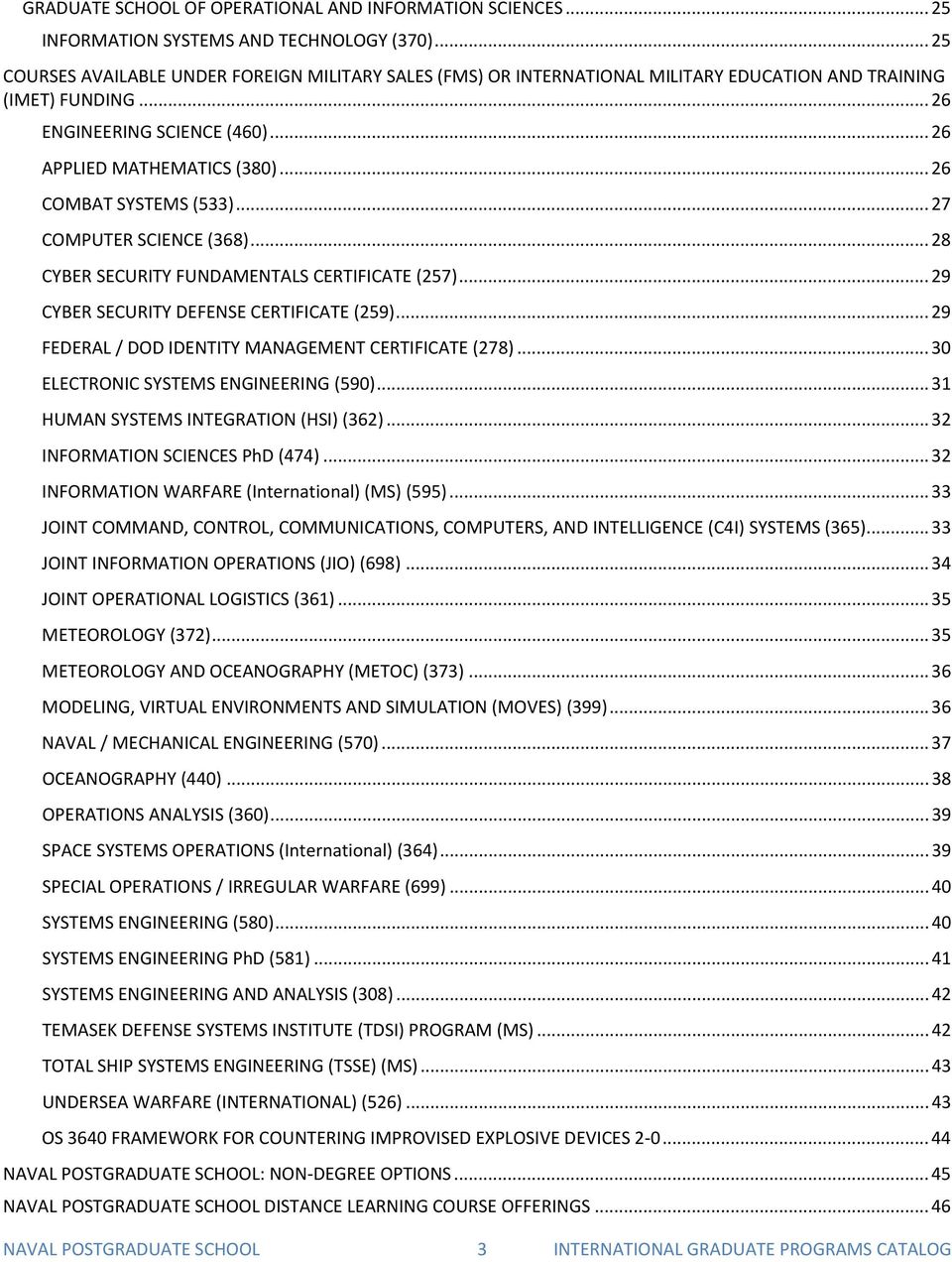
3 GRADUATE SCHOOL OF OPERATIONAL AND INFORMATION SCIENCES INFORMATION SYSTEMS AND TECHNOLOGY (370) COURSES AVAILABLE UNDER FOREIGN MILITARY SALES (FMS) OR INTERNATIONAL MILITARY EDUCATION AND TRAINING (IMET) FUNDING ENGINEERING SCIENCE (460) APPLIED MATHEMATICS (380) COMBAT SYSTEMS (533) COMPUTER SCIENCE (368) CYBER SECURITY FUNDAMENTALS CERTIFICATE (257) CYBER SECURITY DEFENSE CERTIFICATE (259) FEDERAL / DOD IDENTITY MANAGEMENT CERTIFICATE (278) ELECTRONIC SYSTEMS ENGINEERING (590) HUMAN SYSTEMS INTEGRATION (HSI) (362) INFORMATION SCIENCES PhD (474) INFORMATION WARFARE (International) (MS) (595) JOINT COMMAND, CONTROL, COMMUNICATIONS, COMPUTERS, AND INTELLIGENCE (C4I) SYSTEMS (365) JOINT INFORMATION OPERATIONS (JIO) (698) JOINT OPERATIONAL LOGISTICS (361) METEOROLOGY (372) METEOROLOGY AND OCEANOGRAPHY (METOC) (373) MODELING, VIRTUAL ENVIRONMENTS AND SIMULATION (MOVES) (399) NAVAL / MECHANICAL ENGINEERING (570) OCEANOGRAPHY (440) OPERATIONS ANALYSIS (360) SPACE SYSTEMS OPERATIONS (International) (364) SPECIAL OPERATIONS / IRREGULAR WARFARE (699) SYSTEMS ENGINEERING (580) SYSTEMS ENGINEERING PhD (581) SYSTEMS ENGINEERING AND ANALYSIS (308) TEMASEK DEFENSE SYSTEMS INSTITUTE (TDSI) PROGRAM (MS) TOTAL SHIP SYSTEMS ENGINEERING (TSSE) (MS) UNDERSEA WARFARE (INTERNATIONAL) (526) OS 3640 FRAMEWORK FOR COUNTERING IMPROVISED EXPLOSIVE DEVICES NAVAL POSTGRADUATE SCHOOL: NON-DEGREE OPTIONS NAVAL POSTGRADUATE SCHOOL DISTANCE LEARNING COURSE OFFERINGS NAVAL POSTGRADUATE SCHOOL 3 INTERNATIONAL GRADUATE PROGRAMS CATALOG
4 CYBER SECURITY FUNDAMENTALS CERTIFICATE (256) CYBER SECURITY DEFENSE CERTIFICATE (258) EXECUTIVE MBA (EMBA), DEFENSE FOCUS (805) SYSTEMS ENGINEERING (311) SPACE SYSTEMS OPERATIONS (316) MASTER OF COMPUTING TECHNOLOGY (357) MASTER OF HUMAN SYSTEMS INTEGRATION (359) MASTER OF SYSTEMS ANALYSIS (MSA) (363) MASTER OF COST ESTIMATING AND ANALYSIS (MCEA) (379) SYSTEMS ENGINEERING MANAGEMENT/PRODUCT DEVELOPMENT (MS) (721) MASTER OF SCIENCE IN CONTRACT MANAGEMENT (835) MASTER OF SCIENCE IN PROGRAM MANAGEMENT (836) MODELING & SIMULATION MANAGEMENT (CERTIFICATE) (265) INFORMATION SYSTEMS SECURITY ENGINEERING (ISSE) CERTIFICATE (270) SPACE SYSTEMS CERTIFICATE (SSC) (273) ANTI-SUBMARINE WARFARE CERTIFICATE PROGRAM (ASW) (274) SYSTEMS ANALYSIS CERTIFICATE (SA) (281) SYSTEMS ENGINEERING CERTIFICATE (SE) (282) HUMAN SYSTEMS INTEGRATION (HSI) CERTIFICATE (262) ELECTRONIC WARFARE ENGINEER CERTIFICATE (292) JOURNEYMAN EW ENGINEER CERTIFICATE (293) SENIOR EW ENGINEER CERTIFICATE (294) MASTER OF ENGINEERING IN ELECTRICAL ENGINEERING, MEng (EE), ELECTRONIC WARFARE FOCUS (592) HOUSING OPTIONS AT NPS MEDICAL INFORMATION FIELD STUDIES PROGRAM GENERAL INFORMATION MONTEREY PENINSULA MAP MONTEREY PENINSULA INFORMATION AND HISTORY NAVAL POSTGRADUATE SCHOOL 4 INTERNATIONAL GRADUATE PROGRAMS CATALOG

5 INTERNATIONAL GRADUATE PROGRAMS OFFICE The International Graduate Programs Office is responsible for the cultural, social and academic integration of the international military students and their families into the Naval Postgraduate School. The office is charged with interacting with the outside agencies, military and civilian to accomplish the goals of the US Joint Security Cooperation Education and Training Program (JSCETP) and the Field Studies Program (FSP). Additionally, it is responsible for the International Sponsor Program and acts as the Command Sponsor to the International Executive Committee. Since 1954, over 5734 International officers from 114 countries have graduated from NPS. Many have gone on to achieve positions of prominence within their military services, governments, and private industry. The International Program at NPS serves as an integral link in establishing the long term military-to-military relationships between our U.S. and International officers. The point of contact for requests for Naval Postgraduate School catalogs and admission to resident study programs and all degree programs for prospective international students is: Contact Information Mailing Address Telephone Naval Postgraduate School (DSN ) 1 University Circle, Room B-047 Fax: Monterey, CA Web Address International Graduate Programs Office Staff AL SCOTT, CAPT, USN (Ret) Director International Graduate Programs Office [email protected] KELLIE WASHBURN Management Assistant [email protected] DEBORAH GRAHAM International Student Assistant [email protected] KATHI NOYES International Military Student Officer (IMSO) [email protected] KIM ANDERSEN Field Studies Program Coordinator [email protected] NAOMI OVERSTREET Administrative Assistant [email protected] To get to the NPS Course Catalog web page, visit: Once you are there, select Course Descriptions then go to the appropriate department: National Security Affairs (NS), Oceanography (OC), Information Systems (IS), etc. NAVAL POSTGRADUATE SCHOOL 5 INTERNATIONAL GRADUATE PROGRAMS CATALOG

6 INTRODUCTION January In December 2014 the NPS international graduate program passed the significant milestone of over 5700 international graduates from 110 countries. We start with another diverse and unique international program. Current international enrollment includes 233 officer students from 50 countries (a complete break-down of the countries represented by our resident graduate students can be found on the student statistics page). More significantly, over 30% of these students are enrolled in Expanded International Military Education and Training (EIMET) certified programs to include Civil Military Relations, International Security, Stabilization and Reconstruction Studies, Regional and Strategic Studies, and several resource management curricula to include Acquisition and Contracting, Systems Acquisition, Logistics Management, Financial Management, Manpower Systems Analysis, and Information Systems Management. The Naval Postgraduate School (NPS), founded in 1909, is a fully accredited university offering over 75 unique academic curricula to military and civilian members of the Department of Defense and our allies around the world. These graduate level programs are focused on increasing the combat effectiveness of our armed forces and coalition partners, and fully support the unique and emerging requirements of the defense establishment. All programs contain a military application, and are not duplicated at civilian colleges and universities. The uniqueness of NPS is further enhanced by an outstanding civilian faculty (98% with PhDs) and a motivated and talented multi-service, interagency and coalition student body. Each curriculum has a military sponsor (flag or general officer) who reviews the course content with our faculty and program officers every two years, thus enabling us to change and adjust our courses to quickly meet the current needs of the Dept. of Defense and other governmental agencies. Of note this year, the Computer Science Department continues to offer two cyber security certificates: Cyber Security Fundamentals (MASL P170026) and Cyber Security Defense (MASL P170027). In addition, we will again offer this year a one quarter resident certificate program in Defense Planning beginning in December. Currently this program includes students from Belize, Botswana, Cameroon, Dominican Republic, Lesotho, South Africa and Tanzania. See the section on Newest Course Offerings for specifics on these and other programs. I am also happy to report that we continue to offer most of our Distance Learning curricula and certificate programs to the international community. Normal academic requirements, admissions procedures, and funding requirements apply. For course titles and MASL numbers check out the Distance Learning section. The information contained in this booklet is designed to answer basic questions regarding admission, academic programs available and other pertinent information necessary to make an orderly transition to life at the Naval Postgraduate School. Don t hesitate to call or write if you require additional information. We look forward to supporting your needs, as our top priorities are for our students to gain the greatest possible benefit from their academic experience and enjoy their tours at NPS to the fullest! Al Scott CAPT, USN (Ret) Director, International Graduate Programs Office (IGPO) NAVAL POSTGRADUATE SCHOOL 6 INTERNATIONAL GRADUATE PROGRAMS CATALOG

7 INTERNATIONAL DEGREE STUDENTS 233 Students 50 Countries AY/QTR 2 North America Canada Mexico Central/East Asia and Middle East Bahrain Israel Lebanon Pakistan Saudi Arabia Yemen Europe Bulgaria Denmark Estonia Germany Greece Hungary Netherlands Norway Sweden Switzerland Turkey Ukraine Caribbean, Central and South America Argentina Belize Bahamas Brazil Chile Colombia Dominican Republic El Salvador Paraguay Peru Uruguay Australia Far/Near East Australia Indonesia Japan Korea Malaysia Nepal Philippines Singapore Sri Lanka Taiwan Thailand Africa Botswana Cameroon Lesotho Nigeria South Africa Tanzania Tunisia Uganda NAVAL POSTGRADUATE SCHOOL 7 INTERNATIONAL GRADUATE PROGRAMS CATALOG

8 ADMISSION REQUIREMENTS 1. Admission Eligibility. The Naval Postgraduate School is an accredited graduate degree university established for the advanced education of selected United States and Allied military officers on active duty. The only civilian students accepted must be employees of an agency within the United States Government, or of sponsoring allied governments. 2. Admission Procedures. Unlike civilian schools, we do not accept an application for admission directly from a prospective student. All international students must be formally sponsored and nominated by their respective governments. There is no formal application form. Requests for evaluation of academic records for admission into a specified curriculum should be made through appropriate channels in your Ministry of Defense. Your authorities will coordinate your application with the Security Cooperation Office of the U.S. Embassy in your country and that office will forward your records to NPS for formal evaluation for the specified curriculum. The academic records that you need to provide for forwarding to NPS should consist of a legible copy, in English, of the official transcript from each college and university that you attended. Transcripts should include the title or subject area of each course studied, the number of credit hours and the grade or score you received in each course, and the date and name of each degree and certificate that you have been awarded. Grading scale in use, as well as lowest passing marks, should also be shown. Ideally, transcripts should be received by NPS four to six months prior to the requested start date. For programs that lead to the Ph.D. current results of the Graduate Record Examination (GRE) are required. Please note that the GRE is not required for Master s Degree programs. After your records are received by NPS, four to six weeks are required for our evaluation process. 3. Academic Requirements. Academic requirements are straightforward and simple. All students accepted for admission must possess, at a minimum, a baccalaureate degree or equivalent. This course work must have been completed at a recognized university or college with a grade point average of at least C+ (2.20 on a 4.0 scale). For candidates applying for entry into the Department of National Security Affairs, a grade point average of 2.6 is required. For technical or engineering programs, successful completion of calculus and calculus-based physics must be documented as well. The Business School degree programs (MBA s) and Special Operations curricula require successful completion of college level algebra. 4. TOEFL Test. International candidates from non-english speaking countries will be required to validate their fluency in English through the Test of English as a Foreign Language (TOEFL). A. The minimum TOEFL score required for direct entry to NPS is 83 IBT (Internet Based Test) or 560 (written test). Additionally, the IGPO requires that a candidate achieve a minimum of 18 in each of the four testing sections of the IBT (reading, listening, speaking and writing). Candidates applying for entry into the Department of National Security Affairs (curricula ) are required to score 90 or higher on the IBT. Waiver requests for scores between 83 and 90 will be considered on a case-by-case basis. Candidates for PhD programs or accelerated programs are required to score a minimum of 100 on the IBT. Waiver requests will be considered on a case-bycase basis for scores between 90 and 100 and on the overall application package. B. When applying for a TOEFL exam, the NPS identification code is This should be included on the registration application so a copy of the results can be sent directly to NPS. TOEFL test results are valid for two years from the test date and must be valid when the student reports to NPS. C. A candidate who fails to achieve the 83 IBT score but who does achieve a 70 IBT score is eligible to attend the 16-week TOEFL Preparatory Academic Writing Course (Advanced Language Proficiency III), MASL P (16 weeks) at the Defense Language Institute in San Antonio, Texas. DLI will also accept a score of 85 on the English Comprehension Level (ECL) test if it is achieved within 30 days prior to arrival at DLI. For admission to NPS, the minimum requirement upon completion of the TOEFL Prep course is 78 (IBT) with a minimum of 16 in each of the four testing sections (reading, listening, speaking and writing). The ALPS III course dates for are: NAVAL POSTGRADUATE SCHOOL 8 INTERNATIONAL GRADUATE PROGRAMS CATALOG

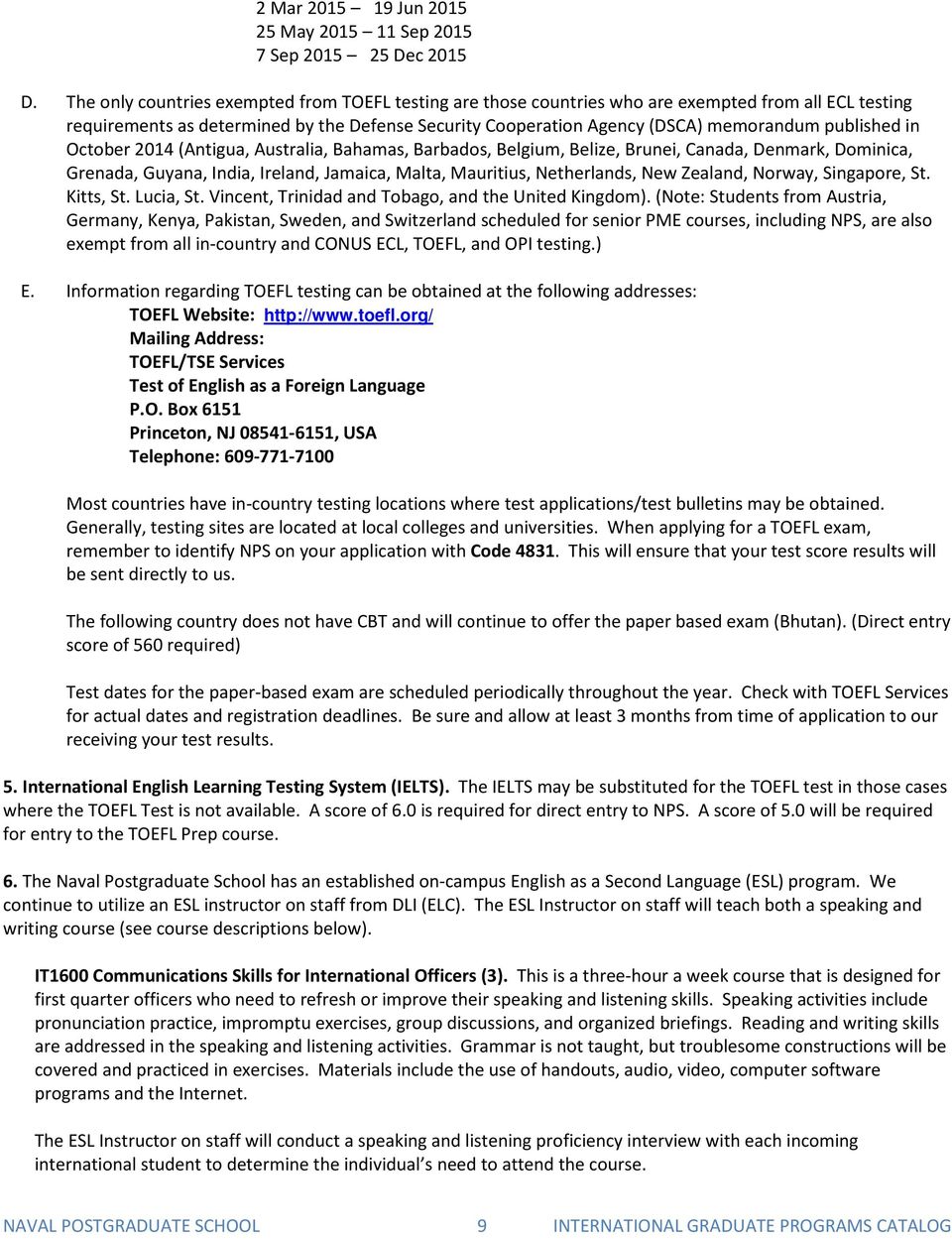
9 2 Mar 19 Jun 25 May 11 Sep 7 Sep 25 Dec D. The only countries exempted from TOEFL testing are those countries who are exempted from all ECL testing requirements as determined by the Defense Security Cooperation Agency (DSCA) memorandum published in October 2014 (Antigua, Australia, Bahamas, Barbados, Belgium, Belize, Brunei, Canada, Denmark, Dominica, Grenada, Guyana, India, Ireland, Jamaica, Malta, Mauritius, Netherlands, New Zealand, Norway, Singapore, St. Kitts, St. Lucia, St. Vincent, Trinidad and Tobago, and the United Kingdom). (Note: Students from Austria, Germany, Kenya, Pakistan, Sweden, and Switzerland scheduled for senior PME courses, including NPS, are also exempt from all in-country and CONUS ECL, TOEFL, and OPI testing.) E. Information regarding TOEFL testing can be obtained at the following addresses: TOEFL Website: Mailing Address: TOEFL/TSE Services Test of English as a Foreign Language P.O. Box 6151 Princeton, NJ , USA Telephone: Most countries have in-country testing locations where test applications/test bulletins may be obtained. Generally, testing sites are located at local colleges and universities. When applying for a TOEFL exam, remember to identify NPS on your application with Code This will ensure that your test score results will be sent directly to us. The following country does not have CBT and will continue to offer the paper based exam (Bhutan). (Direct entry score of 560 required) Test dates for the paper-based exam are scheduled periodically throughout the year. Check with TOEFL Services for actual dates and registration deadlines. Be sure and allow at least 3 months from time of application to our receiving your test results. 5. International English Learning Testing System (IELTS). The IELTS may be substituted for the TOEFL test in those cases where the TOEFL Test is not available. A score of 6.0 is required for direct entry to NPS. A score of 5.0 will be required for entry to the TOEFL Prep course. 6. The Naval Postgraduate School has an established on-campus English as a Second Language (ESL) program. We continue to utilize an ESL instructor on staff from DLI (ELC). The ESL Instructor on staff will teach both a speaking and writing course (see course descriptions below). IT1600 Communications Skills for International Officers (3). This is a three-hour a week course that is designed for first quarter officers who need to refresh or improve their speaking and listening skills. Speaking activities include pronunciation practice, impromptu exercises, group discussions, and organized briefings. Reading and writing skills are addressed in the speaking and listening activities. Grammar is not taught, but troublesome constructions will be covered and practiced in exercises. Materials include the use of handouts, audio, video, computer software programs and the Internet. The ESL Instructor on staff will conduct a speaking and listening proficiency interview with each incoming international student to determine the individual s need to attend the course. NAVAL POSTGRADUATE SCHOOL 9 INTERNATIONAL GRADUATE PROGRAMS CATALOG
10 IT1700 Academic Writing for International Officers (3). This is a three-hour a week course that is designed for third or fourth quarter students who need academic writing instruction before starting their thesis work. The course focuses on paragraph organization, rhetorical styles, coherent and cohesive forms, troublesome grammatical structures, punctuation, and documentation. Students will write several drafts in the different rhetorical styles as out of class assignments. Writing software programs may be used as a means of self-study for part of the class. Students will maintain a portfolio of drafts for the class. A student s writing score from the TOEFL determines the need to attend this course. If the score is 4.5 or under (out of the 6 point scale), a student attends the course. NAVAL POSTGRADUATE SCHOOL 10 INTERNATIONAL GRADUATE PROGRAMS CATALOG

11 NEWEST COURSE OFFERINGS HOMELAND DEFENSE AND SECURITY (692) Curriculum 692 MASL# P Course Report: 28 Apr Aug 15 Course Convene: 29 Apr Aug 15 Course Complete: 23 Sep Dec 16 In-Residence Dates: 29 Apr - 8 May Jul Oct Jan Apr Jul Sep16 (See for subsequent course dates) Course Length: 78 weeks The Center for Homeland Defense and Security offers a Master of Arts in Security Studies. The program provides qualified students with the skills to develop strategies, plans and programs to prevent, mitigate and respond to disastrous events; build the organizational arrangements needed to strengthen homeland security; and, improve homeland security preparedness by developing actionable policy and strategy. Courses cover emerging topics in homeland security and emergency management, including policy, budgeting, intelligence, comparative government and critical infrastructure protection. The curriculum is structured around the key policy and organizational design problems that future homeland security leaders are likely to confront and the analytic skills they will need to meet those challenges. Each course in the curriculum requires students to master the core issues, principles and problem-solving approaches for the topic in question and apply those fundamentals to the specific challenges confronting their own jurisdictions or sponsoring organizations. The courses are sequenced and integrated to strengthen the overall cohesion of the curriculum, and enhance its effectiveness as professional, graduate-level education. Course descriptions can be found on the website at Program Description: The Master of Arts in Security is an 18-month program. The program uses the cohort model, in which a group of students begin at the same time and work through the same curriculum to achieve the degree together. Students are required to be in-residence for two weeks each quarter, a total of 12 weeks in residence for the length of the program. The remainder of the course is taught through network-based learning. Participants spend an average of 15 hours per week during the network-based learning periods of study - reading assigned materials, participating in online discussions with faculty and other participants, while also preparing papers and projects. Participants and their agency must be cognizant of this commitment and should view it as an investment in enhancing the individual s and the jurisdiction s homeland security capabilities. A thesis is required for graduation. The thesis project should be of significant benefit to the participant s jurisdiction, agency or home country. NAVAL POSTGRADUATE SCHOOL 11 INTERNATIONAL GRADUATE PROGRAMS CATALOG

12 Course Pre-requisites: Candidates for the program must have achieved the following: a baccalaureate degree with an undergraduate 3.0 grade point average for all undergraduate coursework or awarded a graduate degree. Applicants with a grade point average below 3.0 will be considered if they have relevant work experience and qualifications to complement their academic record. Although it is not mandatory, it is highly recommended that the applicant take the Graduate Records Exam (GRE) or the Miller s Analogy Test (MAT) to bolster their scores. International candidates must have a TOEFL score of 90 or above. Applicants must be employed full time with a government agency in a position of significant homeland security and homeland defense responsibilities. International candidates must be in positions of national security and must be nominated by their appropriate government agency to the military training office at the U.S. Embassy in their country as specified in the US Joint Security Cooperation Education and Training regulations. To apply: The application process is found online at under the Master s Degree program and requires writing five essays; a resume detailing homeland security experience; transcripts; and, three letters of recommendation. The application may include unofficial copies of transcripts with a statement that official copies have been requested. Official copies of transcripts must be received by NPS/CHDS prior to the start of the first quarter of study. Applicants must provide copies of transcripts from all the undergraduate and graduate schools attended, including a copy of the transcript showing an undergraduate degree was awarded from an accredited college or university. Transcripts will be verified by the military training office at the U.S. Embassy in their country. The Admissions Committee will consider the materials, using the following criteria: Academic credentials and potential for graduate study (30 percent of weighted application score) Experience portfolio (25 percent of weighted application score) Future contributions to the discipline, as expressed in the self-assessment (20 percent of weighted application score) Communication skills, as reflected in all written materials (10 percent of weighted application score) Recommendations and commitment of support (15 percent of weighted application score) Tuition: Provided on request; Living allowance and lodging expenses for the 6 two week residence periods in Monterey: Approx. $13,000 Application Deadline: May Program POC: Al Scott, CAPT USN (Ret) Application Question POC: Glen Woodbury Director, International Graduate Program Office Director, Center for Homeland Defense and Security [email protected] [email protected] Phone: (831) Phone: (831) University Circle, RM B University Circle, Building 246, RM 372 Naval Postgraduate School Naval Postgraduate School Monterey, CA Monterey, CA EXECUTIVE LEADERS PROGRAM MASL# P Course Report: 18 May 15 Course Convene: 19 May 15 Course Complete: 18 Feb 16 In-Residence Dates: May 15 NAVAL POSTGRADUATE SCHOOL 12 INTERNATIONAL GRADUATE PROGRAMS CATALOG

13 4-7 Aug Nov 15 (see for subsequent course dates) Course Length: 39 weeks The Executive Leaders Program offers a graduate-level education for high-ranking government and private-sector leaders. The program provides an educational forum to enhance senior leaders' capacity to identify and resolve homeland security problems as well as an opportunity to build networks among government and private-sector homeland security officials. Seminars are conducted on such topics as intelligence, critical infrastructure, border/immigration, threat recognition, crisis and risk communications, incident management and fear management as well as emerging homeland security issues. Curriculum: This program consists of four modules beginning with foundational aspects of homeland security and threats, proceeding to describe the nature of the threats, legal and cultural aspects of preventing and preparing for the threats, the collaborations necessary to effectively manage information sharing, threat recognition, protection measures, and plans in preparation for action. All of the topics will be discussed on a strategic, policy and organizational design level with particular attention to intergovernmental planning challenges. The participants will consider complex issues and case studies, and work through problems that enable them to strengthen working relationships across regions, agencies, and local-state-federal jurisdictional and private sector lines. Program Structure: Each module will be conducted over a four and one-half day period at the Naval Postgraduate School's Center for Homeland Defense and Security facilities in Monterey, CA. Four one-week sessions are held on the Naval Postgraduate School campus over a nine-month period. Participants must commit to attending all four sessions. Participants consist of approximately thirty senior local, state, tribal, federal government, military and private sector officials with homeland security responsibilities. The program is designed to accommodate the busy schedules of participating executives and will not require the workload of traditional graduate level education programs. The instruction will be a combination of presentations and facilitated discussion between faculty, participants and subject matter experts. The in-residence weeks will be structured around a Monday through Friday timeframe. Each day will begin at 8:00 a.m. and end by 4:00 p.m. with the exception of Friday which ends at 10:00 a.m. The hotel accommodations will be arranged for the Sunday prior to beginning the seminar through Friday. Selection Criteria: Candidates should be high-ranking government and private sector executives. The selection criteria look at the relevancy and level of applicants' positions and homeland security responsibilities, as well as the homeland security experience and knowledge they will bring to the program. This is significant as the sessions are facilitated roundtable discussions and debates where participants learn from one another. In addition, a major objective of the program is to establish relationships between executives across disciplines, agencies and levels of government so that they may utilize the network to develop new homeland security policies, strategies and plans to solve problems. Therefore, the selection criteria will also look at the potential benefit of relationship building to the applicant. Tuition: Tuition provided on request; travel and lodging expenses extra. Application Deadline: May 15 Program POC: Al Scott, CAPT USN (Ret) Application Question POC: Glen Woodbury Director, International Graduate Program Office Director, Center for Homeland Defense and Security [email protected] [email protected] Phone: (831) Phone: (831) University Circle, RM B University Circle, Building 246, RM 372 Naval Postgraduate School Naval Postgraduate School Monterey, CA Monterey, CA NAVAL POSTGRADUATE SCHOOL 13 INTERNATIONAL GRADUATE PROGRAMS CATALOG

14 TECHNOLOGIES FOR INFORMATION OPERATIONS MASL# P Course Report: 01 Nov 15 Course Convene: 02 Nov 15 Course Complete: 20 Nov 15 Course Length: 3 weeks A course tailored for mid to high level officers (LT/Capt CDR/LtCol) based on recent research and development in several areas. A. Contemporary technology developments for military activity: Recent technology developments that show what kind of developments we face and how these could change military activity. B. Operational research for military activity: Methods and tools for analyzing military operations. C. System engineering for development of military systems: Methods and tools for developing and analyzing military (technical) systems. The course is a technical workshop presented by various NPS faculty that covers several exciting technology areas important for tomorrow s war fighters. The course also includes a field trip and several lab tours. Quota: 35 worldwide on first-come first-serve basis Course Pre-requisites: Undergraduate engineering degree or equivalent ECL score of 85. DEFENSE PLANNING CERTIFICATE (GRADUATE-LEVEL EDUCATION FOR DEFENSE PLANNERS) (245) Curriculum 245 MASL# P Course Report: 27 Dec 15 Course Convene: 28 Dec 15 Course Complete: 25 Mar 16 Course Length: 13 weeks Defense planning is a critical capability to ensure effective and efficient performance by an armed force, as well as to ensure the civil control of armed forces. In order to support the ability of the U.S. Department of Defense and U.S. Department of State to expand the ability to educate foreign officials in defense planning, the U.S. Naval Postgraduate School has initiated an International Defense Planning Certificate from the Department of National Security Affairs. This certificate program is a resident program that will be delivered annually during NPS s winter quarter. The program consists of four (4) graduate level courses / seminars that have been organized to appeal to mid- and higher-level civilian defense officials, as well as military officers with responsibilities for planning, organization, and management of armed forces. Sponsoring country teams and recipient countries are encouraged to engage in discussions with the Certificate s organizers prior to sending students to Monterey to design country-specific research and analysis projects to fit with ongoing national defense reform efforts. The program will require the participating students to take four seminars: 1) Comparative Defense Planning (NS3246), 2) Comparative Defense Organization and Management (NS3245), 3) Defense Capability Development (NS3021), and 4) Strategic Planning and the Military (NS3230). Students wishing to pursue a Master s Degree in the Department of National Security Affairs can apply the credits gained in this Certificate Program to that degree. NAVAL POSTGRADUATE SCHOOL 14 INTERNATIONAL GRADUATE PROGRAMS CATALOG

15 CYBER SECURITY FUNDAMENTALS CERTIFICATE (257) Curriculum 257 MASL# P Course Report: 21 Jun Dec Course Convene: 06 Jul Dec Course Complete: 25 Sep Mar 2016 Course Length: 13 weeks The Cyber Security Fundamentals graduate certificate is intended to provide a technically rigorous foundation upon which to build knowledge and skills in computer network defense, attack and exploitation. Each course is comprised of both instruction and laboratory exercises involving cyber security aspects of computers and networks. These synergistic activities allow students to internalize key concepts in cyber security. The courses and material covered in the Cyber Security Fundamentals certificate satisfy prerequisite requirements for advanced cyber security courses offered by the Computer Science Department of the Naval Postgraduate School. The four courses in the certificate sequence are a subset of the graduate courses in the Department s Computer and Network Security specialization track. Of these, three are core track courses. The total number of NPS graduate credits obtained for the certificate is 17, where laboratory credits are counted as half. Courses may be taken two at a time or as a linear sequence of individual offerings. This certificate program can also be applied toward a master s degree program, e.g. to Curriculum 368.* * Please note that if it is the intent to take Curriculum 259, Cyber Security Defense, directly following Curriculum 257, participants must have some computer programming experience. Required Courses: CS3600 Introduction to Computer Security or CS 4600 Secure System Principles CS3670 Information Assurance: Secure Management of Systems CS3690 Network Security or CS3695 Network Vulnerability Assessment and Risk Mitigation CYBER SECURITY DEFENSE CERTIFICATE (259) Curriculum 259 MASL# P Course Report: 15 Mar Sep 15 Course Convene: 30 Mar Sep 15 Course Complete: 19 Jun Dec 15 Course Length: 13 weeks Using the foundation established through the Cyber Security Fundamentals certificate, students enrolled in Cyber Security Defense graduate certificate, will obtain a detailed understanding of and ability to function in real operational situations involving cyber security. They will gain the technical depth required to actively prepare for and respond to attacks. Students will learn to analyze network traffic to extract the observable characteristics of networks and network devices, thus providing a basis for defensive strategies. They will learn to build tools and how to configure systems and networks to permit systems to foster resiliency and continuity of operations, perhaps with reduced capacity, through attacks. Students will learn how to construct systems and tools to mitigate the impact of malicious software. Students will learn forensic techniques to retrieve and analyze stored information that may be corrupted or hidden. Considerable programming and hands-on work with systems and networks will be required. Entire courses, or units within them, may NAVAL POSTGRADUATE SCHOOL 15 INTERNATIONAL GRADUATE PROGRAMS CATALOG

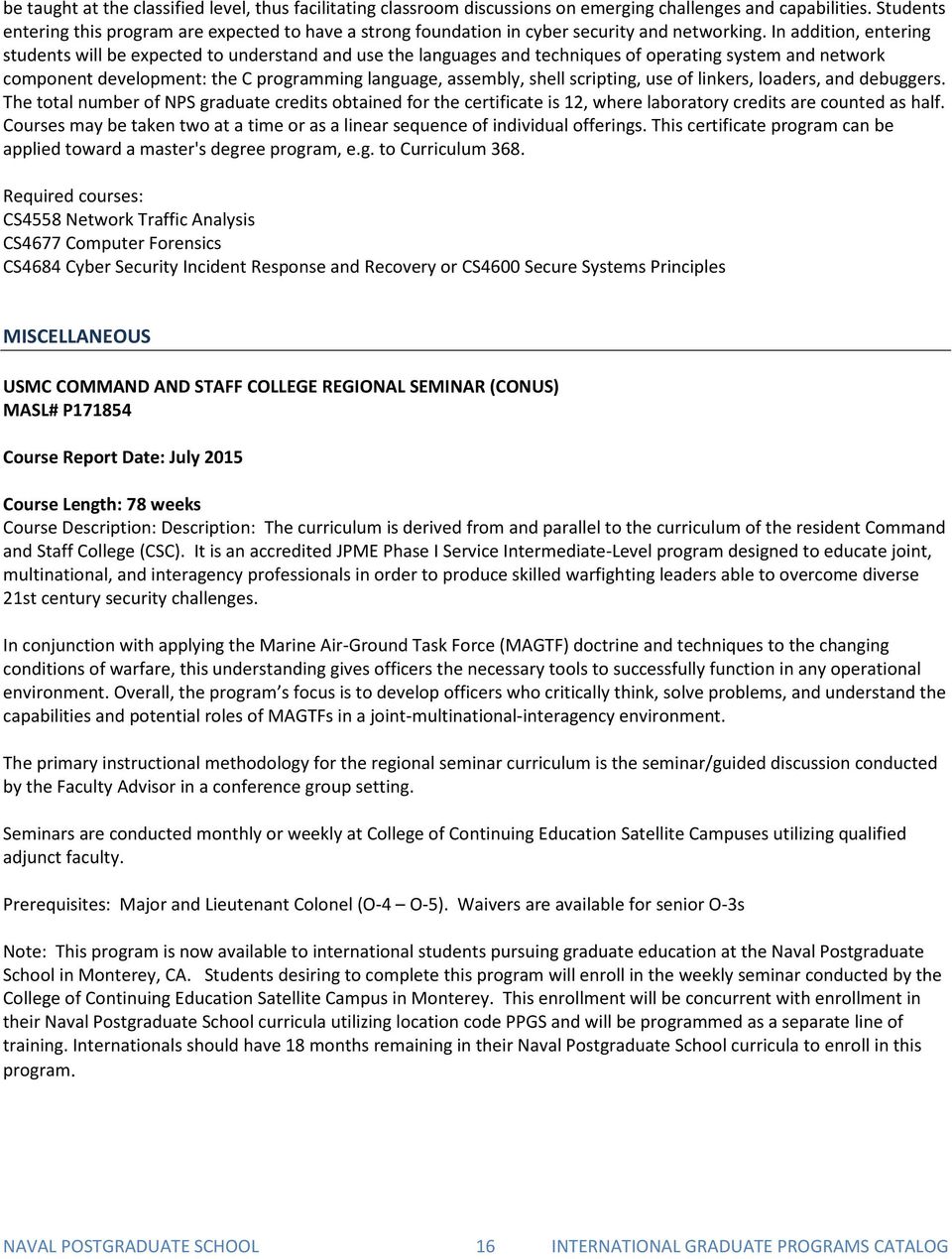
16 be taught at the classified level, thus facilitating classroom discussions on emerging challenges and capabilities. Students entering this program are expected to have a strong foundation in cyber security and networking. In addition, entering students will be expected to understand and use the languages and techniques of operating system and network component development: the C programming language, assembly, shell scripting, use of linkers, loaders, and debuggers. The total number of NPS graduate credits obtained for the certificate is 12, where laboratory credits are counted as half. Courses may be taken two at a time or as a linear sequence of individual offerings. This certificate program can be applied toward a master's degree program, e.g. to Curriculum 368. Required courses: CS4558 Network Traffic Analysis CS4677 Computer Forensics CS4684 Cyber Security Incident Response and Recovery or CS4600 Secure Systems Principles MISCELLANEOUS USMC COMMAND AND STAFF COLLEGE REGIONAL SEMINAR (CONUS) MASL# P Course Report Date: July Course Length: 78 weeks Course Description: Description: The curriculum is derived from and parallel to the curriculum of the resident Command and Staff College (CSC). It is an accredited JPME Phase I Service Intermediate-Level program designed to educate joint, multinational, and interagency professionals in order to produce skilled warfighting leaders able to overcome diverse 21st century security challenges. In conjunction with applying the Marine Air-Ground Task Force (MAGTF) doctrine and techniques to the changing conditions of warfare, this understanding gives officers the necessary tools to successfully function in any operational environment. Overall, the program s focus is to develop officers who critically think, solve problems, and understand the capabilities and potential roles of MAGTFs in a joint-multinational-interagency environment. The primary instructional methodology for the regional seminar curriculum is the seminar/guided discussion conducted by the Faculty Advisor in a conference group setting. Seminars are conducted monthly or weekly at College of Continuing Education Satellite Campuses utilizing qualified adjunct faculty. Prerequisites: Major and Lieutenant Colonel (O-4 O-5). Waivers are available for senior O-3s Note: This program is now available to international students pursuing graduate education at the Naval Postgraduate School in Monterey, CA. Students desiring to complete this program will enroll in the weekly seminar conducted by the College of Continuing Education Satellite Campus in Monterey. This enrollment will be concurrent with enrollment in their Naval Postgraduate School curricula utilizing location code PPGS and will be programmed as a separate line of training. Internationals should have 18 months remaining in their Naval Postgraduate School curricula to enroll in this program. NAVAL POSTGRADUATE SCHOOL 16 INTERNATIONAL GRADUATE PROGRAMS CATALOG
17 PhD ADMISSION REQUIREMENTS NPS doctoral programs are available to officers of all U.S. services, civilian employees of the government, a limited number of DoD Contractors, and to individuals sponsored by selected allied nations. Applications may be submitted at any time. An individual applying for admission to a Ph.D. program must hold a bachelor's degree qualifying the student for graduate status in the department of his/her major study, or shall have completed an equivalent course of study. International applications shall be submitted to the International Graduate Programs Office. The application must include the following: Full name, title/rank, date of birth and SSN. Current mailing address, telephone and . Department of the proposed major subject area. Description of current position and responsibilities. A brief outline (200 words or fewer) of specific areas of interest within the proposed major field of study. (For candidates pursuing a PhD in Security Studies, an expository writing sample demonstrating potential to do work of high academic qualify (master s thesis) in the proposed major field of study.) Identification of source of support for attendance at NPS. Certified copies of all undergraduate and graduate transcripts. However, transcripts from NPS are not necessary. Results of a Graduate Record Examination (GRE) General Test taken within the last five-years. Two letters of recommendation. For international applicants not currently enrolled at NPS whose native language is other than English, or whose primary language of instruction was other than English, current results of the Test of English as a Foreign Language (TOEFL) is required. Candidates for PhD programs or accelerated programs are required to score a minimum of 100 on the IBT. Waivers will be considered on a case by case basis for scores between 90 and 100 based on the overall application package. NAVAL POSTGRADUATE SCHOOL 17 INTERNATIONAL GRADUATE PROGRAMS CATALOG

18 NAVAL POSTGRADUATE SCHOOL EXPANDED- INTERNATIONAL MILITARY EDUCATION AND TRAINING (E-IMET) COURSE OFFERINGS SCHOOL OF INTERNATIONAL GRADUATE STUDIES (NATIONAL SECURITY AFFAIRS DEPT.) REGIONAL STUDIES ( ) Curricula (MA) MASL# P Curriculum 681 Middle East, South Asia and Sub-Saharan Africa MASL# P Curriculum 682 Far East, Southeast Asia, and Pacific MASL# P Curriculum 683 Western Hemisphere MASL# P Curriculum 684 Europe and Eurasia Course Report: 15 Mar Jun Sep Dec 15 Course Convene: 30 Mar Jul Sep Dec 15 Course Complete: 23 Sep Dec Mar Jun 17 Course Length: 78 weeks Provides students with a wide knowledge and thorough understanding of the complex inter-related environments pertaining to national security affairs, as well as addresses the interface between international politics, civil-military relations, and national security objectives. Places emphasis on the proper role of the military in a democratically elected government. Curricula focus is on the history, culture, and religion of a specific region or country and provides students with knowledge of current issues, economic and political structures and institutions, military forces, including strategic capabilities and policy implications, and geopolitical influences. Students receive extensive exposure to human rights issues. SECURITY STUDIES CIVIL-MILITARY RELATIONS (685) Curriculum 685 (MA) MASL# P Course Report: 15 Mar Jun Sep Dec 15 Course Convene: 30 Mar Jul Sep Dec 15 Course Complete: 17 Jun Sep Dec Mar 17 Course Length: 65 weeks This curriculum is an inter-disciplinary program, tailored for officers and civilian employees of other countries and the U.S. National Guard. The program is designed to meet three related needs. First, the program gives students the skills NAVAL POSTGRADUATE SCHOOL 18 INTERNATIONAL GRADUATE PROGRAMS CATALOG

19 they need to understand the security problems confronting their own democracies in the post-cold War environment, and the challenges of bringing about change in the defense sector. Second, the program offers an in-depth understanding of civil-military relations. Finally, the program prepares students to resolve the civil-military issues raised by participation in U.N. peacekeeping operations, membership in the Partnership for Peace and other alliances, and security cooperation among nations. International students in this program are fully integrated with the U.S. students at the Naval Postgraduate School. As part of the degree, students are required to complete a thesis that deals with a significant civil-military relations issue in the sponsoring country. STABILIZATION AND RECONSTRUCTION STUDIES (686) Curriculum 686 (MA) MASL# P Course Report: 15 Mar Jun Sep Dec 15 Course Convene: 30 Mar Jul Sep Dec 15 Course Complete: 17 Jun Sep Dec Mar 17 Course Length: 65 weeks Stabilization and Reconstruction Studies is a 15-month interdisciplinary, multinational and civil-military graduate education program. NPS faculty prepared this curriculum with the encouragement and support of DSCA in 2001, predating US civil-military operations in Afghanistan and Iraq, and the first cohort of students graduated in In September 2004, NPS opened a Center for Stabilization and Reconstruction Studies to build synergy with related short courses and research and outreach efforts. In 2013, the name was changed to the Prevention, Relief & Recovery Program at CCMR (see Curriculum 686 provides specialized expertise, problemsolving skills, and management tools required by civilians and military officers (US and International) addressing today s stabilization and reconstruction challenges. The curricular premise is very simple. Sustainable economic and political development can only go forward when effective, democratically-controlled institutions can provide security for a nation s people. In nations where U.S. and international forces are providing this security, those forces need to work with civilian developmental agencies and nongovernmental agencies (NGO s) to help build indigenous security institutions. Otherwise, military forces risk creating a climate of dependency, in which continued local reliance on those forces slows their exit and impedes progress towards broader political and economic development. The purpose of the program is the creation of a security environment within which economic and political development can flourish. By building indigenous capacities to provide security, military forces can work themselves out of a job and facilitate their own exit. Moreover, by conducting operations in close cooperation with civilian development agencies and NGO s, forces can facilitate the handoff to these partners and can contribute directly to their development work. In short: the Stabilization and Reconstruction Studies program is designed to help the United States and its allies win and maintain the peace long after forces have returned home. NAVAL POSTGRADUATE SCHOOL 19 INTERNATIONAL GRADUATE PROGRAMS CATALOG

20 STRATEGIC STUDIES (688) Curriculum 688 (MA) MASL# P Course Report: 15 Mar Jun Sep Dec 15 Course Convene: 30 Mar Jul Sep Dec 15 Course Complete: 17 Jun Sep Dec Mar 17 Course Length: 65 weeks Strategy is concerned with the use of force to further the ends of policy. The aim of this curriculum is to produce students with a thorough understanding of the relationship between force and politics, and of the relationship of force to other instruments by which the ends of policy may be pursued. Graduates will possess a comprehensive knowledge of US national security and defense policy and military strategy. They will have the ability to develop and coordinate national and military strategy; to develop concepts and plans to employ military forces at the national and theater levels; to write strategic- and operational-level vision and guidance documents; and to formulate, articulate, and coordinate the employment of all dimensions of military power to support the ends of American national policy. Strategic Studies is a multi-disciplinary degree program grounded in the fields of history, international relations, comparative politics, and political economy, and requires completion of a Master's thesis as the capstone degree requirement. Satisfactory completion of the four-course Naval War College JPME sequence is required for Navy officers. Students who are not required, or do not desire, to complete JPME are expected to develop a coherent four-course elective sequence in its place. COMBATING TERRORISM POLICY AND STRATEGY (693) Curriculum 693 (MA) MASL# P Course Report: 15 Mar Jun Sep Dec 15 Course Convene: 30 Mar Jul Sep Dec 15 Course Complete: 17 Jun Sep Dec Mar 17 Course Length: 65 weeks This five-quarter curriculum provides an understanding of the nature and dynamics of terrorist organizations, and the domestic and international variables involved in the formulation of counterterrorist policy. The curriculum allows the students to combine a regional focus with comparative courses that discuss terrorist organizations and operations, the financing of terror, legal and policing developments in counterterrorism, intelligence, and the military role in homeland defense. The NSA department is a unique environment in which to pursue this course of studies since its student body is inherently joint and combined, providing students with both a stimulating intellectual environment and an opportunity to establish networks and life-long working relationships with fellow officers from other services and countries. NAVAL POSTGRADUATE SCHOOL 20 INTERNATIONAL GRADUATE PROGRAMS CATALOG

21 DEFENSE PLANNING CERTIFICATE (GRADUATE-LEVEL EDUCATION FOR DEFENSE PLANNERS) (245) Curriculum 245 MASL# P Course Report: 21 Jun 15 Course Convene: 06 Jul 15 Course Complete: 25 Sep 15 Course Length: 13 weeks Defense planning is a critical capability to ensure effective and efficient performance by an armed force, as well as to ensure the civil control of armed forces. In order to support the ability of the U.S. Department of Defense and U.S. Department of State to expand the ability to educate foreign officials in defense planning, the U.S. Naval Postgraduate School has initiated an International Defense Planning Certificate from the Department of National Security Affairs. This certificate program is a resident program that will be delivered annually during NPS s winter quarter. The program consists of four (4) graduate level courses / seminars that have been organized to appeal to mid- and higher-level civilian defense officials, as well as military officers with responsibilities for planning, organization, and management of armed forces. Sponsoring country teams and recipient countries are encouraged to engage in discussions with the Certificate s organizers prior to sending students to Monterey to design country-specific research and analysis projects to fit with ongoing national defense reform efforts. The program will require the participating students to take four seminars: 1) Comparative Defense Planning (NS3246), 2) Comparative Defense Organization and Management (NS3245), 3) War in the Modern World (NS3000), and 4) Strategic Planning and the Military (NS3230). Students wishing to pursue a Master s Degree in the Department of National Security Affairs can apply the credits gained in this Certificate Program to that degree. GRADUATE SCHOOL OF BUSINESS AND PUBLIC POLICY ACQUISITION AND CONTRACT MANAGEMENT (815) Curriculum 815 (MBA) MASL# P Course Report: 21 Jun Dec 15 Course Convene: 06 Jul Dec 15 Course Complete: 16 Dec Jun 17 Course Length: 78 weeks This is an interdisciplinary program which integrates mathematics, accounting, economics, finance, behavioral science, management theory, operations/systems analysis and specific courses in acquisition and contracting. Student input includes officers and civilians from all DOD services, the Coast Guard and other nations. The curriculum is designed to provide officers and civilians with the skills to serve effectively in hardware systems, buying offices, field contracting offices, contract administration offices and contracting policy offices. NAVAL POSTGRADUATE SCHOOL 21 INTERNATIONAL GRADUATE PROGRAMS CATALOG
22 SYSTEMS ACQUISITION MANAGEMENT (816) Curriculum 816 (MBA) MASL# P Course Report: 21 Jun Dec 15 Course Convene: 06 Jul Dec 15 Course Complete: 31 Mar Sep 17 Course Length: 91 weeks This is an interdisciplinary program designed to integrate business principles, management theory, operations/systems analysis, and to Defense acquisition management and intensive exposure to the fundamental principles of the acquisition environment. The courses in this curriculum present the structure of acquisition management, the decisions and problems facing the defense acquisition manager, the various forces at work within the industry and Government, and the impact of acquisition policies and strategies. Student input includes officers and civilians from all DoD services, the Coast Guard, and other nations. DEFENSE SYSTEMS MANAGEMENT INTERNATIONAL (818) Curriculum 818 (MBA) MASL# P Course Report: 21 Jun Dec 15 Course Convene: 06 Jul Dec 15 Course Complete: 16 Dec Jun 17 Course Length: 78 weeks This program is designed to provide officers with fundamental interdisciplinary techniques of quantitative problemsolving methods, behavioral and management science, economic analysis and financial management to enable the officers to evaluate the written research, study and analysis product of others throughout their careers. The curriculum will further provide the officers with the specific functional skills required to effectively manage. The curriculum integrates mathematics, accounting, economics, behavioral science, management theory, operations/systems analysis and a subspecialty concentration area into an understanding of the process by which the defense mission is accomplished. Specialty concentration areas are selected by the student by their choice of course options. The 818 curriculum allows students to design a program of course work specific to management effectiveness in the host country s military system. The student may elect to specialize in the relevant portion of a functional area such as financial, logistics, human resources and organization, or manpower and personnel analysis. Or, the student may choose to follow a general management program which would include an overall balance of courses from many areas. NAVAL POSTGRADUATE SCHOOL 22 INTERNATIONAL GRADUATE PROGRAMS CATALOG
23 LOGISTICS MANAGEMENT CURRICULA (819/827) Logistics Management includes two curricula, each a concentration area within the MBA degree program: MASL# P Curriculum Supply Chain Management (MBA) MASL# P Curriculum Material Logistics Support (MBA) Course Report: 21 Jun Dec 15 Course Convene: 06 Jul Dec 15 Course Complete: 16 Dec Jun 17 Course Length: 78 weeks The Logistics Management curricula are interdisciplinary, integrating mathematics, accounting, economics, management theory, operations analysis and the specialty concentration into an understanding of the process by which the defense mission is accomplished. The program is designed to provide the officer with fundamental interdisciplinary techniques of quantitative problem-solving methods, behavioral and management science, economic analysis, and financial management; furthermore, it is intended to provide the officer with a Navy/Defense Systems-oriented graduate management education and to provide the officer with the specific functional skills required to effectively manage in this subspecialty area. The objective of these curricula is to prepare officers for naval logistics system positions. The Logistics Management curricula emphasize all of the aspects for providing integrated logistics support of military systems. Skills resulting from the curricula will prepare those responsible for managing the various segments of a military system s life cycle from initial planning for support to fielding the system, through sustaining operations to phase out. These curricula additionally emphasize the management of military owned inventories at the three levels of wholesale, intermediate and retail customer support, and worldwide transportation and distribution systems. The Logistics concentration subjects are significant components of the military supply chain and each provides unique and relevant education that meets the critical needs of the armed services. The specialized logistics courses concentrate on studies in production and project management, inventory management, integrated logistics support, procurement and contract administration, systems acquisition and logistics strategic planning. RESOURCE PLANNING AND MANAGEMENT FOR INTERNATIONAL DEFENSE (820) Curriculum 820 (MBA) MASL# P Course Report: 21 Jun Dec 15 Course Convene: 06 Jul Dec 15 Course Complete: 16 Dec Jun 17 Course Length: 78 weeks This is an interdisciplinary program which integrates mathematics, accounting, economics, behavioral science, organization and management theory, operations/systems analysis, managerial communications, and international law into an understanding of the process by which the defense mission is accomplished. The course of studies explores the interface among international politics, national security objectives, civil-military relations, resource planning and management, and synthesizes the political, technological, economic, cultural, social and ideological forces influencing international defense. Students receive extensive exposure to human rights issues. It provides techniques of quantitative problem-solving methods, behavioral and management science, economic analysis and financial management which will enable graduates to evaluate the written research, study and analysis products of others throughout their careers. NAVAL POSTGRADUATE SCHOOL 23 INTERNATIONAL GRADUATE PROGRAMS CATALOG
24 FINANCIAL MANAGEMENT (837) Curriculum 837 (MBA) MASL# P Course Report: 21 Jun Dec 15 Course Convene: 06 Jul Dec 15 Course Complete: 16 Dec Jun 17 Course Length: 78 weeks The objective of the Financial Management Curriculum is to prepare officers for business and financial positions within the Navy. Financial Managers assist the services decision-making processes at all levels by providing accurate, timely and relevant information. They are concerned with the optimal allocation of information. They are concerned with optimal allocation of human, physical and financial resources to achieve the services goals and objectives while assuring efficient and effective expenditure of public funds. Graduate courses cover topics such as financial reporting standards, cost standards, cost analysis, budgeting, internal control, auditing, management planning and control systems, quantitative techniques used in planning and control, and the Planning Program and Budgeting Systems used within the Department of Defense. Graduates of the Financial Management Curriculum will be prepared for assignment to positions in budgeting, accounting, business and financial management, and internal control and auditing. MANPOWER SYSTEMS ANALYSIS (847) Curriculum 847 (MS) MASL# P Course Report: 21 Jun 15 Course Convene: 06 Jul 15 Course Complete: 31 Mar 17 Course Length: 91 weeks Program is designed to fill the leadership roles of military manpower management. MSA is an extremely analytical curriculum intended to develop skills necessary to perform and evaluate manpower analyses. As such, the curriculum emphasizes mathematical, statistical, and other quantitative methods. Areas covered include an understanding of MSA policy development, compensation systems, productivity analysis, enlistment supply and retention models, manpower requirements determination processes, career mix, enlistment incentives, reenlistment incentives, training effectiveness measures and hardware/manpower trade-offs. Students gain familiarity with current models and methods of MSA analysis as well as military MSA organizations and issues. INFORMATION SYSTEMS MANAGEMENT (870) Curriculum 870 (MBA) MASL# P Course Report: 21 Jun 15 Course Convene: 06 Jul 15 Course Complete: 16 Dec 16 NAVAL POSTGRADUATE SCHOOL 24 INTERNATIONAL GRADUATE PROGRAMS CATALOG
25 Course Length: 78 weeks The Information Age has generated a revolution in the means in which we conduct business and warfare. New technologies have changed the traditional views of the marketplace, supply chain management, and logistics. As the range and complexity of computer applications have grown, the need to manage and exploit those resources has increased. This curriculum provides both the technical skills and business acumen to deal with a constantly evolving digital world. The information Systems Management (MBA) curriculum provides the knowledge skills and competencies to: Manage the acquisition of Information Systems. Manage Information Systems and infrastructure support afloat and ashore. Solve Information Systems engineering and management problems individually and in teams. Effectively manage and lead in today s constantly changing digital world. Develop and implement effective strategies and policies to take advantage of technological opportunities and mitigate risk. Assimilate new technologies and transform organizations, processes, and strategies to compete in the marketplace or on the battlefield. GRADUATE SCHOOL OF OPERATIONAL AND INFORMATION SCIENCES INFORMATION SYSTEMS AND TECHNOLOGY (370) Curriculum 370 (MS) MASL# P Course Report: 13 Sep 15 Course Convene: 28 Sep 15 Course Complete: 22 Sep 17 Course Length: 104 weeks This curriculum provides officers with the knowledge of information systems technology to include computer and telecommunications systems, software engineering, networked and distributed applications, database management systems and decision support systems in military services. Students will also gain proficiency in information systems, economics and management necessary for the critical management decisions needed in the development and utilization of complex and evolving computer-based military systems. Information Systems Technology is an interdisciplinary, graduate-level master s program integrating mathematics, accounting, statistics, computer science, information systems, communications engineering, networks and management discipline. NAVAL POSTGRADUATE SCHOOL 25 INTERNATIONAL GRADUATE PROGRAMS CATALOG
26 COURSES AVAILABLE UNDER FOREIGN MILITARY SALES (FMS) OR INTERNATIONAL MILITARY EDUCATION AND TRAINING (IMET) FUNDING ENGINEERING SCIENCE (460) Curriculum 460 MASL# P Course Report: 15 Mar Jun Sep Dec 15 Course Convene: 30 Mar Jul Sep Dec 15 Course Complete: 19 Jun Sep Dec Mar 16 Course Length: 13 weeks Candidates not having the required qualifications for direct entry to technical/engineering curricula may be eligible to enter this technical refresher quarter program where they will receive courses in math/calculus, physics and computer science. The refresher sequence is normally 13 weeks (one quarter) in length; however, there are occasions when a student may be assigned two quarters of refresher prior to entering a technical curriculum. APPLIED MATHEMATICS (380) Curriculum 380 (MS) MASL# P Course Report: 21 Jun 15 Course Convene: 06 Jul 15 Course Complete: 16 Jun 17 Course Length: 104 weeks This program is designed to meet the needs of the Department of Defense for graduates who are skilled in applying concepts of higher mathematics. The objective of the program is to equip an officer with the skill to analyze a military problem, formulate it in mathematical terms, solve or approximate a solution, and interpret and present the results. NAVAL POSTGRADUATE SCHOOL 26 INTERNATIONAL GRADUATE PROGRAMS CATALOG
27 COMBAT SYSTEMS (533) Curriculum 533 (MS/PhD) MASL# P (MS) Course Report: 21 Jun Dec 15 Course Convene: 06 Jul Dec 15 Course Complete: 16 Jun Dec 17 MASL# P (PhD 3 year program) Course Report: 21 Jun Dec 15 Course Convene: 06 Jul Dec 15 Course Complete: 22 Jun Dec 18 MASL# P (PhD 4 year program) Course Report: 21 Jun Dec 15 Course Convene: 06 Jul Dec 15 Course Complete: 21 Jun Dec 19 Course Length: (MS) 104 weeks / (PhD) 156/208 weeks This program is designed to meet the needs of the military services for an officer having a broad-based advanced technical education applicable to combat systems design, development, test and evaluation, acquisition, operation, and support. The student does not earn a degree in Combat Systems. The majority of students earn a degree in Physics or Applied Physics. Degree specializations in Software Engineering, Mechanical Engineering, or Electrical Engineering are also available. Included in the core of the program are courses on electromagnetic radiation, signal processing, optoelectronics, servo and computer control systems, explosives and warheads, fluid dynamics of weapons, combat simulation, quantum devices, detection and engagement elements, combat systems integration, and computing resources for advanced combat systems. Additionally, the officer will take a sequence of four or more courses in one of the following concentration areas: electromagnetic sensors systems, weapons and effects, underwater acoustic systems, tactical missile systems, total ships systems engineering, or an engineering area related to combat systems. The officer will also conduct thesis research on a military relevant technical problem. Specific areas of specialization include: MS Applied Physics MS Computer Science - Military Sensors - Artificial Intelligence - Robotics - Acoustics MSEE - Weapons and Effects - Electronic Warfare MS Engineering Acoustics - Communications Systems - Signal Processing - Computer Systems - Propagation - Software Engineering (MASL P179130) MS AE - Missile Design NAVAL POSTGRADUATE SCHOOL 27 INTERNATIONAL GRADUATE PROGRAMS CATALOG
28 COMPUTER SCIENCE (368) Curriculum 368 (MS/PhD) MASL# P (MS) Course Report: 15 Mar Sep 15 Course Convene: 30 Mar Sep 15 Course Complete: 23 Sep Mar 17 MASL# P (PhD 3 year program) Course Report: 15 Mar Sep 15 Course Convene: 30 Mar Sep 15 Course Complete: 30 Mar Sep 18 MASL# P (PhD 4 year program) Course Report: 15 Mar Sep 15 Course Convene: 30 Mar Sep 15 Course Complete: 28 Mar Sep 19 Course Length: (MS) 78 weeks / (PhD) 156/208 weeks The Computer Science curriculum is designed to provide the officer with the technical knowledge and skills necessary to specify, evaluate and manage computer system design; to provide technical guidance in applications ranging from data processing to tactical embedded systems; to educate the officer in the analysis and design methodologies appropriate for hardware, software and firmware; and to provide the officer with practical experience in applying modern computer equipment and research techniques to solve military problems. The principles presented in the curriculum have two layers: computing mechanics deals with the workings of computations, communications, computers, and memories; and computing design deals with the ways of organizing software systems for simplicity, reliability, performance, security, and value. Our curriculum also provides for concrete experience in computing practices the skills and ways of thinking that mark a computing professional. These include programming, engineering of systems, modeling, and innovating. We offer a unique course called Technology, Innovation, and Leadership that teaches the practices and discipline of innovation. The two dimensions computing principles and practices define the space in which the core technologies of computing exist and serve application domains: algorithms, architecture, artificial intelligence, database, networking, operating systems, security, and more. Specialization Track Options. Track Core Requirement courses will be determined by the selection of one of the following specialization track options. Information Security and Assurance - provides knowledge in all areas of Information Security (INFOSEC) and develops the necessary skills for those who will be involved in development, evolution, or implementation of secure computer systems. Network and Mobile Systems - provides fundamental and advanced knowledge in network architecture and system software for real-time and multicomputer systems and in the rapidly growing areas of wireless networking, mobile devices, and related topics, including mobile computing and wireless security. Autonomous Systems - provides an understanding of artificial intelligence and human factors techniques for creating highly capable software agents that interact effectively with human users. Software Engineering and Architecture - provides knowledge of all aspects of software development and develops skills needed to efficiently and reliably implement military systems and application software using the best available tools and techniques. Cyber Systems and Operations provides knowledge in all areas of security provisions, information assurance and situational awareness for computer systems, networks and ICS, and their integration with Defensive Cyber Operations, Offensive Cyber Operations, and DoD Global Information Grid Operations. NAVAL POSTGRADUATE SCHOOL 28 INTERNATIONAL GRADUATE PROGRAMS CATALOG
29 CS-MOVES Option - Students interested in an MSCS degree with a focus on modeling, simulation, and virtual environments may choose the CS-MOVES Option as their track. Specialization sequence course work will be coordinated by the student working with his/her MOVES thesis advisor, and must be approved as part of the thesis proposal. CYBER SECURITY FUNDAMENTALS CERTIFICATE (257) Curriculum 257 MASL# P Course Report: 21 Jun Dec 15 Course Convene: 06 Jul Dec 15 Course Complete: 25 Sep Mar 16 Course Length: 13 weeks The Cyber Security Fundamentals graduate certificate is intended to provide a technically rigorous foundation upon which to build knowledge and skills in computer network defense, attack and exploitation. Each course is comprised of both instruction and laboratory exercises involving cyber security aspects of computers and networks. These synergistic activities allow students to internalize key concepts in cyber security. The courses and material covered in the Cyber Security Fundamentals certificate satisfy prerequisite requirements for advanced cyber security courses offered by the Computer Science Department of the Naval Postgraduate School. The four courses in the certificate sequence are a subset of the graduate courses in the Department s Computer and Network Security specialization track. Of these, three are core track courses. The total number of NPS graduate credits obtained for the certificate is 17, where laboratory credits are counted as half. Courses may be taken two at a time or as a linear sequence of individual offerings. This certificate program can also be applied toward a master s degree program, e.g. to Curriculum 368.* * Please note that if it is the intent to take Curriculum 259, Cyber Security Defense, directly following Curriculum 257, participants must have some computer programming experience. Required Courses: CS3600 Introduction to Computer Security or CS 4600 Secure System Principles CS3670 Information Assurance: Secure Management of Systems CS3690 Network Security or CS3695 Network Vulnerability Assessment and Risk Mitigation CYBER SECURITY DEFENSE CERTIFICATE (259) Curriculum 259 MASL# P Course Report: 15 Mar Sep 15 Course Convene: 30 Mar Sep 15 Course Complete: 19 Jun Dec 15 Course Length: 13 weeks Using the foundation established through the Cyber Security Fundamentals certificate, students enrolled in Cyber Security Defense graduate certificate, will obtain a detailed understanding of and ability to function in real operational situations involving cyber security. They will gain the technical depth required to actively prepare for and respond to NAVAL POSTGRADUATE SCHOOL 29 INTERNATIONAL GRADUATE PROGRAMS CATALOG
30 attacks. Students will learn to analyze network traffic to extract the observable characteristics of networks and network devices, thus providing a basis for defensive strategies. They will learn to build tools and how to configure systems and networks to permit systems to foster resiliency and continuity of operations, perhaps with reduced capacity, through attacks. Students will learn how to construct systems and tools to mitigate the impact of malicious software. Students will learn forensic techniques to retrieve and analyze stored information that may be corrupted or hidden. Considerable programming and hands-on work with systems and networks will be required. Entire courses, or units within them, may be taught at the classified level, thus facilitating classroom discussions on emerging challenges and capabilities. Students entering this program are expected to have a strong foundation in cyber security and networking. In addition, entering students will be expected to understand and use the languages and techniques of operating system and network component development: the C programming language, assembly, shell scripting, use of linkers, loaders, and debuggers. The total number of NPS graduate credits obtained for the certificate is 12, where laboratory credits are counted as half. Courses may be taken two at a time or as a linear sequence of individual offerings. This certificate program can be applied toward a master's degree program, e.g. to Curriculum 368. Required courses: CS4558 Network Traffic Analysis CS4677 Computer Forensics CS4684 Cyber Security Incident Response and Recovery or CS4600 Secure Systems Principles FEDERAL / DOD IDENTITY MANAGEMENT CERTIFICATE (278) Curriculum 278 MASL# P Course Report: 21 Jun Sep Dec 15 Course Convene: 06 Jul Sep Dec 15 Course Complete: 18 Dec Mar Jun 16 Course Length: 26 weeks Identity Management (IDM) is a growing concern throughout defense, government, and private sector organizations. It includes an infrastructure that supports the identification of humans in physical space, and the logical identification of human and non-human subjects, hardware, and software in cyber space. The IDM Certificate is offered as a two-quarter program and is conducted in a hybrid mode that involves a one-week program of intense IDM education at NPS followed by 9 weeks of remote learning, and culminates with an on-site (NPS campus) course work at the end of the academic quarter. The hybrid approach reduces student attrition and has resulted in considerable esprit de corps and camaraderie among the students who represent a mixture of military and government civilians. The IDM Certificate takes approximately 6 months, to complete. Upon completion of the courses with adequate grades, students may apply IDM course credits toward Identity Management specialization tracks in either the Computer Science or Information Sciences degree programs. A sponsoring country would be required to fund a full cohort of at least 10 students. Required courses: CS3686 Identity Management Infrastructure CS3699 Biometrics IS3710 Identity Management Operations IS3720 Identity Management Policy NAVAL POSTGRADUATE SCHOOL 30 INTERNATIONAL GRADUATE PROGRAMS CATALOG
31 ELECTRONIC SYSTEMS ENGINEERING (590) Curriculum 590 (MS/PhD) MASL# P (MS) Course Report: 15 Mar Jun Sep Dec 15 Course Convene: 30 Mar Jul Sep Dec 15 Course Complete: 31 Mar Jun Sep Dec 17 MASL# P (PhD 3 year program) Course Report: 15 Mar Jun Sep Dec 15 Course Convene: 30 Mar Jul Sep Dec 15 Course Complete: 30 Mar Jun Sep Dec 18 MASL# P (PhD 4 year program) Course Report: 15 Mar Jun Sep Dec 15 Course Convene: 30 Mar Jul Sep Dec 15 Course Complete: 28 Mar Jun Sep Dec 19 Course Length: (MS) 104 weeks / (PhD) 156/208 weeks This curriculum is designed to educate officers in current electronics technology and its application to modern naval warfare. It establishes a broad background of basic engineering knowledge, leading to selected advanced studies in electronic systems, ship/weapon control systems, and communication/information processing applicability. It will enhance individual performance in all duties through a naval career, including operational billets, technical management assignments and policy making positions, thereby preparing the officer for progressively increased responsibility including command, both ashore and afloat. There are several tracks or areas of concentration within the curriculum that are available. They include: The Communications Systems option is designed to provide an advanced education in modern communication engineering topics such as digital communications, spread spectrum communication including anti-jam and low probability of intercept applications, forward error correction coding, and satellite communications. The Computer Systems area of concentration is designed to provide an advanced education in the design, implementation, and application of military computer systems, including such topics as logic circuits, logic design and synthesis, microprocessors, computer and digital systems architecture, military computer architectures, fault tolerant computing, high speed networking, silicon VLSI and gallium arsenide digital IC design, parallel processing, and the hardware/software interface. The Electromagnetic Systems option provides an advanced education in the application of electromagnetic phenomenology to the design and analysis of military systems used for communications, interrogation and signal intercept, and targeting. Courses are offered in a range of areas including antennas, propagation, scattering and RCS control, microwave and millimeter wave devices, as well as in modern numerical methods for analysis and simulation of electromagnetic systems. The Guidance, Control, and Navigation Systems area of concentration is designed to provide and advanced education in the modeling and simulation advanced dynamic systems, the current state of knowledge regarding state estimation (linear and nonlinear filtering), system identification, and the control of dynamic systems, and to unite the theory with military applications. Course in specific areas of military application currently include military robotics, missile guidance and control, and integrated target tracking. The Joint Services Electronic Warfare option is designed to provide advanced education in the evolving technology and systems integration which support modern electronic warfare. Courses in specific areas of relevance include sensor and data fusion, radar and IR/EO systems, radar and communications ECM/ECCM, RCS prediction and reduction, military applications of space. NAVAL POSTGRADUATE SCHOOL 31 INTERNATIONAL GRADUATE PROGRAMS CATALOG
32 The Power Systems option is designed to provide education in the analysis, design, simulation, and control of power electronic and electromechanical components and integrated topologies common to existing and proposed military systems. The Signal Processing Systems option is designed to provide knowledge of algorithms and design of systems for analysis and processing of signals and images encountered in communications, control, surveillance, radar, sonar, and underwater acoustics. HUMAN SYSTEMS INTEGRATION (HSI) (362) Curriculum 362 (MS) MASL# P Course Report: 13 Sep 15 Course Convene: 28 Sep 15 Course Complete: 22 Sep 17 Course Length: 104 weeks This program, the first of its kind in the nation, focuses on the integration of the human element in the design, acquisition, and operation of complex technologies and weapons systems. Human Systems Integration emphasizes human considerations as a top priority in modern systems design in order to reduce life cycle costs and optimize system performance, and advocates a human-centered approach in the design, acquisition, testing and operation of humanmachine interfaces. Human Systems Integration at NPS is a multidisciplinary program composed of several basic areas: Human Factors Engineering, System Safety, Health Hazards, Habitability, Human Survivability, and Manpower, Personnel, and Training. Similarly, our multidisciplinary approach provides students with experiences in a variety of NPS academic departments and disciplines, including Human Factors, Operations Research, Modeling of Virtual Environments and Simulation (MOVES), Systems Engineering, and Business Administration. This approach ensures that each student is exposed to a wide range of basic theory and applied research, as well as allowing for diverse opportunities for research and thesis topics. In addition, our on-site Human Systems Integration Laboratory (HSIL) provides a broad range of research and testing opportunities. INFORMATION SCIENCES PhD (474) Curriculum 474 MASL# P (PhD 3 year program) Course Report: 15 Mar Jun Sep Dec 15 Course Convene: 30 Mar Jul Sep Dec 15 Course Complete: 30 Mar Jun Sep Dec 18 MASL# P (PhD 4 year program) Course Report: 15 Mar Jun Sep Dec 15 Course Convene: 30 Mar Jul Sep Dec 15 Course Complete: 28 Mar Jun Sep Dec 19 Course Length: 156/208 weeks NAVAL POSTGRADUATE SCHOOL 32 INTERNATIONAL GRADUATE PROGRAMS CATALOG
33 The Department of Information Sciences at the Naval Postgraduate School will award the Doctor of Philosophy in Information Sciences degree as a result of meritorious and scholarly achievement in a particular field of information sciences (IS). This program includes course work, scholarly socialization, written and oral examinations, research, and a written dissertation. A candidate must exhibit scholarly application to the entire course of study, achieve a high level of scientific advancement, and establish ability for original investigation leading to the advancement of fundamental knowledge. IS broadly encompasses the design, implementation, use, promotion and evaluation of organizations, processes and systems associated with knowledge, information, data and communication. It includes areas of concentration in information systems, information technology, information warfare, information operations, and command and control. The study of IS is multidisciplinary, and no single theory or perspective dominates the field. In general, the field can be divided into technical and behavioral approaches. The technical approach to IS emphasizes mathematically based, normative models to study capabilities of systems and processes, in addition to emphasis on the technological artifacts that enable and support organizations, processes and systems associated with knowledge, information, data and communication. The behavioral approach to IS emphasizes behavioral problems associated with design, implementation, use, promotion and evaluation of organizations, processes and systems associated with knowledge, information, data and communication. A great part of IS research involves integrating these two, complementary approaches. The Ph.D. in Information Sciences prepares scholars to conduct original research that contributes new knowledge in the domain of information systems, information technology, information warfare, information operations, or command and control. With such ability to conduct original research and contribute new knowledge, the IS Ph.D. helps to prepare scholars also to teach effectively. INFORMATION WARFARE (International) (MS) (595) Curriculum 595 (MS) MASL# P Course Report: 21 Jun 15 Course Convene: 06 Jul 15 Course Complete: 16 Jun 17 Course Length: 104 weeks This course of study is appropriate for military officers who require a fundamental understanding of Information Warfare and Information Operations. Courses in the curriculum discuss the role of Information Warfare in modern warfare and the integral roles of EW, psychological operations, military deception, OPSEC, physical destruction, INFOSEC, and network attack. Mathematics, Science and Engineering fundamentals are provided to support the theoretical and experimental aspects of Information Warfare. System level understanding of Communication Systems, Electronic Warfare Systems, Radar Systems, Network Operations, Computer Network Security and Information Systems are emphasized. The System Engineering process is presented and applied in an Information Warfare team project. JOINT COMMAND, CONTROL, COMMUNICATIONS, COMPUTERS, AND INTELLIGENCE (C4I) SYSTEMS (365) Curriculum 365 (MS) MASL# P Course Report: 21 Jun 15 Course Convene: 06 Jul 15 Course Complete: 31 Mar 17 NAVAL POSTGRADUATE SCHOOL 33 INTERNATIONAL GRADUATE PROGRAMS CATALOG
34 Course Length: 91 weeks The Joint C4I curriculum is designed to provide military officers and civilian equivalents a comprehensive operational and technical understanding of the field of C4I systems as applied to joint, combined, and coalition military operations at the national and unified command levels. The program is designed with the following goals: enable individuals to develop an understanding of the role C4I systems play in the use of military power and the ability to interpret the impact of C4I on operating philosophy; provide adequate background knowledge in basic technology, human capabilities, and joint, combined, and coalition military operations and how these factors are exploited in current C4I systems; and provide the framework whereby students can perform requirement and planning studies of new C4I systems and contribute to crisis management. JOINT INFORMATION OPERATIONS (JIO) (698) Curriculum 698 (MS) MASL# P Course Report: 21 Jun Dec 15 Course Convene: 06 Jul Dec 15 Course Complete: 16 Dec Jun 17 Course Length: 78 weeks The goal of this curriculum is to educate military personnel and civilian officials of the United States and its Allies in the strategic and operational dimensions of information relative to the use of force as an instrument of statecraft. The curriculum is designed for both the specialist who will be assigned to an information operations position and the generalist who will be assigned to an operations directorate. The curriculum includes a core of military art and operations, the human dimension of warfare emphasizing psychological warfare and military deception, analytical methods, and a technical sequence customized for each student that may include concentrations in cyber systems and operations, electronic warfare and computer network operations. Additional areas of concentration are available to meet specific student and organizational requirements. Finally, each student will write a thesis relevant to the field of information operations. The JIO curriculum is designed to develop the following competencies in its graduates: Analyze the global information environment and assess its impact on national security strategy. Analyze the role of information operations in national military strategy and maximize it contributions to national military power. Analyze information operations role in national information strategy and maximize its contributions to the nonmilitary elements of national power. Evaluate the relationships, linkages and dependencies between intelligence and information operations. Analyze the contributions of the interagency community to information operations and vice versa. Analyze non-us approaches to, capabilities, and doctrines for information operations. Analyze the use of information operations to achieve desired effects across the spectrum of national security threats. Analyze how information operations are integrated to support the national military and security strategies and the interagency process. Analyze how information operations apply at the operational and strategic levels of war and how they support the operations of a networked force. Evaluate the national security technological environment as an enabler for current and future competitive advantage. Detect enemy cyber fires and plan defensive and offensive cyber operations NAVAL POSTGRADUATE SCHOOL 34 INTERNATIONAL GRADUATE PROGRAMS CATALOG
35 Analyze the principles, capabilities and limitations of information operations across the range of military operations, to include pre and post-conflict operations. This program is open to all branches of the military, federal employees, international military officers and government sponsored civilians. JOINT OPERATIONAL LOGISTICS (361) Curriculum 361 (MS) (Complimentary curriculum to Curriculum 360, Operations Analysis) MASL# P Course Report: 15 Mar Sep 15 Course Convene: 30 Mar Sep 15 Course Complete: 31 Mar Sep 17 Course Length: 104 weeks This program provides education in mathematics, probability and statistics, physical science, economics, logistics and computer science. These disciplines supply the theoretical background for planning and analysis of Naval and Joint Logistics. The course of study develops skills in computational capability, identifying relevant information, generating decision criteria and selecting alternatives. This education enhances performance in all duties throughout a military career, including operational billets, technical management assignments, and policy making positions. METEOROLOGY (372) Curriculum 372 (MS/PhD) MASL# P (MS) Course Report: 15 Mar Sep 15 Course Convene: 30 Mar Sep 15 Course Complete: 16 Dec Jun 17 MASL# P (PhD 3 year program) Course Report: 15 Mar Sep 15 Course Convene: 30 Mar Sep 15 Course Complete: 22 Jun Dec 18 MASL# P (PhD 4 year program) Course Report: 15 Mar Sep 15 Course Convene: 30 Mar Sep 15 Course Complete: 21 Jun Dec 19 Course Length: (MS) 91 weeks / (PhD) 156/208 weeks This curriculum will provide qualified personnel with a sound understanding of the science of meteorology. The student will develop the technical expertise to assess and forecast the impact of atmospheric conditions on operations: 1) To understand the science of meteorological data and models. 2) To sample/measure, analyze and predict atmospheric conditions. 3) To operate and control data/information management systems. 4) To plan, conduct, interpret and present results of research activities. This 7 quarter course includes a refresher quarter. If a refresher quarter is not necessary then the course would only be 6 quarters beginning in the winter/summer. NAVAL POSTGRADUATE SCHOOL 35 INTERNATIONAL GRADUATE PROGRAMS CATALOG
36 METEOROLOGY AND OCEANOGRAPHY (METOC) (373) Curriculum 373 (MS/PhD) MASL# P (MS) Course Report: 21 Jun Dec 15 Course Convene: 06 Jul Dec 15 Course Complete: 15 Dec Jun 18 MASL# P (PhD 3 year program) Course Report: 21 Jun Dec 15 Course Convene: 06 Jul Dec 15 Course Complete: 22 Jun Dec 18 MASL# P (PhD 4 year program) Course Report: 21 Jun Dec 15 Course Convene: 06 Jul Dec 15 Course Complete: 21 Jun Dec 19 Course Length: (MS) 130 weeks / (PhD) 156/208 weeks This curriculum in meteorology and oceanography involves approximately 120-quarter hours of classroom lectures, supplemented by an additional 35-quarter hours of laboratory exercises. This program is designed to provide the student with: 1) A thorough understanding of the principles governing the physical and dynamic properties of the oceans and atmosphere. 2) The ability to observe, assimilate, analyze, interpret, and predict oceanic and atmospheric parameters and conditions using field experimentation, direct and remote sensing observational techniques, statistical analyses and numerical models. 3) A thorough understanding of the effects of oceanic and atmospheric properties and conditions on weapon, sensor and platform performance while conducting and supporting Naval warfare with particular emphasis on ocean acoustics and electromagnetic/optical propagation. 4) An oceanographic or meteorological research experience germane to Naval warfare culminating in a thesis of professional quality. 5) A knowledge of Joint and Maritime Strategic Planning. This education will enhance performance in all duties throughout a career, including operational billets, technical management assignments and policy making positions. Students will develop graduatelevel technical ability based upon scientific principles, acquire diverse professional knowledge and develop analytical ability for practical problem solving. MODELING, VIRTUAL ENVIRONMENTS AND SIMULATION (MOVES) (399) Curriculum 399 (MS/PhD) MASL# P (MS) Course Report: 13 Sep 15 Course Convene: 28 Sep 15 Course Complete: 22 Sep 17 MASL# P (PhD 3 year program) Course Report: 13 Sep 15 Course Convene: 28 Sep 15 Course Complete: 21 Sep 18 MASL# P (PhD 4 year program) NAVAL POSTGRADUATE SCHOOL 36 INTERNATIONAL GRADUATE PROGRAMS CATALOG
37 Course Report: 13 Sep 15 Course Convene: 28 Sep 15 Course Complete: 27 Sep 19 Course Length: (MS) 104 weeks / (PhD) 156/208 Weeks The MOVES Curriculum was developed in response for an interdisciplinary graduate education program beyond that available through the Computer Science Curriculum's Computer Graphics and Visual Simulation track. The MOVES Curriculum of the Naval Postgraduate School provides the M.S. and Ph.D. student both fundamental and specialized courses in applied computer simulation technology and the application of quantitative analyses to human-computer interaction in simulation technology. The M.S. program is a two year, eight quarter program whose core covers the fundamentals of computer science, visual simulation and human-computer interaction. Specific topics include objectoriented programming, artificial intelligence, software methodology, computer communications and networks, computer graphics, virtual worlds and simulation systems, physically based modeling, probability, statistics, stochastic modeling, data analysis, and human performance evaluation. Specialization by the M.S. student is accomplished by choosing a track and completing a sequence of courses providing depth in the selected area. There are two tracks that support the curriculum's research efforts, the Visual Simulation Track and the Human-Computer Interaction Track. Once the MOVES Curriculum core courses have been taken and while the specialization courses are underway, the final step in the M.S. degree program is the completion of a written thesis. This thesis is usually conducted on a research problem specified by a thesis advisor attached to a MOVES-associated laboratory. Current laboratories working with the MOVES Curriculum are the NPSNET Research Group, a leading developer of networked, large-scale virtual environments, and the Information Infrastructure Research Group (IIRG), whose focus is on advanced network issues such as asynchronous transfer mode (ATM), multicast backbone (MBONE) and internetworking regional research institutions. NAVAL / MECHANICAL ENGINEERING (570) Curriculum 570 (MS/PhD) MASL# P (MS) Course Report: 21 Jun Dec 15 Course Convene: 06 Jul Dec 15 Course Complete: 16 Jun Dec 17 MASL# P (PhD 3 year program) Course Report: 13 Sep 15 Course Convene: 28 Sep 15 Course Complete: 21 Sep 18 MASL# P (PhD 4 year program) Course Report: 13 Sep 15 Course Convene: 28 Sep 15 Course Complete: 27 Sep 19 Course Length: (MS) 104 weeks / (PhD) 156/208 weeks The objective of this program is to provide graduate education, primarily in the field of Naval/Mechanical Engineering, to produce graduates with the technical competence to operate and maintain modern warships and naval systems. It establishes a broad background of basic engineering knowledge leading to advanced studies in heat transfer, fluid mechanics, control systems, solid mechanics and vibrations and material science. The graduate will be able to NAVAL POSTGRADUATE SCHOOL 37 INTERNATIONAL GRADUATE PROGRAMS CATALOG
38 participate in technical aspects of naval systems acquisition for technological advances in naval ships, submarines, autonomous vehicles, and related weapon systems. Through emphasis on the design aspect within the program, the graduate will be well prepared to apply these advances in technology to the warships and submarines of the future. An original research project resulting in a finished thesis is an integral part of the curriculum. TACTICAL AND STRATEGIC MISSILE TECHNOLOGY AND DESIGN The Department of Mechanical and Aerospace Engineering offers a Missile Systems Engineering Track within the framework of a Master s Degree in Mechanical Engineering. The program allows students to take courses related to tactical and/or strategic missile systems and can be completed in four to six quarters, depending on academic preparedness of the student. Additional course electives can be taken to enhance specialty areas, along with thesis research related to tactical or strategic systems, or a wide range of other useful military technologies. The missile track course sequence is taken in conjunction with courses required for the standard Masters of Science degree. The courses can be taken over the course of a year and cover the critical technology areas related to tactical and strategic missile analysis, design, fabrication, and operation. The primary courses of the track are: Missile Aerodynamics (October), Missile Guidance and Control (March), Advanced Missile Propulsion (January) and Tactical Missile Design (July). AUTONOMOUS SYSTEMS AND MILITARY ROBOTICS TECHNOLOGY AND DESIGN The Department of Mechanical and Aerospace Engineering offers an Autonomous Systems Engineering Track within the framework of a Master s Degree in Mechanical Engineering. The program allows students to take courses related to the Military use autonomous systems and can be completed in six to eight quarters, depending on academic preparedness of the student. Additional course electives can be taken to enhance specialty areas, along with thesis research related to autonomous systems, robotics or a wide range of other useful military technologies. The sequence of special courses is taken in conjunction with courses required for the standard Masters of Science degree. The courses can be taken over the course of a year and cover the critical technology areas related to tactical and strategic missile analysis, design, fabrication, and operation. The primary courses of the track are: Introduction to the Military Use of Autonomous Systems, Control of Autonomous Systems, Navigation and Control of Single and Multiple Vehicles, and Autonomous Systems Lab OCEANOGRAPHY (440) Curriculum 440 (MS/PhD) MASL# P (MS) Course Report: 15 Mar Sep 15 Course Convene: 30 Mar Sep 15 Course Complete: 31 Mar Sep 17 MASL# P (PhD 3 year program) Course Report: 15 Mar Sep 15 Course Convene: 30 Mar Sep 15 Course Complete: 30 Mar Sep 18 MASL# P (PhD 4 year program) Course Report: 15 Mar Sep 15 Course Convene: 30 Mar Sep 15 Course Complete: 28 Mar Sep 19 Course Length: (MS) 104 weeks / (PhD) 156/208 weeks NAVAL POSTGRADUATE SCHOOL 38 INTERNATIONAL GRADUATE PROGRAMS CATALOG
39 The Oceanography Curriculum provides students with a sound understanding of the science of oceanography. The student develops the technical expertise to provide and use oceanographic and acoustical data and models in support of all aspects of at-sea operations. The graduate will be able to: 1) Interpret and predict oceanic and air-ocean interface conditions. 2) Operate modern oceanographic data management, archival and communications systems. 3) Plan, conduct, interpret and present results of research activities. This education further enhances performance in operational billets, technical management assignments and policy making positions. Students will develop a sound, graduate-level, technical ability based on scientific principles. OPERATIONS ANALYSIS (360) Curriculum 360 (MS/PhD) MASL# P (MS) Course Report: 15 Mar Sep 15 Course Convene: 30 Mar Sep 15 Course Complete: 16 Dec Jun 17 MASL# P (PhD 3 year program) Course Report: 15 Mar Sep 15 Course Convene: 30 Mar Sep 15 Course Complete: 30 Mar Sep 18 MASL# P (PhD 4 year program) Course Report: 15 Mar Sep 15 Course Convene: 30 Mar Sep 15 Course Complete: 28 Mar Sep 19 Course Length: (MS) 104 weeks / (PhD) 156/208 weeks Operations Analysis is the development and application of mathematical models, statistical analyses, simulations, analytical reasoning and common sense to the improvement of real-world operations. Practitioners are called upon to advise military and civilian decision makers on the allocation of scarce resources, the selection of new equipment and processes, and the optimal deployment of given resources to achieve required missions. The OA curriculum was successfully founded by NPS in 1951 in order to retain, develop, and promulgate the methods that were used so successfully in World War II. Mathematics, probabilities, statistics, human factors, and optimization supply the theoretical background for analyzing alternative choices in tactical and strategic warfare, and in planning, budgeting, and procurement of systems and forces. The student learns the computational methods and develops skills to identify relevant information, formulate decision criteria and select alternatives. This education enhances performance in all duties throughout a military career including operational billets, technical management assignments and policy making positions. SPACE SYSTEMS OPERATIONS (International) (364) Curriculum 364 (MS) MASL# P Course Report: 13 Sep 15 Course Convene: 28 Sep 15 Course Complete: 31 Mar 17 NAVAL POSTGRADUATE SCHOOL 39 INTERNATIONAL GRADUATE PROGRAMS CATALOG
40 Course Length: 78 weeks A course of study modeled after Curriculum 366, Space Systems Operations, is available for international students. The Space Systems Operations curriculum is designed to provide officers with an appreciation for military opportunities and applications in space, comprehensive, practical as well as theoretical knowledge of the operation, tasking and employment of space surveillance, communications, navigation and atmospheric/oceanographic/environmental sensing systems and knowledge of payload design and integration. SPECIAL OPERATIONS / IRREGULAR WARFARE (699) Curriculum 699 (MS) MASL# P Course Report: 21 Jun Dec 15 Course Convene: 06 Jul Dec 15 Course Complete: 16 Dec Jun 17 Course Length: 78 weeks The Special Operations Curriculum is designed to provide a focused course of study of the conflict spectrum below general conventional war. Graduates of this curriculum will possess a close knowledge of the broad range of factors involved in the planning and conduct of these forms of conflict and a detailed understanding of the role of special operations and related forces in U.S. foreign and defense policy. The curriculum examines the sources and dynamics of inter-state and intra-state conflict, the challenge these forms of conflict have posed and are likely to increasingly pose for U.S. security planning, the doctrinal and institutional evolution of the U.S. special operations community, the recent history of political violence and small wars in Latin America, Asia, and the Middle East, the history of irregular warfare, and contemporary perspectives on low intensity conflict resolution. These curriculum specific requirements are supported by a larger program of study which provides the graduate with a broad background in the areas of international relations, comparative strategy, the technological revolution in military affairs, and advanced analytical methods. SYSTEMS ENGINEERING (580) Curriculum 580 (MS) MASL# P Course Report: 15 Mar Sep 15 Course Convene: 30 Mar Sep 15 Course Complete: 16 Dec Jun 17 Course Length: 91 weeks Systems Engineering at NPS provides a broad education in systems engineering methods and tools, and depth in a particular domain of application. Several domain tracks are offered, including combat systems engineering, ship systems engineering, and network-centric systems engineering. Other tracks are added, based on sponsor and student demand. The tracks consist of eight or more courses to gain depth in the domain area. These tracks complement the standard set of systems engineering courses. The curriculum is interdisciplinary and draws on courses from across campus. Graduates will: NAVAL POSTGRADUATE SCHOOL 40 INTERNATIONAL GRADUATE PROGRAMS CATALOG
41 Demonstrate the ability to identify, formulate, and solve operational, technical, and engineering problems in Systems Engineering and related disciplines using the techniques, skills, and tools of modern practice, including modeling and simulation. These problems may include issues of research, design, development, procurement, operation, maintenance or disposal of systems and processes for military applications. Demonstrate proficiency in the systems engineering process, including defining requirements, conducting functional analysis, designing and architecting a system, analyzing it against requirements, allocation of requirements to subsystems, conducting trade-off studies, determining the cost of the system, integrating human factors into the system, designing logistical supportability, and planning for its testing and evaluation. Demonstrate proficiency in core skills of systems analysis, to include deterministic and stochastic modeling of systems, optimization, decision analysis, risk analysis, economic models, and lifecycle supportability analysis. This includes familiarity with combat simulations and combat modeling. Demonstrate the ability to work as a team member or leader in a large systems engineering project, and to provide leadership in the systems engineering management process. The graduate must be able to interact with personnel from other services, industry, laboratories and academic institutions. Students come from the uniformed services, civilian members of government, and from foreign military services. US Navy Engineering Duty Officers constitute a substantial portion of the students. SYSTEMS ENGINEERING PhD (581) Curriculum 581 MASL# P (PhD 3 year program) Course Report: 15 Mar Jun Sep Dec 15 Course Convene: 30 Mar Jul Sep Dec 15 Course Complete: 30 Mar Jun Sep Dec 18 MASL# P (PhD 4 year program) Course Report: 15 Mar Jun Sep Dec 15 Course Convene: 30 Mar Jul Sep Dec 15 Course Complete: 28 Mar Jun Sep Dec 19 Course Length: 156/208 weeks The Department of Systems Engineering offers a Doctor of Philosophy (Ph.D.) degree in Systems Engineering. Students take graduate level courses in systems engineering (as needed to pass the oral and written qualifying examinations), advanced graduate courses in systems engineering and an application domain, and perform research that leads to a dissertation involving some aspect of systems engineering. Research topics may be selected from a broad variety of studies of the systems engineering process, applications of systems engineering to solving complex problems, systems level modeling and simulation, and systems suitability assessment. Ideally, applicants should possess an M.S. degree in Systems Engineering. Applicants with only a B. S. degree or an M.S. degree in another discipline will be required to take a number of systems engineering courses (equivalent to the coursework portion of an MSSE degree program) to pass the qualifying examinations. Unless an M.S. thesis and any other ABET accreditation requirements are also satisfied, an M.S. in Systems Engineering degree will not be awarded for this preparatory work. NAVAL POSTGRADUATE SCHOOL 41 INTERNATIONAL GRADUATE PROGRAMS CATALOG
42 SYSTEMS ENGINEERING AND ANALYSIS (308) Curriculum 308 (MS) MASL# P Course Report: 21 Jun Dec 15 Course Convene: 06 Jul Dec 15 Course Complete: 16 Jun Dec 17 Course Length: 104 weeks This curriculum is designed for combat officers, and will enable the student to exploit emerging technologies to achieve war-fighting advantages. The students will blend their operational experience with a thorough technical education to expeditiously integrate new technological capabilities into operational applications. The officer will be able to evolve current tactics and doctrine to expeditiously leverage imminent technological advances. This war-fighting oriented program provides a solid understanding of the principles and applications of systems engineering, and employs these principles to gain insight into operational problems. This program includes a core of courses, in fields of modeling, simulation, weapons, and sensors that will enhance understanding and analysis of selected case studies and weapons systems. The program is designed as a highly integrated graduate education experience. There will be lectures, team projects, and individual research as well as seminars from visiting experts. Each arriving officer is evaluated for existing knowledge, skills and competencies and an individual course of study developed. TEMASEK DEFENSE SYSTEMS INSTITUTE (TDSI) PROGRAM (MS) MASL# P (NPS portion) Course Report: 13 Sep 15 Course Convene: 28 Sep 15 Course Complete: 23 Sep 16 Course Length: (NPS portion) 52 weeks (4 quarters) This joint Naval Postgraduate School (NPS) and National University of Singapore (NUS) program provides qualified personnel with an advanced understanding of the dynamic complexity of military warfare for exploiting emerging technologies to achieve war-fighting advantages. The joint curriculum provides a platform for the education and the integration of operational staff and defense technologists to plan, design, develop, create, operate and sustain Integrated Military Forces of the 21 st Century. The first two quarters (six months) of the joint curriculum are conducted at NUS by faculty from NUS and NPS, and provide a firm grounding in key technical and project management skills. The third to sixth quarters (one year) are conducted at NPS, where the students will enter into designated specialization tracks such as Communication Systems, Sensor Systems, Operations Research, Information Assurance and Guided Weapons Systems. The students blend their operational experience with a thorough technical education to expeditiously integrate new technological capabilities into operational applications. Upon successful completion of the coursework, an integrated project, and thesis research, the student will be awarded two separate degrees. From NPS students receive an M/S in the appropriate technical field, such as Electrical Engineering, Computer Science, Mechanical Engineering, and Operations Research. NUS awards an MS in Defense Technical Systems. NAVAL POSTGRADUATE SCHOOL 42 INTERNATIONAL GRADUATE PROGRAMS CATALOG
43 TOTAL SHIP SYSTEMS ENGINEERING (TSSE) (MS) MASL# P Naval/Mechanical Engineering MASL# P Electronic Systems Engineering MASL# P Combat Systems Course Report: 13 Sep 15 Course Convene: 28 Sep 15 Course Complete: 22 Sep 17 Course Length: 104 weeks Engineering program through the standard 533/570/590 curricula; Naval/Mechanical Engineering, Electrical Engineering, and Combat Systems respectively. Start Entry Dates Total Ship Systems Engineering will generally fit as part of an eight-quarter program, with TSSE electives commencing in October. The ease of accommodating TSSE in a student s program is influenced by the student s NPS entry quarter and undergraduate background and performance. Individuals interested in the program should explore the necessary course sequencing with the program officer as early as possible. The objective of this program is to provide a broad-based, design oriented education focusing on the warship as total engineering system including hull, mechanical, electrical and combat systems. The program is for selected Naval/Mechanical Engineering, Electrical Engineering, and Combat Systems Sciences and Technology students and is structured to lead to the MSME, MSEE, or MS in Physics. UNDERSEA WARFARE (INTERNATIONAL) (526) Curriculum 526 (MS) MASL# P Course Report: 15 Mar Sep 15 Course Convene: 30 Mar Sep 15 Course Complete: 31 Mar Sep 17 Course Length: 104 weeks The Undersea Warfare Curriculum educates officers in the engineering fundamentals, physical principles and analytical concepts that govern operational employment of undersea warfare (USW) sensors and weapons. This interdisciplinary program divides naturally into four major academic areas, allowing the student to specialize in the area of choice and to complete a Master of Science in Engineering Acoustics (with emphasis on underwater acoustics and weapons effects), Physical Oceanography (with emphasis on environmental factors affecting acoustic surveillance), Electrical Engineering (with emphasis on signal processing), Operations Research (with emphasis on tactical applications and decision analysis), or in other disciplines depending on the student's academic background. NAVAL POSTGRADUATE SCHOOL 43 INTERNATIONAL GRADUATE PROGRAMS CATALOG
44 OS 3640 FRAMEWORK FOR COUNTERING IMPROVISED EXPLOSIVE DEVICES 2-0 MASL# P (one course, one quarter) Course Report: 15 Mar Jun Sep Dec 15 Course Convene: 30 Mar Jul Sep Dec 15 Course Complete: 01 May Aug Nov Feb 16 Course Length: 6 weeks The course describes the use of improvised explosive devices in contemporary warfare with emphasis on how to organize to counter an IED campaign. The course begins with descriptions of various IED devices, why and how they are used, methods and technology to counter IEDs, the IED organization, how to organize to counter an IED campaign, and how to target organizations that control IED violence. A framework is developed to understand and address the many interlocking aspects of countering an IED campaign including: insurgency and civil war; recruiting, training, and financing of IED makers; data collection; geo-spatial analysis; crime forensics; intelligence; detainee interrogations; reconstruction; political and economic development; society and culture; information operations; training local police, security forces, and military personnel; reconciliation; and negotiations. The class will be taught in the accelerated mode with 4 hours per week for the first six weeks of the quarter. There will be extensive reading, weekly homework, and a short paper. Course is graded on Pass/Fail basis only. The class is open to students from all NPS curricula. PREREQUISITES: None NAVAL POSTGRADUATE SCHOOL 44 INTERNATIONAL GRADUATE PROGRAMS CATALOG
45 NAVAL POSTGRADUATE SCHOOL: NON- DEGREE OPTIONS 1. NPS has also developed a series of non-degree program MASLs (up-to-one year) to accommodate requests for eligible students who are not available for the full degree programs. Students will be integrated into regular master s curriculum classes. Therefore standard admissions eligibility and TOEFL requirements apply. Course options will depend on whether prerequisite courses are required and when during the year that they are offered. Check the online edition of the NPS catalog for specific course offerings and descriptions: 2. Example offerings include: a. Security Studies NS 3000-War in the Modern World NS 3023-Introduction to Comparative Politics NS 3024-Introduction to International Relations b. Combating Terrorism-Policy and Strategy NS 3801-International Terrorism NS 3802-Counterterrorism Policy in Comparative Perspective NS 4231-Seminar on Terrorism Financing c. Defense Systems Management GB 3010-Managing For Organizational Effectiveness GB 3050-Financial Reporting and Analysis GB 3070-Economics of the Global Defense Environment d. Financial Management GB 3040-Managerial Statistics GB 3051-Cost Management GB 4052-Managerial Finance e. Joint Command, Control, Communications, Computers, and Intelligence (C4I) Systems CC3000-Introduction to Command and Control CC3102-Introduction to Combat Modeling and Analysis for C4I CC4101-Systems Engineering for Joint C4I f. Computer Science, Information Security and Assurance Track CS 3600-Information Assurance: Introduction to Computer Security CS 3690-Network Security CS 3675-Network Vulnerability Assessment 3. Research can be conducted at NPS in conjunction with independent post doctorial study or in conjunction with other university degree programs. Acceptance will depend on identifying suitable NPS faculty with expertise in the identified research area. NON-DEGREE MASL's: P Research only - from one week to three years P One quarter - one course P One quarter - two courses P One quarter - three courses P One quarter - four courses P Two quarters - eight courses P Three quarters - twelve courses P Four quarters - sixteen courses NAVAL POSTGRADUATE SCHOOL 45 INTERNATIONAL GRADUATE PROGRAMS CATALOG
46 NAVAL POSTGRADUATE SCHOOL DISTANCE LEARNING COURSE OFFERINGS The following courses are available through Distance Learning (DL). Normal academic requirements, admissions procedures, and funding requirements apply. At the current time individual courses within degree or certificate programs are not available as stand-alone options. Pricing will depend on the length of the program and number of courses taken. OCONUS MASL numbers are used when the course is taken out side of the geographical United States. CONUS MASL numbers are used when the program is taken in the continental United States, but not necessarily in Monterey at the Naval Postgraduate School. CYBER SECURITY FUNDAMENTALS CERTIFICATE (256) Curriculum 256 (DL) MASL# P (DL) (OCONUS) Course Report Date: Any Quarter Course Length: 26 weeks The Cyber Security Fundamentals graduate certificate is intended to provide a technically rigorous foundation upon which to build knowledge and skills in computer network defense, attack and exploitation. Each course is comprised of both instruction and laboratory exercises involving cyber security aspects of computers and networks. These synergistic activities allow students to internalize key concepts in cyber security. The courses and material covered in the Cyber Security Fundamentals certificate satisfy prerequisite requirements for advanced cyber security courses offered by the Computer Science Department of the Naval Postgraduate School. The four courses in the certificate sequence are a subset of the graduate courses in the Department s Computer and Network Security specialization track. Of these, three are core track courses. The total number of NPS graduate credits obtained for the certificate is 17, where laboratory credits are counted as half. Courses may be taken two at a time or as a linear sequence of individual offerings. This certificate program can also be applied toward a master s degree program, e.g. to Curriculum 368. Required Courses: CS3600 Introduction to Computer Security CS3670 Information Assurance: Secure Management of Systems CS3690 Network Security CS3695 Network Vulnerability Assessment and Risk Mitigation CYBER SECURITY DEFENSE CERTIFICATE (258) Curriculum 258 (DL) MASL# P (DL) (OCONUS) Course Report Date: Any Quarter Course Length: 13 / 26 weeks Using the foundation established through the Cyber Security Fundamentals certificate, students enrolled in Cyber Security Defense graduate certificate, will obtain a detailed understanding of and ability to function in real operational situations involving cyber security. They will gain the technical depth required to actively prepare for and respond to attacks. Students will learn to analyze network traffic to extract the observable characteristics of networks and network devices, thus providing a basis for defensive strategies. They will learn to build tools and how to configure systems and NAVAL POSTGRADUATE SCHOOL 46 INTERNATIONAL GRADUATE PROGRAMS CATALOG
47 networks to permit systems to foster resiliency and continuity of operations, perhaps with reduced capacity, through attacks. Students will learn how to construct systems and tools to mitigate the impact of malicious software. Students will learn forensic techniques to retrieve and analyze stored information that may be corrupted or hidden. Considerable programming and hands-on work with systems and networks will be required. Entire courses, or units within them, may be taught at the classified level, thus facilitating classroom discussions on emerging challenges and capabilities. Students entering this program are expected to have a strong foundation in cyber security and networking. In addition, entering students will be expected to understand and use the languages and techniques of operating system and network component development: the C programming language, assembly, shell scripting, use of linkers, loaders, and debuggers. The total number of NPS graduate credits obtained for the certificate is 12, where laboratory credits are counted as half. Courses may be taken two at a time or as a linear sequence of individual offerings. This certificate program can be applied toward a master's degree program, e.g. to Curriculum 368. Required courses: CS4558 Network Traffic Analysis CS4677 Computer Forensics CS4684 Cyber Security Incident Response and Recovery EXECUTIVE MBA (EMBA), DEFENSE FOCUS (805) Curriculum 805 MASL# P (CONUS); P (OCONUS) Course Start: March/September Course Length: 104 weeks The Executive Master of Business Administration (EMBA), offered by the Graduate School of Business & Public Policy (GSBPP), is designed to provide officers and civilian personnel with the knowledge and skills needed to be successful in future resource management assignments. The program's Defense-focused courses educate officers to think analytically, to synthesize information from a wide range of sources, and ultimately to make quality strategic decisions under conditions of uncertainty. In short, the goal is to provide the Navy with senior leaders prepared to face the business challenges and make the resource allocation decisions critical to achieving the objectives of the Navy. Students who are accepted into the EMBA program meet for classes once a week during duty hours in their local area. Students enter as a cohort, taking all classes as a team (at least five students) during the 24-months of instruction. The EMBA starts with a one-week introductory program at the NPS Monterey campus, including a two credit hour course in Managing Teams. Cohorts then return to their duty stations and the remainder of the courses are taught using a blended program of distance learning approaches, which allows the EMBA to be offered to virtually any command equipped with appropriate video teleconferencing facilities. Students remain at their current duty stations and carry out their assigned duties, while taking two graduate courses during eight successive academic quarters. Additional information on the program can be found at Quotas: Limited to 100 students per year Course Pre-requisites An entering student must possess an undergraduate degree with at least a 2.6 grade point average (245 APC). NAVAL POSTGRADUATE SCHOOL 47 INTERNATIONAL GRADUATE PROGRAMS CATALOG
48 POC: Bill Hatch POC: Ms. Houda Tarabishi Program Manager: Assistant Director Naval Postgraduate School Naval Postgraduate School 555 Dyer Rd, Code GSBPP/Hh, Rm Dyer Rd, Code GSBPP/Hh, Rm 375 Monterey, CA Monterey, CA Phone: Phone: (831) SYSTEMS ENGINEERING (311) Curriculum 311 MASL# P (CONUS); P (OCONUS) Course Start: Any Quarter Course Length: 104 weeks The Master of Science in Systems Engineering DL degree program is designed for DoD organizations involved in a wide range of systems engineering and integration challenges. These commands can partner with NPS to educate and train engineers with tools and technologies relevant to their work, resulting in employees with greater knowledge and expertise to enable them to better meet the needs of their customers. DoD organizations or sponsors provide the students, and the Department of Systems Engineering provides the instruction, course materials, and hands-on experience. Courses are delivered at the students' local site using a combination of on-site instruction, video teleconferencing, and Web-enhanced on-line courses. The program can begin any academic quarter, in accordance with the sponsor's needs. Students take two courses per quarter over a two-year period. There are ten core courses in the 16-course program. The remaining six courses can be tailored to meet the sponsor's need. Students must participate in a capstone design project in lieu of writing a thesis. Students receive an NPS degree, may receive NPS Systems Engineering certificates of accomplishment, and earn DAU equivalency certificates for all SPRDE Level III training requirements. The program manager will help establish partnership arrangements with other organizations if desired. Additional information on the program can be found athttp:// Quotas: Limited to 30 students per year Course Pre-requisites An entering student must possess a Bachelor of Science degree in an engineering discipline with at least a 2.2 undergraduate grade point average. POC: JOSEPH SWEENEY, LECTURER POC: RONALD GIACHETTI, PROFESSOR Program Officer: Academic Associate: 1 University Circle, Room Bu University Circle, Room Bu-201F Naval Postgraduate School Naval Postgraduate School Monterey, CA Monterey, CA [email protected] [email protected] Phone: (831) NAVAL POSTGRADUATE SCHOOL 48 INTERNATIONAL GRADUATE PROGRAMS CATALOG
49 SPACE SYSTEMS OPERATIONS (316) Curriculum 316 MASL# P (CONUS); P (OCONUS) Course Start: September (only) Course Length: 104 weeks The MS Space Systems Operations (MSSSO) program provides students with scientific, technical, and operational knowledge of military space systems. Graduates are prepared to manage the technical aspects of a space system life cycle including requirements definition and analysis, design, development, installation, operations, and maintenance of spacecraft, space payloads, supporting ground stations, terminals, and C3 connectivity. Quotas: Limited to 30 students per year Course Pre-requisites Baccalaureate Degree (BA or BS) Written Command Endorsement GPA of 2.6 or better Completion of mathematics through differential equations and integral calculus, plus at least one course in calculusbased physics POC: STEVE TACKETT, LECTURER Academic Associate: 1 University Circle, Bullard Hall, Rm 204 Naval Postgraduate School Monterey, CA [email protected] Phone: (831) MASTER OF COMPUTING TECHNOLOGY (357) Curriculum 357 MASL# P (CONUS); P (OCONUS) Course Start: June/December Course Length: 208 weeks The MCT degree offers its graduates the knowledge and skills necessary to specify, evaluate, and manage computer system development, as well as the ability to provide technical guidance in the analysis, design, and application of software and firmware used in the Navy. The MCT program consists of 12 courses selected to provide breadth and depth in the latest computing technologies. The initial four courses provide a foundation in computing for those without a CS or related background. Then four specialization fundamentals and four specialization depth courses develop student expertise in a focused area of the computing field. Example specializations include topics such as: Networking; Information Systems Security Engineering; Information Assurance; Software Engineering; and other areas as they become applicable. The MCT degree may be delivered via fully web-based courses with no fixed "class time" or via video tele-education (VTE) sessions, dependent on sponsor wishes. Quotas: Limited to 30 students per year NAVAL POSTGRADUATE SCHOOL 49 INTERNATIONAL GRADUATE PROGRAMS CATALOG
50 Course Pre-requisites A baccalaureate degree, or the equivalent, with above average grades in mathematics, (including differential and integral calculus) resulting in an academic profile code (APC) of at least 325 is required. Students lacking these prerequisites may be acceptable for the program, providing their undergraduate records and/or other indicators of success, such as the Graduate Record Examination (GRE), indicate an ability to work in quantitative subjects. While previous academic or practical experience in computing is certainly helpful and can enhance the applicant's potential for admission, such experience is not a prerequisite. POC: LOREN PEITSO Program Officer and Academic Associate 1 University Circle, Room Ge-335 Naval Postgraduate School Monterey, CA [email protected] or [email protected] Phone (831) Fax: (831) MASTER OF HUMAN SYSTEMS INTEGRATION (359) Curriculum 359 MASL# P (OCONUS) Course Start: September (only) Course Length: 104 weeks Human Systems Integration (HSI) is an interdisciplinary program that emphasizes human considerations as a priority in systems design and acquisition, to reduce life cycle costs, and improve total system performance. HSI has been divided into several distinct domains that include human factors engineering, manpower, personnel, training, human survivability, health hazards, system safety, and habitability. HSI is based on the understanding that people (operators, maintainers, and support personnel) are critical elements of the system and that a human-centered design perspective promotes system effectiveness, safety, and cost savings. This degree will provide students with the knowledge, skills, and abilities to be effective leaders in the assessment, design, testing, and management of a total human machine system throughout its life cycle. Quotas: Limited to One cohort of 35 students per year Course Pre-requisites A baccalaureate degree with above-average grades is required. Students without these quantitative prerequisites will be accepted in cases where their undergraduate records indicate that they are exceptional students and there are other indicators of potential. An academic profile code (APC) of 335 is required for the resident program, and 345 for the distance learning program. POC: Lawrence Shattuck, Ph.D., COL (RET) POC: Ms. Diana Kim Program Officer Academic Associate Naval Postgraduate School, Gl-234 Naval Postgraduate School, Gl Cunningham Rd 1411 Cunningham Rd Monterey, CA Monterey, CA [email protected] [email protected] Phone: (831) Phone: (831) NAVAL POSTGRADUATE SCHOOL 50 INTERNATIONAL GRADUATE PROGRAMS CATALOG
51 MASTER OF SYSTEMS ANALYSIS (MSA) (363) Curriculum 363 MASL# P (CONUS); P (OCONUS) Course Start: March/September Course Length: 104 weeks The Master of Systems Analysis (MSA) program is a distributed learning, graduate degree program, designed to meet the needs of the Navy and other services in the Department of Defense (DoD) for technical graduate education in systems analysis as a basis for aiding key decisions on force requirements, weapon systems, and other defense matters. Students acquire foundation skills and hands-on experience in all aspects of analytical studies, which includes the skills to formulate problems, use the analytical process to design study requirements, highlight critical assumptions, recognize strengths and weaknesses of applied analytical methodologies, and evaluate study recommendations. This program is especially tailored to students whose career pattern will not allow them to get away for a full-time, graduate education program. The entire degree program can be completed at the student's current duty station. This program consists of a blended mix of distance learning methods. Students take two courses a quarter for eight consecutive quarters with one course delivered asynchronously using web-based instruction (ONLINE) and one course delivered synchronously mostly using video tele-education (VTE). The Web-based instruction is paced week-to-week by the instructors, but the students have great flexibility to do their course work at times of their choosing during each week. The synchronous classes meet at a scheduled time, once per week, usually Pacific Time (GMT+8). Some of the synchronous classes will use web-based conferencing known as Elluminate Live in lieu of VTE. Quotas: Limited to 30 students per year Course Pre-requisites A baccalaureate degree is required. Completion of mathematics through single variable differential and integral calculus is considered minimal preparation. An academic profile code (APC) of 335 is required. POC: STEVEN E. PILNICK, Ph.D., CAPT, USN (RET) Academic Associate 1 University Circle, Rm GL-291 Monterey, CA [email protected] Phone: (831) Fax: (831) MASTER OF COST ESTIMATING AND ANALYSIS (MCEA) (379) Curriculum 379 MASL# P (CONUS ONLY) Course Start: March Course Length: 104 weeks The Master of Cost Estimating and Analysis (CEA) is a 24-month, distance learning graduate degree program designed to increase the accuracy and proficiency of DOD cost estimates and cost estimators. It is a joint venture between the Naval Postgraduate School (NPS) and the Air Force Institute of Technology (AFIT). The end result is a professional degree awarded for completing a curriculum focused on the practice of the profession rather than the more general arts or sciences behind the profession. Students will learn cost estimating techniques commonly used in both DOD and NAVAL POSTGRADUATE SCHOOL 51 INTERNATIONAL GRADUATE PROGRAMS CATALOG
52 industry, and acquire foundation skills and hands-on experience in all aspects of cost estimation, including shipbuilding, aircraft, software, and many other areas. Students take two courses per quarter for eight quarters, beginning the last week of March in every year. Case studies and a capstone project will complete the program. This program blends webbased, online instruction, with video tele-education (VTE), and is especially tailored to students whose careers will not allow them to get away for a full-time graduate education program. While web-based courses are paced week-to-week by the instructors, students have the flexibility to do their coursework at times of their choosing during each week. The VTE classes meet at a pre-determined time, once per week for three hours during the workday. The MCEA degree is fully accredited and taught by the same faculty that teaches NPS and AFIT resident courses. It is an excellent fit for those officers and government service (GS) personnel whose career track would not otherwise lend itself to receiving a resident technical graduate education. Quotas: Limited to 30 students per year Course Pre-requisites Baccalaureate Degree (BA or BS) Completion of integral calculus GPA of 2.6 or better Written Participation Agreement Video-Tele-Education or Video Conference (VTE/VTC) location POC: DANIEL NUSSBAUM, Ph.D. POC: Greg Mislick, LTCOL, USMC (Ret) Program Manager Program Manager 1 University Circle, Gl University Circle, Gl-202 Monterey, CA Monterey, CA Phone: (831) Phone: (831) Fax: (831) [email protected] [email protected] SYSTEMS ENGINEERING MANAGEMENT/PRODUCT DEVELOPMENT (MS) (721) Curriculum 721 MASL# P (CONUS ONLY) Course Start: September (only) Course Length: 104 weeks The Naval Postgraduate School (NPS), as a partner in the Massachusetts Institute of Technology's (MIT) "Educational Consortium for Product Development Leadership in the 21st Century" (PD21), is delivering a joint executive systems engineering management degree using distance learning methods to military officers, senior enlisted, federal civilians and a limited number of defense contractor civilians. The program's joint focus is on joint services, joint engineeringmanagement and joint government-industry. The joint executive SEM-PD21 degree program is modeled after the prototypic graduate program developed by MIT jointly between their School of Engineering and Sloan School of Management. The executive SEM-PD21 degree is designed to produce a cadre of change agents skilled in engineering and management to bring about dramatic improvements in the way American corporations and the defense industry develop and build new systems and products. Participants in this unique program are exposed to state-of-the-art concepts and tools, as well as world-class companies, leaders, and cross-industry best practices. Students acquire the foundation skills and strategic perspective necessary to become future leaders and senior managers responsible for driving product development and business growth through innovation, and become effective change agents at their companies. They develop a mindset receptive to change and NAVAL POSTGRADUATE SCHOOL 52 INTERNATIONAL GRADUATE PROGRAMS CATALOG
53 continuous improvement, an understanding of the enablers to business success, and an enhanced ability to recognize barriers to success early in the product development cycle when corrective actions are least costly. The SEM-PD21 curriculum is an eight-quarter distance learning curriculum with entry in the fall quarter, which begins in late September with an onsite two-week kickoff at NPS in Monterey, CA. After the kickoff, classes are taken at students' sponsoring command locations by video teleconferencing or online. Students are expected to participate in two-three industry trips during the two-year course of study and a graduation ceremony in Monterey at the completion of the program. There will also be occasional Systems Engineering and Product Development seminars for all SEM-PD21 students within their existing course of study. SEM-PD21 website: Quotas: Limited to 30 students per year Course Pre-requisites For entry, the student must hold an undergraduate degree in engineering, or a related scientific or technical field, with high academic achievement. The student must be sponsored by an organization committed to supporting the student's full participation and have at least five years of experience directly related to product development (three years if student holds a master's degree). The application requirements can be found at the joint executive SEM-PD21 website at: POC: WALLY OWEN, SENIOR LECTURER Program Officer 1 University Circle, Room Bu-201J Naval Postgraduate School Monterey, CA [email protected] Phone: (831) ; (636) MASTER OF SCIENCE IN CONTRACT MANAGEMENT (835) Curriculum 835 MASL# P (CONUS); P (OCONUS) Course Start: Any quarter; dependent on cohort availability Course Length: 104 weeks The Master of Science in Contract Management (MSCM) degree is designed to provide civilians in the Department of Defense (DoD) and other federal government agencies an advanced education in the concepts, methodologies and analytical techniques necessary for successful management of acquisition and contracting within complex organizations. The curriculum focuses on problem solving and decision making within the acquisition environment utilizing case studies, teaming exercises, hands-on applications, active participation, and other similar activities. Lecture and laboratory tasks require the application of critical thinking to problem solving within actual situations. The MSCM Program embodies an interdisciplinary approach to problem solving and analysis, including quantitative financial analysis, economics, and public and private sector operations. The curriculum is designed to provide civilians with the knowledge, skills, and abilities to manage and lead effectively in systems buying offices, field contracting offices, contract administration offices, and contracting policy offices. Quotas: Limited to 30 students per year Course Pre-requisites Candidates for the program must have achieved the following: a baccalaureate degree with a minimum undergraduate quality point rating (QPR) of 2.20; full certification at Level II or higher in the contracting career field under the NAVAL POSTGRADUATE SCHOOL 53 INTERNATIONAL GRADUATE PROGRAMS CATALOG
54 provisions of the Defense Acquisition Workforce Improvement Act (DAWIA) (or equivalent certification for non-dod personnel); and completion of an undergraduate course in management accounting. POC: WALLY OWEN, SENIOR LECTURER Program Officer 1 University Circle, Room Bu-201J Naval Postgraduate School Monterey, CA [email protected] Phone: (831) ; (636) MASTER OF SCIENCE IN PROGRAM MANAGEMENT (836) Curriculum 836 MASL# P (CONUS); P (OCONUS) Course Start: Any quarter, depending on cohort availability Course Length: 104 weeks The Master of Science in Program Management (MSPM) degree is designed to provide primarily civilians (officers may participate with sufficient time on station to complete the program) in the Department of Defense (DOD) and other federal agencies an advanced education in the concepts, methodologies and analytical techniques necessary for successful management of programs/projects within complex organizations. The curriculum focuses on leadership, problem solving and decision making within the acquisition environment utilizing case studies, teaming exercises, handson applications, active participation and integrative exercises. Lecture and laboratory tasks require the application of critical thinking to problem solving within notional and actual situations. Student input includes civilians (officers) from all DOD services and other federal agencies. The curriculum is designed to provide graduates with the knowledge, skills and abilities to manage and lead effectively in the federal government acquisition environment. Quotas: Limited to 30 students per year Course Pre-requisites Candidates for the program must have achieved the following: a baccalaureate degree with a minimum undergraduate quality point rating (QPR) of 2.20; full certification at Level II or higher in one of the following career fields: program management; contracting acquisition logistics; test & evaluation; systems planning, research, development and engineering; or manufacturing, production, quality assurance under the provisions of the Defense Acquisition Workforce Improvement Act (DAWIA) (or equivalent certification for non-dod personnel); and completion of the following two courses: (1) a course in statistics, and (2) a course in calculus. POC: BRAD R. NAEGLE, MILITARY FACULTY Academic Associate 1 University Circle, Room In-206 Naval Postgraduate School Monterey, CA [email protected] Phone: (831) MODELING & SIMULATION MANAGEMENT (CERTIFICATE) (265) Curriculum 265 NAVAL POSTGRADUATE SCHOOL 54 INTERNATIONAL GRADUATE PROGRAMS CATALOG
55 MASL# P (CONUS); P (OCONUS) Course Start: March / September Course Length: 52 weeks The Modeling and Simulation (M&S) Management Certificate consists of 4 courses designed to enable DoD and other federal workforce members to efficiently apply M&S tools to support acquisition activities throughout a program lifecycle. M&S acquisition requires substantial up-front planning and unique considerations for their effective use. The M&S Management Certificate program is targeted for students who seek further knowledge regarding the purposeful, effective application of M&S systems to support the acquisition lifecycle, for example, personnel in the DoD Acquisition Workforce. This certificate is offered jointly by faculty of the Modeling, Virtual Environments and Simulation (MOVES) Institute and the Systems Engineering Department. It is designed to increase the technical, analytical and management skills of officers and other professionals so they can efficiently apply M&S tools to support acquisition activities throughout a program lifecycle and make purposeful, effective application of M&S systems. The certificate also serves as the gateway into a distance-learning degree in M&S for Acquisition and the Master of Science in Modeling, Virtual Environments and Simulation degree in residence at NPS and in less time than for a standard resident program. The M&S Management Certificate is taught using web-based delivery, allowing students anywhere in the world to enroll. For active duty Navy officers, textbooks are the only cost. Additional information on the program can be found at Quotas: Limited to 30 students per year Course Pre-requisites The student must have a baccalaureate degree with above-average grades. Familiarity with the basics of acquisition management is an assumed prerequisite. For example, NPS MN3331 or DAU ACQ101 satisfies this prerequisite. POC: GENE PAULO, ASSOCIATE PROFESSOR 1 University Circle, Room Bu-201F Naval Postgraduate School Monterey, CA Phone: (831) [email protected] INFORMATION SYSTEMS SECURITY ENGINEERING (ISSE) CERTIFICATE (270) Curriculum 270 MASL# P (CONUS); P (OCONUS) Course Start: Any quarter Course Length: 39 weeks The role of Information Systems Security Engineering (ISSE) is to help ensure that the security requirements of systems are met. Lacking proper security engineering, systems fail to be certified and accredited, causing costly delays or failures. Ideally the Information Systems Security Engineer (also known as an ISSE) will be a member of the system development team throughout its lifecycle; however, for preexisting systems, the ISSE may be required to assess existing system vulnerabilities and determine mitigating strategies. NAVAL POSTGRADUATE SCHOOL 55 INTERNATIONAL GRADUATE PROGRAMS CATALOG
56 As systems have grown more complex and adversaries continue to successfully exploit numerous vulnerabilities, the need for improved secure system engineering and the formation of a larger cadre of skilled ISSEs has become more acute. The ISSE course sequence will provide the knowledge and analytical skills required to contribute productively in system developments and assist in building a larger cadre of skilled ISSEs to combat adversaries. Required Courses CS3690 Network Security CS3695 Network Vulnerability and Risk Mitigation CS4600 Secure System Principles CS4650 Fundamentals of Information Systems Security Engineering CS4652 Applied Information Systems Security Engineering Quotas: Limited to 30 students per year Course Pre-requisites Applicants must have earned a baccalaureate degree to be considered for admission. POC: CYNTHIA IRVINE, PH.D. Program Manager 1 University Circle, Room Gl-211 Naval Postgraduate School Monterey, CA [email protected] Phone: (831) SPACE SYSTEMS CERTIFICATE (SSC) (273) Curriculum 273 MASL# P (CONUS); P (OCONUS) Course Start: March / September Course Length: 52 weeks The Space Systems Certificate program is comprised of four courses (SS3011, PH3052, SS3613, and PH2514). Upon successful completion of the course work, students will be awarded a certificate of accomplishment in keeping with standard practices of the Naval Postgraduate School. The Space Systems Certificate program supports Navy and DoD space educational needs and complements existing resident training by providing cross-disciplinary science and technical education. The Space Systems Certificate program is targeted primarily at the enhancing the education and preparation for the USN Space Cadre personnel. The Navy's Space Cadre represents a distinct body of expertise horizontally integrated within the Navy active duty, reserves, both officer and enlisted, and civilian employee communities organized to operationalize space. USN individuals completing the Space Systems certificate will receive an Additional Qualification Designator (AQD) of VS1 and will automatically be considered for designation as a member of the USN Space Cadre. Two significant events specified the requirement to establish a distance learning program for National Security Space (NSS) personnel in space systems and space applications. First, the DoD-wide space educational requirement was identified by the Undersecretary of the Air Force, as the Executive Agent for Space, as required in the "Commission to Assess United States National Security Space Management and Organization" (2001). Second, the USN Space Cadre Human Capital Strategy was signed by Commander, Naval Network Warfare Command on 25 Jan 2005, stating that completion of NPS Space Systems Certificate satisfied approved entry level space education for Space Cadre personnel. NAVAL POSTGRADUATE SCHOOL 56 INTERNATIONAL GRADUATE PROGRAMS CATALOG
57 Based upon these events, the NPS Space Systems Certificate (SSC) was developed, comprised of the following four courses: SS3011 Space Technology and Applications SS3613 Military Satellite Communications (MILSATCOM) PH3052 Physics of Space and Airborne Sensor Systems PH2514 Physics of the Space Environment The original course and academic content for the SSC was vetted and approved by USN space and space training leaders. The Space Systems Certificate is a completely Web-based, asynchronous education program that covers fundamental areas of twenty-first century space enhancement to military operations as validated by NETWARCOM (November 2004). The learning outcomes for the SSC Certificate program directly support the Educational Skill Requirements within the Space Systems Operation (subspecialty code 6206P) degree. Evaluation of the Space Systems Certificate occurs in conjunction with the biannual Space Systems curriculum review. Quotas: Limited to 30 students per year Course Pre-requisites A baccalaureate degree with above-average grades and completion of college level Algebra 2, and college level Physics (covering electricity and magnetism) with a grade of 'C' or better is required. POC: STEVE TACKETT, LECTURER Academic Associate 1 University Circle, Bullard Hall, Room 204 Naval Postgraduate School Monterey, CA [email protected] Phone: (831) ANTI-SUBMARINE WARFARE CERTIFICATE PROGRAM (ASW) (274) Curriculum 274 MASL# P (CONUS); P (OCONUS) Course Start: March (only) Course Length: 65 weeks The curriculum for the Anti-Submarine Warfare (ASW) Certificate Program supports the needs of the Navy in ASW, and complements existing warfare ASW training and qualification. The ASW Certificate Program provides a science and engineering foundation which covers fundamental concepts in four areas: Physical Oceanography; Signal Processing; Operations Research; and Engineering Acoustics. These subjects are the educational cornerstone for this highly interdisciplinary certificate program. Anti-Submarine Warfare encompasses multiple disciplines. The ASW Certificate is a distance learning curriculum that consists of four fully accredited courses delivered by multiple modes of instruction. Offered over a one-year period, these courses develop critical analytic skills and understanding of fundamental principles applied in ASW. Quotas: Limited to 25 students per year Course Pre-requisites Baccalaureate Degree (BA or BS) NAVAL POSTGRADUATE SCHOOL 57 INTERNATIONAL GRADUATE PROGRAMS CATALOG
58 Written Command Endorsement A working knowledge of single-variable calculus (MA1113) Probability and statistics POC: DAPHNE KAPOLKA, SENIOR LECTURER Academic Associate 1 University Circle, Room Sp-200A Naval Postgraduate School Monterey, CA [email protected] Phone: (831) SYSTEMS ANALYSIS CERTIFICATE (SA) (281) Curriculum 281 MASL# P (CONUS); P (OCONUS) Course Start: March/September Course Length: 52 weeks The Systems Analysis Certificate program is a distributed learning, graduate-level, non-degree program designed to meet the needs of the Navy and other services in the Department of Defense (DoD) for non-degree technical education in systems analysis as a basis for aiding key decisions on force requirements, weapon systems, and other defense matters. Students learn and apply modeling, optimization, simulation, and decision making under risk and uncertainty. The Certificate Program consists of four, fully-accredited courses delivered entirely online over a one-year period. The course content and projects will challenge the student academically and address problems of interest to the Department of Defense. The courses are paced week-to-week by the instructors, but the students have great flexibility to do their course work at times of their choosing during each week. Quotas: Limited to 30 students per year Course Pre-requisites A baccalaureate degree is required. Completion of mathematics through single variable differential and integral calculus is considered minimal preparation. An academic profile code (APC) of 335 is required. POC: STEVEN E. PILNICK, Ph.D., CAPT, USN (RET) Academic Associate 1 University Circle, Room Gl-291 Naval Postgraduate School Monterey, CA [email protected] Phone: (831) , DSN 2283 Fax: (831) SYSTEMS ENGINEERING CERTIFICATE (SE) (282) Curriculum 282 MASL# P (CONUS); P (OCONUS) NAVAL POSTGRADUATE SCHOOL 58 INTERNATIONAL GRADUATE PROGRAMS CATALOG
59 Course Start: March/September Course Length: 52 weeks Systems Engineering is a disciplined approach to finding the right solution to the right problem: on-time, on-budget, supportable, and with minimal risk. The Certificate Program consists of four, fully-accredited courses delivered entirely on-line over a one-year period. The course content and projects will challenge the student academically and address current problems of interest to the Department of Defense. The courses are paced week-to-week by the instructors, but the students have great flexibility to do their coursework at times of their choosing during each week. Quotas: Limited to 30 students per year Course Pre-requisites For entry, the officer must have at least a C+ undergraduate grade point average, with at least one calculus course with a C or better and at least one calculus-based physics course with a C or better (APC 334). If an officer is an outstanding performer but lacks the necessary academic preparation, the Naval Postgraduate School offers refresher and transition courses before the program start. POC: EUGENE PAULO, ASSOCIATE PROFESSOR Academic Associate 1 University Circle, Room Bu-201F Naval Postgraduate School Monterey, CA [email protected] Phone: (831) , DSN 3834 HUMAN SYSTEMS INTEGRATION (HSI) CERTIFICATE (262) Curriculum 262 MASL #P Course Start: September (only) Course Length: 52 weeks Human Systems Integration (HSI) acknowledges that the human is a critical component in any complex system. It is an interdisciplinary approach that makes explicit the underlying tradeoffs across the HSI domains, facilitating optimization of total system performance in both non-materiel and materiel solutions to address the capability needs of organizations. The Human Systems Integration (HSI) Certificate program is a distributed learning, graduate-level, non-degree program designed to enable acquisition professionals, program managers, engineers and scientists of the DOD and other Federal agencies to effectively implement Human Systems Integration (HSI) in the acquisition of technological systems. Students will learn about the domains of HSI; the manner in which HSI is implemented in the acquisition process; and, the tools, techniques, approaches, and methods employed by HSI practitioners. Additional topics include the fundamentals of usability assessments, modeling, optimization, and decision making to demonstrate cost-benefit tradeoffs for technical, cost, and schedule modifications in systems acquisition. The program consists of four online courses taken over a 12 month period. The course content and projects address problems of interest to the DOD and other Federal agencies. Students wishing to pursue a Master s Degree in HSI can apply the credits gained in this Certificate Program to that degree. NAVAL POSTGRADUATE SCHOOL 59 INTERNATIONAL GRADUATE PROGRAMS CATALOG
60 Quotas: Limited to 30 students per year Course Pre-requisites A baccalaureate degree is required. Other requirements include Completion of two or more pre-calculus classes with B or better average; an academic profile code (APC) of 345; completion of DAU ACQ 101 and 201A. Waivers may be considered. POC: Lawrence Shattuck, Ph.D., COL (RET) Program Officer Naval Postgraduate School, Gl Cunningham Rd Monterey, CA [email protected] Phone: (831) ELECTRONIC WARFARE ENGINEER CERTIFICATE (292) Curriculum 292 MASL# P (CONUS); P (OCONUS) Program Start: Any Quarter Program Length: 52 weeks This certificate is the first in a series of three Electronic Warfare certificates that leads to a Master of Engineering in Electrical Engineering, MEng (EE). This certificate consists of three courses: Antennas and Propagation Radiowave Propagation Joint Network Enabled Electronic Warfare I The program uses existing courses in the quarters they are normally offered for our resident students. The pace is somewhat flexible, but generally it is one course per quarter. The DL course sections are delivered via video teleconferencing (VTC) equipment, synchronously with our on-campus sections. Podcasts are available for asynchronous viewing, however these are not self-paced courses, and all course deadlines must be met. Laboratories are also delivered VTC or podcast. The goal is to have the same learning experience for resident and non-resident students. The courses in this certificate or the other EW certificates need not be taken in order, however, all of the individual course prerequisites must be met before enrolling in the course. The degree MEng (EE) is awarded upon completion of the three certificates (36 credits with an average GQPR of 3.0). More information on the Electrical & Computer Engineering Department s Distance Learning Programs, including a tentative schedule of DL course offerings, is available at: Quotas: 20 Course Prerequisites: BSEE degree graduates with a 2.2 GPA or better, or graduates with a degree in a related field of science or engineering with appropriate academic background (knowledge of basic circuits, linear systems and Fourier transforms, probability and statistics, and undergraduate electromagnetic fields and waves). NAVAL POSTGRADUATE SCHOOL 60 INTERNATIONAL GRADUATE PROGRAMS CATALOG
61 POC: DAVID JENN, Ph.D. Academic Associate 1 University Circle, Spangle Hall, Rm 414 Monterey, CA Phone: (831) [email protected] JOURNEYMAN EW ENGINEER CERTIFICATE (293) Curriculum 293 MASL# P (CONUS); P (OCONUS) Program Start: Any Quarter Program Length: 52 weeks This certificate is the second in a series of three Electronic Warfare certificates that leads to a Master of Engineering in Electrical Engineering, MEng (EE). This certificate consists of three courses: Introduction to Electro-optical Engineering Radar Systems Microwave Engineering The program uses existing courses in the quarters they are normally offered for our resident students. The pace is somewhat flexible, but generally it is one course per quarter. The DL course sections are delivered via video teleconferencing (VTC) equipment, synchronously with our on-campus sections. Podcasts are available for asynchronous viewing, however these are not self-paced courses, and all course deadlines must be met. Laboratories are also delivered VTC or podcast. The goal is to have the same learning experience for resident and non-resident students. The courses in this certificate or the other EW certificates need not be taken in order, however, all of the individual course prerequisites must be met before enrolling in the course. The degree MEng (EE) is awarded upon completion of the three certificates (36 credits with an average GQPR of 3.0). More information on the Electrical & Computer Engineering Department s Distance Learning Programs, including a tentative schedule of DL course offerings, is available at: Quotas: 20 Course Pre-requisites: BSEE degree graduates with a 2.2 GPA or better, or graduates with a degree in a related field of science or engineering with appropriate academic background (knowledge of basic circuits, linear systems and Fourier transforms, probability and statistics, and undergraduate electromagnetic fields and waves). POC: DAVID JENN, Ph.D. Academic Associate 1 University Circle, Spangle Hall, Rm 414 Monterey, CA Phone: (831) [email protected] NAVAL POSTGRADUATE SCHOOL 61 INTERNATIONAL GRADUATE PROGRAMS CATALOG
62 SENIOR EW ENGINEER CERTIFICATE (294) Curriculum 294 MASL# P (CONUS); P (OCONUS) Program Start: Any Quarter Program Length: 52 weeks This certificate is the third in a series of three Electronic Warfare certificates that leads to a Master of Engineering in Electrical Engineering, MEng (EE). This certificate consists of three courses: Radar Cross Section Prediction and Reduction Airborne Radar Systems Joint Network Enabled Electronic Warfare II The program uses existing courses in the quarters they are normally offered for our resident students. The pace is somewhat flexible, but generally it is one course per quarter. The DL course sections are delivered via video teleconferencing (VTC) equipment, synchronously with our on-campus sections. Podcasts are available for asynchronous viewing, however these are not self-paced courses, and all course deadlines must be met. Laboratories are also delivered VTC or podcast. The goal is to have the same learning experience for resident and non-resident students. The courses in this certificate or the other EW certificates need not be taken in order, however, all of the individual course prerequisites must be met before enrolling in the course. The degree MEng (EE) is awarded upon completion of the three certificates (36 credits with an average GQPR of 3.0). More information on the Electrical & Computer Engineering Department s Distance Learning Programs, including a tentative schedule of DL course offerings, is available at: Quotas: 20 Course Pre-requisites: BSEE degree graduates with a 2.2 GPA or better, or graduates with a degree in a related field of science or engineering with appropriate academic background (knowledge of basic circuits, linear systems and Fourier transforms, probability and statistics, and undergraduate electromagnetic fields and waves). POC: DAVID JENN, Ph.D. Academic Associate 1 University Circle, Spangle Hall, Rm 414 Monterey, CA Phone: (831) [email protected] MASTER OF ENGINEERING IN ELECTRICAL ENGINEERING, MEng (EE), ELECTRONIC WARFARE FOCUS (592) Curriculum 592 MASL# P (CONUS); P (OCONUS) Program Start: Any Quarter Program Length: 208 weeks NAVAL POSTGRADUATE SCHOOL 62 INTERNATIONAL GRADUATE PROGRAMS CATALOG
63 This curriculum provides a solid theoretical foundation for electronic warfare (EW) including electronic attack, electronic protection, electronic support and networked operations. Students earn a series of three certificates over a period of approximately three to six years (designated as curricula 292, 293, and 294). Certificate coursework is followed by an optional capstone project (depending on sponsor preferences) in which students work within a group to complete an assigned project in the area of EW. The program uses existing courses in the quarters they are normally offered for our resident students. The pace is somewhat flexible, but generally it is one course per quarter. The DL course sections are delivered via video teleconferencing (VTC) equipment, synchronously with our on-campus sections. Podcasts are available for asynchronous viewing, however these are not self-paced courses, and all course deadlines must be met. Laboratories are also delivered VTC or podcast. The goal is to have the same learning experience for resident and non-resident students. The courses in this certificate or the other EW certificates need not be taken in order, however, all of the individual course prerequisites must be met before enrolling in the course. The degree MEng (EE) is awarded upon completion of the three certificates (36 credits with an average GQPR of 3.0). More information on the Electrical & Computer Engineering Department s Distance Learning Programs, including a tentative schedule of DL course offerings, is available at: Quotas: 20 Course Prerequisites: BSEE degree graduates with a 2.2 GPA or better, or graduates with a degree in a related field of science or engineering with appropriate academic background (knowledge of basic circuits, linear systems and Fourier transforms, probability and statistics, and undergraduate electromagnetic fields and waves). POC: ROBERTO CRISTI DL Program Manager 1 University Circle, Spanagel Hall, Rm 462 Monterey, CA Phone: (831) [email protected] NAVAL POSTGRADUATE SCHOOL 63 INTERNATIONAL GRADUATE PROGRAMS CATALOG
64 HOUSING OPTIONS AT NPS ARRIVAL/TEMPORARY QUARTERS A. Bachelor Officer Quarters. There are four types of lodging available for students in the BOQ, with an additional option for Colonels (06) and higher. Standard Room with or w/out Kitchenette: $68 Suite w/kitchenette: $78 Distinguished Visitors Quarters (DVQ) O-6 and higher DVQ Herrmann Hall larger 1 bedroom w/sitting room (suite) - $89/night Note: Suites will have a sofa sleeper; single rooms will not. Maximum number of people per room is 4. (Single rooms may have a roll-a-way if requested). All rooms have microwave, TV, VCR, refrigerator, hairdryer, coffeemaker, queen-size bed, ironing board, and alarm clock. B. Navy Lodge/Civilian Hotel. The Navy Lodge is located approximately one mile from campus. Rooms are available at a rate of $77.00 per night. If BOQ or Navy Lodge is unavailable, it is recommended that the student (and his family) be prepared to stay in a hotel for the first week or so while checking out the housing situation (average cost $75- $145 per night per room depending on location and season). Reservations can be made with RESORT TO ME at (800) , (831) , (831) or This is an agency that will locate accommodations to fit individual family needs; all that is needed is to call, tell them how many people, preferred area, and preferred price range. (Best bet would be Monterey near NPS [also will be more affordable]. Obviously if you choose to stay (or live) in Pebble Beach or Carmel, prices will be considerably higher). Reservations need to be guaranteed with a credit card. PERMANENT QUARTERS PRIVATIZED MILITARY HOUSING A. Privatized military housing is managed by Pinnacle Corporation, and is available to all international students on a space available basis. Anticipated wait time for move in for 2-3 bedroom houses varies between one week and three months depending on availability. Those families requiring a 4-bedroom house may have up to a 6-month wait. Single Students/Geographic Bachelors are also eligible to live in privatized housing managed by Pinnacle. Privatized housing rent includes utilities (gas, electricity, and water). Housing is divided into rank designated areas (01-03 and 04-06). 1. Foreign Military Sales (FMS). FMS Students pay rent out of their own pockets (i.e., not subsidized by US government). FMS students, married and accompanied by their families, living in privatized (government) housing, pay $2007 per month. 2. International Military Education and Training (IMET) and Combating Terrorism Fellowship Program (CTFP). IMET students (who receive an IMET living allowance) and CTFP funded students living in government housing are charged rent based on their basic allowance for housing (BAH) rate which is determined by their rank. See chart below. The privatized housing rates for married/accompanied and single international officers receiving an IMET/CTFP Living Allowance are broken down below. NAVAL POSTGRADUATE SCHOOL 64 INTERNATIONAL GRADUATE PROGRAMS CATALOG
65 FY 15 BAH RATES for Privatized Government Housing Rank w/dep w/o dep O-1 $2,115 $1,749 O-2 $2,583 $2,037 O-3 $2,916 $2,400 O-4 $3,252 $2,742 O-5 $3,492 $2,802 O-6 $3,525 $2,922 O-7 $3,561 $2,982 B. Privatized-housing rates for single/unaccompanied officers are: FMS $2007 per month (this rate is usually adjusted every January, based on the Consumer Price Index (CPI) rate of inflation). Students receiving IMET/CTFP Living Allowance pay the BAH unaccompanied rate. IMET LIVING ALLOWANCE RATES Staying in Hotel (upon arrival; max of 30 days) up to $75/day + $77/day per diem Staying in Privatized Housing (married & accompanied) - BAH RATE/month + $77/day Staying in Privatized Housing (single, geographical bachelors) Unaccompanied BAH rate (IMET) + $77/day per diem Married, unaccompanied OR single; living in permanent Civilian Housing up to $75/day + $77/day per diem) CIVILIAN HOUSING OPTIONS Average cost of a one or two bedroom apartment (unfurnished) is $ per month plus utilities. Basic Cable begins at $53 and up per month. Basic telephone charges with no special services (i.e., call waiting, call forwarding, etc,), is approximately $26 per month. There are several long distance companies to choose from. Utilities vary by apartment and usage. The NPS Housing Welcome Center has established an excellent web site for reviewing rental options in Monterey. Check out the following site: (note - you will need to register in order to gain access to the lists) MISCELLANEOUS Navy Supply Furniture. Some items of government furniture are available for use by international families living in La Mesa Village or former FT. Ord housing. Type and quantity of furniture is dependent on items on hand at the time of check-in. There is no guarantee that a full set of furniture will be available for every request. Furniture Locker. The International Committee maintains a Furniture Locker, which contains used furniture that may be rented for a nominal fee by international students during their stay at NPS. Other options for used furniture include: 1. Goodwill Industries, 729 Broadway St, Seaside, Phone: St Vincent De Paul, 1269 Fremont Blvd, Seaside, Phone: Goodwill Industries 571 Lighthouse Ave, Monterey, Phone: NAVAL POSTGRADUATE SCHOOL 65 INTERNATIONAL GRADUATE PROGRAMS CATALOG
66 MEDICAL INFORMATION 1. General Information Medical Facilities in Monterey are extremely limited and all students coming to NPS should be thoroughly aware of what is and is not available - particularly when considering medical options for family members. There is no full-service military hospital on the Monterey Peninsula. The nearest full service military treatment facility (MTF) is located at Travis AFB (outside Sacramento, approximately 3 ½ hours driving time). This is especially critical when dealing with pregnancy related treatment (particularly baby delivery). The only available military facility in Monterey is the Presidio of Monterey Army Health Clinic (POMAHC) with emphasis on the word - clinic! All active duty military are required to seek assistance at the clinic before going to a civilian doctor unless it is an immediate or life threatening emergency. The clinic will provide a referral to a civilian facility if treatment is beyond the capabilities of the clinic. The Presidio of Monterey Army Clinic hours are M-F. Report for Sick Call at 0700 or call appointment desk at / The clinic does not provide appointments for family members. This means that international officers with families will be required to use civilian facilities, especially for emergency treatment and also for routine care. This also includes students from countries who have reciprocal medical agreements with the U.S. 2. Medical Care for Civilian Students The Army Health Clinic at DLI is NO LONGER seeing civilian students. Civilian students will need to seek medical treatment with a civilian physician. It is recommended that unless it is an emergency involving broken limbs, irregular heartbeat or breathing, etc. that they first seek treatment from Doctor s on Duty or another Urgent Care Facility. For emergencies as noted above, or for treatment after hours, the student would go to the nearest Emergency Room (Community Hospital of Monterey Peninsula (CHOMP). Your ITO should have the mailing address for your bills; if it does not, please stop by the office so we can amend the ITO to include that information. The treating physician/facility may or may not bill the responsible agency directly. If after receiving treatment, you receive the medical bills, please bring them to the office so we can forward them for payment. If you pay for any treatment and/or prescriptions yourself, you will need to bring your receipts to the office and fill out a claim for reimbursement from which we will submit so you can be reimbursed. 3. International Military Student Procedures International Military Students are eligible and required to use the POMAHC for their health needs and must schedule appointments for all routine and urgent health care needs unless referred to a civilian facility by a military doctor at the POMAHC. All non-emergency after-hour care must be coordinated with the Nurse Advise Line by dialing (800) Option 1. For emergency care (threat to life, limb, eyesight), members should go to the closest available Emergency Room, which for the Monterey Peninsula is the Community Hospital of the Monterey Peninsula (CHOMP) or dial 911. Please note that health coverage for international students is based upon agreements between the United States Government and their home country. Billing procedures may vary from country to country, particularly for referrals to civilian doctors. For more information, please contact Jalpa Zambrano, Health Benefits Advisor at NPS, (831) [email protected]. Please contact Health Benefits Advisor after your ER or urgent care visit. 4. International Military Family Member Procedures International Student Family Members have limited military options and should plan on obtaining most of their medical services through civilian providers for which they are financially responsible and must have all medical costs covered by the FMS Case, Foreign Government or individual medical insurance policies. NAVAL POSTGRADUATE SCHOOL 66 INTERNATIONAL GRADUATE PROGRAMS CATALOG
67 MEDICAL INSURANCE FOR DEPENDENTS (AND IMS) NOT COVERED BY THE FMS CASE OR THE FOREIGN GOVERNMENT (1) In accordance with DSCA Policy Memorandum 11-32, International Military Students, Civilians, and Authorized Dependents Healthcare Coverage, dated 15 Aug 2011, international students whose dependent medical costs are not covered by their government or the FMS Case, need to provide proof of dependent medical insurance to the Security Cooperation Office at the US Embassy in their country before their dependents can be authorized on their ITO. Upon arrival at NPS, the student will be required to provide a copy of their insurance policy. The policy needs to be in effect for the duration of their stay at NPS, and must meet the requirements as listed in paragraphs 2, 3 and 4 below. (2) Minimum requirements for medical insurance (a) Medical benefits of at least $400,000 per year, per person. Duration of policy must be for minimum of one year or remainder of time left at NPS, whichever is less. (b) Annual deductible not to exceed $1000 per family. (c) Students with accompanying spouses (or female students) must also have pregnancy insurance (in addition to basic medical insurance policy) if planning to get pregnant while in Monterey (see paragraph (3)). (d) Repatriation of remains in the amount of $50,000 per person, should a death occur in the US. Note: this would provide for the preparation and transportation of remains to home country. (e) Medical evacuation in the amount of $250,000 per person in the event insured must be returned to his/her home country due to a serious medical condition. (f) Policies must be payable in us dollars at amounts specified in current DSCA policy and not foreign currency that, due to exchange rates, could be in lesser amounts when converted into dollars. (g) Insurance must pay benefits to a department of defense medical facility if appropriate. (h) Health insurance policy must be in English and be recognized as an international company and have a POC in the United States. (3) Pregnancy (a) Because of the new higher cost medical policies now in effect, NPS requested and received a waiver for the requirement for dependent pregnancy coverage (Dec 2010). This means that you do not have to have pregnancy insurance for your wife, while you are attending NPS if you are not planning to have a baby. However, the waiver comes with the stipulation that if your wife becomes pregnant and does not have coverage as required by the US Dept of Defense Regulations, she will be directed to return home immediately. Failure to notify the IGPO of impending pregnancy as soon as you become aware will result in disenrollment. If you are planning to have a baby, and all costs associated with pregnancy are not covered by your government (as indicated on your ITO) you need to secure pregnancy insurance prior to your wife getting pregnant. You will not be able to secure pregnancy insurance once your wife becomes pregnant. Pregnancy insurance requirements are as follows: Pregnancy insurance must include coverage of pre and post natal care, as well as delivery, of at least $250,000 (this is in addition to the $400,000 minimum coverage for basic medical insurance). NAVAL POSTGRADUATE SCHOOL 67 INTERNATIONAL GRADUATE PROGRAMS CATALOG
68 If medical costs are paid by your country, country will be notified of impending pregnancy through official channels. (b) If a spouse becomes pregnant while at NPS, the student will notify the international programs office immediately. If medical costs are paid by the country, country will be notified of pregnancy. (c) Unless ITO specifically states foreign government or FMS case will pay all costs related to that pregnancy and delivery, spouses who are pregnant prior to departure for Monterey must present proof of complete pregnancy coverage prior to being authorized as an accompanying dependent on the ITO. (4) International students and their dependents while attending NPS are not authorized to participate in us federal or state medical/dental programs (this includes, but is not limited to: AIM, Medicaid, MediCal and other Federal/State programs). If you are required to provide health insurance for your family members, we would recommend you look into Sunrise Worldwide Protector Extended Term Medical Coverage or Atlas America. Both of these plans meet the above requirements EXCEPT for pregnancy. Each plan is different though, so it is important to compare them and find the one that best meets your needs. Just because a plan is less expensive, doesn t mean it s the better deal if it doesn t provide the coverage that you need. You can access this policy by going to: Sunrise Worldwide Protector Extended Plan: Atlas America - PREGNANCY INSURANCE Blue Shield of California is one of the very few companies that offer affordable pregnancy insurance that meets the requirements for international students in attendance at NPS. Please note we are not endorsing the agents at these links; they are just an option. As of February 2011 there were four policies that meet the pregnancy insurance requirements: Lumenos 5000 HSA w/maternity, PPO Share 3500, PPO Share 5000 and PPO Share 7500 (the number in the title is also the deductible amount; the higher the deductible, the lower the monthly premium). The $1000 maximum deductible per family does NOT apply to the pregnancy policy.). (5) Civilian Medical Services Listed below are the recommended civilian hospitals in the Monterey Area: Community Hospital of the Monterey Peninsula (CHOMP) Holman Highway, Monterey, Natividad Medical Center 1441 Constitution Blvd, Salinas, / Salinas Valley Memorial 450 East Romie Lane, Salinas, / Listed below are the Urgent Care facilities available in Monterey: NAVAL POSTGRADUATE SCHOOL 68 INTERNATIONAL GRADUATE PROGRAMS CATALOG
69 Doctors on Duty no appointments needed 501 Lighthouse Ave, Monterey, (Mon-Fri / Sat & Sun ) 1513 Fremont St, Seaside, (Mon-Fri Sat ) Average office visit $187-$337 depending on service Monterey Bay Urgent Care 245 Washington St. Monterey, (press 0 to speak to the receptionist) (Mon-Fri ) (Sat/Sun ) Average office visit $100 and up NAVAL POSTGRADUATE SCHOOL 69 INTERNATIONAL GRADUATE PROGRAMS CATALOG
70 FIELD STUDIES PROGRAM 1. The Field Studies Program (FSP) is sponsored by the United States Government and is designed to familiarize international students with American society, institutions, history, and goals. It is funded from international tuition and includes numerous local and regional trips. Local events include the Monterey County Fair, and the Monterey Aquarium. We also sponsor quarterly trips to San Francisco, and visits to Stanford University and the University of California at Berkeley. Three trips to our state capitol, Sacramento, are also conducted each year; as are several trips to our state parks to include one of our most picturesque national landmarks, Yosemite National Park. The program also includes two trips each year to our nation s capital, Washington D. C, with side trips to the Gettysburg battlefield and the United States Naval Academy. Field Studies topic areas include: Rule of Law International Peace and Security U.S. Government Institutions Political Processes Judicial System Free Market System Media Education Health and Human Services Diversity and American Life 2. The International Graduate Programs Office sponsors a seminar covering these topic areas that is required to be taken in the first or second quarter of each student s academic schedule. Seminar description is as follows: IT 1500 Informational Program Seminar for International Officers (4-0). This class provides International students with an awareness and functional understanding of internationally recognized human rights and the American democratic way of life. Areas of emphasis introduced during the seminar include civil-military relations, human rights, relationships in a democratic society, and a comparative look at the U.S. free enterprise system. This is a graded course. 3. All transportation, lodging, entrance fees, and most meals are funded by the International Graduate Programs Office. These trips are offered on a voluntary basis to all International students and some of the trips include family participation. NAVAL POSTGRADUATE SCHOOL 70 INTERNATIONAL GRADUATE PROGRAMS CATALOG
71 GENERAL INFORMATION 1. Location: Monterey, CA 2½ driving hours south of San Francisco; International Graduate Programs Office (IGPO) located aboard NPS, Herrmann Hall, Bldg 220, Basement Floor, Room B Student Arrival/Departure Info: Preferred Airport - Monterey, California, which is located about 3 miles from NPS, is served by several flights daily from San Francisco and Los Angeles. Students terminating their flights in either San Francisco or Los Angeles will be responsible for arranging their own transportation to Monterey. 3. General Info: The IGPO will coordinate pickup of arriving students at Monterey Airport if we receive notification of ETA and carrier. If unable, commercial taxi service is readily available from the airport to the school (5 minutes). Use Yellow Cab as they are the only company with gate access to NPS. (831) Transportation: No military transportation is available; local public transportation is limited. Recommend bring adequate funds to purchase used car. 5. Messing: There is no full service military messing facility at NPS. Continental breakfast, lunch and dinner are available at the El Prado Dining Room located in Herrmann Hall (co-located with the Transient BOQ facility). WEATHER Sunny California is not a true description of this part of the state. Throughout the year, daytime temperatures vary. The rainy season usually goes from December through March. Average rainfall is approximately 20 inches; however summers are generally damp and foggy. But even at night, winter temperatures rarely reach freezing. With very rare exceptions the days are never hot (over F). Nighttime temperatures range from about F. Annual mean temperature is 64 degrees Fahrenheit. CLOTHING 1. Men: Uniforms are worn once a week (Tuesday) and for graduation. It is recommended that you have at least one winter and one summer uniform. The normal uniform of the day for class is casual business dress. (Collared shirts and slacks) Slacks, sports jackets, and sweaters are fine for practically any occasion. 2. Women: Uniforms are worn once a week (Tuesday) and for graduation. It is recommended that you have at least one winter and one summer uniform. The normal uniform of the day for class is casual business dress. Slacks and pantsuits are warm, comfortable and practical throughout the year. Of course, bring clothing that is considered appropriate for an occasional dance or evening of entertainment. A lightweight coat with a removable lining is very good for warmth throughout the year for both men and women. 3. Children: Shirts, undershirts and slacks (for boys); dresses, blouses, and slacks (for girls); and socks, sweaters, a coat with removable lining and a raincoat for both boys and girls. All the clothes you may need can be purchased locally. Native Costumes, if you have them, can be worn for International Day and other special occasions. NAVAL POSTGRADUATE SCHOOL 71 INTERNATIONAL GRADUATE PROGRAMS CATALOG
72 MONTEREY PENINSULA MAP NAVAL POSTGRADUATE SCHOOL 72 INTERNATIONAL GRADUATE PROGRAMS CATALOG
73 MONTEREY PENINSULA INFORMATION AND HISTORY The Monterey Peninsula lies midway along the California coast and is often called the cradle of California history. Juan Rodriguez Cabrillo sighted La Bahia del los Pinos (Bay of Pines), now Monterey Bay; only 50 years after Columbus discovered the New World. Sixty years later, Sebastian Viscaino landed there and reaffirmed Spain s claim to the area and named the place of his landing Monte Rey for the Viceroy of New Spain, the Count of Monterrey. For more than 60 years thereafter, the area was neglected and forgotten. The first permanent building, the Mission San Carlos de Borromeo, was established in In 1776, Spain named Monterey as the capital of its Pacific empire, including Baja and Alta California. Thus, in the same year that the United States proclaimed its independence on the Atlantic Coast, Monterey became the center of Spanish activity on the Pacific Coast. At this time, Spanish and Mexican rancheros were settling their immense grants of land around Monterey and the area thrived as a center of governmental and cultural activity. The flag of the United States was raised over Monterey in 1846 by Commodore John Sloat, who had arrived on the frigate Savannah. Monterey became the first capital of the new State of California, and the California constitution was written there in After a brief period, however, the capital was moved to San Jose, and when gold was discovered in other parts of the state, the Monterey area lapsed into another period of obscurity. Toward the close of the nineteenth century, outsiders began to discover the beauty of the area. The establishment of the Del Monte Hotel helped in the development of Peninsula as a resort area, and distinguished visitors from all around the world began to vacation in Monterey. In 1900 the population of Monterey was less than 2,000 and the city was, for the most part, a rather dilapidated collection of old adobe and frame buildings. However, as in many other parts of California, the Peninsula began to grow and has experienced phenomenal increases in population and activity since about Today, the Monterey Peninsula offers the same natural beauty it has always possessed. In addition to its historic landmarks, many art galleries, fine restaurants and shops, famed golf courses, and other cultural activities, it is home to a number of prominent educational institutions -- many with an international orientation. In addition to the Naval Postgraduate School, the U.S. Defense Language Institute and the Middlebury Institute of International Studies are leaders in their respective fields. HISTORY OF THE NAVAL POSTGRADUATE SCHOOL Before World War II one of the finest luxury hotels in North America, the Del Monte Hotel, occupied the present site of the Naval Postgraduate School. From its opening in July, 1880, it was an immediate success. The entire hotel was destroyed by fire in 1887, but the second Del Monte Hotel rose promptly at the same location and was more splendid than its predecessor. In the early morning of September 27, 1924, fire again devastated the central wooden structure of the hotel. Reconstruction was again immediate and the more modern building continued to make the Del Monte one of the showplaces of the world. In 1942, the hotel was taken over by the U.S. Navy and was used as a pre-flight school for aviators. By the end of World War II, it had become apparent that the facilities of the Naval Postgraduate School at the Naval Academy at Annapolis, Maryland, would be insufficient for the Navy s future needs. Thus, in 1947, Congress authorized the purchase of the Del Monte property and the Postgraduate School was officially moved from Annapolis to Monterey in NAVAL POSTGRADUATE SCHOOL 73 INTERNATIONAL GRADUATE PROGRAMS CATALOG
74 The main building of the former Del Monte Hotel -- now named Herrmann Hall -- which once played host to world dignitaries, houses the principal administrative offices of the Naval Postgraduate School. The academic quadrangle was built incrementally after the school officially opened for business in The most recent additions include the renovation of the library (more than doubling its usable space), the new academic building - Glasgow Hall, and our Mechanical Engineering Building. We also completed an extension to Glasgow Hall, and a $35 million renovation of the two wings of Bachelor Officers Quarters (BOQ) located in Herrmann Hall. Additionally, a new classroom building Reed Hall was completed in 2012 with numerous renovations to other class room buildings (Spanagel and Root Hall). Finally, a two year renovation of the exterior of Herrmann Hall was completed in NAVAL POSTGRADUATE SCHOOL 74 INTERNATIONAL GRADUATE PROGRAMS CATALOG
75 NAVAL POSTGRADUATE SCHOOL 75 INTERNATIONAL GRADUATE PROGRAMS CATALOG
76
Program Logistics for: Cyber Security Defense Certificate
 Program Logistics for: Cyber Security Defense Certificate Naval Postgraduate School Center for Information Systems Security Studies and Research (CISR) Monterey, CA 93943 [email protected] Overview This document
Fall 2015 International Student Enrollment
 Fall 2015 International Student Enrollment Prepared by The Office of International Affairs Nova Southeastern University Nova Southeastern University International Student Statistics Fall 2015 International
FAQs about the Business Administration PhD Program PROGRAM DESCRIPTION
 FAQs about the Business Administration PhD Program PROGRAM DESCRIPTION How would you describe your doctoral program? The PhD in Business Administration at the College of Management at UMass Boston is designed
Global Education Office University of New Mexico MSC06 3850, Mesa Vista Hall, Rm. 2120 Tel. 505 277 4032, Fax 505 277 1867, geo@unm.
 Global Education Office University of New Mexico MSC06 3850, Mesa Vista Hall, Rm. 220 Tel. 505 277 4032, Fax 505 277 867, [email protected] Report on International Students, Scholars and Study Abroad Programs
Senate Committee: Education and Employment. QUESTION ON NOTICE Budget Estimates 2015-2016
 Senate Committee: Education and Employment QUESTION ON NOTICE Budget Estimates 2015-2016 Outcome: Higher Education Research and International Department of Education and Training Question No. SQ15-000549
Carnegie Mellon University Office of International Education Admissions Statistics for Summer and Fall 2013
 Carnegie Mellon University Admissions Statistics for and Fall 2013 New International Students and Fall 2012 Undergraduate 270 14.3% Master's 1301 68.7% Doctorate 192 10.1% Exchange 99 5.2% 31 1.6% Total
Inquiries concerning admission should be mailed or phoned to:
 Coleman University Undergraduate Admission Requirements Coleman University s accelerated undergraduate programs provide students with the qualifications necessary to begin and advance in a career in information
National Intelligence University Research-Outreach-Education
 National Intelligence University Research-Outreach-Education Historical Data AY 2007-2012 NIU Office of Institutional Effectiveness Historical Data Sets Academic Year through 2011-12 February 2013 Content
Introducing Clinical Trials Insurance Services Ltd
 Introducing Clinical Trials Insurance Services Ltd Important Staff Richard Kelly Managing Director Richard joined CTIS in 2006 having previously managed the Pharmaceutical wholesale division at Heath Lambert
Command and Staff College Distance Education Program (CSCDEP)
 Command and Staff College Distance Education Program (CSCDEP) By Gina Douthit U.S. Marine Corps (USMC) Security Cooperation Training and Education Center What do you do when you can only send 20% of Marine
Appendix 1: Full Country Rankings
 Appendix 1: Full Country Rankings Below please find the complete rankings of all 75 markets considered in the analysis. Rankings are broken into overall rankings and subsector rankings. Overall Renewable
Cisco Global Cloud Index Supplement: Cloud Readiness Regional Details
 White Paper Cisco Global Cloud Index Supplement: Cloud Readiness Regional Details What You Will Learn The Cisco Global Cloud Index is an ongoing effort to forecast the growth of global data center and
2015 Spring Admission Guide for the Graduate School of Politics, Government, and Communication
 2015 Spring Admission Guide for the Graduate School of Politics, Government, and Communication Hankuk University of Foreign Studies Administrative Office of Graduate School, Graduate School Administration
Carnegie Mellon University Office of International Education Admissions Statistics for Summer and Fall 2015
 Carnegie Mellon University Admissions Statistics for and Fall 2015 New International Students and Fall 2015 Undergraduate 344 15.2% Master's 1599 70.6% Doctorate 167 7.4% Exchange 73 3.2% 81 3.6% Total
The World Market for Medical, Surgical, or Laboratory Sterilizers: A 2013 Global Trade Perspective
 Brochure More information from http://www.researchandmarkets.com/reports/2389480/ The World Market for Medical, Surgical, or Laboratory Sterilizers: A 2013 Global Trade Perspective Description: This report
Bangladesh Visa fees for foreign nationals
 Bangladesh Visa fees for foreign nationals No. All fees in US $ 1. Afghanistan 5.00 5.00 10.00 2. Albania 2.00 2.00 3.00 3. Algeria 1.00 1.00 2.00 4. Angola 11.00 11.00 22.00 5. Argentina 21.00 21.00 42.00
Global Dialing Comment. Telephone Type. AT&T Direct Number. Access Type. Dial-In Number. Country. Albania Toll-Free 00-800-0010 888-426-6840
 Below is a list of Global Access Numbers, in order by country. If a Country has an AT&T Direct Number, the audio conference requires two-stage dialing. First, dial the AT&T Direct Number. Second, dial
HCM. Master of Science in Healthcare Management. 1442 Biscayne Boulevard Miami, Florida 33132 USA - Phone: 305 377 8817 www.atlantisuniversity.
 HCM Master of Science in Healthcare Management 1442 Biscayne Boulevard Miami, Florida 12 USA - Phone: 05 77 8817 www.atlantisuniversity.edu Master Degree Program PROGRAM DESCRIPTION The at Atlantis University
Graduate Programs In Business Administration
 Graduate Programs In Business Administration Accounting Student Learning Outcomes College of Business Administration M.S. in Accounting 1. Students will receive a high quality accounting education that
Foreign Corrupt Practices Act (FCPA)/Bribery Act Integrity Due-Diligence & Investigations
 Foreign Corrupt Practices Act (FCPA)/Bribery Act Integrity Due-Diligence & Investigations Clarity in a complex world www.mintzgroup.com How We Work: Because the reputations of companies and individuals
Know the Facts. Aon Hewitt Country Profiles can help: Support a decision to establish or not establish operations in a specific country.
 Aon Hewitt Country Profiles Your eguide to employment requirements and practices Profiles for nearly 90 countries worldwide Risk. Reinsurance. Human Resources. Know the Facts Whether you are a newcomer
89% 96% 94% 100% 54% Williams 93% financial aid at Williams. completion statistics $44,753 76% class of 2013 average four-year debt: $12,749
 financial aid at Average - $, financial aid is comprehensive, covering books, health insurance, study abroad costs, travel, and personal expenses % % % % cost met by average % of with demonstrated need
HOME OFFICE EVENT FOR SECURITY & POLICE PROFESSIONALS
 8 10 March 2016 Farnborough, Hampshire Dedicated CYBER ZONE! HOME OFFICE EVENT FOR SECURITY & POLICE PROFESSIONALS Key theme for 2016: Transformational Change POLICING & COUNTER TERRORISM CRITICAL NATIONAL
Dial 00-800-0010, when prompted to enter calling number, enter 800-544-6666 American Samoa 1-800-544-6666 Number can be dialed directly Angola 0199
 National Financial Services International Calling Instructions Albania 00-800-0010 Dial 00-800-0010, when prompted to enter American Samoa 1-800-544-6666 Number can be dialed directly Angola 0199 Dial
Carnegie Mellon University Office of International Education Admissions Statistics for Summer and Fall 2010
 Carnegie Mellon University Admissions Statistics for and Fall 2010 New International Students and Fall 2010 Undergraduate 208 16.1% Master's 799 61.7% Doctorate 177 13.7% Exchange 80 6.2% 31 2.4% Total
Application Guideline. for Korea-LAC Scholarship Program (KLSP)
 Application Guideline for Korea-LAC Scholarship Program (KLSP) CONTENTS 1. Admissions Overview 2. Admissions Schedule 3. Program Information 5. Requirements - Application Documents - Important Notices
Global Education Office MSC06 3850, 1 University of New Mexico Albuquerque, NM 87131-0001 Phone: (505) 277-4032, FAX: (505) 277-1867
 Global Education Office MSC06 3850, 1 University of New Mexico Albuquerque, NM 87131-0001 Phone: (505) 277-4032, FAX: (505) 277-1867 NEW INTERNATIONAL STUDENT ENROLLMENT FALL 2014 The following charts
CMMI for SCAMPI SM Class A Appraisal Results 2011 End-Year Update
 CMMI for SCAMPI SM Class A 2011 End-Year Update Software Engineering Institute Carnegie Mellon University Pittsburgh, PA 15213 1 Outline Introduction Current Status Community Trends Organizational Trends
PUBLIC ADMINISTRATION (MPA) AND HEALTH CARE MANAGEMENT (MSA-HCM)
 MPA Program Advisor: T. Martinez MSA-HCM Program Advisor: BJ Moore Program Office: Business Development Center, 112 Telephone: (661) 654-3406 email: [email protected] email: [email protected] Website:
Student visa and temporary graduate visa programme trends
 Student visa and temporary graduate visa programme trends 2008-09 to 2014-15 This page is left blank intentionally. Table of Contents Page About this report 1 Enquiries 1 Definition of terms 2 Background
JAPANESE GOVERNMENT (MONBUKAGAKUSHO: MEXT) SCHOLARSHIP FOR 2016 YOUNG LEADERS PROGRAM (YLP) STUDENT (SCHOOL OF LOCAL GOVERNANCE)
 I OUTLINE JAPANESE GOVERNMENT (MONBUKAGAKUSHO: MEXT) SCHOLARSHIP FOR 2016 YOUNG LEADERS PROGRAM (YLP) STUDENT (SCHOOL OF LOCAL GOVERNANCE) 1. Objectives The Young Leaders' Program (YLP) aims to cultivate
Accounting Education a World Wide Benchmark Prof. J.P.J. (Hans) Verkruijsse PhD RE RA
 Accounting Education a World Wide Benchmark Prof. J.P.J. (Hans) Verkruijsse PhD RE RA Objective of accounting education Building a sound financial future and restoring the trust The qualification, education,
Doing Business in Australia and Hong Kong SAR, China
 Doing Business in Australia and Hong Kong SAR, China Mikiko Imai Ollison Private Sector Development Specialist Nan Jiang Private Sector Development Specialist Washington, DC October 29, 2013 What does
Department of Computer Science Academic Policies
 Department of Computer Science Academic Policies Version 4 August 2008 This manual describes the academic policies for the Master of Science Degree in Computer Science, Master of Science Degree in Computer
MASTER S DEGREE IN BUSINESS ADMINISTRATION (MBA)
 ABOUT TECHNOLOGICAL UNIVERSITY OF THE AMERICAS MISSION STATEMENT Technological University of the Americas is an institution of higher learning dedicated to providing innovative distance education in technology
Enterprise Mobility Suite (EMS) Overview
 Enterprise Mobility Suite (EMS) Overview Industry trends driving IT pressures Devices Apps Big data Cloud 52% of information workers across 17 countries report using 3+ devices for work Enable my employees
HOMELAND DEFENSE AND SECURITY GRADUATE EDUCATION
 HOMELAND DEFENSE AND SECURITY GRADUATE EDUCATION HS Background HS was non-existent as a discipline before 2001 A 2001 government study identified gaps in education that prepares officials to undertake
Graduate Programs in Engineering
 Graduate Programs in Engineering The College of Engineering offers a Master of Science in Engineering, a Master of Science in Engineering Management and a Ph.D. in Engineering and Applied Sciences, allowing
How To Get A Computer Science Degree At Mississippi State
 Mississippi State University 1 Computer Science and Engineering Department Head: Dr. Donna Reese Graduate Coordinator: Dr. T.J. Jankun-Kelly 300 Butler Hall Box 9637 Mississippi State, MS 39762-9637 Telephone:
Dividends Tax: Summary of withholding tax rates per South African Double Taxation Agreements currently in force Version: 2 Updated: 2012-05-22
 Dividends Tax: Summary of withholding tax rates per South African Double Taxation Agreements currently in force Version: 2 Updated: 2012-05-22 Note: A summary of the rates and the relevant provisions relating
Department of Engineering Management and Systems Engineering
 Department of Management and Systems 2101 Systems Building Norfolk, VA 23529 (757) 683-4558 Adrian Gheorghe, Chair M. Pilar Pazos, Graduate Program Director, Master's Programs Andres Sousa-Poza, Graduate
International Student Population A Statistical Report by The International Office
 International Student Population A Statistical Report by The International Office CURRENT STUDENTS: 2,362 F-1 OPT & STEM OPT STUDENTS: 313 F-2/J-2 DEPENDENTS: 303 TOTAL: 2,978 Basic Information: There
Mineral Industry Surveys
 4 Mineral Industry Surveys For information contact: Robert L. Virta, Asbestos Commodity Specialist U.S. Geological Survey 989 National Center Reston, VA 20192 Telephone: 703-648-7726, Fax: (703) 648-7757
FACULTY OF MANAGEMENT THE LEON RECANATI GRADUATE SCHOOL OF BUSINESS ADMINISTRATION
 FACULTY OF MANAGEMENT THE LEON RECANATI GRADUATE SCHOOL OF BUSINESS ADMINISTRATION Graduate Programs http://recanati.tau.ac.il Graduate Programs Master of Business Administration (MBA) Master of Science
College of Engineering and Applied Science Department of Computer Science
 College of Engineering and Applied Science Department of Computer Science Guidelines for Doctor of Philosophy in Engineering Focus Area: Security Last Updated October 2012. I. INTRODUCTION The College
Department of Computer Science Academic Policies
 Department of Computer Science Academic Policies January 2012 This manual describes the academic policies for the Master of Science Degree in Computer Science, Master of Science Degree in Computer Information
Preparing Tomorrow's Teachers with Web 2.0 Tools and 21st Century Skills 1
 Professional Development Scholarship Program Preparing Tomorrow's Teachers with Web 2.0 Tools and 21st Century Skills 1 OAS/DHDEC/CIR.031/2012 1) Study venue: The course will be delivered entirely online
Business Phone. Product solutions. Key features
 Product solutions Enjoy free calls and significant savings on your business landline bills with from International. Set-up is simple and you don t need to change your existing telephone numbers, plus there
SORRELL COLLEGE OF BUSINESS
 61 The Sorrell College of Business supports the Troy University mission by preparing our diverse student body to become ethical professionals equipped to compete in the global business environment. To
Consolidated International Banking Statistics in Japan
 Total (Transfer Consolidated cross-border claims in all currencies and local claims in non-local currencies Up to and including one year Maturities Over one year up to two years Over two years Public Sector
Frequently Asked Questions
 Frequently Asked Questions A Joint Program of the School of Mathematical Sciences & The Peter F. Drucker and Masatoshi Ito Graduate School of Management What is the focus of the Financial Engineering Management
USF Graduate Catalog 2014 2015 SECTION 23. http://www.grad.usf.edu/
 SECTION 23 COLLEGE OF GRADUATE STUDIES (ADMINISTERED BY THE OFFICE OF GRADUATE STUDIES) 616 Section 23 College of Graduate Studies Changes to Note The following curricular changes for the Office of Graduate
States Parties to the 1951 Convention relating to the Status of Refugees and the 1967 Protocol
 States Parties to the 1951 Convention relating to the Status of Refugees and the 1967 Protocol Date of entry into force: 22 April 1954 (Convention) 4 October 1967 (Protocol) As of 1 October 2008 Total
BRANDEIS INTERNATIONAL BUSINESS SCHOOL. Agent Training Presentation
 BRANDEIS INTERNATIONAL BUSINESS SCHOOL Agent Training Presentation EduCo and Brandeis IBS Partnership Brandeis International Business School (IBS) has partnered with global education group EduCo to enhance
SunGard Best Practice Guide
 SunGard Best Practice Guide What Number Should I Use? www.intercalleurope.com Information Hotline 0871 7000 170 +44 (0)1452 546742 [email protected] Reservations 0870 043 4167 +44 (0)1452
UNHCR, United Nations High Commissioner for Refugees
 Belgium 22 Jul 1953 r 08 Apr 1969 a Belize 27 Jun 1990 a 27 Jun 1990 a Benin 04 Apr 1962 s 06 Jul 1970 a Bolivia 09 Feb 1982 a 09 Feb 1982 a Bosnia and Herzegovina 01 Sep 1993 s 01 Sep 1993 s Botswana
Global Network Access International Access Rates
 Global Network Access International Access Rates We know that you need to communicate with your partners, colleagues and customers around the world. We make every effort to understand the difficulties
Full-time MBA Program 2014 Admission Guide. Graduate School of Management, GLOBIS University
 Full-time MBA Program 2014 Admission Guide Graduate School of Management, GLOBIS University 1. Admission Policy The Graduate School of Management at GLOBIS University has a mission to develop visionary
Department of Information Systems and Cyber Security
 The University of Texas at San Antonio 1 Department of Information Systems and Cyber Security All graduate programs in Information Systems and Cyber Security are accredited by AACSB International The Association
GLOBAL. 2014 Country Well-Being Rankings. D Social (% thriving) E Financial (% thriving) F Community (% thriving) G Physical (% thriving)
 0 0 GLOBAL 0 Country Rankings 0 0 0 0 0 0 0 0 0 0 0 0 0 0 0 0 0 : >0.0% 0.% 0.0% 0.% 0.0% 0.% 0.0% 0.0% A Country s global rank B in three or more elements of well-being C (% thriving) D (% thriving) E
Ph.D. in International Business
 Ph.D. in International Business Application Complete and Send Application to: Today s : Please type or print CLEARLY Name (last) (middle) (first) Permanent Address (Post Office Box, Apartment, Street Number
DOCTOR OF PHILOSOPHY (Ph.D.) DEGREE PROGRAMS IN EDUCATIONAL ADMINISTRATION with an emphasis in HIGHER EDUCATION ADMINISTRATION
 DOCTOR OF PHILOSOPHY (Ph.D.) DEGREE PROGRAMS IN EDUCATIONAL ADMINISTRATION with an emphasis in HIGHER EDUCATION ADMINISTRATION Department of Educational Leadership & Policies College of Education University
Coordinators. Dual Degree Program. About Arcadia s Partner in France. About Arcadia s Dual Degree Program. Arcadia University Graduate Catalog 2015-16
 Master of International Peace and Conflict Resolution/International Relations and Diplomacy At Arcadia University and the American Graduate School in Paris Coordinators Amy Cox, Ph.D. Assistant Professor
An introduction to the World Federation of Occupational Therapists (WFOT)
 An introduction to the World Federation of Occupational Therapists (WFOT) WHAT IS THE WORLD FEDERATION OF OCCUPATIONAL THERAPISTS? The key international representative for occupational therapists and occupational
FDI performance and potential rankings. Astrit Sulstarova Division on Investment and Enterprise UNCTAD
 FDI performance and potential rankings Astrit Sulstarova Division on Investment and Enterprise UNCTAD FDI perfomance index The Inward FDI Performance Index ranks countries by the FDI they receive relative
THE UNIVERSITY OF NEW MEXICO DEPARTMENT OF CIVIL ENGINEERING
 THE UNIVERSITY OF NEW MEXICO DEPARTMENT OF CIVIL ENGINEERING MANUAL FOR GRADUATE STUDIES 2015-2016 TABLE OF CONTENTS 1. INTRODUCTION... 4 2. ADMISSION... 5 2.1. Entrance Requirements GPA and test scores...
Raveh Ravid & Co. CPA. November 2015
 Raveh Ravid & Co. CPA November 2015 About Us Established in 1986 by Abir Raveh, CPA & Itzhak Ravid, CPA 6 Partners, 80 employees Located in Tel Aviv, Israel wide range of professional services highly experienced
College of Business Administration
 College of Business Administration Accounting Liautaud Graduate School of Business (MC 077) University of Illinois at Chicago Campus Location: 220 RB Program Code: 20FS1000MS E-mail: [email protected] Web Site:
While interagency education and training have long been staples of the intelligence and
 Navigating Interagency Education and Training Courses by John Dyson While interagency education and training have long been staples of the intelligence and law enforcement communities, such efforts are
1. OUR MISSION 2. OUR DEPARTMENTS
 Shizuoka University Graduate School of Integrated Science and Technology Application for Master's Degree Programs in English including Asia Bridge Program (ABP-SU) October 2015 Admissions Shizuoka University
USF Graduate Catalog 2015 2016 SECTION 18. http://www.grad.usf.edu/
 SECTION 18 COLLEGE OF GRADUATE STUDIES (ADMINISTERED BY THE OFFICE OF GRADUATE STUDIES) 616 Section 18 College of Graduate Studies Changes to Note The following curricular changes for the Office of Graduate
Brandeis University. International Student & Scholar Statistics
 1 Brandeis University International Student & Scholar Statistics 2014 2 TABLE OF CONTENTS OVERVIEW OF INTERNATIONAL STUDENT & SCHOLAR POPULATION 3 DETAILED INFORMATION ON INTERNATIONAL STUDENT POPULATION
Claremont Graduate University
 Claremont Graduate University A member of the Claremont Colleges Claremont, CA U.S.A August 2015 EduCo CGU Partnership EduCo Global Team Global Agent Support Australia Melbourne Perth Sydney SE Asia Philippines
ADVOC. the international network of independent law firms
 ADVOC the international network of independent law firms About ADVOC ADVOC is an international network of independent law firms, sharing international expertise in jurisdictions across the globe Our member
For further information about taking the LSAT, contact: Law School Admission Council, (215) 968-1001 or www.lsac.org (http://www.lsac.
 1 Admissions Every application for admission is processed through the Office of University Admissions and is reviewed by the Graduate Admissions Committee. Candidates are notified of their admission status
Culture in the Cockpit Collision or Cooperation?
 Culture in the Cockpit Collision or Cooperation? Dr. Nicklas Dahlstrom Human Factors Manager Understanding Safety - The Changing Nature of Safety 1 Lives lost per year How safe is flying? 100 000 10 000
Graduate School of Science and Technology Keio University. International Graduate Programs (IGP) on Advanced Science and Technology.
 Graduate School of Science and Technology Keio University International Graduate Programs (IGP) on Advanced Science and Technology Application Guide Master s and Ph.D. Program April 2015 Enrollment September
UF EDGE brings the classroom to you with online, worldwide course delivery!
 What is the University of Florida EDGE Program? EDGE enables engineering professional, military members, and students worldwide to participate in courses, certificates, and degree programs from the UF
Williams PROFILE: CLASS OF 2015
 Williams PROFILE: CLASS OF 2015 The Class of 2015 is one of the brightest and most diverse classes ever to attend Williams College. We base this statement upon not only the very high grades, average class
Online Master of Business Administration (MBA)
 Online Master of Business Administration (MBA) Dear Prospective Student, Thank you for contacting the University of Maryland s Robert H. Smith School of Business. By requesting this brochure you ve taken
Introducing GlobalStar Travel Management
 Introducing GlobalStar Travel Management GlobalStar is a worldwide travel management company owned and managed by local entrepreneurs. In total over 80 market leading enterprises, representing over US$13
Guidelines and Proposal for the Master of Arts (MA) or Master of Science (MS) in Interdisciplinary Studies Degrees
 Guidelines and Proposal for the Master of Arts (MA) or Master of Science (MS) in Interdisciplinary Studies Degrees California State University, Fresno Division of Graduate Studies SECTION I GUIDELINES
Handbook of Graduate Studies: Economics 2015-2016 Contents
 Handbook of Graduate Studies: Economics 2015-2016 Contents Introduction 1. About Our Programs The Master s Program 2. Admission Requirements and Procedures 3. Degree Requirements The Ph.D. Program 1. Admission
Online Master of Business Administration (MBA)
 Online Master of Business Administration (MBA) Dear Prospective Student, Thank you for contacting the University of Maryland s Robert H. Smith School of Business. By requesting this brochure you ve taken
THE MASTER OF ARTS PROGRAM IN GENERAL PSYCHOLOGY GRADUATE SCHOOL OF ARTS AND SCIENCE NEW YORK UNIVERSITY. Information Booklet for Applicants
 THE MASTER OF ARTS PROGRAM IN GENERAL PSYCHOLOGY GRADUATE SCHOOL OF ARTS AND SCIENCE NEW YORK UNIVERSITY Information Booklet for Applicants Director: Adrienne Gans, Ph.D adrienne.gans@ nyu.edu Academic
MBA Program Highlights (Pending approval of the Commission for Academic Accreditation)
 MBA Program Highlights (Pending approval of the Commission for Academic Accreditation) 1. Program Mission 2. Program Goals and Learning Outcomes 3. Program Delivery Mode 4. Program Structure 5. Study Plan
UNIVERSITI SCIENCE MALAYSIA (USM) 2012-2013 SPONSORED BY: UNIVERSITY SAINS MALAYSIA THE COLOMBO PLAN
 MASTER OF PUBLIC ADMINISTRATION (MPA) MASTER OF SOCIAL WORK (MSW) MASTER OF ECONOMIC MANAGEMENT (MEM) MASTER OF SOCIAL SCIENCE (ASIAN STUDIES) MASTER OF SOCIAL SCIENCE (ISLAMIC DEVELOPMENT MANAGEMENT)
GAO INTERNATIONAL MILITARY EDUCATION AND TRAINING. Agencies Should Emphasize Human Rights Training and Improve Evaluations
 GAO United States Government Accountability Office Report to Congressional Committees October 2011 INTERNATIONAL MILITARY EDUCATION AND TRAINING Agencies Should Emphasize Human Rights Training and Improve
Study Regulations for the Bachelor of Science in International Management
 Study Regulations for the Bachelor of Science in International Management 24 June 2015 Due to the accreditation as a private university (decision of the Austrian Accreditation Council on 12 July 2007 according
GRADUATE STUDENTS' MANUAL. Department of History California State University, Chico Chico, California 95929-0735
 GRADUATE STUDENTS' MANUAL Department of History California State University, Chico Chico, California 95929-0735 Kate Transchel, Graduate Coordinator Trinity Hall, Room 221 2015-2016 1 Table of Contents
ONLINE ONLINE. Master of Science in. Bachelor of Science in
 ONLINE Bachelor of Science in INFORMATION SYSTEMS ONLINE Master of Science in Management Information Systems Information Systems Online University of Alabama at Birmingham COLLAT School of Business Dear
Graduate School of Science and Technology Keio University. International Graduate Programs (IGP) on Advanced Science and Technology.
 Graduate School of Science and Technology Keio University International Graduate Programs (IGP) on Advanced Science and Technology Application Guide Master s and Ph.D. Program April 2016 Enrollment September
PAY MONTHLY ADDITIONAL SERVICES TERMS AND CONDITIONS
 4GEE PHONE PLANS ADDITIONAL SERVICES (ALL STANDARD 12 & 24 MONTH PLANS INCLUDING SIM ONLY PLANS) The following add-ons are available on your plan. We reserve the right to change the add-ons available to
Preparing public leaders for positive change.
 Preparing public leaders for positive change. Master of PUBLIC Administration PROGRAM ChangeYourWorld @ CSUDH Shape the future. Starting with your own. You re looking to make a difference in your organization,