
Overcurrent and earth-fault relay
|
|
|
- Daisy Potter
- 9 years ago
- Views:
Transcription
1 SPAJ 40 C Overcurrent and earth-fault relay User s manual and Technical description f n = 50Hz 60Hz I n = A I n = A 5A 5A ( I ) ( I o) 5 3 I > I I L I L I L3 I 0 IRF REGISTERS SPAJ 40 C SPCJ 4D V ~ V OPER.IND. Uaux I L / I n I L / I n I L3 / I n I max (5min) /I n t ( I >) [ % ] t ( I >>) [ % ] I o/ I n t ( I o > )[ % ] I >START I >TRIP I >>START I >>TRIP I o> START I o> TRIP I o>> START I o>> TRIP t ( I o >> )[ % ] 9 CBFP I > / I n t > [ s] k I >> / I n t >>[ s] I 0 > / I n t0 > [] s k 0 I o >> / I n t o >> [] s SGF SGB SGR RESET STEP TRIP 0074A RS Ser.No. 00A SPCJ 4D9
![Uaux I L / I n I L / I n I L3 / I n I max (5min) /I n t ( I >) [ % ] t ( I >>) [ % ] I o/ I n t ( I o > )[ % ] 3 4 5 6 7 8 I >START I >TRIP I >>START I >>TRIP](/docs-images/47/20230729/images/page_1.jpg "I o> START I o> TRIP I o>> START I o>> TRIP t ( I o >> )[ % ] 9 CBFP I > / I n t > [ s] k I >> / I n t >>[ s] I 0 > / I n t0 > [] s k 0 I o >> / I n t o >> []")
2 MRS Issued Modified Version D SPAJ 40 C Combined overcurrent and earth-fault relay Data subject to change without notice Contents Features... Application... Description of operation... 3 Connections (modified )... 4 Signal diagram... 7 Signal abbreviations... 7 Start and operation indicators... 8 Power supply and output relay module... 9 Technical data (modified 007-0)... 0 Maintenance and repairs... 3 Spare parts... 3 Dimensions and instructions for mounting... 4 Order information... 4 The complete manual for the relay SPAJ 40 C contains the following submanuals: General relay description for SPAJ 40 C MRS General characteristics of D type relay modules MRS MUM EN Combined overcurrent and earth-fault relay module type SPCJ 4D9 MRS 7509 Features Three-phase, low-set phase overcurrent unit with definite time or inverse definite minimum time (IDMT) characteristic Three-phase, high-set phase overcurrent unit with instantaneous or definite time function Low-set, non-directional earth-fault unit with definite time or inverse definite minimum time (IDMT) characteristic High-set, non-directional earth-fault unit with instantaneous or definite time function Built-in breaker failure protection function Two heavy-duty and four light-duty output relays with field-selectable configuration Extensive data communication capabilities over built-in serial port Outstanding design flexibility for easy selection of appropriate operation schemes for different applications Numerical display of setting values, measured values, memorized fault values, fault codes etc. Enhanced system reliability and availability due to continuous hardware and software self-supervision with auto-diagnosis Powerful software support for setting and parametrizing of the relay and for recording of relay parameters with a portable PC. Application The combined overcurrent and earth-fault relay SPAJ 40 C is intended to be used for the selective short-circuit and earth-fault protection of radial feeders in solidly earthed, resistance earthed or impedance earthed power systems. The integrated protection relay includes a phase overcurrent unit and an earth-fault unit with flexible tripping and signalling facilities. The overcurrent and earth-fault relays can also be used inother applications requiring single-, twoor three-phase overcurrent protection and nondirectional earth-fault protection. The combined overcurrent and earth-fault relay also features circuit breaker failure protection.

3 Description of operation The combined overcurrent and earth-fault relay is a secondary relay to be connected to the current transformers of the protected object. The three-phase overcurrent unit and the earthfault unit continuously measure the phase currents and the neutral current of the protected object. On detection of a fault the relay starts, trips the circuit breaker, initiates auto-reclosing, provides alarm, records fault data etc. in accordance with the application and the configured relay functions. When the phase current exceeds the set start current of the low-set stage I>, the overcurrent unit starts delivering a start signal after a preset ~60 ms start time. When the set operate time at definite time operation or the calculated operate time at inverse time operation elapses, the overcurrent unit operates. In the same way the highset stage I>> of the overcurrent unit starts delivering a start signal after a preset ~40 ms start time, when the set start current is exceeded. When the set operate time elapses, the overcurrent unit operates. When the earth-fault current exceeds the set start current of the low-set stage I 0 >, the earthfault unit starts delivering a start signal after a preset ~60 ms start time. When the set operate time at definite time operation or the calculated operate time at inverse time operation elapses, the earth-fault unit operates. In the same way the high-set stage I 0 >> of the earth-fault unit starts delivering a start signal after a preset ~40 ms start time, when the set start current is exceeded. When the set operate time elapses, the earth-fault unit operates. The low-set stage of the overcurrent unit and the low-set stage of the earth-fault unit may be given definite time or inverse definite minimum time (IDMT) characteristic. When the IDMT characteristic is chosen six time/current curves are available. Four of the curves comply with the BS 4 and IEC 6055 and are named "Normal inverse", "Very inverse", "Extremely inverse" and "Long-time inverse". The two additional inverse time curves called the "RI-curve" and the "RXIDG-curve" are also provided. By appropriate configuration of the output relay matrix, the start signals of the overcurrent and earth-fault units are obtained as contact functions. The start signals can be used for blocking co-operating protection relays, for signalling and for initiating auto-reclosing. The relay includes one external binary input, which is controlled by an external control voltage. The function of the control input is determined by selector switches in the protection relay module. The control input can be used for blocking the operation of one or more protection stages, for resetting a latched output relay in the manual reset mode or for enforcing a new set of relay setting parameters by remote control. IL THREE PHASE DEFINITE TIME OR INVERSE TIME LOW-SET OVERCURRENT PROTECTION 5 TRIP THREE PHASE INSTANTANEOUS OR DEFINITE TIME HIGH-SET OVERCURRENT PROTECTION 50 SIGNAL IL DEFINITE TIME OR INVERSE TIME LOW-SET EARTH-FAULT PROTECTION 5 N SIGNAL IL3 INSTANTANEOUS OR DEFINITE TIME HIGH-SET EARTH-FAULT PROTECTION 50 N START Io REMOTE RESET, REMOTE SETTING CONTROL OR BLOCKING INPUT FOR THE DIFFERENT CURRENT STAGES START BLOCKING OR RESET CIRCUIT BREAKER FAILURE PROTECTION 5BF IRF SERIAL I/O SERIAL COMMUNICATION PORT Fig.. Protection functions of the combined overcurrent and earth-fault relay type SPAJ 40 C. 3

4 - - Connections (modified ) SPAJ 40 C U3 5 A A 5 A A 5 A A 5 A A SGB/5 RC SETTINGS I/O SGB/8 SGF/4 RESET T9 0...s SGB/4 Io>> T7 SGB/3 Io> T5 SGB/ 3I>> T3 SGB/ 3I> T U IRF SGR3/ SGR3/ SGR3/3 SGR3/4 SGR3/5 SGR3/6 SGR3/7 SGR3/8 SGR/ SGR/3 SGR/5 SGR/7 SGR/ SGR/3 SGR/5 SGR/7 SGR/ SGR/4 SGR/6 SGR/8 SGR/ SGR/4 SGR/6 SGR/8 LATCHING SGB/6 SGB/7 TS SS SS SS3 TS U + - F E D C B A ~ EXTERNAL CONTROL IRF START START SIGNAL SIGNAL TRIP + (~) - (~) U aux I 0 I 0 L L L3 R SPA-ZC_ Rx Tx SERIAL PORT TRIP T T4 T6 T8 U Fig.. Connection diagram for the combined overcurrent and earth-fault relay type SPAJ 40 C. 4

5 U aux Auxiliary voltage A, B, C, D, E, F Output relays IRF Self-supervision SGR Switchgroups for the configuration of the output relays SGB Switchgroup for the configuration of the blocking or control signal TRIP Trip output relay SIGNAL Signal on operation of the overcurrent unit SIGNAL Signal on operation of the earth-fault unit START Starting or auxiliary trip signal as selected with switchgroup SGR3 START Start signal of the low-set overcurrent stage I> U Overcurrent and earth-fault relay module SPCJ 4D9 U3 Input module SPTE 4E U Power supply and output relay module SPTU 40 R or SPTU 48 R T T9 Start and operation indications SERIAL PORT Serial communication port SPA-ZC_ Bus connection module Rx/Tx Receiver bus terminal (Rx) and transmitter bus terminal (Tx) of the bus connection module 6 Serial Port SPA Made in Finland Fig. 3. Terminal arrangement of the overcurrent and earth-fault relay type SPAJ 40 C. 5

6 The energizing currents of the overcurrent unit are connected to terminals -, 4-5 and 7-8, when the rated current of the CT secondary circuits is I n = 5 A. When the rated current of the CT secondary circuits is I n = A, terminals -3, 4-6 and 7-9 are used. The relay can also be used in single-phase or two-phase applications simply by leaving one or two energizing inputs unoccupied. In single-phase applications the same energizing current can be routed through two energizing inputs, which may increase the operating speed of the overcurrent unit, especially at instantaneous operation. The energizing current for the earth-fault unit is connected to terminals 5-6 when the rated current I n = 5 A and to terminals 5-7 when the rated current I n = A. The control input 0- can be used in three different ways, i) as control input for an external blocking signal, ii) as the control input for unlatching the trip relay, or iii) as the control input for the remote control of relay settings. The requested function is selected by means of switches switchgroup SGB in the main menu of the protection relay module. The auxiliary supply voltage of the relay is connected to terminals 6-6. At d.c. supply the positive lead is connected to terminal 6. The level of the voltage to be applied to the terminals depends on the type of power supply and output relay module inserted in the relay. For further details see the description of the power supply module. The permitted auxiliary voltage range of the relay is marked on the relay front panel. Output relay A is a heavy-duty trip relay capable of controlling most circuit breakers. The operate signals of the different protection stages are routed to the trip relay with switches,4,6 and 8 of switchgroup SGR. On delivery from the factory all the protection stages are routed to the trip relay. A latching of the output relay A can be selected with switches 6 and 7 of switchgroup SGB. Output relays B and C can be used for signalling on operation of the relay module. The signals to be routed to the output relays B and C are selected with switches...8 of switchgroup SGR. The switch matrixes for routing operate signals to the output relays B and C are identical. Normally output relay B is used for signalling on operation of the overcurrent unit and C for signalling on operation of the earth-fault unit. This is also the default setting of the relay on delivery from the factory. The start signals of the protection stages of the relay are routed to output relay D. The signals to be routed to output relay D are selected by means of switches, 3, 5 and 7 of switchgroup SGR, which is a software switchgroup found in the main menu of the protection relay module. The start signals of the low-set and high-set stage of the overcurrent unit are selected with switches and 3, and the start signals of the high-set and low-set stage of the earth-fault unit with switches 5 and 7. The output relay E is a heavy-duty relay as output relay A. It can be controlled by the start and operate signals of the protection stages. Output relay E is also used a trip relay for the circuit breaker failure protection (CBFP), when the CBFP protection is used. In this case the trip signal can be used either to control a circuit breaker upstreams or to control a second trip coil on the main circuit breaker to increase the redundancy of the circuit breaker. Output relay F functions as output relay for the self-supervision system of the protection relay. The F relay is energized under normal operating conditions and contact gap 70-7 is closed. If a fault is detected by the self-supervision system, or on loss of auxiliary supply, the output relay drops off and the NO contact 7-7 closes. By means of bus connection modules type SPA -ZC7 and SPA-ZC the relay connects to the fibre-optic SPA bus via a 9-pole, D-type subminiature connector located at the rear panel of the relay. The terminals of the fibre-optic cables are connected to the counter terminals Rx (receiver) and Tx (transmitter) of the bus connection module. The fibre-optic cables are linked from one relay to another and to the substation level communication unit, for instance type SRIO 000M. 6

7 Signal diagram The figure below schematically illustrates how the start, trip, control and blocking signals can be configured to obtain the required protection functions. IL IL IL3 BS SGB / SGB / I> I>> t>, k t>> SGR3 / SGR / SGR3 / SGR / SGR / SGR / SGR3 / 3 SGR / 3 SGF / 7 SGR3 / 4 SGR / 3 SGR / 4 SGR / 4 RESET+ SGB / 6 SGF / s IRF TS SS (AR) SS IRF START START SIGNAL F E D C SGF / 8 (AR3) Io Io> to>, ko SGR3 / 5 SGR / 5 SGR3 / 6 SGR / 5 SGR / 6 SGR / 6 SS3 (AR) SIGNAL B SGB / 3 SGB / 4 Io>> to>> SGR3 / 7 SGR / 7 SGR3 / 8 SGR / 7 SGR / 8 SGR / 8 SGB / 7 RESET+ RESET TRIP TS TRIP A SGB / 5 SGB / 8 REMOTE SETTINGS RELAY RESET REDUCED BLOCK DIAGRAM SPCJ 4D9 SPTU R Fig. 4. Signal diagram of the combined overcurrent and earth-fault relay type SPAJ 40 C The functions of the blocking and start signals are selected with the switches of switchgroups SGF, SGB and SGR. The checksums of the switchgroups, are found in the setting menu of the protection relay module. The functions of the different switches are explained in detail in the user s manual of the protection relay module SPCJ 4D9. Signal abbreviations I L, I L, I L3 Energizing current of phase L, L and L3 I 0 Neutral current (Residual current) BS Blocking or control signal SS Start signal SS Start signal SS3 Start signal 3 TS Operate signal (Trip signal ) TS Operate signal (Trip signal ) BS Blocking signal AR...3 Auto-reclose start signals (not in use in relay SPAJ 40 C) IRF Internal relay failure SGF Switchgroup for functions SGB Switchgroup for blockings SGR Switchgroup for relay configuration 7

8 Operation indicators 0074A f n = 50Hz 60Hz I n = A 5A I n = A 5A SPAJ 40 C V ~ V Ser.No. Uaux SPCJ 4D9 REGISTERS OPER.IND ( I ) ( I o) I / I n I >START L I / I n I >TRIP L 3 I / I n 3 I >>START L I max (5min) /I n t ( I >) [ % ] t ( I >>) [ % ] I o/ I n t ( I o > )[ % ] I >>TRIP I o> START I o> TRIP I o>> START I o>> TRIP 9 t ( I o >> )[ % ] 9 CBFP RS A 3 I > I I I I I 0 L L L3 IRF I > / I n t > [ s] k I >> / I n t >>[ s] I 0 > / I n t0 > [] s k 0 I o >> / I n t o >> [] s SGF SGB SGR RESET STEP TRIP SPCJ 4D9 A) The indicator TRIP is lit when one of the protection stages operates. When the protection stage resets, the red indicator remains lit. B) If the display is dark when one of the protection stages I>, I>>, I 0 > or I 0 >> operates, the faulty phase or the neutral circuit is indicated with a yellow LED. If, for instance, the TRIP indicator glows red, and the indicators I L and I L at the same time are lit, overcurrent has occurred on phase L and L. C) Besides being a code number at data presentation, the leftmost red digit in the display serves as a visual operation indicator. An operation indicator is recognized by the fact that the red digit alone is switched on. The following table named OPERATION IND. on the relay front panel is a key to the function code numbers used. Indication Explanation I> START = The low-set stage I> of the overcurrent unit has started I> TRIP = The low-set stage I> of the overcurrent unit has operated 3 I>> START = The high-set stage I>> of the overcurrent unit has started 4 I>> TRIP = The high-set stage I>> of the overcurrent unit has operated 5 I 0 > START = The low-set stage I 0 > of the earth-fault unit has started 6 I 0 > TRIP = The low-set stage I 0 > of the earth-fault unit has operated 7 I 0 >> START = The high-set stage I 0 >> of the earth-fault unit has started 8 I 0 >> TRIP = The high-set stage I 0 >> of the earth-fault unit has operated 9 CBFP = Circuit breaker failure protection has operated D) The TRIP indications persist when the protection stage returns to normal. The indicator is reset by pushing the RESET/STEP push-button. Further, the indicators may be reset via the external control input 0- by applying a control voltage to the input, provided switch SGB/8 is in position. The basic protection relay functions are not depending on the state of the operation indicators, reset or non-reset. The relay is permanently operative. If a protection stage starts, but not operates, because the energizing quantity goes below the set start current before the operate time circuit has timed out, the start indicators are normally automatically switched off. However, by means of the switches SGF/ 4 the start indications may be made persistant which means that they are to be manually reset by pushing the RESET/ STEP push-button. The persistent indications are obtained through the following switch settings. SGF/ = manual reset of I> start indication SGF/ = manual reset of I>> start indication SGF/3 = manual reset of I 0 > start indication SGF/4 = manual reset of I 0 >> start indication On delivery of the relay from the factory the switches SGF/ 4 are preset at 0. E) Shortly after the internal self-supervision system has detected a permanent relay fault the red IRF indicator is switched on and the output relay of the self-supervision system operates. Further, in most fault situations an autodiagnostic fault code is shown in the display. The fault code is composed of a red figure and a green code number which indicates fault type. The fault code persists until the STEP/RESET push-button is pressed. When a fault code appears on the display, the code number should be recorded for statistical and maintenance purposes. 8
![I o> TRIP I o>> START I o>> TRIP 9 t ( I o >> )[ % ] 9 CBFP RS 6 006-5 00A 3 I > I I I I I 0 L L L3 IRF I > / I n t > [ s] k I >> / I n t >>[ s] I 0 > / I n t0 > [] s k 0 I o >> / I n t o >> [] s SGF](/docs-images/47/20230729/images/page_8.jpg "SGB SGR RESET STEP TRIP SPCJ 4D9 A) The indicator TRIP is lit when one of the protection stages operates. When the protection stage resets, the red indicator remains lit.")
9 Power supply and output relay module To be able to operate the relay needs a secured auxiliary voltage supply. The power supply module forms the voltages required by the protection relay module and the auxiliary relays. The withdrawable power supply and output relay module is located behind the system front panel, which is fixed by means of four crossslotted screws. The power supply and output relay module contains the power supply unit, all output relays, the control circuits of the output relays and the electronic circuitry of the external control inputs. The power supply and output relay module can be withdrawn after removing the system front panel. The primary side of the power supply module is protected with a fuse, F, located on the PCB of the module. The fuse size is A (slow). The power supply unit is a pulse-width modulated (PWM) dc/dc converter with galvanically isolated primary and secondary sides. It forms the dc secondary voltages required by the protection relay module; that is +4 V, ± V and +8 V. The output voltages ± V and +4 V are stabilized in the power supply module, while the +5 V logic voltage required by the protection relay module is stabilized in the protection relay module. Uaux V ac & dc V dc A slow +8V +V -V +4V Unstabilized logics voltage Operation amplifier voltage Output relay coil voltage Fig. 5.Voltage levels of the power supply unit A green LED indicator U aux on the system front panel is lit when the power supply module is in operation. The supervision of the voltages supplying the electronics is located in the protection relay module. If a secondary voltage differs too much from its rated value, a self-supervision alarm will be generated. An alarm is also issued when the power supply module is withdrawn from the relay case, or on loss of auxiliary supply. There are two versions of power supply and output relay modules available. For both types, the secondary sides and the relay configurations are identical, but the input voltage ranges differ. Insulation test voltage between the primary and secondary side and the protective earth kv, 50 Hz, min Rated power P n 5 W Voltage ranges of the power supply modules: - SPTU 40 R U aux = V dc/ac - SPTU 48 R U aux = V dc The SPTU 40 R module can be fed from either an ac source or a dc source. SPTU 48 R is designed for dc supply only. The permitted auxiliary voltage range of the relay is marked on the relay system front panel. 9

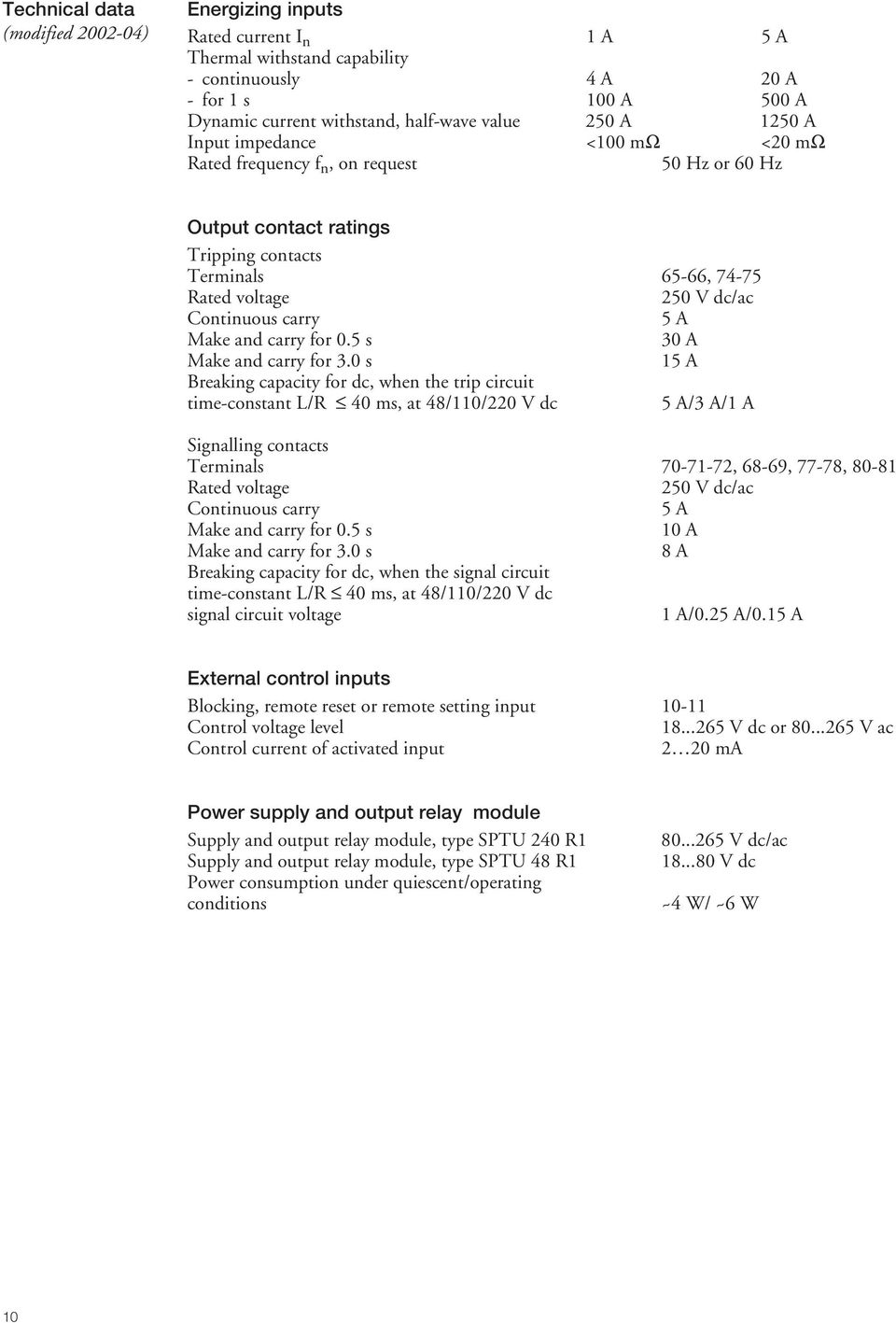
10 Technical data (modified 00-04) Energizing inputs Rated current I n A 5 A Thermal withstand capability - continuously 4 A 0 A - for s 00 A 500 A Dynamic current withstand, half-wave value 50 A 50 A Input impedance <00 mω <0 mω Rated frequency f n, on request 50 Hz or 60 Hz Output contact ratings Tripping contacts Terminals 65-66, Rated voltage 50 V dc/ac Continuous carry 5 A Make and carry for 0.5 s 30 A Make and carry for 3.0 s 5 A Breaking capacity for dc, when the trip circuit time-constant L/R 40 ms, at 48/0/0 V dc 5 A/3 A/ A Signalling contacts Terminals , 68-69, 77-78, 80-8 Rated voltage 50 V dc/ac Continuous carry 5 A Make and carry for 0.5 s 0 A Make and carry for 3.0 s 8 A Breaking capacity for dc, when the signal circuit time-constant L/R 40 ms, at 48/0/0 V dc signal circuit voltage A/0.5 A/0.5 A External control inputs Blocking, remote reset or remote setting input 0- Control voltage level V dc or V ac Control current of activated input 0 ma Power supply and output relay module Supply and output relay module, type SPTU 40 R Supply and output relay module, type SPTU 48 R Power consumption under quiescent/operating conditions V dc/ac V dc ~4 W/ ~6 W 0
11 Overcurrent unit of SPCJ 4D9 Low-set overcurrent stage I> * Start current ** - at definite time characteristic x I n - at inverse time characteristic *** x I n Time/current characteristic - definite time characteristic - operate time t> s - inverse definite minimum time (IDMT) characteristic as per IEC and BS 4 Extremely inverse Very inverse Normal inverse Long-time inverse - special type inverse characteristic RI-type inverse RXIDG-type inverse - time multiplier k High-set overcurrent stage I>> * Start current Operate time t>> x I n and, infinite s Earth-fault unit of SPCJ 4D9 Low-set earth-fault stage I 0 > * Start current x I n Time/current characteristic - definite time characteristic - operate time t 0 > s - inverse definite minimum time (IDMT) characteristic as per IEC and BS 4 Extremely inverse Very inverse Normal inverse Long-time inverse - special type inverse characteristic RI-type inverse RXIDG-type inverse - time multiplier k High-set earth-fault stage I 0 >> * Start current Operate time t 0 >> x I n and, infinite s * Note! The operation of the low-set stage based on inverse time characteristic will be blocked ) by starting of the high-set stage. Then the operate time of the low-set stage is determined by the set operate time of the high-set stage at heavy fault currents. In order to obtain a trip signal, the high-set stage must be routed to a trip output relay. ) From program version 83 B and later this function can be switched off with switch of the extended switchgroup, SGX. By default this function is switched off. ** Note! If the set start current exceeds.5 x I n, the maximum continuous carry of the energizing inputs (4 x I n ) must be noted. *** Note! Because of the maximum measured current (63 x I n ), the setting value.5 is used for the IDMT calculation if the set value is greater than.5. This makes the operate time faster than the theoretical IDMT curve. However, the stage always starts according to the set value.

12 Data transmission Transmission mode Fibre optic serial bus Data code ASCII Selectable data transfer rates 4800 or 9600 Bd Fibre optic bus connection modules for powering from external power source - for plastic core cables SPA-ZC 7 BB - for glass fibre cables SPA-ZC 7 MM Fibre optic bus connection modules for powering from host relay - for plastic core cables SPA-ZC BB - for glass fibre cables SPA-ZC MM Insulation Tests *) Dielectric test IEC Impulse voltage test IEC Insulation resistance measurement IEC kv, 50 Hz, min 5 kv,./50 µs, 0.5 J >00 MΩ, 500 Vdc Electromagnetic Compatibility Tests *) High-frequency ( MHz) burst disturbance test IEC common mode.5 kv - differential mode.0 kv Electrostatic discharge test IEC and IEC contact discharge 6 kv - air discharge 8 kv Fast transient disturbance test IEC and IEC power supply 4 kv - I/O ports kv Spike test, class III (KEMA) kv, 0.5/50 µs Magnetic field test acc. to IEC A/m Power supply tests Power supply variation Variation voltage Interruption 80 V - 50% Interruption 80 V - 00% Interruption 55 V - 00% V 0 00 ms 0 30 ms 0 60 ms Mechanical tests Vibration tests IEC , class Shock and Bump tests IEC , class Seismic tests ANS/IEEE C g in the horizontal direction g in the vertical direction Environmental conditions Corrosion test Battelle-test Specified ambient service temperature range C Long term damp heat withstand according to IEC <95% at 40 C for 56 d Transport and storage temperature range C Protection by enclosure according to IEC 6059, when the relay is panel mounted IP 54 Mass of the relay including flush mounting relay case ~3.5 kg *) The tests do not apply to the serial port, which is used exclusively for the bus connection module.

13 Maintenance and repair When the protection relay is operating under the conditions specified in the section "Technical data", the relay is practically maintenancefree. The relay modules include no parts or components subject to an abnormal physical or electrical wear under normal operating conditions. If the environmental conditions at the relay operating site differ from those specified, as to temperature, humidity, or if the atmosphere around the relay contains chemically active gases or dust, the relay ought to be visually inspected in association with the relay secondary test or whenever the relay modules are withdrawn from the case. At the visual inspection the following things should be noted: - Signs of mechanical damage on relay modules, contacts and relay case - Accumulation of dust inside the relay cover or case; remove by blowing air carefully - Rust spots or signs of erugo on terminals, case or inside the relay On request, the relay can be given a special treatment for the protection of the printed circuit boards against stress on materials, caused by abnormal environmental conditions. If the relay fails in operation or if the operating values remarkably differ from those of the relay specifications, the relay should be given a proper overhaul. Minor measures can be taken by personnel from the instrument work-shop of the customer s company, e.g. replacement of auxiliary relay modules. All major measures involving overhaul of the electronics are to be taken by the manufacturer. Please contact the manufacturer or his nearest representative for further information about checking, overhaul and recalibration of the relay. Note! Numerical protection relays contain electronic circuits which are liable to serious damage due to electrostatic discharge. Before removing a module containing electronic circuits, ensure that you are at the same electrostatic potential as the equipment, for instance, by touching the relay case. Note! Static protection relays are measuring instruments and should be handled with care and protected against moisture and mechanical stress, especially during transport. Spare parts Three-phase overcurrent and earth-fault module SPCJ 4D9 Power supply and output relay module U aux = V ac/dc SPTU 40 R U aux = V dc SPTU 48 R Input module SPTE 4E Bus connection module SPA-ZC 7 or SPA-ZC 3
14 Dimensions for mounting The relay is housed in a normally flush-mounted case. The relay can also be arranged for semiflush mounting with the use of a 40 mm, 80 mm or 0 mm raising frame, which reduces the depth behind the panel by the same dimension. The type designations of the raising frames are SPA-ZX for the 40 mm frame, SPA-ZX for the 80 mm frame and SPA-ZX 3 for the 0 mm frame. A surface mounting case SPA- ZX 0 is also available. The relay case is made of profile aluminium and finished in beige. A cast aluminium alloy mounting frame with a rubber gasket provides a degree of protection by enclosure to IP 54 between the relay case and the panel surface when the relay is panel mounted. The relay case is complete with a hinged gasketed, clear, UV-stabilized polycarbonate cover with a sealable fastening screw. The degree of protection by enclosure of the cover is also IP 54. A terminal strip and two multipole connectors are mounted on the back of the relay case to facilitate all input and output connections. To each heavy duty terminal, i.e. measuring input, power supply or trip output, one 6 mm, one 4 mm or one or two.5 mm wires can be connected. No terminal lugs are needed. The signalling outputs are available on a six pole detachable connector and the serial bus connection is using a 9-pin D-type connnector ± a b 39 ± 6 36 Panel cut-out Raising frame SPA-ZX SPA-ZX SPA-ZX 3 a b Order information Example. Quantity and type designation 5 pcs relay type SPAJ 40 C. Rated frequency f n = 50 Hz 3. Auxiliary voltage U aux = 0 V dc 4. Accessories 5 pcs bus connection modules SPA-ZC7 MM pcs fibre optical cables SPA-ZF MM 00 4 pcs fibre optical cables SPA-ZF MM 5 5. Special requirements 4

15 General characteristics of D-type relay modules User s manual and Technical description Fastening screw Indicators for measured quantities 3 I > I I L I L I L3 I o IRF Relay symbol Self-supervision alarm indicator (Internal Relay Fault) Display, + 3 digits / I > I n t [] > s k / I >> I n RESET STEP Reset / Step push-button Indicators for setting parameters t >>[ s] / I o > I n to > [] s k o / I o>> I n Indicators for switchgroups SGF, SGB and SGR t [] o >> s SGF SGB Programming push-button SGR TRIP Trip indicator Fastening screw 879B SPCJ 4D9 Module type designation
![I n RESET STEP Reset / Step push-button Indicators for setting parameters t >>[ s] / I o > I n to > [] s k o / I o>> I n Indicators for](/docs-images/47/20230729/images/page_15.jpg "switchgroups SGF, SGB and SGR t [] o >> s SGF SGB Programming push-button SGR TRIP Trip indicator Fastening screw 879B SPCJ 4D9 Module type")
16 MRS MUM EN Issued Version A (replaces 34 SPC 3 EN) Checked JH Approved TK General characteristics of D type relay modules Data subject to change without notice Contents Front panel lay-out... Control push buttons... 3 Display... 3 Display main menu... 3 Display submenus... 3 Selector switchgroups SGF, SGB, SGR... 4 Settings... 4 Setting mode... 4 Example : Setting of relay operation values... 7 Example : Setting of relay switchgroups... 9 Recorded information... Trip test function... Example 3: Forced activation of outputs... 3 Operation indicators... 5 Fault codes... 5

17 Control push-buttons The front panel of the relay module contains two push buttons. The RESET / STEP push button is used for resetting operation indicators and for stepping forward or backward in the display main menu or submenus. The PRO- GRAM push button is used for moving from a certain position in the main menu to the corresponding submenu, for entering the setting mode of a certain parameter and together with the STEP push button for storing the set values. The different operations are described in the subsequent paragraphs in this manual. Display The measured and set values and the recorded data are shown on the display of the protection relay module. The display consists of four digits. The three green digits to the right show the measured, set or recorded value and the leftmost red digit shows the code number of the register. The measured or set value displayed is indicated by the adjacent yellow LED indicator on the front panel. When a recorded fault value is being displayed the red digit shows the number of the corresponding register. When the display functions as an operation indicator the red digit alone is shown. When the auxiliary voltage of a protection relay module is switched on the module initially tests the display by stepping through all the segments of the display for about 5 seconds. At first the corresponding segments of all digits are lit one by one clockwise, including the decimal points. Then the center segment of each digit is lit one by one. The complete sequence is carried out twice. When the test is finished the display turns dark. The testing can be interrupted by pressing the STEP push button. The protection functions of the relay module are alerted throughout the testing. Display main menu Any data required during normal operation are accessible in the main menu i.e. present measured values, present setting values and recorded parameter values. The data to be shown in the main menu are sequentially called up for display by means of the STEP push button. When the STEP push button is pressed for about one second, the display moves forward in the display sequence. When the push button is pressed for about 0.5 seconds, the display moves backward in the display sequence. From a dark display only forward movement is possible. When the STEP push button is pushed constantly, the display continuously moves forward stopping for a while in the dark position. Unless the display is switched off by stepping to the dark point, it remains lit for about 5 minutes from the moment the STEP push button was last pushed. After the 5 minutes' time-out the dispaly is switched off. Display submenus Less important values and values not very often set are displayed in the submenus. The number of submenus varies with different relay module types. The submenus are presented in the description of the concerned protection relay module. A submenu is entered from the main menu by pressing the push button for about one second. When the push button is released, the red digit of the display starts flashing, indicating that a submenu has been entered. Going from one submenu to another or back to the main menu follows the same principle as when moving from the main menu display to another; the display moves forward when the STEP push button is pushed for one second and backward when it is pushed for 0.5 seconds. The main menu has been re-entered when the red display turns dark. When a submenu is entered from a main menu of a measured or set value indicated by a LED indicator, the indicator remains lit and the address window of the display starts flashing. A submenu position is indicated by a flashing red address number alone on the dispaly without any lit set value LED indicator on the front panel. 3

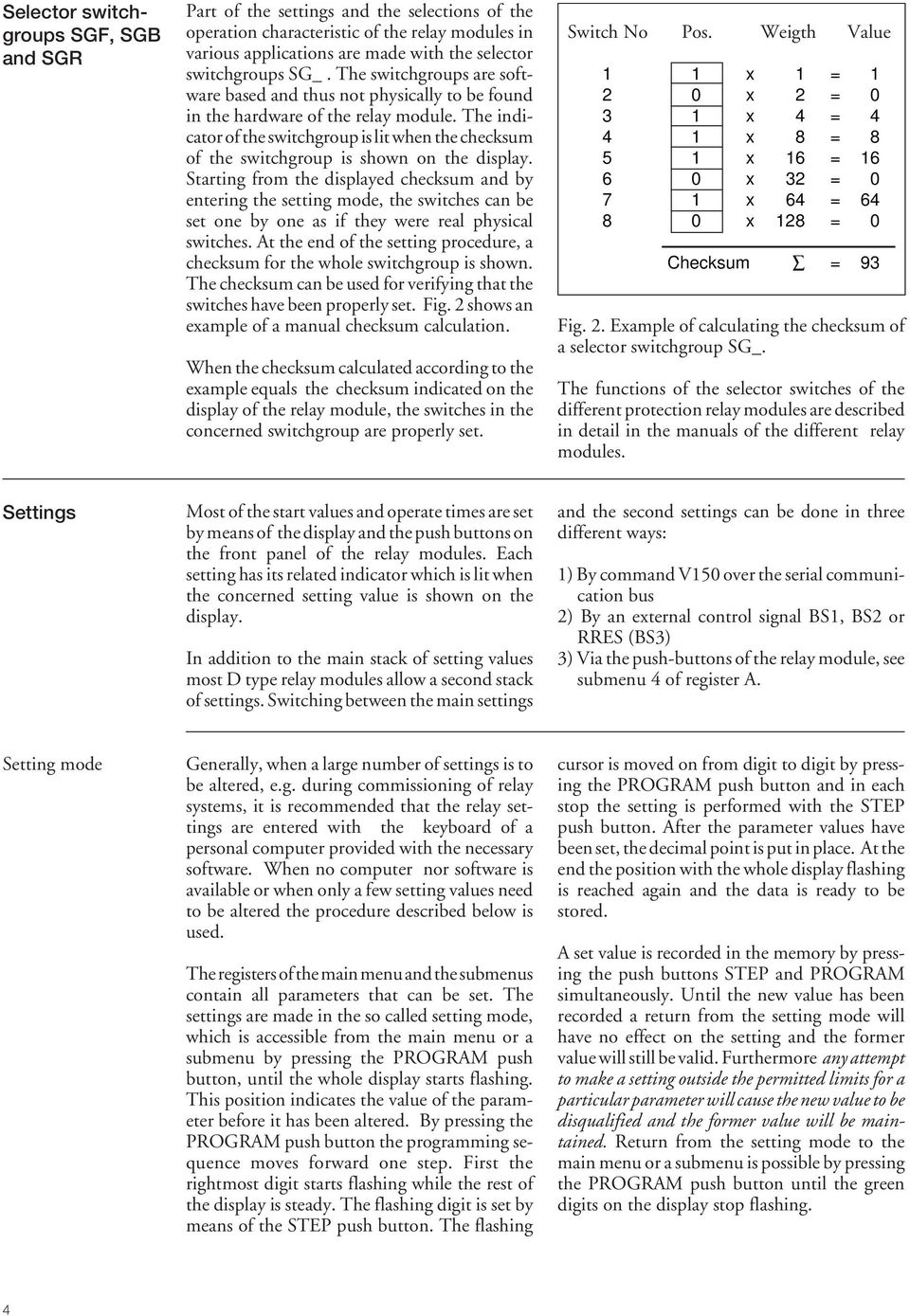
18 Selector switchgroups SGF, SGB and SGR Part of the settings and the selections of the operation characteristic of the relay modules in various applications are made with the selector switchgroups SG_. The switchgroups are software based and thus not physically to be found in the hardware of the relay module. The indicator of the switchgroup is lit when the checksum of the switchgroup is shown on the display. Starting from the displayed checksum and by entering the setting mode, the switches can be set one by one as if they were real physical switches. At the end of the setting procedure, a checksum for the whole switchgroup is shown. The checksum can be used for verifying that the switches have been properly set. Fig. shows an example of a manual checksum calculation. When the checksum calculated according to the example equals the checksum indicated on the display of the relay module, the switches in the concerned switchgroup are properly set. Switch No Pos. Weigth Value x = 0 x = 0 3 x 4 = 4 4 x 8 = 8 5 x 6 = x 3 = 0 7 x 64 = x 8 = 0 Checksum = 93 Fig.. Example of calculating the checksum of a selector switchgroup SG_. The functions of the selector switches of the different protection relay modules are described in detail in the manuals of the different relay modules. Settings Most of the start values and operate times are set by means of the display and the push buttons on the front panel of the relay modules. Each setting has its related indicator which is lit when the concerned setting value is shown on the display. In addition to the main stack of setting values most D type relay modules allow a second stack of settings. Switching between the main settings and the second settings can be done in three different ways: ) By command V50 over the serial communication bus ) By an external control signal BS, BS or RRES (BS3) 3) Via the push-buttons of the relay module, see submenu 4 of register A. Setting mode Generally, when a large number of settings is to be altered, e.g. during commissioning of relay systems, it is recommended that the relay settings are entered with the keyboard of a personal computer provided with the necessary software. When no computer nor software is available or when only a few setting values need to be altered the procedure described below is used. The registers of the main menu and the submenus contain all parameters that can be set. The settings are made in the so called setting mode, which is accessible from the main menu or a submenu by pressing the push button, until the whole display starts flashing. This position indicates the value of the parameter before it has been altered. By pressing the push button the programming sequence moves forward one step. First the rightmost digit starts flashing while the rest of the display is steady. The flashing digit is set by means of the STEP push button. The flashing cursor is moved on from digit to digit by pressing the push button and in each stop the setting is performed with the STEP push button. After the parameter values have been set, the decimal point is put in place. At the end the position with the whole display flashing is reached again and the data is ready to be stored. A set value is recorded in the memory by pressing the push buttons STEP and simultaneously. Until the new value has been recorded a return from the setting mode will have no effect on the setting and the former value will still be valid. Furthermore any attempt to make a setting outside the permitted limits for a particular parameter will cause the new value to be disqualified and the former value will be maintained. Return from the setting mode to the main menu or a submenu is possible by pressing the push button until the green digits on the display stop flashing. 4
19 NOTE! During any local man-machine communication over the push buttons and the display on the front panel a five minute time-out function is active. Thus, if no push button has been pressed during the last five minutes, the relay returns to its normal state automatically. This means that the display turns dark, the relay escapes from a display mode, a programming routine or any routine going on, when the relay is left untouched. This is a convenient way out of any situation when the user does not know what to do. Before a relay module is inserted into the relay case, one must assure that the module has been given the correct settings. If there however is any doubt about the settings of the module to be inserted, the setting values should be read using a spare relay unit or with the relay trip circuits disconnected. If this cannot be done the relay can be sett into a non-tripping mode by pressing the push button and powering up the relay module simultaneously. The display will show three dashes "- - -" to indicate the nontripping mode. The serial communication is operative and all main and submenues are accessible. In the non-tripping mode unnecessary trippings are avoided and the settings can be checked. The normal protection relay mode is entered automatically after a timeout of five minutes or ten seconds after the dark display position of the main menu has been entered. MAIN MENU SUBMENU SETTING MODE REV. STEP 0,5 s FWD.STEP s STEP 0,5 s s 5 s 5 s Normal status, display off First measuring value Last measuring value Actual setting value Actual setting value REV. STEP 0,5 s FWD.STEP s Main setting value for stage Second setting value for stage INCREASE VALUE STEP 0,5 s MOVE FIGURE OR DECIMAL POINT CURSOR WITH BUTTON s Memorized values etc. STORE NEW SETTING BY PRESSING STEP AND SIMULTANEOUSLY WHEN THE VALUE IS READY AND THE WHOLE DISPLAY IS BLINKING NOTE! IN MOST MENU CHARTS THE SUBMENUS HAVE BEEN DRAWN IN A HORIZONTAL DIRECTION IN ORDER TO GET ALL MAIN AND SUBMENU POSITIONS SHOWN IN THE SAME CHART. Fig.3. Basic principles of entering the main menus and submenus of a relay module. 5

20 MAIN MENU SUBMENUS STEP 0.5 s s Normal status, display off Current on phase L Current on phase L Current on phase L3 Neutral current Io REV. STEP 0.5 s SUBMENUS FWD. STEP s Actual start value I> Main setting value for I> Second setting value for I> Actual operate time t> or multiplier k for stage I> Main setting value for t> or k Second setting value for t> or k R E V. S T E P.5 s M A I N M E N U F W D. S T E P s Actual start value I>> Main setting value for I>> Actual operate time t>> of stage I>> Actual start value Io> Main setting value for Io> Actual operate time to> or multiplier ko Actual start value Io>> Main setting value for Io>> Actual operate time to>> Main setting value for to>> Actual setting of functional switchgroup SGF Actual setting of blocking switchgroup SGB Actual setting of relay switchgroup SGR Main setting value for t>> Main setting value for to> or ko Main setting of SGF checksum Main setting of SGB checksum Main setting of SGR checksum Latest memorized, event (n) Event (n-) value of phase L value of phase L Latest memorized, event (n) Event (n-) value of phase L value of phase L 3 Latest memorized, event (n) Event (n-) value of phase L3 value of phase L3 Second setting value for I>> Second setting value for t>> Second setting value for Io> Second setting value for to> or ko Second setting value for Io>> Second setting value for to>> Main setting of SGF checksum Second setting of SGB checksum Main setting of SGR checksum Event (n-) value of phase L Event (n-) value of phase L Event (n-) value of phase L3 4 Maximum demand current value for 5 minutes Highest maximum demand value found Fig. 4.Example of part of the main and submenus for the settings of the overcurrent and earth-fault relay module SPCJ 4D9. The settings currently in use are in the main manu and they are displayed by pressing the STEP push button. The main menu also includes the measured current values, the registers...9, 0 and A. The main and second setting values are located in the submenus and are called up on the display with the push button. 6

21 Example Operation in the setting mode. Manual setting of the main setting of the start current value I> of an overcurrent relay module. The initial value for the main setting is 0.80 x I n and for the second setting.00 x I n. The desired main start value is.05 x I n. a) Press push button STEP repeatedly until the LED close to the I> symbol is lit and the current start value appears on the display. RESET STEP 5 x s b) Enter the submenu to get the main setting value by pressing the push button more than one second and then releasing it. The red display digit now shows a flashing number, indicating the first submenu position and the green digits show the set value. s c) Enter the setting mode by pressing the PRO- GRAM push button for five seconds until the display starts flashing. 5 s d) Press the push button once again for one second to get the rightmost digit flashing. s e) Now the flashing digit can be altered. Use the STEP push button to set the digit to the desired value. RESET STEP 5 x f) Press the push button to make the middle one of the green digits flash. s g) Set the middle digit with of the STEP push button. RESET STEP x h) Press the push button to make the leftmost green digit flash. s
22 i) Set the digit with the STEP push button. RESET STEP 0 x.05 j) Press the push button to make the decimal point flash. s.05 k) If needed, move the decimal point with the STEP push button. RESET STEP 0 x.05 l) Press the push button to make the whole display flash. In this position, corresponding to position c) above, one can see the new value before it is recorded. If the value needs changing, use the push button to alter the value. s.05 m) When the new value has been corrected, record it in the memory of the relay module by pressing the and STEP push buttons simultaneously. At the moment the information enters the memory, the green dashes flash once in the display, i.e RESET STEP n) Recording of the new value automatically initiates a return from the setting mode to the normal submenu. Without recording one can leave the setting mode any time by pressing the push button for about five seconds, until the green display digits stop flashing. 5 s.05 o) If the second setting is to be altered, enter submenu position of the setting I> by pressing the STEP push button for approx. one second. The flashing position indicator will then be replaced by a flashing number which indicates that the setting shown on the display is the second setting for I>. RESET STEP s.00 Enter the setting mode as in step c) and proceed in the same way. After recording of the requested values return to the main menu is obtained by pressing the STEP push button until the first digit is switched off. The LED still shows that one is in the I> position and the display shows the new setting value currently in use by the relay module. 8
23 Example Operation in the setting mode. Manual setting of the main setting of the checksum for the switchgroup SGF of a relay module. The initial value for the checksum is 000 and the switches SGF/and SGF/3 are to be set in position. This means that a checksum of 005 should be the final result. a) Press push button STEP until the LED close to the SGF symbol is lit and the checksum appears on the display. RESET STEP n x s b) Enter the submenu to get the main checksum of SGF by pressing the push button for more than one second and then releasing it. The red display now shows a flashing number indicating the first submenu position and the green digits show the checksum. s c) Enter the setting mode by pressing the PRO- GRAM push button for five seconds until the display starts flashing. 5 s d) Press the push button once again to get the first switch position. The first digit of the display now shows the switch number. The position of the switch is shown by the rightmost digit. x 0 e) The switch position can now be toggled between and 0 by means of the STEP push button and it is left in the requested position. RESET STEP x f) When switch number is in the requested position, switch number is called up by pressing the push button for one second. As in step e), the switch position can be altered by using the STEP push button. As the desired setting for SGF/ is 0 the switch is left in the 0 position. g) Switch SGF/3 is called up as in step f) by pressing the push button for about one second. s s
24 h) The switch position is altered to the desired position by pressing the STEP push button once. RESET STEP x 3 i) Using the same procedure the switches SGF / are called up and, according to the example, left in position 0. 5 x s j) In the final setting mode position, corresponding to step c), the checksum based on the set switch positions is shown k) If the correct checksum has been obtained, it is recorded in the memory by pressing the push buttons and STEP simultaneously. At the moment the information enters the memory, the green dashes flash in the display, i.e If the checksum is incorrect, the setting of the separate switches is repeated using the and STEP push buttons starting from step d). RESET STEP l) Recording the new value automatically initiates a return from the setting mode to the normal menu. Without recording one can leave the setting mode any time by pressing the PRO- GRAM push button for about five seconds, until the green display digits stop flashing. 5 s m) After recording the desired values return to the main menu is obtained by pressing the STEP push button until the first digit is turned off. The LED indicator SGF still shows that one is in the SGF position and that the display shows the new checksum for SGF currently in use by the relay module. RESET STEP n x s
25 Recorded information The parameter values measured at the moment when a fault occurs or at the trip instant are recorded in the registers. The recorded data, except for some parameters, are set to zero by pressing the push buttons STEP and PRO- GRAM simultaneously. The data in normal registers are erased if the auxiliary voltage supply to the relay is interrupted, only the set values and certain other essential parameters are maintained in non-volatile registers during a voltage failure. The number of registers varies with different relay module types. The functions of the registers are illustrated in the descriptions of the different relay modules. Additionally, the system front panel of the relay contains a simplified list of the data recorded by the various relay modules of the protection relay. All D type relay modules are provided with two general registers: register 0 and register A. Register 0 contains, in coded form, the information about e.g. external blocking signals, status information and other signals. The codes are explained in the manuals of the different relay modules. Register A contains the address code of the relay modul which is reqiured by the serial communication system. Submenu of register A contains the data transfer rate value, expressed in kilobaud, of the serial communication. Submenu of register A contains a bus communication monitor for the SPAbus. If the protection relay, which contains the relay module, is linked to a system including a contol data communicatoe, for instance SRIO 000M and the data communication system is operating, the counter reading of the monitor will be zero. Otherwise the digits...55 are continuously scrolling in the monitor. Submenu 3 contains the password required for changing the remote settings. The address code, the data transfer rate of the serial communication and the password can be set manually or via the serial communication bus. For manual setting see example. The default value is 00 for the address code, 9.6 kilobaud for the data transfer rate and 00 for the password. In order to secure the setting values, all settings are recorded in two separate memory banks within the non-volatile memory. Each bank is complete with its own checksum test to verify the condition of the memory contents. If, for some reason, the contents of one bank is disturbed, all settings are taken from the other bank and the contents from here is transferred to the faulty memory region, all while the relay is in full operation condition. If both memory banks are simultaneously damaged the relay will be be set out of operation, and an alarm signal will be given over the serial port and the IRF output relay
26 Trip test function Register 0 also provides access to a trip test function, which allows the output signals of the relay module to be activated one by one. If the auxiliary relay module of the protection assembly is in place, the auxiliary relays then will operate one by one during the testing. When pressing the push button for about five seconds, the green digits to the right start flashing indicating that the relay module is in the test position. The indicators of the settings indicate by flashing which output signal can be activated. The required output function is selected by pressing the push button for about one second. The indicators of the setting quantities refer to the following output signals: Setting I> Starting of stage I> Setting t> Tripping of stage I> Setting I>> Starting of stage I>> Setting t>> Tripping of stage I>> etc. No indication Self-supervision IRF The selected starting or tripping is activated by simultaneous pressing of the push buttons STEP and. The signal remains activated as long as the two push butttons are pressed. The effect on the output relays depends on the configuration of the output relay matrix switches. The self-supervision output is activated by pressing the STEP push button second when no setting indicator is flashing. The IRF output is activated in about second after pressing of the STEP push button. The signals are selected in the order illustrated in Fig. 4. REGISTER 0 5 s IRF I> START I> TRIP I» START I» TRIP Io> START Io> TRIP Io»START Io» TRIP I> s s t> s I» s s s s s s t» Io> to> Io» to» STEP STEP & STEP & STEP & STEP & STEP & STEP & STEP & STEP & Fig. 5.Sequence order for the selection of output signals in the Trip test mode If, for instance, the indicator of the setting t> is flashing, and the push buttons STEP and PRO- GRAM are being pressed, the trip signal from the low-set overcurrent stage is activated. Return to the main menu is possible at any stage of the trip test sequence scheme, by pressing the push button for about five seconds. Note! The effect on the output relays then depends on the configuration of the output relay matrix switchgroups SGR...3.
27 Example 3 Trip test function. Forced activation of the outputs. a) Step forward on the display to register 0. RESET STEP n x s b) Press the push button for about five seconds until the three green digits to the right. 5 s I I I I L L L3 o IRF I > / I n t > [] s k I >> / I n t >>[ s] I o > / I n to > [] s k o I o>> / I n t o >> [] s SGF 3 I > I RESET STEP c) Hold down the STEP push button. After one second the red IRF indicator is lit and the IRF output is activated. When the step push button is released the IRF indicator is switched off and the IRF output resets. 879B SGB SGR TRIP SPCJ 4D9 d) Press the push button for one second and the indicator of the topmost setting start flashing. e) If a start of the first stage is required, now press the push-buttons and STEP simultaneously. The stage output will be activated and the output relays will operate according to the actual programming of the relay output switchgroups SGR. RESET STEP I I I I L L L3 o IRF I > / I n t > [] s k I >> / I n t >>[ s] I o > / I n to > [] s k o I o>> / I n t o >> [] s SGF SGB SGR 3 I > I RESET STEP TRIP B SPCJ 4D9 3
28 f) To proceed to the next position press the PRO- GRAM push button for about second until the indicator of the second setting starts flashing. 3 I > I I I I I L L L3 o IRF s I > / I n t > [] s k I >> / I n RESET STEP t >>[ s] I o > / I n to > [] s k o I o>> / I n t o >> [] s SGF SGB SGR TRIP 879B SPCJ 4D9 g) Press the push buttons and STEP simultaneously to activate tripping of stage (e.g. the I> stage of the overcurrent module SPCJ 4D9). The output relays will operate according to the actual programming of the relay switchgroups SGR. If the main trip relay is operated the trip indicator of the measuring module is lit. RESET STEP I I I I L L L3 o IRF I > / I n t > [] s k I >> / I n t >>[ s] I o > / I n to > [] s k o I o>> / I n t o >> [] s SGF 3 I > I RESET STEP SGB SGR 879B TRIP SPCJ 4D9 h) The starting and tripping of the remaining stages are activated in the same way as the first stage above. The indicator of the corresponding setting starts flashing to indicate that the concerned stage can be activated by pressing the STEP and buttons simultaneously. For any forced stage operation, the output relays will respond according to the setting of the relay output switchgroups SGR. Any time a certain stage is selected that is not wanted to operate, pressing the button once more will pass by this position and move to the next one without carrying out any operation of the selected stage. It is possible to leave the trip test mode at any step of the sequence scheme by pressing the push button for about five seconds until the three digits to the right stop flashing. 4
29 Operation indication A relay module is provided with a multiple of separate operation stages, each with its own operation indicator shown on the display and a common trip indicator on the lower part of the front plate of the relay module. The starting of a relay stage is indicated with one number which changes to another number when the stage operates. The indicator remains glowing although the operation stage resets. The indicator is reset by means of the RESET push button of the relay module. An unreset operation indicator does not affect the function of the protection relay module. In certain cases the function of the operation indicators may deviate from the above principles. This is described in detail in the descriptions of the separate modules. Fault codes In addition to the protection functions the relay module is provided with a self-supervision system which continuously supervises the function of the microprocessor, its program execution and the electronics. Shortly after the self-supervision system detects a permanent fault in the relay module, the red IRF indicator on the front panel is lit. At the same time the module puts forward a control signal to the output relay of the self-supervision system of the protection relay. In most fault situations a fault code, indicating the nature of the fault, appears on the display of the module. The fault code, which consists of a red figure "" and a three digit green code number, cannot be removed from the display by resetting. When a fault occurs, the fault code should be recorded and stated when service is ordered. When in a fault mode, the normal relay menus are operative, i.e. all setting values and measured values can be accessed although the relay operation is inhibited. The serial communication is also operative making it possible to access the relay information also from a remote site. The internal relay fault code shown on the display remains active until the internal fault possibly disappears and can also be remotely read out as variable V 69. 5
30
31 SPCJ 4D9 Overcurrent and earth-fault relay module User s manual and Technical description 3 I > I I L I L I L3 I o IRF / I > I n t > [ s] k / I >> I n RESET STEP t >>[ s] / I o > I n to > [] s k o / I o >> I n t [] o >> s SGF SGB SGR TRIP 00A SPCJ 4D9
32 MRS 7509 Issued Modified Version D Data subject to change without notice SPCJ 4D9 Combined overcurrent and earth-fault relay module Contents Features... Description of function (modified )... 3 Block diagram... 5 Front panel... 6 Start and operation indicators... 7 Settings (modified )... 8 Selector switches (modified )... 9 Measured data... 3 Recorded information (modified )... 4 Menu and register chart (modified )... 6 Time/current characteristic (modified )... 8 Technical data (modified )... 6 Serial communication parameters (modified )... 7 Fault codes Features Low-set phase overcurrent stage I> with definite time or inverse time characteristic High-set phase overcurrent stage I>> with instantaneous function or definite time characteristic Low-set earth-fault stage I 0 > with definite time or inverse time characteristic High-set earth-fault stage I 0 >> with definite time characteristic Six time/current curve sets at inverse time characteristic of the overcurrent stage I> and the earth-fault stage I 0 > Digital display of measured and set values and data sets recorded at the moment of relay operation Parametrization of the module by push-buttons on the front panel or via the serial port using a portable PC and a suitable software Continuous hardware and software supervision including auto-diagnosis
33 Description of function (modified ) Phase overcurrent unit The phase overcurrent unit of the relay module SPCJ 4D9 is designed for single-phase, twophase or three-phase overcurrent protection. It includes two overcurrent stages, i.e. a low-set overcurrent stage I> and a high-set overcurrent stage I>>. The low-set or high-set phase overcurrent stage starts if the current on one or several of the phases exceeds the set start current value of the stage concerned. When the stage starts it generates a start signal SS or TS and simultaneously the digital display on the front panel indicates starting. If the overcurrent situation lasts long enough to exceed the set operate time, the stage operates and generates a trip signal TS. At the same time the operation indicator is lit with red light. The red operation indicator remains lit although the stage resets. The indicator is reset by pushing the RESET push-button. By proper configuration of the output relay switchgroups an additional auxiliary trip signal TS can be obtained. The operation of the low-set phase overcurrent stage I> or the high-set phase overcurrent stage I>> can be blocked by routing a blocking signal BS to the unit. The blocking configuration is set with switchgroup SGB. The operation of the low-set phase overcurrent stage can be based on definite time or inverse time characteristic. The operation characteristic is selected with the SGF/ 3 switches. At definite time operation characteristic the operate time t> is set in seconds within the range, s. When the inverse time operation characteristic (IDMT) is selected, four internationally standardized and two complementary time/current curves are available. The selector switches SGF/...3 are also used for selecting the desired operation characteristic. Note! The maximum continuous current carrying capacity of the energizing inputs is 4 x I n, which must be observed when relay settings are calculated. Note! Because of the maximum measured current (63 x I n ), the setting value.5 is used for the IDMT calculation if the set value is greater than.5. This makes the operate time faster than the theoretical IDMT curve. However, the stage always starts according to the set value. Note! The operation of the low-set stage based on inverse time characteristic will be blocked ) by starting of the high-set stage. Then the operate time of the overcurrent unit is determined by the set operate time of the high-set stage at heavy fault currents. ) From program version 83 B and later this function can be switched off with switch of the extended switchgroup, SGX. By default this function is switched off. The setting range of the operate time t>> of the high-set phase overcurrent stage is s. The operate signal of the two overcurrent stages is provided with a latching feature (switch SGB/6) which means that the operate signal TS is kept high after an operation, although the overcurrent stage resets. The latched TS signal is reset by pushing the RESET and PRO- GRAM push-buttons simultaneously or via the serial port using the command V0, see also chapter "Selector switches". The set start current value I>> of the high-set phase overcurrent stage can be doubled automatically on connection of the protected object to the network, i.e. at starting. In this way the start current of the high-set phase overcurrent stage can be given a lower value than the level of the connection inrush current. The automatic doubling function is selected with switch SGF/5. The starting, which activates the doubling function, is defined as a situation where the phase currents rise from a value below 0. x I> to a value exceeding.5 x I> in less than 60 ms. The function stops when the currents fall below.5 x I>. The setting range of the start current of the highset phase overcurrent stage is x I n. When the high-set stage is given a start current setting in the lower end of the setting range, the relay module will contain two almost identical overcurrent stages. This enables the overcurrent unit of the SPCJ 4D9 module to be used, for example, in two-stage load shedding applications. The high-set phase overcurrent stage can be set out of operation with switch SGF/5. When the high-set stage is set out of operation the display shows "- - -", indicating that the start current setting is infinite. 3
34 Earth-fault unit The non-directional earth-fault unit of the relay module SPCJ 4D9 is a single-pole earth-fault unit. It contains two earth-fault stages, i.e. a low-set earth-fault stage I 0 > and a high-set earthfault stage I 0 >>. The low-set or high-set earth-fault stage starts, if the measured current exceeds the set start current value. When the stage starts it generates a start signal SS or TS and simultaneously the digital display on the front panel indicates starting. If the earth-fault situation lasts long enough to exceed the set operate time, the stage operates and generates a trip signal TS. At the same time the operation indicator TRIP is lit with red light. The red operation indicator remains lit although the stage resets. The indicator is reset by pushing the RESET push-button. By proper configuration of the output relay switchgroups an additional auxiliary trip signal TS can be obtained. The operation of the low-set earth-fault stage I 0 > or the high-set earth-fault stage I 0 >> can be blocked by routing a blocking signal BS to the earth-fault unit. The blocking configuration is set with switchgroup SGB. The operation of the low-set earth-fault stage can be based on definite time or inverse time characteristic. The operation characteristic is selected with the SGF/6 8 switches. At definite time operation characteristic the operate time t 0 > is directly set in seconds within the range, s. When the inverse time operation characteristic (IDMT) is selected, four internationally standardized and two complementary time/current curves are available. The selector switches SGF/ are also used for selecting the desired operation characteristic. The setting range of the operate time t 0 >> of the high-set earth-fault stage is s. Note! The operation of the low-set stage based on inverse time characteristic will be blocked ) by starting of the high-set stage. Then the operate time of the earth-fault unit is determined by the set operate time of the high-set stage at heavy fault currents. ) From program version 83 B and later this function can be switched off with switch of the extended switchgroup, SGX. By default this function is switched off. The operate signal of the two earth-fault stages is provided with a latching feature (switch SGB/7) which means that the operate signal TS is kept high after an operation, although the earth-fault stage resets. The TS signal is reset by pushing the RESET and push-buttons simultaneously or via the serial port using the command V0, see chapter "Selector switches", page 9. The high-set earth-fault stage can be set out of operation with switch SGF/6. When the highset stage is set out of operation the display shows "- - -", indicating that the start current setting is infinite. Filter characteristics of the measuring inputs db 0 A low-pass filter suppresses the harmonics of the phase currents and the earth-fault current measured by the module. Figure and shows the signal suppression as a function of the frequency. db f/hz f/hz 4 Fig.. Filter characteristics of the measuring inputs of the overcurrents for SPCJ 4D9. Fig.. Filter characteristics of the measuring input of the earth-fault current for SPCJ 4D9.
35 Circuit breaker failure protection unit The relay module features a circuit breaker failure protection (CBFP) unit. The CBFP unit generates a trip signal via TS after a set operate time 0... s, following the main trip signal TS, if the fault has not been cleared before the set operate time has elapsed. The output contact of the CBFP unit is normally used for tripping an upstream circuit breaker. The CBFP unit can also be used for tripping via redundant trip circuits of the same circuit breaker, if the circuit breaker is provided with two trip coils. The circuit breaker failure protection unit is alerted/ set out of operation with switch SGF/4. Remote setting Block diagram The relay can be given two sets of setting values, the main settings and the second settings. Switching between main settings and second settings can be done in three different ways, i) with a command V50 via the serial port, ii) with a command via the external control input BS or manually by changing a parameter in submenu 4 of register A. SGR3 / IL I> 50 ms t>, k SGR / SGR3 / SGR / SGR / IL SGR / IL3 SGB / SGF / SGF / SGF / 3 I>> 30 ms t>> SGR3 / 3 SGR / 3 SGF / 7 SGR3 / 4 SGR / 3 SGR / 4 SGB / 6 RESET+ SGR / 4 SGB / SS BS 0. x I> SGF / 5 x I>> 0. s SGF / 4 AR.5 x I> 60 ms & SGF / 8 SS AR3 SGR3 / 5 50 ms SGR / 5 SGR3 / 6 SS3 Io I 0 > t 0 >, k 0 SGR / 5 SGR / 6 SGR / 6 AR SGB / 3 I 0>> SGF / 6 SGF / 7 SGF / 8 30 ms t 0 >> SGR3 / 7 SGR / 7 SGR3 / 8 SGR / 7 SGR / 8 SGB / 7 RESET+ TS SGR / 8 TRIP SGB / 4 SGB / 5 SGB / 8 REMOTE SETTINGS RELAY RESET SPCJ 4 D 9 Fig. 3. Block diagram for the combined overcurrent and earth-fault relay module SPCJ 4D9. I L, I L, I L3 I 0 BS SGF SGB SGR...3 TS SS SS SS3 TS AR, AR, AR3 TRIP Energizing currents Residual current External control signal Selector switchgroup SGF for operational relay functions Selector switchgroup SGB for special relay functions Selector switchgroups SGR for configuration of output relays Start signal or auxiliary trip signal configured with switchgroup SGR3 Start signal configured with switchgroup SGR Trip signal configured with switchgroup SGR Trip signal configured with switchgroup SGR Trip signal configured with switchgroup SGR Start signals to possible external optional auto-reclose relays Red operation (trip) indicator Note! All input and output signals of the relay module are not necessarily wired to the terminals of a particular relay. The signals wired to the terminals of a particular protection relay are shown in the signal diagram in the general part of the relay manual. 5
36 Front panel 3 I > I Indicators for the measured phase currents I L, I L, I L3 and the residual current I 0 I L I L I L3 I o IRF Indicator for the start current of the I> stage Indicator for the operate time t> or time multiplier k of the I> stage Indicator for the start current of the I>> stage Indicator for the operate time of the I>> stage Indicator for the start current of the I 0 > stage Indicator for the operate time t 0 > or time multiplier k 0 of the I 0 > stage Indicator for the start current of the I 0 >> stage Indicator for the operate time of the I 0 >> stage Indicator for the checksum of switchgroups SGF Indicator for the checksum of switchgroup SGB Indicator for the checksum of switchgroups SGR...3 / I > I n t > [ s] k I >> / I n t >>[ s] I o > / I n to > [] s k o I o >> / I n t o >> [] s SGF SGB SGR RESET STEP TRIP 00A SPCJ 4D9 3 I > I I L I L I L3 I o IRF Relay module symbol Self-supervision alarm indicator Digital display / I > I n t > [ s] k I >> / I n t >>[ s] I o > / I n to > [] s k o I o >> / I n t o >> [] s SGF SGB SGR RESET STEP TRIP Reset and display step push-button Selector push-button TRIP indicator 00A SPCJ 4D9 Type designation of the module Fig. 4. Front panel of the combined overcurrent and earth-fault relay module SPCJ 4D9. 6
37 Start and operation indicators Both overcurrent stages have their own start indicators and operation indicators shown as figures on the digital display. Further, all the protection stages share a common red LED indicator marked "TRIP" which is located in the lower right corner of the front panel and which is lit on operation of a stage. The figure on the display indicating starting or operation remains lit when the current stage resets, thus indicating which protection stage has operated. The start or operation indicators are reset by pushing the RESET push-button. The function of the relay module is not affected by an unreset indicator. If the starting of a stage is short enough not to cause an operation of the relay, the start indication is normally self-reset when the stage resets. By means of switches SGF/ 4 the start indicators can be configured for manual resetting. The following table shows a guide to the start and trip indicators of the relay module. Indication Explanation I> START = the low-set stage I> of the overcurrent unit has started I> TRIP = the low-set stage I> of the overcurrent unit has operated 3 I>> START = the high-set stage I>> of the overcurrent unit has started 4 I>> TRIP = the high-set stage I>> of the overcurrent unit has operated 5 I 0 > START = the low-set stage I 0 > of the earth-fault unit has started 6 I 0 > TRIP = the low-set stage I 0 > of the earth-fault unit has operated 7 I 0 >> START = the high-set stage I 0 >> of the earth-fault unit has started 8 I 0 >> TRIP = the high-set stage I 0 >> of the earth-fault unit has operated 9 CBFP = the circuit breaker failure protection has operated When one of the protection stages of the relay module operates, the indicators for the energizing current of the module show the faulty phase, i.e. in which phase(s) the current has exceeded the set start value of the stage (so called phase fault indication). If, for instance, the operation indicator "" of the low-set stage is lit, as are the indicators I L and I L also, the relay operation has been caused by overcurrent on the L and L phases. The fault indications are reset by pushing the RESET push-button. The self-supervision alarm indicator IRF indicates, when lit, that the self-supervision system has detected a permanent internal relay fault. The indicator is lit with red light shortly after a fault has been detected. At the same time the relay module generates a control signal to the output relay of the self-supervision system IRF. Additionally, in most fault cases, an auto-diagnostic fault code showing the nature of the fault appears on the display. The fault code, consists of a red figure one () and a green code number. When a fault code is obtained it should be recorded for statistical and maintenance purposes. 7
38 Settings (modified ) The setting values are shown by the right-most three digits of the display. When lit, the LED indicators on the front panel adjacent to the symbol of the setting quantity shows the quantity currently being displayed. I>/I n Start current of the I> stage as a multiple of the rated current of the used energizing input. Setting range x I n at definite time characteristic and x I n at inverse time characteristic. Note! Because of the maximum measured current (63 x I n ), the setting value.5 is used for the IDMT calculation if the set value is greater than.5. This makes the operate time faster than the theoretical IDMT curve. However, the stage always starts according to the set value. t> Operate time of the I> stage expressed in seconds, at definite time characteristic (SGF/--3 = 0-0-0). Setting range s. k Time multiplier of the I> stage at inverse time characteristic. Setting range I>>/I n Start current of the I>> stage as a multiple of the rated current of the used energizing input. Setting range x I n. Additionally the setting "infinite" (displayed as n - - -) can be selected with switch SGF/5, which means that the high-set stage I>> is out of operation. t>> Operate time of the I>> stage expressed in seconds. Setting range s. I 0 >/I n t 0 > k 0 I 0 >>/I n Start current of the I 0 > stage as a multiple of the rated current of the used energizing input. Setting range x I n. Operate time of the I 0 > stage, expressed in seconds, at definite time characteristic (SGF/6-7-8 = 0-0-0). Setting range s. Time multiplier k 0 of the I 0 > stage at inverse time characteristic. Setting range Start current of the I 0 >> stage as a multiple of the rated current of the used energizing input. Setting range x I n. Additionally the setting "infinite" (displayed as n - - -) can be selected with switch SGF/6, which means that the earth-fault stage I 0 >> is out of operation. t 0 >> Operate time of the I 0 >> stage expressed in seconds. Setting range s. Further, the checksums of switchgroups SGF, SGB and SGR are shown on the display when the indicators adjacent to the switchgroup symbols on the front panel are lit. The checksums for switchgroups SGF, SGR and SGR3 are found in the submenus under the main menu of the first switchgroup. For further information, see chapter "Menus and registers". An example of how the checksum can be calculated manually is given in manual "General characteristics of D type relay modules. 8
39 Selector switches (modified ) Additional functions required in various applications are selected with switchgroups SGF, SGB and SGR indicated on the front panel. Further, the relay module contains a software extended switchgroup SGX, which is located in submenu six of register A. The numbering of the switches,...8, and the switch positions 0 and are shown when the switchgroups are set. Under normal service conditions only the checksums are shown. Switchgroups SGF, SGR and SGR3 are found in the submenus of the main menus of switchgroups SGF and SGR. Function switchgroup SGF Switch SGF/ SGF/ SGF/3 Function Switches SGF/...3 are used for selecting the characteristic of the low-set overcurrent stage I>, i.e. definite time operation characteristic or inverse definite minimum time (IDMT) characteristic. At IDMT characteristic the switches are also used for selecting the required current/time characteristic for the stage. SGF/ SGF/ SGF/3 Characteristic Time or curve set Definite time s 0 0 IDMT Extremely inverse 0 0 IDMT Very inverse 0 IDMT Normal inverse 0 0 IDMT Long-time inverse 0 IDMT RI-characteristic 0 IDMT RXIDG-characteristic IDMT Long-time inverse SGF/4 SGF/5 SGF/6 SGF/7 SGF/8 Circuit breaker failure protection (CBFP). When SGF/4 = the trip signal TS will start a timer which will generates a delayed operate signal via TS, if the fault has not been cleared before the operate time has elapsed. When switch SGF/4 = 0 the circuit breaker failure protection is out of operation. Automatic doubling of the set start current of the high-set overcurrent stage I>> when the protected object is energized. When SGF/5 = 0, no doubling of the start current setting of stage I>> is obtained. When SGF/5 =, the start current setting of stage I>> doubles automatically. The doubling feature makes it possible to give the high-set stage a setting value below the connection inrush current level. Switches SGF/6...8 are used for selecting the operation characteristic of the low-set earth-fault stage I 0 >, i.e. definite time characteristic or inverse definite minimum time (IDMT) characteristic. At inverse definite minimum time characteristic the switches are also used for selecting the current/time characteristic of the stage. SGF/6 SGF/7 SGF/8 Characteristic Time or curve Definite time s 0 0 IDMT Extremely inverse 0 0 IDMT Very inverse 0 IDMT Normal inverse 0 0 IDMT Long-time inverse 0 IDMT RI-characteristic 0 IDMT RXIDG-characteristic IDMT Long-time inverse On delivery from the factory all switches SGF are set at zero, i.e. the checksum for SGF is 0. 9
40 Function switchgroup SGF Switch Function SGF/ Switches SGF/...4 are used for selecting the operation characteristic of the start SGF/ indicators of the different stages. When the switches are in position 0 the start signals SGF/3 are all automatically reset when the fault is cleared. To give the indicator of a stage the SGF/4 hand reset mode of operation, the corresponding switch is set in position : Note! When the switch is on, the LED indicators for measured phase(s) that caused the start are lit. SGF/ = equals manual reset mode for the start indication of stage I> SGF/ = equals manual reset mode for the start indication of stage I>> SGF/3 = equals manual reset mode for the start indication of stage I 0 > SGF/4 = equals manual reset mode for the start indication of stage I 0 >> SGF/5 Operation of the high-set phase overcurrent stage I>>. When SGF/5 = 0 the high-set stage I>> is alerted When SGF/5 = the high-set stage I>> is out of operation and the display shows "- - -" SGF/6 Operation of the high-set earth-fault stage I 0 >>. When SGF/6 = 0 the high-set stage I 0 >> is alerted When SGF/6 = the high-set stage I 0 >> is out of operation and the display shows "- - -" SGF/7 Start signal of the high-set stage I>> to the auto-reclose signal output AR. When SGF/7 =, the start signal of the I>> stage is routed to output AR. Note! Outputs AR and SS3 are interconnected and they always carry the same signal. Therefore, if AR is used for starting auto-reclose functions, SS3 cannot be used for any other purpose. When SGF/7 =0, the start signal of the I>> stage is not routed to output AR nor SS3. Thus the signal output SS3 is available for other purposes. SGF/8 Start signal of the low-set stage I 0 > or high-set stage I 0 >> to auto-reclose signal output AR3. When SGF/8 = 0 the start signal from the I 0 > stage is routed to output AR3 When SGF/8 = the start signal from the I 0 >> stage is routed to output AR3 When the relay is delivered from the factory the SGF switches are set at zero, i.e. the checksum for SGF is 0. 0
41 Blocking or control signal configuration switchgroup SGB Switch Function SGB/ Switches SGB/...4 are used for routing an external blocking signal BS to one or more SGB/ of the protection stages of the relay module. When the switches all are in position 0 SGB/3 no stage is blocked. SGB/4 When SGB/ = the I> stage is blocked by the external control signal BS When SGB/ = the I>> stage is blocked by the external control signal BS When SGB/3 = the I 0 > stage is blocked by the external control signal BS When SGB/4 = the I 0 >> stage is blocked by the external control signal BS SGB/5 Selection of main settings or second settings with an external control signal BS or via the serial interface using command V50. When SGB/5 = 0 the settings can be controlled via the serial port but not via the external control input BS When SGB/5 =, the settings can be controlled via the external control input. The main values are enforced when the control input is not energized and the second settings are enforced when the control input is energized. Note! When the application includes switching between main and second settings, it should be noted that switch SGB/5 must have the same position in the main set of settings and the second set of settings. Otherwise a conflict situation might occur when the settings are switched by external control or via the serial port. SGB/6 Latching of the trip signal TS of the phase overcurrent unit. When SGB/6 = 0 the trip signal returns to its initial state (= the output relay drops off), when the energizing signal causing the operation falls below the set start current. When SGB/6 = the trip signal is latched (= the output relay remains picked up after operation), although the energizing signal falls below the start current. The trip signal is to be manually reset by pushing the push-buttons RESET and simultaneously. ) SGB/7 Latching of the trip signal TS of the earth-fault unit. When SGB/7 = 0 the trip signal returns to its initial state (= the output relay drops off), when the measuring signal causing the operation falls below the set start current. When SGB/7 = the trip signal is latched (= the output relay remains picked up after operation), although the energizing signal falls below the start current. The trip signal is to be manually reset by pushing the push-buttons RESET and simultaneously. ) SGB/8 Remote resetting of a latched output relay and memorized values. When the output TS has been given the latching mode with switch SGB/6 or SGB/7, a remote reset can be performed using the external control input BS, when switch SGB/8 =. When the relay is delivered from the factory the SGB switches are set at zero, i.e. the checksum for SGB is 0. ) From the program versions 037F or 056A and later versions an additional feature has been incorporated into the relay module SPCJ 4D9. When the latching function is used the latched output can be reset by pushing the button alone, in which case the stored information of the module is not erased.
42 Output relay matrix switchgroups SGR, SGR and SGR3 SGR SGR SGR3 The switches of switchgroup SGR are used to select the start and operate signals to be routed to outputs SS and TS. The switches of switchgroup SGR are used for routing the operate signals of the protection stages to the outputs SS and SS3. The switches of switchgroup SGR3 are used to route the start and operate signals to the start or auxiliary trip output TS. Note! If the circuit breaker failure protection has been taken in use with switch SGF/4, it will also occupy the TS output. Switch Function Factory Checksum number setting value SGR/ SGR/ SGR/3 SGR/4 SGR/5 SGR/6 SGR/7 SGR/8 When SGR/ =, the start signal of the I> stage is routed to SS When SGR/ =, the operate signal of the I> stage is routed to TS When SGR/3 =, the start signal of the I>> stage is routed to SS 0 4 When SGR/4 =, the operate signal of the I>> stage is routed to TS 8 When SGR/5 =, the start signal of the I 0 > stage is routed to SS 0 6 When SGR/6 =, the operate signal of the I 0 > stage is routed to TS 3 When SGR/7 =, the start signal of the I 0 >> stage is routed to SS 0 64 When SGR/8 =, the operate signal of the I 0 >> stage is routed to TS 8 Checksum for the factory settings of switchgroup SGR 7 SGR/ SGR/ SGR/3 SGR/4 SGR/5 SGR/6 SGR/7 SGR/8 When SGR/ =, the operate signal of the I> stage is routed to SS When SGR/ =, the operate signal of the I> stage is routed to SS3 0 When SGR/3 =, the operate signal of the I>> stage is routed to SS 4 When SGR/4 =, the operate signal of the I>> stage is routed to SS3 0 8 When SGR/5 =, the operate signal of the I 0 > stage is routed to SS 0 6 When SGR/6 =, the operate signal of the I 0 > stage is routed to SS3 3 When SGR/7 =, the operate signal of the I 0 >> stage is routed to SS 0 64 When SGR/8 =, the operate signal of the I 0 >> stage is routed to SS3 8 Checksum for the factory settings of switchgroup SGR 65
43 Switch Function Factory Checksum number setting value SGR3/ SGR3/ SGR3/3 SGR3/4 SGR3/5 SGR3/6 SGR3/7 SGR3/8 When SGR3/ =, the start signal of the I> stage is routed to TS 0 When SGR3/ =, the trip signal of the I> stage is routed to TS 0 When SGR3/3 =, the start signal of the I>> stage is routed to TS 0 4 When SGR3/4 =, the trip signal of the I>> stage is routed to TS 0 8 When SGR3/5 =, the start signal of the I 0 > stage is routed to TS 0 6 When SGR3/6 =, the trip signal of the I 0 > stage is routed to TS 0 3 When SGR3/7 =, the start signal of the I 0 >> stage is routed to TS 0 64 When SGR3/8 =, the trip signal of the I 0 >> stage is routed to TS 0 8 Checksum for the factory settings of switchgroup SGR3 0 Extended switchgroup, SGX The software extended switchgroup SGX located in the sixth submenu of register A. Switch Function Factory Checksum setting value SGX/ Non-volatile memory setting for recorded data 0 0 = recorded data is cleared at loss of auxiliary power = recorded data remain at loss of auxiliary power SGX/ Blocking function of Inverse time operation of low set 0 stage by the starting of high set stage 0 = Blocking function inhibited = the inverse time of stage I> is blocked by I>> and inverse time of stage I 0 > is blocked by I 0 >> SGX/3 Not used 0 4 SGX/4 Not used 0 8 SGX/5 Not used 0 6 SGX/6 Not used 0 3 SGX/7 Not used 0 64 SGX/8 Not used 0 8 Checksum for factory settings for SGX 0 Note! The extended switchgroup has been implemented from program version 83 B and later. 3
44 Measured data The measured current values are shown by the three right-most digits of the display. The value displayed at the present time is indicated by a LED indicator on the front panel. Indicator I L I L I L3 I 0 Measured data Line current on phase L as a multiple of the rated current I n of the used energizing input (0 63 x I n ). Line current on phase L as a multiple of the rated current I n of the used energizing input (0 63 x I n ). Line current on phase L3 as a multiple of the rated current I n of the used energizing input (0 63 x I n ). Residual current as a multiple of the rated current I n of the used energizing input (0 x I n ). Recorded information (modified ) The left-most red digit shows the address of the register and the right-most three digits the recorded value. The relay records up to five events. This enables the user to analyze the last five fault conditions in the electrical power network. Each event includes for instance the measured cur- rents and start durations. Additionally, information on the number of starts of the protection stages and demand current values is provided. The // symbol in the text indicates that the item following the symbol is found in a submenu. Register/ STEP Recorded information Phase current I L displayed as a multiple of the rated current of the used input of the overcurrent unit. If the relay starts or operates, the current value at the moment of operation is recorded in a memory stack. Any new operation adds a new value to the stack and moves the old values one place forward. Five values are memorized. If a sixth value is recorded, the oldest value is lost. When the relay starts but does not operate, the relay module memorizes the maximum current measured on phase L during the start situation. When the stage operates ), the value of the current measured at the moment of operation is recorded ) From program version 83 B and later, five new submenu places has been implemented. These new submenus records both at start or operation, the maximum value during the start situation of phase current L. Phase current I L measured as a multiple of the rated current. The operation principle is the same as that of register. 3 Phase current I L3 measured as a multiple of the rated current. The operation principle is the same as that of register. 4 Maximum demand current value for a period of 5 minutes expressed in multiples of the rated current I n of the used energizing input and based on the highest phase current. // Highest maximum demand current value recorded after the last relay reset. 5 Duration of the last start situation of the I> stage as a percentage of the set operate time t> or at IDMT characteristic the calculated operate time. At any new start the time counter starts from zero. Five start times are memorized. If a sixth start occurs the oldest start time is lost. When the concerned stage has operated, the counter reading is 00. // Number of starts of the low-set overcurrent stage I>, n (I>) = Duration of the last start situation of the I>> stage as a percentage of the set operate time t>>. At any new start the time counter starts from zero. Five start times are memorized. If a sixth start occurs the oldest start time is lost. When the concerned stage has operated, the counter reading is 00. // Number of starts of the high-set overcurrent stage I>>, n (I>>) =
45 Register/ STEP Recorded information 7 Neutral current I 0 measured as a multiple of the rated current. The operation principle is the same as that of register. 8 Duration of the latest start situation of stage I 0 > as a percentage of the set operate time t 0 > or in IDMT operation characteristic the calculated operate time. At any new start the time counter starts from zero. Five start times are memorized. If a sixth start is recorded the oldest start time is lost. When the concerned stage has operated, the counter reading is 00. // Number of starts of the low-set earth-fault stage I 0 >, n (I 0 >) = Duration of the latest start situation of stage I 0 >> as a percentage of the set operate time t 0 >>. At any new start the time counter starts from zero. Five start times are memorized. If a sixth start is recorded the oldest start time will be lost. When the concerned stage has operated, the counter reading is 00. // Number of starts of the high-set earth-fault stage I 0 >>, n (I 0 >>) = Display of blocking signals and other external control signals. The right-most digit indicates the state of the blocking input of the module. The following states may be indicated: 0 = no blocking signal = blocking or control signal BS active. The function of the external control signal on the relay unit is determined by the settings of switchgroup SGB From register "0" the TEST mode can be reached. In the TEST mode the start and trip signals of the relay module can be activated one by one. For further details see description "General characteristics of D type relay modules". A The address code of the protection relay module, required by the serial communication system. The address code is set at zero when no serial communication is to be used. The submenus of this register include the following settings or functions. - st submenu. Selection of data transfer rate for the communication system. Selectable values 4800 Bd or 9600 Bd. - nd submenu. Bus communication monitor. If the relay is connected to bus communication unit, e.g. type SRIO 000M, and the communication system is working properly, the monitor shows the value zero. When the communication system is out of operation the values 0 55 scroll in the monitor. - 3rd submenu. Password for allowing remote changing of setting values. The password must always be given via the serial port. - 4th submenu. Selection of main settings versus second settings. - 5th submenu. Setting of the operate time of the circuit breaker failure protection unit. - 6th submenu. Checksum of Extended switchgroup SGX. See chapter, selector switches. - Display dark. By pushing the STEP push-button the beginning of the display sequence is reached. The registers...9 are set to zero by pressing the push-buttons RESET and simultaneously. The registers are also cleared if the auxiliary power supply is interrupted, except when SGX/ =, i.e. recorded data remain at loss of auxiliary power. The address code of the plug-in module, the data transfer rate of the serial communication and the password are not erased by a voltage failure. Instructions for setting the address and the data transfer are given in the manual "General characteristics of D- type SPC relay units". 5
46 Menu and register chart (modified ) MAIN MENU SUBMENUS STEP 0.5 s s Normal status, display off Current on phase L Current on phase L Current on phase L3 Neutral current Io REV. STEP 0.5 s SUBMENUS FWD. STEP s Actual start value I> Main setting value for I> Second setting value for I> Actual operate time t> or multiplier k for stage I> Main setting value for t> or k Second setting value for t> or k Actual start value I>> Main setting value for I>> Second setting value for I>> R E V. S T E P.5 s M A I N Actual operate time t>> of stage I>> Actual start value Io> Actual operate time to> or multiplier ko Actual start value Io>> Actual operate time to>> Main setting value for t>> Main setting value for Io> Main setting value for to> or ko Main setting value for Io>> Main setting value for to>> Second setting value for t>> Second setting value for Io> Second setting value for to> or ko Second setting value for Io>> Second setting value for to>> M E N U F W D. S T E P s Actual setting of functional switchgroup SGF Actual setting of blocking switchgroup SGB Actual setting of relay switchgroup SGR Main setting of SGF checksum Main setting of SGB checksum Main setting of SGR checksum Latest memorized, event (n) Event (n-) value of phase L value of phase L Latest memorized, event (n) Event (n-) value of phase L value of phase L Main setting of SGF checksum Second setting of SGB checksum Main setting of SGR checksum Event (n-) value of phase L Event (n-) value of phase L Latest memorized, event (n) 3 Event (n-) value of phase L3 value of phase L3 4 Maximum demand current value for 5 minutes Highest maximum demand value found Event (n-) value of phase L3 3 Duration of event (n) 5 Duration of event (n-) starting of stage I> starting of stage I> Duration of event (n) 6 Duration of event (n-) starting of stage I>> starting of stage I>> Latest memorized, event (n) 7 Event (n-) value of neutral current Io value of current Io Duration of event (n) Duration of event (n-) 8 starting of stage Io> starting of stage Io> Duration of event (n) 9 Duration of event (n-) starting of stage Io>> starting of stage Io>> 0 Status of external relay blocking / control signal I> I>&t> Duration of event (n-) starting of stage I> Duration of event (n-) starting of stage I>> Event (n-) value of current Io Duration of event (n-) starting of stage Io> Duration of event (n-) starting of stage Io>> I» I»&t» Io> Io>&to> Io» Io»&to» Relay unit identification A Communication rate address for communication setting [Bd] Loss of bus traffic time counter s A 6
47 The procedures for entering a submenu or a setting mode and the method of performing the settings and the use of the TEST mode are described in detail in the manual "General characteristics of D type relay modules". A short form guide to the operations is shown below. Desired step or setting operation Push-button Action Forward step in main menu or submenu STEP Push for more than 0.5 s Rapid scan forward in main menu STEP Keep pushing Reverse step in main menu or submenu STEP Push less than about 0.5 s Entering submenu from main menu Push for s (Active on release) Entering or leaving setting mode Push for 5 s Increasing value in setting mode STEP Moving the cursor in setting mode Push for about s Storing a value in setting mode STEP& Push simultaneously Erasing of memorized values and STEP& resetting of latched output relays Resetting of latched output relays Note! Display must be off Note! All parameters which can be set in the setting mode are indicated with the symbol. 3 Second setting of 4 SGF checksum Second setting of SGF checksum 3 Main setting of SGR3 checksum 4 Second setting of SGR checksum Second setting of 5 6 SGR checksum Second setting of SGR3 checksum 3 Event (n-3) value of phase L 4 Event (n-4) value of phase L 5 Event (n) 6 Event (n-) 7 Event (n-) 8 Event (n-3) 9 Max. value of phase L Max. value of phase L Max. value of phase L Max. value of phase L Event (n-4) Max. value of phase L 3 Event (n-3) value of phase L 4 Event (n-4) value of phase L 5 Event (n) 6 Event (n-) 7 Event (n-) 8 Event (n-3) 9 Max. value of phase L Max. value of phase L Max. value of phase L Max. value of phase L Event (n-4) Max. value of phase L 3 3 Event (n-3) value of phase L3 4 Event (n-4) value of phase L3 5 Event (n) Event (n-) 6 7 Event (n-) 8 Event (n-3) 9 Max. value of phase L3 Max. value of phase L3 Max. value of phase L3 Max. value of phase L3 Event (n-4) Max. value of phase L3 5 3 Duration of event (n-3) starting of stage I> 4 Duration of event (n-4) starting of stage I> 5 Number of low-set I> starts since latest reset 6 3 Duration of event (n-3) starting of stage I>> 4 Duration of event (n-4) starting of stage I>> 5 Number of high-set I>> starts since latest reset 7 3 Event (n-3) value of current Io 4 Event (n-4) value of current Io 5 Event (n) 6 Event (n-) 7 Event (n-) 8 Event (n-3) 9 Max. value of current Io Max. value of current Io Max. value of current Io Max. value of current Io Event (n-4) Max. value of current Io 8 3 Duration of event (n-3) starting of stage Io> 4 Duration of event (n-4) starting of stage Io> 5 Number of low-set earthfault starts since latest reset 9 3 Duration of event (n-3) starting of stage Io>> 4 Duration of event (n-4) starting of stage Io>> 5 Number of high-set earthfault starts since latest reset A 3 Password for altering settings Selection of main vs. 4 5 second setting Operating time for the CB-failure protection 6 Extended switchgroup SGX 7
48 Time/current characteristic (modified ) The operation of the low-set overcurrent stage I> and the low-set earth-fault stage I 0 > is based on definite time or inverse time characteristic, as selected by the user. The operation characteristic is selected with switches...3 of switchgroup SGF for the overcurrent stage I> and with switches SGF/6...8 for the earth-fault stage I 0 > (see chapter "Selector switches", page 7). When IDMT characteristic has been selected, the operate time of the stage will be a function of the current; the higher the current, the shorter the operate time.the stage includes six time/ current curve sets - four according to the BS 4 and IEC 6055 standards and two special curve sets, named RI type and RXIDG type, according to ABB standards. IDMT characteristic Four standard curves named extremely inverse, very inverse, normal inverse and long- time inverse are available. The relationship between current and time complies with the BS and IEC standards and can be expressed as follows: t [s] = k x β I α - I> ( ) where t = operate time in seconds k = time multiplier I = measured current value I> = set start current value The relay includes four time/current curve sets according to BS and IEC The slope of the time/current curve sets is determined by the constants α and β as follows: Slope of the time/ α β current curve set Normal inverse Very inverse Extremely inverse Long-time inverse According to the standard BS the normal current range is defined as...0 times the set start current. Additionally the relay must start at the latest when the current exceeds.3 times the set start current, when the time/ current characteristic is normal inverse, very inverse or extremely inverse. At long-time inverse characteristic, the normal range is...7 times the set start current and the relay must start when the current exceeds. times the setting. The following requirements with regard to operate time tolerances are specified in the standard (E denotes accuracy in per cent, - = not specified): I/I> Normal inv. Very inv. Extremely inv. Long-time inv.. E.34 E.44 E.34 E 5.3 E.6 E.48 E.6 E E 0.0 E.0 E.0 E E.00 E.00 E - In the defined normal current ranges, the inverse-time stages of the overcurrent and earthfault unit SPCJ 4D9 comply with the tolerances of class 5 for all time/current curves. The time/current curves specified in the BSstandards are illustrated in Fig. 5, 6, 7 and 8. Note. The actual operate time of the relay, presented in the graphs in Fig. 5 8, includes an additional filter and detection time plus the operate time of the trip output relay. When the operate time of the relay is calculated using the mathematical expression above, these additional times of about 30 ms in total have to be added to the time received. 8
49 RI-type characteristic The RI-type characteristic is a special characteristic used mainly in combination with existing mechanical relays. The characteristic is based on the following mathematical expression: t [s] = k x I> I where t = operate time in seconds k = time multiplier I = measured phase current I> = set start current The graph of the characteristic is shown in Fig.9. RXIDG-type characteristic The RXIDG-type characteristic is a special characteristic used mainly for earth-fault protection, where a high degree of selectivity is needed also for high-resistance faults. With this characteristic, the protection relay need not to be directional and the scheme can operate without a pilot communication. The characteristic is based on the following mathematical expression: I t [s] = x log e ( k x I> ) where t = operate time in seconds k = time multiplier I = measured phase current I> = set start current The graph of the characteristic is shown in Fig. 0. Note! If the set start current exceeds.5 x I n, the maximum permitted continuous current carrying capacity of the energizing inputs (4 x I n ) must be observed. Because of the maximum measured current (63 x I n ), the setting value.5 is used for the IDMT calculation if the set value is greater than.5. This makes the operate time faster than the theoretical IDMT curve. However, the stage always starts according to the set value. If the ratio between the current and the set start value is higher than 0, the operate time will be the same as when the ratio is 0. Note for RXIDG-type characteristic! If the ratio between the current and the set start value is higher than 40, the operate time will be the same as when the ratio is 40. The operation of the low-set stage based on inverse time characteristic will be blocked by starting of the high-set stage. Then the operate time of the overcurrent or earth-fault unit is determined by the set operate time of the highset stage at heavy fault currents. 9
50 t/s k I/I> Fig. 5. Extremely inverse-time characteristics of the overcurrent and earth-fault unit SPCJ 4D9. 0
51 t/s k I/I> Fig. 6. Very inverse-time characteristics of the overcurrent and earth-fault unit SPCJ 4D9.
52 t/s k I/I> Fig. 7. Normal inverse-time characteristics of the overcurrent and earth-fault unit SPCJ 4D9.
53 t/s k I/I> Fig. 8. Long-time inverse-time characteristics of the overcurrent and earth-fault unit SPCJ 4D9. 3
54 t/s k I/I> Fig. 9. RI-type inverse-time characteristics of the overcurrent and earth-fault unit SPCJ 4D9. 4
55 t/s k I/I> Fig. 0. RXIDG-type inverse-time characteristics of the overcurrent and earth-fault unit SPCJ 4D9. 5
56 Technical data (modified ) Low-set overcurrent stage I> Start current - definite time characteristic x I n - inverse time characteristic x I n Start time, typ. 50 ms Operation characteristic - definite time characteristic - operate time s - Inverse time characteristic acc. to BS 4 and IEC Extremely inverse Very inverse Normal inverse Long-time inverse - special characteristic acc. to ABB standards RI-type inverse RXIDG-type inverse - time multiplier k Reset time, typ. 40 ms Retardation time <30 ms Drop-off/pick-up ratio, typ Operate time accuracy at definite time operation characteristic ± % of set value or ±5 ms Operate time accuracy class E at inverse time characteristic 5 Operation accuracy ±3% of set value High-set overcurrent stage I>> Start current I>> x I n or, infinite Start time, typ. 40 ms Operate time s Reset time, typ. 40 ms Retardation time <30 ms Drop-off/pick-up ratio, typ Operate time accuracy ±% of set value or ±5 ms Operation accuracy ±3% of set value Low-set earth-fault stage I 0 > Start current I 0 > x I n Start time, typ. 60 ms Operation characteristic - definite time characteristic - operate time s - Inverse time characteristic acc. to BS 4 and IEC Extremely inverse Very inverse Normal inverse Long-time inverse - special characteristic acc. to ABB standards RI-type inverse RXIDG-type inverse - time multiplier k Reset time, typ. 40 ms Retardation time <30 ms Drop-off/pick-up ratio, typ Operate time accuracy at definite time operation characteristic ± % of set value or ±5 ms Operate time accuracy class E at inverse time characteristic 5 Operation accuracy ±3% of set value 6
57 High-set earth-fault stage I 0 >> Start current I 0 >> x I n or, infinite Start time, typ. 40 ms Operate time s Reset time, typ. 40 ms Drop-off/pick-up ratio, typ Operate time accuracy ±% of set value or ±5 ms Operation accuracy ±3% of set value Serial communication parameters Event codes When the combined overcurrent and earthfault relay module SPCJ 4D9 is connected to a data communication unit. e.g. SRIO 000M, over a fibre-optic SPA bus, the module will spontaneously generate event markings e.g. for a printer. The events are printed out in the format: time, text and event code. The text can be defined and written by the user into the communication unit. The events coded E...E6 can be included in or excluded from the event reporting by writing an event mask V55 for the overcurrent events and V56 for earth-fault events to the module over the SPA bus. The event masks are binary numbers coded to decimal numbers. The event codes E...E8 are represented by the numbers,, An event mask is formed by multiplying the above numbers either by 0, event not included in reporting, or, event included in reporting and by adding the numbers received. Check for the procedure of a manual calculation of the checksum. The event masks V55 and V56 may have a value within the range The default value of the combined overcurrent and earthfault relay module SPCJ 4D9 is 85 both for overcurrent and earth-fault events, which means that all start and operate events are included in the reporting, but not the resetting. Check for the procedure of a manual calculation of the checksum. The output signals are monitored by codes E7...E6 and these events can be included in or excluded from the event reporting by writing an event mask V57 to the module. The event mask is a binary number coded to a decimal number. The event codes E7...E6 are represented by the numbers,, An event mask is formed by multiplying the above numbers either by 0, event not included in reporting or, event included in reporting and by adding the numbers received. Check for the procedure of a manual calculation of the checksum. The event mask V57 may have a value within the range The default value of the combined overcurrent and earth-fault relay module SPCJ 4D9 is 768 which means that only the operations are included in the reporting. Codes E50...E54 and the events represented by these cannot be excluded from the reporting. More information about the serial communication over the SPA bus can be found in the manual "SPA bus communication protocol", code No 34 SPACOM EN. Event codes of the combined overcurrent and earth-fault relay module SPCJ 4D9: Code Event Weight factor Default value of the factor E Starting of stage I> E Resetting of starting of stage I> 0 E3 Operation of stage I> 4 E4 Resetting of operation of stage I> 8 0 E5 Starting of stage I>> 6 E6 Resetting of starting of stage I>> 3 0 E7 Operation of stage I>> 64 E8 Resetting of operation of stage I>> 8 0 Default checksum for mask V
58 Code Event Weight factor Default value of the factor E9 Starting of stage I 0 > E0 Resetting of starting of stage I 0 > 0 E Operation of stage I 0 > 4 E Resetting of operation of stage I 0 > 8 0 E3 Starting of I 0 >> stage 6 E4 Resetting of starting of stage I 0 >> 3 0 E5 Operation of stage I 0 >> 64 E6 Resetting of operation of stage I 0 >> 8 0 Default checksum for mask V56 85 E7 Output signal TS activated 0 E8 Output signal TS reset 0 E9 Output signal SS activated 4 0 E0 Output signal SS reset 8 0 E Output signal SS activated 6 0 E Output signal SS reset 3 0 E3 Output signal SS3 activated 64 0 E4 Output signal SS3 reset 8 0 E5 Output signal TS activated 56 E6 Output signal TS reset 5 Default checksum for mask V E50 Restarting * - E5 Overflow of event register * - E5 Temporary interruption in data communication * - E53 No response from the module over the data communication * - E54 The module responds again over the data communication * - 0 not included in the event reporting included in the event reporting * no code number - cannot be programmed Note! The event codes E5-E54 are generated by the data communication unit (SACO 00M, SRIO 500M, SRIO 000M, etc.) 8
59 Data to be transferred via the fibreoptic serial bus (modified ) In addition to the spontaneous data transfer the SPA bus allows reading of all input values (Ivalues), setting values (S-values), information recorded in the memory (V-values), and some other data. Further, part of the data can be altered by commands given over the SPA bus. All the data are available in channel 0. R = data to be read from the unit W = data to be written to the unit (P) = writing enabled by password Data Code Data Values direction INPUTS Current on phase L I R x I n Current on phase L I R x I n Current on phase L3 I3 R x I n Neutral current I4 R 0... x I n Blocking or control signal I5 R 0 = no blocking = external blocking or control signal active OUTPUTS Starting of stage I> O R 0 = I> stage not started = I> stage started Operation of stage I> O R 0 = I> stage not tripped = I> stage tripped Starting of stage I>> O3 R 0 = I>> stage not started = I>> stage started Operation of stage I>> O4 R 0 = I>> stage not tripped = I>> stage tripped Starting of stage I 0 > O5 R 0 = I 0 > stage not started = I 0 > stage started Operation of stage I 0 > O6 R 0 = I 0 > stage not tripped = I 0 > stage tripped Starting of stage I 0 >> O7 R 0 = I 0 >> stage not started = I 0 >> stage started Operation of stage I 0 >> O8 R 0 = I 0 >> stage not tripped = I 0 >> stage tripped Signal START TS O9 R, W (P) 0 = signal not active = signal active Signal START SS O0 R, W (P) 0 = signal not active = signal active Signal ALARM SS O R, W (P) 0 = signal not active = signal active Signal ALARM SS3 O R, W (P) 0 = signal not active = signal active Signal TRIP TS O3 R, W (P) 0 = signal not active = signal active Operate output relays O4 R, W (P) 0 = not operated = operated 9
60 Data Code Data Values direction Memorized I> start signal O R 0 = signal not active = signal active Memorized I> operate signal O R 0 = signal not active = signal active Memorized I>> start signal O3 R 0 = signal not active = signal active Memorized I>> operate signal O4 R 0 = signal not active = signal active Memorized I 0 > start signal O5 R 0 = signal not active = signal active Memorized I 0 > operate signal O6 R 0 = signal not active = signal active Memorized I 0 >> start signal O7 R 0 = signal not active = signal active Memorized I 0 >> operate signal O8 R 0 = signal not active = signal active Memorized output signal TS O9 R 0 = signal not active = signal active Memorized output signal SS O30 R 0 = signal not active = signal active Memorized output signal SS O3 R 0 = signal not active = signal active Memorized output signal SS3 O3 R 0 = signal not active = signal active Memorized output signal TS O33 R 0 = signal not active = signal active PRESENT SETTING VALUES Present start value for stage I> S R x I n Present operate time or time S R s multiplier for stage I> Present start value for stage I>> S3 R x I n 999 = not in use ( ) Present operate time for stage I>> S4 R s Present start value for stage I 0 > S5 R x I n Present operate time or time S6 R s multiplier for stage I 0 > Present start value for stage I 0 >> S7 R x I n 999 = not in use ( ) Present operate time for stage I 0 >> S8 R s Present checksum of S9 R switchgroup SGF Present checksum of S0 R switchgroup SGF Present checksum of S R switchgroup SGB Present checksum of S R switchgroup SGR Present checksum of S3 R switchgroup SGR Present checksum of S4 R switchgroup SGR3 30
61 Data Code Data Values direction MAIN SETTING VALUES Start current of stage I>, S R, W (P) x I n main setting Operate time or time multiplier S R, W (P) s of stage I>, main setting Start current of stage I>>, S3 R, W (P) x I n main setting Operate time of stage I>>, S4 R, W (P) s main setting Start current of stage I 0 >, S5 R, W (P) x I n main setting Operate time or time multiplier S6 R, W (P) s of stage I 0 >, main setting Start current of stage I 0 >>, S7 R, W (P) x I n main setting Operate time of stage I 0 >>, S8 R, W (P) s main setting Checksum of switchgroup SGF, S9 R, W (P) main setting Checksum of switchgroup SGF, S30 R, W (P) main setting Checksum of switchgroup SGB, S3 R, W (P) main setting Checksum of switchgroup SGR, S3 R, W (P) main setting Checksum of switchgroup SGR, S33 R, W (P) main setting Checksum of switchgroup SGR3, S34 R, W (P) main setting SECOND SETTING VALUES Start current of stage I>, S4 R, W (P) x I n second setting Operate time or time multiplier S4 R, W (P) s of stage I>, second setting Start current of stage I>>, S43 R, W (P) x I n second setting Operate time of stage I>>, S44 R, W (P) s second setting Start current of stage I 0 >, S45 R, W (P) x I n second setting Operate time or time multiplier S46 R, W (P) s of stage I 0 >, second setting Start current of stage I 0 >>, S47 R, W (P) x I n second setting Operate time of stage I 0 >>, S48 R, W (P) s second setting Checksum of switchgroup SGF, S49 R, W (P) second setting Checksum of switchgroup SGF, S50 R, W (P) second setting Checksum of switchgroup SGB, S5 R, W (P) second setting 3
62 Data Code Data Values direction Checksum of switchgroup SGR, S5 R, W (P) second setting Checksum of switchgroup SGR, S53 R, W (P) second setting Checksum of switchgroup SGR3, S54 R, W (P) second setting Operate time for the circuit breaker S6 R, W (P) s failure protection RECORDED AND MEMORIZED PARAMETERS Current on phase L at starting V, V, V3, R x I n or operation V4, V5 Current on phase L at starting V, V, V3, R x I n or operation V4, V5 Current on phase L3 at starting V3, V3, V33, R x I n or operation V43, V53 Neutral current I 0 at starting V4, V4, V34, R 0... x I n or operation V44, V54 Duration of the latest start V5, V5, V35, R % situation of stage I> V45, V55 Duration of the latest start V6, V6, V36, R % situation of stage I>> V46, V56 Duration of the latest start V7, V7, V37, R % situation of stage I 0 > V47, V57 Duration of the latest start V8, V8, V38, R % situation of stage I 0 >> V48, V58 Maximum value of phase L V, V, V3, R x I n V4, V5 Maximum value of phase L V, V, V3, R x I n V4, V5 Maximum value of phase L3 V3, V3, V33, R x I n V43, V53 Maximum value of neutral V4, V4, V34, R 0... x I n current I 0 V44, V54 Maximum demand current V R x I n for 5 min. Number of starts of stage I> V R Number of starts of stage I>> V3 R Number of starts of stage I 0 > V4 R Number of starts of stage I 0 >> V5 R Phase conditions during trip V6 R = I L3 >, = I L >, 4 = I L >, 8 = I 0 > 6 = I L3 >>, 3 = I L >> 64 = I L >>,8 = I 0 >> Operation indicator V7 R Highest maximum demand current V8 R 0.55 x I n 5 minute value 3
63 Data Code Data Values direction CONTROL PARAMETERS Resetting of output relays V0 W = output relays and all at latched output information from the display are reset Resetting of output relays V0 W = output relays and and recorded data registers are reset Remote control of settings V50 R, W 0 = main settings activated = second settings activated, see chapter "Description of function" Extended switchgroup SGX V5 R/W(P) 0..3 Event mask word for V55 R, W , see chapter overcurrent events "Event codes" Event mask word for V56 R, W , see chapter earth-fault events "Event codes" Event mask word for V57 R, W , see chapter output signal events "Event codes" Opening of password for V60 W remote settings Changing or closing of password V6 W (P) for remote settings Activating of self-supervision output V65 W = self-supervision output is activated and IRF LED turned on 0 = normal mode EEPROM formatting V67 W (P) = formatting, to be (will restore factory settings) followed by power reset Internal fault code V69 R Data comm. address of the module V00 R, W...54 Data transfer rate V0 R, W 4800 or 9600 Bd (R) 4.8 or 9.6 kbd (W) Software version symbol V05 R 037_ or 056_ Event register reading L R time, channel number and event code Re-reading of event register B R time, channel number and event code Type designation of the module F R SPCJ 4D9 Reading of module status data C R 0 = normal state = module been subject to automatic reset = overflow of event regist. 3 = events and together Resetting of module state data C W 0 = resetting Time reading and setting T R, W s The event register can be read by L-command only once. Should a fault occur e.g. in the data transfer, the contents of the event register may be re-read using the B-command. When required, the B-command can be repeated. Generally, the control data communicator SACO 00M reads the event data and forwards them to the output device continuously. Under normal conditions the event register of the module is empty. The data communicator also resets abnormal status data, so this data is normally a zero. The setting values S...S4 are the setting values used by the protection functions. All the settings can be read or written. A condition for writing is that remote set password has been opened. When changing settings, the relay unit will check that the variable values are within the ranges specified in the technical data of the module. If a value beyond the limits is given to the unit, either manually or by remote setting, the unit will not perform the store operation but will keep the previous setting. 33
64 Fault codes Shortly after the internal self-supervision system has detected a permanent relay fault, the red IRF indicator is lit and the output relay of the selfsupervision system operates. Further, in most fault situations, an auto-diagnostic fault code is shown on the display. This fault code consists of a red figure and a green code number which indicates the fault type. When a fault code appears on the display, the code number should be recorded and given to the authorized repair shop when overhaul is ordered. In the table below some fault codes that might appear on the display of the SPCJ 4D9 module are listed: Fault code Type of error in module 4 Faulty trip relay path or missing output relay card 30 Faulty program memory (ROM) 50 Faulty work memory (RAM) 5 Parameter memory (EEPROM) block faulty 5 Parameter memory (EEPROM) block faulty 53 Parameter memory (EEPROM) block and block faulty 54 Parameter memory (EEPROM) block and block faulty with different checksums 56 Parameter memory (EEPROM) key faulty. Format by writing a "" to variable V67 95 Too low value in reference channel with multiplier 3 Too low value in reference channel with multiplier 5 67 Too low value in reference channel with multiplier 5 03 Too high value in reference channel with multiplier 39 Too high value in reference channel with multiplier 5 75 Too high value in reference channel with multiplier 5 5 Faulty filter on I 0 channel 53 No interruptions from the A/D-converter 34
65
66
67
68 ABB Oy, Distribution Automation P.O. Box 699 FIN-650 VAASA, Finland Tel Fax ABB Limited, Distribution Automation Maneja, Vadodara , India Tel Fax MRS MUM
SPAM 150 C. Motor protection relay SPAM 150 C. User s manual and Technical description. U aux 18...80V NC. θ>θ t. θ [ % ] 9 EXT.TRIP I >> / I.
![SPAM 150 C. Motor protection relay SPAM 150 C. User s manual and Technical description. U aux 18...80V NC. θ>θ t. θ [ % ] 9 EXT.TRIP I >> / I.](/thumbs/39/18513453.jpg "SPAM 150 C. Motor protection relay SPAM 150 C. User s manual and Technical description. U aux 18...80V NC. θ>θ t. θ [ % ] 9 EXT.TRIP I >> / I.") SPAM 50 C Motor protection relay User s manual and Technical description I n = A 5A ( I ) I n = A 5A ( I o) f n = 50Hz 60Hz 5 3I >> 3 I I L I L I L3 I o IRF SPAM 50 C 80...65V ~ NO 8...80V NC REGISTERS
SPAM 50 C Motor protection relay User s manual and Technical description I n = A 5A ( I ) I n = A 5A ( I o) f n = 50Hz 60Hz 5 3I >> 3 I I L I L I L3 I o IRF SPAM 50 C 80...65V ~ NO 8...80V NC REGISTERS
Voltage Regulator SPAU 341 C. Product Guide
 Issued: July 1998 Status: Updated Version: D/25.04.2006 Data subject to change without notice Features Comprehensive voltage regulation for power transformers with on-load tapchangers in distribution substations
Capacitor Protection Relay SPAJ 160 C. Product Guide
 Issued: April 1999 Status: Updated Version: C/19.04.2006 Data subject to change without notice Features One-, two- and three-phase overload stage with definite time characteristic One-, two- and three-phase
Combined overcurrent & earth-fault relay. Type SPAJ 140 C
 Combined overcurrent & earth-fault relay Type SPAJ 140 C ABB a global technology leader ABB is a global leader in Power and Automation technologies that enable utility and industry customers to improve
Disturbance Recoder SPCR 8C27. Product Guide
 Issued: April 1999 Status: Updated Version: C/26.04.2006 Data subject to change without notice Features Versatile digital disturbance recorder module for recording various phenomena in the electric power
Remote Monitoring and REC 501 Control Unit Product Guide
 Remote Monitoring and Control Unit REC 501 Product Guide Issued: May 1999 Status: Updated Version: B/06.11.2001 Data subject to change without notice Features Remote control and monitoring unit for the
Current and voltage measuring relays
 Current and voltage measuring relays RXIK 1, RXEEB 1 and Page 1 Issued June 1999 Changed since July 1998 Data subject to change without notice RXIK 1 RXEEB 1 (SE980082) (SE980081) (SE970869) Features Application
Arc Protection Relay REA 101. Operator s Manual
 Arc Protection Relay 1MRS751003-MUM Issued: 08.04.1998 Version: F/23.06.2005 Arc Protection Relay 1. About this manual...5 1.1. Copyrights...5 1.2. Trademarks...5 1.3. Guarantee...5 1.4. General...5 1.5.
Arc Protection Relay REA 10_. Product Guide
 Arc Protection Relay REA 10_ Product Guide Issued: 1May 1999 Status: Updated Version: D / 22.06.2005 Data subject to change without notice Features Loop-type sensor fiber, radial sensor fiber or lens-type
Relion 605 series. Self-powered feeder protection REJ603 Product Guide
 Relion 605 series Relion 605 series Relion 605 series Self-powered feeder protection Product Guide Product version: 3.0 Contents 1.... 3 2. Relay functions... 3 3. Protection functions... 4 4. Application...
Trip circuit supervision relay. Type RXTCS
 Trip circuit supervision relay Type RXTCS ABB a global technology leader ABB is a global leader in Power and Automation technologies that enable utility and industry customers to improve performance while
REA 10_ 1MRS 750929-MBG
 Arc protection relay REA 10_ Issued: May 1999 Status: Updated Version: C/05.07.2002 Data subject to change without notice Features Loop-type sensor fibre, radial sensor fibre or lens-type sensor for arc
REA 101 Arc protection relay. Operator s manual
 REA 101 1MRS 751003-MUM Issued: 08.04.1998 Version: C/19.10.2000 Checked: Approved: REA 101 We reserve the right to change data without prior notice. Contents: 1. General...5 1.1. Features...5 2. Safety...6
ABB Drives. User s Manual. Pulse Encoder Interface Module RTAC-01
 ABB Drives User s Manual Pulse Encoder Interface Module RTAC-0 Pulse Encoder Interface Module RTAC-0 User s Manual 3AFE 64486853 REV A EN EFFECTIVE:.5.00 00 ABB Oy. All Rights Reserved. Safety instructions
Substation Automation Products Relion 670/650 series IEC and ANSI Hardware
 Substation Automation Products Relion 670/650 series IEC and ANSI Hardware ABB Group 1MRG014097 October 2013 Relion 670/650 series hardware Contents Relion 670/650 series Relion Hardware Relion Common
Feeder protection. for overhead lines and cables in isolated neutral or compensated networks. Specification
 Feeder protection for overhead lines and cables in isolated neutral or compensated networks Specification Feeder protection for overhead lines and cables in isolated neutral or compensated networks Version
Circulating Current Relay. Type IRXm
 Circulating Current Relay Type IRXm ABB a global technology leader ABB is a global leader in Power and Automation technologies that enable utility and industry customers to improve performance while lowering
Permissible ambient temperature Operation Storage, transport
 The Sitras PRO combined DC protective unit and controller is used in the power supply for DC railways in mass transit and main-line systems up 3,000 V DC. It protects DC switch gear and contact line systems
Automation System TROVIS 6400 TROVIS 6493 Compact Controller
 Automation System TROVIS 6400 TROVIS 6493 Compact Controller For panel mounting (front frame 48 x 96 mm/1.89 x 3.78 inch) Application Digital controller to automate industrial and process plants for general
Feeder Protection Relay. Technical Reference Manual - ANSI Version
 1MRS755535 Issued: 30.01.2005 Version: E/18.11.2011 Contents Copyrights... 7 1. Introduction...9 1.1. This manual... 9 1.2. Use of symbols... 9 1.3. Intended audience... 9 1.4. Product documentation...
Relion 605 series. Feeder protection and control / Feeder protection REF601 / REJ601 Product Guide
 Relion 605 series Feeder protection and control / Feeder protection Product Guide Product version: 2.2FP1 Contents 1. Description... 3 2. Relay functions... 3 3. Protection functions... 4 4. Application...
RISH CON - Hz. Salient Features : Application : Product Features: FREQUENCY TRANSDUCER
 Application : The RISH CON - Hz transducer is used for frequency measurement. The output signal is proportional to measured frequency and is either load independent DC Current or load independent DC Voltage.
Medium Voltage Products. PR512 Microprocessor-based self-supplied protection relays
 Medium Voltage Products PR512 Microprocessor-based self-supplied protection relays DESCRIPTION CHARACTERISTICS AND ORDERING CODES PR512/P (50-51) UNIT PR512/P (50-51-50N-51N) UNIT PR512/PD (50-51-50N-51N
Quick Connect. quick - simple - efficient. www.g-mw.de
 Quick Connect quick - simple - efficient www.g-mw.de Phone: +49 9103 7129-0 Fax: +49 9103 7129-207 Innovative connection technology to plug three single-phase current transformers to multifunctional power
Safety technique. Emergency stop module BO 5988 safemaster
 Safety technique Emergency stop module BO 5988 safemaster 0221562 Function diagram Pushbutton on Mains or emergencystop () K1 According to EC Directive for machines 98/37/EG According to IEC/E 60204-1
Vroom Hardware manual ver. 1.00 Code 114VROOHWE00. Vroom CANBUS USER INTERFACE WITH LCD GRAPHIC DISPLAY AND WITH TEMPERATURE AND HUMIDITY SENSOR
 Vroom CANBUS USER INTERFACE WITH LCD GRAPHIC DISPLAY AND WITH TEMPERATURE AND HUMIDITY SENSOR ENGLISH HARDWARE MANUAL ver. 1.00 CODE 114VROOHWE00 page 1 of 22 Important Important Read these instructions
T 3000. Substation Maintenance and Commissioning Test Equipment
 T 3000 Substation Maintenance and Commissioning Test Equipment Multi function system for testing substation equipment such as: current, voltage and power transformers, all type of protection relays, energy
DRTS 33. The new generation of advanced test equipments for Relays, Energy meters, Transducers and Power quality meters
 The new generation of advanced test equipments for Relays, Energy meters, Transducers and Power quality meters Testing all relay technologies: electromechanical, solid state, numerical and IEC61850 Manual
ABB 1. Three-phase monitoring relay CM-PFS. Data sheet. Features. Approvals. Marks. Order data. Order data - Accessories. Application.
 1SR 430 824 F9300 Features Monitoring of three-phase mains for phase sequence and failure Powered by the measuring circuit 2 c/o (SPDT) contacts 1 LED for status indication Approvals R: yellow LED - relay
RISH EM 3490 DS Dual Source Energy Meter RISH EM 3490 DS. Application : Product Features:
 Application : RISH Master 3490 DS measures important electrical parameters of Utility (in normal mode) & Generators (in Power back up) in three phase and single phase Network & replaces the multiple analog
Magnetic and Hydraulic-Magnetic Circuit Breaker 8340-G2...
 Magnetic and Hydraulic-Magnetic Circuit Breaker 840-G2... Description Single, two and three pole magnetic circuit breakers with trip-free mechanism and push/pull on/off manual actuation. A choice of fast
Power Supply Unit, Primary Switched, Narrow Design MINI-PS-12-24DC/24DC/1
 Power Supply Unit, Primary Switched, Narrow Design MINI POWER provides: Extra narrow design with widths of 22.5 mm, 45 mm, and 67.5 mm (0.886, 1.772, and 2.657 in.) Global use due to a wide-range input
ELR: ABB range of front panel residual current relays Protection device according to IEC/EN 60947-2 Annex M
 ELR: ABB range of front panel residual current relays Protection device according to IEC/EN 60947-2 Annex M Tested, certified, reliable Network monitoring and protection The electronic residual current
Waveguide Access Point WGA631. Product Guide
 Waveguide Access Point Product Guide Waveguide Access Point Contents 1. Description............................ 3 2. Application............................ 3 3. Technical data... 4 4. Physical interfaces......................
38 SERIES. Relay interface modules 0.1-2 - 3-5 - 6-8 - 16 A. EMR Electromechanical Relays. Common features. SSR Solid State Relays. 6.
 38 Relay interface modules 0.1-2 - 3-5 - 6-8 - 16 A 38 Common features Instant ejection of relay by plastic retaining clip Integral coil indication and protection circuit 6.2 mm wide EMR - DC, AC or AC/DC
ALARM ANNUNCIATOR ME - 3010 INSTRUCTION MANUAL
 ALARM ANNUNCIATOR ME - 3010 INSTRUCTION MANUAL INTRODUCTION... 2.. TECHNICAL DATA... 3 ACCESSORIES... 5. INSTALLATION... 7 OPERATION... 12. TECHNICAL INFORMATION... 13 MAINTENANCE... 14. CONFIGURATIONS...
ABB 1 NEW. Three-phase monitoring relay for grid feeding CM-UFS.1. Data sheet. Features. Approvals. Marks. Order data. Order data - Accessories
 2CDC 251 014 F0t09 Features Monitoring of three-phase mains for grid feeding Type-tested in accordance with DIN V VDE V 0126-1-1: February 2006 Neutral conductor connection configurable Can also be used
Rack mounted telephone- and leased line modem for industrial applications
 Rack mounted telephone- and leased line modem for industrial applications TR-6 Rack modem for industrial PSTNand /-wire leased line applications The TR-6 is an analogue V. 9 -rack PSTN modem as well as
Relion 605 series. Self-powered feeder protection REJ603 Application Manual
 Relion 605 series Relion 605 series Relion 605 series Self-powered feeder protection REJ603 Document ID: 1MDU07221-YN Issued: 2016-04-11 Revision: B Product version: 3.0 Copyright 2016 ABB. All rights
PCS0100en 02.2008. Persy Control Services B.V. Netherlands
 P-Bus Gateway PBGW2.128 Universal gateway between the P-bus protocol and open standard protocols. The variety of available electrical interfaces on the gateway offers a wide range of possibilities for
Modular I/O System Analog and Digital Interface Modules
 OPERATING INSTRUCTIONS Modular I/O System Analog and Digital Interface Modules Installation Operation Maintenance Document Information Document ID Title: Operating Instructions Modular I/O System Part
Three-phase monitoring relay CM-PFE
 Data sheet Three-phase monitoring relay CM-PFE The CM-PFE is a three-phase monitoring relay that monitors the phase parameter phase sequence and phase failure in three-phase mains. 2CDC 251 005 S0012 Characteristics
When any of the following symbols appear, read the associated information carefully. Symbol Meaning Description
 Samba OPLC SM35-J-R20 Installation Guide The Unitronics SM35-J-R20 offers the following onboard I/Os: 12 Digital Inputs, configurable via wiring to include: 1 HSC/Shaft-encoder Input, 2 Analog inputs (only
Type: EASY719 DC RC Article No.: 274119. Ordering information Relay outputs Quantity 6 Power supply V DC 24 V DC. Description
 Type: EASY719 DC RC Article.: 274119 Ordering information Relay outputs Quantity 6 Power supply V DC 24 V DC Description 12 digital inputs (4 inputs available as analog inputs) 6 relay outputs LCD display
Single-phase (220...240 V) voltage monitoring: Undervoltage Overvoltage Window mode (overvoltage + undervoltage) Voltage fault memory selectable
 Features 70.11 70.31 70.41 Electronic voltage monitoring relays for single and three-phase applications Multifunctional types, providing the flexibility of monitoring Undervoltage, Overvoltage, Window
Positive-guided relay outputs: 3 safety contacts (N/O), instantaneous. 1 auxiliary contact (N/C), instantaneous
 Safety relay for monitoring E-STOP pushbuttons. Approvals Unit features Positive-guided relay outputs: 3 safety contacts (N/O), instantaneous 1 auxiliary contact (N/C), instantaneous Safe separation of
How to read this guide
 How to read this guide The following shows the symbols used in this Quick start guide with descriptions and examples. Symbol Description Example P oint Reference Caution [ ] This symbol explains information
Drayton Digistat +2RF/+3RF
 /+3RF Programmable Room Thermostat Wireless Model: RF700/22090 Model: RF701/22092 Power Supply: Battery - Thermostat Mains - Digistat SCR Invensys Controls Europe Customer Service Tel: 0845 130 5522 Customer
AC3200 INTELLIGENT BROADBAND AMPLIFIER
 Kari Mäki 9.4.2013 1(7) AC3200 INTELLIGENT BROADBAND AMPLIFIER AC3200 is the latest leading-edge addition to AC family with extended frequency and gain ranges and integrated electrical controls in both
Programmable set for Ethernet Modbus/TCP in IP67 TI-BL67-PG-EN-2
 Type code Ident no. 1545065 Number of channels 2 Dimensions (W x L x H) 108 x 145 x 77.5 mm CoDeSys-programmable acc. to IEC 61131-3 Cable max. 50 m between interface and read/write head 10/100 Mbps Male
Electronic timer CT-AHD.12 OFF-delayed with 1 c/o (SPDT) contact
 Data sheet Electronic timer CT-AHD.12 OFF-delayed with 1 c/o (SPDT) contact The CT-AHD.12 is an electronic time relay with OFF-delay. It is from the CT-D range. With their MDRC profile and a width of only
Installation manual. Generator Paralleling Controller GPC multi-line 2 4189340225C
 Installation manual Generator Paralleling Controller GPC multi-line 2 Software ver. 1.3X Compact system in one unit - dynamic synchronisation - load sharing - generator protection DEIF A/S 3-phase AC RMS
Operating Manual for the Electronic Built-in Interval Timer. Micro II (Countdown Timer)
 Operating Manual for the Electronic Built-in Interval Timer Micro II (Countdown Timer) Note: This document has been designed for our OEM customers. They can use it as supporting material when creating
Product Information Sheet UH36 Hi Pot Tester
 Product Information Sheet UH36 ETL Prüftechnik GmbH Telefon: +49 711 83 99 39-0 E-Mail: [email protected] Carl-Peters-Straße 23 D-70825 Korntal-Münchingen Telefax: +49 711 83 99 39-9 Internet: www.etl-prueftechnik.de
Instruction Bulletin. MCS025 Sync-Check Module Installation Sheet
 Instruction Bulletin 63230-216-244B1 LaVergne, TN, USA MCS025 Sync-Check Module Installation Sheet Retain for future use. DANGER HAZARD OF ELECTRIC SHOCK, EXPLOSION, OR ARC FLASH Only qualified electrical
15 Series - Electronic step relay and dimmer. Features 15.91 15.51 15.81 SERIE
 Series - Electronic step relay and dimmer SERIE Features.91.51.81 Electronic step relay and dimmer for control of lighting levels Suitable for incandescent and halogen lighting loads (with or without transformer
Thermal-Magnetic Circuit Breaker 3120-...-M1-..
 Thermal-Magnetic Circuit Breaker -...-M-.. Description Single or two pole rocker switch/thermal-magnetic circuit breaker with trip-free mechanism (S-type TM CBE to EN 34). The addition of a magnetic tripping
Product Description Full Voltage Starting Electric Fire Pump Controllers FTA1000
 Product Description Full Voltage Starting Electric Fire Pump Controllers FTA1000 Description Firetrol FTA1000 Full Voltage Fire Pump Controllers are intended for use with electric motor driven fi re pumps
RDJ10RF/SET. Wireless room temperature controller with 24-hour time switch and LCD. Programmable, for heating systems
 3 072 RDJ10RF RCR10/433 Wireless room temperature controller with 24-hour time switch and LCD Programmable, for heating systems RDJ10RF/SET Operating modes: Automatic, Comfort, Energy Saving, and Frost
Telephone- and leased line modem for industrial applications TD-36
 Telephone- and leased line modem for industrial applications TD-36 Modem for industrial PSTN- and leased line applications The TD-36 is an analogue V.34 PSTN modem as well as an industrial 2-wire leased
Voltage monitoring relays CM-ESS.2 For single-phase AC/DC voltages
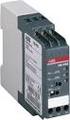 Data sheet Voltage monitoring relays CM-ESS.2 For single-phase AC/DC voltages The CM-ESS.2 is an electronic voltage monitoring relay that provides reliable monitoring of voltages as well as detection of
Reyrolle Protection Devices. 7PG17 - XR Intertripping, Interposing, Supervision and Special Purpose Relays. Answers for energy
 Reyrolle Protection Devices 7PG17 - XR Intertripping, Interposing, Supervision and Special Purpose Relays. Answers for energy Siemens Protection Devices Limited 2 7PG17 XR101 & XR102 Intertripping Relay
BARDIC. 4 & 8 Zone Fire Panels Zircon range. Data, installation, operation and maintenance. by Honeywell
 Data, installation, operation and maintenance 4 & 8 Zone Fire Panels Zircon range BARDIC by Honeywell LED flashing LED Continuous FAULT DISABLE/TEST Power General Fault Sounder Fault/ Disable System Fault
Thyristor-controlled power supplies and battery chargers
 Thyristor-controlled power supplies and battery chargers Input voltage: 115 / 230 VAC, single phase, 50 / 60 Hz or 208 / 400 / 480 VAC, three phases, 50 / 60 Hz Output voltage: 12 / 24 / 48 / 60 / 72 /
Daker DK 1, 2, 3 kva. Manuel d installation Installation manual. Part. LE05334AC-07/13-01 GF
 Daker DK 1, 2, 3 kva Manuel d installation Installation manual Part. LE05334AC-07/13-01 GF Daker DK 1, 2, 3 kva Index 1 Introduction 24 2 Conditions of use 24 3 LCD Panel 25 4 Installation 28 5 UPS communicator
RM4TG20 three-phase network control relay RM4-T - range 200..500 V
 Characteristics three-phase network control relay RM4-T - range 200..500 V Complementary [Us] rated supply voltage Output contacts Setting accuracy of time delay Delay at power up Measuring cycle Marking
SUGGESTED SPECIFICATION for Series 185 Service Entrance Rated Automatic Transfer Switches
 SUGGESTED SPECIFICATION for Series 185 Service Entrance Rated Automatic Transfer Switches PART 1 GENERAL 1.01 Scope Optional Standby Power Generator Systems A. Furnish and install automatic transfer switches
Electronic overload relay EF65, EF96 and EF146
 Data sheet Electronic overload relay EF65, EF96 and EF146 Electronic overload relays offer reliable protection in case of overload and phase-failure. They are the alternative to thermal overload relays.
Firmware version: 1.10 Issue: 7 AUTODIALER GD30.2. Instruction Manual
 Firmware version: 1.10 Issue: 7 AUTODIALER GD30.2 Instruction Manual Firmware version: 2.0.1 Issue: 0.6 Version of the GPRS transmitters configurator: 1.3.6.3 Date of issue: 07.03.2012 TABLE OF CONTENTS
AUTOMATIC TRANSFER SWITCH CONTROL UNIT OPERATOR S MANUAL
 ATS-220 AUTOMATIC TRANSFER SWITCH CONTROL UNIT OPERATOR S MANUAL For Use in 208 to 240 Volts Single and 3 Phase ATS Systems With 110Volt AC or DC Control Motors and selenoids 4501 NW 27 ave Miami FL 33142
OZW30. Central Unit SYNERGYR
 2 841 SYNERGYR Central Unit OZW30 Collects billing data from the apartments. Generates an image of each apartment's heat consumption and makes it available for readout. Acts on room temperature control
MCR1900 Media Converter 19-Slot Chassis
 MCR1900 Media Converter 19-Slot Chassis Installation Guide Part #5500304-11 Copyright Statement This document must not be reproduced in any way whatsoever, either printed or electronically, without the
Specifications H8CA-S H8CA-S RATINGS. Approved by the following standards CHARACTERISTICS
 Solid-State Counter/Timer 1/16 DIN, Easy-to-Operate Combination Counter and Timer Operation selectable as preset counter or timer 6-digit LCD Present Value: 8 mm (.32 in) Set Value: 4 mm (.16 in) Nonsignificant
Electronic overload relay EF19 and EF45
 Data sheet Electronic overload relay EF19 and EF45 Electronic overload relays offer reliable protection in case of overload and phase-failure. They are the alternative to thermal overload relays. Motor
TRACTION NETWORK MONITORING AND PROTECTION SYSTEM SMTN-3 CITY ELECTRIC TRANSPORT RAILWAYS METRO INDUSTRY
 TRACTION NETWORK MONITORING AND PROTECTION SYSTEM SMTN-3 CITY ELECTRIC TRANSPORT RAILWAYS METRO INDUSTRY 2 TRACTION NETWORK MONITORING AND PROTECTION SYSTEM Traction network monitoring and protection system,
Siemens Integrated Substation Condition Monitoring System. Circuit Breaker Monitoring
 Siemens Integrated Substation Condition Monitoring System Circuit Breaker Monitoring System Description Introduction The Circuit Breaker Monitor [CBM] is only one example of the way that the Substation
Digital Pressure Measuring Instrument MDR480
 Description The digital panel instrument MDR480 is designed to measure, display, and monitor pressures in industrial applications. The instrument is panel mounted with a front frame dimension of 96 mm
Inductive Sensors Single or Dual Loop Detectors Type LD with teach-in
 Inductive Sensors Single or Dual Loop Detectors Type LD with teach-in Single or Dual loop detector Automatically adjustment of detection level Manual sensitivity for compensations of variations Easy installation
TM7BDM8B expansion block - TM7 - IP67-8 DI/DO - 24V DC - 0.5 A - M8 connector
 Product datasheet Characteristics TM7BDM8B expansion block - TM7 - IP67-8 DI/DO - 24V DC - 0.5 A - M8 connector Main Range of product Product or component type Range compatibility Enclosure material Bus
mecotron Safety relay ESTOP-2 For emergency stop monitoring
 E0006 000824 Safety relay E-2 For emergency stop monitoring Description The safety module E-2 for emergency stop monitoring is used for safety breaking one or more circuits and is designed to be incorporated
Programming Logic controllers
 Programming Logic controllers Programmable Logic Controller (PLC) is a microprocessor based system that uses programmable memory to store instructions and implement functions such as logic, sequencing,
Low Voltage Products. Switches Automatic Transfer Switches
 Low Voltage Products Switches Automatic Transfer Switches Growing importance of a secure power supply Standby power is an integral part of many industrial and domestic electrical systems. High energy prices,
Pilot-wire differential relay for lines with two or more terminals
 Pilot-wire differential relay for lines with two or more terminals Page 1 Issued: March 2003 Revision: A Data subject to change without notice Pilot-wire differential relay with RXHL 401 Features Phase
DLP-PU/E Instruction Manual
 Instruction Manual BEFORE USING THE POWER SUPPLY UNIT Pay attention to all warnings and cautions before using the unit. Incorrect usage could lead to an electrical shock, damage to the unit or a fire hazard.
38 Series - Relay interface modules 0.1-2 - 3-5 - 6-8 A
 38 Series - Relay interface modules 0.1-2 - 3-5 - 6-8 A Common features Instant ejection of relay by plastic retaining clip Integral coil indication and protection circuit EMR Electromechanical Relays
instabus KNX / EIB System System E F G H
 Product name: Uninterruptible power supply (USV) 640 ma Design: REG (rail-mounted device) Article-no.: 1079 00 ETS search path: Gira Giersiepen / system components / power supply / power supply 640mA DRA
VIBRATION MONITORING OF FANS INSTALLED IN ROAD TUNNELS
 VIBRATION MONITORING OF FANS INSTALLED IN ROAD TUNNELS CEMB SPA Via Risorgimento, 9 Mandello del Lario (Lc), Italy [email protected] www.cemb.com INSTRUMENT FOR MONITORING VIBRATIONS OF FANS INSTALLED IN ROAD
MILLENIUM INSTALLATION MANUAL NTR 735 A. Simple Automation Control Module (MAS)
 MILLENIUM Table of contents 1. INTRODUCTION 1 2. HARDWARE DESCRIPTION 2 3. INSTALLATION 5 4. CONNECTION 6 5. USER SAFETY AND PROTECTION OF EQUIPMENT 8 1. Introduction The MILLENIUM series has been designed
Product and functional description
 Product and functional description The KNX / DALI gateway N 141/02 is a 4 MU wide, DINrail mounted KNX device with one DALI interface to which up to 64 DALI actuators (e.g. DALI ballasts) can be connected
DMX2PWM 9 Channel Dimmer Setup Manual
 DMX2PWM 9 Channel Dimmer Setup Manual www.ecue.de DMX2PWM 9ch Dimmer - Setup Manual e:cue control GmbH An OSRAM Company Rev. 1.3_01/2010 DMX2PWM 9ch Dimmer - Setup Manual Table of Contents 1. Device Overview....................................4
SURGE PROTECTIVE DEVICES
 SURGE PROTECTIVE DEVICES 1. INTRODUCTION In order to ensure safety of people, protection of equipment and, to a certain extent, continuity of supply, insulation co-ordination aims at reducing the likelihood
Installation and User Guide
 Installation and User Guide 458-UNI8 8-Channel Universal Dimmer Module Introduction The 458/UNI8 is an 8-channel universal, digital transistor, dimmer module. Each channel s mode can be selected for either
Technical data. General specifications. Signal voltage 15... 30 V DC Signal duration. 1 s Input 2. Signal voltage. 1 s Analog output.
 Model Number Features Very small housing High climatic resistance 4 Bit multiturn Analog output Surge and reverse polarity protection Description This absolute rotary encoder with internal magnetic sampling
Product Information Sheet UH28CS-12kV Hi Pot Tester
 Product Information Sheet UH28CS-12kV ETL Prüftechnik GmbH Telefon: +49 711 83 99 39-0 E-Mail: [email protected] Carl-Peters-Straße 23 D-70825 Korntal-Münchingen Telefax: +49 711 83 99 39-9 Internet:
CONTROLS DATA MANAGEMENT PROCESS AUTOMATION EUROCUBE. General purpose single phase thyristors and solid state relays Product data.
 425 CONTROLS DATA MANAGEMENT PROCESS AUTOMATION EUROCUBE General purpose single phase thyristors and solid state relays Product data abc 425 EUROCUBE A complete range of low cost solid state relays and
Power Meter Series 700
 PowerLogic power-monitoring units Power Meter Series 700 Technical data sheet 2007 Functions and characteristics E90463 The PowerLogic Power Meter Series 700 offers all the measurement capabilities required
Electronic timer CT-VBS.17+18 OFF-delayed without auxiliary voltage, for DC contactors Data sheet
 Characteristics Single-function OFF-delay timer for DC contactors, without auxiliary voltage Width.5 mm CDC 5 6 F3 Approvals A culus E CCC CT-VBS a Circuit diagram b Marker label Marks a CE b C-Tick Order
OPLC Installation Guide
 Samba OPLC SM43-J-T20/ SM35-J-T20 OPLC Installation Guide 12 Digital Inputs, include 1 HSC/Shaft-encoder Input, 2 Analog inputs (only when the digital inputs are set to pnp), 8 Relay Outputs 12 Digital
TIG INVERTER INSTRUCTION MANUAL
 TIG INVERTER INSTRUCTION MANUAL Contents Warning General Description Block Diagram Main Parameters Circuit Diagram Installation and Operation Caution Maintenance Spare Parts List Troubleshooting 3 4 4
Voltage monitoring relays CM-ESS.2 For single-phase AC/DC voltages
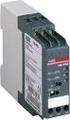 Data sheet Voltage monitoring relays CM-ESS.2 For single-phase AC/DC voltages The CM-ESS.2 is an electronic voltage monitoring relay that provides reliable monitoring of voltages as well as detection of