
PETER E. ROSSI, MBA 80, PHD
|
|
|
- Abigayle Elliott
- 10 years ago
- Views:
Transcription
1 HAVIOR DYNAMIC PRICING ADVERTISING HOLARS NEW PRODUCT BEST PRACTICE NAGEMENT LABS CONSUMER BEHAVIOR RKETING FELLOWS KILTS SCHOLARS NE S CHANNEL STRATEGY MANAGEMENT LA G ADVERTISING PULSING MARKETING FE ACTICES AFFECT DYNAMICS CHANNEL HAVIOR DYNAMIC PRICING ADVERTISING ARS NEW PRODUCT BEST PRACTICES AF GEMENT MARKETING AT CHICAGO DYN TING FELLOWS KILTS SCHOLARS NEW PR S CHANNEL STRATEGY MANAGEMENT LA G ADVERTISING PULSING MARKETING FE ACTICES AFFECT DYNAMICS CHANNEL HAVIOR DYNAMIC PRICING ADVERTISING HOLARS NEW PRODUCT BEST PRACTICE NAGEMENT LABS CONSUMER BEHAVIOR RKETING FELLOWS KILTS SCHOLARS NE S CHANNEL STRATEGY MANAGEMENT LA G ADVERTISING PULSING MARKETING FE ACTICES AFFECT DYNAMICS CHANNEL EHAVIOR DYNAMIC PRICING

2 AT CHICAGO, WE FOCUS ON THE FUNDAMENTAL MARKETING QUESTIONS. OUR COMMITMENT TO BASIC RESEARCH PAYS OFF IN THE CLASSROOM AND IN THE CAREERS OF OUR GRADUATES. PETER E. ROSSI, MBA 80, PHD 84 JOSEPH T. AND BERNICE S. LEWIS PROFESSOR OF MARKETING AND STATISTICS AND DIRECTOR OF THE JAMES M. KILTS CENTER FOR MARKETING
3 CONTENTS INTRODUCTIONS 2 MARKETING AT CHICAGO 2OO8 PETER ROSSI, MBA 80, PHD 84 ART MIDDLEBROOKS, 88 pi4 p8 ALUMNI 6 ANN MUKHERJEE, 94 ALUMNI IN THE NEWS RECRUITING 12 AARON CONROW, 04 TOP RECRUITERS AT CHICAGO GSB IN 2007 FACULTY 18 ANN MCGILL, MBA 85, PHD 86 OLEG URMINSKY FACULTY NEWS p20 p42 PHD PROGRAM 30 MARIA ANA VITORINO PHD STUDENT NEWS MBA PROGRAM 36 KAREN KATEN, AB 70, MBA 74, AND MEGHAN FRIESEN STUDENT NEWS CURRICULUM 46 EMILY YUEH COURSE DESCRIPTIONS p48 MARKETING AT CHICAGO is published annually by the University of Chicago Graduate School of Business. All rights reserved. Copyright / 5M / PH /

4 Peter E. Rossi, MBA 80, PhD 84 Joseph T. and Bernice S. Lewis Professor of Marketing and Statistics and Director of the James M. Kilts Center for Marketing

5 MARKETING AT CHICAGO Welcome to Marketing at Chicago 2OO8. Each year we will keep friends of Marketing at Chicago informed of the new developments here, including student and alumni achievements, faculty appointments and research, new additions to our classroom portfolio, and news and insights from recruiters who come here seeking top talent. We also will announce winners of marketing scholarships and fellowships and help you keep track of our former scholars as they advance in their careers. This year, we are pleased to announce the appointment of Art Middlebrooks as executive director of the James M. Kilts Center for Marketing. Art is no stranger to the GSB. Having earned his MBA here in 1988, he has been adjunct professor of marketing since 1995 and currently teaches the new products and service marketing courses. With his appointment as executive director, we are embarking on an even more ambitious agenda for the center. Art will expand our marketing offerings by adding more experiential learning opportunities and work on new events to involve both our students and alumni. In addition to Art s appointment, we have launched the Kilts Center Visiting Faculty Fellows program, which will bring top faculty from around the world to the GSB to enrich our already exciting research environment. This year, we are welcoming Dilip Soman, PhD 97, from the University of Toronto. Next year, we have appointed Panle Jia from MIT and Katherine Vohs from the University of Minnesota as fellows. Our Marketing Fellowship Steering Committee continues to grow. This year we are pleased to welcome Karen Katen, AB 70, MBA 74, former vice chairman and president of Global Pfizer Human Health and current senior advisor for Essex Woodlands Health Ventures LLC; Robin Neifield, 84, CEO of Netplus; and James Tyree, executive vice president, Abbott North America. Our steering committee is a group 20 strong of top marketers and top management. Our commitment to marketing is evident in the success of our alumni, students, and faculty. Please browse these pages to share in the achievements of the past year. Peter E. Rossi, MBA 80, PhD 84 Director, James M. Kilts Center for Marketing 2 3

6 Art Middlebrooks, 88 Executive Director of the James M. Kilts Center for Marketing and Adjunct Professor of Marketing

7 MARKETING AT CHICAGO I m thrilled to be named Executive Director of the James M. Kilts Center for Marketing. Having received my MBA with a concentration in marketing at the GSB 20 years ago, I launched my own marketing career with the help of the outstanding faculty here who fueled my interest in the areas of innovation and services marketing. Teaching marketing courses here for 14 years has exposed me to thousands of smart, dedicated students and given me a chance to see them flourish in their own marketing careers. I m convinced now more than ever that Chicago GSB provides unique and important advantages in marketing for students, alumni, faculty, and recruiters. I m honored to serve in this role to help promote awareness of marketing at the GSB and to expand the programs of the Kilts Center. Although I m just getting started, I see several areas of focus for the near future. Developing a vision and strategy for the Kilts Center so that all activities align with this common direction Creating events and conferences targeted to students, alumni, and companies in order to increase the visibility of marketing at Chicago Developing new experiential education courses in marketing that will enable students to be immersed in and tackle challenging, real-world marketing problems Reaching out to our alumni to engage them in the Kilts Center activities as well as assist them in their marketing careers Supporting and expanding the Kilts Marketing Fellowships and Kilts Scholars programs in order to attract top marketing talent to the GSB as well as champion them during and after their time here I welcome your input, ideas, and participation in the activities of the Kilts Center for Marketing. Art Middlebrooks, 88 Executive Director, James M. Kilts Center for Marketing 4 5

8

9 WHEN YOU UNDERSTAND THE ECONOMIC VALUE OF WHAT MARKETING CONTRIBUTES TO THAT BUSINESS MODEL, IT S LESS ABOUT DEFENDING WHAT YOU RE DOING AND MORE ABOUT DRIVING THE AGENDA. MARKETING AT CHICAGO I ALUMNI ANN MUKHERJEE, 94 GROUP VICE PRESIDENT, MARKETING FRITO-LAY NORTH AMERICA 6 7

10 Chicago GSB Marketing Alumna INTERVIEW Ann Mukherjee, 94 Group Vice President, Marketing Frito-Lay North America Having the courage to let Doritos s fans create the 30-second television ad for the 2007 and 2008 Super Bowls not only deepened the snack chip s relationship with its 16- to 24-year-old consumers, it boosted the brand into the media spotlight. Ann Mukherjee led the effort at Frito-Lay North America, the $10 billion convenient foods division of PepsiCo. What departments and functions report to you? The marketing staff for the four core brands report to me Doritos, Cheetos, Tostitos, and Lay s. Those are large and mature brands that generate 70 percent of Frito-Lay s revenue. Lay s Potato Chips is the second-largest brand in the supermarket. It s an over $2 billion business. Have you had any critical points in your career where key decisions facing Frito-Lay were affected by your thinking? The GSB taught me to ask the right questions and think conceptually. It wasn t about driving to the one perfect answer, it was about teaching me to see the possibilities. That was critical for how I ve navigated my career in marketing because it gave me the ability to come into a situation whether it be on a very mature brand or in an organization that might have done something a certain way for a long time and offer a new perspective. Frito-Lay has large, mature brands. To drive ongoing growth of something this big, we had to move beyond traditional marketing. For the 2007 Super Bowl, we bought a TV spot for Doritos and let the consumer create the content. We said to consumers, You create an ad. We won t edit it. And we ll let other consumers pick the winner, which we ll put on the largest advertising stage possible. That s the kind of fundamental shift we ve created at Frito-Lay. Being able to lead a team of people to consider those possibilities is where my GSB training came to bear. It changed the way we think about marketing at Frito-Lay. How has the skill set for marketing changed since you launched your career? When I went through marketing at the GSB, I learned to look at a business model holistically and understand the economic value that marketing drove within that model. Marketing is not a support function; marketing becomes a key enabler for understanding how to generate sustainable growth for a business. When you understand the economic value of what marketing contributes to that business model, it s less about defending what you re doing and more about driving the agenda. What would surprise marketing professionals about the GSB? For people who really want to understand not only how to market a product or service but how to drive business growth through marketing, Chicago s a fabulous place to study. Chicago isn t about spoon-feeding you the answers, it s about teaching you to ask the right questions. In the changing environment that we live in today, you have to be nimble enough to drive different frameworks and keep ahead of the pace. That s what Chicago teaches you to do. It teaches you to think much more conceptually, and it makes you the architect of creating the future. That s why a GSB education is just so powerful to me.

11 MARKETING AT CHICAGO I ALUMNI 8 9

12 Chicago GSB alumni in marketing were Extra credit Gloria Colgan, 91, senior vice president of marketing at Discover Financial Services LLC, said she likes the credit card industry because it has both business-to-business and business-to-consumer aspects to it. That most fascinates me. The Chicago Tribune focused on Colgan s career path in a December 17 article. Colgan helps facilitate transactions between merchants and card issuers. I work heavily with merchants accepting the cards to make sure transactions pass through to the cardholders efficiently and correctly, she said. Discover is headquartered in Riverwoods, Illinois. Going public DemandTec Inc. (NASDAQ symbol: DMAN), whose founders include Phil Delurgio, 94, has gone public. Based in San Carlos, California, the company sells software to retailers and consumer products companies. The software aids in developing merchandising and marketing strategies based on consumer behavior and is used by such retailers as Best Buy, Target, and Wal-Mart, and such companies as Kraft Foods Global and Procter & Gamble. The initial public offering was underwritten by Morgan Stanley, William Blair & Co., JMP Securities, Montgomery & Co., Credit Suisse, and Pacific Crest Securities, said an Associated Press article. Peter Rossi, Joseph T. and Bernice S. Lewis Professor of Marketing and Statistics at the GSB and director of the GSB s Kilts Center for Marketing, noted that the company s products are based, in part, on research done here at Chicago GSB. They do customer demand management using Bayesian methods and using constraints suggested in one of my PhD students theses, Rossi said. He has served on the firm s science board since the company s inception. Rising to the challenge Jean Emmons, 48, was part of an all-black team of marketers called upon to sell Pepsi to the African-American market in the late 1940s and early 1950s. Now he is part of a book about the team called The Real Pepsi Challenge. Team members had college degrees and were more qualified than their white counterparts but were paid less, said a January 9 article in the Wall Street Journal. Pepsi sales increased everywhere the team hit with a marketing blitz. The job turned Emmons into a Pepsi fanatic. All of my friends had to buy Pepsi. I kept stockpiles of Pepsi in my house. All the places I went had to have Pepsi. If I was out with someone and they ordered Coke, I might have thrown a glass of water in their face.my wife would say, I think you re going crazy Pepsi, Pepsi, Pepsi! Emmons eventually earned a PhD and became a school superintendent. A better option Paul Eppen, 88, chief marketing officer for the online brokerage OptionsXpress Holdings, Inc., was profiled in Crain s Chicago Business September 10. The brokerage plans to expand the ways it reaches customers, he told Crain s. We just don t think options are as well-known to the general public, and part of our job is to educate people on how to use options in their portfolios, Eppen said. One obstacle: tripling advertising costs per new customer account in the past year. The company currently reaches customers mainly through internet ads, customer referrals, and web seminars, the article said. Striking a smart balance Stephen Hughes, 78, is part of a team of former food and beverage executives who hope to capitalize on the trans fat ban, which is spreading to major cities. The team created Boulder Specialty Brands in 2005 and recently acquired Smart Balance, which produces non-trans fat oil, margarine, and other products, said a June 29 article in the New York Sun. Hughes told the newspaper he is marketing the company s cooking oil not just to consumers but also to restaurants and large-scale operations. The article cited Nielsen Market Track statistics, which show Smart Balance has a 13 percent share in the nationwide margarine market and a 19.7 percent share in New York City, the first major city to enact a trans fat ban. The nicotine of the American food diet is trans fat, Hughes told the Sun. This is a business in the crosshairs of a major consumer trend. He said there is a perfect storm of public awareness and urgency to find an alternative. Information arbitrage Dhiraj Rajaram, 03, founder and CEO of Mu Sigma, calls what his company does information arbitrage. Rather than provide the entire scope of analytics for other companies, Mu Sigma will augment a company s existing analytics team with people in Bangalore who are adept at using the latest software tools to spot opportunities in marketing, risk analysis, and supply chain optimization, said a November 30 article in BusinessWeek online. We don t do insight generation, Rajaram said. We don t have the knowledge of their industries and their companies to do that. We re humble enough to know we won t go all the way. He said no client has cut its workforce because it outsourced work to his company. Rajaram is moving to Bangalore to further grow his company.

13 in the news and on the move in 2OO7. Joseph Andrulis, 90, has been appointed senior vice president and manager of RF Monolithics, Inc. He previously was vice president of marketing. The wireless technology firm is based in Dallas. Juan Carlos Davila, 97 (XP-66), was appointed senior vice president of marketing and sales for Telscape Communications. Based in Greencastle, Indiana, the firm provides telecommunications to Spanish-speaking households. Rick Epstein, 86, was named senior vice president of marketing for Intuitive Surgical, Inc. Based in Sunnyvale, California, the company makes machinery used by surgeons, including viewing systems and carts with robotic arms. Jim Fisher, 72, was named partner at OneAccord Corporation, joining the firm s senior sales and marketing leadership team. Headquartered in Seattle, the company provides sales and marketing professional services. Glenn Gottfried, 84, has been named CEO of CCS-Adplus LLC. Gottfried will establish a sales, marketing, and business development office in north suburban Illinois and other cities. Doing business as Infolure, the Phoenix-based company provides direct marketing and accounts receivable services. John Kim, 99, was appointed to the newly created position of product management and marketing at Medio Systems. The Seattle-based firm provides mobile phone search systems and advertising services. Tom McMillian, 87, has been named vice president, group account director, for Patient Marketing Group. Based in Princeton, New Jersey, the firm provides pharmaceutical marketing services. Brian Niccol, 03, was named chief marketing officer at Pizza Hut. The world s largest pizza restaurant chain is based in Dallas. Jennifer O Connell, 96, joined Seidler Bernstein Inc. as director of brand planning and strategy. The marketing communications agency is based in Cambridge, Massachusetts, and specializes in health care and biotechnology. Kathryn Olson, 87, was named chief marketing officer of Shutterfly, Inc. Headquartered in Redwood City, California, the internet-based firm specializes in digital photo products and services for consumers and professional photographers. Darin Rasmussen, 02, was promoted to director, strategic marketing, at Thomson-West. The promotion follows his receipt of a Thomson Award of Excellence for innovative pricing and service solutions for large law libraries and law firms. Headquartered in St. Paul, Minnesota, the firm publishes law books and legal products. Ken Sweder, 00, was named chief marketing officer of Interline Brands. Headquartered in Jacksonville, Florida, the firm is a national distributor and direct marketer of repair and maintenance products. The company sells more than 80,000 plumbing, hardware, electrical, janitorial, and related products under private labels. Mark Vander Ploeg, 77, joined Evercore Partners as a senior marketing director in the New York based investment firm s advisory business. Kevin Wenta, 91, joined Nanophase Technologies as executive vice president, sales and marketing. The nanotechnology firm is based in Romeoville, Illinois. MARKETING AT CHICAGO I ALUMNI 10 11

14

15 CHICAGO GSB MARKETING STUDENTS GAIN SIGNIFICANT EXPOSURE TO DISCIPLINES OUTSIDE OF MARKETING, SUCH AS FINANCE AND ACCOUNTING, WHICH PREPARES THEM WELL FOR A GENERAL MANAGEMENT TRACK. MARKETING AT CHICAGO I RECRUITING AARON CONROW, 04 ASSOCIATE BRAND MANAGER FOR SOFTSOAP LIQUID HAND SOAP, COLGATE PALMOLIVE 12 13

16 Chicago GSB Marketing Recruiter INTERVIEW Aaron Conrow, 04 Associate Brand Manager for Softsoap Liquid Hand Soap, Colgate-Palmolive Aaron Conrow joined Colgate-Palmolive early in He quickly became the catalyst for the industry giant s recruiting relationship with Chicago GSB by collaborating with the firm to post job openings and invite students to visit its New York City office. Why was it important for Colgate to develop marketing and brand recruiting partnerships with the GSB? Colgate is a company that values analytical and quantitative skills. Being able to analyze a P&L statement or quickly build insights from Nielsen data is critical. The company also looks at marketing from a general management perspective. The people who run the organization tend to come from marketing and, to advance through the ranks, you need to have the skills of a general manager who can oversee the entire business. Chicago GSB marketing students gain significant exposure to disciplines outside of marketing, such as finance and accounting, which prepares them well for a general management track. Also, the GSB focuses on a collaborative approach to learning, which Colgate emphasizes as well. What do you think Chicago GSB students offer that s unique among MBAs? A rigorous analytical approach to problem solving, which mirrors our approach at Colgate. Whether evaluating a new product launch or promotional plan, it s critical to look at the issue from different angles and study the numbers carefully. As an alumnus currently in brand management and marketing, what did the GSB give you that makes you unique among your peers and then inspires you to recruit current Chicago GSB students? The GSB curriculum provides both quantitative individual coursework and qualitative group-oriented casework. Students are stretched in both directions. In many classes, students conduct data-driven analytics and are evaluated individually. In other classes, they work within a team and succeed by bringing out the best in their teammates. The ability to excel at qualitative teamwork and quantitative analytics is highly applicable for the real world, and it sets GSB students apart. What leadership opportunities do Chicago GSB students have that make them compelling marketing and brand management candidates? The GSB community has many different groups on campus and students are encouraged to get involved. These groups provide plenty of opportunities for students to take on leadership roles where they re project managing among peers. This makes GSB students more compelling marketing/brand candidates, given the importance of project management within marketing. What would surprise marketing professionals about Chicago GSB? It s more of a collaborative environment than many would assume. While students take their studies seriously, academic competitiveness stays collegial. To succeed at the GSB, you need to be a valuable team player who can work well with people who have diverse backgrounds. GSB students come from all around the country and the world. They also have tremendously varied professional backgrounds, from accountants and investment bankers to nonprofit leaders and advertising executives.

17 MARKETING AT CHICAGO I RECRUITING 14 15

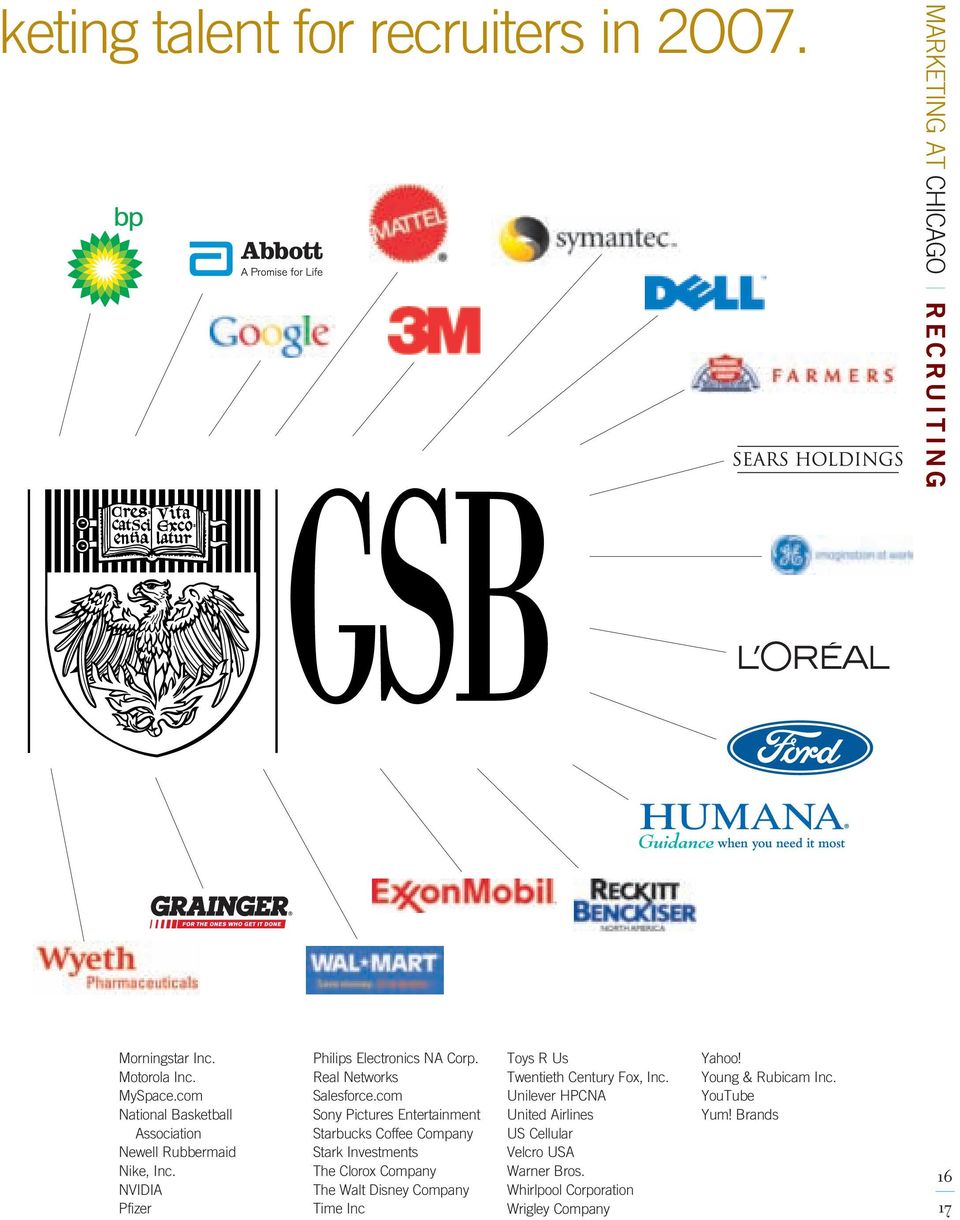
18 Chicago GSB was a top choice for mar Over 300 firms worked with us to source marketing talent this year. The list ranged from companies in the consumer packaged goods arena, such as The Clorox Company, to financial services, like American Express, to the technology arena, like Yahoo!, to the pharmaceutical industry, including Baxter Healthcare Corporation. Full-time positions were accepted by 38 graduating students and internships were accepted by 51 students. Among the companies recruiting for marketing positions at Chicago GSB: Companies who recruit with Chicago GSB for marketing also include: Allstate Corporation Amazon.com American Express Company Apple Inc. Art Institute of Chicago Barclays Global Investors Baxter Healthcare Corporation Brown-Forman Corporation Burger King Corporation Campbell Soup Company CDW Corporation Chicago 2016 Olympic Bid Colgate Palmolive Company ebay, Inc. eharmony.com Electronic Arts Expedia.com Genentech, Inc. Ingersoll-Rand Company Intel Corporation Johnson & Johnson International LG Electronics MasterCard International McCain Foods, Inc. MeadWestvaco Company Medtronic Inc. Merrill Lynch

19 keting talent for recruiters in 2OO7. MARKETING AT CHICAGO I RECRUITING Morningstar Inc. Motorola Inc. MySpace.com National Basketball Association Newell Rubbermaid Nike, Inc. NVIDIA Pfizer Philips Electronics NA Corp. Real Networks Salesforce.com Sony Pictures Entertainment Starbucks Coffee Company Stark Investments The Clorox Company The Walt Disney Company Time Inc Toys R Us Twentieth Century Fox, Inc. Unilever HPCNA United Airlines US Cellular Velcro USA Warner Bros. Whirlpool Corporation Wrigley Company Yahoo! Young & Rubicam Inc. YouTube Yum! Brands 16 17
20

21 GSB STUDENTS WILL PUSH AND CHALLENGE US. THAT CHANGES ME; I VE REFINED MY THINKING OVER THE YEARS. ALSO, THERE S A SENSE OF ALL OF US BEING IN IT TOGETHER, COLLABORATING. IT S EXHILARATING. WHEN YOU GO INTO THE CLASSROOM, YOU RE PUMPED. MARKETING AT CHICAGO I FACULTY ANN MCGILL, MBA 85, PHD 86 SEARS ROEBUCK PROFESSOR OF GENERAL MANAGEMENT, MARKETING, AND BEHAVIORAL SCIENCE 18 19
22 Chicago GSB Marketing Faculty INTERVIEW Ann McGill, MBA 85, PhD 86 Sears Roebuck Professor of General Management, Marketing, and Behavioral Science Ann McGill joined the Chicago GSB faculty in Her research interests include consumer and manager decision making with special emphasis on causal explanations, differences in judgments in public and in private, and the use of imagery in product choice. What do you get out of teaching? Teaching is such a big thing to do, you get many things. One of them is a sense that you can change the world in a scaled-up way. You re interacting with hundreds of smart people, so you get to multiply yourself and your knowledge a bunch of times. It s also a very personal experience because you get to help individuals achieve their goals. It s both this grand feeling and this very personal feeling. As researchers, we re well aware that we don t know everything, and GSB students will push and challenge us. That changes me; I ve refined my thinking over the years. Also, there s a sense of all of us being in it together, collaborating. It s exhilarating. When you go into the classroom, you re pumped. What are you researching right now? I m working with associate professor of marketing Suresh Ramanathan on how consuming something with someone else changes the experience. We studied three groups of people watching a movie. One set watched by themselves, another set with a stranger whose expressions they could see, and a third set with strangers whose expressions were blocked. We learned that when people can see each other, they pick up on each other s facial expressions and gestures, which leads to sharing feelings, and that colors their ongoing evaluation of the movie so that they end up in sync during the show. Further, the more people were in sync with each other during the experience, the more they said they liked the movie later on. It felt good to be in sync, and the strangers attributed that good feeling to the movie. Now we re looking at how friends react to each other compared with how strangers react. Unlike strangers, friends attribute the good feeling of being in sync to the friendship, not the movie. On the other hand, if you get in the way of people being in sync by blocking their ability to see each other s expressions, strangers don t care, but friends end up thinking the movie just wasn t very good. How do teaching and researching complement each other? Teaching helps research mostly by sharpening my thinking, by revealing gaps in my knowledge. Just the process of trying to be clear and complete reveals the ways in which what the world knows is not really clear or complete. Researching helps teaching by showing that we go through our lives acting with imperfect information. How can you be both bold in action and
23 MARKETING AT CHICAGO I FACULTY modest in belief? We work on that in class. Also, I tell my students about my work as it goes along. They like hearing about it and offering suggestions. Where do you get the ideas for your research? There are two sources. One is the prior literature academic journals, where you read other peoples research. That s a great source because you re tied to previous scientists, standing on the shoulders of giants, and you get to push things along. Sometimes we end up in our own little world doing that, so I temper it by just watching people. The study of movies started when I was sitting in the theater waiting for a popular show. Five minutes before it started, the theater had almost filled up. Rather than sit separately, pair after pair said, Let s go to a later show. I thought, if you re just sitting in the dark, why wouldn t you be willing to sit six seats away from each other? Outside of the obvious, like couples who want to snuggle, a lot of people looked like they were going to sit quietly and watch the movie. And yet they sensed that sitting next to their friend is a lot different. Are you surprised by the results? Always. If the results aren t surprising there s probably not a big reason to study it. You re trying to inform the world about the unknown and poorly understood. That surprise in research keeps you modest. You will think about something for two years, read every word written on it, talk to hundreds of smart people and you ll be wrong. And over time you come to realize it doesn t work how you thought it works. The world works in a very complex way, human behavior especially. I m almost always surprised by the results
24 Chicago GSB Marketing Faculty INTERVIEW Oleg Urminsky Instructor in Marketing After completing his PhD at Columbia University in 2007, Oleg Urminsky joined the faculty at Chicago GSB. A first-year instructor, he teaches a course in marketing research. His research interests include consumer and managerial decision making and its implications for marketing management. What drew you to Chicago GSB? The colleagues, and the reputation for rigor and excellence in research. It s a lot to try to live up to; it s an amazing group of researchers. What s distinctive about the marketing faculty is that people from the psychology side work with people from the economics-statistics side. I m particularly interested in that area in between. You re teaching the marketing research class. What s your approach? I worked in marketing research for many years before going to grad school. I started out in a firm that did political polling and commercial market research, and I worked in advertising research, where my role was market research statistician, although I was involved in a variety of aspects. My approach for teaching is hands-on and practical. I give students the tools from statistical theory and psychological theory that they ll need to design research that will really answer the marketing questions they ll grapple with. The core of the course is a group project from an actual business. Three projects are from students who are proposing a project to venture capital groups, and they are doing market research on it to strengthen the business plan. Another is from an alumnus who s starting his own salsa company; two teams of students are doing research on the salsa market for him. Deloitte is working with the class, too. When students work on the project, they have to figure out how to define the problem and what s reasonable to do in a quarter. They realize what the tradeoffs are, and the limitations. How did you learn how to teach? I feel fortunate to have two backgrounds that come together in my teaching. Having worked in the industry, I had some experience in communicating effectively in that setting. In academia, there is a real emphasis on precision and defining and defending your ideas. Putting those two together has led to my teaching style. How does your experience in the classroom affect your research? It helps to have the things you re working on in the back of your mind. Is there a need for it? Does it have some broad application down the road? Maybe it helps you from going too far afield on things that are purely of academic interest. Also, when you talk to a nonacademic group about research, you get a completely different perspective. People ask how we deal with the psychological biases in how respondents answer survey questions, and what we re supposed to do about it, and that s an important research question in itself. Any time I m in class and find myself saying, As a field, we don t know the answer to that, that s valuable.
25 MARKETING AT CHICAGO I FACULTY What are you researching now? Much of my research falls under the umbrella of goals and motivations. In the past, I ve looked at loyalty programs for example, how people make decisions about goals and how they actually work toward them. Now I m looking at how people set, choose, or balance between goals and the implications for whether they choose goals that make sense based on their past performance. At Columbia, I worked with Ran Kivetz to set up a program at three cafés on campus where participants who bought 10 coffees got one free; they d get a card that would be stamped with each purchase. We measured the time between purchases, and we found that getting closer to achieving the goal affected their behavior. As people got more stamps on the card, the time between purchases got shorter and shorter, on average. What is it like being part of the GSB faculty? To get the opportunity to make my own contributions to the intellectual tradition of this place is a tremendous honor, and living up to it is part of what fuels my passion for my own research. As a new faculty member, I d say it s a combination of the incredible colleagues and the vibrant inquisitive culture here that makes the GSB so unique. Even just getting a cup of coffee with a colleague is more likely than not to wind up in a discussion of theories and phenomena and yield research ideas that could only have crystallized in this unique environment
26 Faculty Research Highlights Research highlights in 2007 reflect the diverse interests and strengths of our faculty. The papers take on a wide range of important current topics in marketing. Tipping and Concentration in Markets with Indirect Network Effects Research by Jean-Pierre Dubé, Professor of Marketing and Neubauer Family Faculty Fellow; Günter Hitsch, associate professor of marketing; and Pradeep Chintagunta, Robert Law Professor of Marketing The authors develop a framework to measure tipping the increase in a firm s market share dominance caused by indirect network effects. They compare the expected concentration in a market to the hypothetical expected concentration that would arise in the absence of indirect network effects. In practice, this measure requires a model that can predict the counter-factual market concentration under different parameter values capturing the strength of indirect network effects. The authors build such a model for the case of dynamic standards competition in a market characterized by the classic hardware/software paradigm. To demonstrate its applicability, they calibrate it using demand estimates and other data from the 32/64- bit generation of video game consoles. The authors find that indirect network effects can lead to a strong, economically significant increase in market concentration. They also find important roles for beliefs on both the demand side, as consumers tend to pick the product they expect to win the standards war, and on the supply side, as firms engage in penetration pricing to invest in growing their networks. Of Frog Wines and Frowning Watches: Semantic Priming, Perceptual Fluency and Brand Evaluation Research by Aparna A. Labroo, associate professor of marketing; Ravi Dhar, George Rogers Clark Professor of Management and Marketing at the Yale School of Management at Yale University; and Norbert Schwarz, professor of marketing at the Ross School of Business and professor of psychology at the University of Michigan Among marketers, there has been a growing trend to employ unusual visual identifiers that have little, if anything, to do with the product. For example, AC Nielsen reports that 18 percent of the 438 viable table-wine brands introduced in the last three years feature an animal on the label. Sales of such critter wines are now more than $600 million, and according to some, the critter craze is merely a subset of the more widespread growth of clever or outright gimmicky wine branding strategies. One advantage for marketers of including distinct visual identifiers in the design of their logo or label is that such features help garner consumer attention. In this paper, the authors suggest an additional route by which unusual visual identifiers may confer product preference. Building on psychological research on processing fluency, they contend that liking a product is based, in part, on the ease of processing its perceptual features, including such visual identifiers. When consumers strongly associate the unique identifier with something meaningful in their lives, the semantic accessibility of that feature enhances product preference by increasing the ease of perceptual processing of the target. Thus, while common branding wisdom suggests that identifiers should be strongly associated with the product category, these findings suggest that it may be beneficial to choose visual identifiers that consumers strongly associate with themselves. Over time, the association of unique identifiers with a brand facilitates development of that particular brand s equity, whereas the association of meaningful identifiers runs the risk of contributing to brand dilution as they may be readily applied to competing brands in the category. The Goal-Gradient Hypothesis Resurrected: Purchase Acceleration, Illusionary Goal Progress, and Customer Retention Research by Oleg Urminsky, instructor in marketing; Ran Kivetz, Sidney Taurel Associate Professor of Business; and Yuhuang Zheng, assistant professor of marketing, Graduate School of Business Administration at Fordham University The goal-gradient hypothesis denotes the classic finding from behaviorism that animals expend more effort as they approach a reward. Building on this hypothesis, the authors generate new propositions for the human psychology of rewards. The key findings indicate that participants in a real café reward program purchase coffee more frequently the closer they are to earning a free coffee and that internet users who rate songs in return for reward certificates visit the rating web site more often, rate more songs per visit, and persist longer in the rating effort as they approach the reward goal. Lastly, they provide evidence that a stronger tendency among participants to accelerate toward the goal
27 predicts greater retention and faster re-engagement in the program. Their research has implications for the design of incentive systems, promotions, and customer retention. Spatial Competition with Endogenous Location Choices: An Application to Discount Retailing Research by Ting Zhu, assistant professor of marketing; and Vishal Singh, assistant professor of marketing at Tepper School of Business, Carnegie Mellon University The authors examine the importance of geographical differentiation in store location decisions of firms in the retail discount industry. Using a novel data set that includes the store locations and accompanying market conditions for all stores belonging to the Wal-Mart, Kmart, and Target chains, they study the factors that influence the entry and location decisions of those firms. The model involves an incomplete information game between the three players where each firm has private information about its own profitability. Their modeling approach permits asymmetries across firms in the impact of exogenous market characteristics and competitive interaction effects. Variations in the exogenous firm-specific characteristics provide the source for model identification. Results show the importance of accounting for firm asymmetries in their response to market conditions and competition interactions. Is That Car Smiling at Me? Schema Congruity as a Basis for Evaluating Anthropomorphized Products Research by Ann McGill, Sears Roebuck Professor of General Management, Marketing, and Behavioral Science; and Pankaj Aggarwal, assistant professor of marketing in the Division of Management at the University of Toronto The present research proposed schema congruity as a theoretical basis for examining the effectiveness and consequences of product anthropomorphism. Results of two studies suggest that the ability of consumers to anthropomorphize a product and their consequent evaluation of that product depend on the extent to which that product is endowed with characteristics congruent with the proposed human schema. Furthermore, consumers perception of the product as a human mediates the influence of feature type on product evaluation. Results of a third study, however, show that the affective tag attached to the specific human schema moderates the evaluation but not the successful anthropomorphizing of the product. Do Switching Costs Make Markets Less Competitive? Research by Jean-Pierre Dubé, professor of marketing and Neubauer Family Faculty Fellow; Günter Hitsch, associate professor of marketing; and Peter E. Rossi, Joseph T. and Bernice S. Lewis Professor of Marketing and Statistics The conventional wisdom in economic theory holds that switching costs make markets less competitive. The authors challenge this claim and formulate an empirically realistic model of dynamic price competition that allows for differentiated products and imperfect lock-in. They calibrate this model with data from frequently purchased packaged goods markets. These data are ideal in the sense that they have the necessary variation to separately identify switching costs from consumer heterogeneity. Equally important, consumers exhibit inertia in their brand choices, a form of psychological switching cost. This makes their results applicable to the broad range of products that are distinctly identified (i.e. branded) rather than just to those products for which there is a product adoption cost or explicit switching fee. In their simulations, prices are as much as 18 per cent lower with than without switching costs. Awards and Promotions Research Wins Top Marketing Award Sanjay Dhar, James H. Lorie Professor of Marketing, and Jean-Pierre Dubé, professor of marketing and Neubauer Family Faculty Fellow, won the 2008 Paul Green Award, which recognizes the best article in the Journal of Marketing Research during the previous year. Dhar and Dubé were honored for their study, Consumer Packaged Goods in the United States: National Brands, Local Branding, which documents several striking geographic patterns in the performance of national brands using a large scanner database spanning many consumer packaged goods categories and U.S. regional markets. Across markets, the geographic variation in market share, indices of brand quality perceptions, and the identity of local brand-share leaders are so significant that it calls into question the concept and relevance of a national brand, Dhar and Dubé found in their research. Bart Bronnenberg of Tilburg University in the Netherlands was a coauthor of the study. Faculty Promoted Aparna Labroo was promoted to associate professor of marketing. A member of the faculty since 2003, Labroo studies consumer information processing, specifically the role of feelings on consumers product evaluations and choices. In 2007, she was selected as Marketing Science Institute s Young Scholar. She was named a Kilts Faculty Fellow in She also has been named a Beatrice Foods Scholar. MARKETING AT CHICAGO I FACULTY 24 25
28 Dilip Soman, PhD 97 Kilts Center Visiting Faculty Fellow Dilip Soman received his PhD in 1997 and currently teaches behavioral economics and marketing strategy at the Rotman School of Management at the University of Toronto. He was a Kilts Center Visiting Faculty Fellow during the spring quarter. Why did you choose to visit the GSB? My research is in judgment, decision making, and behavioral economics, and it s exciting to be back at the GSB with people who pretty much invented the field, to be learning from them and sharing ideas. The kind of intellectual environment I found at the GSB in the 1990s is something I haven t come across anywhere else. What do you hope to accomplish as a visiting professor? I ll work with PhD students who want to work in the areas I research. I d also like to spend time with some of the faculty who were on my thesis committee, both catching up and refining my research agendas for the future. What s unique about the GSB s marketing faculty? Since the GSB takes a discipline-based approach, the marketing faculty are primarily economists, psychologists, or econometricians. At some places, marketing is taught as more of an art; it s a science at the GSB. The other thing that differentiates marketing at GSB is its rigor, which is important in developing new theories. Faculty have this wonderful knack for taking facts and findings and putting them into an equation or a model. The elegance that gives to the field is just staggering. How will your visit affect your research? I ve done a lot of theoretical and applied empirical research in the lab, and now I m pushing my work out to the field to see if I can apply behavioral interventions and marketing principles there not to sell more soap or shampoo, but to see if we can get people to do things that are good for them. For instance, can we get them to save more for retirement, or see their doctor every six months? I want to interact with GSB faculty both in marketing and behavioral sciences to learn the ropes of doing that kind of fieldwork.
29 Tipping a Market with Competing, Incompatible Standards Sudden shifts in market share are likely in industries that have competing yet incompatible standards, according to Günter Hitsch, associate professor of marketing. In the market for video game consoles, for instance, the industry is characterized by indirect network effects the positive feedback loop in which increased hardware sales result in more software titles, which, in turn, increase hardware sales. Indirect network effects can cause a market to tip quickly in favor of one standard. Günter Hitsch speaks at the 2007 QME Conference. Hitsch outlined details from the paper, Tipping and Concentration in Markets with Indirect Network Effects, during the 2007 Quantitative Marketing and Economics Conference in October. Hosted by Chicago GSB and sponsored by the James M. Kilts Center for Marketing, INFORMS Society for Marketing Science (ISMS), and Springer, the QME conference drew more than 100 researchers from 50 institutions to debate the latest in quantitative marketing research. With coauthors Pradeep Chintagunta, Robert Law Professor of Marketing, and Jean-Pierre Dubé, professor of marketing and Neubauer Family Faculty Fellow, Hitsch developed a model calibrated with data from the video game console market that generates predictions that can be used to measure the extent of tipping. In that market, he said, this tipping depends on consumers valuations of software and on consumer expectations. Two important conditions must exist for tipping to occur, he explained. First, you need to have consumers who base their adoption decisions on a sufficiently long, detailed forecast of which standard is going to win. They make this forecast because they care about the availability of the software that complements their hardware. Second, the consumers forecasts must agree on which standard will win, Hitsch said. If these two conditions are met, you will find that markets with indirect network effects can become very concentrated. Within short periods of time, the market tips strongly toward one standard. A more commonly known example of competing standards was the battle between VHS and Betamax videocassettes about 30 years ago, he said. Initially they were battling with each other, Hitsch said. In the end, Betamax the Sony standard lost out. VHS got a sufficiently large market share and drove Betamax out of the market. In the video game console market, Xbox currently competes against PlayStation. Consumers have to choose a standard but don t want to be left with the system that loses the market battle, Hitsch said. Your initial investment is for a console or player, he said. But they are almost completely useless by themselves. You only get value if your console s manufacturer makes a good investment in software titles, or games. For those reasons, consumers follow market trends, Hitsch said. Indirect network effects means in the end, I care about how many people have adopted Xbox or PlayStation because if more other people adopt or will adopt a particular standard, that means there will be lots of titles for it, he said. Such markets create two interesting business issues, Hitsch said. The first is that below-cost pricing is a crucial element of success, he said. You want to do it even if it creates a loss on your current consoles because you get momentum toward your standard, and that allows you to make up for your early losses. The second issue raises the specter of antitrust violations, Hitsch said. This was a big deal in the Microsoft antitrust case, where they were accused of engaging in bad acts to essentially kill Netscape, he said. Our research says these markets have the potential to become very concentrated close to monopoly-like without the firms engaging in anything illegal. That s just the nature of the markets. MARKETING AT CHICAGO I FACULTY 26 27
30 Marketing faculty continued to be prolific publishers in 2OO7. GSB faculty typically publish more articles per person in a given year than the faculty at any other business school. Below is a sampling of recent faculty papers. More information about the authors and, in some cases, copies of the papers, can be found at ChicagoGSB.edu/faculty. 2OO7 Marketing Publications Chintagunta, Pradeep, A Comparison of Within-Household Price Sensitivity across Online and Offline Channels, with J. Chu and J. Cebollada, Marketing Science, forthcoming. Chintagunta, Pradeep, Quantifying the Benefits of Targeting under Firm Strategic Behavior, with X. Dong and P. Manchanda, Journal of Marketing Research, forthcoming. Chintagunta, Pradeep, Quantifying the Economic Value of Warranties in the U.S. Server Market, with J. Chu, Marketing Science, forthcoming. Chintagunta, Pradeep, Measuring Marketing-Mix Effects in the Video-Game Console Market, with H. Nair, Journal of Applied Economics, forthcoming. Chintagunta, Pradeep, The Role of Self Selection and Usage Uncertainty in the Demand for Local Telephone Service, with S. Narayanan and E. Miravete, Quantitative Marketing and Economics, 2007, 5: Chintagunta, Pradeep, A Discrete/Continuous Model for Multi- Category Purchase Behavior of Households, with I. Song, Journal of Marketing Research, 2007, Volume XLIV, November, Chintagunta, Pradeep, Assessing the Economic Value of Distribution Channels: An Application to the PC Industry, with J. Chu and N. Vilcassm, Journal of Marketing Research, 2007, 44:1, February, Chintagunta, Pradeep, Learning and Exit of New Entrant Discount Airlines From City-Pair Markets, with A. Dixit, Journal of Marketing, 2007, 71:2, Dhar, Sanjay, The Effect of Competitive Advertising Interference on Sales for Packaged Goods, with A. Bonferer and P. Danaher, Journal of Marketing Research, forthcoming. Dhar, Sanjay, Consumer Packaged Goods in the United States: National Brands, Local Branding, with B. Bronnenberg and J-P. Dubé, Journal of Marketing Research, February 2007, 44: 1, p Dhar, Sanjay, National Brands, Local Branding: Conclusions and Future Research Opportunities, with B. Bronnenberg and J-P. Dubé, Journal of Marketing Research, February 2007, 44:1, p Dubé, Jean-Pierre, A Behavioral Analysis of the Shanghai Real Estate Market, with C. Hsee and Y. Zhang, Journal of Marketing Research, forthcoming.
31 Dubé, Jean-Pierre, Category Pricing with State Dependent Utility, with G. Hitsch, P. Rossi, and M.A. Vitorino, Marketing Science, forthcoming. Dubé, Jean-Pierre, Cross-Brand Pass-through in Supermarket Pricing, with S. Gupta, Marketing Science, forthcoming. Dubé, Jean-Pierre, Measuring Long Run Marketing Effects and their Implications for Long Run Marketing Decisions, with B. Bronnenberg, C. Mela et al., Marketing Letters, forthcoming. Dubé, Jean-Pierre, Consumer Packaged Goods in the United States: National Brands, Local Branding, with B. Bronnenberg and S. Dhar, Journal of Marketing Research, February 2007, 44: 1, p Dubé, Jean-Pierre, National Brands, Local Branding: Conclusions and Future Research Opportunities, with B. Bronnenberg and S. Dhar, Journal of Marketing Research, February 2007, 44:1, p Hitsch, Günter, Category Pricing with State Dependent Utility, with J-P. Dubé, P. Rossi, and M.A. Vitorino, Marketing Science, forthcoming. Hitsch, Günter, Measuring Long Run Marketing Effects and their Implications for Long Run Marketing Decisions, with B. Bronnenberg, J-P. Dubé, et al., Marketing Letters, forthcoming. Labroo, Aparna, The Influence of Experience and Sequence of Emotions on Ad Attitudes, with S. Ramanathan, Journal of Consumer Research, March 2007, Vol. 33, p McGill, Ann, Consuming with Others: Social Influences on the Moment-to-Moment and Retrospective Evaluation of an Experience, with S. Ramanathan, Journal of Consumer Research, December 2007, Volume 34, Issue 4, Page McGill, Ann, Is that Car Smiling at Me? Schema Congruity as a Basis for Anthropomorphized Products, with P. Aggarwal, Journal of Consumer Research, December 2007, Volume 34, Issue 4, Page Orhun, Ye şim, Discrete models of Firms Strategic Decisions, with M. Draganska, et al., Marketing Letters, forthcoming. Ramanathan, Suresh, Consuming with Others: Social Influences on Moment-to-Moment and Retrospective Evaluations of Experiences, with A. McGill, Journal of Consumer Research, December 2007, Volume 34, Issue 4, Page Ramanathan, Suresh, Immediate and Delayed Consequences of Indulgence: The Moderating Influence of Personality Type on Mixed Emotions, with P. Williams, Journal of Consumer Research, August 2007, Volume 34, Issue 2, Page MARKETING AT CHICAGO I FACULTY Hsee, Christopher, A Behavior Analysis of Shanghai Real Estate Prices, with J-P. Dubé and Y. Zhang, Journal of Marketing Research, forthcoming. Hsee, Christopher, Hedonomics: Bridging Decision Research with Happiness Research, with R. Hastie, Perspectives on Psychological Science, forthcoming. Hsee, Christopher, Hedonomics in Consumer Behavior, with C. Tsai, in C.P. Haugtvedt, P.M. Herr, and F. R. Kardes (Eds.), Handbook of Consumer Psychology, Mahwah, NJ: Lawrence Erlbaum Associations, forthcoming. Ramanathan, Suresh, The Influence of Experience and Sequence of Conflicting Emotions on Ad Attitudes, with A. Labroo, Journal of Consumer Research, March 2007, Volume 33, Issue 4, Page Rossi, Peter, Category Pricing with State Dependent Utility, with J-P. Dubé, Gunter Hitsch, and M.A. Vitorino, Marketing Science, forthcoming. Rossi, Peter A Semi-Parametric Bayesian Approach to the Instrumental Variable Problem, with T. Conley, C. Hansen, and R. McCulloch, Journal of Econometrics, forthcoming. Hsee, Christopher, Sun and Water: On a Modulus-Based Measurement of Happiness, with J.N. Tang, Emotion, 2007, Vol. 7, No. 1, p Rossi, Peter Product Attributes and Models of Multiple Discreteness, with J. Kim and G. Allenby, Journal of Econometrics, 138 (2007), pp Labroo, Aparna, Of Frowning Watches and Frog Wines: Semantic Priming and Perceptual Fluency, with R. Dhar and N. Schwartz, Journal of Consumer Research, April Zhu, Ting, Pricing and Market Concentration in Oligopoly Markets: An Empirical Study of the Auto Rental Industry, with V. Singh, Marketing Science, forthcoming. Labroo, Aparna, Be Better or Be Merry? How Mood Influences Self Control, with A. Fishbach, Journal of Personality and Social Psychology, August 2007, P
32
33 CHICAGO GSB HAS ONE OF THE STRONGEST FACULTY BODIES IN MY FIELD, AND IT HAS A TRULY INTERDISCIPLINARY ENVIRONMENT, WHICH IS SOMETHING CRUCIAL FOR A FIELD SUCH AS MARKETING. MARKETING AT CHICAGO I PHD PROGRAM MARIA ANA VITORINO PHD STUDENT 30 31
34
35 Chicago GSB Marketing PhD Student INTERVIEW Maria Ana Vitorino, PhD O8 Maria Ana Vitorino is a PhD student in marketing. The title of her dissertation is Empirical Entry Games with Complementarities: An Application to the Shopping Center Industry. After graduating this summer, she will be joining Wharton as an assistant professor. MARKETING AT CHICAGO I PHD PROGRAM Why did you choose Chicago GSB? The program had a great reputation. In fact, faculty from other schools to which I was also admitted recommended that I join the GSB! Chicago GSB has one of the strongest faculty bodies in my field, and it has a truly interdisciplinary environment, which is something crucial for a field such as marketing. What kind of interaction have you had with the faculty? Although PhD students are busy taking courses in the first two years, we start collaborating with faculty right away. From the beginning, we re treated as colleagues. Faculty members here take their roles as advisors and mentors very seriously. They re demanding, but they always welcome good research ideas, and that s very motivating. While they give you all the freedom needed for you to work on your own research, they re always available to provide feedback and guidance. It seems clear to me that one of the faculty s aspirations is to produce the best marketing scholars possible. What are you researching now? My dissertation topic has its roots in the observation that some firms systematically locate near their competitors. This is true whether we think about retailers geographical decisions or new product decisions, such as the launch of a new car with characteristics similar to a competitor s model. The model I developed measures the net benefits of co-location and allows me to understand what s behind a given market configuration. Using data from the major shopping centers across the United States I study the decision of large department stores to set up shop in a mall. Basically, I investigate the factors that influence the stores profitability and which stores are compatible. This allows me to answer questions like whether a Sears is better off having Macy s or JC Penney as a neighbor, or how the alternatives for filling a vacant store compare in terms of the impact on the profits of the current retailers. What have you learned about teaching? Interacting with students has always been a large part of my motivation to pursue a career in academia. As a teaching assistant for several courses including introductory marketing and pricing strategies, I got to observe GSB faculty in action. I also got to interact with students, which gave me a better understanding of their motivations and how they learn. How do you think your experience at Chicago GSB will affect your teaching and research in the future? Attending GSB classes and seminars and interacting with faculty outside class has provided me with two key skills the formal training and the critical thinking I ll need to tackle interesting research questions in marketing and start my teaching career. With my experience at Chicago GSB, I know I m well prepared to take on the challenges ahead
36 2OO7 Kilts Doctoral Fellows Maria Ana Vitorino PhD Candidate Vitorino holds an undergraduate degree in business administration from the Catholic University of Portugal and a master s degree in statistics from the London School of Economics. Her research interests include firms pricing strategy, consumer-choice models, and using game-theoretic models to explain the strategic impact of firms entry decisions. Broadly, she is interested in empirical applications of statistics and economic models of industrial organization to marketing. The emphasis of her dissertation research is on the effects of firm entry on market structure. Specifically, Vitorino investigates how firms interactions affect the composition of geographically concentrated groups of retailers (i.e. clusters). Her current empirical application focuses on the shopping center industry. Kilts Doctoral Fellows: Where are they now? Faculty appointments and recent research of past recipients Claire Tsai, PhD 07 Assistant Professor of Marketing University of Toronto RECENT RESEARCH: Effects of Amount of Information on Judgment Accuracy and Confidence, with Joshua Klayman and Reid Hastie, Organizational Behavior and Human Decision Processes, forthcoming. Hedonomics in Consumer Behavior, with Christopher Hsee, Handbook of Consumer Psychology, forthcoming. Ying Zhang, MBA 07, PhD 07 Assistant Professor University of Texas at Austin RECENT RESEARCH: The Dynamics of Self-Regulation with Ayelet Fishbach and Minjung Koo, European Review of Social Psychology, forthcoming. When Thinking Beats Doing: The Role of Optimistic Expectations on Goal-Based Choice, with Ayelet Fishbach and Ravi Dhar, Journal of Consumer Research, 2007, 34, The Dilution Model: How Additional Goals Undermine the Perceived Instrumentality of a Shared Path, with Ayelet Fishbach and Arie Kruglanski, Journal of Personality and Social Psychology, 92, 2007, Subgoals as Substitutes or Complements: A Matter of Goal Accessibility, with Ayelet Fishbach and Ravi Dhar, Journal of Personality and Social Psychology, 2006, 91(2), The Role of Anticipated Emotion in the Endowment Effect, with Ayelet Fishbach, Journal of Consumer Psychology, 15,4, 2005,
37 David Faro, PhD 06 Assistant Professor of Marketing London Business School RECENT RESEARCH: How Long Did That Take? The Role of Causal Attribution in Estimating Elapsed Time, with A. McGill and R. Hastie, Advances in Consumer Research, 34, Racial Stereotypes in Consumer Judgments, with A. McGill, Advances in Consumer Research, 34, Two Wrongs Make a Right: Accidental Consensus in Predictions of Others Preferences Under Uncertainty, with K. Burson and Y. Rottenstreich, Advances in Consumer Research, 33, Harikesh Nair, PhD 05 Assistant Professor of Marketing and Fletcher Jones Faculty Scholar for Stanford University RECENT RESEARCH: Intertemporal Price Discrimination with Forward- Looking Consumers: Application to the U.S. Market for Console Video Games, Quantitative Marketing and Economics, 5, 3, 2007, The Dark Side of Choice: When Choice Impairs Social Welfare, with Sheena Iyengar, Journal of Public Policy and Marketing, 25 (1), 2006, Katherine Burson, MA 98, MBA 04, PhD 04 Assistant Professor of Marketing University of Michigan RECENT RESEARCH: Interpersonal Miscalibration and Its Impact on Product Choice, Journal of Consumer Research, 34, June 2007, Social Comparison and Confidence: When Thinking You re Better than Average Predicts Overconfidence (and When it Does Not), with R. P. Larrick and J. B. Soll, Organizational Behavior and Human Decision Processes, 102,1, 2007, Pankaj Aggarwal, MBA 01, PhD 02 Associate Professor of Marketing University of Toronto RECENT RESEARCH: Is That Car Smiling at Me? Schema Congruity as a Basis for Evaluating Anthropomorphized Products, with Ann McGill, Journal of Consumer Research, 34, December 2007, MARKETING AT CHICAGO I PHD PROGRAM Measuring Marketing Mix Effects in the Video- Game Console Market, with Pradeep Chintagunta and R. Sukumar, Journal of Applied Econometrics, 2006, forthcoming. Sridhar Narayanan, PhD 05 Assistant Professor of Marketing and Coulter Family Scholar for Stanford University RECENT RESEARCH: The Role of Self Selection, Usage Uncertainty and Learning in the Demand for Local Telephone Service, with Pradeep Chintagunta and Eugenio Miravete, Quantitative Marketing and Economics, 2007, 5, Simona Botti, MBA 04, PhD 04 Assistant Professor of Marketing Cornell University RECENT RESEARCH: When Choosing Is Not Deciding: The Effect of Perceived Responsibility on Satisfaction, with Ann McGill, Journal of Consumer Research, 33, September 2006, The Moderating Effect of Relationship Norms, with Meng Zhang, Journal of Consumer Research, 33, December 2006, Inseong Song, MBA 01, PhD 02 Assistant Professor of Marketing Hong Kong University of Science and Technology RECENT RESEARCH: A Discrete/Continuous Model of Multi-Category Purchase Behaviors of Households, with Pradeep Chintagunta, Journal of Marketing Research, Vol. XLIV, November 2007, Measuring Cross-Category Price Effects with Aggregate Store Data, with Pradeep Chintagunta, Management Science, 52, 10, October 2006, 1,594 1,
38
39 ONE OF THE THINGS I LIKE ABOUT THE MARKETING COURSES HERE IS THAT THEY RE GROUNDED IN THE PRINCIPLES OF CHICAGO ECONOMICS. MARKETING AT CHICAGO I MBA PROGRAM SUSAN MERINO CLASS OF
40 Chicago GSB Marketing Student INTERVIEW Susan Merino Class of 2OO8 Susan Merino, who s concentrating in marketing, has a background in human resources consulting. Planning to switch careers, she chose Chicago GSB to prepare for her next step. She spent her summer at Clorox working on the Glad and Fresh Step brands. Why did you pick Chicago GSB? I felt like it s a misconception that marketing is purely qualitative. I think that s an important aspect of it, but there s a quantitative perspective as well. Given the wealth of data that s now available for companies to look at scanner data, panel data I felt it would be great to marry those two approaches and be able to tackle both quantitative and qualitative issues. Chicago GSB allowed me to focus on both. What marketing courses have you had so far? I ve taken the introductory course, marketing strategy; data-driven marketing; and pricing strategies. Right now I m in advanced marketing strategy. One of the things I like about the marketing courses here is that they re grounded in the principles of Chicago economics. That resonated with me because my undergraduate degree is in economics, and the subject is something I really liked. Pricing is a great example. A lot of the economic theory is applied to how to price products. What sort of experience did those courses give you? Again, it was this marriage of the qualitative and the quantitative. It was looking at both perspectives before determining the best path for a company to take. How did your classes prepare you for the internship? Clorox really values point of view. Every time you do an analysis, they say, You ve shown me the data, but what s your point of view? I felt like the GSB s challenge everything approach makes you take ownership of your ideas, and it was easy to transition into the Clorox culture. You have to be able to defend your thoughts, and in the courses here marketing as well as competitive strategy, for instance the professor doesn t let you get away with saying, This is the issue; the company should do this. You have to back up your ideas and make sure you have a solid foundation for your beliefs. That was helpful experience to bring to the Clorox culture. What do GSB marketing students offer that s unique? I think GSB marketers are willing to get their hands dirty. That s something I felt with my fellow students. We re ready to get in there and do what it takes to get the job done. What sort of marketing experience did you have before you came to the GSB? None. I was doing human resource consulting specifically, designing compensation plans for executives. To get a marketing internship, you have to be able to translate your experiences to skills that are relevant in marketing. For instance, I emphasized my experience with cross-functional teams, project management, leadership, and communication skills. The fact that I had presented material to boards of directors was important to Clorox because they value those skills. And at the GSB, Career Services offers a lot of really helpful programming, the student-led Marketing Group runs workshops, and the second-year students coach the first-years. I m talking to some of them now about the interview process for internships.
41 MARKETING AT CHICAGO I MBA PROGRAM 38 39
42 Six students awarded Kilts Scholarships Leif Jackson, Denise Jaeschke, Susan Merino, Gaurav Rana, Percy Wadia, and Joshua Walker have been awarded Kilts Scholarships. The $10,000 tuition scholarships are awarded to second-year MBA students who demonstrate excellence in marketing courses and a commitment to a career in marketing. One of 40 students selected as a LEAD facilitator to teach leadership and management skills to first-year GSB students, Jackson earned his bachelor s degree in systems engineering and economics from the University of Virginia. Jackson interned at Barclays in London with the retail and commercial Kilts Scholars are (clockwise, from upper left) Percy Wadia, Gaurav Rana, Joshua Walker, Susan Merino, and Denise Jaeschke. Not pictured: Leif Jackson. bank s global management program. Prior to business school, he was a program manager at the World Environment Center in Washington DC. He is cochair of the Net Impact group. Jaeschke received her BS in economics and management information systems from Miami University. She interned with Kraft Foods as a summer associate brand manager. Before joining Chicago GSB, she was a consultant and analyst at Deloitte. Jaeschke co-chairs the Dean of Students Admissions Committee and is a member of the Marketing Group, Hispanic American Business Students Association, Chicago Women in Business, and the Latin American Business Group. Merino, who is also a recipient of a Stigler Fellowship at the GSB, earned her BA in economics at Princeton University. She interned at The Clorox Company in the market intelligence division. Before business school, Merino was an associate at Mercer Human Resource Consulting. At the GSB, she was selected to be a LEAD facilitator. Merino also was a member of the student team that took first place at the 2006 Google Marketing Case Competition. She belongs to the Management Consulting Group, Marketing Group, Hispanic American Business Students Association, and Jewish Business Students Association. Rana, who worked as a teaching assistant for the competitive strategy course, earned a master of science and engineering degree in computer science and engineering as well as his bachelor of science and engineering in computer engineering at the University of Michigan. He interned as an associate at McKinsey & Company. Prior to joining the GSB, Rana was a product manager at Boston Scientific Corporation (previously Guidant Corporation) in St. Paul, Minnesota. He is a member of the Dean s Marketing Advisory Committee and the Dean s Student Admissions Committee as well as the Marketing Management & Research Group; Entrepreneurship, Venture Capital & Private Equity Group; and Chicago Consulting Club. One of eight career advisors selected by GSB Career Services to mentor students who are pursuing management consulting, Wadia has an MS in electrical engineering from the University of Maryland and a bachelor of engineering in electronics engineering from the University of Mumbai. He interned as a summer associate at Booz Allen Hamilton. Before business school, Wadia was a design engineer for Intel Corporation s advanced components group, fabric components division, and mobile handheld products group. He is co-chair of the Operations Management Group. Walker earned a BA in economics and East Asian studies at Oberlin College and studied advanced-level language, history, and culture at Shanghai Normal University. He worked as a strategy intern at Miller Brewing Company. Before business school, Walker was an analyst and consultant at NERA Economic Consulting. At the GSB, he was a member of the student team that took first place at the 2006 Google Marketing Case Competition. Walker is co-chair of the GSB Wine Club.
43 Kilts Scholars Update 2001 Kilts Scholar Bruce Gabrielle, 02, is a senior product manager at Microsoft, where he develops and executes global marketing campaigns. His positions have included managing a $55 million global ad campaign for Windows Mobile, and driving public relations and marketing strategy for the Windows Live group Kilts Scholar Karen Kirby, 04, began her post-mba career at Gillette Company as an assistant brand manager working on the Oral-B business in North America. When Procter & Gamble acquired Gillette, she moved to the Global Business Unit for blades and razors. She recently transferred to Geneva, Switzerland, with P&G as a brand manager for Female Shaving in CEEMEA (Central Eastern Europe, Middle East, and Africa). She is responsible for the regional strategy for female shaving in the most diverse region of P&G s portfolio Kilts Scholar Casey Richards, 04, has worked in brand management at General Mills since earning his MBA. He currently is tasked primarily with identifying the next generation of new products for the Cheerios franchise. He is also responsible for developing a transformational innovation strategy for the firm s Big G cereal division. Students compete to show how GSB trains future leaders When Chicago GSB s second annual marketing case competition challenged students to describe the way leadership is taught, the winning team summed it up: students are CEO of their own experience. Hosted by the student-led Dean s Marketing Advisory Committee and sponsored by GE Healthcare Financial Services, the 2007 Marketing Challenge drew 19 teams from the Full-Time MBA Program, the Evening MBA Program, and the Weekend MBA Program. After a preliminary competition, eight teams emerged for the final contest in November at the Charles M. Harper Center in Hyde Park, where their presentations were judged by a panel of top marketing executives, faculty, and high-level GSB marketing staff. The winning group, H-BGYN, said leadership opportunities are an integral part of their everyday experience at the GSB. You decide Marketing Group Update With 185 members, the student-led Marketing Group has pursued its vision of educating members about career opportunities and trends in marketing, preparing them for the job search process, providing a network for social interaction and personal learning, and promoting Chicago GSB as a premier source for marketing talent. On the education front, the group sponsored a number of lunch and learn sessions on a range of topics. For instance, a Campbell s executive spoke about multicultural marketing, and Abbott Labs hosted a discussion on pharmaceutical marketing and the launch of the Humira pen, which lets those suffering from rheumatoid arthritis inject the drug themselves. The Marketing Conference was the highlight of the year, drawing more than 130 participants. Keynote speaker Sergio Zyman, former chief marketing officer at Coca-Cola, described how the company launched New Coke, then rebounded after it failed by retooling the marketing of red can Coke. The conference also featured panel discussions among executives from such companies as Yum! Brands, Boston Consulting Group, and General Electric. To prepare members for the job search, the Marketing Group hosted treks to New York and Minneapolis and held workshops to help students write effective cover letters and resumes and to boost interview skills. In addition, the group increased the depth and range of corporate relationships by attracting five strategically how you re going to make the program work for you, said Jen Nocco, a first-year student on H-BGYN with fellow first-years Lynne Hitchner, John Goetter, Bethany Barefoot, and Jeff Yoo. Among the judges were Jeffrey Malehorn, president and CEO of GE Healthcare Financial Services; and GSB executive director of marketing Chris Iannuccilli, who called the winning team sound bite mavens. Participating in the contest brought its own reward, Yoo said. For careerswitchers like most of us, the competition really validated our marketing skills. One of the most influential aspects of this year s competition was hearing Malehorn talk about GE s leadership values, Iannuccilli said. Like the GSB, they have analytical strengths that they ve translated to leadership values, which is extremely hard to do, he said. It s helping us change the way we talk about leadership at the GSB. new sponsors ZS Associates, Campbell s, General Electric, ConAgra, and Wrigley bringing the total to 17 firms that range from consumer packaged goods and pharmaceuticals to financial services and consulting. On the networking and social scene, the Marketing Group continued its traditions of sponsoring several happy hours and holiday parties as well as a second-year send-off event. The co-chairs of the Marketing Group are Ami Badani, Seth Bressack, Stephanie Levin, Goksu Nebol-Perlman, Yumi Sawai, and Victoria Ustrekhova. MARKETING AT CHICAGO I MBA PROGRAM 40 41
44 Karen Katen, AB 70, MBA 74 Senior Advisor Essex Woodlands Health Ventures LLC 2007 Marketing Mentor Responding to an invitation from James Kilts, 74, founder of the Kilts Center for Marketing at Chicago GSB, Karen Katen agreed to provide one-on-one mentoring for Kilts Marketing Fellowship recipient Meghan Friesen. Before joining the venture capital and private equity firm, Katen spent more than 30 years with Pfizer. When she retired in 2007, she was vice chairman and president of Global Pfizer Human Health. Continuing as chairman of the Pfizer Foundation, she also serves on the boards of General Motors, Harris, and Home Depot, as well as several nonprofit organizations. Meghan and I talk regularly, often about specific questions she has ed me. Recently, she asked about what additional courses she might take beyond her marketing focus. I advised her as I would any career manager get the full breadth of skills. Your prospects and career opportunities will be as much a factor of your adaptability as your core talent. People who come to the GSB do so for one principle reason to get an outstanding business education. For those who focus on financial skills, this has to mean really knowing the hows and whys of marketing as well. Whether they ultimately deal with customers, clients, investors, or constituents, the science and skills of marketing apply. But for those who focus on marketing, the same holds true for financial disciplines. You can never be a great executive or a great marketer without solid financial abilities. And all managers, of course, need a core understanding of organizational structures and processes. I have always found that some of the most satisfying business experiences involve multiple disciplines, different perspectives, and several career generations, which illustrates the real power of diversity. That is the beauty of this mentoring experience seeing energetic young people posing new questions and interacting with real world experience for new learning. We all learn. We all win.
45 Meghan Friesen 2007 Marketing Fellow Before enrolling at Chicago GSB, Meghan Friesen worked at Yahoo! as a senior financial analyst and at Progressive Insurance Inc. as a marketing process analyst. Friesen received a BA in economics from Occidental College. Named a 2007 Marketing Fellow, she received one-on-one mentoring from Karen Katen, AB 70, MBA 74, the retired vice chairman and president of Pfizer Human Health and current senior advisor at Essex Woodlands Health Ventures LLC. At Yahoo! and Progressive Insurance, I worked in financial services. At Progressive, I had a chance to work with the marketing staff on analytics, and I realized I wanted to go into marketing. The idea of working at a company that produces a tangible product seemed exciting to me, so I went back to school to focus on traditional marketing. As a career switcher, I chose Chicago GSB because I needed a good basis in the fundamentals. What really helps, though, is being able to work with Karen. I ve ed her questions, and then we ve talked on the phone. I asked her about what kind of courses would add value in the long run in addition to marketing classes, and she said, Finance, finance, finance! She said as you move higher in a company, you have to be able to speak intelligently about the financial aspects of the business and really understand what s going on there. My tendency is to focus on my first job after graduation, but she ll ask, Long-term, which classes will help? What kind of relationships do you want to develop? Karen has been through all the stages of career progression, from starting right out of business school to the top, and she can give me a snapshot of what it s like at every level. I hope to have an ongoing relationship with her as I move through my career and face some of the more real-world, job-function-specific questions. She has a lot of insight, like what to look for in a company if you re searching for one that s going to last a long time or has a culture where you think you can excel. MARKETING AT CHICAGO I MBA PROGRAM 42 43
46 Marketing Fellowships provide $5O,OOO over two years as well as a mentor a senior marketing executive who can share expertise and insights into the field. The fellowships, awarded to students entering the Full-Time MBA Program, are underwritten by a challenge grant of $1 million from James M. Kilts, 74, founding Partner, Centerview Partners, and founder of the Kilts Center for Marketing. The donors, who also serve as mentors, comprise the Marketing Fellowship Steering Committee. 2OO7 Marketing Fellows Stephanie M. Bennett Sergio Zyman Fellowship Bennett was senior associate for finance and damages at LECG, LLC, an economic consulting firm. Previously, she analyzed financial and patent data for PLX Systems Inc. and worked as a broker s assistant at Morgan Stanley. Bennett received a BS with distinction in management science from the University of California at San Diego. Danny B. Bowen Philip Clement Fellowship Bowen was an electrical hardware engineer in the Electro Photography Group at Lexmark International, Inc. He received a BS in electrical engineering from Clemson University and an MS in electrical engineering from Georgia Institute of Technology. Meghan Friesen Karen Katen Fellowship Friesen was selected for the leadership rotational program in product research and development at Progressive Insurance Inc., where she previously had been a marketing process analyst. She received a BA in economics from Occidental College. Kyung Hyang Ha John Mutch Fellowship Ha was a marketing specialist with the strategic marketing group at Samsung Electronics LCD Division, Mobile Display Business Unit. She received a BA in business administration from Yonsei University in Korea. Amanda M. Jones Rishad Tobaccowala Fellowship Jones served as equity research associate in the packaged food sector for Lehman Brothers. Previously, she researched equities in the small-cap banks and newspaper publishing sectors. Jones received a BS in economics from Duke University. Karen E. Suszko William McComb Fellowship Suszko was a process engineer in liquid detergent engineering at Procter & Gamble, where she previously was a production planner for health- and beauty-care logistics. Suszko received a BS in chemical engineering from Northwestern University. Sonia Urintsev Jerry Levin Fellowship Urintsev was an assistant buyer for men s athletic shoes at Kohl s Department Stores, where she previously was a merchandise analyst. She received a BA in business administration from the University of Wisconsin at Madison.
47 Marketing Fellowship Steering Committee Members Welcome to the newest members Karen Katen, AB 70, MBA 74 Senior Advisor, Essex Woodlands Health Ventures LLC Robin Neifield, 84 CEO, NetPlus Marketing, Inc James Tyree Executive VP, Pharmaceutical Products Group, Abbott Laboratories Lee S. Hillman, 79 Co-Chairman President, Liberation Investment Advisory Group James M. Kilts, 74 Co-Chairman Founding Partner, Centerview Partners Beth Bronner, 74 Managing Director, Mistral Capital Management, LLC Pradeep K. Chintagunta Robert Law Professor of Marketing, Chicago GSB Philip A. Clement, 70 Managing Partner, The Clement Group Tom Doctoroff, 89 CEO Greater China, Area Director, Northeast Asia, JWT Michael D. Lockhart, 75 Chairman/CEO, Armstrong Holdings, Inc. William McComb, 87 CEO and Director, Liz Claiborne, Inc. John Mutch, 97 (EXP-2) Managing Director, MV Advisors, LLC Henry Rak, 70 Founder/Chairman & CEO, Henry Rak Consulting Partners LLC Rishad Tobaccowala, 82 CEO, Denuo David George Whalen, 81 President/CEO, A.T. Cross Company Mark Zmijewski Deputy Dean, Chicago GSB Ex-Officio Members Edward A. Snyder Dean, Chicago GSB Stacey Kole Deputy Dean, Chicago GSB Richard Leftwich Deputy Dean, Chicago GSB MARKETING AT CHICAGO I MBA PROGRAM M. Carl Johnson III, 72 Senior Vice President, Chief Strategy Officer, Campbell Soup Company Sergio Zyman Chairman/Founder, Zyman Group Jerry W. Levin, 68 Chairman, JW Levin Partners LLC James W. Lewis, 70 Chairman, The Geometry Group, Inc
48
49 BASED ON OUR RECOMMENDATIONS OF SPECIFIC MARKETS WE FELT WERE MOST PROMISING, BARCLAYS COMMITTED MONEY IMMEDIATELY TO THE INITIATIVE. MARKETING AT CHICAGO I CURRICULUM EMILY YUEH CLASS OF
50 Chicago GSB Marketing Student INTERVIEW Emily Yueh Class of 2OO8 Emily Yueh, a second-year student, traveled to Africa with her Management Lab team to explore microfinance options for Barclays PLC. Why did you choose the GSB? For the caliber of my peers, the academic rigor, and the incredible faculty. I m impressed and humbled by my peers every day; I love the way we learn from each other. In terms of academic rigor, Chicago GSB is truly exceptional. It offers a flexible curriculum built around self-tailored challenges, and links academic learning with experiential programs like Management Lab. What sort of experiential learning did you get? We worked for Barclays, one of the premier retail banks in the world, to examine the viability of a microfinance product the bank wanted to launch in sub-saharan Africa. We not only drafted market research, we went to South Africa and Botswana to speak to the villagers and find out firsthand the needs and wants of the consumers, which we matched against what the bank was trying to develop. While we worked on the project, we had direct contact with several senior executives. We presented our findings to the client in London, and it was very positively received. Based on our recommendations of specific markets we felt were most promising, Barclays committed money immediately to the initiative. What unique opportunities did Management Lab offer? It allowed us to marry the theories and strategies we had learned in the classroom with hands-on experience. The GSB s approach of rigorous thought and challenging everything was critical to the success of this project and really came alive in Management Lab. What were the biggest challenges of Management Lab? Figuring out how to work effectively within a completely different culture, developing contacts, and creating a profitable product for a developing economy within 10 weeks was a huge but exciting challenge. In that regard, Management Lab really challenges you to think creatively not only to think on your feet, but also to think strategically. How has the Management Lab experience affected the way you re looking at your career? It reinforced a lot of things that I had discovered about myself at the GSB, including my passion for marketing, strategic consulting, and nonprofits. Without Management Lab, I may not have discovered my passion for nonprofit work. Also, it s made me more confident about my skills as a business professional.
51 MARKETING AT CHICAGO I CURRICULUM 48 49
52 Real-world problems, real-world solutions For more than 25 years, students have tackled consulting projects in new product development, business strategy, or operational research for major corporations through the Laboratory in New Product and Strategy Development courses, commonly known as Management Lab, led by Jonathan Frenzen, clinical professor of marketing. Over the years, projects have expanded beyond the United States to China, South America, Russia, Botswana, United Arab Emirates, and Turkey. Clients have grown from consumer-product giants such as Kraft and Sherwin-Williams to include such diverse clients as the Chicago Board of Trade, Dow Chemical, and Eli Lilly, to name a few. 2OO7 O8 Management Labs projects SPRING 2007 Barclays PLC The spring quarter Barclays project involved retail banking and microfinance in two countries in Africa (Botswana and South Africa) and gave students the opportunity to live in these countries for the entire quarter. Honeywell International Honeywell ECC Division asked a GSB team to review and revise the business strategy pursued by one of their wholly-owned subsidiaries. The subsidiary installs, maintains, and monitors remote building controls used by companies with large numbers of retail outlets (such major retailers as Wal-Mart as well as banks and movie theaters). The team segmented the multisite retail market, prioritized the segments, and prioritized existing and new customers within each segment. The team also recommended new targets and strategies, and validated and critiqued existing segmentation to further strengthen Honeywell s dominant position in this rapidly developing automation market. FALL 2007 Abbott Laboratories Abbott Pharmaceuticals senior management must identify the most probable and consequential changes to the U.S. health care industry over the next eight years. For the time period , a GSB Management Lab team was asked to forecast changes catastrophic and otherwise to the U.S. pharmaceutical business. The GSB team identified anticipated catalysts and potential financial consequences for the U.S. pharmaceutical industry as well as strategic and tactical responses to those scenarios. Senior management evaluated the team s success based on the robustness of the scenarios, the quality of the supporting analysis, and the soundness of the recommended responses. WINTER 2008 Cellnet+Hunt Cellnet is a global leader in the production and installation of Demand Response systems, which are used by utilities, large commercial consumers of electricity, and residential users to manage overall electrical consumption. DR systems are especially valuable when electrical supplies are low, prices are high, and when excess demand causes system-congestion-induced power outages. Cellnet asked a GSB team to study selected regions within the U.S. market and provide a business model for the possible entry into the residential segment. Students interested in the electrical industry, energy efficiency, consumer behavior, segmentation, channel strategy, and corporate business development were particularly interested in this project. Philips Electronics North America Royal Philips Electronics sponsored a GSB team to analyze the impact of its previous efforts to establish Philips as a master brand in the United States. Students also provided a recommendation regarding the value of continued investment in the master brand given the strength of such U.S. sub-brands as Norelco, Sonicare, and HeartStart. Students interested in branding and advertising strategy for a global supplier of consumer, medical, and commercial products found this project particularly attractive. SPRING 2008 Barclays PLC The GSB team will be based in Dubai and will perform market research in surrounding countries that have an established Barclays presence and that are deemed to have strong market potential for commercial Islamic banking products.
53 Chicago GSB students choose from a broad array of marketing courses, supplemented by courses in other areas, such as strategy and entrepreneurial studies. Students also have the opportunity to complement courses with meaningful real-world experience. Tools/Knowledge Electives Consumer Behavior Marketing Strategy (core) Marketing Decisions Electives Developing New Products and Services Implementation Electives Management Lab MARKETING AT CHICAGO I CURRICULUM Quantitative Marketing Methods Pricing Marketing of Services Data-Driven Marketing Integrated Marketing Communications Marketing Research Going to Market: Channel Strategy Integration Advanced Marketing Strategy 50 51
54 Marketing Courses Marketing Strategy This course introduces the substantive and functional aspects of marketing management. Specific course goals are as follows: (1) to introduce students to marketing strategy and the elements of marketing analysis: customer analysis, competitor analysis, and company analysis; (2) to familiarize students with the elements of the marketing mix (product strategy, pricing, advertising and promotion, and distribution), and to enhance their problem-solving and decision-making abilities in these operational areas of marketing; and (3) to use marketing case studies to provide an opportunity (both written and oral) to develop, present, and defend a student s own recommendations, and to examine and discuss the recommendations of others critically Consumer Behavior In this course, we will use theories of consumer behavior to develop a managerial decision framework for the development and launch of new products, segmentation, brand management, and ultimately managing the customer experience and customer relationships. Special emphasis will be placed on creativity and its role in the development of new ideas Quantitative Marketing Research Methods This course introduces students who seek positions in general management, consulting, and marketing (e.g. product/brand management, marketing research, marketing strategy) to marketing strategy research methods used by corporations. These methods assist in the development of marketing strategies (product positioning/differentiation, market segmentation) and in optimizing marketing mix decisions (for example, new product design, optimizing advertising spending). The course demonstrates what marketing research can do for marketing decision making. Students will become better customers of marketing research services and be able to conduct their own marketing research Data-Driven Market Analytics The availability of data on actual market behavior of consumers is revolutionizing the way marketing is conducted as well as the way in which marketing activities are planned and evaluated. The goal of is to introduce students to these new data sources and provide a set of compatible analytic tools. We will focus primarily on scanner, direct marketing, and Web browsing data Marketing Research Marketing research is an organized way of gathering and analyzing information for decision-making purposes. The course is structured from the point of view of the marketing manager, consultant, or entrepreneur who needs the skills to determine the scope and direction of research activities conducted on their behalf. Through lectures, individual exercises, cases, and a team project, we cover the full marketing research process defining research objectives; choosing a research methodology, questionnaire and sampling design; data collection; data analysis; and implementation. Students get a toolkit of different approaches and techniques to address research questions and a detailed understanding of the advantages and limitations of each method. Examples are drawn from real-world marketing problems. This course covers how qualitative and quantitative aspects of marketing research help managers address such marketing problems as estimating market potential, segmenting the market to identify target customers, improving advertising and pricing policies, and designing and positioning new products. Students can develop a critical eye for marketing research, an appreciation for its potential contributions and limitations, and an understanding of how to choose the right research approach Developing New Products and Services The primary purpose of this course is to provide marketers with an in-depth understanding of new product development practices, including direction setting, customer needs identification, idea generation, concept development, product design, test marketing and scale-up, and commercialization. This course will cover business-to-business new products and consumer-based new products including recent case experiences from household consumer products, telecommunication services, building products, Internet services, travel services, and utility services. Students will learn about and apply tools for effective new product development. This course will also highlight the different roles and functions required for new product development, including marketing, market research, R & D, sales, finance, manufacturing, etc Pricing Strategies How does a firm determine the price of a new product? How does a firm assess whether the current price is appropriate? What is price leadership? What is value
55 pricing? These are just some of the questions we will address in pricing strategies. The course is a blend of analytic marketing techniques, marketing strategy, and economic theory. In the GSB curriculum, this course is a natural complement to 33001, 37000, and A combination of cases, lectures, and empirical applications are used in the class. You can expect to get your hands dirty working with real data, analyzing managerial pricing problems. In addition, the course offers a general framework for developing pricing strategies Integrative Marketing Communications Marketing communication is an important component of the marketing mix, and one that is undergoing rapid changes with the development of new media, growth of Internet marketing, and globalization. In this course, we develop an understanding of the process of developing and managing an integrated marketing communication campaign for a product or service. Although issues relating to planning and evaluating advertising strategy and sales promotion will receive the most attention, we also briefly discuss direct (including business-to-business) marketing and some current issues and trends in marketing communications such as the growth of Web-based advertising and the emergence of ad-avoidance technologies. The course is intended not only for students interested in pursuing a career in brand management, marketing research, and/or advertising management, but also more broadly for those interested in a consulting career or a marketing career path to general management. The perspective taken in the course is typically that of a category/brand manager/ strategy planner, with underpinnings of psychological theories. The course employs a mix of case discussions and lectures/class discussions. Whereas class lectures and discussions provide an exposition of key concepts, class participation and case analysis are a vital aspect of learning and provide an opportunity to apply the theories, concepts, and analytical devices developed in the lectures Going to Market: Managing Channel Strategy How should a firm go to market? That is, how can an institution effectively and efficiently transmit value from points of conception, extraction, and/ or production to points of consumption? Product proliferation, media fragmentation, retailer power, and the Internet have conspired to place a premium on strategic channel design and management. This course offers a framework to understand the issues and trade-offs that firms face as they design and manage their distribution channels. The framework can be used for consumer product sales, businessto-business sales, and sales of services. We will apply it to topics such as managing channel conflict, direct vs. indirect sales, strategic alliances, joint ventures, and franchising Marketing of Services Services, which now account for over 70 percent of the U.S. GDP, have distinct characteristics that make them challenging to market and sell. This course provides the framework for understanding the unique requirements including marketing strategy, the services marketing mix, service delivery, and quality control. The course covers business-tobusiness and consumer-based services using recent examples from telephony, banking, mutual funds, fast food, airlines, hotels, internet services, health care, and management consulting, emphasizing how marketing approaches differ by industry. Students will learn to apply key frameworks including a services marketing system, customer segment pyramid, brand architecture, brand positioning, supplementary service mix, revenue management and price fences, lifetime customer value analysis, managing physical evidence, service blueprinting, service quality gap model, customer satisfaction measurement, standardization versus customization of service delivery, service recovery strategies, and service guarantees. The course also covers selling and marketing such professional services as consulting and investment banking services Advanced Marketing Strategy The objective of this course is to present a dynamic view of marketing strategy. The overarching framework used in the course is the Product Life Cycle. The course content focuses on understanding, developing, and evaluating marketing strategies for each stage of the Product Life Cycle. This includes strategies for pioneering brands, later entrants, and strategies for growth, mature, and declining markets. Current topics such as the Technology Adoption Life Cycle, Hypercompetition, and Customer Relationship Management will be discussed at the appropriate stage of the Product Life Cycle. From an industry perspective, the course has a broad span, covering traditional consumer packaged goods, hightechnology products, and services. The course uses a blend of qualitative and quantitative approaches with a strong emphasis on the latter. Students should be very comfortable using analytic techniques such as regression. Material is presented using a mix of cases MARKETING AT CHICAGO I CURRICULUM 52 53
56 and lectures. A business simulation may also be used to complement the class material. The course carries a heavier than usual workload and students should expect to commit a significant amount of time to the class Laboratory in New Product and Strategy Development I This course complements the GSB s strong training in business theory by providing a problem-solving experience for a small but diverse group of students. The course accelerates the process by which students learn to manage themselves and others when developing solutions to real-world business problems. It provides students with tools for solving complex problems and detailed feedback regarding their performance as managers, team players, and problem solvers. Students who complete this course report they learn a great deal about their abilities as business professionals and find themselves better prepared to manage complex problems and situations in the workplace Laboratory in New Product and Strategy Development II Occasionally a client sponsors a project that extends over two quarters. This is the second half of such a two-quarter project. Refer to the description of above for a description of this course Marketing Management (Executive MBA) This course introduces the substantive and functional aspects of marketing management. Specific course goals are as follows: (1) to introduce students to marketing strategy and the elements of marketing analysis: customer analysis, competitor analysis, and company analysis; (2) to familiarize students with the elements of the marketing mix (product strategy, pricing, advertising and promotion, and distribution), and to enhance their problem-solving and decisionmaking abilities in these operational areas of marketing; and (3) to use marketing case studies to provide an opportunity (both written and oral) to develop, present, and defend a student s own recommendations, and to examine and discuss the recommendations of others critically. The course employs a balanced mix of case discussions and lectures/class discussions. Class lectures and discussions provide an exposition of key concepts, and wherever possible are supported by research on current marketing practices. The case studies provide an opportunity to apply the theories, concepts, and analytical devices developed in the lectures Advanced Marketing Theory: Quantitative Perspective This course is meant for PhD students with marketing as their dissertation or minor area. The focus of the course is on understanding the methods currently available for analyzing household purchase behavior using scanner panel data. The course begins with an introduction to the various aspects of household purchase behavior and the econometric models currently available to study them. The remainder of the course will focus on specific advances in such analyses. These include, but are not limited to, the study of purchases across product categories, the analysis of dynamic purchase behavior, and accounting for price endogeneity in such models Advanced Marketing Theory: Behavioral Science Approach This is a PhD-level seminar. We will discuss two general topics: (a) an introduction to recent consumer behavior research, especially related to behavioral decision theory, and (b) an overview of experimental research methods. The format of the class will be similar to a research workshop, where students present their analyses on assigned readings, and the other participants serve as discussants and consultants. The professor acts as a moderator and pundit. Students also are expected to generate and present their own research ideas and write a paper for the course Marketing Topics: Bayesian Applications in Marketing and MicroEconometrics This course will cover a comprehensive introduction to Bayesian inference with special emphasis on micro-data and marketing applications. The course will be based on the instructor s textbook. Topics include: Bayesian Essentials, Practical MCMC methods, Hierarchical Models, Non-standard Priors, Models for data with Discrete Components, Bayesian treatment of Simultaneity, and Dirichlet Process Priors. The course will also emphasize statistical computing in R. For all models and topics discussed in the course, examples of R/C code will be provided. In the homeworks, students will be asked to modify existing R code and write their own code to extend some of the ideas covered in class. R is the most important statistical language which is similar to, but with more extensive capababilites, as MATLAB.
57 Marketing Faculty Neeraj Bharadwaj Visiting Assistant Professor of Marketing Pradeep K. Chintagunta Robert Law Professor of Marketing Sanjay K. Dhar James H. Lorie Professor of Marketing Jean-Pierre Dubé Professor of Marketing and Neubauer Family Faculty Fellow Robert W. Fogel Charles R. Walgreen Distinguished Service Professor of American Institutions Jonathan K. Frenzen Clinical Professor of Marketing Zvi Gilula Adjunct Professor of Statistics Günter J. Hitsch Associate Professor of Marketing Ann L. McGill Sears Roebuck Professor of General Management, Marketing, and Behavioral Science Arthur Middlebrooks Adjunct Professor of Marketing Deborah Mitchell Adjunct Associate Professor of Marketing A. Ye şim Orhun Assistant Professor of Marketing Suresh Ramanathan Associate Professor of Marketing Peter E. Rossi Joseph T. and Bernice S. Lewis Professor of Marketing and Statistics Oleg Urminsky Instructor in Marketing Ting Zhu Assistant Professor of Marketing Christopher K. Hsee Theodore O. Yntema Professor of Behavioral Science and Marketing Abel P. Jeuland Charles H. Kellstadt Professor of Marketing Aparna Labroo Associate Professor of Marketing Visit the Kilts Center for Marketing at ChicagoGSB.edu/kilts
58 MARKETING AT CHICAGO The University of Chicago Graduate School of Business 5807 South Woodlawn Avenue Chicago, Illinois MANAGEMENT LABS CONSUMER B ING MARKETING FELLOWS KILTS SC DYNAMICS CHANNEL STRATEGY MA PRICING ADVERTISING PULSING MA BEST PRACTICES AFFECT DYNAMIC SUMER BEHAVIOR DYNAMIC PRICIN SCHOLARS NEW PRODUCT BEST P MANAGEMENT LABS CONSUMER B MARKETING FELLOWS KILTS SCHOL NAMICS CHANNEL STRATEGY MAN ING ADVERTISING PULSING MARKE BEST PRACTICES AFFECT DYNAMIC SUMER BEHAVIOR DYNAMIC PRICIN SCHOLARS NEW PRODUCT BEST P MANAGEMENT LABS CONSUMER B ING MARKETING FELLOWS KILTS SC DYNAMICS CHANNEL STRATEGY MA PRICING ADVERTISING PULSING MA BEST PRACTICES AFFECT DYNAMIC SUMER BEHAVIOR DYNAMIC PRICIN SCHOLARS NEW PRODUCT BEST P MANAGEMENT LABS CONSUMER
Günter J. Hitsch. Education. Professional Experience. Grants, Awards, and Honors
 Günter J. Hitsch 5807 South Woodlawn Avenue Chicago, IL 60637 T 773-834-7680 F 773-702-0458 [email protected] home.uchicago.edu/~ghitsch Education Yale University, New Haven, Connecticut
Why Your Job Search Isn t Working
 Why Your Job Search Isn t Working 6 mistakes you re probably making and how to fix them I t s easy to think that your lack of success in finding a new job has nothing to do with you. After all, this is
MARKETING (MKT) University of Miami Academic Bulletin 1
 University of Miami Academic Bulletin 1 MARKETING (MKT) MKT 201. Foundations of Marketing. 3 Credit Hours. Understanding and satisfying consumer need through product planning, pricing, promotion, and distribution.
How to Engage Customers with Social Media. White Paper & How-to Guide
 How to Engage Customers with Social Media White Paper & How-to Guide Table of Contents Overview... 3 Is it really social, or just more media?... 3 Key principles... 3 The Social Media Experiment: will
About the Bloch School The Henry W. Bloch School of Business and Public Administration at UMKC offers a high quality education, a student-focused
 Bloch Executive MBA About the Bloch School The Henry W. Bloch School of Business and Public Administration at UMKC offers a high quality education, a student-focused environment and close connections to
How to be a Graduate Student in Social Psychology
 Graduate School in Soc Psych 2013 Aug 16 1 How to be a Graduate Student in Social Psychology In this document, we offer advice about how to be a graduate student in social psychology. Although we hope
Course Descriptions for the Business Management Program
 Course Descriptions for the Business Management Program Upon completion of two quarters, students will earn a Professional Certificate in Business Management with a specialization in a chosen area: HR,
Learning Leadership with Thoughtful Courage
 Featuring the Leading Thoughts of... Tom Evans Former Chief Learning Officer, PwC Learning Leadership with Thoughtful Courage Interview with Tom Evans, Former Chief Learning Officer (CLO), PwC Interview
UNIVERSITY OF MIAMI SCHOOL OF BUSINESS ADMINISTRATION MISSION, VISION & STRATEGIC PRIORITIES. Approved by SBA General Faculty (April 2012)
 UNIVERSITY OF MIAMI SCHOOL OF BUSINESS ADMINISTRATION MISSION, VISION & STRATEGIC PRIORITIES Approved by SBA General Faculty (April 2012) Introduction In 1926, we embarked on a noble experiment the creation
Readiness Activity. (An activity to be done before viewing the program)
 Knowledge Unlimited NEWS Matters The Stock Market: What Goes Up...? Vol. 3 No. 2 About NewsMatters The Stock Market: What Goes Up...? is one in a series of NewsMatters programs. Each 15-20 minute program
AXA Global Graduate Program 2016
 Cynthia AXA Graduate AXA Global Graduate Program 2016 www.axa.com/graduates Contents Welcome 02 Who we are 03 Our Global Graduate Program 04 What graduates mean to our business 05 Meet Gabriel 06 Where
How To Find Your It Factor
 LIFE HACKS TO EMPOWER YOUR SMALL BUSINESS Find Your Company s It Factor What is Zane Benefits? Zane Benefits is the leader in individual health insurance reimbursement for small businesses. Since 2006,
Office Address: 3 150 Carlson School of Management Citizenship: 321 19th Avenue South Citizen of Portugal
 Maria Ana VITORINO Office Address: 3 150 Carlson School of Management Citizenship: 321 19th Avenue South Citizen of Portugal Minneapolis, Minnesota 55455 Permanent Resident of U.S. Phone: (612) 626-5573
INTERNET OF THINGS: SCIENCE FICTION OR BUSINESS FACT?
 A HARVARD BUSINESS REVIEW ANALYTIC SERVICES REPORT INTERNET OF THINGS: SCIENCE FICTION OR BUSINESS FACT? Copyright 2014 Harvard Business School Publishing. sponsored by SPONSOR PERSPECTIVE Each year the
GRADUATE EDUCATION AT NORTHWESTERN: AN ALUMNI PERSPECTIVE
 GRADUATE EDUCATION AT NORTHWESTERN: AN ALUMNI PERSPECTIVE 2013 Interviews with successful PhD graduates of color EILEEN CHERRY CHANDLER, PHD Assistant Professor, Department of Theatre and Film Bowling
Master of Science in MATHEMATICAL FINANCE
 Master of Science in MATHEMATICAL FINANCE KURT BOMBIEN, 08 VICE PRESIDENT CORPORATE TREASURY MIDDLE OFFICE BANK OF AMERICA When I started in the Mathematical Finance program at UNC Charlotte, I was interested
smith EMBA just like you steady driven Determined Motivated confident Ambitious
 University of Maryland Robert H. Smith School of Business Executive MBA Smart ready Experienced Successful just like you steady Determined confident Motivated smith Ambitious driven EMBA Our students and
Teachers study tech so students can succeed The Intel Teach Elements courses
 Teachers study tech so students can succeed The Intel Teach Elements courses Pre K 12 teachers around the world are enhancing their skills and classroom practices with specialized training courses and
HR Strategy: Creating Competitive Advantage through People October 26-30, 2009
 HR Strategy: Creating Competitive Advantage through People October 26-30, 2009 Be part of an exciting learning experience when two premiere universities join forces to present the week- long program, HR
Sacramento State College of Business Administration. Master of Business Administration
 Sacramento State College of Business Administration Master of Business Administration M a s t e r o f B u s i n e s s A d m i n i s t r at i o n www.cba.csus.edu/prospectivemba Leadership begins here.
Jennifer Salerno Campus Relationship Manager Credit Suisse Campus Recruiting [email protected]
 To all Ph.D. and Quantitative Master's Degree students: In our last communication to you, we announced that Credit Suisse posted several full-time and summer opportunities through your University's Career
How To Do Both
 STRATEGY AND LEADERSHIP MAGAZINE INTERVIEW INNOVATING BY DOING BOTH : CISCO MANAGES CONTRADICTIONS THAT DRIVE GROWTH AND PROFIT (Published on www.emeraldintelligence.com and in Strategy and Leadership
FOR. 14 Recommendations from a Top Futures Broker. Stuart A. Vosk. Center for Futures Education, Inc.
 BASIC TRAINING FOR FUTURES TRADERS: 14 Recommendations from a Top Futures Broker Stuart A. Vosk Center for Futures Education, Inc. P.O. Box 309 Grove City, PA 16127 Tel.: (724) 458-5860 FAX: (724) 458-5962
Federated Insurance s Training program Offers An. Opportunity. not just a diploma
 Federated Insurance s Training program Offers An Opportunity not just a diploma Why Insurance You worked hard to earn your college degree. But, now that your diploma is in hand, what is your plan for the
Branding the Workplace: Innovating the talent brand
 Branding the Workplace: Innovating the talent brand Social media has erased whatever lines used to exist between the corporate brand and the talent brand. They re two sides of the same coin. In a knowledge-based
CLASSROOM TO CAREER. College of
 CLASSROOM TO CAREER College of CAREER READY The Western New England University Advantage There s a reason why employers come scouting for top business talent at Western New England University, and why
Executive Summary: Navigant Research Leaderboard Report: Smart City Suppliers
 RESEARCH REPORT Executive Summary: Navigant Research Leaderboard Report: Assessment of Strategy and Execution for 16 NOTE: This document is a free excerpt of a larger report. If you are interested in purchasing
Cutting to the chase What do you need to get accepted to an economics PhD program?
 A Guide for UCSB Undergraduates Considering a PhD in Economics Dick Startz An economics PhD can be the portal to a satisfying and rewarding career. In this Guide we tell you a little bit about getting
Corporate Recruiter Tells All
 Corporate Recruiter Tells All Tips, Secrets, and Strategies to Landing Your Dream Job! By Ryan Fisher INTRODUCTION It pains me to see so many people working day after day at unsatisfying jobs with limited
The Successful Manager s Leadership Program
 The Successful Manager s Leadership Program The Successful Manager s Leadership Program The University of Minnesota s College of Continuing Education (CCE) is pleased to present the following information
Welcome to the Science of Management Consulting. Careers for Experienced Professionals
 Welcome to the Science of Management Consulting Careers for Experienced Professionals Exploring a new world of possibilities Welcome to the Science of Management Consulting Experienced Professional Management
Effective Ad Writing
 Effective Ad Writing How To Get The Most Results from Your Adverts by Joy Miller Limits of Liability / Disclaimer of Warranty The authors and publisher of this book have used their best efforts in preparing
Asia s Global Investment Bank. Graduate careers and internships in global banking
 Asia s Global Investment Bank Graduate careers and internships in global banking 3 Why Nomura? Why Now? 5-10 Our Businesses 11-12 Our Programs 13 Applying to Nomura 3 For graduates today we have a winning
Module 1: The Career Planning Process: An Overview Transcript
 Module 1: The Career Planning Process: An Overview Transcript Introduction (video clip 1) Hello, everyone. I m Jennifer from the Boise State University Career Center, and you re completing the first in
The Fit Club Network Personal Trainer Program
 Personal Trainer Program A Unique & Proven Business Plan for Personal Trainers That WORKS Learn how you could earn a five-figure per month income, effectively manage hundreds of clients, while increasing
Colleen s Interview With Ivan Kolev
 Colleen s Interview With Ivan Kolev COLLEEN: [TO MY READERS] Hello, everyone, today I d like to welcome you to my interview with Ivan Kolev (affectionately known as Coolice). Hi there, Ivan, and thank
Copyright (c) 2015 Christopher Small and The Art of Lawyering. All rights reserved.
 Copyright (c) 2015 Christopher Small and The Art of Lawyering. All rights reserved. 1 In this special report, I ll be sharing with you the ten biggest mistakes that lawyers make when marketing their law
Advice for Applicants to the NSF Graduate Research Fellowship By Keith Jacks Gamble 9/23/04, updated 1/23/06
 Advice for Applicants to the NSF Graduate Research Fellowship By Keith Jacks Gamble 9/23/04, updated 1/23/06 *Note: The bulk of this article was written in 2004, so some details may have changed. If you
REAL ESTATE SALES SOLUTIONS A GREG HARRELSON SALES ACADEMY
 REAL ESTATE SALES SOLUTIONS A GREG HARRELSON SALES ACADEMY A MESSAGE FROM OUR FOUNDER AND CEO GREG HARRELSON Hello and thank you for taking the time to learn about the many benefits of working with our
Executive MBA Global (EMBA-Global) London, New York, Hong Kong Creating a business case for company sponsorship
 Executive MBA Global (EMBA-Global) London, New York, Hong Kong Creating a business case for company sponsorship A. Introduction B. Return on Investment B.1. Key programme features B.2. Programme structure
Outsourcing and Veterinary Medicine
 Outsourcing and Veterinary Medicine Out-source - \ to procure under contract (as some goods or services needed by a business or organization) with an outside supplier. i The business of outsourcing in
Department Chair Online Resource Center Starting a New Program: A Case Study
 Department Chair Online Resource Center Starting a New Program: A Case Study Melvyn Jay Oremland, director, B.S./M.S. Forensic Science Program, Pace University. Starting a New Program: A Case Study. In
Statement of. William D. Green. Executive Chairman of the Board, Accenture. and
 Statement of William D. Green Executive Chairman of the Board, Accenture and Member, Committee on Research Universities Board on Higher Education and Workforce Policy and Global Affairs National Research
Customer Referral Programs A How-To Guide to Help You Generate Better Sales Leads
 Customer Referral Programs A How-To Guide to Help You Generate Better Sales Leads Whatare Customer Referral Programs? Customer referral programs are a simple, low cost and effective marketing strategy,
How To Get A Business Degree At Northeastern
 Online MBA Do More Than Study Business. Lead It. Welcome Letter It is my honor and pleasure to welcome you to the D Amore-McKim School of Business at Northeastern University. Since its founding in 1922,
Oa k l a n d U n i v e r s i t y. Integrative Thinking Experiential Learning Global Understanding. Undergraduate Programs BUSINESS OAKLAND
 Oa k l a n d U n i v e r s i t y S chool of Business Administration Integrative Thinking Experiential Learning Global Understanding GO BUSINESS Undergraduate Programs GO OAKLAND INSPIRING Future Business
Undergraduate Resource Series
 OCS APPLYING TO BUSINESS SCHOOL Undergraduate Resource Series Office of Career Services 54 Dunster Street Harvard University Faculty of Arts and Sciences 617.495.2595 www.ocs.fas.harvard.edu Photo: Harvard
Leadership. D e v e l o p m e n t Your Guide to Starting a Program
 Leadership D e v e l o p m e n t Your Guide to Starting a Program This publication is produced by the Leadership Education and Training Division of Rotary International. If you have questions or comments,
Center for Business and Industrial Marketing
 Center for Business and Industrial Marketing Dr. Wesley Johnston, Executive Director, CBIM J. Mack Robinson College of Business Georgia State University Editor, Journal of Business & Industrial Marketing
And students benefit as well. Faculty bring their research and experience into the classroom adding to the level of discussion and learning.
 Slide 1 I m George Andrews, Associate Dean. On behalf of Chicago Booth, I d like to welcome you to What You Need To Know, an overview of the Weekend MBA program. Determining whether or not to get an MBA
Reach new heights. Zicklin School of Business
 Reach new heights Zicklin School of Business Reach New Heights Zicklin School of Business The Zicklin School of Business is proud to be a leader in providing urban-based undergraduate and graduate business
THE. VALUE OF A RICE M B A: A Case Study
 THE VALUE OF A RICE M B A: A Case Study WHAT IS AN MBA WORTH? WHAT IS AN MBA WORTH? Potential students and employers have always pondered the value of the MBA. For those contemplating a full-time MBA program,
The University of Louisville College of Business Dean
 The University of Louisville College of Business Dean The University of Louisville (UofL) announces the search for Dean of the College of Business. The successful candidate will succeed retiring Dean Dr.
CUSTOMER ENGAGEMENT 2014. Rosetta Consulting s Customer Engagement Survey Part 1: The Marketer s Perspective
 CUSTOMER ENGAGEMENT 2014 Rosetta Consulting s Customer Engagement Survey Part 1: The Marketer s Perspective WELCOME TO THE EMPOWERED AGE Welcome to the first in a series of three white papers on Customer
Module 12: The Job Search Process Transcript
 Module 12: The Job Search Process Transcript The Employers Problem (video clip 1) To understand how to look for a job, you need to understand the perspective of the people whose attention you re trying
The Leadership EMBA at Loyola Marymount University. Leaders Transforming the World
 The Leadership EMBA at Loyola Marymount University Leaders Transforming the World The LMU Leadership EMBA Difference A Steadfast Focus on Leadership An Executive MBA from Loyola Marymount University will
Building Social Media Success. Gaining referrals and revenues in the digitized world
 Building Social Media Success Gaining referrals and revenues in the digitized world INTRODUCTION: Marketing Where the Customer Talks Back Imagination is a powerful thing. Michael Chrisman of Bookbinders
xiv MARC BENIOFF Chairman and CEO salesforce.com
 Foreword I ve always wanted to start a company. I grew up watching my father build a chain of apparel stores, and I started my first business, Liberty Software, when I was 15. A friend and I wrote computer
Overcoming Your Content Challenges
 Overcoming Your Content Challenges How to create engaging content for your marketing campaigns 2014 Copyright Constant Contact, Inc. 14-3931 v1.0 Helping Small Business Do More Business Coming up with
EXECUTIVE M BA P ROGRAM
 EXECUTIVE M BA P ROGRAM At the SMU Cox Executive MBA program, we have been focused on quality in our students, faculty, staff, curriculum and relationships since 1976. The Cox Executive MBA program is
Bergen County Academies Hackensack, New Jersey
 EXCELLENCE IN SCIENCE AND MATH EDUCATION FOR THE 21ST CENTURY INTEL SCHOOLS OF DISTINCTION STAR INNOVATOR 2007 Bergen County Academies Hackensack, New Jersey The sign in Principal Daniel Jaye s office
THE ACCOUNTING INTERNSHIP: REASONS AND ADVICE by Robert D. Fesler and Charles W. Caldwell
 THE ACCOUNTING INTERNSHIP: REASONS AND ADVICE by Robert D. Fesler and Charles W. Caldwell Employers now begin recruiting efforts well in advance of graduation. They use Internships to establish early contact
Reputation Management for Local Businesses: Protect Your Image
 By: James Iannelli RI Reputation Management www.reputationmanagementri.com (401) 316-2931 1 Introduction As a business owner, you already know that managing a business is a LOT of work; from keeping the
What is an Executive MBA?
 What is an Executive MBA? a guide to the EXECUTIVE MBA Is an Executive MBA right for me? What is an Executive MBA? These two questions are asked of me on a daily basis. Most people I speak with know about
THE STATESMAN. A GWC Student Attends Law School. New 2005 George Wythe College Campus. Happy Holidays! From George Wythe College. On Campus Seminars:
 THE STATESMAN Volume 8 Issue 12 December 2005 Happy Holidays! From George Wythe College On Campus Seminars: Dec 16-17 Mar 4-5 Mar 7-8 May 2-27 May 30-31 July 15-16 Roots of America How to Read a Book A
Graphics Designer 101. Learn The Basics To Becoming A Graphics Designer!
 Graphics Designer 101 Learn The Basics To Becoming A Graphics Designer! Contents Introduction Chapter 1 The Role of the Graphics Designer Chapter 2 Qualifications in Order to Become a Graphics Designer
AIA Michigan s Social Media Marketing Course
 AIA Michigan s Social Media Marketing Course Welcome to the AIA Michigan s Social Media Marketing Course You are now officially on your way to getting a strong foundation of how you can market your business
5 Secrets to Wealth. Every Woman Needs To Know To Be Financially Free. By Nancy L. Gaines, Founder Women Gaining Wealth, LLC
 5 Secrets to Wealth Every Woman Needs To Know To Be Financially Free By Nancy L. Gaines, Founder Women Gaining Wealth, LLC Thank you for requesting this free report and taking steps toward your own financial
Graphic Design for Beginners
 Graphic Design for Beginners Presented By MasterResaleRights.com Table of Contents Introduction 3 Chapter 1 The Role of the Graphic Designer 5 Chapter 2 Qualifications in Order to Become a Graphic Designer
Inbound Marketing The ultimate guide
 Inbound Marketing The ultimate guide La Casita Del Cuco.EBOOK Inbound Marketing - The ultimate guide Version _ 02 Date _ September 2015 Introduction Inbound Marketing is a marketing philosophy which has
DEVELOPING A SOCIAL MEDIA STRATEGY
 DEVELOPING A SOCIAL MEDIA STRATEGY Creating a social media strategy for your business 2 April 2012 Version 1.0 Contents Contents 2 Introduction 3 Skill Level 3 Video Tutorials 3 Getting Started with Social
Distinctiveness of the Loyola Educational Goals John P. Pelissero, PhD Provost Faculty Convocation Address September 22, 2013
 Distinctiveness of the Loyola Educational Goals John P. Pelissero, PhD Provost Faculty Convocation Address September 22, 2013 Good afternoon, colleagues. I want to begin by thanking you for being here
www ucollege edu/ business
 business administration program introduction www ucollege edu/ business 2 overview experience relevance brian adams experience mentorship 3 2002 graduate now CEO for Wesley Chapel Medical Center in Tampa
Compass Interdisciplinary Virtual Conference 19-30 Oct 2009
 Compass Interdisciplinary Virtual Conference 19-30 Oct 2009 10 Things New Scholars should do to get published Duane Wegener Professor of Social Psychology, Purdue University Hello, I hope you re having
WHAT CAN BE MEASURED, CAN BE IMPROVED
 WHAT CAN BE MEASURED, CAN BE IMPROVED TAKING A CLOSER LOOK AT YOUR CANDIDATE RECRUITING EXPERIENCE MARIA ROSPLOCH AND THOMAS F. KAMINSKY /02 the nearest exit In an ever-increasing struggle to secure top
How To Plan At A Tribe Of People
 ONE Don t Mark My Paper, Help Me Get an A Garry Ridge AS I SHARE with you how we successfully implemented our Don t Mark My Paper, Help Me Get an A philosophy into our performance review system, we ll
Affinity Networks: Building Organizations Stronger than Their Parts
 Affinity Networks: Building Organizations Stronger than Their Parts Best Practices from the Network of Executive Women Consumer Products and Retail Industry THIRD IN A SERIES Affinity networks: New insights
Feature Article: The PhD Project Diversity and the Finance Doctorate
 Feature Article: The PhD Project Diversity and the Finance Doctorate The PhD Project, which is celebrating its 20th anniversary this year, has been at the forefront of encouraging academic leadership in
Hyperion is Business Performance Management
 Hyperion is Business Performance Management Hyperion is a $0.5 Billion business performance management software company serving more than 6,000 customers worldwide. Annual Revenues ($ millions) EPS (diluted)
Chapter 2. My Early Days Trading Forex
 Chapter 2 My Early Days Trading Forex I want to talk about my early days as a Forex trader because I m hoping that my story will be something you can relate to. So it doesn t really matter if you are brand
c01_1 09/18/2008 1 CHAPTER 1 COPYRIGHTED MATERIAL Attitude Is Everything in a Down Market http://www.pbookshop.com
 c01_1 09/18/2008 1 CHAPTER 1 Attitude Is Everything in a Down Market COPYRIGHTED MATERIAL c01_1 09/18/2008 2 c01_1 09/18/2008 3 Whether you think you can or you think you can t, you are right. Henry Ford
Contents Risk Disclaimer... 3 Introduction... 4 Choosing the Right Broker... 4 The Financial Markets... 5 The Forex Market...
 Contents Risk Disclaimer... 3 Introduction... 4 Choosing the Right Broker... 4 The Financial Markets... 5 The Forex Market... 6 Trading methodologies... 7 Developing a trading strategy... 8 Risk Management...