
Interoperation among IoT Standards
|
|
|
- Nelson Riley
- 9 years ago
- Views:
Transcription
1 Interoperation among IoT Standards Soma Bandyopadhyay, P. Balamuralidhar and Arpan Pal Innovation Lab, Kolkata, India Tata Consultancy Services Ltd, India {soma.bandyopadhyay, balamurali.p, Received July 2013; Accepted August 2013 Abstract This article presents generic IoT (Internet of Things) reference architecture proposed by standard organization. It compares different IoT reference architectures proposed by different standards institutes, specially emphasizing lightweight requirements of IoT reference architecture. These architectures define multiple interfaces. Functionalities of proposed interfaces are compared here to enable an understanding regarding the scope of interoperation among different IoT standards. Finally, future scopes for standardization in IoT are presented. Keywords: IoT, Standardization body, lightweight. 1 Introduction Internet of Things (IoT) is fundamentally network of networks with Internet as backbone. It associates diverse sensors, actuators, computing system to provide intelligent services to human society. It comprises sensing network with different constrained sensors. These sensors detect environmental condition, send this sensing information to backend computing system over Internet. Backend interprets sensed data, sometimes it is done by sensor/sensor-gateway Journal of ICT Standardization, Vol. 1, doi: /jicts x.12a9 c 2013 River Publishers. All rights reserved.

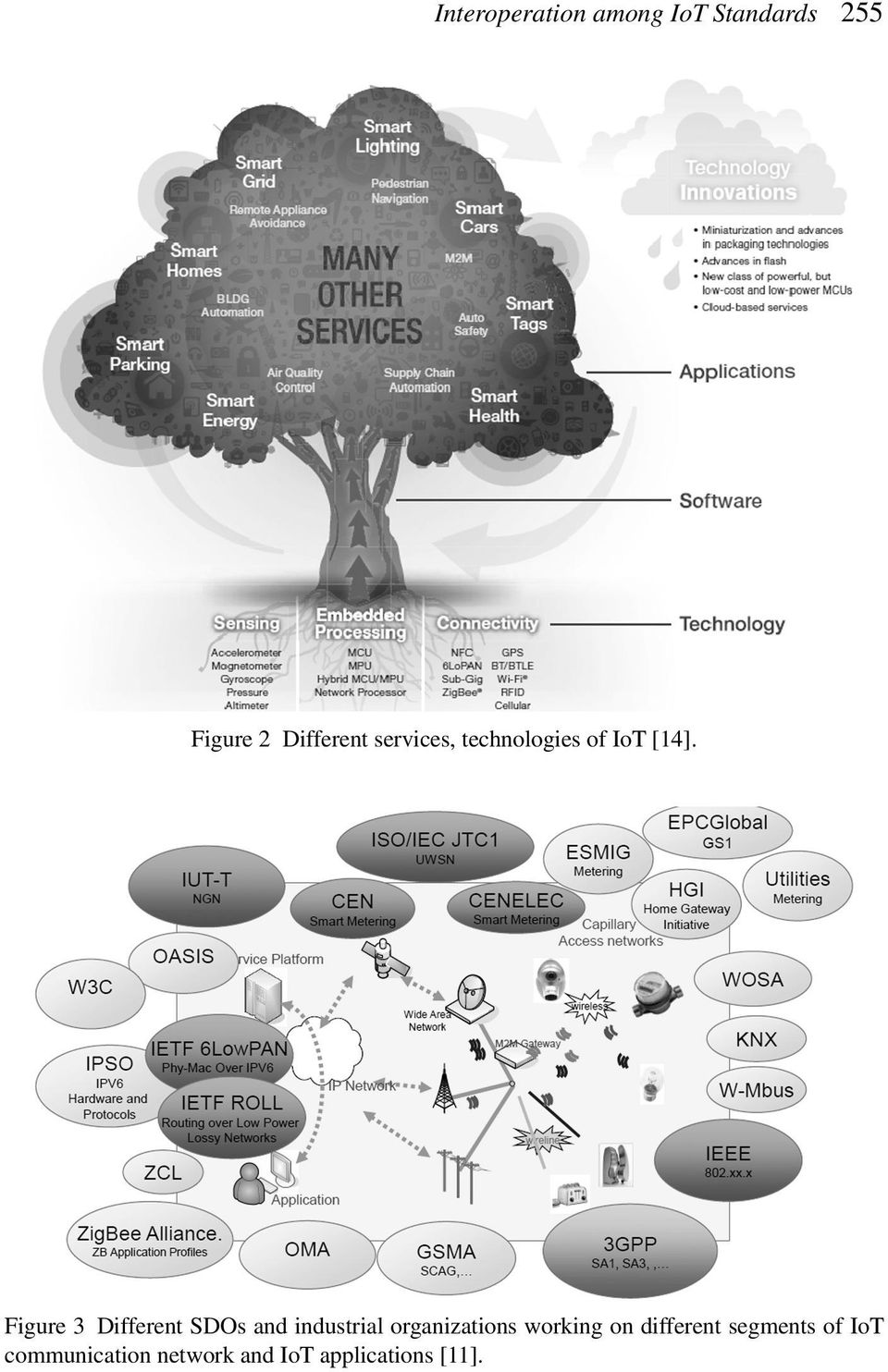
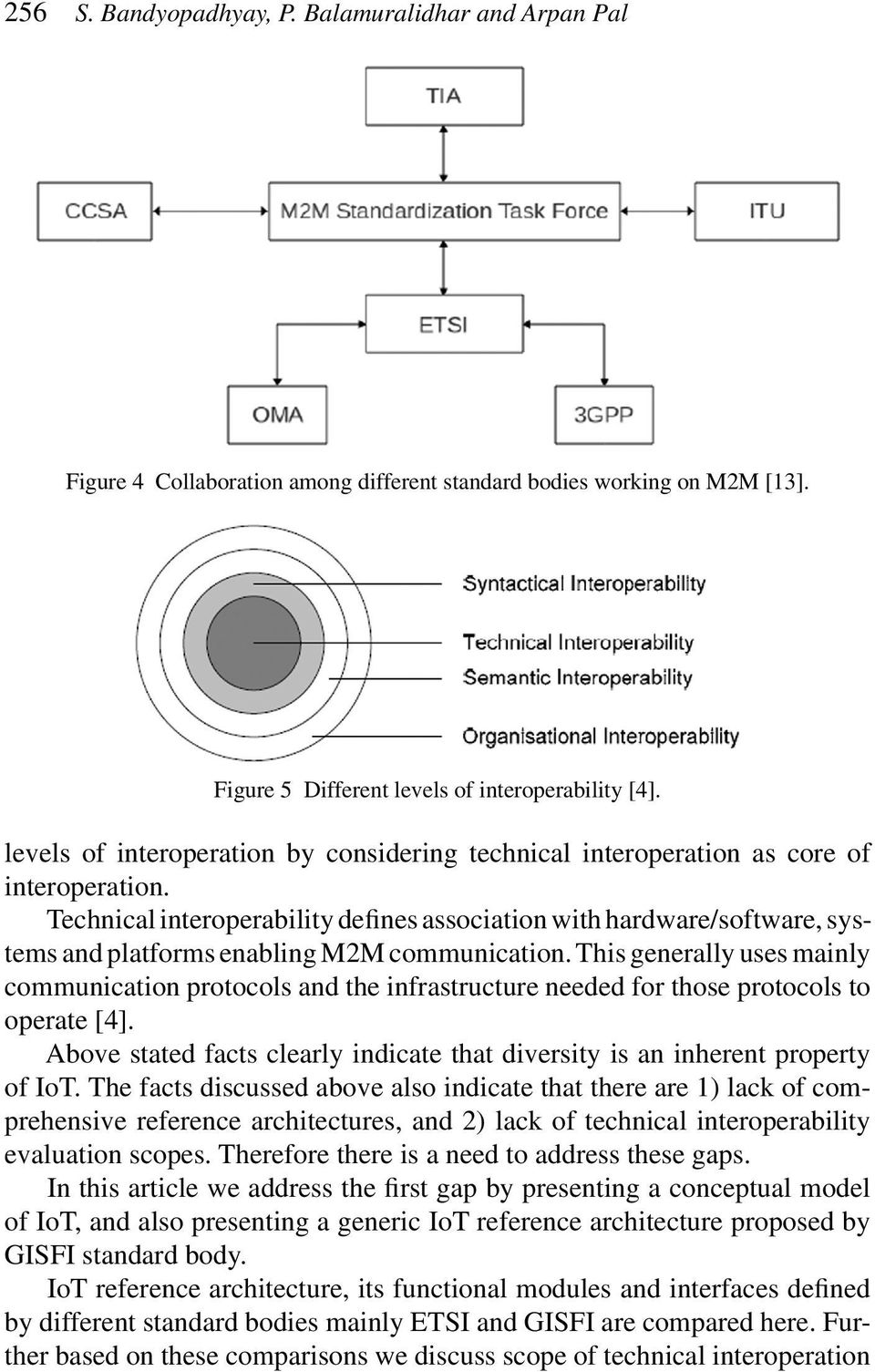
2 254 S. Bandyopadhyay, P. Balamuralidhar and Arpan Pal locally, takes decisions, and routs these decisions to local applications, actuators or to other user devices like mobile phones which are also constrained in nature. [1] Discusses different visions of IoT. In [2] functionalities and components of middleware for IoT architecture are presented. Figure 1 depicts the said communication components of IoT. It is evident from above figure that IoT architecture needs to address the limitations of constrained network acting as networks of data producers as well as data consumers. The very purpose of IoT is to make things smart [14]. Different use cases and technologies of IoT are depicted in Figure 2 below. Diverse technologies, software, applications are building blocks of IoT. Many standard organizations are putting effort to define IoT reference architecture emphasizing machine to machine (M2M) communication which is pragmatic to define functional modules of IoT architecture. ETSI (European Telecommunications Standards Institute) [3], ITU-T (International Telecommunication Union) [8], TIA (Telecommunications Industry Association) [9], OMA (Open Mobile Alliance) [12], GISFI (Global ICT Standardization Forum for India) [11], CCSA(China communication standard association) [10], CASAGRAS (coordination and support action for global RFID-related activities and standardization) are some examples of such standard organizations working on IoT and M2M communication. Figure 3 depicts different standard bodies working in different areas and use-cases of IoT. A state-of-the-art in M2M communications, in terms of standardization bodies, research projects, protocols, etc. along with application programming interfaces (API) for endpoints of IoT communication network is analyzed in [13]. Figure 4 shows association among ETSI, OMA, TIA etc. Diversity is key factor of IoT therefore interoperation is a major challenge to achieve this diversity. Different categories of interoperability like semantic, syntactic, technical and organizational are presented in [4]. Figure 5 represents different Figure 1 IoT as network of networks with Internet as backbone.
![[1] Discusses different visions of IoT. In [2] functionalities and components of middleware for IoT architecture are presented. Figure 1 depicts the said communication components of IoT.](/docs-images/47/19798505/images/page_2.jpg "It is evident from above figure that IoT architecture needs to address the limitations of constrained network acting as networks of data producers as well as data consumers.")
3 Interoperation among IoT Standards 255 Figure 2 Different services, technologies of IoT [14]. Figure 3 Different SDOs and industrial organizations working on different segments of IoT communication network and IoT applications [11].
4 256 S. Bandyopadhyay, P. Balamuralidhar and Arpan Pal Figure 4 Collaboration among different standard bodies working on M2M [13]. Figure 5 Different levels of interoperability [4]. levels of interoperation by considering technical interoperation as core of interoperation. Technical interoperability defines association with hardware/software, systems and platforms enabling M2M communication. This generally uses mainly communication protocols and the infrastructure needed for those protocols to operate [4]. Above stated facts clearly indicate that diversity is an inherent property of IoT. The facts discussed above also indicate that there are 1) lack of comprehensive reference architectures, and 2) lack of technical interoperability evaluation scopes. Therefore there is a need to address these gaps. In this article we address the first gap by presenting a conceptual model of IoT, and also presenting a generic IoT reference architecture proposed by GISFI standard body. IoT reference architecture, its functional modules and interfaces defined by different standard bodies mainly ETSI and GISFI are compared here. Further based on these comparisons we discuss scope of technical interoperation
5 Interoperation among IoT Standards 257 aspects among said standard-bodies to address the second gap. None of above literatures perform an extensive study in this regard. 2 IoT Reference Architecture In this section we present conceptual model of IoT, and its reference architecture proposed by different standard body. IoT architecture constitutes mainly four layers like sensor or thing layer, network layer, service, and application layer. Both ETSI, and GISFI reference architecture for M2M and IoT support this conceptual model. Figure 6 depicts the conceptual model of IoT. 2.1 ETSI Reference Architecture ETSI high level reference architecture possesses two domains as stated below [15]. 1. The device and gateway Domain. It is composed of the following elements: M2M device: A device that runs M2M application(s) using M2M service capabilities. M2M devices connect to network domain using a direct Figure 6 Conceptual model of IoT [5].

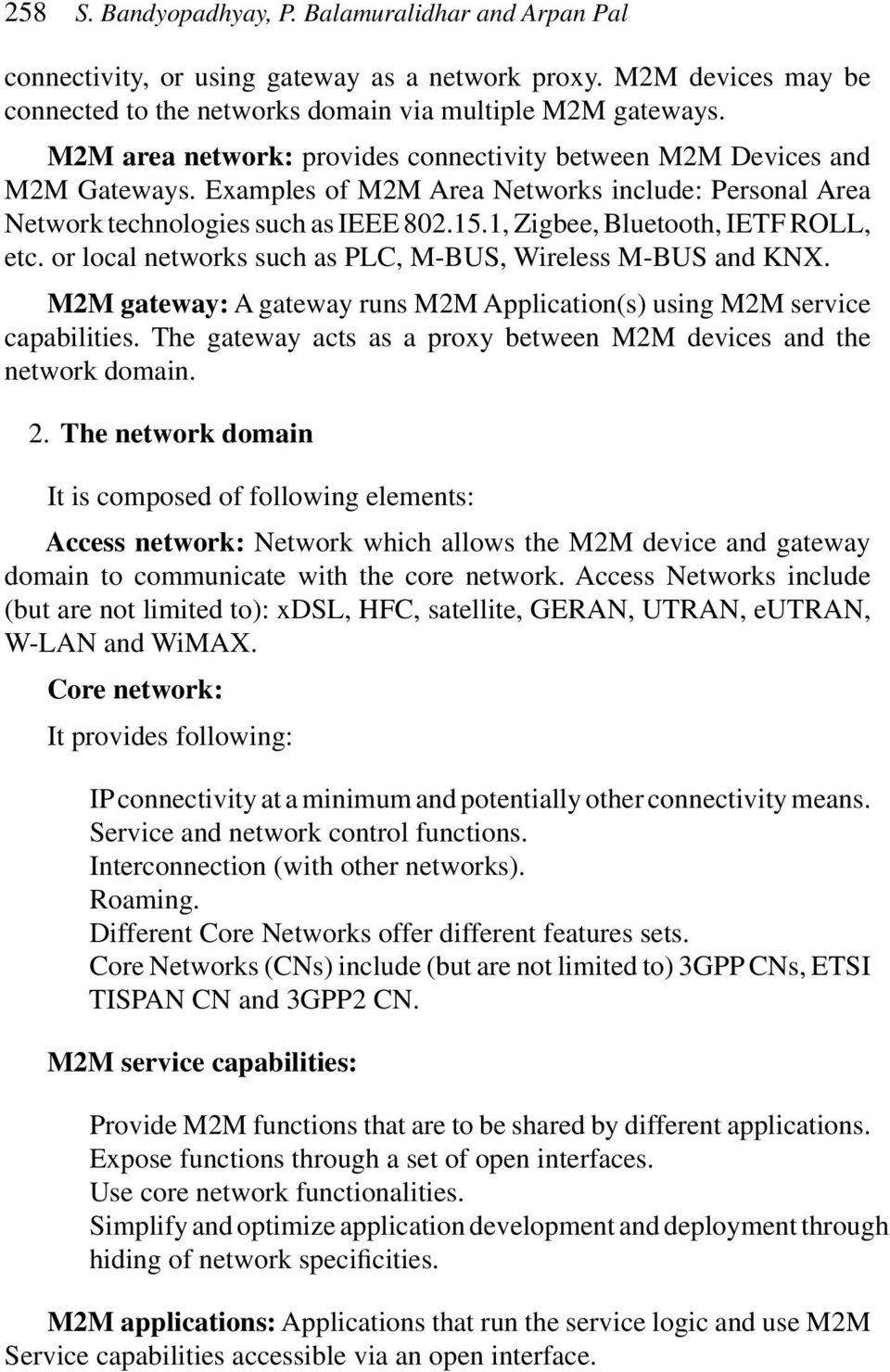
6 258 S. Bandyopadhyay, P. Balamuralidhar and Arpan Pal connectivity, or using gateway as a network proxy. M2M devices may be connected to the networks domain via multiple M2M gateways. M2M area network: provides connectivity between M2M Devices and M2M Gateways. Examples of M2M Area Networks include: Personal Area Network technologies such as IEEE , Zigbee, Bluetooth, IETF ROLL, etc. or local networks such as PLC, M-BUS, Wireless M-BUS and KNX. M2M gateway: A gateway runs M2M Application(s) using M2M service capabilities. The gateway acts as a proxy between M2M devices and the network domain. 2. The network domain It is composed of following elements: Access network: Network which allows the M2M device and gateway domain to communicate with the core network. Access Networks include (but are not limited to): xdsl, HFC, satellite, GERAN, UTRAN, eutran, W-LAN and WiMAX. Core network: It provides following: IP connectivity at a minimum and potentially other connectivity means. Service and network control functions. Interconnection (with other networks). Roaming. Different Core Networks offer different features sets. Core Networks (CNs) include (but are not limited to) 3GPP CNs, ETSI TISPAN CN and 3GPP2 CN. M2M service capabilities: Provide M2M functions that are to be shared by different applications. Expose functions through a set of open interfaces. Use core network functionalities. Simplify and optimize application development and deployment through hiding of network specificities. M2M applications: Applications that run the service logic and use M2M Service capabilities accessible via an open interface.
7 Interoperation among IoT Standards 259 Figure 7 ETSI Reference Architecture [15]. ETSI M2M architecture has following interface reference points [15]. Reference points are described below based on [15]. mia Reference Point: Allows a network application to access M2M service capabilities in the network domain. The mia reference point shall comply with the specification [16]. dia Reference Point: Allows a device application residing in an M2M device to access the different M2M service capabilities in the same M2M device or in an M2M gateway; allows a gateway residing in an M2M gateway to access different M2M service capabilities in the same M2M gateway. The dia reference point shall comply with specification [16]. mid Reference Point: Allows an M2M service capabilities residing in an M2M device or M2M gateway to communicate with M2M service capabilities in network Domain and vice versa. mid uses core network connectivity functions as an underlying layer. The mid reference point shall comply with the specification [16].
![The mia reference point shall comply with the specification [16].](/docs-images/47/19798505/images/page_7.jpg "dia Reference Point: Allows a device application residing in an M2M device to access the different M2M service capabilities in the same M2M device or in an M2M gateway; allows a gateway residing in")
8 260 S. Bandyopadhyay, P. Balamuralidhar and Arpan Pal Figure 8 ETSI M2M interfaces (mid, mia, dia) [15]. Figure 8 represents interfaces mia, mid and dia defined by ETSI. 2.2 GISFI IoT Architecture In this section we present generic IoT reference architecture proposed by GISFI IoT- WG. The IoT reference architecture of GISFI follows conceptual model presented in figure [6]. GISFI IoT reference architecture is partitioned into four layers namely device layer, gateway layer, service platform layer and application layer. Different layers are described in brief below following the GISFI IoTcontribution [6]. IoT Device Layer IoT devices are included in this layer. This layer consists of individual sensors, network enabled objects and capillary networks consisting of data sources that are near to the physical environment. It includes heterogeneous devices (including sensors and actuators) supporting diverse communication standards such as Zigbee, ZWave, ANTS andwi-fi, etc. IoT Gateway Layer This layer consists of IoT gateways. The substantial heterogeneity of devices and technologies hosted by the device layer is abstracted using gateways
![The IoT reference architecture of GISFI follows conceptual model presented in figure [6].](/docs-images/47/19798505/images/page_8.jpg "GISFI IoT reference architecture is partitioned into four layers namely device layer, gateway layer, service platform layer and application layer.")
9 Interoperation among IoT Standards 261 that can provide more uniform interface to IoT service platform layer. It is also possible that a capable device can implement both IoT device and gateway layer/functionality into a single physical entity and connects to IoT service platform layer through the core network. IoT Service Platform Layer This defines and provides different IoT service abstractions that can be used by multiple applications. There can be a set of platform services from the IoT platform infrastructure. Further the same framework can be extended to application services where some of the reusable application components are available as services. The physical entities involved in the above three layers need suitable communication infrastructure for information exchange. While device layer addresses this requirement using various legacy technologies which are out of scope for this document, the gateway layer and service platform layer are expected to be connected over an IoT Core / Backbone network. The IoT Core is envisaged to be predominantly an IP based network and that is in line with the vision of IoT. This IP connectivity could be supported over multitudes of telecommunication infrastructures such as DSL, Cellular networks (2G, 3G, 4G) etc. IoT Application Layer This layer consists of different IoT applications. GISFI IoT architecture has following interface reference points at the interfaces of these layers stated above. I1: Interface from device layer to gateway layer, I2: Interface from gateway layer to service platform layer through IoT core network I3: Interface from service platform to layer specific vertical applications Each of these interface points will benefit from a standardized information exchange because of the diversity of devices, manufacturers, service providers, and service consumers involved. Each of these interface points are expected to support a set of specialized capabilities which may form a set of standardized adapters designed for purpose. These adapters may implement existing protocols or needs new developments or extension based on requirements gathered from various IoT use cases. Figure 9 shows the GISFI IoT interfaces. Functionalities of these interfaces are summarized in Table 1 [6].

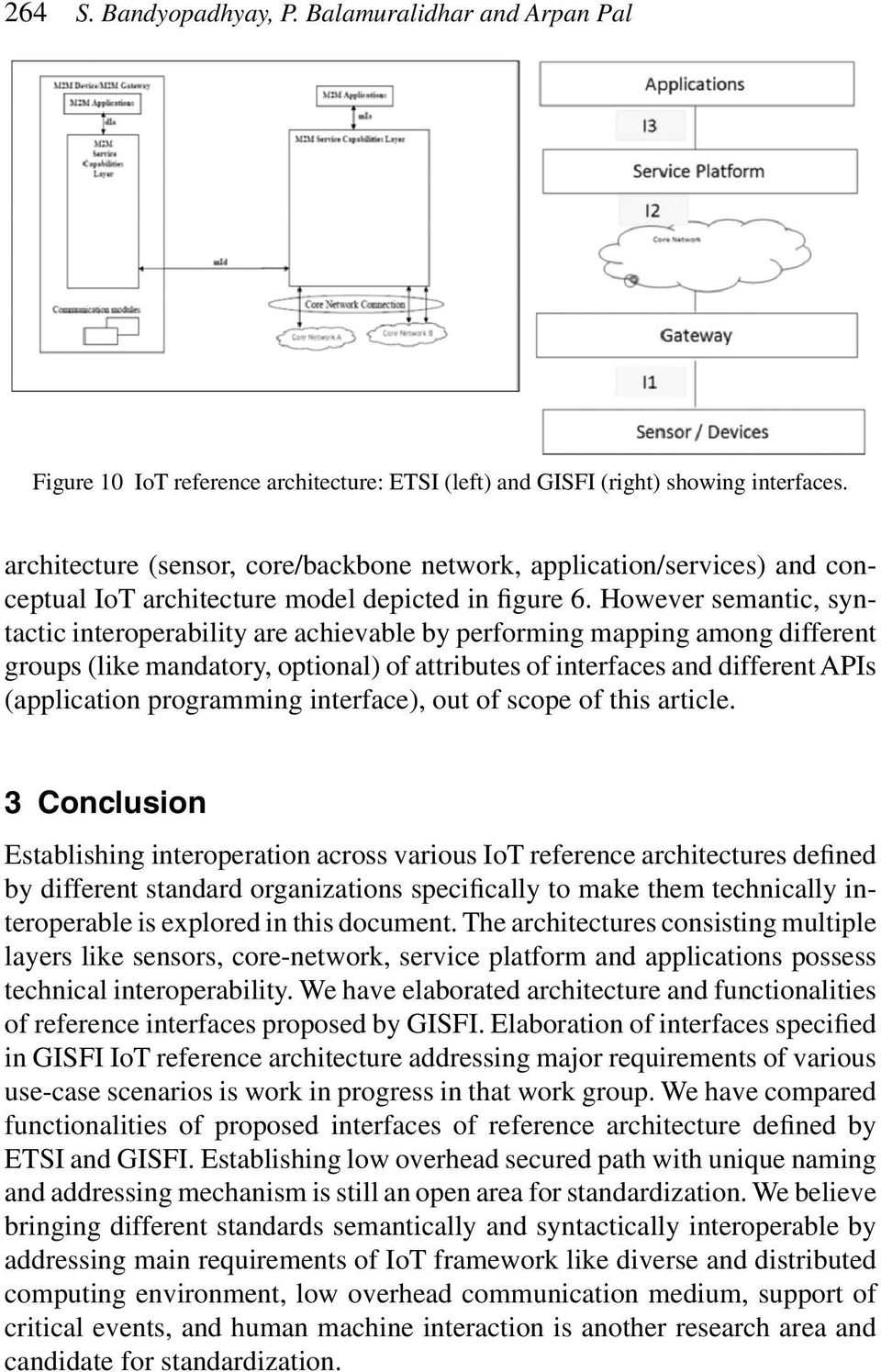
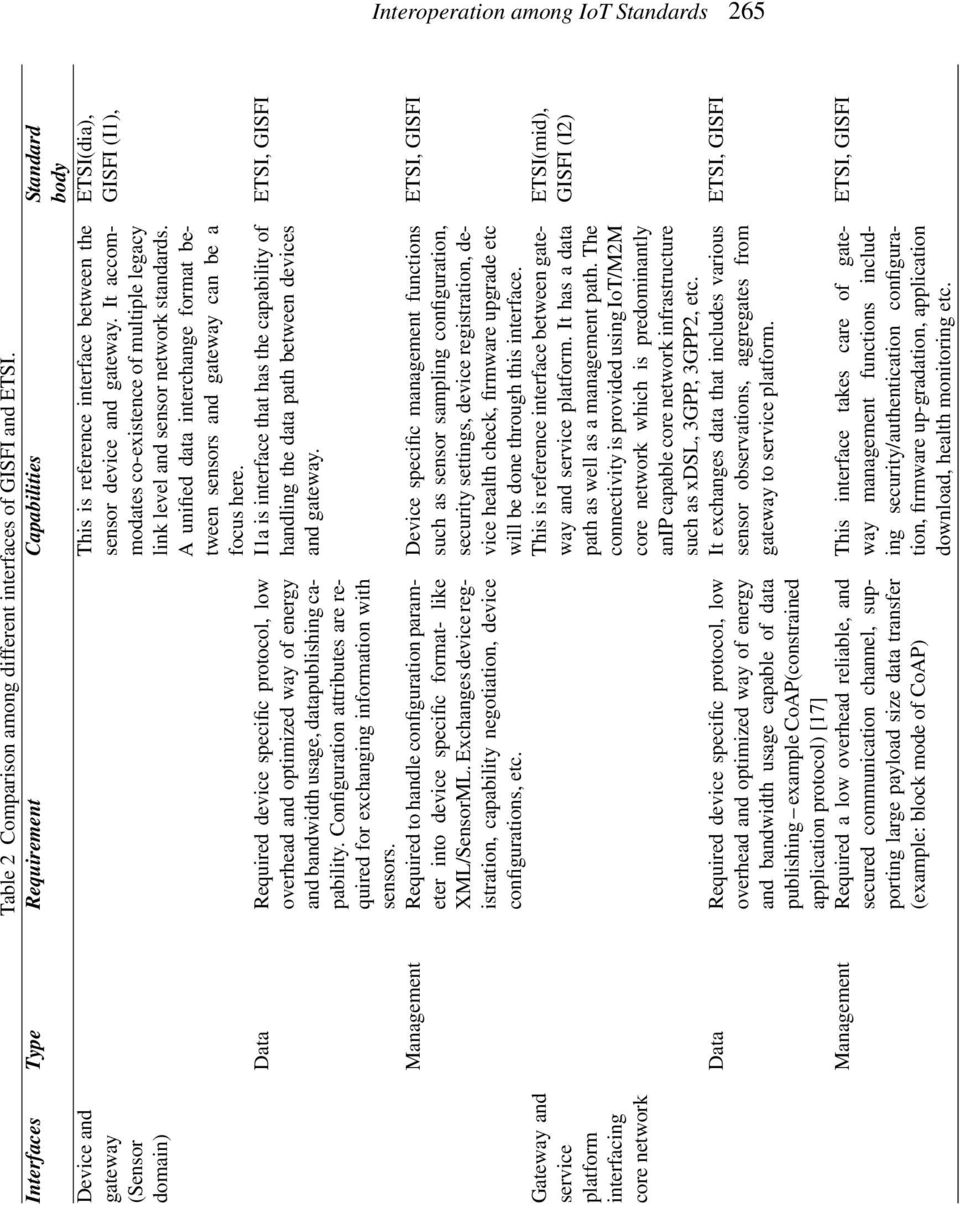
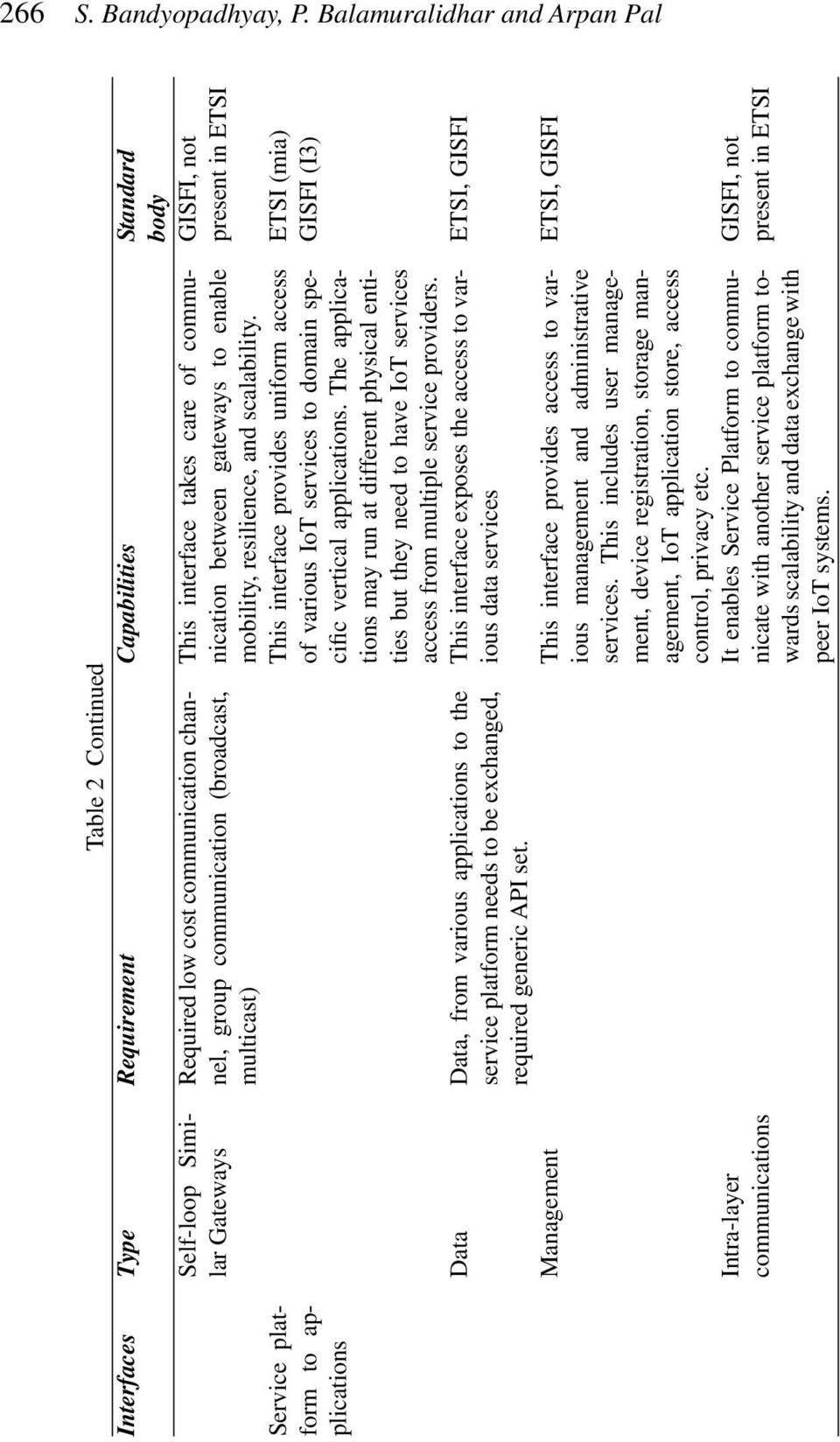
10 262 S. Bandyopadhyay, P. Balamuralidhar and Arpan Pal Figure 9 GISFI IoT interfaces (I1, I2, and I3) [6]. 2.3 ETSI and GISFI standard-organization comparison and scope of their interoperation This section presents scope of technical interoperation between ETSI and GISFI standards. Comparison of interfaces proposed by GISFI IoT WG and ETSI-M2M- WG are presented in table 2 below based on the GISFI contribution [7]. M2M and IoT reference architecture of ETSI and GISFI indicating interfaces are presented in Figure 10. Table 2 represents comparisons of interfaces of ETSI M2M and GISFI IoT reference architecture. GISFI IoT architecture proposes three (I1, I2,
![standards. Comparison of interfaces proposed by GISFI IoT WG and ETSI-M2M- WG are presented in table 2 below based on the GISFI contribution [7].](/docs-images/47/19798505/images/page_10.jpg "M2M and IoT reference architecture of ETSI and GISFI indicating interfaces are presented in Figure 10.")
11 Interoperation among IoT Standards 263 Table 1 Functionalities of IoT interfaces proposed by GISFI IoT reference architecture Interfaces Capabilities I1 This is the reference interface between the IoT device and IoT gateway. I1 will accommodate co-existence of multiple legacy link level and sensor network standards. A unified data interchange format between sensors and gateway can be a focus here. I1a I1a is the interface that has the capability of handling the data path between devices and gateway. I1b Device specific management functions such as sensor sampling configuration, security settings, device registration, device health check, firmware upgrade etc will be done through this interface. I2 This is the reference interface between the IoTgateway and IoTservice platform. Service platform is an application middleware providing platform services to build domain specific applications. This has a data path as well as management path. The connectivity is provided using IoT Core Network which is predominantly any IP capable core network infrastructure such as xdsl, 3GPP, 3GPP2. I2a It exchanges the data that includes various sensor observations, aggregates from the IoTgateway to the IoT Service Platform. I2b This interface takes care of the gateway management functions including security/authentication configuration, firmware upgradation, application download, health monitoring etc. I2c This interface takes care of communication between gateways to enable mobility, resilience, and scalability. I3 This interface provides a uniform access of various IoT services to the domain specific vertical applications. The applications may run at different physical entities but they need to have the IoT services access from multiple service providers. I3a This interface exposes the access to various data services I3b This interface provides access to various management and administrative services. This includes user management, device registration, storage management, IoT application store, access control, privacy etc. I3c It enables IoT service platform to communicate with another IoT service platform towards scalability and data exchange with peer IoT systems. I3) interfaces. ETSI also defines three interfaces (dia, mid, mia). Both standards support data and management functionalities. However I2c and I3c defined by GISFI support self-looping among similar gateways and service platforms these functionalities are missing in reference architecture defined by ETSI. Technical-interoperability of IoT framework from different standards is achievable as long as standards abide by the concept of three layered

12 264 S. Bandyopadhyay, P. Balamuralidhar and Arpan Pal Figure 10 IoT reference architecture: ETSI (left) and GISFI (right) showing interfaces. architecture (sensor, core/backbone network, application/services) and conceptual IoT architecture model depicted in figure 6. However semantic, syntactic interoperability are achievable by performing mapping among different groups (like mandatory, optional) of attributes of interfaces and different APIs (application programming interface), out of scope of this article. 3 Conclusion Establishing interoperation across various IoT reference architectures defined by different standard organizations specifically to make them technically interoperable is explored in this document. The architectures consisting multiple layers like sensors, core-network, service platform and applications possess technical interoperability. We have elaborated architecture and functionalities of reference interfaces proposed by GISFI. Elaboration of interfaces specified in GISFI IoT reference architecture addressing major requirements of various use-case scenarios is work in progress in that work group. We have compared functionalities of proposed interfaces of reference architecture defined by ETSI and GISFI. Establishing low overhead secured path with unique naming and addressing mechanism is still an open area for standardization. We believe bringing different standards semantically and syntactically interoperable by addressing main requirements of IoT framework like diverse and distributed computing environment, low overhead communication medium, support of critical events, and human machine interaction is another research area and candidate for standardization.
13 Interoperation among IoT Standards 265 Table 2 Comparison among different interfaces of GISFI and ETSI. Interfaces Type Requirement Capabilities Standard body Device and gateway (Sensor domain) Gateway and service platform interfacing core network Data Required device specific protocol, low overhead and optimized way of energy and bandwidth usage, datapublishing capability. Configuration attributes are required for exchanging information with sensors. Management Required to handle configuration parameter into device specific format- like XML/SensorML. Exchanges device registration, capability negotiation, device configurations, etc. Data Required device specific protocol, low overhead and optimized way of energy and bandwidth usage capable of data publishing example CoAP(constrained application protocol) [17] Management Required a low overhead reliable, and secured communication channel, supporting large payload size data transfer (example: block mode of CoAP) This is reference interface between the sensor device and gateway. It accommodates co-existence of multiple legacy link level and sensor network standards. A unified data interchange format between sensors and gateway can be a focus here. I1a is interface that has the capability of handling the data path between devices and gateway. Device specific management functions such as sensor sampling configuration, security settings, device registration, device health check, firmware upgrade etc will be done through this interface. This is reference interface between gateway and service platform. It has a data path as well as a management path. The connectivity is provided using IoT/M2M core network which is predominantly anip capable core network infrastructure such as xdsl, 3GPP, 3GPP2, etc. It exchanges data that includes various sensor observations, aggregates from gateway to service platform. This interface takes care of gateway management functions including security/authentication configuration, firmware up-gradation, application download, health monitoring etc. ETSI(dia), GISFI (I1), ETSI, GISFI ETSI, GISFI ETSI(mid), GISFI (I2) ETSI, GISFI ETSI, GISFI
14 266 S. Bandyopadhyay, P. Balamuralidhar and Arpan Pal Table 2 Continued Interfaces Type Requirement Capabilities Standard body Service platform to applications Self-loop Similar Gateways Required low cost communication channel, group communication (broadcast, multicast) Data Data, from various applications to the service platform needs to be exchanged, required generic API set. This interface takes care of communication between gateways to enable mobility, resilience, and scalability. This interface provides uniform access of various IoT services to domain specific vertical applications. The applications may run at different physical entities but they need to have IoT services access from multiple service providers. This interface exposes the access to various data services Management This interface provides access to various management and administrative services. This includes user management, device registration, storage management, IoT application store, access Intra-layer communications control, privacy etc. It enables Service Platform to communicate with another service platform towards scalability and data exchange with peer IoT systems. GISFI, not present in ETSI ETSI (mia) GISFI (I3) ETSI, GISFI ETSI, GISFI GISFI, not present in ETSI
15 Interoperation among IoT Standards 267 References [1] [2] Soma Bandyopadhyay, MunmunSengupta, SouvikMaiti, Subhajit Dutta A Survey of Middleware for Internet of Things CoNeCo 2011, Ankara, Turkey, June 26-28, [3] ts/ /102690/ /ts v p.pdf [4] 203%20final.pdf [5] GyuMyoung Lee, "Standardization on the Internet of Things and Applications for Smart Grid", 2nd u-world Congress, Dalian, China, August 2012 [6] documents/gisfi IoT doc [7] documents/ GISFI IoT doc [8] [9] [10] [11] [12] [13] [14] paper/intothngswp.pdf [15] ts/ /102690/ /ts v p.pdf [16] Drafts/00010ed211%20mIa,%20dIa%20and% 20mId%20interfaces.pdf [17] Constrained Application Protocol (CoAP)( Biographies Soma Bandyopadhyay has more than 15 years of industry experience in the area of Embedded Systems, Digital Signal Processor, Protocol and Wireless Communications and ubiquitous computing. Since 2003 has been associated with Innovation lab of TATA Consultancy Services (TCS) as senior scientist. At present prime focus area for research is ubiquitous and sensor network computation, and Internet of Things. She has contributed towards the IEEE standard body on behalf of TCS. In TCS she has been involved in leading and development of 3GPP Long Term Evaluation (LTE/LTE-A) physical layer, IEEE d/e WMAN MAC stack development, Intel s graphics device driver. At present
![org/deliver/etsi ts/102600 102699/102690/01.01.01 60/ts 102690v010 101p.pdf [4] http://www.etsi.org/images/files/etsiwhitepapers/iop%20whitepaper%20edition% 203%20final.](/docs-images/47/19798505/images/page_15.jpg "pdf [5] GyuMyoung Lee, \"Standardization on the Internet of Things and Applications for Smart Grid\", 2nd u-world Congress, Dalian, China, August 2012 [6] http://www.gisfi.")
16 268 S. Bandyopadhyay, P. Balamuralidhar and Arpan Pal she is leading the research and development activity in the area of energy efficient M2M communication and its analytics. She worked on MPEG video decoder, dual core network processor target platform, Intel s network processor, protocol stack development on RTOS and embedded system, and multiple device drivers, ATM & MPLS. Academically she is an M.Tech & B.Tech in Computer Science & Engineering from the University of Calcutta, India. She did her graduation in Physics (Hons.) from the same university. Balamuralidhar P is a Principal Scientist and Head of TCS Innovation Lab at Tata Consultancy Services Ltd (TCS), Bangalore. He has obtained Bachelor of Technology from Kerala University and Master of Technology (MTech) from IIT Kanpur. His PhD is from Aalborg University, Denmark in the area of Cognitive Wireless Networks. Major areas of current research include different aspects of Cyber Physical Systems, Sensor Informatics and Networked Embedded Systems. Before TCS his research careers were with Society for Applied Microwave Electronics Engineering & Research (SAMEER) Mumbai and Sasken Communications Ltd Bangalore. He has over 25 years of research and development experience in Signal Processing, Embedded Systems and Wireless Communications. He has over 60 publications in various international journals and conferences and over 20 patent applications. Balamuralidhar was the leading TCS participation in two EU FP6 research consortium projects namely My Adaptive Global NET (MAGNET) and End to End Reconfigurability (E2R) in the area of next generation wireless communications. He is also contributing to TCS participation in National bodies like Broadband Wireless Consortium India (BWCI), Global ICT Standards for India (GISFI). In GISFI he is chairing the Internet of Things Workgroup.

17 Interoperation among IoT Standards 269 Arpan Pal is a PhD from Aalborg University Denmark and is a senior member of IEEE. He had received his B.Tech and M.Tech from Indian Institute of Technology, Kharagpur, India in Electronics and Telecommunications. He has more than 20 years of experience in the area of Signal Processing, Communication and Real-time Embedded Systems. Currently he is with Tata Consultancy Services (TCS), where he is heading research at Innovation Lab, Kolkata. He is also a member of Systems Research Council of TCS. His main responsibility is in conceptualizing and guiding R&D in the area of cyber-physical systems and ubiquitous computing with focus on applying the R&D outcome in the area Intelligent Infrastructure. His current research interests include Mobile phone and Camera based Sensing and Analytics, Physiological Sensing, M2M communications and Internet-of-Things based Applications with focus on Energy, Healthcare and Transportation verticals. He has more than 40 publications till date in reputed Journals and Conferences along with a couple of Book Chapters. He has also filed for more than 35 patents and has 5 patents granted to him. He is an editor for IEEE Transactions on Emerging Topics in Computing for the special issue on Emerging Computing Technologies for Resilient & Robust Intelligent Infrastructure. He had been earlier with Defense Research and Development Organization (DRDO) of Indian Govt. working on Missile Seeker Signal Processing. He has also worked with Macmet Interactive Technologies, leading their real-time systems group in the area of Interactive TV and Set-top boxes.

18

MACHINE TO MACHINE COMMUNICATIONS. ETSI TC M2M Overview June 2011
 MACHINE TO MACHINE COMMUNICATIONS ETSI TC M2M Overview June 2011 About the ETSI TC M2M ETSI: the European Telecommunication Standards Institute One of the 3 European SDOs (CEN, CENELEC, ETSI). ETSI is
Reduce Cost and Complexity of M2M and IoT Solutions via Embedded IP and Application Layer Interoperability for Smart Objects
 Reduce Cost and Complexity of M2M and IoT Solutions via Embedded IP and Application Layer Interoperability for Smart Objects Fabien Castanier STMicroelectronics IPSO Promoter M2M Forum - Milan, May 20,
Machine-to-Machine Technologies
 Machine-to-Machine Technologies Vision, Standards and Applications Mischa Dohler Coordinator of Research, CTTC Distinguished Lecturer, IEEE Editor-in-Chief, ETT BoD, Worldsensing Chair Professor, KCL (1
ETSI M2M / onem2m and the need for semantics. Joerg Swetina (NEC) ([email protected])
 ETSI M2M / onem2m and the need for semantics Joerg Swetina (NEC) ([email protected]) Outline of this presentation A simple picture of Machine-to-Machine (M2M) communications Where do standards apply
M2M Communications and Internet of Things for Smart Cities. Soumya Kanti Datta Mobile Communications Dept. Email: Soumya-Kanti.Datta@eurecom.
 M2M Communications and Internet of Things for Smart Cities Soumya Kanti Datta Mobile Communications Dept. Email: [email protected] WHAT IS EURECOM A graduate school & research centre in communication
ETSI M2M Release 2 Numbering IP Address Ranges Radio Spectrum Raymond Forbes LM Ericsson ETSI TC Smart M2M Vice Chairman BEREC MACHINE-2-MACHINE
 Numbering IP Address Ranges Radio Spectrum Raymond Forbes LM Ericsson ETSI TC Smart M2M Vice Chairman BEREC MACHINE-2-MACHINE WORKSHOP From thrm2m stovepipes to integrated offering Vertical#1 1 Application,
White Paper. Requirements of Network Virtualization
 White Paper on Requirements of Network Virtualization INDEX 1. Introduction 2. Architecture of Network Virtualization 3. Requirements for Network virtualization 3.1. Isolation 3.2. Network abstraction
Connecting IPv6 capable Bluetooth Low Energy sensors with the Internet of Things
 Connecting IPv6 capable Bluetooth Low Energy sensors with the Internet of Things Johanna Nieminen (Nokia), Future Internet SHOK preconference 30.05.2012 IoT Taxonomy ZigBee 802.5.4 Bluetooth Video RFID
ASTRI s Internet-of-Things (IoT) Gateway and Management Platform
 ASTRI s Internet-of-Things (IoT) Gateway and Management Platform Dr. Billy Chan Principal Engineer Communications Technologies, ASTRI Software Technologies, CT 1 Sensor/IoT Applications & Market Smart
Broadband Forum Machine-to-Machine (M2M) Solutions
 Broadband Forum Machine-to-Machine (M2M) Solutions OMA Workshop, February 2012 Barcelona, Spain Robin Mersh, CEO [email protected] Tim Spets, Motorola The information in this presentation is public
Key requirements for Interoperable IoT systems
 Key requirements for Interoperable IoT systems Pratul Sharma Technical Marketing Manager, ARM Inc. May/08/2014 Agenda Why Interoperability? Open standards for interoperability Data Communication Standards
OpenMTC. M2M Solutions for Smart Cities and the Internet of Things. www.open-mtc.org [email protected]
 OpenMTC M2M Solutions for Smart Cities and the Internet of Things www.open-mtc.org [email protected] 2. March März 2, 2013 Understanding M2M Machine-to-Machine (M2M) is a paradigm in which the end-to-end
SMART IoT PROTOCOLS. Creating the Living Network. Chonggang Wang Innovation Lab, InterDigital Communications. December 8, 2014
 SMART IoT PROTOCOLS Chonggang Wang Innovation Lab, InterDigital Communications December 8, 2014 Creating the Living Network Content IoT Overview IoT Protocols C6-based Smart IoT Smart IoT Protocols Challenges
Connect for new business opportunities
 Connect for new business opportunities The world of connected objects How do we monitor the carbon footprint of a vehicle? How can we track and trace cargo on the move? How do we know when a vending machine
M2M Service Architecture: Delivering M2M Services Over Heterogeneous Networks
 Service Architecture: Delivering Services Over Heterogeneous Networks IEEE Communications Quality & Reliability 202 International Workshop May 7, 202 Chonggang Wang InterDigtial Communications [email protected]
ARCHITECTURE SUPPORTING DISCOVERY AND MANAGEMENT OF HETEROGENEOUS SENSORS FOR SMART SYSTEM USING GENERIC MIDDLEWARE
 ARCHITECTURE SUPPORTING DISCOVERY AND MANAGEMENT OF HETEROGENEOUS SENSORS FOR SMART SYSTEM USING GENERIC MIDDLEWARE Soma Bandyopadhyay 1 and Abhijan Bhattacharyya 1 1 Innovation Lab, Tata Consultancy Services
Views on Wireless Network Convergence
 Views on Wireless Network Convergence Yan PENG, Bin XIA, Meng LIANG Version 1.0 Agenda Motivations for Wireless Network Convergence Convergence Categories Issues on IP based Convergence A Possible Evolution
A Systems of Systems. The Internet of Things. perspective on. Johan Lukkien. Eindhoven University
 A Systems of Systems perspective on The Internet of Things Johan Lukkien Eindhoven University System applications platform In-vehicle network network Local Control Local Control Local Control Reservations,
Communication Architecture for AMI and other Smart Grid/Smart City Applications. Presented By: Reji Kumar Pillai President - ISGF
 Communication Architecture for AMI and other Smart Grid/Smart City Applications Presented By: Reji Kumar Pillai President - ISGF Evolution of Smart Metering Electromechanical Meters Electronic Meters AMR
Internet of Things based approach to Agriculture Monitoring
 Internet of Things based approach to Agriculture Monitoring A. Paventhan ERNET India Regional Centre, Bangalore Asia-Pacific Advanced Network (APAN) 36th Meeting 20th August 2013 1 / 19 Outline 1 IP-based
Internet of Things. Laurent Toutain. June 11, 2013. Caen () IPv6 opérateur June 11, 2013 1 / 14
 Internet of Things Laurent Toutain June 11, 2013 Caen () IPv6 opérateur June 11, 2013 1 / 14 Internet of Things? Internet of Things Caen () IPv6 opérateur June 11, 2013 2 / 14 Internet of Things? Internet
Innovation Labs. White Paper. Unlocking the Value of the Internet of Things (IoT) A Platform Approach
 Innovation Labs White Paper Unlocking the Value of the Internet of Things (IoT) A Platform Approach About the Author(s) Prateep Misra Research Area Manager, TCS Innovation Labs Prateep leads the development
Achievements and ongoing work in the ITU-T standardization of the Internet of Things
 ITU Workshop on Standardization on IMT, M2M, IoT, Cloud Computing and SDN (Algiers, Algeria, 8 September 2013) Achievements and ongoing work in the ITU-T standardization of the Internet of Things Marco
MACHINE-TO-MACHINE COMMUNICATIONS TOWARD SMART LOGISTICS SYSTEMS
 MACHINE-TO-MACHINE COMMUNICATIONS TOWARD SMART LOGISTICS SYSTEMS Nataša Gospić a, Bojan Bakmaz a a University of Belgrade, Faculty of Transport and Traffic Engineering, Serbia Abstract: Transport and logistics
A Scenario of Machine-to-Machine (M2M) Health Care Service
 A Scenario of Machine-to-Machine (M2M) Health Care Service Jung-Ho Kim*, Ya-Ting Wei*, Jae-Oh Lee* * Dept. of Electrical, Electronics &, Korea University of Technology and Education, Korea {jungho32, weiyating,
Reducing Configuration Complexity with Next Gen IoT Networks
 Reducing Configuration Complexity with Next Gen IoT Networks Orama Inc. November, 2015 1 Network Lighting Controls Low Penetration - Why? Commissioning is very time-consuming & expensive Network configuration
Chapter 17: M2M-Based Metropolitan Platform for IMS-Enabled Road Traffic Management in IoT
 Chapter 17: M2M-Based Metropolitan Platform for IMS-Enabled Road Traffic Management in IoT Chih-Yuan Lee Department of CSIE National Taipei University 1 Outline Abstract Introduction Background System
ONEM2M SERVICE LAYER PLATFORM INITIAL RELEASE
 ONEM2M SERVICE LAYER PLATFORM INITIAL RELEASE Omar Elloumi (ALU) onem2m TP Chair (Elect) omar.elloumi@alcatel lucent.com onem2m www.onem2m.org 2014 onem2m The Partnership Project Over 200 member organizations
Smart Cities are the Internet of Things
 June 20th, 2013 Smart Cities are the Internet of Things Zach Shelby, Chief Nerd 1 About Sensinode Vision The Internet of Things (IoT) is the next evolution of the Internet where devices of all types and
Device Management for Internet of Things Constrained Devices OMA Lightweight M2M. Duncan Purves Connect2 Systems [email protected] http:connect2.
 Device Management for Internet of Things Constrained Devices OMA Lightweight M2M Duncan Purves Connect2 Systems [email protected] http:connect2.io Why do we need Remote Device Management? The devices
ONEM2M SERVICE LAYER PLATFORM
 ONEM2M SERVICE LAYER PLATFORM Roland Hechwartner (Deutsche Telekom) onem2m TP Vice Chair Roland.hechwartner@t mobile.at onem2m www.onem2m.org 2015 onem2m The Partnership Project Over 200 member organizations
Overview of the Internet of things
 Overview of the Internet of things Tatiana Kurakova, International Telecommunication Union Place des Nations CH-1211 Geneva, Switzerland Abstract. This article provides an overview of the Internet of things
( Increased usage of IP addresses )
 IPv6 Applications IPv6: Make Possible Internet of Things More Devices than people Smart phones Smart Tablets Traditional Internet desktops Data-enabled mobile phones Consumer appliances Embedded systems
Machine-to-Machine & Sensor Technologies in Smart Cities
 Machine-to-Machine & Sensor Technologies in Smart Cities Vision, Standards and Applications Mischa Dohler Coordinator of Research, CTTC Distinguished Lecturer, IEEE Editor-in-Chief, ETT BoD, Worldsensing
Vortex White Paper. Simplifying Real-time Information Integration in Industrial Internet of Things (IIoT) Control Systems
 Vortex White Paper Simplifying Real-time Information Integration in Industrial Internet of Things (IIoT) Control Systems Version 1.0 February 2015 Andrew Foster, Product Marketing Manager, PrismTech Vortex
M2M & Cybersecurity Workshop TIA 2013 M2M Standards and Security. Mihai Voicu CIO/CSO ILS Technology LLC
 M2M & Cybersecurity Workshop TIA 2013 M2M Standards and Security Mihai Voicu CIO/CSO ILS Technology LLC Topics 1 What is the role of standardization in security for M2M solutions? 2 How are TIA and other
OPNET - Network Simulator
 Simulations and Tools for Telecommunications 521365S: OPNET - Network Simulator Jarmo Prokkola Project Manager, M. Sc. (Tech.) VTT Technical Research Centre of Finland Kaitoväylä 1, Oulu P.O. Box 1100,
Intelligent Street lighting management using ZigBee. Martin SCHULTE-HOBEIN Field Application Engineer, EMEA Digi International Email: msh@digi.
 Intelligent Street lighting management using ZigBee Martin SCHULTE-HOBEIN Field Application Engineer, EMEA Digi International Email: [email protected] Agenda Digi Overview What is ZigBee? Typical M2M Scenario
Some Specific Parawise Suggestinons. 2. An application which collects and analyzes this data for further consolidation and,
 Comments by Amcham India on draft Internet of Things (IoT) Policy released by the Department of Electronics & Information Technology (DeitY), on October 16, 2014 Standards The Draft IoT Policy already
Future Directions for Internet of Things Work
 Future Directions for Internet of Things Work Naming Architecture for Object to Object Communications 77 th IETF Anaheim, March 2010 Gyu Myoung Lee ([email protected])
Internet of Things Value Proposition for Europe
 Internet of Things Value Proposition for Europe European Commission - DG CONNECT Dr Florent Frederix, (Online) Trust and Cybersecurity unit 7 th European Conference on ICT for Transport Logistics 5 th
From a World-Wide Web of Pages to a World-Wide Web of Things
 From a World-Wide Web of Pages to a World-Wide Web of Things Interoperability for Connected Devices Jeff Jaffe, W3C CEO 25 February 2016 The Internet of Things Still very immature, but with massive potential
IOTIVITY AND EMBEDDED LINUX SUPPORT. Kishen Maloor Intel Open Source Technology Center
 IOTIVITY AND EMBEDDED LINUX SUPPORT Kishen Maloor Intel Open Source Technology Center Outline Brief introduction to IoTivity Software development challenges in embedded Yocto Project and how it addresses
CME: A Middleware Architecture for Network-Aware Adaptive Applications
 CME: A Middleware Architecture for Network-Aware Adaptive Applications Jun-Zhao Sun, Jari Tenhunen, and Jaakko Sauvola MediaTeam, Machine Vision and Media Processing Unit, Infotech Oulu P.O.Box 4500 4SOINFO,
Huawei Technologies ERC Position Statement: Towards a Future Internet Public Private Partnership
 Huawei Technologies ERC Position Statement: Towards a Future Internet Public Private Partnership Kostas Pentikousis, Mirko Schramm, and Cornel Pampu Huawei Technologies European Research Centre Carnotstrasse
National Cyber Security Framework and Protocol. for securing digital information in networked critical infrastructures and communications
 OPERATIONAL REQUIREMENTS DOCUMENT National Cyber Security Framework and Protocol Contents for securing digital information in networked critical infrastructures and communications 1. General Description
Internet of things (IOT) applications covering industrial domain. Dev Bhattacharya [email protected]
 Internet of things (IOT) applications covering industrial domain Dev Bhattacharya [email protected] Outline Internet of things What is Internet of things (IOT) Simplified IOT System Architecture
RIOT CONTROL The Art of Managing Risk for Internet of Things
 RIOT CONTROL The Art of Managing Risk for Internet of Things Kim Singletary McAfee Session ID: Session Classification: Advanced Intro What is IoT and why is it different? What are the risks? What are the
Transporting Legacy Switched Digital Circuits Using a Packet Network
 Transporting Legacy Switched Digital Circuits Using a Packet Network Engage Communication is the manufacturer of high-speed data communications products, specifically targeting the growing market for converting
Simplifying the Global Deployment of Cellular Enabled Products
 Simplifying the Global Deployment of Cellular Enabled Products 2014 WHO WILL SURVIVE THE DIGITAL REVOLUTION? Those companies who can. Your speakers Jim Dunlap President Jeth Harbinson Vice President, Global
IEEE Standards Activities in the Smart Grid Space (ICT Focus)
 This document contains supplemental information referenced by the European Rolling Plan for ICT Standardisation IEEE Standards Activities in the Smart Grid Space (ICT Focus) Overview IEEE, through the
Overview of Routing between Virtual LANs
 Overview of Routing between Virtual LANs This chapter provides an overview of virtual LANs (VLANs). It describes the encapsulation protocols used for routing between VLANs and provides some basic information
Standardizing the Internet of Things; Boiling the Ocean
 Standardizing the Internet of Things; Boiling the Ocean Jim Sinopoli, PE, LEED AP Smart Buildings LLC By now, we all know the basics of the Internet of Things (IoT). Everything will be connected to every
920MHz Band Multi-hop Wireless Network System
 920MHz Band Multi-hop Wireless Network System Hiroshi Hashizume Motohiro Inokuma Masayuki Suto Shigeru Fukunaga Motoharu Kawanishi One policy aimed at the growth of OKI Group is the development of a smart
TUM & Siemens Corporate Technology. The "Internet of Things" for industrial applications
 The "Internet of Things" for industrial applications IoT Technologies: Semantics Challenges in the Future of Embedded Networks Growing number of interconnected heterogeneous devices in different kind of
Applying 4+1 View Architecture with UML 2. White Paper
 Applying 4+1 View Architecture with UML 2 White Paper Copyright 2007 FCGSS, all rights reserved. www.fcgss.com Introduction Unified Modeling Language (UML) has been available since 1997, and UML 2 was
IOT ARCHITECTURE: A SURVEY
 IOT ARCHITECTURE: A SURVEY 1 SRINJOY NAG CHOWDHURY, 2 KSHITIJ MANOHAR KUHIKAR, 3 SANIYA DHAWAN 1,2,3 ECE Department, Manipal University, Manipal, Karnataka, India Abstract- The Internet of Things, popularly
Solution to Intrinsic Issues of M2M in Cloud
 Solution to Intrinsic Issues of M2M in Cloud Rahul M 1, Rashmi K 2, Rashmi N 3, Sowmya C L 4, Vinod Kumar K P 5 1,2,3,4 Assistant Professors, Department of Computer Science & Engineering, Dr. Ambedkar
Remote Monitoring and Controlling System Based on ZigBee Networks
 Remote Monitoring and Controlling System Based on ZigBee Networks Soyoung Hwang and Donghui Yu* Department of Multimedia Engineering, Catholic University of Pusan, South Korea {soyoung, dhyu}@cup.ac.kr
A business view for NGN service usage
 A business view for NGN service usage Emmanuel Bertin 1, Idir Fodil 1, Noel Crespi 2 1 France Telecom, R&D division 2 Institut National des Télécommunications (GET-INT) Abstract. Next Generation Networks
5G Public Private Partnership Objectives and opportunities
 5G Public Private Partnership Objectives and opportunities CELTIC Plus event 2014 23-24 April, Monaco Bernard Barani European Commission - DG CONNECT Deputy Head of Unit Network Technologies "The views
WIND RIVER INTELLIGENT DEVICE PLATFORM XT
 WIND RIVER INTELLIGENT DEVICE PLATFORM XT The Foundation for Building Devices That Connect to the Internet of Things The opportunities presented by the burgeoning Internet of Things (IoT) may be new, but
ENABLING RELIABLE COMMUNICATION FOR EMERGING M2M/IOT APPLICATIONS
 ENABLING RELIABLE COMMUNICATION FOR EMERGING M2M/IOT APPLICATIONS Matthias Heyde / Fraunhofer FOKUS Dr.-Ing. Adel Al-Hezmi, Fraunhofer FOKUS M2M Summit 8. 9. Sep 2015, Düsseldorf AGENDA 1. Motivations
M2M Service Platform to Support Carrier Cloud
 Platform to support the cloud computing services of telecommunication carriers M2M Service Platform to Support Carrier Cloud KATA Kouji, NAKAYAMA Yoshitaro, SEKI Tadashi Abstract Communication carriers
I vantaggi dell?utilizzo di JAVA nella strategia M2M
 1 I vantaggi dell?utilizzo di JAVA nella strategia M2M Giampaolo SANTARSIERO Oracle ISV/OEM Presales Italy 2 Internet of Things: The Next Horizon Needs a Device to Data Centre platform 3 Device to Data
ITU-T Future Networks and Its Framework of Virtualization
 ITU-T Future Networks and Its Framework of Virtualization Ziaul Ain Usmani 1, Dr. Gulabchand K. Gupta 2 1 Research Scholar, JJT University, Jhunjhunu, Rajasthan, India 2 Western College of Commerce and
Advanced Transportation Management Systems
 Advanced Transportation Management Systems Summary Many Department of Transportation agencies are looking for cost-saving ways to improve the efficiencies of roadways without making actual surface improvements
An M2M-Based Interface Management Framework for Vehicles with Multiple Network Interfaces
 An M2M-Based Interface Management Framework for Vehicles with Multiple Network Interfaces Hong-Jong Jeong, Sungwon Lee, Dongkyun Kim and Yong-Geun Hong Abstract The Intelligent Transportation System (ITS)
Section 6-Functional Requirements for IEEE 802.16m
 Project IEEE 802.16 Broadband Wireless Access Working Group Title Section 6- Functional Requirements for IEEE 802.16m Date Submitted 2007-02-23 Source(s) Jeongki Kim Jaewon Lim
IoT-03-2017 R&I on IoT integration and platforms INTERNET OF THINGS FOCUS AREA
 HORIZON 2020 WP 2016-17 IoT-03-2017 R&I on IoT integration and platforms INTERNET OF THINGS DG CONNECT European Commission Internet of Things As enabler of a future hyper-connected society, the Internet
World Wide Wireless Web The Nano Core Disruptive or Generation Bridge! The Power of 5G
 World Wide Wireless Web The Nano Core Disruptive or Generation Bridge! The Power of 5G Indian Telecom Service providers perspective on Deployment Architecture, Deployment Strategies as well as the Business
KURA M2M/IoT Gateway. reducing the distance between embedded and enterprise technologies. Tiziano Modotti, October 28 th, 2014
 KURA M2M/IoT Gateway reducing the distance between embedded and enterprise technologies Tiziano Modotti, October 28 th, 2014 IoT Architecture @ M2M/IoT Integration Platform on Cloud Business Applications
An integrated management platform for the support of advanced Charging, Accounting & Billing schemes in Reconfigurable Mobile Networks
 An integrated management platform for the support of advanced Charging, Accounting & Billing schemes in Reconfigurable Mobile s Maria Koutsopoulou, Spyridon Panagiotakis, Athanassia Alonistioti, Alexandros
Using semantics and rich metadata to bridge IoT silos W3C s work on the Web of Things
 Using semantics and rich metadata to bridge IoT silos W3C s work on the Web of Things Dave Raggett ETSI M2M Workshop 9 December 2015 1/32 Now is the time to work on IoT standards * Gartner's
Fast Innovation requires Fast IT
 Fast Innovation requires Fast IT 2014 Cisco and/or its affiliates. All rights reserved. 2 2014 Cisco and/or its affiliates. All rights reserved. 3 IoT World Forum Architecture Committee 2013 Cisco and/or
Intent NBI for Software Defined Networking
 Intent NBI for Software Defined Networking 1 SDN NBI Challenges According to the architecture definition in Open Networking Foundation (ONF), a Software Defined Network (SDN) includes three vertically
Yassine Banouar Thierry Monteil Mahdi Ben Alaya Christophe Chassot Khalil Drira www.om2m.org. yassine.banouar@laas.
 Yassine Banouar Thierry Monteil Mahdi Ben Alaya Christophe Chassot Khalil Drira O: Standardized service platform for interoperability www.om2m.org [email protected] @YassineBANOUAR 1 Agenda Introduction
ISO/IEC JTC 1/WG 10 Working Group on Internet of Things. Sangkeun YOO, Convenor
 ISO/IEC JTC 1/WG 10 Working Group on Internet of Things Sangkeun YOO, Convenor History ISO/IEC JTC 1/SWG 5 (2013 ~ ) In JTC 1 Plenary 2014, Special Working on IoT (SWG 5) proposed to establish a subcommittee
Supporting Municipal Business Models with Cisco Outdoor Wireless Solutions
 Supporting Municipal Business Models with Cisco Outdoor Wireless Solutions EXECUTIVE SUMMARY Outdoor wireless networks are playing a vital role in helping municipalities deliver critical services to citizens.
Internet of Things (IoT): A vision, architectural elements, and future directions
 SeoulTech UCS Lab 2014-2 st Internet of Things (IoT): A vision, architectural elements, and future directions 2014. 11. 18 Won Min Kang Email: [email protected] Table of contents Open challenges
Blueprints and feasibility studies for Enterprise IoT (Part Two of Three)
 Blueprints and feasibility studies for Enterprise IoT (Part Two of Three) 1 Executive Summary The Internet of Things provides a host of opportunities for enterprises to design, develop and launch smart
Call for Proposal: Internet-of-Things (IoT) for Intelligent Buildings and Transportation
 HKUST-MIT Research Alliance Consortium Call for Proposal: Internet-of-Things (IoT) for Intelligent Buildings and Transportation Lead Universities Participating Universities 1 The expansion of internet
Extending the Internet of Things to IPv6 with Software Defined Networking
 Extending the Internet of Things to IPv6 with Software Defined Networking Abstract [WHITE PAPER] Pedro Martinez-Julia, Antonio F. Skarmeta {pedromj,skarmeta}@um.es The flexibility and general programmability
MDM and Telco Service Development OMA Device Management and Platforms
 MDM and Telco Service Development OMA Device Management and Platforms Berlin, 21 September 2010 Friedhelm Rodermund, Vice-Chair, Device Management Working Group, OMA www.openmobilealliance.org Agenda Overview
White Paper Lightweight M2M : Enabling Device Management and Applications for the Internet of Things
 White Paper Lightweight M2M : Enabling Device Management and Applications for the Internet of Things Guenter Klas, Vodafone Friedhelm Rodermund, Vodafone Zach Shelby, ARM Sandeep Akhouri, Ericsson Jan
Network Management Architectures for Broadband Satellite Multimedia Systems
 Network Architectures for Broadband Multimedia Systems obert J. Mort Systek Consulting Ltd., Havant, UK [email protected] Matteo Berioli DL, Germany [email protected] Haitham Cruickshank, University
The 5G Infrastructure Public-Private Partnership
 The 5G Infrastructure Public-Private Partnership NetFutures 2015 5G PPP Vision 25/03/2015 19/06/2015 1 5G new service capabilities User experience continuity in challenging situations such as high mobility
Easily Connect, Control, Manage, and Monitor All of Your Devices with Nivis Cloud NOC
 Easily Connect, Control, Manage, and Monitor All of Your Devices with Nivis Cloud NOC As wireless standards develop and IPv6 gains widespread adoption, more and more developers are creating smart devices
An Architecture for Home-Oriented IPTV Service Platform on Residential Gateway
 J Inf Process Syst, Vol.9, No.3, September 2013 pissn 1976-913X eissn 2092-805X http://dx.doi.org/10.3745/jips.2013.9.3.425 An Architecture for Home-Oriented IPTV Service Platform on Residential Gateway
Gateway Service for Integration of Heterogeneous Networks using Different Interworking Solutions
 Gateway Service for Integration of Heterogeneous Networks using Different Interworking Solutions Hyunho Park*, Hyeong Ho Lee*, H. Anthony Chan** * Electronics and Telecommunications Research Institute