
Forum Report Dec. 2013
|
|
|
- Estella Norris
- 9 years ago
- Views:
Transcription
1 UAE Forum on Innovation and Entrepreneurship April 29, 2013 Forum Report Dec In collaboration with UAE Forum on Innovation and Entrepreneurship

2 2 UAE Forum on Innovation and Entrepreneurship 2013

3 Table of Contents Introduction and Executive Summary...04 I. Speeches II. Entrepreneurial and SME Perspectives III. Perspectives of Innovation Beneficiaries: Industry, Government, Investors IV. Perspectives from the Innovation Cradle: Universities V. Audience Survey Results 32 VI. Conclusions and Recommendations...36 Acknowledgements..42 Appendices: A. Biographies of Speakers and Panelists B. Text of Speakers Prepared Remarks...54 UAE Forum on Innovation and Entrepreneurship
4 4 UAE Forum on Innovation and Entrepreneurship 2013

5 Introduction and Executive Summary With all that has been written and said about the important subjects of innovation and entrepreneurship, relatively little has been directed at the particular needs of the UAE. In late April 2013, for example, of the 37,000 books available for purchase on Amazon that had the words innovation or entrepreneurship in the title, only two also included the words United Arab Emirates. The objective of the UAE Forum on Innovation and Entrepreneurship 2013, held in Abu Dhabi on April 29, 2013, was to elicit ideas from key stakeholders on how to create a unique brand of innovation and entrepreneurship in the UAE based on the country s values and comparative advantages. How can best practices in innovation and entrepreneurship from other countries be adapted to the goals and circumstances of this new nation? What novel approaches might be attempted? Co-sponsored by the Masdar Institute of Science and Technology and the Massachusetts Institute of Technology, the Forum brought together a group of more than 200 distinguished speakers, panelists, and invited guests whose diversity mirrors the complex ecosystem for innovation. Prominent local and international experts from government, industry, and academia discussed the challenges and opportunities of building a knowledge-based economy, shared insights into elements of a healthy national ecosystem for innovation and entrepreneurship, and recommended ways to support innovation and entrepreneurship in the UAE and the region. The Forum convened with opening remarks by His Highness Shaikh Nahayan Mabarak Al Nahayan, UAE Minister of Culture, Youth and Community Development. Dr. Fred Moavenzadeh, President, Masdar Institute of Science and Technology, then welcomed the participants on behalf of the co-sponsors. Keynote speeches were delivered by Dr. Matar Hamed Al Neyadi, Undersecretary, Ministry of Energy, United Arab Emirates, and by Mr. Waleed Mokarrab Al Muhairi, Chief Operating Officer, Mubadala Development Company. Professor Bruce W. Ferguson, Head, Institute Center for Innovation and Entrepreneurship, Masdar Institute of Science and Technology, then concluded the opening session. Following these remarks by speakers in government, industry, and academia, three panel discussions were held, representing key stakeholder groups in the innovation ecosystem. The first panel included four accomplished entrepreneurs, the second panel included nine distinguished members of government, industry and finance, and the third panel included seven university leaders. Moderators for each panel led discussion by posing questions to each panel member. Some of the questions were provided by audience participants in the course of the event.

6 Participants in the audience were themselves invited to answer questions posed by the moderators during the three panel discussions. Answers were collected using a clicker system that allowed results to be tabulated and presented in real time. Results of the audience participant survey questions are summarized below: 1. Nearly all participants believed that the UAE should provide more assistance for early stage research (95% in favor) and for early-stage technology-based companies (93% in favor). More than 80% believed that more venture capital is necessary in the UAE. 2. Most participants (72%) believed that universities should advise their graduates to be entrepreneurs, and most (76%) believed that for a former entrepreneur applying for a job after failure of a technology-based start-up, the entrepreneurial experience would not be seen as a failure. 3. Participants expressed a willingness to pay higher prices in order to encourage innovation, with 61% offering to pay more for petrol and electricity in order to encourage alternative energy. His Highness Shaikh Nahayan Mabarak Al Nahayan, UAE Minister of Culture, Youth and Community Development, United Arab Emirates 6 UAE Forum on Innovation and Entrepreneurship 2013

7 From this productive event, nine conclusions and recommendations provide a strong foundation for future stakeholder initiatives: 1. UAE s innovation ecosystem is complete, but lacks depth. The UAE has research universities, technology entrepreneurs and intrapreneurs, experienced mentors, sources of capital for early stage companies, and proponents of continuous improvement but not enough of them or of the other elements of a strong innovation ecosystem. Recommendation: Strengthen each stakeholder group in the innovation ecosystem. 2. Innovation is country-specific. Every nation has a unique set of opportunities, strengths and constraints that must be consulted in establishing a workable innovation ecosystem and effective innovation policy. Recommendation: The UAE must establish its own brand of innovation. In addition to the points discussed above, the Forum identified several factors that should be considered as the UAE continues to develop its own optimum innovation strategy. 3. Innovation is industry-specific. Differences between industries need to be factored into innovation strategy and policy. Recommendation: Convene separate meetings of major stakeholder groups in each key UAE industry for example oil, water, agriculture, aviation, shipping, and ICT -- to suggest changes to the innovation ecosystem that would accelerate innovation in that industry. 4. Innovation needs a home. Innovators need a place to work, ideally with convenient access to other innovation stakeholders and to required resources. Recommendation: Develop new innovation hubs, perhaps modeled on free zones, to provide safe harbors for innovation. UAE Forum on Innovation and Entrepreneurship

8 5. Build strength through diversity. The UAE s tolerance for cultural diversity, and its willingness to import necessary skills from around the world, provides it with a formidable advantage in strengthening its innovation ecosystem. Recommendation: In strengthening each stakeholder group in the UAE s innovation ecosystem, continue the policy of recruiting overseas. In particular, develop innovative ways of attracting earlier-stage technology companies and entrepreneurs to the UAE, extending the country s past success in attracting established technology corporations and executives. 6. Regulation is the oxygen of innovation. Too little regulation threatens social and economic stability, while too much regulation stifles creativity and private initiative. Recommendation: Undertake continuous improvement within government and the private sector to ensure that rules and regulations having the unintended consequence of slowing innovation are identified and modified. 7. Government-funded research is vital to technology innovation. Other stakeholders do not have the resources to fund exploratory scientific and technology research, which usually has spin-off benefits to society that no single institution can fully capture. Recommendation: Government in the UAE needs to play a greater role in research funding, in particular using such funding to encourage collaboration between universities and industry. 8. Small companies provide a crucial bridge from university to industry. Small companies, particularly start-up companies, play a vital role in developing technology to the point it can be acquired and used by large corporations. Recommendation: Promote the formation of small technology companies, and of partnerships that include universities, small companies and large companies. 9. Improving the UAE innovation ecosystem requires stakeholder coordination. Coordination among stakeholders helps to identify and eliminate weaknesses in the ecosystem. Recommendation: The UAE government should take the lead in coordinating new ecosystem initiatives. 8 UAE Forum on Innovation and Entrepreneurship 2013
9 UAE Forum on Innovation and Entrepreneurship

10 I. Speeches Speakers His Highness Shaikh Nahayan Mabarak Al Nahayan, UAE Minister of Culture, Youth and Community Development, United Arab Emirates Dr. Fred Moavenzadeh, President, Masdar Institute of Science and Technology Dr. Matar Hamed Al Neyadi, Undersecretary, Ministry of Energy, United Arab Emirates Mr. Waleed Mokarrab Al Muhairi, Chief Operating Officer, Mubadala Development Company Professor Bruce W. Ferguson, Head, Institute Center for Innovation and Entrepreneurship, Masdar Institute of Science and Technology Master of Ceremonies Ms. Khaula Al Nuaimi, Communications Department, Masdar Institute of Science and Technology 10 UAE Forum on Innovation and Entrepreneurship 2013
11 In his opening remarks, His Highness Shaikh Nahayan Mabarak Al Nahayan, UAE Minister of Culture, Youth and Community Development noted that innovation challenges the status quo and its guardians. Acceptance of innovation, therefore, cannot be taken for granted. He observed that entrepreneurs face the risky terrain of the new and untried, and called for social innovation and entrepreneurship, since a healthy economy needs a healthy society. Dr. Fred Moavenzadeh, President, Masdar Institute of Science and Technology, told the participants that while entrepreneurship is not new to this region of the world, to this point such entrepreneurship has focused on how to accumulate wealth, while the challenge in building a knowledge-based economy is how to create new wealth. A different style of entrepreneurship will thus be needed in the future. Dr. Matar Hamed Al Neyadi, Undersecretary, Ministry of Energy, United Arab Emirates, pointed out that with the great wealth created by oil comes heavy responsibility. The diversification of the economy beyond oil is well underway, and must be carried forward in part by innovation and entrepreneurship led by the nation s youth. UAE Forum on Innovation and Entrepreneurship
12 Mr. Waleed Mokarrab Al Muhairi, Chief Operating Officer, Mubadala Development Company, agreed that innovation is key to the diversification agenda, and helps provide competitive advantages. Innovation needs a home, he stated, describing research-based innovation at UAE universities and noting that collaboration between research universities and industry is at the heart of technology innovation. He mentioned his pride in seeing the Made in UAE label on products, concluding that the shared vision of partnerships is critical to innovation. Professor Bruce W. Ferguson, Head, Institute Center for Innovation and Entrepreneurship, Masdar Institute of Science and Technology, discussed the importance of adapting best practices worldwide to specific needs of the UAE, and described the mission of Masdar Institute s new Center for Innovation and Entrepreneurship to work with UAE stakeholders to accelerate innovation in the country. The text of speakers prepared remarks is attached in Appendix B. 12 UAE Forum on Innovation and Entrepreneurship 2013

13 UAE Forum on Innovation and Entrepreneurship
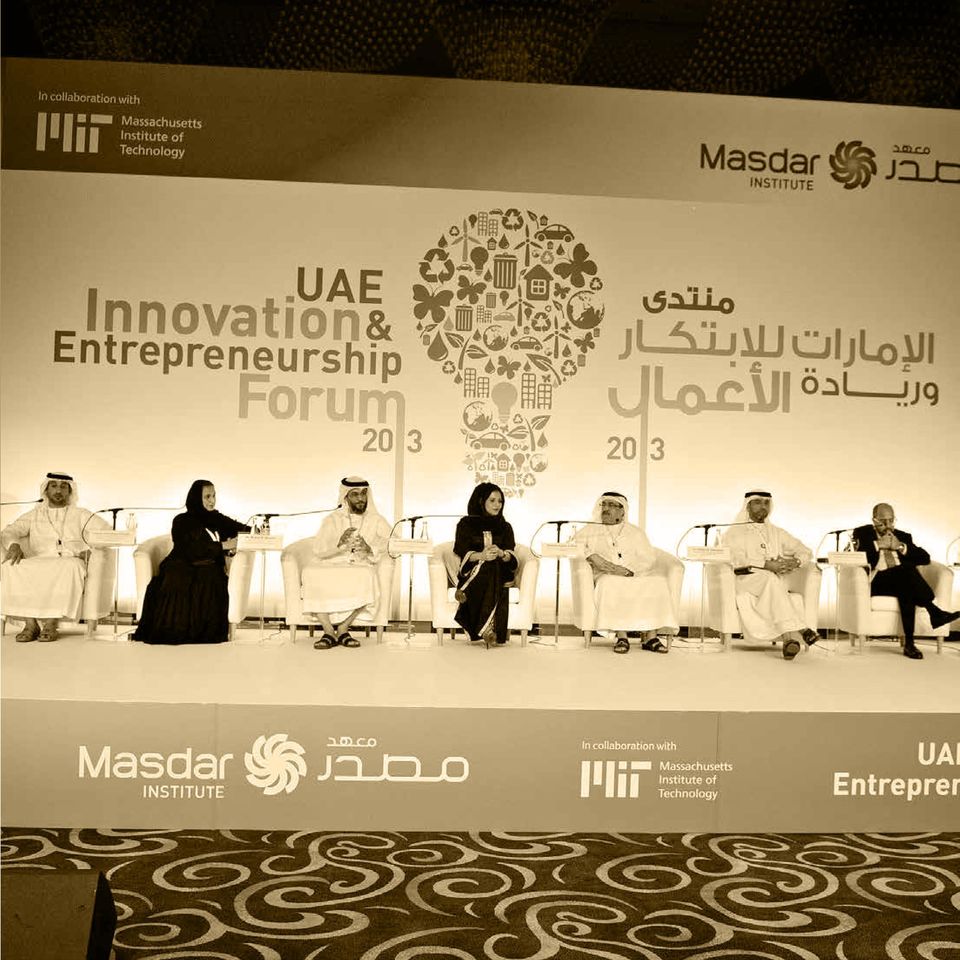
14 II. Entrepreneurial and SME Perspectives Panelists Dr. Douglas Hart, Professor and Co-Chair, Entrepreneurship Studies, Massachusetts Institute of Technology Rabea Ataya, Chairman and Chief Executive Officer, Bayt.com Dr. Raed Hashaikeh, Associate Professor, Masdar Institute of Science and Technology Sami Khoreibi, Chief Executive Officer, Enviromena Moderator Dr. Charles C. Cooney Faculty Director, Deshpande Center for Technological Innovation, and Robert T. Haslam Professor of Chemical Engineering, Massachusetts Institute of Technology 14 UAE Forum on Innovation and Entrepreneurship 2013

15 Dr. Douglas Hart, Professor and Co-Chair, Entrepreneurship Studies, MIT Q: As a founder of five start-ups and as a successful academic, how did you find the time? A: My personal solution has been to give my students as much responsibility as possible, both in research and in company start-ups. Sometimes this can take place simultaneously. One class of mine undertook a research project for the U.S. Navy that subsequently evolved into a new company. Q: What impact do you see on-line education having on the future of education? A: I think that we will find on-line education to constitute a new paradigm of learning. Massive Online Open Courses or MOOCs provide exciting ways to provide top quality instruction to students worldwide UAE Forum on Innovation and Entrepreneurship

16 Rabea Ataya, Chairman and CEO, Bayt.com Q: If you could do it all over again, what would you have done differently? A: It takes a certain naivete to start an entrepreneurial venture! There s a lot you don t know, and it s often a lot harder than you think. So, my advice to entrepreneurs is to do something you re passionate about, with a goal other than just self-enrichment. Our founders all had a passion for the social mission that helped see us through the tough times. Q: Is fear of failure an important consideration for entrepreneurs in the UAE? A: Yes, but it s equally important not to let that fear dominate your decisions. Dr. Raed Hashaikeh, Associate Professor, Masdar Institute Q: What would make your life easier as an inventor? A: The inventor needs support in all stages of taking new ideas into execution: testing, proof of concept, reporting, protection and commercialization. In a university, recruiting, training and retaining a skilled team of students, technicians and postdocs is essential to a strong and sustainable innovation process. Having a skilled team for IP protection and commercialization is also important. Q: How do you want to split your time between commercializing your research, and conducting the research? A: As an inventor, my preference is to work in my lab and with my students, but together with our Office of Technology Transfer I do invest time working with companies that show interest in licensing our IP. Commercialization, whether through licensing or startups, is an important component in an innovation process and success in commercialization is a sign for value and reward. Commercializing new inventions is challenging for startups, however, and the success rates are typically low. Startup companies need specialized infrastructure and funding mechanisms to help them succeed. 16 UAE Forum on Innovation and Entrepreneurship 2013

17 Sami Khoreibi, CEO, Enviromena Q: You could have had almost any job you wanted. Why did you form a risky startup? A: It was the job I wanted. It seemed inevitable. Q: What were the most important ecosystem factors that supported Environmena s creation and growth? A: Having a co-founder, a team, is important because it s tremendously difficult to do it alone. Support of early-stage entrepreneurial ideas is also important, such as MIT s support of a business plan competition in the Middle East and North Africa. Innovation through implementation has been a guideline. UAE Forum on Innovation and Entrepreneurship

18 III. Perspectives of Innovation Beneficiaries: Industry, Government, Investors Government Panelists H.E. Ahmed Saeed Al-Calily, Director General, Abu Dhabi Technology Development Committee Dr. Nawal Al Hosany, Director of Sustainability, Masdar, and Director, Zayed Future Energy Prize Dr. Major Ali Abdulla Al-Ghufli, Strategy and Performance Department, Abu Dhabi Police Industry Panelists Abdelhakeem Al Mushtaghil, VP HR &OE, Emirates Aluminum (EMAL) Khaula Al Badi, Head of Innovation and Technology Exploitation, Ethihad Airways Dr. Yehya Al Marzouqi, Director Strategic Learning and Development of Tawazun Economic Council Investor Panelists H.E. Abdullah Saeed Al Darmaki, CEO, Khalifa Fund for Enterprise Development Ovais Naqvi, Managing Director, Abraaj Performance Acceleration Group (APAG) Roberto de Diego Arozamena, CEO, ALJ Energy, Abdul Latif Jameel Group Studies, Massachusetts Institute of Technology Moderator Dr. Bruce W. Ferguson, Head, Institute Center for Innovation and Entrepreneurship, and Professor of Practice, Engineering Systems and Management, Masdar Institute of Science and Technology 18 UAE Forum on Innovation and Entrepreneurship 2013

19 Government Panelists H.E. Ahmed Saeed Al-Calily, Director General, Abu Dhabi Technology Development Committee Q: Innovation involves destroying the old to make room for the new. How can government protect this process when older industries, cities, citizens etc. generally have more money and votes? A: Government s role is to make sure innovation happens, because of the belief that innovation brings prosperity. The nature of innovation is to create disruption, but government must try to ensure that it is disruption in an orderly manner. The TDC seeks to create a supportive and orderly environment for innovation, for example by instituting a patent program to protect inventor intellectual property. UAE Forum on Innovation and Entrepreneurship

20 Q: The UAE is wealthy but small. How can UAE startups overcome the lack of a large domestic market for nearly every product and service? A: Yes, the small UAE market is a challenge. It can be overcome by focusing on export markets, particularly to MENA countries. Mr. Ovais Naqvi agreed that regional markets can help to address this issue, and added that technology businesses are not constrained to think local because they usually have global market potential. Dr. Ali Abdulla Al-Ghufli, Strategy and Performance Department, Abu Dhabi Police Q: Police responsibilities are critical to public safety. Does this mean that innovations in police technology face a stiffer test to adoption because of the potentially high public cost if they don t work? A: Innovative technologies are necessary in police work and can be rapidly accepted if the benefits outweigh the costs. Q: What resources or policies would help to speed innovation in government? A: An innovation culture is needed. Recently an innovation award was created within the Police Department to spur independent thinking and increase the willingness to raise new ideas. Top leadership in the country has provided clear direction to innovate; now the challenge is to implement this direction within an organization that does not already have an innovation culture. Dr. Nawal Al Hosany, Director of Sustainability, Masdar, and Director, Zayed Future Energy Prize Q: Innovation has been defined simply as the adoption of a new practice in a community (Denning & Dunham, 2010). What factors tend to slow down adoption of renewable energy and other sustainable technologies? A: A major obstacle to innovation in the renewable energy sector is lack of awareness. Many of our efforts seek to address the need for better distribution of information. Q: Do prizes help spur innovation? A: Yes, absolutely. The Zayed Future Energy Prize, for example, is dedicated to recognizing innovation in renewable energy and has achieved major success in supporting innovation initiatives around the world. 20 UAE Forum on Innovation and Entrepreneurship 2013

21 Industry Panelists Abdelhakeem Al Mushtaghil, VP Human Resources and & OE, Emirates Aluminum (EMAL) Q: What is the process of innovation in a large company such as EMAL? A: We believe there are three keys to innovation in our company. The first is continuous improvement, under the guideline that what cannot be measured, cannot be managed. Safety, for example, is very important to quality. We ve recently completed 14 million man-hours of work without a lost-time injury. A second key is our belief that our company must invest today for return tomorrow. Third, we seek to build on diversity. We have people from 64 countries in the organization, and believe that this diversity contributes to our ability to do out-of-the-box or blue ocean thinking about opportunities and problems. As a result, innovation is already part of the corporate culture or DNA at EMAL. Q: What obstacles to innovation face a large manufacturing company? A: The biggest challenge, perhaps not limited to large companies, is the pressure exerted by financial crises such as in Such financial pressures can limit the ability of corporations to invest in innovation by undercutting the invest today for returns tomorrow approach. Also, innovation requires resources of many kinds, not all of which are available in a single organization. This can be addressed through industry-government-university partnerships. Khaula Al Badi, Head of Innovation and Technology Exploitation, Ethihad Airways Q: Are airlines all about incremental innovation, or are radical improvements in the works? A: Incremental innovation receives most of our attention, partly because innovation need not be complex innovation can be very simple. In aviation, cost is crucial, so much of our work in innovation explores ways to reduce cost. Etihad has an Innovation Day to encourage employees to come forward with good ideas. Q: What types of innovation does Etihad need to remain a strong competitor? A: We believe that innovation requires a customer that is, market acceptance. So we try to stay very close to our customers in the innovation process. The pathways for innovation include work with our suppliers, through joint ventures, and through corporate spinoffs. UAE Forum on Innovation and Entrepreneurship
22 Dr Yehya Al Marzouqi, Director Strategic Learning and Development of Tawazun Economic Council Q: Efficiency and order are good things. Can innovation and entrepreneurship, which are often disorderly, be encouraged within UAE businesses and government agencies without causing chaos? A: At Tawazun we have a concept of organized chaos, similar to the concept of disruption in an orderly manner described by H.E. Ahmed Saeed Al-Calily. It helps to overcome the barriers to innovation, which include lack of available funding, hierarchical organizational structures that can discourage young innovators, and the time commitment required for an innovator to push an idea forward. Under our concept to combat approach the idea generator is freed from other commitments in order to pursue innovation. Q: How should the UAE select the building blocks of its knowledge economy, i.e. best practices from the US, China, Singapore, etc., and tailor them to the UAE? A: It gives me a great deal of pride to see a Made in UAE label on a piece of our equipment, and typically this requires technology from several different countries. We need not operate in silos. An approach that appeals to me is to create locations that innovators can go for help, incubators or technology hubs, similar to the Technopolis locations in Turkey. Such hubs can assemble most of the necessary resources for innovation in one place. 22 UAE Forum on Innovation and Entrepreneurship 2013
23 Investor Panelists H.E. Abdullah Saeed Al Darmaki, CEO, Khalifa Fund for Enterprise Development Q: Khalifa Fund is the largest early-stage investor focused exclusively on the UAE, the Jupiter of funding sources. Looking out five to ten years, are there any new programs or other changes you d like to see in the Fund s activities? A: We see ourselves as a nucleus in the innovation ecosystem, rather than as a Jupiter. Established six years ago, the Khalifa Fund focuses on a wide variety of entrepreneurial activity, not just technology innovation. We believe that much innovation comes from applied education outside of the university. Q: If you could change one thing about the thousands of business plans you see, what would it be? A: The most helpful change would be to a factor that is rarely stated in the business plans, but is usually important: a cultural aversion to risk. We d like people to accept that risk is integral to innovation, and that failure is often not final but an adjustment. Ovais Naqvi, Managing Director, Abraaj Performance Acceleration Group (APAG) Q: Abraaj s Riyada group is one of the largest, if not the largest, early-stage investment funds in the Middle East. It s small relative to many US venture funds. Why isn t it larger? A: Abraaj formed the Riyada group in 2009 to invest in small and medium sized enterprises (SMEs) in the Middle East and North Africa (MENA). It has since expanded globally. In 2010 we helped form Wamda, a content collaboration platform that has itself made 12 investments in small companies. Benchmarking UAE venture capital to US funds may be inappropriate. We re bullish on growth prospects for the region. Actions that could help increase venture funding activity include making it easier for entrepreneurs to start companies, reducing trade barriers to make it easier for startups to expand regionally, and empowering nationals in countries. Q: When deciding whether to invest in a particular startup, how important to Abraaj is a country s innovation ecosystem? A: A country s innovation ecosystem is very important to investors. It affects all aspects of an investment, from availability of skilled employees to time to market and exit opportunities. UAE Forum on Innovation and Entrepreneurship
24 Roberto de Diego Arozamena, CEO, ALJ Energy, Abdul Latif Jameel Group. Q: Are there important investment opportunities that are effectively foreclosed to investors because of exit uncertainties, or because of the specific industry? A: Both factors can be important. Identifying a clear market opportunity is crucial, and this can be easier in some industries than in others. Some investment opportunities are closed because they arise from technology in large companies that is kept in silos. Social entrepreneurship opportunities may lack a way to justify private investment. Q: What s the single most important thing the UAE could do to increase entrepreneurship? A: Funding is important, but it s not the only important thing. Perhaps the biggest improvement for small companies would be to provide a place where entrepreneurs could do one-stop shopping, a single location where all of the resources needed for innovation were easily accessible. For example, at such a location entrepreneurs could speak with investors at different levels and have a choice of investors. In many large companies, people don t talk to each other. To encourage intrapreneurship in large companies we should try to minimize departmental concerns and focus on how work affects the client. A question from the audience was then posed to the panelists: Q: The different stakeholder groups in the UAE will need to work together to change the innovation ecosystem. How should this be coordinated? A: Mr. Ovais Naqvi replied that leadership comes from government, and recommended that government fill this coordination role. Dr. Yehya Al Marzouqi added that large conglomerate corporations, that have access to many of the resources required for innovation, could provide great assistance in this process. 24 UAE Forum on Innovation and Entrepreneurship 2013
25 UAE Forum on Innovation and Entrepreneurship
26 IV. Perspectives from the Innovation Cradle: Universities Panelists Dr. Abdullatif Al Shamsi, Managing Director, Institute of Applied Technology Ms. Lita Nelsen, Director, Licensing, Massachusetts Institute of Technology HE Dr. Mansoor Al Awar, Chancellor, Hamdan bin Mohamed E-University, Dubai Dr. Mohamed Yousif Hasan Baniyas, Provost, United Arab Emirates University Dr. Mohammed Ebrahim Al-Mualla, Senior Vice President of Research and Interim Provost, Khalifa University Dr. Nabil Ibrahim, Chancellor, Abu Dhabi University Dr. Thomas J. Hochstettler, Acting Chancellor and Provost, American University of Sharjah Moderator Dr. Charles C. Cooney Faculty Director, Deshpande Center for Technological Innovation, and Robert T. Haslam Professor of Chemical Engineering, Massachusetts Institute of Technology 26 UAE Forum on Innovation and Entrepreneurship 2013
27 Dr. Abdullatif Al Shamsi, Managing Director, Institute of Applied Technology Q: How can we teach students to be students, and develop a culture of research and innovation? A: It s an ecosystem, a continuum of education and research. So we need to start early well before the university level involving grade schools and high schools in research and innovation activities. Q: We need to connect industry and academia. How can that best be done? A: We need to be innovative about education. In addition to teaching critical thinking early in the educational process, we need to teach differently. Dr. Thomas J. Hochstettler, Acting Chancellor and Provost, American University of Sharjah Q: How would you address this challenge of teaching students to be students, and developing a research and innovation culture within universities? A: We need to get away from the idea that students only need to memorize facts, and focus on educating the whole human being. We need to allow young people to experiment, and expose them to a wide variety of different experiences, including through extracurricular activities such as music and acting. UAE Forum on Innovation and Entrepreneurship
28 Q: Extracurricular activities can give students confidence to cut across disciplines. What activities does the American University of Sharjah undertake to encourage entrepreneurship? A: The university has an alumni entrepreneurship club that provides mentors to student entrepreneurs, and a business angels program of local community participants and alumni. We feel that an important role for the university is to mobilize the community in support of innovation and entrepreneurship. Dr. Mansoor Al Awar, Chancellor, Hamdan bin Mohamed E-University, Dubai Q: What do you see as the role and responsibilities of research-based universities in developing an entrepreneurial and innovative culture? A: There are three elements to university-based innovation: knowledge, research, and funding. E-learning does indeed constitute a paradigm shift in education, which we capture even in the terms we use. Instead of students, for example, we engage learners in our educational process. Q: The concept of an E-university is quite innovative. What other educational innovations do you foresee? A: I think that we ll see a continuing trend towards the academic enterprise as the wave of the future, helping to bridge the academic-business divide. Faculty will become more mentors than teachers, and the current form of schools and universities as places where faculty and learners must meet in person will become less necessary. In addition, no nation can be innovative without its mother tongue, so in the UAE we will see a trend toward Arabizing learning. Dr. Mohamed Yousif Hasan Baniyas, Provost, UAE University Q: How do you see the challenge at UAE University in encouraging research and innovation? A: We believe that the industry-government-academic alliance is crucial to innovation. These partnerships play a vital role in moving university research into commercial use. Q: What are ways that we can engage and nurture student and faculty involvement in technology based entrepreneurship to support both new and existing companies? A: One thought is to develop the role of simulation in this area. Simulation is increasingly important to many areas of education. I d also note that bureaucracy can interfere with technology transfer from universities to industry, so we should seek to minimize unnecessary bureaucracy. 28 UAE Forum on Innovation and Entrepreneurship 2013
29 Dr. Nabil Ibrahim, Chancellor, Abu Dhabi University Q: I ll ask you as well, Dr. Nabil, what do you see as the role and responsibilities of research-based universities in developing an entrepreneurial and innovative culture? A: The educational process has to be innovative in nature. Some of the new things we re trying include exposing students to real life problems, and creating an incubator at Abu Dhabi University, the ADU Enterprise. Also, innovation has to be relevant to the environment you are in, and lots of innovative people don t do technology research, so the challenge of creating innovation is not just a university challenge but a societal challenge. Q: How can we re-create Silicon Valley or Route 128 in the UAE? A: I spent 15 years in Silicon Valley, and believe that innovation must be consistent with the society it is in. So, we really shouldn t try to re-create Silicon Valley here, but instead should focus our innovation on the shortage of water, what follows oil and gas revenue, and other priorities of the UAE 2020 Vision. Dr. Mohammed Ebrahim Al-Mualla, Senior VP of Research and Development, Khalifa University Q: The connection between industry the customer and the university. How can it be improved? A: The best way to improve the connection between industry and academia is through directed research, sometimes called sponsored research. This provides university researchers with a clear idea of the relative commercial importance of various research areas. Q: How important is early-stage, government-funded science research to technology innovation? A: Government-funded research is crucial to technology innovation. Government in the UAE needs to play a greater role in research funding, using it to encourage collaboration between universities and industry. UAE Forum on Innovation and Entrepreneurship
30 Dr. Lita Nelsen, Director, Licensing, MIT Q: How can we best connect university-generated technology to the real world? A: Faculty often care more about publishing than about technology transfer, so it s important to make the connection as easy as possible for them. Another big challenge is to encourage companies to take the risk associated with moving early-stage university technology through to commercial products, a process that can easily cost tens or hundreds of millions of dollars in areas such as superconductors, pharmaceuticals, or new energy sources hardware industries rather than software industries. Q: Does MIT prefer to create a startup company or instead to license to a big company? A: Interestingly, we usually find that large companies don t want university R&D it s too early-stage, too risky, and doesn t fit with an existing product line. Small companies provide a critical bridge for transferring technology, developing university intellectual property to the point it s useful to large companies. Large companies play an important role in sponsoring university research, giving vital direction to the R&D, but even in such programs of industry-directed research product development still takes place in small companies. 30 UAE Forum on Innovation and Entrepreneurship 2013
31 UAE Forum on Innovation and Entrepreneurship
32 32 UAE Forum on Innovation and Entrepreneurship 2013 V. Audience Survey Results
33 Participants in the audience were invited to answer questions posed by the moderators during the panel discussions. The invitation-only event included knowledgeable members of all major UAE innovation ecosystem stakeholder groups. Answers were provided using a clicker system that allowed results to be tabulated during the session. Results of the survey may be summarized as follows: 1. Nearly all participants believed that the UAE should provide more assistance for early stage research (95% in favor) and for early-stage technology-based companies (93% in favor). More than 80% believed that more venture capital is necessary in the UAE. 2. Most participants (72%) believed that universities should advise their graduates to be entrepreneurs, and most (76%) believed that for a former entrepreneur applying for a job after failure of a technology-based start-up, the entrepreneurial experience would not be seen as a failure. 3. Participants expressed a willingness to pay higher prices in order to encourage innovation, with 61% offering to pay more for petrol and electricity in order to encourage alternative energy. The percentage breakdown of responses to each question is provided below. QUESTION 1 Should the UAE help stimulate early-stage technology-based companies? 1. Yes 93.2% 2. No 6.8% QUESTION 2 When applying for a job after failure of a technology-based start-up, the entrepreneurial experience would be seen as: 1. A Strength 76.2% 2. A Liability 23.8% QUESTION 3 Innovation in renewable energy may cost more in the short run. Would you be willing to pay more for petrol and electricity in order to encourage alternative energy? 1. Yes 61.5% 2. No 38.5% UAE Forum on Innovation and Entrepreneurship
34 QUESTION 4 In the UAE, do we mostly need: 1. More sustaining, continuous innovation in large companies 7.6% 2. More revolutionary innovation in small companies 21.7% 3. More of both 70.7% 4. Maintain the current balance 0.0% QUESTION 5 Do you believe there is adequate venture financing for technology-based start-ups in the UAE? 1. Yes 20% 2. No 80% QUESTION 6 Is there adequate investment in basic research and development in the UAE? 1. Yes 4.4% 2. No 95.5% QUESTION 7 Should a university advise its graduates to be entrepreneurs? 1. Yes 72.2% 2. No 27.8% 34 UAE Forum on Innovation and Entrepreneurship 2013
35 UAE Forum on Innovation and Entrepreneurship
36 VI. Conclusions and Recommendations The primary purpose of the UAE Forum on Innovation and Entrepreneurship was to elicit suggestions from informed stakeholders about how to improve the environment for innovation in the UAE. The Forum successfully met this objective. The ideas, examples recommendations put forward by the twenty-six speakers and panelists provide new insights for action. The conceptual framework of the discussion centered on the innovation ecosystem the intricate web of institutions, resources and rules that both fosters and constrains the introduction of new products, services and processes, whether in industry, government or the not-for-profit sector. While the Forum was not intended to reach a consensus, draft copies of this report were shared with all speakers and panelists and their comments incorporated in the final report. From the Forum and the subsequent interactive process with participants, nine conclusions and recommendations were derived as summarized below. They provide suggestive guidance for future stakeholder initiatives and government policies. 36 UAE Forum on Innovation and Entrepreneurship 2013
37 Conclusion 1. UAE s innovation ecosystem is complete, but shallow. The UAE has research universities, technology entrepreneurs and intrapreneurs, experienced mentors, sources of capital for early stage companies, and proponents of continuous improvement but not enough of them or of the other elements of a strong innovation ecosystem. There is a lack of a critical mass of these elements. Recommendation: Strengthen each stakeholder group in the innovation ecosystem. Initially, focus efforts in regional hubs in order to concentrate resources. Conclusion 2. Innovation is country-specific. The paths followed by nations to encourage innovation depend on complex interactions of culture and resources that in general are not easily duplicated. Trying to re-create a Silicon Valley in another country is unlikely to achieve the desired result. As Dr. Nabil Ibrahim observed, every nation has a unique set of opportunities, strengths and constraints that must be consulted in establishing a workable innovation ecosystem and effective innovation policy. UAE Forum on Innovation and Entrepreneurship
38 Recommendation: The UAE must establish its own brand of innovation. In addition to the points discussed above, the Forum identified several factors that should be considered as the UAE continues to develop its own optimum innovation strategy: The need to adapt or tailor rather than adopt wholesale innovation best practices from other countries. The challenge of motivating talented young Emiratis to take entrepreneurial risk when alternative employment prospects are bright. Cultural obstacles to entrepreneurship, such as the fear of failure. The importance of research universities in technology-based innovation. The need to preserve key aspects of Emirati culture, such as acceptance of social diversity, an inclusive view of social welfare, and other Emirati values, throughout the process of creative destruction that is innovation. The UAE s important advantages in innovation, including a strong executive branch of government in the economic sphere, excellent public financial resources, a high tolerance for change, and relatively low levels of entrenched bureaucracy and interest group politics. Conclusion 3. Innovation is industry-specific. As described by Ms. Khaula Al Badi of Ethihad, innovation in commercial aviation is different from innovation in Internet-based services because the industry structures are themselves vastly different. A policy that supports creation of high-technology start-up companies may do little to facilitate continuous improvement in commodity-based industries. Differences between industries need to be factored into innovation strategy and policy. Recommendation: Convene separate meetings of major stakeholder groups in each key UAE industry for example oil, water, agriculture, aviation, shipping, and ICT to suggest changes to the innovation ecosystem that would accelerate innovation in that industry. 38 UAE Forum on Innovation and Entrepreneurship 2013
39 Conclusion 4. Innovation needs a home. As noted by Mr. Waleed Mokarrab Al Muhairi of Mubadala and by Dr. Yehya Al Marzouqi of Tawazun, innovators need a place to work, ideally with convenient access to other innovation stakeholders and to required resources. Innovation can indeed take place in a garage, but successful innovation usually depends on locating the garage in a supportive network of companies, investors and experienced workers. Recommendation: Develop new innovation hubs as suggested by Dr. Yehya Al Marzouqi of Tawazun, perhaps modeled on free zones, to provide safe harbors for innovation. Existing innovation centers such as Dubai Internet City provide an excellent starting point. The new hubs should provide convenient access to all required resources and a simplified, supportive legal and regulatory structure. Conclusion 5. Build strength through diversity. EMAL sees its multinational workforce as an important driver of innovation, providing diverse perspectives on problems and opportunities and a broad range of relevant experience. In other countries such as the United States non-citizens, and recent citizens, similarly play a vital role in technology innovation and entrepreneurship. The UAE s tolerance for cultural diversity, and its willingness to import necessary skills from around the world, provides it with a formidable advantage in strengthening its innovation ecosystem. Recommendation: In strengthening each stakeholder group in the UAE s innovation ecosystem, continue the policy of recruiting overseas. In particular, develop innovative ways of attracting earlier-stage technology companies and entrepreneurs to the UAE, extending the country s past success in attracting established technology corporations and executives. Conclusion 6. Regulation is the oxygen of innovation. Just as the right amount of oxygen in the atmosphere not too little, not too much is necessary for life, so, too, the correct level of regulation whether by government or, as noted by Dr. Mohamed Yousif Hasan Baniyas, through the bureaucracy of private institutions is necessary for innovation. Too little regulation threatens social and economic stability, while too much regulation stifles creativity and private initiative. Regulation must be tailored to each sector and industry to achieve the optimum balance. UAE Forum on Innovation and Entrepreneurship
40 Recommendation: Undertake continuous improvement within government and the private sector to ensure that rules and regulations having the unintended consequence of slowing innovation are identified and modified. Conclusion 7. Government-funded research is vital to technology innovation. Government-funded science and engineering research is crucial to technology innovation, as illustrated through the participant survey and as stated by Dr. Mohammed Ebrahim Al-Mualla. Other stakeholders do not have the resources to fund such research, which usually has spin-off benefits to society that no single institution can fully capture. Recommendation: Government in the UAE needs to play a greater role in research funding, in particular using such funding to encourage collaboration between universities and industry. Conclusion 8. Small companies provide a crucial bridge from university to industry. University-generated research and development is usually too early-stage, too risky, and poorly tailored to existing product lines, to be of immediate interest to large companies. Ms. Lita Nelson observed that small companies, particularly start-up companies, play a vital role in developing technology to the point it can be acquired and used by large corporations. Recommendation: Promote the formation of small technology companies, and of partnerships involving universities, small companies and large companies. Conclusion 9. Improving the UAE innovation ecosystem requires stakeholder coordination. While improving the UAE innovation ecosystem requires action by all stakeholders, coordinated action is more efficient and effective than uncoordinated action. For example, start-up companies created by university faculty require pre-commercial funding, and the investors who provide such funding require exit opportunities through public offering of stock on an exchange or acquisition by a larger firm. As Ms. Reem Mobassaleh of the UAE s Advanced Technology Investment Company observed following the Forum, an innovation ecosystem is only as strong as its weakest link. Coordination among stakeholders helps to identify and eliminate weaknesses in the ecosystem. Recommendation: The UAE government should take the lead in coordinating new ecosystem initiatives. No other stakeholder group has the authority, and few groups have the long-term planning perspective, required to formulate and implement coordinated action among stakeholders. 40 UAE Forum on Innovation and Entrepreneurship 2013
41 Speakers and other participants also raised a number of important questions that deserve careful consideration in the future, including the following: 1. Is the innovation that the UAE should pursue the careful, continuous improvement of each product and process typically undertaken by established companies, or instead the disruptive innovation of start-up technology companies? 2. Is the entrepreneurship that the UAE should pursue the visionary leadership of a Silicon Valley rebel, or instead the inspired project leadership of an intrapreneur in a large corporation? 3. How should innovation and entrepreneurship best practices from other countries be adapted to the specific circumstances of the UAE? 4. How does the UAE encourage risk-taking in an economy that, in the short term, doesn t require it to grow? 5. Should we move from Failure is not tolerated to If at first you don t succeed, try, try again? If so, how do we change social attitudes about failure? 6. The UAE is one of the wealthiest countries in the world, but has much less venture capital available than other innovation hotspots around the world. Does it need more venture capital? If so, how does it get it? 7. Once we agree on goals, how should we measure progress? By number of new products, for example, or number of new start-up companies? 8. Why does innovation happen more quickly in some industries than in others? 9. Does the need to master state-of-the art technology today have higher priority in the UAE than internal innovation? 10. How should we evaluate the benefits and costs of innovating vs. not innovating for a particular product, service or process? 11. And, how can the UAE make things happen fast? Can the innovation ecosystem be organized to help all UAE industries innovate on Internet time rather than maybe next month time? These questions might productively be considered in future discussions. In his remarks, Shaikh Nahayan observed that we discuss innovation and entrepreneurship, but these are subjects that live through action. The Forum identified many good ideas for actions that can help to move the United Arab Emirates toward a knowledge-based economy. UAE Forum on Innovation and Entrepreneurship
42 42 UAE Forum on Innovation and Entrepreneurship 2013 Acknowledgements
43 The success of the Forum is due in large part to the dedicated efforts of a small group of people, including Dr. Lamya N. Fawwaz, Ms. Shaima Al Jarman, and Ms. Shaikha Al Khayyal of Masdar Institute of Science and Technology, and Ms. Patricia Vargas and Ms. Kathleen Kennedy of the Massachusetts Institute of Technology. Their contribution, together with that of the speakers and panelists who contributed so generously of their time during the event, is gratefully acknowledged. Thanks also are given to the Forum s sponsors, Masdar Institute and MIT, for the financial and non-financial support that made the Forum possible. UAE Forum on Innovation and Entrepreneurship
44 Appendix A. Biographies of Forum Speakers and Panelists Abdelhakeem Al Mushtaghil is a Vice President, Human Resources & Organizational Effectiveness at Emirates Aluminium (EMAL) based in Abu Dhabi. His key role is to lead and manage the EMAL Human Resources function, by providing strategic direction, advising on policy and procedure, and ultimately ensuring that EMAL is competitively positioned in the external market for talent and that internal processes effectively support staff at all levels and across the business. He has sound knowledge of HR best practices, manpower planning, and project management and has a wide experience in designing, leading and facilitating organizational development processes, implementing fundamental strategic directional organizational changes and turnaround strategies required for a competitive advantage. He also has sound execution discipline and business acumen with proven ability to build relevant organizational capabilities to effect performance, change and business results. Last role in ETISALAT Group prior to joining EMAL was as Group Senior Vice President, HR Strategy and Compensation & Benefits. Mr. Abdelhakeem is a graduate of Creighton University, USA, majoring in Management Information Systems, and has over 16 years of experience in various domains such as Information technology, Project Management, HR management, HR strategy, Compensation & Benefits, and Organizational Development. Abduallah S. Al Darmaki is the Chief Executive Officer of the Khalifa Fund for Enterprise Development, a government entity that spearheads the support and development of small & medium enterprises in the UAE. His role is integral to the strategic planning and management of the organization in alignment with the Executive Council s objectives. With over 17 years of experience in Oil & Gas, Petrochemicals and Manufacturing industries, and a background in Sales & Marketing, Mr. Al Darmaki has held a number of leadership positions with governmental and private organizations in the United Arab Emirates. In 2006, Mr. Al Darmaki developed and led the Abu Dhabi Polymers Park project, the first integrated downstream petrochemical cluster in the MENA region where later on he moved to the Human Capital Development area and was appointed as the General Manager of Abu Dhabi Tawteen Council, the National Employment Agency of the Abu Dhabi Government. He was responsible for transforming the Council into a comprehensive government employment agency and played a key role in establishing the Council s strategic relationships with both public and private sectors. 44 UAE Forum on Innovation and Entrepreneurship 2013
45 Abdullatif M. Al Shamsi has been the Managing Director of the Institute of Applied Technology since June He holds the rank of associate professor of Mechanical Engineering at UAE University. His appointments at UAE University included the post of Assistant Vice Chancellor for Research where he founded and directed the externally funded office for research and science (efors) to strengthen industrial/academic partnerships. Later, he founded a University-wide Internship and Work Integrated Learning (iwil) program to bridge the gap between learning and work. He participated in preparing the «GCC Educational Reform» document that was later adopted by the GCC Summit in Kuwait He received his Ph.D. from Duke University, USA in 1997 and received his Master and Bachelor degrees from Boston University. Ahmed Saeed Al Calily is the Director General of the Abu Dhabi Technology Development Committee, an entity created to support the elevation of Abu Dhabi to a world class center for science, technology and innovation. In his capacity, Ahmed plays a critical role in the development of Abu Dhabi s strategy for science, technology and innovation. His role also entails ensuring an effective execution of Abu Dhabi s science, technology and innovation initiatives in a coordinated manner amongst the various stakeholders. Ahmed also oversees a number of strategic initiatives that are important for the development of a science, technology and innovation base in Abu Dhabi. Prior to his appointment to the Technology Development Committee, Ahmed was the Chief Executive Officer & Managing Director of the Abu Dhabi Ports Company that was responsible for developing and operating ports in Abu Dhabi as well as developing the multi-billion dollar Khalifa Port and Industrial Zone. Ahmed has also served as the Deputy Director of the Infrastructure and Services unit at Mubadala Development Company, where he led a number of major projects and initiatives in the infrastructure and services sectors. Ahmed s diverse professional experience includes several leadership positions as well as board positions on various companies. Ahmed holds a Bachelor degree in Economics and Political Science from Boston University. Dr. Major Ali Abdulla Al-Ghufli is Head of Administration Process Section, Directorate of Strategy and Performance Development, General Office of the Deputy Prime Minister and Minister of Interior, United Arab Emirates. He is responsible for managing and improving the organisational process in the Abu Dhabi Police. He completed his bachelor s degree from Abu Dhabi Police, in Law Sciences and Police Studies, receiving the Sword of Honour as a result of his first class award. He achieved first on the class Cadets. He was then awarded full scholarship by Abu Dhabi Police to continue his higher education. A Diploma was presented by EFQM to Major Ali Al Ghufli in recognition of successful qualification as a European Excellence Assessor (2006). UAE Forum on Innovation and Entrepreneurship
46 He holds two Masters degrees: an MSc degree in Strategic Quality Management, and an MA in International Business Management, both from UK universities. In 2012, Major Ali obtained his PhD from the University of Manchester in Government Development Policy. Major Ali has been working in the Strategy and Performance development department for last 10 years, contributing to the development of important projects and initiatives in the Abu Dhabi Police including organisational structure and strategy, excellence award, and ISO certification. From 2007 to 2012 he managed the Performance Management Section in the Strategy and Performance department. In 2013 he was appointed as a head of the Administration Process Section. Major Ali is a Chairman of the Supreme Committee for Standardization & Metrology in the UAE Ministry of Interior. He has been granted several medals and awards from the Abu Dhabi Police and UAE government for his contribution and achievements. Bruce Walker Ferguson is Head of the Institute Center for Innovation and Entrepreneurship and Professor of Practice, Engineering Systems and Management, at the Masdar Institute of Science and Technology, an MIT-sponsored graduate research university located in Abu Dhabi that is developing new renewable energy sources and other sustainable technologies. Professor Ferguson s research and teaching interests include entrepreneurship, technology management and the innovation ecosystem from which new products and services emerge. Professor Ferguson is a co-founder and former COO of Orbital Sciences Corporation, a space technology company listed on the New York Stock Exchange, a co-founder and former CEO of Edenspace Systems Corporation, and a former Fellow at the George Washington University Center for International Science and Technology Policy. He is Vice Chairman of the Carnegie Institution of Science, a former Vice Chairman of the Kansas State University Research Foundation, and has been an angel investor in twelve technology companies. He received his Juris Doctor, Master of Business Administration, Master of Education, and Bachelor of Arts degree magna cum laude, from Harvard University. Charles L. Cooney is the Robert T. Haslam (1911) Professor of Chemical and Biochemical Engineering in the Department of Chemical Engineering, and the Faculty Director of the Deshpande Center for Technological Innovation, at MIT. He received his Bachelor s degree in Chemical Engineering from the University of Pennsylvania (1966), and Master s (1967) and Ph.D. (1970) degrees in Biochemical Engineering from MIT. After a short post-doctoral time at the Squibb Institute for Medical Research in 1970, he joined the MIT faculty as an Assistant Professor in 1970 and became a full Professor in He received the 1989 Gold Medal of the Institute of Biotechnological Studies (London), the Food, Pharmaceutical and Bioengineering Award from the American Institute of Chemical Engineers and the James Van Lanen Distinguished Service Award from the American Chemical Society s Division of Microbial and Biochemical Technology, was elected to the American Institute of Medical and Biochemical Engineers and in 2009 elected to the first class of American Chemical Society Fellows. 46 UAE Forum on Innovation and Entrepreneurship 2013
47 In July 2012 he was awarded Honoris Causa by Ramon Llull University in Barcelona. He serves as a consultant to a number of biotech and pharmaceutical companies, is on multiple editorial boards of professional journals, sits on the Boards of Directors of Polypore International, Inc., LS9, Inc., Mitra (India), GreenLight Bioscience, Essentient, Inc. and Biocon, Ltd (India) and was previously on the Boards of Genzyme, Cuno, Inc., Pall Corp. and Astra. He chaired the FDA Advisory Committee for Pharmaceutical Science from As founding faculty director of the Deshpande Center he is interested in the process of stimulating technological innovation and translating innovation into new company creation. Douglas P. Hart is an MIT Professor of Mechanical Engineering in the Hatsopoulos Microfluids Laboratory and co-founder of two venture backed biotechnology companies, Brontes Technologies, Inc., a MIT Deshpande Center spinout acquired by 3M in 2006, and Lantos Technologies, a MIT Deshpande Center spinout founded in September of Doug serves as an advisor for numerous companies and professional organizations and has been involved in the commercial development of technologies ranging from satellite propulsion to surgical robots. Doug received his BSc degree in aeronautical/astronautical engineering from the University of Illinois, his S.M. degree in mechanical engineering from the Massachusetts Institute of Technology and his Ph.D. in mechanical engineering from the California Institute of Technology. He worked as a research engineer for EML Research, Inc. (now Kaman Electromagnetics Corp. a subsidiary of Kaman Corp.) and as a senior systems engineer for Northrop Corp. (now Northrop Grumman Corp.) before joining the faculty in the MIT Department of Mechanical Engineering in 93. Doug teaches and conducts research in the areas of fluid mechanics, design, and instrumentation. Faisal S. Al Shuaibi is the executive manager of the Comprehensive Strategic Development project of the Ministry of Interior and a member of the Emirates Association for Strategic Planning board of directors. Colonel Faisal holds a Bachelor degree in Business Administration, a Master in Business Administration from the United States and currently enrolled to study for PhD in the UK. He has also received several specialized diplomas in Strategy and organizational development and in organizational performance measures. Colonel Faisal is one of the first graduates of The Future Leaders diploma in the UAE. He received Sheikh Rashid Award for Scientific Excellence with a Master degree in Business Administration He also received H.H the Minister of Interior Excellence Award for Supervisory Role stage 1. Colonel Faisal contributed to evaluating, developing and devising strategic plans for several government organizations and authorities in the United Arab Emirates such as: H.H the Deputy Prime Minister s Strategic Plan, and Emirates Identity Authority. UAE Forum on Innovation and Entrepreneurship
48 Fred Moavenzadeh was named the President of Masdar Institute of Science and Technology on July 1, 2010 to support the Masdar Institute s mandate of transforming the emirate into a leading source of advanced technologies and highly skilled human capital. Widely recognized for his innovative role in building global institutions and developing new models of teaching and research through international initiatives in education, science and technology, Dr. Moavenzadeh has a long and distinguished career at MIT. He has served as the director of the Technology and Development Program, Center of Construction Research and Education and the Center for Technology Policy and Industrial Development. During his career, Dr. Moavenzadeh has conducted and supervised major research activities. He has served as a private consultant to the World Bank, the Inter-American Development Bank, the Asian Development Bank and various United Nations agencies including United Nations Center for Human Settlement and UNIDO. His research interests are in the areas of Project Management and Finance. Dr. Moavenzadeh received his master s degree from Cornell University and his PhD from Purdue University. Mansoor M. A. Al Awar is an Honorary Visiting Fellow in Organization and Information Management, University of Bradford, member of International Academy for Quality (IQA) as Academician. He is also a part-time professor in graduate studies at the University of Salford, United Kingdom, and supervises PhD dissertations, as well as a Certified International Assessor for European Foundation of Total Quality Management (EFQM). Dr. Al Awar is the founder of the first TQM Department (Total Quality Management Department at Dubai Police) when he was appointed as a Director, and held that position from 1998 till He was the first Director of quality in the public sector in the Emirate of Dubai and UAE. He also founded the Hamdan Bin Mohammed e-university which was known as e-tqm College since its first inception in Furthermore, Dr. Al Awar has established the Juran Chair at HBMeU for the first time in the history of the region in 2004, the Virtual Executive Club in 2003, and the Media Quality Award for the Arab World in Mohamed Y. H. Baniyas obtained his PhD Degree in Pharmacology and Therapeutics from the University of Wales, Cardiff, UK in He joined the College of Medicine, UAEU as Assistant Professor in 1993 and was promoted through the academic ranks to Full Professor in During he was offered a Fellowship Program in Clinical Toxicology and Emergency Practice at the Department of Emergency Medicine, University Medical Center, University of Florida, Jacksonville, Florida, USA. Subsequently he obtained Clinical Certification by the American Board of Applied Toxicology in He also became Board Certified by the American Board of Forensic Examiners (1997), the American Academy of Pain Management (1997), and the American Psychotherapy Association (1998). He was elected Fellow of the American College of Clinical Pharmacology (2005), Fellow of the American College of Forensic Examiners (2006), Honorary Fellow of the Faculty of Occupational Medicine, UK (2010), Fellow of the Royal Society of Public Health, UK (2011), and Fellow of the American Psychotherapy Association (2012). He also obtained his Project Management Certificate (Health Care) from the Harvard School of Public Health, USA (2010). He maintains current the Advanced 48 UAE Forum on Innovation and Entrepreneurship 2013
49 Cardiac Life Support Certificate (ACLS Provider) and Advanced Hazardous-Materials Life Support Certificate (AHLS Provider and Instructor). At present he is working as the Provost and Chief Academic Officer, United Arab Emirates University. He is also Consultant Clinical Toxicologist at the Emergency Medicine Department, Tawam Hospital in Affiliation with Johns Hopkins. He served at the College of Medicine and UAEU for almost 20 years holding various positions such as Vice Provost for Health Sciences, Dean, Vice Dean, Director of Graduate Studies Programs, and Associate Dean for Admission, Student & Alumni Affairs at the College of Medicine at the UAEU. He was Visiting Professor and Clinical Toxicologist at the Florida Poison Center, University Medical Center, University of Florida, and Visiting Scientist and Medical Researcher at the Karolinska Institute, Stockholm, Sweden. Mohammed E. Al-Mualla holds a PhD degree in Electrical and Electronics Engineering and an MSc degree in Communication Systems and Signal Processing, both from the University of Bristol, U.K. He also holds a BEng degree in Communications Engineering from Etisalat College of Engineering, UAE (currently known as the Sharjah Campus of Khalifa University). Since 2000 he has been with Khalifa University where he has served in many roles including Manager of the Abu Dhabi Campus and Interim Provost. He is currently the Senior Vice President for Research & Development, providing leadership and strategic direction in the engagement of the university research enterprise with industry, and in the management of university intellectual property, technology transfer, and research support services. Dr Al-Mualla is a member of the Board of Trustees of the ICT Fund and a member of the Senior Management Board of the Etisalat-BT Innovation Center. He is also a member of the Board of Directors of C4 Advanced Solutions. Nabil A. Ibrahim is the Chancellor at Abu Dhabi University (ADU), UAE. His previous experience includes Vice Chancellor/Chief Academic Officer, Purdue University - Calumet; Associate Vice President for Graduate Studies & Research/ Chief Research Officer, San Jose State University (SJSU); Dean of Graduate Studies; Associate Dean, Professor, College of Engineering, SJSU and Chairperson, Professor, Associate Professor, Bradley University. He received his Ph.D. in Engineering from McMaster University, Canada and his B.S. degree From Cairo University, Egypt. Dr. Ibrahim has taught many courses and supervised post-graduate students in areas of: mechanical engineering, materials science, design, manufacturing, advanced composites, failure analysis and quality engineering. He has 22 years of experience in technology innovation/commercialization, business incubation/growth and entrepreneurship in Illinois, Silicon Valley, and Indiana. He produced over 50 publications and presentations, holds two US patents and has attracted over $87 million in grants and contracts from government, foundations and corporations. Dr. Ibrahim has provided professional/consulting services to: IBM, Applied Materials, Lockheed-Martin, General Electric, Cal Recovery, Trans Technology Electronics, Resource Technology, Keystone Steel and Wire, Podiatry Arts Laboratory & Health Technology, Caterpillar Inc., Texas Instruments, Cummins Engines, University of Wisconsin and other companies and institutions. UAE Forum on Innovation and Entrepreneurship
50 Nawal Al-Hosany leads a team responsible for developing Masdar s sustainability standards and policies. She is also mandated to oversee the processes of sustainability auditing, monitoring and reporting. In 2011, Dr Al-Hosany further assumed the post of Director of the Zayed Future Energy Prize; where she oversees the implementation of the objectives, mandate and strategic direction of the prize. Dr-Al Hosany is a board member of Masdar Investment LLC and of the Emirates Authority for Standardization and Meteorology. She is also an Adjunct Professor at the Masdar Institute of Science and Technology. In her commitment to remain at the forefront of the social science and sustainable development landscape, she has participated in numerous continuing professional development courses and continually seeks opportunities to stay updated on latest project management methods, as well as leadership, planning and decision-support mechanisms. Ovais Naqvi is the Managing Director of Abraaj Performance Acceleration Group (APAG). Ovais works as the Group s best practice lead in Sales & Marketing via The Abraaj Group Center of Excellence Sales, Marketing & Pricing, delivered through a model of direct engagement, best practice leadership and executional support in areas such as: sales & channel partnership, marketing & branding, customer segmentation, sales & pricing optimization and building customer focus and go-to-market capability. He also led the Partner Company Synergy program (ARENA), based on extensive Partner Company needs assessment stage and platform execution taking place in Ovais sits on the Abraaj Knowledge Management (Opera) Steering Group and is actively engaged in commercial due diligence in Large Cap and SMC deals for the Firm. His career has been in numerous aspects of marketing, branding, content publishing and digital/web architecture creation, including as a Founder-Entrepreneur and as a published writer. His passion is physical-to-digital business models and how we can use digital technologies and brand tools to grow skills and value in Partner Companies. Ovais was a Co-Founder of Abraaj s early stage content-collaboration and angel investment platform Wamda.com and sit on its Board and was a member of the steering team of the Celebration of Entrepreneurship (CoE). Also on the Boards of Sport360 (external business) and Byco and having been a business founder in the luxury publishing industry in Europe. He is also an Advisor to the Aman Foundation. He was educated at the London School of Economics (LSE) and has had careers marketing services. Rabea Ataya is the founder and CEO of Bayt.com, the Middle East s leading job site, which now serves over 11,000,000 professionals and 50,000 employers from its 12 regional offices. He is also a co-founder of the following: Gonabit.com, the region s first group purchasing site; Mumzworld.com, the Middle East s first and largest shopping site for all things Mother, Baby and Child; and Doctoruna.com, online medical directory and appointments booking service. Prior to Bayt.com, Rabea founded and managed InfoFort, the Middle East s first and leading records management company with operations throughout the Middle East. Rabea is a graduate of Stanford University with a BS in Electrical Engineering and an MS in Engineering Economic Systems. 50 UAE Forum on Innovation and Entrepreneurship 2013
51 Raed Hashaikeh is an associate professor at the Materials Science and Engineering program at Masdar Institute. He joined Masdar Institute back in Dr. Hashaikeh is internationally recognized for his contributions in material engineering. He is on the editorial board of the international journal Desalination. Dr. Hashaikeh was instrumental in leading a team of scientists that developed a new battery technology for which Masdar Institute has filed a patent application in the US, has four more patents to his credit, jointly with different teams of scientists. Dr. Hashaikeh received his Ph.D. in Materials Engineering from McGill University. Before joining Masdar Institute, he spent two years at FP Innovations-Paprican division, Canada, as a scientist. He was also a visiting scholar at MIT between 2008 and Roberto De Diego Arozamena is the Chief Executive Officer of Jameel Energy, part of the Abdul Latif Jameel Group. ALJ is a large and diversified group with headquarters in Saudi Arabia and presence in 15 countries, with revenue in excess of $12 billion and 14,900 employees. Jameel Energy is the newly formed company that is being developed as a power plant developer and independent power producer, focused on renewable energy (solar PV, solar CSP, wind, hydroelectric) and conventional power generation. Mr. De Diego is fully responsible for the development of this new business line within the ALJ Group s diversification strategy and will follow the Group s geographic footprint with special focus in the GCC countries, North Africa and Turkey. Mr. De Diego has more than 30 years of management experience in technology, media, telecommunications, manufacturing and renewable energy and has managed international organizations with revenue up to 6.5 Billion and employees. He is the owner and partner of two advisory services companies focused on renewable energy, telecom, media and communications, IT, manufacturing and services sectors and has previously been President of SolFocus Europe, Middle East & Africa, President of renamed telecom companies (e.g. British Telecom and Jazztel) along with several other affiliations. Mr. De Diego has been a Member of the Board of Directors of public and private companies. He graduated with a BS in Electrical Engineering from the University of Southern California before completing his MBA studies in Construction and Real Estate at the Universidad Politecnica de Madrid. Sami Khoreibi is Enviromena s Chief Executive Officer and a founding partner of the company. Since its incorporation in Abu Dhabi in October 2007, Enviromena has grown to become the largest solar developer in the Middle East and North Africa (MENA) region. Enviromena has proven highly successful, securing a series of premier solar installation projects, including the largest PV solar power plant ever built in the MENA region. Enviromena has attracted a broad base of leading international cleantech investors including Masdar, Good Energies Invest and zouk Ventures. Mr. Khoreibi has assembled a team of talented solar experts from around the globe, growing the size of the company seven fold since its 2007 founding. UAE Forum on Innovation and Entrepreneurship
52 He led Enviromena to become one of the first carbon neutral companies in the UAE, and was awarded Entrepreneur of the Year for 2008 at the Alternative Energy Awards. In 2009 Mr. Khoreibi was named by Arabian Business as one of the Top 30 Under 30 He was awarded Young CEO of the Year at the 2010 CEO Middle East Awards and recognized as a Young Global Leader at the 2012 world economic forum. Mr. Khoreibi regularly presents at local and international industry events including the World Future Energy Summit, the London Renewable Energy Finance Forum, and provides commentary for international and local publications including TIME magazine, the Financial Times and Dow Jones. Previous to Enviromena, Mr. Khoreibi was a founding partner of Candax Energy Inc., an international upstream oil and gas company which was publicly listed on the Toronto Stock Exchange in As an Abu Dhabi based energy entrepreneur, Mr. Khoreibi s key focus is developing clean, carbon neutral alternative energy projects throughout the MENA region. Thomas J. Hochstettler earned his B.A. from Earlham College in Indiana and his master s and doctoral degrees in history at the University of Michigan. He has been the recipient of a Woodrow Wilson National Fellowship and of research support from the Deutscher Akademischer Austauschdienst. Dr. Hochstettler specializes in early modern German political and economic history and European military history. He also studied business at the Haas School of Business at the University of California-Berkeley. Through his engagement in higher education administration, he has also extended his research interests to include enrollment management, higher education finance, and international educational reform. He currently chairs the board of directors of the International Student Exchange Program (ISEP), the world s foremost non-profit organization engaged in expanding opportunities for international education, based in Washington, D.C. As Provost at AUS, Dr. Hochstettler oversees all teaching and research programs at the university, as well as ancillary services such as student advising, academic computing, and the library. During his tenure, AUS has dramatically increased its funding for faculty research, and he has been responsible for creating opportunities for student and faculty exchange with universities abroad. Since March, 2013, he has served as Acting Chancellor of AUS. Waleed Al Mokarrab Al Muhairi is Mubadala s Chief Operating Officer, overseeing the company s broad investment portfolio and responsible for its strategic, operational and business development activities. Mr. Waleed is also a member of Mubadala s Investment Committee. The committee is mandated to develop the company s investment policies, establish investment guidelines and review all proposed projects and investments to ensure they are in line with Mubadala s business objectives. In addition to his position as Chief Operating Officer, Mr. Waleed is a member of the Board of Directors of several key Mubadala Group and other operational businesses. He currently serves as Chairman of the Advanced Technology Investment Company (ATIC), Cleveland Clinic Abu Dhabi and Tabreed. He is Vice Chairman of Piaggio Aero Industries and is a Director of du, GLOBALFOUNDRIES, and the Abu Dhabi Future Energy Company (Masdar). Additionally, he is a member of the Board of Trustees of Cleveland Clinic. 52 UAE Forum on Innovation and Entrepreneurship 2013
53 Mr. Waleed was also one of the principal architects behind the Abu Dhabi 2030 Economic Vision. Prior to joining Mubadala, Mr. Waleed worked with the UAE Offsets Program Bureau as a Senior Project Manager. He previously worked with McKinsey & Company as a commercial and governmental consultant. Mr. Waleed holds a Masters of Business Administration degree from Harvard University, and a Bachelor of Science in Foreign Service degree from Georgetown University. Yehya Al Marzouqi joined the Offset Program Bureau (OPB)/Tawazun in 2009 as the Manager of the Capability Development Department. Prior to that, he had worked in Abu Dhabi Company for Onshore Oil Operations (ADCO), as well as in the Resources Centre in a major bank in the USA. At the OPB/ Tawazun, he manages various people development initiatives such as Career Advancement Center, Implementation of Continuous Personal Development Plan, the Leadership Development Program and Daylight Project which saw 50 UAE national females getting trained and prepared to join the local job market. He is also involved and leading various initiatives such as assessment center known as Career Development Center, Leadership Development model, Succession Planning, Knowledge Management, Performance Management, e-learning & blended learning, the Competency-based Training and 360 Degree Feedback process. Besides his duties at the OPB/Tawazun, Dr Yehya is also active as an instructor in workshops on articulating organizational core values and as a speaker on various topics at local and international conferences such as IQPC, IIR, SPE and ADIPEC. He has co-authored an article which was recently published in National HRD Journal. Dr Yehya holds a Ph.D. in Business Administration from Bradford University in the United Kingdom. UAE Forum on Innovation and Entrepreneurship
54 Appendix B. Prepared Remarks of Speakers 1. His Highness Shaikh Nahayan Mabarak Al Nahayan, UAE Minister of Culture, Youth and Community Development, United Arab Emirates 2. Dr. Fred Moavenzadeh, President, Masdar Institute of Science and Technology 3. Dr. Matar Hamed Al Neyadi, Undersecretary, Ministry of Energy, United Arab Emirates 4. Mr. Waleed Mokarrab Al Muhairi, Chief Operating Officer, Mubadala Development Company 5. Professor Bruce W. Ferguson, Head, Institute Center for Innovation and Entrepreneurship, Masdar Institute of Science and Technology 54 UAE Forum on Innovation and Entrepreneurship 2013
55 1. Remarks of His Highness Shaikh Nahayan Mabarak Al Nahayan UAE Minister of Culture, Youth and Community Development Good Morning, Distinguished Guests, Ladies and Gentlemen: We welcome those of you from abroad to Abu Dhabi and the United Arab Emirates. You visitors from Boston, in particular, have arrived from a city that has been very much on all of our minds. Your citizens and law-enforcement officers responded resolutely to the senseless, immoral violence that killed and injured innocents at the Boston Marathon and at your own MIT. Somehow, the collaboration between Masdar Institute and the Massachusetts Institute of Technology means even more to us now. We are proud to be with you. Because you all have assembled to discuss innovation and entrepreneurship in the UAE, you have brought your imagination, your education, your experience, and your intelligence to this forum. Of course, you would bring those elements to any intellectual investigation, no matter what the subject. Simply thinking and talking about these subjects, innovation and entrepreneurship, suggest nothing exceptional. But to discuss them is to talk about subjects that live through action. With that promise of action, today s subjects become truly exceptional. They require, to be sure, what your discussions demand, namely, imagination, education, experience, and intelligence. Those elements, however, are not enough for action. In acting, the innovator and the entrepreneur must summon the mental and moral strength to venture, persevere, and withstand danger, fear, or difficulty. They must summon that which we call courage. Innovation delivers new ideas. Entrepreneurship delivers new enterprises. The innovator and the entrepreneur venture beyond the safe boundaries of the old and tried onto the risky terrain of the new and untried. They need courage. The seventeenth-century philosopher John Locke, a man who introduced many new ideas, wrote that new opinions are always suspected, and usually opposed, without any other reason but because they are not already common. Locke suggests that any new idea will probably be opposed. Innovation challenges the status quo and its guardians. In addition to the habitual opposition to new ideas, innovators always face uncertainty. Innovators cannot be certain that their new ideas will work. Just because an idea is new is not reason enough for its being good. We all have had some new ideas and in honesty must concede that some of them were terrible. UAE Forum on Innovation and Entrepreneurship
56 Entrepreneurs join innovators on the risky terrain of the new and untried. In the fifteenth century, Machiavelli accurately described the hazards of entrepreneurship when he wrote that there is nothing more difficult to take in hand, more perilous to conduct, or more uncertain of success, than to take the lead in the introduction of a new order of things. We have a perfect example of perilous entrepreneurship at hand, right here in Abu Dhabi. Masdar City introduces a new order of things. Abu Dhabi is led by a wise man who welcomes and encourages innovation, His Highness the President, Sheikh Khalifa bin Zayed Al-Nahayan. The President, vigorously supported by His Highness Sheikh Mohammed bin Zayed Al-Nahayan, Crown Prince of Abu Dhabi and Deputy Commander of the Armed Forces, believes that individuals endowed with innovation and initiative are a force for development and prosperity in our country, within the region, and throughout the world. The United Arab Emirates is committed to creating a knowledge society, to encouraging investments in new companies, and to supporting entrepreneurial activities. We recognize the importance of creating the environment that will sustain vigorous entrepreneurial activity. As a matter of public policy, we urge our citizens to both own and manage their companies. We also encourage our college and university graduates to start their own businesses. Major initiatives have been launched to provide entrepreneurs in our country with relevant advice, assistance, financing, training and support. We intend to enhance our reputation for being the land of the entrepreneur. Ladies and Gentlemen: As Minister of Culture, Youth, and Community Development, I am hoping that your discussions will emphasize not only the critical area of economic innovation and entrepreneurship, but also the increasingly important area of social innovation and entrepreneurship where initiative and creativity are essential to improving the quality of life for world citizens. I agree with those scholars who have concluded that social entrepreneurs are at the heart of successful community development efforts. I hope that your discussions will highlight the role of entrepreneurship in meeting national and global social challenges. I hope that your discussions will touch on the relevance of entrepreneurship to social development. A healthy economy needs a healthy society. I am particularly fond of a quote by David Bornstein, author of How to Change the World: Social Entrepreneurs and the Power of New Ideas, who said: Social entrepreneurs identify resources where people only see problems.... They begin with the assumption of competence and unleash resources in the communities they re serving 56 UAE Forum on Innovation and Entrepreneurship 2013
57 In both the economic and social realms, entrepreneurial success is not certain. Entrepreneurs risk opposition, miscalculation, rejection, disappointment, loss, ridicule, and failure. Both economic and social innovators and entrepreneurs cannot wish away real risks. They need the courage that Mark Twain described when he said that courage is resistance to fear, mastery of fear not absence of fear. Imaginative, well-educated, experienced, and intelligent innovators and entrepreneurs, fortified by a courage that resists and masters inevitable fears are the people who will propel communities and cultures and nations to great heights. Today, in other words, you will be discussing the future of the United Arab Emirates and, by extension, the future of the global community. Thank you for your current effort. Thank you for your future courage. My best wishes for your success. UAE Forum on Innovation and Entrepreneurship
58 2. Remarks of Dr. Fred Moavenzadeh President, Masdar Institute of Science and Technology His Highness Shaikh Nahayan, Ladies and Gentlemen, I am delighted to be here and welcome you on behalf of Masdar Institute to this very innovative forum that we have put together to discuss the ideas behind innovation and entrepreneurship. This, as you have noticed, is a joint initiative between Massachusetts Institute of Technology and Masdar Institute. Masdar Institute is committed to developing the type of the manpower and the type of the ideas that are required for promoting and developing the new economy in the UAE. Let me say that entrepreneurship is not new to this region of the world. The region traditionally has lived by entrepreneurship, especially over the past 40 years. Many entrepreneurs have seen the opportunity and have built up what one may call enterprises that are really in the rank of some of the best in the world. The issue that we are faced with is that most of these entrepreneurs have been primarily concerned with the accumulation of wealth. What we are hoping to develop is the type of entrepreneurs who create new wealth, and that means that they have to look at the type of the ideas, the type of the technologies that very often are referred to as disruptive technologies, that bring about new shape, new form, of the society. As His Highness Shaikh Nahayan mentioned, the economy without the right social system will not flourish. We want the individuals who come up with the ideas not only to accumulate wealth, not only to generate wealth, but that try to be relevant to the needs of the society. One of the most important issues that our society in the 21st century faces is the issue of climate change. And this is why we are extremely interested in seeing innovative ideas, disruptive technologies, that can not only generate wealth but also address the issue of climate change. We are extremely happy today to have some highly qualified, well experienced individuals from the academic world, from the industry, from the government organizations, from international organizations, come together and discuss their views and their perspectives on these issues. So, let me thank you again, and thank His Highness, and I hope that you will have a very pleasant day. We hope that by the end of the day you ll have learned a bit more about how to proceed with the development of innovation and entrepreneurship in the UAE. 58 UAE Forum on Innovation and Entrepreneurship 2013
59 3. Remarks of His Excellency Matar Hamed Al Neyadi Undersecretary, Ministry of Energy, United Arab Emirates Ladies and Gentlemen, It is both my pleasure and honor to be invited here today to speak at this important occasion. I would like to thank our hosts for organizing this event and for bringing the vital themes of innovation and entrepreneurship under the spotlight. No one here needs to be told that the United Arab Emirates is well endowed with hydrocarbons pushing us to the forefront of the energy sector globally. With this wealth comes heavy responsibilities for the government, the private sector and our population especially the youth. The UAE has invested billions of dollars to develop additional production capacity to meet world oil demand, ensure market stability and secure uninterrupted supplies to our customers and to fulfill our role in supporting global economic development. Furthermore, the UAE is actively working on diversifying its economy away from oil to other economic sectors such as industry, agriculture, fisheries, information, hospitality and service industries as well as developing alternative energy. We are using solar energy, building atomic power plants to generate electricity and reduce our fossil based energy consumption while introducing at the same time building codes designed to conserve energy and importing energy efficient appliances. The era of easy discovery of giant oil fields is over and future exploration requires advanced knowledge, innovative modeling, and adequate experience. This is where the role of the youth comes in. Ample opportunities for education through all levels and training have been made available to UAE nationals. Our leaders are committed to provide the young people with the best education possible. An example of this is HH Sheikh Mohamed Bin Zayed s latest gift of three million Dirhams for students to purchase books in Abu Dhabi Book show underway now. Students are required to seize these opportunities being offered to them and to advance in their research, applying modern technology to come up with new ideas and innovation. UAE Forum on Innovation and Entrepreneurship
60 The Masdar Institute with its advanced research facilities is here to train our young people to reach the lofty heights of innovation and research. The Petroleum Institute is here to prepare our youth for outstanding careers in the oil industry where they can showcase their ability in applying the modern advanced techniques of exploration and production to give maximum benefit to the nation. The universities across the UAE are here to provide full comprehensive education in all fields of human endeavour. With this level of support to education and research our youth have no excuse not to reach for the heights of glory. Intelligence, imagination and inventions are not the monopoly of the west. We have been born with the same abilities they were born with. To prove this point I want to bring to your attention the achievements of some of our young people who have already proven their ability and demonstrated their readiness to rise to the challenge. The UAE was the second nation in registration applications in the whole of the Middle East in 2012 and has submitted 147 applications in the fields of engineering, information technology and administration to the relevant international authorities. These innovations were made possible because of our talented young people who made all of us proud to be the sons and daughters of this nation. Innovation has always been deeply embedded in our culture and helped us survive in a hostile barren environment before the advent of the petroleum age. Our forefathers were quick to spot opportunities and seized on them to their advantage. To conclude I urge you to follow the example of your talented colleagues whom I have spoken about earlier and exceed their achievements and I call upon our oil and gas industry, our financial institutions, our manufacturing industry and our private companies to discharge their responsibility to their communities by providing our young graduates gainful employment and avail them of the opportunity to gain useful experience and knowledge to help them achieve the innovations and entrepreneurship they should be aspiring to. Thank you. 60 UAE Forum on Innovation and Entrepreneurship 2013
61 4. Summary of Remarks of Mr. Waleed Mokarrab Al Muhairi Chief Operating Officer, Mubadala Development Company Mr. Waleed Al Muhairi, Chief Operating Officer of Mubadala, spoke on the importance of innovation and entrepreneurship as Abu Dhabi develops a diversified and innovation-driven economy that will yield financial and social returns for the Emirate. Highlighting the work of the Masdar Institute, an establishment where innovation is central to developing new technologies and pioneering perspectives, Mr. Al Muhairi recalled the vision of Sheikh Zayed bin Sultan Al Nahyan, and highlighted that Government entities, the private sector, educational institutes and individuals can all contribute to building an innovation and knowledge based economy. Mr. Al Muhairi then proceeded to focus on the key ingredients required for this to happen. Firstly, that there needs to be a framework where innovation and an entrepreneurial spirit can grow. In Abu Dhabi s case, many of the new industries that make up the modern economy of the UAE have started from scratch. He highlighted the role Mubadala is playing in laying the foundations for key industries such as Aerospace and Metals, creating an environment where Emiratis can work at the cutting edge of new technology. Secondly, Mr. Al Muhairi highlighted the importance of experience in creating new industries and environments, and the fact that mutually beneficial working relationships provide knowledge sharing opportunities. He highlighted some of the core partnerships at the heart of the Mubadala business. Education must also be at the heart of any innovation based economy. Mr. Al Muhairi highlighted the great work of establishments such as the Masdar Institute, Zayed University, Khalifa University for Science Technology and Advanced Research (KUSTAR), UAE University in Al Ain, New York University in Abu Dhabi and Paris Sorbonne University. He stated that these institutions will help deliver further economic development by cultivating the skills base required to meet the demands of the new industries and economic sectors. Mr. Al Muhairi then emphasized the continuing developmental role that businesses have in creating an innovation based economy. He highlighted the work of ATIC s Al Nokhba Program that provides an opportunity for young Emiratis to interact with business leaders and receive training that will help them support the UAE s economic development on a global platform. Finally, Mr. Al Muhairi stated the importance of establishing a vibrant private sector in the region as the main catalyst for economic growth and opportunity. He cited the growth of small and medium industries, which constitute 94 per cent of all operating companies in the country, as in important step in the development of the next generation of entrepreneurs in the UAE. UAE Forum on Innovation and Entrepreneurship
62 5. Remarks of Professor Bruce Walker Ferguson Head, Institute Center for Innovation and Entrepreneurship Masdar Institute of Science and Technology Sabah al khair. I first wish to thank the Massachusetts Institute of Technology and the Masdar Institute of Science and Technology for co-sponsoring this Forum, and our distinguished speakers and panelists who have generously shared their time with us today. As of last night, there were more than 28,000 books listed on Amazon with the word innovation in their title. There also were 8,900 books with a title containing the word entrepreneurs. Sixteen books had been published in just the last 24 hours. At that rate even the best student among us will never finish reading these books. We all agree that innovation and entrepreneurship are important, but do we really need another book or another conference to discuss them? The answer is yes, we do. Only two of these 37,000 books had United Arab Emirates or UAE in the title. One of these is a 2008 book on satellite information systems for automobiles. The second is on artistic innovations in UAE energy projects. These topics are interesting but limited. Why is this a problem? It is a problem because, while some of the world s greatest gardeners are English, a book about gardening in England is unlikely to be of great use in Abu Dhabi. The climates are different, the soils are different, the plants are different. Similarly, books about innovation and entrepreneurship elsewhere in the world are unlikely to provide precisely what we need. We must adapt the lessons of these books to create new methods and new policies based on the conditions in the UAE. Otherwise we might find ourselves on unproductive paths, trying to grow orchids on the dunes of the Rub al Khali. Adapting the best practices of other regions to the needs of the UAE is one of three priorities of the Masdar Institute s new Institute Center on Innovation and Entrepreneurship. One definition of innovation is change that is adopted by others. A brilliant new technology must be accepted by others to qualify as an innovation. So, how can we adapt best practices to increase the rate of acceptance, recognizing that new products and services inevitably encounter opposition? A second priority for the Center is helping the Masdar Institute to train the next generation of technology leaders and innovators. We want these young men and women to find great jobs when they graduate, but that is not enough. We want them to create great jobs for others, by helping to develop new products and services, new programs and institutions. Whether they work in family businesses, start-up companies, international corporations or government agencies, we want to teach them to seize on opportunities for change that improve their workplace, save people s time, increase happiness, and create value. 62 UAE Forum on Innovation and Entrepreneurship 2013
63 A third priority for the new Center is to assist other institutions in creating a new UAE ecosystem for innovation and entrepreneurship. How can we adjust the country s legal and regulatory structure, and assist its industry and financial institutions, to make it easier for entrepreneurs to start new technology companies, sell new products, and take their companies public? How can we make innovation happen faster? The new Center will focus on translating the technology research of its faculty and students into new products, services and processes. Accelerating innovation at the Masdar Institute will take us deep into the questions I have raised. We look forward to working with all of you, and with other stakeholders, in creating a new system of innovation here that is in keeping with this new country. In the three panel discussions that follow, we will obtain insights from several of the key stakeholders in the UAE s innovation ecosystem. To better understand the thinking of the other knowledgeable stakeholders here today, we have instituted a clicker system that will allow you to answer questions of general interest posed by myself and my fellow moderator, Dr. Charles Cooney of MIT. Should you have questions for the panelists, please write your question on the paper in your registration folder and give it to one of our assistants standing at the side of the room. We will ask as many questions as possible, subject to the need to allow the panelists a little bit of time to answer. Today s discussion will be summarized in a written report to be distributed to senior government officers and to all participants. Perhaps we ll learn enough today to fill another book. We will now begin the first panel discussion, moderated by Dr. Cooney. Thank you. Cite this report as UAE Forum on Innovation and Entrepreneurship 2013: Summary and Recommendations, Bruce Walker Ferguson, Editor, Masdar Institute Center for Innovation and Entrepreneurship, Abu Dhabi, December UAE Forum on Innovation and Entrepreneurship
64 Masdar Institute PO Box 54224, Abu Dhabi, UAE T F E [email protected] ISBN Copyright Masdar Institute, UAE Forum on Innovation and Entrepreneurship 2013
The Role of Research Institutions in the Formation of the Biotech Cluster in Massachusetts
 The Role of Research Institutions in the Formation of the Biotech Cluster in Massachusetts Lita Nelsen Massachusetts Institute of Technology Cambridge, December 2005 The Massachusetts Biotech Cluster 2005
HUMAN RESOURCE MANAGEMENT IN MAKE IN INDIA. Dr. NIRU SHARAN Assistant Professor Amity Law School, Noida
 HUMAN RESOURCE MANAGEMENT IN MAKE IN INDIA Dr. NIRU SHARAN Assistant Professor Amity Law School, Noida A country is what its people are, and therefore definitely the success of a project will depend on
BUILDING AN INNOVATIVE INNOVATION TEAM
 NINESIGMA WHITE PAPER BUILDING AN INNOVATIVE INNOVATION TEAM Author: Denys Resnick Director, Strategic Programs Denys Resnick is responsible for incubating and launching NineSigma s new products and services.
Graduate Entrepreneurial Intention in Turkey: Motivators and Obstacles. Nurdan Özarallı Marmara University, Istanbul, Turkey
 Graduate Entrepreneurial Intention in Turkey: Motivators and Obstacles Nurdan Özarallı Marmara University, Istanbul, Turkey ENTREPRENEURSHIP Entrepreneurship has long been recognized as one of the tools
REMARKS BY H.E. MARTHA POBEE ON WOMEN AND YOUTH ENTREPRENEURSHIP IN AFRICA: THE IMPACT OF ENTREPRENEURIAL EDUCATION ON DEVELOPMENT
 REMARKS BY H.E. MARTHA POBEE ON WOMEN AND YOUTH ENTREPRENEURSHIP IN AFRICA: THE IMPACT OF ENTREPRENEURIAL EDUCATION ON DEVELOPMENT UNITED NATIONS, NEW YORK, 13TM JUNE, 2016 I thank the co-sponsors for
www.zu.ac.ae ABOUT ZAYED UNIVERSITY
 www.zu.ac.ae ABOUT ZAYED UNIVERSITY Contact Us 00971-2-5993111 (Abu Dhabi) 00971-4-4021111 (Dubai) @Zayed_U zayeduniversity ZayedU www.zu.ac.ae The rapid progress that the United Arab Emirates (UAE)
The Role of Government in Supporting Entrepreneurship & SME Development
 The Role of Government in Supporting Entrepreneurship & SME Development Mohammed Bin Rashid Establishment For SME Development DUBAI SME 2011 Support for Entrepreneurship Why? Seed pipeline of future enterprises,
Gala Dinner Welcome Remarks
 Arab International Women s Forum The 2012 Annual Programme Gala Dinner Welcome Remarks Sharjah, UAE Gala Dinner Welcome Remarks Mrs Haifa Fahoum Al Kaylani Chairman, Arab International Women s Forum Welcome
2015 Russian Nanotechnology Investment Enabling Technology Leadership Award
 2015 Russian Nanotechnology Investment Enabling Technology Leadership Award 2015 Contents Background and Company Performance... 3 Technology Leverage and Customer Impact of OJSC RUSNANO... 3-5 Conclusion...
MESSAGE FROM THE CHAIRMAN OF THE BOARD
 TABLE OF CONTENTS Message from the Chairman of the Board Message from the Chancellor Vision Mission Institutional Culture & Values The ADU Difference Strategic Goals 1 Student-centered learning environment
Approaches to tackle the research-business gap Technology audit principles. Practical support mechanisms
 Dragomir Mihai Minsk, 27-28 th May 2015 [email protected] Approaches to tackle the research-business gap Technology audit principles. Practical support mechanisms 1 Did you know? According
Careers in Neuroscience / Career Paths: Academic Administration
 Careers in Neuroscience / Career Paths: Academic Administration In a nutshell: A career in administration taps a range of skills. People interested in this field tend to thrive on interacting with others
WFES 2014 Overview Where the World of Future Energy Comes Together
 WFES 2014 Overview Where the World of Future Energy Comes Together Since its inception in 2008, the World Future Energy Summit (WFES) has fast emerged as the leading renewable energy conference and exhibition
VENTURE TECHNOLOGY MASTER S PROGRAM TECHNOLOGY INNOVATION AND ENTREPRENEURSHIP
 TECHNOLOGY VENTURE MASTER S PROGRAM AT THE INTERSECTION OF TECHNOLOGY INNOVATION AND ENTREPRENEURSHIP AN IDEAL ENVIRONMENT FOR GROWING STARTUPS: MENTORSHIP EDUCATION ENTREPRENEURIAL PROJECTS A UNIQUE CAMPUS
Initiatives to Stimulate Agriculture Technology Innovation in Abu Dhabi
 Initiatives to Stimulate Agriculture Technology Innovation in Abu Dhabi 3-4 November, 2015 Mohamed S. AlHammadi, Ph.D. R&D Director, Abu Dhabi Food Control Authority What is innovation? Innovation is a
The E-Learning Program of The Vocational Training Center of the National and Kapodistrian University uses innovative educational tools, such as:
 Context The E-Learning Program of The Vocational Training Center of the National and Kapodistrian University of Athens, in operation since 2001, provides distance education courses that link theoretical
Global Leadership Conference 2014. Andrea Vogel EMEIA Market Leader, Strategic Growth Markets
 Global Leadership Conference 2014 Andrea Vogel EMEIA Market Leader, Strategic Growth Markets The EY G20 Entrepreneurship Barometer 2013 The power of three Together, governments, entrepreneurs and corporations
Horizon Scanning and Scenario Building: Scenarios for Skills 2020
 Horizon Scanning and Scenario Building: Scenarios for Skills 2020 A report for the National Strategic Skills Audit for England 2010 Executive Summary 17 March 2010 Analysis Understanding Insight Expert
Bulgarian Innovation Policy: Options for the Next Decade
 Bulgarian Innovation Policy: Options for the Next Decade The political changes in the EU the entry into force of the Treaty of Lisbon, the new composition of EU institutions, as well as the development
INVESTMENT AND LEASING OPPORTUNITIES AT MASDAR CITY
 INVESTMENT AND LEASING OPPORTUNITIES AT MASDAR CITY A PIONEERING HUB OF KNOWLEDGE AND COMMERCE MASDAR CITY CREATES AN ECOSYSTEM OF INNOVATION BY CONNECTING EDUCATION, RESEARCH AND BUSINESS IN A MUTUALLY
research center concept
 research center concept research center concept 1 Overview As a key part of the Russian Skolkovo Initiative, the Skolkovo Foundation, MIT, and others are assisting in the creation of the Skolkovo Institute
Primer ON THE THREE HORIZON GROWTH PROCESS. Growth: It s Everybody s Business!
 Primer ON THE THREE HORIZON GROWTH PROCESS ACCELERATING AND SUSTAINING GROWTH THROUGH RAPID-CYCLE, MEDIUM- AND LONG-TERM BUSINESS BUILDING PROJECTS Growth: We re on our way... and gaining speed Growth
RISK BASED INTERNAL AUDIT
 RISK BASED INTERNAL AUDIT COURSE OBJECTIVE The objective of this course is to clarify the principles of Internal Audit along with the Audit process and arm internal auditors with a good knowledge of risk
What sets breakthrough innovators apart PwC s Global Innovation Survey 2013: US Summary
 What sets breakthrough innovators apart PwC s Global Innovation Survey 2013: US Summary www.pwc.com/innovationsurvey 60% $250b The top innovators in our study plan to grow by more than 60 percent over
ACCREDITATION. APM Academic CASE STUDY
 Introduction The British University in Dubai (BUiD) is a not-for-profit university founded on the British model in the Gulf region. It was established in 2004 and is the Middle East region s first research-based
1. Dream, Mission, Vision and Values
 1. Dream, Mission, Vision and Values This document constitutes Chapter 1 of the Fundamental Texts of CGI Group Inc. It begins with the mission statement of the company and is followed by the vision, the
University of Minnesota Start-up Guide
 University of Minnesota Start-up Guide Office for Technology Commercialization (OTC) - Venture Center A guide for faculty, staff, and entrepreneurs interested in starting a new business based on University
KEYNOTE ADDRESS BY THE HONOURABLE MINISTER OF THE SMALL BUSINESS DEVELOPMENT, MS LINDIWE ZULU, AT THE D GROUP CORPORATE FORUM
 KEYNOTE ADDRESS BY THE HONOURABLE MINISTER OF THE SMALL BUSINESS DEVELOPMENT, MS LINDIWE ZULU, AT THE D GROUP CORPORATE FORUM 26 November 2014 (Illovo) Programme Director, Distinguished guests, Ladies
YOUTH SOCCER COACHES GUIDE TO SUCCESS Norbert Altenstad
 The Reason Why Most Youth Soccer Coaches Fail Lack of knowledge to make and keep practice fun and enjoyable for the kids is really the primary cause for failure as a youth soccer coach, it s sad. It s
necessity is the mother of invention
 necessity is the mother of invention invention is the face of opportunity Imagination is one of the most powerful tools we have. It is limitless and forward looking. Innovative ideas can t happen without
The Company of the Future Frances Cairncross
 The Company of the Future Frances Cairncross BOOK OVERVIEW In The Company of the Future: How the Communications Revolution is Changing Management, Frances Cairncross spells out the growing need for managers
MODERNISING HIGHER EDUCATION
 MODERNISING HIGHER EDUCATION Strategic commitment and practical application Brahea Centre at the University of Turku Bridging higher education and the society Introduction Modernisation of higher education
Abu Dhabi Islamic Bank net profit for Q1 2016 increases 6.9% to AED 482.0 million
 MANAGEMENT DISCUSSION & ANALYSIS FOR THE QUARTER ENDING 31 MARCH 2016 Abu Dhabi Islamic Bank net profit for Q1 2016 increases 6.9% to AED 482.0 million Group Financial Highlights Income Statement: Q1 2016
STRATEGIC PLANNING TEN-STEP GUIDE. Planning is a critical component of good business and good management of business.
 STRATEGIC PLANNING TEN-STEP GUIDE THE IMPORTANCE OF PLANNING Planning is a critical component of good business and good management of business. Planning helps assure that a business remains relevant and
Ministerie van Toerisme, Economische Zaken, Verkeer en Telecommunicatie Ministry of Tourism, Economic Affairs, Transport and Telecommunication
 SME Policy Framework for St. Maarten May, 2014 Department of Economic Affairs, Transportation & P. 1 of 16 TABLE OF CONTENTS 1. Introduction 2. SME Developments in St. Maarten 2.1 Definition 2.2 Government
The Entrepreneur s Journey
 The Entrepreneur s Journey The Entrepreneur s Journey Startup Weekend works with grassroots communities in over 324 cities around the world - and counting. Due to the broad reach of these events, it is
K-12 Entrepreneurship Standards
 competitiveness. The focus will be on business innovation, change and issues related to the United States, which has achieved its highest economic performance during the last 10 years by fostering and
Table of Contents. Foreword 3. Introduction 5. What s the strategy? 7. The vision 7. The strategy 7. The goals 7. The priorities 8
 Table of Contents Message from Minister Sorenson 2 Foreword 3 National Strategy for Financial Literacy Count me in, Canada 5 Introduction 5 What s the strategy? 7 The vision 7 The strategy 7 The goals
1 ST ANNUAL CIVIL PROJECTS DIVISION (CPD) PROJECT MANAGEMENT FORUM
 1 ST ANNUAL CIVIL PROJECTS DIVISION (CPD) PROJECT MANAGEMENT FORUM CONSTRUCTION PROJECTS IN OIL AND GAS CHALLENGES AND IMPROVEMENTS Tuesday 10 November 2015 Co-located with the Abu Dhabi International
Middlesbrough Manager Competency Framework. Behaviours Business Skills Middlesbrough Manager
 Middlesbrough Manager Competency Framework + = Behaviours Business Skills Middlesbrough Manager Middlesbrough Manager Competency Framework Background Middlesbrough Council is going through significant
SPEECH BY THE MINISTER OF SMALL BUSINESS DEVELOPMENT AT THE LAUNCH OF THE GORDON S INSTITUTE OF BUSINESS SCIENCE (GIBS) ENTERPRISE DEVELOPMENT ACADEMY
 SPEECH BY THE MINISTER OF SMALL BUSINESS DEVELOPMENT AT THE LAUNCH OF THE GORDON S INSTITUTE OF BUSINESS SCIENCE (GIBS) ENTERPRISE DEVELOPMENT ACADEMY 12 AUGUST 2014 Programme Director, Gauteng Premier,
Making M2M communications the heart of your corporate ecosystem
 Making M2M communications the heart of your corporate ecosystem POST SHOW REPORT 2014 Thank you The 2nd M2M Middle East Forum and Etisalat M2M Awards were held from 11-12 May 2014 at the Address Dubai
Business Management Qualifications Program. Diploma in Business Advanced Diploma in Business Applied Bachelor in Business
 Business Management Qualifications Program Diploma in Business Advanced Diploma in Business Applied Bachelor in Business Table of Contents Disclaimer The UAE Academy is currently in the process of obtaining
www.ieche.com.sa 15-18 April 2015 Riyadh International Convention & Exhibition Center
 The 6th International Exhibition & Conference on Higher Education 15-18 April 2015 Riyadh International Convention & Exhibition Center www.ieche.com.sa IECHE 2015 Introduction As it embarks on a countrywide
MASTER OF MANAGEMENT PROGRAMME. Innovation Management in a Global Business Perspective
 MASTER OF MANAGEMENT PROGRAMME Innovation Management in a Global Business Perspective Innovation Management in a Global Business Perspective A management programme of 30 ECTS credits OBJECTIVES: To give
THE NEW INTERNATIONALS. Updating perceptions of SMEs in an increasingly globalised world
 THE NEW INTERNATIONALS Updating perceptions of SMEs in an increasingly globalised world Contents Introduction 5 Born Global 6 International Futures 7 Supporting UK SMEs 8 UK Regions 9 Conclusion 10 About
FIND YOUR WAY FORWARD WITH
 FIND YOUR WAY FORWARD WITH Introduction Thinking about going back to school to obtain or finish a degree? Maybe you want to switch career tracks. Or get a promotion. Or perhaps you simply crave the personal
IMAGINE WHAT NEARLY 13,000 OF US CAN DO
 one IMAGINE WHAT NEARLY 13,000 OF US CAN DO when we harness our passion, commitment, intelligence and innovation to achieve one goal: to reimagine health, health education and discovery to create unparalleled
Organizational Change: Managing the Human Side
 Organizational Change: Managing the Human Side Based on findings from the American Productivity & Quality Center s 1997 Organizational Change consortium benchmarking study Changing Regulatory or Legal
BENCHMARKING OF BUSINESS INCUBATORS. in the Republic of Moldova. Aurelia Braguta
 BENCHMARKING OF BUSINESS INCUBATORS in the Republic of Moldova by Aurelia Braguta BENCHMARKING OF BUSINESS INCUBATORS in the Republic of Moldova 1. Does a business incubator need to have a business plan
Leading Self. Leading Others. Leading Performance and Change. Leading the Coast Guard
 Coast Guard Leadership Competencies Leadership competencies are the knowledge, skills, and expertise the Coast Guard expects of its leaders. The 28 leadership competencies are keys to career success. Developing
United Arab Emirates Fact sheet. www.dubai-offshore.com www.gws-offshore.com 1
 United Arab Emirates Fact sheet www.dubai-offshore.com www.gws-offshore.com 1 Introduction The United Arab Emirates enjoys an outstanding reputation as an international hub of multinational corporations
Guidebook for Establishing Diversity and Inclusion Employee Resource Groups
 a diverse community, a better nation. Guidebook for Establishing Diversity and Inclusion Employee Resource Groups By Armida Mendez Russell, Co-Founder, DiversityFIRST Consulting and VP Education, National
HKIHRM HR PROFESSIONAL STANDARDS MODEL
 HKIHRM HR PROFESSIONAL STANDARDS MODEL Creating Values For You and For Organisations Setting Standards Recognising s ABOUT HKIHRM The Hong Kong Institute of Human Resource Management (HKIHRM) is the leading
Internal Branding: Marketing from the Inside Out Seven Principles for Building an Effective Internal Branding and Communications Program
 Internal Branding: Marketing from the Inside Out Seven Principles for Building an Effective Internal Branding and Communications Program By Patrick Di Chiro, Chairman and CEO, THUNDER FACTORY 1 It would
BUILDING ENTREPRENEURSHIP DEVELOPMENT SYSTEMS IN NORTHERN IOWA 1
 BUILDING ENTREPRENEURSHIP DEVELOPMENT SYSTEMS IN NORTHERN IOWA 1 COMMON ROOTS, DIFFERENT APPROACHES BACKGROUND ON THE JOHN PAPPAJOHN ENTREPRENEURIAL CENTERS (JPEC) IN IOWA John Pappajohn s roots are in
ACTION ENTREPRENEURSHIP GUIDE TO GROWTH. Report on Futurpreneur Canada s Action Entrepreneurship 2015 National Summit
 ACTION ENTREPRENEURSHIP GUIDE TO GROWTH Report on Futurpreneur Canada s Action Entrepreneurship 2015 National Summit REPORTING BACK Introduction Futurpreneur Canada launched Action Entrepreneurship in
and understandings along with the preparation and analysis of financial statements.
 Bloch Executive MBA Year One Courses Leadership Residency The Leadership Residency launches the Bloch Executive MBA, and provides students with an appreciation of the integrative nature of leadership and
Short Programmes Health. Immersive learning experiences for unparalleled insight and inspiration
 Short Programmes Health Immersive learning experiences for unparalleled insight and inspiration This was an incredible day that really challenged my perceptions about the work I do, the team I work in
Social Metrics in Investing: The Future Depends on Financial Outperformance and Leadership
 Community Development INVESTMENT REVIEW 59 Social Metrics in Investing: The Future Depends on Financial Outperformance and Leadership Introduction Allison Duncan, Amplifier Strategies Georgette Wong, Take
International Management Trainee Program. Global company, Local focus
 International Management Trainee Program Global company, Local focus Meltwater News is a company born of entrepreneurial attitude, strong work ethic and genuine team spirit which has catapulted a small
Leadership and Management Competencies
 Leadership and Management Competencies 0 The Saskatchewan Public Service Vision: The Best Public Service in Canada Our Commitment to Excellence Dedicated to service excellence, we demonstrate innovation,
Directors Briefing: The future of the boarding school in a changing global economy
 Directors Briefing: The future of the boarding school in a changing global economy This paper summarizes the key highlights of the Directors Briefing hosted by Cambridge Education Group in December 2014.
Valuing Diversity. Cornerstones. 1. Diversity is about inclusion and engagement!
 Valuing Diversity Cornerstones 1. Diversity is about inclusion and engagement! 2. The most important issue is always human dignity and total quality respect! 3. Prejudice is eliminated by developing high
Self Assessment Tool for Principals and Vice-Principals
 The Institute for Education Leadership (IEL) brings together representatives from the principals' associations, the supervisory officers' associations, councils of directors of education and the Ministry
As an employer in today s highly competitive and globalized business climate you know that the key to your success lies in your most valuable asset -
 As an employer in today s highly competitive and globalized business climate you know that the key to your success lies in your most valuable asset - your talent. The unique MBA with a focus on Manufacturing
Guidelines for the National IP Strategy of the Republic of Macedonia (2013 2016) Version 2
 Guidelines for the National IP Strategy of the Republic of Macedonia (2013 2016) Version 2 Contents 1. General information on IP strategy... 2 What Is An Intellectual Property Strategy?... 2 Why Is An
GOAL I - Help students successfully obtain their diverse educational goals
 IOWA VALLEY COMMUNITY COLLEGE DISTRICT STRATEGIC AGENDA 2010 2013 MISSION: Iowa Valley Community College District is committed to providing quality learning experiences, ensuring student success, responding
: CENTRAL EUROPEAN EXPERTS IN KNOWLEDGE MANAGEMENT
 : CENTRAL EUROPEAN EXPERTS IN KNOWLEDGE MANAGEMENT March 2014 We have been instrumental in Slovakia s efforts to build knowledgebased economy 2015-2020 Science parks 2008-2012 2009-2012 2011-2015 Larger
E-Learning Learnings from Vocational Education in Victoria, Australia
 E-Learning Learnings from Vocational Education in Victoria, Australia Investment and innovation to better support industry and learner needs Skills Development Skills Development for National Development.
ST. LAWRENCE COLLEGE BUSINESS PLAN 2015-2016
 ST. LAWRENCE COLLEGE BUSINESS PLAN 2015-2016 LETTER FROM THE PRESIDENT AND CEO /// The first year of our Strategic Plan, Our Future, is now complete and we are already seeing the positive impact of the
The Abu Dhabi Investment Forum
 October 28, 2008 - Dorchester, London Forum Partner: The Department of Planning and Economy Abu Dhabi Lead Sponsors: Abu Dhabi Commercial Bank ALDAR Properties PJSC National Bank of Abu Dhabi (NBAD) Sorouh
Opportunities and Challenges in Technology Transfer and Start Up Creation in a Research University Rick McCullough Vice President for Research
 Opportunities and Challenges in Technology Transfer and Start Up Creation in a Research University Rick McCullough Vice President for Research Founder, CSO, Board Member Plextronics and Founder, CEO, President
SCIENCE, TECHNOLOGY AND INNOVATION FOR THE TRANSFORMATION OF AFRICAN ECONOMIES
 SCIENCE, TECHNOLOGY AND INNOVATION FOR THE TRANSFORMATION OF AFRICAN ECONOMIES SESSION I: ELEMENTS OF AN EFFECTIVE AND BALANCED INTELLECTUAL PROPERTY (IP) SYSTEM TO ENABLE INNOVATION The session discussed
THE BUSINESS START-UP FUND. How your donation can help us create tomorrow s entrepreneurs
 THE BUSINESS START-UP FUND How your donation can help us create tomorrow s entrepreneurs Kent 2 Business School www.kent.ac.uk/kbs www.kentmba.com HELP US DEVELOP SUCCESSFUL ENTREPRENEURS Enterprise lies
Strategic Plan. Revised, April 2015
 Strategic Plan 2011 2020 Revised, April 2015 A Message from the President I am pleased to present Endicott College: Strategic Plan 2011 2020, which was developed by the Endicott College Planning Committee
Acquisition Integration Models: How Large Companies Successfully Integrate Startups
 : How Large Companies Successfully Integrate Startups In all affairs it's a healthy thing now and then to hang a question mark on the things you have long taken for granted. Bertrand Russell Author, Mathematician,
STARTUP NATION: Israel s Surprising Economic Success In The Face Of Adversity (And What It Means For SC)
 STARTUP NATION: Israel s Surprising Economic Success In The Face Of Adversity (And What It Means For SC) The State of Israel is a Startup November 29, 1947 UN General Assembly votes to adopt the UN Partition
2016 Talent Attraction Study: How Top Performers Search for Jobs
 2016 Talent Attraction Study: How Top Performers Search for Jobs Nearly everyone is actively looking for jobs, including top performers We ve all heard stories about how top performers create an abnormal
OCBC BANK TO PILOT NEW FINTECH SOLUTIONS DEVELOPED BY START- UPS IN ITS INAUGURAL ACCELERATOR PROGRAMME
 OCBC BANK TO PILOT NEW FINTECH SOLUTIONS DEVELOPED BY START- UPS IN ITS INAUGURAL ACCELERATOR PROGRAMME Three of the eight start-ups completed successful proof-of-concepts for new solutions in wealth management
Faculty. Experiences with Strategic Thinking, Planning, and Management in Public Health Organizations. Objectives. Faculty.
 Experiences with Strategic Thinking, Planning, and Management in Public Health Organizations Satellite Conference and Live Webcast Thursday, February 5, 2009 12:00-1:30 p.m. (Central Time) Faculty Peter
Business Architecture: a Key to Leading the Development of Business Capabilities
 Business Architecture: a Key to Leading the Development of Business Capabilities Brent Sabean Abstract: Relatively few enterprises consider themselves to be agile, i.e., able to adapt what they do and
DEWA visits Netherlands to strengthen ties
 Press Release DEWA visits Netherlands to strengthen ties Rotterdam, Kingdom of the Netherlands, 9 March 2016: A senior delegation, headed by HE Saeed Mohammed Al Tayer, MD & CEO of Dubai Electricity and
Executive Summary of Final Report
 Information Day Adult Education: Widening access to Education and training opportunities Basic Skills of Adults Ministry of Education and Culture (Organized in the framework of the implementation of the
LEADERSHIP DEVELOPMENT FRAMEWORK
 LEADERSHIP DEVELOPMENT FRAMEWORK February 13, 2008 LEADERSHJP PERSPECTIVE I consider succession planning to be the most important duty I have as the Director of the NOAA Corps. As I look toward the future,
Central African Republic Country Profile 2011
 Central African Republic Country Profile 2011 Public Disclosure Authorized Public Disclosure Authorized Public Disclosure Authorized Public Disclosure Authorized Region: Sub-Saharan Africa Income Group:
Entrepreneurship at Princeton
 Entrepreneurship at Princeton A statement by President Christopher L. Eisgruber and Provost David S. Lee Recently, an advisory committee on Princeton entrepreneurship submitted a report to us that described
The Essential Guide to: Risk Post IPO
 S TRATEGIC M ARKETS G ROWTH The Essential Guide to: Risk Post IPO Embracing risk for reward Introduction So you ve made it you have taken your business public. It s been a rollercoaster ride and you have