
Tivoli Storage Manager for SAN
|
|
|
- Magnus Booth
- 9 years ago
- Views:
Transcription
1 Tivoli Storage Manager for SAN for Sun Solaris Version 5.3 Storage Agent User s Guide GC

2

3 Tivoli Storage Manager for SAN for Sun Solaris Version 5.3 Storage Agent User s Guide GC
4 Note! Before using this information and the product it supports, be sure to read the general information under Appendix C, Notices, on page 49. Fourth Edition (December 2004) This edition applies to Version 5.3 of IBM Tivoli Storage Manager for SAN for Sun Solaris (program numbers 5608-HSM, 5608-ISM, 5608-ISX, 5608-SAN, and 5608-TDR) and to any subsequent releases until otherwise indicated in new editions or technical newsletters. Changes since the January 2004 edition are marked with a vertical bar () in the left margin. Ensure that you are using the correct edition for the level of the product. Order publications through your sales representative or the branch office that serves your locality. Your feedback is important in helping to provide the most accurate and high-quality information. If you have any comments about this book or any other IBM Tivoli Storage Manager documentation, please see Support Information on page viii. Copyright International Business Machines Corporation 2000, All rights reserved. US Government Users Restricted Rights Use, duplication or disclosure restricted by GSA ADP Schedule Contract with IBM Corp.
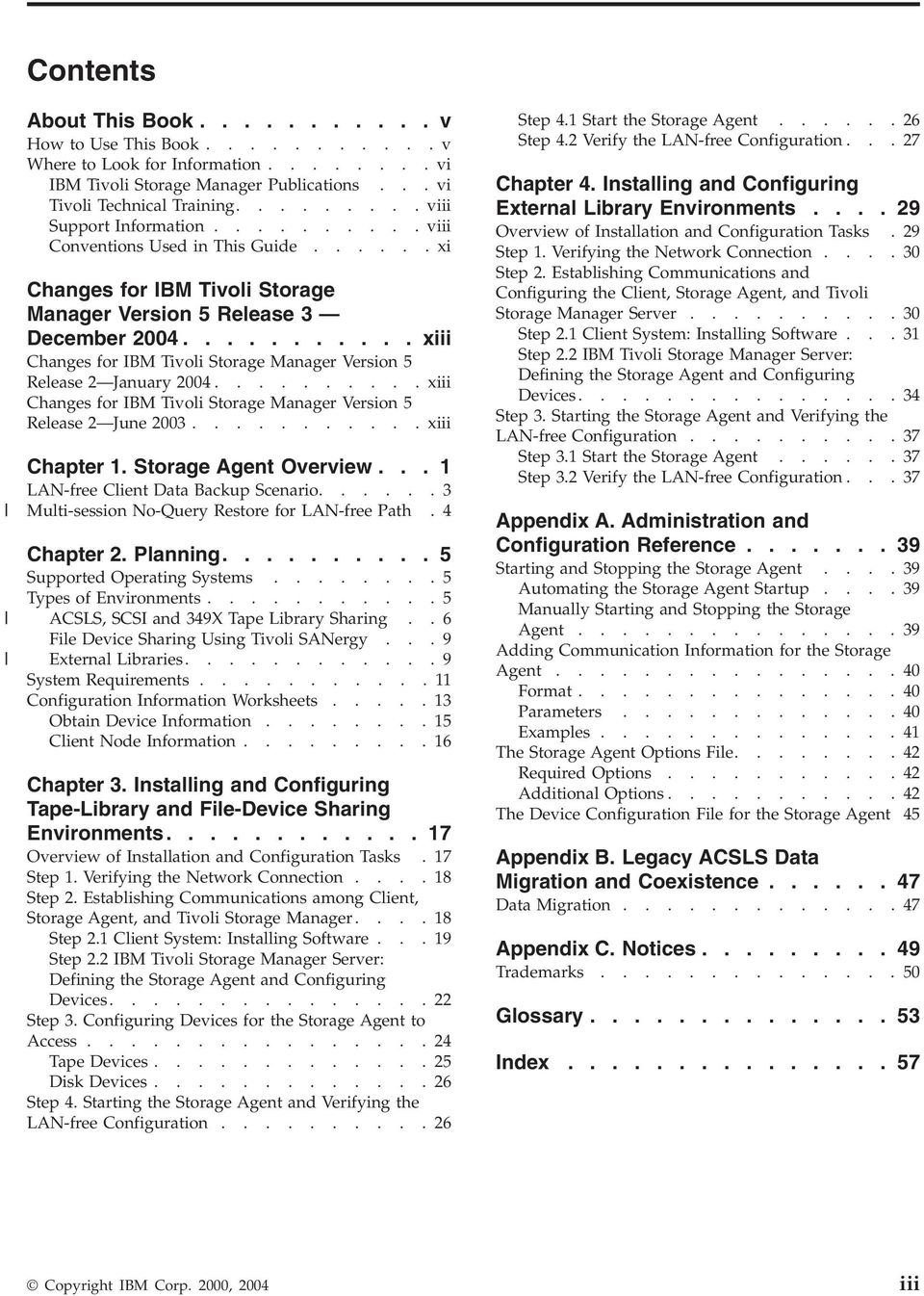
5 Contents About This Book v How to Use This Book v Where to Look for Information vi IBM Tivoli Storage Manager Publications...vi Tivoli Technical Training viii Support Information viii Conventions Used in This Guide......xi Changes for IBM Tivoli Storage Manager Version 5 Release 3 December xiii Changes for IBM Tivoli Storage Manager Version 5 Release 2 January xiii Changes for IBM Tivoli Storage Manager Version 5 Release 2 June xiii Chapter 1. Storage Agent Overview... 1 LAN-free Client Data Backup Scenario Multi-session No-Query Restore for LAN-free Path.4 Chapter 2. Planning Supported Operating Systems Types of Environments ACSLS, SCSI and 349X Tape Library Sharing..6 File Device Sharing Using Tivoli SANergy...9 External Libraries System Requirements Configuration Information Worksheets Obtain Device Information Client Node Information Chapter 3. Installing and Configuring Tape-Library and File-Device Sharing Environments Overview of Installation and Configuration Tasks.17 Step 1. Verifying the Network Connection Step 2. Establishing Communications among Client, Storage Agent, and Tivoli Storage Manager Step 2.1 Client System: Installing Software...19 Step 2.2 IBM Tivoli Storage Manager Server: Defining the Storage Agent and Configuring Devices Step 3. Configuring Devices for the Storage Agent to Access Tape Devices Disk Devices Step 4. Starting the Storage Agent and Verifying the LAN-free Configuration Step 4.1 Start the Storage Agent Step 4.2 Verify the LAN-free Configuration...27 Chapter 4. Installing and Configuring External Library Environments Overview of Installation and Configuration Tasks.29 Step 1. Verifying the Network Connection Step 2. Establishing Communications and Configuring the Client, Storage Agent, and Tivoli Storage Manager Server Step 2.1 Client System: Installing Software...31 Step 2.2 IBM Tivoli Storage Manager Server: Defining the Storage Agent and Configuring Devices Step 3. Starting the Storage Agent and Verifying the LAN-free Configuration Step 3.1 Start the Storage Agent Step 3.2 Verify the LAN-free Configuration...37 Appendix A. Administration and Configuration Reference Starting and Stopping the Storage Agent Automating the Storage Agent Startup Manually Starting and Stopping the Storage Agent Adding Communication Information for the Storage Agent Format Parameters Examples The Storage Agent Options File Required Options Additional Options The Device Configuration File for the Storage Agent 45 Appendix B. Legacy ACSLS Data Migration and Coexistence Data Migration Appendix C. Notices Trademarks Glossary Index Copyright IBM Corp. 2000, 2004 iii
6 iv IBM Tivoli Storage Manager for SAN for Sun Solaris: Storage Agent User s Guide

7 About This Book This guide is for administrators who install and use the storage agent component of the IBM Tivoli Storage Manager for Storage Area Networks product (referred to as storage agent throughout this publication). It provides: v An overview of LAN-free data transfer v Detailed explanations for installing, configuring, and using the IBM Tivoli Storage Manager (Tivoli Storage Manager) client and storage agent, and the Tivoli Storage Manager server You should be familiar with Tivoli Storage Manager, SAN, and Solaris operating system administration. If you need additional information while configuring the storage agent environment, refer to the list of Tivoli Storage Manager publications in Where to Look for Information on page vi. For information on the Internet about Tivoli Storage Manager, see support/ibmtivolistoragemanager.html. How to Use This Book If you have not installed and configured the storage agent before, the following steps serve as a guide for the information in this book: 1. Confirm the type of environment in which you will be installing and configuring the storage agent. There are three: v ACSLS, SCSI, and 349X Tape Library sharing v File device sharing using Tivoli SANergy v External library (ACSLS-managed) See Types of Environments on page 5 for complete descriptions of the types of environments. 2. Confirm that your configuration meets the system requirements. These requirements are listed in System Requirements on page Having confirmed the environment and the system requirements, it is recommended that you gather several pieces of client and server information that will speed the installation and configuration of the storage agent. Gather client and server information that will speed the installation and configuration of the storage agent. Use the two forms in Configuration Information Worksheets on page Finally, depending on the type of configuration you have, you will need to go to either of two chapters: v If you have a ACSLS, SCSI, or 349X Tape Library sharing or a file device sharing configuration, go to Chapter 3, Installing and Configuring Tape-Library and File-Device Sharing Environments, on page 17. v If you have an external library configuration, go to Chapter 4, Installing and Configuring External Library Environments, on page 29. Copyright IBM Corp. 2000, 2004 v
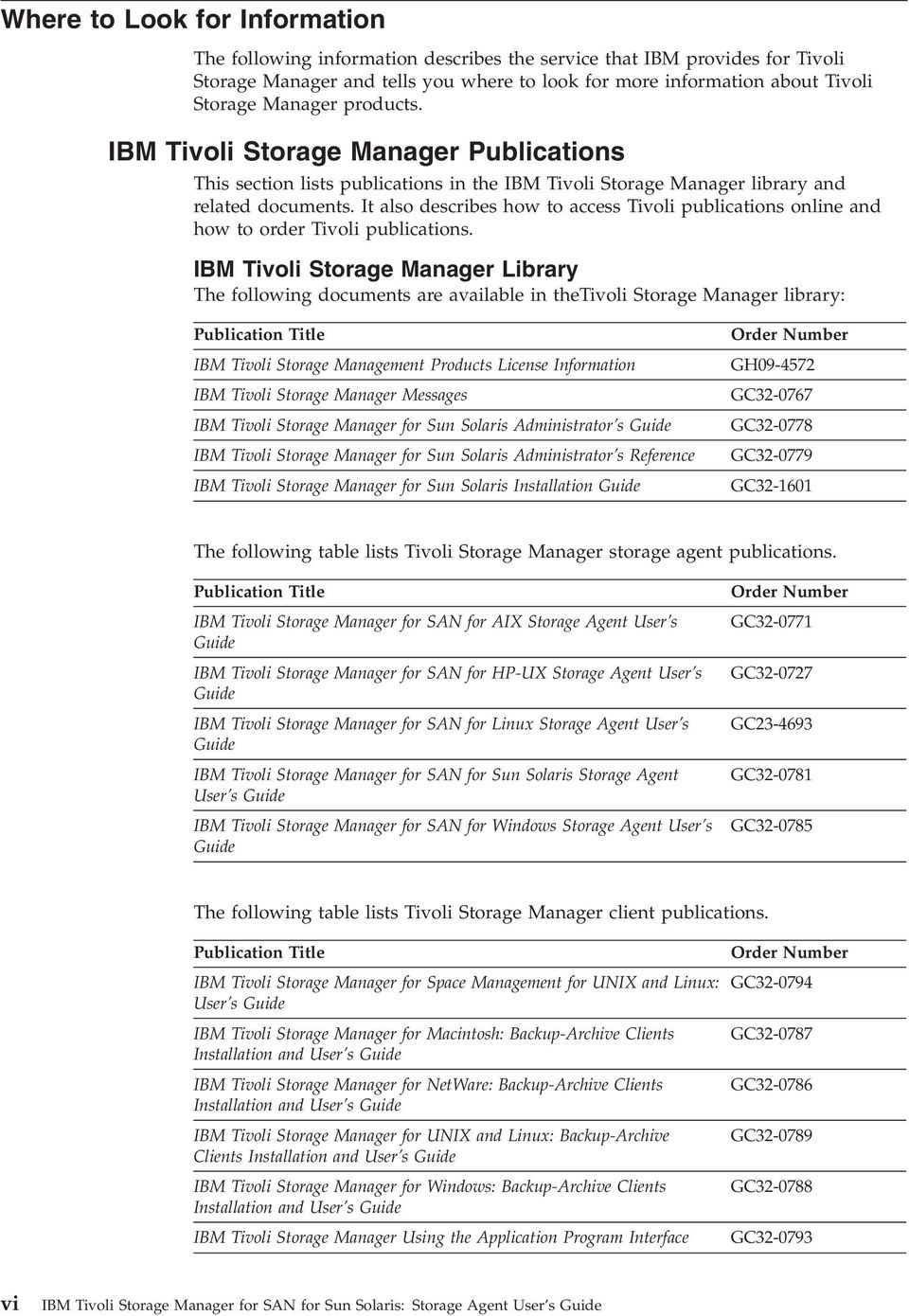
8 Where to Look for Information The following information describes the service that IBM provides for Tivoli Storage Manager and tells you where to look for more information about Tivoli Storage Manager products. IBM Tivoli Storage Manager Publications This section lists publications in the IBM Tivoli Storage Manager library and related documents. It also describes how to access Tivoli publications online and how to order Tivoli publications. IBM Tivoli Storage Manager Library The following documents are available in thetivoli Storage Manager library: Publication Title Order Number IBM Tivoli Storage Management Products License Information GH IBM Tivoli Storage Manager Messages GC IBM Tivoli Storage Manager for Sun Solaris Administrator s Guide GC IBM Tivoli Storage Manager for Sun Solaris Administrator s Reference GC IBM Tivoli Storage Manager for Sun Solaris Installation Guide GC The following table lists Tivoli Storage Manager storage agent publications. Publication Title Order Number IBM Tivoli Storage Manager for SAN for AIX Storage Agent User s Guide IBM Tivoli Storage Manager for SAN for HP-UX Storage Agent User s Guide IBM Tivoli Storage Manager for SAN for Linux Storage Agent User s Guide IBM Tivoli Storage Manager for SAN for Sun Solaris Storage Agent User s Guide IBM Tivoli Storage Manager for SAN for Windows Storage Agent User s Guide GC GC GC GC GC The following table lists Tivoli Storage Manager client publications. Publication Title Order Number IBM Tivoli Storage Manager for Space Management for UNIX and Linux: User s Guide IBM Tivoli Storage Manager for Macintosh: Backup-Archive Clients Installation and User s Guide IBM Tivoli Storage Manager for NetWare: Backup-Archive Clients Installation and User s Guide IBM Tivoli Storage Manager for UNIX and Linux: Backup-Archive Clients Installation and User s Guide IBM Tivoli Storage Manager for Windows: Backup-Archive Clients Installation and User s Guide GC GC GC GC GC IBM Tivoli Storage Manager Using the Application Program Interface GC vi IBM Tivoli Storage Manager for SAN for Sun Solaris: Storage Agent User s Guide
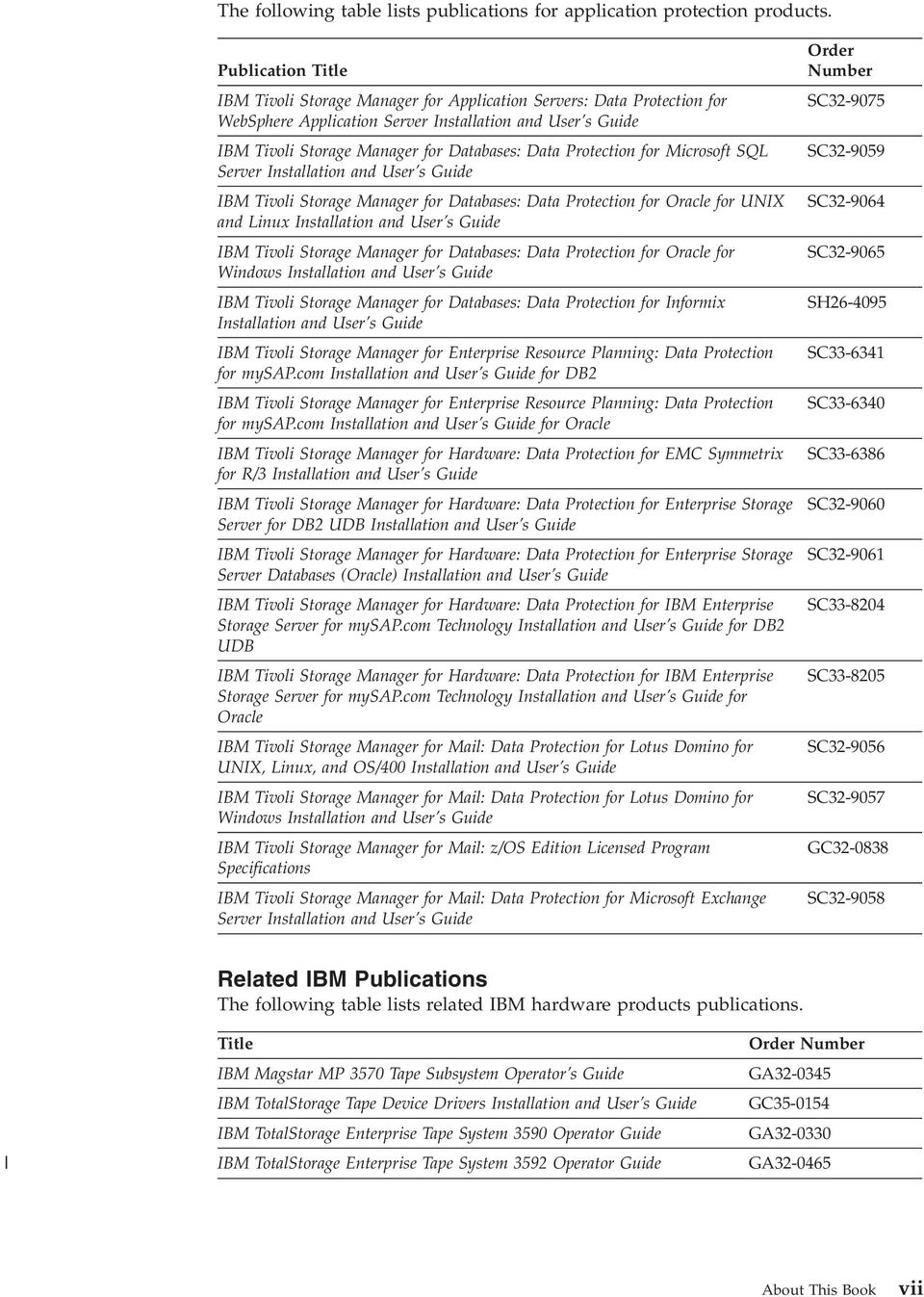
9 The following table lists publications for application protection products. Publication Title IBM Tivoli Storage Manager for Application Servers: Data Protection for WebSphere Application Server Installation and User s Guide IBM Tivoli Storage Manager for Databases: Data Protection for Microsoft SQL Server Installation and User s Guide IBM Tivoli Storage Manager for Databases: Data Protection for Oracle for UNIX and Linux Installation and User s Guide IBM Tivoli Storage Manager for Databases: Data Protection for Oracle for Windows Installation and User s Guide IBM Tivoli Storage Manager for Databases: Data Protection for Informix Installation and User s Guide IBM Tivoli Storage Manager for Enterprise Resource Planning: Data Protection for mysap.com Installation and User s Guide for DB2 IBM Tivoli Storage Manager for Enterprise Resource Planning: Data Protection for mysap.com Installation and User s Guide for Oracle IBM Tivoli Storage Manager for Hardware: Data Protection for EMC Symmetrix for R/3 Installation and User s Guide IBM Tivoli Storage Manager for Hardware: Data Protection for Enterprise Storage Server for DB2 UDB Installation and User s Guide IBM Tivoli Storage Manager for Hardware: Data Protection for Enterprise Storage Server Databases (Oracle) Installation and User s Guide IBM Tivoli Storage Manager for Hardware: Data Protection for IBM Enterprise Storage Server for mysap.com Technology Installation and User s Guide for DB2 UDB IBM Tivoli Storage Manager for Hardware: Data Protection for IBM Enterprise Storage Server for mysap.com Technology Installation and User s Guide for Oracle IBM Tivoli Storage Manager for Mail: Data Protection for Lotus Domino for UNIX, Linux, and OS/400 Installation and User s Guide IBM Tivoli Storage Manager for Mail: Data Protection for Lotus Domino for Windows Installation and User s Guide IBM Tivoli Storage Manager for Mail: z/os Edition Licensed Program Specifications IBM Tivoli Storage Manager for Mail: Data Protection for Microsoft Exchange Server Installation and User s Guide Order Number SC SC SC SC SH SC SC SC SC SC SC SC SC SC GC SC Related IBM Publications The following table lists related IBM hardware products publications. Title Order Number IBM Magstar MP 3570 Tape Subsystem Operator s Guide GA IBM TotalStorage Tape Device Drivers Installation and User s Guide GC IBM TotalStorage Enterprise Tape System 3590 Operator Guide GA IBM TotalStorage Enterprise Tape System 3592 Operator Guide GA About This Book vii
10 Accessing Publications Online The product CD contains the publications that are in the product library. The format of the publications is PDF, HTML, or both. To access the publications using a Web browser, open the infocenter.html file. The file is in the appropriate publications directory on the product CD. IBM posts publications for this and all other Tivoli products, as they become available and whenever they are updated, to the Tivoli software information center Web site. Access the Tivoli software information center by first going to the Tivoli software library at the following Web address: Scroll down and click the Product manuals link. In the Tivoli Technical Product Documents Alphabetical Listing window, click the <Tivoli Storage Manager> link to access the product library at the Tivoli software information center. Note: If you print PDF documents on other than letter-sized paper, set the option in the File Print window that allows Adobe Reader to print letter-sized pages on your local paper. Ordering Publications You can order many Tivoli publications online at the following Web site: applications/publications/cgibin/pbi.cgi You can also order by telephone by calling one of these numbers: v In the United States: v In Canada: In other countries, see the following Web site for a list of telephone numbers: Tivoli Technical Training For Tivoli technical training information, refer to the following IBM Tivoli Education Web site: Support Information This section describes the following options for obtaining support for IBM products: v Searching knowledge bases v Obtaining fixes on page ix v Contacting IBM Software Support on page ix Searching knowledge bases If you have a problem with your IBM software, begin by searching the available knowledge bases to determine whether the resolution to your problem is already documented. viii IBM Tivoli Storage Manager for SAN for Sun Solaris: Storage Agent User s Guide
11 Search the information center on your local system or network: IBM Tivoli Storage Manager provides an information center on a CD. You can run the information center from the CD, or copy it to your local computer or an intranet server. You can use the search function of this information center to query conceptual information, instructions for completing tasks, reference information, and support documents. Search the Internet: If you cannot find an answer to your question in the information center, search the Internet for the latest, most complete information that might help you resolve your problem. To search multiple Internet resources for your product, go to the support web site for the product support/ibmtivolistoragemanager.html and look for the section to search the support knowledge base. From this section, you can search a variety of resources including: v IBM technotes v IBM downloads v IBM Redbooks v Forums and newsgroups Obtaining fixes A product fix might be available to resolve your problem. You can determine what fixes are available for your IBM software product by checking the product support Web site: 1. Go to the IBM Software Support Web site ( 2. Under Products A - Z, select your product name. This opens a product-specific support site. 3. Under Self help, follow the link to All Updates, where you will find a list of fixes, fix packs, and other service updates for your product. For tips on refining your search, click Search tips. 4. Click the name of a fix to read the description and optionally download the fix. To receive weekly notifications about fixes and other news about IBM products, follow these steps: 1. From the support page for any IBM product, click My support in the upper-right corner of the page. 2. If you have already registered, skip to the next step. If you have not registered, click register in the upper-right corner of the support page to establish your user ID and password. 3. Sign in to My support. 4. On the My support page, click Edit profiles in the left navigation pane, and scroll to Select Mail Preferences. Select a product family and check the appropriate boxes for the type of information you want. 5. Click Submit. 6. For notification for other products, repeat Steps 4 and 5. For more information about types of fixes, see the Software Support Handbook ( Contacting IBM Software Support IBM Software Support provides assistance with product defects. About This Book ix
12 Before contacting IBM Software Support, your company must have an active IBM software maintenance contract, and you must be authorized to submit problems to IBM. The type of software maintenance contract that you need depends on the type of product you have: v For IBM distributed software products (including, but not limited to, Tivoli, Lotus, and Rational products, as well as DB2 and WebSphere products that run on Windows or UNIX operating systems), enroll in Passport Advantage in one of the following ways: Online: Go to the Passport Advantage Web page ( Passport_Advantage_Home) and click How to Enroll By phone: For the phone number to call in your country, go to the IBM Software Support Web site ( and click the name of your geographic region. v For IBM eserver software products (including, but not limited to, DB2 and WebSphere products that run in zseries, pseries, and iseries environments), you can purchase a software maintenance agreement by working directly with an IBM sales representative or an IBM Business Partner. For more information about support for eserver software products, go to the IBM Technical Support Advantage Web page ( If you are not sure what type of software maintenance contract you need, call IBMSERV ( ) in the United States or, from other countries, go to the contacts page of the IBM Software Support Handbook on the Web ( and click the name of your geographic region for phone numbers of people who provide support for your location. Follow the steps in this topic to contact IBM Software Support: 1. Determine the business impact of your problem. 2. Describe your problem and gather background information. 3. Submit your problem to IBM Software Support. Determine the business impact of your problem: When you report a problem to IBM, you are asked to supply a severity level. Therefore, you need to understand and assess the business impact of the problem you are reporting. Use the following criteria: Severity 1 Critical business impact: You are unable to use the program, resulting in a critical impact on operations. This condition requires an immediate solution. Severity 2 Significant business impact: The program is usable but is severely limited. Severity 3 Some business impact: The program is usable with less significant features (not critical to operations) unavailable. Severity 4 Minimal business impact: The problem causes little impact on operations, or a reasonable circumvention to the problem has been implemented. Describe your problem and gather background information: When explaining a problem to IBM, be as specific as possible. Include all relevant background x IBM Tivoli Storage Manager for SAN for Sun Solaris: Storage Agent User s Guide
13 information so that IBM Software Support specialists can help you solve the problem efficiently. To save time, know the answers to these questions: v What software versions were you running when the problem occurred? v Do you have logs, traces, and messages that are related to the problem symptoms? IBM Software Support is likely to ask for this information. v Can the problem be re-created? If so, what steps led to the failure? v Have any changes been made to the system? (For example, hardware, operating system, networking software, and so on.) v Are you currently using a workaround for this problem? If so, please be prepared to explain it when you report the problem. Submit your problem to IBM Software Support: You can submit your problem in one of two ways: v Online: Go to the Submit and track problems page on the IBM Software Support site ( Enter your information into the appropriate problem submission tool. v By phone: For the phone number to call in your country, go to the contacts page of the IBM Software Support Handbook on the Web (techsupport.services.ibm.com/guides/contacts.html) and click the name of your geographic region. If the problem you submit is for a software defect or for missing or inaccurate documentation, IBM Software Support creates an Authorized Program Analysis Report (APAR). The APAR describes the problem in detail. Whenever possible, IBM Software Support provides a workaround for you to implement until the APAR is resolved and a fix is delivered. IBM publishes resolved APARs on the IBM product support Web pages daily, so that other users who experience the same problem can benefit from the same resolutions. For more information about problem resolution, see Searching knowledge bases and Obtaining fixes. Conventions Used in This Guide Typeface Conventions This guide uses the following typeface conventions: Bold Italic v Lowercase commands and mixed case commands that are otherwise difficult to distinguish from surrounding text v Interface controls (check boxes, push buttons, radio buttons, spin buttons, fields, folders, icons, list boxes, items inside list boxes, multicolumn lists, containers, menu choices, menu names, tabs, property sheets), labels (such as Tip:, and Operating system considerations:) v Keywords and parameters in text v Words defined in text v Emphasis of words (words as words) v New terms in text (except in a definition list) v Variables and values you must provide Monospace v Examples and code examples About This Book xi
14 v File names, programming keywords, and other elements that are difficult to distinguish from surrounding text v Message text and prompts addressed to the user v Text that the user must type v Values for arguments or command options Operating System-dependent Variables and Paths v Command to be entered on the Sun Solaris command line: > dsmadmc v Command to be entered on the command line of an administrative client: query devclass xii IBM Tivoli Storage Manager for SAN for Sun Solaris: Storage Agent User s Guide

15 Changes for IBM Tivoli Storage Manager Version 5 Release 3 December 2004 This section summarizes changes that have been made to the Tivoli Storage Manager product and this publication. General Updates Updates based on the input of users have been made throughout the book. Automated Cartridge System Library Software (ACSLS) Enhancements ACSLS library sharing is available. See ACSLS, SCSI and 349X Tape Library Sharing on page 6 for more information. Multiple file system support for FILE device types IBM Tivoli Storage Manager server improvements to sequential-access FILE device type and random-access DISK device class storage requires that the storage agent be able to access newly created FILE volumes. See Disk Devices on page 26 for information. Changes for IBM Tivoli Storage Manager Version 5 Release 2 January 2004 The following changes have been made to the product for this edition: General Updates Updates based on the input of users have been made throughout the book. A new section for automating the storage agent startup has also been added. See Automating the Storage Agent Startup on page 39 for more information. Changes for IBM Tivoli Storage Manager Version 5 Release 2 June 2003 The following changes have been made to the product for this edition: LAN-free for z/os Tivoli Storage Manager now supports LAN-free data movement in storage area network (SAN) environments on the z/os and OS/390 operating systems. The z/os or OS/390 server acts as the data manager for a client that uses a storage agent See Chapter 2, Planning, on page 5 for an overview of this function. For full details, refer to the IBM Tivoli Storage Manager for z/os Administrator s Guide and IBM Tivoli Storage Manager for z/os Administrator s Reference. Product Packaging and Name Changes Product packaging and names for Tivoli Storage Manager have been updated. See for complete details. Configuration Information Worksheets Client and server configuration information worksheets have been added to the Planning chapter to aid the user in more quickly installing and configuring the storage agent. See Configuration Information Worksheets on page 13 for details. Copyright IBM Corp. 2000, 2004 xiii

16 xiv IBM Tivoli Storage Manager for SAN for Sun Solaris: Storage Agent User s Guide

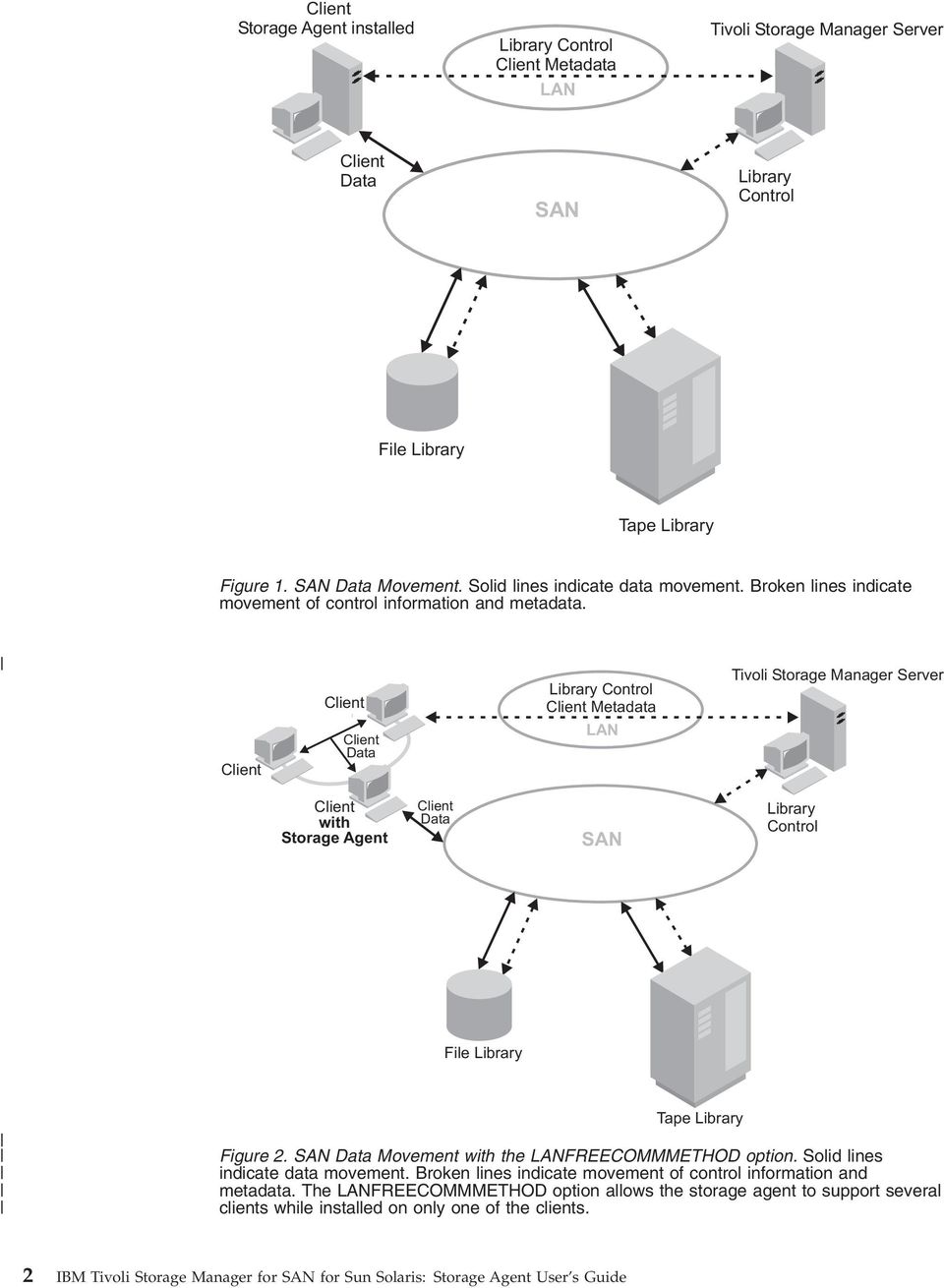
17 Chapter 1. Storage Agent Overview IBM Tivoli Storage Manager for Storage Area Networks is a feature of Tivoli Storage Manager that enables LAN-free client data movement. This feature allows the client system to directly write data to, or read data from, storage devices attached to a storage area network (SAN), instead of passing or receiving the information over the network. Data movement is thereby off-loaded from the LAN and from the Tivoli Storage Manager server, making network bandwidth available for other uses. For instance, using the SAN for client data movement decreases the load on the Tivoli Storage Manager server and allows it to support a greater number of concurrent client connections. See Figure 1 on page 2. The storage agent, a component of the feature, makes LAN-free data movement possible. The storage agent can support several clients while installed on only one of the clients. You can install the storage agent on a client machine that shares storage resources with the Tivoli Storage Manager server (Figure 1) or on a client machine that does not share storage resources but is connected to a client machine that does share storage resources with the Tivoli Storage Manager server. Figure 2 shows multiple clients connected to a client machine that contains the storage agent. You must specify the LANFREECOMMMETHOD option in the client system options file (dsm.sys) to allow the client machine (that shares storage resources) to communicate with the storage agent. A Tivoli Storage Manager server, acting as a library manager, controls the storage devices. This server may be the server working in conjunction with the storage agent or another Tivoli Storage Manager server in the enterprise. The Tivoli Storage Manager server keeps track of the metadata that the client has stored. The metadata, such as policy information and file name and size, is passed over the LAN connection between the storage agent and server. Copyright IBM Corp. 2000,

18 Client Storage Agent installed Library Control Client Metadata LAN Tivoli Storage Manager Server Client Data SAN Library Control File Library Tape Library Figure 1. SAN Data Movement. Solid lines indicate data movement. Broken lines indicate movement of control information and metadata. Client Library Control Client Metadata Tivoli Storage Manager Server Client Client Data LAN Client with Storage Agent Client Data SAN Library Control File Library Tape Library Figure 2. SAN Data Movement with the LANFREECOMMMETHOD option. Solid lines indicate data movement. Broken lines indicate movement of control information and metadata. The LANFREECOMMMETHOD option allows the storage agent to support several clients while installed on only one of the clients. 2 IBM Tivoli Storage Manager for SAN for Sun Solaris: Storage Agent User s Guide
19 The storage agent communicates with the server to obtain and store database information and to coordinate device and volume access. The server and client coordinate and negotiate data access through the SAN. The client will use the storage agent for operations where appropriate. For example, if a SAN path is defined, the client (by means of the storage agent) transfers data on that path. If a failure occurs on the SAN path, failover occurs and the client uses its LAN connection to the Tivoli Storage Manager server and moves the client data over the LAN. There are cases when the storage agent can send the data directly to the server using the LAN control paths between the storage agent and the server. An example of this would be a LAN-free storage pool that is updated to read-only after the client connects to the server and obtains its initial policy information. The storage agent, instead of failing the operation, will send the data to the server, and, providing that the storage hierarchy is configured so that the next storage pool destination is available, the server will handle the operation. You can also prevent data from transferring over the LAN by specifying the Tivoli Storage Manager server parameters DATAREADPATH and DATAWRITEPATH with the REGISTER NODE or UPDATE NODE commands for the desired node. These settings can be reviewed by issuing the following command on the server for this node: query node node_name format=detailed Tivoli Storage Manager supports SAN-attached device sharing in one of the following ways: v Tivoli Storage Manager native library management support consisting of a library manager and library clients or just a library manager. See ACSLS, SCSI and 349X Tape Library Sharing on page 6 for details regarding libraries. v Shared disk storage using a FILE library and the integration of the Tivoli SANergy product. v External libraries as defined in the Administrator s Guide in the appendix, External Media Management Interface Description. For additional information about these configurations, see Types of Environments on page 5. LAN-free Client Data Backup Scenario The following outlines a typical backup scenario for a Tivoli Storage Manager client that uses SAN data movement: 1. The client begins a backup operation. The server reports policy information to the client, including whether a destination is LAN-free. As the client assigns policy settings for files during backup processing, it sends the data LAN-free when the destination for that policy is LAN-free enabled. A storage pool is a LAN-free destination when the storage pool uses a device shared on a SAN. That device must also have a defined path between the device and the storage agent. 2. The storage agent receives data for those files backed up by the client and assigned to policy settings that use a LAN-free enabled storage pool. The storage agent sends a request for a volume mount to the library manager server. In the external library case, the storage agent contacts the external library manager, using the provided path to the executable. 3. A request is made to the storage device to mount the appropriate media. Chapter 1. Storage Agent Overview 3
20 4. The library manager notifies the storage agent of the location where the mounted media resides. In the external library case, the storage agent is informed of the device location by the external library manager. 5. The client, by means of the storage agent, writes the backup data directly to the device over the SAN. 6. The storage agent sends metadata information to the Tivoli Storage Manager server, and the server stores the information in its database. Multi-session No-Query Restore for LAN-free Path When performing a no-query restore, the Tivoli Storage Manager server builds a list of files to restore and sends data to the client while continuing to build the list. This allows the restore to be restarted if interrupted. Multiple sessions are used for the no-query restore when data for the restore resides on devices with a LAN-free path and devices with a LAN-only path. Some sessions restore data from the server with a LAN-only path. The other sessions use the storage agent to restore data over the LAN-free path. This works only with clients at Version 4.2 or above. Note that the number of sessions used for the restore is dependent on the value of the client RESOURCEUTILIZATION option and the number of server volumes that contain the client data to be restored. The following outlines a typical multi-session no-query restore for a LAN-free path: 1. The client requests a file space to be restored. This request is forwarded to the server. 2. The server determines the files to restore and the volume on which those files reside. The server generates a list, sorted by the volume name. 3. The client is informed of the progress and the number of volumes. The client can start more sessions to restore the information. 4. The location of the volume, and whether or not the storage agent can access the volume, will determine how the data is handled. When the volume can be mounted on a shared device that the storage agent can access, the data is read from the volume by the storage agent and sent to the client. When the volume cannot be mounted on a shared device that the storage agent can access, the data is read from the volume by the server and sent directly to the client. The client then begins additional sessions: some to the storage agent for the volumes that are LAN-free enabled and some sessions to the server for those volumes that are not LAN-free enabled. 5. The process repeats until all files in the list are restored. 4 IBM Tivoli Storage Manager for SAN for Sun Solaris: Storage Agent User s Guide

21 Chapter 2. Planning You can set up IBM Tivoli Storage Manager for Storage Area Networks in a number of environments. Planning the system configuration provides a smooth transition through system setup and into production. As part of your planning, you need to identify the following: v Which environment to implement. v Devices to be used for LAN-free data movement. v The clients that will use LAN-free data movement. v The server that will manage particular clients data. v The library used for the LAN-free enabled device. If the library is a Tivoli Storage Manager shared library, you must identify the Tivoli Storage Manager server that is the library manager. If the library is an externally managed library using StorageTek ACSLS, you must identify the control point. Supported Operating Systems In addition to setting up the storage agent on Sun, you can set it up on the following operating systems: v AIX v Linux v HP-UX v Windows The storage agents on the operating systems listed above can work in conjunction with a Tivoli Storage Manager server on any of the platforms listed. In addition to the platforms listed, the storage agent can also work in conjunction with a Tivoli Storage Manager server on z/os. However, you must install and configure another server to function as the library manager or implement external library support through an external library manager (for example, Gresham s EDT-DistribuTAPE). You can install this library-manager server on any of the platforms listed. Full details on using the storage agent with z/os and OS/390 are given in the IBM Tivoli Storage Manager for z/os Administrator s Guide and the IBM Tivoli Storage Manager for z/os Administrator s Reference. Types of Environments There are different types of configurations that take advantage of what can be accomplished using a storage agent in a LAN-free environment. Your environment is dependent upon the type of storage device you will be using for LAN-free data storage. The following sections cover descriptions and planning considerations for several typical LAN-free environments. These environments are: v A shared ACSLS, SCSI, and 349X Tape Library v A shared file device using SANergy v An External Library as defined in the Administrator s Guide in the appendix, External Media Management Interface Description. Copyright IBM Corp. 2000,
22 ACSLS, SCSI and 349X Tape Library Sharing When Tivoli Storage Manager servers share an ACSLS, SCSI tape, or 349X storage device using a library manager and library clients, one server, the library manager, owns and controls the tape library device. The library manager operations include checking volumes into and out of the library, labeling volumes, mounting and dismounting volumes, auditing volumes, and tracking an inventory of library contents. The storage agents, along with other Tivoli Storage Manager servers that share this library, are considered library clients. As a library client, the storage agent is able to store data and request drives, tapes, and volumes. When the Tivoli Storage Manager server (data manager server) is also the library manager for the devices where data is stored by the storage agent, then the storage agent communicates requests to this Tivoli Storage Manager server. When the Tivoli Storage Manager server (data manager server) is another library client, then the storage agent communicates requests for itself or the metadata server directly to the library manager. Note that when using a shared ACSLS library, the library manager must be a Tivoli Storage Manager server on AIX, Solaris, or Windows. A library client requests shared library resources, such as drives or media, from the library manager, but uses the resources independently. The library manager coordinates the access to these resources. Data moves over the SAN between the storage device and either the library manager or the library client. Either the library manager or any library client can manage the LAN-free movement of client data as long as the client system includes a storage agent. In this library-sharing environment, the most important relationship is the one between the server and the storage agent. The server, working in conjunction with the storage agent, manages the storage hierarchy. The server could be a library client or library manager, and it is responsible for: v Migrations v Expiration of files based on policy information v Reclamation of free space on volumes and consolidation of the volumes v Disaster recovery The storage agent contributes information to the storage hierarchy through various operations, but this role is independent of the library sharing role. The library manager and library client configurations are represented in Figure 3 on page 7 and Figure 4 on page 8. 6 IBM Tivoli Storage Manager for SAN for Sun Solaris: Storage Agent User s Guide
23 Tivoli Storage Manager Clients with Storage Agents Tivoli Storage Manager Server Library Manager LAN Tivoli Storage Manager Server Library Client SAN Tape Library Figure 3. Library Manager and Client LAN-free Configuration Notes: 1. An environment can have a library manager without a library client. 2. In an environment where ACSLS library support is required, the library client can reside on a Tivoli Storage Manager server on AIX, Linux, HP-UX, Solaris, Windows, or z/os. The library manager must reside on a Tivoli Storage Manager server on AIX, Solaris, or Windows. The configurations in Figure 3 are the following: v A Tivoli Storage Manager server library manager manages a client s data, which is stored on a tape library. v A Tivoli Storage Manager server library client manages a client s data, which is stored on a tape library. Chapter 2. Planning 7
24 Client Storage Agent installed (Library Client) Client Metadata LAN Library Manager Server Library Control LAN Data Manager Server z/os Client Data Library Control SAN ESCON/Ficon Shared Tape Library (IBM 3494 or Storage Tek Tape Library) Figure 4. Library Manager and Client LAN-free Configuration on z/os The following are requirements for the library manager server: v If your environment consists of native ACSLS support with a StorageTek tape library, the library manager server can be a Tivoli Storage Manager server residing on an AIX, Solaris, or Windows operating system. v If your environment consists of an IBM 3494 tape library, the library manager server can be a Tivoli Storage Manager server residing on an AIX, HP-UX, Linux, Solaris, or Windows operating system. v Both environments can support the storage agent (library client) on an AIX, HP-UX, Linux, Solaris, or Windows operating system. Note: When using a server running on a z/os system with shared library support and a 3494 automated tape library, you must configure a Tivoli Storage Manager server on AIX, Linux, HP-UX, Solaris, or Windows as a library manager to control storage agent mount requests. When using a StorageTek library controlled by StorageTek LibraryStation software, you must configure an AIX, Solaris, or Windows server as a library manager with ACSLS support to control storage agent mount requests. 8 IBM Tivoli Storage Manager for SAN for Sun Solaris: Storage Agent User s Guide
25 File Device Sharing Using Tivoli SANergy When Tivoli Storage Manager servers share access to disk storage, the environment contains a shared file device class (Tivoli Storage Manager server FILE device class) and utilizes the SANergy product. SANergy provides a file sharing accelerator. Because you will be using a FILE library, you must determine where the Tivoli SANergy client and the Tivoli SANergy Metadata Controller (MDC) will be installed. You will also require a Windows share (CIFS) or a Network File Share (NFS) on a UNIX system to achieve file sharing. Note that the Tivoli SANergy license (included with the storage agent media) is provided with Tivoli Storage Manager only for supporting LAN-free backup to disk. See Figure 5 for the possible Tivoli SANergy configurations. (Refer to the SANergy publications for additional information about configuring SANergy.) 1 Tivoli Storage Manager Client with Storage Agent 3 Another Node LAN 2 Tivoli Storage Manager Server SAN FILE Library Figure 5. Tivoli SANergy Configurations One possible configuration is for the Tivoli SANergy client to be installed on the Tivoli Storage Manager client machine ( 1 ) and the Tivoli SANergy MDC to be installed on the Tivoli Storage Manager server ( 2 ). These configurations can also consist of multiple platforms. For example, an environment can consist of a Sun MDC working with Windows and AIX clients. External Libraries If Tivoli Storage Manager native library support (as described in ACSLS, SCSI and 349X Tape Library Sharing on page 6) cannot be used, the alternative is to configure external library support. This section illustrates how to use Gresham EDT-Distributape as an external library manager via StorageTek ACSLS. External library support is an alternative library resource when the environment is unable to satisfy library resource sharing requirements with Tivoli Storage Manager library sharing support for SCSI, 3494, and ACSLS (Library Station) Chapter 2. Planning 9
26 managed libraries. A typical external library configuration includes using an external library manager such as Gresham EDT-Distributape. See Figure 6. The ACSLS Server or the LibraryStation on z/os manages the physical aspects of tape cartridge storage and retrieval. The external library manager, for instance, Gresham EDT, communicates with the ACSLS Server or the LibraryStation on z/os to access tape cartridges in an automated StorageTek library. The storage agent installed on a machine containing Gresham EDT and a Tivoli Storage Manager backup-archive client or a Tivoli Storage Manager data protection application client provides access to SAN-attached storage devices resulting in LAN-free data movement. The continued connection to the LAN provides a metadata (control information) path. If the storage agent is not available, the LAN provides a failover path for data backup and recovery. LibraryStation on z/os LAN or Data Owner ACSLS Server Tivoli Storage Manager Client Storage Agent Library Client Tivoli Storage Manager Server Library Manager Changer Control 3270 LAN-free Data Movement SAN Changer Control Changer Control TCP/IP Communication Fibre Channel 3270 Communications-Library Control Commands Tape Drives Figure 6. ACSLS Library Environment For detailed installation, configuration, and system administration of ACSLS, refer to the appropriate StorageTek documentation. For detailed installation, Storage Tek Tape Library 10 IBM Tivoli Storage Manager for SAN for Sun Solaris: Storage Agent User s Guide
27 configuration, data migration, and system administration of Gresham EDT-DistribuTAPE, refer to the Gresham EDT User s Manual. Data Migration and Coexistence If you currently have data associated with the Tivoli Storage Manager ACSLS library type and want to take advantage of LAN-free, you will need to consider coexistence and migration issues. See Appendix B, Legacy ACSLS Data Migration and Coexistence, on page 47. If you currently have data stored from using external library support for ACSLS library access and plan to migrate to a native Tivoli Storage Manager library sharing support environment, see the Configuring Storage Devices chapter in the Administrator s Guide for detailed information. System Requirements To use LAN-free data movement, configure the following components at the latest available software levels. See support/ibmtivolistoragemanager.html. v Your SAN configuration must meet the applicable hardware and software requirements (see support/ibmtivolistoragemanager.html). v TCP/IP is required for communication among the Tivoli Storage Manager server, the client, and the storage agent. v An IBM Tivoli Storage Manager server that has a license for LAN-free operations (Version 5.3 or later). To ensure compatibility between the server and the storage agent, check the Tivoli Web site at support/ibmtivolistoragemanager.html for maintenance level requirements and download the latest Fix Pack Level. The Tivoli Storage Manager servers for the z/os, OS/390, AIX, HP-UX, Linux, Sun Solaris, and Windows operating systems support LAN-free data movement. Note that the Tivoli Storage Manager server supports storage agents at the same version, release, and modification level, plus up to two modification levels earlier. For example, if a future version of Tivoli Storage Manager Version server were released, it would support storage agents at the Version 5.3.3, Version 5.3.2, and Version levels. Note that this Tivoli Storage Manager Version server example is an example only and is neither a promise nor guarantee that such a version will be released. This compatibility is subject to change at IBM s discretion. Review the readme for a given server level for the latest information related to compatibility. Tivoli Storage Manager Version servers will also support Version and Version storage agents. v A Tivoli Storage Manager client or a Tivoli Storage Manager data protection application client. Client software must be installed on a client system (check support/ibmtivolistoragemanager.html for the clients that are currently supporting LAN-free data movement). File library sharing support requires that the storage agent be at the 5.3 level. v When using the Tivoli Storage Manager application programming interface (API) or the application client, the API software must be at version 5.2 or higher. You can obtain the API by downloading the latest version of the backup-archive client for Sun from the Web site at support/ibmtivolistoragemanager.html. Chapter 2. Planning 11
28 v If you are sharing disk storage, Tivoli SANergy must be installed. Tivoli SANergy Version is included with the storage agent media. Note that the use of the Tivoli SANergy components included with the IBM Tivoli Storage Manager for Storage Area Networks product is limited to use to enable LAN-free backup and restore to disk in conjunction with your licensed use of the IBM Tivoli Storage Manager for Storage Area Networks product. Note: If you are sharing only tape devices, Tivoli SANergy is not required. v If you are using external library support in conjunction with the Gresham product, Gresham EDT DistribuTAPE (or later) must be installed. For additional information and product download, see 12 IBM Tivoli Storage Manager for SAN for Sun Solaris: Storage Agent User s Guide
29 Configuration Information Worksheets Use the following worksheets to record information about your client and server systems that you will need when you install and configure the storage agent. Table 1. Client System Configuration Information Storage agent properties Definitions for the terms in the worksheets are given in the worksheets. Client System Enter information about the storage agent that you will need when you define the storage agent as a server to the Tivoli Storage Manager server. Name: Enter the name for the storage agent. For example, enter storagnt. Password: Enter the password for the storage agent. For example, enter fun4me. TCP/IP address: Enter the TCP/IP address of the storage agent. For example, enter agent.tucson.ibm.com. TCP/IP port: Enter the TCP/IP port of the client system. Client options LAN-free communications method (lanfreecommmethod client option): Circle the communications method you choose for the LAN-free data movement function. TCP/IP SharedMemory LAN-free port (lanfreetcpport client option): Enter the TCP/IP port used for the LAN-free data movement function. Device information External library Executable location: Enter the fully qualified path to the external library manager executable for each storage agent to which Tivoli Storage Manager can send media access requests. Library name: Enter a name of your choosing that is less than or equal to 32 characters. ACSLS, 3494, or SCSI drive device names Enter the names of the tape drives for which you will define paths. See Obtain Device Information on page 15 for information on how to obtain the drive names. Drive 1 Drive 2 Drive 3 Drive 4 Shared disk Local path name: Enter the name of the local path to the network-mounted file system. For example, enter /shareddisk. Chapter 2. Planning 13
30 Table 2. Server System Configuration Information Server properties Server System Enter information about the Tivoli Storage Manager server that the storage agent will need to communicate with the server. You can verify the server information by issuing the QUERY STATUS command from a Tivoli Storage Manager administrative command line. Name: Enter the name of the server. For example, enter tsmsrver. Password: Enter the password for the server. For example, enter not4u. TCP/IP address: Enter the TCP/IP address for the server. For example, enter tsmsrver.tucson.ibm.com. TCP/IP port: Enter the TCP/IP port for the server. For example, enter Device information External library Executable location: Enter the fully qualified path to the external library manager executable for each storage agent to which Tivoli Storage Manager can send media access requests. Library name: Enter a name of your choosing that is less than or equal to 32 characters. ACSLS, 3494, or SCSI library information Library name: Enter the name of an ACSLS, 3494, or SCSI library. Library device name: Enter the device name for an ACSLS, 3494, or SCSI library, which you will use when you define the path. ACSLS, 3494, or SCSI drive device names Enter the names of the tape drives for which you will define paths. See Obtain Device Information on page 15 for information on how to obtain the drive names. Drive 1 Drive 2 Drive 3 Drive 4 Shared disk Local path name: Enter the name of the local path to the network-mounted file system. For example, enter /shareddisk. Client node names Record the names of the client nodes on which you will install and configure the storage agent. This information will be needed when you register the nodes, set the policy for them, and place any needed restrictions on them. See Client Node Information on page 16 for further details. 14 IBM Tivoli Storage Manager for SAN for Sun Solaris: Storage Agent User s Guide
31 Obtain Device Information Note: If you are configuring a FILE Library, you do not need to obtain device information. Proceed to Step 3. Configuring Devices for the Storage Agent to Access on page 24. On the system where the storage agent is installed, obtain device (tape and disk) information. You will use the device information from the storage agent when defining paths for the server that functions as the library manager in Step 3. Configuring Devices for the Storage Agent to Access on page 24. In the z/os environment, you would use the information for a Sun server because the z/os servers cannot function as library managers. Obtaining tape device information in a Sun environment is different depending on whether your environment supports IBM devices or non-ibm devices as follows: IBM Tape Devices After installing device drivers for your IBM tape drives, a set of special file names available for each device. To see the special file names, use the command ls /dev/rmt/*st The name typically has the form: /dev/rmt/xst where x is a number. Non-IBM Tape Devices To use the Tivoli Storage Manager device drivers, you must do the following: 1. Verify that the device is connected to your system, and is powered on and active 2. Ensure the Tivoli Storage Manager device driver package (TIVsmSdev) is installed. 3. Edit the /usr/kernel/drv/mt.conf file. Add one stanza (as shown in the example at the top of the file) for each SCSI target ID and LUN combination you want the device driver to probe for supported tape drives. 4. Configure the drives by entering the following command: > /usr/sbin/add_drv -m * 0666 bin bin /usr/kernel/drv/mt 5. Determine the special file names for the tape drives. The device special files for the tape drives appear in the /dev/rmt directory. Their names have the form /dev/rmt/xmt, where x is a number. To determine the relationship between a physical device and the special file that was created for it, issue the following command: > ls /dev/rmt/*mt The name typically has the form: /dev/rmt/xmt Chapter 2. Planning 15
32 where x is a number. Client Node Information Because you will need to take into account node registration and policy information, determine the client nodes that will be using the storage agent. In a typical environment, however, a storage agent is only used by a single node: the client node residing on the same system as the storage agent. Consider these recommendations when determining which client nodes will use the storage agent: v You will need to verify that those nodes are registered. If they are not, you will need to register them. v You will also need to verify the policy information for those nodes. The copy group for backup and archive must point to a storage pool that has a LAN-free path for a particular storage agent. LAN-free paths exist when drive paths are defined and available for the storage pool. The procedure in the installation and configuration chapter will create such a path, thus allowing LAN-free data transfer for the node. You can issue the VALIDATE LANFREE command on the server to view the destinations that are capable of LAN-free data movement. Detailed information about this command is available in the Administrator s Reference. v After you have verified the registration and policy information for the nodes, you can place restrictions on when a node can use the LAN-free path. The node attributes DATAREADPATH and DATAWRITEPATH determine the restriction placed on the node. You can restrict a node to use only the LAN-free path on backup and archive (DATAWRITEPATH), and the LAN path on restore and retrieve (DATAREADPATH). Note that such a restriction can fail a backup or archive operation if the LAN-free path is unavailable. Consult the Administrator s Reference for more information regarding these attributes. v You can configure more than one client to use the same storage agent: If the clients reside on the same system as the storage agent, set the appropriate options and values in the client dsm.sys file. If the clients do not reside on the same system as the storage agent, set the following options with the appropriate values: - LANFREECOMMMETHOD TCPIP - LANFREETCPSERVERADDRESS Specify the TCP/IP address for the machine where the storage agent is installed. - LANFREETCPPORT Specify the same TCP/IP port address as specified by the TCPPORT option in the storage agent options file, dsmsta.opt. 16 IBM Tivoli Storage Manager for SAN for Sun Solaris: Storage Agent User s Guide
33 Chapter 3. Installing and Configuring Tape-Library and File-Device Sharing Environments This chapter describes installing and configuring the storage agent LAN-free function in environments that are using one or more of the following: v A shared ACSLS, SCSI, or 349X tape library. The storage agent can connect to either the library manager or a library client. v Shared file devices using SANergy. For high-level descriptions of these environments, see Chapter 1, Storage Agent Overview, on page 1 and Types of Environments on page 5. Before installing and configuring the storage agent, make sure you read Chapter 2, Planning, on page 5 and fill out the information forms in Configuration Information Worksheets on page 13. To install and configure the storage agent for LAN-free data movement: 1. Read the overview of the procedure. Make sure you understand the overall process before beginning the procedure because the process takes place on multiple machines at different times. 2. Review the complete procedure which follows the summary. 3. Complete the steps described in the procedure. You can use the Enable LAN-free Data Movement wizard in the Administration Center interface to set up LAN-free data movement on the server. If you use the wizard, you only need to perform the following steps in this procedure: v Install or Upgrade the Client and API Software on page 19: Step 1 through Step 5 v Install and Configure the Storage Agent on page 20: Step 7 and Step 8 v Step 4. Starting the Storage Agent and Verifying the LAN-free Configuration on page 26: All steps If you have not used the Enterprise Management LAN-free Wizard to set up LAN-free data movement on the Tivoli Storage Manager server, perform all steps in this procedure. Overview of Installation and Configuration Tasks The following overview outlines the installation and configuration tasks provided in this chapter: v Step 1: Verifying network configuration Note: Ensure that your system meets the prerequisites for the SAN configuration. v Step 2: Establishing communications among client, storage agent, and Tivoli Storage Manager server Client System: Installing Software - Install the Tivoli Storage Manager client or Tivoli Storage Manager data protection application client, and the Tivoli Storage Manager API. Specify the LAN-free option. - Install and set up the storage agent. Copyright IBM Corp. 2000,
34 IBM Tivoli Storage Manager Server: Defining the storage agent and configuring devices - If your environment is using tape devices, configure the library and drives on the SAN. - If your environment is using disk devices, configure Enterprise Management and define the FILE device class. See Step 2.2 IBM Tivoli Storage Manager Server: Defining the Storage Agent and Configuring Devices on page 22 for instructions on configuring Enterprise management. v Step 3: Configuring devices for the storage agent to access Tape devices. Disk devices. v Step 4: Starting the storage agent and verifying the LAN-free configuration Start the storage agent. Verify the LAN-free configuration. Step 1. Verifying the Network Connection The server system and the client systems must be attached to the SAN along with appropriate storage devices. The server system and the client systems must also be connected by means of a LAN. The Tivoli Storage Manager for Storage Area Networks feature requires specific levels and models of hardware and software. Ensure that your system configuration meets the hardware and software requirements for the SAN setup. For details, see support/ibmtivolistoragemanager.html. Note: If you will be using a storage agent with disk media, you must install Tivoli SANergy on the applicable machines. Tivoli SANergy Version is included with the storage agent media. Note that the use of the Tivoli SANergy components included with the IBM Tivoli Storage Manager for Storage Area Networks product is limited to use to enable LAN-free backup and restore to disk in conjunction with your licensed use of the IBM Tivoli Storage Manager for Storage Area Networks product. See Figure 5 on page 9 for possible Tivoli SANergy configurations. See the IBM Tivoli SANergy Administrator s Guide for details. Step 2. Establishing Communications among Client, Storage Agent, and Tivoli Storage Manager Figure 7 on page 19 shows the results of completing Step 2.1 Client System: Installing Software on page 19 and Step 2.2 IBM Tivoli Storage Manager Server: Defining the Storage Agent and Configuring Devices on page 22. Use this figure as a reference point as you work through the steps in this section. 18 IBM Tivoli Storage Manager for SAN for Sun Solaris: Storage Agent User s Guide
35 Tivoli Storage Manager Client Workstation Client - DATAOWNER dsm.sys file servername tsmsrver enablelanfree yes lanfreecommmethod tcpip lanfreetcpserveraddress test.xyz.ibm.com lanfreetcpport 1500 commmethod TCPip tcpserveraddress tsmsrver.tucson.ibm.com tcpport 1502 Storage Agent - STORAGNT dsmsta.opt file servername tsmsrver devconfig devconfig.out commmethod tcpip tcpport 1500 devconfig.out file set staname storagnt set stapassword xxxxxxx set stahladdress agent.tucson.ibm.com define server tsmsrver serverpassword=xxxxxxxx hladdress=tsmsrver.tucson.ibm.com lladdress=1502 Tivoli Storage Manager Server - TSMSRVER define server storagnt serverpassword=fun4me hladdress=agent.tucson.ibm.com lladdress=1500 register node dataowner bak2work domain=sandomain Figure 7. Communications information. Results of Steps 2.1 and 2.2. The passwords are shown as xxxxxxx because they are encrypted in the file. Step 2.1 Client System: Installing Software The procedures in this step describe installation of the Tivoli Storage Manager client, API, and storage agent software. Install or Upgrade the Client and API Software 1. Check that the client system meets the prerequisites for client software. See the Backup-Archive Clients Installation and User s Guide. Install the client software and API if not already installed on the system, or upgrade the software to the latest level as necessary. The latest levels can be downloaded from the IBM Tivoli Storage Manager Web site at support/ibmtivolistoragemanager.html. If you are using the storage agent to support multiple clients, you must install or upgrade the client and API software on each client that will be supported. Chapter 3. Installing and Configuring Tape-Library and File-Device Sharing Environments 19
36 2. Be sure you have the information recorded on the forms in Configuration Information Worksheets on page 13. This information is required in this procedure. 3. Modify the Tivoli Storage Manager options file (dsm.sys). For information about the dsm.opt and dsm.sys files, see the Backup-Archive Clients Installation and User s Guide. a. Locate the options file and open it. The file could be located in one of several places, such as the installation directory, or pointed to by an environment variable. b. Specify the Tivoli Storage Manager server name. This information will come from the client system and server system configuration-information worksheets. For example: servername tsmsrver c. Specify the communications method between the client and server. Again, this information will come from the client system and server system configuration-information worksheets, as will the information for the next steps. For example: COMMmethod TCPip TCPServeraddress tsmsrver.tucson.ibm.com TCPPort 1502 Note: A TCPPORT of 1502 is used in the examples; however, the default TCPPORT is Keep the file open for the next step. 4. Add the following options to the same dsm.sys stanza edited in step 3c. These options specify that the client will use SAN-attached devices when the path is available, during backup, restore, archive, and retrieve processing. enablelanfree yes LANFREECommmethod TCPIP LANFREETCPServeraddress test.xyz.company.com LANFREETCPPort 1500 or enablelanfree yes LANFREECommmethod SharedMem LANFREESHMPORT Edit the dsm.opt file to specify the server name that you added to the dsm.sys file in step 3b. In this example: servername tsmsrver Install and Configure the Storage Agent Attention: Refer to the README file shipped on the product media for the most current information regarding installing and configuring the storage agent. Note: The storage agent should not be installed on the same machine as the Tivoli Storage Manager server. Make sure to stop all existing Tivoli Storage Manager products prior to installing the storage agent. Installation will stop when an active Tivoli Storage Manager process is detected. If this occurs, close all active Tivoli Storage Manager products and retry installing the storage agent. 20 IBM Tivoli Storage Manager for SAN for Sun Solaris: Storage Agent User s Guide
37 Note that the storage agent honors the Tivoli Storage Manager server environment variables DSMSERV_CONFIG and DSMSERV_DIR. Install the storage agent on a client that has connections to the storage resources on the SAN. The default installation directory is /opt/tivoli/tsm/storageagent/bin. 1. Be sure you have the information recorded on the forms in Configuration Information Worksheets on page 13. This information is required in this procedure. 2. Log in as the root user. 3. Load the storage agent CD into the selected drive. 4. Enter the following command for a list of packages that you can install: /usr/sbin/pkgadd -d /cdrom/cdrom0 In this example the CD-ROM name is /cdrom/cdrom0; yours may be different. You can make multiple selections at this step. The packages are: TIVsmSsta The storage agent application is installed. TIVsmSdev The device driver package for non-ibm devices is installed. The PKGADD command loads the selected files. Notes: a. Loading the storage agent files can take several minutes, and it may take a few minutes for the installation to begin after the server package has been selected. b. The installation program automatically installs the storage agent based on the level of Sun Solaris on the installation machine. 5. Enter y when the system issues this message: This package contains scripts which will be executed with super-user (root) permission during the process of installing the package. Do you want to continue with the installation of this package? 6. Enter the following commands from a root user command prompt to eject the CD, after the installation is complete: cd / eject cdrom 7. Ensure that the DEVCONFIG option is specified in the dsmsta.opt file. For example, for a device configuration file named devconfig.out located /opt/tivoli/tsm/storageagent/bin, edit the dsmsta.opt file and enter the following line: DEVCONFIG devconfig.out 8. Use the information that you collected in step 1 to issue the DSMSTA SETSTORAGESERVER command. For example: dsmsta setstorageserver myname=storagnt mypassword=fun4me myhladdress=agent.tucson.ibm.com servername=tsmsrver serverpassword=not4u hladdress=tsmsrver.tucson.ibm.com lladdress=1502 See Adding Communication Information for the Storage Agent on page 40 for details about the command parameters. Chapter 3. Installing and Configuring Tape-Library and File-Device Sharing Environments 21
38 The command generates the following lines in the device configuration file for the storage agent: SET STANAME storagnt SET STAPASSWORD xxxxxxx SET STAHLADDRESS agent.tucson.ibm.com DEFINE SERVER tsmsrver serverpassword=xxxxxxxxxxx HLADDRESS=tsmsrver.tucson.ibm.com LLADDRESS=1502 The passwords (shown here as xxxxxxxx) are encrypted in the file. The command also generates the following line in the dsmsta.opt file: SERVERNAME tsmsrver See The Storage Agent Options File on page 42 and The Device Configuration File for the Storage Agent on page 45 for details about these files. Step 2.2 IBM Tivoli Storage Manager Server: Defining the Storage Agent and Configuring Devices This section provides the instructions that you need to perform on the Tivoli Storage Manager server. If further explanation is required, see the Administrator s Guide. 1. If you have not set up server-to-server communication on this server, you can do so now with the following commands: set servername tsmsrver set serverpassword not4u set serverhladdress tsmsrver.tucson.ibm.com set serverlladdress 1502 These commands establish the server s name, password, TCP/IP address, and port. Replace the example values with values from the server configuration information worksheet. Note: The Server Password Set status in the QUERY STATUS output must be equal to YES. You set the server password by issuing the SET SERVERPASSWORD command from a Tivoli Storage Manager administrative command line. See the example above. 2. For each client that you want to enable SAN data transfer, define the client s storage agent to the Tivoli Storage Manager server as if the storage agent is a server. You must use the same name and password that you set for the storage agent when you installed it on the client system. The DEFINE SERVER command must be issued from the Tivoli Storage Manager server (library manager or library client) that will manage the client s data. For example: define server storagnt serverpassword=fun4me hladdress=agent.tucson.ibm.com lladdress=1500 If the library to be used for LAN-free data movement is a Tivoli Storage Manager shared library and the data manager server is a library client, then you must also define the storage agent to the library manager. It needs to be able to contact the library manager directly when making mount requests. If the storage agent is only defined to the library client, it will attempt to use information from the library client to define itself to the library manager. If the storage agent is unable to define itself to the library manager, the storage agent must be defined manually using the DEFINE SERVER command issued from 22 IBM Tivoli Storage Manager for SAN for Sun Solaris: Storage Agent User s Guide
39 the library manager. For example, from the library manager server, issue the following command to verify that the storage agent is defined to the library manager: query server server_name format=detailed If storage agent is not defined to the library manager, issue the DEFINE SERVER command. For example: define server storagnt serverpassword=fun4me hladdress=agent.tucson.ibm.com lladdress=1500 Note: In the event that the library manager is not the same server as the library client server that hosts the storage agent, you must define the storage agent as a server on both the library manager server and the library client server. 3. Configure the SAN drives. This involves the following steps: Tape Device When you are connecting the storage agent to the library manager, follow these steps: a. Define a shared ACSLS, SCSI, or 3494 library using the SHARED=YES option. b. Define paths to the library using the DEFINE PATH command on the server. c. Define drives that are associated with the library. d. Define paths to the drives using the DEFINE PATH command on the server. e. Define the device class. f. Define the storage pool. When you are connecting the storage agent to the library client, complete Step a through Step e above on the library manager, and then complete the following steps on the library client: a. Define a shared ACSLS, SCSI, or 3494 library using a library type of shared (LIBTYPE=SHARED). b. Define the device class. c. Define the storage pool. Disk Device Configure server-to-server communication and define a device class of DEVTYPE=FILE and SHARED=YES. Tivoli Storage Manager automatically defines a new FILE library and also defines drives corresponding to the mount limit for the FILE device class. The FILE library name is the same as the device class name. Each drive uses the library name with a numeric suffix. If the mount limit is changed, the number of drives also changes. Note: Because each session gets exclusive access to a file volume, the mount limit should correspond to the number of expected concurrent backups. 4. Define a copy group with its destination being the LAN-free capable storage pool (created in Step 3). For example: define copygroup sandirect sandirectpolicy sandirectdefmft type=backup destination=<storage pool name from Step 3> Then activate the policy set. For example: activate policyset sandirect sandirectpolicy Chapter 3. Installing and Configuring Tape-Library and File-Device Sharing Environments 23
40 Notes: a. See the Administrator s Guide for details about changing policy for clients that can use SAN drives. For details about the commands, see the Administrator s Reference. b. If you decide not to use the default management class for the SAN drives, you will need to create a new management class. Clients that want to use the SAN drives need to use an include statement to bind their files to this new management class. See the Backup-Archive Clients Installation and User s Guide for details about the include-exclude list. c. Note that with a hierarchical storage management (HSM) client configured for LAN-free data movement, the management class (not the copy group) is set to a LAN-free capable storage pool. 5. If the node has already been registered and configured for LAN-free backups, issue the following command to confirm that the node settings are correct: query node node_name format=detailed You can issue the UPDATE NODE command to adjust settings for your node. If the node has not been registered and configured for LAN-free backups, register the node with the REGISTER NODE command. For more information, see the REGISTER NODE and UPDATE NODE commands in the Administrator s Reference. To help you tune the use of your LAN and SAN resources for LAN-free data movement, you can control the path that data transfers take for clients that have LAN-free data movement capability. For each client, you can select whether data read and write operations use: v The LAN path only v The LAN-free path only v Either path You can specify these settings with the REGISTER NODE and UPDATE NODE commands. Be aware that if the node belongs to a multi-threaded client and there are drives available, the MAXNUMMP parameter may restrict the number of drives that are available for the storage agent to use on behalf of the client. The MAXNUMMP parameter is specified on the REGISTER NODE or UPDATE NODE command. Step 3. Configuring Devices for the Storage Agent to Access This section provides information to help you define paths from the storage agent to the drives that are available to the Tivoli Storage Manager server. Paths allow a client, by means of a storage agent, access to drives in a library. The requirements are different depending on the device you are using. Consider the following guidelines before you begin defining paths to your SAN drives: v You must have the names of your tape and drive devices. See Obtain Device Information on page 15 for details on how to obtain this information if you have not already done so. v You must define the paths on the library manager. v Review tape device names. For the same tape device, the device name as known to the server will probably not match the device name as known to the storage agent. 24 IBM Tivoli Storage Manager for SAN for Sun Solaris: Storage Agent User s Guide
41 Figure 8 shows the results of completing this step. Tivoli Storage Manager Client Workstation Storage Agent device name: /dev/mt1 SAN Tape Library Drive Tape Tivoli Storage Manager Server - TSMSRVER define drive sanlib1 drive1 define path tsmsrver drive1 srctype=server destype=drive library=sanlib1 device=/dev/mt6 define path storagnt drive1 srctype=server destype=drive library=sanlib1 device=/dev/mt1 Figure 8. Device information Devices Define paths on the server using the device names as seen by the storage agent on each client system. Important: Be sure that the device names are what the storage agent sees on each client system. Note: The DEFINE PATH command must be issued from the server designated as the library manager. For example, you would issue the following: define path storagnt drive1 srctype=server desttype=drive library=sanlib1 device=/dev/rmt/3st define path storagnt drive1 srctype=server desttype=drive library=sanlib1 device=/dev/rmt/4mt where 3st represents an IBM tape device and 4mt represents a non-ibm tape device. See the Administrator s Reference for your system platform for additional details on the DEFINE PATH command. Depending on the operating system of the Tivoli Storage Manager server, there may not be a quick way to confirm which device names on the storage agent correspond to device names on the Tivoli Storage Manager server without using a trial and error method. To confirm device names, you should work with one online drive at a time, and cycle through the storage agent device names until a successful backup can be run. The server cannot validate PATH information that is provided on the server for use by the storage agent. Failures can occur if incorrect device information is provided in the DEFINE PATH command. You can also specify the AUTODETECT=YES option when defining paths on the server. This allows the serial number for a drive or library to be automatically updated in the database when the path is defined. The updated serial number will Chapter 3. Installing and Configuring Tape-Library and File-Device Sharing Environments 25
42 be the same serial number that the drive reports to Tivoli Storage Manager. After a backup is completed in Step 4.2 Verify the LAN-free Configuration on page 27, you can issue the QUERY DRIVE command to obtain information that will help determine the device name from the storage agent. For a review of the results of the steps that you have just completed, see Figure 8 on page 25. Disk Devices Define paths on the server using the device names as seen by the storage agent on each client system. For example, on the server side, the directory, d:\tsmdata\server1, is exported on the NFS server running on the Tivoli Storage Manager Server machine. On the storage agent, the directory is NFS mounted as /tsmdata/server1. Because the two directory names do not match, a path needs to be created for each file drive in the library. The following is the command issued to create the path for this scenario. In this example, disklib1 represents the destination file drive in the disk library with a name of disklib. define path storagnt disklib1 srctype=server desttype=drive library=disklib device=file directory="/tsmdata/server1/fs1,/tsmdata/server1/fs2" It is recommended that each directory correspond to a file system on a separate physical drive. The server cannot validate PATH information that is provided on the server for use by the storage agent. Failures can occur if incorrect device information is provided in the DEFINE PATH command. Note that if you specified multiple directories for the device class associated with the FILE library, you must specify the same number of directories for each path to the FILE library. To keep the device class and path synchronized, do not change or move existing directories on the server that the storage agent is using. Adding directories is permitted. Specifying a mismatched number of directories can cause a run-time failure. See the Defining Device Classes chapter in the Administrator s Guide for more information. For command information, see the Administrator s Reference. Step 4. Starting the Storage Agent and Verifying the LAN-free Configuration In this final step, you start the storage agent and verify the LAN-free configuration. Step 4.1 Start the Storage Agent After verifying that the server is online and running, start the storage agent as follows: v Reboot the client system. v Change to the storage agent directory and issue the following command: dsmsta When the storage agent starts, it contacts all available shared libraries, including those libraries that do not have a path defined. As a result, a delay may occur during startup processing. The storage agent also determines if the Tivoli Storage 26 IBM Tivoli Storage Manager for SAN for Sun Solaris: Storage Agent User s Guide
43 Manager server is a library client or library manager. If the server is a library client, the storage agent attempts to define itself to the library manager if it is not known to the library manager. Step 4.2 Verify the LAN-free Configuration To verify that you have configured your system correctly for LAN-free data movement, perform the following procedure: 1. Specify the DISPLAYLFINFO=YES option in your server options file. This will allow the accounting records and summary table entries to report the storage agent name. Be aware that this option may cause existing outboard automation that relies on the summary table or accounting records not to recognize some activities for a given client. Make sure to consider how this may impact your environment before setting this option. 2. Issue the VALIDATE LANFREE command to determine which destinations for your node are capable of LAN-free data movement. For those nodes that are not capable of LAN-free data movement, this command provides an explanation as to why they are not capable. You can use this information to correct your configuration before proceeding to the next step. 3. Run a backup operation from the client. 4. Ensure the following if you receive a message saying that the backup has failed: a. The Tivoli Storage Manager server is running. If the Tivoli Storage Manager server is not running, the storage agent will not start. b. The client, storage agent, and server are communicating with each other as expected. c. The paths to the drives are correctly defined. d. All drives in a library have defined paths from the server. Notes: 1. If you retry the backup operation after the first failure, the client attempts to use the LAN connection for data movement. The client will continue to use the LAN until the client is stopped and restarted. 2. When using the z/os data manager server, LAN-free activity such as backup or archive requires that the target volume be written to by the Version 5.3 (or later) z/os data manager server to meet volume selection criteria. Determining Whether the Data Movement was LAN-free Use the following guidelines to help determine whether the data is moving on the LAN-free path: v When the data transfers on a LAN-free path, a message displays informing you that the client is starting a session with the storage agent: ANR0415I Session session number proxied by storage agent name for node your node name This message confirms that LAN-free data movement has occurred. v You can also view the backup report issued when backup processing completes. When LAN-free data movement has occurred, the number of LAN-Free Bytes Transferred is greater than zero. v Monitor the QUERY SESSION output against the node that is running the LAN-free backup. Review the Bytes Sent and Bytes Received. You can perform this action by using a Tivoli Storage Manager administrative command-line client to login to the Tivoli Storage Manager server and storage agent to verify Chapter 3. Installing and Configuring Tape-Library and File-Device Sharing Environments 27
44 that the proper sessions have been established. When LAN-free data movement is occurring, a QUERY SESSION on the storage agent should show bytes received (displayed as Bytes Recvd) for the node increasing to the total amount of data being backed up. The QUERY SESSION on the Tivoli Storage Manager server should show a very small number of bytes of metadata received for the same node. If the node s session exhibits this behavior, the data movement is LAN-free. Note: During a failover where the storage agent is sending data directly to the server by proxy because it cannot store the data directly, the QUERY SESSION statistics on the server will show a much higher byte count. v Issue either of the following QUERY ACTLOG commands on the server to which the client is connected: query actlog search=storage_agent_name msgno=8337 query actlog search=storage_agent_name If the query finds entries in the activity log that relates to the storage agent, the client is using LAN-free data transfer. 28 IBM Tivoli Storage Manager for SAN for Sun Solaris: Storage Agent User s Guide
45 Chapter 4. Installing and Configuring External Library Environments Note: Before installing and configuring the storage agent, it is recommended that you read Chapter 2, Planning, on page 5 and fill out the information forms in Configuration Information Worksheets on page 13. This chapter describes installing and configuring the storage agent LAN-free function in environments that are using external library supports as defined in the Administrator s Guide in the appendix, External Media Management Interface Description. For high-level descriptions of this environment, see Chapter 1, Storage Agent Overview, on page 1 and Types of Environments on page 5. To install and configure the storage agent for LAN-free data movement: 1. Read the overview of the procedure. 2. Review the complete procedure which follows the summary. 3. Complete the steps described in the procedure. The summary briefly describes the overall configuration. It is a good idea to understand the overall process before beginning the procedure because the process takes place on multiple machines at different times. Overview of Installation and Configuration Tasks The following summarizes the installation and configuration tasks provided in this chapter: v Step 1: Verifying network configuration Note: Ensure that your system meets the prerequisites for the SAN configuration. v Step 2: Establishing communications and configuring the client, storage agent, and Tivoli Storage Manager server Client System: - Install the Tivoli Storage Manager client or Tivoli Storage Manager data protection application client, and the Tivoli Storage Manager API. Specify the LAN-free option. - Install and set up the storage agent. Tivoli Storage Manager Server: - Configure the library and drives on the SAN. - Define the storage agent as a server. v Step 3: Starting the storage agent and verifying the LAN-free configuration Start the storage agent. Verify the LAN-free configuration. If you will be using a storage agent with external library support, you must have an external library manager capable of exploiting the external library interface as defined in the Administrator s Guide in the appendix, External Media Management Copyright IBM Corp. 2000,
46 Interface Description. See Figure 6 on page 10 for an example of a storage agent using a typical external library configuration. Note: You can use the StorageTek LibraryStation to manage the environment instead of ACSLS. However, LibraryStation is required when you are using a z/os data manager server. Complete the following steps to configure your storage agent external library or shared ACSLS library manager environment. Step 1. Verifying the Network Connection The server system and the client systems must be attached to the SAN along with appropriate storage devices. The server system and the client systems must also be connected by means of a LAN. The Tivoli Storage Manager for Storage Area Networks feature requires specific levels and models of hardware and software. Ensure that your system configuration meets the hardware and software requirements for the SAN setup. For more information go to support/ibmtivolistoragemanager.html. Step 2. Establishing Communications and Configuring the Client, Storage Agent, and Tivoli Storage Manager Server Figure 9 on page 31 shows the results of completing Step 2.1 Client System: Installing Software on page 31 and Step 2.2 IBM Tivoli Storage Manager Server: Defining the Storage Agent and Configuring Devices on page 34. Use this figure as a reference point as you work through the steps in this section. 30 IBM Tivoli Storage Manager for SAN for Sun Solaris: Storage Agent User s Guide
47 Tivoli Storage Manager Client Workstation Client - DATAOWNER dsm.sys file servername tsmsrver enablelanfree yes lanfreecommmethod tcpip lanfreetcpserveraddress test.xyz.ibm.com lanfreetcpport 1500 commmethod TCPip tcpserveraddress tsmsrver.tucson.ibm.com tcpport 1502 Storage Agent - STORAGNT dsmsta.opt file servername tsmsrver devconfig devconfig.out commmethod tcpip tcpport 1500 devconfig.out file set staname storagnt set stapassword xxxxxxx set stahladdress agent.tucson.ibm.com define server tsmsrver serverpassword=xxxxxxxx hladdress=tsmsrver.tucson.ibm.com lladdress=1502 Tivoli Storage Manager Server - TSMSRVER define server storagnt serverpassword=fun4me hladdress=agent.tucson.ibm.com lladdress=1500 register node dataowner bak2work domain=sandomain Figure 9. Communications information. Results of Steps 2.1 and 2.2. The passwords are shown as xxxxxxx because they are encrypted in the file. Step 2.1 Client System: Installing Software The procedures in this step describe installation and configuration of the Tivoli Storage Manager client, API, and storage agent. Note: Gresham EDT or any other middleware that enables an external library is allowed. For installation information, see the Gresham or other middleware product documentation. Install or Upgrade the Client and API Software 1. Check that the client system meets the prerequisites for client software. See the user s guide for the client. Install the client software and API if it is not already installed on the system, or upgrade the software to the latest level as necessary. The latest levels can be downloaded from the IBM Tivoli Storage Manager Web site at Chapter 4. Installing and Configuring External Library Environments 31
48 support/ibmtivolistoragemanager.html. If you are using the storage agent to support multiple clients, you must install or upgrade the client and API software on each client that will be supported. 2. Be sure you have the information recorded on the forms in Configuration Information Worksheets on page 13. This information is required in this procedure. 3. Modify the client options file (dsm.sys) For information about the dsm.opt and dsm.sys files, see the Backup-Archive Clients Installation and User s Guide. a. Locate the options file and open it. The file could be located in one of several places, such as the installation directory, or pointed to by an environment variable. b. Specify the Tivoli Storage Manager server name. This information will come from the client system and server system configuration-information worksheets. For example: servername tsmsrver Keep the file open for the next step. c. Specify the communications method between the Tivoli Storage Manager client and server. Again, this information will come from the client system and server system configuration-information worksheets, as will the information for the next steps. For example: COMMmethod TCPip TCPServeraddress tsmsrver.tucson.ibm.com TCPPport 1502 Note: A TCPPORT of 1502 is used in the examples; however, the default TCPPORT is Keep the file open for the next step. d. Edit the dsm.opt file to specify the server name of the dsm.sys stanza edited in step 3b. For example, servername tsmsrver e. Add the following options to the same dsm.sys stanza edited in step 3b. These options specify that the client will use SAN-attached devices when the path is available, during backup, restore, archive, and retrieve processing. enablelanfree yes LANFREECommmethod TCPIP LANFREETCPPORT 1500 or LANFREECommmethod SharedMem LANFREESHMPORT IBM Tivoli Storage Manager for SAN for Sun Solaris: Storage Agent User s Guide
49 Install and Configure the Storage Agent Note: The Storage Agent should not be installed on the same machine as the Tivoli Storage Manager server. On the same system as the client, install the storage agent. The default installation directory is /opt/tivoli/tsm/storageagent/bin. 1. Be sure you have the information recorded on the forms in Configuration Information Worksheets on page 13. This information is required in this procedure. 2. Log in as the root user. 3. Load the storage agent CD into the selected drive. 4. Enter the following command for a list of packages that you can install: /usr/sbin/pkgadd -d /cdrom/cdrom0 In this example the CD-ROM name is /cdrom/cdrom0; yours may be different. You can make multiple selections at this step. The packages are: TIVsmSsta The storage agent application is installed. TIVsmSdev The device driver package for non-ibm devices is installed. The PKGADD command loads the selected files. Notes: a. Loading the storage agent files can take several minutes, and it may take a few minutes for the installation to begin after the server package has been selected. b. The installation program automatically installs the storage agent based on the level of Sun Solaris on the installation machine. 5. Enter y when the system issues this message: This package contains scripts which will be executed with super-user (root) permission during the process of installing the package. Do you want to continue with the installation of this package? 6. Enter the following commands from a root user command prompt to eject the CD, after the installation is complete: cd / eject cdrom 7. Use the information that you collected in step 1 to issue the DSMSTA SETSTORAGESERVER command. For example: dsmsta setstorageserver myname=storagnt mypassword=fun4me myhladdress=agent.tucson.ibm.com servername=tsmsrver serverpassword=not4u hladdress=tsmsrver.tucson.ibm.com lladdress=1502 Note: The Tivoli Storage Manager server, in this example TSMSRVER, must be running when the DSMSTA SETSTORAGESERVER command is issued. See Adding Communication Information for the Storage Agent on page 40 for details about the command parameters. Chapter 4. Installing and Configuring External Library Environments 33
50 The command generates the following lines in the device configuration file for the storage agent: SET STANAME storagnt SET STAPASSWORD xxxxxxx SET STAHLADDRESS agent.tucson.ibm.com DEFINE SERVER tsmsrver serverpassword=xxxxxxxxxxx HLADDRESS=tsmsrver.tucson.ibm.com LLADDRESS=1502 The passwords (shown here as xxxxxxxx) are encrypted in the file. Save the file to the same directory as the executable and close it. The command also generates the following line in the dsmsta.opt file: SERVERNAME tsmsrver See The Storage Agent Options File on page 42 and The Device Configuration File for the Storage Agent on page 45 for details about these files. Step 2.2 IBM Tivoli Storage Manager Server: Defining the Storage Agent and Configuring Devices The following provides the instructions that you need to perform on the Tivoli Storage Manager server. If further explanation is required, see the Administrator s Guide. 1. If you have not set up Enterprise management (server-to-server communication) on this server, you can do so now with the following commands: set servername tsmsrver set serverpassword not4u set serverhladdress tsmsrver.tucson.ibm.com set serverlladdress 1502 set crossdefine on These commands establish the server s name, password, and TCP/IP address and port, and allow other servers to define a connection on this server. Replace the example values with values from the server configuration information worksheet. Note: The Server Password Set status in the QUERY STATUS output must be equal to YES. You set the server password by issuing the SET SERVERPASSWORD command from a Tivoli Storage Manager administrative command line. See the example above. 2. If you are using an ACSLS-managed external library, install Gresham EDT or other middleware that enables an external library. For installation information about Gresham EDT, see the Gresham documentation. 3. For each client that you want to enable SAN data transfer, define the client s storage agent to the Tivoli Storage Manager server as if the storage agent is a server. You must use the same name and password that you set for the storage agent when you installed it on the client system. The DEFINE SERVER command must be issued from the Tivoli Storage Manager server that will manage the client s data. For example: define server storagnt serverpassword=fun4me hladdress=agent.tucson.ibm.com lladdress=1500 validateprotocol=all 34 IBM Tivoli Storage Manager for SAN for Sun Solaris: Storage Agent User s Guide
51 Note: The VALIDATEPROTOCOL parameter in the previous example is optional. This parameter determines whether a cyclic redundancy check should be performed to validate data on all metadata transferred between the storage agent and the Tivoli Storage Manager server. See the Administrator s Reference for additional information about the DEFINE SERVER command. See the Administrator s Guide for additional information about data validation. The storage agent must also be defined to the library manager. It needs to be able to contact the library manager directly when making mount requests. If the storage agent is only defined to the client, it will attempt to use information from the client to define itself to the library manager. If the storage agent is unable to define itself to the library manager, the storage agent must be defined manually using the DEFINE SERVER command issued from the library manager. For example: define server storagnt serverpassword=fun4me hladdress=agent.tucson.ibm.com lladdress= Configure a path to the library manager. If you need information about the commands, see the Administrator s Reference. If you are using a shared ACSLS library manager, configure a path to the library manager. This involves the following steps: a. Define a library type of ACSLS. For example: define library libmgr1 libtype=acsls shared=yes primarymanager=tsmsrvr b. Define a path from the server to the library manager. For example: define path tsmsrver libmgr1 srctype=server desttype=library c. Define a device class with a device type of SERVER. For example: define devclass adeviceclassname library=alibraryname devtype=server servername=tsmsrvr d. Define the storage pool. For example: define stgpool apoolname adeviceclassname pooltype=primary If you are using an ACSLS-managed external library, configure a path to the external library manager. This involves the following steps: a. Define a library type of EXTERNAL. For example: define library stk-lib libtype=external Note that if a library name remains constant but the library type changes from EXTERNAL to shared ACSLS, the storage agent must be stopped and restarted in order to recognize this change. b. Define a path from the server to the external manager. Gresham EDT-DistribuTape is the external library manager interfacing with the ACSLS library software. The EDT executable is located in its default path /opt/omidtelm/bin/elm. For example: define path tsmsrver stk-lib srctype=server desttype=library externalmanager=/opt/omidtelm/bin/elm In the previous example, the path provided for the external manager depends on the operating system where the Tivoli Storage Manager server resides. For example: v A Linux Tivoli Storage Manager server external manager path is /usr/dtelm/bin/elm. v A Sun Tivoli Storage Manager server external manager path is /opt/omidtelm/bin/elm. Chapter 4. Installing and Configuring External Library Environments 35
52 v A Windows Tivoli Storage Manager server external manager path is c:\program files\ges\edt\bin\elm.exe. c. Define a device class with a device type of ECARTRIDGE. For example: define devclass adeviceclassname library=alibraryname devtype=ecartridge format=drive Note: When you are using StorageTek 9840B tape devices with the z/os data manager server, the FORMAT attribute of the device class must match the device type of the tape drive (that is, 9840B). d. Define the storage pool. For example: define stgpool apoolname adeviceclassname pooltype=primary 5. If you are using a shared ACSLS library manager, define a path from the storage agent to the library manager. For example: define path storagnt libmgr1 srctype=server desttype=library If you are using an ACSLS-managed external library, define a path from the storage agent to the external manager. Gresham EDT-DistribuTape is the external library manager interfacing with the ACSLS library software. The EDT executable is located in its default path /opt/omidtelm/bin/elm For example: define path storagnt stk-lib srctype=server desttype=library externalmanager=/opt/omidtelm/bin/elm For additional information about the DEFINE LIBRARY and DEFINE PATH commands, see the Administrator s Reference. 6. Define a copy group with its destination being the LAN-free capable storage pool (created in Step 4). For example: define copygroup sandirect sandirectpolicy sandirectdefmft type=backup destination=<storage pool name from Step 3> Then activate the policy set. For example: activate policyset sandirect sandirectpolicy Notes: a. See the Administrator s Guide for details about changing policy for clients that can use SAN drives. For details about the commands, see the Administrator s Reference. b. If you decide not to use the default management class for the SAN drives, you will need to create a new management class. Clients that want to use the SAN drives need to use an include statement to bind their files to this new management class. See the Backup-Archive Clients Installation and User s Guide for details about the include-exclude list. c. Note that with a hierarchical storage management (HSM) client configured for LAN-free data movement, the management class (not the copy group) is set to a LAN-free capable storage pool. 7. If the node has already been registered and configured for LAN-free backups, issue the following command to confirm the node settings are correct: query node node_name format=detailed You can issue the UPDATE NODE command to adjust settings for your node. If the node has not been registered and configured for LAN-free backups, register the node with the REGISTER NODE command. For more information, see the REGISTER NODE and UPDATE NODE commands in the Administrator s Reference. 36 IBM Tivoli Storage Manager for SAN for Sun Solaris: Storage Agent User s Guide
53 To help you tune the use of your LAN and SAN resources for LAN-free data movement, you can control the path that data transfers take for clients that have LAN-free data movement capability. For each client, you can select whether data read and write operations use: v The LAN path only v The LAN-free path only v Either path Be aware that if the node belongs to a multi-threaded client and there are drives available, the MAXNUMMP parameter may restrict the number of drives that are available for the storage agent to use on behalf of the client. The MAXNUMMP parameter is specified on the REGISTER NODE or UPDATE NODE command. Step 3. Starting the Storage Agent and Verifying the LAN-free Configuration During this step you will start the storage agent and verify the LAN-free configuration. Step 3.1 Start the Storage Agent Start the storage agent as follows: 1. Reboot the client system. 2. Change to the storage agent directory and issue the following command: dsmsta Step 3.2 Verify the LAN-free Configuration To verify that you have configured your system correctly for LAN-free data movement, perform the following procedure: 1. Run a backup operation from the client. Verify that the backup is LAN-free by using a Tivoli Storage Manager administrative command-line client to login to the Tivoli Storage Manager server and storage agent to verify that the proper sessions have been established. When LAN-free data movement is occurring, a QUERY SESSION on the storage agent should show bytes received (displayed as Bytes Recvd) for the node increasing to the total amount of data being backed up. The QUERY SESSION on the Tivoli Storage Manager server should show a very small amount of bytes received (metadata) for the same node. If the node s session exhibits this behavior, and you receive a message stating that the backup has been successful, you have configured your system correctly. There are several ways to use the QUERY SESSION command. You can issue the command on the storage agent console if the process is running in the foreground. Or, you can use a command-line client to connect to the storage agent on the administration port of the storage agent. You would use the same administrator ID and password for this command as you would on the server. 2. Ensure the following if you receive a message saying that the backup has failed: a. The Tivoli Storage Manager server is running. If the Tivoli Storage Manager server is not running, the storage agent will not start. b. The client, storage agent, and server are communicating with each other as expected. c. The mount and message is displayed on the storage agent console. Chapter 4. Installing and Configuring External Library Environments 37
54 Notes: 1. If you retry the backup operation after the first failure, the client attempts to use the LAN connection for data movement. The client will continue to use the LAN until the client is stopped and restarted. 2. When using the z/os data manager server, LAN-free activity such as backup or archiving requires that the target volume be written to by the Version 5.2 z/os data manager server to meet volume selection criteria. Determining Whether the Data Movement was LAN-free Use the following guidelines to help determine whether the data is moving on the LAN-free path: v Monitor the QUERY SESSION output against the node that is running the LAN-free backup. Review the bytes sent and bytes received. You can perform this action by using a Tivoli Storage Manager administrative command-line client to login to the Tivoli Storage Manager server and storage agent to verify that the proper sessions have been established. When LAN-free data movement is occurring, a QUERY SESSION on the storage agent should show bytes received (displayed as bytes recvd) for the node increasing to the total amount of data being backed up. The QUERY SESSION on the Tivoli Storage Manager server should show a very small number of bytes of metadata received for the same node. If the node s session exhibits this behavior, the data movement is LAN-free. Note: During a failover where the storage agent is sending data directly to the server by proxy because it cannot store the data directly, the QUERY SESSION statistics on the server will show a much higher byte count. v Issue either of the following QUERY ACTLOG commands on the server to which the client is connected: query actlog search=storage_agent_name msgno=8337 query actlog search=storage_agent_name If the query finds entries in the activity log that relate to the storage agent, the client is using LAN-free data transfer. 38 IBM Tivoli Storage Manager for SAN for Sun Solaris: Storage Agent User s Guide
55 Appendix A. Administration and Configuration Reference This section provides information about administering, monitoring, tuning, and connecting the storage agent. Starting and Stopping the Storage Agent The storage agent can be configured to start automatically upon system reboot. It can also be started and stopped manually. The following is a description of these tasks. Automating the Storage Agent Startup The storage agent is configured to start automatically at the time of installation. An entry is made to the inittab to enable automatic startup. Scripts are provided in the storage agent installation directory that enable you to modify the inittab. The removefrominit script allows you to remove the entry in the inittab that enables automatic startup of the storage agent. The addtoinittab script allows you to add the entry to the inittab that enables automatic startup. Manually Starting and Stopping the Storage Agent Note that you can also use an administrative client to issue commands supported by the storage agent. In most cases it is not necessary to halt and restart a LAN-free storage agent to pick up changes from the data manager server. However, restarting the storage agent may be necessary if an attempt was made to change storage pool, library, device class, or drive information while LAN-free data movement was in process. The effects on LAN-free storage pools resulting from such an attempted change are not critical enough to create serious problems. The storage agent keeps a list of storage pools, libraries, and device classes in memory to determine potential LAN-free destinations. Target volume selection occurs on the data manager server. Certain storage pool attributes can result in failed requests rather than the desired LAN failover by the storage agent. If the storage agent accurately identifies a LAN-free destination, the LAN-free operation will most likely be successful. However, if the storage agent inaccurately identifies a LAN-free destination and the server is unable to process the request, the operation has advanced past the point where LAN failover will occur and the storage agent request will be unsuccessful. If this occurs, halt and restart the storage agent and then retry the operation. Start the storage agent as follows: v Reboot the client system v From the operating system command line, change to the storage agent directory and issue the following command: dsmsta Stop the storage agent by typing the following command at the command line prompt: halt Copyright IBM Corp. 2000,
56 Adding Communication Information for the Storage Agent The DSMSTA SETSTORAGESERVER utility initializes the storage agent and adds communication information to the device configuration file and the dsmsta.opt file. Use this utility on the client system where the storage agent has been installed. See Install and Configure the Storage Agent on page 20 for more information on when to use this command. Format This utility does not remove any previous entries in the files. It appends information to the existing files. The option DEVCONFIG, which sets a name for the device configuration file, must be in the dsmsta.opt file for the command to work. See Examples on page 41 for details on the information that the command adds. DSMSTA SETSTORAGESERVER MYName = storage_agent_name MYPAssword = storage_agent_password MYHLAddress = storage_agent_hladdress SERVERName = server_name SERVERPAssword = server_password HLAddress = server_tcpip_address LLAddress = server_tcpip_port Parameters All parameters are required. Note: Allowed abbreviations for the options are shown in uppercase letters. MYName Specifies the name of the storage agent. This name appears in the SET STANAME command that is inserted into the device configuration file. Note: You must use the same name when you define the storage agent as a server to the Tivoli Storage Manager server. MYPAssword Specifies the password of the storage agent. This value is encrypted and used in the SET STAPASSWORD command that is inserted into the device configuration file. Note: You must use the same password when you define the storage agent as a server to the Tivoli Storage Manager server. MYHLAddress Specifies the TCP/IP address of the storage agent. This value is used internally in the SET STAHLAddress command that is inserted into the device configuration file. SERVERName Specifies the name of the Tivoli Storage Manager server. This name appears in the DEFINE SERVER command that is inserted into the device configuration file. 40 IBM Tivoli Storage Manager for SAN for Sun Solaris: Storage Agent User s Guide
57 SERVERPAssword Specifies the password of the server. This value is encrypted and appears in the SERVERPASSWORD field of the DEFINE SERVER command that is inserted into the device configuration file. HLAddress Specifies the TCP/IP address of the server. This value is used in the HLADDRESS field of the DEFINE SERVER command. LLAddress Specifies the TCP/IP port on which to access the server. This value is used in the LLADDRESS field of the DEFINE SERVER command. Examples Issue the DSMSTA SETSTORAGESERVER command with the following information: v Storage agent Name: storagnt Password: fun4me TCP/IP address: agent.tucson.ibm.com v Tivoli Storage Manager server Name: tsmsrver Password: not4u TCP/IP address: tsmsrver.tucson.ibm.com TCP/IP port: 1502 The command is: dsmsta setstorageserver myname=storagnt mypassword=fun4me myhladdress=agent.tucson.ibm.com servername=tsmsrver serverpassword=not4u hladdress=tsmsrver.tucson.ibm.com lladdress=1502 The command generates the following lines in the device configuration file for the storage agent: SET STANAME storagnt SET STAPASSWORD xxxxxxx SET STAHLADDRESS agent.tucson.ibm.com DEFINE SERVER tsmsrver serverpassword=xxxxxxxx HLADDRESS=tsmsrver.tucson.ibm.com LLADDRESS=1502 The passwords (shown as xxxxxxxx) are encrypted in the file. The command also generates the following line in the dsmsta.opt file for the storage agent: SERVERNAME tsmsrver Appendix A. Administration and Configuration Reference 41
58 The Storage Agent Options File The options file for the storage agent is named dsmsta.opt. The dsmsta.opt file for the storage agent contains the name of the server with which the storage agent communicates, along with other options. The dsmsta.opt file is located where the storage agent program was installed. The default path is: /opt/tivoli/tsm/storageagent/bin. Normally, you do not need to make any changes to the options file unless your Tivoli Storage Manager server changes. Detailed information about these options is available in the Administrator s Reference. Required Options This section describes the required options. Note: Allowed abbreviations for the options are shown in uppercase letters. DEVCONFig file_name The name of the device configuration file for the storage agent. A typical name for the file is devconfig. SERVERName server_name The name of the Tivoli Storage Manager server with which the storage agent communicates. The DSMSTA SETSTORAGESERVER command inserts this option. TCPPort number Specifies the port number on which the server TCP/IP communication driver is to wait for requests for client sessions. Using different port numbers for the options TCPPORT and TCPADMINPORT enables you to create one set of firewall rules for client sessions and another set for other session types (administrative sessions, server-to-server sessions, SNMP subagent sessions, storage agent sessions, library client sessions, managed server sessions, and event server sessions). If the two port numbers are different, separate threads will be used to service client sessions and the other session types. If you allow the two options to use the same port number (by default or by explicitly setting them to the same port number), a single server thread will be used to service all session requests. Additional Options The following options are also available, but not required: ADMINONClientport yesno Specifies whether or not the TCPPORT can be used by administrative sessions. You can specify one of the following values: v YES (default) v If the option is set to YES, or if the TCPPORT and TCPADMINPORT are the same value (the default), then the administrative sessions can use the TCPPORT. NO 42 IBM Tivoli Storage Manager for SAN for Sun Solaris: Storage Agent User s Guide
59 If the option is set to NO, and if the TCPADMINPORT value is different than the TCPPORT value, then administrative sessions cannot use TCPPORT. COMMTimeout seconds Specifies the maximum number of seconds that the server waits for an expected client message during an operation that causes a database update. The default value is 60. The minimum value is 1. If the length of time exceeds this time-out, the server ends the session with the client. You may want to increase the time-out value to prevent clients from timing out. Clients may time out if there is a heavy network load in your environment or when they are backing up large files. IDLETimeout minutes Specifies the maximum number of minutes that a client session can be idle before the server cancels the session. The default value is 15 minutes. The minimum value is 1 minute. You may want to increase the time-out value to prevent clients from timing out if there is a heavy network load in your environment. Note, however, that a large number of idle sessions could prevent other users from connecting to the server. MAXSessions number_of_sessions Specifies the maximum number of simultaneous client sessions that can connect with the server. The default value is 25 client sessions. The minimum value is 2 client sessions. The maximum value is limited only by available virtual memory size or communication resources. MSGSTACKTRACE onoff Specifies that a list of functions will be shown on the server console, and will also be directed to the activity log after specific messages have been issued. The output will help the Tivoli Storage Manager service team to diagnose specific problems quicker. It is recommended that this option be set to ON. RESOURCETimeout minutes Specifies the maximum number of minutes that a storage agent waits for a resource on the server. The default value is 60 minutes. The minimum value is 1 minute. For database resources and sessions on the storage agent, the Tivoli Storage Manager resource monitor picks the shortest time-out value to start a recovery process. In contrast, in the case of library sharing, the resource monitor picks the longest time for both the library manager and library client to recover. For more efficient management of shared library resources, consider setting resource time-outs at the same limit for all participants in a shared configuration. In any case of error recovery, Tivoli Storage Manager always defers to the longest timeout limit. You should also specify this option in the server options file. The server uses this option to monitor some of the storage agent sessions and resources and will cancel sessions based on the value you specify. STAMaxpooledsessions number Specifies the number of individual sessions that are allowed to start and stop between the storage agent and the Tivoli Storage Manager server. The range of values is 0-150, with a default of 25. Each session is governed by the IDLETIMEOUT option and is stopped when the timeout value is exceeded. If the storage agent needs more sessions than specified, Appendix A. Administration and Configuration Reference 43
60 additional sessions are allowed. Although the default value is typically sufficient, setting this option with a low number can adversely affect performance. Be aware that if the storage agent has multiple client sessions, increasing the value of this option will help support these sessions. TCPADMINPORT number Specifies the port number on which the server TCP/IP communication driver is to wait for requests for sessions other than client sessions. This includes administrative sessions, server-to-server sessions, SNMP subagent sessions, storage agent sessions, library client sessions, managed server sessions, and event server sessions. The default is the value of TCPPORT. Using different port numbers for the options TCPPORT and TCPADMINPORT enables you to create one set of firewall rules for client sessions and another set for the other session types listed above. By using the SESSIONINITIATION parameter of REGISTER and UPDATE NODE, you can close the port specified by TCPPORT at the firewall, and specify nodes whose scheduled sessions will be started from the server. If the two port numbers are different, separate threads will be used to service client sessions and the session types. If you allow the two options to use the same port number (by default or by explicitly setting them to the same port number), a single server thread will be used to service all session requests. Client sessions which attempt to use the port specified by TCPADMINPORT will be terminated (if TCPPORT and TCPADMINPORT specify different ports). Administrative sessions are allowed on either port, (unless the ADMINONCLIENTPORT option is set to NO) but by default will use the port specified by TCPADMINPORT. THROUGHPUTDatathreshold kilobytes_per_second Specifies the throughput that client sessions must achieve to prevent cancellation after THROUGHPUTTimethreshold minutes have elapsed. The default value of 0 prevents examining client sessions for insufficient throughput. Throughput is computed by adding send and receive byte counts and dividing by the length of the session. The length does not include time spent waiting for media mounts and starts at the time a client sends data to the server for storage. The minimum value is 0; the maximum is THROUGHPUTTimethreshold minutes Specifies the threshold for examining client sessions and cancelling them if the data throughput threshold is not met (see THROUGHPUTDatathreshold). This threshold does not include time spent waiting for media mounts. The time threshold starts when a client begins sending data to the server for storage (as opposed to setup or session housekeeping data). The default value of 200 prevents examining client sessions for low throughput. The minimum value is 0; the maximum is USELARGEBUFFERS yesno Specifies that large buffers are used for client-server communications. The default of yes specifies that large buffers are used; no specifies that they are not used. 44 IBM Tivoli Storage Manager for SAN for Sun Solaris: Storage Agent User s Guide
61 The Device Configuration File for the Storage Agent The device configuration file for the storage agent includes information on the storage agent and information about the Tivoli Storage Manager server with which the storage agent communicates. The file is typically named devconfig and resides with the storage agent program at this location: /opt/tivoli/tsm/storageagent/bin. The DSMSTA SETSTORAGESERVER command normally generates the contents of the file, and you can also use the command to add information to the file. Typical contents of the device configuration file are as follows: SET STANAME storagnt SET STAPASSWORD fun4me SET STAHLADDRESS agent.tucson.ibm.com DEFINE SERVER tsmsrver serverpassword=not4u HLADDRESS=tsmsrver.tucson.ibm.com LLADDRESS=1502 In this example, storagnt is the name of the storage agent and tsmserver is the name of the Tivoli Storage Manager server. The following describes the contents of the file: SET SET SET STANAME Sets the name of the storage agent. The name must be the same as the name that was used to define the storage agent as a server to the Tivoli Storage Manager server. STAPASSWORD Sets the password of the storage agent. The password must be the same as the password that was used when defining the storage agent as a server to the Tivoli Storage Manager server. The password is encrypted. STAHLADDRESS Sets the TCP/IP address of the storage agent. DEFINE SERVER Define the Tivoli Storage Manager server with which the storage agent communicates. Appendix A. Administration and Configuration Reference 45
62 46 IBM Tivoli Storage Manager for SAN for Sun Solaris: Storage Agent User s Guide
63 Appendix B. Legacy ACSLS Data Migration and Coexistence Note: For the latest information concerning migration and coexistence, see the Tivoli Storage Manager README. Data Migration If your environment consists of Tivoli Storage Manager storage pools associated with an ACSLS library type and an ECARTRIDGE device type, the library can be updated with the SHARED=YES option to enable LAN-free data movement. If your environment consists of Tivoli Storage Manager storage pools associated with an ACSLS library type and a GENERICTAPE device type, data migration is required rather than coexistence because Tivoli Storage Manager ACSLS shared library support cannot co-exist with external library support. See the Configuring Storage Devices chapter in the Administrator s Guide for detailed information on how to migrate from an external library environment to a shared ACSLS library environment. Data migration of ACSLS to external library support is necessary only when Tivoli Storage Manager ACSLS shared library support is not possible in your configuration. The only situation where ACSLS shared library support is not possible is when your environment does not contain a Tivoli Storage Manager server installed on AIX, Solaris, or Windows to serve as the library manager. Migrate the existing data from existing (old) storage pools to new storage pools associated with the appropriate policy, device class, and library definitions. Migration of data also allows the entire environment to be LAN-free, providing better performance and better utilization of tape drives and media. Figure 10 on page 48 displays the normal migration path from an old storage pool containing the data associated with the ACSLS library type to a new storage pool associated with an EXTERNAL library type and an ECARTRIDGE device class. Copyright IBM Corp. 2000,
64 Migration Old Storage Pool Device Class device type = generictape library type = ACSLS New Storage Pool Device Class device type = ecartridge library type = EXTERNAL Figure 10. Legacy ACSLS Data Migration Two methods to migrate data are: v Use the IBM Tivoli Storage Manager server MOVE DATA command. This method allows the legacy ACSLS data to move to a new storage pool without moving any expired files in the aggregates. For more information, see the Managing Storage Pools and Volumes section of the Administrator s Guide. v Use the IBM Tivoli Storage Manager server storage pool reclamation function. This method works by reclaiming the active files from the legacy ACSLS storage pools. Reclamation processing, however, is very resource intensive and should be performed during periods of little activity on the server. For more information, see Reclaiming Space in Sequential Access Storage Pools section of the Administrator s Guide. 48 IBM Tivoli Storage Manager for SAN for Sun Solaris: Storage Agent User s Guide
65 Appendix C. Notices This information was developed for products and services offered in the U.S.A. IBM may not offer the products, services, or features discussed in this document in other countries. Consult your local IBM representative for information on the products and services currently available in your area. Any reference to an IBM product, program, or service is not intended to state or imply that only that IBM product, program, or service may be used. Any functionally equivalent product, program, or service that does not infringe any IBM intellectual property right may be used instead. However, it is the user s responsibility to evaluate and verify the operation of any non-ibm product, program, or service. IBM may have patents or pending patent applications covering subject matter described in this document. The furnishing of this document does not give you any license to these patents. You can send license inquiries, in writing, to: IBM Director of Licensing IBM Corporation North Castle Drive Armonk, NY U.S.A. For license inquiries regarding double-byte (DBCS) information, contact the IBM Intellectual Property Department in your country or send inquiries, in writing, to: IBM World Trade Asia Corporation Licensing 2-31 Roppongi 3-chome, Minato-ku Tokyo 106, Japan The following paragraph does not apply to the United Kingdom or any other country where such provisions are inconsistent with local law: INTERNATIONAL BUSINESS MACHINES CORPORATION PROVIDES THIS PUBLICATION AS IS WITHOUT WARRANTY OF ANY KIND, EITHER EXPRESS OR IMPLIED, INCLUDING, BUT NOT LIMITED TO, THE IMPLIED WARRANTIES OF NON-INFRINGEMENT, MERCHANTABILITY OR FITNESS FOR A PARTICULAR PURPOSE. Some states do not allow disclaimer of express or implied warranties in certain transactions; therefore, this statement may not apply to you. This information could include technical inaccuracies or typographical errors. Changes are periodically made to the information herein; these changes will be incorporated in new editions of the publication. IBM may make improvements and/or changes in the product(s) and/or the program(s) described in this publication at any time without notice. Any references in this information to non-ibm Web sites are provided for convenience only and do not in any manner serve as an endorsement of those Web sites. The materials at those Web sites are not part of the materials for this IBM product, and use of those Web sites is at your own risk. IBM may use or distribute any of the information you supply in any way it believes appropriate without incurring any obligation to you. Copyright IBM Corp. 2000,
66 Licensees of this program who wish to have information about it for the purpose of enabling: (i) the exchange of information between independently created programs and other programs (including this one) and (ii) the mutual use of the information which has been exchanged, should contact: IBM Corporation 2Z4A/ Burnet Road Austin, TX U.S.A. Such information may be available, subject to appropriate terms and conditions, including in some cases, payment of a fee. The licensed program described in this information and all licensed material available for it are provided by IBM under terms of the IBM Customer Agreement, IBM International Program License Agreement, or any equivalent agreement between us. Information concerning non-ibm products was obtained from the suppliers of those products, their published announcements or other publicly available sources. IBM has not tested those products and cannot confirm the accuracy of performance, compatibility or any other claims related to non-ibm products. Questions on the capabilities of non-ibm products should be addressed to the suppliers of those products. This information contains examples of data and reports used in daily business operations. To illustrate them as completely as possible, the examples include the names of individuals, companies, brands, and products. All of these names are fictitious and any similarity to the names and addresses used by an actual business enterprise is entirely coincidental. If you are viewing this information softcopy, the photographs and color illustrations may not appear. Trademarks The following terms are trademarks of the International Business Machines Corporation in the United States, other countries, or both: Trademarks AIX IBM MVS OS/390 pseries Redbooks S/390 SANergy Tivoli z/os zseries Microsoft, Windows, Windows NT, and the Windows logo are registered trademarks of Microsoft Corporation in the United States, other countries, or both. Linux is a trademark of Linus Torvalds in the United States, other countries, or both. 50 IBM Tivoli Storage Manager for SAN for Sun Solaris: Storage Agent User s Guide
67 UNIX is a registered trademark of the Open Group in the United States, other countries, or both. Other company, product, and service names may be trademarks or service marks of others. Appendix C. Notices 51
68 52 IBM Tivoli Storage Manager for SAN for Sun Solaris: Storage Agent User s Guide
69 Glossary The terms in this glossary are defined as they pertain to the IBM Tivoli Storage Manager library. If you do not find the term you need, refer to the IBM Software Glossary at For a complete IBM Tivoli Storage Manager glossary, see the Administrator s Guide. This glossary may include terms and definitions from: v The American National Standard Dictionary for Information Systems, ANSI X , copyright (ANSI). Copies may be purchased from the American National Standards Institute, 11 West 42nd Street, New York v The Information Technology Vocabulary, developed by Subcommittee 1, Joint Technical Committee 1, of the International Organization for Standardization and the International Electrotechnical Commission (ISO/IEC JTC2/SC1). A ACSLS. Automated Cartridge System Library Software. application program interface (API). A set of functions that applications running on a client platform can call to store, query, and retrieve objects from Tivoli Storage Manager storage. application client. One of the IBM Tivoli Storage Manager data protection programs installed on a system to protect an application. The IBM Tivoli Storage Manager server provides backup services to an application client. archive. To copy one or more files to a storage pool for long-term storage. Archived files can include descriptive information and can be retrieved by archive date, by file name, or by description. Contrast with retrieve. Automated Cartridge System Library Software (ACSLS). A library-enablement application from StorageTek. ACSLS functions as the central service provider for library operations. automatic detection. A Tivoli Storage Manager feature that detects, reports, and updates the serial number of a drive or library in the database when the path from the local Tivoli Storage Manager server is defined. B back up. To copy information to another location to ensure against loss of data. In IBM Tivoli Storage Manager, you can back up user files, the IBM Tivoli Storage Manager database, and storage pools. Contrast with restore. backup-archive client. A program that runs on a workstation or file server and provides a means for users to back up, archive, restore, and retrieve files. C client. A program running on a PC, workstation, file server, LAN server, or mainframe that requests services of another program, called the server. The following types of clients can obtain services from an IBM Tivoli Storage Manager server: administrative client, application client, API client, backup-archive client, and HSM client (also known as space manager client). client node. A file server or workstation on which the backup-archive client program has been installed, and which has been registered to the server. client options file. A file that a client can change, containing a set of processing options that identify the server, communication method, and options for backup, archive, hierarchical storage management, and scheduling. Also referred to as the dsm.opt file. copy group. A policy object whose attributes control how backup versions or archive copies are generated, where backup versions or archive copies are initially located, and when backup versions or archive copies expire. A copy group belongs to a management class. D data manager server. A Tivoli Storage Manager server that collects metadata information for client inventory and manages transactions for the storage agent over the LAN. The data manager server informs the storage agent with applicable library attributes and the target volume identifier. Copyright IBM Corp. 2000,
70 device class. A named set of characteristics applied to a group of storage devices. Each device class has a unique name and represents a device type of disk, file, optical disk, or tape. device configuration file. (1) On an IBM Tivoli Storage Manager storage agent, a file that contains the name and password of the storage agent, and the DEFINE SERVER command for the IBM Tivoli Storage Manager server that is managing the SAN-attached libraries and drives. (2) On an IBM Tivoli Storage Manager server, a file that contains information about defined device classes, and, on some IBM Tivoli Storage Manager servers, defined libraries and drives. device driver. A collection of subroutines that control the interface between I/O device adapters and the processor. domain. A grouping of client nodes with one or more policy sets, which manage data or storage resources for the client nodes. dsm.opt file. See client options file. dsmserv.opt. See server options file. dsmsta.opt. See storage agent options file. E external library. A type of library provided by IBM Tivoli Storage Manager to allow LAN-free data movement for ACSLS-managed StorageTek libraries. To activate this support, the IBM Tivoli Storage Manager library type must be EXTERNAL. F FILE device type. A device type that specifies the use of sequential access files on disk storage as volumes. L LAN-free data movement. The direct movement of client data between a client machine and a storage device on a SAN, rather than on the LAN. library. (1) A repository for demountable recorded media, such as magnetic tapes. (2) For IBM Tivoli Storage Manager, a collection of one or more drives, and possibly robotic devices (depending on the library type), which can be used to access storage volumes. library client. An IBM Tivoli Storage Manager server that uses server-to-server communication access to a library that is managed by another IBM Tivoli Storage Manager server. library manager. An IBM Tivoli Storage Manager server that controls device operations when multiple IBM Tivoli Storage Manager servers share a storage device. The device operations include mount, dismount, volume ownership, and library inventory. M management class. A policy object that users can bind to each file to specify how the server manages the file. The management class can contain a backup copy group, an archive copy group, and space management attributes. The copy groups determine how the server manages backup versions or archive copies of the file. The space management attributes determine whether the file is eligible to be migrated by the space manager client to server storage, and under what conditions the file is migrated. N node. A workstation or file server that is registered with an IBM Tivoli Storage Manager server to receive its services. See client node. P policy domain. A grouping of policy users with one or more policy sets, which manage data or storage resources for the users. In IBM Tivoli Storage Manager, the users are client nodes. See policy set and management class. policy set. A policy object that contains a group of management classes that exist for a policy domain. Several policy sets can exist within a policy domain, but only one policy set is active at one time. See policy domain and management class. R reclamation. A process of consolidating the remaining data from many sequential access volumes onto fewer new sequential access volumes. restore. To copy information from its backup location to the active storage location for use. In IBM Tivoli Storage Manager, you can restore the server database, storage pools, storage pool volumes, and users backed-up files. The backup version of a file in the storage pool is not affected by the restore operation. Contrast with backup. S server. The program that provides backup, archive, space management, and administrative services to clients. The server program must be at the necessary level to provide all of these services. 54 IBM Tivoli Storage Manager for SAN for Sun Solaris: Storage Agent User s Guide
71 server options file. A file that contains settings that control various server operations. These settings, or options, affect such things as communications, devices, and performance. server storage. The primary and copy storage pools used by the server to store users files: backup versions, archive copies, and files migrated from Tivoli Storage Manager for Space Management client nodes (space-managed files). See storage pool and storage hierarchy. shared library. A library device that is shared among multiple IBM Tivoli Storage Manager servers. storage agent. A program that enables IBM Tivoli Storage Manager to back up and restore client data directly to and from SAN-attached storage. storage agent options file. A file that specifies options for the storage agent. This includes the name of the IBM Tivoli Storage Manager server with which the storage agent communicates, the number of sessions that can be kept open to the server, and the name of the device configuration file. Also called the dsmsta.opt file. storage hierarchy. A logical ordering of primary storage pools, as defined by an administrator. The ordering is usually based on the speed and capacity of the devices that the storage pools use. In IBM Tivoli Storage Manager, the storage hierarchy is defined by identifying the next storage pool in a storage pool definition. See storage pool. storage pool. A named set of storage volumes that is the destination that the IBM Tivoli Storage Manager server uses to store client data. A storage pool stores backup versions, archive copies, and files that are migrated from space manager client nodes. You back up a primary storage pool to a copy storage pool. T tape library. A term used to refer to a collection of drives and tape cartridges. The tape library can be an automated device that performs tape cartridge mounts and demounts without operator intervention. V volume. The basic unit of storage for the IBM Tivoli Storage Manager database, recovery log, and storage pools. A volume can be an LVM logical volume, a standard file system file, a tape cartridge, or an optical cartridge. Each volume is identified by a unique volume identifier. Glossary 55
72 56 IBM Tivoli Storage Manager for SAN for Sun Solaris: Storage Agent User s Guide
73 Index A ACSLS support data migration and coexistence issues 47 installing external library environments (ACSLS-managed) 29 overview and planning 9 ACSLS-managed library sharing 9 administration and configuration, reference information 39 automating storage agent startup 39 C changes to this product and publication, summary xiii client node information, recommendations for gathering 16 configuration information worksheets 13 customer support see Software Support ix customer support, contacting vi D data movement, SAN prerequisites 11 tasks 17, 29 device configuration file 45 disk device SANergy 18 server install 23 disk-storage sharing 9 dsm.opt file 20, 32 dsm.sys options file 20 DSMSTA SETSTORAGESERVER examples of use 41 providing communication information to the storage agent 40 using when installing the storage agent 21, 33 dsmsta.opt 22, 34, 42 H how to information: determine LAN-free data movement 27, 38 use this book v I information centers, searching to find software problem resolution ix information related to this book where to find vi installation and configuration external library environments (ACSLS-managed) 29 planning for 5 tape-library and file-device sharing environments 17 Internet, searching to find software problem resolution ix K knowledge bases, searching to find software problem resolution viii L LAN-free data movement data backup scenario 3 description of 1 enabling, dsm.opt 20, 32 guidelines for determining 27, 38 LAN-free environments, types of 5 library client 6 library manager 6 M multi-session no-query restore 4 E education see Tivoli technical training viii enablelanfree option 20, 32 environments, LAN-free 5 external library support 9, 29, 47 F FILE library configuration considerations 9 disk devices 23 fixes, obtaining ix G glossary 53 N network requirements 18, 30 no-query restore 4 notices 49 O obtaining device information 15 option, enablelanfree 20, 32 options file client 20, 32 options ADMINONCLIENTPORT 42 COMMTIMEOUT 43 DEVCONFIG 42 IDLETIMEOUT 43 MAXSESSIONS 43 MSGSTACKTRACE 43 RESOURCETIMEOUT 43 SERVERNAME 42 Copyright IBM Corp. 2000,
74 options file (continued) options (continued) STAMAXPOOLEDSESSIONS 43 TCPADMINPORT 44 TCPPORT 42 THROUGHPUTDATATHRESHOLD 44 THROUGHPUTTIMETHRESHOLD 44 USELARGEBUFFERS 44 storage agent 22, 34, 42 ordering publications viii overview of storage agent 1 training, Tivoli technical viii U User s Guide, how to use v W worksheets for configuration information 13 P path defining 24 disk devices 26 tape devices 25 planning for installation and configuration 5 policy for storage agent 23, 36 problem determination describing problem for IBM Software Support x determining business impact for IBM Software Support x submitting problem to IBM Software Support xi product requirements 11 publications ordering viii S SAN data movement prerequisites 11 tasks 17, 29 SAN-attached device sharing, Tivoli Storage Manager support of 3 SCSI and 349X library sharing 6 Software Support contacting ix describing problem for IBM Software Support x determining business impact for IBM Software Support x submitting problem to IBM Software Support xi starting and stopping the storage agent 39 storage agent automating startup 39 component configuration 11 configuring device access 25 description 1 device configuration file 45 FILE library 9 installing 21, 33 options file 42 overview 1 planning configurations 5 policy considerations 23, 36 SANergy Metadata Controller 9 starting 26, 37 usage requirements 11 verify configuration 27, 37 summary of changes to this product and publication xiii system requirements 11 T tape device information, obtaining 15 Tivoli technical training viii trademarks IBM Tivoli Storage Manager for SAN for Sun Solaris: Storage Agent User s Guide
75
76 Program Number: 5608-HSM 5608-ISM 5608-ISX 5608-SAN 5608-TDR Printed in USA GC
IBM Tivoli Web Response Monitor
 IBM Tivoli Web Response Monitor Release Notes Version 2.0.0 GI11-4068-00 +---- Note ------------------------------------------------------------+ Before using this information and the product it supports,
Scheduler Job Scheduling Console
 Tivoli IBM Tivoli Workload Scheduler Job Scheduling Console Feature Level 1.3 (Revised December 2004) User s Guide SC32-1257-02 Tivoli IBM Tivoli Workload Scheduler Job Scheduling Console Feature Level
Tivoli Storage Manager for Databases
 Tivoli Storage Manager for Databases Version 5 Release 4 Data Protection for Oracle for UNIX and Linux Installation and User s Guide SC32-9064-03 Tivoli Storage Manager for Databases Version 5 Release
How To Use An Org.Org Adapter On An Org Powerbook (Orb) With An Org Idm.Org (Orber) Powerbook With An Adapter (Orbor) With A Powerbook 2 (Orbi) With The Power
 Tivoli Identity Manager Version 4.6 Oracle ERP Adapter Installation and Configuration Guide SC32-1189-02 Tivoli Identity Manager Version 4.6 Oracle ERP Adapter Installation and Configuration Guide SC32-1189-02
Tivoli Storage Manager
 Tivoli Storage Manager for Mail Version 5.3 Data Protection for Microsoft Exchange Server Installation and User s Guide SC32-9058-03 Tivoli Storage Manager for Mail Version 5.3 Data Protection for Microsoft
Tivoli Identity Manager
 Tivoli Identity Manager Version 4.6 Active Directory Adapter Installation and Configuration Guide SC32-1376-09 Tivoli Identity Manager Version 4.6 Active Directory Adapter Installation and Configuration
Change Management for Rational DOORS User s Guide
 Change Management for Rational DOORS User s Guide Before using this information, read the general information under Appendix: Notices on page 58. This edition applies to Change Management for Rational
Business Intelligence Tutorial
 IBM DB2 Universal Database Business Intelligence Tutorial Version 7 IBM DB2 Universal Database Business Intelligence Tutorial Version 7 Before using this information and the product it supports, be sure
IBM Tivoli Storage Manager Version 7.1.4. Introduction to Data Protection Solutions IBM
 IBM Tivoli Storage Manager Version 7.1.4 Introduction to Data Protection Solutions IBM IBM Tivoli Storage Manager Version 7.1.4 Introduction to Data Protection Solutions IBM Note: Before you use this
Tivoli Access Manager Agent for Windows Installation Guide
 IBM Tivoli Identity Manager Tivoli Access Manager Agent for Windows Installation Guide Version 4.5.0 SC32-1165-03 IBM Tivoli Identity Manager Tivoli Access Manager Agent for Windows Installation Guide
ADSMConnect Agent for Oracle Backup on Sun Solaris Installation and User's Guide
 ADSTAR Distributed Storage Manager ADSMConnect Agent for Oracle Backup on Sun Solaris Installation and User's Guide IBM Version 2 SH26-4063-00 IBM ADSTAR Distributed Storage Manager ADSMConnect Agent
Tivoli Storage Manager for Windows
 Tioli Storage Manager for Windows Version 6.1 Installation Guide GC23-9785-01 Tioli Storage Manager for Windows Version 6.1 Installation Guide GC23-9785-01 Note Before using this information and the product
Tivoli Storage Manager
 Tivoli Storage Manager Version 5.5 Using the Application Programming Interface SC32-0147-01 Tivoli Storage Manager Version 5.5 Using the Application Programming Interface SC32-0147-01 Note! Before using
Client Messages and Application Programming Interface Return Codes
 Tivoli Storage Manager Version 6.2 Client Messages and Application Programming Interface Return Codes SC27-2877-00 Tivoli Storage Manager Version 6.2 Client Messages and Application Programming Interface
Introducing IBM Tivoli Configuration Manager
 IBM Tivoli Configuration Manager Introducing IBM Tivoli Configuration Manager Version 4.2 GC23-4703-00 IBM Tivoli Configuration Manager Introducing IBM Tivoli Configuration Manager Version 4.2 GC23-4703-00
Firewall Security Toolbox User s Guide
 Tivoli Management Framework Firewall Security Toolbox User s Guide Version 1.3 GC23-4826-00 Tivoli Management Framework Firewall Security Toolbox User s Guide Version 1.3 GC23-4826-00 Note Before using
Business Intelligence Tutorial: Introduction to the Data Warehouse Center
 IBM DB2 Universal Database Business Intelligence Tutorial: Introduction to the Data Warehouse Center Version 8 IBM DB2 Universal Database Business Intelligence Tutorial: Introduction to the Data Warehouse
IBM Tivoli Storage Manager for Virtual Environments Version 7.1.3. Data Protection for Microsoft Hyper-V Installation and User's Guide IBM
 IBM Tivoli Storage Manager for Virtual Environments Version 7.1.3 Data Protection for Microsoft Hyper-V Installation and User's Guide IBM IBM Tivoli Storage Manager for Virtual Environments Version 7.1.3
IBM SmartCloud Analytics - Log Analysis. Anomaly App. Version 1.2
 IBM SmartCloud Analytics - Log Analysis Anomaly App Version 1.2 IBM SmartCloud Analytics - Log Analysis Anomaly App Version 1.2 Note Before using this information and the product it supports, read the
IBM Sterling Control Center
 IBM Sterling Control Center System Administration Guide Version 5.3 This edition applies to the 5.3 Version of IBM Sterling Control Center and to all subsequent releases and modifications until otherwise
Rational Rational ClearQuest
 Rational Rational ClearQuest Version 7.0 Windows Using Project Tracker GI11-6377-00 Rational Rational ClearQuest Version 7.0 Windows Using Project Tracker GI11-6377-00 Before using this information, be
Quick Beginnings for DB2 Servers
 IBM DB2 Universal Database Quick Beginnings for DB2 Servers Version 8 GC09-4836-00 IBM DB2 Universal Database Quick Beginnings for DB2 Servers Version 8 GC09-4836-00 Before using this information and
Implementing IBM Tape in Linux and Windows
 Front cover Implementing IBM Tape in Linux and Windows How to set up tape drives and libraries New: Ultrium3 and WORM features Integration with popular backup products Charlotte Brooks Alv Jon Hovda Reena
Data Warehouse Center Administration Guide
 IBM DB2 Universal Database Data Warehouse Center Administration Guide Version 8 SC27-1123-00 IBM DB2 Universal Database Data Warehouse Center Administration Guide Version 8 SC27-1123-00 Before using this
CA ARCserve Backup. UNIX and Linux Data Mover Guide. r16
 CA ARCserve Backup UNIX and Linux Data Mover Guide r16 This Documentation, which includes embedded help systems and electronically distributed materials, (hereinafter referred to as the Documentation )
Version 5.0. MIMIX ha1 and MIMIX ha Lite for IBM i5/os. Using MIMIX. Published: May 2008 level 5.0.13.00. Copyrights, Trademarks, and Notices
 Version 5.0 MIMIX ha1 and MIMIX ha Lite for IBM i5/os Using MIMIX Published: May 2008 level 5.0.13.00 Copyrights, Trademarks, and Notices Product conventions... 10 Menus and commands... 10 Accessing online
Tivoli IBM Tivoli Monitoring for Transaction Performance
 Tivoli IBM Tivoli Monitoring for Transaction Performance Version 5.3.0 Evaluation Guide GC32-9190-00 Tivoli IBM Tivoli Monitoring for Transaction Performance Version 5.3.0 Evaluation Guide GC32-9190-00
VERITAS Backup Exec 9.1 for Windows Servers Quick Installation Guide
 VERITAS Backup Exec 9.1 for Windows Servers Quick Installation Guide N109548 Disclaimer The information contained in this publication is subject to change without notice. VERITAS Software Corporation makes
VERITAS NetBackup Vault 6.0
 VERITAS NetBackup Vault 6.0 Operator s Guide for UNIX, Windows, and Linux N15282C September 2005 Disclaimer The information contained in this publication is subject to change without notice. VERITAS Software
CA ARCserve Backup for Windows
 CA ARCserve Backup for Windows Agent for Microsoft SharePoint Server Guide r15 This documentation and any related computer software help programs (hereinafter referred to as the "Documentation") are for
Tivoli Endpoint Manager for Remote Control Version 8 Release 2. User s Guide
 Tivoli Endpoint Manager for Remote Control Version 8 Release 2 User s Guide Tivoli Endpoint Manager for Remote Control Version 8 Release 2 User s Guide Note Before using this information and the product
IBM Tivoli Monitoring Active Directory Option
 IBM Tivoli Monitoring Active Directory Option Release Notes Version 5.1.1 FX01 GI11-4062-00 IBM Tivoli Monitoring Active Directory Option Release Notes Version 5.1.1 FX01 GI11-4062-00 Note: Before using
Tivoli Identity Manager
 Tivoli Identity Manager Version 4.6 Common Criteria Guide SC32-1486-00 Tivoli Identity Manager Version 4.6 Common Criteria Guide SC32-1486-00 Note: Before using this information and the product it supports,
Using Symantec NetBackup with Symantec Security Information Manager 4.5
 Using Symantec NetBackup with Symantec Security Information Manager 4.5 Using Symantec NetBackup with Symantec Security Information Manager Legal Notice Copyright 2007 Symantec Corporation. All rights
System i and System p. Customer service, support, and troubleshooting
 System i and System p Customer service, support, and troubleshooting System i and System p Customer service, support, and troubleshooting Note Before using this information and the product it supports,
VERITAS Backup Exec TM 10.0 for Windows Servers
 VERITAS Backup Exec TM 10.0 for Windows Servers Quick Installation Guide N134418 July 2004 Disclaimer The information contained in this publication is subject to change without notice. VERITAS Software
VERITAS Bare Metal Restore 4.6 for VERITAS NetBackup
 VERITAS Bare Metal Restore 4.6 for VERITAS NetBackup System Administrator s Guide for UNIX and Windows N09870C Disclaimer The information contained in this publication is subject to change without notice.
Hitachi Data Ingestor
 Hitachi Data Ingestor Backup Restore Features Supplement for Hitachi Data Protection Suite Product Version Getting Help Contents MK-90HDI009-14 2010-2015 Hitachi, Ltd. All rights reserved. No part of this
IBM FileNet Image Services
 IBM FileNet Image Services Version 4.1 Microsoft Cluster Server Installation and Upgrade Procedures for Windows Server GC31-5531-01 IBM FileNet Image Services Version 4.1 Microsoft Cluster Server Installation
High Availability Guide for Distributed Systems
 Tivoli IBM Tivoli Monitoring Version 6.2.2 Fix Pack 2 (Revised May 2010) High Availability Guide for Distributed Systems SC23-9768-01 Tivoli IBM Tivoli Monitoring Version 6.2.2 Fix Pack 2 (Revised May
VERITAS NetBackup 6.0 High Availability
 VERITAS NetBackup 6.0 High Availability System Administrator s Guide for UNIX, Windows, and Linux N152848 September 2005 Disclaimer The information contained in this publication is subject to change without
Horizon Debt Collect. User s and Administrator s Guide
 Horizon Debt Collect User s and Administrator s Guide Microsoft, Windows, Windows NT, Windows 2000, Windows XP, and SQL Server are registered trademarks of Microsoft Corporation. Sybase is a registered
Web Express Logon Reference
 IBM WebSphere Host On-Demand Version 10 Web Express Logon Reference SC31-6377-01 IBM WebSphere Host On-Demand Version 10 Web Express Logon Reference SC31-6377-01 Note Before using this information and
IBM i Version 7.2. Systems management Advanced job scheduler
 IBM i Version 7.2 Systems management Advanced job scheduler IBM i Version 7.2 Systems management Advanced job scheduler Note Before using this information and the product it supports, read the information
Integration Service Database. Installation Guide - Oracle. On-Premises
 Kony MobileFabric Integration Service Database Installation Guide - Oracle On-Premises Release 6.5 Document Relevance and Accuracy This document is considered relevant to the Release stated on this title
Tivoli Identity Manager Server
 Tioli Identity Manager Serer Version 5.1 Installation and Configuration Guide SC27-2410-01 Tioli Identity Manager Serer Version 5.1 Installation and Configuration Guide SC27-2410-01 Note: Before using
IBM SmartCloud Analytics - Log Analysis Version 1.1. Troubleshooting Guide
 IBM SmartCloud Analytics - Log Analysis Version 1.1 Troubleshooting Guide IBM SmartCloud Analytics - Log Analysis Version 1.1 Troubleshooting Guide Note Before using this information and the product it
IBM Tivoli Storage Manager for Databases Version 7.1.4. Data Protection for Microsoft SQL Server Installation and User's Guide IBM
 IBM Tivoli Storage Manager for Databases Version 7.1.4 Data Protection for Microsoft SQL Server Installation and User's Guide IBM IBM Tivoli Storage Manager for Databases Version 7.1.4 Data Protection
Symantec NetBackup Getting Started Guide. Release 7.1
 Symantec NetBackup Getting Started Guide Release 7.1 21159722 Contents NetBackup Getting Started Guide... 5 About NetBackup... 5 How a NetBackup system works... 6 How to make a NetBackup system work for
External Data Connector (EMC Networker)
 Page 1 of 26 External Data Connector (EMC Networker) TABLE OF CONTENTS OVERVIEW SYSTEM REQUIREMENTS INSTALLATION (WINDOWS) INSTALLATION (UNIX) GETTING STARTED Perform a Discovery Perform a Migration ADVANCED
IBM Information Server
 IBM Information Server Version 8 Release 1 IBM Information Server Administration Guide SC18-9929-01 IBM Information Server Version 8 Release 1 IBM Information Server Administration Guide SC18-9929-01
Pro-Watch Software Suite Installation Guide. 2013 Honeywell Release 4.1
 Pro-Watch Software Suite Release 4.1 Installation Guide Document 7-901073V2 Pro-Watch Software Suite Installation Guide 2013 Honeywell Release 4.1 Copyright 2013 Honeywell. All rights reserved. Pro-Watch
VERITAS NetBackup 6.0 Encryption
 VERITAS NetBackup 6.0 Encryption System Administrator s Guide for UNIX, Windows, and Linux N15274C September 2005 Disclaimer The information contained in this publication is subject to change without notice.
CA ARCserve Backup. UNIX and Linux Data Mover Guide. r15
 CA ARCserve Backup UNIX and Linux Data Mover Guide r15 This documentation and any related computer software help programs (hereinafter referred to as the "Documentation") are for your informational purposes
Security Service tools user IDs and passwords
 System i Security Service tools user IDs and passwords Version 5 Release 4 System i Security Service tools user IDs and passwords Version 5 Release 4 Note Before using this information and the product
EMC NetWorker Module for Microsoft Applications Release 2.3. Application Guide P/N 300-011-105 REV A02
 EMC NetWorker Module for Microsoft Applications Release 2.3 Application Guide P/N 300-011-105 REV A02 EMC Corporation Corporate Headquarters: Hopkinton, MA 01748-9103 1-508-435-1000 www.emc.com Copyright
IBM i Version 7.2. Security Service Tools
 IBM i Version 7.2 Security Service Tools IBM i Version 7.2 Security Service Tools Note Before using this information and the product it supports, read the information in Notices on page 37. This edition
VERITAS NetBackup 6.0
 VERITAS NetBackup 6.0 Backup, Archive, and Restore Getting Started Guide for UNIX, Windows, and Linux N15278C September 2005 Disclaimer The information contained in this publication is subject to change
IBM Tivoli Monitoring for Databases: Microsoft SQL Server. Reference Guide. Version 5.1.1 SC23-4852-00
 IBM Tivoli Monitoring for Databases: Microsoft SQL Server Reference Guide Version 5.1.1 SC23-4852-00 IBM Tivoli Monitoring for Databases: Microsoft SQL Server Reference Guide Version 5.1.1 SC23-4852-00
CA ARCserve Backup for Windows
 CA ARCserve Backup for Windows Agent for Sybase Guide r16 This Documentation, which includes embedded help systems and electronically distributed materials, (hereinafter referred to as the Documentation
IBM Lotus Enterprise Integrator (LEI) for Domino. Version 8.5.2. August 17, 2010
 IBM Lotus Enterprise Integrator (LEI) for Domino Version 8.5.2 August 17, 2010 A) What's new in LEI V8.5.2 B) System requirements C) Installation considerations D) Operational considerations E) What's
How To Install And Service An Ipa Vmmses/E On Z/Vm And Linux On A Microsoft Vmme 2.5.2 (Vmms) On A Z/Mme 3.5 (Vms
 IBM Program Directory for IBM Infrastructure Suite for z/vm and Linux version 1 release 1.0 Program Number 5698-IS for Use with z/vm version 5 release 4 z/vm version 6 release z/vm version 6 release 3
SEP Support Definitions and Services
 SEP Support Definitions and Services (For customers with valid Support Contracts signed before 01.03.2015 the conditions from this document are applicable.) Introduction SEP AG provides a variety of support
Table of Contents. CHAPTER 1 About This Guide... 9. CHAPTER 2 Introduction... 11. CHAPTER 3 Database Backup and Restoration... 15
 Table of Contents CHAPTER 1 About This Guide......................... 9 The Installation Guides....................................... 10 CHAPTER 2 Introduction............................ 11 Required
How To Use A Microsoft Networker Module For Windows 8.2.2 (Windows) And Windows 8 (Windows 8) (Windows 7) (For Windows) (Powerbook) (Msa) (Program) (Network
 EMC NetWorker Module for Microsoft Applications Release 2.3 Application Guide P/N 300-011-105 REV A03 EMC Corporation Corporate Headquarters: Hopkinton, MA 01748-9103 1-508-435-1000 www.emc.com Copyright
IBM Tivoli Storage Manager for Virtual Environments Version 7.1.6. Data Protection for VMware User's Guide IBM
 IBM Tivoli Storage Manager for Virtual Environments Version 7.1.6 Data Protection for VMware User's Guide IBM IBM Tivoli Storage Manager for Virtual Environments Version 7.1.6 Data Protection for VMware
Ontrack PowerControls User Guide Version 7.0. Instructions for Operating Ontrack PowerControls ExtractWizard. An Altegrity Company
 Ontrack PowerControls User Guide Version 7.0 Instructions for Operating Ontrack PowerControls ExtractWizard An Altegrity Company NOTICE TO USERS Ontrack PowerControls is a software application that has
IBM Tivoli Storage Manager for Mail Version 7.1.4. Data Protection for Microsoft Exchange Server Installation and User's Guide IBM
 IBM Tivoli Storage Manager for Mail Version 7.1.4 Data Protection for Microsoft Exchange Server Installation and User's Guide IBM IBM Tivoli Storage Manager for Mail Version 7.1.4 Data Protection for
SQLBase. Starter Guide 20-2905-1004
 SQLBase Starter Guide 20-2905-1004 Trademarks Centura, Centura net.db, Centura Ranger, the Centura logo, Centura Web Developer, Gupta, the Gupta logo, Gupta Powered, the Gupta Powered logo, Fast Facts,
Copyright International Business Machines Corporation 2001. All rights reserved. US Government Users Restricted Rights Use, duplication or disclosure
 iseries DNS iseries DNS Copyright International Business Machines Corporation 2001. All rights reserved. US Government Users Restricted Rights Use, duplication or disclosure restricted by GSA ADP Schedule
2. Highlights and Updates: ITSM for Databases
 IBM Tivoli Storage Manager Data Protection for Oracle Neil Rasmussen Software Development for Tivoli Data Protection Tivoli Software, IBM SWG [email protected] Agenda 1. Overview: Tivoli Storage Manager
IBM Tivoli Storage Manager for Enterprise Resource Planning Version 6.4.1. Data Protection for SAP HANA Installation and User's Guide
 IBM Tivoli Storage Manager for Enterprise Resource Planning Version 6.4.1 Data Protection for SAP HANA Installation and User's Guide IBM Tivoli Storage Manager for Enterprise Resource Planning Version
Version 4.61 or Later. Copyright 2013 Interactive Financial Solutions, Inc. All Rights Reserved. ProviderPro Network Administration Guide.
 Version 4.61 or Later Copyright 2013 Interactive Financial Solutions, Inc. All Rights Reserved. ProviderPro Network Administration Guide. This manual, as well as the software described in it, is furnished
How to Copy A SQL Database SQL Server Express (Making a History Company)
 How to Copy A SQL Database SQL Server Express (Making a History Company) These instructions are written for use with SQL Server Express. Check with your Network Administrator if you are not sure if you
EMC NetWorker Module for Microsoft Exchange Server Release 5.1
 EMC NetWorker Module for Microsoft Exchange Server Release 5.1 Installation Guide P/N 300-004-750 REV A02 EMC Corporation Corporate Headquarters: Hopkinton, MA 01748-9103 1-508-435-1000 www.emc.com Copyright
Portions of this product were created using LEADTOOLS 1991-2009 LEAD Technologies, Inc. ALL RIGHTS RESERVED.
 Installation Guide Lenel OnGuard 2009 Installation Guide, product version 6.3. This guide is item number DOC-110, revision 1.038, May 2009 Copyright 1992-2009 Lenel Systems International, Inc. Information
Redpaper. IBM Tivoli Storage Manager: Bare Machine Recovery for. Front cover. ibm.com/redbooks
 Front cover IBM Tivoli Storage Manager: Bare Machine Recovery for Windows with Cristie BMR Use Cristie BMR with ITSM, to protect your Windows environment Learn how to configure your system for recovery
Business Enterprise Server Help Desk Integration Guide. Version 3.5
 Business Enterprise Server Help Desk Integration Guide Version 3.5 June 30, 2010 Copyright Copyright 2003 2010 Interlink Software Services, Ltd., as an unpublished work. All rights reserved. Interlink
EMC NetWorker Module for Microsoft for Windows Bare Metal Recovery Solution
 EMC NetWorker Module for Microsoft for Windows Bare Metal Recovery Solution Release 3.0 User Guide P/N 300-999-671 REV 02 Copyright 2007-2013 EMC Corporation. All rights reserved. Published in the USA.
Release Bulletin Sybase ETL Small Business Edition 4.2
 Release Bulletin Sybase ETL Small Business Edition 4.2 Document ID: DC00737-01-0420-02 Last revised: November 16, 2007 Topic Page 1. Accessing current release bulletin information 2 2. Product summary
Implementing Tivoli Storage Manager on Linux on System z
 IBM Software Group Implementing Tivoli Storage Manager on Linux on System z Laura Knapp [email protected] 2006 Tivoli Software 2006 IBM Corporation Agenda Why use Linux on System z for TSM TSM Some basics
Using DBMoto 7 in a Microsoft Windows Cluster
 Using DBMoto 7 in a Microsoft Windows Cluster Copyright This document is copyrighted and protected by worldwide copyright laws and treaty provisions. No portion of this documentation may be distributed
VERITAS NetBackup 6.0 for Microsoft Exchange Server
 VERITAS NetBackup 6.0 for Microsoft Exchange Server System Administrator s Guide for Windows N152688 September 2005 Disclaimer The information contained in this publication is subject to change without
CA ARCserve Backup for Windows
 CA ARCserve Backup for Windows Enterprise Option for SAP R/3 for Oracle Guide r15 This documentation and any related computer software help programs (hereinafter referred to as the "Documentation") are
ServerView Inventory Manager
 User Guide - English FUJITSU Software ServerView Suite ServerView Inventory Manager ServerView Operations Manager V6.21 Edition October 2013 Comments Suggestions Corrections The User Documentation Department
IBM TSM DISASTER RECOVERY BEST PRACTICES WITH EMC DATA DOMAIN DEDUPLICATION STORAGE
 White Paper IBM TSM DISASTER RECOVERY BEST PRACTICES WITH EMC DATA DOMAIN DEDUPLICATION STORAGE Abstract This white paper focuses on recovery of an IBM Tivoli Storage Manager (TSM) server and explores
How To Use An Npm Npm Option 17.3.3 (Npm) On A Network With A Npm And Npm On A Npa Server
 CA ARCserve Backup for Windows NDMP NAS Option Guide r16.5 This Documentation, which includes embedded help systems and electronically distributed materials, (hereinafter referred to as the Documentation
IBM Tivoli Security Administrator for RACF IBM. User s Guide. Version 1.1 SC18-9476-02
 IBM Tivoli Security Administrator for RACF IBM User s Guide Version 1.1 SC18-9476-02 12 1 2 IBM Tivoli Security Administrator for RACF IBM User s Guide Version 1.1 SC18-9476-02 12 1 Second Edition (March
IBM Tivoli Storage Manager for Databases Version 7.1.3. Data Protection for Microsoft SQL Server Messages IBM
 IBM Tivoli Storage Manager for Databases Version 7.1.3 Data Protection for Microsoft SQL Server Messages IBM IBM Tivoli Storage Manager for Databases Version 7.1.3 Data Protection for Microsoft SQL Server
User's Guide - Beta 1 Draft
 IBM Tivoli Composite Application Manager for Microsoft Applications: Microsoft Cluster Server Agent vnext User's Guide - Beta 1 Draft SC27-2316-05 IBM Tivoli Composite Application Manager for Microsoft
Installing and Configuring DB2 10, WebSphere Application Server v8 & Maximo Asset Management
 IBM Tivoli Software Maximo Asset Management Installing and Configuring DB2 10, WebSphere Application Server v8 & Maximo Asset Management Document version 1.0 Rick McGovern Staff Software Engineer IBM Maximo
Rapid Data Backup and Restore Using NFS on IBM ProtecTIER TS7620 Deduplication Appliance Express IBM Redbooks Solution Guide
 Rapid Data Backup and Restore Using NFS on IBM ProtecTIER TS7620 Deduplication Appliance Express IBM Redbooks Solution Guide This IBM Redbooks Solution Guide provides an overview of how data backup and
CA ARCserve Backup for Windows
 CA ARCserve Backup for Windows Agent for Sybase Guide r16.5 This Documentation, which includes embedded help systems and electronically distributed materials, (hereinafter referred to as the Documentation
SonicWALL CDP 5.0 Microsoft Exchange InfoStore Backup and Restore
 SonicWALL CDP 5.0 Microsoft Exchange InfoStore Backup and Restore Document Scope This solutions document describes how to configure and use the Microsoft Exchange InfoStore Backup and Restore feature in
Oracle Essbase Integration Services. Readme. Release 9.3.3.0.00
 Oracle Essbase Integration Services Release 9.3.3.0.00 Readme To view the most recent version of this Readme, see the 9.3.x documentation library on Oracle Technology Network (OTN) at http://www.oracle.com/technology/documentation/epm.html.
Symantec Backup Exec 12.5 for Windows Servers. Quick Installation Guide
 Symantec Backup Exec 12.5 for Windows Servers Quick Installation Guide 13897290 Installing Backup Exec This document includes the following topics: System requirements Before you install About the Backup
DiskPulse DISK CHANGE MONITOR
 DiskPulse DISK CHANGE MONITOR User Manual Version 7.9 Oct 2015 www.diskpulse.com [email protected] 1 1 DiskPulse Overview...3 2 DiskPulse Product Versions...5 3 Using Desktop Product Version...6 3.1 Product