
VERITAS NetBackup 6.0 High Availability
|
|
|
- Oswald Howard
- 10 years ago
- Views:
Transcription
1 VERITAS NetBackup 6.0 High Availability System Administrator s Guide for UNIX, Windows, and Linux N September 2005

2 Disclaimer The information contained in this publication is subject to change without notice. VERITAS Software Corporation makes no warranty of any kind with regard to this manual, including, but not limited to, the implied warranties of merchantability and fitness for a particular purpose. VERITAS Software Corporation shall not be liable for errors contained herein or for incidental or consequential damages in connection with the furnishing, performance, or use of this manual. VERITAS Legal Notice Copyright VERITAS Software Corporation. All rights reserved. VERITAS, the VERITAS Logo, and NetBackup are trademarks or registered trademarks of VERITAS Software Corporation or its affiliates in the U.S. and other countries. Other names may be trademarks of their respective owners. Portions of this software are derived from the RSA Data Security, Inc. MD5 Message-Digest Algorithm. Copyright , RSA Data Security, Inc. Created All rights reserved. VERITAS Software Corporation 350 Ellis Street Mountain View, CA USA Phone Fax Third-Party Copyrights For a list of third-party copyrights, see the NetBackup Release Notes appendix. ii NetBackup High Availability System Administrator s Guide

3 Contents Preface ix Getting Help x Finding NetBackup Documentation x Accessing the VERITAS Technical Support Web Site x Contacting VERITAS Licensing xii Accessibility Features xii Comment on the Documentation xiii Chapter 1. Introduction to NetBackup High Availability How a NetBackup Failover Server Protects Data in a Cluster Supported Cluster Solutions Supported NetBackup Database Agents and Options in a Cluster Limitations of Using NetBackup with Clustering Solutions Chapter 2. NetBackup in a Microsoft Cluster Server Installation Prerequisites Installing and Configuring a NetBackup Failover Server on a MSCS Cluster Installation Notes Installation and Configuration Instructions Running bpclusterutil Upgrading a NetBackup Failover Server Performing Backups and Restores in a MSCS Cluster Restoring Cluster Quorum to a Node With Directory Services Preparing for Disaster Recovery of A Cluster iii

4 Disaster Recovery of A MSCS Cluster Recovering the Entire Cluster Recovering All Shared Disks Recovering NetBackup Data on a Shared Disk Chapter 3. NetBackup in an HP Tru64 UNIX TruCluster The CAA Facility Installation Prerequisites Installing a NetBackup Server on a TruCluster Installation Notes Installing and Configuring NetBackup as a Failover Server Installing and Upgrading Database Agents and Options Applying a Patch to a NetBackup Failover Server Upgrading a Failover Server Performing Backups and Restores in a TruCluster Chapter 4. NetBackup in a VERITAS Cluster Server on UNIX/Linux Installation Prerequisites Pre-Installation Checklist for a NetBackup Failover Server Installation For VCS Solaris and Linux Scenario 1 - Using VxVM Scenario 2- Disk Only, No Volume Manager Scenario 1 - Using VxVM Scenario 2 - Using AIX LVMVG Scenario 3 - Disk Only, No Volume Manager Scenario 1 - Using VxVM Scenario 2 - Using Logical Volume Manager Scenario 3 - Disk Only, No Volume Manager Installing and Configuring a Failover NetBackup Server Installation Notes Installation and Configuration Instructions iv NetBackup High Availability System Administrator s Guide
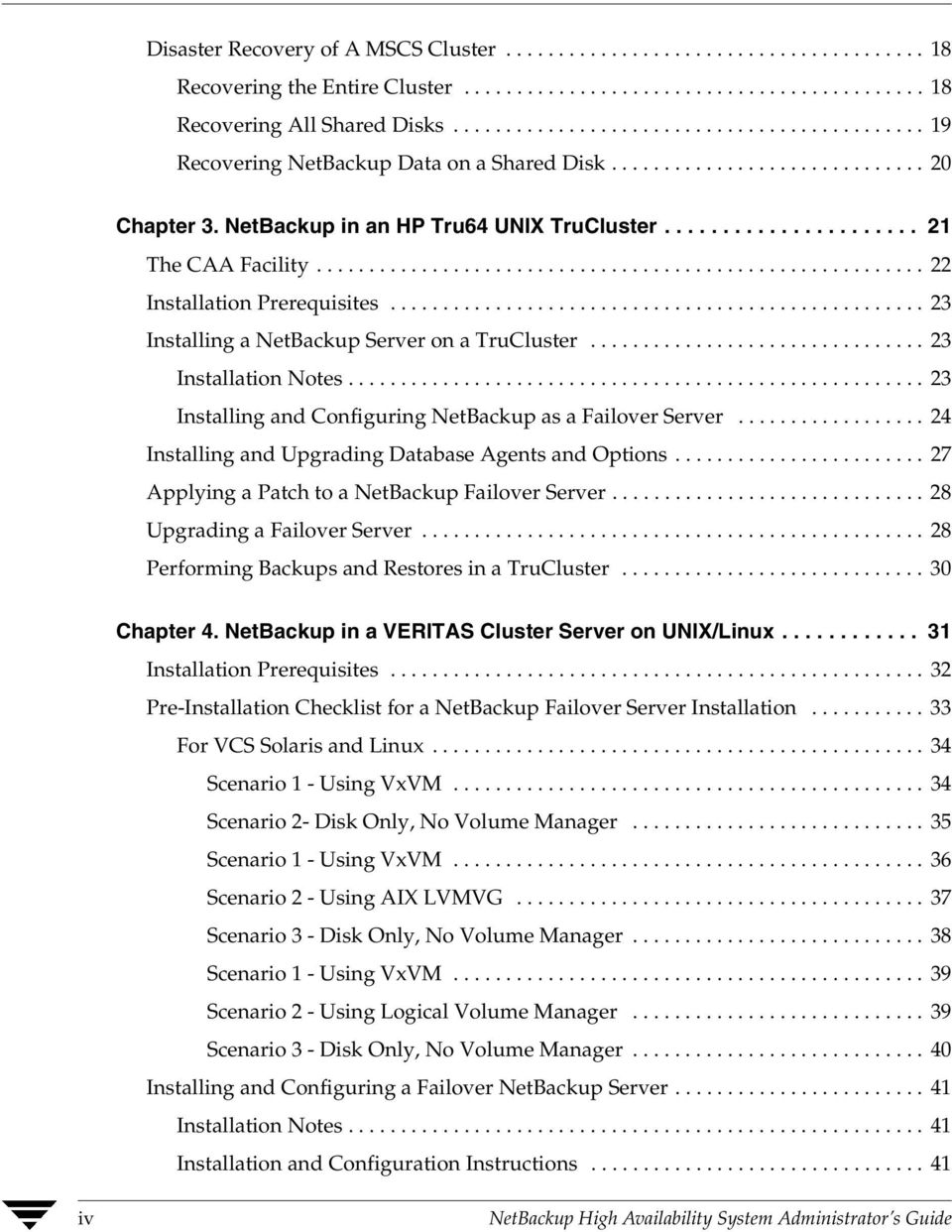
5 Installing and Upgrading NetBackup Database Agents and Options Upgrading a NetBackup Failover Server Performing Backups and Restores in a VCS Cluster Chapter 5. NetBackup in a VERITAS Cluster Server on Windows 2000 and Windows About the NetBackup Agent for VCS Agent Functions Additional Monitoring Installation Prerequisites Installing and Configuring a NetBackup Failover Server on a VCS Cluster Installation Notes Installation and Configuration Instructions Running bpclusterutil Upgrading a NetBackup Failover Server Performing Backups and Restores in a VCS Cluster Setting Up Detailed Monitoring for the NetBackup Server Disabling Detailed Monitoring Chapter 6. NetBackup in a Sun Cluster Installation Prerequisites Installation and Configuration Installation Notes Installation and Configuration Instructions Installing and Upgrading NetBackup Database Agents and Options Upgrading a NetBackup Failover Server Bringing the NetBackup Resource Group Online/Offline Performing Backups and Restores in a Sun Cluster Contents v

6 Chapter 7. NetBackup in a HP MC/Service Guard Cluster Limitations Installation Prerequisites Installation and Configuration Installation Notes Installation and Configuration Instructions Installing NetBackup Database Agents and Options Bringing the NetBackup Resource Group Online/Offline Performing Backups and Restores in an HP MC/Service Guard Cluster Chapter 8. Configuring NetBackup NetBackup Configuration Guidelines Device Configuration Guidelines Configuring Devices for a TruCluster Configuring NetBackup Catalog Backups in a Cluster Online, Hot Catalog Backups Cold, Offline Catalog Backups Clustered Master Server (Windows) Clustered Media Server (Windows) Clustered Master Server (UNIX/Linux) Clustered Media Server (UNIX/Linux) Configuring Backup Polices What to Back Up Backing Up Local Disks in a Cluster Backing Up the Shared Disks Backing Up Database Files in a Cluster User Backups Verifying NetBackup Configuration Configuring Robotic Daemons for Monitoring (UNIX/Linux Clusters) Configuring Add-Ons for Monitoring (UNIX/Linux Clusters) vi NetBackup High Availability System Administrator s Guide

7 Configuring Add-Ons for Monitoring (MSCS) Configuring Add-Ons for Monitoring (VCS for Windows) Adding License Keys Chapter 9. Using NetBackup to Perform Backups and Restores in a Cluster Performing User-Directed Backups Data in a Cluster Restoring Data in a Cluster Chapter 10. Operational Notes General Notes Delay in Detecting of Loss of Connection (MSCS and VCS on Windows) MSCS Clusters Appendix A. Non-Failover Cluster Configurations Non-Failover Media Servers in a Cluster Installation Configuring TruCluster to Use a Non-Failover NetBackup Server Upgrading an Existing Non-Failover Server NetBackup Client in a Cluster Appendix B. Moving NBDB Database Files in a UNIX/Linux Cluster Appendix C. NetBackup Media Server in a Cluster Installation Prerequisites Limitations Installation Configuration Tape Storage Devices Disk Storage Upgrading from 5.x to Appendix D. bpclusterutil Contents vii

8 Appendix E. NetBackup Agent for VERITAS Cluster Server for Windows Detecting an Application Failure Dependencies Agent Functions State Definitions Resource Type Definition Attribute Definitions Sample Configuration Additional Monitoring Appendix F. NetBackup Agent for VERITAS Cluster Server for UNIX/Linux Agent Functions Detecting an Application Failure Additional Monitoring Index viii NetBackup High Availability System Administrator s Guide

9 Preface This guide provides information on how to install and configure NetBackup to work with different clustering solutions. NetBackup provides high-performance backups and restores for a variety of computer types. Administrators can set up schedules for automatic, unattended backups for clients anywhere in the network. These backups can be full or incremental and are managed entirely by the NetBackup server (also referred to as the NetBackup master server). This guide is intended for the NetBackup system administrator responsible for configuring NetBackup in a cluster environment. A system administrator is a person with system administrator privileges and responsibilities. This guide assumes: A basic understanding of Windows or UNIX/Linux system administration. A working understanding of the NetBackup client software. A working understanding of the NetBackup server software. A familiarity with the information covered in the following NetBackup manuals: NetBackup System Administrator s Guide, Volume I NetBackup Troubleshooting Guide A working understanding of your cluster software. ix

10 Getting Help Getting Help You can find answers to questions and get help from the NetBackup documentation and from the VERITAS technical support web site. Finding NetBackup Documentation A list of the entire NetBackup documentation set appears as an appendix in the NetBackup Release Notes. All NetBackup documents are included in PDF format on the NetBackup Documentation CD. For definitions of NetBackup terms, consult the online glossary. To access the NetBackup online glossary 1. In the NetBackup Administration Console, click Help > Help Topics. 2. Click the Contents tab. 3. Click Glossary of NetBackup Terms. Use the scroll function to navigate through the glossary. Accessing the VERITAS Technical Support Web Site The address for the VERITAS Technical Support Web site is The VERITAS Support Web site lets you do any of the following: Obtain updated information about NetBackup, including system requirements, supported platforms, and supported peripherals Contact the VERITAS Technical Support staff and post questions to them Get the latest patches, upgrades, and utilities View the NetBackup Frequently Asked Questions (FAQ) page Search the knowledge base for answers to technical support questions Receive automatic notice of product updates Find out about NetBackup training Read current white papers related to NetBackup x NetBackup High Availability System Administrator s Guide

11 Getting Help From you can complete various tasks to obtain specific types of support for NetBackup: 1. Subscribe to the VERITAS notification service to be informed of software alerts, newly published documentation, Beta programs, and other services. a. From the main page, select a product family and a product. b. Under Support Resources, click Notifications. Your customer profile ensures you receive the latest VERITAS technical information pertaining to your specific interests. 2. Locate the telephone support directory at by clicking the Phone Support icon. A page appears that contains VERITAS support numbers from around the world. Note Telephone support for NetBackup is only available with a valid support contract. To contact VERITAS for technical support, dial the appropriate phone number listed on the Technical Support Guide included in the product box and have your product license information ready for quick navigation to the proper support group. 3. Contact technical support using . a. From the main page, click the Support icon. A wizard guides you to do the following: Select a language of your preference Select a product and a platform Provide additional contact and product information, and your message Associate your message with an existing technical support case b. After providing the required information, click Send Message. Preface xi

12 Accessibility Features Contacting VERITAS Licensing For license information, you can contact us as follows: Call and select option 3 Fax questions to In the Americas, send to [email protected]. In the Asia and Pacific areas, send to [email protected]. In all other areas, send to [email protected]. Accessibility Features NetBackup contains features that make the user interface easier to use by people who are visually impaired and by people who have limited dexterity. Accessibility features include: Support for assistive technologies such as screen readers and voice input (Windows servers only) Support for keyboard (mouseless) navigation using accelerator keys and mnemonic keys For more information, see the NetBackup Installation Guide. xii NetBackup High Availability System Administrator s Guide

13 Comment on the Documentation Comment on the Documentation Let us know what you like and dislike about the documentation. Were you able to find the information you needed quickly? Was the information clearly presented? You can report errors and omissions or tell us what you would find useful in future versions of our manuals and online help. Please include the following information with your comment: The title and product version of the manual on which you are commenting The topic (if relevant) on which you are commenting Your comment Your name your comment to Please only use this address to comment on product documentation. See Getting Help in this preface for information on how to contact Technical Support about our software. We appreciate your feedback. Preface xiii

14 Comment on the Documentation xiv NetBackup High Availability System Administrator s Guide

15 Introduction to NetBackup High Availability 1 Clusters provide high availability of applications and data to users. In a cluster, two or more servers (called nodes) are linked in a network, and run cluster software that allows each node access to the shared disks. If a node becomes unavailable, cluster resources migrate to an available node (this is called failover). The shared disks and the virtual server are kept available. During failover, users experience only a short interruption in service. NetBackup can protect data on shared disks, as well as data on the node s local disks. NetBackup can also protect databases in a cluster, such as Microsoft Exchange and Oracle, and make use of NetBackup options such as NetBackup Vault. In this document, Microsoft Cluster Server is also referred to as MSCS, VERITAS Volume Manager as Volume Manager, VERITAS Cluster Server as VCS, HP Tru64 UNIX TruCluster as TruCluster, and HP MC/Service Guard. 1

16 How a NetBackup Failover Server Protects Data in a Cluster How a NetBackup Failover Server Protects Data in a Cluster There are several ways to use NetBackup for protecting the data in a cluster environment. The purpose of this document is provide instruction for installing and configuring a highly available (or failover) NetBackup server. Use of standalone media servers and NetBackup clients in a cluster is briefly described in Non-Failover Cluster Configurations on page 103. When installed as a failover server, a NetBackup server is installed on the cluster as a virtual server application, allowing the server to failover from one of the nodes to the other. The server is assigned a network name resource (the virtual server name), an IP address resource, and a disk resource. The duties of the server fail over from one of the nodes to the other if a failure occurs on the active node. This provides high availability of the NetBackup server itself. For failover master servers, the virtual server name is used as the name of the master server for all media servers and clients using this master server. For failover media servers, the virtual server name is used in the NetBackup storage unit and added to the server list of any NetBackup clients to be backed up to this media server. When a failover occurs, backup jobs that were running are rescheduled by using the normal NetBackup retry logic for a failed backup. The NetBackup services are started on another node and the backup processing resumes. Both types of NetBackup failover servers, master and media, operate in an active/passive failover configuration. The active node and the passive (or failover node) must be the same type of server, master or media. NetBackup does not support mixing the two server types in the same failover server configuration. For example, a master server on one node cannot failover to a media server on another node. 2 NetBackup High Availability System Administrator s Guide

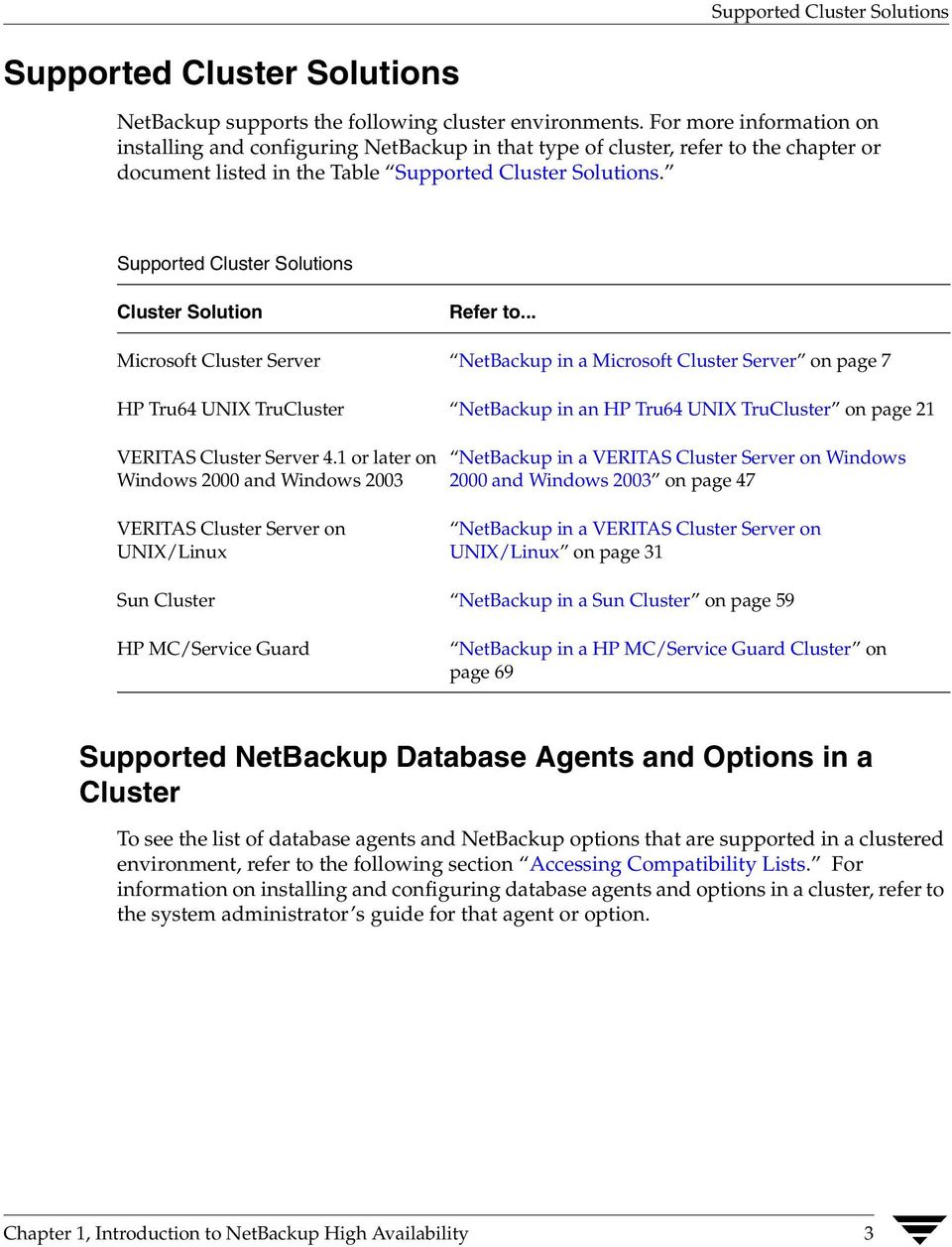
17 Supported Cluster Solutions Supported Cluster Solutions NetBackup supports the following cluster environments. For more information on installing and configuring NetBackup in that type of cluster, refer to the chapter or document listed in the Table Supported Cluster Solutions. Supported Cluster Solutions Cluster Solution Refer to... Microsoft Cluster Server NetBackup in a Microsoft Cluster Server on page 7 HP Tru64 UNIX TruCluster NetBackup in an HP Tru64 UNIX TruCluster on page 21 VERITAS Cluster Server 4.1 or later on NetBackup in a VERITAS Cluster Server on Windows Windows 2000 and Windows and Windows 2003 on page 47 VERITAS Cluster Server on NetBackup in a VERITAS Cluster Server on UNIX/Linux UNIX/Linux on page 31 Sun Cluster NetBackup in a Sun Cluster on page 59 HP MC/Service Guard NetBackup in a HP MC/Service Guard Cluster on page 69 Supported NetBackup Database Agents and Options in a Cluster To see the list of database agents and NetBackup options that are supported in a clustered environment, refer to the following section Accessing Compatibility Lists. For information on installing and configuring database agents and options in a cluster, refer to the system administrator s guide for that agent or option. Chapter 1, Introduction to NetBackup High Availability 3
18 Limitations of Using NetBackup with Clustering Solutions Accessing Compatibility Lists The VERITAS support web site now contains the most current platform support information for NetBackup. To locate the latest information on the VERITAS support web site, perform the following procedure. To access the compatibility lists on the VERITAS support website 1. Go to the VERITAS support web site: 2. In the Select Product Family list, click NetBackup Products. 3. From the Product list, choose NetBackup Enterprise Server. For Microsoft Cluster Server and VERITAS Cluster Server for Windows, you can also choose NetBackup Server. 4. Under Support Resources, click Compatibility and Reference. 5. For information on supported cluster environments, see NetBackup (tm) x.x Cluster Compatibility (updated date). 6. Click on the link for the PDF document. Limitations of Using NetBackup with Clustering Solutions The following general limitations exist for NetBackup in a cluster: NetBackup does not support converting an existing non-failover NetBackup server to a highly available failover NetBackup server. You must uninstall NetBackup, then install again. All NetBackup nodes within a cluster must be of the same server type. Do not mix master and media servers in a cluster. NetBackup is not supported as an active/active application in a cluster. NetBackup Server is only supported with Microsoft Cluster Server and VERITAS Cluster Server for Windows. NetBackup Enterprise Server is supported with all cluster solutions (see Supported Cluster Solutions on page 3). Refer to the NetBackup Release Notes for limitations specific to Media Manager and NetBackup database agents and options. 4 NetBackup High Availability System Administrator s Guide

19 Media Manager Cluster Support Limitations Limitations of Using NetBackup with Clustering Solutions The following limitations have been identified to affect clustering support in a Media Manager. Breaking SCSI Reservations When fail over occurs in an environment where SCSI Reserve/Release is being used (explicitly in NetBackup, or implicitly in lower-level drivers or hardware), a SCSI Reservation remains on the drive. The drive remains unusable by other nodes and other hosts until the SCSI reservation is cleared. Chapter 1, Introduction to NetBackup High Availability 5

20 Limitations of Using NetBackup with Clustering Solutions 6 NetBackup High Availability System Administrator s Guide

21 NetBackup in a Microsoft Cluster Server 2 This chapter provides information on how to install and configure NetBackup as a highly available application in a Microsoft Cluster Server environment. Refer to the NetBackup Installation Guide and the NetBackup System Administrator's Guide, Volume I, for a detailed understanding of how NetBackup is installed and administered. Refer to the documentation for MSCS for a detailed understanding of how MSCS works and how it is installed and administered. For information on other configurations of NetBackup in a cluster, including installing NetBackup as a non-failover server, see Non-Failover Cluster Configurations on page 103 and NetBackup Media Server in a Cluster on page
22 Installation Prerequisites Installation Prerequisites This section contains information about the requirements that must be met prior to installing and configuring a NetBackup failover server in an MSCS environment. Verify that your hardware is supported by MSCS and NetBackup 6.0. For a list of supported storage devices, visit and also consult the MSCS documentation. Verify that storage devices have been properly installed and configured to work in a Windows environment. Refer to Configuring Storage Devices for Windows in the NetBackup Installation Guide. Verify that Microsoft Cluster Server is correctly installed and configured (all versions are supported with NetBackup 6.0). NetBackup can be installed on as many nodes as MSCS supports. MSCS supports up to 4 or 8 nodes in a cluster, depending on the level of Windows that is installed. If you want the NetBackup media server to be highly available, the robotic and tape devices must be physically connected to all the nodes that would be part of the NetBackup High Availability setup. This can be done via SCSI or fibre channel.verify, using operating system commands, that all the devices are connected properly. Refer to the Media Manager Device Configuration Guide. Verify that you have an IP address and host name (virtual name) to be assigned to the NetBackup cluster group. Using Cluster Administrator, verify that the Possible Owners list for each disk resource that NetBackup uses includes each node to which NetBackup can failover. Verify you have the NetBackup Enterprise Server 6.0 or NetBackup Server 6.0 installation media and a valid license key. 8 NetBackup High Availability System Administrator s Guide
23 Installing and Configuring a NetBackup Failover Server on a MSCS Cluster Installing and Configuring a NetBackup Failover Server on a MSCS Cluster The Microsoft Cluster Administrator must be installed on all NetBackup servers (including NetBackup administration clients) that you use to remotely administer the NetBackup failover server (master or media). You must also have administrator rights to the server cluster. Installation Notes These instructions assume that this is a new installation of a NetBackup failover server. The same type of NetBackup server must be installed on each node to which NetBackup may failover. You cannot install both a master server and a media server in the same overlapping failover configuration. If you install a NetBackup failover media server, ensure that all media server nodes reference the same NetBackup master server name during the install. Caution After configuring NetBackup as a cluster group in MSCS, do not change the group name. Installation and Configuration Instructions To install a NetBackup failover server on a MSCS cluster 1. On each desired node in the cluster, install the NetBackup master or media server. a. Follow the instructions for installing NetBackup in a clustered environment as described in the NetBackup Installation Guide. b. When prompted to provide the list of servers, enter all servers that need to have access to the NetBackup failover server. The installation program will: Install NetBackup on the active node. Push the install to each inactive node, including the single license key you provided for a master server installation. Bring NetBackup resources online. Chapter 2, NetBackup in a Microsoft Cluster Server 9
24 Installing and Configuring a NetBackup Failover Server on a MSCS Cluster 2. If you added license keys at the end of the installation, these keys must be added to each node in the cluster by failing over to and adding the keys to each node in the cluster. Refer to Adding License Keys on page Install any agents or options that require separate installations. Most Windows agents and options only require a special license key and do not require a separate installation. See the appropriate NetBackup documentation for the specific database agent or option for more information. 4. After the installation is complete, continue with the configuration of NetBackup. Refer to NetBackup Configuration Guidelines on page 79 for guidelines on configuring NetBackup. Refer to Device Configuration Guidelines on page 80 and Configuring Devices for MSCS, VCS, Sun Cluster, or Service Guard on page 81 for guidelines and instructions on configuring devices in a cluster. Note that devices must be configured on each node in the cluster. See Configuring NetBackup Catalog Backups in a Cluster on page 83 for instructions on verifying that the entries for the NetBackup Catalog backups are correct. Catalog backup information is stored on the shared disk and do not need to be configured for each node. See Configuring Backup Polices on page 86 for instructions on verifying that the entries for the NetBackup Catalog backups are correct. Backup policies are stored on the shared disk and do not need to be configured for each node. By default, NetBackup options (such as NetBackup Vault) will not cause NetBackup to failover if they fail. You can configure NetBackup options to failover NetBackup if a service or the option fails. For more information, see Configuring Add-Ons for Monitoring (MSCS) on page When you have completed the configuration of NetBackup, verify that NetBackup can fail over properly in the cluster. Refer to Verifying NetBackup Configuration on page If the cluster configuration does not complete successfully, refer to the next section Running bpclusterutil for instructions on running bpclusterutil manually. 10 NetBackup High Availability System Administrator s Guide
25 Running bpclusterutil Running bpclusterutil Under normal circumstances, cluster configuration is one of the final steps in installing NetBackup in a cluster. If this step is not done or does not complete successfully, you can use the bpclusterutil command to perform this step. See the Appendix bpclusterutil on page 119 for more details on this command. To reconfigure NetBackup for the cluster 1. From the active node, run the following command. bpclusterutil -ci 2. Recreate the database. 3. Run the following commands: tpext bpclusterutil -online Chapter 2, NetBackup in a Microsoft Cluster Server 11
26 Upgrading a NetBackup Failover Server Upgrading a NetBackup Failover Server This section describes how to upgrade a failover server from NetBackup 5.0 or 5.1 to 6.0. Note NetBackup does not support converting an existing non-failover NetBackup server to a highly available failover NetBackup server. To upgrade a NetBackup failover server 1. Ensure a good backup of your cluster environment exists that includes the NetBackup databases and catalogs. Note If in a Windows 2000 environment, perform the upgrade installation directly from the system console. Do not use Remote Terminal Services. 2. Ensure the server list for each NetBackup server running outside of the cluster contains the name of each node on which NetBackup can run and the name of the virtual server. 3. Take the all NetBackup resources offline except for the disk resource before beginning the upgrade install. 4. Follow the instructions for upgrading NetBackup in a clustered environment as described in the NetBackup Installation Guide. The installation program will: Upgrade NetBackup on the active node. Push the install to each inactive node. Bring NetBackup resources online. 12 NetBackup High Availability System Administrator s Guide
27 Performing Backups and Restores in a MSCS Cluster 5. Review and complete the process for creating and populating the EMM database (or running nbpushdata) in the NetBackup Installation Guide. Run this command from the active node. Caution It is imperative that you follow the sequence below when running the nbpushdata command in your NetBackup environment MP4 (or later) or 5.1 Global Device Database Host 2. Master servers 3. Volume Database Hosts 4. Any remaining media servers that have been upgraded the Netbackup Upgrade and configure any database agents or options. Most agents and options require only a license key and do not need to be upgraded separately. For information on installing and configuring a specific agent or option, see the appropriate NetBackup documentation for that agent or option. Performing Backups and Restores in a MSCS Cluster For complete instructions on recovering MSCS cluster nodes, refer to the following Microsoft Document. VERITAS only provides instructions for restoring objects that you have backed up using NetBackup. Server Clusters: Backup and Recovery Best Practices for Windows Server 2003 which can be found on the Microsoft web site: clustering/sercbrbp.mspx The following topics describe how to restore the cluster quorum. Additional guidelines and instructions for backups and restores are covered in the chapter Using NetBackup to Perform Backups and Restores in a Cluster on page 95. Chapter 2, NetBackup in a Microsoft Cluster Server 13
28 Performing Backups and Restores in a MSCS Cluster Restoring the Cluster Quorum The cluster quorum is backed up as part of System State or Shadow Copy Components for each node. To restore the cluster quorum, other nodes in the cluster must be offline. If you cannot take the other nodes in the cluster offline before restoring the cluster quorum, follow the instructions in the next procedure. To force the restore of the cluster quorum when other nodes are online 1. Create the following registry entry: HKEY_LOCAL_MACHINE\Software\VERITAS\NetBackup\CurrentVersion\ Config\Cluster_Database_Force_Restore Note The actual registry entry above must be on a single line. If required, create this registry value as data type REG_SZ with a value of YES. When this value is set, the cluster service is stopped for any nodes that are online. 2. If Active Directory is running on the target server or the target server is currently a domain controller, see Restoring Cluster Quorum to a Node With Directory Services on page 15. To restore the cluster quorum 1. If the other nodes in the cluster are online, create the registry entry described in the previous procedure. 2. In the NetBackup Backup, Archive, and Restore interface, open a Restore window. 3. Select the backup image (or range of images) that contains the the backup of the System State or Shadow Copy Components for this node of the cluster. 4. In the All Folders pane, select System_State or Shadow Copy Components. 5. If the disk where the cluster quorum previously resided has been changed, you may have to set the registry entry described above to force the restore to continue. The disk could have been replaced with a new one, or the disk configuration could have been changed so that the cluster quorum now resides on a different disk. This enables the drive letter of the disk that the cluster quorum was on to remain the same, even if the configuration has changed and the disk signatures contained in the restore media do not match the disk signatures contained in the cluster quorum. 14 NetBackup High Availability System Administrator s Guide
29 Performing Backups and Restores in a MSCS Cluster 6. Continue the restore. 7. When the restore operation is complete, either reboot the cluster node or use the Microsoft Cluster Administrator to restart the cluster service on any nodes where it was stopped. Restoring Cluster Quorum to a Node With Directory Services To restore the quorum to a node that is running Active Directory or to a node that is currently a domain controller, the node must be in Directory Services Restore Mode. The cluster services cannot run in this mode, so the cluster quorum must be restored separately, after System State or Shadow Copy Components is restored and the node has been rebooted. To restore the cluster quorum to a node running Active Directory or that is currently a domain controller 1. In the NetBackup Backup, Archive, and Restore interface, open a Restore window. 2. Select the backup image (or range of images) that contains the backup you wish to restore. 3. Select System_State or Shadow Copy Components. 4. Exclude the cluster quorum from this restore by expanding System_State or Shadow Copy Components and deselecting Cluster_Database. 5. Continue the restore. 6. When the restore operation is complete, reboot the cluster node in safe (repair) mode (restart the computer and press F8 when prompted to select an operating system) and then select Directory Services Restore Mode. 7. Start the NetBackup service(s). 8. In the NetBackup Backup, Archive, and Restore interface, expand System_State or Shadow Copy Components and select only Cluster_Database. Chapter 2, NetBackup in a Microsoft Cluster Server 15
30 Performing Backups and Restores in a MSCS Cluster 9. If the disk where the cluster quorum previously resided has been changed, you may have to set the registry entry described above to force the restore to continue. The disk could have been replaced with a new one, or the disk configuration could have been changed so that the cluster quorum now resides on a different disk. This enables the drive letter of the disk that the cluster quorum was on to remain the same, even if the configuration has changed and the disk signatures contained in the restore media do not match the disk signatures contained in the cluster quorum. 10. Continue the restore. 11. When the restore is complete, reboot the target node. 12. Use Microsoft Cluster Administrator to restart the cluster service on any nodes on which it was stopped. 16 NetBackup High Availability System Administrator s Guide
31 Preparing for Disaster Recovery of A Cluster Preparing for Disaster Recovery of A Cluster For complete instructions on recovery of MSCS, refer to the following Microsoft Document. VERITAS only provide instructions for restoring objects that you have backed up using NetBackup. Server Clusters: Backup and Recovery Best Practices for Windows Server 2003 which can be found on the Microsoft web site: clustering/sercbrbp.mspx If a disaster occurs, the following information is required to successfully recover the cluster. General Cluster Information Cluster name Cluster IP address and subnet mask Cluster node names Node IP addresses Local and shared drive letters and partition scheme Cluster Groups Group name Preferred nodes Failover/failback policies Cluster Resources Resource name Resource type Group membership Possible owners Resource dependencies Chapter 2, NetBackup in a Microsoft Cluster Server 17
32 Disaster Recovery of A MSCS Cluster Restart and Looks Alive/Is Alive properties Resource-related parameters Disaster Recovery of A MSCS Cluster Several scenarios are discussed in this section: To recover the entire cluster, see the next topic, Recovering the Entire Cluster. To recover all shared disks, see Recovering All Shared Disks on page 19. To recover the shared disk that the NetBackup application resides on, see Recovering NetBackup Data on a Shared Disk on page 20. Recovering the Entire Cluster To recover the nodes to their pre-disaster state 1. On the first node you want to recover, reinstall the Windows operating system, including the last service pack applied before the failure. 2. Install any other drivers or applications to make the node operational. Note After booting the nodes in a cluster, ensure that the drive letters match the original cluster configuration. If the original configuration does not match, you can use the Disk Administrator, to some extent, to control the hard drive numbering scheme that Windows devises. 3. On all remaining nodes you need to recover, reinstall Windows, including the last service pack applied before the failure. Also, see the previous note. 4. Reinstall the cluster services and bring the cluster online. 5. Reinstall the same NetBackup software on the cluster that was installed before the failure. 6. Use the appropriate NetBackup catalog recovery procedure to restore the NetBackup catalog information before continuing. See the NetBackup Troubleshooting Guide for more information on recovering the NetBackup catalog database. 18 NetBackup High Availability System Administrator s Guide
33 Disaster Recovery of A MSCS Cluster 7. Restore the data files through the virtual server. 8. If you must restore a database to the shared drives, see the system administrator s guide for your database agent to continue the restore. Recovering All Shared Disks To recover all shared disks 1. Uninstall the cluster software from both nodes. 2. Replace and repartition the shared disks. 3. Reinstall the cluster software. 4. Ensure all NetBackup shared disks are assigned the same drive letters used when NetBackup was originally installed and configured. 5. To reconfigure NetBackup for the cluster, do the following on the active node: a. Run the following command. bpclusterutil -ci b. Recreate the database. c. Run the following commands: tpext bpclusterutil -online 6. Use the appropriate NetBackup catalog recovery procedure to restore the NetBackup catalog information on the shared disk before continuing. See the NetBackup Troubleshooting Guide for more information on recovering the NetBackup catalog database. 7. Use NetBackup to restore any data on the shared disks. For details on performing restores, see the NetBackup Backup, Archive, and Restore Getting Started Guide. Chapter 2, NetBackup in a Microsoft Cluster Server 19
34 Disaster Recovery of A MSCS Cluster Recovering NetBackup Data on a Shared Disk If you must recover the shared disk that was used for the NetBackup failover server, use the appropriate NetBackup catalog recovery procedure to restore the NetBackup catalog information on the shared disk. See the NetBackup Troubleshooting Guide for more information on recovering the NetBackup catalog database. 20 NetBackup High Availability System Administrator s Guide
35 NetBackup in an HP Tru64 UNIX TruCluster 3 This chapter provides information on how to install, configure and use NetBackup Enterprise Server as a highly available application in a TruCluster environment. For information about NetBackup, refer to the NetBackup System Administrator's Guide, Volume I. For information about TruCluster, refer to the TruCluster User's Guide. 21
36 The CAA Facility The CAA Facility Since all nodes in a TruCluster have access to all installed software within the cluster, there must to be a way to differentiate the single node that is to run the server software. In a typical NetBackup installation, a script starts and stops the server software. In a TruCluster, this script would be executed on all machines in the cluster. As a result, a number of processes are started on each machine. Where these machines are configured as servers this is problematic. HP s CAA (Cluster Application Availability) facility can control the node on which NetBackup will run. The CAA facility provides monitoring and resource control and the ability to switch applications between nodes in a cluster. Once NetBackup is registered with CAA, this facility can be used to control upon which node an application can be active. When configuring a failover server, you will run the cluster_config script, which will register NetBackup with CAA and create the scripts used to start, stop, and monitor NetBackup. CAA provides two controls: caa_start <netbackup_group> caa_stop <netbackup_group> brings the NetBackup daemons online takes the NetBackup daemons offline If you experience caa_stop failures for NetBackup, you may want to consider increasing the script timeout value. The default is 180 seconds but sometimes this is not enough for a heavily loaded machine to shut down all of the robotic daemons. The same is true of machines with several tape drives attached in a SAN configuration. To see if this solution is correct for you, use bpps -a to check which daemons are running immediately after the error. If it is a robotic daemon, increasing the timeout will most likely fix your problem. The script timeout value is part of TruCluster profile property; use the caa_profile TruCluster command to change this value. 22 NetBackup High Availability System Administrator s Guide
37 Installation Prerequisites Installation Prerequisites Verify all hardware (used for nodes) is supported by your version of TruCluster and by NetBackup Enterprise Server 6.0. For a list of supported storage devices, visit and consult the TruCluster documentation. Verify that TruCluster 5.1b is correctly installed and configured. Verify that you have an IP address and host name (virtual name) to be assigned to the NetBackup resource in VCS. Make sure that each node in the cluster, on which you wish to install NetBackup, is rsh equivalent. As the root user you need to be able to perform a remote login to each node without entering a password. This is only necessary for installation, upgrades, and configuration of the NetBackup server and any NetBackup database agents and options. Once installation and configuration is complete this is no longer required. If you want the NetBackup media server to be highly available, the robotic and tape devices must be physically connected to all the nodes that would be part of the NetBackup High Availability setup. This can be done via SCSI or fibre channel.verify, using operating system commands, that all the devices are connected properly. Refer to the Media Manager Device Configuration Guide. Verify you have the NetBackup Enterprise Server 6.0 installation media and a valid license key. Installing a NetBackup Server on a TruCluster This section describes how to install NetBackup Enterprise Server as a failover application on a TruCluster. Installation Notes These instructions assume that this is a new installation of a NetBackup server. Converting an existing non-failover NetBackup server to a highly available failover NetBackup server is not supported. Chapter 3, NetBackup in an HP Tru64 UNIX TruCluster 23
38 Installing a NetBackup Server on a TruCluster Installing and Configuring NetBackup as a Failover Server To install and configure NetBackup as a failover server in a TruCluster 1. Follow the instructions for installing a non-failover NetBackup server as described in the NetBackup Installation Guide. The NetBackup server software (master or media) can be installed on any node in the cluster. During installation, specify the cluster alias as the server name. 2. Run the following command: /usr/openv/netbackup/bin/cluster/cluster_config 3. For the TruCluster NetBackup service/profile name, indicate a new name for this configuration. 4. Specify the cluster alias to be used by NetBackup. Caution You must provide the same cluster alias that you provided during the installation. This name is also case-sensitive. If applicable, provide the fully qualified name. For example, if you indicate the name clusternbu.domain.com during installation, but clusternbu or CLUSTERNBU.DOMAIN.COM for the cluster_config script, the configuration process will fail. If this is a new cluster alias, indicate the cluster alias IP address to be used by NetBackup. This should already be configured in the /etc/hosts file, or in DNS, or NIS. Also provide the cluster alias IP subnet to be used by CAA. This is the network subnet for the cluster alias IP address. For instance, an IP address of on a network with a netmask of would have a subnet of Provide a list of the cluster members on which NetBackup may run. Separate member names with a space and list them in the preferred order. 6. On the summary screen, review the information you provided. Note If you chose to use a pre-existing cluster alias, the IP and subnet fields will be blank. The script will: Create and register a CAA profile for the NetBackup application. Create and register a cluster alias (if a new alias was specified). Remove the S77NetBackup and K77NetBackup scripts from /sbin/rc0.d and /sbin/rc2.d directories. 24 NetBackup High Availability System Administrator s Guide
39 Installing a NetBackup Server on a TruCluster Update the bp.conf and vm.conf files. Set up the EMM database, if required. Start the NetBackup server. 7. You are now able to start and stop NetBackup with the following commands: caa_start profile_name caa_stop profile_name For example, with a caa registered profile named netbackup for NetBackup server, you can start and stop the application with the following commands: caa_start netbackup caa_stop netbackup You must use the caa commands in place of the standard NetBackup start and stop script. The standard script does not track which node the software is running on and allows multiple instances of NetBackup within the cluster. 8. Install any NetBackup database agents or options. Note You must freeze NetBackup before installing any agents or options. Refer to the next section, Installing and Upgrading Database Agents and Options on page Continue with the configuration of NetBackup. All servers outside of the cluster that need to access the NetBackup failover server must be added to the servers list in the host properties or in the bp.conf. Refer to NetBackup Configuration Guidelines on page 79 for guidelines on configuring NetBackup. Refer to Device Configuration Guidelines on page 80 and Configuring Devices for a TruCluster on page 82 for guidelines and instructions on configuring devices in a cluster. Note that devices must be configured on each node in the cluster. Chapter 3, NetBackup in an HP Tru64 UNIX TruCluster 25
40 Installing a NetBackup Server on a TruCluster See Configuring NetBackup Catalog Backups in a Cluster on page 83 for instructions on verifying that the entries for the NetBackup Catalog backups are correct. Catalog backup information is stored on the shared disk and do not need to be configured for each node. See Configuring Backup Polices on page 86 for instructions on verifying that the entries for the NetBackup Catalog backups are correct. Backup policies are stored on the shared disk and do not need to be configured for each node. 10. When you have completed configuration of NetBackup, verify that NetBackup can failover properly in the cluster. Refer to Verifying NetBackup Configuration on page NetBackup High Availability System Administrator s Guide
41 Installing and Upgrading Database Agents and Options Installing and Upgrading Database Agents and Options In a TruCluster, NetBackup database agents and options are installed or upgraded as in anon-cluster environment. Before beginning the installation or upgrade, the NetBackup must be frozen. To install or upgrade a NetBackup agent or option 1. Freeze NetBackup by running the following command: caa_stop profile_name 2. Install the database agents and options as you would in a non-clustered environment. Refer to the system administrator s guides for those agents or options. 3. Unfreeze NetBackup by running the following command: caa_start profile_name 4. (Optional) Configure robot daemons and NetBackup options to failover NetBackup if a daemon or the option fails. By default, robotic daemons and NetBackup options (such as NetBackup Vault) will not cause NetBackup to failover if they fail. For more information, see Configuring Robotic Daemons for Monitoring (UNIX/Linux Clusters) on page 90 and Configuring Add-Ons for Monitoring (UNIX/Linux Clusters) on page 91. Chapter 3, NetBackup in an HP Tru64 UNIX TruCluster 27
42 Applying a Patch to a NetBackup Failover Server Applying a Patch to a NetBackup Failover Server Follow these instructions when applying patches to a NetBackup failover server. See the NetBackup Release Notes for the latest information on applying a specific patch. To apply a patch to a NetBackup failover server 1. Ensure a good backup of your cluster environment exists that includes the NetBackup databases and catalogs. 2. Login to the node NetBackup is running on. 3. Stop the NetBackup server using the command caa_stop profile name. 4. Complete the patch install. 5. Start NetBackup using the command caa_start profile name. 6. Verify that NetBackup can failover properly in the cluster. Refer to Verifying NetBackup Configuration on page 89. Upgrading a Failover Server This section describes how to upgrade a failover server from NetBackup 5.0 or 5.1 to 6.0. To upgrade a failover server 1. Ensure a good backup of your cluster environment exists that includes the NetBackup databases and catalogs. 2. Stop the NetBackup server using the following command. caa_stop profile_name 3. In the bp.conf, verify that any CLUSTER_NAME entries are defined as the virtual server name. 4. In the vm.conf: Verify that any CLUSTER_NAME entries are defined as the virtual server name. If it exists, change the REQUIRED_INTERFACE entry to CLUSTER_NAME and define it as the virtual name. 28 NetBackup High Availability System Administrator s Guide
43 Upgrading a Failover Server 5. Follow the instructions for upgrading a non-failover NetBackup server as described in the NetBackup Installation Guide. 6. Review and complete the process for creating and populating the EMM database (or running nbpushdata) in the NetBackup Installation Guide. Caution It is imperative that you follow the sequence below when running the nbpushdata command in your NetBackup environment MP4 (or later) or 5.1 Global Device Database Host 2. Master servers 3. Volume Database Hosts 4. Any remaining media servers that have been upgraded the Netbackup Upgrade any NetBackup database agents or options. Note You must freeze NetBackup before upgrading any agents or options. Refer to Installing and Upgrading Database Agents and Options on page Verify that NetBackup can failover properly in the cluster. Refer to Verifying NetBackup Configuration on page 89. Chapter 3, NetBackup in an HP Tru64 UNIX TruCluster 29
44 Performing Backups and Restores in a TruCluster Performing Backups and Restores in a TruCluster The process of configuring and performing backups and performing restores in any supported cluster is similar no matter which clustering solution you are using. Guidelines and instructions for backups and restores are covered in the chapter Using NetBackup to Perform Backups and Restores in a Cluster on page NetBackup High Availability System Administrator s Guide
45 NetBackup in a VERITAS Cluster Server on UNIX/Linux 4 This chapter describes the steps to install and configure a NetBackup Enterprise Server in as a highly available application in a VCS environment on UNIX or Linux. VCS is a high-availability solution for cluster configurations. VCS enables you to monitor systems and application services, and to restart services on a different system when hardware or software fails. For information about VCS, refer to the VERITAS Cluster Server User's Guide. For more detailed information about this agent, refer to NetBackup Agent for VERITAS Cluster Server for UNIX/Linux on page 127. For information on other configurations of NetBackup in a cluster, including installing NetBackup as a non-failover server, see Non-Failover Cluster Configurations on page 103 and NetBackup Media Server in a Cluster on page
46 Installation Prerequisites Installation Prerequisites This section contains information about the requirements that must be met prior to installing and configuring a NetBackup failover server in a VCS 3.5 or later environment. PBX has a known issue that prevents it from being installed in the cluster using the push installation method you can usually employ with installics. To install PBX in a cluster, you must run the installics command on every node. Verify that your hardware is supported by VCS and by NetBackup Enterprise Server 6.0. For a list of supported storage devices, visit Verify that VCS is correctly installed and configured on Solaris, HP-UX, AIX, or Linux. Follow the steps in the VERITAS Cluster Server Installation Guide. The shared disk must be configured and accessible to all cluster nodes on which NetBackup will be installed. Verify that you have an IP address and host name (virtual name) to be assigned to the NetBackup resource in VCS. Make sure that each node in the cluster, on which you wish to install NetBackup, is rsh equivalent (On HP the command is remsh). As the root user you need to be able to perform a remote login to each node in the cluster without entering a password. This is only necessary for installation, upgrades, and configuration of the NetBackup server and any NetBackup database agents and options. Once installation and configuration is complete this is no longer required. If you want the NetBackup media server to be highly available, the robotic and tape devices must be physically connected to all the nodes that would be part of the NetBackup High Availability setup. This can be done using SCSI or fibre channel.verify that all the devices are connected properly. Refer to the Media Manager Device Configuration Guide. Verify you have the NetBackup Enterprise Server 6.0 installation media and a valid license key. 32 NetBackup High Availability System Administrator s Guide
47 Pre-Installation Checklist for a NetBackup Failover Server Installation Pre-Installation Checklist for a NetBackup Failover Server Installation Note The configuration utility will treat all attribute values globally. Virtual Name for NetBackup: IP Address: Subnet mask Network Device Name (NIC) Nodes on which NetBackup server is installed Node Name IP addresses Chapter 4, NetBackup in a VERITAS Cluster Server on UNIX/Linux 33
48 Pre-Installation Checklist for a NetBackup Failover Server Installation For VCS Solaris and Linux Scenario 1 - Using VxVM Resource Example Disk Group Resource: DiskGroup: StartVolumes: StopVolumes: nbudg 0 or 1 0 or 1 Volume Resource: (optional) Volume: nbuvol Mount Resource MountPoint: BlockDevice: FS Type: Mount Option: Fsck Option: /opt/vrtsnbu /dev/vx/dsk/nbuvol vxfs (this is optional) (if you add other options, -y is also required) 34 NetBackup High Availability System Administrator s Guide
49 Pre-Installation Checklist for a NetBackup Failover Server Installation Scenario 2- Disk Only, No Volume Manager Resource Example Mount Resource MountPoint: BlockDevice: FS Type: Mount Option: Fsck Option: /opt/vrtsnbu /dev/dsk/c1t1dos3 vxfs (this is optional) (if you add other options, -y is also required) Chapter 4, NetBackup in a VERITAS Cluster Server on UNIX/Linux 35
50 Pre-Installation Checklist for a NetBackup Failover Server Installation For VCS AIX Scenario 1 - Using VxVM Resource Example Disk Group Resource: DiskGroup: nbudg StartVolumes: 0 or 1 StopVolumes: 0 or 1 Volume Resource: Volume: nbuvol Mount Resource MountPoint: BlockDevice: FS Type: Mount Option: Fsck Option: /opt/vrtsnbu /dev/vx/dsk/nbuvol vxfs is required (optional) (if you add other options, -y is also required) 36 NetBackup High Availability System Administrator s Guide
51 Pre-Installation Checklist for a NetBackup Failover Server Installation Scenario 2 - Using AIX LVMVG Resource Example LVMVG Resource: VolumeGroup: nbuvg MajorNumber: 58 Disks: ImportvgOpt: VaryonvgOpt: SyncODM: hdisk1 or hdisk2 (optional) (optional) (optional) Mount Resource: MountPoint: BlockDevice: FS Type: Mount Option: Fsck Option: /opt/vrtsnbu /dev/nbudev jfs2 (optional) (if you add other options, -y is also required) Chapter 4, NetBackup in a VERITAS Cluster Server on UNIX/Linux 37
52 Pre-Installation Checklist for a NetBackup Failover Server Installation Scenario 3 - Disk Only, No Volume Manager Resource Example Mount Resource: MountPoint: BlockDevice: FS Type: Mount Option: Fsck Option: /opt/vrtsnbu /dev/dsk/c1t1dos3 jfs2 (optional) (if you add other options, -y is also required) 38 NetBackup High Availability System Administrator s Guide
53 Pre-Installation Checklist for a NetBackup Failover Server Installation For VCS HP-UX Scenario 1 - Using VxVM Resource Example Disk Group Resource: DiskGroup: nbudg StartVolumes: 0 or 1 StopVolumes: 0 or 1 Volume Resource: Volume: nbuvol Mount Resource: MountPoint: BlockDevice: FS Type: Mount Option: Fsck Option: /opt/vrtsnbu /dev/vx/dsk/nbuvol vxfs is required (optional) (if you add other options, -y is also required) Scenario 2 - Using Logical Volume Manager LVMVolume Group Resource: Volume Group: vg0a LVMLogical Volume Resource: Volume Group: Logical Group: vg0a lvol1 Chapter 4, NetBackup in a VERITAS Cluster Server on UNIX/Linux 39
54 Pre-Installation Checklist for a NetBackup Failover Server Installation Scenario 3 - Disk Only, No Volume Manager Mount Resource: MountPoint: BlockDevice: FS Type: Mount Option: Fsck Option: /opt/vrtsnbu /dev/dsk/c1t1dos3 hfs (optional) (if you add other options, -y is also required) 40 NetBackup High Availability System Administrator s Guide
55 Installing and Configuring a Failover NetBackup Server Installing and Configuring a Failover NetBackup Server This section describes how to install and configure a new NetBackup failover server. If you are upgrading from NetBackup 5.0 or 5.1 to 6.0, refer to Upgrading a NetBackup Failover Server on page 45. Installation Notes These instructions assume that this is a new installation of a NetBackup failover server. You must install the same type of NetBackup server on each node to which NetBackup may failover. You cannot install a master server and a media server in a failover configuration. If you are installing a NetBackup failover media server, ensure that all media server nodes reference the same NetBackup master server name during the install. Do not install older versions of the VCS agent. Use the version of the agent provided with NetBackup 6.0. This agent is installed along with the NetBackup 6.0 Server software. The cluster_config script is only supported with versions of the VCS agent included with NetBackup 5.0 or later. Installation and Configuration Instructions To install and configure a NetBackup failover server 1. Fill out the appropriate sections, based on your environment, of the checklist in the section Pre-Installation Checklist for a NetBackup Failover Server Installation on page Make sure the shared disk is not mounted on any node in the cluster. If applicable, unmount the NetBackup shared mount point. Stop the volume the mount point is on and stop the disk group for that volume on all nodes of the cluster. 3. Follow the instructions for installing NetBackup server software in the NetBackup Installation Guide. Note If necessary, refer to the VERITAS Infrastructure Core Services Installation Guide for details on installing PBX. Chapter 4, NetBackup in a VERITAS Cluster Server on UNIX/Linux 41
56 Installing and Configuring a Failover NetBackup Server Be sure that you: Install NetBackup on each node to which it can failover. Use the virtual name for the NetBackup server name. 4. After installing NetBackup on each node, run the following command on the primary node: /usr/openv/netbackup/bin/cluster/cluster_config 5. Answer questions based on the information gathered in step 1. Caution When prompted, you must provide the same virtual cluster name that you provided during the installation. This name is also case-sensitive. If applicable, provide the fully qualified name. For example, if you indicate the name clusternbu.domain.com during installation, but clusternbu or CLUSTERNBU.DOMAIN.COM for the cluster_config script, the configuration process will fail. The script will: Create and register a cluster alias (if a new alias was specified). Remove NetBackup start and stop scripts from the rc directories. Update the bp.conf and vm.conf files. Set up the EMM database, if required. Start the NetBackup server. 6. Install any NetBackup database agents or options. Note You must freeze the NetBackup group before installing any agents or options. Refer to the next section, Installing and Upgrading NetBackup Database Agents and Options. 7. Continue with the configuration of NetBackup. All servers outside of the cluster that need to access the NetBackup failover server must be added to the servers list in the host properties or in the bp.conf on each node. Refer to NetBackup Configuration Guidelines on page 79 for guidelines on configuring NetBackup. 42 NetBackup High Availability System Administrator s Guide
57 Installing and Upgrading NetBackup Database Agents and Options Refer to Device Configuration Guidelines on page 80 and Configuring Devices for MSCS, VCS, Sun Cluster, or Service Guard on page 81 for guidelines and instructions on configuring devices in a cluster. Note that devices must be configured on each node in the cluster. See Configuring NetBackup Catalog Backups in a Cluster on page 83 for instructions on verifying that the entries for the NetBackup Catalog backups are correct. Catalog backup information is stored on the shared disk and do not need to be configured for each node. See Configuring Backup Polices on page 86 for instructions on verifying that the entries for the NetBackup Catalog backups are correct. Backup policies are stored on the shared disk and do not need to be configured for each node. 8. When you have completed configuration of NetBackup, verify that NetBackup can failover properly in the cluster. Refer to Verifying NetBackup Configuration on page 89. Installing and Upgrading NetBackup Database Agents and Options Install or upgrade NetBackup database agents and options on all cluster nodes where the NetBackup server is installed. In addition, the NetBackup group must be frozen before you install any agents or options. Note Before upgrading an database agents or options, ensure NetBackup is up and running (the NetBackup resource is online in the cluster, server processes are running onthe active node). To install or upgrade a NetBackup agent or option 1. Freeze the NetBackup group using hagrp -freeze nbu group name. 2. On each inactive node in the cluster on which NetBackup is installed, install any agents or options. See the appropriate NetBackup documentation for the agent or option for installation and configuration instructions. 3. On the active node, perform the same installation. Chapter 4, NetBackup in a VERITAS Cluster Server on UNIX/Linux 43
58 Installing and Upgrading NetBackup Database Agents and Options 4. Unfreeze the NetBackup group using hagrp -unfreeze nbu group name. 5. (Optional) Configure robot daemons and NetBackup options to failover NetBackup if a daemon or the option fails. By default, robotic daemons and NetBackup options (such as NetBackup Vault) will not cause NetBackup to failover if they fail. For more information, see Configuring Robotic Daemons for Monitoring (UNIX/Linux Clusters) on page 90 and Configuring Add-Ons for Monitoring (UNIX/Linux Clusters) on page NetBackup High Availability System Administrator s Guide
59 Upgrading a NetBackup Failover Server Upgrading a NetBackup Failover Server Follow these instructions when upgrading a NetBackup failover server from version 5.0 or 5.1 to 6.0. Note VERITAS requires that you use the latest VCS agent that is installed with NetBackup 6.0. Older versions of the agent are not supported. To upgrade a NetBackup failover server 1. Make sure the NetBackup group is online. 2. Ensure a good backup of your cluster environment exists that includes the NetBackup databases and catalogs. 3. Ensure the server list for each NetBackup server running outside of the cluster contains the name of each node on which NetBackup can run and the name of the virtual server. 4. Freeze the NetBackup group using hagrp -freeze nbu_group_name. Note If the NetBackup resource faults during the upgrade, clear the fault. 5. On each inactive node to which NetBackup may failover, install the NetBackup server software. Follow the instructions for upgrading NetBackup servers and clients as described in the NetBackup Installation Guide. If required to specify the server name, provide the virtual name of the server. If necessary, refer to the VERITAS Infrastructure Core Services Installation Guide for details on installing PBX. 6. On the active node, install the NetBackup server software. Follow the instructions for upgrading NetBackup servers and clients as described in the NetBackup Installation Guide. During an upgrade of a NetBackup in a VCS environment, you will see messages indicating that the database is created twice. This is because the database is created in the default location (/usr/openv/db/) during install_bp and later moved/recreated on the shared disk. 7. Unfreeze the NetBackup group using hagrp -unfreeze nbu_group_name. Chapter 4, NetBackup in a VERITAS Cluster Server on UNIX/Linux 45
60 Performing Backups and Restores in a VCS Cluster 8. Review and complete the process for creating and populating the EMM database (or running nbpushdata) in the NetBackup Installation Guide. Run this command from the active node. Caution It is imperative that you follow the sequence below when running the nbpushdata command in your NetBackup environment MP4 (or later) or 5.1 Global Device Database Host 2. Master servers 3. Volume Database Hosts 4. Any remaining media servers that have been upgraded the Netbackup Bring the NetBackup group offline and online. 10. On each node on which NetBackup server is installed, upgrade any NetBackup database agents or options. Note You must freeze the NetBackup group before installing any agents or options. Refer to Installing and Upgrading NetBackup Database Agents and Options on page Verify that NetBackup can failover properly in the cluster. Refer to Verifying NetBackup Configuration on page 89. Performing Backups and Restores in a VCS Cluster The process of configuring and performing backups and performing restores in any supported cluster is similar no matter which clustering solution you are using. Guidelines and instructions for backups and restores are covered in the chapter Using NetBackup to Perform Backups and Restores in a Cluster on page NetBackup High Availability System Administrator s Guide
61 NetBackup in a VERITAS Cluster Server on Windows 2000 and Windows This chapter provides information on the prerequisites for using NetBackup Enterprise Server or NetBackup Server as a highly available application in a VERITAS Cluster Server (VCS), for Windows 2000 or Windows 2003 environment. VCS is a high-availability solution for cluster configurations. With VCS you can monitor systems and application services, and restart services on a different system when hardware or software fails. For information about VCS, refer to the VERITAS Cluster Server Administrator's Guide. For information on other configurations of NetBackup in a cluster, including installing NetBackup as a non-failover server, see Non-Failover Cluster Configurations on page 103 and NetBackup Media Server in a Cluster on page
62 About the NetBackup Agent for VCS About the NetBackup Agent for VCS The NetBackup agent for VCS monitors specific NetBackup resources, determines the status of these resources, and starts or stops NetBackup according to external events. The agent includes VCS type declarations and agent executables, and is represented by the NetBackup resource type. When the agent detects an application failure, the NetBackup service group is failed over to another system in the cluster on which NetBackup is installed and configured. For additional information on this agent, refer to NetBackup Agent for VERITAS Cluster Server for Windows on page 123. Agent Functions Specific agent operations include: Online Offline Monitor Clean Brings NetBackup services online. Takes NetBackup services offline. Verifies the status of NetBackup services. See Setting Up a Detailed Monitoring Script on page 55 for information on detailed monitoring. Stops all NetBackup daemons after detecting an unexpected offline operation or an ineffective online operation. Additional Monitoring Additional monitoring capabilities are available for add-on products. Refer to Configuring Add-Ons for Monitoring (VCS for Windows) on page NetBackup High Availability System Administrator s Guide
63 Installation Prerequisites Installation Prerequisites This section contains information about the requirements that must be met prior to installing and configuring a NetBackup failover server in a VCS 4.1 or later environment. Verify that all your hardware is supported by VCS and by NetBackup 6.0. For a list of supported storage devices, visit Verify that storage devices have been properly installed and configured to work in a Windows environment. Refer to the section on configuring storage devices in the NetBackup Installation Guide. Verify that you have installed VERITAS Storage Foundation HA and correctly configured VCS. NetBackup can be installed on as many nodes as VCS supports. For VCS Windows ( SFW-HA 4.1, SFW-HA 4.2) make sure the patch available through TechNote is installed prior to installing or upgrading to NetBackup 6.0. The patch is available at Verify the cluster disk group(s) and dynamic volume(s) for NetBackup have been created on the shared storage. Refer to the VERITAS Storage Foundation Administrator s Guide for details on creating these. All disk resources that NetBackup will be using must be configured in VERITAS Enterprise Administrator (VEA) prior to installing NetBackup. Verify that you have an IP address and host name (virtual name) to be assigned to the NetBackup resource in VCS. If you want the NetBackup media server to be highly available, the robotic and tape devices must be physically connected to all the nodes that would be part of the NetBackup High Availability setup. This can be done using SCSI or fibre channel.verify that all the devices are connected properly. Refer to the Media Manager Device Configuration Guide. Verify you have the NetBackup Enterprise Server 6.0 or NetBackup Server 6.0 installation media and a valid license key. Chapter 5, NetBackup in a VERITAS Cluster Server on Windows 2000 and Windows
64 Installing and Configuring a NetBackup Failover Server on a VCS Cluster Installing and Configuring a NetBackup Failover Server on a VCS Cluster This section describes how to install and configure NetBackup as a failover application in a VCS Cluster. The NetBackup service group is created during the installation. Installation Notes These instructions assume that this is a new installation of a NetBackup failover server. The same type of NetBackup server must be installed on each node to which NetBackup may failover. You cannot install a master server and a media server in an overlapping failover configuration. If you install a NetBackup failover media server, ensure that all media server nodes reference the same NetBackup master server name during the install. The VCS NetBackup agent is now installed as part of NetBackup server. After configuring NetBackup as a cluster group in VCS, do not change the group name. Installation and Configuration Instructions To install a NetBackup failover server on a VCS cluster 1. On each desired node in the cluster, install the NetBackup master or media server. a. Follow the instructions for installing NetBackup in a clustered environment as described in the NetBackup Installation Guide. b. When prompted to provide the list of servers, enter all servers that need to have access to the NetBackup failover server. The installation program will: Install NetBackup on the active node. Push the install to each inactive node, including the single license key you provided for the master server. Bring NetBackup resources online. 50 NetBackup High Availability System Administrator s Guide
65 Installing and Configuring a NetBackup Failover Server on a VCS Cluster 2. If you added license keys at the end of the installation, these keys must be added to each node in the cluster by failing over to and adding the keys to each node in the cluster. Refer to Adding License Keys on page If the cluster configuration does not complete successfully, refer to the next section Running bpclusterutil for instructions on running bpclusterutil manually. 4. Install any agents or options that require separate installations. Most Windows agents and options only require a special license key and do not require a separate installation. See the appropriate NetBackup documentation for the specific database agent or option for more information. 5. After the installation is complete, continue with the configuration of NetBackup. Refer to NetBackup Configuration Guidelines on page 79 for guidelines on configuring NetBackup. Refer to Device Configuration Guidelines on page 80 and Configuring Devices for MSCS, VCS, Sun Cluster, or Service Guard on page 81 for guidelines and instructions on configuring devices in a cluster. Note that devices must be configured on each node in the cluster. See Configuring NetBackup Catalog Backups in a Cluster on page 83 for instructions on verifying that the entries for the NetBackup Catalog backups are correct. Catalog backup information is stored on the shared disk and do not need to be configured for each node. See Configuring Backup Polices on page 86 for instructions on verifying that the entries for the NetBackup Catalog backups are correct. Backup policies are stored on the shared disk and do not need to be configured for each node. By default, NetBackup options (such as NetBackup Vault) will not cause NetBackup to failover if they fail. You can configure NetBackup options to failover NetBackup if a service or the option fails. For more information, see Configuring Add-Ons for Monitoring (VCS for Windows) on page When you have completed the installation and configuration of NetBackup, verify that NetBackup can fail over properly in the cluster. Refer to Verifying NetBackup Configuration on page 89. Chapter 5, NetBackup in a VERITAS Cluster Server on Windows 2000 and Windows
66 Running bpclusterutil Running bpclusterutil Under normal circumstances, cluster configuration is one of the final steps in installing NetBackup in a cluster. If this step is not done or does not complete successfully, you can use the bpclusterutil command to perform this step. See the Appendix bpclusterutil on page 119 for more details on this command. To reconfigure NetBackup for the cluster 1. From the active node, run the following command. bpclusterutil -ci 2. Recreate the database. 3. Run the following commands: tpext bpclusterutil -online 52 NetBackup High Availability System Administrator s Guide
67 Upgrading a NetBackup Failover Server This section describes how to upgrade from NetBackup 5.0 or 5.1 to 6.0. Upgrading a NetBackup Failover Server Note NetBackup does not support converting an existing non-failover NetBackup server to a highly available failover NetBackup server. To upgrade a NetBackup failover server 1. Ensure a good backup of your cluster environment exists that includes the NetBackup databases and catalogs. Note If in a Windows 2000 environment, perform the upgrade installation directly from the system console. Do not use Remote Terminal Services. 2. Ensure the server list for each NetBackup server running outside of the cluster contains the name of each node on which NetBackup can run and the name of the virtual server. 3. Take the VCS NetBackup resource offline before beginning the upgrade install. 4. Follow the instructions for upgrading NetBackup in a clustered environment as described in the NetBackup Installation Guide. The installation program will: Upgrade NetBackup on the active node. Push the install to each inactive node. Bring NetBackup resources online. 5. Review and complete the process for creating and populating the EMM database (or running nbpushdata) in the NetBackup Installation Guide. Run this command from the active node. Caution It is imperative that you follow the sequence below when running the nbpushdata command in your NetBackup environment MP4 (or later) or 5.1 Global Device Database Host 2. Master servers 3. Volume Database Hosts 4. Any remaining media servers that have been upgraded the Netbackup 6.0 Chapter 5, NetBackup in a VERITAS Cluster Server on Windows 2000 and Windows
68 Performing Backups and Restores in a VCS Cluster 6. Upgrade and configure any database agents or options. Most agents and options require only a license key and do not need to be upgraded separately. For information on installing and configuring a specific agent or option, see the appropriate NetBackup documentation for that agent or option. Performing Backups and Restores in a VCS Cluster The process of configuring and performing backups and performing restores in any supported cluster is similar no matter which clustering solution you are using. Guidelines and instructions for backups and restores are covered in the chapter Using NetBackup to Perform Backups and Restores in a Cluster on page 95. Setting Up Detailed Monitoring for the NetBackup Server In the detail monitoring mode, the NetBackup agent runs a script to verify NetBackup is available. A sample script, DetailedMonitor.bat, is provided with the agent for this purpose. You can customize the script to meet your configuration requirements. Note Before setting up detailed monitoring, you must have the NetBackup agent running at the basic level of monitoring. 54 NetBackup High Availability System Administrator s Guide
69 Setting Up a Detailed Monitoring Script Setting Up Detailed Monitoring for the NetBackup Server The script file must exist on all nodes in the service group s system list. To set up a detailed monitoring script 1. Configure and run the NetBackup agent with basic monitoring. 2. For each node in the NetBackup service group, create a backup policy that performs a user backup of the file install_path\bin\cluster\vcs\detailedmonitor.txt, where install_ path is the home directory of NetBackup, for example, C:\Program Files\VERITAS\NetBackup. For example, if your NetBackup service group contains five nodes, you must create five different policies, each referencing a different node. 3. Create a script file. You can modify the supplied sample script to match your configuration: a. Edit install_path\bin\cluster\detailedmonitor.bat with NotePad or other text editor. b. Replace <VIRTSRVR> with the virtual server name for the NetBackup master or media server. c. Make any other edits necessary for your configuration. d. Save the edited version to a new name such as DetailedMonitorProd.bat. 4. From the command line, type the following command to verify the script runs without errors: DetailedMonitorProd 5. Continue with the next section to enable detailed monitoring. Chapter 5, NetBackup in a VERITAS Cluster Server on Windows 2000 and Windows
70 Setting Up Detailed Monitoring for the NetBackup Server Enabling Detailed Monitoring This section describes how to set the detail monitoring option from the VCS Cluster Manager. To enable detailed monitoring from the Java Console 1. In Cluster Explorer, right-click on the NetBackup service group, choose Offline, and select the node where you want to bring the service group offline. 2. Click Yes. 3. In the left pane, click the NetBackup resource. 4. On the Properties tab, select the Monscript attribute from the list, and click the Edit icon. 5. Provide the full path to the NetBackup monitor script created in step 3 of the procedure To set up a detailed monitoring script on page Click OK. 7. Save your configuration. 8. In the left pane, right-click on the NetBackup service group, select Online, and select the node where you want to bring the service group online. 9. Click Yes. Disabling Detailed Monitoring This section describes how to disable the detail monitoring option from the VCS Cluster Manager. To disable detailed monitoring from the Java Console 1. In Cluster Explorer, right-click on the NetBackup service group, choose Offline, and select the node where you want to bring the service group offline. 2. Click Yes. 3. In the left pane, click the NetBackup resource. 56 NetBackup High Availability System Administrator s Guide
71 Setting Up Detailed Monitoring for the NetBackup Server 4. On the Properties tab, select the Monscript attribute from the list, and click the Edit icon. 5. Remove the path information. 6. Click OK. 7. Save your configuration. 8. In the left pane, right-click on the NetBackup service group, select Online, and select the node where you want to bring the service group online. 9. Click Yes. Chapter 5, NetBackup in a VERITAS Cluster Server on Windows 2000 and Windows
72 Setting Up Detailed Monitoring for the NetBackup Server 58 NetBackup High Availability System Administrator s Guide
73 NetBackup in a Sun Cluster 6 This chapter provides information on how to install and configure NetBackup Enterprise Server as a highly available application in a Sun Cluster. NetBackup 6.0 now supports the HA Storage Plus option for Sun Clusters. Refer to the NetBackup System Administrator's Guide, Volume I, for a detailed understanding of how NetBackup is installed and administered. Refer to the documentation for Sun Cluster for a detailed understanding of how Sun Cluster works, how it is installed and administered, and for information on the SunPlex cluster system. For more detailed information about this agent, refer to NetBackup Agent for VERITAS Cluster Server for UNIX/Linux on page
74 Installation Prerequisites Installation Prerequisites This section contains information about the requirements that must be met prior to installing and configuring a NetBackup failover server in a Sun Cluster environment. PBX has a known issue that prevents it from being installed in the cluster using the push installation method you can usually employ with installics. To install PBX in a cluster, you must run the installics command on every node. Verify that your hardware is supported by your version of Sun Cluster and by NetBackup Enterprise Server 6.0. For a list of supported storage devices, visit and consult the Sun Cluster documentation. Verify that Sun Cluster 3.0, Update 3, or Sun Cluster 3.1, Update 1, is correctly installed and configured. To configure using HA Storage Plus, first mount the disk on the machine that NetBackup will be configured on. Verify that you have an IP address and host name (virtual name) to be assigned to the NetBackup resource group. The shared disk must be configured and accessible to all cluster nodes on which NetBackup will be installed. See the Sun Cluster documentation for more information on how to create and configure a shared disk. Make sure the shared disk has enough space for the NetBackup database files and directories. If you want the NetBackup media server to be highly available, the robotic and tape devices must be physically connected to all the nodes that would be part of the NetBackup High Availability setup. This can be done via SCSI or fibre channel.verify, using OS commands, that all the devices are connected properly. Refer to the Media Manager Device Configuration Guide. Make sure that each node in the cluster, on which you wish to install NetBackup, is rsh equivalent. As the root user you need to be able to perform a remote login to each node in the cluster without entering a password. This is only necessary for installation, upgrades, and configuration of the NetBackup server and any NetBackup database agents and options. Once installation and configuration is complete this is no longer required. You must be able to mount the disk on all nodes at the same time (i.e., a global file system). Verify you have the NetBackup Enterprise Server 6.0 installation media and a valid license key. 60 NetBackup High Availability System Administrator s Guide
75 Installation and Configuration Installation and Configuration This section describes procedures for setting up and administering NetBackup server as a failover application in a Sun Cluster. If you are upgrading from NetBackup 5.0 or 5.1 to 6.0, refer to Upgrading a NetBackup Failover Server on page 65. Installation Notes These instructions assume that this is a new installation of a NetBackup failover server. You must install the same type of NetBackup server on each node to which NetBackup may failover. You cannot install a master server and a media server in a failover configuration. If you are installing a NetBackup failover media server, ensure that all media server nodes reference the same NetBackup master server name during the install. The NetBackup resource group name in a Sun Cluster is always scnb-harg. This cannot be configured by the user. Two Sun Cluster resource files are installed with NetBackup and should not be edited: scnb.vrts and scnb.conf. Installation and Configuration Instructions Note Additional commands are required to properly freeze and unfreeze NetBackup in a SunCluster. This is due to Sun bug # When NetBackup is started under pmf with automatic restarts enabled, pmf will intervene if the tag dies, irrespective of whether the monitor is enabled or not. To install and configure NetBackup in a Sun Cluster 1. Follow the instructions for installing NetBackup server software as described in the NetBackup Installation Guide. Be sure that you: Install NetBackup on each node to which it can failover. Use the virtual name for the NetBackup server name. Chapter 6, NetBackup in a Sun Cluster 61
76 Installation and Configuration 2. After installing NetBackup on each node, run the following command on the primary node: /usr/openv/netbackup/bin/cluster/cluster_config Caution When prompted, you must provide the same virtual cluster name that you provided during the installation. This name is also case-sensitive. If applicable, provide the fully qualified name. For example, if you indicate the name clusternbu.domain.com during installation, but clusternbu or CLUSTERNBU.DOMAIN.COM for the cluster_config script, the configuration process will fail. 3. You will be prompted for a hostname. This is used as a logical hostname. If you are using HA Storage Plus, answer Yes when asked if you are configuring using an HASP disk. When entering the block device for this disk verify that your entry is exactly the same as the entry in /etc/vfstab. 4. Follow the onscreen directions to configure the type of NetBackup server you will use. The script will: Create and register a cluster alias (if a new alias was specified). Remove NetBackup start and stop scripts from the rc directories. Update the bp.conf and vm.conf files. Set up the EMM database, if required. Start the NetBackup server. 5. Install any NetBackup database agents or options. Note You must freeze the NetBackup group before installing any agents or options. Refer to the next section, Installing and Upgrading NetBackup Database Agents and Options. 6. Continue with the configuration of NetBackup. All servers outside of the cluster that need to access the NetBackup failover server must be added to the servers list in the host properties or in the bp.conf on each node. Refer to NetBackup Configuration Guidelines on page 79 for guidelines on configuring NetBackup. 62 NetBackup High Availability System Administrator s Guide
77 Installing and Upgrading NetBackup Database Agents and Options Refer to Device Configuration Guidelines on page 80 and Configuring Devices for MSCS, VCS, Sun Cluster, or Service Guard on page 81 for guidelines and instructions on configuring devices in a cluster. Note that devices must be configured on each node in the cluster. See Configuring NetBackup Catalog Backups in a Cluster on page 83 for instructions on verifying that the entries for the NetBackup Catalog backups are correct. Catalog backup information is stored on the shared disk and do not need to be configured for each node. See Configuring Backup Polices on page 86 for instructions on verifying that the entries for the NetBackup Catalog backups are correct. Backup policies are stored on the shared disk and do not need to be configured for each node. 7. When you have completed configuration of NetBackup, verify that NetBackup can fail over properly in the cluster. Refer to Verifying NetBackup Configuration on page 89. Installing and Upgrading NetBackup Database Agents and Options To install database agents and options, NetBackup daemons must be brought offline without causing a failover. To accomplish this, Sun Cluster must be configured to stop monitoring NetBackup, but keep NetBackup resources online. By default, robotic daemons and NetBackup options (such as NetBackup Vault) will not cause NetBackup to failover if they fail. You can configure robot daemons and NetBackup options to failover NetBackup if a daemon or the option fails. For more information, see Configuring Robotic Daemons for Monitoring (UNIX/Linux Clusters) on page 90 and Configuring Add-Ons for Monitoring (UNIX/Linux Clusters) on page 91. To install NetBackup database agents and options 1. Freeze the NetBackup group by executing the following: scrgadm -c -j scnb-hars -y Retry_count=0 /usr/cluster/bin/scswitch -M -n -j scnb-hars 2. On each inactive node on which NetBackup server is installed, install or upgrade any database agents or options. See the appropriate NetBackup documentation for the agent or option for installation and configuration instructions. 3. On the active node, perform the same installation. Chapter 6, NetBackup in a Sun Cluster 63
78 Installing and Upgrading NetBackup Database Agents and Options 4. After completing the installs for the agents or options, run the following: /usr/cluster/bin/scswitch -M -e -j scnb-hars scrgadm -c -j scnb-hars -y Retry_count=X Note The default value for the Retry_count is 2. If you have not used this default, then specify a value greater than 2. The NetBackup resources will be brought online and Sun Cluster will resume monitoring the NetBackup resource. 64 NetBackup High Availability System Administrator s Guide
79 Upgrading a NetBackup Failover Server Upgrading a NetBackup Failover Server Follow these instructions if you are upgrading from NetBackup 5.0 or 5.1 to 6.0. You must also be using the SunCluster agent installed with 5.0 or 5.1. Note These upgrade instructions only support upgrading if you are using a globally shared disk. NetBackup 6.0 does not support upgrading an HASP configuration. If you are using an HASP configuration, convert your disk to be a global disk (each machine can access the disk simultaneously). To upgrade a NetBackup failover server 1. Ensure a good backup of your cluster environment exists that includes the NetBackup databases and catalogs. 2. Ensure the server list for each NetBackup server running outside of the cluster contains the name of each node on which NetBackup can run and the name of the virtual server. 3. Put NetBackup in the unmanaged state by executing the following commands: scrgadm -c -j scnb-hars -y Retry_count=0 /usr/cluster/bin/scswitch -M -n -j scnb-hars 4. On each inactive node on which NetBackup server is installed, upgrade NetBackup. Follow the instructions for upgrading NetBackup servers and clients as described in the NetBackup Installation Guide. 5. On the active node, perform the same upgrade installation. During an upgrade of a NetBackup in a SunCluster you will see messages indicating that the database is created twice. This is because the database is created in the default location (/usr/openv/db/) during install_bp and later moved/recreated on the shared disk. 6. Run the following commands: /usr/cluster/bin/scswitch -M -e -j scnb-hars scrgadm -c -j scnb-hars -y Retry_count=X Note The default value for the Retry_count is 2. If you have not used this default, then specify the value set before installing NetBackup. The NetBackup resources will be brought online and Sun Cluster will resume monitoring the NetBackup resource. Chapter 6, NetBackup in a Sun Cluster 65
80 Upgrading a NetBackup Failover Server 7. Review and complete the process for creating and populating the EMM database (or running nbpushdata) in the NetBackup Installation Guide. Run this command from the active node. Caution It is imperative that you follow the sequence below when running the nbpushdata command in your NetBackup environment MP4 (or later) or 5.1 Global Device Database Host 2. Master servers 3. Volume Database Hosts 4. Any remaining media servers that have been upgraded the Netbackup Bring the NetBackup resource group offline and online. 9. On each node on which NetBackup server is installed, upgrade any NetBackup database agents or options. Note You must freeze the NetBackup group before installing any agents or options. Refer to Installing and Upgrading NetBackup Database Agents and Options on page Verify that NetBackup can failover properly in the cluster. Refer to Verifying NetBackup Configuration on page NetBackup High Availability System Administrator s Guide
81 Bringing the NetBackup Resource Group Online/Offline Bringing the NetBackup Resource Group Online/Offline To bring the NetBackup resource group online or offline, special Sun Cluster commands must be used. See the Sun Cluster documentation for more information on these and other commands. Sun Cluster commands To: bring the NetBackup resource group online bring the NetBackup resource group offline verify that the NetBackup resource is online Enter this command: /usr/cluster/bin/scswitch -z -g scnb-harg -h <hostname> /usr/cluster/bin/scswitch -F -g scnb-harg /usr/cluster/bin/scstat -g Performing Backups and Restores in a Sun Cluster The process of configuring and performing backups and performing restores in any supported cluster is similar no matter which clustering solution you are using. Guidelines and instructions for backups and restores are covered in the chapter Using NetBackup to Perform Backups and Restores in a Cluster on page 95. Chapter 6, NetBackup in a Sun Cluster 67
82 Performing Backups and Restores in a Sun Cluster 68 NetBackup High Availability System Administrator s Guide
83 NetBackup in a HP MC/Service Guard Cluster 7 This chapter provides information on how to install and configure NetBackup Enterprise Server as a highly available application in an HP MC/Service Guard cluster. Refer to the NetBackup System Administrator's Guide, Volume I, for a detailed understanding of how NetBackup is installed and administered. Refer to the documentation for Service Guard for a detailed understanding of how Service Guard works and how it is installed and administered. For more detailed information about this agent, refer to NetBackup Agent for VERITAS Cluster Server for UNIX/Linux on page
84 Limitations Limitations NetBackup only supports versions and above of Service Guard on PA RISC chipsets only. There is no support for Service Guard on IA64 chipsets. Only a new installation of NetBackup 6.0 can be installed in a Service Guard cluster. A previous version of NetBackup installed in the cluster cannot be upgraded to version 6.0. Installation Prerequisites This section contains information about the requirements that must be met prior to installing and configuring a NetBackup failover server in a Service Guard environment. PBX has a known issue that prevents it from being installed in the cluster using the push installation method you can usually employ with installics. To install PBX in a cluster, you must run the installics command on every node. Verify that your hardware is supported by your version of Service Guard and by NetBackup Enterprise Server 6.0. For a list of supported storage devices, visit and consult the Service Guard documentation. Verify that Service Guard or above and is correctly installed and configured. Verify that you have an IP address and host name (virtual name) to be assigned to the NetBackup resource. The shared disk must be configured and accessible to all cluster nodes on which NetBackup will be installed. See the Service Guard and the appropriate volume manager (VERITAS or HP) documentation for more information on how to create and configure a shared disk. Make sure the shared disk has enough space for the NetBackup database files and directories. Make sure the disk is not mounted on any system and that all volume groups are offline and volumes are stopped before running cluster_config. In NetBackup 6.0, it is now possible to have the database spread across multiple shared disks for performance reasons. This is done after initial cluster configuration. If you want the NetBackup media server to be highly available, the robotic and tape devices must be physically connected to all the nodes that would be part of the NetBackup High Availability setup. This can be done via SCSI or fibre channel.verify, using OS commands, that all the devices are connected properly. Refer to the Media Manager Device Configuration Guide. 70 NetBackup High Availability System Administrator s Guide
85 Installation Prerequisites Make sure that each node in the cluster, on which you wish to install NetBackup, is remsh equivalent. As the root user you need to be able to perform a remote login to each node in the cluster without entering a password. This is only necessary for installation, upgrades, and configuration of the NetBackup server and any NetBackup database agents and options. Once installation and configuration is complete this is no longer required. Verify you have the NetBackup Enterprise Server 6.0 installation media and a valid license key. Chapter 7, NetBackup in a HP MC/Service Guard Cluster 71
86 Installation and Configuration Installation and Configuration This section describes procedures for setting up and administering NetBackup server as a failover application in a Service Guard cluster. Installation Notes These instructions assume that this is a new installation of NetBackup. You must install the same type of NetBackup server on each node to which NetBackup may failover. You cannot install a master server and a media server in a failover configuration. If you are installing a NetBackup failover media server, ensure that all media server nodes reference the same NetBackup master server name during the install. The NetBackup package name in a Service Guard cluster is always netbackup. This cannot be configured by the user. The following package ascii file is installed with NetBackup. Change the failover policy or any other Guard specific attributes in this file. /etc/cmcluster/netbackup/netbackup.config Installation and Configuration Instructions To install and configure NetBackup in a Service Guard cluster 1. Follow the instructions for installing NetBackup server software in the NetBackup Installation Guide. Be sure that you: Install NetBackup on each node to which it can failover. Use the virtual name for the NetBackup server name. 72 NetBackup High Availability System Administrator s Guide
87 Installation and Configuration 2. After installing NetBackup on each node, run the following command on the primary node: /usr/openv/netbackup/bin/cluster/cluster_config Caution When prompted, you must provide the same virtual cluster name that you provided during the installation. This name is also case-sensitive. If applicable, provide the fully qualified name. For example, if you indicate the name clusternbu.domain.com during installation, but clusternbu or CLUSTERNBU.DOMAIN.COM for the cluster_config script, the configuration process will fail. 3. You will be prompted for a hostname. This is used as a logical hostname. 4. Follow the prompts to configure the type of NetBackup server you will use. The script will: Remove NetBackup start and stop scripts from the rc directories. Update the bp.conf and vm.conf files. Set up the EMM database, if required. Start the NetBackup server. 5. Install any NetBackup database agents or options. Note You must freeze the NetBackup group before installing any agents or options. Refer to the next section, Installing NetBackup Database Agents and Options. 6. Continue with the configuration of NetBackup. All servers outside of the cluster that need to access the NetBackup failover server must be added to the servers list in the host properties or in the bp.conf on each node. Refer to NetBackup Configuration Guidelines on page 79 for guidelines on configuring NetBackup. Refer to Device Configuration Guidelines on page 80 and Configuring Devices for MSCS, VCS, Sun Cluster, or Service Guard on page 81 for guidelines and instructions on configuring devices in a cluster. Note that devices must be configured on each node in the cluster. Chapter 7, NetBackup in a HP MC/Service Guard Cluster 73
88 Installing NetBackup Database Agents and Options See Configuring NetBackup Catalog Backups in a Cluster on page 83 for instructions on verifying that the entries for the NetBackup Catalog backups are correct. Catalog backup information is stored on the shared disk and do not need to be configured for each node. See Configuring Backup Polices on page 86 for instructions on verifying that the entries for the NetBackup Catalog backups are correct. Backup policies are stored on the shared disk and do not need to be configured for each node. 7. When you have completed configuration of NetBackup, verify that NetBackup can fail over properly in the cluster. Refer to Verifying NetBackup Configuration on page 89. Installing NetBackup Database Agents and Options To install database agents and options, NetBackup daemons must be brought offline without causing a failover. To accomplish this, Service Guard must be configured to stop monitoring NetBackup, but keep NetBackup resources online (or frozen). By default, robotic daemons and NetBackup options (such as NetBackup Vault) will not cause NetBackup to failover if they fail. You can configure robot daemons and NetBackup options to failover NetBackup if a daemon or the option fails. For more information, see Configuring Robotic Daemons for Monitoring (UNIX/Linux Clusters) on page 90 and Configuring Add-Ons for Monitoring (UNIX/Linux Clusters) on page 91. To install NetBackup database agents and options 1. Place NetBackup in a frozen state by executing the following: cmmodpkg -d netbackup 2. On each inactive node on which NetBackup server is installed, install any database agents or options. See the appropriate NetBackup documentation for the agent or option for installation and configuration instructions. 3. Perform the same installation on the active node. 4. After completing the installs for the agents or options, run the following: cmmodpkg -e netbackup The NetBackup resources will be brought online and Service Guard will resume monitoring the NetBackup resource. 74 NetBackup High Availability System Administrator s Guide
89 Bringing the NetBackup Resource Group Online/Offline Bringing the NetBackup Resource Group Online/Offline To bring the NetBackup resource group online or offline, special Service Guard commands must be used. See the Service Guard documentation for more information on these and other commands. HP MC/Service Guard commands To : bring the NetBackup resource grouponline bring the NetBackup resource group offline verify that the NetBackup resource is online Enter this command: /usr/sbin/cmrunpkg netbackup /usr/sbin/cmhaltpkg netbackup /usr/sbin/cmviewcl Performing Backups and Restores in an HP MC/Service Guard Cluster The process of configuring and performing backups and performing restores in any supported cluster is similar no matter which clustering solution you are using. Guidelines and instructions for backups and restores are covered in the chapter Using NetBackup to Perform Backups and Restores in a Cluster on page 95. Chapter 7, NetBackup in a HP MC/Service Guard Cluster 75
90 Performing Backups and Restores in an HP MC/Service Guard Cluster 76 NetBackup High Availability System Administrator s Guide
91 Configuring NetBackup 8 Configuration of NetBackup includes configuring storage devices, volumes, the catalog backup, and creating backup policies. This configuration can be completed most easily by using the NetBackup Configuration Wizards in the NetBackup Administration Console. Refer to the NetBackup System Administrator's Guide, Volume I, for more details for instructions on performing these steps manually (See the section, Configuring NetBackup Without Wizards. ). Before configuring NetBackup, refer to the following sections in this chapter. Cluster Type Section Description All All All except TruCluster TruCluster NetBackup Configuration Guidelines on page 79 Device Configuration Guidelines on page 80 Configuring Devices for MSCS, VCS, Sun Cluster, or Service Guard on page 81 Configuring Devices for a TruCluster on page 82 General guidelines to follow when configuring the NetBackup server in a cluster. General guidelines to follow when configuring devices for a NetBackup server in a cluster. Device configuration guidelines to specific to MSCS, VCS, Sun Cluster or Service Guard. Device configuration guidelines to specific totrucluster. All Configuring NetBackup Catalog Backups in a Cluster on page 83 Instructions for verifying NetBackup Catalog Backup entries are correct. All All UNIX/Linux Configuring Backup Polices on page 86 Verifying NetBackup Configuration on page 89 Configuring Robotic Daemons for Monitoring (UNIX/Linux Clusters) on page 90 Configuring automatic backup policies. Instructions for verifying NetBackup is configured correctly. Configuring robotic daemons to fail over NetBackup 77
92 Cluster Type Section Description UNIX/Linux MSCS VCS for Windows All Configuring Add-Ons for Monitoring (UNIX/Linux Clusters) on page 91 Configuring Add-Ons for Monitoring (MSCS) on page 91 Configuring Add-Ons for Monitoring (VCS for Windows) on page 92 Adding License Keys on page 94 Configuring NetBackup add-on products to fail over NetBackup in a UNIX/Linux cluster. Configuring NetBackup add-on products to fail over NetBackup in an MSCS. Configuring NetBackup add-on products to fail over NetBackup in a VCS for Windows environment. Additional license keys in a cluster environment. 78 NetBackup High Availability System Administrator s Guide
93 NetBackup Configuration Guidelines NetBackup Configuration Guidelines The NetBackup server list must be set up correctly on each node where NetBackup is configured as a failover server. If NetBackup is installed as a master server in the cluster, the virtual server name must appear first, followed by the node names within the NetBackup group. If NetBackup is installed as a media server in the cluster, then the name of the master must appear first in the server list and the virtual server name must be included elsewhere in the server list. The server list for NetBackup servers running outside of the cluster must contain the name of each node on which NetBackup can run and the name of the virtual server. NetBackup depends on names to route information between participants in the backup and restore process. Therefore, it is very important that all name usage be consistent within a NetBackup configuration. Specific node names and cluster aliases should not be used interchangeably. (Not applicable to TruCluster) CLIENT_NAME should be set to the name of the node. CLUSTER_NAME should be the virtual server name dedicated to the NetBackup Application running on the cluster. (Not applicable to TruCluster) When making changes to the NetBackup configuration on the active node, be sure to apply the same changes to each node in the cluster. Configuration information for backup policies, storage units, and the NetBackup catalog backup is stored on the shared disk and cannot be configured separately for each node. All other configuration changes must be applied by moving the NetBackup server to each node. By default, NetBackup attempts to complete a backup job two times (within 12 hours) before allowing the job to fail. It is possible that scheduler attempts may be exhausted before the failover of the NetBackup media server complete. If this happens, increase the Scheduled backup attempts setting to 6. You can also avoid this problem by setting the Job retry delay setting to a lower value. The Job retry delay setting should be set lower to increase the likelihood that NetBackup will be able to initiate all scheduled backups. The server list for each client you wish to back up should contain the name of each node on which NetBackup can run and the name of the virtual server. Chapter 8, Configuring NetBackup 79
94 Device Configuration Guidelines Device Configuration Guidelines The following are guidelines for configuring the devices for a clustered NetBackup server: If there are devices attached to one node but not to the other node, they are available only when the node where they are attached is online. For a NetBackup failover server, it is usually best to attach all of the devices to each node on which NetBackup is installed using shared SCSI or fibre channel connections as necessary to share the devices. For a NetBackup media server failover configuration, configure devices from the NetBackup master server using the active node name as the NetBackup media server name. In a TruCluster, device paths must be the same on each node in the cluster. For tape devices that are in a robotic library, ensure the robot drive number field is set correctly according to the drive numbering scheme implemented by the manufacturer of the robotic library. Note that the first drive in the robot is always considered robot drive number 1 for NetBackup; if the manufacturer s drive numbering scheme starts with a different number such as 0, adjust it accordingly. Ensure that the robot numbers you define for robots used by the failover server are consistent on all servers that use that robot. If the robot number defined for the robot on one node does not match the number defined on another node for the same robot, problems will occur when attempting backups. When creating storage units that reside on the cluster, the Media server selected should always be the active node name of the NetBackup failover server. If you choose Any server for the media server when creating storage units, NetBackup will select the virtual NetBackup server when performing backup and restore operations. 80 NetBackup High Availability System Administrator s Guide
95 Device Configuration Guidelines Configuring Devices for MSCS, VCS, Sun Cluster, or Service Guard Note To accommodate disparate SCSI connections on each node of the cluster, you must configure devices on each node in a MSCS, VCS, Sun Cluster, or Service Guard environment. First, configure the devices on the active node. Then move the NetBackup group to another node and configure the devices on that node, move NetBackup to another node and configure the devices on that node, etc. To configure devices for MSCS, VCS, Sun Cluster, or Service Guard 1. Review the guidelines in the section, Device Configuration Guidelines. 2. On the active node, run the Device Configuration wizard. This wizard will automatically discover and configure the devices and create storage units for those devices. Using the Device Configuration wizard is the recommended method of configuring devices. 3. Move the NetBackup group to another node. 4. Refresh the view in the Media and Device Management utility. 5. Run the Device Configuration wizard. 6. Continue configuring the devices on each node in the cluster by repeating step 3 through step 5. Note If device paths are not displayed after refreshing the Devices node or running tpconfig, the active node of the cluster is not configured properly. Note If you wish to configure NetBackup to failover if a robotic device fails, refer to the section, Configuring Robotic Daemons for Monitoring (UNIX/Linux Clusters). To add new devices Follow the same procedure as when initially configuring devices in a cluster. First, configure the devices on the active node. Then move the NetBackup group to another node and configure the devices on that node, move NetBackup to another node and configure the devices on that node, and so on. Chapter 8, Configuring NetBackup 81
96 Device Configuration Guidelines Configuring Devices for a TruCluster Note In a TruCluster, devices need only be configured once. To configure devices in a TruCluster 1. Review the guidelines in the section, Device Configuration Guidelines. 2. On the active node, run the Device Configuration wizard. This wizard will automatically discover and configure the devices and create storage units for those devices. Using the Device Configuration wizard is the recommended method of configuring devices. Note If you wish to configure NetBackup to failover if a robotic device fails, refer to the section, Configuring Robotic Daemons for Monitoring (UNIX/Linux Clusters). 82 NetBackup High Availability System Administrator s Guide
97 Configuring NetBackup Catalog Backups in a Cluster Configuring NetBackup Catalog Backups in a Cluster There are two catalog backup methods you can choose from: Online, hot catalog backup (recommended method) Offline, cold catalog backup Online, Hot Catalog Backups For complete information on configuring and running online catalog backups, refer to the NetBackup System Administrators Guide. To configure an onlne, hot catalog backup in a cluster 1. Follow the instructions for creating online catalog backups as described in the NetBackup Catalogs chapter of the NetBackup System Administrators Guide. Note An online catalog backup does not backup information on the inactive nodes. 2. Create a policy to backup the following directory on each node in the cluster. Windows: install_path\netbackup\var UNIX/Linux: /usr/openv/var Cold, Offline Catalog Backups Cold catalog backups require changes to the standard File list in the catalog backup policy. Clustered Master Server (Windows) To configure a cold, offline backup for a Windows master server in a cluster 1. Start the Catalog Backup Wizard or choose Actions > Configure offline NetBackup Catalog Backup. Refer to the NetBackup System Administrators Guide for more information. 2. When prompted to provide the pathnames to the catalog files, verify that there are entries for each of the nodes to which NetBackup can failover. Chapter 8, Configuring NetBackup 83
98 Configuring NetBackup Catalog Backups in a Cluster a. The list must contain these entries for each node: nodename:install_path\netbackup\var Where nodename is the physical node name of that node and install_path is the path where NetBackup is installed on the local drive. b. The list must also contain the following entries for the virtual server: virtual_server_name:shared_disk_path\netbackup virtual_server_name:vxdbms_nb_data Where virtual_server_name is the virtual server name of the NetBackup failover server, shared_disk_path is the path to the NetBackup files on the shared disk, and VXDBMS_NB_DATA is the path to the Sybase database (specified in registry). Clustered Media Server (Windows) To configure a cold, offline backup for a Windows media server in a cluster 1. Start the Catalog Backup Wizard or choose Actions > Configure offline NetBackup Catalog Backup. Refer to the NetBackup System Administrators Guide for more information. 2. When prompted to provide the pathnames to the catalog files, verify that there are entries for each of the nodes to which NetBackup can failover. The list must contain these entries for each node: nodename:install_path\netbackup\var Where nodename is the physical node name of that node and install_path is the path where NetBackup is installed on the local drive. 84 NetBackup High Availability System Administrator s Guide
99 Configuring NetBackup Catalog Backups in a Cluster Clustered Master Server (UNIX/Linux) To configure a cold, offline backup for a UNIX/Linux master server in a cluster 1. Start the Catalog Backup Wizard or choose Actions > Configure offline NetBackup Catalog Backup. Refer to the NetBackup System Administrators Guide for more information. 2. When prompted to provide the pathnames to the catalog files, verify that there are entries for each of the nodes to which NetBackup can failover. a. The list must contain these entries for each node: nodename:/usr/openv/var Where nodename is the physical node name of that node. b. The list must contain these entries for the virtual server: virtual_server_name:shared_disk_path/var virtual_server_name:shared_disk_path/netbackup virtual_server_name:shared_disk_path/vxdbms_nb_data Where virtual_server_name is the virtual server name of the NetBackup failover server, shared_disk_path is the path to the NetBackup files on the shared disk, and VXDBMS_NB_DATA is the path to the Sybase database (specified in registry). Clustered Media Server (UNIX/Linux) To configure a cold, offline backup for a UNIX/Linux media server in a cluster 1. Start the Catalog Backup Wizard or choose Actions > Configure offline NetBackup Catalog Backup. Refer to the NetBackup System Administrators Guide for more information. 2. When prompted to provide the pathnames to the catalog files, verify that there are entries for each of the nodes to which NetBackup can failover. The list must contain these entries for each node: nodename:/usr/openv/var Where nodename is the physical node name of that node and install_path is the path where NetBackup is installed on the local drive. Chapter 8, Configuring NetBackup 85
100 Configuring Backup Polices Configuring Backup Polices To back up all data in a cluster, backup policies must be created to back up local disks, shared disks, and database files in the cluster. What to Back Up Back up the following to protect all data in the cluster, including file systems and databases: Local disks on each node. (See Backing Up Local Disks in a Cluster on page 86.) All disks that attach to the shared SCSI bus. (See Backing Up the Shared Disks on page 87.) Virtual servers, which may contain data or contain database applications. Use NetBackup database agents to back up databases. (See Backing Up Database Files in a Cluster on page 88 and User Backups on page 88.) MSCS and VCS for Windows Clusters In addition to the items above, be sure to back up the System State and Shadow Copy Components on each node. For MSCS clusters, the cluster quorum, which contains recovery information for the cluster and information about changes to the cluster configuration, is included in the System State or Shadow Copy Components backup (Windows 2000 or later only). (See Backing Up Local Disks in a Cluster on page 86.) Backing Up Local Disks in a Cluster To protect the data on the node s local disks, configure a policy that includes the cluster node names in the client list. In addition to this policy, you must also configure a separate policy to back up the shared disks (see Backing Up the Shared Disks on page 87). The following are guidelines for configuring the policy to back up local disks: If NetBackup is installed on the cluster as a NetBackup failover media server, for the policy storage unit, select the storage unit created for the failover media server. If NetBackup is installed on the cluster as separate NetBackup media servers, configure a policy for each node. Each policy should include the cluster node name as a client. For each policy, select the storage unit created for the NetBackup media server that is installed on that cluster node. 86 NetBackup High Availability System Administrator s Guide
101 Configuring Backup Polices In the Backup Selections list, add the ALL_LOCAL_DRIVES directive. Then add the shared disks to the Exclude List for each client (or, for UNIX/Linux clients, create an exclude list for the policy that performs backups of those clients). Adding the shared disks to the Exclude List prevents the shared disks from being backed up with each client s local disks. For Windows 2000 or later, always include System_State:\ or Shadow Copy Components:\ in the file list to back up the System State for each cluster node. In a policy for an MSCS cluster, System_State:\ or Shadow Copy Components:\ will also back up the cluster quorum information. Backing Up the Shared Disks To protect the data on the disks that attach to the shared SCSI bus, configure a policy that includes the virtual server name in the Clients list that is associated with the shared disk. In addition to this policy, you must also configure a separate policy to back up the local disks (see Backing Up Local Disks in a Cluster on page 86). The following are guidelines for configuring the policy to back up the shared disks: If NetBackup is installed on the cluster as a NetBackup failover media server, for the policy storage unit, select the storage unit created for the failover media server. If NetBackup is installed on the cluster as separate NetBackup media servers, you can select either a storage unit that was created for one of the media servers or select Any Available. If a storage unit that does not have local, direct access to the shared disk drives is used for the backup, the data is backed up across the network. This occurs even if the storage unit refers to a NetBackup media server running on a node of the cluster that does not currently have control of the shared disk drives. In the Backup Selections list, specify the drive letters or mounted directories of the shared disks. Note At the time the backup is initiated, if the cluster resource that defines the virtual server name of the cluster is controlled by one node of the cluster, while the cluster resource that defines the shared disks is controlled by another node of the cluster, the backup will fail. To prevent this condition, ensure that the virtual server name and the shared disks are configured to failover together so that the same node always controls them. System State information is included in the backup of the node s local disks, so it is not necessary to include System_State:\ or Shadow Copy Components:\ in the file list for this policy. Chapter 8, Configuring NetBackup 87
102 Configuring Backup Polices Backing Up Database Files in a Cluster Database applications are installed on a cluster as virtual servers. To protect the data for these virtual servers, install the appropriate NetBackup database agent on each node of the cluster (With NetBackup for Windows, database agents are installed along with NetBackup server and the NetBackup client.) and a policy needs to be created for that database agent. When configuring a policy for the application/database in the cluster, always use the virtual server name of the application/database as the client name in the policy. For complete installation and configuration instructions for a particular database agent, see the NetBackup documentation for that agent. User Backups User backups that are run on individual nodes of the cluster generally run as a backup of the node, not the NetBackup virtual server. Because of this, it is usually easier and less confusing to use scheduled backups rather than user backups to protect the data in the cluster. 88 NetBackup High Availability System Administrator s Guide
103 Verifying NetBackup Configuration Verifying NetBackup Configuration After completing configuration of storage devices, volumes, the catalog backup, and backup policies, verify that NetBackup fails over properly in the cluster. 1. Confirm that the NetBackup is online on the primary node, then determine if the following can be completed successfully: scheduled backups user-directed backups NetBackup catalog backups server- and user-directed restores 2. Switch the NetBackup resource group to another node and perform the same tests as above. Repeat for each node in the cluster on which NetBackup is installed. Chapter 8, Configuring NetBackup 89
104 Configuring Robotic Daemons for Monitoring (UNIX/Linux Clusters) Configuring Robotic Daemons for Monitoring (UNIX/Linux Clusters) By default, robotic daemons will not cause NetBackup to failover if they fail. You can configure robot daemons to failover NetBackup if a daemon fails. Note You must configure robots before performing the following instructions. Refer to the NetBackup Installation Guide for instructions on configuring storage devices. To configure NetBackup to failover if a robotic daemon fails 1. Configure your robots on each node in the cluster. 2. Run the following script: /usr/openv/netbackup/bin/cluster_config -r 3. Choose a (Add). 4. Select your robot from the list. Multiple robots can be selected. To remove a robotic daemon from monitoring 1. Run the following script: /usr/openv/netbackup/bin/cluster_config -r 2. Choose d (Delete). 3. Select the robot type you would like to remove. 90 NetBackup High Availability System Administrator s Guide
105 Configuring Add-Ons for Monitoring (UNIX/Linux Clusters) Configuring Add-Ons for Monitoring (UNIX/Linux Clusters) By default, add-on products (such as NetBackup Vault) will not cause NetBackup to failover if they fail. These products can be configured to failover NetBackup if an add-on product fails. To monitor an add-on and failover NBU when the add-on fails 1. Run the following script: /usr/openv/netbackup/bin/cluster_config -a 2. Choose a (Add). 3. Select your add-on from the list. Multiple add-ons can be selected. To remove an add-on from monitoring 1. Run the following script: /usr/openv/netbackup/bin/cluster_config -a 2. Choose d (Delete). 3. Select the add-on you wish to delete from the list. Configuring Add-Ons for Monitoring (MSCS) By default, add-on products (such as NetBackup Vault) will not cause NetBackup to failover if they fail. These products can be configured to failover NetBackup if an add-on product fails. To monitor an add-on service and failover NetBackup when the add-on service fails 1. Open the Cluster Administrator. 2. Select the NetBackup group. 3. In the right-hand pane, double-click on the resource you want to monitor. The properties for the resource are displayed. 4. Click on the Advanced tab. Chapter 8, Configuring NetBackup 91
106 Configuring Add-Ons for Monitoring (VCS for Windows) 5. In the Restart group, select Affects the group. 6. Click Apply. 7. Click OK. To remove an add-on service from monitoring 1. Open the Cluster Administrator. 2. Select the NetBackup group. 3. In the right-hand pane, double-click on the resource you want to remove from monitoring. The properties for the resource are displayed. 4. Click on the Advanced tab. 5. In the Restart group, deselect Affects the group. 6. Click Apply. 7. Click OK. Configuring Add-Ons for Monitoring (VCS for Windows) By default, add-on products (such as NetBackup Vault) will not cause NetBackup to failover if they fail. These products can be configured to failover NetBackup if an add-on product fails. To monitor an add-on service and failover NetBackup when the add-on service fails 1. Open a command window. 2. cd to install_path\netbackup\bin. 3. Run the following command: bpclusterutil -r MonitoredServices <service_name> 92 NetBackup High Availability System Administrator s Guide
107 Configuring Add-Ons for Monitoring (VCS for Windows) To remove an add-on service from monitoring. 1. Open a command window. 2. cd to install_path\netbackup\bin. 3. Run the following command: bpclusterutil -rm MonitoredServices <service_name> Chapter 8, Configuring NetBackup 93
108 Adding License Keys Adding License Keys If you add other licenses at the end of a Windows master server installation or if you need to add new licenses later, then you must failover to and add these licenses to each node in the cluster. On UNIX/Linux servers, you can alternatively use the bpminlicense command to add license keys without having to failover to each node. Some features and products (such as NetBackup Shared Storage Option) require the keys to also be installed on the media server. If you have a NetBackup failover media server, any of these licenses must also be added to each node in the cluster. 94 NetBackup High Availability System Administrator s Guide
109 Using NetBackup to Perform Backups and Restores in a Cluster 9 This chapter provides basic instructions on how to perform user-directed backups and restore data in a cluster. Specific instructions for performing backups and restores can be found in the NetBackup Backup, Archive, and Restore Getting Started Guide and in the system administrator guides for NetBackup s database agents and options. 95
110 Performing User-Directed Backups Data in a Cluster Performing User-Directed Backups Data in a Cluster When performing user-directed backups in a cluster, you can choose to perform the backup using the node name or the virtual name of the client. If you choose the virtual name, the backup can be restored from any of the cluster nodes. For information on configuring automatic backups, refer to Configuring Backup Polices on page 86. To perform a user-directed backup on a Windows client 1. Open the Backup, Archive, and Restore interface. 2. Choose File > Specify NetBackup Machines. 3. From the Source client list, select (or add) the desired node or virtual name. To perform a user-directed backup on a UNIX/Linux client 1. Start the Backup, Archive, and Restore interface. 2. In the Login dialog, enter the name of the client, either the node or the virtual client name. Note You must log in to the desired node or virtual client. You cannot specify a client other than the local client in the Java interface. Restoring Data in a Cluster For all file restore operations, use the procedures on performing restores in the NetBackup Backup, Archive, and Restore Getting Started Guide. When restoring files to the shared disk drives, restore those files to the virtual server name. When restoring individual database files, restore those files to the virtual server name that corresponds to the client where the database application is installed. Note Because of the multiple virtual names that refer to the same computer in a cluster environment, it is possible for files to be backed up in the context of more than one client name. Careful planning of policies should avoid this problem. However, still remember that when restoring to a cluster, it may be necessary to browse more than one client name and perform more than one restore to restore all of the files that you need. 96 NetBackup High Availability System Administrator s Guide
111 Restoring Data in a Cluster If you are using the Backup, Archive, and Restore interface on a NetBackup client that is installed on a cluster, additional configuration steps may be necessary to restore files that were backed up using the virtual server name. Since the Backup, Archive, and Restore interface operates in the context of that client s name, you must perform an redirected restore to restore the files on the shared disk that were backed up using the virtual server name. NetBackup allows this redirected restore operation only if the necessary configuration is performed on the NetBackup master server. This configuration consists of creating the install_path\netbackup\db\altnames or /usr/openv/netbackup/db/altnames directory on the master server and adding files. See the Managing Client Restores section of the NetBackup System Administrator's Guide, Volume I. There may be other situations that require the appropriate altnames directory entries to be created on the master server. If while attempting to restore files from the client, the operation fails with the error 131 client is not validated to use this server message, you must set up the altnames directory to allow the operation to succeed. One example is when the required interface parameter is set to a valid network name for the client but it does not match the NetBackup client name parameter for that client. Note that this may often be true for NetBackup clients in a cluster. Of course, using a server-directed restore is always an option and avoids the need to set up the altnames directory. Example Assume the cluster virtual server name is TOE and the cluster node names are TIC and TAC. Files on the shared disk must be backed up by a NetBackup policy that includes TOE in the client list. To perform a server-directed restore of files on the shared disk Set both the source client and the destination client to TOE. The server-directed restore does not have to know which node is in control of the shared disk at the time of the restore. To perform a user-directed restore of files on the shared disk 1. Create the following files on the master server. For a UNIX/Linux server: /usr/openv/netbackup/db/altnames/tic /usr/openv/netbackup/db/altnames/tac For a Windows server: shared_drive_install_path\netbackup\db\altnames\tic shared_drive_install_path\netbackup\db\altnames\tac Chapter 9, Using NetBackup to Perform Backups and Restores in a Cluster 97
112 Restoring Data in a Cluster 2. In both files, add the virtual server name TOE on one line in the file. 3. Determine which node (TIC or TAC) has control of the shared disk. 4. Start the Backup, Archive, and Restore interface on that node and select the virtual server name (TOE) as the source client and the server (On Windows machines, choose File > Specify NetBackup Machines. On UNIX/Linux machines, choose Actions > Specify NetBackup Machines). 5. Browse the backed-up files by using the virtual server name (TOE) from the shared disk and restore them as needed. 98 NetBackup High Availability System Administrator s Guide
113 Operational Notes 10 Please note the following when using NetBackup in a clustered environment. General Notes If a NetBackup server fails over and there are backup jobs running, one of two things will happen: If Checkpoint Restart is enabled for backup jobs for the policy, any backups that were running will be resumed at the last checkpoint, assuming that the schedule window permits resuming the job. If Checkpoint Restart is not enabled for backup jobs, any backup jobs that were running will fail and show up as failed jobs in the Activity Monitor or NetBackup reports. Regularly scheduled backup jobs are retried according to the normal retry logic, assuming that the schedule window and so on permit the retry of the job. After a failover occurs, the user must restart user-directed backups and manual backups. Refer to the NetBackup System Administrator's Guide, Volume I, for more information on Checkpoint Restart. After a failover occurs on a NetBackup failover server (master or media), it can take a while for the tape devices and media servers to be reset to a point where they can be used again by NetBackup. For example, a tape may have to be rewound before being available. Until the device is again ready for use by NetBackup, you may see errors such as 213 (no storage units available for use) or 219 (the required storage unit is unavailable). If you have the NetBackup Administration Console currently connected to a NetBackup failover server, it may be necessary to refresh the interface after a failover occurs. 99
114 Delay in Detecting of Loss of Connection (MSCS and VCS on Windows) Delay in Detecting of Loss of Connection (MSCS and VCS on Windows) There may be a delay in detecting the loss of a connection from a NetBackup Windows master server to a media server. In certain situations, there can be a delay on a NetBackup Windows master server before it detects that the connection to a media server has been aborted. For example, if a media server goes down while running a backup, there may be a delay on the master server before it detects that the media server is no longer available. While at first it may appear that there is a problem with the NetBackup Windows master server, this delay is actually a result of a certain TCP/IP configuration parameter on Windows called KeepAliveTime that is set to 7,200,000 (two hours, in milliseconds) by default. More information about the KeepAliveTime and other associated TCP/IP configuration parameters on Windows may be found in the following Microsoft Knowledge Base articles: Q and Q The effect of this delay is that NetBackup jobs running on that media server appear to be active for a period of time after the connection to the media server has gone down. In some cases this can result in an undesirable delay before the current backup job fails and is subjected to the normal NetBackup retry logic for execution on a different media server, if one is available. This delay is especially noticeable when the media server in question is a NetBackup failover media server running in a Microsoft Cluster Server (MSCS) environment. NetBackup relies upon the retry logic of the NetBackup master server to restart NetBackup jobs that were running on the NetBackup failover media server when a failover occurs. It may be advantageous to modify the KeepAliveTime configuration parameter on the NetBackup Windows master server for the reasons described above. However, this must be done using extreme caution because the parameter is a system wide parameter that affects all TCP/IP communications for that system. Also, it may be advantageous to modify this parameter on Windows media servers that use the failover master server. 100 NetBackup High Availability System Administrator s Guide
115 MSCS Clusters MSCS Clusters This section describes items that should be noted before using NetBackup as a failover server in a MSCS environment. In addition to what is covered here, refer to the information above for further notes that are relevant to all cluster environments. If there are no tape devices configured on the controlling node of the NetBackup failover server, the NetBackup Device Manager service resource takes itself offline since it is not needed. If you do not intend to configure tape devices for the NetBackup failover server, you may want to delete the NetBackup Device Manager service resource from the NetBackup group. This way you can avoid seeing the group in a warning or failed state. For MSCS clusters with three or more nodes, the MSCS Move Group command lists all of the nodes in the cluster, not just the ones used for the NetBackup failover server. You must pick a node that is valid for the NetBackup failover server to use. (MSCS will display all nodes in the cluster, even those nodes on which NetBackup has not been installed.) Chapter 10, Operational Notes 101
116 MSCS Clusters 102 NetBackup High Availability System Administrator s Guide
117 Non-Failover Cluster Configurations A NetBackup can be installed as a non-failover application in a cluster, either as one or more standalone media servers or as the NetBackup client. Non-Failover Media Servers in a Cluster With standalone media servers in a cluster, each server runs on a node of the cluster independently of the other. Of course, this installation does not provide failover protection of the NetBackup media server itself, but there can be other advantages to this approach. Another method of using standalone media servers is to configure virtual storage units that fail over with an application. This configuration is described in NetBackup Media Server in a Cluster on page 111. Installation To install NetBackup as a non-failover server 1. Install the NetBackup server as you would in a non-clustered environment, according to the instructions in the NetBackup Installation Guide. The NetBackup server software (master or media) can be installed on any node in the cluster. During installation, specify the specific node name as the server name. 2. Continue with Configuring Non-Failover Media Servers for MSCS, VCS, Sun Cluster or Service Guard or Configuring TruCluster to Use a Non-Failover NetBackup Server. 103
118 Non-Failover Media Servers in a Cluster Configuring Non-Failover Media Servers for MSCS, VCS, Sun Cluster or Service Guard Configure each media server as you would in a non-clustered environment. Configuring TruCluster to Use a Non-Failover NetBackup Server The following procedure describes how to use the CAA facility to start NetBackup and keep track of the node on which it is active. For more information on this, see The CAA Facility on page 22. To configure TruCluster for a non-failover server 1. Move the following: /usr/openv/netbackup/bin/cluster/trucluster/caa_netbackup to /usr/openv/netbackup/bin/cluster/trucluster/caa_netbackup.orig 2. Copy the following: /var/cluster/caa/template/template.scr to /usr/openv/netbackup/bin/cluster/trucluster/caa_netbackup 3. Remove the S77NetBackup and K77NetBackup scripts from rc0.d and rc2.d directories, because the CAA facility is used to start and stop NetBackup. 4. In the script, add pointers to the start and stop scripts and to the daemon(s) to be monitored (to determine if the application is active). The daemon to be monitored for the media server is vmd. For the master server the daemons to monitor are vmd, bprd and bpdbm. netbackup is the name used for the NetBackup application. To start NetBackup services the script should call: /usr/openv/netbackup/bin/goodies/netbackup start To stop the NetBackup services the script should call: /usr/openv/netbackup/bin/goodies/bp.kill_all FORCEKILL 104 NetBackup High Availability System Administrator s Guide
119 Non-Failover Media Servers in a Cluster 5. Once the script is complete, a CAA profile must be made. Run the following commands: caa_profile -create netbackup -t application -a /usr/openv/netbackup/bin/cluster/trucluster/caa_netbackup -p restricted -h <name of the host the software is to run on> This creates a profile that uses the completed script, names the application netbackup, and restricts the operation of that application to the named node. 6. Assuming NetBackup has been installed, the application needs to be registered. Use the following command. caa_register profile_name 7. In the /etc/inetd.conf file, comment out the lines that define the NetBackup listeners (bpcd, vnetd, vopied, bpjava). 8. Login to the node NetBackup will be running on (the restricted hostname specified in step 5) and add the following lines for the NetBackup listeners to the /etc/inetd.conf.local file. bpcd stream tcp nowait root /usr/openv/netbackup/bin/bpcd bpcd vnetd stream tcp nowait root /usr/openv/bin/vnetd vnetd vopied stream tcp nowait root /usr/openv/bin/vopied vopied bpjava-msvc stream tcp nowait root /usr/openv/netbackup/bin/bpjava-msvc bpjava-msvc -transient 9. You can now start and stop NetBackup with the following commands: caa_start profile_name caa_stop profile_name For example, with a caa registered profile named netbackup for NetBackup server, the application you can start and stop NetBackup with the following commands: caa_start netbackup caa_stop netbackup You should use the caa commands in place of the standard NetBackup start and stop script. The standard script does not track which node the software is running on and allows multiple instances of NetBackup within the cluster. 10. Continue with the configuration of NetBackup. Refer to the NetBackup Installation Guide for information on configuring the NetBackup server software. 11. Install any NetBackup database agents and options you have purchased. Install the agents and options as you would in a non-clustered environment. Refer to the NetBackup guides for those agents or options. Appendix A, Non-Failover Cluster Configurations 105
120 Non-Failover Media Servers in a Cluster Upgrading an Existing Non-Failover Server To upgrade a non-failover server 1. Ensure a good backup of your cluster environment exists that includes the NetBackup databases and catalogs. 2. On each node on which NetBackup is installed, install the NetBackup server software on the local disk as you would in a non-cluster environment. Follow the instructions for upgrading NetBackup on servers and clients as described in the NetBackup Installation Guide. 106 NetBackup High Availability System Administrator s Guide
121 Non-Failover Media Servers in a Cluster Applying a Patch to a NetBackup Non-Failover Server on a TruCluster Follow these instructions when applying patches to a non-failover server in a TruCluster. To apply a patch to a NetBackup non-failover server 1. Ensure a good backup of your cluster environment exists that includes the NetBackup databases and catalogs. 2. Login to the node NetBackup is running on (restricted hostname specified when creating the profile). 3. Stop NetBackup server using the command caa_stop profile name. 4. Complete the patch install. 5. In the /etc/inetd.conf file, make sure the NetBackup listeners (bpcd, vnetd, vopied, bpjava) are commented out. 6. To turn off the NetBackup listeners, refresh the inetd daemon on all cluster nodes. 7. On the restricted node, verify that the NetBackup listeners (bpcd, vnetd, vopied, bpjava) are included in the /etc/inetd.conf.local file. 8. Start NetBackup using the command caa_start profile name. Appendix A, Non-Failover Cluster Configurations 107
122 NetBackup Client in a Cluster NetBackup Client in a Cluster When installing only the NetBackup client in a cluster, you can back up the data from the cluster across the network to a separate NetBackup server. This is an easy method to set up and maintain since the NetBackup-specific configuration tasks for tape devices, media, and so on, are kept separate from the set up and maintenance of the cluster itself; however, the NetBackup client itself cannot fail over. To install the NetBackup client in a MSCS, VCS, Sun Cluster, or Service Guard The NetBackup client is installed on a cluster just as it is in a non-clustered environment. Refer to the NetBackup Installation Guide for information on installing the NetBackup client. On Windows systems, if you have problems with name resolution when trying to back up data on the cluster (either local data or shared data), consider setting the Required Network Interface parameter, for each client, to the fully qualified name of the node where the NetBackup client is installed. To install the NetBackup client in a TruCluster The client software can be installed on any node in the cluster (because the software is run from the shared /usr file system). Specify the name of one of the nodes in the cluster as the client name. This will limit the execution of the client to that node. 108 NetBackup High Availability System Administrator s Guide
123 Moving NBDB Database Files in a UNIX/Linux Cluster B Sybase ASA is supported for VCS for UNIX, Sun Cluster, and Service Guard. Sybase ASA failover is included with NetBackup server failover solution. The software is installed on all machines in the cluster, but the configuration files are stored in /usr/openv/var/global and the database files are stored in Shared_drive. In NetBackup 6.0, you can spread the NetBackup relational database over multiple shared disks to improve performance. The database includes three components: the NetBackup system database file, NBDB.db; the EMM database file, EMM_DATA.db; and the NetBackup transaction log, NBDB.log. You can also create a mirrored log (NBDB.m.log). If the Bare Metal Restore (BMR) option is also installed, these additional database files are created: BMRDB.db, BMR_DATA.db, BMR_INDEX.db, and BMR.log. These files must be colocated with the NBDB database files. You can distribute the database components as desired, though if NBDB.db is relocated, EMM_DATA.db (and BMRDB.db and BMR_DATA.db, if applicable) must be moved to the same location. For instance, it is possible to put the mirrored transaction log and the index on one disk, and the data and transaction log on another, or move each of these components to their own disks. All other shared NetBackup information (the netbackup/db and var/global directories) will continue to reside on the original disk you chose when running cluster_config. For more information on the NetBackup relational database, refer to the NetBackup System Administrator s Guide. To move the database to additional shared disks 1. On Sun Cluster, make sure all of the additional disks are mounted. 2. Run the following command. /usr/openv/netbackup/bin/cluster/util/cluster_mvnbdb 3. Follow the on-screen instructions. If the BMR option is installed, its database files will be moved automatically with the NBDB files. 109
124 110 NetBackup High Availability System Administrator s Guide
125 NetBackup Media Server in a Cluster C In a typical NetBackup environment, the storage unit is associated with a NetBackup entity, such as the master or media server. In the configuration described in this chapter, however, a storage unit is associated with the virtual name of the application in the cluster environment. Because the storage unit for that application is not associated with any specific node in the cluster, and can failover to any node in the cluster, this guarantees that the storage unit will follow along with the application, wherever the application is running in the cluster. The NetBackup Master server will use the virtual name of the application as the media server name when backing up the clustered application. This configuration is supported for VERITAS Cluster Server (VCS), Microsoft Cluster Server (MSCS), Sun Cluster, and Service Guard. 111
126 Installation Prerequisites Installation Prerequisites The hardware must be supported by both the clustering technology and NetBackup. For a list of NetBackup supported storage devices, visit Also, refer to the documentation included with your clustering software. Verify that storage devices have been properly installed and configured to work in the cluster environment. Refer to the information on configuring storage devices in the NetBackup Installation Guide. An IP address and host name (virtual name) associated with each clustered application. Verify that your cluster (VCS, MSCS, or Sun Cluster) is correctly installed and configured. Verify that you have the NetBackup Enterprise Server 6.0 installation media and a valid license key. You must also have a valid license key for the NetBackup Shared Storage Option (SSO), if performing backups to tape. Limitations NetBackup configuration wizards cannot be used to perform this advanced configuration for tape storage units. You cannot use the NetBackup Administration Console to administer or create robotic storage units assigned to a virtual name. The storage units are reported as unavailable when attempting to administer them from the NetBackup Administration Console. Installation Install the NetBackup media server software on each node in the cluster. See the NetBackup Installation Guide for details. Note Do not configure NetBackup media server as a failover application. The media server will be treated as a stand-alone application on each node in the cluster. 112 NetBackup High Availability System Administrator s Guide
127 Configuration Configuration Storage units are configured differently depending on whether the storage is disk- or tape-based. For tape backups, NetBackup uses SSO and a storage unit of the same name on every machine. NetBackup Installed on Local Media Servers Application 1 Application 2 Application 3 Virtual Name = VA1 Virtual Name = VA2 Virtual Name = VA3 Fibre Channel Switch Hub SCSI Application 3 shared disk Application 1 shared disk App lication 2 shared disk Appendix C, NetBackup Media Server in a Cluster 113
128 Configuration Tape Storage Devices To configure storage unit for a robotic device 1. Ensure NetBackup media server and the Shared Storage Option are installed and configured on all nodes in the cluster. 2. On the master server, make the following changes to the Servers list. a. Add the hostname for each node of the cluster. b. Add the virtual name for each highly available application. Note For a UNIX/Linux environment, update the bp.conf file. For Windows, edit the Servers list in the Host Properties for the server. 3. On the master server, perform the following steps. a. Run the following command to add a host with the virtual name of the application cluster: nbemmcmd -addhost -machinename virtual_name -machinetype app_cluster where virtual_name is the virtual name of the application. b. Run the following command to associate the host with each node on which the application runs in the cluster: nbemmcmd -updatehost -add_server_to_app_cluster -machinename node_name -machinetype media -clustername virtual_name -netbackupversion 6.0 -masterserver master_name where node_name is a node on which the application can run, virtual_name is the virtual name of the cluster, and master_name is the name of the NetBackup master server. c. Repeat step b for each node on which the application can run. 4. On the each node where the media server is installed, make the following changes to the Servers list. a. Add the hostname for each node of the cluster. b. Add the virtual name for each highly available application. 114 NetBackup High Availability System Administrator s Guide
129 Configuration 5. (Recommended) Make the NetBackup Master server the EMM Server and the robotic control host (this may not be possible in all configurations since not all robot types have robot control option). 6. Using the Administration Console, create a storage unit for each application. Specify the virtual name of the application as media server name for the storage unit. 7. To back up each application, create a policy that specifies the storage unit you created in step 6 for that application. Note It is best to allocate specific tape devices for this configuration, so storage units are not over-commited. Also, tradeoffs need to be considered, such as creating storage units for each application within the cluster and creating storage unit groups that can be used by many applications. Disk Storage VERITAS recommends you use the NetBackup Administration Console to add disk storage units, although you can also perform this task from the command line as well. 1. On the master server, make the following changes to the Servers list. a. Add the hostname for each node of the cluster. b. Add the virtual name for each highly available application. Note For a UNIX/Linux environment, update the bp.conf file. For Windows, edit the Servers list in the Host Properties for the server. 2. On the master server, perform the following steps. a. Run the following command to add a host with the virtual name of the application cluster: nbemmcmd -addhost -machinename virtual_name -machinetype app_cluster where virtual_name is the virtual name of the application. Appendix C, NetBackup Media Server in a Cluster 115
130 Upgrading from 5.x to 6.0 b. Run the following command to associate the host with each node on which the application runs in the cluster: nbemmcmd -updatehost -add_server_to_app_cluster -machinename node_name -machinetype media -clustername virtual_name -netbackupversion 6.0 -masterserver master_name where node_name is a node on which the application can run, virtual_name is the virtual name of the cluster, and master_name is the name of the NetBackup master server. c. Repeat step b for each node on which the application can run. 3. On the each node where the media server is installed, make the following changes to the Servers list. a. Add the hostname for each node of the cluster. b. Add the virtual name for each highly available application. 4. Using the Administration Console, create a disk storage unit for each application. Specify the virtual name of the application as media server name for the storage unit. 5. To back up each application, create a policy that specifies the storage unit you created in step 4 for that application. Upgrading from 5.x to 6.0 To upgrade separate NetBackup media servers 1. Ensure a good backup of your cluster environment exists that includes the NetBackup databases and catalogs. 2. On each node on which NetBackup media server is installed, install the software on the local disk as you would in a non-cluster environment. Follow the instructions for upgrading as described in the NetBackup Installation Guide. 116 NetBackup High Availability System Administrator s Guide
131 Upgrading from 5.x to On the master server, perform the following steps. a. Run the following command to add a host with the virtual name of the application cluster: nbemmcmd -addhost -machinename virtual_name -machinetype app_cluster where virtual_name is the virtual name of the application. b. Run the following command to associate the host with each node on which the application runs in the cluster: nbemmcmd -updatehost -add_server_to_app_cluster -machinename node_name -machinetype media -clustername virtual_name -netbackupversion 6.0 -masterserver master_name where node_name is a node on which the application can run, virtual_name is the virtual name of the cluster, and master_name is the name of the NetBackup master server. c. Repeat step b for each node on which the application can run. Appendix C, NetBackup Media Server in a Cluster 117
132 Upgrading from 5.x to NetBackup High Availability System Administrator s Guide
133 bpclusterutil D In an MSCS or a VCS for Windows cluster, under normal circumstances, cluster configuration is one of the final steps in installing NetBackup in a cluster. If this step is not done or does not complete successfully, the bpclusterutil command may be used to perform this step. The bpclusterutil -c command runs the cluster configuration step performed by installation. This command can be run multiple times. Only run this command from the active node. NAME bpclusterutil - Modify and configure NetBackup in a Windows cluster. SYNOPSIS install_path\netbackup\bin\bpclusterutil [-a Service Name ] [-addnode NodeName] [-c] [-ci] [-delete] [-depend ServiceName DependServiceName] [-display] [-np] install_path\netbackup\bin\bpclusterutil [-r CLUSTEREDSERVICES servicename -r CLUSTERGROUPNAME -r CLUSTERNAME clustername -r CLUSTERTYPE MSCS VCS -r GLOBDBHOST nodename -r MONITOREDSERVICES servicename -r NETBACKUPINSTALLPATH path -r NETBACKUPSHAREDDRIVE drive: -r NETBACKUPTYPE MASTER MEDIA -r NETWORKSELECTION network name -r NODENAMES nodename 119
134 -r VIRTUALIPADDRESS ip address -r VIRTUALSERVERNAME virtual name -r VIRTUALSUBNETMASK subnet mask ] install_path\netbackup\bin\bpclusterutil DESCRIPTION [-rm CLUSTEREDSERVICES servicename -rm MONITOREDSERVICES servicename] This command is available on NetBackup master and media servers and is only applicable to clusters in a Windows environment. It allows the user to set up the registry entries used for cluster configuration and then to configure the cluster. This command only modifies registry entries on the local node. OPTIONS -a Service Name Configure a service, ServiceName, in the NetBackup group within the cluster. -addnode -c -ci -delete Adds a node name to the possible owners list of all the resources in the NetBackup group. Configures NetBackup in a cluster based on the values specified in the registry and brings the NetBackup group online. Configures NetBackup in a cluster based on the values specified in the registry and does not bring the NetBackup group online. Deletes the registry entries used to configure NetBackup in a cluster. -depend ServiceName DependServiceName Sets the cluster resource for ServiceName to have a dependency on DependServiceName. -display Displays the registry entries used for clustering configuration. -np silent mode (no print). 120 NetBackup High Availability System Administrator s Guide
135 -offline -online -r This option issues the offline command to the NetBackup group in the cluster. This option issues the online command to the NetBackup group in the cluster. Sets the corresponding NetBackup cluster configuration registry entry to the specified value. CLUSTEREDSERVICES servicename This option adds servicename to the CLUSTEREDSERVICES registry entry. Only one service name can be entered at a time; run the command multiple times to add service names. The service name should match the service name property of the service. CLUSTERGROUPNAME CLUSTERNAME clustername CLUSTERTYPE MSCS VCS GLOBDBHOST nodename MONITOREDSERVICES servicename This option adds servicename to the MONITOREDSERVICES registry entry. Only one service name can be entered at a time; run the command multiple times to add service names. The service name should match the service name property of the service. NETBACKUPINSTALLPATH path NETBACKUPSHAREDDRIVE drive: NETBACKUPTYPE MASTER MEDIA NETWORKSELECTION network name NODENAMES nodename If NODENAMES is specified, only one node name can be entered. Run the command multiple times to add node names. VIRTUALIPADDRESS ip address VIRTUALSERVERNAME virtual name VIRTUALSUBNETMASK subnet mask Appendix D, bpclusterutil 121
136 -rm Removes a value from the corresponding NetBackup cluster configuration registry entry. CLUSTEREDSERVICES servicename This option removes servicename from the CLUSTEREDSERVICES registry entry. Only one service name can be entered at a time; run the command multiple times to remove service names. The service name should match the service name property of the service. MONITOREDSERVICES servicename This option removes servicename from the MONITOREDSERVICES registry entry. Only one service name can be entered at a time; run the command multiple times to remove service names. The service name should match the service name property of the service. -startagent Starts the NetBackup VCS agent. -stopagent Stops the NetBackup VCS agent. 122 NetBackup High Availability System Administrator s Guide
137 NetBackup Agent for VERITAS Cluster Server for Windows E The NetBackup agent for VERITAS Cluster Server for Windows monitors specific NetBackup resources, determines the status of these resources, and starts or stops NetBackup according to external events. The agent includes VCS type declarations and agent executables, and is represented by the NetBackup resource type. When the agent detects an application failure, the NetBackup service group is failed over to another system in the cluster. Detecting an Application Failure The agent detects an application failure if the monitor process cannot determine if a monitored service is running (such as vmd, bprd, bpdbm.) in the service control manager. Dependencies In the sample configuration shown in the dependency graph below, the shared disk group is configured using the VMDg agent. The MountV mount point is created using the MountV agent. The service group IP address for NetBackup is configured using the IP and NIC resource types. The NetBackup resource starts after each of these resources is brought online. NetBackup Lanman MountV IP NIC VMDg 123
138 Agent Functions Agent Functions Specific agent operations include: Online Offline Monitor Clean Brings NetBackup services online. Takes NetBackup services offline. Verifies the status of NetBackup services. See Setting Up a Detailed Monitoring Script on page 55 for information on detailed monitoring. Stops all NetBackup daemons after detecting an unexpected offline operation or an ineffective online operation. State Definitions ONLINE. Indicates the configured site or application pool is available. OFFLINE. Indicates the configured site or application pool is not available. UNKNOWN. Indicates the agent could not determine the status of the resource. Resource Type Definition type NetBackup ( static str ArgList[] = { ServerType, ServerName, RobotDaemon, MonScript} static int OnlineRetryLimit = 1 static int OnlineWaitLimit = 1 static int RestartLimit = 2 str ServerName str RobotDaemon str MonScript ) 124 NetBackup High Availability System Administrator s Guide
139 Attribute Definitions Attribute Definitions Review the following information to familiarize yourself with the required agent attributes for a NetBackup resource type. This information will assist you during the agent configuration. Required Attributes Type and Dimension Definition ServerType string-scalar Deprecated type of NetBackup server, no longer in use. ServerName string-scalar Name of the NetBackup virtual server. RobotDaemon string-scalar Deprecated type of service, no longer in use. MonScript string-scalar Path to a secondary monitor script used for detail monitoring. This does not contain a script name during initial configuration. Sample Configuration NetBackup Nbu_NetBackup ( ServerName = "NBUVIRTSRVR" ) Additional Monitoring Additional monitoring capabilities are available for add-on products. Refer to Configuring Add-Ons for Monitoring (VCS for Windows) on page 92. Appendix E, NetBackup Agent for VERITAS Cluster Server for Windows 125
140 Additional Monitoring 126 NetBackup High Availability System Administrator s Guide
141 NetBackup Agent for VERITAS Cluster Server for UNIX/Linux F The NetBackup agent for VERITAS Cluster Server for UNIX/Linux monitors specific NetBackup resources, determines the status of these resources, and starts or stops NetBackup according to external events. The agent includes VCS type declarations and agent executables, and is represented by the NetBackup resource type. When the agent detects an application failure, the NetBackup service group is failed over to another system in the cluster. Agent Functions Specific agent operations include: Online Offline Monitor Clean Runs the following command: /usr/openv/netbackup/bin/goodies/netbackup start Runs the following command: /usr/openv/netbackup/bin/goodies/bp.kill_all FORCEKILL Scans the process table for vmd, bprd, and bpdbm, etc. The specific processes to be monitored can be configured using the cluster configuration utility. The agent provides two levels of application monitoring: basic and detailed (in-depth). See Additional Monitoring on page 128 for more information. Stops all NetBackup daemons after detecting an unexpected offline operation or an ineffective online operation. 127
142 Detecting an Application Failure Detecting an Application Failure The agent detects an application failure if the monitor process cannot locate the specific monitored processes (such as vmd, bprd, bpdbm.) in the process table. Additional Monitoring Additional monitoring capabilities are available for robots and add-on products. Refer to the Configuring Robotic Daemons for Monitoring (UNIX/Linux Clusters) on page 90 and Configuring Add-Ons for Monitoring (UNIX/Linux Clusters) on page NetBackup High Availability System Administrator s Guide
143 Index A B C accessibility features xii active/active application, NetBackup as a 4 Advanced Reporter, supported in a cluster 3 altnames directory 97 backup policies 86 backups and failovers 99 of local disks in a cluster 86 of shared disks 87 user-directed 96 what to back up in a cluster 86 bpclusterutil 11, 52, caa_profile 22 caa_start 22 caa_stop 22 catalog backups cold backups UNIX/Linux master servers 85 UNIX/Linux media servers 85 Windows master servers 83 Windows media servers 84 hot backups 83 Checkpoint Restart 99 CLIENT_NAME 79 Cluster Application Availability (CAA), using with NetBackup 22 cluster configurations mixed server types not supported 2 NetBackup client 108 NetBackup failover server 2 NetBackup standalone media server 103 cluster quorum, restoring cluster solutions supported 3 D F cluster_mvnbdb 109 CLUSTER_NAME 79 cmhaltpkg 75 cmmodpkg 74 cmrunpkg 75 cmviewcl 75 compatibility lists 4 configuration, of NetBackup 79 information stored on shared disk 79 server list 79 usage of cluster aliases 79 usage of node names 79 verifying 89 databases agents supported in a cluster 3 protected in a cluster 1 device configuration adding new devices 81 attaching devices to all nodes 80 guidelines 80 instructions for HP/MC Service Guard 81 instructions for MSCS 81 instructions for Sun Cluster 81 instructions for TruCluster 82 instructions for VCS 81 specifying active node name 80 failover and manually refreshing Administration Console 99 and storage unit errors 99 definition 1 when backup jobs running 99 failover master servers 2 failover media servers 2 129
144 G H J K L M Microsoft Cluster Server (MSCS) Global Data Manager (GDM), See backup in a 96 NetBackup Operations Manager backups in a 86 (NOM) 3 bpclusterutil 11, HP MC/Service Guard backups in a 96 hardware requirements 70 installation and configuration installation prerequisites 70 monitoring NetBackup options 74 monitoring robotic daemons 74 NetBackup database agents, installing or upgrading 74 NetBackup failover media server 72 NetBackup options, installing or upgrading 74 NetBackup resource group bringing offline 75 bringing online 75 verifying it is online 75 remsh equivalency 71 restores in a 96 shared disk configuration 70 virtual name for NetBackup 70 HP/MC Service Guard device configuration 81 Job retry delay 79 K77NetBackup 24, 104 KeepAliveTime 100 license keys adding to master server 94 adding to media server 94 limitations media manager in a cluster 5 NetBackup in a cluster 4 local disks, backups of 86 loss of connection, to NetBackup Windows server 100 Microsoft Cluster Administrator, installing on all NetBackup servers 9 N P device configuration 81 disaster recovery hardware requirements 8 installation notes 9 installation prerequisites 8 installing a NetBackup failover server 9 loss of connection to NetBackup server 100 monitoring NetBackup options 91 Move Group 101 NetBackup cluster group name 9 NetBackup Device Manager 101 NetBackup failover media server 9 Possible Owners list 8 restores in a 13, 96 restoring the cluster quorum 14 upgrading a failover server 12 virtual name for NetBackup 8 NDMP, supported in a cluster 3 NetBackup client installing in a cluster 108 installing in a TruCluster failover environment 108 NetBackup Device Manager 101 NetBackup failover server installing in a MSCS 9, 50 installing in a VCS 50 NetBackup Operations Manager (NOM), supported in a cluster 3 NetBackup options monitoring on a MSCS cluster 91 monitoring on a VCS for Windows cluster 92 monitoring on UNIX/Linux clusters 91 supported in a cluster 3 NetBackup Server, supported in a cluster 4 non-failover media servers 103 non-failover servers, converting to failover servers 4 PBX, installing on each node 32, 60, 70 platforms supported for NetBackup in a cluster NetBackup High Availability System Administrator s Guide
145 R S Required Network Interface parameter, for a Windows client 108 restores 96 performing 96 robotic daemons, monitoring on UNIX/Linux clusters 90 robotic libraries 80 S77NetBackup 24, 104 Scheduled backup attempts 79 SCSI Reservations 5 scstat 67 scswitch 63, 64, 65, 67 server list 79 for clients 79 server types, mixing 4 shared disks, and storage units 87 SSO, supported in a cluster 3 storage units active node name as NetBackup media server 80 and NetBackup failover media servers 87 and NetBackup non-failover media servers 87 Sun Cluster backups in a 86, 96 device configuration 81 hardware requirements 60 installation and configuration installation notes 61 installation prerequisites 60 installing PBX on each node 60 monitoring NetBackup options 63, 91 monitoring robotic daemons 63, 90 NetBackup database agents, installing or upgrading 63 NetBackup failover media server 61 NetBackup options, installing or upgrading 63 NetBackup resource group bringing offline 67 bringing online 67 verifying it is online 67 restores in a 96 rsh equivalency 60 T U V shared disk configuration 60 upgrading a NetBackup failover server supported cluster solutions 3 tpconfig 81 TruCluster 108 applying patches to a failover server 28 applying patches to a non-failover server 107 backups in a 86, 96 caa_profile 22 caa_stop failures 22 cluster_config device configuration 82 device paths 80 hardware requirements 23 installation notes 23 installation prerequisites 23 installing a NetBackup failover server installing the NetBackup client 108 monitoring daemons for a non-failover server 104 monitoring NetBackup options 91 monitoring robotic daemons 90 NetBackup database agents installing on a failover server 27 installing on a non-failover server 105 NetBackup options installing on a failover server 27 installing on a non-failover server 105 non-failover server configuration registering NetBackup 105 restores in a 96 setting up a virtual name 23 upgrading a failover server 28, uninstalling NetBackup server See the NetBackup Installation Guide user-directed backups, performing 96 Vault, supported in a cluster 3 Index 131
146 VERITAS Cluster Server (VCS) for UNIX/Linux See also the VERITAS Cluster Server User s Guide backups in a 86, 96 bpclusterutil 52 Clean 127 cluster_config 41 cluster_config 42 detecting an application failure 128 hardware requirements 32 installation notes 41 installing and configuring a NetBackup failover server installing PBX on each node 32 Monitor 127 monitoring NetBackup options 44, 91, 128 monitoring robotic daemons 90 NetBackup database agents, installing NetBackup failover media server 41 NetBackup options, installing NetBackup options, monitoring 44 Offline 127 Online 127 pre-installation checklist 33 AIX HP-UX Solaris and Linux restores in a 96 robotic daemons, monitoring 44 rsh equivalency 32 shared disk configuration 32 supported NetBackup agent for 45 upgrading a failover server virtual name for NetBackup 32 VERITAS Cluster Server (VCS) for Windows 2000/2003 backups in a 86, 96 bpclusterutil Clean 48, 124 detailed monitoring detecting an application failure 123 device configuration 81 installation notes 50 installing a NetBackup failover server 50 loss of connection, to NetBackup Windows server 100 Monitor 48, 124 monitoring NetBackup options 92 NetBackup cluster group name 50 NetBackup failover media server 50 NetBackup service group 50 Offline 48, 124 Online 48, 124 requirements 49 restores in a 96 upgrading a failover server 53 VCS agent supported 41 virtual name for NetBackup 49 virtual server name 2 and backups 87 in the Clients list NetBackup High Availability System Administrator s Guide
Symantec NetBackup Clustered Master Server Administrator's Guide
 Symantec NetBackup Clustered Master Server Administrator's Guide for Windows, UNIX, and Linux Release 7.5 Symantec NetBackup Clustered Master Server Administrator's Guide The software described in this
Symantec NetBackup Clustered Master Server Administrator's Guide
 Symantec NetBackup Clustered Master Server Administrator's Guide for Windows, UNIX, and Linux Release 7.6 Symantec NetBackup Clustered Master Server Administrator's Guide The software described in this
VERITAS NetBackup 6.0 for Microsoft Exchange Server
 VERITAS NetBackup 6.0 for Microsoft Exchange Server System Administrator s Guide for Windows N152688 September 2005 Disclaimer The information contained in this publication is subject to change without
VERITAS NetBackup TM 6.0
 VERITAS NetBackup TM 6.0 System Administrator s Guide, Volume II for UNIX and Linux N15258B September 2005 Disclaimer The information contained in this publication is subject to change without notice.
VERITAS NetBackup 6.0
 VERITAS NetBackup 6.0 Backup, Archive, and Restore Getting Started Guide for UNIX, Windows, and Linux N15278C September 2005 Disclaimer The information contained in this publication is subject to change
VERITAS NetBackup Vault 6.0
 VERITAS NetBackup Vault 6.0 Operator s Guide for UNIX, Windows, and Linux N15282C September 2005 Disclaimer The information contained in this publication is subject to change without notice. VERITAS Software
VERITAS NetBackup 6.0 Encryption
 VERITAS NetBackup 6.0 Encryption System Administrator s Guide for UNIX, Windows, and Linux N15274C September 2005 Disclaimer The information contained in this publication is subject to change without notice.
VERITAS NetBackup Bare Metal Restore 6.0
 VERITAS NetBackup Bare Metal Restore 6.0 System Administrator s Guide for UNIX, Windows, and Linux N15279C September 2005 Disclaimer The information contained in this publication is subject to change without
VERITAS NetBackup 6.0 for SAP
 VERITAS NetBackup 6.0 for SAP System Administrator s Guide for UNIX and Linux N15265B September 2005 Disclaimer The information contained in this publication is subject to change without notice. VERITAS
VERITAS NetBackup 6.0 for Microsoft SQL Server
 VERITAS NetBackup 6.0 for Microsoft SQL Server System Administrator s Guide for Windows N152678 September 2005 Disclaimer The information contained in this publication is subject to change without notice.
VERITAS NetBackup 6.0 for Oracle
 VERITAS NetBackup 6.0 for Oracle System Administrator s Guide for UNIX and Linux N15262B September 2005 Disclaimer The information contained in this publication is subject to change without notice. VERITAS
Veritas NetBackup for Microsoft Exchange Server Administrator s Guide
 Veritas NetBackup for Microsoft Exchange Server Administrator s Guide Windows Release 6.5 Veritas NetBackup for Microsoft Exchange Server Administrator s Guide Copyright 2002-2007 Symantec Corporation.
Symantec NetBackup Getting Started Guide. Release 7.1
 Symantec NetBackup Getting Started Guide Release 7.1 21159722 Contents NetBackup Getting Started Guide... 5 About NetBackup... 5 How a NetBackup system works... 6 How to make a NetBackup system work for
VERITAS Backup Exec TM 10.0 for Windows Servers
 VERITAS Backup Exec TM 10.0 for Windows Servers Quick Installation Guide N134418 July 2004 Disclaimer The information contained in this publication is subject to change without notice. VERITAS Software
VERITAS NetBackup 5.0
 VERITAS NetBackup 5.0 Installation Guide for Windows N102378 Disclaimer The information contained in this publication is subject to change without notice. VERITAS Software Corporation makes no warranty
VERITAS Backup Exec 9.1 for Windows Servers Quick Installation Guide
 VERITAS Backup Exec 9.1 for Windows Servers Quick Installation Guide N109548 Disclaimer The information contained in this publication is subject to change without notice. VERITAS Software Corporation makes
Using Symantec NetBackup with Symantec Security Information Manager 4.5
 Using Symantec NetBackup with Symantec Security Information Manager 4.5 Using Symantec NetBackup with Symantec Security Information Manager Legal Notice Copyright 2007 Symantec Corporation. All rights
Symantec NetBackup for Lotus Notes Administrator's Guide
 Symantec NetBackup for Lotus Notes Administrator's Guide for UNIX, Windows, and Linux Release 7.5 Symantec NetBackup for Lotus Notes Administrator's Guide The software described in this book is furnished
Symantec NetBackup for Microsoft SharePoint Server Administrator s Guide
 Symantec NetBackup for Microsoft SharePoint Server Administrator s Guide for Windows Release 7.5 Symantec NetBackup for Microsoft SharePoint Server Administrator s Guide The software described in this
NetBackup Backup, Archive, and Restore Getting Started Guide
 NetBackup Backup, Archive, and Restore Getting Started Guide UNIX, Windows, and Linux Release 6.5 Veritas NetBackup Backup, Archive, and Restore Getting Started Guide Copyright 2007 Symantec Corporation.
VERITAS Bare Metal Restore 4.6 for VERITAS NetBackup
 VERITAS Bare Metal Restore 4.6 for VERITAS NetBackup System Administrator s Guide for UNIX and Windows N09870C Disclaimer The information contained in this publication is subject to change without notice.
Symantec NetBackup for Microsoft SharePoint Server Administrator s Guide
 Symantec NetBackup for Microsoft SharePoint Server Administrator s Guide for Windows Release 7.6 Symantec NetBackup for Microsoft SharePoint Server Administrator s Guide The software described in this
VERITAS NetBackup 5.1
 VERITAS NetBackup 5.1 Backup, Archive, and Restore Getting Started Guide for UNIX and Windows N12357C Disclaimer The information contained in this publication is subject to change without notice. VERITAS
Veritas NetBackup Installation Guide
 Veritas NetBackup Installation Guide Windows Release 6.5 12308334 NetBackup Installation Guide Copyright 1998-2007 Symantec Corporation. All rights reserved. NetBackup 6.5 Symantec, the Symantec logo,
Symantec NetBackup for Enterprise Vault Agent Administrator's Guide
 Symantec NetBackup for Enterprise Vault Agent Administrator's Guide for Windows Release 7.6 The software described in this book is furnished under a license agreement and may be used only in accordance
VERITAS NetBackup 4.5 for Microsoft Exchange Server
 VERITAS NetBackup 4.5 for Microsoft Exchange Server System Administrator s Guide for Windows Feature Pack January 2003 Disclaimer The information contained in this publication is subject to change without
Veritas Storage Foundation and High Availability Solutions HA and Disaster Recovery Solutions Guide for Enterprise Vault
 Veritas Storage Foundation and High Availability Solutions HA and Disaster Recovery Solutions Guide for Enterprise Vault Windows Server 2003 Windows Server 2008 5.1 Service Pack 2 Veritas Storage Foundation
Symantec NetBackup Backup, Archive, and Restore Getting Started Guide. Release 7.5
 Symantec NetBackup Backup, Archive, and Restore Getting Started Guide Release 7.5 Symantec NetBackup Backup, Archive, and Restore Getting Started Guide The software described in this book is furnished
Veritas Cluster Server Application Note: Disaster Recovery for Microsoft SharePoint Server
 Veritas Cluster Server Application Note: Disaster Recovery for Microsoft SharePoint Server Windows Server 2003, Windows Server 2008 5.1 Veritas Cluster Server Application Note: Disaster Recovery for Microsoft
Symantec NetBackup OpenStorage Solutions Guide for Disk
 Symantec NetBackup OpenStorage Solutions Guide for Disk UNIX, Windows, Linux Release 7.6 Symantec NetBackup OpenStorage Solutions Guide for Disk The software described in this book is furnished under a
Symantec NetBackup for Microsoft Exchange Server Administrator s Guide
 Symantec NetBackup for Microsoft Exchange Server Administrator s Guide for Windows Release 7.6 Symantec NetBackup for Microsoft Exchange Server Administrator's Guide The software described in this book
Symantec Storage Foundation and High Availability Solutions Microsoft Clustering Solutions Guide for Microsoft SQL Server
 Symantec Storage Foundation and High Availability Solutions Microsoft Clustering Solutions Guide for Microsoft SQL Server Windows 6.1 February 2014 Symantec Storage Foundation and High Availability Solutions
By the Citrix Publications Department. Citrix Systems, Inc.
 Licensing: Setting Up the License Server on a Microsoft Cluster By the Citrix Publications Department Citrix Systems, Inc. Notice The information in this publication is subject to change without notice.
Microsoft Exchange 2003 Disaster Recovery Operations Guide
 Microsoft Exchange 2003 Disaster Recovery Operations Guide Microsoft Corporation Published: December 12, 2006 Author: Exchange Server Documentation Team Abstract This guide provides installation and deployment
Veritas Cluster Server Database Agent for Microsoft SQL Configuration Guide
 Veritas Cluster Server Database Agent for Microsoft SQL Configuration Guide Windows 2000, Windows Server 2003 5.0 11293743 Veritas Cluster Server Database Agent for Microsoft SQL Configuration Guide Copyright
Enterprise Vault Installing and Configuring
 Enterprise Vault Installing and Configuring Enterprise Vault 6.0 Legal Notice Copyright 2005 Symantec Corporation. All rights reserved. Symantec, the Symantec Logo, VERITAS, the VERITAS Logo, and Enterprise
Symantec Backup Exec TM 11d for Windows Servers. Quick Installation Guide
 Symantec Backup Exec TM 11d for Windows Servers Quick Installation Guide September 2006 Symantec Legal Notice Copyright 2006 Symantec Corporation. All rights reserved. Symantec, Backup Exec, and the Symantec
Symantec NetBackup for Microsoft Exchange Server Administrator s Guide
 Symantec NetBackup for Microsoft Exchange Server Administrator s Guide for Windows Release 7.5 Symantec NetBackup for Microsoft Exchange Server Administrator s Guide The software described in this book
Symantec NetBackup in Highly Available Environments Administrator's Guide
 Symantec NetBackup in Highly Available Environments Administrator's Guide for Windows, UNIX, and Linux Release 7.6 Symantec NetBackup in Highly Available Environments Administrator's Guide The software
Symantec NetBackup for Microsoft Exchange Server Administrator s Guide
 Symantec NetBackup for Microsoft Exchange Server Administrator s Guide for Windows Release 7.5 Symantec NetBackup for Microsoft Exchange Server Administrator s Guide The software described in this book
EMC NetWorker Module for Microsoft for Windows Bare Metal Recovery Solution
 EMC NetWorker Module for Microsoft for Windows Bare Metal Recovery Solution Release 3.0 User Guide P/N 300-999-671 REV 02 Copyright 2007-2013 EMC Corporation. All rights reserved. Published in the USA.
Veritas NetBackup Getting Started Guide
 Veritas NetBackup Getting Started Guide Windows, UNIX, and Linux Release 6.5 12308328 NetBackup Getting Started Guide Copyright 1998-2007 Symantec Corporation. All rights reserved. NetBackup 6.5 Symantec,
Intelligent disaster recovery. Dell DL backup to Disk Appliance powered by Symantec
 Intelligent disaster recovery Dell DL backup to Disk Appliance powered by Symantec The PowerVault DL Backup to Disk Appliance Powered by Symantec Backup Exec offers the industry s only fully integrated
VERITAS NetBackup 6.0 for DB2
 VERITAS NetBackup 6.0 for DB2 System Administrator s Guide for UNIX and Linux N15266B September 2005 Disclaimer The information contained in this publication is subject to change without notice. VERITAS
Symantec NetBackup for DB2 Administrator's Guide
 Symantec NetBackup for DB2 Administrator's Guide UNIX, Windows, and Linux Release 7.5 Symantec NetBackup for DB2 Administrator's Guide The software described in this book is furnished under a license agreement
Symantec NetBackup Installation Guide
 Symantec NetBackup Installation Guide Windows Release 7.1 21159700 The software described in this book is furnished under a license agreement and may be used only in accordance with the terms of the agreement.
VERITAS NetBackup 5.0
 VERITAS NetBackup 5.0 User s Guide for Microsoft Windows N102628 Disclaimer The information contained in this publication is subject to change without notice. VERITAS Software Corporation makes no warranty
Setup for Microsoft Cluster Service ESX Server 3.0.1 and VirtualCenter 2.0.1
 ESX Server 3.0.1 and VirtualCenter 2.0.1 Setup for Microsoft Cluster Service Revision: 20060818 Item: XXX-ENG-QNNN-NNN You can find the most up-to-date technical documentation on our Web site at http://www.vmware.com/support/
Symantec Backup Exec 2010 R2. Quick Installation Guide
 Symantec Backup Exec 2010 R2 Quick Installation Guide 20047221 The software described in this book is furnished under a license agreement and may be used only in accordance with the terms of the agreement.
Symantec NetBackup for Microsoft SQL Server Administrator's Guide
 Symantec NetBackup for Microsoft SQL Server Administrator's Guide for Windows Release 7.7.1 Documentation version: 7.7.1 Legal Notice Copyright 2015 Symantec Corporation. All rights reserved. Symantec,
Symantec NetBackup PureDisk Deduplication Option Guide
 Symantec NetBackup PureDisk Deduplication Option Guide Windows, Linux, and UNIX Release 6.6.5 Revision 1 The software described in this book is furnished under a license agreement and may be used only
Symantec ApplicationHA Agent for Microsoft Internet Information Services (IIS) Configuration Guide
 Symantec ApplicationHA Agent for Microsoft Internet Information Services (IIS) Configuration Guide Windows Server 2003, Windows Server 2008 and 2008 R2 6.0 September 2011 Symantec ApplicationHA Agent for
Symantec NetBackup for Microsoft SQL Server Administrator's Guide
 Symantec NetBackup for Microsoft SQL Server Administrator's Guide for Windows Release 7.5 Symantec NetBackup NetBackup for Microsoft SQL Server Administrator's Guide The software described in this book
Microsoft File and Print Service Failover Using Microsoft Cluster Server
 Microsoft File and Print Service Failover Using Microsoft Cluster Server TechNote First Edition (March 1998) Part Number 309826-001 Compaq Computer Corporation Notice The information in this publication
Clustering ExtremeZ-IP 4.1
 Clustering ExtremeZ-IP 4.1 Installing and Configuring ExtremeZ-IP 4.x on a Cluster Version: 1.3 Date: 10/11/05 Product Version: 4.1 Introduction This document provides instructions and background information
Symantec NetBackup in Highly Available Environments Administrator's Guide
 Symantec NetBackup in Highly Available Environments Administrator's Guide for Windows, UNIX, and Linux Release 7.5 Symantec NetBackup in Highly Available Environments Administrator's Guide The software
Symantec NetBackup for Microsoft SQL Server Administrator's Guide
 Symantec NetBackup for Microsoft SQL Server Administrator's Guide for Windows Release 7.1 Symantec NetBackup NetBackup for Microsoft SQL Server Administrator's Guide The software described in this book
Installing and Configuring vcenter Multi-Hypervisor Manager
 Installing and Configuring vcenter Multi-Hypervisor Manager vcenter Server 5.1 vcenter Multi-Hypervisor Manager 1.1 This document supports the version of each product listed and supports all subsequent
Veritas Cluster Server Database Agent for Microsoft SQL Configuration Guide
 Veritas Cluster Server Database Agent for Microsoft SQL Configuration Guide Windows Server 2003, Windows Server 2008 5.1 Veritas Cluster Server Database Agent for Microsoft SQL Configuration Guide Copyright
Symantec Database Security and Audit 3100 Series Appliance. Getting Started Guide
 Symantec Database Security and Audit 3100 Series Appliance Getting Started Guide Symantec Database Security and Audit 3100 Series Getting Started Guide The software described in this book is furnished
EMC NetWorker Module for Microsoft for Windows Bare Metal Recovery Solution
 EMC NetWorker Module for Microsoft for Windows Bare Metal Recovery Solution Version 8.2 Service Pack 1 User Guide 302-001-235 REV 01 Copyright 2007-2015 EMC Corporation. All rights reserved. Published
Acronis Backup & Recovery 11.5. Backing Up Microsoft Exchange Server Data
 Acronis Backup & Recovery 11.5 Backing Up Microsoft Exchange Server Data Copyright Statement Copyright Acronis International GmbH, 2002-2012. All rights reserved. Acronis and Acronis Secure Zone are registered
Upgrading to advanced editions of Acronis Backup & Recovery 10. Technical white paper
 Upgrading to advanced editions of Acronis Backup & Recovery 10 Technical white paper Table of contents 1 Introduction...3 2 Choosing the way to upgrade...3 2.1 Gradual upgrade... 3 2.2 Importing backup
EXPRESSCLUSTER X for Windows Quick Start Guide for Microsoft SQL Server 2014. Version 1
 EXPRESSCLUSTER X for Windows Quick Start Guide for Microsoft SQL Server 2014 Version 1 NEC EXPRESSCLUSTER X 3.x for Windows SQL Server 2014 Quick Start Guide Document Number ECX-MSSQL2014-QSG, Version
RSA Authentication Manager 7.1 to 8.1 Migration Guide: Upgrading RSA SecurID Appliance 3.0 On Existing Hardware
 RSA Authentication Manager 7.1 to 8.1 Migration Guide: Upgrading RSA SecurID Appliance 3.0 On Existing Hardware Contact Information Go to the RSA corporate website for regional Customer Support telephone
EMC NetWorker Module for Microsoft Exchange Server Release 5.1
 EMC NetWorker Module for Microsoft Exchange Server Release 5.1 Installation Guide P/N 300-004-750 REV A02 EMC Corporation Corporate Headquarters: Hopkinton, MA 01748-9103 1-508-435-1000 www.emc.com Copyright
CA ARCserve Backup for Windows
 CA ARCserve Backup for Windows Agent for Microsoft SharePoint Server Guide r15 This documentation and any related computer software help programs (hereinafter referred to as the "Documentation") are for
Symantec AntiVirus Corporate Edition Patch Update
 Symantec AntiVirus Corporate Edition Patch Update Symantec AntiVirus Corporate Edition Update Documentation version 10.0.1.1007 Copyright 2005 Symantec Corporation. All rights reserved. Symantec, the Symantec
HP PolyServe Software 4.1.0 upgrade guide
 HP StorageWorks HP PolyServe Software 4.1.0 upgrade guide This document describes how to upgrade to HP PolyServe Matrix Server 4.1.0, HP PolyServe Software for Microsoft SQL Server 4.1.0, and HP PolyServe
Veritas Operations Manager Advanced 5.0 HSCL Pack 1 Release Notes
 Veritas Operations Manager Advanced 5.0 HSCL Pack 1 Release Notes November 2012 Veritas Operations Manager Advanced Release Notes The software described in this book is furnished under a license agreement
Symantec High Availability Console Installation and Upgrade Guide
 Symantec High Availability Console Installation and Upgrade Guide Windows Server 2008 (x64), Windows Server 2008 R2 (x64) 6.0.1 February 2013 Symantec High Availability Solution Installation and Configuration
VERITAS NetBackup Microsoft Windows User s Guide
 VERITAS NetBackup Microsoft Windows User s Guide Release 3.2 Windows NT/95/98 May, 1999 P/N 100-001004 1994-1999 VERITAS Software Corporation. All rights reserved. Portions of this software are derived
Veritas Cluster Server Getting Started Guide
 Veritas Cluster Server Getting Started Guide Windows Server 2003, Windows Server 2008 5.1 Service Pack 2 21101490 Veritas Cluster Server Getting Started Guide The software described in this book is furnished
An Oracle White Paper June 2010. How to Install and Configure a Two-Node Cluster
 An Oracle White Paper June 2010 How to Install and Configure a Two-Node Cluster Table of Contents Introduction... 3 Two-Node Cluster: Overview... 4 Prerequisites, Assumptions, and Defaults... 4 Configuration
Dell NetVault Bare Metal Recovery for Dell NetVault Backup Server 10.5. User s Guide
 Dell NetVault Bare Metal Recovery for Dell NetVault Backup Server 10.5 User s Guide Copyright 2015 Dell Inc. All rights reserved. This product is protected by U.S. and international copyright and intellectual
Backup Exec 15. Quick Installation Guide
 Backup Exec 15 Quick Installation Guide 21344987 Documentation version: 15 PN: 21344987 Legal Notice Copyright 2015 Symantec Corporation. All rights reserved. Symantec, the Symantec Logo, the Checkmark
EMC NetWorker Module for Microsoft for Windows Bare Metal Recovery Solution
 EMC NetWorker Module for Microsoft for Windows Bare Metal Recovery Solution Version 9.0 User Guide 302-001-755 REV 01 Copyright 2007-2015 EMC Corporation. All rights reserved. Published in USA. Published
Symantec NetBackup Troubleshooting Guide
 Symantec NetBackup Troubleshooting Guide UNIX, Windows, and Linux Release 7.6 21317380 Symantec NetBackup Troubleshooting Guide The software described in this book is furnished under a license agreement
Thales nshield HSM. ADRMS Integration Guide for Windows Server 2008 and Windows Server 2008 R2. www.thales-esecurity.com
 Thales nshield HSM ADRMS Integration Guide for Windows Server 2008 and Windows Server 2008 R2 www.thales-esecurity.com Version: 1.0 Date: 11 June 2012 Copyright 2012 Thales e-security Limited. All rights
BrightStor ARCserve Backup for Windows
 BrightStor ARCserve Backup for Windows Agent for Microsoft SQL Server r11.5 D01173-2E This documentation and related computer software program (hereinafter referred to as the "Documentation") is for the
Symantec ApplicationHA 6.2 User's Guide - Solaris on Oracle VM Server for SPARC
 Symantec ApplicationHA 6.2 User's Guide - Solaris on Oracle VM Server for SPARC November 2014 Symantec ApplicationHA User's Guide The software described in this book is furnished under a license agreement
Modular Messaging. Release 4.0 Service Pack 4. Whitepaper: Support for Active Directory and Exchange 2007 running on Windows Server 2008 platforms.
 Modular Messaging Release 4.0 Service Pack 4 Whitepaper: Support for Active Directory and Exchange 2007 running on Windows Server 2008 platforms. April 2009 2006-2009 Avaya Inc. All Rights Reserved. Notice
Use QNAP NAS for Backup
 Use QNAP NAS for Backup BACKUP EXEC 12.5 WITH QNAP NAS Copyright 2010. QNAP Systems, Inc. All Rights Reserved. V1.0 Document revision history: Date Version Changes Apr 2010 1.0 Initial release Note: Information
Attix5 Pro Server Edition
 Attix5 Pro Server Edition V7.0.3 User Manual for Linux and Unix operating systems Your guide to protecting data with Attix5 Pro Server Edition. Copyright notice and proprietary information All rights reserved.
EMC DOCUMENTUM xplore 1.1 DISASTER RECOVERY USING EMC NETWORKER
 White Paper EMC DOCUMENTUM xplore 1.1 DISASTER RECOVERY USING EMC NETWORKER Abstract The objective of this white paper is to describe the architecture of and procedure for configuring EMC Documentum xplore
CA ARCserve Backup. UNIX and Linux Data Mover Guide. r16
 CA ARCserve Backup UNIX and Linux Data Mover Guide r16 This Documentation, which includes embedded help systems and electronically distributed materials, (hereinafter referred to as the Documentation )
Acronis Backup & Recovery 11.5
 Acronis Backup & Recovery 11.5 Update 2 Backing Up Microsoft Exchange Server Data Copyright Statement Copyright Acronis International GmbH, 2002-2013. All rights reserved. Acronis and Acronis Secure Zone
CA ARCserve Replication and High Availability for Windows
 CA ARCserve Replication and High Availability for Windows Microsoft SQL Server Operation Guide r15 This documentation and any related computer software help programs (hereinafter referred to as the "Documentation")
Symantec NetBackup Bare Metal Restore Administrator's Guide
 Symantec NetBackup Bare Metal Restore Administrator's Guide UNIX, Windows, Linux Release 7.6 Symantec NetBackup Bare Metal Restore Administrator's Guide The software described in this book is furnished
Installing RMFT on an MS Cluster
 Installing RMFT on an MS Cluster RMFT Software Version 2.4.3 Supported on: Windows Server 2003 Enterprise Edition Windows Server 2000 Advanced Windows Server 2003 Datacenter Edition Windows Server 2008
Deploying Remote Desktop Connection Broker with High Availability Step-by-Step Guide
 Deploying Remote Desktop Connection Broker with High Availability Step-by-Step Guide Microsoft Corporation Published: May 2010 Abstract This guide describes the steps for configuring Remote Desktop Connection
Veritas Operations Manager LDom Capacity Management Add-on User's Guide 4.1
 Veritas Operations Manager LDom Capacity Management Add-on User's Guide 4.1 November 2011 Veritas Operations Manager LDom Capacity Management Add-on User's Guide The software described in this book is
Dell NetVault Bare Metal Recovery 10.5. User s Guide
 Dell NetVault Bare Metal Recovery 10.5 User s Guide Copyright 2015 Dell Inc. All rights reserved. This product is protected by U.S. and international copyright and intellectual property laws. Dell, the
VERITAS NetBackup 6.0 Database and Application Protection
 VERITAS NetBackup 6.0 Database and Application Protection INNOVATIVE DATA PROTECTION When it comes to database and application recovery, VERITAS Software has a clear goal in mind simplify the complexity
Symantec Backup Exec TM 10d for Windows Servers
 Symantec Backup Exec TM 10d for Windows Servers Quick Installation Guide N180808 September 2005 Disclaimer The information contained in this publication is subject to change without notice. Symantec Corporation
Disaster Recovery. Websense Web Security Web Security Gateway. v7.6
 Disaster Recovery Websense Web Security Web Security Gateway v7.6 1996 2011, Websense, Inc. All rights reserved. 10240 Sorrento Valley Rd., San Diego, CA 92121, USA Published 2011 The products and/or methods
Acronis Backup & Recovery 11
 Acronis Backup & Recovery 11 Update 0 Installation Guide Applies to the following editions: Advanced Server Virtual Edition Advanced Server SBS Edition Advanced Workstation Server for Linux Server for
Acronis Backup & Recovery 11. Backing Up Microsoft Exchange Server Data
 Acronis Backup & Recovery 11 Backing Up Microsoft Exchange Server Data Copyright Acronis, Inc., 2000-2012. All rights reserved. Acronis and Acronis Secure Zone are registered trademarks of Acronis, Inc.
Guide to Securing Microsoft Windows 2000 DHCP
 Guide to Securing Microsoft Windows 2000 DHCP Systems and Network Attack Center (SNAC) Updated: 19 July 2002 Version 1.3 National Security Agency 9800 Savage Rd. Suite 6704 Ft. Meade, MD 20755-6704 410-854-6015