
XXX-Client Name. XXX Client Logo
|
|
|
- Constance Cross
- 9 years ago
- Views:
Transcription
1 XXX-Client Name XXX Client Logo Business Blueprint Warehouse Management System

2 All revisions made to this document are listed here in chronological order. S.No Reason for Change Version No. Effective Date 1 Original 1.0 VERSION 1.0 PAGE 2 OF 93

3 Business Blue Print Preparation and Approval FUNCTION DEPARTMENT DESIGNATION NAME SIGN & DATE Prepared by Reviewed & Approved by Authorized by VERSION 1.0 PAGE 3 OF 93

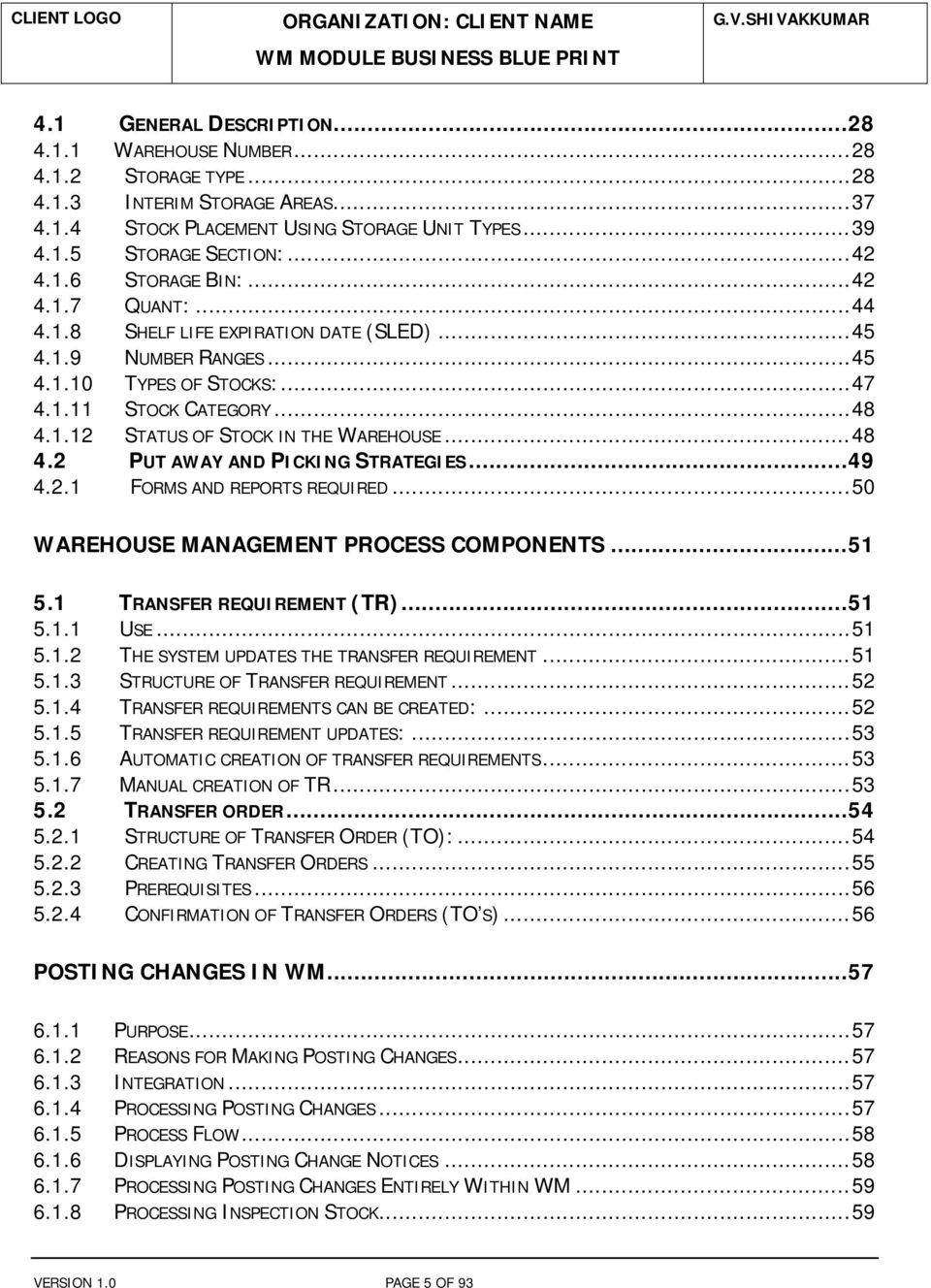
4 Contents Table of Contents INTRODUCTION...9 OBJECTIVE OF THIS REPORT...9 STRUCTURE OF THE REPORT ORGANIZATION OVERVIEW ABOUT STRIDES GROUP (STRIDES ARCOLAB LTD.) WAREHOUSE MANAGEMENT (WM) AT STRIDES ARCOLAB LTD...11 ORGANIZATION STRUCTURE ORGANIZATION STRUCTURE COMPANY CODE PLANT STORAGE LOCATIONS WAREHOUSE ORGANIZATION STRUCTURE OF WAREHOUSE MANAGEMENT...18 MASTER DATA MASTER DATA MATERIAL MASTER VIEWS IN THE MATERIAL MASTER RECORD ORGANIZATION LEVELS IN WAREHOUSE MANAGEMENT FOR MATERIAL MASTER DATA MAINTENANCE DEFINING WAREHOUSE DATA IN THE MATERIAL MASTER INTEGRATION...27 WAREHOUSE STRUCTURE...28 VERSION 1.0 PAGE 4 OF 93

5 4.1 GENERAL DESCRIPTION WAREHOUSE NUMBER STORAGE TYPE INTERIM STORAGE AREAS STOCK PLACEMENT USING STORAGE UNIT TYPES STORAGE SECTION: STORAGE BIN: QUANT: SHELF LIFE EXPIRATION DATE (SLED) NUMBER RANGES TYPES OF STOCKS: STOCK CATEGORY STATUS OF STOCK IN THE WAREHOUSE PUT AWAY AND PICKING STRATEGIES FORMS AND REPORTS REQUIRED...50 WAREHOUSE MANAGEMENT PROCESS COMPONENTS TRANSFER REQUIREMENT (TR) USE THE SYSTEM UPDATES THE TRANSFER REQUIREMENT STRUCTURE OF TRANSFER REQUIREMENT TRANSFER REQUIREMENTS CAN BE CREATED: TRANSFER REQUIREMENT UPDATES: AUTOMATIC CREATION OF TRANSFER REQUIREMENTS MANUAL CREATION OF TR TRANSFER ORDER STRUCTURE OF TRANSFER ORDER (TO): CREATING TRANSFER ORDERS PREREQUISITES CONFIRMATION OF TRANSFER ORDERS (TO S)...56 POSTING CHANGES IN WM PURPOSE REASONS FOR MAKING POSTING CHANGES INTEGRATION PROCESSING POSTING CHANGES PROCESS FLOW DISPLAYING POSTING CHANGE NOTICES PROCESSING POSTING CHANGES ENTIRELY WITHIN WM PROCESSING INSPECTION STOCK...59 VERSION 1.0 PAGE 5 OF 93
6 6.1.9 UPDATES IN THE SYSTEM: RELEASING STOCK FROM INSPECTION RELEASES FROM MORE THAN ONE STORAGE TYPE PROCEDURE IN WM PROCESSING BLOCKED STOCK (EXPIRED GOODS) CONVERTING AVAILABLE STOCK TO INSPECTION STOCK CONVERTING AVAILABLE STOCK TO INSPECTION STOCK FOR RETEST FORMS AND REPORTS REQUIRED...61 GOODS RECEIPT GOODS MOVEMENTS IN WAREHOUSE MANAGEMENT THE GOODS RECEIPT PROCESS WM - QM INTERFACE PROCESS FLOW GOODS RECEIPT FOR QUALITY INSPECTION PROCESS FLOW RELEASING MATERIAL FROM INSPECTION STOCK TASKS IN INVENTORY MANAGEMENT AND QUALITY MANAGEMENT CUSTOMER RETURN MATERIAL HANDLING PROCESS GOODS RECEIPT FOR PURCHASE ORDER /PROCESS ORDER / RETURN SALE ORDER SAP SCENARIOS GOODS RECEIPT WITHOUT PURCHASE ORDER SAP SCENARIOS GOODS RECEIPT OF BULK STORAGE SAP SCENARIOS ONLINE REJECTION MATERIAL DOCUMENTS SAP SCENARIOS...71 GOODS ISSUE GOODS ISSUE IN THE WAREHOUSE MANAGEMENT PURPOSE PROCESS FLOW INTEGRATION FEATURES IMPACT OF DELIVERY ON WAREHOUSE MANAGEMENT SYSTEM CREATING A TO FOR A CANCELLED DELIVERY GOODS ISSUE BASED ON AN INVENTORY MANAGEMENT POSTING GOODS ISSUE TO A COST CENTER GOODS ISSUE FOR RETURN DELIVERY TO VENDOR (VENDOR RETURN)...77 VERSION 1.0 PAGE 6 OF 93

7 CREATING A TRANSFER ORDER FOR A MATERIAL DOCUMENT GOODS ISSUE FOR PRODUCTION SUPPLY GOODS ISSUE TO PROCESS ORDER / COST CENTER / RESERVATION / PURCHASE ORDER / RETURN DELIVERY TO VENDOR SAP SCENARIOS GOODS ISSUE TO CONTROL SAMPLES SAP SCENARIOS GOODS ISSUE AGAINST SALES ORDER SAP SCENARIO FORMS AND REPORTS REQUIRED...80 TRANSFER POSTINGS GENERAL DESCRIPTION FEATURES TRANSFER POSTINGS AND STOCK TRANSFERS STOCK TRANSFER PROCEDURES STOCK TRANSFERS AND REPLENISHMENT WAREHOUSE TO WAREHOUSE STOCK TRANSFER BELONG TO TWO DIFFERENT PLANTS FROM WAREHOUSE TO WAREHOUSE (IN THE SAME PLANT) INTERNAL STOCK TRANSFERS: BIN TO BIN TRANSFER IN THE SAME WAREHOUSE TRANSFER OF STOCK FROM SALES ORDER STOCK TO SALES ORDER STOCK TRANSFER OF MATERIAL FROM ONE WAREHOUSE TO ANOTHER WAREHOUSE WHICH BELONG TO TWO DIFFERENT PLANTS SAP SCENARIOS TRANSFER POSTING - WAREHOUSE TO WAREHOUSE (WITHIN THE PLANT) SAP SCENARIOS TRANSFER POSTING-BIN TO BIN TRANSFER OF MATERIAL WITH IN THE WAREHOUSE SAP SCENARIOS TRANSFER DOCUMENT CREATED BY OTHER MOVEMENTS SAP SCENARIOS MATERIAL DOCUMENT CREATED BY OTHER MOVEMENTS SAP SCENARIOS FORMS AND REPORTS REQUIRED...88 PHYSICAL INVENTORY PURPOSE FEATURES PHYSICAL INVENTORY PROCEDURES PROCESS FLOW...91 VERSION 1.0 PAGE 7 OF 93

8 PROCEDURE TO BE FOLLOWED FOR PHYSICAL INVENTORY IN WAREHOUSE MANAGEMENT SAP SCENARIOS FORMS AND REPORTS REQUIRED INTEGRATION WITH OTHER MODULES...93 VERSION 1.0 PAGE 8 OF 93

9 Introduction The aim of the blue print on Warehouse Management System (WMS) is to know the functions, processes & procedures to be followed for the business requirements, integration with other modules & processes, which is the main deliverable of Business Blueprint Phase, is to serve as conceptual master plan for Warehouse Management System (WMS) module for XXX-client Name This Blueprint has been developed by documenting all input gathered from the core team by scheduling meetings and workshops. This document shows the business requirements in detail, and serves as the basis for organization, configuration and development activities. Objective of this Report During the course of this phase of the assignment, Covansys consultants held business process workshop for the Core team members (across businesses) to discuss and deliberate the business requirements for respective functional areas. The objective of the workshops was to discuss the following aspects of each business process and to define the requirements of XXX-client Name in detail. Business Process Expectations/ Improvements Reporting/Information requirements Based on the discussions during the Business Process Workshop, various business scenarios have been documented which need to be addressed by the system. The purpose of this report is to confirm the understanding of these business scenarios, which would form the basis for system specifications and to also list requirements which cannot be addressed by the system. This document forms the basis for all subsequent activities to be conducted during the project. VERSION 1.0 PAGE 9 OF 93

10 Structure of the Report The report initially gives an overview of the Warehouse Management Module purview. This would essentially help in defining the boundaries of the module and also in identifying the activities to be performed within Warehouse Management Module in SAP. Subsequently, the report discusses in detail, the proposed coverage of SAP at XXX-client Name., in terms of organizational entities and business processes. Each business process has been described with all the variations. The authorization requirements would be identified and configured during the configuration phase. 1.1 Organization Overview About XXX-client Name XXX-client Name is an integrated manufacturers and exporter of finished pharmaceutical dosage forms both branded and generic. Stride s is a significant global player in soft gelatin capsules and sterile parenterals with quality standards that meet the most stringent regulated market standards. Strides has 14 world-class plants in India, U.S.A, Brazil, Mexico, Poland and Italy offering its partners the advantage of multi-location product sourcing. Strides is among the world s top 5 soft gel capsule manufacturers with plants in India and an US FDA inspected plant in the U.S.A. Strides has marketing presence in 55 countries. This broad network facilitates partnering with global organizations ranging from UNICEF, UNDP, Global TB Drug Facility, The Clinton Foundation to European and American pharma giants and even private labelers and distribution chains. In addition, Strides also undertakes Contract Research & Manufacturing of Specialty Chemicals. Strides have about 1500 employees in total in different operations across various geographical locations. The annual revenues of the group are in the range of RS 700 Crore. Strides have implemented SAP as the backbone ERP system in , which is being successfully used for the last 2 years. However, keeping in view the future challenges and growth plans, Strides has decided to implement mysap ERP R/3 4.7 Ver. Warehouse Management Module. VERSION 1.0 PAGE 10 OF 93

11 1.2 Warehouse Management (WM) at XXX-client Name The Warehouse Management system (WMS) is implemented in the following plants XXX for the management of warehouse. The SAP Warehouse Management module allows: Definition and mapping of the physical warehousing structures in the system Processing goods movements like - receipts, issues and stock transfers Maintain up to date stock inventories in the Warehousing complex at storage bin level The Warehouse management is integrated with Material Management (MM), Sales & Distribution (SD), Quality Management (QM) modules. The base document for the material movement will be generated either in the MM or SD or QM modules. For all the Goods receipt (GR) from the vendors and other plants, the base document will be generated in MM module. For Goods Issue (GI) for either to production or to other plants the base document will be generated in MM module. As quality management is active in the organization, all the materials will pass through the quality inspection process during the GR and GI and posting change document (change in the stock type of the material stock i.e. either from quality inspection stock to unrestricted etc) will be generated in quality management for the placement or removal of material in warehouse. During the GR quality inspection process and online inspection process during production, the base document to return the material to the vendor will be generated in QM module. For the delivery of goods against sales order, the delivery document will be generated in SD module for the removal of the material from the warehouse. For handling the customer return materials, the base document will be generated either in SD module. The inventory will be managed both in storage location level in Inventory management (IM) level in MM module and at bin level in Warehouse Management. WM module also has RFID & Bar code reading functionality. These can be explored & implemented in future as separate project. VERSION 1.0 PAGE 11 OF 93

12 Organization Structure 2.1 Organization Structure In SAP, a company is made up of a variety of operational groups. These groups or organizational units can include sales, purchasing, accounting, distribution, and so forth. SAP R/3 System is designed to support each of these groups. Different software applications in the R/3 System can be linked to these organization units to create a completely integrated company structure. Flexible organizational units in the R/3 System let user represent user s organization with a comprehensive company structure. The combination and integration of organizational units form the legal and structural basis of a company. For example, organizational units can interface with materials management, sales and distribution, and financial accounting. Different application areas in the R/3 System can be linked through organizational units to create a completely integrated company structure. Company Code A Company code represents the XXX client Group legal entity and accounting unit where balance sheet and profit and loss statements are created. There will be XX Company Codes representing XXX client Group Plant A plant is an organizational unit within the company, against which materials are purchased and stored. Only the above company codes are considered for the WM implementation. Company Code: Sterile Products Division 1060 Beta Lactam Division 1070 Oral Dosage Forms 1080 Formulation Development 1090 Sterile Facilities Formulation 1100 Global Remedies Limited VERSION 1.0 PAGE 12 OF 93

13 Company Code: GLOBAL REMEDIES 2010 Global Remedies Limited Company Code: QUANTUM LIFE SCIENCES PVT 3010 QUANTUM LIFE SCIENCES PVT LTD. Storage Locations A storage location is a unit that allows the differentiation of material stocks within a plant. Inventory management on a quantity basis is carried out at storage location level. Physical inventory is also carried out at storage location level. Each plant may have multiple storage locations. Plant Code Storage location 1050 CR CSLF 1050 FG NMFG 1050 PM CSLP 1050 SMP RM CSLR 1050 FD PS SMR RR MI01 VERSION 1.0 PAGE 13 OF 93
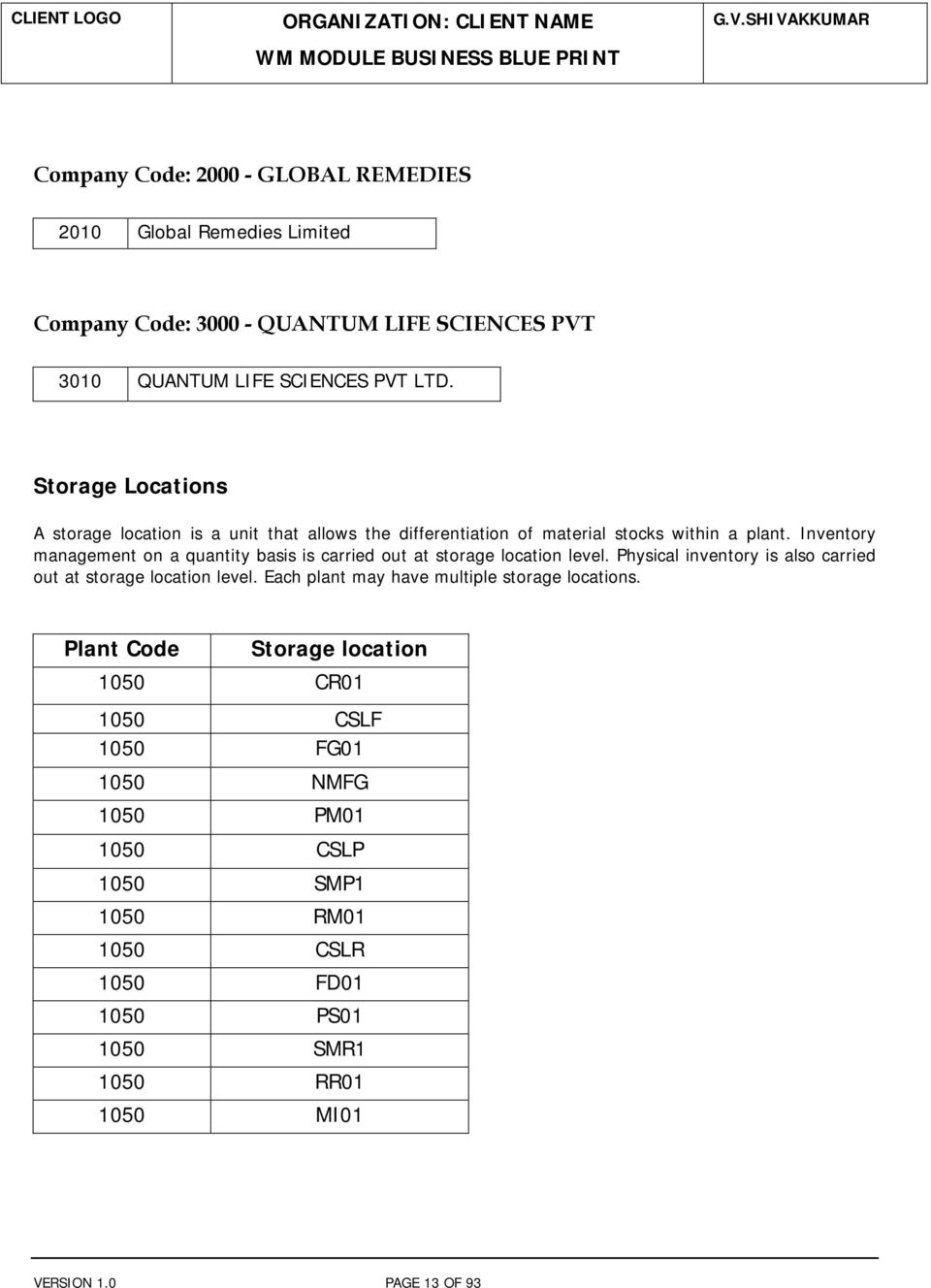
14 Plant Code Storage location 1060 CR CSLF 1060 FG NMFG 1060 PM CSLP 1060 SMP RM CSLR 1060 FD PS SMR RR MI01 Plant Code Storage location 1070 CR CSLF 1070 FG NMFG 1070 PM CSLP 1070 SMP RM CSLR 1070 FD PS SMR RR CL01 VERSION 1.0 PAGE 14 OF 93

15 Plant Code Storage location 1080 CR CSLF 1080 FG NMFG 1080 PM CSLP 1080 SMP RM CSLR 1080 FD PS SMR RR MI01 Plant Code Storage location 1090 CR CSLF 1090 FG NMFG 1090 PM CSLP 1090 SMP RM CSLR 1090 FD PS SMR RR MI01 VERSION 1.0 PAGE 15 OF 93
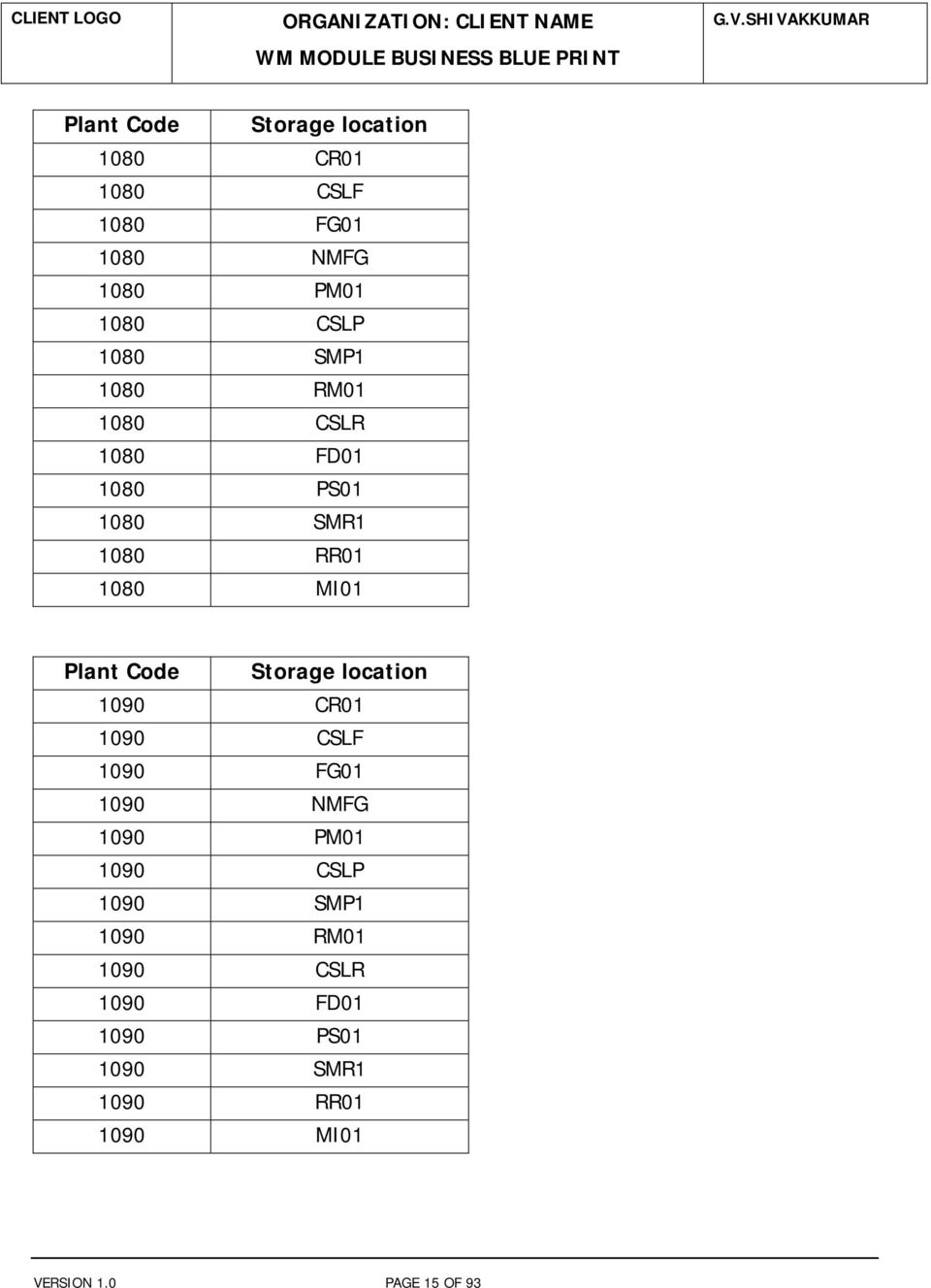
16 Plant Code Storage location 1100 CR CSLF 1100 FG NMFG 1100 PM CSLP 1100 SMP RM CSLR 1100 FD PS SMR RR MI01 Plant Code Storage location 2010 CR CSLF 2010 FG NMFG 2010 PM CSLP 2010 SMP RM CSLR 2010 FD PS SMR RR MI01 VERSION 1.0 PAGE 16 OF 93

17 Plant Code Storage location 3010 CR CSLF 3010 FG NMFG 3010 PM CSLP 3010 SMP RM CSLR 3010 FD PS SMR RR MI01 Above Same Storage Location will be activated for Warehouse management modules. Warehouse The Warehouse Management (WM) application provides flexible, automated support to assist in processing all goods movements and in maintaining current stock inventories in warehousing complex. WM supports warehousing processes like: Define and manage complex warehousing structures Optimize material flow using advanced put away and picking techniques Process goods receipts, goods issues and stock transfers quickly and easily The Warehouse Management application is fully integrated into the SAP R/3 system. Transactions that are initiated in other SAP components result in corresponding tasks in WM which activate the actual physical transfers within the warehouse. A few of these activities include: Material movements and changes in material status, such as releasing goods from inspection Material staging to production supply areas Picking and shipping goods for sales orders VERSION 1.0 PAGE 17 OF 93

18 Organization structure of Warehouse Management Company Code STRIDES ARCOLAB LTD STRIDES ARCOLAB LTD Plant Code Storage location Name Warehouse Code 1050 FG01 Finished Goods 105 CR01 Customer returns 105 CSLF Cus supp FERT 105 NMFG Non Moving FG 105 PM01 Packing Material 105 CSLP Cus supp Pack 105 SMP1 Slow-mvng PM 105 RM01 Raw materials 105 CSLR Cus supply ROH 105 FD01 Raw materials / Packing Mat. 105 PS01 Pre purchase sam 105 SMR1 Slow-mvng RM 105 RR01 Rejections 105 MI01 Miscellaneous FG01 Finished Goods 106 CR01 Customer returns 106 CSLF Cus supp FERT 106 NMFG Non Moving FG 106 PM01 Packing Material 106 CSLP Cus supp Pack 106 SMP1 Slow-mvng PM 106 RM01 Raw materials 106 CSLR Cus supply ROH 106 FD01 Raw materials / Packing Mat. 106 PS01 Pre purchase sam 106 SMR1 Slow-mvng RM 106 RR01 Rejections 106 MI01 Miscellaneous 106 VERSION 1.0 PAGE 18 OF 93

19 STRIDES ARCOLAB LTD 1070 FG01 Finished Goods 107 CR01 Customer returns 107 CSLF Cus supp FERT 107 NMFG Non Moving FG 107 PM01 Packing Material 107 CSLP Cus supp Pack 107 SMP1 Slow-mvng PM 107 RM01 Raw materials 107 CSLR Cus supply ROH 107 FD01 Raw materials / Packing Mat. 107 PS01 Pre purchase sam 107 SMR1 Slow-mvng RM 107 RR01 Rejections 107 MI01 Miscellaneous 107 CL01 Caryl stock STRIDES ARCOLAB LTD 1080 FG01 Finished Goods 108 CR01 Customer returns 108 CSLF Cus supp FERT 108 NMFG Non Moving FG 108 PM01 Packing Material 108 CSLP Cus supp Pack 108 SMP1 Slow-mvng PM 108 RM01 Raw materials 108 CSLR Cus supply ROH 108 FD01 Raw materials / Packing Mat. 108 PS01 Pre purchase sam 108 SMR1 Slow-mvng RM 108 RR01 Rejections 108 MI01 Miscellaneous STRIDES ARCOLAB LTD 1090 FG01 Finished Goods 109 CR01 Customer returns 109 VERSION 1.0 PAGE 19 OF 93
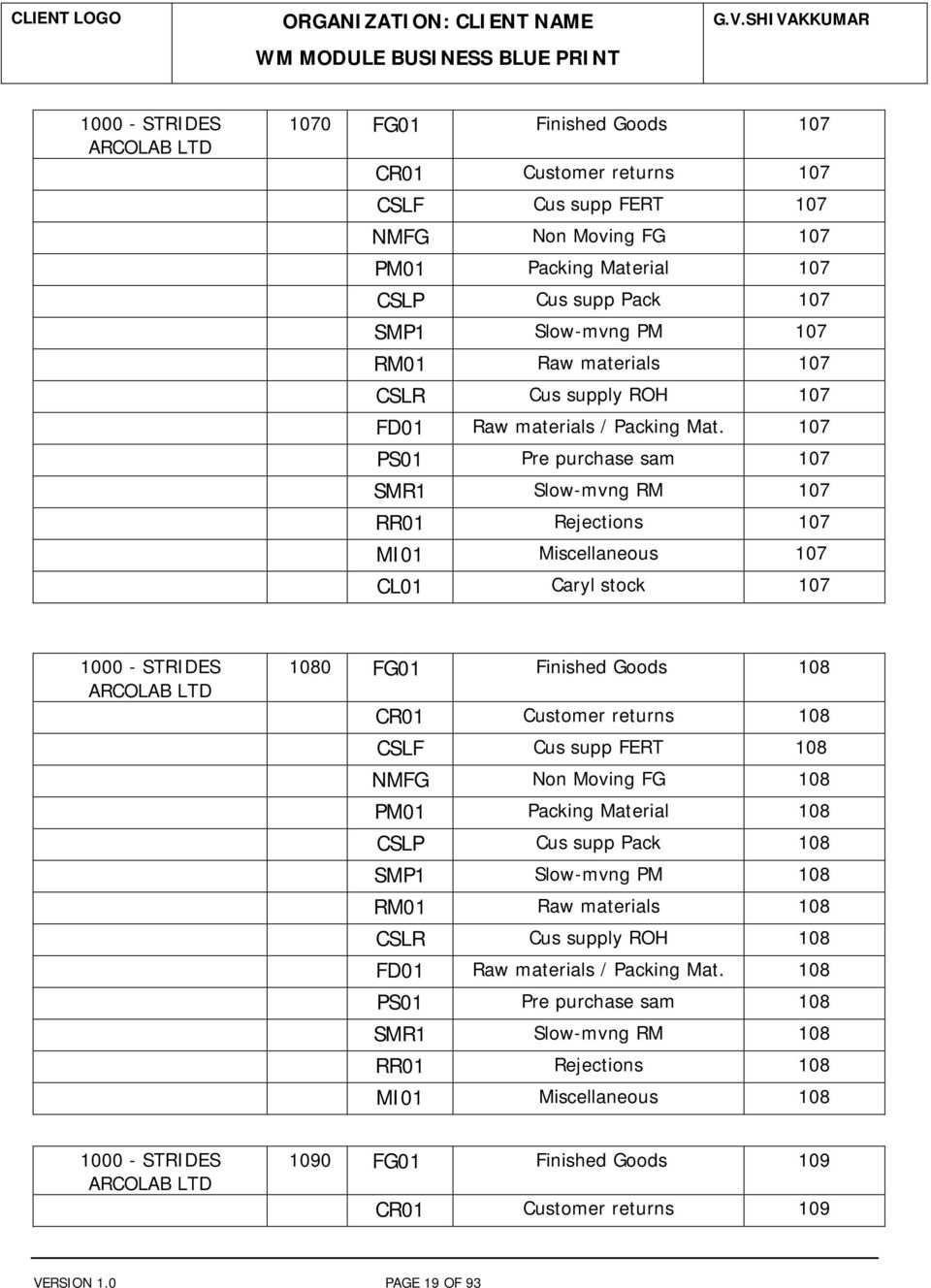
20 CSLF Cus supp FERT 109 NMFG Non Moving FG 109 PM01 Packing Material 109 CSLP Cus supp Pack 109 SMP1 Slow-mvng PM 109 RM01 Raw materials 109 CSLR Cus supply ROH 109 FD01 Raw materials / Packing Mat. 109 PS01 Pre purchase sam 109 SMR1 Slow-mvng RM 109 RR01 Rejections 109 MI01 Miscellaneous STRIDES ARCOLAB LTD 1100 FG01 Finished Goods 110 CR01 Customer returns 110 CSLF Cus supp FERT 110 NMFG Non Moving FG 110 PM01 Packing Material 110 CSLP Cus supp Pack 110 SMP1 Slow-mvng PM 110 RM01 Raw materials 110 CSLR Cus supply ROH 110 FD01 Raw materials / Packing Mat. 110 PS01 Pre purchase sam 110 SMR1 Slow-mvng RM 110 RR01 Rejections 110 MI01 Miscellaneous GLOBAL REMEDIES 2010 FG01 Finished Goods 201 CR01 Customer returns 201 VERSION 1.0 PAGE 20 OF 93

21 CSLF Cus supp FERT 201 NMFG Non Moving FG 201 PM01 Packing Material 201 CSLP Cus supp Pack 201 SMP1 Slow-mvng PM 201 RM01 Raw materials 201 CSLR Cus supply ROH 201 FD01 Raw materials / Packing Mat. 201 PS01 Pre purchase sam 201 SMR1 Slow-mvng RM 201 RR01 Rejections 201 MI01 Miscellaneous QUANTUM LIFE SCIENCES PVT 3010 FG01 Finished Goods 301 CR01 Customer returns 301 CSLF Cus supp FERT 301 NMFG Non Moving FG 301 PM01 Packing Material 301 CSLP Cus supp Pack 301 SMP1 Slow-mvng PM 301 RM01 Raw materials 301 CSLR Cus supply ROH 301 FD01 Raw materials / Packing Mat. 301 PS01 Pre purchase sam 301 SMR1 Slow-mvng RM 301 RR01 Rejections 301 MI01 Miscellaneous 301 VERSION 1.0 PAGE 21 OF 93
22 Logistics Organization Structure of 3 Company Codes Warehouse Organization structure for Plants 1050 (SPD) 1060(BLD) SPD Storage Locations BLD Storage Locations SPD Warehouse 105 BLD Warehouse 106 VERSION 1.0 PAGE 22 OF 93
23 1070(ODF) 1080 (FD) ODF Storage Locations FD Storage Locations ODF Warehouse 107 FD Warehouse 108 VERSION 1.0 PAGE 23 OF 93
24 1090 (SFF) 1100 (GRL) SFF Storage Locations GRL Storage Locations SFF Warehouse 109 GRL Warehouse 110 VERSION 1.0 PAGE 24 OF 93
25 2010 (GRL) 3010 (QLS) GRL Storage Locations QLS Storage Locations GRL Warehouse 201 QLS Warehouse 301 VERSION 1.0 PAGE 25 OF 93
26 Master Data 3.1 Master Data Master data is defined as data records, which remain unchanged over an extended period of time and contain information that is used in the same manner for similar objects. Consistency and correctness of format and input is essential to ensure full and proper use of the system. Material Master The material master record is the source of material specific data, which is used throughout the SAP R/3 system. The data contained in the material master record is required for many functions within the logistics system such as purchasing data for ordering, inventory management for posting goods movements, accounting data for valuation upon goods movements or invoice verification and materials planning data and for the storing the materials in warehouse / storage location. Material data is held at different organizational levels: Data on client level: Material group, base unit of measure, material descriptions, general technical data and conversion factors for alternative units of measure. Data at plant level: All plant and related storage location specific data. Data at storage level: All storage location specific data. Data at Warehouse level: All warehouse specific data such as picking and placement strategies. Data at storage type level: Storage specific data such as bin location specific to the storage area. M aterial M aster: Organizational Levels D ata that is valid for the w hole com pany: F o r e x a m p le, m a te ria l n o., m a te ria l s h o rt te x t, m a te ria l group, base and alternative units of m easure,... Data that is valid within one plant: F o r e x a m p le, p u rc h a s in g d a ta, M R P d a ta, fo re c a s tin g d a ta, w o rk s c h e d u lin g d a ta,... Data that is valid for one storage location: For exam ple, storage bin description, picking area,... SAP AG 1999 VERSION 1.0 PAGE 26 OF 93
27 Views in the Material Master Record Data can be maintained and displayed in material master records using views. Just as data in the material master record is maintained for specific departments, such as quality assurance, sales or product planning, some of the data is used specifically by the Warehouse Management (WM) application. For example, when user maintain material data from the viewpoint of warehouse management, the system displays only the data that is relevant for the storage of the material in the warehouse. General data that is relevant for more than one view (for example, the material's description, its weight, and its volume) appears in several views. Organization Levels in Warehouse management for Material master maintenance data There are two organizational levels that can be defined for WM. In the WM view of the material master record, all the indicators and fields that are used for the entire warehouse number are entered at the warehouse number level. There is also a storage type level with all the indicators that apply to a single storage type but do not for the entire warehouse. If user enter a storage type for a material on the initial screen for the WM view, the system displays an additional section in which user can enter, for example, a fixed storage bin or a control quantity. These fields only apply to the storage type and not to the entire warehouse. Defining Warehouse Data in the Material Master The material master data for warehouse management system can be maintained separately or along with the other views. The procedure to be followed for the mater data maintenance is given below. If user want to create the material master data for a material for more than one storage area (storage type) for a warehouse, user have to create the data for each storage type warehouse combination in creation mode of material master. To define warehousing data in the material master: Choose Logistics _ Logistics Execution _ Master Data _ Material _ Material _ Create _ immediately from the SAP menu. Transaction code is MM To change data in the material master, choose Logistics _ Logistics Execution _Master Data_ Material _ Material _ Create _ immediately. Transaction code is MM02. The steps for changing data are basically the same as those described below. Using this function, user can overtype existing data in the material master record. Transaction code is MM02 and MM03 to display the material master. Integration The WM has integration with Material management (MM), Sales & Distribution (SD), Quality management (QM) and Production Planning (PP). VERSION 1.0 PAGE 27 OF 93
28 Warehouse Structure 4.1 General Description The Warehouse Management (WM) application provides flexible, automated support to assist in processing all goods movements and in maintaining current stock inventories in warehousing complex. WM supports warehousing processes like: Define and manage complex warehousing structures Optimize material flow using advanced put away and picking techniques Process goods receipts, goods issues and stock transfers quickly and easily The Warehouse Management application is fully integrated into the SAP R/3 system. Transactions that are initiated in other SAP components result in corresponding tasks in WM which activate the actual physical transfers within the warehouse. A few of these activities include: Goods receipt from the vendors. Inter plant stock transfers. Material movements and changes in material status, such as releasing goods from inspection Material staging to production supply areas Picking and shipping goods for sales orders Warehouse Number In Warehouse Management (WM), a complete physical warehouse is defined under a single warehouse number. Using the warehouse number, user can manage several individual warehouse buildings that, together, form a complete warehouse complex. The warehouse number encompasses the organizational and physical aspects of a warehousing complex as a single concept. Storage type It is a storage area in warehouse facility, or a warehouse zone that is defined in Warehouse Management (WM) for a warehouse number. This is a physical or logical subdivision of a warehouse complex that is characterized by its warehouse technique, the space used, its organizational form, or its function. A storage bin consists of one or several storage bins. VERSION 1.0 PAGE 28 OF 93
29 Broadly Storage Types can be defined as: Goods receipt area Goods Issue area. Bulk storage Open Storage High rack storage Picking area Shelf storage We will define the important control indicators at the storage type level that determine the material flow (put away and picking activities) and the way inventory is handled in each storage type. These include the control indicators for: Put away strategy Picking strategy For SPD (1050) plant the following storage types (areas) are finalized: Ambient Temperature Area A01 A02 A03 A04 A05 A06 A07 A08 A09 A10 A11 A12 A13 A14 A15 A16 A17 A18 UQ PM Gr.Flr Open Area UQ PM Gr.Flr App PM Gr.Flr Open Area App PM Gr.Flr UQ PM Printed materials Gr.Flr Open Area UQ PM Printed materials Gr.Flr App PM Printed materials Gr.Flr Open Area App PM Printed materials Gr.Flr Rej RM/PM Gr.Flr Open area Rej RM/PM Gr.Flr UQ PM Ist.Flr Open Area UQ PM Ist.Flr App PM Ist.Flr Open Area App PM Ist.Flr Rej PM Ist.Flr Open area Rej PM Ist.Flr Open area PM cellar (App/UQ) Open Area Solvents\Liquids VERSION 1.0 PAGE 29 OF 93
30 Cool Temperature Area C01 C02 C03 C04 C05 C06 C07 C08 C09 C10 C11 C12 C13 UQ RM Room Open Area UQ RM Room UQ RM Controlled Substance UQ RM Hazardus chemicals App RM Room Open Area App RM Room App RM Controlled Substance App RM Hazardus chemicals UQ PM for Labels App PM for Labels App & UQ FG Gr. Flr Open Area App & UQ FG Gr. Flr Rejected FG Gr. Flr Cold Temperature Area D01 D02 App/UQ/Rej for RM App/UQ/Rej for FG For BLD (1060) plant the following storage types (areas) are finalized: Ambient Temperature Area A01 UQ PM Room 1 A02 A03 A04 Open Area UQ PM Room1 Rej PM Room1 Open area Rej PM Room1 A05 App PM Room 1 A06 A07 A08 A09 Open Area App PM Room1 UQ PM Printed materials Open Area UQ PM Printed materials App PM Printed materials VERSION 1.0 PAGE 30 OF 93
31 A10 Open Area App PM Printed materials A11 App PM Room 2 A12 Open Area App PM Room2 Cool Temperature Area C01 C02 C03 C04 C05 C06 C07 Open Area UQ PM (PVDC/FOIL) App PM (PVDC/FOIL) Open Area App PM (PVDC/FOIL) UQ PM for Labels App PM for Labels Open Area FG ( App & UQ) Open Area FG ( Rejected) C08 UQ RM room 1 C09 C10 C11 C12 Open Area UQ RM room1 Rej RM Room1 Open Area Rej RM Room1 App RM Room1 C13 Open Area APP RM Room 1 C14 App RM Room2 C15 Open Area APP RM Room 2 Cold Temperature Area D01 Open Area RM (App/UQ/Rej) For ODF (1070) plant the following storage types (areas) are finalized: Ambient Temperature Area A01 UQ RM Room 1 A02 A03 Open Area UQ RM room1 Rej RM Room1 A04 UQ RM Controlled Room 1 VERSION 1.0 PAGE 31 OF 93
32 A05 UQ RM Room 2 A06 Open Area UQ RM room2 A07 App RM Controlled Room 1 A08 App RM Room1 A09 Open Area APP RM Room 1 A10 UQ RM Room 3 A11 Open Area UQ RM Room 3 A12 App RM Room2 A13 Open Area App RM Room 2 A14 A15 A16 A17 A18 A19 A20 A21 A22 A23 Op Area Solvents(App & Uq) App & UQ PM Op Area App & UQ PM Rejected area PM App & UQ PM printed UQ Misc App Misc Open area App Misc Open Area Rej RM Open Area Rej PM Cool Temperature Area C01 UQ RM room 1 C02 C03 C04 Open Area UQ RM room1 Rej RM Room1 App RM Room1 C05 Open Area APP RM Room 1 C06 App RM Room2 C07 Open Area APP RM Room 2 C08 UQ RM Room 2 C09 Open Area UQ RM room2 VERSION 1.0 PAGE 32 OF 93
33 C10 App RM Room3 C11 Open Area APP RM Room 3 C12 App RM Room4 C13 Open Area APP RM Room 4 C14 C15 C16 C17 C18 C19 C20 C21 C22 C23 C24 C25 C26 C27 C28 C29 C30 Bulk storage tanks (both App & UQ) open area Bulk storage cellar (both App & UQ) EHG capsule storage(both App & UQ) Op Area EHG caps storage(both App & UQ) App & UQ PM (PVC/ PVDC) Open Area App & UQ PM (PVC/ PVDC) App & UQ PM (Foil & Label) Open Area App & UQ PM (Foil & Label) Rejected area PM App & UQ FG Gr. Flr Open Area App & UQ FG Gr. Flr Rejected FG Gr. Flr App & UQ FG Ist. Flr Open Area App & UQ FG Ist. Flr Misc Mat. FG Gr. Flr Open Area Rej RM Open Area Rej PM Cold Temperature Area D01 D02 D03 D04 D05 UQ RM APP RM Rej RM Op Area UQ RM Op Area App RM VERSION 1.0 PAGE 33 OF 93
34 For Star (1080) plant the following storage types (areas) are finalized: Ambient Temperature Area Cool Temperature Area C01 C02 C03 C04 C05 C06 C07 C08 C09 C10 C11 C12 C13 C14 C15 UQ RM Gr. Flr Open Area UQ RM Gr. Flr Rej RM Gr. Flr App RM Gr. Flr Open Area APP RM Gr. Flr UQ RM Ist. Flr Open Area UQ RM Ist. Flr App RM Ist. Flr Open Area APP RM Ist. Flr UQ PM Gr.Flr Open Area UQ PM Gr.Flr App PM Gr.Flr Open Area App PM Gr.Flr Rej PM Gr.Flr Open area RM controlled Substance (App/UQ/Rej) Cold Temperature Area D01 Open Area RM (App/UQ/Rej) For SPD 2 (1090) plant the following storage types (areas) are finalized: Ambient Temperature Area A01 UQ PM Room 1 A02 A03 Open Area UQ PM Room1 Rej PM Room1 A04 App PM Room 1 A05 Open Area App PM room1 VERSION 1.0 PAGE 34 OF 93
35 Cool Temperature Area C01 UQ RM room 1 C02 C03 C04 Open Area UQ RM room1 Rej RM Room1 App RM Room1 C05 Open Area APP RM Room 1 Cold Temperature Area D01 Open Area RM (App/UQ/Rej) For GRL (1100) plant the following storage types (areas) are finalized: Ambient Temperature Area A01 A02 A03 A04 A05 UQ RM Gr. Flr Open Area UQ RM Gr. Flr Open Area UQ RM Gr. Flr Room2 App RM Gr. Flr Open Area App RM Gr. Flr A06 Open Area App RM Gr. Flr Room 2 A07 A08 A09 A10 A11 A12 A13 A14 Open area Rejected RM Gr. Flr UQ/App Printed PM Gr. Flr Open Area UQ/App Printed PM Gr. Flr UQ/App Printed Labels Gr. Flr UQ/App PM Gr. Flr Open Area UQ/App PM Gr. Flr Open area Rej PM Gr. Flr Open Area App/UQ/Rej FG Gr. Flr VERSION 1.0 PAGE 35 OF 93
36 Cool Temperature Area C01 C02 C03 C04 C05 C06 C07 UQ RM Gr. Flr Open Area UQ RM Gr. Flr App RM Gr. Flr Open Area App RM Gr. Flr Open area Rejected RM Gr. Flr UQ/App PM Gr. Flr Open Area UQ/App PM Gr. Flr Cold Temperature Area D01 Open Area RM (App/UQ/Rej) For QLS (3010) plant the following storage types (areas) are finalized: Ambient Temperature Area A01 A02 A03 A04 A05 A06 A07 A08 A09 A10 UQ PM Gr.Flr Open Area UQ PM Gr.Flr App PM Gr.Flr Open Area App PM Gr.Flr UQ PM Printed materials Gr.Flr Open Area UQ PM Printed materials Gr.Flr App PM Printed materials Gr.Flr Open Area App PM Printed materials Gr.Flr Rej PM Gr.Flr Open area Rej PM Gr.Flr Cool Temperature Area C01 C02 C03 C04 App & UQ FG Gr. Flr Open Area App & UQ FG Gr. Flr Rejected FG Gr. Flr Open area Rejected FG Gr. Flr VERSION 1.0 PAGE 36 OF 93
37 C05 C06 C07 C08 C09 C10 C11 C12 C13 UQ RM Gr. Flr Open Area UQ RM Gr. Flr App RM Gr. Flr Open Area App RM Gr. Flr Rejected RM Gr. Flr Open area Rejected RM Gr. Flr UQ PM for Labels App PM for Labels App RM Ist. Flr Cold Temperature Area The business requirement of SPD, BLD, QLS, ODF, SFF and GRL blocked storage area or rejected storage area, materials in this area should not be available for sales invoice i.e. for goods issue for either sales order or Process order. Customer return materials will go through the quality inspection and only quality rejected materials will be coming to customer return materials storage area. The materials in this area are not available for issue. The status of the materials in this area should be blocked. Interim Storage Areas Storage types that are commonly used by Inventory management and warehouse management are called Interim Storage Areas. The Inventory Management (IM) application component communicates with the Warehouse Management component through interim storage types. Goods receipts and issues posted in IM are automatically updated in WM in these interim storage types. Interim storage areas are: Goods receipt area Goods issue area Interim storage area for differences Posting change zone SAP has predefined intermediate Storage types starting the number with 9 series. Code Description 901 GR Area for Production 902 GR Area External Rcpts 904 Returns 910 GI Area General 911 GI Area for Cost Center VERSION 1.0 PAGE 37 OF 93
38 912 GI Area Customer Order 913 GI Area - Fixed Assets 914 GI Area Production Orders 915 Fixed Bin Picking Area 916 Shipping Area Deliveries 917 Quality Assurance 918 Goods Issue Area Contain. 920 Stock Transfers (plant) 921 Stock Transfers (StLoc) 922 Posting Change Area 923 Packaging Area 980 R/3 --> R/2 Cumulative 998 Init. Entry of Inv. Data 999 Differences VERSION 1.0 PAGE 38 OF 93
39 Stock Placement Using Storage Unit Types The Warehouse Management (WM) system allows user to use a number of different storage unit types when user transfer and store materials in the warehouse. For example, user can transfer materials on pallets of various sizes, such as European pallets or industrial pallets. Crates or pallets of materials that must be stored in different locations because of height or weight limits can be stored without unnecessary loss of space. Usage of Storage Unit Types: In order to use storage unit types user can 1. Define storage unit types in the material master record 2. Enter a storage unit type on the initial screen to create a transfer order without an originating document 3. Enter a storage unit type on the preparation screen for a transfer order When creating transfer orders, if user enters the storage unit type either on the initial screen or the preparation screen, the system uses the value user enter instead of the storage unit type in the material master record, if one is available. If user do not enter a storage type on the initial screen and user go to the preparation screen, the system uses the storage unit type defined in the material master record. If users do not enter a storage type on the initial screen and user goes to the item screen, the system does not propose a storage unit type, even if one has been defined in the material master. User must enter the storage unit type and then choose ENTER before the system will propose a storage type and bin. Following Storage Unit Types will me configured for Strides 105 U1 Pallet 105 U2 Common Unit 106 U1 Pallet 106 U2 Common Unit 107 U1 Pallet 107 U2 Common Unit 108 U1 Pallet 108 U2 Common Unit 109 U1 Pallet 109 U2 Common Unit VERSION 1.0 PAGE 39 OF 93
40 110 U1 Pallet 110 U2 Common Unit 301 U1 Pallet 301 U2 Common Unit Following Storage Bin type will be configured for the entire Warehouse. 105 B1 Racks 105 B2 Cup Board 105 B3 Compactor 105 B4 Bulk Tank 106 B1 Racks 106 B2 Cup Board 106 B3 Compactor 106 B4 Bulk Tank 107 B1 Racks 107 B2 Cup Board 107 B3 Compactor 107 B4 Bulk Tank 108 B1 Racks 108 B2 Cup Board 108 B3 Compactor 108 B4 Bulk Tank 109 B1 Racks 109 B2 Cup Board VERSION 1.0 PAGE 40 OF 93
41 109 B3 Compactor 109 B4 Bulk Tank 110 B1 Racks 110 B2 Cup Board 110 B3 Compactor 110 B4 Bulk Tank 301 B1 Racks 301 B2 Cup Board 301 B3 Compactor 301 B4 Bulk Tank VERSION 1.0 PAGE 41 OF 93
42 Storage Section: In Warehouse Management (WM), a storage section is an organizational subdivision of storage type that group s together storage bins with similar features for the purpose of putting away stock. The criteria for grouping bins can be defined on a user-individual basis, for example, heavy parts, bulky materials, fast-moving items, slow-moving items. Following Storage Section will be created for High Racks as per the current Rack Levels are available. L1 Level 1 L2 Level 2 L3 Level 3 L4 Level 4 L5 Level 5 L6 Level 6 L7 Level 7 L8 Level 8 L9 Level 9 Storage Bin: The storage bin is the smallest available unit of space in a warehouse. The storage bin therefore describes the position in the warehouse where the goods are or can be stored. Since the address of storage bin is frequently derived from a coordinate system, a storage bin is often referred to as a coordinate. The coordinate for example, can refer to a storage bin in row 1, stack 2, and level 3. User assigns each storage bin to a specific warehouse number and storage type according to its location. User must also assign each storage bin to a storage section. User can also define the following additional characteristics of a storage bin: Maximum weight Total capacity Fire containment section VERSION 1.0 PAGE 42 OF 93
43 Storing Materials in storage bins: The WM system manages both homogeneous and mixed storage in storage bins. 1. Homogeneous Storage Homogeneous storage is the storage of only one material number in a storage bin. User can define a storage type so that only one material can be stored in each available storage bin. Bulk storage areas are set up so that one line or block contains only one material number. For example, materials such as cases filled with beverages, bottled gas and pallets of cement blocks and other construction materials are stored homogeneously in bulk storage areas. This method is preferable when large quantities of the same material are stored in a warehouse. 2. Mixed Storage When user define mixed storage for a storage type in your warehousing complex, it is possible to store two or more materials (quants) in each storage bin. There is no standard strategy in WM that automatically would place material together with another material that is already stored in a storage bin. User will manually place the different stock with physical bin partition. Mixed storage is particularly useful when user have smaller quantities of several material numbers that need to be stored in the same storage area. Often, slower moving items are stored in mixed storage areas. Homogeneous storage would not be useful here, because that would mean that only a few boxes might be stored in each storage bin. Activities: Creating a single storage bin From the SAP Menu, choose Logistics _ Logistics Execution _ Master Data _Warehouse _Storage Bin _ Create Manually. Transaction code is LS01. Creating several storage bins simultaneously To create a group of storage bins with similar characteristics, user defines a template with the coordinate structure as follows: From the SAP menu choose Logistics_ Logistics Execution _ Master Data _ Warehouse _Storage Bin _ Create _ automatically. Transaction code is LS10 Blocking and Unblocking Storage Bins In WMS will give flexibility of blocking storage bins for put away as well as for picking. User must block any storage bins that are no longer accessible, that have been damaged or are to be renovated, or when put away or picks are not possible. User can block or unblock storage bins VERSION 1.0 PAGE 43 OF 93
44 Selectively On the basis of rows In bulk storage with a time limit for put away For the whole storage type Quant: Quant is the stock of any material with the same features in one storage bin. The system manages different batches of a material as different quant. The quantity of a quant can be increased by an addition to existing stock. Quant can be created or deleted solely through goods movements. The quant serves to manage stocks at storage bin level. When goods are stored in empty storage bin in WM, the system automatically creates a quant in this bin. The system automatically assigns a quant number. The quant is automatically deleted by the system when the material quantity is picked. In the quant record, the system manages the data of the materials grouped in the quant. This data includes: Quant identification Plant Material number Batch number Stock category Special stock indicator and number The different types of stock (categories) and special stock are passed to WM from IM and serve as stock separation characteristics in the quant. WM has neither stock categories nor any special stock types of its own. Since it is possible to manage stocks from different plants within one warehouse complex number, the plant must also exist as a stock separation characteristic in the quant. Since the system automatically assigns a quant number to each separate quant in WM, the system can optimize material flow and manage stock in the warehouse more efficiently. VERSION 1.0 PAGE 44 OF 93
45 Shelf life expiration date (SLED) The SLED field only exists in the quant when shelf life management is active in Materials Management (MM). This happens when the material master is maintained accordingly. During a stock placement in MM user can enter either the production date or the shelf life expiration date. This depends upon whether the field Remaining shelf life has been maintained in the material master record. For example, if 10 days have been entered into this field, the system assumes that when goods are received, the production date was entered and calculates the shelf life automatically. If user leaves this field empty in the material master, the system makes it possible for user to directly enter the shelf life expiration date. This date that is entered or calculated during the goods receipt is then noted in the quant that is created in the storage bin. If user adds stock to an existing quant in a storage bin, the shelf life expiration date of the new quantity that is added is lost. Enter the shelf life data into the storage view of the material master record. This data includes: Maximum time a material can be stored Minimum shelf life a material must have available to be accepted by the system Percentage of the total shelf life that must still be available if the goods are to be sent to another distribution point Time unit used for the shelf life data (days, weeks or years) Total number of days that the goods can be kept from production to the shelf life expiration date Number Ranges Warehouse Management (WM) numbers many objects in the warehouse on a continual basis. The assignment of number ranges provides an orderly sequencing system for several functions within WM. Assigning Number Ranges Number ranges for the following objects in the Warehouse Management can be defined as: Transfer requirements Transfer orders Posting change notices Physical Inventory VERSION 1.0 PAGE 45 OF 93
46 Following Number Ranges are defined for the above documents for the identification of documents. Plant WH Doc No. For TR Doc No. For TO Plant Description code No From To From To 1050 Sterile Products Division Beta Lactam Division Oral Dosage Forms Formulation Development Sterile Facilities Formulation Global Remedies Limited Quantum Life Sciences Plant WH Doc No. For PCN Doc No. For Quant Plant Description code No From To From To 1050 Sterile Products Division Beta Lactam Division Oral Dosage Forms Formulation Development Sterile Facilities Formulation Global Remedies Limited Quantum Life Sciences Plant WH Doc No. For Phy.Inv Doc No. For Phy.Inv-TO Plant Description code No From To From To 1050 Sterile Products Division Beta Lactam Division Oral Dosage Forms Formulation Development Sterile Facilities Formulation Global Remedies Limited Quantum Life Sciences VERSION 1.0 PAGE 46 OF 93
47 Types of Stocks: Special Stock: Special stock is managed separately in the Warehouse Management (WM) application for reasons of ownership or for various factors reflecting the location in which they are kept. Each type of special stock is assigned a special stock indicator to aid in managing it in the system. Special stock characteristics assigned during goods movements transactions in the IM component are displayed on WM screens and taken into consideration when processing stock in WM. Types of special stock using WMS: 1. Individual Customer (Sales Order) Stock (E) Individual customer (make-to-order) stock is managed in WM using a special stock number and the special stock indicator E. 2. Consignment Stock (K) Stock of materials made available by the vendor and stored on the premises of the ordering party. This stock remains in the ownership of the vendor until it is removed from the warehouse and used for production purposes or taken over into the company's own valuated stock. Consignment stock is managed in WM using a special stock number and the special stock indicator K. The special stock number for consignment stock is the same as the supplier (vendor) number. 3. Project Stock (Q) Material which is held in the warehouse for the completion of a project. For project stock, the system checks to see whether a corresponding master record exists. VERSION 1.0 PAGE 47 OF 93
48 Stock Category In WM, it is important to know what quantity of a stock is in a particular storage bin, but also its status and whether or not it is available. Stock in the warehouse is categorized in WM as follows: 1. Available Stock Unrestricted-use stock that is physically located in the warehouse, valuated, and not subject to any kind of usage restrictions. User can carry out all stock movements for this stock to include stock transfers, put away and picking. 2. Inspection Stock This stock carries the stock category Q to indicate that it is in quality inspection. Stock in quality inspection has been valuated but does not count as unrestricted-use stock. The Quality Management inspection data in the QM view of the material master determines whether a percentage of stock is to be designated as inspection stock when it is received in the warehouse. Once this stock has been inspected and a usage decision has been made, User carry out a transfer posting in the Inventory Management component and subsequent Posting Change in WM to remove the category Q, thus converting it to available stock. 3. Blocked Stock In IM it is possible to designate goods as blocked stock. These materials are a company's own stock that should not be used. Stock can be blocked, for example, because it has been damaged and for various other reasons. This stock is displayed in WM with a stock category of S. This stock is processed in exactly the same manner as inspection stock. 4. Blocked Stock Returns When delivered goods are returned by a customer, they are first posted in the system to blocked stock returns with a stock category of R. This stock is neither valuated nor is it considered to be unrestricted-use stock. It is possible store this stock in the warehouse. User must carry out a posting change to return it to available stock. Status of Stock in the Warehouse When goods arrive in the warehouse, they are usually received in the Goods Receipt Area (GR Area) near the receiving dock. Later, they are transferred using a transfer order to Under Quarantine within the warehouse. In some cases, goods can moved directly to fixed bins. During the period of time when move orders have been created for the movement of goods between the various storage types that have not been fully processed, two availability statuses exist for this stock which has not yet been moved. When warehouse evaluation lists are displayed for this material, these goods appear on the display lists under the following three headers: VERSION 1.0 PAGE 48 OF 93
49 1. Quantity or Total Stock This designator usually appears at the top of many stock display lists. This is the total quantity of material quants stored in the warehouse that does not include quantities for planned put away and picks. For the display of materials in a bin, the total quantity in each storage bin is also displayed. 2. Stock Placement This column designator appears in some stock lists. The system has created a transfer order for this stock to move it from one storage bin to another. It has been marked for put away (storage) in the warehouse. 3. Stock Removal This is also a column designator that appears in some stock lists. A transfer order has been created to pick this stock from a storage bin in the warehouse. In most cases, this stock will be transferred to a storage bin in the goods issue area. 4.2 Put away and Picking Strategies Put away and picking strategies are used in Warehouse Management system to optimize the storage / removal of goods in the warehouse. For inbound movements, in conjunction with controls entered in the material master record, the put away strategies assist the WM system to utilize the available warehouse capacity, automatically assigning optimum locations for goods received in the warehouse. For outbound movements, the system uses similar user-defined controls to execute the appropriate picking strategy to assign the best picking location. If user decides to manually process certain stock movements, user can change source and destination storage bins that are automatically proposed by the system. When the system creates transfer orders to move goods into or out of the warehouse, user does not have to intervene when it comes to finding storage bins. This guarantees that stock movements are processed quickly and consistently. For SPD, BLD, QLS, ODF, SFF and GRL plants the following strategies are finalized: 1. Put away strategy: The Addition to existing stock (I) strategy will be followed for placing the materials in the warehouse. The default location for a material will be identified in each storage area for the materials. As the warehouse is divided into many storage areas as explained above, a default location will be identified and same will be maintained in material master for the combination of material storage area in each warehouse. With this strategy, during the Transfer order (TO) against goods receipt (GR) the default location will be captured which is maintained in material master during the first TO transaction. Materials can be placed other than the default location. If user change the material location other than default location, for the subsequent TO creation system will pick the material bin based on the last placement / TO. VERSION 1.0 PAGE 49 OF 93
50 2. Picking strategy: FEFO for Raw materials and FIFO principle for packing materials will be followed for the removal of material from the storage bins. Forms and reports required All report requirements is fulfilled by standard SAP reports, Layouts has to be finalized by Strides at Realization phase. Standard reports in SAP: Transaction Creating the storage bin Change / display storage bin Empty Bins List of Empty Storage Bins List of Fixed Storage Bins Capacity load utilization Stock per Material Bin stock per material Total Stock per Material Stock per storage unit WM stock for all materials SLED Control List Display Quant Code LS01N LS02N / LS03N LS04 LX01 LX29 LX04 LS24 LS25 LS26 LS27 Lx02 LX27 LS23 VERSION 1.0 PAGE 50 OF 93
51 Warehouse Management Process Components 5.1 Transfer requirement (TR) Transfer requirements are used to plan and initiate stock movements. They represent an existing requirement that goods in the warehouse need to be moved. By differentiating between the planning and execution of a goods movement, user can recognize immediately whether a goods movement needs to be still executed (transfer requirement is open), is currently being executed (transfer order is created), or is completed (transfer order is confirmed). Use On the one hand, transfer requirements are used to pass on information on goods movements that are posted in Inventory Management (MM-IM) to the Warehouse Management System (WMS). User can, however, also use transfer requirements for the following purposes: To initiate goods movements in WMS To initiate material replenishment for production storage bins in the production supply areas using the Production Planning (PP) component To call up transfer requirement reports in order to get an overview of all pending goods Movements. On the basis of existing transfer requirements, the Warehouse Management System creates transfer orders, which, in turn, serve to execute the physical goods movements in the warehouse. The system updates the transfer requirement When user create, confirm or cancel a transfer order When user cancel a goods receipt or goods issue posting in Inventory Management (MM-IM) before the respective transfer order was generated in the Warehouse Management System (WMS). In this case, the system automatically reduces the transfer requirement quantity by the quantity to be canceled, or it deletes the transfer requirement altogether if the entire requirement quantity is to be canceled. VERSION 1.0 PAGE 51 OF 93
52 Structure of Transfer requirement A transfer requirement consists of a transfer requirement header with general information and one or several transfer requirement items with material information. The transfer requirement contains all the necessary information on a planned goods movement. What should be moved? Which quantity should be moved? When should it be moved? The planning date is important for further automatic processing. Which transfer type is the basis of the goods movement? Each goods movement in the warehouse is classified by a transfer type indicator. This key differentiates between: A stock put away A stock pick A stock transfer Why is it to be moved? Was the transfer order created as a result of a purchase order or a Process order, or was it created manually? Transfer requirements can be created: 1) Automatically by posting a goods movement in Inventory Management 2) Automatically by requesting materials using the Production Planning system 3) Manually using WM Transfer requirements can be created: With reference: to a material document to move stock into or out of the warehouse to a Process order to supply required materials to a production supply area Without reference: to move stock from one bin to another in the warehouse to request crate parts and release order parts to replenish their assigned storage bins in production supply areas to initiate the replenishment of fixed bins in WM VERSION 1.0 PAGE 52 OF 93
53 Transfer requirement updates: A transfer requirement is updated by the system 1) During the creation, confirmation or cancellation of transfer order: Once user confirmed the corresponding transfer order, the system updates the field for the open transfer order items in the transfer requirement. When the entire quantity of a transfer requirement has been processed by a transfer order, that is, all items have been processed; the system sets the Header status to E, meaning that the transfer requirement is completed. 2) When user cancels a goods receipt posting or a goods issue posting in Inventory Management. Sometimes when a goods receipt or goods issue posting is canceled in IM, an open transfer requirement exists for the quantity being canceled. This can happen if the goods have not yet been transferred in WM, that is, a transfer order has not been created. In this case, the system automatically determines if a corresponding transfer requirement exists. If it finds one, the system reduces the quantity in the transfer requirement by the quantity being canceled or deletes the transfer requirement if the entire quantity is to be canceled. Automatic creation of transfer requirements Depending on the type of movement, transfer requirements are normally created automatically as a result of a transaction in another SAP component. The IM posting (for goods receipts, goods issues and stock transfers) generates most transfer requirements automatically. For material staging to production through the production planning (PP) interface, user can create transfer requirements by simply releasing the Process order. User can also create transfer requirements manually using a transaction that was developed for that purpose. When a goods receipt for a purchase order is posted in IM, the system automatically generates a transfer requirement for the put away. In this case, the goods are to be moved from the goods receipt area into the warehouse. For a goods issue to a cost center or Process order, the transfer requirement contains an indicator for stock removal. In this case, the goods are to be moved from the warehouse into the goods issue area. Transfer requirements can be created with or without reference to other system documents. Manual creation of TR For goods movements such as internal movements, user can also create transfer requirements within WM manually. The following cases, for example, allow for manual creation of transfer requirements: 1) Goods issue for a cost center 2) Manual supplies to production supply areas for pick parts 3) Replenishment for fixed bins in WM VERSION 1.0 PAGE 53 OF 93
54 5.2 Transfer order The transfer order (TO) is the trigger for the actual physical put away, pick or stock transfer in the Warehouse. Transfer orders used in WM are move orders that contain all the information needed to carry out the physical movement of goods in the warehouse. Use Transfer order (TO) can be created with reference to a source document from WMS or other SAP application components. A source document can be a: 1) Material document 2) Delivery document 3) Transfer requirement 4) Posting change notice The transfer order contains all the required information order to execute the physical transfer of materials into the warehouse, out of the warehouse, or from one storage bin to another storage bin within the warehouse. In addition, it is also used for executing logical stock transfers. Logical transfers of stock occur, for example, when goods are released from inspection and made available for general use. These logical transfers are called posting changes in WM. When user confirm a transfer order, user inform the system that it has been processed and that the goods have arrived at the intended destination. If the planned quantity (target quantity) differs from the actual quantity of stock that is moved, a difference quantity exists. If user confirm a transfer order with a difference, the difference quantity is automatically posted to an interim storage type for differences. Once they have been carried out, transfer orders also have a control and monitoring function since they document movements in the warehouse Structure of Transfer Order (TO): A transfer order contains all the necessary information on a planned goods movement. What should be moved? Which quantity should be moved? From where (source storage bin) should the bin be moved, and whereto (destination storage bin)? The transfer order consists of a transfer order header with general information and one or several transfer order items with material information. VERSION 1.0 PAGE 54 OF 93
55 Transfer Order Header The transfer order header contains the transfer order number and the date that it was created and confirmed. It also identifies the transfer requirement or delivery on which it is based as well as the movement type. Transfer Order Item A transfer order can have one or several items. The number of items contained in a transfer order depends on how many storage bins the system accesses in order to reach the total quantity of goods needed for the picking requirement or how many bins are needed to store the goods (put away). A transfer order item contains subsections that specify the direction of the goods movement for each item. Source storage bin This subsection contains the source storage bin and the quantity of material that is being transferred. It indicates the storage bin from which goods are to be picked (goods issue) or an interim storage type (such as the goods receipt area) from which goods are taken to be put away in the warehouse. Destination storage bin This subsection contains the quantity of material that is being transferred and the storage bin into which the goods are to be put away. For example, it may contain a storage bin in a Approved RM storage area that has been selected for a stock put away, or an interim storage type (the goods issue area) for a stock pick. Return storage bin If, for example, user has the complete stock requirement set and user pick more stock than required from a storage bin, the system creates a subsection for the return storage bin. This can be the case, for example, when a complete pallet is removed from the shelf, but only a portion of the materials on the pallet is picked. In this case, the remaining quantity can either be returned to its original storage bin or transferred to another one. Creating Transfer Orders Use To execute goods movements in the warehouse, transfer orders are created in the Warehouse Management System (WMS). 1) Create a transfer order for an outbound delivery if user wants to supply a delivery to a sales order for which user have previously created an outbound delivery in the system. VERSION 1.0 PAGE 55 OF 93
56 2) Create a transfer order for the transfer requirement whenever the transfer requirement has been created as a source document. This is the case, for example, if user post a goods receipt in Inventory Management (IM) or if a transfer requirement is created through the PP interface for production supply. Prerequisites One of the following source documents exists for a transfer order: Outbound delivery Transfer requirement Posting change notice Material document When transfer order (TO) is created, the system determines all the bins in the warehouse that are affected by the goods movement (source storage bin, destination storage bin, and possibly also the return storage bin), and it automatically updates the storage bin data. The system also updates the respective fields in the document that was used to create the transfer order in the first place. Confirmation of Transfer Orders (TO s) Use When user confirm a transfer order or a transfer order item, user are verifying that the required quantity of material has actually been transferred from one location to another and that the processing of the transfer order or item has been completed. If confirmation is required, the quantity of material transferred into or out of the warehouse is not available for use until the transfer order or item has been confirmed. VERSION 1.0 PAGE 56 OF 93
57 Posting Changes in WM Purpose A posting change generally refers to a bookkeeping change - a change in information - about a particular material. For most posting changes, such as changing a batch number or releasing blocked stock, the goods themselves remain in the same physical location. Reasons for Making Posting Changes Posting changes are made for several reasons. These include: Releasing stock from inspection into available stock Converting blocked stock to inspection stock Designating available material as inspection stock Splitting available materials into two or more batches Converting special stock, such as consignment stock or returned stock, into the company's own stock Changing ownership of stock in the same warehouse from one plant to another Integration Although some material status changes can be initiated within the Warehouse Management (WM) component, posting changes are generally initiated in the IM application component as transfer postings and then subsequently processed in WM. When user initiate a transfer posting in IM, the system creates a posting change notice in WM. Posting change notices are only relevant for materials tracked within WM that have undergone a change in status. To finalize the process, user creates and confirms a transfer order for the posting change notice in WM. Processing Posting Changes Purpose The process of posting changes is used in Inventory management (IM) and WM to change the status of a material in the warehouse. VERSION 1.0 PAGE 57 OF 93
58 Process Flow 1. Initiation for a posting change will be in the Inventory Management component by carrying out a transfer posting. User can also start this process from within Warehouse Management (WM) for some posting changes (see below). 2. The system creates a posting change notice in WM. Additionally, the system creates two quants of equal negative and positive amounts in the posting change interim storage area a negative quant for the material to be removed and a positive quant for the material to be added. 3. In WM, user can view the posting changes that were initiated in IM by displaying the posting change notice list in WM. When user retrieves this list, user can display all posting change notices that are still open and/or those that are partially or fully cleared. 4. In WM, user process the posting change from the posting change notice list to create a transfer order. The transfer order contains 2 items for each item in the posting change notice -- one to move the material quant into the interim posting change area and one to move it back out again with the status change. This is a logical step used for tracking data that takes place in the system without any physical movement of stock. In most cases, the material stays in the original storage bin. However, in some instances, user has the option to transfer the material to another bin within the warehouse during this step. 5. To complete the change in material status, user confirms the transfer order. This clears the posting change area. Displaying Posting Change Notices To display posting change notices from the Posting Change Notice List: 6. Logistics _ Logistics Execution _ Internal Ware house Processes _ Post Change _ Via Inventory Management _ Posting Change Notice _ Display _ Single Document (Transaction code is LU03). or Logistics _ Logistics Execution _ Information System _ Warehouse _ Posting Change Notice _ Document Overview (Transaction code is LU04) from the SAP menu. 7. As a minimum user must enter user s warehouse number. When user display the Posting Change List, all other fields on the initial screen can be used to limit the number of items user will retrieve in the list. For example, to display a list of open posting change notices for materials in inspection, mark the Status open field and enter Q in the Stock category field on the initial screen. 8. To display the list of posting change notices, choose ENTER. From the list of posting change notices, user can create transfer orders or display further information about the posting change notices. VERSION 1.0 PAGE 58 OF 93
59 Processing Posting Changes Entirely Within WM Purpose Some posting changes can be processes for quants entirely within the Warehouse Management component. The system then carries out all necessary processes in the Inventory Management (MM-IM) component. This processing method is possible for material status changes in both directions between: Quality inspection, blocked stock and unrestricted-use stock Consignment stock and own restricted stock Individual customer stock and own stock Common situations used to carry out posting changes directly as a one-step process the WM include such activities as: Changing available stock to blocked stock. Converting consignment stock to one s own stock for use in production. Processing Inspection Stock The most common type of posting change involves goods received in the warehouse that are posted for inspection. When goods are received into the warehouse, they are frequently held for inspection before they are released as stock available for issue. User use the IM component to assign the stock category Q (quality inspection) to inspection stock. The stock category is not removed until the goods have been inspected and released from quality inspection. Once the release of material from inspection is authorized, user can release all or part of the material for use. The process is as follows: a. Release the stock from inspection in WM or IM. QM-managed stock can only be released in QM (usually through a usage decision). (See also Releasing Stock from Inspection in IM. b. Process the resulting posting change notice in WM by creating a transfer order. For this procedure, see Releasing Stock from Inspection. Updates in the System: When a transfer order is created and confirmed for a posting change notice in WM, the system removes the stock category of Q as follows: The system a) Posts a negative quantity with a stock category of Q to the warehouse. b) Posts two quantities to the posting change area: VERSION 1.0 PAGE 59 OF 93
60 a positive quantity with a stock category of Q a negative quantity with a blank stock category c) Posts a positive quantity with a blank stock category to the warehouse. With these postings, although the stock remains in the same physical location, the system moves the unavailable inspection material into the logical posting change area and then back into the warehouse as available material. To see what happens in the system, display a transfer order that was created for a posting change notice. No physical area needs to exist for this posting change area. This is a logical storage type and is known as an interim storage area in WM. When materials are released from inspection, although they remain in the same "physical" location, the materials are moved "logically" to the posting change interim storage area with the stock category of Q. When the posting change is carried out in WM and confirms the newly created transfer order, the material is moved back into the same storage bin without the stock category of Q. Releasing Stock from Inspection In order to release stock from inspection, initiate this action in WM or in IM. For QM active components, start this function in Inventory Management. Follow the same process of releasing the stock from quality inspection to un-restricted stock type in QM module. Releases from More than One Storage Type When part of the material in a goods receipt for a purchase order is held in the goods receipt area for inspection while the remainder is placed into another storage type within the warehouse, part or all of the stock in the purchase order may be released after it has been inspected. When inspection stock is received in the goods receipt area (storage type 902 in the standard system), a stock category of Q is assigned and an open transfer requirement appears in WM. Because of the stock category, none of the materials in either location can be released as available stock until the inspection has been completed. There are two options of releasing stock from inspection in the Inventory Management component or from within WM. For QM active components, start this function in IM. Procedure in WM Once the stock has been released from inspection in IM, use the same steps to complete the posting change in WM as those described in Releasing Stock from Inspection. The only difference is that when user select quantities in the Quant List, user cannot deselect the Post in same bin column for quants that are still in the goods receipt area. This is because an open transfer requirement exists for these quants and they must be left in the same bin. When user process the posting change, the system updates the corresponding transfer requirement items for the amount in the transfer order. In addition, the system creates a new item in the transfer requirement to place the remaining materials released from inspection into available stock. VERSION 1.0 PAGE 60 OF 93
61 Processing Blocked Stock (Expired Goods) Stock designated in IM as blocked stock is displayed in WM with a stock category of "S". For posting changes, process this stock in WM in the same manner as inspection stock. There are two options of initiating posting changes to change the status of blocked stock in the Inventory Management component or from within WM. Converting Available Stock to Inspection Stock If warehouse stock has been damaged, it can be reassigned as inspection stock. There are two options of initiating posting changes to convert the status of available stock to inspection stock in the Inventory Management component or from within WM. If the material is QM-managed, user must change the stock to inspection stock using functions in IM and QM. Converting Available Stock to Inspection Stock for Retest If warehouse stock can be Re-test, it can be reassigned as inspection stock. The system will automatically Transfer the stock from Un-restricted use stock to Quality inspection stock. This transfer of stock will post posting change notice in WM. The Quality Stock in WM will display with stock category of Q. Forms and reports required All report requirements is fulfilled by standard SAP reports. Standard reports in SAP: Transaction Display Transfer order (TO) Single document TO - List TO per storage type TO per material TO per storage bin Cancel TO Single document Cancel TO for storage unit Return Transfer for Outbound Delivery Transfer requirements with processed quantity as %ges Evolution of movement per storage type for TO TO Reference document with tracking dates TO detailed over view TO with differences Code LT21 LT23 LT22 LT24 LT26 LT15 LT16 LT0G LX09 LX10 LX11 LX12 LX13 VERSION 1.0 PAGE 61 OF 93
62 Evaluation of material movements per storage type List of posting change notices LX14 LU04 VERSION 1.0 PAGE 62 OF 93
63 Goods Receipt 7.1 Goods movements in Warehouse Management Goods receipts are inbound movements of stock that has been received as the result of a purchase order, without purchase order by 503 mvt type, process order and for other reasons. All goods receipts result in an increase in the total stock in IM and WM. The IM posting increases the total stock in IM and WM at the same time. In this case, WM has a distribution function to move the stock that was posted in IM from the goods receipt area to storage bins in the warehouse. For this purpose, a transfer order is created to determine the most appropriate storage bins. After the stock has been moved, the transfer order is confirmed. For the goods movements, two postings are normally required to complete the process one in Inventory management (IM) and one in Warehouse Management (WM). The following kinds of goods receipts are considered in the SAP System: 1. Goods receipt with reference to a purchase order 2. Goods receipt with reference to a process order 3. Goods receipt with reference to a delivery 4. Other goods receipts (without reference) The Goods Receipt Process When goods are received in the warehouse, the processes that take place in the Warehouse Management (WM) system are generally automatic and transparent to the user. 1. To initiate the receipt of goods into WM, user post a goods receipt in IM. 2. With the IM posting, the system assigns a quantity of material to a storage bin in an interim storage area for goods receipts and creates a transfer requirement in WM. 3. Subsequently a transfer order is created based on the information in the transfer requirement. 4. Using a predetermined search strategy, the system determines where in the warehouse the goods should be placed and palletizes the goods. 5. The transfer order is used to transfer the goods from the interim storage bin in the receiving zone to one or several storage bins in the warehouse. 6. The warehouse worker confirms the transfer order that the goods have been transferred to the destination storage bin. 7. Any discrepancies between the quantity requested and the quantity transferred into the warehouse are recorded in WM. These differences must be cleared later in the IM component. At this point, the goods receipt process is completed. VERSION 1.0 PAGE 63 OF 93
64 WM - QM Interface The Warehouse Management (WM) application interface to the Quality Management (QM) component allows warehouse administrators to manage and track inspection lots that are stored in the warehouse. The primary processes in the interface between WM and QM function as follows: 1. Based on the inspection data in the QM view of the material master, the system can create an inspection lot when user post a goods receipt in the Inventory Management (IM) component. The QM inspection data also determines whether an inspection lot is to be inspected with an inspection plan and determines the quantity of the material that is to be selected as an inspection sample. 2. In WM, the normal process takes place for the goods receipt posting in IM the system creates a quant in the interim storage area and, depending upon the system definition, a transfer requirement in WM. An inspection lot number is noted in the quant in the interim storage area and in the transfer requirement. The system stores the interim storage bin coordinates in the inspection lot itself. 3. If a usage decision has not yet been made for the inspection lot, the system displays a dialog box to inform user that a sample quantity exists when user process the transfer requirement for the goods receipt in WM. 4. In QM, a usage decision is made after the inspection has been completed. The resulting postings are passed on via the IM component to WM and there they initiate stock removals or posting changes. For detailed processes about Quality inspection procedure to be followed pl refer the Quality Management (QM) Business blue print. Process flow 1. Posting changes: 2. Picking: For posting changes i.e. for bringing the material status from quality inspection to unrestricteduse stock, a posting change notice and 2 interim storage quants are created in WM. When user creates a transfer order for this posting change notice, WM automatically selects all quants for this inspection lot no matter where the material is located in the warehouse. If a transfer requirement still exists for this inspection lot, the material data in this transfer requirement is changed in accordance with the posting change notice (in this case the stock category is changed from Q to available ). If user decided to retain the inspection sample in the goods receipt area, this transfer requirement remains open and must still be processed. In WM there is no stock placement before the usage decision, that is, the complete goods receipt quantity remains in the GR Area (interim storage area for goods receipts) and the stock placement transfer requirement is completely open. The usage decision triggers off the process Return to vendor. VERSION 1.0 PAGE 64 OF 93
65 If the goods receipt quantity is already placed into stock and if it has to be removed again on the basis of the usage decision, the system will only select those quants that belong to the respective inspection lot when the stock removal transfer requirement is being converted into a transfer order Identifying the inspection lot in warehouse: To find all materials belonging to an inspection lot in the warehouse inspection lot number should be known. The system enters this number into the WM quant. User can view quant information from any stock display list in WM. 1. Note down the inspection lot number. 2. Choose Logistics _ Logistics Execution _ Internal Whse Processes _ Bins and Stock _Display _ Bin Stock per Material from the SAP menu. 3. Transaction Code : LS22 4. On the initial screen, enter the warehouse number, material, plant and inspection lot number in the Inspection lot field and choose ENTER. When processing transfer orders for stock removal, materials are displayed automatically for the corresponding inspection lot in the stock overview. Goods Receipt for Quality Inspection Purpose Goods that are delivered from an external supplier or from the company's own production department can be posted first into stock that is scheduled for inspection. Goods that are first posted into inspection stock are not available for use. Prerequisites The goods receipt for an inspection is identical to a goods receipt based on a purchase order, with one difference. On the IM item overview screen, user must make sure that the inspection indicator for the stock type (the T column) is set. When the indicator is set, the quant that is posted to the interim storage area and the transfer requirement that is created both have the value Q in the Stock Category field. To ensure that the inspection indicator is always set on the item screen, set the inspection indicator in the material master record when user create a purchase order VERSION 1.0 PAGE 65 OF 93
66 Process Flow Receiving Material into Inspection Stock 1. Process inspection stock initially in the Inventory Management component by creating a goods receipt for a purchase order. 2. Create a goods receipt (GR) against PO for receiving the materials from the vendor. Based on the quality parameters set for the material the material will be received into quality inspection stock (stock category Q). 3. In the standard system, with movement type 101 the goods are moved to the interim storage type 902 (GR Area). 4. In addition to posting the stock to the goods receipt area, the system generates a transfer requirement. 5. The system sets the stock category for the quant and the transfer requirement to Q (Quality Inspection). 6. In WM, user uses the transfer requirement to create a transfer order to place the goods into the warehouse. Although the material is in the warehouse, it cannot be removed from stock for a goods issue. Because the material has a stock category of Q, it does not belong to the available stock. Releasing Material from Inspection Stock Purpose After a material in the warehouse has been inspected, it should be released from inspection stock and made available for general use. There are two different scenarios. 1. Scenario 1: The material has been moved from the interim storage area for goods receipts into the warehouse, that is, a transfer order has been created to transfer the quant to a storage bin. For example, 100 pieces of material have been moved from the interim storage area for goods receipts to storage bin in high rack storage. The quant, which can be identified by a goods receipt number, has the stock category of Q. 2. Scenario 2: Some of the material has been moved from the interim storage area into the warehouse, that is, a transfer order has been created to transfer the quant to a storage bin. The rest of the material stays in the goods receipt interim storage area. For example, 50 pieces of material have been moved from the interim storage area for goods receipt to storage bin in high rack storage. The remaining 50 pieces stay on the interim storage area. Both quants, which can be identified by a goods receipt number, have the stock category. VERSION 1.0 PAGE 66 OF 93
67 Tasks in Inventory Management and Quality Management Releasing Stock from Inspection in IM and quality management. Tasks in WM Once stock has been released from inspection in Inventory Management, user creates a transfer order in WM using a posting change notice as the basis for the transfer order. (For stock in which no QM components are active, it is also possible to release stock from inspection entirely within WM). Process in the system: When user post the release of the material in IM, the system takes the following actions: 1. A posting change notice is created in WM. 2. Two quant s are posted to the interim storage area for posting changes: a negative quant with a stock category of Q a positive quant with a unrestricted stock category Customer return / Recalled material handling process The material which is returned by the customer will be handled by the following procedure: When the customer returns or recalled the material, it is received into the system against the return sales order no. After the receipt the material goes to the quality inspection procedure. The usage decision will be taken in quality management and the material is received into either unrestricted or blocked stock or customer return material storage area based on the usage decision. VERSION 1.0 PAGE 67 OF 93
68 7.2 Goods Receipt For Purchase order /Process order /Return sale order. SAP Scenarios 1. Goods receipt against Purchase order for Approved Manufacturer. 2. Goods receipt against Purchase order from Non-approved Manufacturer. 3. Goods Receipt for Import and Domestic Purchase order. 4. Goods receipt against Process order. 5. Goods receipt against Customer returns or recalls. 6. Good receipt against Stock Transport order. 7. Goods Receipt from Sub-contractor. For all the above process we will be following the WM process from step 1 to step 5 as listed below. STEP Procedures TCODE Input Output 1 Creation of Goods receipt in Inventory management for PO or against process order and return sales order for customer return materials MIGO PO document / Process order or Return sales order Material document / return delivery document 2 If the quality management is active the material will be in quality inspection stock and usage decision to be taken in QM module both for GR against external PO or for customer return material against return sales order 3 Creation of Transfer order (TO) QA11 LT06 / LT03 Material document Material document Material document Transfer order no 4 Confirmation of Transfer order LT12 Transfer order no Transfer order no 5 Change in stock type in Inventory management Posting change notice Transfer order no VERSION 1.0 PAGE 68 OF 93
69 7.3 Goods Receipt without Purchase order SAP Scenarios 1. Goods receipt without Purchase order by 503 mvt type. 2. Goods receipt without PO for Non-valuated materials for Loan Licenses, example Sandoz or BLD plant material in QLS plant. For all the above process we will be following the WM process from step 1 to step 5 as listed below. STEP Procedures TCODE Input Output 1 Creation of Goods receipt in Inventory management for PO by 503 mvt type MIGO Movement Type: 503 Material document 2 If the quality management is active the material will be in quality inspection stock and usage decision to be taken in QM module both for GR against external PO or for customer return material against return sales order QA11 Material document Material document 3 Creation of Transfer order (TO) LT06 / LT03 Material document Transfer order no 4 Confirmation of Transfer order LT12 Transfer order no Transfer order no 7.4 Goods Receipt of Bulk Storage SAP Scenarios 1. Goods Receipt of Bulk storage materials like oils. For the above process we will be following the WM process from step 1 to step 4 as listed below. VERSION 1.0 PAGE 69 OF 93
70 STEP Procedures TCODE Input Output 1 Creation of Goods receipt in Inventory management for PO. MIGO Purchase order No. Material document 2 If the quality management is active the material will be in quality inspection stock and usage decision to be taken in QM module both for GR against external PO or for customer return material against return sales order QA11 Material document Material document 3 Creation of Transfer order (TO), if partial qty is stored in Tanks and remaining in barrels Split the TO qty into different storage types. LT06 / LT03 Material document Transfer order no 4 Confirmation of Transfer order LT12 Transfer order no Transfer order no VERSION 1.0 PAGE 70 OF 93
71 7.5 Online Rejection Material Documents SAP Scenarios 1. On line process rejection. 2. Online process rejection of Foils. For all the above process we will be following the WM process from step 1 to step 6 as listed below. STEP Procedures TCODE Input Output 1 Creation of material document in Inventory management MB1A Movement Type: 262 Material document 2 Creation of Transfer order (TO) LT06 / LT03 Material document Transfer order no 3 Confirmation of Transfer order LT12 Transfer order no Transfer order no Change in stock type in Inventory management from Unrestricted to Blocked 1 Creation of Transfer order (TO) LT06 / LT03 Posting change notice Transfer order no 2 Confirmation of Transfer order LT12 Transfer order no Transfer order no VERSION 1.0 PAGE 71 OF 93
72 Goods issue 8.1 Goods Issue in the Warehouse Management Purpose A goods issue is defined in WM as a physical outbound movement of goods or materials from the warehouse. A goods issue is a goods movement that is used to post the internal use of material, the issuing of material and the shipment of goods to a customer. A goods issue results in a decrease of stock in the warehouse. 1. Issues to a Process order or cost center. 2. Delivery of goods to customer. 3. Goods issue to subcontracting vendor 4. Goods issue against STO 5. Goods issue for vendor returns. 6. Goods issue of control samples. 7. Goods issue to scrap. Purpose Companies usually distinguish between various types of goods issues, each of which is handled in the System as follows: 1. Stock Scheduled for Delivery Withdrawal, picking, and shipping of goods to customers are carried out in the Sales & Distribution (SD) component and are dealt with in detail in the document SD Shipping Guide. They are not dealt with in this section. 2. Material Withdrawals for Process orders Inventory Management provides for the staging of components for production. User enters withdrawals for production as goods issues with reference to the Process orders for which the components are required. 3. Other Types of Internal Staging of Material Materials can be withdrawn not only for production but also for other purposes (for example, for cost center, CO order, maintenance order, or asset), Goods issue to subcontracting vendor, STO. 4. Return Deliveries to Vendors Return deliveries to vendors are entered with the function Material document Return delivery or with the function Goods receipt for purchase order. VERSION 1.0 PAGE 72 OF 93
73 5. Control samples A partial quantity of material is issued from production to QC as control samples. 6. Scrapping/Sampling If a material is no longer usable, it must be scrapped. Scrapping of a material is entered in the System as a goods issue. The withdrawal of samples must also be entered as a goods issue. Process Flow Entering a Goods Issue with/without Reference Document Before entering a goods issue, user have to find out whether any reference document or data exists in the system. When user enters a goods issue, user can reference: Purchase order in case of STO or Subcontracting PO. Process orders. Delivery document against sales order. Integration As shown in the following table, various application components in the SAP System initiate the transfer of goods from the Warehouse Management system (WMS) by producing a document on which the goods movement is based. These systems also carry out the necessary checks to determine if the material is available in the warehouse. SAP Application Component Inventory management Production Planning Sales & Distribution Relevant WM document Transfer requirement (TR) Transfer requirement (TR) Delivery document VERSION 1.0 PAGE 73 OF 93
74 Features Goods issues in WMS can be based on 1. Deliveries: In this case, user picks goods for deliveries that are created in Shipping. 2. IM Postings: When user post a goods issue in IM, the system generates transfer requirements that are used as a basis for creating transfer orders. 3. Two-step Picking: For 2-step picking, the picking process is divided into 2 separate steps. In the first step, user pick the entire quantity of materials need to fill requests (for example, several deliveries or transfer requirements). During the second step, user divide up the materials and allocate them to match the corresponding requirements. Goods Issue for a Delivery: The following describes picking using transfer orders. For this process description, the sales order already exists and the delivery based on the sales order must be processed. At the item level at the storage location, the system recognizes that items are relevant for Warehouse Management (WM). The following steps must be carried out for the goods issue: 1. Create a delivery against sales order. 2. Creating a Transfer Order for each delivery. 3. Confirm Transfer Orders Impact of delivery on Warehouse Management system After the delivery has been saved, the following data has been set in the delivery document: The SD picking status is set to A, which means that the material must be picked. The WM activity status is set to A, which means that a transfer order is required for further processing. Confirming a Transfer Order for a Delivery: After the goods have been picked from the warehouse, user confirms the transfer order in WM. When user remove stock from the warehouse user typically confirm the entire transfer order at one time. After the transfer order has been confirmed, the following data has been set in the delivery document: The SD picking status is still C, which means that the material has been picked. The WM activity status is set to C, which means that the transfer order has been confirmed. VERSION 1.0 PAGE 74 OF 93
75 Processing Differences for a Delivery: During the confirmation of a transfer order, a difference between the required quantity and the available quantity can occur. Example: A transfer order for a delivery states that 50 pieces are to be picked from storage bin. However, the warehouse worker finds only 45 pieces in the storage bin and confirms the transfer order with a difference of 5 pieces. After the difference in the transfer order item has been confirmed, the following data has been set in the delivery document: 1. The system updates the quantity to be picked. 2. The SD picking status is B, which means that the item has been partially picked. 3. The WM activity status is set to C, which means that the transfer order has been confirmed. Now the decision has to be made whether another picking is to be carried out for the missing quantity or whether the customer receives a partial delivery. Another Picking If the remaining open quantity of 5 pieces in the above example is to be picked, create a second transfer order from the delivery document. In this case process the transfer order as described above in "Creating a Transfer Order." Confirm the new transfer order for 5 pieces after they are picked. In this case the system sets the SD picking status in the delivery document to C after the remaining quantity of 5 pieces from the second transfer order has been picked and confirmed. Afterwards, user can post the goods issue. Partial Picking: Partial picking can occur in the following situation. When sales order or delivery is created, the system determines that the goods are available in the warehouse to fill the delivery. However, when transfer order is created based on the delivery, the system determines that the quantity in the warehouse is not sufficient to meet the quantity for the delivery. Normally, in this situation, the system would not continue with the transfer order creation. So create a transfer order only if the items can be fully satisfied. However, there is a way to allow partial picking so that a transfer order can be created in spite of reduced stock. Procedure: Sometimes, it is not possible to pick goods at a later date due to organizational or technical reasons. In this case, the customer can make a partial delivery. If the customer is to receive a partial delivery, quantity in the delivery document to be changed. 1. Choose Delivery _ Change from the SD shipping menu bar. 2. On the initial screen enter the required information and choose Overview _ Picking. 3. On the overview screen for picking, change the value in the Delivery quantity field to match the value in the Pick quantity field manually or choose Edit _ Copy the picked qty from the menu bar. VERSION 1.0 PAGE 75 OF 93
76 4. To post the change choose Delivery _ Save. The system sets the SD picking status in the delivery document to C. Once the SD picking status and the WM activity status are set to C, post the goods issue to IM using the task in SD, as described above in "Posting a Goods Issue." Creating a TO for a Cancelled Delivery In case if a delivery has been picked incorrectly, return complete deliveries (delivery view) or individual transfer order items from a delivery (TO item view) to the warehouse. Prerequisites User can only return deliveries that are relevant to WM that have been fully picked (WM picking status = C). This means that transfer orders must have been created for the deliveries and they must have already been confirmed. Procedure 1. Choose Transfer Order _ Create _ Cancel picking from the WM menu bar. 2. On the initial screen enter a warehouse number, a movement type and at least one delivery. The system displays movement type 999 as a default. 3. From the display screen, user can select the deliveries or TO items for materials that user wants to place back into the warehouse. Possible three options: 1) Return to stock: The system attempts to return the quants back to the bin from which they were picked. 2) Put away in the foreground: The system displays a dialog box where user can specify where the quant is to be stored. 3) Put away in the background: The system finds a storage bin based on the put away strategies defined in the system. The system resets the picking status of the delivery accordingly. VERSION 1.0 PAGE 76 OF 93
77 Goods Issue Based on an Inventory Management Posting Use When user post a goods issue in IM, the system generates transfer requirements that are used as a basis for creating transfer orders. Features When user uses the Inventory Management (IM) component to pick goods from the warehouse, the system posts a negative quantity to the goods issue interim storage type. For this task the system can automatically create a transfer requirement. Subsequently user creates a transfer order based on the information in the transfer requirement. Using a predetermined search strategy, the system searches for storage bins from which the material will be picked. The transfer order is printed and the warehouse worker transfers the goods from the storage bins in the warehouse to the goods issue area. The warehouse worker confirms that the goods have been transferred and records any discrepancies between the required amount and the delivered amount. Goods Issue to a Cost Center To issue material to a cost center, user carries out the following tasks in the IM and WM components: Tasks in Inventory Management: Post a goods issue to a cost center. Tasks in Warehouse Management: Create a transfer order and Confirm the transfer order after it has been created. Goods Issue for return delivery to vendor (Vendor Return). To return material to vendor, user carries out the following tasks in the IM and WM components: Tasks in Inventory Management: Post a goods issue to a vendor by return delivery document. Tasks in Warehouse Management: Create a transfer order and Confirm the transfer order after it has been created. Creating a Transfer Order for a Material Document Transfer order can be created with reference to a number of different source documents. Immediately after posting a goods issue to a cost center in IM, user creates the transfer order with reference to the material document that was just created. VERSION 1.0 PAGE 77 OF 93
78 Procedure To create a transfer order based on a material document 1. Choose Logistics _ Logistics Execution _ Inbound Process _ Goods Receipt for Purchase Order, Order, Other Transactions _ Put away _ Create Transfer Order _ By Material Document from the SAP menu. (Transaction Code : LT06 or LB10 2. Enter the number and year of the material document. Choose ENTER. The system displays the overview screen for the transfer requirement. Materials displayed on this screen will be removed from the storage bins and transferred to the goods issue interim storage area (910 in the standard system). The storage bin in the interim storage area is dynamically created from the cost center. From this point on, the processing of the transfer order is basically the same as creating a transfer order for a transfer requirement for picking and Creating Transfer Orders for Picking Manually. Goods Issue for Production Supply Use The Warehouse Management (WM) application component is interfaced to the Production Planning Shop Floor Control (PP-SFC) application component to assist in providing materials to supply areas in production. The significant advantage for customers using this WM-PP interface is that it provides pinpoint accuracy in timing the supply of materials to production supply areas. The basic concept is for workers in production to be able to order needed materials themselves, which, in turn initiates the creation of transfer requirements in WM. Warehouse Management component, then, is responsible for supplying needed materials to the storage bins in production. It does so by creating a transfer order for each respective transfer requirement. This is part of the standard WM procedure. The subsequent goods issue posting reduces the stock quantity of materials that have been removed from production storage bins and no additional activities are required in WM. VERSION 1.0 PAGE 78 OF 93
79 8.2 Goods Issue to Process order / Cost center / Reservation / Purchase order / Return Delivery to Vendor SAP Scenarios STEP Procedures TCODE Input Output 1 Creation of Goods Issue in Inventory management MIGO / MB1A / MBRL GRN document Goods Issue Document 2 Creation of Transfer order (TO) LT06 GI document no Transfer order no 3 Confirmation of Transfer order LT12 Transfer order no Transfer order no 8.3 Goods Issue To Control samples SAP Scenarios STEP Procedures TCODE Input Output 1 Creation of Goods receipt in Inventory management by Production 2 Creation of Transfer order (TO) by splitting the qty, partial for control samples and remaining for stores as FG goods. MB1A GRN document Goods Issue Document LT06 GI document no Transfer order no 3 Confirmation of Transfer order LT12 Transfer order no Transfer order no VERSION 1.0 PAGE 79 OF 93
80 8.4 Goods Issue against Sales Order. SAP Scenario STEP Procedures TCODE Input Output 1 Goods Issue against sales order: Delivery document will be generated against sales order which will act as transfer requirement. VL01N Sales order Delivery document 2 Creation of Transfer order (TO) LT03 GI document no / delivery document Transfer order no 3 Confirmation of Transfer order LT12 Transfer order no Transfer order no Forms and reports required All report requirements is fulfilled by standard SAP reports. Form: Picking slip format is awaited. Standard reports in SAP: Transaction Code Analysis of stock placements and removals MCL1 / MCL9 Analysis of quantity flows Analysis of movement types MCL5 / MCLD MCLH VERSION 1.0 PAGE 80 OF 93
81 Transfer Postings 9.1 General Description Transfer postings are used to remove materials from one storage location / warehouse / bin and place them in another storage location / warehouse / bin. Stock transfers can occur either within one plant or between two plants or company codes. Features A transfer posting usually refers to a change in a material s stock (for example, release from quality inspection, accepting consignment material). In a transfer posting, the material can remain in its original storage bin or be transferred. Stock transfers and transfer postings are used to represent organizational-relevant transfers within the company. Transfer Postings and Stock Transfers Levels for Stock Transfers In a company, goods movements do not only occur in the form of goods receipts and goods issues. Depending on the organization of the company (for example, decentralized storage) and its sales policy, internal stock transfers might also be necessary. Stock transfers can occur at three different levels: Stock transfer from plant to plant From storage location to storage location (in the plant) Bin to bin transfer of material with in the warehouse Stock Transfer Procedures Stock transfer using stock transport order. Stock Transfers and Replenishment Purpose Stock transfers in the Materials Management system include the physical movement of materials from: 1. One plant/storage location / warehouse to another plant/storage location / warehouse VERSION 1.0 PAGE 81 OF 93
82 2. Warehouse to warehouse with in the same plant 3. Storage bin to storage bin (internal transfers) with in the same warehouse For stock transfers within the same warehouse complex (that is, within a warehouse number), user can create, manage, and display information about the movement of stock from the time it is received until it leaves the warehouse using the Warehouse Management system (WMS). For stock transfers from one storage location to another storage location, the process begins in the Inventory Management (IM) component and is completed in WMS. Warehouse to warehouse stock transfer belong to two different plants Usage A stock transfer from plant to plant not only leads to a change in stock quantity in both plants; if both plants are assigned to different valuation areas, an accounting document is also created. This type of stock transfer can only be carried out from unrestricted-use stock of the issuing plant to unrestricted-use stock of the receiving plant. Stock transfers from plant to plant are relevant for Material Planning, since Materials Planning operates at plant level. For stock transfer from plant to plant and storage location to storage location, three options available: 1. Transfers from a WMS storage location to a non-wms storage location. In WMS, this is processed the same as a goods issue (and subsequent pick). 2. Transfers from a non-wms storage location to a WMS storage location. In WMS, this is processed the same as a goods receipt (and subsequent put away). 3. Transfers from a WMS storage location to another WMS storage location. When two different warehouses, for example, are assigned to two separate WMS storage locations, this type of transfer is processed the same as a goods issue (and subsequent pick) in the issuing warehouse and as a goods receipt (and subsequent put away) in the receiving warehouse. If materials are transferred within the same WMS warehouse which is assigned to two separate WMS storage locations, it is handled as a plant to plant posting change. Carrying out the Transfer Stock transfers that involve the movement of materials from one storage location to another storage location are first processed using the Inventory Management component. In IM, the transfer of stock from one storage location to another storage location is processed as a transfer posting. Unlike most such changes, however, no posting change notice appears in the WM system. Only one storage location can be managed in one warehouse number at a time in WMS. It depends upon which storage location is being managed at the time as to whether a put away or a pick will take place. To clear the stock transfer user must create and confirm a new transfer order based on the material document which was originated in IM. There are two ways to process a stock transfer from one storage location to another storage location: VERSION 1.0 PAGE 82 OF 93
83 Create a transfer order by selecting from a list of open transfer requirements. Create a transfer order using the material document number (from the IM component) for the stock transfer. Process stock transfers by selecting them from a list of transfer requirements, materials that are being transferred out to another storage location are listed as a pick (movement type 311 in the standard system) to the stock transfer interim storage area (storage type 921 in the standard system). When a transfer order has been created from a transfer requirement and confirmed, the negative quant in the stock transfer interim storage area is cleared from WMS. From Warehouse to Warehouse (in the same Plant) A stock transfer from warehouse to warehouse in the same plant simply causes an update of the stock quantities in both warehouses. The stock value remains unchanged, and the event is not relevant for accounting. A stock transfer from warehouse to warehouse is possible for all stock types. Internal Stock Transfers: Bin to Bin transfer in the same Warehouse Usage To transfer stock from one storage bin to another storage bin within the same warehouse, user manually creates and confirms a transfer order for the material to be moved. Since the total quantity of stock in the warehouse remains the same, stock movements that take place within the same plant and warehouse number do not require the use of the Inventory Management component. Consequently the transfer does not require Inventory Management postings and can be administered within WM. Reasons for Making Internal Transfers Possible reasons for transferring stock from one storage bin to another within the same warehouse include: Combining smaller quantities of the same material that are dispersed among several storage bins and moving them into a single bin Supplying stock from bulk or rack storage to a picking area Clearing bins for technical reasons, for example, to renovate a range of storage bins or for maintenance work Transferring stock as soon as a specified capacity has been reached During the transfer of material from one storage area to another storage area. EX: Transfer of material from main storage area to bulk storage area or from main storage area to damage material storage area. During the rearrangement of materials in the warehouse. VERSION 1.0 PAGE 83 OF 93
84 During the rearrangement of warehouse i.e. during the changing the bin locations of the materials the following procedure to be followed: The issuing material bin location combination should be identified. Destination bin location should be identified. Then transfer the material from bin to bin. Procedure: To manually create a transfer order 1. Choose Logistics _ Logistics Execution _ Internal Whse Processes _ Bins and Stock _Block from the SAP menu. 2. Enter the warehouse number and storage type. User can limit the entry to a storage bin or range of storage bins. The system displays a stock list. 3. From the list displayed, select line items which are not blocked (a lock appears at the beginning of the line) that user want to move to another bin. 4. To specify the destination storage bin, select Stock transf. frgrnd (stock transfer foreground). 5. Once user has moved the stock to the new bin location, confirm the transfer order to complete the transaction. Transfer of Stock from Sales order stock to Sales order Stock A special sales order stock may transfer from one sales order to another sales order. Only Stock quantity gets affected with changes of sales order number in the quant. The stock value remains unchanged, and the event is not relevant for accounting. VERSION 1.0 PAGE 84 OF 93
85 9.2 Transfer of material from one warehouse to another warehouse which belong to two different plants SAP Scenarios STEP Procedures TCODE Input Output 1 Create transfer posting in Inventory management. MIGO / MB1B GRN document Material document 2 Create a transfer order LT06 Material document Transfer order 3 Confirm the transfer order LT12 Transfer order Transfer order 9.3 Transfer Posting - Warehouse to Warehouse (Within the Plant) SAP Scenarios STEP Procedures TCODE Input Output 1 Create transfer posting in Inventory management. MIGO / MB1B GRN document Material document 2 Create a transfer order LT06 Material document Transfer order 3 Confirm the transfer order LT12 Transfer order Transfer order VERSION 1.0 PAGE 85 OF 93
86 9.4 Transfer Posting-Bin to Bin transfer of Material with in the Warehouse SAP Scenarios STEP Procedures TCODE Input Output 1 Creation of the bin location for the combination of warehouse storage area LS01 Enter Bin No. Manually Bin location 2 Assign or modify the bin location for material storage area combination. MM02 Material Code Material Code 3 Create transfer order for the bin to bin transfer. The movement type will be 999 and inputs will be source storage type and storage bin and destination storage type and storage bin. LT01 Source storage type and storage bin Transfer Order 9.5 Transfer Document Created by other movements. SAP Scenarios 1. Material to Material transfer. 2. Excess Material received from subcontracting vendor. For all the above process we will be following the WM process from step 1 to step 6 as listed below. VERSION 1.0 PAGE 86 OF 93
87 STEP Procedures TCODE Input Output 1 Creation of Material document in Inventory management MB1B Movement Type: 309, 541 Material document 2 Creation of Transfer order (TO) LT06 Material document Transfer order no 3 Confirmation of Transfer order of issuing and Receiving materials LT12 Transfer order no Transfer order no Change in stock type in Inventory management 1 Creation of Transfer order (TO) LT06 Material document 2 Confirmation of Transfer order LT12 Transfer order no Transfer order no Transfer order no 3. Storage location to storage location transfer. For the above process we will be following the WM process from step 1 to step 6 as listed below. STEP Procedures TCODE Input Output 1 Creation of Material document in Inventory management MB1B Movement Type: 311 Material document 2 Creation of Transfer order (TO) LT06 / LT03 Material document Transfer order no, TO to be Confirmed Automatically VERSION 1.0 PAGE 87 OF 93
88 9.6 Material Document Created by other movements. SAP Scenarios 1. Material posted to Quality from Unrestricted for Re test. 2. Material posted to Blocked from Unrestricted for Expiry. For all the above process we will be following the WM process from step 1 to step 3 as listed below. STEP Procedures TCODE Input Output Change in stock type in Inventory management 1 Creation of Transfer order (TO) LT06 / Material document 2 Confirmation of Transfer order LT12 Transfer order no Transfer no Transfer no order order Forms and reports required All report requirements is fulfilled by standard SAP reports. Standard reports in SAP: Transaction Material document list Stocks for posting date Stock Overview Plant Stock availability Code MB51 MB5B MMBE MB53 VERSION 1.0 PAGE 88 OF 93
89 Physical Inventory 10.1 Purpose This component allows user to carry out a physical inventory of user s company s warehouse stocks for balance sheet purposes. Features Physical inventory can be carried out both for a company s own stock and for special stock. Inventory for a company s stock and for special stocks (such as, consignment stock at customer, external consignment stock from vendor or returnable packaging) must be taken separately (in different physical inventory documents), however. Furthermore, the stock can be divided into stock types. In the standard system, a physical inventory can be carried out for the following stock types: Unrestricted-use stock in the warehouse Quality inspection stock Blocked stock Reserved stock If batch status management is active, the first stock type covers both unrestricted use stock and restricted-use stock. Inventory of all stock types mentioned can be taken in a single transaction. For the materials to be inventoried, one item is created in the physical inventory document for every stock type. Physical inventory takes place at storage location level. A separate physical inventory document is created for every storage location. If a material does not exist in a storage location, this means that no goods movement has ever taken place for the material in the storage location. The material, therefore, has never had any stock in this storage location. The material does not exist at stock management level in the storage location. It is therefore not possible to carry out a physical inventory for the material in this storage location. This is not to be confused with a material for which a goods movement has taken place and for which the stock balance is currently zero. A physical inventory must be carried out in this case, since storage location data is not deleted when the stock balance is zero. VERSION 1.0 PAGE 89 OF 93
90 Physical Inventory Procedures The System supports the following physical inventory procedures: Periodic inventory Continuous inventory Cycle counting Inventory sampling 1. Periodic Inventory In a periodic inventory, all stocks of the company are physically counted on the balance sheet key date. In this case, every material must be counted. During counting, the entire warehouse must be blocked for material movements. 2. Continuous Inventory In the continuous inventory procedure, stocks are counted continuously during the entire fiscal year. In this case, it is important to ensure that every material is physically counted at least once during the year. 3. Cycle Counting Cycle counting is a method of physical inventory where inventory is counted at regular intervals within a fiscal year. These intervals (or cycles) depend on the cycle counting indicator set for the materials. The Cycle Counting Method of Physical Inventory allows fast-moving items to be counted more frequently than slow-moving items. 4. Inventory Sampling In MM Inventory sampling randomly selected stocks of the company are physically counted on the balance sheet key date. If the variances between the result of the count and the book inventory balance are small enough, it is presumed that the book inventory balances for the other stocks are correct. Constraints The posting of physical inventory differences is subject to certain time constraints: The posting period is automatically set during counting. Therefore, the inventory difference must be posted to the same period or - if postings to the previous period are allowed - in the following period. VERSION 1.0 PAGE 90 OF 93
91 The fiscal year is set by specifying a planned count date when creating a physical inventory document. All subsequent postings to this document must take place in this fiscal year and/or in the first period of the following fiscal year, if postings to the previous period are allowed. Process Flow Regardless of the physical inventory method, the process of physical inventory can be divided into three phases: 1. Physical Inventory Preparation Create a physical inventory document. Blocking Materials for Posting Print and distribute the physical inventory document. 2. Physical Inventory Count Counting stocks Entering the result of the count on the physical inventory document printout 3. Physical Inventory Analysis Entering the result of the count into the system Initiating a recount, if necessary Posting inventory differences VERSION 1.0 PAGE 91 OF 93
92 Physical Inventory in Warehouse Management SAP Scenarios S. No Procedures TCODE Input Output 1 Create a Physical Inventory document LI01N Storage Type, Bin No. Inventory document 2 Activate Physical Inventory LX22 Inventory document Inventory document 3 Print count sheet LI04 Inventory document Inventory document 4 Inventory count LX26 Inventory document Inventory document 5 Entering count results LI11N Inventory document Inventory document 6 Change count results LI12N Inventory document Inventory document 7 Recount on need basis LI14 Inventory document Inventory document 8 Generate difference report LX17 Inventory document Inventory document 9 Differences clearing in WM LI20 Inventory document Inventory document 10 Differences posting in Inventory Management LI21 Inventory document Inventory document VERSION 1.0 PAGE 92 OF 93
93 Forms and reports required All report requirements is fulfilled by standard SAP reports. Standard reports in SAP: Transaction Physical Inventory list Physical Inventory Overview ABC analysis for cycle counting Physical Inventory data for material Physical Inventory documents for material Changes to Physical inventory document Difference list per storage type Statistics for inventory differences Inventory status Evaluation of quant inventory Code MI24 MIDO MIBC MI23 MI22 MI12 LX17 LX18 LX25 LI15 Stock comparison of inventory and warehouse management LX23 Integration with other modules Integration with MM as the physical inventory process will be updating the base document / Reference document in MM. The physical inventory differences should be cleared both in WM and MM AUTO-GENERATED WP PLUGIN: This PDF was downloaded from VERSION 1.0 PAGE 93 OF 93
3.7 Logistics Execution
 106 3 SAP EP Operations 3.7 Logistics Execution The Logistics Execution (LE) component controls and organizes both the movement of material within the enterprise (warehouse management) and also transportation
A transfer requirement from inventory management or production An inbound delivery if handling-unit management or external system is used
 The warehouse receives material, and most of the material is received into SAP Inventory Management (IM), which creates a transfer requirement and then a transfer order in SAP Warehouse Management (WM).
... Preface... 21 1... Introduction to Warehouse Management... 27 2... Basic Warehouse Functions... 37 3... Stock Management... 81
 ... Preface... 21 1... Introduction to Warehouse Management... 27 1.1... Introduction to Warehousing... 27 1.1.1... Earliest Examples of Warehousing... 27 1.1.2... Tobacco Warehouses in the United States...
MM - Managing Material Master Data
 MM - Managing Material Master Data The following Help Topics are available: Matedal~&lst~ For Help on Help, Press F1 Version SAP-00008868 Version Prepared for R/3 Release 2.2. August 1994 SAP-00008869
MANAGE. Warehouse Management Systems. Microsoft Dynamics NAV 5.0. Technical Whitepaper
 MANAGE Microsoft Dynamics NAV 5.0 Warehouse Management Systems Technical Whitepaper This Paper will give you an overview of the Warehouse Management Systems granule in Microsoft Dynamics NAV. It is written
Product Documentation SAP Business ByDesign 1302. Supply Chain Setup Management
 Product Documentation PUBLIC Supply Chain Setup Management Table Of Contents 1 Supply Chain Setup Management.... 6 2 Supply Chain Design Master Data... 7 2.1 Business Background... 7 Locations and Location
SAP Supply Chain Solutions. Which SAP Warehouse Management Application is Right for You?
 Which SAP Warehouse Management Application is Right for You? Executive Summary The supply chain is getting faster, more dynamic, and ultimately more challenging every day. The next level of performance
Warehouse Management in
 Warehouse Management in Microsoft Dynamics NAV 2013 Technical White Paper Warehouse Management... 1 Warehouse Overview... 2 Basic or Advanced Warehousing... 3 Warehouse Setup... 4 Bin and Bin Content...
Stock Management Methods in SAP: Some distinctive differences between IM, WM, and EWM
 Stock Management Methods in SAP: Some distinctive differences between IM, WM, and EWM John Gardner [ CHAVONE JACOBS ASUG INSTALLATION MEMBER MEMBER SINCE: 2003 [ ALLAN FISHER ASUG INSTALLATION MEMBER MEMBER
A basic knowledge of ERP concepts will help you in understanding the concepts of SAP Material Management System described in this tutorial.
 About the Tutorial SAP is an enterprise resource planning software that was basically designed to manage resources, information and activities that are required to complete business processes such as procurement
Extended Warehouse Management - A 3PL Perspective. Max Spilker, Roberto Omiccioli (Westernacher)
 Extended Warehouse Management - A 3PL Perspective Max Spilker, Roberto Omiccioli (Westernacher) Learning Points Common challenges in a 3PL EWM implementation Best practices to overcome implementation gaps/issues
Inventory Management & Warehouse Management Data Collection & Validation UNON, UNEP & UN-Habitat
 Inventory Management & Warehouse Management Data Collection & Validation UNON, UNEP & UN-Habitat 3. High Level Plan: Jan April 2014 January 2014 Definition: Operational Inventory Holding Entities Plants
Cycle counting: Configuration, Process flow and Implementation
 Cycle counting: Configuration, Process flow and Implementation This is a brief overview of cycle counting process in Inventory Management (IM). Contents What is cycle counting?... 1 Configuration... 1
Direct Subcontracting Process (SAP SD & MM)
 Direct Subcontracting Process (SAP SD & MM) Applies to: This article is applicable to SAP SD & MM modules of SAP for version SAP 4.7 till ERP 6.0 Summary This article describes a process called Direct
SAP Certified Application Associate - Procurement with SAP ERP 6.0 EHP4
 Exam : C_TSCM52_64 Title : SAP Certified Application Associate - Procurement with SAP ERP 6.0 EHP4 Version : Demo 1 / 5 1.What does an account group determine when vendor master records are created? (Choose
Inventory Management and Physical Inventory (MM-IM)
 Inventory Management and Physical Inventory (MM-IM) HELP.MMIM Release 4.6C SAP AG Copyright Copyright 2001 SAP AG. All rights reserved. No part of this publication may be reproduced or transmitted in any
Distribution Training Guide. D110 Sales Order Management: Basic
 Distribution Training Guide D110 Sales Order Management: Basic Certification Course Prerequisites The combined D110 Sales Order Management certification course consists of a hands- on guide that will walk
SAP Business One Integration with Radley icaras EDI. Mascidon, LLC March, 2011 Dr. Don Maes 248-568-0418
 SAP Business One Integration with Radley icaras EDI Mascidon, LLC March, 2011 Dr. Don Maes 248-568-0418 Table of Contents SAP B1 Integration to icaras... 4 Figure 1.1 SAP Integration Points... 4 Figure
ABARIS PHARMA MANUFACTURING ERP SOFTWARE
 ABARIS SOFTECH PVT. LTD. Add: C-159, Opp. Fortis Escorts Hospital, Okhla, New Delhi-110025 Call:+91-8130764787, +91-9045088843 FAX: +91-11-43027861 Web: www.abaris.in, www.hcmerp.com ABARIS PHARMA MANUFACTURING
:: IT SERVICES. Greater Visibility Through SAP Solution Manager Business Process Operations Dashboards
 :: IT SERVICES Greater Visibility Through SAP Solution Manager Business Process Operations Dashboards :: IT SERVICES Visible or Invisible? Why do we need to monitor our critical business processes and
Release 392. Exact Globe Inventory
 Release 392 Exact Globe Inventory release 392 Exact Globe Inventory EXACT GLOBE INVENTORY The information provided in this manual is intended for internal use by or within the organization of the customer
ZETA. Business Software Defined INVENTORY & ORDER MANAGEMENT
 Business Software Defined INVENTORY & ORDER MANAGEMENT Overview The order processing module of Zeta ERP offers a comprehensive set of best-of-breed component for both order and logistics management. This
Ross Systems Inventory Control Module
 Ross Systems Inventory Control Module The information found on the following pages is intended to present functional details associated with Ross Systems Inventory Control Module. For questions or details
Contents 1. Introduction... 3 2. Login... 4 3. Order Status... 5. 3.1 Search for pre-advice and orders... 5 3.2 View pre-advice or order...
 Contents 1. Introduction... 3 2. Login... 4 3. Order Status... 5 3.1 Search for pre-advice and orders... 5 3.2 View pre-advice or order... 5 3.2.1 Coli... 7 3.2.2 Coli and Tracking and Tracing... 8 3.2.3
Bartech Data Systems Pvt. Ltd. www.bartechdata.net
 Bartech Data Systems Pvt. Ltd. www.bartechdata.net Introduces - Complete Global Barcode Track & Trace Solutions [Version XII] Bartech s O R B I S, is an advanced Software Technology, for harmonizing all
SPAN. White Paper. Warehouse Management through Mobile. Abstract. Warehouse Management through Mobile
 SPAN White Paper Abstract Warehousing is very competitive, labor intensive, high-risk, low-margin business. In today s globally competitive economy, warehouse managers have a challenge on hand to reduce
Multi-Bin and Warehouse Management for MAS 90 MAS 200 Version 4.40. Quick Start Guide and Documentation Manual
 Sage Gold Development Partner Sage Certified for version 4.40 Multi-Bin and Warehouse Management for MAS 90 MAS 200 Version 4.40 Quick Start Guide and Documentation Manual 2011, ACS Group, Inc. 1 2011,
Bills of Materials and Production Planning
 Bills of Materials and Production Planning Training Guide 2303 Camino Ramon, Suite 210 San Ramon, CA 94583-1389 Voice: 925.244.5930 Fax: 925.867.1580 Website: www.miscorp.com \\Miscorpdocs\docs\Winery
Distribution Training Guide. D100 Inventory Management: Basic
 Distribution Training Guide D100 Inventory Management: Basic Certification Course Prerequisites The course consists of a hands- on guide that will walk you through the specifics of Acumatica s Inventory
ERP & MRP II. Ekin Türkeli 997669 Ahmet Bayram 027243
 ERP & MRP II Ekin Türkeli 997669 Ahmet Bayram 027243 ERP: Enterprise Resource Planning ERP (From the 80's& 90 s) includes ALL Business Management Systems, Philosophies and Performance Evaluation at All
Handling customer returns in Microsoft Dynamics AX 2009
 Microsoft Dynamics AX 2009 Handling customer returns in Microsoft Dynamics AX 2009 White Paper This paper describes the dedicated module for handling customer returns that was introduced in Microsoft Dynamics
Warehouse Management System
 Warehouse Management System Solvo's WMS is an application suite designed to optimize warehouse operations. Solvo's solutions manage the entire warehouse operation cycle in a real time mode. The System
SAP Certified Application Associate - Procurement with SAP ERP 6.0 EHP6
 Exam : C_TSCM52_66 Title : SAP Certified Application Associate - Procurement with SAP ERP 6.0 EHP6 Version : Demo 1 / 4 1.You have received an order confirmation from a vendor. What do you have to do before
SC340 Umoja Warehouse Management. Umoja Warehouse Management Version 3.3 1
 SC340 Umoja Warehouse Management Umoja Warehouse Management Version 3.3 Copyright Last Modified: United 30.04.2015 Nations 1 Agenda Course Introduction Module 1: Warehouse Management Overview Module 2:
ERP and SAP. Sumantra Sarkar Georgia State University Robinson College of Business 8 th November, 2011. SAP University Alliances. Version 2.
 ERP and SAP SAP University Alliances Version 2.01 Sumantra Sarkar Georgia State University Robinson College of Business 8 th November, 2011 Presentation Overview Business Challenges Introduction to ERP
SD 1: Display Customer Master Record
 SD 1: Display Customer Master Record Exercise Use the SAP Easy Access Menu to display a customer. Time 10 min Task Global Bike Inc. has numerous customers both in the US and in Germany. Display one customer
CHAPTER 1: WAREHOUSE MANAGEMENT SYSTEMS OVERVIEW
 Chapter 1: Warehouse Management Systems Overview CHAPTER 1: WAREHOUSE MANAGEMENT SYSTEMS OVERVIEW Objectives Introduction The objectives are: Getting acquainted with Warehouse Management Systems. Understanding
SAP SCM SUMMIT Best Practices for Supply Chain Optimization in SAP for Vendor Managed Services
 Best Practices for Supply Chain Optimization in SAP for Vendor Managed Services Ken Kumar & Gautam Mandal SAP Supply Chain Summit, July 2011 About Presenters Ken Kumar, Director IT Applications, Celgene
MSD Supply Chain Programme Strategy Workshop
 MSD Supply Chain Programme Strategy Workshop Day 2 APPENDIX Accenture Development Partnerships Benchmarking MSD s Current Operating Supply Chain Capability 1.0 Planning 2.0 Procurement 3.0 Delivery 4.0
White Paper. Which SAP Warehouse Management Application is Right For You?
 Which SAP Warehouse Management Application is Right For You? Executive Summary The supply chain is getting faster and more dynamic every day. The next level of performance improvement is not going to come
CHAPTER 6 PROCUREMENT AND SUPPLY OF PHARMACEUTICAL PRODUCTS IN THE PUBLIC AND PRIVATE MEDICAL SECTORS
 CHAPTER 6 PROCUREMENT AND SUPPLY OF PHARMACEUTICAL PRODUCTS IN THE PUBLIC AND PRIVATE MEDICAL SECTORS Overview 6.1 This chapter sets out the Review Committee s findings and recommendations on procurement
SAP APO SNP (Supply Network Planning) Sample training content and overview
 SAP APO SNP (Supply Network Planning) Sample training content and overview Course Objectives At the completion of this course, you will be able to: Understand the concepts of SNP and supply chain network
Sage ERP X3 Distribution
 Distribution Distribution Sage ERP X3 distribution functionality is comprised of Sales, Purchasing, and Inventory. Sage ERP X3 Sales enables you to monitor all information concerning customers or prospects,
JD Edwards EnterpriseOne Warehouse Management System September 2015
 JD Edwards EnterpriseOne Warehouse Management System September 2015 Copyright 2015, Oracle and/or its affiliates. All rights reserved. Oracle Confidential Internal/Restricted/Highly Restricted Safe Harbor
32-35131 PADOVA (PD) - R.E.A.
 - 1 - THE LOGISTIC SOLUTION FOR WAREHOUSE - 2 - SUMMARY INTRODUCTION 4 1.1. INTEGRATION WITH THE BUSINESS INFORMATION SYSTEM 4 1. KEY FEATURES 5 1.2. ASSETS UNDER MANAGEMENT 5 1.3. INDEPENDENCE FROM THE
Table of Contents. Warehouse and Distribution Center Optimization Copyright Ignify Inc 2014 1
 Table of Contents Introduction... 2 Steps to Success... 4 Business Process Modelling... 4 Item Arrivals/Inbound Processes... 5 Warehouse Operations... 6 Outbound Processes... 9 Warehouse Management System...
Evergreen Solar. Warehouse Management Lessons Learned at. Jody Derick. Orlando, Florida May 15-18, 2011. Orange County Convention Center
 Orange County Convention Center Orlando, Florida May 15-18, 2011 Warehouse Management Lessons Learned at Evergreen Solar ] Jody Derick [ Learning Points A summary of where we were successful and where
Vendor Consignment. Applies to: Summary. Author Bio. SAP ECC 6.0. For more information, visit the Supply Chain Management homepage.
 Applies to: SAP ECC 6.0. For more information, visit the Supply Chain Management homepage. Summary This document helps the P2P consultants to understand the Vendor Consignment scenario in SAP. It explains
ORACLE PROCESS MANUFACTURING QUALITY MANAGEMENT
 ORACLE PROCESS MANUFACTURING QUALITY MANAGEMENT KEY FEATURES Automated stability study management Lot expiration handling and retesting Potency or variability management Quality holds during receiving
Warehouse Management MICROSOFT BUSINESS SOLUTIONS AXAPTA
 Warehouse Management MICROSOFT BUSINESS SOLUTIONS AXAPTA Microsoft Business Solutions Axapta Warehouse gives you the flexibility and control you need to optimise your entire warehouse management cycle
Impact of Serialization on Supply Chain
 Impact of Serialization on Supply Chain Agenda Introduction What is serialization? Why required? Key developments international legislation and regulation Break Impact of serialization in supply chain
The Training Material on Logistics Planning and Analysis has been produced under Project Sustainable Human Resource Development in Logistic Services
 The Training Material on Logistics Planning and Analysis has been produced under Project Sustainable Human Resource Development in Logistic Services for ASEAN Member States with the support from Japan-ASEAN
Impact of Formula-Based ERP Applications on Pharmaceutical Manufacturers
 Impact of Formula-Based ERP Applications on Pharmaceutical Manufacturers Executive Summary Whether you re in the process of re-evaluating your existing ERP application or looking to replace your spreadsheets,
To Integrate or Stand Alone? Data Collection Solutions for The Small & Medium Size Business
 To Integrate or Stand Alone? Data Collection Solutions for The Small & Medium Size Business Overview Thousands of small and medium size businesses (SMB) have purchased Enterprise Resource Planning (ERP)
CHAPTER 6: ITEM TRACKING WITHIN WAREHOUSE MANAGEMENT SYSTEMS
 Chapter 6: Item Tracking Within Warehouse Management Systems CHAPTER 6: ITEM TRACKING WITHIN WAREHOUSE MANAGEMENT SYSTEMS Objectives Introduction The objectives are: Get prepared for item tracking. Receive
Warehouse Control and Picking System in SAP ERP ORTEC MLS: Mobile Logistics Solutions
 Warehouse Control and Picking System in SAP ERP ORTEC MLS: Mobile Logistics Solutions PROFESSIONALS IN PLANNING The Challenge: Are you a SAP * user or would you like to become one? Is the optimization
Interpreting the Numbers: From Data to Design. William Elenbark, Consultant Gross & Associates 732-636-2666; belenbark@grossassociates.
 Interpreting the Numbers: From Data to Design William Elenbark, Consultant Gross & Associates 732-636-2666; [email protected] Robert Muller, Industrial Engineer Gross & Associates 732-636-2666;
for Sage 100 ERP Purchase Order Overview Document
 for Sage 100 ERP Purchase Order Document 2012 Sage Software, Inc. All rights reserved. Sage Software, Sage Software logos, and the Sage Software product and service names mentioned herein are registered
cc quality management
 Business-Software for People Business- Software for People cc quality management user ability to customize quality parameters management of different test procedures customer and vendor specific test plans
Merchant Order Management System Key Features
 Incorporates all the features to help the busy merchant business run smoothly including, Multi-Company, Multi-Site, Multi-Warehouse Document Imaging and View of All documentation Company Wide Real Time
SAP User Guide Create Purchase Orders
 IT Services Leicester Learning Institute Partnership SAP User Guide Create Purchase Orders Document Purpose This guide explains how to create a Purchase Order on SAP. This guide is not for staff in Chemistry
PREVIEW DISCRETE MANUFACTURING SCOTT HAMILTON
 PREVIEW Chapter 9: Serial and Batch Tracking Chapter 18: Quality Management DISCRETE MANUFACTURING USING MICROSOFT DYNAMICS AX 2012 SCOTT HAMILTON Contents Preface xi Chapter 1 Introduction 1 1.1 Suggestions
ERP Areas and Modules / Trading
 ERP Areas and Modules / Trading These modules reflect the multi national character of the SoftBASE Business Suite. They support multiple languages, currencies, and adapt easily to cultural differences.
Inventory management within a food factory
 Inventory management within a food factory Daniela Magdalena DINU Ph.D. Student, University of Economic Studies, Bucharest, Romania e-mail: [email protected] ABSTRACT An efficient management of inventories
Load Building and Route Scheduling
 Load Building and Route Scheduling for SAP ERP Optimization Excellence Advanced 3D Load Building and Dynamic Route Scheduling Designed for use with SAP ERP Maximize your SAP ERP capabilities for shipping
Version 7.40 Customer Upgrade Guide. Sage ERP MAS 500
 Version 7.40 Customer Upgrade Guide Sage ERP MAS 500 2005-2011 Sage Software, Inc. All rights reserved. Sage, the Sage logos, and the Sage product and service names mentioned herein are registered trademarks
WMS Software Training Class
 WMS Software Training Class A Educational Workshop For Selection Team, Consultants, and Integrators Industrial Data & Information Inc. www.idii.com Purpose Educate selection team members & executives on
Get The Most Out of Communication Standards Upstream!
 Get The Most Out of Communication Standards Upstream! 10 th ECR Europe Conference Paris, 26 April 2005 «GS1, a new name, a global vision together» SESSION OBJECTIVES Brief you on a new marketplace development
VOFM ROUTINES IN SALES & DISTRIBUTION
 VOFM ROUTINES IN SALES & DISTRIBUTION PART 3: REQUIREMENTS PRODUCT REQUIREMENTS PLANNING Version 1.0 April 1999 Table of Contents 1. Introduction...3 2. Creating a New VOFM Requirement...3 3. Pricing...4
MAXIMO 7 TRAINING GUIDE INVENTORY MANAGEMENT FLORIDA INTERNATIONAL UNIVERSITY. 3451 NE 1 st Ave M1008 Miami, FL 33137
 MAXIMO 7 TRAINING GUIDE INVENTORY MANAGEMENT FLORIDA INTERNATIONAL UNIVERSITY 3451 NE 1 st Ave M1008 Miami, FL 33137 TABLE OF CONTENTS TABLE OF CONTENTS...2 I CHAPTER 1 INVENTORY MANAGEMENT...3 1 OBJECTIVES...
SUGGESTED CONTROLS TO MITIGATE THE POTENTIAL RISK (Internal Audit)
 Unit: Subject: Sarbanes-Oxley Act Review - Inventory Management Title: Risk & Control Identification Year end: MILL RAW MATERIALS Receiving of Raw Materials Raw materials are received and accepted only
Materials Management Terms in SAP
 Materials Management Terms in SAP 1. ABC Classification 2. Framework Order 3. Goods Receipt 4. Invoice Verification 5. Material Group 6. Material Master Record 7. MRP 8. Outline Agreement 9. Plant 10.
Warehouse and Production Management with SAP Business One
 SAP Product Brief SAP s for Small Businesses and Midsize Companies SAP Business One Objectives Warehouse and Production Management with SAP Business One Real-time inventory and production management Real-time
Order & Inventory Management System
 Order & Inventory Management System TLS Employee User Guide Spring 2008 Updated May 2008 Abbreviated Table of Contents Getting Started: Overview...3 Getting Started: Main Menu and Inventory Schematics...
Standard Operating Procedure Title: Manufacturing Rework Procedure
 DR BPN RBPN WIP Deviation Report Batch Production Number Reworked Batch Production Number Work in Progress Area PS1 Production Staging Area 1 PS2 Production Staging Area 2 IP Interim Production Staging
ENTERPRISE MANAGEMENT AND SUPPORT IN THE AUTOMOTIVE INDUSTRY
 ENTERPRISE MANAGEMENT AND SUPPORT IN THE AUTOMOTIVE INDUSTRY The Automotive Industry Businesses in the automotive industry face increasing pressures to improve efficiency, reduce costs, and quickly identify
Dangerous Goods Management (EHS-DGP)
 Dangerous Goods Management (EHS-DGP) HELP.EHSDGP Release 4.6C SAP AG Copyright Copyright 2001 SAP AG. All rights reserved. No part of this publication may be reproduced or transmitted in any form or for
Barcoding in pharmaceutical inventory management Botswana experience
 Barcoding in pharmaceutical inventory management Botswana experience TechNet Meeting, 5-7 February 2013, Dakar, Senegal Muhammad Farooq Chohan Manager Central Medical Stores Presentation Outline Country
ERPinCloud. ERPinCloud. Feature List Document. [Type the document subtitle] E-commerce Feature
![ERPinCloud. ERPinCloud. Feature List Document. [Type the document subtitle] E-commerce Feature](/thumbs/30/14673028.jpg "ERPinCloud. ERPinCloud. Feature List Document. [Type the document subtitle] E-commerce Feature") ERPinCloud ERPinCloud Feature List Document [Type the document subtitle] E-commerce Feature ERPinCloud Integrations with ebay, Amazon, Magento, Big Commerce & Prestashop: A single, integrated business
ERPinCloud ERPinCloud Feature List Document [Type the document subtitle] E-commerce Feature ERPinCloud Integrations with ebay, Amazon, Magento, Big Commerce & Prestashop: A single, integrated business
- a bird s eye view of the optimum systems landscape
 Cross channel fulfilment - a bird s eye view of the optimum systems landscape David Stocker Head of Business Development Supply Chain s architecture for cross channel fulfilment Real-time inventory visibility
for Sage 100 ERP Work Order Overview Document
 for Sage 100 ERP Work Order Document 2012 Sage Software, Inc. All rights reserved. Sage Software, Sage Software logos, and the Sage Software product and service names mentioned herein are registered trademarks
Welcome to the topic on purchasing items.
 Welcome to the topic on purchasing items. In this topic, we will perform the basic steps for purchasing items. As we go through the process, we will explain the consequences of each process step on inventory
CHAPTER 1: SALES ORDER MANAGEMENT
 Chapter 1: Sales Order Management CHAPTER 1: SALES ORDER MANAGEMENT Objectives Introduction The objectives are: Review the setup of Sales Order Management, including customers, shipping options, reservation
CEO / PRESIDENT BRUCE HOLLINGER PARTNERS. blog.wisys.com. twitter.com/wisys. facebook.com/wisyswms. linkedin.com/company/wisys-llc
 ABOUT WiSys helps companies using Exact Macola Software achieve real-time business transactions through their internal distribution and manufacturing systems. At WiSys we have re-invented how ERP systems
Enhancing Production Planning (PP) Module for Manufacturing Finished Goods and Generating A Production Schedule Using SAP Application
 Enhancing Production Planning (PP) Module for Manufacturing Finished Goods and Generating A Production Schedule Using SAP Application Shruthi M 1, Priya D 2 1 Dept of ISE, R V College of Engineering, Karnataka,
2. Which transaction in the order-to-cash business process creates a financial accounting document?
 SAP EDUCATION SAMPLE QUESTIONS: C_TERP10_65 Disclaimer: These sample questions are for self-evaluation purposes only and do not appear on the actual certification exams. Answering the sample questions
Sales. PowerERP e Business Solutions. RMA and Customer Returns. Order Entry. Contact Management. Estimating and Quoting. Sales Commissions.
 Overview Off the shelf accounting programs like QuickBooks & Peachtree dominate very small businesses, but as those businesses get larger, these accounting programsʹ capacities and features can be stretched
I-Track Software. A state of the art production and warehouse management system designed for Food and Beverage Manufacturers. Overview 2.
 Overview 2 Features 3 Benefits 4 I-Track Software A state of the art production and warehouse management system designed for Food and Beverage Manufacturers Site Assessment 5 Integrated Plant Floor Execution
Automotive Consulting Solution. Third-Party Order Processing with Scheduling Agreements
 Automotive Consulting Solution Third-Party Order Processing with Scheduling Agreements Agenda 1. Benefit for the Customer 2. Description of the Function 3. The Function in the System 4. Technical Information
SAP Actual Costing / Material Ledger Configuration
 SAP Actual Costing / Material Ledger Configuration Published by Team of SAP Consultants at SAPTOPJOBS Visit us at www.sap-topjobs.com Copyright 2007-09@SAPTOPJOBS All rights reserved. No part of this publication
Outline agreements/contracts in SAP
 Outline agreements/contracts in SAP Contents Logistics and Supply chain... 1 Purchasing... 2 Procurement process:... 2 What is Outline Agreements? Where it fits in purchasing process?... 3 Which business
Implementation of BatchMaster ERP with SAP Business one (BME B1) software solution at Syncom Healthcare Limited
 Customer Success Story Implementation of BatchMaster ERP with SAP Business one (BME B1) software solution at Syncom Healthcare Limited The Client Corp Office: SYNCOM HOUSE 40, Niranjanpur, Dewas Naka Indore
Latitude Warehouse Management System. WMS forretail & Wholesale Distributors.
 Latitude Warehouse Management System WMS forretail & Wholesale Distributors. _Gain Inventory Control 1 Benefits of a Warehouse Management System (WMS) vary depending on the current situation, the key advantages
Container Corporation Of India Professional Knowledge Digest
 Logistics Logistics is generally the detailed organization and implementation of a complex operation. In a general business sense, logistics is the management of the flow of things between the point of
SAP SCM: ERP Procurement
 SAP SCM: ERP Procurement The SCM Procurement course contains the following training: SAP129 SAP Navigation TERP01 Introduction to processes in SAP ERP TERP02 Introduction to processes in SAP NetWeaver
Wholesale Distribution Suite for Microsoft Dynamics AX
 Wholesale Distribution Suite for Microsoft Dynamics AX ENAVATE DISTRIBUTION SUITE About ENAVATE Customer Service Workstation Order Management Buyer s Workstation Pricing, Bids, Rebates & Contracts Paper
CHAPTER 6: SALES ORDERS
 Chapter 6: Sales Orders CHAPTER 6: SALES ORDERS Objectives Introduction The objectives are: Review the various forms and list pages for working with sales orders. Determine and apply different sales order