
Advancing Nursing Practice and Diversity
|
|
|
- Augustus Randall
- 10 years ago
- Views:
Transcription
1 Connecting Diverse Professionals to Diverse Careers TM $1.95 Advancing Nursing Practice and Diversity University of Maryland Nursing Dean Jane Kirschling Sees a Healthy Outlook Special Focus: Fostering Diversity in Nursing Schools

2 Earn a Jefferson Nursing Degree, Achieve a Jefferson Reputation BSN: full-time upper division 2-year program FACT: 12-month accelerated BSN RN-BSN: online or online/on campus RN-BSN/MSN: online or online/on campus MSN: multiple specialties; core/support courses online; clinical courses on campus; distance education via live webcasting DNP: online, may complete in 2 to 5 years explore.jefferson.edu/insight Philadelphia, PA THOMAS JEFFERSON UNIVERSITY

3 In partnership with The INSIGHT Into Diversity Higher Education Excellence in Diversity (HEED) Award recognizes an institution s superior achievement and commitment regarding diversity and inclusion on campus. APPLY NOW! insightintodiversity.com/heed-award Application deadline: June 15, insightintodiversity.com

4 insightintodiversity.com INSIGHT Into Diversity Connecting Diverse Professionals to Diverse Careers TM South Towne Square, Suite 203 St. Louis, Missouri FAX ISSN: Vol. 81 No. 1 & Potomac Publishing, Inc. Contacts: Lenore Pearlstein Publisher Holly Mendelson Publisher Janet Edwards Editor Daniel Hecke Art Director Our Next Issue: Community Colleges The June 2013 edition of INSIGHT Into Diversity will focus on diversity initiatives in America s community colleges. Editorial Board: Pamela W. Arnold Vicky Ayers Kenneth J. Barrett Edna Chun Deborah Dagit Tia T. Gordon Melanie Harrington Ozzie Harris II Gloria Johnson Goins Jeffrey Larroca Hollande Levinson Frank McCloskey Graciela G. Meibar Julia Méndez Tanya Odom James O. Rodgers Joe Santana Casandra Singleton Jennifer Wade-Berg Shirley J. Wilcher Anise D. Wiley-Little Damon A. Williams If your community college advances diversity and inclusion on campus through an innovative program or partnership, tell us about it. Your school could be featured in this issue! [email protected] To advertise, [email protected] Contributing Writers: Susan Borowski Jamaal Abdul-Alim Simma Lieberman The views expressed in the content of the articles and/or advertisements published in INSIGHT Into Diversity are those of the authors and are not to be considered the views expressed by Potomac Publishing, Inc. Connecting Diverse Professionals To Diverse Careers TM insightintodiversity.com

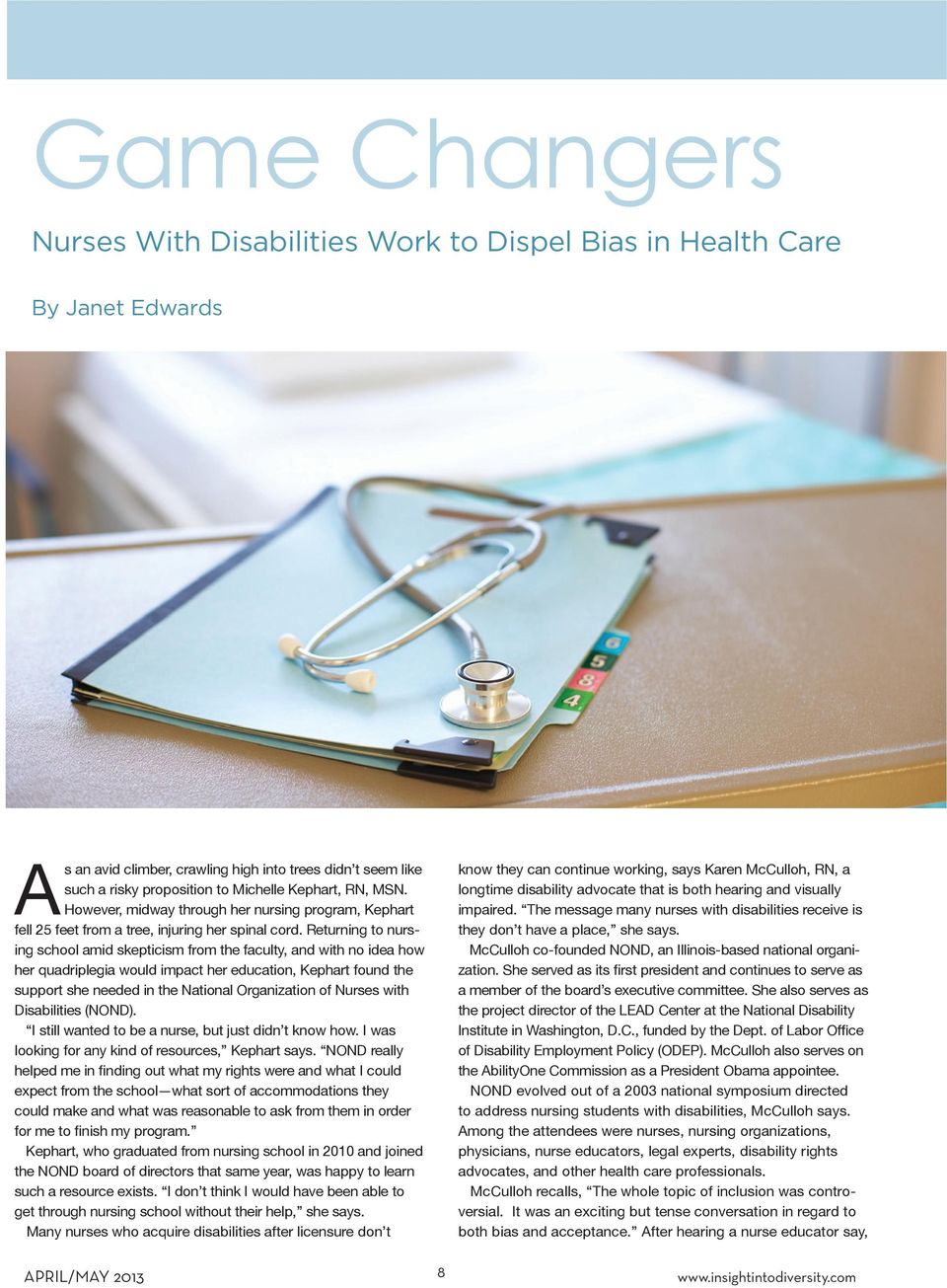
5 CONTENTS features April/May 2013 departments 8 Game Changers Nurses With Disabilities Work to Dispel Bias in Health Care By Janet Edwards 6 HEED Award Spotlight East Carolina University College of Nursing Puts Diversity First By Susan Borowski 11 End the Disability Debate in Nursing: Quality Care is Fact By Leslie Neal-Boylan, PhD, APRN 18 Recruiter s Corner When It Comes to Job Hunting, Less is More with Vicky Ayers 12 We Face a Shortage of STEM Teachers: True or False? By Jamaal Abdul-Alim 35 Legal Insights Obamacare in 2014: Stay Tuned with Jeffrey W. Larroca 19 Nine Strategies to Hire Diversity of Thought By Simma Lieberman 36 Career Opportunities 20 Meeting the Need Nursing Schools Chart Steps Toward Diversity University of North Carolina School of Nursing Vanderbilt University School of Nursing The Ohio State School of Nursing By Susan Borowski Forging New Paths in Nursing A conversation with UMSON s Dean Kirschling By Janet Edwards 24 New Books Help Frame Affirmative Action Debate By Dr. Edna Chun 26 PRIDE: Diversifying Nursing, Midwifery in Rural Regions Frontier Nursing University By Janet Edwards Making a Case for Diversity in Higher Ed By Shirley J. Wilcher KSU Clinic Partnership Serves Community and Students Kennesaw State University By Vanessa Robinson-Dooley, LCSW, PhD On the Cover: University of Maryland School of Nursing Dean Jane Kirschling Photo by Rick Lippenholz 14 Editor s Note: In the March 2013 issue of INSIGHT Into Diversity magazine, U.S. Senator Tammy Baldwin (D-Wis.) was incorrectly identified in a photo caption published in the print version of the story, New Congress Heralds Era of Diversity. We regret the error. 5
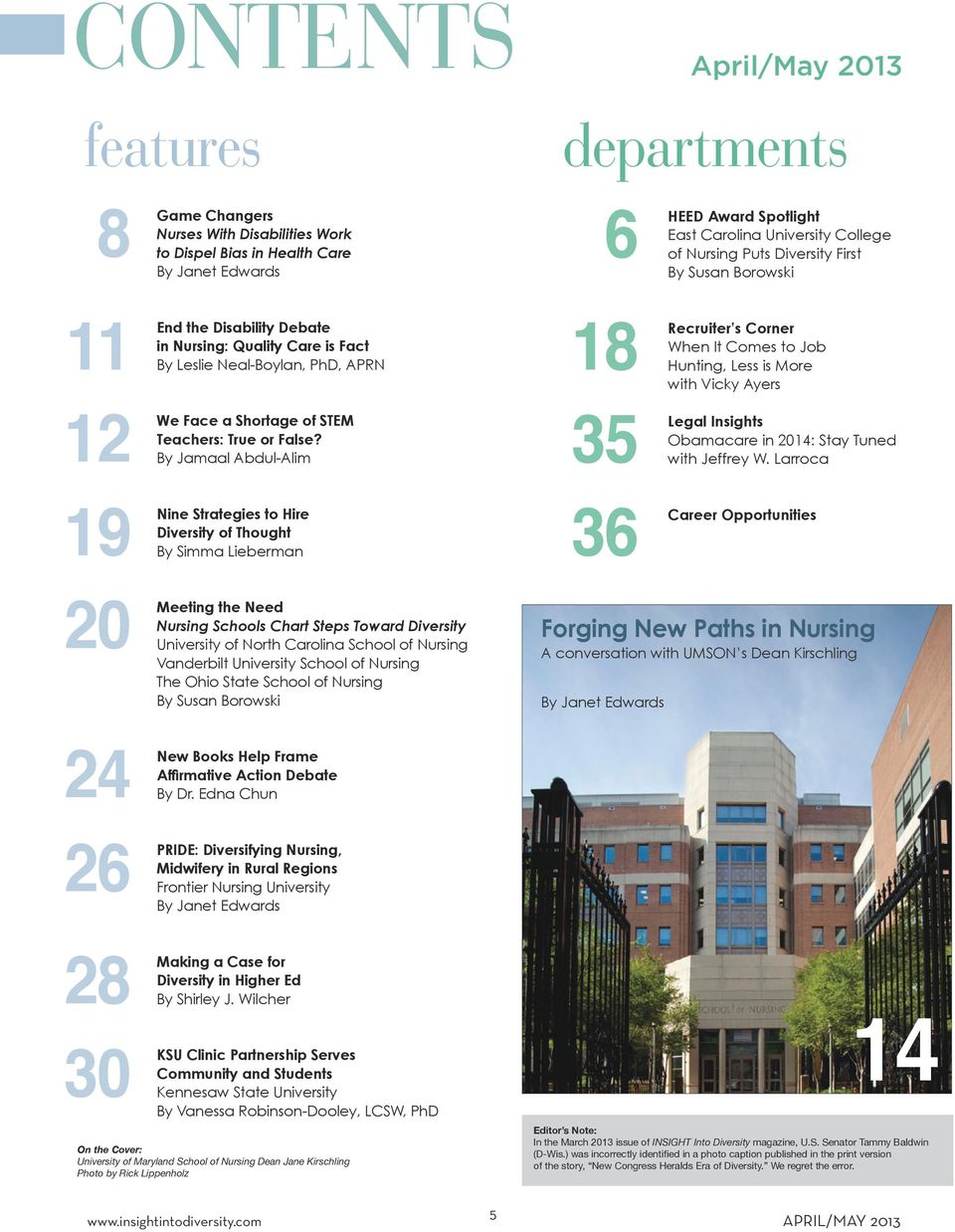
6 HEED Award Spotlight ECU s College of Nursing Puts Diversity First By Susan Borowski An ECU nursing student is pinned during an Up with Nursing program. As a recipient of INSIGHT Into Diversity s 2012 Higher Education Excellence in Diversity (HEED) award, East Carolina University s (ECU) commitment to diversity is well demonstrated. For the College of Nursing specifically, the top strategic goal is to educate nurses who can contribute to a global, culturally diverse and rapidly changing society. Established in 1959, the College of Nursing is the largest nursing program in North Carolina, enrolling more than 1,100 students in baccalaureate, master s, and doctoral programs. In 2012, ECU s College of Nursing was named a Center of Excellence for the second time by the National League for Nursing. The honor recognizes outstanding achievements in student learning and professional development, says Cheryl Elhammoumi, RN, MSN, CCRN, clinical assistant professor and co-chair of the Diversity Advisory Council (DAC). As an example, Elhammoumi points to the success of the College s Regionally Increasing Baccalaureate Nurses (RIBN) program, a statewide initiative involving partnerships between community colleges and universities to increase student access to bachelor of science in nursing (BSN) programs. We have cooperatives with several community colleges, says Elhammoumi. Students enroll at the community college for their two-year associate degree and finish their BSN at ECU. We have a phenomenal support program. It s very competitive. The school s online master s program is consistently ranked in the top 10 of Best Online Graduate Nursing Programs by US News & World Report. Advanced specialties are offered in midwifery, neonatal nurse practitioner, adult and geriatric nurse practitioner, and a highly recognized nurse anesthesia program. All online students meet at the College of Nursing a few times during the year. Clinical sites are scattered, but generally not too far from where the student lives. We have faculty all over the state, says Elhammoumi. The Diversity Advisory Council, which meets on a monthly basis, serves as a resource for faculty, staff, and students to increase diversity awareness and cultural competence, Elhammoumi says. 6
7 Diversity discussions are also facilitated through a popular campus book club, an interest group for the LGBT community, and screenings of films such as the documentary, Crossing Borders, she says. Through the Global Health Advisory Council, the College of Nursing also works to achieve international diversity. When the earthquake happened in Haiti a couple of years ago, says Elhammoumi, the focus of our DAC program was on the nursing school in Haiti. The school was one of the few buildings left standing, and the school grounds quickly became a field hospital where students were able to provide emergency first aid to the victims. Faculty members conduct research and perform clinical practice in Nicaragua. Each spring, the nursing college opercheryl Elhammoumi, RN, MSN, CCRN, Diversity Advisory Council ates a cultural immersion co-chair, ECU College of Nursing program in Guatemala and similar initiatives in Africa and Finland are under consideration. Our graduate nurses are literally scattered around the world serving the health care needs of many diverse populations, says Elhammoumi. Honoring the Legacy... Advancing Opportunities Be a part of shaping the direction of diversity and inclusion work at HBCUs! The first annual Diversity & Inclusion Summit on HBCUs will be held on the beautiful campus of Alcorn State University (Lorman, Miss.), the nation s oldest historically black public land-grant institution. Co-sponsored by Alcorn s Office of Educational Equity and Inclusion and the National Association of Diversity Officers in Higher Education, the Summit will bring together faculty, staff, administrators, students, researchers, diversity professionals and others who are passionate about promoting diversity and inclusion at HBCU institutions. TOPICS INCLUDE: ECU s Brody School of Medicine The Medical Readers Theater is an innovative program sponsored by the College of Nursing. Led by Todd Savitt, PhD, assistant dean of the Office of Diversity Affairs at ECU s Brody School of Medicine (BSOM), it s one of two bookend diversity programs for medical students. The Medical Readers Theater is conducted during orientation week for first-year students. BSOM is the only school in the country that conducts these on a regular basis, Savitt says. We take short stories about bias and stereotyping in medical issues and we make a script out of the story, he says. The readers medical students sit in front of an audience and read their characters lines, so it s like listening to a story on the radio. Then we discuss how such bias and stereotyping have no place in medicine. The second program is part of Transition to Residency, a fourth-year course in which physicians discuss real-life scenarios involving insensitivity to diverse groups of people. BSOM s legislated mandate is to enhance the access of minority and disadvantaged students to a medical education. The Office of Diversity Affairs works in conjunction with the vice chairs of diversity, composed of representatives from every department in the medical school, and the Brody Women Faculty Committee to carry out that mission. Diversity Student Recruitment Developing a Vision for Diversity and Inclusion Black Male Success Partnerships in Diversity Panel of HBCU Presidents Diversity Programming Interactive Breakout Sessions featuring Best & Promising Practices Myrlie Evers-Williams Legendary Civil Rights Leader REGISTER TODAY Registration is $75 per person and includes three meals and snacks. Student registration is $35. M. Christopher Brown II 18th President of Alcorn State University For more information, visit Susan Borowski is a contributing writer for INSIGHT Into Diversity magazine. KEYNOTE SPEAKERS 7

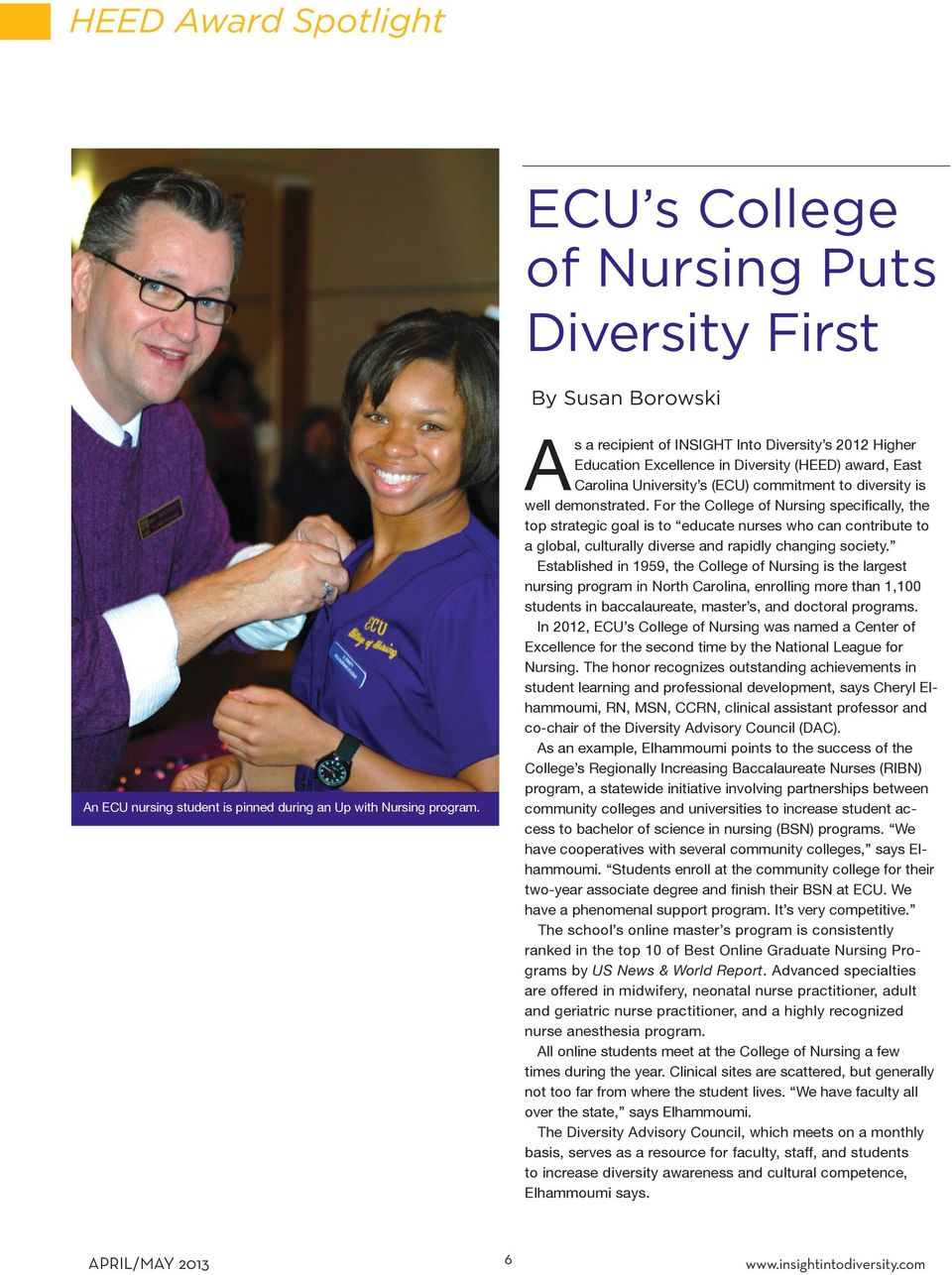
8 Game Changers Nurses With Disabilities Work to Dispel Bias in Health Care By Janet Edwards As an avid climber, crawling high into trees didn t seem like such a risky proposition to Michelle Kephart, RN, MSN. However, midway through her nursing program, Kephart fell 25 feet from a tree, injuring her spinal cord. Returning to nursing school amid skepticism from the faculty, and with no idea how her quadriplegia would impact her education, Kephart found the support she needed in the National Organization of Nurses with Disabilities (NOND). I still wanted to be a nurse, but just didn t know how. I was looking for any kind of resources, Kephart says. NOND really helped me in finding out what my rights were and what I could expect from the school what sort of accommodations they could make and what was reasonable to ask from them in order for me to finish my program. Kephart, who graduated from nursing school in 2010 and joined the NOND board of directors that same year, was happy to learn such a resource exists. I don t think I would have been able to get through nursing school without their help, she says. Many nurses who acquire disabilities after licensure don t 8 know they can continue working, says Karen McCulloh, RN, a longtime disability advocate that is both hearing and visually impaired. The message many nurses with disabilities receive is they don t have a place, she says. McCulloh co-founded NOND, an Illinois-based national organization. She served as its first president and continues to serve as a member of the board s executive committee. She also serves as the project director of the LEAD Center at the National Disability Institute in Washington, D.C., funded by the Dept. of Labor Office of Disability Employment Policy (ODEP). McCulloh also serves on the AbilityOne Commission as a President Obama appointee. NOND evolved out of a 2003 national symposium directed to address nursing students with disabilities, McCulloh says. Among the attendees were nurses, nursing organizations, physicians, nurse educators, legal experts, disability rights advocates, and other health care professionals. McCulloh recalls, The whole topic of inclusion was controversial. It was an exciting but tense conversation in regard to both bias and acceptance. After hearing a nurse educator say,
9 The courageous thing that nurses with disabilities can do is to retire, she realized it was time for nurses with disabilities to step up and speak for themselves. McCulloh says she was excluded from nursing for nearly 13 years because of having multiple disabilities. In response, she says, McCulloh set up her own for-profit small business where she developed a new area of nursing, Community Health Disability Education. Empowered by that discussion, McCulloh brought five nurses with disabilities together, without a mission or bylaws, and identified symposium attendees they wanted to recruit to the board of directors 15 members were recruited by the end of the day. We were at the right place at the right time and with the right people, McCulloh says. The majority of board members are now nurses with disabilities, proving the stereotype wrong, says McCulloh. About 200 members are active in the organization s advocacy, education and outreach efforts, which have broadened beyond nursing to include other careers in health care and underserved populations. In an effort to enhance opportunities for people with disabilities to enter healthcare careers and become employed in healthcare industries, NOND was accepted by ODEP as an Alliance member in May Nurses with disabilities face stiff challenges in their journey to become accepted and those objections often begin with misperceptions by nursing faculty, says Beth Marks, PhD, RN, president of NOND. Marks is a research associate professor and director of the HealthMatters Community Academic Partnership, and is coproducer of the film, Open the Door, Get Em a Locker: Educating Nursing Students with Disabilities. Despite the potential for students with disabilities to enrich the nursing profession, nurse educators may be perpetuating historical attitudes, values, and practices that exclude students with disabilities from gaining admission or identifying themselves as people with disabilities, Marks wrote in Cultural Competence Revisited: Nursing Students with Disabilities, a Journal When you have people that are very successful people who can say this is wrong that s a game changer. Parul Arora, RN, BSN of Nursing article. Educators in nursing schools continue to ask whether people with disabilities have a place in the nursing profession, while the more salient question is, When will people with disabilities have a place in the nursing profession? 9 Parul Arora, RN, BSN, also a NOND board member, had nearly completed her nursing program when she first heard about the organization. It was exactly what she was looking for a community that would inspire her to persevere. As a low-vision person, she had faced strong faculty resistance throughout her nursing education, a second-career path that followed six years in social work. I needed to see nurses with disabilities that were successful. You want to be inspired by people who have had obstacles who are successful, she says. In any program you have to prove yourself, but I had to prove myself more than my fellow students. It was dispiriting, but Arora says she learned a lot about herself, including how to be her own advocate because no one else would do it. Kephart retains some function in her shoulders and arms, but no hand movement and no movement below her waist. After her injury, she resumed nursing school, but with some stipulations. I was allowed to return for one semester and take half a class load to see if I was capable of handling it, she says. I took two classes and did really well. Then we had to start talking about how I would get through my clinical experience. I ve lost all my hand function so I don t have any dexterity. During clinicals, she was provided an assistant who did everything under Kephart s guidance. If I had to use a stethoscope on somebody that was in a hospital bed and I couldn t reach them, she would help me place it on his chest so I could listen. Or, if we were giving meds through IVs, she could set up the IV under my direction and I could watch what she was doing because I couldn t reach it. We worked as a team, that was the accommodation I got. The assistant stayed with Kephart for the first three weeks of her clinical rotation, but then we realized there wasn t much she needed to do. I was able to do everything I needed to do, but we didn t know that until we got out there and tried, she says. What people perceive as the role of nursing paints too narrow a picture, Kephart says. There are a lot of types of nurses. People only think about being a bedside nurse and them giving shots or drawing blood, but I think if people start to realize that there are so many more ways to be a nurse they ll be more accepting of nurses with disabilities in general. Marks says the emphasis is misplaced when considering a student s potential success in a nursing program. As we accept and accommodate people with disabilities as nursing students and professional nurses, we will discover that a student s success is highly dependent on the availability of accommodations, not the type or severity of disability, she wrote in the Journal article. Arora did her clinical rotations with a pocket full of magni-

10 fiers and attachments that she bought on her own. She used one magnifier that fits on syringes so she could fill them properly, another for reading lab value reports and other small print, and a hands-free magnifier for miscellaneous tasks. She also found a computer screen device that reduced glare and offered some magnification. Software that provides better onscreen enlargement capability is available. When Arora asked about having the software installed on the hospital s computer, she was told her faculty would need to request it. When I asked the faculty, they never pursued it, she says. I purchased all these things because I wanted to be successful and I didn t want to make any errors, she says. It s not rocket science, but there are so many different tasks it can be difficult to figure out which device works best with this syringe or what works best with that task. Learning how to accommodate on her own, while trying to master the practice I was able to do everything I needed to do, but we didn t know that until we got out there and tried. Michelle Kephart, RN, MSN (front row, left) of nursing, was a hardship, she says. While Arora anticipated the clinical faculty might not know how to accommodate her disability, the level of resistance she encountered surprised her. They had this attitude, How is this girl going to be a nurse? and not so much, How can we help her be successful? McCulloh acknowledges that relinquishing the traditional model of nursing is a challenge for schools, but is quick to point out that Some faculty have been quite supportive of connecting students with student disability services to obtain accommodations for their success in a nursing program. Existing faculty resistance results in part from weak enforcement of the American Disabilities Act, says Suzanne Smeltzer, EdD, RN, FAAN, professor and director of the Center for Nursing Research at Villanova University. The law is not enforced very rigorously. As a consequence, unless someone with a disability is really committed and willing to take it to the next level, if he or she is stopped at the schoolroom door the individual may turn around and try someplace else, or they may say, Well, I guess I can t do nursing. Fellow health care providers perpetuate an additional obstacle, Smeltzer says. Health care professionals think about, What can this person not do? as opposed to What are the strengths this person brings to the situation? That s because safety is a major buzzword, Smeltzer says, and while health care providers and faculty assume safety issues are a concern when it comes to nurses with disabilities, that s simply not the case. There s no research to suggest that they re any less safe than health care providers without disabilities. But nevertheless that s what people go to, it s a safety issue well, no, it s not. It s an attitude issue. As a student, Arora frequently questioned her decision to pursue nursing. I love the field. I have the qualities for it, but I thought, Maybe they re right, maybe I shouldn t be a nurse because it s more difficult for me. You need others to believe in you, for you to believe in yourself, she says. It was a constant advocacy in my head: You can do this. I m smart enough. I have good qualities and I can go forward. Kephart, who lives in Georgia, is now an adjunct faculty member in the medical assistant program at South University teaching classes in medical terminology and clinical competency, among others. She is also an educator in disease management and wellness at Community Health Mission. When she first began teaching, Kephart wasn t sure what to expect. I was a little nervous, but the students have been wonderful, she says. It probably startles them when they first see me, but once we start talking about what they re learning and the reason that they re there, they forget that I m talking to them from a wheelchair. Arora is completing her master s program in nursing, while working at NorthPointe Resources in Zion, Ill. As part of her job, she works on a diabetes prevention project for children and adolescents with intellectual and development disabilities, often giving presentations. In my new job, there s no resistance, it s amazing. I don t drive. The job requires it but my colleagues have bent over backwards. Two others on my team do the driving and they re very willing, she says. Her experience with NOND during her own struggle to become a nurse has impassioned Arora to reach out to young people with disabilities as a mentor and a resource. I hate to say this, but my story is not unique. However, when you have people that are very successful and have tons of experience people who can say this is wrong that s a game changer. Sometimes you don t know the treatment you re getting or the obstacles in your way are wrong. McCulloh agrees: Often, we do not realize the power of experience and how that experience can make such a difference for opening opportunities for others. Janet Edwards is the editor of INSIGHT Into Diversity magazine. 10

11 IID Perspective End the Disability Debate in Nursing: Quality Care is Fact By Leslie Neal-Boylan, PhD, APRN Misconceptions abound regarding the abilities of people with disabilities and this holds true in the nursing profession, as well. While nurses with experience and expertise are often denied jobs or lose their jobs because of a physical disability, research shows appropriate accommodations can be made to retain these highly skilled and much-needed health care professionals. Four research studies involving registered nurses with selfidentified physical and/or sensory disabilities reveal common themes about their work life experiences. The studies occurred over a period of five years ( ) and included interviews and surveys of nurses with a variety of acquired and congenital disabilities. Nurses from all levels of nursing education (associate degree, bachelor s degree, master s degree, and doctoral degree) and from inpatient, outpatient, and community settings participated. In addition, one study compared the work life experiences of physicians and nurses with disabilities. These studies confirm the value of nurses lies not in whether they can lift 50 pounds, (often stipulated in nurse job descriptions), but in what they know. A nurse thinks critically and makes judgments that directly affect patient outcomes. A nurse is taught to question, consider, and ensure that doctors orders are appropriate for the patient because first and foremost, the nurse is a patient advocate. Patients and families rely on nurses to help them navigate the complex health care system, translate complicated medical jargon, and better understand the diagnosis and treatment plan. Concerns have been raised about whether a nurse with a physical disability might impact patient care or safety; however, hospitals and healthcare agencies are being encouraged to acknowledge that with proper accommodations, nurses who have a disability can perform the necessary tasks involving direct and indirect patient care without jeopardizing patient safety. For instance, a nurse who has trouble walking can monitor telemetry on a cardiac unit, work in a poison control center, manage a unit, or be in charge of quality improvement. A nurse with a hearing impairment can function effectively in just about any milieu as long as TDD devices are placed on telephones and people face the nurse when speaking. Research also shows that nurses with disabilities know their limitations, and are likely to leave their position over the slightest concern about their ability to provide safe, high quality care. To date, there are no documented incidents of a patient injury caused by a nurse with a physical disability. Furthermore, patients report little concern over being cared for by a nurse who has a disability. In fact, they feel the nurse is more likely to be empathetic. Patients want the people taking care of them to be competent and confident. They seem to understand that the knowledge nurses provide is their most important skill. In the event that adequate accommodations are unavailable, other opportunities exist. The most recent research study found that if they are persistent, nurses can find jobs in which they can perform as nurses and be appreciated for what they bring to the job. Interestingly, most of the nurses interviewed for this study were employed by someone who was either a nurse who had a disability or a chronic illness, or by a non-nurse who had no preconceived notions about how much a nurse can lift or can do physically and was only interested in the nurse s expertise. It is ironic that non-nurses would be more accepting of hiring and retaining nurses with disabilities than are health care providers or agencies. Nurses with disabilities have found satisfying positions in school nursing, informatics, case management, and as advice nurses, to name a few less typical nursing roles. Studies of nurses with physical disabilities confirm what research has previously shown about people with disabilities: they often suffer discrimination despite the Americans with Disabilities Act, they are rarely given a chance to show what they can do, and people make inaccurate assumptions about their abilities. It is important that employers and colleagues look beyond disability to discover what skills truly make a person valuable to the organization. Leslie Neal-Boylan, PhD, APRN, is associate dean and professor of the Quinnipiac University School of Nursing in Connecticut. She is the author of Nurses With Disabilities: Professional Issues and Job Retention (Springer Publishing), the first research-based book to confront workplace issues facing nurses with disabilities. 11
12 We Face a Shortage of STEM Teachers: True or False? By Jamaal Abdul-Alim While many bemoan the shortage of STEM graduates and worry about a lack of STEM teachers at the K-12 level, some scholars caution the claims are not as dire as they seem. A conference titled, Under the Microscope: Examining STEM Education, was hosted recently by the Education Writers Association at the University of Maryland, Baltimore County. During a panel discussion on STEM pipelines, Mark Schneider, vice president of American Institutes for Research and president of CollegeMeasures.org, said his research into labor market demands reveals a reported lack of STEM graduates has been overblown. One basis for his conclusion is that biology and biological sciences majors typically earn less than English majors an indication that they are not in very high demand. We wouldn t say there s an English crisis. But we say there s a science crisis. But demand as indicated by salaries of biologists in the labor market in every state is lower than English majors, and chemistry is a little higher than English majors, Schneider said. Schneider based his presentation on information from a report his organization produced titled, The Earning Power of Recent Graduates from Virginia s Colleges and Universities: How are graduates from different degree programs doing in the labor market? The report found that biology and biological science majors in Virginia earned an average of $27,893, whereas English majors earned $29,222. Schneider is at the forefront of a movement to tie state wage data for employees to their individual college transcripts in an effort to calculate the average earnings of graduates from specific schools down to the program level. Virginia is one of about a half a dozen states where Schneider has done his work. Several federal lawmakers last year introduced legislation to require all colleges and universities to report information on the earnings of their graduates. The goal is to give prospective college students a better sense of how much they can expect to earn upon graduation if they pursue a particular major or go to a particular school. If you think of student debt as an investment to get higher income, you need to make sure the debt is reasonable in relation to (future) income, Schneider said. The rule of thumb is that you should not have debt exceeding what your first-year earnings are. In a separate panel on recruiting and training STEM teachers, Richard Ingersoll, PhD, Board of Overseers Professor of Education and Sociology at the University of Pennsylvania, said the shortage of STEM teachers is a nuanced problem. There is a big gap between the conventional wisdom and what the data tells us is the case, Ingersoll said. The conventional wisdom, he said, is that we have a shortage of math, science and STEM teachers, mostly at the high school and the middle school level. Every president since Dwight D. Eisenhower, he said, has addressed the need for more math and science teachers; the latest example is the Obama administration s involvement in the 100K in 10 initiative, which calls for 100,000 new, excellent STEM teachers over 10 years. The reality, Ingersoll said, is that we do not under-produce math and science teachers by whatever numbers we can come up with. The real problem, he said, is that math and science teachers don t stay on the job. It s not rocket science. It s working conditions and it s not just salaries, Ingersoll said. It s student discipline problems. High turnover in the teaching profession also has to do with teachers feeling that they have a lack of discretion and autonomy in the classroom which is, Ingersoll said, the leading complaint. Many teachers feel they must deliver a scripted education, particularly in an environment where there is growing emphasis on teacher accountability for how well students do on tests, he said. Teacher recruitment initiatives and fellowships in the areas of STEM are worthwhile and have worked so well they re an unheralded victory, Ingersoll said. However, we lose the investment because of unabated turnover in the field, he said. Jamaal Abdul-Alim is a contributing writer for INSIGHT Into Diversity magazine. 12

13 Faculty Diversity Success and Support at the University of Pennsylvania School of Nursing The importance of diversity to nursing science is incalculable. In an era of increasing health disparities and lack of access to quality healthcare, it is crucial to have diverse faculty conducting research, educating future nurse leaders, and shaping practice to improve health worldwide. Success Penn Nursing is one of the world s premier research institutions in nursing, influencing practice, policy, and education. Penn Nursing faculty consistently receive more research funding from the National Institutes of Health than any other private nursing school. Many Master s programs are ranked first in the country. The Center for Health Equity Research, directed by Dr. Loretta Sweet Jemmott, and the Center for Global Women s Health, directed by Dr. Lynn Sommers, are international leaders in evidence-based efforts to eradicate health inequities and disparities across the lifespan. Support Penn Nursing is committed to a diverse faculty and student body supported by: A dedicated Office of Diversity and Cultural Affairs A long history of outreach programs and curricular initiatives on cultural competence Stellar faculty conducting community-based participatory research to improve the health status of marginalized and underserved populations The Penn Nursing Faculty Mentorship Program which offers guidance and counsel for faculty at all stages of their careers An Office of Nursing Research fully supporting faculty through every stage of the grant process. Penn Nursing faculty are internationally renowned researchers and policy leaders who create new knowledge that is reflected in cutting-edge teaching and refreshes evidence-based practice. For faculty opportunities at Penn Nursing, see To learn more about Penn Nursing s commitment to diversity, see The University of Pennsylvania is an equal opportunity employer. Minorities, males, veterans, and individuals with disabilities are encouraged to apply. I want to add a BS to my RN, but I need to keep working. Apply now for the RN/BS degree from ipace, the online bachelor s degree completion program that works at your pace. n Taught by expert Pace University nursing faculty n Blended online and in-person curriculum that fits your busy schedule at an affordable cost n Cutting edge evidence-based theory courses linked to your clinical practice n No entrance exams required U.S. News & World Report ranks Pace University as a top performer in online bachelor s degree programs. Attend a Virtual Open House on April 24 or an in-person Information Session on April 10 or May 8. To learn more and to RSVP, contact us at [email protected] or (212)

14 Jane Kirschling, PhD, RN, FAAN University of Maryland School of Nursing Forging New Paths in Nursing A Conversation with Dean Jane Kirschling By Janet Edwards In her dual roles as the new dean of the University of Maryland School of Nursing (UMSON) in Baltimore, Md., and as president of the American Association of Colleges of Nursing Board of Directors (AACN), Jane M. Kirschling, PhD, RN, FAAN, monitors the pulse of a workforce that boasts 3.1 million members, the largest of any health care profession. While recognizing that nursing must continue to diversify its ranks in order to reflect the changing face of the broad community it serves, Kirschling is confident proper pathways are in place to achieve that important goal. She is also boldly optimistic about recent innovations in advanced practice education, research, data sharing, and technology. Prescribing nursing for those seeking career flexibility, she insists the field deserves a fresh look from new and returning college students. Continuing a long and accomplished career that spans psychiatric nursing, palliative and end-of-life care, and a decade of research in workforce development, Kirschling is now dedicated to ensuring the next generation of nurses is well trained and highly educated. Kirschling was appointed dean of UMSON and director of interprofessional education in January She received her bachelor s degree in nursing from Viterbo College in LaCrosse, Wis., and her master s and doctoral degrees from Indiana University School of Nursing (IU-PUI) in Indianapolis, Ind. Recently, Dean Kirschling spoke with INSIGHT Into Diversity s editor, Janet Edwards. She shared some thoughts about the work being done at the University of Maryland School of Nursing, and about the current health of the nursing profession. You ve been charged with taking the UMSON to the next level. How will you approach this challenge? The University of Maryland School of Nursing has a long tradition we re approaching our 125th anniversary in 2014 of preparing nurses not only for entry into practice, but also for graduate study, whether that be advanced practice, nursing science, or doctoral programs. My charge from our University president, Dr. Jay A. Perman, is to continue to strengthen the excellence of our academic programs. Being within a research-intensive environment, there s also a strong commitment and desire at UMSON to advance the science that informs health care in this country and to generate knowledge through collaborative work between scientists in the other disciplines represented in all health professions. 14
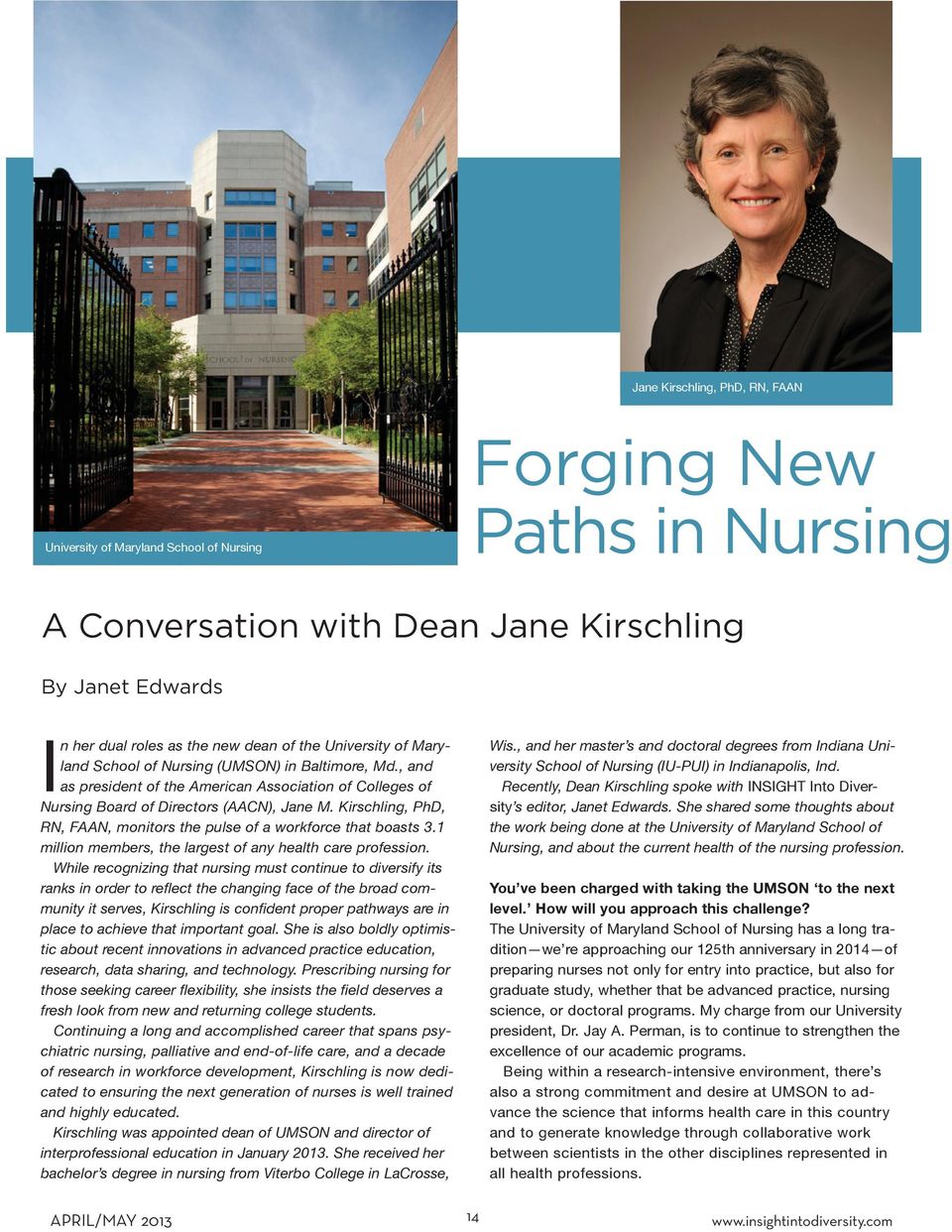
15 What is UMSON doing surprisingly well that other schools would be smart to emulate? At the national level, it has been recommended that advanced practice nurses certified nurse-midwives, nurse anesthetists, nurse practitioners, and clinical nurse specialists become educated in the Doctor of Nursing practice (DNP) program. In fall 2014, UMSON will open its BSN (Bachelor of Science in Nursing)- to-dnp degree program. This is a very new movement and is extremely important because the complexity of health care will continue to escalate. There is a broadening of knowledge and skills that advanced practice nurses need for the future to best meet the health care needs of the populations they ll serve. The other piece that UMSON is well positioned to do and that we have a long history of doing is that, because of our proximity to Washington, DC, we have a rich tradition in terms of health policy. It s always very exciting when our students not only spend time with the Maryland legislative body, but also interact and interface at the federal level with representatives of the House and Senate to advance health care in this country. We educate nurses who are very interested in, and capable of, working in the policy arena, whether they are setting policy or representing us as elected officials. How are nursing and diversity connected, especially in regard to the nation s demographic shifts toward greater ethnicity and aging? Diversity in nursing is extremely important because we look for people who look like us. We want to receive care from people we are most likely to be comfortable with, who understand the values and culture that we bring, and who can help us interpret what s happening with the health care we re receiving. Historically in nursing, we haven t been able to do that because we were predominantly a white woman s profession. I also think that it is about being able to have quality of care knowing that you re getting the best care possible, and Students practice skills in a clinical lab at the University of Maryland School of Nursing. also feeling that you re not being singled out in some way to get inferior or lesser care. UMSON is known for being the first school to establish a graduate level program in nursing informatics. Why is this emerging field so important? One of the realities of health care delivery is that a tremendous amount of information is generated within the industry. The question is, how is that information used to inform the care that is provided in this country and best practices? Our informatics program gives the nurse who has been working in the field, and who knows firsthand the individual patient experience, the ability to look at the aggregate of the individual and all patients to use this extremely powerful tool, that being data, to inform care for the patient as well as potentially drive practice change. In 2004, a commissioned report titled, Missing Persons: Minorities in the Health Professions, found that minorities were severely underrepresented in the health care workforce, including nursing. Nearly a decade later, how much progress have we made? The nurse scholars program through the American Association of Colleges of Nursing (AACN) encourages persons of color to come back to nursing school through second-degree programs. It s a national model. We have to encourage all students to think about a health professions career, and to look at nursing as a career that has rich opportunities. There isn t just one way to be a nurse in this country. There are multiple ways to do it and there are tremendous opportunities. We need to have an inclusive environment so that all people recognize the opportunities. Then we have to nurture those students, encourage them to pursue graduate education, and help them to excel. I became a nurse in My graduating class had very few men. I was educated in Wisconsin and I don t remember having minority classmates in my undergraduate program. Today, at UMSON, in terms of our baccalaureate program, one-third of the class is made up of minorities. That s posi- 15

16 moreinsight University of Maryland School of Nursing Mission: We shape the profession of nursing and the health care environment by developing leaders in education, research, and practice. Diversity: Of the total 1,700 students, 35 percent are minorities and 12 percent are males; 12 percent of UMSON faculty members are minorities. Funding: UMSON received total extramural funding of $12.8 million in 2012, including more than $4 million in National Institutes of Health grants and research funding of $7.6 million. Research: Cutting-edge research is largely conducted under the auspices of two Organized Research Centers Biology and Behavior Across the Lifespan and the Center for Health Outcomes Research. Current studies include chronic pain, impulsivity and drug abuse, neuromuscular disorders, sleep, web-based interventions, health care organizational issues, and bone health. Giving Back: UMSON operates a mobile health clinic for people who are uninsured and underserved, and provides nurse practitioner faculty members who practice at three school-based health centers in neighboring counties. Policymakers: Two nurses currently serving in the Maryland Legislature are UMSON alumnae: Shirley Nathan-Pulliam, (D-Dist. 10), Class of 1980 (BSN); and Adelaide C. (Addie) Eckardt, (R-Dist. 37B), Classes of 1978 (BSN), 1981 (MSN). tive change. It probably isn t enough, but we ve had to find ways to encourage persons other than Caucasians, as well as men, to come into the discipline. It s a process of continuous building. Currently, 14 percent of our baccalaureate enrollment consists of men. We are also seeing more diversity in our master s Clinical Nurse Leader (CNL) program for persons with previous degrees in other fields. Enrollment in the CNL program currently consists of 40 percent minorities and 15 percent males. How does nursing today differ from a generation ago? From a nursing perspective, or any health professional s perspective, there s tremendous variability and flexibility in terms of where you re going to do your work. You may start in a hospital setting with medical-surgical patients, or start in an emergency room, or you may start your career doing community-based care. The other piece is the tremendous ability to shape your career; you re not locked into one single path. You can change the area you practice in three or four times over the course of your career. There s a mobility that you sometimes don t get in other careers. We need to do better in getting that message out as an attractive option. As you think about the changing demographics, one of the struggles for men is that it s hard for a high school male to say that he wants to become a nurse because it s still very much perceived as women s work. One of the very positive changes we ve seen is a real commitment across the U.S. to open what are called second-degree programs. These programs are designed for people who already have a degree or multiple degrees but they now want to change their career to nursing. We see larger numbers of men coming into those programs, which is a really positive change because it helps change the face of nursing to be more inclusive. Also, research has become a viable option for nurse scientists. That most likely wasn t the case a generation ago. How can the nursing industry best meet demands for a more diverse faculty across nursing programs? The ability to continue to prepare the next generation of nurses is totally dependent on our ability to have a sufficient number of nursing faculty members who are qualified and available to teach that next generation. If you think about the pipeline, not only when we go into a clinical care situation do we do look for people like us, but when we re thinking about going into a profession thinking about, do I want to be a nurse? we need minority role models because our students look to the faculty to provide role models. This is an important piece in fostering and encouraging people to become nurse educators. Why is it so difficult to fill nursing faculty positions? There are some amazing advantages to being a nursing faculty member, but there are a couple of drawbacks. The competitiveness of salary is the biggest drawback. If you look at your salary as an advanced practice nurse, then look at the salary of a faculty member, there s a discrepancy; the salary of the faculty member is considerably less. An advantage is the ability to shape one s career around juggling the multiple demands of family and outside commitments; there is a degree of flexibility that teaching provides. Also, health care today is extremely fast-paced. Demands that are placed on people who are providing direct patient care are pretty intense. The work that we do in academia doesn t necessarily have the same sense of urgency as direct patient care. It s a different environment; the work by its nature is different, and some people find that to be very attractive. Core competency standards: have they changed in the past decade, especially in regard to a changing demographic? Our curricular work is guided by the Essentials documents put forward by AACN. Nurses have to be prepared to provide quality care that is sensitive to the issues of race and ethnicity. For example, when I went through a health assessment course in my nursing program in the late 1970s, a white, 16

17 middle-aged male was the norm everything was based on being able to look at white skin and say is this normal or abnormal. If you think about assessment today in light of our increasingly diverse population we have a responsibility to prepare students to be able to assess appropriately what is happening with all persons. That has to be emphasized in the curriculum. When making a clinical diagnosis, skin that has one pigment may require a more complete understanding for people of different ethnicities; there may be other appropriate benchmarks in assessing a different person. That s a dramatic, very basic illustration, but it is important that nurses have the ability to assess every individual and to do that appropriately, with the necessary knowledge. What attracted you to nursing and what do you continue to find most exciting about it? I was on the back end of that era when (as a woman) you became a nurse or you became a teacher. I chose to become a nurse because I had an inclination toward science. I stayed in nursing school because I absolutely fell in love with psychiatric nursing and its complexities. My life took an interesting turn when I was headed to graduate school to specialize in caring for the chronically mentally ill. I experienced some personal losses in my life, and that got me interested in endof-life care. Opportunities aligned themselves and I ended up doing palliative care and end-of-life care. Then, I went on to become a nurse educator and that s been my career preparing the next generation of nurses and being able to support new nurses throughout the lifelong learning process. I ve had an incredibly rich and full career. My energy is now devoted to the pipeline in nursing, making sure we have a well-qualified, highly educated nursing workforce to meet the future needs. Nurses need to remain open to possibilities. They need to listen to those who are around them and not necessarily be so quick to say, No, no, I can t do that, because a nursing education offers so many career options. I could never have predicted where my career was going to end up if we were talking in the late 1970s. There s no way in the world I would have said I would be a nursing faculty member or the dean of the University of Maryland School of Nursing. I am truly honored to have this opportunity and to build on the amazing strengths available in the School and University. Janet Edwards is the editor of INSIGHT Into Diversity magazine. Our global success is based on the diverse backgrounds, outlooks and experiences of OUR PEOPLE. If you have the drive and desire to be a part of a team where EXCELLENCE IS EXPECTED and DIVERSITY MATTERS, we want you to come to the Acushnet Company. IT ENGINEERING ACCOUNTING Opportunities are available in Southeastern MA and Southern CA. For more information, check out our website. PLEASE SEND RESUME TO: Acushnet Company Human Resources P.O. Box 965 Fairhaven, MA [email protected] fax: (508) Brigham Young University College of Nursing Faculty positions are available in the undergraduate and graduate programs Doctoral degree in nursing is preferred (PhD or DNP) Salary and rank commensurate with experience and qualifications Send letter of interest to Dean Patricia K. Ravert Brigham Young University College of Nursing 500-A SWKT Provo, UT Phone: JOIN THE TEAM BEHIND THE BRANDS. An equal opportunity employer, m/f/d/v. 17 BYU is an equal employment/affirmative action employer, sponsored by The Church of Jesus Christ of Latter-day Saints. Employees are required to observe Church standards.

18 Recruiter s Corner with Vicky Ayers When It Comes to Job Hunting, Less is More I heard my colleague, Isaac, who was in the next office processing the resumes of candidates for an executive position, groaning as though something was really driving him crazy. I stuck my head in his door, but before I could ask what was wrong, he asked, Why do candidates send all this extra stuff? Since I ve been in the recruiting business, coming up on 14 years, I have never written into a position announcement a request for candidates personal philosophies, letters of recommendation, newspaper or magazine articles in which they are referenced, copies of books or articles they have written, their letters to the editor, strategic plans they helped craft, printouts of Wikipedia articles they edited, supplements of any sort, photocopies of their entries in Who s Who, or anything but a cover letter and a resume or curriculum vita, yet I have received all of this and more. Why? The simple answer is, candidates entering a search are trying to impress, and who can fault that? After all, they are applying for a position and want to make the best and most distinctive impact they can, as early in the search process as possible. They fire off as much information as they can muster, in hopes that, other qualities being equal, the Who s Who article will push their candidacy ahead of other applicants. Does this strategy work? Not usually. To see why, you have to consider the search process from the other side of the table, from the perspective of the person looking for new employees, either for themselves or on behalf of a client institution. Most searches start with a very general announcement of position availability and outline the minimum requirements for candidacy. Such announcements request very little in terms of information from candidates. I ask simply for a letter expressing interest in the position and a resume or curriculum vita. I ask only this for three reasons. First, those documents will tell me if you meet the minimum requirements. At this point I have no use for extra documents, and they just get in my way. For example, if the position calls for a doctorate, and you only have a master s, a Who s Who article isn t going to help. Second, in the initial stages of a search it is imperative that my office and search committees who are accountable to administrators, governing bodies, human resources, personnel policy, and accreditors are able to demonstrate an objective candidate screening. Letters of reference or work samples, submitted by one candidate To stand out, job applicants often submit much more info than is required. Does this strategy work? Not usually. only, often cannot be considered, since to do so would tilt the supposedly level playing field all candidates have a right to expect, and regulation and law demand. Third, using our firm as an example, in our regular search process we have no way to preserve and then present those extraneous materials to a client institution. Like mine, most search firms and human resources offices now keep nearly all records electronically. Thus, a magazine article you wrote will simply be set aside, unless all candidates have been asked to provide articles they have written. In my usual practice, nothing but the resume and cover letter is presented initially to the committee, although I may mention that other material exists. Unless the committee requests to see it, which I don t remember ever happening, extraneous materials end up being filed unseen, or thrown away at the close of the search. Once I receive the documents I ve asked for, the letter and resume, I send a request to the candidate for specific additional information. Again, I am not looking for a pile of supporting publications and documentation. I just want a more refined picture of what skills, experience, values, and characteristics you bring to the table. Now, here is the surprising thing: generally, there are as many candidates in a given search who either refuse or neglect to provide that additional information, as there are candidates who swamp me with documents I don t need. Sometimes, they re the same candidates! 18 If you are really interested in a position, and want to be seriously considered, you need to provide the information solicited, no more and no less, and at the time it is requested. For some, this is difficult. You worry that no one will really look at your material, that there s only one chance to impress the employer or recruiter, and that if you don t throw all those materials into the mix, you reduce the chances of advancing in the search. If this is how you think, take comfort in the fact that employers and the recruiters who serve them really do look at requested materials. Our goal is to find the best candidate the employer can attract, so qualifications won t be overlooked or minimized. As more and more detailed information is elicited, you should provide it in a thorough and timely manner, which will demonstrate commitment, energy, and interest in the employer and the position. If your anxiety about being overlooked is too strong to ignore, you can call the recruiter or search chair and ask whether it would be helpful to send additional information. In the later stages of most searches, when candidates are being invited to meet with the employer, there are ample opportunities to present the kinds of materials that, at this stage, may actually influence the employer favorably. This is when to bring out the portfolio from your solo-artist gallery show, a copy of your book, the printout of your peer-reviewed article in a professional journal, or your letter of recommendation from the state governor. At this point, these things are no longer extras. Instead, they re confirmation that the employer has made a sound decision to advance you in the search, and that you may be the very person they ve been looking for. Vicky Ayers is senior director for Executive Recruitment at RPA Inc., Williamsport, PA, a private national firm serving the recruiting needs of higher education and nonprofits. Vicky is a member of the INSIGHT Into Diversity Editorial Board. If you have a question for Vicky you can her at [email protected].

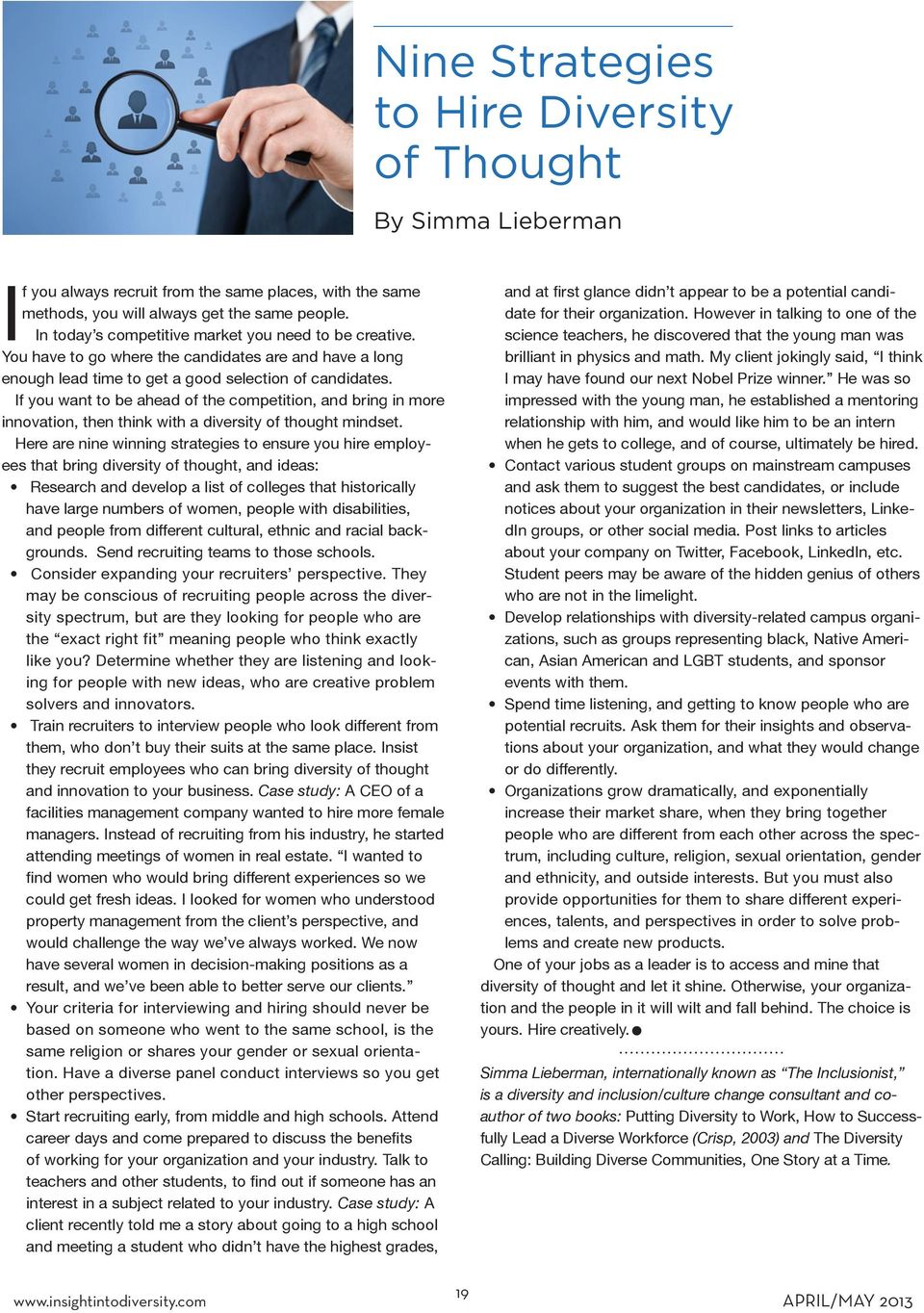
19 Nine Strategies to Hire Diversity of Thought By Simma Lieberman If you always recruit from the same places, with the same methods, you will always get the same people. In today s competitive market you need to be creative. You have to go where the candidates are and have a long enough lead time to get a good selection of candidates. If you want to be ahead of the competition, and bring in more innovation, then think with a diversity of thought mindset. Here are nine winning strategies to ensure you hire employees that bring diversity of thought, and ideas: Research and develop a list of colleges that historically have large numbers of women, people with disabilities, and people from different cultural, ethnic and racial backgrounds. Send recruiting teams to those schools. Consider expanding your recruiters perspective. They may be conscious of recruiting people across the diversity spectrum, but are they looking for people who are the exact right fit meaning people who think exactly like you? Determine whether they are listening and looking for people with new ideas, who are creative problem solvers and innovators. Train recruiters to interview people who look different from them, who don t buy their suits at the same place. Insist they recruit employees who can bring diversity of thought and innovation to your business. Case study: A CEO of a facilities management company wanted to hire more female managers. Instead of recruiting from his industry, he started attending meetings of women in real estate. I wanted to find women who would bring different experiences so we could get fresh ideas. I looked for women who understood property management from the client s perspective, and would challenge the way we ve always worked. We now have several women in decision-making positions as a result, and we ve been able to better serve our clients. Your criteria for interviewing and hiring should never be based on someone who went to the same school, is the same religion or shares your gender or sexual orientation. Have a diverse panel conduct interviews so you get other perspectives. Start recruiting early, from middle and high schools. Attend career days and come prepared to discuss the benefits of working for your organization and your industry. Talk to teachers and other students, to find out if someone has an interest in a subject related to your industry. Case study: A client recently told me a story about going to a high school and meeting a student who didn t have the highest grades, and at first glance didn t appear to be a potential candidate for their organization. However in talking to one of the science teachers, he discovered that the young man was brilliant in physics and math. My client jokingly said, I think I may have found our next Nobel Prize winner. He was so impressed with the young man, he established a mentoring relationship with him, and would like him to be an intern when he gets to college, and of course, ultimately be hired. Contact various student groups on mainstream campuses and ask them to suggest the best candidates, or include notices about your organization in their newsletters, LinkedIn groups, or other social media. Post links to articles about your company on Twitter, Facebook, LinkedIn, etc. Student peers may be aware of the hidden genius of others who are not in the limelight. Develop relationships with diversity-related campus organizations, such as groups representing black, Native American, Asian American and LGBT students, and sponsor events with them. Spend time listening, and getting to know people who are potential recruits. Ask them for their insights and observations about your organization, and what they would change or do differently. Organizations grow dramatically, and exponentially increase their market share, when they bring together people who are different from each other across the spectrum, including culture, religion, sexual orientation, gender and ethnicity, and outside interests. But you must also provide opportunities for them to share different experiences, talents, and perspectives in order to solve problems and create new products. One of your jobs as a leader is to access and mine that diversity of thought and let it shine. Otherwise, your organization and the people in it will wilt and fall behind. The choice is yours. Hire creatively. Simma Lieberman, internationally known as The Inclusionist, is a diversity and inclusion/culture change consultant and coauthor of two books: Putting Diversity to Work, How to Successfully Lead a Diverse Workforce (Crisp, 2003) and The Diversity Calling: Building Diverse Communities, One Story at a Time. 19
20 Meeting the 20

21 Need Nursing Schools Chart Steps Toward Diversity By Susan Borowski Nursing is one of the top 10 careers for job growth listed by the U.S. Department of Labor, so as a profession in and of itself, nursing shows great promise but even more so for minorities, given the increasing demand for cultural competency in patient care. While the number of minorities enrolling in nursing programs is rising, the trend is not keeping pace with the changing demographic of the United States. Minorities will outnumber whites in this country in just three decades, according to U.S. Census projections, but they comprised just 26.8 percent of undergraduate nursing students in , according to an American Association of Colleges of Nursing (AACN) report on enrollment. The safety of patients depends on their ability to be understood by healthcare providers, says G. Rumay Alexander, EdD, RN, clinical professor and director of the Office of Multicultural Affairs at the University of North Carolina School of Nursing. This means not only knowing about medications prescribed for certain disorders and what complications may be encountered, but also understanding a patient s values and culture. Those who teach care providers must convey cultural relevancy, Rumay says. People expect us to provide safe care for them, which means that all of us need to understand these diverse populations. Whether it s research, practice or service, we re all responsible for equipping ourselves with that kind of knowledge. Few nursing schools have an office devoted exclusively to diversity. Fortunately, there are exceptions. University of North Carolina School of Nursing The University of North Carolina at Chapel Hill School of Nursing manages its diversity initiatives through its Office of Multicultural Affairs. Led by Alexander, the nursing school s diversity initiatives include the Pauline W. Brown Diversity Scholarship Award, which grants a scholarship to a student studying diversity in health care; an Ethnic Minority Visiting Scholar Lecture Series, which features the contributions of minority scholars; and the Courageous Dialogues program, which involves facilitated conversations to help faculty and staff explore issues related to diversity and inclusion. 21 Alexander helps faculty design more inclusiveness into their assignments and activities, and strives to create a climate that welcomes all students. She also works with admissions and curriculum committees. Most admissions criteria require students to write essays, says Alexander. If those sitting on the admissions committee say that English must be perfect, and someone writes in a way that is not perfect, but you understand what they re conveying, which one is more important? My position is that you can teach them the English, but there are other things you cannot teach that you want in the qualities of a nurse. And while the number of males entering the nursing profession is increasing, we as a society have to get past the stereotype that nursing is for women, says Alexander. To encourage dialogue on diversity and inclusion issues, Alexander will assign an article, movie, book chapter, play, or have a group of drama students create a reenactment of a situation that occurred, and then facilitate a discussion about it. We recently did a G. Rumay Alexander, EdD, RN, director of the Office of Multicultural Affairs and clinical professor, UNC School of Nursing poverty simulation, says Alexander. People received assignments to play certain roles. I got them to walk in the shoes of someone whose socio-economic status is beyond anything they ve ever fathomed. We talked about how it felt to experience those things. For example, it s one thing to be white and poor; it s another to be Native American and poor, or LGBT and poor. That s not something everyone realizes, she says.
22 Jana Lauderdale, PhD, RN, FAAN, assistant dean of the Office of Diversity and Inclusion and associate professor, Vanderbilt School of Nursing (left). A teaching and learning experience in a Vanderbilt skills lab. Alexander says 98 percent of faculty and staff members participate in the Courageous Dialogues program. It speaks very well for the school, she says. One way she gets people to understand the effect of their words and actions is to quote an old African proverb that has become well known around the school: The axe forgets, but the tree remembers. The School of Nursing continually looks for ways to maximize its diversity. The goal of Pamela Johnson Rowsey, PhD, RN, coordinator of student diversity and recruitment, is to increase the number of baccalaureate students from underrepresented groups by 40 percent. To this end, she received a three-year, $640,000 grant from the Health Resources Service Administration, Careers Beyond the Bedside. One goal of the grant program is to enroll a minimum of three underrepresented students in a doctoral program within one year of graduation. Our workforce should ideally reflect what our state looks like to help alleviate disconnects between providers and the populations we serve, says Rowsey. Vanderbilt University School of Nursing As part of her job, Jana Lauderdale, PhD, RN, FAAN, evaluates Vanderbilt University s School of Nursing curriculum on an annual basis. Lauderdale is assistant dean of the Office of Diversity and Inclusion and an associate professor. She reviews curriculum for cultural content and to ensure clinical experiences involve diverse populations in the region. You can t know everything about everyone s culture, but you do have to understand the populations you care for, she says. Vanderbilt s undergraduate nursing students gain a broad understanding about underserved populations, Lauderdale says. Our program is predicated on the care of vulnerable populations. Many students go to underserved populations, rural areas, reservations, the Appalachians, or homeless clinics in urban areas. We make sure that cultural competency is embedded across our curriculum. One of the school s most successful programs is Academic Enhancement. It s for our incoming graduate students that we consider high risk, says Lauderdale. They may be students from rural areas or places where their high school didn t offer the kind of coursework that would prepare them for graduate level work, they may have been out of school for a number of years or they re switching to nursing from another profession. Students meet in bi-weekly sessions as a group; these sessions are videotaped so distance-learning students can benefit as well. We are also very strong in promoting successful interdisciplinary collaboration across campus, says Lauderdale. One example is the Shade Tree Clinic, a free clinic run entirely by medical students to meet the needs of underserved populations in the area. Students from both the medical and nursing schools gain valuable, handson experience while serving the needs of the community. Nursing diversity toolkits offered on Vanderbilt University Medical Center s website are also a collaborative venture. One toolkit, the Resource on Transcultural Nursing, includes case studies of conflicts or misunderstandings that occurred in patient health care because the caregiver lacked understanding of the patient s culture. The medical school was awarded certification in 2012 as a Healthcare Equality Index (HEI) Leader in Lesbian Gay Bisexual and Transgender Health Care by the Human Rights Campaign. It was the only facility in Tennessee to earn the designation. We emphasize the fact that our medical disciplines don t practice in a silo, says Lauderdale. We all have to talk and work through topics to provide better care for patients. The Ohio State University College of Nursing Although OSU s College of Nursing does not have a designated office for diversity initiatives, Jennifer Robb is a full time coordinator for diversity recruitment and retention and chair of the Diversity Committee. Our Diversity Committee is comprised of faculty, staff and students and meets monthly to ensure we have a welcoming and safe climate for diversity and inclusion, says Robb. Every three years, we conduct a climate assessment and use the results to guide our initiatives. We regularly host diversity trainings, forums, panels, and film discussions to engage faculty, staff, and students in honest dialogue in a safe environment. There are several diversity-related student groups, including Student Ambassadors, N-SPIRE, the Student Diversity Committee and the Buckeye Assembly for Men in Nursing. Our biggest diversity recruitment program is the Summer Institute for Diversity in Nursing, says Robb. In this program, high school students spend time on campus over four days in August to obtain hands-on nursing experience with patient simulators, attend lectures, participate in skills labs, and tour the campus. Participants receive information about admissions and financial aid, and receive assistance preparing for the ACT. The goal of the program is to increase the number of underrepresented populations in nursing, which includes not only 22
23 moreinsight University of North Carolina School of Nursing US News & World Report ranked UNC s School of Nursing in the top ten for graduate nursing programs in The School of Nursing is one of only a handful of schools in the country to house a biobehavioral laboratory. A Doctor of Nursing Practice (DNP) degree program is planned. racial minorities, but also men. Most students who attend are economically disadvantaged. The summer program isn t the only effort aimed at building a diverse pipeline. Students at a young age need to be informed of the many opportunities in nursing and the need to develop a strong academic record, says Robb. We collaborate with community members, non-profit organizations, schools, and Ohio State health sciences colleges to develop outreach and recruitment events for underrepresented elementary, high school, and college students, for people to raise their questions and examine their assumptions on the organizational level, as well as the personal level, Alexander says. Networking among colleagues also plays a big role in the national effort to bring more diversity to nursing, Lauderdale says. Talk to someone that has an active, successful diversity program, she says. I receive three or four calls every few months from people looking for information and help developing a diversity program. I m very open to sharing what I ve done here. Vanderbilt University School of Nursing The VUSN is designated as a Magnet school by the American Nurses Credentialing Center. The school was ranked #3 in midwifery in 2011 by US News & World Report. The school has a robust program for supporting veterans, military, and military family members in transitioning to academic life, including a VUSN Military/Veterans Liaison. The Ohio State College of Nursing The College of Nursing offers two courses specific to cultural competency: Cultural Competence in Health Care and Community and Care of Vulnerable Populations. The Technology Learning Complex conducts approximately 600 nursing simulations annually using computercontrolled human patient simulators. The college will celebrate its centennial anniversary in Jennifer Robb, coordinator for recruitment and retention, and Diversity Committee chair, OSU College of Nursing (left). OSU Student nurses performed biometric screenings as a public service for the Million Hearts Initiative during the 2012 Ohio State Fair. says Robb. We have over 50 student ambassadors who volunteer at these events to share their love of nursing. The American Assembly for Men in Nursing named Ohio State the Best Nursing College for Men in At the time, 10 percent of undergraduate nursing students were male; in 2013, that number has risen to 14 percent. The graduate program has seen an increase from 15 to 20 percent in the number of male students. Best Diversity Practices Nursing programs seeking to enhance their diversity and inclusion programs should treat diversity like any other strategic priority, says Alexander, which means you have a plan, goals, objectives, and accountability. That also means you give it money, time, and resources. Having a diversity champion on the school s leadership team is also important: There should be a safe place It s easy to let the numbers become the driver, but you cannot build with just the recruitment and retention of faculty, staff, and students, Alexander says. You must also create a climate where there is equality of opportunity and the ability of all humans to flourish. Jennifer Robb agrees. When current students feel respected and welcome, they will be your most powerful recruitment tools because they will share their positive experiences about your program with prospective students and the community. The time for nursing schools to act is now, says Alexander. This is not work that s going away. This is going to be huge. We have massive changes before us and we have to get ready for them. Susan Borowski is a contributing writer for INSIGHT Into Diversity magazine. 23
24 IID Perspective New Books Help Frame Affirmative Action Debate By Dr. Edna Chun The heated debate over affirmative action in admissions continues as we await the Supreme Court s decision on Fisher v. University of Texas as to whether race and ethnicity can be used by colleges and universities as one factor among many in a holistic review of potential students. Framing the issues in the debate seems particularly important at this critical juncture. Amidst the pendulum swings of public opinion, perhaps we need to remember why affirmative action arose in the first place. In his new book, More than Freedom: Fighting for Black Citizenship in a White Republic, , Stephen Kantrovitz notes that civil rights law has proved best suited for addressing individual acts of discrimination, not the entire history of inequality. He points out that in the Bakke decision of 1978, the Supreme Court, by a narrow majority, affirmed the importance of diversity on college campuses, but warned that these programs forced innocent persons white students who had not been admitted to bear the burdens of past injustices. Kantrovitz emphasizes that the Court refused to acknowledge the centuries of explicit racial preference that had left most whites richer, healthier, and better educated than most blacks. And he indicates, the language of individual rights stood opposed to any effort to address the history of collective inequity. Juxtapose this argument with the perspectives Richard Sander and Stuart Taylor Jr. offer in their recent book entitled Mismatch: How Affirmative Action Hurts Students and How Universities Won t Admit It. These authors assert that affirmative action in higher education is mainly about racial preferences. Furthermore, in a Wall Street Journal article entitled The Unraveling of Affirmative Action, Sander and Taylor argue that... schools need to demonstrate that if they wish to use race, it is as a supplement to a fundamentally more honest measure of disadvantage. Yet if race is not representative of disadvantage, how would we explain that as Joe Feagin points out in his landmark book, Systemic Discrimination, our country was grounded in legal segregation and extensive slavery for more than 85 percent of American history in the 350 years between 1619 and 1969? Sander and Tyler further indicate that 30 to 40 percent of fouryear colleges use racial preferences. They do not, however, offer contemporary corroborative evidence for this assertion, except to refer to an analysis of admissions cycles at public universities. The co-authors further contend that higher education s use of racial preferences is carefully concealed, and that academic leaders often find themselves flouting the law. In their view, a culture of secrecy and doubletalk surrounds affirmative action. They recommend that racial preferences not exceed the size of socioeconomic preferences at an institution. The crux of Sander and Taylor s theory is that large racial preferences for blacks offered by certain tiers of schools (below the elite tier for which more academically qualified blacks apply) result in what they term mismatch or the unintended side effect of driving these students who have weaker academic preparation than their classmates to drop out of school and abandon their career aspirations. Sander found that law students who had been admitted with large preferences into more elite schools but chose to attend a less elite school without such large preferences failed the bar less than half as often as similarly credentialed black students who entered the more elite school. Students with low academic indices relative to their classmates are at greater risk of not persisting. Students who entered schools where their academic index put them at or above the average of entering freshman had better grades and increased self-confidence, and in the case of law school students, passed the bar twice as often. Sander and Taylor s arguments are complex, but, in my view, also flawed and serve to further polarize the debate. Specific evidence is needed of how and when admissions officers are flouting the law. As Roger Reinsch and others point out in their recent analysis in the Northwestern Journal of Law & Social Policy, race can be considered in admission standards, but not by simply adding points. The message post-grutter, they state, is that diversity, not racial minority representation, is a compelling state interest, and admissions criteria can reflect that interest. On another front, despite a considerable body of evidence to the contrary, Sander and Tyler characterize much of the research about whether racial diversity encourages interracial contact, understanding of differing perspectives, and an enhanced ability to work with people from different back- 24
25 grounds as little more than propaganda. Recent examples of this empirical research include the four studies presented at the most recent meeting of the Association for the Study of Higher Education (ASHE). Several of the studies are based on the extensive longitudinal dataset from the Wabash National Study of Higher Education. Students were surveyed three times, beginning in their freshman year in 2006 and concluding in These studies revealed that students scores on the Collegiate Assessment of Academic Proficiency and the Collegiate Learning Assessment (CLA) grow when they encounter diversity either through campus interactions or diversity courses, with white students benefitting the most. Sander and Tyler also assert that one of the results of racial preferences is for mismatched students to withdraw into a racial enclave within the campus, seeking to foster a separate community in which the minority student can feel more confident and consider herself a better fit. This behavior may result in white students finding the minority students behavior off-putting and clannish. A powerful counterargument to this perspective is offered by Beverly Tatum in her book Why Are All the Black Kids Sitting Together in the Cafeteria?. Tatum outlines five distinct phases of minority identity development as individuals isolate, internalize, and then integrate facets of their identity when faced with stereotypes arising from the dominant culture of white, male, heterosexual privilege. At Oberlin College, for example, students have the option of living in one of 10 themed halls such as Afrikan Heritage House, Women and Trans Collective, Spanish House, and Asia House to name a few. Students don t have to be black to live in Afrikan Heritage House or Asian to live in Asia House. The themed halls are designed to build a community where everyone can feel comfortable and to create a place where diverse students can establish roots, build comfort, and enhance confidence. A persuasive counterpoint to Sander and Tyler s arguments is also offered by Charles E. Daye, Henry P. Brandis Distinguished Professor of Law and Deputy Director, UNC Center for Civil Rights at the University of North Carolina at Chapel Hill, who indicates that had Columbia University been guided by Sander s concept of Systemic Analysis in making admissions decisions, he would have been denied admission to Columbia, never have graduated in the upper echelon of his class, never been recruited for a federal judicial clerkship with the chief judge of a federal judicial circuit, and never have become a law professor. (The reference to Systemic Analysis pertains to an article published by Sander in the Stanford Law Review in January 2005). In an essay entitled A Personal Perspective: Ten Reasons to Reject A Systemic Analysis of Affirmative Action in American Law Schools, Daye argues that Sander s Systemic Analysis represents psychometric aggression against the belief that Blacks are entitled to make an analysis of what we perceive to be our best interest and our destiny. He rebuts specific premises of Sander s argument such as the cascade effect which indicates that elite schools get the most academically qualified minorities, causing second-tier and lower-tier schools to increase the size of racial preferences to get a diverse student body. The argument, according to Daye, treats Blacks as fungible: the proposition is that Blacks can be re-distributed, like so many widgets, down the tiers of law schools to a lower tier school where they fit better (and alas, where they belong). Daye also points out the sole focus in Sander s argument relating to academic preparation rests on the LSAT and GPA scores, not the educational process or the learning that occurs while in law school. Questions of why minority students succeed or leave predominantly white campuses require continued investigation. The overemphasis on grades and test scores in our colleges and universities at the expense of learning and critical thinking skills is a phenomenon that affects all students and is not limited to any one group. Sander and Taylor seem to view grades and test scores alone as the litmus test of academic preparation and success. Yet the campus culture, classroom dynamics, interactions with faculty and peers, and creation of a real sense of community are important elements in minority student retention and success. Although the outcome of the affirmative action debate is uncertain, institutions of higher education must continue to refine the needed pathways to promote the access and attainment of diverse students that ensure successful educational outcomes. Dr. Edna Chun is associate vice chancellor for Human Resource Services at the University of North Carolina at Greensboro, and is a member of the INSIGHT Into Diversity Editorial Board. Looking for more? Mississippi s flagship nursing school offers flexible, accessible and achievable graduate programs while promoting an environment that embraces and values the racial, ethnic, gender and cultural differences that exist among our faculty, staff and students. Master of Science in Nursing RN-MSN bridge program MSN and Post-MSN program Choose your focus: Nurse educator, administrator or practitioner. Reserve a spot in the competitive program: RN-MSN early-entry options available at participating community colleges. Doctoral Nursing Program Ph.D. in Nursing Post-MSN DNP Post-BSN DNP Choose a practice or research-focused program. Reserve a spot in the PhD or DNP program. Early-entry DNP option available to UMMC and Alcorn State MSN students. School of Nursing School of Nursing The University of Mississippi Medical Center The University of Mississippi Medical Center Learn more at umc.edu/son or [email protected] HRSA Grant #D09HP22638 and D09HP The University of Mississippi Medical Center offers equal opportunity in education and employment, M/F/D/V. 25 DI_3.9375x5.25.indd 1 3/20/13 3:59 P
26 As part of the PRIDE program, Frontier Nursing University hosts Diversity Impact weekend. Activities include guest speakers, cultural competency training, and team building for students, faculty, and alumni. PRIDE: Diversifying Nursing, Midwifery in Rural Regions By Janet Edwards Frontier Nursing University in Hyden, Kentucky, has a long history of educating nurses and nurse-midwives who work with families in remote, often impoverished, areas of the state. Recently, Frontier has focused on increasing student diversity to help create a workforce more reflective of the communities they serve. When a nurse-midwife or nurse practitioner cares for families of their own culture, there is a more intuitive understanding of each other and there is often an increased trust, says Frontier Dean Susan Stone, DNSc, CNM, FAAN, FACNM. We need to strive to recruit students from diverse populations with the hope that they will stay and work in their communities. To achieve that goal, Frontier created a minority recruitment program called PRIDE (Promoting Recruitment and Retention to Increase Diversity in Nurse-Midwifery and Nurse Practitioner Education). It offers financial assistance, a wide range of retention services and networking opportunities. PRIDE was funded in 2009 by a three-year, $1 million grant from the Health Resources Services Administration (HRSA) through the U.S. Dept. of Health and Human Services. We cast a pretty broad net in terms of nurses that we seek out for the program and where they live and who they serve, but our focus is on rural and underserved populations, says Stephanie Boyd, director of recruitment and retention. The students have to address that in their application how will they 26 meet our mission as an advanced practice nurse or midwife? Who are they serving and how are they serving them? We weigh that very seriously in our overall application process. In a specialized learning model, Frontier provides communitybased, distance learning for nurses seeking advanced practice degrees. Academic coursework is completed online, while students obtain hands-on experience working at clinics, hospitals and other health care settings in their own communities. Two to three on-campus sessions are required, including a pre-program orientation, and later, a week of skills workshops prior to the start of clinical practicums. We serve students in all states and at any time we may serve students in several foreign countries. A lot of them are doing mission work or other things outside the United States, Boyd says. With a current enrollment of about 1,300, roughly 66 percent of Frontier students come from rural areas. Most are located in Florida, South Carolina, Kentucky, Arizona, and Tennessee. When PRIDE began, underrepresented students comprised 9 percent of Frontier s student body, compared to the current 14.3 percent. Altogether, 117 minority students have been recruited through the PRIDE initiative, including 14 graduates. It s great when I see our statistics and know that our minority student population is increasing, but I am most proud when I walk into a new orientation class and see this diversity, or when I
27 stand in front of a graduating class and it is obvious that we are changing the face of advanced practice nursing and midwifery in the United States, says Stone. In the beginning, Frontier reached out to universities in rural areas and those not offering programs in midwifery education or advanced practice nursing. We asked about how we could help their graduates seamlessly enter into a graduate nursing program. Those conversations turned into partnerships with HBCUs (historically black colleges and universities), Hispanic-serving institutions, and rural health agencies and universities, says Boyd. Although Frontier has provided support services at a distance for a long time, administrators also surveyed students for ways to improve on that success. Valuable strategies were gleaned from those discussions, including one insight that prompted bringing students families into the retention equation. Susan Stone, DNSc, CNM, FAAN, FACNM, dean of Frontier Nursing University Kimberly Trammell, FNU PRIDE program coordinator (left) with Stephanie Boyd, FNU director of Recruitment and Retention. The American Association of Colleges of Nursing (AACN) presented Boyd with the Best Practices in Graduate Nurse Recruiting award in Family support was very important to this particular group of students. We hadn t done a lot of that before because traditionally our students were older and more well established in terms of their income and family situation, Boyd says. In response, Frontier developed videos and handouts that provide an overview of what it means to be a graduate student and how that role impacts the entire family. It s a way for students to share their journey with family, and gives helpful tips for the family to assist the student, says Kimberly Trammell, coordinator of the PRIDE program. For instance, it s helpful to develop a family calendar, or reward small children in a point system that allows students time to study or take exams. Videos also cover how to access Frontier s academic resource center, student support services, and online portal. Financial support was also necessary in terms of the family and student being able to function well in a graduate student program, Trammell says. Frontier just received another grant, 27 so we can provide more than 90 scholarships of $15,000 each. The four-year, $1.35 million grant was awarded by HRSA. The PRIDE program also provides for leadership and career opportunities, allowing students to participate in conferences and other professional programs nationwide that might otherwise prove too costly. Part of developing competent practitioners is getting them out there in the field and providing opportunities for them to network with others in their chosen profession, says Trammell. The federal funding also supports Diversity Impact, a weekend of activities designed for students and alumni. We bring in nationally known speakers to address diversity issues in nursing and nurse midwifery. We do cultural competency training and teambuilding activities, and participants learn more about the different resources available to them through Frontier, she says. It s also an opportunity for them to reconnect with classmates, faculty and staff. Trammell says the program is successful because diversity is a university-wide priority, as set forth in Frontier s strategic plan. Many of our students who were here when we put the program in place and have gone on to graduate are still very actively involved with PRIDE. They serve as mentors, Trammell says. Our students are not just having a discussion in the moment, it s something they re taking with them and carrying on as they become nurse practitioners and midwives. While the PRIDE program is focused on increasing the number of minority student nurses and providing the support they need to be effective, Frontier has implemented other strategies to increase diversity on campus. We also put a focus on recruiting minority faculty and are proud that we have been able to recruit six new minority faculty members during the past year. Our goal is to increase the diversity of both the student body and the faculty so that they reflect each other, Stone says. The faculty is also committed to including cultural competency as a thread throughout the curriculum, which means every course reflects that concept, she says. This is a full commitment throughout the University, Stone says. We don t have all the answers but we do have a commitment to the goal and we are striving to learn how to be more effective in our strategies. Janet Edwards is the editor of INSIGHT Into Diversity magazine.
28 Making a Case for Diversity in Higher Ed By Shirley J. Wilcher In the U.S. Supreme Court s review of the amicus curiae briefs in the Grutter v. Bollinger case, the Court relied in part on research supporting the educational benefits of diversity. The Court wrote numerous studies show that student body diversity promotes learning outcomes, and better prepares students for an increasingly diverse workforce and society, and better prepares them as professionals. Similarly, briefs filed in the Fisher v. University of Texas at Austin case in 2012 may be helpful to the Fisher Court s deliberations. Among the briefs submitted were two filed on behalf of researchers and psychologists. The American Educational Research Association, et al., and the social and organizational psychologists filed briefs supporting the University of Texas at Austin. Both briefs made compelling arguments in support of diversity in higher education and hopefully will be instructive to the Court and beyond as the debate about diversity as a vehicle to educate the nation s future leaders continues. The signatories to the social and organizational psychologists brief are widely published on topics including the influence of diversity on cognitive function, bias, and academic achievement. Among the 13 signatories on the brief are Dr. Evan Apfelbaum of MIT, Dr. Max H. Bazerman of the Harvard Business School, and Dr. Wendy Berry Mendes of the University of California, San Francisco. Physiological Benefits of Diversity Amici argued that that while the social science research generated before the Grutter case indicated that a race-conscious policy of admissions met the Court s standards for constitutional scrutiny, research following Grutter amply demonstrates why diversity is even more important to academic achievement and civic engagement than was understood. The professors emphasized that diversity has a physiological dimension related to the regulation of stress and threat responses in interracial interactions, enhances academic performance, reduces prejudice and positively affects civic and economic life. Amici suggested that diversity helps all students by reducing anxieties that can result from interracial interactions. Initial interactions with members of an outgroup or persons with distinct racial, socio-economic or gender groups, can cause anxiety and distress, according to these scholars. This initial anxiety 28 manifests physiologically in cardiovascular reactivity, increased production of cortisol (commonly called the stress hormone ), and changes in the regularity of heart rate per breathing cycle. Research shows that increased contact with outgroup members decreases these responses. Interestingly, past interactions with such groups through, for example, interracial contact may result in faster physiological regulation in bodily stress systems. Thus, according to amici, research has shown a physical response to interacting with persons from other racial or gender groups. Increased exposure to these individuals reduces the stress and anxiety systems in the human body. These professors further suggest that the physiological benefits of interracial reactions can appear in a short period of time, which is important to students who come to college with little or no previous interaction with persons from other racial groups. A 2008 survey of Latino and White participants at a selective public university found that students who were implicitly prejudiced or concerned with outgroup rejection responded to their first interracial interaction with an excessive release of cortisol, which appeared in saliva within twenty minutes of first meeting the outgroup member. This reaction decreased within three subsequent meetings. Diversity Reduces Prejudice, Bias Amici also suggest that diversity reduces prejudice and bias. They cited a meta-analysis (statistical analyses that synthesize research from different studies) conducted by researchers from Columbia, Stanford, and Tufts universities that indicates while individuals who had engaged in same-race interactions reported more negative emotions initially when having interracial interactions, more positive emotions were reported after repeated interactions with interracial groups compared with those engaging in same-race interactions. Another study supported the argument that intergroup contact reduces prejudice and improves attitudes toward out-group individuals. As important, prejudice towards members of the outgroup can be reduced even with indirect contact with members of such groups. [E]ngaging in interracial contact or having close friends who do, individuals experience less anxiety, increased empathy, and lower levels of prejudice towards outgroup members.
29 In the university setting, students with more cross-group friends demonstrate less anxiety and prejudice towards members of out groups. Research involving student roommates also supports this theory regarding white students implicit racial attitudes while living with outgroup roommates. Benefits of Diverse Social Interaction This brief also suggests that diversity reduces the racial isolation or solo status of underrepresented students. It also indicates that solo status, which can cause students to see themselves as representatives of the entire group, can disproportionately affect the classroom performance of students from historically stigmatized groups. Thus, the impact of being different from the rest of one s group is greatest when it counts the most. Solo status may also increase feelings of stigmatization, as well. Students entering college who are sensitive to being rejected or dismissed because of their race may demonstrate greater anxiety into their second and third years compared with those with low rejection sensitivity. Creating opportunities for diverse peer engagement could help to ameliorate the alienation that African American and other students may experience. This brief addresses the issue of stereotype threat and its effects on academic performance. Stereotype threat is defined as a disruptive apprehension that individuals feel when they fear their performance will confirm a salient negative stereotype about the intellectual ability and competence of their identity group. Twenty years of research has found that such fear impairs performance and has physiological manifestations, including the production of cortisol and on cardiac functioning during taking an exam, for instance. Physical responses can decrease when students have a feeling of belonging or have positive relationships with other people. Research has shown that the achievement gap can be narrowed with a social belonging intervention. Diversity Enhances Leadership Skills The brief of the American Educational Research Association, et al. supports arguments made by the previous brief, that research generated subsequent to the Grutter decision in 2003 confirms the compelling interest in diversity. The educational benefits of diversity include improvements in intergroup contact and cross-racial interaction, reduced prejudice, improved cognitive abilities, critical thinking skills, and self-confidence. As in the psychologists brief, the AERA brief supports the argument that diversity increases civic engagement and enhances the skills required for professional development and leadership. Conversely, racial isolation and tokenism may be remedied by increased diversity, which diminishes prejudice and stereotyping, stereotype threat, microaggressions, and overt discrimination. Lastly, the research shows that the alleged harms to minority students due to race-conscious admissions programs are not supported by solid research and have no sound empirical basis. AERA argues that the University of Texas s admissions program is narrowly tailored and alternatives to the holistic review do not provide the critical mass of minority students needed to achieve the educational benefits indicated in the research. The AERA brief notes that campuses maintaining a high degree of racial diversity will see an increased diversity of friendship networks. While diversity activities are effective in reducing racial bias, diversity-related interventions are particularly beneficial to white students. Student body diversity also improves cognitive skills because exposure to different individuals challenges thinking and promotes cognitive growth. As reflected in the amicus curiae briefs of the social and organizational psychologists and the American Educational Research Association, the burgeoning body of research appears to amply support the argument about the benefits that flow from diversity in the Fisher case and beyond, and the contraindications of continued isolation and tokenism. As this nation becomes increasingly diverse supported by the Census Bureau s announcement that in 2011 the majority of children born in the United States (50.4 percent) were Hispanic, African American, Asian and mixed-race, it must find the means from which to learn and apply the lessons of such research in both education and the workplaces of the future. Shirley J. Wilcher is executive director of the American Association for Affirmative Action and a member of the INSIGHT Into Diversity Editorial Board. Creating opportunities for diverse peer engagement could help to ameliorate the alienation that African American and other students may experience. 29
30 Kennesaw State University Community Health Clinic at MUST Ministries is an example of community partnerships that provide culturally competent health care while serving as a learning lab for students. KSU Clinic Partnership Serves Community and Students By Vanessa Robinson-Dooley, LCSW, PhD The economic recession brings more untreated patients with chronic diseases to health centers, but even the most basic health applications can seem unattainable for marginalized individuals. A major report published by the National Association of Community Health Centers in 2007, Access denied: A look at America s Medically Disenfranchised, states 56 million Americans lacked adequate access to primary health care because of physician shortages in their communities. Community health clinics have become an important solution for the underserved, especially those who seek services for mental health, dental, and other specialty needs. From a socioecological perspective, health should be addressed by seeking to understand the patient s environmental stressors and cultural factors, and how to impact treatment. Providing competent healthcare requires practitioners to recognize differences related to cultural factors, including family structures, daily routines, perceptions about modern medicine, and understanding of their current health status. As we move into a more global and culturally diverse population, the impact of culture on health service delivery and the training of human service professionals are even more significant. The Kennesaw State University (KSU) Community Health Clinic at MUST Ministries is one example of a community partnership seeking to decrease barriers to healthcare and provide culturally competent service. Involving 23 students, six faculty members and serving approximately 2,500 patients on an annual basis, the clinic is a collaborative partnership between MUST Ministries, a local nonprofit, and KSU. It was created to provide affordable, accessible, quality healthcare to the homeless, uninsured, and underserved population in a suburban community. The clinic is Vanessa Robinson-Dooley, LCSW, PhD, assistant professor, and faculty practitioner, KSU Community Health Clinic at MUST Ministries 30
31 KSU faculty members and students work and learn together while providing low-cost, quality health care for homeless, uninsured, and underserved people in the community. practitioner run, with faculty members from nursing, social work, and human services committing time to serve patients and providing internship and practicum supervision for students. The collaboration presents an opportunity to create a model that impacts patient care and provides a learning lab for students to develop their skills. The Clinical and Interdisciplinary Review (CAIR) model, piloted in April 2012, utilizes all of the learned skills of each academic discipline to improve patient services. The model delineates each team member s tasks as they relate to holistic patient care; each task is interwoven with learning experiences that build to increase the student s cultural competence skill level. The model uses practice guidelines recommended by Michele Yehieli and Mark Grey in their book, Health Matters: A Pocket Guide for Working with Diverse Cultures and Underserved Populations. The guidelines serve practitioners seeking to become more culturally sensitive. The CAIR model weaves together the practice skills utilized by each discipline, and the recommendations provided by Yehieli and Grey in the following ways: Be aware of cultural beliefs and values of patients and how they might influence their attitudes or behaviors to treatments. CAIR: A Bio-Psycho-Social-Spiritual assessment is completed on each patient by a human service or social work intern. This assessment gathers the patient s history encompassing physical, social, and spiritual factors, which contribute to cultural beliefs and attitudes. Learn about historical events and how they affect particular groups. CAIR: Multi-disciplinary Team (MDT) meetings require all students (nursing, human services, social work) to present what they have learned about a patient (history, background, challenges) and process how these challenges might impact their service provision. Become familiar with the patient s traditional health practices, attitudes, and perceptions about conditions. CAIR: Patient intake and the initial medical work-up are com- pleted by nursing interns who are trained to ask questions about how patients view their current medical concern and expectations of the visit. Social work students are trained to inquire about these same perceptions when completing a Mental Health Assessment. Determine, and try to emulate, communication styles most common with a patient s culture. CAIR: At intake, nursing students assess for language needs and an interpreter is provided, if needed, to ensure patients communicate in their native language. Human service students complete a Case Management Review and make observations about patient communication styles (verbal, non-verbal). Attempt to learn a few introductory phrases in the patient s language. CAIR: MDT meetings are used to discuss opportunities to increase patient comfort. All students are encouraged to learn words from the primary language of the patient population to build trust. Learn about the patient from a holistic manner rather than based on a particular disease. CAIR: All students are trained to listen actively and research culturally specific risk factors. Students are expected to learn what cultural barriers impact treatment. Be humble, genuine, and willing to learn. Know that you will make mistakes. CAIR: Students are encouraged to use MDT meetings to detail cultural missteps made and to identify solutions. They are taught that becoming culturally competent is a life long endeavor. The CAIR model exemplifies an attempt to train culturally competent practitioners in a health care setting. This is imperative as community clinics increasingly become places where the underserved seek primary medical care. Vanessa Robinson-Dooley, LCSW, PhD, is an assistant professor of social work at Kennesaw State University and a faculty practitioner at the KSU Community Health Clinic at MUST Ministries. 31
32 Retainer-Based Medicine: A Cure for Doctor Overload? By Jessica Murgueytio, MS, RD, LD SPECIAL ADVERTISING FEATURE When people first learn about a new form of primary care practice known as concierge medicine or retainer-based medicine, words like exclusive, expensive, and privileged often come to mind. However, serving an ailing, affluent population is far from the foundation for this kind of healthcare practice. In fact, physicians focused on preventing the onset of chronic disease and slowing the progression of a diagnosed disorder first developed the model. It s not uncommon for primary care physicians to carry practices upwards of 2,000 to 4,000 patients, leaving less time to work effectively with each patient in a preventative fashion. Some patients rarely see their physician; instead, they see a physician s assistant or an intake nurse, especially during an annual physical. In a concierge practice, the emphasis is on proactive versus reactive medicine. The number of patients is limited, giving doctors more time to explain laboratory results; emphasize the importance of nutrition, exercise, proper sleep habits, and stress management; develop individual wellness plans; and act as a coordinator for other specialists caring for a particular patient. Dr. Alan Sheff Various Care Plans Concierge medicine takes on several forms: Primary care practice: Such practices do not accept private or government-issued insurance (such as Medicare and Medicaid). Each patient pays an annual or monthly fee, which includes acceptance into the practice and all services rendered. These fee for service or boutique practices represent the most exclusive and most expensive form of concierge medicine. Physicians Network: This form of business model is exemplified by MDVIP, a personalized healthcare program that empowers people to reach their health and wellness goals through in-depth knowledge, expertise and one-on-one coaching with some of the finest primary care doctors in America. A required annual fee of $1,500 covers the fair market value of the noninsurance covered preventative services. Services such as office visits and annual physicals are billed through the patient s private or government insurance provider. Hybrid: Patients have 24-hour physician access, but for an additional fee they receive exclusive services such as guaranteed next-day appointments and other a la carte options. Patients can choose to pay these additional fees or not. Annual fees are usually lower under this plan, ranging anywhere from $60-$500. Concierge Medicine: Pros and Cons Concierge medicine achieves better health care outcomes when compared to the traditional model of primary care. Along with making the patient-physician relationship more personal and convenient, it s extremely effective in treating and managing chronic disease. For example, a study published in the International Journal of Person-Centered Medicine stated that 83 percent of diabetic patients currently enrolled in a practice affiliated with MDVIP are maintaining proper blood pressure levels and controlling their diagnosis through medication and diet, while the national benchmark is percent of a practice. MDVIP patients also obtained more recommended preventative screenings such as mammograms, colonoscopies, and bone density scans, as compared to the national benchmarks. Concierge medicine is not without controversy, however. The debate over whether or not it will create a two-tiered health care system that creates disparity among individuals and families at different income levels has waged since the late 1990s, when the concept was first introduced. The cost of such care is $4-5 per day, or $1,500-1,800 annually for a retainer-based practice. For some, giving up a daily latte would pay for this form of medical care; others might have to give up basic necessities in order to cover the cost. I have had elderly, widowed patients that I have cared for over thirty-plus years who I know cannot afford the retainer, says Dr. Robert Fields, a private practice physician in Olney, Maryland. I prefer to continue to treat them without charge than to go through the hassle of Medicaid paperwork. To eliminate the disparity, some retainer-based practices 32
33 offer scholarships for specific patients when they make the transition into their smaller practice. Which patients receive the scholarship, or in some cases a reduced annual fee, is up to the discretion of the physicians and is not always based on financial need. Most practices allot a certain percentage typically from percent or higher of their patient load for the scholarship program. Some physicians choose to offer the reduced rate to members of the clergy or local service workers or patients they have treated for years who have financial hardships. No formal application process for most scholarships exists; the selection is at the discretion of each individual physician and practice. Most physicians transferring to the concierge model will develop transition care plans for patients who elect not to follow them. This helps address the issue of abandonment and prevents a lapse in care. With a growing annual deficit of 40,000 primary care physicians, the need to attract more medical students to primary care is critical. Concierge medicine may be the antidote; more students may show interest with the hope of increased work satisfaction, more interaction with patients, and comparable salaries to their peers specializing in other branches of medicine. Current disparities in salaries between primary care physicians and specialists could be a major deterrent for medical students. While it is prudent to note the financial disproportion and how it might exacerbate the primary care physician deficit, most physicians say they switched to concierge medicine to improve the quality of care they provide, not for financial gain. Before I converted my practice to MDVIP, I was planning to leave medicine because my practice had become so busy there was never enough time to give each patient the care and personal attention I knew they deserved, says Dr. Alan Sheff. Fortunately, the MDVIP practice model came along just in time, and now I love being a physician again. My patients say they enjoy the unhurried office visits and I know I am providing them with a better quality of care, especially when it comes to prevention and wellness. The perfect storm for a national health care disaster is upon us: the decreasing interest in becoming a primary care physician; an escalating need for such physicians because of a growing and aging population; and a widespread prevalence of chronic disease that drives escalating health care costs. Concierge medicine is proving to have durable value in resolving some of the problems plaguing our health care system. While it may not be the universal answer, it could play a large part in better health care for our nation. Jessica Murgueytio MS, RD, LD is the clinical staff dietician for the MDVIP office in Bethesda, Maryland. You, To a Higher Degree. The Online RN to BSN Degree The University of Memphis Loewenberg School of Nursing offers an online Bachelor of Science in Nursing (BSN) degree for Registered Nurses. Advance your career while working closely with faculty, nurses and patients at times and locations that are most convenient for you. All students are eligible for in-state tuition. To apply and learn more about one of the nation s top nursing programs, log on to memphis.edu/rntobsn [email protected] Loewenberg School of Nursing Preparing leaders. Promoting health. 33
34 Connecting Diverse Professionals To Diverse Careers TM editorial calendar ISSUE FOCUS DEADLINE June 2013 Community Colleges 5/8 July/Aug 2013 The Role of the Chief Diversity 6/24 Officer/Gender Diversity September 2013 Campus Recruiting 8/8 October 2013 Disability Awareness 9/9 November Higher Education Excellence 10/9 in Diversity Award (HEED Award) Bonus distribution at the College and University Professional Association for Human Resources (CUPA-HR) conference December 2013 Diversity 2014: Trends 11/8 Jan/Feb 2014 Vocational/Trade Schools, 12/13 Online Education
35 OBAMACARE in 2014: Stay Tuned Legal INSIGHTS with Jeffrey W. Larroca In my November 2010 INSIGHT Into Diversity column, ( Unraveling the Health Care Bill ), I wrote about The Patient Protection and Affordable Care Act more commonly referred to as Obamacare. I concluded, With the control of Congress at stake in November, the presidential election a mere two years thereafter, and workers and businesses exploring various ways to deal with the ramifications of the new law, events are in a fluid state. Stay tuned. Since that time, while the GOP took control of the House of Representatives in 2010 and maintained control two years later, the Democrats maintained control of the Senate and President Obama was re-elected. However, none of those political developments proved as meaningful to the preservation of the law as the Supreme Court s upholding of Obamacare as constitutional in the summer of With that ruling, the law s most significant components will now come into play, with an attendant and significant impact on American businesses. Upon its passage, the law had immediate consequences, from the large (insurers were required to offer coverage for adult children up to 26 years of age under an employee s standard family coverage if the child could not get their own employer-provided coverage) to the small (employers were required to provide break rooms for nursing mothers). Nonetheless, the major impact hits in 2014, first and foremost in the form of the Employer Mandate. Pursuant to the Employer Mandate, boiled down, employers with 50 or more full-time employees must provide health coverage to their employees. If they fail to do so, they will be assessed a penalty of up to $2,000 per employee beyond the first 30 of these employees. As a result, some employers are taking long, hard looks at the financial impact of providing any health care insurance at all. In a 2012 study by the consulting firm Deloitte, one in 10 U.S. employers reported they planned to drop their employee health insurance plans altogether. As reported by The Wall Street Journal, ( Deloitte: One in 10 U.S. Employers to Drop Health Coverage ): Deloitte s findings differ from estimates by rival firm McKinsey & Co. last year that found 30 percent of employers say they would definitely or probably stop offering health insurance after 2014, as well as calculations by the Congressional Budget Office that estimated around 7 percent of workers could lose Employers rethink health insurance plans in response to an Obamacare mandate coverage under the law by In all, 9 percent of companies in the Deloitte study said they expected to stop offering insurance in the next one to three years. Around 81 percent were planning to continue providing benefits, and 10 percent weren t sure. Other employers are cutting hours in an effort to avoid the 50 full time employee threshold. Still others are considering hiring more part-time workers next year or scaling back their hiring because of the new health care law. For example, Darden Restaurants, the parent company of Red Lobster and Olive Garden, was reported to be exploring a significant restructure of vacant positions from full-time to part-time. Other reports have Burger King, McDonalds, KFC, Dunkin Donuts and Taco Bell doing the same. In his column titled, ObamaCare: Rhetoric Vs. Reality, columnist Roger Samuelson of Real Clear Politics wrote: Employers have a huge incentive to hold workers under the 30-hour weekly threshold. The requirement to provide insurance above that acts as a steep employment tax. Companies will try to minimize the tax. The most vulnerable workers are the poorest and least skilled who can be most easily replaced and for whom insurance 35 costs loom largest. Indeed, the adjustment has already started. The Internal Revenue Service has taken two steps in direct response to the movement away from full-time employment. First, the IRS has defined full-time employee in an expansive manner as someone who works 30 hours a week for an employer, as opposed to the traditional 40. Second, on Dec. 28, 2012, the IRS sent a shot across the bow of employers exploring a different option that of taking full-time employees and designating them to perform the same work through a temporary agency reporting it would soon issue anti-abuse rules : The Treasury Department and the IRS are aware of various structures being considered under which employers might use temporary staffing agencies (or other staffing agencies)... to evade application of section 4980H [the employer insurance mandate]... It is anticipated that the final regulations will contain an anti-abuse rule. Under that anticipated rule, if an individual performs services as an employee of an employer, and also performs the same or similar services for that employer in the individual s purported employment at a temporary staffing agency or other staffing agency of which the employer is a client, then all the hours of service are attributed to the employer for purposes of applying section 4980H. In sum, the legal landscape is shifting for businesses in regard to health care. At the time of this writing, 828 pages of new Obamacare regulations have been released, all of which will have further ramifications for American employers. Stay tuned. Jeffrey W. Larroca is a member of the Eckert Seamans law firm in Washington, D.C., in the Litigation Division. He focuses his practice on labor and employment, and litigation. He is also a member of the INSIGHT Into Diversity Editorial Board. If you have a legal question for Jeff, you can reach him via at [email protected].
36 Connecting Diverse Professionals to Diverse Careers TM Open Rank Tenure-Eligible Faculty Position Department of Biostatistics Position #F34450 Yale University School of Nursing (YSN) seeks highly qualified candidates for faculty positions to teach in master s, DNP and PhD programs. As a member of the faculty, the appointee will be expected to contribute to teaching, service, practice, and research at YSN. Members of the faculty report to the Chair of the division to which they are assigned (Health Systems and Outcomes Division or Population Health Division). Faculty may also be asked to serve as coordinator of a master s track or in other administrative roles. Multiple Positions The Department of Biostatistics at Virginia Commonwealth University (VCU) is seeking to fill a tenured/tenure-eligible faculty position at the level of assistant, associate, or full professor. We are seeking applicants with training and research interest in the design and statistical analysis of high-throughput genomic data (e.g., next generation sequencing, microarray, proteomic technologies), bioinformatics, computational biology, or closely related area. Additionally, applicants should have collaborative research experience. Primary responsibilities include teaching and advising graduate students as well as conducting independent methodological research. In addition, the successful applicant will be expected to collaborate with other VCU investigators in related fields in obtaining extramural grant support. CAREER OPPORTUNITIES Executive Faculty Positions Executive Associate Dean/Deputy Dean Associate Dean for Global Affairs Chair Health Systems and Outcomes Division Chair Population Health Division Requirements: Doctorate in nursing or related field Eligible for tenured appointment at the rank of Professor Experience in graduate education Progressive and significant leadership in academic administration A history of success in nursing scholarship Ladder Track Faculty Positions EM Requirements: Doctorate in nursing or related field Expertise in advanced nursing practice and clinical research Ability to think creatively and strategically Strong communication and interpersonal skills Interest in partnerships between academia and practice Salary and rank for all positions will be commensurate with previous accomplishments and experience. Yale University School of Nursing is an affirmative action/equal opportunity employer. Men and members of underrepresented ethnic and racial groups are encouraged to apply. RE The Department of Biostatistics has a 40+ year history in the VCU School of Medicine and is committed to excellence in both biostatistical research and graduate education. The department offers both M.S. and Ph.D. programs in Biostatistics, including a concentration in Genomic Biostatistics, a M.S. in Clinical Research in Biostatistics, and a Master of Public Health. Our biostatistics faculty, students, and staff collaborate with clinical investigators on the Medical College of Virginia Campus (which includes the Schools of Medicine, Dentistry, Pharmacy, Nursing, and Allied Health) in a wide variety of biomedical research projects. Located in Richmond, Virginia, VCU has established relationships with the Virginia Department of Health as well as local and regional health departments. Qualifications: For all levels, candidates should have a Ph.D. in biostatistics, statistics or related field, demonstrated experience in the analyses of high-throughput genomic or proteomic data, familiarity with statistical programming environments for analyzing such data, and excellent oral and written communication skills. BY LEVEL OF APPOINTMENT: Full Professor: Applicants should have an established track record publishing in peer-reviewed journals, have national or international prominence in their area of expertise, and have demonstrated experience obtaining extramural research support. Associate Professor: Applicants should have an established track record publishing in peer-reviewed journals and have demonstrated experience obtaining extramural research support. Assistant Professor: Applicants should have at least two years of experience beyond completion of their degree program and must demonstrate excellent oral and written communication skills. Screening of applications will begin immediately and will continue until the positions are filled. Interested candidates should apply, online, by submitting a curriculum vita and cover letter describing their qualifications: org/ajo/jobs/2571. All application materials and correspondence will be kept confidential. For more information about the Yale University School of Nursing, please visit our website: All candidates should have demonstrated experience working in and fostering a diverse faculty, staff, and student environment or commitment to do so as a faculty member at VCU. Potential candidates can submit applications, including a statement of research, teaching philosophy, curriculum vitae and contact information for three professional references, via mail to Yvonne Hargrove, Department of Biostatistics, Virginia Commonwealth University, P.O. Box , Richmond, VA or by to [email protected]. Virginia Commonwealth University is an equal opportunity/affirmative action employer. Women, minorities and persons with disabilities are encouraged to apply. 36
37 Connecting Diverse Professionals to Diverse Careers TM Faculty Position Services Marketing Management School of Hotel Administration Cornell University, Ithaca, NY Cornell is a community of scholars, known for intellectual rigor and engaged in deep and broad research, teaching tomorrow s thought leaders to think otherwise, care for others, and create and disseminate knowledge with a public purpose. The School of Hotel Administration at Cornell University is seeking applications for one tenure-track position at the Assistant, Associate, or Full Professor level in the area of services marketing management. We seek candidates who have published in, or aspire to publish in, top-tier business journals and whose research and teaching interests can be easily applied to the hospitality industry, which is broadly defined to include foodservice, lodging, and travel-related businesses. Scholars whose research and teaching interests are particularly relevant to hospitality food and beverage marketing are especially encouraged to apply. Candidates should be interested in developing their research ideas for the hospitality practitioner audience as well as for top-tier academic journals. Teaching excellence, as well as research excellence, is highly valued at the School of Hotel Administration. The teaching load is three courses per academic year for faculty demonstrating strong research productivity. The successful candidate would teach at least one section of the required introductory marketing course (at either the undergraduate or graduate level) and would have the opportunity to develop electives based on research interests. Professional qualifications: Candidates must have a Ph.D. in marketing or a related field. Prior research, teaching, and/or business experience in the hospitality industry is desirable but not required. The School of Hotel Administration provides unique data sets and industry connections that can facilitate the candidate s future research and teaching about the industry. Rank and salary: The tenure-track professorial position is a three-year, renewable appointment, which can begin as early as Fall Rank and salary will be determined based upon academic achievement and experience. Appointments are nine-month terms with attractive fringe benefits. This position comes with excellent research support and a salary highly competitive with top U.S. business schools. Institution: Cornell University s School of Hotel Administration (SHA) is recognized worldwide as the premier institution of hospitality management, and its alumni dominate the top managerial echelons of a broadly-defined, multi-national hospitality industry, which includes hotel corporations, airlines, restaurants, tourism, hospitality suppliers, internet companies, etc. The Cornell University campus is located in the Finger Lakes region of New York State, one of the most scenic areas of the country, and the region offers a wide variety of both winter and summer activities. For further information about the University and SHA, visit the website at or Application: Please submit via or hard copy a vita, three references, up to three academic research papers, and syllabi and teaching evaluations for recent courses taught. Applications will be accepted until the position is filled. Although we may extend the search thru the next academic year and interview applicants at the 2013 Summer AMA Educators Conference, we hope to complete the search by May 2013, so early applications are encouraged. Please send applications to: Steven A. Carvell, Ph.D. Associate Dean for Academic Affairs Cornell University Services Marketing Management Search School of Hotel Administration 146 Statler Hall Ithaca, NY USA [email protected] Find us online at or Facebook.com/CornellCareers Cornell University is an innovative Ivy League university and a great place to work. Our inclusive community of scholars, students and staff impart an uncommon sense of larger purpose and contribute creative ideas to further the university's mission of teaching, discovery and engagement. Located in Ithaca, NY, Cornell's far-flung global presence includes the medical college's campuses on the Upper East Side of Manhattan and Doha, Qatar, as well as the new CornellNYC Tech campus to be built on Roosevelt Island in the heart of New York City. Diversity and inclusion have been and continue to be a part of our heritage. Cornell University is a recognized EEO/AA employer and educator. PSYCHOLOGY AND CHILD DEVELOPMENT Chronicle of Higher - Full-time Ed lecturer in developmental Issue: 3/1 due psychology Monday at Cal Poly, San Luis 3/8 due Obispo 2/25 to start Size: 3 column x 8 9/16/13. To apply, complete a Cost: $3,720 required online application at Pick up rate - $2,790 Total CHE - $41,280 and submit to Requisition # Please Insight see into online Diversity posting for additional Issue: instructions. April/May Position issue due 3/22 Size: 2 x 8.5 is open until filled; review of Cost: $2,176 applications will begin May 8, CHRIE Issue: April EEO is next issue Size: 2/ x 10 Cost: $1,819 Total CHRIE - $ University of Nebraska Medical Center Coordinator The Pulmonary, Critical Care & Sleep Medicine Division at the University of Nebraska Medical Center (UNMC) seeks applicants for a pulmonary/critical care specialist faculty position. The division consists of 18 faculty members and has fully accredited pulmonary/critical care medicine and sleep medicine fellowships. The successful applicant must be board certified/eligible in both pulmonary and critical care medicine. Rank will be dependent on qualifications. Successful candidates will join a vibrant academic division in a university that has expanding clinical and research programs and that is located in an economically thriving community with a modest cost of living and outstanding school systems. Questions or additional information regarding the position should be directed to the Division Chief, Dr. Joe Sisson, MD, by ing [email protected]. Individuals from diverse backgrounds are encouraged to apply. Applications are now being accepted on line at edu/postings/ CAREER OPPORTUNITIES View hundreds of additional career opportunities in our online Career Center at insightintodiversity.com 37
38 Connecting Diverse Professionals to Diverse Careers TM CAREER OPPORTUNITIES College Associate Dean for Planning and Institutional Effectiveness Suffolk County Community College seeks highly qualified candidates for the role of College Associate Dean for Planning and Institutional Effectiveness. The College Associate Dean provides college-wide leadership within the areas of functional responsibility outlined in the position description and communicates, as a college administrative team member, with a wide range of academic and student affairs personnel. The College Associate Dean has managerial, supervisory and evaluative responsibilities for respective personnel of the Planning and Institutional Effectiveness function. Annual performance review of College Associate Dean will be conducted by the Vice President for Planning and Institutional Effectiveness on or before June 30 of each year. For the full position profile, please go to: College Director of Development Alumni Affairs Suffolk County Community College seeks highly qualified candidates for the role of College Director of Development Alumni Affairs. The College Director of Development Alumni Affairs will implement and promote alumni and retiree programs that support the College and Foundation s strategic and development plan, as well as the goals of any major gift campaign, in collaboration with colleagues within the Foundation, the President s Office and throughout the campuses. For the full position profile, please go to: Vanderbilt University School of Medicine, Division of Diabetes, Endocrinology, and Metabolism is seeking a highly qualified physician-scientist for an Instructor in Medicine position in the Division of Diabetes, Endocrinology, and Metabolism. The position involves 20% clinical duties including attending on inpatient and outpatient services with the remaining 80% protected for research in the area of effects of immune modulation in the prevention of Type 1 Diabetes, especially as related to the genetic determinants of insulin autoantibodies. The successful candidate will possess a strong scientific background, a MD degree, have completed fellowship training in Endocrinology (board certified/eligible), and be qualified for Tennessee State Licensure. Interested applicants are encouraged to submit a CV with cover letter to Patricia Runsvold at pat. [email protected]. Vanderbilt is an EOE. Women and minorities are encouraged to apply. Accounting Visiting Lecturer School of Hotel Administration Cornell University, Ithaca, NY Cornell is a community of scholars, known for intellectual rigor and engaged in deep and broad research, teaching tomorrow s thought leaders to think otherwise, care for others, and create and disseminate knowledge with a public purpose. The Cornell University School of Hotel Administration is seeking a faculty member for a visiting lecturer appointment to teach introductory financial and managerial accounting courses. Term and salary: The visiting position is for the 2013/2014 academic year. Salary is commensurate with qualifications and experience and is competitive. Qualifications: Candidates must have a Ph.D. in accounting. Prior teaching and/or business experience in the hospitality industry is desirable but not required. Institution: The School of Hotel Administration, one of seven undergraduate colleges at Cornell University, has approximately 800 undergraduates and 60 graduate students. Founded in 1922, the School is the oldest and most respected hospitality management program in the world, with a resident faculty of approximately 65 and over 8,000 alumni worldwide. Important resources to faculty include extraordinary access to industry leaders, and the cultural and intellectual resources of the Cornell University community. Starting Date: The start date is July 1, Application: Consideration of candidates will begin immediately and will remain open until June 1, Please electronically submit a current vita, the names and contact information for three references, syllabi for recent courses taught along with corresponding teaching evaluations to: Steven A. Carvell, Ph.D. Associate Dean for Academic Affairs Accounting Visitor Search 146 Statler Hall School of Hotel Administration Cornell University Ithaca, NY Phone: [email protected] Find us online at or Facebook.com/CornellCareers Cornell University is an innovative Ivy League university and a great place to work. Our inclusive community of scholars, students and staff impart an uncommon sense of larger purpose and contribute creative ideas to further the university's mission of teaching, discovery and engagement. Located in Ithaca, NY, Cornell's far-flung global presence includes the medical college's campuses on the Upper East Side of Manhattan and Doha, Qatar, as well as the new CornellNYC Tech campus to be built on Roosevelt Island in the heart of New York City. Diversity and inclusion have been and continue to be a part of our heritage. Cornell University is a recognized EEO/AA employer and educator. 38
39 Connecting Diverse Professionals to Diverse Careers TM Lecturer Position in Information Technology/Systems School of Hotel Administration Cornell University, Ithaca, NY In partnership with The Higher Education Excellence in Diversity (HEED) Award, presented annually by INSIGHT Into Diversity magazine, is the only national honor recognizing colleges and universities that demonstrate outstanding commitment to diversity and inclusion through: campus initiatives, programs and outreach recruitment, retention, completion hiring of faculty and staff Sharing this important recognition with your campus and community helps promote your school s excellence in developing innovators and leaders for today s global workforce. APPLY NOW! Cornell is a community of scholars, known for intellectual rigor and engaged in deep and broad research, teaching tomorrow s thought leaders to think otherwise, care for others, and create and disseminate knowledge with a public purpose. Responsibilities: Teach required and elective undergraduate courses, including but not limited to: Business Computing, an introductory IT course emphasizing basic computer concepts and software fluency; Advanced Business Modeling, an elective quantitative problem-solving course emphasizing advanced Microsoft Excel fluency; Fundamentals of Database Management, an elective focusing on relational database design and implementation, and Visual Basic for Applications: End-User Programming, an advance elective demonstrating the application of VBA in a business context. Additional Requirements: Deliver course material in both lab and lecture settings Develop and revise original course material Knowledge of hospitality information systems Knowledge of relational database management systems and SQL Expert fluency in all of the Microsoft Office 2010 Productivity Suite Knowledge of programming In addition to teaching, faculty members are expected to engage in curriculum- and coursedevelopment activities with IT/IS colleagues, as well as contribute service to faculty committees, area tasks, and other projects. Numerous opportunities are available to pursue professional development opportunities, including developing a sound understanding of the hospitality industry and the IT/IS challenges that hospitality professionals face. The School of Hotel Administration supports such activities with access to individual professional development funding. Advising students is also expected of faculty members, as well as accessibility and interaction. Excellent teaching support is provided, including administrative assistance, office space, computers, and other resources. Faculty have access to state-of-the-art teaching technology. Major Qualifications: Master s degree or Ph.D. with a minimum of five years of experience in the IT/IS area and the willingness to teach in both. A demonstrated teaching ability within an institution of higher education and a service-oriented environment where student-faculty relations is highly valued. Hospitality industry knowledge and experience is a major advantage. Institution: The School of Hotel Administration, one of seven undergraduate colleges at Cornell University, enrolls approximately 800 undergraduate and 60 graduate students. Founded in 1922, it is the oldest and most respected hospitality management program in the world with a resident faculty of approximately 70 and over 10,000 alumni worldwide. The school s teaching facilities are exceptional, and the opportunities for industry involvement and professional growth are outstanding. Application: Consideration of candidates will begin immediately and continue until the position is filled. Send letter of application, resume, and the names and addresses of three references to: Steven A. Carvell, Ph.D. Associate Dean for Academic Affairs IT/IS Lecturer Search Cornell University School of Hotel Administration 146 Statler Hall Ithaca, NY USA [email protected] Find us online at or Facebook.com/CornellCareers Cornell University is an innovative Ivy League university and a great place to work. Our inclusive community of scholars, students and staff impart an uncommon sense of larger purpose and contribute creative ideas to further the university's mission of teaching, discovery and engagement. Located in Ithaca, NY, Cornell's far-flung global presence includes the medical college's campuses on the Upper East Side of Manhattan and Doha, Qatar, as well as the new CornellNYC Tech campus to be built on Roosevelt Island in the heart of New York City. CAREER OPPORTUNITIES Ch Issu Siz Co Pic Tot Ins Issu Siz Co CH Issu Siz Co Tot insightintodiversity.com/ heed-award Diversity and inclusion have been and continue to be a part of our heritage. Cornell University is a recognized EEO/AA employer and educator insightintodiversity.com Connecting Diverse Professionals To Diverse Careers TM 39
40 Connecting Diverse Professionals to Diverse Careers TM The NIH is the center of medical and behavioral research for the Nation making essential medical discoveries that improve health and save lives. Chief Officer for Scientific Workforce Diversity Office of the Director, National Institutes of Health Department of Health and Human Services Are you a top-level Scientific Researcher or Scientific Administrator seeking a career at one of the preeminent biomedical research institutes in the nation and the world? This position offers a unique and exciting opportunity for a leader to develop and implement initiatives enhancing diversity and promoting equity in the biomedical research enterprise, including NIH and other health and medical research entities. This position is expected, through the development of new programs, policies and practices and through cultural change, and shared responsibilities, to positively impact both the government and nongovernment workforces. The Chief Officer for Scientific Workforce Diversity serves as a member of the NIH Director s senior leadership team and will also serve as the co-chair to two newly formed Committees. We are looking for applicants with a commitment to scientific excellence and the energy, enthusiasm, and innovative thinking necessary to lead within a dynamic and diverse organization. Applicants must possess an M.D., Ph.D., or equivalent doctoral degree in a scientific field related to biomedical research, plus expert stature in their discipline as demonstrated through their publication history and other contributions to their field. The strong candidate will have evidence of managerial, administrative, and mentoring ability. The full list of qualifications required can be found on the vacancy announcement located at CAREER OPPORTUNITIES The successful candidate for this position will be appointed at a salary commensurate with experience and accomplishments, and full Federal benefits, including leave, health and life insurance, retirement and savings plan (401K equivalent) will be provided. If you are ready for an exciting leadership opportunity, please see the detailed vacancy announcement at Applications are due by 11:59 p.m. on Tuesday, April 30, Please contact Lynnita Jacobs at for questions and/or additional information. DHHS AND NIH ARE EQUAL OPPORTUNITY EMPLOYERS Functional/Restorative Neurosurgery The Department of Neurological Surgery at UT Southwestern Medical Center is seeking to recruit a Neurosurgeon with special expertise in the area of Functional and Restorative Neurosurgery and/or Neuromodulation. We would like such an individual to join our faculty at the Assistant/Associate Professor level. A qualified individual should have expertise in epilepsy, deep brain stimulation for movement disorders, and chronic pain management including spinal cord stimulation and intrathecal pumps. Candidates should have completed an ACGME Accredited Residency in Neurological Surgery, and either an Enfolded or Post-Graduate Fellowship in this area of Neurosurgery. Such an individual should be ABNS certified or eligible, and either have, or be eligible to obtain, a license to practice medicine in the State of Texas. UT Southwestern Medical Center is an equal opportunity, affirmative action employer. Women and minority candidates are encouraged to apply. Interested applicants should send a CV and a cover letter with interests and career goals to: H. Hunt Batjer, M.D. Professor and Chairman Department of Neurosurgery UT Southwestern Medical Center 5323 Harry Hines Boulevard Dallas, TX ATTN: Christina Dearman Medical Laboratory Science The University of Utah, Salt Lake City, UT The Medical Laboratory Science Division, Department of Pathology, University of Utah School of Medicine, invites applications for a 12-month non-tenure track position. Start date is negotiable. Primary responsibilities include teaching in a NAACLS accredited Bachelor of Science program and in the M.S. program in Laboratory Medicine and Biomedical Science. The successful candidate will participate in program and curriculum development, interact with clinical training sites, recruit and mentor undergraduate and graduate students, and engage in research or other scholarly activity. There is opportunity for administrative responsibilities in the Medical Laboratory Science Division. Academic rank will be commensurate with experience. Applicants must be certified as an MT(ASCP) or MLS(ASCP)CM, possess a Ph.D. degree (preferred) or M.S., and have excellent interpersonal, written and oral communication skills. Preference will be given to applicants who have clinical or college teaching experience, demonstrated scholarly productivity and a record of active participation in professional societies. Applicants should submit electronically to Please submit a current Curriculum Vitae, a cover letter outlining teaching philosophy, research/scholarly interests and goals and the name of three references. For additional information please contact, JoAnn P. Fenn, Chair, Search Committee, Department of Pathology, University of Utah, School of Medicine, 30 N E., Salt Lake City, UT, 84132, USA. [email protected]. Phone: Department information is available at: The University of Utah is an Equal Opportunity/Affirmative Action employer and educator. Minorities, women, and persons with disabilities are strongly encouraged to apply. Veteran s preference. Reasonable accommodations provided. For additional information: The University of Utah values candidates who have experience working in settings with students from diverse backgrounds, and possess a [strong or demonstrated] commitment to improving access to higher education for historically underrepresented students. The University of Utah Health Sciences Center is a patient focused center distinguished by collaboration, excellence, leadership, and respect. The University of Utah HSC values candidates who are committed to fostering and furthering the culture of compassion, collaboration, innovation, and accountability, diversity, integrity, quality, and trust that is integral to the mission of the University of Utah Health Sciences Center. 40
41 Connecting Diverse Professionals to Diverse Careers TM Opportunity for Spine Neurosurgeon The Department of Neurosurgery at UT Southwestern Medical Center is searching for a ABNS eligible/certified neurosurgeon to join our faculty at the Assistant/Associate Professor level. Candidates should have completed a residency in neurosurgery and fellowship in complex spine including minimally invasive techniques, and also have, or be eligible to obtain, a license to practice medicine in the state of Texas. The position will involve teaching neurosurgery residents and students in an environment which includes the Dallas VA Hospital, Parkland Hospital, and two University Hospitals. Faculty members are expected to participate in clinical research activities. UT Southwestern Medical Center is an equal opportunity, affirmative action employer. Women and minority candidates are encouraged to apply. Interested applicants should send a CV and a cover letter with interests and career goals to: H. Hunt Batjer, III, M.D. Department of Neurosurgery UT Southwestern Medical Center 5323 Harry Hines Boulevard Dallas, TX ATTN: Christina Dearman HERC Works Dedicated to Excellence and Diversity in Higher Education. Diversity Resources Resume/CV Database Regional & Relocation Information Dual-Career Assistance Jobseeker Tools Job Alerts Attracting the most talented and diverse faculty, staff, and executives in higher education. Join us. The Higher Education Recruitment Consortium (HERC) is a non-profit consortium of over 500 higher education and affiliated employers. In 28 states. Our sole aim is to help our members find the most diverse and qualified candidates. The National HERC is a project of the Tides Center, a nonprofit organization. The Department of Pathology, Virginia Commonwealth University School of Medicine/VCU Health System is seeking a full-time Molecular Genetics faculty member. The successful candidate must have an earned M.D., M.D./Ph.D, or Ph.D. degree in a field of medical science and experience in molecular genetic testing by the polymerase chain reaction, direct DNA sequencing for inherited disorders and neoplastic disease. Experience in teaching and supervising personnel in the performance and use of these techniques is required. Knowledge regarding regulatory issues as they apply to the field of molecular genetic diagnostics is required. Experience with Next Generation Sequencing is desired. The position will be offered at the academic rank of Assistant or Associate Professor. Salary will be commensurate with experience. The position supervises medical technologists in performance of molecular genetics clinical diagnostic tests, in trouble shooting these procedures, and in assuring quality control and quality assurance aspects of testing. Furthermore, the position supervises the Molecular Diagnostics educational program which trains residents and pathologists in basic molecular diagnostic techniques. The successful candidate must have a demonstrated interest and ability in research and scholarly activity. Demonstrated experience, at fellowship or faculty level, working in and fostering a diverse faculty, staff, and student environment or a commitment to do so as a faculty member at VCU is required. Send CV and three professional references to: Andrea Ferreira-Gonzalez, PhD Chair, Division of Molecular Diagnostics Virginia Commonwealth University Department of Pathology PO Box Richmond VA [email protected] Virginia Commonwealth University is an equal opportunity, affirmative action university providing access to education and employment without regard to age, race, color, national origin, gender, religion, sexual orientation, veteran s status, political affiliation or disability. VCU Pathology Hematopathologist The Department of Pathology, Virginia Commonwealth University School of Medicine/VCU Health System is seeking two full-time Hematopathologists. Academic rank and leadership opportunities will be commensurate with experience. The successful candidates will be certified by the American Board of Pathology in Anatomic and/or Clinical Pathology and will be, at a minimum, board eligible in Hematopathology. These individuals will instruct medical students, participate in the training of pathology residents and hematology fellows, and actively participate in the strong academic interactions of the VCU Massey Cancer Center Multi-disciplinary Hematology Malignancy and Bone Marrow Transplant programs. Expertise in molecular diagnostics, flow cytometry, and lymph node pathology is preferred. Demonstrated experience working in and fostering a diverse faculty, staff, and student environment or a commitment to do so as a faculty member at VCU is required. These faculty members will participate in a busy hematology laboratory, which includes sections for body fluids analysis, coagulation and a high volume bone marrow and lymph node diagnostic service. Clinical service commitment will comprise up to 50% of total effort, depending upon effort devoted to funded research. For qualified candidates excellent start-up funds and research space will be available. Send CV and three professional references to: Susan D. Roseff, M.D. Chair, Division of Clinical Pathology Virginia Commonwealth University Department of Pathology PO Box Richmond VA [email protected] Virginia Commonwealth University is an equal opportunity, affirmative action university providing access to education and employment without regard to age, race, color, national origin, gender, religion, sexual orientation, veteran s status, political affiliation or disability. CAREER OPPORTUNITIES 41
42 Connecting Diverse Professionals to Diverse Careers TM CAREER OPPORTUNITIES UNIVERSITY OF CALIFORNIA PRESIDENT OF THE SYSTEM The University of California Board of Regents announces a global search to recruit a new President. The Board of Regents seeks an individual who is an outstanding leader and a respected scholar who has successfully demonstrated these abilities in a major complex organization. The opportunity arises because of the decision by the current incumbent, Mark G. Yudof, to close his tenure as President effective August 31, The University of California (UC) is the premier public research university worldwide and the system includes more than 240,000 students, a headcount of approximately 190,000 faculty and staff (140,000 FTE), 1.5 million alumni worldwide, and a $24 billion annual budget. The office of the President (OP) supports the 10 campuses at Berkeley, Davis, Irvine, Los Angeles, Merced, Riverside, San Diego, San Francisco, Santa Barbara, and Santa Cruz. It offers programs in more than 150 disciplines many of which are ranked among the top 10 nationally. UC s five medical centers provide a full range of health care services in their communities and support the clinical teaching programs. They experience more than 3.9 million outpatient visits each year. Additionally, the UC system is involved in managing three U.S. Department of Energy national laboratories at Berkeley, Livermore, and Los Alamos. Systemwide management of the University of California is assigned to OP based in Oakland, California. The President leads the institution systemwide and is accountable to a 26-member Board of Regents of whom 18 are appointed for 12-year overlapping terms by the Governor of the State of California. The University of California has retained Isaacson, Miller, a national executive search firm, to assist with the search. Applications, nominations, referrals, and confidential inquiries should be sent in confidence to: c/o John Isaacson, David Bellshaw, & Bernard Jones via [email protected]. submission of application materials is strongly recommended. The position will remain open until filled but interested parties are encouraged to submit their materials to the above address by April 30, 2013 to assure optimal consideration. The search will be in accordance with UC Policy on Appointment of the President of the University, details at: The University of California is committed to cultural diversity and it is expected that the successful candidate will further this commitment. The University is an affirmative action/equal opportunity employer. The City University of New York PRESIDENT MEDGAR EVERS COLLEGE The Board of Trustees of The City University of New York and the Medgar Evers College Presidential Search Committee invite nominations and applications for the position of president of Medgar Evers College. Insight Into Diversity The president Issue serves as the chief academic and administrative officer of the college, reporting to the CUNY Deadline chancellor and working within policy set by the CUNY Board of Trustees. Established BWin 1970 and named for martyred civil rights leader Medgar Wiley Evers, Medgar Evers College 1/2 page provides the Central Brooklyn community and beyond with high-quality, professional, career-oriented undergraduate degree programs in conjunction with a liberal arts education. Medgar Evers has a distinguished and dedicated faculty and alumni/ae. The college is committed to providing access, facilitating learning, and ensuring the success of its students in the pursuit of their educational, career, and personal goals. The college has 173 full-time faculty members. Student enrollment in spring 2013 is 6,690. Medgar Evers College s current operating budget is $53 million, which is funded through New York State and City tax-levy appropriations and student tuition. Funding for sponsored research exceeded $8 million in Recent capital projects include the 44,950-squarefoot School of Business and Student Services Building and the 194,000-square-foot academic building that is home to the School of Science, Health and Technology. The chancellor and the college seek a dynamic, visionary leader, noted for personal and professional integrity and a demonstrated commitment to economic and social justice, to inspire students, work well with the faculty, engage alumni/ae, work with the community, and guide the institution to even greater heights. Preferred qualifications for the position include: A commitment to the college s mission to provide a quality education to a multi-cultural, multi-ethnic student body, and to building an inclusive and diverse community fully engaged with the rich cultural, ethnic, religious, and economic pluralism of central Brooklyn and New York City The capacity to present the college s mission and programs to multiple local, national, and international constituencies, including alumni/ae, the community, and legislative and other governmental bodies A proven track record of assembling an inclusive cabinet capable of implementing the college s mission and vision Effective communication skills, including listening to and valuing the contributions of all stakeholders A successful record of progressive senior leadership in an institution of higher education or institution of comparable scope, with proven strengths in strategic planning, budgeting, and management Demonstrated leadership in developing quality academic programs and supporting a distinguished faculty in an environment of shared governance A commitment to enhancing student success and strengthening the delivery of services to an urban and diverse student body An earned doctorate from a regionally accredited institution, college-level teaching experience, and a record of scholarly achievement and/or professional distinction A strong record of success in attracting financial support from foundations, corporations, governmental sources, and private donors An ability to unify the college by supporting data-informed decisions leading to student success Proven expertise in remedial and developmental education A proven track record of support for technological innovations The position is available on or before July 1, Salary and benefits are competitive. The review of applications will begin immediately and will continue until the position is filled. Submission of applications is encouraged by Monday, April 15, Please visit Medgar Evers College on its website at for additional information. Applications: Applicants should send (1) a letter expressing their interest in the position that addresses how they meet the Search Committee s preferred qualifications, (2) their curriculum vitae, and (3) the names of eight references (two each: superiors, subordinates, faculty members, and community/business leaders). References will not be contacted without the applicant s prior permission. Nominations: Nominators should send a letter of nomination and, if possible, the nominee s curriculum vitae. Applications and nominations should be sent electronically to: Medgar Evers Presidential Search at [email protected] AND [email protected] For additional information: Please contact Dr. Narcisa A. Polonio, Association of Community College Trustees, at (mobile), (office), [email protected]; or Ms. Mahlet Tsegaye, Office of Executive Search/CUNY, [email protected], or 205 East 42nd Street, 11th Floor, New York, NY All inquiries, nominations, and applications will be held in the strictest confidence. CUNY is an EO/AA/IRCA/ADA Employer with a strong commitment to racial, cultural and ethnic diversity. The Search Committee actively seeks and encourages nominations and applications from men and women of all races and ethnic backgrounds. AN ACCT SEARCH 42
43 CELEBRATING DIVERSITY: MANY PERSPECTIVES, ONE PURPOSE Built upon a foundation of excellence, the University of Maryland, Baltimore values a diverse and an inclusive community. It is one of the reasons more than 5,300 faculty and staff choose to work here. We celebrate each other every day by providing a network of supportive resources. The Diversity Advisory Council, for example, serves the cultural needs of faculty and staff with continuing education and events. As a fast-growing biomedical research institution with nationally ranked schools of dentistry, law, medicine, nursing, pharmacy, and social work, we benefit from a multitude of unique perspectives and we strengthen communities through education. We are committed to fostering a welcoming University culture that values and respects all members of our campus community. The University of Maryland, Baltimore is an Equal Opportunity/Affirmative Action Employer. Minorities, women, veterans and individuals with disabilities are encouraged to apply.
44 VALUES OF THE SCHOOL Excellence Social Justice Respect and Diversity Value of the Common Good BACHELOR OF SCIENCE PROGRAMS Health Care Management & Policy healthsystems.georgetown.edu Human Science humanscience.georgetown.edu International Health internationalhealth.georgetown.edu Nursing Traditional Four-Year and Second-Degree Options nursing.georgetown.edu MASTER OF SCIENCE PROGRAMS Global Health * globalhealthms.georgetown.edu Health Systems Administration Full- and Part-Time Options healthsystems.georgetown.edu Nursing On-Campus and Online Options nursing.georgetown.edu * The MS in Global Health Program is housed in the Graduate School of Arts & Sciences and administered by the Department of International Health. DOCTORAL PROGRAM Doctor of Nursing Practice nursing.georgetown.edu EMPLOYMENT OPPORTUNITIES Learn more by visiting CALL (202) OR VISIT nhs.georgetown.edu
How To Become A Nurse
 Career Sphere Find the best route to your career destination By Debra Siela, PhD, RN, CCNS, ACNS-BC, CCRN, CNE, RRT; Renee Twibell, PhD, RN, CNE; Karrie Osborne, MS, RN; and Ann M. Taylor, BS, RN NURSES
An Invitation to Apply: Michigan State University College of Nursing Director of the Undergraduate Program
 An Invitation to Apply: Michigan State University College of Nursing Director of the Undergraduate Program THE SEARCH Michigan State University College of Nursing is seeking an experienced academic leader
Community College Presidents National Meeting on Academic Progression in Nursing
 Community College Presidents National Meeting on Academic Progression in Nursing Convened by: The Robert Wood Johnson Foundation Hosted at: The American Association of Community Colleges April 9, 2013
Master of Science in Nursing. Nurse Educator
 Master of Science in Nursing Nurse Educator Purpose of Methodist College Masters Degree Program In 2010, 56% of schools had nurse faculty vacancies. http://www.discovernursing.com The graduate academic
An Invitation to Apply: College of Nursing Associate Dean for Undergraduate Affairs Associate/Full Professor
 An Invitation to Apply: College of Nursing Associate Dean for Undergraduate Affairs Associate/Full Professor The mission of the UCF College of Nursing is to offer high-quality undergraduate and graduate
CAREER SYNOPSIS Jean K. Brown, PhD, RN, FAAN
 CAREER SYNOPSIS Jean K. Brown, PhD, RN, FAAN Jean K. Brown, Ph.D., RN, FAAN, is the Dean of the UB School of Nursing (UB SON). Dr. Brown was appointed Dean by University President John Simpson on February
An Invitation to Apply: College of Nursing Associate Dean for Graduate Programs
 An Invitation to Apply: College of Nursing Associate Dean for Graduate Programs THE SEARCH The College of Nursing at East Carolina University (ECU) seeks applications and nominations for the position of
An Invitation to Apply: Quinnipiac University School of Nursing Director, Nurse Anesthesia Program
 An Invitation to Apply: Quinnipiac University School of Nursing Director, Nurse Anesthesia Program THE SEARCH The Quinnipiac University School of Nursing invites applications and nominations/recommendations
2015 FRESHMAN NURSING PROGRAM
 2015 FRESHMAN NURSING PROGRAM We are entering an unprecedented era in health care in the United States, and nurses are at the front lines as part of the team implementing change. Intelligent, caring and
ESSENTIAL DUTIES AND RESPONSIBILITIES. Program Duties and Responsibilities:
 An Invitation to Apply: Simmons College School of Nursing and Health Sciences: Department of Nursing Director of the Doctor of Nursing Practice (DNP) Program THE SEARCH Simmons College School of Nursing
An Invitation to Apply: East Tennessee State University College of Nursing Director of Undergraduate Programs
 An Invitation to Apply: East Tennessee State University College of Nursing Director of Undergraduate Programs THE SEARCH The East Tennessee State University (ETSU) College of Nursing invites applications,
School of Accounting Florida International University Strategic Plan 2012-2017
 School of Accounting Florida International University Strategic Plan 2012-2017 As Florida International University implements its Worlds Ahead strategic plan, the School of Accounting (SOA) will pursue
Tri-Council for Nursing
 For Immediate Release Tri-Council for Nursing Issues New Consensus Policy Statement on the Educational Advancement of Registered Nurses WASHINGTON, D.C., May 14, 2010 In light of the recent passage of
An Invitation to Apply: UNIVERSITY of CALIFORNIA IRVINE DIRECTOR, PROGRAM IN NURSING SCIENCE
 An Invitation to Apply: UNIVERSITY of CALIFORNIA IRVINE DIRECTOR, PROGRAM IN NURSING SCIENCE THE SEARCH The University of California, Irvine (UCI) invites applications and nominations for the position
Associate Dean, Graduate Academic & Faculty Affairs College of Professional Studies Boston, MA
 Associate Dean, Graduate Academic & Faculty Affairs College of Professional Studies Boston, MA Executive Summary The College of Professional Studies at Northeastern University seeks a seasoned and innovative
THE SEARCH POSITION DESCRIPTION
 An Invitation to Apply: San Francisco State University School of Nursing College Of Health And Human Services Assistant, Associate or Full Professor in Nursing / Tenure Track Area of Specialization: Leadership/Management,
An Invitation to Apply: College of Nursing Associate Dean for the Undergraduate Program
 An Invitation to Apply: College of Nursing Associate Dean for the Undergraduate Program THE SEARCH The College of Nursing at East Carolina University (ECU) seeks applications and nominations for the position
get on the behavioral health path
 HUMAN SERVICES WORKER get on the behavioral health path Is this the job for me? Take this quick quiz to find out if human services worker is a good direction for you: Would you like to use your past experiences
School of Nursing Plan for Faculty Eminence through Diversity: Overview and Goals. May 2012 Public Version
 School of Nursing Plan for Faculty Eminence through Diversity: Overview and Goals May 2012 Public Version General Statement The University of Pennsylvania School of Nursing has a long-standing commitment
CAREER SYNOPSIS. Marsha L. Lewis, PhD, RN
 CAREER SYNOPSIS Marsha L. Lewis, PhD, RN Marsha Lewis, PhD, RN is the Dean of the UB School of Nursing (UB SON). Dr. Lewis was recruited to the position in February 2012 following a national search. Dr.
PROMOTION & TENURE SYMPOSIUM
 PROMOTION & TENURE SYMPOSIUM DR. NICHOLAS P. JONES A Conversation with the Provost FRIDAY, OCTOBER 16, 2015 9:45 a.m. 10:30 a.m. FOSTER AUDITORIUM, PATERNO LIBRARY 2 Good morning! Thank you for the kind
Department Chair Online Resource Center Starting a New Program: A Case Study
 Department Chair Online Resource Center Starting a New Program: A Case Study Melvyn Jay Oremland, director, B.S./M.S. Forensic Science Program, Pace University. Starting a New Program: A Case Study. In
School of Nursing: Irene Riddle Endowed Chair in Pediatric Nursing Research
 School of Nursing: Irene Riddle Endowed Chair in Pediatric Nursing Research THE SEARCH The Irene Riddle Endowed Chair in Pediatric Nursing Research in the Saint Louis University School of Nursing is designed
15 Toughest Interview Questions and Answers! Reference: WomenCo. Lifestyle Digest, [email protected]
 15 Toughest Interview Questions and Answers! Reference: WomenCo. Lifestyle Digest, [email protected] 1. Why do you want to work in this industry? I love to shop. Even as a kid, I spent hours flipping
The Obama Administration s Record on Supporting the Nursing Workforce
 The Obama Administration s Record on Supporting the Nursing Workforce Nurses are at the center of the American health system. There are more nurses in our country than any other type of health care provider.
A Forum for School Leaders
 ONLINE SPEECH THERAPY FOR VIRTUAL SCHOOLS Shari Robertson, PhD, CCC-SLP Jenny Kendall, M.A., B.S. INTRODUCTION TO SPECIAL EDUCATION SERVICES FOR VIRTUAL SCHOOLS By Shari Robertson, PhD, CCC-SLP I m sure
FIVE YEAR STRATEGIC PLAN 2011-2016
 FIVE YEAR STRATEGIC PLAN 2011-2016 (LSU SSW Five Year Strategic Plan 2011 2016 unanimously approved 11/18/11) Vision, Values, Mission, and Goals: Vision The LSU School of Social Work (SSW) aspires to be
Growing Tomorrow s Leaders Today Preparing Effective School Leaders in New York State
 The New York State Board of Regents and The New York State Education Department Growing Tomorrow s Leaders Today Preparing Effective School Leaders in New York State "The factor that empowers the people
Advice for Recommenders: How to write an effective Letter of Recommendation for applicants to the Stanford MBA Program
 Advice for Recommenders: How to write an effective Letter of Recommendation for applicants to the Stanford MBA Program -- Edited Transcript of Interview updated 27 July 2011 What are some of your responsibilities
An Invitation to Apply: University of Missouri-St. Louis (UMSL) College of Education Orthwein Endowed Professor for Life-Long Learning in the Sciences
 An Invitation to Apply: University of Missouri-St. Louis (UMSL) College of Education Orthwein Endowed Professor for Life-Long Learning in the Sciences THE SEARCH The Department of Teaching and Learning
An Invitation to Apply: La Salle University School of Nursing and Health Sciences Chair of the Undergraduate Nursing Program
 An Invitation to Apply: La Salle University School of Nursing and Health Sciences Chair of the Undergraduate Nursing Program THE SEARCH The Chair is empowered by departmental colleagues, by the Dean, and
An Invitation to Apply: School of Nursing Certified Nurse Midwife Assistant/Associate Professor
 An Invitation to Apply: School of Nursing Certified Nurse Midwife Assistant/Associate Professor THE SEARCH The School of Nursing (SON) at Oregon Health & Science University (OHSU) seeks applications and
In Pursuit of Excellence and Equity Gevirtz Graduate School of Education Strategic Plan 2007 2012
 1 In Pursuit of Excellence and Equity Gevirtz Graduate School of Education Strategic Plan 2007 2012 The Gevirtz Graduate School of Education is one of five colleges at the University of California, Santa
We Could Do That! A Guide to Diversity Practices in California Community Colleges
 1 We Could Do That! A Guide to Diversity Practices in California Community Colleges Robert Gabriner, Eva Schiorring, and Gail Waldron City College of San Francisco We Could Do That! is a manual with tools
Northeast Ohio Medical University (NEOMED) Chair of Pharmaceutical Sciences Search
 Northeast Ohio Medical University (NEOMED) Chair of Pharmaceutical Sciences Search Spring 2013 About NEOMED Northeast Ohio Medical University (NEOMED) www.neomed.edu is a dynamic free-standing community-based,
An Invitation to Apply: University of North Texas Dallas Founding Dean of the School of Nursing and Health Sciences
 An Invitation to Apply: University of North Texas Dallas Founding Dean of the School of Nursing and Health Sciences THE SEARCH The University of North Texas Dallas (UNT Dallas) seeks a dynamic and visionary
Now, just a few minutes about what those programs are:
 1 AAUW can trace its fellowship history back more than a century to the time it awarded the first fellowship ever given to a U.S. graduate woman scholar. In 1888 Vassar graduate Ida Street, a pioneer in
University of Saint Mary New Initiative Proposal Business Plan
 University of Saint Mary New Initiative Proposal Business Plan Department Name of Project Summary/ Goal of Project Person Completing Study Date Business Plan Submitted to President s Office Start Up Cost
Scripts for Recruiters
 Scripts for Recruiters Companion Script Guide for The New Recruiters Tool Kit www.greatrecruitertraining.com Copyright 2010 Scott Love 1 How to Use This Guide Use this companion script guide while watching
Healthy People 2020 and Education For Health Successful Practices in Undergraduate Public Health Programs
 Rutgers, The State University of New Jersey New Brunswick, New Jersey Edward J. Bloustein School of Planning and Public Policy, Undergraduate Program in Public Health Major, Minor, BS/MPH, BS Degree, Certificate
An Invitation to Apply: Dean of the Byrdine F. Lewis School of Nursing Georgia State University, Atlanta
 An Invitation to Apply: Dean of the Byrdine F. Lewis School of Nursing Georgia State University, Atlanta THE SEARCH Georgia State University, a leading public research university, located in downtown Atlanta
An Invitation to Apply:
 An Invitation to Apply: University of Missouri-St. Louis (UMSL) College of Education E. Desmond Lee Endowed Professor of Urban Education In Partnership with the St. Louis Public Schools THE SEARCH The
GENERAL. Information
 GENERAL Information MISSION Samuel Merritt University educates students to become highly skilled and compassionate healthcare professionals who positively transform the experience of care in diverse communities.
Future Health Professionals Club. Mentorship Manual
 Future Health Professionals Club Dedicated to guiding future health professionals Mentorship Manual [email protected] http://www.ucihs.uci.edu/fhpclub/ July 2007 1 Table of Contents Mission and vision 3
Post Graduate/APRN Certificate Programs
 POST-GRADUATE CERTIFICATE Post Graduate/APRN Certificate Programs Purpose This distance education program is designed for the experienced registered nurse who has earned a master s or doctoral degree in
MASTER OF PUBLIC HEALTH PROGRAM
 MASTER OF PUBLIC HEALTH PROGRAM BRIGHAM YOUNG UNIVERSITY DEPARTMENT OF HEALTH SCIENCE Promoting health and preventing disease thousands at a time. Why Choose Public Health? Public health focuses on prevention
Your Future. It s Happening Here.
 www.louisville.edu/online Your Future. It s Happening Here. 100% Online Master of Science in Administration of Justice What s Inside... > Letter from the Department Chair 1 > About UofL 2 > Program Overview
Finding the Right College for You
 Finding the Right College for You Are You on a Quest to Find the One? One college may seem a perfect fit; however, there are likely several colleges where you could be happy and successful. The key to
My name is Sheila Neuburger and I graduated from the University of Toronto, Factor- Inwentash Faculty of Social Work in 1979.
 Profiles in Social Work Episode 29 Sheila Neuburger Intro - Hi, I m Charmaine Williams, Associate Professor and Associate Dean, Academic, for the University of Toronto, Factor-Inwentash Faculty of Social
EXPANDING FACULTY DIVERSITY AT UMBC
 EXPANDING FACULTY DIVERSITY AT UMBC FACULTY HIRING: UMBC STRIDE: (Committee on Strategies and Tactics for Recruiting to Improve Diversity and Excellence) is a faculty-led group that provides peer-to-peer
Podcast Interview Transcript
 Beyond the Manuscript 47 Sarena D. Seifer, Margo Michaels, and Amanda Tanner In each volume of Progress in Community Health Partnerships: Research, Education, and Action, PCHP editors select one article
Investing in the Robert C. Byrd Health Sciences Center Charleston Division
 Investing in the Robert C. Byrd Health Sciences Center Charleston Division Robert C. Byrd Health Sciences Center Charleston Division: A State of Minds Charleston West Virginia s capital and largest population
Founding Director, Lowell Institute School Associate Dean, Undergraduate Education, College of Professional Studies Boston, MA
 Founding Director, Lowell Institute School Associate Dean, Undergraduate Education, College of Professional Studies Boston, MA Executive Summary The College of Professional Studies at Northeastern University
Purpose. Admission Requirements NURSING EDUCATION STUDENT LEARNING OUTCOMES RESIDENCY REQUIREMENTS. Clinical Requirements
 NURSING EDUCATION Purpose This program is designed for professional nurses who have earned a Master s or Doctoral Degree in Nursing and seek further education in advanced nursing practice. Concentrations
Mission and Goals Statement. University of Maryland, College Park. January 7, 2011
 Summary of Mission Statement Mission and Goals Statement University of Maryland, College Park January 7, 2011 The mission of the University of Maryland, College Park is to provide excellence in teaching,
Vacancy Posting Effective Friday, January 20, 2012
 Vacancy Posting Effective Friday, January 20, 2012 Quincy College is an open access institution that encourages academic achievement and excellence, diversity, economic opportunity, community involvement,
Final Recommendation: HEALTH SERVICES COST REVIEW COMMISSION. Nurse Support Program II FY 2012 COMPETITIVE INSTITUTIONAL GRANTS.
 Final Recommendation: HEALTH SERVICES COST REVIEW COMMISSION Nurse Support Program II FY 2012 COMPETITIVE INSTITUTIONAL GRANTS June 1, 2011 This final recommendation was approved by the Commission on June
WHAT QUESTIONS DO I ASK AT AN INTERVIEW FOR A FACULTY POSITION? Judith A. Jablonski, Ph.D. 1
 WHAT QUESTIONS DO I ASK AT AN INTERVIEW FOR A FACULTY POSITION? Judith A. Jablonski, Ph.D. 1 CONTENTS Introduction Before the Conference Formulating Your Questions Questions You Hope You Are Asked What
16th Annual National CRNA Week January 25-31, 2015
 16th Annual National CRNA Week January 25-31, 2015 The attached material has been provided in flexible formats (news releases, fact sheets, infographics) for you to copy, create, or combine into news or
Benchmark Best Practices: Departmental Leadership
 A WHITE PAPER SERIES FROM THE COLLABORATIVE ON ACADEMIC CAREERS IN HIGHER EDUCATION (COACHE) Benchmark Best Practices: collaborative on academic careers in higher education This series of white papers
Florida Pre-Licensure Registered Nurse Education: Academic Year 2012-2013
 The information below represents the key findings regarding the pre-licensure RN (Associate Degree in Nursing, ADN, and Bachelor of Science Degree in Nursing, BSN) education system in Florida. This report
Dean of the College of Pharmacy and Health Sciences
 1 Dean of the College of Pharmacy and Health Sciences Texas Southern University invites nominations and applications for the position of Dean of the College of Pharmacy and Health Sciences (COPHS). Reporting
 Jane Kirschling, PhD, RN, FAAN Dean and Professor, University of Maryland School of Nursing [email protected], 410 706 6740 Immediate Past President, American Association of Colleges of Nursing
Healthy People 2020 and Education For Health Successful Practices in Undergraduate Public Health Programs
 Boston University Boston, MA Health Science Major (BS Health Science), BA/MPH, BS/MPH (Dual Degree Programs) Public Health Minor WEBSITE http://www.bu.edu/sargent/health science and public health/ Eileen
Undergraduate Resource Series
 OCS APPLYING TO BUSINESS SCHOOL Undergraduate Resource Series Office of Career Services 54 Dunster Street Harvard University Faculty of Arts and Sciences 617.495.2595 www.ocs.fas.harvard.edu Photo: Harvard
Arizona State University College of Nursing & Health Innovation. Dean Teri Pipe
 Arizona State University College of Nursing & Health Innovation Dean Teri Pipe UNDERGRADUATE RN-BSN Pre-Licensure GRADUATE PHD DNP MS, Nursing Education INNOVATION Master of Healthcare Innovation (MHI)
Intent to Plan for Master of Science in Nursing
 Shepherd University Board of Governors October 12, 2006 Agenda Item No. 6 Intent to Plan for Master of Science in Nursing Board of Governors approval is sought to plan a Master of Science in Nursing (MSN)
A VISION FOR Doctoral Preparation for Nurse Educators A Living Document from the National League for Nursing
 A VISION FOR Doctoral Preparation for Nurse Educators A Living Document from the National League for Nursing Mission Promote excellence in nursing education to build a strong and diverse nursing workforce
INTERNATIONAL GRADUATE SCHOOL OF BUSINESS MBA IS AN MBA RIGHT FOR YOU?
 INTERNATIONAL GRADUATE SCHOOL OF BUSINESS MBA IS AN MBA RIGHT FOR YOU? THE MBA THAT S S AHEAD OF OF THE THE REST REST Is an MBA right for me? Over the years we ve helped thousands answer this question.
An Invitation to Apply: East Tennessee State University College of Nursing Director of Graduate Programs
 An Invitation to Apply: East Tennessee State University College of Nursing Director of Graduate Programs THE SEARCH The East Tennessee State University (ETSU) College of Nursing invites applications, nominations
Indiana University-Purdue University Fort Wayne (IPFW)
 Program Summary Task Force: Thank you for the time and effort you put forth in your report. Through the USAP process, we are working to create a culture of continuous improvement; setting specific and
Physics Careers: To the Bachelor s Degree and Beyond. Crystal Bailey American Physical Society
 Physics Careers: To the Bachelor s Degree and Beyond Crystal Bailey American Physical Society Who is a Physicist? Anyone with a Physics Degree BS BA MS PhD, etc. Why? Definition is consistent with other
Student Affairs in the Last Frontier
 Student Affairs in the Last Frontier Whitney Brown Coordinator of Student Affairs Research, Assessment & Staff Development University of Alaska Anchorage [email protected] By Sam Holtshouser Commuter
Ironside, Pamela Indiana University School of Nursing
 Ironside, Pamela School of Nursing CANDIDATE S STATEMENT Teaching is my declared area of excellence. I am committed to the continued enhancement of nursing and health professions education at local, regional,
STUDY AT ONE OF THE WORLD S BEST UNIVERSITIES
 STUDY AT ONE OF THE WORLD S BEST UNIVERSITIES WHY AT UOW Psychology at UOW connects you with people, programs and technology to enhance your learning experience. 1. RECOGNISED AUSTRALIA-WIDE When peak
estimate of interest in the program -- should be used as the basis for accountability of the program s productivity.
 Agenda Item 2.b New Program Proposal Interdisciplinary Ph.D. Healthcare Genetics With Tracks in Ethics and Public Policy; Interventionist; and Bench Research Clemson University Summary Clemson University
2014-15 Proposal to Fill a Full-Time Faculty Position
 1. Faculty position being proposed Pediatric Nursing Faculty 2. Proposal Being Made by (List Name(s) and Title(s) Sally Scofield, Director, Registered Nursing Program 2014-15 Proposal to Fill a Full-Time
Master of Arts and Ph.D. in Prevention Science Washington State University
 May 2011 Master of Arts and Ph.D. in Prevention Science Washington State University Introduction Washington State University (WSU) proposes to begin offering a Ph.D. in Prevention Science in Fall 2011.
smith EMBA just like you steady driven Determined Motivated confident Ambitious
 University of Maryland Robert H. Smith School of Business Executive MBA Smart ready Experienced Successful just like you steady Determined confident Motivated smith Ambitious driven EMBA Our students and
Tips for Choosing a TESOL Master s Program
 Tips for Choosing a TESOL Master s Program Whether you are just breaking into the TESOL field or have already been in the profession for some time, a great way to increase your knowledge and expand your
Reimagining the Doctoral Learning Experience
 Reimagining the Doctoral Learning Experience WALDEN UNIVERSITY was founded in 1970 as a doctorate-granting institution for working professionals. Supported by a diverse and global faculty of leading scholar-practitioners
CREATING AND GUIDING...
 CREATING AND GUIDING... Table OF Contents Introduction...1 Career Quiz...2 Who We Serve...3 Career Options... 4 School Pathways...6 Puzzle...8 Dreams & Goals...9 Word Search...10 Unscramble Puzzle...11
Is an Executive MBA right for you?
 Is an Executive MBA right for you? A GUIDE TO THE EXECUTIVE MBA achieve goals busy schedule support classroom contribution cost peer network the new MBA What is an Executive MBA? The Executive MBA is a