
Remarks on Non-Fregean Logic
|
|
|
- Lillian O’Connor’
- 9 years ago
- Views:
Transcription
1 STUDIES IN LOGIC, GRAMMAR AND RHETORIC 10 (23) 2007 Remarks on Non-Fregean Logic Mieczys law Omy la Institute of Philosophy University of Warsaw Poland 1 Introduction In 1966 famous Polish logician Roman Suszko red a manuscript written by Professor Bogus law Wolniewicz titled Rzeczy i fakty. Wstȩp do pierwszej filozofii Wittgensteina (Things and facts: An introduction to Wittgenstein s first philosophy) published in Polish in This monograph inspired Suszko to create a new logical calculus called by him Non-Fregean Logic. To explain what non-fregean logic is, let me remind you that Gottlob Frege in his essay Über Sinn und Bedeutung [2] formulated and, to some extent, justified the view that sentences in the logical sense of the word, have referents. Frege believes that we have to identify the denotations of sentences with their truth values. Let me quote Frege himself:... Every declarative sentence concerned with the reference of its words is therefore to be regarded as a proper name, and its reference, if it has one, is either the True or the False.... If our supposition that the reference of a sentence is truth-value is correct, the latter must remain unchanged if a part of the sentence is replaced by an expression having the same reference. And this in fact the case.... What else but the truth value could be found, that quite generally to every sentence if the reference of its is relevant, and remains unchanged by substitutions of the kind in question. The following principle that: all true (and, similarly all false) sentences describe the same state of affairs, that is, they have a common referent Roman Suszko has called the semantic version of Fregean axiom. Roman Suszko in his formalization of the fragment of the ontology of Wittgenstein s Tractatus Logico-Philosophicus in [7], [8] offers a continuation of Frege s program without adopting Fregean axiom. The name non-fregean logic is justified by the fact that in this logic there are no theorems asserting how many semantic correlates of sentences there can be. In classical logic sentential variables run over two-elements Boolean algebra of truthvalues. Because theorems of this logic are the following formulas: ISBN ISSN X 21
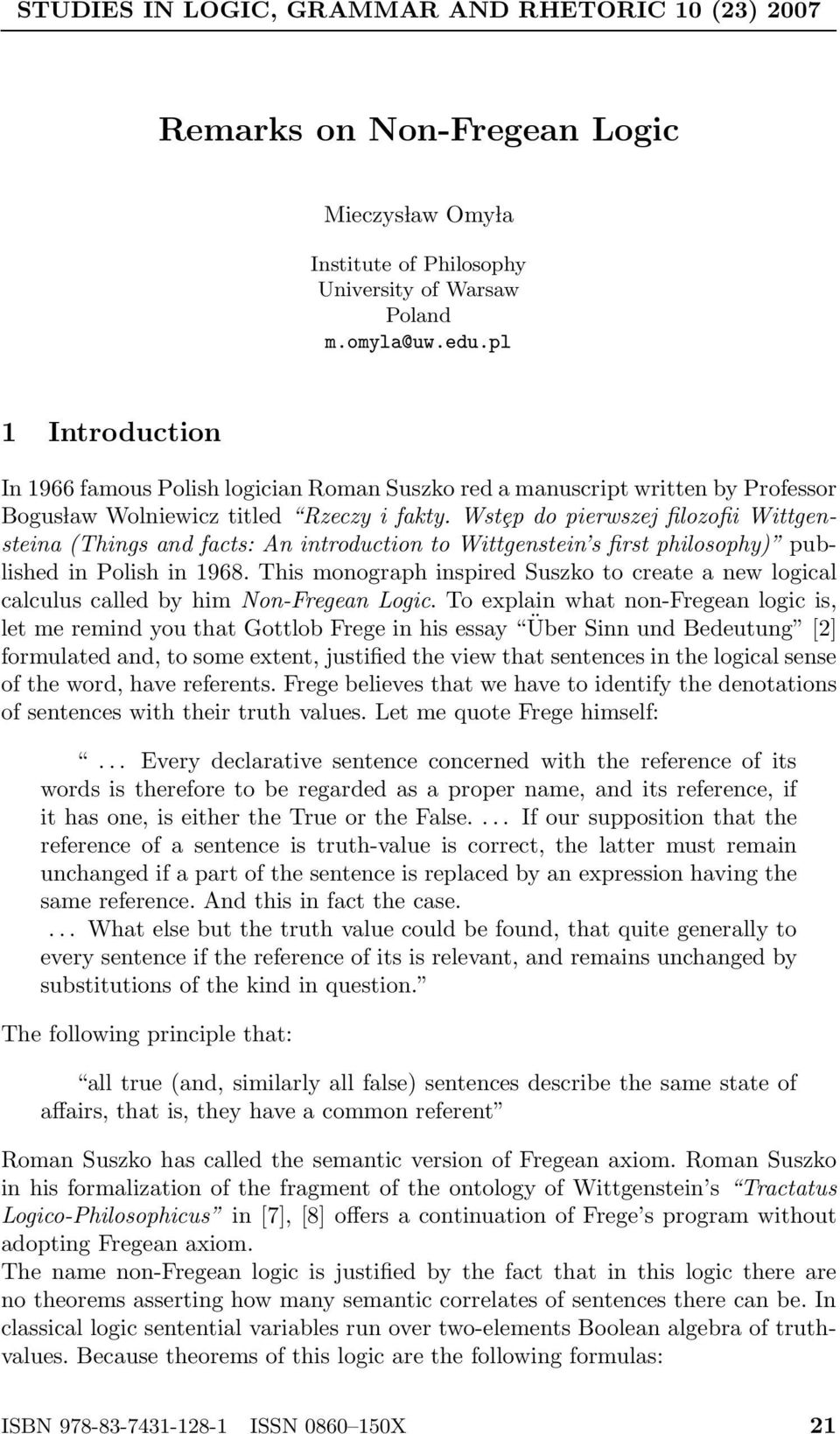
2 M. Omy la (p p), (p p) (p q) (q r) (p r) Non-Fregean logic is extensional, logically two valued but it is not two-valued ontologically, because it does not follow from the theorems of logic alone how many semantic correlates of sentences there can be. Following Wittgenstein, R. Suszko calls the semantic correlates of sentences situations. To say that two sentences describe the same situations Suszko uses a connective identity, that is not a truth functional connective. 2 Non-Fregean Semantic Frameworks I would like to present the semantic principles which constitute foundations of the non-fregean sentential calculus. This sentential calculus is the main part of the non-fregean logic. In my opinion the set of all sentences of any language may be interpreted according to non-fregean semantics. To state the principle of non-fregean interpretation of sentences of any language L we apply the following notations: (i) Let S be the set of all sentences of language L, and let Cn will be a consequence operation on S. We will use letters: α, β, γ,... as variables running over the set S. (ii) Let U be an arbitrary non-empty set. The elements of U will represent the situations. Intuitively speaking elements of U will be treated as given by corresponding sentences of L. For simplicity, elements of the set U will be called of situations. We will treat letters: p, q, r,... as variables running over the universe of situations U. The sentential variables: p, q, r,... are not necessarily in the alphabet of L. However, the sentential variables are needed in the alphabet of the semantic metalanguage of L, in which theorems are formulated about the set of semantic correlates of L. (iii) Next, let H be an arbitrary relation which has as its domain the set S of sentences of language L and its counter-domain is the set U, i.e., H S U. If H(α, p) holds we will say that the sentence α refers to the situation p, or α describes the situation p. (iv) A sentence may be true or false, or it may be necessary or only possible or probable, determined or undetermined, sensible or senseless. In several logical systems, the mentioned properties are logical values of sentences. Let (V, V 1 ) be an arbitrary pair of sets such that V 1 V and V 1 V i.e. V 1 is non empty set and V 1 is properly included in V. The elements of V will be called logical values, and elements of V 1 the designated logical values. (v) An arbitrary function v is such that: v : S V and v 1 (V 1 ) S. 22
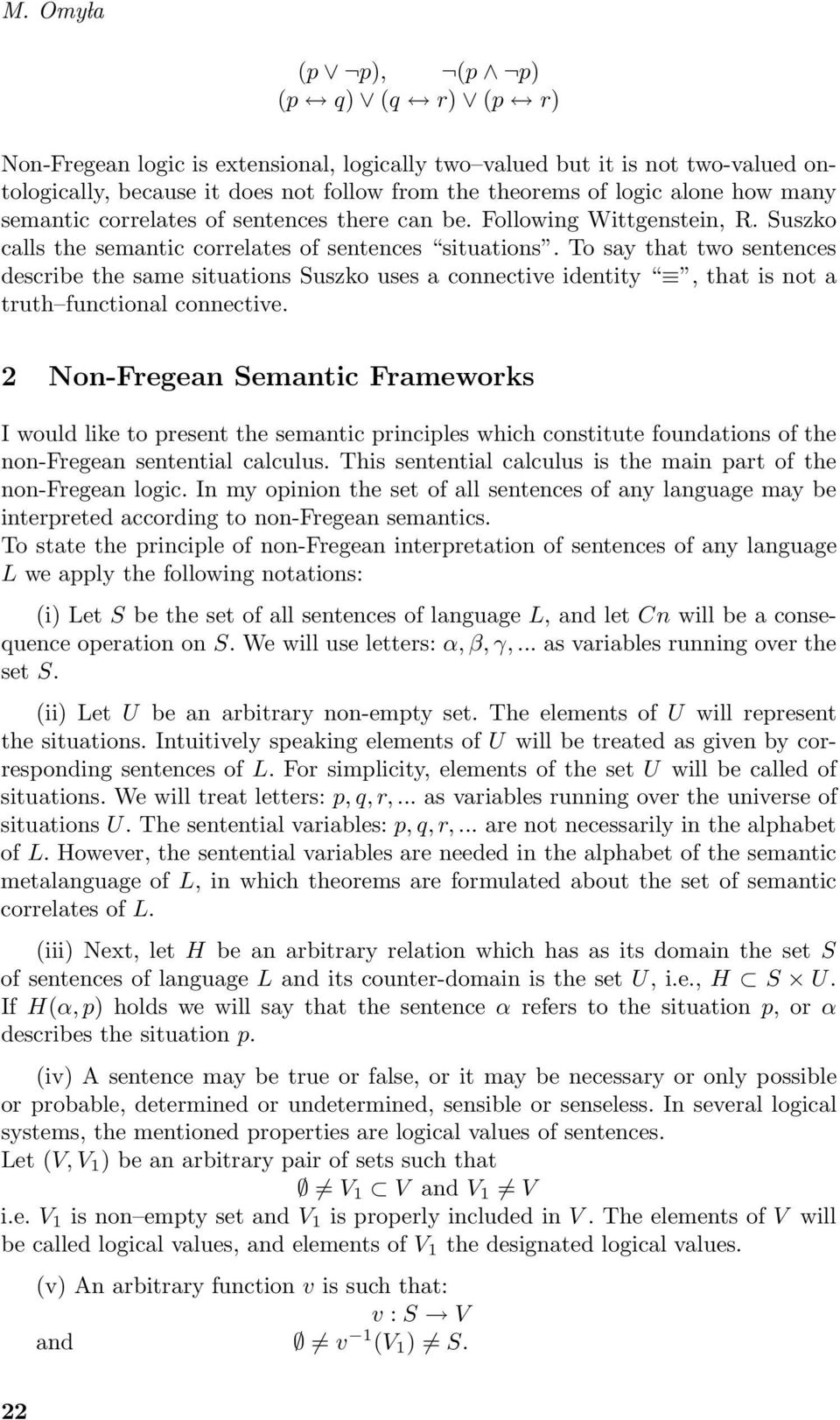
3 Remarks on Non-Fregean Logic The function v will be called a logical valuation of L. The family of the sets {v 1 (V V 1 ), v 1 (V 1 )} is called the fundamental partition of the set of sentences of language L determined by the logical valuation v. Definition 1. (Non-Fregean Semantic Framework) An arbitrary sequence of the form: (*) (S, Cn), U, (V, V 1 ), H, v is named non-fregean semantic framework for the sentential fragment of language L iff the sequence satisfies the following seven postulates called semantics principles of non-fregean sentential logic: (P1) Principle of Correlation: For each sentence α of L there is at least one situation p, such that α refers to p, symbolically α p H(α, p). (P2) Principle of Univocality: Each sentence α of language L refers to at most one situation i.e. If H(α, p) and H(α, q), then p = q. (P3) Principle of Stability: For any α, β S, if for any situation p U; (H(α, p) H(β, p)), then for each sentence γ S, and any situation q, (H(γ, q) H(γ[α/β], q). (P4) Principle of Logical Bivalence: The set of logical values V is two elements i.e. V = {0, 1}, 0 1. (P5) Principle of Maximality of Truth: For any X S, if v 1 (V 1 ) = X, then X S, and for any α X, Cn(X {α}) = S. (P6) Principle of Subordination to Fundamental Partition: For any sentences α, β, if for any situation p, (H(α, p) H(β, p), then v(α) = v(β). (P7) Principle of Contextual Differentiation: If for any sentences γ of the language L, v(γ) = v(γ[α/β]), then for any situation p U, H(α, p) = H(β, p). Observation 1. In view of both principles: (P1) and (P2), we may define the function: h : S U by the formula: p = h(α) H(α, p). In this case we say the situation p is the semantic correlate of α or the sentence α refers to the situation p. Observation 2. The function h is not an arbitrary function but it must satisfy certain conditions. In particular, if S is an algebra on the set S with respect to connective of language L 23

4 M. Omy la (i.e. any connective of the language L is additionally treated as algebraic operation on the set sentences S) then h is a homomorphism from S to the corresponding algebra on the set h(s) U. Corollary 1. In arbitrary semantic framework (*) the logical syntax of language L, imposes upon the set references of the sentences of L the structure of an algebra similar to the algebra of sentences of language L. The principle (P4) asserts, that the set logical values has two elements. If v(α) = 1, then we say that α is true in the considered semantic frame. If v(α) = 0 we say that α is false in this frame. It follows from principles (P4) and (P5) that logical valuations are characteristic functions of complete theories in (S, Cn). By contraposition from principle (P6) we obtain: if any sentences α, β have different logical values then there is at least one situation which is semantic correlate for only one of these sentences i.e. v(α) v(β) p [H(α, p) H(β, p)]. These observations allow us to simplify the notion of a non-fregean semantic framework namely, henceforth as quadruple: < (S, Cn), U, h, v > where: (S, Cn) is any sentential calculus, U is arbitrary set such that U 2, v is a characteristic function of any arbitrary complete theory in (S, Cn), h : S U such that for arbitrary sentences: α,β S following three conditions are satisfied: (P3 ) if h(α) = h(β), then γ S [h(γ) = h(γ[α/β])] (P5 ) if h(α) = h(β), then v(α) = v(β) (P7 ) if h(α) h(β), then γ S (v(γ) v(γ[α/β]). One direct consequence of definition 1, remarks, observations 1, 2, and corollary 1 is the following theorem: Theorem 1. The quadruple: (**) < (S, Cn), U, h, v > is non-fregean semantics framework iff the following conditions are satisfied: (1) (S, Cn) is arbitrary sentential calculus (2) U is arbitrary set of at least two elements (3) v is characteristic function of some complete theory in (S, Cn) (4) h is function h : S U such that for arbitrary sentences: α, β S, condition is satisfied. h(α) = h(β) γ S [v(γ) = v(γ[α/β])] 24

5 Remarks on Non-Fregean Logic The proof of this theorem is in [5]. According to theorem 1 any two sentences: α, β language L have the same semantic correlate in the non-fregean semantic framework (**) if and only if they are mutually interchangeable in any sentential context γ without changing logical value this context. In any semantic framework (**) we may define relation v on the set S in the following way: for any: α, β S : Thus α v β γ S [v(γ) = v(γ[α/β])]. α v β h(α) = h(β). Definition 2. (Suszko [8], [9]) The functor of the language L is the identity connective of sentential calculus (S, Cn) iff the following rules: (r 0 ) α 1 α 2, when α 1, α 2 differ at most in bound variables, (r 1 ) α β γ γ[α/β] (r 2 ) α β, γ[p/α] γ[p/β] are the rules of the consequence operation Cn. The direct consequence this definition is that: in classical logic, the truth- functional connective of equivalence is also the identity connective. Theorem 2. If (S, Cn) is the language with identity connective then for any non-fregean semantic framework < (S, Cn), U, h, v > the following condition is satisfied: for any sentences α, β S, h(α) = h(β) if and only if v(α β) = 1. Theorem 3. If (S, Cn) is the language with connective such that, for any non-fregean semantic framework < (S, Cn), U, h, v > the following condition is satisfied: for any sentences α, β S, h(α) = h(β) if and only if v(α β) = 1, then the connective is identity connective the calculus (S, Cn) i.e. the rules: (r 0 ), (r 1 ), (r 2 ) are rules of consequence Cn. The proof those theorems 2 and 3 may be find in [5]. 3 Non-Fregean Logics Following L.Wittgenstein, R. Suszko calls the semantic correlates of sentences situations. To speak in formal way about the structure of universe of situations and universe of objects, Suszko introduced to literature a family of logic languages which he called W languages (in honor of L. Wittgenstein). In the alphabet of these languages, there are: 25
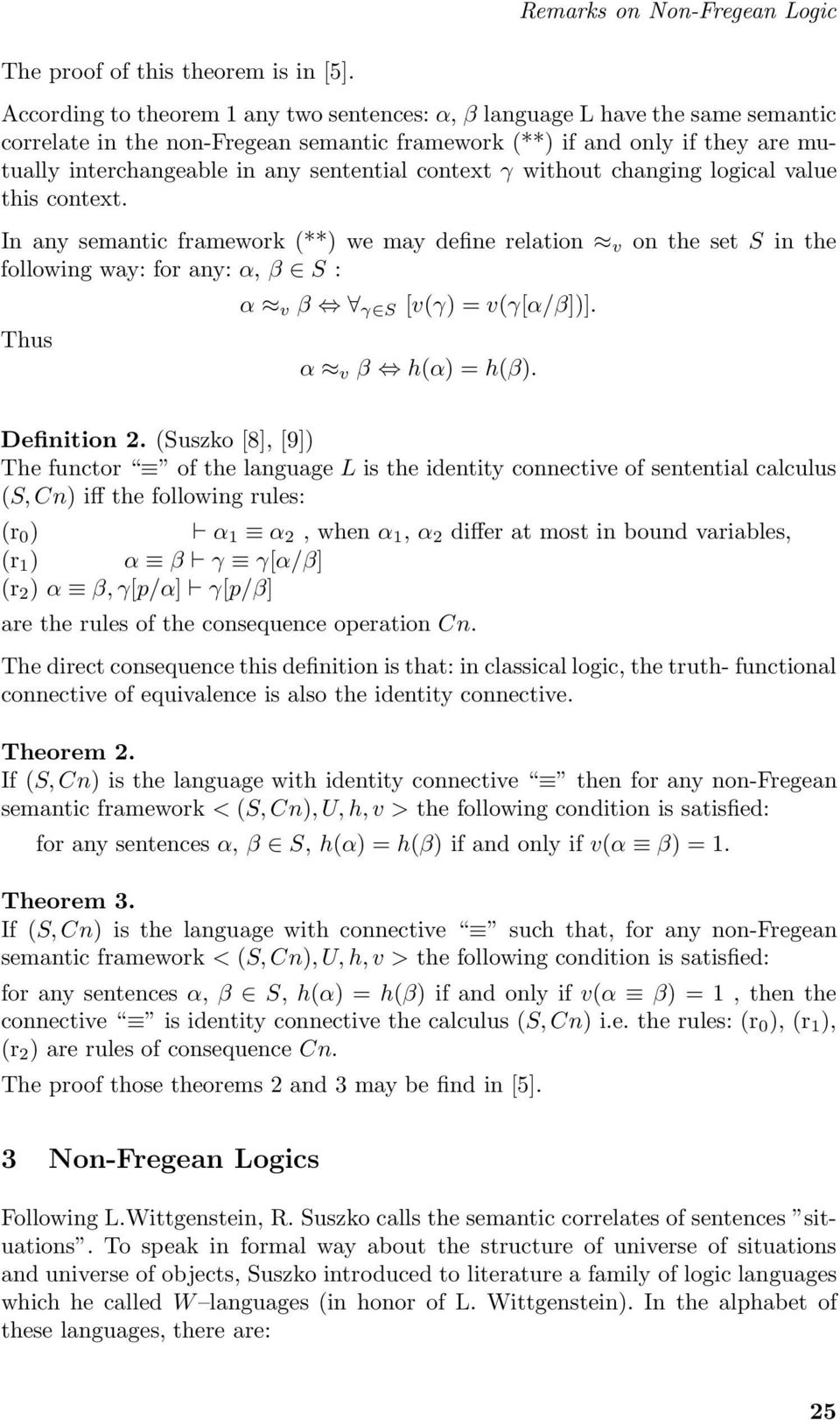
6 M. Omy la 1. two kinds of variables, sentential variables: p, q, r,... and nominal variables: x, y, z,..., 2. truth-functional connectives: (negation), (conjunction), (disjunction), (implication), (equivalence), 3. predicate-letters: P 1, P 2,..., P n, 4. function-symbols: F 1, F 2,.., F m, 5. symbols identity: identity connective and identity predicate which are both symbolized by the sign, 6. quantifiers:, binding both kinds of variables. Each of the quantifiers can bind both a sentential variable or a nominal one, depending on which variable follows directly after it. Similarly the context uniquely determines whether we have to do with the identity connective or the identity predicate since the expression x p is not a formula of the language discussed. A detailed description of the syntax of the W kind languages has been presented in the papers [1] and [3]. Given an W language L, let S be the set of all sentential formulas, and N be the set of nominal formulas of language L. Sentential formula α is a sentence iff α has no free variables. By S + will be denoted the set of all sentences of language L. We consider two consequence operation on S, Cn and Cn, analogous as Suszko considered in [11] for open W-language. The constructions presented here extend what has been done in [11] for SCI language. Operation Cn is generated by the Modus Ponens rule and the schemas of logical axioms, but operation Cn is generated by the rules: Modus Ponens, and the rule of generalization for universal quantifier and logical axioms too. In logical literature operation Cn is called structural, but Cn is named invariant consequence operation. To describe the consequence Cn and Cn in W-languages the following notations are introduced: Letters: v, w, v 1, w 1, v 2, w 2,... will be metalanguage variables denoted depending on the context, either sentential variables or the nominal variables. By the letters: α, β, γ,... will be denote any sentential formulas, by the letters: ξ, ζ, τ,... we denote any nominal formulas, and finally ϕ, φ, ψ,... denote sentential formulas or nominal ones, depending on the context. Symbols α[v/ϕ] denote result substitution in formula α(v) for free variable v the expression ϕ. The result of prefixing the formula α by any finite number of universal quantifiers, i.e. v1 v2... vn α, where n 0 is called generalization of the formula α. For any set of sentential formulas X, by Gen(X) will be denoted the set of all generalizations of formulas in the set X. The formulas of the form ϕ ψ, are called equations. 3.1 Structural non-fregean consequence operation The structural consequence Cn in the language L was described and investigated by S. L. Bloom in [1]. The structural version non-fregean logic in W-language L is introduced by accepting logical axioms and the only inference rule Modus Ponens. The logical axioms are those formulas which are generalizations of any formula of the following sorts: 26
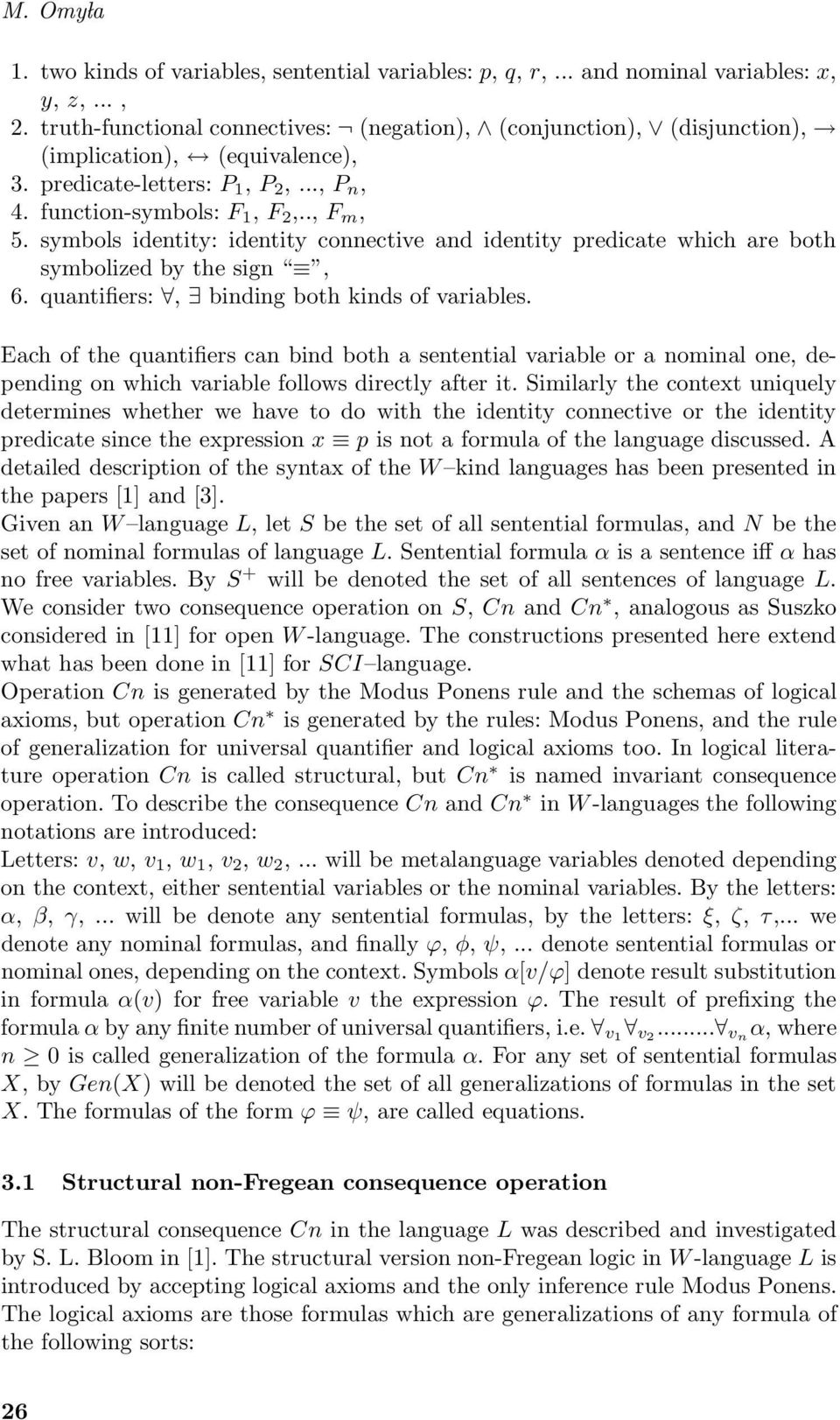
7 A1. Axiom Schemata for truth-functional connective: (S1) α (β α) (S2) [α (β γ)] [(α β) (α γ)] (S3) α (α β) (S4) ( α α) α (S5) (α β) [(β α) (α β)] (S6) (α β) [α β] (S7) (α β) (β α) (S8) (α β) ( α β) (S9) (α β) (α β) A2. Axiom Schemata for quantifiers: (S10) v α α[v/ϕ] (S11) α v α (if v is not free in α) (S12) v (α β) ( v α v β) (S13) v α v α A3. Axiom Schemata for identity connective and predicate: A3.1. Congruence axioms. All formulas of the form: Remarks on Non-Fregean Logic (S14) ϕ φ (when ϕ, φ vary in at most bound variables) (S15) for every functor Ψ we accept the invariance axiom: ϕ 1 φ 1 ϕ 2 φ 2...ϕ n φ n Ψ(ϕ 1, ϕ 2,..., ϕ n ) Ψ(φ 1, φ 2,..., φ n ) (S16) v (α β) (Q v α Q v β), where Q =,. A3.2. Axiom schema for identity: (S17) (ϕ ψ) (α[v/ϕ] α[v/ψ]) The set logical axioms LA is the sum of three sets: A1, A2, A3 i.e. LA = A1 A2 A3. A subset X S is called Cn theory iff X contains LA and X is closed under rules MP. A set of all the sentential formulas which are derivable from any set X and from logical axioms in any finite number of steps through the application of MP rule is called theory and is denoted by Cn(X). Theory T is called invariant if Gen(T) T. A formula α is called logical theorem of non-fregean logic iff α Cn( ). In [1] and [3] it is proved that the structural non-fregean logic has following metatheorems property: 1. The deduction theorem. For any set X of formulas of L, and any formulas α, β of L, β Cn(X {α}) (α β) Cn(X) This comes from the fact that theorems of non-fregean logic are all formulas of the form: α α, α (β α), (α (β γ)) ((α β) (α γ)) 27

8 M. Omy la and because we have that the Modus Ponens rule MP is the only rule for proving theorems. 2. The set of logical theorems Cn( ) is invariant theory. 3. If α(v) Cn({α 1, α 2,..., α n }), where the variable v are not free in α 1, α 2,..., α n, then v α(v) Cn({α 1, α 2,..., α n }). This follows from the deduction theorem and from the fact that Cn( ) is an invariant theory. 3.2 Invariant non-freegan consequence operation In L invariant non-fregean consequence operation Cn is generated by the rules: Modus Ponens of the scheme: MP. α, α β β, and generalization rule of the scheme: Gen. α v α, and by the logical axioms divided into three groups: A1. Axioms for the truth-functional connectives: (1) p (q p) (2) [p (q r)] [(p q) (p r)] (3) p (p q) (4) ( p p) p (5) (p q) [(q p) (p q)] (6) (p q) (p q) (7) (p q) (q p) (8) (p q) ( p q) (9) (p q) (p q) A2. Axiom Schemata for quantifiers: (10) v α α[v/ϕ] (11) α v α (if v is not free in α) (12) v (α β) ( v α v β) (13) v α v α A3. Identity axioms: A3.1. Congruence axioms. All formulas of the form: (14) ϕ φ (where ϕ, φ differ at most bound variables) (15) for every functor Ψ we accept the invariance axiom: v 1 w 1 v 2 w 2... v n w n Ψ(v 1, v 2,...v n ) Ψ(w 1, w 2,..., w n ) (16) v (α β) (Q v α Q v β), where Q =, A3.2. Special identity axiom: (17) (p q) (p q). The set logical axioms LA of invariant non-fregean logic Cn, is the sum of three sets: A1, A2, A3 i.e. LA = A1 A2 A3. A subset X S is called Cn theory iff X contains LA and X is closed under rules MP i Gen. 28

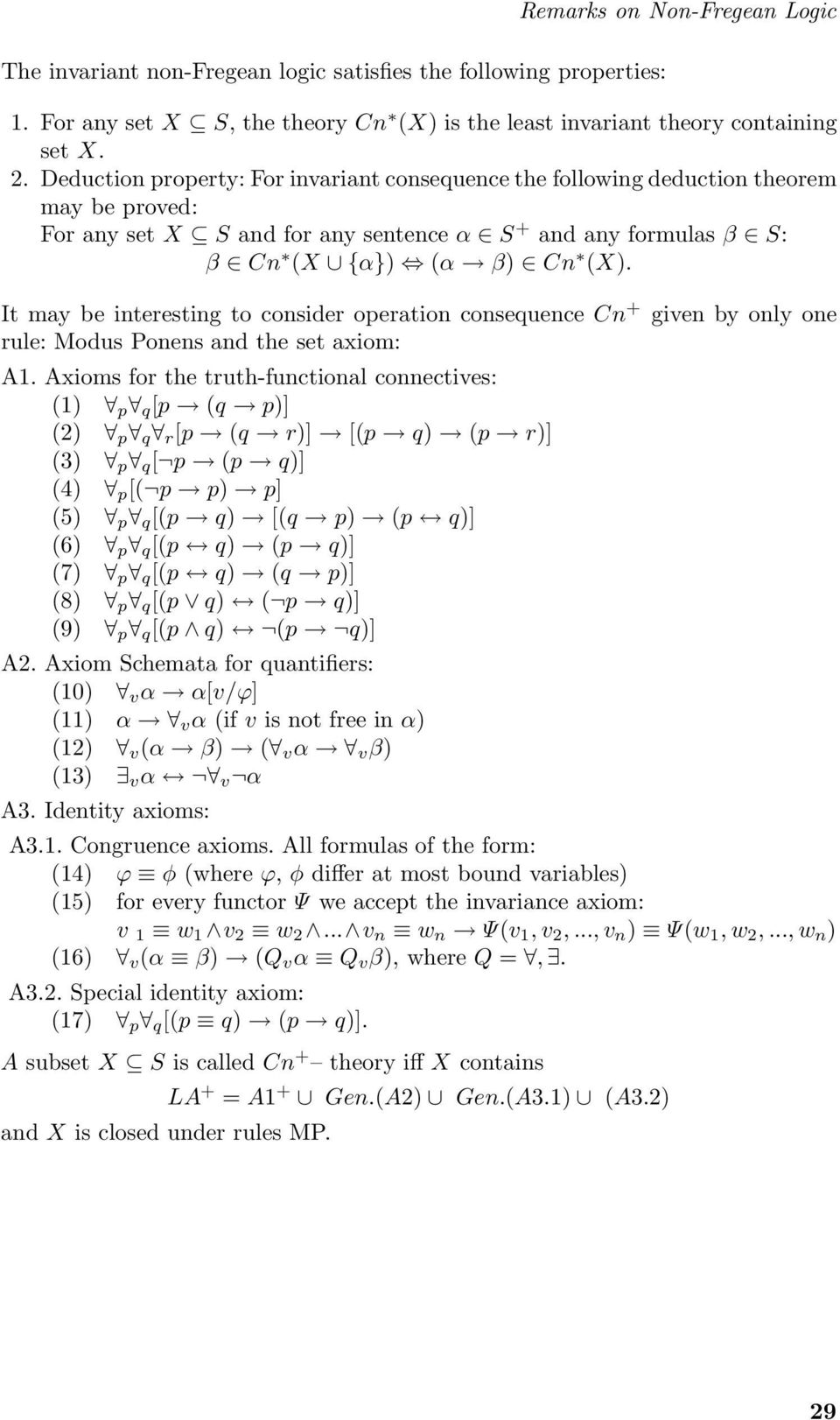
9 Remarks on Non-Fregean Logic The invariant non-fregean logic satisfies the following properties: 1. For any set X S, the theory Cn (X) is the least invariant theory containing set X. 2. Deduction property: For invariant consequence the following deduction theorem may be proved: For any set X S and for any sentence α S + and any formulas β S: β Cn (X {α}) (α β) Cn (X). It may be interesting to consider operation consequence Cn + given by only one rule: Modus Ponens and the set axiom: A1. Axioms for the truth-functional connectives: (1) p q [p (q p)] (2) p q r [p (q r)] [(p q) (p r)] (3) p q [ p (p q)] (4) p [( p p) p] (5) p q [(p q) [(q p) (p q)] (6) p q [(p q) (p q)] (7) p q [(p q) (q p)] (8) p q [(p q) ( p q)] (9) p q [(p q) (p q)] A2. Axiom Schemata for quantifiers: (10) v α α[v/ϕ] (11) α v α (if v is not free in α) (12) v (α β) ( v α v β) (13) v α v α A3. Identity axioms: A3.1. Congruence axioms. All formulas of the form: (14) ϕ φ (where ϕ, φ differ at most bound variables) (15) for every functor Ψ we accept the invariance axiom: v 1 w 1 v 2 w 2... v n w n Ψ(v 1, v 2,..., v n ) Ψ(w 1, w 2,..., w n ) (16) v (α β) (Q v α Q v β), where Q =,. A3.2. Special identity axiom: (17) p q [(p q) (p q)]. A subset X S is called Cn + theory iff X contains and X is closed under rules MP. LA + = A1 + Gen.(A2) Gen.(A3.1) (A3.2) 29
10 M. Omy la 4 Semantic Remarks The intended interpretation of W languages is such that nominal variables range over the universe of objects while the sentential variables run over the universe of situations. All other symbols in these languages, except the sentential and nominal variables, are interpreted as symbols of some functions both defined over the universe of situations and the universe of objects. The identity connective corresponds to the identity relation between situations, and the identity predicate corresponds to the identity relation between objects. It is obvious that the language of the ordinary predicate calculus with identity is a part of the W-language excluding sentential variables, but the most frequently used sentential languages are the part of the W-language without nominal variables and the identity predicate. If a language does not contain sentential variables then according to Suszko it does not fit for a full formalization of a theory of situations, but at most for that of a theory of events considered as reified equivalents of situations (see Suszko [10]). In contemporary science the majority of studied theories are those which are expressed in languages without sentential variables. The appearance of the Fregean sentential semantics, Leśniewski s prothotetics, Wittgenstein s Tractatus and the Non-Fregean Logic has been an important step in the development of logicphilosophical reflection, because these theories require a language with sentential variables. According to Suszko, situations are primitive with respect to events, for the latter are objects abstracted from the former. In Suszko [10] it is proved that: (i) certain theories of situations are mutually translatable into theories of events, (ii) certain algebras of situations are isomorphic with algebras of events. Suszko posed the question:... What, therefore, is the cause of the fact that our thought and the natural language to a certain degree discriminate sentence variables, and particularly, general and existential sentences about situations?..., Why, therefore, should we prefer the theory of events to that of situations? And in the same paper Suszko answer: It is probably the symptom of some deep, historically determined attribute our thought and of natural language, the examination and explication of which will certainly be long and arduous. These features of our thinking induce an account of the world rather as the universe of objects having certain properties and connected by certain relations, not - as the totality of facts obtaining a logical space as in Wittgenstein s Tractatus. 30
11 Remarks on Non-Fregean Logic References 1. Bloom, S. L., A Completeness Theorem for Theories of Kind W, Studia Logica 27, 1971, pp Frege, Gottlob, Über Sinn und Bedeutung, Zeitschrfit fur Philosophie und philosophishe Kritik, 1892, pp Omy la, M., Translatability in Non-Fregean Theories, Studia Logica 35, 1976, pp Omy la, M., Principles of Non-Fregean Semantics for Sentences, Journal of Symbolic Logic 55, 1990, pp Omy la, M., Zasady niefregowskiej semantyki zdań a zasady semantyczne Fregego i Wittgensteina, Szkice z semantyki i ontologii sytuacji, Warszawa 1991, pp Omy la, M., Non-Fregean Semantics for Sentences, Philosophical Logic in Poland, 1994, pp Suszko, R., Ontology in the Tractatus of L. Wittgenstein, Notre Dame Journal of Formal Logic, 9, 1968, pp Suszko, R., Non-Fregean Logic and Theories, Analele Universitatii Bucuresti, Acta Logica, 11, 1968, pp Suszko, R., Identity Connective and Modality, Studia Logica 27, 1971, pp Suszko, R., Reifikacja sytuacji, Studia Filozoficzne 2, 1971, pp Suszko, R., Quasi-completeness in non-fregean Logic, Studia Logica 29, 1971, pp Suszko, R., Abolition of the Fregean Axiom, Lecture Notes in Mathematics, nr. 453, pp Wolniewicz, B., Rzeczy i fakty. Wstȩp do pierwszej filozofii Wittgensteina, PWN 1968, pp Wolniewicz, B., Situations as the Reference of Propositions, Dialectics and Humanism 1, 1978, pp
CHAPTER 7 GENERAL PROOF SYSTEMS
 CHAPTER 7 GENERAL PROOF SYSTEMS 1 Introduction Proof systems are built to prove statements. They can be thought as an inference machine with special statements, called provable statements, or sometimes
Predicate Logic Review
 Predicate Logic Review UC Berkeley, Philosophy 142, Spring 2016 John MacFarlane 1 Grammar A term is an individual constant or a variable. An individual constant is a lowercase letter from the beginning
2. The Language of First-order Logic
 2. The Language of First-order Logic KR & R Brachman & Levesque 2005 17 Declarative language Before building system before there can be learning, reasoning, planning, explanation... need to be able to
Parametric Domain-theoretic models of Linear Abadi & Plotkin Logic
 Parametric Domain-theoretic models of Linear Abadi & Plotkin Logic Lars Birkedal Rasmus Ejlers Møgelberg Rasmus Lerchedahl Petersen IT University Technical Report Series TR-00-7 ISSN 600 600 February 00
A Propositional Dynamic Logic for CCS Programs
 A Propositional Dynamic Logic for CCS Programs Mario R. F. Benevides and L. Menasché Schechter {mario,luis}@cos.ufrj.br Abstract This work presents a Propositional Dynamic Logic in which the programs are
Lecture 13 of 41. More Propositional and Predicate Logic
 Lecture 13 of 41 More Propositional and Predicate Logic Monday, 20 September 2004 William H. Hsu, KSU http://www.kddresearch.org http://www.cis.ksu.edu/~bhsu Reading: Sections 8.1-8.3, Russell and Norvig
This asserts two sets are equal iff they have the same elements, that is, a set is determined by its elements.
 3. Axioms of Set theory Before presenting the axioms of set theory, we first make a few basic comments about the relevant first order logic. We will give a somewhat more detailed discussion later, but
Semantic Groundedness
 Semantic Groundedness Hannes Leitgeb LMU Munich August 2011 Hannes Leitgeb (LMU Munich) Semantic Groundedness August 2011 1 / 20 Luca told you about groundedness in set theory. Now we turn to groundedness
Handout #1: Mathematical Reasoning
 Math 101 Rumbos Spring 2010 1 Handout #1: Mathematical Reasoning 1 Propositional Logic A proposition is a mathematical statement that it is either true or false; that is, a statement whose certainty or
Predicate Logic. For example, consider the following argument:
 Predicate Logic The analysis of compound statements covers key aspects of human reasoning but does not capture many important, and common, instances of reasoning that are also logically valid. For example,
CS510 Software Engineering
 CS510 Software Engineering Propositional Logic Asst. Prof. Mathias Payer Department of Computer Science Purdue University TA: Scott A. Carr Slides inspired by Xiangyu Zhang http://nebelwelt.net/teaching/15-cs510-se
WHAT ARE MATHEMATICAL PROOFS AND WHY THEY ARE IMPORTANT?
 WHAT ARE MATHEMATICAL PROOFS AND WHY THEY ARE IMPORTANT? introduction Many students seem to have trouble with the notion of a mathematical proof. People that come to a course like Math 216, who certainly
Summary Last Lecture. Automated Reasoning. Outline of the Lecture. Definition sequent calculus. Theorem (Normalisation and Strong Normalisation)
 Summary Summary Last Lecture sequent calculus Automated Reasoning Georg Moser Institute of Computer Science @ UIBK Winter 013 (Normalisation and Strong Normalisation) let Π be a proof in minimal logic
Degrees of Truth: the formal logic of classical and quantum probabilities as well as fuzzy sets.
 Degrees of Truth: the formal logic of classical and quantum probabilities as well as fuzzy sets. Logic is the study of reasoning. A language of propositions is fundamental to this study as well as true
A first step towards modeling semistructured data in hybrid multimodal logic
 A first step towards modeling semistructured data in hybrid multimodal logic Nicole Bidoit * Serenella Cerrito ** Virginie Thion * * LRI UMR CNRS 8623, Université Paris 11, Centre d Orsay. ** LaMI UMR
Degree Hypergroupoids Associated with Hypergraphs
 Filomat 8:1 (014), 119 19 DOI 10.98/FIL1401119F Published by Faculty of Sciences and Mathematics, University of Niš, Serbia Available at: http://www.pmf.ni.ac.rs/filomat Degree Hypergroupoids Associated
Introduction to Logic: Argumentation and Interpretation. Vysoká škola mezinárodních a veřejných vztahů PhDr. Peter Jan Kosmály, Ph.D. 9. 3.
 Introduction to Logic: Argumentation and Interpretation Vysoká škola mezinárodních a veřejných vztahů PhDr. Peter Jan Kosmály, Ph.D. 9. 3. 2016 tests. Introduction to Logic: Argumentation and Interpretation
Introduction to formal semantics -
 Introduction to formal semantics - Introduction to formal semantics 1 / 25 structure Motivation - Philosophy paradox antinomy division in object und Meta language Semiotics syntax semantics Pragmatics
Monitoring Metric First-order Temporal Properties
 Monitoring Metric First-order Temporal Properties DAVID BASIN, FELIX KLAEDTKE, SAMUEL MÜLLER, and EUGEN ZĂLINESCU, ETH Zurich Runtime monitoring is a general approach to verifying system properties at
CHAPTER 3. Methods of Proofs. 1. Logical Arguments and Formal Proofs
 CHAPTER 3 Methods of Proofs 1. Logical Arguments and Formal Proofs 1.1. Basic Terminology. An axiom is a statement that is given to be true. A rule of inference is a logical rule that is used to deduce
(LMCS, p. 317) V.1. First Order Logic. This is the most powerful, most expressive logic that we will examine.
 (LMCS, p. 317) V.1 First Order Logic This is the most powerful, most expressive logic that we will examine. Our version of first-order logic will use the following symbols: variables connectives (,,,,
Logic in general. Inference rules and theorem proving
 Logical Agents Knowledge-based agents Logic in general Propositional logic Inference rules and theorem proving First order logic Knowledge-based agents Inference engine Knowledge base Domain-independent
Logic, Algebra and Truth Degrees 2008. Siena. A characterization of rst order rational Pavelka's logic
 Logic, Algebra and Truth Degrees 2008 September 8-11, 2008 Siena A characterization of rst order rational Pavelka's logic Xavier Caicedo Universidad de los Andes, Bogota Under appropriate formulations,
Iterated Dynamic Belief Revision. Sonja Smets, University of Groningen. website: http://www.vub.ac.be/clwf/ss
 LSE-Groningen Workshop I 1 Iterated Dynamic Belief Revision Sonja Smets, University of Groningen website: http://www.vub.ac.be/clwf/ss Joint work with Alexandru Baltag, COMLAB, Oxford University LSE-Groningen
3. Mathematical Induction
 3. MATHEMATICAL INDUCTION 83 3. Mathematical Induction 3.1. First Principle of Mathematical Induction. Let P (n) be a predicate with domain of discourse (over) the natural numbers N = {0, 1,,...}. If (1)
We would like to state the following system of natural deduction rules preserving falsity:
 A Natural Deduction System Preserving Falsity 1 Wagner de Campos Sanz Dept. of Philosophy/UFG/Brazil [email protected] Abstract This paper presents a natural deduction system preserving falsity. This new
Linear Algebra. A vector space (over R) is an ordered quadruple. such that V is a set; 0 V ; and the following eight axioms hold:
 Linear Algebra A vector space (over R) is an ordered quadruple (V, 0, α, µ) such that V is a set; 0 V ; and the following eight axioms hold: α : V V V and µ : R V V ; (i) α(α(u, v), w) = α(u, α(v, w)),
Likewise, we have contradictions: formulas that can only be false, e.g. (p p).
 CHAPTER 4. STATEMENT LOGIC 59 The rightmost column of this truth table contains instances of T and instances of F. Notice that there are no degrees of contingency. If both values are possible, the formula
Beyond Propositional Logic Lukasiewicz s System
 Beyond Propositional Logic Lukasiewicz s System Consider the following set of truth tables: 1 0 0 1 # # 1 0 # 1 1 0 # 0 0 0 0 # # 0 # 1 0 # 1 1 1 1 0 1 0 # # 1 # # 1 0 # 1 1 0 # 0 1 1 1 # 1 # 1 Brandon
Mathematics for Computer Science/Software Engineering. Notes for the course MSM1F3 Dr. R. A. Wilson
 Mathematics for Computer Science/Software Engineering Notes for the course MSM1F3 Dr. R. A. Wilson October 1996 Chapter 1 Logic Lecture no. 1. We introduce the concept of a proposition, which is a statement
Mathematical Induction
 Mathematical Induction In logic, we often want to prove that every member of an infinite set has some feature. E.g., we would like to show: N 1 : is a number 1 : has the feature Φ ( x)(n 1 x! 1 x) How
Rigorous Software Development CSCI-GA 3033-009
 Rigorous Software Development CSCI-GA 3033-009 Instructor: Thomas Wies Spring 2013 Lecture 11 Semantics of Programming Languages Denotational Semantics Meaning of a program is defined as the mathematical
[Refer Slide Time: 05:10]
![[Refer Slide Time: 05:10]](/thumbs/29/13447118.jpg "[Refer Slide Time: 05:10]") Principles of Programming Languages Prof: S. Arun Kumar Department of Computer Science and Engineering Indian Institute of Technology Delhi Lecture no 7 Lecture Title: Syntactic Classes Welcome to lecture
Principles of Programming Languages Prof: S. Arun Kumar Department of Computer Science and Engineering Indian Institute of Technology Delhi Lecture no 7 Lecture Title: Syntactic Classes Welcome to lecture
ACTA UNIVERSITATIS APULENSIS No 15/2008 PRODUCTS OF MULTIALGEBRAS AND THEIR FUNDAMENTAL ALGEBRAS. Cosmin Pelea
 ACTA UNIVERSITATIS APULENSIS No 15/2008 PRODUCTS OF MULTIALGEBRAS AND THEIR FUNDAMENTAL ALGEBRAS Cosmin Pelea Abstract. An important tool in the hyperstructure theory is the fundamental relation. The factorization
Chapter 3. Cartesian Products and Relations. 3.1 Cartesian Products
 Chapter 3 Cartesian Products and Relations The material in this chapter is the first real encounter with abstraction. Relations are very general thing they are a special type of subset. After introducing
WOLLONGONG COLLEGE AUSTRALIA. Diploma in Information Technology
 First Name: Family Name: Student Number: Class/Tutorial: WOLLONGONG COLLEGE AUSTRALIA A College of the University of Wollongong Diploma in Information Technology Final Examination Spring Session 2008 WUCT121
EQUATIONAL LOGIC AND ABSTRACT ALGEBRA * ABSTRACT
 EQUATIONAL LOGIC AND ABSTRACT ALGEBRA * Taje I. Ramsamujh Florida International University Mathematics Department ABSTRACT Equational logic is a formalization of the deductive methods encountered in studying
! " # The Logic of Descriptions. Logics for Data and Knowledge Representation. Terminology. Overview. Three Basic Features. Some History on DLs
 ,!0((,.+#$),%$(-&.& *,2(-$)%&2.'3&%!&, Logics for Data and Knowledge Representation Alessandro Agostini [email protected] University of Trento Fausto Giunchiglia [email protected] The Logic of Descriptions!$%&'()*$#)
A Beginner s Guide to Modern Set Theory
 A Beginner s Guide to Modern Set Theory Martin Dowd Product of Hyperon Software PO Box 4161 Costa Mesa, CA 92628 www.hyperonsoft.com Copyright c 2010 by Martin Dowd 1. Introduction..... 1 2. Formal logic......
Predicate logic Proofs Artificial intelligence. Predicate logic. SET07106 Mathematics for Software Engineering
 Predicate logic SET07106 Mathematics for Software Engineering School of Computing Edinburgh Napier University Module Leader: Uta Priss 2010 Copyright Edinburgh Napier University Predicate logic Slide 1/24
ON FUNCTIONAL SYMBOL-FREE LOGIC PROGRAMS
 PROCEEDINGS OF THE YEREVAN STATE UNIVERSITY Physical and Mathematical Sciences 2012 1 p. 43 48 ON FUNCTIONAL SYMBOL-FREE LOGIC PROGRAMS I nf or m at i cs L. A. HAYKAZYAN * Chair of Programming and Information
How To Understand The Theory Of Computer Science
 Theory of Computation Lecture Notes Abhijat Vichare August 2005 Contents 1 Introduction 2 What is Computation? 3 The λ Calculus 3.1 Conversions: 3.2 The calculus in use 3.3 Few Important Theorems 3.4 Worked
The History of Logic. Aristotle (384 322 BC) invented logic.
 The History of Logic Aristotle (384 322 BC) invented logic. Predecessors: Fred Flintstone, geometry, sophists, pre-socratic philosophers, Socrates & Plato. Syllogistic logic, laws of non-contradiction
Which Semantics for Neighbourhood Semantics?
 Which Semantics for Neighbourhood Semantics? Carlos Areces INRIA Nancy, Grand Est, France Diego Figueira INRIA, LSV, ENS Cachan, France Abstract In this article we discuss two alternative proposals for
Discrete Mathematics and Probability Theory Fall 2009 Satish Rao, David Tse Note 2
 CS 70 Discrete Mathematics and Probability Theory Fall 2009 Satish Rao, David Tse Note 2 Proofs Intuitively, the concept of proof should already be familiar We all like to assert things, and few of us
Undergraduate Notes in Mathematics. Arkansas Tech University Department of Mathematics
 Undergraduate Notes in Mathematics Arkansas Tech University Department of Mathematics An Introductory Single Variable Real Analysis: A Learning Approach through Problem Solving Marcel B. Finan c All Rights
Schedule. Logic (master program) Literature & Online Material. gic. Time and Place. Literature. Exercises & Exam. Online Material
 OLC mputational gic Schedule Time and Place Thursday, 8:15 9:45, HS E Logic (master program) Georg Moser Institute of Computer Science @ UIBK week 1 October 2 week 8 November 20 week 2 October 9 week 9
Computational Logic and Cognitive Science: An Overview
 Computational Logic and Cognitive Science: An Overview Session 1: Logical Foundations Technical University of Dresden 25th of August, 2008 University of Osnabrück Who we are Helmar Gust Interests: Analogical
University of Ostrava. Reasoning in Description Logic with Semantic Tableau Binary Trees
 University of Ostrava Institute for Research and Applications of Fuzzy Modeling Reasoning in Description Logic with Semantic Tableau Binary Trees Alena Lukasová Research report No. 63 2005 Submitted/to
CHAPTER II THE LIMIT OF A SEQUENCE OF NUMBERS DEFINITION OF THE NUMBER e.
 CHAPTER II THE LIMIT OF A SEQUENCE OF NUMBERS DEFINITION OF THE NUMBER e. This chapter contains the beginnings of the most important, and probably the most subtle, notion in mathematical analysis, i.e.,
Software Modeling and Verification
 Software Modeling and Verification Alessandro Aldini DiSBeF - Sezione STI University of Urbino Carlo Bo Italy 3-4 February 2015 Algorithmic verification Correctness problem Is the software/hardware system
INTRODUCTORY SET THEORY
 M.Sc. program in mathematics INTRODUCTORY SET THEORY Katalin Károlyi Department of Applied Analysis, Eötvös Loránd University H-1088 Budapest, Múzeum krt. 6-8. CONTENTS 1. SETS Set, equal sets, subset,
E3: PROBABILITY AND STATISTICS lecture notes
 E3: PROBABILITY AND STATISTICS lecture notes 2 Contents 1 PROBABILITY THEORY 7 1.1 Experiments and random events............................ 7 1.2 Certain event. Impossible event............................
DEFINABLE TYPES IN PRESBURGER ARITHMETIC
 DEFINABLE TYPES IN PRESBURGER ARITHMETIC GABRIEL CONANT Abstract. We consider the first order theory of (Z, +,
α = u v. In other words, Orthogonal Projection
 Orthogonal Projection Given any nonzero vector v, it is possible to decompose an arbitrary vector u into a component that points in the direction of v and one that points in a direction orthogonal to v
Predicate Logic. Example: All men are mortal. Socrates is a man. Socrates is mortal.
 Predicate Logic Example: All men are mortal. Socrates is a man. Socrates is mortal. Note: We need logic laws that work for statements involving quantities like some and all. In English, the predicate is
On strong fairness in UNITY
 On strong fairness in UNITY H.P.Gumm, D.Zhukov Fachbereich Mathematik und Informatik Philipps Universität Marburg {gumm,shukov}@mathematik.uni-marburg.de Abstract. In [6] Tsay and Bagrodia present a correct
Aikaterini Marazopoulou
 Imperial College London Department of Computing Tableau Compiled Labelled Deductive Systems with an application to Description Logics by Aikaterini Marazopoulou Submitted in partial fulfilment of the requirements
Non-deterministic Semantics and the Undecidability of Boolean BI
 1 Non-deterministic Semantics and the Undecidability of Boolean BI DOMINIQUE LARCHEY-WENDLING, LORIA CNRS, Nancy, France DIDIER GALMICHE, LORIA Université Henri Poincaré, Nancy, France We solve the open
Math 115 Spring 2011 Written Homework 5 Solutions
 . Evaluate each series. a) 4 7 0... 55 Math 5 Spring 0 Written Homework 5 Solutions Solution: We note that the associated sequence, 4, 7, 0,..., 55 appears to be an arithmetic sequence. If the sequence
ABSTRACT ALGEBRA: A STUDY GUIDE FOR BEGINNERS
 ABSTRACT ALGEBRA: A STUDY GUIDE FOR BEGINNERS John A. Beachy Northern Illinois University 2014 ii J.A.Beachy This is a supplement to Abstract Algebra, Third Edition by John A. Beachy and William D. Blair
Introduction to Automata Theory. Reading: Chapter 1
 Introduction to Automata Theory Reading: Chapter 1 1 What is Automata Theory? Study of abstract computing devices, or machines Automaton = an abstract computing device Note: A device need not even be a
Mathematical Induction
 Mathematical Induction (Handout March 8, 01) The Principle of Mathematical Induction provides a means to prove infinitely many statements all at once The principle is logical rather than strictly mathematical,
1 = (a 0 + b 0 α) 2 + + (a m 1 + b m 1 α) 2. for certain elements a 0,..., a m 1, b 0,..., b m 1 of F. Multiplying out, we obtain
 Notes on real-closed fields These notes develop the algebraic background needed to understand the model theory of real-closed fields. To understand these notes, a standard graduate course in algebra is
A Correlation of Pearson Texas Geometry Digital, 2015
 A Correlation of Pearson Texas Geometry Digital, 2015 To the Texas Essential Knowledge and Skills (TEKS) for Geometry, High School, and the Texas English Language Proficiency Standards (ELPS) Correlations
ALMOST COMMON PRIORS 1. INTRODUCTION
 ALMOST COMMON PRIORS ZIV HELLMAN ABSTRACT. What happens when priors are not common? We introduce a measure for how far a type space is from having a common prior, which we term prior distance. If a type
FACTORING AFTER DEDEKIND
 FACTORING AFTER DEDEKIND KEITH CONRAD Let K be a number field and p be a prime number. When we factor (p) = po K into prime ideals, say (p) = p e 1 1 peg g, we refer to the data of the e i s, the exponents
Lecture 17 : Equivalence and Order Relations DRAFT
 CS/Math 240: Introduction to Discrete Mathematics 3/31/2011 Lecture 17 : Equivalence and Order Relations Instructor: Dieter van Melkebeek Scribe: Dalibor Zelený DRAFT Last lecture we introduced the notion
It all depends on independence
 Working Papers Institute of Mathematical Economics 412 January 2009 It all depends on independence Daniel Eckert and Frederik Herzberg IMW Bielefeld University Postfach 100131 33501 Bielefeld Germany email:
Chapter ML:IV. IV. Statistical Learning. Probability Basics Bayes Classification Maximum a-posteriori Hypotheses
 Chapter ML:IV IV. Statistical Learning Probability Basics Bayes Classification Maximum a-posteriori Hypotheses ML:IV-1 Statistical Learning STEIN 2005-2015 Area Overview Mathematics Statistics...... Stochastics
Degrees that are not degrees of categoricity
 Degrees that are not degrees of categoricity Bernard A. Anderson Department of Mathematics and Physical Sciences Gordon State College [email protected] www.gordonstate.edu/faculty/banderson Barbara
Lecture 8 The Subjective Theory of Betting on Theories
 Lecture 8 The Subjective Theory of Betting on Theories Patrick Maher Philosophy 517 Spring 2007 Introduction The subjective theory of probability holds that the laws of probability are laws that rational
Dedekind s forgotten axiom and why we should teach it (and why we shouldn t teach mathematical induction in our calculus classes)
 Dedekind s forgotten axiom and why we should teach it (and why we shouldn t teach mathematical induction in our calculus classes) by Jim Propp (UMass Lowell) March 14, 2010 1 / 29 Completeness Three common
From Logic to Montague Grammar: Some Formal and Conceptual Foundations of Semantic Theory
 From Logic to Montague Grammar: Some Formal and Conceptual Foundations of Semantic Theory Syllabus Linguistics 720 Tuesday, Thursday 2:30 3:45 Room: Dickinson 110 Course Instructor: Seth Cable Course Mentor:
FIRST ORDER THEORY OF THE s-degrees AND ARITHMETIC
 FIRST ORDER THEORY OF THE s-degrees AND ARITHMETIC DANIELE MARSIBILIO AND ANDREA SORBI Abstract. We show that the first order theories of the s-degrees, and of the Q-degrees, are computably isomorphic
Notes on Determinant
 ENGG2012B Advanced Engineering Mathematics Notes on Determinant Lecturer: Kenneth Shum Lecture 9-18/02/2013 The determinant of a system of linear equations determines whether the solution is unique, without
Invertible elements in associates and semigroups. 1
 Quasigroups and Related Systems 5 (1998), 53 68 Invertible elements in associates and semigroups. 1 Fedir Sokhatsky Abstract Some invertibility criteria of an element in associates, in particular in n-ary
INCIDENCE-BETWEENNESS GEOMETRY
 INCIDENCE-BETWEENNESS GEOMETRY MATH 410, CSUSM. SPRING 2008. PROFESSOR AITKEN This document covers the geometry that can be developed with just the axioms related to incidence and betweenness. The full
Type Theory & Functional Programming
 Type Theory & Functional Programming Simon Thompson Computing Laboratory, University of Kent March 1999 c Simon Thompson, 1999 Not to be reproduced i ii To my parents Preface Constructive Type theory has
The Halting Problem is Undecidable
 185 Corollary G = { M, w w L(M) } is not Turing-recognizable. Proof. = ERR, where ERR is the easy to decide language: ERR = { x { 0, 1 }* x does not have a prefix that is a valid code for a Turing machine
def: An axiom is a statement that is assumed to be true, or in the case of a mathematical system, is used to specify the system.
 Section 1.5 Methods of Proof 1.5.1 1.5 METHODS OF PROOF Some forms of argument ( valid ) never lead from correct statements to an incorrect. Some other forms of argument ( fallacies ) can lead from true
 α α λ α = = λ λ α ψ = = α α α λ λ ψ α = + β = > θ θ β > β β θ θ θ β θ β γ θ β = γ θ > β > γ θ β γ = θ β = θ β = θ β = β θ = β β θ = = = β β θ = + α α α α α = = λ λ λ λ λ λ λ = λ λ α α α α λ ψ + α =
The Foundations of Mathematics
 The Foundations of Mathematics c 2005,2006,2007 Kenneth Kunen Kenneth Kunen October 29, 2007 Contents 0 Introduction 3 0.1 Prerequisites.................................. 3 0.2 Logical Notation...............................