
SCHOOL BUS ROUTING AND SCHEDULING USING GIS
|
|
|
- Cori Moody
- 10 years ago
- Views:
Transcription
1 DEPARTMENT OF TECHNOLOGY AND BUILT ENVIRONMENT SCHOOL BUS ROUTING AND SCHEDULING USING GIS Mohammed Abdul Khader Nayati May 2008 Master s Thesis in Geomatics Master s Programme in Geomatics Examiner: Anders Östman Supervisor: Anders Östman

2

3 Master s Thesis in Geomatics School Bus Routing and Scheduling using GIS By Mohammed Abdul Khader Nayati Examiner: Anders Östman HÖGSKOLAN I GÄVLE 1
4 2
5 My mother-father are the most beautiful woman & man I ever saw. All I am I owe to my mother-father. I attribute all my success in life to the moral, intellectual and physical education I received from them. It is my greatest pleasure to dedicate this small achievement to my parents. 3

6 4

7 Abstract: School bus routing and scheduling are among the major problems because school bus transportation needs to be safe, reliable and efficient. Hence, the research question for this thesis is to answer how to transport students in the safest, most economical and convenient manner. The objective of this thesis is to create a GIS based school transport management system which helps in bus-stop allocation, design fastest and safest bus routes with AVL facility. This thesis also aims to investigate how a school transportation management system may improve the transportation security. The result from this study has helped to develop a school bus routing and scheduling prototype model for Sujatha High School, Hyderabad. This prototype model will help the school transportation management to design shortest and fastest school bus routes and they can also allocate bus stops, which will help them in selecting the pick-up stops for the students and staff, according to their concentration in the areas. This thesis has also, through literature study, investigated how a school transport management system can improve the transportation security. For the time being, there is a general belief that ICT contributes to improving the security, although a quantification of such improvements are lacking. The user interface application has been developed by using VBA and ArcGIS 9.1 Network Analyst provided by Environmental Science Research Institute and it has been evaluated by GIS users. 5

8 6

9 Acknowledgements A thesis does not just appear out of nowhere, and although it is supposed to be a contribution by one person for a Degree, there are still a lot of people who have helped me out over the years. I have been fortunate enough to have had the support of so many people and without it this would not have been possible. While most people did not help directly on the project, every one of them contributed in some way towards helping me to get where I am today, even things like just being a friend and going out and having fun. Others were responsible for giving me a push in the right direction in life, and for everyone listed here I am eternally grateful for their help. I d first like to thank the Almighty ALLAH (SWT) for guiding me through this one and a half year of hard work. Thank you for helping me to make the correct decision even when I am unable to see the path ahead. For keeping me healthy, fit and strong I thank Thee. I sincerely wish to express my gratitude to my supervisor Prof. Anders Östman for his support, guidance, patience and encouragement throughout the course of this research. Also, I am greatly indebted to him for his critical review of the manuscript of my thesis. I would like to thank Mr. Anders Brandt for helping me and guiding me through my Admission process in Högskolan i Gavle. I am thankful to Mr. Dhanunjaya Reddy, for providing the GIS data of Hyderabad city, without which this work would have been very difficult. I would like to thank the staff members of Sujatha High School. Special thanks to Mr. P.B.Jai Singh for giving me the opportunity to work on this project. Their unwavering support and confidence in my abilities were the primary motivating factors for me. A special thanks to my friends and colleagues, Mr. Mir Mahammed Hussain Hashmi, Mr. Mohammed Hassan & Syed Tariq Mehdi. Your expertise, ingenuity and helpfulness in the GIS portion of this report are totally worthy of mention. I wish you all the best in your future endeavours. I would also like to express my gratitude to all people who are not mentioned in this acknowledgement by name, but still have contributed to my work and studies in the past few years. I thank all my relatives, friends and online friends, who supported me through the times when my sanity was fragile and for their patient understanding of my sense of isolation. All of their names cannot be acknowledged specifically owing to space and word constraints. The chain of my gratitude would be definitely incomplete if I would forget to thank some of the most important people in my life My parents and my brothers. You all have urged me on with your most untiring support and seemingly unlimited belief in me To you all else pales and I dedicate this thesis to you. 7

10 8
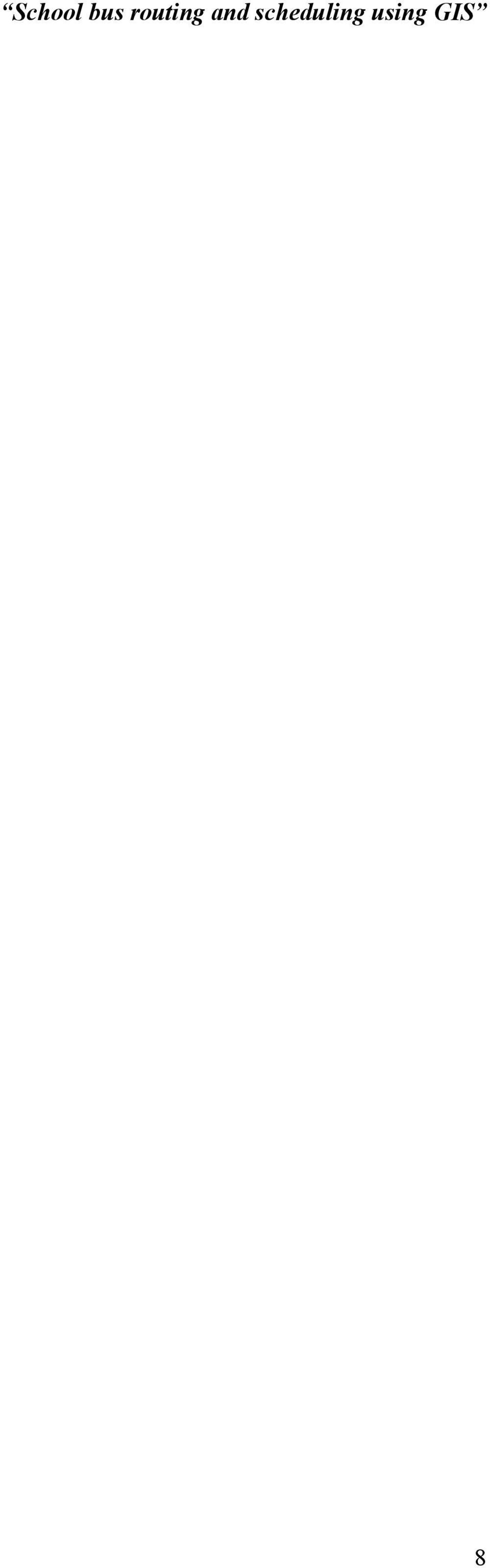
11 Table of Content 1. Introduction 1.1. Introduction 1.2. Problem Context 1.3. Problem Statement 1.4. Objectives 1.5. Research Methodology 1.6. Reading Guide 2. Study Area 2.1. Population 2.2. Vehicular Growth 2.3. Transportation Scenario 2.4. Traffic Accidents in Hyderabad 3. GIS & GPS/AVL School Routing 3.1. School Bus Routing and Scheduling 3.2. Importance of GIS in School Bus Routing and Scheduling 3.3. ArcGIS 3.4. ArcGIS Network Analyst 3.5. Global Positioning System 3.6. Vehicle Navigation 3.7. Limitations of GPS 3.8. Methods and Equipment for Transportation Vehicle Security 3.9. Different Methods for Improving the Security Vehicle Surveillance Vehicle Identification Technology Sensors Transponders Cameras Cell Phone Technology 3.10 Global System for Mobile Communication (GSM) 4. System Design & Implementation 4.1. School Routing Prototype Model 4.2. Analysis (GIS/GPS/GSM) 4.3. Data Acquisition for School Routing GIS Database Design Data Collection GIS Database Data Preparation 4.4. Flow of Data in GIS Database 4.5. Bus Allocation 4.6. Network Analysis Shortest and Fastest Route 4.7. Results 9
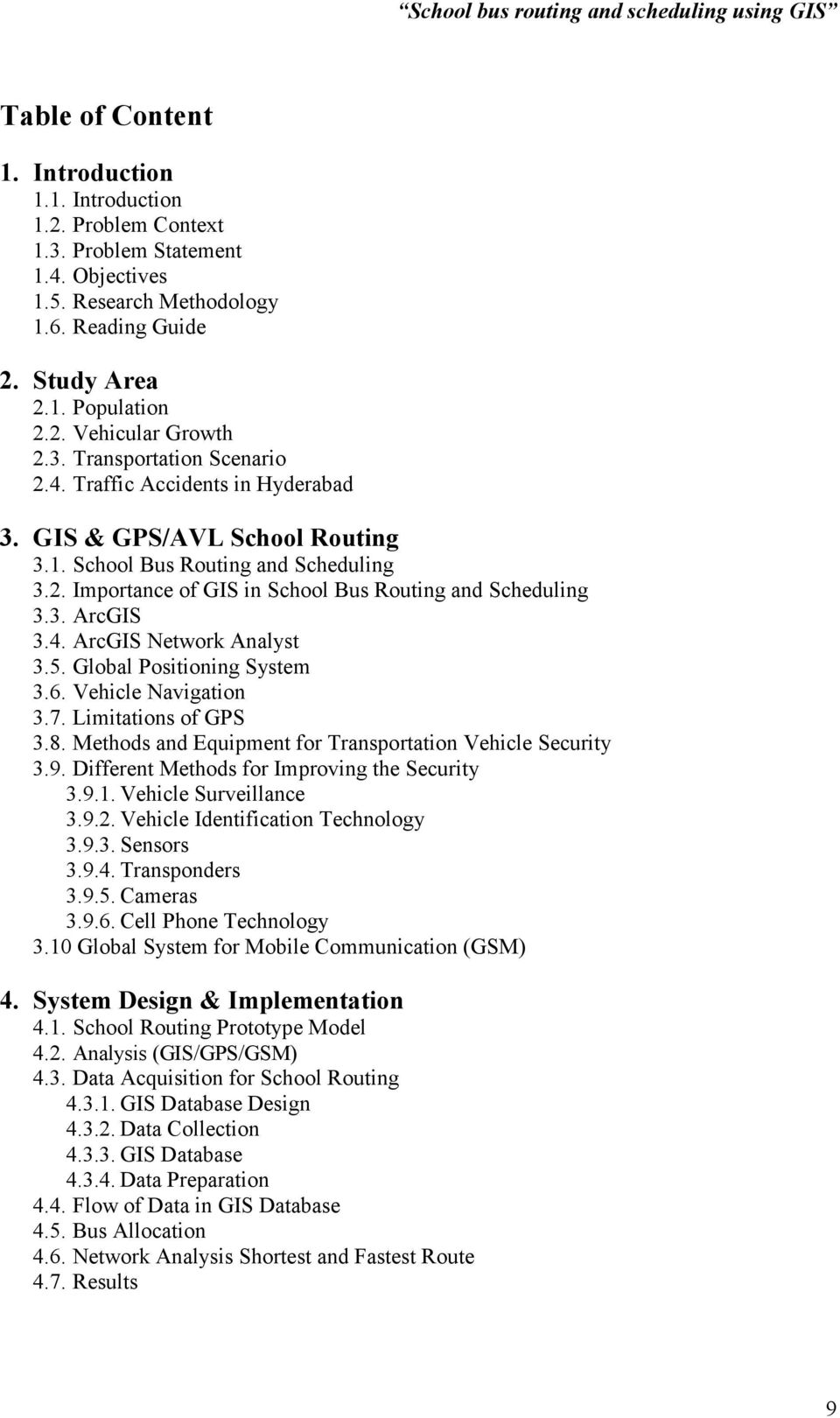
12 5. Interface Design 5.1. School Bus Routing & Scheduling User Interface Development Mechanism Fastest Route Shortest Route 5.2. Rapid Prototyping Model for School Bus Routing & Scheduling System 5.3. Software Development for School Bus Routing & Scheduling System ArcMap ArcGIS Extension Network Analyst Visual Basic for Applications School Bus Routing & Scheduling Input Sources Themes for Analyst Designed Interface of School Bus Routing & Scheduling System 6. Usability Test (System Evaluation) 6.1. User Test 6.2. Test Results Presentation Tools User Feedback Participants Feedback 7. Discussion & Conclusion 7.1. Discussion 7.2. Conclusion 7.3. Future Work Appendix References List of Figures 1.1 Research Model 1.2 Location of Hyderabad in India 2.1 Road Map of Hyderabad 2.2 Vehicle Registration Hyderabad City 2.3 The Urban Agglomeration area of Hyderabad 2.4 Traffic hold-ups a common sight in the city 3.1 Scalable ArcGIS Family 3.2 Functionalities of ArcGIS9.1 Network Analyst Extension 3.3 Global Positioning System for Vehicle tracking System 3.4 Road map of GPS tracking 3.5 Global Positioning System 3.6 Automatic Vehicle Location (AVL) system setup 3.7 Automated Vehicle Location Map Layer 3.8 Architecture of AFMS 10
13 4.1 School bus routing and scheduling Prototype Model 4.2 Location Based Bus Service Architecture 4.3 Available data of Hyderabad City 4.4 Information Model 4.5 Road Map of Hyderabad 4.6 Student Locations 4.7 Student locations in North Zone with Buffer 4.8 Student locations in South Zone with Buffer 4.9 Student locations in Walk Zone with Buffer 4.10 North Zone Bus Stops derived without buffer overlays 4.11 North Zone Bus Stops derived by buffer overlays 4.12 South Zone Bus Stops derived without buffer overlays 4.13 South Zone Bus stops derived by buffer overlays 4.14 Walk Zone Bus stops derived without buffer overlays 4.15 Walk Zone Bus stops derived by buffer overlays 4.16 Network Analysts Fastest Route in North Zone 4.17 Network Analysts Shortest Route in South Zone 4.18 Buffer in the entire Study Area 5.1 Rapid prototype model of School bus routing and scheduling System 5.2 School bus Routing and Scheduling Interface Model 6.1 Feedback from the participants for the overall performance of the system List of Tables Table 2.1 Avg. Compound Annual Growth rate of vehicles in Hyderabad Table 2.2 Composition of traffic flows in major corridors Network Table 2.3 Bus fleet and No. of passengers carried per day Table 2.4 Traffic Collisions, Fatalities and Injuries in Hyderabad Table 3.1 ArcGIS extensions Table 4.1 School Transportation Database Table 5.1 School bus routing and scheduling System Toolbar Table 6.1 Evaluation results on look and feel of the website. Table 6.2 Results on using the basic tools. 11
14 1: INTRODUCTION 1.1 Introduction Transport demand in most Indian cities has increased significantly, due to increases in population as a result of both natural increase and migration from rural areas and smaller towns. Fast growth of India s population like other developing countries has trigger a greater need for well organised public transport service to carry many passengers through over crowded and congested urban areas. By 2001 over 285 million Indians lived in cities, more than in all North American cities combined (Office of the Registrar General of India 2001). There has been especially rapid growth of the very largest metropolitan areas such as Mumbai (Bombay), Kolkata (Calcutta), and Delhi, which now exceed 10 million residents each. Chennai (Madras), Hyderabad, Ahmedabad, and Bangalore each have more than 5 million residents. And 35 metropolitan areas have populations exceeding 1 million, almost twice as many as in Since large cities are far more dependent on public transport than small cities, the need for public transport services has increased faster than overall population growth. [Pucher et al., 2004] Approximately 23 million public school students travel through 400,000 school buses two times daily to go to and from school. In addition, it has been estimated that an additional one to two million students travel in school buses to and from school-related activities every day. [National Association of State Directors of Pupil Transportation Services, 1998] School bus routing is a version of the travelling salesman problem, normally referred to the group of vehicle routing problems (VRP), also with or with no time window constraints. In addition to the plentiful studies that addressed the vehicle routing problem, different software methods have been developed that can be used to reduce the operating cost. Three factors make school bus routing unique: 1) Efficiency (the whole cost to run a school bus) 2) Effectiveness (how well the demand for service is fulfilled) 3) Equity (fairness of the school bus for each student). School bus routing has two separate routing issues assigning students to bus stops and routing the buses to the bus stops. [Spasovic.L et al., 2001] 1.2 Problem Context India has witnessed a rapid growth in the number of total vehicles registered in the last two decades. The rapid increase in the number of motor vehicles in India calls for urgent measures to deal with the resultant congestion and pollution. [Deb. K & Sundar. S, 2002] Mega cities like Hyderabad is experiencing rapid growth and transportation issues have assumed critical importance. Improvement of transportation infrastructure in the medium term and Transportation System Management method to tackle immediate problems will able to address this issue comprehensively. 12

15 Cities play a central role in elevating the economic growth and welfare. Their physical, social and institutional infrastructures are responsible for the progress and the development of the cities. In this thesis, the importance of school bus transportation is paramount, as they constitute a high share of the trips within a city. Sujatha High School is a high school in Hyderabad, India. It was established on 1st June, The school is founded by Late Mrs. Lalita Singh. The school is recognized by the Government of Andhra Pradesh and prepares Boys and Girls for the Secondary School Certificate [SSC] Examination through the Medium of English. It is governed by Art. 30 [1] of the Indian Constitution. The school is located in the heart of the city (Abids). It is in central Hyderabad and many students from all over the city come there for schooling as it is very famous and reputed educational institution. The school has grown immensely in strength and today, it has about 3000 boys and girls from diverse backgrounds on its rolls. Students travel to school by different modes of transports, many students come by public transport, and few come with their parents. So, school has arranged buses and autos for the students. There are 8 Buses, 2 mini buses and 15 Autos. This existing fleet of buses and mini buses are currently managed manually. In the future this manual system can be supported by a GIS System, which will improve the existing fleet management system as well as decrease the maintenance costs. 1.3 Problem Statement The problem of scheduling and routing school buses deals with the significant question of how to transport students to and from schools in the safest, most economical and most convenient manner. The scheduling and routing activities are often controversial because the problem must deal with multiple objectives. [Thangiah et al., 2004] As the number of school buses operating on the roadways increased, a number of problems occurred. Many serious accidents happened which involved school buses which caused school officials to think seriously about developing safety guidelines for school buses. Even though the vehicle routing literature in common has dealt with several objectives, the most related in the situation of routing and scheduling of school buses are: 1. To minimize the transportation cost 2. To minimize the transportation time [Corberán et al., 2002] 3. To minimize the total number of buses for transportation. 4. To design student pickup and drop-off points [Thangiah et al., 2004] School buses have earlier been used to pick and drop the students from home. Thus transportation to and from school have changed a lot in these last years. Transportation is one of the prime applications of GIS. GIS can be very helpful in making school routes and in other school transportation services. Many schools around the world are using GIS and finding it very easy and helpful to operate. The greatest use of software packages with an element, or component, of GIS technology is at an operational level e.g. routing, scheduling, tracking, tracing or navigation. [Forster 2000] 13
16 1.4 Objectives The objective of this thesis is to create a GIS based School Transport Management System. The GIS based school transport management system will include the following facilities. a) Bus stop allocation b) Fastest and Shortest route for the buses c) Automatic Vehicle Location In addition this thesis aims to investigate how a school transport management system may improve the transportation security. 14

17 1.5 Development Methodology Figure 1.1 Development Model 15

18 The Development Model in figure 1.1 demonstrates the flow of work of this project in order to develop the school transport management system. The research model has been divided into four different modules and each module has their own task to complete. The four modules involved are explained below. Problem Analysis Definitions: Analysis of the existing system and the problems associated with it are explained in the starting part of the research. In this module the problems associated with the school transportation and the need of school routine and scheduling are studied. Literature study gave the profound knowledge of the various approaches and solutions to the existing problems in the system. The security aspect is also an important part of the whole transportation process and technologies like GPS and GIS allow dynamic information about the students' travelling activity. Different methods and technologies were studied to investigate how a school transport management system can improve the transportation security. Different methods and technologies were studied to investigate how a school transport management system can improve the transportation security. Based upon the above study, the objectives are set for the development work. GIS Database Design: After learning about the problems and setting the objectives, the next task involved creating a GIS database, which is the most important part of the entire application. It deals with the compilation and development of the spatial as well as non-spatial data according to the user requirements. It includes primary data collection which is followed by the data processing and the outcomes of that is the final spatial database which can be used to develop the application. Prototype Design: The next task includes prototype model design on which the application will be developed. The prototype design relies upon the awaited output and on the needs and requirements of the user which were taken from the initial module. The prototype model will describe and explain all the components which will assemble the system. And once the prototype model is designed and GIS data is gathered, the application is ready to develop. Based on the designed prototype model for the application, ESRI s ArcGIS along with the Network Analyst was installed and configured. Evaluation & Results: This module involves the evaluation of the School Routing & Scheduling model and the feedback in form of results from the users. 16

19 1.6 Reading Guide This reading guide is included to give the reader a brief overview of the thesis and to give an understanding for how the work was structured. This thesis comprises 7 chapters. Details of each chapter are given below: Chapter 1: Introduction The thesis is structured in the following manner. This chapter presents an overview of the study. It outlines the need of school bus routing and scheduling, the problem context, and the objectives and presents a hypothesis on which the project is based. Chapter 2: Study Area - The background of the present study area (Hyderabad city) is explained. School bus routing and scheduling and importance of GIS in School bus routing and scheduling is explained in this chapter. Chapter 3: GIS & GPS/AVL in School Routing - Role of GIS is School transportation. Importance of Global Positioning System (GPS) and Automatic Vehicle Location (AVL) for vehicle location system is described. Chapter 4: System Design and Implementation - This chapter presents the methodology of prototype life cycle process model, which is followed to develop the application for School bus Routing and Scheduling model. This chapter also discuss the system requirements and the overview of the steps and methods followed in collecting and processing the spatial and nonspatial data that can be used and implemented in the intended application prototype. Chapter 5: Interface Design - Description of the interface design and development process of School Routing and Scheduling is discussed in this part of the study. Various functions and the operating procedures that facilitate the user in the application are explained. Chapter 6: Results, Discussion & Conclusion This thesis concludes with the results, discussion on the research work, limitations associated with the prototype application and also the possible enhancements to the application in future. 17
20 Figure 1.2: Location of Hyderabad in India [Source: 18

21 2: STUDY AREA The city of Hyderabad is the capital city of the southern Indian state of Andhra Pradesh with more than 4 million inhabitants. Hyderabad was founded by Sultan Quli Qutub Shah, Sultan of the Qutb Shahi dynasty, in 1591 Hyderabad City, is rapidly positioning itself as centre for administrative, financial, industrial, educational, medical, cultural activities ensuing in high growth rate. At present Hyderabad development area comprises of Hyderabad Municipal Corporation (172.6 sq. km), Ten other municipalities ( sq. km), Secunderabad Cantonment (40.17 sq. km), Osmania University (2.85sqkm), rural component ( sq. km) and Urban component of Ghatkesar (15.78 sq. km) totaling to sq. km of area. Hyderabad Urban Development Authority (HUDA) is the nodal agency for promoting planned development of the city and for planning transport related projects within the urban agglomeration. [Randhir, 2002] Different development plans focused specifically on land use deployment, and a residual component of land allotted to roads to address transportation problems. Hyderabad Area Transportation Study (HATS) conducted in 1983 was the first main project in the area of transportation planning. It has suggested a multi planned implementation programme covering Transportation System Management actions, Network development, Mass Transit system, Land Use planning and Region development strategy for next 15 years. The Vehicular population, which is about 1.1 million, is logging a steady, annual growth rate of over 10 %. [Randhir, 2002] 2.1 Population Population acts on land through a range of actions, which can be largely classified as agricultural, commercial, industrial, transportation, administration etc. With more than four million people, the city of Hyderabad is the seventh biggest city and one of its fastest growing cities in India. The city s population has increased at an average rate of over three percent per annum in the last 20 years; and in recent times, this rate has increased to 5.6% per year. Now, every ten years, 2.2 million more people come to dwell in Hyderabad. It is expected that by 2020 its population will reach 11 million [Jennifer.D & Sunil.T, 2006] 19
22 Figure 2.1 Road Map of Hyderabad [Source: Imtiyaz Pasha, 2006] 2.2 Vehicular Growth It is observed that during the last two decades the number of vehicles has increased tremendously. More and more people are dependent on personal vehicles for transport; as a result traffic jams and chocking of street shave become quite common. Presently there are about 11 lakh (1.1 million) vehicles in the city. From the year registration of Two-wheeler vehicles followed by cars and other four-wheelers automobiles has increased, registering an increase at the rate of about 10% per annum. About 10% are transport vehicles comprising of trucks, buses, multi-utility vehicles, taxis and 3-wheelers and there are transport vehicles which are only used for commercial purposes and these vehicles usually run for more than 100 km per day. [Reddy J.S 2006] In Figure 2.2 registration of vehicles in Hyderabad city over the years are presented. This figure gives us the idea that during the last decade there has been an exceptional increase in registration of 2 wheeler vehicles followed by 4 wheeler vehicles. 20
23 The average Compound Annual Growth rate of the vehicles and the number of vehicles registered up to the year , are presented in the following table (TABLE 2.1). It can be expected with the current growth rate, the vehicular population of Hyderabad is likely to cross 20 lakh (2 million) by 2010, which will result in serious implications on emissions and quality of life. [Randhir, 2002] Vehicles Vehicles Registered CAG Two Wheelers 8,56, % Four Wheelers 1,26, % Three Wheelers 58, % Buses 2, % Table 2.1 Avg. Compound Annual Growth rate of vehicles in Hyderabad [Randhir, 2002] Figure 2.2: Vehicle Registration Hyderabad City [Randhir, 2002] 21
24 2.3 Transportation Scenario The department of Hyderabad Urban Development Authority (HUDA) is responsible for promoting planned development of the city and for the development of the transport related projects within the urban agglomeration. From the year the mass area of Hyderabad has grown substantially and is poised for accelerated growth. [Randhir, 2002] Figure 2.3: The Urban Agglomeration area of Hyderabad [Randhir, 2002] Hyderabad is an emerging metropolitan city, the numbers of vehicles are increasing day by day, traffic jams, growing vehicular pollution, lack of footpaths and insecure roads for pedestrian, giving more important to flyovers rather than efficient public transport are some of the indication which gives the idea about the present difficult situation of Hyderabad. [Reddy J.S 2006] According to LT Ramboll (2004) the current modal split in Hyderabad is 37% walking trips, 9% cycle rickshaw, bicycle and other slow moving vehicles, 30% two-wheelers, 15% public transit, 7% auto-rickshaws, and 3% private cars and taxis. Together these modes generate 10, 296,160 daily trips. Exclusive of walking, public transit constitutes 24% of total trips. 22
25 Figure 2.4 Traffic hold-ups a common sight in the city [Sivakumar, 2007] Disorganized and random growth of the city, joined with migration from the districts and lack of efficient public transport system, has resulted in a disordered and a chaotic condition for traffic in the city. Since last couple of years many flyovers has been built but that does not have helped much in easing traffic jams. In some places widening of roads has helped but lack or disappearance of sidewalk is forcing many commuters to use their own vehicles even for very small distances. Therefore walking on city roads has become very dangerous in Hyderabad which is why in the last twenty years the number of vehicles has grown extremely high. People are increasingly depending on personal vehicles for transport. Travelling modes of the last 20 years are shown in the below TABLE 2.2 [Randhir, 2002 & Reddy J.S 2006] Mode of Travel Composition of traffic flows during (%) Composition of traffic flows during 1998 (%) Buses 2 13 Scooters/ M.Cycles Cars 4 14 Auto rickshaws 6 18 Bicycles Others 28 5 TABLE 2.2 Composition of traffic flows in major corridors [HATS DB I-2002I] The main transportation mode for education trips and other regular work is still with Andhra Pradesh State Road Transportation (APSRTC) buses. TABLE 2.3 shows that buses remain stagnant over the years although the population is increasing continuously each year. [The Institute for Transportation and Development Policy 2005] 23
26 Sl.NO Year Bus Fleet Occupancy Rate No of Passengers carried per day in millions Table 2.3: Bus fleet and No. of passengers carried per day [HATS DB II-2002, APSRTC] According to the data collected from APSRTC for 2002 by the Institute for Transportation and Development Policy in Hyderabad, the APSRTC buses make almost 3 million public transit trips everyday. Since the mid-1990s, bus passenger trips have been rather stable or to some extent declining, averaging around 3 million trips per day. Recently some new buses brought onto the street helped in reducing the overcrowding on the buses. But the drawback is with increasing fuel prices, the system s operating costs have raised faster than passenger revenues. Yearly operating losses have grown, reaching Rs per kilometre in [The Institute for Transportation and Development Policy 2005] 2.4 Traffic Accidents in Hyderabad Transportation safety is the important part of traffic and transportation mechanism. The number of traffic fatalities may have come down in the recent years, but the number still remains high. Commuter s transportation is still a problem in the city. The table (TABLE 2.4) below shows the data related to road fatalities for the last 3 years ( ) Year No. of Collisions No. of Fatalities No. of Persons injured , , , , , , , , , ,422 Table 2.4 Traffic Collisions, Fatalities and Injuries in Hyderabad [The Institute for Transportation and Development Policy 2005] 24
27 3.1 School bus Routing and Scheduling School bus routing and scheduling using GIS 3: GIS & GPS/AVL IN SCHOOL ROUTING The main goal of any public school transportation system is providing safe efficient and reliable transportation for its students. School transportation plays a constant and longstanding role in the lives of children from nursery through high school. Every year, numerous schools all over the country must evaluate the transportation needs of their students. Many times it happens that, a large number of the students reside too far away from the school and cannot be expected to walk to school each day. Also it is illogical to expect all families to carry their children to and from school. [Belcher. J, Britt. D, et al, 2005] One solution to this problem is school busing. There are many schools which provide transportation routes. Sometimes these routes are not optimal; these types of routes waste time or money for those involved, necessitating an accurate school transportation model to increase efficiency. But solutions like this must also considered some factors like economic concerns, time issues, route efficacy, etc... [Belcher. J, Britt. D, et al, 2005] While designing the school bus routes, safety of the students should come first. Students who are eligible for transportation shall board buses at selected pickup points. Safety of students, road conditions, economy of operation, student convenience etc.., should be considered before designing and planning the bus routes. [EEAB, 1998] In school bus transportation the two most visible problems are routing and scheduling. In the routing problem every student is assigned to a bus stop and those particular stops are sum up to form routes. In the morning a bus follows these routes, from one to stop to another, picking up the students and carrying them to school. In the scheduling problem, particular buses are assigned to particular routes. For example, in the morning bus A might begin at route 1, deliver the students from that route to their school, travel to the beginning of route 5, pick up the students along that route and take them to their school. In practice it is possible and desirable to have one bus cover several routes. [Arthur J.S, Willson.B, 1984] 3.2 Importance of GIS in School bus Routing and Scheduling GIS is a mature technology and it is widely used in the development world. It is a technology which can be used in many fields. Many organisations and governments are using GIS because it helps them to make decisions very quickly and it saves a lot of time and money. As GIS is a growing technology, numerous definitions of GIS now exist. According to Lloyd & Queen (1993) a GIS is a computerized, integrated system used to compile, store, manipulate, and output mapped spatial data. Cropper, Matt (2003) defines GIS as a complete computer system which gives us clear information about where things are located it also gives us detailed idea about what data it represents. Not like paper map where what you see is what you get, a GIS can join several layers of information. Just like paper map, a digital map created by GIS will contain points or dots, which will represent features on the maps such as cities, areas that represent such as lakes, lines such as roads. Studies shows that number of papers suggests that GIS can be very handy and it is used for many applications. [Saha et al., 2005] Many researchers have already used GIS to design pipeline routes which contain optimal routing for pipeline selection of best route for spreading 25
28 the gas/petrol pipeline route using high resolution remote sensing image. In this situation, environmental, physical, social, political, economical and legal processes have been studied and executed for pipeline routing determination [Rylsky 2004, Saha vd 2005, Delevar and Naghibi 2003, Yusof and Baban 2004, Glasgow vd. 2004, Berry 2000, Çevik and Topal 2003, Luettingear ve Clark 2005] Various elements were studied using GIS techniques for road, highway, forest roads and bike roads routing determination [Mackenzie and Walker 2004, Malpica ve Pedraza 2001]. In literature, GIS based route determination for railway [Ashish and Dhingra 2005, Kov vd. 2005, Gipps vd. 2001], irrigation/drying channels [Yusof and Baban 2000, Smith 2006], power line [Cheng and Chang, 2001] have been previously studied. Hence, these studies have concluded that GIS is a useful technology and the results from these studies shows that the route which was designed applying GIS method is more environmentally helpful and cheaper than traditional one. This showed a possible savings and those described system of multi-criteria analysis has universal applicability. Transportation, the process by which humans, vehicles and other commodities moves from one geographic landscape to another, is the essential part geographic phenomena, and one of the key area of Geographic Information System. GIS plays a very important role in tracking, navigating, routing and scheduling vehicles, and for many other tasks. For many years, GIS- Transportation has been a major area for research and development. [Bergougnoux. P, 2000] Selecting the best route through an area is one of the oldest spatial problems. But lately, this problem has been effectively solved with the help of GIS and Remote Sensing technologies. Since last few years, many attempts have been made to automate the route-planning process using GIS technology [Yildirim, Nisanci.R et al,2006] Using the GIS Software s buses can be routed to give the best service for the maximum number of students and routes can be planned to give the most economical operation of buses with distance and road conditions being the major criteria for economical routing. For example, one of the complex optimization problems is to find the good bus stop location. There are numerous restrictions and conditions: no more than a certain number of students can be assigned to the same bus stop; bus stops cannot be within a certain distance of each other; each student must be within a short walk of the bus stop and must not cross a major thoroughfare, and so on. [J.Braca et al, 1995] Accurate geographic representation of the area is needed to calculate reliable distances. This is may be accomplished with a GIS based on data files built from aerial photographs, GPS measurements and so on. Furthermore many GIS s also have the potential of calculating accurate road network distances, that is, the distance between two points on the actual street network, many times even taking into account one-way streets. [J.Braca et al, 1995] Restrictions imposed for instance traffic intensity, time variations, operational constraints (drivers etc...) makes route planning more difficult. In today s world, GIS is used to solve many problems, it has become the well organized and an efficient tool to tackle issues like environmental protection, pollution, health care, land use, etc... Since last five years or so, public education administrators are started exploring the application of GIS in facilities management in many developing countries. GIS generally helps in the preparation, interpretation, and presentation of spatial data. Attribute(s), geometric and topological properties and location are some of the features of spatial data. Many school administrators however use GIS just to create a paper map, to visually analysis the locations of schools and 26
29 the distribution of students and sometimes to draw districting patterns. [Yildirim. V, Aydinoglu. A, 2007] Route Optimization of the School Buses: Any system of interconnected linear features, sets of roads, railway, rivers, pipelines, telephone and electric lines, is a network. Queries and analysis done on these systems for optimum decisions are named as network analysis in GIS (Yomralioglu, 2002). Optimization of the school bus and reduction of the transportation cost can be done by using the network analysis based applications. A number of researches have already been performed related to route optimization of school buses [Yildirim. V, Aydinoglu. A,2007] Many school administrators have noticed a substantial savings when routes and schedules are managed using GIS. GIS software s enhances the abilities of school boards to deliver an efficient and effective student transportation system. [ESRI, 2002] 3.3 ArcGIS Companies use Geographic Information Systems (GIS) to achieve better information for good decision making. GIS shows the real world objects on map and user friendly spatial tools to accomplish complex task. Geographic Information System is used to display, manipulate and analyse spatial (map) data. Spatial data are data that contain a reference to a place. Spatial objects in GIS are represented in the form of point, line or polygon. ArcGIS is a GIS software which is developed by Environmental Systems Research Institute (ESRI). ArcGIS is used by many GIS professionals all over the world. It can be installed on both the UNIX and Network PC platforms. The ESRI's ArcGIS family is designed as a scalable system which can position itself in any organisation, from an individual desktop of a geologist to a globally distributed network of a petroleum company. [Setijadji.L.D, 2003] Figure3.1 Scalable ArcGIS Family [Setijadji.L.D 2003] 27
30 The three main applications of our interest in ArcGIS are ArcToolbox, ArcMap, and ArcCatlog. ArcMap: It is used to display spatial data. It is also used to edit, query and analyse map data. ArcMap offers many ways to interact with maps such as exploring, analyzing, customizing and presenting results. ArcCatlog: It is used for accessing and managing data. Specially, it can be used to move, rename and copy datasets, and preview geographic and attribute data. It is particularly useful for backing up data. ArcToolbox: It provides access to advanced geoprocessing functionality and it is also used to alter vector data. It contains a collection of geoprocessing functions including tools for data management, data conversion, coverage processing, vector analysis, geocoding and statistical analysis. ArcGIS extensions allow you to expand the functional capabilities of ArcView, ArcEditor, and ArcInfo with specialized GIS tools for raster geoprocessing, three-dimensional visualization, geostatistical analysis, and more.[esri, 2005] Extension ArcGIS 3D Analyst ArcGIS Geostatistical Analyst ArcGIS Network Analyst ArcGIS Schematics ArcGIS Spatial Analyst ArcGIS Survey Analyst ArcGIS Tracking Analyst Use 3D visualization and analysis Statistical tools and models for data exploration, modelling, and probabilistic mapping Routing, closest facility, and service area analyses Automatic schematic generation for ArcGIS Advanced raster GIS spatial analysis Integrated survey management for ArcGIS Time-based data visualization and analysis Table 3.1 ArcGIS extensions [ESRI, 2005] 28
31 3.4 ArcGIS Network Analyst A network is a collection of linear features that are inter-connected. General examples of networks include highways, railways, city streets etc. Utility distribution systems like electricity, telephone, water supply, and sewage are also examples of networks. Together, these networks form the infrastructure of modern society. They give the means for the movement of people, goods, the delivery of services, the flow of resources and energy, as well as the communication of information [Haggett & Chorley, 1969; Kansky, 1963]. All human beings have a natural tendency of selecting the shortest or fastest path to go from one place to another. Transporters as well as travellers both prefer short and faster routes to cut operating cost and transportation time respectively. [Woldeamanuel. G. M, no date] ArcGIS Network Analyst is an extension for network-based spatial analysis like routing, travel directions, closest facility, and service area analysis. It allow users to dynamically model realistic network conditions, like turn restrictions, speed limits, height restrictions, and traffic conditions, at different times of the day. [Elizabeth Shafer 2005]. ArcGIS Network Analyst can be used to determine Drive-time analysis Point-to-point routing Route directions Service area definition Shortest path Optimum route Closest facility Origin-destination analysis Software users can use Network Analyst for routing and network analysis. Some special and important features of Network Analyst are Routing - Multipoint routing, Time windows supported on stops, travelling salesman problem. Service Areas - Complex polygon generation, Allocation across networks Closest Facility - Fixed and mobile asset routing, Emergency response Organisations that take advantage of Network Analyst are transportation, logistics, health care, public safety, education, utilities, local government, business, and many more [Elizabeth Shafer,2005]. The Network Analyst functionality is available for the ArcGIS applications like ArcView, ArcEditor, and ArcInfo. It is also available for ArcGIS Engine, and ArcGIS Server. The updated version (ArcGIS 9.1) of Network Analyst has the ability to work within the new ArcGIS geoprocessing environment together with Model Builder and scripting. ArcGIS 9.1 have a number of enhanced functionalities, which are not available in older versions. The enhanced functionality of Network Analyst includes multipart turns; dynamic barrier 29
32 support; time windows and stop duration on stops within routes; use of hierarchies for better performance and more realistic routes; U-turn restriction support; polygons for service areas; large network support; Shapefile, geodatabase, or SDC format Network Data Set support; global turn impedances; origin-destination matrix functionality; custom solver support; and integration with geoprocessing tools, models, and scripting [Elizabeth Shafer,2005]. Figure 3.2 Functionalities of ArcGIS9.1 Network Analyst Extension [Elizabeth Shafer, 2005] Network analysis in geographic information system (GIS) provides good decision support for users interested in shortest or optimal route, finding the nearest facility and determining the service area. Searching shortest or optimal path is an essential analysis function in GIS. It is also one of the most important functions in GIS network analysis. [Pahlavani. P, Samadzadegan. F, et al. 2006] Yomralioglu [2002] describe networks as interconnected linear features, some of the examples of networks are railways, rivers, pipeline, sets of roads etc. Queries and analysis completed on these systems for optimum decisions are named as network analysis in GIS. One of the applications of ArcGIS Network Analysis is designing school bus routine and scheduling. Network Analysis is used to design short and optimal routes for school buses and to reduce cost. [Yomralioglu 2002] In this context, there are several studies about route optimization of school buses... [Derekenaris et al, 2001; Kerry, 2001; Anthony, 200; Andres, 2004; Marlon et al, 2005; Handa, et al, 2007] These studies demonstrate that the visual representation of geographical data has widespread application in educational policy analysis and school site management. ArcGIS Network Analyst has proven to be an exceptionally effective and competent tool to solve school bus routing problems. El Shafey & Nasimudheen [1997] used Network Analysis to produce optimum routes for the buses used in the schools and to reduce bus transportation cost. Results of the application are very encouraging. The result of the studies shows that during test running, vehicle routing application could generate routes which are 33% more efficient and cheaper than the previous routes. [El Shafey & Nasimudheen 1997] 30
33 3.5 Global Positioning System (GPS) The safety of students and staff transportation is of major concern to school administrators, parents, and the general public. School bus accidents resulting in student causalities are an actuality for the school transportation community. After a careful inspection of the situation and causes surrounding such calamities helps us to find out how to prevent them in the future. A GIS system will give the school transportation administration tools to maximize competence and provide real-time queries (and exception reporting) of school bus location. Getting the exact location of a school bus can be important in many situations, from the more ordinary and routine (a substitute lost on a new route), to the rare but crucial (a hostage or high-jacking situation). Some extra enhancement would be accessible to allow authentication of what students got on the bus and where they left the bus. [Pupil Transportation 2007] GIS has acknowledged Global positioning system (GPS) technology for many years and now GPS is well understood and it is accepted by the GIS community. In today s world GPS technology is broadly used in Geographic Information Systems. These systems conjoin cellular phone networks for communication, GPS for vehicle location, and GIS tools for mapping display. [Dommety.R& Jain.R 1998] Use of GPS in GIS will permit state and local governments to more efficiently coordinate roadway maintenance and construction in rural areas, provide efficient ways of maintaining roadway databases, and maintain accident inventories. [Dommety.R& Jain.R 1998] Global Positioning System (GPS) Technology allows accurate determination of location, velocity, direction, and time. (Dommety.R& Jain.R 1998) Today GPS is being used all over the world in many scientific fields for countless applications. Global Positioning System is mainly used in vehicles for two main purposes a) Tracking b) Navigation. Tracking systems allow a base station to continuously track the vehicle with out any interference of the driver. While at the same time Navigation system guide the driver to the destination. In both Navigation system and Tracking System, the architecture is more or less similar. [Padmanabhan.J, 2001] 31
34 Figure 3.3 Global Positioning System for Vehicle tracking System [Padmanabhan.J, 2001] Figure 3.4 Road map of GPS tracking [Kharola S. P et al, 2003] Concept of satellite navigation was first conceived after the launch of Sputnik 1 in 1957 when scientists realized that by measuring the frequency shifts in the small bleeps emanating from this first space vehicle it was possible to locate a point on the earth's surface. [Dommety.R& Jain.R 1998] TRANSIT was the first satellite based system developed in the year The development of GPS technology started with TRANSIT. But TRANSIT system had no timing devices on the satellite and the receiver will take around 15 minutes to calculate its position. In 1970 s United States Department of Defence developed a technology called Global Positioning System (GPS). This system is also knows as NAVSTAR. It is originally developed for U.S military use. This technology was U.S military department in military positioning, navigation and weapons aiming system. [Mintsis. G et al, 2004] 32
35 The NAVSTAR system, operated by the Defence department of US, is the first such system commonly available to civilian users. The Russian system, GLObal NAvigation Satellite System (GLONASS), is alike in operation and may prove complimentary to the NAVSTAR system [Dommety.R& Jain.R 1998]. Twenty-four (24) satellites are in orbit, of which twenty to twenty-one (20 21) are in operation. Four (4) from these 21 satellites are visible at any time from any station on earth. The vertical and horizontal position for each specific station is feasible to be obtained in the form of X, Y, Z coordinates (position vector). The information concerning the speed (dx/dt, dy/dt, dz/dt) of a vehicle, airplane, ship etc. is also available all over the world, at any time, and under all weather conditions. [Mintsis. G et al, 2004] The life span of the satellite is 7.5 years. These satellites use solar batteries as their energy source for their high technology systems. [Mintsis. G et al, 2004] Fig 3.5 Global Positioning System [GPS -COV ITRM GUIDELINE 1994] School transportation administrators can utilize the routing and scheduling competency of a GPS/GIS digital mapping system to examine and plan a school s or district s optimal bus routes based on a ordinary mapping data such as demographics, business activity, housing patterns, highways, street intersections, railroad crossings, and rivers joint with specific transportation attributes such as school sites, bus maintenance facilities, street names and numbers, students home addresses, one-way streets, average traffic and bus speeds, traffic restrictions, school accesses, etc. The technology s capability to provide real time updated maps when new subdivisions are completed or unsafe road conditions occur allows for instant updating of bus routes to compensate. [Driving Efficiency and Student Safety] 33
36 3.6 Vehicle Navigation The safety of students and staff transportation is of major concern to school administrators, parents, and the general public. School bus accidents resulting in student causalities is an actuality for the school transportation community. After a careful inspection of the situation and causes surrounding such calamities helps us to find out how to prevent them in the future. Sometimes the buses and bus drivers will run on-time and on-route from each student s home to school and back again each day. However the truth is that circumstances can arise to throw the best-laid plans off track. Students who are tardy to the bus stop, unexpected road hazards resulting in traffic slow-downs or detours, mechanical problems, bad weather, and countless other situations can cause a bus to vary from its schedule. A school official has the ability to log on to a password-protected website and locate the bus immediately if the bus is outfitted with a wireless communication device and GPS software. Beyond this tracking capability, wireless phones allow the school immediate contact with the bus drivers and vice versa if a situation or concern arises, enhancing safety. [Meghan Sharp 2005] Many School transportation departments are using GPS based Automatic Vehicle Location (AVL) to improve student safety, to reduce school-related traffic problems, and to identify other transportation problems. The AVL system is a complement of technologies that track vehicle locations in an accurate and timely manner. It may be narrowly defined as the navigation suite: sensors and tracking software. [Okunieff, P E 1997] Automatic Vehicle Location (AVL) can be performed with the use of a device that uses the GPS to allow a fleet to track remotely the locations of its vehicles. Advantage of installing AVL is to amend the responsibility of field personnel and the effectiveness of fleet dispatching procedure. In school bus transportation, school dispatcher can get instant snapshot of a bus's locations or guide the driver to a scheduled route, and give parents an estimated time of arrival of their children. School transportation administrators can use AVL technology to improve response time by dispatching the closest vehicles for emergencies and conclude work state activities. [Yichun Xie 2004] The purpose of the AVL system is to monitor the location of buses. Knowing the location of a bus enables the operator to manage the bus fleet more efficiently and to provide their customers with up to the minute information on bus arrivals and departures. To monitor the location of the buses, it is necessary to have an adequate positioning device such as GPS and an accurate digital map such as a GIS. To ensure accurate information, the location (coordinates) of the bus must be consistent (or within a small tolerance) with those of the digital map. Employing an AVL system becomes especially important in an urban area where the system would be most valuable. [Greenfeld, J 2000] But it s important to understand, how such systems work and the types of information they can deliver. There are two sides to the AVL installation: in-vehicle kit and the infrastructure to handle and calculate its output. Details of every installation differ depending on the type of system deployed, but commonly a transceiver installed in every bus which transmits information about the vehicle. [Real-Time School Bus Tracking: Building the Business Case, 2003] The least information which can be received from that transceiver is: 34
37 Location to within a few yards or feet Speed Direction [Real-Time School Bus Tracking: Building the Business Case, 2003] More complete systems may also include the following information and features: Stops (both Planned and Unplanned) Idle time Door Openings/closings Passengers embarking or Disembarking Swipe card information such as driver sign in or electronic bus passes Emergency/Panic button Brake pressure Tire pressure Other mechanical data [Real-Time School Bus Tracking: Building the Business Case, 2003] Figure 3.6 Automatic Vehicle Location (AVL) system setup [Real-Time School Bus Tracking: Building the Business Case, 2003] Using the GPS satellite, the transceiver will mark the vehicle location and sends it, along with any other vehicle data, to a base station. Data is transmitted at specific intervals, ranging from 10 seconds to 1 minute, via either two-way radio or cellular network. 35
38 Once data is received, it will be decoded, collected and passed to the software which used to manage the routes and schedules at the base station. It is also possible to send the messages from the base station to the bus. 3.7 Limitations of GPS Figure 3.7 Automated Vehicle Location Map Layer [McCullouch. B, Kang.W 2007] Numerous GPS applications make the daily routine so much easier that within no time they become important to their users, a part of everyday life on the road, at sea and in the air. [Jonas Kämpe 2005] GPS technology is becoming cheaper day by day. It is very easy to install and provides accurate location information. [Tong.D, Coifman. T. et al 2005] Sound simple enough, but GPS is not a solution to every problem, its performance in some environments and for particular applications can be quite limited. In some cases GPS may give us no answer, the wrong answer, or an answer with insufficient accuracy. [Kleusberg.A & Langley.R.B 1990] After May 2000 the US Department of Defence removed the Selective Availability (SA) which was one of the main reasons for the limitations of GPS accuracy. There are some more problems with the GPS limitations like, if the GPS signals are blocked or impede with, the present position of the vehicle may be very complex to determine and the value of the GPS navigation device is severely degraded. [Tzamaloukas 2004] GPS signals may be obstructed, for example in some urban areas, around skyscrapers and sometimes in tunnels and in city canyons etc..., the GPS signal can be totally blocked and these skyscrapers can abstract the satellite signals. [Nils Hellström- 2007] To overcome this problem, additional sensor with GPS devices can be added. A GPS receiver might take some time to start (cold start) and to get the MS location fix. Some times it is considered delay for many applications most especially in emergency cases. [Djuknic.G.M & Richton R.E 2001] 36
39 3.8 Methods and equipments for Transportation Vehicle Security No matter how it is presented, security is a topic that has become more and more important, especially after the terror attack against World Trade Centre in Due to the growing terrorism threats, vast investments in research and development are made in order to increase security in the society. According to the National Safety Traffic Safety Administration, students are at much greater risk travelling to and from school than at any other time in their school day. School bus transportation includes an important part of highway travel more than 4 billion vehiclemiles per year and the vehicles carry umpteen school children every school day. Several security professionals have accepted that school buses are a soft target that is, easy to attack. Terrorist acts aimed at children have happened in other parts of the world and have included attacks on school buses. [Baxter.P, Gauthier. C, et al 2005] The hazards, threats and security risks in school bus transportation must be observed carefully, all along with information concerning the different approaches that school bus transportation professionals can take to recognize and reduce risks and threats. The common trend towards growing use of software, electronics and communications technology will have a huge impact on vehicle design, manufacture and use. Major technical areas where this will affect include vehicle control (lateral, longitudinal and vertical), vehicle adaptability, system integration and intelligence. [R.Phaal 2002] Over the next 20 years it is expected that these technologies will provide increasing support to the driver, initially in terms of improved warning information systems, to increasingly automated (and semi-automated) control systems. Technology and systems developed should be safe, with high redundancy and integrity. [R.Phaal ] Systems integration is a key requirement if these goals are to be achieved. Vehicle security has improved considerably in the past decade. Some technologies and methods which were used 10 years ago are: Adaptive cruise control, Ultrasonic parking, long range radar, Standards development, Active suspension, Vertical motion sensors, Driver/condition monitoring, Wireless networks, inertia navigation, video image processing 360 degree sensing systems, 5.8 GHz infrastructure, driver DNA, online mapping, 63 GHz & 3G GSM communications. [R.Phaal ] The following are some of the technologies which are currently being used by many transportation agencies, government, companies and departments: Open system vehicle IT platforms, GPS, Electronic Maps, Ad hoc Vehicle Networking, Reduction in road degradation, Driving ability monitoring, Vehicle motion control, Dynamic Networked Management, Wearable technology, Lane keeping systems, Adaptive cruise control (roadside pedestrian detection, video, radar) x-wire systems (redundancy, control algorithms, actuators, sensors) Plug and Play. [R.Phaal ] In the near future, within coming 20 years the following technologies might play a vital role in transportation security and planning. 37
40 4&5G GSM communications, vehicle A. I, Applications on demand, Sensor enabled vehicles, Lane merge support, automated highway systems, Vehicle adaptability (affective design), Adaptability for changing driver behaviour, Full authority vehicle. [R.Phaal ] These Software, sensors, electronics and telematics technology may lead to significant, access-related, benefits, in terms of improving safety, reduction of congestion and crime, increasing mobility, accessibility and vehicle adaptability. [R.Phaal ] There is no doubt that technology can improve transportation security in many important ways and, certainly, great hopes are being placed upon research. Therefore in response to the evolving crisis some researchers have created initiatives for investigating, testing and assembling these software s and technologies. [Michael T. Zimmer 2005] These technologies enable transit agencies to make timely and required transit information available to passengers, an element that is important to improving the convenience, reliability, and safety of public transportation. These technologies can be very useful in transportation security preventing many accidents, and thus save money and reduce personal suffering. Many researchers have already used these technologies to improve transportation security. [Review of Transit Technologies and Current Research, no date] Some of the technologies and methods like Active Suspension [Toshio Yoshimura and Itaru Teramura 2005, Stribrsky.A, Hyniova.K et al 2000, G. Georgiou, G. Verros 2007] Driver Conditioning -Monitoring [Preeti Bajaj and Rashmi Parsai 2007, Muller Fabian and Wenzel Andreas 2007, Asvin Goel and Voker Grunn 2006] Vehicle Artificial Intelligence [V. Turchenko1, V. Kochan1 et al 2003, Keith G. Cochran 1991, Nestor Rychtyckyj 2004] Automated Highway System [Roberto Horowitz and Pravin Varaiya 2000, Randolph W. Hall 1996]have been previously studied. The conclusion of these studies shows that these technologies inform drivers of current network conditions thus promoting more appropriate travel decisions. Some other examples of vehicular securities are Adaptive cruise control system [L.C.Davis 2005, Xi Zou and David Levinson 2002, Cornelie. J.G, Ruben Visser et al 2006] The Adaptive cruise control system was studied to improve the stability against the formation of jams. Results of these studies shows that, adaptive cruise control vehicles are more effective, the implementation of cooperative merging was recommended. No effort was made to explain how such an improved functionality could actually be implemented; only the possible improvement in traffic flow was demonstrated if such a system were feasible. Different methods of Ultra parking were studied. Sensors along with high dynamic CMOS imager chips Video cameras were developed to detect the vehicle environment. A monocular vision based parking-slot-markings recognition algorithm is also described in these research to automate the target position selection of automatic parking assist system [P.M. Knoll and B.J. Schäefer 2005, Ho Gi Jung; Dong Suk Kim et al 2006]. These studies have concluded that these sensors and video cameras will improve the performance of the ultra parking system and the proposed algorithm will successfully recognized parking slots even when adjacent vehicles occlude parking-slot-markings severely. Above mentioned are some of the few technologies and methods which are being studied by the researchers. Results of these studies show that these technologies can be very useful in transportation security. These technologies can sense oncoming danger and issue timely warning to the driver and prevent many accidents, and consequently save money and reduce personal suffering. But most of these researches are implementation-oriented. Hence, before 38
41 implementing these new methodologies and methods on transportation system, the precise impact of the technology on the system needs to be considered. Because these methods and systems have their own advantages and disadvantages. Disadvantages like some methods require costly and tiresome data collection procedure. Some technologies can be labour intensive, and may cause significant expenses to be incurred. And in some cases if the model uses components that do not represent the real world exactly enough then the results will not reflect the true potential of the system. [Review of Transit Technologies and Current Research, no date] 3.9 Different Methods of Improving the Security There are different types of security, such as personal, company, public and country security. All these aspects make it hard to give one single definition. A commonly accepted conception though, is that security is qualities or measures taken to reduce the probability for unwanted incidents to happen. [National encyklopedin 1996] In recent years, increasing attention has been paid to transportation security issues, and to protecting the transportation system from threats and disruptions. As a consequence, security concerns are now attracting more attention. Security should be considered as part of a broader picture, not a wholly new and different problem but one that is similar and closely connected to the transportation community's previous experience in responding to accidents, natural disasters, and hazardous materials. Research and development can contribute to that response in important ways. [Improving Surface Transportation Security 1999] This section gives the basic idea about the research and technologies which is being developed for current and future transportation security planning: Embedded processors, such as radio frequency identification tags, e-sensors and e-seals that are read by electronic readers at all points, are more and more being used to track freight shipments as they make their way across the country. E-sensors can detect and document changes to a shipment that occur along its route. For example, if terrorists were to tamper with a container of hazardous waste, e-sensors would notify the proper security organization of the container intrusion. [Ronald W. Tarr, Vicki McGurk, et al 2005] Other types of security devices being used to track shipments and employee activity include cryptography, the basis for most secure Web-based activities; biometric devices that identify persons on the basis of one or more physical attributes, such as a fingerprint or retina pattern; and wireless communication tracking systems that report shipment data to control points. [Ronald W. Tarr, Vicki McGurk, et al 2005] Vehicle Surveillance This is mainly helpful since many suspected vehicles can be located before any added crimes are committed. The AMBER alert system has been a successful example in searching for suspected vehicle under abduction charges. Information of the suspected vehicle is spread to the public via media and on dynamic message signs along the transportation network. Intelligent surveillance can work in conjunction with such systems without infringing on civil liberties. [Sun. C, no date] 39
42 3.9.2 Vehicle Identification Technologies Vehicle identification may be consummate through sensors, cameras, vehicle-to roadside communication, or combinations of these. Ownership identification can be achieved by tying the vehicle ID to a person and contact/account information, generally through a database maintained by a vehicle registration agency. A consistent ID system for vehicles and owners is compulsory Sensors: Sensor systems may be subsurface (e.g., loop detectors), roadside (e.g., laser profilers), or overhead (e.g., infrared beams). Their primary uses are in detecting the presence of a vehicle, counting the number of axles, helping in classifying vehicles, and counting the number of vehicles crossing a point. They may also serve as gatekeepers by triggering other vehicle identification systems. [Persad.K, Walton.M.C et al 2007] Transponders: Transponders are becoming a general form of vehicle identification. In this technology, an RFID chip is embedded in a unit or sticker, called an electronic tag, which is mounted on the windshield near the rear-view mirror of the vehicle. As the tag passes near a gantry with a mounted radio transmitter, it responds to the radio signals. One drawback is masking of the signal by metallised windshields. Laser and infrared signals have also been tested, but the radio spectrum provides the greatest level of accuracy. [Persad.K, Walton.M.C et al 2007] Cameras: When sensors detect a vehicle, closed circuit television (CCTV) cameras on overhead gantries can take a picture of the license plate. Optical Character Recognition (OCR) software is then used to read the picture, and the plate number is checked against a database to identify the owner associated with the vehicle. A drawback of license plate identification/ recognition (LPI/R) using OCR is the need to refer non-reads (generally due to varying license plate fonts and designs, and plate obscuration), to a human, and the resultant extra cost. However, LPI/R has been gaining support as an enforcement tool because it registers visual evidence of violations. [Persad.K, Walton.M.C et al 2007] Cell Phone Technology: In this technology, a cell phone device would be installed in a vehicle, and frequent communication between cellular towers and the device would determine the vehicle s location. Given the near total coverage of cell phone signals in urban areas of the U.S. and the deployment of GPS capabilities in cell phones for 911 phone locating, this technology appears to be technically feasible. Installing a cell phone in a car will likely be less expensive than installing an OBU with GPS capabilities. In addition, the infrastructure needed (cell phone towers and user/accounting systems) already exists. However, coverage in remote areas is still spotty. [Persad.K, Walton.M.C et al 2007] 40
43 3.10 Global System for Mobile Communication (GSM) The expeditious changes brought about by recent technologies have had a major effect on everyone s life worldwide. Almost every up-and-coming technology challenges the traditional process of communication and helped everyone to use the Information Technology in the home, work and in educational institutions. [Elegbeleye, O.S 2005] Technology has always been appreciated by the communicators and in today s world technology plays an important role in communicator s life. Cellular technologies and its applications is one of the fastest and most wanted telecommunications applications in today s world. GSM (Global System for Mobile Communications), is a well known digital cellular system. GSM is the fastest growing, digital technology available in the marketplace today. In mid eighties, the Global System for Mobile telecommunications, GSM standard was developed to tackle the consistent problems between many telecommunication systems. [Nils Hellström- 2007] Global system for mobile telecommunication (GSM) comprises the CEPTdefined standardization of the services, functional/subsystem interfaces, and protocol architecture, based on the use of worldwide standards produced by CCITT and CCIR, for a pan- European digital land mobile system primarily intended to serve users in motor vehicles. [Rahnema Moe 1993]. In 1990 the first version of GSM standard was completed. Since then, the GSM standard system has been accepted around the world and many latest versions of that system with higher data and new features in the network has been released. [Nils Hellström- 2007] Unique services to GSM, the Short Message Service (SMS) allow their users to send-receive point to point alphanumeric message, allowing fully improved and easy roaming through automatic network location detection and registration. [John Scourias 1995] A GPS/GSM based Fleet Management System is another example of a GPS/GSM based fleet management system developed in India by Accord Software and Systems to cater for territories even with very poor coverage of GSM networks. [Kiran.S, Raghu.C. et al 2001] A Fleet Management System has a control station that collects location information from a fleet of vehicles. Every vehicle is fitted with in-vehicle equipment. The in-vehicle equipment includes a position sensor and a communication device. GPS is the best choice for position sensor because it provides perfect location, velocity and time information for customers with no service charges. [Kiran.S, Raghu.C. et al 2001] There are many options to transmit back the location information from the vehicle to the control station like: VHF / UHF conventional and trunked radio system, Proprietary satellite communications systems and GSM -digital cellular system. But, GSM is the best option because of its flexibility, performance, security and cost. The other advantage of GSM is that it is widely used in most of the parts of India. In Accord s Fleet Management System the communication between the control station and mobile units is done through GSM network. [Kiran.S, Raghu.C. et al 2001] The components of Accord s Fleet Management System are: a) Mobile Units (MU) or in-vehicle equipment b) b) Fleet management server at the control station (CS) c) Web based User terminal. [Kiran.S, Raghu.C. et al 2001] 41
44 Figure 3.8 Architecture of AFMS [Kiran.S, Raghu.C. et al 2001] 42
45 4: SYSTEM DESIGN AND IMPLEMENTATION RESULT 4.1 School Routing Prototype Model Figure 4.1 School bus routing and scheduling Prototype Model 43
46 Figure 4.1 explains the GIS system of school bus routing and scheduling that has been developed. This GIS system is maintained by the GIS Developer in the School. This system can be operated by a computer specialist or a GIS Developer. The Base station is where all the data like the street map with street names, locations of bus stops, student s information, New Fastest Route, New Closest Route, Bus fleet monitoring system, Emergency service in case of any emergency and other system constraints are stored. The information model of the Base Station and how the data is collected and stored in the database will be discussed in Section 4.4 Buses are categorized in three zones namely a) North Zone b) South Zone c) Walk Zone. Buses that pick the students from the northern part of the city are kept under North Zone. Buses that pick the students from the southern part of the city are kept under the South Zone. The Walk Zone for a school is defined as the geographic areas located within the miles walkout. Most schools don t provide bus transportation for these students and usually students residing within this are expected to come by walk or on bike to school. But most of the time students living under this area arrive in solo cars driven by their guardians, causing more traffic jam possibly creating unsafe conditions for the students walking and biking across the school. This may not be necessarily the diver s fault, as there will be no traffic lanes to guide the traffic. Hence to avoid this kind of situation Mini buses are arranged by the school transportation authority for those students who live within a specific distance from the school which will reduce the congestion around the school during the peak hours and will improve the safety of pedestrians and road users around the school. So these mini buses come under the Walk Zone. GIS & GPS Services: Real-time reporting systems are becoming very common these days, in order to help emergency dispatch assistance and traffic control management as being a vital part of intelligent transportation systems. [Papadoglou, N. Stipidis, E., 2001] School bus routing and scheduling system architecture is an integration of ArcGIS9.1, GPS and GSM technologies. In every bus a GPS receiver is installed to determine its real-time location (x, y co-ordinates). School bus will transmit real-time location, speed and additional data automatically every 10 seconds. For instance location, stop emergency, fuel, street name etc. Based on the signal transmitted by satellite and information will be forwarded to school. The school will receive real time bus data via GSM modem; this can be achieved by GSM network. With the help of GSM network useful data like route map, directs and voice messages can be transmitted. The Base station receiver at school will decode all bus transmission data and encodes any bus commands for transmission back to bus. Network server and workstation i.e. school will allow data to be shared by multiple workstations via a shared network drive. The combination of GIS, GPS, and GSM technologies can be utilized in several fields. Communication technologies combined with Location Based Services opens a large collection of possible interesting applications such as logistic management, intelligent transportation, defence security etc to give location based information on digital map. [Silva.P.A, Mateus.R. et al 2004] 44
47 The Global System for Mobile Communication (GSM) and Global Positioning System (GPS) are extensively used in this application. In GSM apart from Short Message Service (SMS) the user can also use other messaging services like Multimedia Messaging Service (MMS) or services like Wireless Application Protocol (WAP) to provide location-based services. GPS is used to track a mobile user position through GPS-equipped mobile terminal. The GPS also allows the customer to position their mobile devices and transport vehicles like buses, taxis and cars and GPS gives the best accuracy, which really requires in the type of Location Based Services. [Silva.P.A, Mateus.R. et al 2004] The user sends the request message to the Bus Service (Application Server) with a request to provide the best and the shortest route from the starting point to the destination with complete bus information, bus time schedule and the nearest bus stop. A gateway will be used to receive this request and to track the location of the mobile user and buses. Using the GIS database and the geographic location of that area, a location based bus service application server will then calculate the best route between the point where the user is and the point where the user want to go. The gateway creates the answer for request and send to the mobile user device. [Silva.P.A, Mateus.R. et al 2004] Figure 4.2 Location Based Bus Service Architecture [Silva.P.A, Mateus.R. et al 2004] 45
48 4.3 Data Acquisition for School Routing GIS Database Design: According to the New York state Archives GIS development Guide, database planning is one of the most important activities in every GIS based project. According to Jones (1997) database is one of the most important resources for any GIS analysis in a project thus becoming the most fundamental part of the process. Chawla & Shekhar (2003) believes that an updated and precise database is essential in order to provide the good results to the users Data Collection Data for School bus Routing and Scheduling using GIS is collected from three different sources: map data, real-time data and School authorities. Map data: Map data is collected from city based GIS Company which at first obtained the base map from Hyderabad Urban Development Authority (HUDA) and Survey of India. Map data consist of minor roads, major roads; it also includes the speed limit on roads, name of the roads, and information about the one-way road segments. Spatial data: In School bus Routing and Scheduling, the instantaneous location of a bus can be tracked using GPS-GSM (Global Positioning System). School Data: Due to school security reasons exact student location data were not available. Thus, surrogate data to represent the student locations have been created using ArcInfo. Around 300 points (labels) have been randomly selected from different parts of the city and point coverage has been created. Each point would represent one student. Later this coverage points were converted into shapefiles. Results can be seen in the result chapter GIS Database GIS database is developed by merging these three data: Map, Spatial and Transportation/School data. 46
49 Feature Type Attribute Description Road Name One-way Speed limits Length Drive time Category Road Name Contain one-way road information Speed limits on that road sector Road Length Based on speed limit and length the drive time is calculated Category key number School School Bus Student Name Label Location ID Employees Student ID Student Name Student Age Sex Grade Location School Name Label of the hospital Location of the school Identity number Responsible employees for school transportation, which also includes driver(locating using GPS) Student Identity number Name of the Student Age of the student Gender of the student Student grade information Location of the Student Data Preparation Table 4.1: School Transportation Database The primary data collected for the database was required to be edited. ArcGIS suite applications i.e. ArcMap was used for editing the data. The attribute table of the digital road map don t have all the names. So, the names and labels were edited and few more roads were added into its attribute table which were essential for this project. Some new layers were also compiled and added. These new layers were created in the form of shapefiles. The road network layer was used as a base map to add other new layers into the database. Map Data: Major roads are joined together to shape the road network of Hyderabad city. This road network is used by vehicles for the purpose of transport where the traffic flow is stable and causes for traffic jams are frequent. These major roads are represented as chain of lines in School bus routing and scheduling user interface. Minor road network are small streets between the buildings. This road network is used for walking cycling and this road can be used if there is jamming on major roads. Line feature represent Minor road in School bus routing and scheduling user interface. 47
50 Spatial Data: In Scheduling and Routing of the bus, the real-time location of the bus will be tracked instantaneously using Global Positioning System (GPS). This GPS technology is used to map the transportation network and to transport the student quickly and to reduce the transportation costs. Every school bus will be equipped with GPS device, and GPS signals will be sent from the bus to the school Base station. The GPS data will be stored in the database as x; y coordinates of the bus locations on the earth surface. The location of the bus is represented as point features on the road map. Figure 4.3 Available data of Hyderabad City 48
51 4.4 Flow of Data into the GIS Database Figure 4.4 illustrates how the data is gathered from different sources and the flow of data into the GIS when developing an effective database for the project. Base station is nothing but the school, where all the data like the street map with street names, locations of bus stops, student s information, New Fastest Route, New Shortest Route, Bus fleet monitoring system, Emergency service in case of any emergency and other system constraints are stored. This base station is connected with the School Bus through GSM Technology. GSM is the best option because of its flexibility, performance, security and cost. An affordable, integrated monitoring system like GPS is also installed to ensure bus fleet security which is very important. The systems transmit data wirelessly from the vehicles to a base station, providing accurate information such as location or address, speed, time stopped etc...the envisioned system will also help and it will also allow the law enforcement to track vehicles. It will enable onboard monitoring and provide remote incident awareness and warning. The actual database is stored in the Network Service and Workstation. Network Service and Workstation contains information about different Stops, information regarding Pickup s and AVL/GPS information. Updating and deleting a data is not a problem for the GIS Developer. GIS Developer can easily update the data if it s there any new addition or any deletion. If any new student joins the bus services then GIS Developer don t have to plan a new route. After entering the address information of the student the Network Analyst will design both the shortest and the fastest route to and from school to student home. 49
52 Figure 4.4 Information Model 50
53 4.5 Bus Allocation Buses have been the main student transport system in most schools, and bus-stops are the places where students and buses meet each other. The facility offered by the school transportation management, besides the cheap transportation cost, acquirable of service routes, route frequency etc, and also includes reachable bus stops for students and staff. All transit services and the transportation routes that direct to them have needed to be safe, well-located, and reachable. If students and staff do not feel safe or comfortable walking to stops, then they are likely to choose other modes of travel, such as a car. The bus stops are selected like midpoint of circle where the length of radius defines service quality, apart from pedestrian s real path, existence of possible complications (physical barriers) and population density or workplace near bus stop. Geographic Information System technology offers the prospect of accessibility appraisal at the transport system for users by associating digital images, cartographic elements (walkways), and database. In order to plan and attest bus stops location and there distances, it permits to get ready a well-organized and efficient system. Good bus accessibility is an important part of any successful school transportation system. What make "good," however, depends upon user point of view. From the viewpoint of the school transportation department that is accountable for its management, a good accessibility is one that has low maintenance requirements and is vandal-resistant. From the student's or their parent s perspective, a good accessibility is one that allows visibility and easy access to the bus, is comfortable and well-located, and is safe. Buses routes for the school are categorized in three zones namely a) North Zone b) South Zone c) Walk Zone. Buses that pick the students from the northern part of the city are kept under North Zone. Buses that pick the students from the southern part of the city are kept under the South Zone. Mini buses are arranged by the school transportation authority for those students who live within a specific distance from the school, reducing the congestion around the school during the peak hours which will also improve the safety of pedestrians and road users around the school. So these mini buses come under the Walk Zone. The data was ready to use, after editing the existing layers as well as adding new layers to the database. To allocate the bus stops, first the address of the school and student location has to be geocoded. After Geocoding, the students are divided according to their addresses and their locations into three different zones namely a) North Zone b) South Zone c) Walk Zone. Allocating bus stops and designing routes for the buses can be determined after assigning the students to their respective zones. As mentioned earlier, that Buses are categorized in three zones North Zone, South Zone and Walk Zone. Buses that pick the students from the northern part of the city are kept under North Zone. Buses that pick the students from the southern part of the city are kept under the South Zone. Selecting students for the Walk Zone depends on the number of children who resides within a distance of 2.0 miles from the school. Therefore, students who come near or within the 2.0 miles from the school will be selected for the Walk Zone. Houses of the children with disabilities will be treated as stops for the buses. Therefore, the buses will need to make the handicapped children s homes a stop. Hence, they will be picked up the buses from their respective places. 51
54 To allocate the bus stops, buffer zones were generated in ArcMap. A buffer around each individual houses were created. The buffer is centered on the route of interest and is outlined by the maximum distance that students find convenient to walk to and from the stops. In the analysis a distance zone of 300 meters has been used, which is roughly equals to a 5 minutes walk at 4.5 km/h. This same procedure was followed in all three zones for every bus stop. The locations of the handicapped children will be imperatively considered for bus stops as well. (Results can be seen in the result chapter.) 4.6 Network Analyst Shortest and Fastest Route Using the GIS Software s buses can be routed to give the best service for the maximum number of students and routes can be planned to give the most economical operation of buses with distance and road conditions being the major criteria for economical routing. To find the best shortest and fastest route for the bus drivers and with the stops already placed, ArcGIS Network Analyst is used for bus routes within each zone. Two different routes were created 1) Fastest Route 2) Shortest Route which will result in decreasing the fuel consumption and will save time. Network Analyst is used to define the better routing for the school transportation. After creating the bus stops, Network Analyst will calculate the shortest network location and fastest network location and represent the stop with the located symbol. The order of stops can be changed on the Network Analyst Window and it is very easy to update the new addresses and add or edit new stops in Network Analyst. Another advantage of using network analyst is that you can also add a barrier on the route, to represents a road block and a new alternate route can be designed in order to avoid the road block. The difference between the two routes for the same origin and same destination is huge. Therefore, it is important to remember that the shortest route is not always the fastest route. 52
55 4.7 Results This section shows the outcome of the school bus routing and scheduling system achieved by using ArcGIS 9.1 Network Analyst. Figure 4.5 Road Map of Hyderabad 53
56 Figure 4.6 Student Locations 54
57 Figure 4.7 Student locations in North Zone with Buffer 55
58 Figure 4.8 Student locations in South Zone with Buffer 56
59 Figure 4.9 Student locations in Walk Zone with Buffer 57
60 Figure 4.10 North Zone Bus Stops derived without buffer overlays 58
61 Figure 4.11 North Zone Bus Stops derived by buffer overlays 59
62 Figure 4.12 South Zone Bus Stops derived without buffer overlays 60
63 Figure 4.13 South Zone Bus stops derived by buffer overlays 61
64 Figure 4.14 Walk Zone Bus stops derived without buffer overlays 62
65 Figure 4.15 Walk Zone Bus stops derived by buffer overlays 63
66 Figure 4.16 Network Analysts Fastest Route in North Zone 64
67 Figure 4.17 Network Analysts Shortest Route in South Zone 65
68 Figure 4.18 Buffer in the entire Study Area 66
69 5: INTERFACE DESIGN 5.1 School Bus Routing and Scheduling User interface Development Mechanism GIS based School bus routing and scheduling System was developed for routing of school bus from school to student locations and vice versa. In this system the most important issues were the fastest path, shortest path, bus allocation, identifying the vehicle location and storing the student s location information in the database. Mechanism involved in the development of School bus routing and scheduling is explained below Fastest Route Using the School bus routing and scheduling system, GIS operator at the school can design the route, which is both fastest and the shortest depending on the constraints. Because the bus has to reach the school before the school starts, a short duration is vital and not the distance. So the fastest route is more important. Any speed limit or driving time attributes works as the impedance when determining the best route Shortest Route Using the School bus routing and scheduling system, best school bus route can be designed. The GIS operator can design the shortest route for the school bus and save fuel cost. After finding the shortest and the fastest route from school to student location and student location to school, it will show directions to travel in direction window. School bus routing and scheduling User Interface allows you to perform several shortest route analyses simultaneously. Updating the student data and location data in School bus routing and scheduling User Interface is very simple. 5.2 Rapid prototyping model for School bus routing and scheduling System Rapid model making and prototype design is an important part of countless industries, including transportation, architecture, product and packaging, media, and entertainment. Rapid Prototyping helps to recognize wrong, missing or ambiguous requirements. Since School bus routing and scheduling System comprise sophisticated graphical user interfaces, prototypes are not only essential for clarifying the requirements but can also be used as development basis for the user interface of the finishing product. The school bus routing and scheduling system rapid prototype model is an operative model that is functionally equivalent of a product. The rapid prototyping model of School bus routing and scheduling System is target to let the clients (School transportation management) to interact with the system and experiment with it. Large numbers of software developers use the rapid prototyping model because the rapid prototyping model has been tested by the clients (GIS users) himself. In School bus routing and scheduling system, a preparatory working model has been created that reduces the need to 67
70 mend the design or after the implementation of the system. The most important thing is that School bus routing and scheduling System prototype builds rapidly and can be modified rapidly to reflect the Clients needs. Hence, speed is the central part of School bus routing and scheduling System prototype development. Figure 5.1 Rapid prototype model of School bus routing and scheduling System [Zini Floriano 2001] The two most important advantage of School bus routing and scheduling System prototyping is its rapidity and its iterative development. Hence, the early availability of a product can be rapidly evaluated by the client (GIS user). This allows early detection of possible mistakes in software requirements and their appropriate modification. Besides that, it is an iterative process which gives software developer the flexibility to modify requirements or design choices a lot of times and therefore to avoid hasty decisions on important features of the software product. 68
71 5.3 Software development for School bus routing and scheduling System In the development of School bus routing and scheduling System following software is used: ArcGIS version 9.1 ArcGIS extension Network Analyst Visual Basic 6.0 programming language ArcMap 9.1 ArcGIS Desktops, ArcMap is used for all mapping and editing tasks, as well as map-based analysis. It is the key application of all map based tasks. ArcMap application is used to carry out the following task with geographical data. To edit, query and analyse map data. Create Maps, reports, graphs, etc... The ArcMap working model includes the map display area, table of contents, number of toolbars and menus for working with map and its attribute data. The two ways to view map data in ArcMap are: Geographic data view: In geographic data view, the geographical data is analyzed, symbolized and compiled. Layout View: Layout view is where Geographic data view, data frames are composed onto pages for printing and publishing ArcGIS extension Network Analyst ArcGIS Network Analyst is an extension for network-based spatial analysis like routing, travel directions, closest facility, and service area analysis. It allow users to dynamically model network conditions, like turn restrictions, speed limits, height restrictions, and traffic conditions, at different times of the day. [Elizabeth Shafer 2005]. ArcGIS Network Analyst can be used to determine Drive-time analysis Point-to-point routing Route directions Service area definition Shortest path Optimum route Closest facility Origin-destination analysis 69
72 5.3.3 Visual Basic for Applications A VBA integrated application allows the user to create customizations by writing scripts. It provides a set of programming tools based on Microsoft visual basic that was used to control the ArcInfo application. In VBA user may add modules, class modules, and user forms to ArcInfo Projects, and the user can also create applications based on ArcObjects that run within the ArcMap and ArcCatalog application frameworks.vba provides a run time development environment for the user to develop a custom processes. When using VBA, ArcMap/ArcCatalog can be running whiles the user can access the VB editor, create codes and can debug the codes in the application it is running while writing it. Variables and results can be checked and performance can be monitored without closing the ArcMap. Its programming environment is relatively easy to master. All the applications developed in VBA are saved in ArcMap's normal.mxt file; so that whenever ArcMap is launched the interface will also be loaded School bus routing and scheduling System Input Sources 1. Network dataset 2. Roads with one-way 3. Driving speed limit on roads 4. Names of all available roads 5. School location 6. Students location 6. Real-time School bus position 7. Bus Stops 8. Topographical map at scale 1:25000 numbered 56-K/ 7 / NE 9. Topographical map at scale 1:25000 numbered 56-K/ 7 / SE 10. Topographical map at scale 1:25000 numbered 56-K/ 7 / NW 11. Topographical map at scale 1:25000 numbered 56-K/ 7 / SW Themes for Analysis In this project, different spatial features of Hyderabad city in the form of different themes are added according to their use. Themes which are used for School bus routing and scheduling System are added to the current project. The available themes are as follows. Road Network with system generated junctions Lakes Rivers Minor Road Network Study Area Using necessary information theme s attribute table is updated so that it can be analyzed in the School bus routing and scheduling System. The required information for spatial analysis is entered in their records (rows) and fields (columns) are added to the theme attribute table. 70
73 5.3.6 Designed Interface of School bus routing and scheduling System Description of tools used in School bus routing and scheduling system. Tool Name Zoom In Zoom Out Fixed Zoom In Fixed Zoom Out Pan Full extent Go back to previous extent Go to next extent Select feature Select element Identity Find Measure Hyperlink Route Analyst Open/Close Network Analyst window Create Network Location Select/Move Network Location Bus Route Direction window Tool Name Functionality Allows you to obtain a close-up view of an area of the map Allows you to obtain a broader view Allows you to zoom in on the centre of your map Allows you to zoom out on the centre of your map Allows you to pan the map Allows you to zoom to the full extent of the map Allows you to go back to the previous extent Allows you to go forward to the next extent Allows you to Select the feature by clicking or dragging a box You can Select elements by clicking Displays the attributes of any feature clicked in the map. Allows you to search the active layer Allows you to measure the distance between 2 points Allows you to link to data Allows you to design New Route, New Fastest Route, New Closest Route Allows you to Open or Close the Network Analysis window Allows you to create a Network Location Allows you to select or move Network Location To solve network, to form bus routing Window with direction of route Functionality 71
74 Network Dataset Allows you to select the network dataset to work with Network Identity Build Network Dataset Allows you to identify a network location on road network Allows you to build a network dataset Table 5.1 School bus routing and scheduling System Toolbar Figure 5.2 School bus Routing and Scheduling Interface Model 72
75 6: USABILITY TEST (System Evaluation) A team of 6 GIS users were selected, they were simply asked to volunteer for the usability tests of a software prototype. None of them was involved before neither in the School Bus Routing and Scheduling project nor knew anything about it. The participants were on average years old, four males and 2 females. These participants have good knowledge of analyzing the data and getting results. They were asked to use the School bus Routing and Scheduling System User Interface. The evaluation test was conducted at Högskolan i Skövde on Wednesday 9 th January, 2008 at 2:00 PM. Before starting the test, School bus Routing and Scheduling System and its uses is briefly explained. During the testing every GIS user is continuously observed and how good they were operating the system. The testing of School bus Routing and Scheduling System continued for 1 hr (5:00 Pm). After the testing session, questionnaires were given to the participants for their feedback. 6.1 User Test Participants are asked to use the School bus Routing and Scheduling System User Interface to perform the following task. Finding the Student Location Allocate bus stop Design the fastest route to and from School to bus stop Design the shortest route to and from School to bus stop 6.2 Test Results The following tables and graph show the results obtained by summarizing the results of feedback from user questionnaires after using School bus Routing and Scheduling System Presentation Options Layout & Ease of Use Overall Rating Structure Excellent Very Good Good Average Poor Table 6.1 Evaluation results on look and feel of the website. 73
76 6.2.2 Tools Options Ease of Use Clarity of Controls Ease of Navigation Excellent Very Good Good Average Poor User Feedback Table 6.2 Results on using the basic tools. User Feedback Number of Users Performance Interactivity GIS Role GPS-GSM Role UI Output Future Usage Figure 6.1 Feedback from the participants for the overall performance of the system The Figure 6.1 shows the feedback from the participants (GIS users) for the overall performance of the School Bus Routing and Scheduling System User Interface. The feedback was taken in terms of six factors i.e. performance, Interactivity, GIS role, GPS-GSM, Output and Future Usage. The graph shows that almost all the participants had positive response for School Bus Routing and Scheduling System User Interface. All the six participants have appreciated the performance of the application, while the interactive interface design appealed to 3 users; 4 users supported and appreciated the use of GIS, GPS and GSM technologies used in the system. All of the users were pleased by the results obtained by the system. 4 users gave a positive reply on implementing the model in future for a real time situation. There were some suggestions to eliminate few errors identified by the users and improve the interface. 74
77 6.2.4 Participants Feedback From the participants feedback it was found that All the participants were pleased with the present user interface Slight changes needed to be done regarding design Two participants suggested that extra buttons should be added for better operations. All the 6 participants said that design methodology is good Very easy to design routes and allocate bus stops Model is a real solution for School transport Management. Satisfied with the proposed methods and transportation security technologies. 75
78 7: DISCUSSION, CONCLUSION & RESULTS One objective of this thesis is to design shortest and fastest school bus routes and to allocate bus stops for school transportation management. These objectives are achieved with the help of school bus routing and scheduling system. This chapter includes a final discussion on the research work, limitations related with the prototype application and the possible future work. 7.1 Discussion: This research has developed a School bus routing and scheduling prototype for Sujatha High School in Hyderabad. This system will help the school transportation management to design shortest and fastest school bus routes which will result in decreasing the fuel consumption and save time, and by using this system they can also allocates bus stops, which will help them in selecting the pick-up stops for the students and staff according to their concentration in the areas. Just like any other project work, this study also has its limitations. There are some limits with the GIS data involved in the application and prototype application. The city roads network composed of only the major and minor roads. A school transportation application should be equipped with the street level data so that better routes can be designed. The speed limits, one-way information and street names in the roads layer were not efficient and were incorrect. Another key concern of this thesis is the unavailability of the data. Due to school security reasons exact student location data were not available. Thus, surrogate data to represent the student locations have been created using Arc Info. In manual routing systems, a human being can understand and recognize the location of students. But in an automated system, the system depends upon high match rates to categorize and assign students to bus stops. If student s addresses were incorrect or inaccurate then it can either delay receipt of transportation services or routing algorithms will not produce optimum results. The primary data collected for this research had to be edited. So, ArcGIS suite applications i.e. ArcMap was used for editing the data. The attribute table of the digital road map didn t have all the names. So, the names and labels were updated and few more roads were added into its attribute table which were essential for this project. Some new layers were also compiled and added. These new layers were created in the form of shapefiles. The road network layer was used as a base map to add other new layers into the database. The data was ready to use, after editing the existing layers as well as adding new layers to the database. To allocate the bus stops, first the address of the school and student location has to be geocoded. After Geocoding, the students are divided according to their addresses and their locations into three different zones namely a) North Zone b) South Zone c) Walk Zone. Buses that pick the students from the northern part of the city are kept under North Zone. Buses that pick the students from the southern part of the city are kept under the South Zone. Selecting students for the Walk Zone depends on the number of children who resides within a distance of 2.0 miles from the school. Therefore, students who come near or within the 2.0 miles from the school will be selected for the Walk Zone. To allocate the bus stops, buffer zones were generated in ArcMap. A buffer around each individual houses was created. The buffer is centred on the route of interest and is outlined by the maximum distance that students find convenient to walk to and from the stops. In the analysis a distance zone of 300 meters has 76
79 been used, which is roughly equal to a 5 minutes walk at 4.5 km/h. This same procedure was followed in all three zones for every bus stop. To find the best shortest and fastest route for the bus drivers and with the stops already placed, ArcGIS Network Analyst is used for bus routes within each zone. Two different routes were created 1) Fastest Route 2) Shortest Route. In this thesis different methods have been investigated for improving the transportation security. But most of the researches studied on transportation security only describe technology and are implementation oriented and the precise impact of the technology on the system needs to be considered. Because these methods and systems have their own advantages and disadvantages. Disadvantages of some methods require costly and tiresome data collection procedures. Some technologies can be labour intensive, and may cause significant expenses to be incurred. And in some cases if the model uses components that do not represent the real world exactly enough, then the results will not reflect the true potential of the system. Therefore, unless the implementation of these technologies is not done, the exact methods on how to measure transportation security cannot be achieved. There is however a general belief that more usage of ICT will improve the security also for school transportation systems. 7.2 Conclusion The objective of this thesis was to create a GIS based School Transportation Management System. The School bus routing and scheduling prototype is a map based application developed for Sujatha High School. The result of the usability test of this prototype model shows that the system developed seems to be close to operational. The prototype was developed using GIS software ArcGIS 9.1 Network Analyst for an ordinary PC in order to allocate bus stops and to design shortest and fastest bus routes. Thus this application will help the school transportation management to design shortest and fastest school bus routes which will decrease the fuel consumption and save time, and by using this system they can also allocate bus stops, which will help them in selecting the pick-up stops for the students according to their concentration in the areas. GPS will allows the school administration to keep a track on the movements of the buses involved in providing transportation to the students & thus enabling to collect the dynamic information about the student travelling activity. Moreover in this thesis different methods of transportation security have also been analysed and different methods have been investigated for improving the transportation security. Results of these studies show that these technologies can be very useful in transportation security. These technologies can sense oncoming danger and issue timely warning to the driver and prevent many accidents, and consequently save money and reduce personal suffering. Based on experiences from other similar implementations, the system here developed will most probably provide better school routes preventing many accidents, save money and reduce personal suffering. As the implementation of this prototype model continues, its benefits will probably will increase both financially in the form of cost savings qualitatively in the form of service level improvements and more accurate information for School transportation department. 77
80 7.3 Future Work The application can be developed further so that the school transportation departments can drive the maximum advantage from the application. In order to do so, there are numerous other functions that can be included into the application like: The bus school driver is one of the mobile work force who needs to be regularly in communication or contact with the school. Many advanced wireless technology can help in fulfilling this requirement. Hence Mobile GIS or GIS via wireless technology can be brought in or can be developed for better communication between the bus driver and the school transportation department. Assumed cost savings needs to be verified. New methods need to be developed and current methods need to be improved or refined in order to improve transportation security. Some new technology or sensors can be added, sensors like diagnostic sensors to monitor the opening and closing of doors, and an alarm system that serves as a local deterrent. Current modules may be improved with more detailed applications so that daily tasks can be automated. And modules that give corresponding functionality can be added to the system, e.g. Passenger assignment, School rezoning etc... 78
81 Appendix User Evaluation Questionnaire for School bus routing and scheduling System School bus routing and scheduling System is a GIS application developed for Sujatha High School, Hyderabad. This prototype was developed using GIS software ArcGIS 9.1 Network Analyst for an ordinary PC in order to allocate bus stops and to design shortest and fastest bus routes. I hope that this GIS prototype application has been of value to you. Please fill out the following survey to help and to improve the application prototype. Select the best answer for all questions below. You are encouraged to include any questions, comments, suggestions that you believe will enhance the capabilities of this application. NOTE: Place a check mark before the appropriate answer. Section 1: Presentation Evaluate the look and feel of this application. How is the information organised and presented? 1. Application layout and structure a. Excellent b. Very Good c. Good d. Average e. Poor 2. Ease of use a. Excellent b. Very Good c. Good d. Average e. Poor 3. Overall rating of presentation a. Excellent b. Very Good c. Good d. Average e. Poor 79
82 4. Comments Section 2: Tools Evaluate the tools provided in the application. Are the tools helpful in finding the required information? 1. Ease of use a. Excellent b. Very Good c. Good d. Average e. Poor 2. Clarity of controls a. Excellent b. Very Good c. Good d. Average e. Poor 3. Ease of navigation a. Excellent b. Very Good c. Good d. Average e. Poor 4. Search tool a. Very easy b. Easy c. Average d. Difficult e. Very difficult 80
83 5. Tool to find the shortest route a. Very easy b. Easy c. Average d. Difficult e. Very difficult 6. Tool to find the fastest route a. Very easy b. Easy c. Average d. Difficult e. Very difficult 7. Tool for allocating bus stops a. Very easy b. Easy c. Average d. Difficult e. Very difficult 8. Apart from the basic tools of navigation that is zoom out, zoom in and move, which other tools in the application were most useful to decide or explore? You can choose more than one option. a. Hyperlink b. Search c. Find shortest route d. Find fastest route e. Allocate bus stops 7. Comments 81
84 Section 3: Content Evaluate the information available on this GIS application. Are you satisfied with the information provided and organised? Is the information helpful and important? 1. Content a. Excellent b. Very Good c. Good d. Average e. Poor 2. Organisation a. Excellent b. Very Good c. Good d. Average e. Poor 3. Role of GPS and GSM in this Application? a. Very easy b. Easy c. Average d. Difficult e. Very difficult 4. Was the help provided in the application to use the tools simple and useful? a. Excellent b. Very Good c. Good d. Average e. Poor 5. What level was the information presented? a. Got what I was looking for b. Near to my expectations. c. Average d. Very poor 82
85 6. One of the aims of this research work was to investigate how a school transport management system may improve the transportation security. Do you think that the technologies and methods which are mentioned in this research work will be really helpful? In your opinion which method or technology will be more useful or helpful in transportation security? 7. If I were to add one thing to this application it would be, 83
86 Bibliography 1) Arthur, J. S & Wilson. B. (1984) Scheduling School Buses, Management Science, Vol. 30, No. 7, pp ) Anthony, A. S. (2001) Model for Determining Optimum Bus-Stop Spacing in Urban Areas, Journal of Transportation Engineering, Vol. 127, No. 3, pp ) Andre, M. & Villanova, A. (2004) 'Characterisation of an urban bus network for environmental purposes', Science of The Total Environment, Vol , ) Baxter, P., Gauthier, C., Green, J. (2005) 'Point of View: Addressing Security Risks in School Transportation', Transportation Research Board, TR News, Issue Number: 237, ISSN: , pp ) Belcher, J., Britt, D., Granade, S., Powell, L., & Schlessinger, P. (2005) Bus routing algorithms: Application to a rural school district, ACCLAIM Working Papers 27, Available online at (Accessed 27 April 2008). 6) Berry, K. J. (2000) Optimal Path Analysis and Corridor Routing: Infusing Stakeholder Perspective in Calibration and Weighting of Model Criteria, Available online at (Accessed 27 April 2008). 7) Boarnet, M. G., Anderson, C. L., Day, K., Mcmillan, T., Alfonzo, M. (2005) Evaluation of the California Safe Routes to School Legislation Urban Form Changes and Children s, American Journal of Preventive Medicine 28 (2S2) (2005): ) Braca, J. J., Bramel, B. P., Simchi-Levi, D., (1994) 'A Computerized Approach to the New York City School Bus Routing Problem', IIE Transactions, Volume 29, Number 8. pp ) Cheng, M.Y., Chang, G.L. (2001) Automating Utility Route Design and Planning Through GIS, Automation in Construction, Volume: 10, N: 4, pp ) Çevik, E., Topal T. (2003) GIS-Based Landslide Susceptibility Mapping for a Problematic Segment of the Natural Gas Pipeline, Hendek (Turkey), Environmental Geology. Volume: 44, pp: ) Cropper, M. (2003) GIS in School Facility Planning: Modern technology can now aid school planners and administrators in district planning. (Technology). (Geographic Information Systems). School Planning & Management, pp , Available online at: (Accessed 27 April 2008). 12) Carlos, S. (2004) Bayesian and Probabilistic Neural Network Identification Techniques for Transportation Security, Available online at: (Accessed 27 April 2008). 84
87 13) Cochran, K. G. (1991) Artificial Intelligence Techniques Applied to Vehicle Management System Diagnostics, Proceedings, IEEE/AIAA 10th Digital Avionics Systems Conference, pp ) CaseLP, F. Z., (2001) A Rapid Prototyping Environment for Agent-Based Software, PhD Thesis DISI-TH , Universita' di Genova, Dipartimento di Informatica e Scienze dell'informazione, Technical Report ) Corberán. A., Fernández. E., Laguna M., Martí R. (2002) Heuristic solutions to the problem of routing school buses with multiple objectives, Journal of the Operational Research Society, Volume 53, Number 4, pp (9). 16) Derekenaris, G., Garofalakis, J., Makris, C., Prentzas, J., Sioutas, S. and Tsakalidis, A. (2001) Integrating GIS, GPS and GSM Technologies for the Effective Management of Ambulances, Computers, Environment and Urban Systems, 25, 3, ) Delevar, R. M., Naghibi, F. (2003) 'Pipeline Routing Using Geospatial Information System Analysis', Availabe online at: (Accessed 27 April 2008). 18) Delavar, M. R., Samadzadegan, F., Pahlavani, P.(2004) 'A GIS Assisted Optimal Urban Route Finding Approach Based On Genetic Algorithms', International archives of photogrammetry remote sensing and spatial information sciences, 2004, Volume 35; PART 2, pages ) Daoqin, T., Benjamin, C., Carolyn, J. M. (2005) Traffic Information Deriving Using GPS Probe Vehicle Data Integrated with GIS, Available online at: (Accessed 27 April 2008). 20) Davis, L. C. (2005) Effect of adaptive cruise control systems on mixed traffic flow near an on-ramp, Available online at: (Accessed 27 April 2008). 21) Davis, J. & Tanka. S. (2006) The Hyderabad Metropolitan Water Supply and Sewerage Board, Harvard University John F. Kennedy School of Government. Case No , Available online at: Planning/11-479Spring-2005/3AFFDD6C CC8-85ED F8BAC15/0/pm2background.pdf (Accessed 27 April 2008). 22) Dommety, G., Jain. R. (1996) 'Potential networking applications of Global Positioning Systems (GPS)', Technical Report OSU TR-24, Department of Computer and Information Science, Ohio State University. 23) Elegbeleye, O. S. (2005) Prevalent Use of Global System of Mobile Phone (GSM) for Communication in Nigeria: A Breakthrough in Interactional Enhancement or a Drawback? In: Nordic Journal of African Studies, 14 (2):
88 24) ESRI (2005) ArcView-Desktop GIS for Mapping, Data Integration, and Analysis [Online]. Available online at: (Accessed 27 April 2008). 25) ESRI (2002) Guidelines for developing a successful and sustainable higher education GIS program: an ESRI whitepaper, [Online], Available online at: (Accessed 27 April 2008). 26) El Shafey, M. & Nasimudheen, M. A. (1997) 'Decision Support System for Vehicle Routing', Proceedings of ESRI User Conference, San Diego, CA, Available online at: (Accessed 27 April 2008). 27) Elizabeth, S. (2005) ArcGIS Network analyst, Network-based spatial analysis, Available online at: (Accessed 27 April 2008). 28) Forster, M. (2000) Review of the use of geographical information systems in the marketing and planning of logistics services, Heriot-Watt University, School of Management. 29) Goel, A., Gruhn, V. (2006) 'A Fleet Monitoring System for Advanced Tracking of Commercial Vehicles', Proceedings of the 2006 IEEE International Conference on Systems, Man, and Cybernetics, Taipei, Taiwan. 30) Greenfeld, J. (2006) 'Automatic Vehicle Location (AVL) for Transit Operation', 10th Mediterranean Electro technical Conference, MeleCon, May 2000, Vol. 2, pp ) Gebeyehul, M. (no date) 'Diagnostic Evaluation of High School Location and Accessibility from the Perspective of Existing Public Bus Route Networks', Master of Engineering Degree, Division of Urban and Environmental Engineering. 32) Georgiou, G., Verros, G., Natsiavas, S, (2005) Multi-objective optimization of quarter-car models with a passive or semi-active suspension system, Department of Mechanical Engineering, Aristotle University, Thessaloniki, Greece, Vehicle System Dynamics, Volume 45, Issue 1 January 2007, pages ) Goran, M. D., Robert, E. R. (2001) Geolocation and Assisted GPS, Bell Laboratories, Lucent Technologies, Computer, vol. 34, No. 2, pp ) Glasgow, J., French, S., Zwick, P., Kramer, L., Richardson, S., Berry, K., J., (2004) Consensus Method Finds Preferred Routing, Available online at: (Accessed 27 April 2008). 35) Haggett, P & Chorley, R. (1969) 'Network Analysis in Geography', The Geographical Journal, Vol. 136, pp
89 36) Horowitz, R., Varaiya, P, (2000) 'Control Design of an Automated Highway System', Volume 88, Issue: 7, pp [Online], Available Online at: (Accessed 27 April 2008). 37) Hellström, N. (2007) 'Fleet Management Services in GSM-modules', Undergraduate Thesis, Department of Electrical Engineering, Linköping University. 38) Handa, K. S., Dhawan, S., Suri, P. K. (2007) 'Network Analysis for Geographical Information System', the IASTED Conference on Computer Graphics and Imaging, Austria. 39) HATS (2002) (Hyderabad area transportation study), Hyderabad urban development authority (HUDA). Available online at: ept+paper+on+transportation.pdf (Accessed 27 April 2008). 40) 'Improving Surface Transportation Security: A Research and Development Strategy', (1999) Committee on R&D Strategies to Improve Surface Transportation Security, National Research Council, National Academy of Sciences, Available online at : (Accessed 27 April 2008). 41) Jones, C. B. (1997) Geographical Information Systems and Computer Cartography, Addison Wesley Longman Limited, Edinburgh Gate, England. 42) Jung, H. G., Kim, D. S., Yoon, P. J., Kim, J. (2006) 'Parking Slot Markings Recognition for Automatic Parking Assist System', Intelligent Vehicles Symposium, Volume, Issue, 13-15, pp: ) Jones, C. (1997) 'Overview of GSM: The Global System for Mobile Communications', University of Waterloo, Available online at: (Accessed 27 April 2008). 44) Kämpe, J. (2005) GPS: S is for Sharing, [online], Available online at: (Accessed 27 April 2008). 45) Kharola, P. S., Gopalkrishna, B., Prakash, D.C. (2003) 'Fleet management using GPS and GIS', [Online], Available Online at: (Accessed 27 April 2008). 46) Kov, K., C., Chowdhury, R., Flentje, P., (2005) Hazard and Risk Assessment of Rainfall Induced Landsliding along a Railway Line, Quarterly Journal of Engineering Geology and Hydrogeology 2005 volume 38: ) Kleusberg, A. & Langley, R. B. (1990) The Limitations of GPS, GPS, pp
90 48) Kiran, S., Char, R., Rengasamy, T. D., Ray, J. K. (2001) GPS-GSM based Fleet Management System for Sparse GSM Networks ION GPS-2001, Accord Software & Systems Private Limited, India, ) Khali, P., Walton, M. C., Hussain, S. (2007) 'Electronic Vehicle Identification: Industry Standards, Performance, and Privacy Issues', Centre for Transportation Research. The University of Texas at Austin, Texas, USA, Available online at: (Accessed 27 April 2008). 50) Kansky, K. J. (1963) 'Structure of Transportation Networks: relationships between network geometry and regional characteristics', University of Chicago Department of Geography, Research paper 84, p.1 51) Kerry, J. S. (2001) School Bus Routing Goes High-Tech, ArcNews Online, winter- 2001, USA. 52) Kaushik, D. & Sanjivi, S. (2002) Restructuring urban public transport in India, Journal of Public Transport, Vol. 5. No ) Knoll, P., Schäefer, B. J. (2005) Predictive Safety Systems Steps towards Collision Avoidance and Collision Mitigation, SAE Technical Paper No ) Luettingear, J. & Clark, T., (2005) Geographic Information System-Based Pipeline Route Selection Process, Journal of Water Resources Planning and Management, Vol. 131, No. 3, ASCE. 55) Lucas, D. S. (2003) GIS for Subsurface Modelling [Online] Available online at: (Accessed 27 April 2008). 56) Lazar, S., Steven, C., Cecilia, K., Wang, Y., Qiang, H. (2001) A Methodology for Evaluating of School Bus Routing - A Case Study of Riverdale, New Jersey [Online], Available Online at : (Accessed 27 April 2008). 57) McCullouch, B. Kang, W. Leung. M, Lee, J. (2007) Utilizing Wireless Data Network for AVL and Mobile RWIS, [Online], Available Online at: (Accessed: 27 April 2008) 58) Mueller, F., Wenzel, A. (2007) 'Intelligent Monitoring and Adaptive Competence Assignment for Driver and Vehicle', Intelligent Vehicles Symposium, Institute of Electrical and Electronics Engineers, IEEE, Istanbul, Turkey. 59) Mackenzie, A., S., Walker, M., A., (2004) Perimeter Highway Route Determination Using GIS In Hamilton, Ontario. 88
91 Project, Geog4480, Applied GIS, University of Guelph, Ontario, Canada. (Accessed: 27 April 2008) 60) Malpica, J. A., Pedraza, J., (2000) 'Roads extraction through texture from aerial and high-resolution satellite images', In: Proc. SPIE: Image and Signal Processing for Remote Sensing VI, Barcelona, Spain, September 2000, vol pp ) Mintsis. G., Basbas, S., Papaioannou, P. Taxiltaris, C., Tziavos, N. (2004) 'Applications of GPS technology in the land transportation system', European journal of operational Research 152 (2004) ) Meghan, S. (2005) Safe and Secure, To and From School, Volume II ISSUE 1. Inside. Walk-to-School. 63) NHTSA (1998) Identification and Evaluation of School Bus Route and Hazard Marking Systems. National Association of State Directors of Pupil Transportation Services, Dover. 64) National encyklopedin, (1996) Bokförlaget Bra Böcker AB, Höganäs 65) Nestor, R. (2004) Ergonomics Analysis for Vehicle Assembly Using Artificial Intelligence, Proc. 19th Nat'l Conf. Artificial Intelligence, 16th Conf. Innovative Applications of Artificial Intelligence, AAAI Press, 2004, pp ) Okunieff, P. E. (1997) TCRP Synthesis of Transit Practice 24: AVL Systems for Bus Transit, Transportation Research Board, National Research Council. Washington, DC: National Academy Press. 67) Pucher, J., Korattyswaroopam. N, (2004) The Crisis of Public Transport in India: Overwhelming Needs but Limited Resources, Volume 3, India. 68) Pre- Feasibility Study for Bus Rapid Transit Hyderabad, (2005) Andhra Pradesh, The Institute for Transportation and Development Policy, [Online], Available Online at: (Accessed: 27 April 2008). 69) Patrick, B. (2000) Editorial: Geographic Information Systems and Intelligent Transportation Systems, Volume 4, Issue 2(June 2000) Pages: , Year of Publication: 2000, ISSN: ) Padmanabhan. J. (2001) GPS based Vehicle tracking system, Advanced Micronic Devices Ltd, Bangalore (Asian GPS Conference 2001) [Online], Available online at: (Accessed: 27 April 2008). 71) Pupil Transportation, (2007) DD Fiscal Detail, [Online], Available Online at: (Accessed: 27 April 2008). 89
92 72) Preeti, B. J., Rashmi, P. (2007) Intelligent Monitoring System for Driver s Alertness (A Vision Based Approach), Knowledge-Based Intelligent Information and Engineering Systems, Volume 4692, pp ) Pearce, J. (2000) Techniques for Defining School Catchment Areas for Comprasion with Census Data, Computers, Environment and Urban Systems, 24 (2000) , UK. 74) Papadoglou, N., Stipidis, E., (2001) Investigation for a global AVL system, IEEE Trans. on Intelligent Transportation Systems, 2(3), ) Phaal, R. (2002) 'Foresight Vehicle Technology Roadmap Technology and Research Directions for Future Road Vehicles', [Online], Available Online at: (Accessed 27 April 2008). 76) Queen, L. P & Blinn, C. R. (1993) The basics of geographic information systems, University. of Minnesota Extension Service, FO pp. 77) Reddy, J. S., (2006) 'Vehicular pollution (In and around Hyderabad), Available online at: (Accessed 27 April 2008) 78) Randolph, W. H. (1996) Cost Effectiveness of Automated Highway Systems - A case Study in Engineering Economic Analysis of A New Technology', The Engineering Economist, Volume 41, No.4. 79) Randhir, P. R. (2002) Traffic & transportation in Hyderabad concept paper, Concept paper on transportation [Online], Available Online at: ept+paper+on+transportation.pdf (Accessed 27 April 2008). 80) Rylsky, I. A. (2004) Optimization of Pipeline Routes Using GIS-Technologies, Vestnik Moskovskogo Universiteta, Seriya 5: Geografiya, Issue 4, Pages ) Rahnema, M. (1993) Overview of the GSM system and protocol architecture, IEEE communications magazine April 1993, pp ) Ronald, W. T., Vicki, M., Jones, C. (2005) 'Intermodal Transportation Safety and Security Issues: Training against Terrorism'. [Online], Available Online at: (Accessed 27 April 2008) 83) Stříbrský, A. Hyniová, K. Honců, J. Kruczek, A. (2003) 'Using Fuzzy Logic to Control Active Suspension System of One-Hall-Car Model'. In Proceedings of International Carpathian Control Conference. Košice: TU BERG Faculty, p ISBN ) Shekhar, S. & Chawla, S. (2003) 'Spatial Databases: A Tour, New Jersey, USA: Prentice Hall, Pearson Education Inc. 90
93 85) Smith, M. J. (2006) Determination of Gradient and Curvature Constrained Optimal Paths, Computer-Aided Civil and Infrastructure Engineering, Volume: 21, pp: ) Sivakumar, P. V. (2007) The Hindu [Online Image]. Available at: (Accessed 27 April 2008) 87) Thangiah, S. R., Bryan, W., Anthony, P., William, M. (2004) School Bus Routing in Rural School Districts, Applications of Artificial Intelligence: Knowledge-Based Systems, Orlando, ) Tzamaloukas. A. (2004) 'Methods for communication between elements of a hierarchical floating car data network', U.S. 6,862,500 89) Toshio, Y., Itaru, T. (2005) Active suspension control of a one-wheel car model using single input rule modules fuzzy reasoning and a disturbance observer, Journal of Zhejiang University SCIENCE, ISSN ) Verma, A., Dhingra, S. L. (2005) Optimal Urban Rail Transit Corridor Identification within Integrated Framework Using Geographical Information Systems, Journal of Urban Planning and Development, American Society of Civil Engineers (ASCE), Vol.-131, No.2, pp ) Van Arem, B. Van Driel, C.J.G. Visser, R. (2006) 'The Impact of Cooperative Adaptive Cruise Control on Traffic-Flow Characteristics', Intelligent Transportation Systems, IEEE Transactions on Volume 7, Issue 4, pp ) Turchenko, v., Kochan, V., Koval, V., Sachenko, V., Markowsky, V. (2003) 'Smart Vehicle Screening System Using Artificial Intelligence Methods', IEEE Conference on Technologies for Homeland Security, May 2003, Cambridge, MA. 93) Xie, Y., Goby, D., Raymond, R., Pizzy, R. (2004) 'Going Beyond Automatic Vehicle Location', GIS Development, Volume: 8, Issue: 11, pp ) Yıldırım, V., Aydınoglu, A. C. (2007) An e-enrollment model for public schools in developing countries using GIS, International Symposium, XXX General Assembly and Working Week FIG Congress, May, Hong Kong. 95) Yildirim, V., Nisanci, R., Reis, S. (2006) 'A GIS Based Route Determination in Linear Engineering Structures Information Management (LESIM)', [Online], Available Online at: (Accessed 27 April 2008) 96) Yusof, K. W. & Baban, S. (2004) Least-Cost Pipelines Path to the Langkawi Island, Malaysia Using a Geographical Information System (GIS), [Online], Available Online at: (Accessed 27 April 2008) 91
94 97) Yomralioglu, T., (2002) Coğrafi Bilgi Sistemleri Temel Kavramlar ve Uygulamalar, Seçil Ofset, II. Baskı, Trabzon. 98) Zimmer, M. T. (2005) 'Personal information and the design of vehicle safety communication technologies: an application of privacy as contextual integrity', In Proceedings of the AAAS Science & Technology in Society Graduate Conference, Washington, USA. 99) Zou, X. & Levinson, D. (2002) 'Simulation and analysis of mixed adaptive cruise control / manual traffic', Department of civil engineering, University of Minnesota. 100) Driving Efficiency and Student Safest, (no date), [Online], Available Online at: o_pack.pdf (Accessed 27 April 2008) 101) Review of Transit Technologies and Current Research,(no date) [Online], Available Online at: (Accessed 27 April 2008) 102) Global Positioning Systems (GPS) (COV ITRM Guideline 94-3), (1994) [Online], Available online at: (Accessed 27 April 2008) 103) MMTS Phase-II study, (2004) by L & T Ramboll, [Online], Available Online at: (Accessed 27 April 2008) 104) Andhra Pradesh- Hyderabad, [Online Image], Available Online at: (Accessed 27 April 2008) 105) School Bus Scheduling and Routing, (1998) EEAB, [Online], Available Online at: (Accessed 27 April 2008) 106) Real-Time School Bus Tracking: Building the Business Case, (2003) Trapeze Software Group, [Online], Available Online at: 2%20.pdf (Accessed 27 April 2008) 92
An ESRI White Paper June 2009 ESRI K 12 Solutions: School Bus Routing Using ESRI Tools to Address the Problems
 An ESRI White Paper June 2009 ESRI K 12 Solutions: School Bus Routing ESRI 380 New York St., Redlands, CA 92373-8100 USA TEL 909-793-2853 FAX 909-793-5953 E-MAIL [email protected] WEB www.esri.com Copyright
ArcGIS Network Analyst. Routing, Closest Facility, and Service Area Analysis
 ArcGIS Network Analyst Routing, Closest Facility, and Service Area Analysis ArcGIS Network Analyst Network-Based Spatial Analysis ArcGIS Network Analyst is a powerful extension that provides network-based
Government 1009: Advanced Geographical Information Systems Workshop. LAB EXERCISE 3b: Network
 Government 1009: Advanced Geographical Information Systems Workshop LAB EXERCISE 3b: Network Objective: Using the Network Analyst in ArcGIS Implementing a network functionality as a model In this exercise,
GPS Based Low Cost Intelligent Vehicle Tracking System (IVTS)
 2012 International Conference on Traffic and Transportation Engineering (ICTTE 2012) IPCSIT vol. 26 (2012) (2012) IACSIT Press, Singapore GPS Based Low Cost Intelligent Vehicle Tracking System (IVTS) Dr.
School-related traffic congestion is a problem in
 SCHOOL TRANSPORTATION Automated Vehicle Location for School Buses Can the Benefits Influence Choice of Mode for School Trips? TORI D. RHOULAC The author is Assistant Professor, Department of Civil Engineering,
A Bicycle Accident Study Using GIS Mapping and Analysis
 A Bicycle Accident Study Using GIS Mapping and Analysis Petra Staats, Graduate Assistant, Transportation Policy Institute, Rutgers University, New Brunswick, NJ, USA [email protected] Summary Surveys
SECURITY AND EMERGENCY VEHICLE MANAGEMENT
 SECURITY AND EMERGENCY VEHICLE MANAGEMENT Index Purpose Description Relevance for Large Scale Events Options Technologies Impacts Integration potential Implementation Best Cases and Examples 1 of 10 Purpose
CHAPTER 8: INTELLIGENT TRANSPORTATION STSTEMS (ITS)
 CHAPTER 8: INTELLIGENT TRANSPORTATION STSTEMS (ITS) Intelligent Transportation Systems (ITS) enables people and goods to move more safely and efficiently through a state-of-the-art multi-modal transportation
INDIVIDUAL COURSE DETAILS
 INDIVIDUAL COURSE DETAILS A. Name of Institution NATIONAL INSTITUTE OF TECHNICAL TEACHERS TRAINING AND RESEARCH TARAMANI CHENNAI 600 113 [An Autonomous Institute under Ministry of Human Resource Development,
Back to School Car Safety. Direct Buy Warranty Staff September 19, 2014
 Back to School Car Safety Direct Buy Warranty Staff September 19, 2014 It s back to school season, and that means kids are picking out new clothes, putting on their backpacks, and hitting the road to get
A GIS helps you answer questions and solve problems by looking at your data in a way that is quickly understood and easily shared.
 A Geographic Information System (GIS) integrates hardware, software, and data for capturing, managing, analyzing, and displaying all forms of geographically referenced information. GIS allows us to view,
Introduction to ArcGIS Network Analyst. Presenter: Matt Crowder ESRI Redlands, California
 Introduction to ArcGIS Network Analyst Presenter: Matt Crowder ESRI Redlands, California Seminar overview Topics What is Network Analyst? What is Network Analyst used for? What is the network dataset?
GNSS Scenario. By Dr Ashok Kaushal. GNSS scenario in India in India. 05/08/2007 Slide No.: 1
 GNSS Scenario in India By Dr Ashok Kaushal ASL 1 Advanced Systems Pvt. Aerospace Ltd., Systems Bangalore Pvt. Ltd. Slide No.: 1 Content Introduction Significance of Location Trends G 3 perspective Location
Master Thesis in Geoinformatics. Ambulance management system using GIS. Imtiyaz Pasha
 Master Thesis in Geoinformatics Ambulance management system using GIS By Imtiyaz Pasha Supervisor & Examiner: ProF. Dr. Åke Sivertun Department of Computer and Information Science Linköping University
Routing and Technology
 1 Routing and Technology The how and why of school routing MTA 2015 Class 4 April 1 & 7, 2015 OSBA leads the way to educational excellence by serving Ohio s public school board members and the diverse
URBAN PUBLIC TRANSPORT PLANNING IN TEHRAN AND THE OUTCOME OF THE IMPLEMENTED BRT LINES
 United Nations Forum on Climate Change Mitigation, Fuel Efficiency and Sustainable Urban Transport URBAN PUBLIC TRANSPORT PLANNING IN TEHRAN AND THE OUTCOME OF THE IMPLEMENTED BRT LINES S. MEHDI TASHAKKORI
GIS and GPS Integrated Fleet Management system for Chennai City using GIS technique ABSTRACT
 GIS and GPS Integrated Fleet Management system for Chennai City using GIS technique A.Ambica Department of Civil Engineering Bharath University, Selaiyur, Chennai 73 ABSTRACT Routes and networks are the
Information Technology Infrastructure Investment Fund Proposal
 Information Technology Infrastructure Investment Fund Proposal For Automatic Vehicle Location (AVL) Mapping September 2008 Project Title Automatic Vehicle Locations (AVL) Mapping Project Leaders Thida
1.1 OVERVIEW OF THE DOCUMENT 1.2 BACKGROUND TO THE PROJECT
 CHAPTER 1 INTRODUCTION 1.1 OVERVIEW OF THE DOCUMENT This project thesis examines the task of learning to develop a cost-effective vehicle movement tracking system for companies to track their vehicles.
About As. In a team with the best. ESRI Bulgaria is the exclusive distributor of Esri Inc. for Bulgaria. Esri Inc.
 About As ESRI Bulgaria is an IT company, leader in the field of Geographic Information Systems (GIS) on the Bulgarian market. Offering the most advanced high-tech products, solutions and services, ESRI
3.4 SCS Technologies for Container Integrity: Track/Trace or Positioning technologies
 3.4 SCS Technologies for Container Integrity: Track/Trace or Positioning technologies It seems evident that if authorities are concerned about the potential misuse of containers by criminals or terrorists,
An Automated Transport Management System
 IOSR Journal of Computer Engineering (IOSR-JCE) e-issn: 2278-0661, p- ISSN: 2278-8727Volume 11, Issue 3 (May. - Jun. 2013), PP 17-21 An Automated Transport Management System Ms Mithlesh Choudhary Abstract:
Department of State Development, Infrastructure and Planning. State Planning Policy state interest guideline. State transport infrastructure
 Department of State Development, Infrastructure and Planning State Planning Policy state interest guideline State transport infrastructure July 2014 Great state. Great opportunity. Preface Using this state
Wireless AVL Tracking Systems, The Benefits for Utilities and Service Fleets
 Wireless AVL Tracking Systems, The Benefits for Utilities and Service Fleets Vehicle Tracking and 2-way 2 Messaging Service By Ryan Smith Welcome to the basics AVL = GPS vehicle tracking for fleets of
Tracking Vehicles. The synergy between information
 Industry Tracking Vehicles Vehicle tracking systems are increasingly being deployed by transporters to cut costs and ensure faster movement of goods, notes Dipta Joshi. The synergy between information
GPS Vehicle Tracking. The Complete Reference Guide
 GPS Vehicle Tracking The Complete Reference Guide GPS Vehicle Tracking: The Complete Reference Guide GPS vehicle tracking has gained popularity in many segments of the business world. Two main reasons
Developing Fleet and Asset Tracking Solutions with Web Maps
 Developing Fleet and Asset Tracking Solutions with Web Maps Introduction Many organizations have mobile field staff that perform business processes away from the office which include sales, service, maintenance,
Commercial Motor Vehicle Safety and Security Systems Technology Wireless Mobile Communications
 Commercial Motor Vehicle Safety and Security Systems Technology Wireless Mobile Communications Objective Satellite- and cellular-based mobile two-way communication tracking systems for commercial motor
Autos Limited Ghana Vehicle Tracking Business Proposal
 Autos Limited Ghana Vehicle Tracking Business Proposal Executive Summary Our Understanding of Your Goals We understand that you or your business needs to monitor all your vehicles or company's to minimize
Network Analysis with ArcGIS for Server
 Esri International User Conference San Diego, California Technical Workshops July 24, 2012 Network Analysis with ArcGIS for Server Deelesh Mandloi Dmitry Kudinov Introduction Who are we? - Network Analyst
Location Identification and Vehicle Tracking using VANET(VETRAC)
 Location Identification and Vehicle Tracking using VANET(VETRAC) Supervisor Name: Md. Mosaddik Hasan Assistant Professor Dept. of CSE MBSTU Md. Al-Amin Nipu CE-10031 Dept. of CSE MBSTU Abstract: Large
Use of GPS systems with people count sensors for transport planning studies
 0 Use of GPS systems with people count sensors for transport planning studies Lic. Nora Turco 1 [email protected] 1. Summary: The Buenos Aires Metropolitan Region (RMBA 2 ) is one the major urban areas
ArcGIS. Server. A Complete and Integrated Server GIS
 ArcGIS Server A Complete and Integrated Server GIS ArcGIS Server A Complete and Integrated Server GIS ArcGIS Server enables you to distribute maps, models, and tools to others within your organization
Goals & Objectives. Chapter 9. Transportation
 Goals & Objectives Chapter 9 Transportation Transportation MISSION STATEMENT: TO PROVIDE A TRANSPORTATION NETWORK CAPABLE OF MOVING PEOPLE AND GOODS EFFICIENTLY AND SAFELY. T he transportation system
ABSTRACT Utilizing Mobile GIS for Hydrology and Hydraulics Field Reconnaissance
 ABSTRACT Utilizing Mobile GIS for Hydrology and Hydraulics Field Reconnaissance Jessica D. Baker 1, EIT, CFM and Noelle Gaspard 1, CFM Advances in technology have dramatically improved traditional methods
Intelligent Transportation System - I
 Chapter 48 Intelligent Transportation System - I 48.1 Overview Intelligent Transportation Systems (ITS) is the application of computer, electronics, and communication technologies and management strategies
A Low Cost Vehicle Monitoring System for Fixed Routes Using Global Positioning System (GPS)
 A Low Cost Vehicle Monitoring System for Fixed Routes Using Global Positioning System (GPS) Mark Darren Savuriar, Chandrasekharan Nataraj, Chitturi Venkatratnam, Sardar Ali School of Engineering Asia Pacific
BONEMA TECHNOLOGIES PRODUCT FEATURES. The following training provides information on the Bonema product features.
 BONEMA TECHNOLOGIES PRODUCT FEATURES The following training provides information on the Bonema product features. Real-time tracking Vehicle tracking relies both on the Global Positioning satellites (GPS)
Introduction to GIS (Basics, Data, Analysis) & Case Studies. 13 th May 2004. Content. What is GIS?
 Introduction to GIS (Basics, Data, Analysis) & Case Studies 13 th May 2004 Content Introduction to GIS Data concepts Data input Analysis Applications selected examples What is GIS? Geographic Information
SAMA Tracking Solutions
 SAMA Tracking Solutions Vehicle Tracking System VTS SAMA Telecom 1 About SAMA Telecom SAMA TELECOM, is a leading company in telecommunication services, software application and system implementation. We
Ashok Leyland Employees Journal November 2004. FutureScape...
 Ashok Leyland Employees Journal November 2004 FutureScape... Cover Story Telematics 2 The Magic of Convergence Clairvoyance through telecom and the power of IT, together, is set to change the way we live...
Vehicle Tracking System,
 Vehicle Tracking System, The Complete Solution What is GPS? Product Review. Complete system. Contact Us. What is GPS? GPS, which stands for Global Positioning System, is the only system today able to show
Application of GIS Analyzes with Cloud Computing
 ion of GIS Analyzes with Cloud Computing Sevket BEDIROGLU, Volkan YILDIRIM and Selcuk ERBAS (Turkey) Key words: GIS, Cloud Computing, Spatial Cloud Computing SUMMARY Usage of Cloud Computing (CC) has been
INTRODUCTION TO MATHEMATICAL MODELLING
 306 MATHEMATICS APPENDIX 2 INTRODUCTION TO MATHEMATICAL MODELLING A2.1 Introduction Right from your earlier classes, you have been solving problems related to the real-world around you. For example, you
INTELLIGENT TRANSPORTATION SYSTEMS IN WHATCOM COUNTY A REGIONAL GUIDE TO ITS TECHNOLOGY
 INTELLIGENT TRANSPORTATION SYSTEMS IN WHATCOM COUNTY A REGIONAL GUIDE TO ITS TECHNOLOGY AN INTRODUCTION PREPARED BY THE WHATCOM COUNCIL OF GOVERNMENTS JULY, 2004 Whatcom Council of Governments 314 E. Champion
SuperNav for Heavy Equipment
 SuperNav for Heavy Equipment Supervised Navigation System for Heavy Equipment Supervised Navigation (SuperNav) is an option for Raveon Technology s RavTrack GPS tracking system. RavTrack SuperNav is a
Applying RFID in traffic junction monitoring
 Second Conference of Junior Researchers in Civil Engineering 11 Applying RFID in traffic junction monitoring Nikol Krausz BME Department of Photogrammerty and Geoinformatics, e-mail: [email protected]
By: M.Habibullah Pagarkar Kaushal Parekh Jogen Shah Jignasa Desai Prarthna Advani Siddhesh Sarvankar Nikhil Ghate
 AUTOMATED VEHICLE CONTROL SYSTEM By: M.Habibullah Pagarkar Kaushal Parekh Jogen Shah Jignasa Desai Prarthna Advani Siddhesh Sarvankar Nikhil Ghate Third Year Information Technology Engineering V.E.S.I.T.
GIS and Mapping Solutions for Developers. ESRI Developer Network (EDN SM)
 GIS and Mapping Solutions for Developers ESRI Developer Network (EDN SM) GIS and Mapping Solutions for Developers If you are a software developer looking for an effective way to bring geographic and mapping
VEHICLE TRACKING SYSTEM USING GPS. 1 Student, ME (IT) Pursuing, SCOE, Vadgaon, Pune. 2 Asst. Professor, SCOE, Vadgaon, Pune
 VEHICLE TRACKING SYSTEM USING GPS Pooja P. Dehankar 1, 1 Student, ME (IT) Pursuing, SCOE, Vadgaon, Pune Prof. S. P. Potdar 2 2 Asst. Professor, SCOE, Vadgaon, Pune Abstract- Global Positioning System is
is trademark of Mobiliz Information and Communication Technologies Inc.
 is trademark of Mobiliz Information and Communication Technologies Inc. WHO ARE WE? With its staff having more than 20 years of experience in the field of mobile tracking systems, Mobiliz carries out its
Use of a Web-Based GIS for Real-Time Traffic Information Fusion and Presentation over the Internet
 Use of a Web-Based GIS for Real-Time Traffic Information Fusion and Presentation over the Internet SUMMARY Dimitris Kotzinos 1, Poulicos Prastacos 2 1 Department of Computer Science, University of Crete
Chapter-8: Intelligent Transport Systems NPTEL Web Course (12 th Aug. 2011)
 CHAPTER 8 Intelligent Transport Systems Keywords: Intelligent transportation, in-vehicle navigation, emergency response, traffic management 8.1Intelligent Transport Systems (ITS) The ITS can be defined
Traffic Monitoring Systems. Technology and sensors
 Traffic Monitoring Systems Technology and sensors Technology Inductive loops Cameras Lidar/Ladar and laser Radar GPS etc Inductive loops Inductive loops signals Inductive loop sensor The inductance signal
Zorba Asset Tracking Solution
 Asset Tracking Solution State-of-the art fleet management and vehicle tracking solution to increase your productivity. Affordable installation and operating costs Easy to install and operate User friendly
Application of GIS in Transportation Planning: The Case of Riyadh, the Kingdom of Saudi Arabia
 Application of GIS in Transportation Planning: The Case of Riyadh, the Kingdom of Saudi Arabia Mezyad Alterkawi King Saud University, Kingdom of Saudi Arabia * Abstract This paper is intended to illustrate
SESSION 8: GEOGRAPHIC INFORMATION SYSTEMS AND MAP PROJECTIONS
 SESSION 8: GEOGRAPHIC INFORMATION SYSTEMS AND MAP PROJECTIONS KEY CONCEPTS: In this session we will look at: Geographic information systems and Map projections. Content that needs to be covered for examination
Network Analysis with ArcGIS Online
 Federal GIS Conference February 9 10, 2015 Washington, DC Network Analysis with ArcGIS Online Matt Kennedy Topics Online versus on-premise network analysis services How to access online services How to
Smart Onboard Public Information System using GPS & GSM Integration for Public Transport
 Smart Onboard Public Information System using GPS & GSM Integration for Public Transport Mr. Prafull D. Patinge 1, Ms. N. R. Kolhare 2 ME, Electronics Engg. Dept. of Electronics and Telecommunication Engineering,
GIS a Tool for Transportation Infrastructure Planning in Ghana A Case Study to the Department of Feeder Roads
 GIS a Tool for Transportation Infrastructure Planning in Ghana A Case Study to the Department of Stephen Yao FIATORNU, Ghana Key words: SUMMARY With the development of GIS technology, network transportation
GIS and Census Mapping in St. Lucia
 GIS and Census Mapping in St. Lucia Presented by: Sherma Lawrence Central Statistics Office, St. Lucia Table of Contents Introduction... 1 Background... 2 GIS Software... 3 ED Development... 5 ED Development
European best practices in safe transport of dangerous material supported by GNSS
 2 nd GNSS Vulnerabilities and Solutions 2009 Conference, Baska, Croatia European best practices in safe transport of dangerous material supported by GNSS Gianmarco Baldini IPSC - JRC EC Antonella Di Fazio
The Courses. Covering complete breadth of GIS technology from ESRI including ArcGIS, ArcGIS Server and ArcGIS Engine.
 ESRI India: Corporate profile ESRI India A profile India s Premier GIS Company Strategic alliance between ESRI Inc. and NIIT Technologies Adjudged as India s Best GIS Solutions Company - Map India 2001
Determining The Right Lift Truck Navigation System. For Your Very Narrow Aisle (VNA) Warehouse
 Determining The Right Lift Truck Navigation System For Your Very Narrow Aisle (VNA) Warehouse Determining The Right Lift Truck Navigation System For Your Very Narrow Aisle (VNA) Warehouse Today s pressures
Journey/Travel Management Training Program
 Journey/Travel Management Training Program Introduction All-Can Engineering & Surveys (1976) Ltd. is involved in operations that span the entire province of Alberta. Transportation is an integral part
INCREASE PRODUCTIVITY, IMPROVE CONTROL AND CUT COSTS WITH NAVMAN WIRELESS
 MONITOR - COMMUNICATE - NAVIGATE INCREASE PRODUCTIVITY, IMPROVE CONTROL AND CUT COSTS WITH NAVMAN WIRELESS LET NAVMAN WIRELESS UNCOVER YOUR SAVINGS Monitor Navman Wireless s vehicle tracking solution lets
Esri for Logistics. Logistics Optimization through GIS
 Esri for Logistics Logistics Optimization through GIS The Geographic Approach to Logistics All over the world, Esri geographic information system (GIS) solutions are helping transportation organizations
Types of Data. Features. Getting Started. Integrated Roadway Asset Management System
 3-2014 GIS-based Asset Management System Optimize Maintenance Manage Signs Analyze Safety Roadsoft is a roadway management system for collecting, storing, and analyzing data associated with transportation
*Research and Development Centre for Iron and Steel, Steel Authority ofindia Ltd. Phone: +91-651-441066, E-mail: [email protected].
 GPS solutions for tracking applications in steel industry R. K. Jha*, K. K. Mallik*, S.Jha* & s. M. Mohanty** M. s. Sharma** T. Ravindran** *Research and Development Centre for Iron and Steel, Steel Authority
Trends and issues Lake Te Koutu walkway, Cambridge
 27 Trends and issues Lake Te Koutu walkway, Cambridge 3 Trends 3.1 Journey to work Over the past two to three decades there has been a significant increase in private vehicle ownership and usage and a
GPS Use in U.S. Critical Infrastructure. and Emergency Communications. Presented to the
 GPS Use in U.S. Critical Infrastructure and Emergency Communications Presented to the DOT, DoD, and DHS United States Technical Training Institute (USTTI) Presenter Monty Graham Program Manager GPS Jamming
SAN DIEGO - A BICYCLE FRIENDLY CITY
 SAN DIEGO - A BICYCLE FRIENDLY CITY MANY OPPORTUNITIES FOR IMPROVEMENT SUMMARY The designated bicycle paths and lanes in the City of San Diego (City) are often substandard because of their location and
Vehicle Scrutinizing using GPS & GSM Technologies Implemented with Ardunio controller
 Vehicle Scrutinizing using GPS & GSM Technologies Implemented with Ardunio controller A.Kalaiarasi 1, Raviram.P 2, Prabakaran. P M 3, ShanthoshKumar.K 4, Dheeraj B P 5 Assistant Professor, Dept. of EEE,
Collided Vehicle Position Detection using GPS & Reporting System through GSM
 Collided Vehicle Position Detection using GPS & Reporting System through GSM M.M.Raghaveendra 1, N.Sahitya 2, N.Nikhila 3, S.Sravani 4 1 Asst.Professor ECE Department, 2 Student, 3 Student, 4 Student,
A Guide to Resolving Key Mobile Workforce Challenges in the oil and gas sector
 A Guide to Resolving Key Mobile Workforce Challenges in the oil and gas sector Managing a mobile workforce in the Oil and Gas industry is not easy. Whether it is liquid transportation, pipeline and facility
Fleet Optimization with IBM Maximo for Transportation
 Efficiencies, savings and new opportunities for fleet Fleet Optimization with IBM Maximo for Transportation Highlights Integrates IBM Maximo for Transportation with IBM Fleet Optimization solutions Offers
Vehicle Tracking System using GPRS
 Urban Transport XIII: Urban Transport and the Environment in the 21st Century 409 Vehicle Tracking System using GPRS S. Ikram 1 & F. T. Shah 2 1 Seidco Communication L.L.C, Abu Dhabi, UAE 2 COMSATS Institute
How GPS works? WHAT IS GPS? HOW TRACKING WORKS?
 WHAT IS GPS? The Global Positioning System (GPS) is a satellite-based navigation system made up of a network of 24 satellites placed into orbit by the U.S. Department of Defense. GPS was originally intended
Professional navigation solutions for trucks and fleets
 Professional navigation solutions for trucks and fleets are there tools that can get you through anything? Narrow roads, low bridges, no opportunities to turn around a lot of roads are not made for freight
1. Launch ArcCatalog, then navigate to the following location using the directory tree on the left side of the screen:
 Vector Data Analysis I: Buffering Today we will use ArcMap and ArcToolbox to manipulate vector-based geographic data. The results of these simple analyses will allow us to visualize complex spatial relationships.
Walking Route the assigned or authorized route a pupil walks to arrive at school or at the designated bus stop.
 BUSINESS NON-INSTRUCTION OPERATION 3541 TRANSPORTATION I. GENERAL It is the goal of the Board of Education to establish for the public schools an appropriate transportation system one which will enable
Intergraph Roadway Information Management Solution. Title Title. Title Title. A White Paper
 Intergraph Roadway Information Management Solution A White Paper Security, Government & Infrastructure, a division of Intergraph Title Title Title Title Table of Contents 1. Introduction... 1 2. Intergraph
BusBoss Professional Highlights Transportation Management Software
 System Characteristics Number of Programs Needed to Run Transportation Software Networkable System Requirements BusBoss is a True Windows program, and as such, it is very easy to use and all of the screens
CAPACITY AND LEVEL-OF-SERVICE CONCEPTS
 CHAPTER 2 CAPACITY AND LEVEL-OF-SERVICE CONCEPTS CONTENTS I. INTRODUCTION...2-1 II. CAPACITY...2-2 III. DEMAND...2-2 IV. QUALITY AND LEVELS OF SERVICE...2-2 Service Flow Rates...2-3 Performance Measures...2-3
MORE THAN DOTS ON A MAP. Optimizing Business Intelligence by Automating Fleet Management. 2014 MotionLink motionlink.com
 MORE THAN DOTS ON A MAP Optimizing Business Intelligence by Automating Fleet Management 2014 MotionLink motionlink.com GPS technology is increasingly transforming the way thousands of business and government
Iasi. T76.1 Bus Management System in Iasi. Iasi
 Iasi T76.1 Bus Management System in Iasi Iasi May 2012 Project no. Project Name Start date of the Project Duration: Measure: Task: Deliverable: Due date of Deliverable: Actual 21 st May 2012 submission
Best Practice For Selecting Bus Stop Locations
 Best Practice For Selecting Bus Stop Locations There is no perfect school bus stop, because it is impossible to eliminate all potential hazards, but guidelines and training are still necessary to ensure
How To Use Vehicle Gps Data To Understand Travel Time And Speed In Delaware
 USE OF STATE FLEET VEHICLE GPS DATA FOR TRAVEL TIME ANALYSIS David P. Racca Center for Applied Demography and Survey Research (CADSR) University of Delaware Graham Hall, Rm 284, Newark, Delaware 19716
RFID for Mining. Safety: Real time visibility of the accurate location and status of employees is paramount at all times,
 RFID for Mining Mining is a perfect example of an industry with a strong need for real time location that had not been realized until the advent of Wi Fi based active RFID systems. Mining operations around
UNION COLLEGE MOTOR VEHICLE POLICY
 UNION COLLEGE MOTOR VEHICLE POLICY October 2015 1 TABLE OF CONTENTS Section Title I. Scope II. III. IV. Eligibility and Authorization Procedures Reserving a Fleet Vehicle Passengers V. Vehicle Use/Fleet
1. Vehicle Security/Tracking Device
 GPS Vehicle Tracking Devices 1. Vehicle Security/Tracking Device The size of a pack of cigarettes, the SuperGuardreports to you directly with alarm details and GPS location through SMS text messaging and
GENERAL GUIDE FOR WORKPLACE TRAFFIC MANAGEMENT
 1 This General Guide provides information on how to manage traffic risks at a workplace. It is supported by specific guidance material on traffic management for shopping centres, construction workplaces,
Pilot Staff Bike Share Project. Induction Notes
 Pilot Staff Bike Share Project Induction Notes www.capetown.gov.za/travelsmart [email protected] Contents Contents... i Introduction.... 1 How do I get access to the bicycles?... 1 Location
BENEFIT OF DYNAMIC USE CASES TO EARLY DESIGN A DRIVING ASSISTANCE SYSTEM FOR PEDESTRIAN/TRUCK COLLISION AVOIDANCE
 BENEFIT OF DYNAMIC USE CASES TO EARLY DESIGN A DRIVING ASSISTANCE SYSTEM FOR PEDESTRIAN/TRUCK COLLISION AVOIDANCE Hélène Tattegrain, Arnaud Bonnard, Benoit Mathern, LESCOT, INRETS France Paper Number 09-0489