
Personalized Education Platform
|
|
|
- Cody Reynolds
- 9 years ago
- Views:
Transcription
1 Personalized Education Platform Course Catalog
2 Progress is Every Student on Point GradPoint is an easy-to-use online and blended learning solution that helps students in grades 6 12 and adults develop the skills they need to succeed in high school, college and beyond. GradPoint gives you the power to truly personalize learning with proven and award-winning curriculum aligned to state and Common Core State Standards and delivered on an award-winning, intuitive learning platform. Higher quality content means better results GradPoint puts unparalleled, proven curriculum at your fingertips so you can deliver an educational experience that is uniquely designed for each student and keeps them interested, motivated and moving forward. For middle school, GradPoint gives you the flexibility to offer core courses or smaller units to focus students who may need remediation. For high school, GradPoint delivers courses built from instructional design best practices that incorporate video, interactive activities, immediate feedback, and assessments to ensure mastery and authentic work. And with continuous support, content updates and course releases, you ll always be connected to the best in online learning. MIDDLE SCHOOL Language Arts...10 Mathematics...11 Science...13 Social Studies...15 Electives...17 HIGH SCHOOL Language Arts...18 Mathematics...20 Science...22 Social Studies...24 Advanced Placement...25 Electives...27 Test Prep COURSE CATALOG

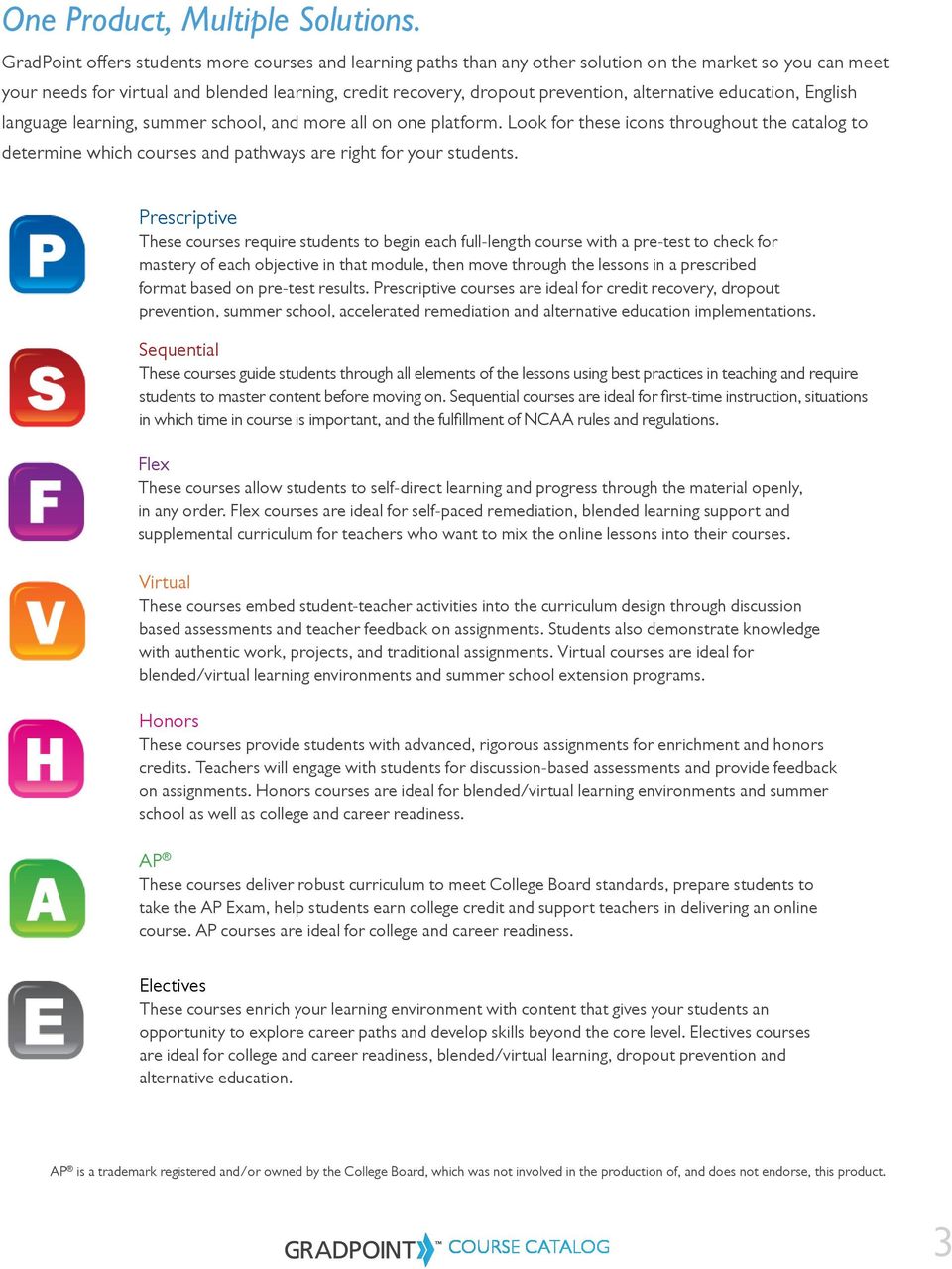
3 One Product, Multiple Solutions. GradPoint offers students more courses and learning paths than any other solution on the market so you can meet your needs for virtual and blended learning, credit recovery, dropout prevention, alternative education, English language learning, summer school, and more all on one platform. Look for these icons throughout the catalog to determine which courses and pathways are right for your students. Prescriptive These courses require students to begin each full-length course with a pre-test to check for mastery of each objective in that module, then move through the lessons in a prescribed format based on pre-test results. Prescriptive courses are ideal for credit recovery, dropout prevention, summer school, accelerated remediation and alternative education implementations. Sequential These courses guide students through all elements of the lessons using best practices in teaching and require students to master content before moving on. Sequential courses are ideal for first-time instruction, situations in which time in course is important, and the fulfillment of NCAA rules and regulations. Flex These courses allow students to self-direct learning and progress through the material openly, in any order. Flex courses are ideal for self-paced remediation, blended learning support and supplemental curriculum for teachers who want to mix the online lessons into their courses. Virtual These courses embed student-teacher activities into the curriculum design through discussion based assessments and teacher feedback on assignments. Students also demonstrate knowledge with authentic work, projects, and traditional assignments. Virtual courses are ideal for blended/virtual learning environments and summer school extension programs. Honors These courses provide students with advanced, rigorous assignments for enrichment and honors credits. Teachers will engage with students for discussion-based assessments and provide feedback on assignments. Honors courses are ideal for blended/virtual learning environments and summer school as well as college and career readiness. AP These courses deliver robust curriculum to meet College Board standards, prepare students to take the AP Exam, help students earn college credit and support teachers in delivering an online course. AP courses are ideal for college and career readiness. Electives These courses enrich your learning environment with content that gives your students an opportunity to explore career paths and develop skills beyond the core level. Electives courses are ideal for college and career readiness, blended/virtual learning, dropout prevention and alternative education. AP is a trademark registered and/or owned by the College Board, which was not involved in the production of, and does not endorse, this product. COURSE CATALOG 3
4 AT A GLANCE MIDDLE SCHOOL COURSE CATALOG >> LANGUAGE ARTS >> SOCIAL STUDIES >> English: Basic Reading Unit American History English: Basic Writing Unit English: Grammar Unit English: Literature Unit English: School and Job Skills Unit English: Writing Unit Language Arts I/Adv (GS) Language Arts II/Adv (GS) Language Arts III/Adv (GS) MATHEMATICS >> Basic Math Intermediate Math Mathematics I/Adv (GS) Mathematics II/Adv (GS) Mathematics III/Adv (GS) Math Grade 6 Math Grade 7 Pre-Algebra Civics/Adv (GS)* United States History/Adv (GS)* World History/Adv (GS)* World Studies Civics (Unit) ELECTIVES >> Career Exploration (E) Comprehensive PE 6/7 (GS)* Comprehensive PE 7/8 (GS)* Fitness Grade 6 (GS)* Journalism (E) Orientation to Art 2D (GS) Photography: Drawing with Light (E) Reading I (GS) Spanish Beginning (GS) Spanish Intermediate (GS) SCIENCE >> Comprehensive Science I/Adv (GS)* Comprehensive Science II/Adv (GS)* Comprehensive Science III/Adv (GS)* Earth Science Life Science Physical Science Science 6 Science 7 Science 8 * Please note: There are external material costs associated with this course. Refer to the GradPoint Materials Guide for more information. (E) Developed through our partner edynamic Learning 4 COURSE CATALOG

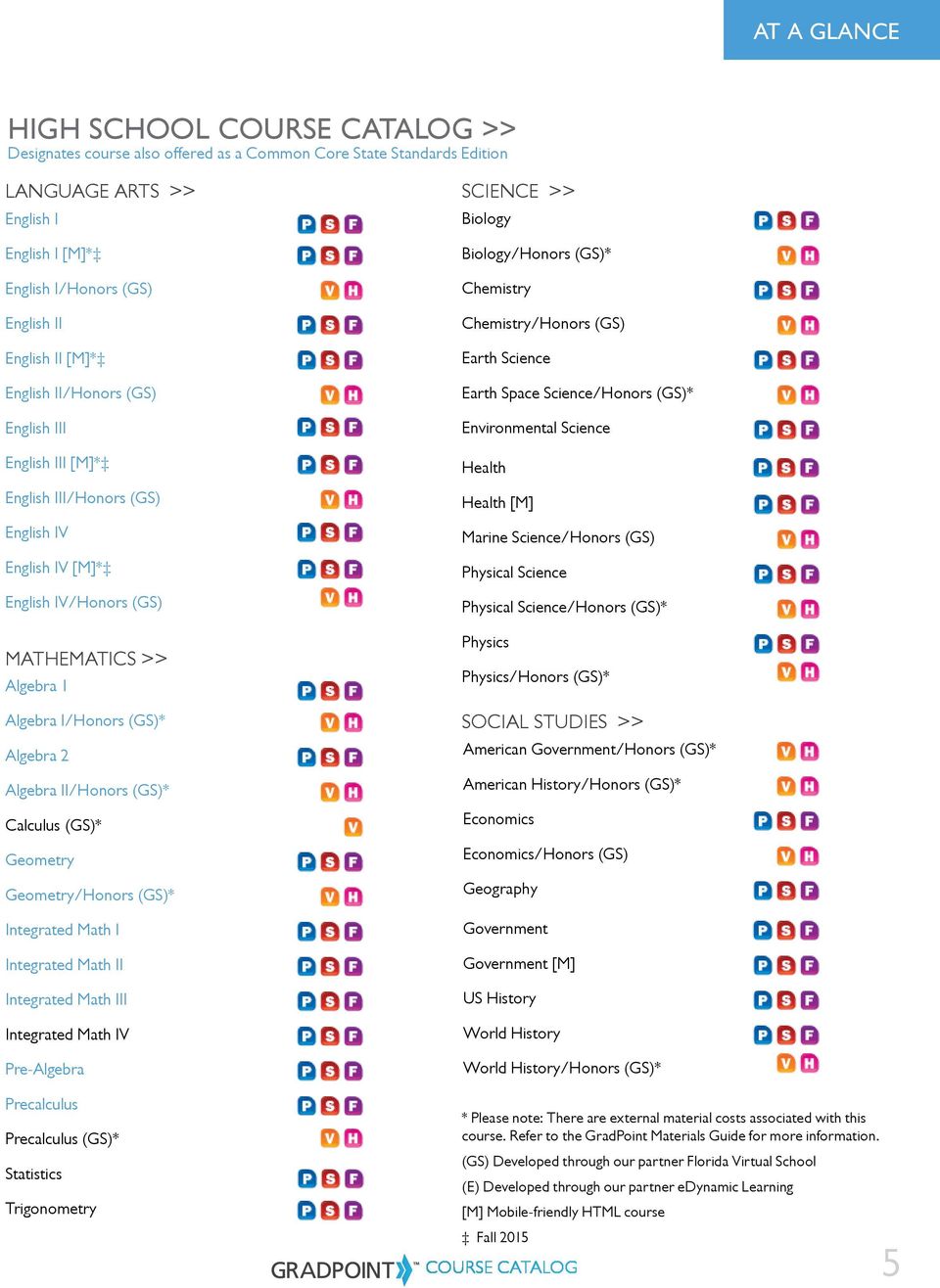
5 AT A GLANCE HIGH SCHOOL COURSE CATALOG >> Designates course also offered as a Common Core State Standards Edition LANGUAGE ARTS >> SCIENCE >> English I Biology English I [M]* English I/Honors (GS) English II English II [M]* English II/Honors (GS) English III English III [M]* English III/Honors (GS) English IV English IV [M]* English IV/Honors (GS) MATHEMATICS >> Algebra 1 Algebra I/Honors (GS)* Algebra 2 Algebra II/Honors (GS)* Calculus (GS)* Geometry Geometry/Honors (GS)* Integrated Math I Integrated Math II Integrated Math III Integrated Math IV Pre-Algebra Precalculus Precalculus (GS)* Statistics Trigonometry Biology/Honors (GS)* Chemistry Chemistry/Honors (GS) Earth Science Earth Space Science/Honors (GS)* Environmental Science Health Health [M] Marine Science/Honors (GS) Physical Science Physical Science/Honors (GS)* Physics Physics/Honors (GS)* SOCIAL STUDIES >> American Government/Honors (GS)* American History/Honors (GS)* Economics Economics/Honors (GS) Geography Government Government [M] US History World History World History/Honors (GS)* * Please note: There are external material costs associated with this course. Refer to the GradPoint Materials Guide for more information. (E) Developed through our partner edynamic Learning [M] Mobile-friendly HTML course Fall 2015 COURSE CATALOG 5
6 AT A GLANCE HIGH SCHOOL COURSE CATALOG >> ADVANCED PLACEMENT >> ELECTIVES >> AP Art History (GS)* AP Biology (GS)* AP Calculus AB (GS)* AP Calculus BC (GS)* AP Computer Science A (GS)* AP English Language and Composition (GS) AP English Literature & Composition (GS)* AP Environmental Science (GS)* AP Human Geography (GS)* AP Macroeconomics (GS)* AP Microeconomics (GS)* AP Psychology (GS)* AP Statistics (GS)* AP United States Government & Politics (GS)* AP US History (GS) CAREER Accounting I (C) Accounting II (C) Administrative Duties and Office Management (C) Anatomy & Physiology and Human Diseases (C) Astronomy (E) Biotechnology (E) Business Communication (C) Business Information Systems (C) Business Law (C) Business Math (C) Careers in Criminal Justice (E) Computer Programming I (GS) Computer Programing II (GS) Cosmetology (E) Criminal Investigation (C) Criminology (E) Digital Photography (E) Digital Photography II (E) Fashion and Interior Design (E)* Forensic Science I (E) Forensic Science II (E) Health, Safety & Nutrition (C) Hospitality & Tourism (E) Human Resource Management (C) International Business (E) * Please note: There are external material costs associated with this course. Refer to the GradPoint Materials Guide for more information. (E) Developed through our partner edynamic Learning (C) Electives developed by Pearson Introduction to Agriscience (C) Introduction to Business (C) Introduction to Communication (C) 6 COURSE CATALOG

7 AT A GLANCE HIGH SCHOOL COURSE CATALOG >> ELECTIVES >> CAREER TECHNICAL EDUCATION Introduction to Criminal Justice (C) Introduction to Culinary Arts (E)* Introduction to Early Childhood Education (C) Introduction to Entrepreneurship (C) Introduction to Finance (C) Introduction to Homeland Security (C) Introduction to Law (C) Introduction to Manufacturing (E) Introduction to Medical Assisting (C) Introduction to Paralegal Profession (C) Introduction to Psychology (C) Introduction to Social Media (E) Introduction to Sociology (C) Introductory Astronomy (C) Java Programming I (C) Java Programming II (C) Journalism (GS)* Law & Order (E) Leadership in Business Supervision (C) Medical Law and Ethics (C) Medical Terminology (C) Personal Psychology I (E) Personal Psychology II (E) Principles of Management (C) Principles of Marketing (C) Principles of Public Service (E) Psychology (GS)* Public Speaking (C) Public Speaking I (E) Research Methods (C) Social Media (GS) Sociology I (E) Sociology II (E) Sports & Entertainment Marketing (E) Theater, Cinema & Film Production (E) Veterinary Science (E) GENERAL STUDIES Advanced Algebra with Financial Applications (GS) Creative Writing I (E) Critical Thinking and Study Skills (GS)* Developmental Writing (C) Economics with Financial Literacy/Honors (GS)* Great Minds in Science (E) Introduction to Women's Studies (E) Liberal Arts Mathematics (GS)* Life Management Skills (GS) Peer Counseling (E) Personal and Family Finance (E) Reading for College Success (GS)* Real World Parenting (E) Thinking and Learning Strategies (GS) HEALTH & PE Fitness Lifestyle Design (GS) Health Opportunities through Physical Education (HOPE) (GS)* Health Science (E) Health Science II (E) Personal Fitness (GS)* COURSE CATALOG 7

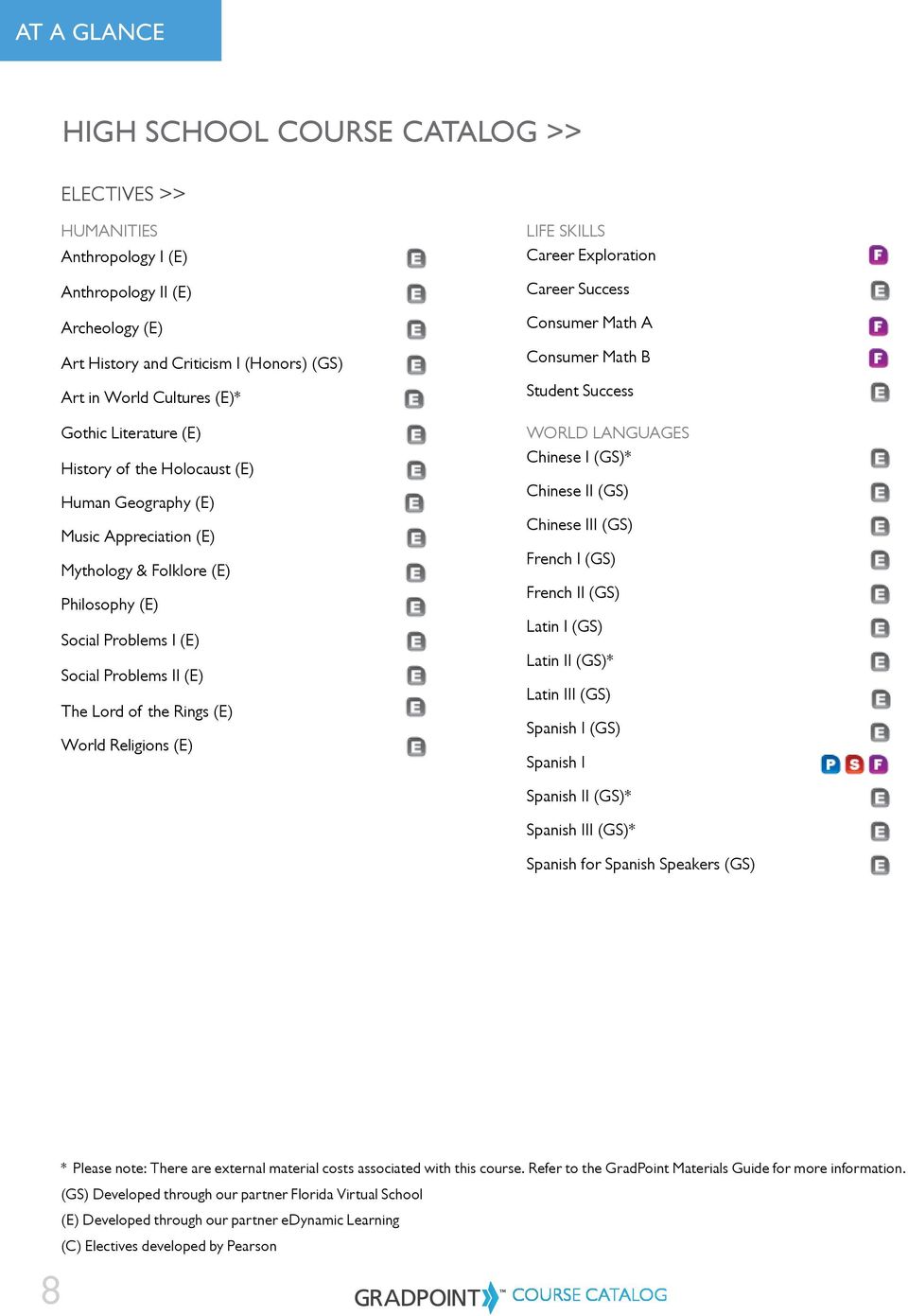
8 AT A GLANCE HIGH SCHOOL COURSE CATALOG >> ELECTIVES >> HUMANITIES Anthropology I (E) Anthropology II (E) Archeology (E) Art History and Criticism I (Honors) (GS) Art in World Cultures (E)* Gothic Literature (E) History of the Holocaust (E) Human Geography (E) Music Appreciation (E) Mythology & Folklore (E) Philosophy (E) Social Problems I (E) Social Problems II (E) The Lord of the Rings (E) World Religions (E) LIFE SKILLS Career Exploration Career Success Consumer Math A Consumer Math B Student Success WORLD LANGUAGES Chinese I (GS)* Chinese II (GS) Chinese III (GS) French I (GS) French II (GS) Latin I (GS) Latin II (GS)* Latin III (GS) Spanish I (GS) Spanish I Spanish II (GS)* Spanish III (GS)* Spanish for Spanish Speakers (GS) * Please note: There are external material costs associated with this course. Refer to the GradPoint Materials Guide for more information. (E) Developed through our partner edynamic Learning (C) Electives developed by Pearson 8 COURSE CATALOG
9 AT A GLANCE STATE AND HIGH-STAKES TEST PREPARATION >> Alabama Indiana North Carolina Tennessee Arizona Louisiana Ohio Texas Arkansas Maine Oklahoma Vermont California Massachusetts Pennsylvania Virginia Colorado Michigan Rhode Island Washington Connecticut Mississippi South Carolina West Virginia Florida Missouri Wisconsin Georgia New Hampshire Idaho New Jersey Illinois New York NATIONAL TEST PREPARATION >> ACT Preparatory Courses and Practice Test GED Preparatory Courses SAT Preparatory Courses and Practice Test ASSESSMENT >> ORIENTATION COURSE >> Basic Achievement Skills Inventory TM (BASI) Prepare your students for success with Learning in GradPoint Learning in GradPoint provides an orientation for students about the key features of GradPoint. Beginning with the basics of viewing a course, students learn how to see their course materials, grades, learning objectives and announcements from instructors. Students then learn how to submit online assignment using attachments, Google Docs or using templates. Finally they explore taking a variety of assessments in a course including quizzes and exams. This course is a great way to ensure students are ready to begin using the GradPoint platform successfully. ACT is the registered trademark of ACT, Inc. GED is a registered trademark of the American Council on Education. SAT is a registered trademark of the College Board. COURSE CATALOG 9

10 MIDDLE SCHOOL LANGUAGE ARTS >> Language Arts I / Adv (GS) In this course, students will read short stories and novels, listen to music, read newspapers, and even interview their parents. They will also learn to write interesting stories of their own. Prerequisites: Recommended for 6th Grade. Language Arts III / Adv (GS) The purpose of this course is to give students the tools to understand and express themselves through writing. By the end of the course, students will have completed a portfolio of their original writings. Prerequisites: Recommended for 8th Grade Language Arts II / Adv (GS) In this course, students will read, listen to and analyze stories. They will read various texts, such as newspapers and novels, in addition to discovering their own ability to write. Prerequisites: Recommended for 7th Grade LANGUAGE ARTS UNITS Language Arts units are designed to allow for flexible combinations of content. The following units are available: English: Basic Reading English: Basic Writing English: Grammar English: Literature English: School and Job Skills English: Writing 10 COURSE CATALOG

11 MIDDLE SCHOOL MATHEMATICS >> Basic Math In this course, students compare, order and perform operations with decimals and write and solve one-step equations using number sense and inverse operations. They are taught how to add, subtract, multiply and divide fractions and mixed numbers. The also explore ratio and proportion and study the relationship between fractions, decimals, and percents, find percents of numbers, and estimate percents. Students explore theoretical and experimental probability, graph points and functions, solve and graph inequalities, find square roots, identify rational numbers, and use the Pythagorean Theorem. Intermediate Math In this course, students further develop their skills in addition, subtraction, multiplication and division of decimals, integers and fractions. They learn how to solve equations and inequalities, identify congruent figures and find missing measures, and find the area, circumference, surface area and volume of shapes and objects. Students also investigate linear and nonlinear relationships, slope, transformations, and symmetry. Each lesson contains real-world examples guiding students through the problem-solving process. Math Grade 6 In this course, students develop their skills in addition, subtraction, multiplication and division of decimals, integers, and fractions. Students write and solve equations and inequalities. They also display data in tables and graphs, along with finding the measures of central tendency. Students solve problems involving area, surface area, and volume. The concepts of ratios and proportions are also presented. Math Grade 7 The course covers operations with decimals, integers, exponents, factors, and fractions. It also addresses ratios, rates, and proportions. Students solve equations and inequalities, and they solve percent problems using equations and proportions. They also find the perimeters and areas of different geometric shapes and the surface areas of solids. Students investigate linear relationships, and they learn how to display and analyze data. Mathematics I/Adv (GS) This course is packed with games that reinforce and practice math skills. Students will have opportunities to demonstrate their knowledge of number manipulation by applying it to real-world scenarios. Prerequisites: Recommended for 6th Grade Mathematics II/Adv (GS) This course gives students opportunities to create, investigate, and demonstrate knowledge through animations, applications, videos, games and real-world scenarios. Prerequisites: Recommended for 7th Grade Mathematics III/Adv (GS) Students will love this hands-on math course. Through engaging exercises and assessments students will gain a true understanding of higher-level concepts, such as systems of equations and central tendencies. Prerequisites: Recommended for 8th Grade Pre-Algebra This course addresses concepts related to performing operations with integers and fractions, factoring, and simplifying expressions with exponents. The course shows how to solve multi-step equations and inequalities, and it presents concepts related to writing and solving proportions and percent problems. Students learn to recognize linear functions and their graphs, identify polygons and solids, solve for area and volume, and display data. * Please note: There are external material costs associated with this course. Refer to the GradPoint Materials Guide for more information. COURSE CATALOG 11

12 MIDDLE SCHOOL MATHEMATICS CONTINUED >> MATH UNITS Mathematics units are designed to allow for flexible combinations of content. The following units are available: Algebra 1A Algebra 1B Basic Math 1 Basic Math 2 Basic Math 3 Basic Math 4 Intermediate Math 1 Intermediate Math 2 Intermediate Math 3 Intermediate Math 4 Pre-Algebra 1 Pre-Algebra 2 Pre-Agebra 3 Pre-Algebra 4 Visit for a hands-on course preview. 12 COURSE CATALOG

13 MIDDLE SCHOOL SCIENCE >> Comprehensive Science I/Adv (GS)* This course provides an introduction to science with a focus on energy, force, weather, climate, Earth s systems and living organisms. Some topics are explored in depth while others are introduced to serve as building blocks for Comprehensive Science II and III. Prerequisites: Recommended for 6th Grade Comprehensive Science II/Adv (GS)* In this course, students explore the foundations of science, energy, and Earth and its features; Earth s internal and external structures and how they change; Earth s history, living things, and how they change and interact; and genetics, heredity, and the organization of living organisms. Prerequisites: Recommended for 7th Grade Comprehensive Science III/Adv (GS)* This course introduces new information and reviews some science basics to prepare students for high school science coursework. Topics covered in this course include: the nature of science, Earth and space science, properties of matter, changes in matter, matter and energy, and energy flow. Prerequisites: Recommended for 8th Grade Life Science The Life Science course begins with a review of measurement skills and the scientific method. Then students learn to classify organisms based on taxonomy, domains, and kingdoms. Cell structure, function, and processes are covered next, along with DNA, heredity, and the theory of evolution. The systems of the human body are presented, followed by extensive coverage of biological ecosystems, habitats, organism populations, and environmental issues. Physical Science The Physical Science course begins with an investigation of the elements of matter and their properties and states, followed by a study of chemical compounds, chemical bonds, and reactions. Next, students turn their attention to the topics of motion, forces, and energy, followed by an investigation of magnetism and electricity, including semiconductors and digital devices. The course concludes with a study of wave phenomena, including sound, light, and radio waves. Science 6 In this course, students will study the scientific method, mathematics in science, technology in science, viruses and bacteria, plants, the solar system, thermal energy, sound, and light. Earth Science The Earth Science course begins with a study of the Earth s interior structure, forces, and types of rock. Earth s topography is covered next, including mountains and oceans and forces that form and change surface features over time. Next, students learn about the solar system, star formation, and current theories concerning the nature of the universe. The course is completed by a study of the Earth s atmosphere, including energy transfer, wind, weather, and climate. Science 7 In this course, students will study atoms and elements, chemical bonds, matter and energy, the periodic table, the earth, cells, genetics, the human body, and the classification of organisms. Science 8 In this course, students will study atoms and elements, chemical reactions, matter and energy, force, work and machines, types of waves, ecosystems, plate tectonics, earthquakes and volcanoes, weathering, erosion and deposition, and the power of water. * Please note: There are external material costs associated with this course. Refer to the GradPoint Materials Guide for more information. COURSE CATALOG 13

14 MIDDLE SCHOOL SCIENCE CONTINUED >> SCIENCE UNITS Science units are designed to allow for flexible combinations of content. The following units are available for Science: Earth Science: Astronomy Earth Science: Earth s Land and Water Earth Science: Inside Earth Earth Science: Weather and Climate Life Science: Cells and Heredity Life Science: Environmental Science Life Science: From Bacteria to Plants Life Science: Human Biology and Health Physical Science: Chemical Building Blocks Physical Science: Chemical Interactions Physical Science: Electricity and Magnetism Physical Science: Motion, Forces and Energy Physical Science: Sound and Light Science and Technology 14 COURSE CATALOG

15 MIDDLE SCHOOL SOCIAL STUDIES >> American History The American History course presents a chronological history of the American experience from the earliest times to the present. It covers topics such as, colonial America, the American Revolution, and issues faced by the early republic. It also covers westward expansion, the Civil War, industrialization, WWI, the Great Depression, WWII, the Cold War, Civil Rights, and the Vietnam War. Finally, students learn about the challenges faced by the United States in the 21st century. Civics/Adv (GS)* Learning about civics gives students the skills and knowledge necessary to be active citizens who have a positive impact on their communities. In this course, students discover the rights and responsibilities of citizenship in the United States. They learn about the structure of the government and how it works at the local, state and federal levels. This course examines elections, the lawmaking process, and how citizens can impact public policy. Students also discover ways the United States interacts with countries around the world. Geography and economics support the learning of civics in this course. Engaging in this study prepares students to be informed citizens who are ready to participate in the American democracy. World History/Adv (GS)* From ancient Mesopotamia to China and its ancient dynasties, different civilizations left their mark on history. They also left their mark on how we live today. In this course, students will become quiz show contestants, traveling back to these ancient civilizations to dig out the facts. Prerequisites: Recommended for 8th Grade World Studies The World Studies course provides a unique balance of history, geography, and culture; it expands students understanding of each world region through a focus on its major countries. Additionally, students learn the foundations of geography. Regions covered include Africa, Asia and the Pacific, the United States and Canada, Europe and Russia, and Latin America. The history and geography of the ancient world and medieval times to present day are also included. United States History/Adv (GS)* In this course, students will discover that history is full of adventure, colorful characters, and complex plots. Each complex plot will be different, and will highlight an important story from our nation s past. Prerequisites: Recommended for 8th Grade * Please note: There are external material costs associated with this course. Refer to the GradPoint Materials Guide for more information. COURSE CATALOG 15

16 MIDDLE SCHOOL SOCIAL STUDIES CONTINUED >> SOCIAL STUDIES UNITS Social Studies units are designed to allow for flexible combinations of content. The following units are available for Social Studies: American History: The Beginnings American History: Forming a New Nation American History: The New Republic American History: The Nation Expands and Changes American History: Civil War and Reunion American History: An Age of Industry American History: A New Role in the World American History: Depression and War American History: Moving Toward the Future Civics: Foundations World Studies: Africa World Studies: Asia and the Pacific World Studies: Europe and Russia World Studies: Foundations of Geography World Studies: Latin America World Studies: Medieval Times to Today World Studies: The Ancient World World Studies: The United States and Canada 16 COURSE CATALOG

17 MIDDLE SCHOOL ELECTIVES >> Career Exploration (E) What career are you best suited for? In this course, students will explore career options in many different fields including business, health science, public administration, the arts, and information technology. Comprehensive PE 6/7 (GS)* In this course, students will reach new levels of fitness through sports, dance, aquatics, and more. A friendly cast of course characters will help guide and enhance their experience. Students will learn safety rules for exercises to improve their skills, how different activities target different parts of their body, and how to reach new goals. Comprehensive PE 7/8 (GS)* This course will provide students practice in game strategy, sport skills and performance. Students will discover the diversity of sports, nutrition, and peer pressure, while learning how to make effective decisions. Fitness Grade 6 (GS)* In this course, students will meet a crew of virtual characters that will help them explore health and understand fitness. Among them is Coach Cardio, who will help students measure their growing fitness level by learning to keep their bodies physically fit. Students will complete various projects as they learn about themselves, fitness and the world around them. Journalism: Tell Your Story (E) Who? What? When? Where? Journalism provides us with the answers to these questions for the events that affect our lives. In this course, students will learn how to gather information, organize ideas, format stories for different forms of news media, and edit their stories for publication. The course will also examine the historical development of journalism and the role of journalism in society. Photography: Drawing with Light (E) Students see photographs every day on television, on the Internet, and in magazines and newspapers. What makes a great photograph? How did the artist capture a story? What are careers in photography? In this course, students learn and apply fundamental skills to use a camera and take photographs of animals, people, and landscapes. Students gain an understanding of how photography can be a means of documentation or high art. Students examine photographic careers and explore self-reflection to further their creative growth as they develop a photographic portfolio. This course helps students select subjects, take photographs, and print and display memories! Reading I (GS) In this course, students will read a variety of interesting stories, watch videos, and participate in class activities. Through fiction, nonfiction, and poetry, students will learn new vocabulary and comprehension skills. Spanish Beginning (GS) In this course, students will learn basic Spanish phrases and vocabulary through interactive lessons that will include images, recordings and videos. Spanish Intermediate (GS) In this course, students will journey with our student traveler, Cristina, to Spain, Puerto Rico, Columbia, and Argentina. Cristina will share her experiences as students learn how to speak Spanish in many useful situations. New words and phrases will be introduced with pictures, audio clips, and videos. Students will learn how to greet people, introduce themselves, and speak about their family, home, food, sports, and more through interactive activities, reading, writing, listening, and speaking exercises. Prerequisites: Spanish Beginning Orientation to Art 2D (GS) In this course, students will experience the creative processes used by all artists. They will learn how to analyze, interpret, and evaluate art. At the end of this course, each student will have a portfolio of work that demonstrates their own skill and creativity as an artist. * Please note: There are external material costs associated with this course. Refer to the GradPoint Materials Guide for more information. (E) Developed through our partner edynamic Learning COURSE CATALOG 17

18 LANGUAGE ARTS >> English I This course addresses strategies for reading comprehension, recognition of text structure in exposition and narrative, comprehension of different genres of text, the steps for writing an essay, and application of the five-step writing process. The course also addresses basic skills in grammar, punctuation, word usage, spelling, vocabulary, and research and explains how to punctuate and manipulate sentences to produce more effective writing. English II [M] The lessons, projects, and writing activities cover grammar; punctuation; word usage; spelling; vocabulary; reading comprehension; literary elements, devices, and techniques; communications, such as giving speeches, using visual aids, and workplace communications; and writing and revising. Students learn about drafting narratives, essays, and research reports, including using MLA style guidelines. Built using responsive design principles, this HTML course is mobile-friendly, meets accessibility requirements, and includes expanded projects and assessments (including performance assessments). English I [M] The lessons, projects and writing activities offered in this course cover grammar, punctuation, word usage and spelling. In addition, students will learn vocabulary, reading strategies, and literary elements, devices and techniques. The course also covers communication skills, such as giving speeches, using visual aids, and communicating in the workplace, as well as writing and revising using MLA style guidelines. Built using responsive design principles, this HTML course is mobilefriendly, meets accessibility requirements, and includes expanded projects and assessments (including performance assessments). English II/Honors (GS) Student will be exposed to various forms of communication, including verbal, visual, and audio. In addition to evaluating the plot and characters of well-known writers, students will learn to identify themes, create dialogue, and appeal to emotions through their writing. Prerequisites: English I is recommended English I/Honors (GS) In this course, students will gain language arts skills by reading literature, writing, listening, viewing, and speaking. They will learn to use the English language successfully to express themselves. English II This course helps students develop skills in grammar, punctuation, word usage, spelling, vocabulary,, and communications skills such as giving speeches, using visual aids, and communicating in the workplace. This course also focuses on strategies for reading comprehensions, explains the writing process, helps students compose personal narratives and literary responses, and provides instruction on perspective and argument. English III In this course, students continue to develop skills in grammar, punctuation, word usage, spelling, vocabulary, and communication. This course also teaches students about complex writing processes, types of writing, reading strategies, study skills, and modes of reasoning. Additionally, students read works from different periods of American literature and examine these texts to learn about various literary devices, forms, styles, techniques, and influences. English III [M] The lessons, projects, and writing activities include reading and analyzing selections of American literature for literary elements, devices, and structure; practicing writing narratives, exposition, persuasion, and research; practicing communication skills, such as giving speeches, using visual aids, and communicating in the workplace; and instruction in grammar, punctuation, usage, and mechanics. Built using responsive design principles, this HTML course is mobile-friendly, meets accessibility requirements, and includes expanded projects and assessments (including performance assessments). Fall 2015 [M] Mobile-friendly HTML course Designates course also offered as a Common Core State Standards Edition 18 COURSE CATALOG

19 LANGUAGE ARTS >> English III/Honors (GS) In this course, the writing and insights of authors throughout history are collected in a fictitious newspaper called The Virtual Times. Students will gain an appreciation of American literature and learn about the times in which it was written. Prerequisites: English I and II are recommended English IV In this course, students continue to develop skills in grammar, punctuations, word usage, spelling vocabulary, and communication. This course also teaches students about complex writing processes, types of writing, reading strategies, study skills, and modes of reasoning. Additionally, students read works from different periods of British literature and examine these texts to learn about various literary devices, forms, styles, techniques, and influences. English IV [M] The lessons, projects and writing activities in this course cover grammar, punctuation, word usage, spelling and vocabulary. Students will also learn communication skills, academic and workplace skills, reading strategies, study skills and modes of reasoning. Finally, the course will cover literary devices, forms, styles, techniques, and influences, as well as the writing process and different types of writing, such as narrative, exposition and research. Built using responsive design principles, this HTML course is mobilefriendly, meets accessibility requirements, and includes expanded projects and assessments (including performance assessments). English IV/Honors (GS) In this course, students will be asked to choose pieces of literature that that interest them and then analyze the subject matter and persuasively express their own ideas. Prerequisites: English I, II, and III are recommended Fall 2015 [M] Mobile-friendly HTML course Designates course also offered as a Common Core State Standards Edition COURSE CATALOG 19

20 MATHEMATICS >> Algebra 1 This course covers such key concepts as variables, function patterns, graphs, operations with rational numbers, and properties of rational numbers. Students solve linear equations and inequalities, study slope, and graph linear functions. This course also covers exponents, polynomials, and factoring. It also helps students study quadratic equations and functions, radical expressions and equations, rational expressions and functions, and counting methods. Algebra I/Honors (GS)* This course contains the basic knowledge students need for all high school math courses. Students will understand the practical use of algebra with hundreds of real-world examples. Prerequisites: 7th grade mathematics Calculus (GS)* This course includes a study of limits, continuity, and differentiation. It integrates algebraic, trigonometric and transcendental functions, and the applications of derivatives and integrals. Prerequisites: Algebra I, Geometry, Algebra II, Precalculus or Trigonometry Analytical Geometry Geometry This course addresses basic skills in geometry including reasoning, developing proofs, identifying geometric figures, and constructing figures. This course also teaches students about the properties of right triangles and trigonometric ratios, transformations of plane figures, and the parts of a circle and their properties. Additionally, students will develop and apply formulas for area, surface area, and volume of two- and three-dimensional figures. Algebra 2 In this course, students solve equations, inequalities, systems and problems using matrices, inverse matrices, matrix operations, and determinants. Students also learn about different functions and are introduced to the imaginary number i and find complex solutions to equations. This course also introduces exponential and logarithmic functions, conic sections, probability, statistics, sequences, and series. Algebra II/Honors (GS)* Starting with a review of basic algebra, students will learn polynomials, quadratic equations, exponential and logarithmic relations, and probability and statistics. Prerequisites: Algebra Geometry/Honors (GS)* In this course, students will learn about points, lines, and planes. They will learn about shapes and gain an understanding of how geometry affects the world around us. Prerequisites: Algebra I or its equivalent Integrated Math 1 This course teaches students how to simplify expressions and solve linear equations, introduces basic geometric terms and logic, reasoning, and proof and addresses linear equations in a graphical sense, and parallel and perpendicular lines, first from an algebraic perspective, followed by proving associated theorems using geometry. This course also teaches students how to solve proportions, use square roots, explore exponents, simplify polynomials, factor and solve quadratic equations, and apply these skills to geometry topics such as quadrilaterals, polygons, area, and volume. * Please note: There are external material costs associated with this course. Refer to the GradPoint Materials Guide for more information. GradPoint currently offers high school English curriculum designed to fully meet the Common Core State Standards. These courses also address the standards from the International Association for K-12 Online Learning (inacol) as well as 21st Century Skills. Designates course also offered as a Common Core State Standards Edition 20 COURSE CATALOG

21 MATHEMATICS >> Integrated Math II This course teaches students about linear equations and inequalities, functions and families of functions, triangles, and how to apply their knowledge to solve systems and prove theorems. This course also teaches students about geometrical relationships in triangles and plane figures, special right triangles, basic trigonometry, radicals, polynomials, rational equations, probability and statistics. Integrated Math III This course reviews graphing in the coordinate plane, graphical and algebraic approaches to solving systems of equations and constructions, isometric transformations, symmetry, and dilations. This course also teaches students about a variety of nonlinear relationships, circles and conic sections, arithmetic and geometric sequences and series, and how to solve quadratic equations. Integrated Mathematics IV In this course students will learn about analyzing data, standard deviation, and normal distributions. They will also learn about arithmetic and geometric sequences and their series, rational and inverse functions, radians, degrees, and the unit circle. This course also teaches students about trigonometric functions, inverse trigonometric functions, trigonometric identities, sum and difference formulas, applications of trigonometry, polar coordinates, and vectors. They will also learn about functions, polynomial functions, exponential functions, and logarithmic functions. Pre-Algebra This course addresses concepts related to writing algebraic expressions, performing operations with integers and fractions, factoring, simplifying expressions with exponents, solving one-step equations and inequalities. This course also addresses writing and solving proportions and percent problems, recognizing linear functions and their graphs, identifying polygons and solids, displaying data, finding probabilities, computing area, surface area, and volume, and solving multi-step equations that contain integers, fractions, and decimals. The Distributive Property and equations and formulas that reflect realworld situations are presented. Precalculus This course presents students with a formal study of functions, an analysis of sequences and series, counting principles, the binomial theorem, and probability. Students will use technology to employ multiple approaches to problem solving and data modeling. This course also includes topics on trigonometry, parametric curves, the polar coordinate system, and complex numbers in polar form. Students will solve problems using the Laws of Sines and Cosines and will also analyze vectors and conics, study systems of equations and matrices, and solve systems using matrices. Limits and continuity are introduced. Precalculus (GS)* Students, as mathematic analysts, investigate how advanced mathematics concepts are used to solve problems encountered in operating national parks. As students venture from algebra to trigonometry, they analyze and articulate the real-world application of these concepts. The purpose of this course is to study functions and develop skills necessary for the study of calculus. This course includes algebra, analytical geometry, and trigonometry. Statistics This course addresses descriptive statistics topics including frequency distributions, histograms, graphs, and measures of center and spread. Probability topics include addition rules, multiplication rules, conditional probabilities, counting rules, binomial distribution, and normal distribution. Inferential statistics topics include estimations for population measures, hypothesis testing, correlation, goodness-of-fit, and statistical process control. Trigonometry This course addresses analyzing functions, transformations, and inverse functions. Students will also learn about radians, the unit circle, right-triangle trigonometry, trigonometric functions, inverse trigonometric functions, trigonometric identities, and trigonometric equations. Additional topics include vectors, conic sections, parametric curves, and the polar coordinate system. GradPoint currently offers high school English curriculum designed to fully meet the Common Core State Standards. These courses also address the standards from the International Association for K-12 Online Learning (inacol) as well as 21st Century Skills. Designates course also offered as a Common Core State Standards Edition COURSE CATALOG 21
22 SCIENCE >> Biology This course addresses key concepts and processes from chemistry, cells, cellular respiration, photosynthesis, genetics, and DNA. The scientific method and foundational chemistry facts are presented to assist students in the study of biology. This course also addresses key concepts and processes of evolution, classification, ecology, and human anatomy. An overview of human body systems is also presented, as well as the defining structures of bacteria, protists, fungi, plants, and animals. Biology/Honors (GS)* This course provides an in-depth look at the fundamental characteristics of living organisms. It is designed to promote scientific inquiry and discovery. Students will be introduced to the structure, function, diversity, and evolution of living organisms. Chemistry This course addresses key concepts and processes, such as states of matter, atomic theory, organization of the periodic table, types of chemical bonds and reactions, the naming and formulas of chemicals, chemical reactions, and stoichiometry. The field of chemistry in relation to the scientific method is also explained. This course also addresses properties of solids, liquids, and gases, state changes, solutions, flow of energy, enthalpy, heat, entropy and free energy, rates of reactions, equilibrium, acid-base theories, oxidation and reduction, electromagnetic cells, functional groups, polymerization, biochemicals, and nuclear chemistry. The course explores concepts through lessons and lab videos. Chemistry/Honors (GS) This course is designed to serve as a foundation for the study of chemistry and includes: scientific inquiry, Web 2.0 tools, interactive experiences, higher order thinking, collaborative projects, real world application, and a variety of assessments. Prerequisites: Algebra I Earth Science This course addresses major concepts, such as the materials which compose earth, the rock cycle and types of rocks, Earth s resources, formation and movement of soil, glaciers, deserts, alluvial landscapes, earthquakes, volcanoes, plate tectonics, mountain building, and geologic time. This course also covers concepts such as the ocean floor, seafloor sediments, waves, tides and shoreline processes, characteristics of the atmosphere, precipitation, air pressure and wind, storms, climate, early astronomy, Earth-Moon- Sun interactions, and solar system. Laboratory concepts appear in videos, careers in Earth science are explored, and key scientists are called out through portraits and biographies. Earth Space Science/Honors (GS)* This is a laboratory course focusing on the study of space and the geologic and atmospheric forces that shape our world. Through experimentation and investigation, students will explore Earth s cycles, including the geosphere, hydrosphere, cryosphere, atmosphere, and the carbon cycle. Environmental Science This course presents relationships between organisms and how these relationships relate to the functioning of ecosystems. Students learn the key concepts and processes of nutrient cycling, biomes, pollution, energy resources, and habitat destruction. The course also covers ways to promote biodiversity and create a sustainable future. * Please note: There are external material costs associated with this course. Refer to the GradPoint Materials Guide for more information. 22 COURSE CATALOG
23 SCIENCE >> Health This course addresses topics in mental health, social health, nutrition, ;physical fitness, substance abuse, human development, and disease prevention The course emphasizes the physical and emotional benefits of making healthful choices and discusses consequences of unhealthful behaviors. Critical thinking is encouraged through the use of open-ended questions, assessments and videos that present real-life situations. Physical Science/Honors (GS)* This course is designed as an interactive, 21st century course focusing on basic physics and chemistry. Topics include forces and motion, energy through waves, electricity and magnetism, the matter around us, and chemical bonding and reactions. This course will provide a foundation for the study of the physical sciences. Health [M] This course addresses topics in mental health, social health, nutrition, physical fitness, substance abuse, human development, and disease prevention. The course emphasizes the physical and emotional benefits of making healthful choices and discusses consequences of unhealthful behaviors. Critical thinking is encouraged through the use of open-ended questions, assessments, and videos that present real-life situations. Built using responsive design principles, this HTML course is mobile-friendly, meets accessibility requirements, and includes expanded projects and assessments (including performance assessments). Marine Science/Honors (GS) Students will delve deep into Earth s bodies of water and study geologic structures and how they impact the oceans. They will investigate characteristics of various populations of aquatic life, patterns of distribution, and ongoing changes occurring in our ecosystem. Prerequisites: Biology I Physics This course addresses concepts of mechanics, wave behavior, thermodynamics, Newton s laws of motion, thermal properties of matter, and thermodynamic systems. This course also contains lessons on electricity, magnetism, optics, the interactions among electric charges, properties of electric and magnetic fields and forces, and the characteristics of electromagnetic waves. Some of the basic concepts of quantum physics are presented as well. An understanding of algebra and trigonometry is required. Physics/Honors (GS)* Students will discover the contributions of geniuses like Galileo, Newton, and Einstein. They will learn the concepts, theories and laws that govern the interaction of matter, energy, and forces. Prerequisites: Algebra I; Algebra II is recommended Physical Science This course addresses key chemistry concepts and processes such as properties and states of matter, atomic structure, organization of the periodic table, types of chemical bonds and reactions, solutions, carbon chemistry, and nuclear chemistry. This course also addresses key physics concepts and processes such as force and motion, work, power, machines, energy, optics, electricity, and magnetism. Concepts are explored through animations and videos and will assist students in advanced chemistry and physics courses. Fall 2015 [M] Mobile-friendly HTML course COURSE CATALOG 23
24 SOCIAL STUDIES >> American Government/Honors (GS)* Students will take on the role of a Washington, D.C., intern spend time working throughout the nation s capital with all three branches of government. They will gain a greater understanding of the country s beginnings and how government functions at different levels. Prerequisites: 11th or 12th grade status and successful completion of English I are recommended American History/Honors (GS)* Students will look at some of the most profound questions that Americans still debate. They will research many important events throughout the history of America. Prerequisites: 10th grade status or higher and successful completion of English I are recommended Economics This course addresses concepts of economics, including a review of the American free enterprise system. Students learn about markets, business and labor, and banking and finance in the microeconomics sections, and then learn about measuring economic performance, the government s role in the economy, and international trade and development in the macroeconomics section. Economics/Honors (GS) The purpose of this course is to help students become more informed consumers, producers, investors, and taxpayers. Students are shown how their choices directly affect their future. Prerequisites: 11th or 12th grade status and successful completion of English I and Algebra I are recommended. Geography This course addresses key concepts of physical and human geography and presents information about the United States, Canada, Latin America, Western Europe, Central Europe, Northern Eurasia, Central and Southwest Asia, Africa, South Asia, East Asia, the Pacific world, and Antarctica. Government This course covers the foundations of American government, political behavior, and the three branches of the federal government. Government [M] This course covers the foundations of American government, political behavior, and the three branches of the federal government. Built using responsive design principles, this HTML course is mobilefriendly, meets accessibility requirements, and includes expanded projects and assessments (including performance assessments). U.S. History This course contains lessons addressing historical periods from the American Revolution to globalization and the 21st century. The lessons address key concepts, important historical figures, and significant events to help students gain an understanding of the political, economic, military and social structures of the early years of the United States through its emergence as a global superpower. World History This course contains lessons addressing historical periods from prehistory through globalization in the 21st century. The objectives of the lessons are directly aligned to current standards. Each multimedia lesson is designed to teach the major concepts for each historical period through text, visual aids, activities and assessments. World History/Honors (GS)* The purpose of this course is to enable students to understand their connections to the development of civilizations by examining the past to prepare for their future as participating members of a global community. * Please note: There are external material costs associated with this course. Refer to the GradPoint Materials Guide for more information. Fall 2015 [M] Mobile-friendly HTML course 24 COURSE CATALOG
25 ADVANCED PLACEMENT >> AP Art History (GS)* Students will examine major forms of artistic expression from the past and present and from a variety of cultures. While learning to look at these works of art critically, with intelligence and sensitivity, students will articulate what they see or experience. Prerequisites: Successful completion of World History is recommended (not required) AP English Language and Composition (GS) Students will become skilled readers of prose written in various periods, disciplines, and rhetorical contexts. They will gain understanding of the interactions between writers' purposes, audience expectations, and subjects. Prerequisites: English I & II AP Biology (GS)* This challenging course is designed to provide a college-level experience. Over two semesters, students are engaged in a wide variety of activities, with substantial emphasis on interpreting and collecting data in virtual labs, writing analytical essays, and mastering biology concepts. Prerequisites: Biology I, Chemistry I, Algebra I AP Calculus AB (GS)* This course consists of a full high school year of work that is comparable to college and university calculus courses. Taking this course will help prepare students for the Calculus AB Advanced Placement Exam. Prerequisites: Algebra I, Geometry, Algebra II and Precalculus AP English Literature & Composition (GS)* In this course, students will develop critical standards for the appreciation of literary works and increase their sensitivity to literature a shared experience. Prerequisites: English I, II, & III AP Environmental Science (GS)* This course provides students with the scientific principles, concepts, and methodologies required to understand the interrelationships of the natural world. Students will evaluate the risks associated with environmental problems and examine alternative solutions. Laboratories support student content mastery in both hands-on and virtual experiences. Prerequisites: Algebra I and two-years of high school Science with labs AP Calculus BC (GS)* This course consists of a full high school year of work that is comparable to college and university calculus courses. Taking this course will help prepare students for the Calculus BC Advanced Placement Exam. Prerequisites: Algebra I, Geometry, Algebra II and Precalculus AP Human Geography (GS)* This course is designed to provide college level instruction on the patterns and processes that impact the way humans understand, use, and change Earth's surface. Students use geographic models, tools, and geographical data to examine spatial patterns and analyze the changing interconnections among people and places. AP Computer Science A (GS)* This course involves developing the skills to write programs or part of programs to correctly solve specific problems. Students will learn design techniques to make programs understandable, adaptable, and reusable. Prerequisites: Algebra I & II AP Macroeconomics (GS)* Students will understand the choices they must make as producers, consumers, investors, and taxpayers. This course provides students with the knowledge and decision-making tools necessary for understanding how a society must organize its limited resources to satisfy its unlimited wants. * Please note: There are external material costs associated with this course. Refer to the GradPoint Materials Guide for more information. COURSE CATALOG 25
26 ADVANCED PLACEMENT >> AP Microeconomics (GS)* Taking on the role of a leader at a fictitious company, students will learn fundamental economic concepts, including scarcity, opportunity costs and trade-offs, productivity, economic systems and institutions, exchange, money, and interdependence. AP Psychology (GS)* This is a college-level course providing students an overview of the development of human behaviors and thoughts. Along with preparation for the AP Psychology exam, the goals of this course are to immerse students in modern psychological investigation techniques, to accentuate the ethics and morality of human and animal research, and to emphasize scientific critical thinking skills in application to the social sciences. AP Statistics (GS)* In this course, students actively construct their own understanding of the methods, interpretation, communication, and application of statistics. Each unit is framed by enduring understandings and essential questions designed to allow students a deep understanding of the concepts at hand rather than memorization and emulation. Prerequisites: Algebra II AP United States Government & Politics (GS)* Students will research the roles of the media, political parties, interest groups, states, candidates, bureaucracy, and the public in the governmental process. They will experience the production of policy building in the areas of economic/social policy, foreign policy, and public administration. Prerequisites: Successful completion of American History is strongly recommended AP U.S. History (GS) Woven into the chronology of this course are the key themes of American History. Issues of American identity, diversity, religion, and culture are examined. Economic transformations, the development of political institutions, and reform movements are evaluated. War, slavery, and demographic changes are assessed. Globalization and environmental issues are analyzed. Prerequisites: Successful completion of American History is strongly recommended * Please note: There are external material costs associated with this course. Refer to the GradPoint Materials Guide for more information. 26 COURSE CATALOG
27 ELECTIVES: CAREER >> Accounting I (C) This course provides students with an introduction to accounting concepts and principles, financial statements, internal control design, and accounting for partnerships. Biotechnology (E) In today s world, biotechnology helps us grow food, fight diseases, and create alternative fuels. In this course, students will explore the science behind biotechnology and how this science is being used to solve medical and environmental problems. Accounting II (C) The student will build upon knowledge gained in Accounting I and continue to explore topics such as corporate accounting and financial statements, long-term liabilities, cash flow, financial statement analysis, managerial accounting, budgeting, and the use of financial data to make business decisions. Business Communication (C) Students explore business communication, including letters, memos, electronic communication, written reports, oral presentations, and interpersonal communication. Resumes, application letters, interviewing tips, and employment follow-up are also covered. Administrative Duties and Office Management (C) Students learn the skills and knowledge required to perform tasks in the administrative department of a medical office. Topics include, but are not limited to, receiving patients, scheduling appointments, handling medical records, and processing insurance claims. Business Information Systems (C) This course introduces students to various information and communications technologies and explains how information systems are used to solve problems and make better business decisions. Anatomy & Physiology and Human Diseases (C) Students learn about anatomical structures and physiology of the human body. Body systems are discussed in terms of how each participates in homeostasis of the body. Students learn about selected major pathologies, including causes, symptoms, diagnostic procedures, and treatments, as well as common changes that occur through the life span. Business Law (C) Students explore principle areas of business law and topics such as torts, crimes, intellectual property, contracts, negotiable instruments, agency, employment, and forms of business organization. They learn rules of law and legal terminology, as well as legal solutions for business-related issues. Astronomy: Exploring the Universe (E) Why do stars twinkle? Is it possible to fall into a black hole? Will the sun ever stop shining? Since the first glimpse of the night sky, humans have been fascinated with the stars, planets, and universe that surrounds us. This course will introduce students to the study of astronomy, including its history and development, basic scientific laws of motion and gravity, the concepts of modern astronomy, and the methods used by astronomers to learn more about the universe. Additional topics include the solar system, the Milky Way and other galaxies, and the sun and stars. Using online tools, students will examine the life cycle of stars, the properties of planets, and the exploration of space. (C) Electives developed by Pearson (E) Developed through our partner edynamic Learning Business Math (C) The student will explore topics such as business statistics, profit calculations, payroll, banking, interest calculations, insurance, taxes, and other business topics. Careers In Criminal Justice (E) Do you want to help prevent crime and maintain order in society? The criminal justice system may be a good career option. The criminal justice system offers a wide range of career opportunities, from law enforcement to forensic scientists to lawyers and judges. In this course, students will explore different areas of the criminal justice system, including the trial process, the juvenile justice system, and the correctional system. Careers in each field will be explored and students will learn more about the expectations and training required for various career options in the criminal justice field. Prerequisites: Geometry COURSE CATALOG 27
28 ELECTIVES: CAREER >> Computer Programming 1 (GS) This is a two semester course which enables students to learn two modern programming languages, Python andjava. This course teaches programming using real-world, practical examples. Students will learn Python by controlling the motion and sensory capabilities of a robot. Prerequisites: Geometry Computer Programming 1I (GS) How can you control the most powerful tool ever invented when you cannot speak its language? Computer Programming 1 is a twosemester course which enables students to learn two modern programming languages, Python and Java. The course teaches programming using real-world, practical examples. You will learn Python by controlling the motion and sensory capabilities of a robot. You will learn Java by manipulating graphics, images, and audio. Programming is easier than you think and perhaps best of all, you get to show what you know by choosing projects that are of interest to you. Major colleges and universities are now using this approach to teach introductory computer programming, so you will learn the skills necessary to tackle advanced work. Prerequisites: Geometry Cosmetology: Cutting Edge Styles (E) Interested in a career in cosmetology? This course provides an introduction to the basics of cosmetology. Students will explore career options in the field of cosmetology, learn about the common equipment and technologies used by cosmetologists, and examine the skills and characteristics that make someone a good cosmetologist. Students will also learn more about some of the common techniques used in caring for hair, nails, and skin in salons, spas, and other cosmetology related businesses. Criminal Investigation (C) Students examine the process of identifying and arresting criminal suspects, types of crimes and offenses, and preparing for court. They study the history of criminal investigation and explore the relationship between investigation and the courtroom process by examining case studies. Criminology: Inside the Criminal Mind (E) In today s world, crime and deviant behavior rank at or near the top of many people s concerns. In this course, we will study the field of criminology the study of crime. We will look at possible explanations for crime from the standpoint of psychological, biological and sociological perspectives, explore the categories and social consequences of crime, and investigate how the criminal justice system handles not only criminals, but also their misdeeds. Why do some individuals commit crimes when others do not? What aspects in our culture and society promote crime and deviance? Why are different punishments given for the same crime? What factors from arrest to punishment help shape the criminal case process? Digital Photography I: Creating Images with Impact (E) Have you ever wondered how photographers take such great pictures? Have you tried to take photographs and wondered why they didn t seem to capture that moment that you saw with your eyes? The Digital Photography I course focuses on the basics of photography, including building an understanding of aperture, shutter speed, lighting, and composition. Students will be introduced to the history of photography and basic camera functions. Students will use the basic techniques of composition and camera functions to build a portfolio of images, capturing people, landscapes, close-ups, and action photographs. Digital Photography II: Discovering Your Creative Potential (E) In today s world, photographs are all around us, including in advertisements, on websites, and hung on our walls as art. Many of the images that we see have been created by professional photographers. In this course, we will examine various aspects of professional photography, including the ethics of the profession, and examine some of the areas that professional photographers may choose to specialize in, such as wedding photography and product photography. We will also learn more about some of the most respected professional photographers in history, and we will learn how to critique photographs in order to better understand what creates an eye-catching photograph. (C) Electives developed by Pearson (GS) Developed through our partner Florid Virtual School (E) Developed through our partner edynamic Learning 28 COURSE CATALOG
29 ELECTIVES: CAREER >> Fashion and Interior Design (E)* In this course, students explore what it is like to work in the industry by exploring career possibilities and the background needed to pursue them. Students will learn the basics of color and design then test their skills through hands-on projects. In addition, they ll develop the essential communication skills that build success in any business. By the end of the course, students be well on their way to developing the portfolio they need to get their stylishly clad foot in the door of this exciting field. Forensic Science I: Secrets of the Dead (E) Fingerprints. Blood spatter. DNA analysis. The world of law enforcement is increasingly making use of techniques and knowledge from the sciences to better understand the crimes that are committed and to catch those individuals responsible. Forensic science applies scientific knowledge to the criminal justice system. This course focuses on some of the techniques and practices used by forensic scientists during a crime scene investigation (CSI). Starting with how clues and data are recorded and preserved, the student will follow evidence trails until the CSI goes to trial, examining how various elements of the crime scene are analyzed and processed. Forensic Science II: More Secrets of the Dead (E) Although the crime scene represents the first step in solving crimes through forensic science, the crime laboratory plays a critical role in the analysis of evidence. This course focuses on the analysis of evidence and testing that takes place within this setting. We will examine some of the basic scientific principles and knowledge that guides forensic laboratory processes, such as those testing DNA, toxicology, and material analysis. Techniques such as microscopy, chromatography, odontology, entomology, mineralogy, and spectroscopy will be examined. Health, Safety & Nutrition (C) Students learn about the physical and psychological needs of children, from birth to age eight, and how to meet these needs in group settings. Topics include wellness of young children, standards, guidelines and national initiatives, children s nutritional needs, safe and healthy environments, emergency response, child abuse and neglect, educational experiences, and partnering with families. Hospitality & Tourism: Traveling the Globe (E) With greater disposable income and more opportunities for business travel, people are traversing the globe in growing numbers. As a result, hospitality and tourism is one of the fastest growing industries in the world. This course will introduce students to the hospitality and tourism industry, including hotel and restaurant management, cruise ships, spas, resorts, theme parks, and other areas. Student will learn about key hospitality issues, the development and management of tourist locations, event planning, marketing, and environmental issues related to leisure and travel. The course also examines current and future trends. Human Resource Management (C) The student will learn important human resource management skills used by business managers in day-to-day operations. While focusing on various aspects of human resource management and practices, problem-solving and critical-thinking skills are applied. International Business: Global Commerce in the 21st Century (E) From geography to culture global business is an exciting topic in the business community today. This course is designed to help students develop the appreciation, knowledge, skills, and abilities needed to live and work in a global marketplace. Students will gain a global view of business, learn how today's businesses are more interconnected than ever, and investigate why and how companies go international. The course further provides students a conceptual tool by which to understand how economic, social, cultural, political and legal factors influence both domestic and cross-border business. Business structures, global entrepreneurship, business management, marketing, and the challenges of managing international organizations will all be explored in this course. Students will cultivate a mindfulness of how history, geography, language, cultural studies, research skills, and continuing education are important in both business activities and the 21st century. * Please note: There are external material costs associated with this course. Refer to the GradPoint Materials Guide for more information. (C) Electives developed by Pearson (E) Developed through our partner edynamic Learning COURSE CATALOG 29
30 ELECTIVES: CAREER >> Introduction to Agriscience (C) Agriculture has played an important role in the lives of humans for thousands of years. It has fed us and given us materials that have helped us survive. Today, scientists and practitioners are working to improve and better understand agriculture and how it can be used to continue to sustain human life. In this course, students learn about the development and maintenance of agriculture, animal systems, natural resources, and other food sources. Students also examine the relationship between agriculture and natural resources and the environment, health, politics, and world trade. Introduction to Culinary Arts (E)* Food is fundamental to life. Not only does it feed our bodies, but it s often the centerpiece for family gatherings and social functions with friends. In this course, you will learn all about food, including food culture, food history, food safety, and current food trends. You ll also learn about the food service industry and try your hand at preparing some culinary delights. Through hands-on activities and in-depth study of the culinary arts field, this course will help you hone your cooking skills and give you the opportunity to explore careers in this exciting industry. Introduction to Business (C) Students explore business in global society, learning terminology, concepts, systems, strategies, and current issues. Topics include the business environment, ethics, entrepreneurship and global business, management, marketing, production, information systems, and financial elements. Introduction to Early Childhood Education (C) This course provides the historical, theoretical, and developmental foundations for educating young children, with emphasis on creating inclusive environments and curricula for diverse children and their families. Topics include historical influences, program types, guidance strategies, professionalism, current trends and issues, and advocacy. Introduction to Communication (C) The student will examine the communication process, including elements of listening and verbal and nonverbal communication. The course also explores how these communication elements operate between self, individuals, and groups. Communication concepts and skills are explored through a variety of methods and activities. Introduction to Criminal Justice (C) Students explore law enforcement, the courts, and the correctional system. They study what crime is, how crime is measured, and theories of crime causation. They also examine issues and challenges within the criminal justice system and its future directions. Introduction to Entrepreneurship: Starting Your Business (C) Do you dream of owning your own business? This course can give you a head start in learning about what you'll need to own and operate a successful business of your own. Students will explore creating a business plan, financing a business, and pricing products and services. Students will also learn more about the regulations that apply to businesses, marketing products and services, and the legal and ethical guidelines that govern businesses. Introduction to Finance (C) Students gain understanding of financial management, including key language and terminology, time-value of money, financial markets and securities, financial statements, financial analysis, risk and return, valuation of stocks and bonds, capital budgeting and valuation, cost of capital and capital structure, working capital management, dividend policy, and international finance. Students apply financial tools and understand how they impact financial decision making. * Please note: There are external material costs associated with this course. Refer to the GradPoint Materials Guide for more information. (C) Electives developed by Pearson (E) Developed through our partner edynamic Learning 30 COURSE CATALOG
31 ELECTIVES: CAREER >> Introduction to Homeland Security (C) This course provides an overview of the elements involved in the homeland security function, as well as the challenges managers in government and industry can face while maintaining mission operations and staff accountability in the midst of multiple overlapping roles and responsibilities. The key functions of threat prevention, asset protection, crisis response, and operations recovery are addressed from a variety of perspectives. Introduction to Law (C) Students receive an overview of substantive and procedural areas of law and legal practice. They explore the legal profession, courts, ethics, sources of law, and alternative dispute resolution systems, and they analyze an application of law to factual circumstances. Introduction to Paralegal Profession (C) The student will explore the role of paralegals in the legal system, paralegal skills, legal working environments, ethical considerations, and career opportunities. The student is introduced to the sources of law, an overview of courts, and alternative dispute resolution systems. Introduction to Psychology (C) Students gain an understanding of human behavior, including biological foundations and the brain, sensation, motivation, and perception. Students explore the relationship between learning and memory; various personality theories; emotions; states of consciousness; cognition; life-span development; and applied psychology. Introduction to Manufacturing: Production Design & Innovation (E) Think about the last time you visited your favorite store. Have you ever wondered how the products you buy make it to the store shelves? Whether it s video games, clothing, or sports equipment, the goods we purchase must go through a manufacturing process before they can be marketed and sold. In this course, you ll learn about the types of manufacturing systems and processes used to create the products we buy every day. You ll also be introduced to the various career opportunities in the manufacturing industry, including those for engineers, technicians, and supervisors. As a culminating project, you ll plan your own manufacturing process for a new product or invention! If you thought manufacturing was little more than mundane assembly lines, this course will show you just how exciting and fruitful the industry can be. Introduction to Social Media (E) Have a Facebook account? What about Twitter? Whether you ve already dipped your toes in the waters of social media or are still standing on the shore wondering what to make of it all, learning about how to interact on various social media platforms is crucial in order to survive and thrive in this age of digital communication. In this course, you ll learn the ins and outs of social media platforms like Facebook, Twitter, Pinterest, Google+, and more. You ll also discover other types of social media you may not have been aware of and how to use them for your benefit personally, academically, and eventually professionally as well. If you thought social media platforms were just a place to keep track of friends and share personal photos, this course will show you how to use these resources in much more powerful ways. Introduction to Medical Assisting (C) Students explore the role of the medical assistant, including professionalism, duties and responsibilities, and medical specialties. Also included is information on medical law and ethics, office management, and compliance and regulatory issues affecting the role of the medical assistant. (C) Electives developed by Pearson (E) Developed through our partner edynamic Learning Introduction to Sociology (C) Students examine the sociological processes that underlie everyday life, focusing on globalization, cultural diversity, critical thinking, new technology, and the growing influence of mass media. Introductory Astronomy (C) Students explore a broad range of astronomy topics, including the planetary system, stars, galaxies, and the universe. Students also learn about the scientific method and the evolution of scientific ideas. COURSE CATALOG 31
32 ELECTIVES: CAREER >> Java Programming I (C) The student will explore programming fundamentals, basic problem solving, variables and assignments, math, conditionals, control flow, methods and functional abstraction, objects and data abstraction, inheritance and polymorphism, exception handling, graphical user interfaces, and external libraries. The student will use Sun s Java programming language throughout this course. Leadership in Business Supervision (C) This course examines the roles and responsibilities of supervisors in private, service, and public organizations. The student will gain an understanding of the expanded scope of supervisory responsibilities for business personnel ranging from first-time, first-line supervisors to top-level executives. Java Programming II (C) The student will explore programming fundamentals, linked lists, stacks, queues, binary trees, generics and interfaces, an introduction to Big O notation, Java TM collections framework and analysis of complexity and implementation of various sorting algorithms, graph applications, and advanced GUIs and graphics. Medical Law and Ethics (C) The student will gain an understanding of the legal and ethical issues that can impact professional roles in health care settings. Laws that regulate the health care industry, such as HIPAA, the Patient s Bill of Rights, and standard of care, are introduced. The student is encouraged to consider the impact of personal ethics and morals on decision making. Journalism (GS)* As students work through each module, they will utilize Web 2.0 tools to respond to current news and shifts in journalism, create original projects, and reflect upon the changing face of news. Authentic assessments, interactive examples, and self-checks will deepen their understanding of the topics covered and prepare them for work or further study in the field of journalism. Medical Terminology (C) Students explore medical terminology and its symbols and abbreviations, as well as the application of this new language in health care. They learn medical terms relating to body structure and function, and how to construct terms using word parts such as roots, suffixes, and prefixes. Law & Order: Introduction to Legal Studies (E) Every society has laws that its citizens must follow. From traffic laws to regulations on how the government operates, laws help provide society with order and structure. Our lives are guided and regulated by our society s legal expectations. Consumer laws help protect us from faulty goods; criminal laws help to protect society from individuals who harm others; and family law handles the arrangements and issues that arise in areas like divorce and child custody. This course focuses on the creation and application of laws in various areas of society. By understanding the workings of our court system, as well as how laws are actually carried out, we become more informed and responsible citizens in our communities and of our nation. Facebook is a trademark of Facebook, Inc. Twitter is a registered trademark of Twitter, Inc. Pinterest is a registered trademark of Pinterest, Inc. Google is a registered trademark of Google Inc. Java is a registered trademark of Oracle and/or its affliates Personal Psychology I: The Road to Self-Discovery (E) Self-knowledge is the key to self-improvement. More than 800,000 high school students take psychology classes each year. Among the different reasons, there is usually the common theme of self-discovery. Sample topics include the study of infancy, childhood, adolescence, perception and states of consciousness. Amazing online psychology experiments dealing with our own personal behavior are featured within this course. Personal Psychology II: Living in a Complex World (E) Enrich the quality of your life by learning to understand the actions of others. Topics include the study of memory, intelligence, emotion, health, stress and personality. This course features exciting online psychology experiments involving the world around us. (C) Electives developed by Pearson (E) Developed through our partner edynamic Learning 32 COURSE CATALOG
33 ELECTIVES: CAREER >> Principles of Management (C) The student is introduced to common management philosophies and issues in today s changing world. The student will study globalization, ethics, diversity, customer service, and innovation from a managerial perspective. Principles of Marketing (C) Students explore factors influencing how marketing decisions are made, including the impact of marketing decisions on an organization and its customers. They gain a working knowledge of practical marketing and business vocabulary. They also evaluate how the actions of competitors influence marketing decisions in the global marketplace. Principles of Public Service (E) Are you familiar with the term public service? When we think about public service, our thoughts often turn to professionals such police officers, EMTs, and firefighters. While these are well-known public servants, many others work to keep our communities safe, healthy, and productive. In this course, you ll learn about many different areas of public service, including education, civil engineering, and social services. You ll also look at the requirements for public service in general, as well as the specific skills needed to be successful in each area of public service. Who knows? You may even discover the career you were meant to pursue! Public Speaking (C) The student will gain a basic understanding of public speaking and the basic elements of a speech. The student will learn strategies to effectively communicate, to adapt to different audiences, and to practice organizational methods to create engaging speech content. Throughout the course, the student will develop and present original speeches to classmates. Public Speaking I (E) The art of public speaking is one that underpins the very foundations of Western society. This course examines those foundations in both Aristotle and Cicero s views of rhetoric, and then traces those foundations into the modern world. Students will learn not just the theory, but also the practice of effective public speaking, including how to analyze the speeches of others, build a strong argument, and speak with confidence and flair. By the end of this course, students will know exactly what makes a truly successful speech and will be able to put that knowledge to practical use. Research Methods (C) Students practice the fundamentals of scientific research methodology by examining a social issue. They develop a research question, find and evaluate existing research, and design and implement an objective research method. Psychology (GS)* Through this highly interactive course students will acquire an understanding of and an appreciation for human behavior, behavior interaction, and the progressive development of individuals. * Please note: There are external material costs associated with this course. Refer to the GradPoint Materials Guide for more information. (C) Electives developed by Pearson (E) Developed through our partner edynamic Learning Social Media (GS) This course won t teach you how to use Facebook, the proper way to use a hashtag, or how to get more Instagram followers. (We trust that you re an expert on all those things already.) What this course will teach you is that the world of social media revolves around you your actions, your decisions, and your interests. You will examine how social media has evolved. You will understand how you can find authenticity and truth within an online world where you can be anyone. And you will learn how your digital footprint makes a bigger impression than your physical one. You will also discover that your voice is important. You re not only a reader you re a writer. You don t just follow the news you report it as a citizen journalist. And you don t just gather information you crowdsource it. The future of Social Media is yours to define so how will you use it to make a difference? COURSE CATALOG 33
34 ELECTIVES: CAREER >> Sociology I: The Study of Human Relationships (E) The world is becoming more complex. How do your beliefs, values and behavior affect the people around you and the world in which we live? Students will examine social problems in our increasingly connected world, and learn how human relationships can strongly influence and impact their lives. Exciting online video journeys to an array of areas in the sociological world are an important component of this relevant and engaging course. Sociology II: Your Social Life (E) Sociology is the study of people, social life and society. By developing a sociological imagination, students will be able to examine how society itself shapes human action and beliefs and how, in turn, these factors re-shape society itself! Fascinating online videos journeys will not only inform students, but motivate them to seek more knowledge on their own. Sports & Entertainment Marketing (E) In this course, students have the opportunity to explore basic marketing principles and delve deeper into the multi-billion dollar sports and entertainment marketing industry. They will learn about how professional athletes, sports teams, and well-known entertainers are marketed as commodities and how some of them become billionaires as a result. This course introduces fundamentals on how things work behind the scenes of a major sporting event, such as the Super Bowl, or how to play a role in such an event. Theater, Cinema & Film Production (E) Lights! Camera! Action! This course will introduce students to the basics of film and theater productions. Students will learn about the basics of lighting, sound, wardrobe, and camerawork for both film and theater settings. The course also explores the history of film and theater and the influence that they have had on society. Students will analyze and critique three influential American films; "Casablanca," "Singin' in the Rain," and "The Wizard of Oz." Veterinary Science (E) As animals play an increasingly important role in our lives, scientists have sought to learn more about their health and well-being. Taking a look at the pets that live in our homes, on our farms, and in zoos and wildlife sanctuaries, this course will examine some of the common diseases and treatments for domestic animals. Toxins, parasites, and infectious diseases impact not only the animals around us, but at times, we humans as well! Through veterinary medicine and science, the prevention and treatment of diseases and health issues is studied and applied. (C) Electives developed by Pearson (E) Developed through our partner edynamic Learning 34 COURSE CATALOG
35 ELECTIVES: GENERAL STUDIES >> Advanced Algebra with Financial Applications (GS) This course walks students through the information needed to make the best decisions with money. Advanced Algebra with Financial Applications is an advanced course incorporating real-world applications, collaboration, and calculations using technology. Students learn the formulas used to determine account balances, monthly payments, total costs, and more. They examine budgeting, spending, saving, investment, and retirement. Students explore mortgages and other debt structures and how to make good decisions about borrowing money. This knowledge will propel students into the future with a good foundation on how to handle finances. Creative Writing I (E) For many hundreds of years, literature has been one of the most important human art forms. It allows us to give voice to our emotions, create imaginary worlds, express ideas, and escape the confines of material reality. Through creative writing, we can come to understand ourselves and our world a little bit better. This course provides students with a solid grounding in the writing process, from finding inspiration to building a basic story to using complicated literary techniques and creating strange, hybrid forms of poetic prose and prose poetry. By the end of this course, students will learn how to discover their creative thoughts and turn those ideas into fully realized pieces of creative writing. Critical Thinking and Study Skills (GS)* Critical thinking and study skills are the tools needed to enhance your performance in almost any venture. Take a trip with us, and we ll give you essential learning tools to lead you to winning performance on assessments. You ll do the work, but we ll give you the shortest and most efficient route to travel. In this course, you ll practice thinking strategies, learn test-taking strategies, practice time management and organizational skills, build verbal competence, and sharpen your mathematics reasoning. Developmental Writing (C) The student will explore the fundamental tools and techniques needed to write clear sentences, effective paragraphs, and wellorganized essays for general education courses and employment settings. Using standard American English, the student will learn to organize, clarify, and communicate written ideas, as well as how to use correct sentence structure, grammar, and parts of speech in written communication. The student will also develop skills in revising and editing to clarify voice, tone, style, and mode. Economics with Financial Literacy/Honors (GS)* The purpose of this course is to help students become more informed consumers, producers, investors, and taxpayers. Students are shown how their choices directly affect their future. Prerequisites: 11th or 12th grade status and successful completion of English I and Algebra I are recommended Great Minds in Science: Ideas for a New Generation (E) Is there life on other planets? What extremes can the human body endure? Can we solve the problem of global warming? Today, scientists, explorers, and writers are working to answer all of these questions. Like Edison, Einstein, Curie, and Newton, the scientists of today are asking questions and working on problems that may revolutionize our lives and world. This course focuses on 10 of today s greatest scientific minds. Each unit takes an in-depth look at one of these individuals, and shows how their ideas may help to shape tomorrow s world. Introduction to Women's Studies (E) This course, although looking specifically at the experiences of women, is not for girls only. If you are a student interested in exploring the world through film, and are open-minded enough to be interested in social change, then this course is for you. * Please note: There are external material costs associated with this course. Refer to the GradPoint Materials Guide for more information. (C) Electives developed by Pearson (E) Developed through our partner edynamic Learning COURSE CATALOG 35
36 ELECTIVES: GENERAL STUDIES >> Liberal Arts Mathematics (GS)* This course reinforces existing algebra and geometry skills and explores concepts students will need to master in order to further their study of mathematics. Prerequisites: Algebra I is required and Geometry is recommended Life Management Skills (GS) This course guides students as they deal with important decisions by providing them with the facts they need. Students will learn how to deal with real issues that impact their lives every day, such as nutrition, substance abuse, stress, and their health. Peer Counseling (E) Helping people achieve their goals is one of the most rewarding of human experiences. Peer counselors help individuals reach their goals by offering them support, encouragement, and resource information. This course explains the role of a peer counselor, teaches the observation, listening, and emphatic communication skills that counselors need, and provides basic training in conflict resolution and group leadership. Not only will this course prepare you for working as a peer counselor, but the skills taught will enhance your ability to communicate effectively in your personal and work relationships. Personal and Family Finance (E) How do our personal financial habits affect our financial future? How can we make smart decisions with our money in the areas of saving, spending, and investing? This course introduces students to basic financial habits such as setting financial goals, budgeting, and creating financial plans. Students will learn more about topics such as taxation, financial institutions, credit, and money management. The course also addresses how occupations and educational choices can influence personal financial planning, and how individuals can protect themselves from identity theft. Reading for College Success (GS)* This course will provide students with the necessary tools to become successful in both their academics and in the work place. Reading is a vital skill necessary for effectively taking notes, summarizing main ideas, and separating fact from opinion. This course will empower students to achieve their goals in higher education and in the career of their choosing. Please note: This course is intended for 12th graders whose college placement scores are below the established cut score indicating that they are not college-ready in Reading (CPT, below 83; SAT, below 440; ACT, below 18). Real World Parenting (E) What is the best way to care for children and teach them self-confidence and a sense of responsibility? Parenting involves more than having a child and providing food and shelter. Learn what to prepare for, what to expect, and what vital steps parents can take to create the best environment for their children. Parenting roles and responsibilities, nurturing and protective environments for children, positive parenting strategies, and effective communication in parent/child relationships are some of the topics covered in this course. Thinking and Learning Strategies (GS) In this course, through reading, writing, and math activities, students will develop critical thinking skills and test-taking strategies. Students will also gain reading, writing, organization, and study strategies. * Please note: There are external material costs associated with this course. Refer to the GradPoint Materials Guide for more information. (E) Developed through our partner edyanmic Learning 36 COURSE CATALOG
37 ELECTIVES: HEALTH AND PE >> Fitness Lifestyle Design (GS) In this course, students will learn healthy habits of body and mind that will lead to a healthier lifestyle. They will measure their beginning fitness level and nutrition knowledge, creating an individual plan for achieving their goals. Health Science II (E) Health Science II is designed to further the student s understanding of the health care workplace, including patient and caregiver interactions and how various members of the health care team work together to create an ethical, functional and compassionate environment for patients. Health Opportunities through Physical Education (HOPE) (GS)* In this course, students will experience the many benefits of regular physical activity, proper nutrition, and sound decision making. Students will assess their current physical condition and define personal goals. Students will apply fitness training principles, enhancing improvement in health and skill-related areas of fitness. Personal Fitness (GS)* Students will start by assessing their physical condition. They will keep a workout log to measure progress. In addition, they will have a great personal trainer (their teacher) who will help them set realistic goals. Health Science: The Whole Individual (E) Will we ever find a cure for cancer? What treatments are best for conditions like diabetes and asthma? How are illnesses like meningitis, tuberculosis, and the measles identified and diagnosed? Health sciences provide the answers to questions such as these. In this course, students will be introduced to the various disciplines within the health sciences, including toxicology, clinical medicine, and biotechnology. They will explore the importance of diagnostics and research in the identification and treatment of diseases. The course presents information and terminology for the health sciences and examines the contributions of different health science areas. * Please note: There are external material costs associated with this course. Refer to the GradPoint Materials Guide for more information. (E) Developed through our partner edynamic Learning COURSE CATALOG 37
38 ELECTIVES: HUMANITIES >> Anthropology I: Uncovering Human Mysteries (E) The aim of anthropology is to use a broad approach to gain an understanding of our past, present and future, and in addition, address the problems humans face in biological, social and cultural life. This course will explore the evolution, similarity and diversity of humankind through time. It will look at how we have evolved from a biologically and culturally weak species to one that has the ability to cause catastrophic change. Exciting online video journeys to different areas of the anthropological world are just one of the powerful learning tools utilized in this course. Art History and Criticism (Honors) (GS) In this course, students will understand the political, cultural and religious changes throughout history that are depicted in art. This course is an opportunity for students to reflect on how art was and is used as a vehicle to communicate, depict political and religious propaganda, and serve as evidence of cultural shifts and changes. Students will be challenged to contemplate the connection between art and context through reflective writing assessments and DBAs. Students will build upon knowledge throughout the course and understand how art reflected and communicated cultural change and evolution. Anthropology II: More Human Mysteries Uncovered (E) Anthropology has helped us better understand cultures around the world and through different time periods. This course continues the study of global cultures and the ways that humans have made sense of their world. We will examine some of the ways that cultures have understood and given meaning to different stages of life and death. The course will also examine the creation of art within cultures and how cultures evolve and change over time. Finally, we will apply the concepts and insights learned from the study of anthropology to several cultures found in the world today. Archeology: Detectives of the Past (E) George Santayana once said, Those who cannot remember the past are condemned to repeat it. The field of archeology helps us to better understand the events and societies of the past that have helped to shape our modern world. This course focuses on the techniques, methods, and theories that guide the study of the past. Students will learn how archaeological research is conducted and interpreted, as well as how artifacts are located and preserved. Finally, students will learn about the relationship of material items to culture and what we can learn about past societies from these items. Art in World Cultures (E)* This course provides an introduction to fundamental techniques and concepts of representational and expressive drawing within a variety of media. Emphasis is on object representation, spatial illusion, and the organization of structural relationships in two-dimensional space. Gothic Literature: Monster Stories (E) From vampires to ghosts, these frightening stories have influenced fiction writers since the 18th century. This course will focus on the major themes found in Gothic literature and demonstrate how the core writing drivers produce, for the reader, a thrilling psychological environment. Terror versus horror, the influence of the supernatural, and descriptions of the difference between good and evil are just a few of the themes presented. By the time students have completed this course, they will have gained an an understanding of, and an appreciation for, the complex nature of dark fiction. * Please note: There are external material costs associated with this course. Refer to the GradPoint Materials Guide for more information. (E) Developed through our partner edyanmic Learning 38 COURSE CATALOG
39 ELECTIVES: HUMANITIES >> History of the Holocaust (E) Holocaust education requires a comprehensive study of not only times, dates, and places, but also the motivation and ideology that allowed these events. In this course, students will study the history of anti-semitism; the rise of the Nazi party; and the Holocaust, from its beginnings through liberation and the aftermath of the tragedy. The study of the Holocaust is a multidisciplinary one, integrating world history, geography, American history, and civics. Through this in-depth, semester-long study of the Holocaust, high school students will gain an understanding of the ramifications of prejudice and indifference and the potential for government-supported terror, and they will get glimpses of kindness and humanity in the worst of times. Human Geography: Our Global Identity (E) How do language, religion, and landscape affect the physical environment? How do geography, weather, and location affect customs and lifestyle? Students will explore the diverse ways in which people affect the world around them and how they are affected by their surroundings. Students will discover how ideas spread and cultures form, and learn how beliefs and architecture are part of a larger culture complex. In addition to introducing students to the field of human geography, this course will teach students how to analyze humans and their environments. Music Appreciation: The Enjoyment of Listening (E) Music is part of everyday lives and reflects the spirit of our human condition. To know and understand music, we distinguish and identify cultures on local and global levels. This course will provide students with an aesthetic and historical perspective of music, covering a variety of styles and developments from the Middle Ages through the 21st century. Students will acquire basic knowledge and listening skills, making future music experiences more informed and satisfying. Mythology & Folklore: Legendary Tales (E) Mighty heroes. Angry gods and goddesses. Cunning animals. Since the first people gathered around fires, mythology and folklore has been used as a way to make sense of humankind and our world. Beginning with an overview of mythology and different kinds of folklore, students will journey with ancient heroes as they slay dragons and outwit gods, follow fearless warrior women into battle, and watch as clever monsters outwit those stronger than themselves. They will explore the universality and social significance of myths and folklore, and see how these are still used to shape society today. Philosophy: The Big Picture (E) This course will take you on an exciting adventure that covers more than 2,500 years of history! Along the way, you ll run into some very strange characters. For example, you ll read about a man who hung out on street corners, barefoot and dirty, pestering everyone he met with questions. You ll learn about another eccentric who climbed inside a stove to think about whether he existed. Despite their odd behavior, these and other philosophers of the Western world are among the most brilliant and influential thinkers of all time. As you learn about these great thinkers, you ll come to see how and where many of the most fundamental ideas of Western civilization originated. You ll also get a chance to ask yourself some of the same questions these great thinkers pondered. By the time you ve closed the book on this course, you will better understand yourself and the world around you from atoms to outer space, and everything in between. (E) Developed through our partner edynamic Learning COURSE CATALOG 39
40 ELECTIVES: HUMANITIES >> Social Problems I: A World in Crisis (E) Students will become aware of the challenges faced by social groups, as well as learn about the complex relationship among societies, governments and the individual. Each unit is focused on a particular area of concern, often within a global context. Possible solutions at both the structural level as well as that of the individual will be examined. Students will not only learn more about how social problems affect them personally, but begin to develop the skills necessary to help make a difference in their own lives and communities not to mention globally. Social Problems II: Crisis, Conflicts & Challenges (E) This course continues to examine social issues affecting individuals and societies around the globe. Students learn about the overall structure of the social problem, as well as how it impacts their lives. Each unit focuses on a particular social problem, including racial discrimination, drug abuse, the loss of community, and urban sprawl, and discusses possible solutions at both individual and structural levels. For each issue, students examine connections in the global arena involving societies, governments and the individual. The Lord of the Rings (E) "The Lord of the Rings" is one of the most popular stories in the modern world. In this course, you will study the movie versions of J.R.R. Tolkein s novel and learn about the process of converting literature to film. You will explore fantasy literature as a genre and critique the three "Lord of the Rings" films. World Religions: Exploring Diversity (E) Throughout the ages, religions from around the world have shaped the political, social, and cultural aspects of societies. This course focuses on the major religions that have played a role in human history, including Buddhism, Christianity, Confucianism, Hinduism, Islam, Judaism, Shintoism, and Taoism. Students will trace the major developments in these religions and explore their relationships with social institutions and culture. The course will also discuss some of the similarities and differences among the major religions and examine the connections and influences they have. (E) Developed through our partner edynamic Learning 40 COURSE CATALOG
41 ELECTIVES: LIFE SKILLS >> Career Exploration From writing an effective resume to giving the perfect interview, students learn how to get started and succeed in their chosen careers. This course introduces possible career options and helps prepare students for the transition from high school to college and from college to the workplace. Consumer Math B In this course, students will continue to learn how to make good financial decisions. By the end of this course, the student will differentiate between secured and unsecured debt, learn how to create a budget, examine a credit report, and discover the best way to increase income and decrease expenses. This course will provide the student with the skills to make good financial decisions. Career Success This course assists students in establishing a positive and proactive career mindset early and consistently in their academic progress to help insure career compatibility and success. Topics include personalized career assessment, enhancing transferable career skills, developing a personal career brand, and career position seeking skills. Consumer Math A In this course, the student will learn that money is lost or gained depending upon the information a consumer has to help him or her make informed decisions. By the end of this course, the student will understand the history of money, define fixed costs and discretionary spending, understand the importance of savings, and recognize the dangers of debt. This course will ask the student to look at financial choices including spending patterns, purchasing motivations, and how to make difficult decisions. Student Success This course provides students with the information and skills they need to succeed in their studies, including setting academic goals, managing time and financial resources to meet those goals, and developing an awareness of how they learn. They will also build thinking, listening, reading, study, note-taking, test-taking, and information literacy skills. The course also includes discussions on stress management and career development. Throughout, students will apply critical-thinking skills to solve problems and evaluate situations COURSE CATALOG 41
42 ELECTIVE: WORLD LANGUAGES >> Chinese I (GS)* In this course, students will learn to engage in basic conversation in Mandarin Chinese, including greetings, introductions, and the exchange of basic information with others. Chinese II (GS) Students will further develop their communication skills at a more advanced level, including listening, speaking, reading, and writing of Mandarin Chinese. Prerequisites: Chinese I French II (GS) Students join various native French speakers as they continue on their second-year journey through rich language and culture. They navigate French communicative skills with a heavy emphasis on listening and comprehension, in addition to speaking, reading and writing. Latin I (GS) The purpose of this course is to give students a foundation in Latin grammar and vocabulary. This course will also introduce students to Olympic gods and give a brief overview of Roman history. Chinese III (GS) In this course, students will learn more about Chinese culture, including the origins, histories, anecdotes, and etiquettes for various cultural settings, events, or occasions. They will also gain the ability to compare and contrast the Chinese culture with their own cultures as they continue to build their knowledge in vocabulary, sentence patterns, and grammar points in communicative contexts. Prerequisites: Chinese II Latin II (GS)* In this course, students will build on their knowledge of Latin grammar and vocabulary. Roman engineering, art, commerce, and system of laws will be explored to demonstrate the flexibility of the language. Prerequisites: Latin I French I (GS) Students join various native French speakers as they offer a lively introduction to their language and rich culture. New words and phrases are introduced with pictures, audio clips and examples. After one semester, students engage in conversational French introducing themselves and exchanging basic information with others. Students also explore cultures of Canada and other French-speaking countries. Bon voyage! Latin III (GS) The purpose of this course is to strengthen Latin vocabulary skills, as well as appreciation for well-crafted writing. Students will go directly to the source and recognize why Latin and those who speak it are still relevant today. Prerequisites: Latin I and II * Please note: There are external material costs associated with this course. Refer to the GradPoint Materials Guide for more information. 42 COURSE CATALOG
43 ELECTIVE: WORLD LANGUAGES >> Spanish I (GS) Students will learn basic Spanish grammar to help build their fluency and understanding. There are many opportunities to practice what they learn through interactive practice activities in the form of games, written practice, and speaking exercises. Spanish III (GS)* In this course, students will have many opportunities to perfect the Spanish they learned in previous courses. They will have the chance to further expand their vocabulary and learn about Spanish-speaking countries. Prerequisites: Spanish I and II Spanish I Students will learn basic Spanish grammar to help build their fluency and understanding. There are many opportunities to practice what they learn through interactive practice activities in the form of games, written practice, listening, and speaking exercises. Spanish for Spanish Speakers (GS) This course is designed for students who are native speakers of Spanish. Emphasis is placed on different forms of spoken and written language (dialogue, debate, interviews, panel discussion, and oratory) and an in-depth study of the grammar and the culture of the Spanishspeaking countries. Spanish II (GS)* The purpose of this course is to strengthen Spanish listening, speaking, reading, and writing skills. Students will also experience the beauty and expressiveness of a language that is shared by different people and cultures throughout the world. Prerequisites: Spanish I * Please note: There are external material costs associated with this course. Refer to the GradPoint Materials Guide for more information. COURSE CATALOG 43
44 TEST PREP STATE AND HIGH-STAKES TEST PREPARATION >> GradPoint provides prescriptive curricula designed to address the learning standards for the following state end-of-course exams and high-stakes tests. ALABAMA AHSGE Curriculum Package: Social Studies ARIZONA AIMS Curriculum Package: ARKANSAS ACTAAP Curriculum Package: CALIFORNIA CAHSEE Curriculum Package: COLORADO CSAP Curriculum Package: CONNECTICUT CAPT Curriculum Package: FLORIDA FCAT Curriculum Package: 2.0 Reading EOC Curriculum: Algebra Biology Geometry U.S. History GEORGIA EOCT Curriculum Package: Social Studies CCGPS Curriculum Package (PSF): Advanced Algebra A&B Analytic Geometry A&B Coordinate Algebra A&B IDAHO ISAT Curriculum Package: ILLINOIS PSAE Curriculum Package: INDIANA ECA Curriculum Package: Algebra Biology LOUISIANA GEE Curriculum Package: Social Studies EOC Curriculum Package: Algebra 1 American History Biology English II English III Geometry MAINE NECAP Curriculum Package: MASSACHUSETTS MCAS Curriculum Package: MICHIGAN MME Curriculum Package: Social Studies College Transition (PSF): MISSISSIPPI SATP Curriculum Package: Social Studies MISSOURI EOC Curriculum Package: Communication Arts Social Studies NEW HAMPSHIRE NECAP Curriculum Package: NEW JERSEY HSPA Curriculum Package: NEW YORK Regents Curriculum Package: Social Studies 44 COURSE CATALOG
45 TEST PREP STATE AND HIGH-STAKES TEST PREPARATION >> NORTH CAROLINA EOC Curriculum Package: Social Studies OHIO OGT Curriculum Package: Social Studies OKLAHOMA EOI Curriculum Package: English II English III Social Studies PENNSYLVANIA PSSA Curriculum Package: RHODE ISLAND NECAP Curriculum Package: SOUTH CAROLINA EOCEP Curriculum Package: Social Studies HSAP Curriculum Package: TENNESSEE EOC Curriculum Package: Social Studies Gateway Curriculum Package: TEXAS TAKS Curriculum Package: Social Studies EOC Curriculum Package: Algebra 1 Algebra 2 Biology Chemistry English I English II English III Geometry Physics U.S. History World Geography World History VERMONT NECAP Curriculum Package: VIRGINIA EOC Curriculum Package: Social Studies SOL Curriculum Package: English I English II English III English IV WASHINGTON HSPE Curriculum Package: WEST VIRGINIA College Transition Math (PSF) Conceptual Math (PSF) WISCONSIN WCKE Curriculum Package: Social Studies NATIONAL TEST PREPARATION >> ACT Practice Test and Preparatory Courses: GED Preparatory Courses: Social Studies SAT Practice Test and Preparatory Courses: COURSE CATALOG 45
46 TEST PREP ASSESSMENT >> BASIC ACHIEVEMENT SKILLS INVENTORY (BASI) Developed by Achilles N. Bardos, PhD, co-author of the GAMA (General Ability Measure for Adults) test, the BASI series comprises multi-level, norm-referenced achievement tests (timed and untimed) for children and adults that may be group- or self-administered. The BASI Comprehensive and Survey versions were standardized on a sample of more than 4,000 students (grades 3 12 and college) matched to the 2000 U.S. Census demographic information. The Survey version also was normed on a sample of 2,000 adults (ages 18 80), matched to the 2000 U.S. Census demographic data. The samples were stratified by race and ethnicity, age, gender, geographical region, and socio-economic status. The BASI is highly correlated to the leading individually and group-administered achievement and intelligence tests to provide a current, valid, and reliable assessment tool that helps present a complete evaluation of academic skills. These convenient tests yield standard scores, national percentile rankings, grade equivalency, age equivalency, and performance classification by learning objective without requiring individual administration or lengthy testing. The BASI is an ideal assessment for: - Identifying academic strengths and weaknesses at a detailed level. - Aiding the diagnosis of learning disabilities. - Efficiently completing follow-up evaluations. - Designing learning interventions. - Measuring yearly or year-over-year progress. - Comparing individual performance to the national average. - Estimating Adequate Yearly Progress. 46 COURSE CATALOG
47
48 Visit PearsonSchool.com/GradPoint for a complimentary hands-on demonstration of GradPoint or call to learn more. Copyright 2015 Pearson Education, Inc. or its affiliate(s). All rights reserved. 581A090
Bonneville Online High School. 2015-16 Course Description Book
 Bonneville Online High School 2015-16 Course Description Book 1 TABLE OF CONTENTS Graduation Requirements for full time students at BOHS...2 Math courses offered 2015-16...3 Science courses offered 2015-16..4
FuelEd ONLINE COURSES. Course Catalog 2015 2016
 FuelEd ONLINE COURSES Course Catalog 2015 2016 Middle School Course List / 2015 2016 Language Arts Grade 6 Language Arts Grade 7 Language Arts Grade 8 Language Arts Math Algebra Fundamentals of Geometry
MATH. ALGEBRA I HONORS 9 th Grade 12003200 ALGEBRA I HONORS
 * Students who scored a Level 3 or above on the Florida Assessment Test Math Florida Standards (FSA-MAFS) are strongly encouraged to make Advanced Placement and/or dual enrollment courses their first choices
PCHS ALGEBRA PLACEMENT TEST
 MATHEMATICS Students must pass all math courses with a C or better to advance to the next math level. Only classes passed with a C or better will count towards meeting college entrance requirements. If
PHILOSOPHY OF THE MATHEMATICS DEPARTMENT
 PHILOSOPHY OF THE MATHEMATICS DEPARTMENT The Lemont High School Mathematics Department believes that students should develop the following characteristics: Understanding of concepts and procedures Building
Oklahoma 2015-2016 Supplemental Online Course Informa on* Contact your local school district to enroll. Course Title Discipline Grade Levels
 101 Ways to Write a Short Story Language Arts 07,08,09,10,11,12 10th-Grade English Language Arts 10 11th-Grade English Language Arts 11 12th-Grade English Language Arts 12 1960s America Social Studies
Number of Credits:.5 credit per semester completion with grade of 70 or above
 1 Course Title: English I - Literary Analysis and Composition I PEIMS Course Title/Number: English I/03220100 Prerequisite: Intermediate English A and B, or equivalent Description: This course is offered
Sequence of Mathematics Courses
 Sequence of ematics Courses Where do I begin? Associates Degree and Non-transferable Courses (For math course below pre-algebra, see the Learning Skills section of the catalog) MATH M09 PRE-ALGEBRA 3 UNITS
SINCLAIR COMMUNITY COLLEGE SCHOOL AND COMMUNITY PARTNERSHIPS College Credit Plus Course Descriptions 1
 College Credit Plus Course Descriptions 1 ENGLISH & SOCIAL SCIENCES COM-2201: Introduction to Mass Communication An extensive examination of media theory and social effects. Topics covered include history,
solution for grades 6-12
 A virtual digital learning and blended learning solution for grades 6-12 Course Catalog Florida dition 2014-2015 Progress is very Student on Point. GradPoint is the easy-to-use, cost-effective and comprehensive
Chandler Online Academy Excellence Online
 Page 1 Table of Contents Page 2 Chandler Online Academy Excellence Online Standards of Excellence.2 Course Credits....2 Explanation of s....3 Classes Taken a Second Time.4 Transfer Students..4 Weighted
2015 2016 FuelEd Online Courses High School Course List
 FuelEd Online Courses High School Course List CORE COMPREHENSIVE HONORS AP REMEDIATION ELECTIVE CORE COMPREHENSIVE HONORS AP REMEDIATION ELECTIVE ENGLISH AP English Language and Composition AP English
FuelEd ONLINE COURSES Course Catalog 2014 2015
 FuelEd ONLINE COURSES Course Catalog 2014 2015 credit recovery Language Arts English I In this credit recovery course, students learn about modern forms of communication and the media, with a focus on
HIGH SCHOOL COURSE LISTING
 HIGH SCHOOL COURSE LISTING ENGLISH Creative Writing (APEX, ED) English I, II, III, IV (CE, APEX, ED, FL) English IV College Prep (FL) Fundamentals of English Comp (CE) Grammar and Composition (CE, ED)
2014 2015 FuelEd Online Courses High School Course List
 FuelEd Online Courses High School Course List STANDARD FOUNDATIONS STANDARD FOUNDATIONS LANGUAGE ARTS Grammar and Composition English I English II English III English IV English Language English Literature
Online Courses 2015-16
 Online Courses 2015-16 MATH Algebra I Algebra I emphasizes the importance of algebra in everyday life through hundreds of real-world examples. Assessments are designed to ensure that your understanding
2014 2015 FuelEd Online Courses High School Course List
 FuelEd Online Courses High School Course List STANDARD AP FOUNDATIONS CREDIT RECOVERY ELECTIVE STANDARD AP FOUNDATIONS CREDIT RECOVERY ELECTIVE LANGUAGE ARTS Grammar and Composition English I English II
Pre-Engineering INDIVIDUAL PROGRAM INFORMATION 2014 2015. 866.Macomb1 (866.622.6621) www.macomb.edu
 Pre-Engineering INDIVIDUAL PROGRAM INFORMATION 2014 2015 866.Macomb1 (866.622.6621) www.macomb.edu Pre Engineering PROGRAM OPTIONS CREDENTIAL TITLE CREDIT HOURS REQUIRED NOTES Associate of Science Pre
Courses for Grade 11 Students All students are required to select eight (8) courses:
 Courses for Grade 11 Students All students are required to select eight (8) courses: ADVANCED ENGLISH 11 (compulsory or other level) Advanced English 11 is an intensive program of study that offers a challenging
Algebra I Credit Recovery
 Algebra I Credit Recovery COURSE DESCRIPTION: The purpose of this course is to allow the student to gain mastery in working with and evaluating mathematical expressions, equations, graphs, and other topics,
Stephanie A. Mungle TEACHING PHILOSOPHY STATEMENT
 Stephanie A. Mungle TEACHING PHILOSOPHY STATEMENT I am a self-directed, enthusiastic college mathematics educator with a strong commitment to student learning and excellence in teaching. I bring my passion
SCIENCE. The Wayzata School District requires students to take 8 credits in science.
 Course offerings are designed to appeal to a wide range of interests and skills. All courses involve laboratory work. Some courses require advanced reading and math skills; these usually have a challenge
2015-2016 North Dakota Advanced Placement (AP) Course Codes. Computer Science Education Course Code 23580 Advanced Placement Computer Science A
 2015-2016 North Dakota Advanced Placement (AP) Course Codes Computer Science Education Course Course Name Code 23580 Advanced Placement Computer Science A 23581 Advanced Placement Computer Science AB English/Language
Diablo Valley College Catalog 2014-2015
 Mathematics MATH Michael Norris, Interim Dean Math and Computer Science Division Math Building, Room 267 Possible career opportunities Mathematicians work in a variety of fields, among them statistics,
Mathematics. Mathematics MATHEMATICS. 298 2015-16 Sacramento City College Catalog. Degree: A.S. Mathematics AS-T Mathematics for Transfer
 MATH Degree: A.S. AS-T for Transfer Division of /Statistics & Engineering Anne E. Licciardi, Dean South Gym 220 916-558-2202 Associate in Science Degree Program Information The mathematics program provides
How To Get A Grade Of A In High School
 Class Registration 2014 2015 School Year Graduation Requirements Scheduling Information with Sample/Suggested Course Sequencing Course Offerings & Selection Worksheet Course Descriptions Dear TOPS Students
COURSE CATALOG. Motivate. Educate. Graduate.
 CATALOG Motivate. Educate. Graduate. Welcome to Greenways Academy of Washington Greenways Academy of Washington offers a wide range of accredited courses in grades K through 12. We have the luxury of being
How to Enroll in an American School Online Course
 The American School now offers these online courses: Economics Geography Earth Science English IV Pre-Algebra Geometry Calculus* Each of these courses is worth 1 unit of credit except Economics, which
Credit Number Lecture Lab / Shop Clinic / Co-op Hours. MAC 224 Advanced CNC Milling 1 3 0 2. MAC 229 CNC Programming 2 0 0 2
 MAC 224 Advanced CNC Milling 1 3 0 2 This course covers advanced methods in setup and operation of CNC machining centers. Emphasis is placed on programming and production of complex parts. Upon completion,
THE WORLD IS YOUR CLASSROOM.
 THE WORLD IS YOUR CLASSROOM. GO AHEAD. WHAT IS FLVS? Florida Virtual School (FLVS ) is a fully accredited public school district with an established history of successfully educating students. An award-winning,
Course Offering & Description Guide 2015-2016
 Course Offering & Description Guide 2015-2016 1 Course Offering & Description Guide 10100V ENGLISH I... 4 10200V ENGLISH II... 4 10300V ENGLISH III... 4 10340V ENGLISH III HONORS... 4 10400V ENGLISH IV...
How To Learn Math At A Junior High
 MATH DEPARTMENT COURSE DESCRIPTIONS The Mathematics Department provides a challenging curriculum that strives to meet the needs of a diverse student body by: Helping the student realize that the analytical
Mathematics (MAT) MAT 061 Basic Euclidean Geometry 3 Hours. MAT 051 Pre-Algebra 4 Hours
 MAT 051 Pre-Algebra Mathematics (MAT) MAT 051 is designed as a review of the basic operations of arithmetic and an introduction to algebra. The student must earn a grade of C or in order to enroll in MAT
Bossier Parish Community College Transfer Equivalencies for Centenary College
 Bossier Parish Community College Transfer Equivalencies for Centenary College BPCC Bossier Parish Community College Course Description Course # ACCT 205 205: Introduction Financial Accounting. (3 3 0)
School of Mathematics, Computer Science and Engineering. Mathematics* Associate in Arts Degree COURSES, PROGRAMS AND MAJORS
 Mathematics School of Mathematics, Computer Science and Engineering Dean: Lianna Zhao, MD Academic Chair: Miriam Castroconde Faculty: Miriam Castroconde; Terry Cheng; Howard Dachslager, PhD; Ilknur Erbas
General Education Courses
 H. Councill Trenholm State Technical College 185 Courses Statement forms the foundation for lifelong learning. Although H. Councill Trenholm State Technical College s General Education courses do not comprise
2015-2016 A-G COURSE LIST
 American Government AP European History AP European History AP Government and Politics United States AP United States History AP AP Modern US History Comprehensive Modern US History Core Modern US History
Scope and Sequence Interactive Science grades 6-8
 Science and Technology Chapter 1. What Is Science? 1. Science and the Natural World 2.Thinking Like a Scientist 3. Scientific Inquiry Scope and Sequence Interactive Science grades 6-8 Chapter 2. Science,
MIDLAND ISD ADVANCED PLACEMENT CURRICULUM STANDARDS AP ENVIRONMENTAL SCIENCE
 Science Practices Standard SP.1: Scientific Questions and Predictions Asking scientific questions that can be tested empirically and structuring these questions in the form of testable predictions SP.1.1
The American School Expands Curriculum and Introduces Online Courses
 THE AMERICAN NEWSLETTER 2200 EAST 170TH STREET LANSING, ILLINOIS 60438 Volume 36, Number 1 July 2011 The American School Expands Curriculum and Introduces Online Courses The American School is proud to
Cabrillo College Catalog 2015-2016
 MATHEMATICS Natural and Applied Sciences Division Wanda Garner, Division Dean Division Office, Room 701 Jennifer Cass, Department Chair, (831) 479-6363 Aptos Counselor: (831) 479-6274 for appointment Watsonville
College Credit Plus Dual Enrollment
 Plus Dual Enrollment Plus Dual Enrollment is a program that gives high school students an opportunity to be enrolled in both high school and college course work at the same time. Students who qualify academically
SUMMER CLASSES & CAMPS 2014
 ST. AUGUSTINE HIGH SCHOOL SUMMER CLASSES & CAMPS 2014 3266 Nutmeg Street San Diego CA 92104 (619) 282-2184 www.sahs.org CLASSES HIGH SCHOOL ENRICHMENT & SKILLS DEVELOPMENT // The following courses do not
Alamance-Burlington School System 2013-2014. High School Course Reference Guide. This document is also available online www.abss.k12.nc.
 Alamance-Burlington School System 2013-2014 High School Course Reference Guide This document is also available online www.abss.k12.nc.us Table of Contents Introduction... 2 English... 3 Mathematics...
KEANSBURG SCHOOL DISTRICT KEANSBURG HIGH SCHOOL Mathematics Department. HSPA 10 Curriculum. September 2007
 KEANSBURG HIGH SCHOOL Mathematics Department HSPA 10 Curriculum September 2007 Written by: Karen Egan Mathematics Supervisor: Ann Gagliardi 7 days Sample and Display Data (Chapter 1 pp. 4-47) Surveys and
NEW YORK STATE TEACHER CERTIFICATION EXAMINATIONS
 NEW YORK STATE TEACHER CERTIFICATION EXAMINATIONS TEST DESIGN AND FRAMEWORK September 2014 Authorized for Distribution by the New York State Education Department This test design and framework document
FuelEd Propel Students Into the Future
 Curriculum & Administrative Solutions FuelEd Propel Students Into the Future Kansas Department of Education Annual Conference Glenda Fleener, The Learning System 2014 Discussion What do you envision learning
Pre-Calculus Semester 1 Course Syllabus
 Pre-Calculus Semester 1 Course Syllabus The Plano ISD eschool Mission is to create a borderless classroom based on a positive student-teacher relationship that fosters independent, innovative critical
Please start the slide show from the beginning to use links. Click here for active links to various courses
 Please start the slide show from the beginning to use links Click here for active links to various courses CLICK ON ANY COURSE BELOW TO SEE DESCRIPTION AND PREREQUISITES To see the course sequence chart
Prefix&Num Course Title Course Description
 1 1 ACC 101 Accounting Principles I This course introduces basic accounting procedures for analyzing, recording, and summarizing financial transactions, adjusting and closing the financial records at the
Master of Education in Middle School Science
 Master of Education in Middle School Science This program is designed for middle school teachers who are seeking a second license in General Science or who wish to obtain greater knowledge of science education.
COURSE CATALOG WWW.TDAONLINE.ORG
 COURSE CATALOG WWW.TDAONLINE.ORG Course Registration Information Please take time to study the information presented in this section before selecting your classes. If you have any questions as you work
KEAN UNIVERSITY Maxine and Jack Lane Center for Academic Success Phone: (908) 737-0340 Website: http://placementtest.kean.edu
 KEAN UNIVERSITY Maxine and Jack Lane Center for Academic Success Phone: (908) 737-0340 Website: http://placementtest.kean.edu Understanding Your Test Results/Course Placements Individualized Initial Course
Thnkwell s Homeschool Precalculus Course Lesson Plan: 36 weeks
 Thnkwell s Homeschool Precalculus Course Lesson Plan: 36 weeks Welcome to Thinkwell s Homeschool Precalculus! We re thrilled that you ve decided to make us part of your homeschool curriculum. This lesson
MATHEMATICS COURSES Grades 8-12 2015-2016
 MATHEMATICS COURSES Grades 8-12 2015-2016 Calculus III H Calculus II H A.P. Calculus BC A.P. Statistics A.P. Calculus AB A.P. Calculus BC Algebra II H* Pre-Calculus H Calculus/Stats H A.P. Calculus AB
Program of Study: Bachelor of Science in Elementary Education (Grades K-8) (Eligible for Institutional Recommendation)
 Program of Study: Bachelor of Science in Elementary Education (Grades K-8) (Eligible for Institutional Recommendation) Program Description The Bachelor of Science in Elementary Education (Grades K-8) (Eligible
Elementary Courses. Grade 5 Language Arts
 Elementary Courses Grade 5 Language Arts Grade 5 Language Arts emphasizes instruction in the areas of reading comprehension, decoding, spelling, vocabulary strategies, grammar, and writing. The program
Michigan Virtual High School and Edgenuity. Three Rivers Middle School On-Line Course Offerings 2015-2016
 Michigan Virtual High School and Edgenuity Three Rivers Middle School On-Line Course Offerings 2015-2016 MATH MATH 6 A and B In the course, students will be introduced to concepts such as operations and
Interpretation of Test Scores for the ACCUPLACER Tests
 Interpretation of Test Scores for the ACCUPLACER Tests ACCUPLACER is a trademark owned by the College Entrance Examination Board. Visit The College Board on the Web at: www.collegeboard.com/accuplacer
SUMMER CLASSES & CAMPS 2014
 ST. AUGUSTINE HIGH SCHOOL SUMMER CLASSES & CAMPS 2014 3266 Nutmeg Street San Diego CA 92104 (619) 282-2184 www.sahs.org CLASSES HIGH SCHOOL ENRICHMENT & SKILLS DEVELOPMENT // The following courses do not
MATHEMATICS & STATISTICS
 Area: Mathematics Dean: Nancy Reitz, Interim Phone: (916) 484-8215 Counseling: (916) 484-8572 Mathematics Degree The A.S. degree in mathematics provides a foundation of mathematics for students in preparation
Course Descriptions Catalogue Table of Contents
 Course Descriptions Catalogue Table of Contents Department Page Business Education 2 Humanities 3 Mathematics 7 Sciences 9 Social Sciences 10 Technology 11 1510 Course Descriptions.doc RCSD Learning Online
PROPOSED SCIENCE OFFERINGS FOR
 PROPOSED SCIENCE OFFERINGS FOR 2014-2015 LEESVILLE ROAD HIGH SCHOOL The following courses are the courses that we are recommending being offered for the following school year. The science teachers recommend
MATH 0110 Developmental Math Skills Review, 1 Credit, 3 hours lab
 MATH 0110 Developmental Math Skills Review, 1 Credit, 3 hours lab MATH 0110 is established to accommodate students desiring non-course based remediation in developmental mathematics. This structure will
Middle School Course Catalog
 Middle School Course Catalog 2015-2016 1 P a g e Mater Academy of Nevada School Mission Statement The mission of Mater Academy of Nevada is to provide an innovative, challenging, multi-cultural education,
MATHEMATICS MATHEMATICS
 MATHEMATICS MATHEMATICS 1 443 This course stresses the development of arithmetic skills and emphasizes concepts as well as computation. Proficiency is developed with each of the fundamental operations.
What to Expect on the Compass
 What to Expect on the Compass What is the Compass? COMPASS is a set of untimed computer adaptive tests created by the American College Test (ACT) Program. Because COMPASS tests are "computer adaptive,"
Minimum College Admission Standards (Revised 09/2014) College Academic Distribution Requirements
 English Distribution Requirements (CADR) Meeting the CADRs, if taken in high school Meeting the CADRs through college coursework College Academic Distribution Requirements (CADRs) coursework NOTE: Previous
Associate of Arts Degree in General Studies
 1 Associate of Arts Degree in General Studies PROGRAM OUTCOMES AND COURSE DESCRIPTIONS PROGRAM OUTCOMES Oral and Written Communication - o Write and present research-based information in a clear and concise
UNIVERSITY OF MISSOURI ST. LOUIS & ST. LOUIS COMMUNITY COLLEGE TRANSFER GUIDE
 UNIVERSITY OF MISSOURI ST. LOUIS & ST. LOUIS COMMUNITY COLLEGE TRANSFER GUIDE This Guide is intended for the use of prospective transfer students to the University of Missouri St. Louis (UMSL) who plan
GRADE 11 COURSE DESCRIPTIONS 2015-2016
 GRADE 11 COURSE DESCRIPTIONS 2015-2016 NOTE: Maximum Class Size: ACCOUNTING PRINCIPLES 30S Credit in a Grade 10 Mathematics Course Required course for Business Education Program (BEP) students. This course
Categories of Study: Curriculum Goals and Requirements
 Philosophy and Requirements Educational Goals The purpose of the UT Martin undergraduate educational experience is to prepare all students for the opportunities and challenges of a dynamic world. The combination
CURRICULUM GUIDE SHEET ONLINE STUDENTS ASSOCIATE DEGREE -HVACR ENGINEERING TECHNOLOGY NOTE:
 CURRICULUM GUIDE SHEET ONLINE STUDENTS ASSOCIATE DEGREE -HVACR ENGINEERING TECHNOLOGY NOTE: Meeting the requirements for graduation indicated on this sheet is the responsibility of the student. Compliance
Big Ideas in Mathematics
 Big Ideas in Mathematics which are important to all mathematics learning. (Adapted from the NCTM Curriculum Focal Points, 2006) The Mathematics Big Ideas are organized using the PA Mathematics Standards
Welcome to Math 7 Accelerated Courses (Preparation for Algebra in 8 th grade)
 Welcome to Math 7 Accelerated Courses (Preparation for Algebra in 8 th grade) Teacher: School Phone: Email: Kim Schnakenberg 402-443- 3101 [email protected] Course Descriptions: Both Concept and Application
Biological Sciences INDIVIDUAL PROGRAM INFORMATION 2015 2016. 866.Macomb1 (866.622.6621) www.macomb.edu
 Biological Sciences INDIVIDUAL PROGRAM INFORMATION 2015 2016 866.Macomb1 (866.622.6621) www.macomb.edu Biological Sciences CREDENTIAL TITLE PROGRAM OPTIONS CREDIT HOURS REQUIRED Associate of Science Biological
Course Name Discipline Level Grades Program Offering Duration. Honors 08, 09, 10, 11, 12, 13, Honors 08, 09, 10, 11, 12, 13, 09, 10, 11, 12, 13,
 VHS Course Catalog Course Name Discipline Level Grades Program Duration 0 Ways to Write a Short Story Honors 08, 09,, F 0 Ways to Write a Short Story Honors 08, 09,, SP6 Academic Writing F Academic Writing
Current Standard: Mathematical Concepts and Applications Shape, Space, and Measurement- Primary
 Shape, Space, and Measurement- Primary A student shall apply concepts of shape, space, and measurement to solve problems involving two- and three-dimensional shapes by demonstrating an understanding of:
ECS CURRICULUM GUIDE
 ECS CURRICULUM GUIDE MIDDLE SCHOOL OVERVIEW Classroom Structure: 7 class periods of 45 55 minutes daily (Bible, Language, History, Math, Science, plus two Elective/Exploration classes) Student/Teacher
MATHEMATICS Department Chair: Michael Cordova - [email protected]
 MATHEMATICS Department Chair: Michael Cordova - [email protected] Course Offerings Grade 9 Algebra I Algebra II/Trig Honors Geometry Honors Geometry Grade 10 Integrated Math II (2014-2015 only) Algebra
Higher Education Math Placement
 Higher Education Math Placement Placement Assessment Problem Types 1. Whole Numbers, Fractions, and Decimals 1.1 Operations with Whole Numbers Addition with carry Subtraction with borrowing Multiplication
Global Academy Online High School Course Descriptions BUSINESS AND TECHNOLOGY
 BT124 Global Academy Online High School Course Descriptions BUSINESS AND TECHNOLOGY All courses in this department will meet the District requirement for Career and Technical Education (CTE) Credit. 21
Cedar Hill ISD 2016 Secondary Summer School Catalogue
 Cedar Hill ISD 2016 Secondary Summer School Catalogue Table of Contents Introduction 3 Payment Plan 3 Algebra I 4 Algebra I EOC Boot Camp 4 Biology 5 Biology EOC Boot Camp 5 Chemistry 6 Computer Programing
Precalculus REVERSE CORRELATION. Content Expectations for. Precalculus. Michigan CONTENT EXPECTATIONS FOR PRECALCULUS CHAPTER/LESSON TITLES
 Content Expectations for Precalculus Michigan Precalculus 2011 REVERSE CORRELATION CHAPTER/LESSON TITLES Chapter 0 Preparing for Precalculus 0-1 Sets There are no state-mandated Precalculus 0-2 Operations
Background Knowledge
 Background Knowledge Precalculus GEOMETRY Successful completion of the course with a grade of B or higher Solid understanding of: Right Triangles Congruence Theorems Basic Trigonometry Basic understanding
Somerset Virtual Academy COURSE CATALOG 2015-2016
 Somerset Virtual Academy COURSE CATALOG 2015-2016 Somerset Virtual Academy provides the following services and benefits to its students: ACCESS: Full access to an extremely diverse, fully-accredited course
Credit Equivalency Resource Package. Course Comparisons Quebec. English Math Science
 Credit Equivalency Resource Package Course Comparisons Quebec English Math Science Introduction Organizing Framework Secondary school offers five years of general education, divided into two cycles. Cycle
Alamance-Burlington School System 2015-2016. High School Course Reference Guide. This document is also available online www.abss.k12.nc.
 Alamance-Burlington School System 2015-2016 High School Course Reference Guide This document is also available online www.abss.k12.nc.us Table of Contents Introduction... 2 Registration Tips and Graduation
Prentice Hall: Middle School Math, Course 1 2002 Correlated to: New York Mathematics Learning Standards (Intermediate)
 New York Mathematics Learning Standards (Intermediate) Mathematical Reasoning Key Idea: Students use MATHEMATICAL REASONING to analyze mathematical situations, make conjectures, gather evidence, and construct
About Tutorials... 1 Algebra I... 2 Geometry... 3 Algebra II... 4 English I... 5 English II... 6 English III... 7
 Outlines Texas Tutorials Apex Learning Texas Tutorials provide teachers with a solution to support all students in rising to the expectations established by the Texas state standards. With content developed
AMSCO S Ann Xavier Gantert
 AMSCO S Integrated ALGEBRA 1 Ann Xavier Gantert AMSCO SCHOOL PUBLICATIONS, INC. 315 HUDSON STREET, NEW YORK, N.Y. 10013 Dedication This book is dedicated to Edward Keenan who left a profound influence