
EXCERPTA VETERINARIA LUBLIN
|
|
|
- Florence Dalton
- 10 years ago
- Views:
Transcription
1 EXCERPTA VETERINARIA LUBLIN Vol. 48 (2009) UNIVERSITY OF LIFE SCIENCES IN LUBLIN 2011 PUBLISHED ANNUALLY BY THE FACULTY OF VETERINARY MEDICINE 1

2 Editor Grażyna Ziółkowska Secretary Grażyna Wrzołek-Łobocka Copyright by Wydawnictwo Uniwersytetu Przyrodniczego w Lublinie, Lublin 2011 ISSN X Project of cover Barbara Jarosik WYDAWNICTWO UNIWERSYTETU PRZYRODNICZEGO W LUBLINIE 2
3 CONTENTS Preface... 4 FACULTY OF VETERINARY MEDICINE, Lublin Institute of Biological Rudiments of Animal Diseases Sub-Department of Fish Diseases and Biology Sub-Department of Parasitology and Invasive Diseases Sub-Department of Poultry Diseases Sub-Department of Veterinary Microbiology Sub-Department of Veterinary Prophylaxis Department of Anatomy and Animal Histology Sub-Department of Animal Anatomy Sub-Department of Histology and Embryology Department of Biochemistry and Animal Physiology Sub-Department of Animal Physiology Sub-Department of Biochemistry Department and Clinic of Animal Internal Diseases Department and Clinic of Animal Reproduction Department and Clinic of Animal Surgery Laboratory of Radiology and Ultrasonography Department of Epizootiology and Clinic of Infectious Diseases Department of Food Hygiene of Animal Origin Department of Pathological Anatomy Department of Preclinical Veterinary Science Sub-Department of Pathophysiology Sub-Department of Pharmacology Sub-Department of Toxycology and Environment Protection Index of authors

4 Preface The present periodical Excerpta Veterinaria Lublin is published in order to acquaint the reader with the life of the Veterinary Medicine Faculty in Lublin, Poland, and with the scientific works done there. The periodical is yearly publication which includes summaries of doctoral and habilitation dissertations and experimental and casuistic papers, as well as titles of other publications issued during the proceeding year. It is addressed to foreign colleges and institutes and is issued in virtue of interchange law. Proposals of an exchange programme should be sent to the address : EXCERPTA VETERINARIA LUBLIN Akademicka Lublin Poland tel. (48-81) , fax (48-81) , [email protected] 4

5 FACULTY OF VETERINARY MEDICINE LUBLIN 2009 Structure Veterinary Medicine Faculty belongs to one of seven Faculties of the University of Life Sciences in Lublin. At present, this Faculty consists of 1 Institute, 8 Departments. The Faculty is entitled to confer scientific degrees: i.e. the degree of Doctor of Veterinary Science and the second, a higher one Doctor habilitated. Staff of Faculty Dean is the head of the Faculty directing all the scientific and didactic activities. Of two vice-deans one is especially responsible for the course of teaching and student affairs and the second one for clinical affairs. Dean: Prof ordin. Dr. habil. Stanisław Winiarczyk Vice-Dean: Prof. extraordin. Dr. habil. Cezary Kowalski Prof. extraordin. Dr. habil. Piotr Silmanowicz Professors Prof. Dr. habil. Ireneusz Balicki Prof. ordin. D.r habil. Ryszard Bobowiec Prof. Dr. habil. Zbigniew Boratyński Prof. ordin. Dr. habil. Zbigniew Grądzki Prof. Dr. habil. Jadwiga Jaworska-Adamu Prof. extraordin. Dr. habil. Marta Kankofer Prof. ordin. Dr. habil. Krzysztof Kostro Prof. ordin. Dr. habil. Cezary Kowalski Prof. Dr. habil. Leszek Krakowski Prof. extraordin. Dr. habil. Zbigniew Nozdryn-Płotnicki Prof. ordin. Dr. habil. Elżbieta Pełczyńska Prof. ordin. Dr. habil. Zbigniew Pomorski 5

6 Prof. ordin. Dr. habil. Jerzy Rzedziecki Prof. extraordin Dr. habil. Andrzej Bernard Sadzikowski Prof. extraordin. Dr. habil. Piotr Silmanowicz Prof. extraordin. Dr. habil. Antonina Sopińska Prof. Dr. habil. Krzysztof Szkucik Prof. Dr. habil. Grażyna Wałkuska Prof. ordin. Dr. habil. Władysław Wawron Prof. ordin. Dr. habil. Andrzej Wernicki Prof.ordin. Dr. habil. Stanisław Winiarczyk Prof. extraordin. Dr. habil. Zygmunt Wrona Prof. extraordin. Dr. habil. Grażyna Ziółkowska Dr. habil. Marcin Arciszewski Dr. habil. Urszula Kosior-Korzecka Dr. habil. Izabela Krakowska Dr. habil. Krzysztof Lutnicki Dr. habil. Jacek Madany Dr. habil. Barbara Majer-Dziedzic Dr. habil. Zygmunt Nowakowski Dr. habil. Iwona Puzio Dr. habil. Marek Szczubiał Dr. habil. Marcin Tatara Dr. habil. Renata Urban-Chmiel Dr. habil. Jose Luis Valvedre Piedra Assistants, adjuncts and lecturers: 82 Technicians: 55 Received the degree of Doctor of Veterinary Science: 5 Received the degree of Doctor habil.: 3 Students: 1046 Received the diploma of veterinary surgeon: 154 Attention Dr. Doctor of Veterinary Science corresponds to Ph.D. Dr. habil. the highest scientific degree Prof. Dr. habil. employed on the post of professor of the University of Life Sciences Prof. extraordin. corresponds to the title of associate professor Prof. ordin. corresponds to the title of full professor 6
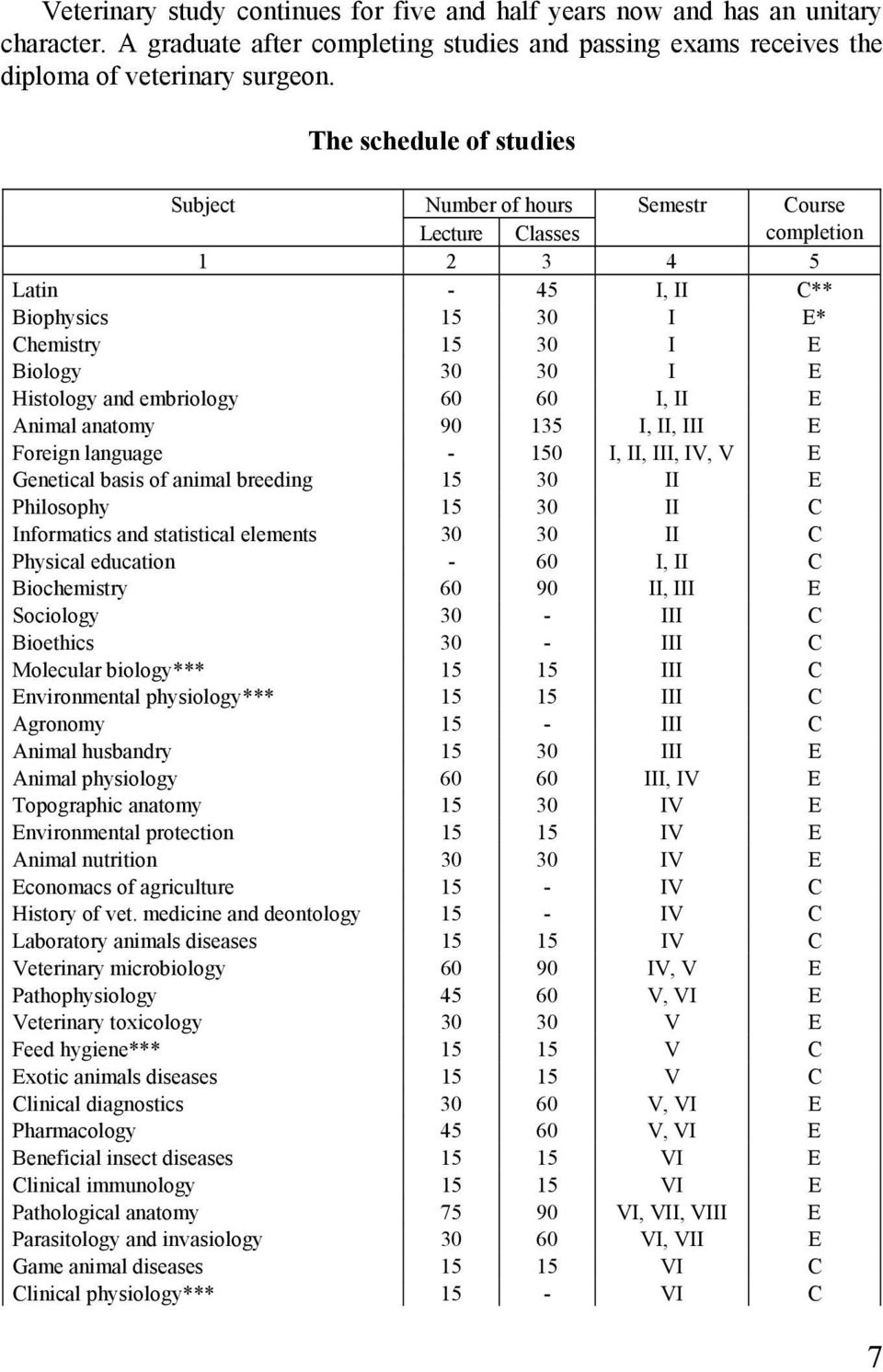
7 Veterinary study continues for five and half years now and has an unitary character. A graduate after completing studies and passing exams receives the diploma of veterinary surgeon. The schedule of studies Subject Number of hours Semestr Course Lecture Classes completion Latin - 45 I, II C** Biophysics I E* Chemistry I E Biology I E Histology and embriology I, II E Animal anatomy I, II, III E Foreign language I, II, III, IV, V E Genetical basis of animal breeding II E Philosophy II C Informatics and statistical elements II C Physical education - 60 I, II C Biochemistry II, III E Sociology 30 - III C Bioethics 30 - III C Molecular biology*** III C Environmental physiology*** III C Agronomy 15 - III C Animal husbandry III E Animal physiology III, IV E Topographic anatomy IV E Environmental protection IV E Animal nutrition IV E Economacs of agriculture 15 - IV C History of vet. medicine and deontology 15 - IV C Laboratory animals diseases IV C Veterinary microbiology IV, V E Pathophysiology V, VI E Veterinary toxicology V E Feed hygiene*** V C Exotic animals diseases V C Clinical diagnostics V, VI E Pharmacology V, VI E Beneficial insect diseases VI E Clinical immunology VI E Pathological anatomy VI, VII, VIII E Parasitology and invasiology VI, VII E Game animal diseases VI C Clinical physiology*** 15 - VI C 7
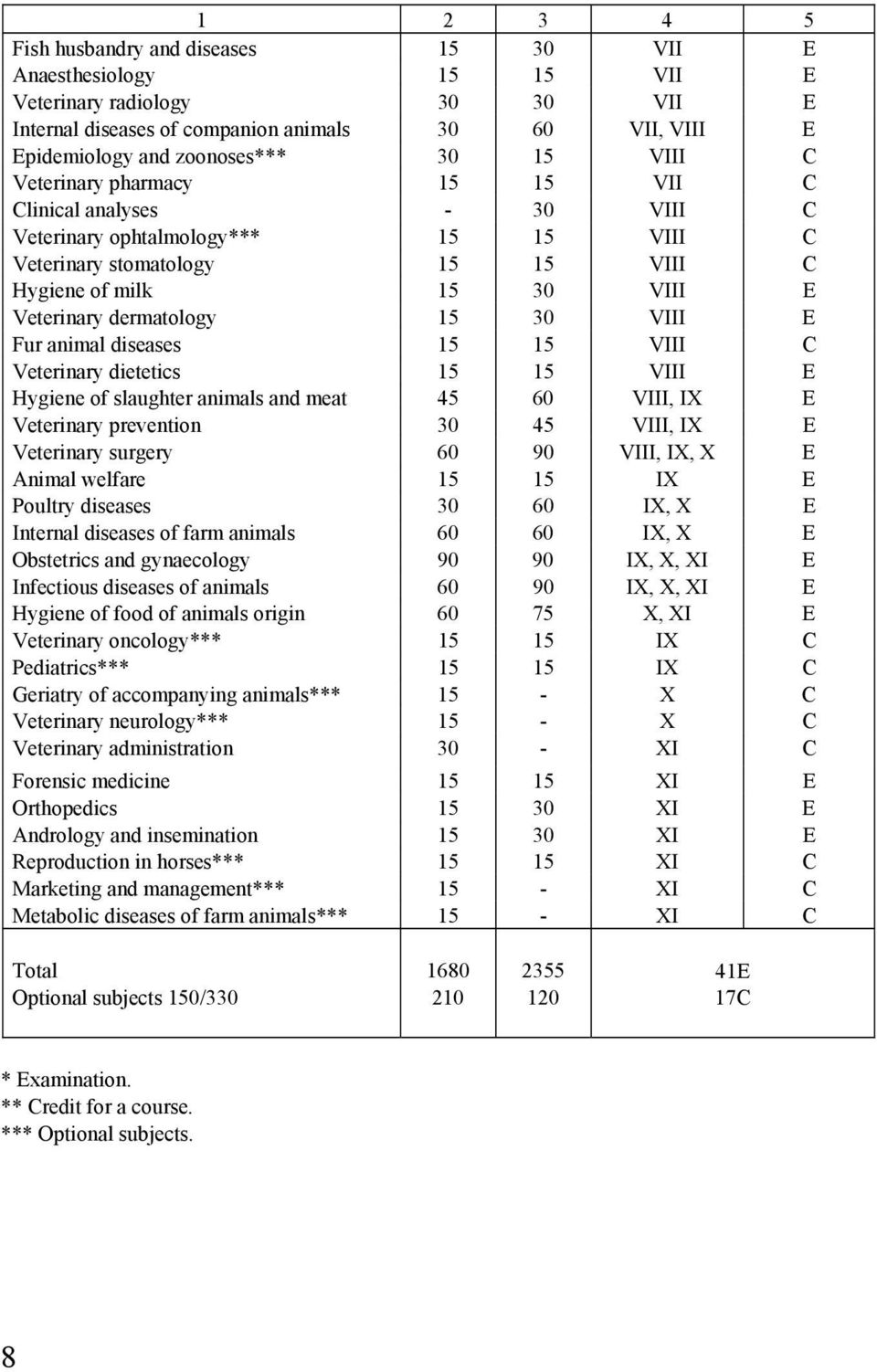
8 Fish husbandry and diseases VII E Anaesthesiology VII E Veterinary radiology VII E Internal diseases of companion animals VII, VIII E Epidemiology and zoonoses*** VIII C Veterinary pharmacy VII C Clinical analyses - 30 VIII C Veterinary ophtalmology*** VIII C Veterinary stomatology VIII C Hygiene of milk VIII E Veterinary dermatology VIII E Fur animal diseases VIII C Veterinary dietetics VIII E Hygiene of slaughter animals and meat VIII, IX E Veterinary prevention VIII, IX E Veterinary surgery VIII, IX, X E Animal welfare IX E Poultry diseases IX, X E Internal diseases of farm animals IX, X E Obstetrics and gynaecology IX, X, XI E Infectious diseases of animals IX, X, XI E Hygiene of food of animals origin X, XI E Veterinary oncology*** IX C Pediatrics*** IX C Geriatry of accompanying animals*** 15 - X C Veterinary neurology*** 15 - X C Veterinary administration 30 - XI C Forensic medicine XI E Orthopedics XI E Andrology and insemination XI E Reproduction in horses*** XI C Marketing and management*** 15 - XI C Metabolic diseases of farm animals*** 15 - XI C Total Optional subjects 150/ E 17C * Examination. ** Credit for a course. *** Optional subjects. 8
9 Clinical practices Epizootiology Veterinary surgery Internal diseases of farm animals Internal diseases of man-accompanying animals Poultry diseases Obstetrics and animals reproduction Parasitology and veterinary invasiology Veterinary radiology Dermatology Total 60 hours 45 hours 30 hours 30 hours 30 hours 60 hours 15 hours 15 hours 30 hours 315 hours Altogether didactic hours General specific and professional subject Optional subject Clinical practices Total 3885 hours 150 hours 315 hours 4350 hours Professional trainings After the 4th year clinical practice 4 weeks practice slaughter-house 2 weeks After the 5th year clinical practice 4 weeks sanitary practice 2 weeks 9

10 RESEARCH ACTIVITY OF VETERINARY MEDICINE FACULTY (Published in 2009) 10
11 INSTITUTE OF BIOLOGICAL RUDIMENTS OF ANIMAL DISEASES 30 Głęboka, Lublin Head: Prof. ordin. Dr. habil. Jerzy Rzedzicki SUB-DEPARTMENT OF FISH DISEASES AND BIOLOGY Akademicka 12, Lublin Head: Prof. extraordin. Dr. habil. Antonina Sopińska RESEARCH STUDIES (SUMMARIES) Leszek Guz, Antonina Sopińska EFFECT OF β(1, 3)-D-GLUCAN AND LPS ON THE PROTECTIVE IMMUNITY OF CARP AGAINST Aeromonas hydrophila Wpływ β(1, 3)-D-glukanu i lipopolisacharydu na odporność karpi (Cyprinus carpio) przeciwko Aeromonas hydrophila The effects of β-glucan, lipopolisaccharide (LPS) and cells of pathogenic Aeromonas hydrophila were studied on survival in carp, Cyprinus carpio that were challenged with the pathogen A. hydrophila. Beta-glucan from barley, LPS from Serratia marcescens and virulent for carp A. hydrophila were used in this study. Immunostimulants were injected intramuscularly in the dorsolateral region of fish. Fish were incorporated into the groups as follows: fish from group I (β-glucan, 50 mg kg -1 i.m.), fish from group II (LPS, 50 mg kg -1 i.m.), fish from group III (LPS, 50 mg kg -1 i.m. and β-glucan, 50 mg kg -1 i.m.), fish from group IV (killed cells of A. hydrophila, 0,1 ml), fish from group V control (0,1 ml PBS i.m.). Control and test fish were challenged by intraperitoneal injection of 11
12 A. hydrophila on days 7, 14 and 21. The mortality ratek were recorded for 7 days and relative percent survival (RPS) were calculated. The RPS in group I was 83, 66 and 44%; in group II was 42, 55 and 63%; in group III was 50, 55 and 97%; in group IV was 33, 40 and 56% in the challenge test on 7, 14 and 21 days, respectively. It may be concluded that intramuscular injection of β-glucan and LPS mixture in carp could enhance resistance to challenge by A. hydrophila. Publication: Medycyna Wet. (Lublin) 65, , 2009, fig. 2. In Polish, summary in English. Leszek Guz, Klaudiusz Szczepaniak INTESTINAL AMOEBIASIS IN HECKEL DISCUS Symphysodon discus A CASE REPORT This case is reported with the intention of highlighting the presentation of primary intestinal amoebic disease in Heckel discus Symphysodon discus. The morphology of the parasites and the pathological changes seen using light microscopy were essential. In fresh samples of intestinal content numerous amoeba-like cells were detected. The trophosoite measures m while the cyst is (average m). To the best of our knowledge, this is a new manifestation of amoebiasis in aquarium fish. Publication: Bull. Eur. Assoc. Fish Pathol. 29, 28 33, 2009, fig. 4. In English, summary in English. 12
13 SUB-DEPARTMENT OF PARASITOLOGY AND INVASIVE DISEASES Akademicka 12, Lublin Head: Prof. Dr. habil. Andrzej Bernard Sadzikowski RESEARCH STUDIES (SUMMARIES) Stephane Bonneau, Laurence Maynard, Krzysztof Tomczuk, Dawid Kok, Hyone-Myong Eun ANTHELMINTIC EFFICACIES OF A TABLET FORMULA OF IVERMECTIN-PRAZIQUANTEL ON HORSES EXPERIMENTALLY INFECTED WITH THREE Strongylus SPECIES In this blinded randomized and controlled study, the anthelmintic efficacy of a tablet formula of ivermectin-praziquantel was evaluated in horses experimentally infected with three species of Strongylus larvae. Eighteen previously dewormed horses were inoculated on study day 0 with third-stage larvae of S. vulgaris, S. equinus and S. edentatus. The horses were randomly allocated into to three groups (n = 6): test-drug (tablet formula), positive-control (reference gel) and negative-control (placebo tablet). On day 56, the horses were treated once with the respective drugs. On day 95, the horses were sacrificed, and necropsy examinations were performed to assess the status of the parasite burden (L4 and immature L5) and pathological lesions on selected organs and tissues. By the criteria of worm counts, the test-drug and positive-control showed respectively 100 and 97.3% anthelmintic efficacies on S. vulgaris, 100 and 81.4% on S. equinus, and equally 100% on S. edentatus. The S. vulgaris induced arterial lesions were also reduced in the test-drug and positive-control groups with efficacies of 73.9 and 62.9%, respectively. No adverse reactions were observed with either of the drugs. Our data demonstrate that the Equimax tablet formula was as safe and efficacious as the gel formula anthelmintic on large. Publication: Parasitol. Res. 3, 105, 2009, In English, summary in English. 13

14 Andrzej Bernard Sadzikowski, Maria Bernadeta Studzińska, Krzysztof Tomczuk, Marta Demkowska Fasciola hepatica INVASION IN HORSES FROM CENTRAL AND EASTERN POLAND Inwazje Fasciola hepatica u koni z centralnej i wschodniej Polski In years , there was conducted coproscopic investigation of 1550 horses from central and eastern Poland. Flotation, decantation and sedimentation-flotation methods were used. Parasitological autopsy of 950 horses livers was done. Fasciolosis was confirmed intra vitam in one horse (0,07% examined) and in one horse post mortem (0,11%). The invasion of Fasciola hepatica occurs in Poland sporadically, however, it should be considered in differential diagnosis some diseases of horses. Publication: Medycyna Wet. (Lublin) 65, , In Polish, summary in English. Andrzej Bernard Sadzikowski, Klaudiusz Oktawian Szczepaniak INTERNAL PARASITES OF RACCOONS Pasożyty wewnętrzne szopów Internal parasites of raccoons are becoming increasingly popular as pets kept by amateur breeders and are also increasingly frequent patients of veterinarians. The population of wild-living raccoons is also growing in Poland. Raccoons are hosts to many internal parasites. An especially dangerous parasite is Bayliascaris procyonis, whose larvae cause the visceral, ocular and neural larva migrans syndromes in humans and many species of animals. Publication: Magazyn Wet. 10, , In Polish, summary in English Andrzej Bernard Sadzikowski, Krzysztof Tomczuk, Maria Bernadeta Studzińska, Anna Witkowska, Wojciech Roczniak, Adam Wasak PARASITES EGGS ON HAIR OF DOGS AND CATS Jaja pasożytów na włosach psów i kotów The purpose of this work was to defined the level of contamination dogs and cat s hair with parasites eggs. Samples of hair of 122 pet dogs and 15 cats from urban and 44 dogs from village terrains were investigated. Eggs of parasites 14
15 were examined by sedimentation-flotation method. Eggs were removed from hair with Tween 80 solution, the sedimentation were done, next sediment was dissolved in NaCl + saccharose solution and after flotation microscopic preparation was made. Eggs of parasite were found on hair of 10 (6,02%) dogs and 2 (13,33%) cats. There were found only 14 eggs: Ancylostomatidae, Ascaris spp., Taenia spp.,toxocara spp., Toxascaris leonina, Trichuris spp. Half of them belongs to Toxocara spp. Most of eggs had proper structure and in the future they can be dangerous for animals and human. Publication: Medycyna Wet. (Lublin) 65, , In Polish, summary in English. Maria Bernadeta Studzińska, Katarzyna Wojcieszak Gastrophilus spp. BOTFLY LARVAE IN HORSES FROM SOUTHERN-EASTERN PART OF POLAND In horses ageing 8 months to 16 years from individual farms from south-eastern part of Poland were examined post mortem for the presence of botfly larvae. One hundred and four horses (14.75%) demonstrated the presence of botfly larvae. An average invasion rate was 52 larvae but low rate invasions dominated (about 50% of infected horses) The larvae found belonged to Gasterophilus intestinalis and Gasterophilus nasalis.the 3rd instars dominated in infected horses, however, more than 25% of infected horses harboured both 2nd and 3rd instars. Publication: Bull. Vet. Inst. Puławy, 53, , In English, summary in English. Oktawian Klaudiusz Szczepaniak, Andrzej Bernard Sadzikowski CILIATES AMONG REPTILES Orzęski występujące u gadów Abstract one of the least known protozoan found among reptiles is the species known as Ciliates, the genus Balantidium, frequently encountered in herbivorous species of reptile. Balantidium spp. Are mostly considered as nonpathogenic, however, in certain conditions they may induce pathological symptoms. The protozoan genus Nyctotherus is considered to be a representative of the comensal flora of the digestive-tract most often found among insectivorous lizards and land tortoises. In coproscopical investigation their cyst can be 15

16 confused with fluke (thrematode) ova and pinworm (oxyurid) ova. The aim of this study was to clarify the question of ciliate invasion and the diagnosis and treatment of the illness among tortoises, lizards and snakes. Publication: Weterynaria w praktyce 7/8, 34 38, In Polish, summary in English. REPORTS TO RESEARCH MEETINGS SADZIKOWSKI A.B., KRAKOWSKI L., TOMCZUK K., WITKOWSKA A., STUDZIŃSKA M.B.: Preliminary assessment of the elimitation parasitoses roe and deer by the administration of fenbendazole in selected districts hunting. (Wstępna ocena ograniczenia parazytoz saren i jeleni przez podawanie fenbendazolu w wybranych obwodach łowieckich.) Ref.: Scientific Conference Parasitoses of wildlife animals: Awareness of increasing problem. Warszawa, IX Publication: Proceedings of the Scientific Conference Parasitoses of wildlife animals: Awareness of increasing problem. Warszawa, 17 18, In Polish SADZIKOWSKI A.B., SZCZEPANIAK K.O., WITKOWSKA A., STUDZIŃSKA M.B., TOMCZUK K., DEMKOWSKA M., MAJER-DZIEDZIC B.: The parasite fauna of harres in different breeding systems. (Parazytofauna zajęcy z różnych systemów utrzymania.) Ref.: Scientific Conference Parasitoses of wildlife animals: Awareness of increasing problem. Warszawa, IX Publication: Proceedings of the Scientific Conference Parasitoses of wildlife animals: Awareness of increasing problem. Warszawa, 19 20, In Polish. OTHER PUBLICATIONS SADZIKOWSKI A.: Pets parasite infestation source to humans. What else, beside memories, can we bring from exotic travel. (Zwierzęta źródłem inwazji pasożytów dla człowieka. Co poza wspomnieniami możemy przywieźć z egzotycznych podróży). Publication: Aktualności UP w Lublinie 50, 2, 13, In Polish. SADZIKOWSKI A.: Pets parasite infestation source to humans. Invasions human parasite larvae raccoon roundworms Baylisascarprocyonis. (Zwierzęta źródłem inwazji pasożytów dla człowieka. Inwazje u ludzi larw glist Baylisascaris procyonis pasożytów szopów.) Publication: Aktualności UP w Lublinie 51, 3,9, 2009, in Polish. SZCZEPANIAK K.O., SADZIKOWSKI A.B.: Isosporosis of bearded dragons. (Izosporoza agam brodatych.) Publication: Magazyn Wet. 10, , In Polish, summary in English. 16
17 TOMCZUK K.: Zoonotic diseases Trichinosis a dangerous parasitosis. (Choroby odzwierzęce włośnica niebezpieczna parazytoza). Publication: Gazeta Jastkowska 32, 1, 38 39, In Polish. TOMCZUK K.: Ticks parasites and carrier of dangerous diseases.(kleszcze pasożyty i przenosiciele groźnych chorób.) Publication: Gazeta Jastkowska 33, 2, 37 38, In Polish. TOMCZUK K.: Zoonoses. Rabies a myth or a real threat. (Choroby odzwierzęce. Wścieklizna mit czy realne zagrożenie). Publication: Gazeta Jastkowska 4, 3, 38 39, In Polish. TOMCZUK K.: Zoonoses. Giardia intestinalis a dangerous patogen. (Choroby odzwierzęce. Giardia intestinalis niebezpieczny patogen). Publication: Gazeta Jastkowska 35, 4, 39 40, In Polish. 17
18 SUB-DEPARTMENT OF POULTRY DISEASES Akademicka 12, Lublin Head: Prof. ordin. Dr. habil. Jerzy Rzedzicki RESEARCH STUDIES (SUMMARIES) Agnieszka Marek, Dagmara Stępień-Pyśniak, Jerzy Rzedzicki ANALYSIS OF THE CORRELATION BETWEEN A LEVEL OF ANTI-Salmonella ANTIBODIES IN EGG YOLKS AND THE PRESENCE OF THESE MICROORGANISMS IN EGG CONTENTS FOLLOWING EXPERIMENTAL INFECTION OF HENS WITH Salmonella ENTERITIDIS AND AFTER TREATMENT WITH SELECTED ANTIBIOTICS Serological tests applied in poultry flocks can be a valuable tool in assessing the health of hens. One obstacle in making this assessment is that results of serological tests in a given flock are not always correlated with the results of bacteriological tests. The aim of this study was to determine the dependencies between a level of antibodies in egg yolk and the contamination of egg contents (whites and yolks) with Salmonella Enteritidis bacilli. The infected birds were also treated with selected antibiotics. It was determined that Salmonella Enteritidis was not found in experimentally infected laying hens until day 12 postinoculation. The results of the study also imply the existence of relation between a level of anti-salmonella antibodies in egg yolks and the frequency of isolation of Salmonella from eggs. It was also found that the lowest level of yolk antibodies was determined in the group of birds treated with enrofloxacin. Publication: Pol. J. Vet. Sci. 12, , 2009, fig. 2, tab. 2. In English, summary in English. 18

19 Dagmara Stępień-Pyśniak, Agnieszka Marek, Jerzy Rzedzicki OCCURRENCE OF BACTERIA OF THE GENUS Staphylococcus IN TABLE EGGS OBTAINED FROM DIFFERENT SOURCES This paper presents a degree of contamination of table eggs with bacteria of the genus Staphylococcus, taking into account the source of the eggs. The results of the study indicate a relatively high degree of contamination of table eggs with Staphylococcus bacteria. In 1125 bacteriological tests conducted on the whites, yolks and shells of eggs from three sources, staphylococci were found in 514 cases. Thirteen strains were isolated from the whites, but Staphylococcus bacteria were determined more often in yolks 199 strains. The highest percentage of staphylococci was established on the surface of the egg shell 302 strains. Twelve species of staphylococci were isolated from the eggs tested, including both coagulase-positive strains (S. aureus, S. hyicus) and coagulase-negative strains, particularly S. lentus, S. warneri, S. epidermidis and S. xylosus. Publication: Pol. J. Vet. Sci. 12, , 2009, fig. 1, tab. 1. In English, summary in English. REPORTS TO RESEARCH MEETINGS PYZIK E., STĘPIEŃ-PYŚNIAK D.: Antibiotic resistance in staphylococci from quail egg. (Wrażliwość na antybiotyki bakterii z rodzaju Staphylococcus wyizolowanych z jaj przepiórczych). Ref.: XIth Poultry Symphosium Current problems of poultry pathology. Wrocław, 3 5 VII Publication: Proceedings of the XI Poultry Symphosium Current problems of poultry pathology, 104, In Polish. STĘPIEŃ-PYŚNIAK D., RZEDZICKI J, PYZIK E.: Bacterial microflora of pre and post-hatching period. (Mikroflora bakteryjna okresu około lęgowego). Ref.: XIth Poultry Symphosium Current problems of poultry pathology. Wrocław, 3 5 VII Publication: Proceedings of the XI Poultry Symphosium Current problems of poultry pathology, 92, In Polish. 19

20 OTHER PUBLICATIONS DUDZIC A.: The role of vitamin A deficiency and its consequences. (Rola witaminy A oraz skutki jej niedoboru). Publication: Pol. Drob. 6, 36 38, In Polish MAREK A.: The infectious diseases of birds as a potential danger human health. (Choroby zakaźne ptaków potencjalnym zagrożeniem zdrowia człowieka). Publication: Magazyn Wet. 424, In Polish, summary in English. RZEDZICKI J., STĘPIEŃ-PYŚNIAK D.: Antimicrobial defence mechanisms of chicken eggs and possibilities for their use in protecting human and animal health. Publication: Annales UMCS (Lublin) sectio DD, 64, 2, 1 8, In English. STĘPIEŃ-PYŚNIAK D.: Pigeons aspergillosis. (Aspergiloza gołębi). Publication: Weterynaria w terenie 3, 4, 43 4,2009. In Polish. STĘPIEŃ-PYŚNIAK D.: Pigeons paramyxovirosis. (Paramyksowiroza gołębi). Publication: Weterynaria w terenie 3, 3, 47 49, In Polish. 20
21 SUB-DEPARTMENT OF VETERINARY MICROBIOLOGY Akademicka 12, Lublin Head: Prof. extraordin. Dr. habil. Grażyna Ziółkowska Dr. habil. Barbara Majer-Dziedzic RESEARCH STUDIES (SUMMARIES) Barbara Majer-Dziedzic, Łukasz Jarosz, Andrzej Jakubczak, Krzysztof Kostro SPECIFIC HUMORAL RESPONSE IN SILVER FOXES AFTER IMMUNIZATION WITH VACCINES AGAINST CARNIVOROUS-ANIMAL PARVOVIRUSES The research objective was to apply the haemagglutination-inhibition test to determine the antibody level in silver fox serum. The animals were immunized with inactivated vaccines against mink viral enteritis, as well as attenuated vaccines against parvovirosis of dogs. The tests involved 35 females aged 6 7 months. It was shown that none of the vaccines had a negative influence on fox reproduction, and all the vaccines are immunogenic and may be used in the prevention of parvoviral infections in farm foxes. Publication: Bull. Vet. Inst. Pulawy 53, , 2009, fig.4. In English, summary in English. Grażyna Ziółkowska, Magdalena Budziwojska, Aneta Nowakiewicz, Przemysław Zięba INTEGUMENTARY MYCOTIC MICROBIOTA IN WILDLIFE ANIMALS Mikrobiota grzybicza powłok zewnętrznych zwierząt wolno żyjących The objective of the research was to assess the presence of mycotic microbiota on the integument of wild boars and roe-deer, as well as to isolate and identify each species. The research material comprised groin screening swabs col- 21
22 lected from 13 wild boars and 56 roe-deer from the Lublin State Forests. The fungi were identified concurrently on the Sabouraud and MLNA medium at 25, 32 and 37 C temperature for 14 days. Initial identification proceeded according to the conventional mycological procedures followed by the application of the commercial API Candida and API 20C Aux tests and the phenotypic scheme developed by Guillot et al. The present research has revealed that mycotic flora was recovered in all a total of 69 examined animals. The most frequently isolated fungi included Penicillium spp., Alternaria spp., Cladosporium spp. and Malassezia spp. and Rhodotorula spp. The species analysis of the isolated fungi has confirmed the presence of potential pathogens, such as Malassezia sympodialis, Aspergillus fumigatus and Candida non-albicans. The obtained results indicate that a population of free-living animals may constitute a critical link in the epidemiologic chain of mycotic infections. Publication: Medycyna Wet. (Lublin) 65, , 2009, tab.2, fig.2. In Polish, summary in English. 22
23 SUB-DEPARTMENT OF VETERINARY PROPHYLAXIS Akademicka 12, Lublin Head: Prof. ordin. Dr. habil. Andrzej Wernicki RESEARCH STUDIES (SUMMARIES) Dariusz Bednarek, Renata Urban-Chmiel, Katarzyna Dudek, Marta Szymańska-Czerwińska EVALUATION OF PERIPHERAL BLOOD LEUKOCYTE SUBPOPULATIONS BY FLOW CYTOMETRY IN CALVES TREATED WITH M. haemolytica leukotoxin The aim of the study was to evaluate the effect of Mannheimia haemolytica leukotoxin (Lkt) on cellular immune response in clinically-healthy calves given intravenously 25 μg per animal of M. haemolytica A1 Lkt. The alternations of peripheral blood leukocytes were examined with a flow cytometry. The Lkt treated calves were compared with the non-treated controls before (0) and 1, 2, 3, 4, 5, 6, and 24 h after the treatment. The following parameters were assayed: white blood cell (WBC) count, percentage of polymorphonuclear leukocytes (PMNL), mid-size leukocytes, total percentage of lymphocytes and their subsets: CD2 + (T lymphocytes), CD4 + (T helper lymphocytes), and CD8 + (T suppressor/cytotoxic lymphocytes) with CD4 + : CD8 + ratio, and also WC4 + cells (B lymphocytes). The obtained results showed that in the treated calves, the WBC count, the percentage of PMNL, mid-size leukocytes, and some subpopulations of peripheral lymphocytes (CD2 +, CD4 +, CD8 + ) were significantly lower compared with the controls during the first of three hours of the experiment followed by the parameters increase and return to the physiological level. Publication: Bull. Vet. Inst. Puławy, 53, , 2009, fig.1, tab.2. In English, summary in English. 23
24 Renata Urban-Chmiel, Marta Kankofer, Andrzej Wernicki, Edyta Albera, Andrzej Puchalski THE INFLUENCE OF SUPPLEMENTATION OF ΑLFA-TOCOPHEROL AND ASCORBIC ACID ON CHOSEN OXIDATIVE STRESS PARAMETERS IN BOVINE LEUKOCYTES The objective of the study was to assess in vitro the influence of various doses of two different antioxidants, -tocopherol and ascorbic acid, on protective mechanisms against ROS in white blood cells obtained from calves exposed to transport, and to compare these results with those obtained from nontransported animals. The concentrations of lipid peroxidation products in leukocytes and in the retained medium were assessed by determining the level of ThioBarbituric Acid Reactive Substances (TBARS). Total antioxidant status in the leukocytes and the medium were estimated using a ferric-reducing ability of plasma (FRAP) assay. Leukocyte viability was determined using the trypan blue reduction test. The study demonstrated that after bovine leukocytes (WBC) were incubated in vitro with -tocopherol and ascorbic acid, peroxidation intensity decreased and total antioxidant capacity increased. The results of the study have revealed that these antioxidants in concentrations over 0.1 mg/ml have a major impact on free radical activity on bovine white blood cells and on cell viability during transport of animals. The present indicates that incubation of the leukocytes with antioxidants decreases the oxidative stress development, which can be helpful in protection of the immunological cells during bovine respiratory disease. Publication: Livestock Sci. 124, 89 92, 2009, fig.2, tab. 2. In English, summary in English. Renata Urban-Chmiel, Andrzej Puchalski, Andrzej Wernicki, Marta Dec, Edyta Paluch CHARACTERIZATION OF HSP70 PROTEINS IN BOVINE LEUKOCYTES INDUCED BY THE TEMPERATURE 41 O C Heat shock proteins (Hsp) are the group of proteins observed in both prokaryotic and eukaryotic cell types. Hsp synthesis takes place in response to many environmental conditions, including ultraviolet radiation, heavy metal ions, hypoxia and toxic agents. Many authors have suggested that Hsp can be used in immunoprophylaxis, yet Hsp70 proteins expressed in bovine leukocytes have 24
25 not been fully characterized. Hence the aim of this study was to evaluate the expression of Hsp70 proteins in bovine leukocytes exposed to temperature 41 o C. The material for the study consisted of bovine white blood cells incubated at 41 o C for 2 hours. SDS-Page electrophoresis, Western blotting, and twodimensional electrophoresis (2D) were performed to estimate the proteins obtained. The results of the study confirmed the influence of the temperature of 41 degrees C on induction of Hsp70 in bovine leukocytes. These proteins were mainly localized within molecular mass 70 kda. Some of the proteins with molecular mass from 20 to 50 kda also showed positive reactions in Western blotting with anti-hsp70 antibodies. Analysis of 2D electrophoresis revealed a change in the localization of these proteins in the ph gradient. It can be assumed that analysis of Hsp70 expression in bovine leukocytes can be a very helpful marker for evaluating organism's adaptation to environmental heat stress. The proteins obtained also showed immunological reactivity with rabbit antibodies in Western blotting reactions, indicating their usability as protective factors in the pathogenesis of many diseases. Publication: Polish J. Vet. Sci. 12, , 2009, fig.3. In English, summary in English. Renata Urban-Chmiel, Andrzej Wernicki, Andrzej Puchalski, Marta Dec THE EFFECT OF ALFA-TOCOPHEROL AND ASCORBIC ACID SUPPLEMENTATION ON SELECTED IMMUNOLOGICAL PARAMETERS IN BOVINE LEUKOCYTES IN VITRO The aim of the present study was to evaluate the effect of two different antioxidants, α-tocopherol and ascorbic acid, on the chemotactic activity and susceptibility to Mannheimia haemolytica leukotoxin (Lkt) of white blood cells obtained from calves exposed to transport in vitro. Both antioxidants used were found to affect the chemotactic activity of white blood cells. Supplementation of α-tocopherol at concentration of 0.2 and 0.5 mg/ml induced significant (P < 0.05) increase of chemotactic activity in white blood cells compared to control. In the case of ascorbic acid supplementation, the highest chemotactic activity was observed at concentration of 0.5 mg/ml. The results obtained in microtitration (MTT) assay also suggest that high concentrations of α-tocopherol (0.5 mg/ml) play a role in protecting bovine leukocytes against the cytotoxic effect of Lkt, the susceptibility of the leukocytes to M. haemolytica Lkt was lower in comparison to control about 6%. The antioxidants used in this study have been found to have a protective effect on 25
26 cells participating in the immune response to M. haemolytica. This particularly applies to high concentrations of α-tocopherol. The clinical aspect of these results may lie in protection of leukocytes exposed to leukotoxin of M. haemolytica. It should be emphasized that the results provide only partial information on the effect of the antioxidants studied on cells participating in organism s defence mechanisms. In order to work out evaluation that would enable proper prevention of bovine respiratory diseases, research should be continued and expanded to include analysis of cellular structures. Publication: Acta Vet. Brno 78, , 2009, fig.2, tab.1. In English, summary in English. REPORTS TO RESEARCH MEETINGS URBAN-CHMIEL R.: Transport stress and increase of susceptibility of calves on respiratory syndrome caused by M. haemolytica serotype 1. Ref. XIX Annual PHI ZETA Research Day, Michigan State University, College of Veterinary Medicine, USA 2 X Publication: Proceedings of the XIX Annual PHI ZETA Research Day, Michigan State University, College of Veterinary Medicine, USA, 49, In English. URBAN-CHMIEL R., GROOMS D.: Prevention and Control of Bovine Respiratory Disease Complex in the United States. (Zapobieganie i zwalczanie zespołu oddechowego w Stanach Zjednoczonych). Ref. IV Conference about Newborn and environment, Wrocław XII Publication: Proceedengs of the IV Conference Newborn and environment part.4, , In Polish. 26
27 DEPARTMENT OF ANATOMY AND ANIMAL HISTOLOGY Akademicka 12, Lublin Head: Prof. Dr. habil. Zbigniew Boratyński SUB-DEPARTMENT OF ANIMAL ANATOMY Akademicka 12, Lublin Head: Prof. Dr. habil. Zbigniew Boratyński Dr. habil. Marcin Arciszewski Dr. habil. Izabela Krakowska RESEARCH STUDIES (SUMMARIES) Grzegorz Lonc, Izabela Krakowska STRUCTURES AND TOPOGRAPHY OF THE AMYGDALA OF THE FEMALE CHINCHILLA Struktura i topografia jąder ciała migdałowatego u samic szynszyli The aim of this study was to describe the structures and topography of the nuclei of the amygdaloid complex in chinchillas. The material for the study consisted of five chinchilla brains. The brains were fixed in formalin, dehydrated in ethyl alcohol and embedded in paraffin blocks. Next, the blocks were cut in the transversal plane into 12 µm-thick slices. The slices were coloured according to Klüver and Barrer's method and examined under a light microscope (OLYMPUS BX 40) equipped with the camera Color View IIIu Soft Imaging System. For the morphometric measurements, the program Cell^D Soft Imaging System (SIS) was used. One can distinguish three parts of the amygdala: corticomedial amygdaloid complex (CMC), basolateral complex (BLC) and other amygdaloid areas 27
28 (OA). The BLC is divided into three nuclei: lateral amygdaloid nucleus (LA), basolateral amygdaloid nucleus (BL) and basomedial amygdaloid nucleus (BM). The chinchilla's lateral amygdale (LA) is well developed and situated above the BL; laterally, it is bordered by the external capsule; the caudal pole of this nucleus constitutes at the same time the caudal pole of the amygdaloid complex. The basolateral amygdaloid nucleus in chinchillas is situated between the LA and BM. The basomedial amygdaloid nucleus is located ventromedially to the BM and dorsally to the cortical nucleus (CO). The corticomedial amygdaloid complex consists of the following: cortical nucleus (CO), medial nucleus (Me), central nucleus (CE), amygdalohippocampal area (AHA), the nucleus of the lateral olfactory tract (NLOT) and bed nucleus of the olfactory tract (BOAT). The nucleus of the lateral olfactory tract in chinchillas begins at the rostral part of the amygdala. It is bordered medially and dorsally by the anterior amygdaloid area (AAA) and laterally by the anterior part of the cortical nucleus. The chinchilla's bed nucleus of the olfactory tract is situated behind the NLOT. Dorsally, it borders on the ME, laterally on the CO. The central nucleus constitutes the dorsomedial part of the amygdala. The amygdalohippocampal area in chinchillas is located in the caudal part of the amygdala between the inferior horn of the lateral ventricle and CO. The chinchilla's cortical nucleus is a long band of neurons which constitutes the ventral part of the amygdala. The other amygdaloid areas include the anterior amygdaloid area (AAA) and intercalated nucleus (I) The intercalated nucleus consists of the group of neurons between the amygdala nuclei. The AAA constitutes the anterior pole of the chinchilla's amygdala. Publication: Medycyna Wet.(Lublin), 65, , In Polish, summary in English. Małgorzata Matysek THE DEVELOPMENT OF PIG'S CLAUSTRUM MORPHOMETRIC ANALYSIS Przedmurze świni domowej analiza morfometryczna The aim of this study was to trace the development and maturation process of pig claustrum. The research was conducted on the pig brains aged 10, 11, 13 and 16 weeks of fetal life as well as on newborn brains aged 1 and 9 days. The observation was done with use of morphometric analysis. The slide coloured with cresil violet according to Klüver-Barrera method was used. For morphometric analysis, 5 heads from each investigated periods, have been used. In total, 30 brains from 6 maturation periods were examined. 5 slides from each individual were used. In the selected fields the average quantity of neurons on mm 2 and the 28
29 average size area of neuron in µm 2 were stated. Based on the morphometrc analysis the significant growth of the average size area of the neurons depending on the age of the examined individual, has been observed, as well as the significant decrease in the number of neurons in the following maturation periods. Publication: Medycyna Wet. (Lublin) 65, , In Polish, summary in English. REPORTS TO REASERCH MEETINGS MATYSEK M., SZALAK R., JAWORSKA-ADAMU J.: Morphometric analysis of claustrum in chinchilla. Ref.: XLIII Symposium of the Polish Society for Histochemistry and Cytochemistry. Bydgoszcz, IX Publication: Med. Biol. Sci. 22, suppl. 2, 54, In English. SZALAK R., JAWORSKA-ADAMU J.: Immunoreactivity of selected calcium-binding proteins in the dorsal raphe nucleus of chinchilla. Ref.: XLIII Symposium of the Polish Histochemical and Cytochemical Society. Bydgoszcz, IX Publication: Med. Biol. Sci. 22, suppl.2, 58 59, In English. 29
30 SUB-DEPARTMENT OF HISTOLOGY AND EMBRYOLOGY Akademicka 12, Lublin Head: Prof. Dr. habil. Jadwiga Jaworska-Adamu RESEARCH STUDIES (SUMMARIES) Jadwiga Jaworska-Adamu, Radosław Szalak PARVALBUMIN AND CALBINDIN D28K IN THE DORSAL RAPHE NUCLEUS OF CHINCHILLA The expression of parvalbumin and calbindin D28k in the dorsalis raphe nucleus (DRN) of the chinchilla is yet to be studied. Therefore, the aim of this study was to track the immunoreactivity of these two calcium ion concentrations buffering proteins in neurons of the DRN of the adult male chinchilla. The reaction of peroxidase-antiperoxidase (PAP) using specific antibodies against parvalbumin and calbindin D28k was carried out. In most neurons, with the exception of small oval and medium-sized, stellate neurons, weak immunostaining of parvalbumin was observed. On the contrary, very intense immuno-staining for calbindin D28k was shown in almost all neurons of the examined area. The results indicate a slightly different distribution in the nucleus dorsalis raphe of the adult male chinchilla than in the rat. This shows that mainly calbindin D28k is included in the regulation of intracellular calcium ion concentration in the nucleus dorsalis raphe of chinchilla. Publication: Bull. Vet. Inst. Pulawy 53, , 2009, fig. 3. In English, summary in English. 30
31 Jadwiga Jaworska-Adamu, Radosław Szalak, Małgorzata Matysek, Renata Szewerniak IMMUNOREACTIVITY OF CALRETININ IN THE PERIAQUEDUCTAL GRAY MATTER OF THE MIDBRAIN OF THE CHINCHILLA Immunoreatywność kalretyniny w istocie szarej środkowej śródmózgowia u szynszyli The purpose of this study was to trace the immunoreactivity of the calcium binding protein calretinin in the periaqueductal gray matter of the midbrain of chinchilla. Immunoreactivity of this protein in this species has never been investigated up till now. For this study midbrains of five sexually mature male chinchilla were used.the localization of their activity was examined by carrying out peroxidase-antiperoxidase (PAP) reaction using mouse specific monoclonal antibody against calretinin. In all neurons in the dorsal and dorso-lateral periaqueductal gray matter, intensive immunostaining for calretitin was observed. The results of the studies obtained suggest similarity in distribution of calretitin as seen in the neurons of periaqueductal gray matter of the rat. This indicates that calretinin is involved in the regulation of intracellular calcium ion concentration. Thus it can influence the proper functions of the neurons of the periaqueductal gray matter of the midbrain of the chinchilla. Publication: Medycyna Wet.(Lublin) 65, , 2009, fig. 3. In Polish, summary in English. Jadwiga Jaworska-Adamu, Radosław Szalak, Renata Szewerniak LOCALIZATION OF PARVALBUMIN AND CALBINDIN D28K IN THE PERIAQUEDUCTAL GRAY MATTER (PAG) OF CHINCHILLA The purpose of this study was to trace the immunoreactivity of the two calcium binding proteins: parvalbumin and calbindin D28k in the periaqueductal gray matter of the chinchilla midbrain. Immunoreactivity of these proteins in this species has never been investigated. The localization of their activity was examined by carrying out the peroxidase-antiperoxidase (PAP) reaction using specific antibodies against parvalbumin and calbindin D28k. A slightly different parvalbumin immunoreactivity was shown. In most neurons, with the exception of large neurons in the dorsal and dorso-lateral periaqueductal gray matter, weak immunostaining for parvalbumin was observed. Extremely intense immunostaining for calbindin D28k occurred in all neurons in the examined area. The results obtained suggest a slightly different distribution of parvalbumin in neurons of 31
32 the periaqueductal gray matter of the midbrain of chinchilla than in other animal species. This indicates that mainly calbindin D28k is involved in the regulation of intracellular calcium ion concentration in the periaqueductal gray matter of chinchilla. Publication: Bull. Vet. Inst. Pulawy 53, , 2009, fig. 6. In English, summary in English. REPORTS TO RESEARCH MEETINGS CYBULSKA R., JAWORSKA-ADAMU J., DMOWSKA M., PAWLIKOWSKA-PAWLĘGA B., SCHOENBORN R., GAWRON A. : Electron microscopic analysis of LPS-precondictioning hippocampal neuroprotection in epileptic rats. Ref.: XVIIIth Symposium of the Polish Network of Molecular and Cellular Biology, Molecular and physiological aspects of regulatory processes of the organism. Cracow, IX Publication: Materials of XVIIIth Symposium of the Polish Network of Molecular and Cellular Biology, 73 75, In English. JAWORSKA-ADAMU J., SZALAK.R.: Calcium binding proteins in the periaqueductal gray matter of the midbrain of the chinchilla. Ref. XLIII Symposium of the Polish Histochemical and Cytochemical Society. Bydgoszcz, IX Publication: Med Biol. Sci. 23, suppl. 2, 47 48, In English. 32
33 DEPARTMENT OF BIOCHEMISTRY AND ANIMAL PHYSIOLOGY Akademicka 12, Lublin Head: Prof. extraordin. Dr. habil. Marta Kankofer SUB-DEPARTMENT OF ANIMAL PHYSIOLOGY Akademicka 12, Lublin Head: Dr. habil. Iwona Puzio Dr. habil. Jose Luis Valverde Piedra Dr. habil. Marcin Tatara RESEARCH STUDIES (SUMMARIES) Janine Donaldson, Olexandr Fed kiv, Marta Pawłowska, Sylwester Kowalik, Kennedy Erlwanger, Björn Weström, Danuta Kruszewska, Stefan Grzegorz Pierzynowski THE EFFECTIVENESS OF ENZYMATIC REPLACEMENT THERAPY MEASURED BY TURBIDIMETRY AND THE LIPEMIC INDEX IN EXOCRINE PANCREATIC INSUFFICIENT YOUNG, GROWING PIGS, FED A HIGH-FAT DIET Conventionally, the management of exocrine pancreatic insufficiency (EPI) involves introduction of a specific diet as well as the replacement of pancreatic enzymes. Its effectiveness is usually measured by a classical method of blood analyses of non-esterified fatty acids (NEFA) and triglycerides (TG).The effect of dietary supplementation with a pancreatic enzyme preparation (PEP) in conjunction with a high-fat diet, on growth performance, digestibility and absorption (analysed using turbidimetry) of dietary fat in pigs with EPI was investigated. 33
34 EPI was developed by surgical ligation of the pancreatic duct of six male pigs, 6 weeks of age. The pigs were fed a high fat diet (twice daily). A PEP containing 1800 mg entero-coated pancreatin was included in the high fat meals.the blood, urine and faecal samples were collected. The urine and faeces were analysed for dry matter, crude protein and fat content. The lipaemic index and plasma lipid profiles were assessed. EPI completely stopped growth of the pigs. Treatment with PEP significantly increased (P < 0.05) growth and body mass as well as digestibility of dry matter and crude protein. PEP significantly improved the co-efficient of fat absorption, the lipaemic index (measured by turbidimetry methods) and caused significant changes in plasma nonesterified fatty acids and triglyceride concentrations. The short term enzymatic replacement therapy together with a high fat meal has immediate beneficial effects on diet digestibility and growth retardation observed in EPI pigs. The turbidimetry method used to measure lipaemic index is a reliable, quick and efficient technique in measuring plasma lipid profiles and thus a good tool for assessing fat absorption. Publication: Adv. Med. Sci. (Białystok) 54, 7 13, 2009, fig. 10, tab. 1. In English, summary in English Piotr Paluszkiewicz, Wojciech Zgrajka, Tomasz Saran, Janusz Schabowski, Jose Luis Valverde Piedra, Olexandr Fed kiv, Sofia Rengman, Stefan Grzegorz Pierzynowski, Waldemar Andrzej Turski HIGH CONCENTRATION OF KYNURENIC ACID IN BILE AND PANCREATIC JUICE Kynurenic acid (KYNA) is an agonist of the Gprotein-coupled receptor GPR35, which is predominantly expressed in gastrointestinal tissues. The aim of this study was to determine the content of KYNA in gastric juice, bile and pancreatic juice and intestinal content. KYNA was determined by means of high performance liquid chromatography. The mean concentrations of KYNA in human gastric juice is 9.91 ±0.71 nm in contrast to human bile (832.5 ±204.1 and ±35.2 nm) obtained from patients with cholecystolithiasis and obstructive jaundice, respectively. In pigs, the KYNA levels in bile and pancreatic juice are 1,113.3 ±63.34 and ±394.4 nm, respectively. The KYNA concentration increases along the digestive system, reaching 1,638 nm in the colon content. We suggest that the liver and pancreas affect the content of kynurenic acid in the lumen of the digestive tract. Publication: Amino Acids, 37, , 2009, fig. 3. In English, summary in English. 34
35 Radosław Piotr Radzki, Marek Bieńko, Rafał Stefan Filip Edyta Albera, Marta Kankofer EFFECT OF STRONTIUM RANELATE ON FEMUR DENSITOMETRY AND ANTIOXIDATIVE/OXIDATIVE STATUS IN CASTRATED MALE RATS The studies were aimed at determining of the effect of strontium ranelate (SR) on the mineralization processes and selected parameters of oxidative stress in orchidectomized rats during the development of osteopenia. Male Wistar rats were sham-operated (SHO) and orchidectomized (ORX). ORX animals were divided into control (ORX-C) and gavaged with SR (ORX-SR), at a dose of 900mg/kg/b.w. After 60 days the animals were scanned for determination of bone mineral density (BMD) of the whole skeleton. Isolated femora were examined by DEXA and pqct. Tomographic measurements were performed for a total slice and separately for the cortical and trabecular parts of the distal end of the femora. The intensity of lipid peroxidation (ILP) and total antioxidant capacity (TAC) in blood serum were measured. SR treatment increased vbmd and BMC of total, trabecular and cortical bone in ORX rats compared to ORX-C and SHO rats. ORX significantly increased TAC in control animals, and SR limited this increase. ILP in SHO and ORX-C rats which on a similar level. SR increased ILP by 21.3%, as compared to SHO. SR improved densitometric and geometric parameters of femora by orchidectomized rats what prevented degradation of bone tissue. Beneficial effects of SR were also demonstrated in stabilization of TAC in ORX rats at the level noted in SHO rats. Publication: Scand. J. Lab. Anim. Sci. 36, , tab. 3. In English, summary in English. Radosław Piotr Radzki, Marek Bieńko, Stefan Grzegorz Pierzynowski THE EFFECT OF DIETARY ALPHA-KETOGLUTARATE ON THE BLOOD LIPID PROFILE DURING HYPERCHOLESTEROLEMIA IN RATS The aim of the study was to determine the effect of α-ketoglutarate on the blood lipid profile using a rat animal model with experimentally induced hypercholesterolaemia. Material and methods. The female and male (30/30) Wistar rats had ad libitum access to a diet containing cholesterol (1%) and lard (10%) throughout the entire experimental period (120 days). On day 60 of the study, both the females and the males were divided into three groups, the first receiving a mixture of drinking water adjusted to ph 4.6 using HCl (control), the other two (experimental groups) receiving a solution containing 0.01 M and 0.1 M 35
36 α-ketoglutarate (AKG) (ph adjusted to 4.6). Blood samples were taken on days 0, 30, 60 and 120. The concentrations of total cholesterol, triglycerides, HDL and LDL, respectively, in the blood serum were estimated spectrophotometrically. During the entire experimental period the total cholesterol, triglycerides and LDL levels of the control rats increased, whereas that of HDL decreased. The serum concentrations of total cholesterol, LDL and triglycerides in both the experimental groups receiving AKG decreased (days 60 to 120) (pv 0.05), while the HDL concentration tended to increase. The body gain in all groups receiving AKG was significantly lower than in the control group. These observations clearly prove that oral treatment with AKG can decrease the risk of hypercholesterolaemia development and lower the body weight. The relative concentrations of the plasma LDL and HDL changed to a more favourable ratio promoting good health. Publication: Scand. J Clin. Lab. Invest. 69, , fig. 3. tab. 3. In English, summary in English. Ewa Śliwa, Piotr Dobrowolski, Marcin Tatara, Tomasz Piersiak, Andrzej Siwicki, Eugeniusz Rokita, Stefan G. Pierzynowski ALPHA-KETOGLUTARATE PROTECTS THE LIVER OF PIGLETS EXPOSED DURING PRENATAL LIFE TO CHRONIC EXCESS OF DEXAMETHASONE FROM METABOLIC AND STRUCTURAL CHANGES Glucocorticoids play a role in the origin of the features of the metabolic diseases. Alpha-ketoglutarate (AKG) is defined as glutamine homologue and derivative, conditionally an essential amino acid. In the liver, glutamine serves as a precursor for ureagenesis, gluconeogenesis and acute phase protein synthesis. The aim of the study was to determine the effect of AKG administered to piglets prenatally exposed to dexamethasone, on the structure of the liver and its metabolic function. Sows were administered dexamethasone (3 mg/sow/48 h) from day 70 of pregnancy to the parturition, and then after the birth, the piglets were divided into the group receiving with AKG (0.4 g/kg body weight) or physiological saline. Biochemical markers, lysozyme and ceruloplasmin serum activities, concentrations of selected free amino acids, macro- and microelements and histomorphometry of the liver tissue were determined. The total cholesterol concentrations in the sows and their newborns from the Dex groups were higher by 72 and 64%, respectively, compared with the control groups. Triacylglycerol concentration was higher by 50% in sows from the Dex group and 55% in the new-born piglets. Alpha-ketoglutarate administered to the piglets after prenatal 36
37 influence of dexamethasone lowered the total cholesterol concentration by 40%, and enhanced aspartate by 41%, serine by 76%, glutamate by 105%, glutamine by 36%, glycine by 53% and arginine by 105%, as well as methionine and cystathionine, but increased the sulphur concentration compared with the control (p < 0.01). Intracellular space D decreased after AKG administration in comparison with the piglets from Dex/Control group not treated with AKG. Postnatal administration of AKG had a protective effect on liver structure, and lowered the total cholesterol concentration in piglets prenatally exposed to dexamethasone, besides it also influenced selected macro- and microelement serum concentrations and amino acids plasma concentration. Publication: J. Anim. Physiol. Anim. Nutr. 93, , 2009, fig. 1, tab. 5. In English, summary in English. Marcin Rafał Tatara EFFECT OF ΒETA-HYDROXY-ΒETA-METHYLBUTYRATE (HMB) ADMINISTRATION ON VOLUMETRIC BONE MINERAL DENSITY, AND MORPHOMETRIC AND MECHANICAL PROPERTIES OF TIBIA IN MALE TURKEYS This study was performed to investigate the effects of β-hydroxy-βmethylbutyrate (HMB) administration on skeletal system properties in turkeys. Thirty-two males were randomly divided into two groups at the age of 35 days. The first group included control turkeys (n = 16) treated with placebo, while the second group of birds (HMB group; n = 16) was administered orally with calcium salt of HMB during the last 15 weeks of life. The turkeys were sacrificed at the age of 20 weeks and tibia was isolated for analysis of bone geometrical parameters, volumetric bone mineral density (vbmd) and mechanical properties. Furthermore, assessment of free amino acid concentrations in plasma was performed. The results showed a 6.3% increase of vbmd of tibia in response to HMB treatment (p < 0.01). Cross-sectional area, second moment of inertia, maximum elastic strength and ultimate strength of tibia were significantly increased in HMB-treated turkeys by 21.3, 49.0, 27.2 and 28.3%, respectively (p 0.01). β-hydroxy-β-methylbutyrate administration increased plasma concentrations of proline, glutamate, leucine, isoleucine, valine, alanine, aspartate, phenylalanine and cysteic acid (p < 0.05). These results indicate that long-term administration of HMB improves vbmd, and geometrical and mechanical properties of skeletal system in turkeys, and that these effects are associated with improved plasma amino acid concentrations. Publication: J. Anim. Phys. Anim. Nutr. 93, , 2009, tab. 3. In English, summary in English. 37
38 Jose Luis Valverde Piedra, Sylwia Edyta Szymańczyk, Małgorzata Kapica, Iwona Puzio, Marta Pawłowska, Paweł Michałowski COMBINED EFFECT OF BUTYRATE AND Yucca Schidigera EXTRACT ON THE GASTROINTESTINAL TRACT OF PIGS AROUND WEANING After the banning of antibiotics as growth promoters, animal production in the EU faced the problem of increased post-weaning disorders, and several solutions were proposed (acidifiers, probiotics, herb extracts, enzyme cocktails, etc.). Short chain fatty acids (SCFA) are the main end product of bacterial fermentation in the hind gut in monogastric animals and can be used as energy supply for the epithelial cells of gut mucosa. Thus the aim of the study was to test the usefulness of novel microencapsulated sodium butyrate and Yucca Schidigera extract (encourages friendly bacteria growth, reduces ammonia) preparation on pig performance and small intestine development in the critical weaning period. Microencapsulation helps to avoid stomach degradation and provides better distribution of the compounds along the small intestine. Suckling piglets, 14-day old, were divided into 2 groups, control and with butyrate addition. Control pigs received a standard feed supplemented with a microencapsulated acidifier (0.3%). Butyrate pigs received the same feed and acidifier, as controls, supplemented with butyrate/yucca preparation (0.3%). At days 28 (weaning), 35 and 56 of life, 6 pigs from each group were killed and the gastrointestinal tract was harvested and measured. The initial body weight (14 d) of pigs from the control group was higher than that of the experimental, but at day 56 it did not differ significantly (P = 0.48). The relative stomach and pancreas weights in the experimental group showed a tendency toward higher values in all time points, and the small intestine relative weight in day 35 was higher as compared to the controls. The growth rate of the pigs at day 35 decreased significantly in the control (P = 0.007), but did not in the experimental (P = 0.058) group compared to day 31. Measurements of the small intestine sections revealed increased mucosa thickness in butyrate treated pigs. This was due to both villi and crypt enlargement. In conclusion, our results demonstrated the effectiveness sodium butyrate and Yucca Shidigera extract in the prevention of weaning problems in pigs, however further research on the novel preparation is needed. Publication: Krmiva (Zagreb) 51, 11 18, 2009, tab. 5. In English, summary in Croatian. 38
39 REPORTS TO RESEARCH MEETINGS ANTUSHEVICH H., JANKOWSKA A., KAPICA M., ZABIELSKI R.: Apelin influences proliferation of Caco-2 intestinal epithelial cells in long-time and short-term in vitro studies. Ref. VI Physiology Conference of Young Scientists Poznań, 8 9 V Publication: Proceedings of the VI Physiology Conference of Young Scientists Poznań, 32, In English. ANTUSHEVICH H., JANKOWSKA A., KAPICA M., ZABIELSKI R.: Obestatin influence proliferation Caco-2 intestinal epitelial cells in long-time and short-term in vitro studies. Ref. XVIII International Symposium of the Polish Network of Molecular and Cellular Biology Molecular Aspects of Regulatory Processes of the Organism, Kraków, IX Publication: Proceedings of the XVIII International Symposium of the Polish Network of Molecular and Cellular Biology Molecular Aspects of Regulatory Processes of the Organism, Kraków, 26 27, In English. KAPICA M., JANKOWSKA A., ANTUSHEVICH H., ZABIELSKA M., PUZIO I., ZABIELSKI R: The effect of exogenous apelin on the secretion of pancreatic juice in anaesthetized rats. Ref. XVII International Symposium on Regulatory Peptides Regpep 09, Santa Barbara, CA, USA, I Publication: Proceedings of the XVII International Symposium on Regulatory Peptides Regpep 09, Santa Barbara, CA, USA, 50, 200. In English. KAPICA M., JANKOWSKA A., PUZIO I., ANTUSHEVICH H., KATO I., KUWAHARA A., ZABIELSKI R.: Is obestatin a physiological opponent of ghrelin? Results from exocrine pancreas studies in rats. Ref. XVII International Symposium on Regulatory Peptides Regpep 09, Santa Barbara, CA, USA, I Publication: Proceedings of the XVII International Symposium on Regulatory Peptides Regpep 09, Santa Barbara, 42, In English. KAPICA M., KOROL W., PUZIO I., BIELECKA G., RUBAJ I.: The effect of dietary electrolyte balance on digestive enzymes activity in hens. Ref. XVI International Conference KRMIVA Opatija, Croatia, 1 3 VI Publication: Proceedings of the XVI International Conference KRMIVA, 18, In English. KÖHNKE R., SVENSSON L., VALVERDE PIEDRA J.L., PIERZYNOWSKI S.G., WESTRÖM B., ERLANSON-ALBERTSSON C.: Altered by thylakoids pancreatic lipase/co-lipase secretion can influence fat digestion and appetite in pigs. Ref. XI International Symposium on Digestive Physiology of Pigs. Montbrió del Camp, Costa Daurada, Spain, V Publication: Programme and Book of Abstracts, 97, In English. KRUPSKI W., TATARA M.R.: Volumetric bone mineral density (VBMD) of the trabecular and cortical bone in cervical and lumbar spine of women and men. Ref. XXXVI European Symposium on Calcified Tissues. Vien, V Publication: Bone, 44, suppl. 2, 394, In English. 39
40 KRUPSKI W., TATARA M. R., PALCZAK R., MACIEJEWSKI R.: Interrelationships between densitometric, morphometric, and mechinical properties of femur in male Polish Merino sheep. Ref. XXXVI European Symposium on Calcified Tissues. Vien, V Publication: Bone, 44, suppl. 2, 271, In English. PUZIO I., VALVERDE PIEDRA J.L., KAPICA M., BIEŃKO M., PAWŁOWSKA M., KUSIŃSKA E., SZYMAŃCZYK S.: Sodium butyrate and yucca extract supplementation influence the development of the humerus in pigs. Ref. XVI International Conference KRMIVA Opatija, Croatia, 1 3 VI Publication: Proceedings of the XVI International Conference KRMIVA, 65, In English. SKRZYPEK T., VALVERDE PIEDRA J.L., SKRZYPEK H., KAZIEMIERCZAK W., SZYMANCZYK S.E., ZABIELSKI R.: Changes in pig small intestinal mucosa surface during the first 14 days of life. Ref. XI International Symposium on Digestive Physiology of Pigs. Montbrió del Camp, Costa Daurada, Spain, V Publication: Programme and Book of Abstracts, 44, In English. SZYMAŃCZYK S.E., VALVERDE PIEDRA J.L., FILIP R., KAMYCZEK M., ŁUSZCZEWSKA I., PIERZYNOWSKI S.G.: Effect of alfa-ketoglutarate in feed administration on pig performance. Ref. XI International Symposium on Digestive Physiology of Pigs. Montbrió del Camp, Costa Daurada, Spain, V Publication: Programme and Book of Abstracts, 44, In English. SZYMAŃCZYK S.E., VALVERDE PIEDRA J.L., SKRZYPEK T., BIELAK K., SKRZYPEK H., ZABIELSKI R.: Postanatal development of the gastrointestinal system in Polish Landrace/Pietrain and Duroc/Hampshire/wild boar crossbreed piglets. Ref. XI International Symposium on Digestive Physiology of Pigs. Montbrió del Camp, Costa Daurada, Spain V Publication: Programme and Book of Abstracts, 45, In English. TATARA M.R., ŚLIWA E., KRUPSKI W., STUDZIŃSKI T.: 3-hydroksy-3-methylbutyrate (HMB) diminishes osteopenia development of humerus in pigs. Ref. XXXVI European Symposium on Calcified Tissues. Vien, V Publication: Bone, 44, suppl. 2, 436, In English. WOLIŃSKI J., SŁUPECKA M., WESTRŐM B., VALVERDE PIEDRA J., KATO I., KUWAHARA A., ROGOZIŃSKA K., PIERZYNOWSKI S.G.: Total parenteral nutrition (TPN), obestatin, leptin and ghrelin did not influence on gut closure in neonatal piglets. Ref. XI International Symposium on Digestive Physiology of Pigs. Montbrió del Camp, Costa Daurada, Spain, V Publication: Programme and Book of Abstracts, 91, In English. 40
41 SUB-DEPARTMENT OF BIOCHEMISTRY Akademicka 12, Lublin Head: Prof. extraordin. Dr. habil. Marta Kankofer RESEARCH STUDIES (SUMMARIES) Edyta Albera, Marta Kankofer ANTIOXIDANTS IN COLOSTRUM AND MILK OF SOWS AND COWS On account of the oxidative stress conditions that may appear during parturition, colostrum should provide with not only nutritional and immunological components but also antioxidative protection of newborn. There is evidence that apart from well-known antioxidative enzymes like glutathione peroxidase, superoxide dismutase, catalase or low molecular antioxidants, proteins like lactoperoxidase (LPO), lactoferrin (LF) and ceruloplasmin (CP) may exert antioxidative properties in colostrum. The aim of present study was to determine and to evaluate LPO, LF and CP activities in colostrum and milk of sows and cows. Samples were collected from 16 healthy cows five times: immediately after parturition, 12, 24 and 48 h, and 7 days postpartum as well as from 14 healthy sows five times: immediately after parturition, 6, 12, 24 and 36 h later. The examined parameters were determined spectrophotometrically at 412, 560 and 540 nm respectively. LPO activity was higher in sows in cows and increased significantly within examined time. LF ability to inhibit superoxide radical generation was higher in sows as compared to cows and increased significantly within examined time. CP oxidase activity was higher in cows than in sows and decreased significantly during experimental period. In conclusion, antioxidative defence system in colostrum shows dynamic changes that allow for necessary protection from oxidative stress conditions, which may appear after parturition. Publication: Reprod. Domest. Anim. 44, , 2009, fig. 3. In English, summary in English. 41
42 Radosław Kowalski, Jacek Wawrzykowski ESSENTIAL OILS ANALYSIS IN DRIED MATERIALS AND GRANULATES OBTAINED FROM Thymus vulgaris L., Salvia officinalis L., Mentha piperita L. and Chamomilla recutita L. The aim of the research was to evaluate the influence of herbal raw materials granulation on changes in the content and composition of essential oil. The following ground materials and granulates were subjected to analysis: Thymi Herba (Thymus vulgaris L.), Salviae Herba (Salvia officinalis L.), Menthae Piperitae Herba (Mentha piperita L.) and Chamomillae Anthodium (Chamomilla recutita L.). Studies revealed that granulation of raw materials caused an increase in the final product density. i.e. for C. recutita it increased about 4.0-fold, for S. officinalis about 3.4-fold, for T. vulgaris about 2.6-fold, and for M. piperita about 1.6-fold. Moreover, granulation negatively affected the essential oil content in the evaluated raw materials, resulting in the following losses: about 56.6% for T. vulgaris, about 73.6% for S. officinalis, about 71.3% for M. piperita and about 43.9% for C. recutita. Furthermore, significant changes in the composition of essential oils isolated from granulates were observed with reference to ground materials, e.g. the percentage of iso-menthol in oil obtained from M. piperita granulate increased from about 29 to about 40%, that of camphor in oil from S. officinalis granulate was 14% in relation to about 8%, and that of thymol in oil from T. vulgaris granulate grew from about 44% to about 67%, whereas the percentage of a-bisabolol oxide A in oil from C. recutita granulate decreased from about 34% to about 18%. Publication: Flavour Fragr. J. 24, 31 35, 2009, fig. 2, tab. 2. In English, summary in English. Radosław Kowalski, Jacek Wawrzykowski EFFECT OF ULTRASOUND-ASSISTED MACERATION ON THE QUALITY OF OIL FROM THE LEAVES OF THYME Thymus vulgaris L. This study aimed to evaluate whether preliminary ultrasound-assisted maceration (UAM) has positive effects on quantitative essential oil separation from leaves of thyme (Thymus vulgaris L.). Moreover, the present work compares the chemical, qualitative and quantitative composition of essential oils obtained from thyme through steam distillation preceded by preliminary classical maceration (CM) in water and UAM over periods of 10, 20, 60 and 120 mins. The 20 min UAM significantly affected the increase of distilled oil yield (about 9%) as compared to the control sample (not modified by macera- 42
43 tion or sonification). The longer UAM processing did not have considerable effects on the oil yield obtained from the material studied. A level of the main components received from the oil was also examined. Changes in composition of the essential oil obtained from steam distillation after preliminary maceration were within the range of requirements of the European Pharmacopoeia. After 120 min of CM and UAM, a decrease of thymol by respectively 6 and 12%, carvacrol at respectively 9 and 14%, p-cymene at respectively 14 and 17%, and an increase of g-terpinene concentration at respectively 53 and 35% was noted in the essential oil. Publication: Flavour Fragr. J. 24, 69 74, 2009, fig. 2, tab. 1. In English, summary in English. 43
44 DEPARTMENT AND CLINIC OF ANIMAL INTERNAL DISEASES Głęboka 30, Lublin Head: Prof. ordin Dr. habil. Zbigniew Pomorski Dr. habil. Krzysztof Lutnicki Dr. habil. Jacek Madany OTHER PUBLICATIONS ABRAMOWICZ B., MILCZAK A., DĘBIAK P.: Galstone diseases in the dog description case. (Kamica pęcherzyka żółciowego u psa opis przypadku). Publication: Weterynaria w praktyce 6, 63 65, In Polish, summary in English. KUBICA D., LENART A., MILCZAK A., NOWAKOWSKI H., STABIŃSKA M.: Peculiarities of ECG in horses. (Specyfika badania EKG u koni). Publication: Magazyn Wet. 12, , In Polish, summary in English. KUREK K., LUTNICKI K., MARCZUK J.: The involvement of selenium disbalance in frequent dairy cow sickness in central Lublin Region. Preliminary report. Publication: Folia Vet. suppl. II, 252, In English. LUTNICKI K., KUREK Ł., MARCZUK J., ŁUĆ A.: Health parameters in beef cattle herd on ecological farms a different approach to reference standards. Publication: Folia Vet. suppl. II, 274, In English. MADANY J.: Health failure in The Ligot of the 2008 European Society of Cardiology guidelines. The benefits for veterinary cardiology. Part 1. Definition and descriptive codes (Niewydolność serca na tle wytycznych Europejskiego Towarzystwa Kardiologicznego w roku Korzyści dla kardiologii weterynaryjnej. Cz. I. Definicja I pojęcia opisowe). Publication: Magazyn Wet. 12, , In Polish, summary in English. MADANY J.: Pain among small animals. Part I. Definition and pathophysiology of pain (Ból i małe zwierzęta. Cz.I. Definicja i patofizjologia bólu). Publication: Weterynaria w praktyce 11/12, 40 42, In Polish, summary in English. MARCZUK J., KUREK Ł., LUTNICKI K.: Botulism in dairy herd. Publication: Scientific Messenger of Lviv National University of Veterinary Medicine and Biotechnologies Named after S.Z. Gzhytskyj, 11, , In English. 44
45 MARCZUK J., LUTNICKI K.: Botulism. (Botulizm). Publication: Weterynaria w terenie 4, 26 28, In Polish, summary in English. MARCZUK K., LUTNICKI K.: Hyperlipemic syndrome. Part I. (Zespół hiperlipemiczny u koni cz. I). Publication: Weterynaria w praktyce 6, 72 74, In Polish, summary in English. MARCZUK J., LUTNICKI K., GAJĘCKI M.: Chronic fusarium-derived mycotoxins intoxication in dairy cows case study. Publication: Scientific Messenger of Lviv National University of Veterinary Medicine and Biotechnologies Named after S.Z. Gzhytskyj 11, , In English. MARCZUK J., LUTNICKI K., KUREK Ł. GAJĘCKI M.: The influence of some Fusarium mycotoxins on dairy cow s practicability and hematological parameters. Publication: Folia Vet. suppl. 2, 253, In English. MILCZAK A.: Diseasesminated intravascular coagulation syndrome diagnosis in dogs. (Zespół rozsianego krzepnięcia śródnaczyniowego. Rozpoznawanie u psów). Publication: Weterynaria w praktyce 10, 12 18, In Polish, summary in English. MILCZAK A.: Intravascular activation of the coagulation cascade in different types neoplasia in dogs. (Aktiwacja wnutrichsosudnoho zgortannja krowi w riznyh typah nowoutworen u sobak). Publication: Scientific Messenger of Lviv National University of Veterinary Medicine and Biotechnologies Named after S.Z. Gzhytsky,j 11, , In Ukrainian, summary in English. MILCZAK A., MADANY J., KLIMIUK P.: Anticoagulant rodenticide poisoning. Part. I. (Zatrucia rodentycydami antykoagulacyjnymi. Cz. I). Publication: Magazyn Wet. 14, , In Polish, summary in English. MILCZAK A. ŁAWRINIENKO I.W., ABRAMOWICZ B.: Anticoagulant rodenticide poisoning. Part. II. Diagnosing and treatment. (Zatrucia rodentycydami antykoagulacyjnymi. Cz. II). Publication: Magazyn Wet. 14, , In Polish, summary in English. MILCZAK A., MADANY J., KLIMIUK P.: Ventricular tachykardia with non-cardiac diseases in the dogs. (Częstoskurcz komorowy w przebiegu chorób niekardiologicznych u psów). Publication: Magazyn Wet. 12, , In Polish, summary in English. MOCHOL J., LUTNICKI K., KUREK Ł.: Influenze of mineral and fatty acid diet supplementation on the energy balance in mares in pregnancy and lactation periods. Publication: Bull. Vet. Inst. Pulawy 53, 53-57, In English, summary in English. SZCZEPANIK M., ADAMEK Ł. WILKOŁEK P.: Otitis externa. Diagnosis and therapy. (Zapalenie zewnętrznego przewodu słuchowego. Postępowanie diagnostyczne i terapeutyczne). Publication: Weterynaria w praktyce 6, 27 35, In Polish, summary in English. 45
46 SZCZEPANIK M., CHMIELECKA K., WILKOŁEK P.: Selected skin diseases in cattle. (Wybrane choroby skóry u bydła). Publication: Magazyn Wet. supp1.1, , In Polish, summary in English. SZCZEPANIK M., WILKOŁEK P.: Diagnosis of skin diseases. Biopsy and histopathology examination. (Diagnostyka chorób skóry. Biopsja i badanie histopatologiczne). Publication: Weterynaria w praktyce 6, 40 44, In Polish, summary in English. SZCZEPANIK M., WILKOŁEK P.: Most common dermatological problems in shar-pei. (Najczęstsze problemy dermatologiczne u psów rasy shar-pei). Publication: Magazyn Wet. 18, , In Polish, summary in English. SZCZEPANIK M., WILKOŁEK P.: Specific antimycotic immunotherapy. (Szczepionki antygrzybicze). Publication: Weterynaria w praktyce 6, 17 21, In Polish, summary in English. TASZKUN I.: Atopic dermatitis in dogs. (Atopowe zapalenie skóry u psów). Publication: Życie Wet. 84, , In Polish. TASZKUN I.: Evaluation of clinical cases of canine otitis externa own studies in year Publication: Scientific Messenger of Lviv National University of Veterinary Medicine and Biotechnologies Named after S.Z. Gzhytskyj, 11, , In English. TASZKUN I: Results from intradermal allergy tests performed in dogs with atopic dermatitis in Publication: Scientific Messenger of Lviv National University of Veterinary Medicine and Biotechnologies Named after S.Z. Gzhytskyj, 11, , In English. WILKOŁEK P., ADAMEK Ł., SZCZEPANIK M.: Oridermyl new form in complex therapy of otitis externa in dogs and cats. (Oridemyl nowa formuła w kompleksowym leczeniu zapaleń uszu psów i kotów). Publication: Magazyn Wet. 7, , In Polish, summary in English. 46
47 DEPARTMENT AND CLINIC OF ANIMAL REPRODUCTION Głęboka 30, Lublin Head: Prof. ordin Dr. habil. Władysław Wawron Prof. extraordin. Dr. habil. Zygmunt Wrona, Prof. Dr. habil. Leszek Krakowski, Dr. habil. Marek Szczubiał RESEARCH STUDIES (SUMMARIES) Roman Dąbrowski, Krzysztof Kostro, Urszula Lisiecka, Marek Szczubiał, Leszek Krakowski USEFULNESS OF C-REACTIVE PROTEIN, SERUM AMYLOID A COMPONENT AND HAPTOGLOBIN DETERMINATIONS IN BITCHES WITH PYOMETRA FOR MONITORING EARLY POST-OVARIOHYSTERECTOMY COMPLICATIONS The aim of the study was to assess changes in serum CRP, SAA and Hp concentrations in bitches with pyometra undergoing ovariohysterectomy, which developed postoperative wound infection-related complications. The study revealed that difficulties in postoperative wound healing were induced by infections with E. coli and Staphylococcus spp. leading to re-increased levels of CRP and SAA immediately after surgery and persistently high Hp levels throughout the experiment. Our results indicate that determinations of acute phase proteins in bitches undergoing surgery due to pyometra are useful markers for monitoring the postoperative period. Moreover, they enable prompt therapeutic management once complications develop. Publication: Theriogenology 72, , 2009, fig. 3, In English, summary in English. 47
48 Roland Kusy CAUSES, TREATMENT AND CONSEQUENCES OF PENILE PROLAPSE IN HORSES Przyczyny, leczenie oraz konsekwencje wypadnięcia prącia u koni The article presents clinical cases of four cold-blooded stallions aged 6 9 years with diagnosed penile prolapse. The animals were referred to the Clinic relatively late: two horses in a period of 2 3 days, third horse in the second week, and the fourth after 3 months from occurrence of prolapse. In three cases the penile prolapse was caused by mechanical trauma, in one case the cause was not established. Stallions undergoing treatment in the 2 and 3 day from occurrence of prolapse did not suffer permanent and severe injuries to the copulative organ. Retraction of penis into the preputial cavity and using modified Büchner's suture for a period of 7 days proved an efficient treatment. The procedure made it possible that the horses, after recovery, continued as reproductive stallions on breeding farms. The horses with prolonged penile prolapse were in poor condition, emaciated and exhausted, with blood biochemical parameters indicating liver failure. As a result of long-term condition one horse developed penile necrosis and suffered from strangury, whereas the second was diagnosed with penile paralysis. These two horses irretrievably lost their copulative abilities. In these clinical cases, in addition to general supportive treatment, falectomy and surgical retraction of penis to the area behind scrotum were performed in order to prevent more serious health complications. Considering the serious consequences following penile prolapse, the retraction of the prolapsed organ to the prepuce should be performed promptly to prevent irreversible lesions and to retain reproductive ability. Publication: Medycyna Wet. (Lublin), 65, , 2009, fig. 5. In Polish, summary in English. Roland Kusy, Zygmunt Wrona PROLONGED PENILE PROLAPSE IN A STALLION Długotrwałe wypadnięcie prącia u ogiera Penile prolapse can be a result of trauma, administration of phenotiazine tranquilizers, habronemiasis, large tumours, neuropathies, equine infectious anemia, purpura hemmorrhagica, spnal cord lesions and infammation (EHV-1, rabies). Penile prolapse is often associated with paraphimosis or the results of relaxation of musculus retractor penis which is caused by senility, severe general debilitation or exhaustion and starvation. Prolonged prolapse can be con- 48
49 fused with the penile paralysis or priapizm. In this article a case of seven years old stallion presented irreversible changes in the penile, which was the results of the lack of veterinary care after trauma as well as the general severe debilitation. The lesions involved the glans penis, the free part of the penis and the inner lamina of the preputial fold. Those structures could not be identified for they compoused ulcerative, granulomatous mass with the areas of fibrosis which was limited by the fibrotic preputial ring. Considering the irreviversible injury of the prolapsed penis and the inability to copulation and proper urination the patient was reffered for phalectomy. In the presented case the direct complication after penile amputation was an abscess of corpus cavernosum penis. One month after surgery in the effect of the narrowing of urethra the impeded urination was observed. Then plastic surgery of the urethra was performed. In examination performed three and six months after urethroplasty, no disturbance in urination, protruding and retraction of penile stump was noted. Taking into consideration serious consequences that may occur after the penile prolapse, one should immediately provide proper medical treatment to avoid the development of irreversible changes in the prolapsed organ and enable the retention of stallion s reproductive function. Publication: Medycyna Wet. (Lublin), 65, , 2009, fig. 4. In Polish, summary in English. Tomasz Piech, Piotr Brodzki EFFECT OF IMMUNOSTIMULATION WITH METHISOPRINOL ON THE HYGIENIC QUALITY OF COWS` RAW MILK Wpływ immunostymulacji metrizoprinolem na jakość higieniczną mleka surowego krów The present study was undertaken to examine the effects of immunostimulation with isoprinozine (Isoprivet) on the hygienic quality of milk and health status of the mammary gland. Eight HF cows with mastitis whose milk did not meet the extra- class requirements were involved. The following examinations were performed: clinical examination of the udder, macroscopic assessment of milk secretions, FCR, milk cultures, quantitative determination of microorganisms and somatic cell count. No other preparations were used during the experiment. The preliminary results show that isoprinozine has beneficial therapeutic and prophylactic effects on dairy cows already affected or at risk of mastitis. Moreover, it markedly improves the parameters of hygienic assessment of raw milk whose quality is maintained within the acceptable standards. The findings 49
50 suggest that isoprinozine may be used as a stimulator of non-specific mechanisms of immune response during lactation in cows. Publication: Medycyna Wet. (Lublin) 65, , 2009, fig. 2, tab.2. In Polish, summary in English. Marek Szczubiał, Roman Dąbrowski ACTIVITE OF ANTIOXIDATIVE ENZYMES IN UTERINE TISSUES OF BITCHES WITH PYOMETRA The aim of the present study was to determine ectivities of glutathione peroxidase GSH-Px), superoxide dismutase (SOD) and catalase (CAT) in the uterine tissues of bitches with pyometra. Eleven uteruses of bitches with pyometra and 18 uteruses of healthy bitches, which had undergone sterilization (controls), were used. The activities of enzymes were determined in uterine tissue homogenisates using spectrophotometric methods. Lower GSH-Px activities in the uterine tissues of bitches with pyometra indicate deteriorated capacities of cells to protect against ROS and suggest possible involvement of oxidative stress in the aetiopathogenesis of pyometra. Further studies, however, are required to elucidate thoroughly this issue. Publication: Bull. Vet. Inst. Pulawy, 53, , 2009, tab. 1. In English, summary in English. Zygmunt Wrona, Michał Klimont, Leszek Krakowski ATTEMPT AT ESTIMATING THE CORRELATION BETWEEN SELECTED PARAMETERS OF BOAR SPERMATOZOA MOVEMENT INDICATORS AND THE TIME OF SPERMATOZOA STORAGE IN STANDARD CONDITIONS Próba ustalenia korelacji między wybranymi parametrami oceny ruchu indywidualnego plemników w nasieniu knurów a czasem jego przechowywania w warunkach standardowych The objective of the study was to determinate the correlation between selected parameters of boar sperm movement (type of movement and speed of movement) and the storage time of a liquid insemination dose. For dose preparation semen was diluted in a solvent that supports spermatozoa vitality for five days. Nine reproduction boars were used for the study. The spermatozoon was examined with the use of the computer sperm analyzer SCA produced by MICROPTIC S.L. The evaluation concerned the type of movement (progressive 50
51 movement and other types of movement) and speed of movement (fast, medium, slow and static). Spermatozoa morphology examination was also performed and the percentage of dead spermatozoa was established. Data obtained in the study indicated that spermatozoa dose was suitable for use for 48 hours after collection. On the fourth day and later the quality parameters of the sperm insemination dose did not guarantee a sufficient fertilization rate. The method of evaluation used in the study facilitates the verification of sperm dose quality indicators over the whole time of spermatozoa storage. Pubication: Medycyna Wet. (Lublin), 65, , fig. 2. tab. 2. In Polish, summary in English. REPORTS TO RESEARCH MEETINGS KRAKOWSKI L.: Artificial inseminations of mares with fresh and frozen semen. Ref. Odbornú konferenciu pri priležitosti 60. vyročia založenia UVL v Košiciach. Košice Slovenská republika, IX Publication: Zbornik prisperkov z odbornej konferencie konanej pri priležitosti 60. vyročia vzniku UVL v Košiciach, 47 49, In English. OTHER PUBLICATIONS DĄBROWSKI R., PIECH T., SZCZUBIAŁ M., BRODZKI P., ŚMIECH A.: Granuloma cell tumor (GCT) in a bitch a case report. (Błoniak ziarnisty jajnika (GCT) u suki). Publication: Weterynaria w praktyce 9, 43 45, In Polish. PIECH T.: Ultrasonography diagnostics in fertile organ in cow. (Ultrasonografia w diagnostyce narządu rodnego krowy). Publication: Bydło 6, 34 36, In Polish. PIECH T.: Pathology pregnancy in cattle. (Ciąża patologiczna u bydła). Publication: Bydło 8/9, 50 52, In Polish. PIECH T. KRAKOWSKI L.: Ultrasonography diagnostics in pregnancy cows. (Ultrasonografia w diagnostyce ciąży u krów). Publication: Bydło 4, 36 38, In Polish. WAWRON W., SZCZUBIAŁ M.: Mammary gland tumors in bitches. (Nowotwory gruczołu sutkowego suk). Publication: Weterynaria w praktyce 9, 43 45, In Polish. WRONA Z.: Production of sexed sperm and its utilization in cow breeding.(produkcja nasienia seksowanego i jego wykorzystanie w chowie bydła). Publication: Bydło 6, 30 33, In Polish. 51
52 DEPARTMENT AND CLINIC OF ANIMAL SURGERY Głęboka 30, Lublin Head: Prof. extraordin. Dr. habil. Piotr Silmanowicz Prof. Dr. habil. Ireneusz Balicki RESEARCH STUDIES (SUMMARIES) Anna Belcarz, Grażyna Ginalska, Aneta Zima, Izabela Polkowska, Anna Ślósarczyk, Anna Szyszkowska NEW HAP-ORGANIC COMPOSITE AS PROMISING FILLER OF BONE DEFECTS Commonly known disadvantage of granular hydroxyapatite implantation material concerns the lack of its surgical handiness. This problem can be solved by preparing the suitable composite material. A new low ductile organic/inorganic composite possessing beneficial mechanical properities has been created and it was found to adapt to some extent to shape and dimensions of implantation site. The composite can be dried and soaked again, may be stored for at least 2 years and sterilized without loss of its properties. Its mechanical parameters resemble those of spongy bone. After implantation into oronasal fistulae dog model, it served as a good material for fistula s repair, preventing appearance of nasal rhinitis and aspiration pneumonia. These properties make the composite promising biomaterial for filling of bone defects. Publication: Eng. Biomater. (Kraków), 88, 14 18, 2009, fig. 2, tab.2. In English, summary in English. 52
53 Andrzej Ćwiek, Ireneusz Balicki, Dorota Różańska, Izabella Polkowska, Maciej Orzelski STUDIES ON PROPOFOL INDUCED INHALATION ANAESTHESIA ON DOGS AFTER XYLASINE OR XYLASINE AND MIDAZOLAM PREMEDICATION The objective of the studies was comparison of the combined midazolam/xylasine to single xylasine premedication applied for propofol inhalation anaesthesia induction. The aim of the studies was also determination of the effect of the examined anaesthesia methods on the animals physical condition, the acid-base balance parameters and arterial blood oxygenation. Propofol was shown to induce loss of consciousness in the animals premedicated with xylasine alone or xylasine/midazolam combination at mean dose of 3.12 and 3.13 mg/kg bw. respectively. Premedication with single agent xylasine or xylasine in a twofold lower dose in conjunction with midazolam does not affect a propofol dose required to induce unconsciousness. Administration of midazolam/xylasine preanaesthetics compared to the premedication with xylasine alone causes suppression of vomiting, shortening of the recovery time and motor functions return in the patients anaesthetized with propofol. Publication: Medycyna Wet. (Lublin) 85, 29 32, 2009, tab. 5. In English, summary in English. Elżbieta Menaszek, Maciej Orzelski, Piotr Silmanowicz, Izabella Rajzer, Marta Błażewicz REPAIR OF KNEE CARTILAGE DEFECTS WITH MODIFIED CARBON FIBRE IMPLANTS PRELIMINARY STUDY The paper presents promising results of our pilot study. The objective of this study was to investigate the effect of modified carbon fibres on cartilage regeneration. Fullthick knee articular cartilage defects in rabbits were filled with equal portions of pure carbon fibres or carbon fibres enriched with hydroxyapatite, hyaluronan or calcium alginate. Histological specimens containing implanted carboncarbon fibres after 4, 8, 16 and 24 weeks from the surgery were prepared. Carbon fibres modified with hydroxyapatite generated bone growth, while those without modification and modified with hyaluronan supported cartilage regeneration. Publication: Eng. Biomat. (Kraków) 88, 11 13, 2009, fig. 5. In English, summary in English. 53
54 Izabela Polkowska, Paweł Załęski, Anna Szyszkowska TOOTH RECONSTRUCTION USING AN IMPLANT-MOUNTED PORCELAIN CROWN IN A DOG Odbudowa braku zębowego koroną porcelanową na implancie u psa A premolar tooth reconstruction procedure performed on a dog whose tooth was lost due to a trauma. After surgical removal of the tooth s roots, a decision was made to reconstruct it with the use of a Titologic implant produced by Dentaurum. No complications occurred during either the implantation procedure or the subsequent healing period. The procedures employed resembled those typical for the treatment of humans, except the shortened healing period resulting from the much faster tissue regeneration in dogs. The paper presents early post-procedure examination results as well as the clinical condition after a six month observation period. Publication: Medycyna Wet. (Lublin) 65, , 2009, fig. 8. In Polish, summary in English. Dorota Różańska EVALUATION OF MEDETOMIDINE-MIDAZOLAM-ATROPINE (MEMIA) ANESTHESIA MAINTAINED WITH PROPOFOL INFUSION IN NEW ZEALAND WHITE RABBITS An anesthetic combination of medetomidine-midazolam-atropine and propofol was investigated in twenty New Zealand White rabbits. Each rabbit received combined medetomidine at a doseage of 0.2 mg/kg (b.w.) and atropine (0.5 mg/kg b.w.) intramuscularly for induction of anesthesia. Propofol was administered intravenously given to effect, and after that by an infusion pump to maintain anesthesia. The influence of the anesthetic combination on the cardiopulmonary system was evaluated by monitoring respiratory and heart rates, blood pressure, and arterial blood gas tensions. The results obtained showed that propofol infusion at a rate of 0.5 mg/kg b.w./min maintained general anesthesia effectively with few side effects on the cardiopulmonary system during 30 minutes. However, slight hypotension, hypercapnia, and respiratory acidosis were associated with infusion of this anesthetic. The recovery of rabbits from anesthesia was smooth. Two rabbits died 20 to 24 hours after anesthesia. In conclusion, an anesthetic combination with medetomidine-midazolam-atropine and propofol at the investigated doses was shown to be a safe method to induce and maintain general anesthesia enabling short-term surgical procedures in healthy animals. Publication: Pol. J. Vet. Sci. 12, , 2009, fig. 3, tab. 2. In English, summary in English. 54
55 Aleksandra Sobczyńska-Rak ANGIOGENESIS IN SKIN AND SUBCUTANEOUS TISSUE OF DOGS WITH TUMORS Angiogeneza w nowotworach skóry i tkanki podskórnej psów The aim of the study was the evaluation of the degree of tumor vascularization in dogs. The examinations were performed on 42 tumors, taken surgically from dogs affected with skin and subcutaneous tissue tumors. Twenty three male and nineteen female mixed breed dogs aged 3 to 15 years were operated. The dogs had not been treated for neoplasma diseases earlier. The tumor samples were fixed in 10% buffered formalin for 24 hours, after which the tissues were dehydrated in increasing concentrations of alcohol and embedded in paraffin. The slides were stained with hematoxyline and eosine. The tumor type was determined according to the current WHO classification. For the endothelium vessel observations immunohistochemical staining was performed with the use of polyclonal antibody directed against the von Willebrand factor (FVIII). The estimation of blood vessel quantity was performed in a microscope equipped with a computer image analysis system. The itratumoral microvessel density was calculated in 10 selected areas. The average of microvessel density was 190 per 1 mm 2 in malignant tumors and 138/mm 2 in benign tumors. It was found that the degree of malignant tumor vascularization was much larger than that of the benign tumor. Tumor angiogenesis determination can be used for diagnosis, prognosis, as well as for the degree of malignancy classification and metastatic potential. Publication: Medycyna Wet. (Lublin) 65, , 2009, fig. 5, tab. 3. In Polish, summary in English. Aleksandra Sobczyńska-Rak CORRELATION BETWEEN PLASMA VEGF AND ANGIOGENESIS OF SKIN AND SUBCUTANEOUS TISSUE CANCER IN DOGS The research was performed on tumour tissues removed from 42 dogs, as well as blood samples drawn from dogs suffering from skin and subcutaneous tissue tumours and healthy dogs comprising the control group. The tumour specimens were preserved in 10% buffered formalin for 24 h. The tumour types were classified according to the official WHO classification. Immunohistochemical staining was performed in order to render the vascular endothelium visible. In the quantitative analysis of the blood vessels, a system of computer 55
56 assisted microscopic analysis was utilised. The blood was centrifuged and the obtained plasma was labelled for vascular endothelial growth factor (VEGF). The test results were read with the use of a TECAN microplate reader and Magellan 4.0 software, allowing for curvilinear characteristic. It was found that the level of the vascularisation of malignant tumours is higher than that of benign tumours, and correlates with a high level of VEGF in blood plasma. Publication: Bull. Vet. Inst. Pulawy 53, , 2009, fig. 2, tab. 3. In English, summary in English. Aleksandra Sobczyńska-Rak, Izabela Polkowska, Anna Śmiech, Elżbieta Sobolewska ANGIOGENESIS IN MALIGNANT ORAL-CAVITY TUMOURS IN DOGS The aim of this study was to determine the vascularisation level in malignant tumours of the oral cavity. The studied material comprised 10 samples of neoplastic tissue extracted from dogs with a suspicion of oral cavity carcinoma. The samples were collected from nine male and one female dogs of various breeds, aged between 6 and 16 years. The tumours were located within the areas of mandibular and maxillary gingiva. Tumour specimens were preserved in 10% buffered formalin for 24 h, embedded in paraffin, and then sections stained with haematoxylin and eosin were prepared. Tumour type was diagnosed according to the official WHO classification. In order to render the vascular endothelium visible, immunohistochemical staining was performed with the use of the polyclonal antibody against von Willebrand factor F VIII and DAKO EnVision system. In the quantitative analysis of the blood vessels displaying the FVIII factor expansion, a system of computer-assisted microscopic analysis was utilised. In ten microscopic fields the vessels were counted and a mean value per 1 mm 2 was calculated. The largest numbers of blood vessels were observed in squamous cell carcinomas. In the remaining tumours, the vessel count fluctuated between 78-97/mm 2 (mean 87). The conducted research indicated that angiogenesis in malignant tumours of the oral cavity has potential diagnostic application in determining the malignancy levels of neoplasms. Publication: Bull. Vet. Inst. Pulawy 53, , 2009, fig. 7, tab. 1. In English, summary in English. 56
57 Aleksandra Sobczyńska-Rak, Piotr Silmanowicz, Elżbieta Sobolewska ANGIOGENESIS IN MALIGNANT SPLEEN CANCERS IN DOGS Angiogeneza w nowotworach złośliwych śledziony u psów The aim of the study was to determine the level of vascularization of neoplastic and healthy splenic parenchyma tissue in dogs. The first research group comprised spleen samples with diagnosed tumor changes extracted during splenectomy. Four male and five female dogs, aged between 8 and 13 years and of various races, were operated on. The second group comprised 10 samples of healthy spleen tissue extracted post-mortem. After staining with haematoxylin and eosin, the samples were diagnosed and the tumor type classified according to the official WHO classification. In order to render the vascular endothelium visible, immunohistochemical staining was performed with the use of the polyclonal antibody against the von Willebrand factor F VIII and the DAKO EnVision system. Angiogenesis that was observed in malignant spleen cancer tissue was intensified in comparison to that in healthy perenchyma tissue. The mean vascular density observed in malignant splenic tumors was 87 capillary vessels/mm 2. The mean vessel density was 60/mm 2 in lymphomas, while in angiosarcomas it averaged 108/mm 2. In healthy splenic tissue the observed mean vascular density was 14 vessels/mm 2. The highest vascular density was noted in tumors with metastases to other abdominal cavity organs (mean 132 vessels/mm 2 ). The observations may provide practitioners with valuable information on potential metastases. Publication: Medycyna Wet. (Lublin) 65, , 2009, fig. 6, tab. 1. In Polish, summary in English. REPORTS TO RESEARCH MEETINGS BALICKI I.: Differential diagnosis of ophthalmologic diseases.(diagnostyka różnicowa wybranych chorób okulistycznych). Ref.: The XVIIth Conference Veterinary Medicine of the Small Animals. Lublin, X Publication: Proceedings Book the XVIIth Conference Veterinary Medicine of the Small Animals, , In Polish. BALICKI I.: The new method treatment of chronic superficial keratitis in dogs. (Nové trendy v terapii chronickej superficiálnej keratidy u plemena nemeckỳ ovčiak). Ref. Odborna konferencia konana pri prilezitosti 60. vyrocica vzniku UVL v Kosiciach. Kosice, IX Publication: Zbornik prospevkov z odbornej konferencie konanej pri prilezitosti 60. vyrocica vzniku UVL v Kosiciach, , In Slovak. 57
58 BALICKI I., RADZIEJEWSKI K., BIELECKI W.: Conjunctival and corneal impression cytology in canine keratoconjunctivitis sicca. Ref.: European Veterinary Ophthalmology Meeting. Copenhagen, 3 7 VI Publication: Proceedings Book European Veterinary Ophthalmology Meeting 97, In English. POLKOWSKA I., SOBCZYŃSKA-RAK A. Post injury oral cavity lesions in dogs. (Pislâtravmatični zmini v rotovij porožnini u sobak). Ref.: Naukovij Visnik L'vovskogo Nacional'nogo Universitetu Veterinarnoj Mediciny ta Biotehnologij, Lwów, VI Publication: Scientific Messenger of Lviv National University of Veterinary Medicine and Biotechnologies named after S.Z. Gzhytskyj, 11, 2(41), , In English. POLKOWSKA I., SOBCZYŃSKA-RAK A., ORZELSKI M., LIS M.: Orthodontic apparatuses in dogs. Naukovij Visnik L'vovskogo Nacional'nogo Universitetu Veterinarnoj Mediciny ta Biotehnologij, Lvov, VI Publication: Scientific Messenger of Lviv National University of Veterinary Medicine and Biotechnologies named after S.Z. Gzhytskyj, 11, 2(41), , 200. In English. OTHER PUBLICATIONS BALICKI I., TRBOLOVA A.: Dermoids in the eye. (Skórzaki narządu wzroku). Publication: Magazyn Wet. 18, , In Polish, summary in English. RÓŻAŃSKA D., KOCHAN E., ŻYLIŃSKA B., KOMSTA R.: Hydronephrosis and megaurether in a ferret. (Wodonercze i moczowód olbrzymi u fretki). Publication: Magazyn. Wet. 9, , 2009, fig.16. In Polish, summary in English SOBCZYŃSKA-RAK A., POLKOWSKA I. ŚMIECH A.: Oral squamous cell carcinoma in the dog. (Rak płaskonabłonkowy jamy ustnej u psa). Publication: Magazyn. Wet. 7/8, , 2009, fig. 8. In Polish, summary in English. SOBCZYŃSKA-RAK A., ORZELSKI M., ŁOJSZCZYK-SZCZEPANIAK A., LISTOS P., BUCZEK K.: Stomach cancer among dogs endoscopic examination. (Rak żołądka u psa badanie endoskopowe). Publication: Weterynaria w praktyce 10, 25 27, 2009, fig.6. In Polish, summary in English. 58
59 LABORATORY OF VETERINARY RADIOLOGY AND ULTRASONOGRAPHY Głęboka 30, Lublin Head: Dr. Renata Komsta RESEARCH STUDIES (SUMMARIES) Piotr Dębiak, Ireneusz Balicki DIAGNOSTIC IMAGING OF THE CANINE PROSTATE GLAND SUBJECT TO ITS LOCATION AND SIZE The objective of the present research was to assess the usability of three diagnostic imaging modalities for canine prostate gland evaluation. The studies included 33 male dogs of various breeds. A radiographic diagnostic procedure was employed as well as dual modality ultrasound imaging, i.e. transabdominal (TAUS) and transrectal (TRUS). Radiograms were studied to evaluate the prostate gland size and localisation. Both ultrasound imaging techniques were compared regarding the imaging of various prostate parenchyma areas. It was found that a suitable USG modality should be tailored to the prostate size and localisation. The TRUS technique proved to be most helpful in visualising the gland localised in the pelvic cavity, while the TAUS scanning for the enlarged, displaced cranially prostate. Publication: Bull. Vet. Inst. Pulawy 53, , 2009, fig. 3, tab. 2. In English, summary in English. 59
60 Piotr Dębiak, Anna Łojszczyk-Szczepaniak, Renata Komsta DIAGNOSTICS OF CANINE PERITONEAL-PERICARDIAL DIAPHRAGMATIC HERNIA (PPDH) The study presents two cases of dogs with congenital peritoneopericardial diaphragmatic hernia of radically different clinical courses. The dorsoventral and right lateral thoracic radiographs proved helpful in establishing a diagnosis. In the first dog examined, the disorder did not precipitate any clinical signs and it was recognized as an incidental finding solely during the radiological evaluation. The radiograms confirmed the presence of gas-filled bowel loops overlying the markedly enlarged cardiac silhouette. The radiographic finding of the other dog presented with a history of developing a circulatory-respiratory compromise revealed a severe cardiomegaly along with a blurred outline of the diaphragmatic dome. The definitive diagnosis was confirmed by the ultrasonographic examination, which allowed direct visualization of the liver displacement, i.e. some liver lobes were herniated into the pericardial sac. Publication: Medycyna Wet. (Lublin), 65, , 2009, fig. 3. In English, summary in English. Anna Łojszczyk-Szczepaniak ATROPHIC NONUNION A RADIOLOGICAL CASE STUDY This paper reports a rare case of complications following the forearm fracture in a female Italian greyhound aged 8 months. The radiographic examination showed a fracture in the distal one-fifth of the radial bone diaphysis, and a double fracture of the ulna at the distal one-fifth and one-fourth of the diaphysis. Owing to the incidence of other traumas, no improvement in the clinical state, and the persistent motility of the fractured bone fragments, subsequent radiographs were taken after 3, 5, 6, and 18 months after the first examination. Within the 18-month follow-up, no bone union was recorded. The last follow-up examination revealed advanced bone atrophy. The radial bone was severely narrowed and shortened by 50% as compared to the primary length. The ulna bone had nearly atrophied completely. Publication: Bull. Vet. Inst. Pulawy, 53, , 2009, fig. 4, tab. 1. In English, summary in English. 60
61 REPORTS TO RESEARCH MEETINGS ŁOJSZCZYK-SZCZEPANIAK A., SZCZEPANIAK K.O.: Ultrasonographic evaluation of redeared slider terrapins (Trachemys scripta elegans) clinical observations. Ref.: Young scientists at solving problems of agrarian science and practice, Lvov, VI Publication: Scientific Messenger of Lviv National University of Veterinary Medicine and Biotechnologies named after S.Z. Gzhytskyj, 11, 2(41), , In English. OTHER PUBLICATIONS KOMSTA R.: Radiographic imaging of aggressive change in bones. (Radiograficzny obraz zmian agresywnych w kości). Publication: Medycyna Wet. (Lublin) 65, , In Polish, summary in English. KOMSTA R., TWARDOWSKI P., LISIAK B.: The main rules of a cat s and dog s head radiographic examination. Part I. (Podstawowe zasady badania radiograficznego głowy u psów i kotów. Cz I). Publication: Magazyn Wet. 18, , In Polish, summary in English. ŁOJSZCZYK-SZCZEPANIAK A., DĘBIAK P.: Technical problems in radiographic evaluation. Part III. (Problemy techniczne w procesie wykonywania zdjęć rtg. Cz. III). Publication: Magazyn Wet. 18, 42 44, In Polish, summary in English. ŁOJSZCZYK-SZCZEPANIAK A., ŁOPUSZYŃSKI W.: Neoplastic lesions of urinary bladder in radiographic and ultrasonographic examinations in dogs. (Nowotwory pęcherza moczowego w badaniu rtg i usg u psów). Publication: Magazyn Wet. 18, , In Polish, summary in English. 61
62 DEPARTMENT OF EPIZOOTIOLOGY AND CLINIC OF INFECTIOUS DISEASES Głęboka 30, Lublin Head: Prof. ordin. Dr. habil. Stanisław Winiarczyk Prof. ordin. Dr. habil. Zbigniew Grądzki Prof. ordin. Dr. habil. Krzysztof Kostro RESEARCH STUDIES (SUMMARIES) Łukasz Adaszek, Dagmara Twaróg, Jerzy Ziętek, Monika Wojciechowski, Stanisław Winiarczyk COMPARISON OF STANDARD PCR AND REAL-TIME PCR IN THE DIAGNOSE OF CANINE PARVOVIRAL INFECTIONS Porównanie klasycznej metody PCR oraz Real-Time PCR w rozpoznawaniu zakażeń pierwotnych u psów The aim of this study was to compare a standard PCR and Sybr-Green HRM PCR in the diagnose of canine parvoviral infections. A total of 22 feces samples were collected from the dogs with suspicion of parvovirosis. Whole DNA for standard PCR and Real-Time PCR was isolated from feces. In both methods this same pair of primers which allow to amplify a fragment of VP 2 gene with a length of 1278 bp were used. The specificity of the obtained PCR products in classical method, were established based on the results of sequencing 8 out of 22 DNA probes and based on the comparision of their sequences with a CPV VP2 FJ sequence taken from the GenBank. The specificity of Real-Time PCR products were established based on the analysis of their melting curve. In all 22 feces samples, in both standard and Real-Time PCR, CPV DNA was detected. The length of obtained products was 1190 bp. To obtain positive results in Real- Time PCR it was required to increase the number of the cycles from 30 to 60. The Ct values were between 43 53, and the analysis of the melting curve revealed that the Tm of Real-Time PCR products ranged between 80,5 do 85 C. 62
63 The results of this study indicate that both of these techniques are specific, sensitive, and repeated methods for detection of the CPV DNA, however to shorten the time of the Real-Time PCR, the application of appropriate primers is required, which allow to amplify a shorter fragments of the DNA than obtained in the present study. Publication: Medycyna Wet. (Lublin), 65, , 2009, fig. 3. In Polish, summary in English. Łukasz Adaszek, Stanisław Winiarczyk, Łukasz Jankowski, Joanna Maj, Jerzy Ziętek MOLECULAR ANALYSIS OF CDV HEMAGGLUTININ GENE ISOLATED FROM CLINICAL CASES OF DISTEMPER FROM FOXES AND DOGS Analiza molekularna genu hemaglutyniny wirusa nosówki izolowanego z klinicznych przypadków choroby od lisów i psów The aim of the study, was to detect and characterize canine distemper virus isolated from naturally infected 4 foxes, 6 dogs in Poland and from two vaccines. A 200-bp fragment of the CDV H gene was amplified and sequenced. Sequencing of the PCR products from the isolates led to the identification of 4 groups. The mostly representative group No. 1 was represented by virus strains isolated from 4 foxes and 4 dogs. In the group No. 2 there were two sequences of CDV isolated from two dogs. These sequences varied from group 1 by transitions in positions 133 and 135. The isolates from groups 1 and 2 showed big differences of nucleotide as well as aminoacids sequences with the isolates obtained from vaccines and with various CDV sequences obtained from GenBank. The results can indicate that in area of East Poland there is a new variant of CDV. Publication: Medycyna Wet. (Lublin) 65, , 2009, fig.5, tab.1. In Polish, summary in English. Łukasz Adaszek, Stanisław Winiarczyk, Janina Łukaszewska THE FIRST CASE OF EHRLICHIOSIS IN A HORSE IN POLAND The study was aimed at determining the cause of a disease in a horse exhibiting symptoms of fever, joint oedema and ataxia, and extravasations on the mucous membranes. Blood was drawn from the animal for haematological and biochemical molecular tests. The PCR technique revealed the presence in the 63
64 blood of 16S RNA Ehrlicha spp genetic material. DNA amplification by means of primers EHR 521 and EHR 747 gave a product with a volume of 247 bp. The sequence of the PCR product obtained showed a 97.6% similarity with a sequence of a fragment of 16S RNA Anaplasma phagocytophilum, gene number EU in the GenBank. A microscopic examination of blood smears demonstrated the presence in the neutrophiles of intracytoplasmatic structures characteristic for Ehrlicha. The treatment involved the intravenous application of oxytetracycline at a dose of 8 mg/kg of body mass for 7 days, and resulted in gradual recovery. The positive results of the molecular test and the positive reaction to the therapy are indicative of the first case of erlichiosis in a horse in Poland as confirmed in laboratory test. Publication: Dtsch. Tierarztl. Wchschr. 116, , 2009, fig. 2, tab.2. In English, summary in English and Germany. Łukasz Adaszek, Stanisław Winiarczyk, Joanna Maj, Łukasz Jankowski, Anna Ziętek-Barszcz, Maciej Skrzypczak MOLECULAR ANALYSIS OF THE NUCLEOPROTEIN GENE OF CANINE DISTEMPER VIRUS ISOLATED FROM CLINICAL CASUS OF THE DISEASE IN FOXES, MINKS AND DOGS In this study, we used RT-PCR to detect and characterize canine distemper virus isolated from naturally infected 9 foxes, 3 minks and 3 dogs in Poland by amplifying and sequencing a portion of the NP gene. A 293-bp fragment of the CDV NP gene was amplified by RT-PCR. Sequencing of the PCR products from the isolates led to the identification of 3 sequence variants. The mostly representative polymorphic variant no. 1 showed high homology with Chinese isolate of CDV with a accession number EF The sequences of all isolates from this polymorphic variants compared with the sequences of other polymorphic variants obtained in the study and with European and American isolates sequences from GenBank showed the conservative nucleotides changes in positions 57, 132, 143, 159 and 237. These mutations can indicate that in this part of Europe there are new variants of CDV. Publication: Pol. J. Vet Sci. 12, , 2009, fig 4. In English, summary in English. 64
65 Łukasz Adaszek, Stanisław Winiarczyk, Andrzej Puchalski, Marcin Garbal, Marta Górna THE DIAGNOSE OF LYME DISEASE IN DOGS The aim of this study was to recognize an etiological factor of diseases with symptoms of lameness and subcutaneous tissues oedema, which occurred in 4 dogs after invasions of the ticks. The serological examinations (ELISA and Western blot) were done. In the samples of all 4 sera the presence of specific for Borrelia burgdorferi antibodies were detected. The results of serological examinations, and the reaction of sick animals to tetracycline therapy showed, that in all four cases an etiological factor of the diseases were spirochetes. In the light of the research, veterinary practitioners should consider the presence of Lyme disease in dogs in Poland and include it in differential diagnosis for lameness. Publication: Annales UMCS, sectio DD, 64, 15 21, 2009, tab. 2. In English, summary in English. Łukasz Adaszek, Stanisław Winiarczyk, Maciej Skrzypczak THE CLINICAL COURSE OF BABESIOSIS IN 76 DOGS INFECTED WITH PROTOZOA PARASITES Babesia canis canis The aim of the work was to trace the clinical course of babesiosis in 76 dogs infected with Babesia canis protozoa and the assessment of the usefulness of the PCR method in the routine diagnosis of the disease. The presence of Babesia canis DNA was detected in 69 blood samples. The course of the disease and the results of molecular examinations indicated the haemolytic form of babesiosis. The previous genetic analysis of isolates of Babesia canis from the eastern region of Poland helped to distinguish two specific groups, A and B, within the species.the current studies showed a certain interrelation between the intensification of thrombocytopenia and the fact that protozoa belong to either group A or B. A strong correlation was also observed between the low level of thrombocytes and the increase in the internal body temperature, the accelerated pulse rate and the discoloration of urine. Publication: Pol. J. Vet Sci. 12, 81 87, 2009, fig 2, tab. 3. In English, summary in English. 65
66 Wojciech Cybulski, Łukasz Jarosz, Agnieszka Chałabis-Mazurek, Andrzej Jakubczak, Krzysztof Kostro, Krystyna Kursa CONTENTS OF ZINC, COPPER, CHROMIUM AND MANGANESE IN SILVER FOXES IN RELATION TO AGE AND REPRODUCTION DISORDER Serum, livers and kidneys of 30 silver foxes from one breeding farm were subjected to analysis of the four microelements contents. The samples derived from 3 groups of animals (n = 10) selected in relation to age and developed reproduction disorders. Cu, Cr and Mn were determined by GFAAS with Zeeman correction, whereas Zn by flame atomic absorption spectrometry method. Serum levels of Zn were the least variable, x (n = 30) = 4.72 ±2.313 µg ml -1 since the means amounted 0.26 ±0.244 for Cu, ±0.032 for Cr and ±0.085 µg ml -1 for Mn. The livers and kidneys contained: ±23.66 and ±14.44 µg g -1 of Zn (all results in wet weights); ±12.43 and ±1.67 µg g -1 of Cu, 6.28 ±0.97 and 2.60 ±0.33 µg g -1 for Mn while Cr levels were the most variable, 1.00 ±1.06 and 1.43 ±2.64 µg g -1, respectively. Coefficients of variation, CV% (n = 30) ) between 10.5 to 158.3% were recorded. The differences between means and medians did not exceed 41%, however chromium was an exception, their values differed more than 2 times. High zinc contents found in all samples resulted from its concentration in feedstuff, µg g -1, exceeding the recommended level for farming foxes. Weather surplus of zinc in the foxes tissues interfere the physiological balance resulted as reproduction impairment due to Zn-Cu or Zn-Cr interactions or to its direct toxic action would need experimental approach. Copper and chromium level did not exceed significantly those regarded as physiological limits to mammals, whereas manganese was within the limits. Direct toxic action of Zn or its interaction with Cu or Cr due to their surplus and subsequent effect on reproduction events could not be excluded. However manganese was considered to keep homeostasis status of this element in the silver foxes. Publication: Pol. J. Vet. Sci. 12, , In English, summary in English. Zbigniew Grądzki, Liliana Boguta THE USE OF PCR AND CELL CULTURE METHOD IN DIAGNOSIS AND DIFFERENTIATION OF EHV1 AND EHV4 INFECTIONS IN HORSES Wykorzystanie metody PCR i badania hodowlanego w diagnostyce i różnicowaniu zakażeń herpeswirusowych koni (EHV1 i EHV4) The aim of the study was isolation and identification of herpesviruses (EHV1 and EHV4) in nasal swabs from horses with upper respiratory tract infections and organs of aborted foetus by using PCR and cell culture method. A total of 66
67 110 swab samples taken from 90 horses with upper respiratory tract infections and 20 healthy animals and tissue samples from aborted foetus were included in the study. The sampled animals were selected from 12 horse farms located in the central and south-eastern part of Poland with different geographical conditions, type of breeding and number of livestock. The collected samples were first examined with the use of PCR to detect DNA of equine herpesviruses type 1 and 4. DNA of EHV4 was detected in 9 samples taken from 9 horses from two farms. DNA of EHV1 was identified in one swab sample and in tissue samples of aborted foetus. Representative group of 58 samples taken from sick horses and tissue samples from the foetus were examined for the virus isolation with the use of three cell lines (RK-13, EEL, MDBK). The positive effect of the virus isolation was obtained with regard to two EHV1 strains, one isolated from swab sample and the second one from aborted foetus. However, the isolation of EHV4 strains from 9 samples positive in PCR proved unsuccessful. All samples taken from 20 horses from the control group were negative in both virological tests. Publication: Medycyna Wet. (Lublin), 65, , 2009, fig.3, tab. 4. In Polish, summary in English. Zbigniew Grądzki, Liliana Boguta SEROPREVALENCE OF EHV1 AND EHV4 IN THE HORSE POPULATION OF THE SOUTH-EASTERN PART OF POLAND Występowanie przeciwciał dla herpeswirusów EHV1 i EHV4 w populacji koni na terenie południowo-wschodniej Polski The aim of the study was to investigate the seroprevalence of EHV1 and EHV4 in the horse population of the south-eastern part of Poland. Selected horse farms, including breeding farms, stallion herds, purchasing centers and riding clubs were included in the studies. Blood samples were taken from 650 adult horses and foals of different age groups from 23 farms. To check for the specific antibodies against EHV1 and EHV4 in the serum samples, the commercial ELISA test (Svanovir EHV1/4 Ab discriminating ELISA, Svanova Biotech, Uppsala, Sweden) was used. Specific antibodies against EHV4 were detected in all farms. Percentage of seropositive horses in particular stables ranged between % (average 91.8%). The highest percentage of seropositive horses was detected within the group of young animals between 7 11 months. In other age groups the percentage of seropositive horses was lower and ranged between %. The least amount of seropositive animals has been detected in the group of horses more then 10 years old. It was demonstrated that farm type and sex of horses did not influence the serological results. The number of horses in 67
68 the farm significantly affected the serological results (P < 0.05). Specific antibodies against EHV1 were found in serum samples taken from 17 out of 23 horse farms. The percentage of seropositive horses (EHV1) in the study population was lower in comparison with the percentage of horses positive for EHV4 antibodies and ranged between 5 and 50% (average 13.5%). Specific antibodies against EHV1 were reported only in horses above 1 year of age. The relationships between farm type, sex of horses, the number of horses in the farms and serological results were similar to these concerning antibodies against EHV4. Publication: Medycyna Wet. (Lublin), 65, , 2009, fig.2, tab. 3. In Polish, summary in English. Zbigniew Grądzki, Liliana Boguta SEROPREVALENCE OF EQUINE RHINITIS B VIRUSES IN POLAND Badania seroepidemiologiczne nad występowaniem zakażeń wywoływanych przez wirusy zapalenia nosa typu B w Polsce The aim of the study was to assess the seroprevalence of Equine rhinitis B viruses (ERBV) in the horse population of the south-eastern part of Poland. Selected horse farms, including breeding farms, stallion herds, purchasing centers and riding clubs were included in the studies. Blood samples were taken from 650 adult horses and foals of different age groups from 23 farms. Commercial ELISA test (Equivir IgG ELISA, Tridelta Development Limited, Ireland) was used in the studies. Specific antibodies to ERBV were found on average of 70.5% animals examined. Percentage of positive results of serological survey varied in particular horse farms and ranged from 37.5 to 100% of animals. It was demonstrated that a farm type and sex of horse did not influence the serological results. The number of horses in the farm significantly affected the serological results (P < 0,05). Publication: Medycyna Wet. (Lublin), 65, , 2009, fig.2, tab. 3. In Polish, summary in English. 68
69 Zbigniew Grądzki, Katarzyna Pukaluk, Łukasz Jarosz, Anna Ziętek-Barszcz CLINICAL COURSE AND DIAGNOSIS OF ABORTION STORM IN MARES CAUSED BY EQUINE HERPESVIRUS TYPE 1 (EHV1) Przebieg kliniczny oraz rozpoznanie masowego ronienia klaczy na tle zakażenia herpeswirusem koni typu 1 (EHV1) A case of abortion storm caused by EHV1 infection reported in the stud of thoroughbred horses was described in the article. During studies the clinical course of infection in the stud was investigated. On the basis of anamnesis, clinical signs analysis and gross pathological changes, the suspicion of the abortion aetiology was proposed. The final diagnosis was made with the use of PCR method. During the breeding season under investigation, 30 mares out of 44 pregnant ones from the barn of the stud A delivered healthy foals, 12 mares aborted, one delivered a dead foal in term and one delivered live and weak foal in term, which succumbed within 24 hours after parturition. Analysing this case of abortion storm caused by EHV1 infection one can assume that the insufficient level of protective immunity combined with the lack of vaccinations of pregnant mares could be the indirect cause of disease outbreak. The mares newly introduced into the barn, which were not quarantined, were presumably the main source of infection. Publication: Medycyna Wet. (Lublin), 65, , 2009, fig.6, tab. 1. In Polish, summary in English. Krzysztof Kostro, Łukasz Jarosz, Tomasz Gruszecki, Andrzej Junkuszew, Czesława Lipecka THE USEFULNESS OF HAPTOGLOBIN DETERMINATION FOR EVALUATION OF WELFARE AND HEALTH STATE IN SHEEP AT ANTE-SLAUGHTER PERIOD The objective of the study was to evaluate the usefulness of haptoglobin (Hp) determination as an index in the monitoring of sheep welfare and health status in the pre- and post-slaughter period. The research results indicate a strict correlation between concentration of ovine serum haptoglobin and the presence and severity of pathological lesions visualized in the internal organs at the postslaughter examination. The Hp assay in live sheep prior to transportation to a slaughterhouse allows identifying the animals with subclinical infections. Thus, the Hp index may be used for assessment of the state of the sheep s health in the pre-slaughter period by the veterinary inspection and as a safety measure of food of animal origin. Besides, a serum haptoglobin content established in sheep 69
70 intended for slaughter may aid in the evaluation of the animal welfare at transportation and body condition after it as well as in the period following the 48 h rest time before slaughter. Publication: Bull. Vet. Inst. Pulawy 53, , 2009, fig.2, tab. 1. In English, summary in English. Anna Ziętek-Barszcz, Zbigniew Grądzki OPTIMIZATION OF THE DNA EXTRACTION METHOD FROM FOAL FAECES FOR THE DIAGNOSIS OF Rhodococcus equi INFECTIONS USING PCR The aim of the study was to compare the effectiveness of selected DNA extraction methods for the detection of R.equi in foal faeces using PCR. Four different nucleic acid extraction methods were compared which were based mainly on the use of proteolitic enzymes. Moreover, the commercial kit for DNA isolation from faeces was used. In two methods additional components including CTAB detergent and powdered glass were introduced. The PCR results showed that traditional DNA extraction methods with the use of proteolitic enzymes as well as commercial kit were ineffective in terms of preparing the DNA matrix amplified by PCR. The only method useful for preparing the pure DNA matrix free from inhibitors of the enzymatic reaction was that with the use of powdered glass. Publication: Bull. Vet. Inst. Pulawy 63, , 2009, fig. 2, tab.4. In English, summary in English. OTHER PUBLICATIONS ADASZEK Ł., GARBAL M., KUTRZUBA J., WINIARCZYK S., KWIECIŃSKI P.: Cases of Dracena intoxicatio in cats. (Przypadki zatruć draceną u kotów). Publication: Życie Wet. 84, , 2009, fig. 1, tab.4. In Polish, summary in English. ADASZEK Ł., GÓRNA M., GARBAL M., ZIĘTEK J., WINIARCZYK S., KUTRZUBA S., BUCZEK K.: Helicobacter spp. infections in dogs and cats. (Infekcje Helicobacter spp. u psów i kotów). Publication: Weterynaria w praktyce 6, 26 32, In Polish, summary in English. ADASZEK Ł., GÓRNA M., ZIĘTEK J., KUTRZUBA J., WINIARCZYK S.: Bacterial nosocomial infections in dogs and cats. (Bakteryjne zakażenia szpitalne u psów i kotów). Publication: Życie Wet. 84, , In Polish, summary in English. 70
71 ADASZEK Ł., ŁOPUSZYŃSKI W., KUTRZUBA J., LUFT-DEPTUŁA D., SURMA-KURUSIEWICZ K., ZIĘTEK J., WINIARCZYK S.: Actinomycosis in miniature rabbits. (Przypadki promienicy u królików miniaturowych). Publication: Weterynaria w praktyce, 6, 53 54, 2009, fig. 2. In Polish, summary in English. ADASZEK Ł., PIECH T., GÓRNA M., ZIĘTEK J., ŁOJSZCZYK-SZCZEPANIAK A.: Clinical case of pyometra in female rabbits. (Przypadek ropomacicza u królicy). Publication: Weterynaria w praktyce. 6, 51 53, 2009, fig. 3, tab.1. In Polish, summary in English. ADASZEK Ł., TWARÓG D., WINIARCZYK S. The molecular techniques diagnostic tools for canine parvoviral infections. (Techniki molekularne w rozpoznawaniu parwowirozy psów). Publication: Życie Wet. 84, , In Polish, summary in English. ADASZEK Ł., WINIARCZYK S., ZIĘTEK J. In vitro cultivation of Babesia organisms isolated from animals. (Hodowle in vitro pierwotniaków Babesia izolowanych od zwierząt). Publication: Medycyna Wet. Lublin 65, 12 14, In Polish, summary in English. ADASZEK Ł., WINIARCZYK S., ZIĘTEK J., KUTRZUBA J., GARBAL M.: Animal dermatophytoses as zoonoses. (Grzybice skórne jako zoonozy). Publication: Życie Wet. 84, , 2009, fig. 6. In Polish, summary in English. ADASZEK Ł., ZDAŃSKA D., ZIĘTEK J., WINIARCZYK S.: Structure of the canine parvovirus. (Struktura parwowirusa psów). Publication: Życie Wet. 84, , In Polish, summary in English. ADASZEK Ł., ZIĘTEK J., WINIARCZYK S., SZCZEPANIAK K.O., KUTRZUBA J.: Coccidiosis in dogs isosporosis. (Kokcydiozy u psów izosporoza). Publication: Weterynaria w praktyce, 6, 22 25, In Polish, summary in English. 71
72 DEPARTMENT OF FOOD HYGIENE OF ANIMAL ORIGIN Akademicka 12, Lublin Head: Prof. ordin. Dr. habil. Elżbieta Pełczyńska Prof. Dr. habil. Krzysztof Szkucik Dr. habil. Zygmunt Nowakowski RESEARCH STUDIES (SUMMARIES) Zbigniew Bełkot, Elżbieta Pełczyńska INFLUENCE OF VARIOUS CHILLING METHODS ON THE SHELF-LIFE OF CHICKEN CARCASSES DURING COLD STORAGE Wpływ systemu chłodzenia na trwałość mięsa tuszek kurcząt rzeźnych w czasie przechowywania w chłodni The research objective was to assess the impact of different chilling systems on the bacterial contamination and quality characteristics of chicken carcasses during cold storage. The research was carried out on 90 carcasses of chicken broilers of kg body weight aged 6 8 weeks, 30 from each of three plants using different chilling methods: air chilling, immersion chilling and evaporative chilling. After slaughter the carcasses were stored in a chilling room at the temperature of 0 4ºC and relative humidity of 80 ±2%. The total cold storage time was 6 days. The starting time (time 0) was assumed to be the 24 h after slaughter. Chosen parameters were determined on the first day of storage (time 0) as well as on its 3rd and 6th day. The parameters comprised microbiological contamination total count of aerobic bacteria, total number of coliforms, psychrotrophic and proteolytic bacteria. Additionally, a sensory assessment of the muscle tissue appearance and odour w as performed (5-point scale). The bacterial contamination of carcasses after the immersion chilling was found to be significantly higher than in the other two chilling systems. Significant differences in the total count of bacteria between carcasses chilled in the immersion system and those chilled in the other two systems were observed on all days of storage. The highest contamination during the entire storage period 72
73 was observed in the carcasses chilled by immersion. The contamination of airchilled carcasses was similar to that of carcasses chilled in the evaporative system at the beginning (day 0) and towards the end of storage (day 6). The number of psychrotrophic bacteria on the 1st (day 0) and 3rd days of storage significantly depended on the chilling system. On those two days significant differences were observed between the carcasses chilled in each of the systems. On the 6th day, however, those differences were noted between the carcasses chilled in the immersion system and the ones chilled in the air and evaporative systems. In all storage periods the highest psychrotrophic contamination occurred in the immersion-chilled carcasses and the lowest in those chilled with air. The chilling method affected also the contamination of carcasses with proteolytic bacteria. Significant differences in the contamination with these bacteria occurred only between the immersion-chilled carcasses and the other two groups in all three periods of storage. Proteolytic bacteria count was the highest in the water-chilled carcasses and the lowest in those chilled with air. Adverse changes in the appearance and odour of carcasses chilled by all three methods began after 3 days of storage, but on the 6th day they were the most noticeable in the carcasses chilled by the air and evaporative methods. In terms of both these characteristics carcasses chilled in the immersion system were evaluated higher than those chilled by the other two methods, though the evaluation was negative in all three cases. The research results suggest that the chilling system has no significant impact on the durability of chicken meat during cold storage. Despite the significantly higher bacterial contamination of the carcasses chilled by immersion, sensory changes in these carcasses have not been found to occur earlier in carcasse chilled by the other methods. However, in the case of poultry meant for sale as fresh the 6-day cold storage period set by Polish Standard should be considered as too long, since the adverse sensory changes in carcasses begin already after 3 days of storage. Publication: Medycyna Wet., (Lublin) 65, 46 50, 2009, tab.3. In Polish, summary in English. Zbigniew Bełkot, Elżbieta Pełczyńska INFLUENCE OF THE CHILLING ROOM ENVIRONMENT ON THE BACTERIAL CONTAMINATION OF SLAUGHTER CHICKEN CARCASSES Wpływ środowiska wychładzalni na zanieczyszczenie bakteryjne tuszek kurcząt rzeźnych The purpose of the research was to evaluate the chilling environment the waters from the spin-chillers and the air from the chilling rooms on the bacterial contamination of broiler chicken carcasses after slaughter. The research was con- 73
74 ducted on two chilling systems for poultry used in Polish slaughterhouses: immersion and evaporative chilling. Forty samples of water from the spin-chillers underwent microbiological analysis as well as 20 samples of air from chilling rooms of both chilling systems. The following were determined from the above-mentioned materials: the total count of aerobic bacteria and coliforms, as well as the psychrotrophic and proteolytic groups. The presence of Salmonella was only evaluated in the water samples from the refrigerators (20 samples from each of the systems). A significant influence of the type of chilling system on the contamination of the water from the spin-chillers has been demonstrated on all the evaluated groups of bacteria. Water derived from the evaporative chilling system contained significantly more microflora ( cfu/ml) in comparison to the immersion system ( cfu/ml), which might have been caused by the manual eviscerating of the carcasses. The chilling system varied the percentage of particular groups of evaluated bacteria in the total microflora contamination in the water from the spin-chillers. Depending on the chilling system the percentage of the coliforms was 5 9% of the total count of bacteria, the percentage of psychrotrophic bacteria from 43 52%, proteolytic bacteria from 27 40%. The presence of Salmonella was confirmed in the water from the spin-chillers of both of the systems. They were isolated more frequently in the immersion system (90% of the samples were positive) than in the evaporative chilling (50%). The most frequently isolated serotype was S. Enteritidis, the presence of which was confirmed in half of all water samples under examination. The remaining serotypes (S. Agona, S. Infantis, S. Hadar and S. Cremieu) were isolated less frequently. The analysis of the microbiological contamination of the air from the chilling rooms only demonstrated significant differences between both systems in the Coli and proteolytic groups. The count of the above-mentioned bacteria in l m 3 of air was lower in a chilling room of the immersion system than in an evaporative chilling. There were no differences in the total count of bacteria and in the psychrotrophic bacteria. The total contamination in l m 3 of air in the immersion system amounted to cfu. The count of coliforms in this system was cfu/m 3, which constituted 2.34% of the total count of bacteria, while in the evaporative chilling it was cfu (10%). The psychrotrophic bacteria contamination constituted l (48.27%) in the immersion and l (59.25%) in the evaporative chilling. Proteolytic bacteria constituted from 10% in the immersion to 33% in the evaporative chilling of the total count of bacteria. The chilling room environment has a significant impact on the bacterial contamination of broiler chicken carcasses in the final phase of their production primarily through the water from the spin-chillers, but also as a result the air movement. Publication: Medycyna Wet., (Lublin) 65, , 2009, tab. 3. In Polish, summary in English. 74
75 Waldemar Paszkiewicz QUALITY OF PASTEURIZED MILK IN RETAIL OUTLETS Jakość mleka pasteryzowanego znajdującego się w handlu The aim of the study was to evaluate the quality of pasteurized milk found in retail outlets. The milk was derived from seven different dairies. Eight parameters of milk were the basis of the evaluation of its quality. The parameters included the following: a) physical, temperature of the milk and its density at the retail outlets; b) chemical, acidity, dry non-fatty weight content, fat, protein, lactosis and water; c) hygienic presence of inhibitory substances. The evaluation was conducted in accordance with the method proposed by Polish Standards. Significant differences were confirmed between the dairies in all the evaluated parameters. This attests to the differing quality of the raw milk from which milk for consumption is subsequently produced. The quality of milk was also compared with standards from the directives of the Ministry of Agriculture and Rural Development that were valid until January 19, 2008, with those directives that were binding at the time of these investigations from August 18, 2004 concerning veterinary requirements for milk and milk products, as well as in the Polish Standards for milk for consumption, PN-A-86003: It was found that the milk quality of a certain portion of milk that is available for sale is not in accord with the binding directives. It is milk of a higher level of water, not rarely overly acidic, of a lower level of dry non-fatty weight and fat content than claimed, or containing an unacceptable level of inhibitory substances. The obtained results indicate insufficient quality control of the produced milk on the part of the dairies, and that the units monitoring milk sales do not sufficiently care about the conditions in which the milk is stored. Publication: Medycyna Wet., (Lublin) 65, , 2009, tab. 1. In Polish, summary in English. Krzysztof Szkucik, Ryszard Pisarski, Waldemar Paszkiewicz, Iwona Pijarska CARCASS QUALITY, CHEMICAL COMPOSITION AND SENSORY CHARACTERISTICS OF MEAT FROM BROILER CHICKENS FED GROWING/FINISHING FEEDS OF LOWERED ENERGY VALUE Jakość tuszek, skład chemiczny i cechy sensoryczne mięsa kurcząt brojlerów żywionych mieszanką o zmniejszonej wartości energetycznej The aim of research was to establish the effect of the grower/finisher formulas of lowered (2900 kcal ME instead of 3200 kcal ME) energy value on the basic slaughter traits (carcass percentage, the share of muscles and abdominal fat in a chilled carcass), chemical composition of breast and leg muscles (crude 75
76 protein, ether extract, crude ash and water-binding capacity) with a special interest paid to the content of intramuscular fat and its FA profile. The sensory characteristics of breast and leg meat were considered. The experiment was carried out on two groups of broilers (I and II). All the chickens were fed identically untill 21st day, and the experimental feeding started on the 22nd day of rearing. The results revealed that carcasses of broilers fed complete feeds of lowered energy value (II) contained more abdominal fat than those given a standard formula. It should be noted that experimental and control broilers gained similar final body weight, though the experimental ones were 5 days older. Lowered energy value decreased the content of intramuscular fat and modified its fatty acid profile. The share of C14:0, C18:0 and C18:1 was lowered, whereas the level of C18:2, C18:3 and C20:2 increased significantly, which seems very important from the standpoint of dietetics. In general, no influence of energy level on the sensory characteristics of meat was found. Apart from the experimental factor, the meat derived from leg muscles was evaluated higher. Publication: Medycyna Wet., (Lublin) 65, , 2009, tab. 5. In Polish, summary in English. REPORTS TO RESEARCH MEETINGS BEŁKOT Z.: Influence of evaporative chilling system on bacterial contamination and quality features of chicken carcasses. (Wpływ wodno-powietrznego systemu chłodzenia drobiu na zanieczyszczenie bakteryjne i cechy jakościowe tuszek kurcząt rzeźnych). Ref.: The Conference XXXI Days of the Meat Industry Current problems of meat industry. Warsaw, 15 V Publication: Proceedings of the Conference XXXI Days of the Meat Industry, 36 37, In Polish. PASZKIEWICZ W., PYZ-ŁUKASIK R.: Bacterial contamination of surfaces cattle carcasses in production cycle of the meat plant. (Zanieczyszczenie bakteryjne powierzchni tusz wołowych w cyklu ubojowym zakładów mięsnych). Ref.: The Conference XXXI Days of the Meat Industry Current problems of meat industry. Warsaw, 15 V Publication: Proceedings of the Conference XXXI Days of the Meat Industry, 40, In Polish. SZKUCIK K.: The lesions and qualitative deviations in rabbit carcasses during slaughter between in Poland. (Zmiany chorobowe i odchylenia jakościowe w tuszkach królików rzeźnych w Polsce w latach ). Ref.: The Conference XXXI Days of the Meat Industry Current problems of meat industry. Warsaw, 15 V Publication: Proceedings of the Conference XXXI Days of the Meat Industry, 38 39, In Polish. 76
77 DEPARTMENT OF PATHOLOGICAL ANATOMY Głęboka 30, Lublin Head: Prof. extraordin. Dr. habil. Zbigniew Nozdryn-Płotnicki Dr. habil. Wojciech Łopuszyński RESEARCH STUDIES (SUMMARIES) Wojciech Łopuszyński, Renata Komsta, Zbigniew Nozdryn-Płotnicki, Marek Szczubiał PROGNOSTIC VALUE OF CELL PROLIFERATION IN CANINE MALIGNANT MAMMARY TUMOURS The aim of the study was to assess the prognostic value of cell proliferation for the continuing course of the disease after the surgical excision of malignant mammary tumours in female dogs. The expression of the proliferating cell nuclear antigen (PCNA) and Ki-67 antigen has been determined by means of immunohistochemistry in formalin-fixed, paraffin-embedded tumour tissue samples taken during the mastectomy. Differences in the intensity of cell nuclei staining have been observed between the PCNA and Ki-67 antigens. The PCNA index was generally twice as high as that of Ki-67; however, the Ki-67 antigen index achieved higher values in predicting the remission time and survival time than the PCNA index. At the same time, only the mean value of the Ki-67 antigen index was statistically higher in the group of dogs with disease progression, than in the groups of dogs without recurrence and metastases. The PCNA index values demonstrated a positive correlation with the degree of histologic malignancy. The results confirm that the determination of the Ki-67 antigen index has a higher prognostic value, especially in the context of its introduction into the standard histopathological examination. Publication: Bull. Vet. Inst. Pulawy 53, , 2009, fig. 5, tab. 4. In English, summary in English. 77
78 Marcin Nowak, Janusz Madej, Piotr Dzięgiel, Wojciech Łopuszyński, Anna Rodo, Maciej Ugorski TUMOR-ASSOCIATED CARBOHYDRATE ANTIGENS: SIALYL Le a AND T/Tn ANTIGENS IN CANINE MAMMARY TUMORS Twenty-eight canine mammary tubulopapillary carcinomas and 14 simple adenomas were studied by immunohistochemistry for the expressions of the tumor-associated carbohydrate antigens. Sialyl Le a was detected in 71.42% of the malignant and 92.84% of the benign tumors. Staining with anti-t and anti- Tn monoclonal antibodies revealed that % of the tubulopapillary carcinomas expressed T and Tn antigens. In contrast, 50% of the adenomas did not express T antigen, and 42.85% of them were only weakly stained for this carbohydrate structure. In the case of Tn antigen, the majority (57.14%) of samples was weakly stained, and no binding was observed in 35.71% of the analyzed specimens. Comparison of average values of reaction intensity (IRS) scale for malignant versus benign tumors by the Mann-Whitney U-test revealed a significant realtionship between T and Tn antigens expression and type (malignant vs. benign) mammary tumors. Based on the results obtained, it is suggested that each of the studied antigens can be treated as a tumor-associated antigen of canine mammary tumors. However, only the T and Tn antigens seem to be associated with malignant transformation of mammary gland cells and to be of potential value as diagnostic markers. Publication: Vet. Pathol. 46, , 2009, fig.2, tab. 2. In English, summary in English. Bożena Nowakowicz-Dębek, Wojciech Łopuszyński, Beata Trawińska, Leon Saba PATHOMORPHOLOGICAL CHANGES INDUCED BY VARIOUS MANAGEMENT CONDITIONS IN ARCTIC FOXES (Alopex lagopus) The studies aimed to evaluate the pathomorphological changes induced by various management conditions in arctic foxes. Healthy pups aged about eight weeks were randomly assigned to two groups, 20 animals each. The foxes of the control group were housed on a farm, while the experimental group comprised of foxes raised in confined space. Throughout the rearing period, air quality monitoring of the environment of both groups was performed. During the autumn slaughter (the experiment lasted for 7 months), sections of the liver, kidneys, lungs, ovaries, and uterus obtained from all the foxes were evaluated pathomorphologically. Pathological changes were observed in lung sections 78
79 collected from the animals of the experimental group. During the air monitoring, higher concentrations of pollutants were identified in the experimental group environment. Publication: Bull. Vet. Inst. Pulawy 53, , 2009, fig. 7. In English, summary in English. REPORTS TO RESEARCH MEETINGS LISTOS P., NOZDRYN-PŁOTNICKI Z.: Veterinary-law opinions for the law organs in the case of death poisonings in animals. (Opiniowanie sądowo-weterynaryjne w przypadku zatruć śmiertelnych u zwierząt). Ref. XXVIth Meeting of Polish Society of Forensic Toxicology. Poznań, V Publication: Proccedings of the XXVIth Meeting of Polish Society of Forensic Toxicology, 32, In Polish. LISTOS P., NOZDRYN-PŁOTNICKI Z.: Veterinary-law characterization of fire arms wounds in animals. (Sądowo-weterynaryjna ocena obrażeń postrzałowych u zwierząt). Ref. VIth Scientific Festival in Lublin, IX Publication: Proccedings of the VI th Scientific Festival in Lublin, 53, In Polish. ŁOPUSZYŃSKI W., KUCZYŃSKA H., MILLAN Y., GUIL-LUNNA S., SANCHES CESPEDES R., MARTIN DE LAS MULAS J.: The expression of p63 and calponin in canine mammary tumours histogenetic and prognostic considerations. Ref. XXVIIth Congress of the European Society of Veterinary Pathologists and of the European College of Veterinary Patologists, Kraków, 9 12 IX Publication: Proceedings of the XXVIIth Congress of the ESVP and of the ECVP Pathology today, Olsztyn-Kraków 104, J. Comp. Path. 141, 296, In English. ŚMIECH A., BALICKI I., NOZDRYN-PŁOTNICKI Z.: Rare case of third eyelid mast cell tumour in a horse. Ref. XXVIIth Congress of the European Society of Veterinary Pathologists and of the European College of Veterinary Patologists, Kraków, 9 12 IX Publication: Proceedings of the XXVIIth Congress of the ESVP and of the ECVP Pathology today Olsztyn-Kraków 138, J. Comp. Path. 141, 310, In English. OTHER PUBLICATIONS LISTOS P., ANDRYCHIEWICZ J.: Role of the law organs in the professional government. (Rola rzecznika odpowiedzialności zawodowej i sądu lekarsko-weterynaryjnego w samorządzie zawodowym). Publication: Życie Wet., 84, , In Polish. LISTOS P., GIERSZON L.: Non est vivere sed valere vita est (Marcjalis). (Życie to coś więcej niż pozostanie przy życiu). Publication: Biul. Lub. Izby Lek.-Wet. 2, 30 31, In Polish. LISTOS P., NOZDRYN-PŁOTNICKI Z., CAPIGA D.: Signs of the biological death in animals. (Znamiona śmierci biologicznej u zwierząt). Publication: Życie Wet., 84, , In Polish. 79
80 DEPARTMENT OF PRECLINICAL VETERINARY SCIENCE Akademicka12, Lublin Head: Prof. ordin. Dr. habil. Ryszard Bobowiec SUB-DEPARTMENT OF PATHOPHYSILOGY Akademicka 12, Lublin Head: Prof. ordin. Dr. habil. Ryszard Bobowiec Dr. habil. Urszula Kosior-Korzecka RESEARCH STUDIES (SUMMARIES) Ryszard Bobowiec, Joanna Wessely-Szponder, Piotr Hola CROSSTALK BETWEEN COAGULATION AND INFLAMMATION IN MASTITIS AND METRITIS IN DAIRY COWS Coagulation and inflammation are closely related as a part of the mechanisms of the host defence during a severe infection. The aim of our study was to investigate the relation between thrombin as a factor in both the coagulative and inflammatory processes and neutrophil secretory function on the basis of lactoferrin, elastase and myeloperoxidase release in the course of mastits and metritis in cows. Thrombin generation was measured on the basis of hydrolysis of SAR- PRO-ARG-pNA and lactoferrin concentration was estimated by the ELISA method. The greatest thrombin generation was observed in the metritis group ( I.U.). The level of LF was the highest in the group of cows with mastitis ( mg/ml) in the first phase of disease. Is the second phase of the diseases the level of serum LF in cows with mastitis diminished to the value of mg/ml, whereas in cows with metritis the level of LF increased to 80
81 the value of mg/ml. This study had revealed that excessive production of thrombin not only causes hypercoagulatory disorders, but also exacerbates neutrophil function by the release of some enzymes which may play a destructive role during DIC. These enzymes also inhibit anticoagulative systems, which can worsen the course of disease. Publication: Acta Wet. Hungarica 57, , 2009, fig. 5, tab. 1. In English, summary in English. Marta Wójcik, Franco Martelli, Ryszard Bobowiec, Krzysztof Patkowski, Agnieszka Chałabis-Mazurek, Grażyna Wałkuska INFLUENCE OF DIET KATION-ANION DIFFERENCE (DCAD) ON PLASMA ACID-BASE STATUS IN PREGNANT SHEEP The last trimester of pregnancy in sheep is frequently associated with pregnancy toxemia, usually connected with ketonemia and metabolic acidosis. Because a changed diet cation-anion difference (DCAD) is able to change the values of plasma acid-base balance (ABB) the authors aimed to determine what kind of shift in ABB values is induced by diets with difference DCAD. The authors also compared the influence of two diets with a different DCAD on some reproduction parameters in sheep. Although both diets used in our experiment had a positive DCAD, one of them was more alcalemic (high-dcad) and the other more academic (low-dcad). In the group of sheep fed a +214,5 meq/kg DM DCAD diet, blood ph was higher than under +46,2 meq/kg DM condition. Significant changes, especially in the 15th and 16th week of pregnancy were observed. Under a high-dcad condition, anion gap (AG) was elevated to 19,6 ±2,62 meq/l. No significant changes of AG in low-dcad fed animal were observed. The values of AG in this group ranged between 18,02 ±3,68 19,15 ±1,79 meq/l. The feeding of sheep with +214,5 meq/kg DM essentially resulted in negative values of a strong ion gap (SIG). In the second group, fed lower DCAD, positive SIG (3,43 ±0,55 meq/l) occurred alredy in the 16th week of pregnancy. In this group of sheep, the litter size was higher and reached 1,29 ±0,7. By employing forage with a known value of DCAD it is possible to influence not only the health of sheep during the course of pregnancy but also to improve their reproductive parameters. Publication: Medycyna Wet. (Lublin), 65, , 2009, fig.1, tab.1. In English, summary in English. 81
82 SUB-DEPARTMENT OF PHARMACOLOGY Akademicka 12, Lublin Head: Prof. extraordin. Dr. habil. Cezary Kowalski RESEARCH STUDIES (SUMMARIES) Mario Giorgi, Sara Del Carlo, Beata Łebkowska-Wieruszewska, Cezary Kowalski, Giuseppe Saccomanni PHARMACOKINETICS OF TRAMADOL AND ITS MAJOR METABOLITES FOLLOWING RECTAL AND INTRAVENOUS ADMINISTRATION IN DOGS The aim of the study is to compare the rectal and I/V administration of tramadol in dogs, to assess both its pharmacokinetic properties and absolute bioavailability. After rectal administration via suppositories and I/V injection of tramadol (4 mg/kg), the concentration of tramadol and its main metabolites, O-desmethyl-tramadol (M1), N-desmethyl-tramadol (M2) and N,O-didesmethyltramadol (M5), were determined in plasma, using high-performance liquid chromatography (HPLC). A balanced cross-over study was used, involving six male Beagle dogs. Plasma concentrations after rectal and I/V administration were fitted on the basis of mono- and bi-compartmental models, respectively. Following the rectal administration, tramadol was detected from 5 minutes up to 10 hours, in lesser amounts than M5 and M2, while M1 was detected in trace amounts. Following I/V administration tramadol was reported up to 10 hours, M2 and M5 were found at similar concentrations, and M1 was present at low concentrations. The absolute bioavailability of tramadol via rectal administration was 10% (SD 4%). After rectal administration of tramadol suppositories, absorption of the active ingredient was rapid, but its metabolism quickly transformed the parent drug to high levels of M2 and M5. In the dog, rectal pharmaceutical formulation of tramadol would have a different pharmacokinetic behaviour than in humans. Publication: New Zealand Vet. J., 57, , 2009, fig.3, tab.3. In English, summary in English. 82
83 Mario Giorgi, Sara Del Carlo, Giuseppe Saccomanni, Beata Łebkowska-Wieruszewska, Cezary Kowalski PHARMACOKINETIC AND URINE PROFILE OF TRAMADOL AND ITS MAJOR METABOLITES FOLLOWING ORAL IMMEDIATE RELEASE CAPSULES ADMINISTRATION IN DOGS The aim of the present paper was to test the oral administration of oral immediate release capsules of tramadol in dogs, to asses both its pharmacokinetic properties and its urine profile. After capsules administration of tramadol (4 mg/kg), involving eight male Beagle dogs, the concentration of tramadol and its main metabolites, M1, M2 and M5, were determined in plasma and urine using an HPLC method. The plasma concentrations of tramadol and metabolites were fitted on the basis of mono- and non-compartmental models, respectively. Tramadol was detected in plasma from 5 min up to 10 h in lesser amounts than M5 and M2, detected at similar concentrations, while M1 was detected in trace amounts. In the urine, M5 and M1 showed the highest and smallest amount, respectively; M1 and M5 resulted as conjugates with glucuronic acid. In conclusion, after oral administration of tramadol immediate release capsules, the absorption of the active ingredient was rapid, but its rapid metabolism quickly transformed the parental drug to high levels of M5 and M2, showing an extensive elimination via the kidney. Hence, in the dog, the oral immediate release pharmaceutical formulation of tramadol would have different pharmacokinetic behaviour than in humans. Publication: Vet. Res. Commun., 33, , 2009, fig.3, tab.2. In English, summary in English. Mario Giorgi, Sara Del Carlo, Giuseppe Saccomanni, Beata Łebkowska-Wieruszewska, Vincent Turini, Cezary Kowalski BIOFARMACEUTICAL PROFILE OF TRAMADOL IN THE DOG The aim of the present study reporting the biopharmaceutical profile of T and its main metabolites in the dog, is to find the best pharmaceutical formulation to administter in this species. Six healthy male Beagle dogs, were administered a single dose of T 100 mg in different pharmaceutical formulations (intravenous and intramuscular injections, immediate and sustained release tablets, rectal suppository). The measurement of the plasma concentration of T and its main metabolites (M1, M2 and M5) was achieved through a previously validated HPLC-FL method. The T pharmacokinetic is best described by a bi- and monocompartmental model following intravenous or intramuscular injection and other 83
84 administration routes, respectively. Metabolites were analysed using a noncompartmental model. After intravenous and intramuscular injection the AUC values were higher than after other administration routes. Consequently, the absolute bioavailability of the intramuscular route was 100%, while after oral immediate release administration bioavailability was 30% and was 10% following oral sustained release and rectal administration. T showed a rapid absorption, good distribution and fast biotransformation to M5 and M2 metabolites after oral and rectal administration. In these two latter administration routes, the amounts of the metabolites (M2 and M5) in plasma were always higher than the plasma parental drug level. Contrarily, the M1 concentrations were quite low, very close to the LOQ of the method and extremely variable; for these reasons it was not possible to calculate the pharmacokinetic parameters for this metabolite for some dogs. In conclusion, in the dog, T seems to be effective after injective administration (formulations indicated for attack therapies), whereas it may be ineffective following oral and rectal administration (formulations suggested for longterm therapies). Publication: Vet. Res. Commun. 33, , In English, summary in English. Mario Giorgi, Giuseppe Saccomanni, Beata Łebkowska-Wieruszewska, Cezary Kowalski PHARMACOKINETIC EVALUATION OF TRAMADOL AND ITS MAJOR METABOLITES AFTER SINGLE ORAL SUSTAINED TABLET ADMINISTRATION IN THE DOG: A PLOT STUDY The study evaluated the pharmacokinetics of tramadol and its major metabolites O-desmethyltramadol (M1), N-desmethyltramadol (M2) and N-O didesmethyltramadol (M5) following a single oral administration of a sustained release (SR) 100 mg tablet to dogs. Plasma tramadol concentration was greater than the limit of quantification (LOQ) in three dogs, M1 was quantified only in one dog while M2 and M5 were quantified in all of the dogs. The median values of C max (maximum plasma concentration), T max (time to maximum plasma concentration) and T 1/2 (half-life) for tramadol were 0.04 ( ) μg ml 1, 3 (4 2) and 1.88 ( ) h, respectively. M5 showed median values of C max, T max and T 1/2 of 0.1 ( ) μg ml 1, 2 (3 1) and ( ) h, respectively. M2 showed median values of C max, T max and T 1/2 of 0.22 ( ) μg ml 1, 4 (7 3) and ( ) h, respectively. 84
85 The findings suggest that the SR formulation of tramadol may not have suitable pharmacokinetic characteristics to be administered once-a-day as an effective and safe treatment for pain in the dog. Publication: Vet. J., 180, , 2009, fig.1, tab.1. In English, summary in English. Cezary Kowalski, Beata Łebkowska-Wieruszewska, Monika Osypiuk DETERMINATION OF SULFACHLOROPIRAZINE IN BIOLOGICAL MATRIX BY HPLC WITH UV-VIS DETECTION Sulfachlorpyrazine (SCP) is currently used to treat coccidian infections in turkeys; however, there is no information available about the withdrawal period necessary for the turkey to be safe for human consumption. A high performance liquid chromatography method with ultraviolet-visible light detection was adapted and validated for the determination of SCP in turkey tissues. The procedure is based on isolation of the (SCP sodium) compound from edible turkey tissues (muscles, liver, kidneys, and fat with skin) with satisfactory recovery (72.80 ±1.40) and specificity. The residue depletion of SCP in turkeys was conducted after a dose of 50 mg/kg body weight/day had been administrated orally for 3 days. After treatment had been discontinued residue concentrations were detected in tissues on the 7th day. The highest SCP concentrations were measured in muscles. The results presented in this study, imply a withdrawal period of 21 days, before medicated turkeys slaughter as sufficient to ensure consumer safety. Publication: J. Chromat. B., 877, 18/19, , 2009, fig. 4, tab.1. In English, summary in English. Cezary Jacek Kowalski, Małgorzata Pomorska-Mól EVALUATION OF THE BIOEQUIVALENCE OF TWO ERYTHROMYCIN THIOCYANATE FORMULATIONS AFTER ORAL ADMINISTRATION TO BROILER CHICKENS Twenty-one eight-week-old healthy broiler chickens of both sexes were used in the experiment. The birds were randomly allotted to three groups: two experimental (A and B) and one control. The chickens from group A received erythromycin in the from of granulate (Erytrowet granulat),while the chickens from group B erythromycin as powder (Erytrowet ). Both formulations were administrated orally at a single dose of 25 mg/kg b.w. Blood samples were 85
86 collected at 0.5, 1, 2, 2.5, 3, 4, 6, 8 and 12 h after administration of the drugs. Erythromycin concentrations were determined by the HPLC method. Comparison of the plasma pharmacokinetic profiles of both products indicated that there were no differences in the basic pharmacokinetic parameters between both formulations. The results indicate that the formulations used in this study are bioequivalent. Publication: Bull. Vet. Inst. Pulawy 53, , 2009, fig.1, tab.1. In English, summary in English. Beata Łebkowska-Wieruszewska, Cezary Kowalski, Giuseppe Saccomanni, Mario Giorgi PHARMACOKINETIC OF TRAMADOL AND ITS MAJOR CONJUGATES AFTER SINGLE per os ADMINISTRATION OF THE SUSTAINED TABLET AND per rectum SUPPOSITORIES FORMULATIONS IN DOGS Farmakokinetyka tramadolu oraz jego głównych pochodnych po jednorazowym podaniu per os tabletki o przedłużonym uwalnianiu oraz czopków per rectum u psów The aim of the present study is to evaluate the pharmacokinetic of T and its major metabolites M1, M2 and M5 after single oral administration of a SR tablet and rectal suppositories in dogs (4 6 mg kg -1 m.c.). The plasma concentration data after SR-tablet and rectal administration were fitted on the basis of monoand non- compartmental model, respectively. T plasma concentration after SR tablet administration, was quantitatively detected in three dogs, M1 was quantized only in one dog while M2 and M5 were quantized in all the dogs. T showed median values of C max, T max and T 1/2 of 40 (20 170) ng ml -1, 3 (4 2) and 1,88 (2,21 1,44) hours, respectively. M5 showed median values of C max, T max and T 1/2 of 0.1 (90 190) ng ml -1, 2 (3 1) and 4,23 (6,58 1,85) hours, respectively. M2 showed median values of C max, T max and T 1/2 of 220 (80 330) ng ml -1, 4 (7 3) and 4,49 (6,39 1,57) hours, respectively. Following rectal administration, T was detected from 5 minutes up to 10 h in smaller amount than M5 and M2. T median value of C max was 140 ±60 ng ml -1 in 0,56 ±0,41 h (T max ). K 01 t 1/2 and K 10 t 1/2 were 0,27 ±0,25 h and 2,24 ±1,82 h, respectively. M1 was detectable from 5 min up to 2 h showing low values (7 28 ng ml -1 ). The present findings suggest that oral SR tablet and suppository rectal formulation have similar pharmacokinetic behavior but not suitable pharmacokinetic characteristics to be administered once-a-day as an effective and safe treatment for pain in the dog. Publication: Medycyna Wet. (Lublin) 65, , 2009, fig.4, tab.3. In Polish, summary in English. 86
87 Małgorzata Pomorska-Mól, Cezary Jacek Kowalski SELECTED ASPECTS OF PHARMACOKINETICS OF TIAMULIN IN BROILER CHICKEN Wybrane aspekty farmakokinetyki tiamuliny u kurcząt rzeźnych The aim of the study was to develop an analytical method to determine the tiamulin in plasma after administration in therapeutic values, calculation of the pharmacokinetic parameters of tiamulin in broiler chickens and the evaluation of the bioequivalence of two veterinary formulations. In order to determine the tiamulin in investigated material the HPLC technique with UV-VIS detection was used. After oral administration of tiamulin as Tiamulina 10% and Tiamutin 12.5% the following pharmacokinetic parameters were calculated: AUC, C max, t max, t 0,5, V d, k el and MRT. For the pharmacokinetics analysis a PK Solution 2.0 computer program was used. Results of the study indicate quite a rapid absorption of tiamulin trom the gastrointestinal tract as well as its quick elimination from plasma. The high value of the volume of distribution indicates the peripheral compartment is a target compartment for tiamulin. Results of statistical analysis including pairs of pharmacokinetic parameters like t max, C max, AUC and the evaluation of percentage differences among them, allows to conclude that formulations used in the study are bioequivalent. Publication: Medycyna Wet. (Lublin) 65, , 2009, fig.1, tab.2. In Polish, summary in English. Małgorzata Pomorska-Mól, Cezary Jacek Kowalski DETERMINATION OF TIAMULIN IN CHICKENS PLASMA BY HPLC WITH UV-VIS DETECTION A rapid,accurate, simple and reproducible high performance liquid chromatographic (HPLC) method for determination of tiamulin in chicken s plasma has been developed and validated. The drug and the standard were eluted from 5 µm X-Terra RP 18 (Waters) column ( mm) at room temperature. The mobile phase was composed of 4 M KH 2 PO 4 -acetonitrile (65 : 35 v/v) (ph adjusted to 2.8). A flow rate was 1.5 ml/min. The effluent was monitored using a UV-VIS detector set at 208 nm. The retention time of tiamulin was ca. 4.5 min. The suggested technique was characterized by superior performance parameters: linearity R 2 = 0,9999, recovery = 83.50%, repeatability RSD 2.7%. These results demonstrate the validity of the HPLC method for the analysis of tiamulin. This could be a useful tool in the pharmacokinetics studies of tiamulin in animals. Publication: J. Liquid Chromat. Related Technol. 3, , 2009, fig.3. In English, summary in English. 87
88 REPORTS TO RESEARCH MEETINGS BURMAŃCZUK A., ŁEBKOWSKA-WIERUSZEWSKA B., KLIMONT E., POLSKA B. OSYPIUK M.: Ampicillin and clocxacillin residues control after intramammary application. (Kontrola pozostałości ampicyliny i kloksacyliny po podaniu dowymieniowym). Ref. Science and Training Conference Xenobiotics and civilization danger influence on immunity and angiogenesis mechanisms possibility of prevention, Jurata, V Publication: Materials of the Science and Training Conference: Xenobiotics and civilization danger influence on immunity and angiogenesis mechanisms possibility of prevention, 13, In Polish. KOWALSKI C.J.: Safety of animal source food. (Bezpieczeństwo żywności pochodzenia zwierzęcego). Ref. Science and Training Conference Xenobiotics and civilization danger influence on immunity and angiogenesis mechanisms possibility of prevention, Jurata, V Publication: Materials of the Science and Training Conference: Xenobiotics and civilization danger influence on immunity and angiogenesis mechanisms possibility of prevention, 33, In Polish. KOWALSKI C.J., ZAŃ R., OSYPIUK M.: Validation of chromatographic method determination of tylosin residues in pog s tissues. (Walidacja metody chromatograficznego oznaczania tylozyny w tkankach świń). Ref. Science and Training Conference Xenobiotics and civilization danger influence on immunity and angiogenesis mechanisms possibility of prevention, Jurata, 28 31V Publication: Materials of the ścience and Training Conference: Xenobiotics and civilization danger influence on immunity and angiogenesis mechanisms possibility of prevention, 34, In Polish. OTHER PUBLICATIONS BURMAŃCZUK A., ŁEBKOWSKA-WIERUSZEWSKA B., KLIMONT E., POLSKA B. OSYPIUK M.: Ampicillin and clocxacillin residues control after intramammary application, in: Contemporary health risks, ed. E. Skopińska-Różewska, A.K.Siwicki. (Kontrola pozostałości ampicyliny i kloksacyliny po podaniu dowymieniowym, w: Współczesne zagrożenia zdrowotne, red. E. Skopińska-Różewska, A.K. Siwicki). Publication: Preparation Studio of Publications Edycja Olsztyn, , In Polish. DEL CARLO S., TURINI V., SACCOMANNI G., ŁEBKOWSKA-WIERUSZEWSKA B., KOWALSKI C., GIORGI M.: Administration of tramadol suppositories in dogs: as a helpful strategy for analgesic treatment? (Somministrazione rettale di tramadolo nel cane: un aiuto nel trattamento del dolore?) Publication: Rivista Vet., 23, 1, In Italian. 88
89 ŁEBKOWSKA-WIERUSZEWSKA B., KOWALSKI C.: Pharmacotherapy of insufficient renal failure in dogs and cats problem still actual. (Farmakoterapia przewlekłej niewydolności nerek u psów i kotów problem stale aktualny). Publication: Magazyn. Wet. 18, 148, , In Polish. ŁEBKOWSKA-WIERUSZEWSKA B, KOWALSKI C., GIORGI M., SACCOMANNI G. Administration of tramadol suppositories in dogs from pharmacokinetic point of view. (Zastosowanie tramadolu w postaci czopków u psów z punktu widzenia farmakokinetyki). Publication: Mag. Wet. 18, 149, , In Polish. 89
90 SUB-DEPARTMENT OF VETERINARY TOXYCOLOGY AND ENVIRONMENT PROTECTION Akademicka 12, Lublin Head: Prof. Dr. habil. Grażyna Wałkuska RESEARCH STUDIES (SUMMARIES) Wojciech Cybulski, Agnieszka Chałabis-Mazurek, Andrzej Jakubczak, Łukasz Jarosz, Krzysztof Kostro, Krystyna Kursa CONTENT OF LEAD, CADMIUM, AND MERCURY IN THE LIVER AND KIDNEYS OF SILVER FOXES (Vulpes vulpes) IN RELATION TO AGE AND REPRODUCTION DISORDERS The aim of the study was to estimate a content of lead, cadmium, and mercury in the liver and kidneys of silver foxes from one breeding farm, in relation to their age and reproduction disorders. The study was conducted on 30 silver female-foxes of 8 10 kg of body weight, divided into three groups, 10 animals each. The selection criterion was age and reproductive disorders in respect to heat, fecundity, gestation, delivery, and bringing up of the litters. Group 1 consisted of the youngest females, up to one year of age, before reproduction; group 2 two-year-old females manifesting fertility problems with regard to pregnancy or delivering; and group 3 comprised three- to five-year-old animals, which delivered already but showed reproduction disturbances during the last three breeding periods: abortions, dead foetuses, and weak litters. The liver, kidneys, and blood were taken for heavy metals determination. Cd and Pb contents were assayed by the use of atomic absorption spectrometer (GFAAS) with Zeeman correction (SpectrAA 220Z), whereas Hg by cold vapour technique (AMA-240). Serum levels for Hg and Cd were the below minimum detection limit of the method, while Pb accounted ± µg ml -1. The liver and kidneys contained: ± and ± µg g -1 of Pb (wet weights); ± and ± µg g -1 of Cd, and ± and ± µg g -1 of Hg, respectively. The data within every groups were characterized by wide statistical dispersion; Hg level differed in three magnitude 90
91 order. The highest contents found in the individual animals, Hg > 3.4 µg g -1 in the liver and kidneys or Cd > 1 µg g -1 in the liver, were considered hazardous for health status of the flock, including reproductive disorders. Pb content in the serum and liver increased with age; however, that trend was not observed in the case of Cd and Hg. Publication: Bull. Vet. Inst. Pulawy 53, 65 69, 2009, tab. 2. In English, summary in English. Anna Stachurska, Grażyna Wałkuska, Agnieszka Chałabis-Mazurek, Zbigniew Jaworski, Marzena Cebera HEAVY METAL CONCENTRATION IN COAT HAIR AND HOOF HORN IN STABLED AND RESERVE POLISH KONIK HORSES The first aim of the study was to determine if there were differences in Cr, Mn, Cu, Cd, Pb and Ni levels in coat hair and hoof horn between Polish Konik horses maintained in stabled and reserve systems in Roztocze National Park in Poland. The second aim was to find out if the feeding season (season of the year in the case of hooves) and age of the horse affected the heavy metal levels. A total of 107 samples of hair and hooves, as well as all kinds of feed and sources of water available for the horses were examined. The reserve horses are not more exposed to heavy metal contamination than the stabled horses. In the hair, solely Mn level is affected by the systems of maintenance in summer and winter feeding seasons: during winter is higher, particularly in the stabled system, than in summer. In hooves, Cr concentration is higher in stabled horses than in reserve horses and conversely, Cu content is higher in the reserve horses. Mn content is age-affected both in hair and hooves, likewise is Cu content in the hooves. The results indicate a necessity of Cu compound supplementation in feeding the horses in both systems of maintenance. Publication: Pol. J. Vet. Sci. 12, , 2009, tab. 10. In English, summary in English. 91
92 Grażyna Wałkuska, Monika Wojciechowski, Maja Choduń, Hanna Kaciuba CASE OF SABIN JUNIPER INTOXICATION IN CAT AND ITS CLINICAL COURSE Przypadek zatrucia kota jałowcem sabińskim przebieg kliniczny Sabin juniper (Juniperus sabina L.) is very toxic for humans and animals. The aim of this paper was to present the clinical course of Sabin juniper intoxication in a 3-year-old queen. Clinical symptoms after the ingestion of a juniper branch were general weakness, decreased body temperature, anorexia, bloody vomiting and the neurological symptoms: corectasia, involuntary movements, paraplegia and loss of consciousness. In the final stage symptoms of dyspnea, respiratory failure and total respiratory arrest were expressed in the animal. The autopsy showed haemorrhagic inflammation of the small intestine. Feed content with clotted blood was present in the small intestine. Local congestion and petechias were seen in the intestinal mucosa. Publication: Medycyna Wet.(Lublin) 65, , 2009, fig. 8. In Polish, summary in English. 92
93 Index of authors 2009 vol. 48 Abramowicz B. 44, 45 Adamek Ł. 45, 46 Adaszek Ł. 62, 63, 64, 65, 70, 71 Albera E. 24, 35, 41 Andrychiewicz J. 79 Antushevich H. 39, 39 Balicki I. 53, 57, 58, 59, 79 Bednarek D. 23 Belcarz A. 52 Bełkot Z. 72, 73, 76 Bielak K. 40 Bielecka G. 39 Bielecki W. 58 Bieńko M. 35, 40 Błażewicz M. 53 Bobowiec R. 80, 81 Boguta L. 66, 67, 68 Bonneau S. 13 Brodzki P. 49, 51 Buczek K. 58, 70 Budziwojska M. 21 Burmańczuk A. 88 Capiga D. 79 Cebera M. 91 Chałabis-Mazurek A. 66, 81, 90, 91 Chmielecka K. 46 Choduń M. 92 Cybulska R. 32 Cybulski W. 66, 90 Ćwiek A. 53 Dąbrowski R. 47, 50, 51 Dec M. 24, 25 Del Carlo S. 82, 83, 88 Demkowska M. 14, 16 Dębiak P. 44, 59, 60, 61 Dmowska M. 32 Dobrowolski P. 36 Donaldson J. 33 Dudek K. 23 Dudzic A. 20 Dzięgiel P. 78 Erlanson-Albertsson C. 39 Erlwanger K. 33 Eun Hyone-Myong 13 Fed kiv O. 33, 34 Filip R.S. 35, 40 Gajęcki M. 45 Garbal M. 65, 70, 71 Gawron A. 32 Gierszon L. 79 Ginalska G. 52 Giorgi M. 82, 83, 84, 86, 88, 89 Górna M. 65, 70, 71 Grądzki Z. 66, 67, 68, 69, 70 Grooms D. 26 Gruszecki T. 69 Guil-Lunna S. 79 Guz L. 11, 12 Hola P. 80 Jakubczak A. 21, 66, 90 Jankowska A. 39 Jankowski Ł. 63, 64 Jarosz Ł. 21, 66, 69, 90 Jaworska-Adamu J. 29, 30, 31, 32, 32 Jaworski Z. 91 Junkuszew A. 69 Kaciuba H. 92 Kamyczek M. 40 Kankofer M. 24, 35, 41 Kapica M. 38, 39, 39, 40 Kato I. 39, 40 Kaziemierczak W. 40 Klimiuk P. 45 Klimont E. 88 Klimont M. 50 Kochan E. 58 Köhnke R. 39 Kok D. 13 Komsta R. 58, 60, 61, 77 Korol W
94 Kostro K. 21, 47, 66, 69, 90 Kowalik S. 33 Kowalski C.J. 82, 83, 84, 85, 86, 87, 88, 88, 89 Kowalski R. 42 Krakowska I. 27 Krakowski L. 16, 47, 50, 51, 51 Krupski W. 39, 40, 40 Kruszewska D. 33 Kubica D. 44 Kuczyńska H. 79 Kurek K. 44, 44, 45 Kursa K. 66, 90 Kusińska E. 40 Kusy R. 48 Kutrzuba J. 70, 71 Kuwahara A. 39, 40 Kwieciński P. 70 Lenart A. 44 Lipecka Cz. 69 Lis M. 58 Lisiak B. 61 Lisiecka U. 47 Listos P. 58, 79 Lonc G. 27 Luft-Deptuła D. 71 Lutnicki K. 44, 44, 45 Ławrinienko I.W. 45 Łebkowska-Wieruszewska B. 82, 83, 84, 85, 86, 88, 89 Łojszczyk-Szczepaniak A. 58, 60, 60, 61, 71 Łopuszyński W. 61, 71, 77, 78, 79 Łuć A. 44 Łukaszewska J. 63 Łuszczewska I. 40 Maciejewski R. 40 Madany J. 44, 45 Madej J. 78 Maj J. 63, 64 Majer-Dziedzic B. 16, 21 Marczuk J. 44, 44, 45 Marek A. 18, 19, 20 Martelli F. 81 Martin de las Mulas J. 79 Matysek M. 28, 29, 31 Maynard L. 13 Menaszek E. 53 Michałowski P. 38 Milczak A. 44, 45 Millan Y. 79 Mochol J. 45 Nowak M. 78 Nowakiewicz A. 21 Nowakowicz-Dębek B. 78 Nowakowski H. 44 Nozdryn-Płotnicki Z. 77, 79 Orzelski M. 53, 58 Osypiuk M. 85, 88 Palczak R. 40 Paluch E. 24 Paluszkiewicz P. 34 Paszkiewicz W. 75, 75, 76 Patkowski K. 81 Pawlikowska-Pawlęga B. 32 Pawłowska M. 33, 38, 40 Pełczyńska E. 72, 73 Piech T. 49, 51, 51, 71 Piersiak T. 36 Pierzynowski S.G. 33, 34, 35, 36, 39, 40 Pijarska I. 75 Pisarski R. 75 Polkowska I. 52, 53, 54, 56, 58, 58 Polska B. 88 Pomorska-Mól M. 85, 87 Puchalski A. 24, 25, 65 Pukaluk K. 69 Puzio I. 38, 39, 40 Pyz-Łukasik R. 76 Pyzik E. 19, 19 Radziejewski K. 58 Radzki R.P. 35 Rajzer I. 53 Rengman S. 34 Roczniak W. 14 Rodo A. 78 Rogozińska K. 40 Rokita E. 36 Różańska D. 53, 54, 58 Rubaj I. 39 Rzedzicki J. 18, 19, 20 94
95 Saba L. 78 Saccomanni G. 82, 83, 84, 86, 88, 89 Sadzikowski A.B. 14, 15, 16, 16 Sanches Cespedes R. 79 Saran T. 34 Schabowski J. 34 Schoenborn R. 32 Silmanowicz P. 53, 57 Siwicki A. 36 Skrzypczak M. 64, 65 Skrzypek H. 40 Skrzypek T. 40, 40 Słupecka M. 40 Sobczyńska-Rak A. 55, 56, 57, 58, 58 Sobolewska E. 56, 57 Sopińska A. 11 Stabińska M. 44 Stachurska A. 91 Stępień-Pyśniak D. 18, 19, 19, 20, 20 Studzińska M.B. 14, 15, 16 Studziński T. 40 Surma-Kurusiewicz K. 71 Svensson L. 39 Szalak R. 29, 29, 30, 31, 32 Szczepaniak K.O. 12, 14, 15, 16, 61, 71 Szczepanik M. 45, 46, 46 Szczubiał M. 47, 50, 51, 77 Szewerniak R. 31 Szkucik K. 75, 76 Szymańczyk S.E. 38, 40, 40 Szymańska-Czerwińska M. 23 Szyszkowska A. 52, 54 Śliwa E. 36, 40 Ślósarczyk A. 52 Śmiech A. 51, 56, 58, 79 Taszkun I. 46 Tatara M. (M.R.) 36, 37, 39, 40, 40 Tomczuk K. 13, 14, 16, 17 Trawińska B. 78 Trbolova A. 58 Turini V. 83, 88 Turski W.A. 34 Twardowski P. 61 Twaróg D. 62, 71 Ugorski M. 78 Urban-Chmiel R. 23, 24, 25, 26 Valvedre Piedra J.L. 34, 38, 39, 40 Wałkuska G. 81, 91, 92 Wasak A. 14 Wawron W. 51 Wawrzykowski J. 42 Wernicki A. 24, 25 Wessely-Szponder J. 80 Weström B. 33, 39, 40 Wilkołek P. 45, 46, 46 Winiarczyk S. 62, 63, 64, 65, 70, 71 Witkowska A. 14, 16 Wojciechowski M. 62, 92 Wojcieszak K. 15 Woliński J. 40 Wójcik M. 81 Wrona Z. 48, 50, 51 Zabielska M. 39 Zabielski R. 39, 40 Załęski P. 54 Zań R. 88 Zdańska D. 71 Zgrajka W. 34 Zięba P. 21 Ziętek J. 62, 63, 70, 71 Ziętek-Barszcz A. 64, 69, 70 Zima A. 52 Ziółkowska G. 21 Żylińska B
Course Curriculum for Master Degree in Food Hygiene /Faculty of Veterinary Medicine
 Course Curriculum for Master Degree in Food Hygiene /Faculty of Veterinary Medicine The Master Degree Food Hygiene /Veterinary Medicine is awarded by the Faculty of Graduate Studies at Jordan University
Biostatistics Credit 15 5 10 1. Integrated and Interdisciplinary Training 2/7 Credit 24 24 1
 1st Year Hours SEMESTER I Exam or credit Total Lecture Seminar Classes ECTS Anatomy 1/2* Credit 100 20 80 9 Biophysics Exam 55 15 10 30 4 First Aid in Emergency Situations Credit 20 6 4 10 1 Histology
Course Curriculum for Master Degree in Veterinary Epidemiology/Faculty of Veterinary Medicine
 Course Curriculum for Master Degree in Veterinary Epidemiology/Faculty of Veterinary Medicine The Master Degree Veterinary Epidemiology/ Faculty of Veterinary Medicine is awarded by the Faculty of Graduate
Veterinary Testing. Classes of Test
 Veterinary Testing Classes of Test July 2014 Copyright National Association of Testing Authorities, Australia 2014 This publication is protected by copyright under the Commonwealth of Australia Copyright
EXCERPTA VETERINARIA LUBLIN
 EXCERPTA VETERINARIA LUBLIN Vol. 50 (2011) UNIVERSITY OF LIFE SCIENCES IN LUBLIN 2012 PUBLISHED ANNUALLY BY THE FACULTY OF VETERINARY MEDICINE 1 Editor Grażyna Ziółkowska Secretary Grażyna Wrzołek-Łobocka
Graduate Certificate Pre-Med Program Course Descriptions For Year 2015-2016 FALL
 Graduate Certificate Pre-Med Program Course Descriptions For Year 2015-2016 FALL COURSE TITLE: BIOCHEMISTRY COURSE NUMBER: 5104 This course emphasizes biochemical compounds, processes and systems, designed
Medical Laboratory Technology Program. Student Learning Outcomes & Course Descriptions with Learning Objectives
 Medical Laboratory Technology Program Student Learning Outcomes & Course Descriptions with Learning Objectives Medical Laboratory Technology Student Learning Outcomes All Colorado Mesa University associate
7- Master s Degree in Public Health and Public Health Sciences (Majoring Microbiology)
 7- Master s Degree in Public Health and Public Health Sciences (Majoring Microbiology) Students should fulfill a total of 38 credit hours: 1- Basic requirements: 10 credit hours. 150701, 150702, 150703,
Course Descriptions. I. Professional Courses: MSEG 7216: Introduction to Infectious Diseases (Medical Students)
 Course Descriptions I. Professional Courses: MSEG 7216: Introduction to Infectious Diseases (Medical Students) This course is offered during the first semester of the second year of the MD Program. It
A: Nursing Knowledge. Alberta Licensed Practical Nurses Competency Profile 1
 A: Nursing Knowledge Alberta Licensed Practical Nurses Competency Profile 1 Competency: A-1 Anatomy and Physiology A-1-1 A-1-2 A-1-3 A-1-4 A-1-5 A-1-6 A-1-7 A-1-8 Identify the normal structures and functions
Course Curriculum for Master Degree in Medical Laboratory Sciences/Clinical Microbiology, Immunology and Serology
 Course Curriculum for Master Degree in Medical Laboratory Sciences/Clinical Microbiology, Immunology and Serology The Master Degree in Medical Laboratory Sciences / Clinical Microbiology, Immunology or
Course Curriculum for Master Degree in Food Science and Technology/ Department of Nutrition and Food Technology
 Course Curriculum for Master Degree in Food Science and Technology/ Department of Nutrition and Food Technology The Master Degree in Food Science and Technology / Department of Nutrition and Food Technology,
Overview of the Cattle Immune System 1
 Oregon State University BEEF043 Beef Cattle Library Beef Cattle Sciences Overview of the Cattle Immune System 1 Reinaldo F. Cooke 2 Introduction On average, the U.S. cattle industry loses more than $1
CURRICULUM OVERVIEW - 5-YEAR DDS PROGRAM. /Examination (total) GROSS ANATOMY Prof. Małgorzata Bruska, Chair and Department of
 CURRICULUM OVERVIEW - 5-YEAR DDS PROGRAM FIRST YEAR Course Course coordinator Chair/Department GROSS ANATOMY Prof. Małgorzata Bruska, 150 50 100 0 11 Examination MD, Anatomy BIOPHYSICS Marek Tuliszka,
Department of Food and Nutrition
 Department of Food and Nutrition Faculties Professors Lee-Kim, Yang Cha, Ph.D. (M.I.T., 1973) Nutritional biochemistry, Antioxidant vitamins, Fatty acid metabolism, Brain development, and Hyperlipidemia
ST. VINCENT'S. MEDICAL CENTER St. Vincent's Healthcare
 ST. VINCENT'S MEDICAL CENTER St. Vincent's Healthcare Medical Technology St. Vincent s Schools of Medical Science Throughout Northeast Florida and Southern Georgia, St. Vincent s HealthCare is well known
NUTRITION OF THE BODY
 5 Training Objectives:! Knowledge of the most important function of nutrients! Description of both, mechanism and function of gluconeogenesis! Knowledge of the difference between essential and conditionally
Focus on Preventing Disease. keeping an eye on a healthy bottom line. Cattle Industry
 Focus on Preventing Disease keeping an eye on a healthy bottom line Cattle Industry Multimin + VACCINES : University OF FLORIDA study data Study 1 Effect of injectable trace minerals on the humoral immune
 VETERINARY MEDICINE IN AFGHANISTAN Dr. Nasrin Stanikzai AFGHANISTAN History of Veterinary Medicine in Afghanistan In Afghanistan it has been traditional to use the horse as a mode of transportation. The
TURIN. Historical capital of Italy. City of Art, Nature, Food and Sport. Turin is crossed by the Po river, the Italy s longest river
 TURIN Historical capital of Italy City of Art, Nature, Food and Sport Turin is crossed by the Po river, the Italy s longest river The Mole Antonelliana (1863-1889), 167.5 Meters tall is the symbol of the
EUROPEAN COMMISSION HEALTH & CONSUMER PROTECTION DIRECTORATE-GENERAL
 EUROPEAN COMMISSION HEALTH & CONSUMER PROTECTION DIRECTORATE-GENERAL Directorate C - Scientific Opinions C2 - Management of scientific committees II; scientific co-operation and networks Revision of the
FACULTY OF MEDICAL SCIENCE
 Doctor of Philosophy Program in Microbiology FACULTY OF MEDICAL SCIENCE Naresuan University 171 Doctor of Philosophy Program in Microbiology The time is critical now for graduate education and research
Bile Duct Diseases and Problems
 Bile Duct Diseases and Problems Introduction A bile duct is a tube that carries bile between the liver and gallbladder and the intestine. Bile is a substance made by the liver that helps with digestion.
Fields of Education. Last updated August 2011
 Fields of Education Last updated August 2011 Monash University is required to report to the Department of Education, Employment and Workplace Relations (DEEWR) the number of higher degree by research (HDR)
Basics of Immunology
 Basics of Immunology 2 Basics of Immunology What is the immune system? Biological mechanism for identifying and destroying pathogens within a larger organism. Pathogens: agents that cause disease Bacteria,
Liver, Gallbladder, Exocrine Pancreas KNH 406
 Liver, Gallbladder, Exocrine Pancreas KNH 406 2007 Thomson - Wadsworth LIVER Anatomy - functions With disease blood flow becomes obstructed Bile All bile drains into common hepatic duct Liver Bile complex
GUIDELINES FOR THE REGISTRATION OF BIOLOGICAL PEST CONTROL AGENTS FOOD AND AGRICULTURE ORGANIZATION OF THE UNITED NATIONS
 GUIDELINES FOR THE REGISTRATION OF BIOLOGICAL PEST CONTROL AGENTS FOOD AND AGRICULTURE ORGANIZATION OF THE UNITED NATIONS -ii- GUIDELINES ON THE REGISTRATION OF BIOLOGICAL PEST CONTROL AGENTS FOOD AND
Report of the Veal Calf Vaccination Study with Rispoval IntraNasal (Zoetis)
 Report of the Veal Calf Vaccination Study with Rispoval IntraNasal (Zoetis) Date: February 18, 2014 H. A. Vahl, H. Bekman and J. van Riel Introduction: Substantial percentages of antibiotics applied in
Biochemistry. Entrance Requirements. Requirements for Honours Programs. 148 Bishop s University 2015/2016
 148 Bishop s University 2015/2016 Biochemistry The Biochemistry program at Bishop s is coordinated through an interdisciplinary committee of chemists, biochemists and biologists, providing students with
STATE UNIVERSITY OF NEW YORK COLLEGE OF TECHNOLOGY CANTON, NEW YORK COURSE OUTLINE VSCT 115 FUNDAMENTAL VETERINARY NURSING SKILLS II
 STATE UNIVERSITY OF NEW YORK COLLEGE OF TECHNOLOGY CANTON, NEW YORK COURSE OUTLINE VSCT 115 FUNDAMENTAL VETERINARY NURSING SKILLS II Prepared By: Sophia C. Theodore, DVM SCHOOL OF SCIENCE, HEALTH & CRIMINAL
CURRICULUM OVERVIEW - 3-YEAR PHYSIOTHERAPY PROGRAM. Pass/fail /Examination Prof. Małgorzata Bruska, MD, PhD. Hours (total)
 CURRICULUM OVERVIEW - 3-YEAR PROGRAM FIRST YEAR Course Course coordinator Name of Chair/Department GROSS ANATOMY PHYSIOLOGY MEDICAL BIOLOGY BIOCHEMISTRY BIOPHYSICS PHILOSOPHY SOCIOLOGY ETHICS AND DEONTOLOGY
EVALUATION AND ACCREDITATION SYSTEM FOR VETERINARY SCHOOLS IN EUROPEAN COUNTRIES
 European Association of Establishments for Veterinary Education (EAEVE) EVALUATION AND ACCREDITATION SYSTEM FOR VETERINARY SCHOOLS IN EUROPEAN COUNTRIES Prof. László Fodor Symposium on the Improvement
Herd health management in organic pig production using a quality assurance system based on Hazard Analysis and Critical Control Points
 Herd health management in organic pig production using a quality assurance system based on Hazard Analysis and Critical Control Points M. Bonde* & J.T. Sørensen Department of Animal Health and Welfare,
Department of Medical Laboratory Technology. Orange County Community College
 Orange County 1. 1. Where Where does does the the Medical Laboratory Technician Work Work? 2. 2. Why Why you you should should become a Med. Med. Lab. Lab. Tech. Tech. 3. 3. Overview of of Core Core Courses
Functions of Blood. Collects O 2 from lungs, nutrients from digestive tract, and waste products from tissues Helps maintain homeostasis
 Blood Objectives Describe the functions of blood Describe blood plasma Explain the functions of red blood cells, white blood cells, and platelets Summarize the process of blood clotting What is Blood?
DkIT B.Sc. in Veterinary Nursing
 Frequently Asked Questions How many places are on the course? DkIT B.Sc. in Veterinary Nursing 35 in total: 25 Leaving Certificate students, 5 mature students and 5 from FETAC Level 5 and 6 courses are
1. Basic Certificate in Animal Health and Production (CAHP)
 1. Basic Certificate in Animal Health and Production (CAHP) NTA Level 4: Modules covered S/N Code Module Name 1. GST 04101 Introduction to Computer 2 GST 04202 Introduction to Sociology and. Communication
Management is designed to produce veterinarians and veterinary officers who are
 Graduate Diploma Program in Veterinary in Livestock Diseases and Health Management International Program (New curriculum 2009) 1. Title of curriculum Graduate Diploma Program in Veterinary in Livestock
Support Program for Improving Graduate School Education Advanced Education Program for Integrated Clinical, Basic and Social Medicine
 Support Program for Improving Graduate School Education Advanced Education Program for Integrated Clinical, Basic and Social Medicine January 27, 2009 Dear Professors (representative) of departments, Subject:
UCD Diploma in Veterinary Nursing COURSE OUTLINE 2008-2009
 UCD Diploma in Veterinary Nursing COURSE OUTLINE 2008-2009 UCD Diploma in Veterinary Nursing School of Agriculture, Food Science & Veterinary Medicine University College Dublin Development of this programme
THE DIGESTIVE SYSTEM
 THE DIGESTIVE SYSTEM What is digestion? Digestion is the process of breaking down food so that it's small enough to be absorbed and used by the body for energy or in other bodily functions. Digestion involves
Course Curriculum for Master Degree in Clinical Pharmacy
 Course Curriculum for Master Degree in Clinical Pharmacy The Master Degree in Clinical Pharmacy is awarded by the Faculty of Graduate studies at Jordan University of Science and Technology (JUST) upon
Level Tow. Level Three
 Level One Code No Title Unit Eng 0012 English Language 2)2+1( Chm 0010 General Chemistry 2)2+1( Zoo 0010 General Biology 2)2+1( Com 0012 Introduction to Computer 2)2+1( Ter 0011 Medical Terminology 1)1+1(
How To Use An Antibody
 GUIDELINES FOR THE PRODUCTION OF ANTIBODIES IN LABORATORY ANIMALS Table of Contents 1. Purpose 2. Choice of Species and Strain 3. Immunizing Antigen 4. Procedures for Polyclonal Antibody Production 5.
Pharmacy Technician Diploma (Part Time) - SC232
 Pharmacy Technician Diploma (Part Time) - SC232 1. Special Note The Programme is designed to be a professional course, like the Diploma/BSc (Hons) Biomedical Sciences and the Diploma/BSc (Hons) Occupational
JIANGSU CARTMAY INDUSTRIAL CO.,LTD www.labfurniture.asia mail: [email protected]
 The basic layout, the main functions and instrumentation concept of micro Inspection Division laboratory, 1, Virology Laboratory 1. Functions: for the city to monitor the prevalence of HIV disease, dealing
Introduction. Pathogenesis of type 2 diabetes
 Introduction Type 2 diabetes mellitus (t2dm) is the most prevalent form of diabetes worldwide. It is characterised by high fasting and high postprandial blood glucose concentrations (hyperglycemia). Chronic
serum protein and A/ G ratio
 serum protein and A/ G ratio Blood plasma contains at least 125 individual proteins. Serum ( as contrasted with plasma) is deficient in those coagulation protein which are consumed during the process of
The Physiology of Hyperbaric Oxygen Therapy. Free Radicals and Reactive Oxygen Species. I. Introduction Definition, Source, function and Purpose
 The Physiology of Hyperbaric Oxygen Therapy Free Radicals and Reactive Oxygen Species I. Introduction Definition, Source, function and Purpose A. Definition of free radicals and reactive oxygen species
Butte Co ROP Ag Veterinary Skills 360-2
 Butte County Regional Occupational Program COURSE DESCRIPTION Course Title: CBEDS Title: Ag Veterinary Skills Animal Science CBEDS Number: 4020 Length of Course: 1 Year Hours: 360 Articulation: Yuba College
FACULTY OF VETERINARY MEDICINE
 FACULTY OF VETERINARY MEDICINE UNIVERSITY OF CORDOBA (SPAIN) E CORDOBA01 LLP ERASMUS ECTS European Credit Transfer System Degree in Food Science and Technology FIRST YEAR FOOD AND CULTURE 980048 Core 1st
Master of Physician Assistant Studies Course Descriptions for Year I
 FALL TERM COURSES: Master of Physician Assistant Studies Course Descriptions for Year I PHAC 7230 Fundamentals in Pharmacology for Health Care I Credit Hrs: 3 This course will build on foundational knowledge
1) Aug 2005 In Vitro Chromosomal Aberration Study Cytotoxicity (File: TS39) Conclusion No cytotoxicity can be detected at concentrations up to 100%.
 Endotoxicity and Cytotoxicity Studies 1) Aug 2005 In Vitro Chromosomal Aberration Study Cytotoxicity (File: TS39) Chinese Hamster Ovary (CHO) cells were grown in monolayer with and without metabolic activation.
TOTAL PROTEIN FIBRINOGEN
 UNIT: Proteins 16tproteins.wpd Task Determination of Total Protein, Albumin and Globulins Objectives Upon completion of this exercise, the student will be able to: 1. Explain the ratio of albumin and globulin
Curriculum Vitae Suzanne E. Moore D.V.M 24 South Shore Road Salem, NH 03079 Cell phone number: 603-571-3550 Email: Suzanne_moore@uml.
 Curriculum Vitae Suzanne E. Moore D.V.M 24 South Shore Road Salem, NH 03079 Cell phone number: 603-571-3550 Email: [email protected] PROFESSIONAL PROFILE Accomplished career demonstrating consistent
Overview. Nutritional Aspects of Primary Biliary Cirrhosis. How does the liver affect nutritional status?
 Overview Nutritional Aspects of Primary Biliary Cirrhosis Tracy Burch, RD, CNSD Kovler Organ Transplant Center Northwestern Memorial Hospital Importance of nutrition therapy in PBC Incidence and pertinence
1333 Plaza Blvd, Suite E, Central Point, OR 97502 * www.mountainviewvet.net
 1333 Plaza Blvd, Suite E, Central Point, OR 97502 * www.mountainviewvet.net Diabetes Mellitus (in cats) Diabetes, sugar Affected Animals: Most diabetic cats are older than 10 years of age when they are
Glutathione and Oxidative Stress - Part I
 Glutathione and Oxidative Stress - Part I By: James L. Holly, MD Oxidative Stress refers to effects from endogenous (produced in the body) toxins (free radicals) produced in the body by normal metabolism
Course Curriculum for Master Degree in Medical Laboratory Sciences/Clinical Biochemistry
 Course Curriculum for Master Degree in Medical Laboratory Sciences/Clinical Biochemistry The Master Degree in Medical Laboratory Sciences /Clinical Biochemistry, is awarded by the Faculty of Graduate Studies
Department of Physiology Faculty of Veterinary Medicine University of Khartoum. Proposal for M. Sc. in Applied Physiology (Courses and Dissertation)
 Department of Physiology Faculty of Veterinary Medicine University of Khartoum Proposal for M. Sc. in Applied Physiology (Courses and Dissertation) 1 1. Introduction: The Department of Physiology is a
Chapter 3. Immunity and how vaccines work
 Chapter 3 Immunity and how vaccines work 3.1 Objectives: To understand and describe the immune system and how vaccines produce immunity To understand the differences between Passive and Active immunity
Graduate and Postdoctoral Affairs School of Biomedical Sciences College of Medicine. Graduate Certificate. Metabolic & Nutritional Medicine
 Graduate and Postdoctoral Affairs School of Biomedical Sciences College of Medicine Graduate Certificate in Metabolic & Nutritional Medicine Graduate Certificate Metabolic & Nutritional Medicine Purpose
Chapter 25: Metabolism and Nutrition
 Chapter 25: Metabolism and Nutrition Chapter Objectives INTRODUCTION 1. Generalize the way in which nutrients are processed through the three major metabolic fates in order to perform various energetic
PHOSPHATE-SANDOZ Tablets (High dose phosphate supplement)
 1 PHOSPHATE-SANDOZ Tablets (High dose phosphate supplement) PHOSPHATE-SANDOZ PHOSPHATE-SANDOZ Tablets are a high dose phosphate supplement containing sodium phosphate monobasic. The CAS registry number
Connecticut Veterinary Medical Diagnostic Laboratory
 Connecticut Veterinary Medical Diagnostic Laboratory Department of Pathobiology and Veterinary Science College of Agriculture and Natural Resources University of Connecticut SL Bushmich, MS, DVM CVMDL:
Lassen Community College Course Outline
 Lassen Community College Course Outline BIOL-25 Human Anatomy and Physiology I 4.0 Units I. Catalog Description First semester of a two semester sequence covering structure and function, integration and
Jordan University of Science and Technology (JUST) http://www.just.edu.jo/
 Jordan University of Science and Technology (JUST) http://www.just.edu.jo/ Dr. Mahmoud Al Refaei JUST Campus One of the biggest in region. It covers more than 100 hectares Located in Irbid city, in the
WHY IS THIS IMPORTANT?
 CHAPTER 1 WHAT IS MICROBIOLOGY AND WHY IS IT IMPORTANT? WHO / TDR / Crump WHY IS THIS IMPORTANT? Microbiology is more relevant than ever in today s world. Infectious diseases are a leading health-related
Faculteit Diergeneeskunde. Prof. dr. G. Opsomer Faculty of Veterinary Medicine Ghent University.
 Faculteit Diergeneeskunde Integrated veterinary herd health management as the basis for sustainable animal production (dairy herd health as an example) Prof. dr. G. Opsomer Faculty of Veterinary Medicine
CAP Accreditation Checklists 2015 Edition
 CAP Accreditation Checklists 2015 Edition The College of American Pathologists (CAP) accreditation checklists contain the CAP accreditation program requirements, developed on more than 50 years of insight
Blood Testing Protocols. Disclaimer
 Blood Testing Protocols / Page 2 Blood Testing Protocols Here are the specific test protocols recommend by Dr. J.E. Williams. You may request these from your doctor or visit www.readyourbloodtest.com to
The Moredun Foundation. News Sheet Vol. 4, No.10. Toxoplasmosis in Sheep
 The Moredun Foundation News Sheet Vol. 4, No.10 Toxoplasmosis in Sheep (Published February 2006) Susan Rodger BVMS (Hons), PhD, MRCVS David Buxton BVMS, PhD, FRCPath, FRCVS Moredun Research Institute Pentlands
Blood-Based Cancer Diagnostics
 The Biotechnology Education Company Blood-Based Cancer Diagnostics EDVO-Kit 141 Store entire experiment at room temperature. EXPERIMENT OBJECTIVE: The objective of this experiment is to learn and understand
ROOM B 16.00-18.00 OPENING CEREMONY
 17 th September 2015 16.00-18.00 OPENING CEREMONY Introduction President of the Polish Pharmacological Society professor Marek Droździk Lecture in progress 50 years of the Polish Pharmacological Society
Collection Policy: ANIMAL SCIENCE
 Collection Policy: ANIMAL SCIENCE Subject Scope Priority Tables Other policies... 1.0 TEACHING, RESEARCH AND EXTENSION PROGRAMS 1.1 Mission and emphases of the department The major focus of the department
I. Flock Health Management A. A. Bickford California Veterinary Diagnostic Laboratory System Turlock, CA
 California Egg Quality Assurance Program Educational Training Material Training Session 3 Flock Health Management I. Flock Health Management A. A. Bickford California Veterinary Diagnostic Laboratory System
Microbiology AN INTRODUCTION EIGHTH EDITION
 TORTORA FUNKE CASE Microbiology AN INTRODUCTION EIGHTH EDITION Differentiate between innate and acquired immunity. Chapter 17 Specific Defenses of the Host: The Immune Response B.E Pruitt & Jane J. Stein
The role of IBV proteins in protection: cellular immune responses. COST meeting WG2 + WG3 Budapest, Hungary, 2015
 The role of IBV proteins in protection: cellular immune responses COST meeting WG2 + WG3 Budapest, Hungary, 2015 1 Presentation include: Laboratory results Literature summary Role of T cells in response
Dalhousie University 2014/2015 Enrolment Statistics - Enrolment by Faculty 1 and Field of Study as of December 1 (Headcounts) December 1, 2014
 Dalhousie Agriculture Agricultural Business 45 4 49 49 40 9 49 49 Agricultural Economics 13 3 16 16 7 4 11 11 Agriculture 1 3 4 22 23 45 53 11 64 113 33 13 46 55 10 65 111 Animal Science 139 5 144 144
16 Very Important THINGS YOU NEED TO KNOW About Cancer Cells
 16 Very Important THINGS YOU NEED TO KNOW About Cancer Cells By Ingo Logé and Fitness Forever 1. Every person has cancer cells in the body. These cancer cells do not show up in the standard tests until
Methyl groups, like vitamins, are
 Methyl groups are essential for the body to function properly and must be obtained from the diet The need for methyl groups increases under stress Chapter 11 Betaine a new B vitamin Methyl groups reduce
CHAPTER 2 ANTIGEN/ANTIBODY INTERACTIONS
 CHAPTER 2 ANTIGEN/ANTIBODY INTERACTIONS See APPENDIX (1) THE PRECIPITIN CURVE; (2) LABELING OF ANTIBODIES The defining characteristic of HUMORAL immune responses (which distinguishes them from CELL-MEDIATED
Chemistry. All the three compounds are Naphthoquinone derivatives
 VITAMIN K History Existence first suggested by Henrik Dam in 1929 - Observed : Hemorrhagic disease of cattle fed on synthetic diets 1939 : Dam & co-workers isolated Vitamin K from the plant Alfalfa Edward
1. The diagram below represents a biological process
 1. The diagram below represents a biological process 5. The chart below indicates the elements contained in four different molecules and the number of atoms of each element in those molecules. Which set
Understanding Our Curriculum
 Understanding Our Curriculum One question that comes up quiet frequently when talking with preceptors is what are we teaching our students and when are they exposed to certain classes. Below you will find
Approaches to Infection Control
 Approaches to Infection Control Considerations for PTAs in the Clinic Objectives Describe the basic characteristics of bacteria, viruses, fungi, and parasites. Discuss the locations, advantages, and disadvantages
specific B cells Humoral immunity lymphocytes antibodies B cells bone marrow Cell-mediated immunity: T cells antibodies proteins
 Adaptive Immunity Chapter 17: Adaptive (specific) Immunity Bio 139 Dr. Amy Rogers Host defenses that are specific to a particular infectious agent Can be innate or genetic for humans as a group: most microbes
CHINO VALLEY UNIFIED SCHOOL DISTRICT INSTRUCTIONAL GUIDE VETERINARY SCIENCE ANATOMY AND PHYSIOLOGY
 CHINO VALLEY UNIFIED SCHOOL DISTRICT INSTRUCTIONAL GUIDE VETERINARY SCIENCE ANATOMY AND PHYSIOLOGY Course Number 5407 Department Agriculture Length of Course Two (2) Semesters/One (1) year Grade Level
Basic Overview of Preclinical Toxicology Animal Models
 Basic Overview of Preclinical Toxicology Animal Models Charles D. Hebert, Ph.D., D.A.B.T. December 5, 2013 Outline Background In Vitro Toxicology In Vivo Toxicology Animal Models What is Toxicology? Background
Proposal to Establish the Crohn s and Colitis Center at the University of Miami Miller School of Medicine
 Proposal to Establish the Crohn s and Colitis Center at the University of Miami Miller School of Medicine Contents Mission... 1 Background... 2 Services and Programs... 2 Clinical Care... 2 IBD Specialists...
Detailed Course Descriptions for the Human Nutrition Program
 1 Detailed Course Descriptions for the Human Nutrition Program Major Required Courses NUTR221 Principles of Food Science and Nutrition Credit (Contact) Hours 2 CH(2 Theory) Prerequisites Course Description
Provo College Catalog Addendum
 Provo College Catalog Addendum July, 2015 Catalog Page 7: Bachelor of Science in Nursing (BSN) Program The BSN Program has additional requirements for consideration for admission: Submission of a completed
Rheumatoid Arthritis. Treating Inflammation. Sequoia Education Systems, Inc http://www.functionalmedicineuniversity.com 1. How is RA Diagnosed?
 Rheumatoid Arthritis Causes, Assessment and Treatment How is RA Diagnosed? The following labs make up the basics of ruling in or out RA. Citrullinated Peptide (anti-ccp) Antibodies Rheumatoid factor Erythrocyte
SUGGESTED STUDY PLAN. Department and Head of Department
 Code DENTISTRY BASIC MODULE (semesters 1-4) 2014/2015 1st year fall, 1st semester Compulsory Subjects FOG-MA011 Anatomy for Dental Students 1 Department of Anatomy Prof. András Mihály 2 - Examination 2
Water Quality For Poultry
 Water Quality For Poultry Amy E. Halls, M.Sc. Monogastric Nutritionist Shur-Gain, Nutreco Canada Inc. January 2008 Water Quality For Poultry Amy E. Halls, M.Sc. Monogastric Nutritionist Shur-Gain, Nutreco
A BRIEF DESCRIPTON OF THE MEDICAL SCHOOL CURRICULA IN BRAZIL
 A BRIEF DESCRIPTON OF THE MEDICAL SCHOOL CURRICULA IN BRAZIL 1. The Brazilian Educational System Primary and secondary schooling in Brazil and the United States are similar in terms of student age and
Tuberculosis and HIV/AIDS Co-Infection: Epidemiology and Public Health Challenges
 Tuberculosis and HIV/AIDS Co-Infection: Epidemiology and Public Health Challenges John B. Kaneene, DVM, MPH, PhD University Distinguished Professor of Epidemiology Director, Center for Comparative Epidemiology