
INTERNATIONAL POSTGRADUATE
|
|
|
- Myrtle Black
- 10 years ago
- Views:
Transcription
1 INTERNATIONAL POSTGRADUATE COURSE GUIDE

2 WELCOME UTS has been named among the top 25 universities worldwide for international outlook by Times Higher Education and ranks first in Australia and 20th in the world in the QS Top 50 Under 50. It s an exciting time to be studying at UTS. Having just celebrated our 25th anniversary, UTS s university-wide effort and commitment to becoming a truly internationalised university with a focus on excellence and innovation in teaching and research is rapidly being realised. UTS has been named among the top 25 universities worldwide for international outlook by Times Higher Education and ranks first in Australia and 20th in the world in the QS Top 50 Under 50. We are rated five stars in the QS Stars rating system and in the top 500 in the Shanghai Jiao Tong Academic Rankings of World Universities. Our research is impact focused, designed to deliver real-world solutions, and this is recognised by the 2012 Excellence in Research Australia report that rated 100% of UTS s research at world standard or above. Our major strengths are the excellence of our teaching, the practical relevance of our courses and graduate employability. Our practice-oriented learning and strong industry partnerships are a key attraction for international students seeking to further their education and career. The UTS City Campus redevelopment is delivering a state of the art and student friendly campus in the heart of Sydney s southern CBD a place where students want to learn, study and socialise. UTS is becoming one of Australia s most recognisable university campuses, with contemporary teaching, research, student and industry engagement spaces and the first ever Frank Gehry-designed building in Australia. The new buildings support student and staff interaction by providing project and team work spaces. An important aspect of the campus redevelopment is Learning 2014, a project designed to ensure UTS engages in innovative approaches to learning and maximises the potential of our new collaborative learning spaces. At UTS, we believe good education also fosters personal growth and fulfilment. UTS social, academic and industry events provide students with opportunities to meet people and settle into Sydney life. Students at UTS can access academic and personal support services including Community Connections, which enables international students to participate in community events and meet new Australian friends; Accomplish Award which aims to increase international students employability skills and prepare them for the workplace; and HELPS, which provides English language and academic literacy support services. Students can also participate in BUiLD our global leaders program and SOUL, our social venturing program to develop exciting new skills and experience. As you read through the 2015 Course Guide, I am confident you will discover the benefits of studying at UTS and living in Sydney. I look forward to welcoming you to UTS. Professor William R. Purcell Deputy Vice-Chancellor and Vice-President (International and Development) Cover Images: Thanks to our students for agreeing to be photographed. L-R: Zuhal Bayram (Germany) and Sujan Karkal (Singapore). UTS Science and Graduate School of Health Building. Artist impression: Durbach Block Jaggers and BVN Architecture. Sydney: Destination NSW You ll be happy to know that this course guide has been produced using environmentallyfriendly, vegetable-based ink. It is printed on recycled paper. Within the Australian Technology Network (ATN) agreement, UTS has committed to a 30 per cent reduction in greenhouse gases (from 2007 levels) by 2020/21. For more information, visit UTS is a member of the Australian Technology Network (ATN), an influential alliance of five distinctive and prominent Australian universities located in each mainland state. ATN is committed to forging partnerships with industry and government to deliver practical results through focused research. The Network educates graduates who are ready to enter their chosen profession, dedicated to the pursuit of knowledge and eager to claim a stake in building sustainable societies of the future; and continues to champion the principles of access and equity that have ensured its members are the universities of first choice for more students.

3 CONTENTS WELCOME TO UTS About Sydney 2 About UTS 4 Choose UTS 6-13 Support Services Careers Service 18 Scholarships 20 Accommodation and Living Costs 21 Course Information Business 24 Communication 38 Design, Architecture and Building 48 Education 56 Engineering 60 Health 68 Information Technology 74 International Studies 82 Law 84 Pharmacy 92 Science 98 Transnational 107 Entry requirements and application information Admission requirements 108 Application procedures 110 Fees, finances and credit recognition 112 Course summary tables 114 Glossary of terms 128 1

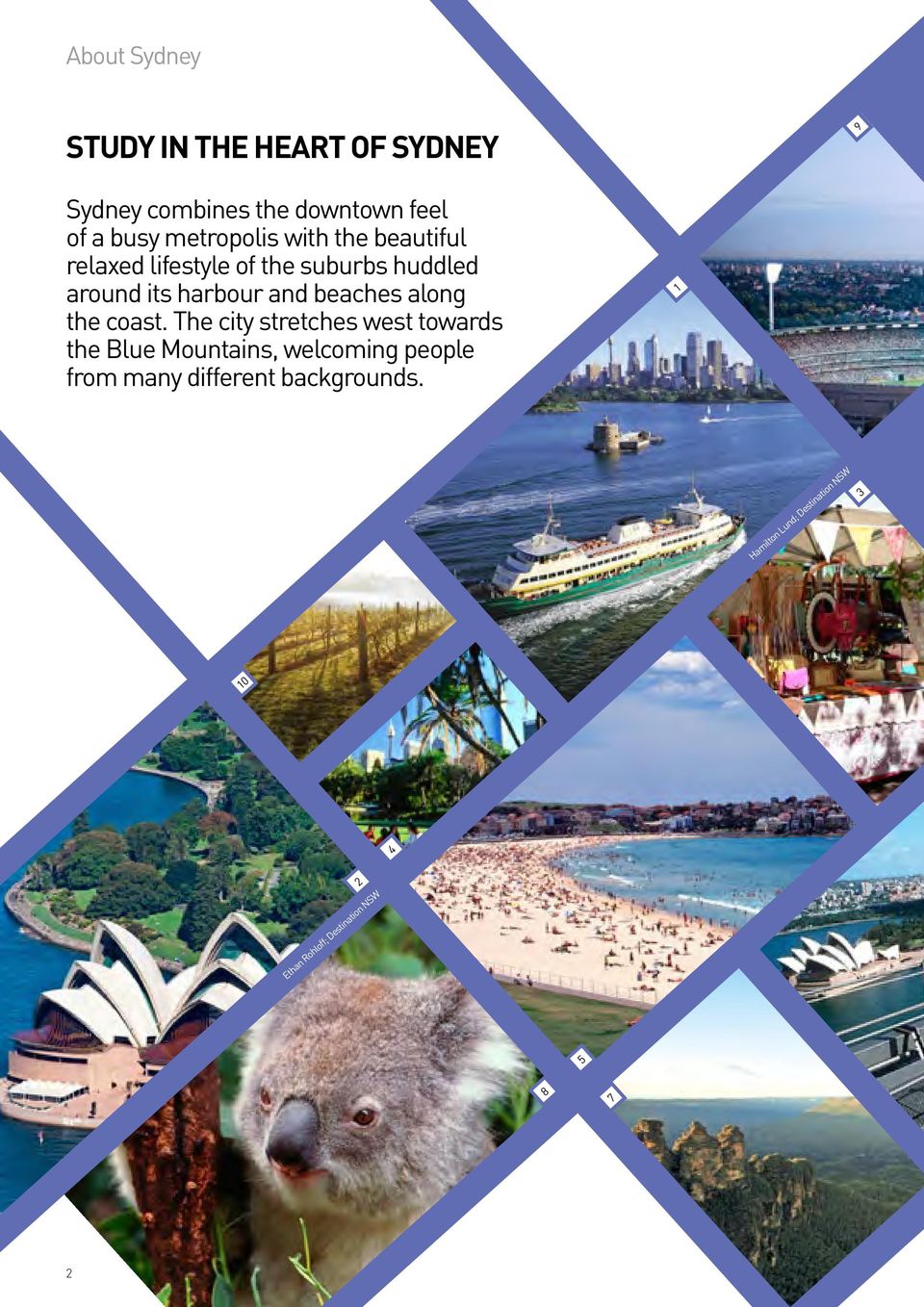
4 About Sydney STUDY IN THE HEART OF SYDNEY 9 Sydney combines the downtown feel of a busy metropolis with the beautiful relaxed lifestyle of the suburbs huddled around its harbour and beaches along the coast. The city stretches west towards the Blue Mountains, welcoming people from many different backgrounds Ethan Rohloff; Destination NSW Hamilton Lund; Destination NSW
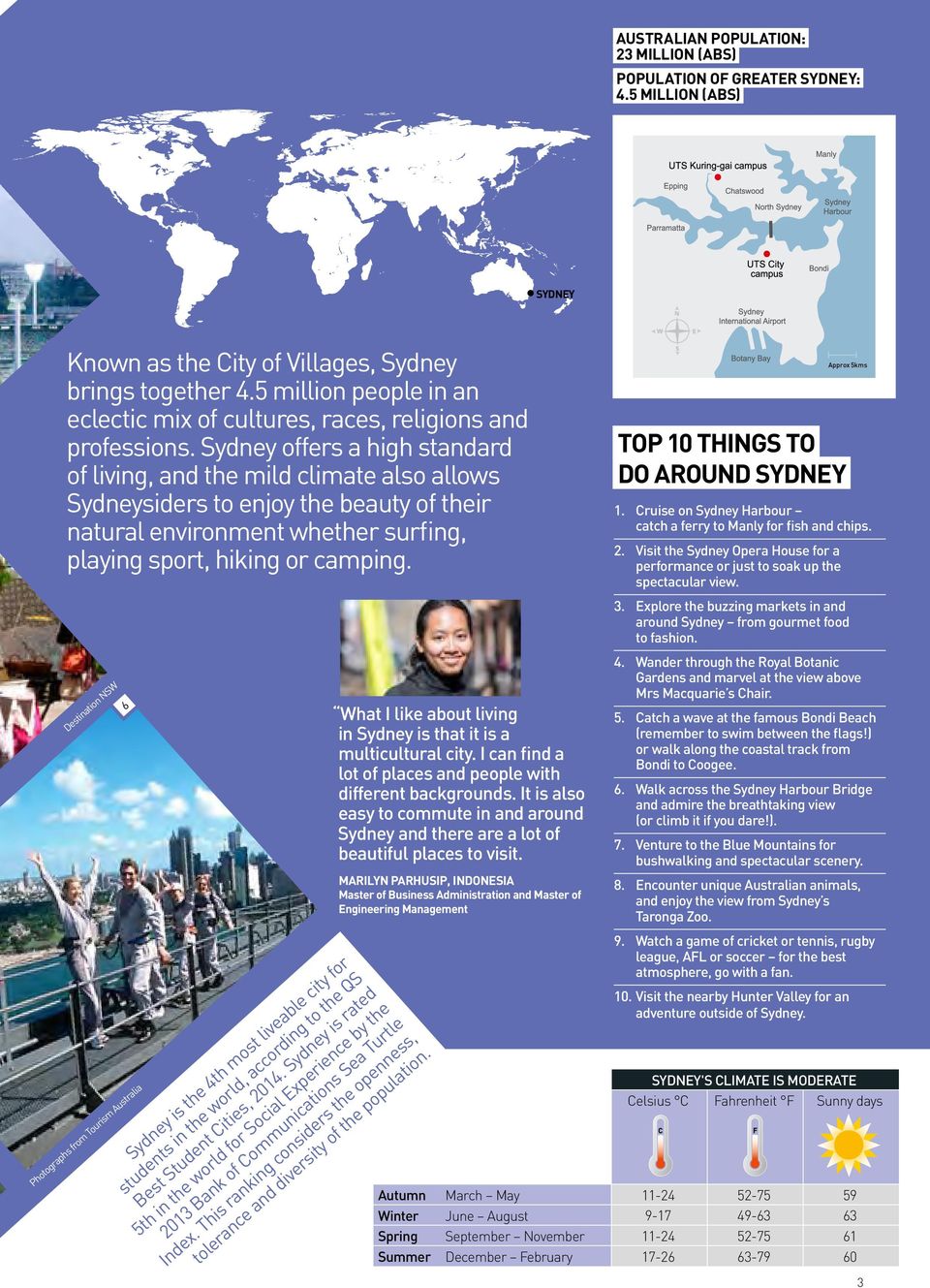
5 AUSTRALIAN POPULATION: 23 MILLION (ABS) POPULATION OF GREATER SYDNEY: 4.5 MILLION (ABS) SYDNEY Known as the City of Villages, Sydney brings together 4.5 million people in an eclectic mix of cultures, races, religions and professions. Sydney offers a high standard of living, and the mild climate also allows Sydneysiders to enjoy the beauty of their natural environment whether surfing, playing sport, hiking or camping. Approx 5kms TOP 10 THINGS TO DO AROUND SYDNEY 1. Cruise on Sydney Harbour catch a ferry to Manly for fish and chips. 2. Visit the Sydney Opera House for a performance or just to soak up the spectacular view. Destination NSW 6 What I like about living in Sydney is that it is a multicultural city. I can find a lot of places and people with different backgrounds. It is also easy to commute in and around Sydney and there are a lot of beautiful places to visit. MARILYN PARHUSIP, INDONESIA Master of Business Administration and Master of Engineering Management 3. Explore the buzzing markets in and around Sydney from gourmet food to fashion. 4. Wander through the Royal Botanic Gardens and marvel at the view above Mrs Macquarie s Chair. 5. Catch a wave at the famous Bondi Beach (remember to swim between the flags!) or walk along the coastal track from Bondi to Coogee. 6. Walk across the Sydney Harbour Bridge and admire the breathtaking view (or climb it if you dare!). 7. Venture to the Blue Mountains for bushwalking and spectacular scenery. 8. Encounter unique Australian animals, and enjoy the view from Sydney s Taronga Zoo. Photographs from Tourism Australia Sydney is the 4th most liveable city for students in the world, according to the QS Best Student Cities, Sydney is rated 5th in the world for Social Experience by the 2013 Bank of Communications Sea Turtle Index. This ranking considers the openness, tolerance and diversity of the population. 9. Watch a game of cricket or tennis, rugby league, AFL or soccer for the best atmosphere, go with a fan. 10. Visit the nearby Hunter Valley for an adventure outside of Sydney. SYDNEY'S CLIMATE IS MODERATE Celsius C Fahrenheit F Sunny days Autumn March May Winter June August Spring September November Summer December February
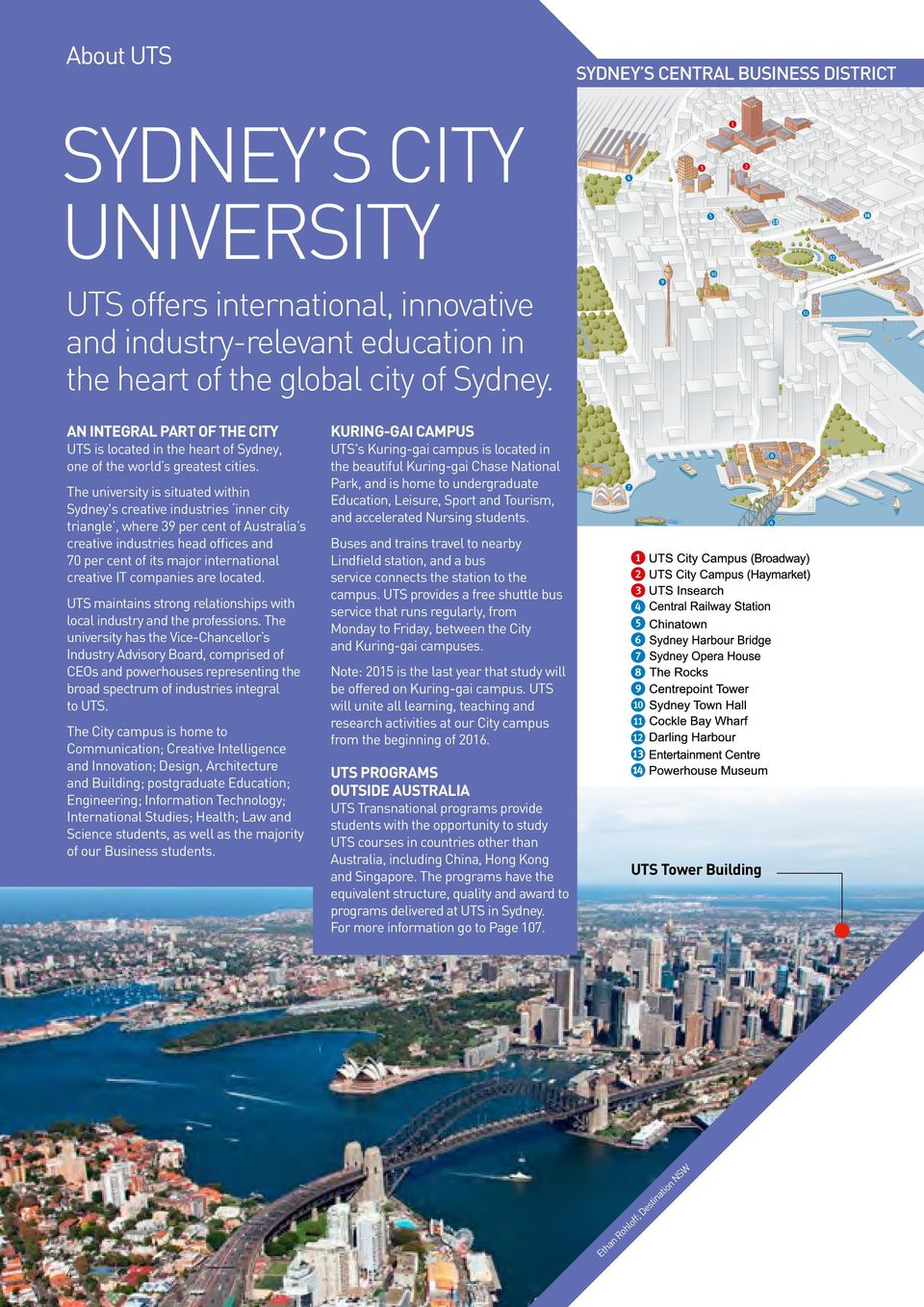
6 About UTS SYDNEY S CENTRAL BUSINESS DISTRICT SYDNEY S CITY UNIVERSITY UTS offers international, innovative and industry-relevant education in the heart of the global city of Sydney. AN INTEGRAL PART OF THE CITY UTS is located in the heart of Sydney, one of the world s greatest cities. The university is situated within Sydney's creative industries inner city triangle, where 39 per cent of Australia s creative industries head offices and 70 per cent of its major international creative IT companies are located. UTS maintains strong relationships with local industry and the professions. The university has the Vice-Chancellor s Industry Advisory Board, comprised of CEOs and powerhouses representing the broad spectrum of industries integral to UTS. The City campus is home to Communication; Creative Intelligence and Innovation; Design, Architecture and Building; postgraduate Education; Engineering; Information Technology; International Studies; Health; Law and Science students, as well as the majority of our Business students. KURING-GAI CAMPUS UTS's Kuring-gai campus is located in the beautiful Kuring-gai Chase National Park, and is home to undergraduate Education, Leisure, Sport and Tourism, and accelerated Nursing students. Buses and trains travel to nearby Lindfield station, and a bus service connects the station to the campus. UTS provides a free shuttle bus service that runs regularly, from Monday to Friday, between the City and Kuring-gai campuses. Note: 2015 is the last year that study will be offered on Kuring-gai campus. UTS will unite all learning, teaching and research activities at our City campus from the beginning of UTS PROGRAMS OUTSIDE AUSTRALIA UTS Transnational programs provide students with the opportunity to study UTS courses in countries other than Australia, including China, Hong Kong and Singapore. The programs have the equivalent structure, quality and award to programs delivered at UTS in Sydney. For more information go to Page 107. UTS Tower Building 4 Ethan Rohloff; Destination NSW
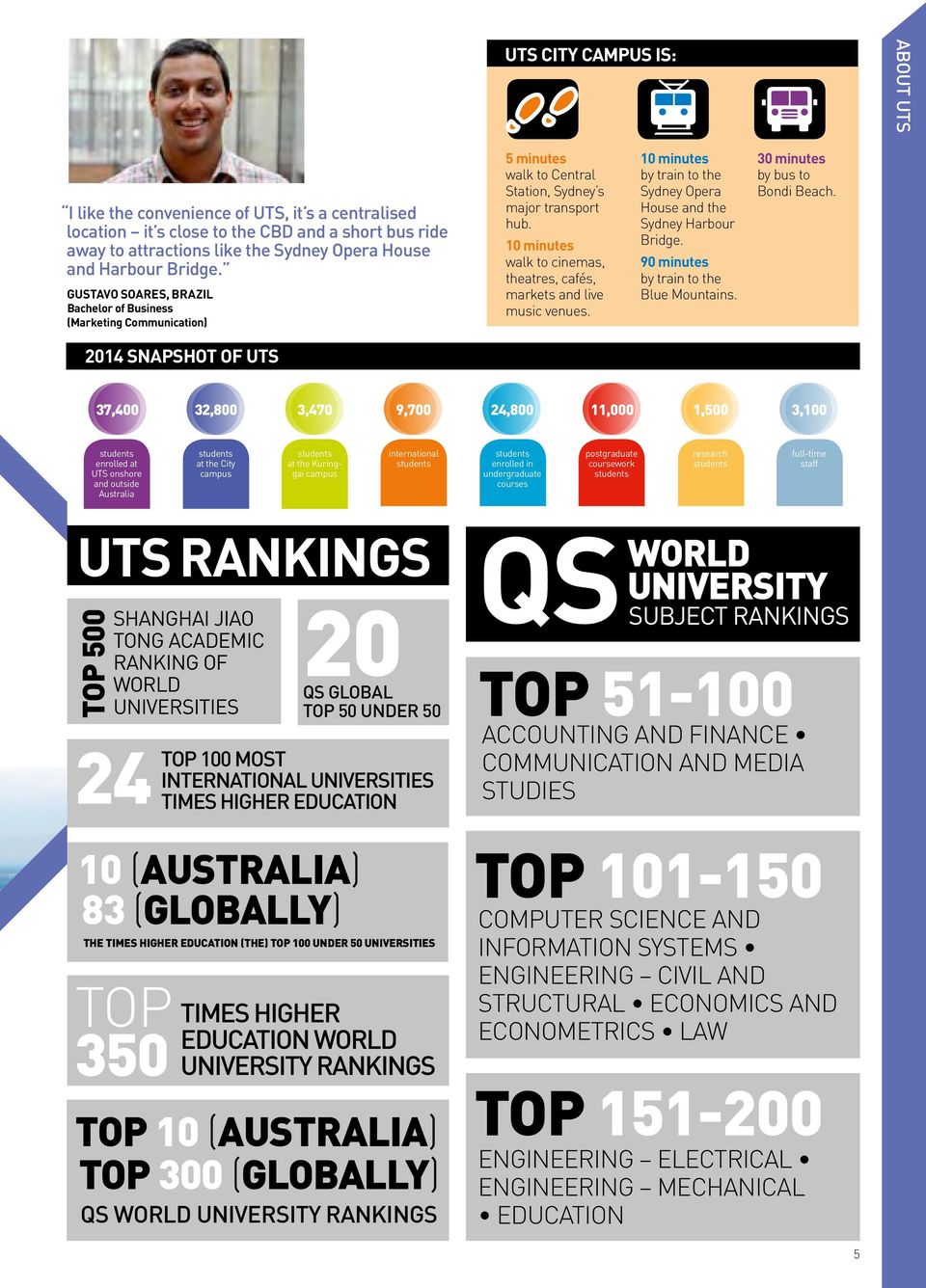
7 UTS CITY CAMPUS IS: ABOUT UTS I like the convenience of UTS, it s a centralised location it s close to the CBD and a short bus ride away to attractions like the Sydney Opera House and Harbour Bridge. GUSTAVO SOARES, BRAZIL Bachelor of Business (Marketing Communication) 5 minutes walk to Central Station, Sydney s major transport hub. 10 minutes walk to cinemas, theatres, cafés, markets and live music venues. 10 minutes by train to the Sydney Opera House and the Sydney Harbour Bridge. 90 minutes by train to the Blue Mountains. 30 minutes by bus to Bondi Beach SNAPSHOT OF UTS 37,400 32,800 3,470 9,700 24,800 11,000 1,500 3,100 students enrolled at UTS onshore and outside Australia students at the City campus students at the Kuringgai campus international students students enrolled in undergraduate courses postgraduate coursework students research students full-time staff UTS RANKINGS TOP 500 SHANGHAI JIAO TONG ACADEMIC RANKING OF WORLD UNIVERSITIES TOP 20 QS GLOBAL TOP 50 UNDER 50 TOP 100 MOST INTERNATIONAL UNIVERSITIES 24 TIMES HIGHER EDUCATION 10 (AUSTRALIA) 83 (GLOBALLY) THE TIMES HIGHER EDUCATION (THE) TOP 100 UNDER 50 UNIVERSITIES TIMES HIGHER 350 EDUCATION WORLD UNIVERSITY RANKINGS TOP 10 (AUSTRALIA) TOP 300 (GLOBALLY) QS WORLD UNIVERSITY RANKINGS QS WORLD UNIVERSITY SUBJECT RANKINGS TOP ACCOUNTING AND FINANCE COMMUNICATION AND MEDIA STUDIES TOP COMPUTER SCIENCE AND INFORMATION SYSTEMS ENGINEERING CIVIL AND STRUCTURAL ECONOMICS AND ECONOMETRICS LAW TOP ENGINEERING ELECTRICAL ENGINEERING MECHANICAL EDUCATION 5
8 Choose UTS WHY UTS CAMPUS TOUR 1 UTS offers practice-based learning in cutting-edge facilities. Our courses are continually updated to reflect developments in research and technology. Our partnerships with industry, and work placements offered put you at the forefront of professional knowledge in your study area. Courses at the UTS Business School offer a mix of major projects, case studies and extensive group work to build collaborative skills and help students place their knowledge in a real-world context. UTS's Kuring-gai campus is a well-equipped learning environment with its own library, group work spaces and student lounges. The campus also has an aerobics and dance studio, fitness centre and multipurpose gymnasium, as well as specialist education facilities such as the visual arts and music rooms and science labs. 6
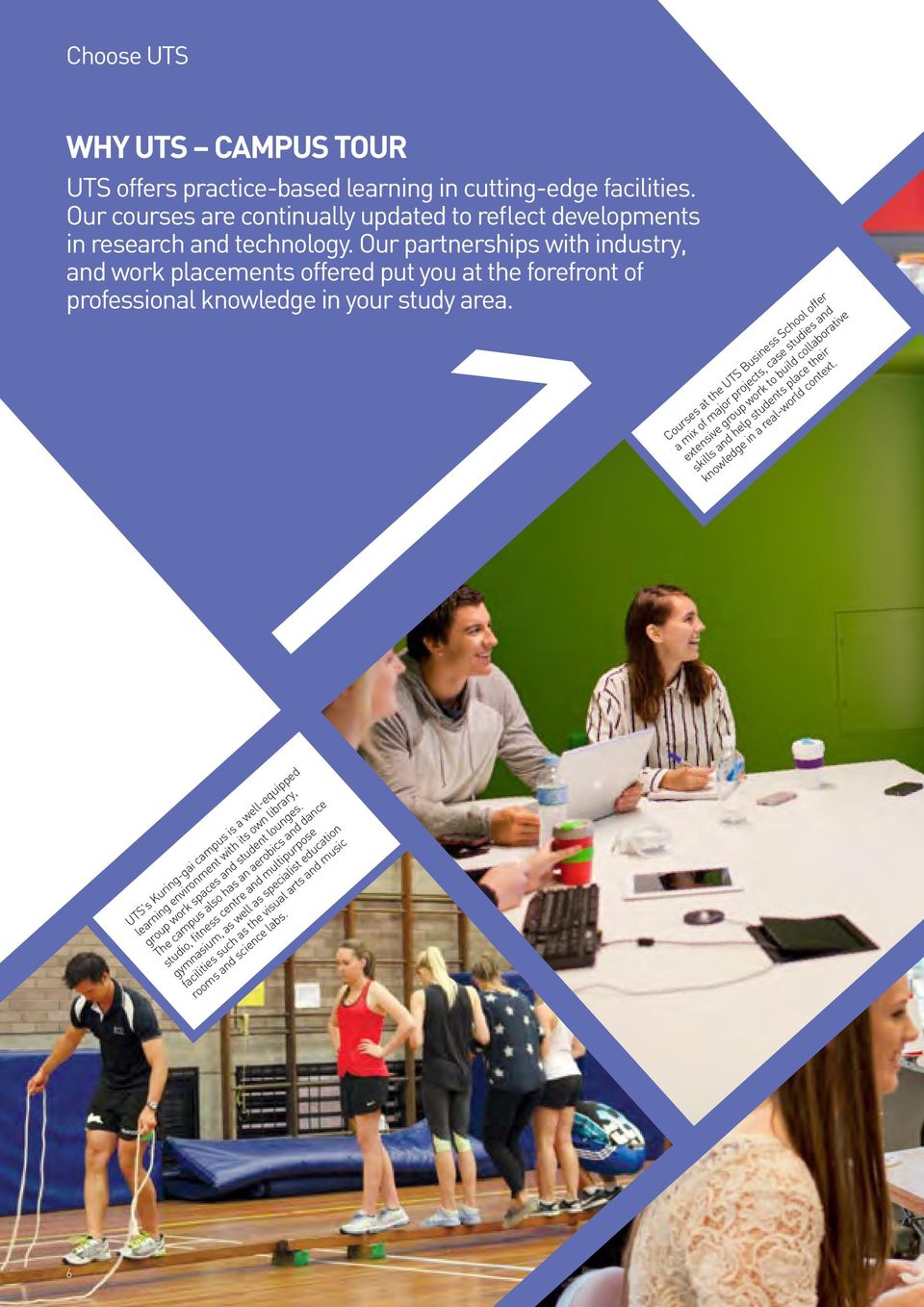
9 Engineering students learn in an informationrich environment, with access to world leading technology including the Engineering Remote Laboratory where you use advanced equipment to perform real-time experiments from anywhere at any time. CHOOSE UTS UTS Education students are taught to think constructively, learning theory and how to apply it in realworld situations. Taught by leaders in their areas of expertise, students are exposed to the most relevant knowledge and skills in the field. UTS Design students benefit from our industry connections which provide real world knowledge. Design students have the opportunity to showcase their work in the annual Design Show or the UTS Graduate Fashion Show. 7

10 Choose UTS 2 WHY UTS CAMPUS TOUR UTS s superior communication production facilities include multimedia, and multiplatform computer labs, state-of-the-art sound facilities, a journalism workroom, a performance space and a multi-modality lab, allowing you to develop your skills and produce work from the first day of your course. UTS offers programs to support the various needs of UTS Law students, including the Academic Mentoring Program: providing one-on-one, staff-to student support, and the High Achievers Mentoring program: connecting academically outstanding students with leading professionals in law and related fields. 8

11 CHOOSE UTS Our clinical practice labs have high-tech mannequins in high fidelity simulation labs, enabling Health students to practise their skills in a safe and supportive environment before undertaking clinical placement. UTS s practical approach to learning and soft skills development means IT students graduate with the relevant knowledge, skills and hands-on experience. UTS: IT students also have exclusive access to computer labs which are equipped with the latest software. Specialist labs also operate in areas such as internetworking, games and computer graphics. Photo by: Professor David Booth, UTS School of Environment Science students get hands-on, practical experience on modern equipment in our cutting-edge laboratories, such as our specialised forensic labs. Environmental Science students are able to take field trips to experience some of Australia s diverse ecology and landscapes. 9

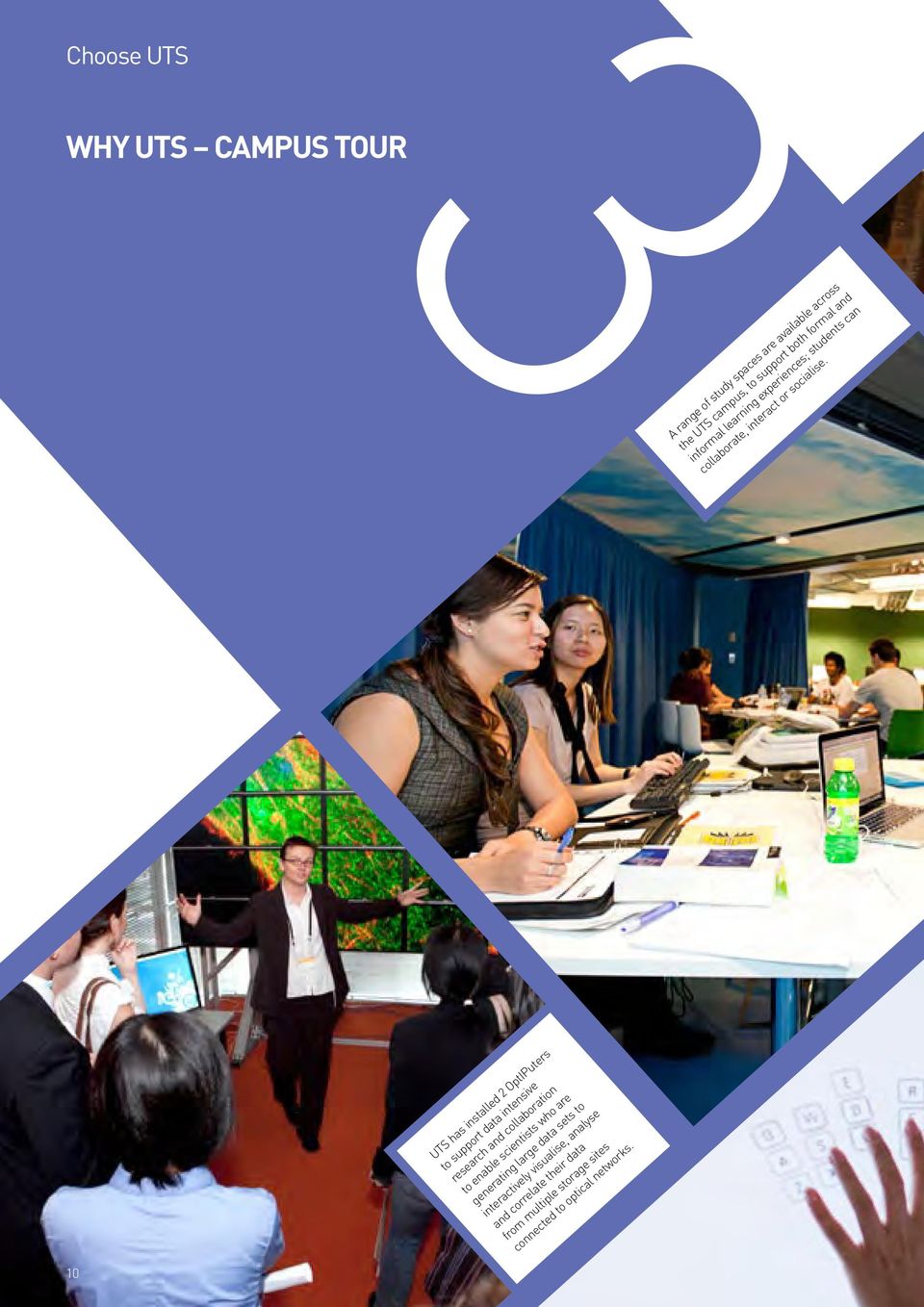
12 Choose UTS WHY UTS CAMPUS TOUR 3 A range of study spaces are available across the UTS campus, to support both formal and informal learning experiences; students can collaborate, interact or socialise. UTS has installed 2 OptIPuters to support data intensive research and collaboration to enable scientists who are generating large data sets to interactively visualise, analyse and correlate their data from multiple storage sites connected to optical networks. 10
13 CHOOSE UTS 9 it More than 150 companies partner with UTS, sharing their resources and providing expertise to our research and other innovation programs. Many offer internships such as for our IT students, and employment opportunities for our best graduates. As a research institution, UTS has a reputation for practical innovation producing applied research that has the ability to impact business, industry and the broader community, such as the LiquidKeyboard project produced by UTS Computer Systems researchers Christian Sax and Hannes Lau. 10 int The UTS International Studies program exposes students to language, cultural studies and experiences, building the confidence, cultural awareness and international connections so important to graduates in our increasingly global world. 11

14 Choose UTS 4 WHY UTS A WORLD-CLASS CAMPUS UTS is creating a vibrant campus of the future. The revitalised campus environment includes new buildings, renovated facilities and increased public spaces to encourage collaboration. UTS ALUMNI GREEN The UTS Alumni Green is a vibrant, treelined city space inspired by some of the world s great public spaces. The refreshed green will be a central meeting place, filled with new student-focused spaces. Artist impression: ASPECT Studios ENGINEERING AND IT BUILDING UTS s new Engineering and IT Building fuses technology with modern teaching, to support UTS s model of learning and to cultivate the specific skills required for the Engineering and IT industries. The building features a dedicated Student Resource Hub, a unique Software Design Studio and 3D Data Visualisation Arena. Artist impression: Denton Corker Marshal 12

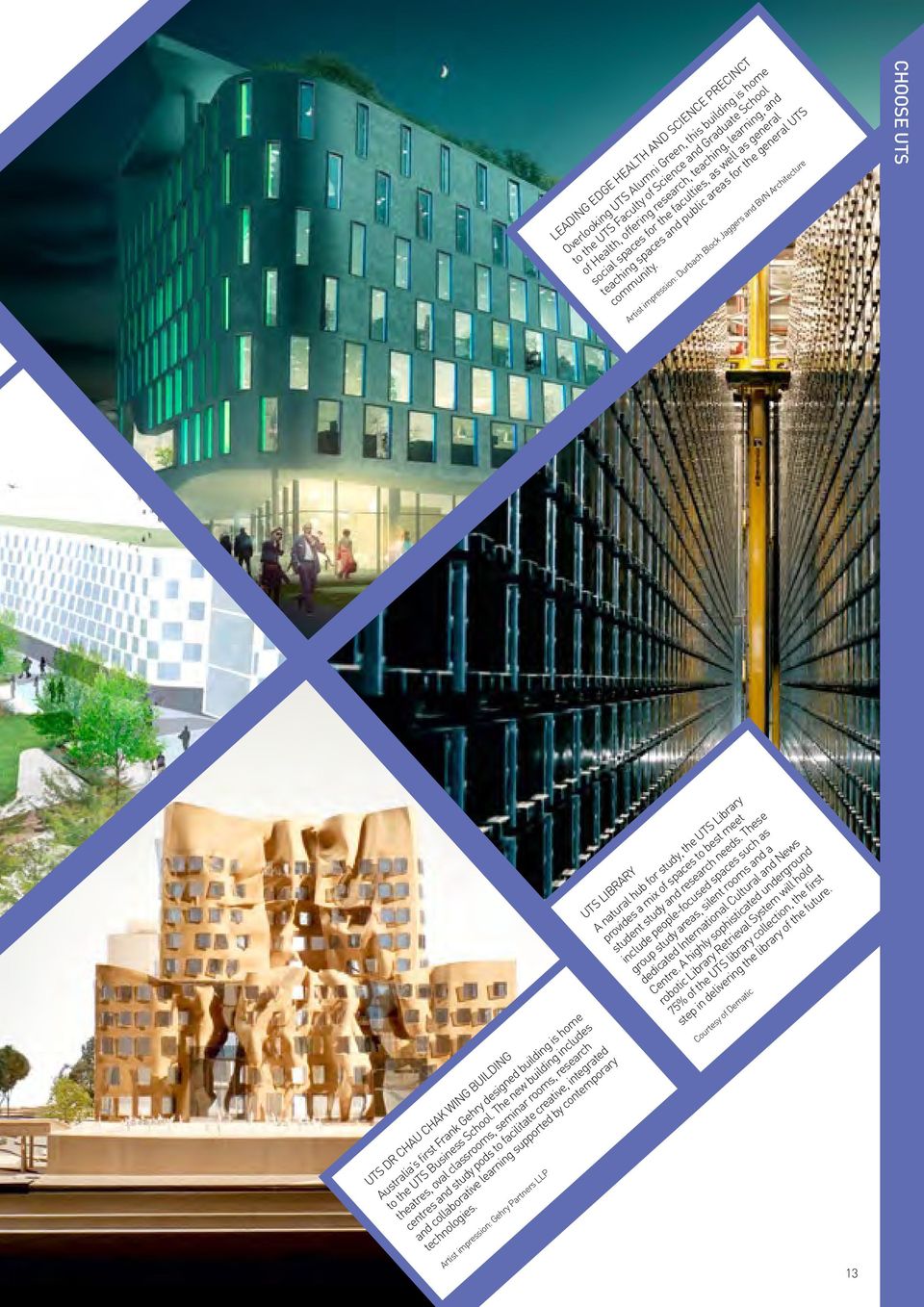
15 LEADING EDGE HEALTH AND SCIENCE PRECINCT Overlooking UTS Alumni Green, this building is home to the UTS Faculty of Science and Graduate School of Health, offering research, teaching, learning, and social spaces for the faculties, as well as general teaching spaces and public areas for the general UTS community. Artist impression: Durbach Block Jaggers and BVN Architecture CHOOSE UTS 9 it UTS DR CHAU CHAK WING BUILDING Australia s first Frank Gehry designed building is home to the UTS Business School. The new building includes theatres, oval classrooms, seminar rooms, research centres and study pods to facilitate creative, integrated and collaborative learning supported by contemporary technologies. Artist impression: Gehry Partners LLP 10 int UTS LIBRARY A natural hub for study, the UTS Library provides a mix of spaces to best meet student study and research needs. These include people-focused spaces such as group study areas, silent rooms and a dedicated International Cultural and News Centre. A highly sophisticated underground robotic Library Retrieval System will hold 75% of the UTS library collection, the first step in delivering the library of the future. Courtesy of Dematic 13
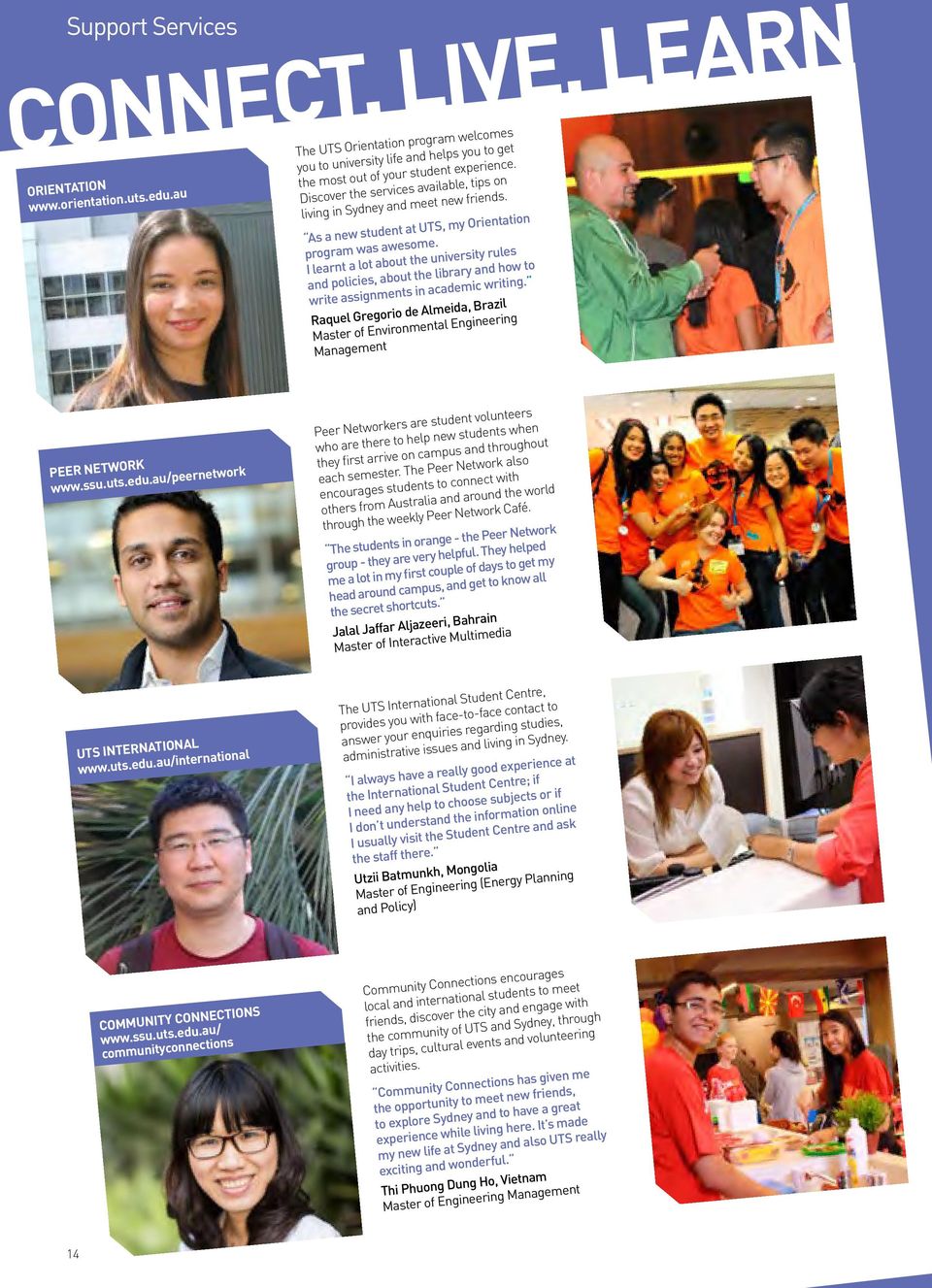
16 Support Services CONNECT. LIVE. LEARN ORIENTATION The UTS Orientation program welcomes you to university life and helps you to get the most out of your student experience. Discover the services available, tips on living in Sydney and meet new friends. As a new student at UTS, my Orientation program was awesome. I learnt a lot about the university rules and policies, about the library and how to write assignments in academic writing. Raquel Gregorio de Almeida, Brazil Master of Environmental Engineering Management PEER NETWORK Peer Networkers are student volunteers who are there to help new students when they first arrive on campus and throughout each semester. The Peer Network also encourages students to connect with others from Australia and around the world through the weekly Peer Network Café. The students in orange - the Peer Network group - they are very helpful. They helped me a lot in my first couple of days to get my head around campus, and get to know all the secret shortcuts. Jalal Jaffar Aljazeeri, Bahrain Master of Interactive Multimedia UTS INTERNATIONAL The UTS International Student Centre, provides you with face-to-face contact to answer your enquiries regarding studies, administrative issues and living in Sydney. I always have a really good experience at the International Student Centre; if I need any help to choose subjects or if I don t understand the information online I usually visit the Student Centre and ask the staff there. Utzii Batmunkh, Mongolia Master of Engineering (Energy Planning and Policy) COMMUNITY CONNECTIONS communityconnections Community Connections encourages local and international students to meet friends, discover the city and engage with the community of UTS and Sydney, through day trips, cultural events and volunteering activities. Community Connections has given me the opportunity to meet new friends, to explore Sydney and to have a great experience while living here. It s made my new life at Sydney and also UTS really exciting and wonderful. Thi Phuong Dung Ho, Vietnam Master of Engineering Management 14
17 HEALTH SERVICE COUNSELLING SERVICE UTS Health Service provides confidential medical care to students, with both male and female doctors available most days. A Traditional Chinese Medicine clinic within the Faculty of Science, also offers acupuncture, herbal medicine and massage. I took advantage of medical services at UTS; I always used to go to the doctor here. It was valuable to know that you could go to a place that was easy because it was just at the university. I also knew other people who were going to the same doctors, so it was a recommendation as well. Janna Jungclaus, Germany Bachelor in Arts in Communication (Information Management) UTS counsellors are university-trained psychologists or social workers who are available to help with a wide range of personal, relationship, psychological, study and administrative difficulties. My first semester was a little difficult for me, so I went to counselling and I got a lot of support from there. With the understanding and support from staff at the counselling service, they can help students succeed. Judith Stenis, Papua New Guinea Master of Business Administration SUPPORT SERVICES SAFE, FAIR AND SUPPORTING SOCIAL CLUBS AND EVENTS UTS celebrates diversity and a safe, nurturing environment to encourage all students to feel valued. If you have financial difficulties, a disability or an ongoing medical condition, which may affect your study, the UTS Special Needs Service can provide advice and services. Confidential advice and support can also be provided by various university groups if you encounter any problems on the grounds of harassment. I enjoy coming to UTS every day to study and work on assignments. UTS offers an incredible campus environment, which is open 24 hours a day. The staff are also very supportive, and committed to helping students across the university. Gerardo Contreras Vacca, Colombia Master of Business in Marketing There s always something exciting happening on campus free weekly barbecues, bands, festivals and club activities means that you can get involved in university life, connect and socialise with your peers. Choose from over 100 clubs covering a range of sporting, cultural, political and religious interests. I am part of three clubs because I enjoy being social with others, I like to meet new people and interact with them. Most importantly you get to meet loads of people from different nationalities and backgrounds. Stephan Stevnsborg, Denmark Bachelor of Management in Tourism 15

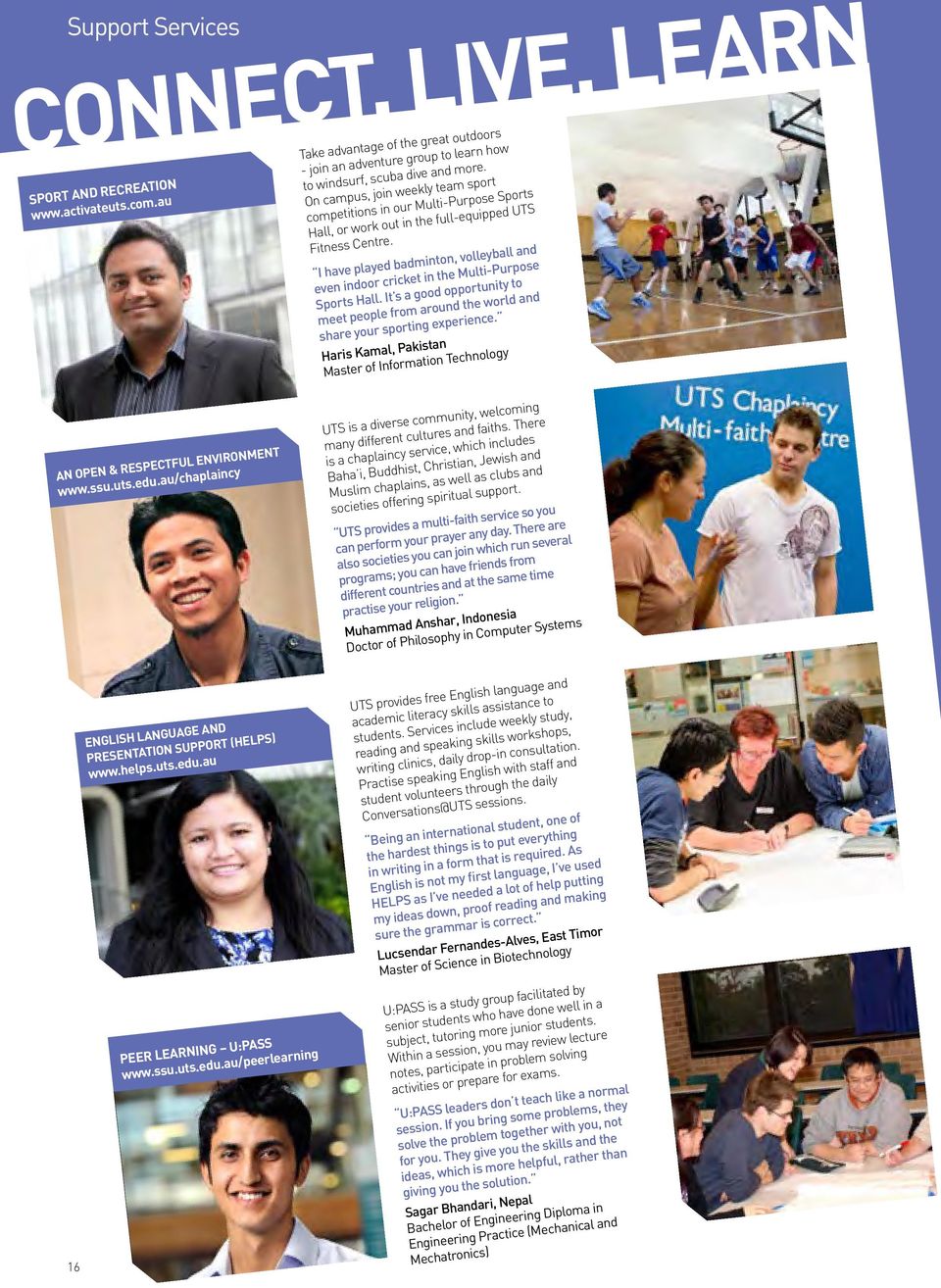
18 Support Services CONNECT. LIVE. LEARN SPORT AND RECREATION Take advantage of the great outdoors - join an adventure group to learn how to windsurf, scuba dive and more. On campus, join weekly team sport competitions in our Multi-Purpose Sports Hall, or work out in the full-equipped UTS Fitness Centre. I have played badminton, volleyball and even indoor cricket in the Multi-Purpose Sports Hall. It s a good opportunity to meet people from around the world and share your sporting experience. Haris Kamal, Pakistan Master of Information Technology AN OPEN & RESPECTFUL ENVIRONMENT UTS is a diverse community, welcoming many different cultures and faiths. There is a chaplaincy service, which includes Baha i, Buddhist, Christian, Jewish and Muslim chaplains, as well as clubs and societies offering spiritual support. UTS provides a multi-faith service so you can perform your prayer any day. There are also societies you can join which run several programs; you can have friends from different countries and at the same time practise your religion. Muhammad Anshar, Indonesia Doctor of Philosophy in Computer Systems 16 ENGLISH LANGUAGE AND PRESENTATION SUPPORT (HELPS) PEER LEARNING U:PASS UTS provides free English language and academic literacy skills assistance to students. Services include weekly study, reading and speaking skills workshops, writing clinics, daily drop-in consultation. Practise speaking English with staff and student volunteers through the daily Conversations@UTS sessions. Being an international student, one of the hardest things is to put everything in writing in a form that is required. As English is not my first language, I ve used HELPS as I ve needed a lot of help putting my ideas down, proof reading and making sure the grammar is correct. Lucsendar Fernandes-Alves, East Timor Master of Science in Biotechnology U:PASS is a study group facilitated by senior students who have done well in a subject, tutoring more junior students. Within a session, you may review lecture notes, participate in problem solving activities or prepare for exams. U:PASS leaders don t teach like a normal session. If you bring some problems, they solve the problem together with you, not for you. They give you the skills and the ideas, which is more helpful, rather than giving you the solution. Sagar Bhandari, Nepal Bachelor of Engineering Diploma in Engineering Practice (Mechanical and Mechatronics)
19 SUPPORT SERVICES INTERNATIONAL LEADERSHIP DEVELOPMENT BUILD UTS students are encouraged to join the university s flagship international leadership development program, which is free to join and open to all students. As a BUiLDer, you will have the opportunity to develop your leadership skills and networks through a variety of action-based initiatives which focus on social outcomes. On-campus events have previously included high profile speakers such as: > David Batstone, founder of Not for Sale social enterprise and sustainable solutions > Hugh Evans, founder of the Global Poverty Project > Anuradha Koirala, founder of Maiti Nepal, anti-human trafficking > Aaron Tait, founder of Spark, supporting change-makers in social business Students also have the opportunity to apply for short term international travel grants and opportunities in the form of study tours, volunteering, experiential trips and internships. These have previously included: > Microfinance and Social Business, India and Vietnam > SILC (Shanghai University) Summer School global perspectives program, China > Volunteering with disadvantaged children and environmental awareness, Maldives > Sustainable technologies for Argo-waste management in Malaysia > Health for wealth: nursing in developing economies > Changemakers in Africa, an experiential learning program in social enterprise BUiLD is an amazing program, where you definitely get leadership experience. They hold workshops and seminars - but these aren t just any seminars - they showcase people who are out there making a name for themselves. I ve met a Bollywood Director and celebrity chefs from television who have shared their cooking skills. I also had the opportunity to visit the Maldives, where I gained teaching experience. I was training the teachers how to teach their students. The teachers weren t confident in their English language skills and I along with seven other students was able to help them. They became empowered and we saw them accepting the English language and becoming more confident. I came to Australia as a very shy person. Through programs such as BUiLD, I m going back very confident and with an open mind. I now believe in social change, and I believe I can drive that change. Tanisha Lewis, Jamaica Master of Education 17

20 YOUR PATHWAY TO GRADUATE SUCCESS Your career is in your hands: preparation for graduate success can start from your first months at university as you begin building your professional network. UTS offers resources and tools to guide you on the path to your professional career. DIANE LATTA Finance and Fundraising Officer National Parks Association of NSW The internship program gives international students a great opportunity to get some practical work and to soak up the culture of the way offices run in New South Wales. I start them off by going back to the basics of bookkeeping, and I give them problems and challenges and they work their way up to our annual finance reporting. They find it really interesting and it gives them more self-confidence and a lot of basic skills that they don't necessarily pick up being at uni. MONIQUE RYAN Careers Consultant (International) UTS Careers Service Accomplish Award Accomplish Award prepares international students for the demands of the Australian work-force by complementing their university studies with practical workshops and industry based placements. A high percentage of international students who have participated in the program are now employed either full time or part time, with many of these students working in a field directly related to their degrees. LUCIE DA GRACA, FRANCE Master of Business in Marketing Currently working in Community Engagement at Vimily Completed Working Solutions program (now Accomplish Award) The program included a series of workshops over several weeks. It really helped me to prepare the best to start my career. We learnt how to do a resume, cover letter, how to network, but also how to integrate in the Australian workplace. And it also helped me to find a great internship that was probably the best part. STEPPING OUT TO WORK As you learn, use your knowledge and develop your skills in a professional environment all UTS faculties have strong industry connections and selected courses at UTS offer work placement, allowing you to make your own industry connections. ARE YOU WORD PERFECT? Ensure your language skills are at a professional level by practising as much as possible. Contact HELPS for free support with written and spoken English and join Conversations@UTS to build your confidence. START CASUAL Get your first taste of qualified work: complete your profile on StudentJobs@ UTS to be considered for casual or part-time roles on campus, building work-ready skills while just minutes from lectures. 18

21 GET CONNECTED CAREERS SERVICE UTS has many extremely active alumni networks around the globe comprising recent and seasoned graduates. Explore the networks on our Alumni website for the best ways to connect with these groups and to expand your professional network in Australia or off-shore. LEADERSHIP MATERIAL Stand out from other graduates by sharpening your leadership skills. BUiLD is a free program for all students, allowing you to develop your potential and broaden your horizons with access to local and international internship and volunteering opportunities. DO YOU KNOW WHAT YOU NEED TO KNOW? UTS s Aussie Rules half-day workshop brings international students directly into contact with industry representatives and DIBP so you can learn about your visa options and what to expect in the Australian workplace. LEND A HAND Any recruiter will tell you that volunteering in your area of expertise is the best way to get a feel for the sector, develop skills and build connections. Not to mention you re on hand to apply if a paid position appears! Visit UTS s Vacation, Internships and Voluntary Work Fair, or search the Careers Service s job vacancy board for vacation work or internship opportunities. ARE YOU WORK READY? The Accomplish Award program aims to increase your employability skills and prepare you for the Australian workplace. A series of workshops develops your communication and networking skills while some internships are available for penultimate or final year students. 19
22 SCHOLARSHIPS UTS offers scholarships for international students, available universitywide or for study in particular faculties. AUSTRALIAN GOVERNMENT SCHOLARSHIPS An initiative of the Australian Government to promote education, cooperation and development in the Asia-Pacific region, these scholarships include: AUSTRALIA AWARDS SCHOLARSHIPS Managed by the Australian Government s Department of Foreign Affairs and Trade (DFAT), these scholarships help students gain tertiary qualifications that will allow them to contribute to the development needs of their home countries. ENDEAVOUR POSTGRADUATE SCHOLARSHIPS Funded by the Department of Education, Endeavour Postgraduate Scholarships offer funding for high-achieving international students who have been accepted to study a Master s or PhD at UTS. You must gain admission to UTS before applying for this scholarship and must be from a partner country with links to the Endeavour Program. UTS INTERNATIONAL ACADEMIC EXCELLENCE SCHOLARSHIP UTS International is offering scholarships for commencing international students enrolling in postgraduate coursework programs in These are awarded solely on the basis of academic merit. All international students commencing a postgraduate coursework program in 2015 will be automatically considered for these scholarships. They are valued at A$2,000, to be credited towards the first semester s tuition fees. A number of countries also offer scholarships or sponsorship to their citizens who wish to study in Australia, including study abroad programs. Check with your home government to see if you are eligible for a scholarship or financial aid to support your studies at the University of Technology, Sydney (UTS). You can also visit our website for further information. All scholarship applications are competitive. They are open to international students who meet the specific scholarship selection criteria and have received or are eligible to receive admission to a course at UTS. Please see the faculty pages for details of faculty-specific scholarships. For more information about all scholarships offered to international students at UTS, visit: CUT OLI MAULINA, INDONESIA Master of Architecture Australia Awards Scholarship recipient When I got the scholarship, I had to attend an English course in Jakarta. AusAID had invited all the universities representatives to come to Indonesia. The difference I found from other universities is that UTS offers to equip students with conceptual and practical knowledge for future practice. They also see architecture differently with an emphasis on more futuristic design. When you graduate from UTS, you will be well-armed with competitive and digital skills. UTS also has a really good computer lab, which has all the programs we need as architects it s really up to date. The facilities in the library are also really good, like the book collection, and a great collection of all the magazines that architecture students really need. 20
23 FEEL AT HOME The UTS Housing Service staff provide support for UTS students, including information and assistance on UTS residences and a range of private accommodation options. UTS-OWNED ACCOMMODATION UTS has five residences available to UTS students, all close to the City campus. > Geegal is a purpose-built group of townhouses accommodating 57 students > Bulga Ngurra is a modern apartment building accommodating 111 students > Gumal Ngurang is a modern apartment building accommodating 252 students in studio, one-bedroom or shared apartments > Blackfriars offers self-contained rooms for postgraduate research students, in a small heritage house > Yura Mudang has 720 beds comprising studio and shared apartments. All UTS residences have spacious communal and barbecue areas, games and computer rooms. Yura Mudang also has a music room. You will need to provide your own bed linen and cooking equipment. Rent fees are different for each residence, and there is a non-refundable application fee of A$35 (subject to change). For more information, please visit the Housing website: studying-uts/student-accommodation Due to the high level of accommodation requests, UTS Housing has sourced reserved beds for UTS students with offcampus providers (Urbanest and Iglu). For more information visit: SCHOLARSHIPS, ACCOMMODATION AND LIVING COSTS All UTS residences are self-catered, secure and competitively priced. All bedrooms are for one person (except twin share), with shared kitchens, bathrooms and living areas. Apartments are fully-furnished and rent includes gas, electricity, water bills and limited internet access in communal areas. 21
24 FEEL AT HOME RENTING PRIVATE ACCOMMODATION Some international students plan to stay with relatives or friends in Sydney, and others rent private accommodation. If you are organising private accommodation, we recommend you arrange short-term accommodation in Sydney so you can view properties on your arrival and choose something that really suits your needs for the long-term. Visit UTS Housing s off-campus accommodation website, to find share rooms in private houses and apartments close to UTS campuses. Share accommodation means you usually have your own room and share a kitchen, living area and bathroom with other students or people who work. Alternatively, you may choose a studio or one-bedroom apartment to live in on your own, but this is more expensive. All accommodation rentals come with a residential or tenancy agreement. If there are points you are unsure of, please contact the UTS Housing Off-Campus Officer ([email protected]) or the UTS Student Legal Service ([email protected]) who are here to help you. LIVING COSTS The table below details approximate establishment and ongoing costs you may incur while studying at UTS and living in Sydney. This table should be used only as a guide, as individual spending may vary. It is a requirement of the Australian government that prospective international students can demonstrate that they have access to at least A$18,610 a year to fund their living costs in Australia. ESTABLISHMENT COSTS You should expect to pay approximately A$4200 start up or establishment costs for independent accommodation. These costs include items such as a rental accommodation bond (four weeks rent), rent in advance, linen, furniture, telephone and internet connection, kitchenware, personal items and electricity connection, and must be budgeted for. With regards to UTS Housing, you will have to budget for the deposit fee (A$850), two weeks rent in advance and any personal items you need to purchase. ACCOMMODATION TIP Don t pay any money before viewing and being satisfied with a non-uts property. Until you arrive and get a feel for the area you want to live in, you won t know whether it is right for you. SYDNEY LIVING COSTS APPROXIMATE GUIDE ONLY Independent Accommodation UTS Accommodation Weekly Annual Weekly Annual Rent per person in shared accommodation within a short commute to UTS A$200* A$330 A$10,400 A$17,160 A$210 $372 A$10,920 A$19,344 Groceries (eg. food, drinks, toiletries) A$100 A$5200 A$100 A$5200 Internet/Phone (mobile) A$14 A$728 Limited free internet access Limited free internet access Gas/Electricity A$20 A$1040 Inclusive Inclusive Books/Supplies A$16 A$832 A$16 A$832 Transport costs A$30 A$1560 A$10 A$520 $$ Total estimated ongoing costs A$380 - A$510 A$19,760 - A$26,520 A$336 - A$498 A$17,472 - A$25,896 Note: Prices vary depending on the condition of the property, the number of people you share with and the proximity of the accommodation to the centre of Sydney and other amenities. * Any amount below this will most likely be twin share. 22
25 ACCOMMODATION AND LIVING COSTS I lived in Yura Mudang, and it has been a really good experience. Living close to the university campus, made it easy to visit UTS late in the evenings and on weekends. Yura Mudang is close to the library, giving me the chance to head straight to the library and find a good place to study. Darling Harbour is also close, and I have enjoyed many sunsets there. I loved living in the city, and close to UTS. UROOJ SHOAIB, SAUDI ARABIA/PAKISTAN Master of Engineering Studies (Software Engineering) 23
26 UTS BUSINESS SCHOOL MBA accounting accounting information systems accounting and finance arts management community and not-for-profit management event management finance human resource management management marketing sport management operations and supply chain management tourism management IN 2013 UTS BUSINESS SCHOOL HAD: > Accredited by the Association to Advance Collegiate Schools of Business (AACSB), the highest standard of achievement for busines schools worldwide. > Join a top-ranked program; UTS Business is ranked in the top 100 for accounting and finance and the top 150 for economics and econometrics in the 2014 QS World University Subject Rankings. > UTS Business is one of only 7 Australian universities ranked in the top 200 for economics and business academic research in the Shanghai Jiao Tong Academic Rankings of World Universities > Unrivalled modern learning environment including the new iconic Dr Chau Chak Wing Building with exclusive graduate lounge. > Study with the world s best; in 2013 a UTS team won the John Molson International MBA Case Study Competition in Montreal, the oldest and largest competition of its kind. > Signatory to the UN Principles of Responsible Management Education (PRME), embedding ethical and responsible business decision-making into our curriculum. > Choice of 1.5 year specialist Master degrees across all fields of business or 2 year Extended Master degrees in Accounting, Finance, Human Resource Management, Management and Marketing. > Our 2 year Master of Business Administration program combines the choice of 11 professionally accredited major specialisations with managerial skill and knowledge development. > > Reach your potential with the help of our dedicated learning support unit providing one-one-one coaching and learning resources. > Learn from international and national teaching and research award-winning academics. > Active UTS Business Student Society providing networking, social, academic and career activities. > > Pathway programs and credit recognition. Scholarship opportunities MBA Scholarship for Outstanding International Students The UTS Business School offers two scholarships per year of A$5000 each for commencing students and six scholarships per year of A$2000 each continuing students. Scholarships are competitive and are awarded in terms of fee relief postgraduate coursework students international postgraduate coursework students students go overseas on global 85 exchange KANCHANA BALAKRISHNAN, INDIA Master of Business Administration Diversity in students is the primary reason I chose UTS Business School. With the global economy, it is imperative that we interact and learn from people from other countries. 24
27 TAZIO CENTRONE Master of Management (Arts Management) My studies have made a significant impact on my career. Since starting at UTS, I have become a leader in my workplace, also to step into situations and take charge with confidence in my abilities. All UTS courses periodically undergo review and changes may occur to ensure they meet industry standards, requirements and quality assurance. For the most up-to-date course information please visit the UTS website. 25 ENGINEERING EDUCATION DESIGN, ARCHITECTURE BUSINESS & BUILDING SCIENCE PHARMACY LAW HEALTH COMMUNICATION INFORMATION TECHNOLOGY INTERNATIONAL STUDIES
28 UTS Business School MASTER OF PROFESSIONAL ACCOUNTING The Master of Professional Accounting is designed to provide graduates who have little or no accounting exposure with the necessary skills and knowledge required for a career in professional accounting. The course satisfies the academic requirements for entry to the professional programs of Certified Practising Accountants Australia (CPA Australia) and the Institute of Chartered Accountants in Australia (ICAA).This course provides the ideal academic foundation to pursue a career in accounting, with the subjects providing the necessary knowledge, understanding and expertise necessary for employment in the accounting profession. Further, the professional recognition of the course by CPA Australia and ICAA provides students with internationally recognised qualifications that enhance both their employment and promotion opportunities. MASTER EXTENDED MASTER GRADUATE CERTIFICATE Course code: C04237 CRICOS code: J Course duration: 2 years Number of credit points: 96 Fees: $13,960 MASTER EXTENDED Core subjects (78cp) + elective subjects (18cp) Course code: C04238 CRICOS code: K Course duration: 1.5 years Number of credit points: 72 Fees: $13,960 Course code: C11206 CRICOS code: M Course duration: 0.5 year Number of credit points: 24 Fees: $13,960 MASTER EXTENDED MASTER GRADUATE CERTIFICATE Accounting for Managerial Decisions Financial Management Contemporary Business Law Economics for Management Financial Reporting and Analysis Management Planning and Control Cost Management and Analysis Corporate Accounting Companies and Securities Law Auditing and Assurance Services Business Valuation and Financial Analysis Introduction to Taxation Law Select 3 elective subjects from a choice of 11 accounting and related subjects PROFESSIONAL RECOGNITION (MASTER ADVANCED AND MASTER) CPA Australia; Institute of Chartered Accountants Australia; Institute of Public Accountants (IPA) MASTER EXTENDED AND MASTER OF PROFESSIONAL ACCOUNTING Career options include management-level positions in industry or government, as well as not-for-profit organisations. With the CPA and ICAA qualification being recognised internationally, the prospect for global employment is also enhanced. GRADUATE CERTIFICATE This course gives an understanding of introductory accounting that can be applied to general business practices. MASTER OF QUANTITATIVE FINANCE The Master of Quantitative Finance provides the full gamut of specialised quantitative finance skills and development of professional competency required to be a quantitative finance specialist performing at the cutting edge of the discipline. Participants have the opportunity to see the application of quantitative finance to advanced financial instruments, an integrated approach to risk management and how to implement quantitative finance strategies. Course code: C04052 CRICOS code: F Course duration: 2 years Number of credit points: 72 Fees: $16,900 Financial markets instruments, portfolio analysis, financial econometrics, credit risk, mathematical finance, statistical methods for quantitative finance, finance specialist. All fees listed are for 24 credit points in a semester. For more information about fees, see page
29 Financial Markets Instruments Portfolio Analysis Financial Econometrics Financial Risk Management Credit Risk Mathematical Finance Numerical Analysis for Quantitative Finance Career options for graduates include positions as quantitative analysts, risk management analysts, quantitative structures, quantitative developers, forecasters, traders, investment analysts and financial engineers across investment banks, trading banks, hedge funds, investment management companies, consulting companies, energy and mining companies, regulatory bodies and government organisations. MASTER OF BUSINESS ADMINISTRATION The UTS MBA is distinguished from the competition by its practical, professional orientation and by the open architecture of the course design. All MBA subjects are confirmed with an industry board which insists on relevance to workplace as a pre-eminent subject design principle. The MBA provides knowledge and skills that are essential for superior management performance. MAJORS (48CP = 8 SUBJECTS)* Accounting and Finance Accounting Information Systems Business Law Finance Human Resource Management Information Technology International Business Management Marketing Professional Accounting # Project Management Technology Management Computational Methods and Model Implementation Statistical Methods for Quantitative Finance Fundamentals of Derivative Security Pricing Probability Theory and Stochastic Processes Interest Rate Modelling MASTER GRADUATE DIPLOMA GRADUATE CERTIFICATE Course code: C04018 CRICOS code: A Course duration: 2 years Number of credit points: 96 Fees: $13,960 MASTER Core subjects (48 cp) + major (48 cp) or 2 sub-majors (24 cp each) or 1 sub-major (24 cp) + 4 elective subjects (24 cp) Course code: C06009 CRICOS code: G Course duration: 1 year Number of credit points: 48 Fees: $13,960 SUB MAJORS (24CP = 4 SUBJECTS)* Accounting Information Systems Arts Management Business Law Community Management Engineering Management Event Management Finance Human Resource Management Information Technology International Business International Exchange Students design their MBA to match their career aspirations. A wide range of specialist skills is also introduced through a choice of majors and sub-majors. The teaching staff are drawn from among the finest researchers and university educators around the world, keeping students abreast of current trends and informed about the global business environment. Course code: C11008 CRICOS code: K Course duration: 0.5 years Number of credit points: 24 Fees: $13,960 CORE SUBJECTS GRADUATE DIPLOMA GRADUATE CERTIFICATE Organisational Dialogue: Theory and Practice Management and Organisations Accounting for Managerial Decisions Economics for Management Managing Work and People Financial Management Marketing Management Strategic Management Choose 1 elective Management Marketing Marketing Research Operations and Supply Chain Project Management Public Relations Sport Management Strategic Management Strategic Marketing Tourism Management Value Creation in Services # Students who have not previously completed an undergraduate law subject by examination must study Contemporary Business Law in place of Managing Work and People. *Please refer to the handbook for a list of subjects in each major and sub-major. All fees listed are for 24 credit points in a semester. For more information about fees, see page ENGINEERING EDUCATION DESIGN, ARCHITECTURE BUSINESS & BUILDING SCIENCE PHARMACY LAW HEALTH COMMUNICATION INFORMATION TECHNOLOGY INTERNATIONAL STUDIES
30 UTS Business School PROFESSIONAL RECOGNITION CPA Australia; Institute of Charted Accountants in Australia (ICAA); Australian Human Resources Institutes; Institute of Public Accountants (IPA). The MBA with Professional Accounting major meets the formal academic requirements for associate membership of CPA Australia and the ICAA. In order to meet the educational requirements for membership of CPA Australia and the ICAA, students undertaking the Professional Accounting major must also complete an introductory law subject. Students who have not previously completed an undergraduate law subject by examination must study Contemporary Business Law in place of Managing Work and People. Students completing this degree with a major in Human Resource Management are eligible to apply to the Australian Human Resources Institute (AHRI) for the professional member (MAHRI) status. Students completing this degree with a major in finance are eligible to apply for associate membership of the Financial Services Institute of Australasia (FINSIA) and are also eligible to apply for Certified Finance and Treasury Professional at the Finance and Treasury Association (FTA). (MASTER) The MBA is the most recognised and most transportable postgraduate degree. Students in the MBA know that to realise their full career potential, additional managerial skills and credentials are essential. Personal investment in a demanding MBA program that is recognised for both intellectual rigour and practical application of knowledge will accelerate students career progression or introduce new career pathways. MASTER OF BUSINESS IN ACCOUNTING INFORMATION SYSTEMS The Master of Business in Accounting Information Systems is the flagship in business/enterprise systems and business intelligence related education at UTS. The course equips students with a broad range of skills from essentials in financial accounting, finance and management accounting, to best practices in enterprise information management, project management and business intelligence, with an integrative, cross-functional, business process integration capstone subject rounding off the course. The course addresses many conceptual issues, but it presents them in a very practical hands-on setting to maximise the work-readiness of graduates. It presents accounting as an information management function, supporting all other business functions. The course develops competencies in accounting software packages, ranging from small business accounting packages (e.g. MYOB) to large integrated enterprise resource planning systems (e.g. SAP ERP). The course acknowledges the fact that ERP systems and BI solutions have significantly changed the way accounting is done in organisations and is designed to provide the necessary skills to graduates that are greatly needed in all forms of enterprises, including commercial, government and not-for profit industries. The Graduate Certificate in Accounting Information Systems provides a general understanding of the basic elements of accounting and related areas of study. The course is designed for students without a strong undergraduate background in accounting who need some of the key basic building blocks before proceeding to advanced-level subjects in a master s program. It is also appropriate for students who have no undergraduate degree but extensive practical experience and who can use the program to prove their ability to undertake postgraduate study. MASTER Course code: C04037 CRICOS code: J Course duration: 1.5 years Number of credit points: 72 Fees: $13,960 GRADUATE CERTIFICATE Course code: C11017 CRICOS code: K Course duration: 0.5 year Number of credit points: 24 Fees: $13,960 MASTER Core subjects (72cp) MASTER Accounting Information Systems Accounting for Managerial Decisions Accounting and ERP Assurance for Enterprise Systems Business Information Systems Business Intelligence 1: Advanced Analysis Business Intelligence 2: Advanced Planning Cost Management and Analysis Financial Management Management Planning and Control Business Process Integration with ERP Business Project Management GRADUATE CERTIFICATE All fees listed are for 24 credit points in a semester. For more information about fees, see page
31 PROFESSIONAL RECOGNITION The Master of Business in Accounting Information Systems is not recognised by CPA Australia as meeting the membership entry requirements for applicants who do not have a recognised undergraduate degree. Such applicants should enrol in the MBA (Professional Accounting major) (C04018). However, applicants with a recognised undergraduate degree can include CPA Australia accredited postgraduate subjects in their Master of Business in Accounting Information Systems program in order to meet the accounting studies requirements for CPA Australia membership. It is recommended that applicants obtain an assessment from CPA Australia of the subjects they are required to complete before enrolling in their program and then discuss this assessment with the course coordinator. Assessment forms are available from the CPA Australia website, under Membership, at: or contact: NSW Office of CPA Australia. Telephone (MASTER) Career options include senior positions in accounting and information management in all forms of enterprises, including commercial, government and not-for profit industries. Typical job profiles include systems accountant, management accountant, financial controller, IS auditor, forensic accountant, business analyst, financial or IS project manager, trainer/educator in (accounting) systems, business intelligence manager, data and reporting specialist/manager and enterprise risk manager/consultant. Graduate Certificate career options include management-level positions in industry and government. MASTER OF BUSINESS IN MARKETING Master and Master Extended The UTS Master of Business in Marketing programs provide the opportunity for students to extend their knowledge in the areas of communications, sales management, the development and introduction of new products, business-to-business marketing, technology and marketing, as well as the legal constraints on and the ethical implications of marketing in Australia. MASTER EXTENDED Core subjects (30cp) + marketing streams (24cp) + Marketing Extended elective subjects (36cp) The marketing program provides contemporary theoretical marketing knowledge and the practical skills required for superior performance in Australian and international markets. Master Extended The additional elective subject choices provide an opportunity to specialise more deeply in the marketing discipline and to further enhance students skills, professional practice, specialist knowledge and capabilities. MASTER (EXTENDED) MASTER GRADUATE DIPLOMA GRADUATE CERTIFICATE Course code: C04261 CRICOS code: F Course duration: 2 years Number of credit points: 96 Fees: $13,960 Academic and additional requirements: Course code: C04067 CRICOS code: G Course duration: 1.5 years Number of credit points: 72 Fees: $13,960 Academic and additional requirements: Course code: C07031 CRICOS code: M Course duration: 1 year Number of credit points: 48 Fees: $13,960 Academic and additional requirements: Course code: C11039 CRICOS code: G Course duration: 0.5 years Number of credit points: 24 Fees: $13,960 Academic and additional requirements: MASTER EXTENDED MASTER GRADUATE DIPLOMA GRADUATE CERTIFICATE Buyer Behaviour Marketing Management Marketing Strategy Marketing Research Business Project: Marketing Organisational Dialogue: Theory and Practice Select 1 of the following streams: Select 1 of the following streams: Select 1 of the following streams: Marketing Management Marketing Strategy Marketing Research Generalist Marketing choice Select 6 electives (MBus Marketing Advanced) Select 3 postgraduate Marketing electives PROFESSIONAL RECOGNITION (MASTER AND MASTER EXTENDED) Completion of this course meets the educational requirements for Professional Postgraduate Diploma in Marketing entry point to the Chartered Institute of Marketing (CIM). The Master of Business in Marketing, Graduate Certificate and Graduate Diploma can launch marketing careers in Business to Business Marketing, Advertising, International Marketing, Services Marketing, Consulting, Direct Marketing, Electronic Business, Market Research, Product-Brand Management, Customer Services Management, Distribution Management, or as a Marketing Manager, Account/Business Development Manager or Public Relations Manager. For the Master of Business in Marketing Extended course career options also include management-level positions in industry or government. All fees listed are for 24 credit points in a semester. For more information about fees, see page ENGINEERING EDUCATION DESIGN, ARCHITECTURE BUSINESS & BUILDING SCIENCE PHARMACY LAW HEALTH COMMUNICATION INFORMATION TECHNOLOGY INTERNATIONAL STUDIES
32 UTS Business School MASTER OF BUSINESS IN FINANCE Master and Master Extended The Master of Business in Finance provides a comprehensive range of skills and expertise expected of leading practitioners in the banking and finance sectors. The finance program provides participants with the opportunity to acquire knowledge of finance theory and techniques for leading-edge professional practice purposes. Master Extended The additional elective subject choices provide an opportunity to specialise more deeply in the finance discipline and to further enhance students skills, professional practice, specialist knowledge and capabilities. MASTER (EXTENDED) MASTER GRADUATE DIPLOMA GRADUATE CERTIFICATE Course code: C04258 CRICOS code: K Course duration: 2 years Number of credit points: 96 Fees: $13,960 Academic and additional requirements: Course code: C04048 CRICOS code: K Course duration: 1.5 years Number of credit points: 72 Fees: $13,960 Academic and additional requirements: Course code: C07021 CRICOS code: B Course duration: 1 year Number of credit points: 48 Fees: $13,960 Academic and additional requirements: Course code C11027 CRICOS code: M Course duration: 0.5 years Number of credit points: 24 Fees: $13,960 Academic and additional requirements: MASTER Core subjects (54cp) + elective subjects (18cp) MASTER EXTENDED MASTER GRADUATE DIPLOMA GRADUATE CERTIFICATE Economics for Management Accounting for Managerial Decisions Financial Management Capital Markets Financial Modelling and Forecasting Investment Management Corporate Finance International Finance Corporate Financial Analysis Organisational Dialogue: Theory and Practice Financial Institution Management Select 30 cp (M Bus Finance Advanced) Select 18 cp (MBus Finance) PROFESSIONAL RECOGNITION (MASTER AND MASTER EXTENDED) This course covers a broad range of the specialist knowledge areas required to be ASIC RG146 registered. Completion of the course meets the education requirements of membership at the level of Certified Finance and Treasury Professional (CFTP). It also meets the educational requirements at the level of Senior Associate (SA Fin), in conjunction with work experience, at the Financial Services Institute of Australasia (FINSIA). The course has also been awarded postgraduate partnership status by CFA Institute (USA). The curriculum is closely tied to global professional practice and is well suited to students preparing to sit for CFA (Chartered Financial Analyst ) program examinations. The Master of Business in Finance can lead to a diverse variety of job opportunities in finance including corporate finance, commercial and investment banking and asset management. Opportunities in specialists fields such as private equity and venture capital is also accessible. The Graduate Diploma and Graduate Certificate lead to similar career opportunities. The Master of Business in Finance Extended offers similar opportunities in management-level positions in industry or government. All fees listed are for 24 credit points in a semester. For more information about fees, see page
33 MASTER OF BUSINESS IN ACCOUNTING AND FINANCE The Master of Business in Accounting and Finance provides advanced-level study in a range of contemporary accounting and finance issues. The core subjects chosen from both accounting and finance are designed to offer a balanced coverage of both disciplines. The Graduate Diploma in Accounting and Finance provides advanced-level material in core contemporary accounting and finance issues. MASTER GRADUATE DIPLOMA GRADUATE CERTIFICATE Course code: C04038 CRICOS code: F Course duration: 1.5 years Number of credit points: 72 Fees: $13,960 MASTER Core subjects (72cp) Course code: C07012 CRICOS code: D Course duration: 1 year Number of credit points: 48 Fees: $13,960 PROFESSIONAL RECOGNITION The master course meets the educational requirements of membership at the level of Certified Finance and Treasury Professional (CFTP), awarded by the Finance and Treasury Association. Career options include management-level positions in industry or government. Course code C11015 CRICOS code: K Course duration: 0.5 years Number of credit points: 24 Fees: $13,960 See pages 108 See pages 108 MASTER GRADUATE DIPLOMA GRADUATE CERTIFICATE Accounting for Managerial Decisions Economics for Management Financial Management Contemporary Business Law Capital Markets Financial Reporting and Analysis Corporate Finance Corporate Accounting International Finance Investment Management Business Valuation and Financial Analysis Auditing and Assurance Services All fees listed are for 24 credit points in a semester. For more information about fees, see page ENGINEERING EDUCATION DESIGN, ARCHITECTURE BUSINESS & BUILDING SCIENCE PHARMACY LAW HEALTH COMMUNICATION INFORMATION TECHNOLOGY INTERNATIONAL STUDIES
34 UTS Business School MASTER OF BUSINESS IN HUMAN RESOURCE MANAGEMENT Master and Master Extended The Master of Business in Human Resource Management provides students with the in-depth knowledge and skills necessary to contribute at a senior level to their organisation s human resources and industrial relations functions. The course is designed primarily for individuals who are currently employed, or show the potential for employment, at senior policymaking levels in the fields of human resource management, industrial relations, occupational health and affirmative action. Master Extended The additional elective subject choices provide an opportunity to specialise more deeply in the human resource management discipline and to further enhance students skills, professional practice, specialist knowledge and capabilities. MASTER (EXTENDED) MASTER GRADUATE DIPLOMA GRADUATE CERTIFICATE Course code: C04260 CRICOS code: B Course duration: 2 years Number of credit points: 96 Fees: $13,960 Academic and additional requirements: Course code: C04227 CRICOS code: G Course duration: 1.5 years Number of credit points: 72 Fees: $13,960 Academic and additional requirements: Course code: C07113 CRICOS code: F Course duration: 1 year Number of credit points: 48 Fees: $13,960 Academic and additional requirements: Course code: C11198 CRICOS code: D Course duration: 0.5 years Number of credit points: 24 Fees: $13,960 Academic and additional requirements: MASTER EXTENDED Core subjects (60cp) + Human Resource Management Extended elective subjects (36cp) MASTER EXTENDED MASTER GRADUATE DIPLOMA GRADUATE CERTIFICATE Human Resource Management Management Skills Management and Organisations Managing Work and People Industrial Relations Performance and Talent Management Change Management International Human Resources Management Strategic Human Resource Management Organisational Dialogue: Theory and Practice Select 6 electives (MBus HRM Advanced) Select 3 electives (MBus HRM) PROFESSIONAL RECOGNITION (MASTER AND MASTER EXTENDED) Students completing this degree are eligible to apply to the Australian Human Resources Institute (AHRI) for the Professional Member (MAHRI) status and/or advancement to a higher level of membership for those who have appropriate work experience. Career options include positions in change management and general management, human resources, and organisational training and development. All fees listed are for 24 credit points in a semester. For more information about fees, see page
35 MASTER OF BUSINESS IN MANAGEMENT The UTS Master of Business in Management provides knowledge, skills and conceptual frameworks to enable students to identify and resolve complex issues that will characterise the working environments of senior managers in the future. Students acquire the conceptual and analytical skills necessary for successful management performance in a range of contexts, including the business, public and nonprofit sectors, and a variety of professional settings. The course provides students with knowledge and experiences to enhance their professional skills and understanding of the management of people, resources and organisational processes. MASTER EXTENDED Core subjects (60cp) + Business Management advanced streams (36cp) An innovative, flexible structure provides students with maximum choice in selecting subjects and programs of study tailored to meet their personal and professional needs. Master Extended The additional elective subject choices provide an opportunity to specialise more deeply in the management discipline and to further enhance students skills, professional practice, specialist knowledge and capabilities. MASTER (EXTENDED) MASTER GRADUATE DIPLOMA GRADUATE CERTIFICATE Course code: C04259 CRICOS code: G Course duration: 2 years Number of credit points: 96 Fees: $13,960 Academic and additional requirements: Course code: C04229 CRICOS code: K Course duration: 1.5 years Number of credit points: 72 Fees: $13,960 Academic and additional requirements: Course code: C07018 CRICOS code: C Course duration: 1 year Number of credit points: 48 # Fees: $13,960 Academic and additional requirements: Course code: C11021 CRICOS code: B Course duration: 0.5 year Number of credit points: 24 # Fees: $13,960 Academic and additional requirements: # Subjects may also be selected from among those offered at Kuring-gai campus MASTER EXTENDED MASTER GRADUATE DIPLOMA GRADUATE CERTIFICATE International Management Management Skills Managing Work and People Change Management Human Resource Management Managing Operations Management and Organisations Managing for Sustainability Global Strategic Management Organisational Dialogue: Theory and Practice Select 6 electives (Business Management) Select 3 electives (MBus Management) Career options for master s, graduate diploma and graduate certificate graduates are broad and include management consulting and various management roles across all functional areas and industries including in industry and government. # Some subjects may be available at Kuring-gai. All fees listed are for 24 credit points in a semester. For more information about fees, see page ENGINEERING EDUCATION DESIGN, ARCHITECTURE BUSINESS & BUILDING SCIENCE PHARMACY LAW HEALTH COMMUNICATION INFORMATION TECHNOLOGY INTERNATIONAL STUDIES
36 UTS Business School MASTER OF BUSINESS IN OPERATIONS AND SUPPLY CHAIN MANAGEMENT New technology, new management approaches and the pressure of global competition have placed a premium on those with a broad understanding of how to plan and manage complex business processes. This master program is designed for those who wish to gain significant insight and skills in these areas. The course is specifically designed to cater for the needs of those employed in all sectors of business. Entry into the course at the graduate certificate level and graduate diploma level is possible for students with appropriate industry experience who do not meet the requirements for direct entry at the master's level. MASTER GRADUATE DIPLOMA GRADUATE CERTIFICATE Course code: C04226 CRICOS code: J Course duration: 1.5 years Number of credit points: 72 Fees: $13,960 MASTER Core subjects (30cp) + elective subjects (42cp) MASTER PROCUREMENT OPTION Managing Work and People Managing Operations Business Excellence Strategic Procurement Strategic Supply Chain Management Project Management Principles Quantitative Management Practice Legal Aspects of Contracts Administration Management Project Global Strategic Management Select 2 subjects from: Service Operations Management Management Skills Change Management Managing for Sustainability Business Process Integration with ERP Electives (Law/Business) Course code: C07112 CRICOS code: G Course duration: 1 year Number of credit points: 48 Fees: $13,960 Course code: C11199 CRICOS code: E Course duration: 0.5 years Number of credit points: 24 Fees: $13,960 MASTER STANDARD OPTION GRADUATE DIPLOMA GRADUATE CERTIFICATE Managing Operations Business Excellence Strategic Supply Chain Management Managing Work and People Select 1 of the following: Select 1 of the following: Select 1 of the following: Management Skills Strategic Procurement Select 7 of the following: Select 3 of the following: Business Process Integration with ERP Change Management Global Strategic Management Legal Aspects of Contracts Administration Quantitative Management Practice Innovation and Entrepreneurship Project Management Principles Managing for Sustainability Service Operations Management Management Skills Strategic Procurement Management Project Electives (Law/Business) Career options include positions in operations management, service operations management and supply chain management including procurement. All fees listed are for 24 credit points in a semester. For more information about fees, see page 112. PROFESSIONAL RECOGNITION The Procurement stream in this course has been accredited to MCIPS standard with the Chartered Institute of Purchasing and Supply. Following completion of the course with the Procurement stream and three years relevant work experience, graduates are eligible to apply for MCIPS. More information is available at: 34
37 MASTER OF MANAGEMENT This course provides students with an opportunity to develop skills and knowledge leading to a career in the ever-expanding experience economy and its key sectors. The core of the Master of Management has been designed to provide a business underpinning to a series of industry sector-focused majors in arts, events, sport and tourism. In practical terms the course recognises and embraces the general notion that professionals in this new economy need to understand and plan for the experience rendered to their clients. The majors allow students to specialise and to develop a depth of understanding of management issues, challenges and approaches within a particular sector of the experience economy. The Community and Not-for-Profit Management stream develops critical and analytical skills for people working in non-profit and community organisations. Students have the opportunity to apply research skills to a project focusing on a specific aspect of community and not-for-profit management. The Master of Management and its four industry-focused majors provide a unique suite of offerings at the postgraduate level. Sydney is the largest tourist gateway in Australia (accounting for more than two-thirds of international tourists), a major sporting hub, the home of Australia s hallmark arts companies and an international events destination. UTS is consequently in a unique position to capitalise and position itself within the growing experience economy with this course and its associated majors. MASTER Course code: C04239 CRICOS code: M Course duration: 1.5 years Number of credit points: 72 Fees: A$11,360 GRADUATE DIPLOMA IN ARTS MANAGEMENT Course code: C07028 CRICOS code: E Course duration: 1 year Number of credit points: 48 Fees: $11,360 GRADUATE DIPLOMA IN TOURISM MANAGEMENT Course code: C07027 CRICOS code: A Course duration: 1 year Number of credit points: 48 Location: Kuring-gai campus # Fees: $11,360 GRADUATE DIPLOMA IN EVENT MANAGEMENT Course code: C06017 CRICOS code: A Course duration: 1 year Number of credit points: 48 Fees: $11,360 GRADUATE DIPLOMA IN COMMUNITY AND NOT-FOR-PROFIT MANAGEMENT Course code: C07019 CRICOS code: C Course duration: 1 year Number of credit points: 48 Fees: $11,360 Some subjects are offered at Kuring-gai campus # Some subjects are offered at the City campus (Haymarket) All fees listed are for 24 credit points in a semester. For more information about fees, see page 112. The course provides a combination of intellectual rigour with the development of a range of significant general management skills. Coupled with these is a strong practical orientation to the specialist industry sectors associated with the course s majors which provides students with opportunities to gain exposure to and experience within their specialist industry sector. The graduate student body in the school is culturally diverse. Both domestic and international students come from a range of cultural and ethnic backgrounds. Class engagement and participation recognises and embraces this diversity. A number of the school s staff have experience in international teaching in China, Malaysia, Cambodia, Thailand, Singapore, the United Kingdom and Europe, and are thus able to bring a global perspective to the international environment in which they engage. The well-developed industry focus of the course, the strong connections to the Sydney market, the opportunities for professional engagement and a global outlook in classroom interactions are all significant markers of this program. The Community and Not-for-Profit Management stream provides an opportunity to study at a professional level those factors contributing to the effective management of non-profit organisations. Students develop an understanding of this third sector and its social and economic context, and are introduced to ways of thinking systematically about non-profit organisations and their management. Students also gain knowledge of the range of non-profit organisations, their structure and distinguishing features. GRADUATE DIPLOMA IN SPORT MANAGEMENT Course code: C07029 CRICOS code: C Course duration: 1 year Number of credit points: 48 Location: Kuring-gai campus # Fees: $11, ENGINEERING EDUCATION DESIGN, ARCHITECTURE BUSINESS & BUILDING SCIENCE PHARMACY LAW HEALTH COMMUNICATION INFORMATION TECHNOLOGY INTERNATIONAL STUDIES
38 UTS Business School MASTER Core subjects (30cp) + major choice (42cp) STREAM GRADUATE DIPLOMA COMMUNITY AND NOT-FOR-PROFIT MANAGEMENT* Managing Community Organisations Not-for-Profit Sector Theory and Context Resource Mobilisation Volunteer Management Corporate Social Responsibility and measuring Social Impact Accounting for Managerial Decisions Management Research Methods Legal Issues for the Experience and Not-for-Profit Industries Select 4 electives * This stream is accredited by the Nonprofit Academic Centres Council (NACC) MASTER Core subjects (30cp) + major choice (42cp) MASTER GRADUATE DIPLOMA ARTS MANAGEMENT Arts and Cultural Industries Arts Organisations and Management Management Research Methods The Experience Economy Accounting for Managerial Decisions Marketing for the Experience Industries Venue and Facility Management Arts and Cultural Policy Innovative Services Management Legal Issues for the Experience and Not-for-Profit Industries Select 2 electives MASTER GRADUATE DIPLOMA EVENT MANAGEMENT Event Creation Workshop Event Management Management Research Methods Accounting for Managerial Decisions Event Concepts and Contexts Event Risk Management Venue and Facility Management Marketing for the Experience Industries The Experience Economy Legal Issues for the Experience and Not-for-Profit Industries Select 2 electives MASTER GRADUATE DIPLOMA SPORT MANAGEMENT Sport Organisations Sport Business Management Research Methods Accounting for Managerial Decisions Venue and Facility Management Marketing for the Experience Industries Sport Globalisation The Experience Economy Innovative Services Management Legal Issues for the Experience and Not-for-Profit Industries Select 2 electives All fees listed are for 24 credit points in a semester. For more information about fees, see page
39 MASTER TOURISM MANAGEMENT Tourism and the Industry Tourist Behaviour Management Research Methods Accounting for Managerial Decisions Managing Tourism Services Marketing for the Experience Industries Sustainable Tourism Management The Experience Economy Innovative Services Management Legal Issues for the Experience and Not-for-Profit Industries Select 2 electives (MASTER) The course provides for a wide range of career opportunities within each of the four industry sectors linked to its specialist majors. In Community and Not-for-Profit Management, graduates may pursue careers in such fields as: > managing non-government or non-profit organisations such as: social and community welfare environment advocacy arts and culture fundraising education international aid and development professional associations and unions In Event Management, graduates may pursue careers in such fields as: > event planning and development > conference management > event marketing > exhibition management > corporate event management > festival and special event management > place management. In Tourism Management, graduates may pursue careers in such fields as: > tourist attraction management > tour wholesaling and operations > tourism marketing > tourism research > tourism planning and development > hotel development, marketing and management > airline and transportation management > ecotourism operations and management. RESEARCH DEGREES GRADUATE DIPLOMA In Arts Management, graduates may pursue careers in such fields as: > cultural policy > marketing performing arts > cultural venue management > arts and cultural development management > gallery and museum management > dance, theatre and popular music. In Sport Management, career opportunities include: > sport marketing > sport event management > venue and facility management > sports development > sports administration > operations management. Course code Course name Semesters Fees per semester Intake Location CRICOS code DOCTORATE C02048 Doctor of Philosophy 8 $13,090 Feb/July City campus G All fees listed are for 24 credit points in a semester. For more information about fees, see page ENGINEERING EDUCATION DESIGN, ARCHITECTURE BUSINESS & BUILDING SCIENCE PHARMACY LAW HEALTH COMMUNICATION INFORMATION TECHNOLOGY INTERNATIONAL STUDIES
40 UTS: COMMUNICATION communication management information and knowledge management international studies journalism media arts and production writing > Join a top-ranked program. In the 2014 QS World University Subject Rankings, UTS: Communication was ranked in the top 100 for communication and media studies. > Choose a program that produces sought-after graduates. UTS: Communication graduates are regularly chosen for positions with industry leaders, including the ABC (Australia s national broadcaster), The Sydney Morning Herald, SBS (Australia s multicultural broadcaster) radio broadcasters and regional television networks. > Learn from industry leaders. Our academics are recognised and respected practitioners, and national and international award-winning authors, journalists, scriptwriters and film-makers. > Gain a practice-oriented and careerrelevant education through industry links and internship opportunities. > Join a program that promotes success. UTS: Communication students and graduates regularly win national and international awards for journalism and film making, including The Walkley Media Super Student Journalist of the Year Award (Australia s pre-eminent Journalism award), and Tropfest, the Berlin Film Festival and feature in Sundance, Cannes, the Times BFI London Film Festival, and the Sydney Film Festival. > Connect with professional practice on campus through 2SER radio station and publications such as Precinct, Reportage and the annual UTS Writers Anthology. > Access high tech production facilities including film and sound recording studios, specialised editing suites, performance and media arts production space, journalism news workroom and dedicated computer labs. Scholarship opportunities Malaysia Australia Colombo Plan Commemorative (MACC) Scholarship Malaysian students interested in undertaking postgraduate coursework in Communication, Education or International Studies at UTS can apply for one of two Malaysia Australia Colombo Plan Commemorative (MACC) Scholarships sponsored by the Faculty of Arts and Social Sciences. These scholarships are meritbased and will cover tuition fees for the duration of the course. For more information visit: scholarships IN 2013 UTS: ARTS AND SOCIAL SCIENCES HAD: postgraduate coursework students international postgraduate coursework students students go overseas on global 85 exchange TERENCE THEVA RAJ, MALAYSIA Master of Media Arts Production Malaysia Australia Colombo Plan Commemorative (MACC) Scholarship I targeted Sydney as the location that I was going to study in, and I found that UTS offered the course relevant to the field I was studying. The lecturers are good. Even though I have prior experience in the field, I am still learning new things. The infrastructure is very good, the equipment, the workshops, the computers, the software, everything s up-to-date, so I m learning relevant software. There s a lot of equipment for all the students that s a huge plus. The people are great. I m meeting a lot of international and local students. I ve got a filmmaker classmate, whose film which has been selected for a couple of international film festivals, so I ll be helping him cut his trailer and stuff like that. So it s a good thing to expand my network of contacts. 38
41 PERNILLE AGGERHOLM, DENMARK Graduate of the Master of Arts in Communication Management My favourite subject must have been my first subject called Managing Communication. We were introduced to all the philosophies and fundamentals of communication. We got a background in the philosophy and the theories and that knowledge can be applied to anything it goes into psychology, communication, coaching and human nature in general. I think it s a powerful tool, definitely. I learnt a lot about the fundamentals of communication, and I definitely think that has helped me in my role. My writing skills have been improved by all the assignments that I ve done. Also, just dealing with people from all over the world I did intercultural communication as well. I felt that has definitely helped me. Knowledge is power, and that s what gave me the edge. All UTS courses periodically undergo review and changes may occur to ensure they meet industry standards, requirements and quality assurance. For the most up-to-date course information please visit the UTS website. 39 ENGINEERING EDUCATION DESIGN, ARCHITECTURE BUSINESS & BUILDING SCIENCE PHARMACY LAW HEALTH COMMUNICATION INFORMATION TECHNOLOGY INTERNATIONAL STUDIES
42 UTS:Communication MASTER OF ARTS IN COMMUNICATION MANAGEMENT The Master of Arts in Communication Management provides advanced contemporary study and practice in professional communication management. It is suitable for current and aspiring practitioners who want to attain the relevant expertise to achieve their career goals. Students can major in the areas of Public Relations, Integrated Communication, or Organisational Change and Communication. Alternatively, students can elect to complete generalist studies which provide a foundation for the broad field of communication management practice. Academic staff involved in the course have substantial industry experience and have undertaken research in the field. Course code: C04254 CRICOS code: F Course duration: 1.5 years Number of credit points: 72 Fees: $11,800 Public relations, integrated communication, organisational change and communication, communication management practice, foundations of communication, communicating with publics, media relations, strategic communication and negotiation, intercultural and international communication, rethinking media, research for communication specialists, managing public strategies. MAJORS Integrated communication, public relations, organisational change and communication. Public Relations major Foundations of Communication Communicating with Publics Media Relations Strategic Communication and Negotiation Intercultural and International Communication Rethinking Media Organisational Change and Communication Foundations of Communication Communicating with Publics Organisational Change and Communication Learning in Organisations Intercultural and International Communication Rethinking Media Integrated Communication major Foundations of Communication Communicating with Publics Marketing and Corporate Communication Inventive Media Advertising Intercultural and International Communication Rethinking Media No specified major Foundations of Communication Communicating with Publics Select one of the following: Research for Communication Professionals Organisational Change and Communication Intercultural and International Communication Rethinking Media Select 8 credit points from the following options: Managing Public Communication Strategies Elective Year 2 Research for Communication Professionals Managing Public Communication Strategies Select 8 credit points from the following options: Elective Year 2 Research for Communication Professionals Managing Organisational Communication Select 8 credit points from the following options: Elective Year 2 Research for Communication Professionals Media Relations Select 8 credit points from the following options: Elective Year 2 Select one of the following: Organisational Change and Communication Research for Communication Professionals Select 16 credit points from the following options: Managing Public Communication Strategies Elective PROFESSIONAL RECOGNITION Courses in the postgraduate program in Communication Management at UTS have been accredited with the Public Relations Institute of Australia (PRIA) for over 20 years. The Master of Arts in Communication Management is accredited with PRIA and graduates have an accelerated path to professional membership. Career options cover the fields of public relations and communication management, including those positions related to communication advising, community relations, corporate communication, integrated communication, internal communication, international communication, media liaison or public affairs. All fees listed are for 24 credit points in a semester. For more information about fees, see page
43 GRADUATE DIPLOMA IN COMMUNICATION MANAGEMENT The Graduate Diploma in Communication Management explores foundation studies and skills for professional communication practice. It is designed for current and prospective communication professionals seeking a professional qualification and scholarly development in the broad field of communication management. Academic staff involved in the course have substantial industry experience and have undertaken research in the field. Foundations of communication, communicating with publics, media relations, strategic communication and negotiation, intercultural and international communication, managing public communication strategies. Foundations of Communication Communicating with Publics Organisational Change and Communication Intercultural and International Communication Managing Public Communication Strategies Select 8 credit points of electives GRADUATE DIPLOMA IN PUBLIC RELATIONS The Graduate Diploma in Public Relations offers students a professional qualification and scholarly development in essential features of public relations practice; from campaign development to issues management and media relations. The course is suitable for students early in their careers as communication professionals. Academic staff involved in the course have substantial industry experience and have undertaken research in the field. Intercultural and international communication, foundations of communication, managing organisational communication, communicating with publics, organisational change and communication, learning in organisations, intercultural and international communication. Foundations of Communication Communicating with Publics Media Relations Strategic Communication and Negotiation Intercultural and International Communication Managing Public Communication Strategies All fees listed are for 24 credit points in a semester. For more information about fees, see page 112. Course code: C06105 CRICOS code: D Course duration: 1 year Number of credit points: 48 Fees: $11,800 PROFESSIONAL RECOGNITION Courses in the postgraduate program in Communication Management at UTS have been accredited with the Public Relations Institute of Australia (PRIA) for over 20 years. The Graduate Diploma in Communication Management is accredited with PRIA and graduates have an accelerated path to professional membership. Career options include roles in the field of communication management such as public relations, communication advising, community relations, corporate communication, integrated communication, internal communication, international communication, media liaison and public affairs. Course code: C06103 CRICOS code: M Course duration: 1 year Number of credit points: 48 Fees: $11,800 PROFESSIONAL RECOGNITION Courses in the postgraduate program in Communication Management at UTS have been accredited with the Public Relations Institute of Australia (PRIA) for over 20 years. As this graduate diploma is accredited with the PRIA, graduates have an accelerated path to its professional membership. Career options include roles in public relations and communication management, community relations, corporate communication, integrated communication, internal communication, international communication, media liaison, public affairs and positions related to communication advising. 41 ENGINEERING EDUCATION DESIGN, ARCHITECTURE BUSINESS & BUILDING SCIENCE PHARMACY LAW HEALTH COMMUNICATION INFORMATION TECHNOLOGY INTERNATIONAL STUDIES
44 UTS:Communication GRADUATE DIPLOMA IN INTEGRATED COMMUNICATION In the Graduate Diploma in Integrated Communication, students develop specialised skills in integrated communication applicable to the private, not-for-profit and public sectors. Students enhance their knowledge of advertising and media relations and explore the relationship between public relations and marketing in integrated communication practice. This course is suitable for either current practitioners in this field or for those wishing to specialise in this area of practice. Academic staff involved in the course have substantial industry experience and have undertaken research in the field. Marketing and corporate communication, communicating with the public, media relations, inventive media advertising. Course code: C06101 CRICOS code: E Course duration: 1 year Number of credit points: 48 Fees: $11,800 Marketing and Corporate Communication Communicating with Publics Media Relations Inventive Media Advertising Intercultural and International Communication Foundations of Communication PROFESSIONAL RECOGNITION Courses in the postgraduate program in Communication Management at UTS have been accredited with the Public Relations Institute of Australia (PRIA) for over 20 years. As this graduate diploma is accredited with the PRIA, graduates have an accelerated path to its professional membership. Career options include roles in public relations for the corporate sector, as well as those related to integrated marketing communication, corporate communication, fundraising, international communication, media liaison and public affairs. GRADUATE DIPLOMA IN ORGANISATIONAL CHANGE AND COMMUNICATION The Graduate Diploma in Organisational Change and Communication develops students' capacities for managing internal communication as organisations initiate and adapt to changes in their environments. Students learn about change communication management, communicating with internal publics such as employees or members, and learning in organisations. The course is suitable for either current practitioners in this area or for those wishing to specialise in this field of practice. Academic staff involved in the course have substantial industry experience and have undertaken research in the field. Organisational change and communication, managing organisational communication, communicating with publics, learning in organisations, intercultural and international communication, foundations of communication. Course code: C06102 CRICOS code: D Course duration: 1 year Number of credit points: 48 Fees: $11,800 Managing Organisational Communication Communicating with Publics Organisational Change and Communication Learning in Organisations Intercultural and International Communication Foundations of Communication PROFESSIONAL RECOGNITION Courses in the postgraduate program in Communication Management at UTS have been accredited with the Public Relations Institute of Australia (PRIA) for over 20 years. As this graduate diploma is accredited with the PRIA, graduates have an accelerated path to its professional membership. Career options include roles in communication management, particularly change communication and internal communication. Other roles include public relations managers, community relations, corporate communication and international communication. All fees listed are for 24 credit points in a semester. For more information about fees, see page
45 MASTER OF ARTS IN CREATIVE WRITING The Master of Arts in Creative Writing is designed for experienced writers who want to further develop their theoretical knowledge and skills. Students learn valuable skills and work towards developing a major project under the guidance of an academic faculty member with expertise in creative writing. Students study one genre in depth or explore a range of genres and media. Non-fiction writing, narrative writing, theory and creative writing, professional writing project. Autumn commencing, full time Narrative Writing Theory and Creative Writing Select 8 credit points of electives Writing Project 1 Non-fiction Writing Select 8 credit points of electives Year 2 Writing Seminar Writing Project 2 Select 8 credit points of electives GRADUATE DIPLOMA IN CREATIVE WRITING The Graduate Diploma in Creative Writing is part of an articulated program designed to meet a range of needs for people who want to start a career in writing and for experienced writers wanting to further develop their theoretical knowledge and skills. Non-fiction writing, advanced narrative writing, theory and creative writing. Narrative Writing Theory and Creative Writing Select 8 credit points of electives Non-fiction Writing Select 16 credit points of electives All fees listed are for 24 credit points in a semester. For more information about fees, see page 112. Course code: C04109 CRICOS code: E Course duration: 1.5 years Number of credit points: 72 Fees: $11,800 Career options include advertising, computing, creative writing, freelance writing and editing, journalism, media research, publishing or scriptwriting, and editing in community organisations or government departments. Course code: C06041 CRICOS code: K Course duration: 1 year Number of credit points: 48 Fees: $11,800 Career options include advertising, computing, freelance writing and editing, journalism, media research, publishing, scriptwriting, and editing in community organisations or government departments. 43 ENGINEERING EDUCATION DESIGN, ARCHITECTURE BUSINESS & BUILDING SCIENCE PHARMACY LAW HEALTH COMMUNICATION INFORMATION TECHNOLOGY INTERNATIONAL STUDIES
46 UTS:Communication MASTER OF ARTS IN INFORMATION AND KNOWLEDGE MANAGEMENT The Master of Arts in Information and Knowledge Management is part of an articulated program designed for people who need to provide and manage information services and/or manage and use information and knowledge effectively within organisations. Graduates of the program have an understanding of the relationship between individuals and information and knowledge practices; contemporary issues, trends, innovations and forces for change in information practice; and ethical practice and the ability to operate with integrity, rigour, self-reliance and cooperation in professional contexts. Information management, knowledge management, records management. Course code: C04203 CRICOS code: J Course duration: 1.5 years Number of credit points: 72 Fees: $11,800 Information Management stream Information Architecture and Design Discovering and Accessing Information People, Information and Knowledge Organising Information Information Research and Data Analysis Electives Knowledge Management stream Knowledge Management and the Organisation People, Information and Knowledge Select 8 credit points of electives Knowledge Management Strategies Information Research and Data Analysis Select one of the following: Organising Information Enterprise Content Management Records Management stream Knowledge Management and the Organisation Recordkeeping Fundamentals People, Information and Knowledge Enterprise Content Management Information Research and Data Analysis Digital Curation Year 2 Knowledge Management and the Organisation Select one of the following: Information and Knowledge Management Project Master's option without project Year 2 Select one of the following: Information and Knowledge Management Project Master's option without project Select 8 credit points of electives Year 2 Select one of the following: Information and Knowledge Management Project Master's option Select 8 credit points of options PROFESSIONAL RECOGNITION Graduates are eligible for professional membership of the Australian Library and Information Association (ALIA). Career options include corporate information manager, database designer, electronic information systems manager, information content developer, information designer, knowledge manager, librarian, media researcher, network manager, research officer or records manager. All fees listed are for 24 credit points in a semester. For more information about fees, see page
47 MASTER OF ARTS IN JOURNALISM The Master of Arts in Journalism is part of an articulated program of study for people who want to start a journalism career and for experienced journalists wanting to broaden their skills and professional technological expertise and refresh the intellectual basis of their practice. This is the only program of its kind in Sydney, where the Australian media is increasingly concentrating. The journalism staff at UTS has a record of excellence in professional practice reflected in media contacts. In addition, the course has close links with the Australian Centre for Independent Journalism, which provides a professional setting for student work. Research and reporting for journalism, journalism studies, regulation of the media, international and comparative journalism, feature writing, storytelling with sound and image. Research and Reporting for Journalism Storytelling with Sound and Image Select one of the following: Regulation of the Media International and Comparative Journalism Journalism Studies Journalism Major Project 1 Select 8 credit points of options GRADUATE DIPLOMA IN JOURNALISM Year 2 Journalism Major Project 2 Select 16 credit points of electives The Graduate Diploma in Journalism is part of an articulated program of study for people who want to start a journalism career and for experienced journalists wanting to broaden their skills and professional technological expertise and refresh the intellectual basis of their practice. This is the only program of its kind in Sydney, where the Australian media is increasingly concentrating. The journalism staff at UTS has a record of excellence in professional practice reflected in media contacts. In addition, the course has close links with the Australian Centre for Independent Journalism, which provides a professional setting for student work. Research and reporting for journalism, feature writing, storytelling with sound and image, regulations of the media, journalism studies, international and comparative journalism. Research and Reporting for Journalism Select one of the following: Regulation of the Media International and Comparative Journalism Select 8 credit points of electives Storytelling with Sound and Image Select 16 credit points of electives All fees listed are for 24 credit points in a semester. For more information about fees, see page 112. Course code: C04106 CRICOS code: D Course duration: 1.5 years Number of credit points: 72 Fees: $13,600 Career options include reporter or editor in local, corporate, national and international print and broadcast media organisations. Course code: C06037 CRICOS code: A Course duration: 1 year Number of credit points: 48 Fees: $13,600 Career options include reporter or editor in local, corporate, national or international print or broadcast media organisations. 45 ENGINEERING EDUCATION DESIGN, ARCHITECTURE BUSINESS & BUILDING SCIENCE PHARMACY LAW HEALTH COMMUNICATION INFORMATION TECHNOLOGY INTERNATIONAL STUDIES
48 UTS:Communication MASTER OF MEDIA ARTS AND PRODUCTION This course is designed for graduates in media production, or those with significant experience in the field, to allow them to advance their skills and theoretical understanding of the consumption and production of media products. The course further develops professional, specialised skills and knowledge in at least one area of media production: digital media, sound, interaction and moving image. With guidance from faculty experts, students can also create a major piece of production work in film, video, sound, radio, digital media, performance or installation. Digital media, sound interaction and moving image, film, video, sound, radio, digital media, performance, installation. Course code: C04248 CRICOS code: G Course duration: 1.5 years Number of credit points: 72 Fees: $13,670 Moving Image Mise-en-Scene Sound and Interaction Select 24 credit points of electives Year 2 Select 24 credit points of electives Career options include taking part in a creative team as writer, producer, director, or working in particular roles in production and post-production of moving image, sound, digital media and interaction. Graduates have the capacity and experience to develop, initiate and produce their own media projects. GRADUATE DIPLOMA IN MEDIA ARTS AND PRODUCTION The Graduate Diploma in Media Arts and Production is part of an articulated program in media arts and production that includes moving image, sound, digital media and interaction, and the interplay among these media. Digital media, sound interaction and moving image, film, video, sound, radio, digital media, performance, installation. Moving Image Mise-en-Scene Sound and Interaction Select 24 credit points of electives Career options include various roles in a creative team across multiple modes of production and post-production of moving image, sound, digital media and interaction. Graduates have skills to develop their own media projects. Course code: C07120 CRICOS code: E Course duration: 1 year Number of credit points: 48 Fees: $13,670 GRADUATE CERTIFICATE IN MEDIA ARTS AND PRODUCTION The Graduate Certificate in Media Arts and Production is part of an articulated program in media arts and production that includes moving image, sound, digital media and interaction, and the interplay among these medias. It offers an entry-level introduction to the media arts. Moving image, sound and interaction, mise-en-scene. Moving Image Sound and Interaction Mise-en-Scene Course code: C11227 CRICOS code: M Course duration: 0.5 year Number of credit points: 24 Fees: $13,670 The course prepares students for advanced study and orientates them to the media industries, particularly those involving moving image, sound, digital media and interaction. All fees listed are for 24 credit points in a semester. For more information about fees, see page
49 RESEARCH DEGREES Course code Course name Semesters Fees per semester Intake Location CRICOS code MASTER OF ARTS C03018 Humanities and Social 4 A$11,170 Feb/July City campus G Sciences (Research) C03044 Creative Arts (Research) 4 A$11,170 Feb/July City campus M DOCTORATES C02020 Doctor of Creative Arts 8 A$11,170 Feb/July City campus G C02019 Doctor of Philosophy 8 A$11,170 Feb/July City campus E All fees listed are for 24 credit points in a semester. For more information about fees, see page ENGINEERING EDUCATION DESIGN, ARCHITECTURE BUSINESS & BUILDING SCIENCE PHARMACY LAW HEALTH COMMUNICATION INFORMATION TECHNOLOGY INTERNATIONAL STUDIES
50 UTS: DESIGN, ARCHITECTURE AND BUILDING animation architecture design project management planning property development > Earn an industry-relevant education. UTS: DAB courses are regularly reviewed by industry advisory committees to ensure content keeps pace with change and develops students professional practical skills to match employers needs. > Graduating from our postgraduate degrees gives you the capacity to work internationally through the professional recognition of many of our courses. Our courses have accreditation with a wide range of professional associations and governing bodies, such as the Project Management Institute (PMI) and the Royal Institution of Chartered Surveyors (RICS). > Benefit from state-of-the-art facilities, including award-winning computer labs, and dedicated studio spaces for photomedia, textiles, fabrication, as well as a digital workshop with 3D printers and laser cutter. UTS: DAB also has the only university-based Motion Capture Laboratory in Sydney, allowing students to use the same world-class system as leading animation companies around the world. Yin Yang by Jing Tian and Xiaofei Li > Join a creative environment that stimulates student success; UTS: DAB students regularly win awards and recognition in prestigious industry competitions including the Australian Institute of Architects Student Award and the Annecy International Animated Film Festival. > Engage with research-integrated learning; our Master of Design centres on emerging practices, experimentation, collaboration and internationalisation. > Participate in global community engagement such as the Global Field Studio in Architecture, where students have studied urban environments in China, Europe and the Middle East. > Learn from leading industry professionals; many of our academics are experts in their field, involved in research and at the forefront of international trends. > Learn about the impact of entrepreneurial design thinking through u.lab, an interdisciplinary collaboration between entrepreneurial activity, corporate R&D and academic thought leadership based on Stanford University s d.school. IN 2013 UTS: DAB HAD: students go overseas on global 60 exchange RAHUL SARAIYA, INDIA postgraduate coursework students international postgraduate coursework students Graduate of the Master of Animation. Now working as 3D Artist at Motion Media Group As his final project at UTS, Rahul Saraiya created Life at Border, a powerful animated film focused on an Indian village caught in a war zone. It attracted critical acclaim, having been showcased at the Sydney International Festival 2011, and was a finalist at the Australian Effects and Animation Festival UTS is an awesome place to learn about animation the Uni has some really talented 3D staff there. They taught you from the basics. I had started a diploma in animation in India, but UTS covered everything, especially in 3D. UTS supported the students a lot, especially with the labs being open and available at night. When I was making my film, I would spend 18-hours a day over a four month period on it, so it was a huge help to have access to those facilities. I learned a lot about editing from the lecturers, which really helped to improve my technical skills, too. My course really prepared me for the workplace my job as a 3D Artist has a lot to do with what I learned. I got the job I was working towards! 48
51 KRIDEWANTO SURYOPAMUNGKAS, INDONESIA Master of Design (Design for Change: Sustainability, Design and Creative Futures) My major is studied under the supervision of the Designing Out Crime Research Centre. I like it because you have to solve criminal issues by designing, so you need to have a different approach to design. One of my projects is about reimagining what the future of retail will be. It focuses on new technologies and how they will be applied in retail industries. But one of the main concerns is how to reduce theft, so I designed a proposed self-checkout system that improved the current one by applying new technologies such as Radio Frequency Identification, Near Field Communication and smartphones. I now have more confidence in presentation because I had to do a lot of presentations, and in English. It s given me more confidence. I participated in an English workshop, like writing and grammar. I ve been to that workshop several times, so I ve developed my language skills, and of course my design skills. Architecture project by Jonathan Capparelli All UTS courses periodically undergo review and changes may occur to ensure they meet industry standards, requirements and quality assurance. For the most up-to-date course information please visit the UTS website. 49 ENGINEERING EDUCATION DESIGN, ARCHITECTURE BUSINESS & BUILDING SCIENCE PHARMACY LAW HEALTH COMMUNICATION INFORMATION TECHNOLOGY INTERNATIONAL STUDIES
52 UTS:Design, Architecture and Building MASTER OF ANIMATION This course is designed and developed for film and television graphic artists, special effects engineers, computer and simulator game designers, traditional and experimental animators, and visual designers. It combines coursework, research and project work in traditional film animation, 2D and 3D digital animation, game design, motion capture and other specialised areas of animation studies. The course offers a depth of research and innovation through concentrated specialisation in animation or game design. The course involves a cross-disciplinary study of animation offered by three course areas: Information Technology, Communication, and Design, Architecture and Building. It reflects their teaching strengths in digital design, animation, programming and production. It is the first postgraduate course in Australia to offer a master's rather than a major in animation. Course code: C04266 CRICOS code: J Course duration: 2 years Number of credit points: 96 Fees: $13,600 Animation concepts, 2D animation, 3D animation, animation genres, digital animation, narrative, visualisation, sound and interaction, animation project. MAJORS Film and video, game design. Animation Fundamentals 3D Animation Classic Animation Techniques Graphic Visualisation Animation Project A Animation Concepts Seminar Select 6 credit points from the following options: Options (Animation) Year 2 Animation Project B Narrative Writing for Animation Select 6 credit points from the following options: Options (Animation) Animation Design Final Studio Select 12 credit points from the following options: Options (Animation) Career options include positions in animation, including animation for web, architecture and character design; computer game software design; experimental animation; feature film production; film and television graphics; special effects; and storyboard design. MASTER OF DESIGN Unique in Australia, the Master of Design is intellectually vibrant, socially engaging, visionary, practice focused and actively linked to industry. This course is centred around building a design community network. The course has two main components: specialised master classes led by a studio leader and industry partners and theory and technology subjects taught across the program. The program focuses on and integrates research, industry collaboration, internationalisation and a design culture through the delivery of specialist, core and trans-disciplinary subjects. It provides a postgraduate education that is flexible in both its practice orientation and research integration. With a focus on design evolution, innovative integration of new technologies, practice and student experimentation, this Master of Design is delivered by experienced studio leaders who are acknowledged leaders in the specific industries and professions. Course code: C04243 CRICOS code: F Course duration: 1.5 years Number of credit points: 72 Fees: $12,090 Design technology and theory, interaction, lighting, fashion and textiles, sustainability, creative business enterprise, visual communications, objects and accessories, spatial design, sustainability, creative futures. Design major choice Theory and Technology subjects (Design) Graduates' careers are enhanced by high-level professional knowledge and skills for the workplace, with possession of specialised knowledge in advanced textiles, space and materials, interaction, sustainable design and innovation. All fees listed are for 24 credit points in a semester. For more information about fees, see page
53 MASTER OF ARCHITECTURE The Master of Architecture is a focused, professional degree and is required to become a practising architect. It is the second of two degrees, undertaken after the successful completion of the Bachelor of Design in Architecture (C10004) or equivalent. This course is an innovative and flexible professional degree. Through a non-sequential structure, which allows students to select from a range of core and elective subjects, it gives students choice regarding their professional specialisation that can best serve them in their future careers. Architectural design subjects enhance a critical understanding of architecture as both a discipline with an existing body of knowledge and a set of practices that continuously challenge and add to that body of knowledge. Research is undertaken as a preliminary to design decision-making, during design and in reflection on design development. Architectural practice subjects prepare students for expanded practice in emerging media and markets, contemporary business practice and global economies and within challenging social, environmental, political and regulatory contexts. Students who complete a Master of Architecture and subsequent practical experience are eligible to become registered architects. Course code: C04235 CRICOS code: B Course duration: 2 years Number of credit points: 96 Fees: $13,960 Design, architecture history and theory, communication, construction, sustainability, environmental control, architectural practice, urban development, urbanism, materials, fabrication, computational media, planning, visualisation. Architectural Practice: Advocacy Masters Architectural Design Studio 1 Select 6 credit points from the following options: Electives Architectural Practice: Finance and Project Management Masters Architectural Design Studio 2 Select 6 credit points from the following options: Electives Year 2 Architectural Practice: The Profession Masters Architectural Design Studio 3 Select 6 credit points from the following options: Electives Architectural Practice: The City Select one of the following: Masters Architectural Design Studio 4 Masters Architectural Design Thesis Select 6 credit points from the following options: Electives All fees listed are for 24 credit points in a semester. For more information about fees, see page 112. PROFESSIONAL RECOGNITION The Master of Architecture is a qualification accepted for candidates seeking to take the professional examination of the NSW Architects Registration Board and Royal Australian Institute of Architects (RAIA), as a prerequisite for registration under the provision of the Architects Act administered by the NSW Architects Registration Board, and to professional membership of the institute. Career options include architect, designer or urban designer. 51 ENGINEERING EDUCATION DESIGN, ARCHITECTURE BUSINESS & BUILDING SCIENCE PHARMACY LAW HEALTH COMMUNICATION INFORMATION TECHNOLOGY INTERNATIONAL STUDIES
54 UTS:Design, Architecture and Building GRADUATE DIPLOMA IN ARCHITECTURE This course provides new skills and knowledge for students who have obtained professional qualifications prior to the introduction of digital software for design and documentation in architectural education (prior to 2000). This is a highly flexible course which enables specialisation in either urban design or design technologies. Each student has a tailored program of architectural design and architectural practice subjects, based on their needs and experience. The course equips graduates with skills of entrepreneurship, marketing, business and management necessary for leadership in the profession. Architectural practice, design, urban design, digital technologies. Course code: C07115 CRICOS code: G Course duration: 1 year Number of credit points: 48 Fees: $13,600 Architectural Practice Select one of the following: Electives Electives Architectural Design Career options are focused on leading design and technical innovation roles in architectural and urban design practice. GRADUATE CERTIFICATE IN ARCHITECTURE This course provides new skills and knowledge for students who have obtained professional qualifications prior to the introduction of digital software for design and documentation in architectural education (prior to 2000). This is a highly flexible course that enables specialisation in either urban design or design technologies. Each student has a tailored program of architectural design and architectural practice subjects, based on their needs and experience. The course equips graduates with skills of entrepreneurship, marketing, business and management necessary for leadership in the profession. Architectural practice, design, urban design, digital technologies Course code: C11212 CRICOS code: G Course duration: 0.5 year Number of credit points: 24 Fees: $13,600 Architectural Design Architectural Practice Select one of the following: Electives Electives Career options are focused on leading design and technical innovation roles in architectural and urban design practice. All fees listed are for 24 credit points in a semester. For more information about fees, see page
55 MASTER OF PLANNING This course provides students with a thorough understanding of the economic, sociological, environmental and other theoretical and practical knowledge underpinning the governance in urban management and urban development. It has a strong focus on sustainable urban development. With an engaged and practical approach, this course focuses on urban planning and development processes, sustainability and creative development control, and enhances knowledge and skills in urban management, property development, urban design and environmental policy. Property development and planning students study a common first year, which develops a mutual understanding of how to balance private and public interests in urban development. Course code: C04007 CRICOS code: J Course duration: 1.5 years Number of credit points: 72 Fees: $11,870 Major social and environmental issues of cities and regions; economics and practicalities of how development takes place; processes of strategic planning and development control as subjects of academic inquiry; planning decisions and their influence on cost, function, feasibility, building form and aesthetics. Full time, minor project and electives option Property Development Process Sustainable Urban Development Urban Design Planning and Environmental Law Urban Economics and Finance Group Project A: Urban Renewal Group Project B: Greenfields Development Development Negotiation Full time, major project option Property Development Process Sustainable Urban Development Urban Design Planning and Environmental Law Urban Economics and Finance Group Project A: Urban Renewal Group Project B: Greenfields Development Development Negotiation MASTER OF PROJECT MANAGEMENT Year 2 Planning Theory and Decision Making Minor Project Select 12 credit points of electives Year 2 Planning Theory and Decision Making Major Project: Methods Major Project: Analysis Major Project: Outcomes With close industry contact, the course is delivered through block workshops designed to emulate project environments, giving students the opportunity to directly develop their ability to manage real projects. The program is rigorous, and is globally recognised for its tradition of excellence. The UTS program was the first Australian program to be accredited by the Project Management Institute's (PMI) Global Accreditation Centre. The foundation subjects are compatible with the structures used by the PMI and Australian Institute of Project Management (AIPM) to certify practitioners. This program provides practice-based knowledge, skills and tools for the delivery of different types and sizes of projects and programs across all industry sectors, underpinned by theory and research. At the forefront of industry trends, the UTS program incorporates project complexity, program management, governance, reflective practice and leadership. Drawing on areas of excellence from across UTS, students may choose a sub-major in business, IT, engineering or construction (from 2013), or undertake a pure project management postgraduate degree. PROFESSIONAL RECOGNITION This course meets the educational requirements for corporate membership of the Planning Institute of Australia. Skills in community planning, development control, infrastructure management, planning and environmental law, and strategic planning open up careers in government departments and agencies, local government, major development companies and private consulting firms. Course code: C04006 CRICOS code: J Course duration: 1.5 years Number of credit points: 72 Fees: $12,090 Project portfolio, strategic project management, managing organisations by project, project performance assessment, graduate project, construction, information technology, engineering, business. All fees listed are for 24 credit points in a semester. For more information about fees, see page ENGINEERING EDUCATION DESIGN, ARCHITECTURE BUSINESS & BUILDING SCIENCE PHARMACY LAW HEALTH COMMUNICATION INFORMATION TECHNOLOGY INTERNATIONAL STUDIES
56 UTS:Design, Architecture and Building No sub-major Select 24 credit points from the following options: Communication and Critical Thinking Project Management Methodologies Project Management Principles Project Management Knowledge Areas Select 24 credit points from the following options: Strategic Procurement and Contract Management Project Appraisal and Finance Negotiation and Conflict Management Project Management Practicum Managing Project Complexity Program Management Systems Thinking for Managers Governance and Leadership of Project Management The Project Organisation: A New Organisational Model Project Performance Improvement Introduction to Research The Research Process Commercial Management of Projects Professional Project Practice Year 2 Select 24 credit points from the following options: Project Appraisal and Finance Negotiation and Conflict Management Project Management Practicum Managing Project Complexity Program Management Systems Thinking for Managers Strategic Procurement and Contract Management Governance and Leadership of Project Management The Project Organisation: A New Organisational Model Project Performance Improvement Introduction to Research The Research Process Commercial Management of Projects Integrated Project Delivery Management PROFESSIONAL RECOGNITION This program is accredited by the Project Management Institute's (PMI) Global Accreditation Centre and the Royal Institute of Chartered Surveyors (RICS). It is endorsed by the Australian Institute of Project Management (AIPM), which is a member of the International Project Management Association (IPMA). The course is highly regarded by industry as providing in-demand, 'professionally excellent' graduates. Its focus on leadership, program management and governance increases the employability of graduates at senior levels in many local and international industries, including banking and finance, construction and engineering, event management, government, health and IT. MASTER OF PROPERTY DEVELOPMENT This course is designed for both property practitioners and graduates in other fields who wish to extend their qualifications and expertise in property development and management. Graduates have a commitment to professionalism in the property sector. This course is for property professionals who want to upgrade their qualifications or expertise or for those who wish to enter the property industry. Property development and planning students study a common first year, which develops an understanding of how to balance private and public interests in urban development. Planning, law, urban development, sustainability, valuation, property development, project management, transactions, urban renewal, finance. Course code: C04008 CRICOS code: C Course duration: 1.5 years Number of credit points: 72 Fees: $11,870 Property Development Process Select one of the following: Development Feasibility and Valuation Urban Design Sustainable Urban Development Planning and Environmental Law Property Development Finance Group Project A: Urban Renewal Select 12 credit points from the following options: Strategic Asset Management Construction Cost Planning Commercial Retail Property Management Green Building Evaluation Development Feasibility and Valuation Urban Design Year 2 Property Transactions Property Market and Risk Analysis Select 12 credit points from the following options: Strategic Asset Management Conservation and Heritage Advanced Property Development Property Taxation Career options include positions in banking and government instrumentalities, finance, management and development, and property investment. All fees listed are for 24 credit points in a semester. For more information about fees, see page
57 GRADUATE DIPLOMA IN PROPERTY DEVELOPMENT The Graduate Diploma in Property Development is designed for both property practitioners and graduates in other fields who wish to extend their qualifications and expertise in property development and management. Graduates have a commitment to professionalism in the property sector. This course is for property professionals who want to upgrade their qualifications or expertise, or for those who wish to enter the property industry. Property development and planning students study a common first year, which develops an understanding of how to balance private and public interests in urban development. Building technology and regulation, property transactions, environment and control, property analysis. Property Development Process Select one of the following: Development Feasibility and Valuation Urban Design Sustainable Urban Development Planning and Environmental Law Property Transactions Group Project A: Urban Renewal Select 12 credit points from the following options: Strategic Asset Management Construction Cost Planning Property Development Finance Commercial Retail Property Management Green Building Evaluation Development Feasibility and Valuation RESEARCH DEGREES Course code: C06006 CRICOS code: D Course duration: 1 year Number of credit points: 48 Fees: $11,870 Career options include positions in banking and government instrumentalities, finance, management and development, and property investment. Course code Course name Semesters Fees per semester Intake Location CRICOS code MASTER S DEGREES C03002 Built Environment 4 A$12,090 Feb/July City campus D (Research) C03001 Architecture 4 A$12,090 Feb/July City campus F (Research) C03012 Design (Research) 4 A$12,090 Feb/July City campus M DOCTORATES C02001 Doctor of Philosophy 8 A$12,090 Feb/July City campus D C02051 Doctor of Project Management 6 A$12,090 Feb/July City campus G Ribbed Vault Studio led by Prof Philippe Block, David Pigram and Melonie Bayl-Smith. Photo: Michael Ford All fees listed are for 24 credit points in a semester. For more information about fees, see page ENGINEERING EDUCATION DESIGN, ARCHITECTURE BUSINESS & BUILDING SCIENCE PHARMACY LAW HEALTH COMMUNICATION INFORMATION TECHNOLOGY INTERNATIONAL STUDIES
58 UTS: EDUCATION secondary education teaching English to speakers of other languages (TESOL) > Join a top- ranked program; in the 2014 QS World University Subject Rankings, UTS: Education was ranked in the top 200 in education > Gain confidence as a teacher and develop on-the-job skills valued by today s employers with professional teaching placements included in our teacher education programs. > Engage with the latest knowledge, with innovations in teaching and learning integrated into our course content. > Benefit from innovative and interdisciplinary research; our coursework programs are informed by the latest developments, including research gained from UTS s Centre for Learning and Change, and Australian Centre for Child and Youth: Culture and Wellbeing (ACCY). The ACCY integrates technology, research, teaching and practice in all fields relating to the culture and wellbeing of children and youth, including education, health, sport, family and community. > Learn from excellent staff including internationally experienced teachers, current consultants for government and industry, and experts who have presented at conferences and have been published around the world. > Develop a strong blend of skills including classroom management, learning and development and teaching strategies. Scholarship opportunities Malaysia Australia Colombo Plan Commemorative (MACC) Scholarship Malaysian students interested in undertaking postgraduate coursework in Communication, Education or International Studies at UTS can apply for one of two Malaysia Australia Colombo Plan Commemorative (MACC) Scholarships sponsored by the Faculty of Arts and Social Sciences. These scholarships are meritbased and will cover tuition fees for the duration of the course. For more information visit: scholarships IN 2013 UTS: ARTS AND SOCIAL SCIENCES HAD: students go overseas on global 85 exchange QIAN CHEN, CHINA postgraduate coursework students international postgraduate coursework students Master of Arts in Teaching English to Speakers of Other Languages I really love the teachers and the teaching style at UTS, it s quite a different system from China. In China, the teachers will give you a question and the answer, and you just need to memorise it. It is very traditional. It s not like here where lecturers give you the question and group the students together where you discuss with your classmates to get different viewpoints. UTS gives students the opportunity to use theory in their real teaching I think that is quite good learning theories first then practicing later. It helps you learn the subject more effectively. I m very glad I came here. The staff are very nice and kind, and the teaching is good quality I admire the environment of teaching here. 56
59 DR LESLEY LJUNGDAHL Senior Lecturer, Learning Cultures and Practices Group UTS offers teaching degrees which focus on applied learning experiences with hands on teaching in schools. Practical guidance is given across a wide range of learning areas suitable for the professional careers of teachers. All UTS courses periodically undergo review and changes may occur to ensure they meet industry standards, requirements and quality assurance. For the most up-to-date course information please visit the UTS website. 57 ENGINEERING EDUCATION DESIGN, ARCHITECTURE BUSINESS & BUILDING SCIENCE PHARMACY LAW HEALTH COMMUNICATION INFORMATION TECHNOLOGY INTERNATIONAL STUDIES
60 UTS:Education MASTER OF TEACHING IN SECONDARY EDUCATION This teacher education preparation course provides students with a master's qualification to teach in Australian secondary schools. Students who have both the required undergraduate degree and specialisation subjects can complete the course in two years of full-time study. The course is offered in a range of specialist areas. The core component provides research-based studies of educational theory and practice as a basis for professional decision-making in the secondary school context; the major component provides teaching methods; and the professional experience component includes both campusbased and field-based experiences, and is available in each of the specialisation areas. This course is an Australian secondary school teaching preparation course. It is suitable for students about to graduate with a bachelor's degree and for mature-aged graduates who are Course code: C04255 CRICOS code: M Course duration: 2 years Number of credit points: 96 Intake: February Location: Kuring-gai campus (2015) and City campus (2016 onwards) Fees: $8,990 changing careers and want a teaching qualification. It includes an intensive professional experience program where students spend 60 days in practical experience teaching, and offers extensive, structured and closely supported experiences of secondary school teaching in different settings. The course has the flexibility to enable students who have completed most but not all of the required undergraduate specialisation subjects to undertake the additional required subjects as part of the degree. Teaching methods, school in the context of contemporary society, inclusive education: students with learning difficulties and disabilities, teaching, learning and motivation, understanding adolescents, perspectives on Aboriginal education, designing learning for a digital generation, professional learning, capstone: professional vision in practice. Core subjects (SecEd) Major choice (SecEd) Electives (SecEd) Career options include secondary school teaching in the chosen specialisations. MASTER OF ARTS IN TEACHING ENGLISH TO SPEAKERS OF OTHER LANGUAGES UTS is a leading provider of postgraduate language and literacy courses, with academics who are published authors and internationally recognised experts in the field. This course meets the professional development needs of a wide range of English language teachers in Australia or internationally; teaching children, teenagers or adults. It caters to those seeking an initial teaching qualification in teaching English to adult speakers of other languages. It is also well suited to applicants who already possess a teaching qualification and wish to gain a specialist degree in the field as they are eligible for credit recognition. The course consists of subjects that equip teachers with skills and in-depth knowledge in the areas of teaching practice, pedagogical grammars, global Englishes, discourse analysis, phonology and pronunciation, language teaching technologies, language development, language for specific purposes and more. Course code: C04245 CRICOS code: G Course duration: 1.5 years Number of credit points: 72 Fees: $12,580 This course is designed for those who wish to pursue a specialist area and to understand in more detail the theoretical basis of TESOL practice. The course is tailored to cater to the needs of participants who as yet have no teaching experience, as well as to the needs of participants with experience but no recognised initial teaching qualification. The subjects are designed for those with teacher qualifications and experience, particularly in the field of TESOL. The course features flexible study options with classes held at times suitable for full-time workers. Students who receive a minimum of 24 credit points of credit recognition may complete the course by distance, but only if relevant distance subjects are selected. The course explicitly meets the needs of students and educators in the following contexts: working with migrants and Indigenous students across all levels of education teachers wishing to change discipline areas teaching English in countries outside of Australia international students wishing to study TESOL at master's level. Research perspectives, introduction to language, language teaching methodology, professional practice. Introduction to Language Language Teaching Methodology Professional Practice 1 Language Literacy and Numeracy Professional Practice 2 Language Literacy and Numeracy Select 24 credit points of electives Year 2 Research Perspectives Select 18 credit points of electives Career options include a teacher of English as a second language in Australia or a teacher of English in overseas contexts (applicants are advised to check with potential employing bodies regarding employment requirements). All fees listed are for 24 credit points in a semester. For more information about fees, see page 112. This course includes a work-based training component which must be undertaken as part of the course of study and refers to all clinical, professional, industrial or other work placements. 58
61 GRADUATE DIPLOMA IN TEACHING ENGLISH TO SPEAKERS OF OTHER LANGUAGES UTS is a leading provider of postgraduate language and literacy courses, with academics who are published authors and internationally recognised experts in the field. This course meets the professional development needs of a wide range of English language teachers and educators teaching children, teenagers or adults. It caters for those seeking an initial teaching qualification in teaching English to adult speakers of other languages. It is also well suited to applicants who already possess a teaching qualification and wish to gain a specialist degree in the field as they are eligible for credit recognition. Students study subjects that equip them with skills and knowledge to teach English in a variety of contexts, both local and international. The course features flexible study options with classes held at times suitable for full-time workers. It is designed by a team of experienced TESOL professionals who are familiar with the full range of English language teaching contexts. The graduate diploma explicitly meets the needs of students and educators in the following contexts: working with migrants and Indigenous students across all levels of education teachers wishing to change discipline areas teaching English in countries outside of Australia international students wishing to study TESOL with the possibility of extending into the master's of TESOL. Introduction to language, language teaching methodology, professional practice. Introduction to Language Language Teaching Methodology Professional Practice 1 Language Literacy and Numeracy Professional Practice 2 Language Literacy and Numeracy Select 24 credit points of electives Course code: C07118 CRICOS code: B Course duration: 1 year Number of credit points: 48 Fees: $12,580 Career options include a teacher of English as a second language in Australia or a teacher of English in overseas contexts (applicants are advised to check with potential employing bodies regarding employment requirements). GRADUATE CERTIFICATE IN TEACHING ENGLISH TO SPEAKERS OF OTHER LANGUAGES UTS is a leading provider of postgraduate language and literacy courses, with academics who are published authors and internationally recognised experts in the field. This course is an initial teaching qualification in teaching English to speakers of other languages (TESOL). It specifically focuses on the teaching of adult students. Students study subjects that equip them with skills and knowledge to teach English in a range of contexts, both local and international. This course is suitable for people who wish to obtain an initial adult teaching qualification in TESOL. The course includes professional practice placements in TESOL and offers flexible study options with classes held at times suitable for full-time workers. Professional practice, introduction to language, language teaching methodology. Professional Practice 1 Language Literacy and Numeracy Professional Practice 2 Language Literacy and Numeracy Introduction to Language Language Teaching Methodology RESEARCH DEGREES Course code: C11223 CRICOS code: J Course duration: 0.5 year Number of credit points: 24 Fees: $12,580 Career options include a teacher of English as a second language (ESL) in Australia or a teacher of English as a foreign language (EFL) in overseas contexts (applicants are advised to check with potential employing bodies regarding employment requirements). Course code Course name Semesters Fees per semester Intake Location CRICOS code MASTER S DEGREES C03047 Master of Education 4 A$11,170 Feb / July City campus D (Research) DOCTORATES C02050 Doctor of Education 8 A$11,170 Feb / July City campus C C02041 Doctor of Philosophy 8 A$11,170 Feb / July City campus G All fees listed are for 24 credit points in a semester. For more information about fees, see page 112. This course includes a work-based training component which must be undertaken as part of the course of study and refers to all clinical, professional, industrial or other work placements. 59 ENGINEERING EDUCATION DESIGN, ARCHITECTURE BUSINESS & BUILDING SCIENCE PHARMACY LAW HEALTH COMMUNICATION INFORMATION TECHNOLOGY INTERNATIONAL STUDIES
62 UTS: ENGINEERING biomedical engineering civil civil and geotechnical civil and structural computer control energy planning and policy engineering management environmental engineering and management geotechnical integrated logistic support and engineering management manufacturing engineering and management operations software structural systems engineering telecommunications telecommunication networks water > Access industry expertise and facilities: for example, our collaboration with Alcatel-Lucent exposes students to Alcatel-Lucent training materials and their certification program, and also allows students to use the company s facilities. > Join a top-ranked program. In the 2014 QS World University Subject Rankings, UTS: Engineering was ranked in the top 150 for Civil and Structural Engineering and in the top 200 for Mechanical, Electrical and Electronic Engineering. > Learn from industry experienced teachers; many of our teachers are parttime practising professionals, making our teaching relevant to today s world. > Experience research-inspired learning, with course content that is constantly updated and informed by UTS s groundbreaking engineering research, relevant to today s world. > Benefit from the involvement of the prestigious Industry Advisory Network (IAN), a network of senior industry representatives from all fields of engineering practice that provide strategic advice and support to ensure graduates are well-equipped for the workforce. > Study in our new state-of-the-art Engineering and IT Building. This A$229 million environmentally friendly building is home to the most advanced data arena facility of its kind in Australia, a disruptive technology lab and a software development studio. > Access cutting-edge facilities such as our world-leading remote laboratory, where students can conduct experiments in real time, from anywhere at any time, using the latest technology. Scholarship opportunities Achievement Scholarships for Postgraduate Students UTS: Engineering offers six scholarships per semester, valued at A$2000 each, to high achievers based on their first semester results. Master Scholarship for Outstanding International Students Eight scholarships per year are also offered to international students in the master s by coursework programs, valued at $2500 each. Each scholarship is awarded solely on undergraduate academic results. For more information visit: scholarships IN 2013 UTS: ENGINEERING AND IT HAD: postgraduate coursework students international postgraduate coursework students students go overseas on global 35 exhange BARSHA KARKI, NEPAL Graduate of the Master of Engineering Studies (Telecommunications), Master of Engineering Management Currently working as a Sales Engineer at Equinix I m now a Sales Engineer at the global data centre provider, Equinix. My role is an integral part of the sales cycle, and it is because of my experience at UTS that I was prepared to be where I am today. The courses I did at UTS were great. They were exactly what I wanted to do they covered some theory plus they were very practical, and having been to UTS and mixed with people from different cultures with different skill sets, I was prepared to go out there and face the real world. When I did my research, UTS came up to be one of the top universities in the whole wide world and being in such a vibrant city given that it s such a multicultural environment in Australia, in Sydney and on campus I chose to do my postgraduate studies at UTS. UTS is also a very well-perceived, well-known brand. It looks great on a CV because everybody knows about it. It gave me a head start before actually going into the industry. I think UTS is a great place to be as it has something for everybody and they re very committed to their students. 60
63 RAGHEED AL-DABBAGH Optics Competency Centre Lead for Australia, Alacatel-Lucent Australia UTS s practice-based approach has enabled graduates to seamlessly integrate into Alcatel- Lucent s Engineering culture. There is growing demand in today s telecommunications industry for graduates who have a broad knowledge and hands-on exposure in various areas of technology; the UTS programs certainly deliver on that requirement. All UTS courses periodically undergo review and changes may occur to ensure they meet industry standards, requirements and quality assurance. For the most up-to-date course information please visit the UTS website. 61 ENGINEERING EDUCATION DESIGN, ARCHITECTURE BUSINESS & BUILDING SCIENCE PHARMACY LAW HEALTH COMMUNICATION INFORMATION TECHNOLOGY INTERNATIONAL STUDIES
64 UTS:Engineering MASTER OF ENGINEERING This course provides an opportunity at master's level for recently graduated engineers and technical specialists to deepen the knowledge and skills gained in their first degree while expanding their managerial and professional engineering knowledge. The course is designed to allow students to gain in-depth knowledge and skills in the particular major that they undertook as part of their undergraduate engineering studies. The completion of compulsory disciplinary subjects, professional engineering subjects and an independent graduate project in the field of engineering is essential. The subjects offered in this course follow an integrated approach to professional practice through compulsory professional engineering subjects, compulsory subjects relevant to the chosen major, an independent engineering graduate project in at least one field of engineering, and a set of electives (any engineering or IT subjects, some with prior approval). Course code: C04271 CRICOS code: F Course duration: 1.5 years Number of credit points: 72 Fees: $13,600 This course allows students to choose a program of study that deepens the body of knowledge acquired in their first degree as well as expands knowledge boundaries into policy and engineering management areas. It also provides a unique opportunity to deepen their knowledge and gain practical skills by undertaking an independent engineering graduate project in a particular major. Students also have the option of not electing a major. Biomedical engineering, civil engineering, geotechnical engineering, structural engineering, energy planning and policy, computer control engineering, environmental engineering, local government engineering, manufacturing engineering, operations, software systems engineering, telecommunications engineering, telecommunication networks engineering, water engineering. Professional Engineering stream ME major choice Core subjects Students who have a basic undergraduate engineering degree are able to enhance their ability and knowledge through master's-level courses in their respective majors, enabling them to gain and hold employment in their respective engineering fields. MASTER OF ENGINEERING (ADVANCED) This course provides an opportunity at master's level for professionally qualified engineers to extend in depth and breadth the knowledge and skills gained from their engineering undergraduate studies. Each program is designed to enhance technological knowledge pertaining to one or more fields of engineering. Students can complete one major in engineering and also choose a sub-major in another field of engineering, information technology or another discipline. The completion of subjects and an independent graduate project in at least one field of engineering is central to this requirement. The subjects offered in this course follow an integrated approach to professional practice through compulsory professional engineering subjects, compulsory subjects relevant to the chosen major and sub-major, an independent engineering graduate project in at least one field of engineering, and a set of electives (any engineering or IT subjects, some with prior approval). Course code: C04277 CRICOS code: G Course duration: 2 years Number of credit points: 96 Fees: $13,600 This course allows students to choose a program of study that deepens the body of knowledge acquired in their first degree as well as expands knowledge boundaries into policy and engineering management areas. It also provides a unique opportunity to broaden knowledge in another discipline through a sub-major, giving an added advantage to students who seek career options in multidisciplinary areas. Biomedical engineering, civil engineering, geotechnical engineering, structural engineering, energy planning and policy, computer control engineering, environmental engineering, local government engineering, manufacturing engineering, operations, software systems engineering, telecommunications engineering, telecommunication networks engineering, water engineering, Australian language and culture studies, engineering management, technology management. Professional Engineering stream ME major choice Advanced choice Electives Students who have a basic undergraduate engineering degree are able to enhance their ability and knowledge through master's-level courses in their respective majors, enabling them to gain and hold employment in their respective engineering fields. This course allows students to be desirable for employers in organisations that seek multidisciplinary teams. All fees listed are for 24 credit points in a semester. For more information about fees, see page
65 MASTER OF ENGINEERING (HONOURS) This course provides an opportunity at master's level for professionally qualified engineers to explore in depth specific engineering aspects by undertaking a substantial research study in a major field of engineering. As part of this course students undertake at least 48 credit points of coursework and a research project of up to 48 credit points (over a period of one year) under individual academic supervision. There is no direct entry into this course. However, students enrolled in other Master s programs in Engineering may choose to apply to transfer into this course if they are able to seek an academic sponsor to undertake a research project. The subjects offered in this course follow an integrated approach to professional practice through compulsory professional engineering subjects, compulsory subjects relevant to the chosen major, an independent engineering graduate project in at least one field of engineering, and a set of electives (any engineering or IT subjects, some with prior approval). This course is designed to provide opportunities for eligible students into higher degree research (HDR) programs such as the Master of Engineering (by research) and the Doctor of Philosophy (PhD). Students who seek admission into HDR programs still need to go through the relevant assessment process. Course code: C04278 CRICOS code: G Course duration: 2 years Number of credit points: 96 Fees: $13,600 Biomedical engineering, civil engineering, geotechnical engineering, structural engineering, energy planning and policy, computer control engineering, environmental engineering, local government engineering, manufacturing engineering and management, operations, software systems engineering, telecommunications engineering, telecommunication networks, water engineering. Choice (Professional Engineering) Major choice Project + elective options GRADUATE CERTIFICATE IN ENGINEERING This course is designed to provide an opportunity for practising professional engineers or technologists to extend their engineering knowledge and to update their knowledge and skills in line with recent advances. This course allows busy professional engineers to embark on postgraduate studies while working towards creating a work life balance before making a commitment to start a master's degree. The subjects follow an integrated approach to professional practice through compulsory professional engineering subjects and compulsory subjects relevant to a particular major. Once completed, all the subjects in this course can be credited towards a master's for a specific major. Students who have a basic undergraduate engineering degree are able to enhance their ability and knowledge through master's-level courses in their respective majors, enabling them to gain and hold employment in their respective engineering fields. Students who are currently employed are able to enhance their opportunity to solve engineering problems encountered in their profession and thus may receive commendation for their achievement. There may be opportunities in the research and development areas related to their specific engineering field. Completion of this course may also allow students to further their academic study as part of a higher degree research program. Course code: C11236 CRICOS code: K Course duration: 0.5 year Number of credit points: 24 Fees: $13,600 Biomedical engineering, civil engineering, geotechnical engineering, structural engineering, energy planning and policy, computer control engineering, environmental engineering, local government engineering, manufacturing engineering and management, operations, software systems engineering, telecommunications engineering, telecommunication networks, water engineering. Choice (Professional Engineering) Engineering stream choice Elective All fees listed are for 24 credit points in a semester. For more information about fees, see page 112. Students who have a basic engineering undergraduate degree are able to enhance their ability and knowledge through this postgraduate course in their respective majors, enabling them to gain and hold employment in their respective engineering fields. 63 ENGINEERING EDUCATION DESIGN, ARCHITECTURE BUSINESS & BUILDING SCIENCE PHARMACY LAW HEALTH COMMUNICATION INFORMATION TECHNOLOGY INTERNATIONAL STUDIES
66 UTS:Engineering MASTER OF ENGINEERING MANAGEMENT The Master of Engineering Management (MEM) is the ideal course for engineers, technical specialists and others wishing to expand their managerial skills within a technology-based organisation. The MEM has been specifically designed to emphasise the interface between engineering, technology and management. The subjects offered in this course follow an integrated approach to professional practice through compulsory professional engineering subjects, compulsory subjects relevant to engineering management major, an independent graduate project and a set of electives (any engineering or IT subject, some with prior approval). The MEM program provides an opportunity for engineers and others who are seeking a career in engineering management to undertake a formal course of relevant study at a master's level. It may also be of benefit to current engineering managers to undertake formal study and gain recognition of their knowledge and experience. Course code: C04275 CRICOS code: E Course duration: 1.5 years Number of credit points: 72 Fees: $13,370 Engineering management. Professional Engineering stream Major stream Electives Engineering and applied science jobs are becoming increasingly multidisciplinary. Knowledge and skills in technical management gained from completing the MEM can assist in obtaining a high-quality engineering or engineering management position. GRADUATE CERTIFICATE IN ENGINEERING MANAGEMENT This course is designed to provide management knowledge which can be tailored to fit students' needs. It is designed to provide practising engineers with extended knowledge beyond their first degree and to update knowledge and skills in recent advances in engineering, technology and business practice. The subjects offered follow an integrated approach to professional practice through a choice of professional engineering subjects and an elective. Many working engineers and technologists do not have the time to commit to a master's course. However, the demand for management knowledge among engineers is increasing. Engineering management. Course code: C11239 CRICOS code: G Course duration: 0.5 year Number of credit points: 24 Fees: $13,370 Choice (Professional Engineering) Choice (Engineering Management) Elective Knowledge and skills in technical management gained from completing this course can assist practising professionals to understand management jargon and practices and gain advantage in applying for engineering management positions. MASTER OF ENGINEERING MASTER OF ENGINEERING MANAGEMENT This program allows students to complete the Master of Engineering (ME) and the Master of Engineering Management (MEM) in two years of full-time study. The subjects offered in this course follow an integrated approach to professional practice through compulsory professional engineering subjects, compulsory subjects relevant to the major (as part of Master of Engineering), an independent engineering graduate project in the major and a set of electives (any engineering or IT subject, some with prior approval). This course is for students who have a bachelor's qualification in engineering and who want to combine the Master of Engineering with a specific major with the Master of Engineering Management. This enables students to gain engineering-specific skills and engineering management skills in an accelerated way and complete two courses in two years rather than three years individually. Course code: C04273 CRICOS code: F Course duration: 2 years Number of credit points: 96 Fees: $13,090 Biomedical engineering, civil engineering, geotechnical engineering, structural engineering, energy planning and policy, computer control engineering, environmental engineering, local government engineering, manufacturing engineering and management, software systems engineering, telecommunications engineering, telecommunication networks, water engineering. Professional Engineering stream Major choice (Engineering PG) Electives Students who have a basic engineering undergraduate degree are able to enhance their ability and knowledge through master's-level courses in their respective majors, and gain knowledge and skills that enhance their ability to progress to engineering management roles. All fees listed are for 24 credit points in a semester. For more information about fees, see page
67 MASTER OF ENGINEERING MANAGEMENT MASTER OF BUSINESS ADMINISTRATION The Faculty of Engineering and Information Technology and the UTS Business School have developed this master's degree that provides all the advantages of a generalist Master of Business Administration with a focused engineering management program. The subjects offered in this course follow an integrated approach to professional practice through compulsory engineering management/professional engineering subjects, compulsory subjects relevant to business administration and an independent engineering graduate project in engineering management. This program allows students to complete the Master of Engineering Management and Master of Business Administration in two years of full-time study. This unique course is for students who have a bachelor's in engineering and who want to combine a Master of Engineering Management with a Master of Business Administration. Engineering management, business administration. Professional Engineering stream Core subjects (Engineering Management) Core subjects MASTER OF ENVIRONMENTAL ENGINEERING MANAGEMENT Course code: C04274 CRICOS code: E Course duration: 2 years Number of credit points: 96 Fees: $13,370 This course is suitable for professional engineers who want to master skills in engineering management and business administration. It is suitable for practising engineers who want to take up challenging and leadership roles in their organisation or career. This course is designed to enable engineers and other technical specialists to take a leadership role in the field of environmental engineering and management. The course deals with the broad aspects of environmental management relevant to practising professionals in engineering science, planning, architecture, law, surveying, health and building. Engineers, scientists, town planners and other professionals working in this field have a compelling duty to ensure that the adverse effects of development on the total environment are minimised. The course combines a set of key subjects that contain information on the nature of environmental problems together with engineering techniques for their solution. This is supplemented by management and policy subjects to empower the engineer, or technical specialist, to lead multidisciplinary teams working in the field of environmental engineering and management. The subjects offered in this course follow an integrated approach to professional practice through compulsory professional engineering subjects, compulsory subjects relevant to environmental engineering management major, an independent graduate project and a set of electives (any engineering or IT subject, some with prior approval). Environmental, environmental management, engineering management. Choice (Professional Engineering) Core subjects Electives All fees listed are for 24 credit points in a semester. For more information about fees, see page 112. Course code: C04272 CRICOS code: D Course duration: 1.5 years Number of credit points: 72 I Fees: $13,600 This course is of relevance to practising professionals in architecture, building, engineering science, health, law, planning and surveying. Career options include positions in government agencies or private corporations, or as consultants. 65 ENGINEERING EDUCATION DESIGN, ARCHITECTURE BUSINESS & BUILDING SCIENCE PHARMACY LAW HEALTH COMMUNICATION INFORMATION TECHNOLOGY INTERNATIONAL STUDIES
68 UTS:Engineering GRADUATE CERTIFICATE IN ENVIRONMENTAL ENGINEERING MANAGEMENT This course deals with the broad aspects of environmental management relevant to practising professionals in engineering science, planning, architecture, law, surveying, health and building. Engineers, scientists, town planners and other professionals working in this field have a compelling duty to ensure that the adverse effects of development on the total environment are minimised. The subjects offered in this course follow an integrated approach to professional practice through a choice of compulsory subjects in professional engineering, environmental engineering management and an elective. Environmental engineering and management is high on the political agenda. It also has a high professional priority. Students develop a background and competence in environmental management. This course is ideal for practising professionals who are interested in environmental management issues but who do not have the time to commit to a master's course. Course code: C11237 CRICOS code: G Course duration: 0.5 year Number of credit points: 24 Fees: $13,600 Environmental, environmental management, engineering management. Choice (Professional Engineering) Core subjects Elective This course is of relevance to practising professionals in architecture, building, engineering science, health, law, planning and surveying. GRADUATE CERTIFICATE IN ENGINEERING STUDIES This course qualifies individuals who apply a body of knowledge in a range of contexts to undertake professional work and provides a pathway for further learning in engineering. Students with a bachelor's degree in a non-engineering field, who are professionals in fields related to engineering and are interested in pursuing engineering at postgraduate level, can apply to this course. All applications are assessed individually and the course structure is tailormade based on the basic qualifications that students possess. Candidates without a degree, but who have a TAFE diploma or equivalent in engineering and with significant related work experience, may also apply for this course. This course creates a pathway for students without a bachelor's degree in engineering or from other backgrounds to explore their potential to undertake postgraduate studies in engineering. Once students complete this course successfully, individual assessment is undertaken to articulate either 12, 18 or 24 credit points towards a master's course. Course code: C11238 CRICOS code: J Course duration: 0.5 year Number of credit points: 24 Fees: $13,370 Engineering, engineering management. Professional Engineering stream Civil Engineering Review 1 Civil Engineering Review 2 Elective This course allows professionals who are currently employed, or would like to pursue employment in engineering organisations, to understand and gain advantage in securing and retaining employment. RESEARCH DEGREES Course code Course name Semesters Fees per semester Intake Location CRICOS code MASTER S DEGREE C03017 Master of Engineering 4 $13,090 Feb/July City campus B DOCTORATE C02018 Doctor of Philosophy 8 $13,090 Feb/July City campus B All fees listed are for 24 credit points in a semester. For more information about fees, see page
69 67 ENGINEERING EDUCATION DESIGN, ARCHITECTURE BUSINESS & BUILDING SCIENCE PHARMACY LAW HEALTH COMMUNICATION INFORMATION TECHNOLOGY INTERNATIONAL STUDIES
70 UTS: HEALTH clinical leadership clinical management clinical teaching health services management health services planning > Join a top-ranked program; UTS Health has continually received top rankings in teaching and research from the Australian government. > Acquire an industry-relevant education; with courses continually updated in collaboration with health services so graduates can lead and influence future practice. > Access the most highly developed health facilities on the east coast of Australia, which include 16 state-ofthe-art clinical practice labs, featuring simulated robotic patients that breathe, have heartbeats and respond to care in real time. > Gain a globally relevant education with an excellent mix of practice and theory, including cross-cultural communication skills. > Learn from expert staff, many of whom are influential health academics who have international reputations in research and consultancy. > Benefit from our international collaborations including those with UCLA, Johns Hopkins University and Kings College, London. Our visiting scholars also lead master classes for postgraduate students. IN 2013 UTS: HEALTH HAD: 630 postgraduate coursework students international postgraduate 55 coursework students CHIDANANDA KAMATH, INDIA Master of Health Services Management Currently working part-time at an aged care centre My undergraduate degree was in medicine, and I practised as a doctor in India. I chose this degree because I wanted to broaden my career scope to work in administration and management. If I am qualified in administration as well as being a clinician, I will be better placed to work in a hospital. I chose UTS because it was recommended to me as a leader in this area for a long time. It is one of the best courses in this field. I like the teaching, which is very practice-oriented. You build a knowledge base, you have to do your pre-readings, then you come to class and it is very interactive. The teachers have a very practical outlook. It s a good balance. I would recommend this course because management degrees are a high priority right now. It s a very competitive market and management is important in any sector. 68
71 REBECCA DISLER Lecturer, Director of International Activities UTS Health has a strong reputation at the national and international level for high quality programs that seek to address the future needs of health. Key academics have extensive leadership experience in Australia, North America, the Middle East, and the South Pacific and their experience encourages an understanding of international students and the benefit of varied perspectives. As the Director of International Activities, my role is to support international students at a Faculty level, connecting you to services and advice to ensure that you have the best opportunity to succeed in your course. All UTS courses periodically undergo review and changes may occur to ensure they meet industry standards, requirements and quality assurance. For the most up-to-date course information please visit the UTS website. 69 ENGINEERING EDUCATION DESIGN, ARCHITECTURE BUSINESS & BUILDING SCIENCE PHARMACY LAW HEALTH COMMUNICATION INFORMATION TECHNOLOGY INTERNATIONAL STUDIES
72 UTS:Health MASTER OF NURSING This course is designed to provide registered nurses with the specialist skills and knowledge required for advanced practice. Students undertake one of four majors and a sub-major chosen from a wide range of specialty areas. Students can customise their program to meet personal learning needs or workplace requirements. Majors and sub-majors can be combined in a variety of ways to achieve either generalist or highly specialised skills in addition to leadership expertise. Students choose one of the following majors: Education, Management. Students complete a sub-major from the following specialty areas: acute care nursing, anaesthetics and recovery room nursing, child and family health nursing, children's nursing, clinical management, clinical teaching, critical care nursing, diabetes education and management, mental health nursing, neonatal nursing, neuroscience nursing, and perioperative nursing. Elective subjects planned within the course give students the opportunity to explore areas of interest in addition to their selected major. Course code: C04228 CRICOS code: J Course duration: 1.5 years Number of credit points: 72 Location: Kuring-gai campus Fees: $11,630 Nursing, nurse practitioner, research, clinical education. MAJORS International students can undertake the education or management major. SUB-MAJORS Acute care nursing, anaesthetics and recovery room nursing, child and family health nursing, children's nursing, critical care nursing, diabetes education and management, mental health nursing, neonatal nursing, neuroscience nursing, perioperative nursing, clinical teaching, clinical management. Education major and Clinical Teaching sub-major Select one of the following: Health Breakdown Nursing subjects (PG) Facilitation of Clinical Learning Evidence-based Practice Issues in Australian Health Services Education for Practice Development Research in Health Specialty Clinical Practice Select 6 credit points from the following options: Electives Year 2 Health Promotion and Health Education Education subjects (PG) Select 12 credit points from the following options: Electives Career options include advanced practice (e.g. clinical nurse specialist or consultant), nursing management, nursing education or nurse practitioner positions in both clinical and community health settings. Management major and Clinical Management sub-major Management for Clinicians Evidence-based Practice Issues in Australian Health Services Health Systems and Change Organisational Management in Health Care Research in Health Managing Quality, Risk and Cost in Health Care Select 6 credit points from the following options: Electives Year 2 Planning and Evaluating Health Services Using Health Care Data for Decision Making Select 12 credit points from the following options: Electives All fees listed are for 24 credit points in a semester. For more information about fees, see page
73 GRADUATE DIPLOMA IN NURSING This course is designed to provide registered nurses with a wide range of options to further their study in the field of nursing. Students gain knowledge, expertise and competencies in one of many clinical specialty areas, clinical teaching or clinical management (international students must undertake the Clinical Teaching sub-major or the Clinical Management submajor). Students can customise their program to meet personal learning needs or workplace requirements in order to further their career with sub-majors available in acute care nursing, anaesthetics and recovery room nursing, child and family health nursing, children's nursing, clinical management, clinical teaching, critical care nursing, diabetes education and management, mental health nursing, neonatal nursing, neuroscience nursing and perioperative nursing. Nursing, clinical education. Course code: C07044 CRICOS code: J Course duration: 1 year Number of credit points: 48 Location: Kuring-gai campus Fees: $11,630 SUB-MAJORS Acute care nursing, anaesthetics and recovery room nursing, child and family health nursing, children's nursing, clinical management, clinical teaching, critical care nursing, diabetes education and management, mental health nursing, neonatal nursing, neuroscience nursing, perioperative nursing. Note: International students can only undertake the clinical teaching sub-major or the clinical management sub-major. Career options include advanced clinical practice, nursing management and nursing education, in both clinical and community areas. MASTER OF HEALTH SERVICES MANAGEMENT This is a comprehensive course in health services management and aims to expand students' knowledge and future career opportunities. The course develops students' knowledge and skills, which leads to an enhanced capacity to manage health services in a diverse range of health settings. Graduates of this course are exposed to academic and industry leaders who share their experience and knowledge to facilitate insight into the contemporary health service management environment. Students can focus on health services management or complete a major in: Planning Clinical Leadership, or Health Research. Course code: C04140 CRICOS code: M Course duration: 1.5 years Number of credit points: 72 Fees: $11,630 The Planning major provides a blend of subjects to assist graduates in planning and evaluating health services, understanding health needs, and managing change in a dynamic and complex environment. The Clinical Leadership major provides a blend of subjects to assist graduates in maximising the efficiency, effectiveness, and safety of health services as well as ensuring that governance, quality, and risk mitigation frameworks contribute to excellence in health care delivery. The Health Research major provides a blend of health services management, research coursework and independent study subjects to assist graduates in undertaking health services research and those who wish to be considered for admission to a doctoral program. Health management. No major Organisational Management in Health Care Managing Quality, Risk and Cost in Health Care Using Health Care Data for Decision Making Foundations of the Australian Healthcare System Policy, Power and Politics in Health Care Epidemiology and Population Health Health Systems and Change Select 6 credit points from the following options: Electives Year 2 Planning and Evaluating Health Services Introductory Health Economics Project Part A Select 6 credit points from the following options: Electives All fees listed are for 24 credit points in a semester. For more information about fees, see page 112. PROFESSIONAL RECOGNITION Australasian College of Health Service Management (ACHSM). Career options include positions as managers and/or planners in health authorities, hospitals, primary and community care, aged care services, and other healthcare facilities in the public, private, not-for-profit, government, and nongovernment health sectors. 71 ENGINEERING EDUCATION DESIGN, ARCHITECTURE BUSINESS & BUILDING SCIENCE PHARMACY LAW HEALTH COMMUNICATION INFORMATION TECHNOLOGY INTERNATIONAL STUDIES
74 UTS:Health Planning major Using Health Care Data for Decision Making Planning and Evaluating Health Services Organisational Management in Health Care Foundations of the Australian Healthcare System Managing Quality, Risk and Cost in Health Care Advanced Health Services Planning Policy, Power and Politics in Health Care Select 6 credit points from the following options: Electives (Planning) Clinical Leadership major Organisational Management in Health Care Managing Quality, Risk and Cost in Health Care Foundations of the Australian Healthcare System Using Health Care Data for Decision Making Epidemiology and Population Health Planning and Evaluating Health Services Health Systems and Change Select 6 credit points from the following options: Electives (Clinical Leadership) Year 2 Health Systems and Change Introductory Health Economics Epidemiology and Population Health Select 6 credit points from the following options: Electives (Planning) Year 2 Management for Clinicians Improving Quality and Safety in Health Care Policy, Power and Politics in Health Care Select 6 credit points from the following options: Electives (Clinical Leadership) GRADUATE DIPLOMA IN HEALTH SERVICES MANAGEMENT This is an intermediate-level course in health services management and aims to expand students' knowledge and future career opportunities. The course develops students' knowledge and skills, which leads to an enhanced capacity to plan and manage health services. Graduates of this course are exposed to academic and industry leaders who share their experience and knowledge to facilitate insight into the contemporary health service management environment. Health management. Course code: C07048 CRICOS code: B Course duration: 1 year Number of credit points: 48 Fees: $11,630 Foundations of the Australian Healthcare System Using Health Care Data for Decision Making Organisational Management in Health Care Select 6 credit points from the following options: Electives Epidemiology and Population Health Policy, Power and Politics in Health Care Managing Quality, Risk and Cost in Health Care Select 6 credit points from the following options: Electives PROFESSIONAL RECOGNITION Australasian College of Health Service Management (ACHSM) Career options include positions in health authorities, hospitals, primary and community care, aged care services, and other healthcare facilities in the public, private, not-for-profit, government and non-government health sectors. All fees listed are for 24 credit points in a semester. For more information about fees, see page
75 MASTER OF HEALTH SERVICES MANAGEMENT AND PLANNING This is a comprehensive course in health services planning and management and aims to expand students' knowledge and future career opportunities. The course develops students' knowledge and skills, which leads to an enhanced capacity to plan and manage health services in a diverse range of health settings. Graduates of this course are exposed to academic and industry leaders who share their experience and knowledge to facilitate insight into the contemporary health service management environment. Health management. Organisational Management in Health Care Managing Quality, Risk and Cost in Health Care Foundations of the Australian Healthcare System Using Health Care Data for Decision Making Human Resource Management Health Systems and Change Epidemiology and Population Health Project Part A RESEARCH DEGREES Course code Course name Semesters Fees per semester Intake Location CRICOS code MASTER S DEGREES C03048 Nursing (Research) 4 $11,630 Feb City campus M C03050 Health Services (Research) 4 $11,630 Feb/July City campus G C03049 Midwifery (Research) 4 $11,630 Feb/July City campus G C03052 DOCTORATES C02024 Sport and Exercise (Research) Doctor of Philosophy (Research) Year 2 Introductory Health Economics Policy, Power and Politics in Health Care Planning and Evaluating Health Services Select 6 credit points from the following options: Electives Project Management Principles Health Technology Assessment Advanced Health Services Planning Select 6 credit points from the following options: Electives All fees listed are for 24 credit points in a semester. For more information about fees, see page 112. Course code: C04246 CRICOS code: K Course duration: 2 years Number of credit points: 96 Fees: $11,630 PROFESSIONAL RECOGNITION Australasian College of Health Service Management (ACHSM) Career options include positions as managers and/or planners in health authorities, hospitals, primary and community care, aged care services and other healthcare facilities in the public, private, not-for-profit, government and nongovernment health sectors. 4 $13,090 Feb/July City campus M 8 $11,630 Feb/July City campus G 73 ENGINEERING EDUCATION DESIGN, ARCHITECTURE BUSINESS & BUILDING SCIENCE PHARMACY LAW HEALTH COMMUNICATION INFORMATION TECHNOLOGY INTERNATIONAL STUDIES
76 UTS: INFORMATION TECHNOLOGY broadband technology and services business intelligence technologies cisco certified network professional computer graphics and gaming data mining enterprise software engineering information systems management information systems services internetworking multimedia network applications network services research projects web technologies wireless and mobile > > Join a top-ranked program; in the 2014 QS World University Subject Rankings, UTS was ranked in the top 150 for Computer Science and Information Systems. > > Earn an industry-relevant qualification regularly reviewed by an industry advisory committee. > > Build on your business and technical skills, improve your teamwork skills and discover how to use IT to solve business problems. > > Study in our new state-of-the-art Engineering and IT Building. This A$229 million environmentally friendly building is home to, among other things, the most advanced data arena facility of its kind in Australia. > > Access the latest technology, including a disruptive technology lab, software development studio, four purpose-built networking labs, fully resourced by Cisco Systems, and a Games Studio. > > Fast-track your preparation for Cisco industry certification by studying at UTS, a Cisco Networking Academy. > > Connect with a creative environment that stimulates student success; UTS: Information Technology graduates have worked on the Academy Award-winning Happy Feet, as well as Avatar, King Kong, and The Matrix. > > UTS is leading in robotics and artificial intelligence education; it s the first university in Australia to acquire a PR2 second generation personal robot. This enables UTS and its research partners to explore new challenges in social robotics and smart digital ecosystems. Scholarship opportunities Achievement Scholarships for Postgraduate Students UTS: Information Technology offers six scholarships per semester, valued at A$2,000 each, to high achievers based on their first semester results. For more information visit: scholarships IN 2013 UTS: ENGINEERING AND IT HAD: postgraduate coursework students international postgraduate coursework students students go overseas on global exhange MICHAEL ASCHARSOBI, IRAN Graduate of the Master of Science in Internetworking Currently working as Enterprise Workflow Program Manager at Google I work as a Program Manager with Google s Enterprise division. I manage workflow processes, identify process re-engineering opportunities and define requirements for the next generation of tools and systems. I completed my Bachelor of Science in IT at UTS and then decided to undertake the Master of Science in Internetworking. I chose UTS because of the up-to-date course content, practical teaching style and purpose built networking labs, fully resourced by Cisco Systems. The lecturers challenged but also supported us, and it was a great opportunity to build professional relationships with the staff. With the wide subject choice I was able to take technical subjects such as Routing and Switching, IT management courses as well as improve my professional communication skills with nontechnical subjects. These courses have equipped me well with the skills I have needed in the many different roles I have held in my career so far. 74
77 DR JINJUN CHEN Associate Professor, School of Systems, Management and Leadership Jinjun Chen s ground-breaking research in Cloud Computing and Big Data is part of a collaborative project attracting a prestigious Australian Research Council grant. His other key research interests are Social Computing, Workflow Management, Security and Privacy. Jinjun coordinates the cutting-edge postgraduate subject Information Systems Architecture Design, which explores how to build smart information systems that enable enterprise businesses to use emerging technologies such as Cloud Computing for enterprise innovation and high competiveness. All UTS courses periodically undergo review and changes may occur to ensure they meet industry standards, requirements and quality assurance. For the most up-to-date course information please visit the UTS website. 75 ENGINEERING EDUCATION DESIGN, ARCHITECTURE BUSINESS & BUILDING SCIENCE PHARMACY LAW HEALTH COMMUNICATION INFORMATION TECHNOLOGY INTERNATIONAL STUDIES
78 UTS:Information Technology MASTER OF INFORMATION TECHNOLOGY This course is designed to enable students to achieve a comprehensive and greater understanding of information technology in specialised technical or management areas. The wide range of specialisations allow students to tailor the course to satisfy their career development needs. It is essential to keep IT knowledge and skills up-to-date. This course provides students with an enhanced understanding of the business context and technical developments shaping contemporary information and communications technology (ICT), and equips them to meet the challenges of working in the IT industry. Information technology, IT business analysis, cloud computing, computer graphics, data analytics, data mining, database design and management, games design and development, information systems, internetworking, IT management, mobile applications, multimedia, network applications and services, programming, software development, software engineering, systems analysis and design, web technologies. Course code: C04157 CRICOS code: C Course duration: 1.5 years Number of credit points: 72 Fees: $14,200 IT graduates with credit recognition Technology Research Preparation Project Management Select 12 credit points of electives Research choice IT Professional and Society Select 6 credit points of electives IT graduates without credit recognition Technology Research Preparation Project Management Select 12 credit points of electives IT Professional and Society Select 18 credit points of electives Non-IT graduates Fundamentals of Software Development LANS and Routing Database Technology Research Preparation Enabling Enterprise Information Systems Project Management IT Professional and Society Select 6 credit points of electives Year 2 Research choice Select 12 credit points of electives Year 2 Research choice Select 12 credit points of electives PROFESSIONAL RECOGNITION Graduates qualify for professional-level membership of the Australian Computer Society. Career options include a wide variety of positions in the IT industry, including business intelligence expert, e-business developer, games developer, information systems manager, IT project manager, movie animator, software architect, software quality/testing specialist and systems analyst. MASTER OF INFORMATION TECHNOLOGY (ADVANCED) This course is designed to enable students to achieve a comprehensive and greater understanding of information technology in specialised technical or management areas. The wide range of specialisations allows students to tailor the course to satisfy their career development needs. The extended master's allows students to study in greater depth in their chosen field. It is essential to keep IT knowledge and skills up-to-date. This course provides students with an enhanced understanding of the business context and technical developments shaping contemporary information and communications technology (ICT) and equips them to meet the challenges of working in the IT industry. Course code: C04218 CRICOS code: E Course duration: 2 years Number of credit points: 96 Fees: $14,200 Information technology, IT business analysis, cloud computing, computer graphics, data analytics, data mining, database design and management, games design and development, information systems, internetworking, IT management, mobile applications, multimedia, network applications and services, programming, software development, software engineering, systems analysis and design, web technologies. All fees listed are for 24 credit points in a semester. For more information about fees, see page
79 IT graduates with credit recognition Technology Research Preparation Project Management Select 12 credit points of electives IT Professional and Society Select 18 credit points of electives IT graduates without credit recognition Technology Research Preparation Project Management Select 12 credit points of electives IT Professional and Society Select 18 credit points of electives Non-IT graduates Fundamentals of Software Development LANS and Routing Database Technology Research Preparation Enabling Enterprise Information Systems IT Professional and Society Project Management Select 6 credit points of electives Year 2 Research choice Select 12 credit points of electives Year 2 Select 24 credit points of electives Research choice Select 12 credit points of electives Year 2 Select 24 credit points of electives Research choice Select 12 credit points of electives GRADUATE DIPLOMA IN INFORMATION TECHNOLOGY This course provides a broad introduction to the fundamental aspects of information technology and is primarily designed for those who have studied little or no IT in their previous degree. Students gain the necessary knowledge and skills to equip them for a career in IT. As well as gaining a broad foundation, students are able to choose elective subjects from a wide range of options. Information technology, IT business analysis, cloud computing, computer graphics, data analytics, data mining, database design and management, games design and development, information systems, internetworking, IT management, mobile applications, multimedia, network applications and services, programming, software development, software engineering, systems analysis and design, web technologies. Non-IT graduates Fundamentals of Software Development LANS and Routing Database Technology Research Preparation Enabling Enterprise Information Systems Select 18 credit points of electives IT graduates with credit recognition Technology Research Preparation Select 18 credit points of electives IT graduates without credit recognition Technology Research Preparation Select 18 credit points of electives Select 24 credit points of electives All fees listed are for 24 credit points in a semester. For more information about fees, see page 112. PROFESSIONAL RECOGNITION Graduates qualify for professional-level membership of the Australian Computer Society. Career options include a wide variety of positions in the IT industry, including business intelligence expert, e-business developer, games developer, information systems manager, IT project manager, movie animator, software architect, software quality/testing specialist, and systems analyst. Course code: C06058 CRICOS code: A Course duration: 1 year Number of credit points: 48 Fees: $14,200 PROFESSIONAL RECOGNITION Graduates are eligible for associate-level membership of the Australian Computer Society (ACS). Career options include database manager, e-business developer, information systems manager or systems analyst. 77 ENGINEERING EDUCATION DESIGN, ARCHITECTURE BUSINESS & BUILDING SCIENCE PHARMACY LAW HEALTH COMMUNICATION INFORMATION TECHNOLOGY INTERNATIONAL STUDIES
80 UTS:Information Technology GRADUATE CERTIFICATE IN INFORMATION TECHNOLOGY This course offers two separate streams: one for those who have little or no knowledge of IT and one for IT professionals. Stream 1 provides an introduction to information technology for those uncertain of their capabilities in the discipline, or those who wish to gain only a very basic knowledge of the area. Stream 2 enables those with an IT or related degree to undertake a specialised sequence of subjects in an area not covered in their previous studies. This course allows IT professionals to update their knowledge and skills in an essential area of IT to assist in career development. This course also provides a basic foundation for those wanting to enter the IT industry and gain basic skills in IT. Course code: C11142 CRICOS code: A Course duration: 0.5 year Number of credit points: 24 Fees: $14,200 Information technology, IT business analysis, cloud computing, computer graphics, data analytics, data mining, database design and management, games design and development, information systems, it, internetworking, IT management, mobile applications, multimedia, network applications and services, programming, software development, software engineering, systems analysis and design, web technologies. Non-IT graduates Fundamentals of Software Development LANS and Routing Enabling Enterprise Information Systems Database IT graduates Select 24 credit points of electives Career options include database developer, junior programmer/analyst or business analyst. MASTER OF SCIENCE IN INTERNETWORKING This course is intended for computing science, information technology or engineering graduates, with or without networking experience, who wish to learn or extend their knowledge of networking and networking technologies. As students come from a variety of backgrounds, there is a degree of subject choice in the program to meet individual needs. The internetworking program provides practical, hands-on learning experience using resources provided by Cisco Systems for internetworking, including routing, switching, security, wireless and VoIP. Advanced electives in internetworking are available. The program covers all aspects of the organisational use of networks: design, implementation, security, management, end systems and applications. Course code: C04160 CRICOS code: A Course duration: 1.5 years Number of credit points: 72 Fees: $15,640 This course allows students to develop multiple skills across the internetworking field, according to interest and elective choices, for example, switching and routing, systems and network management and analysis, network security, mobility, and web services development. Broadband technology and services, CCNA, Cisco Certified Network Associate, CCNP, Cisco Certified Network Professional, information technology, internetworking, mobile applications, networking, network security, programming, software engineering, web technologies, wireless and mobile. Mobile Communications and Computing LANS and Routing UNIX Systems Programming Technology Research Preparation Internetworking choice Select 18 credit points of options Year 2 Select 24 credit points of options PROFESSIONAL RECOGNITION Students can prepare for Cisco CCNA and CCNP industry certification. Career options include applications developer, client server architect, network administrator, network architect, network designer, network integrator, network systems programmer, programmer analyst, security architect, system support analyst or a role in data communications. All fees listed are for 24 credit points in a semester. For more information about fees, see page
81 MASTER OF SCIENCE IN INTERNETWORKING (ADVANCED) This course is intended for computing science, information technology or engineering graduates, with or without networking experience, who wish to learn or extend their knowledge of networking and networking technologies. As students come from a variety of backgrounds, there is a degree of subject choice in the program to meet individual needs. The internetworking program provides students with a practical, hands-on learning experience using resources provided by Cisco Systems for internetworking including routing, switching, security, wireless and VoIP. Advanced electives in internetworking are available. The program covers all aspects of the organisational use of networks: design, implementation, security, management, end systems and applications. This course allows students to develop multiple skills across the internetworking field, according to interest and elective choices, for example, switching and routing, systems and network management and analysis, network security, mobility and web services development. Course code: C04224 CRICOS code: C Course duration: 2 years Number of credit points: 96 Fees: $15,640 The course allows students wishing to prepare for CCNP to complete these subjects over 18 months, rather than 12 months, meeting the prerequisite requirements more effectively. Additionally, it provides research-oriented students with the opportunity to complete a larger thesis. With the extended program, students can pursue interests in project management and software engineering. Relevant electives in business studies and law are also options for those students who wish to multi-skill across disciplines. Broadband technology and services, CCNA, Cisco Certified Network Associate, CCNP, Cisco Certified Network Professional, information technology, internetworking, mobile applications, networking, network security, programming, software engineering, web technologies, wireless and mobile. Mobile Communications and Computing LANS and Routing UNIX Systems Programming Technology Research Preparation Internetworking choice Select 18 credit points of options GRADUATE DIPLOMA IN INTERNETWORKING Year 2 Select 24 credit points of options Select 24 credit points of electives This course is intended for computing science, information technology or engineering graduates with or without networking experience who wish to learn or extend their knowledge of networking and networking technologies. As students come from a variety of backgrounds, there is a degree of subject choice in the program to meet individual needs. The Internetworking program provides practical, hands-on learning experience using resources provided by Cisco Systems for internetworking including routing, switching, security, wireless and VoIP. Advanced electives in internetworking, in addition to CCNA and CCNP preparation subjects, are available. The program covers all aspects of the organisational use of networks: design, implementation, security management, end systems and applications. Broadband technology and services, Cisco Certified Network Associate (CCNA), Cisco Certified Network Professional (CCNP), information technology, internetworking, mobile applications, networking, network security, programming, software engineering, web technologies, wireless and mobile technologies. Mobile Communications and Computing LANS and Routing UNIX Systems Programming Technology Research Preparation Internetworking choice Select 18 credit points of options All fees listed are for 24 credit points in a semester. For more information about fees, see page 112. PROFESSIONAL RECOGNITION Students can prepare for Cisco CCNA and CCNP industry certification. Career options include applications developer, client server architect, data communications, network administrator, network architect, network designer, network integrator, network systems programmer, programmer analyst, security architect and system support analyst. Course code: C07080 CRICOS code: B Course duration: 1 year Number of credit points: 48 Fees: $15,640 PROFESSIONAL RECOGNITION Students can prepare for Cisco CCNA and CCNP industry certification. Career options include applications developer, client server architect, data communications, network administrator, network architect, network designer, network integrator, network systems programmer, programmer analyst, security architect or system support analyst. 79 ENGINEERING EDUCATION DESIGN, ARCHITECTURE BUSINESS & BUILDING SCIENCE PHARMACY LAW HEALTH COMMUNICATION INFORMATION TECHNOLOGY INTERNATIONAL STUDIES
82 UTS:Information Technology GRADUATE CERTIFICATE IN INTERNETWORKING This course is intended for computing science, information technology or engineering graduates with or without networking experience who wish to learn or extend their knowledge of networking and networking technologies. As students come from a variety of backgrounds, there is a degree of subject choice in the program to meet individual needs. The Internetworking program provides practical, hands-on learning experience using resources provided by Cisco Systems. The program covers all aspects of the organisational use of networking. Broadband technology and services, CCNA, Cisco Certified Network Associate, CCNP, Cisco Certified Network Professional, information technology, internetworking, mobile applications, networking, network security, programming, software engineering, web technologies, wireless and mobile. Course code: C11145 CRICOS code: K Course duration: 0.5 year Number of credit points: 24 Fees: $15,640 Mobile Communications and Computing LANS and Routing UNIX Systems Programming Internetworking choice PROFESSIONAL RECOGNITION Students can prepare for CCNA (Cisco Certified Network Associate) industry certification. Career options include IT/network support, junior systems programmer or other positions in data communications. MASTER OF INTERACTIVE MULTIMEDIA This course is designed for students from a wide variety of disciplines who may or may not already be working in areas of multimedia. For this reason it contains a considerable number of elective subjects to enable students to gain new areas of knowledge or broaden existing areas. While this program is managed by the Faculty of Engineering and Information Technology, it is a joint program between the Faculty of Engineering and Information Technology, the Faculty of Arts and Social Sciences, and a number of other teaching faculties. The program is designed to educate the innovators and future leaders of the various professions working in multimedia. Graduates acquire the fundamentals in multimedia, underpinning an up-to-date, flexible set of production skills in their own specialised area. Course code: C04158 CRICOS code: M Course duration: 1.5 years Number of credit points: 72 Fees: $14,200 Digital graphics, digital media, digital sound, interaction design, multimedia. Digital Media Development Process Digital Media Technologies Digital Graphics and the Still Image Digital Media in Social Context Digital Information and Interaction Design Digital Sound and the Moving Image Select 12 credit points of electives Year 2 Digital Media Project Select 12 credit points of electives Career options include positions in digital media, the mobile web, information architecture, interaction design, new media, web design, web development and web project management. Various events are organised throughout the year to showcase student work and give students the opportunity to speak with industry professionals, including recruiters. All fees listed are for 24 credit points in a semester. For more information about fees, see page
83 GRADUATE DIPLOMA IN INTERACTIVE MULTIMEDIA This course is designed for students from a wide variety of disciplines who may or may not already be working in areas of multimedia. For this reason, it contains a considerable number of elective subjects to enable students to gain new areas of knowledge or broaden existing areas. While this program is managed by the Faculty of Engineering and Information Technology, it is a joint program between the Faculty of Engineering and Information Technology, the Faculty of Arts and Social Sciences, and a number of other teaching faculties. The program is designed to educate the innovators and future leaders of the various professions working in multimedia. Graduates acquire the fundamentals in multimedia, underpinning an up-to-date, flexible set of production skills in their own specialised area. Digital graphics, digital media, digital sound, interaction design, multimedia. Select 12 credit points from the following options: Digital Media Development Process Digital Media Technologies Digital Graphics and the Still Image Select 12 credit points of electives Select 12 credit points from the following options: Digital Information and Interaction Design Digital Media in Social Context Digital Sound and the Moving Image Select 12 credit points of electives GRADUATE CERTIFICATE IN INTERACTIVE MULTIMEDIA This course is designed for students from a wide variety of disciplines who may or may not already be working in areas of multimedia. It enables students to gain new areas of knowledge or broaden existing areas. While this program is managed by the Faculty of Engineering and Information Technology, it is a joint program between the Faculty of Engineering and Information Technology, the Faculty of Arts and Social Sciences, and a number of other teaching faculties. The program is designed to educate the innovators and future leaders of the various professions working in multimedia. Graduates acquire the fundamentals in multimedia, underpinning an up-to-date, flexible set of production skills in their own specialised area. Digital graphics, digital media, digital sound, interaction design, multimedia. Select 12 credit points from the following options: Digital Media Development Process Digital Media Technologies Digital Graphics and the Still Image Select 12 credit points of electives RESEARCH DEGREES Course code: C07078 CRICOS code: K Course duration: 1 year Number of credit points: 48 Fees: $14,200 Career options include positions in digital media, the mobile web, information architecture, interaction design, new media, web design, web development and web project management. Various events are organised throughout the year to showcase student work and give students the opportunity to speak with industry professionals, including recruiters. Course code: C11143 CRICOS code: B Course duration: 0.5 year Number of credit points: 24 Fees: $14,200 Career options include positions in digital media, the mobile web, information architecture, interaction design, new media, web design, web development and web project management. Various events are organised throughout the year to showcase student work and give students the opportunity to speak with industry professionals, including recruiters. Course code Course name Semesters Fees per semester Intake Location CRICOS code MASTER'S DEGREES C03025 Computing Sciences 4 $12,090 Feb/July City campus E (Research) C03051 Analytics (Research) 4 $12,090 Feb/July City campus F DOCTORATES C02029 Information Systems, Software Engineering, Analytics 8 $12,090 Feb/July City campus A C02047 Computer Systems 8 $12,090 Feb/July City campus A All fees listed are for 24 credit points in a semester. For more information about fees, see page ENGINEERING EDUCATION DESIGN, ARCHITECTURE BUSINESS & BUILDING SCIENCE PHARMACY LAW HEALTH COMMUNICATION INFORMATION TECHNOLOGY INTERNATIONAL STUDIES
84 UTS: INTERNATIONAL STUDIES Learn from the Australian leaders in international studies; UTS was the first university in Australia to offer International Studies as part of a combined degree. Choose International Studies to: > > Combine the study of a country, its language and culture with a degree in another professional study area. > > Learn practical language skills in Chinese, French, German, Italian, Japanese or Spanish, from beginner to advanced levels. > > Study for a year in your chosen country and language of specialisation as part of your degree and immerse yourself in the language and culture. Choose from over 70 partner universities in 13 countries. > > Enhance your employability internationally through a deeper learning of the elements of language, cultural understanding and international experience in addition to a professional qualification. IN 2013 UTS: ARTS AND SOCIAL SCIENCES HAD: postgraduate coursework students international postgraduate coursework students students go overseas on global 85 exhange Photo: Brendan Wong ALEXANDRA BLUCHER, AUSTRALIA Bachelor of Arts in Communication (Journalism) and International Studies (China) The most gratifying part of the international studies component of my degree was, as you would expect, my year living and studying in China. Knowing how to speak Chinese is invaluable in today s world and living in the country gives you an understanding of Chinese history, philosophy, politics, society and culture that is impossible to achieve from just reading about it. It feels as though the longer you are in China, the more you realise you don t know about it! It is an extremely complex and fascinating place to be. I m currently working as a radio journalist for China Radio International in Beijing. I plan to live and work in China or a country where Mandarin is the official language for at least another 4 5 years. I want to broaden and improve my skills in broadcast and online journalism and achieve fluency in Mandarin. I guess the influence that my International Studies China major had on my choice to work in Beijing goes without saying! All UTS courses periodically undergo review and changes may occur to ensure they meet industry standards, requirements and quality assurance. For the most up-to-date course information please visit the UTS website. 82
85 MASTER OF ARTS IN INTERNATIONAL STUDIES The Master of Arts in International Studies is part of an articulated program of study in which students develop or enhance their knowledge of the language and culture of a country chosen from the range offered in the international studies program. This course enables students from any disciplinary background to study a language and culture other than English and thus add an international dimension to their qualification. Students have the opportunity to spend a semester at a partner university in their country of study. Language and culture, international studies, in-country study, study abroad, research contemporary society. Research in International Studies Select 8 credit points of electives Major choice RESEARCH DEGREES Course code Course name Semesters Fees per semester Intake Location CRICOS code MASTER OF ARTS C03034 International Studies (Research) DOCTORATES C02039 Doctor of Philosophy in International Studies Year 2 In-country Study GRADUATE DIPLOMA IN INTERNATIONAL STUDIES The Graduate Diploma in International Studies is part of an articulated program of study in which students develop or enhance their knowledge of the language and culture of a country chosen from the range offered in the international studies program. The program provides opportunities for students from any disciplinary background to study a language and culture other than English and thus add an international dimension to their qualification. Language and culture, international studies, research, contemporary society, study abroad, in-country study. Research in International Studies Select 8 credit points of electives Select 8 credit points of electives Language, Culture and Society choice All fees listed are for 24 credit points in a semester. For more information about fees, see page 112. Course code: C04262 CRICOS code: F Course duration: 1.5 years Number of credit points: 72 Intake: February Fees: $11,800 Course code: C06106 CRICOS code: G Course duration: 1 year Number of credit points: 48 Intake: February Fees: $11,800 4 $11,630 Feb/July City campus G 8 $11,630 Feb/July City campus M 83 ENGINEERING EDUCATION DESIGN, ARCHITECTURE BUSINESS & BUILDING SCIENCE PHARMACY LAW HEALTH COMMUNICATION INFORMATION TECHNOLOGY INTERNATIONAL STUDIES
86 UTS: LAW communications law dispute resolution higher degree research intellectual property law juris doctor juris doctor master of business administration master of laws (LLM) practical legal training overseas practitioner programs > > Join a top-ranked program. In the 2014 QS World University Subject Rankings, UTS: Law was ranked in the top 150 in Law. > > Gain an internationally recognised legal qualification. Our specialist Masters programs and Juris Doctor (JD) are practical and professionally relevant to the globalised legal environment. Paired with local admission requirements the UTS JD allows graduates to practise in jurisdictions such as Australia, the USA, Canada, United Kingdom, Scotland, Singapore and Hong Kong. > > Develop global work-ready skills. Graduate attributes are embedded in all law subjects, preparing you to thrive and succeed in today s rapidly changing legal profession. > > Choose from over 130 postgraduate subjects, including many that have an international focus. Take the opportunity to enhance your legal knowledge, create a key specialisation, and gain a professional advantage. > > Learn the reality of legal practice from internationally recognised academics, researchers and practitioners who offer current industry perspective and knowledge. > > Study in modern dedicated law facilities right in the Sydney CBD, which include our purpose built simulated court facilities, computer labs and state-ofthe-art group work spaces. > > Develop your intellectual, service and leadership capacities in a practical way through voluntary legal and non-legal service as part of our award winning Brennan Justice and Leadership Program. > > Connect with your peers and improve your study skills via our comprehensive mentoring programs, designed to support the needs of international law students. > > Benefit from world leading research that supports your study. Our strengths include health, family, intellectual property, human rights, media and communications, internet and environmental law. IN 2013 UTS: LAW HAD: 1255 postgraduate coursework students international postgraduate 85 coursework students students go oversease on 30 global exchange ANDREW WHEELER Partner, PwC Legal Services PwC is affiliated with the UTS Law School, offering placements to UTS Law students through the Practical Legal Training program. As a multidisciplinary practice, PwC gives law students the opportunity to work with tax advisors, accountants, corporate finance teams and other specialist business advisors to provide practical and commercial legal solutions for our clients. The focus of the UTS Law program on commercial and practical application of legal problems to business issues has provided some great experience for past participants, and is aligned with the needs of our clients and what they value. We look forward to continuing our relationship with the UTS Law School. Photo by Williams Lea 84
87 JENNY COHEN, USA Juris Doctor (JD) student Time has really flown by at UTS and it s been a good quality learning experience. It s a really nice city, and the teaching style here is fairly relaxed. It s completely ok to ask questions, and we call teachers by their first names we d never do that at home! I ve learnt a lot about the law and justice the first year was really overwhelming but I utilised U:PASS, a program where senior students help you with difficult subjects in small groups. It reinforced what you learnt in class, but it s nice to discuss questions with students who ve done it before. I don t know how much I ll remember in particular about legislation, but the teachers do a good job to make you think critically and question in a certain way. Through my coursework I m familiar with looking at judgements and reading legislations so it s fairly practical stuff. I know that when I do go out into the real world I ll be able to find the information I need. Photo by Tanny Por All UTS courses periodically undergo review and changes may occur to ensure they meet industry standards, requirements and quality assurance. For the most up-to-date course information please visit the UTS website. 85 ENGINEERING EDUCATION DESIGN, ARCHITECTURE BUSINESS & BUILDING SCIENCE PHARMACY LAW HEALTH COMMUNICATION INFORMATION TECHNOLOGY INTERNATIONAL STUDIES
88 UTS:Law JURIS DOCTOR The Juris Doctor (JD) is a graduate law degree that builds on the established reputation of UTS: Law to provide high-calibre, graduate-level education in the theory and practice of the law. It is specifically designed for graduates of disciplines other than law. The Juris Doctor qualifies as an Australian Qualifications Framework level 9 master's degree. The flexible nature of the JD allows students to work while they study and to tailor their workload to suit professional and personal commitments. The JD offers an alternative pathway to practise as a lawyer for graduates who have successfully completed a first degree. In a globalised environment, the JD is internationally recognised as a graduate-level law qualification. UTS: Law integrates flexible learning options, including day and night classes, block intensive classes and online learning. Course code: C04236 CRICOS code: C Course duration: 3 years Number of credit points: 144 Fees: $15,070 Priestley eleven, commercial law, corporate law, criminal law, contracts, dispute resolution, employment law, environmental law, family law, finance and banking law, health and medical law, human rights, industrial law, intellectual property, international law, legal theory, torts, indigenous, justice studies, PG electives. Criminal Law and Procedure Foundations of Law Ethics Law and Justice Contracts Torts Australian Constitutional Law Year 2 Commercial Law Civil Practice Real Property Remedies Equity and Trusts Administrative Law Evidence Year 3 Principles of Public International Law Principles of Company Law Select one subject from the following: Law and Literature Justice Environmental Ethics Law and Place History and Theory of Intellectual Property International Feminist Perspectives Western Legal Theory Reading the Law: Language, Power and Ideology Select one subject from the following: Options (JD) Select 24 credit points from the following options: Options (JD) PROFESSIONAL RECOGNITION This course satisfies the requirements for admission as a lawyer to the Supreme Court of NSW, provided students undertake a PLT program, such as the Graduate Certificate in Professional Legal Practice (C11232). Career options include, but are not limited to, lawyer within a private firm, government department or community law centre, regulatory affairs and policy adviser in the public or private sector or legal specialisation related to students' previous degree or enhanced career options within an existing professional sphere. All fees listed are for 24 credit points in a semester. For more information about fees, see page
89 JURIS DOCTOR MASTER OF BUSINESS ADMINISTRATION The Juris Doctor Master of Business Administration is a graduate law and business degree that builds on the established reputations of UTS: Law and the UTS Business School to provide high-calibre, graduate-level education in the theory and practice of the law and business. It is specifically designed for graduates of disciplines other than law. This course provides students with an integrated exposure to professional practice in both legal and business contexts. Core Law subjects (96cp) + core Business subjects (48 cp) + Law options (24cp) + Business sub-major subjects (24 cp) Ethics Law and Justice Organisational Dialogue: Theory and Practice Management and Organisations Foundations of Law Financial Management Criminal Law and Procedure Torts Year 2 Accounting for Managerial Decisions Contracts Australian Constitutional Law Economics for Management Marketing Management Commercial Law Civil Practice Year 3 Managing Work and People Strategic Management Remedies Real Property Evidence Administrative Law Course code: C04250 CRICOS code: J Course duration: 4 years Number of credit points: 192 Fees: $15,070 Year 4 Principles of Company Law Principles of Public International Law Select 1 of the following: Law and Literature Justice Environmental Ethics Law and Place History and Theory of Intellectual Property International Feminist Perspectives Western Legal Theory Reading the Law: Language, Power and Ideology Select 18 credit points of electives PROFESSIONAL RECOGNITION To practise as a lawyer in NSW, students need to successfully complete an accredited legal qualification and an accredited course of practical legal training (PLT), which UTS offers through its PLT program. Students enrolled in the Juris Doctor Master of Business Administration who wish to practise as lawyers in NSW can complete the requirements by undertaking a PLT program, such as the Graduate Certificate in Professional Legal Practice. Career options include, but are not limited to, lawyer within a private firm, government department or community law centre, regulatory affairs and policy adviser in the public or private sector or legal specialisation related to students previous degree or enhanced career options within an existing professional sphere. MASTER OF DISPUTE RESOLUTION The UTS Dispute Resolution program, a first in Australia, focuses on the wide range of nonadversarial dispute resolution processes. The subjects available accommodate distinct streams that include commerce, family, community and court-annexed programs. Dispute resolution at UTS is focused on experiential learning involving a fusion of critical and reflective thinking paradigms with the application of theory in practical, work-based contexts. The mixture of experience-based learning and formal lectures by professional practitioners give students a hands-on understanding of the full range of dispute resolution processes, from negotiation through the consensual processes to decisional theory. Dispute resolution, negotiation, arbitration, mediation, conciliation. Dispute Resolution Select 42 credit points from the following options: Advanced Mediation Commercial Arbitration (Domestic) Crisis Negotiation Dispute Resolution in Commerce Family Dispute Resolution International Commercial Arbitration Negotiation Research Paper Workplace Dispute Resolution Research project (Law PG) International Commercial Dispute Resolution Psychology and Dispute Resolution Mediation Practice Dispute Resolution in Civil Practice Facilitation Collaborative Law All fees listed are for 24 credit points in a semester. For more information about fees, see page 112. Course code: C04145 CRICOS code: A Course duration: 1 year Number of credit points: 48 Fees: $15,070 Career options include arbitrator, manager, negotiator and professionals in a wide range of areas such as health and education, government and industrial relations. 87 ENGINEERING EDUCATION DESIGN, ARCHITECTURE BUSINESS & BUILDING SCIENCE PHARMACY LAW HEALTH COMMUNICATION INFORMATION TECHNOLOGY INTERNATIONAL STUDIES
90 UTS:Law GRADUATE CERTIFICATE IN DISPUTE RESOLUTION The Graduate Certificate in Dispute Resolution, a first in Australia, focuses on the wide range of non-adversarial dispute resolution processes. A comprehensive range of subjects is available accommodating distinct streams such as commerce, family, community and court-annexed programs. Dispute resolution at UTS focuses on experiential learning involving a fusion of critical and reflective thinking paradigms with the application of theory in practical, work-based contexts. The mixture of experience-based learning and formal lectures by professional practitioners give students a hands-on understanding of the full range of dispute resolution processes from negotiation, through the consensual processes, to decisional theory. Course code: C11125 CRICOS code: M Course duration: 0.5 year Number of credit points: 24 Fees: $15,070 Dispute resolution, negotiation, arbitration, mediation, conciliation. Dispute Resolution Select 18 credit points from the following options: Advanced Mediation Commercial Arbitration (Domestic) Crisis Negotiation Dispute Resolution in Commerce Family Dispute Resolution International Commercial Arbitration Negotiation Research Paper Workplace Dispute Resolution International Commercial Dispute Resolution Psychology and Dispute Resolution Mediation Practice Dispute Resolution in Civil Practice Facilitation Collaborative Law Career options include arbitrator, managers, negotiator and professionals in a wide range of areas such as health and education, government and industrial relations. MASTER OF COMMUNICATIONS LAW Emerging as a critical media and legal specialisation, communications law at UTS offers an opportunity for non-law as well as law graduates to develop an understanding and demonstrate their expertise as media professionals and commentators, policy makers and lawyers, managers and researchers in this important area. Students are exposed to key issues within the field such as: the roll-out of the national broadband network (NBN); cyber-security; legal perspectives on the internet; the role of law and regulation in communications, media and entertainment; and the relationship of intellectual property and technology. Communications law, media law, internet law, intellectual property, online security, copyright law, privacy and surveillance. Course code: C04242 CRICOS code: D Course duration: 1 year Number of credit points: 48 Fees: $15,070 Select one of the following: Non-law graduate entrant stream Law graduate entrant stream Career options exist for non-law professionals to enhance prospects as communications policy advisors, editorial and management positions, online/social media consultants, lobbyists, researchers for public interest groups and industry commentators. Practising lawyers can expand their legal specialisations in areas including communications law, intellectual property, media and entertainment law, telecommunications law, technology law and corporate law. All fees listed are for 24 credit points in a semester. For more information about fees, see page
91 GRADUATE CERTIFICATE IN COMMUNICATIONS LAW Emerging as a critical media and legal specialisation, communications law at UTS offers an opportunity for non-law as well as law graduates to develop an understanding and demonstrate their expertise as media professionals and commentators, policy makers and lawyers, managers and researchers in this important area. Students are exposed to key issues within the field such as: the roll-out of the national broadband network; cyber-security; legal perspectives on the internet; the role of law and regulation in communications, media and entertainment; and the relationship of intellectual property and technology. Communications law, media law, internet law, intellectual property, online security, copyright law, privacy and surveillance. Select one of the following: Non-law graduate entrant stream Law graduate entrant stream MASTER OF LAWS The UTS Master of Laws (LLM) caters to the changing demands of the legal profession. Providing the opportunity for law graduates to specialise in particular areas that are relevant to their area of legal practice, the UTS LLM is vocationally relevant and intellectually rewarding. Close interaction between the legal profession and UTS: Law guarantees a close match between a first-class education and a marketable postgraduate legal qualification. Classes are taught by a mix of practising professionals, full-time academic staff and international visiting academics, and opportunities for cross-institutional study, both inside and outside Australia, are encouraged. Corporate law, commercial law, dispute resolution, global business law, intellectual property, international law, legal specialisation, legal area of specialisation. Course code: C11217 CRICOS code: E Course duration: 0.5 year Number of credit points: 24 Fees: $15,070 Career options exist for non-law professionals to enhance prospects as communications policy advisors, editorial and management positions, online/social media consultants, lobbyists, researchers for public interest groups and industry commentators. Practising lawyers can expand their legal specialisations in areas including communications law, intellectual property, media and entertainment law, telecommunications law, technology law and corporate law. MAJORS Corporate and commercial law, dispute resolution, global business law, intellectual property and international law. List of majors Corporate and Commercial Law Dispute Resolution International Law Intellectual Property Global Business Law All fees listed are for 24 credit points in a semester. For more information about fees, see page 112. Course code: C04143 CRICOS code: A Course duration: 1 year Number of credit points: 48 Fees: $15,070 Specialisation and development of expertise leads to careers in a range of sought-after specialist vocations in the practice of law. 89 ENGINEERING EDUCATION DESIGN, ARCHITECTURE BUSINESS & BUILDING SCIENCE PHARMACY LAW HEALTH COMMUNICATION INFORMATION TECHNOLOGY INTERNATIONAL STUDIES
92 UTS:Law MASTER OF LEGAL STUDIES The UTS: Law Legal Studies program meets the growing market need for non-law graduates working in the public and private sectors to have a thorough understanding of the legal and regulatory framework in which they operate. This includes an understanding of foundational legal concepts such as contract law and tort law, methods of legal research and theory, as well as the opportunity to develop expertise in specialist legal areas such as compliance and intellectual property law. The Master of Legal Studies attracts students from a wide variety of backgrounds interested in expanding their skills to include an understanding of the legal framework, including professionals from the insurance, human resources, banking and finance industries, managers and administrators, and HSC legal studies teachers. Course code: C04264 CRICOS code: B Course duration: 2 years Number of credit points: 96 Fees: $15,070 Foundations of law, contracts, torts, company law, criminal law, procedure, real property, constitutional law, administrative law. Core subjects (PG Legal Studies) Options (Legal Studies) The program particularly benefits accountants and auditors, business development managers, compliance managers, engineers and architects, financial advisers and planners, IT professionals, law enforcement officers, paralegals, policy officers in the public, private and non-profit sectors, property developers, and public sector managers and administrators. GRADUATE DIPLOMA IN LEGAL STUDIES The Graduate Diploma in Legal Studies meets the growing need for non-law graduates working in the public and private sectors to have a thorough understanding of the legal and regulatory framework in which they operate. This includes an understanding of foundational legal concepts such as contract law and tort law, methods of legal research and theory, as well as the opportunity to sample specialist legal areas such as compliance and intellectual property law. The course attracts students from a wide variety of backgrounds interested in expanding their skill portfolio to include an understanding of the legal framework, including professionals from the insurance, human resources, banking and finance industries, managers and administrators, and HSC legal studies teachers. Foundations of law, company law, contracts, torts, criminal law, procedure, real property, constitutional law, administrative law. Course code: C07122 CRICOS code: C Course duration: 1 year Number of credit points: 48 Fees: $15,070 Core subjects (Legal Studies) Options (Legal Studies) This course particularly benefits accountants and auditors, business development managers, compliance managers, engineers and architects, financial advisers and planners, IT professionals, law enforcement officers, paralegals, policy officers in the public, private and non-profit sectors, property developers and public sector managers and administrators. GRADUATE DIPLOMA IN AUSTRALIAN LAW This course is designed to permit appropriately qualified lawyers from jurisdictions outside Australia to satisfy the academic requirements for admission as a lawyer of the Supreme Court of NSW. Each student's course is individually tailored to their academic requirements, as assessed by the Legal Profession Admission Board of the Supreme Court of NSW (LPAB). Australian law, Australian constitutional law. Options Course code: C07073 CRICOS code: F Course duration: 1 year Number of credit points: 48 Fees: $15,070 All fees listed are for 24 credit points in a semester. For more information about fees, see page
93 PROFESSIONAL RECOGNITION This course may satisfy the requirements for admission to the Supreme Court of NSW. The Legal Profession Admission Board may recognise subjects attempted within this course. Applicants are advised to obtain written confirmation of the LPAB in recognition of subjects attempted within this course prior to enrolling. Career options include lawyer in NSW within a government or corporate department, private law firm or community law centre, providing students also undertake a course in practical legal training (PLT). GRADUATE CERTIFICATE IN AUSTRALIAN LAW The Graduate Certificate in Australian Law is designed to permit appropriately qualified lawyers from common law jurisdictions outside Australia to satisfy the academic requirements for admission as a lawyer of the Supreme Court of NSW. The course allows lawyers from common law jurisdictions to meet the academic requirements to practise in Australia. Australian law, australian constitutional law. Core subjects RESEARCH DEGREES Course code Course name Semesters Fees per semester Intake Location CRICOS code MASTER DEGREE C03024 Laws (LLM) 4 $13,090 Feb/July City campus F DOCTORATES C02028 Doctor of Philosophy Course code: C11211 CRICOS code: G Course duration: 0.5 year Number of credit points: 30 Fees: $18,838 for 30 credit points per semester PROFESSIONAL RECOGNITION This course may satisfy the requirements for admission to the Supreme Court of NSW. The Legal Profession Admission Board may recognise subjects attempted within this course. Applicants are advised to obtain written confirmation of the LPAB in recognition of subjects attempted within this course prior to enrolling. Career options include lawyer in NSW within a government or corporate department, private law firm or community law centre, providing students also undertake a course in practical legal training such as the Graduate Certificate in Professional Legal Practice (C11232). GRADUATE CERTIFICATE IN PROFESSIONAL LEGAL PRACTICE The Graduate Certificate in Professional Legal Practice allows students to complete the practical legal training (PLT) requirements necessary for admission by the Supreme Court of NSW to practise as a lawyer. The UTS PLT program is accredited by the Legal Profession Admission Board (LPAB) of the Supreme Court of NSW and offers students a universitystandard level of teaching, involving interactive exercises such as practice courts, simulated practice transactions and skills training. Practical legal training. Legal and Professional Skills Transactional Practice Litigation and Estate Practice Practical Experience Select 6 credit points of options All fees listed are for 24 credit points in a semester. For more information about fees, see page 112. Course code: C11232 CRICOS code: G Course duration: 0.5 year Number of credit points: 24 Fees: $16,270 PROFESSIONAL RECOGNITION This course satisfies the requirements for admission as a lawyer to the Supreme Court of NSW. Career options include lawyer, provided graduates have fulfilled all other academic requirements. 8 $13,090 Feb/July City campus E 91 ENGINEERING EDUCATION DESIGN, ARCHITECTURE BUSINESS & BUILDING SCIENCE PHARMACY LAW HEALTH COMMUNICATION INFORMATION TECHNOLOGY INTERNATIONAL STUDIES
94 UTS: PHARMACY graduate-entry masters pharmacy practice pharmaceutical science professional pharmacy services The UTS Master of Pharmacy is graduate-entry, and leads to eligibility for registration as a pharmacist in Australia.* > > Become a pharmacist with a coursework degree that leads to eligibility for registration in Australia, after a supervised placement. > > Benefit from your own academic mentor and small class sizes with high staff to student ratios to give you the best possible chance of success in this course. > > Acquire knowledge you can apply we have integrated the subject material, so you ll gain a strong foundation in pharmaceutical science and progressively learn how this science is applied in a variety of contexts. > > Specialise and diversify your skills and choose from with a wide range of electives such as health management, international studies, accounting, communication, diabetes education and management, and science. > > Undertake quality clinical placements sourced for you in community hospital pharmacy and industry and gain a hands-on understanding of patient management and the day-to-day realities of the profession. > > Earn an industry-relevant education; you will be taught by lecturers who are leading pharmacy researchers and practitioners with global perspectives, complemented by experts in chronic care, diabetes management and business. > > Access world-class facilities: you will learn in our multi-million dollar, purpose-built pharmacy facility with a simulated consulting room and robotic dispensing machine. The new Science and Graduate School of Health Building will include state-of-the-art teaching spaces as well as wet and dry labs. > > UTS: Pharmacy s researchers engage in high impact research which aims to improve the quality use of medicine and improve health outcomes. IN 2013 UTS: HEALTH HAD: 630 postgraduate coursework students international postgraduate 55 coursework students DEEP POKHAREL, NEPAL Master of Pharmacy (Research) I chose UTS because of the great supervisor in Pharmacy Mary Bebawy, and the leading research she s conducting in microparticles and multidrug resistance cancer. I m learning a lot from working with Mary and her other students. Because we help each other out, I m learning about a broad range of diagnostic and treatments for cancer. The Pharmacy department, the lab and equipment are all brand new so right now I m really enjoying the vibe and the excitement that everyone shares. Our research is going to be published soon and this will be my first publication as the first author so that s very exciting for me. I like that I m contributing to a new field of research that could help society. UTS is the place to be, it s a great environment. I would say definitely apply here! 92
95 OLIVIA TANG, HONG KONG Master of Pharmacy I am very happy with the education environment, the facilities, the staff and the course structure at UTS. UTS provides a very practical-based course which prepares you for the workforce. I enjoyed working at community and hospital pharmacies for our placements that were sourced for me. It gives you a really good opportunity to experience what it s like to work in the field, to apply what you have learnt in class as well as communicating with real pharmacists and patients. The course also gives you the opportunity to meet different guest speakers from the industry, giving you a good insight into what is happening in real life situations. The highlight was the Pharmacy Annual Dinner where all students are invited as well as a lot of pharmacists from the industry, including guests from the Pharmacy Guild and the Pharmacy Board of Australia. We were exposed to greater job opportunities which is a unique approach compared to other pharmacy courses. All UTS courses periodically undergo review and changes may occur to ensure they meet industry standards, requirements and quality assurance. For the most up-to-date course information please visit the UTS website. *This course is generally not suitable for people who have completed a Bachelor of Pharmacy and want to embark on further study. 93 ENGINEERING EDUCATION DESIGN, ARCHITECTURE BUSINESS & BUILDING SCIENCE PHARMACY LAW HEALTH COMMUNICATION INFORMATION TECHNOLOGY INTERNATIONAL STUDIES
96 UTS:Pharmacy MASTER OF PHARMACY This course is a focused, professional postgraduate degree leading to eligibility for registration as a pharmacist. The core component provides students with the required detailed knowledge, skills and experience to achieve this. Elective subjects provide students with the opportunity to tailor their study to their individual career focus. The course incorporates a range of subjects relevant to contemporary pharmacy practice, including professional services, integrated therapeutics and the pharmaceutical sciences. Students undertake clinical practice in a variety of settings throughout the degree. The course is delivered in an integrated, practice-oriented and student-focused manner, making use of innovative technologies and strong links with the pharmacy profession. After successful completion of this course and a subsequent pre-registration period, students are eligible for registration as a pharmacist. Course code: C04252 CRICOS code: M Course duration: 2 years Number of credit points: 120 Intake: February Fees: $18,426 for 30 credit points per semester This course is for students who have completed an undergraduate science or related bachelor's degree and wish to enter the healthcare profession as a pharmacist. This degree not only provides candidates with the knowledge, skills and experience necessary to gain registration, but also prepares them for expanded practice in emerging professional environments, and within changing medical, social, political and regulatory contexts. Candidates have the opportunity to develop leadership skills, gain experience with emerging technologies, and learn from internationally recognised researchers and teachers. Pharmaceutical sciences, clinical therapeutics, professional practice. Introduction to Pharmacy Concepts in Pharmaceutical Sciences Pharmaceutics Professional Services 1 Clinical Practice 1 Professional Services 2 Integrated Therapeutics 1 Drug Disposition Evidence Based Practice Clinical Practice 2 Year 2 Professional Services 3 Integrated Therapeutics 2 Primary Health Care Clinical Practice 3 Select 6 credit points of electives Professional Services 4 Integrated Therapeutics 3 Molecule to Market Select 6 credit points of electives PROFESSIONAL RECOGNITION Completion of this course followed by a compulsory pre-registration training period and Intern Training Program leads to eligibility for registration with the Pharmacy Board of Australia. Career options for registered pharmacists include areas such as: community pharmacy; hospital pharmacy; research and development; the pharmaceutical industry; consultancy; education; government and policy; the armed forces; and non-profit organisations. MASTER OF HEALTH POLICY The Master of Health Policy equips students with the knowledge and skills to understand, interpret, influence and shape health policy. It provides an understanding of the way the health care system operates, and the challenges the health care system faces. This course provides a deeper understanding of the current issues shaping health policy and provides an opportunity for specialisation within four key areas: economics; law; communication and learning; and Indigenous and health. The course also provides a foundation in statistics, epidemiology and Indigenous studies. This course provides a career pathway for health professionals, government employees, consultants, and other professionals who want to pursue a career in health policy or those who have reached their desired role and wish to deepen their professional knowledge and experience. Course code: C04268 CRICOS code: M Course duration: 1.5 years Number of credit points: 72 Intake: February Fees: $11,630 Policy, statistics, Australian health care system, Indigenous awareness, health economics, epidemiology and population health, evidence-based practice, planning health care service, evaluating health care service, organisational change, communication. Policy, Power and Politics in Health Care Statistical Methods Epidemiology and Population Health Organisational Change and Communication Foundations of the Australian Healthcare System Introductory Health Economics Research in Health Planning and Evaluating Health Services Year 2 Select 24 credit points from the following options: Electives Career options include positions in Commonwealth and state departments of health, community and consumer-based advocacy groups, government and not-forprofit organisations, local health district services, and non-government service providers. All fees listed are for 24 credit points in a semester. For more information about fees, see page 112. This course includes a work-based training component which must be undertaken as part of the course of study and refers to all clinical, professional, industrial or other work placements. 94
97 MASTER OF HEALTH POLICY (ADVANCED) The Master of Health Policy (Advanced) equips students with the knowledge and skills to understand, interpret, influence and shape health policy. It provides an understanding of the way the health care system operates, and the challenges the health care system faces. This course provides a deeper understanding of the current issues shaping health policy and provides an opportunity for specialisation within four key areas: economics; law; communication and learning; and Indigenous and health. The course also provides a foundation in statistics, epidemiology and Indigenous studies. This course provides a career pathway for health professionals, government employees, consultants, and other professionals who want to pursue a career in health policy or those who have reached their desired role and wish to deepen their professional knowledge and experience. Course code: C04269 CRICOS code: K Course duration: 2 years Number of credit points: 96 Intake: February Fees: $11,630 Policy, statistics, Australian health care system, Indigenous awareness, health economics, epidemiology and population health, evidence-based practice, planning health care service, evaluating health care service, organisational change, communication. Policy, Power and Politics in Health Care Statistical Methods Epidemiology and Population Health Organisational Change and Communication Foundations of the Australian Healthcare System Introductory Health Economics Research in Health Planning and Evaluating Health Services GRADUATE DIPLOMA IN HEALTH POLICY Year 2 Select 24 credit points from the following options: Electives Select 24 credit points from the following options: Electives This course equips students with the knowledge and skills to understand, interpret, influence and shape health policy. It provides an understanding of the way the health care system operates, and the challenges the health care system faces. This course provides a deeper understanding of the current issues shaping health policy and provides an opportunity for specialisation within four key areas: economics; law; communication and learning; and Indigenous and health. This course also provides a foundation in statistics, epidemiology and Indigenous studies. This course provides a career pathway for health professionals, government employees, consultants, and other professionals who want to pursue a career in health policy or those who have reached their desired role and wish to deepen their professional knowledge and experience. Career options include positions in Commonwealth and state departments of health, community and consumer-based advocacy groups, government and not-forprofit organisations, local health district services, and non-government service providers. Course code: C06107 CRICOS code: A Course duration: 1 year Number of credit points: 48 Intake: February Fees: $11,630 Policy, statistics, Australian health care system, Indigenous awareness, health economics, epidemiology and population health, evidence-based practice, planning health care service, evaluating health care service. Policy, Power and Politics in Health Care Statistical Methods Epidemiology and Population Health Select 6 credit points from the following options: Electives Foundations of the Australian Healthcare System Introductory Health Economics Research in Health Planning and Evaluating Health Services All fees listed are for 24 credit points in a semester. For more information about fees, see page 112. Career options include positions in Commonwealth and state departments of health, community and consumer-based advocacy groups, government and not-for-profit organisations, local health district services, and non-government service providers. 95 ENGINEERING EDUCATION DESIGN, ARCHITECTURE BUSINESS & BUILDING SCIENCE PHARMACY LAW HEALTH COMMUNICATION INFORMATION TECHNOLOGY INTERNATIONAL STUDIES
98 UTS:Pharmacy GRADUATE CERTIFICATE IN HEALTH POLICY This course equips students with the knowledge and skills to understand, interpret, influence and shape health policy. It provides an understanding of the way the health care system operates, and the challenges the health care system faces. This course provides a deeper understanding of the current issues shaping health policy and provides an opportunity for specialisation within four key areas: economics; law; communication and learning; and Indigenous and health. This course also provides a foundation in statistics, epidemiology and Indigenous studies. This course provides a career pathway for health professionals, government employees, consultants, and other professionals who want to pursue a career in health policy or those who have reached their desired role and wish to deepen their professional knowledge and experience. Course code: C11235 CRICOS code: B Course duration: 0.5 year Number of credit points: 24 Intake: February Fees: $11,630 Policy, statistics, Australian health care system, Indigenous awareness, health economics. Policy, Power and Politics in Health Care Statistical Methods Spring semester Foundations of the Australian Healthcare System Introductory Health Economics Career options include positions in Commonwealth and state departments of health, community and consumer-based advocacy groups, government and not-for-profit organisations, local health district services, and non-government service providers. RESEARCH DEGREES Course code Course name Semesters Fees per semester Intake Location CRICOS code MASTER S DEGREES C03054 C03053 DOCTORATES C02056 Master of Pharmaceutical Sciences (Research) Master of Pharmacy (Research) Doctor of Philosophy 4 $13,090 Feb/July City campus G 4 $13,090 Feb/July City campus J 8 $13,090 Feb/July City campus E All fees listed are for 24 credit points in a semester. For more information about fees, see page
99 97 ENGINEERING EDUCATION DESIGN, ARCHITECTURE BUSINESS & BUILDING SCIENCE PHARMACY LAW HEALTH COMMUNICATION INFORMATION TECHNOLOGY INTERNATIONAL STUDIES
100 UTS: SCIENCE biomedical engineering environmental change management forensic science marine science and management mathematical and statistical modelling mathematics mathematics and statistics for business and finance medical biotechnology science management science > > Join a top-ranked university with research-active lecturers. Our academics are recognised internationally for their work. For example, Distinguished Professors Louise Ryan and Matt Wand were invited to be fellows of the Australian Academy of Science, and Dr Peter Macreadie was awarded the 2013 NSW Young Tall Poppy Award. > > Gain a relevant education with a balanced mix of practice, theory and application. UTS: Science focuses on producing graduates for the global workplace with multiple attributes that are desired by employers. Our postgraduate coursework programs offer research opportunities to encourage a practice-oriented approach including communication, project management and teamwork skills. Also develop your critical thinking, innovation, entrepreneurship and commercialisation skills. > > Learn in an inclusive and lively environment from experts who have strong industry connections. Access distinguished professors who are experts and leaders in their field and collaborate with industry. > > Benefit from an international focus, with globally relevant experiences, research and qualifications. Engage with some of the best minds in the field. UTS is part of the Blue Carbon Initiative, a global program working to mitigate climate change. > > Learn and practise in world-class facilities. Our new Science and Graduate School of Health Building will feature the latest specialised advanced laboratories including a super lab, one of only two in Australia. IN 2013 UTS: SCIENCE HAD: 210 postgraduate coursework students international postgraduate 70 coursework students CECILIA ERIKSSON, SWEDEN Master of Science in Marine Science and Management You can expect a high standard of delivery in terms of facilities and very knowledgeable and approachable staff. Having completed two other degrees in previous years at UTS that I was really happy with, I knew I could expect high quality teaching by choosing UTS again, which was really important to me. The location of the university is also perfect for me, being so close to Central Station. The unique opportunity to undertake subjects not only at UTS, but also at the Sydney Institute of Marine Science (SIMS) as part of this major was another draw card for me. 98
101 PROFESSOR SHARI FORBES School of Chemistry and Forensic Science, UTS Science I m excited to return to UTS and to embark on my research for the Future Fellowship amongst professors who have been an inspiration to me from the beginning of my career. My research has focused on developing new methods that predict the rate of a body s decomposition, and the project that is being funded through this fellowship will establish an accurate chemical scent profile of decomposition of human remains that can be used in forensic investigations. Once a complete chemical profile has been identified, we will then develop scientific based training materials and equipment that can be used by cadaver dog handlers worldwide to help them rapidly and accurately locate human remains. This will directly benefit the police and law enforcement agencies, giving them the scientific tools to do their job quickly and efficiently, especially following natural and mass disasters. Professor Shari Forbes is one of the recipients of the prestigious Australian Research Council (ARC) Future Fellowships. She completed her Bachelor of Science in Applied Chemistry (Hons) in Forensic Science and her PhD at UTS. All UTS courses periodically undergo review and changes may occur to ensure they meet industry standards, requirements and quality assurance. For the most up-to-date course information please visit the UTS website. 99 ENGINEERING EDUCATION DESIGN, ARCHITECTURE BUSINESS & BUILDING SCIENCE PHARMACY LAW HEALTH COMMUNICATION INFORMATION TECHNOLOGY INTERNATIONAL STUDIES
102 UTS:Science MASTER OF SCIENCE This course is designed to cater for two distinct groups of students: professional scientists wishing to update their industry-related skills for career advancement and students considering a research degree. The course contains a compulsory core of professional subjects relevant to all science disciplines. The subjects in the core provide a backbone of skills important to a professional scientist; be they engaged in research, science businesses, industries or government organisations. These are the skills of communication, critical analysis, project management and innovation and commercialisation. The professional strand is complemented by a choice of major study in a specific science or mathematics discipline, or in science management. Students also have the option of undertaking a research project, subject to approval by the faculty. For students with suitable achievement levels considering a research degree, this course provides a pathway to a PhD. Students in the Marine Science and Management major are exposed to multi-disciplinary and cross-institutional coursework, with a capstone project taught at the Sydney Institute of Marine Science (SIMS) and multiple lecture series and practical components using real-life data from the Australian Integrated Marine Observatory System. Course code: C04241 CRICOS code: M Course duration: 1.5 years Number of credit points: 72 Fees: $15,640 Advanced communication skills in science, the scientific method, innovation, entrepreneurship, commercialisation MAJORS Biomedical engineering, environmental change management, forensic science, marine science and management, mathematical and statistical modelling, medical biotechnology, science management. Environmental Change Management major Year 2 Advanced Communication Skills Project Management in Science in Science Monitoring Ecological Variability The Scientific Method Select 6 credit points from the GIS and Remote Sensing following options: Select 6 credit points from the Stream and Lake Assessment following options: Ecohydrology and Climate Wildlife Ecology Change Fisheries Resources Marine Communities Marine Geosciences Environment Research Project A Biodiversity Conservation Elective Innovation, Entrepreneurship and Commercialisation Environmental Protection and Management Climate Change and Ecological Modelling Select 12 credit points from the following options: Stream and Lake Assessment Ecohydrology and Climate Change Marine Communities Elective Environment Research Project A Medical Biotechnology major Advanced Communication Skills in Science The Scientific Method Select 12 credit points from the following options: Molecular Biology 2 Advanced Immunology Pharmacology 1 Medical and Diagnostic Biochemistry Biotechnology Research Project A Biobusiness and Environmental Biotechnology Innovation, Entrepreneurship and Commercialisation Proteomics Select 18 credit points from the following options: Biotechnology Research Project Elective Parasitology Medical Devices and Diagnostics Bioreactors and Bioprocessing Biotechnology Research Project B Biochemistry, Genes and Disease Year 2 Microscopy and Cytometry Project Management in Science Select 6 credit points from the following options: Molecular Biology 2 Medical and Diagnostic Biochemistry Advanced Immunology Pharmacology 1 All fees listed are for 24 credit points in a semester. For more information about fees, see page
103 Mathematical and Statistical Modelling major Year 2 Advanced Communication Skills Project Management in Science in Science Select 12 credit points from the Computational Linear Algebra following options: Select 12 credit points from the Advanced Analysis following options: Quantitative Management Stochastic Calculus in Finance Practice Select one of the following: Design and Analysis of Mathematical Statistics Experiments Statistics for Quantitative Stochastic Calculus in Finance Finance Select one of the following: Seminar C Mathematical Statistics Advanced Analysis Statistics for Quantitative Seminar B Finance Seminar D Mathematical Research Project Seminar A B Design and Analysis of Seminar A Experiments Seminar B Quantitative Management Seminar C Practice Seminar D Innovation, Entrepreneurship and Commercialisation Select 24 credit points from the following options: Differential Equations Nonlinear Methods in Quantitative Management Network and Combinatorial Optimisation Regression Analysis Select one of the following: Quality Control Seminar (Statistics) Stochastic Processes Seminar A Seminar B Seminar C Seminar D Numerical Methods of Finance Multivariate Statistics Mathematical Research Project Mathematical Research Project A Forensic Science major, Chemistry strand Year 2 Advanced Communication Skills Project Management in Science in Science Select 12 credit points from the Introduction to Forensic Science following options: Forensic Toxicology Chemical Criminalistics Crime Scene Investigation Forensic Statistics Innovation, Entrepreneurship and Forensic Science Research Commercialisation Project B The Scientific Method Select 18 credit points from the following options: Physical Evidence Chemistry and Pharmacology of Recreational Drugs Fire and Explosion Investigation Forensic Science Research Project A Biomedical Engineering major, Physical Science stream Year 2 Physiological Bases of Human Project Management in Science Movement Neural Networks and Fuzzy Logic Advanced Communication Skills Select 6 credit points of electives in Science Programming Fundamentals Select 6 credit points of electives Innovation, Entrepreneurship and Commercialisation Biomedical Instrumentation Human Pathophysiology Select 12 credit points of electives All fees listed are for 24 credit points in a semester. For more information about fees, see page 112. Science Management major Advanced Communication Skills in Science Leadership and Responsibility Judgment and Decision Making Select 6 credit points from the following options: Elective Elective Electives Innovation, Entrepreneurship and Commercialisation The Scientific Method Science in Practice Science and Industrialisation Select 6 credit points from the following options: Elective Elective Electives Year 2 Project Management in Science Select 12 credit points from the following options: Elective Elective Electives Marine Science and Management major Year 2 Advanced Communication Skills Topics in Australian Marine in Science Science Project Management in Science Monitoring Ecological Variability External Marine Study 1 External Marine Study 2 Select 6 credit points from the Select 6 credit points from the following options: following options: Fisheries Resources Fisheries Resources Marine Geosciences Marine Geosciences Innovation, Entrepreneurship and Commercialisation The Scientific Method Climate Change and Ecological Modelling Select 6 credit points from the following options: Marine Productivity and Climate Change Marine Communities Biomedical Engineering major, Biomedical Sciences stream Year 2 Advanced Communication Skills Project Management in Science in Science Select 18 credit points of electives The Scientific Method Applied Electronics and Interfacing Select 6 credit points of electives Innovation, Entrepreneurship and Commercialisation Biomedical Instrumentation Human Pathophysiology Select 6 credit points of electives continued on next page 101 ENGINEERING EDUCATION DESIGN, ARCHITECTURE BUSINESS & BUILDING SCIENCE PHARMACY LAW HEALTH COMMUNICATION INFORMATION TECHNOLOGY INTERNATIONAL STUDIES
104 UTS:Science Career options vary according to the major chosen, but all graduates have training in the professional attributes that employers seek. The skills learnt expand career horizons and enhance prospects for promotion in the rapidly evolving science professions. Graduates in all majors may also proceed to a career in research through entry to a PhD. Graduates of the Biomedical Engineering major will be well prepared for careers in medical device and biotechnology companies, government policy and regulation, hospitals, and research organisations where the ability to combine biology and engineering knowledge and skills is required. Graduates of the Marine Science and Management major can pursue careers worldwide in private and public agencies, or as private consultants in fields such as policy and conservation, fisheries, environmental sustainability and management, impact assessment, tourism, and education. Graduates of the Environmental Change Management major may find management and leadership positions in government agencies, the private sector and community organisations concerned with biodiversity, coastal zone management, climate change adaptation, environmental policy, environmental remediation, environmental sustainability, fisheries, infrastructure, land and water resources, national parks and wildlife, planning, and natural resources management. Forensic Science major graduates may take up positions in police forensic laboratories, state and federal law enforcement agencies, government and private forensic or drug detection laboratories, customs and border protection agencies, and environmental protection agencies. Graduates of the Mathematical and Statistical Modelling major may expect to apply their logistic, statistical and modelling skills in careers in a wide range of diverse organisations and industries, including banking and finance, health, information technology, and market research. Career options for Medical Biotechnology major graduates include senior positions in public health units, hospitals or government departments, or as policy analysts or consultants, providing links with bodies such as state health departments. Graduates may also pursue management positions in diagnostic medical laboratories, or in pharmaceutical or biotechnology companies. Graduates of the Science Management major are focused towards careers in management of science industries and organisations. This major is specifically designed for science graduates who are making, or expect to make, the transition to management roles in their place of employment. MASTER OF SCIENCE (ADVANCED) This course is designed to cater for two distinct groups of students: professional scientists wishing to update their industry-related skills for career advancement and students considering a research degree. The course contains a compulsory core of professional subjects relevant to all science disciplines. The subjects in the core provide a backbone of skills important to a professional scientist; be they engaged in research, science businesses, industries or government organisations. These are the skills of communication, critical analysis, project management and innovation and commercialisation. The professional strand is complemented by a choice of major study in a specific science or mathematics discipline, or in science management. Students also have the option of undertaking a research project, subject to approval by the faculty. For students with suitable achievement levels considering a research degree, this course provides a pathway to a PhD. The final semester of electives allows students to complement their existing skill set using tailored subjects from related disciplines across health, engineering and business. Course code: C04265 CRICOS code: A Course duration: 2 years Number of credit points: 96 Fees: $15,640 Students in the Marine Science and Management major are exposed to multi-disciplinary and cross-institutional coursework, with a capstone project taught at the Sydney Institute of Marine Science (SIMS) and multiple lecture series and practical components using real-life data from the Australian Integrated Marine Observatory System. Advanced communication skills in science, the scientific method, innovation, entrepreneurship, commercialisation. MAJORS Biomedical engineering, environmental change management, forensic science, marine science and management, mathematical and statistical modelling, medical biotechnology, science management. All fees listed are for 24 credit points in a semester. For more information about fees, see page
105 Environmental Change Management major Year 2 Advanced Communication Skills Project Management in Science in Science Monitoring Ecological Variability The Scientific Method Select 6 credit points from the GIS and Remote Sensing following options: Select 6 credit points from the Stream and Lake Assessment following options: Ecohydrology and Climate Wildlife Ecology Change Fisheries Resources Marine Communities Marine Geosciences Environment Research Project Biodiversity Conservation A Innovation, Entrepreneurship and Elective Commercialisation Select 24 credit points from the Environmental Protection and following options: Management Electives (Science) Climate Change and Ecological Modelling Select 12 credit points from the following options: Stream and Lake Assessment Ecohydrology and Climate Change Marine Communities Elective Environment Research Project A Mathematical and Statistical Modelling major Advanced Communication Skills in Science Computational Linear Algebra Select 12 credit points from the following options: Stochastic Calculus in Finance Select one of the following: Mathematical Statistics Statistics for Quantitative Finance Seminar C Advanced Analysis Seminar B Seminar D Seminar A Design and Analysis of Experiments Quantitative Management Practice Innovation, Entrepreneurship and Commercialisation Select 24 credit points from the following options: Differential Equations Nonlinear Methods in Quantitative Management Network and Combinatorial Optimisation Regression Analysis Select one of the following: Quality Control Seminar (Statistics) Stochastic Processes Seminar A Seminar B Seminar C Seminar D Numerical Methods of Finance Multivariate Statistics Mathematical Research Project Mathematical Research Project A Year 2 Project Management in Science Select 12 credit points from the following options: Advanced Analysis Quantitative Management Practice Design and Analysis of Experiments Stochastic Calculus in Finance Select one of the following: Mathematical Statistics Statistics for Quantitative Finance Mathematical Research Project B Seminar A Seminar B Seminar C Seminar D Select 24 credit points from the following options: Electives (Science) All fees listed are for 24 credit points in a semester. For more information about fees, see page 112. Medical Biotechnology major Advanced Communication Skills in Science The Scientific Method Select 12 credit points from the following options: Molecular Biology 2 Advanced Immunology Pharmacology 1 Medical and Diagnostic Biochemistry Biotechnology Research Project A Biobusiness and Environmental Biotechnology Innovation, Entrepreneurship and Commercialisation Proteomics Select 18 credit points from the following options: Biotechnology Research Project Elective Parasitology Medical Devices and Diagnostics Bioreactors and Bioprocessing Biotechnology Research Project B Biochemistry, Genes and Disease Science Management major Advanced Communication Skills in Science Leadership and Responsibility Judgment and Decision Making Select 6 credit points from the following options: Elective Elective Electives Innovation, Entrepreneurship and Commercialisation The Scientific Method Science in Practice Science and Industrialisation Select 6 credit points from the following options: Elective Elective Electives Year 2 Microscopy and Cytometry Project Management in Science Select 6 credit points from the following options: Molecular Biology 2 Medical and Diagnostic Biochemistry Advanced Immunology Biobusiness and Environmental Biotechnology Pharmacology 1 Select 24 credit points from the following options: Electives (Science) Year 2 Project Management in Science Select 12 credit points from the following options: Elective Elective Electives Select 24 credit points from the following options: Electives (Science) continued on next page 103 ENGINEERING EDUCATION DESIGN, ARCHITECTURE BUSINESS & BUILDING SCIENCE PHARMACY LAW HEALTH COMMUNICATION INFORMATION TECHNOLOGY INTERNATIONAL STUDIES
106 UTS:Science Forensic Science major, Chemistry strand Year 2 Advanced Communication Skills Project Management in Science in Science Select 12 credit points from the Introduction to Forensic Science following options: Forensic Toxicology Chemical Criminalistics Crime Scene Investigation Forensic Statistics Innovation, Entrepreneurship and Forensic Science Research Commercialisation Project B The Scientific Method Select 24 credit points from the Select 18 credit points from the following options: following options: Electives (Science) Physical Evidence Chemistry and Pharmacology of Recreational Drugs Fire and Explosion Investigation Forensic Science Research Project A Marine Science and Management major Advanced Communication Skills in Science Project Management in Science External Marine Study 1 Select 6 credit points from the following options: Fisheries Resources Marine Geosciences Innovation, Entrepreneurship and Commercialisation The Scientific Method Climate Change and Ecological Modelling Select 6 credit points from the following options: Marine Productivity and Climate Change Marine Communities Year 2 Topics in Australian Marine Science Monitoring Ecological Variability External Marine Study 2 Select 6 credit points from the following options: Fisheries Resources Marine Geosciences Select 24 credit points from the following options: Electives (Science) Biomedical Engineering major, Physical Science stream Biomedical Engineering major, Biomedical Sciences stream Physiological Bases of Human Movement Advanced Communication Skills in Science Programming Fundamentals Select 6 credit points of electives Innovation, Entrepreneurship and Commercialisation Biomedical Instrumentation Human Pathophysiology Select 12 credit points of electives Year 2 Project Management in Science Neural Networks and Fuzzy Logic Select 6 credit points of electives Select 24 credit points from the following options: Electives (Science) Advanced Communication Skills in Science The Scientific Method Applied Electronics and Interfacing Select 6 credit points of electives Innovation, Entrepreneurship and Commercialisation Biomedical Instrumentation Human Pathophysiology Select 6 credit points of electives Year 2 Project Management in Science Select 18 credit points of electives Select 24 credit points from the following options: Electives (Science) Career options vary according to the major chosen, but all graduates have training in the professional attributes that employers seek. The skills learnt expand career horizons and enhance prospects for promotion in the rapidly evolving science professions. Graduates in all majors may also proceed to a career in research through entry to a PhD. Graduates of the Biomedical Engineering major are well prepared for careers in medical device and biotechnology companies, government policy and regulation, hospitals, and research organisations where the ability to combine biology and engineering knowledge and skills is required. Graduates of the Marine Science and Management major can pursue careers worldwide in private and public agencies, or as private consultants in fields such as policy and conservation, fisheries, environmental sustainability and management, impact assessment, tourism, and education. Graduates of the Environmental Change Management major may find management and leadership positions in government agencies, the private sector and community organisations concerned with biodiversity, coastal zone management, climate change adaptation, environmental policy, environmental remediation, environmental sustainability, fisheries, infrastructure, land and water resources, national parks and wildlife, planning, and natural resources management. Forensic Science major graduates may take up positions in police forensic laboratories, state and federal law enforcement agencies, government and private forensic or drug detection laboratories, customs and border protection agencies, and environmental protection agencies. Graduates of the Mathematical and Statistical Modelling major may expect to apply their logistic, statistical and modelling skills in careers in a wide range of diverse organisations and industries, including banking and finance, health, information technology, and market research. Career options for Medical Biotechnology major graduates include senior positions in public health units, hospitals or government departments, or as policy analysts or consultants, providing links with bodies such as state health departments. Graduates may also pursue management positions in diagnostic medical laboratories, or in pharmaceutical or biotechnology companies. Graduates of the Science Management major are focused towards careers in management of science industries and organisations. This major is specifically designed for science graduates who are making, or expect to make, the transition to management roles in their place of employment. All fees listed are for 24 credit points in a semester. For more information about fees, see page
107 GRADUATE CERTIFICATE IN SCIENCE The Graduate Certificate in Science is designed to provide an opportunity for working scientists to gain generic professional knowledge and skills as well as to extend and update their knowledge in line with recent advances in science. The course enhances career prospects by providing opportunities to extend knowledge beyond a first degree. Advanced communication skills in science, the scientific method, project management, innovation, entrepreneurship, commercialisation. Elective Professional stream choice Course code: C11216 CRICOS code: G Course duration: 0.5 year Number of credit points: 24 Fees: $15,640 The course provides a backbone of skills important to a professional scientist; be they engaged in research, science business, industries or government organisations. RESEARCH DEGREES Course code Course name Semesters Fees per semester Intake Location CRICOS code MASTER OF SCIENCE DEGREES C03026 Mathematical Sciences 4 $15,950 Feb/July City campus A C03029 Science 4 $15,950 Feb/July City campus J DOCTORATES C02030 Mathematics 8 $15,950 Feb/July City campus G C02031 Science (Research) 8 $15,950 Feb/July City campus G All fees listed are for 24 credit points in a semester. For more information about fees, see page ENGINEERING EDUCATION DESIGN, ARCHITECTURE BUSINESS & BUILDING SCIENCE PHARMACY LAW HEALTH COMMUNICATION INFORMATION TECHNOLOGY INTERNATIONAL STUDIES
108 UTS:Science 106
109 Transnational courses take a UTS degree overseas STUDY A UTS DEGREE IN A COUNTRY OTHER THAN AUSTRALIA What is a transnational course? Students enrolling in a UTS course delivered outside Australia have the opportunity to complete select UTS courses offered through a UTS partner in countries other than Australia. These have equivalent course structure and structure to courses delivered in Sydney. COURSE OVERVIEW Master of Engineering Management (MEM) Course code: C04094 Master of Engineering Management (taught in Chinese) Course code: C04085 Overview The Master of Engineering Management (MEM) is the ideal course for engineers, technical specialists and others wishing to expand their managerial skills within a technology-based organisation or to be formally recognised for their knowledge and experience. The MEM has been specifically designed to emphasise the interface between technology and management in business. Partner institution: Hong Kong Management Association Hong Kong The HKMA is a non-profit making incorporated body that was established in Over the past 46 years, the Association has been actively taking part in training management practitioners and professionals, thereby raising the standard of management and improving its quality in Hong Kong. The Association has been in partnership with UTS since 1997, offering a range of programs. ASSOCIATE PROFESSOR LIAM MORGAN Coordinator for the Master of Arts in Training and Human Resource Development (MA) program and Doctor of Education with HKMA, Hong Kong Faculty of Arts and Social Sciences, UTS Part of my role as coordinator of the HKMA courses is to ensure that students feel that they are part of the UTS community, even though they aren t in Sydney. One of the ways in which we do this is using technology during Orientation, our Dean welcomes students via a high quality video conference. The international librarian also does a welcome to demonstrate the online resources available at the UTS library. This has worked very well, and is followed up by our online teaching tools and use of Skype. It s exciting working with the cohort from Hong Kong, as many students have a high level of education and are senior in industry. They bring life and work experiences into the classroom, and theorise how to deal with issues such as professional development in the workplace. Sharing this knowledge is important too we try to get the students from both locations to learn together through discussion boards and video conferencing. Transnational courses open a window to a new way of thinking and a new context students are learning about a place and how people work in that place. From that point of view it s always very interesting 107
110 Admission Requirements Entry into UTS courses is competitive and you are required to meet both the academic and English language requirements. ACADEMIC REQUIREMENTS For admission into most postgraduate courses, you are required to hold at minimum a recognised degree equivalent to an Australian bachelor s degree. Your academic performance at the bachelor s level will be considered as part of your application assessment. For the current academic requirements for a particular course, please refer to the Course Summary Tables on pages or visit international/essential-information/ academic-entry-requirements ENGLISH LANGUAGE REQUIREMENTS UTS has English language proficiency requirements for all its courses. Please check the requirements that apply to you. Assessable qualification undertaken in English You satisfy the UTS English language requirements if you have an assessable qualification that was undertaken in English from one of the following countries > > American Samoa > > Australia > > Botswana > > Canada > > Fiji > > Ghana > > Guyana > > Ireland > > Jamaica > > Kenya > > Lesotho > > Liberia > > New Zealand > > Nigeria > > Papua New Guinea > > Singapore > > Solomon Island > > South Africa > > Tonga > > Trinidad and Tobago > > United Kingdom (including Northern Ireland) > > United States of America > > Zambia > > Zimbabwe What is an assessable qualification? Assessable qualifications from the countries listed above that may be accepted as satisfying English proficiency include: > > senior secondary studies comparable with the NSW HSC > > one full year of Australian or comparable tertiary studies, including RATE Associate Diploma and Diploma, Associate Degree, Bachelor degree and postgraduate studies > > comparable AQF Diploma and Advanced Diploma > > Australian or comparable non-award studies and tertiary preparation courses, including NSW TAFE Tertiary Preparation Certificate (TPC), with a full-time equivalence of one year Completed a course taught in English If you do not have an assessable qualification from one of the above countries but have successfully completed no less than the equivalent of one year of full-time study of a UTS recognised government accredited, public or private post- secondary/secondary course which is taught in English, equivalent to level of Australian 2 or higher, you can satisfy the UTS English language requirement by providing an official document from your institution on the institution letterhead certifying that the medium of instruction for your qualification was English (For postgraduate Pharmacy courses refer to Special Requirements for considerations.) Other acceptable qualifications and English programs The following are also recognised by UTS as meeting the English language requirements (For postgraduate Pharmacy courses refer to Special Requirement considerations); > > UTS Insearch Academic English Level 5 (AE5) Pass for courses with an English language admission requirement of IELTS 6.5 with 6.0 in writing (or below) > > Australian TAFE (NSW) Certificate IV in English for Academic Purposes (EAP) > > High school English mark equal to or greater than 75% from Austria, Denmark, Finland, France, Germany, Sweden, the Netherlands, Norway or Switzerland > > Successful completion of International Baccalaureate Diploma Program subjects English A: literature or English A: language and literature, where the Diploma Program was taught in a language other than English. > > Cambridge certificate of Proficiency in English (CPE) B Pass Previous education not conducted in English If your previous education was not conducted in English you are required to demonstrate proficiency in English by completing an English language test or program recognised by UTS. English language proficiency test scores are recognised by UTS provided they were obtained fewer than two years prior to application at UTS. Detailed opposite are the English language results required to meet UTS English language requirements for entry into the respective courses. For all combined courses the highest English language requirement test scores apply. ENGLISH LANGUAGE TESTS AND PROGRAM DETAILS Academic English Program Level 5 (AE5) The Academic English Level 5 (AE5) Program is offered by INSEARCH as a pathway to UTS. The INSEARCH CRICOS provider number is 00859D. Phone: (within Australia) or (outside Australia) Fax: [email protected] Web: Courses/English International English Language Testing System (IELTS) Contact details for the UTS IELTS Centre are as follows: Phone: please leave a message if necessary Fax: [email protected] Web: Test of English as a Foreign Language (TOEFL) If you sit the TOEFL test, you must arrange for the official score report to be sent directly to UTS. The UTS institutional code for TOEFL is Web: Pearson Test of English (PTE) Contact details for Pearson Test of English are as follows: Test takers: customer service website contact.aspx [email protected] Web: 108
111 POSTGRADUATE COURSEWORK POSTGRADUATE COURSEWORK IELTS (Academic Strand) TOEFL (internet-based) PTE (Academic) CAE All other Education courses 6.5 overall with a writing score of overall with a writing score of 21 Master of Pharmacy IELTS of 7.5 overall with a 7.0 in each subtest overall with a score of 24 for reading and listening, 23 for speaking and 27 for writing All other courses 6.5 overall with a writing score of overall with a writing score of with a 65 in all subtests Note: UTS Insearch DEEP results will be accepted for admission to UTS courses as currently specified on our website up to and including the commencement of Autumn Semester 2015 after which it will no longer be recognised for admission to UTS. POSTGRADUATE RESEARCH POSTGRADUATE COURSEWORK IELTS (Academic Strand) TOEFL (internet-based) PTE CAE (Academic) All Communication courses All Education courses All International Studies courses 7.0 overall with a writing score of overall with a writing score of All Engineering and Information Technology courses All Health courses Doctor of Philosophy (Pharmacy) 6.0 overall with a writing score of overall with a writing score of overall with a writing score of overall with a writing score of 23 Doctor of Philosophy (Business) 7.0 overall with a writing score of overall with a writing score of 23 All other courses 6.5 overall with a writing score of overall with a writing score of 21 Note: UTS: Insearch DEEP results will be accepted for admission to UTS courses as currently specified on our website up to and including the commencement of Autumn Semester 2015, after which it will no longer be recognised for admission to UTS Cambridge English: Advanced (CAE) Contact details for Cambridge English are: Test Takers: Enquiry: contact-us.html Web: Special requirements for evidence of medium of instruction for Pharmacy courses Master of Pharmacy (C04252) applicants who are from Canada, the Republic of Ireland, New Zealand, the United Kingdom, the United States, South Africa or Australia, where English is the native or first language, and who can provide: > > evidence of successful secondary education in English and > > evidence that their tertiary qualifications in the relevant degree were taught and assessed in English are exempt from the English Proficiency test as per the Pharmacy Board of Australia English Language skills registration standard of 1 January Special consideration for students sponsored through aid programs Special consideration regarding English language requirements may be given to the applicants sponsored through aid programs (such as AusAID, World Bank etc). These applicants need to demonstrate an overall IELTS Academic band score of 5.5, with a score of 5.0 in writing (or equivalent) and compulsory completion of 200 hours of English for Academic Purposes during their first six months in Australia, funded by the UTS host Faculty. Note: In some countries the Australian embassy may have different English language requirements for those seeking a student visa. check with your nearest Australian Diplomatic Post before registering for an English language test. Other: UTS also accepts diplomas and advanced diplomas from Australian Qualifications Framework (AQF) recognised tertiary institutions in Australia as well as most other Australian foundation studies programs ACADEMIC CALENDAR The UTS Academic Calendar is under review from UTS reserves the right to change the UTS Academic Calendar including but not limited to the organisation of study periods. If your course start or end dates, study periods or course structure change or are affected in any way as a result of this review, UTS will provide relevant information and assistance with study plans is the last year that study will be offered on Kuring-gai campus. UTS will unite all learning, teaching and research activities at our City campus from the beginning of
112 How to Apply 1. COMPLETE THE APPLICATION FORM All international students must complete an international student application form and either: LODGE ONLINE: Please visit Login and register to apply online. or SUBMIT a PAPER-BASED application: Download an application form from here or essential-information/brochure-downloads 2. ATTACH NECESSARY DOCUMENTS You must attach: a certified copy of your academic records. Documents not issued in English must be officially translated and submitted together with certified copies in the original language. a certified copy of your English test score (or an official document stating that your previous education was conducted in English, see page 108) a portfolio * or personal statement # (where applicable) A$100 application fee. If this is not included, your application will not be processed. ONLINE: Scan you documents, save them to your computer and upload them with your online application at the attach here section. Once your application is submitted online, you must copy your documents and send the certified hard copies to UTS international. See the back cover for our postal and street address. PAPER-BASED: Copy your documents and submit certified copies with your application form. See the back cover for our postal and street address. 3. SUBMIT YOUR APPLICATION ONLINE: Check that you have completed all sections, agree to the terms & conditions and pay your application fee online. Submit your application. PAPER-BASED: The application fee can be paid in one of the following ways: > bank draft or bank cheque attached to your application form or > by completing the credit card payment section in the application form There are several ways to submit your application: > Personally hand it in to UTS International (see back cover for our street address) > Send your application by post (see the back cover for our postal address) > Send your application by registered post or courier to our street address > Submit your application to a UTS Representative at an education event. > Submit your application to one of our worldwide agents or representatives. For their contact details, visit: APPLICATION CLOSING DATES: Feb semester (Autumn) 15 December 2014 July semester (Spring) 15 June APPLICATION OUTCOME ONLINE: After submitting your application, you ll receive immediate acknowledgement by . PAPER-BASED: You will receive an acknowledging receipt of your application approximately one week after it has been received by UTS. The acknowledgement you receive will include a UTS application number which you should keep and refer to in any future correspondence with UTS International. The application process normally takes about four to six weeks and UTS International will advise you by of your application outcome. 5i. REQUEST FOR ADDITIONAL INFORMATION If your documents are insufficient for assessment, you will receive a request for additional information by . 5ii. CONDITIONAL LETTER OF OFFER If your application is approved but there are conditions you must satisfy, you will receive a conditional letter of offer by . Once these conditions have been met, you will receive an unconditional offer by . 5iii. LETTER OF OFFER If you have met all specific requirements you will receive an unconditional Letter of Offer by mail. 6. ACCEPT YOUR OFFER You will receive information on how to accept your offer with your offer letter. UTS reserves the right to withdraw an offer of admission or Confirmation of Enrolment (ecoe) in cases where an applicant for admission to a course has not provided true and complete information or where UTS is not satisfied that the student meets the Genuine Temporary Entrant and/or Genuine Student requirements set by the Department of Immigration and Border Protection. 110
113 STREAMLINED VISA PROCESSING UTS is an approved Streamlined Visa Processing (SVP) provider and recruits students into its degree courses under the SVP arrangements of the Department of Immigration and Border Protection (DIBP). SVP enables students to obtain their student visa quickly and usually with less documentation required. Visa condition 8516 requires that students who were granted a visa under SVP must continue to maintain enrolment in an SVP eligible course and provider. Thus when you are granted a visa under SVP you must continue to maintain enrolment in an SVP eligible course with an SVP provider, and must continue to have sufficient financial capacity to support your study and stay in Australia. If you transfer to a non-svp provider or enrol in a non-svp course your student visa can be cancelled by DIBP. You must take this important information into account when choosing a course and if considering a course change or a move to another provider. For more information about student visas, visit the DIBP website at CERTIFICATION OF DOCUMENTATION UTS will accept copies certified by employees of one of the following: > > Australian Overseas Diplomatic Mission > > UTS Authorised Representative or Agent > > Public Notary Office > > the Administration of the Institution which issued the relevant document > > an Australian University Alternatively, documents verified by someone who is currently employed in AUSTRALIA as: > > an accountant - members of the Institute of Chartered Accountants in Australia, or the Australian Society of Certified Practising Accountants, or the National Institute of Accountants, or the Association of Taxation and Management Accountants or Registered Tax Agents > > a bank or credit union manager > > a barrister, solicitor or patent attorney > > a police officer with the rank of sergeant and above > > a post office manage > > a principal of an Australian secondary college, high school or primary school > > a commissioner for declarations > > a Justice of the Peace where the registration number is clearly indicated What does correctly certified mean? Correctly certified means that your original document has been sighted and the copy has been sworn to be a true copy of the original by one of the authorised people mentioned above. Please note that scanned documents or photocopies will not be accepted. # The personal statement should be written by you and should: > > describe your educational experience to this point and how it has prepared you for studying this course > > indicate your knowledge and interest in the area in which you plan to study > > outline your expectations of the course for which you are applying > > reflect on any work (paid or voluntary) you have undertaken you may also wish to include details of your work history and > > mention anything else about you that will help us assess your application There is a 2500 word limit for personal statements. * A portfolio may be required when you apply to study design. Your portfolio should contain between five and ten pieces of original work showing your design ability. If you are applying for a Visual Communication degree, then your portfolio must contain a minimum of ten pieces. Your portfolio may be submitted as: > > colour photocopies > > photos > > CD-ROM > > DVD > > websites; or > > show reels Please do not submit copies of your original work, as they may not be returned. We would suggest the portfolio include examples of your design concepts and creativity. USEFUL LINKS & INFORMATION Join the UTS community Join the UTS International student group on Facebook: facebook.com/ UTSInternationalstudents to connect with other students and to ask any questions you may have. Airport shuttle service UTS International offers a complimentary airport shuttle service from the airport to UTS (or a convenient CBD location) for students arriving in the two weeks prior to Orientation. Visit future-students/international/commencingstudents/arriving-and-settling to find out more. Orientation Start your UTS experience armed with all the information you need by participating in UTS s comprehensive Orientation program. For details visit 111
114 Fees and Finances and Credit Recognition Tuition Fees Tuition fees vary between courses and range from approximately A$8,990 - A$16,900 per semester for postgraduate study in Tuition fees must be paid in advance each semester. Textbooks and other course materials are additional expenses. The fees for any semester are determined by the number of credit points being undertaken in that semester. Unless noted, the quoted semester tuition fee assumes you will enrol in a standard 100 per cent credit point load for your chosen course, which is normally 24 credit points per semester. Your actual semester course cost may differ from this figure depending on the course and the number of credit points taken per semester. Please note that fees are subject to increase each academic year. For detailed information about tuition fees for UTS courses and the UTS Fees and Refund Protocol, visit: international/essential-information/feesinformation/protocol-fees-refunds or international/essential-information/feesinformation Student Services and Amenities Fee In 2011 the Australian Government passed legislation to allow Australian Universities to have a Student Services and Amenities Fee (SSAF) to support the maintenance of a range of student services at universities. At UTS, the SSAF funds provide support to Students Association sponsored activities such as the second-hand bookstore, the UTS Union food, beverage and retail outlets and student clubs, and UTS services supporting skills and language development and the UTS Student Legal Centre. The SSAF is applicable for all international students. You will be required to pay the SSAF in each semester in which you enrol and the fee will be due after the census date of each semester. The SSAF is nonrefundable after census date. To give you an estimation of the cost, in 2014 the SSAF is A$ per semester for full-time students (those with a study load of 18 credit points and higher per semester). The SSAF will be subject to an annual government set indexation increase. For further information go to: Health Cover To be granted a student visa by the Australian Government, Overseas Health Cover (OSHC) is required. It is also a visa condition and your responsibility as a student to maintain this health cover throughout your stay in Australia. The university can arrange visa-length cover for you, the cost of which is to be paid at the same time as tuition fees. OSHC covers students for emergency medical attention through the public health system. It does not include physiotherapy, optical or dental care, pregnancy, a pre-existing condition or the cost of admission to a private hospital or non-emergency ambulance transport. Extra insurance is available to cover these additional expenses. The annual cost for single cover without extras in 2014 was A$ Accommodation and Living Costs For a guide to accommodation and living costs for living in Sydney, please turn to page 21 of this guide. Credit Recognition (formerly known as Recognition of Prior Learning RPL) Your prior learning may be considered for credit towards a UTS graduate coursework program where the prior learning is related to assessable components of the course. For example, you may be granted: > exemption from studying a specific subject within your UTS course if you can prove that you have previously studied a subject equivalent to a required UTS subject > general advanced standing for a specific number of subjects if you can prove your prior studies are relevant to your UTS course, but do not directly correspond to specific subjects in the course > automatic credit if the subject and version required for your current course has been completed as part of another UTS course Determination of eligibility for credit recognition towards a particular course does not imply or guarantee that a place is available in that course for the particular applicant. Applying for Credit Recognition Submit your application for Credit Recognition along with your International Student Application form. The following documents must be attached to your application: 1) A fully completed Application for Credit Recognition form, available online at: international/essential-information/ credit-recognition 2) Certified copy of academic transcript(s) 3) Certified copies of official subject outlines For each subject exemption sought, you must provide a subject outline with the following details: > the year the subject outline is relevant to, this must be the same year in which you passed the subject > the topics covered in the subject > hours of class time > the method of assessment used > textbooks required A paragraph from an institution s calendar or handbook is not sufficient. Inadequate outlines will not be accepted. Subject outlines must be in English. If subject outlines have been translated into English, they must be certified and stamped as translated by a professional interpreter. 112
115 113
116 Course Summary Tables Course Code Course Name Course Duration (Semesters) Course Fee (A$/Semester) Course Intake Campus Location CRICOS Code Page number Minimum Entry Requirements BUSINESS Graduate certificates C11015 Accounting and Finance 1 $13,960 Feb/July City K 31 C11017 Accounting Information 1 $13,960 Feb/July City K 28 Systems C11198 Human Resource Management 1 $13,960 Feb/July City D 32 C11021 Management 1 $13,960 Feb/July City* B 33 C11039 Marketing 1 $13,960 Feb/July City G 29 C11199 Operations and Supply Chain 1 $13,960 Feb/July City E 34 Management C11008 Business Administration 1 $13,960 Feb/July City K 27 A recognised qualification equivalent to an Australian bachelor s degree; or eight years work experience. C11027 Finance 1 $13,960 Feb/July City M 30 C11206 Professional Accounting 1 $13,960 Feb/July City M 26 Graduate diplomas C07012 Accounting and Finance 2 $13,960 Feb/July City D 31 C07113 Human Resource 2 $13,960 Feb/July City F 32 Management C07018 Management 2 $13,960 Feb/July City* C 33 C07031 Marketing 2 $13,960 Feb/July City M 29 C07112 Operations and Supply 2 $13,960 Feb/July City G 34 Chain Management C07019 Community and Not-for-Profit Management 2 $11,360 Feb/July City C 35 C07028 Arts Management 2 $11,360 Feb/July City* E 35 C06017 Event Management 2 $11,360 Feb/July City* A 35 A recognised qualification equivalent to an Australian bachelor s degree in Business or a related field of study; or a recognised qualification equivalent to an Australia s bachelor s degree and two years relevant work experience; or satisfactory completion of a relevant graduate certificate. A recognised qualification equivalent to an Australian bachelor s degree, or satisfactory completion of a relevant Graduate Certificate. C07029 Sport Management 2 $11,360 Feb/July KG # C 35 C07027 Tourism Management 2 $11,360 Feb/July KG # A 35 C07021 Finance 2 $13,960 Feb/July City B 30 A recognised qualification equivalent to an Australian bachelor s degree in a related or cognate field of study; or a recognised qualification equivalent to an Australia s bachelor s degree and two years relevant work experience; or satisfactory completion of a relevant graduate certificate. C06009 Business Administration 2 $13,960 Feb/July City G 27 A recognised qualification equivalent to an Australian bachelor s degree; or an equivalent or higher qualification; or a relevant graduate certificate from UTS or another recognised tertiary education institution. Master s degrees by coursework C04018 Business Administration (MBA) 4 $13,96 0 Feb/July City A 27 A recognised qualification equivalent to an Australian bachelor s degree; or an equivalent or higher qualification; or a relevant graduate diploma; or a relevant graduate certificate from UTS or another recognised tertiary education institution, with at least a credit average. Applicants also require either: a Graduate Management Admission Test (GMAT) overall minimum score of 550 with verbal 25, quantitive 35 and AWA 4.0, OR a minimum Grade Point Average (GPA) of 2.75 out of 4 with less than 10 per cent fail grades, OR a minimum of at least four years relevant work experience. *Some subjects may be available at Kuring-gai. # Some subjects are offered at the City campus. Campus abbreviations: City = UTS City campus, KG = UTS Kuring-gai campusw 114
117 Course Code Course Name Course Duration (Semesters) Course Fee (A$/Semester) Course Intake Campus Location CRICOS Code Page number Minimum Entry Requirements BUSINESS (CONTINUED) Master s degrees by coursework C04037 Accounting Information Systems 3 $13,960 Feb/July City J 28 C04038 Accounting and Finance 3 $13,960 Feb/July City F 31 C04227 Human Resource 3 $13,960 Feb/July City G 32 Management C04260 Human Resource 4 $13,960 Feb/July City B 32 Management Extended C04229 Management 3 $13,960 Feb/July City K 33 C04259 Management Extended 4 $13,960 Feb/July City G 33 C04067 Marketing 3 $13,960 Feb/July City G 29 C04261 Marketing Extended 4 $13,960 Feb/July City F 29 Applicants must have completed a UTS recognised bachelor s degree, or an equivalent or higher qualification, or submitted other evidence of general and professional qualifications that demonstrates potential to pursue graduate studies. If the previous qualification is not in a related field, applicants require a minimum of two years relevant work experience. Applicants with a relevant graduate certificate must have completed it with at least a credit average. C04226 Operations and Supply 3 $13,960 Feb/July City J 34 Chain Management C04048 Finance 3 $13,960 Feb/July City K 30 Applicants must have completed a UTS recognised bachelor s degree in a related or cognate field of study, or an equivalent or higher qualification, or submitted other evidence of general and professional qualifications that demonstrates potential to pursue C04258 Finance Extended 4 $13,960 Feb/July City K 30 graduate studies. If the previous qualification is not in a related field, applicants require a minimum of two years relevant work experience. Applicants with a relevant graduate certificate must have completed it with at least a credit average. C04052 Qantitative Finanace 4 $16,900 Feb/July City F 26 Applicants must have completed a UTS recognised bachelor s degree, or an equivalent or higher qualification, or submitted other evidence of general and professional qualifications that demonstrates potential to pursue graduate studies. Previous qualifications must be in finance or have a strong mathematical background. Entry to the course is at the discretion of the course director. Master of Management by coursework C04239 Master of Management (Arts, Event, Sport, Tourism or Community and Not-for- Profit) 3 $11,360 Feb/July City* M 35 A recognised qualification equivalent to an Australia s bachelor s degree; or a relevant graduate diploma; or a relevant graduate certificate from UTS or another recognised tertiary education institution, with at least a credit average. Master of Professional Accounting by coursework C04238 Professional Accounting 3 $13,960 Feb/July City K 26 Applicants must have completed a UTS recognised bachelor s degree in a related or cognate field of study, or an equivalent or C04237 Professional Accounting 4 $13,960 Feb/July City J 26 higher qualification, or submitted other evidence of general and Extended professional qualifications that demonstrates potential to pursue graduate studies. If the previous qualification is not in a related field, applicants require a minimum of two years relevant work experience. Applicants with a relevant graduate certificate must have completed it with at least a credit average. Doctor of Philosophy C02048 Doctor of Philosophy 8 $13,090 Feb/July City G - A recognised qualification equivalent to an Australian Master s by research or bachelor s degree with first or second class honours (division 1), or an equivalent or higher qualification, and demonstrated potential to undertake research studies. Applicants must also satisfy such additional requirements as may be prescribed by the Faculty Board in Business. Each applicant is required, prior to application, to discuss a potential thesis area with the relevant school research coordinator who then advises whether appropriate supervisors and resources are available. Applicants are also required to submit a brief thesis proposal or statement of research interest with their application. *Some subjects may be available at Kuring-gai. Campus abbreviations: City = UTS City campus, KG = UTS Kuring-gai campus 115
118 Course Summary Tables Course Code Course Name Course Duration (Semesters) Course Fee (A$/Semester) Course Intake Campus Location CRICOS Code Page number Minimum Entry Requirements COMMUNICATION Graduate certificate C11227 Media Arts and Production 1 $13,670 Feb/July City M 46 Applicants must have completed a UTS bachelor s degree or equivalent or higher qualification. Applicants who do not possess the relevant qualifications should submit a CV and personal statement outlining their educational and professional achievements that demonstrate their capacity to undertake graduate studies. Graduate diplomas C06105 Communication Management 2 $11,800 Feb/July City D 41 C06103 Public Relations 2 $11,800 Feb/July City M 41 C06101 Integrated Communication 2 $11,800 Feb/July City E 42 C06102 Organisational Change and 2 $11,800 Feb/July City D 42 Communication C06037 Journalism 2 $13,600 Feb/July City A 45 C07120 Media Arts and Production 2 $13,670 Feb/July City E 46 C06041 Creative Writing 2 $11,800 Feb/July City K 43 Applicants must have completed a UTS bachelor s degree or equivalent or higher qualification. Applicants who do not possess the relevant qualifications should submit a CV and personal statement outlining their educational and professional achievements that demonstrate their capacity to undertake graduate studies. Master s degrees by coursework C04248 Media Arts and Production 3 $13,670 Feb/July City G 46 Applicants must have completed a UTS bachelor s degree or equivalent in a related field of study or a higher qualification in any field of study. Applicants who do not possess the relevant qualifications should submit a CV and personal statement outlining their educational and professional achievements that demonstrate their capacity to undertake graduate studies. Master of Arts by coursework C04203 Information and Knowledge Management 3 $11,800 Feb/July City J 44 Applicants must have completed a UTS bachelor s degree or equivalent or higher qualification. Applicants who do not possess the relevant qualifications should submit a CV and personal statement outlining their educational and professional achievements that demonstrate their capacity to undertake graduate studies. C04254 Communication Management 3 $11,800 Feb/July City F 40 Applicants must have completed a UTS bachelor s degree or C04106 Journalism 3 $13,600 Feb/July City D 45 equivalent in a related field of study or a higher qualification in any field of study. Applicants who do not possess the relevant qualifications should submit a CV and personal statement outlining their educational and professional achievements that demonstrate their capacity to undertake graduate studies. C04109 Creative Writing 3 $11,800 Feb/July City E 43 Applicants must have completed a UTS bachelor s degree or equivalent in a related field of study or a higher qualification in any field of study. Applicants who do not possess the relevant qualifications should provide evidence of their educational and professional achievements that demonstrate their capacity to undertake graduate studies. All applicants are required to: submit a personal statement and CV explain what writing experience they have list their publications, if any attach one example of their creative writing for Master of Arts in Creative Writing supply written references from people who are familiar with their ability and potential (if the applicant does not have academic or professional qualifications). Master of Arts by research C03018 Humanities and Social Sciences (Research) 4 $11,170 Feb/July City G Applicants must have completed a UTS recognised bachelor s degree, or an equivalent or higher qualification, or submitted other evidence of general and professional qualifications that demonstrates potential to pursue graduate research studies. Selection criteria include the quality of the research proposal, the faculty s ability to offer appropriate supervision in the applicant s chosen field of study, and, where necessary, possession of generic technical skills. Applicants must submit: a research topic that is aligned with a research area of the faculty, and the development of an outline of intended research that gives a background to the intended area of research, makes a case for its significance and importance, and explains its connection to a research area of the Faculty of Arts and Social Sciences. Campus abbreviations: City = UTS City campus, KG = UTS Kuring-gai campus 116
119 Course Code Course Name Course Duration (Semesters) Course Fee (A$/Semester) Course Intake Campus Location CRICOS Code Page number Minimum Entry Requirements COMMUNICATION (CONTINUED) C03044 Creative Arts (Research) 4 $11,170 Feb/July City M Applicants must have completed a UTS recognised bachelor s degree, or an equivalent or higher qualification, or submitted other evidence of general and professional qualifications that demonstrates potential to pursue graduate research studies. Selection criteria for admission include relevant professional and/or creative experience in a creative arts field, the quality of the research proposal, the quality of the applicant s portfolio of creative work, the faculty s ability to offer appropriate supervision in the applicant s chosen field of study, and, where necessary, demonstration of generic technical skills. Applicants must submit: a research topic that is aligned with a research area of the faculty, and the development of an outline of intended research that gives a background to the intended area of research, makes a case for its significance and importance, and explains its connection to a research area of the Faculty of Arts and Social Sciences. Doctor of Creative Arts C02020 Doctor of Creative Arts 8 $11,170 Feb/July City G Applicants must have completed a UTS recognised master s by research or bachelor s degree with first or second class honours (division 1), or an equivalent or higher qualification, or submitted other evidence of general and professional qualifications that demonstrates potential to pursue graduate research studies. Selection criteria also include the quality of the applicant s portfolio of published, screened, exhibited or broadcast creative work, the quality of the research proposal, the faculty s ability to offer appropriate supervision in the applicant s chosen field, and, where necessary, demonstration of generic technical skills. Applicants must submit: a research topic that is aligned with a research area of the faculty, and the development of an outline of intended research that gives a background to the intended area of research, makes a case for its significance and importance, and explains its connection to a research area of the Faculty of Arts and social sciences. Doctor of Philosophy C02019 Doctor of Philosophy 8 $11,170 Feb/July City E Applicants must have completed a UTS recognised master s by research or bachelor s degree with first or second class honours (division 1), or an equivalent or higher qualification, or submitted other evidence of general and professional qualifications that demonstrates potential to pursue graduate research studies. Selection criteria also include the quality of the research proposal, the faculty s ability to offer appropriate supervision in the applicant s chosen field, and, where necessary, demonstration of generic technical skills. Applicants must submit: a research topic that is aligned with a research area of the faculty, and development of an outline of intended research that gives a background to the intended area of research, makes a case for its significance and importance, and explains its connection to a research area of the Faculty of Arts and Social Sciences. DESIGN, ARCHITECTURE AND BUILDING Graduate certificate C11212 Architecture 1 $13,600 Feb/July City G 52 A professional entry degree of five years full-time or equivalent from an accredited program in architecture or a four-year, full-time or equivalent degree from an accredited program in landscape architecture and submission of a satisfactory portfolio of work for examination. Graduate diplomas C07115 Architecture 2 $13,600 Feb/July City G 52 A professional entry degree of five years full-time or equivalent from an accredited program in architecture or a four-year, full-time or equivalent degree from an accredited program in landscape architecture and submission of a satisfactory portfolio of work for examination. C06006 Property Development 2 $11,870 Feb/July City D 55 A recognised qualification equivalent to an Australian bachelor s degree or a valuation qualification with a credit average or demonstrated competence in the property industry. Campus abbreviations: City = UTS City campus, KG = UTS Kuring-gai campus 117
120 Course Summary Tables Course Code Course Name Course Duration (Semesters) Course Fee (A$/Semester) Course Intake Campus Location CRICOS Code Page number Minimum Entry Requirements DESIGN, ARCHITECTURE AND BUILDING (CONTINUED) Master s degrees by coursework C04266 Animation 4 $13,600 Feb/July City J 50 A recognised qualification equivalent to an Australian bachelor s degree in a relevant field, or significant professional industry experience. Submission of a portfolio and personal statement is required. C04235 Architecture 4 $13,960 Feb/July City B 51 A recognised Australian bachelor s degree in a related field of study, or an equivalent or higher qualification, or submitted other evidence of general and professional qualifications that demonstrates potential to pursue graduate studies. An appropriate first degree can include successful completion of the UTS Bachelor of Design in Architecture (C10004). Students from other institutions must also submit a portfolio of their architectural projects from previous studies. C04007 Planning 3 $11,870 Feb/July City J 53 A recognised qualification equivalent to an Australian bachelor s degree in a related field of study, or substantial professional experience in a related field with post-secondary qualifications. C Design Majors on offer: Lighting MAJ04006* Perception Space Materials MAJ04007* Fashion and Textiles Studio MAJ10027^ Interactivation MAJ10026 Design for Change: Sustainability, Design and Creative Futures MAJ10028 Experimental Visual Communications MAJ10029 Objects & Accessories MAJ $12,090 Feb/July City F 50 A recognised Australian Bachelor's degree, undergraduate degree or honours with a mid-credit (70) average from a UTS-recognised university, including identified study that relates to the applicant s specified Major. Students will additionally: Submit a CV / resumé that clearly articulates the student s design or related experience Nominate an appropriate major (Studio) Submit a 300 word statement addressing their reasons for wishing to undertake their identified major and demonstrating an understanding of the specific nature of the nominated major Submit a digital portfolio containing a minimum of 10 pieces of work (on CD/DVD or accessible via applicant s website), that demonstrates original design ability. Selected students will then be invited to undertake an interview. For local Sydney students, this will be conducted in person. For inter-state or international students, a Skype video conference interview will be arranged. C04006 Project Management 3 $12,090 Feb/July City J 53 A recognised qualification to an Australian bachelor s degree and at least six months professional experience and a personal statement. Applicants who do not have relevant professional qualifications or a bachelor s degree need to provide a CV and a personal statement explaining why they wish to undertake the course. C04008 Property Development 3 $11,870 Feb/July City C 54 A recognised qualification equivalent to an Australian bachelor s degree or a Graduate Diploma in Property Development or an equivalent qualification. Master s degrees by research C03002 Built Environment (Research) 4 $12,090 Feb/July City D C03001 Architecture (Research) 4 $12,090 Feb/July City F C03012 Design (Research) 4 $12,090 Feb/July City M A recognised qualification equivalent to an Australian bachelor s degree and demonstrated potential to undertake research. Submission of a brief research proposal is also required. Doctor of Philosophy C02001 Doctor of Philosophy 8 $12,090 Feb/July City D A recognised qualification equivalent to an Australian master s by research or bachelor s degree with first or second class honours C02051 Doctor of 6 $12,090 Feb/July City G (division 1) or an equivalent or higher qualification, and demonstrated Project Management potential to undertake research studies. Submission of a brief research proposal is also required. *This major is only available for February intake. ^This major is only available for July intake. Campus abbreviations: City = UTS City campus, KG = UTS Kuring-gai campus 118
121 Course Code Course Name Course Duration (Semesters) Course Fee (A$/Semester) Course Intake Campus Location CRICOS Code Page number Minimum Entry Requirements EDUCATION Graduate certificate C11223 Teaching English to Speakers of Other Languages (TESOL) 1 $12,580 Feb/July City J 59 Applicants must have completed a UTS bachelor s degree or equivalent or higher qualifcation.applicants who do not possess the relevant qualifications should submit a CV and personal statement outlining their educational and professional achievements that demonstrate their capacity to undertake graduate studies. Graduate diplomas C07118 Teaching English to Speakers of other Languages (TESOL) Master s degrees by coursework C Teaching English to Speakers of Other Languages (TESOL) C04255 Teaching in Secondary Education 2 $12,580 Feb/July City B 59 Applicants must have completed a UTS bachelor s degree or equivalent or higher qualifcation.applicants who do not possess the relevant qualifications should submit a CV and personal statement outlining their educational and professional achievements that demonstrate their capacity to undertake graduate studies. 3 $12,580 Feb/July City G 58 Applicants must have completed a UTS bachelor s degree or equivalent in a related field of study or a higher qualification in any field of study. Applicants who do not possess the relevant qualifications should submit a CV and personal statement outlining their educational and professional achievements that demonstrate their potential to undertake graduate studies. 4 $8,990 Feb 2015 KG 2016 City M 58 A recognised qualification equivalent to an Australian bachelor s degree with sufficient subjects in the area of specification. Research degrees C03047 Master of Education (Research) 4 $11,170 Feb/July City D A recognised qualification equivalent to an Australian bachelor s degree in a relevant field, demonstrated potential to undertake research, and submission of a brief research proposal. C02050 Doctor of Education 8 $11,170 Feb/July City C A recognised qualification equivalent to an Australian master s degree or bachelor s degree with first or second class honours (division 1) in a related discipline and demonstrated potential to undertake research studies. Submission of a brief research proposal is also required. Note: evidence of a strong academic record, based on previous study and/or on relevant publications (applicants are required to provide UTS: Education with a copy of previously completed thesis, piece of substantial academic writing or research report as part of their evidence or academic record). C02041 Doctor of Philosophy 8 $11,170 Feb/July City G A recognised qualification equivalent to an Australian master s degree or bachelor s degree with first or second class honours (division 1) in education or a related discipline Evidence of a strong academic record, based on previous study and/or on relevant publications (applicants are required to provide UTS: Education with a copy of a previously completed thesis, piece of substantial academic writing or research report as part of their evidence of academic record) Evidence of research capacity, based on successful completion of research related coursework and/or successful completion of previous research A research topic that is aligned with a research area of the faculty, and Development of an outline of intended research that gives a background to the intended area of research, makes a case for its significance and importance, and explains its connection to a research area of the Faculty of Arts and Social Sciences. Campus abbreviations: City = UTS City campus, KG = UTS Kuring-gai campus 119
122 Course Summary Tables Course Code Course Name Course Duration (Semesters) Course Fee (A$/Semester) Course Intake Campus Location CRICOS Code Page number Minimum Entry Requirements ENGINEERING Graduate certificates C11236 Engineering 1 $13,600 Feb/July City K 63 Applicants must have completed a UTS recognised cognate bachelor's degree, or an equivalent or higher qualification in engineering. C11237 Environmental Engineering Management 1 $13,600 Feb/July City G 66 Applicants must have completed a UTS recognised bachelor s degree, or an equivalent or higher qualification, or submitted other evidence of general and professional qualifications that demonstrates potential to pursue graduate studies. C11239 Engineering Management 1 $13,370 Feb/July City G 64 Applicants must have completed a UTS recognised bachelor s degree, or an equivalent or higher qualification, or submitted other evidence of general and professional qualifications that demonstrates potential to pursue graduate studies. C11238 Engineering Studies 1 $13,370 Feb/July City J 66 Applicants must have completed a UTS recognised bachelor s degree, or an equivalent or higher qualification, or submitted other evidence of general and professional qualifications that demonstrates potential to pursue graduate studies. Master by Coursework C04275 Engineering Management 3 $13,370 Feb/July City E 64 Applicants must have completed a UTS recognised bachelor s degree, or an equivalent or higher qualification, or submitted other evidence of general and professional qualifications that demonstrates potential to pursue graduate studies. C04277 Engineering Advanced in: Biomedical Engineering Civil Engineering Geotechnical Engineering Structural Engineering Computer Control Engineering Energy Planning and Policy Environmental Engineering Local Government Engineering Manufacturing 4 $13,600 Feb/July City G 62 Applicants must have completed a UTS recognised cognate bachelor s degree, or an equivalent or higher qualification in engineering. Engineering and Management Operations Software Systems Engineering Telecommunication Networks Telecommunications Engineering Water Engineering No Major C04278 Engineering (Honours) 4 $13,600 Feb/July City G 63 There is no direct entry into this course. Applicants who are in C04271 ME (72 cps) can apply to transfer to this course (C04278 ME (Honours)) upon faculty s approval. C04271 Master of Engineering in: Biomedical Engineering Civil Engineering Geotechnical Engineering Structural Engineering Computer Control Engineering Energy Planning and Policy Environmental Engineering Local Government Engineering Manufacturing Engineering and Management Operations Software Systems Engineering Telecommunication Networks Telecommunications Engineering Water Engineering No Major 3 $13,600 Feb/July City F 62 Applicants must have completed a UTS recognised cognate bachelor s degree, or an equivalent or higher qualification in engineering. Campus abbreviations: City = UTS City campus, KG = UTS Kuring-gai campus 120
123 Course Code Course Name Course Duration (Semesters) Course Fee (A$/Semester) Course Intake Campus Location CRICOS Code Page number Minimum Entry Requirements ENGINEERING (CONTINUED) C04272 Master of Environmental Engineering Management C04273 C04274 Master of Engineering Master of Engineering Management Master of Engineering Management Master of Business Administration 3 $13,600 Feb/July City D 65 Applicants must have completed a UTS recognised bachelor s degree, or an equivalent or higher qualification in fields such as Science, Engineering, Architecture, Arts, Law and Politics, or submitted other evidence of general and professional qualifications that demonstrates potential to pursue graduate studies. 4 $13,090 Feb/July City F 64 Applicants must have completed a UTS recognised cognate bachelor s degree, or an equivalent or higher qualification in engineering. 4 $13,370 Feb/July City E 65 Applicants must have completed a UTS recognised cognate bachelor s degree, or an equivalent or higher qualification in engineering. Master of Engineering by research C03017 Engineering 4 $13,090 Feb/July City B A recognised qualification equivalent to an Australian bachelor s degree in a relevant field and demonstrated potential to undertake research. Submission of a brief research proposal is also required. Doctor of Philosophy C02018 Doctor of Philosophy 8 $13,090 Feb/July City B A recognised qualification equivalent to an Australian master s degree or bachelor s degree with first or second class honours (division 1) in a related discipline and demonstrated potential to undertake research studies. Submission of a brief research proposal is also required. HEALTH Graduate diplomas C07048 Health Services Management 2 $11,630 Feb/July City B 72 A recognised qualification equivalent to an Australian bachelor s degree in a related field of study. Applicants must have completed at least one year of full-time work experience (excluding an internship) in a professional or skilled role in a medium to large organisation, preferably with a focus on health or human services. C07044 Nursing 2 $11,630 Feb/July KG J 71 Applicants should be registered nurses with a recognised qualification equivalent to an Australian bachelor s degree. Applicants must have at least one year of full-time post-registration clinical experience. Master s degrees by coursework C04140 Health Services Management 3 $11,630 Feb/July City M 71 A recognised qualification equivalent to an Australian bachelor s degree. Applicants must have had at least one year s full-time work experience (excluding an internship) in a professional or skilled role in a medium to large organisation, preferably with a focus on health or human services. C Health Services Management and Planning 4 $11,630 Feb/July City K 73 Applicants require an Australian bachelor s degree or equivalent. Applicants must have at least one year s full-time work experience in a professional or skilled role in a medium to large organisation, preferably with a focus on health or human services. Master of Nursing by coursework C04228 C04228 Education Management 3 3 $11,630 $11,630 Feb/July Feb/July KG KG J J Applicants should be registered nurses with a recognised qualification equivalent to an Australian bachelor s degree. Applicants must have at least one year of full-time post-registration clinical experience. Master s degrees by research C03048 Nursing (Research) 4 $11,630 Feb City M Authorisation to practise as a registered nurse and a recognised qualification equivalent to an Australian bachelor s degree with adequate academic performance. Applicants are asked to demonstrate their ability to undertake research, both academically and professionally, at higher degree level as part of the application procedure. Submission of a research proposal is also required. C03050 Health Services (Research) 4 $11,630 Feb/July City G Qualifications and experience in the health services sector and a recognised qualification equivalent to an Australian bachelor s degree with adequate academic performance. Applicants are asked to demonstrate their ability to undertake research, both academically and professionally, at higher degree level as part of the application procedure. Submission of a research proposal is also required. Campus abbreviations: City = UTS City campus, KG = UTS Kuring-gai campus 121
124 Course Summary Tables Course Code Course Name Course Duration (Semesters) Course Fee (A$/Semester) Course Intake Campus Location CRICOS Code Page number Minimum Entry Requirements HEALTH (CONTINUED) C03049 Midwifery (Research) 4 $11,630 Feb/July City G Authorisation to practise as a registered midwife in Australia and a recognised qualification equivalent to an Australian bachelor s degree with adequate academic performance. Applicants are asked to demonstrate their ability to undertake research, both academically and professionally, at higher degree level as part of the application procedure. Submission of a research proposal is also required. C03052 Sport and Exercise (Research) 4 $13,090 Feb/July City M A recognised qualification equivalent to an Australian bachelor s degree in a related field of study and demonstrated potential to undertake graduate studies. Submission of a research proposal is also required. Applicants will have to submit other evidence of qualifications and experience and satisfy any additional requirements as may be prescribed by the Faculty Board in Health. Each applicant is required, before submitting an application, to discuss the thesis topic with the School Research Coordinator who then advises whether appropriate supervisors and resources are available. Doctor of Philosophy C02024 Doctor of Philosophy (Research) 8 $11,630 Feb/July City G A recognised qualification equivalent to an Australian bachelor s degree with first or second class honours (division 1) in a relevant field and demonstrated potential to undertake research. Submission of a brief research proposal is required. INFORMATION TECHNOLOGY Graduate certificates C11142 Information Technology 1 $14,200 Feb/July City A 78 A recognised qualification equivalent to an Australian bachelor s degree. In some cases 2-3 years relevant work experience may be considered. C11143 Interactive Multimedia 1 $14,200 Feb/July City B 81 A recognised qualification equivalent to an Australian bachelor s degree; or a diploma; or substantial senior professional experience. Applicants must also submit a supplementary form available from the UTS International website. C11145 Internetworking 1 $15,640 Feb/July City K 80 A recognised qualification equivalent to an Australian bachelor s degree in a related field of study. Graduate diplomas C06058 Information Technology 2 $14,200 Feb/July City A 77 A recognised qualification equivalent to an Australian bachelor s degree. C07078 Interactive Multimedia 2 $14,200 Feb/July City K 81 A recognised qualification equivalent to an Australian honours degree OR a recognised qualification equivalent to an Australian bachelor s degree, and either two years of relevant professional experience or a credit average or better in a Graduate Certificate or Graduate Diploma in Interactive Multimedia OR outstanding professional experience at a senior level. Applicants must also submit a supplementary form available from the UTS International website. C07080 Internetworking 2 $15,640 Feb/July City B 79 A recognised qualification equivalent to an Australian bachelor s degree in a related field of study. Master s degrees by coursework C04157 Information Technology 3 $14,200 Feb/July City C 76 Applicants must have a UTS recognised bachelor degree, or C04218 an equivalent or higher qualification in a cognate discipline, or Information Technology 4 $14,200 Feb/July City E 76 submitted other evidence of general and professional qualifications Advanced that demonstrates potential to peruse graduate studies. Applicants with a UTS recognised bachelor degree or equivalent in a non-cognate discipline will be required to complete a Graduate Certificate prior to entry into the Master of Information Technology. C04158 Interactive Multimedia 3 $14,200 Feb/July City M 80 A recognised qualification equivalent to an Australian honours degree OR a recognised qualification equivalent to an Australian bachelor s degree, and either two years of relevant professional experience or a Graduate Certificate or Graduate Diploma in Interactive Multimedia OR outstanding professional experience at a senior level. Applicants must also submit a supplementary form available from the UTS International website. Master of Science by coursework C04160 Internetworking 3 $15,640 Feb/July City A 78 A recognised qualification equivalent to an Australian C04224 Internetworking Advanced 4 $15,640 Feb/July City C 79 bachelor s degree in a related field of study. Campus abbreviations: City = UTS City campus, KG = UTS Kuring-gai campus 122
125 Course Code Course Name Course Duration (Semesters) Course Fee (A$/Semester) Course Intake Campus Location CRICOS Code Page number Minimum Entry Requirements INFORMATION TECHNOLOGY (CONTINUED) Master of Science by research C03025 Computing Sciences (Research) C03051 Analytics (Research) 4 $12,090 Feb/July City F 4 $12,090 Feb/July City E A recognised qualification equivalent to an Australian bachelor s degree with first or second class honours ( division 1) in a relevant field and demonstrated potential to undertake research. Submission of a brief research proposal is also required. Doctor of Philosophy C02029 C02047 Information Systems, Software Engineering, Analytics Computer Systems 8 8 $12,090 $12,090 Feb/July Feb/July City City A A A recognised qualification equivalent to an Australian bachelor s degree with first or second class honours ( division 1) in a relevant field and demonstrated potential to undertake research. Submission of a brief research proposal is also required. INTERNATIONAL STUDIES Graduate Diploma C06106 International Studies^ 2 $11,800 Feb City G 83 Applicants must have completed a UTS bachelor s degree or equivalent or higher qualification.applicants who do not possess the relevant qualifcationsshould submit a CV and personal statement outlining their educational and professional achievements that demonstrate their potential to undertake graduate studies. Master degree by coursework C04262 International Studies^ 3 $11,800 Feb City F 83 Applicants must have completed a UTS bachelor s degree or equivalent or higher qualification. Applicants who do not possess the relevant qualifications should submit a CV and personal statement outlining their educational and professional achievements that demonstrate their potential to undertake graduate studies. Master degree by research C03034 International Studies (Research) Doctor of philosophy C02039 Doctor of Philosophy in International Studies 4 $11,630 Feb/July City G Applicants must have completed a UTS recognised bachelor s degree, or an equivalent or higher qualification, or submitted other evidence of general and professional qualifications that demonstrates potential to pursue graduate research studies. Applicants must submit: a research topic that is aligned with a research area of the faculty, and the development of an outline of intended research that gives a background to the intended area of research, makes a case for its significance and importance, and explains its connection to a research area of the Faculty of Arts and Social Sciences. 8 $11,630 Feb/July City M Applicants must have completed a UTS recognised master s by research or bachelor s degree with first or second class honours (division 1), or an equivalent or higher qualification, or submitted other evidence of general and professional qualifications that demonstrates potential to pursue graduate research studies. Applicants must submit: a research topic that is aligned with a research area of the faculty, and development of an outline of intended research that gives a background to the intended area of research, makes a case for its significance and importance, and explains its connection to a research area of the Faculty of Arts and Social Sciences. ^ A minimum of two years language study at an approved tertiary institution is recommended but not required. Campus abbreviations: City = UTS City campus, KG = UTS Kuring-gai campus 123
126 Course Summary Tables Course Code Course Name Course Duration (Semesters) Course Fee (A$/Semester) Course Intake Campus Location CRICOS Code Page number Minimum Entry Requirements LAW Graduate certificates C11217 Communications Law 1 $15,070 Feb/July City E 89 Applicants must have completed a UTS recognised bachelor s degree, or an equivalent or higher qualification, or submitted other evidence of general and professional qualifications that demonstrates potential to pursue graduate studies. Admission is at the discretion of the associate dean (teaching and learning). C11211 Australian Law 1 $18,838 # Feb/July City G 91 Applicants must have completed a UTS recognised bachelor s degree, or an equivalent or higher qualification, or submitted other evidence of general and professional qualifications that demonstrates potential to pursue graduate studies. Applicants must hold a bachelor s degree in law from outside Australia or they must be admitted to practise as a legal practitioner in a common law jurisdiction outside Australia. Before lodging an application, applicants must contact the Legal Profession Admission Board (LPAB) of the NSW Supreme Court to determine the subjects they are required to complete to be eligible for admission to practise in NSW. Further details about admission is available at: Notification from the LPAB, listing the subjects required, must accompany the application for admission into the course. C11125 Dispute Resolution 1 $15,070 Feb/July City M 88 Applicants must have completed a UTS recognised bachelor s degree, or an equivalent or higher qualification, or submitted other evidence of general and professional qualifications that demonstrates potential to pursue graduate studies. Applicants who provide evidence of equivalent work experience are also considered. C11232 Professional Legal Practice 1 $16,270 Feb/July City G 91 Applicants must have completed a UTS recognised bachelor s degree, or an equivalent or higher qualification, or submitted other evidence of general and professional qualifications that demonstrates potential to pursue graduate studies. Applicants may also be eligible to commence their studies in PLT once they have completed all core law subjects and have no more than two electives, or 12 credit points of electives, remaining in their equivalent qualification. For this course the equivalent qualification required is a bachelor s degree in law, the Juris Doctor, the LPAB Diploma in Law, or a law qualification from an overseas jurisdiction. Lawyers with overseas law qualifications should consult with LPAB for admission purposes in order to practise law in NSW. Admission is at the discretion of the associate dean (teaching and learning). Graduate diplomas C07073 Australian Law 2 $15,070 Feb/July City F 90 Applicants must have completed a UTS recognised bachelor s degree, or an equivalent or higher qualification, or submitted other evidence of general and professional qualifications that demonstrates potential to pursue graduate studies. Admission is at the discretion of the associate dean (teaching and learning). C07122 Legal Studies 2 $15,070 Feb/July City C 90 Applicants must have completed a UTS recognised bachelor s degree, or an equivalent or higher qualification, or submitted other evidence of general and professional qualifications that demonstrates potential to pursue graduate studies. Previous qualifications must be in a discipline other than law. Admission is at the discretion of the associate dean (teaching and learning). Master s degrees by coursework C04242 Communications Law 2 $15,070 Feb/July City D 88 Applicants must have completed a UTS recognised bachelor s degree, or an equivalent or higher qualification, or submitted C04145 Dispute Resolution 2 $15,070 Feb/July City A 87 other evidence of general and professional qualifications that demonstrates potential to pursue graduate studies. Admission is at the discretion of the associate dean (teaching and learning). C04143 Laws 2 $15,070 Feb/July City A 89 Applicants must have completed a UTS recognised bachelor s degree, or an equivalent or higher qualification, or submitted other evidence of general and professional qualifications that demonstrates potential to pursue graduate studies. A relevant, appropriate first degree is the Bachelor of Laws with honours, or the Juris Doctor, or a Bachelor of Laws or LPAB Diploma in Law together with a graduate certificate in the discipline of law, or equivalent or higher qualification. Admission is at the discretion of the associate dean (teaching and learning). # The published fee is based on 30 credit points per semester. Campus abbreviations: City = UTS City campus, KG = UTS Kuring-gai campus 124
127 Course Code Course Name Course Duration (Semesters) Course Fee (A$/Semester) Course Intake Campus Location CRICOS Code Page number Minimum Entry Requirements LAW (CONTINUED) C04264 Legal Studies 4 $15,070 Feb/July City B 90 Applicants must have completed a UTS recognised bachelor s degree, or an equivalent or higher qualification, or submitted other evidence of general and professional qualifications that demonstrates potential to pursue graduate studies. Previous qualifications must be in a discipline other than law. Admission is at the discretion of the associate dean (teaching and learning). Juris Doctor C04236 C04250 Juris Doctor Juris Doctor/MBA 6 8 $15,070 $15,070 Feb/July Feb/July City City C J Applicants must have completed a UTS recognised bachelor s degree, or an equivalent or higher qualification, or submitted other evidence of general and professional qualifications that demonstrates potential to pursue graduate studies. For this course the equivalent qualification required is a bachelor s degree in a discipline other than law or a law qualification from an overseas jurisdiction. Admission is at the discretion of the associate dean (teaching and learning). Master s degrees by research C03024 Laws (LLM) 4 $13,090 Feb/July City F A recognised equivalent to an Australian Bachelor of Laws and demonstrated potential to undertake research. Submission of a research proposal is also required. Doctor of Philosophy C02028 Doctor of Philosophy 8 $13,090 Feb/July City E A recognised qualification equivalent to an Australian bachelor s degree with first or second class honours (division 1) in a relevant field and demonstrated potential to undertake research. Submission of a brief research proposal is required. PHARMACY Graduate Certificate C11235 Health Policy 1 $11,630 Feb City B 96 A UTS recognised bachelor s degree, or an equivalent or higher qualification, or submitted other evidence of general and professional qualifications that demonstrates potential to pursue graduate studies. Graduate Diplomas C06107 Health Policy 2 $11,630 Feb City A 95 A UTS recognised bachelor s degree, or an equivalent or higher qualification, or submitted other evidence of general and professional qualifications that demonstrates potential to pursue graduate studies. Master degree by coursework C04252 Master of Pharmacy 4 $18,426 # Feb City M 94 A bachelor degree (or UTS recognised equivalent) and successful completion of the following prerequisite subjects at tertiary level within the 10 years prior to application: two pharmacology subjects two chemistry subjects one biochemistry subject one human physiology subject, and one mathematics or statistics subject. A microbiology and/or human biology subject is also desirable. See for more information. Shortlisted applicants will also be required to sit an interview. This will be conducted by Skype if the student is unable to attend campus. # The published fee is based on 30 credit points per semester. Campus abbreviations: City = UTS City campus, KG = UTS Kuring-gai campus 125
128 Course Summary Tables Course Code Course Name Course Duration (Semesters) Course Fee (A$/Semester) Course Intake Campus Location CRICOS Code Page number Minimum Entry Requirements PHARMACY (CONTINUED) C04268 Health Policy 3 $11,630 Feb City M 94 C04269 Health Policy (Advanced) 4 $11,630 Feb City K 95 A UTS recognised relevant bachelor s degree, or an equivalent or higher qualification, or submitted other evidence of general and professional qualifications that demonstrates potential to pursue graduate studies. A UTS recognised bachelor s degree, or an equivalent or higher qualification, or submitted other evidence of general and professional qualifications that demonstrates potential to pursue graduate studies. Master s degrees by research C03054 Master of Pharmaceutical Sciences (Research) C03053 Master of Pharmacy (Research) 4 $13,090 Feb/July City G 4 $13,090 Feb/July City J A recognised qualification equivalent to an Australian bachelor s degree in a relevant field and demonstrated potential to undertake research. Submission of a brief research proposal is also required. Doctor of Philosophy C02056 Doctor of Philosophy 8 $13,090 Feb/July City E A recognised qualification equivalent to an Australian master s degree or bachelor s degree with first or second class honours (division 1) in a relevant field and demonstrated potential to undertake research studies. Submission of a brief research proposal is also required. SCIENCE Graduate certificates C11216 Science 1 $15,640 Feb/July City G 105 A recognised qualification equivalent to an Australian bachelor's degree, or an equivalent or higher qualification in a related field of study, or submitted other evidence of general and professional qualifications that demonstrates potential to pursue graduate studies. Master of Science by coursework C04241 Biomedical Engineering 3 $15,640 Feb/July City M 100 C04241 Marine Science and 3 $15,640 Feb/July City M 100 Management C04241 Medical Biotechnology 3 $15,640 Feb/July City M 100 C04241 Environmental Change 3 $15,640 Feb/July City M 100 Management C04241 Forensic Science 3 $15,640 Feb/July City M 100 C04241 Mathematical and Statistical 3 $15,640 Feb/July City M 100 Modelling C04241 Science Management 3 $15,640 Feb/July City M 100 C04241 No specified major 3 $15,640 Feb/July City M 100 A recognised qualification equivalent to an Australian bachelor's degree, or an equivalent or higher qualification in a related field of study, or submitted other evidence of general and professional qualifications that demonstrates potential to pursue graduate studies. C04265 Master of Science Advanced 4 $15,640 Feb/July City A 102 A recognised qualification equivalent to an Australian bachelor s degree, or an equivalent or higher qualification in a related field of study, or submitted other evidence of general and professional qualifications that demonstrates potential to pursue graduate studies. Master of Science by research C03026 Mathematical Sciences 4 $15,950 Feb/July City A A recognised qualification equivalent to an Australian bachelor s C03029 Science (Research) 4 $15,950 Feb/July City J degree in a relevant field and demonstrated potential to undertake research. Submission of a brief research proposal is also required. Doctor of Philosophy C02030 Mathematics 8 $15,950 Feb/July City G A recognised qualification equivalent to an Australian master s degree or bachelor s degree with first or second class honours C02031 Science (Research) 8 $15,950 Feb/July City G (division 1) in a relevant field and demonstrated potential to undertake research studies. Submission of a brief research proposal is also required. Campus abbreviations: City = UTS City campus, KG = UTS Kuring-gai campus 126
129 Course Code Course Name Course Duration (Semesters) Course Fee (A$/Semester) Course Intake Campus Location CRICOS Code Page number Minimum Entry Requirements INSTITUTE FOR SUSTAINABLE FUTURES Master s by research C03032 Sustainable Futures 4 $11,170 Feb/July City D n/a A recognised qualification equivalent to an Australian bachelor s degree in a relevant field and demonstrated potential to undertake research. Submission of a brief research proposal is also required. Doctor of Philosophy C02037 Sustainable Futures 8 $11,170 Feb/July City B n/a A recognised qualification equivalent to an Australian bachelor s degree with first or second class honours (division 1) in a relevant field and demonstrated potential to undertake research. Submission of a brief research proposal is required. NON-AWARD PROGRAMS C50007 C50007 Study Abroad Postgraduate Program Study Abroad Postgraduate Program Visiting Research Students Program 1 $9,600 Feb/July City/KG D n/a 2 $9,600 Feb/July City/KG E n/a A recognised qualification equivalent to an Australian bachelor s degree. C $9,600 Feb/July City/KG G n/a Applicants must: Be enrolled in a Doctoral or Masters by Research degree program at a UTS recognised overseas university; and Meet the academics and language proficiency requirements of research degree programs as specified by the admitting faculty. Visiting Research students will not take out a UTS research degree award and will not be paid but will receive an official academic Transcript. C50009 C50009 Australian language and Culture Studies Program Australian language and Culture Studies Program 1 $9,60 0 Feb/July City/KG D n/a The Australian Language and Culture Program Studies allows students who do not meet the English language requirements for Study Abroad or Exchange to study one to two semesters at UTS if they meet the English language proficiency level of IELTS or equivalent. 2 $9,600 Feb/July City/KG E n/a The Australian Language and Culture Program Studies allows students who do not meet the English language requirements for Study Abroad or Exchange to study one to two semesters at UTS if they meet the English language proficiency level of IELTS or equivalent. UTS PROGRAMS OUTSIDE AUSTRALIA (TRANSNATIONAL COURSES) Course code Course name Partner / Location Details C04094 Master of Engineering Management Hong Kong The Hong Kong Management Association 16/F Tower B, Southmark, 11 Yip Hing Street Wong Chuk Hang, Hong Kong Ms Francine Ngai ph: fax: [email protected] C04085 Master of Engineering Management (taught in Chinese) Hong Kong Same as above, except that the course is taught in Chinese Notes: Eligibility for admission to a research degree is not a guarantee of acceptance. Submission of a research proposal is also required. Fees listed are correct for 2015 only and are subject to an increase each calendar year. All fees listed are for 24 credit points in a semester unless otherwise stated. Campus abbreviations: City = UTS City campus, KG = UTS Kuring-gai campus 127
130 Glossary Each university has its own terminology, grading system and calendar. To make it as easy as possible for you to use this course guide, we have defined some of our key terms below. If you require further information, visit our website or contact us at Academic adviser: a member of academic staff in a specific faculty who advises students to ensure they satisfy academic progression requirements. Admission: the process of applying for, being made an offer to, accepting the offer of admission and being admitted to a course or program of study at the university. Advanced standing: see credit recognition. Assumed knowledge: additional knowledge specified by some courses as part of the entry requirements. This prior knowledge is often gained in specific subjects (such as physics or chemistry), or it may have been obtained elsewhere. If you do not have the required assumed knowledge, you may still be accepted, but a bridging course may be required. Campus: the university grounds, including the buildings. UTS has two major campuses: the City campus and the Kuring-gai campus. Combined degrees: offer students the opportunity to concurrently study two programs from different academic areas and graduate with two degrees. Course: the name given to the degree of your choice, eg Master of Business. Credit point: the unit of measure of workload for individual subjects (allocated based on the amount of work required in that subject). Credit points are gained by students enrolled in award courses when subjects are passed and when accumulated, credit points form one measure of the total requirements of a course. Most subjects at UTS are 6 to 8 credit points each. Australian student visa regulations also require international students to complete their course within the standard full-time duration. At UTS, the study load required to complete a course within the standard duration varies between 18 and 32 credit points per semester, depending on your area of study and specialisation. For more information about student visas, visit the Australian Government Department of Immigration and Border Protection (DIBP) website at Credit recognition: (also known as advanced standing, recognition of prior learning and in some cases referred to as exemption or credit ) the process of recognising what an individual student already knows or can do, for credit towards a course. For more information, please go to page 112. CRICOS code: an official code given to confirm that the course is registered to be offered to international students. Distance mode: is a teaching method that does not require students to attend classes on campus. Instead, distance mode students access their subject materials online or receive them by post. International students undertaking distance mode courses cannot obtain a student visa to study the course in Australia. Electives: some courses allow you to choose elective subjects outside your core study area as part of your course. To be eligible for admission into a postgraduate course, you must demonstrate proficiency in written and spoken English if your previous education was not conducted in English. Please see page 108 for specific English language requirements for each course. Fees: are charged per credit point, and the cost of each credit point will depend on the course you are studying (see international/essential-information/ fees-information for the most up-to-date information on fees). The fees in this course guide have been calculated on a 24 credit point semester in 2015, unless otherwise stated. Lectures: classes that are taught in large groups, usually conducted in lecture halls. The lecturer will provide students with course material, which is often later discussed and debated in smaller tutorial groups. Major: an area you choose to specialise in during your studies. Your course will be structured around a sequence of subjects which form this major. Students can choose other unrelated subjects to undertake in conjunction with majors subjects, but cannot graduate unless the criteria of their chosen major is met. Pre-requisite: one or more units of subject/s, specified by the faculty board that a student must already have completed before being eligible to enrol in a particular unit or course. Recognition of prior learning (RPL): see credit recognition. Semesters: the blocks of time during which classes run on campus. At UTS, an academic year has two semesters. In 2015, the Autumn semester will run from February to June and the Spring semester from July to November. Sub-major: a group of subjects which, alongside the major, will form the structure of your course. The sub-major works the same way as your major in that there will be a specific number of required credit points that need to be met. Subjects: units that cover different areas within your chosen course. They are a combination of core subjects (these are compulsory) and electives. Subject outline: an official document that represents the statement of subject requirements that is authoritative for both the university and the students undertaking the subject. It includes details of the minimum essential requirements necessary to pass the subject, material and equipment that may be taken into an examination and may prescribe attendance and/or participation requirements. All students should receive a subject outline for every subject in the first week of class. Transnational: Delivery of Australian (or UTS) courses and qualifications overseas, allowing students to study Australian qualifications in their home country of region. Also known as offshore courses. Tutorials: small classes of students, which provide a more personal, interactive teaching space for students and tutors to discuss, debate and ask any questions they may have about the course material. 128
131 NOTES
132 CONTACT UTS UTS International offers advice and support to international students during the application process and throughout their studies at UTS. We are located at the City campus. Contact us at: General enquiries: outside Australia: Tel: freecall within Australia: Application enquiries: [email protected] Tel: Fax: Postal Address UTS International University of Technology, Sydney PO Box 123 Broadway NSW 2007 Australia City campus address UTS International University of Technology, Sydney Level 3A, UTS Tower Building 15 Broadway, Ultimo Kuring-gai campus address Eton Road Lindfield utsinternationalstudents UTS CRICOS Provider Code: 00099F UTS:INSEARCH CRICOS Provider Code: 00859D The University of Technology, Sydney (UTS) has used its best efforts to ensure that the information contained in this guide was correct and current as at February The information is provided in good faith as a guide and resource for new students. UTS accepts no responsibility for any error or omission. Any information contained in this guide is subject to change from time to time. You are advised to check the accuracy and currency of the information with the relevant faculty or unit within UTS, or with the relevant external organisation, before acting upon the information. UTS:MCU / JOB / MARCH 2014
Your pathway to a UTS degree
 Your pathway to a UTS degree UTS rankings and awards 1 st in Australia 264 Ranked & 21 st in the world in the Times Higher Education Universities Under 50 Rankings 2015 Top Most international 24 universities
UTS: INTERNATIONAL. www.uts.edu.au/international
 UTS: INTERNATIONAL POSTgraduate COURSE COURSE GUIDE GUIDE 2014 2013 www.uts.edu.au/international welcome A young university with vision, in 2012 UTS was ranked 29th in the world in the new QS Top 50 under
Sydney city 15 minute fast ferry ICMS. Manly Beach
 POSTGRADUATE PROGRAMS International College of Management, Sydney 2014-2015 WELCOME ICMS Sydney city 15 minute fast ferry Manly Beach 5 minute walk The International College of Management, Sydney (ICMS)
Why postgraduate study at ICMS?
 POSTGRADUATE PROGRAMS International College of Management, Sydney 2014-2015 WELCOME Why postgraduate study at? Sydney city 15 minute fast ferry Work Integrated Learning In of every Masters program is a
The Surrey MBA Surrey Business School
 The Surrey MBA Surrey Business School Surrey Business School University of Surrey Surrey Business School provides business and management education to students from around the globe. The quality of our
Macquarie City Campus
 Study at Macquarie City Campus Macquarie City Campus offers some of Macquarie University s highly-sought after postgraduate programs in the heart of the Sydney central business district. Conveniently located
Launch Your Career! Launch Your Career! Master of Business Degree Programs Administration (MBA) Graduate Diploma in Business. Administration (MBA)
 Formerly Formerly UIC UIC SYDNEY SYDNEY Launch Your Career! Launch Your Career! Master of Business Degree Programs Administration (MBA) Master of Business Discipline of Accounting Administration (MBA)
BUSINESS SCHOOL. Master of Commerce A WORLD CLASS BUSINESS EDUCATION
 BUSINESS SCHOOL Master of Commerce A WORLD CLASS BUSINESS EDUCATION Advance your career A Master of Commerce from the internationally accredited can boost your employment opportunities around the world.
CANTERBURY LANGUAGE ACADEMY. English IN AUSTRALIA STUDY WWW.CLA-SYDNEY.COM
 CANTERBURY LANGUAGE ACADEMY STUDY English IN AUSTRALIA WWW.CLA-SYDNEY.COM WELCOME TO CANTERBUR LANGUAGE Canterbury Language Academy (CLA) is a dynamic and growing English language institution which is
How To Learn To Speak English
 Your Fast-track Program Globalise your education. Increase your job prospects. Why study abroad? Studying abroad is the experience of a lifetime and can present an array of amazing opportunities. Return
connect: secondary education
 connect: secondary education WELCOME Hello and congratulations for picking up this booklet, which provides information on the fantastic opportunities an Education degree from the University of Wollongong
Pathways Guide. www.uts.edu.au/international
 : INTERNATIONAL Pathways Guide for Overseas Institutions www.uts.edu.au/international Choose : Facts and Figures The University of, Sydney () offers practice-based learning on cutting-edge facilities in
English Courses Business Courses. Launch y our C a r eer
 English Courses Business Courses MERCURY C OLLEGES Sydney, Australia Launch y our C a r eer Mercury Colleges will provide and exceed all the requirements for the delivery of quality education. We will
POSTGRADUATE PROGRAMS
 2015 POSTGRADUATE PROGRAMS WELCOME TO THE ICMS DIFFERENCE The International College of Management, Sydney (ICMS) is a leading business school, offering a balance of management and practical training within
AUSTRALIAN NATIONAL BUSINESS SCHOOL SBS LOCATIONS
 The Sydney Business School (SBS) builds on the traditional strengths and reputation of the University of Wollongong. We have established a strong reputation for providing flexible, innovative educational
UTS: bachelor Of nursing. for enrolled nurses. health.uts.edu.au think.change.do
 UTS: Health bachelor Of nursing for enrolled nurses health.uts.edu.au think.change.do STUDENT PROFILE WHY CHOOSE UTS? EN2 (Post 2009) structure WHY CHOOSE UTS? Leaders in nursing UTS has a long-standing
Business. HANNE AASEN Norway Master of Business Advanced graduate
 Business HANNE AASEN Norway Master of Business Advanced graduate Studying an Advanced Masters Degree allowed me to specialise solely in my key interest, marketing. The subjects were both creative and practical,
Accounting. Faculty of Business and Economics. Postgraduate Courses in Accounting 2014
 Faculty of Business and Economics Postgraduate Courses in Accounting 2014 Accounting Graduate Diploma in Accounting Master of Professional Accounting Master of Professional Accounting (Advanced) Master
A business school like no other
 UTS Business School A business school like no other In a world where change is the> only constant, UTS Business School is preparing the leaders today who will shape the businesses and communities of tomorrow
Business Coursework Masters Programmes
 Business Coursework Masters Programmes 2016 Brought to you by the Graduate School of 1 April 2016 Why study at the University of Auckland? 1. The University of Auckland is New Zealand s leading university
Graduate Certificate of Education Studies
 Graduate Certificate of Education Studies > Ranked 6th worldwide in the subject of Education (2013 & 2014 QS World University Rankings by Subject) > Ranked Top 1% of world universities (Times Higher Education
Study At A Top Business School: The Importance Of Quality and Rankings
 Study At A Top Business School: The Importance Of Quality and Rankings Professor Gerry Griffin Pro Vice Chancellor: Division of Business University of South Australia Division Of Business Overview The
SYDNEY GRADUATE SCHOOL OF MANAGEMENT MASTER OF APPLIED FINANCE
 SYDNEY GRADUATE SCHOOL OF MANAGEMENT MASTER OF APPLIED FINANCE SGSM: KNOWLEDGE IN ACTION When you re studying business, you want to be where the action is. Sydney Graduate School of Management (SGSM),
Master of Business Administration
 Master of Business Administration CONTENTS Page no Executive Dean s Message 1 Why the SBS MBA 2 SBS MBA Structure 4 Discussion of our Program 5 Key Questions 6 Career Support 8 Location 9 How to Apply
Graduate Research School MASTER OF RESEARCH
 Graduate Research School MASTER OF RESEARCH Graduate Research School Located in the heart of one of Australia s fastest growing economic regions, Western Sydney University offers unlimited potential to
Accounting Programs Faculty of Business and Economics
 Accounting Programs Faculty of Business and Economics About the presenter DR CATRIONA LAVERMICOCCA DEPUTY HEAD OF DEPARTMENT OF ACCOUNTING AND CORPORATE GOVERNANCE Professional background working as a
BACHELOR OF BUSINESS ADMINISTRATION
 UTS BUSINESS SCHOOL BACHELOR OF BUSINESS ADMINISTRATION AN INNOVATIVE NEW DEGREE FOR ABORIGINAL AND TORRES STRAIT ISLANDER STUDENTS UTS acknowledges the Gadigal and Guring-gai people of the Eora Nation
International Business. Faculty of Business and Economics. Postgraduate Courses International Business 2014. Master of International Business
 Faculty of Business and Economics Postgraduate Courses International Business 2014 International Business Master of International Business AUSTRALIA CHINA INDIA ITALY MALAYSIA SOUTH AFRICA www.monash.edu/business-economics
Adelaide Law School. Canadians: Study Law in Australia
 Adelaide Law School Canadians: Study Law in Australia Gain international experience and earn your Bachelor of Laws (LLB) at a top ranked Australian Law School Want to study law but just missed out on a
The Flying Start Degree Programme Henley Business School at the University of Reading
 The Flying Start Degree Programme Henley Business School at the University of Reading Start your degree Start your career Realise your potential BA Accounting and Business (NN41) Welcome This booklet will
INTERNATIONAL POSTGRADUATE
 INTERNATIONAL POSTGRADUATE COURSE GUIDE 2016 www.international.uts.edu.au WELCOME Our global reputation is reflected in our university rankings, in which UTS has continually improved its position. UTS
POSTGRADUATE COURSEWORK INDEX
 POSTGRADUATE WORK INDEX AGRICULTURE & ENVIRONMENT SCIENCE VETERINARY SCIENCE 2014 NATURAL SCIENCEs This is quick index guide to the postgraduate coursework programs available to in 2014. This is where
UNIVERSITY OF WOLLONGONG www.uow.edu.au
 82 LAW A UOW Bachelor of Laws (LLB) degree provides an excellent foundation for a career in legal practice, and it also opens up a diverse range of other career options as well (see Graduate Destinations,
Bachelor of Design (Interior Design)
 Bachelor of Design (Interior Design) Bachelor of Design (Interior Design) Meaningful design, practical projects, hands-on experimentation and collaboration with the design profession characterise the Bachelor
Electrical Engineering Postgraduate coursework programs
 Electrical Engineering Postgraduate coursework programs Never Stand Still Engineering Electrical Engineering and Telecommunications Your future. Your choice. Postgraduate study in electrical engineering
UNDERGRADUATE INTERNATIONAL COURSE GUIDE 2016. www.international.uts.edu.au
 INTERNATIONAL UNDERGRADUATE COURSE GUIDE 2016 www.international.uts.edu.au WELCOME Our global reputation is reflected in our university rankings, in which UTS has continually improved its position. UTS
BACHELOR OF SPORTS MANAGEMENT
 BACHELOR OF SPORTS MANAGEMENT 1 2 3 4 5 YOUR NEXT GENERATION EDUCATION A sports management degree designed by the best, for the best At ICMS we are connected with industry. We work with sports industry
EXECUTIVE MBA 2015 TO 2017 COHORT
 UTS BUSINESS SCHOOL EXECUTIVE MBA 2015 TO 2017 COHORT EMBA.uts.edu.au Images: James Hutchin & Christine Burton by Nathan Roger, Dr Chau Chak Wing Building photography by Andrew Worssam, bottom right portrait
STUDY AT ONE OF THE WORLD S BEST UNIVERSITIES
 MASTER OF EDUCATION ADULT AND VOCATIONAL EDUCATION / EDUCATIONAL LEADERSHIP / HIGHER EDUCATION / INFORMATION AND COMMUNICATION TECHNOLOGY IN EDUCATION AND TRAINING / INTERDISCIPLINARY STUDIES IN EDUCATION
Online Master of Business Administration (MBA)
 Online Master of Business Administration (MBA) Dear Prospective Student, Thank you for contacting the University of Maryland s Robert H. Smith School of Business. By requesting this brochure you ve taken
The Flying Start Degree Programme Henley Business School at the University of Reading
 The Flying Start Degree Programme Henley Business School at the University of Reading Start your degree Start your career Realise your potential BA Accounting and Business (NN41) The Flying Start Degree
Online Master of Business Administration (MBA)
 Online Master of Business Administration (MBA) Dear Prospective Student, Thank you for contacting the University of Maryland s Robert H. Smith School of Business. By requesting this brochure you ve taken
BACHELOR OF ACCOUNTANCY
 BACHELOR OF ACCOUNTANCY g tin un co ac AND MUCH MORE Message from the Dean The accountancy scene in Singapore is transforming and developing towards becoming a leading global hub for accountancy services
BACHELOR EMPOWERING PEOPLE IMPROVING BUSINESS FULL-TIME BI NORWEGIAN BUSINESS SCHOOL EFMD
 EFMD 2014 2015 FULL-TIME BACHELOR BI NORWEGIAN BUSINESS SCHOOL EMPOWERING PEOPLE IMPROVING BUSINESS BACHELOR OF BUSINESS ADMINISTRATION YOUR FUTURE STARTS HERE The Bachelor of Business Administration (BBA)
STUDY AT ONE OF THE WORLD S BEST UNIVERSITIES
 STUDY AT ONE OF THE WORLD S BEST UNIVERSITIES WHY AT UOW Psychology at UOW connects you with people, programs and technology to enhance your learning experience. 1. RECOGNISED AUSTRALIA-WIDE When peak
BUSINESS SCHOOL UTS POSTGRADUATE COURSES 2015. business.uts.edu.au
 UTS BUSINESS SCHOOL POSTGRADUATE COURSES 2015 business.uts.edu.au It s a gnarly project for a business school Thinking of it as a tree house came tripping out of my head on the spur of the moment and was
School of Business Graduate Programs. Build on your Success
 School of Graduate Programs Build on your Success Studying at the University of Ballarat University of Ballarat The University of Ballarat is the third oldest tertiary institution in Australia. Established
Sport Marketing & Promotions
 Sport Marketing & Promotions The Sport Marketing & Promotion Concentration in the MS in Sport Business program gives graduate students tools and skills they need to create innovative approaches to spectator
An Invitation to Apply: Quinnipiac University School of Nursing Director, Nurse Anesthesia Program
 An Invitation to Apply: Quinnipiac University School of Nursing Director, Nurse Anesthesia Program THE SEARCH The Quinnipiac University School of Nursing invites applications and nominations/recommendations
Finding the Right College for You
 Finding the Right College for You Are You on a Quest to Find the One? One college may seem a perfect fit; however, there are likely several colleges where you could be happy and successful. The key to
Master of Leadership. > Organisational Learning. > Ranked 6 th worldwide in the subject of Education (2014 QS World University Rankings by Subject)
 Master of Leadership > Organisational Learning > Ranked 6 th worldwide in the subject of Education (2014 QS World University Rankings by Subject) > Ranked Top 1% of world universities (Times Higher Education
UNISA BUSINESS SCHOOL OUR MBA EQUIS RESEARCH RANKING. #25 in the world TOP TOP. FIVE STARS for eight years in a row
 UNISA TOP 3% of universities worldwide in the 2015 QS World University Ranking #25 in the world universities under 50 years old, 2015 QS ranking BUSINESS SCHOOL ACKNOWLEDGED EXCELLENCE EQUIS ACCREDITED
Information Technology
 Monash is the only research-intensive, Group of Eight university to have a dedicated IT faculty. What makes at Monash University special? Quality instruction and varied choice: At Monash, students learn
The Surrey MBA Surrey Business School
 The Surrey MBA Surrey Business School Surrey Business School University of Surrey Surrey Business School provides business and management education to students from around the globe. The quality of our
This course has specialisations available in financial planning and banking
 Education provider Course Duration Prerequisite Available majors Course description Charles Sturt University Master of Applied Finance 2 years full- time or equivalent part- time study CQUniversity Australia
FACULTY OF BUSINESS SYDNEY BUSINESS SCHOOL
 FACULTY OF BUSINESS SYDNEY BUSINESS SCHOOL S The Sydney Business School operates from two main locations: UOW s main campus in Wollongong and the Sydney campus. Administration (MBA) go.uow.edu.au/mba 013031G
ent, I m learning new career skills, leader I knew I had the potential to become.
 At Re ent, I m learning new career skills, making new friends and developing into the leader I knew I had the potential to become. I m ready to change the world. -Scott Berry 09 Discover the Regent Difference
THE CHEADLE COLLEGE THE CHEADLE COLLEGE. college guide
 college guide ambitious to be an outstanding college within its community, and for its community. STUDENTS BETWEEN lessons Our grades have improved every year for the past five years The Cheadle College
Pathways to leadership
 Pathways to leadership MBA AND POSTGRADUATE PROGRAMS 2016 ALEXANDRA TZORTZIS 2013 Project Coordinator for the Executive Office Johnson & Johnson Medical Devices ANZ 2016 MBA AND POSTGRADUATE PROGRAMS Developing
Bachelor of Early Childhood Education and Care Birth 5
 TAFE NSW InTERNATIONAL Nirimba Campus Bachelor of Early Childhood Education and Care Birth 5 Information for International Students Bachelor of Early Childhood Education and Care Birth 5 Study with the
STUDY ABROAD IN SYDNEY, AUSTRALIA INTERNATIONAL COLLEGE OF MANAGEMENT, SYDNEY ICMS MANLY, AUSTRALIA 2012/2013 STUDY + EXPERIENCE = SUCCESS
 STUDY ABROAD IN SYDNEY, AUSTRALIA INTERNATIONAL COLLEGE OF MANAGEMENT, SYDNEY MANLY, AUSTRALIA 2012/2013 ICMS STUDY + EXPERIENCE = SUCCESS STUDY ABROAD ICMS YOUR STUDY ABROAD PROGRAM The International
THE UNIVERSITY OF QUEENSLAND. Faculty of Business, Economics & Law
 THE UNIVERSITY OF QUEENSLAND Faculty of Business, Economics & Law WHERE IS UQ? BRISBANE, QUEENSLAND The University of Queensland GLOBAL REPUTATION UQ s international standing is reinforced by its global
BA (Hons) Accounting and Finance for International Business Top-Up
 BA (Hons) Accounting and Finance for International Business Top-Up www.coventry.ac.uk/londoncampus BA (Hons) International Finance and Accounting prepares students for a range of exciting and rewarding
Program aims. What s the degree about?
 Bachelor of Applied Finance (Financial Planning) @ St george Campus, Sydney Institute a degree in excellence Since 1891, Sydney Institute has established an enviable reputation for offering unrivalled
BUSINESS UTS: MBA. Master of Business Administration 2012. business.uts.edu.au
 UTS: BUSINESS MBA Master of Business Administration 2012 business.uts.edu.au A space where creativity is encouraged and all ideas are welcome. UTS Business School will soon be home to Sydney s newest iconic
UNIVERSITY OF WOLLONGONG www.uow.edu.au 57
 UNIVERSITY OF WOLLONGONG www.uow.edu.au 57 EDUCATION The Faculty of has built an international reputation on the excellence of its pre-service education programs and the quality and diversity of its ongoing
Study in the United States Admissions
 Study in the United States Admissions Big Rapids, Michigan Office of International Education We are here to help you learn more about our campus and our academic programs. Contact us for more information
www.unibocconi.eu/wbb
 USC Marshall School of Business Office of Undergraduate Admissions [email protected] (+1) 213-740-8885 wbb.usc.edu HKUST Business School Undergraduate Programs Office [email protected] (+852) 2358-6042
INTERNATIONAL STUDENTS. NSW Government Schools
 INTERNATIONAL STUDENTS NSW Government Schools Your experience of a lifetime Whether it is for a short stay or to complete high school in Australia, New South Wales government schools provide a wide range
University of Southern California
 L O S A N G E L E S H O N G K O N G M I L A N L O S A N G E L E S Los Angeles is a global force in industries ranging from healthcare to entertainment, from real estate to communications, from biotechnology
Management School. MSc/PG Dip/PG Cert. Investment Analysis. University of Stirling Management School
 Management School MSc/PG Dip/PG Cert Investment Analysis University of Stirling Management School The University of Stirling Management School MSc in Investment Analysis is the UK s longest established
Training Courses. CRICOS Provider Number 02623G
 Teacher Training Courses CRICOS Provider Number 02623G 2 About Us International House Sydney is one of Australia s most highly regarded Teacher Training centres. Established in 2001, International House
The Haskayne MBA. Calgary s MBA.
 The Haskayne MBA. Calgary s MBA. # 1 Canada s best places to live MoneySense # 5 Most livable city in the world three years running Economist Intelligence Unit # 17 On the global financial centres competitiveness
COMMUNITY SERVICES SOCIAL WORK. inspiring achievement FLINDERS.EDU.AU
 COMMUNITY SERVICES SOCIAL WORK inspiring achievement FLINDERS.EDU.AU 04 SOCIAL WORK AT FLINDERS 06 COMMUNITY SERVICES 08 SOCIAL WORK University should be about much more than classes, coursework and exams.
Undergraduate 2015-16. Accounting programmes
 Undergraduate 2015-16 Accounting programmes 5 reasons why 1 2 3 4 5 You ll be taught by award winning* lecturers who are passionate about their subject and have a wealth of professional experience and
Institute of Technology Tallaght www.ittdublin.ie
 Institute of Technology Tallaght www.ittdublin.ie International Prospectus RIGHT PLACE,, Welcome About Dublin Quick Facts Location - Launch Google Maps RIGHT TIME Open video gallery Institute of Technology
EDITH COWAN UNIVERSITY
 EDITH COWAN UNIVERSITY Master OF Engineering Edith Cowan University Edith Cowan University is Western Australia s second largest university, with a diverse mix of local, interstate and international students.
Telecommunications Postgraduate coursework programs
 Telecommunications Postgraduate coursework programs Never Stand Still Engineering Electrical Engineering and Telecommunications Your future. Your choice. If you currently work in the telecommunications
Supporting our Australian Awards Scholars
 Supporting our Australian Awards Scholars Welcome to Melbourne You re going to love studying in Melbourne a vibrant hub of style, sport, culture and fun. The University has been welcoming recipients of
JCU Singapore is the first organisation with this accreditation.
 Education Bachelor of Education (Early Childhood Education) Master of Education (Leadership and Management) Master of Education (Global Contexts) Master of Guidance and Counselling Graduate Certificate
Study Tours at Macquarie University
 Study Tours at Macquarie University Study at Macquarie, Experience Australia We have organised Study Tours for over 20 years. We offer flexible Study Tours which cater to a wide range of group types, interests
Information Technology
 Information Technology Bachelor of Information Technology Master of Information Technology Joint Degree: Master of Information Technology - Master of Business Administration 1 university 2 countries 3
Ted Rogers School of Management
 Ted Rogers School of Ted Rogers School of students are diverse, collaborative, and uniquely equipped to become the global leaders of tomorrow. Backed by passion and drive, students are encouraged to be