
Mapping Media and Communication Research: Belgium
|
|
|
- Dorothy Dawson
- 10 years ago
- Views:
Transcription
1 Department of Communication University of Helsinki Mapping Media and Communication Research: Belgium Communication Research Centre, University of Helsinki Department of Communication, Research Reports 7/2008 Liina Puustinen Itir Akdogan

2 Research report 2(75) Publisher: Communication Research Centre, Department of Communication; Helsingin Sanomat Foundation University of Helsinki Type of publication: Research report Researchers: Dr. Liina Puustinen (chapters 2, 3, 5 and 6) Itir Akdogan (chapters 1 and 4) ISBN (paperback) ISBN (PDF)) Research project: Number of pages: 76 International Mapping of Media and Communication Research. Communication Research Centre CRC. Director: Dr. Prof. Hannu Nieminen Language: English Title of the report: Mapping Media and Communication Research: Belgium Abstract: The report Mapping Media and Communication Research in Belgium provides an overview of the current issues, main trends and future challenges to media and communication research in Belgium. The country is a small, multilingual federal state, and it is divided regionally and culturally into two main communities: Flanders and Wallonia. This context has an influence on the constitution and nature of the main institutions and organisations for media and communication research. Each community has its own institutions research traditions. The capital area of Brussels is a meeting point for the cultural groups. Media and communication research in Belgium is distinguished by its international character. The orientations and approaches of media and communication research are diverse in both communities. The dominant orientations in the universities in Flanders are media effects, political economy and cultural studies. The Flemish researchers draw their influences mainly from Anglo-American research traditions, and they participate in the international academic community in the English language. Applied research in the fields of new media and information and communication technology (ICT) is growing. The main areas of the media and communication research in universities in Wallonia are journalism, information sciences, visual culture and various qualitative approaches to media analysis. The Walloon scholars are strongly influenced by research going on in France, but they are also open to Anglophone orientations. Keywords: Belgium, communication, media, research
3 Research report 3(75) Table of Contents INTRODUCTION...4 ACKNOWLEDGEMENTS THE BELGIAN MEDIA LANDSCAPE Basic information on Belgium... 7 Brussels: The Capital of the European Union The Belgian Media Print Media Print Media Market Broadcasting New Media Advertising Media Policies, Regulations and Strategies Media Consumption and Reception RESEARCH INSTITUTIONS AND ORGANISATIONS Universities and Research Centres Universities in Flanders Universities in Wallonia Funding Institutions Research Funding in Flanders Research Funding in Wallonia Research Organisations and Research in Media Companies MAIN APPROACHES TO COMMUNICATION AND MEDIA RESEARCH Flanders: International Orientation Dominant Orientations: Media Effects vs. the Critical Approach ICT: One of the Current Research Topics The Mixture of Qualitative and Quantitative Methodologies Wallonia: the French Connection Methodologies: Semiotics, Discourse Analysis, Narratology APPLIED RESEARCH Actors, Procedures and Approaches E-Government in Belgium Applied Research on E-Governments Media, Journalism and Cultural Industries Current and Future Research Projects on Digital Society NATIONAL CHARACTERISTICS OF COMMUNICATION RESEARCH IN BELGIUM Federal and Regional Policies Small Country Effect... 62

4 Research report 4(75) 5.2 Questions of Language: French, Dutch and English! National and International Networking THE FUTURE OF MEDIA AND COMMUNICATION RESEARCH Structural Changes Future Topics and Approaches REFERENCES...72 Interviews... 74
5 Research report 5(75) Introduction is an international project based in thecommunication Research Centre (CRC, University of Helsinki). Its purpose is to examine the contents and trends in current research in communication and media in various countries. In June 2007 the project completed reports on media and communication research in seven countries: Finland, the United States, Germany, France, Japan, Estonia and Australia. The countries of the second phase of the project are Belgium and the Netherlands. The project is funded by the Helsingin Sanomat Foundation, which has funded similar projects on communication and media research in South Korea and United Kingdom. The objective is to provide a general overview of communication and media research in the aforementioned countries. The project identifies the main institutions and organisations as well as the approaches and national characteristics of communication and media research in each country. The focus is on the years 2005 and 2006, but some parts of the project have sample data from a longer period. Data gathering and analysis of the first seven countries were carried out during the autumn of 2006 and the spring of 2007, and for the second phase of the project during during the autumn of 2007 and the spring of The source materials include secondary data from previous studies, existing statistics and primary data drawn from interviews with key persons in communication and media research in various universities and organisations. There are also specific case studies describing the special challenges of each respective country in every subproject. The project s main research questions are as follows: What kinds of communication and media research are carried out in each country? How do different approaches relate to each other? What is the relationship between communication research and the communication industries and what kinds of practical applications does the research have? On what is communication and media research focused in each country and what is the direction for the future?
6 Research report 6(75) Each country provides a unique context for communication and media research. Thus, research hasbeen organised in different ways in each of the countries examined. In addition, the definitions and conceptualisations of communication and media research vary among contexts and countries. Therefore, meaningful comparisons of research among different countries prove to be a difficult task. For example, the national media statistics of the countries studied are often based on incompatible data and methods. Therefore, this report will not provide statistically comparable data on the communication and media research of the target countries. Because of these kinds of difficulties in making comparisons, every sub report provides country-specific explanations for the concepts used and for its samples and methods. To enhance meaningful comparisons among the sub reports, the research questions, research principles and structures are the same for each. The same organisation, themes and questions have also been used in the interviews. Each report starts with an introductory chapter, which briefly describes the target country and its media landscape, including its communication and media systems and its markets. The most important part of the project are the interviews with key persons. The interviews produce primary data, not only about the facts of communication and media research in each country, but also evaluations and visions of the status and future of the research. These interviews create the backbone of the project; they constitute a unique collection of statements given by recognised researchers. This report on media and communication research in Belgium is prepared mainly on the basis of 16 interviews with key informants. The thematic, in-depth interviews give basic knowledge, views and evaluations of the present state of academic research in the field of media and communication in Belgium. These interviews are treated as unified data, and the individual informants are not distinguished in the body of the text. Additional data include Internet searches on institution web pages, academic literature, journals and reports. The gathering of data and the writing of the report took place during the autumn of 2007 and the spring of 2008.
7 Research report 7(75) The report on Belgian media and communication research is organised into five chapters: the Belgian media landscape; the research institutions and organisations; the main approaches; applied research; national characteristics and future challenges. The first chapter sketches a brief overview of the Belgian cultural context and media system, including the political background that has influenced media policies and regulation. The second chapter presents an overview of the most important research institutions and organisations in the field of media and communication research, including the most important academic research departments, research centres and foundations. Some of the most important private research institutions are also introduced. The last section of the chapter gives the basic funding sources for media and communication research. The third chapter gives an account of the main approaches in Belgian research. The fourth chapter presents applied research and some of the research projects undertaken in cooperation with industries or public organisations in diverse areas.the fifth chapter presents some of the national characteristics that are particular to Belgian communication research. The fifth chapter ends the report with challenges for the future and visions for media and communication research in Belgium. Acknowledgements We wish to thank all the interviewees (here listed only by name for the sake of brevity, information on their expertise and affiliations can be found in references): Daniël Biltereyst, Katia Segers, Hedwig de Smaele, Hilde van den Bulck, Marc Lits, Jan van den Bulck, Geoffroy Patriarche, Geneviève Van Cauwenberge, Christine Servais, Laurence Lorie, Leo van den Audenhove, Marie-Soleil Frère, Nico Carpentier, François Heinderyckx, Wouter Quartier, Yves Poullet and Claire Lobet. We express our gratitude again to Nico Carpentier and François Heinderyckx for providing help in engaging the interviewees and in finding useful sources of information. Special thanks to Geoffroy Patriarche for his generosity in providing extra information and also for proofreading a draft of the report. Should mistakes remain, they are our responsibility only. Helsinki, 27 June, 2008 Liina Puustinen and Itir Akdogan
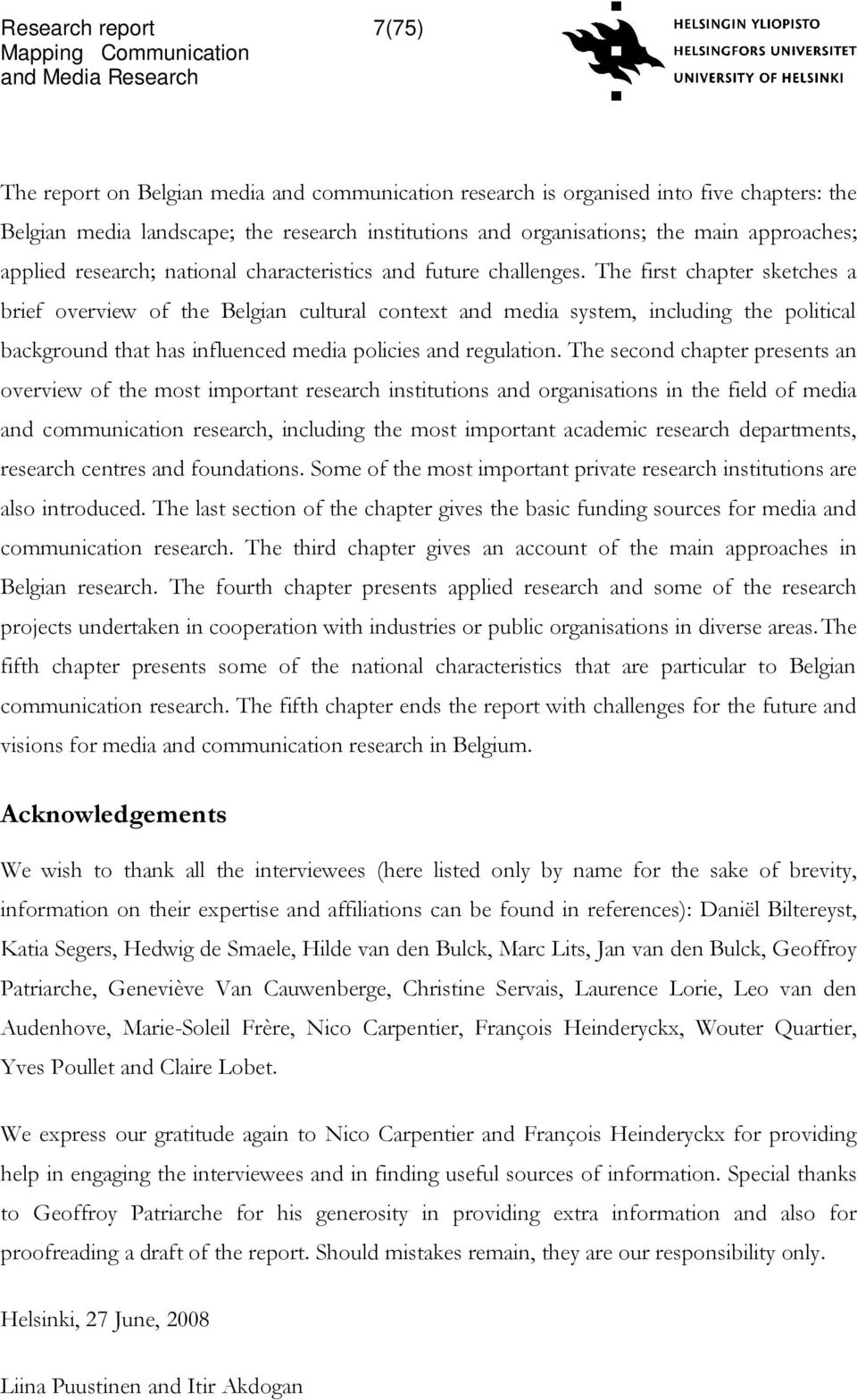
8 Research report 8(75) 1 The Belgian Media Landscape This chapter gives an introduction to Belgium and outlines the media and communication research structures in the country. The media landscape is described in terms of media markets, consumption and legislation; audience opinions will also be presented together with useful figures and statistics. 1.1 Basic information on Belgium The Kingdom of Belgium, as it is officially named, is a small country situated in north Western Europe surrounded by the Netherlands, Luxembourg, Germany and France. Belgium is a highly populated country with 10,396,421 inhabitants living in a space covering 30,528 square kilometres. Population: 10,396,421 inhabitants (2003) Surface area: 30,528 km 2 Federal capital: National languages : Currency: National product: Brussels Dutch, French and German the euro (EUR) billions of EUR (2004) Annual growth rate: 2.7% (2004) Population density: 339 inhabitants per km 2 (2003) Belgium is a federal state divided into regions on a linguistic basis. Flanders, in the north, is the Flemish, Dutch-speaking region with 55-60% of the country s population. Wallonia, in the south, is the French-speaking region with 40-44% of the country s population. In eastern Wallonia lives the community of German-speaking Belgians, who comprise 0.5% of the country s population. Brussels, the capital city, is the bilingual region of the country.
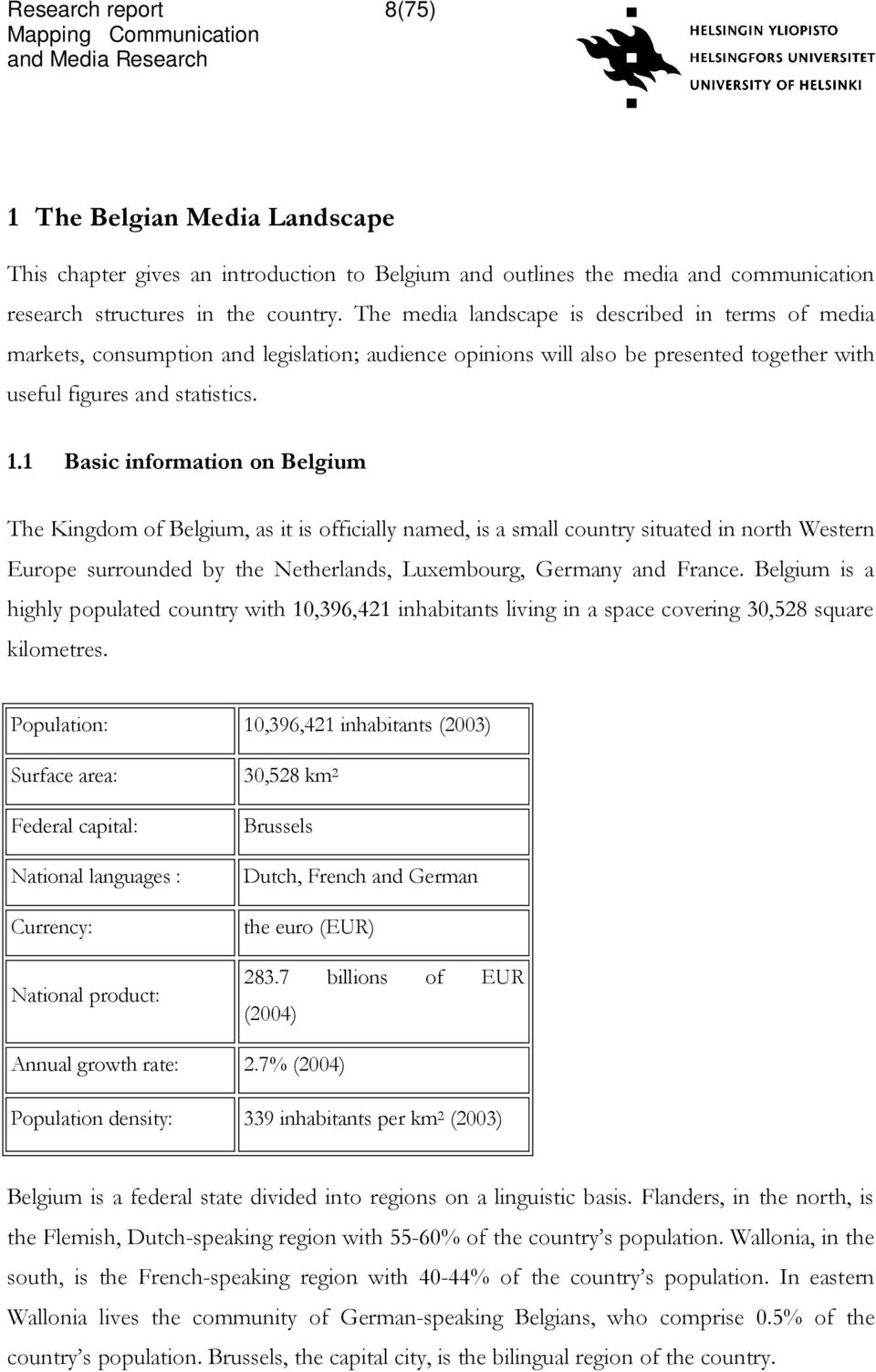

9 Research report 9(75) Belgium s Regions Flemish Region of Belgium Wallonia Region of Belgium Brussels - Capital Region of Belgium German-speaking community of Belgium (in the eastern Wallonia Region) (Wikipedia) The federal state maintains the judicial system, social security, nuclear energy, monetary policy, public finances in general, defense and the federal police. The federal state of Belgium is responsible for such international organisations as the European Union (EU) and NATO, both of which have their headquarters in Brussels. Apart from the federal state government, each linguistic community has its own government and its own parliament. The community s authority is associated with their linguistically defined territories. The economy, employment, housing, transportation, town planning, public works, energy and the environment are within policy fields of each regional community. Provinces, municipalities and intercommunal utility companies are also supervised by the communities. As a bilingual area, Brussels has both Flemish and French parliaments and governments at the local level. Moreover this city of one million inhabitants hosts the parliaments and governments of the federal state and the European Union. The linguistic communities are also responsible for governing the fields of culture, audiovisual media, education and use of the respective language within their area. Although the policy areas are divided among different levels of government, they can all be involved in scientific
10 Research report 10(75) research and can have international relations relevant to their power. All citizens of all communities enjoy equal rights in a democratic system. This special character of Belgium is reflected in all areas of society, politically, economically and socially, and thus has a strong influence on the media structure in the country. It should be mentioned that the linguistic division of Belgium often presents an obstacle preventing good communication between the communities. A peaceful tension is always in the air between the wealthy north and poorer the south. Outside bilingual Brussels, it is difficult to find people who appreciate the language of the other region, although all citizens have the chance to learn these languages at school. Furthermore, all three languages must be mastered by those who wish to work at the federal level in government. This tension caused Belgians to carry on without a federal government for a long period of time after the most recent elections in June The wealthy north wants more economic power, while the poorer south does not want such power to come at the expense of reducing Flemish subsidies. Because of this situation, Belgians waited until March 2008 before Mr Yves Leterme, a Flemish Christian Democrat was able to form a government and become the country s Prime Minister. During the long nine months of negotiations, citizens feared that the country could even split up. Currently, there is a five-party agreement that many fear will fail to ensure a stable, long-term government. Citizens of Brussels who were against the split have decorated the city with Belgian flags which are seen hanging from windows and attached as stickers to walls of buildings, traffic lights and signs. Belgium accepts a large number of immigrants from other European countries, from its former African colonies and from French-speaking countries of northern Africa. Flanders is the region to which most of the immigrants come, perhaps one of the reasons the regional capital, Antwerp, has become the symbol of the extreme right wing in Belgium. In economic terms, Belgium is ranked tenth in international trade of goods. Even if it has a small population that is less than 0.2% of the world population, it has a market share of 3.4% of exports and 3% of imports. Approximately 20% of Belgian exports are comprised of consumer goods. Intermediate goods account for about 60%. Volvo, Opel, Volkswagen and Ford manufacture about a million cars yearly in Belgium. The automotive sector accounts for
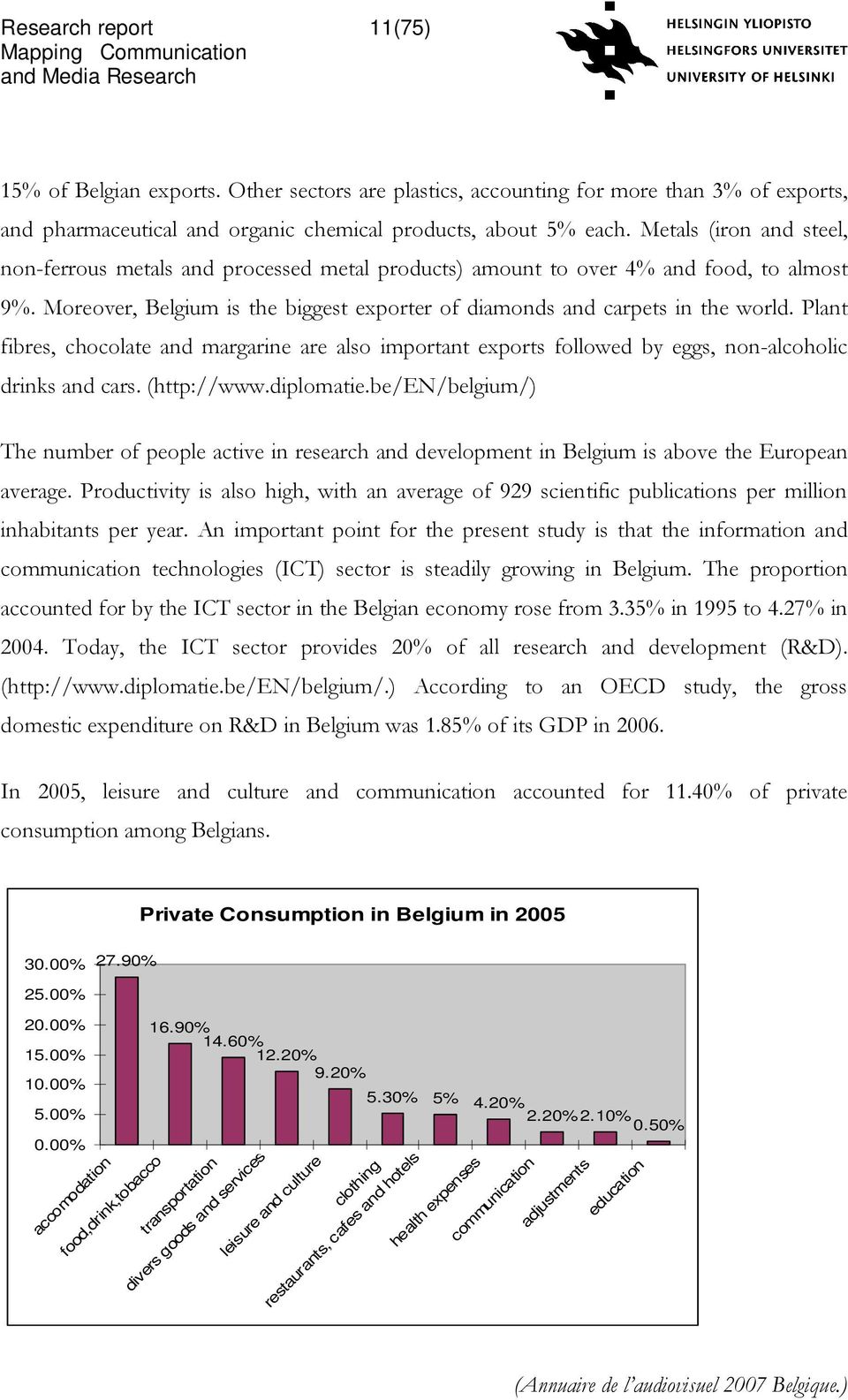
11 Research report 11(75) 15% of Belgian exports. Other sectors are plastics, accounting for more than 3% of exports, and pharmaceutical and organic chemical products, about 5% each. Metals (iron and steel, non-ferrous metals and processed metal products) amount to over 4% and food, to almost 9%. Moreover, Belgium is the biggest exporter of diamonds and carpets in the world. Plant fibres, chocolate and margarine are also important exports followed by eggs, non-alcoholic drinks and cars. ( The number of people active in research and development in Belgium is above the European average. Productivity is also high, with an average of 929 scientific publications per million inhabitants per year. An important point for the present study is that the information and communication technologies (ICT) sector is steadily growing in Belgium. The proportion accounted for by the ICT sector in the Belgian economy rose from 3.35% in 1995 to 4.27% in Today, the ICT sector provides 20% of all research and development (R&D). ( According to an OECD study, the gross domestic expenditure on R&D in Belgium was 1.85% of its GDP in In 2005, leisure and culture and communication accounted for 11.40% of private consumption among Belgians. Private Consumption in Belgium in % 27.90% 25.00% 20.00% 15.00% 10.00% 5.00% 0.00% accomodation food,drink,tobacco 16.90% 14.60%12.20% transportation divers goods and services leisure and culture 9.20% clothing restaurants, cafes and hotels 5.30% 5% 4.20%2.20%2.10%0.50% health expenses communication adjustments education (Annuaire de l audiovisuel 2007 Belgique.)
12 Research report 12(75) Brussels: The Capital of the European Union Some cities are famous for their natural beauty, some for their food, and some because they never sleep. Brussels is a city of 24 hours a day, 7 days a week networking and lobbying in places from huge plazas to small cafés. Members of the international community, who comprise 25-30% of the city population and include Eurocrats, lobbyists, businessmen, media members, headhunters and interns, are in constant communication and interaction. Belgium is a founding member of the European Union (EU). Brussels, the capital of a rather complicated political system, is thus at the same time the capital of the European Union. Along with federal, regional and community parliaments, Brussels also hosts the European Parliament together with other EU institutions such as the European Commission. This makes the city the centre for several other international organisations including NATO, as well as multinational companies, international non-governmental organisations, world media, lobby groups, think tanks and policy research centres. Easily accessible by airplane and land routes, Brussels is also a favorite venue for numerous activities, such as conferences, seminars, workshops, training sessions and, presentations of various European-level networks. 1.2 The Belgian Media Given the nature of Belgian society - a multilingual, multicultural society with a large international community in the capital region and a considerable immigrant population all around the country it is perhaps understandable that the most important characteristic of the Belgian media is that each community has its own media in its own language. This means that Belgium has three public broadcasting companies, for instance, one for the Dutchspeaking community, one for the French-speaking community and a small one for the German-speaking Belgians. The communities do not get involved in each other s issues. The media of one community do not have any audience from the other communities. Nevertheless, these are still communities of one, politically united country. Therefore, together with immigrants and the international community, media pluralism and content diversity are
13 Research report 13(75) important, albeit rather delicate and difficult issues in the Belgian media as in other areas of society. Below an overview of the main actors in the press, broadcasting, new media and advertising with information about media markets, legislation, regulations, strategies, media reception and consumption. Print Media The Belgians are known as assiduous readers of newspapers and magazines. Fifty-five percent of newspaper copies sold is subscriptions; the rest are distributed as single copies. Readership is declining in Belgium, with the country ranked in the middle of the European scale. Free dailies and weeklies are quite popular; Metro is published in both Dutch and French in bilingual Brussels and is one of the most popular newspapers. Other newspapers in Belgium are in either Flemish or French. The most important Flemish newspapers are De Standaard (The Standard), De Morgen (The Morning), De Tijd (The Time), De Gentenaar, Gazet Van Antwerpen (Antwerp Gazette), Het Belang van Limburg, Het Laatste Nieuws (The Latest News), Het Nieuwsblad (The Newspaper) and Het Volk (The People). The newspapers in French are Le Soir (The Evening), La Libre Belgique (Free Belgium), Vers l'avenir, La Meuse, La Dernière Heure (The Last Hour) and L'Echo (The Echo). In proportion to the population, the newspapers with the highest circulation are Flemish newspapers. Below is a chart of the top circulated print newspapers in 2007 based on subscription and single-copy sales combined.

14 Research report 14(75) Top 5 Newspapers Circulation in 2007 Circulation 350, , , , , ,000 50, , , , ,472 98,352 Laatste Nieuws+ Nieuwe Gazet Nieuwsblad + De Gentenaar SUD Press Gazet van Antwerpen Belang van Limburg Newspaper ( Belgian print media have gone international with comic strips. Comics are a very important print media tradition in Belgium and they are the products that made Belgian print media visible all over the world. The works of Belgian cartoonists have been reprinted in many languages and in many countries since the early twentieth century. And they have become a considerable industry with all the side products such as CDs, figurines, T-shirts and so forth sold by the millions all over the world. Three world-famous Belgian cartoon characters are the The Smurfs, Lucky Luke and Tintin. The Smurfs were created by Peyo in They first appeared in the album The Flute and the Six Smurfs. Soon after, the Smurfs became independent and heroes of a new adventure series. In 1981, the world-known cartoonists Hanna and Barbera (who created Tom and Jerry and later the Flintstones and Yogi Bear) introduced the Smurfs to television audiences. Some 300 episodes were broadcasted in nearly 30 countries. ( Lucky Luke, the man who fires a gun faster than his shadow, was created in 1946 by Belgian cartoonist Morris. The adventures of Lucky Luke have also been translated into 30 languages, and some 250 million copies of Luke s adventures have been sold throughout the world. In 1956, Morris began working with the famous writer René Goscinny, who in turn gave life to Asterix and Obelix. (Ibid.)

15 Research report 15(75) The adventures of the young reporter Tintin and his dog are another comic success from Belgium that has travelled the world, with translations into 58 languages and three million books sold every year. Films have been made of twenty-one of the books. Tintin was created by Hergé (George Remi) in (Ibid.) Print Media Market In parallel with world trends, Belgian print media are highly concentrated. There are fourteen autonomous newspapers with nine more that are parallel editions and have almost the same content. Corelio Media, De Persgroep and Concentra are the three groups that control the market in Flanders. The three counterparts in the French-speaking media market are Rossel (which owns Sud Press, a group of daily regional newspapers), IPM and Medi@bel which is controlled by Corelio. (EJC The Belgian Federation of Magazines or Febelmag consists of the following magazine groups: Belgian Federation of Belgomedia S.A., Cascade N.V., Clickx Magazine N.V., De Vrije Pers N.V., Fred N.V., Himalaya N.V., Le Vif Magazine S.A., Press News B.V.B.A., Rossel & Cie S.A., Roularta Media Group N.V., Sanoma Magazines Belgium N.V., Senior Publications N.V., Société Belgo-Française de Presse et de Promotion N.V. (S.B.P.P.), The Reader's Digest N.V., V.N.U. Business Publications, V&V Publishing S.A. From a Finnish perspective, it is noteworthy that the media conglomerate SanomaWSOY has a significant share in the Belgian media and publishing markets. Sanoma Magazines is the most important Belgian consumer magazine publisher, operating in both the French and Flemish markets. Moreover, in the summer of 2004 the company bought the international educational publishing house, Malmberg Investments, which includes Uitgeverij Van In in Belgium. Broadcasting There are three public service broadcasting companies in Belgium: RTBF for the Frenchspeaking community, VRT for the Dutch-speaking community together with the small Belgian Broadcasting and Television Centre (BRF), established for the German speakers in the country, who are concentrated in eastern Wallonia. The tasks of Belgian public radio and television are determined by government decrees.

16 Research report 16(75) VRT is supposed to offer high quality service in information, culture, education and recreation. The priority is on information and culture. VRT and the Flemish government are working on performance standards and realisation objectives in a management agreement that is renewed every fifth year. Although the previous agreement of was vague with regard to the cultural assignments, the current agreement that came into force in 2007 included an increase in negotiations in the cultural field. The Flemish public broadcaster plans to provide open access to its digital archive. The French community has taken some measures to regulate concentration in order to foster the pluralism of the media by ensuring ownership transparency and guaranteeing content pluralism. Objectivity, no prior censorship and no interference from any authority are the priorities according to the above-mentioned decree. Some regulations impose an obligation of information balance among different ideological views and trends in order to ensure content pluralism. Objectivity and anti-censorship are the priorities at BRF, which broadcasts to German speakers in Belgium. BRF is responsible for delivering information to that audience as well as for its education and entertainment. Another task of the organisation is to make the small German-speaking community known among Belgians. The German speaking community in Belgium is quite small; therefore, according to the Media Decree, all television providers must give some visibility to the German-speaking community in their productions. In addition, all providers should have a share of programmes from other European countries. Further private radio broadcasters should reflect balanced information among diverse opinions; those too should present German-speaking community s culture and artists on their programmes as well as programmes of neighbouring countries. (Lebon & Janssens 2006.) In 1987 the television monopoly was broken by law, and the cable networks brought more competition to the television market. RTBF lost audience to RTL and the French channels while VRT lost its audience to Dutch and also to French, German and British broadcasting.

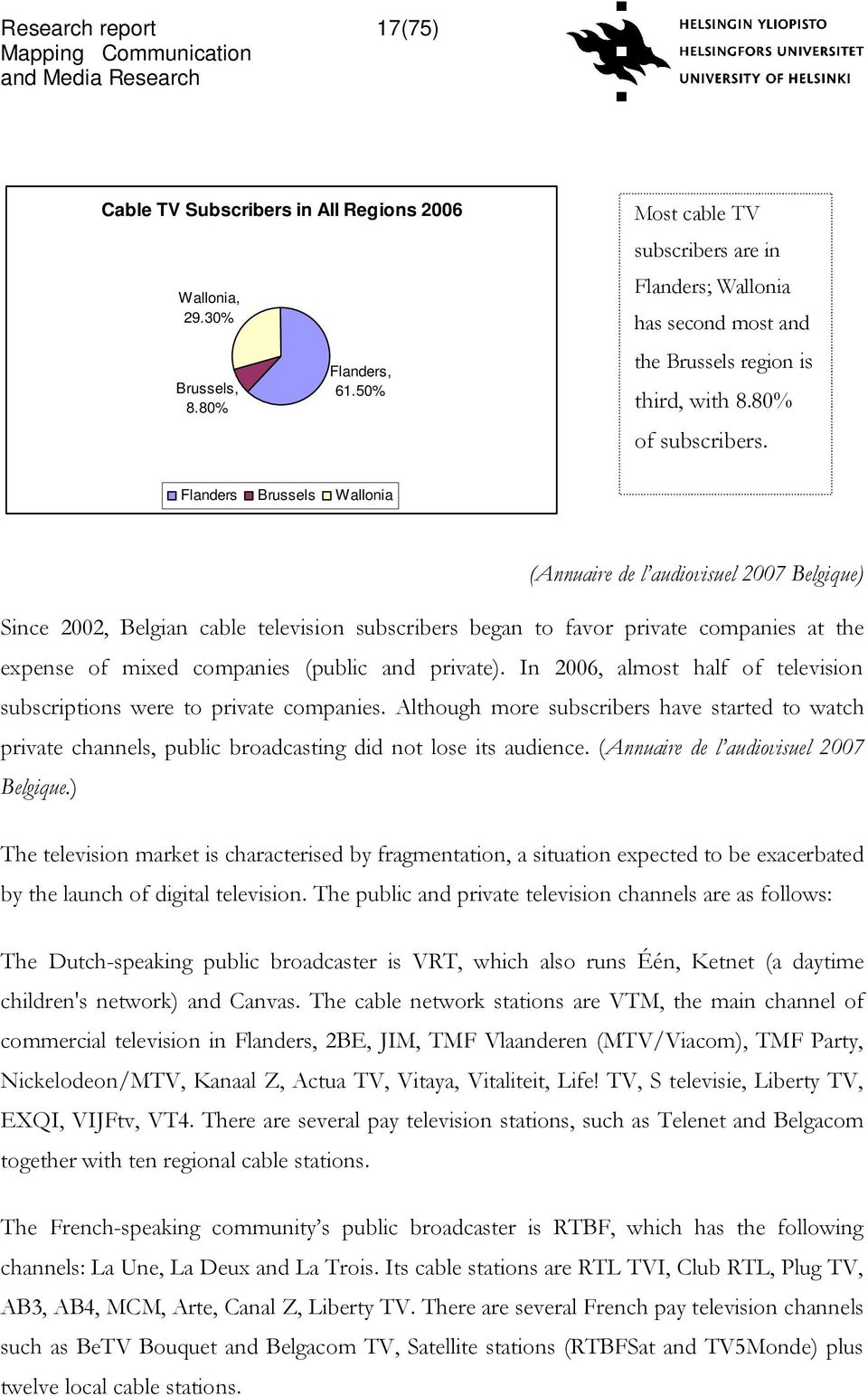
17 Research report 17(75) Cable TV Subscribers in All Regions 2006 Wallonia, 29.30% Brussels, 8.80% Flanders, 61.50% Most cable TV subscribers are in Flanders; Wallonia has second most and the Brussels region is third, with 8.80% of subscribers. Flanders Brussels Wallonia (Annuaire de l audiovisuel 2007 Belgique) Since 2002, Belgian cable television subscribers began to favor private companies at the expense of mixed companies (public and private). In 2006, almost half of television subscriptions were to private companies. Although more subscribers have started to watch private channels, public broadcasting did not lose its audience. (Annuaire de l audiovisuel 2007 Belgique.) The television market is characterised by fragmentation, a situation expected to be exacerbated by the launch of digital television. The public and private television channels are as follows: The Dutch-speaking public broadcaster is VRT, which also runs Één, Ketnet (a daytime children's network) and Canvas. The cable network stations are VTM, the main channel of commercial television in Flanders, 2BE, JIM, TMF Vlaanderen (MTV/Viacom), TMF Party, Nickelodeon/MTV, Kanaal Z, Actua TV, Vitaya, Vitaliteit, Life! TV, S televisie, Liberty TV, EXQI, VIJFtv, VT4. There are several pay television stations, such as Telenet and Belgacom together with ten regional cable stations. The French-speaking community s public broadcaster is RTBF, which has the following channels: La Une, La Deux and La Trois. Its cable stations are RTL TVI, Club RTL, Plug TV, AB3, AB4, MCM, Arte, Canal Z, Liberty TV. There are several French pay television channels such as BeTV Bouquet and Belgacom TV, Satellite stations (RTBFSat and TV5Monde) plus twelve local cable stations.
18 Research report 18(75) The German-speaking public broadcaster, BRF, has one television channel plus three radio stations. BRF also reaches its audience through its Internet site. As for radio broadcasting, the illegal local radio stations were a threat to the public radio monopoly. This monopoly ended when local radio stations were legalised in Flanders in 1982 and French-speaking community has recognised the local stations in They however had to wait until 1985 to be authorized to advertise. There are numerous commercial and community radio stations including the university stations in all regions of Belgium. Public radio is limited to RTBF, the French-language public broadcaster, whose stations include La Première, VivaCité, Classic 21, Pure FM, Musique 3 and the external service, RTBF International. The Dutch-language public broadcaster is VRT whose stations include Radio 1, Studio Brussel and the external service, Radio Vlaanderen International (RVI) plus Belgischer Rundfunk (BRF), the German-language broadcaster. New Media In 2006, 57.45% of Belgian households had access to home computers, and 53.95% of them had access to the Internet. Households with at least one computer are found in 61% of the population, which is higher than the EU27 average of 54%. The Internet market survey of the last quarter of 2007 by the Belgian Internet Services Providers Association ISPA announced an increase of 2.21% in the total number of active Internet connections in Belgium. The business market growth is thus 3.15%. On a yearly basis, the Belgian Internet market increased 8.3% in 2007 compared to Overall telephone access (fixed or mobile) is 96%, and 86% of households have at least one mobile telephone. Proximus (47%), Mobistar (37%) and Base (16%) are the leading mobile telephone operators on the market. Five percent of the population uses public pay phones and 16% make calls over the Internet; 96% of households have either standard or widescreen television sets. ( Newly created e-newspapers and e-magazines have not been a success in Belgium. Weblogs however, are very popular among Belgian Internet surfers. When it is a question of credibility, Belgian online readers trust the online versions of the traditional media more than other

19 Research report 19(75) resources. All newspapers provide their news online on their website; some do it with a full online version. On a random check of websites visit in Belgium for 22 May 2008, MSN Hotmail was the most visited site with 2,391,373 visits out of a total of 7,977,567 followed by Netlog (864,481), HLN.be - 7sur7.be (666,104), Skynet (553,675) and Skyrock (547,320). Newspaper online versions such as Het Nieuwsblad (360,071) and De Standaard Online (291,178), are among the most highly visited websites. ( Advertising Since 1995, advertising has had a faster evolution than the national economy in Belgium. In 2005, the share of investment in advertising in media had reached 0.8% of the gross domestic revenue and 1.5% of the private consumption. These are relatively modest numbers compared to those of other European countries. (Annuaire de l audiovisuel 2007 Belgique.) The federal state of Belgium is a big advertiser for Belgian media, but Procter & Gamble Benelux is the leader with more than 90 million Euros (in 2006). The biggest advertising investments are listed in the following chart: Advertiser Amount( ) Procter & Gamble Benelux 94, 567, 874 Belgian Federal State 87,125, 285 Belgacom Group 75, 187, 043 Danone Group 61, 228, 273 Unilever 57, 995, 092 L'Oréal Group 44, 362, 490 ALDI 41, 228, 830 VUM Group 38, 394, 917 D'ieteren Group 36, 110, 893 Vlaamse media maatschappij 32, 367, 369 (http ://

20 Research report 20(75) Television remains the media that attracts most advertisers in Belgium, with a share of 39.90% of the total advertising market. Films have the lowest advertisement revenues. Advertising Market Share by Media in % 40.00% 35.00% 30.00% 25.00% 20.00% 15.00% 10.00% 5.00% 0.00% 39.90% 25.80% 12.20% 9.40% 11.50% 1.30% TV Magazines Dailies Billboards Films Radio 1.3 Media Policies, Regulations and Strategies (Annuaire de l audiovisuel 2007 Belgique.) Media and advertising regulations, licenses and content directives have to conform to EU directives; otherwise, there is no specific anti-concentration law in Belgium. In 1999, direct government subsidies were abolished in Flanders after all newspapers were incorporated into larger press groups, while public aid to press still exists in French-speaking community. Indirect subsidies from the Federal State such as the 0% VAT on newspapers and magazines, however, are still in place both communities. Both Flemish and Walloon communities have their own regulation frameworks and controlling organisations: De Vlaamse Regulator voor the Media (VRM) and the Conseil supérieur de l audiovisuel (CSA) respectively. These organisations grant licenses for new radio and television stations, enforce the legislation and also impose sanctions.

21 Research report 21(75) There have been a number of press scandals in Belgium that have prompted journalists to create a new ethical code. Complaints about journalists are sent to the Belgian Association of Professional Journalists (which is divided into two linguistically defined entities, the Flemish AVBB and the French AGJPB) which has an Ethics Council. The council considers complaints and gives advice to journalists. Advertisers have their own self-regulatory organisation responsible for ethical aspects in their field. The Belgian Association of Professional Journalists in Brussels, the Belgian Association of Publishers (BVDU) and Febelma, the federation of magazine publishers are the three important organisations in Belgium responsible for wages, ethics, professional statutes and social agreements for journalists. ( The Belgian Institute for Postal Services and Telecommunications (BIPT) prepares telecom market monitoring and analysis in Belgium. The organisation supervises whether the universal service provisions are correctly applied. It also identifies statements of fact to assist in making decisions about certain operators. In addition, the Institute ensures that all wave users comply with the provisions regulating frequencies at the national spectrum monitoring department. 1.4 Media Consumption and Reception When average household consumption of culture and leisure is examined for recent years, Belgians are found to spend a bit more than the average Europeans on audiovisual goods (such as electro-acoustic appliances, televisions, accessories, films, CDs, etc.), cultural services (museums, shows, pay television, etc.) as well as press, publications, libraries and stationery goods. While in 2000 Belgians spent 152 Euros per household on museums and shows, in 2004 they spent 180 Euros per household. Likewise, their press, libraries and stationery expenses have risen from 405 Euros per household in 2000 to 425 Euros per household in Their audiovisual expenses have also changed, with almost a 50% rise in their expenses for television and music players, from 60 Euros per household in 2000 up to 91 Euros per household in Average annual consumption in cultural activities and press, libraries and stationery per household in 2004 in the various regions of Belgium was as follows:
22 Research report 22(75) Expenses (in Euros) Belgium Brussels Flanders Wallonia Cultural services: films, museums, shows Press, librararies, stationery (Annuaire de l audiovisuel 2007 Belgique.) More than half of the Belgian population has access to high speed Internet connection at home (54%) as opposed to 2% who have access in the work place; 16% have access to broadband connections in both places. The cable coverage in Belgium, at 94%, is the highest in Europe. However, at the same time Belgium has the lowest satellite access, only 10%. Some three percent of the population has no access to either cable or the internet. On an average week day, about half of Belgians (48%) spend one to three hours watching television. They tend to watch more television on weekends; those who spend more than three hours in front of a television have increased from 28% (on weekdays) to 36% on weekends. Five percent of Belgians watch television online on the Internet; 55% of television viewers mention that they prioritise television news channels. Awareness of international channels is not very high. The Immediate recognition of CNN is 14%, while that of BBC is as low as 4%. About half of those who mentioned an international channel (49%) watch the channel once a day. The Belgian film market is giving way more and more to productions from the US. The market share of film distributers for Belgian companies was 41.6% in and 40.6% the following season whereas 52.7% of US companies increased this percentage up to 56.7% in the same period. Companies from other countries lost 2.6% to 5.7% of their share during the same time frame. Pirated reproductions of audiovisual material is a growing issue. The dramatic rise in the sale of virgin DVD and DVD writers are proving this trend. (Annuire de l audiovisuel 2007 Belgique.) As for the habit of watching television news programmes, slightly more than half the viewers (52%) watch television news programmes once a day; 9% never watch television news. Ten percent watch the news over the Internet; 39% of those who watch news on television and/or
23 Research report 23(75) the Internet systematically avoid such political programmes as debates, interviews or analyses. Belgium is the EU country with the lowest figure for viewing political programmes, at 59%. (The second lowest in rank is Malta, with 58%). Some Belgians tend to avoid news about Europe and/or the EU when they read newspapers (24%); they are more tolerant of European topics on television and radio news (17% for both). ( /public_opinion/archives/ebs/ebs_274_en.pdf.)
24 Research report 24(75) 2 Research Institutions and Organisations This chapter presents the university Departments and the research centres in the field of media and communication, including an account of their main funding organisations. This chapter also gives a brief account on some of the most important non-academic research organisations, such as the research departments within media companies. The universities and other research institutions in Belgium are divided according to the linguistic regions of the country, which are further subdivided into regional networks. The research institutions of media and communication are therefore relatively numerous and small. 2.1 Universities and Research Centres In both Flemish and Wallonian universities the funding is mainly public, and the principal budgetary costs are for teaching. Belgian universities are open to all citizens and students are selected by grades if they wish to proceed through the curriculum to higher stages to attain an academic degree. Media and communication are very popular subjects among students in Belgium. The Belgian university systems are administratively as well as financially handled according to linguistic division. Flanders area has an inter-university council (VLIR - Vlaamse interuniversitaire Raad), which supervises the teaching and research in the Flemish universities. In a similar way in the Wallonian region there is a Council of Rectors of the French-speaking universities (CREF -Le Conseil des Recteurs des Universités Francophones de Belgique). The Belgian university system follows the Bologna treaty of the European Union in terms of curriculum by providing degrees at three levels: bachelor s, master s and doctoral. The Bologna process, which was supposed to harmonise European university curricula as a whole, has actually had the opposite effect in Belgium. In French-speaking Belgium the bachelor s (BA) degree takes three years to complete and master s (MA), two years, as elsewhere in the Europe. But Flemish Belgium has system of three years for BA and one year for MA, which is similar to the Netherlands. This is because there was a concern that a large number of Flemish students would go to Holland to pursue the same degrees in a shorter time. However, this will
25 Research report 25(75) be a salary problem in the future in Belgian industry because the Walloon MA diploma holders must spend more time getting their education. Even though the country is mainly secular, many of the universities are marked by a religious background. The network of Catholic universities is strong, and as a counterweight, there are two universities in Brussels free of religion, the Flemish and French-speaking Free Universities. Another distinctive factor for media and communication research in each university is the faculty in which the research is located. In general the Departments that are part of Humanities faculties have a more philosophical, a literary and aesthetic orientation, whereas those connected to the faculties of social sciences has more empirical orientations. For researcg funding, there are separate foundations, FWO for Flanders and FNRS for Wallonia. These foundations organise calls for projects and also finance scholarships for PhD study, post-doctoral posts and senior researcher posts. Universities in Flanders The Flanders universities communication Departments are based on the generalist model, each having several focal areas of research and staffs specialised in different fields and approaches. The diverse perspectives and interdisciplinary crossing-overs are generally valued, yet each university has its special areas of expertise. The Flemish Inter-university Council VLIR has conducted an outside evaluation of the Flemish communication institutions in bachelor s and master s education (2007). The best marks in VLIR s report were given to the BA and MA programmes in the Free University of Brussels (VUB), an institution which is also very dynamic in research, especially in the areas of new technologies and methodologies of the Political economy of communication and cultural studies. The VUB and the Catholic University of Leuven (KUL) have the longest traditions in media and communication in the Flanders region. The University of Leuven has the biggest Department of communication in Belgium, with an orientation towards traditional Anglo- American mass communication research and studies of media effects. Another strong university with a long tradition is the University of Ghent, which is known for its film studies and more recently, for its applied research on ICT s. The Communication Department in
26 Research report 26(75) Antwerp is younger and smaller than the others, but it is active and growing, its speciality being, among other things, television studies. The Flemish community of communication scholars in Belgium is fairly small, but the university communication Departments and some polytechnics are grouped in loose cooperative networks. The universities of Ghent, Brussels, and Antwerp have a joint association. The University of Leuven is part of the association of Catholic universities. Universiteit Antwerpen (UA) has a Department of Communication Sciences, with eight professors, seven to eight lecturers, and several assistants and researchers. Communication Studies in Antwerp has grown significantly during the past seven years, and the number of lecturers has doubled. Student numbers are very high, considering the size of the staff: the number of students has nearly doubled in recent years. The Department provides three master s programmes as well as doctoral education. The first, the Master in Communication Sciences, has two specialist orientations: strategic communication on the one hand, and visual studies and media culture on the other. In both orientations the students have a choice of either an academic or a professional emphasis. The second MA programme, the Master in Political Communication, is a joint cooperation with the Department of Political Sciences; it is the only MA programme in the area of political communication in Belgium. The third programme is the Master of Film Studies and Visual Culture. In general, qualitative research approaches are dominant in the Department of Communication in Antwerp. The focal areas of research are structured around five research groups: 1. Political communication: special emphasis on psychological and linguistic aspects of politics and communication. 2. Media, policy and culture: the approaches of political economy (globalisation, concentration, convergence and commercialisation), and audiovisual media culture (cultural studies, e.g., media and identity, representation and reception). 3. Visual culture and communication: both basic and applied research in visual communication (e.g., scientific data gathering and communication, entertainment, education and news reporting). A wide range of media (film, television, print, Internet), and aspects (production processes, representational issues, context of use). 4. Strategic communication for the information society: special emphasis on telework and e-government, international projects (e.g., Allinclusive@work, DITO).
27 Research report 27(75) 5. Language, media and socialisation: fundamental and applied research, special emphasis on interaction between language use and social-psychological factors. Vrije Universiteit Brussel (VUB), the Free University of Brussels, is a non-religious university, founded by three Freemasons. The ideology of the University is to be free from political and religious dogma. The Department of Communication Studies, part of the faculty of humanities, differs from similar departments in the other universities by its emphasis on a critical research orientation. Methodologically, the qualitative research approach is dominant. The Department provides BA, MA and PhD programmes in communication sciences. The alternative orientations in the MA are media and culture, information and globalisation, organisational communication and marketing. In 1987 the Department started a research centre CSNMIT (Centre for New Media and Information Technology Studies) under the leadership of two well-known professors, Dr H. Verstraeten and Dr J.C. Burgelman. By 1990 the research centre had grown to the point that it was divided into two research centres: Cemeso (Centre for Media Sociology) and SMIT (Studies on Media, Information and Telecommunication). Recently, the Department launched a third research centre on Marketing and Public Relations Research, with an Economics approach. The research centre Cemeso focuses on media and culture. The profile of Cemeso is distinguished by three domains: economy, culture and politics. Moreover, three focal points guide the actual research agenda: 1) media, politics and citizenship (including journalism) 2) cultural and creative industries and policy and 3) media content, meaning and audiences (including critical approaches and discourse analysis). Cemeso s main theoretical and research focus is the role of media in the transformation of the public sphere. The centre has carried out a number of empirical projects on signification processes and the public sphere, journalism and the public sphere, ideology and the public sphere and intercultural communication. The present director of Cemeso is Professor Katia Segers; professor Nico Carpentier works as the co-director. The focus of the research centre SMIT is on interdisciplinary social scientific research in media, and on information and communication technologies, including, for example, the uses and adoption of ICT. The research centre is mainly funded by projects of the IBBT, the newly
28 Research report 28(75) established Interdisciplinary Institute for Broadband Technology in Flanders. The majority of the research conducted in SMIT is applied research commissioned by governmental institutions and industries. SMIT is directed by Professor Caroline Pauwels; two part-time professors and three senior lecturers supervise the projects. The permanent staff is only seven to eight people, but counting those involved in projects the total number of staff is around The number of projects and staff has grown significantly during the past five years due to the Flemish government subsidising of the cooperative research between industry and the universities, especially in the area of ICTs. SMIT is organised methodologically into three main research areas: policy research, user research and business models. Thematically, SMIT works on e-culture, e-citizenship and e-democracy, mobile communication and new media. The research centre works on research in media in general, but the majority of current projects are related to new media and digitalisation (e.g., e-health). Universiteit Gent (UG), The Department of Communication Sciences is located in the Faculty of Political and Social Sciences. In 1964 communication research started in Ghent with research areas in press and audio-visual media. In recent years the Department has broadened to include media culture, film studies, corporate communication, media law, media policy, new media and advertising. The Department has therefore adapted a generalist model and has six to seven professors. It offers study programmes in communication sciences at the BA, MA and PhD levels. The master s programme has three fields of specialisation: communication management, film and television studies and media and social sciences. ghent university also offers a separate master s programme in journalism. As part of the Department of Communication Sciences, operates a coordinating research centre OMC (Media and Communication). OMC carries out basic as well as applied research, with a focus on the usages of and the demand side of ICT applications. The centre cooperates with hardware manufacturers, content providers and software producers (in the media, healthcare and mobility sectors) and also with government bodies and policymakers. The methodological approaches vary from qualitative to quantitative. The OMC research centre studies different sectors within the media: press, film, radio, television, advertising and new communication technologies. Focal areas of research include:
29 Research report 29(75) 1. Media policy: Policy orientated, preparatory and supporting research on behalf of policy responsibles, in the media and the government. 2. Media sectors: Investigation of media sectors, in particular with regard to their development, structure and functioning. 3. Media messages: Form and content analysis of media messages, selection processes, representation, discourse, and so on. 4. Public investigation: Media possession and use, reading, watching and listening behaviours, reception of new media, media influence. 5. Media and copyright law: Advice on and investigation of legal aspects of media, communication and journalistic ethics. 6. Persuasive communication: Corporate and marketing communication management investigation. The OMC has two research groups: MICT (Media and ICT) and a network of film studies and it coordinates researchers from the Flemish universities. Moreover, professor and head of the Department Daniël Biltereyst leads an informal network called Babylonia, which draws together researchers orientated towards cultural studies and media culture. The MICT places importance on framing the ICT research in a societal context. The working group Film and Television Studies focuses on the social role of film, television and other audiovisual products from a critical perspective. The group is one of the main partners of the Ghent University film club Film-Plateau, which functions as pedagogical forum and a site for the International Flanders Film Festival and the documentary film festival Viewpoint. Katholieke Universiteit Brussel (KUB) had a small Department of Communication Sciences, located in the Faculty of Political, Social and Communication Sciences, until September Although the Department received fairly good marks in its recent evaluation by VLIR, it was closed due to the restructuring policy of departments within the network of Catholic universities of Flanders. The KUB Communication Department had only one full-time professor and two part-time professors. The Department s focal areas were varied and the approach, interdisciplinary. The strong area was international and intercultural communication and development communication (including projects in Russia and India). The other focal areas include: culture and politics, normative media theory, media and democracy, public service broadcasting, media and conflict (war), community media, cultural media studies, journalism (journalistic practices), participation of public in media, media education, media and citizenship, youth and media, media and racism, the question of identity, visual sociology and regional studies. The
30 Research report 30(75) methodologies of qualitative and quantitative were combined (discourse analysis, reception analysis, participatory observation, quantitative programme analysis and content analysis). A comparative approach (various countries, approaches or data) was emphasised. Katholieke Universiteit Leuven (KUL) is a key institution in the network of Catholic universities in Flanders. Within its faculty of social sciences is the oldest and largest Department of Communication in the Flanders area. The Department is divided into two research groups and teaching programmes: the School for Mass Communication Research, directed by Jan van den Bulck; and the Centre for Media Culture and Communication Technology, directed by Dirk de Grooff. The two groups work together in teaching four different MA programmes: media culture, ict management, marketing communication and media effects. There are eight professors working full-time. The School for Mass Communication Research focuses on the following areas: media and health, media and violence, media and schools, media and family, cultivation research, uses and effects of ICT and audience research. The orientation of cultivation research (a tradition started by American scholar George Gerbner) is based on sociological and psychological approach to communication. The Department in Leuven has long had a close relationship to North American theory and North American universities. There is a strong emphasis on quantitative methods and media effects. The methodological approaches are mainly large quantitative surveys and experimental settings for testing large processes. The other research group in Leuven, the Centre for Media Culture and Technology, has as its focal areas popular culture, technology and audience research. Popular culture is broadly defined, and includes, for example, the music industry, film studies and television studies (involving news production, news evaluation, content analysis). The technology research team is mainly business-orientated; for instance, it makes analysis of usability (of web sites and video games and the design of new technologies) for industry purposes. The main difference between the two research centres in Leuven is that the Centre for Media Cultura and Technology takes its influence from cultural studies in the British traditions,
31 Research report 31(75) whereas the School for Mass Communication Research is more sociologically or psychologically orientated, taking its influences from American research. Earlier the Catholic University of Leuven published a Dutch-language journal, Communicatie, but it was discontinued a few years ago. A still-existing journal is Tijdschrift voor CommunicatieWetenschap, which serves media and communication scholars in both the Netherlands and Flanders. There is also a journal focused on media history, Tijdschrift voor Mediageschiedenis. In general, the Dutch market for communication journals is not big enough for many publishers, and the researchers publish a great deal in international, peer reviewed English language journals. Universities in Wallonia Three of the biggest universities in the Wallonian region provide research in the field of media and communication: Université Catholique de Louvain (UCL), Université Libre de Bruxelles (ULB) and Université de Liège (ULg). The universities have recently launched a joint doctoral school with a number of other smaller universities. A significant share - two thirds - of the doctorates of Francophone Belgium graduate from UCL. Between 2000 and 2005 there were only 39 doctorates (an annual rate of 8; UCL - 24, Liege - 7, ULB - 7). During the same time there were 68 doctoral students working on dissertations. Careers in communication research and obtaining a PhD do not attract as many students in Francophone Belgium as in the Flemish parts of the country. However, the doctoral degree has begun to be more valued in industry. The Wallonian universities are grouped into three federations. The first, the Academy of the Universities of Louvain, is composed of the large university of UCL and a few smaller ones: Facultés Universitaires Saint-Louis (FUSL), Facultés Universitaires Notre-Dame de la Paix (FUNDP) and Facultés Universitaires Catholiques de Mons (FUCAM). The second federation is the Academy of Wallonia-Brussels, composed of ULB and the University of Mons-Hainaut (UMH) and Faculté polytechnique de Mons (FPMs). These institutions have a pool with five smaller Wallonian scholarly institutions. The third federation, Academy of Wallonia-Europe, includes University of Liège and Faculté Universitaire des Sciences Agronomiques de Gembloux. Université Catholique de Louvain (UCL), located in Louvain-la-Neuve, hosts the most prominent Department of communication in the Wallonia region. The Department of
32 Research report 32(75) Communication was founded in 1946 and has around thousand students in study programmes at all levels (BA, MA and PhD). The Department maintains three master s degrees in information and communication in order to educate students as journalists for print and audiovisual media, as communication and PR officers, for human resources, as specialists of popularisation of science (e.g. in the educational or cultural sector or as concept designers for multimedia). The Department of Communication of UCL has also started a School of Journalism (Ecole de Journalisme de Louvain), granting BA and MA degrees to journalists. The Department has some 15 professors, 15 aspirants (young researchers or researcherteachers) and PhD students. It is divided into two operational units called RECI (Analyse du récit médiatique) and RECO (Recherche en communication). RECI is organised around three methodological axes: socio-economic studies, a narratological approach and an ethno-sociological approach. RECO has its emphasis on the semiotics of social and cognitive processes. The two operational teaching and research units host three research groups: 1. Observatoire du Récit Médiatique (ORM): Journalism, press and media analysis of mediated narratives, both fundamental and applied research in terms of punctual analysis of mediated phenomena (directed by Marc Lits). 2. Laboratoire d Analyse des Systèmes de Communication des Organisations (LASCO): Organisational communication and PR, studies of the internal, external and strategic communication in organisations (directed by Axel Gryspeerdt). 3. Groupe de Recherche en Médiation des Savoirs (GReMS): Research on the mediation of knowledge in various fields, also communication in cultural and museum sectors and expositions (directed by Jean-Pierre Meunier). The Department publishes a journal, Recherches en Communication, with articles mainly in French and appearing two to three times a year. The ORM research centre also publishes another journal, Médiatiques, focused on the analysis of journalism and press. Université Libre de Bruxelles (ULB), the Faculty of Arts and Humanities hosts the Department of Information and Communication Sciences which was created in The Department unites the previously separate units of journalism (created in 1945) and corporate communication, information and documentation (created in 1977) with the performing arts and cinema. The Department offers master s and doctoral programmes in several fields: information and communication (journalism and corporate communication), information and
33 Research report 33(75) communication sciences and technologies, the performing arts and cinema and multilingual communication. The staff includes seven professors and 25 researchers and assistants; there are around one thousand students enrolled in the programmes. The research profile of the Department emphasises on information and communication technology, which is studied in terms of media, audience research and corporate communication. The research activities include the study of the consequences of evolution and technological innovations, including information and communication technologies, on the media and their audience, (for example, studies of users in interactive contexts such as Web forums, blogs or newsgroups). Another central research activity is the development of new technologies and tools to optimize all stages of the information and knowledge management, (for example, the design of topic-specific meta-data schemes and document analysis software development). Among the other focal research areas are journalism, audience research, semiotics, performing arts, cinema and scriptwriting. The poles of research are defined as follows: History and information of medias Observatory of medias in Europe Media in Africa Media and information and communication technologies (Médias-TIC) Technologies of information Documentation and library sciences E-learning Studies on live spectacles Semiology (of theatre) Writing and analysis of cinematography The Department of Information and Communication is involved in several national and international projects and international organisations. Current research projects include: The development of meta-data for images in the context of the digitalisation of the Belgian cultural heritage The development of an XML-orientated search engine The development of a platform to build and maintain communities of interests automatically The study of information mediation in newsrooms and in businesses The study of the impact of information and communication technologies on the media
34 Research report 34(75) Université de Liège (ULG) is situated in the southeast of Belgium. The University has a Department of Arts and Communication Sciences located in the faculty of humanities. The staff of the Department includes eight professors and 21 researchers and PhD students. The Departments offer three MA programmes: 1. Arts and spectacle (cinema); 2. Information and communication, with two orientations a) Press, journalism and audiovisual media, and b) Cultural production and mediation; 3. Sciences and technologies of information and communication. The orientation of the communication research in Liège is closely connected to the humanities traditions, mainly philosophy and literature. The emphasis is on cultural dimensions of communication with a critical approach. The focal areas of research are defined as follows: 1. Critical information theory (the Frankfurt school, theories of Bourdieu, philosophical media theory, discourse theory) 2. Communication theories, sociological orientation (e.g., Bateson, Palo Alto) 3. Aesthetic orientation (reception studies) 4. Anthropological analysis of images (e.g., question of nature vs. culture). Four research groups including doctroral work are formed in cooperation with other departments of the ULg University: 1. Unité de recherche en théorie critique de l information. Esthétique, rhétorique, instituions, éthique. Critical information theory, esthetics, rhetoric, institutions and ethics. (Together with Department of Languages and Romanic Litterature and Department of Philosophy). 2. L Unité de recherche mediation culturelle. Cultural mediation. (Together with Department of Languages and Romanic Litterature, Department of History and Department of Philosophy). 3. L Unité de recherche en Études cinématographiques et audiovisuels. Film and audiovisual studies. (Together with Department of Languages and Romanic Litterature and Department of History). 4. L Unité de recherche en Sciences du livre et de l édition. Science of the book publishing. (Together with Department of Languages and Romanic Litterature, the Central Library of University of Liège). The Departments of Communication in Liège emphasise basic research, but some small-scale applied research is being made. The PhD students have an active network, Intersection, in the domain of philosophy and literary studies. The University of Liège is known for its emphasis
35 Research report 35(75) on film studies, the two main axes are documentary cinema and images of the new media technology. Facultés Universitaires Notre-Dame de la Paix (FUNDP) is situated in the city of Namur in southern Belgium. FUNDP has three research centres which conduct communication related research: the Interdisciplinary Research Group in Communication and Internet GRICI (Groupe de Recherche Interdisciplinaire Communication & Internet), the Research Centre in Information and Law CRID (Centre de Recherches Informatique et Droit), and the Interdisciplinary Cell of Technology Assessment CITA (Cellule Interfacultaire de Technologie Assessment). GRICI is a new interdisciplinary research group created in It focuses on studies in the use in new technologies of information and communication from a cultural point of view. The group unites reseachers from various disciplines who all share the interest to Internet as a communicative space which generates new forms of social identities and narrations of the self. The aim is to analyse and popularise the phenomena created by the Web: the uses, the contents, the practices, the techniques, the social evolutions and the rules. CRID is focused on European law and foreign law dealing with matters of privacy and copyright. The Centre conducts both basic and applied research into electronic commerce, electronic communication, the information society, intellectual property, and technology and security. Among the focal research areas is regulation of infrastructures and content, which involves research into the legislation on racism, pornography, cyberharrassment and Internet and Youth. CRID also conducts research on the regulation of a journalistic milieu, how it can adapt to new actors in journalism such as citizen journalists and how this kind of journalism should be regulated. The CRID conducts research on the responsibility of such actors as search engines, hosts and portals, cyber criminality, and finally the regulation of Internet with presence in global processes such as the World Summit on the Information Society (WSIS) and Internet Governance Forums (IGF). The research centre CITA specialises in the assessment of new technologies, especially ICT. CITA s research is financed by the federal office for scientific, technical and cultural affairs (OSTC) in the framework of the PAI-IUAP IV programme and the telecommunications
36 Research report 36(75) programme, by the Walloon region (DGRNE), by the Federal Department of Internal Affairs and by the European Commission. The Centre has five research fields: technology assessment, uses analysis in a social-shaping perspective, organisational analysis, technology policy (innovation policy, information society policy) and ethics of computing (ethic codes, uses of self-regulation, child pornography on the Internet). CITA works in partnership with a number of other research institutions at regional, federal and international levels. Facultés Universitaires Catholiques de Mons (FUCaM) offers degrees in management, political science and communication. FUCaM was created in 1896, and since then the emphasis has been on international education (for example, students are encouraged to spend one year of their curriculum abroad). FUCaM offers three BA and MA university programmes in management, business engineering and political science. Since 2004, FUCaM has also offered a BA degree in communication in cooperation with the Catholic University of Louvain, which leads to the master s degree in this field. FUCaM has a research group in Consumer Behaviour LABoratoire d Analyse du Comportement du Consommateur (LABACC) (which conducts research on such topics as advertising). Facultés Universitaires Saint-Louis (FUSL) is located in Brussels. Information and communication have long been subjects in the curriculum, taught by visiting lecturers and teachers. But in October 2007 a full-time professor was hired in this area. Now FUSL is investing in developing teaching and research in the fields of media and communication. The institution offers the BA degree, a MA degree in European studies and various complementary MA degrees and PhD programmes. In spring 2008 a research centre in communication, Pôle de Recherches sur la Communication et les Médias (PReCoM), was established. PReCoM is developing interdisciplinary research in close collaboration with other research centres in FUSL, such as the CReSPo (Centre de recherches en sciences politiques) and the CES (Centre d études sociologiques). Current research projects focus on the mobility, temporality and spatiality regarding the ICTs (in other words, from a sociological point of view: how media and communication technologies are used by people in inhabiting spaces and to be mobile). The focal areas and methodological approaches are a combination of influences drawn from French and British research traditions: British audience research and uses of
37 Research report 37(75) media technologies from ethnographic and political approaches; French theory of the sociology of uses, i.e., social uses of media and ICT s; anthropology of communication; interpersonal group studies, sociology and anthropology of spaces; spatial theories vis-à-vis the media; sociology of mobility and temporalities. 2.2 Funding Institutions The core functions of teaching media and communication in institutions of higher learning in Belgium are all publicly funded. There are three categories of financing for academic research: the first is the universities own research funds; the second is public research foundations; and the third is the contract research with public or private institutions. There is some research cooperation among broadcasting media, public institutions and private companies (see Chapter 4), but the substantial financing comes from the first and second categories of research funding. The second category - public funding institutions - is separate for Wallonia and Flanders regions. Among the few institutions that finance research in both language groups are the Brussels city government, the federal government s funding organisation Belgian Science Policy and the King Baudoin Foundation. The federal funding institutions endeavour to bring together the Flanders and Walloon researchers and create a sense of unity within the Belgian federation. Yet their policy follows the rule to respect the linguistic and cultural differences from community to community. The main funding institution for media and communication research in Flanders is Fonds Wetenschapplijk Onderzoek (FWO). There are also a few new organisations for financing specialised research on information and communication technologies (the third category). The public funding institution in the Wallonia region is Fonds de la Recherche Scientifique (FNRS). Research Funding in Flanders The main sources of research funding in the Flanders region are universities and public funding institutions. The universities receive their annual budget from the state. The majority of this funding goes to salaries for the teaching staff, and a small portion is reserved for the universities own research funds. A professor s contract usually specifies 40% teaching and
38 Research report 38(75) 60% research. Professors are paid for full-time work, but the salaries of the research team and money for conducting such things as surveys has to be found outside the university budget. External funding has increased over the past ten years, and in some fields of research, external sources provide the majority of the funding. The Bologna reform in the curricula (from a four year track to a five year track) has caused restrictions within the universities. The Flemish universities are under pressure to seek external funding for new projects, and this has stiffened the criteria for employing researchers (international peer-review publications carry more weight than before; also number of PhD students and research projects counts, whereas earlier one could make a career on individual publications). Fonds Wetenschappelijk Onderzoek Vlaanderen (FWO) Research Foundation Flanders is the most important public research funding institution in the Flemish academic community. FWO was founded in 1928 on the initiative of King Albert I, and its goal is to promote the cultural value of the Flemish community. Funding for FWO is given by the Flemish Community, the federal authorities and various private patrons. The Foundation finances basic research in all disciplines in the Flemish universities and in affiliated research institutes. FWO supports individual researchers (for example, giving grants for doctoral theses or postdoctoral research) and research teams. Research project teams and individuals can apply for funding for a period of two to four years. Moreover, the FWO supports national and international scientific mobility, for instance, by establishing scientific research networks to promote coordination and national and international contacts and by providing grants for researchers participation in international conferences and for study and training periods abroad. FWO is managed by a Board of Trustees, which consists of representatives from the Flemish universities, the Flemish and national authorities and the Flemish socio-economic world. And the selection and evaluations of the research results are carried out by scientific committees composed of Belgian and foreign experts based on external referee reports.
39 Research report 39(75) FWO has always been seen as an integrated component in the financial structure (the second category) of basic academic research funding. University budgets are mainly spent on teaching staff, although most departments are understaffed in relation to the numbers of students and the number of courses (a common problem in all European public universities). There is no significant difference between university research funding and FWO, but the competition for FWO money is stiffer. Usually, the universities require the researchers first to apply for FWO funding for research projects; then if the funding is not granted and if the research fits the agenda of the local research council, then the university will consider financing the project from its own research budget. Now that the universities are encouraged to undertake more applied research, FWO is viewed as protecting basic research. It is said to be stable and reasonably well structured (it was restructured and regionalised some eight years ago). But its vulnerability is that it is the only such foundation (whereas in other countries there are several). The Institute for Broadband Technology (IBBT) is a recently created research institute and funding organisation established by the Flemish government. The main objective of the IBBT is to stimulate ICT innovation. The Flemish government invests in multi-disciplinary broadband research and has as its objective to make Flanders a leading and internationally recognised player in the information society of the future ( IBBT brings together companies, authorities and non-profit organisations to join forces on research projects. Therefore, the emphasis is on applied, business-orientated research. IBBT provides specialists in different aspects of broadband technology. It carries out multidisciplinary research for the Flemish business community and the Flemish government. This includes all technological, legal and social dimensions of the development and exploitation of broadband services. IBBT unites more than 600 researchers from numerous Flemish universities and knowledge centres. Each research group is specialised in one or more of the basic competencies of IBBT, which address current social and economic issues: ehealth (ICT applications for the healthcare sector), new media, mobility and logistics (ICT applications that enhance the mobility of people and goods), enabling technologies (various applications) and egovernment (ICT applications for public authorities).
40 Research report 40(75) IBBT has a significant role in coordinating the research funds of industry-driven projects in the three research centres of MICT (in Ghent), SMIT (in Brussels) and the research centre in Leuven. For example, SMIT has many projects in ICT-related applied research, but it is not easy to find funding for basic research. Institute for the Promotion of Innovation by Science and Technology in Flanders (IWT) is another funding organisation which also has as its focus stimulating and supporting innovation. The organisation grants financial support to companies and research institutes as well as individual researchers. Companies are provided with financial support to conduct industrial research and development projects. Research institutes (universities, polytechnics, research centres) can apply for projects in strategic basic research, collective research and technology transfer. Individual researchers can apply for support for their doctoral and postdoctoral research. Moreover, IWT works to facilitate networks between enterprises and technological partners in Flanders and at the European level. The Flemish government s recent restructuring policy in universities and polytechnics offers another source of funding for academic research. The universities are expected to form associations (or federations) with a number of polytechnics, and additional research money is provided for cooperative research projects. These projects are intended to increase the research capacity at polytechnics, which earlier had focused on professional education. For example, VUB has associations with Erasmus polytechnics (UAB, the University Association in Brussels), and the the Catholic University of Brussels (KUB) has an association with two polytechnics. This association structure is granted money, which is redistributed among all the members. The Flanders ministries have a few resources for research projects (Ministry of Culture, for example, has funded some projects in Cemeso, VUB). The European Union framework programme is also an important source of funding for research projects in media and communication. The universities in Brussels have the advantage of the EU headquarters located nearby, which also has an influence on the communication needs of the Brussels city government.
41 Research report 41(75) There are no private funding organisations in Belgium, but the universities research centres and groups carry out applied research projects with the commercial sector. The researchers and research groups often have small collaborative projects with public and private companies and also with some associations or NGO s, but these are mostly individual projects based on personal networks and not on permanent contracts. (See Chapter 4, Applied research.) The most widely available funding for PhD dissertations is the individual grants given by FWO and IWT. PhD students also work as assistants in research projects funded by FWO, IWT or IBBT. There are also policy-orientated PhD tracks funded by the Flemish, the federal and the Brussels governments. (For example, in SMIT there are doctoral dissertations being prepared on global cities in relation to innovation and ICT policy). Research Funding in Wallonia There is fewer research funding organisations in the Wallonian region than in Flanders. The major funding source for media and communication research is the regional public organisation called FNRS, Fonds de la Recherche Scientifique. FNRS provides three types of funding contracts for researchers: 1. Ph.D scholarship, 4 years, aspirant (requirement: 80% of grades to be above the average). 2. Post-doctoral contracts, chargé de recherche. 3. Research associate, Chercheur qualifié, full-time and permanent researcher contracts. Moreover, FNRS provides financial support for organising scientific meetings, to increase international mobility. The decision-making of the distribution of grants within FNRS is made by the Commission of Rectors of Universities. Personal applications are introduced by a certain university and a department in which the researcher is expected to work. In some cases FNRS finances a post for a certain period of time; thereafter, the university is expected to continue paying the researcher s salary. FNRSresearch associate works at the department and teaches two courses (the main responsibility is research). (The difference from CNRS of France is that Belgium s FNRS is not a research centre, but only a funding organisation; the researchers are placed in existing university Departments or research centres.)
42 Research report 42(75) For example, UCL provides facilities for the research staff, but the research budget given by the university is very small. The research money is sought from general calls for research projects of the FNRS. UCL Communication department also has some research contracts with public and private companies; they are at present, for example, preparing a report on the politics of television for the Belgian CSA (Conseil superieur d audiovisuel for media regulation). The Department also has contracts with some media companies. In ULB less than 20% of all research is applied, and all PhDs are supported by public funding. Applied research projects are not very popular because they require more administrative work, have tighter deadlines and other drawbacks. But there is some small scale contract research with the public institutions. The city of Brussels has a funding programme for capital region development which is significant for such local universities as FUSL and ULB. The Walloon and Brussels region also grants some research funds in the area of information technologies. But there is no equivalent to IBBT in Flanders. Applied research is funded much less frequently in Wallonia than in the communication departments of Flemish universities; nevertheless, the public funding is not increasing and the departments are under pressure to seek external support. European Union funding (COST, 6th and 4th programmes) is also considered an important source of research support. The most important grant for the Francophone doctoral students in Belgium is FNRS, and there is stiff competition for the grants. There are not many opportunities for a scholarship for doctoral work. But there are a few assistant posts at universities and in research projects. Assistants are hired for both basic and applied research projects; they usually have a contract for three to six years, and sometimes their work includes half project research or pedagogical work and the other half PhD research. Because theirs is not permanent job, there are some who leave before the contract ends if they find permanent, full-time work in the industry. It is usual that PhD students write their dissertations while working full-time or half-time as journalists, press officers or such. A few industry-orientated programmes such as FRIA and FIRST by the Wallonia region give grants for PhD work.
43 Research report 43(75) There is a large group of foreign doctoral students in Wallonian universities who receive development aid funding. These students come mainly from the former colonies of Belgium, like Kongo, Ruanda, Burundi. There are also students from Latin American and Asian countries. For example, in ULB almost half the dissertations finished annually are by foreigners. 2.3 Research Organisations and Research in Media Companies The Centre for Information about Media (CIM) was founded in 1971 as a tripartite industry organisation: advertisers, media buying and advertising agencies, media and their media sales houses. CIM carries out research and studies markets and media. The results are published on digital supports, via specific software packages and via the CIM website. CIM is carrying out strategic plurimedia audience surveys and tactical monomedia audience surveys in press audience, cinema, outdoor, television, print run and circulation figures press authentication, radio and Internet. The general design of the CIM surveys takes two levels into account: central surveys (PMPA survey and Ad Market Measurement System) designed to choose media (strategy), and tactical surveys, which make it possible, once the media strategy is designed, to select individual advertising carriers. Other surveys undertaken by CIM are Press Audience Measurement, Outdoor survey, Television Audience survey, Internet survey, Press Authentication survey, Ad Market Measurement system and Radio survey. The Scientific and Technical Information Service (STIS) serves the scientific community, the private (profit and non-profit) sector and the public sector as an information intermediary. It has been integrated into the Department of Federal Science Policy and its target audience is all players in research and innovation. STIS activities include seeking scientific and technical information, as well documenting and delivering in the fields of research and innovation. For such federal actors as the federal scientific institutes and the Federal Science Policy Office, for instance, STIS provides information and support for European research, innovation and cultural activities and specialised information about science policy and digital heritage. The web site Research.Be is a product of STIS with information (in several languages) about innovation and research both at the federal and the European levels. The website is intended for Belgian and foreign decision makers in politics and economy. The site also provides
44 Research report 44(75) information about such matters as grants, funds, job opportunities for scientists, calls for tenders and proposals. RTBF research Department serves the Belgian Francophone broadcasting company RTBF. A small research unit focusing on television and radio, consists of five researchers who conduct surveys on programming, audience research and market evolution. RTBF s research Department combines quantitative and qualitative research from various external sources and commissions research from French business orientated research organisations such as Ipsos Media. Every fourth month the research team publishes a quantitative barometer reflecting audiences for seven programme genres (culture, information, children s programmes, entertainment, fiction, education, sport); they also prepare a yearly qualitative content analysis of the television programmes called Qualimat. RTBF s research department does not collaborate regularly with academia, it claims that academic research does not often meet the practical purposes of broadcasters. Yet RTBF does have some contract research with University of Louvain (UCL), the French-speaking Free University of Brussels (ULB) and CRISP (Centre for socio-political research and information) for their yearly qualitative audience evaluation Qualimat report. RTBF needs the cooperation with academic researchers to validate the results of their qualitative measurements. The academic cooperation is considered important for securing the objectivity of results. The RTBF broadcasting company also has a new unit of Internet services called Diversification with a staff of 20 to 30, which includes several researchers. Research and development of the digital environment is seen as the field of the future. The VRT research department serves as part of the Flemish broadcasting system of Belgium. With ten full-time researchers, the VRT research department is twice as big as RTBF s and has an annual budget of two million Euros. The Department conducts research by means of media diary surveys; online cookie-based system measures and the number of hits ( reach and clicks ) of online radio and television broadcasting. It also conducts motivational and satisfaction research into both live and delayed broadcasting. The Department furthermore conducts qualitative research with the goal of mapping how people feel about
45 Research report 45(75) media and how effectively VRT is reaching its audience. The main audience is limited to the Flanders region of northern Belgium. But there are times when VRT channels are also watched by audiences across the border in the Netherlands, as, for example, when VRT transmits a new international television show, which is not yet being broadcast in the neighbouring country. VRT s research Department mostly cooperates with commercial research companies, such as the international GfK. The department collaborates with academia only when there is a need to submit research to the government, such as the research on the diversity of the VRT broadcasting. VRT s research department has cooperated with Ghent University, Antwerp University and VUB. Like its French counterpart, VRT is investing more and more into research on online broadcasting. The concern is that measuring online broadcasting is complicated. Both RTBF and VRT are doing research only in their respective regions because the audiences of VRT and RTBF are completely different: there are very few Flemish who watch French television and vice versa. Therefore, there is not much cooperation between the two organisations. VRT has fewer competitors and larger audiences than RTBF, because Flemish audiences do not often watch Holland s television, whereas RTBF competes with the French channels in France. During prime time the channels in France draw 30% of the Walloon audience. The French have the privilege of having 60 million inhabitants, and therefore, there is an abundance of television advertisers, whereas the Walloons are only 4 million, so the advertisers are fewer. This difference affects greatly the funding of broadcasting; in particular entertainment productions are few on Wallonian television because of the dominance of French entertainment programmes.
46 Research report 46(75) 3 Main Approaches to Communication Because of the linguistic and cultural divisions in Belgium, the thematic and theoretical orientations are quite different between the universities of Flanders and those in Wallonia. The Flemish research emphasis is empirical, whereas the French favour interpretative and analytical approaches. However, these two academic cultures meet in Brussels, and there the cooperation over linguistic borders is increasing. Flanders has roughly three main research orientations: one is media effects research with a quantitatively-dominated approach, located mainly in Leuven. The two other orientations - political economy of communication and cultural studies - are located at the universities in Ghent (UG), Antwerp (UA) and Brussels (VUB). Traditional media are still researched, but the importance of ICT research is especially significant in the Flanders region. The Flemish being strongly orientated towards the international English-speaking research community. The main approaches and orientations of French-speaking Belgium are varied, and each of the three most important universities has its own focal areas. ULB in Brussels has its focus in journalism and information sciences; the largest university - UCL in Louvain-la-Neuve - has its emphasis on media analysis with various methodologies, while ULg in Liège has its focus on cinema and a humanistic perspective. The most characteristic feature of Wallonian research are the focus on media analysis and the close relationship to French theory and research. The exceptions are ULB and other smaller institutions in Brussels, which have international and intercultural profiles. 3.1 Flanders: International Orientation Communication as an academic discipline started in Flanders in the early 1970s. The faculty of Social Sciences at the University of Leuven (KUL) was the first initiating a study programme in communication sciences in The second was the Free University of Brussels (VUB). The first doctoral dissertation in communication in Belgium was bestowed in As the field developed, the critical approach became popular among Flemish communication scholars. Important influence came from the Anglo-American research tradition and also from the Netherlands. (Pauwels & Burgelman 2007.)
47 Research report 47(75) The status of the research developed gradually. Still in the 1980s communication scholars needed to prove their worth to such traditional disciplines as sociology and political science. Since year 2000 communication has become an accepted part of the university scene. We ve come a long way, and we re still considered relatively young discipline. And there s still a lot of resentment, as the old sociologists won t accept us as a discipline or a field. But we re there, says a Flemish researcher. Dominant Orientations: Media Effects vs. the Critical Approach The first and the oldest group of communication researchers in Belgium is known as the school of Leuven. The old school of communication sciences in northern Belgium has relations to Dutch, North American and German traditions of communication research. The group is known for its emphasis on quantitative-based studies of media effects. The centre for this orientation is in the Catholic University of Leuven, but the media effects approach has spread to other universities in northern Belgium, since after completing their doctoral degrees in Leuven, some researchers move to other universities, such as the more recently established Department of Communication in Antwerp (1992). Around the turn of the millenium the dominant Leuven approach was contested by a number of critical scholars, who according to the interviewees still continue to dance an uneasy tango with the traditional school. The critical approach has been grouped around the theories of political economy of media and communication; and later it added some ideas from cultural studies. The critical school is based mainly at the Free University of Brussels and Ghent University. The areas of the public sphere are explored both in Brussels and in Ghent. Ghent University has as its speciality a focus on film. The Free University has combined the approaches of political economy and critical studies to studying the new information and communication technology along with sponsorship and cultural industries. The third group of cultural studies is related to the school of political economy. The critical school was first dominated by the political economy approach; when cultural studies entered the scene, it complicated the setting. In the international scientific arena there was a conflict between political economy vs. cultural studies, but this debate was almost over by the time cultural studies spread to Flanders. Once cultural studies had a foothold, it influenced the
48 Research report 48(75) entire research scene in Flanders. Today the group includes researchers from Brussels, Ghent and Antwerp. There is also a minority of cultural studies researchers in Leuven. ICT: One of the Current Research Topics The society of Flemish communication scholars is rich in research areas and research topics. In media studies the focus is moving away from press and newspapers and inclining towards audiovisual studies. There are very few doctoral dissertations conducted on the press anymore. (For example, in Ghent there used to be a strong interest in press and news studies, but only one person is left today with these interests.) The main issues now concern the new media, as well as media and identity. One of the dominant research areas and topics in Flanders is ICT. It is especially strong in Ghent, Leuven and Brussels where new research centres have been established around the research on ICT with a focus on business-orientated research. Despite their strong emphasis on applied research, the ICT research has also contributed to basic research, especially in application of the political economy approach to the structures of the ICT business and the adoption of ICT. Television and popular culture is still one of the favourite research topics for which there are various approaches (for example, led from the media effects perspective Jan van den Bulck, and from a critical perspective Joke Bauwens, Nico Carpentier and Hilde van de Bulck). Content and audiences are also researched by scholars in these areas. Media policy is one of the long-lasting topics of the political economy-orientated research. Traditionally the political economists have researched media markets, government communications and media policy and practice, as well as history and evolution of the media. Political communication (media and politics, the media portrayal of politics) is one of the dominant topics, centered mainly in Antwerp. Other topics are cultural communication, the question of a multicultural society and minorities, audiovisual culture and film studies. What is said to be missing is a critical approach to marketing communication, since marketing and corporate communication are mainly studied from a business perspective.
49 Research report 49(75) Other current topics are media and identity, globalisation, media and migration and the diasporas of different cultures, film and audiovisual studies (traditionally aesthetics-orientated, although now it has broadened), new media from different aspects such as marketing and especially how it relates to the Internet, as well as young people s media use and how it has influenced them and what use they make of it. Media history is a new, growing area, along with media policy (old and new together with ongoing discussion over the past few years about the impact of digitalisation on the future of broadcasting). The Mixture of Qualitative and Quantitative Methodologies Researchers and Departments often specialise in certain methods and theoretical frameworks, and there is a historically-developed division of labour between the two schools in Flanders. In general, in the Departments of Communication in Antwerp, Ghent and Brussels (VUB and KUB), qualitative research methods are dominant. These are characteristic of the critical paradigm and cultural studies-orientated research, for instance, about media use and media users. Also content and programme analysis are common in the field of cultural studies. Different kinds of content analysis such as discourse analysis are combined with programme analysis, reception analysis, interviewing techniques and participatory observation. On the other hand, quantitative research methods such as experimental settings and survey methods are emphasised in the Leuven school. These methods foster the psychological approach to communication and champion theories with long traditions such as cultivation theory and agenda setting. However, the classical theories of communication use, for example, value analysis, combine both quantitative and qualitative research methods. In the Leuven school research is carried out in the social sciences faculties, whereas the political economy and cultural studies orientations have more varied institutional bases: for example, the Brussels Department of Communication (VUB) is located in the faculty of humanities and arts, and this has had an influence, especially at the methodological level. The tradition of political economy is not strong in methodology, and the debates have been between quantitative methodologies vs. descriptive political economy, which is not necessarily qualitative research. The qualitative input has come later. Today qualitative methods are dominant in Brussels universities (focus group interviews and various methods of discourse analysis are popular there). Ghent and Antwerp are quite balanced between quantitative and
50 Research report 50(75) qualitative approaches, because they have accepted researchers from both the Leuven and Brussels schools. But even when departments are specialised in certain fields, the interviewed Flemish scholars say that the general working method is that all departments of communication do a little bit of everything, so that they do not compete with each other. The Departments compete for students, because 80% of government funding is granted on the basis of the number of students enrolled. There is not as much competition in the calls for bids for research projects because each university has its specialised research areas. However, some areas and topics are more apt to receive funding than others. 3.2 Wallonia: the French Connection As has been shown, the Belgian French research in communication has always been closely connected to the Francophone world and especially to its neighbour France. When writing about the origins of research in communication, the Belgians do not differentiate between Belgian and French researchers all belong to the same language area (see Lits 1999, 11). The French Belgians do not seem to have a strong Wallonian academic identity. Many of the Belgian Francophone scholars are also members of the French Association of Communication Researchers, SFSIC. The Wallonian researchers define the origins of the discipline of communication in a way very similar to the French. The field has developed from sociological research into mass media, structuralist semiology, anthropology of communication, philosophy of communication and drawn the latest influences from cultural studies, cognitive sciences and mediology (Lits 1999, 12). However, Wallonia has been ahead of France in communication studies. The Departments of communication in ULB, ULg and UCL were created long before the field became established in French universities. Institutionally, France has been fairly late in establishing departments and research centres of communication, and questions of media and communication have been studied within the old disciplines (see Puustinen 2007.) Yet already in the mid-1940s, courses on public opinion, cinema and press journalism appeared at UCL and ULB in Belgium. These universities had their first bachelor diplomas in communication in the
51 Research report 51(75) beginning of the 1960s. ULB has been focused on teaching journalism and the media, whereas UCL has preserved more of a generalist approach. (Lancien 2001, ) The origins of the communication department at ULg are as recent as 1972, but the field was studied in Liège well before then. Philologists interested in the art and techniques of speech discovered the American communication sciences. Thereafter, the English-language philologists created the department of speech communication. Liège is focused on cinema with a Romanic philology and aesthetics approach (see Lancien 2001, 90.) Bourdieu has also had great influence, but the empirical approach is not about conducting field research, but rather analysing documents or texts. Cinema, television and radio are thus considered texts. The question of representation is also considered important. (See Lancien 2001, 91.) UCL in Louvain-la-Neuve is close to the qualitative social sciences, while ULB in Brussels is close to sociology and political science and has more quantitative social sciences. ULB has a tradition of conducting audience research with the Belgian Francophone Radio and Television (RTBF). (Lancien 2001, 90.) UCL focuses on discourse analysis, mediated narrations, organisational communication, narratology and semio-pragmatic analysis of media content. This is the main site for media analysis in Wallonia and also for organisational communication. The reseach areas of UCL include transmission of knowledge in the educational and cultural sectors and education and media (e.g., young people and media, young people and the Internet). ULB has its focus on the anthropology of communication and audience research, together with journalism, live spectacles and some information and documentation. Paradoxally, the ULB Department of Communication is located in the faculty of philosophy and arts, whereas at UCL the Communication Department is within the faculty of economics, social and political sciences. Still, the sociological approach is more important in ULB, with UCL inclined towards the humanities-orientated methodologies such as narratology and semiology. The doctoral school of Information and Communication Scinence of five Wallonian universities has listed its common main thematic areas in 2006 as follows: information and communication theory critical media analysis
52 Research report 52(75) print and audiovisual journalism, anthropology of communication arts and profession of editing live spectacle arts cultural and intercultural mediation cultural production and management film and audiovisual arts mediation of knowledge media education organisational communication and public relations socio-economics of communication analysis of social networks techniques of management and documentation digitalisation and multimedia semiology, semiotics, cognitive sciences and narratology (Projet de creation de l École doctorale thématique en Sciences de l Information et de la Communication 2006, 3-4.) Methodologies: Semiotics, Discourse Analysis, Narratology Not many of the French-speaking Belgian researchers are visible in the international Anglophone research community nor in international journals. The most important south Belgian journal is Recherches en communication, but it mainly publishes research conducted in UCL. The researchers say that they do not cooperate much with other universities in Wallonia, but seek inspiration and cooperation from other countries. UCL is both highly visible and a part of the Francophone research community. Therefore, the research culture and methodological orientations at UCL resemble those of France. The focal areas of UCL Communication Department are varied and it emphasises the importance of interdisciplinary and a multitude of perspectives within the analysis of media and communication. The central methodologies include analysis of mediated discourses, semiopragmatics, narratology, socio-economics and ethnology. Also researched are media institutions and media production as well as audience studies and reception by means of qualitative field interviews combined with quantitative surveys. Theoretical influences are drawn from the works of Paul Ricoeur, Gianni Vattimo and Michel de Certeau, for example (Lits 1999, 12).
53 Research report 53(75) The Francophone Belgians have their focus on media communication. Only ULB has included information within communication sciences as it is usual in France (see Puustinen 2007). Yet, ULB follows also the international Anglo-American methodological orientations. It is open to both Anglophone and Francophone research. The methodologies vary from semiotics (both French - Greimas, Saussure and Barthes, etc. - and American - Pierce), to a sociological approach (for example the Palo Alto school) to an anthropological approach (Bateson and Goffmanian everyday anthropology). ULB s approach is more practical and empirical than UCL s. The cultural studies approach is more widely known among the French-speaking of Belgium than in France, since Belgians (like Pascal Durand, University of Liège) have been working in cultural studies for 20 years. The French meanwhile are waiting for the classical cultural studies texts to be translated into French, whereas their Walloon colleagues have been reading them in English.
54 Research report 54(75) 4 Applied Research Applied research is common at Flemish speaking universities and it is strongly focused on the field of information and communication technology. The Wallonian region has the same focus with less applied research. In both communities, most of the applied research is conducted on the use of new technologies in public administration, e-government and e-life. This chapter analyses actors, procedures, approaches, current and future applied research together with research in journalism, cultural industries and e-government in Belgium. 4.1 Actors, Procedures and Approaches The universities research contracts with public and private sector companies are more and more usual in Belgium, especially in Flanders. Belgian academic culture in the field of media and communication overall emphasises objectivity and independence of academic research. The attitude towards applied research is more reserved among the researchers with a critical orientation and in the humanities. For example, at VUB the research centre Cemeso has a strong profile of conducting critical studies, whereas the other research centre, SMIT, has based its existence on the funding received from applied research projects. However, a connection to social reality is valued among all Belgian researchers, and since university financing for research is scarce, researchers are urged to seek external funding for their projects. This is also due to the change of research funding policy in the past few years. The regulations have become more flexible, enabling university departments to make contracts with external partners. The science budgets of the governments have been growing, there are more research programmes and funding institutions, and most of available funding is directed to applied research. Also a growing number of public organisations commission various kinds of research. There is more money for research, but also more competition, and more procedures involving professional assessment and evaluation. For example, the funding policy of the Flemish government and the public organisations is that half of the research budget is provided on the condition that the other half is paid for by private money. Research centres are thus encouraged to cooperate with the private sector and to carry out more applied research.
55 Research report 55(75) Public private partnership in applied research certainly has effects. Some of the more policyorientated projects, such as an e-culture project set up by the Flemish government in collaboration with several research institutes, led to the establishment of several research institutes (centres of excellence) in which research is carried out on certain topics and the government can ask certain questions about aspects of policy. Moreover, policy recommendations arising from contract research with the city of Brussels on Wi-Fi networks in cities made a direct impact on what the government is currently implementing. The departments in the field of media and communication that are located in the social sciences faculties have more contract and applied research, whereas the departments connected to the arts and humanities faculties are more focused on basic research. Since humanities departments often have far less external funding, these Departments are smaller and have fewer staff members. However, there is a will to create connections to industry, the researchers are not in the Ivory tower, but the private companies just do not commission research from us, says a Flemish communication scholar. Applied research is carried out within the framework of the industry organisation that commissions the research. Often certain kinds of conclusions are expected from such commissions. The qualitative or interpretative media analysis is more prone to criticism by research sponsor, whereas the results of quantitative experimental research are more difficult to contest (in the media effects approach, for instance, if you show that children who watch a great deal of television do not get enough sleep, hard data bear out such conclusions very clearly.) Applied research is less frequent within Wallonian universities communication departments than in the Flemish part of the country. Flanders thinking is practical: If you get money and it allows you to do better research, then it is fine to do contract research. The attitude is that funding benefits academic research by being able to employ people, to see if they are fit to be researchers, and providing better facilities. Applied research in media and communication in Flanders is strongly centred on the theme of information and communication technology (ICT). There are a few dynamic and rapidly growing research centres: SMIT in Brussels, MICT in Ghent and the Centre for Media Culture
56 Research report 56(75) and Technology in Leuven. The business-orientated projects offer posts for many PhD students, and the research centres endeavour to combine both fundamental and applied research. On the other hand, one director of a Wallonian research centre sees no a difference between basic and applied research and emphasises that these two areas should not be differentiated. He thinks that basic research derives from applied research. Contract models, legislation, recommendations, working with companies on their products, general conditions for service hosters, and data circulation have been among the important results of applied research since the year The Flemish government has set up a specific organisation/research front the IBBT (Interdisciplinary Institute for Broad Band Technology), which has a fund of more than 20 million euros. The idea is to fund research on the basis of industry demand. Industry allocates a certain amount of money and personnel resources, and the government subsidises the university for half amount. Most projects are for two years. But single companies can not apply, only a consortium of several companies. Likewise, a consortium of universities carry out the research in collaboration with the industry. The funds are distributed among some 18 of best research centres, 11 of which specialise in information and engineering, four in social sciences, one in law and legal aspects of ICT and one in interfaces and usability research. Two centres, SMIT (VUB) and MICT (Ghent), are specialised more broadly in user aspects of ICTs, and business and policy aspects of ICT. 4.2 E-Government in Belgium Most of the applied research carried out in communication departments at universities has to do with uses of ICT for public administration and services, or in other words, e-government. The social need for research in this field stems from the fact that almost half the Belgian population does not have access to the Internet. There are several campaigns underway to improve this situation and to improve access to online public information and services. Internet for all, Digital Public Spaces, Pécéphobie, Safer Internet, Album Bob and Bobette, Recycling of Old PCs are campaigns that provide both hardware and software to
57 Research report 57(75) citizens and educate them in how to use new technologies in meaningful ways and benefit from e-government services. Belgians enjoy an e-id (an electronic identification card) that helps them to manage many administrative issues whenever they are connected to the Internet. The e-card also has other advantages such as online chatrooms safe for children, and authentificating a person s entry onto their company network. The Belgian Interoperability Framework invites individuals or organisations to use wikis to comment on or contribute to their work. At the federal level, the Information Secretary for the state and the secretary for Administrative Simplification head the units that are responsible for the federal e-government in Belgium. The Federal Public Service Information and Communication Technologies (FEDICT) and the Agency for the Administrative Simplification (ASA) are responsible for the conception and the implementation of e-government. In March 2001, the first cooperative agreement in e-government established between the federal state and the communities and regions. That was followed by a second agreement, in November Citizens involved with ICT can express their opinions and receive information about legislation concerning e- government and ICT through the Internet Rights Observatory. This site is managed and maintained by the Federal Public Service Economy, SMEs and Energy ( At the regional level, the Flemish e-government coordination cell, CORVE,the Flemish Association of those Responsible for Information and Communication Technologies of Local Authorities, V-ICT-OR, Flanders, e-administration and simplification, EASI-WAL, in Wallonia, and finally the Information Centre of the Brussels Region are the e-government references. At the local level Dienstenwegwijzer is the cooperation link between the Flemish cities; and I-loket is the name of the online service for cities and communes. Consultations on e-government are provided by the Council of E-government for Enterprises and Authorities (INDIGOV), Steunpunt Bestuurlijke Organisatie Vlaanderen (SBOV) and the Institute for Broadband Technology (IBBT).
58 Research report 58(75) 4.3 Applied Research on E-Governments SMIT at VUB has partnerships with actors from different sectors. The Institute was asked to help set up a living laboratory project for the public/privately financed icity project in which Microsoft, Telenet, Fujitsu-Siemens, Concentra, Research Campus Hasselt and the Flemish government are involved. Among the SMIT research topics are e-government, multi-channel e-governments, including the Internet and other digital media which may give people access to information, digital television and mobile phones as well as user aspects of these applications. The Institute has completed a four month project on e-democracy for the Flemish government, a comparative research project that explored what can be learned from e- democracy projects in Europe and what the Flemish parliament can do at the level of e- democracy. SMIT is becoming increasingly involved in such projects and has been asked to take a position on policy recommendations for e-health, e-papers, e-culture, ICT and SME, e-governments, wireless cities and citizen media. SMIT researchers are often on the boards of public or private institutions, Caroline Pauwels, for example, is on the board of a public broadcasting company; Leo van Audenhove sits on the board of a regional e-government company. SMIT researchers are also often asked to give speeches to politicians and policymakers. The Institute is therefore increasingly contributing to policymaking and industry development. It has even been asked by the government to contribute behind the scenes to a new policy for next year to be called E-democracy for Flanders. In Leuven there are many contracts with the government; including public campaigns (prevention of traffic accidents, for example), small studies within the city such as the city s communication, market research for companies, product development, innovations in ICT, applications of television and the Internet and new interfaces (how are they used). The same topics are being researched in other universities as well. Among other studies was one carried out for the Flemish Parliament concerning the ages at which people use ICT and e- government. The results helped to answer the question of how to develop e-government.
59 Research report 59(75) MICT at the University of Ghent is applying its expertise to analysis of the market and to various actors needs as well as to situating new ICT products on the market, mainly the media and telecom markets, and the needs of e-government. (The projects include epaper, ADME, IPEA, Vlaanderen Interactief, Telenet IWT, MCDP and FLEET). MICT is also researching e- governance and combining in its studies the needs of both government and citizens (the research projects in this area are ASCIT, Multigov, MonIT, DashGov, Analogue switch-off, QoE). CITA at the University of Namur in Wallonia, has developed several guides used by the public administration in the framework of e-government development such as the guides to participative methods in managing e-government projects and a guide prepared for an organised use of in public administrations. CITA has also participated in an evaluation of the digital divide and developed recommendations that have been adopted by the Ministry of Social Integration in the French community. 4.4 Media, Journalism and Cultural Industries The research groups in Flemish universities have commissioned several projects in television and radio audience research. Most often the research has been carried out in a public media institution, but some have taken place in private media organisations. The King Baudoin Foundation has subsidised research in both Flemish and French universities in order to develop the public and private media in Belgium. For example, a joint project by VUB and UCL was intended to increase audience participation in television; it included occasional interventions and consultancy work by academics in public, private and regional television stations (22 different media organisations were involved). One of the television stations has a programme in which citizens were encouraged to become more familiar with the media. The researchers prepared a manual for a participatory citizen audience, and also trained journalists in participatory techniques. The project contributed to the spin-off of an online independent media, which was later stabilised. The project was an ideal full loop of investigation: it started with basic research, was then applied to media practice and later re-analysed within a purely academic framework.
60 Research report 60(75) There have been various applied projects in the field of journalism. The Department of Communication at the Catholic University of Brussels (KUB) has carried out various government-funded projects in journalism (newspapers in the classroom, organising a newspaper workshop for primary school children). One FNRS research associate at the ULB, Marie-Soleil Frère has conducted many projects on journalism in Africa, including one with UNESCO on journalist training in Africa (a cartography of the regional pools of excellence) and another with UNDP and French and Belgian Ministries of Foreign Affairs. She is working as a consultant with NGOs and international organisations who are looking for expertise in the media in Francophone Africa. ULB has a contract with the Panos Institute in Paris, which has financed training in journalism in African countries, as well as sponsoring assessment reports, establishing new projects and so on. UCL has had research contracts with companies in both public and private sectors, for example, UCL researchers are currently writing a report on the politics of television for the Belgian CSA (Conseil supérieur d Audiovisuel, the public organism for audiovisual regulation in the French-speaking Community), and they have also entered into contracts with media companies (analysing media products, contents and audiences), political administrations, ministries and administrative institutions (short projects with small budget). The projects in the cultural sector have been on a much smaller scale, but there have been several. The University of Ghent, which is known for its film studies, has carried out projects with the film industry; in one instance, the Ministry of Justice of the Flemish government financed research on film censorship. In French-speaking Belgium the University of Liège has conducted a research at to examine the appearance of science in the Francophone media which was funde by the Federal Ministry of Science funded. The University of Liège has also participated in AUDIDOC (a dictionary of documents in Belgium) and carried out small projects for promoting Belgian cinema and documentary cinema festivals (mostly volunteer work). Cemeso of VUB has had research contracts with the Flemish Ministry of Culture on Creative Flanders and has also participated in an inter-university project with Ghent on arts participation in Flanders. This last was funded by the Flemish community as part of its policy
61 Research report 61(75) for promoting Flanders as a creative region, investing in knowledge and in creativity (including ICT). The majority of the research contracts in Cemeso are in partnership with public institutions, but there are also some joint projects with cultural industries (such as developing a funding system for the cultural industry). One example of the research being carried out at the University of Leuven concerns health and media within the orientation of media effects. This has led to both basic and applied research projects. At present Leuven researchers have a longitudinal survey project to determine the effects of media use on sleeping and eating behaviours, alcohol abuse, smoking and the prevention of traffic accidents. 4.5 Current and Future Research Projects on Digital Society IPTV in Flanders, the interactive television that is developing smart phones, internet kiosks and personal computers with an e-identity card is a forthcoming research project that will be launched in 2009 by SMIT at Free University of Brussels. SMIT will also have a project with Belgacom (the Belgian telecom operator) on video streaming on the Internet and on the ways of monitoring the quality of service, which is becoming more important to telecom operators. MICT at the University of Ghent is conducting research on media sociology, communities and computer-mediated communication (CMC). The focus is on the shifting communication patterns and power relationships within a digital society. Trends concerning Web 2.0, peer-topeer networking and social software (blogs, wikis, social bookmarking, collaboration, etc.) are followed closely. The possibilities of applying the findings extend beyond media to e-learning, e-culture and so on. Another research area of intrest to MICT is the adoption and diffusion of ICT. This area includes the forecast and study of adoption decisions and the patterns of distribution of innovations. (Examples of this are research projects with for example Belgacom and Philips). E-Health is among the research areas of SMIT at VUB. Questions being examined are health care at home, including how people integrate technology into their lives in the health care sector and user friendly product development. One project in SMIT concerns IPTV (Internet Protocol Television) use, creating a more user-friendly interface for elderly people and developing customised services and customised contents for homes. Another project is
62 Research report 62(75) situated in hospitals, because people in heart failure are normally kept in hospitals for long periods of time. Researchers are experimenting with body sensors or more basic indicators of measurements to help people live at home, yet still be monitored. The research deals with such questions as what the monitors mean to the users, how they integrate such equipment into their daily lives and how the use of such equipment influences the relationship of the patient to health care practioners and family members.
63 Research report 63(75) 5 National Characteristics of Communication Research in Belgium As has been pointed out above Belgium is a small federal state, the country being divided into political, cultural and linguistic areas. Because of the linguistic and regional divisions of Belgium, the communities of communication scholars are relatively small and varied. The regional communities of Wallonia and Flanders do not have much cooperation, but they are eager to engage in international networking. The Wallonian French-speaking universities cultivate contacts and affiliations with France, while the Dutch-speaking universities in Flanders have affiliations with the Netherlands and the international Anglophone research community. 5.1 Federal and Regional Policies Small Country Effect Belgians frequently discuss the differences between their regions and language groups. Regional policy has made the regions quite autonomous in terms of political decisions. There is ongoing political discussion about the significance of the federal state, and the most radical voices have proposed splitting Belgium into two different countries. At the political level the culture is seen as a regional concept. This means that each region is to be in charge of its own culture. The federal government gives space to each group, but there are very few incentives to encourage the different regional groups to cooperate. Not surprisingly, this has an effect on academic life. Different ministries administer different institutions and the funding of research projects. As described in Chapter 2, the main funding institutions of academic research are completely separate. FWO funding is for Flanders researchers only, FNRS, for the Walloons. The Walloons and the Flemish are not able to apply for national funding to engage in research projects together, nor can researchers from one area be participants in the projects in other areas. There is an exception to the few small foundations run by the federal government: The Prince Philip Fund and the King Baudoin Foundation are the few to provide support for cooperative projects among the three language groups. Since the regional groups are quite small, they are bound to find cooperation partners for relevant research projects. As a result, there are two academic cultures of which one looks up to the north and west (to the Netherlands, the UK, the Nordic countries and the US) and the
64 Research report 64(75) other looks to the south (France, Spain, Italy). There are relatively few contacts between the Dutch- and French-speaking universities, and therefore the county has two different academic traditions that do not interact with each other. The scientific orientations differ as well (as described in Chapter 3 of this report). As one Flemish professor describes it, there is a symbolic wall between the groups: this wall is physically symbolised in the architecture of the two universities, VUB and ULB, located in Brussels right next to each other. The Flemish VUB is constructed in the form of a wall of buildings, and there are only a fwe pathways that provide access to the other side of the wall and the ULB campus. If one cannot find those paths, one must go all the way around the huge wall of buildings. But in the twentyfirst century, these stairways and paths have begun to be renovated. The social and political context of a small multicultural and federal state gives Belgian research its general character: Firstly, openness and interest in other cultures and countries is a common characteristic of both Flemish and Walloon research. Secondly, as a counterweight to the openness, there is an emphasis on a critical point of view. The Belgians are especially critical of their own media and communication system and its products. Thirdly, the comparative approach is favoured. Even when the research setting is not in itself classical comparative research, there are still comparisons of the results to those found in other countries and to international research. The contextualisation of research is emphasised. The federal Belgian approach is about cultural difference, the regulation framework, and regionalisation of competences and infrastructure. How to develop a media politics for cultural specificities is a typical Belgian communication approach to research. Northern Belgium shares its language with the Netherlands and consequently shares many of the same research frames. One researcher says, There is no Belgian research tradition; I don t know if there s even a Flemish research tradition. Because the Belgians are very internationally orientated. Historically, the German influence has been important but since the end of the twentieth century the Anglo-American influence has been great, the UK in particular.
65 Research report 65(75) The French-speaking community is not only influenced but by the French research community of communication research, but also is a part of this community. French scholars cite to Walloon research because it is written in the French language. Also, there are many similarities in the research traditions, for example the French theory of sociology of uses is widely used, whereas it is absent from the work of the Dutch-speaking communication scholars. The two regional academic communities seem to be as separate as if they belonged to two different countries. As a Flemish researcher says: It is amazing that we don t read the French journals, and many of them [the Walloons] don t read English. It s very strange. 5.2 Questions of Language: French, Dutch and English! For serious academic undertakings Belgium is too small; Belgians need the international community. English is a vital language. The cleavage between the French- and Flemish-speaking universities applies in most parts of the country. Yet the capital area of Brussels is different. It is an area where the two language groups meet, and nowadays the universities of different language groups there have some interaction. In Brussels collaboration take place between French- and Dutch-speaking scholars. There was a time when all the Flemish were fluent in French, but nowadays the second language for both groups is English. The Dutch are still supposed to have basic skills in French and can understand it, and many of the French are able to speak Flemish if necessary. But usually the Flemish and French speak English when interacting with each other, since English is the international lingua franca in academia. In Brussels researchers of either language might even be invited to give lectures at universities of the other language group. For example, a Flemish professor who teaches in FUSL, says that with the administration he speaks French, in the classes he lectures in English, and conversations with the students may take place in any one of the three languages. Many of the Walloon researchers in Brussels speak English and also have international networks outside the French community. But half an hour s train ride to the south, in Louvain-la-Neuve at UCL, the French are more closed within the French language area. Yet
66 Research report 66(75) the attitude towards learning English is quite different from the attitude of the French in France. French-speaking Belgian communication research is more open to influences from many different places, since it is a very small community. It is more open to Anglo-American influences than the French, and more apt to sense and react rapidly to the development of these traditions. A Walloon professor says that the question of language is different for different generations. The older generation is still quite Francophone, but the younger generation is much more Anglophone; they are obliged to be, says a Walloon professor. There are already master s and doctoral courses in English, and in the fields of economics and administration many dissertations are written in English. French is still an important language, and there are still many important French journals in France and in Belgium. Today even in Francophone Belgium, publishing in English-language journals is highly valued, because there are no French-language Belgian journals in the area of media and communication rated in the international journal indexes (although there are in other areas). The Walloon researchers image of Flemish research is based on the Flemish scholars articles in English-language journals and other publications in English. The Flemish also read articles by Walloon researchers only if the material is published in English. Nowadays Frenchspeaking researchers also attend international Anglophone conferences, and this is where the Walloons and Flemish meet. Very seldom are there joint Belgian conferences that unite both language groups to the exclusion of the outside world. Being international comes very naturally to Belgians, because they do not have to cross the borders of their own country to have intercultural relations. Therefore, the mental step needed to go outside Belgium is not a large one (as it seems to be for French and Germans). There are both young Walloon and Flemish researchers who have been doing research in the US or the UK or written their dissertation in one of those countries.
67 Research report 67(75) 5.3 National and International Networking The Flemish community and especially the community of communication and media scholars are very small in number, but it is well known for its international networking. Flemish communication scholars are active and visible in international English-language conferences, and the Belgians are also active in international associations (ECREA, IAMCR, ICA). French and Flemish researchers in academic institutions in Brussels are the most open to working together across the borders of cultural groups and countries. The attitude is clearly visible on the management board of the European Communication Research and Education Association (ECREA), which is dominated by Belgians from various cultural groups. The head of the communication department of ULB, Professor Francois Heinderyckx serves as the president of ECREA. The treasurer of ECREA, Professor Nico Carpentier, comes from the other side of the wall the Flemish VUB in Brussels. He is also known to many European communication scholars as the moderator of the ECREA list, which has an important role in uniting the European network of communication scholars (with conference announcements, job vacancies and so on). Also one of the section heads of the Audience and Reception Studies division of ECREA, Geoffroy Patriarche, is a professor at FUSL, also located in Brussels. All three are visible scholars in international academic arenas, and bring international perspective to their own institutions. There are also some well-known communication scholars who have left Belgium for other countries, for example Flemish Jean Burgelman who moved to Sevilla University in Spain and Jan Servaes who left for the University of Massachusetts Amherst in the US. Moreover, there are a few important and internationally-known media scholars in France who have Walloon origins, they include Armand Mattelart (University of Paris 8) and Yves Winkin (École normale supérieure de Fontenay-Saint-Cloud, Lyon). However, it is not easy for foreigners to find posts in France because of the French qualification system, which puts emphasis on publications in a French context. The Walloons have been ahead of France in establishing a tradition of communication research. In Belgium the field began already in the mid-1940s whereas in France it began only in the 1980 s. Still, Belgium media and communication studies is considered a young discipline
68 Research report 68(75) and one that is interdisciplinary: there are numerous of researchers in sociology, anthropology, literature, political science and elsewhere working on communication. The field does not have a strong identity compared to such traditional disciplines as sociology or political sciences. Communication research has fewer teachers and smaller budgets in relation to the number of students by comparison to departments in other disciplines. Communication sciences fights a constant battle of identity, although the same battle is waged more fiercely in France. The Walloon universities have networks with researchers and universities in France, Switzerland and Quebec as well as with some Anglophone and Latin countries. UCL is active in organising workshops and in reacting to current affairs. But the publications and workshops are still mostly in French. A French-speaking professor in Brussels describes how easy it is to avoid meeting people, even from other Walloon universities, if one does not participate in French-speaking conferences. UCL faculty more often attend the French-speaking conferences, whereas ULB faculty attend both, (though with emphasis on Anglophone international conferences). The communication scholars in Flanders universities have international contacts with Dutch, German, British and Scandinavian countries. European networking is also increasing all over the continent. However, since the 1990s the cooperation with the Dutch has lessened, because Flemish and Dutch researchers are expected to publish in English and not in their own native language as is the case in other small European countries. Still, some of the Flemish researchers participate in the annual Dutch-language conference ETMAAL in the Netherlands. The significance of this conference has diminished as international conferences have become more and more important. Many of the conference papers in ETMAAL are given in English so that they can be expanded into articles for international journals. The most visible national characteristic of Belgian media and communication research is its openness to international interaction. There is no fear of losing the national or cultural identity by being open to foreign research traditions. Quite the contrary: the multitude of perspectives and ideas is highly appreciated.
69 Research report 69(75) 6 The Future of Media and Communication Research As noted above media and communication is a young discipline in Belgium, but it has already gained a relatively stable identity. The field is extremely popular among the bachelor s and master s students (especially in journalism and public relations); moreover the number of PhD students is increasing. Media and communication research is expected to grow, since media is seen as an important part of contemporary culture and its way of life. The top research topics for the future are information and communication technologies ( new media ) and their reception, the Internet, television, media culture and globalisation. 6.1 Structural Changes The discipline of media and communication in Belgium is gaining more respect as it grows. Quantitative communication studies have been acknowledged by social scientists. Likewise arts and humanities faculties have programmes in cultural and media studies. There has been a generational shift in Flemish universities; and in the change of the millennium the teacherand-researcher- staff is relatively young, keen and hard working. Belgian researchers believe that there will be more specialisation and differentiation in the field of communication in Belgian universities. There will also, they believe, be more and more international cooperation. Yet in particular in the Flanders region, Belgians are worried about the marketisation of academic research. Applied research is increasing in the academic community, but so far it has not been a threat to basic research. Such concerns lead to a new administrative policy in the universities, resulting in major changes in university structures. The process concerns regrouping of the smaller departments within the universities. The focal areas of the departments are under revision, and the rating of these areas will have and impact on their future. As part of the process is the academic upgrading of the polytechnic schools. It has been suggested that the universities create associations bringing together the universities and the polytechnics. Extra budgets have been allocated for these associations in order to support increasing and developing the quality of research carried out in the polytechnics. Earlier the polytechnic schools had a clearly practical orientation; in the field of media and communication, this means, for example, a practical journalism education. The staff of the
70 Research report 70(75) polytechnics does not have research training, yet they are now involved in joint programmes with university researchers to produce master s and PhD graduates. Flemish researchers say that the process has created some confusion in the tasks of universities vs. polytechnics, and there is a threat that universities are becoming too big which has resulted in downsizing some of the Departments. Because communication is such a new field, communication Departments are an easy target for restructuring procedures. This is not only a potential threat, but also a genuine one: some departments have already been closed down, for example, the small department of communication at Catholic University of Brussels (KUB). The funding mechanisms have a great impact on research, not only in the realm of the governmental subsidies, but also in terms of applied research. The external business-orientated funding directs the research into certain directions, gives more visibility to certain issues and research areas, yet leaves others in the shade. 6.2 Future Topics and Approaches In Flanders the research traditions in studies of media effects, political economy of communication and cultural studies are fairly stable, and it is believed they will endure. The various research approaches have changed their focus to accomodate new communication phenomena and the media. Different methodologies and approaches have already been implemented in the new media and ICT. However, it is argued that the notion of new media will be difficult to maintain, since for how long can we say that new media is still new? The label new media might change, but the research on digital media and ICT is expected to continue. The Flemish researchers predict that politics, society and the relation of both to the media will continue to be important research areas in future. There are some who believe that the cultural studies approach has already passed its high point, but others believe it will persist. Among the areas of decreasing interest will probably be qualitative research. This is due to the difficulties in finding funding for such soft issues as media and democracy and international communication, the kinds of research that are not immediately applicable to industry.
71 Research report 71(75) In Wallonian universities the field of communication research is expected to grow. And it is probable there will be further specialisation into various sub-disciplines. There is a discourse on interdisciplinarity and post disciplinarity. Researchers predict that the typically French approach of using semiotics will be used less and instead there will be a return to the sociology of communication, reception and media use (empirical fieldwork being important) and the cognitive sciences approaches, which work more on experimental bases. Information sciences will also become more important; quantitative research will increase; media studies, organisational communication, new technologies, the domains of culture and spare time will develop in society and they too will need to be studied. ICT and the digital media are all thought to be areas of research that will flourish in the future, both in Flanders and Wallonia, and the research is likely to expand on new ways of reception and uses of the new media, new applications of technology and the Internet. Future questions will include the influence of ICT on new journalism ethics, understanding journalistic work (the pressure from the changing ways of media production and changing uses of the media and audience reception), and the emphasis will shift from content analysis to researching such things as production methods and access to media. For example, the new Web 2.0. will probably lead to individualisation of the mass media, whereby everyone can become an editor of news and online newspapers for themselves. This will revolutionise the traditional press and will reconfigure the public space. New forms of journalism are also being researched. An example is professional journalism vs. grass roots journalism. Research on media production is seen as being important in the future. Researchers are urged to go into newsrooms and ask what people are doing instead of simply criticising media texts. Both the Walloons and the Flemish call for research on the social context of communication technology. The effects of digitalisation of the media on the whole of society should be studied, and the notion of the information society will continue to be valid. The topics of e- government and media education (and not only for children) are expected to be studied in the future for their great social importance. The questions of the risks of the Internet, children and the Internet and moral panic about protecting children from the Internet are considered important. More and more technology will be incorporated into the human organism in frameworks of surveillance and tracking, which will bring about questions of social identity as
72 Research report 72(75) well as subject-and-body identity relations. Future research areas will include mobile communication and the questions of time and space along with media convergence. Together with research on the information society go new ways of marketing and of pursuing journalism in a changing media culture. The phenomenon of globalisation and the media is also considered as an important issue in the future, of which one result will be more area studies. Other growing areas were mentioned: media management, advertising, gender studies. Other future research topics suggested have been society s fear of such evils as war, violence and computer games. Belgian researchers expressed their concern about lack of research interest in radio and the print press. Radio research has almost disappeared. However, one Walloon professor suggested that the web might bring the radio back onto the research agenda. Radio is particularly important to the mobile media. All in all, press and radio are seen as underrated research objects, considering their large audiences. Television research will continue, and will focus on the development of digital television, the possibilities it opens up for production and reception and its link to the Internet and mobile communication.
73 Research report 73(75) References VLIR (Vlaamse Interuniversitaire Raad) (2007): De onderwijsvisitatie Communicatiewetenschappen. Een evaluatie van de dwaliteit van de bachelor- en masterdopleidingen Communicatiewetenschappen, de masteropleiding- en Bibliotheekwetenschap en de master na materopleiding Journalistiek aan de Vlaamse universiteiten. Brussel: VLIR. Pauwels, Caroline & Burgelman, Jean-Claude (2007): Communicatiewetenschappen: multidisciplinariteit als bron en toekomst. In Vanthemsche, G.; De Metsenaere, M. & Burgelman, J-C. (eds.) De Tuin van Heden. Dertig jaare wetenschappelijk onderzoek over de hdengaagse Belgische Samenleving. Lancien, Thierry (2001): La recherche en communication en Belgique Francophone. Entretien avec Yves Winkin, Professeur à l École normale supérieure de Lyon. MEI «Mediation et information» no 14. Recherche & communication. Université de Paris VIII: L Harmattan Lits, Marc (1999): Cinquante Années de recherches en comummunication. Recherches en comummunication no 11/1999. Université cathoque de Louvain, Département de communication Puustinen, Liina (2007): Mapping Media and Communication Research: France. Communication Research Centre. University of Helsinki. Projet de creation de l École doctorale thématique en Sciences de l Information et de la Communication 21/02/2006. UCL, ULB, FUNDP, FUSL & Ulg,. Communauté Française de Belgique, Service Général de l'audiovisuel et Multimédias (2007): Annuaire del'audiovisuel 2007 Belgique Internet sources BIPT- Belgian Institute for Postal Services and Telecommunications CIM- Center of Information on Media CITA - Interdisciplinary Cell of Technology Assessment Compendium, cultural policies and trends in Europe by France Lebon, Joris Janssens November
74 Research report 74(75) CRID - Research Centre in Informatics and Law Ministry of Foreign Affairs Eurobarometer : e-communications household survey November & December 2006, published, Eurobaroneter: e-communication household survey by eurobarometer European Journalism Center Febelmag Belgian Federation of Magazines Internet Rights Observatory ( ISPA- Internet Service Providers Association MICT- Research Group for Media and ICT OECD Country Statistical Profiles 2008 Belgium Research.be SMIT - Studies on Media, Information and Telecommunication STIS- The Scientific and Technical Information Service The Belgium Portal The Smurfs Wikipedia
75 Research report 75(75) Interviews Daniël Biltereyst, professor & head of Department of Communication Sciences, Gent University Katia Segers, professor & head of CEMESO - Centre for Studies on media and Culture, Department of Communication, Vrije Universiteit Brussel Hedwig de Smaele, professor & head of Department of Communication Sciences, Katholieke Universiteit Brussel Hilde van den Bulck, professor, Department of Communication Sciences, Universiteit Antwerpen Marc Lits, professor & head departement de communication, Observatoire du récit médiatique, Université Catholique de Louvain Jan van den Bulck, professor, School for Mass Communication Research, Katholieke Universiteit Leuven Geoffroy Patriarche, professor of Communication, Facultés Universitaires Saint-Louis Geneviève Van Cauwenberge, professor & head of Department & Christine Servais, dr., Department of Information and Communication, Université de Liège Laurence Lorie, Etudes Stratégiques - Administration Générale, RTBF Leo van den Audenhove, professor, SMIT - Studies on Media, Information and Telecommunication, Department of Communication,Vrije Universiteit Brussel Marie-Soleil Frère, professor, Department of Information and Communication Science, Université Libre de Bruxelles Nico Carpentier, professor, Department of Communication, Vrije Universiteit Brussel.
76 Research report 76(75) François Heinderyckx, Professor and director of the Bachelor and Master programmes in Information & Communication, Department of Information and Communication Sciences, Université Libre de Bruxelles Wouter Quartier, Head of Research Department, VRT Yves Poullet, Professor, Director, CRID, FUNDP, Université de Namur. interview April 2008 Claire Lobet, Director of CITA, FUNDP, Université de Namur.
Master of Communication Studies New Media and Society in Europe
 Master of Communication Studies New Media and Society in Europe A one-year programme in English focusing on one of the most dynamic sectors in Europe. Master of Communication Studies The Master of Communication
Telecom in Belgium. Commercial Office
 Telecom in Belgium 1 Table of content Fixed Phone Lines 3 Cell Phone Operators...4 A.Proximus 4 B.Mobistar.5 C.BASE..5 Internet......6 Television...7 Radio..8 Communications in Belgium are well developed
Rossel Advertising. Powerful media for powerful campaigns
 Rossel Advertising Powerful media for powerful campaigns D A I L I E S 4.000.000 readers every day 920.000 newspapers distributed every day M A G A Z I N E S 2.800.000 readers every week D I G I T A L
CMFE. Community TV and digitalisation in the Nordic countries. By Christer Hedërstrom
 Community TV and digitalisation in the Nordic countries By Christer Hedërstrom Text prepared with occasion of the seminar Community TV and digital transition in Europe, organized by the UNESCO Chair in
PARIS AGENDA OR 12 RECOMMENDATIONS FOR MEDIA EDUCATION
 PARIS AGENDA OR 12 RECOMMENDATIONS FOR MEDIA EDUCATION 25 years after the adoption of the Grünwald Declaration that paved the way for media education at the international level, experts, education policy-makers,
SAINT-LOUIS UNIVERSITY BRUSSELS. www.usaintlouis.be
 SAINT-LOUIS UNIVERSITY BRUSSELS www.usaintlouis.be A University in the heart of Brussels p.1 At a glance p.2 Research p.3 Conferences p.3 Multilingualism: a strategic educational objective p.4 The Library
How To Get A Degree From The Brussels School Of International Relations
 The UK s European university BRUSSELS SCHOOL OF INTERNATIONAL STUDIES Graduate study BRUSSELS: THE CAPITAL OF EUROPE Home to the main institutions of the European Union and numerous European and international
Study in Brussels. The heart of Europe
 Study in Brussels The heart of Europe Vrije Universiteit Brussel top education IN the heart of Europe The Vrije Universiteit Brussel (VUB) is a dynamic and modern university with almost two centuries of
Department of Media and Communication
 Department of Media and Communication Incorporating the Centre for Mass Communication Research Postgraduate Programmes in Media and Communications (by Distance Learning) POSTGRADUATE STUDIES University
The education system and lifelong learning in Finland. October 2015 Petri Haltia
 The education system and lifelong learning in Finland October 2015 Petri Haltia FINLAND Population: year 2012: 5,421,827 density: 16/km 2 Area: total 338,424 km 2 water 10 % GDP (nominal) 2011 estimate:
Proposed Minor in Media Studies. Department of Communication. University of Utah
 Proposed Minor in Media Studies Department of Communication University of Utah The minor in Media Studies is designed to serve students who have interests and/or needs to develop enhanced knowledge related
Private Television in Poland & Slovakia
 Private Television in Poland & Slovakia, March 2003 Matúš Minárik CONCLUSION AND RECOMMENDATIONS The present policy paper and recommendations result from the policy research done in the framework of the
viewpoint MEDIA FREEDOM AND PLURALISM
 viewpoint MEDIA FREEDOM AND PLURALISM January 2013 key messages 1. PSM are driven by quality, accountability and diversity It is the remit and role of PSM to contribute to both media pluralism and to a
An inventory of EU must-carry regulations
 An inventory of EU must-carry regulations A report to the European Commission, Information Society Directorate February 2001 The report does not necessarily reflect the views of the Commission, nor does
Preface. A Plea for Cultural Histories of Migration as Seen from a So-called Euro-region
 Preface A Plea for Cultural Histories of Migration as Seen from a So-called Euro-region The Centre for the History of Intercultural Relations (CHIR), which organised the conference of which this book is
Curriculum for the Master of Arts programme in Slavonic Studies at the Faculty of Humanities 2 of the University of Innsbruck
 The English version of the curriculum for the Master of Arts programme in Slavonic Studies is not legally binding and is for informational purposes only. The legal basis is regulated in the curriculum
The Business of Children s Television Third edition
 The Business of Children s Television Third edition screendigest Table of contents Table of contents 3 Tables and charts 5 1. Executive summary 7 2. The Market 9 The market 9 Output of children s programmes
M.A. Programme in Mass Communication Improved Programme for 2007
 M.A. Programme in Mass Communication Improved Programme for 2007 1. Programme Title Master of Arts Programme in Mass Communication 2. Degree Full Title: Abbreviated Title: Master of Arts (Mass Communication)
En tidning i tiden? Metro och den svenska dagstidningsmarknaden [A Paper for Its Time? Metro and the Swedish Newspaper Market.]
![En tidning i tiden? Metro och den svenska dagstidningsmarknaden [A Paper for Its Time? Metro and the Swedish Newspaper Market.]](/thumbs/26/9113104.jpg "En tidning i tiden? Metro och den svenska dagstidningsmarknaden [A Paper for Its Time? Metro and the Swedish Newspaper Market.]") Göteborg university Department of Journalism and Mass Communication English summary of the dissertation: En tidning i tiden? Metro och den svenska dagstidningsmarknaden [A Paper for Its Time? Metro and
Göteborg university Department of Journalism and Mass Communication English summary of the dissertation: En tidning i tiden? Metro och den svenska dagstidningsmarknaden [A Paper for Its Time? Metro and
Meeting the degree requirements is the student s responsibility.
 ACADEMIC REQUIREMENTS Please note that these requirements apply to students entering Vesalius College during the academic year 2014/15. Students who entered in previous years are bound by the requirements
EUSA UNIVERSITY CENTRE DEGREE IN ADVERTISING AND PUBLIC RELATIONS SUBJECT DESCRIPTIONS
 EUSA UNIVERSITY CENTRE DEGREE IN ADVERTISING AND PUBLIC RELATIONS SUBJECT DESCRIPTIONS FIRST YEAR 1.1 ECONOMICS APPLIED TO ADVERTISING (FB) Introduction to economic analysis. Factors that affect demand
All applications are submitted to the Higher Education Authority, which requests the HAC s expert opinion on the quality of the application.
 HUNGARIAN ACCREDITATION COMMITTEE (HAC) STANDARDS AND CRITERIA FOR MASTER PROGRAMS 1 AND EX POST ACCREDITATION OF INSTITUTIONS AND PROGRAMS The Hungarian accreditation system consists of ex ante and ex
When students complete the Master of Arts in Political Science program, they should have:
 Political Science (M.A.) Political Science Admission Criteria and Degree Requirements The JMU graduate school requires that prospective students submit official transcripts of all undergraduate and graduate
REGULATIONS FOR THE DEGREE OF MASTER OF EDUCATION (MEd)
 247 REGULATIONS FOR THE DEGREE OF MASTER OF EDUCATION (MEd) (See also General Regulations) Any publication based on work approved for a higher degree should contain a reference to the effect that the work
Study in Brussels. The heart of Europe
 Study in Brussels The heart of Europe VRIJE UNIVERSITEIT BRUSSEL TOP EDUCATION IN THE HEART OF EUROPE The Vrije Universiteit Brussel (VUB) is a dynamic and modern university with almost two centuries of
Appendix C. National Subscription Television Regulations
 Appendix C National Subscription Television Regulations Australia At least 10% of annual programme expenditure on pay TV drama services must be on new eligible (Australian) Same requirements as cable television
Media Scene Belgium. Publicitas Research July 2015. Media Scene Belgium July 2015 Slide 1
 Media Scene Belgium Publicitas Research July 2015 Media Scene Belgium July 2015 Slide 1 Key Figures and Media Overview Media Scene Belgium July 2015 Slide 2 Belgium in Figures Population and Economic Data
TTIP AND CULTURE. what are 'cultural sectors' from the trade perspective? how do trade talks deal with the so-called 'cultural exception'?
 TTIP AND CULTURE In 2013, the European Union (EU) started negotiations for a free trade agreement (FTA) the Transatlantic Trade and Investment Partnership or TTIP with the United States (US), the largest
Film and Television Faculty
 Film and Television Faculty Academy of Performing Arts In Bratislava CONTACT Address Academy of Performing Arts in Bratislava (VŠMU) Ventúrska 3 813 01 Bratislava Slovakia Tel.: + 42 12 59 30 14 60 Fax:
at Cologne Business School
 www.cbs.de/en MBA and EMBA Programmes at Cologne Business School Academic excellence Cologne Business School Who we are The Hallmarks of a CBS Education CBS offrers students a rigorous and forward-minded
NOTA. 2 Access to postgraduate (2 nd cycle) programmes in the Flanders region of Belgium
 NOTA To Prospective students Date 14-03-2015 From International office campus Sint-Lukas Onze referentie N-WA/INT/MAapplicBrussel15-16 Subject Master degree applications 2015-2016 1 Introduction: international
Study program International Communication (120 ЕCTS)
 Study program International Communication (120 ЕCTS) Faculty Cycle Languages, Cultures and Communications Postgraduate ECTS 120 Offered in Skopje Description of the program The International Communication
DESCRIPTOR OF THE STUDY FIELD OF PUBLIC ADMINISTRATION CHAPTER I GENERAL PROVISIONS
 DESCRIPTOR OF THE STUDY FIELD OF PUBLIC ADMINISTRATION CHAPTER I GENERAL PROVISIONS 1. The Descriptor of the Study Field of Public Administration (hereinafter referred to as the Descriptor ) shall govern
MASTER S DEGREE IN MEDIA STUDIES, ERASMUS MUNDUS MASTERS JOURNALISM AND MEDIA WITHIN GLOBALISATION: THE EUROPEAN PERSPECTIVE
 MASTER S DEGREE IN MEDIA STUDIES, ERASMUS MUNDUS MASTERS JOURNALISM AND MEDIA WITHIN GLOBALISATION: THE EUROPEAN PERSPECTIVE ATTACHMENT TO THE ACADEMIC REGULATIONS FOR THE MASTER S DEGREE PROGRAMME IN
www.civitas.edu.pl/english
 www.civitas.edu.pl/english Admissions Office address: Palace of Culture and Science, 12th floor Plac Defilad 1 00-901 Warsaw, Poland tel: (48) (22) 656 71 89 fax: (48) (22) 656 71 75 e-mail: [email protected]
Will Bulgaria Remain a "Quiet Place" for Higher Education?
 Page 1 of 5 Will Bulgaria Remain a "Quiet Place" for Higher Education? Bulgarian higher education fails to compete successfully either within the EU or with the US. It is lagging behind in terms of available
Dublin City University Ollscoil Chathair Bhaile Átha Cliath
 Dublin City University Ollscoil Chathair Bhaile Átha Cliath DCU SCHOOL OF COMMUNICATIONS Postgraduate Study 2008 Graduates of the masters programmes in DCU School of Communications help our society tell
Encouraging Quality in Early Childhood Education and Care (ECEC)
 Encouraging Quality in Early Childhood Education and Care (ECEC) STRATEGIES TO TACKLE CHALLENGES IN IMPROVING WORKFORCE DEVELOPMENT AND WORKING CONDITIONS Challenge 1: Improving staff qualifications Qualifications
Changing multilingual situation in Narva: transition to teaching in Estonian
 Changing multilingual situation in Narva: transition to teaching in Estonian Ekaterina Protassova University of Helsinki & University of Tartu, Narva college 1 Russian: A brief overview of Russian in Europe
Public Funding of Private Media
 MEDIA POLICY BRIEF 11 Public Funding of Private Media Corinne Schweizer University of Zurich Manuel Puppis University of Fribourg Matthias Künzler Free University of Berlin Samuel Studer University of
Professional Communication and Digital Media. Professional Health Communication. Health Communication. Media Studies/Research and Theory
 In fall 2015 the School of Communication launched the first of five new concentrations for its MA program. The new concentration, Professional Communication and Digital Media, drew 22 students. Beginning
NATIONAL REPORT. European Conference of Ministers of Higher Education. Berlin, September 2003 GENERAL DIRECTORATE OF UNIVERSITIES
 NATIONAL REPORT European Conference of Ministers of Higher Education Berlin, September 2003 GENERAL DIRECTORATE OF UNIVERSITIES Madrid, July 2003 CONTENTS 1.- Introduction... page 3 2.- Degree recognition
FACULTY OF HUMANITIES
 The Faculty of Humanities, Universitas Indonesia is one of the oldest faculties among the thirteen faculties at Universitas Indonesia. Founded in 1940 by the Dutch colonial administration, it has undergone
PROGRAMME AND COURSE OUTLINE MASTER S PROGRAMME IN MULTICULTURAL AND INTERNATIONAL EDUCATION. 12O ECTS credits. The academic year 2013/2014
 PROGRAMME AND COURSE OUTLINE MASTER S PROGRAMME IN MULTICULTURAL AND INTERNATIONAL EDUCATION 12O ECTS credits The academic year 2013/2014 Oslo and Akershus University College of Applied Sciences Faculty
BISC 100/3.0 and FILM 104/3.0) and (registration in a FILM Plan, STSC Specialization or COCA Specialization Plan).
 FILM 104/3.0 Film Form and Modern Culture to 1970 Introduction to tools and methods of visual and aural analysis and to historical and social methods, with examples primarily from the history of cinema
RECOGNITION OF FOREIGN TEACHING QUALIFICATIONS IN FINLAND
 RECOGNITION OF FOREIGN TEACHING QUALIFICATIONS IN FINLAND Publications 2010:1 RECOGNITION OF FOREIGN TEACHING QUALIFICATIONS IN FINLAND Publications 2010:1 Finnish National Board of Education Publications
POLITICAL SCIENCE. Department of Law and Politics. BACHELOR OF ARTS (General) POLITICAL SCIENCE. Please refer to the general regulations
 FACULTY PROFESSOR(S) R. M. Myers, B.A. (Hons), M. A., Ph.D. (Toronto) ASSOCIATE PROFESSOR(S) D. A. Jackson, B.A. (Hons), M.A. (Toronto) ASSISTANT PROFESSOR(S) N. Cruickshank, B.A. (Hons), M.A. (Wilfrid
Questions and answers
 Questions and answers Questions and answers TABLE OF CONTENTS Respect for Human Rights and Freedoms 4 Services in English and Anglophone Rights 6 Education 10 Public Signs and Commercial Advertising 14
Public Service Broadcasting in the Internet Age. Ofcom s third review of Public Service Broadcasting
 Public Service Broadcasting in the Internet Age Ofcom s third review of Public Service Broadcasting Concise summary Publication date: July 2015 1 Concise summary Introduction This document is a brief high-level
Zuyd University of Applied Sciences. Together we create the future
 Zuyd University of Applied Sciences Together we create the future Our mission Developing professionals and professions Zuyd University of Applied Sciences develops and transfers highquality and practically
National Library service centre for all types of libraries in Finland
 National Library service centre for all types of libraries in Finland Kristiina Hormia-Poutanen, Deputy national librarian and Director of library network services Jerusalem 8.9.2011 National Library of
MBA AND EMBA PROGRAMMES AT COLOGNE BUSINESS SCHOOL
 WWW.CBS.DE/EN MBA AND EMBA PROGRAMMES AT COLOGNE BUSINESS SCHOOL ACADEMIC EXCELLENCE COLOGNE BUSINESS SCHOOL WHO WE ARE COLOGNE BUSINESS SCHOOL Since opening its doors in 1993, the Cologne Business School
Sanoma acquires Benelux TV operations. From ProSiebenSat.1 with prominent partners
 Sanoma acquires Benelux TV operations From ProSiebenSat.1 with prominent partners 2 1. Transaction highlights 2. Partners 3. Sanoma after the transaction 4. Financing 3 Acquisition highlights Acquisition
Bachelor of Science in Library and Information Science / Librarian DB. The Royal School of Library and Information Science (RSLIS), Denmark 2004
 Curriculum Bachelor of Science in Library and Information Science / Librarian DB Curriculum The Royal School of Library and Information Science (RSLIS), Denmark 2004 TABLE OF CONTENTS: Foreword...3 The
News Consumption in Ireland and the European Union: Traditional Media vs the Internet
 IRISH COMMUNICATIONS REVIEW VOL 9 2003 News Consumption in Ireland and the European Union: Traditional Media vs the Internet Susan O Donnell Television, radio, daily papers and the Internet all deliver
How To Study Political Science At Pcj.Edu
 Political Science Courses-1 American Politics POL 110/American Government Examines the strengths and weaknesses, problems and promise of representative democracy in the United States. Surveys the relationships
REGULATIONS FOR THE DEGREE OF MASTER OF EDUCATION (MEd)
 215 REGULATIONS FOR THE DEGREE OF MASTER OF EDUCATION (MEd) (See also General Regulations) Any publication based on work approved for a higher degree should contain a reference to the effect that the work
Interdisciplinary and relational approaches of inquiry are core to the program and students will be exposed to them via:
 The PhD Programme Francophonie et Diversité Francophonie is understood as a relational concept. It encompasses the literatures and cultures of all regions of the Francophone world and the relationships
Finland must take a leap towards new innovations
 Finland must take a leap towards new innovations Innovation Policy Guidelines up to 2015 Summary Finland must take a leap towards new innovations Innovation Policy Guidelines up to 2015 Summary 3 Foreword
BA (Hons) Broadcast Journalism and BA (Hons) Print Journalism
 BA (Hons) Broadcast Journalism and BA (Hons) Print Journalism These degree courses share all modules except for the practical modules that are specific to either broadcast or print. There are no options
European Research Area
 European Research Area Facts and Figures 2013 Research and Innovation EUR 26030 EN EUROPEAN COMMISSION Directorate-General for Research and Innovation Directorate B European Research Area Unit B1 ERA Policy
AGREEMENT GOVERNING A DOUBLE MASTER DEGREE EDUCATIONAL PROGRAMME & THE AWARDING OF A DOUBLE Msc DIPLOMA
 In the framework of the GENERAL AGREEMENT ON ACADEMIC AND CULTURAL COOPERATION AGREEMENT GOVERNING A DOUBLE MASTER DEGREE EDUCATIONAL PROGRAMME, organized by Northwestern Polytechnical University (Xi an,
BA (Hons) Photography course content
 BA (Hons) Photography course content Year One Year One modules Representation and Construction in Photography (80 credits) This first visual practice module presents you with some of the misconceptions
Curriculum Development for Doctoral Studies in Education
 Curriculum Development for Doctoral Studies in Education Irine BAKHTADZE * Abstract Profound changes in high education which started in 1996 in Georgia have to be continued. We have to explore potentially
Programme Study Plan
 Faculty of Economic Sciences, Communication and IT Programme Study Plan Master Programme in Global Media Studies Programme Code: Programme Title: Programme Approval SAGMS Master Programme in Global Media
Courses in Communication (COMM)
 Courses in Communication (COMM) 101. (SPCH 1311) Introduction to Communication. (3-0). Credit 3. Survey of communication topics, research, and contexts of communicative practice; overview of communication
NUCLEAR ENGINEERING AT ISIB, BRUSSELS, BELGIUM
 NUCLEAR ENGINEERING AT ISIB, BRUSSELS, BELGIUM François Tondeur Institut Supérieur Industriel de Bruxelles, Haute Ecole P.-H. Spaak, Brussels, Belgium 1. THE BOLOGNA PROCESS IN THE FRENCH PART OF BELGIUM
Programme curriculum for THE BACHELOR PROGRAMME IN POLITICAL SCIENCE, THE 2015 CURRICULUM, VALID FROM 1 SEPTEMBER 2015
 Programme curriculum for THE BACHELOR PROGRAMME IN POLITICAL SCIENCE, THE 2015 CURRICULUM, VALID FROM 1 SEPTEMBER 2015 Contents 1. Preamble... 3 2. Title and affiliation... 3 3. Objectives and competency
Communication Plan. for the. ATLANTIC AREA 2007-2013 Transnational Cooperation Programme
 Communication Plan for the ATLANTIC AREA 2007-2013 Transnational Cooperation Programme Prepared by the Managing Authority 18 January 2008 Index 0. Introduction... 2 1. Communication Strategy... 2 1.1
WKDS: FM Radio Station
 MARKETING WKDS: FM Radio Station Market Opportunity There continues to be no permanent commercial radio station entirely dedicated to young children in the United States, and specifically in the target
GENERAL INFORMATION STUDIES DEGREE PROGRAMME PERIOD OF EXECUTION 2014-2016 SCOPE DESCRIPTION LANGUAGE OF STUDY CODE DEGREE
 Curriculum 1 (5) GENERAL INFORMATION DEGREE PROGRAMME PERIOD OF EXECUTION 2014-2016 SCOPE DESCRIPTION LANGUAGE OF STUDY CODE DEGREE Master s Degree Programme in Information Technology The recommended period
COMMUNICATION STUDIES
 COMMUNICATION STUDIES Department Office: MUSIC 104 Phone (323) 343-4200 Fax (323) 343-6467 The Department of Communication Studies offers undergraduate programs leading to Bachelor of Arts degrees in TV,
Executive Summary. The annual global Digital Influence Index takes a look not. only at what consumers are doing online but also whom
 2 Executive Summary The annual global Digital Influence Index takes a look not only at what consumers are doing online but also whom they re interacting with, the transactions they re completing, the technologies
DIGITAL STREAMING DISTRIBUTION: TV & VoD THE FILM DISTRIBUTION MARKET IN RUSSIA Study carried out by: Analysts, Nevafilm Research:
 DIGITAL STREAMING DISTRIBUTION: TV & VoD THE FILM DISTRIBUTION MARKET IN RUSSIA Study carried out by: Senior Analyst, Nevafilm Research: Analysts, Nevafilm Research: Xenia Leontyeva Valeria Boiko Eleonora
Regulatory Issues - Review of the Cullen International Economic System
 MASTERING EUROPEAN AUDIOVISUAL REGULATION A two-day training course Organised by Cullen International The training will provide attendees with: key market data on the audiovisual sector a historical perspective
Subject Benchmark Statement Political Science
 Subject Benchmark Statement Political Science I CONTENT Page No Foreword II 1 Introduction 1 1.1 Subject Benchmark Statement Scope and Purpose 1 1.2 Nature and Extent of the Subject 1 2 Subject Aims 3
Keywords: ICT, Telecommunication, Software, E-commerce, Cloud Technology, E-government, Digital Media, Mobile Connectivity.
 Italy: ICT SECTOR Prepared by Trade Council Italy Keywords: ICT, Telecommunication, Software, E-commerce, Cloud Technology, E-government, Digital Media, Mobile Connectivity. Abstract: Italy has the fourth
Co-operation project "Security Management International"
 Co-operation project "Security Management International" 1. Objectives 1.1 Project Origin and Background The starting point for the development of internationally oriented study programmes was marked by
Master of Science (MSc) in Water Resources Engineering
 Master of Science (MSc) in Water Resources Engineering Water Resources Engineering Water Resources Engineering deals with the methods and techniques applied in the study of: water needs for agriculture,
School of Health in Social Science. Counselling and Psychotherapy. PhD/MPhil DEGREES IN COUNSELLING STUDIES INFORMATION BOOKLET, 2009 2010
 School of Health in Social Science Counselling and Psychotherapy PhD/MPhil DEGREES IN COUNSELLING STUDIES INFORMATION BOOKLET, 2009 2010 Introduction The University of Edinburgh is a leading research university
PLAN FOR ULTRAFAST INTERNET IN BELGIUM 2015-2020
 PLAN FOR ULTRAFAST INTERNET IN BELGIUM 2015-2020 At present, Belgium is doing pioneering work in rolling out new technologies for ultrafast Internet. The Belgian government must make every effort not to
Doctorate in Cultural and Global Criminology G C. An Erasmus Mundus Joint Doctorate EÖTVÖS LORÁND UNIVERSITY
 D C G C Doctorate in Cultural and Global Criminology An Erasmus Mundus Joint Doctorate EÖTVÖS LORÁND UNIVERSITY ERASMUS MUNDUS 2 Doctorate in Cultural and Global Criminology Doctorate in Cultural and Global
GER 101 BASIC GERMAN. (4) Fundamentals of German with development of the four basic skills: reading, writing, listening, and speaking.
 011 MAN FOR READING KNOWLEDGE. (3) This course is designed to meet the needs of upper division and graduate students who are preparing for the graduate reading examination, who need a reading knowledge
Rules and Requirements. PhD Program (Doctoral Program Doctor of Philosophy )
 Rules and Requirements of the PhD Program (Doctoral Program Doctor of Philosophy ) at the Medical University of Vienna Rules and Requirements of the PhD Program Page 1 of 11 Goals 1. The PhD Program at
BA (Hons) Broadcast Journalism and BA (Hons) Journalism 2016
 BA (Hons) Broadcast Journalism and BA (Hons) Journalism 2016 These degree courses share all modules except for the practical modules that follow either the Broadcast Journalism Training Council (BJTC)
BUILDING THE DIGITAL SINGLE MARKET CROSS BORDER DEMAND FOR CONTENT SERVICES
 Special Eurobarometer 366 BUILDING THE DIGITAL SINGLE MARKET CROSS BORDER DEMAND FOR CONTENT SERVICES REPORT Fieldwork: April - May 2011 This survey has been requested by the European Commission, Directorate-General
Road Map on the Common Space of Research and Education, Including Cultural Aspects
 Road Map on the Common Space of Research and Education, Including Cultural Aspects Approved on May 10, 2005 in Moscow by President of Russia Vladimir Putin, Prime Minister of Luxembourg Jean-Claude Juncker,
ETSC Fact Sheet. Drink Driving in Belgium. Current Belgian legislation on drink-driving 8
 ETSC Fact Sheet BELGIUM BE JANUARY 2011 Drink Driving in Belgium Belgium has moved from 145 deaths per million population in 2001 to 89 in 2009 but saw a slight increase in the number of people killed
The University Library of the Vrije Universiteit Brussel
 The University Library of the Vrije Universiteit Brussel Patrick Vanouplines Head Librarian Updated 04 March 2013 Early history of the Vrije Universiteit Brussel French-speaking Université Libre de Bruxelles
Multiple Goals of Teaching the Methods and Theory of Terminology
 1 Nuopponen Anita. Multiple Goals of Teaching the Methods and Theory of Terminology. A paper at the Conference "In the beginning was the term", Mons, Belgium, 24-25.10.1996. Anita Nuopponen Multiple Goals