
Pekka Lundmark, President and CEO
|
|
|
- Dominic Lambert
- 10 years ago
- Views:
Transcription
1 Pekka Lundmark, President and CEO Annual report 2009

2 Lifting Businesses Konecranes is an industry shaping, global group of dynamic Lifting Businesses. We have a strong commitment to provide our customers with products and services of unrivalled quality, safety and reliability, which results in improved efficiency and performance of our customers businesses. Through applying both our unique knowledge and technology, and responsive service attitude of never letting the customer down, we are able to develop innovative and integrated lifting solutions that our customers can trust. These solutions help increase customers productivity and profitability, thus showing that we are not just lifting things, but entire businesses.
3 Contents Konecranes in a snapshot highlights 4 CEO s review 7 Chairman s letter 9 Company cornerstones 10 Strategy 11 Business environment 12 Business areas Service 15 Standard lifting 16 Heavy lifting 19 Regional overview 20 Organizational fine-tuning 24 Product research and development 26 Product overview 28 Corporate responsibility 30 GRI 36 Corporate governance 38 Risk management, internal control, and internal auditing _ 46 Group executive board 52 Extended management team 54 Board of Directors 56 Financial statements 59 Investor information 120 Share information 120 Summary of significant releases 123 Investor relations 124 Information to shareholders 125 Contact details 126
4 Konecranes in a snapshot Konecranes is a world-leading manufacturer of lifting equipment, serving manufacturing and process industries (including nuclear), shipyards, and ports with productivityenhancing lifting solutions and services. Our extensive resources, technologies, and proactive mindset ensure that we always deliver on our customer promise: Lifting Businesses. Market leader in industrial cranes and crane service Industry-leading technology and global modular product platforms Sales of EUR 1,671 million in ,782 employees Production facilities in 12 countries Sales and service locations in 43 countries Head office in Finland and listed on the NASDAQ OMX Exchange in Helsinki, Finland Business Areas Service Business Area Service offers service and maintenance solutions for all brands of industrial cranes, port equipment, and machine tools. Konecranes has 545 service locations in 43 countries and a total of 4,891 employees. Products Konecranes offers five different service levels covering the following products: inspections, preventive maintenance programs, repairs and improvements, on-call service, spare parts, modernizations, and special services such as operational service and consultation. Market position Clear market leader in crane service, with the world s most extensive crane service network. One of the biggest international providers of machine tool service. 16% 3% 21% 31% 50% 27% 36% 37% SALES BY BUSINESS AREA 2009 Service MEUR Standard Lifting MEUR Heavy Lifting MEUR % 42% EBIT BY BUSINESS AREA 2009* Service MEUR 73.5 Standard Lifting MEUR 65.3 Heavy Lifting MEUR 36.7 *Excluding restructuring costs PERSONNEL IN 2009 Service 4,891 Standard Lifting 3,012 Heavy Lifting 1,603 Group Staff Konecranes 2009 Konecranes in a snapshot

5 Service contract base More than 360,000 units are covered by Konecranes maintenance contracts, of which approximately 25 percent are manufactured by Konecranes. Standard Lifting Business Area Standard Lifting offers pre-designed modularized components and cranes for a range of industries. Products are marketed through a multi-brand portfolio that includes the Konecranes corporate brand and the Stahl CraneSystems, SWF, Verlinde, and R&M power brands. Products previously sold under the P&H and Morris brands are since 2009 sold under the Konecranes brand. Konecranes-branded products are sold directly to end users, while the power brands are sold to distributors and independent crane builders. Standard Lifting has sales representation in 43 countries and a total of 3,012 employees. Products Industrial cranes, wire rope hoists, chain hoists, light crane systems, load manipulators, and components. Lifting capacities range from 100 kg to 100 metric tons. Market position The world s largest supplier of industrial cranes and wire rope hoists, and one of the largest manufacturers of light crane systems and chain hoists. Worldwide leader in explosion-protected crane technology. Annual production Tens of thousands of cranes, wire rope hoists, and electric chain hoists. Heavy Lifting Business Area Heavy Lifting offers material handling solutions for virtually every type of process industry, other industries handling heavy loads, nuclear plants, ports, intermodal terminals, shipyards, and bulk material terminals. Products are marketed under the Konecranes brand. The US-based activities of Morris Materials Handling selling P&H-branded products were merged in 2009 with Konecranes US business operations. P&H-branded products will continue to be offered, supported, and serviced. Heavy Lifting has sales representation in 43 countries and a total of 1,603 employees. Products Electric overhead traveling (EOT) cranes for process industries, nuclear cranes, shipyard cranes, shipboard gantry cranes, grab unloaders, STS cranes, RTG and RMG cranes, straddle carriers, reach stackers, top lifters, empty container handlers, forklift trucks, YardIT crane automation, container positioning systems, crane control systems, and heavy-duty crane components. Lifting capacities typically range from 50 to 2,000 metric tons. Market position Global leader in EOT cranes for process industries, including nuclear power plants, and in shipyard gantry cranes. Global supplier of cranes and lift trucks for container handling and heavy unitized cargo, automation, and bulk material unloading. Annual production Several hundred heavy-duty cranes, hoisting trolleys, and heavyduty lift trucks. As of January 1, 2010 Konecranes will reduce the number of Business Areas from three to two: Equipment and Service. Read more on Page 24 Konecranes in a snapshot Konecranes

6 2009 Highlights Demand for lifting equipment and maintenance services dropped significantly. Order intake fell by 34.7 percent compared to 2008 to EUR 1,348.9 million. More than 30 percent of new orders came from emerging markets. Konecranes order book as of the end of the year stood at EUR million. Net sales decreased 20.5 percent compared to 2008 and totaled EUR 1,671.3 million. Operating profit was EUR million excluding restructuring costs, 52.2 percent below the 2008 figure. Operating margin excluding restructuring costs was 7.1 percent of sales. Lower net sales and profitability Net sales in the Service business area were 11.5 percent lower, at EUR million. Operating profit was EUR 73.5 million excluding restructuring costs, or 11.0 percent of net sales. Net sales in the Standard Lifting business area were 21.9 percent lower, at EUR million. Operating profit was EUR 65.3 million excluding restructuring costs or 10.0 percent of net sales. Net sales in the Heavy Lifting business area were down 27.3 percent, at EUR million. Operating profit was EUR 36.7 million excluding restructuring costs, or 7.7 percent of net sales. Cost reduction program and streamlining the management structure The Group s cost structure was adjusted to correspond to the quickly and considerably weakened demand. The cost reduction program included a procurement development program, restructuring the Group s operational structure, the decision to close down manufacturing facilities in Germany, the U.S., and UK, and personnel reductions. The number of personnel was 9,782 at the end of 2009, taking into account the increase of almost 1,100 persons via acquisitions and the decrease of almost 1,500 via personnel reduction. The number is 122 lower than at the end of Konecranes acquired ten companies in 2009: four MTS companies, three in the Nordic region, and one in the U.S. Konecranes entered a new business segment by acquiring two manipulator manufacturers in Europe. Konecranes acquired two crane service companies in Europe, a crane manufacturer in South Africa, and a hoist manufacturer in China. Associated company, ZAO Zaparozhje Kran based in Ukraine, was consolidated into Konecranes in the middle of the year. A new Market Operations function was established to strengthen the Group s sales management. This function is responsible for sales management and sales support, global account management, and developing solution marketing. Konecranes announced in mid-2009 that it would shift to a two-tier management structure consisting of a Group Executive Board and an Extended Management Team. 4 Konecranes Highlights

7 ORDER BOOK (MEUR) , , , , , , , , , SALES/ORDERS (MEUR) Sales Order intake 51.2* * 50.4* EBIT/EBIT MARGIN (MEUR/%) * Excluding capital gain ** Excluding restructuring costs ** % 10% 5% 0% RETURN ON EQUITY (%) RETURN ON CAPITAL EMPLOYED (%) *2007 Excluding capital gain: 46.2% EARNINGS & DIVIDENDS PER SHARE (EUR) Earnings per share, basic Dividend per share *2007 Excluding capital gain: 47.3% 1, * ** ,322 1,380 * 2007 EPS excluding capital gain: EUR 1.95 ** The Board s proposal to the AGM NET WORKING CAPITAL (MEUR) NET DEBT/GEARING (MEUR/%) Net debt Gearing MARKET CAPITALIZATION* (MEUR) * Excluding own shares 2009 Highlights Konecranes

8 WE WILL BE IN A ONCE THE MARKET RECOVERS.

9 CEO s review Dear Konecranes shareholders, customers and employees, In Konecranes Annual Report last year, I called 2008 a year of extremes. We beat all our previous records in growth and profitability, but new investments in most of our customer segments came almost to a standstill during the last quarter proved out to be at least as challenging, as expected. Capacity utilization in our key customer segments remained weak throughout the year, and most customers continued to be cautious in their investment decisions. The demand for services was also affected, since the equipment we maintain was in many cases used much less than before. Our order intake dropped 34.7 percent from the record level seen in Since we started the year with a strong order book, sales dropped less than orders, 20.5 percent, to EUR 1,671.3 million. In this situation, it was necessary to reduce our capacity, while continuing our investments for the future. A lot of the overlaps that our recent acquisitions had created in our organization were removed, resulting in a more streamlined structure for future growth. As a part of this process, we announced the shutdown of three factories and a reduction of more than 1,600 jobs. We also made progress in developing our procurement structure, improving our purchase price position in relation to market prices for certain components, raw materials, and services. These measures helped us maintain our financial result on a reasonable level in spite of lower volumes and some price pressure caused by overcapacity in the industry. We delivered a 7.1 percent operating margin before restructuring costs and a 19.3 percent return on capital employed, which was a successful defense in difficult market conditions. The stock market appreciated our achievement, and our share price increased 51 percent in value during the year. Looking to the future, there are some positive signs that give cause for cautious optimism. Industrial capacity utilization rates started to recover during the second half of 2009 and we have seen several customers start planning capital expenditure projects again. These early signs suggest that the demand for lifting equipment and services could begin growing again during However, due to the relatively late cyclical nature of most of our business segments, it is still too early to conclude that a major recovery could be imminent. We will be in a strong position once the market recovers. As I mentioned earlier, we have continued to invest throughout the recession. While reducing manufacturing capacity, we have invested in our remaining factories. We have also increased our investment in training. Product development has proceeded at full speed, and we have added new products and services to our offering. We made a total of ten acquisitions during Even after all these investments, we ended the year with a debt-free balance sheet, with a net cash position of EUR 77.7 million. This puts us in a good position when the consolidation of our fragmented industry continues. Looking specifically to 2010, it is important to note that we started the year with a significantly thinner order book than last year. We now have EUR million of orders, which is 27.4 percent less than the corresponding figure, EUR million, a year ago. This means that it is likely that our sales this year will be lower than in 2009, which will put continued pressure on profitability. Operational rationalization with a high degree of cost sensitivity will continue, although we will continue to invest and look for further expansion opportunities. I would like to thank all our shareholders, customers, and employees who have trusted us throughout the recession. As I have explained above, I cannot promise that 2010 will be any easier than In spite of ongoing tough conditions and uncertainty around the world, however, our goal remains to continue delivering good shareholder returns and to restart growth as soon as possible. Pekka Lundmark President and CEO CEO s review Konecranes

10 A STRONG COMMITMENT TO AND PROFITS
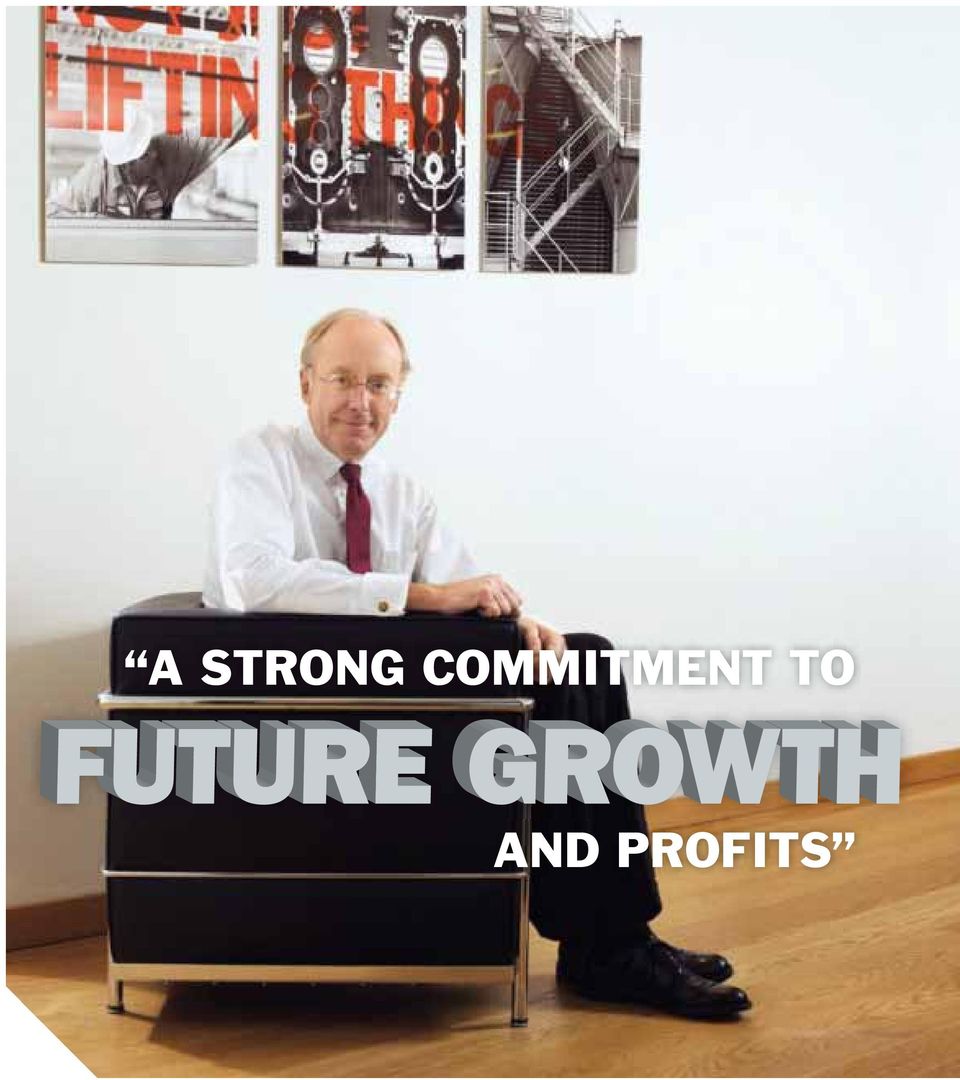
11 Chairman s letter Dear Konecranes shareholder, During my career at the company, we have lived through a number of crises, starting with the collapse of our biggest customer, the Soviet Union, several wars, economical collapses in many parts of the world and the bursting of the tech-bubble. This time, the crisis is worldwide, and therefore very difficult to combat will go down in history as one of the most difficult years of modern times for Konecranes. I do not intend to repeat all the bad news the world experienced during Instead, our shareholders need to know how we at Konecranes reacted. As can be seen from this report, Konecranes has ridden the wave of misery successfully. In his own review, our CEO gives a detailed report on the company s development. The numbers speak for themselves: the company reacted firmly in a timely manner to the challenges. Compared to developments in Western engineering, and especially the lifting industry, Konecranes performance was outstanding. As the details are provided elsewhere, let me share a few notions of principal importance with you. First and foremost: no surprises. The company has a long tradition of always maintaining its operational agility. A vital part of this is the routine of compiling contingency plans. During 2008, these plans already contained over 1,000 items ready to go into implementation. Second: preparation. The two most important cost elements in our profit and loss statement relate to people and material. We value the skills and the loyalty of our staff as our most precious asset. In order to maintain flexibility, we adopted a flexible hiring policy long ago, combining permanent and short term employment contracts. We have also identified insourcing/outsourcing as a good tool for achieving flexibility. These well-established policies worked well in the adverse climate of Although we have not been able to avoid layoffs completely, our terminations (related to permanent employees) have been significantly lower compared to those of our peers, and we have retained all our key expertise. During the years of rapid growth, procurement became a neglected discipline. The cry was to get projects completed and products delivered, not to stretch every penny. On his arrival in 2005, our then new CEO, Mr. Lundmark, made procurement efficiency one of his main targets. On his initiative, we started on an ambitious program of increasing procurement focus. Today, this focus is paying big dividends. The company also did well in terms of financial management. We have always insisted on substantial down payments from our customers, as a sign of commitment on their side, but also as a mutually beneficial trade-off between price and terms. Today, the results are obvious: our customers do not cancel their orders. Last but not least, let me once again highlight the importance of our service business. It is clear that the lower the utilization factor in our customers production facilities, the lower the need for maintenance. However, in spite of a number of customers saving by canceling their service contracts, many more customers see outsourced maintenance as an ideal means of cost savings. Throughout the crisis, our number of service contracts has stayed stable and even grown. Not only does this mean good growth when customers business starts to pick up, but it has helped our service business get through the recession with only a modest loss of business was, of course, a year of cost-cutting and savings. However, we also managed to complete a number of proactive actions that point back to our traditional track-record of profitable growth. Our financial position remains very strong. We have survived with only minimal deterioration of profit levels and enjoy a debt-free net cash position today. During 2009, a number of acquisitions were made, in inland China, South Africa, Germany, Austria, Norway and U.S.A., and we strengthened our position in India. Further acquisitions are under preparation. We have not cut back on our R&D expenditure, and we have liaised with the new Aalto University as one of the main sponsors of its MIDE program to develop new technology for tomorrow s man-machine systems. Many other actions under way cannot be disclosed here due to third party considerations. All these actions point to a strong commitment to future growth and profits. I would like to welcome all new shareholders to an interesting and thoroughly sound company, with solid present operations and ambitious, yet realistic plans for the future. Stig Gustavson Chairman of the Board Chairman s letter Konecranes

12 Company cornerstones Konecranes is an industry shaping, global group of dynamic Lifting Businesses Mission We are not just lifting things, but entire businesses. Vision We want to be the undisputed leader of the lifting industry, and a benchmark for business performance and customer service. Values Trust in people: We want to be known for our great people. Total Service Commitment: We want to be known for always keeping our promises. Sustained Profitability: We want to be known as a financially sound company. 10 Konecranes 2009 Company cornerstones
13 Company strategy Best customer service Konecranes is committed to always offering the best customer service in the industry. To us, quality of service is based on safety, reliability, and high-performing technology with which we improve customers efficiency and productivity. In total outsourcing markets, an estimated two thirds of all service of lifting equipment is still carried out in-house. Outsourcing this service offers benefits such as improved cost efficiency, safety, and increased uptime, and has created a genuine growth market that fuels our organic growth. Our strategy is optimized for tapping into the service industry s global growth potential. Product and service innovation Konecranes is committed to developing industry-shaping technologies for both lifting equipment and their service. Using the vast knowledge that we have accumulated by having the world s largest service organization, we know what customers need and how to develop solutions for different environments. By combining our service knowledge and new technologies, we create lifting solutions that maximize value for our customers. We minimize downtime and optimize the total cost of ownership. Value-creating acquisitions The crane industry is still, today, very fragmented, and Konecranes has the financial and managerial resources to lead the consolidation of the industry. The Konecranes growth strategy is based on continued organic growth in markets where we are established paired with an aggressive plan for acquisitions to enter new geographical markets or to fill a gap in our product portfolio. Well recognized local or regional brands, with large installed bases, remain the primary target for Konecranes acquisition policy. Synergetic business model Konecranes service and equipment businesses are interlinked by a high degree of synergy. Every service customer relationship creates opportunities for equipment sales. Also, every crane sold creates opportunities for providing services. The solutions provided by Konecranes business areas complement each other and enable customers to meet most of their lifting needs through one supplier. Demand-driven, cost-efficient supply chain Konecranes is transforming itself from a regional buy-make sell model to a global buy-move-make-move-sell anywhere model. We are geared to respond efficiently to changes in market demand throughout the chain. Our products are based on modularity and standardization, and make use of the latest technology and designs with an efficient use of raw materials. Maintaining a globally uniform product platform gives us valuable flexibility in terms of capacity utilization and resource allocation. Increased production in expanding markets such as Asia and Eastern Europe offers great opportunities to improve both our competitiveness and cost levels. This has involved increasing outsourcing in low-cost countries and outsourcing of own manufacturing. The role of quality management has therefore become of even greater importance. Company strategy Konecranes

14 Business environment A challenging market situation throughout the year The steep recession that hit the world economy in the last quarter of 2008 continued throughout 2009 and made the year a challenging one, resulting in a weak market for the material handling industry. There were some variations between regions and different product segments, but virtually half of the equipment market disappeared compared to Few significant differences occurred in demand between regions in 2009, with the exception of China, where continued economic growth boosted by major government stimulus packages resulted in a higher level of investment. The slow economic conditions affected demand for new equipment across customer segments. Demand from manufacturing and process industries remained weak throughout the year, while investment activity in the energy sector remained more stable. Investments in Konecranes two other key customer industries, ports and shipbuilding, were significantly affected by the decline in shipping volumes. Towards the end of 2009, activity revived somewhat in the waste-to-energy, steel, petrochemical and mining sectors. Weakened demand resulted in overcapacity in the crane manufacturing industry, and led to intense price competition. The service market also suffered, but to a lesser extent than equipment demand. Customers devoted increasing attention in 2009 to cost-cutting measures and improving their efficiency. This was reflected in a growing interest in outsourcing service operations, although lower industrial capacity utilization reduced the total amount of service and maintenance work carried out. Outsourcing continues to be concentrated in industrialized countries, while customers also in developing markets have started to show a growing interest in what outsourcing of service operations can offer. Input costs trended down during Steel prices were at a lower level in 2009 compared with 2008 and there was deflation in other procurement categories as well. Global macro data improved towards the end of 2009 following the highly negative trends in the first half of the year. Having troughed in mid-2009, capacity utilization rates in manufacturing industries started slowly to improve as production rates gradually picked up. Container traffic saw an unprecedented decrease of more than 10 percent in 2009 with sharp declines in the first three quarters of the year, but the rate of decline lessened in the fourth quarter. Adjusting capacity and costs to demand Due to the sharp decline in demand in all business areas, Konecranes initiated a cost reduction program in 2009 with the aim of lowering the Group s cost base by EUR 100 million by 2010 from the 2008 level. The cost reduction program includes both procurement development actions and personnel reductions, but the savings target does not include potential general deflation in material costs. During the report period several measures were taken. During 2009, decisions were taken to reduce the number of employees by more than 1,600. As part of the program, the Group announced closures of three crane manufacturing sites. The Group procurement development program is proceeding according to plan. A global category management has been established, and the consolidation of suppliers is lowering our costs. In addition, Konecranes is continuing to invest in product development and IT systems to enable it to extend its product and service offering and improve its productivity. We are also extending our expansion into regions where we currently lack a sufficiently strong local presence. Extending the product range through acquisitions Acquisitions represent an important part of our strategy, and we made ten acquisitions in We increased our holding in Austrian-based Konecranes Lifting Systems GmbH (former ACS Konecranes GmbH) in July 2009, and acquired the business operations of German-based Knight Europe GmbH & Co. KG. These acquisitions enabled us to extend our operations into manipulators and aluminum rail systems. The market for manipulators remains very fragmented and is estimated to be worth over 500 MEUR. The acquisition of a majority holding in Chinese-based Jiangsu Three Horses Crane Manufacture Co. Ltd. (SANMA) in November brought one of China s leading manufacturers of hoists and cranes into the Konecranes portfolio. Konecranes now has a new product platform to address a market that is currently dominated by local players. Konecranes acquired South Africa s leading crane and crane service company, Dynamic Cranes Systems Ltd., in mid-november. The company is a specialist in manufacturing, marketing, servicing, and installing cranes for industrial and process use. 12 Konecranes 2009 Business environment
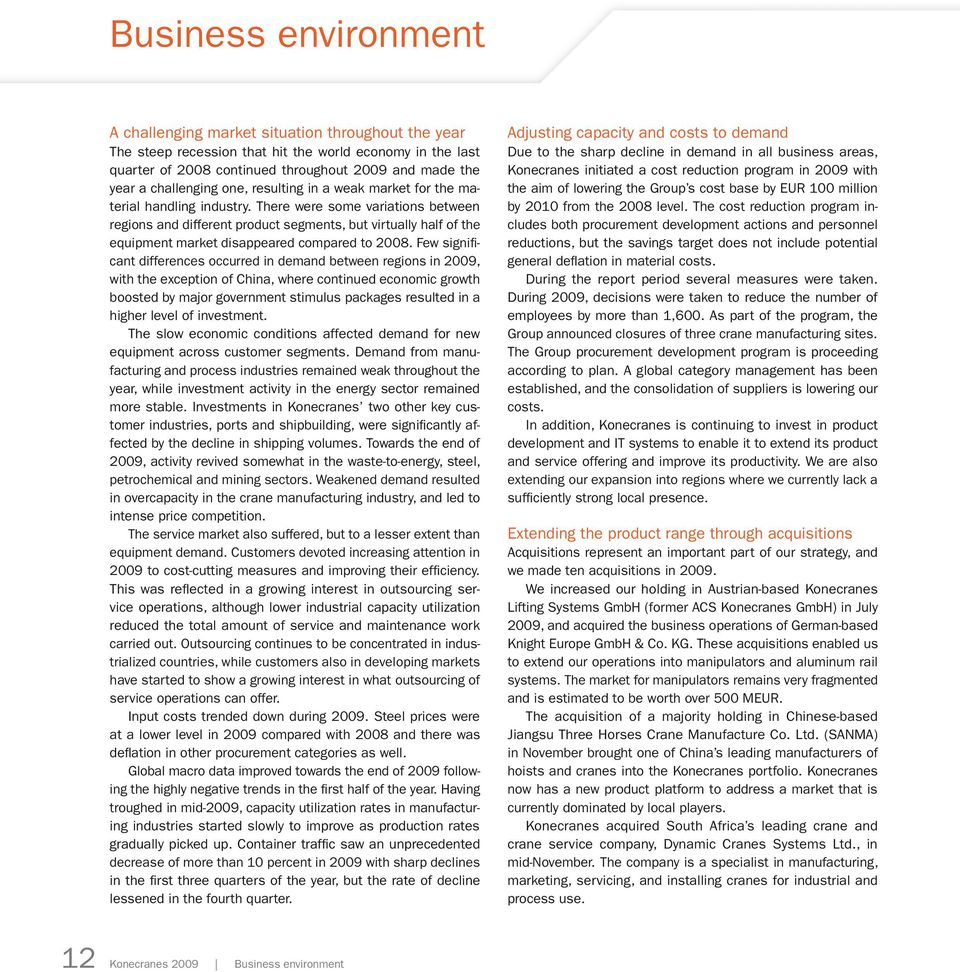
15 The economic recession has proved particularly difficult for many smaller players in the industry, and has also led to some consolidation of fragmented markets. Thanks to its debtfree balance sheet and dynamic, expert personnel around the world, Konecranes is well-placed to make further acquisitions in Konecranes global presence Market share of 16 percent #1 in crane maintenance services #1 in standard lifting equipment #1 in industrial process cranes Among the top 4 in container handling systems and port cranes Ten new companies were added to the portfolio in Business environment Konecranes
16 THE HERE IS HUGE You need to be an optimist, involve people, and be team-minded in business development. You need to think out of the box and always remember the customer s perspective. Understanding the big picture and the long-term vision is important, but you also need to be able to translate strategic plans into short-term actions. Service is an exciting and challenging area from a business development perspective. Konecranes is strong in service today because we had a clear strategy back when we started 50 years ago, in the 1960s. The core of this strategy has stayed the same, evolving along the way as we have reenergized our concepts, innovated new service products, and built long-term relationships with our customers. More than half of the total service market potential for Konecranes lies in the service work currently done by customers themselves. The market potential here is huge and gives us massive growth potential. Valeria Zimenkova Business Development Manager, Service

17 Service Konecranes Business Area Service offers service solutions and maintenance for all brands of cranes, port equipment, and machine tools. Konecranes has the largest service network in the industry, with 545 service locations in 43 countries and 3,222 highly qualified technicians. Konecranes Service customers range from repair shops and general manufacturing sites with maintenance cranes and machine tools, to paper and steel mills, nuclear power plants, and ports with lifting equipment that require 24-hour availability because their lifting equipment represents an integrated part of production. The Crane Service, Port Service, and Machine Tool Service (MTS) global business units ensure that customers receive quality service 24 hours a day. The Modernizations and Parts business units sell their products mainly via the service network but also directly to end-customers. Konecranes offers a full range of service solutions designed to match customers varying maintenance and performance needs. These range from expert services covering a specific project or product to full service and material handling partnerships. The closer a customer works with Konecranes, the more potential they will have to access Konecranes expertise and service capabilities and develop their operations. Performance in 2009 The global economic downturn continued throughout 2009, and saw Service order levels drop by 24.3 percent, to EUR million. Sales were 11.5 percent down compared to 2008, at EUR million. The operating profit was 30.8 percent lower than 2008, 11.0 percent of sales, excluding restructuring costs. The total number of units in the maintenance contract base increased to 362,996 from 359,811 at the end of 2008, and had an annual value of EUR million. The number of service personnel totaled 4,891. Business environment in 2009 More than two thirds of all equipment servicing was carried out by equipment owners themselves in Interest in the potential for outsourcing maintenance is growing, however, as customers look for ways of cutting costs and improving efficiency in the slower economic environment. Over the short term, lower industrial capacity utilization rates translated into less maintenance work for Konecranes during Developments in 2009 Business Area Service put a lot of emphasis on developing and launching new products in Remote monitoring services were introduced, for example, offering 24/7 reliability services on call at all times and productivity and performance services designed to ensure the maximum life cycle value for lifting solutions. Global technical support was also launched. The streamlining of Konecranes spare parts business continued. This included merging the local spare parts organizations of acquired companies with Konecranes organization, harmonizing systems, consolidating product data, and centralizing parts procurement. This has resulted in an improved global parts sales and distribution network. The Service organization was strengthened by the acquisition of the remainder of the shares of South African crane and service company, Dynamic Crane Systems. The MTS business was expanded to the US through the acquisition of Machine Tool Solutions Unlimited. Konecranes now offers MTS services in the Nordic countries, the UK, the US, Estonia, and Ukraine. Konecranes finalized four important nuclear modernization projects, one in the UK, one in Sweden, and two in the US. Single failure-proof upgrades for safety-related cranes continued to be an area of focus in the US nuclear market. The two US projects in 2009 were for cask cranes and required the replacement of 125-ton main hoists and trolleys with a new SuperSafe design and new crane control systems. Key figures Part of group total % Change % Orders received, MEUR Order book, MEUR Sales, MEUR Operating profit excluding restructuring costs, MEUR Operating margin excluding restructuring costs, % 11.0% 14.1% Operating profit including restructuring costs, MEUR Operating margin including restructuring costs, % 10.6% 14.1% Personnel 51 4,891 5, Business areas Konecranes
18 Standard Lifting Konecranes Business Area Standard Lifting is the world s largest supplier of lifting equipment for industrial purposes with a product range that includes industrial cranes, workstation cranes, load manipulators, wire rope and chain hoists, and crane components. Standard Lifting has an extensive and diverse global customer base. General manufacturing represents the largest single customer segment. Oil & gas, mining, automotive, paper, warehousing, entertainment, wind energy, nuclear power plants, and petrochemicals are also important customers. Industrial cranes, hoists, and services are marketed to endusers mainly under the Konecranes brand. Products sold under the UK-based brand, Morris (Morris Material Handling), were incorporated into the Konecranes brand in autumn The Group s power brands Stahl CraneSystems, SWF (SWF Krantechnik), Verlinde, and R&M (R&M Materials Handling) sell their products via independent crane builders and distributors. These channels complement each other and guarantee comprehensive global market coverage. The Meiden brand used by MHS Konecranes was changed to the Konecranes brand during P&H-branded products sold by Konecranes are now sold under the Konecranes brand. SANMA-branded hoists were added to the Konecranes offering after the finalization of the acquisition of the company during Performance in 2009 The difficult conditions affecting many markets had a negative impact on Standard Lifting s performance in Order intake fell by 39.8 percent compared to 2008, to EUR million. Sales dropped by 21.9 percent to EUR million. Operating profit was 65.3 MEUR and operating margin 10.0 percent, excluding restructuring costs. Business environment in 2009 The overall demand for lifting equipment continued at a weak level throughout the year due to the poor economic climate. These difficult market conditions resulted in overcapacity, which led to an increasing pressure on margins. Standard Lifting defended its prices, which led to slightly lower-than-anticipated volumes in some markets. Developments in 2009 Standard Lifting extended its product offering and entered a new load handling business segment in the shape of load manipulators and aluminum rail systems. Konecranes increased its ownership in Austrian-based Konecranes Lifting Systems GmbH (former ACS Konecranes GmbH) from 49.9 percent to 80 percent and acquired the assets of the German company, Knight Europe GmbH & Co. KG. The manipulator business is closely linked to Konecranes other areas of expertise, and the products of both companies not only complement each other, but also offer new customer and product opportunities with a high level of business potential. Konecranes Lifting Solutions and Knight Europe were consolidated into Konecranes figures as of July. Standard Lifting s operations were also strengthened by the finalization of the acquisition of the majority of Jiangsu Three Horses Crane Manufacture Co. Ltd (SANMA), one of China s leading hoist and crane manufacturers. Following a LOI in November 2008, the contract was signed in April 2009 and approved by the Chinese authorities in November. Through this acquisition Konecranes is able to penetrate a market segment in China that is now dominated by local suppliers. SANMA was consolidated into Konecranes figures in November. Konecranes took an important step into the South African market in 2009 through its acquisition of the remaining 80.5 percent of crane and service company Dynamic Crane Systems Ltd (DCS). Konecranes acquired 19.5 percent of the company s shares in This acquisition will enable Konecranes to strengthen its position in South Africa and other African markets. DCS was consolidated into Konecranes figures as of October. Konecranes launched several new products, applications, and features during These included sway control and automated load positioning, which are now offered as standardized options, improving crane safety and productivity. A robust, cost-effective chain hoist for workstation needs was launched for customers in emerging markets. 16 Key figures Part of group total % Change % Orders received, MEUR Order book, MEUR Sales, MEUR Operating profit excluding restructuring costs, MEUR Operating margin excluding restructuring costs, % 10.0% 16.8% Operating profit including restructuring costs, MEUR Operating margin including restructuring costs, % 7.6% 16.8% Personnel 32 3,012 2, Konecranes 2009 Business areas

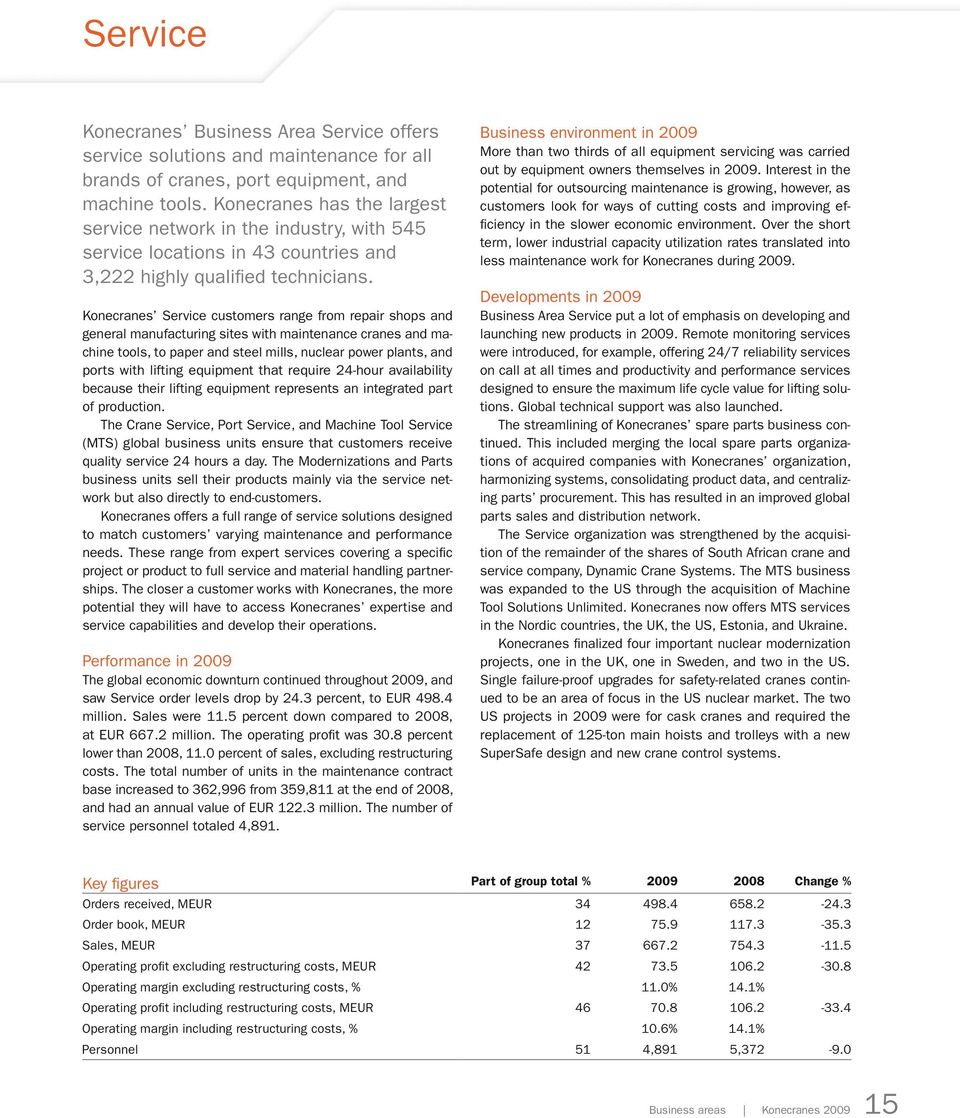
19 A MARKET POSITION Load manipulators are ideal for many materials handling tasks that can t be done with cranes. Because of their flexibility, load manipulators are ideal for applications in a wide range of industries. The biggest demand for them is in the aviation, automotive, health care, and food industries. Although load manipulators are a new product group for Konecranes, they fit very well with our other businesses, as they have the same customer base as industrial cranes. Our capacity to offer any lifting equipment needed for industrial processes is better than that of any other company. Our entire product portfolio, in combination with comprehensive solutions that deliver true added value and maintenance services, gives us a strong market position. Load manipulators offer a great solution in situations where a crane can t be used to handle a particular part. They re also more cost-efficient than robots. As a result, we need to focus on identifying the tough spots and bottlenecks in customers production processes and working with customers to come up with the best solutions for eliminating them. Martin Rothe Director of Workstation Lifting Systems Product Line
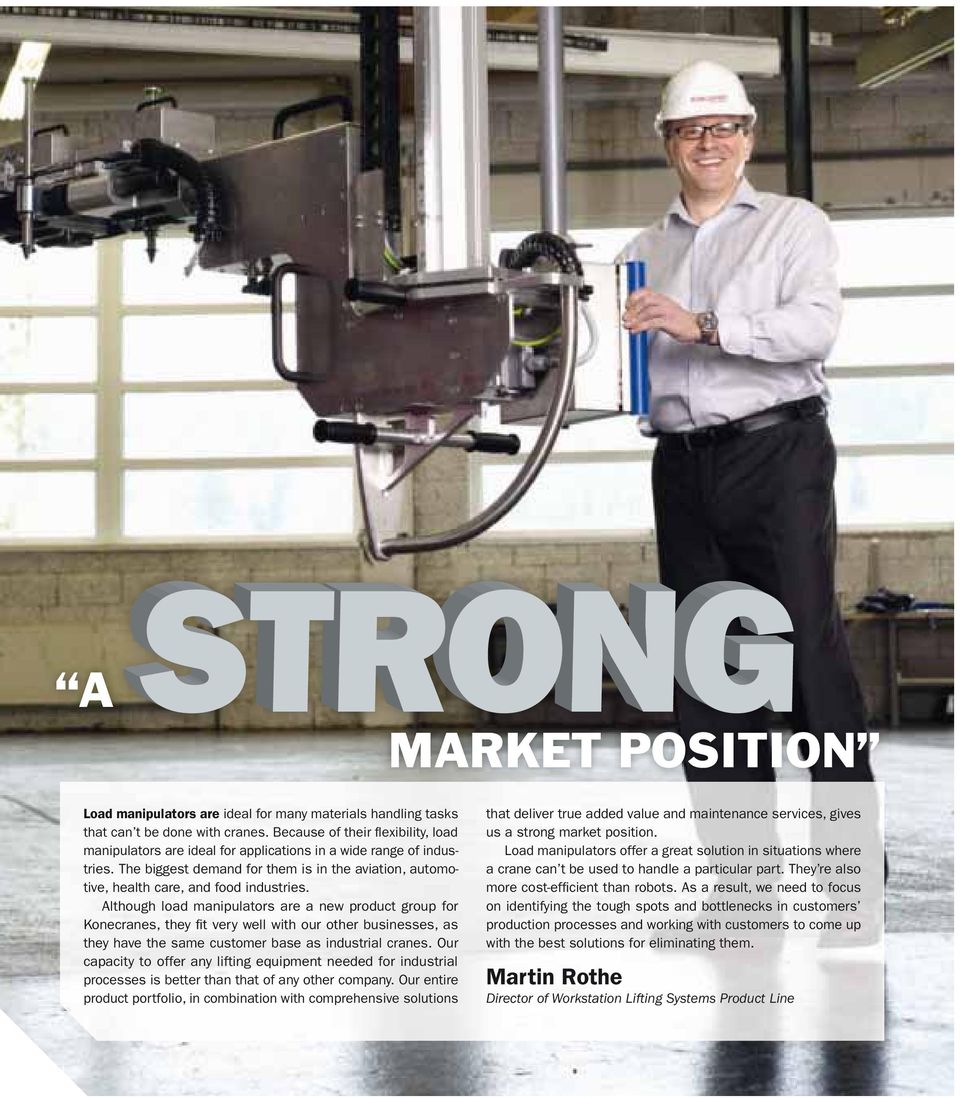
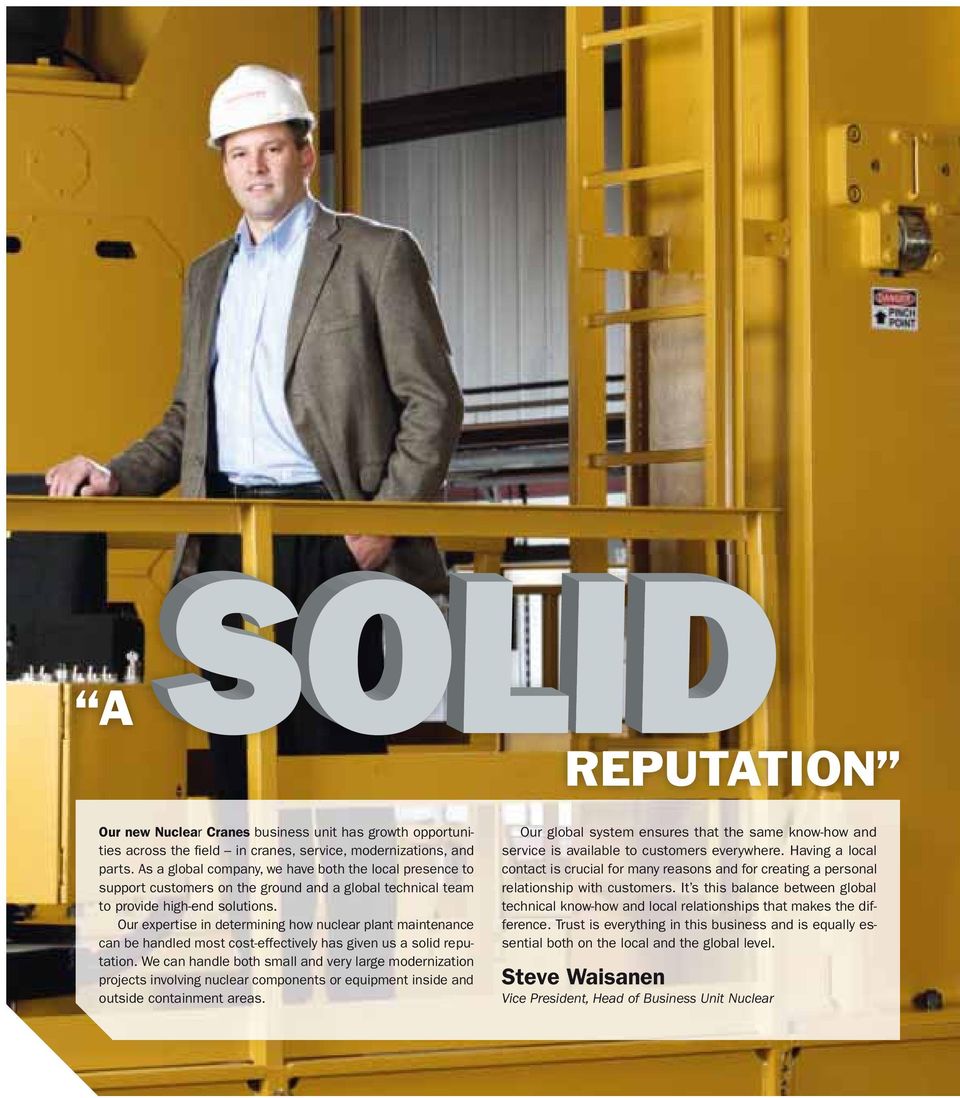
20 A Our new Nuclear Cranes business unit has growth opportunities across the field in cranes, service, modernizations, and parts. As a global company, we have both the local presence to support customers on the ground and a global technical team to provide high-end solutions. Our expertise in determining how nuclear plant maintenance can be handled most cost-effectively has given us a solid reputation. We can handle both small and very large modernization projects involving nuclear components or equipment inside and outside containment areas. REPUTATION Our global system ensures that the same know-how and service is available to customers everywhere. Having a local contact is crucial for many reasons and for creating a personal relationship with customers. It s this balance between global technical know-how and local relationships that makes the difference. Trust is everything in this business and is equally essential both on the local and the global level. Steve Waisanen Vice President, Head of Business Unit Nuclear
21 Heavy Lifting Konecranes Business Area Heavy Lifting offers material handling solutions for all types of process industries, nuclear power plants, industries handling heavy loads, ports, intermodal terminals, shipyards, and bulk material terminals. Heavy Lifting s electric overhead traveling process cranes are mainly used in steel and petrochemicals, power plants (including nuclear power plants), general manufacturing, waste-toenergy plants, and paper mills. Konecranes offers a full range of products for container handling in the shape of ship-to-shore (STS) cranes, rubber tired gantry (RTG) cranes, rail mounted gantry (RMG) cranes, straddle carriers, and reach stackers for container handling needs in ports and terminals and masted lift trucks for other heavy load handling needs. All our container handling products can be equipped with software for container positioning management and monitoring systems for equipment service needs and fleet efficiency. We also provide automated container yards with automatic stacking cranes. For shipyards, Konecranes offers a full range of cranes up to Goliath gantry cranes for handling extremely heavy ship sections. For large bulk terminals, we offer high-capacity grab unloaders. Performance in 2009 Heavy Lifting was impacted by the turbulence affecting markets worldwide during Although order intake increased towards the end of the year, year-on-year orders were 38.0 percent lower than in 2008, at EUR million. Sales were 27.3 percent lower than 2008, at EUR million. Operating profit was EUR 36.7 million and the operating margin 7.7 percent, excluding restructuring costs. Business environment in 2009 Global demand for heavy lifting equipment, particularly in ports and shipyards, was weak during 2009, although Konecranes received a few sizeable orders for container handling equipment. Global demand was also soft in general manufacturing and process industries. Activity in power generation-related industries was high, however, and the petrochemical industry showed signs of recovery at the end of the year. Developments in 2009 Heavy Lifting launched a new industrial crane, known as SMARTON, for demanding maintenance and heavy industrial use. As the crane is based on a modular design, its capabilities can easily be extended with additional features, such as automated positioning, defined working areas, maintenance monitoring, and remote service diagnostics features. The main customer segments for SMARTON are steel handling, automotive, general manufacturing, power, workshops, automatic storage systems, and mining. Konecranes also introduced a new 30-ton heavy-duty forklift truck offering enhanced driver ergonomics. All Konecranes lift trucks are also now offered with additional smart features such as NearGuard RFID (Radio Frequency Identification), which alerts drivers to the danger of collision with pre-defined obstacles, Tire Pressure monitoring and warning and Fleet Management System (FMS) for managing performance and positioning data. Konecranes established a new business unit, Nuclear Cranes, covering all nuclear material handling equipment, services, and equipment modernization needed in nuclear power plants, nuclear waste and fuel processing facilities. Konecranes supplies P&H-branded nuclear safety-related equipment under its 10CFR50 Appendix B Nuclear quality program. Heavy Lifting received several important orders in These included orders for close to 100 heavy EOT cranes for use in energy and steel production in China and several process cranes for mining operations in Australia, as well as two container handling orders from the US including 34 fuel-saving RTGs. Africa was an active area, with orders for both RTG cranes and lift trucks. Shipyards in China and Korea ordered design and component packages for very large Goliath gantry cranes. The US-based activities of Morris Materials Handling selling P&H-branded products were merged with Konecranes US business operations. P&H-branded products will continue to be offered, supported, and serviced. Key figures Part of group total % Change % Orders received, MEUR Order book, MEUR Sales, MEUR Operating profit excluding restructuring costs, MEUR Operating margin excluding restructuring costs, % 7.7% 8.1% Operating profit including restructuring costs, MEUR Operating margin including restructuring costs, % 7.1% 8.1% Personnel 17 1,603 1, Business areas Konecranes
22 Regional overview Konecranes operations are divided into three geographical regions AME, EMEA and APAC to maximize the company s potential to understand its customers industries and their needs, and build longterm customer relationships. Americas (AME) Konecranes holds a very strong position in the Americas, particularly in the US. The Americas accounted for 28.0 percent of sales in The US is the most developed region in terms of outsourced crane services, and around half of Konecranes sales in the Americas are service-related. Largest markets: the US, Canada, and Mexico. Operations: employees 2,236, service locations 152. The operations of Konecranes and Morris Material Handling Inc. were merged under the Konecranes brand in Manufacturing: 7 plants manufacturing hoists and industrial & process cranes, including nuclear cranes Key brands: Konecranes, P&H/Konecranes, Stahl, and R&M. South America is home to some fast-growing markets, with Brazil and Chile offering the most notable growth opportunities, as a result of ongoing expansion and upgrades in infrastructure, heavy industry, and general manufacturing. Konecranes main areas of business here are steel and metals, energy, and ports. Europe, Middle East and Africa (EMEA) EMEA is Konecranes largest region, accounting for 56.0 percent of sales in The region comprises both mature markets, with a high proportion of service sales and fast-growing economies where service is still small compared to equipment sales. The proportion of service outsourced to specialists varies widely from country to country. Operations: employees 5,533, service locations 284 Manufacturing: 13 plants manufacturing cranes and hoists, lift trucks, and steel structures for larger cranes Key brands: Konecranes, Stahl, SWF, and Verlinde. The Morris brand was incorporated into the Konecranes brand in % 16% 23% 56% 28% 56% PERSONNEL PER REGION SALES PER REGION EMEA 5,533 AME 2,236 APAC 2,013 EMEA MEUR AME MEUR APAC MEUR Konecranes 2009 Regional overview
23
24 Europe The region includes both mature and emerging economies in terms of lifting solutions and services. The current downturn affected all EMEA markets in Largest markets: Germany, France, the UK, Finland, the Netherlands, Sweden, Russia, Saudi Arabia, and Egypt. The mature markets include Western, Southern, and Northern Europe, where customer focus tends to be directed to enhancing efficiency and productivity in material handling to offset high labor costs. Service represents a high proportion of Konecranes sales in the area, between 30 and 70 percent, with significant variation between different countries. Konecranes has undertaken a number of initiatives to improve the efficiency of its front-line operations in these markets by consolidating branches in Germany, the UK, and Finland, and developing its service organization in Spain. The emerging markets in Eastern Europe and Turkey have been hit by a combination of reduced export opportunities and financial constraints. As the situation returns to more normal levels, improved competitiveness and the need to continue upgrading local infrastructure are expected to bring a rapid recovery in demand for lifting equipment and services. Konecranes has continued to extend its market coverage in Eastern Europe with new service and sales locations. Konecranes main areas of business here are steel and metals, energy, and ports. Middle East The Middle East continues to show high potential, with large investments taking place in infrastructure, petrochemicals, and general manufacturing. Konecranes main areas of business are petrochemicals, energy, metals, ports, and general manufacturing. Service accounts for a low percentage of sales. Largest markets: Saudi Arabia, the U.A.E., and Egypt Africa Demand in Africa has proved quite strong, as many countries are continuing to invest in ports and other infrastructure. Konecranes focuses on North Africa, South Africa, and growing coastal markets; and its main areas of business are ports, metals, and mining. Largest markets are South Africa, Morocco, and Kenya. Asia-Pacific (APAC) This continues to be the region which is least affected by the economic downturn. It is driven by activity in India and economic momentum in China, where government stimulus packages have benefited the key industries that Konecranes is active in. The region includes a mix of both mature markets, in Australia and Southeast Asia, and fast-growing economies in the shape of China and India. Power, paper, steel, and mining remained the most active end-user markets for Konecranes equipment in Operations: employees 2,013, service locations 109 Manufacturing : 7 plants manufacturing lift trucks, steel structures and wire rope hoists, and joint ventures Key brands: Konecranes, Stahl, SWF, and SANMA. The acquisition of the latter company was completed during the fourth quarter of Northeast Asia (NEA) Northeast Asia includes three very large markets: China, South Korea, and Japan. In China, Konecranes has been the most successful global company in its business area, supplying products for the high-end segment of the market and is now capable of competing in other segments as well following the acquisition of SANMA. Largest markets: China, Korea, and Japan. South Asia-Pacific (SAP) Largest markets: Australia, New Zealand, Singapore, Thailand, Malaysia, India, Indonesia, and Vietnam. 22 Konecranes 2009 Regional overview
25 UNDERSTAND EACH OF OUR In order to optimize sales, you need to define, harmonize, and manage the whole process, from sales leads to offer, order, and delivery. Several additional functions also need to be in place, providing the right information and support such as product development, marketing, and customer management. Understanding our customers industries calls for continuous investment in building customer relations, as well as a long-term commitment to joint development. When we understand each of our customer s business and the issues they face, we can create solutions that will help them reach their business goals more effectively. There s no shortcut to successful sales. You just need to really know your customers business and processes first. This enables you to be proactive and match your products and services to their needs. Tomas Myntti Director, Market Operations
26 Organizational fine-tuning Konecranes introduced a number of initiatives in 2009 to finetune its organization and strengthen the Group s sales management and internal cooperation. The following changes came into effect as of January 1, 2010: Konecranes now has two business areas instead of three: Equipment and Service. These replace Standard Lifting, Heavy Lifting, and Service. As of the beginning of 2010 Equipment and Service are the primary segments that will be used in external reporting. Both business areas are based on global business units. Equipment consists of five business units: Industrial Cranes, Components, Nuclear Cranes, Port Cranes, and Lift Trucks; while Service consists of Crane Service, Machine Tool Service, Port Service, Modernizations, and Parts. All business units are represented in all geographical regions, resulting in a flexible organization with specialized local experts. Konecranes has also redefined its internal regional organization structure: In internal reporting there are now five regions instead of four: Americas (AME), West Europe, Middle East and Africa (WEMEA), Nordic, East Europe and India (NEI), Northeast Asia (NEA), and South Asia-Pacific (SAP). By dividing EMEA into WEMEA and NEI, Konecranes will be able to focus its operations, particularly in the growing NEI region. External financial reporting will continue according to the geographical reporting structure using the same secondary segments as in 2009: Americas (AME), Europe, Middle East and Africa (EMEA), consisting of WEMEA and NEI; and Asia-Pacific (APAC), consisting of NEA and SAP. The newly established Market Operations function is responsible for sales management and sales support globally, global account management, and developing solutions marketing. New business areas, business units and product lines Business area Business units Service Crane Service Port Service Modernizations Machine Tool Service (MTS) Parts Equipment Industrial Cranes Product lines: Standard Duty Cranes, Heavy Duty Cranes and Workstation Lifting Systems Components Product lines: Wire Rope Hoists and Crane Kits, Electric Chain Hoists, Manual Hoists and Accessories Nuclear Cranes Port Cranes Lift trucks 24 Konecranes 2009 Organizational fine-tuning
27 Regional structure NEI WEMEA AME NEA SAP Business areas and market operations Market operations Business areas Service AME NEA SAP WEMEA NEI Equipment Organizational fine-tuning Konecranes
28 Product research and development Product research and development plays an important role in turning our mission of We are not just lifting things, but entire businesses into reality. Although cost savings and adapting Konecranes capacity to market needs were typical of 2009, we continued to invest in product development to extend our product and service offering and improve both our own productivity and that of our customers. As the world s pioneer in lifting technology, we make innovative use of the latest technology in our equipment solutions and service offering. The Group spent EUR 22.0 million on research and product development in 2009, equivalent to 1.3 percent of net sales. Our service contract base covers more than 360,000 pieces of equipment and represents an important source of input for product development work. Over 3,000 service personnel around the world service Konecranes-supplied equipment and that supplied by other manufacturers. Close to 1.6 million customer contacts annually give us an excellent opportunity to understand the real-life needs of our customers. Material-handling systems are an integral part of our customers processes, which is why our expertise in areas such as automation can play a key part in helping them improve their productivity. To further enhance our capabilities here, we streamlined our operations in this area in Modularity brings a new dimension to product design Konecranes product development launched an extensive product project driven by parallel design work in The Konecranes SMARTON industrial crane project brought together the company s best know-how in service, sales, procurement, production, and product development around the same table from the brainstorming stage onwards. We also collected input and experience from customers to provide additional ideas. The cranes in the new product family are built from standard modules, which shortens manufacturing time compared to traditional customized production and makes large-scale production possible. The numerous patentable innovations generated as part of the project are a good example of what good teamwork can achieve and provide our customers with the kind of added value they want. The folding maintenance platform incorporated into a SMARTON crane, for example, makes units compact and helps customers save on construction and heating costs. The system s digital control technology provides very accurate control and virtually eliminates shock loads, giving operators a much smoother user experience. A remote connection to Konecranes Service Center ensures that detailed, up-to-date data is available on crane operations and helps eliminate unplanned service breaks and the downtime that results. The main applications for SMARTON are steel, automotive, general manufacturing, power, workshops, automated warehouse systems, and mining. Depending on the set-up, the SMARTON can lift from 30 tons to more than 500 tons. Safety and environmental issues are always paramount In addition to cutting-edge technology, safety is always a key area of focus for Konecranes research and product development work. Our SMARTON cranes, for example, not only eliminate shock loads, but also offer anti-sway features as standard to improve user safety. Environmental issues also play an important role and are taken into account throughout the life cycles of Konecranes products. Particular attention is given to things such as efficient material usage, recyclability, and energy efficiency. Over 98 percent of the materials used in a typical crane supplied by Konecranes is recyclable, and many of our products lead the field in efficient space usage. Energy-saving frequency converter technology comes as standard with Konecranes equipment and enables up to 70 percent of braking energy to be fed back into the network. Thanks to the modular structure of our equipment, we can produce components close to our customers and reduce transportrelated environmental impact. Modern design and visuals Industrial design forms an important part of the product design process, and a distinctive Konecranes design helps set our products apart from those of our competitors. High standards of industrial design also allow us to incorporate greater efficiency, user-friendliness, cost savings, and new materials into our products. We gave greater emphasis to industrial design during 2009 by setting up a dedicated team within the Product Development unit. We published the principles and guidelines behind our approach to design in April 2009, and a new corporate Design Steering Team has been established to ensure that we remain at the front of the field in design-related issues. Innovation through cooperation In addition to in-house research and development work, Konecranes works closely with its customers, research institutions, and universities. Thorough product testing at our own facilities and those of our partners forms an integral part of development work. We continue to be an attractive employer for talented young people, and many of the students who do their diploma theses at Konecranes go on to pursue careers with us after graduation. 26 Konecranes 2009 Products and R&D
29 ALL THESE CAN SAVE CUSTOMERS MONEY Konecranes moved from selling products to selling solutions some time ago. We re now taking this process one step further and selling smart solutions that include software and automation to give customers the highest lifecycle value. Konecranes smart solutions are already in use at over 1,000 locations and typically pay themselves back in a matter of months. All these smart solutions can save customers money in situations where operating speed is important or when they need to work with dangerous loads whether we re talking about Sway Control, which prevents loads from swaying automatically, Protected Areas, which is used to preset crane working areas, or Auto-positioning, which moves cranes quickly to chosen positions at the push of a button. People like to talk about making money during good times, and how best to save it during bad times. It makes more sense, I think, to talk about making money and saving money all the time! Steve Gagnuss General Manager, Industrial Cranes, Southeast Asia
30 Product overview Service and modernization activities are focused on maximizing the availability and productivity of customers equipment, while minimizing the cost of ownership. We offer five levels of service partnership: Contact, Condition, Care, Commitment, and Complete. Industrial cranes feature Konecranes CXT hoist and have lifting capacities up to 100 tons. They are typically used in automotive and general manufacturing, construction, renewable energy, and the aircraft assembly and petrochemical industries. Machine tool service provides service, maintenance, and modernization for all makes of machine tools used in the engineering industry. Our offering ranges from maintenance of a single machine to total partnership agreements, under which we take care of all the equipment used by a customer. Process cranes are engineered for heavy-duty lifting up to 1,000 tons or more. Typical customers include the steel, aluminum, mining, general manufacturing, pulp and paper, petrochemical, cement, power, and waste-to-energy industries. Light lifting systems offer ergonomic handling for loads up to 7,500 kg. Typical customers include small manufacturing workshops, automotive, aircraft assembly, renewable energy producers, and companies in the petrochemical and electronics industries. Nuclear cranes are used for all types of applications, from lifting reactor heads to handling nuclear fuel. These cranes are used in nuclear power plants, radioactive waste facilities, as well as in the production of nuclear fuel. Konecranes supplies P&H -branded nuclear safety-related equipment under its 10CFR50 Appendix B Nuclear quality program. Load manipulators are designed for challenging material handling applications and can handle loads up to 2,000 kg. They are typically used in the aviation, automotive, health care, solar energy, food, and electronics industries. 28 Konecranes 2009 Products and R&D
31 Forklift trucks with lifting capacities ranging from 10 to 60 tons are used for transporting materials in process industries such as forest products, steel, paper, and concrete and at ports. Ship-to-shore cranes are used for loading and unloading containers from ships. Konecranes STS cranes have a lifting capacity of up to 65 tons and an outreach of up to 61 meters. Reachstackers are used to stack containers in small and medium-sized terminals and railroad terminals. Goliath shipyard cranes span over 150 meters and are designed for handling ship sections in shipyards. They have a lifting capacity up to 1,650 tons and can lift up to 90 meters high. Straddle carriers are used for transporting containers from shipside to container yards and loading areas. They typically have a lifting capacity of 50 tons and can stack containers one over three high. Brands The Group s brand strategy is based on the corporate and master brand, Konecranes, complemented with freestanding power brands. Konecranes-branded products are sold directly to end users, while power-branded products are sold to distributors and independent crane builders. The power brands include R&M Materials Handling, Stahl CraneSystems, SWF Krantechnik, Verlinde and SANMA. Yard cranes include RTG and RMG cranes used for stacking containers high and wide at ports and intermodal terminals. These cranes usually have a lifting capacity of around 50 tons and can stack one over five containers high and six plus truck lane wide. Products and R&D Konecranes
32 Corporate responsibility For Konecranes, corporate responsibility means striving to act responsibly in raising the value of our shareholders investment whilst respecting our personnel, the environment and the societies in which we operate. Our values and industry leadership require us to act responsibly and according to the principles of sustainable development. A Corporate Responsibility Steering Group was established in 2009 to foster discussion on corporate responsibility issues and oversee management in these areas. The group includes senior managers and representatives from business areas, production, product development, human resources, and legal affairs. Corporate responsibility is an integral part of our day-to-day operations. As a global business, we promote the wellbeing of communities around the world and abide by good corporate governance practices. All of our operations are guided by our corporate values and operating principles that define how we manage our business. We recognize the importance of a number of international initiatives and conventions, such as the UN s Universal Declaration of Human Rights and the UN Global Compact, and have incorporated their principles into our ethical operating guidelines. We have also published specific sets of guidelines covering areas such as safety and the environment. Corporate responsibility encompasses financial, social, and environment responsibility. Konecranes follows the principles included in the Global Reporting Initiative (GRI) in its reporting on corporate responsibility, and aims to meet the expectations of its stakeholders such as customers, owners, and current and future personnel and build a foundation for a dialogue on corporate responsibility issues. Our reporting complies with GRI Level C requirements, based on our self-assessment. A table of GRI compliance can be found on pages We have included a section on corporate responsibility in previous Annual Reports, but have now extended the scope of our reporting and clarified our approach in this area for the 2009 Annual Report. We will continue to include reporting as part of the Annual Report because we believe that our performance in this area is closely linked to our day-to-day operations. Corporate responsibility reporting covers the same timeframe as our financial reporting, the calendar year. Our current reporting covers all our major production units and operations, and our aim is to extend its scope and detail further in future years. The businesses acquired during 2009 are not included, however. The indicators that we have selected have been chosen because they are the most relevant in terms of our operations and to our stakeholders. The data behind these indicators has been collected from our management systems, supplemented with information collected separately. Some of the data included here has been scaled up to provide an overall view of our performance, which could result in inaccuracies in some figures. 7,549 8,404 2,923 9,904 9,782 5,087 6,859 8,005 9,222 9, NUMBER OF PERSONNEL Average NUMBER OF PERSONNEL End of period 30 Konecranes 2009 Corporate responsibility
33 We aim to be profitable and competitive Konecranes most important stakeholders include shareholders, customers, personnel, material suppliers and other partners, authorities, local communities and the media. For us, financial responsibility means ensuring that Konecranes is profitable and competitive over the long term. Fulfilling our shareholders profit expectations is the best way we can promote the goals of our other stakeholders. A good financial result is essential for continued business as well as for ensuring sufficient resources for environmental management and for dealing with social issues, for example. In accordance with our financial responsibilities we supply our customers with high quality products, solutions and service that improve their activities. For us, the deepening integration between our customers and our company means planning joint business strategies. Both sides have benefited from this in the form of improved information and less uncertainty, more effective financial planning and better management of the supply chain. When all this has been achieved, the result is a more satisfied customer. Konecranes has set itself challenging financial objectives which we monitor for achievement regularly, and which also form the basis of our incentive systems. Safety remains paramount Safety is the first and most important key area of Konecranes operations. Our safety policy is based on the belief that no one at Konecranes should compromise safety in any area of our business. We want to offer our personnel a safe workplace and the safest and most reliable products and services for our customers. Safety is always the top priority on our agenda, and we encourage our personnel to take a proactive approach to improving safety in every area. We have focused on occupational and product safety in particular over the last few years. We use a number of indicators to monitor our occupational safety performance. Locally, we monitor the number of safety inspection tours carried out at sites and locations, improvement measures, and safety-related incidents; and globally our LTA (Lost Time Accident) frequency. All accidents and near misses are investigated, and action plans are drawn up on the basis Konecranes stakeholders Konecranes aims to recognize and meet different stakeholders needs and expectations in the area of corporate responsibility as elsewhere. In this chart, we have listed some examples of stakeholder groups and how we engage in dialogue with them. Customers Continuous dialogue as part of normal business and in addition customer satisfaction indicators and surveys. Personnel There are multiple channels for employee dialogue, for example employee satisfaction survey and various feed-back channels. Suppliers and subcontractors Continuous dialogue as part of normal business and in addition Supplier Days event. Environmental and ethical requirements included in general terms and conditions. Students, universities and research institutes Student cooperation in form of trainee and thesis work opportunities. Cooperation in different kinds of research programs with universities and research institutes. Shareholders This annual report is one way of providing information on Konecranes corporate responsibility performance and actions for investors and this way engaging in dialogue. There are also many other stakeholder groups, such as local communities, authorities, media, interest groups, trade unions and non-governmental organizations, with whom there are multiple ways and channels for dialogue. Corporate responsibility Konecranes
34 of our findings to prevent similar events recurring. Our ongoing goal is a zero-accident workplace. By using efficient risk assessment, we aim to minimize the occupational safety and health risks faced by our personnel, stakeholders, and customers. Comprehensive, high-quality safety training plays a central role here, and our minimum requirement is that everyone takes part in basic occupational safety training regularly. Cooperation between personnel involved in safety, environment, and quality management was strengthened significantly in We continued building a global safety network and harmonizing operating procedures Group-wide. Globally, Konecranes now has around 20 safety managers and numerous occupational safety representatives. Ultimately, however, each and every one of our employees is responsible for maintaining and promoting safety. The duty of safety personnel is to assist and advise the operational organization and our functions. We continued to implement procedures in line with our safety management principles, and carried out internal safety auditing across the Group. Our safety management principles follow the requirements of the OHSAS standard, and some country service organizations have already certified their systems to this standard. We introduced a web-based accident and near miss reporting tool in 2009, piloting it in Finland in the spring. The intention is to extend its use globally during The tool is designed to provide us with a more efficient and open means of sharing information on accidents and near misses. At the end of the year, we organized our first Konecranes HSEQ (Health, Safety, Environment, Quality) seminar as part of efforts to further strengthen networking in these areas. Despite the positive progress that we have made in developing people s mindsets, proactive ways of working, and safety awareness, two fatal work-related accidents occurred in Globally, we have monitored accident frequency levels since 2008, results show improvement in safety. Lost Time Accident Frequency Business area LTA1 Konecranes total 13 Heavy Lifting 12 Standard Lifting 12 Service 15 LTA 1 = (number of accidents/ working hours performed) * 1,000,000 Including operatives and staff people This indicator measures the number of accidents per million hours worked. Accident figures include all accidents that take place at work and during work-related travel resulting in sick leave. We want to be recognized for our people Trust in People is one of our three corporate values, and we want to be recognized for employing the best people. We at Konecranes believe that a company is only as good as its personnel. Acting more concertedly as one company is becoming increasingly important to our success in the global marketplace. As a result, we must continue to promote the spread of best practices across the Group and develop a more integrated and clearer organizational structure. We went through a major organizational change process in 2009 designed to strengthen sales management in particular and promote greater cooperation between geographical regions, business areas, and business units. As a result of the lower demand levels resulting from the ongoing global recession, we had to make some reductions in our production capacity and personnel. This included reducing the use of hired personnel and temporarily employed, and we also held statutory negotiations at a number of our units. We also ended some subcontracting arrangements, bringing production back in-house, and announced closures of manufacturing sites in Germany, Great Britain and the US. The goal has been to adapt our cost structure and resources to match the weaker market situation and secure our long-term competitiveness. The Group s overall number of personnel decreased by almost 1,500 during the year. Measuring job satisfaction is important Global job satisfaction surveys are an important tool and indicator for Konecranes. We carried out our third survey in 2009, and the data this provided enabled us to compare our performance to that recorded in the two previous ones and that of other companies. The higher response rate achieved in 2009, 70 percent Group-wide, was encouraging, and the results showed that we have improved performance in virtually all the areas surveyed compared to previous years. Although employees perception of us as an employer was weaker, it continues to be very positive compared to comparable companies. In terms of job satisfaction and commitment, and Konecranes management index, we scored higher than the global norm. The survey confirms that our personnel are more motivated and more committed to their work than those of other companies 32 Konecranes 2009 Corporate responsibility
35 on average. Konecranes personnel see their jobs as challenging and interesting. Feedback from the study has been used to improve internal cooperation and working practices. Despite the cost-saving measures introduced in 2009, Konecranes has continued to invest in training, and our training programs received a higher rating in the study in 2009 than in previous years. The results of employee satisfaction surveys have also been used to enhance teamwork. All managers and supervisors are responsible for reviewing performance with their team members, and individuals have the opportunity to discuss how their teams are performing and any improvement measures needed. Managers are also required to draw up action plan reports, which are included in the annual planning process. Progress will be monitored and reported on in Development discussions help everyone plan for the future Every employee at Konecranes is entitled and required to hold annual development discussions with their manager or supervisor. Although these are always one-on-one, the goals and personal development plans discussed at these meetings, such as training needs, career development wishes, and interest in job rotation, are entered into the Group s skills database. We gave particular emphasis to the importance of development discussions in 2009, and this was reflected in the fact that 77 percent of respondents in the employee satisfaction survey indicated that they had had a development discussion with their manager or supervisor during the previous 12 months. This compares to a figure of 50 percent in The value of development discussions is also highlighted by the fact that personnel who have taken part in these discussions say that they are more satisfied with all aspects of their work than those who have not, according to the survey. Sharing best practices through a global environmental network Environmental issues play an important role in the operations and decision-making of all of Konecranes business areas and units. Particular attention in 2009 was given to developing a global environmental network and sharing best practices across the Group. Defining key environmental indicators and developing environmental reporting were also prioritized. Material and raw material usage and energy consumption, related both to the products we manufacture and our operations, are among the most important environmental aspects of Konecranes operations. Our approach in environmental work is based on life cycle thinking. We are committed to offering our customers products that are energy-efficient and compact in terms of space usage. It is also important for us that over 98 percent of the materials in a typical crane supplied by Konecranes is recyclable. Corporate responsibility Konecranes
36 We strive to make efficient use of raw materials and other resources, reduce emissions, and promote energy efficiency as part of our operations. During 2009, we paid particular attention to identifying our carbon footprint and ensuring that waste and chemicals are always handled appropriately. Promoting environmental awareness among both Konecranes personnel and our partners is a priority. During 2009, we defined an environmental program for the next few years. The main points of the program include: Identifying opportunities: developing eco-efficient systems and services Minimizing risks: systematic environmental management Maximizing benefits: GRI reporting and increasing internal and external information flows. Corporate responsibility as part of product development Climate change is recognized as the most important environmental concern at the moment, and Konecranes is addressing the issue primarily through energy efficiency, as reflected in the amount of electricity, heat, and fuel used in our operations and products. Product development teams are responsible for ensuring that Konecranes products are the market leaders in their field, from an environmental standpoint as much as any other. Issues such as energy consumption and efficient use of space are taken into account in every stage of product development work. Environmental thinking also forms an integral part of production, packaging, and logistics planning. We introduced new tools, such as video and web conferencing, in our internal communications in 2009 and these are expected to enable us to cut work-related travel by as much as 40 percent by 2012, reducing our carbon footprint and other travel-related environmental impact. We expect high standards of our partners Konecranes corporate procurement organization developed new routines and common goals for the purchasing processes used across the company in One of our most important principles here is that we only work with subcontractors and suppliers that follow our operating approach or operate according to equivalent standards. We defined a review and audit process for Konecranes subcontractors in 2009 based on a common set of requirements applicable to all our subcontracting partners. Over 80 people have been trained to use the new system and we have already audited tens of subcontractors. Environmental data for 2009 Energy consumption and emissions Scope 1, energy consumption and direct emissions Vehicle fleet fuel consumption, l 28,911,000 Natural gas consumption, m 3 7,499,600 Direct emissions, tco 2 e 94,000 Scope 2, energy consumption and indirect emissions Electricity consumption, MWh 102,300 District heat consumption, MWh 39,000 Indirect emissions, tco 2 e 52,000 Scope 3, other indirect emissions Business travel, tco 2 e 27,500 Commuting to work, tco 2 e 24,000 Waste (tons) Metal scrap (1 9,000 Cardboard, paper and wood (1 7,000 Hazardous and electronic and electrical waste (2 1,300 Mixed waste (3 900 Total numbers extrapolated based on data collected from majority of manufacturing locations and major service units. 1) Waste streams go for recycling 2) Waste stream handling split into recycling, incineration and other adequate treatments depending on location 3) Waste stream handling split into recycling, incineration and landfill depending on location 34 Konecranes 2009 Corporate responsibility
37 High standards of environmental performance We offer environmentally conscious solutions and designs in the majority of our product segments. The following are just a few examples of the high standards of environmental performance we provide: Our port cranes and container handling products are fitted with numerous fuel-saving and emissionreduction technologies, either as standard or as options. These help reduce fuel consumption, enhance performance, and cut emissions. Process crane space-saving solutions have a direct impact on the customer s space needs and in new buildings on the amount of energy needed for airconditioning and heating. The feed-back of braking energy can reduce energy consumption and costs by up to one third. Modernization solutions enable older cranes to be updated and save on material usage and electrical consumption.
38 Global reporting initiative content index Page Comment Profile 1 Strategy and analysis 1.1 CEO's statement Key impacts, risks and opportunities 4, 12, Organizational Profile 2.1 Name of the organization Primary brands, products and services 2 3, Operational structure Location of organization's headquarters Number of countries and location of operations Nature of ownership and legal form 2, Markets served Scale of the reporting organization Significant changes 4, Awards received in the reporting period Not applicable 3 Report Parameters 3.1 Reporting period Date of most recent report Reporting cycle Contact point for questions regarding report 124 Via investor relations 3.5 Process for defining report content Boundary of the report Limitations on the report's scope or boundary Basis for reporting subsidiaries and joint ventures Data measurement techniques and bases for calculations Explanation of re-statements Not applicable 3.11 Significant changes from previous reporting perios GRI content index 36 4 Governance, Commitments and Engagement 4.1 Governance structure Independence of the Chairman of the Board 39, Independence of the Board members 39, Mechanism for shareholder and employee consultation 32 33, Executive compensation and linkage to organization's performance 40, Processes for determining expertise Values, mission and business conduct principles 10, Procedures of the Board for overseeing risk management Processes for evaluating the Board's performance List of stakeholder groups Identification of stakeholders Approaches to stakeholder engagement Partly covered 36 Konecranes 2009 Corporate responsibility
39 Global reporting initiative content index Page Comment Management approach and performance indicators (core indicators, unless marked to be additional) Economic EC1 Direct economic value generated and distributed, including revenues, operating costs, employee compensation, donations and other community investments, retained earnings, and payments to capital providers and governments Financial review part EC3 Coverage of the organization s defined benefit plan obligation 98 Partly covered EC4 Significant financial assistance received from government 84 Labor practices LA1 Total workforce by employment type, employment contract and region 30 Partly covered LA7 Rates of injury, occupational diseases, lost days, and absenteeism, and number of 32 workrelated fatalities by region LA12 Percentage of employees receiving regular performance and career development 33 reviews (additional indicator) Human rights HR 2 Percentage of significant suppliers and contractors that have undergone screening on 34 Partly covered human rights and actions taken. Society SO2 Percentage and total number of business units analyzed for risks related to corruption 46, 49 Partly covered SO3 Percentage of employees trained in organization s anti-corruption policies and 49 Partly covered procedures Product responsibility PR1 Life cycle stages in which health and safety impacts of products and services are assessed for improvement, and percentage of significant products and services categories subject to such procedures. 26 Partly covered PR5 Practices related to customer satisfaction, including results of surveys measuring 22, 31 customer satisfaction (additional indicator) Environmental EN3 Direct energy consumption by primary energy source 34 EN4 Indirect energy consumption by primary source 34 EN6 Initiatives to provide energy-efficient or renewable energy based products and services, 26, 34 Partly covered and reductions in energy requirements as a result of these initiatives (additional) EN7 Initiatives to reduce indirect energy consumption and reductions achieved (additional) 34 Partly covered EN16 Total direct and indirect greenhouse gas emissions by weight 34 EN17 Other relevant indirect greenhouse gas emissions by weight 34 EN18 Initiatives to reduce greenhouse gas emissions and reductions achieved (additional) 34 Partly covered EN22 Total weight of waste by type and disposal method 34 EN26 Initiatives to mitigate environmental impacts of products and services, and extent of impact mitigation 26, 34 Corporate responsibility Konecranes
40 Corporate governance Konecranes Plc (Konecranes, Company) is a Finnish public limited liability company, which complies with the Finnish Companies Act, Konecranes Articles of Association, and other regulations concerning public companies in its decision-making and administration. As a publicly listed company, Konecranes is bound by the rules of the NASDAQ OMX Helsinki Ltd. As of January 1, 2009, Konecranes has complied with the Finnish Corporate Governance Code issued by the Board of the Securities Market Association. Based on the Code, which can be consulted at Konecranes has issued a Corporate Governance Statement. See for details. General meetings The General Meeting of Shareholders is the highest decisionmaking body of Konecranes. Shareholders exercise their right of supervision and control at General Meetings. An Annual General Meeting (AGM) of shareholders must be held during each financial year before the end of June. Extraordinary General Meetings (EGM) may be convened whenever necessary. Shareholders exercise their rights of vote and action at General Meetings. Matters to be discussed at the AGM are defined in Article 10 of Konecranes Articles of Association and in Chapter 5, Paragraph 3 of the Companies Act. These matters include the adoption of the financial statements, distribution of profits, discharging Board members and the Managing Director from personal liability, the election of Board members and auditors, and the fees payable to the Board members. Konecranes Articles of Association can be consulted in the Corporate Governance section at Decisions made at General Meetings are published as stock exchange releases and on the Company s website immediately after meetings. Advance information to shareholders The Board of Directors (Board) shall convene an AGM or Extraordinary General Meeting by publishing a notice in two national newspapers, listing the matters to be discussed. A notice to the General Meeting, together with related advance information, will be published on the Company s website latest 21 days prior to a meeting. Invitations are also issued through a stock exchange release and are posted on the Company s website. The complete proposals to be made by the Board and its Committees to the Annual General Meeting or to an Extraordinary General Meeting are posted on the Company s website as well latest 21 days prior to a meeting. Attendance of shareholders In order to be entitled to attend a Shareholders Meeting (AGM or EGM), a shareholder must be registered as a shareholder in the Company s shareholders register maintained by Euroclear Finland Ltd. on the record day for the Shareholders Meeting. A holder of nominee-registered shares wishing to participate in a Shareholders Meeting shall notify their request for temporary inclusion in the Company s shareholders register to participate at a General Meeting. A holder of nominee-registered shares can participate in a General Meeting if he/she, on the basis of his/her shareholding, is entitled to be recorded in the shareholders register on the record date of the General Meeting concerned. Changes in shareholdings that occur after the record date of a General Meeting do not affect a shareholder s right to participate in a General Meeting or a shareholder s number of votes. A registered shareholder wishing to participate in a Shareholders Meeting must notify the Company of his/her intention in the order and during the period prescribed in the Notice of the Shareholders Meeting. A notification by a holder of nominee-registered shares for temporary inclusion in the Company s shareholders register is perceived as prior notice of participation in the General Meeting. A shareholder may participate in the Shareholders Meeting in person or through proxy representation. A proxy representative shall produce a dated proxy document or otherwise demonstrate in a reliable manner his/her right to represent the shareholder at the General Meeting. Shareholders are requested to inform the Company of any proxies for the General Meeting when they notify their participation. A shareholder and his/her representative may bring an assistant to a meeting. Attendance of Board members, the Managing Director, and Auditors at General Meetings The President and CEO, holding the position of Managing Director under the Companies Act, the Chairman of the Board, and a sufficient number of directors shall attend General Meetings. In addition, the Company s Auditor shall be present at Annual General Meetings. A person proposed as a director for the first time shall participate in the General Meeting that decides on his/her election unless there is good reason for not attending. The Annual General Meeting for 2009 was held on March 12, 2009 in Hyvinkää, Finland. A total of 461 shareholders representing approximately 36.9 percent of votes participated either in person or by proxy. In addition, an Extraordinary Gen- 38 Konecranes 2009 Corporate governance
41 eral Meeting was held on August 31, A total of 375 shareholders representing approximately 46.6 percent of votes participated in the EGM in person or by proxy. Board of Directors Charter of the Board of Directors The Charter of the Board of Directors of Konecranes Plc governs the work of the Board and forms an integral part of Konecranes corporate governance framework. The Charter supplements the provisions of the Finnish Companies Act and the Company s Articles of Association. Information in the Charter is intended to enable shareholders to evaluate the operation of the Board. The Charter of the Board of Directors of Konecranes Plc can be consulted in the Corporate Governance section at Responsibilities The Board is vested with powers and duties to manage and supervise the administration and operations of the Company as set forth in the Companies Act, the Articles of Association, and any other applicable Finnish laws and regulations. The Company aims to comply with all applicable rules and regulations affecting the Company or its affiliates (Group Companies) outside Finland, provided that such compliance does not constitute a violation of Finnish law. The Board has a general obligation to pursue the best interest of the Company, and is accountable to the Company s shareholders. Board members shall act in good faith and with due care, exercising their business judgment on an informed base in what they believe to be the best interest of the Company and its shareholder community as a whole. The Board shall decide on the business strategy of the Company, the appointment and dismissal of the President and CEO, the deputy to the President and CEO, and other senior management, Group structure, acquisitions and divestments, financial matters, and investments. It shall also continuously review and monitor the operations and performance of Group Companies, risk management, and the Company s compliance with applicable laws, as well as any other issues determined by the Board. The Board shall keep itself informed of issues and business activities of major strategic importance to the Company on an ongoing basis. The Board shall appoint a secretary to be present at all Board meetings. Election and term of office The AGM elects Konecranes Board of Directors. According to the Articles of Association, the Board shall have a minimum of five (5) and a maximum of eight (8) members, who shall be elected at each AGM for a term of one (1) year. The Board elects a Chairman from among its members. Candidate Board members shall be announced in invitations to General Meetings, provided that the proposal has been made by the Nomination and Compensation Committee, or if the candidate is supported by at least 10 percent of the total votes of all Company shares and the candidate has given his/ her consent. Any candidates proposed after the invitation has been sent shall be announced separately. The Board of Directors consisted of eight (8) members in 2009: Mr. Svante Adde, Mr. Tomas Billing (as of March 12, 2009) Mr. Kim Gran, Mr. Stig Gustavson (Chairman), Mr. Tapani Järvinen (as of March 12, 2009), Mr. Matti Kavetvuo, Ms. Malin Persson, Mr. Mikael Silvennoinen. Mr. Björn Savén (Vice Chairman until March 12, 2009) Mr. Timo Poranen (until March 12, 2009) Biographical details of the Board of Directors are presented on pages and can also be found at Independence of the Board of Directors Under the Finnish Corporate Governance Code, the majority of directors shall be independent of the Company and not have an interdependent relationship with the Company. In addition, at least two directors of this majority shall be independent of the Company s major shareholders. The Board shall evaluate the independence of directors and reports which directors it determines to be independent of the Company and which directors it determines to be independent of major shareholders. All other members elected to Konecranes Board of Directors, except Mr. Stig Gustavson, are deemed independent of the Company. Based on the overall evaluation, the Chairman of the Board, Mr. Stig Gustavson, is deemed dependent on the Company, as he has been a non-executive director for more than 12 years and is a significant shareholder and therefore not independent under the terms of the Corporate Governance Code. All Board members are independent of the Company s major shareholders. Corporate governance Konecranes
42 More detailed criteria for independence are listed in Recommendation 15 of the Finnish Corporate Governance Code (see Meeting procedures and self-assessment In addition to the Board and its secretary, the Company s President and CEO and CFO shall attend Board meetings. The Board shall meet as often as necessary to properly discharge its responsibilities. There shall be approximately eight regular meetings a year. The Board convened 10 times in 2009, and the average attendance of members at meetings was 97.5 percent. The Board and its committees shall conduct an annual performance evaluation to determine whether the Board and its committees are functioning effectively. The Board shall establish the criteria to be used in these evaluations. The performance review shall be discussed with the entire Board after the end of each fiscal year. Board committees The Board is assisted by the Audit Committee and the combined Nomination and Compensation Committee, both of which were first formed in The Audit Committee The Board shall appoint an Audit Committee from among its members to assist the Board in its responsibilities relating to the appropriate arrangement of the control of the Company s accounts and finances pursuant to the Companies Act. The Committee s tasks and responsibilities are defined in the Charter (see which is based on a Board resolution as part of the Company s corporate governance principles. Under its Charter, the Audit Committee shall meet at least four times a year. The Chairman shall present a report on each Audit Committee meeting to the Board. As of March 12, 2009, the Board s Audit Committee comprised four (4) members: Mr. Svante Adde (Chairman), Mr. Kim Gran (member), Mr. Tapani Järvinen (member), Mr. Mikael Silvennoinen (member). Mr. Matti Kavetvuo (member until March 12, 2009). All members of the Audit Committee are deemed to be independent of the Company s major shareholders. The Audit Committee convened 5 times in 2009, and the average attendance of members at meetings was 80 percent. Nomination and Compensation Committee The Board shall appoint a combined Nomination and Compensation Committee from among its members, which shall assist the Board in its responsibilities. The Committee s tasks and responsibilities are defined in a Charter (see which is based on a Board resolution as part of the Company s corporate governance principles. The Nomination and Compensation Committee shall meet at least once a year. The Chairman shall present a report on each Compensation Committee meeting to the Board. As of March 12, 2009, the Board s Nomination and Compensation Committee comprised four (4) members: Mr. Matti Kavetvuo (Chairman), Mr. Tomas Billing (member), Mr. Stig Gustavson (member), Ms. Malin Persson (member). Mr. Björn Saven (Chairman until March 12, 2009). Mr. Timo Poranen (member until March 12, 2009). Mr Stig Gustavson is deemed to be dependent on the Company, while all other members are independent of the Company. All members are deemed independent of the Company s major shareholders. The Nomination and Compensation Committee convened 4 times in 2009, and the average attendance of members at meetings was 100 percent. Fees paid to the Board of Directors The eight members of Konecranes Board of Directors, none of whom are Company employees, were paid a total of EUR 380,000 for the financial period that ended December 31, The members of the Board of Directors were paid the following fees in 2009: Chairman of the Board, EUR 100,000 Other Board members, EUR 40,000 In addition, EUR 1,500 was paid for attending Board Committee meetings. Board members were also recompensed for their travel expenses. 40 Konecranes 2009 Corporate governance
43 President and CEO Konecranes President and CEO holds the position of Managing Director under the Companies Act. The Board decides on the appointment and the dismissal of the President and CEO. The President and CEO may be a member of the Board of Directors but may not be Chairman. The President and CEO, Mr. Pekka Lundmark, is not a member of the Board of Directors. Responsibilities Under the Companies Act, the President and CEO is responsible for the day-to-day management of the Company in accordance with instructions and orders given by the Board. The President and CEO may undertake actions which, considering the scope and nature of the operations of the Company, are unusual or extensive, only with the authorization of the Board. The President and CEO must ensure that the Company s accounting practices comply with the law and that financial matters are handled in a reliable manner. The President and CEO is also responsible for preparing matters presented to the Board and for the Company s strategic planning, finance, financial planning, reporting, and risk management. President & CEO s Contract The President and CEO s contract of employment may be terminated with six months notice at any time by either the President and CEO or the Company. In the event that the Company terminates the contract without cause, the Company shall pay the President and CEO compensation corresponding to 18 months salary and fringe benefits, in addition to the salary for the notice period. When the President and CEO reaches the age of 60 years, both he and the Company may request his retirement with a target pension of 60 percent of his underlying income, excluding bonuses. The terms and conditions of the President and CEO s contract of employment are specified in writing in a document approved by the Board. Group management Konecranes fine-tuned its operational organization in Until the beginning of September 2009, the President and CEO, Business Area Executive Vice Presidents, Region Senior Vice Presidents, and Group Staff Vice Presidents formed Konecranes Group Executive Board (GXB). From September 1, 2009 onwards, Konecranes has a two-tiered management structure consisting of the Group Executive Board and an Extended Management Team. Konecranes strengthened its sales management structure as of the same date with the establishment of a Market Operations function. As part of this, Konecranes regional organizations now report to the head of the Market Operations function. The new organization took effect as of September 1, External reporting on the Company s geographical regions remains unchanged. In addition, Konecranes has decided on a new structure for its Regions which was introduced as of January 1, The five new Regions are Western Europe, Middle East and Africa; Nordic, Eastern Europe and India; Americas; North East Asia; and Southeast Asia Pacific. In external reporting Konecranes continues to report three geographical areas: Europe, Middle-East and Africa (EMEA), Americas (AME) and Asia-Pacific (APAC). Group Executive Board As of September 1, 2009, the Group Executive Board consists of the following members: Mr. Pekka Lundmark, President and CEO Mr. Hannu Rusanen, Executive Vice President, Service Mr. Mikko Uhari, Executive Vice President, Equipment Mr. Harry Ollila, Executive Vice President, Market Operations Mr. Teo Ottola, Chief Financial Officer Mr. Pekka Lettijeff, Chief Procurement Officer Mr. Ari Kiviniitty, Chief Technology Officer The GXB assists the President and CEO, but has no official statutory position based on legislation or the Articles of Association. In practice, however, it plays a significant role in the Company s management system, strategy preparation and decision making. Extended Management Team In addition to the members of the Group Executive Board, the members of the Extended Management Team include the Senior Vice Presidents of the Regional organizations; Vice President, General Counsel; Vice President, Human Resources; Vice President, Marketing and Communications; and the Chief Information Officer. The Extended Management Team consists of the following members: Mr. Pekka Lundmark, President and CEO Mr. Hannu Rusanen, Executive Vice President, Service Mr. Mikko Uhari, Executive Vice President, Equipment Mr. Harry Ollila, Executive Vice President, Market Operations Mr. Teo Ottola, Chief Financial Officer Mr. Pekka Lettijeff, Chief Procurement Officer Mr. Ari Kiviniitty, Chief Technology Officer Corporate governance Konecranes
44 Mr. Pierre Boyer, Senior Vice President, Western Europe, Middle East and Africa Mr. Pekka Päkkilä, Senior Vice President, Nordic, Eastern Europe and India Mr. Tom Sothard, Senior Vice President, Americas Mr. Ryan Flynn, Senior Vice President, Northeast Asia Mr. Edward Yakos, Senior Vice President, Southeast Asia Pacific Ms. Sirpa Poitsalo, Vice President, General Counsel Ms. Jaana Rinne, Vice President, Human Resources Mr. Mikael Wegmüller, Vice President, Marketing and Communications Mr. Antti Koskelin, Chief Information Officer (as of December 3, 2009) The EMT will focus on a systematic review of the progress of strategy development and implementation. Business Areas are headed by an Executive Vice President. Business Areas should not be seen as independent divisions, rather their operations are interlinked and synergy-driven. Business Area Executive Vice Presidents are responsible for the dayto-day management of their Business Areas, which in turn are ultimately responsible for the Group s financial performance. Four (five as of 2010) Regional Senior Vice Presidents are responsible for managing the Group s activities in geographical areas under Market Operations. The Regional organization brings together the Business Areas to form a uniform customer interface for the Group, with a primary goal to maximize the Group s position within each Region. The Regional Senior Vice Presidents have line responsibility for equipment sales and service, within the guidelines given by the Business Areas. Additionally, they are responsible for coordinating and providing administrative services for operations not directly reporting to them, such as manufacturing. Group Staff forms a common resource for handling matters of importance for the whole Group. Meeting practices The GXB shall convene as frequently as necessary, normally on a monthly basis. The EMT shall convene regularly four times a year. In addition, the EMT shall conduct monthly reviews of business performance and financial results, together with other executive managers under the chairmanship of the President and CEO. Business Areas have their own management teams that convene on a regular basis. Regional Executive Boards, drawing their members from Business Area Executive Vice Presidents and Regional Senior Vice Presidents together with relevant senior managers, convene twice a year. Konecranes Group Executive Board convened seven times until the end of August 2009, and the new Group Executive Board four times during The Extended Management Team convened once during More information on the salaries and remuneration paid to the Group Executive Board, the Extended Management Team, and the President and CEO can be found in the Financial Review on page 85 and available at Biographical details of Group Executive Board members and Extended Management Team members are presented on pages and can also be consulted at Technology, IT and Procurement Boards The Technology Board is chaired by the President and CEO, and comprises Business Area Executive Vice Presidents, the Chief Technology Officer, key R&D personnel, relevant Group staff members, as well as representatives from Business Areas and business functions. The Technology Board normally convenes on a monthly basis to assist Business Areas and business functions in matters relating to R&D and quality. The management of IT-related matters is handled by the Information Technology Board, which comprises Business Area Executive Vice Presidents, the Chief Information Officer, the Chief Technology Officer, together with other relevant IT, staff, and expert members. The Board is chaired by the Group s President and CEO and convenes four times a year. The Procurement Board is chaired by the Chief Procurement Officer and gives guidance on and approves overall procurement policy, strategy, objectives, and direction, and establishes controls for procurement. Although the Technology, IT, and Procurement Boards have no official statutory position based on the Company s Articles of Association, they play an important role in planning and developing products and business processes. Compensation Board of Directors The remuneration packages for Board members are resolved by the AGM on the basis of a proposal made by the Nomination and Compensation Committee. Non-executive members of the Board of Directors do not receive stock options. Board members employed by Konecranes do not receive separate compensation for their Board membership. 42 Konecranes 2009 Corporate governance
45 Total compensation to the Board of Directors Total compensation, EUR Number of shares as part of compensation Total compensation, EUR Number of shares as part of compensation Chairman of the Board 116,600 2, ,500 1,700 Board members 348,300 3, ,100 4,074 TOTAL 464,900 6, ,600 5,774 President and CEO The Nomination and Compensation Committee reviews the President and CEO s performance. Based on this review and other relevant facts, the Board determines the total compensation package paid to the President and CEO. On December 15, 2006, the Board of Directors approved a long-term incentive scheme for President and CEO Pekka Lundmark. The incentive scheme was implemented by disposing of Konecranes shares in the Company s possession on the basis of the authorization granted to the Board of Directors by the AGM on March 8, Pursuant to the incentive scheme, a total of 100,000 Company shares were sold to the Managing Director in December 2006 and January 2007 on terms and conditions defined in the terms of subscription. The shares sold are subject to a five-year transfer restriction. As part of the program, the Company paid a separate bonus to Pekka Lundmark to cover the taxes levied as a result of the arrangement. The purpose of the incentive scheme is to motivate the Managing Director to contribute in the best possible manner to the long-term success of the Company and increased shareholder value for all shareholders. The agreed price per share of 12 euros corresponded approximately to the average share price during the period that Mr. Lundmark had been CEO of the Company prior to approval of the incentive scheme. In connection with Konecranes new executive incentive program established in May 2009, the five-year transfer restriction relating to these shares has been amended, granting the President and CEO the right to divest these shares on the market, provided that an agreed amount of the funds so received will be invested in KCR Management Oy (see page 44). Salary, bonus, and fringe benefits paid to the President and CEO, Salary and benefits, EUR 382, ,387 Bonus, EUR 198, ,000 Option rights owned (# of options) 154, ,000 Shares owned (# of shares) 180, ,000 Shares owned indirectly through KCR Management Oy (# of shares) 144,437 Retirement age 60 years 60 years Target pension level 60% 60% Period of notice 6 months Severance payment 18 months salary and fringe benefits Group Management The Nomination and Compensation Committee reviews and issues guidelines for Group compensation policies. The Committee also confirms compensation packages for Group Executive Board members who report directly to the President and CEO. Compensation packages for other Extended Management Team members are confirmed by the President and CEO. Compensation packages normally include basic salary, fringe benefits (typically use of a company car and mobile phone), contribution-based pension schemes, and performance-related bonus schemes. Bonus schemes are always based on written contracts. Bonus criteria vary, but are usually based on the Group s five Key Performance Areas: Safety, Customer, People, Corporate governance Konecranes
46 Growth, and Profitability. Bonuses are related to an individual s performance and to the performance of the unit that he/she belongs to. Numerical performance criteria are used rather than personal assessments. Salary, bonus, and fringe benefits paid to the Extended Management Team, excluding the President and CEO, Salary and benefits, EUR 2,557,089 2,379,208 Bonus, EUR 649, ,525 Option rights owned (# of options) 964, ,200 Shares owned (# of shares) 276, ,650 Shares owned indirectly through KCR Management Oy (# of shares) 373,259 0 KCR Management Oy/Group Executives Incentive program The Board of Directors of the Konecranes Group has approved an executive incentive program to enable Group Executives to invest in Company shares. For the purposes of share ownership, executive management has established a managementowned company known as KCR Management Oy. The members of the Board of Directors of Konecranes Plc are not shareholders in the company. KCR Management Oy has acquired a total of 517,696 Konecranes Plc shares from the market, financing these purchases through capital investments made by executives totaling EUR 1.3 million and a loan of roughly EUR 7.1 million provided by Konecranes Plc. The purpose of this arrangement is to commit the executives to the Company by encouraging them to acquire and own Company shares. The Board of Directors sees this as a way of increasing management s commitment to long-term shareholder value. The arrangement will remain in force until fall 2012, at which time the intention is to dissolve it. Any transfer of Konecranes Plc shares held by KCR Management Oy prior to that time is subject to restrictions. Executives holding KCR Management Oy shares may not dispose of their holding before the termination of the program. The arrangement extends and continues the incentive scheme provided to the President and CEO of the Company in December 2006, whereby a total of 100,000 shares were sold to the President and CEO. In connection with the establishment of the new arrangement, the five-year transfer restriction relating to these shares has been amended, enabling the President and CEO to divest these shares on the market, provided that the funds so received are invested in KCR Management Oy. The members of the Extended Management Team at the time the arrangement was established participated in the program. Stock Options The Company has issued stock option plans for its key employees, including top and middle management, and employees in certain expert positions. A summary of the ongoing Konecranes stock option plans can be found on page 94. Stock option plans require a corresponding resolution by a General Meeting, and all plans have been unanimously adopted by the relevant General Meetings. Certain large institutional shareholders have adopted guidelines for stock option plans. These guidelines offer advice on the acceptable (maximal) dilution effect, levels of incentives, lock-up periods, length of programs, etc. The Company s option plans have been designed to comply with these guidelines in all their essentials. The purpose of the option schemes is to motivate key personnel to contribute to the long-term success of the Company and to create a common understanding of and commitment to the creation of shareholder value. A further purpose is to create a joint sense of common ownership among managers, which is seen as valuable for a company like Konecranes with operations covering many countries, cultures, and customer industries. The Board decides on the distribution of options to key personnel under a proposal made by the President and CEO. In granting options to the President and CEO, the Board acts independently. Konecranes Plc s outstanding stock option plans include Option Series 2001B, 2007A, 2007B, and 2009A. Stock Option Series 2007C was not distributed and, according to the terms and conditions of 2007C stock option, these stock options expired on December 31, Stock Option Series 2009B and 2009C have been approved by the AGM 2009, but have not yet been distributed according to the terms of the 2009 stock option plan. Based on outstanding stock option plans, a total of 2,773,400 stock options were unsubscribed on December 31, As of the end of 2009, approximately 180 employees were part of the Group s stock option plans. More information on stock options can be found on page 122 in the Shares and Shareholders section and on page 121 under Share information. 44 Konecranes 2009 Corporate governance
47 Auditor The main function of statutory auditing is to verify that Konecranes financial statements represent a true and fair view of the Group s performance and financial position for the financial year, which is the calendar year. The Auditor reports to the Board s Audit Committee on a regular basis, and is obliged to audit the validity of the Company s accounting and closing accounts for the financial year and to give the General Meeting an auditor s report. Konecranes Auditors are elected by the AGM and hold office until further notice. The same auditor with principal responsibility may not serve for more than seven financial years. A proposal for the election of external auditors made by the Audit Committee shall be announced in the invitation to the AGM. The Audit Committee strives to arrange a bidding contest on the selection of the external auditor with regular intervals. Ernst & Young Oy, Authorized Public Accountants, has been the Company s external auditor since Roger Reijström served as Principal Auditor in Ernst & Young Oy and its affiliated audit companies received EUR 1,493,000 in fees for auditing Konecranes Group companies in 2009, and fees of EUR 514,000 for non-audit services. Insiders The Board has approved a set of Insider Rules for Konecranes based on the Finnish Securities Markets Act, standards issued by the Financial Supervision Authority, and the NASDAQ OMX Helsinki Guidelines for insiders in force as of October 9, Konecranes Public Insider Register includes the members of the Board of Directors, the President and CEO, the Secretary to the Board, the Auditor, the members of the Extended Management Team, as well as other persons holding a comparable position in the Group, as decided by the Company. In addition, Konecranes Company-Specific Permanent Insiders includes persons defined by the Company, who regularly possess insider information due to their position in the Company. Persons registered in the Public Insider Register and the Permanent Insider Register are not allowed to trade in Konecranes securities during a period commencing on the first day after the end of each calendar quarter and ending upon the publication of the Company s corresponding interim report or financial statement bulletin. The Company also maintains Project- Specific Insider Registers for all insider projects. People listed in these registers are prohibited from trading in Konecranes shares until termination of the project. The General Counsel maintains Konecranes register of insider holdings and is responsible for monitoring compliance with insider guidelines and the duty to declare. The Company maintains its public and Company-specific insider registers in Euroclear Finland Ltd. SIRE system. Konecranes Public Insiders are listed on the Company s website at Konecranes Public Insiders share and option holdings can be consulted using the NetSire register. Corporate governance Konecranes
48 Risk management, internal control, and internal auditing Konecranes Board of Directors has defined and adopted a set of risk management principles based on widely accepted international good management practices. The Audit Committee evaluates and reports on the adequacy and appropriateness of internal controls and risk management to the Board. Risk management principles Risk is anything that will clearly affect Konecranes ability to achieve its business objectives and execute its strategies. Risk management is part of Konecranes control system and is designed to ensure that any risks related to the company s business operations are identified and managed adequately and appropriately to safeguard the continuity of Konecranes business at all times. The Group s risk management principles provide a basic framework for risk management across Konecranes, and each Group company or operating unit is responsible for its own risk management. This approach guarantees the best possible knowledge of local conditions, experience, and relevance. The Group s risk management principles define risk management as a continuous and systematic activity aimed at protecting employees from personal injury, safeguarding the assets of all Group companies and the Group as a whole, and ensuring stable and profitable financial performance. By minimizing losses due to realized risks, and optimizing the cost of risk management, Konecranes can safeguard its overall long-term competitiveness. Significant risks for Konecranes Konecranes has assessed its strategic, operational, financial, and hazard risks. The list of risks below and the risk management methods described here are intended to be indicative only and should not be considered exhaustive. Konecranes updated its risk management priorities in 2009 to take account of market risks related to declining demand for products and services. Issues related to top-line defense and adjusting capacity to actual sales were among those areas addressed. Market risks Demand for Konecranes products and services is affected by the development of the overall global economy and the business cycles of Konecranes customer industries. Capital expenditure on industrial cranes varies with the development of industrial production and production capacity, while demand for port equipment follows trends in global transportation and, over the shorter term, port investment cycles. Demand for maintenance services is driven by customers capacity utilization rates. In addition to risks related to sales volumes, adverse changes in demand can also result in overcapacity and affect market prices. Konecranes aim is to increase the proportion of its service revenue in its total revenue stream and thereby reduce its exposure to economic cycles. In general, the demand for service is less volatile than that for equipment. As part of its strategy, Konecranes strives to maintain a wide geographical presence to balance out economic trends in different market areas. Konecranes also aims to limit the risks resulting from changes in demand in different customer segments and demand for certain products by maintaining a diverse customer base and offering a wide range of products and services. Technology risks Konecranes recognizes that there are various threats and opportunities related to the development of new products and services in its business. Active management of intellectual property rights is essential in the global marketplace. Konecranes monitors market developments and its competitors on a constant basis to recognize signs of potential changes in products, markets, and customer needs at an early stage. Dedicated, process-driven product development operations have sustained Konecranes leadership in offering advanced technologies, products, and services to lift its customers businesses. Acquisitions have and will continue to be made to gain access to advanced technologies where appropriate. Konecranes ensures that its innovations are protected by international patents wherever applicable, and protects its trademarks as well. Konecranes introduced several eco-efficient product enhancements in 2009 giving customers substantial energy savings. The serviceability and operation of Konecranes products were enhanced by various revolutionary structural changes made to some traditional lifting components. Market penetration was extended via new products and technologies such as load manipulators that have been developed in-house or acquired. Conducting business in emerging and developing markets Konecranes has manufacturing and supplier networks in many developing countries. A proportion of sales also takes place in 46 Konecranes 2009 Risk management
49 emerging and developing countries. Sudden changes in the political environment, economic, or regulatory framework of these areas can have an adverse effect on Konecranes business. Konecranes conducts careful studies of the political, social, and economic environment in these countries to ensure that it is aware of developments there. The risks related to emerging and developing markets are balanced by Konecranes strong global presence and more stable service operations in developed countries in Europe and North America. Emerging countries will present a significant market opportunity in the future, as economic growth is expected to be faster in developing areas than the global average; and Konecranes will continue its efforts to expand its presence in these areas. Personnel Konecranes ability to operate is dependent on the availability, capabilities, and expertise of professional personnel. The ability to recruit and retain personnel is of key importance for the future success of the company, and any failure to do so may adversely affect Konecranes ability to execute its strategies. Konecranes manages its personnel-related challenges through a professional human resources team, utilizing external resources where applicable. Developing and deploying globally harmonized people processes and systems was one of the key focus areas of personnel management in was a challenging year and unfortunately some lay-offs could not be avoided. The continuing retirement of skilled personnel challenged Konecranes to enhance the transfer of tacit knowledge and skills to younger professionals. Konecranes continued to invest in training and enhanced the availability and communication of its training options. Appraisal discussion with superiors, opportunities for influencing one s work, job rotation, and new career opportunities both locally and globally were emphasized. The annual employee satisfaction survey indicate that these measures continue to have a substantial and favorable effect on employee satisfaction and Konecranes image as preferred employer, while also increasing productivity. Acquisitions Unsuccessful acquisitions or the failure to successfully integrate an acquired company could result in reduced profitability or hamper the implementation of corporate strategy. Konecranes reduces the risks associated with acquisitions by carrying out thorough due diligence analyses, using external advisors when needed. Konecranes fine-tuned its acquisition process during 2009 and further developed its due diligence framework to meet the needs of changes in the acquisition marketplace. This will enable Konecranes to analyze the opportunities and risks of mergers and acquisitions more effectively in the future. Production risks Konecranes strategy is to maintain in-house production of some key components that have high added value and/or provide core competitive advantages. There are specific risks involved with different aspects of production, such as production capacity management, operational efficiency, continuity, and quality. Efforts have continued to ramp up decentralized production of some key components that have traditionally been produced at only one location. The safety, security, and functionality of key facilities were improved during A water mist fire protection system was installed at an existing critical production facility, for example, and a new electrics plant built in Finland. To maintain operational efficiency during uncertain times, increased attention was paid to capacity optimization and global distribution, particularly in the area of inventory management. Material management and procurement risks Material management and procurement operations require a proactive approach and development to avoid risks related to issues such as pricing, quality, capacity, availability, and stock values. Inefficiencies in these areas could affect the performance of Konecranes adversely. Konecranes manages its purchases and the logistics of materials and components of substantial importance for its operations on a centralized basis. Contracts with key suppliers are designed to optimize these purchases globally. Konecranes global procurement organization developed new global procurement models and ramped up operational processes and practices during Key supplier assessments, training programs for procurement partners, new procurement processes, and a standardized language for purchase agreements produced material benefits, while systematically mitigating some of the recognized key risks and challenges. Quality risks High-quality products, business procedures, processes, and services play a key role in minimizing Konecranes business risks. Most companies in the Group and all major Group operations use certified quality procedures. Several new quality Risk management Konecranes
50 certificates were applied for and received during the year, and certification work is continuing. The global quality organization was restructured in 2009 with the introduction of Quality Improvement Process teams and dedicated quality managers. This enhanced the visibility of product and process quality and resulted in faster and more efficient corrective actions. The logistic supply chain, for example, has been able to improve quality by ensuring that global crane component package deliveries are completed according to order specifications and are delivered on-time to the appropriate destination. Cooperation between product development, sales, production, services, business units, and regions has been further streamlined and developed to promote high-quality products, high usability, safety, reliability, and ease of maintenance. The importance of quality issues and high-quality work at all levels of the organization is stressed in all Konecranes training. Supplier risks Konecranes recognizes that price and continuity risks are associated with some of its key suppliers, as they could be difficult to replace. In the event of major production problems, this could undermine Konecranes delivery capacity. Quality risks and defects associated with subcontracted components are quality risks for Konecranes. To reduce subcontracting risks, Konecranes constantly seeks competitive and alternative suppliers while improving cooperation with existing suppliers. When available, alternative suppliers enhance price competition, increase production capacity, and reduce Konecranes risks of single supplier dependency. The current economic situation has seen Konecranes pay increased attention to the financial status of its key suppliers. While some risks have increased in this area, a number of new opportunities have also emerged. IT risks Konecranes IT is responsible for all IT services, applications, and assets used by Group companies, brands, and countries. Konecranes divides IT into shared services, business-specific activities, and local solutions. Konecranes operations depend on the availability, reliability, quality, confidentiality, and integrity of information. Any and all information security problems and incidents may affect business performance adversely. Fragmentation of IT systems may reduce the accessibility and visibility of Group wide data and thus slow down the implementation of the Group strategic initiatives for instance in geographical footprint expansion, process harmonization or integration of acquired businesses. Konecranes uses reliable IT solutions and employs efficient information security management to avoid data loss and prevent the confidentiality, availability, or integrity of data from being compromised. Due care is exercised with internal and outsourced IT services to ensure the high availability, resiliency, and continuity of services, and rapid recovery in the event of any temporary loss of key services. Konecranes IT continued to focus efforts on harmonizing and developing IT services for end-user devices, business applications, and data centers during Continuous development of the Group s IT operational model enables Konecranes to concentrate its resources on strategic IT focus areas while buying standardized services from competitive global suppliers. Konecranes utilizes best-in-breed capabilities, globally scalable platforms, and service-based IT solutions to achieve a wellfunctioning IT infrastructure. These activities have generated substantial efficiency gains and resulted in higher-quality IT services and reduced some recognized IT risks. Contract and product liability risks Konecranes can be subject to various legal actions, claims, and other proceedings in various countries typical for a company in this industry and consistent with a global business that encompasses a wide range of products and services. These matters may involve contractual disputes, warranty claims, product liability (including design defects, manufacturing defects, failure to post appropriate warnings, and asbestos legacy), employment, auto liability, and other matters involving claims related to general liability. These risks are managed by continuously monitoring operations, improving product safety, training customers, and making use of detailed sales terms. Konecranes also issues written policies in some cases to ensure compliance with legislation, regulations, and Konecranes own principles across the Konecranes Group. Great emphasis is placed on training to ensure that employees are aware of and comply with the applicable legislation, regulations, and principles relating to their work. Konecranes Legal Department retains outside experts to assist here when necessary. Illegal activities Konecranes aims to comply with all applicable laws and regulations, but breaches of the company s policies resulting in illegal activities can threaten the company. Konecranes considers 48 Konecranes 2009 Risk management
51 the potential risks involved to be limited, however, although it recognizes that even small-scale illegal activity could damage its reputation and affect its financial condition and results adversely. Internal procedures, supervision, audits, and practical tools are used to reduce Konecranes exposure to these types of risks. Konecranes arranges training on good governance and management practices and always underlines its position against any form of illegal activity. Damage risks Damage risks include business interruption risks, occupational health and safety-related risks, environmental risks, fire and other disasters, natural events, and premises security risks. Konecranes has adopted a number of occupational health and safety guidelines, certification principles, rescue planning, and premises security instructions to protect itself against these types of risks. Konecranes has also sought to prepare for the materialization of these risks through various insurance programs and by continuously improving its preparedness to deal with various potential crisis situations. Financial risks Konecranes manages most of its financial risk on a centralized basis through its Treasury Unit. Konecranes Finance Corporation operates as a financial vehicle for the Group and is run by Corporate Headquarters. Centralization and netting of internal foreign currency cash flows help minimize the need for external hedging. Konecranes Finance Corporation is not a profit center in the sense that it strives to maximize its profits. The role of Konecranes Finance Corporation is to help the Group s operating companies reduce the financial risks associated with global business operations, such as market, credit, and liquidity risks. The most significant market risk relates to foreign currency transactions and to translation risks. The responsibility for identifying, evaluating, and controlling the financial risks arising from the Group s global business operations is divided between business units and Konecranes Finance Corporation. Units hedge their risks internally with Corporate Headquarters. Most financial risks for the Group are channeled through Konecranes Finance Corporation, where they can be evaluated and controlled efficiently. Almost all funding, cash management, and foreign exchange transactions with banks and other external counterparties is done centrally by Konecranes Finance Corporation in accordance with the Group s treasury policy. Only in a few special cases, where local central bank regulations prohibit the use of Group services for hedging, is this done directly by an operating company and a bank under the supervision of Corporate Headquarters. Konecranes Finance Corporation uses a treasury system that enables transactions to be processed in real-time and provides in-depth records of activities and performance. Standard reporting is done on a weekly basis and covers Group-level commercial and financial cash flows, foreign currency transaction exposure, debt positions, derivatives portfolios, and counterparty credit exposure for financial transactions. In addition, all Group companies participate in monthly managerial and statutory reporting. Following the escalation of uncertainty on financial markets that started in late 2008, special attention has been paid to issues such as contract management, securing payments, and cash management to minimize the Group s exposure to financial risks. See note 3 to the financial statements and the Board of Directors Report for a detailed overview of financial risk management. Insurance The Group reviews its insurance policies as part of its overall risk management on a continuous basis. Insurance policies are used to cover all risks that are economically feasible or otherwise reasonable to insure. Internal Auditing The Internal Audit function in Konecranes is an independent, objective assurance and consulting unit, which assists the organization in achieving its objectives. The unit evaluates the efficiency of risk management, control, and governance processes. The Internal Audit unit operates according to an audit plan approved by the Board s Audit Committee. The unit s working methods are based on the professional standards laid down by the Institute of Internal Auditors (IIA). The approach of Internal Audit has been developed to process oriented engagements instead of only entity based audit. Administratively, the Internal Audit unit reports to the group CFO but internal audit activities are reported to the Board s Audit Committee on a regular basis. Risk management Konecranes
52 Internal control and risk management related to financial reporting Internal control related to financial reporting is designed to give reasonable assurance concerning the reliability of financial reporting and the preparation of financial statements for external purposes in accordance with generally accepted accounting principles, applicable laws and regulations, and other requirements covering listed companies. Risk management is considered an integral part of running the Konecranes business. Konecranes corporate risk management principles provide a basic framework for risk management, while each Group company or operating unit is responsible for its own risk management. This principle is also followed in risk management related to financial reporting. Control environment Corporate Governance and business management at Konecranes are based on the company s values of trust in people, total service commitment, and sustained profitability. The Group s operations in 2009 were organized into three business areas, supply units, and various support functions. Front-line operations were managed and controlled through four regions. The control environment is the foundation for all the other components of internal control and for promoting employees awareness of key issues. The Board of Directors and the Group Management are responsible for defining the Konecranes Group s Control Environment through corporate policies, instructions, and frameworks related to financial reporting. These include the Konecranes Controller s Manual, which constitutes Control Environment Board of Directors Review of financial performance Audit Committee Overview of financial reporting process Internal Audit Feedback CEO and Group management Management teams in Business Areas and Regions Reporting units Business supervision and monitoring Business supervision and monitoring Business Controlling Feedback External Audit Konecranes Financial Reporting manual (Controller s manual) Function Control activities Main Features in Internal Control related to Financial Reporting 50 Konecranes 2009 Risk management
53 the main tool for accounting and financial reporting principles in respect of providing information, guidelines, and instructions. The interpretation and application of accounting standards is the responsibility of the Global Finance function. Guidelines and instructions for reporting are updated when necessary and are reviewed at least once a year. Control activities Konecranes Group management has operational responsibility for internal controls. Financial control activities are built into the business processes of the Konecranes Group and management s business supervision and monitoring procedures. The Group has identified and documented the significant internal controls that relate to the financial processes either directly or indirectly through other process. All legal entities and business units have their own defined controller functions. Representatives from controller functions participate in planning and evaluating unit performance, and ensure that monthly and quarterly financial reporting follows the Group s policies and instructions and that all financial reports are delivered on time in accordance with schedules set by the Group. Monitoring The Group conducts an annual self-assessment through its controllers to monitor the effectiveness of selected internal controls. The Group has also an Internal Audit function, which is responsible for monitoring and evaluating the effectiveness of the company s risk management and internal control system. Internal Audit plans its work in cooperation with the Audit Committee, which approves an annual internal audit plan. The Audit Committee receives direct reports from external auditors and discusses and follows up their viewpoints. External auditors are also represented at Audit Committee meetings. The Group s financial performance is reviewed at each Board meeting, and the Board of Directors and the Audit Committee review all external financial reports before they are made public. Communication Information for the Group s stakeholders is regularly communicated via the Konecranes Group s website. To ensure that the information provided is comprehensive, and accurate, the Group has established a set of external communications guidelines. These define how, by whom, and when information should be issued; and are designed to ensure that Konecranes meets all its information obligations and to further strengthen internal controls related to financial reporting. Risk management Konecranes
54 Group Executive Board Pekka Lundmark, b President & CEO Member of the Group Executive Board since 2004 Employed 2004 M.Sc. (Eng.) Primary working experience Group Executive Vice President, KCI Konecranes, ; CEO, Hackman Abp, ; Managing Partner, Startupfactory, ; various executive positions, Nokia Corporation, Other current key positions of trust: Chairman of the Board of Marimekko Ltd. and Vice Chairman of the Board of the Federation of Finnish Technology Industries Shares: 180,000 Option to acquire: 154,000 shares Teo Ottola, b Chief Financial Officer Member of the Executive Board since 2007 Employed 2007 M.Sc. (Econ.) Primary working experience: CFO, Elcoteq SE, ; Senior Vice President (Business Control and Accounting), Elcoteq Network Oyj, ; Group Business Controller, Elcoteq Network Oyj, ; Business Controller, Elcoteq Lohja Oy, ; Financial Planner, Rautaruukki Oy, Shares: Option to acquire: 91,000 shares Harry Ollila, b Executive Vice President, Head of Market Operations Member of the Executive Board since 1994 Employed 1991 M.Sc. (Eng.) Primary working experience: President, Region Northeast Asia, Group Vice President, Group Development, ; Country Executive, Europe, ; Technical Director, Various positions at A. Ahlström Osakeyhtiö, , including: Technical Director, Ahlström Pyropower ; Director of Projects and Engineering, Pyropower Corp., U.S.A., Shares: 128,888 Option to acquire: 82,000 shares Mikko Uhari, b Executive Vice President, Head of Business Area Equipment Member of the Executive Board since 1997 Employed 1997 Lic. Sc. (Eng.) Primary working experience: President, New Equipment Business Areas, ; President, Special Cranes (Heavy Lifting), 2004 ; President, Harbour and Shipyard Cranes, Various managerial positions at Wood Handling Division, KONE Corporation, (Andritz as of 1996 ) including: Group Vice President, Marketing, ; Group Vice President, Project Business, ; Director, Wood Handling Unit, Finland, Shares: 62,750 Option to acquire: 113,000 shares 52 Konecranes 2009 Group Executive Board
55 Hannu Rusanen, b Executive Vice President, Head of Business Area Service Member of the Executive Board since 2004 Employed 2003 M.Sc. (Eng.) Primary working experience: Country Executive Nordic, ; Vice President, Service, ABB Finland, ; various management positions at Tampella Oy, in Finland and in the U.S.A. Shares: 20,000 Option to acquire: 101,000 shares Ari Kiviniitty, b Chief Technology Officer Member of the Executive Board since 2005 Employed 1983 M.Sc. (Eng.) Primary working experience: Vice President, Standard Lifting Equipment, ; Managing Director, Hoist factory, ; R&D Manager, ; Technical Director, Components, Singapore, Other current key positions of trust: Member FEM (The European Federation of Materials Handling Equipment Manufacturers), Member of Technology Industries of Finland Business and Technology Working Group Shares: 500 Option to acquire: 56,200 shares Pekka Lettijeff, b Chief Procurement Officer Member of the Executive Board since 2008 Employed 2008 University Degree in Business Administration, University of Växjö, Sweden Primary working experience: Head of Global Purchasing at Nokia Siemens Networks; previously VP Global Supply and Purchasing at Astra Zeneca; in several executive positions in General Motors Worldwide Purchasing in USA and Germany and Saab Automobile in Sweden Shares: Option to acquire: 55,000 shares KCR Management Oy is owned by Pekka Lundmark, Teo Ottola, Mikko Uhari, Hannu Rusanen, Harry Ollila, Pierre Boyer, Tom Sothard, Pekka Päkkilä, Pekka Lettijeff, Edward Yakos, Ari Kiviniitty, Sirpa Poitsalo, Mikael Wegmüller and Jaana Rinne. KCR Management Oy owns 517,696 Konecranes shares. The President and CEO owns 27.9 percent of KCR Management Oy. Group Executive Board Konecranes
56 Extended Management Team In addition to the Group Executive Board members, the Extended Management Team includes: Pierre Boyer, b Senior Vice President, Head of Region WEMEA (Western Europe, Middle East and Africa) Member of the Executive Board Member of the Extended Management Team since 2009 Employed 2006 HEC Paris Primary working experience: Various positions at Carrier Corporation, a division of United Technologies Corporation: Director, Commercial Refrigeration, EMEA, 2005 ; Managing Director, Carrier-ERD Distribution, Netherlands and France, 2004 ; Managing Director, Carrier-Fincoil Oy, Finland, ; Director, Marketing and Product Planning, Carrier Refrigeration Operations, USA, ; Director, Sales and Marketing, Carrier Transicold Europe, France, ; prior to joining Carrier, Boyer worked at the Groupe Legris Industries mobile crane division, PPM Shares: Options to acquire: 91,000 shares Pekka Päkkilä, b Senior Vice President, Head of Region NEI (Nordic, Eastern Europe and India) President, Standard Lifting Member of the Executive Board Member of the Extended Management Team since 2009 Employed , 2001 B.Sc. (Eng.) Primary working experience Director, Industrial Cranes & Components, ; Director, Branded Products, Standard Lifting Equipment, ; Sales Manager, Naval Oy, Finland, ; Regional Manager, Hoists & Components Center, Springfield, U.S.A., Shares: 5,000 Option to acquire: 57,000 shares Tom Sothard, b Senior Vice President, Head of Region Americas Member of the Executive Board Member of the Extended Management Team since 2009 Employed 1983 B.Sc. (Marketing) Primary working experience: President, Global Maintenance Services, ; Group Vice President, North America, ; President, Maintenance Services, North America, ; Vice President, Maintenance Services, North America, ; District Manager, Robbins and Myers, Shares: 5,200 Option to acquire: 91,000 shares Edward Yakos, b Senior Vice President, Head of Region SAP (South Asia Pacific) Member of the Executive Board Member of the Extended Management Team since 2009 Employed 1992 B.Sc. (Eng.), MBA Primary working experience: Managing Director, Konecranes Pty Ltd (Australia), 1998 present; General Marketing Manager, Maintenance Services, North America, ; various managerial positions at Harnischfeger (P&H) Industries, Inc., Shares: 30,000 Option to acquire shares: 67,000 shares 54 Konecranes 2009 Extended Management Team
57 Ryan Flynn, b Senior Vice President, Head of Region NEA (Northeast Asia) Member of the Extended Management Team since 2009 Employed since 2005 MBA, BCom Primary working experience: Konecranes Plc., China 2005, NFS Industrial Machinery, South Africa , Afinta Motor Corporation, South Africa , Standard Bank, South Africa Shares: Option to acquire shares: 24,000 shares Sirpa Poitsalo, b Vice President, General Counsel Member of the Executive Board Member of the Extended Management Team since 2009 Employed 1988 LL.M. Primary working experience: Assistant General Counsel, ; Legal Counsel, KCI Konecranes/Kone Corporation, Shares: 23,400 Options to acquire: 60,000 shares Jaana Rinne, b Vice President, Human Resources Member of the Executive Board Member of the Extended Management Team since 2009 Employed 1986 M.Sc. (Econ.) Primary working experience: Director, Human Resources for Service, ; different positions within human resources in Standard Lifting, ; different positions in finance, Shares: Option to acquire: 33,000 shares Mikael Wegmüller, b Vice President, Marketing and Communications Member of the Executive Board Member of the Extended Management Team since 2009 Employed 2006 M.Sc. (Econ.) Primary working experience: Chief Operating Officer, Publicis Helsinki Oy, ; Director, SEK & GREY Oy, ; Planning Group Director, Publicis Törmä Oy, ; Sales and Marketing Manager, Finelor Oy (now L Oreal Finland Oy), ; Product Group Manager, Chips Abp, Shares: Option to acquire: 38,000 shares Antti Koskelin, b Chief Information Officer, CIO Member of the Extended Management Team since 2009 Employed: 2009 B.Sc. (Information Technology) Primary working experience: Several global leadership positions in Nokia in USA and in Finland Shares: 280 Option to acquire: 5,000 shares KCR Management Oy is owned by Pekka Lundmark, Teo Ottola, Mikko Uhari, Hannu Rusanen, Harry Ollila, Pierre Boyer, Tom Sothard, Pekka Päkkilä, Pekka Lettijeff, Edward Yakos, Ari Kiviniitty, Sirpa Poitsalo, Mikael Wegmüller and Jaana Rinne. KCR Management Oy owns 517,696 Konecranes shares. The President and CEO owns 27.9 percent of KCR Management Oy. Extended Management Team Konecranes
58 Board of Directors Stig Gustavson, b Chairman of the Board Deemed to be dependent of the company based on the Board s overall evaluation relating to his former and current positions in Konecranes combined with his substantial shareholding in the company. M.Sc. (Eng.), Dr.Tech. (hon.) Primary working experience: President and CEO of KCI Konecranes Plc and President of KONE Cranes division Holder of various executive positions at KONE Corporation , Sponsor Oy , RAY (Raha-Automaattiyhdistys) , Wärtsilä Oy Ab Other current key positions of trust: Chairman of the Board of Handelsbanken Regional Bank Finland, Dynea Oy, Arcada Foundation, Cramo Oyj, The Technology Academy Foundation, Vice-Chairman of the Board of Oy Mercantile Ab, Member of the Board of Vaisala Oyj, Member of the Supervisory Board of Varma Mutual Pension Insurance Company, Senior Industrial Advisor of IK Investment Partners Shares: 2,036,772 Svante Adde, b Board member since 2004 and member of the Audit Committee since 2004 and Chairman since 2008 Independent of the Company B.Sc. (Econ. and Business Administration) Primary working experience: Managing Director of Pöyry Capital, London 2007 ; Managing Director of Compass Advisers, London, ; Chief Financial Officer of Ahlstrom Corporation, ; Managing Director, Lazard London and Stockholm, ; Director of Lazard London, ; Citibank, Other current key positions of trust: Board Member MeeToo AB Shares: 4,395 Tomas Billing, b Board member since 2009 and member of the Nomination and Compensation Committee since Independent of the Company. Graduate degree in Business Administration from Stockholm School of Economics Primary working experience: President, Nordstjernan AB 1999 ; President, Hufvudstaden AB ; Director, AB Custos ; President, Monark Bodyguard ; Investment Manager, Proventus AB ; Fixed Income Salesman, Salomon Brothers International Ltd Other current key positions of trust: Chairman of NCC AB, Nordstjernan Industriutveckling AB, Välinge Flooring Technology AB Shares: 10,961 Kim Gran, b Board member since 2007 and member of Audit Committee since 2007 Independent of the Company B.Sc. (Econ) Primary working experience: President and CEO, Nokian Tyres plc since 2000; Vice President of Nokian Tyres, Car and Van tyres Other current key positions of trust: Chairman of the Board of The Rubber Manufacturers Associations, Vice Chairman, Chemical Industry Federation of Finland, Member of the Boards of Finnish-Russian Chamber of Commerce (FRCC) and YIT Plc, Member of the Supervisory Board of Ilmarinen Shares: 2,940 Tapani Järvinen, b Board member since 2009 and member of the Audit Committee since 2009 Independent of the Company Lic. Sc. (Tech.) Primary working experience: President and CEO of Outotec Oyj (until December 31, 2009). Previously holder of various top management positions in Outokumpu including President and CEO of Outokumpu Technology, Finland , Executive Vice President and Member of the Group Executive Committee, Outokumpu Oyj, Finland , and General Manager and CEO of Compañía Minera Zaldívar, Chile Other current key positions of trust: Chairman of the Board of the Finnish-Latin American Trade Association, Member of the Board of Okmetic Oyj, 56 Konecranes 2009 Board of Directors
59 Normet Oy, Association of Finnish Steel and Metal Producers, Dragon Mining NL and International Copper Association (ICA), Chairman of Laatukeskus Excellence Finland, Chairman of the Industry Council of Technology Academy of Finland (TAF) Shares: 1,201 Matti Kavetvuo, b Board member since 2001, member of the Audit Committee and Chairman of the Nomination and Compensation Committee since 2009 Independent of the Company M.Sc. (Eng.), B.Sc. (Econ.) Primary working experience: CEO of Pohjola Group Plc ; CEO of Valio Ltd ; CEO of Orion Corporation ; President of Instrumentarium Corp Other current key positions of trust: Chairman of the Board of Orion Corporation 2004, Member of the Boards of Alma Media Corporation 2000, Lassila&Tikanoja Plc, 2008, , Shares: 3,856 Malin Persson, b Board member since 2005 and member of the Nomination and Compensation Committee since 2005 Independent of the Company M.Sc. (Eng.) Primary working experience: President and CEO, Volvo Technology Corporation; previously holder of various positions including Vice President, Corporate Strategy and Business Development, AB Volvo; Vice President, Business & Logistics Development, Volvo Logistics Corp. Other current key positions of trust: Chairman of the Council of Technology Management and Economics at the Chalmers University of Technology; Member of the Boards of Hexpol AB, Volvo Trucks AB, Volvo Technology Transfer AB, Volvo Information Technology AB, Universeum AB Shares: 2,856 Mikael Silvennoinen, b Board member since 2008 and member of the Audit Committee since 2008 Independent of the Company M.Sc. (Econ.) Primary working experience: President and CEO of Pohjola Bank Plc since 1997 ; Executive positions in Pohjola Group ; Group Treasurer of Wärtsilä Group Other key positions of trust: Chairman of the Board of Pohjola Insurance Group Plc and a member of the Steering Committee of Unico Banking Group Shares: 1,640 Jan-Anders Wik, b Secretary of the Board since June 11, 2009 University of Helsinki, LL.M. (1988) Primary working experience: Roschier, Partner 1997 ; law clerk, Roschier ; trained at the Bench 1993, General Counsel, KWH Group Ltd , Associate Lawyer, Roschier-Holmberg & Waselius, Attorneys Ltd., Board members until March 12, 2009 Björn Saven, b. 1950, Vice Chairman of the Board Independent of the Company and significant share holders M. Sc. (Econ.), MBA, Dr. Econ. h.c. Main occupation: Chairman IK Investment Partners (Chief Executive ) Timo Poranen, b. 1943, Board Member Independent of the Company and significant share holders M. Sc. (Eng.) Main occupation: CEO, Finnish Forest Industries Federation Board of Directors Konecranes
60
61 Contents Report of the Board of Directors 60 Consolidated statement of income IFRS 69 Consolidated balance sheet IFRS 70 Consolidated statement of changes in equity IFRS 72 Consolidated cash flow statement IFRS 73 Notes to the consolidated financial statements 74 Konecranes Group Calculation of key figures 106 Company list 107 Parent company statement of income FAS 110 Parent company cash flow statement FAS 111 Parent company balance sheet FAS 112 Notes to the parent company financial statement 114 Board of Director s proposal to the AGM 118 Auditor s report 119 Investor information 120 Shares and shareholders 122
62 Report of the Board of Directors Market review The steep recession that hit the world economy in the last quarter of 2008 continued throughout 2009 and made the year a challenging one, resulting in a weak market for the material handling industry. There were some variations between regions and different product segments, but virtually half of the equipment market disappeared compared to Few significant differences occurred in demand between regions in 2009, with the exception of China, where the continued economic growth boosted by major government stimulus packages resulted in a higher level of investment. The slow economic conditions affected demand for new equipment across customer segments. Demand from the manufacturing and process industries remained weak throughout the year, while investment activity in the energy sector remained more stable. Investments in Konecranes two other key customer industries, ports and shipbuilding, were significantly affected by the decline in shipping volumes. Towards the end of 2009, activity revived somewhat in the waste-to-energy, steel, petrochemical and mining sectors. Weakened demand resulted in overcapacity in the crane manufacturing industry, and led to intense price competition. The service market also suffered, but to a lesser extent than equipment demand. Customers devoted increasing attention in 2009 to cost-cutting measures and improving their efficiency. This was reflected in a growing interest in outsourcing service operations, although lower industrial capacity utilization reduced the total amount of service and maintenance work carried out. Outsourcing continues to be concentrated in industrialized countries, while customers also in developing markets have started to show a growing interest in what outsourcing of service operations can offer. Input costs trended down during Steel prices were at a lower level in 2009 compared with 2008 and there was deflation in other procurement categories as well. There were signs of increasing cost pressures on steel, copper and sea freight towards the end of the year, but this did not have a material impact on paid costs. The US dollar depreciated against the euro towards the end of Global macro data improved towards the end of Capacity utilization rates in manufacturing industries started slowly to improve as production rates gradually picked up. Surveys of purchasing managers from China to Europe and the US in the final month of 2009 gave better results than expected. Note: Unless otherwise stated, the figures in brackets in the sections below refer to the same period in the previous year. Orders received In 2009 orders received declined by 34.7 percent to EUR 1,348.9 million (2,067.1). The demand for equipment declined more than for service. The order intake declined by 39.8 percent in Standard Lifting and 38.0 percent in Heavy Lifting, whereas the decline in Service was 24.3 percent. New orders declined almost equally in AME and EMEA, and both areas were faced with clearly lower demand for industrial and process cranes in particular. The order decline was somewhat smaller in APAC, where all business held up better than in AME and EMEA. Process crane orders grew in APAC. Fourth-quarter order intake declined by 11.8 percent from a year earlier but increased by 17.1 percent from the third quarter to EUR million (409.6). Development was positive in Heavy Lifting, where orders grew by 12.9 percent from a year ago and by 42.6 percent compared to the third quarter. The improvement was boosted by a limited number of large single orders. Standard Lifting orders recovered from the unsatisfactory third quarter, but Service orders remained sequentially flat. Group s new orders developed positively in EMEA and APAC, but negatively in AME compared with the third quarter. Orders from emerging markets accounted for more than 30 percent of total orders in 2009, but for less than 30 percent in the fourth quarter. Order book The value of the order book at year-end 2009 totaled EUR million (836.3), which is 27.4 percent lower than at end The order book decreased by 4.9 percent from the third quarter when it stood at EUR million. Order cancellations remained low throughout The breakdown by Business Area for the year-end order book was as follows: Service EUR 75.9 million (12 percent), Standard Lifting EUR million (31 percent) and Heavy Lifting EUR million (57 percent). Sales Group sales in full year 2009 decreased by 20.5 percent and totaled EUR 1,671.3 million (2,102.5). Sales in Service decreased by 11.5 percent, in Standard Lifting by 21.9 percent and in Heavy Lifting by 27.3 percent. Fourth-quarter sales fell by 34.1 percent from the corresponding period in 2008 to EUR million (650.4). Service declined by 22.7 percent, Standard Lifting by 38.5 percent and Heavy Lifting by 41.4 percent. In 2009, the regional breakdown was as follows: EMEA 56 (57), Americas 29 (28) and APAC 16 (14) percent. 60 Konecranes 2009
63 Net sales by region, MEUR 10 12/ /2008 Change percent 1 12/ /2008 Change percent Change % at comparable currency EMEA , AME APAC Total , , Currency rate effect In a year-on-year comparison, currency rates did not have a material effect on orders or sales in January December. The order intake declined by 34.7 percent as reported and by 34.1 percent at comparable currency rates. Sales declined by 20.5 percent as reported and by 20.1 percent at comparable currency rates. Of the regions, the currency rate impact on sales in EMEA was negative, with the reported decrease being 23.2 percent compared with a decrease at comparable currency rates of 20.5 percent. The impact was positive in the Americas region, where reported sales declined 19.0 percent and 22.0 percent at comparable currency rates. The corresponding figures in APAC were percent and percent. In January December currency rates had a slight positive impact on the Group s operating profit compared with the same period a year earlier. Financial result The consolidated operating profit in full year 2009 totaled EUR 97.9 million (248.7). The operating profit includes restructuring costs of EUR 20.9 million. The consolidated operating margin declined to 5.9 percent (11.8). The operating margin in Service declined to 10.6 percent (14.1), in Standard Lifting to 7.6 percent (16.8) and in Heavy Lifting to 7.1 percent (8.1). Procurement cost savings and adjustment of production capacity largely offset product price pressure. The consolidated operating profit in the fourth quarter totaled EUR 22.2 million (76.5), including restructuring costs of EUR 5.1 million. The consolidated operating margin in the fourth quarter declined to 5.2 percent (11.8). The operating margin declined in Service to 10.5 percent (15.1) and in Standard Lifting to 7.2 percent (15.7) but increased in Heavy Lifting to 9.4 percent (8.6). The implemented cost savings lowered fixed costs towards the year-end, which partly offset the under absorption of the cost base. In 2009 depreciation and impairments totaled EUR 32.5 million (26.6). Goodwill write-downs totaled EUR 3.7 million (0.2), and they were booked in the fourth quarter. The writedowns related mainly to Standard Lifting. In 2009 the share of the result of associated companies and joint ventures was EUR -2.2 million (-3.9). Net financial expenses totaled EUR 7.1 million (8.6). Net interest expense accounted for EUR 2.2 million (5.9) of this, and the remainder was mainly attributable to unrealized exchange rate differences relating to the hedging of future cash flows that are not included in hedge accounting. Profit before taxes was EUR 88.6 million (236.2). Income taxes were EUR 26.1 million (69.6). The Group s effective tax rate was 29.5 percent (29.5). Net profit was EUR 62.5 million (166.6). Basic earnings per share were EUR 1.08 (2.83) and diluted earnings per share were EUR 1.08 (2.82). Return on capital employed was 19.3 percent (56.3) and return on equity 15.5 percent (48.9). Balance sheet The year-end 2009 consolidated balance sheet amounted to EUR 1,060.4 million (1,205.4). Total equity at the end of the report period was EUR million (400.7). Total equity attributable to equity holders of the parent company at yearend 2009 was EUR million (398.8) or EUR 6.84 per share (6.75). Net working capital at year-end 2009 totaled EUR million, which was EUR 72.3 million less than at the end of the third quarter and EUR million less than at year-end The decrease in receivables and inventories more than offset the decrease in advance payments. In the fourth quarter inventory turnover improved in particular. Konecranes
64 Report of the Board of Directors Cash flow and financing Net cash flow from operating activities in full year 2009 was EUR million (107.1), representing EUR 3.79 per share (1.82). In the fourth quarter, net cash flow from operating activities was EUR 89.9 million (33.5). Cash flow was boosted by the successful release of net working capital both in full year 2009 and in the fourth quarter. Due to the strong cash flow, interest-bearing net debt was EUR million at the end of 2009, compared to EUR 11.3 million at end Solidity was 45.1 percent (39.9) and gearing percent (2.8). The Group s liquidity remained healthy. At the end of the fourth quarter, cash and cash equivalents amounted to EUR million (100.9). None of the Group s EUR 200 million committed back-up financing facility was in use at the end of the period. In the fourth quarter some Group companies in Finland raised EUR 26.5 million by borrowing back funds from the employment pension insurance company used in Finland. Konecranes paid its shareholders dividends amounting to EUR 53.3 million or EUR 0.90 per share in March Capital expenditure In 2009, capital expenditure excluding acquisitions amounted to EUR 25.7 million (22.3). This consisted mainly of replacement or capacity expansion investments in machines, equipment and information technology. Capital expenditure including acquisitions was EUR 55.8 million (41.9). Fourth quarter capital expenditure excluding acquisitions was EUR 11.8 million (3.4) and including acquisitions EUR 30.7 million (6.7). Acquisitions Capital expenditure on acquisitions was EUR 30.1 million (19.6). During January December, Konecranes made ten acquisitions, and sold one minor operation in Austria. The net assets of the acquired companies were recorded at EUR 13.4 million and goodwill of EUR 16.7 million was booked from the acquisitions. During the fourth quarter EUR 18.9 million was spent on four acquisitions. Acquisitions contributed about 1 percentage point to sales in the full year and in the fourth quarter of Four of the acquisitions related to machine tools service. In July 2009, Konecranes moved into a new business segment by making two acquisitions for load-handling solutions with aluminum rail systems and manipulators. Konecranes increased its ownership in the Austrian company Konecranes Lifting Systems GmbH (formerly ACS Technologies GmbH) from 49.9% to 80% and at the same time acquired the assets of German company Knight Europe GmbH & Co. KG. The two acquired companies had combined net sales in 2008 of approximately EUR 15 million and they employed about 100 people. Konecranes acquisition of a majority holding in Jiangsu Three Horses Crane Manufacture Co. Ltd. (SANMA), one of the leading hoist and crane manufacturers in China, was finalized in November Through a combined share purchase and share issue, Konecranes now owns 65% of SANMA. The remaining 35% of the shares are held by the former owners. The company s net sales were approximately EUR 18 million in 2008 and it has more than 500 employees. Personnel The total number of the Group s personnel at year-end 2008, including all the temporary and rented work force, was approximately 10,500. During 2009, decisions were taken to reduce the number of employees by more than 1,600, and almost 1,500 people left the company during the year. The number of personnel increased by almost 1,100 through acquisitions. At year-end 2009, the total headcount including the temporary and rented work force was approximately 10,100. In 2009 the Group employed an average of 9,811 people (9,222). On 31 December, the headcount was 9,782 (9,904). At year-end 2009 the number of personnel by Business Area was as follows: Service 4,891 employees (5,372), Standard Lifting 3,012 employees (2,808), Heavy Lifting 1,603 employees (1,439) and Group staff 276 (285). The Group had 5,533 employees (5,658) working in EMEA, 2,236 (2,619) in the Americas and 2,013 (1,627) in the APAC region. In 2009, the Group s personnel expenses totaled EUR million (463.2). An employee satisfaction survey was carried out for the third time in The results showed an improvement in all the main areas compared to the previous surveys, except in the image of the employer. However, despite a clear deterioration in the results in this area, the image of the employer is still very positive compared to benchmark data. According to the feedback received, people feel that cooperation and conditions for working have improved compared to previous years. In particular, the quality of personnel training was rated higher than in previous years. Business areas Full year 2009 orders received totaled EUR million (658.2), showing a decline of 24.3 percent. Orders declined in all service business units. Order intake held up better in APAC than in the other geographic areas. The order book decreased to EUR 75.9 million (117.3) at year-end, representing a decline of 35.3 percent. Sales fell by 11.5 percent to EUR million (754.3). Operating profit before restructuring costs of EUR 2.7 million was EUR 73.5 million (106.2) and the operating margin 11.0 percent (14.1). Operating profit after restructuring costs was EUR 70.8 million, 10.6 percent of sales. Although Service successfully defended prices, profitability was negatively affected by lower volumes and the change in product mix, with lower sales of parts and higher labor content. 62 Konecranes 2009
65 Service 10 12/ /2008 Change percent 1 12/ /2008 Change percent Orders received, MEUR Order book, MEUR Sales, MEUR Operating profit excluding restructuring costs, MEUR Operating margin excluding restructuring costs, % 11.4 % 15.1 % 11.0 % 14.1 % Operating profit including restructuring costs, MEUR Operating margin including restructuring costs, % 10.5 % 15.1 % 10.6 % 14.1 % Personnel 4,891 5, ,891 5, Fourth quarter order intake fell by 23.5 percent from the previous year and totaled EUR million (159.3). Sequentially, the order intake remained flat. The parts business showed a slight increase, but the overall performance was held back by the other operations. AME underperformed the other regions. Fourth-quarter sales totaled EUR million (220.6), representing a year-over-year decline of 22.7 percent. Fourth-quarter operating profit before EUR 1.5 million restructuring costs was EUR 19.4 million (33.3), and the operating margin 11.4 percent (15.1). Operating profit after restructuring costs was EUR 17.8 million and 10.5 percent of sales. The number of items of equipment in the contract base increased slightly, but the value decreased. On a positive note, Konecranes continued to gain new customers at a stable rate despite the slow economic conditions. On the other hand, contract cancellations increased due to factory shutdowns, and the value was affected because new contracts were smaller than the lost contracts and because contract sizes were scaled down due to lower capacity utilization among the customers. At year-end 2009 the total number of items of equipment included in the maintenance contract base increased to 362,996 from 359,811 a year before. The annual value of the contract base decreased to EUR million from EUR million at year-end The number of service technicians at year-end 2009 was 3,222, which is 12.5 percent less than at year-end Standard Lifting 10 12/ /2008 Change percent 1 12/ /2008 Change percent Orders received, MEUR Order book, MEUR Sales, MEUR Operating profit excluding restructuring costs, MEUR Operating margin excluding restructuring costs, % 9.2 % 15.7 % 10.0 % 16.8 % Operating profit including restructuring costs, MEUR Operating margin including restructuring costs, % 7.2 % 15.7 % 7.6 % 16.8 % Personnel 3,012 2, ,012 2, Konecranes
66 Report of the Board of Directors Full year 2009 orders received decreased by 39.8 percent and totaled EUR million (859.0). Orders for industrial cranes decreased more than orders for components. The order intake declined clearly in all regions, but somewhat less in APAC than elsewhere. The order book decreased to EUR million (327.9) at year-end 2009, representing a decline of 41.4 percent. Sales fell by 21.9 percent to EUR million (835.4). Operating profit before restructuring costs of EUR 15.6 million was EUR 65.3 million (140.0) and the operating margin 10.0 percent (16.8). Operating profit after restructuring costs was EUR 49.7 million and 7.6 percent of sales. Profitability was negatively affected by lower volumes and intense price competition. Order intake in the fourth quarter decreased by 24.0 percent and totaled EUR million (168.9). New orders increased 11.9 percent compared to the third quarter. The moderate sequential growth in orders following the summer months was led by components in all geographic areas. Fourthquarter sales totaled EUR million (256.4), representing a 38.5 percent decline. During the quarter the sales mix was tilted towards crane deliveries. Fourth-quarter operating profit before EUR 3.1 million restructuring costs was EUR 14.4 million (40.3), and the operating margin 9.2 percent (15.7). Operating profit after restructuring costs was EUR 11.3 million and 7.2 percent of sales. Heavy Lifting 10 12/ /2008 Change percent 1 12/ /2008 Change percent Orders received, MEUR Order book, MEUR Sales, MEUR Operating profit excluding restructuring costs, MEUR Operating margin excluding restructuring costs, % 9.8 % 8.6 % 7.7 % 8.1 % Operating profit including restructuring costs, MEUR Operating margin including restructuring costs, % 9.4 % 8.6 % 7.1 % 8.1 % Personnel 1,603 1, ,603 1, Full year 2009 orders received totaled EUR million (686.0), showing a decline of 38.0 percent. Order intake fell clearly for all product categories globally. The fall in orders was somewhat smaller in the port equipment business due to a few single large orders. Orders received for process cranes declined sharply in AME and EMEA, but increased in APAC. The order book decreased to EUR million (420.2) at year-end 2009, representing a decline of 15.8 percent. Sales decreased by 27.3 percent to EUR million (659.4). The decline in sales was attributable to all product segments, while port equipment and lift trucks declined the most. Operating profit before restructuring costs of EUR 2.7 million was EUR 36.7 million (53.6) and the operating margin 7.7 percent (8.1). Operating profit after restructuring costs was EUR 34.0 million and 7.1 percent of sales. Profitability was negatively affected by substantially lower volumes especially in the ports business unit. High-quality project execution helped to maintain good profitability in the process cranes unit year-on-year. The fourth quarter order intake of EUR million increased by 42.6 percent from the third quarter and by 12.9 percent from the fourth quarter of All businesses contributed to the positive performance. Port equipment and lift trucks were boosted by a limited number of single large orders. Fourth-quarter sales totaled EUR million (219.8), representing a fall of 41.4 percent. Fourth-quarter operating profit before EUR 0.5 million restructuring costs was EUR 12.6 million (18.8), and the operating margin 9.8 percent (8.6). Operating profit after restructuring costs was EUR 12.1 million and 9.4 percent of sales. Profitability was supported by successful project execution and the cost savings measures carried out. Group overheads Unallocated Group overhead costs in 2009 were EUR 54.6 million (47.2), representing 3.3 percent of sales (2.2). The increase is mainly due to investments in information systems, procurement and R&D. 64 Konecranes 2009
67 Changes in group management Konecranes announced in May that it would shift to a twotiered management structure as of September 1, The new structure consists of the Group Executive Board and the Extended Management Team. The members of Konecranes Group Executive Board are: Pekka Lundmark, President and Chief Executive Officer, and Chairman of the Group Executive Board; Hannu Rusanen, Executive Vice President and Head of Business Area Service; Mikko Uhari, Executive Vice President and Head of Business Area Equipment; Harry Ollila, Executive Vice President and Head of Market Operations; Teo Ottola, Chief Financial Officer; Pekka Lettijeff, Chief Procurement Officer and Ari Kiviniitty, Chief Technology Officer. The Extended Management Team comprises the members of the Group Executive Board; the Senior Vice Presidents of the regional organizations; the Vice President, General Counsel; the Vice President, Human Resources; the Vice President, Marketing & Communications; and the Chief Information Officer. Administration Konecranes Annual General Meeting was held on March 12, The meeting approved the company s annual accounts for the fiscal year 2008 and discharged the members of the Board and the Managing Director from liability. The AGM approved the Board s proposal to pay a dividend of EUR 0.90 per share from the distributable equity of the parent company. In addition the AGM confirmed the annual compensation to the Board Members and decided to amend Section 9 of the Articles of Association. The AGM also resolved to issue stock options to the key personnel of the Company and its subsidiaries. The AGM approved the proposal of the Nomination and Compensation Committee that eight (8) members of the Board of Directors be elected. Board members Björn Savén and Timo Poranen had announced that they were not available for re-election. Svante Adde, Kim Gran, Stig Gustavson, Matti Kavetvuo, Malin Persson and Mikael Silvennoinen were re-elected. Tomas Billing, President of Nordstjernan AB, and Tapani Järvinen, the then President and CEO of Outotec Oyj, were elected as new members. At its first meeting held after the Annual General Meeting, the Board of Directors elected Stig Gustavson to continue as Chairman. Svante Adde was elected Chairman of the Audit Committee, and Kim Gran, Tapani Järvinen and Mikael Silvennoinen as Committee members. Matti Kavetvuo was elected Chairman of the Nomination and Compensation Committee, and Tomas Billing, Stig Gustavson and Malin Persson were elected as Committee members. The AGM confirmed that Ernst & Young Oy will continue as the Company s external auditor. The decisions are explained in more detail in the release covering the resolutions of the AGM, which is available on the company s website at Konecranes applies the Finnish Corporate Governance Code 2008 for listed companies. The Corporate Governance Statement can be reviewed at the corporate website of Konecranes, Share capital and shares The company s registered share capital at year-end 2009 totaled EUR 30.1 million. At year-end 2009, the number of shares including treasury shares and the shares owned by KCR Management Oy totaled 61,872,920. At year-end 2009, Konecranes held a total of 2,542,600 treasury shares, excluding the shares owned by KCR Management Oy, which corresponds to 4.1 percent of the total number of shares and which at that date had a market value of EUR 48.5 million. In May, the Konecranes Group s executive management established a company named KCR Management Oy, whose entire share capital is owned by the management. As part of the arrangement, the Board of Directors of Konecranes Plc has resolved to grant KCR Management Oy an interest-bearing loan of a maximum of approximately EUR 7.1 million to finance the acquisition of the Company s shares. The Board of Directors sees this as a way to increase management commitment to long term shareholder value. Shares owned by KCR Management Oy totaled 517,696 at the end of the period. Konecranes has consolidated KCR Management into the Group s balance sheet, which has decreased its equity by EUR 7.1 million. The EGM held on August 31, 2009 authorized the Board of Directors to decide on the issuance of shares as well as on the issuance of special rights entitling to shares. The amount of shares to be issued based on this authorization shall not exceed 12,000,000 shares, which corresponds to approximately 19.4% of all the shares in the Company. The authorization is effective until the end of the next Annual General Meeting, however no longer than until 11 September The Board of Directors did not exercise this authorization to issue shares during The EGM authorized the Board of Directors to decide on the repurchase and/or on the acceptance as pledge of the Company s own shares. The amount of own shares to be repurchased and/or accepted as pledge shall not exceed 6,000,000 shares in total, which corresponds to approximately 9.7% of all the shares in the Company. However, the Company together with its subsidiaries may not at any moment own and/or hold as pledge more than 10 percent of all the shares in the Company. Only the unrestricted equity of the Company can be used to repurchase own shares on the basis of the authorization. The authorization is effective until the end of the next Annual General Meeting, however no longer than until 11 September The Board of Directors did not exercise this authoriza- Konecranes
68 Report of the Board of Directors tion to buy own shares during Konecranes has accepted own shares as pledge for the loan of EUR 7.1 million it has granted to KCR Management Oy. The amount of pledged shares totaled 517,696 at year-end The EGM authorized the Board of Directors to decide on the transfer of the Company s own shares. The authorization is limited to a maximum of 6,000,000 shares, which corresponds to approximately 9.7% of all of the shares in the Company. This authorization shall be effective until the next Annual General Meeting of Shareholders, however no longer than until 11 September The Board of Directors did not exercise this authorization during The authorizations are explained in more detail in the release covering the resolutions of the EGM, which is available on the company s website at Shares subscribed under stock option rights Pursuant to Konecranes stock option plans, 260,600 new shares were subscribed and registered in the Finnish Trade Register in 2009, and 23,200 of these were during the fourth quarter. As the result of these subscriptions, the total number of Konecranes shares (including treasury shares and the shares owned by KCR Management Oy) increased to 61,872,920 shares. The stock options issued under Konecranes Plc s ongoing stock option plans (2001, 2007 and 2009) at year-end 2009 entitle holders to subscribe a total of 2,773,400 shares, which would increase the total number of Konecranes shares (including treasury shares and the shares owned by KCR Management Oy) to 64,646,320. The option programs include approximately 180 key persons. All shares carry one vote per share and equal rights to dividends. The terms and conditions of the stock option programs can be seen on Konecranes website at Market capitalization and trading volume The closing price for Konecranes Plc s shares on December 31, 2009 was EUR The volume-weighted average share price in 2009 was EUR 16.66, the highest price being EUR in September and the lowest EUR in January. In 2009, the trading volume totaled about 113 million Konecranes Plc shares, corresponding to a turnover of approximately EUR 1,883 million and a turnover rate of 193 percent of the total number of outstanding shares. The daily average trading volume was 451,273 shares, representing a daily average turnover of EUR 7.5 million. On December 31, 2009, the total market capitalization of Konecranes Plc s shares was EUR 1,180.5 million including the treasury shares held by the company, and the shares held by KCR Management Oy. The market capitalization was EUR 1,122.1 million excluding the treasury shares and the shares held by KCR Management Oy. Flagging notifications On September 18, 2009, Ilmarinen Mutual Pension Insurance Company informed Konecranes that their holding in Konecranes had fallen below 5 percent. The total number of shares owned by Ilmarinen was 3,176,689 on September 18, 2009, or 4.92 percent of Konecranes shares. On December 4, 2009 BlackRock, Inc. informed Konecranes that their holding in Konecranes had exceeded 5 percent. The total number of shares owned by BlackRock was 4,458,836 on December 4, 2009, or 7.21 percent of Konecranes shares. No other disclosures of changes in holdings were received in Research and development In 2009, Konecranes research and product development expenditure totaled EUR 22.0 (19.0) million, representing 1.3 (0.9) percent of sales. R&D expenditure includes product development projects aimed at improving the quality and cost efficiency of both products and services. Konecranes introduced an industry shaping industrial crane, SMARTON. SMARTON can be used in industrial sectors such as steel handling and warehousing, automotive, general manufacturing, power, workshops, automatic storage systems and mining. Depending on the set up, SMARTON can lift loads ranging from 30 tons to more than 500 tons. The crane monitors its own condition and recommends when and what kinds of inspection or preventive maintenance should be performed. The crane can easily be updated with smart solutions. SMAR- TON is compact in size. This enables new industrial halls, for example, to be smaller than before. The feed-back of the braking energy, a standard feature in SMARTON, can reduce power consumption and energy costs by up to one third. The DynaPilot sway-control system, integrated into the crane s traveling inverter, is now available as a standard option for the whole range of Konecranes lifting solutions. By modeling the load swing, the integrated electronic system is designed to prevent the load from swaying due to crane movements. Being able to operate at faster speeds and position loads more quickly also helps to improve productivity. The product development in Ports Business unit focused on equipment fleet utilization improvement, DriverAids automation upgrade features and reduction of environmental footprint. With Konecranes CHEMS-software, container terminal operators can monitor equipment fleet efficiency in real time and identify areas for operational improvement. DriverAids features include features like Container Positioning Information System, Auto-Steering, Auto-Stop, Auto-Move and further load handling functions. Environmental footprint reduction includes features for diesel powered yard equipment like FuelSaver, Hybrid and Emission Catalyst, as well as conversions to electric high voltage supply. Considerable efforts were made to develop service offering as well. Konecranes developed, patented and launched a 66 Konecranes 2009
69 new unique runway measurement and analysis method called the RailQ. With the RailQ method the customer receives a 3D model of his current runway condition. In addition to the 3D model the customer receives a thorough report of the analysis, pointing out the improvement needs and corrections needed to bring the runway back to accepted tolerances. Remote services were launched to support Konecranes advanced maintenance concept. By utilizing real time equipment usage data, we can optimize and predict maintenance needs and give needed expert support to our customers from three different remote centers, located in Shanghai, Springfield and Hyvinkää. The Crane Reliability Survey (CRS) service is designed to enhance safety, improve performance, and extend life span for all makes and models of overhead lifting equipment. The customized review process, in-depth analysis, and expertise of Konecranes specialists all help customers to create robust maintenance plans, control ownership costs, and maximize return on investment over the equipment s entire life span. Konecranes put greater emphasis on industrial design during 2009 by setting up a dedicated team within the Product Development Unit. Environmental issues Particular attention in 2009 was paid to developing a global environmental network and sharing best practices across the Group. Defining key environmental indicators and developing environmental reporting were also prioritized. During 2009, the Group defined an environmental program for the next few years. The main points of the program include developing Ecoefficient systems and services, systematic environmental management, GRI reporting, and increasing internal and external information flows. The Group introduced new tools, such as web conferencing, and increased the use of phone and video meetings in internal communications in These are expected to cut work-related travel significantly and reduce the carbon footprint and other travel-related impacts on the environment. Cost reduction programme Due to the sharp decline in demand in all business areas, Konecranes initiated a cost reduction program in 2009 with the aim of lowering the Group s cost base by EUR 100 million by 2010 from the 2008 level. The cost reduction program includes both procurement development actions and personnel reductions, but the savings target does not include potential general deflation in material costs. During the report period several measures were taken. During 2009, decisions were taken to reduce the number of employees by more than 1,600. The total number of personnel was reduced by almost 1,500 in Personnel reductions were achieved through rationalization and efficiency improvement measures across the company. As part of the program, the Group announced closures of the crane manufacturing sites in Ettlingen in Germany, Loughborough in the UK and Birmingham in the US, and decided to discontinue certain products. The closure of these sites will lead to a reduction of approximately 150 employees in The Group procurement development program is proceeding according to plan. A global category management has been established, and the consolidation of suppliers is lowering our costs. Based on the above-mentioned restructuring actions, Konecranes expects to achieve the targeted cost savings of EUR 100 million in 2010 compared with the cost base in Restructuring costs of EUR 20.9 million were booked in 2009, with EUR 5.1 million of this in the fourth quarter. Risks and uncertainties The Group s principal short-term risks and uncertainties derive from a prolonged downturn in the world economy or other unforeseen events. A decrease in demand for Konecranes products and services may have a continuing negative effect on the Group s sales volumes and pricing power, and thus result in decreasing profits, a possible impairment of goodwill and other assets, and inventory obsolescence. The shortage of credit may cause difficulties to Konecranes customers, suppliers, and financial and other counterparties. The risk may be realized as a shortage of supplies or defaulting liabilities. The Group has paid special attention to securing customer payments and requiring strict terms for possible postponements by customers. Increased attention is also being paid to the financial status and business continuity of key subcontractors and vendors. As of now, no such major risks have materialized. In the case of a continued shortage of credit and a prolonged economic downturn, credit losses may increase. The continuing financial crisis may also lead to challenges in securing liquidity. Although Konecranes has not faced difficulties in financing its business operations, the Group aims to keep more cash in the balance sheet than normally. Konecranes is supported by its solid financial position and strong balance sheet in securing its liquidity. Challenges in financing may lead customers to postpone projects or even to cancel existing orders. Currently the financial stringency has mainly been visible in prolonged decision making times. As of now, no major cancellations have occurred and advance payments represent about one fourth of the order book. However, if longer postponements and potential cancellations of some major projects actually occur, this may deteriorate the quality of the order book and cause losses. Konecranes is paying increased attention to order book quality and is continuously monitoring the status of orders. Currency rate fluctuations may significantly affect the company s performance. The USD/EUR exchange rate has the largest impact on financial performance through a combination of the translational effect and transactional exposure. Konecranes
70 Report of the Board of Directors Litigation Various legal actions, claims and other proceedings are pending against the Group in various countries. These actions, claims and other proceedings are typical for this industry and consistent with a global business offering that encompasses a wide range of products and services. These matters involve contractual disputes, warranty claims, product liability (including design defects, manufacturing defects, failure to warn and asbestos legacy), employment, auto liability and other matters involving claims of general liability. While the final outcome of these proceedings cannot be predicted with certainty, Konecranes is of the opinion, based on the information available to date and considering the grounds presented for such claims, the available insurance coverage and the reserves made, that the outcome of such actions, claims and other proceedings, if unfavorable, would not have a material adverse impact on the financial condition of the Group. Future prospects Despite a slight pick-up in industrial output in the second half of 2009, Konecranes expects the uncertainty to continue, with no credible signs of market recovery visible. The demand for maintenance services is expected to remain stable or to increase gradually should capacity utilization within customer industries continue to improve. The demand for new equipment is expected to remain generally on a low level, and to suffer from overcapacity at customers. Price competition is likely to remain. A high degree of fluctuation between quarters may continue due to the timing of orders. The year 2010 began with a thinner order book than the previous year. Our forecast is that sales in 2010 will be lower than in We expect the operating profit in 2010 to be lower than in 2009 before restructuring costs. Board of Directors proposal for disposal of distributable funds The parent company s non-restricted equity is EUR 186,390, of which the net income for the year is EUR 38,732, The Group s non-restricted equity is EUR 330,849,000. According to the Finnish Companies Act, the distributable funds of the company are calculated based on the parent company s non-restricted equity. For the purpose of determining the amount of the dividend the Board of Directors has assessed the solvency of the parent company and the economic circumstances subsequent to the financial year end. Based on such assessments the Board of Directors proposes to the Annual General Meeting that a dividend of EUR 0.90 be paid on each share and that the remaining nonrestricted equity is retained in shareholders equity. A pdf version of Konecranes full audited financial statements including the report of the Board of Directors will be available on the web in week 8 and the printed version in week 9. Helsinki, February 4, 2010 Konecranes Plc Board of Directors 68 Konecranes 2009
71 Consolidated statement of income IFRS (1,000 EUR) 1 Jan 31 Dec Jan 31 Dec 2008 Note: 4, 6, 7 Sales 1,671,264 2,102,496 8 Other operating income 2,924 6, Depreciation and impairments -32,503-26, Other operating expenses -1,543,763-1,833,525 Operating profit 97, , Share of associates and joint ventures result -2,239-3, Financial income and expenses -7,104-8,608 Profit before taxes 88, , Taxes -26,088-69,641 Net profit for the period 62, ,554 Net profit for the period attributable to Shareholders of the parent company 63, ,439 Minority interest -1, Earnings per share, basic (EUR) Earnings per share, diluted (EUR) Consolidated statement of comprehensive income (1,000 EUR) 1 Jan 31 Dec Jan 31 Dec 2008 Net profit for the period 62, ,554 Other comprehensive income for the period, net of tax Exchange differences on translating foreign operations -1,129-4,517 Cash flow hedges 1,896-3,259 Income tax relating to components of other comprehensive income Other comprehensive income for the period, net of tax 274-6,929 Total comprehensive income for the period 62, ,625 Total comprehensive income attributable to: Shareholders of the parent company 63, ,516 Minority interest -1, Konecranes
72 Consolidated balance sheet IFRS (1,000 EUR) ASSETS 31 Dec Dec 2008 Note: Non-current assets 17 Goodwill 71,530 57, Other intangible assets 65,770 62, Property, plant and equipment 91,320 69,481 Advance payments and construction in progress 11,807 5, Investments accounted for using the equity method 4,547 7, Available-for-sale investments 1,785 1,944 Long-term loans receivable 2,708 1, Deferred tax assets 37,252 31,931 Total non-current assets 286, ,320 Current assets 22 Inventories 248, , Accounts receivable 265, ,314 Loans receivable 2, Other receivables 23,494 40, Deferred assets 96,087 93, Cash and cash equivalents 137, ,910 Total current assets 773, ,075 TOTAL ASSETS 1,060,401 1,205, Konecranes 2009
73 Consolidated balance sheet IFRS (1,000 EUR) EQUITY AND LIABILITIES 31 Dec Dec 2008 Note: Equity attributable to equity holders of the parent company Share capital 30,073 30,073 Share premium account 39,307 39,307 Share issue Fair value reserves 2, Translation difference -18,437-17,383 Paid in capital 9,039 7,258 Retained earnings 276, ,064 Net profit for the period 63, , Total equity attributable to equity holders of the parent company 402, ,803 Minority interest 4,569 1,893 Total equity 407, ,696 Liabilities Non-current liabilities 30, 35 Interest-bearing liabilities 38, , Other long-term liabilities 56,131 56, Deferred tax liabilities 18,642 18,428 Total non-current liabilities 113, , Provisions 61,056 46,786 Current liabilities 30, 35 Interest-bearing liabilities 26,915 11,622 7 Advance payments received 156, ,055 Progress billings 18,939 3,961 Accounts payable 83, , Other short-term liabilities (non-interest bearing) 13,837 23, Accruals 178, ,863 Total current liabilities 478, ,346 Total liabilities 653, ,699 TOTAL EQUITY AND LIABILITIES 1,060,401 1,205,395 Konecranes
74 Consolidated statement of changes in equity IFRS (1,000 EUR) Equity attributable to equity holders of the parent company Share Share premium Share Cash flow Trans lation Paid in Retained capital account issue hedges difference capital earnings Total Minority interest Total equity Balance at 1 January, 2009 (IFRS) 30,073 39, ,383 7, , ,803 1, ,696 Exercise of options 1,781 1,781 1,781 Share issue Dividends paid to equity holders -53,277-53,277-53,277 Dividends paid to minority interest 0 0 Share based payments recognized against equity 3,530 3,530 3,530 Purchase of treasury shares 0 0 Employee benefit scheme for executive management* -8,403-8,403 1,290-7,113 Change of control in associated company** -3,740-3,740-3,740 Business combinations 0 2,604 2,604 Total comprehensive income 1,403-1,054 63,634 63,983-1,218 62,765 Balance at 31 December, 2009 (IFRS) 30,073 39, ,317-18,437 9, , ,546 4, ,115 Balance at 1 January, 2008 (IFRS) 30,073 39, ,326-12,872 4, , , ,807 Exercise of options 4,146 4,146 4,146 Share issue Dividends paid to equity holders -46,797-46,797-46,797 Dividends paid to minority interest Share based payments recognized against equity 2,667 2,667 2,667 Purchase of treasury shares -1,597-1,597-1,597 Business combinations 0 1,768 1,768 Total comprehensive income -2,412-4, , , ,625 Balance at 31 December, 2008 (IFRS) 30,073 39, ,383 7, , ,803 1, ,696 * Consolidation of KCR Management Oy (incentive arrangement for Konecranes Group executive management) ** Increase of Konecranes influence in the management of associated company ZAO Zaporozhje Kran in Ukraine. 72 Konecranes 2009
75 Consolidated cash flow statement IFRS (1,000 EUR) 1 Jan 31 Dec Jan 31 Dec 2008 Note: Cash flow from operating activities Net income 62, ,554 Adjustments to net profit for the period Taxes 26,088 69,641 Financial income and expenses 7,488 8,885 Share of associates and joint ventures result 2,239 3,945 Dividends income Depreciation and impairments 32,503 26,558 Profits and losses on sale of fixed assets Other adjustments 1, Operating income before change in net working capital 132, ,148 Change in interest-free short-term receivables 171,776-92,054 Change in inventories 94,949-77,286 Change in interest-free short-term liabilities -111,923 77,888 Change in net working capital 154,802-91,452 Cash flow from operations before financing items and taxes 287, , Interest received 1,151 2, Interest paid -4,564-8, Other financial income and expenses -1, Income taxes paid -59,623-70,517 Financing items and taxes -64,641-76,604 NET CASH FROM OPERATING ACTIVITIES 223, ,092 Cash flow from investing activities 5 Acquisition of Group companies, net of cash -12,271-12,312 5 Divestment of Group companies, net of cash Acquisition of shares in associated company 0-3,000 Investments in other shares Capital expenditures -29,714-22,804 Proceeds from sale of fixed assets Dividends received NET CASH USED IN INVESTING ACTIVITIES -41,214-36,939 Cash flow before financing activities 181,810 70,153 Cash flow from financing activities 28.1 Proceeds from options exercised and share issues 1,650 4, Purchase of treasury shares 0-2,536 Related Party net investment to Konecranes Plc shares -7,113 0 Proceeds from long-term borrowings 132, ,700 Repayments of long-term borrowings -207,175-52,935 Proceeds from (+), payments of (-) short-term borrowings -8,413-29,665 Change in long-term receivables Change in short-term receivables -2, Dividends paid to equity holders of the parent -53,277-46,797 Dividends paid to minority interest 0-54 NET CASH USED IN FINANCING ACTIVITIES -145,194-22,393 Translation differences in cash 14-2,808 CHANGE OF CASH AND CASH EQUIVALENTS 36,630 44,952 Cash and cash equivalents at beginning of period 100,910 55, Cash and cash equivalents at end of period 137, ,910 CHANGE OF CASH AND CASH EQUIVALENTS 36,630 44,952 The effect of changes in exchange rates has been eliminated by converting the beginning balance at the rates current on the last day of the year. Konecranes
76 Notes to the consolidated financial statements 1. Corporate information Konecranes Plc ( Konecranes Group or the Group ) is a Finnish public limited company organized under the laws of Finland and domiciled in Hyvinkää. The company is listed on the NASDAQ OMX Helsinki Exchange. 2. Accounting policies 2.1 Basis of preparation The consolidated financial statements of Konecranes Plc have been prepared in accordance with International Financial Reporting Standards (IFRS) as adopted by the EU. The consolidated financial statements have been prepared on a historical cost basis, except for derivative financial instruments and available-for-sale investments that have been measured at fair value. The carrying values of recognized assets and liabilities that are hedged items in fair value hedges, and are otherwise carried at cost, are adjusted to record changes in the fair values attributable to the risks that are being hedged. The consolidated financial statements are presented in thousands of euros; notes to the financial statements in millions of euros and all values are rounded to the nearest thousand ( 000) except when otherwise indicated. Principles of consolidation The consolidated accounts include the parent company Konecranes Plc and those companies in which the parent company holds directly or indirectly more than 50 percent of the voting power at the end of the year. An associated company is a company in which the Group holds percent of the voting power and has a participating interest of at least 20 percent considering also other criteria of obtaining control over the acquired entity. A joint venture is a company where the group has a joint control over the entity. Acquisitions of subsidiaries are accounted for using the purchase method according to which the acquired company s identifiable assets, liabilities and contingent liabilities are measured at fair value on the date of acquisition. The excess of the cost of the business combination over the acquirer s interest in the net fair value of the identifiable assets, liabilities and contingent liabilities is recorded as goodwill. Investments in associated companies and joint ventures have been accounted for in the consolidated financial statements using the equity method. These interests are consolidated in accordance with the equity method, under which they are carried at cost plus post-acquisition changes in the Group s share of the company s net assets. Goodwill arising on acquisition is included in the carrying amounts of the investments and tested for impairment as part of the investments. Goodwill is not amortized. The Group s share of the results of operations of the associated companies and joint ventures is shown in the consolidated statement of income as a separate item. Minority interest is presented separately under equity in the balance sheet. Intracorporate transactions and internal margins in inventories have been eliminated in the consolidated financial statements. 2.2 Use of estimates The preparation of the financial statements in accordance with IFRS requires management to make estimates and assumptions that affect the valuation of reported assets and liabilities and other information, such as contingent liabilities and recognition of income and expenses in the statement of income. Although these estimates are based on the management s best knowledge of current events and actions, actual results may differ from the estimates. 2.3 Summary of significant accounting policies Foreign currency items and exchange rate differences Assets and liabilities in foreign currencies have been valued at the rates of exchange at the balance sheet date. Realized exchange rate differences, as well as exchange rate gains or losses resulting from the valuation of receivables and liabilities, have been included in the Statement of income. Unrealized exchange rate differences relating to hedging of future cash flows, for which hedge accounting is applied, are recorded in the equity. In consolidation, the statements of income of foreign entities are translated into euros at the average exchange rate for the accounting period. The balance sheets of foreign entities are translated at the year-end exchange rate. Translation differences resulting from converting the shareholders equity of foreign subsidiaries have been included in equity. Derivative financial instruments and hedge accounting Global operations expose the Group to currency risk and to a less significant interest rate risk. The Group uses derivative financial instruments (primarily forward contracts) to hedge its risks associated with foreign currency fluctuations relating to certain commitments and forecasted transactions. Derivative financial instruments are used for hedging purposes in accordance with the Group s hedging policy and not for speculative purposes. These instruments are initially measured at fair value at the contract date, and are re-measured to fair value based on the market value quoted at subsequent reporting dates. For certain large Heavy Lifting crane projects the Group applies hedge accounting compatible with IAS 39. Changes in the fair value of derivative financial instrument that are desig- 74 Konecranes 2009
77 nated as effective hedges of future cash flows are recognized directly as other comprehensive income in cash flow hedges, while ineffective portion is recognized immediately in the income statement. The Group s policy with respect to hedging the foreign currency risk of a firm commitment and highly probable forecasted transaction is to designate it as a cash flow hedge. If the cash flow hedge of a firm commitment or highly probable forecasted transaction results in the recognition of an asset or a liability, then, at the time the asset or liability is recognized, the associated gains or losses on the derivative that had previously been recognized in the equity will be recorded to the statement of income. Hedge accounting is discontinued when the hedging instrument expires or is sold, terminated, or exercised, or no longer qualifies for hedge accounting. At that time, for forecasted transactions, any cumulative gain or loss on the hedging instrument recognized in the equity is retained in the equity until the forecasted transaction occurs. If a hedged transaction is no longer expected to occur, the net cumulative gain or loss recognized in the equity will be transferred to profit or loss for the period. Changes in the fair value of derivative financial instruments that do not qualify for hedge accounting are recognized in the statement of income as they arise. Revenue recognition Revenue from the sale of goods is recognized after the risks and rewards connected with ownership of the goods sold have been transferred to the customer. Normally, revenue recognition takes place when the goods have been handed over to the customer according to the contractual terms. Revenues from services are recognized when the services have been rendered. Large crane projects revenue is recognized according to the percentage of the completion (POC) method. Most significant projects relate to harbor and shipyard cranes. The stage of completion of a contract is determined by the proportion that the contract costs incurred for the work performed to date bear to the estimated total contract costs. Research and development costs Research and development costs are charged as expenses during the year in which they are incurred, since future potential economic benefits of new products can only be proven after introduction to the market. Government grants Government grants are recognized when there is reasonable assurance that the grant will be received and all attaching conditions will be complied with. When the grant relates to an expense item, it is recognized as income over the period necessary to match the grant on a systematic basis to the costs that it is intended to compensate. When the grant relates to an asset, it is deducted from the acquisition cost of the asset. Employee benefits (pensions) The Konecranes companies have various pension plans in accordance with local conditions and practices. Pensions are generally handled for the Group companies by outside pension insurance companies or by similar arrangements. Under defined contribution plans, expenses are recognized for the period the contribution relates to. The Konecranes Group accounts for the Finnish system under the Employees Pensions Act (TyEL) within insurance system as a defined contribution plan. Under defined benefit plans, a liability recognized in the balance sheet equals to the net of the present value of the defined benefit obligation less the fair value of the plan assets at the balance sheet date together with adjustments for unrecognized actuarial gains and losses and unrecognized pension service costs. The Group has applied the IAS 19 corridor approach to actuarial gain and losses. Actuarial gains or losses will be recognized in the statement of income during the expected average remaining working lives of employees participating in the plan if they exceed 10 percent of the greater of the fair value of the defined benefit plan assets or the present value of the defined benefit obligation. Leases Lease contracts, in which the Group assumes an essential part of risk and rewards of ownership, are classified as finance lease. In finance lease, the assets and accumulated depreciation are recognized in fixed assets and the corresponding lease obligations are included in interest-bearing liabilities. Other lease contracts are classified as operating leases and the lease payments of these leases are recognized as rental expenses in statement of income. Valuation of inventories Raw materials and supplies are valued at the acquisition cost or, if lower, at the likely net realizable value. Semi-manufactured goods have been valued at variable production costs with addition of allocated variable and fixed overheads. Work in progress of uncompleted orders includes direct labor and material costs, as well as a proportion of overhead costs related to production and installation. Goodwill and other intangible assets Goodwill arising from an acquisition represents the excess of the cost of the acquisition over the fair value of the identifiable net assets acquired. Goodwill is not amortized but is tested for impairment annually. Other intangible assets include service contracts, patents and trademarks and software licenses. They are stated at cost Konecranes
78 Notes to the consolidated financial statements and amortized on the straight-line basis over expected useful lives, which may vary from 4 to 20 years. Intangible assets with indefinite useful life are not amortized, but they are tested annually for impairment. Impairment testing of goodwill Goodwill acquired in a business combination is tested for impairment annually or whenever events or changes in circumstances indicate that the carrying amount may not be recoverable. For the purpose of impairment testing, goodwill is allocated to cash-generating units (CGU) by using the Group s management reporting structure. If the carrying amount for a CGU exceeds its recoverable amount, an impairment loss equal to the difference will be recognized. Property, plant and equipment Property, plant and equipment are stated at cost less accumulated depreciation and any impairment losses. Depreciation is recorded on a straight-line basis over the estimated useful economic life of the assets as follows: Buildings 5 40 years Machinery and equipment 4 10 years No depreciation is recorded for land. Impairment of assets subject to amortization and depreciation The carrying values of intangible assets subject to amortization and property plant and equipment is reviewed for impairment whenever events and changes in circumstances indicate that the carrying amount of an asset may not be recoverable. If such an indication exists, the recoverable amount of the assets will be estimated. An impairment loss is recognized in the statement of income when the recoverable amount of an asset is less than its carrying amount. Account and other receivables Account and other receivables are initially recorded at cost. Provisions are made for doubtful receivables on individual assessment of potential risks, and are recognized in the statement of income. Cash and cash equivalents Cash and cash equivalents comprise cash balances and call deposits with banks and other liquid investments with maturities of less than three months. Bank overdrafts are included in short-term interest-bearing borrowings under current liabilities. Share-based payments The Konecranes Group has issued equity-settled stock options to its key personnel. The stock option holder is entitled to subscribe shares in Konecranes Plc in accordance with the terms of the stock option programs. The fair value of the stock options is measured at the grant date and the options are recorded as expense in the statement of income during the vesting period in accordance with IFRS 2. The valuation of the options is based on the Black & Scholes formula. When the options are exercised, the equity is increased by the amount of the proceeds received. Provisions Provisions are recognized in the balance sheet when the Group has a present legal or constructive obligation as a result of a past event and it is considered certain or likely to occur. Provisions arise from restructuring plans, onerous contracts, guarantee and claim works. Obligations arising from restructuring plans are recognized when the detailed and formal restructuring plans have been established, the personnel concerned have been informed and when there is a valid expectation that the plan will be implemented. Income tax Taxes shown in the consolidated statement of income include income taxes to be paid on the basis of local tax legislations, tax adjustments from previous years as well as the effect of the annual change in the deferred tax liability and deferred tax assets. Deferred tax liabilities and deferred tax assets are calculated on all temporary differences arising between the tax basis and the book value of assets and liabilities. The main temporary differences arise from unused tax losses, depreciation differences, provisions, defined benefit pension plans, inter-company inventory margin and fair valuation of derivative financial instruments. In connection with an acquisition, the Group records provisions for deferred taxes on the difference between the fair values of the net assets acquired and their tax bases. A deferred tax asset is recognized to the extent that it is probable that it can be utilized. 2.4 Application of new and amended IFRS standards and IFRIC interpretations The following published standards and interpretations are effective in the year 2009:. IFRS 2, Share-based payment Vesting Conditions and Cancellations (Amendment) IFRS 8, Operating Segments IAS 1, Presentation of Financial Statements Revised IAS 23, Borrowing Costs Revised IFRIC 15, Agreements for Constructions of Real Estate IFRIC 16, Hedges of a Net Investment in a Foreign Operation IAS 1 change impacted primarily the presentation of the statement of income and the statement of changes in the equity. IFRS 8 replaces the IAS 14 Segment Reporting standard. In accordance with IFRS 8, the identification of operating segments is based on the management reporting. The new 76 Konecranes 2009
79 standard does not substantially change the present segment reporting because the business segments specified according to internal reporting are nowadays the Group s primary form of managerial reporting. The introduction of IFRS 8 influences mainly segment information presented in the notes to future financial statements. The other year 2009 standards or interpretations have no impact on future financial statements. The following new and amended standards and interpretations are effective in the year 2010: IFRS 3, Business Combinations (Revised) IAS 27, Consolidated and Separate Financial Statements (Amendment) IAS 39, Financial instruments: Recognition and Measurement Eligible hedged items (Amendment) IFRIC 17, Distributions of Non-cash Assets to Owners In revised IFRS 3 the acquisition-related costs will be expensed trough statement of income at time that such services are received. This is a significant difference from current practice in which such costs are included in the cost of the business combination and therefore included in the calculation of goodwill. The other year 2010 standards will have immaterial impact on future financial statements. 3. Management of financial risks The Group uses an approach in which most of the management of financial risks is centralized to Konecranes Treasury. The legal entity, Konecranes Finance Oy, operates as a financial vehicle of the Group and it is run by the Corporate Headquarters. With centralization and netting of internal foreign currency cash flows, the external hedging needs can be minimized. Konecranes Finance Oy is not a profit center in the sense that it would pursue to maximize its profits. The company aims to service the operative companies of the Group in reducing their financial risks. The Group s global business operations involve financial risks in the form of market, credit and liquidity risks. The Group s objective is to increase the short-term stability of the financial environment for the business operations by reducing the negative effects caused by price fluctuations and other uncertainties in the financial markets. The responsibility of identifying, evaluating and controlling the financial risks arising from the Group s global business operations is divided between the business units and Konecranes Finance Oy. The units hedge their risks internally with the Corporate Headquarters. As a result of this, most of the financial risks of the Group are concentrated into one company, Konecranes Finance Oy and can be evaluated and controlled in an efficient way. Almost all funding, cash management and foreign exchange with banks and other external counterparties is centralized to Konecranes Finance Oy in accordance with the Group s treasury policy. Only in a few special cases, when the local central bank regulation prohibits using group services in hedging, this must be done directly between an operative company and a bank under supervision of the Corporate Headquarters. Konecranes Finance Oy uses a treasury system, which enables practically a real-time processing of transactions and in-depth records of activities and performance. The standard reporting is done on a weekly basis and it covers group-level commercial and financial cash flows, foreign currency transaction exposure, debt positions, portfolio of derivatives and counterparty credit exposure for financial transactions. In addition, all group companies participate in the monthly managerial and statutory reporting. Market risks Currency rate risk The Group s global business operations generate exchange rate risk. However, most of the business units only have transactions in their own currency, i.e. these units have their sales & costs as well as internal funding from Konecranes Finance Oy in their local home currency. Only about 15 out of some 100 Group companies operate regularly in a foreign currency. These companies hedge their currency rate risk with Konecranes Finance Oy. Depending on the business area and the probability of the cash flows, the hedging covers operative cash flows for the next 3 18 months and is done by using internal foreign exchange forward contracts. This way, Konecranes Finance Oy can manage the currency rate risk of the whole Group. The foreign currency funding of the other Group companies and possibly some external foreign currency funding can net some of these foreign currency items. The residual net exposure can be covered with commercial banks using foreign exchange forward deals. Only the items belonging to hedge accounting cannot be netted out against other internal items. These instruments are used when the hedging effect cannot be obtained through internal netting and matching of cash flows within the Group. The business units commercial bids in a foreign currency can be hedged by using currency options, but, in general, using currency clauses covers the risk. For certain large crane projects, the Group applies hedge accounting compatible with IAS 39. Hedges are done by using foreign exchange forward contracts. Currently, only USD denominated projects are included in the hedge accounting. At the end of 2009, the hedged cash flows totaled USD 88 million (USD 58 million in 2008). To hedge the transaction risk, the Group uses foreign exchange forward contracts in AUD, CAD, CHF, GBP, INR, NOK, SEK, SGD and USD. Konecranes
80 Notes to the consolidated financial statements The following table shows the transaction exposure of Konecranes Finance Oy as of December 31, 2009 and December 31, 2008 (in EUR millions): AUD 2 6 CAD 2 3 CHF 1 2 GBP HUF 0 10 INR 1 0 JPY 0 2 NOK 1 3 SEK SGD 2 4 THB 0 1 USD Currently, none of the non-euro denominated shareholders equity of the Group s foreign subsidiaries (i.e., the translation exposure) is hedged. The following table shows the translation exposure of the Group as of and (in EUR millions): AED 3 2 AUD 4 3 CAD CHF 1 0 CLP 2 0 CNY DKK 1 1 GBP 4 1 HUF 1 1 JPY 1 0 MXN 3 3 MYR 2 2 NOK 0 2 RON 1 0 RUB 3 1 SGD 7 8 THB 0 1 TRY 3 2 USD UAH 0 4 ZAR 1 0 Please see Note 37 of the Consolidated Financial Statements for the notional and fair values of derivative financial instruments. Changes in currency rates can affect the profitability and equity of the Group. The U.S. dollar has clearly the biggest impact, as many of the Heavy Lifting projects are denominated in USD and the Group has a lot of local business operations in the United States. A depreciation of the USD has a negative impact. The following table shows the magnitude of the effects that changes in the EUR/USD exchange rate would have on the Group s annual EBIT and equity (in EUR millions, the USD effect on other currencies simulated): Change in EUR/USD rate EBIT Equity EBIT Equity +10% % This estimate is based on the assumptions that foreign currency transactions are not hedged and that the nominal amount of the USD denominated foreign currency transactions for the whole calendar year would be equal the actual amounts outstanding at the end of the year (the transaction exposure). The profitability is affected by the portion of the Group s EBIT generated in USD (translational effect) and by the USD operations of the Group companies with euro as home currency and generating EBIT in euros (transactional effect). The equity is affected by the change in EBIT and by the portion of the Group s equity in USD. Market risks Interest rate risk The Group s interest rate risk relates mainly to funding. The capital intensity of the business operations of the Group is normally relatively low. As the gearing level is also normally fairly low, the overall importance of the interest rate risk is small compared to the exchange rate risk. Approximately 88% of the Group s interest-bearing liabilities are denominated in euro (68% in 2008). Please see Note 30.3 of the Consolidated Financial Statements for the currency split of outstanding debt. The Group s funding is kept mainly in short periods (floating rate). For hedging purposes interest rate swaps, forward rate agreements, interest rate futures and interest rate options can be used. An increase of one percentage point in the level of interest rates at the end of 2009 would have lowered the market value of the long-term loan portfolio by EUR 0.4 million (EUR 1.0 million in 2008). The proportion of fixed interest loans in the loan portfolio can be increased by means of interest rate derivatives. As a consequence of this treasury policy, the Group s average interest rate level, in general, can be higher than the market level of short-term interest rates when low rates prevail and, on the other hand, lower than the market level when high rates prevail. Please see Note 30.3 of the Consolidated Financial Statement for sensitivity analysis of the Group s interest rate risk. 78 Konecranes 2009
81 Market risks Energy price risk By using electricity derivatives, the Group strives to reduce the negative effect caused by electricity price fluctuation. The overall importance of the energy price risk is small compared to the exchange rate risk and cannot be described as significant. Please see Note 37 of the Consolidated Financial Statements for the notional and fair values of derivative financial instruments (including electricity forwards). Market risks Steel price risk Steel prices are fixed as a normal part of the procurement process. Price changes naturally affect the future procurement, but these changes can be taken into consideration in the price quotes to the end customers. In big crane projects, the steel structures are sub-contracted and as a normal part of the sub-contracting process, the steel is included in the price of the sub-contracting (i.e., the price is fixed with the sub-contractor). The Group procures steel and steel components and thus has an inventory of those. Market price fluctuation of steel can impact the profitability of customer projects or cause inventory obsolescence. Credit and counterparty risks Credit risk arises from the potential failure of a commercial counterparty to meet its commercial payment obligations. Counterparty risk arises from the potential failure of a financial institution to meet its payment obligations regarding hedging instruments. The business units manage all credit risks related to their commercial flows. There is currently no concentration of credit risk regarding the commercial activities, as the number of customers is very high and their geographic distribution is very wide. It is the Group s policy not to fund its customers beyond regular payment terms. Please see Note 24 of the Consolidated Financial Statements for a table of an aging analysis of accounts receivable. The total amount represents the theoretical maximum credit exposure. In practice, however, the individual account receivables are small in value. There are also some additional receivables, which relate to the percentage of the completion revenue method used in long-term projects, but these are mainly covered by advance payments. Please see Note 7 of the Consolidated Financial Statements for details. All credit risks related to other financial instruments than the regular accounts receivable are managed by Konecranes Treasury. There is no concentration of credit risk regarding the financial instruments, since investments are rare and hedging instruments are done with a number of banks, not just one or two. However, counterparties are limited to the core banks of the Group. These are all major banks with good credit ratings. The majority of all financial instruments are of short-term nature, with maturity of less than one year. There are no significant deposits or loans granted with external counterparties, except a few small loans with companies, which the Group has a minority interest in. These loans totaled EUR 2.5 million at the end of 2009 (EUR 1.6 million in 2008). Liquidity risks Liquidity risks concern the availability of liquid assets or funding. Lack of funding might jeopardize normal business operations and eventually might endanger the ability to fulfill daily payment obligations. For managing the liquidity risks, the Group has established a EUR 200 million committed, multi-currency revolving credit facility with an international loan syndication ( ). To cover short-term funding (1 3 months), Konecranes Finance Oy can borrow a total of EUR 200 million from institutional investors through six domestic commercial paper programs. In addition, business units around the world have overdraft facilities totaling EUR 29 million to cover the day-to-day funding needs. Normally, it is the Group s policy to keep minimum amount of cash in the balance sheet as deposits or any other liquid assets to maximize the return of capital employed. However, due to the current global financial crisis the Group aims to keep more cash in the balance sheet than normally. Cash and cash equivalents totaled EUR million at the end of 2009 (EUR in 2008). See Note 30.3 of the Consolidated Financial Statements for the maturity profile of the Group s financial liabilities. Capital management The primary objective of the Group s capital management is to ensure that it maintains a good credit risk status and a healthy capital ratio to support its business operations. At the same time, the Group also aims to maximize shareholder value by effective use of capital. The Group manages its capital structure and fine-tunes it to adjust to probable changes in economic conditions. These actions may include adjusting the dividend payment to shareholders, buying back own shares or issuing new shares. The Group monitors its capital structure using gearing ratio. This is calculated as a ratio of interest-bearing liabilities less liquid assets less loans receivable to total equity. At the end of 2009, the gearing ratio was -19.1% (2.8% in 2008). The Group has no quantitative targets for the capital structure but the optimal long-term gearing ratio is in the range of 50 80%. However, in the short term, the gearing can also be significantly higher or lower than this range. Konecranes
82 Notes to the consolidated financial statements The Group decides on the split between long-term and short-term debt in relation to the gearing ratio level. The following table shows the rough guidelines for the portion of long term debt of total debt under different gearing ratio levels: Gearing ratio level Portion of long term of total debt Under 50% Under 1/3 Between 50 80% Between 1/3 and 2/3 Over 80% Over 2/3 The Group monitors the gearing ratio level on a weekly basis. During 2008 or 2009, no changes have been made in the objectives, policies or processes. The objectives of the Group s capital management have been met in recent years. All figures are in millions of euros unless otherwise indicated. 4. Segment information In segment reporting, business segments (business areas) are defined as the primary segments. The business areas are based on the Group s managerial reporting and organizational structure. The business segments are: Service, Standard Lifting and Heavy Lifting. The assets and liabilities of the business areas include only items directly connected with the business as well as the goodwill related to them. Unallocated items, including Group Headquarters, include tax and financial income and expenses, which are managed on group level, as well as items which can not be allocated to the business areas. As its secondary segments, Konecranes Group reports three geographical areas, which are the main market areas: EMEA (Europe, Middle East and Africa), AME (Americas) and APAC (Asia-Pacific). Sales are reported by the customer location and assets and capital expenditure by the location of the assets. Intracorporate transfer prices are based primarily on the market prices Business segments 2009 Service Standard Lifting Heavy Lifting Unallocated items Eliminations Total Sales to external customers ,671.3 Inter-segment sales Total net sales ,671.3 Operating profit excluding restructuring costs % of net sales 11.0% 10.0% 7.7% 7.1% Operating profit including restructuring costs % of net sales 10.6% 7.6% 7.1% 5.9% Assets ,060.4 Liabilities Capital expenditure Depreciation and amortization Impairment of assets Share of result of associates and joint ventures Investment in associates and joint ventures Personnel 4,891 3,012 1, , Konecranes 2009
83 2008 Service Standard Lifting Heavy Lifting Unallocated items Eliminations Total Sales to external customers ,102.5 Inter-segment sales Total net sales ,102.5 Operating profit % of net sales 14.1% 16.8% 8.1% 11.8% Assets ,205.4 Liabilities Capital expenditure Depreciation and amortization Impairment of assets Share of result of associates and joint ventures Investment in associates and joint ventures Personnel 5,372 2,808 1, , Geographical segments 2009 EMEA AME APAC Total External sales ,671.3 Assets ,060.4 Capital expenditure Personnel 5,533 2,236 2,013 9, EMEA AME APAC Total External sales 1, ,102.5 Assets ,205.4 Capital expenditure Personnel 5,658 2,619 1,627 9,904 Konecranes
84 Notes to the consolidated financial statements 5. Acquisitions Acquisitions in 2009 During January December, Konecranes made ten acquisitions, and sold one minor operation in Austria. In July 2009, Konecranes entered to new business segment by making two acquisitions for load-handling solutions with aluminum rail systems and manipulators. Konecranes increased its ownership in the Austrian Konecranes Lifting Systems GmbH (former ACS Technologies GmbH) from 49.9% to 80% and at the same time acquired the assets of the German company Knight Europe GmbH & Co. KG. The two acquired companies combined net sales were in 2008 approximately EUR 15 million and they employed about 100 people. During the last quarter in 2009 Konecranes finalized the acquisition of a majority holding (65%) in Jiangsu Three Horses Crane Manufacture Co. Ltd. (SANMA) based in Jingjiang, China. The company is a nationwide supplier of wire rope hoists in China and a crane supplier in Jiangsu and the neighboring provinces. The letter of intent was signed and published in November 2008 and the contract was signed in April The company s net sales were approximately EUR 18 million in 2008 and it has more than 500 employees. During 2009 Konecranes acquired also the remaining 80,5% of the share capital in the leading crane and service company Dynamic Cranes Systems Ltd in South Africa. DCS had annual net sales of approximately EUR 8 million in 2008 and about 70 employees. Four of the acquisitions related to the machine tool service (MTS) business in Scandinavia and USA, of which the biggest was the company Machine Tool Solutions Unlimited in Cincinnati, Ohio. The annual net sales of the company in 2008 were approximately EUR 3.5 million and the company has 18 employees. Acquisitions contributed about 1 percent to sales in full year The preliminary fair values of the identifiable assets and liabilities of the acquired businesses at date of acquisitions are summarized below. Recognized on acquisition Carrying value Intangible assets Tangible assets Deferred tax assets Inventories Accounts receivable and other assets Cash and bank Total assets Deferred tax liabilities Long- and short-term interest bearing debts Accounts payable Other liabilities Minority interest Total liabilities Net assets Acquisition costs 30.1 Goodwill 16.7 The total cost of the combination was EUR 30.1 million and comprised cash paid EUR 18.3 million, of which cash flow of earlier interests is EUR 3.8 million, liabilities assumed EUR 10.4 million and cost directly attributable to the combination EUR 1.4 million. Cash outflow on acquisition Acquisition costs 30.1 Cash flow of earlier interests in acquired businesses -3.8 Liabilities assumed Acquisition costs paid in cash 15.9 Cash and cash equivalents of acquired companies -3.7 Net cash flow arising on acquisition 12.2 Divestments 2009 During the second quarter of 2009 Konecranes sold its small Austrian subsidiary STAHL CraneSystems Ges.m.b.H. 82 Konecranes 2009
85 Acquisitions in 2008 At the end of January 2008, Konecranes strengthened its position in the machine tool service (MTS) business in Scandinavia by acquiring the business of the Norwegian MTS company Eiker Automasjon AS. On March 6, Konecranes acquired the entire share capital of Eydimen 2000 S.L., the Spanish crane and service company. Prior to this transaction, Konecranes held 19.2 percent of the share capital in Eydimen. Also, at the beginning of March, Konecranes acquired additional 62.8 percent of the Finnish company Nostininnovaatiot Oy. Prior stake to this company was 17.4 percent. On March 31, Konecranes signed an agreement to exercise its options to raise its holding in the joint venture company Meiden Hoist System Company, Ltd of Japan from 49.0 to 65.0 percent. During the second quarter, Konecranes made two acquisitions. In mid April, Konecranes acquired Spanish company Ausió Sistemas de Elevación S.L. The company specializes in manufacturing, sales and service of Industrial cranes and hoists. Also, in April, Konecranes acquired the Ukrainian service company ZAO Craneservice Ukraine. During the third quarter Konecranes acquired three companies. In July, Konecranes acquired two MTS companies in the United Kingdom; K&B Europe Ltd. and K&B Machine Tool Services Ltd. and in Denmark the port crane service company Aarhus Maskinfabrik A/S. Konecranes acquired the business of the Canadian crane and crane service company Provincial Services Crane Specialists, located in Allanburg, Ontario in mid October. The other fourth quarter acquisitions were two MTS companies in the United Kingdom. At the end of October, Konecranes signed an agreement with Electron Service Ltd. and at the beginning of November, the assets of Machine Tool Services (GB) Ltd were acquired. The fair values of the identifiable assets and liabilities of the acquired businesses at the date of acquisitions are summarized below. Recognized on acquisition Carrying value Intangible assets Tangible assets Deferred tax assets Inventories Account receivables and other assets Cash and bank Total assets Deferred tax liabilities Account payables Other liabilities Minority interest Total liabilities Net assets Acquisition costs 19.6 Goodwill 4.9 The total cost of the combination was EUR 19.6 million and comprised cash paid EUR 16.7 million, of which cash flow of earlier interests is EUR 2.7 million, liabilities assumed EUR 2.4 million and cost directly attributable to the combination EUR 0.5 million. Cash outflow on acquisition Acquisition costs 19.6 Cash flow of earlier interests in acquired businesses -2.7 Liabilities assumed -2.4 Acquisition costs paid in cash 14.6 Cash and cash equivalents of acquired companies -2.2 Net cash flow arising on acquisition 12.3 Divestments 2008 During the last quarter of 2008, Konecranes sold its small subsidiary STAHL CraneSystems B.V. to an independent crane company in the Netherlands. Konecranes
86 Notes to the consolidated financial statements 6. Distribution of sales 10. Depreciation, amortization and impairments Sale of goods 1, ,535.8 Rendering of services Royalties Total 1, , Depreciation and amortization Intangible assets Buildings Machinery and equipment Total Percentage of completion method and advances received 7.1. Percentage of completion method The cumulative revenues of non-delivered projects Advance received from percentage of completion method Receivables from the revenue recognition netted with the advances received Advance payments received Advance received from percentage of completion method (netted) Other advance received from customers Total Other operating income Profit of disposal of fixed assets Rental income Indemnities Other Total Government grants Investment grants in building, machinery and employment grants Grants for research and development Total Impairments Machinery and equipment Intangible rights Goodwill Total Other operating expenses Change in work in progress Production for own use Material and supplies Subcontracting Wages and salaries Pension costs Other personnel expenses Other operating expenses Total 1, , Personnel expenses and number of personnel Personnel expenses Wages and salaries Pension costs: Defined benefit plans Pension costs: Defined contribution plans Other personnel expenses Total Average personnel The average number of personnel 9,811 9,222 Personnel 31 December, 9,782 9,904 of which in Finland 1,746 1, Konecranes 2009
87 12.3. Personnel by Business Area at end of period Service 4,891 5,372 Standard Lifting 3,012 2,808 Heavy Lifting 1,603 1,439 Group Staff Total 9,782 9, Management compensation Board of Directors The remuneration packages for Board members are resolved by the Annual General Meeting on proposal by the Nomination and Compensation Committee. The AGM 2009 confirmed an annual fee of EUR 100,000 for the Chairman of the Board, EUR 64,000 for the Vice Chairman of the Board, and EUR 40,000 for other Board members. In addition, compensation of EUR 1,500 was approved for attendance at Board committee meetings. The annual compensation can be paid either in cash or in Konecranes Plc s shares acquired from the market. Total compensation to the Board of directors Total compensation, EUR Number of shares as part of compensation Total compensation, EUR Number of shares as part of compensation Chairman of the Board 116,600 2, ,500 1,700 Vice Chairman of the Board* 9, ,000 0 Board members 338,700 3, ,100 4,074 Total 464,900 6, ,600 5,774 * Vice Chairman of the Board until President and CEO The Nomination and Compensation Committee reviews the President and CEO s performance. Based on this review and relevant facts, the Board sets the total compensation package for the President and CEO Salary and benefits, EUR 382, ,387 Bonus, EUR 198, ,000 Total compensation, EUR 580, ,387 Shares owned (number of shares) 180, ,000 Shares owned through KCR Management Oy (number of shares) 144,437 0 Total shares owned (number of shares) 324, ,000 Option rights owned (number of options) 154, ,000 Share-based payments costs (options), EUR 390, ,348 Retirement age 60 years 60 years Pension target level 60% 60% Period of notice 6 months Severance payment 18 months salary and fringe benefits Group Executive Board & Extended Management Team As of September 2009 Konecranes shifted to a two-tiered management structure. The new structure consists of the Group Executive Board and the Extended Management Team. The Group Executive Board comprises President and CEO, and Chairman of the Group Executive Board; Executive Vice President and Head of Business Area Service; Executive Vice President and Head of Business Area Equipment; Executive Vice President and Head of Market Operations; Chief Financial Officer; Chief Procurement Officer and Chief Technology Officer. In addition to the Group Executive Board members, the members of the Extended Management Team include the Senior Vice Presidents of the regional organization (5 persons); Vice President, General Counsel; Vice President, Human Recourses; Vice President, Marketing and Communications; and the Chief Information Officer. Extended Management Team consists totally 16 persons in 2009 (14 persons in 2008 in Group Executive Board). The Nomination and Compensation Committee reviews Group compensation policies and issues guidelines for the same. In accordance with these guidelines, the Nomination and Compensation Committee confirms compensation packages for those Group Executive Board members who report directly to the President and CEO. For other Extended Management Team members, the compensation packages are confirmed by the President and CEO. Extended Management Team excluding the President and CEO Salary and benefits, EUR 2,557,089 2,379,208 Bonuses, EUR 649, ,525 Total compensation, EUR 3,206,444 2,916,733 Shares owned (number of shares) 276, ,650 Shares owned through KCR Management Oy (number of shares) 373,259 0 Total shares owned (number of shares) 649, ,650 Option rights owned (number of options) 964, ,200 Share-based payments costs, EUR 1,147, ,337 Konecranes
88 Notes to the consolidated financial statements Konecranes Group Executives invested in the Company s shares as part of the executives incentive arrangement. In May 2009, Konecranes Group s executive management established a company named KCR Management Oy, whose entire share capital the management owns. As part of arrangement, the Board of Directors of Konecranes Plc has resolved to grant KCR Management Oy an interest-bearing loan EUR 7.1 million to finance the acquisition of the Company s shares. The loan will be repaid in full by 31 December The interest rate of the loan is Finnish base rate ( peruskorko ), however always not less than 4%. The acquired shares have been pledged to Konecranes Plc as a security for performing obligations under this loan agreement. There were no loans to the Group management at end of the period There are no guarantees on behalf of the group management in year 2009 and Financial income and expenses Financial income Dividend income on available-for-sale investments Interest income on bank deposits and loans Fair value gain on derivative financial instruments Exchange rate gains on interest bearing assets and liabilities Other financial income Total Financial expenses Interest expenses on liabilities Fair value loss on derivative financial instruments Exchange rate loss on interest bearing assets and liabilities Other financial expenses Total Income taxes Taxes in statement of Income Local income taxes of group companies Taxes from previous years Change in deferred taxes Total Reconciliation of income before taxes with total income taxes Profit before taxes Tax calculated at the domestic corporation tax rate of 26% (2008: 26%) Effect of different tax rates of foreign subsidiaries Taxes from previous years Tax effect of non-deductible expenses and tax-exempt income Tax effect of unrecognized tax losses of the current year Tax effect of recognition of previously unrecognized tax losses Tax effect of utilization of previously unrecognized tax losses Tax effect of tax rate change* Other items Total Effective tax rate % 29.5% 29.5% * The tax rate changes in Sweden and Russia from January 1, 2009 are recognized in deferred taxes in Financial income and expenses net The company applies hedge accounting on derivatives used to hedge cash flows in Heavy Lifting projects. The cash flow hedges of the expected future cash flows are assessed to be highly effective and a net unrealized gain of EUR 3.1 million (2008: EUR 1.2 million) with deferred taxes of EUR 0.8 million (2008: EUR 0.3 million) relating to the hedging instruments is included in the equity. The hedged operative cash flows are expected to occur during the next 3 18 months. 86 Konecranes 2009
89 16. Earnings per share Basic earnings per share are calculated by dividing the net income attributable to the shareholders of the parent company by the weighted average number of shares outstanding during the year. Diluted earnings per share are calculated by adjusting the weighted average number of shares with the stock options outstanding per December Net profit attributable to shareholders of the parent company Weighted average number of shares outstanding (1,000 pcs) 58,922 58,726 Effect of issued share options (1,000 pcs) Diluted weighted average number of shares outstanding (1,000 pcs) 59,086 58,987 Earnings per share, basic (EUR) Earnings per share, diluted (EUR) Goodwill and goodwill impairment General principles The goodwill is allocated to cash-generating units (CGUs) by using the Group s operative management reporting structure. The recoverable amounts of the CGUs are determined based on value in use - calculations, except for EM Automasjon AS, Dynamic Crane Systems Ltd and Jiangsu Three Horses Crane Manufacture Co. Ltd (SANMA) which were acquired during the year 2009 and for which the recoverable amount is based on fair value less cost to sell, based on the recent purchase prices paid for the entities. The forecasting period of cash flows is five years and it is based on financial forecasts of each CGU s management. The forecasts have been made by using the company specific historical data and general market and industry specific information of the future growth possibilities. The calculated cash flows after the five-year forecasting period are based on a zero percent growth estimate on sales and operating margin. Calculations are prepared during the fourth quarter of the year. The discount rate applied to cash flow projections is the weighted average (pre-tax) cost of capital and is based on risk free long term government bond rates and market and industry specific risk premiums. These risk premiums are derived based on the business portfolio of companies which operate in a similar geographic region and in a similar industry as the CGUs. The discount rate in use varied in a range of percent. The geographical and business risk distributions of the tested CGUs were considered when determining the the discount rate in use and the discount rates account for the average cost of capital for all CGUs. Detailed information of CGU s The allocated goodwill of the following individual CGUs can be considered significant in comparison with the Group s total carrying amount of goodwill: Konecranes GmbH is a company in Germany and it belongs to Konecranes Service and Standard Lifting - business segments. The carrying amount of goodwill allocated to this CGU was EUR 14,1 million on December 31, Konecranes Lifttrucks AB, a Swedish based container lifting equipment manufacturer, was acquired at the end of year This CGU belongs to Konecranes Heavy Lifting - business segment. The carrying amount of goodwill allocated to this CGU was EUR 11,4 million on December 31, R. Stahl AG s material handling division was acquired at the end of year This CGU belongs to Konecranes Standard Lifting - business segment. The total amount of goodwill allocated to this CGU was EUR 20,4 million on December 31, In the company s assets, there is also included EUR 10,4 million intangible assets arising from the acquisition of R. Stahl AG s material handling division, which consists of the trademark of the brand name Stahl. The carrying amount of this asset is tested on a yearly basis by using a similar kind of impairment testing method as the goodwill. The Group s total goodwill is allocated to the business segments as following: to Service EUR 19,0 million, to Standard Lifting EUR 38,5 million and to Heavy Lifting EUR 14,0 million. The recoverable amounts of each above-mentioned CGU are determined based on the above-mentioned general principles. The major variables used in the calculations have been the business growth rate and the operating income percent. The average growth rate percent used in the first five-year cash flow forecasts varied between -5 percent and 15 percent, and the average estimated growth rate of all CGUs was close to 7 percent annually. The growth rates used in the calculations are based on the management s view of future growth possibilities of each company, taken into account the company specific historical data and future growth possibilities, in which the company specific and industry related variables are both considered. The operating profit margins are based on actual operating profits from previous years. As a result of the annual impairment test, the goodwill of Morris Material Handling Ltd in the UK, EUR 1,1 million, has been written off in Manufacturing and sales under Morris brand will be discontinued due to the restructuring of the business and merger of the legal entity with other Konecranes units in the United Kingdom. The goodwill in Konecranes Lifting Systems GmbH in Austria was impaired by EUR 2,5 million. In this business the cash flow estimates for the next couple of years are lower than earlier forecasted due to integrating Konecranes
90 Notes to the consolidated financial statements the manipulator product offering into Konecranes distribution network taking longer than estimated and unexpected postponements of certain programs. Both Morris Material Handling and Konecranes Lifting Systems belong to the Business Area Standard Lifting. Various small other goodwill items, total of EUR 0,1 million, have been impaired as well. The calculations were also performed by using the sensitivity analysis with higher interest rates and lower operating margin levels. The sensitivity analysis was performed using latest forecasts of 2009 as a base. For the year 2010, sales and variable costs (volumes) were lowered by 15% compared to the year 2009 forecast. Meanwhile the fixed costs stayed on the same level as in the year For the year 2011 volumes and fixed costs remained at the same level as in During 2012 the volumes were risen by 5%, in 2013 by 10% and in 2014 by 20% compared to the year 2009 forecast. Fixed costs remained on the same level as in the 2009 forecast. According to the sensitivity test, there was no need for additional goodwill impairment. The discount rate was also tested. If discount rate was increased by 5 percentage points, there would not have been any reason to make impairment in any goodwill unit. Goodwill Acquisition costs as of 1 January Increase Decrease Translation difference Impairments Total as of 31 December Other (including service contracts, software) Acquisition costs as of January Increase Decrease Company acquisitions Transfer within assets Translation difference Acquisition costs as of December Accumulated amortization January Accumulated depreciation relating to disposals Amortization for financial year Total as of December Other intangible assets total Acquisition costs as of January Increase Decrease Company acquisitions Transfer within assets Translation difference Acquisition costs as of December Accumulated amortization as of January Accumulated depreciation relating to disposals Amortization for financial year Total as of December Other intangible assets Patents and trademarks Acquisition costs as of January Company acquisitions Translation difference Acquisition costs as of December Accumulated amortization January Amortization for financial year Total as of December Other intangible assets include service contracts, patents and trademarks and software licenses. They are stated at cost and amortized on the straight-line basis over their expected useful lives. The normal amortization period varies from 4 to 20 years. Intangible assets having an indefinite useful life are tested for impairment annually. On December 31, 2009, the intangible assets having indefinite useful life consisted of the Stahl trademark, totally EUR 10.4 million. As there is no foreseeable limit on the period over which the asset is expected to generate net cash inflows for the entity, it is classified as intangible assets having indefinite useful life. 88 Konecranes 2009
91 19. Property, plant and equipment Land Acquisition costs as of 1 January Decrease Translation difference Total as of 31 December Buildings Acquisition costs as of 1 January Increase Company acquisitions Translation difference Acquisition costs as of 31 December Accumulated depreciation 1 January Depreciation for financial year Total as of 31 December The balance value of buildings which belong to finance lease was EUR 0.6 million in the year 2009 (EUR 0.6 million in 2008) Machinery and equipment Acquisition costs as of January Increase Decrease Company acquisitions Transfer within assets Impairment Translation difference Acquisition costs as of December Accumulated depreciation as of January Accumulated depreciation relating to disposals Depreciation for financial year Total as of December Property, plant and equipment total Acquisition costs as of 1 January Increase Decrease Company acquisitions Transfer within assets Impairment Translation difference Acquisition costs as of 31 December Accumulated depreciation 1 January Accumulated depreciation relating to disposals Depreciation for financial year Total as of 31 December Investments accounted for using the equity method Acquisition costs as of 1 January Share of associated companies result after taxes Dividends received Acquisitions Translation difference Transferred to subsidiary shares Negative part of equity transferred to provisions Total as of 31 December The balance value of tangible assets which belong to finance lease is EUR 7.6 million in the year 2009 (EUR 8.0 million in 2008). Konecranes
92 Notes to the consolidated financial statements Investments accounted for using the equity method by companies 2009 Carrying amount of the investment Total asset value 1) Total liability value 1) Revenue 1) Profit/loss 1) ACS Technologies GmbH 2) Guangzhou Technocranes Company Ltd Jiangyin Dingli Shengsai High Tech Industrial Crane Company Ltd Shanghai High Tech Industrial Company, Ltd Boutonnier Adt Levage S.A Levelec S.A Manelec S.a.r.l Manulec S.A Sere Maintenance S.A Eastern Morris Cranes Limited Morris Material Handling (Thailand) Ltd Morris Thailand Co. Ltd ZAO Zaporozhje Kran Holding 2) Crane Industrial Services LLC Translation difference Total Carrying amount of the investment Total asset value 1) Total liability value 1) Revenue 1) Profit/loss 1) ACS Technologies GmbH Guangzhou Technocranes Company Ltd Jiangyin Dingli Shengsai High Tech Industrial Crane Company Ltd Shanghai High Tech Industrial Company, Ltd Boutonnier Adt Levage S.A Levelec S.A Manelec S.a.r.l Manulec S.A Sere Maintenance S.A Eastern Morris Cranes Limited Morris Material Handling (Thailand) Ltd Morris Thailand Co. Ltd ZAO Zaporozhje Kran Holding Crane Industrial Services LLC Translation difference Total The investment value of the shares in the associated companies consists of the Group s proportion of the associated companies at the acquisition date, adjusted by any variation in the shareholders equity after the acquisition. See also the Company list for listing the ownership of the associated companies and joint venture. 1) Total asset value, Revenue and Profit/loss represent the Group s share of these investments according to the latest published financial information. 2) ACS Technologies GmbH and ZAO Zaporozhje Kran Holding consolidated as subsidiaries from Konecranes 2009
93 21. Available-for-sale investments Acquisition costs as of 1 January Transferred to subsidiary and associated company shares Increase Total as of 31 December Investments for available-for-sale investments consist of shares in unlisted companies and are measured at cost, because the range of reasonable fair value estimates is significant and the probabilities of the various estimates cannot be reasonably assessed. See also Company list for detailed list of available-for-sale investments. 22. Inventories Raw materials and semi-manufactured goods Work in progress Finished goods Advance payments Total Valuation and qualifying accounts 2009 Balance at the beginning of the year Translation difference Utilized during the period Provision not needed Additions Balance at the end of the year Provision for doubtful accounts Provision for obsolete inventory Balance at the beginning of the year Translation difference Utilized during the period Provision not needed Additions Balance at the end of the year Provision for doubtful accounts Provision for obsolete inventory Konecranes
94 Notes to the consolidated financial statements 24. Ageing analysis of accounts receivable 27. Cash and cash equivalents Undue accounts receivable Accounts receivable 1 30 days overdue Accounts receivable days overdue Accounts receivable days overdue Accounts receivable more than 91 days overdue Total Accounts receivable are initially measured at cost (book values represent their fair values). Accounts receivable are subject to only minor credit risk concentrations due to the Group s extensive customer portfolio. Credit losses recognized for the financial year totaled EUR 5.3 million (EUR 1.0 million in 2008). 25. Other receivables Bills receivable Value added tax Total Deferred assets Corporate income taxes Interest Receivable arising from percentage of the completion method Prepaid expenses Other Total Cash in hand and at bank Short-term deposits Total Short-term deposits with a maturity of less than three months. Cash and cash equivalents are carried at nominal value, which corresponds to their fair value. 28. Equity Shareholders equity Number of shares Share capital Share premium Paid in capital 1 January ,505, Share subscriptions with options 633, Purchase of treasury shares -69, December ,069, Share subscriptions with options 260, Incentive arrangement for Konecranes Group executive management (KCR Management Oy) -517, December ,812, The total shareholders equity consists of share capital, share premium account, fair value reserves, translation difference, paid in capital and retained earnings. Konecranes share has no nominal value. The company has one series of shares. All issued shares are fully paid. The share premium account includes the value of shares, which exceeds the accounting par value of the shares, for shares issued before September 92 Konecranes 2009
95 1, Fair value reserves include changes in the fair values of derivative financial instruments used to hedge operational cash flows. Translation differences comprise the differences arising from the elimination of net investments in non-euro foreign subsidiaries. The paid-in capital includes the portion of shares subscription price, which is not recorded to share capital or according to IFRS to liabilities. The paid-in capital includes also other capital contributions to the Group, which are not recorded to some other reserve within the equity. The paid-in capital includes also the possible amount of share capital decrease, which is not netted against accumulated losses or is not distributed to shareholders Distributable earnings See page 118 / Board of Director s Proposal to the Annual General Meeting Treasury shares Number of shares Number of shares As of 1 January 2,542,600 2,473,000 Increase 0 69,600 Incentive arrangement for Konecranes Group executive management (KCR Management Oy) 517,696 0 Total as of 31 December 3,060,296 2,542,600 Proposal by the Board of Directors to authorize the Board of Directors to decide on the repurchase and/or on the acceptance as pledge of the company s own shares: The Extraordinary General Meeting on August 31, 2009 authorized the Board of Directors to decide on the repurchase and/ or on the acceptance as pledge of the company s own shares as follows: The amount of own shares to be repurchased and/or accepted as pledge shall not exceed 6,000,000 shares in total, which corresponds to approximately 9.7% of all of the shares in the Company. However, the Company together with its subsidiaries cannot at any moment own and/or hold as pledge more than 10 per cent of all the shares in the Company. Only the unrestricted equity of the Company can be used to repurchase own shares on the basis of the authorization. Own shares can be repurchased at a price formed in public trading on the date of the repurchase or otherwise at a price formed on the market. The Board of Directors decides how own shares will be repurchased and/or accepted as pledge. Own shares can be repurchased using, inter alia, derivatives. Own shares can be repurchased otherwise than in proportion to the shareholdings of the shareholders (directed repurchase). Own shares can be repurchased to limit the dilutive effects of share issues carried out in connection with possible acquisitions, to develop the company s capital structure, to be transferred in connection with possible acquisitions or to be cancelled, provided that the repurchase is in the interest of the company and its shareholders. The authorization is effective until the end of the next Annual General Meeting, however no longer than until 11 September Proposal by the Board of Directors to authorize the Board of Directors to decide on the transfer of the company s own shares: The EGM authorized the Board of Directors to decide on the transfer of the company s own shares as follows: The authorization is limited to a maximum of 6,000,000 shares, which corresponds to approximately 9.7% of all of the shares in the Company. The shares may be transferred in one or several tranches. The Board of Directors is authorized to resolve upon the terms and conditions of the transfer of the Company s own shares. The shares may be transferred with deviation from the shareholders pre-emptive rights, provided that weighty financial grounds exist for this. The Board of Directors can also use this authorization to grant special rights concerning the Company s own shares, referred to in Chapter 10 of the Companies Act. However, the authorization cannot be used for incentive arrangements. This authorization shall be effective until the next Annual General Meeting of Shareholders, however no longer than until 11 September Konecranes
96 Notes to the consolidated financial statements 29. Option rights and other share-based payments The Annual General Meeting on March 8, 2001 resolved to issue 3,000 stock options to the management of the Konecranes Group entitling the stock option holders to subscribe for a maximum of 300,000 shares in Konecranes Plc. Each stock option gives its holder the right to subscribe to one hundred shares each at a subscription price of EUR 34. The annual period of subscription shall be January 2 through November 30. With A-series stock options, shares can be subscribed to starting on April 1, 2004 and ending on March 31, 2007 and with B-series stock options starting on April 1, 2007 and ending on March 31, As a result of share subscriptions based on the 2001 stock options, the share capital of Konecranes Plc may be increased by a maximum of EUR 600,000 and the number of shares by a maximum of 300,000 new shares. At the end of 2009, altogether 508,400 shares (2008: 508,400 shares) had been subscribed for the warrants pursuant to the 2001A stock option plan and 360,400 shares (2008: 292,800 shares) for 2001B stock option plan. In March 2006, the Annual General Meeting approved the increase of the number of shares (share split). As a result of the share split, the number of shares of the company were quadrupled. Any information of the Option rights stated above before March 2006 is presented in their original pre-split values, and any information of the Option rights after March 2006 is presented in their new split values. The Annual General Meeting on March 6, 2007 approved the Board s proposal that the key employees of the Konecranes Group are granted the maximum of 3 million option rights. The option rights entitle to an aggregate 3 million Company shares. Option rights are divided into three series (2007A, 2007B and 2007C), whose subscription periods are staggered so that the share subscription period for the option rights of the first series begins on May 2, 2009 and ends for the option rights of the last series on April 30, The subscription price of shares for all 2007 series was at least EUR which was the volume-weighted average price of the Konecranes share in the Helsinki Stock Exchange between April 1 April 30, The Board may decide to increase the subscription price of the shares from above for option rights series 2007B and 2007C before such options rights are allocated to the option right holders. For series 2007B, the subscription price was the same EUR when series 2007B was granted to the key employees on June 12, The series 2007C was not allocated during the year 2009 and the allocation time expired At the end of 2009 no shares had been subscribed for the stock options pursuant to the 2007A stock option plan. The Annual General Meeting of Shareholders of Konecranes Plc has on March 12, 2009 accepted the issue of stock options to the key personnel of Konecranes Plc (Company) and its subsidiaries. The maximum total number of stock options issued is 2,250,000, and they entitle their owners to subscribe for a maximum total of 2,250,000 new shares in the Company or existing shares held by the Company. The Board of Directors shall resolve whether new shares in the Company or existing shares held by the Company are given to the subscriber. Of the stock options, 750,000 are marked with the symbol 2009A, 750,000 are marked with the symbol 2009B and 750,000 are marked the with the symbol 2009C. The period for the option rights of the first series begins on April 1, 2012 and ends for the option rights of the last series on April 30, The share subscription price for stock options will be based on the prevailing market price of the Konecranes Plc share on the NASDAQ OMX Helsinki Ltd. in April 2009, April 2010 and April For series 2009A, the subscription price was EUR Summary of the Konecranes Plc Option Plans Stock Option Maximum number of shares the stock option plan entitles to subscribe for Subscription price/ share (EUR) Maximum number of shares that still can be subscribed Share subscription period 2001B 600, , A 1,000, , B 1,000, , A 750, , Total 3,350,000 2,773, Konecranes 2009
97 29.2. Changes in the number of shares of option rights outstanding Number of shares of option rights outstanding as of 1 January 2,368,200 2,085,040 Granted during the year 735,000 1,011,000 Forfeited during the year -69,200-17,500 Exercised during the year -260, ,540 Expired during the year 0-76,800 Total number of shares of option rights outstanding as of 31 December 2,773,400 2,368,200 The total cost of the option programs for the financial year 2009 was 3.5 MEUR (2008: 2.7 MEUR). Option program costs are included in personnel expenses and credited to the shareholders equity Assumptions made in determining the fair value of stock options The fair values for the options have been determined using the Black & Scholes method. The fair values for stock options have been calculated on the basis of the following assumptions: 2007A 2007B 2009A Pekka Lund - mark s incentive scheme 2006 Pekka Lund - mark s incentive scheme 2007 Subscription price of the share, EUR Fair market value of the share, EUR Expected volatility, % 18% 18% 25% 18% 18% Risk-free interest rate, % 4.2% 4.7% 3.3% 3.7% 4.0% Expected contractual life in years Grant date fair value of the stock options, EUR The above calculations are based on the 4 6 year implied volatility of the Konecranes Plc share price estimated by a market participant who actively trades stock options. 30. Interest-bearing liabilities Non-current Carrying amount Fair value Carrying amount Fair value Loans from financial institutions Pension loans Finance lease liabilities Other long-term loans Total Current Carrying amount Fair value Carrying amount Fair value Loans from financial institutions Pension loans Finance lease liabilities Commercial papers Other short-term loans Overdraft Total The average interest rate of the non-current liabilities portfolio on December 31, 2009 was 3.51% (2008: 4.61%) and that on current liabilities was 3.62% (2008: 5.48%). The effective interest rate for EUR-loans varied between 2.61% 3.70% (2008: 3.20% 5.70%). Konecranes
98 Notes to the consolidated financial statements Currency split and repricing schedule of outstanding debt including hedges 2009 Debt repricing in period Currency Amount MEUR Avg duration Avg rate % Rate sensitivity 1) EUR years CNY years USD years JPY years GBP years Total Debt repricing in period Currency Amount MEUR Avg duration Avg rate % Rate sensitivity 1) EUR years USD years CNY years Total ) Effect of one percent rise in market interest rates on the Group s net interest expenses over the following 12 months. There would be no effect in the equity, as there were no open interest derivatives at the end of 2009 (or 2008). All other variables have been assumed constant Maturity profile of the Group s financial liabilities 2009 Maturity of financial liabilities Debt type Amoun drawn Later Committed revolving facilities Loans from financial institutions Finance lease liabilities Commercial paper program Pension loans Other long-term debt Overdraft Total Maturity of financial liabilities Debt type Amoun drawn Later Committed revolving facilities Loans from financial institutions Finance lease liabilities Commercial paper program Other long-term debt Overdraft Total Konecranes 2009
99 30.5. Carrying amounts of financial assets and liabilities classified based on IAS Financial assets/ liabilities at fair value through income statement Financial assets/ liabilities measured Available- Carrying Loans for-sale amounts and financial at amortized by balance Fair Financial assets receivables assets cost sheet item value Note Non-current financial assets Long-term interest-bearing receivables Derivative financial instruments 37.2 Other financial assets Current financial assets Short-term interest-bearing receivables Account and other receivables , 25 Derivative financial instruments Cash and cash equivalents Total Financial liabilities Non-current financial liabilities Interest-bearing liabilities Derivative financial instruments Current financial liabilities Interest-bearing liabilities Derivative financial instruments Account and other payables Total Financial assets/ liabilities at fair value through income statement Financial assets/ liabilities measured Available- Carrying Loans for-sale amounts and financial at amortized by balance Fair Financial assets receivables assets cost sheet item value Note Non-current financial assets Long-term interest-bearing receivables Derivative financial instruments Other financial assets Current financial assets Short-term interest-bearing receivables Account and other receivables , 25 Derivative financial instruments Cash and cash equivalents Total Financial liabilities Non-current financial liabilities Interest-bearing liabilities Derivative financial instruments Current financial liabilities Interest-bearing liabilities Derivative financial instruments Account and other payables Total Konecranes
100 Notes to the consolidated financial statements 31. Employee Benefits The Konecranes Group companies have various pension plans in accordance with local conditions and practices. The pension plans are classified as either defined contribution plans or defined benefit plans. The Group has a significant defined benefit pension plan in the United Kingdom and Germany. The Konecranes Group accounts for the Finnish system under the Employees Pensions Act (TyEL) as a defined contribution plan Amounts recognized in the balance sheet Present value of obligation wholly unfunded Present value of obligation wholly or partly funded Defined benefit plan obligations Fair value of plan assets Deficit (+) / Surplus (-) Unrecognized net actuarial gain (+)/loss (-) Total Components of defined benefit plan recognized in statement of income Current service cost Interest cost Expected return on plan assets Net actuarial gain (-)/loss (+) recognized in year Total Movements of the present value of defined benefit obligation Obligation as of January Translation difference Company acquisition Settlements and curtailments Current service cost Interest cost Actuarial gains (-) / losses (+) Benefits paid (-) Obligation as of 31 December Movements of the fair value of plan assets Fair value of plan assets as of 1 January Translation difference Company acquisition Expected return on plan assets Employer contributions Actuarial gains (+) / losses (-) Benefits paid (-) Fair value of plan assets as of 31 December Defined benefit plan: the main actuarial assumptions Discount rate % Expected return on plan assets % Future salary increase % Future pension payment increase % Konecranes 2009
101 32. Deferred tax assets and liabilities Deferred tax assets Employee benefits Provisions Unused tax losses Other temporary difference Total Deferred tax liabilities Intangible and tangible assets Other temporary difference Total Tax losses carried forward At the end of year 2009, Konecranes recorded a deferred tax asset of EUR 12.5 million (EUR 9.8 million in 2008) on the carry-forward losses totally amounting to EUR million (EUR 92.6 million in 2008). The carry-forward losses, for which no deferred tax assets are recognized due to the uncertainty of the utilization of the losses, amounted to EUR 66.3 million in the year 2009 (EUR 64.9 million in 2008). The main portion of carry-forward losses relates to Morris Material Handling, Inc., USA, which was acquired in The overall losses of Morris Material Handling, Inc. amounted to EUR 62.8 million (EUR 69.4 million in 2008). The company has recorded a deferred tax asset amounting to EUR 9.6 million (EUR 7.1 million in 2008) based on the tax losses estimated to be utilized during the years amounting to EUR 24.1 million. For the amount of EUR 38.7 million tax loss carry-forwards deductible over the period no deferred tax asset has been recognized due to uncertainties and limitations on deductible annual amounts. Tax losses carried forward and related deferred tax assets on December 31 by the most significant countries as following: Potential deferred tax assets Deferred tax assets not recorded 2009 Tax losses carried forward Deferred tax assets USA Germany The Netherlands Austria Spain Italy Other Total Potential deferred tax assets Deferred tax assets not recorded 2008 Tax losses carried forward Deferred tax assets USA Germany The Netherlands Finland Other Total Konecranes
102 Notes to the consolidated financial statements 33. Provisions 2009 Warranty Restructuring Pension commitments Other Total Total provisions as of 1 January Translation difference Increase through business combination Additional provision in the period Utilization of provision Unused amounts reversed Total provisions as of 31 December Warranty Restructuring Pension commitments Other Total Total provisions as of 1 January Translation difference Additional provision in the period Utilization of provision Unused amounts reversed Total provisions as of 31 December The provision for warranties covers the expenses due to the repair or replacement of products during their warranty period. The warranty liability is based on historical realized warranty costs for deliveries of standard products and services. The usual warranty period is 12 months. For more complex contracts, mainly including long-term projects sold by the Konecranes Heavy Lifting business area, the warranty reserve is calculated contract by contract and the warranty could be up to two years. The restructuring provision is recognized when the Group has prepared a detailed reorganization plan and begun implementation of the plan or announced the matter. Pension commitments include provisions for local pension schemes. Other provisions include provisions for claims, litigations and loss contracts. 100 Konecranes 2009
103 34. Current liabilities Accruals Corporate income taxes Wages, salaries and personnel expenses Pension costs Interest Late cost reservations Other items Total Other current liabilities (non-interest bearing) Bills payable Value added tax Other short-term liabilities Total Lease liabilities Finance lease Minimum lease payments within 1 year years over 5 years Total Present value of finance lease within 1 year years over 5 years Total Konecranes Group has finance leases mainly for vehicles with an average of four years leasing time. The Konecranes Group has major operating lease agreements of factory and office buildings in Hyvinkää and Hämeenlinna, Finland. They are valid for years, unless the lessee extends the lease period by five years. The lessee is entitled to exercise the 5-year extending option three consecutive times. The Group has various other operating leases for office equipments, vehicles and premises with varying terms and renewal rights. 36. Contingent liabilities and pledged assets For own commercial obligations Pledged assets Guarantees Leasing liabilities Other Total Leasing contracts follow the normal practices in corresponding countries. Contingent liabilities relating to litigation Various legal actions, claims and other proceedings pend against the Group in various countries. These actions, claims and other proceedings are typical of this industry and consistent with a global business offering that encompasses a wide range of products and services. These matters involve contractual disputes, warranty claims, product liability (including design defects, manufacturing defects, failure to warn and asbestos legacy), employment, vehicles and other matters involving claims of general liability. While the final outcome of these matters cannot be predicted with certainty, Konecranes has the opinion, based on the information available to date and consider the grounds presented for such claims, the available insurance coverage and the reserves made, that the outcome of such actions, claims and other proceedings, if unfavorable, would not have a material, adverse impact on the financial condition of the Group Operating leases Minimum lease payments within 1 year years over 5 years Total Operative rental expenses during the year Konecranes
104 Notes to the consolidated financial statements 37. Nominal and fair values of derivative financial instruments 2009 Nominal value 2009 Fair value 2008 Nominal value 2008 Fair value Foreign exchange forward contracts Electricity forward contracts Total Derivatives are used for hedging currency and interest rate risks as well as risk of price fluctuation of electricity. Company applies hedge accounting on derivatives used to hedge cash flows in Heavy Lifting projects. IFRS 7 requires that the classification of financial instruments at fair value be determined by reference to the source of inputs used to derive the fair value. This classification uses the following three-level hierarchy: Level 1 - quoted prices in active markets for identical financial instruments Level 2 - inputs other than quoted prices included within level 1 that are observable for the financial instrument, either directly (i.e. as prices) or indirectly (i.e. derived from prices) Level 3 - inputs for the financial instrument that are not based on observable market data (unobservable inputs) Classification of financial instruments within the IFRS 7 fair value hierarchy: level 2 for all values as at 31 Dec Breakdown of nominal values of derivative financial instruments Remaining maturities 2009 Remaining maturities 2008 Hedging derivative financial instruments < 1 year 1 6 years Total < 1 year 1 6 years Total Foreign exchange forward contracts Electricity forward contracts Total Remaining maturities 2009 Remaining maturities 2008 Non-hedging derivative financial instruments < 1 year 1 6 years Total < 1 year 1 6 years Total Foreign exchange forward contracts Electricity forward contracts Total Remaining maturities 2009 Remaining maturities 2008 Derivative financial instruments total < 1 year 1 6 years Total < 1 year 1 6 years Total Total foreign exchange forward contracts Total electricity forward contracts Total Konecranes 2009
105 37.2. Breakdown of fair values of derivative financial instruments 2009 Positive fair values Negative fair values Net fair Hedging derivative financial instruments < 1 year 1 6 years < 1 year 1 6 years values Foreign exchange forward contracts Electricity forward contracts Total Positive fair values Negative fair values Net fair Non-hedging derivative financial instruments < 1 year 1 6 years < 1 year 1 6 years values Foreign exchange forward contracts Electricity forward contracts Total Positive fair values Negative fair values Net fair Derivative financial instruments total < 1 year 1 6 years < 1 year 1 6 years values Total foreign exchange forward contracts Total electricity forward contracts Total Positive fair values Negative fair values Net fair Hedging derivative financial instruments < 1 year 1 6 years < 1 year 1 6 years values Foreign exchange forward contracts Electricity forward contracts Total Positive fair values Negative fair values Net fair Non-hedging derivative financial instruments < 1 year 1 6 years < 1 year 1 6 years values Foreign exchange forward contracts Electricity forward contracts Total Positive fair values Negative fair values Net fair Derivative financial instruments total < 1 year 1 6 years < 1 year 1 6 years values Total foreign exchange forward contracts Total electricity forward contracts Total Konecranes
106 Notes to the consolidated financial statements 38. Hedge reserve of cash flow hedges Balance as of 1 January Gains and losses deferred to equity (fair value reserve) Change in deferred taxes Balance as of 31 December The Group applies hedge accounting to certain large Heavy Lifting crane projects in which expected cash flows are highly probable. 39. Related party transactions The related parties of Konecranes are associated companies and joint ventures, the Board of Directors, the CEO and the Group Executive Board. Transactions with associated companies and joint ventures Sales of goods and services with associated companies and joint ventures Receivables from associated companies and joint ventures Purchases of goods and services from associated companies and joint ventures Liabilities to associated companies and joint ventures Sales to and purchases from related parties are made at the normal market price. Key management compensation The Board of Directors, the CEO and Group Executive Board. See Note 13. of the Consolidated Financial Statements. 104 Konecranes 2009
107 Konecranes Group Business development Orders received MEUR 1, , , , ,061.2 Order book MEUR Net sales MEUR 1, , , , of which outside Finland MEUR 1, , , , Export from Finland MEUR Personnel on average 9,811 9,222 8,005 6,859 5,087 Personnel on 31 December 9,782 9,904 8,404 7,549 5,923 Capital expenditure MEUR as a percentage of net sales % 1.5% 1.1% 1.4% 1.1% 1.6% Research and development costs MEUR as % of Group net sales % 1.3% 0.9% 0.9% 0.8% 0.9% Profitability Net sales MEUR 1, , , , Operating profit (including restructuring costs) MEUR as percentage of net sales % 5.9% 11.8% 11.0% 7.1% 5.1% Income before taxes MEUR as percentage of net sales % 5.3% 11.2% 10.2% 6.4% 3.5% Net income (incl. minority) MEUR as percentage of net sales % 3.7% 7.9% 7.4% 4.6% 2.5% Key figures and balance sheet Equity (incl. minority) MEUR Balance Sheet MEUR 1, , Return on equity % Return on capital employed % Current ratio Solidity % Gearing % Shares in figures Earnings per share, basic EUR Earnings per share, diluted EUR Equity per share EUR Cash flow per share EUR Dividend per share EUR 0.90* Dividend / earnings % Effective dividend yield % Price / earnings Trading low / high EUR 10.61/ / / / /10.49 Average share price EUR Share price on 31 December EUR Year-end market capitalization MEUR 1, , , Number traded (1,000) 113, , , ,023 73,164 Stock turnover % Average number of shares outstanding, basic (1,000) 58,922 58,726 59,609 58,383 56,496 Average number of shares outstanding, diluted (1,000) 59,086 58,987 60,507 59,736 57,632 Number of shares outstanding, at end of the period (1,000) 58,813 59,070 58,506 59,285 57,102 * The Board s proposal to the AGM Konecranes
108 Calculation of key figures Return on equity (%): Net profit for the period Total equity (average during the period) X 100 Return on capital employed (%): Income before taxes + interest paid + other financing cost Total amount of equity and liabilities - non-interest bearing debts (average during the period) X 100 Current ratio: Current assets Current liabilities Solidity (%): Shareholders equity Total amount of equity and liabilities - advance payment received X 100 Gearing (%): Interest-bearing liabilities - liquid assets - loans receivable Total equity X 100 Earnings per share: Net profit for the shareholders of the parent company Average number of shares outstanding Earnings per share, diluted: Net profit for the shareholders of the parent company Average fully diluted number of shares outstanding Equity per share: Equity attributable to the shareholders of the parent company Number of shares outstanding Cash flow per share: Net cash flow from operating activities Average number of shares outstanding Effective dividend yield (%): Dividend per share Share price at the end of financial year X 100 Price per earnings: Share price at the end of financial year Earnings per share Year-end market capitalization: Number of shares outstanding multiplied by the share price at the end of year Average number of personnel: Calculated as average of number of personnel in quarters Number of shares outstanding: Total number of shares - treasury shares - shares owned by KCR Management Oy 106 Konecranes 2009
109 Company list Subsidiaries owned by the parent company (1,000 EUR) Book value of shares Parent company s share % Group s share % Finland: Konecranes Finance Corporation 46, Konecranes Finland Oy 14, Subsidiaries owned by the group Book value of shares Group s share % Australia: Konecranes Pty Ltd Austria: Konecranes Ges.m.b.H Konecranes Lifting Systems GmbH 3, Belgium: S.A. Konecranes N.V Brazil: Konecranes Talhas, Pontes Rolantes e Serviços Ltda Canada: Nova Scotia ULC Hydramach ULC Kaverit Cranes and Service ULC Konecranes Canada Inc MHE Canada ULC Overhead Crane Ltd Cayman Islands: Morris Middle East Ltd Chile: Morris Material Handling Chile S.A China: Dalian Konecranes Company Ltd. 1, Jiangsu Three Horses Crane Manufacture Co. Ltd. 3, Konecranes (Shanghai) Co. Ltd Konecranes (Shanghai) Company Ltd. 3, Konecranes Port Machinery (Shanghai) Co Ltd 1, Stahl CraneSystems Trading (Shanghai) Co. Ltd Czech Republic: Konecranes CZ s.r.o Denmark: Aarhus Maskinfabrik A/S 1, Konecranes A/S Estonia: Konecranes Oü Finland: Konecranes Service Corporation 2, Konecranes Software Products Oy Konecranes Yard IT Oy 4, Nosturiexpertit Oy Permeco Oy France: CGP-Konecranes S.A. 1, KCI Holding France S.A Konecranes (France) S.A. 2, Stahl CraneSystems S.A.S Verlinde S.A. 2, Germany: Eurofactory GmbH 1, Konecranes Holding GmbH 15, Konecranes Lifting Systems GmbH Stahl CraneSystems GmbH 30, Konecranes GmbH 4, Konecranes Heavy Lifting GmbH 6, SWF Krantechnik GmbH 15, Hungary: Konecranes Kft India: Konecranes India Private Ltd Stahl CraneSystems (India) Pvt. Ltd Indonesia: Pt. Konecranes Italy: Konecranes S.r.l. 1, Stahl CraneSystems S.r.l Japan: MHS Konecranes Co. Ltd. 3, Korea: Konecranes Korea Co., Ltd Latvia: SIA Konecranes Latvija Konecranes
110 Company list Book value of shares Group s share % Lithuania: UAB Konecranes Luxembourg: Materials Handling International S.A Malaysia: Konecranes Sdn. Bhd Mexico: Konecranes Mexico SA de CV 2, The Netherlands: Konecranes BV Konecranes Holding BV 13, Norway: EM Automation AS 1, Konecranes A/S 3, Kongsberg Automation A/S 4, Konecranes Norway Holding A/S 3, Poland: Konecranes Sp. z o.o Portugal: Ferrometal Lda. 1, Romania: Konecranes S.A Russia: ZAO Konecranes Singapore: KCI Cranes Holding (Singapore) Pte Ltd 36, Konecranes Pte Ltd 1, Morris Material Handling Pte Ltd Stahl CraneSystems Pte. Ltd South Africa: Dynamic Cranes Systems Ltd 3, Spain: Konecranes Ausió S.L. 10, Konecranes S.L Stahl CraneSystems S.L Sweden: Konecranes AB 1, Konecranes Lifttrucks AB 22, KVRM Holding Sverige AB 1, Reftele Maskinservice AB Switzerland: Stahl CraneSystems AG Thailand: Konecranes (Thailand) Ltd Turkey: Konecranes Ticaret Ve Servis Limited Sirketi Ukraine: LLC Firm Kranservice ZAO Craneservice Ukraine 2, ZAO Konecranes Ukraine 2, ZAO Zaporozhje Kran Holding ZAO Zaporozhkij Zavod Tjazhelogo Kranostorenia United Arab Emirates: Stahl CraneSystems FZE United Kingdom: Bond Engineering (Maintenance) Ltd J. H. Carruthers Ltd Electron Services Ltd Konecranes Machine Tool Service Ltd. 1, K&B Machine Tool Services Ltd KCI Holding U.K. Ltd. 6, Konecranes U.K. Ltd. 7, Lloyds Konecranes Pension Trustees Ltd Morris Material Handling Ltd. 6, Royce Limited Stahl CraneSystems Ltd U.S.A. KCI Holding USA, Inc. 53, Konecranes, Inc. 36, KPAC, Inc Merwin, LLC MMH Americas, Inc MMH Holdings, Inc Morris Material Handling, Inc. 45, PHMH Holding Company R&M Materials Handling, Inc. 5, Stahl CraneSystems Inc Konecranes 2009
111 Company list Investments accounted for using the equity method Assets value Group s share % China: Guangzhou Technocranes Company Ltd Jiangyin Dingli Shengsai High Tech Industrial Crane Company Ltd Shanghai High Tech Industrial Crane Company, Ltd France: Boutonnier Adt Levage S.A Levelec S.A Manulec S.A Manelec S.a.r.l Sere Maintenance S.A Saudi Arabia: Eastern Morris Cranes Limited Thailand: Morris Material Handling (Thailand) Ltd Morris Thailand Co. Ltd United Arab Emirates: Crane Industrial Services LLC 1, Available-for-sale investments Book value of shares Group s share % Austria: Austrian CraneSystems Ges.m.b.H Estonia: AS Konesko Finland: East Office of Finnish Industries Oy Fimecc Oy Levator Oy Suomen Teollisuusosa Oy Vierumäen Kuntorinne Oy France: Heripret Holding SAS Societe d'entretrien et de transformation d'engins mecaniques 0 19 Indonesia: Pt Technocranes International Ltd Malaysia: Kone Products & Engineering Sdn. Bhd The Netherlands: Robeo B.V Venezuela: Gruas Konecranes CA 4 10 Others: 368 Total: 1,785 Konecranes
112 Parent company statement of income FAS (1,000 EUR) 1 Jan 31 Dec Jan 31 Dec 2008 Note: 4 Sales 47,934 38,667 5 Depreciation and reduction in value -2,259-2,189 6 Other operating expenses -42,899-36,674 Operating profit 2, Financial income and expenses 2, ,955 Income before extraordinary items 5, ,759 8 Extraordinary items 47, ,295 Income before appropriations and taxes 53, ,054 9 Income taxes -14,365-30,372 Net income 38, , Konecranes 2009
113 Parent company cash flow FAS (1,000 EUR) 1 Jan 31 Dec Jan 31 Dec 2008 Cash flow from operating activities Operating income 2, Adjustments to operating profit Depreciation and impairments 2,259 2,189 Extraordinary income 116,295 67,260 Operating income before changes in net working capital 121,330 69,253 Change in interest-free short-term receivables -143,587-2,436 Change in interest-free short-term liabilities ,141 Change in net working capital -144,312 1,705 Cash flow from operations before financing items and taxes -22,982 70,958 Interest received 2, Interest paid Other financial income and expenses 29-8 Income taxes paid -22,022-29,780 Financing items and taxes -19,637-29,208 NET CASH FROM OPERATING ACTIVITIES -42,619 41,750 Cash flow from investing activities Investments in other shares Capital expenditure to tangible assets Capital expenditure and advance payments to intangible assets ,636 Proceeds from sale of fixed assets 25 4 Dividends received 100,498 0 NET CASH USED IN INVESTING ACTIVITIES 99,739-2,188 Cash flow before financing activities 57,120 39,562 Cash flow from financing activities Proceeds from options excercised and share issues 1,650 4,277 Purchase of treasury shares 0-2,536 Proceeds from long-term borrowings 0 5,494 Repayments of long-term borrowings -5,494 0 Dividends paid -53,277-46,797 NET CASH USED IN FINANCING ACTIVITIES -57,121-39,562 CHANGE OF CASH AND CASH EQUIVALENTS -1 0 Cash and cash equivalents at beginning of period 2 2 Cash and cash equivalents at end of period 1 2 CHANGE OF CASH AND CASH EQUIVALENTS -1 0 Konecranes
114 Parent company balance sheet FAS (1,000 EUR) ASSETS 31 Dec Dec 2008 Note: NON-CURRENT ASSETS Intangible assets 10 Intangible rights 3,256 4,319 Advance payments ,256 4,335 Tangible assets 11 Machinery and equipment 1,196 1,689 Advance payments ,268 1, Investments Investments in Group companies 50,449 50,449 Other shares and similar rights of ownership ,964 50,964 Total non-current assets 55,488 56,988 CURRENT ASSETS Long-term receivables Loans receivable 7,130 0 Loans receivable from Group companies 135,095 1, ,225 1,757 Short-term receivables Accounts receivable Amounts owed by Group companies Accounts receivable 18,055 14,937 Other receivable Deferred assets 48, ,793 Other receivables Deferred assets 3,067 3,268 69, ,288 Cash in hand and at banks 1 2 Total current assets 212, ,047 TOTAL ASSETS 267, , Konecranes 2009
115 Parent company balance sheet FAS (1,000 EUR) SHAREHOLDERS EQUITY AND LIABILITIES 31 Dec Dec 2008 Note: 15 EQUITY Share capital 30,073 30,073 Share premium account 39,307 39,307 Share issue Paid in capital 9,039 7,258 Retained earnings 138,620 5,215 Net income for the period 38, , , ,666 LIABILITIES Non-current liabilities Other long-term liabilities to Group companies 0 5, ,494 Current liabilities Accounts payable 2,974 4,261 Liabilities owed to Group companies Accounts payable Accruals Other short-term liabilities Accruals 7,312 14,745 11,790 19,875 Total liabilities 11,790 25,369 TOTAL SHAREHOLDERS EQUITY AND LIABILITIES 267, ,035 Konecranes
116 Notes to the parent company s financial statement 1. Accounting principles The financial statements of the company have been prepared in euro and in accordance with accounting principles generally accepted in Finland. 2. Extraordinary items The extraordinary items in the financial statements include received group contributions. 3. Research and development costs Research and development costs are expensed as incurred. STATEMENT OF INCOME 4. Sales In the parent company the sales to subsidiaries totaled EUR 47.9 million (EUR 38.7 million in 2008) corresponding to a share of 100% (100% in 2008) of net sales. 5. Depreciation and reduction in value Intangible rights Machinery and equipment Total Other operating expenses and personnel Costs and expenses in the Statement of Income were as follows: Wages and salaries Pension costs Other personnel expenses Other operating expenses Total Wages and salaries in accordance with the Statement of Income Remuneration to Board Other wages and salaries Total The average number of personnel Auditors fees Audit Other services Total Financial income and expenses Financial income from long-term investments: Dividend income from group companies Dividend income total Interest income from long-term receivables: From group companies Other interest income Interest income from long-term receivables total Financial income from long-term investments total Interest and other financial income Interest and other financial income total Interest expenses and other financial expenses: Other financial expenses Interest expenses and other financial expenses total Financial income and expenses total Konecranes 2009
117 8. Extraordinary items Group contributions received from subsidiaries Total Income taxes Taxes on extraordinary items Taxes on ordinary operations Taxes from previous years Total BALANCE SHEET 10. Intangible rights Acquisition costs as of 1 January Increase Decrease Acquisition costs as of 31 December Accumulated depreciation 1 January Accumulated depreciation relating to disposals Accumulated depreciation Total as of 31 December Machinery and equipment Acquisition costs as of 1 January Increase Decrease Acquisition costs as of 31 December Accumulated depreciation 1 January Accumulated depreciation relating to disposals Accumulated depreciation Total as of 31 December Other shares and similar rights of ownership Acquisition costs as of 1 January Increase Total as of 31 December Investments in Group companies Domicile Book value Book value Konecranes Finance Corp. Hyvinkää Konecranes Heavy Lifting Corp. Hyvinkää Total Other shares and similar rights of ownership Vierumäen Kuntorinne Oy Pärjä Oy East Office of Finnish Industries Oy Fimecc Oy Total Konecranes
118 Notes to the parent company s financial statement 13. Treasury shares Number of shares as of 1 January 2,542,600 2,473,000 Increase 0 69,600 Number of shares as of 31 December 2,542,600 2,542,600 Proposal by the Board of Directors to authorize the Board of Directors to decide on the repurchase and/or on the acceptance as pledge of the company s own shares: The Extraordinary General Meeting on August 31, 2009 authorized the Board of Directors to decide on the repurchase and/ or on the acceptance as pledge of the company s own shares as follows: The amount of own shares to be repurchased and/ or accepted as pledge shall not exceed 6,000,000 shares in total, which corresponds to approximately 9.7% of all of the shares in the Company. However, the Company together with its subsidiaries cannot at any moment own and/or hold as pledge more than 10 per cent of all the shares in the Company. Only the unrestricted equity of the Company can be used to repurchase own shares on the basis of the authorization. Own shares can be repurchased at a price formed in public trading on the date of the repurchase or otherwise at a price formed on the market. The Board of Directors decides how own shares will be repurchased and/or accepted as pledge. Own shares can be repurchased using, inter alia, derivatives. Own shares can be repurchased otherwise than in proportion to the shareholdings of the shareholders (directed repurchase). Own shares can be repurchased to limit the dilutive effects of share issues carried out in connection with possible acquisitions, to develop the company s capital structure, to be transferred in connection with possible acquisitions or to be cancelled, provided that the repurchase is in the interest of the company and its shareholders. The authorization is effective until the end of the next Annual General Meeting, however no longer than until 11 September Proposal by the Board of Directors to authorize the Board of Directors to decide on the transfer of the company s own shares: The EGM authorized the Board of Directors to decide on the transfer of the company s own shares as follows: The authorization is limited to a maximum of 6,000,000 shares, which corresponds to approximately 9.7% of all of the shares in the Company. The shares may be transferred in one or several tranches. The Board of Directors is authorized to resolve upon the terms and conditions of the transfer of the Company s own shares. The shares may be transferred with deviation from the shareholders pre-emptive rights, provided that weighty financial grounds exist for this. The Board of Directors can also use this authorization to grant special rights concerning the Company s own shares, referred to in Chapter 10 of the Companies Act. However, the authorization cannot be used for incentive arrangements. This authorization shall be effective until the next Annual General Meeting of Shareholders, however no longer than until 11 September Deferred assets Group contributions Payments which will be realized during the next financial year Interest Total Konecranes 2009
119 15. Equity Share capital as of 1 January New issue Share capital as of 31 December Share premium account 1 January New issue Share premium account as of 31 December Share issue 1 January Increase Decrease Share issue 31 December Paid in capital 1 January Increase Decrease Paid in capital as of 31 December Retained earnings as of 1 January Dividend paid Retained earnings as of 31 December Net income for the period Shareholders equity as of 31 December Distributable equity Paid in capital as of 31 December Retained earnings as of 31 December Net income for the period Total Accruals Wages, salaries and personnel expenses Interest Other items Total Contingent liabilities and pledged assets Contingent liabilities For obligations of subsidiaries Group guarantees Other contingent and financial liabilities Leasing liabilities Next year Later on Leasing contracts are valid in principle three years and they have no terms of redemption. Other liabilities Total by category Guarantees Other liabilities Total Nominal and fair values of derivative financial instruments Fair value Nominal value Fair value Nominal value Foreign exchange forward contracts Derivatives are used for currency rate hedging only. Konecranes
120 Board of Directors proposal to the annual general meeting The parent company s non-restricted equity is EUR 186,390, of which the net income for the year is EUR 38,732, The Group s non-restricted equity is EUR 330,849,000. According to the Finnish Companies Act, the distributable funds of the company are calculated based on the parent company s non-restricted equity. For the purpose of determining the amount of the dividend the Board of Directors has assessed the solvency of the parent company and the economic circumstances subsequent to the financial year-end. Based on such assessments the Board of Directors proposes to the Annual General Meeting that a dividend of EUR 0.90 will be paid on each share and that the remaining nonrestricted equity is retained in shareholders equity. Helsinki, February 4, 2010 Stig Gustavson Chairman of the Board Kim Gran Board member Malin Persson Board member Svante Adde Board member Tapani Järvinen Board member Mikael Silvennoinen Board member Tomas Billing Board member Matti Kavetvuo Board member Pekka Lundmark President and CEO 118 Konecranes 2009
121 Auditor s report To the Annual General Meeting of Konecranes Plc We have audited the accounting records, the financial statements, the report of the Board of Directors, and the administration of Konecranes Plc for the financial period The financial statements comprise the consolidated balance sheet, income statement, statement of comprehensive income, statement of changes in equity, cash flow statement and notes to the consolidated financial statements, as well as the parent company s balance sheet, income statement, cash flow statement and notes to the financial statements. The responsibility of the Board of Directors and the Managing Director The Board of Directors and the Managing Director are responsible for the preparation of the financial statements and the report of the Board of Directors and for the fair presentation of the consolidated financial statements in accordance with International Financial Reporting Standards (IFRS) as adopted by the EU, as well as for the fair presentation of the financial statements and the report of the Board of Directors in accordance with laws and regulations governing the preparation of the financial statements and the report of the Board of Directors in Finland. The Board of Directors is responsible for the appropriate arrangement of the control of the company s accounts and finances, and the Managing Director shall see to it that the accounts of the company are in compliance with the law and that its financial affairs have been arranged in a reliable manner. Auditor s responsibility Our responsibility is to perform an audit in accordance with good auditing practice in Finland, and to express an opinion on the parent company s financial statements, on the consolidated financial statements and on the report of the Board of Directors based on our audit. Good auditing practice requires that we comply with ethical requirements and plan and perform the audit to obtain reasonable assurance whether the financial statements and the report of the Board of Directors are free from material misstatement and whether the members of the Board of Directors of the parent company and the Managing Director have complied with the Limited Liability Companies Act. An audit involves performing procedures to obtain audit evidence about the amounts and disclosures in the financial statements and the report of the Board of Directors. The procedures selected depend on the auditor s judgment, including the assessment of the risks of material misstatement of the financial statements or of the report of the Board of Directors, whether due to fraud or error. In making those risk assessments, the auditor considers internal control relevant to the entity s preparation and fair presentation of the financial statements and the report of the Board of Directors in order to design audit procedures that are appropriate in the circumstances. An audit also includes evaluating the appropriateness of accounting policies used and the reasonableness of accounting estimates made by management, as well as evaluating the overall presentation of the financial statements and the report of the Board of Directors. The audit was performed in accordance with good auditing practice in Finland. We believe that the audit evidence we have obtained is sufficient and appropriate to provide a basis for our audit opinion. Opinion on the consolidated financial statements In our opinion, the consolidated financial statements give a true and fair view of the financial position, financial performance, and cash flows of the group in accordance with International Financial Reporting Standards (IFRS) as adopted by the EU. Opinion on the company s financial statements and the report of the Board of Directors In our opinion, the financial statements and the report of the Board of Directors give a true and fair view of both the consolidated and the parent company s financial performance and financial position in accordance with the laws and regulations governing the preparation of the financial statements and the report of the Board of Directors in Finland. The information in the report of the Board of Directors is consistent with the information in the financial statements. Opinions based on assignment of the Board of Directors We support that the financial statements should be adopted. The proposal by the Board of Directors regarding the use of the profit shown in the balance sheet is in compliance with the Limited Liability Companies Act. We support that the Members of the Board of Directors and the Managing Director should be discharged from liability for the financial period audited by us. Helsinki, February 4, 2010 Ernst & Young Oy Authorized Public Accountant Firm Roger Rejström Authorized Public Accountant Konecranes
122 Investor information Share information Shares and share capital On December 31, 2009, Konecranes Plc s fully paid share capital entered in the trade register was EUR 30,072,660 and it was divided into 61,872,920 shares. Konecranes has one class of shares and each share entitles its holder to one vote at the Annual General Meeting and to an equal amount of dividend. Konecranes shares are registered in the Finnish bookentry system. Listing and share trading Konecranes issues one series of shares which trades in the Large Cap segment and is classified in the Industrials sector on the NASDAQ OMX Helsinki. At the end of 2009 the total market capitalization of Konecranes Plc was EUR 1,122.1 million excluding treasury shares and the shares held by KCR Management Oy (EUR million at year-end 2008). The traded volume of Konecranes shares totaled about 113 million, which represents 193 percent of the Company s total number of outstanding shares at the end of In monetary terms this trading was valued at EUR 1,883 million. The daily average trading volume was 451,273 shares representing a daily average turnover of EUR 7.5 million. At the year end the share closed at EUR (EUR at year-end 2008). The volume weighted average trading price for the year was EUR The highest quotation for the Konecranes share was EUR in September, and the lowest was EUR in January. Board authorizations The EGM held on August 31, 2009 authorized the Board of Directors to decide on the issuance of shares as well as on the issuance of special rights entitling to shares. The amount of shares to be issued based on this authorization shall not exceed 12,000,000 shares, which corresponds to approximately 19.4 percent of all the shares in the Company. The authorization is effective until the end of the next Annual General Meeting, however no longer than until September 11, The EGM authorized the Board of Directors to decide on the repurchase and/or on the acceptance as pledge of the Company s own shares. The amount of own shares to be repurchased and/or accepted as pledge shall not exceed 6,000,000 shares in total, which corresponds to approximately 9.7 percent of all the shares in the Company. However, the Company together with its subsidiaries may not at any moment own and/or hold as pledge more than 10 percent of all the shares in the Company. Only the unrestricted equity of the Company can be used to repurchase own shares on the basis of the authorization. The authorization is effective until the end of the next Annual General Meeting, however no longer than until September 11, The EGM authorized the Board of Directors to decide on the transfer of the Company s own shares. The authorization is limited to a maximum of 6,000,000 shares, which corresponds to approximately 9.7 percent of all of the shares in the Company. This authorization shall be effective until the next Annual General Meeting of Shareholders, however no longer than until September 11, Details of the authorizations are explained in more detail in the release covering the resolutions of the EGM 2009, which is available on the company s website at egm2009. Treasury shares At year-end 2009, Konecranes held a total of 2,542,600 treasury shares (2,542,600 in 2008), which corresponds to 4.1 percent of the total number of shares. The market value of these treasury shares at the end of 2009 was EUR 48.5 million. MONTHLY PRICE AND VOLUME ON THE NASDAQ OMX HELSINKI EUR Number of shares, million Konecranes 2009 Konecranes OMX Helsinki Index Helsinki Industrials Index Monthly trading volume
123 Flagging notifications On September 18, 2009, Ilmarinen Mutual Pension Insurance Company informed Konecranes that their holding in Konecranes had fallen below 5 percent. The total number of shares owned by Ilmarinen was 3,176,689 on September 18, 2009, or 4.92 percent of Konecranes shares. On December 4, 2009 BlackRock, Inc. informed Konecranes that their holding in Konecranes had exceeded 5 percent. The total number of shares owned by BlackRock was 4,458,836 on December 4, 2009, or 7.21 percent of Konecranes shares. No other disclosures of changes in holdings were received in Stock option plans Konecranes has three ongoing Stock Option Plans (2001, 2007 and 2009) targeting middle and top management and key personnel. Pursuant to Konecranes Stock Option Plans, 260,600 new shares were subscribed for and registered in the Finnish Trade Register during At the end of 2009, stock options issued under Konecranes Plc s ongoing stock option plans entitle the options holders to subscribe for a total of 2,773,400 shares. For a more detailed description of the option schemes, see note 29 on page 94 of the Financial Statements. The terms and conditions of the stock option schemes are also available in the Investor section at Shareholders On December 31, 2009, Konecranes had 12,038 shareholders (7,374 at year-end 2008). The percentage of Konecranes shares that were nominee registered decreased by 10.2 percentage points during the report period. At year-end 2009, 49.1 percent of the company s shares were nominee-registered. More information on the breakdown of share ownership and Board and Management interests is available in the Shares and Shareholders section on page 122 of the Financial Statements. Trading information Listing: NASDAX OMX Helsinki Date of listing: March 27, 1996 Segment: Large Cap Sector: Industrials ISIN code: FI Trading code: KCR1V Reuters ticker: KCR1V.HE Bloomberg ticker: KCR1V FH Changes in the share capital and the number of shares Change in number of shares Total number of shares Change in share capital Share capital EUR 1999 March 11, Conversion of share capital into EUR 15,000,000 30,000, December 20, invalidation of shares held by the company and reduction of share capital -691,370 14,308,630-1,382,740 28,617, New shares subscribed for with the 1997 stock options 1,400 14,310,030 2,800 28,620, New shares subscribed for with the 1997, 1999A, 1999B, 2001A and 2003A stock options 176,000 14,486, ,000 28,972, pre-split New shares subscribed for with 1997, 1999B, 2001A and 2003A stock options 286,700 14,772, ,400 29,545, March 17, 2006 Share split 1:4 44,318,190 59,090, ,545, post-split New shares subscribed for with 1997, 1999B, 2001A, 2003A and 2003B series stock options 986,800 60,077, ,400 30,038, February, new shares subscribed for with 2003B stock options 67,600 60,145,320 33,800 30,072, March December, new shares subscribed for with 1997, 1999B, 2001A, 2001B, 2003B and 2003C stock options 833,460 60,978, ,072, February December, new shares subscribed for with 1997, 1999B, 2001B, 2003B and 2003C stock options 633,540 61,612, ,072, February December, new shares subscribed for with 2001B and 2003C stock options 260,600 61,872, ,072,660 Konecranes
124 Shares and shareholders According to the register of Konecranes Plc s shareholders kept by Euroclear Finland Oy, there were 12,038 (2008: 7,374) shareholders. Largest shareholders according to the share register on December 31, 2009 Number of shares % of shares and votes 1 Htt 2 Holding Ltd 2,504, % 2 Gustavson Stig, Chairman of the Board of Konecranes 2,036, % 3 Varma Mutual Pension Insurance Company 2,005, % 4 Ilmarinen Mutual Pension Insurance Company 1,509, % 5 Nordea Nordenfonden 1,392, % 6 Nordstjernan Ab 1,380, % 7 The Local Government Pensions Institution 726, % 8 The State Pension Fund 600, % 9 Folkhälsan non-governmental organization svenska Finland rf 535, % 10 KCR Management Oy 517, % Ten largest registered owners' total holding 13,208, % Nominee Registered Shares 30,408, % Other shareholders 15,713, % Shares held by Konecranes Plc 2,542, % Total 61,872, % Shares and options owned by the members of the Board of Directors and of the Group Executive Board on December 31, 2009 Change in shareholding in 2009 Number of shares owned* % of shares and votes Change in option holdings in 2009** Option ownership December 31, 2009** % of shares and votes Board of Directors 17,013 2,064, % % Group Executive Board 438, , % 134,000 1,118, % Total 455,077 3,038, % 134,000 1,118, % * Including Group Excutive Board s shares owned through KCR Management Oy ** Option holdings are reported as the number of shares that they entitle to subscribe for Breakdown of share ownership by shareholder category on December 31, 2009 % of shares and votes Finnish companies Finnish financial institutions 4.64 Finnish public institutions 9.19 Finnish non-profit institutions 5.55 Finnish private investors Nominee registered shares Non-Finnish holders 6.41 Total Source: Euroclear Finland Oy, December 31, Breakdown of share ownership by the number of shares owned on December 31, 2009 Shares Number of shareholders % of shareholders Total number of shares and votes % of shares and votes , % 266, % , % 1,378, % 501 1,000 1, % 1,091, % 1,001 5,000 1, % 2,437, % 5,001 10, % 1,068, % 10,001 50, % 2,876, % 50, , % 1,245, % 100, , % 5,126, % 500,001 1,000, % 2,886, % Over 1,000, % 43,496, % Total 12, % 61,872, % 122 Konecranes 2009
125 Investor information Summary of significant releases in 2009 March 18, 2009 Konecranes starts statutory negotiations in Standard Lifting and Service in Finland March 30, 2009 Konecranes to supply eight RTG cranes to Ivory Coast April 8, 2009 Konecranes has signed a EUR 200-million revolving credit facility April 29, 2009 Konecranes delivers process cranes to iron ore mine in Australia May 4, 2009 Konecranes signs agreement to acquire the majority of Chinese hoist and crane manufacturer SANMA May 6, 2009 Harry Ollila to lead Konecranes new Market Operations function May 7, 2009 Konecranes Group Executives invest in the Company s shares as part of the executives incentive arrangement May 18, 2009 Konecranes starts statutory negotiations in Heavy Lifting in Finland June 15, 2009 Konecranes to supply heavy industrial cranes to a steel mill in China July 27, 2009 Konecranes to supply advanced fuel-saving RTGs to Port of Houston July 29, 2009 Konecranes enters new business segment September 1, 2009 Konecranes starts statutory negotiations in headquarter functions in Hyvinkää September 14, 2009 Konecranes supplies environmentally-friendly reach stackers to India September 23, 2009 Konecranes to supply heavy duty cranes to turbine manufacturer in China September 25, 2009 Konecranes closes factory in Ettlingen, Germany September 30, 2009 Miikka Kinnunen appointed Director, Investor Relations for Konecranes Group October 20, 2009 Konecranes streamlines its business in the UK October 28, 2009 Konecranes enters the machine tool service business in the U.S. November 2, 2009 Konecranes outsources terminal operations in Hyvinkää November 4, 2009 Konecranes receives repeat order for container handling equipment from DP World Djazair in Algeria November 12, 2009 Konecranes finalized the acquisition of majority holding in Chinese hoist and crane manufacturer SANMA November 13, 2009 Konecranes closes factory in Birmingham AL, U.S. November 18, 2009 Konecranes acquires South African crane and service company December 11, 2009 Postponements of a small amount of deliveries from fourth quarter 2009 to first quarter 2010 could lead full year 2009 sales to be slightly lower than previously estimated. Operating margin estimate remains unchanged December 18, 2009 Changes in Konecranes management December 22, 2009 Konecranes to outsource Data Center services to Hewlett Packard Konecranes
126 Investor information Investor Relations Principles of investor relations The main objective of the Konecranes Investor Relations department is to assist in the correct valuation of the Konecranes share by providing capital markets with information regarding Konecranes operations and financial position. Konecranes pursues an open, reliable and up-to-date disclosure practice. The aim is to provide correct and consistent information regularly and equitably to all market participants. Konecranes Investor Relations is responsible for investor communications and daily contacts. The President and CEO as well as the Chief Financial Officer participate in these activities and are regularly available for meetings with capital market representatives. Silent period Konecranes observes a silent period prior to the publication of its financial statements and interim reports starting at the end of the quarter in question. During this time Konecranes representatives do not comment on Konecranes financial position. Investor relations in 2009 In 2009 Konecranes top management participated in 15 investor seminars, performed 20 roadshow days and took part in 200 investor meetings. Investor contacts Miikka Kinnunen, Director, Investor Relations Tel: [email protected] Investment analysis The following banks and stockbrokerages cover Konecranes: ABG Sundal Collier CA Cheuvreux Nordic AB Carnegie Investment Bank AB Danske Markets Deutsche Bank AG Evli Bank Plc E. Öhman J:or Securities Finland Ltd FIM Goldman Sachs International Handelsbanken Capital Markets Icecapital Securities Ltd Nomura International plc Nordea Bank Finland Plc Pohjola Bank Plc SEB Enskilda Sofia Bank Standard & Poor s Sterne Agee UBS Ålandsbanken More detailed information is available at Konecranes takes no responsibility for the opinions expressed by analysts. Anna-Mari Kautto, Assistant, Investor Relations Tel: [email protected] 124 Konecranes 2009
127 Information to shareholders Annual General Meeting The Annual General Meeting of Konecranes will be held on Thursday, March 25, 2010 at 11 a.m. in Konecranes premises (address: Konecranes Visitors Center, Koneenkatu 8, HYVINKÄÄ, Finland). Shareholders registered no later than March 15, 2010 in the Company s list of shareholders maintained by Euroclear Finland Ltd (formerly Finnish Central Securities Depository Ltd) have the right to attend the Annual General Meeting. Holders of nominee registered shares intending to participate in the Annual General Meeting shall notify their custodian well in advance of their intention and comply with the instructions provided by the custodian. A shareholder who wishes to participate in the Annual General Meeting of Shareholders must notify the Company of the participation no later than on March 22, 2010 to Ms Anna-Mari Kautto: Internet: [email protected] Fax: (from abroad) or (Finland) Phone: (from abroad) or (Finland) Mail: P.O. Box 661, FIN HYVINKÄÄ, FINLAND Shareholders are requested to inform the Company of any proxies for the Annual General Meeting of Shareholders in connection with the registration. A sample proxy is available on the Internet site mentioned above. Financial reports in 2010 Financial Statements 2009: February 4, 2010 Annual Report 2009: March 1, 2010 First quarter results: April 28, 2010 Second quarter results: July 22, 2010 Third quarter results: October 21, 2010 Konecranes annual and interim reports are published in English, Finnish and Swedish. The annual report is available in pdf format on the company website, but also in print and is mailed to shareholders upon request (can be ordered through the company website). All press and stock exchange releases are available on the company s website at and they can also be received by by registering on the company s website. The annual report can also be ordered from Konecranes Plc Investor Relations P.O. Box 661 FI Hyvinkää Phone: Fax: Web: > Investors > Reports and result presentations > Order Annual Report Shareholder register The shares of the company are covered by the Finnish Book Entry Securities System. Shareholders should notify the relevant holder of their Book Entry Account about changes in address or account numbers for payment of dividends and other matters related to their holdings of these shares. Payment of dividend The Board of Directors proposes to the Annual General Meeting of Shareholders that a dividend of EUR 0.90 be paid for Dividend will be paid to shareholders who are registered on the date of record as shareholders in the Company s shareholders register maintained by Euroclear Finland Ltd (formerly Finnish Central Securities Depository Ltd.). Date of record March 30, 2010 Date of dividend payment April 9, 2010 Konecranes
128 Contact details Konecranes is a world-leading group of Lifting Businesses, serving a broad range of customers, including manufacturing and process industries, shipyards, ports and terminals. Konecranes provides productivity-enhancing lifting solutions as well as services for lifting equipment and machine tools of all makes. In 2009, Group sales totaled EUR 1,671 million. The Group has 9,800 employees at 545 locations in 43 countries. Konecranes is listed on the NASDAQ OMX Helsinki Ltd (symbol: KCR1V). Corporate HQ Main production sites Sales and service locations 126 Konecranes 2009
129 Corporate Headquarters Konecranes Plc P. O. Box 661 (Koneenkatu 8) FI Hyvinkää, Finland Tel Fax Global Business Area Headquarters Service Konecranes Service Corporation P. O. Box 135 (Koneenkatu 8) FI Hyvinkää, Finland Tel Fax Equipment Konecranes Finland Corporation P. O. Box 662 (Koneenkatu 8) FI Hyvinkää, Finland Tel Fax Regional Headquarters Americas Konecranes, Inc Gateway Blvd. Springfield, OH 45502, USA Tel Fax Western Europe, Middle East and Africa Konecranes Region WEMEA P. O. Box 662 (Koneenkatu 8) FI Hyvinkää, Finland Tel Fax Nordic, Eastern Europe and India Konecranes Region NEI P. O. Box 662 (Koneenkatu 8) FI Hyvinkää, Finland Tel Fax Northeast Asia Konecranes (Shanghai) Co., Ltd. No. 789 Suide Road Putuo District Shanghai, , China Tel Fax , South Asia Pacific Konecranes Pty Ltd 26 Williamson Road Ingleburn, NSW 2565, Australia Tel Fax This publication is for general informational purposes only. Konecranes reserves the right at any time, without notice, to alter or discontinue the products and/or specifications referenced herein. This publication creates no warranty on the part of Konecranes, express or implied, including but not limited to any implied warranty or merchantability or fitness for a particular purpose Konecranes. All rights reserved.
130
Financial Information
 Financial Information Solid results with in all key financial metrics of 23.6 bn, up 0.4% like-for like Adjusted EBITA margin up 0.3 pt on organic basis Net profit up +4% to 1.9 bn Record Free Cash Flow
PRESENTATION CONTENT. 2 Presentation title Presentors name, date 2. Company presenation KC Lift Trucks. Konecranes 2014 All rights reserved.
 PRESENTATION CONTENT 2 Presentation title Presentors name, date 2 KONECRANES IN NUMBERS 11,800 EMPLOYEES 600 LOCATIONS WORLDWIDE ACTIVE IN ALMOST 50 EQUIPMENT IS 61% OF TOTAL SALES COUNTRIES MAINTENANCE
Crane and Harbor Services Keeping your business moving
 Crane and Harbor Services Keeping your business moving Crane and Harbor Services For workloads that never sleep ABB Crane and Harbor Services is a global service organization with three regional competence
Consumer Credit Worldwide at year end 2012
 Consumer Credit Worldwide at year end 2012 Introduction For the fifth consecutive year, Crédit Agricole Consumer Finance has published the Consumer Credit Overview, its yearly report on the international
ABB Q3: Solid performance across the business
 ABB Q3: Solid performance across the business Revenues 1 and operational EBITDA 2 higher in all divisions, net income up 10 percent Base orders 3 return to year-on-year growth, large project awards remain
Comparing Chinese Investment into North America and Europe
 Comparing Chinese Investment into North America and Europe 1 EXECUTIVE SUMMARY Chinese outbound foreign direct investment (OFDI) has grown rapidly in recent years and is increasingly flowing to high-income
Consolidated sales of 6,347 million euros, up 10% on a like-for-like basis (7% as reported)
 14.18 Order intake surged 25% to 9.1 billion euros Sales came in at 6.3 billion euros, up 10% like for like (7% as reported) Operating margin (1) up 15% to 442 million euros, or 7.0% of sales Net income
FRANKLIN ELECTRIC REPORTS RECORD SECOND QUARTER 2013 SALES AND EARNINGS
 For Immediate Release For Further Information Refer to: John J. Haines 260-824-2900 FRANKLIN ELECTRIC REPORTS RECORD SECOND QUARTER 2013 SALES AND EARNINGS Bluffton, Indiana July 30, 2013 - Franklin Electric
Outotec Thursday, 29 th September 2012 14:00 Hrs UK time Chaired by Pirjo Lifländer
 Outotec Thursday, 29 th September 2012 14:00 Hrs UK time Chaired by Good afternoon and welcome to this Q3 Q&A session with Outotec s president and CEO,. I would like to remind you that this webcast will
Mergers and Acquisitions Trends in the Global Property and Casualty Insurance Industry
 Mergers and Acquisitions Trends in the Global Property and Casualty Insurance Industry Improving Industry Health to Bolster Global Merger Activity in 2014 NC3B-F1 January 2013 Contents Section Slide Number
INTERIM REPORT 1.1.-30.6.2004
 INTERIM REPORT 1.1.-30.6.2004 RAUTE OYJ 1 (9) RAUTE OYJ S INTERIM REPORT FOR JANUARY 1 JUNE 30, 2004 Net sales MEUR 41.9 (MEUR 33.0) and operating profit MEUR 4.1 (MEUR -7.4) increased. Net sales of current
Global Investment Trends Survey May 2015. A study into global investment trends and saver intentions in 2015
 May 2015 A study into global investment trends and saver intentions in 2015 Global highlights Schroders at a glance Schroders at a glance At Schroders, asset management is our only business and our goals
Insurance Market Outlook
 Munich Re Economic Research May 2014 Premium growth is again slowly gathering momentum After a rather restrained 2013 (according to partly preliminary data), we expect growth in global primary insurance
ACE: Leader in the European Automotive Components Market
 ACE: Leader in the European Automotive Components Market ACE 2012-2015 Strategy 21/12/2011 Following on from our Current Report in December 2010, ACE s management herein presents its 2011 update on the
PRESS RELEASE. Revenue as of March 31, 2011. Sharp growth in Bureau Veritas Q1 2011 revenue Revenue up 23% to 775 million Organic growth of 6.
 1 PRESS RELEASE Neuilly-sur-Seine, France, May 4, 2011 Sharp growth in Bureau Veritas Q1 2011 revenue Revenue up 23% to 775 million Organic growth of 6.5% Frank Piedelièvre, Chairman and Chief Executive
W.W. Grainger, Inc. First Quarter 2015 Results Page 1 of 9
 W.W. Grainger, Inc. First Quarter 2015 Results Page 1 of 9 News Release GRAINGER REPORTS RESULTS FOR THE 2015 FIRST QUARTER Revises 2015 Guidance Quarterly Summary Sales of $2.4 billion, up 2 percent Operating
FOR IMMEDIATE RELEASE
 FOR IMMEDIATE RELEASE O-I REPORTS FULL YEAR AND FOURTH QUARTER 2014 RESULTS O-I generates second highest free cash flow in the Company s history PERRYSBURG, Ohio (February 2, 2015) Owens-Illinois, Inc.
INTERIM REPORT 1.1.-30.9.2004
 INTERIM REPORT 1.1.-30.9.2004 RAUTE OYJ 1 (9) RAUTE OYJ S INTERIM REPORT FOR JANUARY 1 - SEPTEMBER 30, 2004 Net sales MEUR 60.6 (MEUR 55.1) and operating profit MEUR 4.8 (MEUR -7.6) grew markedly. Net
Biomass Pellet Prices Drivers and Outlook What is the worst that can happen?
 Biomass Pellet Prices Drivers and Outlook What is the worst that can happen? European Biomass Power Generation 1st October 2012 Cormac O Carroll Director, London Office Pöyry Management Consulting (UK)
Focus on fleet customers SAF-HOLLAND 1st half-year results 2014
 Focus on fleet customers SAF-HOLLAND 1st half-year results 214 Detlef Borghardt, CEO Wilfried Trepels, CFO August 7, 214 Executive Summary 1 Increase in group sales by 1.7% to 482.mn (previous year: 435.6)
Automation Industry Market Report
 Automation Industry Market Report The Global Industrial Automation Industry After weathering a difficult economic recession, the global automation industry is once again on the upswing, with many industry
Carat forecasts growth of 5.0% for 2012 and 5.3% in 2013 with digital advertising overtaking newspapers sooner than expected
 23 August 2012 Carat forecasts growth of 5.0% for 2012 and 5.3% in 2013 with digital advertising overtaking newspapers sooner than expected Carat, the world s leading independent media communications agency,
MEDIA RELEASE SIKA WITH STRONG GROWTH IN EMERGING MARKETS
 DATUM 1 / 6 Zugerstrasse 50 6341 Baar, Switzerland www.sika.com CONTACT TELEPHONE E MAIL Dominik Slappnig Corporate Communications & Investor Relations +41 58 436 68 21 [email protected] SIKA
Expense Management. Workshop. February 12, 2015
 Expense Management Workshop February 12, 2015 Summary 1. Introduction 2. Fuel & Fleet: Market & strategy 3. Travel & Entertainment: Illustration with Ticket Travel Pro 4. Conclusion Introduction 1 EXPENSE
Press Release. 2014 Q1 key figures Q1 14 Q1 13 Change
 ABB reports four divisions on track, "Step change" program in Power Systems Orders stable on a like-for-like 1 basis, early-cycle trends remain positive Operational EBITDA 2 steady, excluding Power Systems
WHITE PAPER SIX ESSENTIAL CONSIDERATIONS WHEN CHOOSING A FIELD SERVICE SOFTWARE SOLUTION
 WHITE PAPER SIX ESSENTIAL CONSIDERATIONS WHEN CHOOSING A FIELD SERVICE SOFTWARE SOLUTION CONTENT DESIGNED AND DEVELOPED SPECIFICALLY FOR FIELD SERVICE... 3 FULLY INTEGRATED FIELD SERVICE FUNCTIONALITY...
World Manufacturing Production
 Quarterly Report World Manufacturing Production Statistics for Quarter III, 2013 Statistics Unit www.unido.org/statistics Report on world manufacturing production, Quarter III, 2013 UNIDO Statistics presents
Management s Discussion and Analysis
 Management s Discussion and Analysis 6 Financial Policy Sysmex regards increasing its market capitalization to maximize corporate value an important management objective and pays careful attention to stable
For personal use only
 Attention ASX Company Announcements Platform Lodgement of Open Briefing ASX ANNOUNCEMENT: 8 February 2012 CEO and CFO on Half Year Results and Outlook Open Briefing with and CFO Martin Brooke Talent2 International
CEO s address to Nolato s 2011 Annual General Meeting
 CEO s address to Nolato s 2011 Annual General Meeting Dear shareholders, ladies and gentlemen. The dip in our telecommunications operations at the beginning of 2011 which I will return to later does not
Press Release. FY 2012/13 Alstom achieves a solid commercial and operational performance and free cash flow turns positive
 Press Release 7 May 2013 FY 2012/13 Alstom achieves a solid commercial and operational performance and free cash flow turns positive Between 1 April 2012 and 31 March 2013, Alstom booked 23.8 billion of
Insurance market outlook
 Munich Re Economic Research 2 May 2013 Global economic recovery provides stimulus to the insurance industry long-term perspective positive as well Once a year, MR Economic Research produces long-term forecasts
Service for grinding applications Protect and optimize your drive systems
 Service for grinding applications Protect and optimize your drive systems A service portfolio for all your needs Drive system for grinding applications ABB has been manufacturing variablespeed drive systems
How international expansion is a driver of performance for insurers in uncertain times
 How international expansion is a driver of performance for insurers in uncertain times Accenture Global Multi-Country Operating Model Survey May 2009 Copyright 2009 Accenture. All rights reserved. Accenture,
DCC Overview DCC is an international sales, marketing, distribution and business support services group operating across four divisions
 Company Overview DCC Overview DCC is an international sales, marketing, distribution and business support services group operating across four divisions Profit by division * Profit by geography * 14% 4%
WORLD ROBOTICS 2006 EXECUTIVE SUMMARY
 2005 World Robot Market Total world-wide sales: 126,700 units, up 30% on 2004 EXECUTIVE SUMMARY World total stock of operational industrial robots: 923,000 units, 9% greater than 2004 World market surged
We decided that we would build IFS Applications on standards so our customers would not be locked into any particular technology. We still do.
 IFS Applications for Shipbuilding 2 ifs shipbuilding OUR SOLUTION S DNA When we first set out to create IFS Applications over 25 years ago, our goal was to make the most usable business solution on the
Mitsubishi Electric Announces Consolidated and Non-consolidated Financial Results for Fiscal 2016
 MITSUBISHI ELECTRIC CORPORATION PUBLIC RELATIONS DIVISION 7-3, Marunouchi 2-chome, Chiyoda-ku, Tokyo, 100-8310 Japan FOR IMMEDIATE RELEASE No. 3023 Investor Relations Inquiries Investor Relations Group,
Automotive Suppliers Survey
 The outlook for 2014 remains optimistic. The key to success will be innovation and R&D, the key to survive will be skilled labour. Automotive Suppliers Survey Slovakia, 2014 Consultancy firm PwC in cooperation
GLOBAL SPECIALTY LINES GLOBAL EXPERTISE, DELIVERED LOCALLY.
 GLOBAL SPECIALTY LINES GLOBAL EXPERTISE, DELIVERED LOCALLY. 02 Global expertise, delivered locally. introducing rsa RSA is one of the world s leading multinational quoted insurance groups. The services
Management Policies of Nippon Express. March 2007
 Management Policies of Nippon Express March 2007 1. Our Group's Business Framework 1. Our Group's Business Framework Nippon Express Group Overseas Japan Asia-Oceania Europe Americas Domestic transport
Cash for Growth Working Capital in the Nordics
 2014 Cash for Growth Working Capital in the Nordics Contents Executive summary 3 Working capital performance across the Nordics 4 Understanding the drivers 5 A comparison with Europe 6 Performance within
KITO CORPORATION ( TSE 1 st Section:6409) http://www.kito.co.jp/
 Nov 26, 2010 Results of Operations 1st Half Year Ended September 30, 2010 KITO CORPORATION ( TSE 1 st Section:6409) http://www.kito.co.jp/ First Half of FY 2010 Financial Results 2 First Half of FY2010
Dimension Data s Uptime Maintenance Service
 Dimension Data s Uptime Maintenance Service The pace of business today simply doesn t allow for downtime. When systems go off-line, productivity drops, time and money go to waste and opportunities are
We decided that we would build IFS Applications on standards so our customers would not be locked into any particular technology. We still do.
 IFS Applications for Enterprise Asset Management OUR SOLUTION S DNA When we first set out to create IFS Applications over 25 years ago, our goal was to make the most usable business software on the market.
DSV Air & Sea, Inc. Aerospace Sector. DSV Air & Sea, Inc. Aerospace
 DSV Air & Sea, Inc. Aerospace Sector DSV Air & Sea, Inc. Aerospace Introduction to DSV DSV is a global supplier of transport and logistics services. We have offices in more than 70 countries and an international
Second Quarter and First Half 2015 Trading Update
 Second Quarter and First Half 2015 Trading Update Trading Performance Year-on-Year Gross Profit Reported ( m) Constant 2015 2014 % % Q2 145.3 137.1 +6.0% +10.6% H1 281.0 263.7 +6.6% +10.8% Q2 Gross Profit
Digital vs Traditional Media Consumption
 Digital vs Traditional Media Consumption Summary Comparing time spent on traditional and digital media at a global level as well as analyzing behaviors between countries and across the age groups GWI Q3
Global payments trends: Challenges amid rebounding revenues
 34 McKinsey on Payments September 2013 Global payments trends: Challenges amid rebounding revenues Global payments revenue rebounded to $1.34 trillion in 2011, a steep increase from 2009 s $1.1 trillion.
The rise of the cross-border transaction. Grant Thornton International Business Report 2013
 The rise of the cross-border transaction Grant Thornton International Business Report 2013 Foreword MIKE HUGHES GLOBAL SERVICE LINE LEADER MERGERS & ACQUISITIONS GRANT THORNTON INTERNATIONAL LTD When reflecting
FIRST QUARTER REPORT 2008-04-25
 FIRST QUARTER REPORT This presentation contains forward looking statements. Such statements are based on our current expectations and are subject to certain risks and uncertainties that could negatively
ATOSS Software AG Excellence in Workforce Management Presentation January 30, 2015. 1 Christof Leiber, Member of the Board, ATOSS Software AG
 ATOSS Software AG Excellence in Workforce Management Presentation January 30, 2015 1 Christof Leiber, Member of the Board, ATOSS Software AG 01 Business model and developments 2006 2014 02 ATOSS growth
Global growth rates Macroeconomic indicators CEDIGAZ Reference Scenario
 Medium and Long Term Natural Gas Outlook CEDIGAZ February 215 Global growth rates Macroeconomic indicators CEDIGAZ Reference Scenario 4 3 %/year 199-213 213-235 6 Main consuming markets - %/year (213-235)
Makita Corporation. Consolidated Financial Results for the nine months ended December 31, 2007 (U.S. GAAP Financial Information)
 Makita Corporation Consolidated Financial Results for the nine months ended (U.S. GAAP Financial Information) (English translation of "ZAIMU/GYOSEKI NO GAIKYO" originally issued in Japanese language) CONSOLIDATED
Capabilities Overview
 SERVICES AND SOLUTIONS Capabilities Overview Asset Management and Optimization Engineering and Technical Services Education and Training Aftermarket Parts and Services Experience In Motion SERVICES AND
METRO GROUP increases sales 2012 in a challenging consumer environment
 METRO GROUP increases sales in a challenging consumer environment Sales rose by 1.2% to 66.7 billion (adjusted for portfolio measures: +2.3%); EBIT before special items reached around 2.0 billion Operating
Toshiba to Execute Toshiba Revitalization Action Plan
 December 21, 2015 FOR IMMEDEATE RELEASE Toshiba to Execute Toshiba Revitalization Action Plan Toshiba Corporation ( the Company ) today announced that Toshiba Group will implement a series of management
ATOSS Software AG Excellence in Workforce Management. 1 Christof Leiber, Member of the Board, ATOSS Software AG
 ATOSS Software AG Excellence in Workforce Management 1 Christof Leiber, Member of the Board, ATOSS Software AG 01 Business model and developments 2006 2014 and first half of 2015 02 ATOSS growth strategy
I am Takeshi Okazaki, Group Senior Vice President and CFO at Fast Retailing.
 I am Takeshi Okazaki, Group Senior Vice President and CFO at Fast Retailing. I would like to run through Fast Retailing Group s business performance over the full business year through end August 2013,
Introduction. Now, I ll turn the call over to Mark Loughridge.
 Introduction Thank you. This is Patricia Murphy, Vice President of Investor Relations for IBM. I m here with Mark Loughridge, IBM s Senior Vice President and CFO, Finance and Enterprise Transformation.
World Manufacturing Production
 Quarterly Report World Manufacturing Production Statistics for Quarter IV, 2013 Statistics Unit www.unido.org/statistics Report on world manufacturing production, Quarter IV, 2013 UNIDO Statistics presents
PRESS RELEASE DANIELI GROUP
 DANIELI & C. OFFICINE MECCANICHE S.p.A. Buttrio (UD) via Nazionale n. 41 Fully paid-up share capital of euro 81,304,566 Registration Number with the Register of Companies of Udine, tax number and VAT registration
TRENDS 2015 IN PHOTOVOLTAIC APPLICATIONS EXECUTIVE SUMMARY
 TRENDS 2015 IN PHOTOVOLTAIC APPLICATIONS EXECUTIVE SUMMARY Report IEA-PVPS T1-27:2015 FOREWORD.... The IEA PVPS Programme is proud to provide you with its 20 th edition of the international survey report
Annual Results 2008/2009
 Annual Results 2008/2009 Contents Financial statements Financial statements The market Strategy The market Faiveley Transport Outlook Strategy Outlook Outlook 2 Financial statements Financial statements
Manpower Employment Outlook Survey Norway
 Manpower Employment Outlook Survey Norway Q2 2015 The Manpower Employment Outlook Survey for the second quarter 2015 was conducted by interviewing a representative sample of 751 employers in Norway. All
Managed Services. New Vibrations. Contents. Key Articles
 Managed Services New Vibrations New Vibrations is a global staffing and services company dedicated to the Telecommunications, IT and Rail sectors. Founded in Portugal in early 2005, New Vibrations quickly
Management Discussion and Analysis of Financial Position and Operating Results
 Management Discussion and Analysis of Financial Position and Operating Results The purpose of this analysis is to provide the reader with an overview of how the financial position of Héroux-Devtek Inc.
*See note 4 to our Summary Financial Information table below concerning our current operational and reporting structure
 INTERIM REPORT 1(39) Nokia Corporation Interim Report for Q1 2014 FINANCIAL AND OPERATING HIGHLIGHTS First quarter 2014 highlights for continuing operations*: Nokia s non-ifrs diluted EPS in Q1 2014 of
ContiTerminal Press Conference
 TOC Container Supply Chain Europe 2013 25 June 2013, Rotterdam Agenda Nikolai Setzer: Continental Customer in Focus Andreas Esser: Commercial Specialty Tires Strategy & Growth Michael Märtens: ContiTerminal
Slide 1, Opening Matt Ginter, Treasurer and Vice President, Investor Relations
 Q3 2015 Earnings Call Transcript Inge Thulin & Nicholas Gangestad October 22, 2015 Slide 1, Opening Matt Ginter, Treasurer and Vice President, Investor Relations Thank you and good morning everyone. Welcome
FOR IMMEDIATE RELEASE CANADA HAS THE BEST REPUTATION IN THE WORLD ACCORDING TO REPUTATION INSTITUTE
 FOR IMMEDIATE RELEASE CANADA HAS THE BEST REPUTATION IN THE WORLD ACCORDING TO REPUTATION INSTITUTE Study reveals interesting developments in countries reputations amidst the Euro crisis, the rise of Asia
2015 Growth in data center employment continues but the workforce is changing
 Published in Conjunction with MARKET BRIEFING GLOBAL DATA CENTER EMPLOYMENT 2015 2015 Growth in data center employment continues but the workforce is changing Globally, the number of people working in
Renewable Energy Financing point view
 Renewable Energy Financing point view 16 May 2013 Prepared by: Samar Obaid Partner TAS Presentation Agenda 1. Energy Leaders 2. MENA Cleantech Trends 3. How to Establish an RE Project 4. Investment Risks
WORLDWIDE RETAIL ECOMMERCE SALES: EMARKETER S UPDATED ESTIMATES AND FORECAST THROUGH 2019
 WORLDWIDE RETAIL ECOMMERCE SALES: EMARKETER S UPDATED ESTIMATES AND FORECAST THROUGH 2019 Worldwide retail sales including in-store and internet purchases will surpass $22 trillion in 2015, up 5.6% from
FOSSIL GROUP, INC. REPORTS THIRD QUARTER 2014 RESULTS. Third Quarter Net Sales Increase 10% to $894 Million; Diluted EPS Increases 24% to $1.
 FOSSIL GROUP, INC. REPORTS THIRD QUARTER RESULTS Third Quarter Net Sales Increase 10% to $894 Million; Diluted EPS Increases 24% to $1.96 Updates Full Year Guidance and Provides Fourth Quarter Guidance
Midyear Presentation 2013. market strategy
 Midyear Higher order Results intake, Presentation lower profitability 2013 focused market strategy THE SAFE HARBOR STATEMENT UNDER THE US PRIVATE SECURITIES LITIGATION REFORM ACT 1995 This presentation
ERP project secures jobs at make-to-order manufacturer
 USER REPORT MECHANICAL ENGINEERING abas ERP ERP project secures jobs at make-to-order manufacturer User report STOPA Anlagenbau GmbH & Co. KG ERP PPC MRP ebusiness Industry make-to-order manufacturing
Technology + Innovation = Sustainability
 Technology + Innovation = Sustainability David Woolley (CEO) & David Bessant (CFO) Q3 2012 Interim Report 1 Agenda Q3-12 Highlights DW Summary of financial results DB Economic head wind and de-stocking
Order bookings 48,719 55,565-12 12,835 14,845 Sales 48,331 56,492-14 13,166 17,076
 28 January, 2002 SCANIA YEAR-END REPORT JANUARY - DECEMBER 2001 After the unsatisfactory 2001, our measures to adjust production to lower global demand, structural changes related to cab production and
Summary of Consolidated Financial Statements for the Second Quarter of Fiscal Year Ending March 31, 2012 (Japanese GAAP)
 This document is a translation of the Japanese financial statements and is not in conformity with accounting principles of the United States. Summary of Consolidated Financial Statements for the Second
Activating Your Ideas. Tailor-made stainless solutions for chemical tankers
 Activating Your Ideas Tailor-made stainless solutions for chemical tankers Because every ship is one of a kind When moving precious cargo there is no substitute for stainless steel to getting the most
BEATING THE HIRING CYCLE OIL AND GAS COMPANIES NEED TO REDESIGN THEIR HUMAN RESOURCES PROCESSES. Bill Heath Robert Peterson Susie Scott
 BEATING THE HIRING CYCLE OIL AND GAS COMPANIES NEED TO REDESIGN THEIR HUMAN RESOURCES PROCESSES Bill Heath Robert Peterson Susie Scott In the past 12 months, oil and gas companies have been forced to do
For the business and financial press Bournemouth, April 24, 2003. Siemens in the second quarter (January 1 to March 31) of fiscal 2003
 s Press Presse Prensa For the business and financial press Bournemouth, April 24, 2003 Siemens in the second quarter (January 1 to March 31) of fiscal 2003 Net income for the second quarter of fiscal 2003
FURTHER PROFIT GROWTH IN FIRST-HALF 2015
 FURTHER PROFIT GROWTH IN FIRST-HALF 2015 Net sales of 37.7bn, up +5.2% (+2.9% on an organic basis) Growth in Recurring Operating Income: 726m, +2.6% at constant rates Strong growth in adjusted net income,
Governance, Risk and Compliance Assessment
 Governance, Risk and Compliance Assessment Information security is a pervasive business requirement and one that no organisation can afford to get wrong. If it s not handled properly, your business could
Machinery and equipment manufacturing in China
 Machinery and equipment manufacturing in China Focal point: NBSO Dalian The layout of the global equipment manufacturing industry is changing fast. Production capacity relocates from developed countries
Interim Report January 1 st March 31 st, 2003
 Interim Report January 1 st March 31 st, 2003 First Quarter 2003 Earnings before taxes increased by 23 per cent to 70 MSEK. Earnings after taxes increased by 36 per cent to 45 MSEK. Earnings per share
2015 Country RepTrak The World s Most Reputable Countries
 2015 Country RepTrak The World s Most Reputable Countries July 2015 The World s View on Countries: An Online Study of the Reputation of 55 Countries RepTrak is a registered trademark of Reputation Institute.
IPG Photonics Corporation. Second-Quarter 2013 Conference Call Prepared Remarks
 IPG Photonics Corporation Second-Quarter 2013 Conference Call Prepared Remarks Operator: Good morning, and welcome to IPG Photonics second-quarter 2013 conference call. Today s call is being recorded and
FOSSIL GROUP, INC. REPORTS FOURTH QUARTER AND FISCAL YEAR 2014 RESULTS; Fourth Quarter Net Sales of $1.065 Billion; Diluted EPS Increases 12% to $3.
 FOSSIL GROUP, INC. REPORTS FOURTH QUARTER AND FISCAL YEAR 2014 RESULTS; Fourth Quarter Net Sales of $1.065 Billion; Diluted EPS Increases 12% to $3.00 Fiscal Year 2014 Net Sales Increase 8% to $3.510 Billion;