
WELFARE COMPARISONS WHEN POPULATIONS DIFFER IN SIZE
|
|
|
- Leona Phillips
- 10 years ago
- Views:
Transcription
1 WENDGLOUMDE AGNES ZABSONRE WELFARE COMPARISONS WHEN POPULATIONS DIFFER IN SIZE Thèse présentée à la Faculté des études supérieures de l Université Laval dans le cadre du programme de doctorat en Économique pour l obtention du grade de Philosophiae Doctor (Ph.D.) FACULTÉ DES SCIENCES SOCIALES UNIVERSITÉ LAVAL QUÉBEC 20 c Wendgloumdé Agnès Zabsonré, 20
2 Résumé L objectif principal de cette thèse est de faire des comparaisons sociales impliquant des populations de taille différente. Ceci est pertinent pour deux raisons. En premier lieu, l évaluation des politiques publiques implique souvent des comparaisons de situations où le nombre d individus diffère d une situation à une autre. En second lieu, les fondements théoriques de l évaluation sociale dans le cadre des populations de taille variable fournissent peu d indications sur la façon dont les changements dans la taille et dans la distribution des populations peuvent être socialement évalués. Après avoir fait une revue de la littérature sur les problèmes de populations et particulièrement sur les questions liées à la taille et au bien-être des populations, et après avoir examiné comment évaluer socialement des populations de taille différente, nous utilisons l utilitarisme généralisé de niveau critique comme fonction d évaluation sociale. Cette fonction a des fondements éthiques satisfaisants et est appropriée pour l évaluation sociale des populations de taille variable. Mais elle requiert l usage d une valeur du niveau critique, un paramètre clé dans cette approche. Nous proposons un cadre de dominance basé sur l utilitarisme généralisé de niveau critique. Nous montrons comment cette dominance est reliée à la dominance stochastique en pauvreté. Ceci est présenté dans le premier essai. Dans le deuxième essai, nous développons un cadre théorique, normatif et statistique pour estimer des bornes inférieures et supérieures robustes des niveaux critiques sur lesquelles les distributions des populations peuvent être ordonnées. Nous illustrons les résultats théoriques en utilisant des données réelles du Canada tirées d enquêtes auprès des ménages.

3 Résumé iii Nous étendons les applications à une échelle nationale, régionale et mondiale. Les résultats indiquent de manière convaincante que la valeur de l humanité peut être considérée comme ayant globalement augmenté entre 990 et 2005, mais pas pour beaucoup de régions du monde. Ceci fait l objet du troisième essai.

4 Abstract The main objective of this thesis is to make welfare comparisons involving different population sizes. This is relevant for two reasons. First, the evaluation of public policies often implies comparisons of situations where the number of individuals differs from one situation to another. Second, the theoretical foundations of social evaluation provide little measurement guidance on how changes in population size and population distribution can be socially evaluated. After a literature review on population problems and particularly questions related to population sizes and social well-being, and after discussing how variable populations are socially evaluated, we use critical-level generalized utilitarianism as a social evaluation function. This function exhibits ethically desirable foundations and is shown to be more convenient for comparing well-being between variable populations. But it requires a value of the critical level, a key parameter in this approach. We propose a dominance framework based on critical-level generalized utilitarianism. We show how this dominance is related to stochastic poverty dominance. This is presented in the first essay. In the second essay, we develop a theoretical, normative and statistical framework to estimate some robust lower and upper bounds of critical levels within which population distributions can be ordered. We illustrate our theoretical results by using real data from Canada s household surveys. We extend the applications to national, regional and world scales. The results indicate that the value of humanity can be persuasively shown to have increased globally between 990 and 2005, but not so for many of the world s regions. This is done in the third essay.

5 Avant-propos Je dois l accomplissement de ce travail au professeur Jean-Yves Duclos et à plusieurs personnes que je voudrais remercier sans avoir la prétention de réussir à être exhaustive. Tout d abord, je remercie sincèrement mon directeur de thèse le professeur Jean- Yves Duclos pour sa disponibilité et tout ce qu il m a patiemment et généreusement enseigné. Je ne saurais oublier son soutien sans faille et l appui considérable qu il m a accordés dans la rédaction de cette thèse, notamment pendant les moments difficiles. Sans son précieux soutien, cette thèse ne serait pas arrivée à ce stade. Je suis également reconnaissante envers le professeur Jean-Yves Duclos pour m avoir préparée et soutenue pour la recherche de l emploi. Je remercie également mon co-directeur le professeur John Cockburn pour sa précieuse contribution à la réalisation de la thèse. Les discussions que j ai eues avec lui m ont apporté une aide précieuse dans mes travaux de recherche. Ses conseils et ses suggestions m ont été d une grande utilité pour la rédaction de ma thèse. Je tiens à remercier la professeure Mme Lucie Samson, la directrice du département, le professeur Sylvain Dessy, le directeur de programme de doctorat, le professeur Patrick Gonzalez et le professeur Kevin Moran pour leurs conseils. Je remercie le professeur Guy Lacroix, le directeur du Centre Interuniversitaire sur le Risque, les Politiques Économiques et l Emploi (CIRPÉE), pour l appui dans l obtention de mon stage à la Banque Mondiale. Je remercie tous les professeurs du département pour la qualité de l enseignement que j ai reçu. Je remercie Abdelkrim Araar et Sami Bibi pour m avoir soutenue dans l écriture des codes en Stata. Mes remerciements vont également à Mme Sonia

6 Avant-propos vi Moreau, Mme Gaétane Marcoux et à tout le personnel administratif avec qui j ai échangé durant ces années. Pendant ma visite à la direction de la recherche en développement (DECRG) de la Banque Mondiale, j ai eu le privilège de connaître et de sympathiser avec des personnes très accueillantes que je tiens à remercier: Peter Lanjouw, Branko Milanovic, Dominique Van De Walle, Quy-Toan Do et Roy Van Der Weide. Je voudrais aussi remercier les différents organismes qui m ont apporté un support financier tout le long de ma formation: le réseau de recherche sur les Politiques Économiques et la Pauvreté (PEP), le Centre Interuniversitaire sur le Risque, les Politiques Économiques et l Emploi (CIRPÉE) et le Fonds Québécois de Recherche sur la Société et la Culture (FQRSC). Un Merci tout particulier : À mon frère Henri pour son soutien inconditionnel dont il a fait preuve pour moi durant mes études doctorales. À ma mère Blandine Zoungrana, mon père Mathias Zabsonré, mes frères Clément, feu Éric, Frédéric, Jean De Dieu et Patrice, mes sœurs Claire, Clarisse, Denise et Jeannine, pour leurs conseils et aussi leur patience durant ces années passées loin d eux. À mon amie Nadège pour son soutien quotidien, moral et inconditionnel et les discussions fructueuses que j ai eues avec elle. À mes amis, Firmin Doko, Prosper, Raphaël, Clarence, Fulbert, Rachid, Etienne et Alice pour leurs encouragements qui m ont été bénéfiques. À la chorale des étudiants catholiques de l Université Laval, au père Jean Abud et à Papa Jean Bouda pour leur soutien spirituel. Et enfin à tous les collègues étudiants du département et particulièrement à Legrand, Firmin Vlavonou, Bouba, Yélé, Komi, Habib et Aboudrahyme pour les rapports entretenus et les discussions enrichissantes pour la réalisation de cette thèse.

7 A Dieu le Père, Dieu le Fils et Dieu l Esprit Saint et à la Vierge Marie pour toutes les grâces reçues. A ma mère Blandine, à mon père Mathias, à mes frères Clément, feu Éric, Frédéric, Henri, Jean De Dieu et Patrice et à mes sœurs Claire, Clarisse, Denise et Jeannine.

8 Contents Résumé Abstract Avant-propos Contents List of Figures List of Tables ii iv v viii xi xiii Introduction 2 Population problems and social evaluations 4 2. Is a bigger society a better one? More people leads to greater human ingenuity and higher per capita income More people, less welfare When more people and more poverty go together More people is likely to bring more social happiness Social evaluations with variable population sizes Critical-level utilitarianism Optimal population Welfare comparisons with different population sizes: a theoretical analysis Introduction CLGU: an alternative social evaluation

9 Contents ix 3.2. Definition of CLGU Definition of dominance orderings CLGU and FGT dominance equivalence Poverty dominance CLGU dominance Critical level and dominance relations Generalization to a larger set of welfare indices Conclusion Appendix Proof of Proposition Proof of Proposition Proof of Corollary Proof of footnote Testing for social orderings when populations differ in size Introduction Definitions of dominance relations Statistical inference Testing dominance Estimating robust ranges of critical levels A few simulations Illustration using Canadian data Conclusion Appendix Graphical illustrations of higher orders of dominance Proof of Theorems 2 and Asymptotic equivalence of statistics Has global welfare improved between 990 and 2005? A criticallevel utilitarian approach Introduction Related literature Definitions and dominance criteria Robust ranges of critical levels Illustration using PovcalNet data
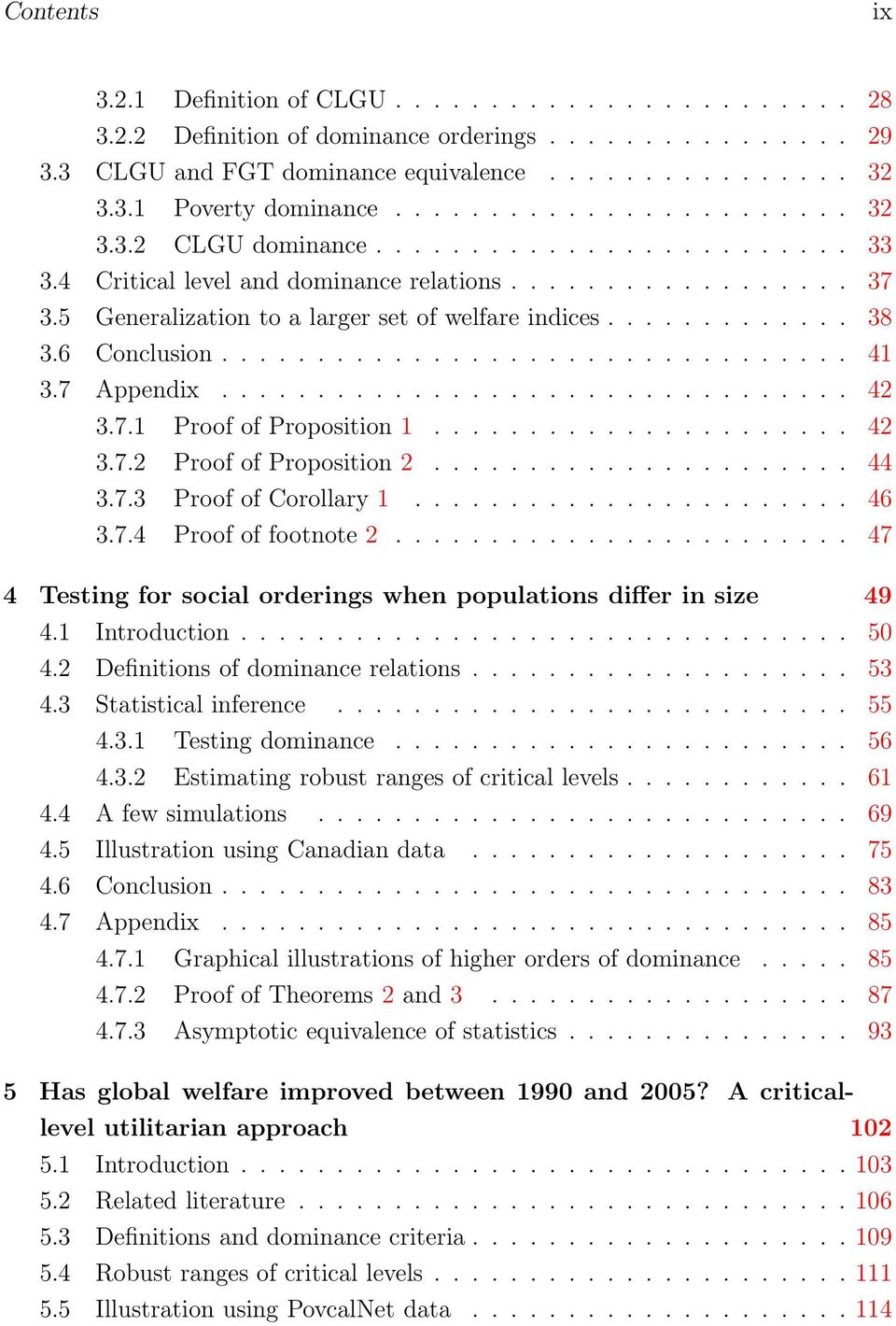
10 Contents x 5.5. Data description Some estimated values of the critical level Comparison between CLGU and per capita approaches Conclusion Appendix Critical level bounds for developing countries Developing countries not included in PovcalNet data High-income countries included in the analysis Comparison of PovcalNet and real data Conclusion 34 References 47
11 List of Figures 3. Smaller dominates larger when z + < α Larger dominates smaller Poverty incidence curves adjusted for differences in population sizes Poverty incidence curves with α = α adjusted for differences in population sizes Poverty incidence curves with α = α adjusted for differences in population sizes Population poverty incidence curves and dominance of the larger population Population P 2 curves and dominance of the larger population Population poverty incidence curves and dominance of the smaller population Population P 2 curves and dominance of the smaller population Canadian cumulative distributions Cumulative distributions of 976 and 996 and the critical level Relation between z + and α P s curves and dominance of the larger population P s curves and dominance of the smaller population (case ) P s curves and dominance of the smaller population (case 2) Poverty incidence curves with α = α adjusted for differences in population sizes Poverty incidence curves with α = α adjusted for differences in population sizes Non-dominance of 2005 over Dominance of 2005 over

12 List of Figures xii 5.5 World 2005 dominates world dominates 2005 for ECA and SSA The increase in the absolute number of poor leads to more poverty in SSA

13 List of Tables 4. Population sizes and upper bounds of the critical level large dominates small Population sizes and lower bounds of the critical level small dominates large Asymptotic standard errors of the bounds of the critical levels First-order dominance tests Estimates of the upper bound of ranges of critical levels over which the larger population dominates the smaller one Estimates of the upper bound of the range of critical levels over which the larger population dominates the smaller one Estimates of lower bound of the critical level Population size and average income Estimation of upper bounds: 2005 dominates Values of the utilitarian social evaluation index (in billion $) Estimation of lower bounds: 990 dominates Values of upper bounds: large dominates small for Burkina

14 Chapter Introduction Does the value of a society increase with its population size? How can we answer this in a normatively robust framework? What sort of statistical procedures can be performed to test this? What does the empirical evidence suggest? To address these questions is the main contribution of this thesis. This thesis consists of three essays, but they are quite close. All these essays deal with social evaluations when populations differ in size. The motivation for such comparisons lies in the fact that the evaluation of public policies often implies situations where the number of individuals differ from one situation to another. This is also expected when comparisons are targeted toward different societies. Finally, comparisons involving different populations sizes are certainly the most generally encountered case in empirical analysis. We therefore consider populations of different sizes and we are interested in the question of whether a society s well-being increases with its population size. In Chapter 2, we review the literature on this subject. Historically, there have been two opposite views about the ideal population size. The first one follows the Malthusian view that small is better because of limited available resources. The second one is based on Bentham s view and advocates that large is better. Although the recent literature develops some economic models to deal with this question, the results of

15 Chapter. Introduction 2 studies are sometimes ambivalent. Four different conclusions can emerge from the studies: (i) more people lead to greater human ingenuity and higher per capita income; (ii) more people are likely to bring more social happiness; (iii) more people, less welfare; (iv) more people and more poverty go together. The first conclusion derives essentially from positive arguments. The three last conclusions are based more on normative arguments. Given that most of these studies use some social evaluation objectives to deal with the question of size and value, we may be interested in knowing if such social evaluations are to be favored, for instance, in case of comparing alternative public policies involving different population sizes. Note that social evaluation rankings are easily made when populations have the same size. However, this is not the case when sizes differ. In that situation, the tradition has been to overcome the problem of variable sizes by calling on the replication invariance principle. In this case, social evaluation is made in per capita terms and then sizes do not substantially matter. However, as Blackorby, Bossert, and Donaldson (2005) have argued, population sizes should sometimes matter when comparing aggregate welfare. The thesis develops this idea and follows the critical-level principle. In the literature, Blackorby and Donaldson (984) were the first who introduced the notion of the critical-level principle. This principle suggests that further individuals with welfare above a value of the critical level to an existing population can be considered as improving the social welfare of the population. In other words, the critical level reflects how much a life must be minimally worth to contribute positively to society s welfare. The critical-level principle can be used to socially evaluate populations of different sizes. But this principle requires the choice of the value of the critical level, which remains the main problem of this approach. Until now, few studies have addressed this issue in the literature.

16 Chapter. Introduction 3 The first essay is presented in Chapter 3. It develops and presents some theoretical results for stochastic dominance with varying population sizes. The purpose is to extend traditional critical-level generalized utilitarianism (CLGU) analysis by considering arbitrary orders of social welfare dominance and ranges of poverty lines and values for the critical level. This essay draws from the procedure developed by Duclos and Makdissi (2004). Links between critical levels and orders of dominance are also investigated. We also introduce how to generalize the Blackorby and Donaldson (984) s critical-level principle. The second essay is contained in Chapter 4. This essay performs a statistical inference analysis taking into account changes in population sizes and population distributions. A few simulations are made to show the effect of population size on social evaluation. The essay also derives the asymptotic distributions of some lower and upper bounds of robust ranges of critical levels. An empirical application is made using Canadian Surveys of Consumer Finances (SCF) for 976 and 986, and Canadian Surveys of Labour and Income Dynamics (SLID) for 996 and Using asymptotic and bootstrap tests, we find that Canada s welfare has globally improved in the last 35 years despite the substantial increase in population size. The third essay, presented in Chapter 5, is primarily empirical. It aims at extending the application of the CLGU approach to regional and world scales using data from most countries in the world. The objective is to assess whether the value of humanity has increased between 990 and 2005 despite a substantial increase in world population size. We estimate the bounds of the critical levels for all developing countries, for regions and for the entire world. In addition to results obtained in Chapter 4, such estimations show how the process of demographic transition, in which a large part of humanity has recently engaged, may be assessed through a CLGU approach. We also compare the CLGU approach to the traditional per capita one.

17 Chapter 2 Population problems and social evaluations This chapter reviews the linkages between population size and population wellbeing. It explores whether societies are better off with smaller populations or bigger populations. This requires using social evaluation functions that can take account differences in population size to assess society s value as a whole. The choice of these functions is guided by economic objectives and also by some ethical and normative foundations. In such a setting, social evaluations also lead to important implications in terms of public policies. The first section summarizes the principal conclusions that emerge from the links between a population s size and its well-being. The second section discusses how changes in population size and population distribution are socially evaluated. 2. Is a bigger society a better one? This question sparks off many reactions according to our understanding of what we call a better society. Does it imply higher per capita income? A happier society?

18 Chapter 2. Population problems and social evaluations 5 We can focus on two views: those who believe that a larger population is usually better (the positive view) and those who do not (the negative view). The first view s argument is generally based on the idea that a large population favors development. This stems from the neoclassical theory of the impact of population growth on economic growth. Population growth induces infrastructure and market development, and influences positively technological change and innovation. This in turn raises per capita income and growth, and therefore leads to a higher level of welfare. The second view emphasizes that population growth leads to more deprivation in common dimensions (standards of living, education, health, etc.). The gist of the second view seems to be guided by an observable fact : poor countries are associated with rapid population growth and lower per capita income, while rich countries have lower rates of population growth and higher per capita income. The two views are motivated by both positive and normative arguments. 2.. More people leads to greater human ingenuity and higher per capita income The literature that supports this positive view relies on the arguments of Boserup (965), Boserup (98) and Simon (98) that a greater population is an important driver of technological change and innovation and encourages organizational and institutional change. A larger population also allows for scale economies in production and consumption. The historical features of Boserup and Simon s argument are the empirical investigations of Kremer (993) and Acemoglu, Johnson, and Robinson (2005). Using a model of population and endogenous technological change, Kremer supposes that technology is a pure public good. He also assumes that each individual s research productivity is independent of population size and that the population growth rate is limited by the state of food production. He suggests a linear relationship between population growth and population size. He shows that larger initial

19 Chapter 2. Population problems and social evaluations 6 populations without technological contact enjoy faster technological progress and population growth. Acemoglu, Johnson and Robinson show that the growth of urbanization between 300 and 850, with the access to Atlantic Trade and a favourable institutional environment, are the factors that explain the modern economic development of Western Europe. Using Kremer s model, Klasen and Nestmann (2006) incorporate population density as an additional positive determinant of technological change. Even if an increase in population leads to a greater number of potential suppliers of new technology, high density generates the linkages. It facilitates communication and exchange and raises the demand and the diffusion of technological innovations, which could in turn increase the quantity of available resources. This suggests why some people think that human inventiveness and ingenuity are capable of enhancing Earth s capacity to support the species indefinitely and to support it at a high standard of living (Dasgupta 2005, p. 46). Easterly and Levine (997) also emphasize the importance of population density. They argue that low density in Africa has some negative effects such as greater ethnic divisions. In addition, they conclude that ethnic divisions have something to do with Africa s poor economic development. All these models are consistent with endogenous growth models that find that the size of populations and also population density have a positive impact on the growth of per capita income (see, for instance, Grossman 99, Aghion and Howitt 992, Aghion and Howitt 998 and Jones 999). Some implications of the endogenous growth theory are the external benefits of having more people. More people means a higher level of knowledge, skills and human resources avalaible for future labor shortages. This in turn increases production. This idea may be found in the French philosophers Bodin (576) and Quesnay (758), who consider the individual as playing a central role in the production of wealth. According to them, there exists a bi-directional relation between population size and standards of living. Individuals represent the labour force and the strength of the army. According to Bodin, a large population can help a country to become rich and powerful: But one should never be afraid of having too many subjects or too many

20 Chapter 2. Population problems and social evaluations 7 citizens, for the strength of the commonwealth consists in men. Moreover the greater the multitude of citizens, the greater check there is on factions seditions. For there will be many in an intermediate position between the rich and the poor, the good and the bad, the wise and the foolish. There is nothing more dangerous to the commonwealth than that its subjects should be divided into two factions, with none to mediate between them. This is the normal situation in a small commonwealth of few citizens. (Six Books of the Commonwealth, Book V, chapter II, translated by Tooley 955) In Quesnay s point of view, it is more the availability of resources that leads to population growth: That the sovereign and the nation should never lose sight of the fact that the land is the unique source of wealth, and that it is agriculture which causes wealth to increase. For the growth of wealth ensures the growth of the population. (General Maxims for the Economic Government of an Agricultural Kingdom, translated by Meek 963, p. 232) One advantage of a larger population that Bodin underlines is the sake of defense against foreign attacks. This is consistent with the view of those who see in a better society a peaceful one. A larger population itself contributes to society s welfare, in the sense that it defends a nation against its enemies. There is some literature on this issue. For instance, McNicoll (984) reviews the positive effects of having more people on military capabilities. First, populous nations, other things equal, tend to have more influence in international decisions and world affairs. Second, as nations become alike in technology and in institutional organization, an increase in population is an important source of national power, both military and industrial. Because there is a great difference in technological levels among states in the world today, Although the strength of the commonwealth is not expressed in concrete terms in the quotation, it is apparent in Bodin s definition of the sovereignty of a nation. Hall and Clark (2002), pp See for example

21 Chapter 2. Population problems and social evaluations 8 the achievement of technological equality is a distant prospect. However, for some developing countries and moreover for developed countries that are characterized by low fertility rates, population can account for a significant power factor. When the population size is very low, the survival of human race can be threatened. Using the example of a nuclear holocaust which causes the problem of endangered species, Hurka (983) argues that it is desirable in that situation to encourage population to increase, even if average well-being decreases as population increases. De La Croix and Dottori (2008) also notice that the benefit of an increase in population size was enhanced by the need for a large army. Investigating the Easter Island s collapse and the quest for greater bargaining power between conflicting groups, the biggest group had the highest probability to win the war. Nerlove, Razin, and Sadka (986) (p. 60) go on to quote Edgeworth s benefit of being larger: being must be secured before well-being. Furthermore, they extend Edgeworth s argument to public goods and claim that a larger population has an advantage in providing pure public goods. The most interesting example is national defense, because the per capita cost of providing that public good falls as the population becomes larger. More generally, public goods such as infrastructure, electricity network, telecommunications and research are recognized as having cost-reduction benefits when there is more people. Alesina and Spolaore (2003) enumerate five types of benefits of having a large population: (i) lower per capita costs of public goods and more efficient taxation. The public goods are monetary and financial institutions, the judicial system, infrastructures for communication, police and crime prevention, public health, and so on. The second type of benefits is: (ii) greater military power and lower per capita defense and military costs; (iii) increase in productivity thanks to substantial skills and large markets (however, country openness to international market can limit this factor); (iv) providing insurance; (v) greater opportunities for income redistribution (pp. 3-4). A slow population growth also has negative consequences mainly for countries with AN ageing population. Because of large proportions of elderly, pay-as-you-go transfer systems become difficult to sustain. There are also fewer and fewer workers
22 Chapter 2. Population problems and social evaluations 9 to finance investment in public goods. 2 Kravdal (200) notes the same problems and remarks that less populated regions may experience difficulties in surviving. In 2005, the European Commission publishes an official document beginning by a rather alarming content: Europe is facing today unprecedented demographic change. In 2003, the natural population increase in Europe was just 0.04 per cent per annum (...). The fertility rate everywhere is below the threshold needed to renew the population (around 2. children per woman), and has even fallen below.5 children per woman in many Member States. (Commission of the European Communities 2005, p. 2) 3 Michel Rocard, a former French prime minister set the tone two decades ago in the following terms: La plupart des états d Europe Occidentale sont en train de se suicider, de se suicider par la démographie, sans même en avoir conscience (Michel Rocard, January 20, 989, Conférence des Familles ) More people, less welfare Although there can be external benefits and advantages in the provision of public goods as populations become larger, there can also be pernicious effects of being larger. Larger populations are likely to be more heterogeneous than homogeneous. This gives rise to more diverse preferences, cultures, religions and languages within the same population. As individuals differ in many respects, they do not share the same objectives. This can result for example in conflicts and in an inefficient use of public goods. In fact, larger populations can intensify the use of non renewable resources and non-pure public goods, namely common-pool resources and club goods. 2 Unless the country adopts migration policies to adjust labor supply and to correct imbalances, the problem will worsen. In fact, some governments in developed countries now focus on maximizing the benefits of economic migration. 3 See Bloom, Canning, Fink, and Finlay (200) for the reasons justifying the rapid decline in fertility in Europe. From society s point of view, parents do not have enough children when the social benefits of having children are higher than the private benefits. 4 The quotation is taken in
23 Chapter 2. Population problems and social evaluations 0 In that situation, additional people may increase per capita costs, because resources are subject to the problem of congestion. This problem generates additional costs for society that can have a negative impact on society s welfare. All these ideas seem to have sustained the philosophical and political debate in the past. Indeed, Aristotle (in Politics, Book IV, chap. IV) defended that a country should be small enough for the citizens to know and listen to each other. The entire territory should be small enough to be surveyed from a hill (Russell 2004). Rousseau (772) goes beyond Aristotle thought by stating that it is difficult to control great nations: Large populations, vast territories! There you have the first and foremost reason for the misfortunes of mankind, above all the countless calamities that weaken and destroy polite peoples. Almost all small states, republics and monarchies alike, prosper, simply because they are small, because all their citizens know each other and keep an eye on each other. (p. 25) Baron de Montesquieu (748) had the same view and believes that large countries are necessarily diverse and thus require strong governments, resulting in monarchy or even despotism. He also points out the problem related to public goods congestion occuring in a large society: In an extensive republic the public good is sacrificed to a thousand private views; it is subordinate to exceptions, and depends on accidents. In a small one, the interest of the public is more obvious, better understood, and more within the reach of every citizen; abuses have less extent, and of course are less protected. (The Spirit of Laws, Book VIII, Chap.6, translated by Thomas Nugent 752) According to these philosophers, small nations can easily supervise individuals and can control their activities. Besides, they think that the less populated states would seem to maintain social cohesion between members and thus can consolidate peace. Rousseau and Montesquieu would then associate the well-being of a society with social cohesion. Montesquieu s view is often used by anti-federalists to forcefully contest the federalism system. As they often hammer home, a republic of diverse interests could not survive because it is affected by factions and fragile stability.
24 Chapter 2. Population problems and social evaluations 2..3 When more people and more poverty go together A large society can also involve a risk of excessive use of environmental resources with possible deleterious effects on individual well-being. Much literature supporting this idea exists. The main argument is based on the effects of demographic behaviour on per capita income. The most basic description of such effects was first proposed by Malthus (798) in two scenarios. The first reveals a positive effect of the standard of living on population growth, given that population size is small. As the standard of living is high, population will grow as a result of reproduction and population becomes larger. There is here a consistent view with that of Quesnay. The second describes the negative feedback due to the fact that the rise in population size exerts pressure on resources and therefore leads to a low standard of living. This forces population to be reduced as a consequence of low fertility and high mortality. Starting from Malthus, fertility behaviour has been analyzed in different economic models, for instance Becker (960) and Becker and Lewis (973). They assume the fertility behavior of families to be determined by economic variables (number and quality of children, consumption and other commodities) which are, in turn, influenced by fertility behavior. Parents face a quality and quantity tradeoff in their decision on children. Economic models using these foundations have tried to explain the negative relation between income and population growth (see Barro and Becker 989). Moreover, Galor and Weil (999) extend these models to characterize the economic transition experienced by developed countries: the transition from high population growth and low per capita income to low population growth and high per capita income. Birdsall (988) reviews the effects of the high fertility underlying rapid population growth in developing countries on their economic growth. Although she finds little direct connection between fertility rates and incomes per capita, she highlights the importance of the determinants of individual fertility decisions on the process of economic development. The determinants are essentially education, availability and distribution of health care services, work, access to family planning and prevailing religious views. 5 Empirical work on the subject concludes that the social costs of 5 The desire to obey religious dictates may encourage women to bear many children.
25 Chapter 2. Population problems and social evaluations 2 high fertility exceed private costs, as experienced by societal and parental difficulties in educating children and investing in their health (e.g. in some parts of Asia and Sub-Saharan Africa, where population growth rates remain high and per capita income is low). In the fertility model of Barro and Becker, De La Croix and Doepke (2003) introduce a differential fertility effect between the rich and the poor for the long run relationship between inequality and growth. Using data on 68 countries, they find that higher inequality between rich and poor slows down economic growth and development because poor people have a higher fertility rate than the rich. They invest less in education than the rich and their population share increases with fertility and this lowers the average level of human capital in the society. Finally, stronger inequality delays the fertility transition and reduces income per capita growth. These results suggest why rapid population growth rates may exacerbate the development problems of poor countries. This has been reinforced in the last decade by the growing awareness of the problems of environmental degradation, particularly in poor countries. Along this line, Ehrlich and Ehrlich (990) generalize Malthus pessimist idea on population growth and present population growth as a serious jeopardy that humans might face. They argue that overpopulation creates environmental damages and threatens world s survival. In their book, Ehrlich and Ehrlich (990) enumerate a set of environmental problems. The main problems are the rapid depletion of natural resources such as water and land, soil erosion and desertification, ecological destruction, climate change and global warming. Environmental problems were widely discussed by The Club of Rome, an informal and international group of decision makers who commissioned the publication of Limits to Growth in 972. This book addresses questions about the long term consequences of the world s population growth, industrialization, pollution, food production and resource depletion. Since then, there has been a growing interest in environmental issues, which has given rise to many concepts such as sustainable development. Al Gore (992), a former American Vice Caldwell and Caldwell (990) emphasize this point to explain why fertility does not decline in Sub-Saharan Africa.
26 Chapter 2. Population problems and social evaluations 3 President and Nobel Peace Price winner, voices similar concerns. He draws attention to environmental and ecological issues as well as global warming: No goal is more crucial to healing the global environment than stabilizing human population. The rapid explosion in the number of people since the beginning of the scientic revolution and especially during the latter half of this century is the clearest single example of the dramatic change in the overall relationship between the human species and the earth s ecological system. (p. 380) Stabilizing human population growth has become more important today because of concerns with the earth s capacity. Moreover, population growth, especially among the poorer inevitably raises poverty. Most people think that this leads to a deterioration in overall welfare as it causes undernourishment, starvation and diseases. For example, let us consider the following point of view of John Seager (2009): Population growth in the poorest places on earth undermines quality of life. It destroys resources necessary to sustain healthy families. It creates conditions in which strife and conflict can flourish. It dooms billions to abject poverty. ( Some empirical studies have attempted to provide evidence of a positive link between population increase and environmental degradation. For instance, in the context of rural Sub-Saharan Africa, Cleaver and Schreiber (994) claim that a rapid growth of the population causes environmental damages (impoverishment of the soil, destruction of the forests) and deteriorates well-being. Filmer and Pritchett (996) report a positive link between fertility and deterioration of the local environmental resources in a set of villages in Pakistan. However, these investigations fail somewhat in ignoring the poverty phenomenon. The effect of poverty on fertility is shown in most developing countries by the large differentials in household sizes across variables like income, education, health and other variables that reflect poverty. At the same time, poverty is also often seen
27 Chapter 2. Population problems and social evaluations 4 as an outcome of high fertility. Large families are likely to devote smaller amounts of their budget to invest in their children s health and education. In their crosscountry study Eastwood and Lipton (999) estimate regressions to assess the impact of fertility on poverty. They find a positive correlation between population growth and the magnitude of absolute poverty. Wagstaff (2002) reviews the evidence on poverty and health inequalities between poor and non poor people. The two-way relationship between poverty and health is emphasized, whether comparisons are made between countries or within countries: poverty breeds ill-health, and ill-health keeps poor people poor. People now regard determinants of fertility, poverty, and environmental degradation as interconnected. According to Dasgupta (2000), poverty, household size, and environmental degradation would reinforce one another in an escalating spiral (p. 635). See also Birdsall (994). The positive feedback mechanism that links these elements enables us to associate many characteristics to poor households: they contribute to high fertility and infant mortality, to less investment in children education, to less health care for them and to dependence on natural resources. The interdependence between determinants of fertility, poverty and environmental quality requires treating all these variables as endogenous. Economists have widely recognized this in the case of fertility: parents determine the number of children they want to have in response to the economic constraints they face in such a way as to maximize their own utility and possibly the welfare of their children. Although empirical studies at the micro and country level suggest that high fertility worsens poverty, the effects of population growth on poverty are more elusive and difficult to explore at the world scale. Empirical studies on such effects generally lead to inconclusive results. We cannot therefore establish a clear-cut relationship between world poverty and overpopulation, because there is no evidence to support that high population growth causes or exacerbates poverty: The problem of global poverty, in and of itself, cannot in an empirical sense be defined as a world population crisis unless one means it is a crisis that so many people today should be suffering from poverty. But it is a fundamental lapse in logic to assume that poverty is a pop-
28 Chapter 2. Population problems and social evaluations 5 ulation problem simply because it is manifest today in large numbers of human beings. The proper name for that logical error is the fallacy of composition. (Eberstadt 2007, p.7) Clearly, the links between overpopulation and poverty are not easy to exhibit. Some researchers who have attempted to describe the relationships between population growth and global poverty ended up presenting nuanced results. For instance, Ahlburg (994) concluded that Although it is not clear whether population growth causes poverty in the long run or not, it is clear that high fertility leading to rapidly growing population will increase the number of people in poverty in the short run. (Ahlburg 994, p.43) The complexity of population growth and poverty interactions can be understood by referring to Cassen (994) s view about the relevant studies encompassing population growth and economic changes: The issue of whether per capita economic growth is reduced by population growth remains unsettled. Attempts to demonstrate such an effect empirically have produced no significant and reliable results. (Cassen 994, p.5) One central normative difficulty with the endogenous fertility framework is the definition of the society whose welfare should be of concern. What type of social welfare function should be chosen to evaluate the outcome of fertility? This leads us to the discussion of the normative aspects of the relations considered above More people is likely to bring more social happiness The question of how to value human well-being and society s welfare is longstanding in several different fields (economics, psychology, philosophy, etc.). Answering
29 Chapter 2. Population problems and social evaluations 6 this question is important for policy makers who seek to improve the welfare of the populations they serve. Traditional welfare economics usually relies on utility (whether understood as the satisfaction of desires or as happiness) as a measure of human well-being. Recent work seems to emphasize happiness rather than standard utility to evaluate well-being in order to guide public policy - see for example Kahneman, Diener, and Schwarz (999), Kahneman (2000) and Kahneman and Krueger (2006). It is also recognized that having more people can create some external benefits that can raise society s happiness. This includes parents desire for a child (Easterlin 2005), relational goods (companionship, friendship, partners, marriages, etc.) and religious practice. The happiness view takes root in Bentham s notion of pleasure, even if Nussbaum (2008) claims that Bentham s conception does not adequately capture what may be understood by happiness. 6 To value a society s welfare, Bentham chooses to maximize the sum of pleasures and to minimize the sum of pains. This aggregation gives rise to utilitarianism, whose principal criterion is the maximization of the greatest happiness of the greatest number number. Bentham is the father of utilitarianism and some further refinements are provided by Sidgwick. This is commonly known as total or classical utilitarianism. The point of view of Sidgwick (966) is useful: So that, strictly conceived, the point up to which, on utilitarian principles, population ought to be encouraged to increase, is not that at which average happiness is the greatest possible (...) but that at which the product formed by multiplying the number of persons living into the amount of average happiness reaches its maximum. (pp ) The implications of total utilitarianism are clear. If a social planner chose total 6 According to Nussbaum (2008), some pleasures are bad, namely, those that are closely associated with bad activities. Rich people have pleasure in being ever rich and lording it over others... Racists have pleasure in their racism, sexists in their sexism. In general, bad people have pleasure in their bad behavior (p. 96). Nussbaum s criticism is also based on the saying that one man s joy is another man s sorrow.
30 Chapter 2. Population problems and social evaluations 7 utilitarianism as the social objective, it is more likely that he would prefer a larger population to a smaller one. This is because total utilitarianism can encourage indefinitively an increase in the size of the population, even if such an increase leads to a very low average well-being. Parfit (984) characterizes this situation as a repugnant conclusion. The latter is formulated as follows: For any possible population of at least ten billion people, all with a very high quality of life, there must be some much larger imaginable population whose existence, if other things are equal, would be better, even though its members have lives that are barely worth living. (Parfit 984, p. 388). Parfit considers such a conclusion as being repugnant. It may indeed appear repugnant that a better population be constituted only of very poor or miserable people. But such a judgment much relies on a valuation of individual well-being in terms of conventional material achievements, for instance, real income. As Narveson (2003) points out, obviously, people can be unhappy though wealthy, and happy though poor. 7 Ng (986a) and Arturo Barrios (2009) also believe that poor people are on the whole happy and are happy to have been born. Barrios expresses his view by referring directly to the third world, the part of the world where mass poverty is concentrated: So unlike the Economist reader elites who, having solved most of their existential problems, are constantly seeking problems to temper their wellbeing, most people in the third world are very happy to exist indeed, thank you very much. Being poor does not make one as unhappy as the Western elites imagine. ( 7 As the saying goes: money does not buy happiness. An analogous view is emphasized by Easterlin (973) on page 4: In all societies, more money for the individual typically means more individual happiness. However, raising the incomes of all does not increase the happiness of all. The happiness-income relation provides a classic example of the logical fallacy of composition - what is true for the individual is not true for society as a whole. Thinking that the society would be happier if it were richer is also not consistent with findings in subjective data (Kahneman, Krueger, Schkade, Schwarz, and Stone 2006).
31 Chapter 2. Population problems and social evaluations 8 The happiness that poor people may enjoy can also be seen through religious lenses. In general, poor people do try to derive happiness out of life. Those who practice religion can feel happier, because religion makes them depend less on themselves and more on God. A religion that promises a better afterlife can also help the poor to live better in spite of their poverty. 8 This religious dimension is important since it can make religion having a greater social impact in societies where members are believers and practicers. The religious view is also often based on moral obligations that are to some extent consistent with the total utilitarianism principle. Whether or not a society experiences low material well-being, religious beliefs cannot discourage an increase in society s population. Religion can encourage people s procreative capacity to replenish the world and subdue nature, as Heyd (992) underlines it: The value of the replication of God s image is the reason given for Man s creation. (...) Their number should be as large as possible so as to permeate the world with God s image. (...) It is a unique commandment, because it is the existential basis for the very possibility of all other commandments. It is conscious procreation rather than simple biological propagation which is the object of the first (moral) duty. (Heyd 992, p. 2) 2.2 Social evaluations with variable population sizes Total utilitarianism is one of the most popular social evaluation functions for variable population sizes. However, it leads to the repugnant conclusion. A social planner who wants to avoid the repugnant conclusion will tend to be in favour of controlling population size from a social welfare perspective. A revised version of total utilitarianism that does this is average utilitarianism. Edgeworth (925) at- 8 Becchetti and Pelloni (200) review the effects of religion on happiness. They conclude that the effects are positive and significant in most econometric studies. See also Baudin (2008) who uses French data to investigate the role of religion in fertility behavior and finds a similar result for religious practicers.
32 Chapter 2. Population problems and social evaluations 9 tributes it to John Stuart Mill, who chose a social objective on a per capita basis to justify limits to population size. The main idea of average utilitarianism is to make the average person as well as possible no matter how small the population, even if this results in a single person. A direct consequence of this is that a population with only one individual should be preferred to an arbitrarily larger one with almost the same average well-being (Blackorby, Bossert, and Donaldson 2005). Then size does not matter even in the case of ranking distributions with different population size. In such a case, the replication invariance principle which claims that an income distribution and its exact replication give the same level of social evaluation is implicitly used in the analysis. Thus, it is well recognized that average utilitarianism is more conservative about population size (Sumner 978, Broome 992b). Sumner (978, p. 99) supports this: it is no accident that the average theory was devised strictly to handle questions of population. This can have important implications for big populations (for instance, China and India). With the implementation in China of the onechild policy in response to population concerns, the consequences are such that women are forced to have abortions and more than 0 million of them are performed per year. 9 Abortions are common especially when it comes to female fetuses, due to the discrimination against daughters in East and South Asia. For instance, Klasen and Wink (2003) estimate the number of missing women in the 990s at nearly 4 million for China and 3 million for India. See also Sen (990) who estimates that more than 00 million women are missing in the world. This outcome associated to average utilitarianism has been emphasized by Cowen (989), Broome (992a) and Kanbur and Mukherjee (2007) in the case of the death of poor people, which can lead to an increase in society s welfare. Such things seem to be morally difficult to accept Critical-level utilitarianism When discussing the caveats of both total utilitarianism and average utilitarianism, Blackorby and Donaldson (984) and Blackorby, Bossert, and Donaldson (2005) 9 In
33 Chapter 2. Population problems and social evaluations 20 investigate another version of utilitarianism called the critical-level generalized utilitarianism (CLGU). CLGU is a social evaluation function defined as the sum of the differences between a transformation of individual incomes or individual utilities and a transformation of a constant called critical level. From an ethical view, the critical level can be seen as being the minimum individual welfare needed for someone to add to the value of humanity. The critical level has been termed the value of living by Broome (992b). The principle of CLGU is to assess if new individuals that are added to an existing population result in a higher social welfare for the overall population. It is clear from its definition that CLGU is the same as the product of population size and the difference between the representative or average utility and the critical level. A social planner whose social objective is CLGU is committed to a possible trade-off between population size and average well-being in excess of the critical level. As long as the critical level is relatively low, the greater the population size, the higher the level of society s welfare. But if the critical level is higher than average utility, society s welfare will tend to be higher when population falls. As a consequence of this, a low value of the critical level leads to a preference for a large population whereas a high value leads to a small one. This version of utilitarianism proposed by Blackorby and Donalson avoids some of average utilitarianism s problems, since the addition of a person is socially profitable only if his well-being is higher than the critical level although not necessarily higher than the average one. Hence, poor people with well-being above the critical level will be valued by the CLGU principle. CLGU also avoids the repugnant conclusion since it is socially undesirable to add individuals with well-being lower than the critical level. The CLGU approach can serve to address important policy debates on populations that actually occur in many countries in the world. For instance, one important policy use of the CLGU approach is to inform the issue of migration. Some developed countries and particularly European countries are pursuing selective migration with the main reported objectives to increase population growth rates, which are judged to be too low, and to maintain a relatively high level of national welfare. This is consistent with CLGU. CLGU also justifies the policy of many developed
34 Chapter 2. Population problems and social evaluations 2 countries that are engaged in selective migration, and admit only those that enjoy a level of welfare at least equal to an implicit critical level. The critical-level approach has been used in some previous works. For instance, Blackorby, Bossert, and Donaldson (2002) extend the approach to allow the critical level to depend on population size. Recent work tries to use the critical-level approach in a context of dominance or social ranking. Trannoy and Weymark (2009) develop a second-order dominance criterion based on the CLGU. They show that this dominance criterion is equivalent to the dominance based on generalized Lorenz curves for a given value of the critical level. They also explore the case where the critical level lies in an interval as is investigated by Blackorby, Bossert, and Donaldson (996). Ethical foundations related to criticallevel utilitarianism have been discussed by Ponthiere (2003). The main argument is that critical-level utilitarianism seems to be a coherent and intuitive approach for dealing with social evaluation of variable populations. There exists in the literature other approaches for social evaluation involving variable population size. Indeed, a few studies on social ranking use neither the replication invariance principle or the critical-level approach. Aboudi, Thon, and Wallace (200) make inequality comparisons between populations of different sizes and show that a distribution is more equal than another one if the first distribution can be obtained from the second distribution by means of linear income transformations. Pogge (2007) follows a Pareto improvement criterion to socially rank distributions with different numbers of individuals Optimal population As already mentioned above, the choice of the social evaluation objective has some implications for population concerns. The Benthamite function always leads to a larger population than the Millian one. The Blackorby and Donaldson one is an intermediate between the two. It may lead either to a larger or to a smaller population size. It is therefore important for the social planner to make a reasoned choice of social valuation in order to formulate appropriate policies for society s
35 Chapter 2. Population problems and social evaluations 22 well-being. 0 If both rapid population growth as well as low population growth can be detrimental to society s well-being (as is discussed in Section 2.), then it seems that there may exist an optimal population growth (or optimal size) for the society. The notion of an optimal size dates back to Plato. He quantified the optimal size of a state at 5,040 individuals. He said: The number of our citizens shall be This will be a convenient number; and these shall be owners of the land and protectors of the allotment. (...) Every legislator ought to know so much arithmetic as to be able to tell what number is most likely to be useful to all cities. Beyond its arithmetic virtues, Plato seemed to see in this number the size that would balance size and subsistence: The territory must be sufficient to maintain a certain number of inhabitants in a moderate way of life more than this is not required; and the number of citizens should be sufficient to defend themselves against the injustice of their neighbours. 2 Plato s view that the number of citizens must remain constant implies that there should be population control to ensure the stationarity. This number ensures and can thus avoid some disasters related to a large population (Stangeland 904, pp ). Plato s view is also consistent with arguments in favor of population stabilization and to a certain extent matches with Aristotle s argument. According to Aristotle, the optimal size should not be too small or too high, but should rather lie between boundaries within which population ought to remain: The right number of citizens is not one fixed number, but any number within certain limits. (The Nicomachean Ethics of Aristotle, translated by Peters 886, pp ). 0 Ng (986b) also investigates a new version of utilitarianism very much like total utilitarianism, called number-damped total utilitarianism. It is defined as the product between a function of population size and average well-being. Plato adds that this number has 59 divisors with 0 divisors which are followed. This makes it possible to organize society in many different equal-sized groups. 2 All the quotations of Plato are taken from
36 Chapter 2. Population problems and social evaluations 23 The later Malthusian view on population and standards of living gave prominence to the concept of optimum population. Having discovered the risk of overpopulation, Malthus advocates policies that stabilize population size and that can lead to an optimal population size. Due to the concern of limited resources, this can help avoid some disasters related to a large population. The economists Cannan and Wicksell introduced the literature on optimum population as what density of population under given circumstances is most advantageous (Gottlieb 945, p. 290). John Stuart Mill was the first to give precise details on the optimum population concept: the one providing a largest per capita income. 3 Optimum population has been successively investigated by Meade (955), Mirrlees (967), Dasgupta (969), Lane (975), Samuelson (975), and Gigliotti (983). Meade, Mirrlees, Dasgupta and Gigliotti maximize a discounted total utilitarianism whereas Lane and Samuelson maximize discounted per capita utilitarianism. Meade shows how to choose the optimum population size at any given time. The rate of savings and the stock of capita are given. Dasgupta extends Meade s framework by endogenizing the rate of savings. One limit to Meade s and Dasgupta s work is their implicit hypothesis that there is no cost for realizing optimum population. Lane imposes further constraints by assuming that the population growth is entirely endogenous. Gigliotti uses a framework with overlapping generations and without technological change. Making a comparaison between the two criteria (total and per capita utilitarianism), Gigliotti finds significantly different results. For a discussion related to the choice of an optimal population size using the two utilitarian criteria under a context of sustainable development, see Asheim (2004). Finally, if the existing population size is higher that what is given by optimum population analysis, population control may be justified (but not systematically). For this purpose, the general idea of resorting to contraception, child murder, abortion and any migratory movement, is to ensure population stationarity. However, these population control policies do not all have the same effects on living individuals, as some of them can be ethically unacceptable. In the case where population size is lower than the optimal one, as may be the case in developed countries, policies that encourage families to produce more children are to be implemented to favor a more rapid population growth. 3 See for example Gottlieb (945) for a review on the optimum population theory.
37 Chapter 2. Population problems and social evaluations 24 The more recent literature uses an alternative approach to optimal population based on social choice theory. Blackorby, Bossert, and Donaldson (995) derive an axiomatic representation for social orderings to determine an optimal population size. This representation is critical-level utilitarianism already discussed above. Renström and Spataro (forthcoming) adopt critical-level utilitarianism as a dynamic welfare criterion to choose an optimal population growth. Their results reveal that total and average utilitarianism lead to unsatisfactory results for population growth rate in the sense that both cannot avoid corner solutions for the steady state. Total utilitarianism implies that is optimal to increase population as fast as possible. Hence, this leads to the repugnant conclusion. Average utilitarianism implies a population growth at a very low speed. However, using a positive value for the critical level, they find that critical-level utilitarianism yields an interior solution for the population growth rate. Other relevant contributions include Broome (2003), Broome (2004) and Golosov, Jones, and Terthilt (2007). In the following chapter, we implement critical-level generalized utilitarianism in a dominance context. We perform a theoretical analysis by comparing socially two populations of different sizes.
38 Chapter 3 Welfare comparisons with different population sizes: a theoretical analysis This chapter focusses on welfare comparisons when populations differ in size. It considers welfare dominance based on critical-level generalized utilitarianism in addition to poverty ranking and establishes an equivalence between a critical-level generalized utilitarianism dominance criterion and a poverty dominance criterion. This leads to dominance tests of arbitrary orders of dominance that involve possible choices of poverty lines (or censoring points) and possible values for critical levels. Links between critical levels and orders of dominance are also investigated. Keywords: Critical-level generalized utilitarianism; Welfare dominance; Poverty dominance; Dominance equivalence.
39 Chapter 3. Welfare comparisons with different population sizes Introduction Traditionnally, welfare ranking has been established by using Lorenz and generalized Lorenz curves. In this literature, Atkinson (970) is commonly regarded as having laid the foundations for welfare analysis. His result applies only to comparisons of income distribution over populations with equal sizes. However, many comparisons typically involve different population sizes. Some further results have been given by Dasgupta, Sen, and Starret (973), Sen (973), Shorrocks (983) and Kakwani (984), which make it possible to rank welfare when populations differ in size. This is done by using the replication invariance principle. However, employing this principle implicitly supposes that welfare should be assessed in per capita terms. In this context, social evaluations are based on average utilitarianism. Using average utilitarianism as a social evaluation criterion implicitly assumes that population sizes should not matter. One consequence of this is that a population with only one individual will dominate any other population of arbitrarily larger size as long as those larger populations average utility is (perhaps only slightly) smaller than the single person s utility level see for instance Cowen (989), Broome (992a), Blackorby, Bossert, and Donaldson (2005), and Kanbur and Mukherjee (2007). This social evaluation framework would seem to be too biased against population size: it would say for instance that a society made of a single very rich person (Bill Gates for example) would be preferable to any other society of greater size but lower average utility. An alternatively popular social evaluation criterion is total utilitarianism. Adopting total utilitarianism leads, however, to Parfit (984) s repugnant conclusion. Parfit (984) s repugnant conclusion bemoans the implication that, with total utilitarianism, a sufficiently large population will necessarily be considered better than any other smaller population, even if the larger population has a very low average utility. Blackorby and Donaldson (984) introduce what they call the Critical-level generalized utilitarianism (CLGU). According to Blackorby, Bossert, and Donaldson (2000), CLGU satisfies some ethical requirements: The critical-level principles with positive critical levels are part of the
40 Chapter 3. Welfare comparisons with different population sizes 27 ethically acceptable family, and we argue that there are good reasons for choosing one of them. (Blackorby, Bossert, and Donaldson 2000, p. 2) By introducing a new criterion named generalized concentration curves, Trannoy and Weymark (2009) developed social welfare dominance criteria to compare distributions of utility using a CLGU function. They showed that the dominance criterion based on generalized concentration curves gives the same ordering as does the CLGU criterion. Their results are analogue to those obtained using generalized Lorenz dominance. Our main objective is to extend the above work by using poverty curves instead of Lorenz curves. We believe that this approach is preferable because it makes it possible to test whether welfare has increased or decreased across time in a given society. It also makes possible to take into account changes in population sizes and distributions. Given the fact that poverty continues to hold international organizations attention, as for example in the Millennium Development Goals, this approach has useful policy implications. Furthermore, it makes possible to have CLGU results based on various orders of dominance as in Foster and Shorrocks (988b) and Duclos and Makdissi (2004). Section 3.2 defines social welfare dominance relations. It also discusses how this relates to well-known poverty dominance criteria which we call FGT dominance. This dominance context extends Blackorby and Donaldson (984) s focus on CLGU indices. It also builds on the theoretical contribution of Trannoy and Weymark (2009), who propose a CLGU dominance criterion that is an extension of generalized Lorenz dominance and second-order welfare dominance. Section 3.3 establishes the equivalence between CLGU dominance and FGT dominance criteria. In Section 3.4, we discuss how the critical level can be related to the order of dominance. Section 3.5 explores how dominance relations can be extended to a larger class of social evaluation indices.
41 Chapter 3. Welfare comparisons with different population sizes CLGU: an alternative social evaluation 3.2. Definition of CLGU Blackorby and Donaldson (984) have proposed CLGU as an alternative to (and in order to address the flaws of) average and total utilitarianism. To see how CLGU is defined, consider two populations of different sizes. The smaller population of size M has a distribution of incomes (or some other indicator of individual welfare) given by the vector u, and the larger population of size N has a distribution of incomes given by the vector v, with M < N. Let u := (u,u 2,...,u M ), with u i being the income of individual i, and v := (v,v 2,...,v N ) with v j being the income of individual j. Let the level of social welfare in u and v be given by W (u;α) = M (g(u i ) g(α)) (3.) i= and N W (v;α) = (g(v j ) g(α)), (3.2) j= where g is some increasing transformation of incomes and α is a critical level. Note that social welfare in the two populations remains unchanged when a new individual with income equal to α is added to the population. The smaller population exhibits greater social welfare than the larger one if and only if W (u;α) W (v;α). CLGU thus aggregates the differences between transformations of individual incomes and of a critical level. It can therefore avoid some of average utilitarianism s problems, since the addition of a new person will be socially profitable if that person s income is higher than the critical level, although that income may not necessarily be higher than average income. CLGU can also avoid the repugnant conclusion since it is socially undesirable to add individuals with incomes lower than the critical level, regardless of how many there may be of them. Overall, CLGU provides a relatively appealing and transparent basis on which to make social evaluations and avoid the flaws associated with average and total utilitarianism.
42 Chapter 3. Welfare comparisons with different population sizes Definition of dominance orderings Let N be the set of positive integers and R := (, ). We denote by Ω, the set of possible income distributions: Ω = U N N R N. As we see, the distribution u Ω and the distribution v Ω. The welfare functions in 3. and 3.2 depend on g and α. One could choose a specific functional form for g and a specific value for α, but that would be inconvenient in the sense that the welfare rankings of u and v could then be criticized as depending on those choices. It is thus useful to consider making welfare rankings that are valid over classes of functions g and ranges of critical levels α. To do this, let s =,2,..., stand for an order of welfare dominance. Consider C s as the set of functions R R that are s times piecewise differentiable. Define the class F s z,z + of functions as Fz s,z := g z C s + z z z +, g z (x) = g z (z) for all x > z, g z (x) = g z (z ) for all x < z, and where ( ) k dk g z (x) 0 z < x < z + and k =,...,s. dx k (3.3) Also denote W s α,z,z as the set of CLGU social welfare functions with g z F s + z,z + and critical level α. For any vector of income v R N, this set is defined as: N } Wα,z s,z {W := + W (v;α) = (g z (v i ) g z (α)) where g z Fz s,z and v + RN. i= (3.4) The first line in 3.3 says that the censoring point z must be above some lower level z and below some upper level z +. The second line effectively censors incomes at z. The third line says that for social evaluation purposes we can set to z those incomes that are lower than z this assumption is mostly made for statistical tractability reasons. In Chapter 4, this will be more clear. The fourth line, on the derivatives of g z, imposes that the social welfare functions be Paretian (for k = ), be concave and thus increasing with a transfer from a richer to a poorer person (for k = 2), be transfer-sensitive in the sense of Shorrocks (987) (for k = 3), etc., over the interval (z,z + ). The greater the order s, the more sensitive is social welfare to the income levels of the poorest.
43 Chapter 3. Welfare comparisons with different population sizes 30 We denote by sw α,z,z +, the CLGU dominance ordering at order s. sw α,z,z + is a partial order on the set of income distributions Ω. For any u R M and v R N such that M < N, the distribution u weakly dominates the distribution v given the criterion sw α,z,z + if the social welfare W u is greater than or equal to the social welfare W v for all W in W s α,z,z +. We define this criterion by: u sw α,z,z v W (u;α) W (v;α) W + Ws α,z,z +. (3.5) As mentioned above, higher-order CLGU dominance implies a more restricted set of social welfare indices. Indeed, the greater the value of s, the more normative properties g z must satisfy. The partial order sw α,z,z + involving these indices may rank more pairs of distributions than with lower-order dominance which does not require as many properties forg z. Hence, imposing more conditions on indices makes it possible to increase the ranking power of the social welfare criteria. Now, we deal with poverty orderings. For any poverty line or a censoring point z [z,z + ] and for any income distribution v :=(v,...,v N ) where v i R i, we define primal dominance curves at order s by : P s v (z) = N N (z v i ) s I(v i z) where z z z +. (3.6) i= I( ) is an indicator function, with value if the condition is true and 0 if not. These curves are those of the well-known FGT (Foster, Greer, and Thorbecke 984) poverty indices across values of z with parameter s. We will refer to them as poverty curves. Next, we denote by sp z,z + the dominance ordering at order s based on poverty curves. sp z,z + is also a partial order on the set of income distributions Ω. For any distribution u R N and any distribution v R N, u weakly dominates v in poverty at order s if the poverty curve of u at order s lies nowhere above that of v at order s for any poverty line z [z,z + ]. Hence, we define sp z,z + by u sp z,z + v Ps u (z) Ps v (z) 0 for all z z z +. (3.7) In what follows, we denote by u R M and v R N two income distributions of two populations where we suppose that M N. u denotes the distribution
44 Chapter 3. Welfare comparisons with different population sizes 3 of the smaller population and v denotes the distribution of the larger population. Let z be a lower bound and z + be an appropriate upper bound of the range of censoring incomes or poverty lines. Let α 0 be some given critical level. Consider the distribution u α 0 as being the distribution for the smaller population (viz u) expanded to size of population v by adding (N M) fictitious individuals with income level α 0. Then, u α 0 := (u,α 0,...,α 0 ). In equations (3.4) and (3.6), we have defined CLGU indices and poverty indices in terms of sums. For convenience, we redefine the indices in terms of integrals. This can be done by using Stieltjes integrals (see for example Rudin 976). Consider a real interval [a,b] such that u,...,u M,α 0, v,...,v N (a,b). For any order s, rewrite where By defining: and D u(t) = M D v (t) = N P s v (z) = N { (z v) s + = N i= M I(u i t) Du(t) s = i= N I (v i t) i= (z v i ) s + (z v) s if v z 0 if v > z. t a t Dv s (t) = θ (t) = I ( α 0 t ) θ s (t) = t a a D s u (x)dx for s 2, (3.8) D s v (x)dx for s 2 (3.9) θ s (x)dx for s 2, (3.0) we notice that Pu s (z) and Ps α 0 v (z) can be rewritten in terms of Stieltjes integrals as and P s u α 0 (z) = M N b a (z t) s (N M) + dd u (t)+ N b Pv s (z) = a b a (z t) s + dθ (t) (3.) (z t) s + dd v (t). (3.2)
45 Chapter 3. Welfare comparisons with different population sizes 32 In the same way, we can write where u α 0 i = N i= { ( ) b g z u α 0 i = M u i if i =,...,M α 0 if i = M +,...,N and a b g z (t)ddu(t)+(n M) N g z (v i ) = N i= b a a g z (t)dθ (t) (3.3) g z (t)dd v(t). (3.4) 3.3 CLGU and FGT dominance equivalence Our main objective in this section is to show that the CLGU dominance ordering sw α,z,z + coincides with the poverty dominance criterion sp z,z + when the critical level is α. This results from some propositions and theorems that we state in the remainder of the section by setting the dominance at any order s =,2,3,... The dominance equivalence is established in the manner of Duclos and Makdissi (2004), which can be set at any order of dominance Poverty dominance Given the fact that sp z,z + is a partial order, then for some given s, poverty orderings using P s indices to rank distributions may fail to satisfy the dominance ordering for certain pairs of distributions. This is more generally the case for lower values of s. The well recognized case is when s =, in which situation we obtain first-order dominance based on the headcount. But as previous studies underlined (see for example Zheng 999), the partial order sp z,z + becomes more and more complete as s increases in that it can rank more pairs of distributions unambiguously. Therefore, any poverty dominance criterion at order s may rank more pairs of distributions than another at order less than s. Shorrocks and Foster (987)
46 Chapter 3. Welfare comparisons with different population sizes 33 and Foster and Shorrocks (988b) offered characterizations of poverty dominance for lower orders of dominance (s 3). Indeed, for two pairs of distributions, they showed that first-order poverty dominance is equivalent to say that one of two distributions can be obtained by the other by way of simple increases. With second-order dominance, the dominant distribution can be obtained by applying progressive transfers on the other. Third-order dominance introduces the notion of transfer sensitivity. It corresponds to a pair composed of a progressive transfer occuring at lower income levels and a similar regressive transfer at higher income levels. Such a transfer must lower a third-order poverty index of a distribution. The interpretations of higher-order dominance can be made by using the generalized transfer principles described in Fishburn and Willig (984). In general, these interpretations say that a combination of a desirable transfer at lower incomes and its inverse at higher incomes yields a transfer which is socially desirable. For a nice exposition of these interpretations, the interested reader may refer to Makdissi (999). Duclos and Makdissi (2004) generalized poverty dominance for any order by using dominance curves. Here, we follow their approach to state the equivalence conditions for poverty dominance. Proposition For s, u α 0 sp z,z v M (N M) + N Ds u(t)+ θ s (t) D s N v(t) 0 z t z +. (3.5) Proof: See the Appendix CLGU dominance CLGU dominance is thus analogous to poverty dominance. As it is for poverty orderings, welfare ranking sw α 0,z,z + leads to similar necessary and sufficient conditions for the distribution u to dominate the distribution v given the critical level α 0.
47 Chapter 3. Welfare comparisons with different population sizes 34 Proposition 2 For s, u sw α 0,z,z + v M N Ds u(t)+ (N M) θ s (t) D s N v(t) 0 z t z +. (3.6) Proof: See the Appendix. The results of Propositions and 2 are not new and are already given by Duclos and Makdissi (2004), except that we obtain a necessary and sufficient condition for welfare dominance instead of a sufficient condition as in Duclos and Makdissi (2004). Of course, the equivalence is possible because our social welfare is defined on some transformation g z which is an income-censoring function. We then state: Theorem For s, u α 0 sp z,z v u + sw α 0,z,z + v. (3.7) Theorem is a direct consequence of Propositions and 2. It says that poverty dominance at order s with critical level α 0 and a range of poverty lines [z,z + ] is a necessary and sufficient condition for CLGU dominance at order s with the same value of the critical level and the same range of poverty lines. The equivalence between poverty dominance and welfare dominance is already obtained by Foster and Shorrocks (988b) for lower values of s. See inter alia Foster and Shorrocks (988a) and Duclos and Araar (2006). The results of Propositions and 2 also apply if instead ( of defining the partial orders sp z,z and sw + α 0,z,z we rather define their inverses sp + z,z and sw + α 0,z,z ), + in which case we say that v weakly dominates u at order s if and only if W u W v for any W W s α,z,z. So, in other words, we state that + u α 0 sp z,z + v M N Ds u(t)+ (N M) θ s (t) D s N v(t) 0 z t z + (3.8)
48 Chapter 3. Welfare comparisons with different population sizes 35 and u sw α 0,z,z + v M N Ds u(t)+ (N M) θ s (t) D s N v(t) 0 z t z +. (3.9) Therefore, using the two definitions of the partial orders of dominance, and choosing some specific values of α 0, further results can be stated. Corollary. If α 0 > z +, then a sufficient condition for u sw α 0,z,z + v is that MP s u(z) NP s v (z) for any z z z MP s u (z) NPs v (z) for any z z z + is a sufficient condition foru sw α 0,z,z + v for any α 0. Proof: See the Appendix. Corollary provides some interesting observations when s =. When the absolute number of poor in u is less than the absolute number of poor in v, u is ranked better than v by all social evaluation functions in W s α 0,z,z if α 0 > z +. When the + absolute number of poor in u is greater than the absolute number of poor in v, v is ranked better than u by all social evaluation functions in W s α 0,z,z and for any α 0. + So, in a situation where we want to evaluate socially two populations with different sizes, if the number of poor in the smaller population is lower than in the larger population, then the smaller population should be socially better than the larger population provided that the value of the critical-level to be attributed to potential individuals exceeds the maximum censoring point. This is illustrated graphically in Figure 3.. But if the number of poor in the smaller population is greater than that in the larger population, then the larger population will be considered better than the smaller population regardless of the value of the critical level. Figure 3.2 shows this result with a positive value of the critical level α. Corollary also suggests that the critical level should matter when assessing poverty and welfare dominance.
49 Chapter 3. Welfare comparisons with different population sizes 36 Number of poor NG(z + ) MF(z + ) Larger population Smaller & expanded population 0 z + α z Figure 3.: Smaller dominates larger when z + < α Number of poor Expanded population MF(z + )+(N M) MF(z + ) Smaller population Larger population NG(z + ) N M 0 α z + z Figure 3.2: Larger dominates smaller
50 Chapter 3. Welfare comparisons with different population sizes Critical level and dominance relations This section discusses the links between critical levels, poverty lines and the order of dominance. The value of the critical level may have an influence on the dominance relations. It is easy to notice that whenever u sw α 0,z,z + v is true, then u sw α,z,z + v for any α α 0. A similar result is obtained when the distribution v dominates the distribution u. That is, if u sw α 0,z,z v then u sw + α,z,z v for any α α 0. These + statements are very simple and follow directly from the definitions of sw α 0,z,z and + sw α 0,z,z respectively and using the fact thatg z is increasing. But it requires a priori + that u sw α 0,z,z v or u sw + α 0,z,z v be true given the critical level α 0. However, it is + possible that the welfare dominance condition or the poverty dominance condition of v by u α 0 can be violated when choosing some other value of α 0. In these situations the poverty curves may intersect and we are thus interested to characterize values of α 0 or z + that lead to instances of non-dominance. Non-poverty-dominance sp z,z + can be defined as: u α 0 sp z,z + v there exists at least one z z 0 z + P s u α 0 (z 0) P s v (z 0) > 0 and non-clgu dominance can be defined as: (3.20) u sw α 0,z,z + v there exists at least one W Ws α 0,z,z + W v > W u. (3.2) and Define α s = min{α P s u α (z) P s v (z) for all z z z + }. Then, if α s exists: u sw α 0,z,z + v, α0 < α s (3.22) u sw α 0,z,z + v, α0 α s. (3.23) Therefore, α s is the critical value that separates dominance and non-dominance and there is no ambiguity to say that u sw α 0,z,z + v for any α 0 α s. Also notice that α s z + if it exists. We can also define an analogous critical value for z + : z s+ = max{z + P s u α 0 (z) Ps v(z) for all z z z + }. Defined thus, z s+ is the This comes from the fact that P s u α (z) = P s u α s(z) for all α,α s > z +. Hence, without loss of generality, we can state that α s z + (if it exists).
51 Chapter 3. Welfare comparisons with different population sizes 38 maximum poverty line for which u dominates v at order s given the critical level α 0. Similar definitions can be given when dealing with the partial orders sp z,z + and sw α 0,z,z +. Let α s = max{α P s u α (z) P s v(z) for all z z z + }. Then, if α s exists: and u sw α,z,z + v, α > α s (3.24) u sw α,z,z + v, α α s. (3.25) Setting the critical value α s allows us to say unambiguouly that v weakly dominates u for any critical level α α s. We can also define an analogous critical value for z + : z + s = max{z + P s u α (z) P s v (z) for all z z z + }. z + s is the maximum poverty line for which v dominates u. Remark that α s and α s are defined for a given maximum poverty line z + and z s+ and z s + are defined for a given critical level α0. Hence, it is easy to check that α s and α s are increasing and decreasing in z + respectively and z s+ is increasing in α 0 and z s + is decreasing in α0. In the same way we attempt to find out the relations between s and α s, α s, z s+ and z s +. Nevertheless, these relations are simple enough to get: αs (α s ) is decreasing (increasing) in s and z s+ (z s + ) is increasing (increasing) in s.2 This may be important in empirical work, since it can allow us to suggest critical values when choosing the maximum poverty line and when dealing with higher orders of dominance. 3.5 Generalization to a larger set of welfare indices Let u and v be two income distributions of size M and N respectively. The results of Theorem can be applied to a large class of social welfare indices. That is, the results remain valid for any income-censoring social welfare function belonging 2 See the Appendix for a verification of these statements.
52 Chapter 3. Welfare comparisons with different population sizes 39 to Wα,z s,z, namely, those functions that exhibit normative criteria at order s and + respect the critical level principle. We consider s 3. Formally, we define W s α,z,z + by } W s α,z,z {W := W (u;α) = W (u,α;α) for any u Ω and for z z z + + and where W satisfies some normative criteria. (3.26) The normative criteria W must satisfy are the Pareto principle (or monotonicity) and the symmetry axiom for s =, the Pigou-Dalton principle that is W is increasing in a transfer from a rich person to a poor person for s = 2, and the transfer sensitivity principle for s = 3. Formally the two last principles are defined as:. Pigou-Dalton Principle: Consider two vectors x :=(x,...,x N ) and y :=(y,...,y N ) and a positive number ε. Suppose that there are i and j such that y i = x i + ε y j = x j ε and for all k i,j, y k = x k. Then W (y,...,y N ) W (x,...,x N ). 2. Transfer sensitivity principle (Shorrocks and Foster 987, p. 89): Let e i be a vector of size n whose components are zero except at the i th position where the component is equal to. Consider the two vectors x and y and suppose that there exist i,j,k and l such that (i) y x = λ(e i e j )+µ(e l e k ) where λ > 0 and µ > 0; (ii) σ 2 (x) = σ 2 (y), that is x and y have the same variance; (iii) x i < x j x k x l and y i y j y k < y l. Then W (y,...,y N ) W (x,...,x N ). We want to prove that u α sp z,z v W (u;α) W (v;α) W + Ws α,z,z +. (3.27) In order to prove (3.27), first, we prove the sufficiency of (3.27). We do this by using the FGT index defined in equation (5.4) as Pv s(z) = N (z v N i ) s I(v i z). i=
53 Chapter 3. Welfare comparisons with different population sizes 40 Given the definition of W s α,z,z +, we simply note that } W α,z,z {W := W (u;α) = W (u,α;α) for any u Ω and for z z z + + and where W is both symmetric and increasing in income. (3.28) N N Suppose that u α P z,z v. Then I (u + N αi z) I(v N i z) for all z i= z z +. This leads to the trivial result that for any i =,...,N where u αi z + and v i z +, u αi v i for that i. If there exists some i such that u αi > z + and/or v i > z +, then, because of the income-censoring property, we can arbitrarily set u αi = z + and v i = z +. We still have u α P z,z + v and therefore, W (u α ;α) W (v;α) for all W W α,z,z +. i= For second-order dominance, we consider W 2 α,z,z + which includes all of the social welfare functions in W α,z,z + that obey the Pigou-Dalton principle of transfers defined above. The Pigou-Dalton principle of transfers says that a transfer from a richer to a poorer individual (or a progressive transfer) is socially beneficial. Applying Lemma 2 of Foster and Shorrocks (988b), u α 2P z,z + v implies that u α can be obtained from v by a sequence of simple increments and/or progressive transfers if z + max{u α,v}. Hence, in that case, if u α 2P z,z + v, then W (u α ;α) W (v;α) for all W W 2 α,z,z +. If there exists some i such that u αi > z + and/or v i > z +, then because of the income-censoring property, we can arbitrarily set u αi = z + and v i = z +. We still have u α 2P z,z + v and therefore W (u α ;α) W (v;α) for all W W 2 α,z,z +. Third-order dominance regroups all of the social welfare functions in W 2 α,z,z + that obey the transfer sensitivity principle. The transfer sensitivity principle is simply a progressive transfer that occurs at lower income levels paired with a similar regressive transfer at higher income levels. Shorrocks and Foster (987) called this transfer a favourable composite transfer. Lemma 3 of Foster and Shorrocks (988b) shows that if u α 3P z,z + v, then u α can be obtained from v by a sequence of simple increases, progressive transfers and/or favourable composite transfers if z + max{u α,v} (otherwise, we can set u αi = z + and v i = z + in the case in which u αi > z + and/or v i > z + ). The necessity of relation (3.27) is easy to prove. Suppose that u sw α,z,z + v. Then, W (u;α) W (v;α) for any W W s α,z,z +. By definition of W s α,z,z +, this
54 Chapter 3. Welfare comparisons with different population sizes 4 implies that W W u, α,...,α } {{ } (N M) times u, α,...,α } {{ } (N M) times ;α = W (u;α) W (v;α) z z z +. Rewrite ;α = W (u α ;α) and choose W (x;α) = N [g z (x i ) g z (α)] where g z F s z,z +. Applying the result of Theorem, W (u;α) W (v;α) z z z + thus implies that u α sp z,z + v. Using similar procedures, the equivalence between sw α,z,z + and sp z,z + can also be established with the larger set of welfare indices satisfying the critical-level principle. i= 3.6 Conclusion In this chapter, we extend previous work based on CLGU by defining a welfare ordering based on CLGU and a poverty ordering that includes the critical level. We demonstrate the equivalence between the two orderings. We extend the equivalence result to a larger set of welfare indices. We also show how the critical level varies as the order of dominance increases and how it is related to the poverty line. The equivalence results can be used to investigate the estimation of some bounds for the critical level. This is the main objective of Chapter 4.
55 Chapter 3. Welfare comparisons with different population sizes Appendix To demonstrate Proposition and Proposition 2, we suppose that u R M and v R N are two income distributions of two populations where M < N. Let z and z + be appropriate lower and upper bounds of the range of poverty lines and let z [z,z + ]. Let α 0 be some given critical level Proof of Proposition Given equation (3.2), b Pv s (z) = a (z t) s + dd v (t). We can set z + b and rewrite Pu s α (z) as 0 P s v(z) = z a (z t) s + dd v(t)+ b z (z t) s + dd v(t). then Because { (z t) s + = P s v(z) = z (z t) s if t z 0 if t > z (z t) s dd v(t). a We want to compute Pv s (z). For s =, P v(z) = z a dd v(t) = [ D v (t)] z a = D v(z) D v(a).
56 Chapter 3. Welfare comparisons with different population sizes 43 By definition, D v (a) = 0, then P v (z) = D v (z). For any integer s 2, and using integration by parts, we have: z Pv s (z) = a (z t) s dd v (t) = [ (z t) s Dv(t) ] z z +(s ) (z t) s 2 D a v(t)dt = (s ) z a (z t) s 2 D v(t)dt. Applying again (s 2) times integration by parts, we obtain z Pv(z) s = (s )! a a Dv s (t) dt = (s )![D s v (z) Ds v (a)]. By definition, D s v(a) = 0 and then P s v(z) = (s )!D s v(z). Doing the same for Pu s α (z), we have that 0 Therefore, we have that P s u α 0 (z) = (s )! [ M N Ds u(z)+ P s u α 0 (z) Ps v(z) = (s )! Hence for s, [ M N Ds u(z)+ P s u α 0 (z) Ps v (z) 0, z z z + M N Ds u ] (N M) θ s (z). N ] (N M) θ s (z) D s N v(z). (3.29) M) (z)+(n θ s (z) Dv s N (z) 0 z z z +. Because u α 0 sp z,z + v P s u α 0 (z) Ps v (z) 0, z z z +, then u α 0 sp z,z + v M N Ds u(z)+ (N M) θ s (z) D s N v(z) 0 z z z +.
57 Chapter 3. Welfare comparisons with different population sizes Proof of Proposition 2 We show this proposition by equivalence. Let g z F s z,z +. By definition, u sw α 0,z,z v M [ g z (u + i ) g z( α 0)] i= N [ g z (v i ) g z( α 0)]. (3.30) i= Given the critical-level principle, u sw α 0,z,z +u α 0. Using the transitivity property of the partial order sw α 0,z,z +, we have that u sw α 0,z,z v u + α 0 sw α 0,z,z + v. (3.3) Applying definition (3.30) leads to u α 0 sw α 0,z,z v N ) [g (u z + α g z( α 0)] N [ 0i g z (v i ) g z( α 0)], i= i= { u i if i =,...,M where u α 0 i =. Therefore, using (3.3), α 0 if i = M +,...,N u sw α 0,z,z v N ) [g (u z + α g z( α 0)] 0i i= N [ g z (v i ) g z( α 0)]. i= Because the two sums have the same size, then the term g z (α 0 ) can be removed from the two sums and the equivalence becomes: u sw α 0,z,z v N ( ) g z u + α 0 i i= N g z (v i ). i=
58 Chapter 3. Welfare comparisons with different population sizes 45 Rewriting the sums in terms of Stieltjes integrals as defined in equations (3.3) and (3.4), we obtain that M b b g z (t)ddu (t)+(n M) g z (t)dθ (t) N u sw α 0,z,z +v (3.32) b g z (t)dd v (t). a a a For s and applying successive integration by parts (s times) on b a gz (t)dd u (t), we obtain that b a g z (t)dd u (t) = s k= [ ( ) k g z(k ) (t)d k u (t) ] b a b +( ) s g z(s) (t)d s u(t)dt, (3.33) where g z(0) (t) = g z (t) and g z(k) (t) = dk g z (t) dt k b a gz (t)ddv (t) and b a gz (t)dθ (t). Thus, M b a b g z (t)ddu (t)+(n M) a a g z (t)dθ (t) N for k. We do the same for b a g z (t)dd v (t) s [( ) k g z(k ) (t) [ MD ku (t)+(n M)θk (t) ND kv (t)]] b k= +( ) s b a gz(s) (t)[md s u(t)+(n M)θ s (t) ND s v(t)]dt 0. a (3.34) Because of Du (b) = θ (b) = Dv (b) = and Dk u (a) = θk (a) = Dv k (a) = 0 for all k s, then the above inequality reduces to s ( ) k g z(k ) (b) [ MDu k (b)+(n M)θk (b) NDv k (b)] k=2 +( ) s (3.35) b (t)[md s a gz(s ) u (t)+(n M)θs (t) NDv s (t)]dt 0. This expression can be rewritten as s ( ) k g z(k ) (b) [ MDu k (b)+(n M)θk (b) NDv k (b)] k=2 +( ) s z a gz(s) (t)[md s u(t)+(n M)θ s (t) ND s v(t)]dt + b z ( )s g z(s) (t)[md s u (t)+(n M)θs (t) ND s v (t)]dt 0. (3.36)
59 Chapter 3. Welfare comparisons with different population sizes 46 Given the fact that g z is an income-censoring function, we have that g z (t) = g z (z) for all t z. Hence, g z(k ) (t) = 0 for all t z and for all k 2. Let us notice that the first term and the third term of the above expression vanish. Hence, M b a gz (t)dd u(t)+(n M) b a gz (t)dθ (t) N b a gz (t)dd v(t) ( ) s z a gz(s) (t)[md s u (t)+(n M)θs (t) ND s v (t)]dt 0. Consequently, given the assumption that ( ) s g z(s) (t) 0 t (z,z + ), then M b b g z (t)ddu (t)+(n M) g z (t)dθ (t) N b g z (t)dd v (t) is equivalent to say that a a a MD s u (t)+(n M)θs (t) ND s v (t) 0 z t z +, and this can be rewritten under the form M N Ds u(t)+ Using relation (3.32), then u sw α 0,z,z + v M N Ds u (N M) θ s (t) D s N v(t) 0 z t z +. (N M) (t)+ θ s (t) Dv s N (t) 0 z t z +. Similar arguments can be used to prove that u α 0 sp z,z + v u sw α 0,z,z + v Proof of Corollary Recall that P s u α 0 (z) = (s )! [M N Ds u ] (N M) (z)+ N θs (z). Because α 0 > z +, then θ (z) I (α 0 z) = 0, z z z +. By definition, θ s (z) = z a θs (x)dx for any integer s 2. It is easy to check inductively that θ s (z) = 0, z z z +. Hence Pu s (z) = M α 0 N (s )!Ds u (z). Recall again that Ps u (z) = (s )!Ds u (z). So, Pu s (z) = M α 0 N Ps u (z). Then, Pu s (z) Ps α 0 v (z) = M N Ps u (z) Ps v (z). (3.37)
60 Chapter 3. Welfare comparisons with different population sizes 47 If MP s u(z) NP s v(z), then M N Ps u(z) P s v(z) and M N Ps u(z) P s v(z) 0. Given (3.37), we conclude that Pu s (z) Ps α 0 v (z) 0. The first result of Corollary follows by using Theorem. If MP s u(z) NP s v(z), then M (s )!D s u(z) N (s )!D s v(z). This is equivalent to say that M N Ds u (z) Ds v (z). For any critical level α0, θ s (z) 0, z z z +. This is due to the fact that the integral of any positive function on its domain is positive. Consequently, M N Ds u(z)+ (N M) θ s (z) D s N v(z). The second result of Corollary follows by relation (3.9) Proof of footnote 2 We present the proof in four parts. First, we establish that α s (α s ) is decreasing (increasing) in s. Second we verify that z s+ (z s + ) is increasing (increasing) in s. Third, we show that α s (α s ) is increasing (decreasing) in z +. Fourth, we verify that z s+ (z s + ) is increasing (decreasing ) in α0. and Recall that P s u α 0 (z) = (s )! [ M N Ds u(z)+ P s v(z) = (s )!D s v(z). ] (N M) θ s (z) N Using definitions (3.8), (3.9) and (3.0), we rewrite P s u α 0 (z) and Ps v(z) as and z Pu s (z) = (s )! α 0 a [ M N Ds u (t)+ z Pv s (z) = (s )! a ] (N M) θ s (t) dt N Dv s (t) dt.
61 Chapter 3. Welfare comparisons with different population sizes 48 Then z Pu s (z) = α 0 a z Pu s (t)dt and Ps α 0 v (z) = a P s v (t)dt. (3.38) Let A s := {α Pu s α (z) Pv(z) s for all z z z + }. By definition, α s = mina s. Using (3.38), then if α A s, then α A s. Hence, A s A s. This implies that mina s mina s. That is α s α s. We conclude that α s is decreasing in s. Similar arguments can be used to prove that α s is increasing in s. Let B s := {z + P s u α (z) P s v(z) for all z z z + }. Let z 0 B s. Then Pu s α (z) Pv s (z) for all z z z 0. Using (3.38), then Pu s α (z) Pv s (z) for all z z z 0. This amounts to saying that z 0 B s. In this case, B s B s and maxb s maxb s. That is z s+ is increasing in s. By the same procedure, we obtain that z + s is increasing in s. Let z andz 2 be two upper bounds of the range of poverty lines such that z z 2. Let C := {α Pu s α (z) Pv s(z) for all z z z } and C 2 := {α Pu s α (z) Pv s(z) for all z z z 2 }. For any α C 2, α C. This stems from the fact that Pu s α (z) Pv s(z) for all z z z 2 implies that Pu s α (z) Pv s(z) for all z z z. Because, z 2 z. ThenC 2 C and thereforeminc 2 minc. That is,α s2 α s. In the same way, we obtain that α s2 α s. Let α 0 and α 02 be two critical levels such that α 0 α 02. Then, we have that Pu s (z) Ps α 02 u (z) for all z α z z +. Therefore, P s 0 u (z) Ps α 0 v (z) for all z z z + implies that Pu s (z) Ps α 02 v(z) for all z z z +. Defining z s+ = max{z + Pu s (z) Ps α 0 v (z) for all z z z + } and z2 s+ = max{z + Pu s (z) Ps α 02 v (z) for all z z z + }, then z s+ z2 s+. Similar arguments can be applied to prove that z s + z+ s2.
62 Chapter 4 Testing for social orderings when populations differ in size Tests of stochastic dominance relations usually do not take into account population sizes. We study in this chapter dominance relations that do so using social welfare functions based on critical-level generalized utilitarianism (CLGU). Traditional CLGU analysis is developed by considering arbitrary orders of welfare dominance and ranges of poverty lines and values for the critical level. Simulation experiments are also used to briefly explore the relationship between population sizes and critical levels. We apply the methods to estimate normatively and statistically robust lower and upper bounds of critical levels using Canadian household level data for 976, 986, 996 and The results show dominance of recent years over earlier ones, except when comparing 986 and 996. In general, therefore, we conclude that Canada s social welfare has increased over the last 35 years in spite (or because) of a substantial increase in population size. Keywords: CLGU; Social evaluations; Welfare dominance; FGT dominance; Estimation of critical levels; Welfare in Canada.
63 Chapter 4. Testing for social orderings when populations differ in size Introduction How can a larger population exhibit greater value than a smaller population? In which case would a smaller population be better than a larger one from an aggregate welfare perspective? This chapter addresses these questions from a normative, statistical and empirical perspective. Poverty and welfare comparisons are routinely made under the assumptions that population sizes do not matter, or equivalently that population sizes are the same. This is implicitly or explicitly done by calling on the replication invariance principle. The replication invariance principle says that an income distribution and its k-fold replication, with k being any positive integer, should yield the same level of social welfare. Welfare and inequality comparisons can then be performed in per capita terms. However, as Blackorby, Bossert, and Donaldson (2005) and others have argued, population sizes should arguably matter when assessing social welfare. Our work follows in their footpath and adopts as a framework for social welfare comparisons the critical-level generalized utilitarianism (CLGU) principle of Blackorby and Donaldson (984). CLGU essentially says that adding a person to an existing population will increase social welfare if and only if that person s income exceeds the value of a critical level. From a normative perspective, the critical level can thus be interpreted as the minimum income needed for someone to add value to humanity. Social welfare according to CLGU is then defined as the sum of the differences between some transformation of individual incomes and the same transformation of the critical level. There are two major difficulties in implementing CLGU. First, it is difficult in practice to agree on a non-arbitrary value to the critical level. Second, it is also difficult to agree on which transformation to assign to individual incomes in computing social welfare. We face these difficulties by providing and using stochastic dominance methods for making population comparisons under a CLGU framework. The critical level has been termed the value of living by Broome (992b).
64 Chapter 4. Testing for social orderings when populations differ in size 5 This exempts us from having to specify a particular form for the transformation of individual incomes. Doing this also makes it possible to assess the ranges of critical levels over which robust CLGU comparisons can be made. In a poverty comparison context, it also makes it possible to derive the ranges of poverty lines over which robust CLGU comparisons can be made. Although the main objective in this chapter is to compare welfare through CLGU, the use of CLGU for assessing social welfare has important implications for the design of policy and for the analysis and understanding of human development in general. According to CLGU, the optimal population size maximizes the product of population size and the difference between a single-individual socially representative income and the critical level. This results in policy prescriptions that optimize the trade-off between population size and some measure of per capita well-being in excess of the critical level. For instance, the process of demographic transition (through a reduction of both fertility and mortality) in which a large part of humanity has recently engaged is often rationalized as one that maximizes per capita welfare under resource constraints. It is unlikely for developed countries that this process also maximizes social welfare in a CLGU perspective. As we will see in the illustrative case of Canada, CLGU has robustly increased in the last 30 years despite a significant increase in population size. This can provide a rationale for promoting policies that stimulate fertility, such as the provision of relatively generous child benefits for families with many children. Whether the demographic process is consistent with CLGU maximization in developing countries depends much on the value that is set for the critical level. A social planner would favor a population increase only if the additional persons enjoyed a level of income at least equal to that level. This would be more difficult to achieve in less developed countries, where average income is relatively low compared to the critical level, so a smaller population might then be desirable. Optimal policies would then aim to increase per capita income and raise social welfare by limiting demographic growth (particularly of poor people). This could involve compulsory measures of birth control for the poor.
65 Chapter 4. Testing for social orderings when populations differ in size 52 The use of CLGU thus enables social welfare rankings to be made when the distributions or policy outcomes to be compared involve varying population sizes. These are certainly the most generally encountered cases in theory and in practice. This is also the appropriate setting when making welfare comparisons across time. A few studies have recently considered comparisons of populations of unequal sizes without using the replication invariance principle. One of the most recent is Aboudi, Thon, and Wallace (200), who generalize the well-known concept of majorization and suggest that an income distribution should be deemed more equal than another one if the first distribution can be constructed from the second distribution through linear transformations of incomes. Such linear transformations are obtained by applying some appropriate matrices with orders equal to the sizes of distributions. Pogge (2007) proposes the use of the Pareto criterion to compare social welfare in income distributions with different numbers of individuals. Considering only the most well-off persons in the larger population (such that their number be equal to the size of the smaller population), Pogge (2007) suggests that social welfare in the larger population should be greater than in the smaller population if every person in the larger population reduced to the size of the smaller one enjoys a level of well-being greater than that of every person in the smaller population. Other relatively recent interesting contributions include Broome (992b), Mukherjee (2008) and Gravel, Marchant, and Sen (2008). This chapter differs from these earlier studies by focussing on how to rank distributions and outcomes empirically using CLGU-based stochastic dominance criteria. In Section 4.2, we recall the basic definitions associated to CLGU dominance and FGT dominance. Section 4.3 presents the statistical framework that is used for analyzing dominance relations, both in terms of estimation and inference. It also develops the apparatus necessary to estimate normatively robust ranges of critical levels. Section 4.4 provides the results of a few simulation experiments that show how and why population sizes may be of concern normatively and statistically for social welfare rankings.
66 Chapter 4. Testing for social orderings when populations differ in size 53 Section 4.5 applies the methods to Canadian Surveys of Consumer Finances (SCF) for 976 and 986 and Canadian Surveys of Labour and Income Dynamics (SLID) for 996 and Canada s population size has increased by almost 50% between 976 and We assess whether social welfare has increased or decreased over that period in Canada, allowing for variations in population sizes and income distributions and using ranges of poverty lines and values of critical levels. Using asymptotic and bootstrap tests, we find that Canada s welfare has globally improved in the last 35 years. We also find that the ranges of the critical level over which social welfare in Canada in 2006 is greater than social welfare in Canada in 996 are large compared to the ranges over which social welfare in 996 is greater than social welfare in 976. This indicates that dominance of 2006 over 996 is stronger than that of 996 over 976. This is consistent with the findings that there are critical levels over which 986 is better than 996. Section 4.6 concludes. 4.2 Definitions of dominance relations We consider two populations of different sizes. The smaller population of size M has a distribution of incomes given by the vector u, and the larger population of size N has a distribution of incomes given by the vector v, with M < N. Let u := (u,u 2,...,u M ), where u i being the income of individual i, and v := (v,v 2,...,v N ) with v j being the income of individual j. Let the level of social welfare in u and v be given by M W (u;α) = (g(u i ) g(α)) (4.) i= and N W (v;α) = (g(v j ) g(α)), (4.2) j= where g is some increasing transformation of incomes and α is a critical level. Recall that social welfare in the two populations remains unchanged when a new individual with income equal to α is added to the population. Then u α := (u,α,...,α) which is u expanded to size of population v exhibits the same level of social welfare as u.
67 Chapter 4. Testing for social orderings when populations differ in size 54 The smaller population enjoys a greater level of social welfare than the larger one if and only if W (u;α) W (v;α). Now define FGT indices for the population v and for the expanded population u α respectively as and P s v (z) = N P s u α (z) = M N + N (z v j ) s I (v j z), (4.3) j= M [ (z ui ) s I (u i z) ] /M i= ( M N ) (z α) s I(α z) (4.4) where I( ) is an indicator function with value equal to if the condition is true and to 0 if not. These expressions will be useful to test for CLGU dominance. Let us consider again the class F s z,z of functions + z z z +, Fz s,z := g z C s g z (x) = g z (z) for all x > z, + g z (x) = g z (z ) for all x < z, and where ( ) k dk g z (x) 0 z < x < z + and k =,...,s, dx k (4.5) and the set W s α,z,z + of CLGU social welfare functions with g z F s z,z + and critical level α. For any vector of income v R N +, N, Wα,z s,z is given by + N } W s α,z,z {W := + W (v;α) = (g z (v i ) g z (α)) where g z F s z,z and v + RN. i= (4.6) We can now define the (partial) CLGU dominance ordering sw α,z,z + as u sw α,z,z v W (u;α) W (v;α) W + Ws α,z,z +. (4.7)
68 Chapter 4. Testing for social orderings when populations differ in size 55 The welfare ordering (5.7) considers u to be better than v if and only if W (u; α) is greater than W (v;α) for all of the functions W that belong to W s α,z,z +. Similarly, define the (partial) FGT dominance ordering sp z,z + as u α sp z,z + v Ps u α (z) P s v (z) 0 for all z z z +. (4.8) This FGT ordering (5.8) considers u to be better than v if and only if the FGT curve P s u α (z) for u α is always below the FGT curve P s v(z) for v for all values of z z z +. In Chapter 3, we demonstrated that the two partial orderings are equivalent, for some α, z and z + : u sw α,z,z v u + α sp z,z + v. (4.9) This result is used as a foundation for the statistical and the empirical analysis in the rest of the chapter. We use a natural extension of (4.9) by focussing on dominance over a range of critical levels α [α,α + ]: u sw α,z,z + v, α [α,α + ] u α sp z,z + v, α [α,α + ]. (4.0) This provides us with a social ordering that is robust over a class s of functions g and over ranges [z,z + ] and [α,α + ] of censoring points and critical levels. 4.3 Statistical inference This section develops methods to statistically infer the above dominance relations. They extend those of Davidson and Duclos (2000) and Davidson and Duclos (2009). For the purposes of statistical inference, we assume that the data have been generated by a data generating process (DGP) from which a finite (but usually large) population is generated. For some (but not for all of the results), we will need to assume that this DGP is continuous, but this is different from saying that the populations must be continuous (or of infinite size) too. To make inferences, we need to
69 Chapter 4. Testing for social orderings when populations differ in size 56 use the data provided by a finite (typically relatively small) sample of observations drawn from the populations. We define F and G as the distribution functions of the DGP that generate u and v respectively Testing dominance The equivalence between FGT dominance and CLGU dominance allows us to focus on FGT dominance. Let α be the critical level and α + be the maximum possible value of that critical level. For any poverty line z, define the FGT index of order s (s ) for the expanded population u α as P s F α (z) = z 0 (z u) s df α (u) P s u α (z), (4.) where F α (z) := M N M F(z)+ I(α z) is the distribution of the expanded population u α and F is the distribution function of u. The FGT index of the N N population v is similarly defined as z PG s (z) = 0 (z v) s dg(v) Pv s (z). (4.2) The task now is to introduce procedures to test for whether a larger population dominates a smaller one at order s, and this, over an interval of poverty lines and over a range of critical levels. Two general approaches can be followed for that purpose. The first is based on the following formulation of hypotheses: H0 s : PG s (z) Ps F α (z) 0 for all (z,α) [ z,z +] [ α,α +], (4.3) H s : PG s (z) Ps F α (z) > 0 for some (z,α) [ z,z +] [ α,α +]. (4.4) This formulation leads to what are generally called union-intersection tests. This amounts to defining a null of dominance and an alternative of nondominance. (The null above is that v dominates u, but that can be reversed.) This approach has been applied in several studies where a Wald statistic, or a test statistic based on the supremum of the difference between
70 Chapter 4. Testing for social orderings when populations differ in size 57 the FGT indices, is generally used to test for dominance see, for example, Bishop, Formby, and Thistle (992) and Barrett and Donald (2003) and Lefranc and Trannoy (2006). Davidson and Duclos (2009) discuss why this formulation leads to decisive outcomes only when it rejects the null of dominance and accepts non-dominance. This, however, fails to order the two populations. In those cases in which it is desirable to order the populations, it may be useful to use a second approach and reverse the roles of (4.3) and (4.4) by positing the hypotheses as H0 s : PG s (z) Ps F α (z) 0 for some (z,α) [ z,z +] [ α,α +], (4.5) H s : PG s (z) Ps F α (z) < 0 for all (z,α) [ z,z +] [ α,α +]. (4.6) This formulation leads to intersection-union tests in which the null is the hypothesis of non-dominance and the alternative is the hypothesis of dominance. This test has been employed by Howes (993) and Kaur, Rao, and Singh (994). Both studies use a minimum value of the t-statistic. An alternative test is based on empirical likelihood ratio (ELR) statistics, first proposed by Owen (988) for a comprehensive account of EL technique and its properties, see Owen (200). Here, we follow the procedure of Davidson and Duclos (2009), which can also be found in Batana (2008) and Chen and Duclos (2008). Unlike these studies, we must however pay particular attention to the value of the critical level and to the sizes of the two populations. Let m and n be the sizes of the samples drawn from the populations u and v respectively and let w u i and w v j be the sampling weights associated with the observation of individual i in the sample of u and individual j in the sample of v, respectively. Suppose also that (u i, w u i ) and ( v j, w v j) are independently and identically distributed (iid) across i and j. For the purposes of asymptotic analysis, define w u i and w v j such that w u i = m w u i and w v j = n wv j. (4.7) These quantities w u i and w v j can be used and interpreted as estimates of the population sizes of u and v respectively. They remain constant as m and n tend to infinity. We can then compute ˆP F s α (z) and ˆP G s (z), which are respectively the sample
71 Chapter 4. Testing for social orderings when populations differ in size 58 equivalents of PF s α (z) and PG s (z). They are given by ( )/( and ˆP s F α (z) = ˆP s G(z) = m m i= [ ( m + m ( n w u i (z u i ) s + n j= i= w u i )/( n w v j (z v j ) s + n n j= )/( n j= w v j n w v j )] where (z x) s + (z x)s I(x z) for any income value x. n j= ) w v j (z α) s + (4.8) ), (4.9) We use the above to compute an ELR statistic. Let p u i and p v j be the empirical probabilities associated with observations i and j respectively. The ELR statistic is similar to an ordinary LR statistic, and is defined as twice the difference between the unconstrained maximum of an empirical loglikelihood function (ELF) and a constrained ELF maximum. Subject to the null (4.5) that u dominates v at some given value of z and α, the constrained ELF maximum, ELF (z,α), is given by [ m ] n ELF (z,α) = max logp u p u i + logp v j (4.20) i,pv j subject to and m i= p u i w u i (z u i ) s + + i= m p u i =, i= ( n p v jwj v j= j= n p v j = (4.2) j= ) m n p u i wi u (z α) s + i= j= p v jw v j (z v j ) s +. (4.22) The unconstrained maximum ELF is defined as (4.20) subject to (4.2). Notice that (4.22) can also be rewritten as m i= p u i wu i [ (z ui ) s + (z α)s + ] n j= p v j wv j [ (z vj ) s + ] (z α)s +. (4.23)
72 Chapter 4. Testing for social orderings when populations differ in size 59 In the spirit of the procedure in Davidson and Duclos (2009), we compute the ELR statistic for all possible pairs of (z,α) [z,z + ] [α,α + ], so that we can inspect the value of that statistic when the null hypothesis in (4.5) is verified at each of these pairs separately. The final ELR test statistic is then given by LR = min LR(z,α). (4.24) (z,α) [z,z + ] [α,α + ] where LR(z,α) = 2[ELF ELF (z,α)]. (4.25) When in the samples there is non-dominance of u on v at some value of z and α in [z,z + ] [α,α + ], the constraint (4.23) does not matter and the constrained and unconstrained ELF values are the same. The resulting (unconstrained) empirical probabilities are given by p u i = m and pv j = n. (4.26) In the case where there is dominance in the samples, the constraint (4.23) binds and the probabilities obtained from the resolution of the problem are: p u i = m ρ [ ν w u i ( (z ui ) s + )] (4.27) (z α)s + and p v j wv j j= p v j = n+ρ [ ν wj v ( (z vj ) s + )]. (4.28) (z α)s + The constants ρ and ν are the solutions to the following equations m [ p u i wu i (z ui ) s ] n [ + (z α)s + = p v j wv j (z vj ) s + i= j= n [ (z vj ) s ] + (z α)s + = ν, ] (z α)s + (4.29) withp u i andp v j given in (4.27) and (4.28). The solutions cannot be found analytically, so a numerical method must be used to solve the problem. An alternative, though analogous, statistic is the t-statistic given by Kaur, Rao, and Singh (994), which is the minimum of t(z,α) over the
73 Chapter 4. Testing for social orderings when populations differ in size 60 [z,z + ] [α,α + ] interval, and where t(z,α) = ˆP G s(z) ˆP F s α (z) [ var(ˆps G (z) ˆP )] /2 (4.30) F s α (z) for any pair (z,α). Denote that minimized t-statistic by t. We can proceed with asymptotic tests and/or bootstrap tests with either LR or t statistics, although for bootstrap tests we must obtain the empirical probabilities from the ELF approach. Let LR a and t a denote the statistics in the case of asymptotic tests and let LR b and t b be the statistics for bootstrap tests. For asymptotic tests and for a test of level β, the decision rule is to reject the null of non-dominance in favor of the alternative of dominance if t a exceeds the critical value associated with β of the standard normal distribution. Note that LR and the square of t are asymptotically equivalent see Section in the Appendix for more details. Bootstrap tests are conducted in cases where there is dominance in the original samples. Following previous work, we generate 399 bootstrap samples, and for each of them we compute the two statistics as in the original data. Formally, the bootstrap method is set up in the following way: Step : For two samples drawn from two different populations, compute LR(z, α) and t(z,α) for every pair (z,α) in [z,z + ] [α,α + ] as described above. If there exists at least one (z,α) for which ˆP G s(z) ˆP F s α (z) 0, then H0 s cannot be rejected. Choose a value equal to for the P value and stop the process here. If not, continue to the next step. Step 2: Search for the minima statistics, that is to say, find LR the minimum of LR(z,α) and t the minimum of t(z,α) over all pairs (z,α). Suppose that LR is obtained at ( z, α) and denote p u i and p v j the resulting probabilities evaluated at ( z, α). Step 3: Use p u i and p v j to generate bootstrap samples of size m for u and of size n for v by resampling the original data with these probabilities. The bootstrap samples are drawn with unequal probabilities p u i and p v j. Thus, it can result that in some bootstrap samples, the estimated size of population u becomes
74 Chapter 4. Testing for social orderings when populations differ in size 6 larger than that of population v. In such cases, it is important to reverse the roles of F α and G, that is, we then consider F and G α. 2 Step 4: Consider 399 replications, b =,..., 399. In each replication, use the bootstrap data and follow the previous step. Compute the two statistics LR b and t b for all b 399 as in the original data. Step 5: Compute the P values of the bootstrap statistics as the proportion of LR b that are greater than LR, the ELR statistic obtained with the original data, and as the proportion of t b that are greater than t, the t-statistic obtained with the original data. Step 6: Reject the null of non-dominance if the bootstrap P values are lower than some specified nominal levels. As we can see, the tests (4.5) and (4.6) described above are made over ranges of poverty lines but also over ranges of critical levels to avoid the arbitrariness of the choice of a single poverty line and of a single critical level Estimating robust ranges of critical levels To get around the problem of the absence of empirical or ethical consensus on the value of the critical level, we seek evidence on the ranges of critical levels that can order distributions (see Blackorby, Bossert, and Donaldson 996 and Trannoy and Weymark 2009 for a discussion). In this, we follow Davidson and Duclos (2000) (henceforth DD) for the derivation of the asymptotic properties of estimators of robust ranges of critical levels. Consider again the two populations u and v of sizes M and N respectively. Suppose that we have two samples drawn from u and v and assume for simplicity that they are independent and that their moments of order 2(s ) are finite. Denote m and n the sizes of the two samples. For some z +, define α s and α s respectively as follows: α s = max{α PF s α (z) PG(z) s for all z z z + } (4.3) 2 This problem does not occur in the samples where all the observations have the same weights.
75 Chapter 4. Testing for social orderings when populations differ in size 62 and α s = min{α P s F α (z) P s G (z) for all z z z + }. (4.32) Because of their definition, we sometimes call α s the upper bound of the critical level and α s the lower bound of the critical level. In order to have FGT dominance made robustly over ranges of poverty lines, we also define critical values for the maximum poverty line as: z s + = max{z+ PF s α (z) PG s (z) for all z z z + } (4.33) and z s+ = max{z + P s F α (z) P s G(z) for all z z z + } (4.34) where α is a fixed critical level. As we see, z s + is the maximum poverty line for which v dominates u andz s+ is the maximum poverty line for which u dominates v. Given the definitions (4.3) and (4.32) and assuming that α s and α s exist, one can notice that the best situation to estimate α s is where there is dominance of v over u. In the same way the best situation to estimate α s is where there is dominance of u over v. Therefore, let us posit the following assumptions. For α s, we suppose that M N Ps F (z) Ps G (z) for all z α s M N Ps F (z) < Ps G (z) for some z α (VDU s ) s +ǫ and z z z + where ǫ is some arbitrarily small positive value. For α s, we consider first the case of s = and we suppose that M N P (N M) F (z)+ N I(α z) PG (z) for all z z z + M N P (N M) F (z)+ > P N G (z) for some z α ǫ (UDV ) where ǫ is again set to some arbitrarily small positive value. When s 2, we slightly modify the above assumptions and define α s as: M N Ps (N M) F (z)+ (z α s ) s N + Ps G (z) for all z z z + (UDV s ) M N Ps F (zs )+ N M N (zs α s ) s + = PG s(zs ) for α s < z s z + with (z x) s + = max[(z x) s,0]. We suppose that z s exists and that it is the crossing point between the FGT curves P s F α and P s G. In most cases, zs coincides with z +. See for instance the Appendix for more details. The assumptions VDU s
76 Chapter 4. Testing for social orderings when populations differ in size 63 and UDV s are important for the estimation of α s and α s. In order to better understand their role in the estimation of α s and α s, let us consider the case where s =. Figures 4. and 4.2 graph the cumulative distributions functions for different values of α. 3 For each of them, we suppose that the larger population v dominates the smaller population u for a certain range of censoring incomes or poverty lines. This is expressed by the fact that the cumulative distribution G of v is under the cumulative distribution F of u adjusted by the ratio M up to α N > 0. At the value α, the two functions cross, but v still dominates u when the critical level is equal to α. However, v may not dominate u when the critical level has a certain value α 0 > α. Figure 4. shows the case where the critical level is equal to 0. In this case, the larger population clearly dominates the smaller one. 3 See Appendix for the case of s >.
77 Chapter 4. Testing for social orderings when populations differ in size 64 F(z) G(z) M N F(z)+ M N G(z) M N M N M F(z) N 0 α 0 z + z Figure 4.: Poverty incidence curves adjusted for differences in population sizes F(z) G(z) F α (z) G(z) M N M N M F(z) N 0 α α 0 z + z Figure 4.2: Poverty incidence curves with α = α adjusted for differences in population sizes
78 Chapter 4. Testing for social orderings when populations differ in size 65 In Figure 4.3, u is assumed to dominate v. The dominance of u over v is preserved when the critical level has a value at least equal to α. But it cannot hold for any critical level α 0 lower than α. 4 F(z) G(z) F α (z) M N M N G(z) M F(z) N 0 α 0 α z + z Figure 4.3: Poverty incidence curves with α = α adjusted for differences in population sizes Let us remark that α and α appear to be the crossing points of FGT curves. This provides us the possibility to apply the procedure of DD for the purpose of their estimation. Therefore, for any order of dominance s, we assume that α s and α s exist and we estimate them by applying the procedure below. We also show that the estimators of α s and α s are both asymptotically normally distributed under relatively weak conditions. Consider the populationsuandvwith sample sizes equal tomandnrespectively. Using assumption UDV (also see Figure 4.3) and assuming continuity of the DGP at α, we can state that M (N M) N P F (α )+ PG N (α ) = 0. (4.35) 4 In the Appendix, we illustrate graphically two cases of dominance of u over v when s >.
79 Chapter 4. Testing for social orderings when populations differ in size 66 If we denote ψ(z) = M N P (N M) F (z) + N I(α z) PG (z), then ψ(z) 0 for all z z z + and ψ(α ) = 0. Recall that ˆP F(z) = m m i= wu i I(u i z), ˆP G (z) = m m i= wu i n n j= wv ji(v j z) n n j= wv j (4.36) where wi u and wj v are given in the previous section. A natural estimator of α would be α such that ( ˆM ˆN ˆM) ˆP F ˆN (ˆα )+ ˆN ˆP G (ˆα ) = 0, (4.37) where ˆM = m m i= wu i and ˆN = n n j= wv j are respectively the estimators of the sizes of u and v. For s 2, denote φ(α s ) = M N Ps F (zs )+ N M N (zs α s ) s + P s G (zs ). Recall that z s is defined on page 62 and z s > α s. Then φ (α s ) = (s ) N M N (zs α s ) s 2 0. A consistent estimator ˆα s of α s can be obtained by computing ˆM ˆN ˆP s F (zs )+ ˆN ˆM ˆN (zs ˆα s ) s ˆP s G (zs ) = 0, (4.38) where ˆP s F (zs ) = m m i= w u i (zs u i ) s + m m wi u i= and ˆPs G (z s ) = n n j= w v j (zs v j ) s + n n wj v j=. (4.39) Then, for s 2, ˆα s is given analytically by the formula ˆα s = z s [ ˆN ˆPs G (z s ) ˆM ˆP s F (zs ) ˆN ˆM ] s. (4.40) In order to give the asymptotic distribution of ˆα s for s, we assume that F and G are differentiable and we denote P 0 F (z) = F (z) and P 0 G (z) = G (z). We also assume that (w u i )m i= iid( µ w u,σ 2 w u ) and ( w v j ) n j= iid( µ w v,σ 2 w v ). Assuming that
80 Chapter 4. Testing for social orderings when populations differ in size 67 r = m remains constant as m and n tend to infinity, we denote n [ ] Γ 2 4 var w v (α v) ] r Γ 2 4 [varw u (α u) 0+ +σ2w + u [ ] Γ3 (α ) Λ = Γ 2 4 Γ (α ) 2σ Γ Γ 2 2 Γ 2 4 w v [ ( ] 2r Γ 2 4 E (w u ) 2 (α u) 0 + ) Γ (α )Γ 2 + [ ] 2 Γ (α ) Γ 3 4 Γ 2 Γ 3(α ) Γ 3 4 Γ 3 4 [ ( ] E (w v ) 2 (α v) 0 + ) Γ 3 (α )Γ 4 whereγ (α ) = E [ m m i= and Γ 4 = µ w v and for s 2, (4.4) ] [ ] wi u(α u i ) 0 +,Γ 2 = µ w u,γ 3 (α ) = E n n wj v(α v j ) 0 + j= Λ s = whereγ = E and Γ 4 = µ w v. Γ 2 4 var [ w v (z s v) s ] + + [ r Γ 2 4 varw u (z s u) s + +(zs α s ) 2s 2 ] σw 2 + [ u Γ 3 Γ 2 4 Γ Γ Γ 2 Γ 2 4 (z s α s ) s ] 2 σ 2 w v 2r Γ 2 4 (z s α s ) s [ E ( (w u ) 2 (z s u) s ) ] [ + Γ Γ 2 + ] Γ 2 Γ 3 4 Γ 2 Γ 3 4 (z s α s ) s Γ 3 Γ 3 4 [ ( E (w v ) 2 (z s v) s ) ] + Γ3 Γ 4 ] [ wi u (z s u i ) s +,Γ 2 = µ w u,γ 3 = E n n [ m m i= j= (4.42) w v j (z s v j ) s + ], We can now state the following theorem. Theorem 2 For s =, assume that there exists α such that the conditions UDV on page 62 are satisfied and that M N P0 F (α ) P 0 G (α ) 0. Then, n(ˆα α ) d N(0,V ), with V = lim m, n var( n(ˆα α ) ) = Λ ( µw u µ w v P0 F (α ) P 0 G (α ) ) 2
81 Chapter 4. Testing for social orderings when populations differ in size 68 and Λ given in (4.4). For s 2, suppose there exists α s such that conditions UDV s on page 62 are satisfied and that z s > α s. Then, n(ˆα s α s ) d N(0,V s ), where V s = lim m, n var( n(ˆα s α s ) ) = and Λ s given in (4.42). Λ s [ ( (s ) µ w u µ w v )(z s α s ) s 2] 2 Proof: See the Appendix. Now, let us consider the case of the critical value α s and suppose that conditions VDU s are satisfied. Assuming continuity of the DGP at α s, we obtain that and a consistent estimator ˆα s of α s is obtained by M N Ps F(α s ) P s G(α s ) = 0 (4.43) ˆM ˆN ˆP s F (ˆα s ) ˆP s G(ˆα s ) = 0, (4.44) if it has a solution. Using the same previous conditions when dealing with the asymptotic distribution of ˆα s, denote Λ s = [ varw u (α s u) s ] + Γ 2 4 var [ w v (α s v) s ] + r Γ [ ] Γ3 (α s) Γ 2 4 Γ (α s) 2σ 2 Γ 2 [ 4 ] 2 Γ (α s) Γ 3 4 Γ 3(α s) Γ 3 4 [ E ( (w v ) 2 (α s v) s + w v+ ) ] Γ3 (α s )Γ 4 (4.45) [ ] where Γ (α s ) = E m m wi u(α s u i ) s +, Γ 2 = µ w u, Γ 3 (α s ) = [ ] i= E n n wj v(α s v j ) s +, and Γ 4 = µ w v. The following theorem gives the j= asymptotic distribution of ˆα s.
82 Chapter 4. Testing for social orderings when populations differ in size 69 Theorem 3 Under the same conditions as in Theorem 2, suppose that for s there exists α s such that M N Ps F (α s) = P s G (α s) and M N Ps F (z) > Ps G (z) for all z < α s. Denote ϕ(z) = M N Ps F (z) Ps G (z) and note that ϕ(z) > 0 for all z < α s and ϕ(α s ) = 0. Then, ϕ (α s ) = (s ) ( M N Ps F (α s ) P s G (α s) ) 0. We have that n(ˆα s α s ) d N(0,V s ) where for s =, and for s 2, V = lim m, n var( n(ˆα α ) ) = V s = lim m, n var( n(ˆα s α s ) ) = with Λ s given in (4.45). Λ ( µw u µ w v P0 F (α ) P 0 G (α ) Λ s ) 2 (s ) 2( µ w u µ w v Ps F (α s ) P s G (α s) ) 2 Proof: See the Appendix. 4.4 A few simulations We now briefly illustrate the impact of population sizes on welfare rankings using the CLGU dominance approach. To do this, we consider two populations of different sizes. The smaller population is of size M and has a distribution F and the larger one is of size N and has a distribution G. We define those distributions over the [0, ] interval. Let population v have a uniform distribution on [0, ] and population u be piecewise-linear distributed, that is to say, be uniform over each of 20 equal segments belonging to the [0, ] interval. The upper limits of these segments are 0.05, 0.0, 0.5, 0.20, 0.25, 0.30, 0.35, 0.40, 0.45, 0.50, 0.55, 0.60, 0.65, 0.70, 0.75, 0.80, 0.85, 0.90, 0.95, and.00. Because v has a uniform distribution, these upper limits also correspond to the cumulative probabilities for v at these points. For the first
83 Chapter 4. Testing for social orderings when populations differ in size 70 case that we consider, the cumulative probabilities for u at the upper limit of each segment are respectively 0.5, 0.25, 0.30, 0.35, 0.40, 0.45, 0.50, 0.55, 0.60, 0.65, 0.70, 0.75, 0.80, 0.82, 0.85, 0.87, 0.90, 0.95, 0.97 and.00. We suppose that M N = 2/3. v dominates u for low values of α. Figures 4.4 and 4.5 also show that α =0.3 and α 2 = 0.6. The larger population v thus dominates the smaller population u at first order for any critical level at most equal to 0.3. Second-order dominance is obtained with any α 0.6.
84 Chapter 4. Testing for social orderings when populations differ in size 7 F uα (z) 2 F 3 u(z) G v (z) F uα (z) 2 F 3 u(z) G v (z) 0 α = 0.3 z Figure 4.4: Population poverty incidence curves and dominance of the larger population Pu 2 α2 (z) P 2 3 P2 Pv 2 u (z) u 2 α2 (z) (z) 2 3 P2 Pv 2(z) u (z) 0 α 2 = 0.6 z Figure 4.5: Population P 2 curves and dominance of the larger population
85 Chapter 4. Testing for social orderings when populations differ in size 72 The second case we consider lets the smaller population u dominate the larger population v. For this, the cumulative probabilities for u are set to 0.005, 0.0, 0.05, 0.02, 0.025, 0.03, 0.035, 0.0, 0.5, 0.20, 0.25, 0.30, 0.35, 0.45, 0.55, 0.65, 0.70, 0.75, 0.80 and.00. We can then find critical levels α s. Figures 4.6 and 4.7 show that α = 0.4 and α 2 = 0.2. Hence, the smaller population u dominates the larger one, at first order, for any critical level α 0.4, and at second-order for any α 0.2. Table 4. and Table 4.2 show how the lower and upper bounds for the ranges of normatively robust critical levels vary with the order of dominance s. α s (the upper bound) is increasing with s and α s (the lower bound) is decreasing with s. In both cases, this says that the ranges of normatively robust critical levels increase with the order of dominance. Tables 4. and 4.2 also show how those bounds are affected by population sizes. As the ratio of the population sizes approaches (the two distributions are left unchanged), the value of α s increases whereas the value of α s decreases. Conversely, if the ratio of the sizes is sufficiently small, α s becomes small and α s becomes large. The intuition is that the larger the difference in population sizes, the greater F uα (z) 2 F 3 u(z) G v (z) F uα (z) 2 F 3 u(z) G v (z) 0 α = 0.4 z Figure 4.6: Population poverty incidence curves and dominance of the smaller population
86 Chapter 4. Testing for social orderings when populations differ in size 73 Pu 2 (z) α 2 P 2 3 P2 Pv 2 u (z) u 2 (z) α2 (z) 2 3 P2 Pv 2(z) u (z) 0 α 2 = 0.2 z Figure 4.7: Population P 2 curves and dominance of the smaller population the importance of the critical level in ranking the distributions. Ceteris paribus, therefore, the larger the difference in population sizes, the more restricted are the ranges of critical levels over which it is possible to rank distributions. Table 4.: Population sizes and upper bounds of the critical level large dominates small α M N = 4 M N = 2 M N = 2 3 M N = 3 4 α α Consider a simple configuration in which the two distributions do not change in spite of the increase in the ratio M. The simulation results presented in Table N 4. and Table 4.2 reveal that the critical levels may be sensitive to a change in population sizes. Indeed, these tables show how the critical levels change with the variation of the ratio M. As we can see, as soon as the ratio of the sizes increases, the N value of the upper bound increases whereas the value of the lower bound decreases.
87 Chapter 4. Testing for social orderings when populations differ in size 74 Table 4.2: Population sizes and lower bounds of the critical level small dominates large α M N = 4 M N = 2 M N = 2 3 M N = 3 4 α α If the ratio of the sizes is sufficiently small, the value of the upper bound appears to be very small and that of the lower bound to be high. This stems from the fact that when adding more individuals with the same value to the small population, the larger population will continue to dominate the small one if the value is low. Otherwise, it is not certain that the dominance relation should hold if the value was relatively high. On the other hand, the value of the lower bound becomes low as the ratio of the sizes becomes increasingly large. Recall that all these results are based on the dominance relations set above, though even after some changes made on the distributions, keeping the dominance relations, we find that the ranges change little. In what follows we generate three samples of data. The first one of size,500 follows the previous uniform distribution of the population v. Each one of the two other samples are of size,000 and follows respectively one of the two different distributions of the population u set previously. First, we suppose that sample observations have the same weight. Second, we introduce different sampling weights. We consider a country, for instance Canada, and we suppose that each of the three samples is composed of the ten provinces. The number of sample observations is the same for all the provinces. But the weights we introduce are set such that the sum of weights is equal to the Canadian population size. We also suppose that the sampling weights are equal for the same province. We rely on Canadian population data for the years 976 and 2006 as the ratio of the population sizes is close to 2/3. Table 4.3 reports the asymptotic standard errors of the critical levels α s and α s when the ratio of the population sizes is equal to 2/3. As expected, we see that the results of the asymptotic standard errors are larger in the case of different sampling
88 Chapter 4. Testing for social orderings when populations differ in size 75 Table 4.3: Asymptotic standard errors of the bounds of the critical levels ˆσ Equal weights Different weights ˆσ ˆσ ˆσ ˆσ weights than in the case of equal sampling weights. This is due to the fact that different sampling weights introduce more variability to the estimators. 4.5 Illustration using Canadian data We now illustrate the use of the normative and statistical framework developed earlier. The data are drawn from the Canadian Surveys of Consumer Finances (SCF) for 976 and 986 and the Canadian Surveys of Labour and Income Dynamics (SLID) for 996 and Empirical studies on poverty and welfare in Canada have mostly used these same data: see inter alia Chen and Duclos (2008), Chen (2008) and Bibi and Duclos (2009). We use equivalized net income as a measure of individual well-being. We rely for that purpose on the equivalence scale often employed by Statistics Canada. This equivalence scale applies a factor of for the oldest person in the family, 0.4 for all other members aged at least 6 and 0.3 for the remaining members under age 6. In order to take into account the differences in spatial prices, we adjust incomes by the ratio of spatial market basket measures (see Human Resources and Social Development Canada 2006). We also use Statistics Canada s consumer price indices to convert dollars into 2002 constant dollars.
89 Chapter 4. Testing for social orderings when populations differ in size 76 The sample sizes from 976, 986, 996 and from 2006 are respectively 28,63, 36,389, 3,973 and 28,524. The use of the sampling weights leads to estimates of Canada s population size in 976 of 22,230,000, of 25,384,000 for 986, of 28,870,000 for 996, and of 3,853,000 for We assign the value of 0 to all negative incomes this concerns.9% of the observations for 976 and less than 0.5% for the other years. The cumulative distribution for all four years is shown in Figure 4.8. Number of people below z (in millions) ,000 z Figure 4.8: Canadian cumulative distributions
90 Chapter 4. Testing for social orderings when populations differ in size 77 We now turn to testing dominance. For the FGT dominance analysis based on the restricted dominance tests, we set the upper bound of the poverty line z + at $70,500, expecting that the range [$9,500, $70,500] contains the appropriate poverty line. Although the maximum value of poverty lines is arbitrarily fixed to $70,500, this value seems sufficiently large since no more than 7.% of observations of the four distributions have adult equivalent incomes that exceed it. It is also a high value compared to those maximum poverty lines used in most studies; see for example Chen and Duclos (2008). One interesting feature of using a relatively high value for z + is that FGT indices evaluated at z + can also be viewed as welfare indices, such as the CLGU without censoring incomes. Welfare interpretations therefore follow from the results given by the dominance of FGT indices. Table 4.4 presents the results for the restricted dominance tests based on the range of poverty lines [z,z + ] = [$9,500,$70,500] and the range of the critical levels [α,α + ] = [$5,000,$5,000]. The value of z is the minimum equivalent income that allows us to infer dominance for most of the tests we consider, while α is set arbitrary to $5,000. The upper limit of the critical levels α + is chosen to be close to a standardized Canadian Low-Income Cutoff which is slightly above $5,000. Table 4.4: First-order dominance tests Dominance Asymptotic p-value Bootstrap p-value tests LR t LR t 986 dominates dominates dominates dominates dominates dominates In Table 4.4, we test the null hypothesis that the larger population does not dominate the smaller one. We report the results based only on first-order dominance as is the case for most studies in the literature. At the 5% significance level, recent
91 Chapter 4. Testing for social orderings when populations differ in size 78 years dominate earlier years for both asymptotic and bootstrap tests, except for the case of 986 and 996. The censoring income z may seem high. However, this value allows us to infer the dominance of 2006 over 986 and over 996. For the other dominance relations, z can be set at a lower value. For instance, over the range [$3,500, $70,500] 986 dominates 976. To infer the dominance of 996 over 976, z must be at least equal to $4,500. The same value applies for the dominance of 2006 over 976. Notice that all the dominance relations remain unchanged when the lower bound of the critical level is set arbitrary close to 0. This is a result shown in Chapter 3. When the larger population dominates the smaller one for a given value α of the critical level, then the larger population continues to dominate the smaller one for any value of the critical level lower than α. We now turn to the estimation of the upper bounds α s of the ranges of those critical levels over which welfare dominance rankings can be made. For this procedure to be valid for dominance of a large over a smaller population, we need to have verified the hypothesis VDU s for given s. Given the inference results of Table 4.4, we therefore focus on five dominance relationships: 976 versus 986, 976 versus 996, 976 versus 2006, 986 versus 996 and 996 versus Table 4.5: Estimates of the upper bound of ranges of critical levels over which the larger population dominates the smaller one 986 dominates dominates 976 s ˆα s ˆσ s ˆα s ˆσ s s = 30,550,639 7,453,29 s = 2 48,294 2,53 30,708 2,04 s = 3 69,958 3,854 4,263 2,653 s = 4 92,847 5,678 52,203 3,464 Note: All amounts are in 2002 constant dollars; z + = $00,000. Table 4.5 shows the estimates ˆα s for the dominance of 986 and 996 over 976. Analogous estimates are given in Table 4.6 for the dominance of 2006 over 976 and 996 respectively. Table 4.5 shows for instance that 986 dominates 976 for
92 Chapter 4. Testing for social orderings when populations differ in size 79 Table 4.6: Estimates of the upper bound of the range of critical levels over which the larger population dominates the smaller one 2006 dominates dominates 996 s ˆα s ˆσ s ˆα s ˆσ s s = 33, ,592,674 s = 2 49,628,382 90,278 8,772 s = 3 68,704 2,289 40,544 6,69 s = 4 88,770 3,464 92,39 24,773 Note: All amounts are in 2002 constant dollars; z + = $00,000 (for 976) and z + = $200,000 (for 996). all critical levels up to an upper bound of $30,550, with a standard error of $,639. As can be seen, the estimates of α s indicate that the dominance of 2006 over 996 is stronger than the dominance of 2006 over 976 and the dominance of 986 over 976. For instance, the use of any critical level lower than $49,592 leads to the dominance of 2006 over 996 at first-order. However, the dominance of 996 over 976 is obtained only for critical levels at most equal to $7,453 (with a standard error of $,29). This also indicates that for values of α s greater than $7,453 and for some of the CLGU welfare indices that are members of the first-order class F z,z + (see 4.5), 996 would not show more welfare than 976. We can also estimate the lower bounds α s of critical levels over which smaller populations dominate larger ones. This is possible to do with our Canadian data only for the dominance of 986 over 996 and when s 2. The case of s = is indeed too demanding since ˆα does not exist; there are therefore first-order indices that would rank 996 better and this, for any choice of critical level value. Considering α s for the dominance of other smaller populations over larger ones is not possible because the UDV s assumption posited in Section 4.3 is not satisfied for such relations. This is partly due to the fact that there are more individuals with equivalent income equal to 0 in the samples of earlier years than in the samples of more recent years. Consequently, the estimates of the absolute number of lower-income people in 976
93 Chapter 4. Testing for social orderings when populations differ in size 80 and 996 exceeds those of 2006 and it becomes difficult to obtain dominance of 976 and 996 over 2006; the same applies for 986 over Number of poor (in millions) MF(z) NG(z) ˆα = 7,453 20,000 z Figure 4.9: Cumulative distributions of 976 and 996 and the critical level Figure 4.9 shows a plot of the estimated absolute number of people below z ( number of poor ) in 976 and 996. As can be seen, if the censoring point z is no more than the critical level ˆα, then there are more poor in 976 than in 996. For z equal to ˆα, the number of poor is estimated to be the same at 8.38 millions for the two years. Table 4.7 shows the estimates of α s (for s 2) for dominance of 986 over 996. The critical level α cannot be found, given the initial non-dominance of 986 over 996 at first-order. The estimate of α 2 is $23,878, with a standard error of around $,00. From the results of Table 4.7 we can therefore infer that social welfare in Canada has decreased robustly between 986 and 996 if individuals need to enjoy a level of well-being of at least $25,00 ($23,878 plus two standard errors) to
94 Chapter 4. Testing for social orderings when populations differ in size 8 Table 4.7: Estimates of lower bound of the critical level 986 dominates 996 s ˆα s ˆσ s s = - - s = 2 23,878,098 s = 3 9,592,003 s = 4 7, Note: All amounts are in 2002 constant dollars, z + = $30,000. contribute positively to social welfare, as measured by second-order welfare indices. With these critical levels, Canada s smaller population in 986 exhibits greater social welfare than Canada s larger population in 996 for all of the social welfare indices that belong to Wα,z 2,z. If we restrict attention to the class of third-order indices, + W 3 α,z,z, then Table 4.7 says that 986 has greater social welfare than 996 if the + critical levels are higher than $2,592 ($9,592 plus twice the standard error of $,000). For s = 4, the corresponding figure is around $9,539. We can also bound the ranges of censoring points over which there is robust dominance of one year over another. For all critical level values no less than $3,000 and for all second-order welfare indices, Canada in 986 is better than in 996 for all censoring points up to $53,096. This upper bound of the censoring points increases as the order of dominance s increases; it reaches a value of $28,360 for s = 4. The influence of s on α s, α s, and z s + is established in Chapter 3. The link between the critical level α and the upper bound of the censoring points z + is also considered in Figure 4.0 for first-order dominance of 986 over 976. As the value of z + increases, the critical level α weakly decreases an analogous relationship holds true for higher orders of dominance and for dominance of smaller over larger populations. Thus, the greater the ranges of possible censoring points we wish to allow for, the lower the ranges of critical levels over which we can find dominance. This result is theoretically discussed in Chapter 3.
95 Chapter 4. Testing for social orderings when populations differ in size 82 α 30, ,550 z + Figure 4.0: Relation between z + and α Note that given the definition of VDU s on page 62, any value of the critical level greater than z + does not affect the relation of dominance of a larger over a smaller population. That is to say, if α s = z +, the larger population still dominates the smaller one even if α is arbitrarily larger than z + setting α s is then harmless. Take for instance the case of the first-order dominance of 986 over 976, for which ˆα = $30,550. For z + < $30,550, ˆα can thus be set to as high a level as needed; for z + $30,550, we have ˆα = $30,550. In the case of the dominance of the smaller population over the larger one, it is not difficult to verify that as z + increases, the critical level α s weakly increases, given a value of s. This result appears in Chapter 3.
96 Chapter 4. Testing for social orderings when populations differ in size Conclusion This chapter develops and applies methods for assessing society s welfare in contexts in which both population sizes and the distributions of individual welfare can differ. This issue has important implications for monitoring human development and for thinking about public policy. We make three main contributions to the literature. First, we use the critical-level generalized utilitarianism (CLGU) framework of Blackorby and Donaldson (984), a framework that avoids some of the fundamental weaknesses of the more traditional total and average utilitarian frameworks. Second, we introduce and use relationships that can order distributions over classes of CLGU social welfare functions, in the tradition of the stochastic dominance approach. Third, we analyze combined population-sizes and population-distributions rankings in a coherent statistical and inferential framework. This is done inter alia by developing tools for testing for CLGU dominance and for estimating the bounds of critical levels and welfare censoring points over which robust CLGU rankings can be made. This is new in the literature. This chapter also applies the CLGU framework to real data, which has never done in the literature. This is done using Canadian Surveys of Consumer Finances (SCF) for 976 and 986, and Canadian Surveys of Labour and Income Dynamics (SLID) for 996 and Asymptotic and bootstrap procedures are used to test for dominance relationships across these years, relationships that involve testing over classes of social welfare functions, ranges of censoring points as well as ranges of critical level values. It is found that recent years generally dominate earlier ones, suggesting that there has been an improvement in aggregate welfare in Canada in spite of the fact that population size has increased substantially and that new lives do not always increase society s welfare in a CLGU framework. More surprisingly perhaps, Canada s smaller population in 986 is socially better than Canada s larger population in 996 in a CLGU framework for a relatively wide range of critical levels. Yet, comparisons of total and average income indicate the contrary. Total income in Canada indeed amounts to $654 billion and $789 billion respectively for 986 and 996; Canada s average equivalent income is respectively
97 Chapter 4. Testing for social orderings when populations differ in size 84 $25,789 and $27,334 for 986 and 996. These rises in per capita and total income hide, however, the fact that the important increase in population size between 986 and 996 has brought in a substantially increased absolute number of additional lives with low living standards. Hence, not only can the evaluating frameworks of average and total utilitarianism diverge in theory and in practice, but they can also both give opposite social evaluation rankings to those of critical-level utilitarianism, an alternative social evaluation framework that has been shown to resolve nicely some of the ethical lacuna of average and total utilitarianism. This is an important lesson for anyone interested in the evaluation of policy and development in the presence of demographic changes. These applications can be extended to other countries in the world and yield some interesting results. The following chapter deals with such extensions.
98 Chapter 4. Testing for social orderings when populations differ in size Appendix 4.7. Graphical illustrations of higher orders of dominance PF s(z) P s G (z) P s F αs (z) P s G (z) M N Ps F (z) 0 α s z + z Figure 4.: P s curves and dominance of the larger population Figures 4., 4.2 and 4.3 display the FGT curves (adjusted for differences in population sizes) for a given order of dominance s 2. In figure 4., the larger population with the cumulative distribution G, dominates the smaller one with the cumulative distribution F. The three curves M N Ps F (z), Ps G (z) andps F αs (z) cross at the same point, since we assume that VDU s is satisfied and because PF s αs (z) coincides with M N Ps F (z) when α s = z. In Figures 4.2 and 4.3, we show two cases for the dominance of the smaller over the larger. In the first case, we introduce a censoring point z s. As already defined in Section 4.3, z s is the censoring income value for which PF s αs and PG s intersect. The first case is more general and can blend in with the second case. This occurs when z s is equal to z +.
99 Chapter 4. Testing for social orderings when populations differ in size 86 PF s(z) P s G (z) P s F α s(z) P s G (z) M N Ps F (z) 0 α s z s z + z Figure 4.2: P s curves and dominance of the smaller population (case ) PF s(z) P s F (z) P s F α s(z) P s G (z) M N Ps F (z) 0 α s z + z Figure 4.3: P s curves and dominance of the smaller population (case 2)
100 Chapter 4. Testing for social orderings when populations differ in size Proof of Theorems 2 and 3 The proof of this is similar to that of Theorem 3 of DD on page 460. Let ψ(z) = (N M) (z)+ I N (α z) PG (z) and then ψ(α ) = M N P F (α )+ (N M) P N G (α ). ˆP F (z) + ( ˆN ˆM) I(α ˆN z) ˆP G (z). We have m m i= wu i and ˆN = n n j= wv j where (wi u)m i= iid( ) µ w u,σ 2 w and u M N P F An estimator of ψ(z) is ˆψ(z) = ˆM ˆN that ˆM = ( ) w v n iid( j µ j= w v,σ 2 wv iid. ). This stems from the fact that ( w u i ) m i= and ( w ) j v n are j= According to (4.37), ψ(α ) 0. So, using a Taylor s expansion for ψ(ˆα ), there exists α such that α α < ˆα α and ψ (ˆα ) (ˆα α ) ψ ( α ). For m and n such that r = m n remains constant, we have that ˆα α and α α. Then, for large samples, ψ ( α ) 0 because ψ (α ) 0 by assumption, and then (ˆα α ) ψ(ˆα ). Now, we use the following result as in DD: ψ ( α ) ˆψ ( α ) +ψ (ˆα ) = o ( n /2). (4.46) Therefore, (ˆα α ) ˆψ(α ) ψ ( α ). (4.47) As defined above, we have ˆψ ( α ) = ˆM ˆN ˆP F ( α ) + ( ˆM ˆN ) = m m i= wu i (α u i ) 0 + n n + j= wv j n n i=j wv j (α v j ) 0 +. n n j= wv j ˆP G( α ) (4.48) ( m m i= wu i n n j= wv j ) (4.49)
101 Chapter 4. Testing for social orderings when populations differ in size 88 Let ˆΓ(α ) = m m i= wu i (α u i ) 0 + m m i= wu i n n i=j wv j (α v j ) 0 + n n j= wv j (4.50) ] with Γ(α ) = E[ˆΓ(α ). Note that all of the elements of ˆΓ(α ) are sums of iid observations. Let Γ i (α ) be the ith element of Γ(α ). We can then write ψ ( α ) = Γ ( (α ) Γ 4 (α ) + Γ ) 2(α ) Γ 3(α ) Γ 4 (α ) Γ 4 (α ). [ ] [ Because Γ 2 (α ) = E m m = µ w u Γ 2 and Γ 4 (α ) = E n n wi u i= µ w v Γ 4, we can rewrite ψ(α ) as ψ ( α ) = Γ (α ) Γ 4 + wj v j= ( Γ ) 2 Γ 3(α ), (4.5) Γ 4 Γ 4 and similarly for ˆψ(α ) by replacing Γ by ˆΓ in (4.5). Let the gradient of ψ(α ) with respect to Γ(α ) be given by the 4 vector H: ] = H(α ) = Γ 4 Γ 4 Γ 4 Γ (α ) Γ Γ 2 Γ Γ 3(α ) Γ 2 4 Then, using a usual Taylor approximation, we have. (4.52) ˆψ ( α ) ψ ( α ) ] = H(α ) [ˆΓ(α ) Γ(α ) +O ( n /2) (4.53) where H is the transpose of H. Therefore, Avar( nˆψ( )) ) α = nh(α ) var(ˆγ(α ) H(α ). (4.54)
102 Chapter 4. Testing for social orderings when populations differ in size 89 ) We now give the expression of var(ˆγ(α ) ) var(ˆγ. Thus, ) var(ˆγ = ) var (ˆΓ ) cov (ˆΓ2,ˆΓ and for simplicity, we sometimes write ) cov (ˆΓ,ˆΓ ) var (ˆΓ2 0 0 ) ). (4.55) 0 0 var (ˆΓ3 cov (ˆΓ3,ˆΓ 4 ) ) 0 0 cov (ˆΓ4,ˆΓ 3 var (ˆΓ4 ) The elements of var(ˆγ(α ) can be estimated consistently using the sample covariance matrix of the elements of Γ(α ). Using equations (4.52), (4.54) and (4.55) together give Avar( nˆψ( )) α = [ 2n Γ (α ) n Γ 3 4 Γ 2 Γ 3 4 Γ 3(α ) Γ 3 [ 4 Γ3 (α ) Γ 2 4 Γ (α ) Γ Γ 2 Γ 2 4 n Γ 4 2 [ var 2n Γ 2 4 cov ] ) cov (ˆΓ3,ˆΓ 4 + ] 2var ) (ˆΓ4 ) )] (ˆΓ +var (ˆΓ2 ) (ˆΓ,ˆΓ 2 + ) n Γ 2 4 var (ˆΓ3 +. (4.56) Note that ) cov (ˆΓ (α ),ˆΓ 2 = m 2 m i= m j= m = m 2 cov i= +m 2 m = m 2 m = m E i= i j [ cov wi u [ w u i [ cov w u i ( α u i ) 0 +,wu j] ( α u i ) 0 +,wu i ] ( α u i ) 0 +,wu j] } {{ } =0 ( ) ] α 0 u i +,wu i [ cov wi u [ (w u ) 2( α u ) ] 0 + m Γ (α )Γ 2 (4.57)
103 Chapter 4. Testing for social orderings when populations differ in size 90 and in the same way, ) [ cov (ˆΓ3 (α ),ˆΓ 4 = n E (w v ) 2( α v ) ] 0 n Γ + 3 (α )Γ 4, (4.58) ) [ var(ˆγ (α ) = m var w u( α u ) ] 0, (4.59) + ) [ var(ˆγ3 (α ) = n var w v( α v ) ] 0, (4.60) + ) var (ˆΓ2 = m σw 2 u, (4.6) ) var (ˆΓ4 = n σw 2 v. (4.62) Then, putting (4.57), (4.58), (4.59), (4.60), (4.6) and (4.62) together gives [ ] Γ 2 4 var w v (α v) ] r Γ 2 4 [varw u (α u) 0+ +σ2w + u Avar( nˆψ( )) [ ] Γ3 (α ) α = Γ 2 4 Γ (α ) 2σ Γ Γ 2 2 Γ 2 4 w v [ ( ] 2r Γ 2 4 E (w u ) 2 (α u) 0 + ) Γ (α. (4.63) )Γ 2 + [ ] 2 Γ (α ) Γ 3 4 Γ 2 Γ 3 4 Γ 3(α ) Γ 3 [ ( 4 ] E (w v ) 2 (α v) 0 + ) Γ 3 (α )Γ 4 By equation (4.53), ˆψ(α ) is a linear combination of sums of iid variables. We can thus apply the Central Limit Theorem to show that ) ( nˆψ( α d N(0,Avar nˆψ( )) α. Using (4.47), the asymptotic variance of ˆα is given by ( ) lim var( n(ˆα α ) ) lim nˆψ(α var ) m, n = ( ) m, n 2. (4.64) µw u µ P0 w v F (α ) PG 0(α )
104 Chapter 4. Testing for social orderings when populations differ in size 9 It remains to show that ˆψ ( α ) +ψ (ˆα ) = o ( n /2). Through equations (4.44) and (4.37), we know that ˆψ(ˆα ) = ψ(α ) = 0. Then rewrite [ˆψ( α ) +ψ (ˆα )] = ˆψ (ˆα ) ˆψ ( α ) [ ψ (ˆα ) ψ ( α )]. Using Theorem 2 of DD, we have that ˆα α = O ( n /2). Simplifing the notation, denote ˆΨ (ˆα,α ) ˆψ (ˆα ) ˆψ ( α ) [ ψ (ˆα ) ψ ( α )] = ˆψ ( α +O ( n /2)) ˆψ ( α ) [ ψ ( α +O ( n /2)) ψ ( α )]. Consequently, plim ˆΨ (ˆα,α ) = plim [ˆψ( α +O ( n /2)) ψ ( α +O ( n /2))] plim ˆψ ( α ) +ψ ( α ) = plim ˆψ ( α ) ψ ( α ) plim ˆψ ( α ) +ψ ( α ) = 0. The second equality comes from the fact that, asymptotically, ˆα = α +O ( n /2) α. Appling Bienaymé-Chebyshev s inequality to ˆΨ(ˆα,α ), we can write that for any ε > 0, ( n Pr ˆΨ(ˆα,α ) ) > ε ) We can simply compute Avar( nˆψ(ˆα,α ) : ) var( nˆψ(ˆα,α ) Avar( nˆψ(ˆα,α )) ( = Avar nˆψ( α +O ( n /2))) n )) By using the expression of Avar( (ˆψ(α ) ε 2. (4.65) +Avar( nˆψ( α )) (4.66) 2Acov( nˆψ( α +O ( n /2)), nˆψ ( α )). given in (4.54), we notice that
105 Chapter 4. Testing for social orderings when populations differ in size 92 Avar( nˆψ( α +O ( n /2))) can be written in a similar way. Thus, Avar( nˆψ(ˆα,α )) = nh ( α +O ( n /2)) var (ˆΓ(α +O ( n /2) ) ) H ( α +O ( n /2)) +nh ( α ) var (ˆΓ(α ) )H ( α ) 2nH ( α +O ( n /2)) cov (ˆΓ(α +O ( n /2) ) ),ˆΓ(α ) H ( α ). But, asymptotically, H ( α +O ( n /2)) H(α ) and ˆΓ(α + O ( n /2) ˆΓ(α ). Hence, In that case, Therefore, we obtain that cov(ˆγ(α +O ( n /2) ) ) ),ˆΓ(α ) var(ˆγ(α ). Avar( nˆψ(ˆα,α )) = 0. Because ˆΨ(ˆα,α ) = ˆψ(α )+ψ(ˆα ), then ( n lim ˆΨ(ˆα Pr,α ) ) > ε = 0. (4.67) m, n ˆψ ( α ) +ψ (ˆα ) = o ( n /2). Using (4.47), the asymptotic variance of ˆα is given by ( ) lim var( n(ˆα α ) ) lim nˆψ(α var ) m, n = ( ) m, n 2, (4.68) µw u µ P0 w v F (α ) PG 0(α ) ( ) where lim nˆψ(α var ) is given in (4.63). Now, we use the same procedure m, n to derive the asymptotic variance of ˆα s for s 2. Recall that for s 2, α s satisfies the following equation M N Ps F (zs )+ N M N (zs α s ) s P s G (zs ) = 0. (4.69) Denote φ(α s ) = M N Ps F (zs )+ N M N (zs α s ) s P s G (zs ). Using a Taylor expansion, there exists α s such that α s α s < ˆα s α s and φ(ˆα s ) (ˆα s α s )φ ( α s )
106 Chapter 4. Testing for social orderings when populations differ in size 93 whereφ ( α s ) = (s ) N M N (z+ α s ) s 2 andφ ( α s ) 0 by assumption. Following the result of (4.47), we obtain that (ˆα s α s ) ˆφ(α s ) φ ( α s ). Notice that ˆφ(α s ) = ˆMˆN ˆP F s(zs ˆN ˆM )+ ˆN (zs α s ) s ˆP G s(zs ) and suppose that z s z + is known. Applying the previous results and assuming that the moments of order 2(s ) exist, we deduce that ) ( ) Avar( nˆφ(α s ) = lim nˆφ(α var s ) m, n Γ 2 4 var [ w v (z s v) s ] + + [ r Γ 2 4 varw u (z s u) s + +(zs α s ) 2s 2 ] σ 2 w + [ u Γ 3 = Γ 2 4 Γ Γ Γ 2 Γ 2 4 (z s α s ) s ] 2 σ 2 w v 2r Γ 2 4 (z s α s ) s [ E ( (w u ) 2 (z s u) s ) ] [ + ] Γ Γ 2 + Γ 2 Γ 3 4 Γ 2 Γ 3 4 (z s α s ) s Γ 3 Γ 3 4 [ ( E (w v ) 2 (z s v) s ) ] + Γ3 Γ 4, whereγ = E [ m m i= wu i (zs u i ) s ] + andγ2 = µ w u; Γ 3 = E[n ] n j= wv j (zs v j ) s + and Γ 4 = µ w v. Therefore, the asymptotic variance of ˆα s is given by ( ) lim var( n(ˆα s α s ) ) lim nˆφ(α var s ) m, n = [ ( m, n (s ) µ w u µ w )(z s α s ) s 2] 2. v Similar arguments can be used to establish the asymptotic distribution of ˆα s Asymptotic equivalence of statistics Proposition 3 Suppose that r = m remains constant as m and n tend to infinity. For s and n for any pair (z,α) in the interior of [z,z + ] [α,α + ], such that PG s(z) = Ps F α (z),
107 Chapter 4. Testing for social orderings when populations differ in size 94 the statistic LR(z,α) tends to the square of the asy t 2 ( P s (z,α)) 2 (z,α) = n Avar( (ˆPs G (z) ˆP )) +O ( n /2) (4.70) F s α (z) with P s (z,α) = plim n (ˆPs G (z) ˆP F s α (z)) = O(). m, n Proof (Based on Davidson 2009) and We know that ˆP s F α (z) = m Let ˆΓ = m n wj v. Thus n j= i= We also denote ˆΓ s = ˆP s G(z) = compute the variance of difference. Let ( m m i= [ ( m + m ( n w u i (z u i) s + n j= i= w u i (z u i) s +, ˆΓ 2 = m w u i )/( )/( n w v j (z v j ) s + n n j= )/( m wi u, ˆΓ 3 = n i= ˆP G s (z) ˆP F s α (z) = ˆΓ 3 ˆΓ ˆΓ 2 ˆΓ 4 ˆΓ 4 ˆΓ 4 ) ] (ˆΓ,ˆΓ 2,ˆΓ 3,ˆΓ 4 and Γ i = E[ˆΓi ( n j= w v j n ) w v j )] n j= n j= ) w v j (4.7) (z α) s + (4.72) ). (4.73) w v j (z v j) s + and ˆΓ 4 = (z α) s +. for i =,...,4. In order to (ˆPs G (z) ˆP ) F s α (z), we use a Taylor approximation of this H s = Γ 2 4 Γ 4 (z α) s + Γ 4 Γ 4 ( Γ (z α) s + Γ 2 Γ 3 )
108 Chapter 4. Testing for social orderings when populations differ in size 95 and (ˆΓs) var = ) var (ˆΓ ) cov (ˆΓ2,ˆΓ ) cov (ˆΓ,ˆΓ 2 ) var (ˆΓ ) ) 0 0 var (ˆΓ3 cov (ˆΓ3,ˆΓ 4 ) ) 0 0 cov (ˆΓ4,ˆΓ 3 var (ˆΓ4. Therefore, ( n Avar (ˆPs G (z) ˆP )) F s α (z) (ˆΓs) = lim m, n n(hs ) var (H s ) { n [ ) = lim var (ˆΓ m, n Γ 2 4 2(z α) s + cov (ˆΓ,ˆΓ 2 ) + n var (ˆΓ3 )+ n[ Γ (z α) s + Γ ] 2 2 Γ ) 3 var (ˆΓ4 Γ 2 4 Γ n[ Γ (z α) s + Γ ] 2 Γ ) } 3 Γ 3 cov(ˆγ3,ˆγ 4. 4 But P s G (z) = Ps F α (z) = Γ 3 Γ 4 Γ Γ 4 (z α) s + Γ 2 Γ 3 = (z α) s becomes ( n Avar (ˆPs G(z) ˆP )) F s α (z) { n [ ) var (ˆΓ = lim m, n + n Γ 2 4 [ var Γ 2 4 (ˆΓ3 ) ( ) Γ 2 Γ 4 + [ (z α) s ] 2var )] + (ˆΓ2 (z α) s + = 0. Then Γ ( n + Γ 4. Consequently, Avar (ˆPs G (z) ˆP )) F s α (z) 2(z α) s + cov (ˆΓ,ˆΓ 2 ) 2(z α) s + cov (ˆΓ3,ˆΓ 4 ) + [ (z α) s ] 2var )] + (ˆΓ2 + [ (z α) s ] 2var )] + (ˆΓ4 }. We now consider the ELR statistic. Recall that ELR = 2[ELF ELF (z, α)]. We have that ELF = m i= ( ) log + m n log j= ( ). (4.74) n For ease of exposition, we denote u iα = (z u i ) s + (z α) s (z v j ) s + + and v jα = (z α)s +. Using the results of the empirical probabilities pu i and
109 Chapter 4. Testing for social orderings when populations differ in size 96 p v j obtained in (4.27) and (4.28) respectively, we have m ( ) ( ) n ELF (z,α) = log m ρ(ν w u i= i u + log iα) n+ρ ( ν w v j= j v ) jα m ( ) m = log + log (4.75) m i= i= ρ(ν wu i u iα) m n ( ) n + log + log. n j= j= + ρ(ν wv j v jα) n Hence, as ELR = 2[ELF ELF (z, α)], we find that m 2 ELR = ( log ρ(ν ) wu i u iα ) n + log (+ ρ( )) ν wjv v jα. m n i= We now focus on the Lagrange multipliers. We first define ˆΓ α and Γ α respectively as ˆΓ m ) α = w u m i u iα and Γ α = E (ˆΓα. Suppose that r = m remains constant n i= as m and n tend to infinity. Because (w u i u iα ) for i =,...,m remain constant as m tends to infinity, and because (wi uu iα) i =,...,m are iid, ˆΓ α is a root-n consistent estimator of Γ α. The same applies for ˆΓ n ) 2α = w v n jv jα and Γ 2α = E (ˆΓ2α. Recall that ν is given in (4.29) by We rewrite ν as ν = n ν = j= j= n p v jwjv v jα. (4.76) j= n ( )( ) np v j w v j v jα. (4.77) j= Because the terms ( np v j) and ( w v j v jα ) for j =,...,n remain constant as n tends to infinity, and because ( w v jv jα ) j =,...,n are iid, n multiplied by the quantity of the right-hand side of the above equation is of constant variance and hence is of order in probability. Let ν be the limit in probability ofν asntends to infinity. It follows that ν = ν +O ( n /2). In fact and as it will be clear below, ν = ˆΓ 2α +O ( n /2). We now turn to ρ. Because the first relation of (4.29) implies that m p u i wu i u iα = i= n p v j wv j v jα, (4.78) j=
110 Chapter 4. Testing for social orderings when populations differ in size 97 this allows us to solve for ρ in (4.78). Using a Taylor expansion on the values of p u i and p v j, we obtain that ( ) ( ) m wi uu n iα wj vv jα ρ = m ( m (w u m 2 i u iα) 2 ν m m i= Because ( (w u i u iα) 2) m E [ (w u u α ) 2] and plim and n i= and [ n n j= i= n j= ) ( m wi uu n ( ) iα + n w v 2 2 j v jα ν n i= ( (w v j v ) ) 2 n jα j= ] ( ) w v 2 j v jα j= [ are iid, p lim m n ). n wj vv jα j= (4.79) ] m (wi uu iα) 2 = i= = E [ (w v v α ) 2]. Therefore, m m (wi uu iα) 2 n ( ) w v 2 j v jα are of order in probability (see for example Green 2003). This j= implies that ρ is O ( n /2). i= Using this result, we show that ν = ˆΓ 2α +O ( n /2). Indeed, rewrite ν as ν = n wj vv jα n+ρ ( ν wj vv ). jα j= Then, But plim [ n ν n n wj v v jα = ρ n j= = ρ n [ n [ n ( )] n wjv v jα ν w v j v jα ( ) ν w v j v jα j= + ρ n n ( ) ] np v jwjv v jα ν w v j v jα. j= n np v j wv j v ) jα( ] [ ν w v j v jα = ν 2 plim j= n n np v j j= ( w v j v jα ) 2 ]. The second term is of order in probability [ because it is defined as a weighted average of iid variables. Hence, np v jwjv v jα ν w n ( ) ] v j v jα is O ( n /2) and ν n ρ n n j= n wjv v jα = O ( n /2). In the same way, the relation (4.78) allows us to j= write that ν m m wi uu iα = O ( n /2). Using such relations, we can write that i=
111 Chapter 4. Testing for social orderings when populations differ in size 98 ν = n becomes n wj vv jα + O ( n /2) m and ν = w u m i u iα + O ( n /2). Consequently, ρ j= ρ = m i= m wi uu iα n i= m (w m 2 i uu iα) 2 ν2 + m n i= n wj vv jα n ( ). (4.80) w v 2 j v jα ν2 n Using again a Taylor expansion applied on the log function, we obtain that m ( log ρ(ν wu i u ) ( ) iα) m = ρ(ν wu i u iα) ρ2 (ν wi uu iα) 2 +O ( n /2) m m 2m 2 i= i= = ρν +ρ m wi u m u iα ρ2 ν 2 m 2m ρ2 (w 2m 2 i u u iα) 2 i= i= + ρ2 ν m w u m 2 i u iα +O ( n /2) i= j= j= and ( n log + ρ( ν wj vv )) jα n j= ( ( ) n ρ ν w v j v jα = ρ2( ν wj vv ) 2 ) jα +O ( n /2) n 2n 2 j= = ρν ρ n w n jv v jα ρ2 ν 2 n 2n ρ2 ( ) w v 2 2n 2 j v jα j= j= + ρ2 ν n w v n 2 j v jα +O ( n /2). j= Then the expression of ELR becomes ( ) 2 ELR = ρ m wi u u iα n w m n jv v jα i= j= [ ( ) + ρ2 2ν m wi u 2 m m u iα i= [ ( ) + ρ2 2ν n wj v 2 n n v jα Using the fact that ν = m j= ν2 m m 2 ν2 n n 2 ] m (wi u u iα) 2 i= ] n ( ) w v 2 j v jα +O ( n /2). j= m wi u u iα +O ( n /2) and ν = n i= n wjv v jα + O ( n /2), j=
112 Chapter 4. Testing for social orderings when populations differ in size 99 this expression is equivalent to ( 2 ELR = ρ m wi u m u iα n i= [ ρ2 m 2 m 2 i= ) n wj v v jα j= (w u i u iα) 2 ν2 m + n 2 Using (4.80), the ELR is simply given by n j= (4.8) ] ( ) w v 2 j v jα ν2 +O ( n /2). n ( ) 2 m n w u m i u iα w n jv v jα i= j= ELR = [ ] +O ( n /2). m (w u m 2 i u iα) 2 ν2 + n ( ) m n w v 2 2 j v jα ν2 n i= j= Hence, dividing the numerator and the denominator by ELR as ELR = [ m (w m 2 i uu n iα) 2 m ν2 + n 2 i= j= This latest expression is equivalent to (ˆPs G (z) ˆP ) 2 F s α (z) ( w v j v jα ) 2 n ν2 ( n 2 n wj) v allows writing j= ]/( n n wj v j= ) 2 +O ( n /2). (4.82) ELR = n [ n(ˆps G (z) ˆP ) 2 F s α (z) m (w m 2 i uu n iα) 2 ( ) m ν2 + n w v 2 2 j v jα n ν2 i= j= ]/( n n wj v j= ) 2 +O ( n /2). (4.83)
113 Chapter 4. Testing for social orderings when populations differ in size 00 Denote u i = (z u i ) s +, u α = (z α) s + and v j = (z v j ) s +. Then m 2 m (wi u u iα) 2 m ν2 = m ( ) (w u m 2 i u iα) 2 2 m wi u m m u iα +O ( n /2) i= i= = m ( ) (w u m 2 i u i) 2 2 m wi u m m u i i= i= ( m 2u α (w m 2 i u )2 u i m ) (w m 2 i u u i) m wi u m i= i= i= +u 2 m ( ) α (w u m 2 i )2 2 m wi u +O ( n /2). m m i= The same thing applies for n 2 j= ( n n 2 j= i= ( w v j v jα ) 2 n ν2 ) i= and we obtain that ( ) n ( ) w v 2 j v jα n ν2 = n ( ) w v 2 n 2 j v j 2 n wj v n n v j j= j= ( ) n ( ) 2u α w v 2vj n 2 j n ( ) w v n n 2 j v j wj v n j= j= j= ( ) +u 2 n ( ) α w v 2 n 2 j 2 n wj v +O ( n /2). n n Therefore the dominator of ELR is simply the following expression: [ ] [ n m ( ) 2 ( var (wi u n m u m i) 2u α ĉov (wi u m u i), m n + ( wj v j= n n n wj v j= +O ( n /2). ) 2 ( var [ n i= j= ] n wj v v j 2u α ĉov j= [ n i= j= n wj v v j, n j= n j= m i= w v j w u i [ ]+u 2α var m m ]+u 2α var [ n n j= i= w v j w u i ]) ])
114 Chapter 4. Testing for social orderings when populations differ in size 0 Using the notation on pages 94 and 00, this expression can be rewritten as n [ ) ) var (ˆΓ 2(z α) s Γ 2 + cov (ˆΓ,ˆΓ 2 + [ (z α) s ] 2 )] + var (ˆΓ2 4 + n [ ) ) var (ˆΓ3 2(z α) s Γ 2 + cov (ˆΓ3,ˆΓ 4 + [ (z α) s ] 2 )] + var (ˆΓ4 +O ( n /2). 4 Notice that the above expression is exactly the estimator of the variance of n (ˆPs /2 G (z) ˆP ) F s α (z) when using the condition that PG s(z) = Ps F α (z). Hence, as we can see, ELR coincides asymptotically with t 2 (z,α) given that P s (z,α) = n (ˆPs G (z) ˆP F s α (z)) = O(). plim m, n
115 Chapter 5 Has global welfare improved between 990 and 2005? A critical-level utilitarian approach The world population has markedly increased in size over the last decades. This is often termed a world population problem. This chapter assesses whether the value of humanity (or global social welfare) has improved despite this increase in the global population. We use for this purpose a novel and robust social evaluation approach based on criticallevel generalized utilitarianism. National, regional and global welfare is compared between 990 and The results indicate that the value of humanity can be persuasively shown to have increased globally between 990 and 2005, but not so for many of the world s regions and nations. Keywords: Critical-level generalized utilitarianism; Social evaluation, Welfare dominance; Critical level, World population.
116 Chapter 5. Has global welfare improved between 990 and 2005? Introduction In the year of the birth of Jesus Christ (AD ), it has been estimated that the world population stood at about 250 million individuals (Biraben 980). At this time, it also has been estimated that world population was growing at an annual rate of 0.04% (Tietenberg and Lewis 2009). However, from 950 to 980, the annual growth rate varied between.4% and 2.2%. This gave rise to substantial increases in the world s population size. According to World Bank data, the world population has increased by more than 50% over the last 30 years. During the same period, the global gross domestic product (GDP) has been multiplied by 2.4, that is an increase of 40%. The gap between the GDP growth rate and the population growth rate is smaller for poor countries, where fertility rates remain relatively high and economic growth very low. For instance, in developing countries, gross national product was grew by 70% over the last 30 years. This is just slightly above their population growth rate, evaluated at 60% over the same years. Projections of world population stand at about 7.6 billion human beings by This rapid population growth is characterized by many authors as a population explosion or a world population problem (see for example Ehrlich and Ehrlich 990, Cohen 995 and Tietenberg and Lewis 2009). 3 This growth is often presented as being detrimental to human survival and human welfare. Such arguments rely mainly on the idea that a large number of people can put strong pressure on most natural resources and fixed assets such as land. However, it is also argued that population growth can serve as a vehicle for economic development, since it can increase human ingenuity and inventiveness and can lead to faster technological progress. Various relevant approaches incorporating population growth have been developed in the literature to evaluate world welfare. This, in addition to the greater availability of In 2 Historical estimates and projections of world population are those of U.S. Census Bureau, Population Division. 3 A recent debate in The Economist was titled: Too many people in the world? See for instance:
117 Chapter 5. Has global welfare improved between 990 and 2005? 04 disaggregated data, can improve global welfare measures. These in turn allow a better analysis of global welfare, whose underlying trends and explanations can be useful to guide policymakers. Although population growth is a key factor influencing global welfare, the fact remains that other factors are equally crucial in affecting global welfare. Research on this issue is wide-ranging. Some studies investigate the effect of economic growth on global welfare or poverty and/or inequality (Chen, Datt, and Ravallion 994, Dollar and Kraay 2002). Others find a positive effect of political democracy on the income distribution (Bollen and Jackman 985, Li, Squire, and Zou 998 and Rodrik 999). Yet others are concerned by the impact of international openness and globalization on poverty and inequality (Milanovic 2002a, Dollar and Kraay 2004, Vivarelli 2004 and Nissanke and Thorbecke 200). The conclusion we can draw from these studies is that the effects of openness and globalization on poverty and inequality are ambivalent whatever the type of income distributions considered (within or between-country distributions). 4 The effects of openness and globalization on global welfare are also unclear although some authors claim that globalization improves the welfare of the worse off through its positive impact on economic growth. Thus, whether the value of humanity improves with changes in population size and growth is an important question. We can answer by using the standard measures of social evaluation consisting of total and average utilitarianism. However, both have some defects. Total utilitarianism leads to Parfit (984) s repugnant conclusion. Parfit considers as a repugnant conclusion the fact that any sufficiently large population with a very low level of average utility would be preferable to any other smaller population with a relatively high level of average utility. Average utilitarianism gives too much importance to individual well-being; population size does not matter in this approach. This results in the following situation: a society made of a single person enjoying a very high standard of living is considered better than a society made of 0 million individuals with just slightly less than the average level of well-being. See Broome (992a) and Blackorby, Bossert, and Donaldson (2005) for an extensive overview of this. 4 There is no apparent consensus that globalization reduces poverty and inequality. See also Milanovic (2006) for a discussion on this topic.
118 Chapter 5. Has global welfare improved between 990 and 2005? 05 We address this question by using the critical-level generalized utilitarianism (CLGU) framework suggested by Blackorby and Donaldson (984) as an alternative to total and average utilitarianism. CLGU is a normative approach to assess the value to humanity of adding a person to an existing population. It is defined as the aggregation of the differences between the utilities of individual incomes and those of a constant called critical level. It can be interpreted as the minimum income needed for someone to add value to humanity. The critical level has been termed the value of living by Broome (992b). CLGU can be expressed as the product of population size and the difference between average utility and utility at the critical level. This provides an explicit framework for trading off average welfare and population size. Choosing a relatively high value of the critical level results in optimally smaller populations, whereas choosing a lower value results in optimally larger populations. A small value of the critical level is consistent with the view of those who give importance to the value of human lives as such as in Fitzpatrick (2007): Humanity is our most valuable possession in the sense that it is what gives each of us the highest status a creature can enjoy in the sense of being intrinsically worthy of moral consideration as an end. (Fitzpatrick 2007, p.0) Our main objective is to assess empirically whether there has been an improvement in the value of humanity (social welfare) during the last decades. In particular, we compare welfare between 990 and 2005 nationally, regionally and globally. We consider 73 countries (accounting for 95 percent of global population in 2005) of which 4 are developing countries and 59 are high-income countries. The results indicate that 2005 is better than 990 for the entire world and for many of its regions. For some countries and groups of countries, particularly some in Europe, Central Asia and in Sub-Saharan Africa, 990 is better than This reveals that the situation of some countries in the world has deteriorated, even if globally the situation has improved. Section 5.2 provides a short review of some relevant literature and discusses common measures of social evaluation. Section 5.3 sets the basic definitions related
119 Chapter 5. Has global welfare improved between 990 and 2005? 06 to CLGU. Section 5.4 deals briefly with estimation procedures. Section 5.5 describes the data and presents the findings. Section 5.6 concludes the chapter. 5.2 Related literature This section briefly reviews the literature on global welfare and some related empirical studies. It is well recognized that human well-being is multidimensional, as it encompasses not only income but also other components such as access to basic education, health care, and housing. However, most studies in the literature focus more on the distribution of income per capita than on other variables. 5 In practice, income per capita is the most commonly used indicator to assess individual well-being and its evolution over time. Research on global welfare which uses indicators of the distribution of income either rely on national accounts or on household survey data. 6 Works done on the basis of national accounts are numerous. For instance, Sala-i-Martin (2002) uses gross domestic product (GDP) per capita for 25 countries between 970 and 998 and adjusted for differences in purchasing power parity (PPP) across countries. He estimates poverty rates and headcounts. Assuming $/day and $2/day poverty lines, he finds that the overall poverty rates and headcounts declined during the last 20 years. But while poverty also declines in Asia and in Latin America in 980, it increased in Africa. Sala-i-Martin (2006) estimates global income distributions between 970 and 5 There are a few exceptions. Some studies focus on the multidimensional nature of global welfare and consider individual attributes other than income (Thomas, Wang, and Fan 2000, Pradhan, Sahn, and Stephen 2003 and Goesling and Firebaugh 2004). Other studies consider at least two attributes, for instance, income per capita in addition to another attribute (health, life expectancy, education) and analyse the joint global distribution (Bourguignon and Morrisson 2002, Becker, Philipson, and Soares 2005, Morrisson and Murtin 2006 and Wu, Savvides, and Stengos 2008). 6 Nevertheless, there has been less attention devoted to household income (or consumption expenditure) surveys, given that these data are not available for relevant periods for most developing countries.
120 Chapter 5. Has global welfare improved between 990 and 2005? using the same metholology as in his previous works. In total, 38 countries are considered, which represent 93 percent of the world s population in He reports global poverty and various measures of global inequality and finds again a significant decrease in global poverty, both in absolute numbers and in proportion of the total population. Bourguignon and Morrisson (2002) gather historical data for 33 groups of countries over the period. Unlike Sala-i-Martin, their estimations reveal that the number of poor increases during this period, while the percentage of poor decreases. The literature on poverty indeed often leads to a divergence between poverty comparisons based on the absolute number of poor and those based on the proportion of poor. Other relevant studies on the global income distribution include Schultz (998), Bhalla (2002) and Dowrick and Akmal (2005). See also Anand and Segal (2008) who review studies on global income distributions, especially the estimation methods and the data. The main problem of all these studies is that per capita GDP tends to be higher than the mean of household s incomes or expenditures. Indeed, GDP takes into account firm s profits, capital income and inventory accumulation that are usually not or only imperfectly included in household surveys. This would result in relatively low poverty measures for most countries (Chen and Ravallion 2008). As Milanovic (999) and Bourguignon and Morrisson (2002) point out, per capita GDP has important flaws as a measure of household income. A few studies of the global income distribution are based entirely on household income or expenditure data. The more recent include Chen and Ravallion (200), Chen and Ravallion (2004), Chen and Ravallion (2008), Dikhanov and Ward (200) and Milanovic (2002b). 7 Unlike Dikhanov and Ward and Milanovic who devote attention to world inequality, 8 Chen and Ravallion are interested in changes in 7 Chen and Ravallion (2008) and Milanovic (2002b) follow the methodology described in Chen and Ravallion (200, 2004) to construct the world income distribution. Dikhanov and Ward (200) used data that are similar to those of Milanovic, but the number of countries they consider differs from each other. 8 Dikhanov and Ward (200) use a sample of 45 countries for the periods 970, 980, 990 and 999. They conclude that the global income distribution is now less equal than before according to
121 Chapter 5. Has global welfare improved between 990 and 2005? 08 world poverty over time. However, they limit their analysis to the developing world and not to the entire world. 9 Moreover, they do not conduct welfare analysis. Using data on 6 countries over the period, Chen and Ravallion (2008) estimate global poverty both in absolute and in percentage terms. With the $.25 per day poverty line, their results reveal that poverty has decreased in the developing world. However, they also find that when China is excluded, the total number of poor in the developing world has remained around.2 billion. Between 990 and 2005, the number of poor people increased by more than 00 million persons. In Sub-Saharan Africa, the number of poor people has nearly doubled between 98 and However, Sub-Saharan Africa s poverty rate slightly decreases between 98 and 2005 and between 990 and In Latin America and Caribbean, the poverty rate declined but the absolute number of poor increased. A common finding in the studies of Bourguignon and Morrisson (2002) and Chen and Ravallion (2008) is the discrepancy between absolute numbers and percentage counts in poverty analysis. This is a reality generally encountered in many studies of welfare and poverty analysis. While many studies suggest that the proportion of poor people is falling, the same cannot be said for the absolute number of poor people. This discrepancy leads some authors to wonder about the correct measure of poverty. For instance, Kanbur (2005) asks himself the following question: If the total number of the poor goes up but, because of population growth, the percentage of the poor in the total population goes down, has poverty gone up or down? (Kanbur 2005, p.228) The same idea can be found in Chakravarty, Kanbur, and Mukherjee (2006) and Mukherjee (2008). All these works point out the influence of population growth on Gini and Theil indices. They also compute some absolute poverty numbers and find that poverty has gone up from 2 billion to 2.5 billion between 970 and 999. Milanovic (2002b) shows that goblal inequality measured by the Gini index increases between 988 and 993. His study includes 9 countries. 9 The population of the developing world represented 84.4% of the world s total population in 2005.
122 Chapter 5. Has global welfare improved between 990 and 2005? 09 global poverty. Because the world s population increases faster than the number of poor, the result can be a decrease in proportional poverty rates, even though the number of poor people continues to increase. So, it becomes difficult to find an adequate framework to infer whether global welfare has increased or not. Therefore, should absolute numbers or percentages matter when assessing poverty or welfare? The answer to this question is nowhere expressed clearly, as the literature does not allow believing that percentages are a more appropriate measure than absolute numbers. Nevertheless, some authors seem to favour absolute numbers. For example, Pogge (2005) worries about the number of poor in the world, even if he recognizes that per capita world welfare may rise: Despite a high and growing global average income, billions of human beings are still condemned to lifelong severe poverty. (Pogge 2005, p.) This suggests again that population size may matter in welfare analysis. 5.3 Definitions and dominance criteria We consider two populations of different sizes. The smaller population of size M has distribution u and the larger population of size N has distribution v, with M < N. Let u := (u,u 2,...,u M ) where u i refers to the income of individual i and v := (v,v 2,...,v N ) where v j is the income of individual j. To compare socially the two populations, we assume that the social evaluation functions of u and v take the forms M W (u;α) = (g(u i ) g(α)) (5.) i= and N W (v;α) = (g(v j ) g(α)), (5.2) j= where g is some appropriate transformation of incomes and α is the critical level. Hence, social evaluation in the two populations remains unchanged when adding
123 Chapter 5. Has global welfare improved between 990 and 2005? 0 individuals with an income level equal to α. The smaller population is socially better than the larger one given the CLGU criterion if and only ifw (u;α) W (v;α). One form of social evaluation functions is the negative of poverty indices (Atkinson 987). Therefore, ranking the two populations by means of social evaluation functions can be made analogous to ranking the two populations by means of poverty indices. Suppose that we may wish to censor incomes at some censoring point z. This is often referred to in the literature as a poverty line. Suppose that z and z + are respectively the minimum and the maximum censoring point (or poverty line). Consider u α := (u,α,...,α) as the population u expanded to size of population v by adding α. For any censoring point z [z,z + ], define the well-known FGT (Foster, Greer, and Thorbecke 984) poverty indices of order s (s ) for the expanded population u α as P s u α (z) = M N + M [ (z ui ) s I (u i z) ] /M i= ( M N ) (z α) s I(α z), (5.3) where z z z + and I ( ) is an indicator function, with value if the argument is true and 0 if not. Similarly, the FGT index of population v is defined as P s v (z) = N N (z v j ) s I(v j z) where z z z +. (5.4) j= The greater the value of P s v(z), the lower the social evaluation of v. One problem with (5.2) is the form ofg. In order to test social welfare dominance for arbitrary order s of dominance, we impose assumptions on the transformation g. Consider C s as the set of functions R R that are s times piecewise differentiable and let F s z,z be defined as + z z z +, Fz s,z := g z C s g z (x) = g z (z) for all x > z, + g z (x) = g z (z ) for all x < z, and where ( ) k dk g z (x) 0 z < x < z + and k =,...,s. dx k (5.5)
124 Chapter 5. Has global welfare improved between 990 and 2005? We also denote Wα,z s,z as the set of social evaluation functions based on CLGU + with g z F s z,z and the critical level α. Thus, for any vector of income v R N, + N, this set is defined as: N } W s α,z,z {W := + W (v;α) = (g z (v i ) g z (α)) where g z F s z,z and v + RN. i= (5.6) The assumptions made on g z and its derivatives enable us to have social evaluation measures that are sensitive to income redistributions in favor of the poor. We denote sw α,z,z + as a (partial) CLGU dominance ordering and define it by u sw α,z,z v W (u;α) W (v;α) W + Ws α,z,z +. (5.7) Similarly, denote sp z,z + as a (partial) FGT dominance ordering and define it by u α sp z,z + v Ps u α (z) P s v (z) 0 for all z z z +. (5.8) We can also define the partial dominance orderings sw α,z,z and sp + z,z which may + be seen as the inverse of the dominance criteria sw α,z,z and sp + z,z respectively. + Formally, we have that and u sw α,z,z + v W (u;α) W (v;α) W Ws α,z,z + (5.9) u α sp z,z + v Ps u α (z) P s v(z) 0 for all z z z +. (5.0) We have demonstrated in Chapter 3 that the two partial dominance orderings sw α,z,z + and sp z,z + are equivalent, given some value α for the critical level and a maximum censoring point z +. The same applies to the two partial orderings sw α,z,z + and sp z,z +. These equivalence results are used in the estimation of robust ranges of critical levels. 5.4 Robust ranges of critical levels Social evaluations in the CLGU framework require thinking about a value for the critical level. As the literature provides little guidance on this, Chapter 4 develops a
125 Chapter 5. Has global welfare improved between 990 and 2005? 2 dominance approach to estimate some lower and upper bounds of the critical levels. 0 These bounds are those that make it possible to order distributions. The following description borrows results from Chapter 4. Consider again two populations u and v of sizes M and N respectively. Without loss of generality, let M N. We define F and G as the distribution functions of the DGP that generate u and v respectively. Denote z + the maximum censoring point value. Notice that we define α s and α s respectively as follows: α s = max{α P s (z) Ps Fα G (z) for all z z z + } (5.) and α s = min{α P s F α (z) P s G(z) for all z z z + }. (5.2) Defined as such, α s is the maximum value of the critical level for which population v dominates population u at order s, wheras α s is the minimum value of the critical level for which population u dominates population v at order s. We call α s the upper bound and α s the lower bound. Without loss of generality, let s = and let us illustrate graphically the relations (5.) and (5.2). 0 The idea of defining a range for the critical levels can also be found in Blackorby, Bossert, and Donaldson (996) and Trannoy and Weymark (2009).
126 Chapter 5. Has global welfare improved between 990 and 2005? 3 F(z) G(z) F α (z) G(z) M N M N M F(z) N 0 α α 0 z + z F(z) G(z) Figure 5.: Poverty incidence curves with α = α adjusted for differences in population sizes F α (z) M N M N G(z) M N F (z) 0 α 0 α z + z Figure 5.2: Poverty incidence curves with α = α adjusted for differences in population sizes
127 Chapter 5. Has global welfare improved between 990 and 2005? 4 In Figure 5., we suppose that the larger population v dominates the lower population u for a certain range of censoring points or poverty lines. This is expressed by the fact that the cumulative distribution function G of v is under the cumulative distribution function MF up to α N > 0. At the value α, the two functions cross, but v still dominates u when the critical level is equal to α. However, v may not dominate u when the critical level has a certain value α 0 > α. In Figure 5.2, u is assumed to dominate v. The dominance of u over v is preserved when the critical level has a value at least equal to α. But this does not hold for any critical level α 0 lower than α. The critical levels α s and α s can be estimated. We have shown in Chapter 4 how this can be done. The results obtained in Chapter 4 are used to estimate the bounds α s and α s in the following empirical illustration. 5.5 Illustration using PovcalNet data 5.5. Data description The data come from the living standard households surveys carried out in most countries of the world during the last two decades. These data are available at the World Bank s PovcalNet website in the form of grouped income distributions. We use the PovcalNet data to extract the grouped income distributions data for many countries and then regenerate samples of individual-level microdata at a national level for these countries. This is done by means of Shorrocks and Wan (2009) s algorithm, which makes it possible to recreate individual-level microdata from the aggregated data. We choose to generate a sample of,000 observations for every developing country we consider and every year selected. We use data on 73 countries in the world for 990 and Notice that the data is composed of 4 developing countries and 59 high-income countries. In the Appendix, we draw up the list of these high-income countries. We also provide the list of developing countries that are not included in PovcalNet data.
128 Chapter 5. Has global welfare improved between 990 and 2005? 5 When necessary, we adjust data to take into account inflation and to make distributions comparable. Since PovcalNet sometimes does not provide populations sizes, we obtain such information from other sources. The different regions we consider are: East Asia and the Pacific (EAP), Europe and Central Asia (ECA), Latin America and the Caribbean (LAC), Middle East and North Africa (MENA), South Asia (SA) and Sub-Saharan Africa (SSA). For the purpose of our comparisons, we set the upper bound of the censoring point z + at $2,000 and most of the estimations made rely on the range [$0, $2,000], assuming that this range contains the appropriate censoring point. The global population size in 990 was 5.03 billion and in 2005, it was 6.6 billion. The average income in the developing world was $,068 in 990 and $,524 in The amounts are in 2005 PPP (purchasing power parity) US dollars. The description of population size and average income by regions is given in Table 5.. Table 5.: Population size and average income Population (in millions) Growth in Average income Growth in Regions population size average income EAP,540,80 8% 580,520 62% ECA % 2,577 3,8 23% LAC % 2,388 3,020 26% MENA %,776,856 5% SA,0,450 30% % SSA % % World 4,50 5,70 25%,068,524 43% The regions of ECA and LAC have the those of highest average incomes. In 990, the situation seems to be worse for the regions of EAP and SA than the region of SSA in terms of average income. But in 2005, there was a reverse situation. The average income in EAP has increased more significantly between 990 and 2005 than that of SA and SSA. The reason is certainly due to the relatively high growth in See for instance
129 Chapter 5. Has global welfare improved between 990 and 2005? 6 China during the last years, and the fact that the population of EAP is particularly affected by the population of China. Although SSA remains better than SA given the values of average income, SA has an average income growth rate four times higher than that of SSA. Except for MENA and SSA, where the population growth rate is higher than the income growth rate, most of the regions in Table 5. have income growth rates higher than population growth rates. We want to know if 2005 is better than 990 for the entire world. A simple thing to do is to illustrate graphically the difference between poverty indices (P s F α (z) and PG s (z)) over the range of censoring points and the range of critical levels. We denote this difference by P s (z,α), that is the difference between the poverty indices of 990 and Figures 5.3 and 5.4 are made using the same range [0, $2,000] for the censoring point and the critical level on the one hand, and a range [0, $2,000] for the censoring point and a range [0, $,000] for the critical level on the other hand. Both figures consider the case of s =. As we can see, 2005 does not dominate 990 as some values of P (z,α) are negative for the interval [0, $2,000]. But chosing a range [0, $,000] for the critical level, the dominance of 2005 over 990 appears clearly.
130 Chapter 5. Has global welfare improved between 990 and 2005? 7 5* P (z,α) z (in thousand $) ,5,5 2 α (in thousand $) Figure 5.3: Non-dominance of 2005 over 990
131 Chapter 5. Has global welfare improved between 990 and 2005? 8.5 5* P (z,α) z (in thousand $) α (in thousand $) Figure 5.4: Dominance of 2005 over 990
132 Chapter 5. Has global welfare improved between 990 and 2005? 9 We will see below that the maximum value of the critical level that is required to obtain the dominance of 2005 over 990 is greater than $,000 for most regions. Note also that in the next sections, z is often set to a value close to the minimum of the two distributions Some estimated values of the critical level Table 5.2 gives the estimates of the upper bounds of the critical levels for which the population of 2005 dominates the population of 990. We do not provide estimations for the regions ECA and MENA as there is no dominance relations between 990 and 2005 for these regions. Table 5.2: Estimation of upper bounds: 2005 dominates 990 s EAP LAC SA SSA World ˆα s ˆα s ˆα s ˆα s ˆα s s = 2, ,288 s = 2 6,620, ,602 s = 3 0,000, ,443 Note: All amounts are in 2005 PPP US dollars. z + = $0,000 for EAP, z + = $3,500 for LAC, z + = $3,500 for SA, z + = $,000 for SSA and z + = $3,500 for World. The results reveal that the dominance of 2005 over 990 is stronger for the EAP region and the entire world than it is for the LAC and the SSA regions. For instance, any critical level lower than or equal to $2,242 leads to the dominance of EAP in 2005 over EAP in 990 at first-order. If the critical level is lower than $,288, then world welfare has robustly increased between 990 and 2005 even if the world population size has increased significantly during the period This leads to the dominance of the world in 2005 over the world in 990 as it appears on Figure 5.5. However, the dominance of LAC in 2005 over LAC in 990 for the entire range of censoring points requires relatively low values of α : one would need to assume a critical level lower than or equal to $827.
133 Chapter 5. Has global welfare improved between 990 and 2005? 20 Cumulative distribution Population 990 (expanded) Population 2005 (G(z)) M F(z) N 0 α = $,288 z Figure 5.5: World 2005 dominates world 990 Although these results are based on disaggregated data from PovcalNet, they are approximately similar to results that could be obtained with real survey data. For instance, see Table 5.5 in the Appendix that shows the estimation of the upper bounds of the critical level using PovcalNet data and real survey data for Burkina Faso. Upper bounds of the critical level increase as the order of dominance increases. This is because, as the order of dominance increases, more distributions can be ordered. The set of ordered distributions therefore becomes larger. So upper bounds increase since they are defined as the maximum value of the critical level over that set. 2 Higher-order dominance implies some particular functions g in the class Wα,z s,z defined in (5.6) to be considered. For example, in case of second-order + dominance, g must be a concave function over the interval (z,z + ). An example of a social evaluation index in the class W s α,z,z + is the utilitarian 2 See Chapter 3 for more details.
134 Chapter 5. Has global welfare improved between 990 and 2005? 2 Table 5.3: Values of the utilitarian social evaluation index (in billion $) Year EAP LAC SSA World z + =8,000 z + =,800 z + =400 z + =3,000 ˆα 2 =6,620 α=6,70 ˆα 2 =,48 α=,700 ˆα 2 =355 α=385 ˆα 2 =2,602 α=2, , social evaluation index. The results in Table 5.3 show some values of the critical-level utilitarian social evaluation index when the critical level is equal to ˆα 2 and when it takes a value α above ˆα 2. We see that for some values of the critical level higher than ˆα 2, the world in 990 can exhibit more social welfare than the world in However, social evaluation based on total and average utilitarianism unambiguously suggests that the world in 2005 is socially better than the world in 990. The estimations are respectively $4430 billion and $7870 billion for 990 and 2005 in the case of total utilitarianism. Those of average utilitarianism are $,068 for 990 and $,524 for Table 5.4: Estimation of lower bounds: 990 dominates 2005 s ECA (5) SSA (0) ECA & SSA ˆα s ˆα s ˆα s s = s = s = Note: All amounts are in 2005 PPP US dollars. z + = $4,500 for ECA(5), z + = $,000 for SSA(0), z + = $3,000 for ECA(5)+SSA(0). Using selected countries in ECA and SSA, we can estimate someα s, the minimum
135 Chapter 5. Has global welfare improved between 990 and 2005? 22 critical level value that must be assumed for the dominance of the 990 population (smaller population) over the 2005 one (larger population). We consider 5 countries in ECA and 0 countries in SSA 3 and a range of censoring points equal to [0, $3,000]. The results appear in Table 5.4. For a critical level α at least equal to $566, the social welfare of the selected countries has decreased between 990 and Because the selected countries population size of 2005 exceeds that of 990, it appears that the increase in the population size has resulted in a decrease in social welfare. In SSA, we do not find a value for the critical level to allow 990 dominating 2005 at first-order. But for most countries in ECA, one can assume a value of α arbitrarily close to $82. This suggests that 990 is socially better than 2005 for these countries. Thus, even if we find an improvement in global welfare, the situation of some countries in the world has deteriorated during the last decades. In the Appendix, we provide the estimated values of the bounds of the critical levels for the developing countries of the world. As we can see, the bound cannot be estimated for some countries since a dominance relation does not exist. Altogether, this concerns 7 countries. These countries are Azerbaijan, Belarus, Bolivia, Côte d Ivoire, Ghana, Guyana, Haiti, Honduras, Macedonia, Morroco, Niger, Paraguay, Peru, Russia, Rwanda and Tanzania. There are also 7 countries from the developing world that have a larger population in 990 than in These countries are those of the ECA region where there still exist both geopolitical and economic problems as well as territorial division problems. Our estimations show that more than half of these countries seem to have experienced a fall in welfare between 990 and It is likely that the decline in the population size is associated with a decrease in social welfare in these countries respectively. 3 In ECA, we chose Belarus, Bulgaria, the Czech Republic, Estonia, Hungary, Kazakhstan, the Kyrgyz Republic, Latvia, Macedonia, Moldova, Poland, Romania, Slovakia, Slovenia and Uzbekistan. In SSA, we chose Burundi, Comoros, the Congo Republic, Côte d Ivoire, Ghana, Liberia, Mali, Niger, Rwanda and Tanzania. 4 These are Albania, Armenia, Belarus, Bosnia, Bulgaria, Crotia, the Czech Republic, Estonia, Georgia, Hungary, Kazakhstan, Latvia, Lithuania, Moldova, Romania, Russia and Ukraine.
136 Chapter 5. Has global welfare improved between 990 and 2005? 23 Cumulative distribution Population 2005 (G(z)) Population 990 (expanded) F(z) M F(z) N 0 α = $566 z Figure 5.6: 990 dominates 2005 for ECA and SSA Comparison between CLGU and per capita approaches We now compare per capita approach to the CLGU one. This comparison may help us to obtain some results. Let us consider again the selected countries in the ECA and SSA regions. As shown in Figure 5.6, the cumulative distribution function MF is under thegone. This means that the absolute number of poor people in 990 N is lower than the number of poor people in 2005 over the specified range. Moreover, the same thing holds in per capita terms since F is under G over the same range. Traditional methods therefore lead us to conclude that poverty has gone up between 990 and Suppose that we use CLGU as the measure of social evaluation to assess the welfare change. Assuming a value of the critical level at least equal to $566, we can directly conclude that there has been a decline in social evaluation between 990 and 2005 in parts of the ECA and SSA regions. However this is not the case when the critical level is significantly lower than $566. In that case, the selected countries
137 Chapter 5. Has global welfare improved between 990 and 2005? 24 in 990 cannot be necessarily considered to be better than the same countries in A similar argument applies to higher orders of dominance. For instance, let us consider again the critical-level utilitarian social evaluation index. That is and W (u;α) = W (v;α) = M (u z i α z ) (5.3) i= N ( v z j α z), (5.4) j= where u and v are the income distributions of the smaller population and the larger population respectively and z is the value of the censoring point. The above notation x z where x = u i,v j,α for i =,...,M and for j =,...,N means that x is censored to the censoring point z if x exceeds the censoring point z. Otherwise, x remains unchanged. For a given value of z lower or equal to the maximum censoring value z +, suppose that N vj z M u z i. For a value of α 0 such that W (v;α 0 ) W (u;α 0 ), then j= i= α 0 ( N N M j= v z j M i= u z i ). (5.5) This relation gives the set of values of the critical level for which the larger population can be considered to be better than ( the smaller) population. Because N the maximum value of α 0 in (5.5) is v z N M j M u z i, we can verify that j= i= ( ) N ˆα 2 v z N M j M u z i. Otherwise, ˆα 2 would not be the minimun value of the j= i= critical level that allows the smaller population to dominate the larger one over a range of censoring points. To illustrate this, consider the case of SSA. In Table 5.4, the value of ˆα 2 is $487. For a censoring point z equal to $900, we find that the range of the critical level α 0 is [0, $467]. Using a value of α 0 equal to $467 and a censoring point equal to $,000, the social evaluation of the selected countries in SSA amounts to $403 million for 990 and $408 million for The situation of the selected countries of SSA in 2005 can be deemed better than that of the selected countries of SSA in 990, although the 2005 population does not dominate the 990 population.
138 Chapter 5. Has global welfare improved between 990 and 2005? 25 This example shows how in a case of dominance of the smaller population over the larger population as given by the per capita approach, the larger population can still be better for some social evaluation indices of the CLGU approach. Figure 5.7 illustrates another situation that often occurs in SSA. As shown by Chen and Ravallion (2008) s empirical results, the proportional poverty rate has fallen in SSA while the absolute number of the poor has gone up. This is because population growth is relatively high in SSA. We consider three countries in SSA, Côte d Ivoire, Ghana and Mali. Using a maximum censoring point z + equal to $,000, we find that between 990 and 2005, poverty rate has delined. However, the absolute number of poor has increased. This is shown in Figure 5.7. Dealing with the CLGU framework and using a value of the critical level higher than $,000 suggests that 990 is better than Such an outcome supports the claim often made that the situation of some countries in SSA has deteriorated over the last decades because there are more poor people. For a value of the critical level lower than $,000, the situation of the three countries in 2005 would be preferable to the situation in 990 for some social evaluation indices. For other social evaluation Cumulative distribution Côte d Ivoire, Ghana and Mali F(z) G(z) M F(z) N 0 z + =,000 z Figure 5.7: The increase in the absolute number of poor leads to more poverty in SSA
139 Chapter 5. Has global welfare improved between 990 and 2005? 26 indices, the situation in 990 would be preferable to the situation in For instance, let the function g be defined as g(u) = u ε for any income u. Consider ε again the case of the three countries, Côte d Ivoire, Ghana and Mali. For ε =0 and α =$650, the social evaluation is estimated at -$6 million for 990 and -$ million for Hence, social welfare has increased. In the case where ε > 0, we can use the equally distributed equivalent income (EDE) measure of social evaluation. For ε =0.5 and α =$650, we find that the EDE is estimated at $2,454 and $2,44 for 990 and 2005 respectively. This gives that 990 is better than This would be the case for welfare functions that give relatively more importance to lower incomes. 5.6 Conclusion In this chapter, we use the approach of the critical-level generalized utilitarianism of Blackorby and Donaldson (984) to analyse empirically global welfare over the period. We use the theoretical results developed in Chapter 4 to estimate robust ranges of the critical levels for the world. Using PovcalNet data, we compare welfare in the world between 990 and The results suggest that 2005 is better than 990 for the entire world. Globlal welfare has therefore improved between 990 and Because the world population size in 990 is markedly smaller than the world population size in 2005, the results support the view that population growth can increase the value of societies. Having more people brings more value to humanity. But for some countries in the world, particularly for selected countries of Europe and Central Asia and of Sub-Saharan Africa, 990 appears to be better than Regarding welfare for these selected countries, this suggests that the smaller population, which is the population of 990, dominates the larger one, which is the population of Future work could directly use survey data on household incomes or expenditures for the developing world to analyse global poverty and global welfare. The results of that analysis could be compared to ours that are based on PovcalNet data. That is an interesting avenue for future research.
140 Chapter 5. Has global welfare improved between 990 and 2005? 26
141 Chapter 5. Has global welfare improved between 990 and 2005? Appendix 5.7. Critical level bounds for developing countries Country Larger population z + Estimated bound Change in welfare A Albania ˆα = 296 Improvement if α ˆα Algeria ˆα = 230 Improvement if α ˆα Angola ˆα = 389 Improvement if α ˆα Armenia ˆα = 85 Deterioration if α ˆα Azerbaijan ?? B Bangladesh ˆα = 59 Improvement if α ˆα Belarus ?? Benin ˆα = 509 Improvement if α ˆα Bhutan ˆα = 646 Improvement if α ˆα Bolivia ?? Bosnia ˆα = 333 Improvement if α ˆα Botswana ˆα = 2270 Improvement if α ˆα Brazil ˆα = 352 Improvement if α ˆα Bulgaria ˆα = 7828 Deterioration if α ˆα Burkina Faso ˆα = 408 Improvement if α ˆα Burundi ˆα = 25 Improvement if α ˆα C Cambodia ˆα = 598 Improvement if α ˆα Cameroon ˆα = 985 Improvement if α ˆα Cape Verde ˆα = 550 Improvement if α ˆα Central African Rep ˆα = 407 Improvement if α ˆα Chad ˆα = 652 Improvement if α ˆα Chile ˆα = 384 Improvement if α ˆα China ˆα = 248 Improvement if α ˆα Colombia ˆα = 48 Improvement if α ˆα Comoros ˆα = 267 Improvement if α ˆα Congo ˆα = 30 Improvement if α ˆα Congo Dem. Rep ˆα = 556 Deterioration if α ˆα Costa Rica ˆα = 226 Improvement if α ˆα Côte d Ivoire ?? Crotia ˆα = 485 Improvement if α ˆα Czech Rep ˆα = 856 Deterioration if α ˆα
142 Chapter 5. Has global welfare improved between 990 and 2005? 28 Country Larger population z + Estimated bound Change in welfare D, E Djibouti ˆα = 889 Deterioration if α ˆα Dominican Rep ˆα = 279 Improvement if α ˆα Ecuador ˆα = 390 Improvement if α ˆα Egypt ˆα = 78 Improvement if α ˆα El Salvador ˆα = 687 Improvement if α ˆα Estonia ˆα = 5372 Deterioration if α ˆα Ethiopia ˆα = 407 Improvement if α ˆα F, G Gabon ˆα = 799 Improvement if α ˆα Gambia ˆα = 702 Improvement if α ˆα Georgia ˆα = 2 Deterioration if α ˆα Ghana ?? Guatemala ˆα = 393 Improvement if α ˆα Guinea ˆα = 399 Improvement if α ˆα Guinea Bissau ˆα = 295 Improvement if α ˆα Guyana ?? H, I Haiti ?? Honduras ?? Hungary ˆα = 738 Deterioration if α ˆα India ˆα = 574 Improvement if α ˆα Indonesia ˆα = 945 Improvement if α ˆα Iran ˆα = 920 Improvement if α ˆα J, K, L Jaimaca ˆα = 20 Improvement if α ˆα Jordan ˆα = 200 Improvement if α ˆα Kazakhstan ˆα = 6882 Deterioration if α ˆα kenya ˆα = 650 Improvement if α ˆα Kyrgyzstan ˆα = 444 Deterioration if α ˆα Lao republic ˆα = 602 Improvement if α ˆα Latvia ˆα = Deterioration if α ˆα Lesotho ˆα = Improvement if α ˆα Liberia ˆα = Deterioration if α ˆα Lithuania ˆα = Improvement if α ˆα
143 Chapter 5. Has global welfare improved between 990 and 2005? 29 Country Larger population z + Estimated bound Change in welfare M, N Macedonia ?? Madagascar ˆα = 94 Improvement if α ˆα Malawi ˆα = 354 Improvement if α ˆα Malaysia ˆα = 469 Improvement if α ˆα Mali ˆα = 426 Deterioration if α ˆα Mauritania ˆα = 947 Improvement if α ˆα Mexico ˆα = 2703 Improvement if α ˆα Moldova Republic ˆα = 59 Improvement if α ˆα Mongolia ˆα = 504 Deterioration if α ˆα Morocco ?? Mozambique ˆα = 375 Improvement if α ˆα Namibia ˆα = 632 Improvement if α ˆα Nepal ˆα = 489 Improvement if α ˆα Nicaragua ˆα = 057 Improvement if α ˆα Niger ?? Nigeria ˆα = 73 Improvement if α ˆα P, Q, R Pakistan ˆα = 76 Improvement if α ˆα Panama ˆα = 2030 Improvement if α ˆα Papua New Guinea ˆα = 578 Improvement if α ˆα Paraguay ?? Peru ?? Philippines ˆα = 23 Improvement if α ˆα Poland ˆα = 537 Deterioration if α ˆα Romania ˆα = 5874 Deterioration if α ˆα Russia ?? Rwanda ??
144 Chapter 5. Has global welfare improved between 990 and 2005? 30 Country Larger population z + Estimated bound Change in welfare S Senegal ˆα = 62 Improvement if α ˆα Sierra Leone ˆα = 49 Improvement if α ˆα Slovakia ?? Slovenia ?? South Africa ˆα = 57 Improvement if α ˆα Sri Lanka ˆα = 793 Improvement if α ˆα St. Lucia ˆα = 385 Improvement if α ˆα Suriname ˆα = 95 Improvement if α ˆα Swaziland ˆα = 600 Improvement if α ˆα T Tajikistan ˆα = 067 Improvement if α ˆα Tanzania ?? Thailand ˆα = 265 Improvement if α ˆα Timor-Leste ˆα = 49 Improvement if α ˆα Togo ˆα = 202 Improvement if α ˆα Trinidad and Tobago ˆα = 8604 Improvement if α ˆα Tunisia ˆα = 2473 Improvement if α ˆα Turkey ˆα = 2750 Improvement if α ˆα Turkmenistan ˆα = 3369 Improvement if α ˆα U, V, W, X, Y, Z Uganda ˆα = 27 Improvement if α ˆα Ukraine ˆα = 74 Improvement if α ˆα Uruguay ˆα = 0550 Improvement if α ˆα Uzbekistan ˆα = 365 Improvement if α ˆα Venezuela ˆα = 485 Deterioration if α ˆα Vietnam ˆα = 230 Improvement if α ˆα Yemen ˆα = 859 Deterioration if α ˆα Zambia ˆα = 96 Improvement if α ˆα
145 Chapter 5. Has global welfare improved between 990 and 2005? Developing countries not included in PovcalNet data East Asia and Pacific American Samoa Fiji Kiribati Korea Democratic Republic Marshall Islands Micronesia Fed. Myanmar Palau Samoa Solomon Islands Tonga Vanuatu Europe and Central Asia Kosovo Montenegro Serbia Latin America and the Caribbean Argentina Belize Cuba Grenada St. Kitts and Nevis St. Vincent and the Grenadines Middle East and North Africa Iraq Lebanon Libya Syrian Arab Republic West Bank and Gaza South Asia Afghanistan Maldives Sub-Saharan Africa Eritrea Mauritius Mayotte Sao Tomé and Principe Seychelles Somalia Sudan Zimbabwe
146 Chapter 5. Has global welfare improved between 990 and 2005? High-income countries included in the analysis Andorra French Polynesia Netherlands Antilles Antigua and Barbuda Germany New Caledonia Aruba Greece New Zealand Australia Greenland Northern Mariana Islands Austria Guam Norway Bahamas Hong Kong, China Oman Bahrain Iceland Portugal Barbados Ireland Puerto Rico Bermuda Isle of Man Qatar Brunei Darussalam Israel San Marino Belgium Italy Saudi Arabia Canada Japan Singapore Cayman Islands Korea, Rep. Spain Channel Islands Kuwait Sweden Cyprus Liechtenstein Switzerland Denmark Luxembourg United Arab Emirates Equatorial Guinea Macao, China United Kingdom Faeroe Islands Malta United States Finland Monaco Virgin Islands (U.S.) France Netherlands
147 Chapter 5. Has global welfare improved between 990 and 2005? Comparison of PovcalNet and real data Table 5.5 gives the estimated values of α s and σ s calculated from the PovcalNet data and from household survey data for Burkina Faso. As we can see in Table 5.5, the results obtained from the survey data are not substantially different from those of PovcalNet data even if the values computed for the standard errors are low. Therefore, in case where household survey data are not available, the PovcalNet data can probably be used reliably to recreate individual-level microdata. Table 5.5: Values of upper bounds: large dominates small for Burkina Burkina Faso ˆα ˆσ ˆα 2 ˆσ 2 ˆα 3 ˆσ 3 PovcalNet Survey data Note: All amounts are in 2005 PPP US dollars, z + =,000
148 Chapter 6 Conclusion This thesis focusses on social evaluations with populations of unequal sizes. We first review the literature on population issues related to whether a bigger society can be a better one. The conclusions that emerge from most studies are somewhat ambivalent. While poor countries seem to suffer from their rapid population growth, rich countries worry about their lower population growth. Therefore, how to treat socially the addition of an additional individual to a given society is an important question. Does it lead to an increase or to a decrease of the whole society s value? Blackorby and Donaldson (984) suggest a useful approach called critical-level generalized utilitarianism to answer these questions. We follow this approach in this thesis, which makes it possible to assess whether adding a person to an existing population can be considered as improving a society s welfare. Therefore, critical-level generalized utilitarianism can be used to assess the value to humanity of adding new individuals. In the first essay (Chapter 3), we analyze dominance relations based on criticallevel generalized utilitarianism in addition to those related to poverty dominance. This leads to dominance tests of arbitrary orders of dominance that involve possible choices of poverty lines (or censoring points) and possible values for critical levels. We also investigate the links between poverty lines, critical levels and orders of
149 Chapter 6. Conclusion 35 dominance. An interesting feature of this third chapter concerns the generalization of dominance relations over a larger class of social evaluation indices. Statistical tests are described in the second essay (Chapter 4). We test dominance relations allowing for changes in population sizes and in population distributions. This essay also derives the asymptotic distributions of lower and upper bounds of critical levels. A first application of the theoretical results developed in this chapter is made with Canadian data. It appears that recent years generally socially dominate earlier ones in Canada, suggesting that there has been a social welfare improvement in Canada even though this is paired with the fact that population size has substantially increased and that new lives do not always increase society s welfare in a critical-level generalized utilitarianism framework. This may explain why developed countries are pursuing immigration policies in order to increase their population growth. The third essay (Chapter 5) is primarily empirical. Using PovcalNet data from the World Bank for 990 and 2005, we extend the CLGU applications to most countries in the world. The results indicate that the value of humanity can be persuasively shown to have increased globally between 990 and 2005, but not so for many of the world s regions and nations. We also make comparisons between CLGU and per capita approaches and provide explanations of the claim often made that the situation of some countries in Sub-Saharan Africa has deteriorated over the last decades because there are now more poor people than before, although the proportion of the poor in the total population may have fallen.
150 References Aboudi, R., D. Thon, and S. Wallace (200): Inequality comparisons when the populations differ in size, Journal of Economic Inequality, 8, Acemoglu, R., S. Johnson, and J. Robinson (2005): The Rise of Europe: Atlantic Trade, Institutional Change, and Economic Growth, The American Economic Review, 95, Aghion, P. and P. Howitt (992): A Model of Growth Through Creative Destruction, Econometrica, 60, (998): Endogenous Growth Theory, Cambridge: MIT Press. Ahlburg, D. A. (994): Population Growth and Poverty, in Population and Development: Old Debates, New Conclusions, ed. by R. Cassen, New Brunswick: Transaction Publishers, Al Gore (992): Senator Al Gore on Stabilizing World Population, Population and Development Review, 8, Alesina, A. and E. Spolaore (2003): The Size of Nations, Cambridge: MIT Press. Anand, S. and P. Segal (2008): What Do We Know about Global Income Inequality? Journal of Economic Literature, 46, Asheim, G. B. (2004): Green National Accounting With a Changing Population, Economic Theory, 23, Atkinson, A. (970): On the Measurement of Inequality, Journal of Economic Theory, 2, (987): On the Measurement of Poverty, Econometrica, 55,
151 REFERENCES 37 Baron de Montesquieu, C. (748): The Spirit of the Laws, London: Translated by Thomas Nugent 752, revised by J. V. Prichard, edition published in 94 by G. Bell and Sons, Ltd. Barrett, G. and S. Donald (2003): Consistent Tests for Stochastic Dominance, Econometrica, 7, Barro, R. J. and G. S. Becker (989): Fertility Choice in a Model of Economic Growth, Econometrica, 57, Batana, Y. M. (2008): Comparaisons Multidimensionnelles de Bien-être et de Pauvreté: Méthodes, Inférence et Applications, Ph.D. Thesis, Université Laval. Baudin, T. (2008): Religion and Fertility : The French Connection, Ces working papers 89, Université Paris. Becchetti, L. and A. Pelloni (200): What are we learning from the life satisfaction literature? Preliminary version. Becker, G. S. (960): Globalization, Skills and Within-Country Income Inequality in Developing Countries, in Demographic and Economic Change in Developed Countries, ed. by U.-N. Bureau, New York: Palgrave Macmillan, Becker, G. S. and H. G. Lewis (973): On the Interaction Between the Quantity and Quality of Children, The Journal of Political Economy, 8, Bhalla, S. (2002): Imagine There s No Country:Poverty, Inequality, and Growth in the Era of Globalization, Washington, D.C.: Institute for International Economics: Peterson Institute. Bibi, S. and J.-Y. Duclos (2009): La pauvreté au Québec et au Canada, Working Paper 09-22, CIRPEE. Biraben, J. N. (980): An Essay Concerning Mankind s Demographic Evolution, Journal of Human Evolution, 9, Birdsall, N. (988): Economic Approaches to Population Growth, in Handbook of Development Economics. Volume, ed. by H. Chenery and T. N. Srinivasan, Amsterdam: North-Holland,
152 REFERENCES 38 (994): Government, Population, and Poverty: A Win-Win Tale, in Population and Development: Old Debates, New Conclusions, ed. by R. Cassen, USA: Third World Policy Perspectives, Bishop, J., J. Formby, and P. Thistle (992): Convergence of the South and Non-South Income Distributions, , American Economic Review, 82, Blackorby, C., W. Bossert, and D. Donaldson (995): Intertemporal Population Ethics: Critical-Level Utilitarian Principles, Econometrica, 63, (996): Quasi Ordering and Population Ethics, Social Choice and Welfare, 3, (2000): Population Principles with Number-Dependent Critical Levels,. (2002): Population Principles with Number-Dependent Critical Levels, Journal of Public Economic Theory, 4, (2005): Population Issues in Social Choice Theory, Welfare Economics and Ethics, New York: Cambridge University Press. Blackorby, C. and D. Donaldson (984): Social Criteria for Evaluating Population Change, Journal of Public Economics, 25, Bloom, D., D. Canning, G. Fink, and J. Finlay (200): The Cost of Low Fertility in Europe, European Journal of Population, 26, Bodin, J. (576): Les Six Livres de la République, Paris: Jacques Du Puys. Bollen, K. and R. W. Jackman (985): Political Democracy and the Size Distribution of Income, American Sociological Review, 50, Boserup, E. (965): The conditions of agricultural growth, London: Allen and Unwin. (98): Population and Technological Change: A Study of Long Term Trends, Chicago: Chicago University Press. Bourguignon, F. and C. Morrisson (2002): Inequality Among World Citizens: , American Economic Review, 92,
153 REFERENCES 39 Broome, J. (992a): Counting the Cost of Global Warming, White Horse, Cambridge. (992b): The Value of Living, Recherches Economiques de Louvain, 58, (2003): Representing an ordering when the population varies, Social Choice and Welfare, 20, (2004): Weighing Lives, Oxford University Press, London. Caldwell, J. C. and P. Caldwell (990): High Fertility in Sub-Saharan Africa, Scientific American, 262, Cassen, R. (994): Population Policy: A New Consensus, Washington D.C., Overseas Development Council. Chakravarty, S., R. Kanbur, and D. Mukherjee (2006): Population Growth and Poverty Measurement, Social Choice Welfare, 26, Chen, S., G. Datt, and M. Ravallion (994): Is Poverty Increasing in the Developing World, Review of Income and Wealth, 40, Chen, S. and M. Ravallion (200): How Did the World s Poorest Fare in the 990s? Review of Income and Wealth, 47, (2004): How Have the World s Poorest Fared Since the Early 980s? World Bank Research Observer, 9, (2008): The Developing World is Poorer than we Thought, but no less Successful in the Fight against Poverty, Policy Research Working Paper 4703, World Bank. Chen, W.-H. (2008): Comparing Low Income of Canada s Regions: A Stochastic Dominance Approach, Tech. Rep. 06, Statistics Canada, Ottawa. Chen, W.-H. and J.-Y. Duclos (2008): Testing for Poverty Dominance: An Application to Canada, Tech. Rep. 3829, IZA Discussion Paper. Cleaver, J. M. and G. A. Schreiber (994): Revering the Spiral: the Population, Agriculture, and Environment Nexus in Sub-Saharan Afica, Tech. rep., Directions in Development, World Bank.
154 REFERENCES 40 Cohen, J. E. (995): How Many People Can the Earth Support?, New York: Routledge. Commission of the European Communities (2005): Communication from the Commission, Tech. rep. Cowen, T. (989): Normative Population Theory, Social Choice and Welfare, 6, Dasgupta, P. (969): On the Concept of Optimum Population, Review of Economic Studies, 36, (2000): Reproductive Externalities and Fertility Behaviour, European Economic Review, 44, (2005): Regarding Optimum Population, Journal of Political Philosophy, 3, Dasgupta, P., A. Sen, and D. Starret (973): Notes on the Measurement of Inequality, Journal of Economic Theory, 6, Davidson, R. (2009): Testing for Restricted Stochastic Dominance: Some Further Results, Review of Economic Analysis,, Davidson, R. and J.-Y. Duclos (2000): Statistical Inference for Stochastic Dominance and for the Measurement of Poverty and Inequality, Econometrica, 68, (2009): Testing for Restricted Stochastic Dominance, Working Paper 09-39, GREQAM. De La Croix, D. and M. Doepke (2003): Inequality and Growth: Why Differential Fertility Matters? The American Economic Review, 93, De La Croix, D. and D. Dottori (2008): Easter Island s collapse: a tale of a population race, Journal of Economics Growth, 3, Dikhanov, Y. and M. Ward (200): Evolution of the Global Distribution of Income in , Tech. rep., Instituto Brasileiro. Dollar, D. and A. Kraay (2002): Growth Is Good for the Poor, Journal of Economic Growth, 7,
155 REFERENCES 4 (2004): Trade, Growth, and Poverty, Economic Journal, 4, F22 F49. Dowrick, S. and M. Akmal (2005): Contradictory Trends in Global Income Inequality: A Tale of Two Biases, Review of Income and Wealth, 5, Duclos, J.-Y. and A. Araar (2006): Poverty and Equity Measurement, Policy, and Estimation with DAD, Berlin and Ottawa: Springer and IDRC. Duclos, J.-Y. and P. Makdissi (2004): Restricted and Unrestricted Dominance for Welfare, Inequality and Poverty Orderings, Journal of Public Economic Theory, 6, Easterlin, R. (973): Does Money Buy Happiness? 3 0. (2005): A Puzzle for Adaptive Theory, Journal of Economic Behavior and Organization, 56, Easterly, W. and R. Levine (997): Africa s Growth Tragedy: Policies and Ethnic Divisions, The Quarterly Journal of Economics, 2, Eastwood, R. and M. Lipton (999): The Impact of Changes in Human Fertility on Poverty, The Journal of Development Studies,, 36, 30. Eberstadt, N. (2007): Too many people, Tech. rep. Edgeworth, F. Y. (925): Henry Sidgwick: The elements of Politics, in Papers Relating to Political Economy, ed. by F. Y. Edgeworth, London: Macmillan, vol. 3, Ehrlich, P. and A. Ehrlich (990): The Population Explosion, New York: Routledge. Filmer, D. and L. Pritchett (996): Environmental Degradation and the Demand for Children, Working paper 623, Washington, DC. Fishburn, P. and R. Willig (984): Transfer Principles in Income Redistribution, Journal of Public Economics, 25, Fitzpatrick, W. (2007): Book reviews: The Value of Humanity in Kant s Moral Theory, Mind, 6,
156 REFERENCES 42 Foster, J., J. Greer, and E. Thorbecke (984): A Class of Decomposable Poverty Measures, Econometrica, 52, Foster, J. E. and A. F. Shorrocks (988a): Notes and Comments Poverty Orderings, Econometrica, 56, (988b): Poverty Orderings and Welfare Dominance, Social Choice and Welfare, 5, Galor, O. and D. Weil (999): From Malthusian Stagnation to Modern Growth, American Economic Review, 89, Gigliotti, G. A. (983): Total Utility, Overlapping Generations and Optimum Population, Review of Economic Studies, 50, Golosov, M., L. E. Jones, and M. Terthilt (2007): Efficiency With Endogenous Population Growth, Econometrica, 75, Gottlieb, M. (945): The Theory of Optimum Population for a Closed Economy, The Journal of Political Economy, 53, , 53, Gravel, N., T. Marchant, and A. Sen (2008): Comparing societies with different numbers of individuals: A characterization of the Average Utilitarian criterion, Working paper. Green, W. H. (2003): Econometric Analysis, New York University: Upper Saddle River, New Jersey. Grossman, E. M., H. E. (99): Innovation and growth in the global economy, Cambridge: MIT Press. Hall, K. and D. S. Clark (2002): The Oxford companion to American law, New York: Oxford University Press. Heyd, D. (992): Moral Issues in the Creation of People, Berkeley: California University Press. Howes, S. (993): Asymptotic Properties of Four Fundamental Curves of Distributional Analysis,. Human Resources and Social Development Canada (2006): Low Income in Canada: using the Market Basket Measure, Tech. Rep. SP E. Hurka, T. (983): Value and Population Size, Ethics, 93,
157 REFERENCES 43 Jones, C. (999): Growth: With and Without Scale Effects? The American Economic Review, 89, Kahneman, D. (2000): Experienced utility and objective happiness: A moment-based approach, in Choices, Values and Frames, ed. by D. Kahneman and A. Tversky, New York: Cambridge University Press and Russell Sage Foundation, Kahneman, D., E. Diener, and N. Schwarz (999): Well-Being: The Foundations of Hedonic Psychology, New York: Russell Sage. Kahneman, D., A. Krueger, D. Schkade, N. Schwarz, and A. Stone (2006): Would You Be Happier If You Were Richer? A Focusing Illusion, Science, 32, Kahneman, D. and A. B. Krueger (2006): Developments in the Measurement of Subjective Well-Being, Journal of Economic Perspectives, 20, Kakwani, N. (984): Welfare Ranking of Income Distributions, in Advances in Econometrics, ed. by R. L. Basmann and J. G. F. Rhodes, Greenwich: JAI, Press, vol. 3, Kanbur, R. (2005): Growth, Inequality and Poverty: Some Hard Questions, Journal of International Affairs, 58, Kanbur, R. and D. Mukherjee (2007): Premature Mortality and Poverty Measurement, Bulletin of Economic Research, 59, Kaur, A., P. B. L. S. Rao, and H. Singh (994): Testing for Second- Order Stochastic Dominance of Two Distributions, Econometric Theory, 0, Klasen, S. and T. Nestmann (2006): Population, Population Density and Technological Change, Journal of Population Economics, 9, Klasen, S. and C. Wink (2003): Missing Women : Revisiting the Debate, Feminist Economics, 9, Kravdal, O. (200): Demographers Interest in Fertility Trends and Determinants in Developed Countries: Is is warranted? Demographic Research, 22,
158 REFERENCES 44 Kremer, M. (993): Population Growth and Technological Change: One Million B.C. to 990, The Quarterly Journal of Economics, 08, Lane, J. S. (975): A Synthesis of the Ramsey-Meade Problems when Population Change is Endogenous, Review of Economic Studies, 42, Lefranc, A., P. N. and A. Trannoy (2006): Equality of opportunity: Definitions and testable conditions, with an application to income in France, IDEP Working Papers 0609, Institut d Économie Publique. Li, H., L. Squire, and H. Zou (998): Explaining International and Intertemporal Variations in Income Inequality, Economic Journal, 08, Makdissi, P. (999): Trois Essais en Pauvreté, Ph.d. thesis, Université Laval. Malthus, T.-R. (798): Gonthier. Essai sur le Principe de Population, Paris: McNicoll, G. (984): Consequences of Rapid Population Growth: An Overview and Assessment, Population and Development Review, 0, Meade, J. E. (955): Trade and Welfare, Oxford University Press. Meek, R. L. (963): The Economics of Physiocracy: Essays and Translations, Cambridge: Harvard University Press. Milanovic, B. (999): True World Income Distribution, 988 and 993 First Calculations, based on Household Surveys Alone, Policy research working paper 2244, World Bank. (2002a): Can we Discern the Effect of Globalization on Income Distribution? Evidence From Household Budget Surveys, Policy research working paper 2876, World Bank. (2002b): True World Income Distribution, 988 and 993: First Calculation Based on Household Surveys Alone, Economic Journal, 2, (2006): Global Income Inequality: What It Is And Why It Matters? Working paper 26, DESA.
159 REFERENCES 45 Mirrlees, J. A. (967): Optimum Growth when Technology is Changing, Review of Economic Studies, 34, Mukherjee, D. (2008): Poverty Measures Incorporating Variable Rate of Alleviation due to Population Growth, Social Choice and Welfare, 3, Narveson, J. (2003): Welfare and Wealth, Poverty and Justice in Today s World, Tech. rep., University of Waterloo. Nerlove, M., A. Razin, and E. Sadka (986): Endogenous Population with Public Goods and Malthusian Fixed Resources: Efficiency or Market Failure, International Economic Review, 27, Ng, Y.-K. (986a): On the Welfare Economics of Population Control, Population and Development Review, 2, (986b): Social Criteria for Evaluating Population Change: An Alternative to Blackorby-Donaldson criterion, Journal if Public Economics, 29, Nissanke, M. and E. Thorbecke (200): Globalization, Poverty, and Inequality in Latin America: Findingsy from Case Studies, World Development, 38, Nussbaum, M. C. (2008): Who is the happy Warrior? Philosophy Poses Questions to Psychology, Journal of Legal Studies, 37, 8 3. Owen, A. B. (988): Empirical Likelihood Ratio Confidence Intervals for a Single Functional, Biometrika, 75, (200): Empirical Likelihood, Chapman and Hall/CRC. Parfit, D. (984): Reasons and Persons, Oxford: Oxford University Press. Peters, F. H. (886): The Nicomachean Ethics of Aristotle, London. Pogge, T. (2005): World Poverty and Human Rights, Ethics and International Affairs, 9, 7. (2007): John Rawls; his life and theory of justice, Oxford University Press. Ponthiere, G. (2003): Utilitarian population ethics: a survey, Working Paper 03, CREPP-ULg.
160 REFERENCES 46 Quesnay, F. (758): Maximes Générales du Gouvernement Économique d un Royaume Agricole, Versailles. Renström, T. I. and L. Spataro (forthcoming): The optimum growth rate for population under critical-level utilitarianism, Journal of Population Economics. Rodrik, D. (999): Democracies Pay Higher Wages, Quarterly Journal of Economics, 4, Rousseau, J.-J. (772): The Governement of Poland, translated by Willmoore Kendall 972, Indianapolis: Bobbs-Merrill Company. Rudin, W. (976): Principles of Mathematical Analysis, Columbia University Press, 3rd ed. Russell, B. (2004): History of Western Philosophy, New Fetter Lane, London: Routledge Classics. Sala-i-Martin, X. (2002): The world distribution of income (estimated from individual country distribution), Working paper 8933, NBER. (2006): The World Distribution of Income: Falling Poverty and... Convergence, Period, Quarterly Journal of Economics, 2, Samuelson, P. A. (975): The Optimum Growth Rate for Population, International Economic Review, 6, Schultz, T. P. (998): Inequality in distribution of personal income in the world: how it is changing and why, Journal of Population Economics,, Sen, A. (973): On Economic Inequality, Oxford Clarendon Press. (990): More Than 00 Million Women Are Missing, The New York Review of Books, 37. Shorrocks, A. (983): Ranking Income Distributions, Economica, 50, 3 7. (987): Transfer Sensitive Inequality Measures, Review of Economic Studies, LIV, Shorrocks, A. and G. Wan (2009): Ungrouping Income Distributions: Synthesising Samples for Inequality and Poverty Analysis, in Arguments
161 REFERENCES 47 for a Better World: Essays in Honor of Amartya Sen, Volume I: Ethics, Welfare, and Measurement, ed. by K. Basu and R. Kanbur, Oxford University Press, Shorrocks, A. F. and J. E. Foster (987): Transfer Sensitive Inequality Measures, Review of Economic Studies, LIV, Sidgwick, H. (966): The Methods of Ethics, New York: Dover Publications. Simon, J. L. (98): The Ultimate Resource, Princeton, N. J.: Princeton University Press. Stangeland, C. E. (904): Pre-Malthusian doctrines of population: A study in the history of economic theory, Columbia University Press. Sumner, L. W. (978): Classical Utilitarianism and the Population Optimum, in Obligations to Future Generations, ed. by R. Sikora and B. Barry, Philadelphia: Temple University Press, 9. Tietenberg, T. H. and L. Lewis (2009): Environmental and Natural Resource Economics, Boston: Pearson Addison Wesley. Tooley, M. J. (955): Bodin Six Books of the Commonwealth, Basil Blackwell Oxford. Trannoy, A. and J. A. Weymark (2009): Dominance for Critical-Level Generalized Utilitarianism, in Arguments for a Better World: Essays in Honor of Amartya Sen, Volume I: Ethics, Welfare, and Measurement, Oxford University Press: Kaushik, B. and Kanbur, R., Vivarelli, M. (2004): Globalization, Skills and Within-Country Income Inequality in Developing Countries, in Understanding Globalization, Employment and Poverty Reduction, ed. by E. Lee and M. R. Vivarelli, New York: Palgrave Macmillan, Wagstaff, A. (2002): Poverty and Health Sector Inequalities, Bulletin of the World Health Organization, 80, Zheng, B. (999): On the Power of Poverty Orderings, Social Choice and Welfare, 6,
Survey on Conference Services provided by the United Nations Office at Geneva
 Survey on Conference Services provided by the United Nations Office at Geneva Trade and Development Board, fifty-eighth session Geneva, 12-23 September 2011 Contents Survey contents Evaluation criteria
WYDO Newsletter. 24 June 2013. Get together and organize your own activity! Index. World Young Doctors Day Journée Mondiale des Jeunes Médecins
 WYDO Newsletter The newsletter of the World Young Doctors' Organization June 2013 vol. 3, special issue 24 June 2013 World Young Doctors Day Journée Mondiale des Jeunes Médecins Theme: Internet, Social
FOR TEACHERS ONLY The University of the State of New York
 FOR TEACHERS ONLY The University of the State of New York REGENTS HIGH SCHOOL EXAMINATION F COMPREHENSIVE EXAMINATION IN FRENCH Friday, June 16, 2006 1:15 to 4:15 p.m., only SCORING KEY Updated information
What Is Development? Goals and Means of Development. How do we. determine which countries are more. developed and which less?
 BEG_i-144.qxd 6/10/04 1:46 PM Page 7 1 What Is Development? Are you sure that you know what development really means with respect to different countries? And can you determine which countries are more
Archived Content. Contenu archivé
 ARCHIVED - Archiving Content ARCHIVÉE - Contenu archivé Archived Content Contenu archivé Information identified as archived is provided for reference, research or recordkeeping purposes. It is not subject
Archived Content. Contenu archivé
 ARCHIVED - Archiving Content ARCHIVÉE - Contenu archivé Archived Content Contenu archivé Information identified as archived is provided for reference, research or recordkeeping purposes. It is not subject
Archived Content. Contenu archivé
 ARCHIVED - Archiving Content ARCHIVÉE - Contenu archivé Archived Content Contenu archivé Information identified as archived is provided for reference, research or recordkeeping purposes. It is not subject
PUBLIC HEALTH OPTOMETRY ECONOMICS. Kevin D. Frick, PhD
 Chapter Overview PUBLIC HEALTH OPTOMETRY ECONOMICS Kevin D. Frick, PhD This chapter on public health optometry economics describes the positive and normative uses of economic science. The terms positive
Archived Content. Contenu archivé
 ARCHIVED - Archiving Content ARCHIVÉE - Contenu archivé Archived Content Contenu archivé Information identified as archived is provided for reference, research or recordkeeping purposes. It is not subject
Archived Content. Contenu archivé
 ARCHIVED - Archiving Content ARCHIVÉE - Contenu archivé Archived Content Contenu archivé Information identified as archived is provided for reference, research or recordkeeping purposes. It is not subject
AP FRENCH LANGUAGE AND CULTURE EXAM 2015 SCORING GUIDELINES
 AP FRENCH LANGUAGE AND CULTURE EXAM 2015 SCORING GUIDELINES Identical to Scoring Guidelines used for German, Italian, and Spanish Language and Culture Exams Presentational Writing: Persuasive Essay 5:
Competitive Intelligence en quelques mots
 Competitive Intelligence en quelques mots Henri Dou [email protected] http://www.ciworldwide.org Professeur des Universités Directeur d Atelis (Intelligence Workroom) Groupe ESCEM Consultant WIPO (World
I will explain to you in English why everything from now on will be in French
 I will explain to you in English why everything from now on will be in French Démarche et Outils REACHING OUT TO YOU I will explain to you in English why everything from now on will be in French All French
Credit Cards: Disentangling the Dual Use of Borrowing and Spending
 Staff Analytical Note/Note analytique du personnel 2015-3 Credit Cards: Disentangling the Dual Use of Borrowing and Spending by Olga Bilyk and Brian Peterson Bank of Canada staff analytical notes are short
AgroMarketDay. Research Application Summary pp: 371-375. Abstract
 Fourth RUFORUM Biennial Regional Conference 21-25 July 2014, Maputo, Mozambique 371 Research Application Summary pp: 371-375 AgroMarketDay Katusiime, L. 1 & Omiat, I. 1 1 Kampala, Uganda Corresponding
Need for and requirements of national monitoring for prisons and jails within a sovereign State
 Philippe Combessie Sociologue, professeur des universités, Département de sociologie, Université de Paris X - Nanterre (2000) Need for and requirements of national monitoring for prisons and jails within
AP FRENCH LANGUAGE 2008 SCORING GUIDELINES
 AP FRENCH LANGUAGE 2008 SCORING GUIDELINES Part A (Essay): Question 31 9 Demonstrates STRONG CONTROL Excellence Ease of expression marked by a good sense of idiomatic French. Clarity of organization. Accuracy
Archived Content. Contenu archivé
 ARCHIVED - Archiving Content ARCHIVÉE - Contenu archivé Archived Content Contenu archivé Information identified as archived is provided for reference, research or recordkeeping purposes. It is not subject
How To Become A Foreign Language Teacher
 Université d Artois U.F.R. de Langues Etrangères MASTER A DISTANCE Master Arts, Lettres et Langues Spécialité «CLE/ CLS en milieu scolaire» Voie Professionnelle ou Voie Recherche University of Artois Faculty
Archived Content. Contenu archivé
 ARCHIVED - Archiving Content ARCHIVÉE - Contenu archivé Archived Content Contenu archivé Information identified as archived is provided for reference, research or recordkeeping purposes. It is not subject
Sun Management Center Change Manager 1.0.1 Release Notes
 Sun Management Center Change Manager 1.0.1 Release Notes Sun Microsystems, Inc. 4150 Network Circle Santa Clara, CA 95054 U.S.A. Part No: 817 0891 10 May 2003 Copyright 2003 Sun Microsystems, Inc. 4150
AP FRENCH LANGUAGE AND CULTURE 2013 SCORING GUIDELINES
 AP FRENCH LANGUAGE AND CULTURE 2013 SCORING GUIDELINES Interpersonal Writing: E-mail Reply 5: STRONG performance in Interpersonal Writing Maintains the exchange with a response that is clearly appropriate
Millier Dickinson Blais
 Research Report Millier Dickinson Blais 2007-2008 National Survey of the Profession September 14, 2008 Contents 1 Introduction & Methodology... 3 2 National Results... 5 3 Regional Results... 6 3.1 British
Sundsvall Statement on Supportive Environments for Health
 Sundsvall Statement on Supportive Environments for Health Third International Conference on Health Promotion, Sundsvall, Sweden, 9-15 June 1991 The Third International Conference on Health Promotion: Supportive
World Population Growth
 3 World Population Growth Why is world population growing faster than ever before? Population dynamics are one of the key factors to consider when thinking about development. In the past years the world
Archived Content. Contenu archivé
 ARCHIVED - Archiving Content ARCHIVÉE - Contenu archivé Archived Content Contenu archivé Information identified as archived is provided for reference, research or recordkeeping purposes. It is not subject
Measuring Policing Complexity: A Research Based Agenda
 ARCHIVED - Archiving Content ARCHIVÉE - Contenu archivé Archived Content Contenu archivé Information identified as archived is provided for reference, research or recordkeeping purposes. It is not subject
SAMA Working Paper: POPULATION AGING IN SAUDI ARABIA. February 2015. Hussain I. Abusaaq. Economic Research Department. Saudi Arabian Monetary Agency
 WP/15/2 SAMA Working Paper: POPULATION AGING IN SAUDI ARABIA February 2015 By Hussain I. Abusaaq Economic Research Department Saudi Arabian Monetary Agency Saudi Arabian Monetary Agency The views expressed
Solaris 10 Documentation README
 Solaris 10 Documentation README Sun Microsystems, Inc. 4150 Network Circle Santa Clara, CA 95054 U.S.A. Part No: 817 0550 10 January 2005 Copyright 2005 Sun Microsystems, Inc. 4150 Network Circle, Santa
Finding a research subject in educational technology
 Finding a research subject in educational technology Finding a research subject in educational technology thesis-subject (version 1.0, 1/4/05 ) Code: thesis-subject Daniel K. Schneider, TECFA, University
Critical Study David Benatar. Better Never To Have Been: The Harm of Coming into Existence (Oxford: Oxford University Press, 2006)
 NOÛS 43:4 (2009) 776 785 Critical Study David Benatar. Better Never To Have Been: The Harm of Coming into Existence (Oxford: Oxford University Press, 2006) ELIZABETH HARMAN Princeton University In this
Office of the Auditor General / Bureau du vérificateur général FOLLOW-UP TO THE 2010 AUDIT OF COMPRESSED WORK WEEK AGREEMENTS 2012 SUIVI DE LA
 Office of the Auditor General / Bureau du vérificateur général FOLLOW-UP TO THE 2010 AUDIT OF COMPRESSED WORK WEEK AGREEMENTS 2012 SUIVI DE LA VÉRIFICATION DES ENTENTES DE SEMAINE DE TRAVAIL COMPRIMÉE
1 Uncertainty and Preferences
 In this chapter, we present the theory of consumer preferences on risky outcomes. The theory is then applied to study the demand for insurance. Consider the following story. John wants to mail a package
General Certificate of Education Advanced Level Examination June 2012
 General Certificate of Education Advanced Level Examination June 2012 French Unit 4 Speaking Test Candidate s Material To be conducted by the teacher examiner between 7 March and 15 May 2012 (FRE4T) To
Tracking Well-being in Australia The Genuine Progress Indicator 2000
 THE AUSTRALIA INSTITUTE Tracking Well-being in Australia The Genuine Progress Indicator 2000 Clive Hamilton Executive Director, The Australia Institute Richard Denniss Research Fellow, The Australia Institute
Sun StorEdge A5000 Installation Guide
 Sun StorEdge A5000 Installation Guide for Windows NT Server 4.0 Sun Microsystems, Inc. 901 San Antonio Road Palo Alto, CA 94303-4900 USA 650 960-1300 Fax 650 969-9131 Part No. 805-7273-11 October 1998,
Microfinance and the growth of small-scale agribusinesses in Malawi
 Research Application Summary Microfinance and the growth of small-scale agribusinesses in Malawi Dzanja, J.K. University of Malawi, Bunda College of Agriculture Corresponding author: [email protected]
EPREUVE D EXPRESSION ORALE. SAVOIR et SAVOIR-FAIRE
 EPREUVE D EXPRESSION ORALE SAVOIR et SAVOIR-FAIRE Pour présenter la notion -The notion I m going to deal with is The idea of progress / Myths and heroes Places and exchanges / Seats and forms of powers
Proposition d intervention
 MERCREDI 8 NOVEMBRE Conférence retrofitting of social housing: financing and policies options Lieu des réunions: Hotel Holiday Inn,8 rue Monastiriou,54629 Thessaloniki 9.15-10.30 : Participation à la session
MD. ALI KHAN. and THE MINISTER OF CITIZENSHIP AND IMMIGRATION REASONS FOR ORDER AND ORDER
 Federal Court Cour fédérale Date: 20101001 Docket: IMM-1196-10 Citation: 2010 FC 983 St. John s, Newfoundland and Labrador, October 1, 2010 PRESENT: The Honourable Madam Justice Heneghan BETWEEN: MD. ALI
The SIST-GIRE Plate-form, an example of link between research and communication for the development
 1 The SIST-GIRE Plate-form, an example of link between research and communication for the development Patrick BISSON 1, MAHAMAT 5 Abou AMANI 2, Robert DESSOUASSI 3, Christophe LE PAGE 4, Brahim 1. UMR
BUSINESS PROCESS OPTIMIZATION. OPTIMIZATION DES PROCESSUS D ENTERPRISE Comment d aborder la qualité en améliorant le processus
 BUSINESS PROCESS OPTIMIZATION How to Approach Quality by Improving the Process OPTIMIZATION DES PROCESSUS D ENTERPRISE Comment d aborder la qualité en améliorant le processus Business Diamond / Le losange
DIRECTIVE ON ACCOUNTABILITY IN CONTRACT MANAGEMENT FOR PUBLIC BODIES. An Act respecting contracting by public bodies (chapter C-65.1, a.
 DIRECTIVE ON ACCOUNTABILITY IN CONTRACT MANAGEMENT FOR PUBLIC BODIES An Act respecting contracting by public bodies (chapter C-65.1, a. 26) SUBJECT 1. The purpose of this directive is to establish the
Challenges of the World Population in the 21st Century.
 Challenges of the World Population in the 21st Century. The changing age structure of population and its consequences for development Panel discussion Thursday, 12 October 2006 Dag Hammarskjold Library
L enseignement de la langue anglaise en Algérie; Evaluation de certains aspects de la réforme scolaire de 2003
 REPUBLIQUE ALGERIENNE DEMOCRATIQUE ET POPULAIRE MINISTERE DE L EDUCATION NATIONALE Institut National de Recherche en Education L Institut National de la Recherche en Education Journée d étude sur L enseignement
EFFECTS OF FORCE LEVEL AND TIME LAPSES AFTER TASK PERFORMANCE ON THE ACCURACY OF FORCE MATCHING IN A POWER-GRIP TRACKING TASK
 EFFECTS OF FORCE LEVEL AND TIME LAPSES AFTER TASK PERFORMANCE ON THE ACCURACY OF FORCE MATCHING IN A POWER-GRIP TRACKING TASK LAING, ANDREW C.T. Ergonomics Initiative in Injury Prevention. Faculty of Applied
Global Urbanization: Trends, Patterns, Determinants, and Impacts. Abdullah Baqui, DrPH, MPH, MBBS Johns Hopkins University
 This work is licensed under a Creative Commons Attribution-NonCommercial-ShareAlike License. Your use of this material constitutes acceptance of that license and the conditions of use of materials on this
EVALUATING POLICY OUTCOMES: FEDERAL ECONOMIC DEVELOPMENT PROGRAMS IN ATLANTIC CANADA
 LA REVUE The CANADIENNE Canadian Journal D'ÉVALUATION of Program Evaluation DE PROGRAMME Vol. 15 No. 2 Pages 57 68 57 ISSN 0834-1516 Copyright 2000 Canadian Evaluation Society EVALUATING POLICY OUTCOMES:
The economic contribution of sport to Australia
 January 2010 Frontier Economics 1 The economic contribution of sport to Australia This note summarises the findings of the longer Frontier Economics report Why is it important to understand the economic
Smith on Natural Wages and Profits (Chapters VIII and IX of The Wealth of Nations 1 ) Allin Cottrell
 1 The background Smith on Natural Wages and Profits (Chapters VIII and IX of The Wealth of Nations 1 ) Allin Cottrell When Smith begins work on the specifics of natural wages and profits, he has already
BILL C-665 PROJET DE LOI C-665 C-665 C-665 HOUSE OF COMMONS OF CANADA CHAMBRE DES COMMUNES DU CANADA
 C-665 C-665 Second Session, Forty-first Parliament, Deuxième session, quarante et unième législature, HOUSE OF COMMONS OF CANADA CHAMBRE DES COMMUNES DU CANADA BILL C-665 PROJET DE LOI C-665 An Act to
TREATIES AND OTHER INTERNATIONAL ACTS SERIES 12859. Agreement Between the UNITED STATES OF AMERICA and CONGO
 1 TREATIES AND OTHER INTERNATIONAL ACTS SERIES 12859 EMPLOYMENT Agreement Between the UNITED STATES OF AMERICA and CONGO Effected by Exchange of Notes Dated at Washington April 11 and May 23, 1997 2 NOTE
N1 Grid Service Provisioning System 5.0 User s Guide for the Linux Plug-In
 N1 Grid Service Provisioning System 5.0 User s Guide for the Linux Plug-In Sun Microsystems, Inc. 4150 Network Circle Santa Clara, CA 95054 U.S.A. Part No: 819 0735 December 2004 Copyright 2004 Sun Microsystems,
Archived Content. Contenu archivé
 ARCHIVED - Archiving Content ARCHIVÉE - Contenu archivé Archived Content Contenu archivé Information identified as archived is provided for reference, research or recordkeeping purposes. It is not subject
STUDENT APPLICATION FORM (Dossier d Inscription) ACADEMIC YEAR 2010-2011 (Année Scolaire 2010-2011)
 Institut d Administration des Entreprises SOCRATES/ERASMUS APPLICATION DEADLINE : 20th November 2010 OTHER (Autre) STUDENT APPLICATION FORM (Dossier d Inscription) ACADEMIC YEAR 2010-2011 (Année Scolaire
Accreditation of Medical Schools in North America. historical perspective
 Accreditation of Medical Schools in North America historical perspective Premières accréditations début XXeme siècle AMA Council on medical education Poor state of medical education Carnegie foundation
Any Non-welfarist Method of Policy Assessment Violates the Pareto Principle. Louis Kaplow and Steven Shavell
 Any Non-welfarist Method of Policy Assessment Violates the Pareto Principle Louis Kaplow and Steven Shavell Harvard Law School and National Bureau of Economic Research The public at large, many policymakers,
Using Discount Rate for Water Sector Planning in Bangladesh under Climatic Changes
 Using Discount Rate for Water Sector Planning in Bangladesh under Climatic Changes Dr. Mohammad Ismail Khan Associate professor, Department of Agricultural Economics Bangabndhu Sheikh Mujibur Rahman Agricultural
EVALUATION AS A TOOL FOR DECISION MAKING: A REVIEW OF SOME MAIN CHALLENGES
 Papers and Chapters 2014-03-EN December 2014 EVALUATION AS A TOOL FOR DECISION MAKING: A REVIEW OF SOME MAIN CHALLENGES Marie-Hélène Boily, Hervé Sokoudjou 1 1. Issue The results-based management devoted
INTERNATIONAL ECONOMICS, FINANCE AND TRADE Vol. II - Sustainable Development, Environmental Regulation, and International Trade - Pushkar Maitra
 SUSTAINABLE DEVELOPMENT, ENVIRONMENTAL REGULATION, AND INTERNATIONAL TRADE Pushkar Maitra Department of Economics, Monash University, Clayton, Victoria, Australia Keywords: Environment and development,
THE DEPARTMENT OF SOCIAL AND BEHAVIORAL SCIENCES SOCIOLOGY PROGRAM HANDBOOK
 THE DEPARTMENT OF SOCIAL AND BEHAVIORAL SCIENCES SOCIOLOGY PROGRAM HANDBOOK MAY 2015 Sociology The program requires a minimum of 120 semester hours for a Bachelor of Arts Degree in Sociology. This includes
Global Demographic Trends and their Implications for Employment
 Global Demographic Trends and their Implications for Employment BACKGROUND RESEARCH PAPER David Lam and Murray Leibbrandt Submitted to the High Level Panel on the Post-2015 Development Agenda This paper
Honours Political Science, Law and Politics Specialization
 Department of Political Science Honours Political Science, Law and Politics Specialization This program offers a specialized concentration of learning within the four-year Honours Political Science degree.
CHAPTER 11: The Problem of Global Inequality
 CHAPTER 11: The Problem of Global Inequality MULTIPLE CHOICE 1. The claim that poverty is unethical is essentially a. Normative c. political b. theoretical d. scientific 2. Self-interest is an important
Archived Content. Contenu archivé
 ARCHIVED - Archiving Content ARCHIVÉE - Contenu archivé Archived Content Contenu archivé Information identified as archived is provided for reference, research or recordkeeping purposes. It is not subject
The new French regulation on gaming: Anything new in terms of payment?
 [Prénom Nwww.ulys.net The new French regulation on gaming: Anything new in terms of payment? Etienne Wery Attorney at law at Brussels and Paris Bars Senior lecturer at university [email protected]
INSURANCE CLAIMANTS WORKING WHILE ON CLAIM
 LA REVUE The CANADIENNE Canadian Journal D'ÉVALUATION of Program Evaluation DE PROGRAMME Vol. 16 No. 2 Pages 71 85 71 ISSN 0834-1516 Copyright 2001 Canadian Evaluation Society INSURANCE CLAIMANTS WORKING
«Environnement Economique de l Entreprise»
 MASTER Administration des Entreprises Apprentissage Stéphane Saussier [email protected] «Environnement Economique de l Entreprise» Séance 5 - Incentives in Organization - SSA 2015-1 Incentive Theory
HEALTH CARE DIRECTIVES ACT
 A11 HEALTH CARE DIRECTIVES ACT Advances in medical research and treatments have, in many cases, enabled health care professionals to extend lives. Most of these advancements are welcomed, but some people
Another way to look at the Project Une autre manière de regarder le projet. Montpellier 23 juin - 4 juillet 2008 Gourlot J.-P.
 Another way to look at the Project Une autre manière de regarder le projet Montpellier 23 juin - 4 juillet 2008 Gourlot J.-P. Plan of presentation Plan de présentation Introduction Components C, D The
Summary. Developing with Jobs
 Do not publish or DiStribute before 00:01 Gmt on tuesday 27 may 2014 Summary Developing with Jobs World of Work Report 2014 Developing with jobs Executive Summary INTERNATIONAL LABOUR ORGANIZATION RESEARCH
NOTES POUR L ALLOCUTION DE M
 NOTES POUR L ALLOCUTION DE M. RÉJEAN ROBITAILLE, PRÉSIDENT ET CHEF DE LA DIRECTION, À LA CONFÉRENCE DES SERVICES FINANCIERS CANADIENS LE 31 MARS 2009, À 11H AU CENTRE MONT-ROYAL, À MONTRÉAL Mise en garde
COLLEGE DROPOUTS: A VIEW FROM TWO SCHOOLS
 146 C A N A D I A N COUNSELLOR, VOL. 8, No. 3, JUNE, 1974 WILLIAM BROOKS, Director, Student Personnel Services, Nova Scotia Teachers College, Truro, Nova Scotia ; LAWRENCE EMERY, Assistant Dean of Students,
Optimizing Solaris Resources Through Load Balancing
 Optimizing Solaris Resources Through Load Balancing By Tom Bialaski - Enterprise Engineering Sun BluePrints Online - June 1999 http://www.sun.com/blueprints Sun Microsystems, Inc. 901 San Antonio Road
Note concernant votre accord de souscription au service «Trusted Certificate Service» (TCS)
 Note concernant votre accord de souscription au service «Trusted Certificate Service» (TCS) Veuillez vérifier les éléments suivants avant de nous soumettre votre accord : 1. Vous avez bien lu et paraphé
Future Entreprise. Jean-Dominique Meunier NEM Executive Director www.nem-initiative.org. Nov. 23, 2009 FIA Stockholm
 Future Entreprise Jean-Dominique Meunier NEM Executive Director www.nem-initiative.org Nov. 23, 2009 FIA Stockholm 1 Nov. 23, 2009 FIA Stockholm Source : @JDM 2 Nov. 23, 2009 FIA Stockholm Source : @JDM
Mise à jour du document Propriété intellectuelle Lignes directrices pour l application de la Loi
 Mise à jour du document Propriété intellectuelle Lignes directrices pour l application de la Loi SECTION NATIONALE DU DROIT DE LA CONCURRENCE ASSOCIATION DU BARREAU CANADIEN Juin 2014 500-865 Carling Avenue,
Guidance on Extended Producer Responsibility (EPR) Analysis of EPR schemes in the EU and development of guiding principles for their functioning
 (EPR) Analysis of in the EU and development of guiding principles for their functioning In association with: ACR+ SITA LUNCH DEBATE 25 September 2014 Content 1. Objectives and 2. General overview of in
The Faculty of Law will be offering a number of courses in the summer term 2015; registration will open on Minerva at 8:00 am as follows:
 Updated April 1, 2015 FACULTY OF LAW COURSES OFFERED SUMMER 2015 The Faculty of Law will be offering a number of courses in the summer term 2015; registration will open on Minerva at 8:00 am as follows:
Comparing Levels of Development
 2 Comparing Levels of Development Countries are unequally endowed with natural capital. For example, some benefit from fertile agricultural soils, while others have to put a lot of effort into artificial
TIMISKAMING FIRST NATION
 Post-Secondary Financial Assistance Forms TFN EDUCATION 2014-05-01 TIMISKAMING FIRST NATION 0 Education Dept. Application Check List Please enclose the following when applying: Form: Statement of Intent
THE IMPACT OF MOVING TO KNOWLEDGE BASED ECONOMY IN THE PUBLIC SECTOR
 THE IMPACT OF MOVING TO KNOWLEDGE BASED ECONOMY IN THE PUBLIC SECTOR Junior Assistant Mihaela PĂCEŞILĂ Academy of Economic Studies Bucureşti Abstract: Global economy underwent profound changes in the last
World History: Essential Questions
 World History: Essential Questions Content Standard 1.0: Culture encompasses similarities and differences among people including their beliefs, knowledge, changes, values, and traditions. Students will
Survey on use of Taser International 21ft cartridges
 ARCHIVED - Archiving Content ARCHIVÉE - Contenu archivé Archived Content Contenu archivé Information identified as archived is provided for reference, research or recordkeeping purposes. It is not subject
Archived Content. Contenu archivé
 ARCHIVED - Archiving Content ARCHIVÉE - Contenu archivé Archived Content Contenu archivé Information identified as archived is provided for reference, research or recordkeeping purposes. It is not subject
Sweden s recent experience of international migration - issues and studies
 Session 2: Social coàhesion, diversity and inequality Björn Gustafsson October 2001 Sweden s recent experience of international migration - issues and studies Abstract When Sweden entered the new millennium
Eric Favreau Head of Legal - eyeka. Yannig Roth Marketing Manager - eyeka
 Eric Favreau Head of Legal - eyeka Yannig Roth Marketing Manager - eyeka 1 1 2 3 4 5 BUSINESS BRIEF COMMUNITY BRIEF OPEN COMPETITION MODERATION, & ANALYSIS WINNER SELECTION, IP TRANSFER 2 INNOVATION DESIGN
ENLIGHTENMENT THINKERS AND GOVERNMENT MAN IS BORN FREE, BUT EVERYWHERE IS IN CHAINS.
 ENLIGHTENMENT THINKERS AND GOVERNMENT MAN IS BORN FREE, BUT EVERYWHERE IS IN CHAINS. Relevant Questions: Are people born good or bad? Are all people born equal? What is government? Why do societies have
Short Form Description / Sommaire: Carrying on a prescribed activity without or contrary to a licence
 NOTICE OF VIOLATION (Corporation) AVIS DE VIOLATION (Société) Date of Notice / Date de l avis: August 29, 214 AMP Number / Numéro de SAP: 214-AMP-6 Violation committed by / Violation commise par : Canadian
How To Write A Police Budget
 ARCHIVED - Archiving Content ARCHIVÉE - Contenu archivé Archived Content Contenu archivé Information identified as archived is provided for reference, research or recordkeeping purposes. It is not subject
Hours: The hours for the class are divided between practicum and in-class activities. The dates and hours are as follows:
 March 2014 Bienvenue à EDUC 1515 Français Langue Seconde Partie 1 The following information will allow you to plan in advance for the upcoming session of FSL Part 1 and make arrangements to complete the