
HP Virtual Connect for c-class BladeSystem Version 4.10 User Guide
|
|
|
- Collin Dean
- 10 years ago
- Views:
Transcription
1 HP Virtual Connect for c-class BladeSystem Version 4.10 User Guide Abstract This document contains user information for HP Virtual Connect version This document is for the person who installs, administers, and troubleshoots servers and storage systems. HP assumes you are qualified in the servicing of computer equipment and trained in recognizing hazards in products with hazardous energy levels. Part Number: September 2013 Edition: 1
2 Copyright 2013 Hewlett-Packard Development Company, L.P. The information contained herein is subject to change without notice. The only warranties for HP products and services are set forth in the express warranty statements accompanying such products and services. Nothing herein should be construed as constituting an additional warranty. HP shall not be liable for technical or editorial errors or omissions contained herein. Microsoft and Windows are U.S. registered trademarks of Microsoft Corporation. Adobe is a registered trademark of Adobe Systems Incorporated.

3 Contents Introduction... 8 What's new... 8 Virtual Connect documentation... 9 Virtual Connect overview HP Virtual Connect Manager Configuring browser support Accessing HP Virtual Connect Manager Command Line Interface overview Logging on to the HP Virtual Connect Manager GUI VCM wizards HP Virtual Connect Home About HP Virtual Connect Manager Navigating the HP Virtual Connect Manager GUI Navigation overview Tree view Menu items Activity indicator Virtual Connect domains Understanding Virtual Connect domains Managing domains Domain Settings (Configuration) screen Domain Settings (IP Address) screen Domain Settings (Enclosures) screen Domain Settings (Backup/Restore) screen Domain Settings (Storage Management Credentials) screen Managing SNMP SNMP overview Viewing the system log System Log (System Log) screen System Log (Configuration) screen Managing SSL configuration SSL Certificate Administration (Certificate Info) screen SSL Certificate Administration (Certificate Signing Request) screen SSL Certificate Administration (Certificate Upload) screen SSH Key Administration screen Web SSL Configuration screen HP BladeSystem c-class enclosures Enclosure serial numbers Using multiple enclosures Multiple enclosure requirements Enclosures View screen Enclosures view (multiple enclosures) Virtual Connect users and roles Understanding VC administrative roles Contents 3
4 Managing users Local Users screen Configuring LDAP, RADIUS, and TACACS Virtual Connect networks Understanding networks and shared uplink sets Shared uplink sets and VLAN tagging Smart Link Private Networks VLAN Tunneling Support Managing networks Network Access Groups screen Define Network Access Group screen Ethernet Settings (Port Monitoring) screen Ethernet Networks (Advanced Settings) Quality of Service IGMP Settings (IGMP Configuration) screen IGMP Settings (Multicast Filter Set) screen Define Ethernet Network screen Ethernet Networks (External Connections) screen Ethernet Networks (Server Connections) screen Managing shared uplink sets Define Shared Uplink Set screen Shared Uplink Sets (External Connections) screen Shared Uplink Sets (Associated Networks) screen Virtual Connect fabrics Understanding FC fabrics FabricAttach VC SAN fabrics DirectAttach VC SAN fabrics Mixed FabricAttach and DirectAttach VC SAN fabrics Bay groups Double-dense mode Managing fabrics Define SAN Fabric screen SAN Fabrics (External Connections) screen SAN Fabrics (Server Connections) screen Fibre Channel Settings (Misc.) screen Virtual Connect server profiles Understanding server profiles Multi-blade servers Flex-10 overview Flex-10 configuration FlexFabric overview PXE settings iscsi offload and boot iscsi and FCoE port assignments Bandwidth assignment Managing MAC, WWN, and server virtual ID settings Ethernet Settings (MAC Addresses) screen Fibre Channel Settings (WWN Settings) screen Serial Number Settings screen Advanced Profile Settings Contents 4

5 Managing server profiles Define Server Profile screen Server Profiles screen Edit Server Profile screen Assigning a server profile with FCoE connections to an HP ProLiant BL680c G7 Server Blade Unassigning a server profile with FCoE connections to an HP ProLiant BL680c G7 Server Blade and deleting the SAN fabric General requirements for adding FC or FCoE connections Virtual Connect and Insight Control Server Deployment Virtual Connect modules Firmware updates Stacking Links screen Throughput Statistics screen Enclosure Information screen Removing an enclosure Enclosure Status screen Interconnect Bays Status and Summary screen Causes for INCOMPATIBLE status Ethernet Bay Summary (General Information) screen Ethernet Bay Summary (Uplink Port Information) screen Ethernet Bay Summary (Server Port Information) screen Ethernet Bay Summary (MAC Address Table) screen Ethernet Bay Summary (IGMP Multicast Groups) screen Ethernet Bay Summary (Name Server) screen Ethernet Port Detailed Statistics screen FC Port Detailed Statistics screen FC Bay Summary screen Interconnect Bay Overall Status icon definitions Interconnect Bay OA Reported Status icon definitions Interconnect Bay VC Status icon definitions Interconnect Bay OA Communication Status icon definitions Server Bays Summary screen Double-dense server bay option Integrity blade devices Server Bay Overall Status icon definitions Server Bay OA Reported Status icon definitions Server Bay VC Status icon definitions Server Bay OA Communication Status icon definitions Server Bay Status screen Server Bay Status screen - multi-blade servers Port status conditions Interconnect module removal and replacement Virtual Connect modules Upgrading to an HP Virtual Connect 8Gb 24-Port FC Module Upgrading to an HP Virtual Connect 8Gb 20-Port FC Module Upgrading or removing an HP Virtual Connect Flex-10, HP Virtual Connect FlexFabric, or HP Virtual Connect Flex-10/10D module Upgrading to an HP Virtual Connect FlexFabric module from a VC-FC module Onboard Administrator modules Maintenance and troubleshooting Domain Status summary Status icon definitions Contents 5

6 Domain Status screen Module status definitions and causes Export support information Reset Virtual Connect Manager Recovering remote enclosures Server profile troubleshooting Server blade power on and power off guidelines Additional information Appendix A: Using Virtual Connect with npartitions Understanding npartitions Assigning a VC profile to an npar Mapping profile connections Reconfiguring npars Appendix B: Auto-deployment process Overview of the auto deployment process DHCP server configuration TFTP server Importing the enclosure into the domain Auto-deployment settings after enclosure import Starting a deployment operation Viewing deployment information, status, and logs The deployment status The deployment log The deployment configuration file Configuration file output Manual TFTP settings Stopping a deployment operation Subsequent deployments (redeployment scenarios) VC GUI auto-deployment status and settings Deployment wait and retry states Waiting for DHCP Waiting for TFTP Failed to configure domain Triggering a restart of the deployment process Configuring file restrictions TFTP logging and enablement Deployment files logged to the TFTP server Appendix C: Using IPv6 with Virtual Connect IPv6 addresses in VC Link Local Address DHCPv6 address EBIPAv6 address Router advertisement-based addresses Domain static addressing Enabling IPv6 support New installation Migrations Disabling IPv6 support Importing enclosures VC FW update considerations Upgrading from older versions to VC Contents 6
7 Upgrading OA from previous versions to OA VC downgrades to versions older than OA downgrades from OA Multi-enclosure considerations Limitations Acronyms and abbreviations Documentation feedback Index Contents 7

8 Introduction What's new The user guide contains information about the following changes in VC 4.10: Manageability enhancements: o VC management support for IPv6 IMPORTANT: Use of IPv6 requires OA and ilo from SPP (B) or higher SPP releases. o o Ability to hide unused FlexNICs. The FlexNICs (physical functions) that do not map to profile connections are not enumerated in the OS as network interfaces. Auto-deployment feature, which allows for the configuration of a VC domain from a centralized location using DHCP and TFTP o Improved accommodation of non-hp DACs and FC transceivers. The port status condition "Non-HP" replaces the "Uncertified" port status condition. SR-IOV support o Ability to enable SR-IOV on certain FLBs and mezzanine cards for Gen8 servers and LOMs for the HP ProLiant BL620c G7 and HP ProLiant BL680c G7 Server Blades o VC SR-IOV supports the following adapters: HP Flex-10 10Gb 2-port 530FLB Adapter HP FlexFabric 10Gb 2-port 534FLB Adapter HP Flex-10 10Gb 2-port 530M Adapter HP FlexFabric 10Gb 2-port 534M Adapter HP NC552m Flex-10 Adapter HP NC553m 10Gb 2-P FlexFabric Converged Network Adapter HP FlexFabric 10Gb 2-port 554M Adapter HP Flex-10 10Gb 2-port 552M Adapter HP FlexFabric 10Gb 2-port 554FLB Adapter o VC SR-IOV supports the following operating systems: Windows 2012 and higher (64-bit) VMware ESXi 5.1 and higher (64-bit) RHEL 5.8 and higher (64-bit with KVM) RHEL 6.2 and higher (64-bit with KVM) SLES 11 SP2 and higher (64-bit with KVM) The following HP products are now supported: Introduction 8
9 o o o o The HP ProLiant BL460c Gen8 Server Blade The HP FlexFabric 10Gb 2-port 534FLB Adapter The HP FlexFabric 10Gb 2-port 534M Adapter The HP QMH Gb FC HBA for BladeSystem c-class VCEM compatibility: o o o o o VCEM requires IPv4 connectivity to manage Virtual Connect. If you are running VCEM or later to manage a VC 4.10 domain, the 4.10 domain can be in a VCDG in 3.30 firmware mode or later. To enable new features in VC 4.10, you must upgrade to VCEM or later. VCEM does not support VC versions prior to VCEM does not manage VC domains configured for auto-deployment. Configurable role operations must be delegated to one of the following roles if they are to be performed while the domain is in Maintenance Mode: Network, Storage, or Domain. Administrators logging into VCM with a Server role account while the domain is in Maintenance mode will be denied access to perform delegated operations such as exporting support files, updating firmware, configuring port monitoring, or saving or restoring domain configuration. In VC 4.10, the telemetry port throughput is Enabled by default. You must do the following to add a fresh VC 4.10 installation to your existing VCDG: VCDG with statistics throughput disabled Clear the Enable Throughput Statistics check box on the Ethernet Settings (Advanced Settings) screen ("Ethernet Networks (Advanced Settings)" on page 96), or run the following VCM CLI command: set statistics-throughput Enabled=false VCDG with statistics throughput enabled Add the domain as is. No change is required. o In VC 4.10, the VLAN Capacity is set to Expanded by default. You must do the following to add a fresh VC 4.10 installation to your existing VCDG: with Legacy VLAN VCDG You cannot add the domain. Select a different VCDG with Enhanced VLAN VCDG Add the domain as is. No change is required. A server profile migration of a SAN-booted server between enclosures is not supported for SAN-boot from a Direct-Attached 3PAR array. The FTP service is disabled by default. The VCSU software temporarily enables it as necessary during firmware upgrades. Virtual Connect documentation The following Virtual Connect documentation is available on the Installing tab of the HP BladeSystem Technical Resources website ( HP Virtual Connect for c-class BladeSystem User Guide This guide provides details for the Virtual Connect GUI, including descriptions of screen contents and steps to set up domains, profiles, networks, and storage. HP Virtual Connect for c-class BladeSystem Setup and Installation Guide This guide provides hardware installation and configuration information for initial setup of a Virtual Connect solution. The guide also provides Virtual Connect module component and LED descriptions and guidelines for module installation and upgrades. Introduction 9
10 HP Virtual Connect Manager Command Line Interface for c-class BladeSystem User Guide This guide provides information for using the Virtual Connect Command Line Interface, including use scenarios and complete descriptions of all subcommands and managed elements. HP Virtual Connect Ethernet Cookbook: Single and Multiple Domain (Stacked) Scenarios This guide helps new Virtual Connect users understand the concepts of and implement steps for integrating Virtual Connect into a network. The scenarios in this guide vary from simplistic to more complex while covering a range of typical building blocks to use when designing Virtual Connect solutions. HP Virtual Connect Fibre Channel Networking Scenarios Cookbook This guide details the concepts and implementation steps for integrating HP BladeSystem Virtual Connect Fibre Channel components into an existing SAN fabric. The scenarios in this guide are simplistic while covering a range of typical building blocks to use when designing a solution. HP Virtual Connect with iscsi Cookbook This guide describes how to configure HP Virtual Connect for an iscsi environment. It provides tips and troubleshooting information for iscsi boot and installation. HP Virtual Connect FlexFabric Cookbook This guide provides users with an understanding of the concepts and steps required when integrating HP BladeSystem and Virtual Connect Flex-10 or FlexFabric components into an existing network. Dual-Hop FCoE with HP Virtual Connect Modules Cookbook This guide provides concept and implementation details for the Dual-Hop FCoE with HP Virtual Connect feature, supported on the HP Virtual Connect FlexFabric 10Gb/24-port Module and the HP Virtual Connect Flex-10/10D Ethernet Module. HP BladeSystem c-class Virtual Connect Support Utility User Guide This guide provides instructions for using the Virtual Connect Support Utility, which enables administrators to upgrade VC-Enet and VC-FC firmware and to perform other maintenance tasks remotely on both HP BladeSystem c7000 and c3000 enclosures using a standalone, Windows-based, HP-UX, or Linux command line utility. Release Notes Release notes document new features, resolved issues, known issues, and important notes for each release of the Virtual Connect product and support utility. Virtual Connect overview HP Virtual Connect is a set of interconnect modules and embedded software for HP BladeSystem c-class enclosures. VC simplifies the setup and administration of server connections and includes the following components: VC-Enet modules o HP VC Flex-10 10Gb Ethernet Module for BladeSystem c-class o o HP VC FlexFabric 10Gb/24-port Module for BladeSystem c-class, which provides the capability to configure Ethernet and FC/FCoE or iscsi connections HP VC Flex-10/10D Module for BladeSystem c-class Introduction 10
11 NOTE: Using a Flex-10 capable NIC with an HP VC Flex-10 or FlexFabric module provides the ability to divide a 10Gb NIC into four FlexNICs with configurable bandwidth. VC-FC modules o o o HP VCM HP VC 4Gb Fibre Channel Module for BladeSystem c-class (enhanced NPIV) HP VC 8Gb 24-Port Fibre Channel Module for BladeSystem c-class HP VC 8Gb 20-Port Fibre Channel Module for BladeSystem c-class NOTE: Beginning with VC 4.10, the HP 4GB Virtual Connect Fibre Channel Module is no longer supported. VC implements server edge virtualization between the server and the data center infrastructure so networks can communicate with individual servers or pools of HP BladeSystem servers. Upgrade, replace, or move server blades within the enclosures without visible changes to the external LAN and SAN environments. The external networks connect to a shared resource server pools rather than to individual servers. VC cleanly separates server enclosure administration from LAN and SAN administration. VCM is embedded on VC-Enet modules. Access VCM through a web-based GUI or CLI. The Onboard Administrator provides a web link to the VC GUI. The CLI can be accessed remotely through any SSH session or through the Onboard Administrator CLI. The VC modules support the HP BladeSystem c7000 Enclosure, the HP BladeSystem c3000 Enclosure, and all server blades and networks contained within the enclosure. FlexFabric modules are supported only in BladeSystem c7000 enclosures with G6 or newer server blades or Integrity i2 and i4 server blades with VC firmware v3.15 and later. VC-Enet modules enable connectivity to data center Ethernet switches. VC-Enet modules can also be directly connected to other types of devices, such as printers, laptops, rack servers, and network storage devices. The VC-FC and FlexFabric modules enable connectivity of the enclosure to data center FC switches. Every FC fabric is limited in the number of switches it can support, but the VC-FC modules do not appear as switches to the FC fabric and do not count against FC fabric limits. A basic VC domain includes a single HP c-class BladeSystem c7000 Enclosure for a total of 16 servers (or up to 32 servers if the double-dense option is enabled), or a single HP c-class BladeSystem c3000 Enclosure for a total of 8 servers (or up to 16 servers if the double-dense option is enabled). For more information on the double-dense option, see "Double-dense server bay option (on page 251)". Within the domain, any server blade with the requisite LAN or SAN devices can access any LAN or SAN connected to a VC module, and a server blade of a given processor type (Integrity or X86) can be used as a spare for any server blade of the same processor type within the same enclosure, as long as the server has the requisite number and type of connections. Using the network access groups feature, the network administrator can clearly define a separation of networks based on their allowed functionality and prevent the server administrator from assigning specific network combinations in the same server profile. By stacking (cabling) the VC-Enet modules together within the domain and connecting the VC-FC or FlexFabric module FC uplinks on the same bay of all enclosures to the same FC switch, every server blade in the domain can be configured to access any external network or fabric connection. With this configuration, you can use VCM to deploy and migrate a server blade profile to any server in the Virtual Connect domain without changing external LAN or SAN configurations. Beginning with VC 4.10, the FTP service on VC-Enet modules is disabled by default. The VCSU software temporarily enables and disables the FTP service during firmware upgrades of VC-FC modules as needed. Introduction 11
12 Each version of VC is tested and supported with one or more SPPs. For a list of supported SPPs that must be installed, see the VC release notes. Introduction 12

13 HP Virtual Connect Manager Configuring browser support Access to the VCM GUI is provided through HTTPS (HTTP exchanged over an SSL-encrypted session) and requires HTTPS (port 443) to be enabled on the management network. The minimum supported screen resolution is 1024 x 768 with 256 colors. For optimal viewing, HP recommends setting the screen resolution to 1280 x Requirements The VCM web interface requires an XSLT-enabled browser with support for JavaScript 1.3 or the equivalent. The following browsers are supported: Microsoft Internet Explorer 9.x and 10.x Mozilla Firefox 17.x ESR and 22.x Browsers that provide the required functionality but do not appear in the previous list are not prevented from running the application, but no support is offered for unlisted browsers. If you receive a notice that your browser does not have the required functionality, examine your browser settings to ensure they meet the following requirements or contact your administrator. The use of third-party browser download managers is not supported or recommended when using Virtual Connect. Using third-party download managers might cause some VC file download functionality to work incorrectly, for example, when saving the domain configuration, downloading a support information file, and so on. The following browser settings must be enabled before running the application: JavaScript Client-side JavaScript is used extensively by this application. Check the browser settings to make sure JavaScript is enabled before running the application. ActiveX When using Microsoft Internet Explorer with this application, ActiveX must be enabled. Check the browser settings to make sure ActiveX is enabled before running the application. Adobe Flash Player VC 4.10 requires Adobe Flash Player 11.1 or higher before you can log in. HP recommends updating to Adobe Flash Player 11.5 or higher for Windows and 11.2 for Linux systems. The recommended Adobe Flash Player web browser plug-in can be downloaded and installed from the Adobe website ( or downloaded as a standalone executable from the Adobe website ( For the latest Adobe Flash Player Security Bulletin Updates, see the Adobe website ( Pop-up windows HP Virtual Connect Manager 13
14 Pop-up windows must be enabled for certain features to function correctly. Check the browser settings to make sure pop-up blockers are not enabled before running the application. Cookies Cookies must be enabled for certain features to function correctly. Check your browser settings to make sure cookies are enabled before running the application. Accessing HP Virtual Connect Manager Access to VCM occurs over the same Ethernet connection used to access the enclosure Onboard Administrator and server blade ilo connections. Access VCM in one of the following ways: If the management network uses dynamic DNS, locate the Default Network Settings label on the primary VC-Enet module, and then type the DNS name into the address field of the web browser. If the management network does not use dynamic DNS, use the Onboard Administrator to access VCM. Log on to the enclosure Onboard Administrator. From the rack overview screen, select the Virtual Connect Manager link from the left navigation tree. Log on to the enclosure Onboard Administrator. To display the Interconnect Bays summary screen, select Interconnect Bays in the left navigation tree of the Onboard Administrator user interface. Select the Management URL link for the primary VC-Enet module. VCM typically operates on the primary VC-Enet module unless that module becomes unavailable, causing a failover to the backup VC-Enet module. If you cannot connect to the primary VC-Enet module, try connecting to the management URL for the backup VC-Enet module. Access the VCM CLI remotely through an SSH session by connecting to the VC-Enet module management IP address. In a multi-enclosure VC domain, VCM runs on the primary module in the primary enclosure. If both the primary and backup modules in the primary enclosure fail, are powered off, or are removed, VCM is not accessible. HP Virtual Connect Manager 14

15 Command Line Interface overview The VCM Command Line Interface can be used as an alternative method for administering the VCM. Using the CLI can be useful in the following scenarios: You can develop tools that utilize VCM functions for data collection and for executing provisioning and configuration tasks. When no browser is available or you prefer to use a command line interface, you can access management data and perform configuration tasks. You can batch commands using script files. These script files can be run manually or scheduled to run automatically. For more information, see the HP Virtual Connect Manager Command Line Interface for c-class BladeSystem User Guide on the Installing tab of the HP BladeSystem Technical Resources website ( Logging on to the HP Virtual Connect Manager GUI Log on using the user name (Administrator) and password. You can optionally specify the authentication method or VCM role at logon. To specify the authentication method (local, ldap, radius, tacacs), enter the authentication method followed by a colon before the user name. For example, ldap:user1. To specify the VCM role (domain, network, server, storage), enter the role followed by a colon before the user name. For example, network:user1. For more information on authentication methods and VCM roles, see "Virtual Connect users and roles (on page 64)." HP Virtual Connect Manager 15

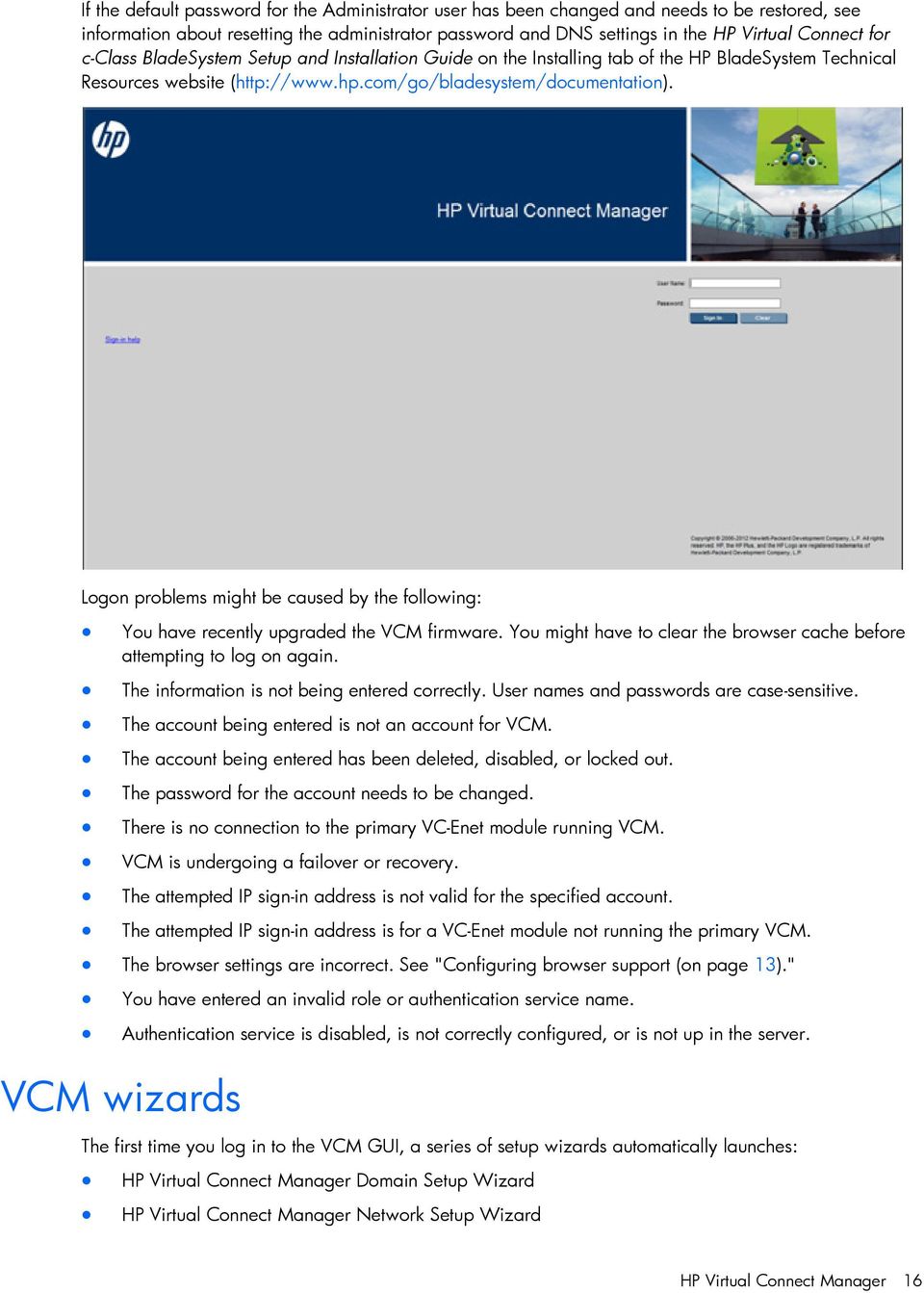
16 If the default password for the Administrator user has been changed and needs to be restored, see information about resetting the administrator password and DNS settings in the HP Virtual Connect for c-class BladeSystem Setup and Installation Guide on the Installing tab of the HP BladeSystem Technical Resources website ( Logon problems might be caused by the following: You have recently upgraded the VCM firmware. You might have to clear the browser cache before attempting to log on again. The information is not being entered correctly. User names and passwords are case-sensitive. The account being entered is not an account for VCM. The account being entered has been deleted, disabled, or locked out. The password for the account needs to be changed. There is no connection to the primary VC-Enet module running VCM. VCM is undergoing a failover or recovery. The attempted IP sign-in address is not valid for the specified account. The attempted IP sign-in address is for a VC-Enet module not running the primary VCM. The browser settings are incorrect. See "Configuring browser support (on page 13)." You have entered an invalid role or authentication service name. Authentication service is disabled, is not correctly configured, or is not up in the server. VCM wizards The first time you log in to the VCM GUI, a series of setup wizards automatically launches: HP Virtual Connect Manager Domain Setup Wizard HP Virtual Connect Manager Network Setup Wizard HP Virtual Connect Manager 16
17 HP Virtual Connect Manager Fibre Channel Setup Wizard HP Virtual Connect Manager Server Profile Setup Wizard These wizards can also be launched at any time using the Tools pull-down menu at the top of the GUI. For more information about the setup wizards, see the HP Virtual Connect for c-class BladeSystem Setup and Installation Guide on the Installing tab of the HP BladeSystem Technical Resources website ( HP Virtual Connect Home This screen provides access for the management of enclosures, servers, networking, and storage. HP Virtual Connect Manager 17
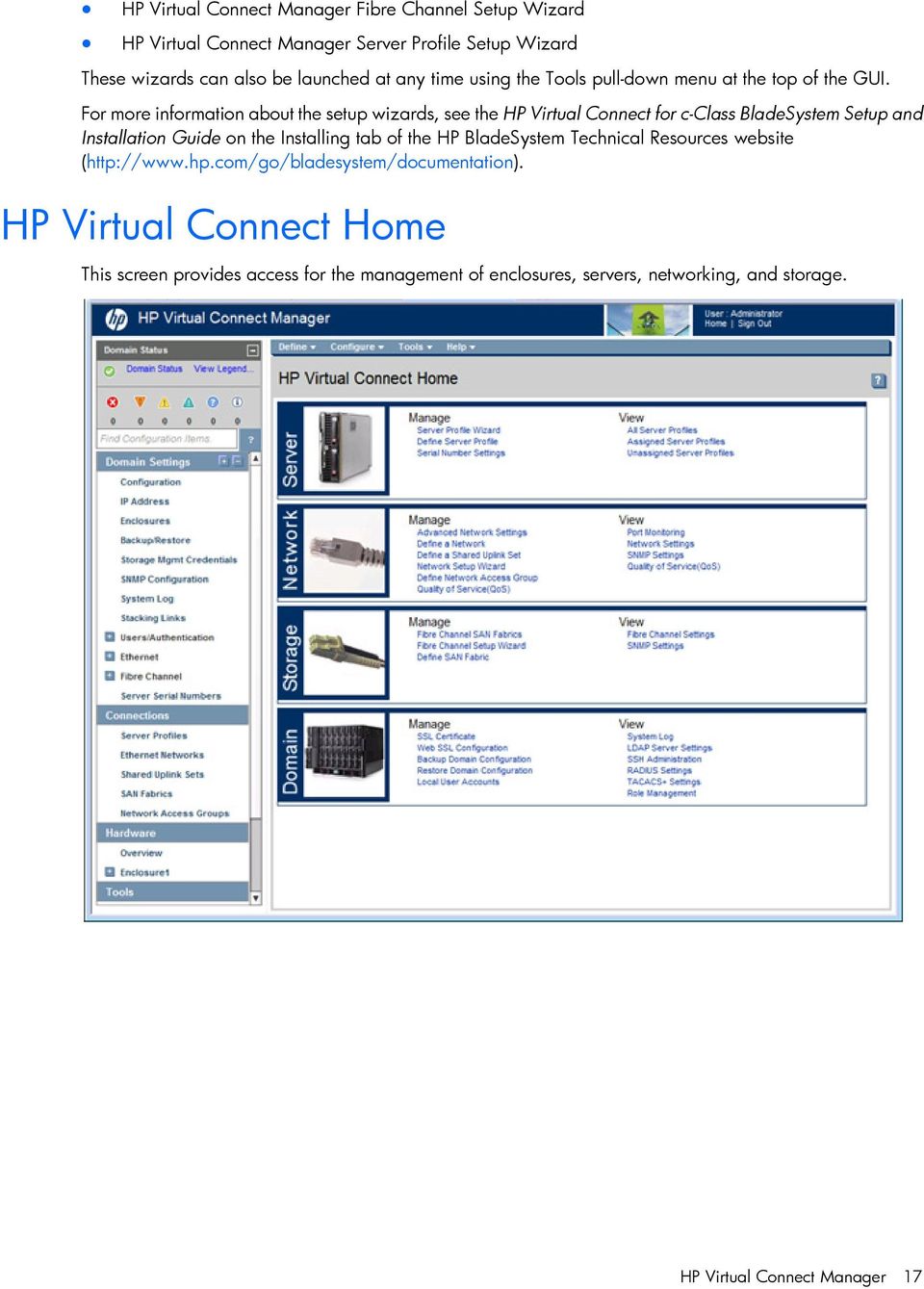
18 If a red icon with a horizontal white bar appears, an external manager such as VCEM is managing the VCM. Mouse over the icon to display a tool tip with information about the external manager. About HP Virtual Connect Manager To view detailed product information, select About HP Virtual Connect Manager from the Help pull-down menu. Navigating the HP Virtual Connect Manager GUI Navigation overview Tree view The HP Virtual Connect Manager navigation system consists of a tree view on the left side of the screen that lists all of the system devices. The tree view remains visible at all times, except when using any of the VC wizards. The right side of the screen, which includes a pull-down menu at the top, displays details for the selected device or activity. An activity indicator, which is tethered to the bottom of the browser window, displays progress of actions being performed by the VC GUI. The tree view, on the left side of the screen, aids in navigation within VCM. The tree view provides category-based navigation for the major systems configured within VC. When a category is expanded (by clicking the white plus sign in the blue box next to the category), all elements associated with that category are displayed. Search for logical and physical objects by typing the name of the item in the Find Configuration Items search field near the top of the screen under Domain Status. Use the following syntax to find objects of a specific type: ItemType: ItemName Valid values for ItemType include: Profile Network Uplink Set HP Virtual Connect Manager 18

19 SAN Fabric Network Access Group Enclosure Module Interconnect Bay Device Bay IGMP filter Filter set FCoE network Menu items The following table lists the items available from the pull-down menu at the top of the screen. Menu item Define Links to Ethernet Network Define Ethernet Network screen (on page 115) SAN Fabric Define SAN Fabric screen (on page 146) Shared Uplink Set Define Shared Uplink Set screen (on page 125) Network Access Group Define Network Access Group screen (on page 91) Server Profile Define Server Profile screen (on page 175) Configure Domain Settings Domain Settings (Configuration) screen (on page 23) Ethernet Network Settings Ethernet Settings (MAC Addresses) screen (on page 171) Quality of Service (QoS) Quality of Service screen (on page 103) IGMP Settings IGMP Settings (IGMP Configuration) screen (on page 110) Fibre Channel Settings Fibre Channel Settings (WWN Settings) screen (on page 172) Serial Number Settings Serial Number Settings screen (on page 173) Local User Accounts Local Users screen (on page 66) Certificate Administration SSL Certificate Administration (Certificate Info) screen (on page 51) Tools Hardware Overview Enclosures View ("Enclosures View screen" on page 62) Domain Setup Wizard Network Setup Wizard Fibre Channel Setup Wizard Server Profile Setup Wizard Welcome screen for the Domain Setup Wizard Welcome screen for the Network Setup Wizard Welcome screen for the Fibre Channel Setup Wizard Welcome screen for the Server Profile Setup Wizard Throughput Statistics Throughput Statistics screen (on page 223) Backup/Restore Domain Domain Settings (Backup/Restore) screen (on page 29) Configuration System Log System Log (System Log) screen (on page 48) Export Support Information Export Support Information (on page 270) Reset Virtual Connect Manager Reset Virtual Connect Manager (on page 270) Help Table of contents VC Manager help file table of contents HP Virtual Connect Manager 19

20 Menu item Index For This Page Virtual Connect Documentation on hp.com About HP Virtual Connect Manager Links to VC Manager help file index Help topic specific to the current page The Virtual Connect Documentation page on the HP website ( Specific information about this Virtual Connect domain Activity indicator The GUI displays current activity in a pane attached to the bottom of the browser window, including a progress bar that displays the activity status graphically. The activity pane includes four controls: Up and down arrow buttons scroll through the recent activity history during the current GUI session. A collapse button temporarily hides the activity pane until the next activity update. A close button hides the activity pane for the current GUI session. The activity pane is hidden automatically when the activity state is idle. When the activity pane is hidden, a control appears in the bottom-right corner of the GUI. Click the control to display the activity pane. Selected long-running VC activities are reported in the activity pane, including: Enclosure Import Enclosure Recovery (after NO-COMM) Enclosure Recovery (after VC restart or failover) Server Profile Operations (create, update, assign and unassign, and delete) Module Recovery Persist Configuration HP Virtual Connect Manager 20
21 Virtual Connect domains Understanding Virtual Connect domains A basic VC domain includes a single HP c-class BladeSystem c7000 Enclosure for a total of 16 servers (or up to 32 servers if the double-dense option is enabled), or a single HP c-class BladeSystem c3000 Enclosure for a total of 8 servers (or up to 16 servers if the double-dense option is enabled). Within the domain, any server blade with the requisite LAN or SAN devices can access any LAN or SAN connected to a VC module, and a server blade of a given processor type (Integrity or X86) can be used as a spare for any server blade of the same processor type within the same enclosure, as long as the server has the requisite number and type of connections. Using Network Access Groups, the network administrator can define and manage groups of networks, assigning them to a profile to prevent the use of networks outside of an assigned group. VC supports multiple enclosures, allowing up to four c7000 enclosures to be managed within a single Virtual Connect domain for a total of up to 128 servers. Multiple enclosure domains are not supported on c3000 enclosures. By stacking (cabling) the VC-Enet modules together within the domain and connecting the VC-FC or FlexFabric module FC uplinks on the same bay of all enclosures to the same FC switch, every server blade in the domain can be configured to access any external network or fabric connection. With this configuration, you can use VCM to deploy and migrate a server blade profile to any server in the Virtual Connect domain without changing external LAN or SAN configurations. The VC domain should be backed up each time changes are made. While the configuration is saved in non-volatile memory and check-pointed to the horizontally adjacent module, HP recommends saving the configuration external to the enclosure. See "Domain Settings (Backup/Restore) screen (on page 29)." When adding VC interconnect modules to a VC-managed enclosure, wait until the modules have been fully integrated into the current domain and checkpointing is complete before attempting to make configuration changes to the VC domain. These changes include adding or editing networks, fabrics, profiles, and shared uplink sets. Verify that the domain status is clear for the newly added interconnect module before making any changes to the configuration. Modifying the configuration before the integration is complete can cause unexpected behavior such as incorrect/invalid connections in a profile. After a configuration is changed and changes have stopped, VCM can take up to 90 seconds to save the new information to non-volatile storage and an additional minute to checkpoint to the backup module. If power is removed, the module is reset through the Onboard Administrator interface, or the module is removed from the enclosure during this update, configuration information might be lost. An icon on the VCM banner line indicates that the configuration either has not been saved locally, or it has not been checkpointed. When a VC-Enet module is powered on or restarted in a VC domain with a large configuration, the module can take up to 6 minutes to initialize. Management access to this module and to VCM hosted on this module is available after the initialization completes. Virtual Connect domains 21
22 Managing domains Use the following screens to manage the VC domain: Domain Settings (Configuration) screen (on page 23) o Change the domain name o Delete a domain o Configure a customized login screen message Domain Settings (IP Address) screen (on page 25) o Set a domain IP address for the VC domain Domain Settings (Enclosures) screen (on page 26) o View enclosures in the domain o Add enclosures to the domain o Remove enclosures from the domain Domain Settings (Backup/Restore) screen (on page 29) o Create a backup file of the VC domain configuration o Restore a configuration that has been lost o Revert to a previously saved configuration Domain Settings (Storage Management Credentials) screen (on page 30) o Add a storage management credential to the domain o Remove a storage management credential from the domain Virtual Connect domains 22
23 Domain Settings (Configuration) screen Use this screen to change the domain name, delete a domain, configure and view auto-deployment, and configure a customized login screen message. To access this screen, click Configuration in the left navigation tree, or select Domain Settings from the Configure menu. Only users with domain role permissions can make changes on this screen. The following table describes the available actions in the Domain Settings (Configuration) screen. Clicking another link in the pull-down menu or left navigation tree causes current edits that have not been applied to be lost. Task Change the domain name Action Enter the revised domain name, and then click Apply. Display single-dense server bays Delete a domain Configure auto-deployment settings and view auto-deployment status Add banner text to the login screen Clear changes and remain on this screen Click Revert. Save changes Click Apply. Click the checkbox next to the appropriate selection. Available if double-dense compatibility is selected during import. Verify that the correct domain name is displayed, and then click Delete Domain. For more information, see "Deleting a domain (on page 24)." For more information, see "Auto-deployment (on page 24)." Select the Enable Display of Banner on User Login checkbox, enter a customized message in the Banner Text field (up to 1500 printable ASCII characters in length), and then click Apply. Users are required to acknowledge the banner text before they can log in. Virtual Connect domains 23
24 Deleting a domain CAUTION: Deleting a domain returns all settings to factory default. This action cannot be undone. 1. Power off all servers that are associated with profiles. See "Server Bay Status screen (on page 257)." 2. Navigate to the Domain Settings (Configuration) screen (on page 23). 3. Click Delete. A domain name confirmation window is displayed. 4. Enter the name of the domain to be deleted. This should be the name of the domain you are currently logged into, displayed in the Virtual Connect Domain Name box on the Domain Settings (Configuration) screen (on page 23). 5. Click OK. If deleting a domain that was using MAC addresses predefined by HP, the administrator should also update the "Teaming" driver configuration file on the host OS. Otherwise, the driver reinitializes to the saved MAC address predefined by HP and not the factory default value. When a VCM domain is deleted, VCM resets VC 8Gb 24-Port FC Modules to a factory default condition. This operation can take up to 50 seconds per VC 8Gb 24-Port FC Module. Auto-deployment The auto-deployment feature allows for the configuration of a VC domain from a centralized location using DHCP and TFTP to access the configuration script. Auto-deployment is supported only for single-enclosure domains. The Auto-Deployment Settings section on the Domain Settings (Configuration) screen (on page 23) allows you to do the following: Enable or disable auto-deployment. Use DHCP provided TFTP settings or provide your own settings. Start or stop a deployment. IMPORTANT: Auto-deployment is not supported with an IPv6-only management network environment. Task Use DHCP provided settings Use user-defined TFTP settings Save changes Start deployment Stop deployment Action Select (enable) the Use DHCP Provided Settings check box. Clear (disable) the Use DHCP Provided Settings check box, and then specify the TFTP server and configuration file. After you are finished making changes to the settings, click Apply. Click Start if the button is enabled, and then enter Start in the confirmation dialog box. Click Stop if the button is enabled, and then enter Stop in the confirmation dialog box. The Auto-Deployment Status section on the Domain Settings (Configuration) screen displays the current deployment status, the last deployment timestamp, and links to the viewable configuration file, deployment log, and CLI output. Virtual Connect domains 24
25 Task View the configuration file View the deployment log View the CLI output Action Click View next to Configuration File. Click View next to Deployment Log. Click View next to CLI Output. For more information on auto-deployment, see "Appendix B: Auto-deployment process (on page 278)." Domain Settings (IP Address) screen Beginning with VC 4.10, VCM supports the use of IPv6 addresses. IPv6 introduces a 128-bit address that provides better security, simplicity in configuration, and improved maintenance. To migrate from IPv4 to IPv6, the network must have an infrastructure that can support and implement the IPv6 protocol. Use this screen to set a domain IPv4 or IPv6 address for the Virtual Connect domain. This IP address is then consistent, regardless of which module is primary within the domain. The optional domain IP address setting allows for a consistent IP address that is independent of the interconnect module on which it is running. If set, this IP address must be unique within the network and must be different than the IP address of the module itself. If this IP address is not set, the VC Manager can still be reached through the IP address of the host VC-Enet module. To use an optional domain IP address, select the Use Domain IP address check box, and then enter the IP Address, Subnet Mask, and Default Gateway. NOTE: Even if a domain IP address is provided, the normal IP address assigned to the interconnect bay can still be used. The following table describes the available actions in the Domain Settings (IP Address) screen. Clicking another link in the pull-down menu or left navigation tree causes current edits that have not been applied to be lost. Virtual Connect domains 25
26 Task Use a Virtual Connect Domain IPv4 or IPv6 Address setting Save changes Cancel without saving changes Action For IPv4, select the box next to Use Virtual Connect Domain IPv4 Address, and then enter the IPv4 Address, Subnet Mask, and Gateway. For IPv6, select the box next to Use Virtual Connect Domain IPv6 Address, and then enter the IPv6 Address and Gateway. Click Apply. Click Cancel. For more information on IPv6, see "Appendix C: Using IPv6 with Virtual Connect (on page 292)." Domain Settings (Enclosures) screen Use this screen to view, add, or remove enclosures in the domain. When importing an enclosure, consider the following: After an enclosure import, the VCM CLI shows the Stacking Links Connections Status as "Failed" until all modules are initialized. Depending on the actual configuration, this can take up to 30 seconds. If an enclosure import is attempted with a server blade in a failed state, VCM might incorrectly report an error when an error does not exist. If the import times out with an error, close the browser and log in again to verify that the import was successful. Use the OA to verify the working state of all server blades. For more information on adding and importing a remote enclosure, see "Adding and importing a remote enclosure (on page 27)." Multiple enclosures are supported only if an appropriate primary and backup VC module is running in the local enclosure. For more information about connecting multiple enclosures, see the HP Virtual Connect for c-class BladeSystem Setup and Installation Guide on the Installing tab of the HP BladeSystem Technical Resources website ( The following table describes the columns within the Domain Settings (Enclosures) screen. Column Enclosure ID Enclosure Name Enclosure Serial Number Rack Name Description Assigned ID of the enclosure Name of the enclosure Serial number of the enclosure Name of the rack (assigned through the Onboard Administrator) Virtual Connect domains 26
27 Column OA IPv4 Address OA IPv6 Address Status Action Description IPv4 IP address of the OA. "Local Enclosure" indicates this enclosure is managed by the local Onboard Administrator. IPv6 IP address of the OA. "Local Enclosure" indicates this enclosure is managed by the local Onboard Administrator. Displays whether the enclosure has been imported Perform import and delete operations. The following table describes the available actions in the Domain Settings (Enclosures) screen. Clicking another link in the pull-down menu or left navigation tree causes current edits that have not been applied to be lost. Task Import an enclosure Add and import a remote enclosure ("Adding and importing a remote enclosure" on page 27) Remove a remote enclosure ("Removing a remote enclosure" on page 28) Action Click the Import link in the Action column, or left-click on the enclosure row, right-click to display a menu, and then select Import. Click Find below the table, or right-click inside the table, and then select Find. Click the Delete link in the Action column, or left-click on the enclosure row, right-click to display a menu, and then select Delete. Adding and importing a remote enclosure Adding and importing a remote enclosure requires domain and server role permissions. Virtual Connect Manager supports up to four c7000 enclosures in a single domain. To add a remote enclosure: 1. Click Find on the Domain Settings (Enclosures) screen (on page 26). 2. Type in the following information: o Onboard Administrator IP Address o Onboard Administrator User Name Virtual Connect domains 27
28 o 3. Click OK. Onboard Administrator Password IMPORTANT: No more than four enclosures can be found or imported. If an enclosure is unintentionally found, it can be removed by clicking Delete. 4. Click the Import link in the Action column. -or- Left-click on the enclosure row, right-click to display a menu, and then select Import. Virtual Connect Manager imports the enclosure and provides status information. Removing a remote enclosure To remove a remote enclosure, disassociate all profiles, networks, port sets, and port monitors from the enclosure. If the enclosure is currently in a No-COMM state, the remote enclosure remains in VC Mode. Take the enclosure out of VC mode manually with the OA command line for that enclosure. To remove a remote enclosure: 1. Go to the Domain Settings (Enclosures) screen (on page 26). 2. Click the Delete link in the Action column. -or- Left-click on the enclosure row, right-click to display a menu, and then select Delete. Virtual Connect domains 28
29 Domain Settings (Backup/Restore) screen Use this screen to create a backup file of the Virtual Connect domain configuration to restore a configuration that has been lost, or to revert to a previously saved configuration. The domain configuration includes network definitions, MAC address settings, WWN settings, Fibre Channel fabric settings, local user accounts, and server profile definitions. The backup file stores the same information that is check-pointed between the primary and backup modules during normal operation. Only users with Save Domain Configuration role operation permissions can perform a backup operation. Only users with Restore Domain Configuration role operation permissions can perform a domain restore. For more information, see "Role Management (Role Operations) screen (on page 84)." CAUTION: To avoid loss of data, do not close the browser window containing the VCM GUI during backup or restore operations. If the browser window is closed, you must close and then restart the browser. To back up a domain configuration: 1. Enter an encryption key to encrypt the configuration file. 2. Click Backup Configuration. 3. Navigate to the hard drive location where you want to save the configuration file. 4. Name the file (usually the domain name), and then click Save. To restore a domain configuration: 1. Click Browse, navigate to the location of the saved configuration file, select the file, and then click Open. 2. Select the Ignore enclosure serial number in restored configuration file checkbox to restore a configuration that was generated on another enclosure. If this item is not selected, a configuration generated on another enclosure is rejected. This option is relevant to the primary/local enclosure only. Virtual Connect domains 29
30 CAUTION: Restoring a Virtual Connect domain configuration from a backup file that was created on another Virtual Connect domain is not supported and can cause serious faults within this and other Virtual Connect Domains within the environment. The restore selection and configuration files should only be used to restore the same previously existing domain. 3. Select the Ignore firmware version in restored configuration file checkbox to allow restoring a domain configuration from a backup file that was created using a different version of VC firmware. IMPORTANT: Restoring a configuration from a backup file saved by firmware version later than what is currently running is not supported. For example, if you are currently running Virtual Connect v3.60, you can restore a configuration from a backup file that was created using v3.10 or v3.51, but not v Enter the appropriate key if the configuration file is encrypted. 5. Click Restore Configuration. 6. Confirm the domain configuration to be restored, and then click OK. If restoring a configuration file that has multiple enclosures, each remote enclosure must be re-authenticated for security reasons. For more information, see "Recovering remote enclosures (on page 271)." Domain Settings (Storage Management Credentials) screen Use this screen to manage the credentials of HP P4000 series devices in the domain. The IP address is the IP address of the LHN CMC interface. This IP address must be accessible from the same management network where Virtual Connect and Onboard Administrator reside. The following table describes the columns within the Domain Settings (Storage Management Credentials) screen. Column Name IP address Username Action Description Name for the iscsi storage management iscsi storage management IPv4 address An administrator for the storage management Perform edit and delete operations The following table describes the available actions in the Domain Settings (Storage Management Credentials) screen. Clicking another link in the pull-down menu or left navigation tree causes current edits that have not been applied to be lost. Virtual Connect domains 30
31 Task Add a credential ("Adding or editing a credential" on page 31) Edit a credential ("Adding or editing a credential" on page 31) Delete a credential Action Click Add below the table, or right-click inside the table, and then select Add. Click the Edit link in the Action column, or left-click on the credential row, right-click to display a menu, and then select Edit. Click the Delete link in the Action column, or left-click on the credential row, right-click to display a menu, and then select Delete. Adding or editing a credential Use this screen to add a storage management credential. To add a credential: 1. Enter a name for the iscsi storage management in the Name field. 2. Enter the IPv4 address for the iscsi storage management in the IP address field. 3. Enter an administrator user name for the storage management in the Username field. 4. Enter the administrator password in the Password field. 5. Re-enter the administrator password in the Confirm Password field. Virtual Connect domains 31
32 6. Click Apply. Managing SNMP Use the following screens to manage the domain SNMP configuration: SNMP Configuration (VC-Enet) (on page 42) o o o Enable SNMP on VC-Enet modules in the domain Configure SNMP access Add, modify, or delete a trap destination SNMP Configuration (VC-FC) (on page 45) SNMP overview o o o o Enable SNMP on VC-FC modules in the domain Enable SMI-S on VC-FC modules in the domain Configure SNMP access Add, modify, or delete a trap destination SNMP is used by network management systems to monitor network-attached devices for conditions that require administrative attention. SNMP consists of a set of standards for network management, including an Application Layer protocol, a database schema, and a set of data objects. The SNMP configuration is controlled by VCM and applies to all modules in the VC domain. The SNMP agent software residing on a primary module provides access to managed information using SNMP Virtual Connect domains 32
33 protocol. The managed information is presented as a hierarchical database called a MIB. Each element of the managed information is identified by a unique identifier called Object ID. Basic SNMP support is provided for both VC-Enet modules and VC-FC modules. Each VC module has an independent SNMP agent that supports a set of MIBs. MIB support for each module depends both on the type of module (VC-Enet or VC-FC) and the role of the module in the VC domain. A VC-Enet module can be primary, backup, or subordinate based on its ability to run the VCM. By default, the SNMP agent is enabled on VC-Enet modules with a read community string of "public." The VC MIBs are provided in the current HP MIB Kit available for download from the HP website ( The following restrictions and limitations apply: You must have Administrative privileges to configure SNMP capabilities. The type of privilege required depends on the item you are configuring. The VCM GUI and CLI do not support configuration of threshold trap parameters (high-water mark, low-water mark, and averaging period). For Flex-10 connections, threshold traps reflect the state of the entire physical port. These traps are not generated for individual FlexNICs. For more information on Flex-10 connections, see "Flex-10 overview (on page 160)." When upgrading from a VC release prior to 3.00, if Fibre Channel SNMP traps were defined with the DNS type of the Trap Destination address, SNMP settings are not applied to the VC-FC modules upon completion of the upgrade. To resolve this issue, use the GUI or CLI to edit any FC SNMP trap destinations that have a DNS name for the trap destination, and change the DNS name to an IPv4 address. VC 3.00 and higher limits the number of FC PortStatus traps you can configure through the CLI to five. Prior releases did not enforce this restriction. If you have more than five FC PortStatus traps configured in an earlier version of VC firmware, and then you upgrade to VC 3.00 or higher, then those traps are retained. Similarly, if you restore a configuration from an earlier version of VC firmware that contains more than five configured FC PortStatus traps in VC 3.00 or higher, you will have more than the allowed number of configured FC PortStatus traps. Use caution not to exceed the maximum number of configured FC PortStatus traps in these scenarios. The following table provides a list of MIBs and where they are supported. FlexFabric modules support the Fibre and Fabric MIBs in addition to the Enet MIBs. MIB VC-Enet VC-FC RFC 2863 IF-MIB X RFC 4188 Bridge-MIB X RFC 3418 SNMP v2 MIB X X Compaq System Info MIB X X Compaq Host MIB X X Compaq Rack MIB X* RFC 1213 Network Mgmt X RFC 4293 IP-MIB X Fibre Alliance MIB (FC Mgmt Integ) X RFC 2837 Fabric Element MIB X VC Module MIB (VCM-MIB) X VC Domain MIB (VCD-MIB) X Virtual Connect domains 33
34 SNMP traps MIB VC-Enet VC-FC VC LLDP MIB (LLDP-MIB) X VC LLDPv2 MIB (LLDPv2-MIB) X VC LACP MIB (LACP-MIB) X VC QOS MIB (VC-QOS-MIB) X * Not supported by the HP 8Gb 24-Port FC Module The VC Module MIB is a VC-specific MIB that describes the state of a specific VC module. In addition to unique VC module attributes, it defines traps for reporting alerts on port statistics, such as throughput, errors, and discards. The VC Domain MIB combines domain-wide attributes with traps for state changes in VC managed objects. The latest version of the VC-specific MIBs, 9.30 or higher, can be downloaded from the HP Systems Insight Manager "MIB Kit" site on the HP website ( The following table provides a summary of the available SNMP traps. Trap Category Severity MIB cpqhoswrunningstatuschangetrap VCM Legacy Corresponds to the CPQHOST-MIB new value of cpqhoswrunningstat us connunitstatuschange VC-FC Other INFO FA-MIB connunitdeletedtrap VC-FC Other INFO FA-MIB connuniteventtrap VC-FC Other INFO FA-MIB connunitsensorstatuschange VC-FC Other CRITICAL FA-MIB connunitportstatuschange VC-FC Port Status See table below FA-MIB authenticationfailure¹ VC-FC Other CRITICAL SNMPv2-MIB coldstart VC-FC Other CRITICAL SNMPv2-MIB cpqhoswrunningstatuschange VC-FC Other INFO CPQHOST-MIB authenticationfailure VC-Enet Other CRITICAL SNMPv2-MIB Domain status change (deprecated) vcdomainmanagedstatechanged VCM Domain Status Corresponds to the VCD-MIB name of the new state StackingLinkRedundant status change VCM Domain Status Corresponds to the VCD-MIB name of the new state Module role change VCM Domain Status INFO VCM-MIB Stale checkpoint VCM Domain Status WARNING VCD-MIB Valid checkpoint VCM Domain Status NORMAL VCD-MIB Enclosure status change (deprecated) vcenclosuremanagedstatechanged 3 VCM Domain Status Corresponds to the VCD-MIB name of the new state Network status change (deprecated) vcenetnetworkmanagedstatuschanged VCM Network Status Corresponds to the VCD-MIB 3 name of the new state Fabric status change (deprecated) Virtual Connect domains 34
35 Trap Category Severity MIB vcfcfabricmanagedstatuschanged 3 VCM Fabric Status Corresponds to the VCD-MIB name of the new state VC module status change (deprecated) vcmodulemanagedstatuschanged 3 VC-Enet Module Status or Corresponds to the VCD-MIB VC-FC Module Status name of the new state Profile status change (deprecated) vcprofilemanagedstatuschanged 3 VCM Profile Status Corresponds to the VCD-MIB name of the new state Physical server change (deprecated) vcphysicalservermanagedstatuschang ed 3 VCM Server Status Corresponds to the name of the new state VCD-MIB vctesttrap VCM Domain Status INFO VCD-MIB Enet IF-MIB LinkDown VC-Enet Port Status INFO IF-MIB Enet IF-MIB LInkUp VC-Enet Port Status NORMAL IF-MIB Input utilization above high-water mark² VC-Enet Port Threshold WARNING VCM-MIB Input utilization below low-water mark² VC-Enet Port Threshold NORMAL VCM-MIB Output utilization above high-water VC-Enet Port Threshold WARNING VCM-MIB mark² Output utilization below low-water VC-Enet Port Threshold NORMAL VCM-MIB mark² Input errors above high-water mark² VC-Enet Port Threshold WARNING VCM-MIB Input errors below low-water mark² VC-Enet Port Threshold NORMAL VCM-MIB Output errors above high-water mark² VC-Enet Port Threshold WARNING VCM-MIB Output errors below low-water mark² VC-Enet Port Threshold NORMAL VCM-MIB vcmodportbpduloopdetected VC-Enet Port Status CRITICAL VCM-MIB vcmodportbpduloopcleared VC-Enet Port Status INFO VCM-MIB vcmodportprotectionconditiondetected VC-Enet Port Status CRITICAL VCM-MIB vcmodportprotectionconditioncleared VC-Enet Port Status INFO VCM-MIB ¹ Only supported by the HP VC 8Gb 24-Port FC module ² The VC Module MIB has the capability to send traps when certain bandwidth and throughput utilization thresholds are reached. The counters are sampled at a fixed interval of 30 seconds and neither sample interval nor threshold values are configurable in this release. Thresholds are defined as follows: Port utilization high water mark 95% Port utilization low water mark 75% Errors high water mark 5% Errors low water mark 1% For more information, see the description field in the source code for individual MIBs. 3 For more information, see "VC Domain Managed Status Changed traps (on page 38)." IMPORTANT: During OA failover or other management network disruptions, VC SNMP traps might not reach the management station. The VC-FC module generates connunitportstatuschange traps based on changes to the connunitportstatus element of the FA-MIB. The following table shows the mapping of connunitportstatuschange trap severities to the VC Domain MIB's trap severity definitions. connunitportstatus value unknown unused Severity INFO INFO Virtual Connect domains 35
36 connunitportstatus value ready warning failure nonparticipating initializing bypass ols other Severity NORMAL WARNING CRITICAL INFO INFO INFO MAJOR INFO Trap categories and required user role permissions In general, users with domain role permission can perform any SNMP configuration change operations. Users with network role permission can perform Ethernet configuration change operations, and users with storage role permission can perform FC configuration change operations. The following table provides a summary of trap categories and the required administrative privileges. Trap Category Domain Network Storage VC-Enet Port Status X X VC-Enet Port Threshold X X VC-Enet Other X X VC-FC Port Status X X VC-FC Other X X VCM Legacy X VCM Security X VCM Domain Status X VCM Network Status X VCM Fabric Status X VCM Profile Status X VCM Server Status X VCM VC-Enet Status X VCM VC-FC Status X To enable or disable SNMP on a VC-Enet module, domain or network role permissions are required. To enable or disable SNMP/SMI-S on a VC-FC module, domain or storage role permissions are required. Trap severities The severity of traps sent to each destination can be configured, resulting in only traps of the specified severities being sent to the destination. The levels are listed below in decreasing order of severity: CRITICAL The component cannot manage installed VC components. MAJOR One or more of the component's subsystems is not operating properly, causing serious disruption to functions. MINOR One or more of a component's subsystems is not operating properly, causing slight disruption to functions. WARNING The component has a potential problem. Virtual Connect domains 36
37 INFO Operational information on the fully functioning component. UNKNOWN VC Manager has not yet established communication with the component. NORMAL The component is fully functional. Trap severities are only supported for VC-Enet or VCM traps. VC Module MIB traps The following table lists traps in the VC Module MIB. Trap name Trap data Description vcmodrolechange modulerole The VCM role of the module has changed. vcmodinpututilizationup port identification The input line utilization on a port has exceeded its high-water mark for longer than 30 seconds. port is the index of the affected port in iftable. vcmodinpututilizationdown port identification The input line utilization on a port has dropped below its low-water mark for longer than 30 seconds. port is the index of the affected port in iftable. vcmodoutpututilizationup port identification The output line utilization on a port has exceeded its high-water mark for longer than 30 seconds. port is the index of the affected port in iftable. vcmodoutpututilizationdown port identification The output line utilization on a port has dropped below its low-water mark for longer than 30 seconds. port is the index of the affected port in iftable. vcmodinputerrorsup vcmodinputerrorsdown vcmodoutputerrorsup vcmodoutputerrorsdown port identification ifinerrors port identification ifinerrors port identification ifouterrors port identification ifouterrors vcmodportbpduloopdetected port identification loop status The input error count on a port has exceeded its high-water mark for longer than the error averaging period. port is the index of the affected port in iftable. The input error count on a port has dropped below its low-water mark for longer than the error averaging period. port is the index of the affected port in iftable. The output error count on a port has exceeded its high-water mark for longer than the threshold averaging period. port is the index of the affected port in iftable. The output error count on a port has dropped below its low-water mark for longer than 30 seconds. port is the index of the affected port in iftable. A network loop condition is detected on this port. If the loop condition is detected on a Flex10 port, the trap data indicates the physical port associated with the Flex10 port. If multiple Flex10 ports on a physical port detect a loop condition, a separate trap is sent for each occurrence of the loop condition. vcmodportbpduloopcleared port identification loop status A network loop condition is cleared on this port. The trap data indicates the physical port associated with a Flex10 port. For Flex10 ports, this trap is sent only after all Flex10 ports on a physical port are cleared from a loop condition. Virtual Connect domains 37
38 Trap name Trap data Description vcmodportprotectionconditio ndetected vcmodportprotectionconditio ncleared Port index to the iftable (ifindex) Port index to the vcmoduleporttable Port protection status Port index to the iftable (ifindex) Port index to the vcmoduleporttable Port protection status A port protection condition is detected on this port. If the new port protection status is a value other than OK, the port may be disabled to protect the VC module from further service degradation. Administrative action is required to recover the port from this condition. The port is recovered from port protection condition to normal operational state. VC Domain MIB traps The Virtual Connect vc-domain-mib.mib MIB provides visibility into the various components of a Virtual Connect Domain. VC Domain Managed Status Changed traps This section describes the *ManagedStatus, *Cause, *RootCause, and *ReasonCode OIDs found in each *ManagedStatusChanged traps in the VC Domain MIB. The ManagedStatus enumerations (vcdomainmanagedstatus, vcenclosuremanagedstatus, and so on) for all managed status changed objects (vcdomainmanagedstatuschanged, cenclosuremanagedstatuschanged, and so on) are described in the following table. Managed status unknown normal warning minor major critical disabled info Description Indicates the condition of the component could not be determined Indicates the component is fully functional Indicates a component threshold has been reached or error condition is imminent Indicates an error condition exists that has little or no component impact Indicates an error condition exists that significantly impairs the component Indicates an error condition exists where the component no longer provides service Indicates the component is disabled and non-functioning Indicates a non-service affecting condition exists such as initializing components and system login/logout The Cause string indicates why an object transitioned to the current managed state from the specific objects perspective. A network failure is an example Cause string. The RootCause string indicates the root causes for an object transitioning managed states. The RootCause for a network failure could indicate all uplink ports of the network have failed. The ReasonCode provides an object specific reason for the managed state transition. The reason codes are unique between objects, allowing more specific actions to be taken programmatically from SNMP management stations. vcdomainmanagedstatuschanged The following is an example of a domain Cause string: 2 of 7 profiles contain unmapped connections in the domain The following is an example of a domain RootCause string: Virtual Connect domains 38
39 Modules not redundantly connected, failure of module enc0:iobay1 or enc0:iobay2 or enc1:iobay2 will isolate some modules; Port enc0:iobay5:d3:v1 loop detected and automatically disabled The domain managed status ReasonCodes are provided in the following table. Domain reason code vcdomainok Description All enclosures and profiles are normal in the domain. vcdomainabnormalenclosuresandprofil One or more enclosures and profiles are abnormal in the domain. es vcdomainsomeenclosuresabnormal At least one enclosure is not OK or Degraded. vcdomainunmappedprofileconnections The profile contains connections that are not mapped to a server port. vcdomainstackingfailed All stacking links between one or more modules have failed. vcdomainstackingnotredundant Some stacking links between one or more modules have failed, but connectivity still exists between modules. vcdomainsomeprofilesabnormal One or more profiles in the domain are abnormal. vcdomainunknown The condition of the domain cannot be determined. vcdomainoverprovisioned More than 16 VC modules are in the domain. vcenclosuremanagedstatuschanged The following is an example of an enclosure Cause string: 2 of 6 Ethernet modules are abnormal in enclosure enc0 The following is an example of an enclosure RootCause string: Module in bay enc0:iobay3 has been removed The enclosure managed status ReasonCodes are provided in the following table. Enclosure reason code vcenclosureok Description The enclosure is normal. vcenclosureallenetmodulesfailed All Ethernet modules are abnormal, none are OK or degraded. vcenclosuresomeenetmodulesabnormal One or more Ethernet modules are abnormal. vcenclosuresomemodulesorserversinco mpatible vcenclosuresomefcmodulesabnormal vcenclosuresomeserversabnormal vcenclosureunknown The enclosure contains incompatible modules, or configured modules are missing. One or more FC modules are abnormal. At least one server is in a known state and no servers are OK, or at least one server is degraded. The condition of the enclosure cannot be determined, or the state of servers or modules is unknown. vcmodulemanagedstatuschanged The following is an example of a module Cause string: Port enc0:iobay5:d3:v1 loop detected and automatically disabled The following is an example of a module RootCause string: Port enc0:iobay5:d3:v1 loop detected and automatically disabled The module managed status ReasonCodes are provided in the following table. Module reason code vcenetmoduleok Description The Ethernet module is functioning normally. Virtual Connect domains 39
40 Module reason code vcenetmoduleenclosuredown vcenetmodulemodulemissing vcenetmoduleportprotect vcenetmoduleincompatible vcenetmodulehwdegraded vcenetmoduleunknown vcfcmoduleok vcfcmoduleenclosuredown vcfcmodulemodulemissing vcfcmodulehwdegraded vcfcmoduleincompatible vcfcmoduleunknown Description The module is unable to communicate with the enclosure/oa. A configured module has been removed. A condition has been detected on the port causing port protection to be activated. The module is incompatible, for example, a configured Enet module is replaced with an FC module. The module is being reported as degraded by the OA. The condition of the module is unknown. The FC module is functioning normally. The FC module is unable to communicate with the enclosure/oa. A configured module has been removed. The module is reporting a degraded hardware condition. The module is incompatible, such as replacing a configured FC module with an Enet module. The condition of the module is unknown. vcphysicalservermanagedstatuschanged The following is an example of a physical server Cause string: Server enc0:dev1 unable to communicate with enclosure enc0 The following is an example of a physical server RootCause string: Server enc0:dev2 profile pending The physical server managed status ReasonCodes are provided in the following table. Physical server reason code vcphysicalserverok vcphysicalserverenclosuredown vcphysicalserverfailed vcphysicalserverdegraded vcphysicalserverunknown Description The server is functioning normally. The server is unable to communicate with the enclosure/oa. The server is in a failed condition. The server is in a degraded condition. The condition of the server is unknown. vcfcfabricmanagedstatuschanged The following is an example of a FC fabric Cause string: 1 of 2 uplink ports are abnormal on BackupSAN fabric The following is an example of a FC fabric RootCause string: 1 of 2 uplink ports are abnormal on BackupSAN fabric The FC fabric managed status ReasonCodes are provided in the following table. FC fabric reason code vcfabricok vcfabricnoportsconfigured vcfabricsomeportsabnormal vcfabricallportsabnormal vcfabricwwnmismatch vcfabricunknown Description The fabric is functioning normally. The fabric does not have any uplink port configured. Some uplink ports for the fabric are in an abnormal condition. All uplink ports for the fabric are in an abnormal condition. A WWN mismatch condition has been detected. The condition of the fabric is unknown. Virtual Connect domains 40
41 vcenetnetworkmanagedstatuschanged The following is an example of an Ethernet network Cause string: Network BLUE has failed The following is an example of an Ethernet network RootCause string: Port enc0:iobay5:x3 is unlinked; Port enc0:iobay5:x4 is incompatible The Ethernet network managed status ReasonCodes are provided in the following table. Ethernet network reason code vcnetworkok vcnetworkunknown vcnetworkdisabled vcnetworkabnormal vcnetworkfailed vcnetworkdegraded vcnetworknoportsassignedtoprivatenetwor k Description The network is functioning normally. The condition of the network is unknown. The network is disabled. The condition of the network is abnormal. The network is in a failed condition. The network is in a degraded condition. No ports have been assigned to the private network. vcprofilemanagedstatuschanged The following is an example of a profile Cause string: 3 TCServer profile connections for server in bay enc0:devbay3 are not mapped The following is an example of a profile RootCause string: The TelecomServer profile is assigned to an abnormal server in bay enc0:devbay1 The profile managed status ReasonCodes are provided in the following table. Profile reason code vcprofileok vcprofileserverabnormal vcprofileallconnectionsfailed vcprofilesomeconnectionsunmapped vcprofileallconnectionsabnormal vcprofilesomeconnectionsabnormal Description The profile is normal. The server the profile is assigned to is abnormal. All connections in the profile have failed. One or more connections in the profile are not mapped to a physical port. All connections in profile are abnormal. Some connections in the profile are abnormal. VC domain checkpoint traps The domain checkpoint trap indicates configuration changes have been saved in non-volatile memory and copied (check-pointed) to the horizontally adjacent module. vccheckpointtimeout The checkpoint valid status remained false for more than five minutes. vccheckpointcompleted A checkpoint operation has completed following a checkpoint timeout trap. The checkpoint valid status is true again. This trap is not sent on every checkpoint completion, but only on a checkpoint completion after a vccheckpointtimeout trap has been sent. Virtual Connect domains 41
42 vcdomainstackinglinkredundancystatuschange The stacking link connection redundancy status has changed. The vcdomainstackinglinkredundant OID contained within this trap indicates whether all VC-Enet modules will remain connected to each other with the loss of a link. vctesttrap The VC domain test trap is received when the administrator sends a test trap via the VC GUI or CLI. The test trap is sent to all configured trap destinations. SNMP Configuration (VC-Enet) By enabling SNMP for VC-Enet modules, network management systems can monitor VC-Enet modules in the domain for events that might require corrective actions, such as warnings and errors. You must have network or domain user permissions to administer SNMP Enet settings. The HP ProLiant Gen8 Troubleshooting Guide, Volume II: Error Messages provides a list of error messages and information to assist with interpreting and resolving error messages on ProLiant servers and server blades. To view the guide, select a language: English ( French ( Spanish ( German ( Japanese ( Simplified Chinese ( The VC-Enet SNMP settings apply to all VC-Enet modules in the Virtual Connect domain. The following table describes the fields within the SNMP Configuration screen. Virtual Connect domains 42
43 Field name Enable SNMP System Contact Read Community SNMP Access IP Address Network Mask Bits Type Action SNMP Trap Destinations Destination IP Address Community String Action Description Select to enable SNMP. Specify a contact name for this system when SNMP is enabled. Controls SNMP read access when SNMP is enabled. The default value for read community string is "public". The read community string must always be set when SNMP is enabled. The maximum length is 39 characters. Table of networks that are allowed SNMP access IPv4 or IPv6 address for the allowed network Network mask bits for the allowed network Type of network Perform add and delete actions SNMP trap destination table User-designated name for the trap destination. The Destination name must be unique. IPv4 or IPv6 address or DNS name for the trap destination The Community String acts like a password for a given trap destination. The trap-receiving application can use the community string to filter the incoming traps. Default: public Perform edit and delete operations The following table describes the available actions in the SNMP Configuration screen. Clicking another link in the pull-down menu or left navigation tree causes current edits that have not been applied to be lost. Task Add SNMP access ("Adding SNMP access" on page 45) Delete SNMP access Add an SNMP trap destination ("Adding an SNMP trap destination" on page 44) Edit an SNMP trap destination Action Click Add below the SNMP Access table, or right-click on the header row of the SNMP Access table, and then select Add. Click Delete in the Action column, or right-click on the SNMP Access row, and then select Delete. Click Add below the destination table, or right-click on the header row of the destination table, and then select Add Destination. Click Edit in the Action column, or right-click on the trap destination row, and then select Edit Destination. Delete an SNMP trap destination Click Delete in the Action column, or right-click on the trap destination row, and then select Delete Destination. Save changes Click Apply. Virtual Connect domains 43
44 Adding an SNMP trap destination To add an SNMP trap destination, right-click the header row of the SNMP Trap Destination table, or click Add at the bottom of the SNMP Trap Destination table. You can configure up to five VC-Enet and five VC-FC SNMP trap destinations. To add an SNMP trap destination: 1. Enter a unique name for the new trap being added. No spaces are allowed. 2. Select the correct radio button, and then enter the IPv4 address, IPv6 address, or DNS name for the trap destination. DNS is not supported for VC-FC modules. 3. Select the Trap Format: SNMPv1 or SNMPv2. SNMPv2 is not supported for VC-FC modules. 4. Enter the SNMP trap community string for the specified trap. The default is "public." For VC-Enet modules, the maximum trap community string length is 39. For VC-FC modules, the maximum trap community string length is Click OK to save the information and return to the main SNMP configuration screen, or continue and select trap categories or trap severities. If you enter information that is invalid (for example, if you use a space in the Destination name), a red box appears around that field. Hover the mouse over the box to see information regarding the error. Select trap categories Selecting a trap category allows multiple traps to be enabled or disabled as a group. To select trap categories, click the check box. For VC-FC modules, selecting either the Port Status or Other check box results in all SNMP traps being sent to the trap destination. VC-FC modules do not differentiate between trap types. To select a VCM trap category, do one of the following: Highlight the item, and then click the right arrow. Virtual Connect domains 44
45 Highlight the item, and then drag and drop it into the right window. Select trap severities To select a trap severity, do one of the following: Highlight the item, and then click the right arrow. Highlight the item, and then drag and drop it into the right window. For a definition of trap severities, see "Trap severities (on page 36)." When an event causes a trap to be generated with the severity listed in the right window, it is sent to the trap destination. For VC-FC modules, the trap severity is fixed at INFORMATIONAL and cannot be modified. If you do not have the required user role permission to select a category, that section is disabled. For a listing of trap categories and the required administrative role permission, see "Trap categories and required user role permissions (on page 36)." Adding SNMP access By configuring addresses on the SNMP Access screen, administrators can control which SNMP clients receive responses from VCM when they query for SNMP information. To add an SNMP access, right-click the header row of the SNMP Access table, or click Add at the bottom of the SNMP Access table. 1. Enter a unique IP address for the network to be given access: a. Select the IPv4 or IPv6 radio button. b. Enter the IP address, including a valid network mask bits value (1-32). 2. Click OK to save the information and return to the main SNMP configuration screen. If you enter information that is invalid (for example, if you use a space in the IP address), a red box appears around that field. Hover the mouse over the box to see information regarding the error. SNMP Configuration (VC-FC) By enabling SNMP for VC-FC modules, network management systems can monitor the VC-FC modules in the domain for events, such as warnings and errors, which might require corrective actions. You must have storage or domain role permission to administer FC SNMP settings. Virtual Connect domains 45
46 The VC-FC SNMP settings apply to all VC-FC modules in the VC domain. The following table describes the fields within the SNMP Configuration screen. Field name Enable SNMP Enable SMI-S System Contact Read Community SNMP Access IP Address Network Mask Bits Type Action SNMP Trap Destinations Destination IP Address Community String Format Action Description Select to enable SNMP. Select to enable SMI-S. Specify a contact name for this system when SNMP is enabled. The maximum length is 20 characters. Controls SNMP read access when SNMP is enabled. The default value is "public". The read community string must always be set when SNMP is enabled. The maximum length is 24 characters. Table of networks that are allowed SNMP access IPv4 or IPv6 address for the allowed network Network mask bits for the allowed network Type of network Perform add and delete actions SNMP trap destination table User-designated name for the trap destination. The Destination name must be unique. IPv4 or IPv6 address for the trap destination. DNS name is not supported. The Community String acts like a password for a given trap destination. The trap-receiving application can use the community string to filter the incoming traps. Default: public Format of the new trap (SNMPv1) Perform edit and delete operations The following table describes the available actions in the SNMP Configuration screen. Clicking another link in the pull-down menu or left navigation tree causes current edits that have not been applied to be lost. Virtual Connect domains 46
47 Task Add SNMP access ("Adding SNMP access" on page 45) Delete SNMP access Add an SNMP trap destination ("Adding an SNMP trap destination" on page 44) Edit an SNMP trap destination Action Click Add below the SNMP Access table, or right-click on the header row of the SNMP Access table, and then select Add. Click Delete in the Action column, or right-click on the SNMP Access row, and then select Delete. Click Add below the destination table, or right-click on the header row of the destination table, and then select Add Destination. Click Edit in the Action column, or right-click on the trap destination row, and then select Edit Destination. Delete an SNMP trap destination Click Delete in the Action column, or right-click on the trap destination row, and then select Delete Destination. Save changes Click Apply. SMI-S overview The SMI-S was created by SNIA to standardize storage management solutions. SMI-S replaces multiple disparate managed object models, protocols, and transports with a single object-oriented model for each type of component in a storage network. SMI-S enables management applications (such as HP SIM) to support storage devices from multiple vendors quickly and reliably because they are no longer proprietary. SMI-S detects and manages storage elements by type, not by vendor. You must have storage or domain user role permissions to configure SMI-S capabilities. The ability to enable or disable SMI-S is not available on the HP VC 8Gb 24-Port FC module. For the HP VC 8Gb and 4Gb 20-port FC modules, SMI-S is supported. Valid parameters include: Port: 5989 Namespace: /root/interop Credentials: Administrator/password on the tag attached to the module Supported CIM classes: o o o o o o o o o o o o o CIM_ComputerSystem CIM_FCPort CIM_Location CIM_SoftwareIdentity CIM_Product CIM_PhysicalPackage CIM_FCPortCapabilities CIM_FCPortSettings CIM_FCSwitchSettings CIM_RemoteSeviceAccessPoint CIM_SettingData CIM_Namespace CIM_ConnectivityCollection Supported CIM clients have no restrictions. Virtual Connect domains 47
48 Viewing the system log Use the following screens to view and configure domain system log information: System Log (System Log) screen (on page 48) o View logged information events within VCM System Log (Configuration) screen (on page 50) o o View remote log destination settings Set remove log destination settings System Log (System Log) screen The System Log screen displays logged information of events within Virtual Connect Manager. For more information about the log entries, see "System Log entry format (on page 49)." To access the System Log screen, click System Log in the left navigation tree, or select System Log from the Tools pull-down menu. Events are logged with the most recent event displayed at the end of the list. Use the scroll bar on the right of the screen to scroll through the list if it is longer than the display box. When the log reaches maximum capacity, the oldest logged event is automatically deleted as new events are added. Click Refresh to display the most current information. Virtual Connect domains 48
49 System Log entry format A wide variety of events are generated by Virtual Connect and logged into the System Log, or SysLog. The remote logging capability is supported using the syslog protocol defined in RFC The remote logging feature also provides an option for transmission over TCP and secure transmission support using stunnel. The events generated by Virtual Connect follow the same format and contain a time stamp, the Virtual Connect object information that generated the event, and a detailed message. The System Log entries use the following format: [Date in RFC 3164 or ISO 8601 format]t[time][time zone] [hostname] [processname] [[ObjectShortName]:[ObjectName]:[EventCode]:[Severity]] [Event Message] In the following example: T13:57:40-05:00 VCEFXTW210600WH vcmd: [VCD:aus-c _vc_domain:1011:Info] VCM user logout : Administrator@ The date is The time is 13:57:40. The time zone is -05:00. The time zone includes daytime savings. The hostname is VCEFXTW210600WH. The process name that created the log is vcmd. The object short name is VCD (domain). The object name is aus-c _vc_domain. The event code is The event severity is Info (informational). The event message is VCM user logout : Administrator@ The following table describes the Virtual Connect managed objects that are capable of generating System Log events, along with the corresponding event ID ranges. VC object name Object short name Event ranges Domain VCD Enclosure ENC Ethernet Modules ENET FC Modules FC Servers SVR Profiles PRO Ethernet Network NET FC Fabric FAB Unknown Module UNK Network Access Groups NAG The event severity reflects the functional state of the Virtual Connect object. The event severities include: SEVERITY_INFO A low-level condition for out-of-service equipment, system login/logout, and other non-service affecting information SEVERITY_WARNING A threshold was reached or an error condition is imminent Virtual Connect domains 49
50 SEVERITY_MINOR An error condition that has no service impact SEVERITY_MAJOR A critical event that impairs service and requires immediate action (substantially diminished capacity or a service outage) SEVERITY_CRITICAL A critical event that severely impairs service and requires immediate action (substantially diminished capacity or a service outage) System Log (Configuration) screen Use this screen to view or set remote log destination settings. Column Log host Description The IP address or the DNS of the configured remote log destination Log severity Severity of the log messages that should be sent to the specified destination. Valid values include "Critical", "Error", "Warning", and "Informational". Transport The transport protocol to be used for sending the log messages to the destination. Valid values include "TCP" and "UDP". Port The port to be used on the destination to send the log messages. Valid values include 1 to The default value is 514. Security Secure transmission of the log messages. Valid values include "None" and "STunnel". The default value is "None", and no encryption is used during transmission. The "STunnel" option can be used only if the transport protocol used is TCP. Date Format The timestamp format for the log messages. Valid values include "RFC3164" (Nov 26 13:15:55) and "ISO8601" ( T19:20:30+01:00). The default value is "RFC3164". Enabled Enables or disables the remote log destination To define a new remote log destination, click Define Target. To send a test message to all enabled remote log destinations, click Test. Virtual Connect domains 50
51 To delete a remote log destination, select the checkbox next the preferred destination, and then click Delete. Managing SSL configuration Use the following screens to manage the domain SSL configuration: SSL Certificate Administration (Certificate Info) screen (on page 51) o View current certificate information SSL Certificate Administration (Certificate Signing Request) screen (on page 53) o Generate a certificate request SSL Certificate Administration (Certificate Upload) screen (on page 56) o Upload a signed certificate SSH Key Administration screen (on page 57) o o View current users of each authorized SSH key Add new SSH keys Web SSL Configuration screen (on page 58) o Change currently configured SSL encryption strength SSL Certificate Administration (Certificate Info) screen This screen displays the detailed information of the Secure Socket Layer certificate currently in use by VCM. An SSL certificate is used to certify the identity of the VCM and is required by the underlying HTTP server to establish a secure (encrypted) communications channel with the client web browser. On initial startup, VCM generates a default self-signed SSL certificate valid for 10 years, and the certificate is issued to the DNS name of the VC-Enet module (the dynamic DNS name from the Default Networks Setting label). Because this default certificate is self-signed, the "issued by" field is also set to the same DNS name. Virtual Connect domains 51
52 If VCM is configured with a VC domain IP address, then future certificate requests generated will reflect this domain IP address. For information on generating a new certificate, see "SSL Certificate Administration (Certificate Signing Request) screen (on page 53)." For information on uploading certificates for use in the VC-Enet module, see "SSL Certificate Administration (Certificate Upload) screen (on page 56)." NOTE: When using a domain IP address, Certificate Administration allows a common certificate to be utilized between a primary module and a subsequent primary module in the adjacent horizontal bay after a failover. The following table describes the fields on the SSL Certificate Administration (Certificate Info) screen. Row Cert Common Name Certificate Information Issued by Valid from Valid until Serial Number Description The subject, or "Common Name," to which this SSL Certificate is issued. By default, this is the dynamic DNS name of the VC-Enet module. Name of the Certificate Authority (CA) that issued this SSL Certificate. By default, the Virtual Connect Manager generates a self-signed certificate, which means the "Issued by" field contains the same dynamic DNS name as the "Issued for" field. If the Domain Administrator has requested a new certificate and it is signed by a CA, then the name of the CA is displayed. The date and time starting when this certificate became valid The date and time when this certificate becomes invalid Serial number of the certificate. This serial number is unique per Certificate Authority that issued it. Virtual Connect domains 52
53 Row Version MD5 Fingerprint SHA1 Fingerprint Key Length Required Information Country (C) State or Province (ST) City or Locality Organization Name (O) Optional Data Alternative Name Contact Person Address Organizational Unit Surname Given Name Initials DN Qualifier Unstructured Name Description Version of the certificate Unique fingerprint of the certificate, calculated using cryptographic hash function Message-Digest algorithm 5 (MD5). This fingerprint can be used to further verify that the correct certificate is being used. Unique fingerprint of the certificate, calculated using cryptographic hash function Secure Hash Algorithm 1 (SHA1). This fingerprint can be used to further verify that the correct certificate is being used. Key length of the certificate. The two character country code that identifies the country where the VC domain is located The state or province in which the VC domain is located The city or locality in which the VC domain is located The company that owns the VC domain Alternative names for the VC domain that the certificate also covers The person responsible for the VC domain The address of the person responsible for the VC domain The unit within the company or organization that owns the VC domain The surname of the person responsible for the VC domain The given name of the person responsible for the VC domain The initials of the person responsible for the VC domain The distinguished name qualifier of the VC domain This field is for specifying the name of the subject of the certificate in an unstructured ASCII string. The interpretation of the name is specified by the certificate issuer. SSL Certificate Administration (Certificate Signing Request) screen This screen allows a certificate request to be generated for the domain if the existing certificate has a Key Length of A warning appears if the key for the existing certificate is not 2048 bits. The key must be updated before you can enter data or generate a signature request. Virtual Connect domains 53
54 If the existing certificate has the proper key length, the data is accepted and is included in the certificate request, and is also included in the signed certificate. The fields that can be specified appear, populated with the values found in the existing certificate. The following table describes the fields on the SSL Certificate Administration (Certificate Signing Request) screen. Clicking another link in the pull-down menu or left navigation tree causes current edits that have not been applied to be lost. Field Possible values Description Required Information Country (C) Must be a two character country code. Only alphabetic characters are allowed. The two character country code that identifies the country where the VC domain is located State or Province (ST) 1 to 30 characters in length The state or province where the VC domain is located City or Locality (L) 1 to 50 characters in length The city or locality where the VC domain is located Virtual Connect domains 54
55 Field Possible values Description Organization Name (O) 1 to 60 characters in length The organization that owns this VC domain. When this information is used to generate a certificate signing request, the issuing certificate authority can verify that the organization requesting the certificate is legally entitled to claim ownership of the given company name or organization. Common Name (CN) Optional Information 1 to 60 characters in length. To prevent security alerts, the value of this field must match the host name as it is known by the web browser. The web browser compares the host name in the resolved web address to the name that appears in the certificate. For example, if the web address in the address field is then the value must be oa xyz.com. The VC domain name that appears in the browser web address field. This certificate attribute is generally referred to as the common name. Contact Person 0 to 60 characters in length The person responsible for the VC domain Address 0 to 60 characters in length The address of the contact person responsible for the VC domain Organizational Unit 0 to 60 characters in length The unit within the company or organization that owns the VC domain Surname 0 to 60 characters in length The surname of the person responsible for the VC domain Given Name 0 to 60 characters in length The given name of the person responsible for the VC domain Initials 0 to 20 characters in length The initials of the person responsible for the VC domain DN Qualifier 0 to 60 characters in length. Acceptable characters are all alphanumeric, the space, and the following punctuation marks: ' ( ) +, -. / : =? The distinguished name qualifier of the VC domain Alternative Name 0 to 500 characters in length Alternative identifiers for the VC domain that the certificate should also cover. Examples include DNS names and IP addresses. Challenge Password 0 to 30 characters in length The password for the certificate-signing request Confirm Password 0 to 30 characters in length Confirms the Challenge Password Unstructured Name 0 to 60 characters in length This field is for additional information (for example, an unstructured name that is assigned to the VC Domain). The Alternative Name field is automatically populated with the value in the existing certificate, if any. Additionally, the populated information will include the IP addresses known to the domain (the primary and secondary module IP addresses, along with the domain IP address if it is configured), as well as associated DNS names if they are known. Virtual Connect domains 55
56 The certificate, by default, requests a valid duration of 10 years (this value is currently not configurable). When you click Apply, a standardized certificate signing request is generated by the Virtual Connect Manager using the supplied data. The content of the request in the text box can be sent to the Certificate Authority of your choice for signing. After it is signed by and returned from the Certificate Authority, you can upload the certificate using the SSL Certificate Administration (Certificate Upload) screen (on page 56). Note that a new certificate request is generated each time you click Apply, so the content might not be the same each time. SSL Certificate Administration (Certificate Upload) screen There are two methods for uploading certificates for use in the Virtual Connect Ethernet module: Paste the certificate contents into the text field, and then click Upload. Paste the URL of the certificate into the URL field, and then click Retrieve. The URL field accepts IPv4 or IPv6 IP addresses. If you are using an IPv6 address, you must put brackets around the IPv6 address in the ftp/tftp/http URL to return the correct data. For example, ftp://user1:mypass@[2001:610:1:80aa:192:87:102:43]. The certificate to be uploaded must be from a certificate request sent out and signed by a Certificate Authority for this particular Virtual Connect Manager. Otherwise, the certificate fails to match the private keys used to generate the certificate request, and the certificate is rejected. If the new certificate is successfully accepted and installed by the Virtual Connect Manager, you are automatically logged out. The HTTP server must be restarted for the new certificate to take effect. After the signed certificate is uploaded, the certificate is retained. Even if the domain is deleted, the certificate remains. Virtual Connect domains 56
57 When renewing certificates, the upload removes any previous Signed Certificate from VCM. You must add a new certificate or update with a renewed certificate in your browser. See browser Help for information on installing or renewing certificates. SSH Key Administration screen This screen lists the current user (assuming administrator privileges) of each authorized SSH key and enables the user to add new keys. Only local users can have authorized SSH keys. SSH Fingerprint Identifies the server and can be used to authenticate that the SSH client is connecting to the correct host Authorized SSH Keys Lists the authorized SSH key data for the currently logged in user Add New SSH Keys Enables the user to create or replace the authorized SSH keys. The user can enter the SSH keys in the text box or provide a URL to a file containing the user's SSH keys. The URL field accepts IPv4 or IPv6 IP addresses. If you are using an IPv6 address, you must put brackets around the IPv6 address in the ftp/tftp/http URL to return the correct data. For example, ftp://user1:mypass@[2001:610:1:80aa:192:87:102:43]. After Set SSH Keys is clicked, the current content of the Authorized SSH Keys is replaced with the new list of SSH keys. The key file should contain the User Name of a local user at the end of the public key. Each key is associated with a local user account. Virtual Connect domains 57
58 After you have authorized one or more SSH keys, you can delete all of them by clicking Clear SSH Keys. Removing the authorized SSH keys does not affect current SSH sessions. Web SSL Configuration screen This screen enables you to change the currently configured SSL encryption strength. This screen is only available to users with domain user role permission. To change the current strength, select All SSL ciphers to enable all SSL encryption, or select Strong SSL ciphers to require strong encryption strength (at least 128 bits). Click Apply to save changes, or click Cancel to keep the current settings. Virtual Connect domains 58
59 When the web SSL encryption strength is changed, logged in users are notified that they must reconnect. Virtual Connect domains 59
60 HP BladeSystem c-class enclosures Enclosure serial numbers The enclosure serial number is used by the Virtual Connect Manager to associate a Virtual Connect domain with a particular enclosure. The enclosure serial number can be altered for maintenance purposes, such as replacement of the enclosure midplane. For more information, see SET ENCLOSURE SERIAL_NUMBER in the HP BladeSystem Onboard Administrator Command Line Interface User Guide on the Installing tab of the HP BladeSystem Technical Resources website ( Enclosure serial numbers are unique as shipped from the factory, and must remain unique for proper Virtual Connect Manager operation. Use care when altering the enclosure serial number to ensure that serial numbers are unique within the management network. After an enclosure is imported into a domain, do not change the serial number. The enclosure must have the enclosure serial number that was present when imported initially. It cannot be replaced with an enclosure that has a different serial number. In the event of an enclosure failure, the replacement enclosure must have the serial number set to that of the failed enclosure before it is placed into the VC domain. If you are moving interconnect modules, OA modules, and server blades from one enclosure to another, you must first save the VC configuration, then move the OAs to the new enclosure and power on the OAs. After the OAs are powered up and you can log in, then place the interconnect modules in the enclosure and power them on. After you can log in to VCM, restore your configuration. After the configuration is restored, move the server blades to the new enclosure. If the server blades are already in the new enclosure, the servers are required to be powered off when the VC configuration is restored in the new enclosure. In an existing VC domain, if the enclosure serial number is changed from the OA with the set enclosure serial-number command, HP recommends that all the VC Ethernet modules be reset through the OA so that the new enclosure number is propagated to all the modules in the enclosure. CAUTION: Do not attempt to replicate domains within the environment using the save/restore mechanisms. This can create serious errors within the replicated domain and the original domain. Using multiple enclosures Multiple enclosure support enables up to four c7000 enclosures to be managed within a single Virtual Connect domain for a total of 128 servers, if double-dense support is enabled while using the Domain Setup Wizard. There are 16 half-height or 8 full-height server bays in a c7000 enclosure. A combination of full-height and half-height servers can be used in the same enclosure. Multiple enclosure domains are not supported on c3000 enclosures. The VC-Enet or FlexFabric modules use stacking cables between c7000 enclosures so that network traffic can be routed from any server Ethernet port to any uplink within the VC domain. Since FC does not support stacking, the VC-FC or FlexFabric module FC uplinks on the same bay of all enclosures must be connected to the same FC switch to enable profile mobility. HP BladeSystem c-class enclosures 60
61 The management interfaces for all enclosure Onboard Administrators and VC modules within the same VC domain must be on the same lightly loaded subnet and highly reliable network. Overloads or loss of connectivity can disable configuration attempts until the connectivity is re-established and synchronized with the domain. The Onboard Administrator IP addresses used must be configured to be static. The Onboard Administrator user credentials for all enclosures must be consistent to enable VCSU firmware updates for VC modules in the remote enclosures. All FC-capable modules in the same horizontally adjacent bay pair (bays 1-2, 3-4, and so on) must be of the same type and position in all enclosures. Multi-enclosure double-dense domains require similar and compatible VC-FC modules in bays 5, 6, 7, and 8 in all enclosures if FC connectivity is required. If a multi-enclosure double-dense configuration contains incompatible VC-FC modules in bays 5, 6, 7, or 8 in the local or remote enclosures, some or all of the compatible VC-FC modules in the remote enclosures might be designated INCOMPATIBLE after import. For multi-enclosure domains using Direct Attach Storage, a server profile migration of a SAN-booted server between enclosures is not supported. Multiple enclosure requirements Observe the following requirements when connecting multiple enclosures: Each enclosure must have at least one supported VC-Enet module installed. All VC-Enet modules must be interconnected (redundantly stacked). All enclosures must have the same FC and FlexFabric module configuration. For example, if bays 1 and 2 of the Primary Enclosure contain FlexFabric modules, then bays 1 and 2 of Remote Enclosures 1, 2, and 3 must also contain FlexFabric modules. All enclosures must have the same HP VC Flex-10/10D module configuration. For example, if bays 1 and 2 of the Primary Enclosure contain HP VC Flex-10/10D modules, then bays 1 and 2 of Remote Enclosures 1, 2, and 3 must also contain HP VC Flex-10/10D modules. A single domain supports up to four c7000 enclosures. When using multiple c7000 enclosures, the number of modules supported across the enclosures within a domain is limited. A total of 16 Ethernet and 16 VC-FC type modules can be installed, with a maximum of 4 VC-Enet or 4 VC-FC modules per enclosure. A FlexFabric module counts as 1 Ethernet and 1 VC-FC module. Thus, up to 16 FlexFabric Modules or combinations of FlexFabric, VC-Enet, and VC-FC modules are allowed as long as the 16-module limit for each module type (Ethernet and FC) is not exceeded in the domain. All Onboard Administrators and VC modules must be on the same lightly loaded and highly reliable management Ethernet network and IP subnet. The VC-FC and FlexFabric FC-configured uplink port configuration must be identical across all enclosures. The Onboard Administrator firmware must be version 3.11 or higher. HP recommends using the latest version available. Using IPv6 requires OA 4.00 or higher. All Onboard Administrators must use the same user credentials because VCSU uses the primary credentials for the remote enclosure. When both Primary and Standby modules in the base enclosure are taken down for maintenance or lose power and are no longer present in the domain, the management capabilities in the VC domain are lost. If network and fabric uplinks are defined on the remaining enclosures, the servers continue to HP BladeSystem c-class enclosures 61
62 have network and storage access. Both the Primary and Standby modules in the base enclosure must be recovered to regain management access to the VC domain. For more information, see the HP Virtual Connect for c-class BladeSystem Setup and Installation Guide on the Installing tab of the HP BladeSystem Technical Resources website ( Enclosures View screen This graphical representation consists of an enclosure front view and rear view. To display a window with information about a particular device, mouse over that device in this graphical view. The Enclosures view provides status on each device in the enclosure. Select an individual device for more information on that device. The Enclosures view also shows which bays the primary and backup modules are installed in. To display the Enclosures View screen, click Hardware Overview in the left navigation tree. HP BladeSystem c-class enclosures 62
63 Enclosures view (multiple enclosures) When more than one enclosure has been imported, each enclosure is displayed on the Enclosures View screen. HP BladeSystem c-class enclosures 63
64 Virtual Connect users and roles Understanding VC administrative roles Each user account can be set up to have a combination of up to four user role permissions: Domain o o o o o o o o Network o o o o o o o Server o o o o o Storage o o o Define local user accounts, set passwords, define roles Configure role-based user authentication Import enclosures Name the VC domain Set the domain IP address Administer SSL certificates Delete the VC domain Configure SNMP settings Configure network default settings Select the MAC address range to be used by the VC domain Create, delete, and edit networks Create, delete, and edit shared uplink sets Create, delete, and edit network access groups Create, delete, and edit IGMP filters and filter sets Configure Ethernet SNMP settings Create, delete, and edit server Virtual Connect profiles Assign and unassign profiles to device bays Select and use available networks Select serial numbers and UUIDs to be used by server profiles Power on and off server blades within the enclosure Select the WWNs to be used by the domain Set up the connections to the external FC Fabrics Configure FC SNMP settings In addition, certain role operations ("Role Management (Role Operations) screen" on page 84) can then be assigned to any role: o o Export support files Port monitoring Virtual Connect users and roles 64
65 o Update firmware o Save configuration to disk o Restore the configuration from a backup It is possible to create a user with no user role permissions. This user can only view status and settings. Managing users Use the following screens to manage users within the domain: Local Users screen (on page 66) o Create, edit, or delete a local user account o Enable or disable local user accounts o Set a session timeout period LDAP Server Settings (LDAP Server) screen (on page 69) o Set up an LDAP server to authenticate users accessing the CLI or GUI LDAP Server Settings (LDAP Groups) screen (on page 71) o View, add, or remove LDAP groups LDAP Server Settings (LDAP Certificate) screen (on page 73) o View, upload, or delete LDAP certificates RADIUS Settings (RADIUS Server) screen (on page 74) o Configure a RADIUS server to authenticate users accessing the CLI or GUI RADIUS Settings (RADIUS Groups) screen (on page 77) o View, add, or remove RADIUS groups TACACS+ Settings screen (on page 78) o Configure a TACACS server to authenticate users accessing the CLI or GUI o Enable TACACS authentication o Enable TACACS command logging o Add or remove a secondary TACACS server Role Management (Role Authentication Order) screen (on page 83) o Specify or reorder authentication services to be used for a role during login Role Management (Role Operations) screen (on page 84) o Change the role operations allowed for Network, Server, Storage, and Domain roles Virtual Connect users and roles 65
66 Local Users screen The first time this screen appears, the Administrator account, which has all administrative user role permissions, might be the only user listed. The Administrator account cannot be deleted or have domain user role permissions removed. However, the Administrator password can be changed, and the network, server, and storage user role permissions can be removed. The default Administrator password is identified on the Default Network Settings label on the primary VC module. To reset the Administrator password to the factory default, see the information on resetting the administrator password and DNS settings in the HP Virtual Connect for c-class BladeSystem Setup and Installation Guide on the Installing tab of the HP BladeSystem Technical Resources website ( Resetting the Administrator password using the system maintenance switch does not delete the VC domain, if configured. The password and DNS name of the module is reset to match the information included on the Default Network Settings label on the module. The following tasks can be performed on this screen: To create a new local user account, click Add. The Add Local User screen appears. To edit attributes of a defined local account, click the Edit link in the user row. To delete a user account, select the checkbox next to the user name, and then click Delete. TIP: You can also highlight a user, right-click, and then select Add, Delete, or Edit from the pull-down menu. To enable strong passwords, select the Require Strong Passwords checkbox. Use the up and down arrows to select a password length between 3 and 40 characters. The default password length for a newly created domain is 8 characters. With strong passwords enabled, passwords must also contain at least one character from three of the following four categories: o o o Upper-case character Lower-case character Numeric character Virtual Connect users and roles 66
67 o Non-alphanumeric character Click Apply to save your changes. To set a session timeout period, enter a number between 10 and 1440 in the Session Timeout box. To disable a session timeout period, enter 0. Click Apply to save your changes. Any change in the timeout value affects all open sessions and is applied to new sessions. To edit the delete confirmation preference, select or clear Auto Populate Name During Delete Confirmation, and then click Apply. VCM displays confirmation dialog boxes when deleting objects such as server profiles, networks, and so on. These dialog boxes require you to enter the name of the item you want to delete and, in some cases, you must also enter the word "delete." If you enable the Auto Populate Name During Delete option, the confirmation dialog boxes appear with the required information automatically populated, enabling you to simply click OK to proceed with the deletion. This is a domain-wide setting. To enable local users, select the Enable Local Users checkbox. To disable local users, clear the Enable Local Users checkbox. Click Apply to save your changes. You cannot disable local users if you are logged in as a local user. Log in as an LDAP, TACACS, or RADIUS authenticated user with domain privileges to disable local users. To select the Primary Remote Authentication Method, select an option from the Primary Remote Authentication Method list. Click Apply to save your changes. The Primary Remote Authentication Method is the primary authentication mechanism that triggers the re-enablement of local user authentication (if it was disabled) if the remote authentication servers are found to be unavailable during login by a remote VC user. Valid values include NONE, LDAP, RADIUS, and TACACS. The default value is NONE. The following table describes the columns within the Local Users screen. Column User Name Roles Role Operations Full Name Contact Info Account Status Action Description The user name must begin with a letter and is case sensitive. Shows what role permissions the user has (Domain, Network, Storage, and/or Server) Specific role operations assigned to this user The user's full name. All users can modify their own full name. Contact information for the user account. The contact information can be the name of an individual, a telephone number, or other useful information. All users can modify their own contact information. Shows whether a user account is enabled or disabled. Perform edit and delete operations Virtual Connect users and roles 67
68 Adding a new user Observe the following user settings guidelines: Username is a required field. The Username field must contain an alpha-numeric value with 1 to 31 characters. The Password field must contain an alpha-numeric value with 3 to 40 characters. The default password length is 8 characters. If strong passwords are enabled, the password must contain the administrator-designated number of characters and at least one character from three of the following four categories: o o o o Upper-case character Lower-case character Numeric character Non-alphanumeric character The Full Name field can contain a value with a maximum value of 63 characters. The Contact field can contain a value with a maximum value of 127 characters. Up to 32 local user accounts can be created. Each account can be set up to have a combination of up to four access roles: Domain, Network, Server, Storage. When a role is selected, the operations for that role are listed with a checkmark. The operations assigned to each role can be edited on the Role Management (Role Operations) screen (on page 84). Configuring LDAP, RADIUS, and TACACS+ For local user authentication, a user is added using the VCM CLI or GUI. During login, the VCM performs the user authentication. Virtual Connect users and roles 68
69 For LDAP authentication, the VCM contacts and external LDAP server on which user accounts have been set up. During login, VCM sends an authentication request to the server and waits for a login accept or login reject response from the server. RADIUS and TACACS+ provide remote user authentication. At login, an external RADIUS or TACACS+ server is contacted by the VCM to authenticate the user login. During login through the VCM CLI or GUI, the user can specify any one of the following, along with the login name: LOCAL:<user> OR local:<user> LDAP:<user> OR ldap:<user> RADIUS:<user> OR radius:<user> TACACS:<user> OR tacacs:<user> Observe the following: The separator character used is a colon ":". The mechanism names local, ldap, radius and tacacs are not case-sensitive. Only the specified mechanism is attempted in the above cases. If <user> is not configured for that mechanism, then the login fails. VCM does not attempt any other mechanisms for login authentication. If no mechanism is specified during login (only <user> is given), default login is exercised, as in existing VC implementations. Minimum requirements The RADIUS or TACACS+ server must be set up on a host machine on the management network and configured with users and VC attributes. LDAP Server Settings (LDAP Server) screen This screen enables Administrators to set up an LDAP server to authenticate users accessing the CLI or GUI based on user name, password, and role. NOTE: A user authenticated through LDAP cannot change the LDAP settings, even if the user has domain role permissions. Virtual Connect users and roles 69
70 Local users can test an LDAP configuration before applying it. For more information, see "Test LDAP authentication (on page 70)." The following table describes the fields within the LDAP Server Settings (LDAP Server) screen. Clicking another link in the pull-down menu or left navigation tree causes current edits that have not been applied to be lost. Field Enable LDAP Authentication Description Select to enable LDAP authentication. LDAP Server Address The IP address or the DNS name of the domain of the directory service LDAP Server SSL Port The port used for LDAP communications. The default port is port 636. Search Context 1 First searchable path used to locate the user when you are trying to authenticate using directory services Search Context 2 Second searchable path used to locate the user when you are trying to authenticate using directory services Search Context 3 Third searchable path used to locate the user when you are trying to authenticate using directory services Use Windows NT Account Select to use NT account name mapping. Name Mapping (DOMAIN/Username) Test LDAP authentication Local users can test their LDAP configuration before making the configuration active. To test an LDAP configuration: 1. Be sure that LDAP group settings are configured. 2. Be sure that any LDAP certificates are installed. 3. Access the LDAP Server Settings (LDAP Server) screen. 4. Enter the LDAP configuration information. 5. Click Test. The LDAP Configuration Test screen appears. 6. Enter a valid user name and password. Virtual Connect users and roles 70
71 7. Click Test. The status window displays any problems encountered during the test. When testing is complete, click Close. LDAP Server Settings (LDAP Groups) screen Use this screen to manage the LDAP Group settings for VCM. The following table describes the fields within the LDAP Server Settings (LDAP Groups) screen. Virtual Connect users and roles 71
72 Field Group Name Roles Role Operations Description Delete Description The Directory Server group name. Microsoft Active Directory servers have a reverse mapping from the user to the groups the user belongs to. To determine if the user is a member of the group, other servers might need to combine the Group Name with a Search Context to look up the group. To open the Edit LDAP Group window, click the Group Name. Nested group memberships (groups that are members of groups) are searched to a depth of up to four levels when determining group membership. Zero or more roles (Domain, Network, Storage, Server) assigned to the group. A user can be a member of multiple groups, in which case the roles are cumulative. If the user is only a member of a group (or groups) with no roles, the user can log in and view the Virtual Connect configuration but cannot make any changes. If a user is not a member of any group, the user cannot log in. Permitted operations for the assigned roles. Role Operations can be edited from the "Role Management (Role Operations) screen (on page 84)." A text description for the group Click x in the row of a group to remove it from the configuration. To open the Add LDAP Group screen ("Add LDAP Group" on page 72), click Add. Add LDAP Group Use this screen to add an LDAP Group. The following table describes the fields within the Add LDAP Group screen. Field Group Name Description Description This is the Directory Server group name. Microsoft Active Directory servers have a reverse mapping from the user to the groups where the user is a member. Other servers might need to combine the Group Name with a Search Context to look up the group or to determine if the user is a member of the group. Nested group memberships (groups that are members of groups) are searched to a depth of up to four levels when determining user group membership. A text description for the group Virtual Connect users and roles 72
73 Field Roles Description Select zero or more roles (Domain, Network, Storage, Server) to assign to the group. When a role is selected, the operations for the selected role have a checkmark next to them. Role operations can be edited from the "Role Management (Role Operations) screen (on page 84)." To add the new group, click Add. LDAP Server Settings (LDAP Certificate) screen Use this screen to manage LDAP server certificates. Directory Certificates provide authentication of the Directory Server. There are two ways to verify the identity of the Directory Server: Install certificates that complete a certificate chain to a root Certificate Authority. Install a certificate that exactly matches the certificate provided by the Directory Server. To upload a certificate, select the certificate from the list, and then click Certificate Upload. The URL field accepts IPv4 or IPv6 IP addresses. If you are using an IPv6 address, you must put brackets around the IPv6 address in the ftp/tftp/http URL to return the correct data. For example, ftp://user1:mypass@[2001:610:1:80aa:192:87:102:43]. If no certificates are installed, the Directory Server is not authenticated (although the connection to the Directory Server must be established using SSL). The following table describes the columns within the LDAP Server Settings (LDAP Certificate) screen. Column md5 Fingerprint Description Unique fingerprint of the certificate, calculated using cryptographic hash function Message-Digest algorithm 5 (MD5). This fingerprint can be used to Virtual Connect users and roles 73
74 Column Description further verify that the correct certificate is being used. Version Valid From Valid To Delete Version of the certificate The date and time when this certificate became valid The date and time when this certificate becomes invalid Click X in the line of the certificate to delete. RADIUS Settings (RADIUS Server) screen This screen enables domain administrators to configure a RADIUS server to authenticate users accessing the CLI or GUI based on user name and password and to provide role-based authorization. Users and client system access must be configured on the RADIUS server side prior to enabling this feature in VCM. Configuration changes made on this screen do not update the RADIUS server. Users with domain user role permissions can test a RADIUS configuration before applying it. For more information, see "Test RADIUS authentication (on page 76)." The following table describes the fields within the RADIUS Settings (RADIUS Server) screen. Clicking another link in the pull-down menu or left navigation tree causes current edits that have not been applied to be lost. Field Description Enable RADIUS Authentication Server Address Select to enable RADIUS authentication. The IPv4 or IPv6 address, or the DNS host name of the RADIUS server used for authentication Server SSL Port The server UDP port number. Valid values include a valid port number between 1 and The default port is Server Timeout The time in seconds that VCM should wait before timing out the request. If the primary server times out and a secondary server is configured, VCM attempts the request on the secondary server. If the secondary server times out, the request fails. The valid range of values is from 1 to 600 seconds. The default timeout is 10 seconds. Virtual Connect users and roles 74
75 Field Server Key Add/Remove Secondary Server Description A shared secret text string to be used for encrypting user details. This string must match between VCM and the RADIUS server. The secret-key is a plain text string of 1 to 128 characters. Select to add or remove a secondary RADIUS server. To add a secondary server, select the Add/Remove Secondary Server check box to display the Secondary Server Parameters, complete the fields as described in the table above, and then click Apply. The secondary server is queried only if the primary server is down or the request to the primary server times out. To remove a secondary server, clear the Add/Remove Secondary Server check box, and then click Apply. Required RADIUS server settings The following RADIUS server settings must be configured on VC to enable RADIUS-based authentication: Enable or disable flag Server Address Server SSL port the default (well-known) value for RADIUS authentication is Server Timeout the time in seconds by which a server response needs to be received before any retry for a new request is made. The valid range of values is from 1 to seconds. Server Key this is a plaintext key that must be configured both on VC and on the server. Both keys should match. The length of the secret key can vary from 1 to 128 characters. IMPORTANT: If the same username is used in multiple groups, the HP-VC-Groups attribute must be the last attribute that is defined. Setting up a RADIUS server The following procedure provides an example of setting up a RADIUS server on an external host running Linux: 1. Download and install the latest version of the open-source FreeRadius server from the FreeRadius website ( 2. Add the user entry to the file freeradius-server-2.1.9/raddb/users: <username> Cleartext-Password := "<password>" Service-Type = Login-User, HP-VC-groups = <groupname> o "Cleartext-Password" is used to define the password. o "Service-Type" must be always set to "Login-User". o "HP-VC-Groups" is a HP-specific attribute used to define the group(s) that a user belongs to. Be sure that the username does not conflict with any of the local user accounts configured on the RADIUS server host. Otherwise, the RADIUS server will use UNIX-based authentication to look up the local /etc/passwd file. The server will not look up freeradius-server-2.1.9/raddb/users. 3. Add the client entry to the file freeradius-server-2.1.9/raddb/clients.conf: client <hostname/ip> { ipaddr = <IP address> Virtual Connect users and roles 75
76 secret = <plain-text secret> require_message_authenticator = no nastype = other } The RADIUS server ignores authentication requests from an unknown client. Therefore, if the client entry is absent, the server ignores it. The server does not send a reject response. 4. Add the following to the dictionary file /usr/local/share/freeradius/dictionary.hp for HP: ATTRIBUTE HP-VC-groups 192 string HP The RADIUS server logs are available in the logfile /usr/local/var/log/radius/radius.log. Test RADIUS authentication Users with domain user role permissions can test their RADIUS configuration before making the configuration active. To test a RADIUS configuration: 1. Be sure that RADIUS group settings are configured. 2. Access the RADIUS Settings (RADIUS Server) screen (on page 74). 3. Enter the RADIUS configuration information. 4. Click Test. The RADIUS Configuration Test screen appears. 5. Enter a valid user name and password. 6. Click Test. The status window displays any problems encountered during the test. When testing is complete, click Close. Virtual Connect users and roles 76
77 RADIUS Settings (RADIUS Groups) screen Use this screen to manage the RADIUS Group settings for Virtual Connect Manager. The following table describes the fields within the RADIUS Settings (RADIUS Groups) screen. Field Group Name Roles Role Operations Description Action Description The RADIUS group name. Zero or more roles (Domain, Network, Storage, Server) assigned to the group. A user can be a member of multiple groups, in which case the roles are cumulative. If the user is only a member of a group (or groups) with no roles, the user can log in and view the Virtual Connect configuration, but cannot make any changes. If a user is not a member of any group, the user can log in and view data, but cannot make any changes. The operations that can be performed by the assigned role. A text description for the group Perform edit and delete operations The following table describes the available actions in the RADIUS Settings (RADIUS Groups) screen. Clicking another link in the pull-down menu or left navigation tree causes current edits that have not been applied to be lost. Task Add a RADIUS group ("Add or Edit RADIUS Group" on page 78) Edit a RADIUS group ("Add or Edit RADIUS Group" on page 78) Remove a RADIUS group Action Click Add below the table, or right-click inside the table, and then select Add. Click the Edit link in the Action column, or left-click on the group row, right-click to display a menu, and then select Edit. Click the Delete link in the Action column, or left-click on the group row, right-click to display a menu, and then select Delete. Virtual Connect users and roles 77
78 Add or Edit RADIUS Group Use this screen to add or edit a RADIUS Group. The following table describes the fields within the Add/Edit RADIUS Group screen. Field Group Name Description Roles Description This is the group name value configured as the vendor-specific attribute HP-VC-Groups on the RADIUS server. The name can consist of 1 to 255 standard text-string characters (alphanumeric characters, hyphen (-), underscore (_), period (.)) except backslash (\) and single quote ('). You cannot change the name on edit. A text description for the group, which can contain up to 20 characters. Select zero or more roles (Domain, Network, Storage, Server) to assign to the group. When a role is selected, the operations for the selected role have a checkmark next to them. Role operations can be edited from the "Role Management (Role Operations) screen (on page 84)." To add or edit the group, fill in the required fields, and then click Apply. TACACS+ Settings screen Use this screen to enable domain administrators to configure the TACACS+ server to authenticate users accessing the CLI or GUI based on user name and password and to provide role-based authorization and command logging capabilities. Configuration changes made on this screen do not update the TACACS+ server. Virtual Connect users and roles 78
79 Users with domain user role permissions can test a TACACS+ configuration before applying it. For more information, see "Test TACACS+ authentication (on page 82)." The following table describes the fields within the TACACS+ Settings screen. Clicking another link in the pull-down menu or left navigation tree causes current edits that have not been applied to be lost. Field Enable TACACS Authentication Enable TACACS Command Logging Server Address Server SSL Port Server Timeout Server Key Add/Remove Secondary Server Description Select to enable TACACS+ authentication. Select to enable command logging on the TACACS+ server. The IPv4 or IPv6 address, or the DNS host name of the TACACS+ server used for authentication The server TCP port number. Valid values include a valid port number between 1 and The default port is 49. The time in seconds that VCM should wait before timing out the request. If the request to the primary server times out and a secondary server is configured, VCM attempts the request on the secondary server. If the secondary server times out, the request fails. The valid range of values is from 1 to 600 seconds. The default timeout is 10 seconds. A string to be used for encrypting user details. This is a shared secret text string that must match between VCM and the TACACS+ server. The secret-key is a plain text string of 1 to 128 characters. Select to add or remove a secondary TACACS+ server. To add a secondary server, select the Add/Remove Secondary Server check box to display the Secondary Server Parameters, complete the fields as described in the table above, and then click Apply. The secondary server is queried only if the primary server is down or the request to the primary server times out. To remove a secondary server, select the Add/Remove Secondary Server check box to display the Secondary Server Parameters, clear the fields, and then click Apply. Virtual Connect users and roles 79
80 Required TACACS+ server settings The following TACACS+ server settings must be configured on VC to enable TACACS+-based authentication: Enable or disable flag TACACS+ server IP address Server SSL port number the default (well-known) value for TACACS+ authentication is 49. Shared secret server key this is a plain text key that must be configured both on VC and on the server. Both keys should match. The length of the secret key can vary from 1 to 128 characters. Timeout the time in seconds by which a server response must be received, before any retry for a new request is made. The valid range of values is from 1 to seconds. Setting up an IPv4-only TACACS+ server The following procedure provides an example of setting up a TACACS+ server on an external host running Linux. 1. Download and install the latest version of the open-source Cisco TACACS+ server from the shrubbery ftp site (ftp://ftp.shrubbery.net/pub/tac_plus). 2. Add the shared-secret key for VC, a list of users, their passwords and member groups (can be recursive), and the VCM roles to be authorized for each user or group in the server configuration file /etc/tac_plus.conf. For example: # set the secret key for client host = { key = tac!@123 < Secret-key for } # users accounts user = tacuser { login = cleartext "password" member = testgroup < Member of group "testgroup" } # groups group = testgroup1 { member = ALL_STAFF service = hp-vc-mgmt { < Service for role-authorization autocmd = network < Authorize privilege "network" autocmd = domain < Authorize privilege "domain" } } group = testgroup2 { member = ALL_STAFF service = hp-vc-mgmt { Virtual Connect users and roles 80
81 autocmd = domain:network of privileges } } group = ALL_STAFF { } # End config file < Colon-separated list In this example, two different usages of autocmd=<value> are shown: Separate lines used for each privilege, supported in VC 3.30 and higher Colon-separated privilege list, supported in VC 4.10 and higher Configuration can differ from one TACACS+ server to another. For more information, see the TACACS+ server documentation during configuration. The server logs can be accessed on the TACACS+ server at /var/log/tac_plus.log. The accounting log is available under /var/log/tac_plus.acct, which records all command logging requests. Setting up an IPv4 and IPv6 capable TACACS+ server The following procedure provides an example of setting up a TACACS+ server on an external host running Linux. 1. Download and install the latest version of the TACACS+ server from the tac plus website ( 2. Add the shared-secret key for VC, a list of users, their passwords and member groups (can be recursive) as show in the example. 3. Specify the VCM roles to be authorized for each user or group by using the keyword autocmd in the server configuration file /etc/tac_plus.conf. Specify multiple privileges by using colon (:) separated values. For example, "domain" and "network" privileges can be specified using autocmd=domain:network. The following is a sample configuration: # set the secret key for client host = 2001::97/64 { key = tac!@123 < Secret-key for 2001::97/64 } # users accounts user = tacuser { login = cleartext "password" member = testgroup < Member of group "testgroup" } # groups group = testgroup { member = ALL_STAFF service = hp-vc-mgmt { role-authorization < Service for Virtual Connect users and roles 81
82 autocmd = network:server of privileges } } < Colon-separated list group = ALL_STAFF { } # End config file The configuration above is supported for the TACACS+ server downloaded from the tac plus website ( Configuration can differ from one TACACS+ server to another. For more information, see the TACACS+ server documentation during configuration. Test TACACS+ authentication Users with domain user role permissions can test their TACACS+ configuration before making the configuration active. To test a TACACS+ configuration: 1. Access the TACACS+ Settings screen (on page 78). 2. Enter the TACACS+ configuration information. 3. Click Test. The TACACS Configuration Test screen appears. 4. Enter a valid user name and password. 5. Click Test. The status window displays any problems encountered during the test. When testing is complete, click Close. Virtual Connect users and roles 82
83 Role Management (Role Authentication Order) screen Use this screen to specify the authentication services to be used during log in and to set the order in which each authentication method is queried for each role. Role authentication order is followed for role-prefixed logins only, such as "domain:user1". In the case of an authentication service-prefixed login, such as "radius:user1", or a default login without a prefix, such as "user1", the login succeeds if credentials are correct and the authentication service is enabled, regardless of what role authentication orders are defined. By default, VCM queries the authentication services for each role in the following order: Domain: local > ldap > radius > tacacs Network: tacacs > radius > local Server: ldap > local Storage: radius > local If a method fails, the next method is tried, and so on. For each role (Domain, Network, Server, and Storage): 1. Select the check boxes corresponding to the authentication services to query on user login. 2. Configure the order of the queries: a. Click an authentication service to highlight it. b. Click the up and down arrows to set the query order. 3. Click Apply. Unselected authentication services are not queried, regardless of the order in which they appear. Clicking another link in the pull-down menu or left navigation tree causes current edits that have not been applied to be lost. Virtual Connect users and roles 83
84 Role Management (Role Operations) screen Use this screen to change the role operations allowed for Network, Server, Storage, and Domain roles. You must have Domain Administrator role permission to make these changes. Changes apply to all users assigned to a given role. For example, if the Domain Administrator changes the role operations to allow Network users to export support files, all Network users are able to export support files. IMPORTANT: Role operations assigned to users with Server role permissions are not available when the VC domain is under VCEM control. To change role operation permissions, select or clear the checkboxes under each role, and then click Apply. Clicking another link in the pull-down menu or left navigation tree causes current edits that have not been applied to be lost. When adding Firmware Update (VCSU) permission to a role, you must also select Export Support Files and Save Domain Configuration as VCSU exports support files and saves a copy of the domain configuration as part of the firmware update process. To return permissions to factory default, click Factory Default. Virtual Connect users and roles 84
85 Virtual Connect networks Understanding networks and shared uplink sets The VC-Enet modules use standard Ethernet bridge circuitry with special firmware so that they function as a configurable Ethernet port aggregator. For a specific external data center connection, only the selected server Ethernet NIC ports are visible on what appears to be an isolated, private, loop-free network. The VC-Enet module uplinks do not participate in the data center Spanning Tree Protocol or other switch management protocols that could disrupt the data center network. The VC-Enet module uplinks support link aggregation, link layer discovery protocol (LLDP), and VLAN tagging. VLAN tagging enables uplinks to be shared to carry multiple networks. Each network defined within VCM can have one or more uplinks. Virtual Connect independently ensures that no loops are created within the VC domain and that the resulting tree structure is optimized for the uplinks to the data center. When multiple uplinks are used on a network, VCM first verifies if any of the ports can be collected together into an aggregation group, which requires connections to go from a single VC-Enet module to a single data center switch. Then, VCM picks a single link (or aggregation group) as the connection to the external network. The remaining connections are blocked and held as standby ports. TIP: To improve network performance and prevent unnecessary Spanning Tree Topology Change Notifications (TCN) on the network, configure Ethernet switches connected to Virtual Connect with the same Spanning Tree settings you would use when connecting to a server blade NIC. For Cisco switches, use the portfast command to enable ports connected to a VC-Enet module. This action ensures that link state changes on Virtual Connect do not cause a TCN. Shared uplink sets and VLAN tagging A shared uplink set identifies VC-Enet module uplinks that carry multiple networks over the same cable or set of cables. In this case, each Ethernet packet carries a VLAN tag (IEEE 802.1Q) to identify the specific network to which it belongs. On shared uplinks, the VLAN tags are added when packets leave the VC-enabled enclosure and are removed when packets enter the enclosure. The external Ethernet switch and VCM must be configured to use the same VLAN tag identifier (a number between 1 and 4094) for each network. Virtual Connect places no special restrictions on which VLAN identifiers can be used, so the VLAN IDs already used for the networks in the data center can be used on these shared uplinks. To configure a shared uplink set for VLAN tagging, obtain a list of the network names and their VLAN IDs. A shared uplink set enables multiple ports to be included to support port aggregation and link failover with a consistent set of VLAN tags. Because VLAN tags are added or removed when Ethernet packets leave or enter the VC-Enet shared uplink, the VLAN tags have no relevance after the Ethernet packet enters the enclosure. Virtual Connect networks 85
86 Smart Link Identifying an associated network as the native VLAN causes all untagged incoming Ethernet packets to be placed onto this network. Only one associated network can be designated as the native VLAN. All outgoing Ethernet packets are VLAN-tagged. To enable native VLAN when defining a shared uplink set, select the box under Native. To enable or disable native VLAN on an existing network, go to the Edit Shared Uplink Set screen (on page 131). Click on the Edit icon, and then select or deselect the box under Native. Enabling Smart Link configures the network so that if all external links lose their link to external switches, Virtual Connect drops the Ethernet link on all local server blade Ethernet ports connected to that network. This feature can be useful when using certain server network teaming (bonding) configurations. Private Networks The Private Networks option provides extra networking security. When selected, the network is configured so that all server ports connected to it cannot communicate with each other within the Virtual Connect domain. All packets from servers are sent through the VC domain and out the uplink ports only. Servers on the network can only communicate with each other through an external Layer 3 router that redirects the traffic back to the VC domain. VC limits the number of Private Networks to 128. VLAN Tunneling Support As of VC 3.30, you can have both mapped and tunneled networks within the same domain. VLAN tunneling support is now controlled on a per network basis. You can enable or disable VLAN tunneling when adding or modifying a network with a dedicated uplink. Dedicated VLANs that are not part of a shared uplink set can be tunneled. Networks that are associated with a shared uplink set cannot be tunneled because they are already being mapped. When the 'Enable VLAN Tunneling' check box is selected, packets on that network with VLAN tags are passed through the VC domain without modification. When the 'Enable VLAN Tunneling' check box is not selected, the uplink ports in the network do not pass any packets that have VLAN tags. Virtual Connect networks 86
87 The following figure shows tunneled VLAN tags. On the dedicated green network, both uplink and server VLAN tags are tunneled through Virtual Connect unchanged. On the shared red and blue networks, uplink VLAN tags are mapped to networks. Untagged frames are mapped to the native VLAN, if present. Otherwise, they are dropped. Server frames are untagged only, and tagged frames are dropped. Each server port is connected to a single network. Managing networks Use the following screens to manage Virtual Connect networks: Network Access Groups screen (on page 89) o View networks that are members of a network access group o Add a new network access group o Edit the properties of an existing network access group o Delete a network access group Define Network Access Group screen (on page 91) o Define a new network access group Edit Network Access Group screen (on page 91) o Edit the properties of an existing network access group Ethernet Settings (MAC Addresses) screen (on page 171) o Select whether to use Virtual Connect assigned MAC Addresses or factory-default MAC Addresses o Select the type and range of MAC Addresses Ethernet Settings (Port Monitoring) screen (on page 92) o Duplicate network traffic to an unused uplink port to monitor or debug network traffic on those server ports Select Monitored Ports screen (on page 95) o Select server ports to monitor Virtual Connect networks 87
88 Ethernet Settings (Advanced Settings) screen ("Ethernet Networks (Advanced Settings)" on page 96) o o Set Server VLAN Tagging Support Set VLAN Capacity o Use the Multiple Networks Link Speed Settings to set a custom value for preferred link connection speed or maximum link connection speed o Enable or disable MAC Cache Failover o Modify the refresh interval for MAC Cache Failover o Enable or disable network loop protection for all VC-Enet modules in the domain o Reset network loop protection for all server ports in a loop-detected error state o Enable or disable pause flood protection for all VC-Enet modules in the domain o Reset pause flood protection for all server ports in a pause flood protected error state o Configure LACP Quality of Service (QoS) screen ("Quality of Service screen" on page 103) o Prioritize network traffic to enhance performance IGMP Settings (IGMP Configuration) screen ("IGMP Snooping" on page 111) o Enable or disable IGMP Snooping o Modify the idle timeout interval for IGMP Snooping o Select to prevent flooding of unregistered multicast traffic o Define multicast filters o Edit multicast filters o Delete multicast filters IGMP Settings (Multicast Filter Set) screen (on page 114) o Define multicast filter sets o Edit multicast filter sets o Delete multicast filter sets Define Ethernet Network screen (on page 115) o Define a new Ethernet network Edit Ethernet Network screen (on page 120) o Edit the properties of an existing network or delete a network Ethernet Networks (External Connections) screen (on page 122) o View a list of external connections for all Ethernet networks o Edit a network o Edit a shared uplink set o Define a new network o Delete a network o Illuminate the PID for all uplink ports associated with a network Ethernet Networks (Server Connections) screen (on page 123) o Edit a network Virtual Connect networks 88
89 o o o Edit a server profile Define a new network Illuminate the PID for all uplink ports associated with a network Network Access Groups screen Before VC 3.30, any server profile could be assigned any set of networks. If policy dictated that some networks should not be accessed by a system that accessed other networks (for example, the Intranet and the Extranet) there was no way to enforce that policy automatically. With VC 3.30 and later, network access groups are defined by the network administrator and associated with a set of networks that can be shared by a single server. Each server profile is associated with one network access group. A network cannot be assigned to the server profile unless it is a member of the network access group associated with that server profile. A network access group can contain multiple networks. Up to 128 network access groups are supported in the domain. Ethernet networks and server profiles that are not assigned to a specific network access group are added to the domain Default network access group automatically. The Default network access group is predefined by VCM and cannot be removed or renamed. If you are updating to VC 3.30, all current networks are added to the Default network access group and all server profiles are set to use the Default network access group. Network communication within the Default network access group behaves similarly to earlier versions of VC firmware, because all profiles can reach all networks. If you create a new network access group, NetGroup1, and move existing networks from the Default network access group to NetGroup1, then a profile that uses NetGroup1 cannot use networks included in the Default network access group. Similarly, if you create a new network and assign it to NetGroup1 but not to the Default network access group, then a profile that uses the Default network access group cannot use the new network. To access this screen, click the Network Access Groups link in the left navigation tree. Virtual Connect networks 89
90 The Network Access Groups screen is accessible to all users, but only users with network user role permissions can add, edit, and delete network access groups. The following table describes the available actions in the Network Access Groups screen. Task View networks that are members of a network access group Filter the list of networks in a network access group Add a new network access group ("Define Network Access Group screen" on page 91) Edit a network access group ("Edit Network Access Group screen" on page 91) Delete a network access group Action Click the network access group name. On the Alphabetic tab, click a letter to show only network names that begin with that group of letters, or click All to show all networks alphabetically. On the Filter tab, use the pull-down menus to select the networks you want to view, and then click Go. Click new. Click the network access group name, and then click Edit. Click the network access group name, and then click Delete. You cannot delete the Default network access group. Virtual Connect networks 90
91 Define Network Access Group screen To access this screen, click Add at the bottom of the Network Access Groups screen (on page 89), or select Network Access Groups from the Define pull-down menu. To add a network access group: 1. Enter a name for the network access group in the Network Access Group Name field. The name can consist of up to 64 alphanumeric characters, including the hyphen (-), underscore (_), and period (.). 2. To filter the list of available networks: o o On the Alphabetical tab, click a letter to show only network names that begin with that group of letters, or click All to show all networks alphabetically. On the Filtered tab, use the pull-down menus to define the filter criteria, and then click Go. 3. Drag and drop the networks that should be included as members of the network access group from the Excluded Networks field to the Included Networks field. 4. Click Apply. Edit Network Access Group screen To access this screen: Click the Edit link for a network access group on the Network Access Groups screen (on page 89). Enter a network access group name in the Find Configuration Items search field in the left navigation tree, and then select the network access group. Use this screen to edit the properties of an existing Network Access Group. Virtual Connect networks 91
92 This screen can only be edited by users with network role permissions, but it is viewable by all authorized users. To edit a network access group: 1. Enter a new name for the network access group in the Network Access Group Name field. The name can consist of up to 64 alphanumeric characters, including the hyphen (-), underscore (_), and period (.). You cannot rename the Default network access group. 2. To filter the list of available networks, do one of the following: o o On the Alphabetical tab, click a letter to show only network names that begin with that group of letters, or click All to show all networks alphabetically. On the Filtered tab, use the pull-down menus to define the filter criteria, and then click Go. 3. Drag and drop the networks that should be included as members of the network access group from the Excluded Networks field to the Included Networks field. 4. Drag and drop the networks that should not be included as members of the network access group from the Included Networks field to the Excluded Networks field. 5. Click Apply. Ethernet Settings (Port Monitoring) screen To access this screen, do one of the following: Under Ethernet Settings in the left navigation tree, click Port Monitoring. On the home page, in the Network section, click Port Monitoring. The port monitoring screen is accessible to all users with the Port Monitoring role assigned to their VC role. All other users have read-only access. Port monitoring enables network traffic on a set of server ports to be duplicated to an unused uplink port so that network traffic on those server ports can be monitored, debugged, or both. Virtual Connect networks 92
93 CAUTION: The network analyzer port should only be connected directly to a network analyzer. Improper connection of this port or improper configuration of port monitoring could result in network loops and cause a network outage. IMPORTANT: HP recommends that you do not use port monitoring with an analyzer in loopback configuration with any VC module. When port monitoring is enabled, a warning icon appears in the banner at the top of the page. If port monitoring is configured and enabled within the Virtual Connect domain, Ethernet data from the monitored ports is replicated on the network analyzer port, which poses a security risk and could result in network loops if not connected properly. The following table describes the fields within the Ethernet Settings (Port Monitoring) screen. Field name Network Analyzer Port Port Port Status Description This is the port to which all monitored traffic is directed. After selection, this port is no longer available for use in any other Virtual Connect Ethernet network. Identifies the enclosure, bay, and port number of the network analyzer port Shows the link status, link speed, and connectivity of the port. Linked-Active There is a physical connection to a VC module and a switch. Traffic is active on this link. Linked-Standby There is a physical connection to a VC module and a Virtual Connect networks 93
94 Field name PID Speed/Duplex Detailed Stats/Info Delete Port Monitoring State Monitored Port List Module Port Direction Server Profile MAC Server Bay Port Delete Description switch. Currently there is no active traffic on this link. Unlinked There is no physical VC module or switch connection. FCoE Active An FCoE network has been defined, uplinks are connected, and an FCoE-capable switch has been correctly configured. No FCoE An FCoE network has been defined, uplinks are connected, but an FCoE-capable switch has not been configured, or the connection is to a non-fcoe switch. If the port is unlinked and no connectivity exists, the cause is displayed. For more information about possible causes, see "Port status conditions (on page 261)." PID status icon (on or off) for the network analyzer port Pull-down menu to specify the speed and duplex (where applicable) of the network analyzer port Click the link to display detailed statistics about this port. Displays the Delete icon. Click to remove the network analyzer port. Used to enable or disable port monitoring. This feature enables the network administrator to disable port monitoring while maintaining the monitored port configuration. Displays up to 16 server ports that are monitored at the same time. Enclosure, bay, and port number of the monitored port Direction of traffic on the port being monitored. Valid choices are "From Server", "To Server", or "Both". The default is "Both". Identifies the server profile associated with the monitored port, if one exists. The assigned networks are listed by each subport. If multiple networks are assigned, mouse over the label to see a listing of all networks associated with the subport. MAC address of the monitored port Enclosure and server device bay the monitored port is associated with Displays the Delete icon. Click to remove the port from the monitored list. The following table describes the available actions in the Ethernet Settings (Port Monitoring) screen. Clicking another link in the pull-down menu or left navigation tree causes current edits that have not been applied to be lost. Task Action Enable or disable port monitoring Click the box under Port Monitoring State. A network analyzer port is required to enable or disable the port monitoring state. Select a mirror-to port Click the Select Port down arrow. If a port already exists, click the Change Port down arrow. Change the Network Analyzer Click the menu under Speed/Duplex, and then select a setting. Port speed Delete the Network Analyzer Port Click the Delete icon. View detailed statistics for the Click on the Detailed Stats/Info link. Network Analyzer Port Add a port to the monitored port list Clear selections and settings without saving Apply new selections and settings Click Apply. Click Select Ports... A list of server ports is displayed with check boxes to select or clear the monitored ports. Click Clear. Virtual Connect networks 94
95 Task Clear selections and settings without saving and return to the Virtual Connect homepage Action Click Cancel. Select Monitored Ports screen The Select Monitored Ports screen appears when you click the Select Ports button on the Ethernet Settings (Port Monitoring) screen. You can select up to 16 server ports to monitor. A counter at the top right of the screen displays the current number of selected physical ports. Although you can select individual FlexNICs as monitored ports, VCM mirrors traffic on a physical port basis. To filter the list of ports, select one or more of the boxes at the top of the screen. The following table describes the available actions in the Select Monitored Ports screen. Task Select a port to be monitored Remove a port from the monitored list Filter by Interconnect Module Filter the list by interconnect module server port Filter the list by I/O bay Filter the list by enclosure Action Select the check box corresponding to the port. When 16 ports have been selected, no additional check boxes are displayed. You must clear a check box to select a different port. Clear the check box corresponding to the port. Select All Module Ports or a single port from the Filter by Interconnect Module ports list. Select All Module Bays or a single I/O bay from the Filter by Interconnect Module Module bay list. Only I/O bays with VC-Enet interconnect devices are displayed. Select All Enclosures or a single enclosure from the Filter by Interconnect Module enclosure list. Virtual Connect networks 95
96 Task Action Filter by Profile Filter the list by a specific profile Select All Profiles or a single profile from the Filter by Profile profiles list. The assigned networks are listed by each subport. If multiple networks are assigned, mouse over the label to see a listing of all networks associated with the subport. Filter by Physical Server Filter the list by server bay Filter the list by server port Accept selected ports and return to the Port Monitoring screen Clear newly selected ports without saving and return to the Port Monitoring screen Reset the filter criteria to include all items in each filter Only display selected ports Select All Bays or a single bay from the Filter by Physical Server bay list. The list displays the actual server type installed in the bay, for example, "Server Bay 1 HP ProLiant BL420c Gen8." If more than one enclosure is imported into the domain, options are grouped according to the enclosure name. Select All Ports or a single port from the Filter by Physical Server port list. Click OK. Click Cancel. Click Reset Filters. Select the Only display selected ports check box. Ethernet Networks (Advanced Settings) Use this screen to perform the following tasks: Set Server VLAN Tagging Support (on page 96). Set VLAN Capacity (on page 97). Use the Multiple Networks Link Speed Settings (on page 97) to set a custom value for preferred link connection speed or maximum link connection speed. Enable or disable MAC Cache Failover (on page 98). Modify the refresh interval for MAC Cache Failover (on page 98). Enable or disable Network Loop Protection (on page 98) for all VC-Enet modules in the domain. Reset Network Loop Protection for all server ports in a loop-detected error state. Enable or disable Pause Flood Protection (on page 100) for all VC-Enet modules in the domain. Reset Pause Flood Protection for all server ports in a pause flood protected error state. Enable and configure Throughput Statistics ("Configuring Throughput Statistics" on page 100) for all ports of each VC-Enet module, including Flex-10 subports. Configure domain wide LACP timer ("LACP timer configuration" on page 101). Server VLAN tagging support VLAN tunneling support Virtual Connect networks 96
97 You can tunnel VLAN tags and map VLAN tags in the same domain. As of VC 3.30, tunneling and mapping is configured at the network level, not at the domain level. Server VLAN tunneling is supported only on networks with dedicated uplinks and cannot be used with shared uplink sets. Server VLAN tagging support When the 'Force server connections to use same VLAN mappings as shared uplink sets' check box is selected, server ports connected to multiple VC Ethernet networks are forced to use the same VLAN mappings as those used for the corresponding shared uplink sets. This action forces all server connections mapped to multiple networks to be linked to a shared uplink set. Server administrators cannot override this selection when creating or editing a profile. When this check box is selected, server network connections can only be selected from a single shared uplink set. When the 'Force server connections to use same VLAN mappings as shared uplink sets' check box is not selected, server network connections can be selected from any VC Ethernet network and the external VLAN ID mappings can be manually edited. However, administrators must ensure that no server connection VLAN ID conflict exists. The 'Force server connections to use the same VLAN mappings as shared uplink sets' check box can be selected if no server profile connections are assigned to multiple networks that are not linked to a shared uplink set. VLAN Capacity When creating a new domain in VC 3.70 or higher, the option to select Legacy VLAN Capacity mode is disabled and reverting from Expanded VLAN Capacity mode to Legacy VLAN Capacity mode is not allowed. Domains containing the Legacy VLAN Capacity mode setting that are upgraded from VC 3.30 are upgraded to Expanded VLAN Capacity mode as part of the VC 3.70 or higher firmware upgrade. To maintain compatibility with VC 3.30 domains that have Legacy VLAN Capacity mode enabled, the VCM CLI maintains the current functionality for the VLAN mode. This also allows the use of existing scripts that manipulate the VLAN capacity. Enabling expanded VLAN capacity on a domain is non-disruptive. Expanded VLAN Capacity mode allows up to 1000 VLANs per domain. The number of VLANs per shared uplink set is restricted to In addition, up to 162 VLANs are allowed per physical server port, with no restriction on how those VLANs are distributed among the server connections mapped to the same physical server port. There is also a limit of 162 VLANs per server connection. However, you must take care not to exceed the limit per physical server port. For example, if you configure 150 VLAN mappings for a server connection (FlexNIC-a) of a Flex-10 physical server port, then you can map only 12 VLANs to the remaining three server connections (FlexNIC-b, FlexNIC-c, and FlexNIC-d) of the same physical server port. If you exceed the 162 VLAN limit, the physical server port is disabled and the four server connections are marked as Failed. Virtual Connect limits the number of private networks to 128 per domain. Multiple Networks Link Speed Settings When using mapped VLAN tags (multiple networks over a single link), these settings are used for the overall link speed control. Select the checkbox next to each item to set the value. These settings affect only newly created profiles. Versions of VC prior to v4.01 used the "preferred speed" to control bandwidth allocation. When existing profiles are upgraded to VC v4.01, the "maximum speed" from the network is set automatically on the connection. If no maximum speed was configured prior to the upgrade, then the maximum speed will be 10 Gb for Ethernet connections and 8Gb for FCoE connections. The pre-4.01 behavior can be retained by setting "maximum speed" to the same value as "preferred speed". Virtual Connect networks 97
98 IMPORTANT: Depending on the NIC firmware versions in use, you might need to upgrade the NIC firmware for these speed enforcement settings to work correctly. To change these settings: 1. Click the selection box, and then select a setting (100Mb to 10Gb): o o Click Apply. Set preferred connection speed. This value is the default speed for server profile connections mapped to this network. The server administrator can increase or decrease this setting on an individual profile connection. Set maximum connection speed. This value is the maximum speed for server profile connections mapped to this network. This speed limits the maximum port speed from the server to the network connection associated with the multiple networks. Virtual Connect can only control link speed for Flex-10 NICs when they are connected to an HP Virtual Connect Flex-10 Module. Virtual Connect cannot control the link speed of traditional NICs. For more information, see "Flex-10 overview (on page 160)." IMPORTANT: Each FlexNIC and FlexHBA is recognized by the server as a PCIe physical function device with adjustable speeds from 100Mb to 10Gb in 100Mb increments when connected to an NC553i/m 10Gb 2-port FlexFabric Converged Network Adapter or any Flex-10 NIC. For NC551i/m Dual Port FlexFabric 10Gb Converged Network Adapters, the range is limited to 1Gb to 10Gb in 100Mb increments. MAC Cache Failover When a VC-Enet uplink that was previously in standby mode becomes active, external Ethernet switches can take several minutes to recognize that the c-class server blades can now be reached on this newly active connection. Enabling Fast MAC Cache Failover causes Virtual Connect to transmit Ethernet packets on newly active links, which enables the external Ethernet switches to identify the new connection and update their MAC caches appropriately. This transmission sequence repeats a few times at the MAC refresh interval (HP recommends 5 seconds) and completes in about 1 minute. Virtual Connect only transmits MAC Cache update frames on VLANs that have been configured in the VC domain. The update frames are VLAN tagged appropriately for networks defined on shared uplink sets. For dedicated networks, only untagged update frames are generated, regardless of whether or not VLAN Tunneling is enabled. In a VLAN tunnel, all customer VLAN tags pass through Virtual Connect transparently. Virtual Connect does not examine nor record VLAN tag information in tunneled networks; therefore, it cannot generate tagged update frames. IMPORTANT: Be sure to set switches to allow MAC addresses to move from one port to another without waiting for an expiration period or causing a lock out. Always enable the "spanning tree portfast" feature to allow the switch port to bypass the "listening" and "learning" stages of spanning tree and quickly transition to the "forwarding" stage, allowing edge devices to immediately begin communication on the network. Network loop protection To avoid network loops, Virtual Connect first verifies that only one active uplink exists per network from the Virtual Connect domain to the external Ethernet switching environment. Second, Virtual Connect makes sure that no network loops are created by the stacking links between Virtual Connect modules. Virtual Connect networks 98
99 One active link A VC uplink set can include multiple uplink ports. To prevent a loop with broadcast traffic coming in one uplink and going out another, only one uplink or uplink LAG is active at a time. The uplink or LAG with the greatest bandwidth should be selected as the active uplink. If the active uplink loses the link, then the next best uplink is made active. No loops through stacking links If multiple VC-Enet modules are used, they are interconnected using stacking links, which might appear as an opportunity for loops within the VC environment. For each individual network in the Virtual Connect environment, VC blocks certain stacking links to ensure that each network has a loop-free topology. Enhanced network loop protection detects loops on downlink ports, which can be a Flex-10 logical port or physical port. The feature applies to Flex-10 logical function if the Flex-10 port is operating under the control of DCC protocol. If DCC is not available, the feature applies to a physical downlink port. Enhanced network loop protection uses two methods to detect loops: It periodically injects a special probe frame into the VC domain and monitors downlink ports for the looped back probe frame. If this special probe frame is detected on downlink ports, the port is considered to cause the loop condition. For tunneled networks, the probe frame transmission is extended over a longer period of time proportional to the number of tunneled networks. The probe frames are sent on a subset of tunnels every second until all tunnels are serviced. It monitors and intercepts common loop detection frames used in other switches. In network environments where the upstream switches send loop detection frames, the VC Enet modules must ensure that any downlink loops do not cause these frames to be sent back to the uplink ports. Even though VC probe frames ensure loops are detected, there is a small time window depending on the probe frame transmission interval in which the loop detection frames from the external switch might loop through down link ports and reach uplink ports. By intercepting the external loop detection frames on downlinks, the possibility of triggering loop protection on the upstream switch is eliminated. When network loop protection is enabled, VC-Enet modules intercept the following types of loop detection frames: o o PVST+ BPDUs Procurve Loop Protect frames When the network loop protection feature is enabled, any probe frame or other supported loop detection frame received on a downlink port is considered to be causing the network loop, and the port is disabled immediately until an administrative action is taken. The administrative action involves resolving the loop condition and clearing the loop protection error condition. The "loop detected" status on a port can be cleared by one of the following administrative actions: Restart loop detection by issuing "reset" loop protection from the CLI or GUI Unassign all networks from the port in "loop detected" state The SNMP agent supports trap generation when a loop condition is detected or cleared. Virtual Connect provides the ability to enable or disable network loop protection. The feature is enabled by default and applies to all VC-Enet modules in the domain. Network loops are detected and server ports can be disabled even prior to any enclosure being imported. A loop-protect reset command resets and restarts loop detection for all server ports in a loop-detected error condition. Virtual Connect networks 99
100 Pause flood protection Ethernet switch interfaces use pause frame based flow control mechanisms to control data flow. When a pause frame is received on a flow control enabled interface, the transmit operation is stopped for the pause duration specified in the pause frame. All other frames destined for this interface are queued up. If another pause frame is received before the previous pause timer expires, the pause timer is refreshed to the new pause duration value. If a steady stream of pause frames is received for extended periods of time, the transmit queue for that interface continues to grow until all queuing resources are exhausted. This condition severely impacts the switch operation on other interfaces. In addition, all protocol operations on the switch are impacted because of the inability to transmit protocol frames. Both port pause and priority-based pause frames can cause the same resource exhaustion condition. VC provides the ability to monitor server downlink ports for pause flood conditions and take protective action by disabling the port. The default polling interval is 10 seconds and is not customer configurable. VC provides system logs and SNMP traps for events related to pause flood detection. This feature operates at the physical port level. When a pause flood condition is detected on a Flex-10 physical port, all Flex-10 logical ports associated with physical ports are disabled. When the pause flood protection feature is enabled, this feature detects pause flood conditions on server downlink ports and disables the port. The port remains disabled until an administrative action is taken. The administrative action involves the following steps: 1. Resolve the issue with the NIC on the server causing the continuous pause generation. This might include updating the NIC firmware and device drivers. For information on firmware updates, see the server support documentation. Rebooting the server might not clear the pause flood condition if the cause of the pause flood condition is in the NIC firmware. In this case, the server must be completely disconnected from the power source to reset the NIC firmware. To perform a server reboot with power disconnection: a. Shut down the server. b. Log in to Onboard Administrator with Administrator privileges using the OA CLI. c. Enter the command reset server x, where [x=bay number]. d. Confirm that you want to reset the server blade. 2. Re-enable the disabled ports on the VC interconnect modules using one of the following methods: o o Click Re-enable Ports in the GUI. Use the "reset port-protect" CLI command. The SNMP agent supports trap generation when a pause flood condition is detected or cleared. Virtual Connect provides the ability to enable or disable port pause flood protection. The feature is enabled by default and applies to all VC-Enet modules in the domain. Port pause floods are detected and server ports can be disabled even prior to any enclosure being imported. Configuring Throughput Statistics Telemetry support for network devices caters to seamless operations and interoperability by providing visibility into what is happening on the network at any given time. It offers extensive and useful detection capabilities which can be coupled with upstream systems for analysis and trending of observed activity. The Throughput Statistics configuration determines how often the Throughput Statistics are collected and the supported time frame for sample collection before overwriting existing samples. When the time frame for sample collection is reached, the oldest sample is removed to allocate room for the new sample. Virtual Connect networks 100
101 Configuration changes can be made without having to enable Throughput Statistics. Applying configuration changes when Throughput statistics is enabled clears all existing samples. Some conditions can clear existing Throughput Statistics: Disabling the collection of Throughput Statistics clears all existing samples. Changing the sampling rate clears all existing samples. Power cycling a VC-Enet module clears all Throughput Statistics samples for that module. Collected samples are available for analysis on the Throughput Statistics screen (on page 223), accessible by selecting Throughput Statistics from the Tools pull-down menu. The following table describes the available actions for changing Throughput Statistics settings. Task Enable/disable Change sampling rate Action Select (enable) or clear (disable) the Enable Throughput Statistics checkbox. Select a sampling rate from the Configuration list. Supported sampling rates include: Sample rate of 1 minute, collecting up to 5 hours of samples. Sample rate of 2 minutes, collecting up to 10 hours of samples. Sample rate of 3 minutes, collecting up to 15 hours of samples. Sample rate of 4 minutes, collecting up to 20 hours of samples. Sample rate of 5 minutes, collecting up to 25 hours of samples. Sample rate of 1 hour, collecting up to 12.5 days of samples. LACP timer configuration Virtual Connect provides two options for configuring uplink redundancy (Auto and Failover). When the connection mode is set to "Auto", VC uses Link Aggregation Control Protocol to aggregate uplink ports from a Network or Shared Uplink Set into Link Aggregation Groups. As part of the LACP negotiation to form a LAG, the remote switch sends a request for the frequency of the control packets (LACPDU). This frequency can be "short" or "long." Short is every 1 second with a 3 second timeout. Long is every 30 seconds with a 90 second timeout. Prior to VC 4.01 this setting defaulted to short. Starting with VC v4.01 this setting can be set to short or long. The domain-wide setting can be changed on the Ethernet Settings (Advanced Settings) screen ("Ethernet Networks (Advanced Settings)" on page 96). Additionally, each Network or Shared Uplink Set also has a LACP timer setting. There are three possible values: Domain-Default, Short, or Long. The domain default option sets the LACP timer to the domain-wide default value that is specified on the Advanced Ethernet Settings screen. This setting specifies the domain-wide default LACP timer. VCM uses this value to set the duration of the LACP timeout and to request the rate at which LACP control packets are to be received on LACP-supported interfaces. Changes to the domain-wide setting are immediately applied to all existing networks and shared uplink sets. Using the "long" setting can help prevent loss of LAGs while performing in-service upgrades on upstream switch firmware. Quality of Service QoS is used to provide different priorities for designated networking traffic flows and guarantee a certain level of performance through resource reservation. QoS is important for the following reasons: Virtual Connect networks 101
102 It provides Service Level Agreements for network traffic and to optimize network utilization. Different traffic types such as management, backup, and voice have different requirements for throughput, jitter, delays and packet loss. IP-TV, VOIP, and Internet expansion create additional traffic and latency requirements. In some cases, capacity cannot be increased. Even when possible, increasing capacity may still encounter issues if traffic needs to be re-routed because of a failure. Traffic must be categorized and then classified. Once classified, traffic is given priorities and scheduled for transmission. For end-to-end QoS, all hops along the way must be configured with similar QoS policies of classification and traffic management. VC manages and guarantees its own QoS settings as one of the hops within the networking infrastructure. The following diagram illustrates how VC receives traffic and categorizes it into classes. Packets can be reordered based on priority as shown for packet number 3. Packets can also be dropped during congestion as shown for packet number 5. Prior to the VC 4.01 release, VC QoS support was limited apart from dynamic Max rate limiting bandwidth control. VC Ethernet modules passed Layer 2 and Layer 3 markings in VLAN tunnel mode but in some cases removed L2 markings in mapped mode. VC would not perform any traffic classification, marking, policing, or traffic shaping for Ethernet traffic flows. FCoE traffic is prioritized and classified In FlexFabric modules but controls were fixed and not exposed to administrators. Virtual Connect networks 102
103 The diagram below illustrates a pass-through configuration where packets are transmitted in the same order as they are received. The QoS feature introduced in VC 4.01 allows administrators to configure traffic queues for different priority network traffic, categorize and prioritize ingress traffic and adjust DOT1P priority settings on egress traffic. Administrators can use these settings to ensure that important traffic receives the highest priority handling while less important traffic is handled at a lower priority. The default QoS configuration in VC 4.01 is pass-through. Two other configuration types for "Custom (with FCoE Lossless) (on page 104)" and "Custom (without FCoE Lossless) (on page 107)" provide administrators with basic settings that can be further tuned depending on whether FCoE traffic is present in the Virtual Connect environment. Quality of Service screen The Quality of Service (on page 101) feature allows users to prioritize network traffic to enhance performance. To access this screen, do one of the following: Under Ethernet in the left navigation tree, click Quality of Service (QoS). On the home page, in the Network section, click Quality of Service (QoS). On the home page, click Configure, and then select Quality of Service (QoS). Virtual Connect networks 103
104 The QoS screen is accessible to all users with network or domain role permissions. All other users have read-only access. Select the configuration type from the pull-down list: Passthrough Incoming non-fcoe packets are not classified or altered. There are no traffic classes, maps, or rules. Custom (with FCoE Lossless) (on page 104) Enable QoS and allow a customized configuration that includes FCoE class. The configuration defines two system classes: Best Effort and FCoE Lossless. You can configure six additional classes for non-fcoe Ethernet traffic. You must configure traffic class parameters and traffic classification. Custom (without FCoE Lossless) (on page 107) Enable QoS and allow a customized configuration. The configuration defines one system class (Best Effort), and you can configure seven additional classes for non-fcoe Ethernet traffic. You must configure traffic class parameters and traffic classification. You cannot switch to this type when the domain has a fabric associated with an FCoE capable interconnect module, a shared uplink set has an FCoE network, or a server profile has an FCoE connection. Custom (with FCoE Lossless) When using the Custom (with FCoE Lossless) QoS configuration type, you must configure traffic class parameters and traffic classification. Custom with FCoE Lossless enables QoS and allows customized configuration including the FCoE class. It includes two system classes (FCoE Lossless and Best Effort) and up to six custom classes for non-fcoe Ethernet traffic. Virtual Connect networks 104
105 Traffic Classes A traffic class allows you to categorize packets requiring similar traffic management. The following table describes the columns on the traffic class screen. Clicking another link in the pull-down menu or left navigation tree causes current edits that have not been applied to be lost. Item Name Description Name of the traffic class. Real Time Share Max Share Egress DOT1P Priority Enabled Reset QoS configuration to default values One user-defined class can be designated as real time. Traffic from this class has the highest priority and is scheduled in strict priority order. The Share and Max Share for the Real Time class must be equal, and should be less than or equal to 50. Minimum guaranteed bandwidth that each traffic class gets. The sum of shares of all enabled classes and the Best_Effort class equals 100. Maximum share that the traffic class can use when other traffic classes are not using their maximum share. The FCoE-Lossless class gets its maximum share from fabric speed settings. The egress dot1p priority marking applied on the VLAN tag. The FCoE Lossless and Best_Effort classes are enabled by default. Other classes are enabled if the checkbox in the Enabled column is selected. Click Reset, and then click Apply. IMPORTANT: Clicking Reset, and then clicking Apply resets the values on both the Traffic Class and Ingress Traffic Classification tabs to the default values for active and inactive configurations. The following table lists the available actions from this screen: Action Edit the name of a traffic class Designate a traffic class as real time Description Click on the name of the traffic class, edit the name, and then click Apply. Select the checkbox in the Real Time column of the class. If a class is already designated as Real Time, unselect that checkbox, and then select the checkbox in the Real Time column of the new class. If necessary, adjust the numbers in the Share and Max Share columns. These numbers must be equal, and cannot be more than 50. Virtual Connect networks 105
106 Action Edit the Share for a traffic class Edit the Max Share for a traffic class Edit the egress DOT1P priority for a traffic class Enable or disable a traffic class Description Click on the number in the Share column, and then type in a new number. Click Apply. Click on the number in the Max Share column, and then type in a new number. Click Apply. Click on the number in the Max Share column, and then select a new number from the pull-down list. The same egress DOT1P priority value cannot be used for more than one enabled traffic class. Select or deselect the checkbox in the Enabled column of the traffic class to be enabled or disabled. System classes cannot be disabled. Ingress Traffic Classifiers The Classification for uplinks and Classification for downlinks pull-down lists allow you to choose what classification method is applied to ingress traffic in the specified direction. The default classification for uplinks is DOT1P. The default classification for downlinks is DSCP/DOT1P. When both DOT1P and DSCP are being used for one traffic flow, DSCP is used for IP traffic and DOT1P is used for non-ip traffic. To change the classification, select an option for the pull-down list, and then click Apply. Mapping Each mapping entry has a key value and a traffic class to map matching packets to, as well as the egress DOT1P priority value that a matching packet will be assigned. The pull-down lists all known traffic classes (except FCoE Lossless, which is not selectable). Only enabled traffic classes can be used in an active map. Virtual Connect examines Layer p priority values to assign packets to the pre-defined egress queues. If either DSCP or ToS settings are present in the packet then these IP settings take precedence for the traffic. Virtual Connect networks 106
107 Virtual Connect uses the Q priority for all other traffic. VC administrators can map DSCP/ToS values to 802.1p egress priorities to be set on packets before they are placed on an egress queue. Virtual Connect retains and obeys L2 markings on tunneled vnets without applying any changes to them. To change the traffic class for an Ingress DOT1P Value or Ingress DSCP Value, select a traffic class from the drop-down list, and then click Apply. To reset the QoS configuration to default values, click Reset, and then click Apply. However, clicking Reset and then clicking Apply resets the values on both the Ingress Traffic Classification tab and Traffic Class tabs to the default values for active and inactive configurations. Custom (without FCoE Lossless) When using the Custom (without FCoE Lossless) option, you must configure traffic class parameters and traffic classification. Custom (without FCoE Lossless) enables QoS and allows customized configuration that does not include the FCoE class. It includes one system class (Best Effort) and up to seven custom classes for non-fcoe Ethernet traffic. You cannot switch to Custom (without FCoE Lossless) if the domain has a fabric associated with an FCoE-capable interconnect module, a shared uplink set has an associated FCoE network, or a server profile has an FCoE connection. When using this configuration, you cannot create a profile with FCoE connections, you cannot add FCoE networks to a shared uplink set, and you cannot create fabrics with FCoE-capable ports. Traffic Classes A traffic class allows you to categorize packets requiring similar traffic management. The following table describes the columns on the traffic class screen: Item Description Name Name of the traffic class. Real Time One user-defined class can be designated as real time. Traffic from this class has the highest priority and is scheduled in strict priority order. The Share and Max Share for the Real Time class must be equal, and should be less than or equal to 50. Virtual Connect networks 107
108 Item Share Max Share Egress DOT1P Priority Enabled Reset QoS configuration to default values Description Minimum guaranteed bandwidth that each traffic class gets. The sum of shares of all enabled classes and the Best_Effort class equals 100. Maximum share that the traffic class can use when other traffic classes are not using their maximum share. The egress dot1p priority marking on the VLAN tag. The FCoE Lossless and Best_Effort classes are enabled by default. Other classes are enabled if the checkbox in the Enabled column is selected. Click Reset, and then click Apply. IMPORTANT: Clicking Reset, and then clicking Apply resets the values on both the Traffic Class and Ingress Traffic Classification tabs to the default values for active and inactive configurations. The following table lists the available actions from this screen: Action Edit the name of a traffic class Designate a traffic class as real time Edit the Share for a traffic class Edit the Max Share for a traffic class Edit the egress DOT1P priority for a traffic class Enable or disable a traffic class Description Click on the name of the traffic class, edit the name, and then click Apply. Select the checkbox in the Real Time column of the class. If a class is already designated as Real Time, unselect that checkbox, and then select the checkbox in the Real Time column of the new class. If necessary, adjust the numbers in the Share and Max Share columns. These numbers must be equal, and cannot be more than 50. Click on the number in the Share column, and then type in a new number. Click Apply. Click on the number in the Max Share column, and then type in a new number. Click Apply. Click on the number in the Max Share column, and then select a new number from the pull-down list. The same egress DOT1P priority value cannot be used for more than on enabled traffic class. Select or deselect the checkbox in the Enabled column of the traffic class to be enabled or disabled. System classes cannot be disabled. Virtual Connect networks 108
109 Ingress Traffic Classifiers The Classification for uplinks and Classification for downlinks pull-down lists allow you to choose what classification method is applied to traffic in the specified direction. The default classification for uplinks is DOT1P. The default classification for downlinks is DSCP/DOT1P. When both DOT1P and DSCP are being used for one traffic flow, DSCP is used for IP traffic and DOT1P is used for non-ip traffic. To change the classification, select an option for the pull-down list, and then click Apply. Mapping Each mapping entry has a key value and a traffic class to map matching packets to, as well as the egress DOT1P priority value that a matching packet will be assigned. The pull-down lists all known traffic classes. Only an enabled traffic class can be used in an active map. To change the traffic class for an Ingress DOT1P Value or Ingress DSCP Value, select a traffic class from the drop-down list, and then click Apply. To reset the QoS configuration to default values, click Reset, and then click Apply. However, clicking Reset and then clicking Apply resets the values on both the Ingress Traffic Classification tab and Traffic Class tabs to the default values for active and inactive configurations. Virtual Connect networks 109
110 IGMP Settings (IGMP Configuration) screen From this screen you can do the following: Enable or disable IGMP Snooping (on page 111) Modify the idle timeout interval for IGMP Snooping Allow or prevent flooding of unregistered IGMP multicast traffic Monitor and manage multicast group membership for hosts subscribing to IGMP multicast traffic Manage new Multicast Filter rules for a Multicast filter ("Multicast Filtering" on page 111) Configure IGMP multicast filters and associate them with one or more profile connections IMPORTANT: Users with server role permissions cannot modify IGMP settings when the VC domain is under VCEM control. The following table describes the columns within the summary table on the IGMP Settings (IGMP Configuration) screen. Column name Multicast Filter Name Number of Associated Filter Rules Action All Filter Rules Description Name of the multicast filter Displays the number of filter rules associated with the filter Perform edit and delete operations When a filter is not selected, the status (number of rules and labels) of all filters in the domain is displayed. When a filter is selected, the status of that filter is displayed. The following table describes the available actions in the IGMP Settings (IGMP Configuration) screen. Clicking another link in the pull-down menu or left navigation tree causes current edits that have not been applied to be lost. Virtual Connect networks 110
111 Task Filter the entries in the table Edit a filter Define a new filter Delete a filter Display a summary of a specified filter Action Click Filter, use the pull-down menus to select the filter you want to view, and then click Go. Click the Edit link in the Action column, or left-click on the filter row, right-click to display a menu, and then select Edit. Click +, or right-click in the table to display a menu, and then click Add. For more information, see "Add, edit, or delete a multicast filter (on page 113)." Click the Delete link in the Action column, left-click on the filter row, right-click to display a menu, and then select Delete. You can also select the checkboxes for the filters you want to delete, and then click Delete. Type in 'delete,' and then click OK. Select a filter in the table to display all the rules and labels associated with the filter. For more information, see "Assigning a filter or filter set to a profile connection (on page 114)." IGMP Snooping The IGMP Snooping feature enables VC-Enet modules to monitor (snoop) the IGMP IP multicast membership activities and configure hardware Layer 2 switching behavior of multicast traffic to optimize network resource usage. IGMP v1, v2, and v3 snooping are supported. The IGMP Snooping idle timeout interval is set to 260 seconds by default. This value is the "Group Membership Interval" value as specified by IGMP v2 specification (RFC2236). For optimum network resource usage, set the interval to match the configuration on the customer network's multicast router settings. By default, unregistered IGMP multicast traffic traversing VC-Enet modules is flooded on the configured Ethernet network. To prevent flooding, select the Prevent flooding of unregistered multicast traffic option. Unregistered multicast traffic from uplinks is dropped and traffic from the server ports is redirected to the active uplink port. IGMP Snooping must be enabled to modify this setting. Multicast Filtering A multicast filter is a set of rules for filtering the IGMP Reports. The server administrator defines the rules that filter the IGMP report by specifying the multicast group IP address and the multicast group IP prefix length. This defined filter can then be associated with a profile Ethernet connection. A multicast filter can contain up to a maximum of 32 filter rules. A multicast filter without any rules is defined as an empty filter. One or more multicast filters can be grouped into a multicast filter set. The multicast dataflow through the VC domain is determined by the IGMP settings. Users can create a maximum of 512 filters in a domain. A multicast filter or multicast filter set can be assigned to one or more profile Enet connections. A filter configuration associated with a profile Enet connection applies to all vnets the server port is part of. Multicast filters and filter sets can be defined and assigned to profile connections at any time after the VC domain is configured. However, IGMP snooping MUST be enabled for filtering to be in effect. HP recommends enabling the option to prevent flooding of unregistered multicast traffic when using filtering. The following behavior can be expected when filters are configured in a VC domain: If one or more non-empty filters or filter sets are assigned to a profile Enet connection, an IGMP Report or Leave message received from the server port is matched with the set of configured filter rules. Reports matching the rules are allowed to join the group. Any non-matching Report is ignored. If no filters or filter sets are assigned to a profile Enet connection, all IGMP Reports received from the respective server port are snooped by VC. Virtual Connect networks 111
112 If an empty filter or empty filter set is assigned to a profile Enet connection, no IGMP Report received from the respective server port is snooped. If a filter rule is deleted from a multicast filter in use by a profile connection, it can take several seconds (up to the idle timeout setting) for the server port to be removed from the IGMP group table. With only IGMP Snooping enabled: Multicast traffic for registered groups is forwarded to all member ports. Unregistered multicast traffic is flooded to all VC ports. Multicast traffic targeted to link-local addresses ( ) is flooded to all VC ports in the configured network. Any other L2 multicast traffic is forwarded to all VC ports in the network. With the "No Flood" feature enabled (IGMP snooping must be enabled to use this feature): Multicast traffic for registered groups is forwarded to all member ports. Unregistered multicast traffic from server downlink ports is forwarded to the active uplink port configured for the corresponding Ethernet network. Multicast traffic targeted to link-local addresses ( ) is flooded to all VC ports in the configured network. Any other L2 multicast traffic is forwarded to all VC ports in the network. With multicast filters configured for profile connections (IGMP Snooping must be enabled to use multicast filters): Multicast traffic for registered groups is forwarded to all member ports. Unregistered multicast traffic is flooded to all VC ports on the configured VLAN by default. To prevent flooding of unregistered multicast traffic, enable the No Flood feature. Multicast traffic targeted to link-local addresses ( ) is flooded to all VC ports in the configured network. Any other L2 multicast traffic is forwarded to all VC ports in the network. With IGMP Snooping disabled, multicast traffic is flooded to all VC ports. Modifying a multicast filter or filter set that is in use by one or more profile connections impacts all profile connections. Virtual Connect networks 112
113 Add, edit, or delete a multicast filter Clicking another link in the pull-down menu or left navigation tree causes current edits that have not been applied to be lost. To add a multicast filter: 1. Click + in the Multicast Filtering section of the IGMP Settings (IGMP Configuration) screen ("IGMP Snooping" on page 111). 2. Enter a unique name for the multicast filter. 3. (Optional). Enter up to 16 labels. Labels are used to manage large numbers of filters. 4. (Optional). Select a color to assign the multicast filter. 5. Create one or more multicast filter rules to specify an IGMP multicast group IP address for which access is permitted (maximum 32 rules per filter): a. Enter a Multicast IP Address in the form of IP Address/Netmask Bits. For example, /16. The IP Address must be unique and should be the starting address of an IP subnet. b. Click Add. 6. Add one or more multicast filter sets to allow server ports to have multiple multicast filters assigned to them: a. Enter the name of a multicast filter set. b. Click Add. 7. Click OK to save your changes. To edit a multicast filter: 1. Highlight the filter to edit. 2. Right-click the filter and select Edit from the pull-down menu, or select Edit in the action column. To delete a multicast filter: 1. Highlight the filter to delete. 2. Right-click the filter and select Delete from the pull-down menu, select Delete in the action column, or select the filter checkbox, and then click Delete. Virtual Connect networks 113
114 Assigning a filter or filter set to a profile connection A Multicast Filter or a Multicast Filter Set can be associated with one or more server profile Ethernet connections. If IGMP snooping is enabled, the defined filters are active after they are associated with a profile connection. When IGMP snooping is disabled, you can still configure filters and assign them to profiles; however, IGMP filtering will not be in effect. When an IGMP report on a VC port is received, all of the filters configured for the port are searched for a match to the multicast group IP address. When a match is found, the report is processed and the group membership is updated. If no match is found, IGMP v1 and v2 reports and Leave messages are dropped. IGMPv3 reports are dropped if no record in the report matches any of the configured filter rules. The report is relayed if there is at least one record matching any of the filter rules configured for the profile Enet connection. The default action is deny. If no filters are configured for a given profile connection, VC snoops all IGMP reports received on that port. Multicast filters can be associated with profile connections (server downlink ports) and apply to the Ethernet network associated with the connection. Filters cannot be associated with uplink or stacking link ports. IGMP Settings (Multicast Filter Set) screen A multicast filter set allows server ports to have multiple multicast filters assigned to them. Administrators can create a multicast filter set by grouping multicast filters using some unique criteria such as service-based grouping. Users can create a maximum of 128 filter sets in a domain. The Multicast Filter Set screen is accessible to all users, but only users with domain, server, or network role permissions can add, edit, and delete multicast filter sets. To view filters that are members of a multicast filter set, click the multicast filter set name. To add a multicast filter set: 1. Click Add. 2. Enter a unique name for the set. The name can consist of up to 64 alphanumeric characters, including the hyphen (-), underscore (_), and period (.). Virtual Connect networks 114
115 3. (Optional) Select a color for the set. 4. (Optional) Enter a label for the set. 5. Drag and drop multicast filters that should be members of the filter set from the Excluded filter set field to the Included filter set field. 6. Click Apply. To edit a multicast filter set: 1. Click on the set to edit. 2. Make any changes. 3. Click Apply. A multicast filter can be removed from a multicast filter set, or a filter rule can be deleted from a multicast filter while it is associated with a profile Ethernet connections. In this case, for all existing IGMP groups the server port is a member of, the port is deleted from the group when the idle timer expires. To delete a multicast filter set, highlight the set, and then click Delete. Define Ethernet Network screen The Define Ethernet Network screen is accessible to all users with network role permissions from the Define a Network link on the Virtual Connect Manager homepage or the Define pull-down menu. The following table describes the fields within the Define Ethernet Network screen. Virtual Connect networks 115
116 Field name Network Network Name Color Labels Smart Link (on page 86) Private Network ("Private Networks" on page 86) Enable VLAN Tunneling ("VLAN Tunneling Support" on page 86) Advanced Network Settings (on page 119) External Uplink Ports Port Port Role Port Status Connector Type Connected To PID Speed/Duplex Connection Mode LACP Timer Network Access Groups Description Name of the network A network can have a user-defined color to group and identify the network within VCM. A network can have up to 16 user-defined labels to group and identify the network within VCM. To enable Smart Link, edit the network settings after the network is created. The checkbox is not available until an uplink is added to the network. Select whether to designate (checked) or not designate (unchecked) this network as a private network. Select whether to enable (checked) or disable (unchecked) VLAN Tunneling. If enabled, VLAN tags for this network are passed through the domain without any modification. If disabled, all tagged frames are discarded. If this network is assigned to a server profile or associated with a shared uplink set, this option cannot be modified. Select to display options for setting the connection speed. Network port locations (enclosure, bay, and port numbers) Applicable when Failover Connection Mode is selected. The port can be designated as Primary or Secondary. Shows the link status, link speed, and connectivity of the port. If the port is unlinked and no connectivity exists, the cause is displayed. For more information about possible causes, see "Port status conditions (on page 261)." Displays the type of connector on the port; for example, RJ-45 If the port is connected to a switch that supports LLDP, the switch LLDP system name or management IP address. A link is provided to obtain more information about the far-end switch port. When selected, sets/clears the port identifier color as blue on the VC-Enet module to aid in the location of the specific uplink. The PID status for the overall network also appears. Pull-down menu to specify the speed and duplex (where applicable) of the uplink port. Half-duplex operations are not supported by the VC-Enet module. Displays whether connection mode is set to Auto or Failover. Displays duration of the LACP timer. Displays the Network Access Groups that include this network. The following table describes the available actions in the Define Ethernet Network Screen. Clicking another link in the pull-down menu or left navigation tree causes current edits that have not been applied to be lost. Task Define network color Define network label Enable Smart Link on the network being defined Action Select a color from the Color pull-down menu. Type a label in the Labels field, and then press Enter. A network can have up to 16 labels. Labels cannot contain spaces and are limited to 24 characters. Select the Smart Link checkbox. The checkbox is not available until an uplink is added to the network. Virtual Connect networks 116
117 Task Designate the network as a private network Enable VLAN tunneling Set a custom value for preferred link connection speed or maximum link connection speed Set the Connection Mode Set the LACP Timer Use a Shared Uplink Set for the external port Add an external uplink port to the network Change the uplink interface port speed or disable the port Delete an added port Add this network to Network Access Groups Remove this network from Network Access Groups Save changes Cancel without saving changes Action Select the Private Network checkbox. Select the Enable VLAN Tunneling checkbox. Select the Advanced Network Settings checkbox. For more information, see "Advanced Network Settings (on page 119)." Select Auto or Failover. For a description of these modes, see "Defining a network (on page 117)." Select the duration for the LACP Timer ("LACP timer configuration" on page 101). Select the Use Shared Uplink Set checkbox, and then select the Shared Uplink Set from the pull-down menu, and then enter the External VLAN ID. This option is only available if there are Shared Uplink Sets defined. Use the cascading menu to select a port. Click the pull-down box under Speed/Duplex, and then select a setting. Click the Delete link in the Action column, or left-click to select the line item, right-click to display a pull-down menu, and then select Delete. In the Network Access Groups field, begin typing the name of a Network Access Group that should include this network. When the Network Access Group name appears, select the name. In the Network Access Groups field, click the X next to the Network Access Group name that should not be included. Click Apply. Click Cancel. Defining a network To define a standalone network: 1. Enter a network name. The network name can be up to 64 characters in length (no spaces). 2. To add a color to the network, select a color from the Color pull-down menu. The network color is used as a visual identifier for the network within VCM. 3. To add labels to the network, type a label in the Labels field, and then press Enter. Labels are used as text-based identifiers for the network within VCM. Each label can contain up to 24 characters, excluding spaces. Each network can have up to 16 labels. 4. Select whether to enable (checked) or disable (unchecked) Smart Link (on page 86). The checkbox is not available until an uplink is added to the network. 5. Select whether to designate (checked) or not designate (unchecked) this network as a private network ("Private Networks" on page 86). 6. Select whether to enable (checked) or disable (unchecked) VLAN tunneling ("VLAN Tunneling Support" on page 86). 7. If the network is to be used only internal to the Virtual Connect domain or enclosure, go to step 9 (do not add any external ports). Virtual Connect networks 117
118 8. Use the cascading menu to select a port, and then click Add to add one or more external ports. To ensure a high availability connection, select two or more ports. Only available ports are listed, displaying the current port link status. 9. Select the speed and duplex (where applicable) of the uplink ports. Click the pull-down box under Speed/Duplex, and then select a setting. Half-duplex operation is not supported by the VC-Enet module. IMPORTANT: Be sure that the uplink interface port speed matches the speed set on the corresponding network switch port. If using autonegotiation, both ports must be configured to use autonegotiation or they might not link. 10. Select the Connection Mode: o o Auto (recommended) This mode enables the uplinks to attempt to form aggregation groups using IEEE 802.3ad link aggregation control protocol, and to select the highest performing uplink as the active path to external networks. Aggregation groups require multiple ports from a single VC-Enet module to be connected to a single external switch that supports automatic formation of LACP aggregation groups, or multiple external switches that utilize distributed link aggregation. HP has guidelines available for users who prefer to connect to external switches that support distributed link aggregation capabilities. Multiple aggregation groups may be formed from the ports selected for the network. The highest performing aggregation group is selected as active, with other aggregation groups and individual links used as standby connections. Failover If this mode is selected, set the port to Primary or Secondary. Only a single link is used as the active link to the external networks, with other ports used as standby connections. 11. Select the LACP Timer, if the Connect Mode is Auto: o Domain Default If this mode is selected, the network uses the domain-wide LACP timer configuration setting. The current setting is displayed as a part of the radio button label. See the descriptions for Short and Long. o Short If this mode is selected, VC requests short (every 1 second) LACP control messages on a LAG that is formed with the uplink ports. o Long If this mode is selected, VC requests long (every 30 seconds) LACP control messages on a LAG that is formed with the uplink ports. 12. In the Network Access Groups field, begin typing the name of a Network Access Group that should include this network. When the Network Access Group name appears, select the name. To use a network access group, it must already be defined. For more information, see "Define Network Access Group screen (on page 91)." 13. Click Apply. The network is now defined and available for use in creating server profiles. To define a network that uses an existing Shared Uplink Set, either use the Define/Edit Shared Uplink Set screen, or define the additional network as follows: 1. Enter the network name. 2. Select the Use Shared Uplink Set box. 3. Select an existing Shared Uplink Set from the pull-down list. 4. Enter an external VLAN ID. 5. Click Apply. Virtual Connect networks 118
119 IMPORTANT: For best performance, HP recommends limiting the number of shared uplinks sets in one domain to two. There is a 1000 network limit per Virtual Connect domain. Advanced Network Settings These settings affect only newly created profiles. Versions of VC prior to v4.01 used the "preferred speed" to control bandwidth allocation. When existing profiles are upgraded to VC v4.01, the "maximum speed" from the network is set automatically on the connection. If no maximum speed was configured prior to the upgrade, then the maximum speed will be 10 Gb for Ethernet connections and 8Gb for FCoE connections. The pre-4.01 behavior can be retained by setting "maximum speed" to the same value as "preferred speed". IMPORTANT: Depending on the NIC firmware versions in use, you might need to upgrade the NIC firmware for these speed enforcement settings to work correctly. HP recommends SPP version or later. To change these settings: 1. Click the selection box, and then select a setting (100Mb to 10Gb): o Set preferred connection speed. This value is the default speed for server profile connections mapped to this network. The server administrator can increase or decrease this setting on an individual profile connection. o Set maximum connection speed. This value is the maximum speed for server profile connections mapped to this network. This setting limits the maximum port speed from the server to the network connection associated with the multiple networks. 2. Click Apply. For more information, see "Multiple Networks Link Speed Settings (on page 97)." Virtual Connect networks 119
120 Edit Ethernet Network screen To access this screen, do one of the following: Click the Edit link for a network on the Ethernet Networks (External Connections) screen (on page 122). Click a network on the Interconnect Bay Summary screen ("Ethernet Bay Summary (General Information) screen" on page 230). Enter a network name in the Find Configuration Items search field in the left navigation tree, and then select the network. Use this screen to edit the properties of an existing network or to delete a network. This screen has similar fields to the Define Ethernet Network screen (on page 115). This screen can only be edited by users with network role permissions, but it is viewable by all authorized users. The following table describes the fields within the Edit Ethernet Network screen. Field name Network Network Name Enabled Status PID Color Labels Advanced Network Settings Smart Link (on page 86) Private Network ("Private Networks" on page 86) Description Name of the network Displays the current state of the network as enabled (checked) or disabled (unchecked) Displays the current status of the network Shows whether the PID is on or off for the port A network can have a user-selected color to group and identify the network within VCM. A network can have up to 16 user-defined labels to group and identify the network within VCM. If checked, displays additional selections for advanced network settings Shows whether Smart Link is enabled (checked) or disabled (unchecked) Shows whether this network is designated (checked) or not designated (unchecked) as a private network Virtual Connect networks 120
121 Field name Enable VLAN Tunneling ("VLAN Tunneling Support" on page 86) External Uplink Ports Shared Uplink Set/External VLAN ID/Native VLAN Port Port Role Port Status Connector Type Connected To PID Speed/Duplex Connection Mode LACP Timer Network Access Groups Description Shows whether VLAN tunneling is enabled (checked) or disabled (unchecked) These options are only available if there are shared uplink sets defined. For more information, see Shared uplink sets and VLAN tagging (on page 85)." Network port locations (enclosure, bay, and port numbers) Applicable when Failover Connection Mode is selected. The port can be designated as Primary or Secondary. Shows the link status, link speed, and connectivity of the port. If the port is unlinked and no connectivity exists, the cause is displayed. For more information about possible causes, see "Port status conditions (on page 261)." Displays the type of connector on the port; for example, RJ-45 If the port is connected to a switch that supports LLDP, the switch LLDP system name or management IP address. A link is provided to obtain more information about the far-end switch port. When selected, this option sets/clears the port identifier color as blue on the VC E-net module to aid in the location of the specific uplink. The PID status for the overall network also appears. Pull-down menu to specify the speed and duplex (where applicable) of the uplink port Displays whether connection mode is set to Auto or Failover. Displays duration of the LACP timer. Displays the Network Access Groups that include this network. The following table describes the available actions in the Edit Ethernet Network screen. Clicking another link in the pull-down menu or left navigation tree causes current edits that have not been applied to be lost. Task Modify network color Modify network label Enable or disable Smart Link on the network being defined Designate or do not designate the network as a private network Enable or disable VLAN tunneling Enable or disable the network Set a custom value for preferred link connection speed or maximum link connection speed Set the Connection Mode Set the LACP Timer Add an external uplink port to the network Action Select a color from the Color pull-down menu. Type a label in the Labels field, and then press Enter. A network can have up to 16 labels. Labels cannot contain spaces and are limited to 24 characters. Select the Smart Link checkbox. Select the Private Network checkbox. Select the Enable VLAN Tunneling checkbox. Select the Enabled checkbox. Select the Advanced Network Settings checkbox. Select Auto or Failover. For a description of these modes, see "Defining a network (on page 117)." Select the duration for the LACP Timer ("LACP timer configuration" on page 101). Use the cascading menu to select a port, and then click Add Port. Virtual Connect networks 121
122 Task Change the uplink interface port speed or disable the port Change the connection mode Delete an added port Add this network to Network Access Groups Remove this network from Network Access Groups Save changes Cancel without saving changes Action Click the pull-down box under Speed/Duplex, and then select a setting. Click the down arrow in the box next to Connection Mode, and then select Auto or Failover. For a description of these modes, see "Defining a network (on page 117)." Click the Delete link in the Action column, or left-click the port to select it, right-click to display a menu, and then select Delete. In the Network Access Groups field, begin typing the name of a Network Access Group that should include this network. When the Network Access Group name appears, select the name. In the Network Access Groups field, click the X next to the Network Access Group name that should not include this network. Click Apply. Click Cancel. If the network mappings are changed on the NIC ports, a link might not be re-established between the module and the ports of an NC364m mezzanine card. If the server is rebooted, the link is established on all ports on both sides of the connection. Manually toggling the link from the server should also restore the link. Ethernet Networks (External Connections) screen To access this screen, click the Ethernet Networks link in the left navigation tree, and then click the External Connections tab. This summary screen displays the external connections for each network and is available to all authorized users. The following table describes the columns within the summary table on the Ethernet Networks (External Connections) screen. Virtual Connect networks 122
123 Column name Ethernet Networks Type PID Shared Uplink Set (VLAN ID) Overall Port Status Connector Type Action All Networks Description Shows the overall network status and network name Displays the type of network (ENET or FCOE) Shows whether the PID is on or off for the port Shows the name of the shared uplink set and its VLAN ID (if applicable) Shows the link status, link speed, and connectivity of the port. If the port is unlinked and no connectivity exists, the cause is displayed. For more information about possible causes, see "Port status conditions (on page 261)." Displays the type of connector on the port; for example, RJ-45 Perform edit and delete operations When a network is not selected, the status of all networks and network ports in the domain is displayed. When a network is selected, the status of that network is displayed. The following table describes the available actions in the Ethernet Networks (External Connections) screen. Clicking another link in the pull-down menu or left navigation tree causes current edits that have not been applied to be lost. Task Filter the entries in the table Edit a network Edit a shared uplink set Define a new network Delete a network Illuminate the PID for all uplink ports associated with a network Display the status and a summary of a specified network Display the status and a summary of the uplink ports for a specified network Action Click Filter, use the pull-down menus to select the networks you want to view, and then click Go. Click the Edit link in the Action column, or left-click on the network row, right-click to display a menu, and then select Edit. Click the Edit link in the Action column, or left-click the shared uplink set row, right-click to display a menu, and then select Edit. Click Add, or right-click in the table to display a menu, and then click Add. Click the Delete link in the Action column; left-click on the network row, right-click to display a menu, and then select Delete; or select the checkboxes for the networks you want to delete, and then click Delete. Type in the network name, and then click OK. Click the circle next to the network in the list. Select a network in the table, and then select Overview. Select a network in the table, and then select Uplink Ports. Ethernet Networks (Server Connections) screen To access this screen, click the Ethernet Networks link in the left navigation tree, and then click the Server Connections tab. Virtual Connect networks 123
124 This summary screen lists the server ports connected to each network in the Virtual Connect domain. This screen is viewable by all authorized users. The following table describes the columns within the Ethernet Networks (Server Connections) screen. Column name Network Name Type (Profile) Name (Profile) Status (Profile) Type (Profile) Port (Profile Connection) Status (Profile Connection) MAC (Physical Server) Enclosure (Physical Server) Bay (Physical Server) Model Action Description Name of the network Type of network (ENET or FCOE) Name of the profile Overall status of the server profile Type of profile connection (ENET or FCOE) Server port number Shows the overall status of the individual server port Lists the MAC address for the server port Enclosure name where the server resides Bay number where the server resides Model of the server Go to the network or profile The following table describes the available actions in the Ethernet Networks (Server Connections) screen. Clicking another link in the pull-down menu or left navigation tree causes current edits that have not been applied to be lost. Task Edit a network Edit a server profile Action Click Go to Network in the Action column, or right-click the network, and then select Go to Network. Click Go to Profile in the Action column, or right-click the profile, and then select Go to Profile. Managing shared uplink sets Use the following screens to manage shared uplink sets: Define Shared Uplink Set screen (on page 125) o Define a shared uplink set Virtual Connect networks 124
125 Edit Shared Uplink Set screen (on page 131) o o Edit the properties of an existing shared uplink set Add or delete an associated network Shared Uplink Sets (External Connections) screen (on page 134) o o o o o View a list of external shared uplink connections Add a shared uplink set Edit a shared uplink set Delete a shared uplink set Copy a shared uplink set Shared Uplink Sets (Associated Networks) screen (on page 137) o View mappings of networks to external shared uplink connections Define Shared Uplink Set screen To access this screen, click the Shared Uplink Sets link in the left navigation tree, and then click Define Uplink Set, or select Define Uplink Set from the Define pull-down menu. In VC 3.30 and later, there is a limit of 1000 networks per VC domain. Additionally, the VLAN Capacity (on page 97) might place restrictions on the number of networks that can be added to a shared uplink set. The following table describes the fields within the Define Shared Uplink Set screen. Field name Ethernet Shared External Uplink Set Uplink Set Name External Uplink Ports Port Port Role Description Descriptive name for the shared uplink set. Do not use spaces. Enclosure, bay, and port number Displays whether the port is designated as primary or secondary. For shared Virtual Connect networks 125
126 Field name Port Status Connector Type Connected To PID Speed/Duplex Action Connection Mode LACP Timer Associated FCoE Network (VLAN tagged) Associated Networks (VLAN tagged) Network Name VLAN ID Native Smart Link Private Network Action Description uplink sets with an associated FCoE network, the port role is N/A. Shows the link status, link speed, and connectivity of the port. If the port is unlinked and no connectivity exists, the cause is displayed. For more information about possible causes, see "Port status conditions (on page 261)." The type of connector on the port; for example, RJ-45 If the individual port is connected to a switch that supports LLDP, the switch LLDP system name or management IP address and switch port number appear. A link is provided to obtain more information about the far-end switch port. PID status icon (on or off) for the port Pull-down menu to specify the speed and duplex (where applicable) of the uplink port. For shared uplink sets with an associated FCoE network, the speed/duplex is Auto. Perform delete operations Connection mode of the uplink ports for this network. For a description of the connection modes, see "Defining a network (on page 117)." This setting cannot be changed for shared uplink sets with an associated FCoE network. If the connection mode is set to Auto, displays the default LACP timer setting for the domain. Allows the addition of an FCoE network to the shared uplink set. See "Defining an FCoE network (on page 129)." Displays the name of the associated networks Displays the VLAN ID number Shows whether native VLAN is enabled (checked) or disabled (unchecked). Only one network per Shared Uplink Set can be designated as the native network. Select whether Smart Link is enabled (checked) or disabled (unchecked). Shows whether this network iso designated (checked) or not designated (unchecked) as a private network. Perform edit and delete operations The following table describes the available actions in the Define Shared Uplink Set screen. Clicking another link in the pull-down menu or left navigation tree causes current edits that have not been applied to be lost. Task Add an external port Set the Port Role to primary or secondary Change the uplink interface port speed or disable the port Delete a port Change connection mode Change the LACP timer Action Use the cascading menu to select a port. Click the down arrow in the Port Role column and select Primary or Secondary. For shared uplink sets with an associated FCoE network, this setting is N/A. Click the pull-down box under Speed/Duplex, and then select a setting. Click the Delete link in the Action column, or left-click to select a port, right-click to display a menu, and then select Delete Port. Select Auto or Failover. For information on Connection Modes, see "Defining a shared uplink set." This setting cannot be changed for shared uplink sets with an associated FCoE network. Select Domain Default, Short, or Long. Virtual Connect networks 126
127 Task Action Add an associated FCoE network Add a single associated network Add multiple associated networks Enable native VLAN on the network being defined Enable or disable Smart Link on the network being defined Designate or do not designate this network as a private network Set a custom value for preferred link connection speed or maximum link connection speed Edit associated network properties Delete an associated network Click Add in the Associated FCoE Network section. For more information, see "Defining an FCoE network (on page 129)." Click Add above the table, or right-click on the header row to display a menu, and then select Add. Select the a single Associated Network radio button, and then enter the network name and VLAN ID in the fields provided. Click Add above the table, or right-click on the header row to display a menu, and then select Add. Select the multiple Associated Networks radio button, and then enter the network name prefix and suffix and the VLAN ID ranges in the fields provided. Select the Native checkbox. Only one network can be designated as the native VLAN. This option is available when adding a single associated network only. Select the Smart Link checkbox. Select the Private Network checkbox. Select the Advanced Network Settings checkbox. Click the Edit link in the Action column, or left-click to select an associated network, right-click to display a menu, and then select Edit. Click the Delete link in the Action column; left-click to select an associated network, right-click to display a menu, and then select Delete; or select the checkboxes for the associated networks you want to delete, and then click Delete. Defining a shared uplink set To define a shared uplink set: 1. Enter the shared uplink set name. The uplink set name can be up to 64 characters in length (no spaces). 2. Use the Add Port cascading menu to add one or more external ports. Only available ports are listed, and they display the current port link status. Select two or more ports to ensure a high availability connection. When using an associated FCoE network, the port link status is not displayed and the selection applies to all enclosures. 3. Select the speed and duplex (where applicable) of the uplink ports. This setting does not apply if an FCoE network is defined. Click the pull-down box under Speed/Duplex, and then select a setting. Half-duplex operation is not supported by the VC-Enet module. IMPORTANT: Be sure that the uplink interface port speed matches the speed set on the corresponding network switch port. If using autonegotiation, both ports must be configured to use autonegotiation or they might not link. 4. Select the Connection Mode (not available for shared uplink sets with an associated FCoE network): o Auto (recommended) This mode enables the uplinks to attempt to form aggregation groups using IEEE 802.3ad link aggregation control protocol, and to select the highest performing uplink as the active path to external networks. Virtual Connect networks 127
128 o Aggregation groups require multiple ports from a single VC-Enet module to be connected to a single external switch that supports automatic formation of LACP aggregation groups, or multiple external switches that utilize distributed link aggregation. HP has guidelines available for users who wish to connect to external switches that support distributed link aggregation capabilities. Multiple aggregation groups may be formed from the ports selected for the network. The highest performing aggregation group is selected as active, with other aggregation groups and individual links used as standby connections. Failover If this mode is selected, set the port to Primary or Secondary. Only a single link is used as the active link to the external networks, with other ports used as standby connections. 5. If the Connection Mode is Auto, select the LACP Timer: o Domain Default If this mode is selected, the network uses the domain-wide LACP timer configuration setting. The current setting is displayed as part of the radio button label. See the descriptions for Short and Long. o Short If this mode is selected, VC requests short (every 1 second) LACP control messages on a LAG that is formed with the uplink ports. o Long If this mode is selected, VC requests long (every 30 seconds) LACP control messages on a LAG that is formed with the uplink ports. 6. Create the associated FCoE networks that will use this shared uplink. For more information, see "Defining an FCoE network (on page 129)." 7. Create the Associated Networks that will use this shared uplink: a. Click Add above the table. -or- Right-click the header row in the Associated Networks table to display a menu, and then select Add. b. To add a single associated network: i. Select the a single Associated Network radio button. ii. Enter the name of the network. iii. Enter the number for the VLAN ID (1 to 4094) for that network as defined by the network administrator and as configured on the external Ethernet switch. iv. Select whether to enable (checked) or disable (unchecked) native VLAN. Only one network per shared uplink set can be selected as the native VLAN. See "Shared uplink sets and VLAN tagging (on page 85)." v. Skip to step d. c. To add multiple associated networks: i. Select the multiple Associated Networks radio button. Creating multiple associated networks in bulk allows for a shorter setup time. All networks created in bulk share the same settings. These networks can be edited individually after they are created. ii. Enter the name of the networks. The networks that are created together share a common naming convention of a prefix, the VLAN ID, and a suffix. The prefix and suffix are both optional. iii. Enter comma separated VLAN IDs, VLAN ID ranges, or a mixture of both. For example, enter 3,9,15-20 to create eight associated networks with the VLAN IDs 3, 9, 15, 16, 17, 18, 19, and 20. d. To add a color to the network, select a color from the Color pull-down menu. The network color is used as visual identifier for the network within VCM. Virtual Connect networks 128
129 e. To add labels to the network, type a label in the Labels field, and then press Enter. Labels are used as text-based identifiers for the network within VCM. Each label can contain up to 24 characters, excluding spaces. Each network can have up to 16 labels. f. Select whether to enable (checked) or disable (unchecked) Smart Link (on page 86). g. Select whether to designate (checked) or not designate (unchecked) the network as a private network ("Private Networks" on page 86). h. To set the preferred or maximum connection speed, select the Advanced Network Settings check box. To change these settings: i. Click the selection box. ii. Select a setting (100Mb to 10Gb): Set preferred connection speed. This value is the default speed for server profile connections mapped to this network. The server administrator can override this setting on an individual profile connection. Set maximum connection speed. This value is the maximum speed for server profile connections mapped to this network. This speed limits the maximum port speed from the server to the network connection associated with the multiple networks. 8. Click Apply. The shared uplink and associated networks are now defined and available for use in creating server profiles. Defining an FCoE network You can create an FCoE network by creating a Shared Uplink Set and then adding an FCoE network to it. You cannot create an FCoE network independently outside of a Shared Uplink Set. Dual-hop FCoE support Prior to the VC v4.01 release, VCM support of FCoE did not extend outside of the enclosure. All FCoE traffic was converted to native FC prior to reaching VC interconnect uplinks. This solution required a FC switch to be connected to the VC interconnects. The Dual-hop FCoE feature of VC allows FCoE traffic to be propagated out of the enclosure to an external FCoE-capable bridge, which handles the conversion of FCoE to FC traffic and vice-versa. This allows server connections to use Ethernet transport and results in the following benefits: Cable consolidation Reduction in the number of per server adapters and interconnects required Reduction in utilization of the upstream switch ports Ease and simplification of management This feature is called FCoE Dual Hop because there are two FCoE hops between the server and the conversion point from FCoE to FC. The first hop is between the server CNA adapter and the VC Module. The second hop is between the VC Modules and the external FCoE to FC bridge device. No additional external FCoE bridges or gateways can be in this configuration. Introducing an additional external FCoE bridge or gateway would make it impossible to guarantee the lossless handling of the traffic and ensure congestion-free connectivity. This feature is supported on VC FlexFabric or VC Flex-10/10D modules. VC FlexFabric modules support FCoE on uplink ports X1-X4, while the VC Flex10/10D modules support FCoE on all uplink ports (X1-X10). FCoE traffic is forwarded to the ToR device, which performs the FCoE to FC traffic conversion. The ToR device must act as either a bridge to the native FC infrastructure or directly connect to FC-based storage devices. Virtual Connect networks 129
130 The following FCoE capable ToR switches have been tested and are supported with this feature: Cisco Nexus 50x0 switch operating as either NPV Gateway or FC Forwarder (FCF). In FCF mode, FC SAN switches must be Cisco MDS family for interoperability. Cisco Nexus 55xx switch operating as either NPV Gateway or FC Forwarder (FCF). In FCF mode, FC SAN switches must be Cisco MDS family for interoperability. The following figure shows a high-level topology configuration using a Cisco Nexus 5xxx switch: Restrictions No congestion notification (QCN) support is implemented. Only direct connections between VC modules and external FCoE bridge ports are supported. Only one FCoE network can be associated with any single set of uplink ports. FCoE traffic does not cross stacking links, and a configuration using uplinks from different bays is not allowed. FCoE is not supported on c3000 enclosures. You cannot create an FCoE network on a c3000 enclosure. Double-dense server blades are not supported by this feature. FCoE networks are not supported on uplink ports with SFP-LR transceivers. HP recommends that you add any FCoE networks before adding ports. If you add the ports first, the port selection must be eligible for an FCoE network. Otherwise, the FCoE network Add button is disabled. The selected ports are eligible for an FCoE network if all of the ports are FCoE capable and belong to the same bay. If you are using multiple enclosures, the same port on all enclosures must be selected. To define an FCoE network: 1. Click Add in the Associated FCoE Network section. Virtual Connect networks 130
131 2. Enter the Network Name. The name can be up to 64 characters in length (no spaces). 3. Enter an external VLAN ID. 4. To add a color to the network, select a color from the Color pull-down menu. The network color is used as a visual identifier for the network within VCM. 5. To add labels to the network, type a label in the Labels field, and then press Enter. Labels are used as text-based identifiers for the network within VCM. Each label can contain up to 24 characters, excluding spaces. Each network can have up to 16 labels. 6. To set the preferred or maximum connection speed, select the Advanced Network Settings check box. To change these settings: a. Click the selection box. b. Select a setting (100Mb to 10Gb): Set preferred connection speed. This value is the default speed for server profile connections mapped to this network. The server administrator can override this setting on an individual profile connection. Set maximum connection speed. This value is the maximum speed for server profile connections mapped to this network. This setting limits the maximum port speed from the server to the network connection associated with the multiple networks. 7. Click Apply. The associated network is now defined and available for use in creating server profiles. After you add an FCoE network, the Add port menu now displays the bay information instead of a list of enclosures. Edit Shared Uplink Set screen To access this screen, do one of the following: Click the Edit link for a shared uplink set on the Shared Uplink Sets (External Connections) screen (on page 134). Enter a shared uplink set name in the Find Configuration Items search field in the left navigation tree, and then select the shared uplink set. Virtual Connect networks 131
132 Use this screen to edit the properties of an existing shared uplink set, add an associated network, or delete an associated network. This screen has the same fields as the Define Shared Uplink screen. The screen can be edited only by users with network role permissions, but it is viewable by all authorized users. The following table describes the fields within the Edit Shared Uplink Set screen. For shared uplink sets using an FCoE associated network, the following restrictions apply: You cannot change the bay number. If you want to use a different bay number, you must delete the FCoE network first, and then add a new one. If a shared uplink set is assigned to a profile, you cannot delete or edit the FCoE network. Field name Ethernet Shared External Uplink Set Uplink Set Name External Uplink Ports Port Port Role Port Status Description Descriptive name for the shared uplink set. Do not use spaces. Enclosure, bay, and port number Displays whether the port is designated as primary or secondary. For shared uplink sets with an associated FCoE network, this is N/A. Shows the link status, link speed, and connectivity of the port. Linked-Active There is a physical connection to a VC module and a switch. Traffic is active on this link. Linked-Standby There is a physical connection to a VC module and a switch. Currently there is no active traffic on this link. Unlinked There is no physical VC module or switch connection. FCoE Active An FCoE network has been defined, uplinks are connected, and an FCoE-capable switch has been correctly configured. No FCoE An FCoE network has been defined, uplinks are connected, but an FCoE-capable switch has not been configured, or the connection is to a non-fcoe switch. If the port is unlinked and no connectivity exists, the cause is displayed. For Virtual Connect networks 132
133 Field name ConnectorType Connected To PID Speed/Duplex Action Associated FCoE Network (VLAN tagged) Network Name VLAN ID Associated Networks (VLAN tagged) Network Name VLAN ID Native Smart Link Private Network Action Connection Mode LACP Timer Description more information about possible causes, see "Port status conditions (on page 261)." The type of connector on the port; for example, RJ-45 If the individual port is connected to a switch that supports LLDP, the switch LLDP system name or management IP address and switch port number appear. A link is provided to obtain more information about the far-end switch port. PID status icon (on or off) for the port Pull-down menu to specify the speed and duplex (where applicable) of the uplink port. Half-duplex operations are not supported by the VC-Enet module. For shared uplink sets using an associated FCoE network, the Speed/Duplex is always Auto. Perform delete operations Allows addition of FCoE network. See "Defining an FCoE network (on page 129)." Displays the name of the associated FCoE network Displays the VLAN ID number Displays the name of the associated networks Displays the VLAN ID number Select whether native VLAN is enabled (checked) or disabled (unchecked). Select whether Smart Link is enabled (checked) or disabled (unchecked). Select whether to designate (checked) or not designate (unchecked) the network as a private network. Perform edit and delete operations Connection mode of the uplink ports for this network. For a description of the connection modes, see "Defining a shared uplink set." This mode cannot be changed for shared uplink sets using an associated FCoE network. Applicable if Connection Mode is Auto. Shows the LACP timer configuration for this network. This setting controls the requested frequency of LACP control messages on a LACP capable interface. The domain default option shows the current default. The following table describes the available actions in the Edit Shared Uplink Set screen. Clicking another link in the pull-down menu or left navigation tree causes current edits that have not been applied to be lost. Task Rename shared uplink set Add an external port Set the Port Role to primary or secondary Change the uplink interface port speed or disable a port Delete a port Action Click on the uplink set name and edit. Click Apply. Use the cascading menu to select a port. Click the down arrow in the Port Role column and select Primary or Secondary. Only available if the connection mode is set to Failover. This setting cannot be changed for shared uplink sets with an associated FCoE network. Click the pull-down box under Speed/Duplex, and then select a setting. For shared uplink sets with an associated FCoE network, this settings is always Auto. Click the Delete link in the Action column, or left-click to select a port, right-click to display a menu, and then select Delete Port. Virtual Connect networks 133
134 Task Action Change connection mode Change the LACP timer Select Auto or Failover. For shared uplink sets with an associated FCoE network, this setting is unavailable. Select Domain Default, Short, or Long for the LACP timer. Add an associated FCoE network Click Add in the table. For more information, see "Defining an FCoE network (on page 129)." Add a single associated network Click Add above the table, or right-click on the header row to display a menu, and then select Add. Select the a single Associated Network radio button. For more information, see "Defining a shared uplink set." Add multiple associated networks Click Add above the table, or right-click on the header row to display a menu, and then select Add. Select the multiple Associated Networks radio button, and then enter the network name prefix and suffix and the VLAN ID ranges in the fields provided. Enabled native VLAN on the Edit the associated network properties and select the box next to Native. Only network one VLAN can be designated as the native VLAN. Enable Smart Link on the Network Edit the associated network properties and select the box next to Smart Link. Designate the network as a private network Edit associated FCoE network properties Edit associated network properties Delete an associated FCoE network Delete an associated network Save changes Cancel without saving changes Edit the associated network properties and select the box next to Private Network. Click Edit. Click the Edit link in the Action column, or left-click to select an associated network, right-click to display a menu, and then select Edit. Click Delete. You cannot delete an associated FCoE network if it is assigned to a profile. Click the Delete link in the Action column; left-click to select an associated network, right-click to display a menu, and then select Delete; or select the checkboxes for the associated networks you want to delete, and then click Delete. Click Apply. Click Cancel. Shared Uplink Sets (External Connections) screen To access this screen, click the Shared Uplink Sets link in the left navigation tree, or select Shared Uplink Set from the Define menu at the top of the screen. Virtual Connect networks 134
135 This summary screen provides an overview of external shared uplink connections. This screen is only applicable if multiple networks identified by VLAN tags are being connected over a single external uplink set. The following table describes the fields within the Shared Uplink Sets (External Connections) screen. Field Shared Uplink Set Has FCoE Port Status Connector Type Uplink Port Action Description Displays the status, UID, and name of the shared uplink set Indicates whether the shared uplink set contains an FCoE network. Has FCoE= true. An FCoE network has been defined. Has FCoE= false. An FCoE network has not been defined. Shows the link status, link speed, and connectivity of the port. Linked-Active There is a physical connection to a VC module and a switch. Traffic is active on this link. Linked-Standby There is a physical connection to a VC module and a switch. Currently there is no active traffic on this link. FCoE Active An FCoE network has been defined, uplinks are connected, and an FCoE-capable switch has been correctly configured. No FCoE An FCoE network has been defined, uplinks are connected, but an FCoE-capable switch has not been configured, or the connection is to a non-fcoe switch. Unlinked=there is no physical VC module or switch connection. If the port is unlinked and no connectivity exists, the cause is displayed. For more information about possible causes, see "Port status conditions (on page 261)." The type of connector on the port; for example, SFP-SX Enclosure, bay, and port number of the external uplink Perform edit, delete, and copy operations The following table describes the available actions in the Shared Uplink Sets (External Connections) screen. Clicking another link in the pull-down menu or left navigation tree causes current edits that have not been applied to be lost. Task Add a shared uplink set Edit a shared uplink set Delete a shared uplink set Action Click Add below the table, or right-click on the header row to display a menu, and then select Add. Click the Edit link in the Action column, or left-click to select an uplink set, right-click to display a menu, and then select Edit. Click the Delete link in the Action column, or left-click to select an uplink set, right-click to display a menu, and then select Delete. Virtual Connect networks 135
136 Task Copy a shared uplink set Action Click the Copy link in the Action column, or left-click to select an uplink set, right-click to display a menu, and then select Copy. For more information, see "Copy Shared Uplink Set screen (on page 136)." Copy Shared Uplink Set screen To access this screen: Click the Copy link for a shared uplink set on the Shared Uplink Sets (External Connections) screen (on page 134). Select a shared uplink set on the Shared Uplink Sets (External Connections) screen (on page 134), right-click to display a menu, and then select Copy. This screen allows you to create a copy of a shared uplink set. This can facilitate the setup of an Active/Active shared uplink set configuration. All of the associated networks and their properties are duplicated during the copy. A new name for the shared uplink set must be selected and all networks must be renamed using a common renaming scheme. To copy a shared uplink set: 1. Enter a name for the new shared uplink set in the Shared Uplink Set Name field. Virtual Connect networks 136
137 2. Create new network names for the associated networks (VLANs). To be renamed, all networks must share a common part of the naming convention. For example, if the original network names end in A, you can replace that portion of the name with B for the copied networks. a. Select an option in the Replace pull-down menu: all Replaces all instances of the search string with the replacement string first Replaces the first instance of the search string with the replacement string last Replaces the last instance of the search string with the replacement string b. Enter the search string in the first text box. c. Enter the replacement string in the second text box. d. Compare the side-by-side scrolling lists of associated networks to be sure that each network is renamed properly. Notes: o o o The search string and the replacement string can be different lengths. The search string must be found in all associated network names. The replacement string can be empty. o The new associated network names cannot be duplicates of existing network names, and the names must follow the normal network name rules. o You cannot edit the associated network names individually on this screen. After the associated networks are created, you can rename the networks as normal. Examples: Associated network name before vendorsus-vlan-1-a vendorsus-vlan-2-a vendorsus-vlan-3-a BANK_SUS_A-10 BANK_SUS_A-11 BANK_SUS_A-12 SUS-BAY1-vlan100 SUS-BAY1-vlan101 SUS-BAY1-vlan102 Test-Net-300 Test-Net-310 Test-Net-320 Associated network name after vendorsus-vlan-1-b vendorsus-vlan-2-b vendorsus-vlan-3-b BANK_SUS_B-10 BANK_SUS_B-11 BANK_SUS_B-12 SUS-BAY2-vlan100 SUS-BAY2-vlan101 SUS-BAY2-vlan102 Production-Net-300 Production-Net-310 Production-Net-320 Replacement scheme Replace last instance(s) of A with B Replace last instance(s) of A with B Note: If you select all, the A in BANK would be replaced with a B, resulting in BBNK_SUS_B-10. Similarly, if you select first, only the A in BANK would be replaced with a B, resulting in BBNK_SUS_A-10. Replace first instance(s) of BAY1 with BAY2 -or- Replace first instance(s) of 1 with 2. Replace first instance(s) of Test with Production 3. Select the external uplink ports for the new shared uplink set. 4. Click OK to create the new shared uplink set and associated networks. Shared Uplink Sets (Associated Networks) screen To access this screen, click the Shared Uplink Sets link in the left navigation tree, and then click the Associated Networks tab. Virtual Connect networks 137
138 This summary screen displays the mapping of networks to external shared uplink connections. This screen is only applicable if multiple networks identified by VLAN tags are being connected over a single external uplink set. The following table describes the fields within the Shared Uplink Sets (Associated Networks) screen. Field name Uplink Set Network Status Shared Network Name Type VLAN ID Smart Link Private Network Action Description Name of the shared uplink set Status of the network Name of the associated network Displays whether the associated network is FCoE or ENET Displays the VLAN ID number Displays whether Smart Link is enabled or disabled Displays whether the network is designated or not designated as a private network. Go to network or shared uplink set The following table describes the available actions in the Shared Uplink Sets (Associated Networks) screen. Task Edit a network Edit a shared uplink set Add a shared uplink set Action Click Go to Network in the Action column, or right-click the network, and then select Go to Network. Click Go to Shared Uplink Set in the Action column, or right-click the shared uplink set, and then select Go to Shared Uplink Set. Click Add below the table, or right-click on the header row to display a menu, and then select Add SUS. Virtual Connect networks 138
139 Virtual Connect fabrics Understanding FC fabrics Beginning with Virtual Connect 3.70, there are two supported VC SAN fabric types, FabricAttach fabrics and DirectAttach fabrics. A FabricAttach fabric uses the traditional method of connecting VC-FC and VC FlexFabric modules, which requires an upstream NPIV-enabled SAN switch. A DirectAttach fabric reduces storage networking costs and removes the complexity of FC switch management by enabling you to directly connect a VC FlexFabric module to a supported HP 3PAR Storage System (HP 3PAR P10000 V400/800, T400/800, StoreServ7000, or F200/400). A VC SAN fabric can only contain uplink ports of one type, either attached to an external SAN switch or directly connected to a supported storage device. VC isolates ports that do not match the specified fabric type. The isolated port causes the VC SAN fabric status to become Degraded, as well as all associated server profiles and the overall VC domain status. FabricAttach VC SAN fabrics The VC-FC and FlexFabric modules enable the c-class administrator to reduce FC cabling by using N_Port_ID virtualization (NPIV). The HP VC-FC and FlexFabric modules act as an FC connectivity aggregator, where each NPIV-enabled N-port uplink can carry the FC traffic for multiple HBAs or FlexFabric adapters. Because the uplink ports for VC-FC and FlexFabric modules are N-ports, the modules can be connected to any data center Brocade, McData, Cisco, or Qlogic FC switch that supports the NPIV protocol. When the server blade HBAs or FlexFabric adapters log in to the fabric through the VC-FC or FlexFabric modules, the adapter WWN is visible to the FC switch name server and can be managed as if it was connected directly. IMPORTANT: The VC-FC modules and FlexFabric FC-capable ports must be connected to a data center Fibre Channel switch that supports NPIV. Most switches support NPIV by default and no additional configuration is necessary. See the switch firmware documentation for information to determine whether a specific switch supports NPIV and for instructions on enabling this support. The VC-FC and FlexFabric modules have either four or eight uplinks. Each uplink is independent of the other uplinks and can use NPIV to aggregate up to 255 N-port connections into a single N-port uplink. If NPIV capability of a SAN fabric switch port is lost, the disabled uplink port of the VC-FC or FlexFabric module remains disabled until the NPIV capability is restored. HP requires connectivity to NPIV-enabled switches for all VC-FC modules and FlexFabric FC uplink ports. You can group multiple VC-FC or FlexFabric module uplinks logically into a Virtual Connect SAN fabric when the uplinks are attached to the same Fibre Channel SAN fabric. You can also create multiple Virtual Connect fabrics on the same VC-FC or FlexFabric module, and each of these fabrics can connect to a different physical SAN fabric. You can connect to up to four SAN fabrics to a single 20-port VC-FC module or FlexFabric module, and up to eight SAN fabrics to a single 24-port VC-FC module. When creating FabricAttach VC SAN fabrics, consider the following: By default, all of the VC-FC module uplinks are grouped into a single fabric, distributing connectivity from all server blades in the enclosure. Virtual Connect fabrics 139
140 By default, all of the FlexFabric FC-capable uplinks are configured as Ethernet until they are configured as part of the VC SAN fabric. After the FC-capable uplinks are configured as part of the VC SAN fabric, the FC SFP transceivers connected to those uplinks become enabled and allow connectivity to the data center SAN fabric. To create a proper Virtual Connect fabric, all VC-FC or FlexFabric module uplinks that are included in the fabric must be connected to the same SAN fabric as shown in the following figure. If the VC SAN fabric uplinks are not connected to the same SAN fabric as shown in the following figure, then the fabric becomes degraded and a log message indicates that the uplinks are connected to different SAN switches. The WWN of the principal fabric switch indicates connectivity to the same SAN fabric in Virtual Connect. Virtual Connect fabrics 140
141 The VC-FC and FlexFabric modules use dynamic login distribution to equally distribute server logins across all available uplink ports. The port with the least number of active logins is used for server connectivity. When the number of logins is equal, VC-FC or FlexFabric modules utilize a round-robin technique. The VC-FC and FlexFabric modules use dynamic login distribution to provide an uplink port failover path that enables server connections to fail over within the VC SAN fabric. If a VC SAN fabric uplink port becomes unavailable, servers logged in through that uplink are automatically reconnected using one of the remaining uplinks in the VC SAN fabric, resulting in automatic failover. When a previously failed uplink is reconnected to the fabric, no server logins on the VC-FC modules are moved to the newly available port. This can cause an unbalanced situation where some uplink ports have more server logins than others. When enabled for VC FlexFabric modules, Automatic Login Virtual Connect fabrics 141
142 Re-distribution allows server logins to be automatically redistributed to the newly available uplink ports to avoid an unbalanced situation. In addition, VCM enables you to manually re-distribute server logins at any time using the GUI or the CLI. For more information, see "Login re-distribution (on page 149)." DirectAttach VC SAN fabrics Virtual Connect Direct-Attach Fibre Channel for 3PAR Storage Systems transforms the efficiency of server and storage connectivity by eliminating the need for complex, multi-tier SANs. DirectAttach fabrics require HP VC FlexFabric modules and are supported only with 3PAR Storage Systems (P10000, V400/800, T400/800, StoreServ 7000, or F400/200). When the uplink ports of a FlexFabric module are configured for a DirectAttach fabric, the uplink ports employ simplified SAN fabric services combined with auto-configured initiator-based zoning. This allows the supported storage systems to be directly attached to the uplink ports on a module without the need for an intermediate SAN fabric. The servers and the supported storage devices log in to the VC SAN fabric independently. As a result, when powered on, the servers are always logged in to the FlexFabric module, even if the target storage device is not yet logged in or is already logged out. This can be seen on the Server Ports tab of the Interconnect Bay Summary screen and is in contrast to the FabricAttach server port information status, which shows the server port logged in through the uplink port. When creating DirectAttach VC SAN fabrics, consider the following: The DirectAttach fabric is only supported with the HP VC FlexFabric 10Gb/24-port Module when it is connected to one or more supported HP 3PAR storage systems. o The minimum required version of HP Virtual Connect firmware is v3.70. o The supported storage systems are the HP 3PAR P10000 V400/800, T400/800, StoreServ 7000, and F200/400. o The minimum required version of HP 3PAR InForm OS is v3.1.1 MU1. The following storage systems are not supported: HP MSA/EVA/XP storage systems, HP StoreOnce Backup appliance, HP LeftHand Storage systems, HP Tape and Virtual Tape Libraries, and any third-party storage solution. To perform a server profile migration of a SAN-booted server between enclosures directly attached to a 3PAR storage system in the VC multi-enclosure environment, you must perform some manual steps. For more information, see "Bay groups (on page 145)." The implicit zoning between the FC initiator WWN and the WWN of the HP 3PAR target port is automatically configured based on the VC SAN fabric and the server profile definitions. This configuration restricts FC initiators connected to a given DirectAttach fabric to access only the storage devices attached to uplinks of that DirectAttach fabric. Server-to-server and storage device-to-storage device visibility is prevented within DirectAttach VC SAN fabrics. The HP 3PAR PeerMotion, a non-disruptive data migration from any-to-any HP 3PAR Storage Array, is not supported at this time with DirectAttach fabrics. Until support is added, PeerMotion requires an external SAN fabric for array-to-array communication. The HP 3PAR Data Replication services provide real-time replication and disaster recovery technology that provides protection and sharing of data. Remote replication is delivered using either Remote Copy over IP (RCIP) or Remote Copy over Fibre Channel (RCFC). RCIP is the recommended method for DirectAttach configurations as it does not require a SAN fabric for array-to-array communication. Virtual Connect fabrics 142
143 When creating the DirectAttach fabric, all participating uplinks can be connected to the same 3PAR storage system in order to form a VC SAN fabric correctly. When a DirectAttach VC SAN fabric is using multiple uplink ports, features of login balancing and login re-distribution are not applicable. These features apply only on the uplinks within a FabricAttach VC SAN fabric. For more control over the uplink port utilization, you can create several DirectAttach VC SAN fabrics connected to the same 3PAR storage system. This configuration can assist the distribution of servers according to server I/O needs and workloads. Virtual Connect fabrics 143
144 You can attach up to four HP 3PAR storage systems directly to the VC FlexFabric module using a single VC SAN fabric. This limitation is due to the number of FC-capable uplink ports available on the FlexFabric module. Mixed FabricAttach and DirectAttach VC SAN fabrics Mixing FabricAttach and DirectAttach VC SAN fabrics is fully supported in the same Virtual Connect domain. This scenario can be useful if you need to attach additional storage systems that are not supported today with the DirectAttach fabrics. To mix FabricAttach and DirectAttach fabrics, you must create two different VC SAN fabrics because a VC SAN fabric can only contain uplink ports of one type. Virtual Connect fabrics 144
145 Bay groups In a multi-enclosure environment, all enclosures must have the same VC-FC and FlexFabric module configuration. For example, if the local enclosure has VC-FC modules in bays 3 and 4, each remote enclosure must also have VC-FC modules in bays 3 and 4. This is called an FC bay group. The concept of the FC bay group is applicable to both the FabricAttach and DirectAttach VC SAN fabric. This ensures that the profile mobility rules are preserved when a server profile is moved between enclosures within the same VC domain. For more information, see the HP Virtual Connect for c-class BladeSystem Setup and Installation Guide on the Installing tab of the HP BladeSystem Technical Resources website ( When creating a FabricAttach VC SAN fabric in the multi-enclosure environment, consider the following: All VC-FC modules and FC-capable uplinks on the VC FlexFabric modules within the same bay group must be connected to the same SAN fabric. All modules within the same bay group must be of the same module type and have identical cabling on the uplink ports. When creating a DirectAttach VC SAN fabric in the multi-enclosure environment, consider the following: All VC FlexFabric modules must be connected to the same 3PAR storage system(s). Server profile migration of a SAN-booted server between enclosures is not supported. For domains managed by VCEM, a server profile migration of a SAN-booted server between enclosures within the same VCDG or between different VCDGs is not supported. To perform a server profile migration of a SAN-booted server between enclosures directly attached to a 3PAR storage system in the VC multi-enclosure environment, you must perform the following steps manually: 1. Power off the server. 2. Un-assign the server profile. 3. Change the Primary and Secondary Target WWNs in the FC Boot Parameters section of the profile to reflect the WWNs of the 3PAR storage array ports directly connected to the destination enclosure. For more information about the FC boot parameters, see "Fibre Channel boot parameters (on page 196)." 4. Assign the profile to the destination location. 5. Power on the destination server. Double-dense mode In double-dense mode, bays 7 and 8 must contain the same type of VC-FC or FlexFabric module as bays 5 and 6. When a fabric is created on bay 5 or 6, the corresponding uplink ports from bays 7 or 8 are also considered part of the fabric. This allows connectivity from the B-side of the server. Managing fabrics Use the following screens to manage fabric settings: Define SAN Fabric screen (on page 146) o Define a SAN fabric, including selecting login re-distribution for SAN fabrics using HP VC FlexFabric 10Gb/24-port Modules SAN Fabrics (External Connections) screen (on page 153) Virtual Connect fabrics 145
146 o o o View of list of SAN fabrics with external connection information Add, edit, or delete a fabric Redistribute logins on a SAN fabric SAN Fabrics (Server Connections) screen (on page 155) o o o o View a list of SAN fabrics with server connection information Delete a fabric Redistribute logins on a SAN fabric Define a SAN fabric Edit SAN Fabric screen (on page 151) o o o o Modify a fabric name Set the uplink port speed Change the login re-distribution Add or delete an uplink port Fibre Channel Settings (Misc.) screen (on page 156) o Set the time interval to wait after a link becomes unstable before automatic redistribution occurs within the fabric Define SAN Fabric screen To define a SAN fabric, select the Define SAN Fabric link on the home page, click Define SAN Fabric on the SAN Fabrics (Server Connections) screen (on page 155), click Add on the SAN Fabrics (External Connections) screen (on page 153), or select SAN Fabric from the Define pull-down menu. In FabricAttach mode, only connect HP VC 4Gb FC module, HP VC 8Gb 24-Port FC module, HP VC 8Gb 20-Port FC module, or FlexFabric FC uplinks to Fibre Channel switch ports that are NPIV-enabled. NOTE: If using a Brocade FC switch, verify that NPIV is enabled properly by using the portshow command. If NPIV is not enabled properly, you might need to downgrade the Brocade switch firmware, and then upgrade the firmware again. For VC 8Gb 24-Port FC Modules, if uplink port 8 is present in the VC SAN fabric definition, this port is treated as the lowest-numbered port and receives server logins before any other uplink ports. In DirectAttach mode, connect the FC-capable uplink ports of the HP VC FlexFabric module to target ports on the 3PAR array controller node. Virtual Connect fabrics 146
147 Single enclosure domain Multi-enclosure domain The following table describes the columns and fields within the Define SAN Fabric screen. Column Fabric Name Fabric Type Description Descriptive name for the virtual fabric. Do not use spaces. The type of fabric. This option is available after a FlexFabric module port is added. Supported fabric types are FabricAttach and DirectAttach. The default type is Virtual Connect fabrics 147
148 Column Login Re-Distribution Configured Speed Uplink Port Enclosure Bay Port Status Speed Connected To Action Description FabricAttach. Select FabricAttach if the FlexFabric module is connected using traditional SAN switches. For this fabric type, the advanced settings appear, allowing you to change the login re-distribution and set the preferred and maximum connection speed. Select DirectAttach if the FlexFabric module is directly connected to a supported storage target. Login re-distribution is not applicable for a DirectAttach fabric; however, advanced settings are available for the preferred and maximum connection speed. After a fabric is defined, its type cannot be changed. Login Re-distribution setting for the fabric. For all standard VC-FC modules, this is always Manual. For FlexFabric modules, this can be set as described in "Login re-distribution (on page 149)" when the fabric type is set to FabricAttach. Speed of the uplink ports, available after a port has been added. Valid values once allowed are 2Gb, 4Gb, 8Gb, and Auto. If 8Gb is chosen for the uplink speed on an FC module that does not support 8Gb, the value is automatically translated to "Auto" within VCM. This allows the module to connect at the highest supported speed. Number of the FC module uplink port Enclosure selected for the SAN fabric. Enclosure bay selected for the SAN fabric. Only uplinks on the same bay can be in the same SAN fabric. Shows the link status, link speed, and connectivity of the port. If the port is unlinked and no connectivity exists, the cause is displayed. For more information about possible causes, see "Port status conditions (on page 261)." Port speed for the uplink ports in the fabric WWN of the principal switch on the SAN fabric that this port is connected to on the other end Perform delete operations The following table describes the available actions in the Define SAN Fabric screen. Clicking another link in the pull-down menu or left navigation tree causes the current edits that have not been applied to be lost. Task Create a fabric name Add an uplink port Set the uplink port speed Set the fabric type Set the login re-distribution Description Type a name in the Fabric Name field. Do not use spaces. Select a bay and port from the Add Port cascading menu. In double-dense mode, do not select Bay 7 or Bay 8. After an uplink port has been added, click the pull-down arrow in the Configured Speed field, and then select a speed. The default value is Auto, which auto-negotiates the speed with the FC switch to which the ports are connected. If 8Gb is chosen for the uplink speed on an FC module that does not support 8Gb, the value is automatically translated to "Auto" within VCM. This allows the module to connect at the highest supported speed. After a FlexFabric module port has been added, click the pull-down arrow in the Fabric Type field, and then select a fabric type. The default value is FabricAttach, which indicates that the module is connected using traditional SAN switches. After a FlexFabric module port has been added, select the Show Advanced Settings checkbox, and then select manual or automatic. For more information, see "Login re-distribution (on page 149)." Virtual Connect fabrics 148
149 Task Set the preferred or maximum FCoE connection speed Delete an uplink port Save changes Cancel without saving changes Description After a FlexFabric module port has been added, select the Show Advanced Settings checkbox, click the selection box, and then select a setting (0.1Gb to 8 Gb): Set Preferred FCoE Connection Speed Applies to server profiles with an FCoE connection specified. Select a speed value for the FCoE connection and server port associated with this fabric. Set Maximum FCoE Connection Speed Applies to server profiles with an FCoE connection specified. This setting limits the maximum port speed from the server for the FCoE connection associated with this fabric. Left-click an uplink port row to select it, right-click to display a menu, and then select Delete Port, or click Delete in the Action column. Click Apply. Click Cancel. Login re-distribution Login Re-Distribution When creating or editing a SAN fabric using HP VC FlexFabric 10Gb/24-port Modules in a FabricAttach fabric, select the Show Advanced Settings checkbox to select the login re-distribution: Manual Login Re-Distribution Default for all FC modules. You must initiate a Login Re-Distribution request through the VC GUI or CLI interfaces. You might re-distribute logins if an uplink that was previously down is now available, if you added an uplink to a fabric, or if the number of logins through each available uplink has become unbalanced for any reason. Automatic Login Re-Distribution When selected, the VC FlexFabric module initiates Login Re-Distribution automatically when the specified time interval expires. For more information about setting the time interval, see "Fibre Channel Settings (Misc.) screen (on page 156)". The automatic option is only available on FlexFabric modules in a FabricAttach fabric and enables you to specify an interval, in seconds, for the length of time the previously offline links must be stable before the module can re-distribute logins. Login re-distribution is not supported for DirectAttach fabrics. FCoE Connection Speed To change these settings, click the selection box, and then select a setting (100Mb to 8Gb): Set a custom value for the Preferred FCoE Connection Speed. This value is the default speed for server profile connections mapped to this network. The server administrator can override this setting on an individual profile connection. Virtual Connect fabrics 149
150 Set a custom value for the Maximum FCoE Connection Speed. This value is the maximum speed for server profile connections mapped to this network. To see how logins are currently distributed on the VC-FC module, navigate to the Interconnect Bays Status and Summary screen (on page 228) and select the desired VC-FC module. A new Uplink Port column is added to the Server Ports section of the screen. Virtual Connect fabrics 150
151 To see how logins are currently distributed on the VC FlexFabric module, navigate to the Interconnect Bays Status and Summary screen (on page 228) and select the desired VC FlexFabric module. A new SAN Uplink Port column is added to the Server Ports tab. You can also see how logins are currently distributed on the VC-FC or FlexFabric modules by logging in to the upstream FC SAN fabric switch. Edit SAN Fabric screen To access this screen: Click the Edit link for a fabric on the SAN Fabrics (External Connections) screen (on page 153). Enter a fabric name in the Find Configuration Items search field in the left navigation tree, and then select the fabric. Virtual Connect fabrics 151
152 Use this screen to edit a SAN fabric configuration. The following table describes the fields within the Edit SAN Fabric screen. Field Description Fabric Fabric Name Status Fabric Type Login Re-distribution Configured Speed Enclosure Uplink Ports Uplink Port Bay Port Status Speed Connected To Action Descriptive name for the fabric. Do not use spaces. Status of the fabric The type of fabric, FabricAttach or DirectAttach. After a fabric is defined, its type cannot be changed. Login Re-distribution setting for the fabric. For all standard VC-FC modules, this is always Manual. For FlexFabric modules, this can be set as described in "Login re-distribution (on page 149)" when the fabric type is set to FabricAttach. Requested speed of the uplink port. Valid values once allowed are 2Gb, 4Gb, 8Gb, and Auto. If 8Gb is chosen for the uplink speed on an FC module that does not support 8Gb, the value is automatically translated to "Auto" within VCM. This allows the module to connect at the highest supported speed. Faceplate name of the port Enclosure bay selected for the SAN fabric Shows the link status, link speed, and connectivity of the port. If the port is unlinked and no connectivity exists, the cause is displayed. For more information about possible causes, see "Port status conditions (on page 261)." Actual, connected speed of the uplink port WWN of the principal switch on the SAN fabric that this port is connected to on the other end Perform delete operations The following table describes the available actions in the Edit SAN Fabric screen. Clicking another link in the pull-down menu or left navigation tree causes the current edits that have not been applied to be lost. Virtual Connect fabrics 152
153 Task Modify a fabric name Set the uplink port speed Change the login re-distribution (on page 149) Change the preferred or maximum FCoE connection speed (FlexFabric modules only) Add an uplink port Delete an uplink port Save changes Cancel without saving changes Description Type a name in the Fabric Name field. Do not use spaces. Click the pull-down arrow in the Configured Speed field, and then select a speed. The default value is Auto, which auto-negotiates the speed with the FC switch to which the ports are connected. If 8Gb is chosen for the uplink speed on an FC module that does not support 8Gb, the value is automatically translated to "Auto" within VCM. This allows the module to connect at the highest supported speed. Select the Show Advanced Settings checkbox, and then select Manual or Automatic. The default is Manual. The Automatic option is only available on FlexFabric modules, and enables you to specify an interval, in seconds, for how long the previously offline links must be stable before the module can re-distribute logins. For more information, see "Fibre Channel Settings (Misc.) screen (on page 156)." Select the Show Advanced Settings checkbox, click the selection box, and then select a setting (0.1Gb to 8 Gb): Set Preferred FCoE Connection Speed Applies to server profiles with an FCoE connection specified. Select a speed value for the FCoE connection and server port associated with this fabric. Set Maximum FCoE Connection Speed Applies to server profiles with an FCoE connection specified. This setting limits the maximum port speed from the server for the FCoE connection associated with this fabric. Select a bay and port, and then click Add. In double-dense mode, do not select Bay 7 or Bay 8. Left-click an uplink port row to select it, right-click to display a menu, and then select Delete Port, or click Delete in the Action column. Click Apply. Click Cancel. SAN Fabrics (External Connections) screen To access this screen, click SAN Fabrics in the left navigation tree. Virtual Connect fabrics 153
154 This screen lists all of the SAN fabrics that have been created and displays the external connection information. The following table describes the fields within the SAN Fabrics (External Connections) screen. Field Status SAN Fabric Fabric Type Login Re-Distribution Port Status Connected To Enclosure Bay Port Action Description Status of the fabric Name of the fabric The type of fabric, FabricAttach or DirectAttach Login Re-distribution setting for the fabric. For all standard VC-FC modules, this is always Manual. For FlexFabric modules in a FabricAttach fabric, this can be set as described in "Login re-distribution (on page 149)." The login re-distribution is not applicable for FlexFabric modules in a DirectAttach fabric. Shows the link status, link speed, and connectivity of the port If the port is unlinked and no connectivity exists, the cause is displayed. For more information about possible causes, see "Port status conditions (on page 261)." WWN of the principal switch on the SAN fabric that this port is connected to on the other end Enclosure selected for the SAN fabric Enclosure bay selected for the SAN fabric Faceplate name of the port Perform edit, delete, and re-distribute operations The following table describes the available actions in the SAN Fabrics (External Connections) screen. Clicking another link in the pull-down menu or left navigation tree causes current edits that have not been applied to be lost. Task Add a SAN fabric Edit a SAN fabric Action Click Add below the table, or right-click on the header row to display a menu, and then select Add. Click the Edit link in the Action column, or left-click to select a fabric, right-click to display a menu, and then select Edit. Virtual Connect fabrics 154
155 Task Delete a SAN fabric Re-distribute logins Action Click the Delete link in the Action column, or left-click to select a fabric, right-click to display a menu, and then select Delete. Click the ReDistribute link in the Action column, or left-click to select a fabric, right-click to display a menu, and then select Redistribute Logins. SAN Fabrics (Server Connections) screen To access this screen, click SAN Fabrics in the left navigation tree, and then click the Server Connections tab. This screen lists all of the SAN fabrics that have been created and displays the server connection information. The following table describes the fields within the SAN Fabrics (Server Connections) screen. Field Fabric Name Status Type Uplink Port Profile Name Status Login Re-Distribution HBA connection Number Status WWPN Action Description Name of the fabric Status of the fabric The type of fabric, FabricAttach or DirectAttach Uplink port assigned to the fabric Name of the profile that is using this fabric for a connection Status of the profile connection Login Re-distribution setting for the fabric. For all standard VC-FC modules, this is always Manual. For FlexFabric modules in a FabricAttach fabric, this can be set as described in "Login re-distribution (on page 149)." The login re-distribution is not applicable for FlexFabric modules in a DirectAttach fabric. The number of the server port to which this fabric is connected The status of the server port to which this fabric is connected The HBA WWPN of the server port to which this fabric is connected Displays available action links for listed SAN fabrics The following table describes the available actions in the SAN Fabrics (Server Connections) screen. Virtual Connect fabrics 155
156 Task Edit a SAN fabric Edit a profile Redistribute logins Action Click the Go To Fabric link in the Action column, or highlight the desired SAN, right-click, and then select Go To Fabric. If necessary, click the + next to the fabric name to expand the information. Click the Go To Profile link in the Action column, or highlight the desired profile row, right-click, and then select Go To Profile. For FabricAttach connections with Manual login redistribution, highlight the desired SAN, click the down arrow next to the Go To Fabric link in the Action column, and then select Redistribution Logins or highlight the desired SAN, right-click, and then select Redistribute Logins. Fibre Channel Settings (Misc.) screen Automatic Login Redistribution is an advanced option that can be enabled for a Virtual Connect fabric that is located on a FlexFabric module. You can configure the link stability interval parameter on a VC domain basis. This interval defines the number of seconds that the VC fabric uplink(s) have to stabilize before the FlexFabric module attempts to load balance the logins. Access this screen in one of the following ways: Click WWN Settings under Fibre Channel Settings in the left navigation tree, and then click the Misc. tab. Select Fibre Channel Settings from the Configure pull-down menu, and then click the Misc. tab. If you define FC fabrics a FlexFabric module and choose the advanced option for automatic redistribution, you can set the time interval to wait after a link becomes stable before automatic redistribution occurs within the fabric. The interval can be between 1 and 1800 seconds, in 1-second increments. Set the interval to the preferred value, and then click Apply. The same interval applies to all Virtual Connect fabrics with automatic redistribution chosen. The default value is 30 seconds. Virtual Connect fabrics 156
157 Virtual Connect server profiles Understanding server profiles The I/O connection profile, or server profile, provides a link between the server and the networks and fabrics defined in VC. The server profile can include MAC and WWN addresses, as well as boot parameters for the various connection protocols supported by VC. After being defined, the server profile can be assigned to any server blade within the Virtual Connect domain. VCM supports up to 256 profiles within the domain. A Virtual Connect server profile consists of connections that group attributes related to server connectivity for the various protocols supported by Virtual Connect modules. These protocols are Ethernet, iscsi, Fibre Channel over Ethernet (FCoE), and Fibre Channel. For Ethernet connections, VC provides the ability to assign VC-assigned MAC addresses and configure PXE boot settings as well as allocate bandwidth on Flex-10 connections. For iscsi connections, VC provides the ability to assign VC-assigned MAC addresses and configure iscsi boot settings as well as allocate bandwidth. This protocol is only available on Flex-10 server ports that support iscsi. For FCoE connections, VC provides the ability to assign VC-assigned WWN and MAC addresses and configure Fibre Channel boot settings and bandwidth. This protocol is only available on FlexFabric server connections. For FC connections, VC provides the ability to assign VC-assigned WWN addresses and configure Fibre Channel boot settings. IMPORTANT: The term "server blade" also applies to HP Integrity multi-blade servers. For more information on multi-blade servers, see "Multi-blade servers (on page 159)." When a server profile is assigned to a server blade, VCM configures the connections with the appropriate MAC/WWN addresses and boot settings. USE BIOS is an option for all connection boot settings that preserves the options set in the RBSU or through other configuration utilities. Virtual Connect Manager automatically connects the server blade Ethernet, iscsi, FCoE, and Fibre Channel ports to the specified networks and SAN fabrics. This server profile can then be re-assigned to another server blade as needed, while maintaining the server's network and SAN identity and connectivity. VCM can be configured so that server blades use server factory default MACs/WWNs or Virtual Connect-administered MACs/WWNs. These administered values override the default MAC addresses and WWNs when a server profile is assigned to a server, and appear to pre-boot environments and the host operating system software as the hardware addresses. To use administered MAC/WWN addresses, select a range of HP pre-defined or user-specified MAC addresses. Review the following list of guidelines before creating and deploying server profiles: IMPORTANT: Before assigning a profile, unassigning a profile, or modifying a profile, be sure to review the "Server blade power on and power off guidelines (on page 272)." The server blade firmware and option card firmware must be at a revision that supports Virtual Connect profile assignment. See the HP website ( Virtual Connect server profiles 157
158 Before creating the first server profile, do the following: o o Select whether to use assigned serial numbers or factory default serial numbers. Select whether to use movable, administered MAC addresses and WWNs, or the local server blade factory default MAC addresses and WWNs. After an enclosure is imported into a Virtual Connect domain, server blades are isolated from the networks and SAN fabrics until a server profile is created and assigned. Server blades must be powered off to receive or relinquish a server profile assignment when using Virtual Connect-administered MAC addresses or WWNs, or when changing Fibre Channel boot parameters. When using Flex-10 or FlexFabric modules, there are special considerations for server power. When assigning a VC-assigned serial number, the server must be powered off. FC SAN connections appear in server profile screens only when an HP Virtual Connect Fibre Channel module is in the enclosure managed by Virtual Connect. FC SAN connections are added in pairs and cannot be deleted. If an HP Virtual Connect Fibre Channel module is added to a Virtual Connect domain with existing profiles, an option to add FC connections appears when editing existing profiles. FCoE connections appear in server profile screens only when an HP VC Flex Fabric 10Gb/24-port Module or HP VC Flex-10/10D Module is in the enclosure managed by Virtual Connect. FCoE SAN connections are added in pairs. If either of these modules is added to a Virtual Connect domain with existing profiles, you can add FCoE connections. iscsi connections are not added to server profiles by default. You must add one or more iscsi connections. The GUI enables the creation of iscsi connections only if at least one Flex-10 or FlexFabric module exists in the domain. The CLI can be used to pre-provision this feature. iscsi and FCoE connections cannot share the same physical Flex-10 port since they use the same physical function. Some server profile SAN boot settings (controller boot order) are applied by Virtual Connect only after the server blade has been booted at least once with the final mezzanine card configuration. If PXE, controller boot order, or SAN boot settings are made outside of Virtual Connect using RBSU or other configuration tools, Virtual Connect restores the settings defined by the server profile after the server blade completes the next boot cycle. After Virtual Connect assigns a server profile to a server, RBSU cannot modify the protocol configuration (iscsi/fcoe) for any NIC, including the NC551m, even if the NIC is not connected to a Virtual Connect module. Any protocol configuration changes must be made before the server profile is assigned to the server. To boot properly from SAN when using Linux and VMware ESX and ESX 3.0.2, change the QLogic QMH2462 4Gb FC HBA connection option to 'point-to-point only' in the QLogic BIOS configuration utility. The Emulex LPe 1105-HP 4Gb FC HBA does not require using the 'point-to-point' connection option to boot properly from SAN. If the VC domain is configured for double-dense server mode and a profile is assigned to an empty server bay, a hot-plug installation of a single-dense server into that server bay results in the profile not being activated. To recover the profile, unassign the profile, and then reassign it. During a profile assignment, if the port number of an existing fabric has been changed to another physical port, the fabric and the domain go into a failed state until the reconfiguration is complete. This also might result in SNMP traps being sent to report the interim failed state. Server profiles are associated with a specific enclosure device bay. After a profile is assigned, the Virtual Connect Manager configures the server blade in that device bay with the appropriate MAC, PXE, WWN, Virtual Connect server profiles 158
159 and SAN boot settings and connects the appropriate networks and fabrics. Server blades that have been assigned a profile and remain in the same device bay do not require further Virtual Connect Manager configuration during a server or enclosure power cycle. They boot and gain access to the network and fabric when the server and interconnect modules are ready. If a server blade is installed in a device bay already assigned a server profile, Virtual Connect Manager automatically updates the configuration of that server blade before it can power on and connect to the network. If a server blade is moved from a Virtual Connect-managed enclosure to a non-virtual Connect enclosure, the MAC addresses and WWNs for the blade are automatically returned to the original factory defaults. This feature prevents duplicate MAC addresses and WWNs from appearing in the data center because of a server blade redeployment. Multi-blade servers Certain HP Integrity server blades can be conjoined using a Blade Link to create a single server. These servers are treated just like other server blades even though they are composed of several physical server blades. IMPORTANT: The term server blade, when applied to a multi-blade server, means the entire conjoined server, and not just a single server blade. For example, "a server profile is assigned to a server blade" means that a single server profile is assigned to an entire multi-blade server. In each multi-blade server, one blade is identified as the monarch blade, which is the lowest numbered bay in the server. Any other blades in a conjoined server other than the monarch blade are called auxiliary blades. Both the VCM CLI and GUI identify the monarch in the information provided for a multi-blade server. All communication to a multi-blade server, such as to the ilo user interface, is done through the monarch blade. VCM displays multi-blade servers as a single entity, showing the range of bays that comprise the server. For example, if a multi-blade server occupies bays 1, 2, 3, and 4, then VCM represents the server as Bays 1-4 (HP Integrity BL890c i2). This is true in the Server Bays summary screen, in the list of bays that a profile can be assigned to in the Edit Server Profile screen, and so on. A profile is assigned to an entire multi-blade server, not to the individual blades in the server. If a profile is assigned to an auxiliary blade (for example, a profile is assigned to an empty bay and then a multi-blade server is installed), that profile is ignored. In this case, it s the same as a profile assigned to a covered bay. In such a case VCM identifies the bay that the profile is assigned to as Covered Auxiliary. VCM maps the profile connection entries to ports on the blades in a multi-blade server as follows: Ethernet profile connection entries are evenly distributed across all of the blades in a multi-blade server. For example, if a multi-blade server is composed of 4 blades, then the 1st, 5th, 9th, and so forth Ethernet connections are assigned to the first blade, the 2nd, 6th, 10th, and so forth Ethernet connections are assigned to the second blade, and so forth. Connection entries to specific ports on a blade are mapped the same way as for other full-height blades. FCoE profile connection entries are mapped to blades such that one FCoE profile entry is mapped to one physical function on each CNA port on the first blade, then to CNA ports on the second blade, and so on. However, this is not the case when using Integrity i4 blades that contain CNA LOMs. In that case, LOMs 3 and 4 on each blade are skipped because each set of FCoE profile entries has one entry for each I/O bay. The entries for I/O bays 1 and 2 get mapped to physical functions on LOMs 1 and 2. To map FCoE entries to LOMs 3 and 4, you must first add enough FCoE entries to provide mappings to CNA ports on every blade in a multi-blade server, and then additional entries can be added that will be mapped to LOMs 3 and 4 on each blade. Virtual Connect server profiles 159
160 For more information, see "iscsi and FCoE port assignments (on page 167)" and "Creating FCoE HBA connections for a BL890c i4 (on page 182)." FC profile connection entries are mapped to blades such that all of the FC HBAs on the first blade are mapped first, then the HBAs on the second blade, and so on. When a profile is first created, it has enough FC profile connections for the HBAs on one blade. The maximum number of FC connections allowed is 4 times the original number of entries. Rare situations exist where VCM is not able to retrieve information about all of the blades in a multi-blade server, such as certain hardware failures that keep a blade from being in a normal state prior to applying power. In such cases, VCM displays the Major error status icon. Where text is shown with the icon, the text is Missing Data. This indicates a serious problem with the multi-blade server that needs to be fixed. VCM cannot properly map profile connections to a server when it is in this state. Integrity servers do not support iscsi. For more information, see "Appendix A: Using Virtual Connect with npartitions (on page 275)." Flex-10 overview Flex-10 technology is exclusive to Virtual Connect environments. When Flex-10-enabled 10Gb NICs are connected to an HP Virtual Connect Flex-10 10Gb Ethernet Module or HP Virtual Connect Flex-10/10D Module, each NIC port becomes four individual NICs, called FlexNICs. Although these four FlexNICs share a single 10Gb physical interface, Virtual Connect is able to keep traffic for the FlexNICs isolated, and each FlexNIC is assigned to one or more distinct Virtual Connect networks. Each FlexNIC can be assigned a different transmit bandwidth (from 100Mb to 10Gb), which is enforced by hardware mechanisms. The FlexNICs share a total of 10Gb, so one could be set to 5Gb, one could be set to 1Gb, and the remaining two could each be set to 2Gb. Using the optimized bandwidth feature, you can set a preferred speed to guarantee the minimum bandwidth for the port, and also a maximum bandwidth. Virtual Connect server profiles 160
161 The total actual shareable bandwidth cannot exceed 10Gb; however, the preferred speed and maximum bandwidth settings can exceed a total of 10Gb, allowing ports to take advantage of unused bandwidth when available. A Flex-10 capable NIC (embedded Ethernet or mezzanine card) is seen as eight FlexNICs per 10Gb port if that NIC is directly connected to an HP Virtual Connect Flex-10 or FlexFabric module. Eight FlexNICs are indicated when connected to an empty interconnect bay because it is assumed that an HP Virtual Connect Flex-10 or FlexFabric module will be installed in that bay. If a Flex-10-capable NIC is connected to a Virtual Connect interconnect module that does not support Flex-10 or a non-virtual Connect interconnect module, that NIC is seen as only one Ethernet device per physical port. The following table shows an example of how a BL495c Flex-10 embedded dual port NIC would be presented when connected to different interconnects. For more information about mapping between servers and interconnect bays, see the HP BladeSystem c-class enclosure documentation on the Installing tab of the HP BladeSystem Technical Resources website ( Connected to Number of NICs presented to the host HP Virtual Connect FlexFabric 8 10Gb/24-port Module HP Virtual Connect Flex-10 10Gb 8 Ethernet Module HP Virtual Connect Flex-10/10D 8 Module HP GbE2c Ethernet Blade Switch 2 Cisco Catalyst Blade Switch HP 10GbE Pass-Thru Module 2 Empty interconnect bay 8 SR-IOV Beginning with VC 4.10, VC supports SR-IOV by automatically allocating all Virtual Functions (VFs) to the third Physical Function (PF) on each port of the server. VC enables SR-IOV on certain BLOMs, mezzanine cards for Gen8 servers, and LOMs for G7 servers. SR-IOV is not enabled on Integrity servers. Starting with VC 4.10, the following are FFAs supported: HP Flex-10 10Gb 2-port 530FLB Adapter HP FlexFabric 10Gb 2-port 534FLB Adapter HP Flex-10 10Gb 2-port 530M Adapter HP FlexFabric 10Gb 2-port 534M Adapter HP NC552m Flex-10 Adapter HP NC553m 10Gb 2-P FlexFabric Converged Network Adapter HP FlexFabric 10Gb 2-port 554M Adapter HP Flex-10 10Gb 2-port 552M Adapter HP FlexFabric 10Gb 2-port 554FLB Adapter HP FlexFabric Embedded Ethernet on the BL620c G7 and BL680c G7 The following operating systems are supported: Virtual Connect server profiles 161
162 Windows 2012 and higher (64-bit) VMware ESXi 5.1 and higher (64-bit) RHEL 5.8 and higher (64-bit with KVM) RHEL 6.2 and higher (64-bit with KVM) SLES 11 SP2 and higher (64-bit with KVM) When SR-IOV VFs are allocated to a connection, an event is logged to the VCM system log. The VCM system log indicates that SR-IOV has been enabled. Example: T09:33:21-06:00 VCEFXTW210600GN vcm_svr: [PRO::6043:Info] SR-IOV Virtual Functions added : Profile: p_sriov, Enet connection: 5, Number VFs: 64 When an existing domain is upgraded to VC 4.10, you must power cycle the server to enable SR-IOV support. During an upgrade, when a profile is detected that needs SR-IOV support and the server is powered on, an event is logged to the VCM system log showing the profile name and the server bay. Example: T09:33:19-06:00 VCEFXTW210600GN vcm_svr: [PRO::6044:Info] SR-IOV Virtual Functions added to powered on server. SR-IOV will not be available until server is rebooted. : Profile: p_sriov, Server bay: 1 Virtual Connect does not send traffic back on the same downlink port on which it was received. This means that if two or more VMs are using VFs on the same PF on the host, they are not able to communicate with each other over those VFs. If a server profile has Ethernet connections that do not map to the third PF, the adapter distributes the VFs among the PFs that do exist and no system log entry is generated. Flex-10 configuration Network administrator For each Virtual Connect network, the network administrator can set a "Preferred" and "Maximum" speed for FlexNICs that connect to that network. FlexNICs cannot connect to a network at a speed higher than the maximum speed set by the network administrator for that network. The "preferred" speed setting is the speed recommended by the network administrator for any FlexNIC that attaches to that network. The server administrator can choose to follow or disregard this recommendation. The network administrator can change these two settings by clicking the Advanced button on the create/edit network screen. For more information, see "Multiple Networks Link Speed Settings (on page 97)." Server administrator The server administrator can configure a requested bandwidth for every connection in a server profile. Virtual Connect can control the link speed of FlexNICs but cannot control the link speed of traditional NICs. The server administrator has four choices for Requested Bandwidth for each connection: 1. Preferred. Choosing "Preferred" sets the requested bandwidth equal to the bandwidth recommended by the network administrator's "Preferred" speed setting for that network. If the administrator has not configured a preferred bandwidth for the network, this setting is treated the same as "Auto". 2. Custom. Choosing "Custom" enables you to specify a number between 100Mb and 10Gb (in increments of 100Mb) for requested bandwidth. 3. Auto. Choosing "Auto" evenly distributes the available bandwidth between all connections assigned to "auto". 4. Disabled. VC determines the bandwidth speed. Virtual Connect server profiles 162
163 For more information, see "Bandwidth assignment (on page 169)." Although the Port Speed Setting is available for all network connections in a profile, Virtual Connect can only control link speed for Flex-10 NICs when they are connected to an HP Virtual Connect Flex-10 Module. Virtual Connect cannot control the link speed of traditional NICs. Enabling specification of port speed regardless of the underlying NIC allows the profile to configure the connection automatically when moved to or from Flex-10 enabled servers and NICs. Even though the system might not prompt for a server reboot, a server reboot is required after the server is upgraded successfully with the latest firmware and drivers for HP Dual Port Flex-10 10GbE Multifunctional BL-c Adapters, NC532i adapters, or NC532m adapters. The reboot enables the newly upgraded drivers and boot code to run, which then enables Virtual Connect to configure the "Dynamic Changes to FlexNICs" feature. The Allocated Port Speed (Min-Max) column displays "not allocated" until the profile is assigned to a device bay that contains a server. At that time, bandwidth is allocated to each connection and the result is reported in this column. See "Bandwidth assignment (on page 169)." The Mapping column describes how each connection of a profile is assigned to physical devices in a server and to which interconnect bay that device is connected. The four FlexNICs on port 1 of a server LOM that supports Flex-10 are numbered LOM:1-a, LOM:1-b, LOM:1-c, and LOM:1-d, or LOM1:1-a, LOM1:1-b, LOM1:1-c, and LOM1:1-d for Gen8 server blades. If a LOM does not support Flex-10, then it is simply referenced by its port number (for example, LOM:1 or LOM:2). FlexFabric overview VC 3.15 and higher supports the HP VC FlexFabric 10Gb/24-port Module. This module provides eight uplinks, four of which can be designated as either Fibre Channel or Ethernet. The remaining 4 uplinks are Ethernet-only. It is possible to include one FC connection and three Ethernet connections on a single 10Gb port. However, both the server and switch hardware must support FlexFabric. In addition to the existing NICs and LOMs, this module functions with FlexFabric mezzanine cards and embedded FlexFabric LOMs. FlexFabric module uplink ports X1-X4 can be configured as FC fabric ports or Ethernet network ports. If a port is configured as an FC fabric port, the protocol used is FCoE, and the server profile connection to that fabric is an FCoE connection. Virtual Connect server profiles 163
164 Because of the many possible configurations of the FlexFabric module, pluggable modules can differ for each uplink port on the FlexFabric module. If the uplink port is being used for an FC fabric, an SFP-FC connector is required. SFP speeds of 2Gb, 4Gb, or 8Gb are supported for this configuration. A 1G SFP connector is not supported on ports X1-X4 for either Ethernet or FC configurations. For Ethernet ports, the 10GbE SFP-LRM pluggable module is not supported on ports X1-X4. The Ethernet SFP-LR and SFP-SR are supported on all ports. In a multi-enclosure environment, all enclosures must have the same VC-FC and FlexFabric module configuration. For example, if the local enclosure has VC-FC modules in bays 3 and 4, each remote enclosure must also have VC-FC modules in bays 3 and 4. This is called an FC bay group. Support for FC bay groups with FlexFabric modules is similar to support for existing VC-FC modules. FlexFabric module bay groups cannot contain any other type of VC-FC module, and any other VC-FC bay group cannot contain a FlexFabric module. These module types are incompatible in the same bay group. For more information, see the HP Virtual Connect for c-class BladeSystem Setup and Installation Guide on the Installing tab of the HP BladeSystem Technical Resources website ( When an available port is used for Ethernet, it is no longer available for FC configuration, and vice-versa. Likewise, a port that is removed from a network, shared uplink set, or fabric becomes available for configuration of another network or fabric. The FlexFabric VC module requirements also imply some additional constraints with current VC FC requirements for bay groups. When a network is configured on a FlexFabric module using FC-capable ports, those ports across the bay group are configured as Ethernet ports, becoming unavailable for FC. The similar case applies when selecting the port type as FC. There is a limitation on the NC551i LOM and the NC551m mezzanine card. FCoE and iscsi connections are not supported on the same adapter at the same time. By default, if a FlexFabric module is found in the enclosure, FCoE connections are created for each server profile. If you do not wish to configure FCoE connections, delete the default connections to allow the ports to be used for other connections, such as iscsi or additional Ethernet connections. To delete the connections, right-click the connection, and then select Delete Connection. There are additional limitations with the supported LOMs and mezzanine cards that support FlexFabric configurations. Both FCoE boot and PXE can be configured on the same port with the NC551i LOM and the NC551m mezzanine card on different physical functions. Alternatively, iscsi and PXE can be configured on the same port. Only one physical function can be configured for FCoE on a port. When configuring FCoE connections, the port speed can be set to 1Gb, 2Gb, 4Gb, 8Gb, custom, preferred, or disabled. The port speed is limited to a total of 10Gb, which must be shared between all defined connections for that port. The custom speed allows you to better control the bandwidth between FC and Ethernet connections. Valid custom speeds are between 100Mb and 10Gb, in 100Mb increments. After all connections are defined for a port, the actual allocated bandwidth is calculated by VCM. For bandwidth information, see Bandwidth Assignment (on page 169)." PXE settings Virtual Connect Manager supports three PXE options: Enable VC Manager sends a configuration update to the mezzanine NIC or embedded NIC associated with the port to enable PXE operations. Disable VC Manager sends a configuration update to the associated mezzanine NIC or embedded NIC to disable PXE operations. Virtual Connect server profiles 164
165 Use BIOS Current BIOS settings are used for embedded NICs and mezzanine NIC PXE operations. VC Manager makes no changes to the current settings. This is not applicable to Flex-10 LOM ports when used with Flex-10 interconnect modules. In this situation, the USE-BIOS option for PXE boot in a VC profile always allows a server to PXE boot from a LOM port irrespective of the initial LOM settings in the BIOS utility (F9 screen). HP BladeSystem c-class server blades have a factory default configuration for PXE to be enabled on embedded NIC 1 only, included as the last entry in the RBSU IPL priority list (boot order). VC Manager and the BIOS limit the number of PXE enabled embedded NICs to one. However, additional NIC ports from a mezzanine adapter can be enabled simultaneously using the "Use BIOS" settings. All mezzanine NIC ports can be enabled for PXE booting at the same time, along with one embedded NIC port. If one or more mezzanine NIC ports are enabled for PXE booting, you should review the RBSU IPL list to validate or update the boot order priority. If you need to enable PXE on more than one NIC port, you must set all of the NICs' PXE configuration options in the VCM to "Use BIOS". Then, configure the individual PXE NIC settings using RBSU: F9 during POST to configure an embedded NIC, and F1 during POST to configure the mezzanine NIC ports. After all of the selected NIC ports are PXE enabled, you must configure the boot order using the RBSU boot order settings. Only the first FlexNIC on each physical port of a Flex-10 device can be used for PXE boot. Virtual Connect cannot enable PXE boot on the remaining FlexNICs of a physical port. Redundancy for PXE operations can be achieved using multiple PXE enabled NICs. However, the Virtual Connect Manager is limited to enabling only one NIC for PXE booting. If a configuration requires more than one NIC to have PXE enabled, you should set all NICs in the VC Manager to the "Use BIOS" setting, and configure the NIC PXE settings through their respective BIOS utilities (F9 for embedded NICs, and F1 for mezzanine NIC ports.) The following table lists examples of valid configurations for PXE enabling NIC ports. This is only a sampling of the possible valid configurations. PXE enabled PXE disabled Server blade configuration Embedded NIC 1, Mezz 1 NIC port 1 Embedded NIC 2, Mezz 1 NIC port 1 Embedded NIC 1, Mezz 1 NIC port 1, 2 Embedded NIC 2, Mezz NIC port 2 Embedded NIC 1, Mezz NIC port 2 Embedded NIC 1 BL46xc with a dual-port NIC mezzanine adapter BL46xc with a dual-port NIC mezzanine adapter BL46xc with a dual-port NIC mezzanine adapter Mezz 1 NIC port 1, 2 Embedded NIC 1, 2 BL46xc with a dual-port NIC mezzanine adapter Embedded NIC 1, Mezz 1 NIC port 1 Mezz 2 NIC ports 1, 2 Embedded NIC 4, Mezz 1 NIC ports 1, 2 Mezz 2 NIC ports 1, 2, 3, 4 Mezz 1 NIC port 1 Mezz 2 NIC ports 1 Embedded NIC 2, 3, 4 Mezz 1 NIC port 1 Mezz 2 NIC port 3, 4 Embedded NIC 1, 2, 3 Embedded NIC 1, 2, 3, 4 Mezz 1 NIC port 2 Mezz 2 NIC port 2, 3, 4 BL48xc with a dual-port NIC mezzanine adapter and a quad-port NIC mezzanine adapter BL48xc with a dual-port NIC mezzanine adapter and a quad-port NIC mezzanine adapter BL48xc with a dual-port NIC mezzanine adapter and a quad-port NIC mezzanine adapter In each configuration above, only one embedded NIC port can have PXE enabled (any embedded NIC port is eligible), but any and all mezzanine NIC ports can be enabled whether or not an embedded NIC port is being enabled. Virtual Connect server profiles 165
166 For more information on RBSU, see the HP ROM-Based Setup Utility User Guide on the Documentation CD or the HP website ( iscsi offload and boot The iscsi configuration setup feature enables you to configure a server to boot from a remote iscsi target as part of the VC server profile. Use the iscsi offload feature to offload iscsi protocol processing from the OS to the NIC. In addition to offloading TCP/IP protocol processing, it also offloads iscsi protocol processing. The following items are required for iscsi offload and boot: VC 3.10 or higher firmware HP VC FlexFabric 10Gb/24-port Module supports iscsi, and supports FCoE connections to server bays HP VC Flex-10 10Gb Ethernet Module supports iscsi The latest BIOS on a supported server. See the Virtual Connect QuickSpecs on the Installing tab of the HP BladeSystem Technical Resources website ( NIC requirements: o HP NC551i Dual-Port FlexFabric Converged Network Adapter o HP NC551m Dual-Port FlexFabric Converged Network Adapter o HP NC553i 10Gb 2-port FlexFabric Converged Network Adapter o HP NC553m 10Gb 2-port FlexFabric Converged Network Adapter One Command OS tool be2iscsi driver be2iscsi Driver Update Disk for iscsi boot installs iscsi target DHCP server (optional) The following features are supported: Full Flex-10 support Multi-personality all Ethernet, Ethernet/iSCSI, or Ethernet/FCoE Four physical functions per port Up to 128 iscsi targets per iscsi function Primary/Secondary iscsi boot path per adapter The iscsi function on the adapter appears to the OS as a standard SCSI device. With the new iscsi driver, no network driver is needed Does not use software iscsi initiator from the OS It is not possible to enable both SAN boot (FC or FCoE) and iscsi boot in a server profile at the same time. The priority is given to the first connection that is enabled, which might be FC/FCoE or iscsi. Be sure that your Ethernet adapter, operating system, and device drivers support iscsi boot. An iscsi connection cannot be assigned to multiple networks. Virtual Connect server profiles 166
167 The following steps provide an overview of the procedure to enable iscsi boot: 1. Create iscsi connections on the Profile page. 2. Enable boot on those connections by choosing Primary and optionally Secondary under Boot Setting. 3. Enter all iscsi boot parameters for the primary and secondary connections. It is possible (and likely) that most or all the parameters associated with primary and secondary connections are the same. 4. Apply the Profile. The iscsi offload takes place even if the boot is enabled. Offload is pre-requisite to configuring boot. To enable iscsi offload without iscsi boot, select Disabled in the Boot Setting column of the iscsi HBA Connections section. iscsi and FCoE port assignments The following figure shows the port configuration for the Ethernet adapter on a server blade. To see how VC displays this mapping, see "Server Bay Status screen (on page 257)." In the FlexNIC column, Port 1 of the Ethernet adapter shows four line items: LOM:1-a LOM:1-b LOM:1-c LOM:1-d Gen8 server blades also include a number indicating the LOM: LOM1:1-a LOM1:1-b LOM1:1-c LOM1:1-d Port 3 of the Ethernet adapter lists Port 1 of Mezzanine 1 as follows: MZ1:1-a MZ1:1-b MZ1:1-c MZ1:1-d Observe the following configuration guidelines: Virtual Connect server profiles 167
168 The corresponding physical functions for each port on the same adapter must have the same personality. For example, if MZ1:1-b is iscsi, MZ1:2-b must also be iscsi; it cannot be Ethernet. PXE and iscsi can be enabled at the same time on a single port (PXE on a, iscsi on b). PXE and FCoE can be enabled at the same time on a single port (PXE on a, FCoE on b). FCoE and iscsi cannot be enabled at the same time on a single port, since they use the same PF. After the iscsi connections are created in the profile, VCM inventories the LOMs and mezzanines to determine each of the physical function capabilities, and assigns a personality (Ethernet, iscsi, FCoE) to each PF based on connections in the profile and on the PF's capability. VCM sets the boot controller order on the server. The server boots from the primary iscsi boot target. If the PF personality has changed, an automatic reboot is initiated by the adapter. After the server boots, you can configure additional iscsi targets from the iscsi BIOS utility or by using OS tools. If FCoE connections are configured, VCM sets the FCoE personality to the PF. If FC boot parameters are configured, VC Manager writes these to the NIC and sets the boot order as it does in the case of iscsi boot parameters. In the first example, a profile with eight Ethernet and two FCoE connections is assigned to a server with a 1-Gb LOM and a dual-port Broadcom MEZ card in MEZ1 and a CNA in MEZ2. The results of the mapping algorithm are shown in the following table. Each 1-Gb LOM port only has one connection assigned. Device Port Type VC Connections Assigned LOM 1 1 Gb Enet Gb Enet 2 MEZ1 1 Broadcom Enet 3, Enet 7 2 Broadcom Enet 4, Enet 8 MEZ2 1 NC551m Enet 5, FCoE 1 2 NC551m Enet 6, FCoE 2 In the second example, a profile with two iscsi, ten Ethernet, and two FCoE connections is assigned to a server with a Flex-10 LOM and NC551m dual-port MEZZ card in MEZZ1 and MEZZ2. The results of the mapping algorithm are shown in the following table. Device Port Type VC Connections Assigned LOM 1 Broadcom Enet 1, Enet 7 FlexFabric 2 Broadcom Enet 2, Enet 8 FlexFabric MEZ1 1 NC551m Enet 3, FCoE 1, Enet 9 2 NC551m Enet 4, FCoE 2, Enet 10 MEZ2 1 NC551m Enet 5, iscsi 1 2 NC551m Enet 6, iscsi 2 The third example is similar to the second except that the LOM is the NC551i. The example compares ten Ethernet, one iscsi, and four FCoE connections. The second PF on MEZZ2:Port 2 has to be enumerated as iscsi since the corresponding PF on port 1 is iscsi. But, since there is only one iscsi connection defined in the Profile, the second PF on MEZZ2:Port 2 is disabled. Virtual Connect server profiles 168
169 Device Port Type VC Connections Assigned LOM 1 NC551i Enet 1, FCoE 1, Enet 7 2 NC551i Enet 2, FCoE 2, Enet 8 MEZ1 1 NC551m Enet 3, FCoE 3, Enet 9 2 NC551m Enet 4, FCoE 4, Enet 10 MEZ2 1 NC551m Enet 5, iscsi 1 2 NC551m Enet 6, iscsi (PF disabled) Bandwidth assignment In Flex-10 environments, four FlexNICs must share a single 10Gb link. Each FlexNIC is allocated a guaranteed portion of that 10Gb link's bandwidth and can transmit up to 10Gb. The network adapter automatically adjusts the FlexNIC port speed between the guaranteed minimum speed and the maximum speed based on the server's transmit demand and unutilized physical port bandwidth. Each FlexNIC is assigned two port speeds: minimum and maximum. The requested bandwidth is translated to a minimum allocated speed. The sum of the minimum allocated speed assigned to the four FlexNICs in a single physical port is equal to10gb, but the requested bandwidth settings specified in the profile might exceed 10Gb. For all requested bandwidth settings, the maximum allocated speed is determined by the maximum configured speed for the network or fabric. For example, FlexNIC a and b are assigned a minimum port speed of 5Gb and a maximum port speed of 10Gb. When one of the FlexNICs does not use the port bandwidth or does not achieve the minimum 5Gb actual throughput, the other FlexNIC can use the unused bandwidth, up to 10Gb. Requested bandwidth is translated to the minimum allocated speed with the following rules: 1. FlexNICs with a "preferred" or "custom" value for requested bandwidth receive their allocated bandwidth first. For example, if the requested bandwidth setting for the four FlexNICs on a given port are all 2Gb, then each FlexNIC can be assigned 2Gb of bandwidth. Requested FlexNIC a 2Gb 2Gb FlexNIC b 2Gb 2Gb FlexNIC c 2Gb 2Gb FlexNIC d 2Gb 2Gb Allocated 2. After bandwidth is allocated in rule 1 above, FlexNICs with an "Auto" value for the requested bandwidth divide the remaining bandwidth evenly. For example, if the requested bandwidth setting for the four FlexNICs on a given port are 1Gb, Auto, Auto, and Auto, then the first FlexNIC is assigned 1Gb (as per rule 1) and the other three FlexNICs divide the remaining 9Gb evenly (3Gb each). There might be some cases where the bandwidth does not divide evenly because VCM assigns bandwidth in increments of 100Mb. Connections with a "preferred" setting to a network where no preferred speed has been defined are treated as a connection set to "auto". Requested Allocated FlexNIC a 1Gb 1Gb FlexNIC b Auto 3Gb FlexNIC c Auto 3Gb FlexNIC d Auto 3Gb Virtual Connect server profiles 169
170 In cases where the requested bandwidth settings you specified for the four FlexNICs in a single physical port exceed 10Gb, the following rules are applied in this order: 1. If FlexNICs with a "preferred" or "custom" value for requested bandwidth exceed 10Gb, each FlexNIC is allocated bandwidth proportional to its requested bandwidth setting. For example, if four FlexNICs on a given port have requested bandwidth settings of 1Gb, 2Gb, 4Gb, and 5Gb, their allocated bandwidth is as shown in the table below. In this example, 200Mb remains after dividing the 10Gb link. 100Mb is added to the two connections with the least bandwidth. Requested Calculation Allocation + remainder FlexNIC a 1Gb (1/12)*10Gb = 800Mb 900Mb FlexNIC b 2Gb (2/12)*10Gb = 1600Mb 1700Mb FlexNIC c 4Gb (4/12)*10Gb = 3300Mb 3300Mb FlexNIC d 5Gb (5/12)*10Gb = 4100Mb 4100Mb 2. Every FlexNIC that is linked must be allocated at least 100Mb. For example, if four FlexNICs on a given port have requested bandwidth settings of 2Gb, 8Gb, Auto, and Auto, their allocated bandwidth is as shown in the table below. In this example, 100Mb must be allocated to the two FlexNICs set to "Auto" because no bandwidth would remain after allocating 2Gb and 8Gb to the first two FlexNICs. The two FlexNICs set for 2Gb and 8Gb requested bandwidth are allocated a proportion of the 9800Mb remaining after the two FlexNICs set to "Auto" receive 100Mb. In this example, there is a remainder of 100Mb, and that remainder is assigned to the FlexNIC whose allocated bandwidth differs the most from its requested bandwidth. Requested Calculation Allocation + remainder FlexNIC a 2Gb (2/10)*9800Mb = 1900Mb 2000Mb FlexNIC b 8Gb (8/10)*9800Mb = 7800Mb 7800Mb FlexNIC c Auto 100Mb 100Mb FlexNIC d Auto 100Mb 100Mb For FlexFabric configurations, the allocated bandwidth for the assigned FCoE connections takes precedence over the Enet connections in all cases. This implies that if you add FCoE connection bandwidth to a server port that has both Enet and FCoE connections on different PFs, the Enet connection has less bandwidth according to the rules stated above. Managing MAC, WWN, and server virtual ID settings Use the following screens to manage MAC, WWN, and server virtual ID settings: Ethernet Settings (MAC Addresses) screen (on page 171) o Select MAC addresses for server profiles Fibre Channel Settings (WWN Settings) screen (on page 172) o Select WWN ranges for server profiles Serial Number Settings screen (on page 173) o Add a serial number and UUID to server profiles Virtual Connect server profiles 170
171 Ethernet Settings (MAC Addresses) screen To access this screen, click and expand the Ethernet link in the left navigation tree and select MAC Addresses, click Network Settings in the Network section of the home page, or select Ethernet Network Settings from the Configure menu at the top of the screen. This screen lists the MAC Address type and range that is used when creating server profiles. The Type field identifies what MAC addresses are assigned to the server blades deployed within the Virtual Connect environment. HP provides a number of pre-defined MAC address ranges, or you can choose to enter a range of locally-owned MAC addresses. HP does not recommend using the server factory default because these addresses do not move when the server profile is assigned to a new physical server blade. VCM assigns or migrates MAC addresses for server Ethernet ports connected to VC-Enet modules. VCM also assigns MAC addresses to server Ethernet ports that are not connected to an I/O module because VC modules can be added later. Server Ethernet ports connected to non-vc modules retain the server factory default MACs addresses. Only ports that have connections assigned in the server profile are assigned MAC addresses. Any unassigned ports, which includes Flex-10 connections, retain their factory default MAC addresses. When using HP pre-defined or user-defined MAC address ranges, only use each range once within the same layer 2 network to avoid multiple servers having the same MAC addresses. After MAC addresses have been assigned as part of creating a server profile, this setting cannot be changed. Only users with network role permissions can change this screen. No changes in MAC address ranges are permitted after server profiles are created. You must delete all server profiles to change the MAC address range settings. For more information, see "MAC address settings (on page 171)." MAC address settings Virtual Connect server profiles 171
172 IMPORTANT: Configuring Virtual Connect to assign server blade MAC addresses requires careful planning to ensure that the configured range of MAC addresses is used once within the environment. Duplicate MAC addresses on an Ethernet network can result in a server network outage. Each server blade Ethernet NIC ships with a factory default MAC address. The MAC address is a 48-bit number that uniquely identifies the Ethernet interface to other devices on the network. While the hardware ships with default MAC addresses, Virtual Connect can assign MAC addresses that override the factory default MAC addresses while the server remains in that Virtual Connect enclosure. Always establish control processes to ensure that a unique MAC address range is used in each Virtual Connect domain in the environment. Reusing address ranges could result in server network outages caused by multiple servers having the same MAC addresses. If using Virtual Connect assigned MAC addresses, the following notes apply: Virtual Connect automatically assigns two MAC addresses to each VC-Enet connection in the server profile, a primary address for the Ethernet NIC, and an iscsi MAC address for use by multifunction gigabit server adapters, such as the HP NC373m PCI Express Dual Port Multifunction Gigabit Server Adapter. Only the primary MAC address is used by standard (not multifunction) Ethernet devices. If a server blade is moved from a Virtual Connect managed enclosure to a non-virtual Connect enclosure, the local MAC addresses on that server blade are automatically returned to the original factory defaults. If a server blade is removed from a bay within a Virtual Connect domain and installed in another bay in the same Virtual Connect domain or in a bay in a different domain, it is assigned the new set of addresses appropriate for that server location. When FlexFabric adapters are in use, Virtual Connect assigns a MAC address to each FCoE connection in the server profile. Fibre Channel Settings (WWN Settings) screen Use this screen to select World Wide Name ranges for server profiles. Each server blade FC HBA mezzanine card ships with factory default port and node WWNs for each FC HBA port. Each WWN is a 64-bit number that uniquely identifies the FC HBA port/node to other devices on the network. While the hardware ships with default WWNs, Virtual Connect has the ability to assign WWNs that override the factory default WWNs while the server remains in that Virtual Connect enclosure. When configured to assign WWNs, Virtual Connect securely manages the WWNs by accessing the physical FC HBA through the enclosure Onboard Administrator and the ilo interfaces on the individual server blades. When assigning WWNs to FC HBA ports, Virtual Connect assigns both a port WWN and a node WWN. Because the port WWN is typically used for configuring fabric zoning, it is the WWN displayed throughout the Virtual Connect user interface. The assigned node WWN is always the same as the port WWN incremented by one. Virtual Connect assigns or migrates WWNs for server FC ports connected to HP Virtual Connect modules. Virtual Connect also assigns WWNs to FC ports that are not connected to an I/O module because Virtual Connect modules can be added later. Server FC ports connected to non-virtual Connect modules retain the server factory default WWNs. Configuring Virtual Connect to assign WWNs in server blades maintains a consistent storage identity (WWN) even when the underlying server hardware is changed. This method allows server blades to be replaced without affecting the external Fibre Channel SAN administration. Virtual Connect server profiles 172
173 CAUTION: To avoid storage networking issues and potential loss of data associated with duplicate WWNs on a FC SAN fabric, plan carefully when allowing Virtual Connect to assign server blade WWNs so that the configured range of WWNs is used only once within the environment. Access this screen in one of the following ways: Click WWN Settings under Fibre Channel Settings in the left navigation tree. Select Fibre Channel Settings from the Configure pull-down menu. Serial Number Settings screen The serial number settings feature enables you to add a serial number and UUID to server profiles. The UUIDs that Virtual Connect assigns are randomly generated. A UUID pool is not required. By configuring VCM to assign serial numbers, a profile can present a single serial number regardless of the physical server. With these configuration values added to server profiles, software that is licensed to a particular server, based on one or both of these values, can be migrated to new server hardware without re-licensing the software for the new server hardware. This feature prevents you from having to reinstall serial number sensitive software after a system recovery. If you need to access the physical serial number of a server blade, the Onboard Administrator displays both the physical and assigned serial numbers. After server profile creation, the following guidelines apply: Serial numbers can be changed from factory default to VC-assigned. Factory default serial numbers cannot be changed. User-defined serial number ranges can be expanded. User-defined serial number ranges cannot be reduced. Virtual Connect server profiles 173
174 CAUTION: The use of Serial Number Settings might prevent the proper operation of software designed to track servers by serial number or UUID. Do not enable this feature until you consider and understand the impact to the entire software environment in which the servers operate. This impact includes, but is not limited to, warranty service, asset tracking, server deployment, and software licensing. Advanced Profile Settings MAC addresses for the domain are provided by Virtual Connect. You can override this setting and use the MAC addresses that were assigned to the hardware during manufacture by selecting the Use Server Factory Defaults for Ethernet MAC addresses checkbox. This action applies to every Ethernet connection in the profile. For additional information, see "MAC Address Settings (on page 171)." WWNs for the domain are provided by Virtual Connect. You can override this setting and use the WWNs that were assigned to the hardware during manufacture by selecting the Use Server Factory Defaults for Fibre Channel WWNs checkbox. This action applies to every Fibre Channel connection in the profile. For additional information, see "WWN settings (on page 174)." Serial numbers for the domain are provided by Virtual Connect. You can override this setting and use the serial numbers that were assigned to the hardware during manufacture by selecting the User Server Factory Defaults for Serial Numbers checkbox. This action applies to this profile. For additional information, see "Serial Number Settings ("Serial Number Settings screen" on page 173)." WWN settings Each server blade FC HBA mezzanine card ships with factory default port and node WWNs for each FC HBA port. Each WWN is a 64-bit number that uniquely identifies the FC HBA port/node to other devices on the network. While the hardware ships with default WWNs, Virtual Connect has the ability to assign WWNs that override the factory default WWNs while the server remains in that Virtual Connect enclosure. When configured to assign WWNs, Virtual Connect securely manages the WWNs by accessing the physical FC HBA through the enclosure Onboard Administrator and the ilo interfaces on the individual server blades. Virtual Connect server profiles 174
175 When assigning WWNs to FC HBA ports, Virtual Connect assigns both a port WWN and a node WWN. Because the port WWN is typically used for configuring fabric zoning, it is the WWN displayed throughout the Virtual Connect user interface. The assigned node WWN is always the same as the port WWN incremented by one. Virtual Connect assigns or migrates WWNs for server FC ports connected to HP Virtual Connect modules. Virtual Connect also assigns WWNs to FC ports that are not connected to an I/O module because Virtual Connect modules can be added later. Server FC ports connected to non-virtual Connect modules retain the server factory default WWNs. Configuring Virtual Connect to assign WWNs in server blades maintains a consistent storage identity (WWN) even when the underlying server hardware is changed. This method allows server blades to be replaced without affecting the external Fibre Channel SAN administration. CAUTION: To avoid storage networking issues and potential loss of data associated with duplicate WWNs on a FC SAN fabric, plan carefully when allowing Virtual Connect to assign server blade WWNs so that the configured range of WWNs is used only once within the environment. The WWN range used by the Virtual Connect domain must be unique within the environment. HP provides a set of pre-defined ranges that are reserved for use by Virtual Connect and do not conflict with server factory default WWNs. When using the HP-defined WWN ranges, be sure that each range is used only once within the environment. Managing server profiles Use the following screens to manage server profiles: Define Server Profile screen (on page 175) o Create a new server profile definition Define Server Profile screen (multiple enclosures) (on page 192) Server Profiles screen (on page 197) o View a list of defined server profiles o Print a list of defined server profiles Edit Server Profile screen (on page 198) o Edit the properties of an existing profile Define Server Profile screen Use this screen to create a new server profile definition, which defines and configures Ethernet, Fibre Channel, iscsi, and FCoE connectivity for the server. This screen can be edited only by users with server role permissions, but it is viewable by all authorized users. The HP Virtual Connect Network Setup Wizard or equivalent steps must be performed before defining server profiles. For more information about the network setup wizard, see the HP Virtual Connect for c-class BladeSystem Setup and Installation Guide on the Installing tab of the HP BladeSystem Technical Resources website ( Virtual Connect server profiles 175
176 IMPORTANT: The data grids throughout the GUI are editable. Left-click the mouse to select a line to be edited. Right-click the mouse to bring up a context menu. NOTE: The process to assign, modify, or unassign a profile to an Integrity BL8x0c i2 server blade or Integrity BL8x0c i4 server blade can take up to several minutes. The following table describes the fields within the Define Server Profile screen. Column name Description Profile Virtual Connect server profiles 176
177 Column name Description Profile Name Descriptive name for the server profile. The text can be up to 64 alpha-numeric characters, dashes, and underscores. Do not use spaces. Network Access Group Associates a network access group to the profile. The default network access group is "default." Hide Unused Flex NICs Prevents the operating system from enumerating FlexNICs, including those that are not mapped to profile connections. Enumerating the unmapped network resources might consume shared resources. Selecting this option might reorder NIC enumeration in the host operating system. This can disrupt server communications and require the server administrator to manually readjust the network configuration, such as NIC teaming, to restore communication. Advanced Profile Settings (on page 174) Ethernet Adapter Connections Port Network Name Status Port Speed Type PXE Multicast Filter MAC Action iscsi HBA Connections Port Network Name Status Port Speed Type Select to show if server factory defaults are being used for Ethernet MAC Addresses, Fibre Channel WWNs, and Serial Numbers. Relative order of the Ethernet port on the server receiving the profile. System board NICs are first in the order, followed by NICs on mezzanine cards. See "iscsi and FCoE port assignments (on page 167)" and "Bandwidth assignment (on page 169)." Unassigned, name of the network, or "Multiple Networks" associated with this port Displays the current linked status of the selected port The requested operational speed for the server port. Valid values include "Auto", "Preferred", "Custom", and "Disabled". The default value is "Preferred". Auto The maximum port speed is determined by the maximum configured speed for the network. Preferred The speed of the network is the same as the preferred speed of the network to which the connection is associated. If no preferred speed is configured for a network, it behaves like "Auto". Custom You can configure any speed from 100Mb to the maximum configured speed for the network in 100-Mb increments.* For all speed types the maximum port speed is determined by the maximum configured speed for the network. If the speed type is "Auto," VCM determines the appropriate port speed based on the available bandwidth for the port. The configured port speed behaves like Auto (default). If the speed type is "Disabled," bandwidth is not allocated. You can only set the minimum port speed here. The maximum is set in the port link speed. Shows whether PXE is enabled or disabled, or if USE BIOS is selected on that port. Only one port can have PXE enabled. Displays the name of the multicast filter or filter set associated with this connection Type of MAC address assignment configured for the Virtual Connect domain Perform delete operations Relative order of the port on the server receiving the profile Unassigned or name of the network associated with this port Displays the current linked status of the selected port The requested operational speed for the server port. Valid values include "Auto", "Preferred", "Custom", and "Disabled". The default value is "Preferred". Virtual Connect server profiles 177
178 Column name Boot Setting MAC Action FC HBA Connections Port Connected to FC SAN Name Status Port Speed Type WWPN Action FCoE HBA Connections Port Connected to FC SAN/FCoE Network Name Type Status Port Speed Type Description Auto The maximum port speed is determined by the maximum configured speed for the network. Preferred The speed of the network is the same as the preferred speed of the network to which the connection is associated. If no preferred speed is configured for a network, it behaves like "Auto". Custom You can configure any speed from 100Mb to the maximum configured speed for the network in 100-Mb increments.* For all speed types, the maximum port speed is determined by the maximum configured speed for the network. If the speed type is "Auto," VCM determines the appropriate port speed based on the available bandwidth for the port. The configured port speed behaves like Auto (default). If the speed type is "Disabled," bandwidth is not allocated. You can only set the minimum port speed here. The maximum is set in the port link speed. Enables or disables offload or boot on the network connection. Valid values are DISABLED, PRIMARY, (SECONDARY), and USE-BIOS. For more information, see "Creating iscsi connections (on page 185)." After selecting an option, you must click outside the grid to complete the selection. Type of MAC address assignment configured for the Virtual Connect domain Perform delete operations Relative order of the Fibre Channel port on the server receiving the profile Bay number of the VC-FC module to which the port is connected Name of the SAN fabric to which the port is connected, or Unassigned Status of the Fibre Channel module port connected to the server HBA port Speed of the VC-FC module port connected to the server HBA port. Can be set to "1", "2", "4", "8", "Auto", or "Disabled". Auto VCM determines the appropriate port speed based on the available bandwidth for the port. Disabled The connection is disabled and no bandwidth is allocated. 1,2,4, and 8Gb Predefined custom port speed selection that can be used for the connection For the HP Virtual Connect 4Gb FC Module, supported speed values include "Auto","1Gb","2Gb", "4Gb", and "Disabled". If the value is set to 8Gb, the speed is auto-negotiated by Virtual Connect.* Type of WWN address assignment configured for the Virtual Connect domain Perform delete operations Relative order of the port on the server receiving the profile Bay number of the FlexFabric module to which the port is connected Name of the SAN fabric or FCoE network to which the port is connected, or Unassigned Type of connection, SAN or FCOE depending on the fabric or FCoE selection Status of the Fibre Channel module port connected to the server HBA port. The FCoE downlink port status of LOGGED-IN means that the Ethernet virtual port is in a linked state and that there is at least one FCoE login. The FCoE downlink port status of NOT-LOGGED-IN means that either the Ethernet virtual port is in an unlinked state or that there are no FCoE logins. Requested speed for the FlexFabric connection. If an FCoE network is assigned to the connection, the supported port speed Virtual Connect server profiles 178
179 Column name Description WWPN MAC Action Assign Profile to Server Bay Power Server Bay Assignment S/N Model Status UID types are "Auto", "Preferred", "Custom" and "Disabled". If a SAN Fabric is assigned to the connection, the supported port speed types are "1", "2", "4", "8", "Preferred", "Custom" and "Disabled". For all port speed types, if configured, the maximum allocated port speed is determined by the maximum connection speed for that SAN Fabric or FCoE network. Auto VCM determines the appropriate port speed based on the available bandwidth for the port. Preferred Use the preferred speed of the SAN Fabric or FCoE network selected for this connection. If no preferred speed is configured, VCM determines the speed. Custom Allows you to select a custom port speed setting between 100Mb and the configured maximum connection speed in 100Mb increments Disabled The FCoE connection is disabled and no bandwidth is allocated. 1,2,4, and 8Gb Predefined custom port speed selection that can be used for the FCoE connection assigned to a SAN Fabric Type of WWN address assignment configured for the Virtual Connect domain Type of MAC address assignment configured for the Virtual Connect domain Perform delete operations Icon indicates if the server blade is powered on or off (when a server blade is selected). Displays the enclosure name, bay number, and type of server blade Serial number of the server blade in the device bay Model name of the server blade in the device bay Status of the server blade in the device bay Icon indicates if the server blade UID is on or off. * Only Flex-10 NICs and FlexFabric NICs connected to Flex-10 modules and FlexFabric modules are able to set the transmit bandwidth allocation. Other parts are restricted to the actual physical speed (1Gb). The following table describes the available actions in the Define Server Profile screen. Clicking another link in the pull-down menu or left navigation tree causes current edits that have not been applied to be lost. Task Change a profile name Associate a network access group Select to use server factory defaults for Ethernet MAC addresses Select to use server factory defaults for Fibre Channel WWNs Select to use factory defaults for serial numbers Assign a Network Name Action Edit a name in the Profile Name field. Click the Network Access Group pull-down arrow, and then select a network access group. Select the Advanced Profile Settings checkbox, and then select the Use Server Factory Defaults for Ethernet MAC addresses checkbox. Select the Advanced Profile Settings checkbox, and then select the Use Server Factory Defaults for Fibre Channel WWNs checkbox. Select the Advanced Profile Settings checkbox, and then select the Use Server Factory Defaults for Serial Numbers checkbox. 1 Click Unassigned in the Network Name field, and then click the pull-down arrow. 2 Click Select a network.. or Multiple Networks to find and select a network for this connection. Virtual Connect server profiles 179
180 Task Action Change the port speed setting Enable or disable PXE, or Use BIOS Select to use a multicast filter or filter set Delete an Ethernet connection Add an Ethernet connection Delete an iscsi connection Add an iscsi connection Delete an FC SAN connection Add an FC SAN connection Delete an FCoE connection Add an FCoE connection See "Multiple network connections for a server port (on page 192)." 1 Click the pull-down arrow in the Port Speed Type Column. 2 Select Preferred, Auto, Custom, or Disabled. If Custom is selected, set the port speed, and then click OK. 1 Click the pull-down arrow in the PXE column. 2 Select Enabled or Disabled. If the existing PXE configuration on the server is correct, the 'Use BIOS' PXE setting should be chosen. This setting is the default. Click the pull-down arrow in the Multicast Filter column, and then select a multicast filter or filter set. Click the Delete link in the Action column, or click the connection to select it, right-click to display a menu, and then click Delete. The first two connections cannot be deleted. Click Add at the bottom of the Ethernet Adapter Connections table, or right-click in the table, and then select Add. Click the Delete link in the Action column, or click the connection to select it, right-click to display a menu, and then click Delete. Click Add at the bottom of the iscsi HBA Connections table, or right-click in the table, and then select Add. Click the Delete link in the Action column, or click the connection to select it, right-click to display a menu, and then click Delete. Click Add at the bottom of the FC HBA Connections table, or right-click in the table, and then select Add. Click the Delete link in the Action column, or click the connection to select it, right-click to display a menu, and then click Delete. Click Add at the bottom of the FCoE HBA Connections table, or right-click in the table, and then select Add. Click the pull-down arrow in the FC SAN Name box. Multiple fabrics can be selected. Change the SAN fabric connection Change or disable the port speed Click the pull-down arrow in the Port Speed box. View Fibre Channel Boot Parameters Enable Fibre Channel Boot on a port Disable Fibre Channel Boot on a port Revert to BIOS settings for Fibre Channel Boot Change the profile bay assignment Save changes and go to the Edit Server Profile screen Save changes and go to the Server Profiles screen Select the Fibre Channel Boot Parameters checkbox. 1 Select the Fibre Channel Boot Parameters checkbox. 2 Click the pull-down arrow in the SAN Boot box. 3 Select the boot order. 4 Enter a valid Boot Target name and LUN in the edit boxes. 1 Select the Fibre Channel Boot Parameters checkbox. 2 Click the pull-down arrow in the SAN Boot box. 3 Select Disabled. 1 Select the Fibre Channel Boot Parameters checkbox. 2 Click the pull-down arrow in the SAN Boot box. 3 Select Use BIOS. 1 Click the pull-down arrow in the Server column. 2 Select the device bay, or select Unassigned. Click Apply. Changes are saved, and you have the opportunity to make any additional changes to the profile. Click Apply & Close. Virtual Connect server profiles 180
181 Task Cancel without saving changes Action Click Cancel. If using VC-assigned MAC addresses, WWNs, or non-default Fibre Channel boot parameters, always power off the affected server blades before assigning a profile. When assigning a VC-assigned serial number, power off the server blade. To power off a server blade, see "Server Bay status screen (on page 257)." To define a server profile: 1. Enter the server profile name. The server profile name can be up to 64 characters in length (no spaces). Because the server profile can be assigned to different locations, HP recommends that the name reflect the server function. The profile can be renamed at any time. 2. Leave the Hide Unused FlexNICs option checked to prevent the operating system from enumerating unassigned FlexNICs that might consume shared resources. 3. To use server factory defaults for Ethernet MAC addresses, Fibre Channel WWNs, or serial numbers, select the Advanced Profile Settings check box. For more information, see "Advanced Profile Settings (on page 174)." 4. Set up Ethernet Adapter Connections for ports 1 and 2. For each port, do the following: a. To select an available Ethernet network, click Unassigned in the Network Name field. b. Click the pull-down arrow, and then click Select a network... or Multiple Networks. c. You can filter networks by various attributes, including name, labels, color, and shared uplink set name (if one is associated). If you clicked Select a network... in the previous step, select a network from the list, and then click OK. If you clicked Multiple Networks in the previous step, drag and drop each network into the right table, and enter a Server VLAN ID if required. For more information, see "Multiple network connections for a server port (on page 192)." d. Change the port speed setting: i. Click the pull-down arrow in the Port Speed Type Column. ii. Select Preferred, Auto, Custom, or Disabled. If Custom is selected, set the port speed, and then click OK. e. To override the current PXE settings on the server, click the pull-down arrow under PXE and select Disabled or Enabled. Only one port can have PXE enabled by Virtual Connect on a server blade. However, if the default 'Use BIOS' setting is selected, the server uses the current settings in the BIOS. On mezzanine cards only, the 'Use BIOS' selection allows more than one NIC port to have PXE enabled. Only one embedded NIC can have PXE enabled. The MAC field indicates whether the profile uses a server factory default or a VC-defined MAC address. VC-defined MAC addresses are not assigned until the profile is created. PXE allows an Ethernet port to be used for a network boot. PXE should only be enabled on a port that is connected to a network with a properly configured PXE environment. f. To select a multicast filter or filter set, click the pull-down arrow under Multicast Filter and select a multicast filter or filter set. 5. If the server will use more than two network connections, right-click in the Ethernet Adapter Connections table to display a menu, and then select Add. Virtual Connect server profiles 181
182 6. Set up iscsi HBA connections. See "Creating iscsi connections (on page 185)." 7. Set up FC HBA connections. Two Fibre Channel connections exist for each set of horizontally adjacent interconnect bays in the enclosure that contain VC-FC modules. For each connection, do the following: a. Click the down arrow under FC SAN Name to select an available SAN. b. Click the down arrow under Port Speed to select Auto, 1Gb, 2Gb, 4Gb, 8Gb, or Disabled for that port. The default is Auto. 8. To modify the Fibre Channel boot parameters, select the Fibre Channel Boot Parameters check box under the FC HBA connections. See "Fibre Channel boot parameters (on page 196)." After selecting an item from the pull-down menu in the SAN Boot Setting column, you must click outside the grid to complete the selection. This is the same procedure that is followed when selecting a fabric or network for an FC or Ethernet connection, respectively. After the Boot Setting column has been completed, you can edit the Target Port Name and LUN. 9. Set up FCoE HBA connections: o Click on the down arrow under FC SAN/FCoE Network Name to select an available SAN or FCoE network. o Click on the Port speed to select 1, 2, 4, 8, Custom, Preferred, or Disabled for SAN connections or Auto, Custom, Preferred, or Disabled for FCoE connections. The default is Preferred, and the Custom option allows you to choose a value between 100Mb and 10Gb in 100Mb intervals. For an FCoE network, if Auto is selected for the port speed, VCM determines the appropriate port speed based on the available bandwidth for the port. 10. To modify the Fibre Channel boot parameters for booting over FCoE, select the Fibre Channel Boot Parameters check box under the FCoE HBA connections. See "Fibre Channel boot parameters (on page 196)." After selecting an item from the pull-down menu in the SAN Boot Setting column, you must click outside the grid to complete the selection. This is the same procedure that is followed when selecting a fabric or network for an FC or Ethernet connection. After the Boot Setting column has been completed, you can edit the Target Port Name and LUN. 11. To assign the server profile to a device bay, click the down arrow next to Select Location to select an enclosure and bay number. This step can be deferred. If the VC domain is configured for double-dense server mode, and a profile is assigned to an empty server bay, then a hot-plug installation of a single-dense server into that server bay results in the profile not being activated. To recover the profile, unassign the profile, and then reassign it. Be sure that the type of server blade in the bay, or planned for the bay, can support the configuration. For example, not all server blades support FCoE connections. If a server blade is present in the selected location, it must be powered off for the profile to be saved and assigned properly. For more information on server power requirements when assigning or removing server profiles, see "Server profile troubleshooting (on page 271)." Click Apply to save current changes and remain on this screen. Click Apply & Close to apply the changes and go to the Server Profiles summary screen. Creating FCoE HBA connections for a BL890c i4 Additional steps are necessary when a BL890c i4 is installed, and the enclosure has FCoE modules in bays 1 and 2. The figure below shows the first four connections created by default, plus four additional connections that were added manually. The FCoE entries for I/O bays 1 and 2 (highlighted below) get Virtual Connect server profiles 182
183 mapped to LOMs 1 and 2 on blades 1 and 2. The next pair of entries for I/O bays 1 and 2 would get mapped to LOMs 1 and 2 on the third blade, and the fourth set of entries for I/O bays 1 and 2 would get mapped to LOMs 1 and 2 on the fourth blade. To have FCoE entries mapped to LOMs 3 and 4 on each blade in the server, you must add three extra sets of FCoE entries, and then add the additional entries for I/O bays 1 and 2. See ports in the figure below. Creating FCoE HBA connections for a BL870c i4 Referencing the previous figures, entries 1-8 would be mapped as shown. Entries 9 and 10 would then be mapped to LOMs 3 and 4 on the first blade in the BL870c i4, entries would be as in this example except that they would be UNMAPPED, and entries would be mapped to LOMs 3 and 4 on the second blade. The remaining entries would not be needed. Limited Ethernet connections when using HP Virtual Connect Flex-10/10D modules Introduction of the dual-hop FCoE support in VCM v4.01 enabled the ability to map newly created FCoE connections to the HP VC Flex-10/10D module. With the extension of the support for FCoE to Flex-10/10D modules, mapping of the Ethernet and FCoE connections to the FlexNIC and FlexHBA ports on the FlexFabric adapters changed. In the newly created profiles, if a FlexFabric adapter was found in a LOM or Flexible LOM location while being connected to a Flex-10/10D module, the first FCoE connection was assigned to that adapter. In the previous releases only Ethernet connections could be assigned to a FlexFabric adapter that was connected to a Flex-10/10D module. Only an FCoE network created on a Shared Uplink Set originating on a Flex-10/10D module can be assigned to the corresponding FCoE connection. FCoE connections that map to the FlexFabric modules can be assigned to either an FC SAN Fabric or an FCoE Network created on a Shared Uplink Set originating on this module. All profiles created prior to the upgrade remain unchanged and continue to operate similar to pre-4.01 behavior. Example: Virtual Connect server profiles 183
184 A configuration with HP VC Flex-10/10D modules in I/O Bays 1 and 2 and HP VC FlexFabric modules in I/O Bays 3 and 4 in a pre-4.01 environment would only allow mapping of FCoE connections to the VC FlexFabric modules in I/O Bays 3 and 4. A server profile in this environment would have the following mapping for the Ethernet and FCoE connections. Ethernet connections are shown in the following table. Ethernet profile connection Map to bay Map to server port 1 1 LOM1:1A 2 2 LOM1:2A 3 3 Mezz1:1A 4 4 Mezz1:2A 5 1 LOM1:1B 6 2 LOM1:2B 7 3 Mezz1:1C 8 4 Mezz1:2C 9 1 LOM1:1C 10 2 LOM1:2C 11 3 Mezz1:1D 12 4 Mezz1:2D 13 1 LOM1:1D 14 2 LOM1:2D FCoE connections are shown in the following table. FCoE profile connection Map to bay Map to server port 1 3 Mezz1:1B 2 4 Mezz1:2B Starting with VC v4.01, all newly created profiles map FCoE connections to I/O Bays 1 and 2 corresponding to Flex-10/10D modules and allow up to two additional FCoE connections to be mapped to I/O Bays 3 and 4. This reduces the number of viable Ethernet connections in the server profile. Ethernet connections for new profiles have changed to the connections shown in the following table. Ethernet profile connection Map to bay Map to server port 1 1 LOM1:1A 2 2 LOM1:2A (same) 3 3 Mezz1:1A (same) 4 4 Mezz1:2A (same) 5 1 LOM1:1C (same) 6 2 LOM1:2C 7 3 Mezz1:1C 8 4 Mezz1:2C 9 1 LOM1:1D 10 2 LOM1:2D 11 3 Mezz1:1D 12 4 Mezz1:2D 13 1 Not mapped Virtual Connect server profiles 184
185 Ethernet profile connection Map to bay Map to server port 14 2 Not mapped FCoE connections for new profiles have changed to the connections shown in the following table. FCoE profile connection Map to bay Map to server port 1 1 LOM1:1B (FCoE network only) 2 2 LOM1:2B (FCoE network only) 3 3 Mezz1:1B (either FCoE network or SAN Fabric) 4 4 Mezz1:2B (either FCoE network or SAN Fabric) After upgrading from versions previous to VC v4.01, it is not possible to create an identical profile to the one created prior to the upgrade because mapping of the FCoE connections changed with the introduction of the support for dual-hop FCoE on the Flex-10/10D modules. In addition, a FlexNIC-b may no longer be available as an Ethernet connection if an FCoE connection is also preferred on the same profile. Creating iscsi connections In order to provision iscsi connections, you must remove any FCoE connections assigned by default when FlexFabric modules are present in an enclosure. If you are not going to configure FCoE connections and the adapter does not support iscsi and FCoE on different PFs, delete the default connections so that those port functions are available for iscsi. In the iscsi HBA Connections section, add an iscsi connection. Select a VC network, and then select a boot setting: Disabled Only iscsi offload is available. Boot is unavailable. Primary Enables you to set up a fault-tolerant boot path and displays the screen for Flex-10 iscsi connections. If Primary is already configured, this setting changes to Secondary. USE-BIOS Indicates if boot will be enabled or disabled using the server iscsi BIOS utility. The multiple network feature is not supported for iscsi connections. VCM looks at the number and types of connections in the profile FCoE, iscsi, and Ethernet. FCoE connections are assigned first, followed by iscsi and then by Ethernet. It is possible that some connections will be unmapped. On server boot, the adapter enumerates functions configured by VCM. Any personality change triggers a server reboot during POST. After creating the iscsi offload connections, use the iscsi BIOS utility or OS tools to configure all iscsi parameters. IMPORTANT: After a profile has been created with iscsi offload and assigned to a server, this iscsi offload configuration remains until it is manually removed through the system BIOS or OS utility, even if the iscsi offload is removed from the profile. Additionally, if iscsi targets are added using the system BIOS or the OS utility, those targets remain until they are manually removed. iscsi HBA connections screen Use this screen to set the Flex-10 iscsi connections. iscsi is supported only when using the following hardware: HP NC551i Dual-Port FlexFabric Converged Network Adapters Virtual Connect server profiles 185
186 HP NC551m Dual-Port FlexFabric Converged Network Adapters HP NC553i 10Gb 2-port FlexFabric Converged Network Adapter HP NC553m 10Gb 2-port FlexFabric Converged Network Adapter HP Virtual Connect FlexFabric 10Gb/24-port Module HP Virtual Connect Flex-10 10Gb Ethernet Module Any Ethernet switch Any target that supports the iscsi protocol, for example, the HP LeftHand Networks 2120 with 10Gb iscsi (CX4 connection) You might need to update the BIOS on the mezzanine card for iscsi to work. For more information on the BIOS as well as additional support hardware, see the QuickSpecs on the Installing tab of the HP BladeSystem Technical Resources website ( The following table describes the fields within the iscsi HBA Connections screen. Item Use Boot Assistant iscsi Boot Configuration Initiator Name Target Name Boot LUN Description Launches the iscsi Boot Assistant (on page 189). For LHN, you can use the iscsi Boot Assistant to retrieve and populate most of the configuration and authentication data in this screen. Name used for the iscsi initiator on the booting system. This name is the IQN name for the host that is created by the storage administrator. The initiator name length can be a maximum of 223 characters. Name of the target from which to boot. This is the IQN name for the storage device that is provided by the storage administrator during the LUN setup. The target name length can be a maximum of 223 characters. The LUN of the target identifies the volume to be accessed. Valid values for standard LUNs are decimal. Valid values for extended LUNs are 13- to 16-character hexadecimal values. Virtual Connect server profiles 186
187 Item Description Target Primary IP Primary IP address used by the iscsi target Address Target Primary Port The TCP port associated with the primary target IP address. The default value is Target secondary IP Alternate target IP address to use if the primary port is unavailable Address Target secondary Port The TCP port associated with the secondary target IP address. The default value is Initiator Network Configuration VLAN id IP Address Netmask Gateway Authentication Method CHAP (one-way) CHAPM (two-way) Username Secret Mutual Username Mutual Secret The VLAN number that the iscsi initiator uses for all sent and received packets. Valid values range from 1 to IP address used by the iscsi initiator. This value is in dotted decimal format. IP network mask used by the iscsi initiator. This value is in dotted decimal format. Default IP route used by the iscsi initiator. This value is in dotted decimal format. One-way Challenge-Handshake Authentication Protocol. The authentication protocol for authenticating initiators and targets. CHAP is one-way authentication; the iscsi target authenticates the initiator. The initiators username and secret are required. Two-way CHAP. The initiator and target perform two-way authentication. The initiators username and secret and targets username and secret are required for authentication. The user name for authentication when the authentication type is CHAP or CHAPM. The maximum length is 223 characters. The secret password for CHAP or CHAPM authentication. It can be a string or a long hex value (starting with 0x ). The value must be at least 12 bytes (or 24 hex digits) and at most 16 bytes (or 32 hex digits). Mutual username for CHAPM authentication The secret password for CHAPM authentication Virtual Connect server profiles 187
188 To use DHCP when configuring the iscsi boot configuration, select the Use DHCP to retrieve iscsi parameters check box. Selecting this option requires a DHCP server to be set up with iscsi extensions to provide boot parameters to servers. The DHCP Vendor ID is offered by the initiator to the DHCP server to retrieve the iscsi boot configured data. For more information, see the documentation that ships with the DHCP server and "DHCP option 43 (on page 190)." To use DHCP when configuring the iscsi Initiator Network configuration, select the Use DHCP to retrieve network configuration check box. This enables the iscsi option ROM to retrieve the TCP/IP parameters from the DHCP server. Virtual Connect server profiles 188
189 iscsi Boot Assistant The iscsi Boot Assistant retrieves the iscsi boot and authentication data for HP LeftHand P4000 series devices, and then automatically populates most fields on the iscsi HBA Connections screen (on page 185). This information enables you to configure a server to boot from an LHN target as part of the VC server profile. Before using the iscsi Boot Assistant, you must complete the following: Configure the LHN target with the boot volumes appropriately. Note the credentials required to access the target management interface. Set the credentials for accessing the LHN target management interface using the Domain Settings (Storage Management Credentials) screen (on page 30). Add the iscsi connections to the Edit Server Profile screen (on page 198). To use the iscsi Boot Assistant: 1. Launch the iscsi Boot Assistant by clicking Use Boot Assistant on the iscsi HBA Connections screen (on page 185). The Boot Volume Information screen appears. Currently VC does not support IPv6 addresses for iscsi boot parameters. 2. Select the appropriate storage management target from the Management Targets pull-down menu. 3. Click Retrieve to populate the available selections in the Boot Volume pull-down menu, and then select a volume. CAUTION: Care should be taken when selecting the volume. Be sure that the volume selected is the proper volume for this profile. Selecting an improper volume might result in multiple profiles attempting to access the same volume. 4. Click OK. The iscsi HBA Connections screen (on page 185) appears with the boot parameters populated. Virtual Connect server profiles 189
190 DHCP option 43 The format of DHCP option 43 is as follows: iscsi: <TargetIP> : <TargetTCPPort> : <LUN> : <TargetName> : <InitiatorName > : <HeaderDigest> : <DataDigest> : <AuthenticationType> Strings shown in quotes are part of the syntax and are mandatory. Fields enclosed in angular brackets (including the angular brackets) should be replaced with their corresponding values. Some of these fields are optional and can be skipped. When specified, the value of each parameter should be enclosed in double quotes. All options are case insensitive. Parameters <TargetIP> Replace this parameter with a valid IPv4 address in dotted decimal notation. This is a mandatory field. <TargetTCPPort> Replace this parameter with a decimal number ranging from 1 to (inclusive). This is an optional field. The default TCP port 3260 is assumed, if not specified. <LUN> This parameter is a hexadecimal representation of the Logical Unit Number of the boot device. This is an optional field. If not provided, LUN 0 is assumed to be the boot LUN. It is an eight-byte number, which should be specified as a hexadecimal number consisting of 16 digits, with an appropriate number of 0s padded to the left, if required. <TargetName> Replace this parameter with a valid iscsi target iqn name of up to 223 characters. This is a mandatory field. <InitiatorName> Replace this parameter with a valid iscsi iqn name of up to 223 characters. This is an optional field. If not provided, the default Initiator name is used. <HeaderDigest> This is an optional field. Replace this parameter with either "E" or "D". o "E" denotes that the header digest is enabled. o "D" denotes that the header digest is disabled. If not provided, Header Digest is disabled by default. <DataDigest> This is an optional field. Replace this parameter with either "E" or "D". o E denotes that the data digest is enabled. o D denotes that the data digest is disabled. If not provided, Data Digest is disabled by default. <AuthenticationType> This is an optional field. If applicable, replace this parameter with D, E, or M. o o D denotes that authentication is disabled. E denotes that one-way CHAP is enabled. The user name and secret used for one-way CHAP must be specified by non-dhcp means. o M denotes that Mutual CHAP is enabled. The user name and passwords required for Mutual CHAP authentication must be specified by non-dhcp means. If not specified, this field defaults to authentication-disabled. Examples Default Initiator name and Data Digest settings: Virtual Connect server profiles 190
191 iscsi: : 3261 : E : iqn com: :: E :: E o Target IP address: o Target TCP port: 3261 o o o Target boot LUN: 0x0E Target iqn name: iqn com: Initiator name: Not specified. Use the Initiator name already configured. Use the default name if none was configured. o Header Digest: Enabled o Data digest: Not specified. Assume disabled. o Authentication Type: One-way CHAP Default TCP Port and Mutual CHAP: iscsi: :: E : iqn com: :: E : D : M o Target IP address: o Target TCP port: Use default from RFC 3720 (3260) o Target boot LUN: 0x0E o Target iqn name: iqn com: o Initiator name: Not specified. Use the Initiator name already configured. Use the default name if none was configured. o Header Digest: Enabled o Data digest: Data Digest disabled o Authentication Type: Mutual CHAP Virtual Connect server profiles 191
192 Define Server Profile screen (multiple enclosures) When defining server profiles in a multi-enclosure configuration, profiles can be assigned to server bays in any of the enclosures that have been added and imported into the domain. Multiple network connections for a server port Server port connections to virtual networks are defined on the Define Server Profile screen (on page 175). Each server port can be connected to multiple virtual networks, each using a unique server VLAN ID for virtual network mapping. Virtual Connect server profiles 192
193 To use this feature, under Ethernet Adapter Connections, select Unassigned or a network name, click the down-arrow, and then select Multiple Networks from the pull-down list. When the 'Multiple Networks' option is selected, a separate window is displayed to enable the defining and editing of virtual networks and VLAN ID mappings. A window appears and displays additional options. Defining server VLAN mappings Forced VLAN Mappings Virtual Connect server profiles 193
194 If the 'Force same VLAN mappings as Shared Uplink Sets' option is selected, server VLAN mappings are the same as the shared uplink set VLAN mappings. You can choose only from a list of shared uplink sets when selecting Multiple Networks. After selecting a shared uplink set from the pull-down list, a list of VLANs that belong to the chosen shared uplink set is displayed. The server VLAN mappings are the same as those used on the shared uplink set, which are automatically displayed and cannot be changed. One of the networks can also be selected as the 'Untagged' network, which means that untagged packets are placed on that VLAN, and the VC-Enet module also transmits untagged packets to the server for that network. With this 'forced' option selected, the server connection VLAN mappings are linked to the chosen shared uplink set. Any change to the uplink VLAN mappings is reflected automatically on the server connection using those shared uplink set VLAN mappings. Therefore, to minimize network outage time, any VLAN mapping changes to the uplinks requires immediate changes being made to the VLAN tagging on the servers. No Forced VLAN Mappings If the 'Force same VLAN mappings as Shared Uplink Sets' option is not selected, you can choose available networks and assign a unique server VLAN associated with the network for this server port. Not forcing VLAN mappings provides greater flexibility in selecting the set of networks to connect to each server port, and enables administrators to specify server VLAN mappings independent of those assigned by the network administrator for the shared uplink sets. The untagged option is always available, but it might be unassigned, that is, any untagged frame from the server is dropped. Each network can be selected only once per server port. Similarly, each server-assigned VLAN must be unique per server port. This option is not available if the domain-wide 'Force server connections to use the same VLAN mappings as shared uplink sets' checkbox on the Advanced Settings tab of the Ethernet Settings screen is selected. If the selected network is part of a shared uplink set, it has an associated external VLAN mapping. This external VLAN is used to pre-populate the server-assigned VLAN entry to maintain consistency throughout the VC domain. However, multiple networks on different shared uplink sets can have the same external VLAN mapping. If those networks are selected for the same server port, you must edit the server VLAN to ensure all VLANs are unique for each server port. Virtual Connect server profiles 194
195 Server VLAN mappings are not linked to the uplink VLAN mappings. If a pre-populated server VLAN mapping is accepted, and later the uplink VLAN mapping is changed, the changes are not propagated to the server side. VLAN ID mapping guidelines For each server port, all VLAN mappings must be unique. When the 'Force same VLAN mappings as Shared Uplink Sets' option is selected, this setting is handled automatically because all networks within a shared uplink set must have unique VLAN IDs. If the 'Force same VLAN mappings as Shared Uplink Sets' option is not selected, then each network can only be mapped once (including untagged). Different server VLANs can be mapped to the same network between two different server ports. For example, in server port 1, server VLAN 100 maps to the Purple network. In port 2, server VLAN 200 also maps to the Purple network. The result is that these different server VLANs can communicate with each other directly, and a broadcast frame on VLAN 100 from server port 1 is sent into the VC Domain and comes out to VLAN 200 on server port 2. This behavior extends to any number of different server VLANs mapped to the same vnet in any given VC Domain. The same server VLAN can be mapped to two different networks. This action has a similar but opposite effect to the above scenario. For example, server VLAN 300 is mapped to the Green network on server port 1, but mapped to the Red network on server port 2. This mapping means that server VLAN 300 is split into separate broadcast domains for different server ports. A network can only be mapped to a physical port once. Any additional mappings created by the server profile result in an error. With Legacy VLAN capacity, each server connection is limited to 28 VLAN mappings. With Expanded VLAN capacity, each server connection is limited to 162 VLAN mappings. However, each physical server port is also limited to 162 VLAN mappings. Virtual Connect server profiles 195
196 IMPORTANT: Care must be taken not to exceed the limit per physical server port. For example, if you configure 150 VLAN mappings for a server connection (FlexNIC-a) of a Flex-10 physical server port, then you can only map 12 VLANs to the remaining three server connections (FlexNIC-b, FlexNIC-c, and FlexNIC-d) of the same physical server port. If you exceed the 162 VLAN limit, the physical server port is disabled and the four server connections are marked as Failed. Fibre Channel boot parameters Virtual Connect Manager supports setting Fibre Channel boot parameters and enabling/disabling Fibre Channel boot. To access the Fibre Channel boot parameters, select the Fibre Channel Boot Parameters checkbox on the Define Server Profile screen (on page 175) or the Edit Server Profile screen (on page 198) under either the FC HBA connections or the FCoE connections, whichever is applicable. There are four SAN Boot options: Use BIOS/EFI (default) SAN boot settings are not configured by Virtual Connect Manager. BIOS settings are used. Primary Port is enabled for SAN boot and is first in the boot order. Secondary Port is enabled for SAN boot and is second in the boot order. Disabled Port is disabled for SAN boot. IMPORTANT: If Use BIOS is not selected, any parameters set on this screen override the settings used in other tools, such as RBSU. A server blade must be powered on at least once with the mezzanine cards installed before Virtual Connect can properly set the device boot order. The BIOS must first discover the local devices before Virtual Connect can properly configure the boot order. When a server blade is first powered on after profile assignment, any Fibre Channel HBA ports that have SAN boot enabled are configured. However, it may require a subsequent reboot for the boot controller order to be set correctly. If the boot settings are changed in the RBSU, the Virtual Connect specified boot settings are not re-applied until the server has completed POST. If SAN boot is enabled for a port, be sure that the Target Port Name and LUN are entered correctly. For more information on SAN boot parameters, see the HP website ( Virtual Connect server profiles 196
197 Server Profiles screen This screen lists all server profiles that have been defined within the domain, including assigned and unassigned profiles. From this screen, you can see the assigned device bays, NIC MAC addresses, FC HBA WWNs, network connections, and Fibre Channel Fabric and Boot Parameters for all server profiles, as well as generate a printable report of this information. Users with network role permissions can create a new profile based on an existing profile or edit inline many attributes of the server profiles. The following table describes the columns and fields within the Server Profiles screen. Column Status Profile Name Power UID Server bay assignment MAC WWN Network Access Group Action Description Status of each server profile Name of each server profile Power status of the server in Server location Icon indicates if the server UID is on or off The location of the device bay to which the server profile is assigned If the domain is set to show factory default MAC addresses, HW-DEFINED appears. If the profile is using VC-defined MAC addresses, VC-DEFINED appears. If the profile is using hardware MAC addresses, FACTORY-DEFAULT appears. If the domain is set to show factory default WWNs, HW-DEFINED appears. If the profile is using VC-defined WWNs, VC-DEFINED appears. If the profile is using hardware WWNs, FACTORY-DEFAULT appears. The name of the network access group associated with the profile Perform edit, delete, and copy operations The following table describes the available actions within the Server Profiles screen. Virtual Connect server profiles 197
198 Task Action Show all profiles, only assigned profiles, or only unassigned profiles Define a new profile Edit a server profile Delete a single server profile Copy a single server profile Click the down arrow in the Show: box. Left-click in the table, right-click to display a menu, and then click Add; or select Server Profile from the Define menu at the top of the screen; or click Add at the bottom of the screen. Left-click on the profile row, right-click to display a menu, and then click Edit; or click the Edit link in the Action column. Left-click on the profile row, right-click to display a menu, and then click Delete; or click the pull-down arrow in the Action column, and then select Delete. Left-click on the profile row, right-click to display a menu, and then click Copy; or click the pull-down arrow in the Action column, and then select Copy. Print a list of defined server profiles Click the print icon at the top of the screen. See "Print Server Profile list (on page 198)." Print Server Profile list This report is available on the Server Profiles screen (on page 197), and lists the set of profiles that have been defined in the VC domain: To filter the report for only assigned or unassigned profiles, click the down arrow in the Show: box. To print the report, click the print icon. Click Print. To close the window and return to the Server Profiles screen, click Close. Edit Server Profile screen To access this screen, do one of the following: Click the Edit link for a server profile on the Server Profiles screen (on page 197). Enter a server profile name in the Find Configuration Items search field in the left navigation tree, and then select the server profile. Use this screen to edit the properties of an existing server profile. This screen enables you to do the following: Change the profile name Hide or show unused FlexNICs Change the associated network access group Add, delete, or modify Ethernet adapter connections Change the network port speed settings Enable or disable PXE Set multicast filters or filter sets Modify iscsi HBA connections Virtual Connect server profiles 198
199 Modify FC HBA connection settings, if there are one or more VC Fibre Channel modules in the Virtual Connect domain Assign, unassign, or re-assign the profile to a device bay Copy the profile Delete the profile Modify FCoE HBA connections Set FC boot parameters NOTE: The process to assign, modify, or unassign a profile to an Integrity BL8x0c i2 server blade can take up to several minutes. If VC-assigned MAC addresses, WWNs, or non-default Fibre Channel boot parameters are being used, the server blade must be powered off before any server side changes can be made. FC, FCoE, or iscsi boot parameters require the server to be powered off. If the affected server ports all support DCC, and DCC is operating properly, then the server does not need to be powered off to change the network or allocated speed. To power off a server blade, see "Server Bay Status screen (on page 257)" and "Server blade power on and power off guidelines (on page 272)." Changes to Ethernet network and Fibre Channel fabric settings can be made without powering down the server. For complete information on server power requirements when assigning or removing server profiles, see "Server profile troubleshooting (on page 271)." The screen can be edited only by users with server role permissions, but it is viewable by all authorized users. Virtual Connect server profiles 199
200 The following table describes the fields within the Edit Server Profile screen. Column name Description Profile Profile Name Hide Unused FlexNICs Descriptive name for the server profile. Do not use spaces. Prevents the operating system from enumerating FlexNICs, including those that are not mapped to profile connections. Enumerating the unmapped network resources might consume shared resources. Selecting this option might reorder NIC enumeration in the host operating system. This can disrupt server communications and require the server Virtual Connect server profiles 200
201 Column name Network Access Group Status Serial Number Server UID Ethernet Adapter Connections Port Network Name Status Port Speed Type Allocated Port Speed PXE Multicast Filter MAC Mapping Action Description administrator to manually readjust the network configuration, such as NIC teaming, to restore communication. Associates a network access group to the profile Status of the server profile The serial number assigned to this profile from the serial number pool selected on the Serial Number Settings screen (on page 173) The server UUID generated by Virtual Connect and assigned to this profile Relative order of the Ethernet port on the server receiving the profile. System board NICs are first in the order, followed by NICs on mezzanine cards. See "iscsi and FCoE port assignments (on page 167)" and "Bandwidth assignment (on page 169)." Unassigned, name of the network, or "Multiple Networks" associated with this port. Displays the current linked status of the selected port The requested operational speed for the server port. Valid values include "Auto", "Preferred", "Custom", and "Disabled". The default value is "Preferred". Auto The maximum port speed is determined by the maximum configured speed for the network. Preferred The speed of the network is the same as the preferred speed of the network to which the connection is associated. If no preferred speed is configured for a network, it behaves like "Auto". Custom You can configure any speed from 100Mb to the maximum configured speed for the network in 100-Mb increments.* For all speed types the maximum port speed is determined by the maximum configured speed for the network. If the speed type is "Auto," VCM determines the appropriate port speed based on the available bandwidth for the port. The configured port speed behaves like Auto (default). If the speed type is "Disabled," bandwidth is not allocated. You can only set the minimum port speed here. The maximum is set in the port link speed. Allocated bandwidth of the port. See "Bandwidth assignment (on page 169)." Enables or disables PXE on the network connection. Valid values are "enabled", "disabled", and "UseBios". If this value is not specified, the default is "UseBios". Only one connection can have PXE enabled per profile. Shows the name of the multicast filter or filter set that has been selected for the connection As of VC 3.70, the actual hardware MAC for mapped connections appears. For unmapped connections, FACTORY-DEFAULT continues to appear. If the profile is assigned, the MAC address assigned to the port appears. If the profile is unassigned and the domain is set to show factory default MAC addresses, FACTORY-DEFAULT appears. If the profile is using VC-defined MAC addresses, the VC-defined MAC address appears. If the profile is using hardware MAC addresses, FACTORY-DEFAULT appears. Server hardware mapping assignment. See "iscsi and FCoE port assignments (on page 167)." Delete a connection. Connections can be removed starting with the last connection in the list. Virtual Connect server profiles 201
202 Column name iscsi HBA Connections Port Network Name Status Port Speed Type Allocated Port Speed Boot Setting MAC Mapping Action FC HBA Connections Port Connected to FC SAN Name Status Port Speed Type Description Relative order of the iscsi port on the server receiving the profile Unassigned or name of the network associated with this port Displays the current linked status of the selected port The requested operational speed for the server port. Valid values include "Auto", "Preferred", "Custom", and "Disabled". The default value is "Preferred". Auto The maximum port speed is determined by the maximum configured speed for the network. Preferred The speed of the network is the same as the preferred speed of the network to which the connection is associated. If no preferred speed is configured for a network, it behaves like "Auto". Custom You can configure any speed from 100Mb to the maximum configured speed for the network in 100-Mb increments.* For all speed types the maximum port speed is determined by the maximum configured speed for the network. If the speed type is "Auto," VCM determines the appropriate port speed based on the available bandwidth for the port. The configured port speed behaves like Auto (default). If the speed type is "Disabled," bandwidth is not allocated. You can only set the minimum port speed here. The maximum is set in the port link speed. Allocated bandwidth of the port. See "Bandwidth assignment (on page 169)." Enables or disables offload or boot on the network connection. Valid values are DISABLED, PRIMARY, (SECONDARY), and USE-BIOS. For more information, see "Creating iscsi connections (on page 185)." After selecting an option, you must click outside the grid to complete the selection. This is the same procedure that is followed when selecting a fabric or network for an FC or Ethernet connection. After the Boot Setting column has been completed, you can then edit the Target Port Name and LUN. As of VC 3.70, the actual hardware MAC for mapped connections appears. For unmapped connections, FACTORY-DEFAULT continues to appear. If the profile is assigned, the MAC address assigned to the port appears. If the profile is unassigned and the domain is set to show factory default MAC addresses, FACTORY-DEFAULT appears. If the profile is using VC-defined MAC addresses, the VC-defined MAC address appears. If the profile is using hardware MAC addresses, FACTORY-DEFAULT appears. Server hardware mapping assignment. See "iscsi and FCoE port assignments (on page 167)." Delete a connection. Connections can be removed starting with the last connection in the list. Relative order of the Fibre Channel port on the server receiving the profile Bay number of the VC-FC module to which the port is connected Name of the SAN fabric to which the port is connected, or Unassigned Status of the Fibre Channel module Speed of the VC-FC module port connected to the server HBA port. Can be set to "1", "2", "4", "8", "Auto", or "Disabled". Auto VCM determines the appropriate port speed based on the available bandwidth for the port. Disabled The connection is disabled and no bandwidth is allocated. 1,2,4, and 8Gb Predefined custom port speed selection that can be used for Virtual Connect server profiles 202
203 Column name WWPN Mapping Action FCoE HBA Connections Port Connected to FC SAN/FCoE Network Name Type Status Port Speed Type Allocated Port Speed (Min-Max) WWPN MAC Description the connection. For the HP Virtual Connect 4Gb FC Module, supported speed values include "Auto","1Gb","2Gb", "4Gb", and "Disabled". If the value is set to 8Gb, the speed is auto-negotiated by Virtual Connect.* As of VC 3.70, the actual hardware WWN for mapped connections appears. For unmapped connections, FACTORY-DEFAULT continues to appear. If the profile is assigned, the WWN assigned to the port appears. If the profile is unassigned and the domain is set to show factory default WWNs, FACTORY-DEFAULT appears. If the profile is using VC-defined WWNs, the VC-defined WWN appears. If the profile is using hardware WWNs, FACTORY-DEFAULT appears. Server hardware mapping assignment Delete a connection. Connections can be removed starting with the last connection in the list. Relative order of the FCoE port on the server receiving the profile Bay number of the VC module to which the port is connected Name of the SAN fabric or FCoE network to which the port is connected, or Unassigned Type of connection, SAN or FCoE depending on the fabric or FCoE selection Status of the VC module Requested speed for the FlexFabric connection. If an FCoE network is assigned to the connection, the supported port speed types are "Auto", "Preferred", "Custom" and "Disabled". If a SAN Fabric is assigned to the connection, the supported port speed types are "1", "2", "4", "8", "Preferred", "Custom" and "Disabled". For all port speed types, if configured, the maximum allocated port speed is determined by the maximum connection speed for that SAN Fabric or FCoE network. Auto VCM determines the appropriate port speed based on the available bandwidth for the port. Preferred Use the preferred speed of the SAN Fabric or FCoE network selected for this connection. If no preferred speed is configured, VCM determines the speed. Custom Allows you to select a custom port speed setting between 100Mb and the configured maximum connection speed in 100Mb increments. Disabled The FCoE connection is disabled and no bandwidth is allocated. 1,2,4, and 8Gb Predefined custom port speed selection that can be used for the FCoE connection assigned to a SAN Fabric. Allocated bandwidth of the port. See "Bandwidth assignment (on page 169)." As of VC 3.70, the actual hardware WWN for mapped connections appears. For unmapped connections, FACTORY-DEFAULT continues to appear. If the profile is assigned, the WWN assigned to the port appears. If the profile is unassigned and the domain is set to show factory default WWNs, FACTORY-DEFAULT appears. If the profile is using VC-defined WWNs, the VC-defined WWN appears. If the profile is using hardware WWNs, FACTORY-DEFAULT appears. As of VC 3.70, the actual hardware MAC for mapped connections appears. For unmapped connections, FACTORY-DEFAULT continues to appear. If the profile is assigned, the MAC address assigned to the port appears. If the Virtual Connect server profiles 203
204 Column name Description profile is unassigned and the domain is set to show factory default MAC addresses, FACTORY-DEFAULT appears. If the profile is using VC-defined MAC addresses, the VC-defined MAC address appears. If the profile is using hardware MAC addresses, FACTORY-DEFAULT appears. Mapping Action Server hardware mapping assignment. See "iscsi and FCoE port assignments (on page 167)." Delete a connection. Connections can be removed starting with the last connection in the list. * Only Flex-10 NICs and FlexFabric NICs connected to Flex-10 modules and FlexFabric modules are able to set the transmit bandwidth allocation. Other parts are restricted to the actual physical speed (1Gb). The following table describes the available actions in the Edit Server Profile screen. Clicking another link in the pull-down menu or left navigation tree causes current edits that have not been applied to be lost. Task Edit a profile name Hide or show unused FlexNICs Change the associated network access group Assign a Network Name Change the port speed setting Action Type a name in the Profile Name field. Select Hide Unused FlexNICs to prevent the operating system from enumerating FlexNICs. Deselect Hide Unused FlexNICs to enumerate all FlexNICs. The default setting for profiles created using VC 4.10 is to hide the unused FlexNICs. The default setting for profiles created using VC 4.01 or earlier is to show the unused FlexNICs. You must manually hide unused FlexNICs for a profile created in VC 4.01 or earlier by editing the profile and selecting the Hide Unused FlexNICs option. Selecting this option might reorder NIC enumeration in the host operating system. This can disrupt server communications and require the server administrator to manually readjust the network configuration, such as NIC teaming, to restore communication. Click the Network Access Group pull-down arrow, and then select a network access group. 1 Click Unassigned in the Network Name field, and then click the pull-down arrow. 2 Click Select a network... or Multiple Networks to find and select a network for this connection. You can also select multiple networks. See "Multiple network connections for a server port (on page 192)." Click the pull-down arrow in the Port Speed Setting column, and then select Preferred, Auto, or Custom. If Custom is selected, set the port speed, and then click OK. Enable or disable PXE, or use the Use BIOS setting Click the pull-down arrow in the PXE column and select Enabled, Disabled, or Use BIOS. Select a multicast filter or filter set Click the pull-down arrow in the Multicast Filter column and select a multicast filter or filter set. Delete an Ethernet connection Click the Delete link in the Action column, or click the connection to select it, right-click to display a menu, and then click Delete. The first two connections cannot be deleted. Add an Ethernet connection Click Add at the bottom of the Ethernet Adapter Connections table, or right-click in the table, and then select Add. Delete an iscsi connection Click the Delete link in the Action column, or click the connection to select it, Virtual Connect server profiles 204
205 Task Action Add an iscsi connection Delete an FC SAN connection Add an FC SAN connection Delete an FCoE connection Add an FCoE connection Enable or disable iscsi boot or offload View or modify iscsi boot configuration Change the SAN fabric connection right-click to display a menu, and then click Delete. Click Add at the bottom of the iscsi HBA Connections table, or right-click in the table, and then select Add. Click the Delete link in the Action column, or click the connection to select it, right-click to display a menu, and then click Delete. Click Add at the bottom of the FC HBA Connections table, or right-click in the table, and then select Add. Click the Delete link in the Action column, or click the connection to select it, right-click to display a menu, and then click Delete. Click Add at the bottom of the FCoE HBA Connections table, or right-click in the table, and then select Add. Click the pull-down arrow in the Boot Settings column and select Primary, Secondary, USE-BIOS, or Disabled. To modify, click on the Edit icon next to the primary or secondary boot setting. Click the pull-down arrow in the FC SAN name box. Change or disable the port speed Click the pull-down arrow in the Port Speed box. View Fibre Channel Boot Select the Fibre Channel Boot Parameters checkbox. Parameters Enable Fibre Channel Boot on a port Disable Fibre Channel Boot on a port Revert to BIOS settings for Fibre Channel Boot Change the profile bay assignment Change the FCoE connection Change the FCoE port speed Clear unsaved changes on the screen Save changes Cancel without saving changes Select the Fibre Channel Boot Parameters checkbox. Click the pull-down arrow in the SAN Boot box, and then select the boot order. Enter a valid Boot Target name and LUN in the edit boxes. Select the Fibre Channel Boot Parameters checkbox. Click the pull-down arrow in the SAN Boot box, and then select Disabled. Select the Fibre Channel Boot Parameters checkbox. Click the pull-down arrow in the SAN Boot box, and then select Use BIOS. Select a new bay from the server pull-down menu at the bottom of the screen, or select Unassigned. Click the pull-down arrow in the FC SAN/FCoE Network Name box. Click the pull-down arrow in the Port Speed name box. Click Clear. Click Apply to save changes and remain on the edit screen, or Apply & Close to save changes and return to the Server Profiles screen. Click Cancel. Assigning a server profile with FCoE connections to an HP ProLiant BL680c G7 Server Blade To create a server profile with FCoE connections, and then assign it to an HP ProLiant BL680c G7 Server Blade: 1. Be sure that the HP ProLiant BL680c G7 Server Blade is installed correctly and powered down: a. Click Overview under Hardware in the left navigation tree to display the Enclosures View screen. Virtual Connect server profiles 205
206 b. Hover the mouse over each server blade in the Front View of the enclosure to find the HP ProLiant BL680c G7 Server Blade, and then click the server blade. The Server Bay Status screen appears. You can also view this screen by clicking the HP ProLiant BL680c G7 Server Blade device bay from the Device Bays link in the Hardware section in the left navigation tree. c. Be sure that the Power Status/Control status value is Off. If the status is On, click Momentary Press to power down the server blade. 2. Add a SAN fabric. Virtual Connect server profiles 206
207 a. Click SAN Fabrics in the left navigation tree or select SAN Fabric from the Define menu at the top of the screen. b. Right-click the heading row on the External Connections tab on the SAN Fabrics screen, and then select Add or click the Add button. The Define SAN Fabric screen appears. c. Enter a Fabric Name, and then select an available port of an available bay for the SAN fabric from the Add Port pull-down list. Select one or more uplink ports for an HP VC FlexFabric 10Gb/24-port Module. d. Click Apply to save the changes. Virtual Connect server profiles 207
208 e. Be sure that the SAN fabric appears on the SAN Fabrics screen with the appropriate bay and ports assigned. 3. Add a server profile for the HP ProLiant BL680c G7 Server Blade. a. Click Server Profiles in the left navigation tree or select Server Profile from the Define menu at the top of the screen. b. Right-click the Server Profiles list on the Server Profiles screen, and then select Add, or click the Add button. The Define Server Profile screen appears. c. Enter a Profile Name. Virtual Connect server profiles 208
209 d. If necessary, click Unassigned in the Ethernet Adapter Connections section, and then select an available network from the pull-down list. e. In the FCoE HBA Connections section, click the Unassigned FC SAN Name for the bay you used when you created the SAN fabric in step 2, and then select the SAN fabric you created from the pull-down list. Virtual Connect server profiles 209
210 f. In the Assign Profile to Server Bay section, select the bay for the HP ProLiant BL680c G7 Server Blade to which you want to assign the server profile from the Unassigned Server pull-down list. g. Click Apply to save changes and stay on this screen, or click Apply & Close to save changes and to go the Server Profiles summary screen. h. On the Server Profiles screen, be sure that the server profile with FCoE connections has been properly assigned. 4. Power up the HP ProLiant BL680c G7 Server Blade: Virtual Connect server profiles 210
211 a. Click the device bay for the HP ProLiant BL680c G7 Server Blade in the Server Bay Assignment column of the Server Profiles screen, or from the Device Bays link in the Hardware section in the left navigation tree. The Server Bay Status screen appears. b. Click Momentary Press to power up the server blade. c. Be sure that the Power Status/Control indicator turns green and the status value is On. 5. Verify the HP ProLiant BL680c G7 Server Blade FCoE connections: a. On the Server Bay Status screen for the HP ProLiant BL680c G7 Server Blade, scroll down to the correct port in the Server Ethernet Adapter Information section to view the FCoE information. b. Be sure that the SAN fabric and bay information is correct for the server. Virtual Connect server profiles 211
212 Unassigning a server profile with FCoE connections to an HP ProLiant BL680c G7 Server Blade and deleting the SAN fabric To unassign a server profile with FCoE connections from an HP ProLiant BL680c G7 Server Blade and delete the SAN fabric: 1. Be sure that the HP ProLiant BL680c G7 Server Blade is powered down: a. Click the HP ProLiant BL680c G7 Server Blade device bay in the Device Bays link in the Hardware section in the left navigation tree. The Server Bay Status screen appears. b. Be sure that the Power Status/Control status value is Off. If the status is On, click Momentary Press to power down the server blade. 2. Unassign the server profile: a. Click the Server Profiles link in the left navigation tree, find the profile with the FCoE connections, and then click Edit, or type the name of the profile in the Find Configuration Items box at the top of the left navigation tree, and then select the profile from the list. The Edit Server Profile screen appears. b. In the Assign Profile to Server Bay section, select Unassigned from the Server pull-down list. Virtual Connect server profiles 212
213 c. Click Apply to save changes and remain on the Edit Server Profile screen, or click Apply & Close to save changes and go to the Server Profiles screen. d. On the Server Profiles screen, be sure that the Server Bay Assignment for the server profile with FCoE connections is Unassigned. Virtual Connect server profiles 213
214 e. Right-click the server profile with FCoE connections, and then select Delete. f. In the Confirmation dialog box, enter the name of the server profile, and then click OK. 3. Delete the SAN fabric: a. Click SAN Fabrics in the left navigation tree. The SAN Fabrics screen appears. Virtual Connect server profiles 214
215 b. On the External Connections tab, right-click the SAN fabric you want to delete, and then select Delete. c. In the Confirmation dialog box, enter the name of the SAN fabric, and then click OK. Virtual Connect server profiles 215
216 d. Click the HP ProLiant BL680c G7 Server Blade device bay in the Hardware Overview section in the left navigation tree. The Server Bay Status screen appears. Be sure that the Power Status/Control status value is Off. e. Scroll down to the Server Ethernet Adapter Information section and be sure that no assigned SAN fabric appears in the Network column for the HP ProLiant BL680c G7 Server Blade. General requirements for adding FC or FCoE connections Adding FC and FCoE connections is generally allowed during profile add and edit operations. It is not allowed in some specific cases. Observe the following general requirements: Virtual Connect server profiles 216
217 When a profile is added, the FC/FCoE connections initially displayed are based on the FC/FCoE module configuration in the domain. A pair of horizontally adjacent FC/FCoE-capable modules has two connections. Connections can only be added or removed from the bottom. You can only add or delete connections at the end of the list. You can remove connections at any time (one at a time, from the bottom). If the existing profile connections do not match the current FC/FCoE module configurations, the add operation is not allowed. The current maximum number of per server profile FC/FCoE connections mapped to the same I/O bay is four, unless you are using the HP Integrity BL890c i4 Server Blade. o When FlexFabric modules exist in I/O bays 1 and 2, there can be an additional eight FCoE connections that will get mapped to LOMs 3 and 4 on the blades in an Integrity BL890c i4 server. The BL890c i4 server has CNA LOMs, which enable two FCoE connections to I/O bay 1 (from LOMs 1 and 3) and two FCoE connections to I/O bay 2 (from LOMs 2 and 4). The following table lists several scenarios that describe how adding FC/FCoE connections affects an existing profile. The scenarios are true for FC module configurations and FC modules, as well as FCoE module configurations and FCoE-capable modules. Scenario Description 1 Start with modules in Bays 3 and 4, create a profile, then edit the profile and add connections. 2 Start with modules in Bays 3 6, create a profile, then edit the profile and add connections. 3 Start with modules in Bays 3 and 4, create a profile, install modules into Bays 5 and 6, then edit the profile and add connections. Existing profile connections Port Connected to 1 Bay 3 2 Bay 4 Port Connected to 1 Bay 3 2 Bay 4 3 Bay 5 4 Bay 6 Port Connected to 1 Bay 3 2 Bay 4 Current FC module configurations Bay 3 Bay 4 Bay 3 Bay 4 Bay 5 Bay 6 Bay 3 Bay 4 Bay 5 Bay 6 Adding profile connections Port Connected to 1 Bay 3 2 Bay 4 3 Bay 3 4 Bay 4 Add connection, 2 times Port Connected to 1 Bay 3 2 Bay 4 3 Bay 5 4 Bay 6 5 Bay 3 6 Bay 4 7 Bay 5 8 Bay 6 Add connection, 4 times Port Connected to 1 Bay 3 2 Bay 4 3 Bay 5 4 Bay 6 Add connection, 2 times Virtual Connect server profiles 217
218 4 Start with modules in Bays 3 and 4, create a profile (add 2 connections), install modules into Bays 5 and 6, then edit the profile. 5 Start with modules in Bays 3 6, create a profile, install modules into Bays 7 and 8, then edit the profile and add connections. 6 Start with modules in Bays 3 6, create a profile (add 4 connections), install modules into Bays 7 and 8, then edit the profile. 7 Start with modules in Bays 5 and 6, create a profile, install modules into Bays 3 and 4, then edit the profile. 8 Start with modules in Bays 5 8, create a profile, install modules into Bays 3 and 4, then edit the profile. Port Connected to 1 Bay 3 2 Bay 4 3 Bay 3 4 Bay 4 Port 1 Bay 3 2 Bay 4 3 Bay 5 4 Bay 6 Connected to Port 1 Bay 3 2 Bay 4 3 Bay 5 4 Bay 6 5 Bay 3 6 Bay 4 7 Bay 5 8 Bay 6 Connected to Port Connected to 1 Bay 5 2 Bay 6 Port Connected to 1 Bay 5 2 Bay 6 4 Bay 7 5 Bay 8 Bay 3 Bay 4 Bay 5 Bay 6 Bay 3 Bay 4 Bay 5 Bay 6 Bay 7 Bay 8 Bay 3 Bay 4 Bay 5 Bay 6 Bay 7 Bay 8 Bay 3 Bay 4 Bay 5 Bay 6 Bay 3 Bay 4 Bay 5 Bay 6 Bay 7 Bay 8 Add connection is disallowed because the current FC module configurations do not match the existing connections in the profile. This profile is not useful after the hot-plug install. To resolve this issue, delete connections 3 and 4, save the profile, and then scenario 3 applies. Port Connected to 1 Bay 3 2 Bay 4 3 Bay 5 4 Bay 6 5 Bay 7 6 Bay 8 Add connection, 2 times Add connection is disallowed because the current FC module configurations do not match the existing connections in the profile. This profile is not useful after the hot-plug install. To resolve this issue, delete connections 5 8, save the profile, and then scenario 5 applies. Add connection is disallowed because the current FC module configurations do not match the existing connections in the profile. To make this profile useful, remove the two connections, save the profile, and then begin adding connections. Add connection is disallowed because the current FC module configurations do not match the existing connections in the profile. To make this profile useful, remove the two connections, save the profile, and then begin adding connections. Virtual Connect server profiles 218
219 9 Start with FCoE-capable modules in Bays 1 and 2, then create a profile and add connections. 10 Start with 8 FCoE-capable modules, then create a profile and add connections. Port Connected to 1 Bay 1 2 Bay 2 Port 1 Bay 1 2 Bay 2 3 Bay 3 4 Bay 4 5 Bay 5 6 Bay 6 7 Bay 7 8 Bay 8 Connected to Bay 1 Bay 2 Bay 1 Bay 2 Bay 3 Bay 4 Bay 5 Bay 6 Bay 7 Bay 8 Port Connected to 1 Bay 1 2 Bay 2 3 Bay 1 4 Bay 2 5 Bay 1 6 Bay 2 7 Bay 1 8 Bay 2 Add connection, 6 times* Port Connected to 1 Bay 1 2 Bay 2 3 Bay 3 4 Bay 4 5 Bay 5 6 Bay 6 7 Bay 7 8 Bay 8 9 Bay 1 10 Bay 2 11 Bay 3 12 Bay 4 13 Bay 5 14 Bay 6 15 Bay 7 16 Bay 8 17 Bay 1 18 Bay 2 19 Bay 3** 20 Bay 4** 21 Bay 5** 22 Bay 6** 23 Bay 7** 24 Bay 8** 25 Bay 1 26 Bay 2 Add connection, 18 times * Using the BL890c i4 server blade, an additional eight connections can still be added. Each pair is connect to bays 1 and 2. The first four pairs of entries are mapped to LOM 1 and LOM 2 on each blade, and the last four pairs of entries are mapped to LOM 3 and LOM 4 on each blade. ** Not mapped Virtual Connect and Insight Control Server Deployment If you plan on using VC-assigned MAC addresses and WWNs and are also working with server software that will be licensed by MAC addresses or WWNs, assign server profiles before deploying an image through HP Insight Control Server Deployment or attaching the license. Always apply relevant licenses that are dependent on MAC addresses after the server profiles are assigned so that the licenses are not lost due to a change in MAC address. Virtual Connect server profiles 219
220 IMPORTANT: If you plan to use Insight Control Server Deployment for RedHat Linux installation and also plan to use User- or HP-defined MAC addresses, you must import the enclosure and assign profiles before running Insight Control Server Deployment. "Rip and replace" is not supported in a Virtual Connect environment. For more information on HP Insight Control Server Deployment, see the HP website ( Virtual Connect server profiles 220
221 Virtual Connect modules Firmware updates To update firmware, use the HP BladeSystem c-class Virtual Connect Support Utility v For more information on updating the firmware, see the HP BladeSystem c-class Virtual Connect Support Utility documentation on the Installing tab of the HP BladeSystem Technical Resources website ( The following role operations are required to perform firmware updates: Firmware Update, Save Domain Configuration, and Export Support Information. For more information on role operations, see "Role Management (Role Operations) screen (on page 84)." Virtual Connect v4.10 does not support the HP 1/10Gb Virtual Connect Ethernet Module, the HP 1/10Gb-F Virtual Connect Ethernet Module, or the HP 4Gb VC-FC Module. If your domain contains these modules, you cannot update to VC To help ensure proper operation, clear the browser cache and reload the browser after firmware updates. The firmware downgrade process changed as of VC v3.70 and VCSU v The following table describes the circumstances in which downgrading VC firmware requires deletion of the domain. Upgrade to and downgrade from VC 1.xx VC 1.xx VC 2.xx VC 3.0x VC Delete domain Delete domain VC 2.xx Delete domain Delete domain Delete domain VC 3.0x Delete domain Delete domain Delete domain Delete domain VC Delete domain VC Delete domain Delete domain Delete domain Delete domain VC Delete domain VC Delete domain Delete domain Delete domain Delete domain Firmware rollback VC Delete domain Delete domain Delete domain Delete domain Firmware rollback VC Firmware rollback Domain deletion is not required when a firmware downgrade is performed to a firmware version that existed prior to the firmware upgrade. However, if no previous firmware upgrade has been performed, downgrading without domain deletion is not allowed. When attempting a firmware downgrade, consider the following: Multiple, consecutive firmware downgrades are not supported. A same version upgrade does not prevent a future downgrade if you decide to downgrade to the previous version in the future. You can perform a firmware downgrade only to a version that was installed on the primary VC module prior to the upgrade. Virtual Connect modules 221
222 The VCM configuration, module types, and cabling configuration must be the same before and after the upgrade. The VCM credentials must be the same before and after the upgrade. Do not perform a downgrade if servers are powered on or if a server profile migration operation has been performed since the upgrade. Performing a downgrade under these conditions can result in duplicate MACs/WWNs in the domain. If the VC domain is managed by VCEM, be sure that the domain configuration has not changed, including the profile configuration, since the upgrade. Changes to the domain might require that you resynchronize VCEM to the domain or remove the domain from the VCDG. Changes to the profile configuration can result in duplicate MAC/WWN identifiers. Stacking Links screen To access this screen, click the Stacking Links link in the left navigation tree. Be sure to connect any Ethernet module stacking cables before running the network setup wizard. IMPORTANT: For a Virtual Connect environment to operate properly, all VC-Enet modules within the Virtual Connect domain must be interconnected with stacking links. HP strongly recommends that redundancy be maintained in stacking links to ensure continued connectivity of servers to the external networks. This screen enables you to determine whether all stacking cables are properly installed so that all VC-Enet modules within the domain are interconnected: Connection Status indicates whether all of the VC-Enet modules within the domain are interconnected with stacking cables and accessible. Lack of connection status to all VC-Enet modules results in a critical alert. o OK indicates that all modules are connected. Virtual Connect modules 222
223 o Failed indicates that one or more modules are not connected properly. Check the cable connections. Redundancy Status indicates whether all VC-Enet modules would remain fully interconnected if a module or external cable was removed or had failed. Horizontally-adjacent modules are considered to have OK redundancy status because of the reliability of their internal link. o o OK indicates that redundant/reliable connections exist. Degraded indicates that additional stacking cables should be connected to provide full redundancy. The table on this screen lists all of the Ethernet stacking links found within the Virtual Connect domain. Each row of the table identifies the link speed and the connections on both sides of the link, identified by the module and port number. Port X0 indicates the 10Gb port connected through the midplane of horizontally-adjacent VC-Enet modules. Port X7 and X8 can connect to the internal link between horizontally-adjacent HP VC Flex-10 Enet and HP VC FlexFabric 10Gb/24-Port modules. Ports X11, X12, X13, and X14 connect to the internal link between horizontally-adjacent HP VC Flex-10/10D Modules. NOTE: Virtual Connect does not support stacking for FC modules, so each VC-FC module requires uplink connections to the external FC SAN environment. For more information on connecting stacking links, and stacking links in a multi-enclosure environment, see the HP Virtual Connect for c-class BladeSystem Setup and Installation Guide on the Installing tab of the HP BladeSystem Technical Resources website ( Throughput Statistics screen To access this screen, select Throughput Statistics from the Tools pull-down menu. Telemetry support for network devices caters to seamless operations and interoperability by providing visibility into what is happening on the network at any given time. It offers extensive and useful detection capabilities which can be coupled with upstream systems for analysis and trending of observed activity. Virtual Connect modules 223
224 The collection of Throughput Statistics can be enabled or disabled, and the sample rate can be configured. The sampling rate determines the total sampling time frame. The available sampling rates go from 1 to 5 minutes or 1 hour, collecting up to 12.5 days of samples, depending on the sampling rate. For detailed information about Throughput Statistics settings, see "Configuring Throughput Statistics (on page 100)." When enabled, Throughput Statistics are collected for all ports, including Flex-10 subports, of each VC-Enet module. Collected statistics include: Received bits (Mb/s) Transmitted bits (Mb/s) Received Packets (pkts/s) Received Non-Unicast Packets (pkts/s) Transmitted Packets (pkts/s) Transmitted Non-Unicast Packets (pkts/s) Some conditions can clear existing Throughput Statistics for a particular module: Disabling the collection of Throughput Statistics clears all existing samples. Changing the sampling rate clears all existing samples. Power cycling a VC-Enet module clears all Throughput Statistics samples for that module. Throughput Statistics are not supported by VC-FC modules. FC-capable ports configured for FC are not supported for Statistics Throughput. These ports are excluded from the port selection list. The following table describes the available actions on the Throughput Statistics screen. Clicking on the left navigation tree or menus on the top of the screen resets the port selection and the chart. Task View settings Edit settings Add a port Remove a port Select a port Select statistics Generate a chart Print a chart Action The settings section contains the current Throughput Statistics configuration, including the enable state and sampling rate. Click Edit to go to the Ethernet Settings (Advanced Settings) screen ("Ethernet Networks (Advanced Settings)" on page 96) to make configuration changes. Click Add. A menu appears. Select an enclosure, and then select a bay to view the available ports. Ports displayed include uplink, downlink, and stacking link ports. Subports are selected when selecting the physical port associated with the subports. Up to four ports can be added. After adding four ports, the Add option is disabled. To add more ports, remove one of the added ports. Click the Remove icon. Click the checkbox for the port. When there at least one port is selected, the statistics options are enabled. A maximum of four ports is supported in the chart. When a single port selected, available statistics are Bits and Packets. If the Bits option is selected, the available statistics are Received Mb/s, Transmitted Mb/s, or both. If the Packets option is selected, the available statistics are Received packets/s, Received non-unicast packets/s, Transmitted Packets, and Transmitted non-unicast packets. These statistics can be combined in the same chart. When multiple ports are selected, only one statistic is supported in the chart. Click Chart. Right-click the chart, and then select Print. Virtual Connect modules 224
225 Task Refresh data in the chart Zoom selected chart range Zoom reset View sample time stamp Collapse or expand the chart settings panel Action Click Refresh at the button of the chart. The Refresh option will be disabled according to the sampling rate. It becomes enabled after the time frame established by the sampling rate has elapsed. To draw a zoom area, click on the chart and drag the mouse until all the data points of interest are highlighted. A new chart is generated focusing on the points selected after releasing the mouse button. Click Reset at the bottom of the chart. The original chart appears. The sample time stamp is located in the title bar of the chart. Click the Collapse/Expand arrow in the bar dividing the chart settings and the chart. Enclosure Information screen The following table describes the rows within the Enclosure Information screen. Row Part Number Product Name OA IPv4 Address OA IPv6 Address Serial Number Asset Tag Manufacturer Spare Part Number Rack Name Time Zone Blade Bays Interconnected Trays Description The part number to be used when ordering an additional enclosure of this type The common descriptive name of the enclosure IPv4 IP address for the OA IPv6 IP address for the OA The unique serial number of the enclosure If configured, the asset tag of the enclosure, used for inventory control Name of the enclosure manufacturer The part number to be used when ordering a replacement enclosure Name of the enclosure rack (assigned through the Onboard Administrator) The time zone assigned to the enclosure Number of device bays in the enclosure Number of interconnect trays in the enclosure Virtual Connect modules 225
226 Removing an enclosure To remove a remote enclosure from the domain: 1. Disassociate all profiles, networks, port sets, and port monitors from the enclosure. If the enclosure is currently in a No-COMM state, the remote enclosure remains in VC mode. The No-COMM condition must be repaired prior to the enclosure removal. 2. Take the enclosure out of VC mode manually with the Onboard Administrator command line for that enclosure. 3. Click Remove Enclosure. You can also remove an enclosure by selecting the Enclosures link under Domain Settings in the left navigation tree. Virtual Connect modules 226
227 Enclosure Status screen When a VC domain loses connectivity with a remote enclosure Onboard Administrator, the Enter OA Credential button appears on this screen. For more information, see "Recovering remote enclosures (on page 271)." The following table describes the rows within the Enclosure Status screen. Row Overall Status Hardware Status VC Status OA Communication Status Description Represents the most severe condition of hardware status, VC status, and OA communication status Enclosure health status from the OA Enclosure health status from the Virtual Connect Manager Current Virtual Connect Manager to Onboard Administrator communication state Virtual Connect modules 227
228 Interconnect Bays Status and Summary screen The following table describes the rows within the Interconnect Bays Status table in the Interconnect Bays Status and Summary screen. Row Status Rack Name Enclosure Name Description Overall status of the interconnect bays in the enclosure Name of the enclosure rack (assigned through the Onboard Administrator) Name of the enclosure (assigned through the Onboard Administrator) The following table describes the columns within the Interconnect Bays Summary table in the Interconnect Bays Status and Summary screen. Column Bay Status Module Power Firmware Rev Description Bay number and connection type Status of the interconnect module in the bay UID icon (click to toggle UID state) and type of module installed in this bay Icon indicates whether the interconnect module is powered on or off Firmware revision of the interconnect module installed in this bay Virtual Connect modules 228
229 Causes for INCOMPATIBLE status When an interconnect module status is INCOMPATIBLE, details can be viewed in the System log ("System Log (System Log) screen" on page 48). The system log provides information about why an interconnect module is marked incompatible so that proper corrective action can be taken. The following list provides reasons why an interconnect module might be INCOMPATIBLE and the suggested corrective actions: Module adjacency Typically, interconnect modules installed in adjacent bays must be of the same type. For more information, see the installation guidelines in the HP Virtual Connect for c-class BladeSystem Setup and Installation Guide on the Installing tab of the HP BladeSystem Technical Resources website ( If two adjacent modules are incompatible, both modules are labeled as INCOMPATIBLE, since the rule applies to both modules. Corrective action: Remove the adjacent incompatible modules and replace with modules that are compatible. Module replacement If an interconnect module is being used by the domain and is physically removed, and then another module is installed in the same bay, the new module must be the same type as the module previously installed in the bay. If the physically removed module was not being used by the domain, the module can be replaced with a module of a different type. VC-Enet modules are considered in use by the domain under the following conditions: o Uplinks or downlinks are being used by networks/profiles. o The module is the primary or standby module. VC-FC Modules are considered in use by the domain under the following conditions: o Uplink ports on the module are being used by a fabric. o The fabric is being used by a profile connection. Corrective action: Remove the incompatible module and replace with the previously existing module. For more information, see "Interconnect module removal and replacement (on page 262)." Firmware version Only modules with firmware versions supported by the firmware running on the primary module are compatible. All other versions of firmware modules cause the module to be marked as INCOMPATIBLE. Corrective action: Use VCSU to update incompatible modules to the appropriate firmware versions for the domain. For more information on updating the firmware, see the HP BladeSystem c-class Virtual Connect Support Utility documentation on the Installing tab of the HP BladeSystem Technical Resources website ( FC bay groups In a multi-enclosure environment, all enclosures must have the same FC module configuration. For more information, see "Multiple enclosure guidelines ("Multiple enclosure requirements" on page 61)." Corrective action: Remove the incompatible module and replace it with the correct module for the existing FC bay group. In a c3000 enclosure, VC-FC modules are not supported in bay 2. Virtual Connect modules 229
230 FC modules in multi-enclosure double dense domains When using VC-FC modules, multi-enclosure double dense domains require similar and compatible VC-FC modules in bays 5, 6, 7, and 8 in all enclosures. If a multi-enclosure double dense configuration contains incompatible VC-FC modules in bays 5, 6, 7, or 8 in either the local or remote enclosures, some or all of the compatible VC-FC modules in the remote enclosures might be designated INCOMPATIBLE after import. Corrective action: a. Replace incompatible VC-FC modules with similar and compatible VC-FC modules in bays 5, 6, 7, and 8 in all enclosures. b. Power cycle any VC-FC module that still remains in an INCOMPATIBLE state. Ethernet Bay Summary (General Information) screen This screen provides a summary of the interconnect module status and general information. To remove a module, see "Interconnect module removal and replacement (on page 262)." The following table describes the rows within the Interconnect Bay Status table. Row Overall Status Hardware Status VC Status OA Communication Status Rack Name Enclosure Name Bay Description Represents the worst condition of OA Reported Status, VC Status, and OA Communication Status Component health status from the Onboard Administrator Component health status from the Virtual Connect Manager Current Virtual Connect Manager to Onboard Administrator communication state Name of the enclosure rack (assigned through the Onboard Administrator) Name of the enclosure (assigned through the Onboard Administrator) Number of the bay being summarized on this screen Virtual Connect modules 230
231 Row Module Host Name Memory Module Usage Power Status/Control Description Includes controls that enable you to set a custom host name for the module and reset the module Displays the current memory usage of the module in kilobytes. Under normal operating conditions, memory utilization generally remains below the threshold value of 90% (red line). Power state of the device The following table describes the rows within the Interconnect Bay Information table. Row Part Number Product Name IPv4 Address IPv6 Address Role Serial Number Dip Switch Setting Spare Part Number Manufacturer Firmware Version Description The part number to be used when ordering an additional module of this type The common descriptive name of the module IPv4 IP address of the module IPv6 IP address of the module The role of the module (Primary or Subordinate) The unique serial number of the module The current physical setting of the system maintenance switches in a hexadecimal format, where the least significant four bits of the value correspond to the four switches and a bit value of 1 indicates the switch is in the "on" position. The part number to be used when ordering a replacement module of this type The manufacturer of the module The current firmware revision of the module Virtual Connect modules 231
232 Ethernet Bay Summary (Uplink Port Information) screen This screen provides a summary of the interconnect module uplink port information. To remove a module, see "Interconnect module removal and replacement (on page 262)." The following table describes the columns within the Uplink Port Information (Enet) table. Column Label Network(s) Status Connector Type LAG ID Connected To Detailed Stats / Info ("Ethernet Port Detailed Statistics screen" on page 236) Description Uplink port number Network name or the name of the shared uplink associated with this port Shows the link status, link speed, and connectivity of the port. If the port is unlinked and no connectivity exists, the cause is displayed. For more information about possible causes, see "Port status conditions (on page 261)." Displays the physical type of the faceplate connector, type of pluggable module if one is present, or "Internal" to indicate the inter-switch link is active on the VC-Enet module. Identifies the group of ports that have been aggregated together to form an 802.3ad Link Aggregation Group. This ID is unique only within a single VC-Enet module, meaning the same LAG ID can be used on different VC-Enet modules, but it is only meaningful for ports within the same VC-Enet module. Displays the switch LLDP system name or management IP address of the device that this port is connected to on the other end. The remote device must support LLDP to display this information. Click to display detailed statistics about this Ethernet port. The following table describes the columns within the Uplink Port Information (FC) table. Virtual Connect modules 232
233 Column Port WWN SAN Fabric Port Speed Setting Connector Status Connected To Detailed Stats / Info ("FC Port Detailed Statistics screen" on page 245) Description Uplink port number Factory assigned WWPN for this uplink port Name of the SAN Fabric connected to this port Speed setting of the uplink port Status of the uplink port WWN of the principal FC switch to which the VC-FC uplink port is connected Click to display detailed statistics about this FC port. Ethernet Bay Summary (Server Port Information) screen This screen provides a summary of the server port information. To remove a module, see "Interconnect module removal and replacement (on page 262)." The following table describes the columns within the Server Port Information table. Column Label Flex NIC Description Server side port number (determined by the device bay and NIC) Flexible network interface card port Virtual Connect modules 233
234 Column Physical Server Network SAN Fabric SAN Uplink Port Profile Status Detailed Statistics ("Ethernet Port Detailed Statistics screen" on page 236) Description Number of the device bay and a description of the installed server blade Network name or the name of the shared uplink associated with this port Name of the SAN fabric associated with this port SAN uplink port associated with this server port Name of the server blade profile Shows the link status, link speed, and connectivity of the port. If the port is unlinked and no connectivity exists, the cause is displayed. For more information about possible causes, see "Port status conditions (on page 261)." Click to display detailed statistics about this port or subport Ethernet Bay Summary (MAC Address Table) screen This screen shows the MAC addresses that have been seen on the ports of the VC-Enet module. If a network is assigned to the port, the network name appears. If a shared network is assigned to the port, the network name and VLAN ID appear. If a LAG has formed with the uplink ports, the LAG ID appears. The following table describes the columns within the MAC Address Table. Column Port MAC Address Type LAG Description Label of the port on which the MAC address was seen Flex-10 downlinks ports are displayed as dx:vx, for example, d1:v1 MAC address that was seen Identifies how the address was seen (Learned or Other) Identifies the group of ports that have been aggregated together to form an 802.3ad Link Aggregation Group. This ID is unique only within a single VC-Enet module, meaning the same LAG ID can be used on different VC-Enet modules, but it is only meaningful for ports within the same VC-Enet module. Virtual Connect modules 234
235 Column Internal VLAN ID Network Name LAG membership table LAG ID Uplink Port(s) Description Internal VLAN ID used by Virtual Connect Manager The name of the network associated with this port (downlink ports only) Relates the LAG IDs and uplink ports, which can help you understand the information in the MAC address table LAG IDs for this module Uplink ports that are a member of the LAG ID Ethernet Bay Summary (IGMP Multicast Groups) screen This screen shows the IGMP multicast groups that are active on ports of this VC-Enet module. The multicast group IP address, the port, and its MAC address are shown in the table. The following table describes the columns within the IGMP Multicast Groups table. Column Port IP Address MAC Address Description Label of the port that is participating in the multicast group Flex-10 downlinks ports are displayed as dx:vx, for example, d1:v1 IP address of the multicast group Multicast group MAC address Virtual Connect modules 235
236 Ethernet Bay Summary (Name Server) screen This screen contains a list of entries in the name server table for the VC FlexFabric module. The following table describes the columns within the Name Server table. Column FC Domain ID FC Port ID VC Port ID Port WWN Node WWN Description Unique FC Domain ID FC Port ID in hexadecimal format HP VC FlexFabric module port ID Port World Wide Name Node World Wide Name Ethernet Port Detailed Statistics screen This screen provides details on Port Information, Port Status, Port Statistics, and Remote Device Information. To reset the statistics, click Reset Statistics. This option is only available for physical uplink and downlink ports. It is not available for Flex-10 subports. Virtual Connect modules 236
237 To refresh the statistics, click Refresh Statistics. The following tables describe the rows within the Ethernet Port Detailed Statistics screen. Port Information Port Number Connector Type Interconnect Bay Port Status Speed Link Status Trunking Mode CFG Speed Description Relative Ethernet port number Type of port connector, for example, RJ-45 Number of the enclosure bay where the port is located Description Speed and duplex (where applicable) of the uplink port Shows the link status, link speed, and connectivity of the port. If the port is unlinked and no connectivity exists, the cause is displayed. For more information about possible causes, see "Port status conditions (on page 261)." Trunking mode of the port, for example AUTO Configured speed of the port, for example AUTO Virtual Connect modules 237
238 DCBX Information* Description Overall Status Pending Status AP State PFC State PG State The overall status of DCBX protocol exchange with peer entity. The status value Ok indicates that no error is detected in DCBX operation; for example, the protocol exchange is successfully completed, or the port is not enabled for DCBX. The status value Failed indicates an error in one of the DCBX feature information exchanges. The specific reason for the error appears in the individual feature state field below the pending status. Indicates the status of applying local DCBX configuration changes. The value False indicates that there is no pending DCBX exchange. The value True indicates that the DCBX exchange is not completed. The status of Application Protocol feature exchange The status of Priority Flow Control feature exchange The status of Priority Group feature exchange *This information is only available for physical uplink and downlink ports. It is not available for Flex-10 subports. Port Statistic reset_time* IfInOctets* IfInUcastPkts* IfInNUcastPkts* IfInDiscards IfInErrors IfInUnknownProtos IfOutOctets* IfOutUcastPkts* IfOutNUcastPkts* IfOutDiscards IfOutErrors IfOutQLen Description The date and time that the port was last reset. This is reported as the number of seconds since January 1, The total number of octets received on the interface, including framing characters The number of subnetwork-unicast packets delivered to a higher-layer protocol The number of non-unicast (subnetwork-broadcast or subnetwork-multicast) packets delivered to a higher-layer protocol The number of inbound packets that were chosen to be discarded, even though no errors had been detected, to prevent their being delivered to a higher-layer protocol. One possible reason for discarding such a packet is to free up buffer space. The number of inbound packets that contained errors preventing them from being deliverable to a higher-layer protocol The number of packets received via the interface that were discarded because of an unknown or unsupported protocol The total number of octets transmitted out of the interface, including framing characters The total number of packets that higher-level protocols requested be transmitted to a subnetwork-unicast address, including those that were discarded or not sent The total number of packets that higher-level protocols requested be transmitted to a non-unicast (subnetwork-broadcast or subnetwork-multicast) address, including those that were discarded or not sent The number of outbound packets that were chosen to be discarded, even though no errors had been detected, to prevent their being transmitted. One possible reason for discarding such a packet is to free up buffer space. The number of outbound packets that could not be transmitted because of errors The length of the output packet queue (in packets) Virtual Connect modules 238
239 Port Statistic Description IpInReceives IpInHdrErrors IpForwDatagrams IpInDiscards Dot1dBasePortDelayExceeded Discards Dot1dBasePortMtuExceeded Discards Dot1dBasePortInFrames Dot1dBasePortOutFrames Dot1dBasePortInDiscards EtherStatsDropEvents EtherStatsMulticastPkts EtherStatsBroadcastPkts EtherStatsUndersizePkts EtherStatsFragments The total number of input datagrams received from interfaces, including those received in error The number of input datagrams discarded because of errors in their IP headers, including bad checksums, version number mismatch, other format errors, time-to-live exceeded, and errors discovered in processing their IP options The number of input datagrams for which this entity was not their final IP destination. As a result, an attempt was made to find a route to forward them to that final destination. In entities that do not act as IP Gateways, this counter includes only those packets that were Source-Routed via this entity, and the ones for which Source-Route option processing was successful. The number of input IP datagrams for which no problems were encountered to prevent their continued processing, but which were discarded (possibly for lack of buffer space). This counter does not include any datagrams discarded while awaiting re-assembly. The number of frames discarded by this port because of excessive transit delay through the bridge. It is incremented by both transparent and source route bridges. The number of frames discarded by this port because of an excessive size. It is incremented by both transparent and source route bridges. The number of frames that have been received by this port from its segment. A frame received on the interface corresponding to this port is only counted by this object only if it is for a protocol being processed by the local bridging function, including bridge management frames. The number of frames that have been transmitted by this port to its segment. A frame transmitted on the interface corresponding to this port is counted by this object only if the frame is for a protocol being processed by the local bridging function, including bridge management frames. Count of valid frames received that were discarded (filtered) by the Forwarding Process The total number of events in which packets were dropped by the probe because of lack of resources. This number is not necessarily the number of packets dropped, but is the number of times this condition has been detected. The total number of good packets received that were directed to a multicast address. This number does not include packets directed to the broadcast address. The total number of good packets received that were directed to the broadcast address. This number does not include multicast packets. The total number of packets received that were less than 64 octets long (excluding framing bits, but including FCS octets) and were otherwise well-formed The total number of packets received that were less than 64 octets in length (excluding framing bits, but including FCS octets) and had either a bad FCS with an integral number of octets (FCS Error) or a bad FCS with a non-integral number of octets (Alignment Error). It is normal for StatsFragments to increment because both runts, which are normal occurrences caused by collisions, and noise hits are counted. EtherStatsPkts64Octets The total number of packets (including bad packets) received that were 64 octets in length (excluding framing bits, but including FCS octets). Virtual Connect modules 239
240 Port Statistic EtherStatsPkts65to127Octets EtherStatsPkts128to255Octets EtherStatsPkts256to511Octets EtherStatsPkts512to1023Octets EtherStatsPkts1024to1518Octets EtherStatsOversizePkts EtherStatsJabbers EtherStatsOctets* EtherStatsPkts* Description The total number of packets (including bad packets) received that were between 65 and 127 octets in length inclusive (excluding framing bits, but including FCS octets) The total number of packets (including bad packets) received that were between 128 and 255 octets in length inclusive (excluding framing bits, but including FCS octets) The total number of packets (including bad packets) received that were between 256 and 511 octets in length inclusive (excluding framing bits, but including FCS octets) The total number of packets (including bad packets) received that were between 512 and 1023 octets in length inclusive (excluding framing bits, but including FCS octets) The total number of packets (including bad packets) received that were between 1024 and 1518 octets in length inclusive (excluding framing bits, but including FCS octets) The total number of packets received that were longer than 1518 octets (excluding framing bits, but including FCS octets) and were otherwise well-formed The total number of packets received that were longer than 1518 octets (excluding framing bits, but including FCS octets), and had either a bad FCS with an integral number of octets (FCS Error) or a bad FCS with a non-integral number of octets (Alignment Error). This definition of jabber is different than the definition in IEEE section (10BASE5) and section (10BASE2). These documents define jabber as the condition where any packet exceeds 20 ms. The allowed range to detect jabber is between 20 ms and 150 ms. The total number of octets of data (including those in bad packets) received on the FCS octets). This object can be used as a reasonable estimate of Ethernet utilization. If greater precision is required, the StatsPkts and StatsOctets objects should be sampled before and after a common interval. The differences in the sampled values are Pkts and Octets, respectively, and the number of seconds in the interval is Interval. These values are used to calculate the Utilization as follows: Utilization = [(Pkts * ( ) + (Octets *.8)) / (Interval * 10,000)]. The result of this equation is the value Utilization which is the percent utilization of the Ethernet segment on a scale of 0 to 100 percent. The total number of packets (including bad packets, broadcast packets, and multicast packets) received Virtual Connect modules 240
241 Port Statistic EtherStatsCollisions EtherStatsCRCAlignErrors TXNoErrors RXNoErrors Dot3StatsAlignmentErrors Dot3StatsFCSErrors Dot3StatsSingleCollisionFrames Description The best estimate of the total number of collisions on this Ethernet segment. The value returned depends on the location of the RMON probe. Section (10BASE-5) and section (10BASE-2) of IEEE standard states that a station must detect a collision, in the receive mode, if three or more stations are transmitting simultaneously. A repeater port must detect a collision when two or more stations are transmitting simultaneously. Therefore, a probe placed on a repeater port could record more collisions than a probe connected to a station on the same segment would. Probe location plays a much smaller role when considering 10BASE-T (10BASE-T) of IEEE standard defines a collision as the simultaneous presence of signals on the DO and RD circuits (transmitting and receiving at the same time). A 10BASE-T station can only detect collisions when it is transmitting. Therefore, probes placed on a station and a repeater should report the same number of collisions. Additionally, an RMON probe inside a repeater should ideally report collisions between the repeater and one or more other hosts (transmit collisions as defined by IEEE 802.3k) plus receiver collisions observed on any coax segments to which the repeater is connected. The total number of packets received that had a length (excluding framing bits, but including FCS octets) of between 64 and 1518 octets, inclusive, but had either a bad FCS with an integral number of octets (FCS Error) or a bad FCS with a non-integral number of octets (Alignment Error) All packets transmitted without errors, less oversized packets All packets received without errors, less oversized and undersized packets A count of frames received on a particular interface that are not an integral number of octets in length and do not pass the FCS check. The count represented by an instance of this object is incremented when the alignmenterror status is returned by the MAC service to the LLC (or other MAC user). According to the conventions of IEEE Layer Management, received frames for which multiple error conditions are obtained are counted exclusively according to the error status presented to the LLC. This counter does not increment for 8-bit wide group encoding schemes. A count of frames received on a particular interface that are an integral number of octets in length but do not pass the FCS check. This count does not include frames received with a frame-too-long or frame-too-short error. The count represented by an instance of this object is incremented when the framecheckerror status is returned by the MAC service to the LLC (or other MAC user). According to the conventions of IEEE Layer Management, received frames for which multiple error conditions are obtained are counted exclusively according to the error status presented to the LLC. Coding errors detected by the physical layer for speeds above 10 Mb/s cause the frame to fail the FCS check. A count of successfully transmitted frames on a particular interface for which transmission is inhibited by exactly one collision. A frame that is counted by an instance of this object is also counted by the corresponding instance of either the ifoutucastpkts, ifoutmulticastpkts, or ifoutbroadcastpkts, and is not counted by the corresponding instance of the dot3statsmultiplecollisionframes object. This counter does not increment when the interface is operating in full-duplex mode. Virtual Connect modules 241
242 Port Statistic Dot3StatsMultipleCollisionFrames Dot3StatsSQETestErrors Dot3StatsDeferredTransmissions Dot3StatsLateCollisions Dot3StatsExcessiveCollisions Dot3StatsInternalMacTransmitErrors Dot3StatsCarrierSenseErrors Dot3StatsFrameTooLongs Description A count of successfully transmitted frames on a particular interface for which transmission is inhibited by more than one collision. A frame that is counted by an instance of this object is also counted by the corresponding instance of either the ifoutucastpkts, ifoutmulticastpkts, or ifoutbroadcastpkts, and is not counted by the corresponding instance of the dot3statssinglecollisionframes object. This counter does not increment when the interface is operating in full-duplex mode. A count of times that the SQE TEST ERROR message is generated by the PLS sublayer for a particular interface. The SQE TEST ERROR is set in accordance with the rules for verification of the SQE detection mechanism in the PLS Carrier Sense Function as described in IEEE Std , 1998 Edition, section This counter does not increment on interfaces operating at speeds greater than 10 Mb/s or operating in full-duplex mode. A count of frames for which the first transmission attempt on a particular interface is delayed because the medium is busy. The count represented by an instance of this object does not include frames involved in collisions. This counter does not increment when the interface is operating in full-duplex mode. The number of times that a collision is detected on a particular interface later than one slottime into the transmission of a packet. A late collision included in a count represented by an instance of this object is also considered a generic collision for purposes of other collision-related statistics. This counter does not increment when the interface is operating in full-duplex mode. A count of frames for which transmission on a particular interface fails because of excessive collisions. This counter does not increment when the interface is operating in full-duplex mode. A count of frames for which the transmission on a particular interface fails because of an internal MAC sublayer transmit error. A frame is only counted by an instance of this object if it is not counted by the corresponding instance of the dot3statslatecollisions object, the dot3statsexcessivecollisions object, or the dot3statscarriersenseerrors object. The precise meaning of the count represented by an instance of this object is implementation-specific. In particular, an instance of this object may represent a count of transmission errors on a particular interface that are not otherwise counted. The number of times that the carrier sense condition was lost or never asserted when attempting to transmit a frame on a particular interface. The count represented by an instance of this object is incremented, at most, once per transmission attempt, even if the carrier sense condition fluctuates during a transmission attempt. This counter does not increment when the interface is operating in full-duplex mode. A count of frames received on a particular interface that exceeds the maximum permitted frame size. The count represented by an instance of this object is incremented when the frametoolong status is returned by the MAC service to the LLC (or other MAC user). According to the conventions of IEEE Layer Management, received frames for which multiple error conditions are obtained are counted exclusively according to the error status presented to the LLC. Virtual Connect modules 242
243 Port Statistic Dot3StatsInternalMacReceiveErrors Dot3StatsSymbolErrors Dot3ControllnUnknownOpcodes Dot3InPauseFrames Dot3OutPauseFrames IfHCInOctets IfHCInUcastPkts IfHCInMulticastPkts IfHCInBroadcastPkts IfHCOutOctets IfHCOutUcastPkts Description A count of frames for which reception on a particular interface fails due to an internal MAC sublayer receive error. A frame is only counted by an instance of this object if it is not counted by the corresponding instance of either the dot3statsframetoolongs object, the dot3statsalignmenterrors object, or the dot3statsfcserrors object. The precise meaning of the count represented by an instance of this object is implementation-specific. In particular, an instance of this object may represent a count of receive errors on a particular interface that are not otherwise counted. For an interface operating at 100 Mb/s, the number of times an invalid data symbol occurred when a valid carrier was present. For an interface operating in half-duplex mode at 1000 Mb/s, the number of times the receiving media is non-idle (a carrier event) for a period of time equal to or greater than slottime, and during which there was at least one occurrence of an event that causes the PHY to indicate 'Data reception error' or 'carrier extend error' on the GMII. For an interface operating in full-duplex mode at 1000 Mb/s, the number of times the receiving media is non-idle (a carrier event) for a period of time equal to or greater than minframesize, and during which there was at least one occurrence of an event that causes the PHY to indicate 'Data reception error' on the GMII. The count represented by an instance of this object is incremented, at most, once per carrier event, even if multiple symbol errors occur during the carrier event. This count does not increment if a collision is present. A count of MAC Control frames received on this interface that contain an opcode that is not supported by this device A count of MAC Control frames received on this interface with an opcode indicating the PAUSE operation. This counter does not increment when the interface is operating in half-duplex mode. A count of MAC Control frames transmitted on this interface with an opcode indicating the PAUSE operation. This counter does not increment when the interface is operating in half-duplex mode. The total number of octets received on the interface, including framing characters. This object is a 64-bit version of ifinoctets. The number of packets, delivered by this sublayer to a higher sublayer, which were not addressed to a multicast or broadcast address at this sublayer. This object is a 64-bit version of ifinucastpkts. The number of packets, delivered by this sublayer to a higher sublayer, which were addressed to a multicast address at this sublayer. For a MAC layer protocol, this includes both Group and Functional addresses. This object is a 64-bit version of ifinmulticastpkts. The number of packets, delivered by this sublayer to a higher sublayer, which were addressed to a broadcast address at this sublayer. This object is a 64-bit version of ifinbroadcastpkts. The total number of octets transmitted out of the interface, including framing characters. This object is a 64-bit version of ifoutoctets. The total number of packets that higher-level protocols requested be transmitted, and which were not addressed to a multicast or broadcast address at this sublayer, including those that were discarded or not sent. This object is a 64-bit version of ifoutucastpkts. Virtual Connect modules 243
244 Port Statistic IfHCOutMulticastPkts IfHCOutBroadcastPckts Description The total number of packets that higher-level protocols requested be transmitted, and which were addressed to a multicast address at this sublayer, including those that were discarded or not sent. For a MAC layer protocol, this includes both Group and Functional addresses. This object is a 64-bit version of ifoutmulticastpkts. The total number of packets that higher-level protocols requested be transmitted, and which were addressed to a broadcast address at this sublayer, including those that were discarded or not sent. This object is a 64-bit version of ifoutbroadcastpkts. *These statistics appear for physical uplink ports, physical downlink ports, and Flex-10 subports. All other statistics only appear for physical uplink and downlink ports. Remote Device Information* remote_type remote_discovered_time remote_chassis_id_type Description Type of remote device. Virtual Connect uses this information to configure the link as an uplink, a stacking link, or to disable. This information is based on the LLDP data sent by the device to which the port is attached. Time the remote device was identified, represented in seconds. This information is based on the LLDP data sent by the device to which the port is attached. Chassis ID subtype of the remote device remote_chassis_id remote_port_id_type remote_port_id remote_port_desc remote_system_name remote_system_desc remote_system_capabilities remote_mgmt_addr_type remote_mgmt_addr Chassis ID value of the remote device Port ID subtype of the remote device Port ID value of the remote device Port description of the remote device System name of the remote device. If the remote device is a VC-Enet module, remote_system_name is the remote device's VC domain name. Description of the remote system. If the remote device is a VC-Enet module, remote_system_desc is the module's hardware description and firmware revision. System capabilities of the remote system, for example, repeater, bridge, or router Management address subtype of the remote device, for example, IPv4, IPv6, or DNS Management address of the remote device *This information is only available for physical uplink and downlink ports. It is not available for Flex-10 subports. Pluggable Module Information* identifier ext-identifier connector vendor-name Description Identifies the type of serial transceiver. The binary values are defined in SFF-8472 in the Identifier [Address A0h, Byte 0] field. This field displays an ASCII representation of those binary values. Extended identifier for the type of serial transceiver. The values are defined in SFF-8472 in the Extended Identifier [Address A0h, Byte 1] field. Connector type of the serial transceiver. The binary values are defined in SFF-8472 in the Connector [Address A0h, Byte 2] field. This field displays an ASCII representation of those binary values, such as RJ45. Name of the manufacturer (not HP). This is defined in SFF-8472 in the SFP Vendor Name [Address A0h, Bytes 20-35] field. Virtual Connect modules 244
245 Pluggable Module Information* vendor-oui vendor-part-number vendor-revision Description IEEE company ID of the manufacturer (not HP). This is defined in SFF-8472 in the Vendor OUI [Address A0h, Bytes 37-39] field. Manufacturer part number (not an HP part number). This is defined in SFF-8472 in the Vendor OUI [Address A0h, Bytes 40-55] field. Manufacturer part revision number (not an HP part revision number). This is defined in SFF-8472 in the Vendor OUI [Address A0h, Bytes 56-59] field. *This information is only available for physical uplink ports. It is not available for Flex-10 subports. FC Port Detailed Statistics screen This screen provides details on Port Information and Port Statistics, and is available only on physical uplink ports. Detailed statistics are not supported on FC interconnect modules. However, FC-capable ports do support detailed statistics. To reset the statistics, click Reset Statistics. To refresh the statistics, click Refresh Statistics. Virtual Connect modules 245
246 The following tables describe the rows within the FC Port Detailed Statistics screen. Port Information Port Number Connector Type Interconnect Bay WWN SAN Fabric Connector Status Connected To Port Speed Setting Port Statistics fcrxframerate fctxframerate fcrxbyterate fctxbyterate fctotalrxframes fctotaltxframes fcaddresserrors fcclass2rxframes fcclass2txframes fcclass3rxframes fcclass3txframes fcclass3discards fcinvalidcrc fcframestoolong fcframestruncated fcfrjtframes fcfbsyframes fctotalrxbytes fctotaltxbytes fcbbcreditframefailures fcbbcreditrrdyfailures fclinkfailures fcrxlinkresets fctxlinkresets fcnumberlinkresets fclossofsynchronization fcrxofflinesequences fctxofflinesequences fcnumberofflinesequences fcprimitiveseqprotocolerrors Description The uplink port number Type of port connector, for example, SFP-SX Number of the interconnect bay where the port is located Factory assigned WWPN for this uplink port Name of the SAN Fabric connected to this port Status of the uplink port WWN of the principal FC switch to which the VC-FC uplink port is connected Speed setting of the uplink port Description Average receive frame rate (f/s) for the sample period Average transmit frame rate (f/s) for the sample period Average receive byte rate (B/s) for the sample period Average transmit byte rate (B/s) for the sample period Number of frames received Number of frames transmitted Number of frame address ID errors Number of Class 2 frames received Number of Class 2 frames transmitted Number of Class 3 frames received Number of Class 3 frames transmitted Number of discarded Class 3 frames Number of frames received with invalid CRC Number of invalid long frames received Number of invalid short frames received Number of Class 2 FRJT frames received Number of Class 2 FBSY frames received Total number of bytes received Total number of bytes transmitted Number of Link Resets due to frames lost during credit recovery Number of Link Resets due to multiple R_RDY during credit recovery period Number of link failures Number of Link Resets received Number of Link Resets transmitted Total number of Link Resets Number of Loss of Sync errors Number of Offline Sequences received Number of Offline Sequences transmitted Total number of Offline Sequences Number of Primitive Sequence protocol errors Virtual Connect modules 246
247 Port Statistics fcinvalidtxwords fcsmoothingoverflowerrors fcdecodeerrors Description Number of invalid transmission words Frames received with no receive buffer available due to buffer-to-buffer credit handling errors Number of decode errors FC Bay Summary screen This screen provides a summary of the interconnect module status and port information. To remove a module, see "Interconnect module removal and replacement (on page 262)." The following table describes the rows within the Interconnect Bay Status (VC-FC Module) table in the Bay Summary screen. Row Overall Status Hardware Status VC Status OA Communication Status Rack Name Enclosure Name Bay Power Status Control Description Represents the worst condition of OA Reported Status, VC Status, and OA Communication Status Component health status from the Onboard Administrator Component health status from the Virtual Connect Manager Current Virtual Connect Manager to Onboard Administrator communication state Name of the enclosure rack (assigned through the Onboard Administrator) Name of the enclosure (assigned through the Onboard Administrator) Number of the bay being summarized on this screen Power state of the device Virtual Connect modules 247
248 Row Uplink Ports Used Description Number of uplink ports used to connect to the SAN. This number specifies the oversubscription ratio (4:1, 8:1, or 16:1). The following table describes the rows within the Interconnect Bay Information table in the Bay Summary screen. Row Part Number Product Name Serial Number Spare Part Number Manufacturer Node WWN Description The part number to be used when ordering an additional module of this type The common descriptive name of the module The unique serial number of the module The part number to be used when ordering a replacement module of this type The manufacturer of the module WWN assigned to the module The following table describes the rows within the Uplink Port information table in the Bay Summary screen. Column Port WWN SAN Fabric Port Speed Setting Connector Status Connected To Description The uplink port number Factory assigned WWPN for this uplink port Name of the SAN Fabric connected to the uplink port To edit the SAN Fabric, click the SAN Fabric in the left navigation tree. Speed setting of the uplink port Status of the uplink port WWN of the principal FC switch to which the VC-FC uplink port is connected The following table describes the rows within the Server Port Information table in the Bay Summary Screen. Virtual Connect modules 248
249 Column HBA Port Server Blade SAN Fabric Uplink Port Profile HBA Port Speed HBA Port Status HBA WWPN Description HBA port number Server blade bay location Name of the SAN Fabric connected to this port To edit the SAN Fabric, click the SAN Fabric in the left navigation tree. A module uplink port used by the server to connect to the data center SAN fabric Server profile with connections to this port Speed setting of the HBA port Status of the HBA port World Wide Port Name of the port, either assigned by Virtual Connect or as provided by the hardware Interconnect Bay Overall Status icon definitions Icon Operational state Meaning Corrective action OK Device is fully operational. None (blue) (yellow) (orange) (orange) (orange) Unknown Device operational state cannot be determined. Check Onboard Administrator communication. Initializing Device is initializing. Wait until initialization is complete. (This icon should only be seen at startup.) Degraded Device is partially operational, but capability is lost. Check and correct the Onboard Administrator error condition. Misconfigured Device has a configuration error. Correct the Virtual Connect Manager configuration attributes. Incompatible No communication Missing Failed Device does not match the configuration. Cannot communicate with the device. Device is configured but not accessible. Device is not operational because of an error. Remove the incorrect hardware. Insert the correct module. Check the physical connections and IP address. Insert the correct hardware module. Reset the device or application, or replace the device. Interconnect Bay OA Reported Status icon definitions Icon Operational state Meaning Corrective action OK Device is fully operational. None (yellow) Unknown Degraded Failed Device operational state cannot be determined. Device is partially operational, but capacity is lost. Device is not operational because of an error. Check Onboard Administrator communication. Check and correct the Onboard Administrator error condition. Check and correct the Onboard Administrator error condition. Virtual Connect modules 249
250 Interconnect Bay VC Status icon definitions Icon Operational state Meaning Corrective action (blue) (blue) (yellow) (orange) (orange) (orange) OK Device is fully operational. None Unknown Device operational state cannot be determined. Check Onboard Administrator communication. Disabled Device is disabled. Enable the component in Virtual Connect Manager. Initializing Device is initializing. Wait until initialization is complete. (This icon should only be seen at startup.) Unavailable Device is active but unable to Attempt to re-establish connection. provide service. Degraded Device is partially operational, but capacity is lost. Check and correct the Onboard Administrator error condition. Misconfigured Device has a configuration error. Correct the Virtual Connect Manager configuration attributes. Incompatible No communication Missing Failed Device does not match the configuration. Cannot communicate with the device. Device is configured but not accessible. Device is not operational because of an error. Remove the incorrect hardware. Insert the correct module. Check the physical connections and IP address. Insert the correct hardware module. Reset the device or application, or replace the device. Interconnect Bay OA Communication Status icon definitions Icon Operational state Meaning Corrective action OK Device is fully operational. None Failed Cannot communicate with the device. Do one or more of the following: Reset the interconnect module. Check if the physical device is properly seated in the bay. Check the IP address. Virtual Connect modules 250
251 Server Bays Summary screen Device bay numbering is affected by whether the 'Allow the double density device bays' option was selected while using the Domain Setup Wizard. Bays might appear as 'Covered' or 'Unknown.' For more information, see "Double-dense server bay option (on page 251)." If a multi-blade server is installed, the bay numbering shows a span of bays, for example, Bays 1-4, in the Bay column. For more information, see "Multi-blade servers (on page 159)." The following table describes the columns within the Server Bays Summary screen. Column Bay Status Device Power Assigned Profile Description Bay number Status of the server blade in the bay Type of server blade installed in the bay Icon indicates whether the server blade is powered on or off Name of the server profile assigned to the device bay Double-dense server bay option If the "Allow the double density device bays" option was selected while using the Domain Setup Wizard, VC Manager displays the server bays as double-dense, regardless of the actual hardware installed. For example, if a full-height server blade is installed in physical Bay 1 of a double-dense enabled enclosure, Bay 1A and Bay 1B in VC Manager are displayed as COVERED. If a double-dense server blade is installed in physical Bay 1, Bay 1 in VC Manager is displayed as COVERED, and Bays 1A and 1B display the appropriate double-dense server blade information. Virtual Connect modules 251
252 If the VC domain is configured for double-dense server mode, and a profile is assigned to an empty double-dense server bay, then a hot-plug installation of a single-dense server into the corresponding single-dense server bay results in the profile not being activated because the profile is not assigned to the single-dense server bay. To recover the profile, assign the profile to the single-dense server bay. Virtual Connect modules 252
253 If the Onboard Administrator is downgraded to a version lower than 3.70, subsequent recovery of the double-dense enabled enclosure might result in bays A and B being marked 'Unknown.' Virtual Connect modules 253
254 Integrity blade devices Server Bay Overall Status icon definitions Icon Operational state Meaning Corrective action (blue) (blue) (yellow) OK Device is fully operational. None Unknown Device operational state cannot be determined. Check Onboard Administrator communication. Initializing Device is initializing. Wait until initialization is complete. (This icon should only be seen at startup.) Profile pending Degraded Device has a pending profile assignment. Device is partially operational, but capacity is lost. The profile might need changes that require power cycling the server. This might be a result of restoring a configuration while the server is powered on. Verify that the server connectivity is correct. To clear the profile pending state, power cycle the server. Any necessary changes are made when the server is powered off. Check and correct the Onboard Administrator error condition. Misconfigured Device has a configuration error. Correct the Virtual Connect Manager Virtual Connect modules 254
255 Icon Operational state Meaning Corrective action (orange) (orange) (orange) (orange) Incompatible No communication Missing data Missing Failed Device does not match the configuration. Cannot communicate with the device. VCM is missing data about one or more blades in the multi-blade server. Device is configured but not accessible. Device is not operational because of an error. configuration attributes. BIOS version level is not at a level that supports Virtual Connect. Check the physical connections and IP address. Check that the blades and Blade Link that comprise the multi-blade server are installed correctly and functioning properly. Insert the correct hardware module. Reset the device or application, or replace the device. Server Bay OA Reported Status icon definitions Icon Operational state Meaning Corrective action OK Device is fully operational. None (yellow) Unknown Degraded Failed Device operational state cannot be determined. Device is partially operational, but capacity is lost. Device is not operational because of an error. Check Onboard Administrator communication. Check and correct the Onboard Administrator error condition. Check and correct the Onboard Administrator error condition. Server Bay VC Status icon definitions Icon Operational state Meaning Corrective action OK Device is fully operational. None (blue) (blue) (yellow) (orange) (orange) (orange) Unknown Device operational state cannot be determined. Check Onboard Administrator communication. Disabled Device is disabled. Enable the component in Virtual Connect Manager. Initializing Device is initializing. Wait until initialization is complete. (This icon should only be seen at startup.) Profile pending Degraded Device has a pending profile assignment. Device is partially operational, but capacity is lost. Turn server power off and apply the new profile. Check and correct the Onboard Administrator error condition. Misconfigured Device has a configuration error. Correct the Virtual Connect Manager configuration attributes. Incompatible No communication Device does not match the configuration. Cannot communicate with the device. BIOS level is not at a level that supports Virtual Connect. Check the physical connections and IP address. Virtual Connect modules 255
256 Icon Operational state Meaning Corrective action Missing Device is configured but not Insert the correct hardware module. accessible. Failed Device is not operational because of an error. Reset the device or application, or replace the device. Server Bay OA Communication Status icon definitions Icon Operational state Meaning Corrective action OK Device is fully operational. None Failed Cannot communicate with the device. Do one or more of the following: Reset the interconnect module. Check if the physical device is properly seated in the bay. Check the IP address. Virtual Connect modules 256
257 Server Bay Status screen To change the power state of the server, click Momentary Press. If the server is powered on, click Press and Hold to force a shutdown. The following table describes the rows within the Server Bay Status table in the Server Bay Status screen. Server Bay Status NOTE: Servers connected through VC 8Gb 24-Port FC Modules can take between 15 and 25 seconds to recover from a module uplink port failure. Virtual Connect modules 257
258 Row Overall Status Hardware Status VC Status Assigned Server Profile Enclosure Name UID Power Status/Control Description Represents the worst condition of Hardware Status, VC Status, and OA Communication Status Component health status from the Onboard Administrator Component health status from the Virtual Connect Manager Name of the profile currently assigned to the server blade in this bay Name of the enclosure where this server blade is installed Icon indicates whether the UID is on or off. Icon indicates whether the server blade in that bay is powered on or off. The following table describes the rows within the Server Blade Information table in the Server Bay Status screen. Server Blade Information Row Serial Number Serial Number (Logical) UUID UUID (Logical) Product Name Server Name Part Number Asset Tag Monarch Bay (multi-blade servers only) All Bays (multi-blade servers only) Description The unique serial number of the server blade If configured, the logical serial number of the server blade Unique identifying number of the server blade If configured, the logical UUID of the server blade The common descriptive name of the server blade If configured, the server name of the installed server blade The part number to be used when ordering an additional or replacement server blade of this type If configured, the asset tag of the installed server blade Identifies the monarch bay in the multi-blade server Identifies all of the bays in the multi-blade server The following table describes the columns within the Server Ethernet Adapter Information table in the Server Bay Status screen. Server Ethernet Adapter Information Column Ethernet adapter Flex NIC Location Module Port Model MAC Address Network Description Port number where the adapter is installed Flexible network interface port Connection location of this adapter Module bay number and module port number to which the device is connected Type of adapter installed MAC address of the port, either assigned by Virtual Connect or as provided by the Ethernet adapter Network name associated with this adapter The following table describes the columns within the SAN Ports table in the Server Bay Status screen. SAN Ports Virtual Connect modules 258
259 Column Port Number Adapter Module Port Model WWN SAN Fabric Description Relative Fibre Channel Port number Mezzanine number where the HBA is connected Module bay number and module port number to which the device is connected Type of mezzanine installed World Wide Port Name of the port, either assigned by Virtual Connect or as provided by the hardware Module bay number and module port number of the SAN fabric Server Bay Status screen - multi-blade servers To change the power state of the server blade, click Momentary Press. To power the server blade on or off, click Press and Hold. The following table describes the rows within the Server Bay Status table in the Server Bay Status screen. Server Bay Status Row Overall Status Hardware Status VC Status Assigned Server Profile Enclosure Name UID Power Status/Control Description Represents the worst condition of Hardware Status, VC Status, and OA Communication Status Component health status from the Onboard Administrator Component health status from the Virtual Connect Manager Name of the profile currently assigned to the server blade in this bay Name of the enclosure where this server blade is installed Icon indicates whether the UID is on or off. Icon indicates whether the server blade in that bay is powered on or off. Virtual Connect modules 259
260 The following table describes the rows within the Server Blade Information table in the Server Bay Status screen. Server Blade Information Row Serial Number Serial Number (Logical) UUID UUID (Logical) Product Name Server Name Part Number Asset Tag Monarch Bay (multi-blade servers only) All Bays (multi-blade servers only) Description The unique serial number of the server blade If configured, the logical serial number of the server blade Unique identifying number of the server blade If configured, the logical UUID of the server blade The common descriptive name of the server blade If configured, the server name of the installed server blade The part number to be used when ordering an additional or replacement server blade of this type If configured, the asset tag of the installed server blade Identifies the monarch bay in the multi-blade server Identifies all of the bays in the multi-blade server The following table describes the columns within the Server Ethernet Adapter Information table in the Server Bay Status screen. Server Ethernet Adapter Information Column Device Bay Ethernet adapter Flex NIC Location Module Port Model MAC Address Network Description Identifies the bay whose ports are shown in that group Port number where the adapter is installed Flexible network interface port Connection location of this adapter Module bay number and module port number to which the device is connected Type of adapter installed MAC address of the Ethernet adapter Network name associated with this adapter The following table describes the columns within the SAN Ports table in the Server Bay Status screen. SAN Ports Column Device Bay Port Number Adapter Module Port Model WWN SAN Fabric Description Identifies the bay whose ports are shown in that group Relative Fibre Channel Port number Mezzanine number where the HBA is connected Module bay number and module port number to which the device is connected Type of mezzanine installed VC-Assigned WWN or "Server Factory Default" if not assigning WWNs Name of the SAN fabric the port to which the port is connected Virtual Connect modules 260
261 Port status conditions Port status information appears on several screens throughout the GUI. If a port status is unlinked and no connectivity exists, one of the following appears: Not Linked/E-Key The port is not linked because of an electronic keying error. For example, a mismatch in the type of technology exists between the server and module ports. Not Logged In The port is not logged in to the remote device. Incompatible The port is populated with an SFP module that does not match the usage assigned to the port, such as a FC SFP connected to a port designated for Ethernet network traffic. A port that is not assigned to a specific function is assumed to be designated for Ethernet network traffic. An FCoE-capable port that has an SFP-FC module connected not assigned to a fabric or network is designated for a network, and the status is "Incompatible." When a fabric is created on that port, the status changes to "Linked." Unsupported The port is populated with an SFP module that is not supported. For example: o An unsupported module is connected. o A 1Gb or 10Gb Ethernet module is connected to a port that does not support that speed. o An LRM module is connected to a port that is not LRM-capable. o An FC module is connected to a port that is not FC-capable. Administratively Disabled The port has been disabled by an administrative action, such as setting the uplink port speed to disabled. Unpopulated The port does not have an SFP module connected. Unrecognized The SFP module connected to the port cannot be identified. Failed Validation The SFP module connected to the port failed HPID validation. Smart Link The Smart Link feature is enabled. Not Linked/Loop Protected VCM is intercepting BPDU packets on the server downlink ports and has disabled the server downlink ports to prevent a loop condition. Not Linked/Flood Protected VCM has detected a pause flood condition on a Flex-10 physical port and has disabled all Flex-10 logical ports associated with the physical port. Linked/Non-HP The port is linked to another port, but the connected SFP module is not certified by HP to be fully compatible. In this case, the SFP module might not work properly. Use certified modules to ensure server traffic. Not Linked/Pause Flood Detected VCM has detected a pause flood condition. Virtual Connect modules 261
262 Interconnect module removal and replacement Virtual Connect modules It is not necessary to remove the module from the domain if the module is not in use. The module is removed automatically from the domain without user intervention. Replacing a primary or backup VC module with a different VC module type is not allowed without first deleting the domain. If a module is in use and configured by the domain at the time it is physically removed from an enclosure, then the module is marked as MISSING, and can only be replaced by a module of the same model and type. If an in-use module is replaced by a module of a different type, then it is marked as INCOMPATIBLE by the domain. If a module being physically removed is the primary module of a primary bay pair, then it is marked as MISSING and can only be replaced by a module of the same type. A VC-Enet module is in use if any of the following conditions exist: The module physically exists in an interconnect bay using VC release prior to The uplink and downlink ports of the module are being used by one or more networks, uplink sets, or profiles. Port monitoring is enabled for the interconnect module. A VC-FC capable module is in use if any the following conditions exist: The module physically exists in an interconnect bay using VC release prior to The uplink ports of the module are being used by a fabric that is being used by a profile. The module is part of a FC bay group in a multi-enclosure configuration where other FC modules exist in the bay group. If a VC-FC module is replaced with a spare VC-FC module without powering down the servers, and if the server has profiles assigned to it with FC connections, servers are allowed to log in for a brief period through an uplink of the new module, provided that the uplink is connected to the fabric. Approximately 8 seconds after discovering the new VC-FC module, VCM configures it with the correct information, mapping downlinks to the correct uplinks. To work around this problem, power down the servers in the enclosure before replacing or swapping FC modules. Alternatively, do not connect the VC-FC uplinks to the fabric until VCM recognizes and configures the VC-FC module. When adding VC interconnect modules to a VC managed enclosure, wait until the modules have been fully integrated into the current domain before attempting to make configuration changes to the VC domain. These changes include adding or editing networks, fabrics, profiles, and shared uplink sets. Verify that the domain status is clear for the newly added interconnect module before making any changes to the configuration. Modifying the configuration before the integration is complete can cause unexpected behavior such as incorrect/invalid connections in a profile. Upgrading to an HP Virtual Connect 8Gb 24-Port FC Module Upgrading to an HP VC 8Gb 24-Port FC Module requires several important steps, depending on the starting configuration. Virtual Connect modules 262
263 Replacing an HP 4Gb VC-FC Module, HP VC 4Gb FC Module, or HP 8Gb 20-Port FC Module with an HP VC 8Gb 24-Port FC Module 1. If necessary, upgrade the VC domain firmware. (Minimum v2.10 or higher is required to support the HP VC 8Gb 24-Port FC Module). 2. Verify that the replacement will result in a good configuration. See "Multiple enclosure requirements (on page 61)." 3. Verify that the user has server and storage role permissions. 4. Remove any FC profile connections that are connected to the interconnect bays being upgraded. To remove the profile connections, un-assign the profile, and then delete the connections from the profile. 5. If any FC SAN fabrics were created using uplinks from the interconnect bays that are being upgraded, delete these FC SAN fabrics from the Virtual Connect domain. 6. Physically remove the existing modules from BOTH horizontally adjacent bays for each enclosure in the domain. In a double-dense domain, remove the modules from Bay 7 and Bay 8 when removing modules in Bay 5 and Bay Ensure that the VC-FC modules are no longer shown in the domain. 8. Install the HP VC 8Gb 24-Port FC Modules. 9. Re-create previously deleted FC SAN fabrics. 10. Re-assign the server profiles, and then add the FC connections to the profiles. Upgrading to an HP Virtual Connect 8Gb 20-Port FC Module Replacing an HP 4Gb VC-FC Module or HP VC 4Gb FC Module with an HP VC 8Gb 20-Port FC Module 1. If necessary, upgrade the VC domain firmware. (Minimum v2.30 or higher required to support the HP VC 8Gb 20-Port FC Module). 2. Physically remove the existing module. 3. Install the HP VC 8Gb 20-port FC Module. No additional steps are required. Replacing an HP 8Gb 24-Port FC Module with an HP VC 8Gb 20-Port FC Module 1. Upgrade the VC domain firmware to v2.30 or higher. 2. Verify that the replacement will result in a good configuration. See "Multiple enclosure requirements (on page 61)." 3. Verify that the user has server and storage role permissions. 4. Remove any FC profile connections that are connected to the interconnect bays being upgraded. To remove a profile connection, un-assign the profile, and then delete the connections from the profile. 5. If any FC SAN fabrics were created using uplinks from the interconnect bays that are being upgraded, delete these FC SAN fabrics from the Virtual Connect domain. 6. Physically remove the existing modules from BOTH horizontally adjacent bays for each enclosure in the domain. In a double-dense domain, remove the modules from Bay 7 and Bay 8 when removing modules in Bay 5 and Bay Ensure that the VC-FC modules are no longer shown in the domain. 8. Install the HP VC 8Gb 20-port FC Modules. 9. Re-create previously deleted FC SAN fabrics. Virtual Connect modules 263
264 10. Re-assign the server profiles, and then add the FC connections to the profiles. Possible errors If the previous steps are not followed exactly, the module might be set to the UNKNOWN or INCOMPATIBLE state depending on how the error state was reached. The module should be physically removed. Then, the correct module type can be inserted. If the previous steps have been followed and the server is not connecting properly to the network, power down the server, and then power it back up. Upgrading or removing an HP Virtual Connect Flex-10, HP Virtual Connect FlexFabric, or HP Virtual Connect Flex-10/10D module Upgrading an enclosure to Flex-10 or FlexFabric support or removing Flex-10 support requires several steps, depending on the starting configuration. Replacing a Virtual Connect Ethernet module with an HP Virtual Connect Flex-10, HP FlexFabric, or HP Flex-10/10D module in a horizontally adjacent bay pair hosting VC Manager (the horizontal bays housing primary and/or backup modules) CAUTION: Replacing the primary/backup bay pair modules with modules of a different type requires the creation of a new VC domain, creating the probability that VC managed identifiers (MAC, WWN, and serial numbers) could be assigned to different server ports or slots from the original VC domain. 1. If necessary, upgrade the VC domain firmware. (Minimum v3.15 or higher for an HP Virtual Connect Flex-10 module or HP Virtual Connect FlexFabric module, and minimum v3.70 or higher required for an HP Virtual Connect Flex-10/10D module). 2. Delete the domain. 3. Remove all network uplinks from the modules to be removed. 4. Remove the existing modules from both horizontally adjacent bays. 5. Install the HP Virtual Connect Flex-10, FlexFabric, or Flex-10/10D modules. 6. Import one or more enclosures and create a new VC domain. If available, a user-created CLI script file can accelerate VC domain recreation. However, be sure to verify the settings, because VC-managed identifiers, such as MAC, WWN, and serial numbers, might not match the original VC domain settings. Replacing a Virtual Connect Ethernet module with an HP Virtual Connect Flex-10, HP FlexFabric, or HP Flex-10/10D module in a horizontally adjacent bay pair not hosting VC Manager 1. If necessary, upgrade the VC domain firmware. (Minimum v3.15 or higher for an HP Virtual Connect Flex-10 module or HP Virtual Connect FlexFabric module, and minimum v3.70 or higher required for an HP Virtual Connect Flex-10/10D module). 2. Save the configuration. 3. If any Flex-10 NICs with profile connections are connected to the interconnect bays being upgraded, the profile connections must be removed. To remove a profile connection, unassign the profile (recommended) or delete the connection from the profile. 4. Remove all network uplinks from the modules to be removed. 5. Remove the existing modules from both horizontally adjacent bays. Virtual Connect modules 264
265 6. Ensure that the modules are removed from the Virtual Connect GUI. If the modules still appear on the GUI, there are still profiles with connections to the modules or networks with uplinks on the modules. Do not proceed until the modules are removed. 7. Install the HP Virtual Connect Flex-10, FlexFabric, or Flex-10/10D modules. 8. Reassign the server profiles or add the connections to the profiles, depending on what was done in step 3. Replacing an HP Virtual Connect Flex-10, HP FlexFabric, or HP Flex-10/10D module with a Virtual Connect Ethernet module in a horizontally adjacent bay pair hosting VC Manager (the horizontal bays housing primary and/or backup modules) CAUTION: Replacing the primary/backup bay pair modules with modules of a different type requires the creation of a new VC domain, creating the probability that VC managed identifiers (MAC, WWN, and serial numbers) could be assigned to different server ports or slots from the original VC domain. 1. Delete the domain. 2. Remove all network uplinks from the modules to be removed. 3. Remove the existing Flex-10, FlexFabric, or Flex-10/10D modules from both horizontally adjacent bays. 4. Install the Virtual Connect Ethernet modules. 5. Import one or more enclosures and create a new VC domain. If available, a user-created CLI script file may accelerate VC domain recreation. However, be sure to verify the settings, because VC-managed identifiers, such as MAC, WWN, and Serial Numbers, might not match the original VC domain settings. Replacing an HP Virtual Connect Flex-10, HP FlexFabric, or HP Flex-10/10D module with a Virtual Connect Ethernet module in a horizontally adjacent bay pair not hosting VC Manager 1. If any Flex-10 NICs with profile connections are connected to the interconnect bays being upgraded, the profile connections must be removed. To remove a profile connection, unassign the profile (recommended) or delete the connection from the profile. 2. Remove all network uplinks from the modules to be removed. 3. Remove the existing Flex-10, FlexFabric, or Flex-10/10D modules from both horizontally adjacent bays. 4. Ensure that the modules are removed from the Virtual Connect GUI. If the modules still appear on the GUI, there are still profiles with connections to the modules or networks with uplinks on the modules. Do not proceed until the modules are removed. 5. Install the Virtual Connect Ethernet modules. 6. Reassign the server profiles or add the connections to the profiles, depending on what was done in step 1. Possible errors If the previous steps are not followed exactly, the newly inserted module might be set to the UNKNOWN or INCOMPATIBLE state, depending on how the error state was reached. The module should be removed physically and the original module reinserted. Ensure that all profiles have been unassigned, remove the module, and verify that the module is removed from the GUI. Then, the correct module type can be inserted. If the previous steps have been followed and the server is not connecting properly to the network, power down the server, and then power it back up. Virtual Connect modules 265
266 Upgrading to an HP Virtual Connect FlexFabric module from a VC-FC module Replacing any VC-FC module with an HP VC FlexFabric module: 1. If necessary, upgrade the VC domain firmware. (Minimum v3.15 or higher is required to support an HP VC FlexFabric module). 2. Verify that the replacement will result in a good configuration. See "Multiple enclosure requirements (on page 61)." 3. Verify that the user has server and storage role permissions. 4. Remove any FC profile connections that are connected to the interconnect bays being upgraded by deleting the connections from the profile. 5. If any FC SAN fabrics were created using uplinks from the interconnect bays being upgraded, delete these FC SAN fabrics from the Virtual Connect domain. 6. Physically remove the existing modules from both horizontally adjacent bays. 7. Ensure that the VC-FC modules are no longer shown in the domain. 8. Replace the server blade FC HBA mezzanine cards with FlexFabric Adapter mezzanine cards. 9. Install the HP VC FlexFabric Modules with the appropriate FC SFP+ transceivers. 10. Recreate the previously deleted FC SAN fabrics. 11. Add FCoE connections to the profiles. 12. Power up the server and install the appropriate drivers for the FlexFabric Adapter mezzanine card. Onboard Administrator modules Replacing the OA in an enclosure containing only one OA causes the OA to leave VC mode. This mode change requires VC Manager to re-establish credentials with the OA. During this process, VC Manager rewrites all server settings and sets the state of the servers to "profile recovered." There should not be any disruption to the servers, but the administrator should be sure that all servers have the correct MAC addresses and WWNs. Powering off the server clears the "profile recovered" state. If any servers are rebooted or power-cycled while the credential recovery occurs, the MAC addresses and WWNs might be returned to the factory default settings. Virtual Connect modules 266
267 Maintenance and troubleshooting Domain Status summary The Domain Status summary provides a count of Virtual Connect elements that are in an alert status other than OK. Virtual Connect elements summarized here include networks, shared uplink sets, server profiles, interconnect modules, and server blades. To view a summary of systems that have an alert icon displayed, click the Domain Status link. See "Domain Status screen (on page 268)." Status icon definitions Icon Status Description Critical A device or system is indicating a potential outage. (orange) (yellow) Incompatible/ Mismatch Missing Major Minor A profile is incompatible with assigned hardware. A device or item is missing. A device or system is degraded. A device or system is degraded. Maintenance and troubleshooting 267
268 Icon Status Description Disabled A device or item is disabled. (blue) Warning Unknown Normal A device is initializing or susceptible to outage. Status of this item is unknown. Status of this line item is okay. Informational Domain Status screen This screen provides an overall domain status and a detailed summary of systems that currently have an alert status other than OK. To access this screen, click the Domain Status link at the top left of the screen. Maintenance and troubleshooting 268
269 VC displays cause and root cause information for domain status alerts. To view detailed information about a device, click that device name in the list. Module status definitions and causes INCOMPATIBLE Module is incompatible with the module in the horizontally adjacent bay. UNKNOWN Status is unknown. The following table lists module status definitions and possible causes. Status Possible cause Suggested action UNKNOWN The module is not supported with this version of VC: Replace with a supported module. HP 4Gb VC-FC Module not supported in VC 4.10 and higher HP 1/10 Gb not supported in VC 3.70 and higher HP 1/10 GB-F not supported in VC 3.70 and higher INCOMPATIBLE The module is incompatible with the module in the horizontally adjacent bay. Be sure you have a valid configuration. See the HP Virtual Connect for c-class BladeSystem Setup and Installation Guide on the Installing tab of the HP BladeSystem Technical Resources website ( entation). Maintenance and troubleshooting 269
270 Status Possible cause Suggested action INCOMPATIBLE The module type is not supported by VC. Replace the module. Export support information Virtual Connect Manager enables you to generate a support log, which can then be exported for technical support assistance. This operation is available to users with the Export Support Files role operation assigned their VC role. For more information, see "Role Management (Role Operations) screen (on page 84)." To generate a support log, select Export Support Information from the Tools pull-down menu. Allow several minutes for Virtual Connect Manager to collect all of the information. After the information is collected, you are prompted to save the information file locally. CAUTION: To avoid loss of data, do not close the browser window containing the VCM GUI while the support information is being collected. If the browser window is closed, you must close and then restart the browser. The following support information is collected: System Log files VC Manager trace files Web Server Log file VC Manager configuration files VC-Enet module database content in XML format VC-FC module database content in XML format Ethernet switch status and configuration information Operating system status information Directory listings Boot Loader environment variables The time required to export support information varies depending on your Virtual Connect configuration and might require several minutes to complete. If you are using a proxy server to connect to the Virtual Connect Manager, configure it so that long connections do not time out. If an automatic configuration script is used, configure it so that the proxy server is bypassed for the Virtual Connect Manager IP address. Reset Virtual Connect Manager You must have domain role permissions to reset VCM. In a multi-enclosure environment, the VC-Enet modules in bays 1 and 2 of the local enclosure host VCM. With VC 3.10 and higher, the primary modules can be in bays other than 1 and 2. To reset VCM running on the primary VC-Enet module, select Reset Virtual Connect Manager from the Tools pull-down menu. The Reset Virtual Connect Manager screen appears. If the Force Failover checkbox is selected and a VC-Enet module is available in the alternate interconnect bay, the GUI is redirected to the alternate VC-Enet module for log on after the VCM has restarted. Reset times depend on the size and complexity of the VC domain configuration. Maintenance and troubleshooting 270
271 If the Force Failover checkbox is not selected or a VC-Enet module is not available in the alternate interconnect bay, the VCM restarts on the current VC-Enet module, and you are presented the logon screen for the current VC-Enet module after VCM restarts. Reset times depend on the size and complexity of the VC domain configuration. When resetting the VC-Enet module, VCM is temporarily unavailable. If failover is specified and a backup VC-Enet module is available, you are logged off and redirected to the backup VC-Enet module IP address. Recovering remote enclosures The credentials of the remote enclosure must be restored in the following situations: A previously saved configuration file is restored. The Onboard Administrator is reset to factory defaults. The Onboard Administrator associated with the remote enclosure is replaced. If the IP address of the OA in the remote enclosure is lost, the remote enclosure is also marked as NO-COMM. If IP connectivity is lost, credential recovery is not required. The enclosure automatically recovers after connectivity is returned. Server profile troubleshooting In some cases, server profiles can be assigned to server blades when certain mismatches exist between the server profile definition and the server blade. The following list summarizes Virtual Connect behavior under these circumstances: If the number of network connections in the profile is more than the number of physical Ethernet ports, the profile is assigned. When you view the profile, the connections display a status of "Not mapped." If a switch other than a Virtual Connect Ethernet switch is connected to any port in the profile, the profile is assigned, but the MAC address is not changed on the NIC. The connections display a status of Not mapped when your view the profile. If the number of Fibre Channel connections in the profile is more than the number of physical Fibre Channel HBA ports, the profile is assigned, but the connections display a status of Not mapped when you view the profile. If the number of iscsi connections in the profile is more than the number of available iscsi ports on the server, the profile assignment succeeds, but the connections display a status of "Not mapped" when you view the profile. If the number of FCoE connections in the profile is more than the number of available FCoE ports on the server, the profile assignment succeeds, but the connections display a statue of "Not mapped" when you view the profile. IMPORTANT: Disabling a server port by entering the ilo Remote Console, rebooting the server, and then using the F9 key to enter RBSU causes a "Profile pending" status for a server profile when a VCM failover occurs. IMPORTANT: When used with Virtual Connect, the HP Integrity BL860c Server Blade does not support configuration of PXE settings. Other Virtual Connect server profile settings are configured properly when the appropriate BL860c firmware is used. VCM supports a maximum of 256 profiles within the domain. Maintenance and troubleshooting 271
272 Server blade power on and power off guidelines Certain server profile changes require the server blade in the device bay to be powered off before the change can be made. HP recommends that administrators power off servers with the server console before attempting such operations within the Virtual Connect Manager. If any changes are made to a server profile that require modifications to the server, the server blade must be powered off. Network or fabric changes do not require the server blade to be powered off. Server-side settings include the following: Assigning a VC- or user-defined MAC address Changing the PXE setting Assigning a VC-defined WWN Changing the Fibre Channel boot parameters Changing iscsi boot parameters Adding or deleting a connection of any kind Changing the FlexNIC enumeration setting on a profile If any of the listed settings are changing, the server must be powered off before the profile action can occur. If the server blade is not powered off, a message appears and no changes are made. In this case, power off the server blade and repeat the action. When server-side settings are changing, the following operations require that server blades be powered off: Assigning a profile to a server blade already installed in a device bay Deleting a profile, moving a profile to a different device bay, or unassigning a profile from the existing bay Making modifications to a profile that affect settings on the server blade; for example, PXE enable/disable, changing the number of connections, or changing Fibre Channel boot parameters Assigning a VC-assigned serial number The following operations do not require the server blade to be powered off: Changing the network connected to an already defined Ethernet port Changing the Fabric connected to a Fibre Channel port Changing the speed of a Fibre Channel port Assigning or unassigning server profiles, if server factory defaults are used for MAC addresses and WWNs, BIOS Fibre Channel boot settings are used, and PXE is not being enabled or disabled (USE BIOS for all network connections). Exceptions for Flex-10 connection changes are specified in the following sections. Flex-10 connection changes that require power off Always power off server blades with Flex-10 connections in the following instances: Adding a connection that is mapped to Flex-10 Removing a connection that is mapped to Flex-10 Assigning a profile to a server that maps Flex-10 connections Unassigning a profile with Flex-10 connections Maintenance and troubleshooting 272
273 Flex-10 connection changes that do not require power off With Virtual Connect v2.10 and higher, it is not necessary to power off a server blade with Flex-10 connections in the following instances: Changing a connection's network: o o o From a single network to another single network From a single network to multiple networks From multiple networks to a single network Modifying the networks or VLAN IDs in a connection with multiple networks With Virtual Connect v2.30 and higher, it is not necessary to power off a server blade with Flex-10 connections in the following instances: Changing a connection's network: o o o o From "unassigned" to a single network From a single network to "unassigned" From "unassigned" to multiple networks From multiple networks to "unassigned" Changing the requested bandwidth FCoE connection changes that require power off Adding an FCoE connection to an assigned server profile Removing an FCoE connection from an assigned server profile Assigning a profile containing FCoE connections to a server Changing FCoE boot parameters Restart after OA credential recovery The state, "profile recovered," is applied to servers that are powered on when VC Manager restarts after an OA credential recovery. When VC Manager detects a restart after a credential recovery, it rewrites the profile parameters for any server that is powered on, connects the server to the appropriate Ethernet networks and FC fabrics, and then puts the server and profile in the "profile recovered" state. The server and profile remain in the "profile recovered" state until the server is powered down or removed from the enclosure. This feature eliminates the power cycle requirement for a server to recover. Additional information The following links provide information on Virtual Connect: HP Virtual Connect Technology website ( o Download a free copy of HP Virtual Connect for Dummies o Access QuickSpecs for VC modules The QuickSpecs for each module contain information on required cabling and available cables o Access support information for Virtual Connect HP Virtual Connect support website ( o Download drivers and software Maintenance and troubleshooting 273
274 o Troubleshoot a problem o Setup, install, and configure HP Subscriber's Choice website ( to sign up for alerts on: o Driver updates o Software updates o Firmware updates o Customer advisories Maintenance and troubleshooting 274
275 Appendix A: Using Virtual Connect with npartitions Understanding npartitions The HP BL870c i4 or HP BL980c i4 servers can be partitioned into separate, smaller servers, called npartitions, using ilo. Each npartition is treated identically to a server of comparable size and type. The set of blades that are conjoined by a Blade Link is referred to as a Blade Link Domain. An npartition must be wholly contained within a blade link domain. The configuration of npars is explained below. A BL870c i4 can be configured as a single 2-blade server, or as two 1-blade partitions. If the BL870c i4 was installed in device bays 1-2, each configuration would be represented in VC as follows: One 2-blade system (not an npar) (AA) o Bay 1-2 (HP Integrity BL870c i4) Two 1-blade npars (AB) o Bay 1 (HP Integrity BL870c i4 npar) o Bay 2 (HP Integrity BL870c i4 npar) A BL890c i4 can be configured in one of five ways. If the BL890c i4 is installed in device bays 1-4, each configuration would be represented in VC as follows: One 4-blade system (not an npar) (AAAA) o Bays 1-4 (HP Integrity BL890c i4) Two 2-blade npars (AACC) o Bays 1-2 (HP Integrity BL890c i4 npar) o Bays 3-4 (HP Integrity BL890c i4 npar) One 2-blade npar and two 1-blade npartitions (AACD) o Bays 1-2 (HP Integrity BL890c i4 npar) o Bay 3 (HP Integrity BL890c i4 npar) o Bay 4 (HP Integrity BL890c i4 npar) Two 1-blade npars and one 2-blade npartition (ABCC) o Bay 1 (HP Integrity BL890c i4 npar) o Bay 2 (HP Integrity BL890c i4 npar) o Bays 3-4 (HP Integrity BL890c i4 npar) Four 1-blade npars (ABCD) o Bay 1 (HP Integrity BL890c i4 npar) o o Bay 2 (HP Integrity BL890c i4 npar) Bay 3 (HP Integrity BL890c i4 npar) Appendix A: Using Virtual Connect with npartitions 275
276 o Bay 4 (HP Integrity BL890c i4 npar) ilo controls the blade link to change the configuration of npars in the blade link domain, and the information about the new configuration is communicated through the OA to VCM. During the process, VCM: Removes profile connections from affected npars Updates its npar configuration information Applies profiles to the new or modified npars Assigning a VC profile to an npar When an i4 server is configured with multiple npartitions, each npartition must be assigned its own profile. Just as is done with multi-blade servers, a profile assigned to a multi-blade npar is actually assigned to the monarch bay of the npar (and just like with multi-blade servers, the monarch bay in an npar is the lowest numbered bay in the npar). Mapping profile connections Profile connections are mapped to an npar exactly like they are mapped to servers: a 1-blade npar is handled exactly like a 1-blade server, and a 2-blade npar is handled exactly like a 2-blade server. Reconfiguring npars When a blade domain is reconfigured, any profile that is assigned to the monarch bay of any new partition gets applied to all of the blades in the partition (just like applying a profile to a multi-blade server applies the profile to all of the blades in the multi-blade server). The following examples illustrate the events that accompany a reconfiguration. In these examples, assume that there is a profile assigned to each of four bays. Example 1: Reconfiguration from AAAA to AACD The current profile assigned to the first bay is applied to the AAAA partition, and the other profiles (assigned to the second, third and fourth bays) are considered to be assigned to covered bays and will not have been used. VCM shows such a profile as assigned to a "Covered - Auxiliary" bay. When the reconfiguration is done, the OA first generates blade remove events for all four blades in the AAAA partition, resulting in VCM treating the AAAA partition as having been removed. Then the OA generates blade add events for the first two blades that identify those two blades as belonging to one partition (the AA partition), a blade add event for the third blade that identifies it as a single-blade partition (the C partition), and likewise for the fourth blade (the D partition). The profile assigned to the first bay is now shown as assigned to the AA partition and is applied to the first two blades. The profile assigned to the second blade is shown as covered and is not used. The profile assigned to the third bay is now shown as assigned to the C partition and is applied to that blade, and likewise the profile assigned to the fourth bay is shown as assigned to the D partition and is applied to that blade. Example 2: Reconfiguration from AACD to ABCD The current profile assigned to the first bay is applied to the AA partition, the profile assigned to the second bay is covered and not used, the profile assigned to the third bay is applied to the C partition, and the profile assigned to the fourth bay is applied to the D partition. Appendix A: Using Virtual Connect with npartitions 276
277 When the reconfiguration is done, the OA generates blade remove events for the first two blades, resulting in VCM treating the AA partition as having been removed. Then the OA generates a blade add event for the first blade that identifies it as a single-blade partition, and likewise for the second blade. No events (remove or add) occur for the third and fourth blades because the C and D partitions are not affected by the reconfiguration. The profile assigned to the first bay is now shown as assigned to the A partition and is applied to the first blade. The profile assigned to the second bay is now shown as assigned to the B partition and is applied to that blade. There is no change in the profiles assigned to the third and fourth blades. Example 3: Reconfiguration from ABCD to ABCC The current profile assigned to the first bay is applied to the A partition, the profile assigned to the second bay is applied to the B partition, the profile assigned to the third bay is applied to the C partition, and the profile assigned to the fourth bay is applied to the D partition. When the reconfiguration is done, the OA generates blade remove events for the third and fourth blades, resulting in VCM treating the C and D partitions as having been removed. Then the OA generates blade add events for the last two blades that identify those two blades as belonging to one partition (the CC partition). The profile assigned to the third bay is now shown as assigned to the CC partition and is applied to the third and fourth blades. The profile assigned to the fourth bay is now shown as covered and is not used. There is no change in the profiles assigned to the first and second blades. Appendix A: Using Virtual Connect with npartitions 277
278 Appendix B: Auto-deployment process Overview of the auto deployment process Auto-deployment enables administrators to set up a configuration on the local management network to allow a form of pre-provisioning for Virtual Connect domain configurations. The deployment configuration provides easy, automated initial setup of domain configurations for one or more enclosures available on the network. The key elements involved in the deployment process include the following: A configured DHCP configuration on the management network that supports the BOOTP configuration protocol A TFTP server on the management network that contains the CLI configuration scripts to be used for domain configuration Virtual Connect modules in enclosures to be configured that support auto-deployment A Virtual Connect user with domain user role permission to initiate the deployment process These elements, as well as the process and configuration involved in the deployment process, are described in more detail in the following sections. Following are the general steps of the typical deployment process: 1. Import the local enclosure configuration. Auto-deployment supports single-enclosure domains. Multi-enclosure domains are not supported. 2. Start the auto-deployment process using the CLI. The user initiating a deployment process must have VC domain user role permission. o o If a DHCP/TFTP configuration is configured properly for deployment and available on the management network, a deployment process is initiated. If a DHCP server of TFTP server is not configured for deployment, a deployment does not occur immediately, and the deployment is in a "Waiting for DHCP" or "Waiting for TFTP" state until a proper DHCP/TFTP server exists on the network. After the deployment process occurs, it completes successfully, or reports an error that explains why deployment was prevented from completing. A deployment status and log is available for viewing from the CLI and GUI that shows details on the status and reports the error condition if one occurred during the deployment. The status and logs can be used for troubleshooting deployment failures, so they can be corrected and redeployment can be attempted. DHCP server configuration To support the VC auto-deployment process, the DHCP server that is used for IP address assignment of the VC modules must be configured to support BOOTP parameters, specifically Options 66 and 67 of the DHCP protocol. Many DHCP servers provide the ability to customize these options. Configuration of the BOOTP options depends on the DHCP server application being used, and varies by operating system. The following section provides a sample configuration of a common Linux-based DHCP server to support deployment. Appendix B: Auto-deployment process 278
279 CentOS DHCP setup The setup on a Linux CentOS or RedHat distribution requires modification of the DHCP configuration file to support VC auto-deployment capabilities. Install the DHCP service if it is not already installed: >yum install dhcp If the DHCP server installation was installed at the time the OS was installed, then you must edit the /etc/dhcp/dhcpd.conf file. An example DHCP configuration file is provided below. In the configuration file, the two key elements enabling auto-deployment to work are the tftp-server-name and bootfile-name fields. Definition of these two fields allows the DHCP server to reply to DHCP clients with the proper TFTP server and file settings. The DHCP configuration file can be customized based on your specific configuration needs. The example below assumes that each enclosure has its own VC configuration script for deployment, but if enclosures share the same script, you can modify your DHCP configuration file to accommodate that. Example /etc/dhcp/dhcpd.conf using one configuration file for all target VC configurations: default-lease-time 600; max-lease-time 720; authoritative; option subnet-mask ; option broadcast-address ; option routers ; option domain-name-servers , ; option domain-name "hpvcdeploy.com"; subnet netmask { range ; option tftp-server-name " "; option bootfile-name "myconfig-1.script"; Another optional configuration for DHCP involves separate VC configuration files for the target enclosures. In this case, you would need to explicitly define the mapping between the configuration files and the MAC addresses of the primary VC-Enet modules in the enclosures. Similarly, you could also have multiple VC-Enet modules using a specific configuration file that requires a grouping of configuration definitions supported by DHCP. Example /etc/dhcp/dhcpd.conf using one-to-one configuration file mapping to VC configurations: default-lease-time 600; max-lease-time 7200; authoritative; option subnet-mask ; option broadcast-address ; option routers ; option domain-name-servers , ; option domain-name "hpvcdeploy.com"; subnet netmask { range ; host enclosure1 { option tftp-server-name ; Appendix B: Auto-deployment process 279
280 } option bootfile-name myconfig-1.script hardware ethernet 00:02:c3:d0:e5:83; fixed-address ; } host enclosure2 { option tftp-server-name ; option bootfile-name myconfig-2.script hardware ethernet 00:02:c3:d0:e5:84; fixed-address ; } After you have completed customizing your DHCP configuration file, start the DHCP service by entering the following prompt: >service dhcpd start TFTP server The TFTP server setup includes basic configuration settings, including the tftp root directory permissions and uploading of configuration files. CentOS TFTP setup To set up the TFTP server on CentOS or RHEL, ensure the proper TFTP server package is installed on the server: >yum install tftp-server After the proper package is installed, edit the TFTP configuration file to ensure proper setup. The following configuration file has configured the /tftpboot directory to be the root of the TFTP server used for deployment. Example /etc/xinetd.d/tftp service tftp { disable = no socket_type = dgram protocol = udp wait = yes user = root server = /usr/sbin/in.tftpd server_args = -s /tftpboot per_source = 11 cps = flags = IPv4 } The tftpboot directory also needs permissions to be modified to allow tftp client access: >chown -R nobody:nobody /tftpboot/ >chmod 777 /tftpboot/ Start the xinetd service: >service xinetd start After the TFTP server is set up, you can copy the VC configuration files to be used for deployment to the tftpboot directory: >cp myconfig-1.script /tftpboot Appendix B: Auto-deployment process 280
281 VC configuration file >cp myconfig-2.script /tftpboot The following sample configuration script can be used for basic deployment testing of the DHCP and TFTP setup. After deployment, the domain configuration can be validated through the GUI or VCMCLI. Example myconfig.script #============================================ # myconfig.script # # A simple VCMCLI configuration script used # for Auto-Deployment testing # # Version #============================================ # Add Networks add network Network1 add network Network2 # Add Shared Uplink Sets add uplinkset UplinkSet1 add uplinkset UplinkSet2 # Add Profiles add profile Profile1 add profile Profile2 # Add Users add user Admin password=admin123 privileges=* # Assign Profiles to Servers assign profile Profile1 enc0:1 assign profile Profile2 enc0:2 # Power Servers On poweron server * Importing the enclosure into the domain After an enclosure is imported into a domain using 4.10 or higher firmware, the configuration is enabled for auto-deployment use by default. No deployment operation is attempted until the start auto-deployment command is issued by the user, as described in "Auto-deployment settings after enclosure import (on page 282)." HP Virtual Connect Management CLI v4.10 Build: 4.10 (C) Copyright Hewlett-Packard Development Company, L.P. All Rights Reserved Appendix B: Auto-deployment process 281
282 NOTE: No enclosures currently exist in the domain. Please use the 'import enclosure' command to import an enclosure. GETTING STARTED: help : Displays a list of available subcommands exit : Quits the command shell <subcommand>? : Displays a list of managed elements for a subcommand <subcommand> <managed element>? : Displays detailed help for a command ->import enclosure username=administrator password=mypassword Importing enclosure, please wait... SUCCESS: Enclosure imported Auto-deployment settings after enclosure import After the enclosure is imported, auto-deployment status shows that a configuration has not yet been deployed, as indicated by the "Not Deployed" information in the status field. The "Last Deployment" field is blank because a deployment has not yet been attempted. The "TFTP Mode" is set to "Auto", which is the default setting. This means that the TFTP settings will be acquired from the DHCP server during deployment. If the DHCP server is configured properly to support auto-deployment, the TFTP server and TFTP file fields are populated with the TFTP server and configuration file that is used for deployment. If the DHCP server is not configured properly, the TFTP server and file are blank. ->show auto-deployment ===================================================================== Status Last TFTP TFTP Server TFTP File Deployment Mode ===================================================================== Not AUTO myconfig.script Deployed Starting a deployment operation To initiate a deployment operation, enter the start auto-deployment command in the CLI console. After the deployment process is started, you can use the show auto-deployment command to view status throughout the deployment process. After a deployment is started, the firmware enters a deployment mode. If the DHCP server and TFTP server are properly configured to support auto-deployment and exist on the management network, a deployment occurs. ->start auto-deployment WARNING: Initiating the deployment process will power off all physical servers and clear all current VC domain configuration, resulting in an outage. Are you sure you want to continue? (yes/no) : yes SUCCESS: Auto-deployment started <Session will be logged out> Appendix B: Auto-deployment process 282
283 ---- <New Login Session> ->show auto-deployment ==================================================================== Status Last TFTP TFTP Server TFTP File Deployment Mode ==================================================================== Configuring AUTO myconfig.script Domain >show auto-deployment ==================================================================== Status Last TFTP TFTP Server TFTP File Deployment Mode ==================================================================== Completed AUTO myconfig.script 16:04: Viewing deployment information, status, and logs When the show auto-deployment command is entered on the command line, the current auto-deployment settings and status are displayed. Six different properties are displayed to the user. ->show auto-deployment ==================================================================== Status Last TFTP TFTP Server TFTP File Deployment Mode ==================================================================== Completed AUTO myconfig.script 16:04: These properties are described in more detail in the following table. Property Status Last Deployment TFTP Mode Description Indicates the status of the deployment operation. Several values exist for this property throughout the deployment process. When the deployment operation is completed, it indicates the last status of the deployment operation; status indicates "Completed" if the deployment was successful, or indicates an error status if the deployment was not successful. For possible status values for this property, see "The deployment status (on page 284)". This property represents the date and time the last deployment was completed. If the last deployment was not successful, the value represents the date and time the deployment operation terminated on error. If a deployment has not been attempted, this property is blank. The TFTP Mode indicates whether the TFTP server settings used for deployment are discovered from the DHCP configuration, or whether they are manually specified by the user. The possible values for this property are "AUTO" and "MANUAL". The default value is "AUTO". Appendix B: Auto-deployment process 283
284 Property TFTP Server TFTP File Description The TFTP Server property displays the TFTP server used for the deployment operation. If the TFTP Mode is "AUTO", then the value is populated with the server provided by DHCP. If the TFTP Mode is "MANUAL", the value of the property is expected to be provided by the user with the VCMCLI set autodeployment command, and can also be configured in the GUI. This field allows an IPv4 or IPv6 address as well as a DNS name. The TFTP File property displays the VCMCLI configuration file used for the deployment operation that exists on the TFTP server. If the TFTP Mode is "AUTO", then the value will be populated with the server provided by DHCP. If the TFTP Mode is "MANUAL", the value of the property is expected to be provided by the user with the VCMCLI set autodeployment command, and can also be configured in the GUI. In a successful deployment, the status is shown as "Completed". If the deployment process encountered a failure, the status indicates why the deployment process was not successful. Additional details about the failure can be found in the deployment log and can be used for initial troubleshooting. The deployment status To view only the status of the deployment, use the show auto-deployment status command as shown below: ->show auto-deployment status Completed During the deployment process, you might see several values show up during the deployment. If a failure occurs during the deployment process, a failure status is shown for the deployment status. The potential status values you might see during and after deployment operations are shown in the table in the section "Normal deployment status values (on page 284)." Normal deployment status values Status Not Deployed Comment A deployment has not yet been attempted. In Progress The deployment operation was recently started and is currently in progress. Powering Off Servers The physical servers in the enclosure are being powered off. The deployment process usually requires servers to be powered off because of server profile assignment, and other server related commands that could occur during deployment. Clearing Domain Configuration Domain Configuration Cleared Configuring Domain Completed The domain is currently being cleared. During deployment operations, if a domain is currently configured, it must be cleared before it can be reconfigured as a part of the redeployment process. The domain configuration has been cleared successfully. The VC domain configuration is being configured. This process can take a few seconds or several minutes, depending on the size of the configuration being deployed. The deployment completed successfully. Appendix B: Auto-deployment process 284
285 Typical failure deployment status values Status Comment Resolution Waiting for DHCP Waiting for TFTP Failed to Create Domain Snapshot Aborted by User Failed to Validate Configuration File No Configuration Needed Failed to Power Server Off Cause: The DHCP server might not be properly configured to support auto-deployment (BOOTP settings). This status does not result in a failed deployment, but the deployment process enters a "polling" state waiting for DHCP to provide the appropriate TFTP settings to VC. If the deployment is in this state, the process can be stopped with the stop auto-deployment command if it cannot proceed. Possible Causes: Cannot communicate with TFTP server specified in TFTP settings from DHCP VC configuration file cannot be found on the TFTP server The permissions on the file or TFTP directory might not be correct for remote access This status does not result in a failed deployment, but the deployment process enters a "polling" state waiting for DHCP to provide the appropriate TFTP settings to VC. If the deployment is in this state, the process can be stopped with the stop auto-deployment command if it cannot proceed. At the time an enclosure is imported, the domain configuration is saved for redeployment scenarios. If a deployment configuration snapshot cannot be created, then it results in this status value and redeployment operations are not be allowed. This status is caused by an internal failure and typically does not occur. The deployment operation was attempted but was aborted by the user before it could complete. This status occurs if the user stops the deployment process by using the stop auto-deployment command, or by using the VC GUI. This status is caused by a failure that occurred during the validation of the configuration file. If redeployment is initiated, the configuration file on the TFTP server has not changed from the previous deployment that occurred, and the current running configuration for the domain matches the configuration file, then a new deployment is not performed. One or more servers could not be properly powered off as a part of the deployment process. The DHCP configuration should be reviewed, especially the Option 66 and 67 settings, to make sure they are correct for the VC domains expected to be deployed. The TFTP file settings should be reviewed in the DHCP configuration to ensure they are correct. Additionally, the configuration file should be checked to make sure it exists and is in the proper location. The access privileges should be verified to allow remote access. If this error occurs, it is typically an internal error that needs to be reported back to HP Support along with a support dump for diagnosing the cause. Typically, this error should not occur. Correct the condition that caused the user to abort the deployment operation, and start the deployment operation again using start auto-deployment. Make sure the configuration file is valid on the TFTP server and start the deployment operation again using start auto-deployment. No action needed. If you want to change the deployed configuration, the configuration file must be modified, uploaded to the TFTP server, and the deployment can be initiated using the start auto-deployment command. Diagnose the reason why the server is having power management issues, correct the condition, and restart the deployment process. Appendix B: Auto-deployment process 285
286 Status Comment Resolution Configuration File Too Big Failed to Clear Domain Configuration Failed to Configure Domain The VC configuration file on the TFTP server is too big. Configuration files are currently limited to 512K in size. A failure occurred while attempting to clear the domain configuration. This failure is generally caused by an internal failure, and typically should not occur. The domain configuration script encountered an error. If an error occurs with the processing of the configuration script, typically it is assumed that there is a problem with the syntax of the script, or a logic issue in the script. An error in the script causes the deployment process to enter a wait and retry cycle where the script on the TFTP server is downloaded every 10 minutes. If the script has been modified, then a new deployment process is attempted. If the script has not changed since the previous deployment attempt, no operation is performed, and a new 10 minute wait and retry cycle occurs. Remove commands or comments from the file to make sure that it is smaller than 512K, and start the deployment process again. If this error occurs, it is typically an internal error that needs to be reported back to HP Support along with a support dump for diagnosing the cause. Examine the deployment log and output to determine the exact cause of failure (syntax error, logic issue in script/domain, hardware issue). Correct the script or configuration. The deployment log The deployment log can be displayed with the show auto-deployment log command. The log shows the timestamps and messages that indicate the main operations during the deployment process. If an error occurs during the deployment, an appropriate message is indicated in the log for the condition. Example ->show auto-deployment log :04: Deployment process started :04: Validating domain checkpoint :04: Downloading domain configuration script from TFTP server ( ,myconfig.script) :04: Domain configuration file successfully downloaded from TFTP server :04: Configuring the domain :04: Deployment completed successfully The deployment configuration file The deployment configuration file is the VCMCLI script that is used by the deployment process. The show auto-deployment config command can be used to view the configuration script used in the last deployment that occurred. Example ->show auto-deployment config add network Network1 add network Network2 add uplinkset UplinkSet1 add uplinkset UplinkSet2 Appendix B: Auto-deployment process 286
287 add profile Profile1 add profile Profile2 add user Admin password=admin123 privileges=* poweron server * Configuration file output During the processing of the configuration script downloaded from the TFTP server, the VCMCLI commands are executed appropriately to configure the domain. During this processing, VCMCLI might display SUCCESS or ERROR messages as a part of the command processing. The show auto-deployment output can be used to display the VCMCLI output during deployment. Example -> add network Network1 SUCCESS: Network added : Network1 -> add network Network2 SUCCESS: Network added : Network2 -> add uplinkset UplinkSet1 SUCCESS: Shared uplink port set added : UplinkSet1 -> add uplinkset UplinkSet2 SUCCESS: Shared uplink port set added : UplinkSet2 -> add profile Profile1 SUCCESS: Profile added : Profile1 -> add profile Profile2 SUCCESS: Profile added : Profile2 -> add user Admin password=admin123 privileges=* SUCCESS: User added : Admin -> poweron server SUCCESS: Server powered on : enc0:1 SUCCESS: Server powered on : enc0:2 Manual TFTP settings The TFTP Mode is set to "AUTO" by default. This setting causes the auto-deployment process to use the TFTP server and file provided by the DHCP server. You can also specify a custom TFTP server and file setting. Setting the TFTP Mode to "MANUAL" and setting the TFTP server and file bypasses the DHCP-provided TFTP settings. The Manual TFTP Mode is useful for some configuration and testing scenarios to remove the dependencies on the DHCP server being modified for auto-deployment. The following example shows how to configure deployment for manual TFTP. Example ->set auto-deployment tftpmode=manual tftpserver= tftpfile=myconfig-2.script SUCCESS: Auto-deployment settings modified Appendix B: Auto-deployment process 287
288 Stopping a deployment operation If a deployment process is currently in progress, you can cancel the deployment process by using the stop auto-deployment command. A canceled deployment process results in the deployment status showing "Aborted by user". If the deployment was stopped while the domain was being configured, the domain is left in the state of the last executed configuration command. The last command that was executed should be visible in the configuration output log, as shown with show auto-deployment output. Example ->stop auto-deployment SUCCESS: Auto-deployment stopped ->show auto-deployment ====================================================================== Status Last TFTP Mode TFTP Server TFTP File Deployment ====================================================================== Aborted AUTO myconfig.script By User 16:10: Subsequent deployments (redeployment scenarios) After the first deployment has been completed, the start auto-deployment command can be used to initiate subsequent deployment operations. You might want to do this if the configuration script has been modified or is different from the current domain configuration, and you want to redeploy the new configuration. Another reason for redeployment might be to redeploy after an error condition has been remedied that was previously causing the deployment process to fail. Appendix B: Auto-deployment process 288
289 VC GUI auto-deployment status and settings The Auto-Deployment Settings are available in the GUI under the Domain Settings page, as shown in the following figure. Deployment wait and retry states During the deployment process, three states exist that could cause the process to stall until a condition is resolved by the user. The following conditions can cause these wait/retry states: Waiting for DHCP Waiting for TFTP Failed to Configure Domain After the deployment process is in one of these wait/retry states, it remains in this state indefinitely until the condition is resolved or the deployment process is aborted by the user. Waiting for DHCP This wait/retry state is typically caused by not having the DHCP properly configured to support auto-deployment operations for the VC end-node being configured. If this occurs, verify the DHCP configuration contains proper entries for designating the TFTP server and TFTP file to be used for deployment of the VC end-node (typically by MAC address). The retry interval for this state is 5 minutes. Appendix B: Auto-deployment process 289
290 Waiting for TFTP This wait/retry state can occur if the TFTP server to be used by the deployment is offline or is not accessible on the network, or if the TFTP configuration file cannot be downloaded from the TFTP server. Resolution includes testing the TFTP server to ensure it is accessible by other TFTP clients on the management network, and verifying the file referenced in the DHCP configuration to ensure it is correct for the TFTP server address and the configuration file on the TFTP server. The retry interval for this state is 5 minutes. Failed to configure domain If the deployment process encounters an error when processing the domain configuration, the deployment process enters a wait state of 10 minutes checking for a new configuration file on the TFTP server. If a new file is found that is different from the one used in the last deployment attempt, it is reprocessed and a new deployment cycle occurs. A failed configuration attempt might be caused by a syntax error in a script, a command that is not valid for the target VC configuration, or an actual failure during the command processing against the hardware. For more information on a failure, see the auto-deployment output file, viewable in the GUI or with the VCMCLI command show auto-deployment output. Triggering a restart of the deployment process If an issue occurs that causes the deployment process to enter one of the retry/wait states and if the condition is corrected, you must wait for the retry interval to cycle before the deployment process can be automatically attempted again. Configuring file restrictions The auto-deployment process validates and allows a subset of VCMCLI commands in the script being processed for configuration of the domain. Commands that would be disruptive to the auto-deployment process are not allowed. Only the following commands are allowed in the VCMCLI configuration script used in deployment: set add copy poweron poweroff assign unassign remove If any other commands are used in the deployment script, they result in an error, and the current deployment process is aborted, going into a "Failed to Configure Domain" wait/retry state. The same is true for VCMCLI errors in general. Appendix B: Auto-deployment process 290
291 TFTP logging and enablement When deploying a large number of enclosures with the auto-deployment capability, it might be difficult to know which configurations completed (and when), and which configurations might have a failure or are stuck in a waiting loop because of a configuration issue. To help with deployment status awareness and provide a common place for TFTP logs, you can have the TFTP status and logs posted back to the TFTP server. To enable this option before deployment, create a writable directory in the root of the TFTP server called "deployment-logs" with appropriate permissions, and the deployment process will publish the status and logs to the TFTP server. The log files are organized by enclosure serial number and type of file. Deployment files logged to the TFTP server <Enclosure Serial Number>-vc-deployment.log This log is created during the deployment process and contains the operational messages that occur during the deployment process. This is the same log that is shown in the CLI with the show auto-deployment log command and that is viewable in the GUI after a deployment is completed. <Enclosure Serial Number>-vc-deployment.output This console output is created from the execution of the configuration script during the deployment process. If an error occurs during configuration, it is shown in the output file. This is the same log that is shown in the CLI with the show auto-deployment output command, and that is viewable in the GUI after a deployment is completed. <Enclosure Serial Number>-vc-deployment-status.success This tagfile is created if the deployment process was successful for a deployment target configuration. The tagfile provides an easy way to view the deployment log directory and quickly identify which target configuration deployments have completed successfully. <Enclosure Serial Number>-vc-deployment-status.failed This tagfile is created if the deployment process was not successful for a deployment target configuration. The tagfile provides an easy way to view the deployment log directory and quickly identify which target configuration deployments were not successful. The following example shows what would be seen on the TFTP server after a single target configuration is successfully deployed: Example TFTP Server Root /deployment-logs/gb8849bj7l-vc-deployment.log /deployment-logs/gb8849bj7l-vc-deployment.output /deployment-logs/gb8849bj7l-vc-deployment-status.success If the deployment-logs directory exists, each deployment process writes back to the TFTP server and overwrites the previous files that existed for the enclosure being deployed. If you want to preserve the logs for each deployment, archive the existing logs and clear the deployment-logs directory before the next deployment occurs. Appendix B: Auto-deployment process 291
292 Appendix C: Using IPv6 with Virtual Connect IPv6 addresses in VC Beginning with VC 4.10, Virtual Connect interconnect modules can be configured to use IPv6 addresses for communication over an IPv6 management network. IPv6 address configuration is controlled by the OA. To enable IPv6 addressing in the VC, select the IPv6 enable check box in the OA web GUI page or execute the appropriate OA command in the OA CLI. This is an enclosure wide configuration and all VC modules in the enclosure enable IPv6 address configuration if this option is selected through the OA. Four types of IPv6 addresses can be acquired by VC when IPv6 is enabled: 1. Link local address 2. DHCPv6 based dynamic address 3. EBIPAv6 address 4. SLAAC-based router advertisement address Link Local Address The LLA is an automatically configured, SLAAC address based on the MAC address of the interface. This address starts with the prefix 0xfe80 and has link-local scope. An LLA is always configured when IPv6 is enabled. The only way to disable the LLA for VC is to disable IPv6 in the OA. The LLA is usable for communicating with nodes within the same network. Packets sent with the LLA as the source address cannot be routed. The LLA is displayed on the OA web GUI as one of the addresses available for communication with the VC. To access the VCM GUI page, the appropriate interface ID must be appended to the web address while directing the browser to a particular VCM. For example, in Linux, if eth0 is the interface, it could be of the form: On Windows, if the interface ID is a number, for example 11, the web address becomes: DHCPv6 address To obtain a DHCPv6 address from a DHCPv6 server in the management network, the DHCPv6 option must be enabled in the OA web GUI or enabled through the OA CLI. The IPv6 option should also be enabled. The DHCPv6 address is a global address and packets with this address can be routed. IMPORTANT: If EBIPAv6 is enabled, VC does not configure a DHCPv6 address from the DHCPv6 server even if the DHCPv6 option is enabled. Appendix C: Using IPv6 with Virtual Connect 292
293 The DHCPv6 address is displayed in the OA web GUI as one of the addresses available for communication with the VC. VC 4.10 does not support stateless DHCPv6. EBIPAv6 address EBIPAv6 is the mechanism for configuring fixed addresses for VC management interfaces. This occurs through the OA web GUI or through the OA CLI. The EBIPAv6 option precludes the DHCPv6 option. Therefore, with EBIPAv6 enabled, VC does not configure a DHCPv6 address even if the DHCPv6 option is enabled. The EBIPAv6 address is displayed on the OA web GUI as one of the addresses available for communication with the VC. All OA, ilo, and VC management addresses must belong to a single network, in the same subnet. OA, ilo, and VC must be able to communicate to enable VC functionality. For best practices, be sure that the management network is lightly loaded and isolated from the data network. Switching between EBIPAv6 and DHCPv6 If VC has a valid DHCPv6 address and EBIPAv6 is enabled, the EBIPAv6 configuration takes effect only when the DHCPv6 address fails to renew and expires. This is dependent on the DHCPv6 lease time. To make an EBIPAv6 address configuration apply immediately, a reboot of VC is required. Likewise, when EBIPAv6 is disabled and DHCPv6 is enabled, a DHCPv6 address solicitation starts in the next 60 seconds. This is because the EBIPAv6 address configuration refreshes every 60 seconds. Router advertisement-based addresses VC can configure SLAAC addresses using prefixes supplied by Router Advertisements sent by routers in the network. The SLAAC option must be enabled in the OA web GUI or via the OA CLI. The IPv6 enable option must also be enabled. VC can configure more than one RA-based SLAAC address on its management interface. It reports up to a maximum of 6 addresses to the OA as addresses available for access to VC. These addresses are displayed on the OA web GUI as addresses available for communication with VC. Domain static addressing Beginning with VC 4.10, VC supports domain static addressing with an IPv6 address. This can be configured through the VCM web GUI or the VCM CLI. The scope and function of the domain static IPv6 address is the same as that of the domain static IPv4 address already available prior to VC Enabling IPv6 support To enable IPv6 support in VC, observe the following requirements: OA version 4.00 is the minimum firmware version required. VC version 4.10 is the minimum firmware version required. Appendix C: Using IPv6 with Virtual Connect 293
294 VCSU version can be used to update VC to 4.10 using IPv4 as target addresses. Observe the following additional requirements for enabling IPv6 support in VC: The ability to enable or disable IPv6 as a stack is an enclosure-wide configuration, and can be done using the OA CLI or the OA Web GUI. Although IPv6 is supported on OA versions prior to 4.00, IPv6 support for VC requires OA 4.00 or later. On versions earlier than OA 4.00, IPv6 capability was enabled by default, while it is disabled by default from OA 4.00 onward. IMPORTANT: Avoid deploying an IPv6-only configuration until the availability of IPv6-only support for the ilos. To disable IPv4 configurations on the system, do the following: o Ensure the new configuration is not IPv6-only until the availability of IPv6-only support for ilo. o Ensure there are no DHCPv4 servers in the environment. o Ensure EBIPAv4 pages corresponding to the ilos and interconnects are not populated. o Ensure the OA does not have an IPv4 address configured. Enabling IPv6 on the OA enables the IPv6 stack and ensures the availability of Link-Local SLAAC-based addresses on all the modules. You must explicitly enable DHCPv6 or RA-SLAAC to enable the other addresses on VC and the OA. New installation For a new deployment of OA 4.00 and VC 4.10, observe the following guidelines: ilo must have the same network configuration as the OA and VC. Dual IP mode configuration o A configuration where all VC modules and OAs have been configured with both IPv4 addresses and IPv6 addresses is a dual IP mode configuration. This configuration enables users and administrators to access VC and the OA by using either the IPv6 address or the IPv4 address using either ssh or the web GUI. o Select both IPv4 and IPv6 check boxes on the OA for the primary and all the remote enclosures. o o Verify that all VC modules have both IPv4 addresses and IPv6 addresses. Import the local enclosure by providing the OA credentials. o Remote enclosures can be imported using the IPv4 addresses or the IPv6 addresses of their respective OAs. IPv6-only configuration IMPORTANT: Avoid deploying an IPv6-only configuration until the availability of IPv6-only support for the ilos. o o Import remote enclosures using IPv6 addresses because IPv4 addresses would not exist in an IPv6-only environment. Importing an enclosure with dual configuration fails because it is mandatory to have a uniform IP configuration on all enclosures of the domain. Appendix C: Using IPv6 with Virtual Connect 294
295 Migrations Migration from IPv4 to a dual configuration VC version OA version <4.00 OA version 4.00 or higher VC version <4.10 Upgrade VC to 4.10 or higher. Upgrade OA to 4.00 or higher. Enable IPv6 on all OAs starting with the local enclosure. Enable DCPv6 or RA-SLAAC or both to enable global addressing. VC version 4.10 or higher Upgrade OA to 4.00 or higher. Enable IPv6 on all OAs starting with the local enclosure. Enable DHCPv6 or RA-SLAAC or both to enable global addressing. Migration from a dual configuration to IPv6-only configuration: Upgrade VC to 4.10 or higher. Enable IPv6 on all OAs starting with the local enclosure, if not already done. Enable DHCPv6 or RA-SLAAC or both to enable global addressing. Enable IPv6 on all OAs starting with the local enclosure. Enable DHCPv6 or RA-SLAAC or both to enable global addressing. 1. Ensure the new configuration is not IPv6-only until the availability of IPv6-only support for ilo. 2. Validate if accessing VCM via IPv6 addresses is possible by either ssh or via the web GUI. 3. Disable DHCPv4 server, if any, in the environment. 4. Remove IPv4 addresses from the interconnect EBIPA configuration tabs. 5. Remove IPv4 configurations in the various utilities if they are not wanted in the future. IPv4 configuration continue to exist and do not interfere with the operations. These configurations include RSYSLOG entries, SNMP trap receiver entries, VCM Domain static IPv4 address, LDAP and RADIUS/TACACS IPv4 entries. 6. Wait for the IPv4 addresses to be cleared from OA and VC. A reboot is recommended if the lease period of a DHCPv4 address is high to ensure faster IP mode change. To migrate from an IPv4 to IPv6-only configuration, HP recommends migrating to a dual configuration, and then migrating to an IPv6-only configuration. Disabling IPv6 support The enclosure-wide IPv6 support can be disabled by unselecting the Enable IPv6 check box in the OA GUI or by using the disable IPv6 command in the OA CLI. This functionality is implemented in OA version 4.00 and higher. To prevent NO-COMM states, enclosure-wide IPv6 support should be disabled only after IPv4 addresses are configured and reachable. Any IPv6 configurations existing already are retained in the domain even after disabling IPv6 support, but the configurations are not functional. After IPv6 is disabled, all configuration pages on the GUI and CLI display the warning "The VC Domain is not in IPv6 mode. Hence domain is not capable of functioning IPv6 addresses" but configurations are still allowed. The IPv6 functionality in VC is disabled by default when VC firmware is downgraded to a version below 4.10 or the OA firmware is downgraded to a version below Appendix C: Using IPv6 with Virtual Connect 295
296 When disabling IPv6 in a multi enclosure environment, ensure IPv4 addresses are configured and reachable in all the enclosures. IPv6 should be disabled in the primary enclosure first and then in the remote enclosures. When a multi-enclosure domain is in dual configuration (IPv4-IPv6), disabling IPv6 in the primary enclosure ensures that only IPv4 interconnect/oa module addresses are displayed to users in the VCM GUI and CLI. Importing enclosures An import can be performed in all the 3 IP modes: IPv4, IPv4-IPv6, and IPv6. When a local import is performed, the available IPv4 or IPv6 IP addresses of the OA are used. When import of a remote enclosure is attempted with a different IP configuration (primary enclosure in IPv4 and remote enclosure in IPv4-IPv6) other than the primary enclosure, the error message "ERROR: Enclosure IP mode is not compatible with that of domain" is displayed in the VCM GUI and CLI. Only enclosures with similar IP configurations can be imported to create a multi enclosure environment. Primary enclosure Remote enclosure Impact IPv4 IPV4 Allowed IPv6 IPv6 Allowed IPv4-IPv6 IPv4-IPv6 Allowed IPv4-IPv6 IPv4 Not allowed* IPv4 IPv4-IPv6 Not allowed* IPv6 IPv4-IPv6 Not allowed* IPv4 IPv6 Not allowed (OA not reachable) IPv6 IPv4 Not allowed (OA not reachable) *ERROR: Enclosure IP mode is not compatible with that of the domain To prevent causing a NO-COMM state, do not disable IPv6 in either enclosure when a remote enclosure is imported in IPv6-only mode. VC FW update considerations The support for IPv6, introduced in VC 4.10, requires the minimum version of OA to be VCSU or later is required to upgrade VC IPv6 configurations. VC maintains IP address configuration status as shown in the following table. IP address configurations IPv4 only IPv6 only IPv4-IPv6 (dual) Details OA and VCs are configured with IPv4-only addresses. This is the default configuration. OA and VCs are configured with IPv6-only addresses. Avoid deploying an IPv6-only configuration until the availability of IPv6-only support for the ilos. OA and VCs are configured with IPv4 and IPv6 addresses. Upgrading from older versions to VC 4.10 VC can be upgraded directly from previous versions to VC However, to use the IPv6 functionality, the OA must be upgraded to at least OA HP recommends upgrading the OA first. By default, IPv6 is disabled on OA 4.00; therefore, VC can have IPv4 address configurations only. To use IPv6 addresses, IPv6 Appendix C: Using IPv6 with Virtual Connect 296
297 must be enabled on OA If IPv6 is enabled on OA 4.00, then VC4.10 can have IPv4 and IPv6 (dual) address configurations. If the OA is earlier than 4.00 and only VC is upgraded to 4.10, then VC remains in IPv4-only address configurations. In this mode, if you attempt to configure IPv6 addresses, then appropriate warning messages are displayed. Upgrading OA from previous versions to OA 4.00 To use IPv6 functionality on VC, the minimum version of OA must be If only the OA is upgraded to 4.00 and VC is older than 4.10, then IPv6 functionality is not available on VC. In this case, the VC is capable only of IPv4 address configuration. VC downgrades to versions older than 4.10 Dual configuration If VC has IPv4 and IPv6 (dual) address configurations, then you can immediately downgrade VC. For more information, see the VCSU rollback feature. VC will be in an IPv4-only address configuration. IPv4 only If VC has IPv4-only address configurations, then you can immediately downgrade VC. VC will be in an IPv4-only address configuration. IPv6 only o Not supported o VCSU downgrade option: If VC has IPv6-only address configurations, then you cannot downgrade. You must configure the VC with IPv4 addresses to downgrade to IPv4-only. OA downgrades from OA 4.00 When downgrading from OA 4.00, all management IPv6 addresses in VC are removed. The configured IPv6 address on VC features such as snmp-trap, log-target, snmp-access, ldap, radius, and tacacs, remain configured but are not functional unless the OA is upgraded back to OA 4.00 and IPv6 is enabled. If a VC domain exists, IPv6 must be disabled prior to a downgrade. Multi-enclosure considerations All enclosures in a VC ME configuration must have the same IP configuration. All must be IPv4, Dual Mode, or IPv6; a mixture is not supported. When importing an enclosure in a multi-enclosure domain, the enclosure IP configuration must be consistent with the primary enclosure. Limitations VC 4.10 support for IPv6 does not include the following: iscsi-boot-param MLDv2 Appendix C: Using IPv6 with Virtual Connect 297
298 storage-management Appendix C: Using IPv6 with Virtual Connect 298
299 Acronyms and abbreviations BPDU Bridge Protocol Data Unit CFG constant frequency generator CHAP Challenge Handshake Authentication Protocol CMC centralized management console DNS domain name system DO data object FC Fibre Channel FCoE Fibre Channel over Ethernet FCS Frame Check Sequence GMII Gigabit media independent interface HBA host bus adapter IGMP Internet Group Management Protocol Acronyms and abbreviations 299
300 IQN iscsi qualified name LACP Link Aggregation Control Protocol LAG link aggregation group LAG ID link aggregation group ID LDAP Lightweight Directory Access Protocol LHN LeftHand Networks LLA link local address LLDP Link Layer Discovery Protocol LUN logical unit number MAC Media Access Control NPIV N_Port ID Virtualization OA Onboard Administrator PF Flex-10 physical function PHY physical layer device Acronyms and abbreviations 300
301 PLS physical signaling POST Power-On Self Test QoS Quality of Service RADIUS Remote Authentication Dial-In User Service RBSU ROM-Based Setup Utility RD receive data RMON remote monitoring SIM Systems Insight Manager SLAAC stateless address autoconfiguration SMI-S Storage Management Initiative Specification SNIA Storage Networking Industry Association SR-IOV Single root I/O Virtualization SSH Secure Shell SSL Secure Sockets Layer Acronyms and abbreviations 301
302 TACACS+ Terminal Access Controller Access Control System Plus TCN Spanning Tree Topology Change Notification UDP User Datagram Protocol VCDG Virtual Connect Domain Group VCEM Virtual Connect Enterprise Manager VCM Virtual Connect Manager VCSU Virtual Connect Support Utility VF SR-IOV virtual function VID VLAN ID VLAN virtual local-area network WWN World Wide Name WWPN worldwide port name Acronyms and abbreviations 302
303 Documentation feedback HP is committed to providing documentation that meets your needs. To help us improve the documentation, send any errors, suggestions, or comments to Documentation Feedback Include the document title and part number, version number, or the URL when submitting your feedback. Documentation feedback 303
304 Index A About menu 18 accessing HP Virtual Connect Manager 14 ActiveX 13 activity indicator 20 adding a credential 31 adding a RADIUS group 78 adding a user 66 adding an LDAP group 72 adding an SNMP trap destination 44 adding enclosures 27 adding FC connections 216 adding FCoE connections 216 adding new users 68 adding SNMP access 45 additional information 273 Advanced Network Settings 119 Advanced Profile Settings 174 assign server profiles 205, 276 attribute number 78 auto-deployment 24, 278 auto-deployment settings after enclosure import 282 auxiliary blade, defined 159 B backup domain 29 backup module 62 bandwidth assignment 169 bay groups, understanding 145 boot parameters, Fibre Channel 196 Brocade switch 146 browser requirements 13 C cables 273 cabling 273 CentOS DHCP setup 279 CentOS TFTP setup 280 certificate administration 51 certificate upload 56 certificate, requesting 53 CLI (Command Line Interface) 15 command line interface, using 15 command line overview 15 configuration file output 287 configuring file restrictions 290 configuring LDAP 68 configuring RADIUS 68 configuring TACACS+ 68 configuring throughput statistics 100 connection mode 117 connection mode, changing 115, 120, 122 connectivity 175 cookies 13 copy shared uplink set 136 covered device bay 251 credential, add or edit 31 custom QoS with FCoE Lossless 104 customer QoS without FCoE Lossless 107 D define a server profile 175 define a server profile, multiple enclosures 192 define network 115, 117 define network access group 91 define SAN fabric 146 define server VLAN mappings 193 define shared uplink set 125 defining an FCoE network 129 delete a domain 24 delete a server profile 197 deleting a network 120, 122 deleting a user 66 deployment configuration 283, 286, 287, 290 deployment files logged to the TFTP server 291 deployment log 283, 286 deployment status 283, 284, 289 deployment wait and retry states 289 device bay, information 251 DHCP server 278 DHCPv6 address 292 DirectAttach VC SAN fabrics 142, 144 disabling IPv6 support 295 documentation 9, 303 domain name 23 domain overview 21 Index 304
305 Domain Settings (Backup/Restore) 29 Domain Settings (Configuration) screen 23 Domain Settings (Domain IP Address) 25 Domain Settings (Enclosures) 26 Domain Settings (Local Users) 66 Domain Settings (Storage Management Credentials) 30 domain static addressing 293 Domain Status screen 268 Domain Status summary 267 domain, deleting 23, 24 domain, managing 22 double-dense server blades 251 dynamic DNS 14 E EBIPAv6 address 293 edit a network access group 91 edit a RADIUS group 78 edit a server profile 198 edit a shared uplink set 131 edit an Ethernet network 120, 122 edit SAN fabric 151 editing a credential 31 enable strong passwords 66 enabling IPv6 support 293 enabling throughput statistics 100 enclosure information 225 enclosure serial number 60 enclosure status information 227 enclosure, adding remote 27 enclosure, importing remote 27 enclosure, removing 28, 226 enclosures view 63 Ethernet connections 174, 175, 183, 185, 190, 192, 193, 196, 197, 271, 272 Ethernet Networks (External Connections) 122 Ethernet Networks (Summary) 122 Ethernet networks, viewing 122 Ethernet Settings (MAC Addresses) 171 Ethernet Settings (Port Monitoring) 92 export support information 270 F FabricAttach VC SAN fabrics 139, 144 fabrics, managing 145 failed to configure domain 290 failover 270 Fast MAC Cache Failover 98 FC connections 175, 197, 216, 271, 272 FC fabrics, understanding 139 FCoE connections 175, 182, 183, 216 FCoE network 129 FCoE port assignments 167 Fibre Channel boot parameters 196 Fibre Channel Settings (Misc.) 156 Fibre Channel settings (WWN) 172, 174 firmware, Onboard Administrator requirements 14 firmware, updating 221 Flex-10 configuration 162 Flex-10 overview 160 FlexFabric, overview 163 FlexNIC 10 FTP service 10 G graphical view 62 H homepage, Virtual Connect Manager 17 hostname, setting 230 HP ProLiant BL680c G7 Server Blade 205, 212 HP Virtual Connect 8Gb 20-Port FC Module, upgrading to 263 HP Virtual Connect 8Gb 24-Port FC Module, upgrading to 262 HP Virtual Connect Flex-10 module, upgrading to 264 I icons 249, 250, 254, 255, 256, 267 IGMP multicast group, interconnect bay 235 IGMP settings, configuring 110, 114 IGMP snooping 110, 111 importing enclosures 27, 281, 296 incompatible status, causes 229 indicator, activity 20 ingress traffic classifiers 104, 107 Integrity server blades 182 interconnect bay, general information 230 interconnect bay, IGMP multicast group 235 interconnect bay, MAC address table 234 interconnect bay, name servers 236 interconnect bay, server port information 233 interconnect bay, summary 228, 247 interconnect bay, uplink port information 232 Internet Explorer support 13 IPv6 addresses in VC 292 Index 305
306 iscsi boot 166 iscsi Boot Assistant 189 iscsi boot configuration 185, 190 iscsi connections 175, 185 iscsi offload 166 iscsi port assignments 167 J Javascript 13 L LACP timer configuration 101 LAG ID 232, 234 LDAP authentication, testing 70 LDAP group, adding 72 LDAP Server Settings (LDAP Certificate) 73 LDAP Server Settings (LDAP Groups) 71 LDAP Server Settings (LDAP Server) 69 LDAP, configuration 68 licensed software and MACs or WWNs 219 Link Local Address 292 local user accounts 66 logging in 15 login distribution 149, 156 login method, primary 66 M MAC address settings 171 MAC address settings, managing 170 MAC address table, interconnect bay 234 MAC cache failover settings, configuring 98 maintenance 267 managing networks 87 managing shared uplink sets 124 manual TFTP settings 287 mapping profile connections 276 memory usage 230 menu map 18, 19 MIBs 34, 37, 38 migrating from IPv4 295 minimum requirements 69 Misc. tab, Fibre Channel Settings 156 module hostname, setting 230 module memory usage 230 module removal and replacement 262 monarch blade, defined 159 monitored ports, selecting 95 Mozilla support 13 multi-blade servers 159 multicast filtering 110, 111, 113, 114 multiple enclosure guidelines 61 multiple enclosures, adding and importing 27 multiple enclosures, using 60 multiple networks link speed settings 97 multiple networks option 192 N name servers, interconnect bay 236 native VLAN 85 navigating the interface 18 network access groups 89 network analyzer port 92 network loop protection 98 network, creating internal 117 network, deleting 120 networks overview 85 new installation, using IPv6 294 node WWN 174 normal deployment status values 284 npartitions 275, 276 O OA credential recovery 272 OA downgrades from OA Onboard Administrator module 266 Onboard Administrator, accessing Virtual Connect Module 14 Onboard Administrator, required firmware revision 14 overview of the auto deployment process 278 P pause flood protection 100 port detailed statistics 236, 245 port mapping 139 port monitoring 92 port status conditions 261 port WWN 174 power off guidelines 272 power on guidelines 272 primary module 14, 62 primary remote authentication method 66 print server profile list 198 private networks 86, 115, 117 profile recovered state 272 PXE deployment 164 Index 306
307 Q Quality of Service 101, 103 R RADIUS authentication, testing 76 RADIUS group, adding 78 RADIUS Settings (RADIUS Groups) 77 RADIUS Settings (RADIUS Server) 74, 75 RADIUS, configuration 68, 75 read community 42, 45 reconfiguring npars 276 recovering remote enclosures 271 Red Hat procedures 219 redeployment scenarios 288 remote enclosures, recovering 271 remote log test 50 remote logging 50 removing an enclosure 28, 226 required user role permissions, trap categories 36 resetting the system 270 restore domain 29 rip and replace 219 Role Authentication Order 83 role management 83, 84 Role Operations 84 router advertisement-based addresses 293 S SAN fabric, adding 205 SAN fabric, deleting 212 SAN Fabrics (External Connections) 153 SAN Fabrics (Server Connections) 155 select monitored ports 95 serial number settings 173 serial number, enclosure 60 server bay status information, multi-blade servers 259 server bay, information 251 server bay, status information 257 server blade, powering down 272 server connections, viewing 123 server port information, interconnect bay 233 server profile list, printing 198 server profile overview 157 server profile troubleshooting 271 server profile, defining 205 server profile, delete 197, 212 server profiles 197, 271, 272 server profiles, managing 175 server profiles, understanding 157 server virtual ID settings, managing 170 session time-out settings 66 setup wizard 16 shared server links 96, 192 shared uplink set, copying 136 shared uplink sets 134 Shared Uplink Sets (Associated Networks) 137 shared uplink sets and VLAN tagging 85 shared uplink sets, managing 124 Smart Link 86, 115, 117 SMI-S (Storage Management Initiative Specification) 45, 47 SNMP (Simple Network Management Protocol) 32 SNMP access, adding 45 SNMP settings 42, 45 SNMP trap destination, adding 44 SNMP traps 34, 36 SNMP, managing 32 SR-IOV 161 SSH administration 57 SSH fingerprint 57 SSH key, adding 57 SSH keys, authorized 57 SSL certificate administration 51 SSL configuration, managing 51 stacking links 222 starting a deployment operation 282 statistics, port detail 236, 245 status icons 249, 250, 254, 255, 256, 267 status, port 261 stopping a deployment operation 288 switching between EBIPAv6 and DHCPv6 293 system log 48, 49 system log configuration 50 system log, viewing 48 T TACACS authentication, testing 82 TACACS Settings 78, 80 TACACS, configuration 68, 80, 81 teaming limitations 297 test LDAP authentication 70 test RADIUS authentication 76 test TACACS authentication 82 TFTP logging and enablement 291 TFTP server 280 Throughput Statistics screen 223 throughput statistics, configuring 100 throughput statistics, enabling 100 throughput statistics, viewing 223 Index 307
308 traffic classes 104, 107 trap categories 36 tree navigation 18 troubleshooting 267 troubleshooting, server profiles 271 tunnel VLAN tags 86 typical failure deployment status values 285 U unassigning server profiles 212 understanding npartitions 275 unknown device bay 251 upgrading from older versions to VC upgrading OA from previous versions to OA upgrading to an HP Virtual Connect 8Gb 20-Port FC Module 263 upgrading to an HP Virtual Connect 8Gb 24-Port FC Module 262 upgrading to an HP Virtual Connect Flex-10 Module 264 upgrading to an HP Virtual Connect FlexFabric Module 264 Upgrading to an HP Virtual Connect FlexFabric Module from a VC-FC module 266 uplink port information, interconnect bay 232 uplink ports, mapping 139 users, managing 64, 65 using multiple enclosures 60 Virtual Connect fabric 139 Virtual Connect modules 221, 262 Virtual Connect overview 10 Virtual Connect wizards 16 VLAN Capacity 97 VLAN tagging 96, 97 VLAN tags, map 193 VLAN tags, tunnel 86 VLAN tunneling, enable or disable 96, 115, 117, 120, 122 W waiting for DHCP 289 waiting for TFTP 290 Web SSL configuration 58 what's new 8 WWN settings 174 WWN settings, managing 170 V VC administrative roles, understanding 64 VC configuration file 281 VC domain checkpoint traps 41 VC Domain Managed Status Changed traps 38 VC Domain MIB traps 38 VC downgrades to versions older than VC FW update considerations, IPv6 296 VC GUI auto-deployment status and settings 289 VC Module MIB traps 37 vcdomainstackinglinkredundancystatuschange 42 vctesttrap 42 vendor attribute number 78 view Ethernet networks 122 view server connections 123 viewing deployment information, status, and logs 283 viewing throughput statistics 223 Virtual Connect documentation 9 Index 308
HP Virtual Connect Ethernet Cookbook: Single and Multi Enclosure Domain (Stacked) Scenarios
 HP Virtual Connect Ethernet Cookbook: Single and Multi Enclosure Domain (Stacked) Scenarios Part number 603028-003 Third edition August 2010 Copyright 2009,2010 Hewlett-Packard Development Company, L.P.
HP OneView Administration H4C04S
 HP Education Services course data sheet HP OneView Administration H4C04S Course Overview This 3-day course covers how to install, manage, configure, and update the HP OneView Appliance. An architectural
HP Converged Infrastructure Solutions
 HP Converged Infrastructure Solutions HP Virtual Connect and HP StorageWorks Simple SAN Connection Manager Enterprise Software Solution brief Executive summary Whether it is with VMware vsphere, Microsoft
HP Virtual Connect FlexFabric Cookbook With HP Virtual Connect Flex-10/10D
 Technical white paper HP Virtual Connect FlexFabric Cookbook With HP Virtual Connect Flex-10/10D (Version 3.70 through 4.01 Firmware Enhancements) Purpose 4 Documentation feedback 4 Introduction to Virtual
HP BladeSystem c-class Virtual Connect Support Utility User Guide
 HP BladeSystem c-class Virtual Connect Support Utility User Guide Version 1.2.0 Part Number 482172-001 February 2008 (First Edition) Copyright 2008 Hewlett-Packard Development Company, L.P. The information
Management Software. Web Browser User s Guide AT-S106. For the AT-GS950/48 Gigabit Ethernet Smart Switch. Version 1.0.0. 613-001339 Rev.
 Management Software AT-S106 Web Browser User s Guide For the AT-GS950/48 Gigabit Ethernet Smart Switch Version 1.0.0 613-001339 Rev. A Copyright 2010 Allied Telesis, Inc. All rights reserved. No part of
HP VMware ESXi 5.0 and Updates Getting Started Guide
 HP VMware ESXi 5.0 and Updates Getting Started Guide Abstract This guide is intended to provide setup information for HP VMware ESXi. HP Part Number: 616896-002 Published: August 2011 Edition: 1 Copyright
HP Device Manager 4.6
 Technical white paper HP Device Manager 4.6 Installation and Update Guide Table of contents Overview... 3 HPDM Server preparation... 3 FTP server configuration... 3 Windows Firewall settings... 3 Firewall
HP BladeSystem Onboard Administrator User Guide
 HP BladeSystem Onboard Administrator User Guide Version 2.10 Part Number 416216-006 November 2007 (Sixth Edition) Copyright 2006, 2007 Hewlett-Packard Development Company, L.P. The information contained
HP StoreVirtual 4630 Storage Maintenance Guide
 HP StoreVirtual 4630 Storage Maintenance Guide Abstract This guide explains how to back up, restore, upgrade, and otherwise maintain the HP StoreVirtual 4630 storage system and solution components. The
Implementing Red Hat Enterprise Linux 6 on HP ProLiant servers
 Technical white paper Implementing Red Hat Enterprise Linux 6 on HP ProLiant servers Table of contents Abstract... 2 Introduction to Red Hat Enterprise Linux 6... 2 New features... 2 Recommended ProLiant
Using Cisco UC320W with Windows Small Business Server
 Using Cisco UC320W with Windows Small Business Server This application note explains how to deploy the Cisco UC320W in a Windows Small Business Server environment. Contents This document includes the following
Deploying and updating VMware vsphere 5.0 on HP ProLiant Servers
 Deploying and updating VMware vsphere 5.0 on HP ProLiant Servers Integration Note Introduction... 2 Deployment... 2 ESXi 5.0 deployment location options... 2 ESXi 5.0 image options... 2 VMware ESXi Image
HP Cloud Map for TIBCO ActiveMatrix BusinessWorks: Importing the template
 HP Cloud Map for TIBCO ActiveMatrix BusinessWorks: Importing the template An HP Reference Architecture for TIBCO Technical white paper Table of contents Executive summary... 2 Solution environment... 2
Implementing the HP Cloud Map for SAS Enterprise BI on Linux
 Technical white paper Implementing the HP Cloud Map for SAS Enterprise BI on Linux Table of contents Executive summary... 2 How to utilize this HP CloudSystem Matrix template... 2 Download the template...
EMC Data Domain Management Center
 EMC Data Domain Management Center Version 1.1 Initial Configuration Guide 302-000-071 REV 04 Copyright 2012-2015 EMC Corporation. All rights reserved. Published in USA. Published June, 2015 EMC believes
HP SCOM Management Packs User Guide
 HP SCOM Management Packs User Guide Abstract This guide describes the HP extensions for Microsoft System Center Operations Manager that are provided as part of HP Insight Control for Microsoft System Center.
Direct Attached Storage
 , page 1 Fibre Channel Switching Mode, page 1 Configuring Fibre Channel Switching Mode, page 2 Creating a Storage VSAN, page 3 Creating a VSAN for Fibre Channel Zoning, page 4 Configuring a Fibre Channel
Installing and Using the vnios Trial
 Installing and Using the vnios Trial The vnios Trial is a software package designed for efficient evaluation of the Infoblox vnios appliance platform. Providing the complete suite of DNS, DHCP and IPAM
HP BladeSystem Management Pack version 1.0 for Microsoft System Center Essentials Troubleshooting Assistant
 HP BladeSystem Management Pack version 1.0 for Microsoft System Center Essentials Troubleshooting Assistant Part Number 465399-001 November 2007 (First Edition) Copyright 2007 Hewlett-Packard Development
Legal Notes. Regarding Trademarks. 2012 KYOCERA Document Solutions Inc.
 Legal Notes Unauthorized reproduction of all or part of this guide is prohibited. The information in this guide is subject to change without notice. We cannot be held liable for any problems arising from
Installing and Configuring vcenter Multi-Hypervisor Manager
 Installing and Configuring vcenter Multi-Hypervisor Manager vcenter Server 5.1 vcenter Multi-Hypervisor Manager 1.1 This document supports the version of each product listed and supports all subsequent
VMware vcenter Support Assistant 5.1.1
 VMware vcenter.ga September 25, 2013 GA Last updated: September 24, 2013 Check for additions and updates to these release notes. RELEASE NOTES What s in the Release Notes The release notes cover the following
Core Protection for Virtual Machines 1
 Core Protection for Virtual Machines 1 Comprehensive Threat Protection for Virtual Environments. Installation Guide e Endpoint Security Trend Micro Incorporated reserves the right to make changes to this
HP Array Configuration Utility User Guide
 HP Array Configuration Utility User Guide January 2006 (First Edition) Part Number 416146-001 Copyright 2006 Hewlett-Packard Development Company, L.P. The information contained herein is subject to change
vrealize Operations Manager Customization and Administration Guide
 vrealize Operations Manager Customization and Administration Guide vrealize Operations Manager 6.0.1 This document supports the version of each product listed and supports all subsequent versions until
How To Write An Article On An Hp Appsystem For Spera Hana
 Technical white paper HP AppSystem for SAP HANA Distributed architecture with 3PAR StoreServ 7400 storage Table of contents Executive summary... 2 Introduction... 2 Appliance components... 3 3PAR StoreServ
NETWORK PRINT MONITOR User Guide
 NETWORK PRINT MONITOR User Guide Legal Notes Unauthorized reproduction of all or part of this guide is prohibited. The information in this guide is subject to change without notice. We cannot be held liable
User's Guide. Product Version: 2.5.0 Publication Date: 7/25/2011
 User's Guide Product Version: 2.5.0 Publication Date: 7/25/2011 Copyright 2009-2011, LINOMA SOFTWARE LINOMA SOFTWARE is a division of LINOMA GROUP, Inc. Contents GoAnywhere Services Welcome 6 Getting Started
HP ilo mobile app for Android
 HP ilo mobile app for Android User Guide Abstract The HP ilo mobile app provides access to the remote console and scripting features of HP ProLiant servers. HP Part Number: 690350-003 Published: March
QuickSpecs. What's New HP Virtual Connect Enterprise Manager v7.3 is the latest software version with added new features including: Models
 Overview (VCEM) provides comprehensive and scalable management platform for Virtual Connect modules. VCEM along with HP Systems Insight Manager (HP SIM) continues to be the clear choice for managing Virtual
HP Intelligent Management Center v7.1 Virtualization Monitor Administrator Guide
 HP Intelligent Management Center v7.1 Virtualization Monitor Administrator Guide Abstract This guide describes the Virtualization Monitor (vmon), an add-on service module of the HP Intelligent Management
Online Help StruxureWare Data Center Expert
 Online Help StruxureWare Data Center Expert Version 7.2.1 What's New in StruxureWare Data Center Expert 7.2.x Learn more about the new features available in the StruxureWare Data Center Expert 7.2.x release.
HP Device Monitor (v 1.2) for Microsoft System Center User Guide
 HP Device Monitor (v 1.2) for Microsoft System Center User Guide Abstract This guide provides information on using the HP Device Monitor version 1.2 to monitor hardware components in an HP Insight Control
HP Virtual Connect. Tarass Vercešuks / 3 rd of October, 2013
 HP Virtual Connect Tarass Vercešuks / 3 rd of October, 2013 Trends Creating Data Center Network Challenges Trends 2 Challenges Virtualization Complexity Cloud Management Consumerization of IT Security
Installing the Operating System or Hypervisor
 Installing the Operating System or Hypervisor If you purchased E-Series Server Option 1 (E-Series Server without preinstalled operating system or hypervisor), you must install an operating system or hypervisor.
HP CloudSystem Enterprise
 HP CloudSystem Enterprise F5 BIG-IP and Apache Load Balancing Reference Implementation Technical white paper Table of contents Introduction... 2 Background assumptions... 2 Overview... 2 Process steps...
SonicOS Enhanced 5.7.0.2 Release Notes
 SonicOS Contents Platform Compatibility... 1 Key Features... 2 Known Issues... 3 Resolved Issues... 4 Upgrading SonicOS Enhanced Image Procedures... 6 Related Technical Documentation... 11 Platform Compatibility
HP ProLiant Essentials Vulnerability and Patch Management Pack Release Notes
 HP ProLiant Essentials Vulnerability and Patch Management Pack Release Notes Supported platforms... 2 What s new in version 2.1... 2 What s new in version 2.0.3... 2 What s new in version 2.0.2... 2 What
Gigabyte Management Console User s Guide (For ASPEED AST 2400 Chipset)
 Gigabyte Management Console User s Guide (For ASPEED AST 2400 Chipset) Version: 1.4 Table of Contents Using Your Gigabyte Management Console... 3 Gigabyte Management Console Key Features and Functions...
Using Microsoft Active Directory (AD) with HA3969U in Windows Server
 Using Microsoft Active Directory (AD) with HA3969U in Windows Server Application Note Abstract This application note describes how to use Microsoft Active Directory (AD) service with HA3969U systems in
How to manage non-hp x86 Windows servers with HP SIM
 How to manage non-hp x86 Windows servers with HP SIM Introduction... 3 HP SIM inventory for non-hp x86 Windows servers... 3 Discovery and Identification... 3 Events... 4 System properties and reports...
Installing and Configuring WhatsUp Gold
 Installing and Configuring WhatsUp Gold This guide provides information about installing and configuring WhatsUp Gold v14.2, including instructions on how to run the WhatsUp web interface through an Internet
The SSL device also supports the 64-bit Internet Explorer with new ActiveX loaders for Assessment, Abolishment, and the Access Client.
 WatchGuard SSL v3.2 Release Notes Supported Devices SSL 100 and 560 WatchGuard SSL OS Build 355419 Revision Date January 28, 2013 Introduction WatchGuard is pleased to announce the release of WatchGuard
Managing Multi-Hypervisor Environments with vcenter Server
 Managing Multi-Hypervisor Environments with vcenter Server vcenter Server 5.1 vcenter Multi-Hypervisor Manager 1.0 This document supports the version of each product listed and supports all subsequent
SSL-VPN 200 Getting Started Guide
 Secure Remote Access Solutions APPLIANCES SonicWALL SSL-VPN Series SSL-VPN 200 Getting Started Guide SonicWALL SSL-VPN 200 Appliance Getting Started Guide Thank you for your purchase of the SonicWALL SSL-VPN
System Administration Training Guide. S100 Installation and Site Management
 System Administration Training Guide S100 Installation and Site Management Table of contents System Requirements for Acumatica ERP 4.2... 5 Learning Objects:... 5 Web Browser... 5 Server Software... 5
HP Virtual Connect FlexFabric Cookbook With HP Virtual Connect Flex-20/40 F8 (Version 4.10 through 4.30 Firmware Enhancements) September 2014
 Technical white paper HP Virtual Connect FlexFabric Cookbook With HP Virtual Connect Flex-20/40 F8 (Version 4.10 through 4.30 Firmware Enhancements) September 2014 Purpose 5 Documentation feedback 5 Documentation
Virtual Data Centre. User Guide
 Virtual Data Centre User Guide 2 P age Table of Contents Getting Started with vcloud Director... 8 1. Understanding vcloud Director... 8 2. Log In to the Web Console... 9 3. Using vcloud Director... 10
Using HP Systems Insight Manager to achieve high availability for Microsoft Team Foundation Server
 Using HP Systems Insight Manager to achieve high availability for Microsoft Team Foundation Server Executive summary... 2 Audience... 2 Architecture... 3 Prerequisite... 4 Deploying AT servers... 5 Configuring
NMS300 Network Management System
 NMS300 Network Management System User Manual June 2013 202-11289-01 350 East Plumeria Drive San Jose, CA 95134 USA Support Thank you for purchasing this NETGEAR product. After installing your device, locate
LifeSize Networker Installation Guide
 LifeSize Networker Installation Guide November 2008 Copyright Notice 2006-2008 LifeSize Communications Inc, and its licensors. All rights reserved. LifeSize Communications has made every effort to ensure
HP Systems Insight Manager 7.0 and HP Agentless Management overview
 HP Systems Insight Manager 7.0 and HP Agentless Management overview Technology brief Introduction... 2 Overview of HP Agentless Management... 2 Using traditional OS-based management software... 4 Using
STORAGE SIMPLIFIED: INTEGRATING DELL EQUALLOGIC PS SERIES STORAGE INTO YOUR HP BLADE SERVER ENVIRONMENT
 STORAGE SIMPLIFIED: INTEGRATING DELL EQUALLOGIC PS SERIES STORAGE INTO YOUR HP BLADE SERVER ENVIRONMENT A Principled Technologies reference architecture commissioned by Dell Inc. TABLE OF CONTENTS Table
HP Matrix Operating Environment 7.2 Recovery Management User Guide
 HP Matrix Operating Environment 7.2 Recovery Management User Guide Abstract The HP Matrix Operating Environment 7.2 Recovery Management User Guide contains information on installation, configuration, testing,
HP Server Management Packs for Microsoft System Center Essentials User Guide
 HP Server Management Packs for Microsoft System Center Essentials User Guide Part Number 460344-001 September 2007 (First Edition) Copyright 2007 Hewlett-Packard Development Company, L.P. The information
How To Set Up A Thermal Cycler With Veritilink Remote Management Software
 Installation Guide VeritiLink Remote Management Software Version 1.0 Installation Guide Getting Started VeritiLink Remote Management Software Version 1.0 Setting Up the Veriti Thermal Cyclers Setting
Quick Installation Guide DAP-1360. Wireless N 300 Access Point & Router
 DAP-1360 Wireless N 300 Access Point & Router BEFORE YOU BEGIN Delivery Package Access point DAP-1360 Power adapter DC 12V Ethernet cable (CAT 5E) (brochure). If any of the items are missing, please contact
ebus Player Quick Start Guide
 ebus Player Quick Start Guide This guide provides you with the information you need to efficiently set up and start using the ebus Player software application to control your GigE Vision or USB3 Vision
2X ApplicationServer & LoadBalancer Manual
 2X ApplicationServer & LoadBalancer Manual 2X ApplicationServer & LoadBalancer Contents 1 URL: www.2x.com E-mail: [email protected] Information in this document is subject to change without notice. Companies,
Installing, Uninstalling, and Upgrading Service Monitor
 CHAPTER 2 Installing, Uninstalling, and Upgrading Service Monitor This section contains the following topics: Preparing to Install Service Monitor, page 2-1 Installing Cisco Unified Service Monitor, page
Installing and Configuring vcenter Support Assistant
 Installing and Configuring vcenter Support Assistant vcenter Support Assistant 5.5 This document supports the version of each product listed and supports all subsequent versions until the document is replaced
HP Insight Remote Support
 HP Insight Remote Support Monitored Devices Configuration Guide Software Version: 7.4 Document Release Date: August 2015 Software Release Date: August 2015 Legal Notices Warranty The only warranties for
Setting Up a Unisphere Management Station for the VNX Series P/N 300-011-796 Revision A01 January 5, 2010
 Setting Up a Unisphere Management Station for the VNX Series P/N 300-011-796 Revision A01 January 5, 2010 This document describes the different types of Unisphere management stations and tells how to install
BLADESYSTEM FIRMWARE UPDATES BEST PRACTICES
 BLADESYSTEM FIRMWARE UPDATES BEST PRACTICES BLADESYSTEM FIRMWARE UPDATES BEST PRACTICES Session 3547 Greg Fields Hewlett Packard Account Support Manager Minneapolis, Minnesota 2011 Hewlett-Packard Development
vcloud Director User's Guide
 vcloud Director 5.5 This document supports the version of each product listed and supports all subsequent versions until the document is replaced by a new edition. To check for more recent editions of
SonicOS Enhanced 3.8.0.6 Release Notes TZ 180 Series and TZ 190 Series SonicWALL, Inc. Firmware Release: August 28, 2007
 SonicOS Enhanced 3.8.0.6 TZ 180 Series and TZ 190 Series SonicWALL, Inc. Firmware Release: August 28, 2007 CONTENTS PLATFORM COMPATIBILITY SONICWALL RECOMMENDATIONS KNOWN ISSUES RESOLVED KNOWN ISSUES UPGRADING
http://docs.trendmicro.com
 Trend Micro Incorporated reserves the right to make changes to this document and to the products described herein without notice. Before installing and using the product, please review the readme files,
http://docs.trendmicro.com
 Trend Micro Incorporated reserves the right to make changes to this document and to the products described herein without notice. Before installing and using the product, please review the readme files,
NSi Mobile Installation Guide. Version 6.2
 NSi Mobile Installation Guide Version 6.2 Revision History Version Date 1.0 October 2, 2012 2.0 September 18, 2013 2 CONTENTS TABLE OF CONTENTS PREFACE... 5 Purpose of this Document... 5 Version Compatibility...
Veeam Backup Enterprise Manager. Version 7.0
 Veeam Backup Enterprise Manager Version 7.0 User Guide August, 2013 2013 Veeam Software. All rights reserved. All trademarks are the property of their respective owners. No part of this publication may
SafeGuard Enterprise Web Helpdesk. Product version: 6.1
 SafeGuard Enterprise Web Helpdesk Product version: 6.1 Document date: February 2014 Contents 1 SafeGuard web-based Challenge/Response...3 2 Scope of Web Helpdesk...4 3 Installation...5 4 Allow Web Helpdesk
PREFACE http://www.okiprintingsolutions.com 07108001 iss.01 -
 Network Guide PREFACE Every effort has been made to ensure that the information in this document is complete, accurate, and up-to-date. The manufacturer assumes no responsibility for the results of errors
LifeSize Control Installation Guide
 LifeSize Control Installation Guide April 2005 Part Number 132-00001-001, Version 1.0 Copyright Notice Copyright 2005 LifeSize Communications. All rights reserved. LifeSize Communications has made every
Installation Guide for Pulse on Windows Server 2008R2
 MadCap Software Installation Guide for Pulse on Windows Server 2008R2 Pulse Copyright 2014 MadCap Software. All rights reserved. Information in this document is subject to change without notice. The software
Initial Access and Basic IPv4 Internet Configuration
 Initial Access and Basic IPv4 Internet Configuration This quick start guide provides initial and basic Internet (WAN) configuration information for the ProSafe Wireless-N 8-Port Gigabit VPN Firewall FVS318N
D-Link Central WiFiManager Configuration Guide
 Table of Contents D-Link Central WiFiManager Configuration Guide Introduction... 3 System Requirements... 3 Access Point Requirement... 3 Latest CWM Modules... 3 Scenario 1 - Basic Setup... 4 1.1. Install
WhatsUp Gold v16.3 Installation and Configuration Guide
 WhatsUp Gold v16.3 Installation and Configuration Guide Contents Installing and Configuring WhatsUp Gold using WhatsUp Setup Installation Overview... 1 Overview... 1 Security considerations... 2 Standard
ProSafe Plus Switch Utility
 ProSafe Plus Switch Utility User Guide 350 East Plumeria Drive San Jose, CA 95134 USA September 2010 202-10524-03 v1.0 ProSafe Plus Switch Utility User Guide 2010 NETGEAR, Inc. All rights reserved. No
How to register. Who should attend Services, both internal HP and external
 mm Servicing HP Rack and Tower Server Solutions - Rev 12.31 Course data sheet Certification: Exam(s): The Learning Center: Format: Recommended Duration: How to register HP ATP - Rack and Tower Server Solutions
How To Use 1Bay 1Bay From Awn.Net On A Pc Or Mac Or Ipad (For Pc Or Ipa) With A Network Box (For Mac) With An Ipad Or Ipod (For Ipad) With The
 1-bay NAS User Guide INDEX Index... 1 Log in... 2 Basic - Quick Setup... 3 Wizard... 3 Add User... 6 Add Group... 7 Add Share... 9 Control Panel... 11 Control Panel - User and groups... 12 Group Management...
Gigabyte Content Management System Console User s Guide. Version: 0.1
 Gigabyte Content Management System Console User s Guide Version: 0.1 Table of Contents Using Your Gigabyte Content Management System Console... 2 Gigabyte Content Management System Key Features and Functions...
NAE/NIE Update Tool Help Code No. LIT-12011524 Software Release 7.0 Issued December 5, 2014
 Code No. LIT-12011524 Software Release 7.0 Issued December 5, 2014 Refer to the QuickLIT website for the most up-to-date version of this document. NAE/NIE Update Tool Introduction...3 Changes at This Release...3
Instructions for installing Microsoft Windows Small Business Server 2003 R2 on HP ProLiant servers
 Instructions for installing Microsoft Windows Small Business Server 2003 R2 on HP ProLiant servers integration note Abstract... 2 Installation requirements checklists... 3 HP ProLiant server checklist...
Deploying Windows Streaming Media Servers NLB Cluster and metasan
 Deploying Windows Streaming Media Servers NLB Cluster and metasan Introduction...................................................... 2 Objectives.......................................................
RSA Authentication Manager 8.1 Virtual Appliance Getting Started
 RSA Authentication Manager 8.1 Virtual Appliance Getting Started Thank you for purchasing RSA Authentication Manager 8.1, the world s leading two-factor authentication solution. This document provides
Deploying Remote Desktop Connection Broker with High Availability Step-by-Step Guide
 Deploying Remote Desktop Connection Broker with High Availability Step-by-Step Guide Microsoft Corporation Published: May 2010 Abstract This guide describes the steps for configuring Remote Desktop Connection
Getting Started With. Mac OS X Server. Includes installation and setup information for Mac OS X Server version 10.2
 Getting Started With Mac OS X Server Includes installation and setup information for Mac OS X Server version 10.2 K Apple Computer, Inc. 2002 Apple Computer, Inc. All rights reserved. Under the copyright
VMware vcenter Log Insight Getting Started Guide
 VMware vcenter Log Insight Getting Started Guide vcenter Log Insight 1.5 This document supports the version of each product listed and supports all subsequent versions until the document is replaced by
How to configure Failover Clustering for Hyper-V hosts on HP ProLiant c-class server blades with All-in-One SB600c storage blade
 How to configure Failover Clustering for Hyper-V hosts on HP ProLiant c-class server blades with All-in-One SB600c storage blade Executive summary... 2 System requirements... 2 Hardware requirements...
Dell SupportAssist Version 2.0 for Dell OpenManage Essentials Quick Start Guide
 Dell SupportAssist Version 2.0 for Dell OpenManage Essentials Quick Start Guide Notes, Cautions, and Warnings NOTE: A NOTE indicates important information that helps you make better use of your computer.
StorSimple Appliance Quick Start Guide
 StorSimple Appliance Quick Start Guide 5000 and 7000 Series Appliance Software Version 2.1.1 (2.1.1-267) Exported from Online Help on September 15, 2012 Contents Getting Started... 3 Power and Cabling...
Sharp Remote Device Manager (SRDM) Server Software Setup Guide
 Sharp Remote Device Manager (SRDM) Server Software Setup Guide This Guide explains how to install the software which is required in order to use Sharp Remote Device Manager (SRDM). SRDM is a web-based
Verizon Remote Access User Guide
 Version 17.12 Last Updated: August 2012 2012 Verizon. All Rights Reserved. The Verizon names and logos and all other names, logos, and slogans identifying Verizon s products and services are trademarks
HP ProLiant DL380 G5 High Availability Storage Server
 HP ProLiant DL380 G5 High Availability Storage Server installation instructions *5697-7748* Part number: 5697 7748 First edition: November 2008 Legal and notice information Copyright 1999, 2008 Hewlett-Packard
HP Insight Control for Microsoft System Center integration overview
 HP Insight Control for Microsoft System Center integration overview Integration note, 2 nd edition Introduction... 3 Integrating Insight Control with System Center... 3 Licensing... 5 Complementary functionality
How To Use Senior Systems Cloud Services
 Senior Systems Cloud Services In this guide... Senior Systems Cloud Services 1 Cloud Services User Guide 2 Working In Your Cloud Environment 3 Cloud Profile Management Tool 6 How To Save Files 8 How To
Exploring the Remote Access Configuration Utility
 Exploring the Remote Access Configuration Utility in Ninth-Generation Dell PowerEdge Servers The Remote Access Configuration Utility supports local and remote server management in ninth-generation Dell
WRE6505. User s Guide. Quick Start Guide. Wireless AC750 Range Extender. Default Login Details. Version 1.00 Edition 1, 4 2014
 WRE6505 Wireless AC750 Range Extender Version 1.00 Edition 1, 4 2014 2.4G 5G Quick Start Guide User s Guide Default Login Details LAN IP Address 192.168.1.2 User Name admin www.zyxel.com Password 1234